Follow @FIWARE #FIWARE-AZ on Twitter ! 
The FI-WARE Project – Base Platform for Future 
Service Infrastructures 
FI-WARE Access Control GE 
Part 1 – API Access Control with OAuth/XACML Overview 
Cyril DANGERVILLE, Thales 
FI-WARE / WP8 / T8.2 
fiware-api-cross@lists.fi-ware.eu
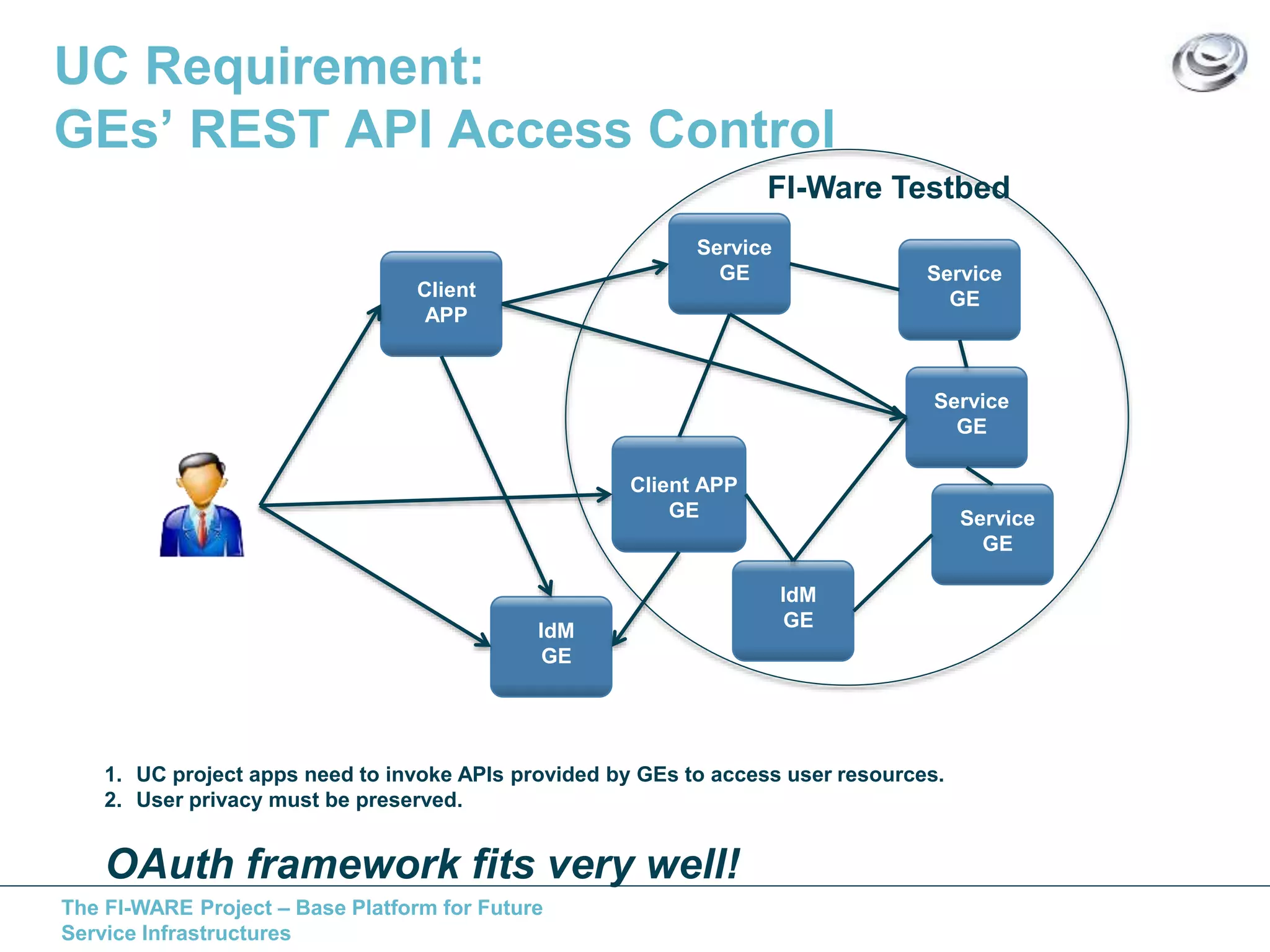
UC Requirement: 
GEs’ REST API Access Control 
Service 
1. UC project apps need to invoke APIs provided by GEs to access user resources. 
2. User privacy must be preserved. 
OAuth framework fits very well! 
The FI-WARE Project – Base Platform for Future 
Service Infrastructures 
FI-Ware Testbed 
Service 
GE 
IdM 
GE 
IdM 
GE 
GE 
Service 
GE 
Service 
GE 
Client 
APP 
Client APP 
GE
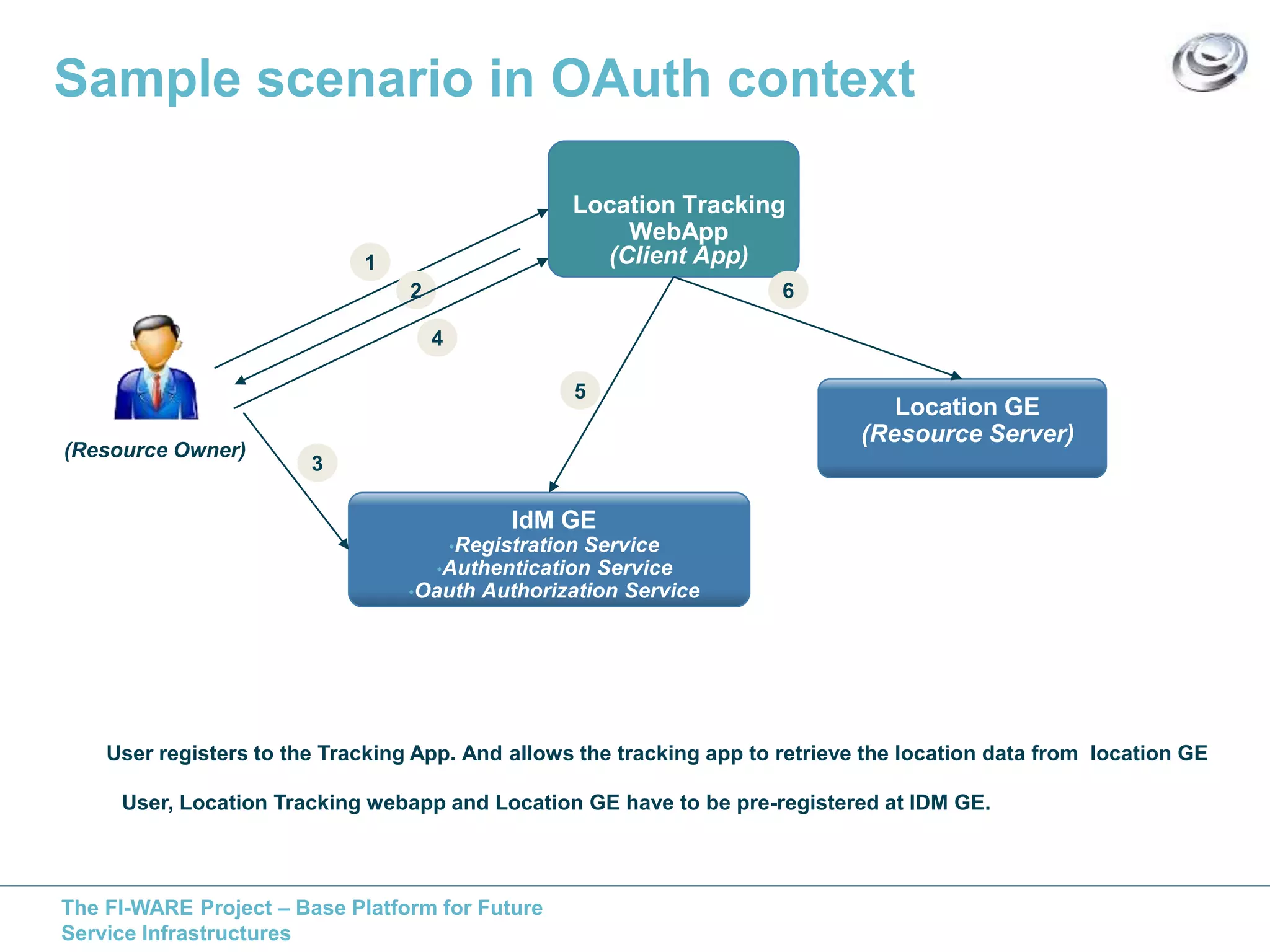
Sample scenario in OAuth context 
1 
2 
3 
4 
(Resource Owner) 
The FI-WARE Project – Base Platform for Future 
Service Infrastructures 
Location GE 
(Resource Server) 
Location Tracking 
WebApp 
(Client App) 
5 
IdM GE 
•Registration Service 
•Authentication Service 
•Oauth Authorization Service 
6 
User registers to the Tracking App. And allows the tracking app to retrieve the location data from location GE 
User, Location Tracking webapp and Location GE have to be pre-registered at IDM GE.
OAuth Authorization Framework 
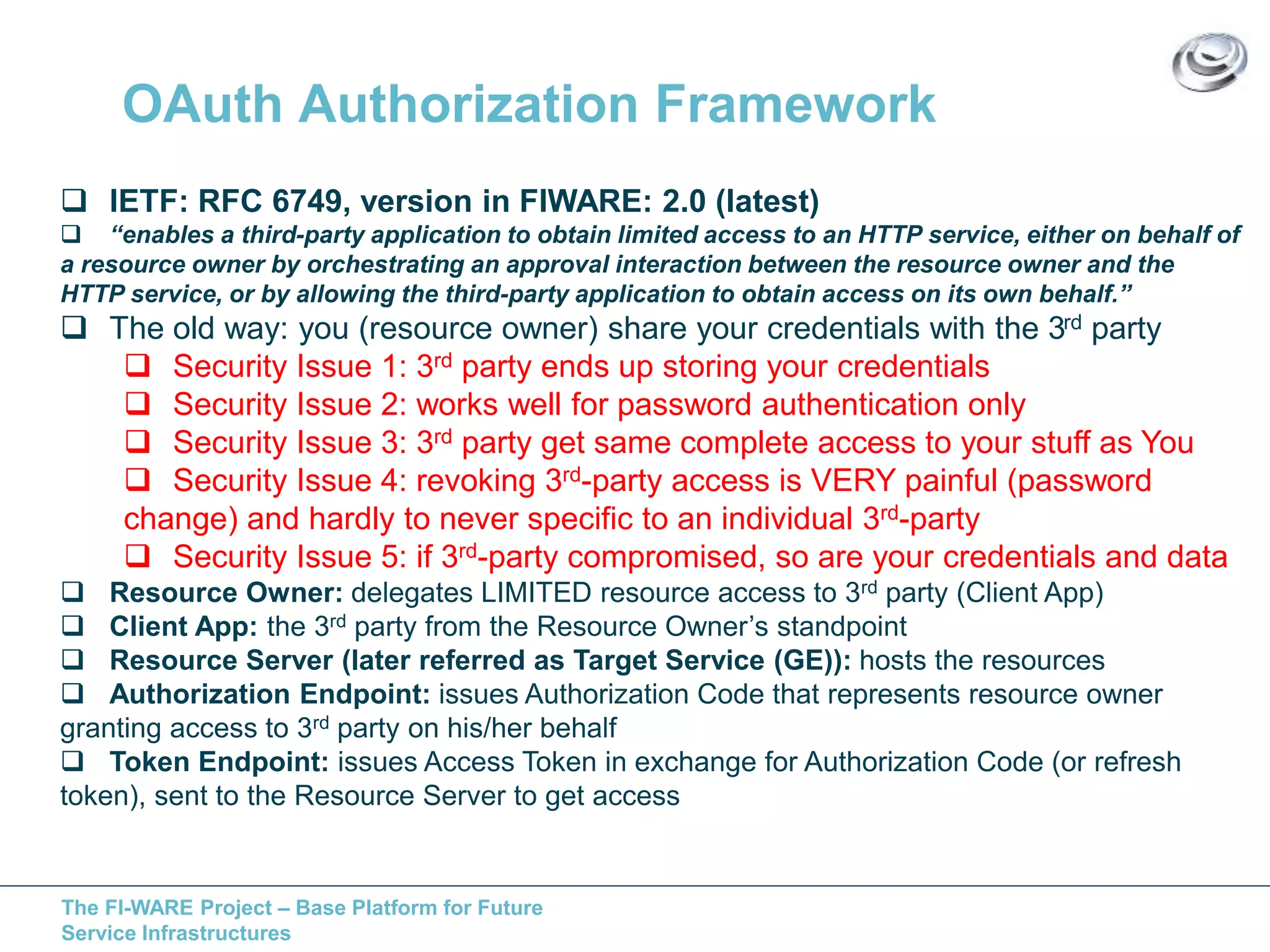
 IETF: RFC 6749, version in FIWARE: 2.0 (latest) 
 “enables a third-party application to obtain limited access to an HTTP service, either on behalf of 
a resource owner by orchestrating an approval interaction between the resource owner and the 
HTTP service, or by allowing the third-party application to obtain access on its own behalf.” 
 The old way: you (resource owner) share your credentials with the 3rd party 
 Security Issue 1: 3rd party ends up storing your credentials 
 Security Issue 2: works well for password authentication only 
 Security Issue 3: 3rd party get same complete access to your stuff as You 
 Security Issue 4: revoking 3rd-party access is VERY painful (password 
change) and hardly to never specific to an individual 3rd-party 
 Security Issue 5: if 3rd-party compromised, so are your credentials and data 
 Resource Owner: delegates LIMITED resource access to 3rd party (Client App) 
 Client App: the 3rd party from the Resource Owner’s standpoint 
 Resource Server (later referred as Target Service (GE)): hosts the resources 
 Authorization Endpoint: issues Authorization Code that represents resource owner 
granting access to 3rd party on his/her behalf 
 Token Endpoint: issues Access Token in exchange for Authorization Code (or refresh 
token), sent to the Resource Server to get access 
The FI-WARE Project – Base Platform for Future 
Service Infrastructures
XACML 
 eXtensible Access Control Markup Language 
 Fact: enterprise security policy (if exists) managed in different places (HR, 
Legal, Finance, IT, etc.), enforced in many points: network access, mail, 
intranet, business apps, etc. 
-> Consolidated view and global application of “best practices” in access 
control is VERY VERY HARD 
 Where to start? Common language for expressing security policy 
 OASIS standard, version in FIWARE: 2.0 (latest 3.0 released Jan 2013) 
 Related to IETF Policy Framework Working Group and the Distributed Management Task Force 
(DMTF)/Common Information Model (CIM) (RFC3198), and ISO10181-3 (Access Control Framework) 
 Policy Decision Point (PDP): provides authorization decisions based on 
Attribute-based Access Control (ABAC) / RBAC policies: 
 Subject(s) can do Action(s) on Resource(s) in given Environment, 
provided some Condition(s) on Subject/Action/Resource/Environment 
 Policy Administration Point (PAP) 
 Policy Repository Point (PRP) 
 Policy Enforcement Point (PEP): protects the resource, i.e. intercepts 
request and asks PDP for permission before letting it through 
 Attribute Finder (non-XACML term): gets attributes not provided by PEP 
The FI-WARE Project – Base Platform for Future 
Service Infrastructures
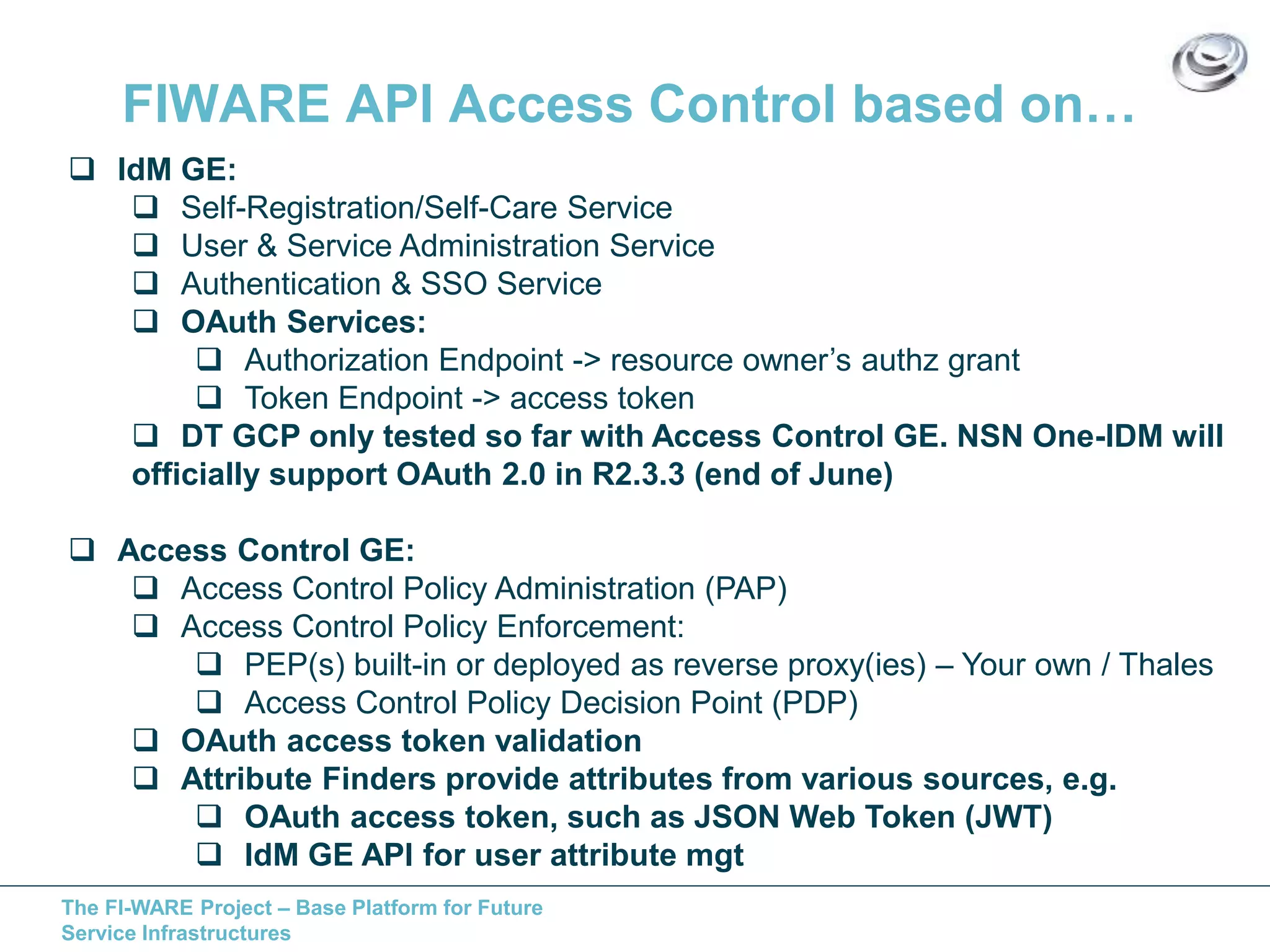
FIWARE API Access Control based on… 
 IdM GE: 
 Self-Registration/Self-Care Service 
 User & Service Administration Service 
 Authentication & SSO Service 
 OAuth Services: 
 Authorization Endpoint -> resource owner’s authz grant 
 Token Endpoint -> access token 
 DT GCP only tested so far with Access Control GE. NSN One-IDM will 
officially support OAuth 2.0 in R2.3.3 (end of June) 
 Access Control GE: 
 Access Control Policy Administration (PAP) 
 Access Control Policy Enforcement: 
 PEP(s) built-in or deployed as reverse proxy(ies) – Your own / Thales 
 Access Control Policy Decision Point (PDP) 
 OAuth access token validation 
 Attribute Finders provide attributes from various sources, e.g. 
 OAuth access token, such as JSON Web Token (JWT) 
 IdM GE API for user attribute mgt 
The FI-WARE Project – Base Platform for Future 
Service Infrastructures
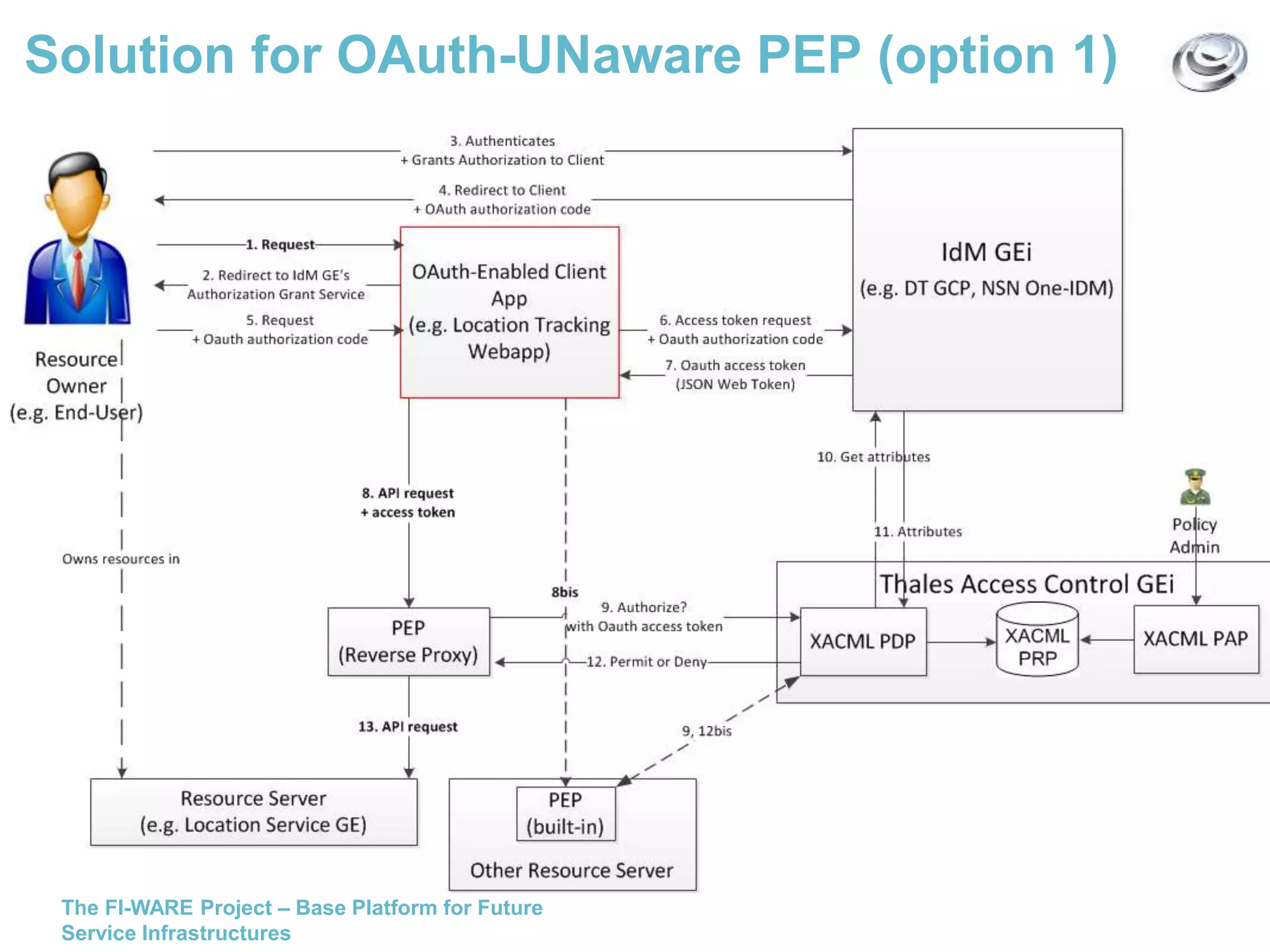
Solution for OAuth-UNaware PEP (option 1) 
The FI-WARE Project – Base Platform for Future 
Service Infrastructures
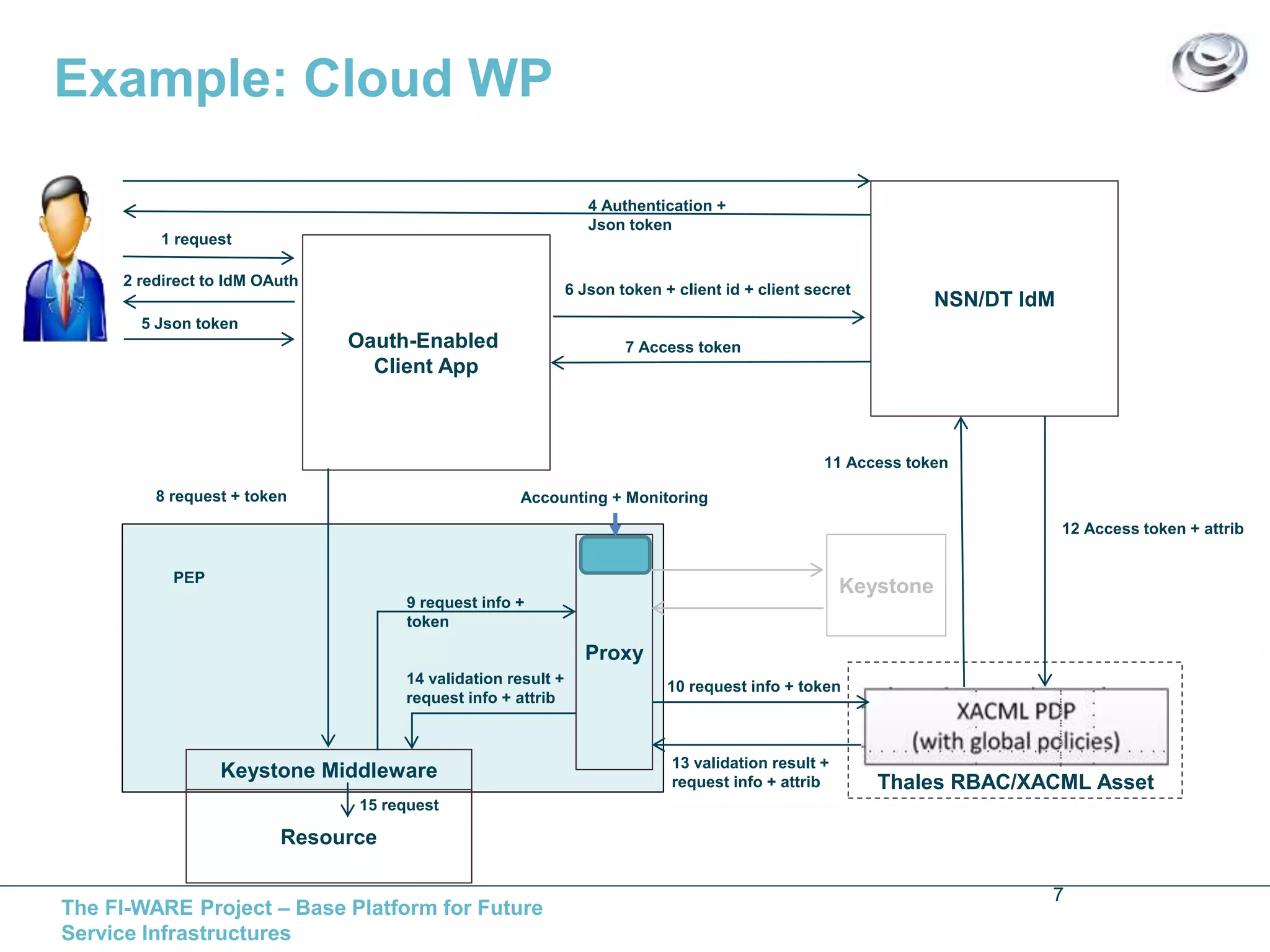
Example: Cloud WP 
Oauth-Enabled 
Client App 
Keystone PEP 
9 request info + 
token 
14 validation result + 
request info + attrib 
The FI-WARE Project – Base Platform for Future 
Service Infrastructures 
NSN/DT IdM 
11 Access token 
Thales RBAC/XACML Asset 
1 request 
2 redirect to IdM OAuth 
4 Authentication + 
Json token 
5 Json token 
6 Json token + client id + client secret 
Resource 
7 Access token 
8 request + token 
10 request info + token 
12 Access token + attrib 
13 validation result + 
request info + attrib 
15 request 
Proxy 
Keystone Middleware 
Accounting + Monitoring 
7
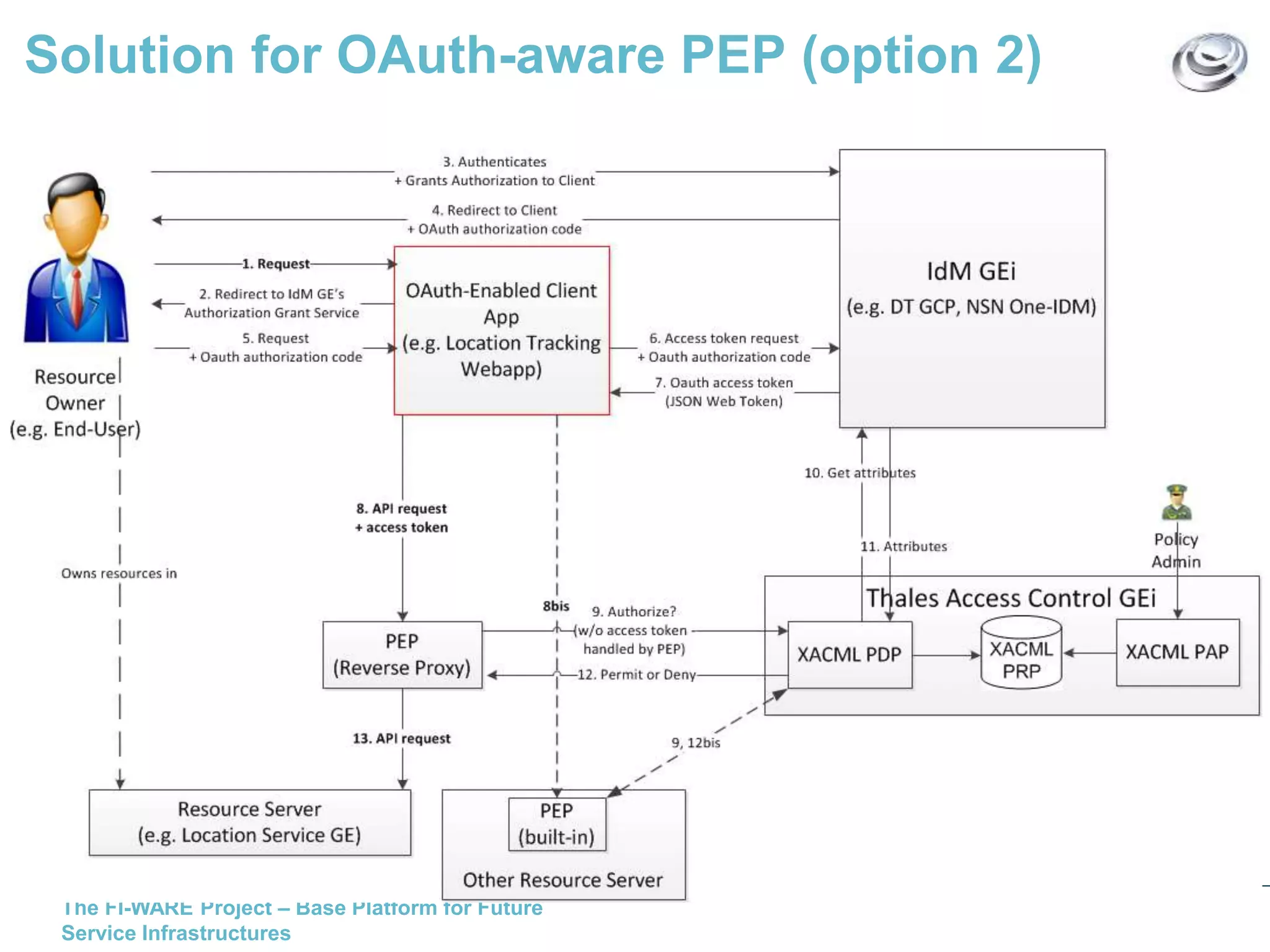
Solution for OAuth-aware PEP (option 2) 
The FI-WARE Project – Base Platform for Future 
Service Infrastructures
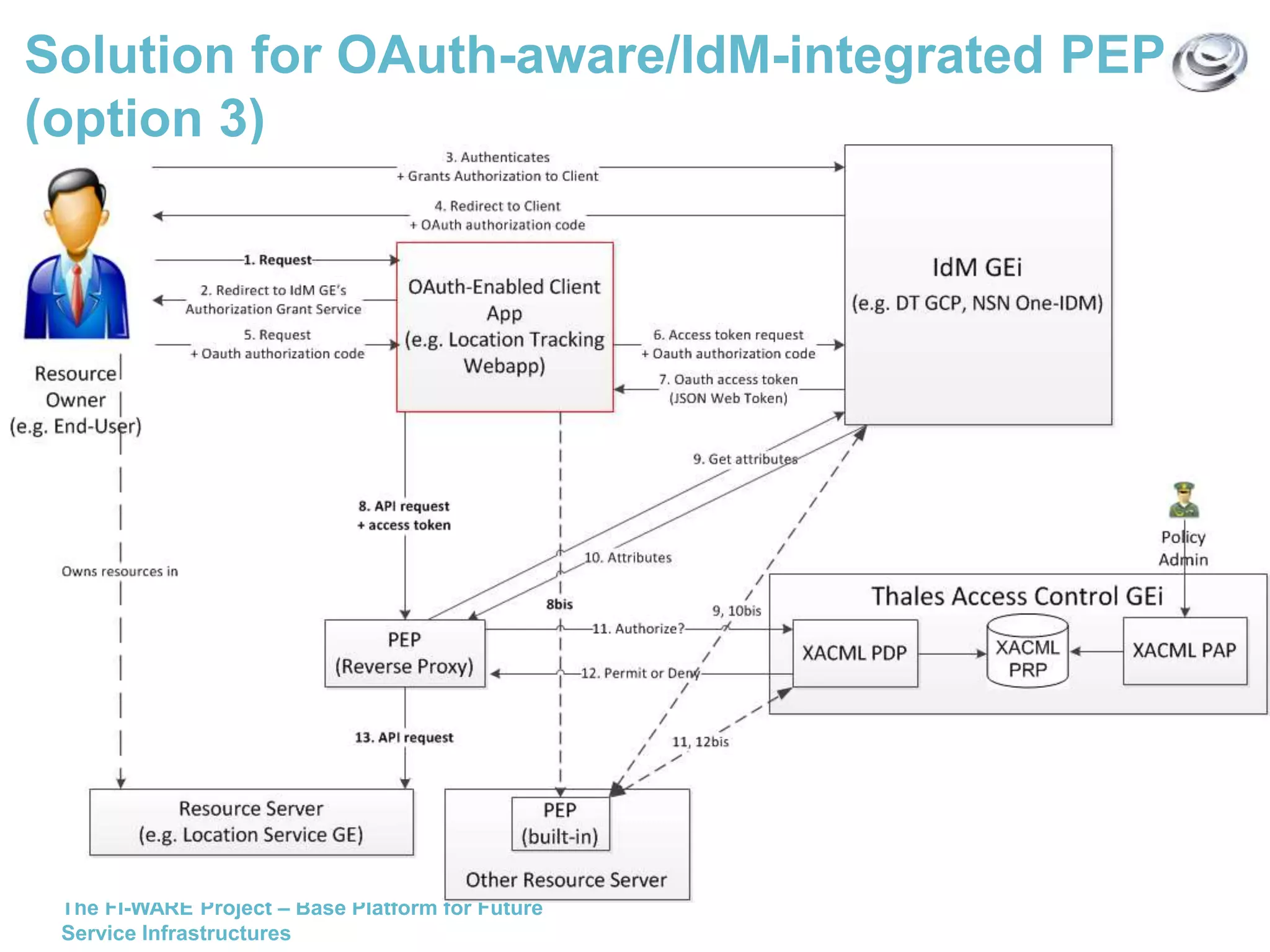
Solution for OAuth-aware/IdM-integrated PEP 
(option 3) 
The FI-WARE Project – Base Platform for Future 
Service Infrastructures
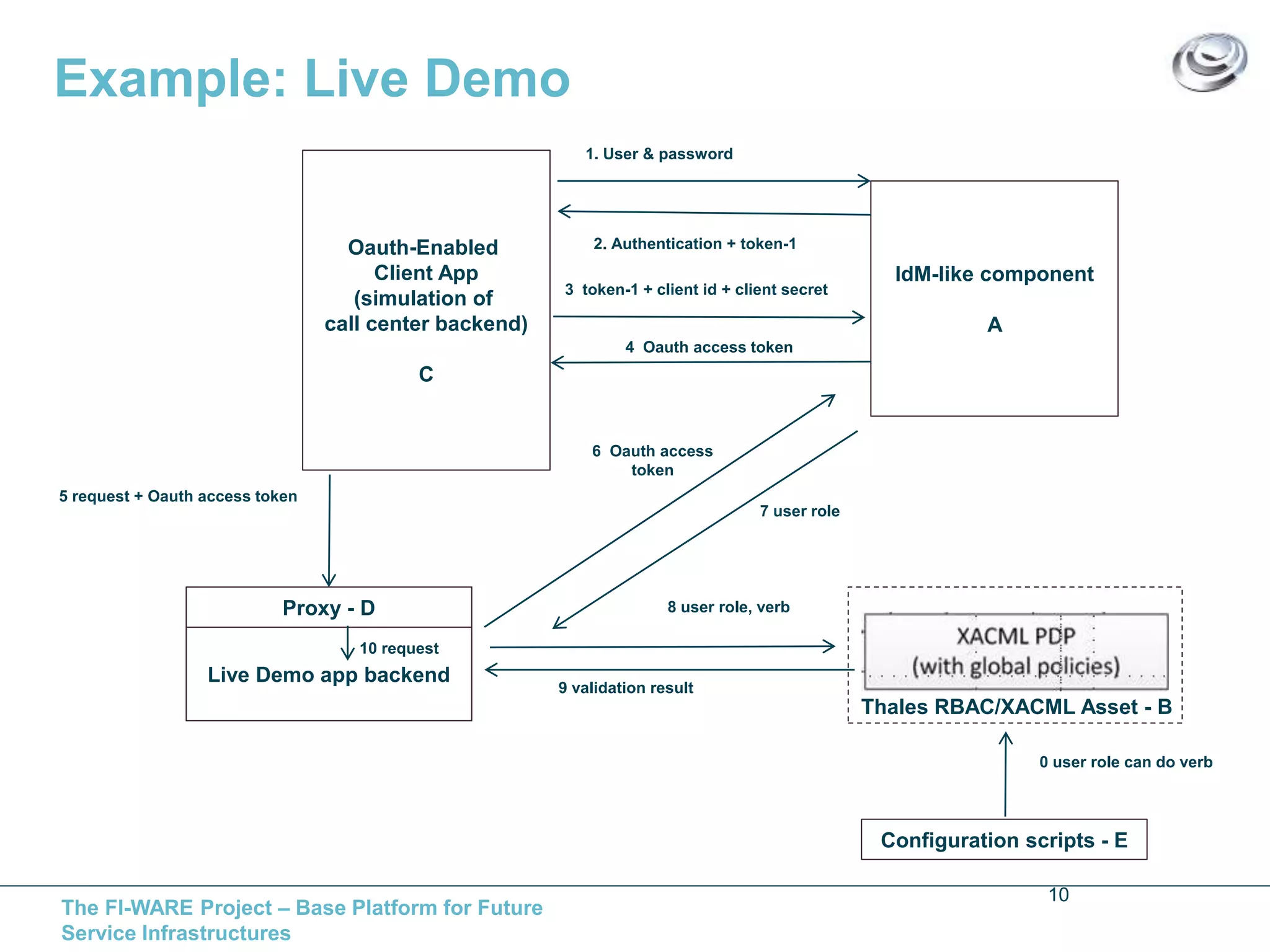
Example: Live Demo 
Oauth-Enabled 
Client App 
(simulation of 
call center backend) 
C 
Proxy - D 
The FI-WARE Project – Base Platform for Future 
Service Infrastructures 
IdM-like component 
0 user role can do verb 
10 
A 
Thales RBAC/XACML Asset - B 
1. User & password 
2. Authentication + token-1 
3 token-1 + client id + client secret 
4 Oauth access token 
5 request + Oauth access token 
7 user role 
9 validation result 
10 request 
Live Demo app backend 
6 Oauth access 
token 
8 user role, verb 
Configuration scripts - E
Thanks ! 
http://fi-ppp.eu 
http://fi-ware.eu 
Follow @FIWARE #FIWARE-AZ on Twitter ! 
The FI-WARE Project – Base Platform for Future 
Service Infrastructures 
11

FI-WARE OAUTH-XACML-based API Access Control - Overview (Part 1)

  • 1.
    Follow @FIWARE #FIWARE-AZon Twitter ! The FI-WARE Project – Base Platform for Future Service Infrastructures FI-WARE Access Control GE Part 1 – API Access Control with OAuth/XACML Overview Cyril DANGERVILLE, Thales FI-WARE / WP8 / T8.2 fiware-api-cross@lists.fi-ware.eu
  • 2.
    UC Requirement: GEs’REST API Access Control Service 1. UC project apps need to invoke APIs provided by GEs to access user resources. 2. User privacy must be preserved. OAuth framework fits very well! The FI-WARE Project – Base Platform for Future Service Infrastructures FI-Ware Testbed Service GE IdM GE IdM GE GE Service GE Service GE Client APP Client APP GE
  • 3.
    Sample scenario inOAuth context 1 2 3 4 (Resource Owner) The FI-WARE Project – Base Platform for Future Service Infrastructures Location GE (Resource Server) Location Tracking WebApp (Client App) 5 IdM GE •Registration Service •Authentication Service •Oauth Authorization Service 6 User registers to the Tracking App. And allows the tracking app to retrieve the location data from location GE User, Location Tracking webapp and Location GE have to be pre-registered at IDM GE.
  • 4.
    OAuth Authorization Framework  IETF: RFC 6749, version in FIWARE: 2.0 (latest)  “enables a third-party application to obtain limited access to an HTTP service, either on behalf of a resource owner by orchestrating an approval interaction between the resource owner and the HTTP service, or by allowing the third-party application to obtain access on its own behalf.”  The old way: you (resource owner) share your credentials with the 3rd party  Security Issue 1: 3rd party ends up storing your credentials  Security Issue 2: works well for password authentication only  Security Issue 3: 3rd party get same complete access to your stuff as You  Security Issue 4: revoking 3rd-party access is VERY painful (password change) and hardly to never specific to an individual 3rd-party  Security Issue 5: if 3rd-party compromised, so are your credentials and data  Resource Owner: delegates LIMITED resource access to 3rd party (Client App)  Client App: the 3rd party from the Resource Owner’s standpoint  Resource Server (later referred as Target Service (GE)): hosts the resources  Authorization Endpoint: issues Authorization Code that represents resource owner granting access to 3rd party on his/her behalf  Token Endpoint: issues Access Token in exchange for Authorization Code (or refresh token), sent to the Resource Server to get access The FI-WARE Project – Base Platform for Future Service Infrastructures
  • 5.
    XACML  eXtensibleAccess Control Markup Language  Fact: enterprise security policy (if exists) managed in different places (HR, Legal, Finance, IT, etc.), enforced in many points: network access, mail, intranet, business apps, etc. -> Consolidated view and global application of “best practices” in access control is VERY VERY HARD  Where to start? Common language for expressing security policy  OASIS standard, version in FIWARE: 2.0 (latest 3.0 released Jan 2013)  Related to IETF Policy Framework Working Group and the Distributed Management Task Force (DMTF)/Common Information Model (CIM) (RFC3198), and ISO10181-3 (Access Control Framework)  Policy Decision Point (PDP): provides authorization decisions based on Attribute-based Access Control (ABAC) / RBAC policies:  Subject(s) can do Action(s) on Resource(s) in given Environment, provided some Condition(s) on Subject/Action/Resource/Environment  Policy Administration Point (PAP)  Policy Repository Point (PRP)  Policy Enforcement Point (PEP): protects the resource, i.e. intercepts request and asks PDP for permission before letting it through  Attribute Finder (non-XACML term): gets attributes not provided by PEP The FI-WARE Project – Base Platform for Future Service Infrastructures
  • 6.
    FIWARE API AccessControl based on…  IdM GE:  Self-Registration/Self-Care Service  User & Service Administration Service  Authentication & SSO Service  OAuth Services:  Authorization Endpoint -> resource owner’s authz grant  Token Endpoint -> access token  DT GCP only tested so far with Access Control GE. NSN One-IDM will officially support OAuth 2.0 in R2.3.3 (end of June)  Access Control GE:  Access Control Policy Administration (PAP)  Access Control Policy Enforcement:  PEP(s) built-in or deployed as reverse proxy(ies) – Your own / Thales  Access Control Policy Decision Point (PDP)  OAuth access token validation  Attribute Finders provide attributes from various sources, e.g.  OAuth access token, such as JSON Web Token (JWT)  IdM GE API for user attribute mgt The FI-WARE Project – Base Platform for Future Service Infrastructures
  • 7.
    Solution for OAuth-UNawarePEP (option 1) The FI-WARE Project – Base Platform for Future Service Infrastructures
  • 8.
    Example: Cloud WP Oauth-Enabled Client App Keystone PEP 9 request info + token 14 validation result + request info + attrib The FI-WARE Project – Base Platform for Future Service Infrastructures NSN/DT IdM 11 Access token Thales RBAC/XACML Asset 1 request 2 redirect to IdM OAuth 4 Authentication + Json token 5 Json token 6 Json token + client id + client secret Resource 7 Access token 8 request + token 10 request info + token 12 Access token + attrib 13 validation result + request info + attrib 15 request Proxy Keystone Middleware Accounting + Monitoring 7
  • 9.
    Solution for OAuth-awarePEP (option 2) The FI-WARE Project – Base Platform for Future Service Infrastructures
  • 10.
    Solution for OAuth-aware/IdM-integratedPEP (option 3) The FI-WARE Project – Base Platform for Future Service Infrastructures
  • 11.
    Example: Live Demo Oauth-Enabled Client App (simulation of call center backend) C Proxy - D The FI-WARE Project – Base Platform for Future Service Infrastructures IdM-like component 0 user role can do verb 10 A Thales RBAC/XACML Asset - B 1. User & password 2. Authentication + token-1 3 token-1 + client id + client secret 4 Oauth access token 5 request + Oauth access token 7 user role 9 validation result 10 request Live Demo app backend 6 Oauth access token 8 user role, verb Configuration scripts - E
  • 12.
    Thanks ! http://fi-ppp.eu http://fi-ware.eu Follow @FIWARE #FIWARE-AZ on Twitter ! The FI-WARE Project – Base Platform for Future Service Infrastructures 11