Exploring the Computational Future in Conservation and Heritage Preservation: Mel Wachowiak and Keats Webb  MCN 2011 [email_address]
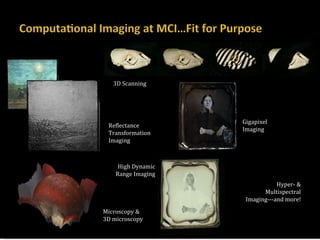
3D Scanning Microscopy & 3D microscopy Hyper- & Multispectral Imaging---and more! High Dynamic  Range Imaging  Reflectance Transformation Imaging Gigapixel Imaging
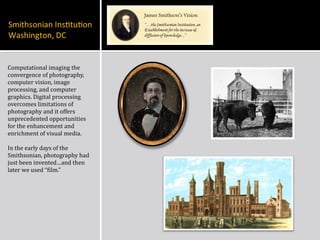
Computational imaging the convergence of photography, computer vision, image processing, and computer graphics. Digital processing overcomes limitations of photography and it offers unprecedented opportunities for the enhancement and enrichment of visual media.  In the early days of the Smithsonian, photography had just been invented…and then later we used “film.”
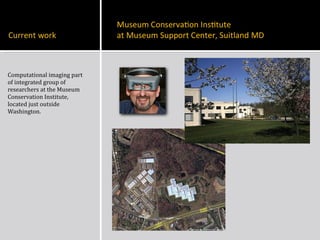
Computational imaging part of integrated group of researchers at the Museum Conservation Institute, located just outside Washington.
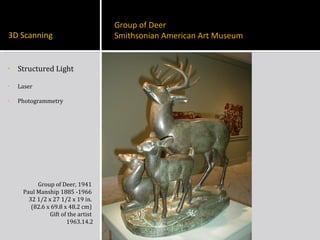
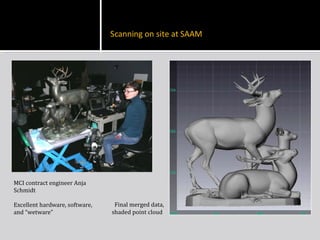
Structured Light Laser Photogrammetry Group of Deer, 1941  Paul Manship 1885 -1966  32 1/2 x 27 1/2 x 19 in.  (82.6 x 69.8 x 48.2 cm)  Gift of the artist  1963.14.2 Group of Deer  Smithsonian American Art Museum
MCI contract engineer Anja Schmidt Excellent hardware, software, and “wetware” Final merged data, shaded point cloud
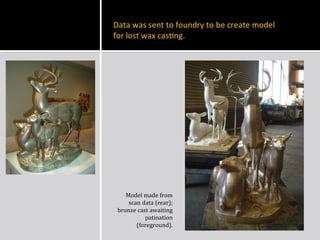
Model made from scan data (rear); bronze cast awaiting patination (foreground).
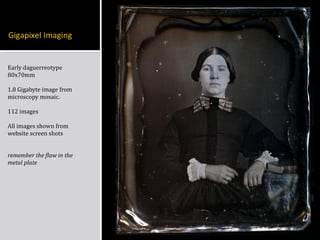
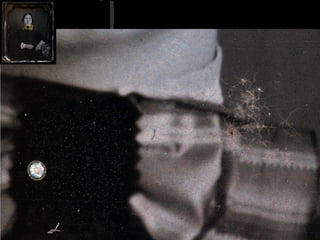
Early daguerreotype 80x70mm 1.8 Gigabyte image from microscopy mosaic. 112 images  All images shown from website screen shots remember the flaw in the metal plate
 
 
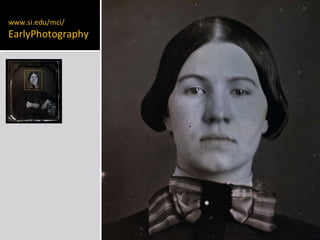
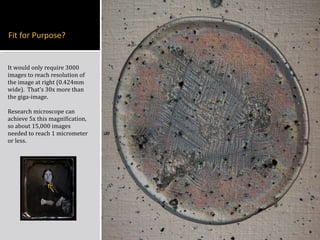
It would only require 3000 images to reach resolution of the image at right (0.424mm wide).  That’ s 30x more than the giga-image. Research microscope can achieve 5x this magnification, so about 15,000 images needed to reach 1 micrometer or less.
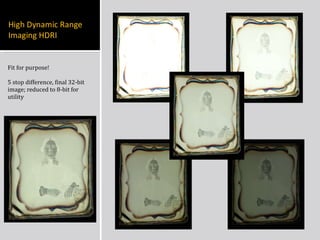
Fit for purpose! 5 stop difference, final 32-bit image; reduced to 8-bit for utility
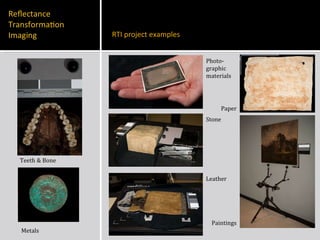
Paper  Metals Teeth & Bone  Paintings Leather Photo- graphic  materials Stone  RTI project examples
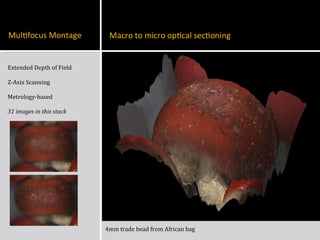
Extended Depth of Field Z-Axis Scanning Metrology-based 31 images in this stack 4mm trade bead from African bag
 
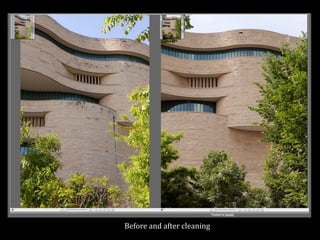
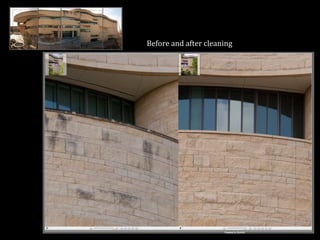
Before and after cleaning
While we can, when should we? n -dimensional: time and space, etc. Fit for purpose requires understanding of methods and resources. Who will use this data in 165 years? If you can imagine it, it can be done.

Fit for Purpose MCN 2011 mjw

  • 1.
    Exploring the ComputationalFuture in Conservation and Heritage Preservation: Mel Wachowiak and Keats Webb MCN 2011 [email_address]
  • 2.
    3D Scanning Microscopy& 3D microscopy Hyper- & Multispectral Imaging---and more! High Dynamic Range Imaging Reflectance Transformation Imaging Gigapixel Imaging
  • 3.
    Computational imaging theconvergence of photography, computer vision, image processing, and computer graphics. Digital processing overcomes limitations of photography and it offers unprecedented opportunities for the enhancement and enrichment of visual media. In the early days of the Smithsonian, photography had just been invented…and then later we used “film.”
  • 4.
    Computational imaging partof integrated group of researchers at the Museum Conservation Institute, located just outside Washington.
  • 5.
    Structured Light LaserPhotogrammetry Group of Deer, 1941 Paul Manship 1885 -1966 32 1/2 x 27 1/2 x 19 in. (82.6 x 69.8 x 48.2 cm) Gift of the artist 1963.14.2 Group of Deer Smithsonian American Art Museum
  • 6.
    MCI contract engineerAnja Schmidt Excellent hardware, software, and “wetware” Final merged data, shaded point cloud
  • 7.
    Model made fromscan data (rear); bronze cast awaiting patination (foreground).
  • 8.
    Early daguerreotype 80x70mm1.8 Gigabyte image from microscopy mosaic. 112 images All images shown from website screen shots remember the flaw in the metal plate
  • 9.
  • 10.
  • 11.
    It would onlyrequire 3000 images to reach resolution of the image at right (0.424mm wide). That’ s 30x more than the giga-image. Research microscope can achieve 5x this magnification, so about 15,000 images needed to reach 1 micrometer or less.
  • 12.
    Fit for purpose!5 stop difference, final 32-bit image; reduced to 8-bit for utility
  • 13.
    Paper MetalsTeeth & Bone Paintings Leather Photo- graphic materials Stone RTI project examples
  • 14.
    Extended Depth ofField Z-Axis Scanning Metrology-based 31 images in this stack 4mm trade bead from African bag
  • 15.
  • 16.
  • 17.
  • 18.
    While we can,when should we? n -dimensional: time and space, etc. Fit for purpose requires understanding of methods and resources. Who will use this data in 165 years? If you can imagine it, it can be done.