Continuous Improvement Toolkit
By: Shilpa Singhal
What is it?
How to make?
Why do we need it?
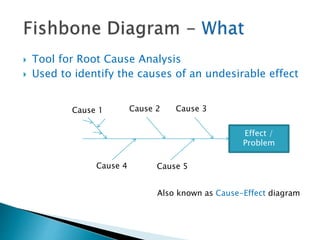
 Tool for Root Cause Analysis
 Used to identify the causes of an undesirable effect
Also known as Cause-Effect diagram
Cause 1 Cause 2 Cause 3
Cause 4 Cause 5
Effect /
Problem
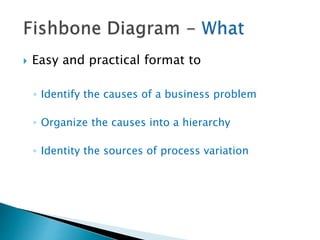
 Easy and practical format to
◦ Identify the causes of a business problem
◦ Organize the causes into a hierarchy
◦ Identity the sources of process variation
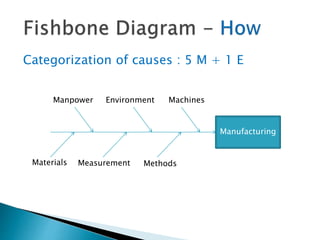
Categorization of causes : 5 M + 1 E
Manpower Environment Machines
Measurement Methods
Manufacturing
Materials
 Steps to construct
◦ Define the effect
◦ Determine major categories
◦ Brainstorm and ask questions
◦ Verify the accuracy of causes
◦ Plan actions for correction of causes
 Find the cause Eliminate the problem
Problems
Causes
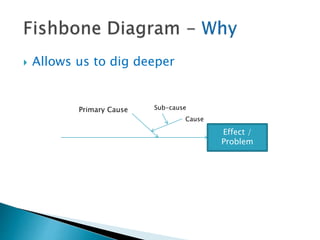
 Allows us to dig deeper
Primary Cause
Cause
Sub-cause
Effect /
Problem
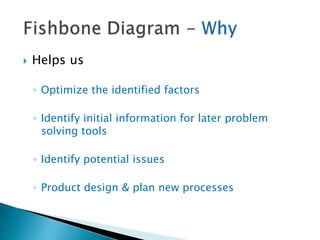
 Helps us
◦ Optimize the identified factors
◦ Identify initial information for later problem
solving tools
◦ Identify potential issues
◦ Product design & plan new processes
 High number of invoice errors for a company
Manpower Environment Machines
Measurement Methods
Invoice
errors
Materials
Open windows
Noisy office Incompatible
systems
Manual
Data Entry
Poor audit
system
Low morale
Memo layout
Paper supply
Continuous Improvement Toolkit
By: Shilpa Singhal

Fishbone diagram for Continuous Improvement

  • 1.
  • 2.
    What is it? Howto make? Why do we need it?
  • 3.
     Tool forRoot Cause Analysis  Used to identify the causes of an undesirable effect Also known as Cause-Effect diagram Cause 1 Cause 2 Cause 3 Cause 4 Cause 5 Effect / Problem
  • 4.
     Easy andpractical format to ◦ Identify the causes of a business problem ◦ Organize the causes into a hierarchy ◦ Identity the sources of process variation
  • 5.
    Categorization of causes: 5 M + 1 E Manpower Environment Machines Measurement Methods Manufacturing Materials
  • 6.
     Steps toconstruct ◦ Define the effect ◦ Determine major categories ◦ Brainstorm and ask questions ◦ Verify the accuracy of causes ◦ Plan actions for correction of causes
  • 7.
     Find thecause Eliminate the problem Problems Causes
  • 8.
     Allows usto dig deeper Primary Cause Cause Sub-cause Effect / Problem
  • 9.
     Helps us ◦Optimize the identified factors ◦ Identify initial information for later problem solving tools ◦ Identify potential issues ◦ Product design & plan new processes
  • 10.
     High numberof invoice errors for a company Manpower Environment Machines Measurement Methods Invoice errors Materials Open windows Noisy office Incompatible systems Manual Data Entry Poor audit system Low morale Memo layout Paper supply
  • 11.