CHAPTER-5
Harbour Facilities
Piers
• Piers are platform built perpendicular or oblique to the shore of a river
or a sea
• In sea, it is constructed where the sea is not deep and harbour is not
convenient for allowing the ships to berth adjacent to the shore
• On both sides of a pier berths are provided
• The length should be sufficient to accommodate the longest ship likely
to take its platform
• The width should be sufficient to satisfy its utility
• May be either open or solid construction
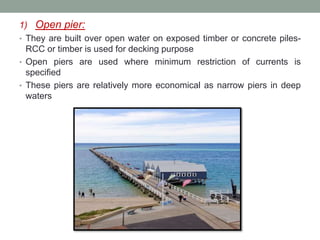
1) Open pier:
• They are built over open water on exposed timber or concrete piles-
RCC or timber is used for decking purpose
• Open piers are used where minimum restriction of currents is
specified
• These piers are relatively more economical as narrow piers in deep
waters
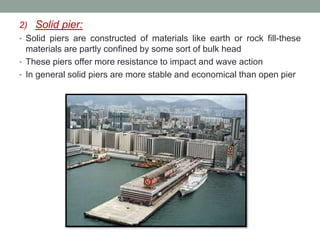
2) Solid pier:
• Solid piers are constructed of materials like earth or rock fill-these
materials are partly confined by some sort of bulk head
• These piers offer more resistance to impact and wave action
• In general solid piers are more stable and economical than open pier
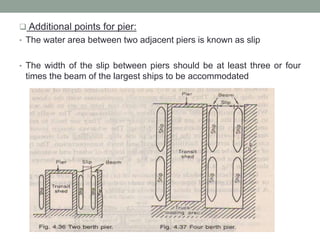
 Additional points for pier:
• The water area between two adjacent piers is known as slip
• The width of the slip between piers should be at least three or four
times the beam of the largest ships to be accommodated
Cont…
• The live loads for pier design depends upon the nature of anticipated
cargo and shipping
• It is usual to provide no space for the purpose of storing cargo on the
pier
• Horizontal thrust on a pier head is taken as about 1% of the maximum
weight of the vessel to be berthed
• Water depth at pier should have a clearance of minimum 30 cm under
the keel of a fully loaded ship with reasonable provision for an
abnormally low tide
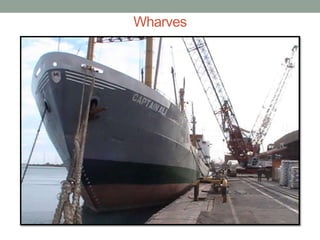
Wharves
Wharves
• These are platforms at which vessels take on and discharge
passengers and cargo
• In other words, they are docks that parallels the shore
• Located in such a way as to give sufficient depth of water for the ship
to float
• Generally built continuous with the shore but may not necessarily be
so
• Wharves built parallel with the shore are called quays and walls built
to protect the quays are known as quay walls
• Quay walls are built to retain and protect the embankment or filling
Cont…
• The type of vessel to be accommodated governs the length of wharf
and water depth required for berthing of ships
• The wharves design involves the following factors:
1) Provision for berthing of the ship,
2) Handling and storage of cargo
3) Terminal facilities for rail and truck transportation
• Wharves can broadly be classified as open or solid construction
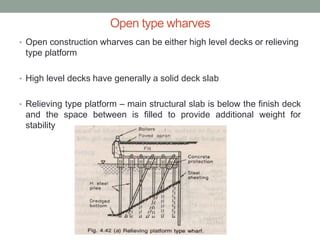
Open type wharves
• Open construction wharves can be either high level decks or relieving
type platform
• High level decks have generally a solid deck slab
• Relieving type platform – main structural slab is below the finish deck
and the space between is filled to provide additional weight for
stability
Cont…
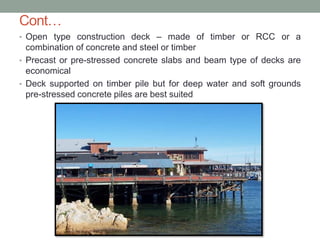
• Open type construction deck – made of timber or RCC or a
combination of concrete and steel or timber
• Precast or pre-stressed concrete slabs and beam type of decks are
economical
• Deck supported on timber pile but for deep water and soft grounds
pre-stressed concrete piles are best suited
Solid type wharves
• Composed of earth or rock fill partly confirmed by some sort of bulkhead
• Various types can be constructed
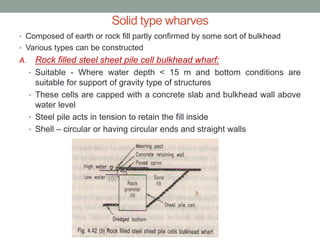
A. Rock filled steel sheet pile cell bulkhead wharf:
• Suitable - Where water depth < 15 m and bottom conditions are
suitable for support of gravity type of structures
• These cells are capped with a concrete slab and bulkhead wall above
water level
• Steel pile acts in tension to retain the fill inside
• Shell – circular or having circular ends and straight walls
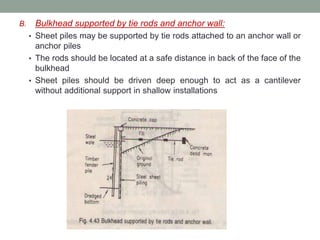
B. Bulkhead supported by tie rods and anchor wall:
• Sheet piles may be supported by tie rods attached to an anchor wall or
anchor piles
• The rods should be located at a safe distance in back of the face of the
bulkhead
• Sheet piles should be driven deep enough to act as a cantilever
without additional support in shallow installations
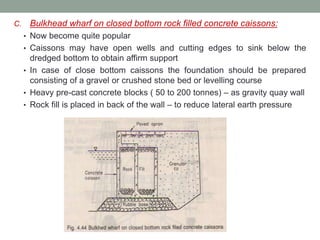
C. Bulkhead wharf on closed bottom rock filled concrete caissons:
• Now become quite popular
• Caissons may have open wells and cutting edges to sink below the
dredged bottom to obtain affirm support
• In case of close bottom caissons the foundation should be prepared
consisting of a gravel or crushed stone bed or levelling course
• Heavy pre-cast concrete blocks ( 50 to 200 tonnes) – as gravity quay wall
• Rock fill is placed in back of the wall – to reduce lateral earth pressure
Dolphins
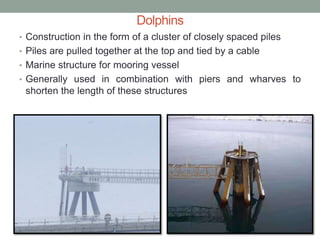
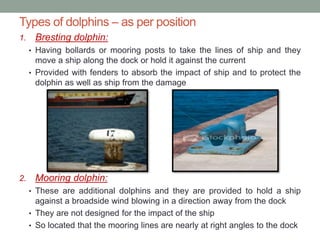
• Construction in the form of a cluster of closely spaced piles
• Piles are pulled together at the top and tied by a cable
• Marine structure for mooring vessel
• Generally used in combination with piers and wharves to
shorten the length of these structures
Cont…
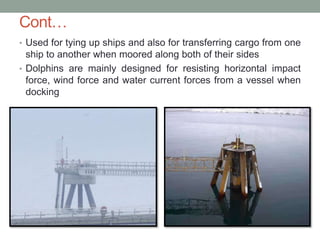
• Used for tying up ships and also for transferring cargo from one
ship to another when moored along both of their sides
• Dolphins are mainly designed for resisting horizontal impact
force, wind force and water current forces from a vessel when
docking
Types of dolphins – as per position
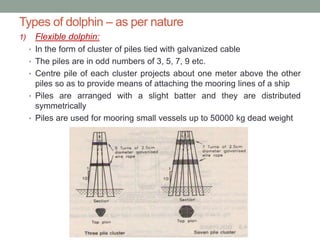
1. Bresting dolphin:
• Having bollards or mooring posts to take the lines of ship and they
move a ship along the dock or hold it against the current
• Provided with fenders to absorb the impact of ship and to protect the
dolphin as well as ship from the damage
2. Mooring dolphin:
• These are additional dolphins and they are provided to hold a ship
against a broadside wind blowing in a direction away from the dock
• They are not designed for the impact of the ship
• So located that the mooring lines are nearly at right angles to the dock
Types of dolphin – as per nature
1) Flexible dolphin:
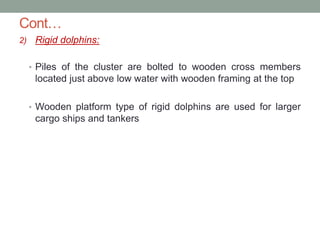
• In the form of cluster of piles tied with galvanized cable
• The piles are in odd numbers of 3, 5, 7, 9 etc.
• Centre pile of each cluster projects about one meter above the other
piles so as to provide means of attaching the mooring lines of a ship
• Piles are arranged with a slight batter and they are distributed
symmetrically
• Piles are used for mooring small vessels up to 50000 kg dead weight
Cont…
2) Rigid dolphins:
• Piles of the cluster are bolted to wooden cross members
located just above low water with wooden framing at the top
• Wooden platform type of rigid dolphins are used for larger
cargo ships and tankers
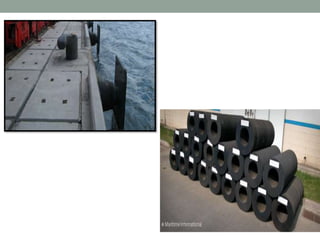
Fenders
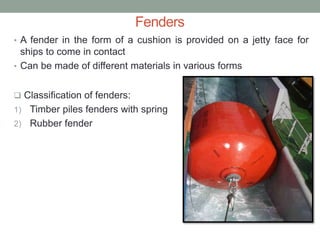
• A fender in the form of a cushion is provided on a jetty face for
ships to come in contact
• Can be made of different materials in various forms
 Classification of fenders:
1) Timber piles fenders with spring
2) Rubber fender
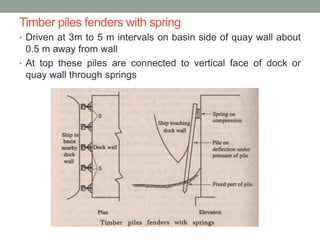
Timber piles fenders with spring
• Driven at 3m to 5 m intervals on basin side of quay wall about
0.5 m away from wall
• At top these piles are connected to vertical face of dock or
quay wall through springs
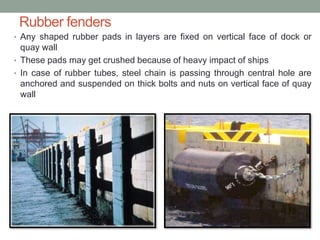
Rubber fenders
• Any shaped rubber pads in layers are fixed on vertical face of dock or
quay wall
• These pads may get crushed because of heavy impact of ships
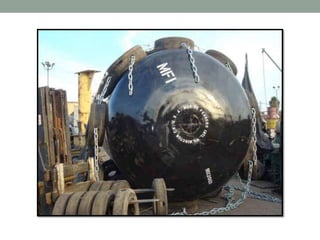
• In case of rubber tubes, steel chain is passing through central hole are
anchored and suspended on thick bolts and nuts on vertical face of quay
wall
Chapter-5 Harbour Facilities.pptx

Chapter-5 Harbour Facilities.pptx

  • 1.
  • 2.
    Piers • Piers areplatform built perpendicular or oblique to the shore of a river or a sea • In sea, it is constructed where the sea is not deep and harbour is not convenient for allowing the ships to berth adjacent to the shore • On both sides of a pier berths are provided • The length should be sufficient to accommodate the longest ship likely to take its platform • The width should be sufficient to satisfy its utility • May be either open or solid construction
  • 3.
    1) Open pier: •They are built over open water on exposed timber or concrete piles- RCC or timber is used for decking purpose • Open piers are used where minimum restriction of currents is specified • These piers are relatively more economical as narrow piers in deep waters
  • 4.
    2) Solid pier: •Solid piers are constructed of materials like earth or rock fill-these materials are partly confined by some sort of bulk head • These piers offer more resistance to impact and wave action • In general solid piers are more stable and economical than open pier
  • 5.
     Additional pointsfor pier: • The water area between two adjacent piers is known as slip • The width of the slip between piers should be at least three or four times the beam of the largest ships to be accommodated
  • 6.
    Cont… • The liveloads for pier design depends upon the nature of anticipated cargo and shipping • It is usual to provide no space for the purpose of storing cargo on the pier • Horizontal thrust on a pier head is taken as about 1% of the maximum weight of the vessel to be berthed • Water depth at pier should have a clearance of minimum 30 cm under the keel of a fully loaded ship with reasonable provision for an abnormally low tide
  • 7.
  • 8.
    Wharves • These areplatforms at which vessels take on and discharge passengers and cargo • In other words, they are docks that parallels the shore • Located in such a way as to give sufficient depth of water for the ship to float • Generally built continuous with the shore but may not necessarily be so • Wharves built parallel with the shore are called quays and walls built to protect the quays are known as quay walls • Quay walls are built to retain and protect the embankment or filling
  • 9.
    Cont… • The typeof vessel to be accommodated governs the length of wharf and water depth required for berthing of ships • The wharves design involves the following factors: 1) Provision for berthing of the ship, 2) Handling and storage of cargo 3) Terminal facilities for rail and truck transportation • Wharves can broadly be classified as open or solid construction
  • 10.
    Open type wharves •Open construction wharves can be either high level decks or relieving type platform • High level decks have generally a solid deck slab • Relieving type platform – main structural slab is below the finish deck and the space between is filled to provide additional weight for stability
  • 11.
    Cont… • Open typeconstruction deck – made of timber or RCC or a combination of concrete and steel or timber • Precast or pre-stressed concrete slabs and beam type of decks are economical • Deck supported on timber pile but for deep water and soft grounds pre-stressed concrete piles are best suited
  • 12.
    Solid type wharves •Composed of earth or rock fill partly confirmed by some sort of bulkhead • Various types can be constructed A. Rock filled steel sheet pile cell bulkhead wharf: • Suitable - Where water depth < 15 m and bottom conditions are suitable for support of gravity type of structures • These cells are capped with a concrete slab and bulkhead wall above water level • Steel pile acts in tension to retain the fill inside • Shell – circular or having circular ends and straight walls
  • 13.
    B. Bulkhead supportedby tie rods and anchor wall: • Sheet piles may be supported by tie rods attached to an anchor wall or anchor piles • The rods should be located at a safe distance in back of the face of the bulkhead • Sheet piles should be driven deep enough to act as a cantilever without additional support in shallow installations
  • 14.
    C. Bulkhead wharfon closed bottom rock filled concrete caissons: • Now become quite popular • Caissons may have open wells and cutting edges to sink below the dredged bottom to obtain affirm support • In case of close bottom caissons the foundation should be prepared consisting of a gravel or crushed stone bed or levelling course • Heavy pre-cast concrete blocks ( 50 to 200 tonnes) – as gravity quay wall • Rock fill is placed in back of the wall – to reduce lateral earth pressure
  • 15.
    Dolphins • Construction inthe form of a cluster of closely spaced piles • Piles are pulled together at the top and tied by a cable • Marine structure for mooring vessel • Generally used in combination with piers and wharves to shorten the length of these structures
  • 16.
    Cont… • Used fortying up ships and also for transferring cargo from one ship to another when moored along both of their sides • Dolphins are mainly designed for resisting horizontal impact force, wind force and water current forces from a vessel when docking
  • 17.
    Types of dolphins– as per position 1. Bresting dolphin: • Having bollards or mooring posts to take the lines of ship and they move a ship along the dock or hold it against the current • Provided with fenders to absorb the impact of ship and to protect the dolphin as well as ship from the damage 2. Mooring dolphin: • These are additional dolphins and they are provided to hold a ship against a broadside wind blowing in a direction away from the dock • They are not designed for the impact of the ship • So located that the mooring lines are nearly at right angles to the dock
  • 18.
    Types of dolphin– as per nature 1) Flexible dolphin: • In the form of cluster of piles tied with galvanized cable • The piles are in odd numbers of 3, 5, 7, 9 etc. • Centre pile of each cluster projects about one meter above the other piles so as to provide means of attaching the mooring lines of a ship • Piles are arranged with a slight batter and they are distributed symmetrically • Piles are used for mooring small vessels up to 50000 kg dead weight
  • 19.
    Cont… 2) Rigid dolphins: •Piles of the cluster are bolted to wooden cross members located just above low water with wooden framing at the top • Wooden platform type of rigid dolphins are used for larger cargo ships and tankers
  • 20.
    Fenders • A fenderin the form of a cushion is provided on a jetty face for ships to come in contact • Can be made of different materials in various forms  Classification of fenders: 1) Timber piles fenders with spring 2) Rubber fender
  • 21.
    Timber piles fenderswith spring • Driven at 3m to 5 m intervals on basin side of quay wall about 0.5 m away from wall • At top these piles are connected to vertical face of dock or quay wall through springs
  • 22.
    Rubber fenders • Anyshaped rubber pads in layers are fixed on vertical face of dock or quay wall • These pads may get crushed because of heavy impact of ships • In case of rubber tubes, steel chain is passing through central hole are anchored and suspended on thick bolts and nuts on vertical face of quay wall