PRESENTATION ON TOPOLOGY
PRESENTED BY
Miss. Nidhi Sharma
Asst. Professor
Dept. of Mathematics
NIET, Greater Noida
 Etymology
From Late Latin topologia, from Ancient
Greek τόπος (tópos, “place, locality”) +
(o)logy (“study of, a branch of knowledge”).
Meanings of topology in Hindi
स ांस्थिति
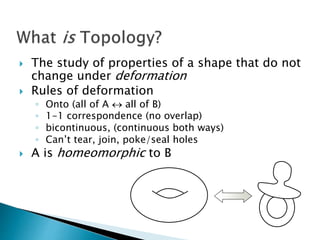
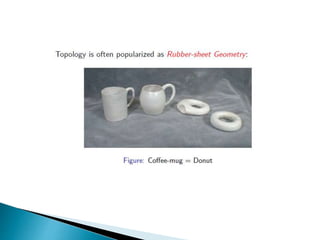
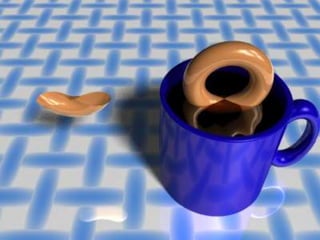
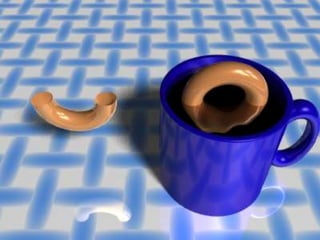
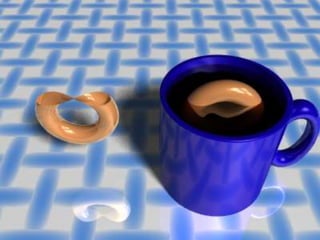
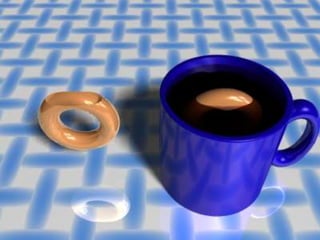
 The study of properties of a shape that do not
change under deformation
 Rules of deformation
◦ Onto (all of A  all of B)
◦ 1-1 correspondence (no overlap)
◦ bicontinuous, (continuous both ways)
◦ Can’t tear, join, poke/seal holes
 A is homeomorphic to B
 What is the boundary of an object?
 Are there holes in the object?
 Is the object hollow?
 If the object is transformed in some way, are
the changes continuous or abrupt?
 Is the object bounded, or does it extend
infinitely far?
 Topology began with the study of curves, surfaces, and
other objects in the plane and three-space. One of the
central ideas in topology is that spatial objects
like circles and spheres can be treated as objects in their
own right, and knowledge of objects is independent of
how they are "represented" or "embedded" in space. For
example, the statement "if you remove a point from
a circle, you get a line segment" applies just as well to
the circle as to an ellipse, and even to tangled or
knotted circles, since the statement involves only
topological properties.
 Topology has to do with the study of spatial objects such
as curves, surfaces, the space we call our universe, the
space-time of general
relativity, fractals,knots, manifolds (which are objects with
some of the same basic spatial properties as our
universe), phase spaces that are encountered in physics
(such as the space of hand-positions of a clock), symmetry
groups like the collection of ways of rotating a top, etc.
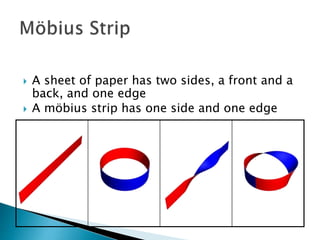
 A sheet of paper has two sides, a front and a
back, and one edge
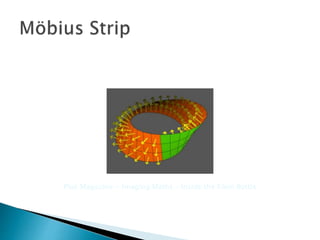
 A möbius strip has one side and one edge
Plus Magazine ~ Imaging Maths – Inside the Klein Bottle
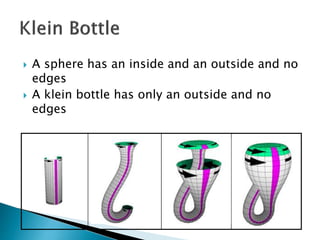
 A sphere has an inside and an outside and no
edges
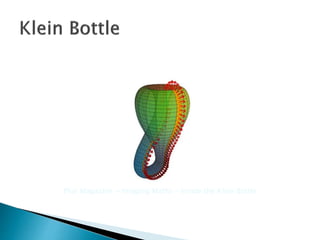
 A klein bottle has only an outside and no
edges
Plus Magazine ~ Imaging Maths – Inside the Klein Bottle
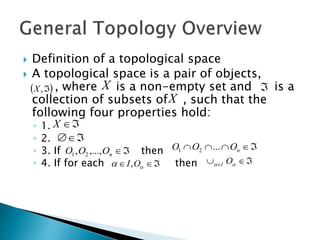
 Definition of a topological space
 A topological space is a pair of objects,
, where is a non-empty set and is a
collection of subsets of , such that the
following four properties hold:
◦ 1.
◦ 2.
◦ 3. If then
◦ 4. If for each then
 

,
X X 
X


X





n
O
O
O ,...,
, 2
1




 n
O
O
O ...
2
1


 
 O
I, 

  
 O
I
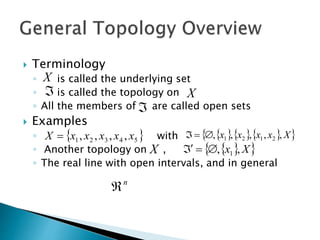
 Terminology
◦ is called the underlying set
◦ is called the topology on
◦ All the members of are called open sets
 Examples
◦ with
◦ Another topology on ,
◦ The real line with open intervals, and in general
X
X


 
5
4
3
2
1 ,
,
,
, x
x
x
x
x
X     
 
X
x
x
x
x ,
,
,
,
, 2
1
2
1



X  
 
X
x ,
, 1



n

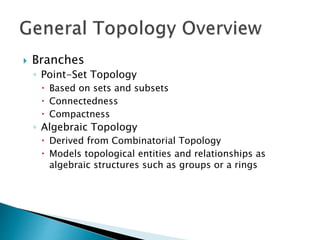
 Branches
◦ Point-Set Topology
 Based on sets and subsets
 Connectedness
 Compactness
◦ Algebraic Topology
 Derived from Combinatorial Topology
 Models topological entities and relationships as
algebraic structures such as groups or a rings
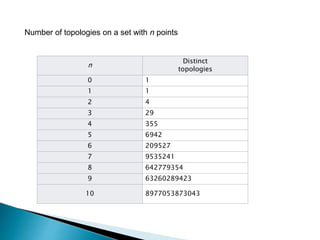
n
Distinct
topologies
0 1
1 1
2 4
3 29
4 355
5 6942
6 209527
7 9535241
8 642779354
9 63260289423
10 8977053873043
Number of topologies on a set with n points
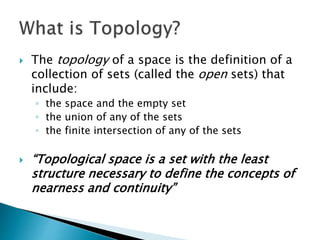
 The topology of a space is the definition of a
collection of sets (called the open sets) that
include:
◦ the space and the empty set
◦ the union of any of the sets
◦ the finite intersection of any of the sets
 “Topological space is a set with the least
structure necessary to define the concepts of
nearness and continuity”
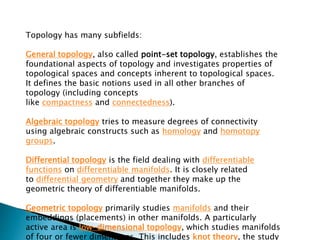
Topology has many subfields:
General topology, also called point-set topology, establishes the
foundational aspects of topology and investigates properties of
topological spaces and concepts inherent to topological spaces.
It defines the basic notions used in all other branches of
topology (including concepts
like compactness and connectedness).
Algebraic topology tries to measure degrees of connectivity
using algebraic constructs such as homology and homotopy
groups.
Differential topology is the field dealing with differentiable
functions on differentiable manifolds. It is closely related
to differential geometry and together they make up the
geometric theory of differentiable manifolds.
Geometric topology primarily studies manifolds and their
embeddings (placements) in other manifolds. A particularly
active area is low-dimensional topology, which studies manifolds
of four or fewer dimensions. This includes knot theory, the study
 Here we discusses using cell phones to actually
map out the topology of indoor spaces. I also
know one can use topology maps for automated
robot navigation. Lots of machine learning
applications as well. Another cool application is
in the world of chemistry where one can discuss
the shape of molecules by an analysis of the
topology of a related graph. There is also an
application for medical imaging software and
technology. I'm pretty sure one can find an
example of the application of topology to
basically every field of the sciences.

FIRSTPPTONTOPOLOGY (1).pptx

  • 2.
    PRESENTATION ON TOPOLOGY PRESENTEDBY Miss. Nidhi Sharma Asst. Professor Dept. of Mathematics NIET, Greater Noida
  • 5.
     Etymology From LateLatin topologia, from Ancient Greek τόπος (tópos, “place, locality”) + (o)logy (“study of, a branch of knowledge”). Meanings of topology in Hindi स ांस्थिति
  • 6.
     The studyof properties of a shape that do not change under deformation  Rules of deformation ◦ Onto (all of A  all of B) ◦ 1-1 correspondence (no overlap) ◦ bicontinuous, (continuous both ways) ◦ Can’t tear, join, poke/seal holes  A is homeomorphic to B
  • 7.
     What isthe boundary of an object?  Are there holes in the object?  Is the object hollow?  If the object is transformed in some way, are the changes continuous or abrupt?  Is the object bounded, or does it extend infinitely far?
  • 8.
     Topology beganwith the study of curves, surfaces, and other objects in the plane and three-space. One of the central ideas in topology is that spatial objects like circles and spheres can be treated as objects in their own right, and knowledge of objects is independent of how they are "represented" or "embedded" in space. For example, the statement "if you remove a point from a circle, you get a line segment" applies just as well to the circle as to an ellipse, and even to tangled or knotted circles, since the statement involves only topological properties.  Topology has to do with the study of spatial objects such as curves, surfaces, the space we call our universe, the space-time of general relativity, fractals,knots, manifolds (which are objects with some of the same basic spatial properties as our universe), phase spaces that are encountered in physics (such as the space of hand-positions of a clock), symmetry groups like the collection of ways of rotating a top, etc.
  • 9.
     A sheetof paper has two sides, a front and a back, and one edge  A möbius strip has one side and one edge
  • 10.
    Plus Magazine ~Imaging Maths – Inside the Klein Bottle
  • 11.
     A spherehas an inside and an outside and no edges  A klein bottle has only an outside and no edges
  • 12.
    Plus Magazine ~Imaging Maths – Inside the Klein Bottle
  • 20.
     Definition ofa topological space  A topological space is a pair of objects, , where is a non-empty set and is a collection of subsets of , such that the following four properties hold: ◦ 1. ◦ 2. ◦ 3. If then ◦ 4. If for each then    , X X  X   X      n O O O ,..., , 2 1      n O O O ... 2 1      O I,       O I
  • 21.
     Terminology ◦ iscalled the underlying set ◦ is called the topology on ◦ All the members of are called open sets  Examples ◦ with ◦ Another topology on , ◦ The real line with open intervals, and in general X X     5 4 3 2 1 , , , , x x x x x X        X x x x x , , , , , 2 1 2 1    X     X x , , 1    n 
  • 22.
     Branches ◦ Point-SetTopology  Based on sets and subsets  Connectedness  Compactness ◦ Algebraic Topology  Derived from Combinatorial Topology  Models topological entities and relationships as algebraic structures such as groups or a rings
  • 23.
    n Distinct topologies 0 1 1 1 24 3 29 4 355 5 6942 6 209527 7 9535241 8 642779354 9 63260289423 10 8977053873043 Number of topologies on a set with n points
  • 24.
     The topologyof a space is the definition of a collection of sets (called the open sets) that include: ◦ the space and the empty set ◦ the union of any of the sets ◦ the finite intersection of any of the sets  “Topological space is a set with the least structure necessary to define the concepts of nearness and continuity”
  • 25.
    Topology has manysubfields: General topology, also called point-set topology, establishes the foundational aspects of topology and investigates properties of topological spaces and concepts inherent to topological spaces. It defines the basic notions used in all other branches of topology (including concepts like compactness and connectedness). Algebraic topology tries to measure degrees of connectivity using algebraic constructs such as homology and homotopy groups. Differential topology is the field dealing with differentiable functions on differentiable manifolds. It is closely related to differential geometry and together they make up the geometric theory of differentiable manifolds. Geometric topology primarily studies manifolds and their embeddings (placements) in other manifolds. A particularly active area is low-dimensional topology, which studies manifolds of four or fewer dimensions. This includes knot theory, the study
  • 26.
     Here wediscusses using cell phones to actually map out the topology of indoor spaces. I also know one can use topology maps for automated robot navigation. Lots of machine learning applications as well. Another cool application is in the world of chemistry where one can discuss the shape of molecules by an analysis of the topology of a related graph. There is also an application for medical imaging software and technology. I'm pretty sure one can find an example of the application of topology to basically every field of the sciences.