First time being a
Team/Technical
LeaderSummer 2019
Knowledge Sharing Session
Agenda
● Motivation
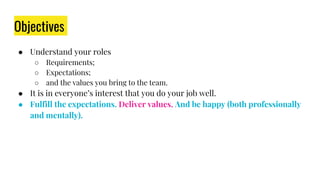
● Objectives
● Common Project Roles
● Team/Technical Leader’s Characteristics
● Hard Skills
● What you need to do your job
Motivation
There is always space for improvement, no matter how long you’ve
been in the business – Oscar De La Hoya
Motivation
● Many Team Leaders/Technical Leaders are new to these roles.
● There are plenty of room for improvement.
● Managing expectations is the key (but before that, you’ll need to understand
what are expected).
● “Empowering your team” is a critical part of our job.
● Having strong Team Leaders/Technical Leaders is the only way to scale a
team without compromising delivery quality.
Objectives
Til your good is better and your better is best. – St. Jerome
Objectives
● Understand your roles
○ Requirements;
○ Expectations;
○ and the values you bring to the team.
● It is in everyone’s interest that you do your job well.
● Fulfill the expectations. Deliver values. And be happy (both professionally
and mentally).
Project Roles
Coming together is a beginning, staying together is progress, and
working together is success – Henry Ford
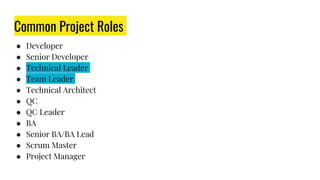
Common Project Roles
● Developer
● Senior Developer
● Technical Leader
● Team Leader
● Technical Architect
● QC
● QC Leader
● BA
● Senior BA/BA Lead
● Scrum Master
● Project Manager
Team/Technical Leader
Characteristics
None of us is as smart as all of us – Ken Blanchard
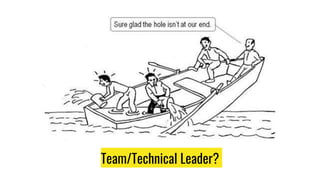
Team/Technical Leader?
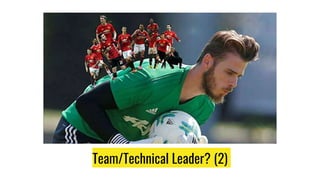
Team/Technical Leader? (2)
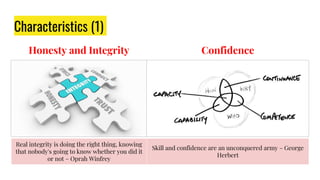
Honesty and Integrity
Characteristics (1)
Confidence
Real integrity is doing the right thing, knowing
that nobody's going to know whether you did it
or not – Oprah Winfrey
Skill and confidence are an unconquered army – George
Herbert
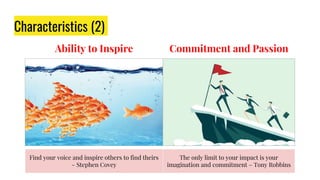
Ability to Inspire
Characteristics (2)
Commitment and Passion
Find your voice and inspire others to find theirs
– Stephen Covey
The only limit to your impact is your
imagination and commitment – Tony Robbins
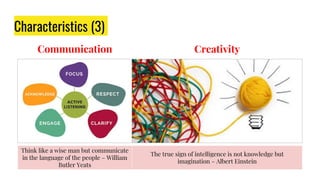
Communication
Characteristics (3)
Creativity
Think like a wise man but communicate
in the language of the people – William
Butler Yeats
The true sign of intelligence is not knowledge but
imagination – Albert Einstein
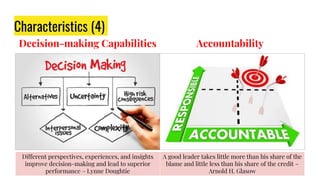
Decision-making Capabilities
Characteristics (4)
Accountability
Different perspectives, experiences, and insights
improve decision-making and lead to superior
performance – Lynne Doughtie
A good leader takes little more than his share of the
blame and little less than his share of the credit –
Arnold H. Glasow
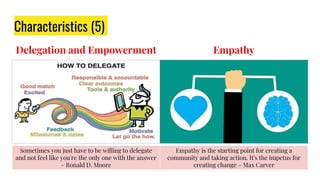
Delegation and Empowerment
Characteristics (5)
Empathy
Sometimes you just have to be willing to delegate
and not feel like you're the only one with the answer
– Ronald D. Moore
Empathy is the starting point for creating a
community and taking action. It's the impetus for
creating change – Max Carver
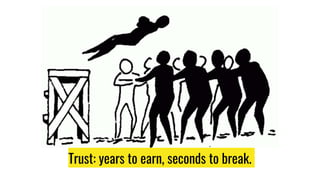
Trust: years to earn, seconds to break.
Hard Skills
S.T.R.E.S.S. = Someone Trying to Repair Every Situation Solo
Job Knowledge
Demonstrate required job
skills and knowledge (i.e.
coding skills, testing skills,
analysis skills, etc) to
complete assigned
responsibilities.
Unless you try to do something
beyond what you have already
mastered, you will never grow –
Ronald E. Osborn
Accountability
Make and keep
commitments;
Complete assignments,
projects and goals within the
allotted timeframe and
budget.
When confronted with a
challenge, the committed heart
will search for a solution. The
undecided heart searches for an
escape – Andy Andrews
Responsibility
Take initiatives to keep
skillset (i.e. technology,
process, industry knowledge)
up to date.
Recognize potential problems
and take responsibility for
action; offer constructive
suggestions, initiatives; create
ideas and solutions for
improvement.
There are two primary choices in
life: to accept conditions as they
exist, or accept the responsibility
for changing them
– Denis Waitley
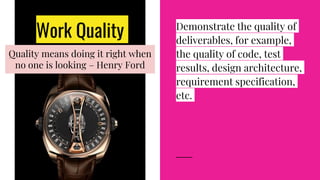
Work Quality Demonstrate the quality of
deliverables, for example,
the quality of code, test
results, design architecture,
requirement specification,
etc.
Quality means doing it right when
no one is looking – Henry Ford
Questions
1. Who does the code review?
2. Who does the task distribution?
3. Who makes the technical designs?
4. Who should help when a member gets blocked?
5. Who should resolve a conflict between team members?
6. Who follows up the tasks’ progress?
7. Who should detect an unhappy member?
8. Who should be accountable for the delivery quality?
9. Who should perform the technical trainings?
10.Who should push for the initiatives for the better?
What do you need
to do your job?
When everything seems to be going against you, remember that the
airplane takes off against the wind, not with it – Henry Ford
Questions you should ask
● What do I need my team to do?
● What do they need so they can do what I need them to do?
● How do I get them there?
● What do I need from my manager?
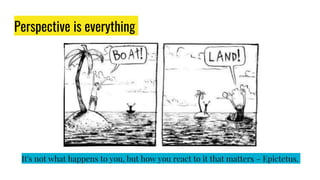
Perspective is everything
It's not what happens to you, but how you react to it that matters – Epictetus.
People often resist change because there is a
comfort in what we know.
[we] Don’t
● Build complex/complicated processes.
[we] Do
● Processes are built to benefit both the
team/company/client and the individuals;
● Lean processes.
Please
● Give ideas of improvements
● Be polite, considerate and constructive.
“Don’t find fault, find a remedy” – Henry Ford.
Continuous Improvement
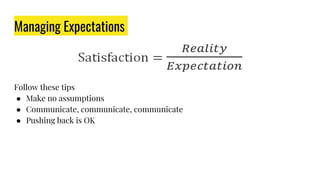
Managing Expectations
Follow these tips
● Make no assumptions
● Communicate, communicate, communicate
● Pushing back is OK
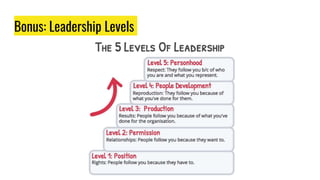
Bonus: Leadership Levels

First time being a Team Leader or Technical Leader

  • 1.
    First time beinga Team/Technical LeaderSummer 2019 Knowledge Sharing Session
  • 2.
    Agenda ● Motivation ● Objectives ●Common Project Roles ● Team/Technical Leader’s Characteristics ● Hard Skills ● What you need to do your job
  • 3.
    Motivation There is alwaysspace for improvement, no matter how long you’ve been in the business – Oscar De La Hoya
  • 4.
    Motivation ● Many TeamLeaders/Technical Leaders are new to these roles. ● There are plenty of room for improvement. ● Managing expectations is the key (but before that, you’ll need to understand what are expected). ● “Empowering your team” is a critical part of our job. ● Having strong Team Leaders/Technical Leaders is the only way to scale a team without compromising delivery quality.
  • 5.
    Objectives Til your goodis better and your better is best. – St. Jerome
  • 6.
    Objectives ● Understand yourroles ○ Requirements; ○ Expectations; ○ and the values you bring to the team. ● It is in everyone’s interest that you do your job well. ● Fulfill the expectations. Deliver values. And be happy (both professionally and mentally).
  • 7.
    Project Roles Coming togetheris a beginning, staying together is progress, and working together is success – Henry Ford
  • 8.
    Common Project Roles ●Developer ● Senior Developer ● Technical Leader ● Team Leader ● Technical Architect ● QC ● QC Leader ● BA ● Senior BA/BA Lead ● Scrum Master ● Project Manager
  • 9.
    Team/Technical Leader Characteristics None ofus is as smart as all of us – Ken Blanchard
  • 10.
  • 11.
  • 12.
    Honesty and Integrity Characteristics(1) Confidence Real integrity is doing the right thing, knowing that nobody's going to know whether you did it or not – Oprah Winfrey Skill and confidence are an unconquered army – George Herbert
  • 13.
    Ability to Inspire Characteristics(2) Commitment and Passion Find your voice and inspire others to find theirs – Stephen Covey The only limit to your impact is your imagination and commitment – Tony Robbins
  • 14.
    Communication Characteristics (3) Creativity Think likea wise man but communicate in the language of the people – William Butler Yeats The true sign of intelligence is not knowledge but imagination – Albert Einstein
  • 15.
    Decision-making Capabilities Characteristics (4) Accountability Differentperspectives, experiences, and insights improve decision-making and lead to superior performance – Lynne Doughtie A good leader takes little more than his share of the blame and little less than his share of the credit – Arnold H. Glasow
  • 16.
    Delegation and Empowerment Characteristics(5) Empathy Sometimes you just have to be willing to delegate and not feel like you're the only one with the answer – Ronald D. Moore Empathy is the starting point for creating a community and taking action. It's the impetus for creating change – Max Carver
  • 17.
    Trust: years toearn, seconds to break.
  • 18.
    Hard Skills S.T.R.E.S.S. =Someone Trying to Repair Every Situation Solo
  • 19.
    Job Knowledge Demonstrate requiredjob skills and knowledge (i.e. coding skills, testing skills, analysis skills, etc) to complete assigned responsibilities. Unless you try to do something beyond what you have already mastered, you will never grow – Ronald E. Osborn
  • 20.
    Accountability Make and keep commitments; Completeassignments, projects and goals within the allotted timeframe and budget. When confronted with a challenge, the committed heart will search for a solution. The undecided heart searches for an escape – Andy Andrews
  • 21.
    Responsibility Take initiatives tokeep skillset (i.e. technology, process, industry knowledge) up to date. Recognize potential problems and take responsibility for action; offer constructive suggestions, initiatives; create ideas and solutions for improvement. There are two primary choices in life: to accept conditions as they exist, or accept the responsibility for changing them – Denis Waitley
  • 22.
    Work Quality Demonstratethe quality of deliverables, for example, the quality of code, test results, design architecture, requirement specification, etc. Quality means doing it right when no one is looking – Henry Ford
  • 23.
    Questions 1. Who doesthe code review? 2. Who does the task distribution? 3. Who makes the technical designs? 4. Who should help when a member gets blocked? 5. Who should resolve a conflict between team members? 6. Who follows up the tasks’ progress? 7. Who should detect an unhappy member? 8. Who should be accountable for the delivery quality? 9. Who should perform the technical trainings? 10.Who should push for the initiatives for the better?
  • 24.
    What do youneed to do your job? When everything seems to be going against you, remember that the airplane takes off against the wind, not with it – Henry Ford
  • 25.
    Questions you shouldask ● What do I need my team to do? ● What do they need so they can do what I need them to do? ● How do I get them there? ● What do I need from my manager?
  • 26.
    Perspective is everything It'snot what happens to you, but how you react to it that matters – Epictetus.
  • 27.
    People often resistchange because there is a comfort in what we know. [we] Don’t ● Build complex/complicated processes. [we] Do ● Processes are built to benefit both the team/company/client and the individuals; ● Lean processes. Please ● Give ideas of improvements ● Be polite, considerate and constructive. “Don’t find fault, find a remedy” – Henry Ford. Continuous Improvement
  • 28.
    Managing Expectations Follow thesetips ● Make no assumptions ● Communicate, communicate, communicate ● Pushing back is OK
  • 29.

Editor's Notes

  • #2 Author: Tung Tran Thanh LinkedIn: https://www.linkedin.com/in/tungtranthanh/
  • #11 “Sure glad the hole isn’t at our end” The image is taken from: http://0mackekm.blogspot.com/2015/10/sure-glad-hole-isnt-at-our-end-of-boat.html
  • #12 Trying to solve everything yourself. The image is taken from: http://bongdaplus.vn/anh-che-de-gea-cong-lung-vi-ganh-team-2036631712.html
  • #13 The images are taken from: https://www.videoblocks.com/video/integrity-principles-trust-ethics-conduct-honesty-3-d-animation-srweikjwliy5558t8 and https://www.socialbuzzclub.com/how-to-issue-certification/ The characteristics are quoted from https://blog.taskque.com/characteristics-good-leaders/ Honesty and Integrity: “The supreme quality for leadership is unquestionably integrity. Without it, no real success is possible, no matter whether it is on a section gang, a football field, in an army, or in an office.” – Dwight D. Eisenhower; Confidence: People have confidence in those who stay fresh, relevant and capable; This does not mean that you should be overconfident, but you should at least reflect the degree of confidence required to ensure that your followers trust you as a leader.
  • #14 The images are taken from: https://www.kappanonline.org/wp-content/uploads/2018/10/PDK_100_3_Cheung_Art_554x350px.jpg and https://www.businessmagazinegainesville.com/commitment-leads-to-ownership-ownership-leads-to-success/ The characteristics are quoted from https://blog.taskque.com/characteristics-good-leaders/ Ability to inspire: “If your actions inspire others to dream more, learn more, do more and become more, you are a leader.” – John Quincy Adams; Commitment and Passion: People believe in those who stand through adversity. When your teammates see you getting your hands dirty, they will also give their best shot. It will also help you to gain the respect of your subordinates and infuse new energy in your team members, which helps them to perform better.
  • #15 The images are taken from: https://counsellingservicevancouver.com/effective-listening/ and https://michaelmcqueen.net/blog/leading-creativity-without-chaos The characteristics are quoted from https://blog.taskque.com/characteristics-good-leaders/ Communication: Until you clearly communicate your vision to your team and tell them the strategy to achieve the goal, it will be very difficult for you to get the results you want. Words have the power to motivate people and make them do the unthinkable; Creativity: Sometimes a difficult situation will arise that will require you to think outside of the box and help your team do the same. At such crucial movements, a good leader will be able to demonstrate a unique type of creativity that can help his team push through any situation. Moreover, since leaders are change agents, it is important for you to recognize when a change is needed and push for it.
  • #16 The images are taken from: http://www.free-management-ebooks.com/news/bains-rapid-framework/ and https://www.123rf.com/clipart-vector/accountable.html?sti=n40a9nx8hg6yo40t27| The characteristics are quoted from https://blog.taskque.com/characteristics-good-leaders/ Decision-making capabilities: A leader should think long and hard before taking a decision but once the decision is taken, stand by it. Decisions taken by leaders have a profound impact on masses; Although, most leaders take decisions on their own, but it is highly recommended that you consult key stakeholders before taking a decision. After all, they are the ones who will benefit or suffer from your decisions. Accountability: “A good leader takes little more than his share of the blame and little less than his share of the credit.” – Arnold H. Glasow.
  • #17 The images are taken from: https://media.licdn.com/dms/image/C4E12AQEGDWeQeoGnMA/article-cover_image-shrink_600_2000/0?e=1562803200&v=beta&t=zkAl69hd2y2VlBY4Y4B3QP07mDlaVzckDc8-Lmu31h4 and https://asuevents.asu.edu/content/executive-education-navigating-your-emotional-intelligence-empathy-and-accountability The characteristics are quoted from https://blog.taskque.com/characteristics-good-leaders/ Delegation and Empowerment: Delegate tasks to your subordinates and see how they perform. Provide them with all the resources and support they need to achieve the objective and give them a chance to bear the responsibility. If you micromanage your subordinates, it will develop a lack of trust and more importantly, you will not be able to focus on important matters, as you should be. Empathy: Understanding the problems of your followers and feeling their pain is the first step to become an effective leader. Even that is not enough until you work hard and provide your followers with the suitable solution to their problems.
  • #18 The image is taken from https://www.clipart.email/clipart/trust-fall-clipart-12751.html
  • #20 The image is taken from: https://www.gettyimages.com/detail/photo/many-books-and-laptop-in-library-vertical-royalty-free-image/157675637
  • #21 The image is taken from: https://www.gettyimages.com/detail/photo/many-books-and-laptop-in-library-vertical-royalty-free-image/157675637
  • #22 The image is taken from: https://www.gettyimages.com/detail/photo/many-books-and-laptop-in-library-vertical-royalty-free-image/157675637
  • #23 The image is taken from: https://www.pinterest.com/pin/458804280783801879/
  • #24 Note that, the answers to the questions above are not simply Team Leader nor Technical Leader ;)
  • #27 DOs Get something off the ground: To start something (e.g. a project or a business) Go the extra mile: To do more than what people expect Take the bull by the horns: To directly confront a difficult situation in a brave and determined way Quoted from: https://www.topcorrect.com/blog/50-common-business-idioms/ The image is taken from: https://www.armstrongeconomics.com/armstrongeconomics101/understanding-cycles/perspective-is-everything/ See Perspective is everything – Rory Sutherland: https://www.ted.com/talks/rory_sutherland_perspective_is_everything Cockroach theory – Sundar Pichai: https://www.youtube.com/watch?v=v4m-bgf6fT8
  • #28 Quoted from: https://kanbanize.com/blog/how-continuous-improvement-can-benefit-your-business/. Detecting issues is easy, identifying and implementing solutions is harder.
  • #29 Quoted from https://www.inc.com/janine-popick/3-practical-tips-for-managing-expectations.html
  • #30 See the presentation here https://www.facebook.com/2307885405944520/videos/vb.2307885405944520/448953802316826/?type=2&theater by John C. Maxwell. The image is taken from https://auxano.ch/fine-tuning-the-leader-within-you/five-levels-of-leadership-john-c-maxwell-3/