Connecting Brands to People
And Building Stronger Relationships


First Look: Facebook Places


                                      Work that talks
Sharing the “Where”

 The Product—Facebook Places
 ‣ Facebook’s location-based service, Facebook Places,
   allows users to share where they are, find out where
   their friends are, and discover places nearby.
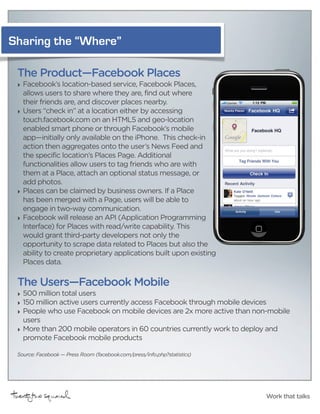
 ‣ Users “check in” at a location either by accessing
   touch.facebook.com on an HTML5 and geo-location
   enabled smart phone or through Facebook’s mobile
   app—initially only available on the iPhone. This check-in
   action then aggregates onto the user’s News Feed and
   the specific location’s Places Page. Additional
   functionalities allow users to tag friends who are with
   them at a Place, attach an optional status message, or
   add photos.
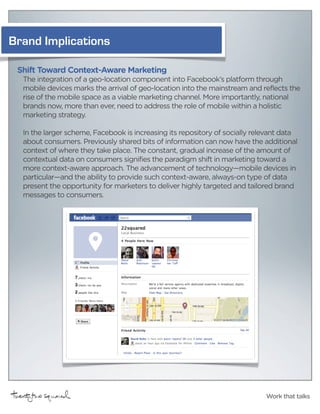
 ‣ Places can be claimed by business owners. If a Place
   has been merged with a Page, users will be able to
   engage in two-way communication.
 ‣ Facebook will release an API (Application Programming
   Interface) for Places with read/write capability. This
   would grant third-party developers not only the
   opportunity to scrape data related to Places but also the
   ability to create proprietary applications built upon existing
   Places data.

 The Users—Facebook Mobile
 ‣ 500 million total users
 ‣ 150 million active users currently access Facebook through mobile devices
 ‣ People who use Facebook on mobile devices are 2x more active than non-mobile
   users
 ‣ More than 200 mobile operators in 60 countries currently work to deploy and
   promote Facebook mobile products

 Source: Facebook — Press Room (facebook.com/press/info.php?statistics)


                                                                          Work that talks
User Implications


 Sharing the “Where”
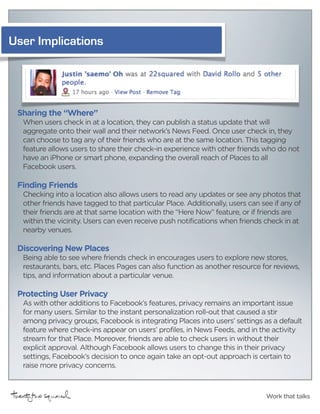
  When users check in at a location, they can publish a status update that will
  aggregate onto their wall and their network’s News Feed. Once user check in, they
  can choose to tag any of their friends who are at the same location. This tagging
  feature allows users to share their check-in experience with other friends who do not
  have an iPhone or smart phone, expanding the overall reach of Places to all
  Facebook users.

 Finding Friends
  Checking into a location also allows users to read any updates or see any photos that
  other friends have tagged to that particular Place. Additionally, users can see if any of
  their friends are at that same location with the “Here Now” feature, or if friends are
  within the vicinity. Users can even receive push notifications when friends check in at
  nearby venues.

 Discovering New Places
  Being able to see where friends check in encourages users to explore new stores,
  restaurants, bars, etc. Places Pages can also function as another resource for reviews,
  tips, and information about a particular venue.

 Protecting User Privacy
  As with other additions to Facebook’s features, privacy remains an important issue
  for many users. Similar to the instant personalization roll-out that caused a stir
  among privacy groups, Facebook is integrating Places into users’ settings as a default
  feature where check-ins appear on users’ profiles, in News Feeds, and in the activity
  stream for that Place. Moreover, friends are able to check users in without their
  explicit approval. Although Facebook allows users to change this in their privacy
  settings, Facebook’s decision to once again take an opt-out approach is certain to
  raise more privacy concerns.


                                                                               Work that talks
Brand Implications

 Shift Toward Context-Aware Marketing
  The integration of a geo-location component into Facebook’s platform through
  mobile devices marks the arrival of geo-location into the mainstream and reflects the
  rise of the mobile space as a viable marketing channel. More importantly, national
  brands now, more than ever, need to address the role of mobile within a holistic
  marketing strategy.

  In the larger scheme, Facebook is increasing its repository of socially relevant data
  about consumers. Previously shared bits of information can now have the additional
  context of where they take place. The constant, gradual increase of the amount of
  contextual data on consumers signifies the paradigm shift in marketing toward a
  more context-aware approach. The advancement of technology—mobile devices in
  particular—and the ability to provide such context-aware, always-on type of data
  present the opportunity for marketers to deliver highly targeted and tailored brand
  messages to consumers.


                                                                             Work that talks
Another Communication Channel
 Places will become another channel where conversations can take place. This
 presents a new opportunity for brands to engage with their consumers and to drive
 word of mouth and trial/consideration in an organic way. Now brands not only have
 the ability to identify consumers and any opportunities in order to play a more
 meaningful role in the conversation, but can do so in real-time and in person.

 On the flip side, Places can also foster negative chatter and complaints. Similar to
 other social media platforms, like Twitter or Yelp, Places Pages will require diligent
 monitoring to quell any potential social catastrophes. Brands that are cognizant of
 the potential impact of negative social chatter have the opportunity to reverse
 negative brand outcomes in person. For example, if a restaurant that is actively
 monitoring conversations around its brand on Facebook sees that a customer
 posted a negative comment about the quality of service on their Places Page, the
 restaurant would be able to address that customer’s frustrations immediately and in
 person.

Addressing Scalability
 Places finally answers—or at least attempts to address—the question of where local
 fits within a national Facebook strategy. Since users can create a Places Page by
 checking in to a location, all venues will be forced to address the audience and the
 conversations that collect on these Pages. Brand Pages with only one location are
 able to merge their Places Page with their brand Page. Facebook has alluded to the
 development of a solution for linking multiple Places to a single page by allowing
 national brands to “adopt” local Places Pages into their central Facebook Page. Until
 the release of this solution, brands with multiple Places can going through a claiming
 process for each individual location.

 Additionally, the introduction of Facebook Places creates more paid media
 opportunities in which brands can directly advertise local Places and drive users to
 specific locations, providing another option for geo-targeted and relevant messages.
 Another important aspect to note is the possibility of Facebook allowing additional
 targeting capabilities for ads to target not only people who have checked in to a
 Place but also friends of people who have checked in. Such capabilities would only
 further strengthen the power of Facebook as an advertising platform.


                                                                             Work that talks
Opportunity for Branded Use of Places
 A read/write API for Facebook Places will allow brands to leverage Places to build
 proprietary applications and integrate them into campaigns. As Facebook asserts
 itself as the most robust repository for geo-location data, proprietary, branded
 applications instantly become more viable. More importantly, Facebook’s current
 mainstream presence offers a scalable opportunity for brands intending to execute
 geo-location and mobile marketing initiatives.

Paid, Owned, Earned, Shared Media and Advocacy
 Places add another layer to paid, owned, earned, and shared media. As another piece
 of owned media, Places Pages will aggregate earned media pieces such as check-ins,
 geo-tagged status updates, and photos. These earned media actions also fall into the
 bucket of shared media, increasing the importance of shared pieces that will spread
 through users’ News Feeds. Additionally, the ability to create specific Places ad units
 will provide another paid media outlet that will activate owned, earned, and shared
 media interactions.

 The increase in earned media further empowers brand advocates and increases the
 need to engage with them and amplify their voice. The new Places data will help
 brands develop a significantly more quantifiable value of a brand advocate and their
 significance as drivers of in-store traffic. Thus, as brands move closer to the goal of
 quantifying the true value of an advocate—and more importantly, the true value of
 social media—the increase in the amount of contextual data on consumers presents
 a compelling case for brands to evaluate their approach in the continually evolving
 social space.


Justin Oh (@hellojustinoh) and Nathalie Espinol (@ndesp) are Social Media Strategists at 22squared.


         If you like this POV, be sure to Like us at Facebook.com/22squared.


                                                                                      Work that talks

First Look: Facebook Places

  • 1.
    Connecting Brands toPeople And Building Stronger Relationships First Look: Facebook Places Work that talks
  • 2.
    Sharing the “Where” The Product—Facebook Places ‣ Facebook’s location-based service, Facebook Places, allows users to share where they are, find out where their friends are, and discover places nearby. ‣ Users “check in” at a location either by accessing touch.facebook.com on an HTML5 and geo-location enabled smart phone or through Facebook’s mobile app—initially only available on the iPhone. This check-in action then aggregates onto the user’s News Feed and the specific location’s Places Page. Additional functionalities allow users to tag friends who are with them at a Place, attach an optional status message, or add photos. ‣ Places can be claimed by business owners. If a Place has been merged with a Page, users will be able to engage in two-way communication. ‣ Facebook will release an API (Application Programming Interface) for Places with read/write capability. This would grant third-party developers not only the opportunity to scrape data related to Places but also the ability to create proprietary applications built upon existing Places data. The Users—Facebook Mobile ‣ 500 million total users ‣ 150 million active users currently access Facebook through mobile devices ‣ People who use Facebook on mobile devices are 2x more active than non-mobile users ‣ More than 200 mobile operators in 60 countries currently work to deploy and promote Facebook mobile products Source: Facebook — Press Room (facebook.com/press/info.php?statistics) Work that talks
  • 3.
    User Implications Sharingthe “Where” When users check in at a location, they can publish a status update that will aggregate onto their wall and their network’s News Feed. Once user check in, they can choose to tag any of their friends who are at the same location. This tagging feature allows users to share their check-in experience with other friends who do not have an iPhone or smart phone, expanding the overall reach of Places to all Facebook users. Finding Friends Checking into a location also allows users to read any updates or see any photos that other friends have tagged to that particular Place. Additionally, users can see if any of their friends are at that same location with the “Here Now” feature, or if friends are within the vicinity. Users can even receive push notifications when friends check in at nearby venues. Discovering New Places Being able to see where friends check in encourages users to explore new stores, restaurants, bars, etc. Places Pages can also function as another resource for reviews, tips, and information about a particular venue. Protecting User Privacy As with other additions to Facebook’s features, privacy remains an important issue for many users. Similar to the instant personalization roll-out that caused a stir among privacy groups, Facebook is integrating Places into users’ settings as a default feature where check-ins appear on users’ profiles, in News Feeds, and in the activity stream for that Place. Moreover, friends are able to check users in without their explicit approval. Although Facebook allows users to change this in their privacy settings, Facebook’s decision to once again take an opt-out approach is certain to raise more privacy concerns. Work that talks
  • 4.
    Brand Implications ShiftToward Context-Aware Marketing The integration of a geo-location component into Facebook’s platform through mobile devices marks the arrival of geo-location into the mainstream and reflects the rise of the mobile space as a viable marketing channel. More importantly, national brands now, more than ever, need to address the role of mobile within a holistic marketing strategy. In the larger scheme, Facebook is increasing its repository of socially relevant data about consumers. Previously shared bits of information can now have the additional context of where they take place. The constant, gradual increase of the amount of contextual data on consumers signifies the paradigm shift in marketing toward a more context-aware approach. The advancement of technology—mobile devices in particular—and the ability to provide such context-aware, always-on type of data present the opportunity for marketers to deliver highly targeted and tailored brand messages to consumers. Work that talks
  • 5.
    Another Communication Channel Places will become another channel where conversations can take place. This presents a new opportunity for brands to engage with their consumers and to drive word of mouth and trial/consideration in an organic way. Now brands not only have the ability to identify consumers and any opportunities in order to play a more meaningful role in the conversation, but can do so in real-time and in person. On the flip side, Places can also foster negative chatter and complaints. Similar to other social media platforms, like Twitter or Yelp, Places Pages will require diligent monitoring to quell any potential social catastrophes. Brands that are cognizant of the potential impact of negative social chatter have the opportunity to reverse negative brand outcomes in person. For example, if a restaurant that is actively monitoring conversations around its brand on Facebook sees that a customer posted a negative comment about the quality of service on their Places Page, the restaurant would be able to address that customer’s frustrations immediately and in person. Addressing Scalability Places finally answers—or at least attempts to address—the question of where local fits within a national Facebook strategy. Since users can create a Places Page by checking in to a location, all venues will be forced to address the audience and the conversations that collect on these Pages. Brand Pages with only one location are able to merge their Places Page with their brand Page. Facebook has alluded to the development of a solution for linking multiple Places to a single page by allowing national brands to “adopt” local Places Pages into their central Facebook Page. Until the release of this solution, brands with multiple Places can going through a claiming process for each individual location. Additionally, the introduction of Facebook Places creates more paid media opportunities in which brands can directly advertise local Places and drive users to specific locations, providing another option for geo-targeted and relevant messages. Another important aspect to note is the possibility of Facebook allowing additional targeting capabilities for ads to target not only people who have checked in to a Place but also friends of people who have checked in. Such capabilities would only further strengthen the power of Facebook as an advertising platform. Work that talks
  • 6.
    Opportunity for BrandedUse of Places A read/write API for Facebook Places will allow brands to leverage Places to build proprietary applications and integrate them into campaigns. As Facebook asserts itself as the most robust repository for geo-location data, proprietary, branded applications instantly become more viable. More importantly, Facebook’s current mainstream presence offers a scalable opportunity for brands intending to execute geo-location and mobile marketing initiatives. Paid, Owned, Earned, Shared Media and Advocacy Places add another layer to paid, owned, earned, and shared media. As another piece of owned media, Places Pages will aggregate earned media pieces such as check-ins, geo-tagged status updates, and photos. These earned media actions also fall into the bucket of shared media, increasing the importance of shared pieces that will spread through users’ News Feeds. Additionally, the ability to create specific Places ad units will provide another paid media outlet that will activate owned, earned, and shared media interactions. The increase in earned media further empowers brand advocates and increases the need to engage with them and amplify their voice. The new Places data will help brands develop a significantly more quantifiable value of a brand advocate and their significance as drivers of in-store traffic. Thus, as brands move closer to the goal of quantifying the true value of an advocate—and more importantly, the true value of social media—the increase in the amount of contextual data on consumers presents a compelling case for brands to evaluate their approach in the continually evolving social space. Justin Oh (@hellojustinoh) and Nathalie Espinol (@ndesp) are Social Media Strategists at 22squared. If you like this POV, be sure to Like us at Facebook.com/22squared. Work that talks