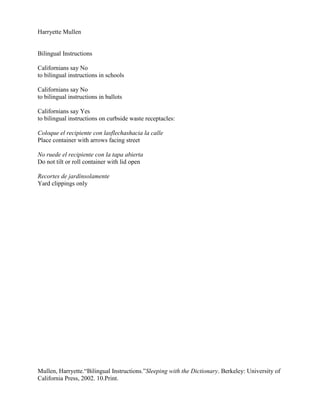
Harryette Mullen


Bilingual Instructions

Californians say No
to bilingual instructions in schools

Californians say No
to bilingual instructions in ballots

Californians say Yes
to bilingual instructions on curbside waste receptacles:

Coloque el recipiente con lasflechashacia la calle
Place container with arrows facing street

No ruede el recipiente con la tapa abierta
Do not tilt or roll container with lid open

Recortes de jardínsolamente
Yard clippings only


Mullen, Harryette.“Bilingual Instructions.”Sleeping with the Dictionary. Berkeley: University of
California Press, 2002. 10.Print.
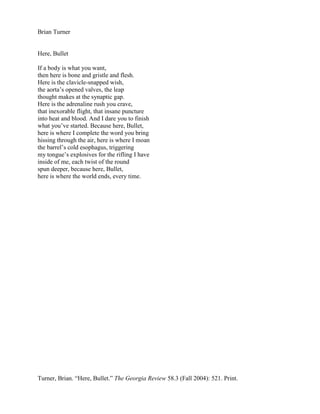
Brian Turner


Here, Bullet

If a body is what you want,
then here is bone and gristle and flesh.
Here is the clavicle-snapped wish,
the aorta’s opened valves, the leap
thought makes at the synaptic gap.
Here is the adrenaline rush you crave,
that inexorable flight, that insane puncture
into heat and blood. And I dare you to finish
what you’ve started. Because here, Bullet,
here is where I complete the word you bring
hissing through the air, here is where I moan
the barrel’s cold esophagus, triggering
my tongue’s explosives for the rifling I have
inside of me, each twist of the round
spun deeper, because here, Bullet,
here is where the world ends, every time.


Turner, Brian. “Here, Bullet.” The Georgia Review 58.3 (Fall 2004): 521. Print.
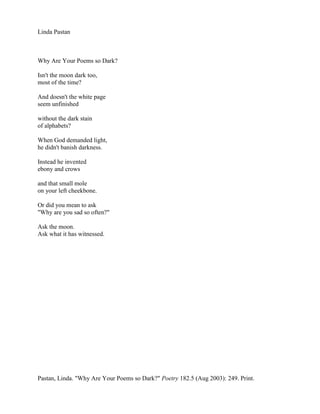
Linda Pastan


Why Are Your Poems so Dark?

Isn't the moon dark too,
most of the time?

And doesn't the white page
seem unfinished

without the dark stain
of alphabets?

When God demanded light,
he didn't banish darkness.

Instead he invented
ebony and crows

and that small mole
on your left cheekbone.

Or did you mean to ask
"Why are you sad so often?"

Ask the moon.
Ask what it has witnessed.


Pastan, Linda. "Why Are Your Poems so Dark?" Poetry 182.5 (Aug 2003): 249. Print.
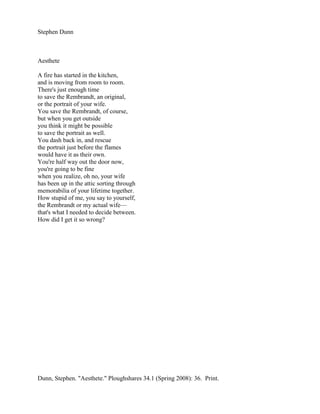
Stephen Dunn


Aesthete

A fire has started in the kitchen,
and is moving from room to room.
There's just enough time
to save the Rembrandt, an original,
or the portrait of your wife.
You save the Rembrandt, of course,
but when you get outside
you think it might be possible
to save the portrait as well.
You dash back in, and rescue
the portrait just before the flames
would have it as their own.
You're half way out the door now,
you're going to be fine
when you realize, oh no, your wife
has been up in the attic sorting through
memorabilia of your lifetime together.
How stupid of me, you say to yourself,
the Rembrandt or my actual wife—
that's what I needed to decide between.
How did I get it so wrong?


Dunn, Stephen. "Aesthete." Ploughshares 34.1 (Spring 2008): 36. Print.
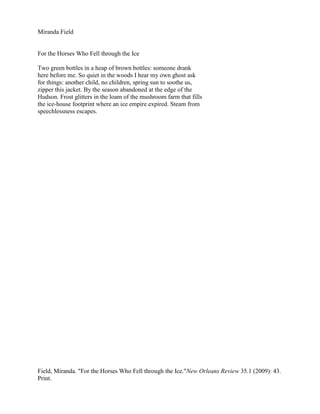
Miranda Field


For the Horses Who Fell through the Ice

Two green bottles in a heap of brown bottles: someone drank
here before me. So quiet in the woods I hear my own ghost ask
for things: another child, no children, spring sun to soothe us,
zipper this jacket. By the season abandoned at the edge of the
Hudson. Frost glitters in the loam of the mushroom farm that fills
the ice-house footprint where an ice empire expired. Steam from
speechlessness escapes.


Field, Miranda. "For the Horses Who Fell through the Ice."New Orleans Review 35.1 (2009): 43.
Print.
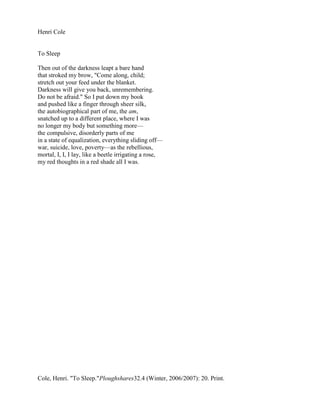
Henri Cole


To Sleep

Then out of the darkness leapt a bare hand
that stroked my brow, "Come along, child;
stretch out your feed under the blanket.
Darkness will give you back, unremembering.
Do not be afraid." So I put down my book
and pushed like a finger through sheer silk,
the autobiographical part of me, the am,
snatched up to a different place, where I was
no longer my body but something more—
the compulsive, disorderly parts of me
in a state of equalization, everything sliding off—
war, suicide, love, poverty—as the rebellious,
mortal, I, I, I lay, like a beetle irrigating a rose,
my red thoughts in a red shade all I was.


Cole, Henri. "To Sleep."Ploughshares32.4 (Winter, 2006/2007): 20. Print.
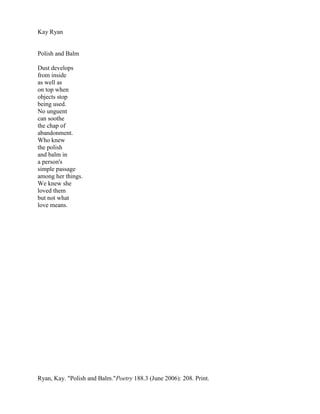
Kay Ryan


Polish and Balm

Dust develops
from inside
as well as
on top when
objects stop
being used.
No unguent
can soothe
the chap of
abandonment.
Who knew
the polish
and balm in
a person's
simple passage
among her things.
We knew she
loved them
but not what
love means.


Ryan, Kay. "Polish and Balm."Poetry 188.3 (June 2006): 208. Print.
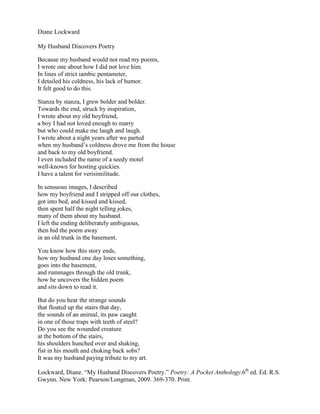
Diane Lockward

My Husband Discovers Poetry

Because my husband would not read my poems,
I wrote one about how I did not love him.
In lines of strict iambic pentameter,
I detailed his coldness, his lack of humor.
It felt good to do this.

Stanza by stanza, I grew bolder and bolder.
Towards the end, struck by inspiration,
I wrote about my old boyfriend,
a boy I had not loved enough to marry
but who could make me laugh and laugh.
I wrote about a night years after we parted
when my husband’s coldness drove me from the house
and back to my old boyfriend.
I even included the name of a seedy motel
well-known for hosting quickies.
I have a talent for verisimilitude.

In sensuous images, I described
how my boyfriend and I stripped off our clothes,
got into bed, and kissed and kissed,
then spent half the night telling jokes,
many of them about my husband.
I left the ending deliberately ambiguous,
then hid the poem away
in an old trunk in the basement.

You know how this story ends,
how my husband one day loses something,
goes into the basement,
and rummages through the old trunk,
how he uncovers the hidden poem
and sits down to read it.

But do you hear the strange sounds
that floated up the stairs that day,
the sounds of an animal, its paw caught
in one of those traps with teeth of steel?
Do you see the wounded creature
at the bottom of the stairs,
his shoulders hunched over and shaking,
fist in his mouth and choking back sobs?
It was my husband paying tribute to my art.

Lockward, Diane. “My Husband Discovers Poetry.” Poetry: A Pocket Anthology.6th ed. Ed. R.S.
Gwynn. New York: Pearson/Longman, 2009. 369-370. Print.
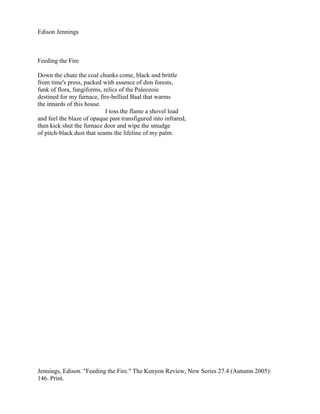
Edison Jennings


Feeding the Fire

Down the chute the coal chunks come, black and brittle
from time's press, packed with essence of dim forests,
funk of flora, fungiforms, relics of the Paleozoic
destined for my furnace, fire-bellied Baal that warms
the innards of this house.
                            I toss the flame a shovel load
and feel the blaze of opaque past transfigured into infrared,
then kick shut the furnace door and wipe the smudge
of pitch-black dust that seams the lifeline of my palm.


Jennings, Edison. "Feeding the Fire." The Kenyon Review, New Series 27.4 (Autumn 2005):
146. Print.

First essay poems

  • 1.
    Harryette Mullen Bilingual Instructions Californianssay No to bilingual instructions in schools Californians say No to bilingual instructions in ballots Californians say Yes to bilingual instructions on curbside waste receptacles: Coloque el recipiente con lasflechashacia la calle Place container with arrows facing street No ruede el recipiente con la tapa abierta Do not tilt or roll container with lid open Recortes de jardínsolamente Yard clippings only Mullen, Harryette.“Bilingual Instructions.”Sleeping with the Dictionary. Berkeley: University of California Press, 2002. 10.Print.
  • 2.
    Brian Turner Here, Bullet Ifa body is what you want, then here is bone and gristle and flesh. Here is the clavicle-snapped wish, the aorta’s opened valves, the leap thought makes at the synaptic gap. Here is the adrenaline rush you crave, that inexorable flight, that insane puncture into heat and blood. And I dare you to finish what you’ve started. Because here, Bullet, here is where I complete the word you bring hissing through the air, here is where I moan the barrel’s cold esophagus, triggering my tongue’s explosives for the rifling I have inside of me, each twist of the round spun deeper, because here, Bullet, here is where the world ends, every time. Turner, Brian. “Here, Bullet.” The Georgia Review 58.3 (Fall 2004): 521. Print.
  • 3.
    Linda Pastan Why AreYour Poems so Dark? Isn't the moon dark too, most of the time? And doesn't the white page seem unfinished without the dark stain of alphabets? When God demanded light, he didn't banish darkness. Instead he invented ebony and crows and that small mole on your left cheekbone. Or did you mean to ask "Why are you sad so often?" Ask the moon. Ask what it has witnessed. Pastan, Linda. "Why Are Your Poems so Dark?" Poetry 182.5 (Aug 2003): 249. Print.
  • 4.
    Stephen Dunn Aesthete A firehas started in the kitchen, and is moving from room to room. There's just enough time to save the Rembrandt, an original, or the portrait of your wife. You save the Rembrandt, of course, but when you get outside you think it might be possible to save the portrait as well. You dash back in, and rescue the portrait just before the flames would have it as their own. You're half way out the door now, you're going to be fine when you realize, oh no, your wife has been up in the attic sorting through memorabilia of your lifetime together. How stupid of me, you say to yourself, the Rembrandt or my actual wife— that's what I needed to decide between. How did I get it so wrong? Dunn, Stephen. "Aesthete." Ploughshares 34.1 (Spring 2008): 36. Print.
  • 5.
    Miranda Field For theHorses Who Fell through the Ice Two green bottles in a heap of brown bottles: someone drank here before me. So quiet in the woods I hear my own ghost ask for things: another child, no children, spring sun to soothe us, zipper this jacket. By the season abandoned at the edge of the Hudson. Frost glitters in the loam of the mushroom farm that fills the ice-house footprint where an ice empire expired. Steam from speechlessness escapes. Field, Miranda. "For the Horses Who Fell through the Ice."New Orleans Review 35.1 (2009): 43. Print.
  • 6.
    Henri Cole To Sleep Thenout of the darkness leapt a bare hand that stroked my brow, "Come along, child; stretch out your feed under the blanket. Darkness will give you back, unremembering. Do not be afraid." So I put down my book and pushed like a finger through sheer silk, the autobiographical part of me, the am, snatched up to a different place, where I was no longer my body but something more— the compulsive, disorderly parts of me in a state of equalization, everything sliding off— war, suicide, love, poverty—as the rebellious, mortal, I, I, I lay, like a beetle irrigating a rose, my red thoughts in a red shade all I was. Cole, Henri. "To Sleep."Ploughshares32.4 (Winter, 2006/2007): 20. Print.
  • 7.
    Kay Ryan Polish andBalm Dust develops from inside as well as on top when objects stop being used. No unguent can soothe the chap of abandonment. Who knew the polish and balm in a person's simple passage among her things. We knew she loved them but not what love means. Ryan, Kay. "Polish and Balm."Poetry 188.3 (June 2006): 208. Print.
  • 8.
    Diane Lockward My HusbandDiscovers Poetry Because my husband would not read my poems, I wrote one about how I did not love him. In lines of strict iambic pentameter, I detailed his coldness, his lack of humor. It felt good to do this. Stanza by stanza, I grew bolder and bolder. Towards the end, struck by inspiration, I wrote about my old boyfriend, a boy I had not loved enough to marry but who could make me laugh and laugh. I wrote about a night years after we parted when my husband’s coldness drove me from the house and back to my old boyfriend. I even included the name of a seedy motel well-known for hosting quickies. I have a talent for verisimilitude. In sensuous images, I described how my boyfriend and I stripped off our clothes, got into bed, and kissed and kissed, then spent half the night telling jokes, many of them about my husband. I left the ending deliberately ambiguous, then hid the poem away in an old trunk in the basement. You know how this story ends, how my husband one day loses something, goes into the basement, and rummages through the old trunk, how he uncovers the hidden poem and sits down to read it. But do you hear the strange sounds that floated up the stairs that day, the sounds of an animal, its paw caught in one of those traps with teeth of steel? Do you see the wounded creature at the bottom of the stairs, his shoulders hunched over and shaking, fist in his mouth and choking back sobs? It was my husband paying tribute to my art. Lockward, Diane. “My Husband Discovers Poetry.” Poetry: A Pocket Anthology.6th ed. Ed. R.S. Gwynn. New York: Pearson/Longman, 2009. 369-370. Print.
  • 9.
    Edison Jennings Feeding theFire Down the chute the coal chunks come, black and brittle from time's press, packed with essence of dim forests, funk of flora, fungiforms, relics of the Paleozoic destined for my furnace, fire-bellied Baal that warms the innards of this house. I toss the flame a shovel load and feel the blaze of opaque past transfigured into infrared, then kick shut the furnace door and wipe the smudge of pitch-black dust that seams the lifeline of my palm. Jennings, Edison. "Feeding the Fire." The Kenyon Review, New Series 27.4 (Autumn 2005): 146. Print.