PUBLISHED TO MARK THE DOMINICAN REPUBLIC’S PRESIDENCY OF
THE COMMUNITY OF LATIN AMERICAN AND CARIBBEAN STATES
CELAC: Promoting economic integration
in Latin America and the Caribbean
DOMINICAN
REPUBLICAGRICULTURE • TOURISM • INFRASTRUCTURE • FINANCE
O F F I C I A L R E P O R T
FIRST
© FIRST 2016
FIRST gratefully acknowledges the cooperation and support of HE Dr Federico Cuello Camilo and the staff of the Embassy of the Dominican Republic
in London. Our thanks also go to CEI-RD, CONEP, and the British Embassy and Chamber of Commerce in Santo Domingo for their advice and assistance
in the preparation of this report. Special thanks to Fernando González Nicolás and the staff of Consorcio Comercial del Caribe.
Cover photo credits (left to right): International Cocoa Organisation (ICCO), Jean-Marc Astesana, Mariano Hernandez, iStock/gmueses
Published by FIRST, Victory House, 99-101 Regent Street, London W1B 4EZ
Tel: +44 20 7440 3500 Fax: +44 20 7440 3544 Email: publisher@firstmagazine.com Web: www.firstmagazine.com
Chairman and Founder Rupert Goodman dl
Chairman, Advisory Council Rt Hon Lord Hurd of Westwell ch cbe pc
Chief Operating Officer Eamonn Daly, Executive Publisher and Editor Alastair Harris
Non-Executive Directors Timothy Bunting, Hon Alexander Hambro, Chairman, Public Affairs Lord Cormack fsa dl
Regional Publisher Declan Hartnett, Head of Special Projects Waqäs Ahmed
Designer Jon Mark Deane Marketing Administrator Chris Cammack, PA – Chairman’s Office Hilary Winstanly
Research Assistant Anna Vexler, Editorial Consultant Jonathan Gregson, Design Consultant Stanley Glazer,
Senior Staff Writer Nicholas Lyne Award Advisory Panel Rt Hon Lord Woolf, Hon Philip Lader,
Lord Plant of Highfield, Chief Emeka Anyaoku gcvo tc cfr, Marilyn Carlson Nelson, Dr Daniel Vasella,
Rt Hon Lord Robertson of Port Ellen kt, gcmg, Ratan Tata, Howard Schultz and Philippa Foster Back cbe
Special Advisor, China, Lord Powell of Bayswater kcmg Special Advisor, Russia Sir Andrew Wood gcmg,
Special Advisor, Latin America Jacques Arnold dl, Special Advisor, Global Issues Professor Victor Bulmer-Thomas cmg obe
FIRST is composed of the opinions and ideas of leading business and political figures. All information in this
publication is verified to the best of the authors’ and publishers’ ability, but no responsibility can be accepted
for loss arising from decisions based on this material. Where opinion is expressed, it is that of the authors.
PUBLISHED TO MARK THE DOMINICAN REPUBLIC’S PRESIDENCY OF
THE COMMUNITY OF LATIN AMERICAN AND CARIBBEAN STATES
CELAC: Promoting economic integration
in Latin America and the Caribbean
DOMINICAN
REPUBLICAGRICULTURE • TOURISM • INFRASTRUCTURE • FINANCE
O F F I C I A L R E P O R T
PUBLISHED TO MARK THE DOMINICAN REPUBLIC’S PRESIDENCY OF
THE COMMUNITY OF LATIN AMERICAN AND CARIBBEAN STATES
CELAC: Promoting economic integration
in Latin America and the Caribbean
DOMINICAN
REPUBLICAGRICULTURE • TOURISM • INFRASTRUCTURE • FINANCE
O F F I C I A L R E P O RT
C1 OFC Dominican Republic 2016.indd 1 22/03/2016 11:25
H.E. DANILO MEDINA SÁNCHEZ
President of the Dominican Republic	
Towards a more integrated region	 4
ANDRÉS NAVARRO GARCÍA
Minister of External Relations, Dominican Republic	
A new ‘architecture of diplomacy’	 6
HÉCTOR VALDEZ ALBIZU
Governor, Central Bank of the Dominican Republic	
Steady as she goes	 8
JOSÉ DEL CASTILLO SAVIÑÓN
Minister of Industry and Commerce, Dominican Republic	
The power of regional trade	 10
FRANCISCO JAVIER GARCÍA
Minister of Tourism, Dominican Republic	
Growth through diversification	 12
ANGEL ESTÉVEZ BOURDIERD
Minister of Agriculture, Dominican Republic	
Raising the bar in agriculture	 16
OSMAR BENÍTEZ
President, Junta Agroempresarial Dominicana (JAD)	
Growing for gold	 18
DR JEAN-MARC ANGA and DR JOSÉ ANTONIO MARTÍNEZ ROJAS
Executive Director, International Cocoa Organisation (ICCO),
and National Coordinator, 3rd World Cocoa Conference (3WCC)
A model for the future of cocoa	 21
HÉCTOR RIZEK and MASSIMILIANO WAX
CEO and Vice-President, Strategy and Business Development, Rizek Cacao S.A.S.	
Moving up the value chain	 26
DR ANTONIO ISA CONDE
Minister of Energy and Mines, Dominican Republic	
Developing new resources	 29
KEITH DUNCAN and GUILLERMO ARANCIBIA
Group CEO and Country Head, Dominican Republic, JMMB Group	
The regional player making waves	 30
ENRIQUE RAMÍREZ PANIAGUA
Administrator General, BanReservas	
Promoting financial inclusion	 32
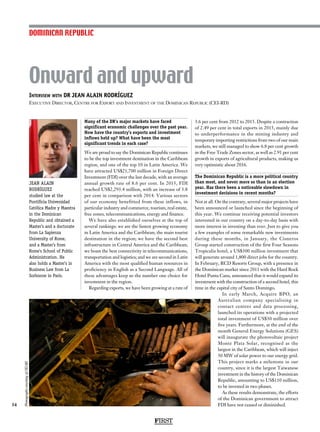
DR JEAN ALAIN RODRÍGUEZ
Executive Director, Centre for Export and Investment
of the Dominican Republic (CEI-RD)	
Onward and upward	 34
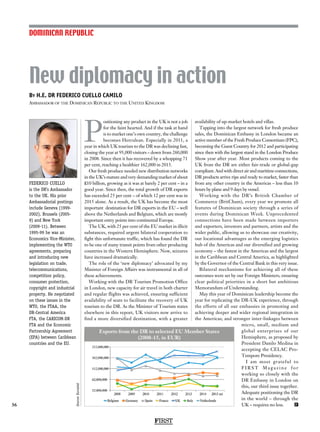
H.E. DR FEDERICO CUELLO CAMILO
Ambassador of the Dominican Republic to the United Kingdom	
New diplomacy in action	 36
Contents
Victory House,
99-101 Regent Street,
London W1B 4EZ
Telephone: +44 20 7440 3500
Facsimile: +44 20 7440 3544
Email: publisher@firstmagazine.com
URL: www.firstmagazine.com
By H.E. DANILO MEDINA SÁNCHEZ
President of the Dominican Republic
Towards a more integrated region
4
T
he Dominican Republic takes the helm
of the Pro-Tempore Presidency of
the Economic Community for Latin
America and the Caribbean (CELAC)
in a year in which the world in general – and our
region in particular – are facing immense challenges,
in a complex web of interlinked problems that can
only be addressed and resolved politically. Through
CELAC we should speak with one voice, conveying
the consensus political solutions required.
After Asia, the Latin American and Caribbean
(LAC) region will see the largest share of its population
moving up to the middle class – 130 million according
to the OECD. However, together with Sub-Saharan
Africa, the LAC region is the most unequal in the
world. Ten per cent of the population earns 32 per
cent of regional income, while the poorest 40 per cent
retains just 15 per cent. Inequality is the enemy we have
to beat together.
Addressing inequality through regional integration
Inequality, as measured by the GINI coefficient, has
decreased 5 per cent. But with growth slowing down
to barely 0.2 per cent for the region as a whole, clearly
a collective response is needed so that we can rely more
on the growth potential of our own regional market,
rather than suffering disproportionately the effects of
extra-regional developments.
In this regard, regional integration, promoted
through CELAC, has to be an important element
in the battle against inequality. Our integration
mechanisms, however, are advancing at different paces.
MERCOSUR, SICA, CARICOM, the Pacific Alliance,
the Andean Community, UNASUR, and ALBA, among
others, have not been able to bring us together around
the same table to address our common challenges.
In seeking to deepen LAC’s regional integration, the
needs of three types of actors have to be considered:
First, 67 per cent of our regional output is produced
by fully globalised firms that generate just 20 per cent
of our jobs. Then, SMEs provide 23 per cent of the
region’s GDP and 30 per cent of our jobs. And last,
microenterprises and the informal economy generate
the remaining 10 per cent of the regional output while
proving jobs for about half of our citizens.
Therein lies the challenge of overcoming inequality
in the LAC region: to develop stronger links in our
value chains, between our globalised firms, our SMEs
and our informal sectors, so that they can increase their
productivity and generate much more than the barely
10 per cent of GDP our SMEs and informal sectors are
providing presently.
This, in the context of a renewed commitment to
deepening our regional integration, should provide
us with the internal dynamics our growth trajectories
currently lack, thus making us less vulnerable to
changes in our main export markets.
The urban-rural nexus in sustainable development
With the renewed focus on sustainable development
provided by Agenda 2030, standards of living in rural
areas have to increase so that our cities can themselves
become more sustainable, thus helping us master the
urbanisation process and slowing down its pace.
Our most prosperous rural areas are filled with
agricultural cooperatives of smallholder farmers,
which have decreased rural-urban migration. This is
one of the many reasons why the Dominican Republic
has increased funding for agriculture, providing
land titles to our farmers and ensuring their access
to seeds, technology and irrigation infrastructure.
Through a policy of surprise visits, I supervise this
process personally, achieving sustained rates of growth
in a sector that has been left behind from our policy
priorities for much too long.
DOMINICAN REPUBLIC
FIRST
DANILO MEDINA
was elected President of
the Dominican Republic
in May 2012, and took
office in August that
year. A graduate of the
Universidad Autónoma
de Santo Domingo
(UASD), he was elected
a Deputy in the National
Congress in 1987, and
rose to become President
of the Chamber of
Deputies in 1994. He
subsequently served
twice as Secretary of
State to the Presidency.
5
A collective
response is
needed so
that we can
rely more on
the growth
potential
of our own
regional
market, rather
than suffering
disproport-
ionately
the effects
of extra-
regional
developments
In the meantime, the Dominican Republic has
declared 2016 as the Year of Housing. Allied with
the private sector, we seek to build thousands of
new homes so that our peoples can live with dignity
in healthy communities, thus helping us overcome
health challenges, increase security and ensure peaceful
coexistence, while generating jobs and educating our
peoples. It is my hope that Habitat III, taking place in
Quito this year, will take us in the direction of making
housing a right for all of our peoples.
Drugs: time to explore new avenues
International drug trafficking is a social problem that
generates grave institutional and security challenges.
For many decades, the region has dedicated an
important share of its human and financial resources
to fight a problem that is far from diminishing in
importance. This in a region with urgent educational,
energy, health and urban security needs.
From South America to Mexico, through Central
America, the Dominican Republic and the rest of the
Caribbean, the transit of drugs through our territories
towardsthosecountrieswheretheyareconsumed–mostly
developed country markets – threatens the stability of our
democracies and the very lives of our citizens.
We cannot allow this issue to continue taking centre
stage at our encounters, year after year, while facing
the constant scepticism and frustration of our peoples
without exploring new avenues nor opening new
perspectives for our debates.
This year’s Summit of the General Assembly on
the world drug problem should propose policies and
measures on drugs that are centered on the human
being, taking into account the inalienable rights of all
peoples, that should result in the reduction not only
of the supply but most importantly the demand for
drugs. CELAC wants the problem to be addressed as
one requiring prevention, a public health approach and
of rehabilitation, introducing a systematic evaluation
process of its outcomes.
It is all our countries, the ones suffering the most
from this trade, who must make our voices heard.
Addressing youth unemployment
World Bank figures paint an appalling picture: one in
five young people in the LAC region between 15 and
24 years of age neither goes to school nor works. There
are millions of young men and women brimming with
energy, enthusiasm and ability, needing our message of
hope and our efforts to create opportunities for their
education and their honest work, which are the only
ways for us to prevent their criminalisation.
Let us always be mindful of our young people when
we envisage the future of CELAC. Our efforts should
be guided by their aspirations, hopes and needs.
Towards a more integrated, operational and
proactive CELAC
ThecommitmentoftheDominicanRepublictoCELAC
is real and immediate. It is in the faces of our people and it
is propelled by the urgency of their demands.
Our turn at the pro-tempore Presidency fills us
with joy and with pride. It renews our commitment
to the strengthening of our bonds with extra-regional
partners such as the European Union. It is the
occasion for us to demonstrate our political will to be
proactive in facing our challenges and advancing our
common interests.
In this fashion, we will do our best to hand over
the Presidency in 2017 after contributing to a more
integrated, more operational and even more recognised
common space on the global stage. F
FIRST
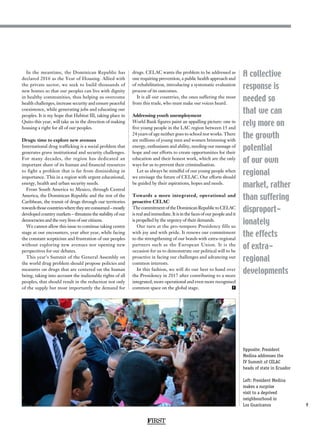
Opposite: President
Medina addresses the
IV Summit of CELAC
heads of state in Ecuador
Left: President Medina
makes a surprise
visit to a deprived
neighbourhood in
Los Guarícanos
Interview with ANDRÉS NAVARRO GARCÍA
Minister of External Relations, Dominican Republic
A new ‘architecture of diplomacy’
6
It’s a little over a year since you took office as
Foreign Minister. What have been your main
priorities to date, and how successful have you
been in meeting them?
One of the main challenges this government has
taken on is that of strengthening the institutions of
the Dominican Republic, and in my case, that means
a complete overhaul of the foreign ministry and our
diplomatic corps.
Last year, 2015, we embarked upon a process of
institutional reform aimed at creating a new ‘architecture
of diplomacy’, and that has involved changing the whole
structure of the ministry. But this has only been the first
step, and the process of implementing a strategic plan
to coordinate the ministry’s activities will take five years.
This plan includes verification mechanisms to allow
us to evaluate the efficiency of the ministry’s different
activities. For example, we have created a prize for
diplomatic excellence and are now rewarding best
practices by our staff. We have also reformed the way
the ministry is financed. Just as importantly, we are in
the process of improving the training our diplomats
undergo. Among the things I most want to see is
Dominican diplomats accredited abroad taking a more
proactive role in disseminating information about the
country, especially the government’s human rights and
social policies.
At the same time, the Export and Investment Centre
of the Domincan Republic (CEI-RD) is preparing a list
of exportable products so that diplomats can look for
opportunities in the countries where they are posted.
Another key task is to look after the interests of
Dominicans living abroad, who number some two
million, or 20 per cent of the population. With this
in mind, we have launched the Dominicans Abroad
Institute (INDEX), an academic, arts and research
institution. This initiative is aimed at averting
the Dominican diaspora’s disconnect with the
Dominican Republic and to assist the large Dominican
communities living in cities like New York, Madrid,
and Barcelona. These communities can play a big role
in helping the towns and cities they come from back
home. For example, in Madrid, most of the Dominican
community comes from four or five towns in the same
region. We need to be establishing stronger ties
between them.
It’s time we let the world know that the Dominican
Republic is more than beach, bachata and baseball. In
short, we are creating a competitive institution able
to play an important role in regional affairs, and the
reforms I have outlined are part of a new vision of
diplomacy, one that is more inclusive, that involves
society as a whole: business, civic organisations,
NGOs. Our reinvigorated diplomacy should reflect the
interests of the nation, not the just the government.
This is a process that must involve the whole country.
How important is this year’s Presidency Pro
Tempore (PPT) of the Community of Latin
American and Caribbean States (CELAC) for the
Dominican Republic, and what does it mean for
the image of the country abroad, both regionally
and globally?
It is true that traditionally we have not played a very big
role in CELAC – or for that matter, the Organisation
of American States (OAS). For us, CELAC is important
because it is a space for political dialogue: it is different
to the OAS because its agenda is more focused on our
region. As I’m sure you know, over the last year there
has been a concerted international campaign against
our immigration policies toward Haiti and Haitians
living in the Dominican Republic. Our aim now is for
CELAC, and the OAS, to get to know the DR better
and to understand why we have taken certain decisions.
Under the leadership of President Danilo Medina,
the Government of the Dominican Republic’s
DOMINICAN REPUBLIC
FIRST
ANDRÉS NAVARRO
attended the Universidad
Autónoma de Santo
Domingo (UASD) and
Universidad Nacional
Autónoma de México
(UNAM), before
embarking upon a
diverse career as an
architect, writer,
professor and politician.
Between 1998 and
2014 he held a number
of senior posts in the
municipality of the
National District (Santo
Domingo), becoming
Secretary General in
2012. He served as
Cabinet Director to the
Minister of Public Works
from April to September
2014, when he was
appointed Minister of
External Relations by
President Danilo Medina.
Everybody needs
good neighbours: the
Dominican Republic’s
Foreign Minister, Andrés
Navarro with Former
President of Haiti,
Michel Joseph Martelly
7
Diplomacy
is about
more than
just foreign
affairs:
business
relationships
are often more
sustainable
than their
political
counterparts
overriding priority is to reduce poverty and inequality
among CELAC’s 33 members. This theme tops the
five pillars of the “Agenda 2020”, tabled by Costa Rica
and Ecuador, which held the presidency in 2014 and
2015 respectively. The other pillars are education,
technology and innovation; the environment and
climate change; infrastructure and connectivity, and
financing for development.
During our presidency of CELAC, the DR will
also be pushing the United Nations 2030 Sustainable
Development Agenda, which we believe should be the
cornerstone of OAS policies. The problem our region
faces is that it has become too isolated, and that is
something we want to address during our presidency.
In the case of the OAS, we want to see reform: the
organisation needs to be stronger, it needs renewing,
and it needs to be more cohesive. Overall, the
main challenge we need to tackle is how to promote
better dialogue among the members of both
organisations, and in particular over human rights,
democracy, and security.
I would also like to mention CARICOM, which
has been particularly critical of the DR over our
immigration problems with Haiti. The DR needs time
to establish a relationship with CARICOM if we are to
address the concerns of Haiti.
You have dedicated a lot of your time in office to
resolving the difficult bilateral relations with the
DR’s closest neighbour. What outcomes do you feel
you have achieved?
Haiti is our neighbour on the island of Hispaniola
(originally known as Quisqueya to the native Taíno
indians), and as such it is one of our most important
relationships. But the situation there has been very
unstable for many years, and has been made more
difficult since the earthquake of 2010. Quite simply, the
situation is still not stable enough to establish an agenda
yet. We will have to wait until the country is able to hold
its general elections, and then make a decision based on
what happens afterwards. All of this has made it difficult
to establish long-term relations and to map out policies
for the future. Everything we did last year was necessary
to help establish this relationship. As soon as a new
government is installed we will continue talking.
The government and business leaders of the
Dominican Republic will continue to work with our
Haitian counterparts to overcome stumbling blocks,
and we have already outlined areas for cooperation.
These include improving trade and normalising
freight transport between the two countries. We have
both given our support of the Quisqueya Binational
Economic Council (CEBQ) initiative, which gives a
key role to the private sectors of our two countries.
At the same time, our respective foreign ministries are
in constant contact to coordinate the repatriation of
undocumented people.
The two countries’ private sectors appear to have
closer relations than their governments, as the
CEBQ initiative shows. What can government learn
from the approach and experience of the private
sector in this regard?
We return to the idea that diplomacy is about more than
just foreign affairs: business relationships are often more
sustainable than their political counterparts, which is
how the CEBQ will help promote human development
in our border regions with Haiti. Improving relations
with Haiti is not just about political dialogue, there is a
whole range of other organisations and sectors involved
in the process: sport, culture, business, education, and so
on. As with the European Union, which doesn’t function
simply at the political level, neither can our diplomatic
relations with our neighbours. We need to take a more
inclusive, participative approach to diplomacy, and that
means involving civil society and business.
At home, the foreign ministry’s team is working
closely with the leadership of the National Business
Council (CONEP) to outline a strategy to boost
exports and promote trade and investment in the
Dominican Republic.
Our aim is to forge a partnership to collaborate
and develop various topics of common interest with
the private sector as part of an ongoing process of
trade liberalisation, creating jobs and spurring the
growth of exports in the process. The government is
committed to bolstering ties with the export sector,
which, as I say, can play a leading role in the efforts
of our ambassadors abroad. Ours is a broad vision that
will connect the foreign ministry with business, in
the knowledge that this strategic alliance can lead to
economic development. F
FIRST
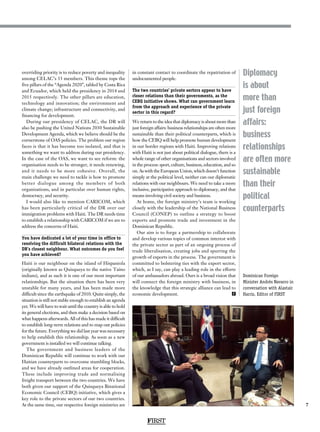
Dominican Foreign
Minister Andrés Navarro in
conversation with Alastair
Harris, Editor of FIRST
Interview with HÉCTOR VALDEZ ALBIZU
Governor, Central Bank of the Dominican Republic
HÉCTOR VALDEZ
ALBIZU
is the Dean of Central
Bank Governors of the
Americas. During his
18-year tenure (1994-
2000 and 2004-present)
of continued
macroeconomic stability,
the Dominican Republic
registered the highest
average rate of growth
in the Americas, more
than tripling the size
of per capita GDP. He
is a graduate of the
Universidad Autónoma
de Santo Domingo
(UASD), the Institute of
Social Studies of Chile’s
Universidad Católica and
the IMF’s Institute of
Advanced Studies.
Steady as she goes
8
A
t a time when Latin American and
Caribbean economies are struggling to
adjust to the downturn in China and the
continued impact of the financial crisis in
the EU and the United States, in contrast, the mood
in the Dominican Republic is one of quiet confidence
in the future.
“The governor of the Central Bank of Mexico
recently told me that we’re laughing while our
neighbours are crying,” says Central Bank governor
Héctor Valdez Albizu, adding: “The big risk to the
region comes from the fall in commodities prices:
Latin America now faces the conditions that will
reduce growth.”
Mr Valdez Albizu has worked at the Central Bank
for most of his career, rising through the ranks after
he joined in 1970 to become governor in 1994, a post
he has occupied continuously since then, aside from
a four-year break between 2000 and 2004. A veteran
political insider, he is one of the main architects of
the Dominican Republic’s economic reforms of the
last two decades, and offers unique insight into his
country’s success story and what sets it apart from its
regional neighbours.
“Generally speaking, there are two kinds of economy
in Latin America and the Caribbean: those focused on
exporting raw materials and commodities, and those
like ours, which while small, are open, flexible, and
diversified,” he explains.
After growing by an average of 4.3 per cent between
2004 and 2011, the economies of Latin America
managed just 2.6 per cent in 2015. “Brazil has had to
raise interest rates sharply to contain inflation and is
unlikely to beat its 2013 growth of 2.3 per cent. Mexico,
although less commodity-driven than South America,
is unlikely to do much better. The data suggests that
Chile is growing at its slowest rate for four years. Even
Peru, along with Panama, the region’s star economy of
the past decade, is feeling the pinch,” says Mr Valdez.
“Last year, Brazil went into recession, while we
enjoyed 7 per cent growth; the previous year was 7.3
per cent. The growth in our economy has not been
affected by the financial crisis in the US or China’s
slowdown,” he continues, noting that in 2015, tourism,
the economy’s biggest sector, brought in US$6.5
billion in foreign earnings, while remittances from
Dominicans working abroad amounted to US$4.5
billion. In total, the Dominican Republic’s foreign
exchange earnings from tourism, remittances, foreign
investment, and exports of goods and services for last
year exceeded US$23 billion, or 35 per cent of the total
GDP, says Mr Valdez. The country’s economy is worth
around US$61 billion. Inflation remains at 2.3 per cent,
below the 4 per cent target set by the government.
Mr Valdez says neither is he overly concerned about
fall-out from the situation in Venezuela, even though
its heavily oil-dependent economy has been sent into
a tailspin by the collapse of crude prices, starving the
country of cash to pay for domestic energy subsidies
and imported goods. With little foreign currency
reserves left, the economy is contracting, inflation has
soared and the government has resorted to rationing
food and other consumer staples.
Under former President the late Hugo Chávez,
Venezuela launched the so-called Petrocaribe accord
in 2005, seeking to become a low-cost energy provider
and win political favour among small island economies
heavily reliant on oil imports. Since then, it has
drastically cut back that policy.
“Fortunately, the Dominican Republic has a more
diverse source of oil imports and will not be hit as hard
by the loss of cheap Venezuelan oil,” says Mr Valdez.
Furthermore, he says, much of the capital flight from
Venezuela has landed in the DR’s tourism sector.
Looking to the longer term, Governor Valdez
believes a solution will be found to the current political
stalemate in Venezuela.
Learning the lessons of history
The Dominican Republic learned the lessons of
overdependence on commodities during the military
rule of the early 1960s. When it emerged from civil
war in 1965, successive governments introduced
legislation to create an industrial base and to diversify
the economy.
By the mid-1990s, having laid the foundations for
a reasonably diversified economic base, successive
governments began setting up special economic zones
that provided the ideal conditions for capital investment
by allowing companies within them to effectively
operate outside the regular domestic economy.
What the DR also did was embrace globalisation.
While many other countries have also done the same
since, the Dominican Republic’s experience has
DOMINICAN REPUBLIC
FIRST
9
Whilst its
regional
neighbours
are buffeted
by the
chill winds
of global
commodity
markets, the
Dominican
Republic
continues to
chart its own
very different
course
permeated more deeply, says Mr Valdez.
By the first years of the new millennium, the
Dominican economy was stronger than it had ever
been: it had enjoyed the fastest economic growth in
Latin America since the 1970s, averaging 3.2 per cent
annually until 2003. But that year it embarked on the
ill-advised bailout of Banco Intercontinental (known
as BanInter), the country’s second-largest private bank,
sparking a crisis that doubled government debt and
destroyed the value of the currency.
“A drastic overhaul was needed to restore
macroeconomic stability and confidence in the
financial sector, as well as to tame spiralling interest
and inflation rates,” explains Mr Valdez.
In the years that followed, a series of hard-hitting
financial reforms and the close coordination between
monetary and fiscal policies ushered in a new period
of economic growth and a revitalisation in all sectors.
Since then, the country has continued to attract
FDI, which has increased by 245.5 per cent over the
last decade. “The main factors that have influenced this
increase are the country’s macroeconomic stability, low
inflation and relative stability of the exchange rate and
a healthy financial, liquid, solvent and well capitalised
system,” says Mr Valdez.
“Creating the conditions investors need is not
rocket science,” he notes, highlighting the impact of
continued legislation to improve the business climate,
such as an FDI Act that provides the same facilities
and guarantees to foreign investors as Dominicans,
based on clear rules and regulations, with incentives
for investors in different sectors.
“Diversification has contributed to the increase in
investment flows,” says Mr Valdez. “In 2000, four
sectors: electricity, telecommunications, trade, and
tourism, accounted for 82 per cent of FDI. Today,
the spectrum of sectors has expanded to include real
estate, construction, and finance. We’re confident
that we can now attract greater investment to develop
mining and agriculture.”
“In addition, ours is a country characterised by long-
standing democracy that has provided political and
social stability,” he adds.
The country also benefits from its location along
Caribbean and Central American shipping routes,
while it is just three hours flying time from the eastern
seaboard of the US. The country has first-world
transport infrastructure, with eight international
airports and a world-class telecommunications system.
Over the last four years, the DR has also pursued a
policy of greater regional integration.
The country’s participation in major trade
agreements like DR-CAFTA, CARICOM, the
Economic Partnership Agreement (EPA) with the
EU and others boosts its appeal as an investment
destination. In January, the Dominican Republic took
over the rotating presidency of the Community of
Latin American and Caribbean States (CELAC).
Banking sector reform
Since the crisis of 2003-2004, the financial sector has
undergone considerable development through the
implementation of robust policies that have addressed
fundamentalweaknessesandgreatlyimprovedperformance.
New regulations, such as additional capital
requirements, have been implemented, says Mr
Valdez. Enhanced transparency in the eyes of the
general public has been a key step, which has been
supported via independent regulatory institutions and
the introduction of relevant banking requirements,
he explains.
“The principles of the Basel Accords were also
adopted so as to enhance the standing of the Dominican
Republic’s financial sector within the international
system: market risk is now highly regulated by
ensuring equal treatment to all entities, regardless of
capital origin,” says Mr Valdez. The periodic review of
contingency plans is also employed in order to address
the shortage of funds of financial intermediaries.
Measures such as publishing of monthly and annual
financial statements, as well as detailed information on
the loan portfolios of various financial intermediaries,
have improved transparency in the sector and
contributed to its health: “We have moved to a model of
risk-based supervision, based on high levels of liquidity
and solvency, as well as greater international openness.”
Elections unlikely to affect growth or investment
Mr Valdez is confident that the presidential elections
in May, which current incumbent Danilo Medina
is expected to win, will have little impact on the
broader economy: “We project that this year, the
DR will continue its sound economic performance,
growing by its potential level of 5.5 per cent to 6
per cent, and that inflation will converge toward the
lower limit of the target range of 4 per cent to 1 per
cent at the end of the year, with a current account
deficit of around 2 per cent of GDP.” Mr Valdez says
macroeconomic performance will be driven by the
favourable international environment for the country,
characterised by improved terms of trade (particularly
lower oil prices and higher gold prices) and by the
recovery in the United States, the country’s main
trading partner.
“Continued high levels of exports from industrial free
zones, along with tourism, remittances, and foreign direct
investmentwillallcontinue.Additionally,weexpectprivate
sector loans will grow by around 10 per cent, similar to the
rate of expansion of nominal GDP, thus contributing to
maintaining the growth of private production.” F
FIRST
Interview with JOSÉ DEL CASTILLO SAVIÑÓN
Minister of Industry and Commerce, Dominican Republic
JOSÉ DEL CASTILLO
SAVIÑÓN
graduated in Law from
Pontificia Universidad
Católica Madre y
Maestra University,
from which he also
received a Master’s in
Economic Legislation
and Business Law. In
addition to his legal
advisory firm Gabinete
Economico S.A., which
provides legal advice
to private and public
enterprises in trade,
foreign investment,
government relations
and communications,
in 2011 Mr Del Castillo
was appointed Vice
Minister of Industry
and Commerce for Fuels
and Mining, before
assuming his current
role in the government
of President Danilo
Medina in August 2012.
The power of regional trade
10
More than 95 per cent of businesses in the
Dominican Republic are small and medium-sized
enterprises (SMEs), generating more than two
million jobs and accounting for 30 per cent of the
country’s GDP. What is the ministry doing to help
this vital sector?
Within days of taking office we set about implementing
measures to help micro and SMEs which, as you say, are
the backbone of the country’s industrial and commercial
sectors. One of the main problems micro and SMEs
face is barriers when trying to access credit, and for that
reason we are in the process of identifying potential new
financial resources for these enterprises. In this regard,
we have established a fund and created the Solidarity
Bank, which is helping to meet the needs of SMEs.
In October 2013, the government launched a one-
stop shop to facilitate the starting of new businesses
and formalising the existing ones, because we should
remember that more than 50 per cent of jobs are still
in the informal sector. Our goal is also to encourage
the formalisation of small, micro and medium-sized
businesses currently operating in the shadow economy.
Previously, it took up to a month to set up a company,
involving multiple money transfers, three forms, and
four visits to different offices. Now the process to set up
a company takes just seven working days, and requires
just one transfer to the Chamber of Commerce.
How are the various free trade agreements
(FTAs) signed with the US and EU, along with the
country’s Free Trade Zones (FTZs), impacting on
trade and investment?
The Dominican Republic has four FTAs in force. Most
of our trade is carried out through these agreements.
Exports to the US and the EU are at record highs.
Investment comes mostly from those same sources,
although Brazil, Mexico, Colombia and Venezuela are
growing fast in importance.
With Haiti, our second most important export
market at the moment, we hope to strengthen
our regional ties in the context of our Economic
Partnership Agreement (EPA) with the EU, which
includes a regional preference clause to that effect.
By virtue of this clause, what the DR gave the EU
will be extended to Haiti and vice-versa. However,
this requires Haiti to ratify the EPA, which has been
pending since 2009.
The new strategy for trade negotiations envisages
our developing closer ties with countries like Canada,
Colombia, Chile, Mexico and other regional trading
blocs. These are necessary requirements for us to
consolidate our potential to become the logistics hub
of the Americas.
The key policy of encouraging FDI through the
expansion of FTAs and the development of FTZs has
been a significant success. As a signatory to several
major international trade pacts, the Dominican
Republic has attracted the interest of larger markets
as a result of its productive capacity and its enviable
location between North and South America, en route
to the Panama Canal from Europe and other markets
around the world.
The FTAs give us duty-free access to the largest
consumer markets with greater purchasing power.
Furthermore, these facilities place us on equal terms
with Central American countries. Also, these treaties
provide us with an environment of greater legal
certainty, which is a further incentive for investment.
What’s more, these treaties can be beneficial in so
much as they oblige our manufacturers to compete
more effectively by offering products that meet
the standards demanded by these countries. In the
agricultural sector, for example, there is still a lot of
potential for us to reap the benefits of these treaties.
We are also trying to boost our mining exports, a
sector designated as strategic by the government. For
example, the implementation of the Pueblo Viejo gold
mining project will add more than US$2 billion to our
overall export figures in 2016, which represents a 20 per
cent increase in our exports. The government also aims
to provide continuity to the Export Processing Zone
(EPZ) scheme to further attract FDI into the Dominican
Republic, especially in the manufacturing sphere.
The Dominican Republic currently holds the
presidency of the Community of Latin American
and Caribbean States (CELAC), which puts
increasing regional trade as one of its primary
goals. Is the Dominican Republic making the most
of the potential to boost its exports to the region?
Obviously, our biggest export market is by far the
United States: nearly 60 per cent of our exports go
there. After that, it’s Haiti and the EU, the main
destinations for goods produced in the DR. In total,
DOMINICAN REPUBLIC
FIRST
11
The only way
to create a
stronger Haiti,
one that can
be a better
business
partner for all
the countries
in the region,
is to sit down
and talk
we are talking about exports worth US$9.6 billion
last year. Unfortunately, one of the main challenges
we face in increasing our share of trade with some of
our regional neighbours is the protectionist policies
they still pursue. This has to do with the scale of their
economies: they cannot compete with us on price,
so they protect their markets. They see us a power
in the region, the biggest economy in the Caribbean
region, for instance, and in many ways as a threat to
them. The other difficulty is lack of connectivity.
We do not have fast, efficient ways to get our goods
to these regional markets. Transport costs are high.
The Caribbean should be a natural market for us, but
it isn’t. We want to diversify our export markets, but
until these two issues are addressed, we’ll have to look
further afield. We are looking at Russia particularly, as
well as China and Asia, for luxury goods such as rum,
organic cocoa, and cigars: we control 40 per cent of the
world cigarette and cigar market. They are our second
biggest agroindustrial export.
What is being done to improve tax collection?
The informal economy is the key challenge here.
This is why part of the measures we’ve introduced are
fostering people working in the shadow economy to
formalise SMEs while making it simpler for them to
pay their taxes. What’s more, we have tax scales so that
smaller firms pay a lower rate of tax.
On the issue of unfair competitive advantages of
companies operating in FTZs, they are entitled to sell
part of their production to the domestic market, and
recently adopted legislation has approved a 2.5 per cent
tax on these companies’ activities in the local market
that effectively constitutes an income tax. Such a move
aims to eradicate potentially unfair competition. We
believe that the EPZ scheme should be continued,
because it currently generates 130,000 direct jobs and
over US$4 billion in exports.
The first meeting of the Quisqueya Binational
Economic Council (CEBQ) to facilitate the
development of the Haiti/DR border area, took place
in November, between leaders of the private sectors
of Haiti and the Dominican Republic. Given the
current uncertainty in Haiti, how confident are you
that this initiative can gain traction?
As you know, Haiti is in the midst of a major political
crisis and this has interrupted the talks. We understand
the difficulties they face, but our more immediate
priority is to deal with the Haitian ban on Dominican
imports. These sanctions could end up costing us
US$500 million in lost exports over the year. As part
of ongoing trade talks, our two governments agreed
to enhance commercial trade and normalise ground
transport of goods. Even though there have been
political problems between the Dominican Republic
and Haiti, trade between our two nations continues on
a daily basis, although much of it is smuggling. We
will be able, through this agreement on trade, to fight
against smuggling – the scourge that hinders economic
development in Haiti. Estimates suggest Haiti loses
more than US$300 million because of smuggling. The
only way to fix it and to help build a stronger Haiti,
one that can be a better business partner for all the
countries in the region, is to sit down and talk. The
private sectors in both countries have asked their
respective governments to work faster toward the
ratification of mechanisms for tariff harmonisation,
taking into account existing regional trade agreements.
In recent years the DR has begun developing closer
ties with China. How has the trade relationship
been affected by China’s economic slowdown?
China is not a key export market for us yet, in fact it’s
our competitor in terms of manufacturing. Recently,
we have been benefitting from increased labour costs
in China, particularly in textiles. China has been hit by
different factors that have pushed up its manufacturing
costs, which has allowed us to position ourselves better,
particularly in the FTZs, where we have created 46,000
jobs in recent years. So, the slowdown has not had a
negative effect, in fact, it has helped us. That said, over
the last few years, we have increased diplomatic and
trade relations with China, and we now have mutual
commercial representative offices here and there. At
the same time, we are organising official visits between
both countries to improve trade links. Trade relations
will increase as we move forward, and as I said, we
are focusing on increasing exports to China. There
are many opportunities for both countries to develop
commercial and industrial ties, particularly in the
mining and energy sectors.
Looking to the future, which sectors do you
expect to drive sustained economic growth in the
Dominican Republic?
We are looking at developing non-traditional areas,
and we will do this through the FTZs. As I just
mentioned, we want to increase our share of textiles
exports, and jewellery, medical instruments,
pharmaceuticals, electrical and electronic components,
are already at the top of our export list. Moreover,
we’re strengthening our presence in Europe through
organic products, particularly cocoa and banana, as
well as tropical fruits and vegetables. We also have
potential in heavy industry, as well as technology,
and we are talking to [Taiwanese electronics giant]
Foxconn about setting up an assembly plant. We also
need to set up clusters to link education, technology,
and manufacturing to foster innovation.  F
FIRST
Interview with FRANCISCO JAVIER GARCÍA
Minister of Tourism, Dominican Republic
FRANCISCO JAVIER
GARCIA
graduated in Economics
from UASD and also
undertook postgraduate
studies in Law at
the University of the
Caribbean. He is a
member of the Partido de
la Liberación Dominicana
(PLD) and the principal
director of its election
campaigns, including
the current campaign
of President Danilo
Medina and those of
his predecessor, Leonel
Fernández. Mr Javier has
held a number of senior
roles in government
and public life, and was
Minister of Industry and
Commerce prior to his
appointment as Minister
of Tourism, by President
Fernández, in 2008.
Growth through diversification
12
What is your assessment of the current health of
the Dominican tourism sector, both in historical
terms and vis-à-vis your competitors in the region?
The Dominican Republic leads the Caribbean in
tourism growth. 2015 was our most impressive year
to date, with a record 5.6 million tourists, about 9 per
cent higher than 2014. Growth should continue during
2016, both in arrivals – due to additional tourism
avoiding crisis areas in the Mediterranean – and in
capacity, with more than 1500 rooms under contract,
in order to keep up with the present upward trends.
What is the current contribution of the industry to the
Dominican economy, both directly and indirectly?
Last year tourism generated US$6.2 billion and over
250,000 direct and indirect jobs. For a country with
the ninth largest economy in Latin America – and the
largest in the Caribbean and Central America – these
are not insignificant numbers. We are talking about
a sector that represents 10 per cent of Dominican
GDP and generates about the same share of direct and
indirect jobs.
Tourism also makes the Dominican Republic more
resilient to international shocks. In 2008, the last crisis
year for the world economy, tourism managed to grow
3 per cent. Since then, growth rates have picked up
and new investments continue to arrive, allowing us to
cater to different market segments.
You have overseen one of the most important
periods of growth in the DR’s tourism sector
since taking office in 2008, and have said that
the country’s future prosperity depends on the
further development of the sector’s potential. Is
the country’s mainstay – the all-inclusive sun and
beach model – sustainable, in your view? What
is your strategy for diversifying the Dominican
tourism offering and moving it further up the
value chain?
Diversification for us means moving up-market. There
are more villas for sale and for rent than ever before,
surrounded by award-winning golf courses. Growth in
this segment continues unabated.
New luxury hotels in all areas of the Dominican
Republic have opened up. Some belong to the most
prestigious networks, such as Relais  Chateaux,
the Leading Hotels of the World and the Small
Leading Hotels of the World. In all cases, the natural
environment is as superb as in the all-inclusive hotels
– this is the Dominican Republic after all – but the
quality of service and the sophistication of the facilities
have reached new heights.
All niches are being targeted: golf travel, eco-
tourism, MICE (meetings, incentives, conferences
and exhibitions) adventure travel and business-leisure
spaces – but we are working to define, support, grow
and sustain these categories and initiatives.
Punta Cana continues to receive about 66 per cent of
our visitors. While all-inclusive hotels – in Punta Cana
and the rest of the country – will continue to be a staple
of Dominican tourism, new types of travelers, whether
interestedinournaturalparksorourheritage,inadventure
or in luxury, have plenty of lodging options available.
The Dominican Republic has an ‘embarrassment
of riches’ in niche sub-sectors such as wildlife and
eco-tourism, yet is only just beginning to market
itself as such. What is your view of the potential
of this area, and what is the ministry, and the
private sector, doing to capitalise on it?
The potential offerings for eco-minded travelers
are rich and plentiful. We are proceeding cautiously
and with great care to structure eco-tourism in a way
that minimises the impact on our ecosystems, while
sustaining the surrounding communities. In order
to become successful in these sectors, we must be
able to preserve them not only for the enjoyment of
DOMINICAN REPUBLIC
FIRST
The historic Fortaleza
San Felipe in Puerto
Plata: the region was
at the forefront of
the DR’s early tourism
development and is now
experiencing a revival in
visitor interest
13
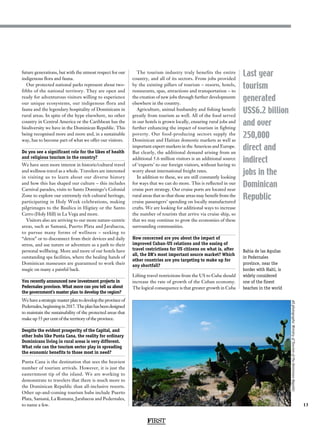
Last year
tourism
generated
US$6.2 billion
and over
250,000
direct and
indirect
jobs in the
Dominican
Republic
future generations, but with the utmost respect for our
indigenous flora and fauna.
Our protected national parks represent about two-
fifths of the national territory. They are open and
ready for adventurous visitors willing to experience
our unique ecosystems, our indigenous flora and
fauna and the legendary hospitality of Dominicans in
rural areas. In spite of the hype elsewhere, no other
country in Central America or the Caribbean has the
biodiversity we have in the Dominican Republic. This
being recognised more and more and, in a sustainable
way, has to become part of what we offer our visitors.
Do you see a significant role for the likes of health
and religious tourism in the country?
We have seen more interest in historic/cultural travel
and wellness travel as a whole. Travelers are interested
in visiting us to learn about our diverse history
and how this has shaped our culture – this includes
Carnival parades, visits to Santo Domingo’s Colonial
Zone to explore our extremely rich cultural heritage,
participating in Holy Week celebrations, making
pilgrimages to the Basilica in Higüey or the Santo
Cerro (Holy Hill) in La Vega and more.
Visitors also are arriving to our more nature-centric
areas, such as Samaná, Puerto Plata and Jarabacoa,
to pursue many forms of wellness – seeking to
“detox” or to disconnect from their devices and daily
stress, and use nature or adventure as a path to their
personal wellbeing. More and more of our hotels have
outstanding spa facilities, where the healing hands of
Dominican masseuses are guaranteed to work their
magic on many a painful back.
You recently announced new investment projects in
Pedernales province. What more can you tell us about
the government’s master plan to develop the region?
Wehaveastrategicmasterplantodeveloptheprovinceof
Pedernales,beginningin2017.Theplanhasbeendesigned
to maintain the sustainability of the protected areas that
make up 55 per cent of the territory of the province.
Despite the evident prosperity of the Capital, and
other hubs like Punta Cana, the reality for ordinary
Dominicans living in rural areas is very different.
What role can the tourism sector play in spreading
the economic benefits to those most in need?
Punta Cana is the destination that sees the heaviest
number of tourism arrivals. However, it is just the
easternmost tip of the island. We are working to
demonstrate to travelers that there is much more to
the Dominican Republic than all-inclusive resorts.
Other up-and-coming tourism hubs include Puerto
Plata, Samaná, La Romana, Jarabacoa and Pedernales,
to name a few.
The tourism industry truly benefits the entire
country, and all of its sectors. From jobs provided
by the existing pillars of tourism – resorts, hotels,
restaurants, spas, attractions and transportation – to
the creation of new jobs through further developments
elsewhere in the country.
Agriculture, animal husbandry and fishing benefit
greatly from tourism as well. All of the food served
in our hotels is grown locally, ensuring rural jobs and
further enhancing the impact of tourism in fighting
poverty. Our food-producing sectors supply the
Dominican and Haitian domestic markets as well as
important export markets in the Americas and Europe.
But clearly, the additional demand arising from an
additional 5.6 million visitors is an additional source
of ‘exports’ to our foreign visitors, without having to
worry about international freight rates.
In addition to these, we are still constantly looking
for ways that we can do more. This is reflected in our
cruise port strategy. Our cruise ports are located near
rural areas that so that those areas may benefit from the
cruise passengers’ spending on locally manufactured
crafts. We are looking for additional ways to increase
the number of tourists that arrive via cruise ship, so
that we may continue to grow the economies of these
surrounding communities.
How concerned are you about the impact of
improved Cuban-US relations and the easing of
travel restrictions for US citizens on what is, after
all, the DR’s most important source market? Which
other countries are you targeting to make up for
any shortfall?
Lifting travel restrictions from the US to Cuba should
increase the rate of growth of the Cuban economy.
The logical consequence is that greater growth in Cuba
FIRST
Bahia de las Aguilas
in Pedernales
province, near the
border with Haiti, is
widely considered
one of the finest
beaches in the world
Allphotographs:MinistryofTourismoftheDominicanRepublic
All of the
food served
in our hotels
and resorts is
grown locally,
ensuring
rural jobs
and further
enhancing
the impact
of tourism
in fighting
poverty in
the DR
14
should result in more Dominican growth: our private
sector has a history of catering to the needs of the
Cuban market in a number of areas, from construction
materials to toiletries to foodstuffs. Moreover, it should
benefit the Caribbean as a whole by making it a more
diverse and unique travel destination for the US tourist.
The hotel industry in the Dominican Republic is
conscious of the capacity constraints in Cuba, a market
with which they have been competing for non-US
tourists for many years now. Once these are overcome,
we will continue to be prepared for further competition
by providing to the most discerning tourists something
unique – our very diversified tourism product, with
our nine distinct ecological zones, our rich and unique
cultural heritage, our growing roster of luxury resorts,
our award-winning golf courses and our gastronomy.
We are well-prepared to welcome the new waves of
travelers that should become ever more interested in
the Caribbean as a result of the changes in Cuba.
In addition, the Dominican Republic is investing
in growth opportunities outside of North America,
and these have already begun to see success. Markets
include, but are not limited to Brazil, Argentina, Chile,
Venezuela and Colombia.
The Hard Rock Hotel chain is developing a
40-storey property in Santo Domingo, which seems
a pretty bullish move, to put it mildly. What is the
Ministry’s strategy for attracting more visitors to
the Capital – and where does the MICE segment
figure in your plans?
The city is a booming hub for business travel. Its
conference and meeting spaces offer the latest in
presentation and professional technology, in a setting
that is as cosmopolitan as it is historic. We are working
to demonstrate to a variety of niche markets that our
capital city has much to offer, whether that may be a
family looking for an educational vacation, a group
interested in haute cuisine, travelers searching for a
boutique hotel experience or business travelers looking
to make the most of their trip.
We are similarly confident in the opportunities for
growth in Santo Domingo, and are doing the necessary
research, so we have the hard data to support our goals.
A recent example is the feasibility study we conducted
on building a new convention centre in Santo Domingo
by 2017.
The MICE segment is an important one for this
destination, particularly given Santo Domingo’s central
location and the accessibility to the other destinations of
Punta Cana, Samaná, Puerto Plata and others.
It is probably fair to say that many visitors to
the DR are unaware that it shares the island
of Hispaniola with Haiti. The private sector-
driven Quisqueya Initiative [to promote cross-
border investment and economic development
between the two] represents an important step
in improving economic – and hopefully, political
relations. What potential do you see for greater
collaboration in tourism?
We have already set several things in motion to help
Haitian tourism regain its growth potential. We have
developed a special committee of leaders from the
private and public sectors of both countries. Together,
they are working to develop and promote not only
tourism to Haiti, but also understanding how we can
work together to grow as a multiple destination – once
they are ready.
Mosquito-borne diseases such as Chikungunya,
and most recently, Zika, have caused widespread
alarm, particularly among those travellers
thinking of starting a family – such as
honeymooners, who have long favoured the
Caribbean as a ‘dream’ destination. What impact
has the outbreak had on tourist numbers in the DR
so far? What is the Government doing to address
the issue, and what would you say to would-be
visitors worried about the situation?
We have not seen a significant change in visitor
numbers, nor many travel cancellations. We have
long been aware of various mosquito-borne ailments
and have been taking proactive measures against such
diseases for many years. Due to this, the impact of the
recent alarm on the country has been minimal – tourist
areas have not been impacted, as we have dedicated
teams working to treat for the insects and educate hotel
operators and locals alike on how to safely destroy
mosquito breeding grounds, which includes regular
removal of any standing water. F
DOMINICAN REPUBLIC
FIRST
Santo Domingo’s
Colonial Zone: the
centrepiece of the
government’s strategy
to develop the capital’s
tourism potential
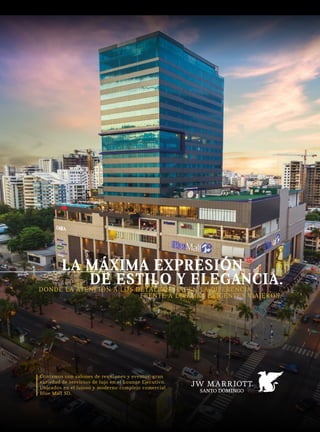
LA MÁXIMA EXPRESIÓN
DONDE LA ATENCIÓN A LOS DETALLES, HACEN LA DIFERENCIA
FRENTE A LOS MÁS EXIGENTES VIAJEROS.
DE ESTILO Y ELEGANCIA.
Contamos con salones de reuniones y eventos, gran
variedad de servicios de lujo en el Lounge Ejecutivo.
Ubicados en el lujoso y moderno complejo comercial
Blue Mall SD.
Interview with ANGEL ESTÉVEZ BOURDIERD
Minister of Agriculture, Dominican Republic
ANGEL ESTÉVEZ
graduated with a BSc
in Agricultural Sciences
from UASD. He began his
career in 1985 at DOMEX,
an Israeli company
producing and exporting
melons and vegetables,
before joining Anglo-
American as a seller
of agrochemicals. He
subsequently moved
to CALOSA in 1993,
becoming general
manager of the company
in 1996. A member of
the PLD since 1982, he
joined the party’s Central
Committee in August
2012 and was appointed
Minister of Agriculture
on 24 April 2014.
Raising the bar in agriculture
16
The agricultural sector in the Dominican Republic
has expanded significantly in recent years. What
have been the main factors driving this growth, and
how do you see the outlook in the medium term?
Over the past four years, total agricultural production
in the Dominican Republic increased in volume by 5.6
per cent, from 5.7 million metric tonnes in 2012 to
6 million tonnes in 2015. Among the factors driving
this growth were the increased planting of rice, which
posted a record increase of 17 per cent in the first half of
2015, despite the severe drought. As part of this drive,
the Bioarroz project was launched in Juma, Bonao,
renovating three centres producing high-quality rice
seeds and thus improving rice varieties.
More generally, growth in agriculture has resulted
from the additional availability of credit, with US$1.2
billion disbursed over the period. Productivity gains
have been obtained as well: levelling of agricultural
lands enabled a 300 per cent increase in corn [maize]
production in the province of San Juan alone.
Risk management has also been an important factor
in enabling this growth. By virtue of the new Law
on Agricultural Risks, enacted in 2013, some 27,000
subsidised insurance policies have been issued, a
cumulative growth of 74 per cent, covering an area of
16,719 hectares, for about US$5.4 million.
Agriculture should continue to grow 15 per cent by
volume in the medium term, to 7 million tonnes. This we
expect to achieve by incorporating new planting areas –
from 325,000 to 362,500 hectares, a 10 per cent increase;
through a 48 per cent growth in greenhouse production
– reaching some 14 million square metres; by distributing
1.6 million seedlings, covering at least 10,625 hectares
of fruit production; and by better pest control practices
through precision application of pesticides.
Investment in infrastructure, a mainstay of Dominican
agriculture, should continue as well, through the
construction and rehabilitation of 5,000 km of roads
between farms, reducing transport costs for inputs to
farms and of farms’ output to destination markets.
Water scarcity will continue to be addressed by
accelerating the introduction of efficient irrigation
systems on top of our network of water canals. Priority
will be given to the irrigation of bananas and plantains,
which represent 38 per cent of planted areas.
Agricultural credit is set to increase as well, by
70 per cent, from US$1.2 to 2.0 billion. And so is
the expansion of agricultural insurance, by 108 per
cent, from 96,471 to 200,522 hectares. In terms of
employment, we expect to create 112,526 additional
direct jobs, for qualified and non-qualified personnel.
The DR has been extremely successful in adding
value to its tobacco and cocoa exports, in
particular. Which other agricultural products do
you see as offering significant potential in this
regard, and what steps is the government and
private sector taking to move the country further
up the value chain?
There are several crops with high export potential,
which have experienced dramatic growth recently.
Among these, pineapple exports grew by 34 per cent,
mango exports by 7 per cent, passion fruit exports by
291 per cent and eggplant [aubergines] by 174 per cent,
from US$2.3 to 6.3 million.
In the livestock sector, the export of fish and shellfish
grew 38 per cent, from US$9.5 to 13.1 million; beef
exports grew 93 per cent; honey and derivatives grew
38 per cent and milk and dairy products grew 6 per
cent, from US$8.3 to 8.8 million.
The government tries to encourage investment
in these products while focusing on creating and
maintaining the right sanitary conditions to reduce
risks in demanding destination markets in Europe and
North America.
Much of the DR’s agricultural produce still
comes from smallholdings. What support is the
government providing to help improve these
farmers’ productivity and expand their operations?
In order to develop the agricultural sector, priority
is given to supporting small and medium-sized
producers. Whilst all projects and initiatives are aimed
at benefitting all producers, special priority is given
to those smallholders with less than 2 hectares which,
left unsupervised, would have to survive through basic
subsistence farming.
All smallholders are potential agricultural
entrepreneurs. To realise their potential, the ministry
is promoting associations and cooperatives, in order
to increase productivity by allowing the production
of greater volumes of standardised products meeting
the demands for quality of domestic and international
clients. Success in exporting Fairtrade bananas and cocoa
DOMINICAN REPUBLIC
FIRST
17
All small-
holders are
potential
agricultural
entrepreneurs.
To realise
their
potential,
the ministry
is promoting
associations
and
cooperatives,
in order to
increase
productivity
would have been impossible without this approach.
A massive land title programme is also well under
way, so that small holders are eligible for credit
in formal markets. Additional support is provided
through public services such as training, extension,
and land levelling, as well as through the provision of
high-quality planting materials, and our long-term
commitment to the improvement of infrastructure.
At the other end of the scale, where do you see
the greatest investment opportunities for the
expansion of larger-scale agribusiness in the DR?
I think there is a great opportunity in sub-sectors such
as fruit and vegetables, and livestock. The DR has the
necessary conditions to produce almost all kinds of
food. In addition to which, our strategic location allows
our producers to reach quickly and reliably our main
destination markets in the US and Europe. The private
sector has already identified these opportunities,
and it is only a matter of time before the take-off of
Dominican agro-industry is achieved.
There is great investment potential in harnessing the
added value of agricultural commodities such as coconut,
cocoa, and corn [maize], as well as in greenhouse
production, aquaculture, honey and derivatives, among
others. In this fashion, we are ready to take the next step,
moving from our status as a provider of high-quality
commodities. Branded cosmetics and pharmaceuticals
are being produced already with Dominican inputs. The
next step would be to add value to our commodities in
our own territory, taking advantage of our favourable tax
regime for industrial exports, as well as of our optimal
location, logistics and free trade agreements with the US
and Europe.
Last year’s outbreak of Mediterranean fruit fly
was a wake-up call for Dominican producers
who had grown used to relying on the United
States as the main destination for the country’s
exports. How successful has the DR been in
diversifying its export markets, and what steps
are being taken to prepare for the expiration of
preferential tariffs in 2020?
In recent years, the country has diversified both its
exports and its target markets. In this regard, our
main export markets are the US, Haiti, the EU,
Russia, Japan, China, and other Asian and African
countries. Regarding livestock, we managed to reopen
markets in Hong Kong, El Salvador, Cuba and Haiti.
So, we are making good progress in diversifying
our destination markets. And with the joint efforts
of institutions that promote the quality of our
products around the world, such as the Ministry of
External Relations and CEI-RD, we hope to continue
succeeding in the future.
Demand for quality foodstuffs continues to rise
in many parts of the world. To what extent is
the DR able to ramp up its production to meet
this demand?
The DR has the potential to increase its export volume
to address the growing demand in existing markets
as well as the needs of new markets. Our agricultural
exports grew 15 per cent during 2012-15, from US$1.8
billion to 2.0 billion. Over the next four years we
expect an increase of 56 per cent, or US$1.1 billion,
from US$2.0 to 3.1 billion. This is underpinned by the
expected growth in total agricultural production of 15
per cent mentioned earlier.
The DR’s hosting of the 3rd World Cocoa Conference
in May this year is a testament to the quality and
efficiency of the country’s farming and processing
methods. In which other agricultural sub-sectors do
you see the DR leading the world in future?
The DR has the capacity to lead the world in
productivity and quality of a number of products,
including organic bananas, organic and non-organic
avocados, red peppers, plantains and coconuts.
The most serious challenge to the sector has been
the drought that has affected the country over the
past three years. What lessons have been learned
from this experience, and are you confident that the
government is getting to grips with the situation?
Climate change is a growing reality that threatens
world agricultural production, including, of course,
the DR. Some of the corrective measures taken I
mentioned earlier – such as land levelling and precision
irrigation. Other measures include the promotion of
silage for the livestock sector, and the storage of water
in wells and reservoirs, as well as the construction and
repairing of dams. And, of course, the introduction of
high-yielding varieties requiring less irrigation.
The DR’s agricultural sector has benefitted greatly
from the volume of air traffic generated by the
country’s tourism sector. As increasing numbers
of visitors come to the DR from countries such as
Russia, do you see the country’s export footprint
changing significantly?
I believe that these conditions represent an opportunity
to reach markets in which our country still has no
presence, but above all, to increase our exports to
existing markets such as the US, Europe and Asia,
from which 85 per cent of visitors to the DR originate.
Besides that, we are also focused on increasing
domestic exports, interlacing our small producers with
the growing tourism infrastructure of the country. It is
a sizeable market; after all, 5.6 million tourists visited
the Dominican Republic in 2015. F
FIRST
Interview with OSMAR BENÍTEZ
President, Junta Agroempresarial Dominicana (JAD)
OSMAR BENÍTEZ
is the CEO of the
Junta Agroempresarial
Dominicana (the
Dominican Agribusiness
Board). He graduated
from the Universidad
Católica Madre
y Maestra, as an
Agricultural and Food
Technology Engineer
and holds a Master’s in
Agricultural Economics
and Agribusiness
Management from Ohio
State University, USA.
Mr Benítez has been
Agricultural Advisor to
the last 4 Presidents of
the Dominican Republic:
Joaquin Balaguer, Leonel
Fernández, Hipólito Mejía
and Danilo Medina.
Growing for gold
18
How did the creation of JAD come about? What are
the organisation’s main activities, and how does
it differ from other industry associations in the
Dominican Republic?
JAD was created out of a need to establish new technical
skills to facilitate the development of non-traditional
agriculture in the Dominican Republic. We saw that
there was a need to provide technical assistance to
agricultural entrepreneurs who were looking for new
investments to take advantage of the huge market
opening that came about with the US Caribbean Basin
Initiative, under President Ronald Reagan.
Our main activities include increasing the
productivity and competitiveness of the agriculture
and livestock sectors, and improving investment
opportunities in them.
JAD differs from other industry associations due to
the size and extent of its membership representation
throughout the country: we are the largest and most
important organisation of farmers and agribusiness
entrepreneurs in the Dominican Republic with a
membership of over 160,000 producers. In addition to
acting on behalf of its members in any policy discussion
with the Executive, Legislative and Congressional
Powers, JAD also provides the largest and most
complete technical assistance programme to the
farming sector in the Dominican Republic.
Our services range from direct technical assistance
to market development – both export and local – a
commodities exchange, market intelligence and reports,
economic analysis, financial assistance, agricultural
laboratories, farmers’ training and support, watershed
reforestation, and eco/agro tourism, among others.
What benefits do producers derive from their
membership of the organisation?
Membership of JAD offers producers the opportunity
to belong to a recognised national and international
institution that unifies the agricultural sector and
promotes the valuable role played by farmers and
agribusiness in the country: one that promotes the
best interests of the sector and which has obtained
important gains for its members, such as zero tariff
rates for the importation of inputs, equipment and
machinery for the agricultural sector.
In the international arena, JAD acts in the interests
of its members in a number of important areas,
such as leading trade negotiations to ensure proper
treatment of goods and services in accessing potential
markets that will boost our economy. It promotes
the enactment and adoption of laws, policies and
measures that help create a better investment
environment and policies to benefit the agricultural
sector, as well as providing high-quality laboratory
analysis at competitive prices.
Furthermore, JAD offers commercial, organisational,
and technical assistance services, which improve the
productivity and competitiveness of its members. It has
updated information on aspects such as markets, prices,
production costs, and business opportunities, and
provides producers with a programme of Integrated
Management of Pests (IPM) which makes possible the
phytosanitary health of crops, thereby improving the
quality of their produce.
What do you regard as the DR’s greatest
achievements, in agricultural terms?
The Dominican Republic has reached a very high level
of performance and enjoys positive brand recognition
in the international specialty agricultural export
markets, particularly in the organic and fair trade
sectors. The Dominican Republic is the major exporter
of organic bananas and cocoa worldwide.
DOMINICAN REPUBLIC
FIRST
Some like it hot:
Dominican producers
now export more than
100 agricultural products
to world markets
19
In less than
four years,
the DR’s
agricultural
exports have
gone from
US$1.2bn
to almost
US$1.7bn
Are Dominican producers doing enough to
diversify their product portfolios and export
markets, in your view?
Yes, I think so. Dominican producers have worked
very hard to diversify our agricultural economy away
from well-known traditional crops like sugar cane,
cocoa, coffee and tobacco. Nowadays, we export
more than 100 different crops that find their way into
the international market. In less than four years, our
agricultural exports have gone from US$1.2 billion to
almost US$1.7 billion.
One area of Dominican agriculture that still
requires attention, however, is getting producers to
take greater advantage of the country’s existing Free
Trade Agreements, especially DR-CAFTA and our
Economic Partnership Agreement (EPA) with the EU.
What are the main trends shaping the growth and
development of the agricultural sector in the DR,
and which products and niches do you expect to
benefit most?
I would say that the most promising new trends in
international and domestic markets that are driving
the future of the Dominican farming sector sector are:
Organic Agriculture, Tropical Agriculture, Ethnic
Agriculture, Cosmetological and Medical Agriculture,
Touristic Agriculture and Political Agriculture. All
of these provide extraordinary opportunities for
Dominican farmers to participate in a food market-
driven future. The market demands of these seven
segments have shown an exponential increase in
consumption. We should take advantage of that, and
we are working on it.
What rules and regulations should prospective
foreign investors be aware of when exploring
agribusiness opportunities in the DR?
The Dominican Republic has the most complete
foreign investment legal system of any country in
the whole of Central America and the Caribbean,
which is why we have been so successful in attracting
international capital into our economy.
In addition to this legal framework, the DR’s people,
its government and its infrastructure are high-value
assets that any foreign investor would want to have, to
give them confidence in investing their resources. In
addition to which we have a free and open market to
the most important regions of the world.
What do you regard as the DR’s main competitive
advantages in the agricultural sector, and where
do you see areas of concern?
The Dominican Republic’s competitive advantages
include its natural resources, fertile soils, abundant water
supply, skilled labour, economic and political stability,
and the fastest-growing economy in the region.
In addition, we also benefit from a unique
geographical location, close to the most important
markets in the world: the United States and the
European Union.
How satisfied are you with the government’s
support for the sector – particularly its response
to the drought of the past three years? What more
would you like to see it do?
As I mentioned earlier, JAD is the largest agribusiness
institution in the country, so I can safely say that we
speak for the sector regarding the government public
policy for the sector.
Broadly speaking, I would say we are satisfied with
the government’s performance and its attitude towards
the agricultural sector. The current President, Danilo
Medina, when he was still a candidate for the presidency,
committed himself to fulfilling a ten-point policy
proposal that we submitted as a guide to fostering the
agricultural transformation of the country.
To date, his government has complied with each and
every one of these ten points that we jointly agreed that
we would work on together.
What is the Bolsa Agropecuaria de la República
Dominicana (BARD) and how does it work?
The Bolsa Agroempresarial de la República Dominicana
(BARD) was created under Securities Market Law
No. 19-00, with the objective of increasing efficiency
in the trading of products, articles and services in the
industrial and agribusiness sectors. To date, BARD has
provided a platform for new business worth more than
US$500 million to the farming sector. F
FIRST
No grain, no gain: the
Dominican Republic
intends to raise its total
area under cultivation
from 325,000 hectares
to 362,500 by 2020
21
T
he Dominican Republic’s cocoa sector
has begun implementing a sustainable,
value-added business model that bigger
producers around the world can learn
from to protect their own livelihoods and guarantee
the future of the global chocolate industry, according
to the International Cocoa Organisation (ICCO).
In May, the resort town of Bávaro, on the country’s
east coast, will host the ICCO’s third biennial World
Cocoa Conference (3WCC), an opportunity for the
DR’s producers to showcase their achievements and
share their knowledge and experiences in moving
cocoa up the value chain.
“One of the reasons we awarded the conference to
the Dominican Republic was so that representatives
from Africa in particular could talk to growers and
producers here about developing new business models
for growers,” says Dr Jean Marc Anga, the ICCO’s
outgoing executive director and the driving force
behind its strategy to create a sustainable cocoa value
chain since he took over the organisation in 2010.
Cocoa (from the Spanish cacao) cultivation dates
back to at least 400 BC, under the Maya cultures of
Central America and southern Mexico. By the 14th
century, it was a central part of the Aztec civilisation.
The first outsider to drink chocolate was Christopher
Columbus, when he visited the shores of Venezuela
on his third trip to America, but it was Hernán Cortés,
leader of an expedition in 1518 to the Aztec empire,
who returned to Spain in 1528 with the Aztec recipe
for xocoatl.
Over the following 500 years, cocoa cultivation has
spread around the world in a belt 10 degrees either side
of the equator. The largest producing countries today
are Côte d’Ivoire, Ghana, and Indonesia. Prices have
fallen steadily since the high of US$18,000 per tonne
in 1977 to around US$3,000 per tonne over the last
year, and over the last four years, annual production
has averaged around 4 million tonnes.
Since that mid-1970s high, the global cocoa sector,
says Dr Anga, has been increasingly unstable, recently
raising concerns about its future and talk of “peak
chocolate”, whereby supplies will collapse by 2020.
Dr Anga, who has more 20 years’ experience in
agricultural commodity development, seventeen of
which have been acquired at the ICCO, explains the
problems facing the cocoa sector: on the demand side,
“growth in demand is likely to continue for decades as
incomes, population, emerging markets and taste for
more and new cocoa and chocolate products continue
to expand.” What’s more, consumers are increasingly
demanding sustainable, certified, traceable cocoa
and chocolate products. “But we have not been able
so far to reassure consumers that cocoa is sustainably
produced, or that the additional efforts required by
farmers to do so will be rewarded,” he adds.
On the supply side, he says, farmers are struggling to
meet the requirements of demand: “This is due to lack
of organisation, poor business skills, lack of information
on existing cocoa resources, low yields, losses from pests
and diseases, ageing trees, land and soil degradation,
competing land use, food security, climate change, lack
of access to financing, and finally, young generations
moving away from the country.” At the same time, the
long-term nature of cocoa growing means that supply is
further threatened by under-investment in research, and
creating seed banks, for example.
Under Dr Anga’s leadership, the ICCO continued
with its roots-and-branch overhaul of the sector that had
begun in 2007 in Accra, Ghana, when the ICCO brought
together representatives from all the players in the cocoa
value chain: producers, cooperatives, traders, exporters,
processors, chocolate manufacturers, wholesalers,
government and non-government organisations,
financial institutions, as well as donors and international
development aid bodies. Out of this meeting several
priority areas along the cocoa value chain were identified,
chief among them creating an institutional framework
through the ICCO, along with sustainable production,
trade, processing and manufacturing, and consumption.
Two years later, participants got together to set an
agenda for future meetings that included transparency,
compliance with laws, remuneration for quality cocoa,
productivity and improving income for farmers, access
to credit and rural development, market access and
information, decent working conditions, support
for farmers’ associations, land use planning and
infrastructure, and conservation and diversity.
A year later, in 2010, an International Cocoa
Agreement was concluded in Geneva under the auspices
of the UN. The next year, the ICCO agreed to organise
the WCC in 2012 in Côte d’Ivoire’s capital, Abidjan.
“At that conference, all the stakeholders in the
cocoa value chain reviewed the key challenges facing
FIRST
A model for the future of cocoa
DOMINICAN REPUBLIC
JEAN-MARC ANGA
Executive Director,
International Cocoa
Organisation (ICCO)
JOSÉ ANTONIO
MARTÍNEZ ROJAS
National Coordinator,
3WCC
Interview with DR JEAN-MARC ANGA and DR JOSÉ ANTONIO MARTÍNEZ ROJAS
Executive Director, International Cocoa Organisation (ICCO), and National Coordinator, 3WCC
It is important
that changes
are put in
place so that
producers
can earn a
living wage
from cocoa.
In short,
we need to
stop selling
beans and
start selling
chocolate
22
the world cocoa economy, hammering out a strategy
to tackle them. The outcome was the Global Cocoa
Agenda for a sustainable world cocoa economy, with
an action plan at the global level to implement specific
actions at national levels,” explains Dr Anga.
The Global Cocoa Agenda was again ratified at the
Amsterdam WCC, adding further recommendations,
to address cocoa genetic resources, consumption
promotion in emerging and origin countries, prices
and farmers’ incomes, diversification, minimum
farm size and crop combination to ensure economic
profitability, land tenure, best agricultural practices,
farmers’ organisations, farmers’ training in business
management, certification, child labour, gender
equality, the impact of climate change, and biodiversity.
Since it was set up in 1973, the ICCO has been
based in London, home to the benchmark NYSE Liffe
cocoa futures contract, but is now set to relocate to
Abidjan, a decision that not everybody in the ICCO,
particularly some Latin American and Asian producers
have welcomed.
At the Abidjan WCC, President Alassane Ouattara,
who won the country’s elections in 2010 but only took
full control of Côte d’Ivoire in 2011, offered to house the
ICCO in Abidjan rent free for ten years during which
the organisation would build its offices in the capital.
As Dr Anga explains, President Ouattara has been
pressing ahead with a reform of the cocoa sector, the
country’s most important industry. The government
has introduced forward-selling auctions of cocoa,
aimed at improving price stability and guaranteeing its
farmers a greater share of revenues.
Until civil war erupted in 2002, Abidjan was a
financial hub for West Africa, and home to the
headquarters of the African Development Bank. The
hope now is that the country once described as the
Switzerland of Africa can now regain its former role.
Dr José Antonio Martínez Rojas, founder of the
Dominican National Cocoa Commission and National
Coordinator of 3WCC, signed the agreement to move
the ICCO to Abidjan in 2001. He remembers visiting
Côte d’Ivoire shortly after to oversee the ICCO’s move
there. “It was crazy: there was a curfew and fighting
going on, so we decided to put off the move until things
settled down. But it was always the intention to move
here: after all, this was where the first WCC was held,
and West Africa is the biggest producer,” he explains.
Dr Martínez, who has spent most of his life
working in the cocoa sector, has been Chairman of the
ICCO and twice Chairman of the Alliance of Cocoa
Producing Countries (COPAL), headquartered
in Lagos, Nigeria, and is a pioneer in producing
organic cocoa, having created the Hispaniola brand
in 1985. He stopped exporting several years ago. “I
may resume exporting when my children return from
their studies in the United States,” he says from the
Bibijagua bar, restaurant and craft market complex he
owns, on a prime location along the beach front in
Bávaro, where the WCC will be held.
A long-standing activist in supporting farmers,
DOMINICAN REPUBLIC
FIRST
Photographs(rightandcentre):AlastairHarris
23
Growth in
demand is
likely to
continue for
decades as
incomes,
population,
emerging
markets and
taste for new
cocoa and
chocolate
products
continue to
expand
Dr Martínez helped set up the National Cocoa
Commission in 1976 to formulate policy relating to
cocoa in the DR, including policies which impact the
prices paid to farmers. It is a semi-public organisation
working in collaboration with the Cocoa Department
of the Ministry of Agriculture. “The NCC is the DR’s
representative in the ICCO and is also tasked with
maintaining the quality of exported cocoa and runs
a free quality control lab for this process. It approves
exports of Dominican cocoa and grants export
licenses,” explains Dr Martínez.
The Dominican cocoa value chain
The Dominican Republic has consolidated its position
as a leading cocoa exporter in recent years and is
now increasingly recognised as a producer of quality,
organic and Fairtrade-certified cocoa.
The prices farmers in the DR receive for their cocoa
is set daily by the companies in the private sector
(which includes producer cooperatives). Exporters sell
based on the New York price, which is also the basis for
the local producer price.
TheDRmayhavecarvedanicheforitselfasaproducer
of high quality, organic cocoa, says Dr Martínez, but
if it is to survive and grow in the long term, its cocoa
sector needs to address the disparity between a growing
international market and weakening local systems of
production, which are characterised by low investments
in farm maintenance, ageing trees and a failure to attract
younger generations. “As the cocoa produced in the DR
can command some of the highest prices on the world
market and has a promising future, it is important that
changes are put in place in order to make sure that
producers capture more benefits from this and earn a
living wage from cocoa. In short, we need to stop selling
beans and start selling chocolate” he argues.
There are between 36,000 and 40,000 active cocoa
producers in the DR who sell to a number of private
exporters. Among these, CONACADO, the National
Confederation of Dominican Cocoa Producers,
is made up of 9,200 producers, while Rizek Cacao
S.A.S., a family-run firm dating back a century, has
6,000 registered producers. Both CONACADO and
Rizek have worked hard to find international markets
for their cocoa and are certified to many social and
environmental standards.
CONACADO’s export director, Abel Fernández,
explains that the cooperative began as a development
project in 1985 through initiatives to improve
both the quality of Dominican cocoa as well as the
living standards of growers. “We work closely with
Fairtrade to build and renovate schools, libraries
and community centres, as well as providing school
supplies and scholarships for students from low-
income families,” he says. The organisation has
also helped with road improvements, building and
repairing bridges, electrification projects, storage/
drying/cocoa collection facilities, housing assistance
for producers, clean water projects, providing a rural
healthcare clinic and free medical check-ups, erecting
FIRST
Opposite:
A path well trodden:
local producers
bring their crop to
CONACADO’s drying
and fermentation
facility in Yamasa
Left:
Budding
entrepreneurs:
improved strains of
cocoa are attracting
young people to
cocoa production
Photograph:RizekCacaoS.A.S.
The DR cocoa
value chain
has both
potential and
limitations:
organic
fermented
cocoa can
command
much higher
prices but,
due to local
production
constraints,
certain
bottlenecks
exist
24
buildings for women’s associations and other support
for women’s groups.
“With help from partners such as the cocoa
processor ICAM, CONACADO soon took the lead
in improving the drying and fermentation process
and in identifying and consolidating Fairtrade and
organic markets,” explains Mr Fernández. Following
CONACADO’s example, other exporters also began
investing in drying and fermentation facilities in order
to capture the higher value of fermented and organic
fermented cocoa. CONACADO now sells around a
quarter of the DR’s cocoa market. “We were also the
first organisation to buy from organic producers,” adds
Mr Fernández.
The DR cocoa value chain has potential and
limitations in equal measures: organic fermented cocoa
can command much higher prices, and demand for it
has increased in keeping with the changing consumer
tastes in the West that Dr Anga and Dr Martínez have
identified. This places the DR in a favourable position
as the leading global producer of organic high-quality
cocoa. But due to local production constraints, certain
bottlenecks exist in the value chain. Value is created
through drying and fermentation, which is not in the
hands of individual producers, as is the case in many
countries. This results in cocoa companies having to
make costly investments in drying and fermentation
facilities and in producers not being able to sell high-
value cocoa directly.
Looking to the future
Nevertheless, cocoa is increasingly perceived as
attractive relative to other crops due to recent price
rises, while at the same time, there is increased interest
in cocoa cultivation by traditional producers such as
Rizek. Higher cocoa prices are also said to be attracting
new farmers who are keen to do things “properly” and
are planting with good quality material, which is a
positive development for the industry.
At the same time, as Juan Cuello, executive secretary
of the National Cocoa Commission, explains, efforts
are underway to boost productivity through the use
of improved strains of cocoa that are attracting young
people to cocoa production, or for children to take over
their parents’ plantations.
Cocoa and coffee cultivation also play an important
role in protecting the DR’s environment, says Mr Cuello.
“Together they account for around 20 per cent of forest
cover. You cannot grow these crops without existing
forest, so it is vital for us to continue to extend forest
cover in the DR through planting saplings. Our forest
cover also protects the sources of our rivers, high up in
the mountains,” he adds. The government has proposed
legislation to pay cocoa and coffee farmers a subsidy in
return for protecting and extending forest cover.
The WCC in Bávaro will provide a unique forum
to take stock of the progress achieved by stakeholders
since the implementation of the Global Cocoa Agenda
adopted in Abidjan in 2012, as well as to review recent
developments in the cocoa sector. Exhibition space
will give brands an opportunity to showcase their
products and projects to the most influential gathering
of professionals from the cocoa and chocolate industry,
says Dr Martínez.
“We expect more than a thousand delegates, among
them industry leaders from all geographical regions
throughout the entire supply chain, and there will be
many side events and parties during the week. Equally
importantly, as Dr Anga has said, it will be a fantastic
opportunity to for our guests to learn about what we
here in the Dominican Republic have been doing to
ensure the sustainability of the sector.”  F
DOMINICAN REPUBLIC
FIRST
The organic cocoa market represents a very small
share of the total cocoa market, estimated at
less than 0.5 per cent of total production. ICCO
estimates production of certified organic cocoa
at 15,500 tonnes, sourced from the following
countries: Madagascar, Tanzania, Uganda, Belize,
Bolivia, Brazil, Costa Rica, the Dominican Republic,
El Salvador, Mexico, Nicaragua, Panama, Peru,
Venezuela, Fiji, India, Sri Lanka and Vanuatu.
However, the demand for organic cocoa products
is growing at a very strong pace, as consumers are
increasingly concerned about the safety of their
food supply along with other environmental issues.
According to Euromonitor International, global
organic chocolate sales were estimated to have
increased from a value of US$171 million in 2002 to
US$304 million in 2005.
Certified organic cocoa producers must comply
with all requirements associated with the legislation
of importing countries on production of organic
products. The benefit for cocoa farmers is that
organic cocoa commands a higher price than
conventional cocoa, usually ranging from US$100 to
US$300 per tonne. However, originating countries
with smaller volumes can fetch much higher
premiums. This premium should cover both the cost
of fulfilling organic cocoa production requirements
and certification fees paid to certification bodies. 
Organic cocoa and chocolate
Interview with HÉCTOR RIZEK and MASSIMILIANO WAX
CEO and Vice-President, Strategy and Business Development, Rizek Cacao S.A.S.
HÉCTOR RIZEK
CEO, Rizek Cacao
Moving up the value chain
26
T
he Dominican Republic may be one of
the world’s smallest producers of cocoa,
exporting around 85,000 metric tonnes a
year – a drop in the ocean compared to
Côte d’Ivoire’s 1.5 million tonnes – but it has earned a
reputation in international markets for the quality of its
organically grown beans.
Over the last two decades, the country’s oldest and
largest producer, Rizek Cacao S.A.S., has been driving
the transformation of the cocoa sector, establishing the
Dominican Republic as a source of high-grade beans.
Having established itself as a trusted supplier to
some of the world’s leading chocolate producers, such
as Meiji, Mars, Storck, Scharffenberger, and Kraft,
along with smaller manufacturers like the UK’s Green
 Blacks, or French luxury chocolatier Valrhona over
the last two decades, in 2011, Rizek decided to become
the Dominican Republic’s first cocoa producer to take
the bean to the bar. The result is Kah Kow, a range of
four 50-gram full-milk, 55 per cent, 62 per cent and 70
per cent bars, along with a “milk-no milk”, all-vegetable
creamy chocolate, made with almond and coconut.
For the moment Rizek has no plans to export the
Kah Kow range, which is available through selected
high-end outlets in the DR, as well as from its own
Kah Kow shop in Santo Domingo’s Blue Mall
shopping centre. The establishment is not only a retail
outlet, but provides customers with a “full chocolate
experience,” explaining the production process from
bean harvesting through to fermentation, and then the
different stages involved in producing chocolate bars.
Visitors are invited to learn to identify the qualities that
make Rizek’s chocolate special at tasting sessions. Also
available at Rizek’s ‘house of chocolate’ are chocolate
cones, and its spreadable Chocodamia, a blend of
chocolate with macadamia; Ganache, a low-sugar
chocolate mousse; and a lighter product, called Parfait.
Founded in 1905, Rizek is the largest producer of fine
or flavour cocoa in the DR. The family-owned business
has some 2,000 hectares of cocoa cultivation, and also
buys some beans directly from its network of around
6,000 small-scale farmers, as well as sourcing through
intermediaries, producing around 14,000 tonnes a year.
Traditionally, Dominican cocoa, known as ‘Sanchez’
after the port from where it was originally exported,
had a poor reputation on international markets.
Recognising that the DR couldn’t compete with
the major cocoa producers of West Africa in terms
of quantity, in the 1990s, Rizek decided to focus on
producing high-quality cocoa beans that would
differentiate it from other competitors. This has
allowed it to meet the demands of luxury chocolate
makers constantly in search of subtle variations in
taste and bouquet. “Since then, we’ve become a very
different animal: we create new things in the cocoa
world,” explains CEO Héctor Rizek, whose great-
great grandfather began the business.
The transition toward high quality production has
involved what Mr Rizek calls “a new definition of who
does what” that started with persuading growers to
introduce new varieties of cocoa and then creating a
control system that allows the company to trace the
cocoa throughout every step of the supply chain.
Producing luxury chocolate starts with growing
the type of cocoa beans that upscale chocolate makers
want. “Using genetic material already in seed banks
and clone gardens, we have improved on the varieties
that have been here for more than a century, such as
criollo, nacional, and trinitario, sometimes creating new,
successful hybrids” explains Mr Rizek.
The next stage in differentiating Rizek’s beans is
the fermentation process, vital for bringing out the
subtle differences in flavour. This begins with drying
the beans. In the past, the poor quality of the DR’s
beans was in large part due to incomplete drying, says
Massimiliano Wax, Rizek’s Vice-President Strategy and
DOMINICAN REPUBLIC
FIRST
MASSIMILIANO WAX
Vice-President,
Strategy and Business
Development, Rizek Cacao
27
Over the past
two decades,
the country’s
oldest
producer has
been driving
the trans-
formation
of the cocoa
sector,
establishing
the DR as
a source of
high-grade
beans
Business Development. “Heavy rainfall at particular
times of year in the DR can make it impossible for
smallholdings to dry cocoa to international standards
by sun-drying alone, so we decided to build the biggest
drying and fermentation plant in the world.”
In the same way that the best wine producers choose
grapes from specific areas, Rizek describes its beans in
terms of terroir (the qualities associated with certain
soil and climatic conditions) and cru (the system of
buying from specific vineyards or groups of vineyards).
“The purpose of fermentation is to form the
precursors of the flavour, aroma, and colour of chocolate
by provoking biochemical reactions in the beans. This
is the most important part of the whole process; there
are an infinite number of flavours that we can fine-
tune during fermentation. This is what gives our beans
terroir,” explains Mr Rizek, adding: “One infallible way
to recognise a high-quality cocoa product: smell it. The
first note you perceive must be the typical cocoa note. If
you smell vanilla or sugar…move on.”
A sustainable approach
More than 85 per cent of cocoa farming in the
Dominican Republic is carried out by small-scale
farmers, who cultivate plots or around 2.5 hectares
on average, most of who use outdated agricultural
practices and lack the finance to invest in their plots.
“This has meant that traditionally, crop yields are
low, profitability is negligible, and farmer incomes
subsequently remain at poverty level,” explains Mr
Wax. This negative cycle has discouraged younger
generations from cultivating cocoa, he adds, arguing
that Rizek’s long-term approach to the business will
persuade younger people to stay in what should be an
increasingly profitable business.
“The big challenge has been how to earn money
from growing and producing cocoa. The DR has seen
large numbers of people leave the countryside for
the cities,” he explains, adding, “but we can manage
this, because the demographics make it an emerging
market: the DR is experiencing big population growth.
We will have labour available. Families will stay. It’s a
challenge, but we can manage it. We have to help them
to produce more efficiently.”
Rizek’s long-term approach has also seen it garner a
series of certifications for its organically grown beans
from the US Department of Agriculture, the European
Union, the Rainforest Alliance, UTZ, the largest
sustainability program for cocoa in the world, Fair
Trade USA, Japanese Agricultural Standards (JAS), and
Bio Swiss Standards.
“Certifications are more than an endorsement of a
compliance scheme: they represent our commitment
to a system of values and practices that are crucial to
the sustainability of the cocoa sector,” says Mr Rizek.
Similarly, the company is also looking to differentiate
its beans by creating denomination of origin (DO).
It currently has two: Los Bejucos and El Ramonal,
produced by more than 200 farms. “DO is now an
important part of traceability. People want to know
where the product comes from, right back to the
grower,” explains Mr Wax.
The company also has an active programme of
Corporate Social Responsibility and funds the non-
profit foundation for cocoa producers known as
Fuparoca, which includes its 6,000 cocoa farmers.
Rizek provides its Fuparoca-affiliated farmers with
advice and education on a variety of issues including
grafting, replanting/conservation, child labour, rubbish
disposal, non-use of chemicals and water purification
initiatives. At the same time, the Fuparoca Foundation
has initiated many community support activities, donated
items and provided important development assistance
such as building bridges and installing piped water.
“It’s hard to overestimate the importance of
sustainability to a sector like ours. You have to remember
that the DR had virtually no primary forest: much of it
was planted, while historically, successive governments
have protected it,” explains Mr Rizek. “Today, around
40 per cent of the DR’s forest is dedicated to cocoa and
coffee; around 40 per cent of our rivers originate in the
forested highlands. In short, cocoa is one of the DR’s
national treasures, and so we have to protect it.”
When well managed, cocoa trees can be productive
for up to a century. “And those trees have different
flavour profiles that help make our cocoa more
competitive. We’re studying cloning to create recipes
for the future,” explains Mr Wax, adding: “Sponsoring
fine or flavour will keep the DR at the top in terms
of quality. Ours is a constant quest for differentiation,
to create individual flavours, in short, to have the best
cocoa process in the world.”  F
FIRST
Opposite and below:
From bean...to bar
29
FIRST
Interview with DR ANTONIO ISA CONDE
Minister of Energy and Mines, Dominican Republic
ANTONIO ISA CONDE
holds a doctorate in
Law and undertook
postgraduate studies
in Administration
and Banking at the
University of Rome.
He has been an
activist in student
movements, civil society
organisations and
business associations. Dr
Isa Conde was Executive
Director of the State
Sugar Council in 1996,
and was President of
the Public Enterprise
Reform Commission
from 1997-2000. He
assumed his current role
on 29 April 2015.
Developing new resources
S
ince taking up his post at the Dominican
Republic’s revamped Ministry of Energy and
Mines in May 2015, Dr Antonio Isa Conde
has been busy creating a series of overarching
policies, and notably, working on plans that could lead
to the development of an oil and gas industry for the
first time in his country’s history.
“We now have a better idea than ever regarding
our hydrocarbon potential. We have enough initial
information to potentially re-launch the policy of
exploration and production of hydrocarbons in the
Dominican Republic,” Dr Isa Conde says.
This has been made possible after the ministry
collated and digitised geophysical information dating
back to the 1960s. “We have digitised thousands
of maps, drawings, seismic profiles, well logs, files,
reports, and magnetic tapes. Schlumberger-Surenco,
a regional subsidiary of Schlumberger, the leading
oil services provider worldwide, is working with the
Dominican government to create the first National
Hydrocarbons Database,” he says, adding that there
has been considerable interest from multinationals.
The idea is to tender pre-formulated standard
contracts, taking into account the best development
and investment plans. To address this, the ministry is
preparing model contracts and the terms of reference
of the bidding process to award blocks.
Mining sector to be overhauled
Meanwhile, the Ministry of Energy and Mines has been
workingonamajoroverhauloftheminingsector,focusing
on imposing much stricter environmental standards and
greater transparency in negotiating contracts.
“Until now, mining in the DR has been managed
like a ship adrift: instead we intend to develop it with
the island’s fragile environment in mind, as well as the
needs of local communities. We live on an island whose
ecosystem has been severely impacted, and our reality
is very different to that of countries such as Chile,
Argentina and Peru, which have seen remarkable
development in extractive mining,” he says, adding that
all mining exploration and concessions in the country
are being carefully studied, and that a Land Use Law
is required.
The Ministry estimates that the country sits atop
US$60 billion in mineral and metal reserves, including
as much as 40 million ounces of gold. The Pueblo
Viejo project, run by Barrick Gold and Goldcorp, is
estimated to hold 25.3 million ounces of gold, as well
as substantial reserves of silver, copper and zinc.
But decades of mismanagement at many of the
country’s mines that has led to major environmental
damage has turned public opinion against further
development of the sector.
In February, the Dominican Republic became the
50th country to join the London-based Extractive
Industries Transparency Initiative (EITI), the global
coalition of governments, industry and civil society
that seeks to promote transparency and accountability
in the exploitation of mineral resources, oil and gas.
A new era for electricity?
At the same time, proposed electric sector reforms,
known as the Pacto Eléctrico promise to address a
sector that has long been a drag on economic growth.
The idea is to complement diversification efforts that
have seen a bigger role for natural gas, along with plans
to harness renewables, biomass, as well as the longer-
term potential from domestic hydrocarbon production.
The role of the state, the private sector, and public-
private partnerships are among the more controversial
areas of the Pacto Eléctrico, and balancing them will
require deft management by all involved in order to
bring the pact to fruition. Creating the conditions for
operational efficiency while recovering costs incurred
remains a significant hurdle for both the public and
private sectors.
Like many nations in the region, the Dominican
Republic is attempting to reduce its reliance on
imported petroleum products by switching to natural
gas. As one of the earliest and most successful adopters,
the Dominican case has become has become a model
for the region. Since the inauguration of the AES
Andres LNG Terminal in 2003, natural gas use has
grown from virtually nothing to comprise over 30 per
cent of the country’s electricity supply today.
On the back of its natural gas infrastructure, the
Dominican government aspires to become a regional
energy hub, distributing natural gas to the greater
Caribbean and Central America. Proponents argue that
by taking advantage of the AES LNG infrastructure,
this hub-and-spoke model would overcome many of
the hurdles of cost and scale that have made switching
to natural gas difficult for nations in the region. F
DOMINICAN REPUBLIC
Interview with KEITH DUNCAN and GUILLERMO ARANCIBIA
Group CEO and Country Head, Dominican Republic, JMMB Group
KEITH DUNCAN
Group CEO, JMMB
The regional player making waves
30
W
hen Jamaican Money Market
Brokers (JMMB), one of the
English-speaking Caribbean’s
largest financial groups, began
casting around in 2007 for a base from which to
further expand its regional presence, the shortlist of
candidates very quickly narrowed down to one: the
Dominican Republic, the Caribbean’s largest economy,
contributing almost half of the region’s GDP, and with
a market of more than 10 million potential consumers.
“The country’s economic and political stability, as
well as its friendly business environment and openness
to foreign investment, all strengthened in recent
years by market reforms, made it the obvious choice,”
says Guillermo Arancibia, a Chilean with extensive
experience of opening businesses in new markets and
who is JMMB’s country manager in the DR.
“The DR made sense to us because we have always
focused on underdeveloped markets. We see ourselves
as unpretentious, nimble and flexible. To tell the truth,
the learning curve wasn’t that steep, and JMMB’s
culture and values have fitted in quite easily. “With the
right product, the right support, and the right team, I
knew we couldn’t go wrong,” he adds.
Furthermore, unlike traditional financial services
companies, JMMB says it prides itself on establishing
a relationship with its customers. “We take a very
personalised approach to banking; before we consider
opening an account we talk to customers about their
dreams and ideas. We see ourselves as facilitators,
and we’re particularly interested in helping small
businesses: in effect we create a financial partnership
with customers,” says Group CEO Keith Duncan.
Founded in 1992, JMMB is a publically traded
company with total assets of US$1.87 billion, as at
December 31, 2015, serving a total of around 220,000
clients in Jamaica, Trinidad and Tobago, and the
Dominican Republic. JMMB has taken an innovative
approach to the markets it has entered, providing a
broad range of financial solutions that include securities
trading, mutual funds, pension funds administration,
investments, remittances, and insurance brokering to
individual, corporate, and institutional clients.
Talking to the management team, it becomes clear
that its unique corporate culture has contributed
to creating a loyal customer base. There is a strong
spiritual component to the management strategies
implemented by co founders Dr Noel Lyon and the late
Joan Duncan that is still followed by the family today,
exemplified by the company’s ethos, which it calls ‘The
Vision of Love’ – a somewhat non-traditional approach
in the modern financial sector
“It stems from how team members treat each
other, how we hire team members”, explains Keith
Duncan. “If team members are living and working in
an environment that is genuinely respectful and honest
and open and caring, then that, we believe, translates
into how clients feel,” he explains.
Mr Duncan joined JMMB as trading manager in
1993, becoming deputy managing director in 2000,
and was promoted to Group CEO in 2005 with
responsibility for overall performance and charting
the strategic direction of the group, building one of
the strongest financial management teams in Jamaica.
His financial expertise has not only benefited the
JMMB Group, but also the Jamaican financial sector
as a whole. A former president of the Jamaica Securities
Dealers’ Association, and vice president of the Private
Sector Organisation of Jamaica, he partnered with the
Financial Services Commission (FSC) in designing and
implementing new structures and models to enhance
the effectiveness of Jamaica’s market players.
“My mother saw the need for money markets in
Jamaica in the early 1990s,” he explains. “Back then,
the banks there had a monopoly on lending, and were
exploiting their position by charging very high interest
rates, which meant that small businesses in particular
were not getting access to liquidity. We have emulated
that model in each of the countries we have expanded
to since then, and will continue to do so.”
Poised for a new phase of growth
A decade on from expanding into the Dominican
Republic, during which time it has shaken up the
market and established itself as the country’s largest
securities broker, JMMB is about to embark on a new
phase of growth. “We now have the ability to provide
a full range of services, with the incorporation of three
new business lines in the DR: a savings and loans bank,
a mutual funds administrator and a pension funds
administrator,” says Mr Duncan, adding that the group
is also targeting operational and cross-selling synergies
via JMMB’s flagship head office in Santo Domingo.
The company’s operations in the DR made a net
DOMINICAN REPUBLIC
FIRST
GUILLERMO ARANCIBIA
Country Head, Dominican
Republic, JMMB
31
The
population
here is three
times the size
of Jamaica’s
and product
penetration
is growing
but still low,
meaning the
market is very
scalable
profit of US$1.36 million for the nine-month period
up to December 31, 2015: a modest contribution to the
group’s post-tax earnings of US$14.44million for the
same period. But the group is planning to add money
market mutual funds and other new services through
local savings and loan bank, Banco Rio de Ahorro y
Credito, which it bought last year for US$2.15 million
and renamed JMMB Bank, offering serious prospects
for accelerating revenue growth.
After making an application to the DR’s Monetary
Board in December 2015, JMMB is now awaiting a
licence to acquire an 80 per cent stake in Corporación
de Crédito de America (CCA), which provides savings
and loans to the retail market. The plan is to merge both
entities under the JMMB Bank umbrella, allowing it to
provide a wider range of financial solutions in order
to quickly attract more customers, and then work on
drawing portfolio savers through innovative products.
While JMMB’s DR operation makes sense in
itself, Mr Arancibia also believes that in a country
that operates under a different legal framework and
is Spanish speaking, “the move also supports our
ambitions of continued growth within the Caribbean
and Central American region.” He adds that the group
is also willing to provide corporate entities seeking
to enter the DR with its range of financial solutions,
relationships, and expertise.
Equity markets set for take-off
The Dominican Republic has long been home to deep
fixed-income capital markets, but has lacked activity
on the equity front. However, new market trends and a
recently developed regulatory framework are ushering
in a new growth phase that is driving growth in the
equity capital markets there.
Strict regulations regarding transparency, capital
requirements, and creditworthiness are applied to
all capital market participants, with three regulating
bodies – the Superintendence of Securities, the
Superintendence of Banks and Central Bank/Monetary
Board providing the checks and balances to maintain
market stability and protect investors.
Increasing interest in corporate governance among
Dominican companies is expected to profoundly change
the landscape of the Dominican stock market. “If these
opportunities crystallise, the market will obviously
change dramatically, not because the equities will
generate a high transaction volume, but because there
will be a more accurate perception in the entire market
of what the real value added of the securities market is,”
says Mr Arancibia, adding that the government could
further boost development of the DR’s capital markets
by encouraging private companies to go public.
“The government is working hard to make this
country investment grade and has actively been
promoting the DR abroad. Thanks to the government’s
reorganisation, the DR’s stock market has made
significant progress,” says Mr Arancibia.
As a result, he believes JMMB can help Dominican
players dominate the entire Caribbean: “The
population here is three times the size of Jamaica’s and
product penetration is growing but still low, meaning
the market is very scalable.”
For that to happen, says Mr Duncan, the importance
of an active securities market needs to be established.
“We would like to see the securities market open
up to new opportunities, creating more affordable
funding and driving economic growth by helping new
businesses to produce locally what today is imported,
all of which would have a positive impact on the local
economy like job creation, eliminating the demand for
cheap US dollars, and helping to increase productivity
to export excess production,” he adds.
Having shaken up the Dominican financial
services sector with its dynamic approach, the JMMB
management team says it expects continued growth to
come “organically” in the medium term, benefitting
from the appearance of a new generation of companies
and business lines that are now in start-up mode and
that will mature, bringing greater volumes and more
clients. “This approach allows us to compensate for
any adverse market conditions that might present
themselves in the future.
While its activities in the English-speaking
Caribbean market will be planned from its Jamaican
headquarters, the JMMB group has made the DR
its base for further expansion into the Spanish-
speaking Caribbean and Central America, explains Mr
Arancibia, concluding: “We’re here to stay.” F
FIRST
The sky’s the limit:
JMMB’s futuristic
headquarters in
Santo Domingo
Interview with ENRIQUE RAMÍREZ PANIAGUA
Administrator General, BanReservas
ENRIQUE RAMÍREZ
PANIAGUA
graduated from the
Instituto Tecnologico de
Santo Domingo with a
BSc in Economics, and
also holds a diploma
in advanced English
from Georgetown
University and an MA in
International Business
from Webster University.
He began his career at
Citibank, before joining
the American Chamber of
Commerce, where he was
Regional Coordinator.
He subsequently moved
to Banco Popular
Dominicano, where he
held a number of senior
positions including
VP International 
Institutional Division,
before assuming
his current role at
BanReservas in 2013.
Promoting financial inclusion
32
When you took over the helm at BanReservas
in July 2013, there was speculation that the
government’s aim was to shake up a private sector
that is seen by some as in need of competition.
What is the government’s strategy for BanReservas
and its role in the Dominican financial sector?
When I was appointed to BanReservas in July 2013,
our goal was to reposition the bank in the commercial
banking system as a competitive player. As such, in
this first stage the strategy was to stabilise the bank’s
financial performance, realise financial and processes
efficiencies, and improve customer experience. We
have made substantial investments on the back end of
the bank’s processes, a project that should culminate
by the last quarter of 2016. BanReservas is a 75 year
old state-owned bank, and as it is in in other countries,
we operate as any other private commercial bank while
playing a special role in the support of the national
productive sectors aligned with the National Economic
Development Strategic Agenda.
The Dominican Republic is characterised by low
banking penetration and a large informal sector.
What role can BanReservas play in educating people
about the benefits of banking, and is the bank
looking to grow its customer base in this way?
We have several initiatives that promote banking and
financial inclusion. One of these initiatives, “Preserva”, is
directed at individuals who are not currently participating
in the financial system. The programme aims to give
these individuals access to banking products and services,
encouraging responsible usage of the financial offerings
through a strategic plan of educational activities.
Another initiative is focused on bringing banking
services closer to the people and to sectors where
banking has little presence. “Cerca” is a network of
banking sub-agents which eases the execution of banking
transactions through affiliate businesses. Currently we
have over 1,200 sub-agents across the country.
This is part of the role of a state-owned bank, to
educate and make it possible for people to have equal
access to financing opportunities.
What are the main policies through which the bank
supports small and medium-sized businesses?
We support small and medium-sized businesses by
providing them with the proper platform to grow.
As a result, we have implemented key initiatives such
as “Prospera” which focuses on designing solutions
that have a direct impact on the development of the
local economy’s productive sectors, and “Cree” a
programme that helps with the development of start-up
companies by bringing together entrepreneurs,
investors and advisors, providing financial instruments
and technical advisory services allowing entrepreneurs
to execute their ideas successfully.
The implementation of initiatives such as financial
support programmes, technical advice, financial
education and programmes intended to improve
infrastructure and working capital availability has been
proven to be a strong contributor in stimulating small
and medium-sized businesses throughout different areas
of the economy, creating jobs and improving the quality
of life of the population. Today, small and medium-sized
businesses, including producers and exporters, have
access to bank credit through multiple programmes and
services offered to them by BanReservas.
What role is BanReservas playing in the expansion
and development of the national infrastructure?
As I mentioned earlier, part of BanReservas’ role is
to provide support to key infrastructure projects, in
line with the government’s National Development
Economic Strategy Agenda. One of them is the trust
for the development of affordable housing “Ciudad
Juan Bosch”. Through this project, the government
aims to guarantee and facilitate the right of every
citizen to buy and own a house, thus reducing the
country’s housing deficit. We are also participating
in the trust for the maintenance and development of
the highway infrastructure “RD Vial”. Through this
vehicle, the government aims to ensure the proper
functioning of the highway network system through
the maintenance, rehabilitation and expansion of
the current network, including toll road stations and
roadside assistance.
What can you tell us about BanReservas’
investment in the country’s key export sectors,
such as the pilot project to further develop the
banana industry?
In 2015, Banco de Reservas initiated “Prospera,”
a programme designed to develop Dominican
Republic’s key export sectors through the channelling
DOMINICAN REPUBLIC
FIRST
33
The Dominican
Republic’s
largest bank
is instituting
a series of
initiatives
to increase
banking
penetration
and support
the SME
sector
of resources to improve the techniques implemented in
the production process. Through Prospera, we offer a
spectrum of solutions to increment the competitiveness
of local producers in terms of assuring sustainability
and managing risks.
As part of Prospera, specifically in the banana industry,
BanReservas signed an agreement with the Dominican
Association of Banana Exporters (ADOBANANO
for its acronym in Spanish) which allowed for the
approval of RD$440 million in loans to small producers.
ADOBANANO granted a guarantee in order for small
producers to access the financing needed. This initiative
has benefitted a total of 1,521 producers located in
Montecristi, Valverde, Santiago and Azua.
The programme also contemplates a technical
component. For instance, a technical team in
association with the Dominican Institute of
Agricultural and Forestry Research is taking soil and
water samples to formulate consistent techniques to be
implemented in the production process.
You recently returned from a European tour which
included participation at the Spanish travel show
FITUR. Where do you see opportunities for the bank
to increase its participation in the tourism industry?
BanReservas’ executives travel to tourism fairs and
summits to meet with hotel executives from all over the
world. During these meetings not only do we explore
business opportunities, but we also take the opportunity
to tell the success story of our bank and our country,
leveraging the favourable investment landscape.
We are making every effort to help diversify the
country’s tourism portfolio, by identifying hotel
products and other tourism-related projects that
are not present in the country, thus expanding the
country’s offer with the goal of appealing to a larger
range of tourists.
We believe that our bank’s growth in this segment
is linked to the introduction of new hotel products
into the country, such as luxury hotels, themed hotels,
as well as shopping malls in tourist destinations and
attractions in the cruise ports.
You have a lot of experience in the private sector.
In which areas of BanReservas’ activities do you
most see yourself applying that experience?
Since July 2013, the bank has gone through a
transformation process in key aspects, ranging from
changes that expedite the opening of a checking
account to major investments in technology
infrastructure. My experience working in the private
sector has contributed to positioning the bank towards
a model that is focused on the customers’ experience,
thus having a positive impact on operational efficiency
and the overall financial performance of the bank.
You have said you intend to leverage the bank’s
network by cross-selling products. How do
you intend to work with retail and corporate
businesses to increase operational efficiencies?
Currently, BanReservas is immersed in a process of
revamping its operating systems in order to increase
operational efficiencies. Specifically, we are working
with top suppliers to implement new core banking and
accounting systems. Similarly, we are in the final stages
of installing a Customer Relationship Management
(CRM) system. This will allow us to better understand
and serve all of our customers’ financial needs.
When you assumed your current role, you drafted
in specialists to work on the bank’s loan portfolio,
stripping out and selling bad debts, and improving
credit procedures. What have been the results of
this “cleansing” process to date?
First, BanReservas has participated in the sale of
portions of its loan portfolio, consisting specifically
of loans rated “A” by the Superintendency of Banks
and that have shown a flawless payment history. These
loans have been acquired by top-rated international
banks, who have further sold these to international
investors. As such, BanReservas has never engaged in
the stripping out or sale of bad debts.
Regarding the improvement in the NPL ratio, which
as of December 2015 was 1.44 per cent, below the
commercial banking average, this was achieved mainly
by maintaining a strict focus on risk management and
proactive monitoring of the loan portfolio, through
constant communication with clients and covenants
monitoring. The Risk unit also performs a “Harvest
Analysis” of the loan portfolio, which allows monitoring
of the evolution of the clients’ financial performance and
payment behaviour and preventing deterioration of the
credit before it occurs. This understanding allows us to
predict the impact of our customers’ behaviour on our
credit portfolios, as well as better understanding our
customers, and helping us manage all risks associated
with today’s banking operating environment.
The Dominican economy has a good growth record,
but it is vulnerable to the effects of Fed tapering
and rising interest rates. Are you confident you
can continue borrowing on the international
financial markets?
The latest US$1 billion Sovereign Bond Issuance
in January 2016 demonstrated that global investors
have a strong appetite for DR debt. It is important to
note that for this transaction the book was 2.8 times
oversubscribed. As the country’s credit position
continues to improve and our outlook remains positive,
we are confident that access to international financial
markets will continue to be a financing alternative. F
FIRST
Interview with DR JEAN ALAIN RODRÍGUEZ
Executive Director, Centre for Export and Investment of the Dominican Republic (CEI-RD)
Onward and upward
34
Many of the DR’s major markets have faced
significant economic challenges over the past year.
How have the country’s exports and investment
inflows held up? What have been the most
significant trends in each case?
We are proud to say the Dominican Republic continues
to be the top investment destination in the Caribbean
region, and one of the top 10 in Latin America. We
have attracted US$21,700 million in Foreign Direct
Investment (FDI) over the last decade, with an average
annual growth rate of 8.6 per cent. In 2015, FDI
reached US$2,293.4 million, with an increase of 3.8
per cent in comparison with 2014. Various sectors
of our economy benefitted from these inflows, in
particular industry and commerce, tourism, real estate,
free zones, telecommunications, energy and finance.
We have also established ourselves at the top of
several rankings: we are the fastest growing economy
in Latin America and the Caribbean; the main tourist
destination in the region; we have the second best
infrastructure in Central America and the Caribbean;
we boast the best connectivity in telecommunications,
transportation and logistics; and we are second in Latin
America with the most qualified human resources in
proficiency in English as a Second Language. All of
these advantages keep us the number one choice for
investment in the region.
Regarding exports, we have been growing at a rate of
3.6 per cent from 2012 to 2015. Despite a contraction
of 2.49 per cent in total exports in 2015, mainly due
to underperformance in the mining industry and
temporary importing restrictions from two of our main
markets, we still managed to show 6.8 per cent growth
in the Free Trade Zones sector, as well as 2.91 per cent
growth in exports of agricultural products, making us
very optimistic about 2016.
The Dominican Republic is a more political country
than most, and never more so than in an election
year. Has there been a noticeable slowdown in
investment decisions in recent months?
Not at all. On the contrary, several major projects have
been announced or launched since the beginning of
this year. We continue receiving potential investors
interested in our country on a day-to-day basis with
more interest in investing than ever. Just to give you
a few examples of some remarkable new investments
during these months, in January, the Cisneros
Group started construction of the first Four Seasons
Tropicalia hotel, a US$300 million investment that
will generate around 1,800 direct jobs for the country.
In February, RCD Resorts Group, with a presence in
the Dominican market since 2011 with the Hard Rock
Hotel Punta Cana, announced that it would expand its
investment with the construction of a second hotel, this
time in the capital city of Santo Domingo.
In early March, Acquire BPO, an
Australian company specialising in
contact centres and data processing,
launched its operations with a projected
total investment of US$30 million over
five years. Furthermore, at the end of the
month General Energy Solutions (GES)
will inaugurate the photovoltaic project
Monte Plata Solar, recognised as the
largest in the Caribbean, which will inject
50 MW of solar power to our energy grid.
This project marks a milestone in our
country, since it is the largest Taiwanese
investment in the history of the Dominican
Republic, amounting to US$110 million,
to be invested in two phases.
As these results demonstrate, the efforts
of the Dominican government to attract
FDI have not ceased or diminished.
DOMINICAN REPUBLIC
FIRST
JEAN ALAIN
RODRÍGUEZ
studied law at the
Pontíficia Universidad
Católica Madre y Maestra
in the Dominican
Republic and obtained a
Master’s and a doctorate
from La Sapienza
University of Rome,
and a Master’s from
Rome’s School of Public
Administration. He
also holds a Master’s in
Business Law from La
Sorbonne in Paris.
PhotographscourtesyofCEI-RD
35
The Dominican
Republic
continues to
be the top
investment
destination in
the Caribbean,
and one of the
top 10 in Latin
America
This year also sees the DR assume the Presidency
Pro Tempore (PPT) of CELAC, which includes a
major business forum alongside the Summit of
CELAC heads of state next January. What is CEI-RD
doing to leverage the PPT and promote greater
trade and investment between the DR and its Latin
American and Caribbean neighbours?
This year the Dominican government is hosting the
first multi-sector export trade show of the Dominican
Republic, DR EXPORTS 2016, which will be held
from June 27th to the 29th, at Sansouci Port in the city
of Santo Domingo. The main objective of the event is
to connect Dominican exporters with potential buyers
from all over the world, including those from our Latin
American and Caribbean neighbours, so the timing of
our PPT of CELAC could not be better.
We have also focused our efforts on diversifying our
sources of FDI, with great results. In recent years we
have received an important flow of investment from
Mexico, Brazil, Venezuela, Colombia and other Latin
American countries.
Hoping to build on that success, and in order to
support regional integration, CEI-RD is actively
working with the Caribbean Association of Investment
Promotion Agencies (CAIPA) in the implementation
of a Regional Investment Promotion Strategy that will
boost investment within the region and from third
countries, strengthening the Caribbean Investment
Promotion Agencies (IPAs) and the capacity building
of our regional promoters, as well as providing tools for
the promotion and attraction of FDI in the Caribbean.
The Dominican government is seeking to put trade
at the heart of its foreign policy. How successful
has this approach been to date, and how is CEI-RD
gearing up to make this happen?
For the last three years, CEI-RD has been leading the
charge in transforming Dominican diplomats abroad
into true promotional agents of the country’s exports
and investment opportunities. Each year we create a
work plan to be executed by Dominican Embassies and
Consulates overseas, with the help of the Ministry of
Foreign Affairs. This plan sets specific goals that must be
met by our diplomats for promoting our products as well
astheadvantagesofinvestingintheDominicanRepublic.
We can proudly say that we’ve had remarkable
results with these dynamics. Through CEI-RD’s
coordinated work, we have been able to develop a
comprehensive strategy for the development of new
exportable products, which at the end of the line,
have been promoted and placed in international
markets with great success. Particularly, in the last
three major promotional events organised by CEI-RD,
Dominican Embassies and Consulates have surpassed
their results by more than 150 per cent compared to
previous years. We plan to continue this strategy of
using international networking in order to increase our
producers’ chances of doing business with foreign clients
and strengthening trade relations between nations.
There is a feeling among European countries that
the Central American signatories to the Economic
Partnership Agreement (EPA) are failing to make
the most of the trade element of the agreement.
What is CEI-RD doing to educate the Dominican
private sector about its potential benefits?
We are constantly training the private sector on the
advantages of all trade agreements signed by the
Dominican Republic, including the EPA. Every
year we receive inquiries and visits from interested
exporters, producers and investors concerning the
markets of the European Union (EU), and we proceed
to offer them information and technical assistance
on an array of subjects, such as preferential access
to the EU for products from the CARIFORUM
countries, duty free exports, access to EU programmes
concerning cooperation in areas like competitiveness
and innovation, with the advantage of having an
investment chapter with a mechanism for the
settlement of disputes, among other matters.
In addition, last year CEI-RD developed a training
programme aimed at producers and exporters called
¨How to Export”, which explains the process of
exporting into specific markets. For this year we
have scheduled trainings on “How to Export to the
European Union” and “How to export to the UK”,
in order to promote trade to these markets. However,
it is important to highlight that the European Union
already imports some of Dominican Republic’s highest-
ranked products, like organic bananas and cocoa, which
have been very well received by EU Members. F
FIRST
Opposite:
On a roll: Dominican
cigars are among
the country’s most
successful value-
added exports
Below:
From the DR to the
world: the government
is seeking to establish
the country as a logistics
hub for the region
New diplomacy in action
By H.E. DR FEDERICO CUELLO CAMILO
Ambassador of the Dominican Republic to the United Kingdom
36
P
ositioning any product in the UK is not a job
for the faint hearted. And if the task at hand
is to market one’s own country, the challenge
becomes Herculean. Especially in 2011, a
year in which UK tourism to the DR was declining fast,
closing the year at 95,000 visitors – down from 260,000
in 2008. Since then it has recovered by a whopping 71
per cent, reaching a healthier 162,000 in 2015.
Our fresh produce needed new distribution networks
in the UK’s mature and very demanding market of about
£10 billion, growing as it was at barely 2 per cent – in a
good year. Since then, the total growth of DR exports
has exceeded 25 per cent – of which 12 per cent was in
2015 alone. As a result, the UK has become the most
important destination for DR exports in the EU – well
above the Netherlands and Belgium, which are mostly
important entry points into continental Europe.
The UK, with 25 per cent of the EU market in illicit
substances, required urgent bilateral cooperation to
fight this unfortunate traffic, which has found the DR
to be one of many transit points from other producing
countries in the Western Hemisphere. Now, seizures
have increased dramatically.
The role of the ‘new diplomacy’ advocated by my
Minister of Foreign Affairs was instrumental in all of
these achievements.
Working with the DR Tourism Promotion Office
in London, new capacity for air travel in both charter
and regular flights was achieved, ensuring sufficient
availability of seats to facilitate the recovery of UK
tourism to the DR. As the Minister of Tourism states
elsewhere in this report, UK visitors now arrive to
find a more diversified destination, with a greater
availability of up-market hotels and villas.
Tapping into the largest network for fresh produce
sales, the Dominican Embassy in London became an
active member of the Fresh Produce Consortium (FPC),
becoming the Guest Country for 2012 and participating
since then with the largest stand in the London Produce
Show year after year. Most products coming to the
UK from the DR are either fair-trade or global-gap
compliant. And with direct air and maritime connections,
DR products arrive ripe and ready to market, faster than
from any other country in the Americas – less than 10
hours by plane and 9 days by vessel.
Working with the DR’s British Chamber of
Commerce (BritCham), every year we promote all
features of Dominican society through a series of
events during Dominican Week. Unprecedented
connections have been made between importers
and exporters, investors and partners, artists and the
wider public, allowing us to showcase our creativity,
our locational advantages as the emerging logistics
hub of the Americas and our diversified and growing
economy – the fastest in the Americas and the largest
in the Caribbean and Central America, as highlighted
by the Governor of the Central Bank in this very issue.
Bilateral mechanisms for achieving all of these
outcomes were set by our Foreign Ministers, ensuring
clear political priorities in a short but ambitious
Memorandum of Understanding.
May this year of Dominican leadership become the
year for replicating the DR-UK experience, through
the efforts of all our embassies in promoting and
achieving deeper and wider regional integration in
the Americas; and stronger inter-linkages between
micro, small, medium and
global enterprises of our
Hemisphere, as proposed by
President Danilo Medina in
accepting the CELAC Pro-
Tempore Presidency.
I am most grateful to
F I R S T M a g a z i n e f o r
working so closely with the
DR Embassy in London on
this, our third issue together.
Adequate positioning the DR
in the world – through the
UK – requires no less. F
DOMINICAN REPUBLIC
FIRST
FEDERICO CUELLO
is the DR’s Ambassador
to the UK. His prior
Ambassadorial postings
include Geneva (1999-
2002), Brussels (2005-
9) and New York
(2009-11). Between
1995-99 he was an
Economics Vice-Minister,
implementing the WTO
agreements, preparing
and introducing new
legislation on trade,
telecommunications,
competition policy,
consumer protection,
copyright and industrial
property. He negotiated
on these issues in the
WTO, the FTAA, the
DR-Central America
FTA, the CARICOM-DR
FTA and the Economic
Partnership Agreement
(EPA) between Caribbean
countries and the EU.
Exports from the DR to selected EU Member States
(2008-15, in EUR)
Source:Eurostat
BANRESERVAS AND ITS AFFILIATES
PENSION FUND MANAGER / INSURANCE COMPANY / TRUST SERVICES / BROKERAGE HOUSE
OUR 75-YEAR TRACK RECORD IN THE LARGEST ECONOMY IN
CENTRAL AMERICA AND THE CARIBBEAN IS RECOGNIZED BY
PRESTIGIOUS INTERNATIONAL PUBLICATIONS AND RATING AGENCIES.
BANRESERVAS
IN THE DOMINICAN REPUBLIC

FIRST Dominican Republic Report 2016

  • 1.
    PUBLISHED TO MARKTHE DOMINICAN REPUBLIC’S PRESIDENCY OF THE COMMUNITY OF LATIN AMERICAN AND CARIBBEAN STATES CELAC: Promoting economic integration in Latin America and the Caribbean DOMINICAN REPUBLICAGRICULTURE • TOURISM • INFRASTRUCTURE • FINANCE O F F I C I A L R E P O R T
  • 3.
    FIRST © FIRST 2016 FIRSTgratefully acknowledges the cooperation and support of HE Dr Federico Cuello Camilo and the staff of the Embassy of the Dominican Republic in London. Our thanks also go to CEI-RD, CONEP, and the British Embassy and Chamber of Commerce in Santo Domingo for their advice and assistance in the preparation of this report. Special thanks to Fernando González Nicolás and the staff of Consorcio Comercial del Caribe. Cover photo credits (left to right): International Cocoa Organisation (ICCO), Jean-Marc Astesana, Mariano Hernandez, iStock/gmueses Published by FIRST, Victory House, 99-101 Regent Street, London W1B 4EZ Tel: +44 20 7440 3500 Fax: +44 20 7440 3544 Email: publisher@firstmagazine.com Web: www.firstmagazine.com Chairman and Founder Rupert Goodman dl Chairman, Advisory Council Rt Hon Lord Hurd of Westwell ch cbe pc Chief Operating Officer Eamonn Daly, Executive Publisher and Editor Alastair Harris Non-Executive Directors Timothy Bunting, Hon Alexander Hambro, Chairman, Public Affairs Lord Cormack fsa dl Regional Publisher Declan Hartnett, Head of Special Projects Waqäs Ahmed Designer Jon Mark Deane Marketing Administrator Chris Cammack, PA – Chairman’s Office Hilary Winstanly Research Assistant Anna Vexler, Editorial Consultant Jonathan Gregson, Design Consultant Stanley Glazer, Senior Staff Writer Nicholas Lyne Award Advisory Panel Rt Hon Lord Woolf, Hon Philip Lader, Lord Plant of Highfield, Chief Emeka Anyaoku gcvo tc cfr, Marilyn Carlson Nelson, Dr Daniel Vasella, Rt Hon Lord Robertson of Port Ellen kt, gcmg, Ratan Tata, Howard Schultz and Philippa Foster Back cbe Special Advisor, China, Lord Powell of Bayswater kcmg Special Advisor, Russia Sir Andrew Wood gcmg, Special Advisor, Latin America Jacques Arnold dl, Special Advisor, Global Issues Professor Victor Bulmer-Thomas cmg obe FIRST is composed of the opinions and ideas of leading business and political figures. All information in this publication is verified to the best of the authors’ and publishers’ ability, but no responsibility can be accepted for loss arising from decisions based on this material. Where opinion is expressed, it is that of the authors. PUBLISHED TO MARK THE DOMINICAN REPUBLIC’S PRESIDENCY OF THE COMMUNITY OF LATIN AMERICAN AND CARIBBEAN STATES CELAC: Promoting economic integration in Latin America and the Caribbean DOMINICAN REPUBLICAGRICULTURE • TOURISM • INFRASTRUCTURE • FINANCE O F F I C I A L R E P O R T
  • 5.
    PUBLISHED TO MARKTHE DOMINICAN REPUBLIC’S PRESIDENCY OF THE COMMUNITY OF LATIN AMERICAN AND CARIBBEAN STATES CELAC: Promoting economic integration in Latin America and the Caribbean DOMINICAN REPUBLICAGRICULTURE • TOURISM • INFRASTRUCTURE • FINANCE O F F I C I A L R E P O RT C1 OFC Dominican Republic 2016.indd 1 22/03/2016 11:25 H.E. DANILO MEDINA SÁNCHEZ President of the Dominican Republic Towards a more integrated region 4 ANDRÉS NAVARRO GARCÍA Minister of External Relations, Dominican Republic A new ‘architecture of diplomacy’ 6 HÉCTOR VALDEZ ALBIZU Governor, Central Bank of the Dominican Republic Steady as she goes 8 JOSÉ DEL CASTILLO SAVIÑÓN Minister of Industry and Commerce, Dominican Republic The power of regional trade 10 FRANCISCO JAVIER GARCÍA Minister of Tourism, Dominican Republic Growth through diversification 12 ANGEL ESTÉVEZ BOURDIERD Minister of Agriculture, Dominican Republic Raising the bar in agriculture 16 OSMAR BENÍTEZ President, Junta Agroempresarial Dominicana (JAD) Growing for gold 18 DR JEAN-MARC ANGA and DR JOSÉ ANTONIO MARTÍNEZ ROJAS Executive Director, International Cocoa Organisation (ICCO), and National Coordinator, 3rd World Cocoa Conference (3WCC) A model for the future of cocoa 21 HÉCTOR RIZEK and MASSIMILIANO WAX CEO and Vice-President, Strategy and Business Development, Rizek Cacao S.A.S. Moving up the value chain 26 DR ANTONIO ISA CONDE Minister of Energy and Mines, Dominican Republic Developing new resources 29 KEITH DUNCAN and GUILLERMO ARANCIBIA Group CEO and Country Head, Dominican Republic, JMMB Group The regional player making waves 30 ENRIQUE RAMÍREZ PANIAGUA Administrator General, BanReservas Promoting financial inclusion 32 DR JEAN ALAIN RODRÍGUEZ Executive Director, Centre for Export and Investment of the Dominican Republic (CEI-RD) Onward and upward 34 H.E. DR FEDERICO CUELLO CAMILO Ambassador of the Dominican Republic to the United Kingdom New diplomacy in action 36 Contents Victory House, 99-101 Regent Street, London W1B 4EZ Telephone: +44 20 7440 3500 Facsimile: +44 20 7440 3544 Email: publisher@firstmagazine.com URL: www.firstmagazine.com
  • 6.
    By H.E. DANILOMEDINA SÁNCHEZ President of the Dominican Republic Towards a more integrated region 4 T he Dominican Republic takes the helm of the Pro-Tempore Presidency of the Economic Community for Latin America and the Caribbean (CELAC) in a year in which the world in general – and our region in particular – are facing immense challenges, in a complex web of interlinked problems that can only be addressed and resolved politically. Through CELAC we should speak with one voice, conveying the consensus political solutions required. After Asia, the Latin American and Caribbean (LAC) region will see the largest share of its population moving up to the middle class – 130 million according to the OECD. However, together with Sub-Saharan Africa, the LAC region is the most unequal in the world. Ten per cent of the population earns 32 per cent of regional income, while the poorest 40 per cent retains just 15 per cent. Inequality is the enemy we have to beat together. Addressing inequality through regional integration Inequality, as measured by the GINI coefficient, has decreased 5 per cent. But with growth slowing down to barely 0.2 per cent for the region as a whole, clearly a collective response is needed so that we can rely more on the growth potential of our own regional market, rather than suffering disproportionately the effects of extra-regional developments. In this regard, regional integration, promoted through CELAC, has to be an important element in the battle against inequality. Our integration mechanisms, however, are advancing at different paces. MERCOSUR, SICA, CARICOM, the Pacific Alliance, the Andean Community, UNASUR, and ALBA, among others, have not been able to bring us together around the same table to address our common challenges. In seeking to deepen LAC’s regional integration, the needs of three types of actors have to be considered: First, 67 per cent of our regional output is produced by fully globalised firms that generate just 20 per cent of our jobs. Then, SMEs provide 23 per cent of the region’s GDP and 30 per cent of our jobs. And last, microenterprises and the informal economy generate the remaining 10 per cent of the regional output while proving jobs for about half of our citizens. Therein lies the challenge of overcoming inequality in the LAC region: to develop stronger links in our value chains, between our globalised firms, our SMEs and our informal sectors, so that they can increase their productivity and generate much more than the barely 10 per cent of GDP our SMEs and informal sectors are providing presently. This, in the context of a renewed commitment to deepening our regional integration, should provide us with the internal dynamics our growth trajectories currently lack, thus making us less vulnerable to changes in our main export markets. The urban-rural nexus in sustainable development With the renewed focus on sustainable development provided by Agenda 2030, standards of living in rural areas have to increase so that our cities can themselves become more sustainable, thus helping us master the urbanisation process and slowing down its pace. Our most prosperous rural areas are filled with agricultural cooperatives of smallholder farmers, which have decreased rural-urban migration. This is one of the many reasons why the Dominican Republic has increased funding for agriculture, providing land titles to our farmers and ensuring their access to seeds, technology and irrigation infrastructure. Through a policy of surprise visits, I supervise this process personally, achieving sustained rates of growth in a sector that has been left behind from our policy priorities for much too long. DOMINICAN REPUBLIC FIRST DANILO MEDINA was elected President of the Dominican Republic in May 2012, and took office in August that year. A graduate of the Universidad Autónoma de Santo Domingo (UASD), he was elected a Deputy in the National Congress in 1987, and rose to become President of the Chamber of Deputies in 1994. He subsequently served twice as Secretary of State to the Presidency.
  • 7.
    5 A collective response is neededso that we can rely more on the growth potential of our own regional market, rather than suffering disproport- ionately the effects of extra- regional developments In the meantime, the Dominican Republic has declared 2016 as the Year of Housing. Allied with the private sector, we seek to build thousands of new homes so that our peoples can live with dignity in healthy communities, thus helping us overcome health challenges, increase security and ensure peaceful coexistence, while generating jobs and educating our peoples. It is my hope that Habitat III, taking place in Quito this year, will take us in the direction of making housing a right for all of our peoples. Drugs: time to explore new avenues International drug trafficking is a social problem that generates grave institutional and security challenges. For many decades, the region has dedicated an important share of its human and financial resources to fight a problem that is far from diminishing in importance. This in a region with urgent educational, energy, health and urban security needs. From South America to Mexico, through Central America, the Dominican Republic and the rest of the Caribbean, the transit of drugs through our territories towardsthosecountrieswheretheyareconsumed–mostly developed country markets – threatens the stability of our democracies and the very lives of our citizens. We cannot allow this issue to continue taking centre stage at our encounters, year after year, while facing the constant scepticism and frustration of our peoples without exploring new avenues nor opening new perspectives for our debates. This year’s Summit of the General Assembly on the world drug problem should propose policies and measures on drugs that are centered on the human being, taking into account the inalienable rights of all peoples, that should result in the reduction not only of the supply but most importantly the demand for drugs. CELAC wants the problem to be addressed as one requiring prevention, a public health approach and of rehabilitation, introducing a systematic evaluation process of its outcomes. It is all our countries, the ones suffering the most from this trade, who must make our voices heard. Addressing youth unemployment World Bank figures paint an appalling picture: one in five young people in the LAC region between 15 and 24 years of age neither goes to school nor works. There are millions of young men and women brimming with energy, enthusiasm and ability, needing our message of hope and our efforts to create opportunities for their education and their honest work, which are the only ways for us to prevent their criminalisation. Let us always be mindful of our young people when we envisage the future of CELAC. Our efforts should be guided by their aspirations, hopes and needs. Towards a more integrated, operational and proactive CELAC ThecommitmentoftheDominicanRepublictoCELAC is real and immediate. It is in the faces of our people and it is propelled by the urgency of their demands. Our turn at the pro-tempore Presidency fills us with joy and with pride. It renews our commitment to the strengthening of our bonds with extra-regional partners such as the European Union. It is the occasion for us to demonstrate our political will to be proactive in facing our challenges and advancing our common interests. In this fashion, we will do our best to hand over the Presidency in 2017 after contributing to a more integrated, more operational and even more recognised common space on the global stage. F FIRST Opposite: President Medina addresses the IV Summit of CELAC heads of state in Ecuador Left: President Medina makes a surprise visit to a deprived neighbourhood in Los Guarícanos
  • 8.
    Interview with ANDRÉSNAVARRO GARCÍA Minister of External Relations, Dominican Republic A new ‘architecture of diplomacy’ 6 It’s a little over a year since you took office as Foreign Minister. What have been your main priorities to date, and how successful have you been in meeting them? One of the main challenges this government has taken on is that of strengthening the institutions of the Dominican Republic, and in my case, that means a complete overhaul of the foreign ministry and our diplomatic corps. Last year, 2015, we embarked upon a process of institutional reform aimed at creating a new ‘architecture of diplomacy’, and that has involved changing the whole structure of the ministry. But this has only been the first step, and the process of implementing a strategic plan to coordinate the ministry’s activities will take five years. This plan includes verification mechanisms to allow us to evaluate the efficiency of the ministry’s different activities. For example, we have created a prize for diplomatic excellence and are now rewarding best practices by our staff. We have also reformed the way the ministry is financed. Just as importantly, we are in the process of improving the training our diplomats undergo. Among the things I most want to see is Dominican diplomats accredited abroad taking a more proactive role in disseminating information about the country, especially the government’s human rights and social policies. At the same time, the Export and Investment Centre of the Domincan Republic (CEI-RD) is preparing a list of exportable products so that diplomats can look for opportunities in the countries where they are posted. Another key task is to look after the interests of Dominicans living abroad, who number some two million, or 20 per cent of the population. With this in mind, we have launched the Dominicans Abroad Institute (INDEX), an academic, arts and research institution. This initiative is aimed at averting the Dominican diaspora’s disconnect with the Dominican Republic and to assist the large Dominican communities living in cities like New York, Madrid, and Barcelona. These communities can play a big role in helping the towns and cities they come from back home. For example, in Madrid, most of the Dominican community comes from four or five towns in the same region. We need to be establishing stronger ties between them. It’s time we let the world know that the Dominican Republic is more than beach, bachata and baseball. In short, we are creating a competitive institution able to play an important role in regional affairs, and the reforms I have outlined are part of a new vision of diplomacy, one that is more inclusive, that involves society as a whole: business, civic organisations, NGOs. Our reinvigorated diplomacy should reflect the interests of the nation, not the just the government. This is a process that must involve the whole country. How important is this year’s Presidency Pro Tempore (PPT) of the Community of Latin American and Caribbean States (CELAC) for the Dominican Republic, and what does it mean for the image of the country abroad, both regionally and globally? It is true that traditionally we have not played a very big role in CELAC – or for that matter, the Organisation of American States (OAS). For us, CELAC is important because it is a space for political dialogue: it is different to the OAS because its agenda is more focused on our region. As I’m sure you know, over the last year there has been a concerted international campaign against our immigration policies toward Haiti and Haitians living in the Dominican Republic. Our aim now is for CELAC, and the OAS, to get to know the DR better and to understand why we have taken certain decisions. Under the leadership of President Danilo Medina, the Government of the Dominican Republic’s DOMINICAN REPUBLIC FIRST ANDRÉS NAVARRO attended the Universidad Autónoma de Santo Domingo (UASD) and Universidad Nacional Autónoma de México (UNAM), before embarking upon a diverse career as an architect, writer, professor and politician. Between 1998 and 2014 he held a number of senior posts in the municipality of the National District (Santo Domingo), becoming Secretary General in 2012. He served as Cabinet Director to the Minister of Public Works from April to September 2014, when he was appointed Minister of External Relations by President Danilo Medina. Everybody needs good neighbours: the Dominican Republic’s Foreign Minister, Andrés Navarro with Former President of Haiti, Michel Joseph Martelly
  • 9.
    7 Diplomacy is about more than justforeign affairs: business relationships are often more sustainable than their political counterparts overriding priority is to reduce poverty and inequality among CELAC’s 33 members. This theme tops the five pillars of the “Agenda 2020”, tabled by Costa Rica and Ecuador, which held the presidency in 2014 and 2015 respectively. The other pillars are education, technology and innovation; the environment and climate change; infrastructure and connectivity, and financing for development. During our presidency of CELAC, the DR will also be pushing the United Nations 2030 Sustainable Development Agenda, which we believe should be the cornerstone of OAS policies. The problem our region faces is that it has become too isolated, and that is something we want to address during our presidency. In the case of the OAS, we want to see reform: the organisation needs to be stronger, it needs renewing, and it needs to be more cohesive. Overall, the main challenge we need to tackle is how to promote better dialogue among the members of both organisations, and in particular over human rights, democracy, and security. I would also like to mention CARICOM, which has been particularly critical of the DR over our immigration problems with Haiti. The DR needs time to establish a relationship with CARICOM if we are to address the concerns of Haiti. You have dedicated a lot of your time in office to resolving the difficult bilateral relations with the DR’s closest neighbour. What outcomes do you feel you have achieved? Haiti is our neighbour on the island of Hispaniola (originally known as Quisqueya to the native Taíno indians), and as such it is one of our most important relationships. But the situation there has been very unstable for many years, and has been made more difficult since the earthquake of 2010. Quite simply, the situation is still not stable enough to establish an agenda yet. We will have to wait until the country is able to hold its general elections, and then make a decision based on what happens afterwards. All of this has made it difficult to establish long-term relations and to map out policies for the future. Everything we did last year was necessary to help establish this relationship. As soon as a new government is installed we will continue talking. The government and business leaders of the Dominican Republic will continue to work with our Haitian counterparts to overcome stumbling blocks, and we have already outlined areas for cooperation. These include improving trade and normalising freight transport between the two countries. We have both given our support of the Quisqueya Binational Economic Council (CEBQ) initiative, which gives a key role to the private sectors of our two countries. At the same time, our respective foreign ministries are in constant contact to coordinate the repatriation of undocumented people. The two countries’ private sectors appear to have closer relations than their governments, as the CEBQ initiative shows. What can government learn from the approach and experience of the private sector in this regard? We return to the idea that diplomacy is about more than just foreign affairs: business relationships are often more sustainable than their political counterparts, which is how the CEBQ will help promote human development in our border regions with Haiti. Improving relations with Haiti is not just about political dialogue, there is a whole range of other organisations and sectors involved in the process: sport, culture, business, education, and so on. As with the European Union, which doesn’t function simply at the political level, neither can our diplomatic relations with our neighbours. We need to take a more inclusive, participative approach to diplomacy, and that means involving civil society and business. At home, the foreign ministry’s team is working closely with the leadership of the National Business Council (CONEP) to outline a strategy to boost exports and promote trade and investment in the Dominican Republic. Our aim is to forge a partnership to collaborate and develop various topics of common interest with the private sector as part of an ongoing process of trade liberalisation, creating jobs and spurring the growth of exports in the process. The government is committed to bolstering ties with the export sector, which, as I say, can play a leading role in the efforts of our ambassadors abroad. Ours is a broad vision that will connect the foreign ministry with business, in the knowledge that this strategic alliance can lead to economic development. F FIRST Dominican Foreign Minister Andrés Navarro in conversation with Alastair Harris, Editor of FIRST
  • 10.
    Interview with HÉCTORVALDEZ ALBIZU Governor, Central Bank of the Dominican Republic HÉCTOR VALDEZ ALBIZU is the Dean of Central Bank Governors of the Americas. During his 18-year tenure (1994- 2000 and 2004-present) of continued macroeconomic stability, the Dominican Republic registered the highest average rate of growth in the Americas, more than tripling the size of per capita GDP. He is a graduate of the Universidad Autónoma de Santo Domingo (UASD), the Institute of Social Studies of Chile’s Universidad Católica and the IMF’s Institute of Advanced Studies. Steady as she goes 8 A t a time when Latin American and Caribbean economies are struggling to adjust to the downturn in China and the continued impact of the financial crisis in the EU and the United States, in contrast, the mood in the Dominican Republic is one of quiet confidence in the future. “The governor of the Central Bank of Mexico recently told me that we’re laughing while our neighbours are crying,” says Central Bank governor Héctor Valdez Albizu, adding: “The big risk to the region comes from the fall in commodities prices: Latin America now faces the conditions that will reduce growth.” Mr Valdez Albizu has worked at the Central Bank for most of his career, rising through the ranks after he joined in 1970 to become governor in 1994, a post he has occupied continuously since then, aside from a four-year break between 2000 and 2004. A veteran political insider, he is one of the main architects of the Dominican Republic’s economic reforms of the last two decades, and offers unique insight into his country’s success story and what sets it apart from its regional neighbours. “Generally speaking, there are two kinds of economy in Latin America and the Caribbean: those focused on exporting raw materials and commodities, and those like ours, which while small, are open, flexible, and diversified,” he explains. After growing by an average of 4.3 per cent between 2004 and 2011, the economies of Latin America managed just 2.6 per cent in 2015. “Brazil has had to raise interest rates sharply to contain inflation and is unlikely to beat its 2013 growth of 2.3 per cent. Mexico, although less commodity-driven than South America, is unlikely to do much better. The data suggests that Chile is growing at its slowest rate for four years. Even Peru, along with Panama, the region’s star economy of the past decade, is feeling the pinch,” says Mr Valdez. “Last year, Brazil went into recession, while we enjoyed 7 per cent growth; the previous year was 7.3 per cent. The growth in our economy has not been affected by the financial crisis in the US or China’s slowdown,” he continues, noting that in 2015, tourism, the economy’s biggest sector, brought in US$6.5 billion in foreign earnings, while remittances from Dominicans working abroad amounted to US$4.5 billion. In total, the Dominican Republic’s foreign exchange earnings from tourism, remittances, foreign investment, and exports of goods and services for last year exceeded US$23 billion, or 35 per cent of the total GDP, says Mr Valdez. The country’s economy is worth around US$61 billion. Inflation remains at 2.3 per cent, below the 4 per cent target set by the government. Mr Valdez says neither is he overly concerned about fall-out from the situation in Venezuela, even though its heavily oil-dependent economy has been sent into a tailspin by the collapse of crude prices, starving the country of cash to pay for domestic energy subsidies and imported goods. With little foreign currency reserves left, the economy is contracting, inflation has soared and the government has resorted to rationing food and other consumer staples. Under former President the late Hugo Chávez, Venezuela launched the so-called Petrocaribe accord in 2005, seeking to become a low-cost energy provider and win political favour among small island economies heavily reliant on oil imports. Since then, it has drastically cut back that policy. “Fortunately, the Dominican Republic has a more diverse source of oil imports and will not be hit as hard by the loss of cheap Venezuelan oil,” says Mr Valdez. Furthermore, he says, much of the capital flight from Venezuela has landed in the DR’s tourism sector. Looking to the longer term, Governor Valdez believes a solution will be found to the current political stalemate in Venezuela. Learning the lessons of history The Dominican Republic learned the lessons of overdependence on commodities during the military rule of the early 1960s. When it emerged from civil war in 1965, successive governments introduced legislation to create an industrial base and to diversify the economy. By the mid-1990s, having laid the foundations for a reasonably diversified economic base, successive governments began setting up special economic zones that provided the ideal conditions for capital investment by allowing companies within them to effectively operate outside the regular domestic economy. What the DR also did was embrace globalisation. While many other countries have also done the same since, the Dominican Republic’s experience has DOMINICAN REPUBLIC FIRST
  • 11.
    9 Whilst its regional neighbours are buffeted bythe chill winds of global commodity markets, the Dominican Republic continues to chart its own very different course permeated more deeply, says Mr Valdez. By the first years of the new millennium, the Dominican economy was stronger than it had ever been: it had enjoyed the fastest economic growth in Latin America since the 1970s, averaging 3.2 per cent annually until 2003. But that year it embarked on the ill-advised bailout of Banco Intercontinental (known as BanInter), the country’s second-largest private bank, sparking a crisis that doubled government debt and destroyed the value of the currency. “A drastic overhaul was needed to restore macroeconomic stability and confidence in the financial sector, as well as to tame spiralling interest and inflation rates,” explains Mr Valdez. In the years that followed, a series of hard-hitting financial reforms and the close coordination between monetary and fiscal policies ushered in a new period of economic growth and a revitalisation in all sectors. Since then, the country has continued to attract FDI, which has increased by 245.5 per cent over the last decade. “The main factors that have influenced this increase are the country’s macroeconomic stability, low inflation and relative stability of the exchange rate and a healthy financial, liquid, solvent and well capitalised system,” says Mr Valdez. “Creating the conditions investors need is not rocket science,” he notes, highlighting the impact of continued legislation to improve the business climate, such as an FDI Act that provides the same facilities and guarantees to foreign investors as Dominicans, based on clear rules and regulations, with incentives for investors in different sectors. “Diversification has contributed to the increase in investment flows,” says Mr Valdez. “In 2000, four sectors: electricity, telecommunications, trade, and tourism, accounted for 82 per cent of FDI. Today, the spectrum of sectors has expanded to include real estate, construction, and finance. We’re confident that we can now attract greater investment to develop mining and agriculture.” “In addition, ours is a country characterised by long- standing democracy that has provided political and social stability,” he adds. The country also benefits from its location along Caribbean and Central American shipping routes, while it is just three hours flying time from the eastern seaboard of the US. The country has first-world transport infrastructure, with eight international airports and a world-class telecommunications system. Over the last four years, the DR has also pursued a policy of greater regional integration. The country’s participation in major trade agreements like DR-CAFTA, CARICOM, the Economic Partnership Agreement (EPA) with the EU and others boosts its appeal as an investment destination. In January, the Dominican Republic took over the rotating presidency of the Community of Latin American and Caribbean States (CELAC). Banking sector reform Since the crisis of 2003-2004, the financial sector has undergone considerable development through the implementation of robust policies that have addressed fundamentalweaknessesandgreatlyimprovedperformance. New regulations, such as additional capital requirements, have been implemented, says Mr Valdez. Enhanced transparency in the eyes of the general public has been a key step, which has been supported via independent regulatory institutions and the introduction of relevant banking requirements, he explains. “The principles of the Basel Accords were also adopted so as to enhance the standing of the Dominican Republic’s financial sector within the international system: market risk is now highly regulated by ensuring equal treatment to all entities, regardless of capital origin,” says Mr Valdez. The periodic review of contingency plans is also employed in order to address the shortage of funds of financial intermediaries. Measures such as publishing of monthly and annual financial statements, as well as detailed information on the loan portfolios of various financial intermediaries, have improved transparency in the sector and contributed to its health: “We have moved to a model of risk-based supervision, based on high levels of liquidity and solvency, as well as greater international openness.” Elections unlikely to affect growth or investment Mr Valdez is confident that the presidential elections in May, which current incumbent Danilo Medina is expected to win, will have little impact on the broader economy: “We project that this year, the DR will continue its sound economic performance, growing by its potential level of 5.5 per cent to 6 per cent, and that inflation will converge toward the lower limit of the target range of 4 per cent to 1 per cent at the end of the year, with a current account deficit of around 2 per cent of GDP.” Mr Valdez says macroeconomic performance will be driven by the favourable international environment for the country, characterised by improved terms of trade (particularly lower oil prices and higher gold prices) and by the recovery in the United States, the country’s main trading partner. “Continued high levels of exports from industrial free zones, along with tourism, remittances, and foreign direct investmentwillallcontinue.Additionally,weexpectprivate sector loans will grow by around 10 per cent, similar to the rate of expansion of nominal GDP, thus contributing to maintaining the growth of private production.” F FIRST
  • 12.
    Interview with JOSÉDEL CASTILLO SAVIÑÓN Minister of Industry and Commerce, Dominican Republic JOSÉ DEL CASTILLO SAVIÑÓN graduated in Law from Pontificia Universidad Católica Madre y Maestra University, from which he also received a Master’s in Economic Legislation and Business Law. In addition to his legal advisory firm Gabinete Economico S.A., which provides legal advice to private and public enterprises in trade, foreign investment, government relations and communications, in 2011 Mr Del Castillo was appointed Vice Minister of Industry and Commerce for Fuels and Mining, before assuming his current role in the government of President Danilo Medina in August 2012. The power of regional trade 10 More than 95 per cent of businesses in the Dominican Republic are small and medium-sized enterprises (SMEs), generating more than two million jobs and accounting for 30 per cent of the country’s GDP. What is the ministry doing to help this vital sector? Within days of taking office we set about implementing measures to help micro and SMEs which, as you say, are the backbone of the country’s industrial and commercial sectors. One of the main problems micro and SMEs face is barriers when trying to access credit, and for that reason we are in the process of identifying potential new financial resources for these enterprises. In this regard, we have established a fund and created the Solidarity Bank, which is helping to meet the needs of SMEs. In October 2013, the government launched a one- stop shop to facilitate the starting of new businesses and formalising the existing ones, because we should remember that more than 50 per cent of jobs are still in the informal sector. Our goal is also to encourage the formalisation of small, micro and medium-sized businesses currently operating in the shadow economy. Previously, it took up to a month to set up a company, involving multiple money transfers, three forms, and four visits to different offices. Now the process to set up a company takes just seven working days, and requires just one transfer to the Chamber of Commerce. How are the various free trade agreements (FTAs) signed with the US and EU, along with the country’s Free Trade Zones (FTZs), impacting on trade and investment? The Dominican Republic has four FTAs in force. Most of our trade is carried out through these agreements. Exports to the US and the EU are at record highs. Investment comes mostly from those same sources, although Brazil, Mexico, Colombia and Venezuela are growing fast in importance. With Haiti, our second most important export market at the moment, we hope to strengthen our regional ties in the context of our Economic Partnership Agreement (EPA) with the EU, which includes a regional preference clause to that effect. By virtue of this clause, what the DR gave the EU will be extended to Haiti and vice-versa. However, this requires Haiti to ratify the EPA, which has been pending since 2009. The new strategy for trade negotiations envisages our developing closer ties with countries like Canada, Colombia, Chile, Mexico and other regional trading blocs. These are necessary requirements for us to consolidate our potential to become the logistics hub of the Americas. The key policy of encouraging FDI through the expansion of FTAs and the development of FTZs has been a significant success. As a signatory to several major international trade pacts, the Dominican Republic has attracted the interest of larger markets as a result of its productive capacity and its enviable location between North and South America, en route to the Panama Canal from Europe and other markets around the world. The FTAs give us duty-free access to the largest consumer markets with greater purchasing power. Furthermore, these facilities place us on equal terms with Central American countries. Also, these treaties provide us with an environment of greater legal certainty, which is a further incentive for investment. What’s more, these treaties can be beneficial in so much as they oblige our manufacturers to compete more effectively by offering products that meet the standards demanded by these countries. In the agricultural sector, for example, there is still a lot of potential for us to reap the benefits of these treaties. We are also trying to boost our mining exports, a sector designated as strategic by the government. For example, the implementation of the Pueblo Viejo gold mining project will add more than US$2 billion to our overall export figures in 2016, which represents a 20 per cent increase in our exports. The government also aims to provide continuity to the Export Processing Zone (EPZ) scheme to further attract FDI into the Dominican Republic, especially in the manufacturing sphere. The Dominican Republic currently holds the presidency of the Community of Latin American and Caribbean States (CELAC), which puts increasing regional trade as one of its primary goals. Is the Dominican Republic making the most of the potential to boost its exports to the region? Obviously, our biggest export market is by far the United States: nearly 60 per cent of our exports go there. After that, it’s Haiti and the EU, the main destinations for goods produced in the DR. In total, DOMINICAN REPUBLIC FIRST
  • 13.
    11 The only way tocreate a stronger Haiti, one that can be a better business partner for all the countries in the region, is to sit down and talk we are talking about exports worth US$9.6 billion last year. Unfortunately, one of the main challenges we face in increasing our share of trade with some of our regional neighbours is the protectionist policies they still pursue. This has to do with the scale of their economies: they cannot compete with us on price, so they protect their markets. They see us a power in the region, the biggest economy in the Caribbean region, for instance, and in many ways as a threat to them. The other difficulty is lack of connectivity. We do not have fast, efficient ways to get our goods to these regional markets. Transport costs are high. The Caribbean should be a natural market for us, but it isn’t. We want to diversify our export markets, but until these two issues are addressed, we’ll have to look further afield. We are looking at Russia particularly, as well as China and Asia, for luxury goods such as rum, organic cocoa, and cigars: we control 40 per cent of the world cigarette and cigar market. They are our second biggest agroindustrial export. What is being done to improve tax collection? The informal economy is the key challenge here. This is why part of the measures we’ve introduced are fostering people working in the shadow economy to formalise SMEs while making it simpler for them to pay their taxes. What’s more, we have tax scales so that smaller firms pay a lower rate of tax. On the issue of unfair competitive advantages of companies operating in FTZs, they are entitled to sell part of their production to the domestic market, and recently adopted legislation has approved a 2.5 per cent tax on these companies’ activities in the local market that effectively constitutes an income tax. Such a move aims to eradicate potentially unfair competition. We believe that the EPZ scheme should be continued, because it currently generates 130,000 direct jobs and over US$4 billion in exports. The first meeting of the Quisqueya Binational Economic Council (CEBQ) to facilitate the development of the Haiti/DR border area, took place in November, between leaders of the private sectors of Haiti and the Dominican Republic. Given the current uncertainty in Haiti, how confident are you that this initiative can gain traction? As you know, Haiti is in the midst of a major political crisis and this has interrupted the talks. We understand the difficulties they face, but our more immediate priority is to deal with the Haitian ban on Dominican imports. These sanctions could end up costing us US$500 million in lost exports over the year. As part of ongoing trade talks, our two governments agreed to enhance commercial trade and normalise ground transport of goods. Even though there have been political problems between the Dominican Republic and Haiti, trade between our two nations continues on a daily basis, although much of it is smuggling. We will be able, through this agreement on trade, to fight against smuggling – the scourge that hinders economic development in Haiti. Estimates suggest Haiti loses more than US$300 million because of smuggling. The only way to fix it and to help build a stronger Haiti, one that can be a better business partner for all the countries in the region, is to sit down and talk. The private sectors in both countries have asked their respective governments to work faster toward the ratification of mechanisms for tariff harmonisation, taking into account existing regional trade agreements. In recent years the DR has begun developing closer ties with China. How has the trade relationship been affected by China’s economic slowdown? China is not a key export market for us yet, in fact it’s our competitor in terms of manufacturing. Recently, we have been benefitting from increased labour costs in China, particularly in textiles. China has been hit by different factors that have pushed up its manufacturing costs, which has allowed us to position ourselves better, particularly in the FTZs, where we have created 46,000 jobs in recent years. So, the slowdown has not had a negative effect, in fact, it has helped us. That said, over the last few years, we have increased diplomatic and trade relations with China, and we now have mutual commercial representative offices here and there. At the same time, we are organising official visits between both countries to improve trade links. Trade relations will increase as we move forward, and as I said, we are focusing on increasing exports to China. There are many opportunities for both countries to develop commercial and industrial ties, particularly in the mining and energy sectors. Looking to the future, which sectors do you expect to drive sustained economic growth in the Dominican Republic? We are looking at developing non-traditional areas, and we will do this through the FTZs. As I just mentioned, we want to increase our share of textiles exports, and jewellery, medical instruments, pharmaceuticals, electrical and electronic components, are already at the top of our export list. Moreover, we’re strengthening our presence in Europe through organic products, particularly cocoa and banana, as well as tropical fruits and vegetables. We also have potential in heavy industry, as well as technology, and we are talking to [Taiwanese electronics giant] Foxconn about setting up an assembly plant. We also need to set up clusters to link education, technology, and manufacturing to foster innovation. F FIRST
  • 14.
    Interview with FRANCISCOJAVIER GARCÍA Minister of Tourism, Dominican Republic FRANCISCO JAVIER GARCIA graduated in Economics from UASD and also undertook postgraduate studies in Law at the University of the Caribbean. He is a member of the Partido de la Liberación Dominicana (PLD) and the principal director of its election campaigns, including the current campaign of President Danilo Medina and those of his predecessor, Leonel Fernández. Mr Javier has held a number of senior roles in government and public life, and was Minister of Industry and Commerce prior to his appointment as Minister of Tourism, by President Fernández, in 2008. Growth through diversification 12 What is your assessment of the current health of the Dominican tourism sector, both in historical terms and vis-à-vis your competitors in the region? The Dominican Republic leads the Caribbean in tourism growth. 2015 was our most impressive year to date, with a record 5.6 million tourists, about 9 per cent higher than 2014. Growth should continue during 2016, both in arrivals – due to additional tourism avoiding crisis areas in the Mediterranean – and in capacity, with more than 1500 rooms under contract, in order to keep up with the present upward trends. What is the current contribution of the industry to the Dominican economy, both directly and indirectly? Last year tourism generated US$6.2 billion and over 250,000 direct and indirect jobs. For a country with the ninth largest economy in Latin America – and the largest in the Caribbean and Central America – these are not insignificant numbers. We are talking about a sector that represents 10 per cent of Dominican GDP and generates about the same share of direct and indirect jobs. Tourism also makes the Dominican Republic more resilient to international shocks. In 2008, the last crisis year for the world economy, tourism managed to grow 3 per cent. Since then, growth rates have picked up and new investments continue to arrive, allowing us to cater to different market segments. You have overseen one of the most important periods of growth in the DR’s tourism sector since taking office in 2008, and have said that the country’s future prosperity depends on the further development of the sector’s potential. Is the country’s mainstay – the all-inclusive sun and beach model – sustainable, in your view? What is your strategy for diversifying the Dominican tourism offering and moving it further up the value chain? Diversification for us means moving up-market. There are more villas for sale and for rent than ever before, surrounded by award-winning golf courses. Growth in this segment continues unabated. New luxury hotels in all areas of the Dominican Republic have opened up. Some belong to the most prestigious networks, such as Relais Chateaux, the Leading Hotels of the World and the Small Leading Hotels of the World. In all cases, the natural environment is as superb as in the all-inclusive hotels – this is the Dominican Republic after all – but the quality of service and the sophistication of the facilities have reached new heights. All niches are being targeted: golf travel, eco- tourism, MICE (meetings, incentives, conferences and exhibitions) adventure travel and business-leisure spaces – but we are working to define, support, grow and sustain these categories and initiatives. Punta Cana continues to receive about 66 per cent of our visitors. While all-inclusive hotels – in Punta Cana and the rest of the country – will continue to be a staple of Dominican tourism, new types of travelers, whether interestedinournaturalparksorourheritage,inadventure or in luxury, have plenty of lodging options available. The Dominican Republic has an ‘embarrassment of riches’ in niche sub-sectors such as wildlife and eco-tourism, yet is only just beginning to market itself as such. What is your view of the potential of this area, and what is the ministry, and the private sector, doing to capitalise on it? The potential offerings for eco-minded travelers are rich and plentiful. We are proceeding cautiously and with great care to structure eco-tourism in a way that minimises the impact on our ecosystems, while sustaining the surrounding communities. In order to become successful in these sectors, we must be able to preserve them not only for the enjoyment of DOMINICAN REPUBLIC FIRST The historic Fortaleza San Felipe in Puerto Plata: the region was at the forefront of the DR’s early tourism development and is now experiencing a revival in visitor interest
  • 15.
    13 Last year tourism generated US$6.2 billion andover 250,000 direct and indirect jobs in the Dominican Republic future generations, but with the utmost respect for our indigenous flora and fauna. Our protected national parks represent about two- fifths of the national territory. They are open and ready for adventurous visitors willing to experience our unique ecosystems, our indigenous flora and fauna and the legendary hospitality of Dominicans in rural areas. In spite of the hype elsewhere, no other country in Central America or the Caribbean has the biodiversity we have in the Dominican Republic. This being recognised more and more and, in a sustainable way, has to become part of what we offer our visitors. Do you see a significant role for the likes of health and religious tourism in the country? We have seen more interest in historic/cultural travel and wellness travel as a whole. Travelers are interested in visiting us to learn about our diverse history and how this has shaped our culture – this includes Carnival parades, visits to Santo Domingo’s Colonial Zone to explore our extremely rich cultural heritage, participating in Holy Week celebrations, making pilgrimages to the Basilica in Higüey or the Santo Cerro (Holy Hill) in La Vega and more. Visitors also are arriving to our more nature-centric areas, such as Samaná, Puerto Plata and Jarabacoa, to pursue many forms of wellness – seeking to “detox” or to disconnect from their devices and daily stress, and use nature or adventure as a path to their personal wellbeing. More and more of our hotels have outstanding spa facilities, where the healing hands of Dominican masseuses are guaranteed to work their magic on many a painful back. You recently announced new investment projects in Pedernales province. What more can you tell us about the government’s master plan to develop the region? Wehaveastrategicmasterplantodeveloptheprovinceof Pedernales,beginningin2017.Theplanhasbeendesigned to maintain the sustainability of the protected areas that make up 55 per cent of the territory of the province. Despite the evident prosperity of the Capital, and other hubs like Punta Cana, the reality for ordinary Dominicans living in rural areas is very different. What role can the tourism sector play in spreading the economic benefits to those most in need? Punta Cana is the destination that sees the heaviest number of tourism arrivals. However, it is just the easternmost tip of the island. We are working to demonstrate to travelers that there is much more to the Dominican Republic than all-inclusive resorts. Other up-and-coming tourism hubs include Puerto Plata, Samaná, La Romana, Jarabacoa and Pedernales, to name a few. The tourism industry truly benefits the entire country, and all of its sectors. From jobs provided by the existing pillars of tourism – resorts, hotels, restaurants, spas, attractions and transportation – to the creation of new jobs through further developments elsewhere in the country. Agriculture, animal husbandry and fishing benefit greatly from tourism as well. All of the food served in our hotels is grown locally, ensuring rural jobs and further enhancing the impact of tourism in fighting poverty. Our food-producing sectors supply the Dominican and Haitian domestic markets as well as important export markets in the Americas and Europe. But clearly, the additional demand arising from an additional 5.6 million visitors is an additional source of ‘exports’ to our foreign visitors, without having to worry about international freight rates. In addition to these, we are still constantly looking for ways that we can do more. This is reflected in our cruise port strategy. Our cruise ports are located near rural areas that so that those areas may benefit from the cruise passengers’ spending on locally manufactured crafts. We are looking for additional ways to increase the number of tourists that arrive via cruise ship, so that we may continue to grow the economies of these surrounding communities. How concerned are you about the impact of improved Cuban-US relations and the easing of travel restrictions for US citizens on what is, after all, the DR’s most important source market? Which other countries are you targeting to make up for any shortfall? Lifting travel restrictions from the US to Cuba should increase the rate of growth of the Cuban economy. The logical consequence is that greater growth in Cuba FIRST Bahia de las Aguilas in Pedernales province, near the border with Haiti, is widely considered one of the finest beaches in the world Allphotographs:MinistryofTourismoftheDominicanRepublic
  • 16.
    All of the foodserved in our hotels and resorts is grown locally, ensuring rural jobs and further enhancing the impact of tourism in fighting poverty in the DR 14 should result in more Dominican growth: our private sector has a history of catering to the needs of the Cuban market in a number of areas, from construction materials to toiletries to foodstuffs. Moreover, it should benefit the Caribbean as a whole by making it a more diverse and unique travel destination for the US tourist. The hotel industry in the Dominican Republic is conscious of the capacity constraints in Cuba, a market with which they have been competing for non-US tourists for many years now. Once these are overcome, we will continue to be prepared for further competition by providing to the most discerning tourists something unique – our very diversified tourism product, with our nine distinct ecological zones, our rich and unique cultural heritage, our growing roster of luxury resorts, our award-winning golf courses and our gastronomy. We are well-prepared to welcome the new waves of travelers that should become ever more interested in the Caribbean as a result of the changes in Cuba. In addition, the Dominican Republic is investing in growth opportunities outside of North America, and these have already begun to see success. Markets include, but are not limited to Brazil, Argentina, Chile, Venezuela and Colombia. The Hard Rock Hotel chain is developing a 40-storey property in Santo Domingo, which seems a pretty bullish move, to put it mildly. What is the Ministry’s strategy for attracting more visitors to the Capital – and where does the MICE segment figure in your plans? The city is a booming hub for business travel. Its conference and meeting spaces offer the latest in presentation and professional technology, in a setting that is as cosmopolitan as it is historic. We are working to demonstrate to a variety of niche markets that our capital city has much to offer, whether that may be a family looking for an educational vacation, a group interested in haute cuisine, travelers searching for a boutique hotel experience or business travelers looking to make the most of their trip. We are similarly confident in the opportunities for growth in Santo Domingo, and are doing the necessary research, so we have the hard data to support our goals. A recent example is the feasibility study we conducted on building a new convention centre in Santo Domingo by 2017. The MICE segment is an important one for this destination, particularly given Santo Domingo’s central location and the accessibility to the other destinations of Punta Cana, Samaná, Puerto Plata and others. It is probably fair to say that many visitors to the DR are unaware that it shares the island of Hispaniola with Haiti. The private sector- driven Quisqueya Initiative [to promote cross- border investment and economic development between the two] represents an important step in improving economic – and hopefully, political relations. What potential do you see for greater collaboration in tourism? We have already set several things in motion to help Haitian tourism regain its growth potential. We have developed a special committee of leaders from the private and public sectors of both countries. Together, they are working to develop and promote not only tourism to Haiti, but also understanding how we can work together to grow as a multiple destination – once they are ready. Mosquito-borne diseases such as Chikungunya, and most recently, Zika, have caused widespread alarm, particularly among those travellers thinking of starting a family – such as honeymooners, who have long favoured the Caribbean as a ‘dream’ destination. What impact has the outbreak had on tourist numbers in the DR so far? What is the Government doing to address the issue, and what would you say to would-be visitors worried about the situation? We have not seen a significant change in visitor numbers, nor many travel cancellations. We have long been aware of various mosquito-borne ailments and have been taking proactive measures against such diseases for many years. Due to this, the impact of the recent alarm on the country has been minimal – tourist areas have not been impacted, as we have dedicated teams working to treat for the insects and educate hotel operators and locals alike on how to safely destroy mosquito breeding grounds, which includes regular removal of any standing water. F DOMINICAN REPUBLIC FIRST Santo Domingo’s Colonial Zone: the centrepiece of the government’s strategy to develop the capital’s tourism potential
  • 17.
    LA MÁXIMA EXPRESIÓN DONDELA ATENCIÓN A LOS DETALLES, HACEN LA DIFERENCIA FRENTE A LOS MÁS EXIGENTES VIAJEROS. DE ESTILO Y ELEGANCIA. Contamos con salones de reuniones y eventos, gran variedad de servicios de lujo en el Lounge Ejecutivo. Ubicados en el lujoso y moderno complejo comercial Blue Mall SD.
  • 18.
    Interview with ANGELESTÉVEZ BOURDIERD Minister of Agriculture, Dominican Republic ANGEL ESTÉVEZ graduated with a BSc in Agricultural Sciences from UASD. He began his career in 1985 at DOMEX, an Israeli company producing and exporting melons and vegetables, before joining Anglo- American as a seller of agrochemicals. He subsequently moved to CALOSA in 1993, becoming general manager of the company in 1996. A member of the PLD since 1982, he joined the party’s Central Committee in August 2012 and was appointed Minister of Agriculture on 24 April 2014. Raising the bar in agriculture 16 The agricultural sector in the Dominican Republic has expanded significantly in recent years. What have been the main factors driving this growth, and how do you see the outlook in the medium term? Over the past four years, total agricultural production in the Dominican Republic increased in volume by 5.6 per cent, from 5.7 million metric tonnes in 2012 to 6 million tonnes in 2015. Among the factors driving this growth were the increased planting of rice, which posted a record increase of 17 per cent in the first half of 2015, despite the severe drought. As part of this drive, the Bioarroz project was launched in Juma, Bonao, renovating three centres producing high-quality rice seeds and thus improving rice varieties. More generally, growth in agriculture has resulted from the additional availability of credit, with US$1.2 billion disbursed over the period. Productivity gains have been obtained as well: levelling of agricultural lands enabled a 300 per cent increase in corn [maize] production in the province of San Juan alone. Risk management has also been an important factor in enabling this growth. By virtue of the new Law on Agricultural Risks, enacted in 2013, some 27,000 subsidised insurance policies have been issued, a cumulative growth of 74 per cent, covering an area of 16,719 hectares, for about US$5.4 million. Agriculture should continue to grow 15 per cent by volume in the medium term, to 7 million tonnes. This we expect to achieve by incorporating new planting areas – from 325,000 to 362,500 hectares, a 10 per cent increase; through a 48 per cent growth in greenhouse production – reaching some 14 million square metres; by distributing 1.6 million seedlings, covering at least 10,625 hectares of fruit production; and by better pest control practices through precision application of pesticides. Investment in infrastructure, a mainstay of Dominican agriculture, should continue as well, through the construction and rehabilitation of 5,000 km of roads between farms, reducing transport costs for inputs to farms and of farms’ output to destination markets. Water scarcity will continue to be addressed by accelerating the introduction of efficient irrigation systems on top of our network of water canals. Priority will be given to the irrigation of bananas and plantains, which represent 38 per cent of planted areas. Agricultural credit is set to increase as well, by 70 per cent, from US$1.2 to 2.0 billion. And so is the expansion of agricultural insurance, by 108 per cent, from 96,471 to 200,522 hectares. In terms of employment, we expect to create 112,526 additional direct jobs, for qualified and non-qualified personnel. The DR has been extremely successful in adding value to its tobacco and cocoa exports, in particular. Which other agricultural products do you see as offering significant potential in this regard, and what steps is the government and private sector taking to move the country further up the value chain? There are several crops with high export potential, which have experienced dramatic growth recently. Among these, pineapple exports grew by 34 per cent, mango exports by 7 per cent, passion fruit exports by 291 per cent and eggplant [aubergines] by 174 per cent, from US$2.3 to 6.3 million. In the livestock sector, the export of fish and shellfish grew 38 per cent, from US$9.5 to 13.1 million; beef exports grew 93 per cent; honey and derivatives grew 38 per cent and milk and dairy products grew 6 per cent, from US$8.3 to 8.8 million. The government tries to encourage investment in these products while focusing on creating and maintaining the right sanitary conditions to reduce risks in demanding destination markets in Europe and North America. Much of the DR’s agricultural produce still comes from smallholdings. What support is the government providing to help improve these farmers’ productivity and expand their operations? In order to develop the agricultural sector, priority is given to supporting small and medium-sized producers. Whilst all projects and initiatives are aimed at benefitting all producers, special priority is given to those smallholders with less than 2 hectares which, left unsupervised, would have to survive through basic subsistence farming. All smallholders are potential agricultural entrepreneurs. To realise their potential, the ministry is promoting associations and cooperatives, in order to increase productivity by allowing the production of greater volumes of standardised products meeting the demands for quality of domestic and international clients. Success in exporting Fairtrade bananas and cocoa DOMINICAN REPUBLIC FIRST
  • 19.
    17 All small- holders are potential agricultural entrepreneurs. Torealise their potential, the ministry is promoting associations and cooperatives, in order to increase productivity would have been impossible without this approach. A massive land title programme is also well under way, so that small holders are eligible for credit in formal markets. Additional support is provided through public services such as training, extension, and land levelling, as well as through the provision of high-quality planting materials, and our long-term commitment to the improvement of infrastructure. At the other end of the scale, where do you see the greatest investment opportunities for the expansion of larger-scale agribusiness in the DR? I think there is a great opportunity in sub-sectors such as fruit and vegetables, and livestock. The DR has the necessary conditions to produce almost all kinds of food. In addition to which, our strategic location allows our producers to reach quickly and reliably our main destination markets in the US and Europe. The private sector has already identified these opportunities, and it is only a matter of time before the take-off of Dominican agro-industry is achieved. There is great investment potential in harnessing the added value of agricultural commodities such as coconut, cocoa, and corn [maize], as well as in greenhouse production, aquaculture, honey and derivatives, among others. In this fashion, we are ready to take the next step, moving from our status as a provider of high-quality commodities. Branded cosmetics and pharmaceuticals are being produced already with Dominican inputs. The next step would be to add value to our commodities in our own territory, taking advantage of our favourable tax regime for industrial exports, as well as of our optimal location, logistics and free trade agreements with the US and Europe. Last year’s outbreak of Mediterranean fruit fly was a wake-up call for Dominican producers who had grown used to relying on the United States as the main destination for the country’s exports. How successful has the DR been in diversifying its export markets, and what steps are being taken to prepare for the expiration of preferential tariffs in 2020? In recent years, the country has diversified both its exports and its target markets. In this regard, our main export markets are the US, Haiti, the EU, Russia, Japan, China, and other Asian and African countries. Regarding livestock, we managed to reopen markets in Hong Kong, El Salvador, Cuba and Haiti. So, we are making good progress in diversifying our destination markets. And with the joint efforts of institutions that promote the quality of our products around the world, such as the Ministry of External Relations and CEI-RD, we hope to continue succeeding in the future. Demand for quality foodstuffs continues to rise in many parts of the world. To what extent is the DR able to ramp up its production to meet this demand? The DR has the potential to increase its export volume to address the growing demand in existing markets as well as the needs of new markets. Our agricultural exports grew 15 per cent during 2012-15, from US$1.8 billion to 2.0 billion. Over the next four years we expect an increase of 56 per cent, or US$1.1 billion, from US$2.0 to 3.1 billion. This is underpinned by the expected growth in total agricultural production of 15 per cent mentioned earlier. The DR’s hosting of the 3rd World Cocoa Conference in May this year is a testament to the quality and efficiency of the country’s farming and processing methods. In which other agricultural sub-sectors do you see the DR leading the world in future? The DR has the capacity to lead the world in productivity and quality of a number of products, including organic bananas, organic and non-organic avocados, red peppers, plantains and coconuts. The most serious challenge to the sector has been the drought that has affected the country over the past three years. What lessons have been learned from this experience, and are you confident that the government is getting to grips with the situation? Climate change is a growing reality that threatens world agricultural production, including, of course, the DR. Some of the corrective measures taken I mentioned earlier – such as land levelling and precision irrigation. Other measures include the promotion of silage for the livestock sector, and the storage of water in wells and reservoirs, as well as the construction and repairing of dams. And, of course, the introduction of high-yielding varieties requiring less irrigation. The DR’s agricultural sector has benefitted greatly from the volume of air traffic generated by the country’s tourism sector. As increasing numbers of visitors come to the DR from countries such as Russia, do you see the country’s export footprint changing significantly? I believe that these conditions represent an opportunity to reach markets in which our country still has no presence, but above all, to increase our exports to existing markets such as the US, Europe and Asia, from which 85 per cent of visitors to the DR originate. Besides that, we are also focused on increasing domestic exports, interlacing our small producers with the growing tourism infrastructure of the country. It is a sizeable market; after all, 5.6 million tourists visited the Dominican Republic in 2015. F FIRST
  • 20.
    Interview with OSMARBENÍTEZ President, Junta Agroempresarial Dominicana (JAD) OSMAR BENÍTEZ is the CEO of the Junta Agroempresarial Dominicana (the Dominican Agribusiness Board). He graduated from the Universidad Católica Madre y Maestra, as an Agricultural and Food Technology Engineer and holds a Master’s in Agricultural Economics and Agribusiness Management from Ohio State University, USA. Mr Benítez has been Agricultural Advisor to the last 4 Presidents of the Dominican Republic: Joaquin Balaguer, Leonel Fernández, Hipólito Mejía and Danilo Medina. Growing for gold 18 How did the creation of JAD come about? What are the organisation’s main activities, and how does it differ from other industry associations in the Dominican Republic? JAD was created out of a need to establish new technical skills to facilitate the development of non-traditional agriculture in the Dominican Republic. We saw that there was a need to provide technical assistance to agricultural entrepreneurs who were looking for new investments to take advantage of the huge market opening that came about with the US Caribbean Basin Initiative, under President Ronald Reagan. Our main activities include increasing the productivity and competitiveness of the agriculture and livestock sectors, and improving investment opportunities in them. JAD differs from other industry associations due to the size and extent of its membership representation throughout the country: we are the largest and most important organisation of farmers and agribusiness entrepreneurs in the Dominican Republic with a membership of over 160,000 producers. In addition to acting on behalf of its members in any policy discussion with the Executive, Legislative and Congressional Powers, JAD also provides the largest and most complete technical assistance programme to the farming sector in the Dominican Republic. Our services range from direct technical assistance to market development – both export and local – a commodities exchange, market intelligence and reports, economic analysis, financial assistance, agricultural laboratories, farmers’ training and support, watershed reforestation, and eco/agro tourism, among others. What benefits do producers derive from their membership of the organisation? Membership of JAD offers producers the opportunity to belong to a recognised national and international institution that unifies the agricultural sector and promotes the valuable role played by farmers and agribusiness in the country: one that promotes the best interests of the sector and which has obtained important gains for its members, such as zero tariff rates for the importation of inputs, equipment and machinery for the agricultural sector. In the international arena, JAD acts in the interests of its members in a number of important areas, such as leading trade negotiations to ensure proper treatment of goods and services in accessing potential markets that will boost our economy. It promotes the enactment and adoption of laws, policies and measures that help create a better investment environment and policies to benefit the agricultural sector, as well as providing high-quality laboratory analysis at competitive prices. Furthermore, JAD offers commercial, organisational, and technical assistance services, which improve the productivity and competitiveness of its members. It has updated information on aspects such as markets, prices, production costs, and business opportunities, and provides producers with a programme of Integrated Management of Pests (IPM) which makes possible the phytosanitary health of crops, thereby improving the quality of their produce. What do you regard as the DR’s greatest achievements, in agricultural terms? The Dominican Republic has reached a very high level of performance and enjoys positive brand recognition in the international specialty agricultural export markets, particularly in the organic and fair trade sectors. The Dominican Republic is the major exporter of organic bananas and cocoa worldwide. DOMINICAN REPUBLIC FIRST Some like it hot: Dominican producers now export more than 100 agricultural products to world markets
  • 21.
    19 In less than fouryears, the DR’s agricultural exports have gone from US$1.2bn to almost US$1.7bn Are Dominican producers doing enough to diversify their product portfolios and export markets, in your view? Yes, I think so. Dominican producers have worked very hard to diversify our agricultural economy away from well-known traditional crops like sugar cane, cocoa, coffee and tobacco. Nowadays, we export more than 100 different crops that find their way into the international market. In less than four years, our agricultural exports have gone from US$1.2 billion to almost US$1.7 billion. One area of Dominican agriculture that still requires attention, however, is getting producers to take greater advantage of the country’s existing Free Trade Agreements, especially DR-CAFTA and our Economic Partnership Agreement (EPA) with the EU. What are the main trends shaping the growth and development of the agricultural sector in the DR, and which products and niches do you expect to benefit most? I would say that the most promising new trends in international and domestic markets that are driving the future of the Dominican farming sector sector are: Organic Agriculture, Tropical Agriculture, Ethnic Agriculture, Cosmetological and Medical Agriculture, Touristic Agriculture and Political Agriculture. All of these provide extraordinary opportunities for Dominican farmers to participate in a food market- driven future. The market demands of these seven segments have shown an exponential increase in consumption. We should take advantage of that, and we are working on it. What rules and regulations should prospective foreign investors be aware of when exploring agribusiness opportunities in the DR? The Dominican Republic has the most complete foreign investment legal system of any country in the whole of Central America and the Caribbean, which is why we have been so successful in attracting international capital into our economy. In addition to this legal framework, the DR’s people, its government and its infrastructure are high-value assets that any foreign investor would want to have, to give them confidence in investing their resources. In addition to which we have a free and open market to the most important regions of the world. What do you regard as the DR’s main competitive advantages in the agricultural sector, and where do you see areas of concern? The Dominican Republic’s competitive advantages include its natural resources, fertile soils, abundant water supply, skilled labour, economic and political stability, and the fastest-growing economy in the region. In addition, we also benefit from a unique geographical location, close to the most important markets in the world: the United States and the European Union. How satisfied are you with the government’s support for the sector – particularly its response to the drought of the past three years? What more would you like to see it do? As I mentioned earlier, JAD is the largest agribusiness institution in the country, so I can safely say that we speak for the sector regarding the government public policy for the sector. Broadly speaking, I would say we are satisfied with the government’s performance and its attitude towards the agricultural sector. The current President, Danilo Medina, when he was still a candidate for the presidency, committed himself to fulfilling a ten-point policy proposal that we submitted as a guide to fostering the agricultural transformation of the country. To date, his government has complied with each and every one of these ten points that we jointly agreed that we would work on together. What is the Bolsa Agropecuaria de la República Dominicana (BARD) and how does it work? The Bolsa Agroempresarial de la República Dominicana (BARD) was created under Securities Market Law No. 19-00, with the objective of increasing efficiency in the trading of products, articles and services in the industrial and agribusiness sectors. To date, BARD has provided a platform for new business worth more than US$500 million to the farming sector. F FIRST No grain, no gain: the Dominican Republic intends to raise its total area under cultivation from 325,000 hectares to 362,500 by 2020
  • 23.
    21 T he Dominican Republic’scocoa sector has begun implementing a sustainable, value-added business model that bigger producers around the world can learn from to protect their own livelihoods and guarantee the future of the global chocolate industry, according to the International Cocoa Organisation (ICCO). In May, the resort town of Bávaro, on the country’s east coast, will host the ICCO’s third biennial World Cocoa Conference (3WCC), an opportunity for the DR’s producers to showcase their achievements and share their knowledge and experiences in moving cocoa up the value chain. “One of the reasons we awarded the conference to the Dominican Republic was so that representatives from Africa in particular could talk to growers and producers here about developing new business models for growers,” says Dr Jean Marc Anga, the ICCO’s outgoing executive director and the driving force behind its strategy to create a sustainable cocoa value chain since he took over the organisation in 2010. Cocoa (from the Spanish cacao) cultivation dates back to at least 400 BC, under the Maya cultures of Central America and southern Mexico. By the 14th century, it was a central part of the Aztec civilisation. The first outsider to drink chocolate was Christopher Columbus, when he visited the shores of Venezuela on his third trip to America, but it was Hernán Cortés, leader of an expedition in 1518 to the Aztec empire, who returned to Spain in 1528 with the Aztec recipe for xocoatl. Over the following 500 years, cocoa cultivation has spread around the world in a belt 10 degrees either side of the equator. The largest producing countries today are Côte d’Ivoire, Ghana, and Indonesia. Prices have fallen steadily since the high of US$18,000 per tonne in 1977 to around US$3,000 per tonne over the last year, and over the last four years, annual production has averaged around 4 million tonnes. Since that mid-1970s high, the global cocoa sector, says Dr Anga, has been increasingly unstable, recently raising concerns about its future and talk of “peak chocolate”, whereby supplies will collapse by 2020. Dr Anga, who has more 20 years’ experience in agricultural commodity development, seventeen of which have been acquired at the ICCO, explains the problems facing the cocoa sector: on the demand side, “growth in demand is likely to continue for decades as incomes, population, emerging markets and taste for more and new cocoa and chocolate products continue to expand.” What’s more, consumers are increasingly demanding sustainable, certified, traceable cocoa and chocolate products. “But we have not been able so far to reassure consumers that cocoa is sustainably produced, or that the additional efforts required by farmers to do so will be rewarded,” he adds. On the supply side, he says, farmers are struggling to meet the requirements of demand: “This is due to lack of organisation, poor business skills, lack of information on existing cocoa resources, low yields, losses from pests and diseases, ageing trees, land and soil degradation, competing land use, food security, climate change, lack of access to financing, and finally, young generations moving away from the country.” At the same time, the long-term nature of cocoa growing means that supply is further threatened by under-investment in research, and creating seed banks, for example. Under Dr Anga’s leadership, the ICCO continued with its roots-and-branch overhaul of the sector that had begun in 2007 in Accra, Ghana, when the ICCO brought together representatives from all the players in the cocoa value chain: producers, cooperatives, traders, exporters, processors, chocolate manufacturers, wholesalers, government and non-government organisations, financial institutions, as well as donors and international development aid bodies. Out of this meeting several priority areas along the cocoa value chain were identified, chief among them creating an institutional framework through the ICCO, along with sustainable production, trade, processing and manufacturing, and consumption. Two years later, participants got together to set an agenda for future meetings that included transparency, compliance with laws, remuneration for quality cocoa, productivity and improving income for farmers, access to credit and rural development, market access and information, decent working conditions, support for farmers’ associations, land use planning and infrastructure, and conservation and diversity. A year later, in 2010, an International Cocoa Agreement was concluded in Geneva under the auspices of the UN. The next year, the ICCO agreed to organise the WCC in 2012 in Côte d’Ivoire’s capital, Abidjan. “At that conference, all the stakeholders in the cocoa value chain reviewed the key challenges facing FIRST A model for the future of cocoa DOMINICAN REPUBLIC JEAN-MARC ANGA Executive Director, International Cocoa Organisation (ICCO) JOSÉ ANTONIO MARTÍNEZ ROJAS National Coordinator, 3WCC Interview with DR JEAN-MARC ANGA and DR JOSÉ ANTONIO MARTÍNEZ ROJAS Executive Director, International Cocoa Organisation (ICCO), and National Coordinator, 3WCC
  • 24.
    It is important thatchanges are put in place so that producers can earn a living wage from cocoa. In short, we need to stop selling beans and start selling chocolate 22 the world cocoa economy, hammering out a strategy to tackle them. The outcome was the Global Cocoa Agenda for a sustainable world cocoa economy, with an action plan at the global level to implement specific actions at national levels,” explains Dr Anga. The Global Cocoa Agenda was again ratified at the Amsterdam WCC, adding further recommendations, to address cocoa genetic resources, consumption promotion in emerging and origin countries, prices and farmers’ incomes, diversification, minimum farm size and crop combination to ensure economic profitability, land tenure, best agricultural practices, farmers’ organisations, farmers’ training in business management, certification, child labour, gender equality, the impact of climate change, and biodiversity. Since it was set up in 1973, the ICCO has been based in London, home to the benchmark NYSE Liffe cocoa futures contract, but is now set to relocate to Abidjan, a decision that not everybody in the ICCO, particularly some Latin American and Asian producers have welcomed. At the Abidjan WCC, President Alassane Ouattara, who won the country’s elections in 2010 but only took full control of Côte d’Ivoire in 2011, offered to house the ICCO in Abidjan rent free for ten years during which the organisation would build its offices in the capital. As Dr Anga explains, President Ouattara has been pressing ahead with a reform of the cocoa sector, the country’s most important industry. The government has introduced forward-selling auctions of cocoa, aimed at improving price stability and guaranteeing its farmers a greater share of revenues. Until civil war erupted in 2002, Abidjan was a financial hub for West Africa, and home to the headquarters of the African Development Bank. The hope now is that the country once described as the Switzerland of Africa can now regain its former role. Dr José Antonio Martínez Rojas, founder of the Dominican National Cocoa Commission and National Coordinator of 3WCC, signed the agreement to move the ICCO to Abidjan in 2001. He remembers visiting Côte d’Ivoire shortly after to oversee the ICCO’s move there. “It was crazy: there was a curfew and fighting going on, so we decided to put off the move until things settled down. But it was always the intention to move here: after all, this was where the first WCC was held, and West Africa is the biggest producer,” he explains. Dr Martínez, who has spent most of his life working in the cocoa sector, has been Chairman of the ICCO and twice Chairman of the Alliance of Cocoa Producing Countries (COPAL), headquartered in Lagos, Nigeria, and is a pioneer in producing organic cocoa, having created the Hispaniola brand in 1985. He stopped exporting several years ago. “I may resume exporting when my children return from their studies in the United States,” he says from the Bibijagua bar, restaurant and craft market complex he owns, on a prime location along the beach front in Bávaro, where the WCC will be held. A long-standing activist in supporting farmers, DOMINICAN REPUBLIC FIRST Photographs(rightandcentre):AlastairHarris
  • 25.
    23 Growth in demand is likelyto continue for decades as incomes, population, emerging markets and taste for new cocoa and chocolate products continue to expand Dr Martínez helped set up the National Cocoa Commission in 1976 to formulate policy relating to cocoa in the DR, including policies which impact the prices paid to farmers. It is a semi-public organisation working in collaboration with the Cocoa Department of the Ministry of Agriculture. “The NCC is the DR’s representative in the ICCO and is also tasked with maintaining the quality of exported cocoa and runs a free quality control lab for this process. It approves exports of Dominican cocoa and grants export licenses,” explains Dr Martínez. The Dominican cocoa value chain The Dominican Republic has consolidated its position as a leading cocoa exporter in recent years and is now increasingly recognised as a producer of quality, organic and Fairtrade-certified cocoa. The prices farmers in the DR receive for their cocoa is set daily by the companies in the private sector (which includes producer cooperatives). Exporters sell based on the New York price, which is also the basis for the local producer price. TheDRmayhavecarvedanicheforitselfasaproducer of high quality, organic cocoa, says Dr Martínez, but if it is to survive and grow in the long term, its cocoa sector needs to address the disparity between a growing international market and weakening local systems of production, which are characterised by low investments in farm maintenance, ageing trees and a failure to attract younger generations. “As the cocoa produced in the DR can command some of the highest prices on the world market and has a promising future, it is important that changes are put in place in order to make sure that producers capture more benefits from this and earn a living wage from cocoa. In short, we need to stop selling beans and start selling chocolate” he argues. There are between 36,000 and 40,000 active cocoa producers in the DR who sell to a number of private exporters. Among these, CONACADO, the National Confederation of Dominican Cocoa Producers, is made up of 9,200 producers, while Rizek Cacao S.A.S., a family-run firm dating back a century, has 6,000 registered producers. Both CONACADO and Rizek have worked hard to find international markets for their cocoa and are certified to many social and environmental standards. CONACADO’s export director, Abel Fernández, explains that the cooperative began as a development project in 1985 through initiatives to improve both the quality of Dominican cocoa as well as the living standards of growers. “We work closely with Fairtrade to build and renovate schools, libraries and community centres, as well as providing school supplies and scholarships for students from low- income families,” he says. The organisation has also helped with road improvements, building and repairing bridges, electrification projects, storage/ drying/cocoa collection facilities, housing assistance for producers, clean water projects, providing a rural healthcare clinic and free medical check-ups, erecting FIRST Opposite: A path well trodden: local producers bring their crop to CONACADO’s drying and fermentation facility in Yamasa Left: Budding entrepreneurs: improved strains of cocoa are attracting young people to cocoa production Photograph:RizekCacaoS.A.S.
  • 26.
    The DR cocoa valuechain has both potential and limitations: organic fermented cocoa can command much higher prices but, due to local production constraints, certain bottlenecks exist 24 buildings for women’s associations and other support for women’s groups. “With help from partners such as the cocoa processor ICAM, CONACADO soon took the lead in improving the drying and fermentation process and in identifying and consolidating Fairtrade and organic markets,” explains Mr Fernández. Following CONACADO’s example, other exporters also began investing in drying and fermentation facilities in order to capture the higher value of fermented and organic fermented cocoa. CONACADO now sells around a quarter of the DR’s cocoa market. “We were also the first organisation to buy from organic producers,” adds Mr Fernández. The DR cocoa value chain has potential and limitations in equal measures: organic fermented cocoa can command much higher prices, and demand for it has increased in keeping with the changing consumer tastes in the West that Dr Anga and Dr Martínez have identified. This places the DR in a favourable position as the leading global producer of organic high-quality cocoa. But due to local production constraints, certain bottlenecks exist in the value chain. Value is created through drying and fermentation, which is not in the hands of individual producers, as is the case in many countries. This results in cocoa companies having to make costly investments in drying and fermentation facilities and in producers not being able to sell high- value cocoa directly. Looking to the future Nevertheless, cocoa is increasingly perceived as attractive relative to other crops due to recent price rises, while at the same time, there is increased interest in cocoa cultivation by traditional producers such as Rizek. Higher cocoa prices are also said to be attracting new farmers who are keen to do things “properly” and are planting with good quality material, which is a positive development for the industry. At the same time, as Juan Cuello, executive secretary of the National Cocoa Commission, explains, efforts are underway to boost productivity through the use of improved strains of cocoa that are attracting young people to cocoa production, or for children to take over their parents’ plantations. Cocoa and coffee cultivation also play an important role in protecting the DR’s environment, says Mr Cuello. “Together they account for around 20 per cent of forest cover. You cannot grow these crops without existing forest, so it is vital for us to continue to extend forest cover in the DR through planting saplings. Our forest cover also protects the sources of our rivers, high up in the mountains,” he adds. The government has proposed legislation to pay cocoa and coffee farmers a subsidy in return for protecting and extending forest cover. The WCC in Bávaro will provide a unique forum to take stock of the progress achieved by stakeholders since the implementation of the Global Cocoa Agenda adopted in Abidjan in 2012, as well as to review recent developments in the cocoa sector. Exhibition space will give brands an opportunity to showcase their products and projects to the most influential gathering of professionals from the cocoa and chocolate industry, says Dr Martínez. “We expect more than a thousand delegates, among them industry leaders from all geographical regions throughout the entire supply chain, and there will be many side events and parties during the week. Equally importantly, as Dr Anga has said, it will be a fantastic opportunity to for our guests to learn about what we here in the Dominican Republic have been doing to ensure the sustainability of the sector.” F DOMINICAN REPUBLIC FIRST The organic cocoa market represents a very small share of the total cocoa market, estimated at less than 0.5 per cent of total production. ICCO estimates production of certified organic cocoa at 15,500 tonnes, sourced from the following countries: Madagascar, Tanzania, Uganda, Belize, Bolivia, Brazil, Costa Rica, the Dominican Republic, El Salvador, Mexico, Nicaragua, Panama, Peru, Venezuela, Fiji, India, Sri Lanka and Vanuatu. However, the demand for organic cocoa products is growing at a very strong pace, as consumers are increasingly concerned about the safety of their food supply along with other environmental issues. According to Euromonitor International, global organic chocolate sales were estimated to have increased from a value of US$171 million in 2002 to US$304 million in 2005. Certified organic cocoa producers must comply with all requirements associated with the legislation of importing countries on production of organic products. The benefit for cocoa farmers is that organic cocoa commands a higher price than conventional cocoa, usually ranging from US$100 to US$300 per tonne. However, originating countries with smaller volumes can fetch much higher premiums. This premium should cover both the cost of fulfilling organic cocoa production requirements and certification fees paid to certification bodies. Organic cocoa and chocolate
  • 28.
    Interview with HÉCTORRIZEK and MASSIMILIANO WAX CEO and Vice-President, Strategy and Business Development, Rizek Cacao S.A.S. HÉCTOR RIZEK CEO, Rizek Cacao Moving up the value chain 26 T he Dominican Republic may be one of the world’s smallest producers of cocoa, exporting around 85,000 metric tonnes a year – a drop in the ocean compared to Côte d’Ivoire’s 1.5 million tonnes – but it has earned a reputation in international markets for the quality of its organically grown beans. Over the last two decades, the country’s oldest and largest producer, Rizek Cacao S.A.S., has been driving the transformation of the cocoa sector, establishing the Dominican Republic as a source of high-grade beans. Having established itself as a trusted supplier to some of the world’s leading chocolate producers, such as Meiji, Mars, Storck, Scharffenberger, and Kraft, along with smaller manufacturers like the UK’s Green Blacks, or French luxury chocolatier Valrhona over the last two decades, in 2011, Rizek decided to become the Dominican Republic’s first cocoa producer to take the bean to the bar. The result is Kah Kow, a range of four 50-gram full-milk, 55 per cent, 62 per cent and 70 per cent bars, along with a “milk-no milk”, all-vegetable creamy chocolate, made with almond and coconut. For the moment Rizek has no plans to export the Kah Kow range, which is available through selected high-end outlets in the DR, as well as from its own Kah Kow shop in Santo Domingo’s Blue Mall shopping centre. The establishment is not only a retail outlet, but provides customers with a “full chocolate experience,” explaining the production process from bean harvesting through to fermentation, and then the different stages involved in producing chocolate bars. Visitors are invited to learn to identify the qualities that make Rizek’s chocolate special at tasting sessions. Also available at Rizek’s ‘house of chocolate’ are chocolate cones, and its spreadable Chocodamia, a blend of chocolate with macadamia; Ganache, a low-sugar chocolate mousse; and a lighter product, called Parfait. Founded in 1905, Rizek is the largest producer of fine or flavour cocoa in the DR. The family-owned business has some 2,000 hectares of cocoa cultivation, and also buys some beans directly from its network of around 6,000 small-scale farmers, as well as sourcing through intermediaries, producing around 14,000 tonnes a year. Traditionally, Dominican cocoa, known as ‘Sanchez’ after the port from where it was originally exported, had a poor reputation on international markets. Recognising that the DR couldn’t compete with the major cocoa producers of West Africa in terms of quantity, in the 1990s, Rizek decided to focus on producing high-quality cocoa beans that would differentiate it from other competitors. This has allowed it to meet the demands of luxury chocolate makers constantly in search of subtle variations in taste and bouquet. “Since then, we’ve become a very different animal: we create new things in the cocoa world,” explains CEO Héctor Rizek, whose great- great grandfather began the business. The transition toward high quality production has involved what Mr Rizek calls “a new definition of who does what” that started with persuading growers to introduce new varieties of cocoa and then creating a control system that allows the company to trace the cocoa throughout every step of the supply chain. Producing luxury chocolate starts with growing the type of cocoa beans that upscale chocolate makers want. “Using genetic material already in seed banks and clone gardens, we have improved on the varieties that have been here for more than a century, such as criollo, nacional, and trinitario, sometimes creating new, successful hybrids” explains Mr Rizek. The next stage in differentiating Rizek’s beans is the fermentation process, vital for bringing out the subtle differences in flavour. This begins with drying the beans. In the past, the poor quality of the DR’s beans was in large part due to incomplete drying, says Massimiliano Wax, Rizek’s Vice-President Strategy and DOMINICAN REPUBLIC FIRST MASSIMILIANO WAX Vice-President, Strategy and Business Development, Rizek Cacao
  • 29.
    27 Over the past twodecades, the country’s oldest producer has been driving the trans- formation of the cocoa sector, establishing the DR as a source of high-grade beans Business Development. “Heavy rainfall at particular times of year in the DR can make it impossible for smallholdings to dry cocoa to international standards by sun-drying alone, so we decided to build the biggest drying and fermentation plant in the world.” In the same way that the best wine producers choose grapes from specific areas, Rizek describes its beans in terms of terroir (the qualities associated with certain soil and climatic conditions) and cru (the system of buying from specific vineyards or groups of vineyards). “The purpose of fermentation is to form the precursors of the flavour, aroma, and colour of chocolate by provoking biochemical reactions in the beans. This is the most important part of the whole process; there are an infinite number of flavours that we can fine- tune during fermentation. This is what gives our beans terroir,” explains Mr Rizek, adding: “One infallible way to recognise a high-quality cocoa product: smell it. The first note you perceive must be the typical cocoa note. If you smell vanilla or sugar…move on.” A sustainable approach More than 85 per cent of cocoa farming in the Dominican Republic is carried out by small-scale farmers, who cultivate plots or around 2.5 hectares on average, most of who use outdated agricultural practices and lack the finance to invest in their plots. “This has meant that traditionally, crop yields are low, profitability is negligible, and farmer incomes subsequently remain at poverty level,” explains Mr Wax. This negative cycle has discouraged younger generations from cultivating cocoa, he adds, arguing that Rizek’s long-term approach to the business will persuade younger people to stay in what should be an increasingly profitable business. “The big challenge has been how to earn money from growing and producing cocoa. The DR has seen large numbers of people leave the countryside for the cities,” he explains, adding, “but we can manage this, because the demographics make it an emerging market: the DR is experiencing big population growth. We will have labour available. Families will stay. It’s a challenge, but we can manage it. We have to help them to produce more efficiently.” Rizek’s long-term approach has also seen it garner a series of certifications for its organically grown beans from the US Department of Agriculture, the European Union, the Rainforest Alliance, UTZ, the largest sustainability program for cocoa in the world, Fair Trade USA, Japanese Agricultural Standards (JAS), and Bio Swiss Standards. “Certifications are more than an endorsement of a compliance scheme: they represent our commitment to a system of values and practices that are crucial to the sustainability of the cocoa sector,” says Mr Rizek. Similarly, the company is also looking to differentiate its beans by creating denomination of origin (DO). It currently has two: Los Bejucos and El Ramonal, produced by more than 200 farms. “DO is now an important part of traceability. People want to know where the product comes from, right back to the grower,” explains Mr Wax. The company also has an active programme of Corporate Social Responsibility and funds the non- profit foundation for cocoa producers known as Fuparoca, which includes its 6,000 cocoa farmers. Rizek provides its Fuparoca-affiliated farmers with advice and education on a variety of issues including grafting, replanting/conservation, child labour, rubbish disposal, non-use of chemicals and water purification initiatives. At the same time, the Fuparoca Foundation has initiated many community support activities, donated items and provided important development assistance such as building bridges and installing piped water. “It’s hard to overestimate the importance of sustainability to a sector like ours. You have to remember that the DR had virtually no primary forest: much of it was planted, while historically, successive governments have protected it,” explains Mr Rizek. “Today, around 40 per cent of the DR’s forest is dedicated to cocoa and coffee; around 40 per cent of our rivers originate in the forested highlands. In short, cocoa is one of the DR’s national treasures, and so we have to protect it.” When well managed, cocoa trees can be productive for up to a century. “And those trees have different flavour profiles that help make our cocoa more competitive. We’re studying cloning to create recipes for the future,” explains Mr Wax, adding: “Sponsoring fine or flavour will keep the DR at the top in terms of quality. Ours is a constant quest for differentiation, to create individual flavours, in short, to have the best cocoa process in the world.” F FIRST Opposite and below: From bean...to bar
  • 30.
    29 FIRST Interview with DRANTONIO ISA CONDE Minister of Energy and Mines, Dominican Republic ANTONIO ISA CONDE holds a doctorate in Law and undertook postgraduate studies in Administration and Banking at the University of Rome. He has been an activist in student movements, civil society organisations and business associations. Dr Isa Conde was Executive Director of the State Sugar Council in 1996, and was President of the Public Enterprise Reform Commission from 1997-2000. He assumed his current role on 29 April 2015. Developing new resources S ince taking up his post at the Dominican Republic’s revamped Ministry of Energy and Mines in May 2015, Dr Antonio Isa Conde has been busy creating a series of overarching policies, and notably, working on plans that could lead to the development of an oil and gas industry for the first time in his country’s history. “We now have a better idea than ever regarding our hydrocarbon potential. We have enough initial information to potentially re-launch the policy of exploration and production of hydrocarbons in the Dominican Republic,” Dr Isa Conde says. This has been made possible after the ministry collated and digitised geophysical information dating back to the 1960s. “We have digitised thousands of maps, drawings, seismic profiles, well logs, files, reports, and magnetic tapes. Schlumberger-Surenco, a regional subsidiary of Schlumberger, the leading oil services provider worldwide, is working with the Dominican government to create the first National Hydrocarbons Database,” he says, adding that there has been considerable interest from multinationals. The idea is to tender pre-formulated standard contracts, taking into account the best development and investment plans. To address this, the ministry is preparing model contracts and the terms of reference of the bidding process to award blocks. Mining sector to be overhauled Meanwhile, the Ministry of Energy and Mines has been workingonamajoroverhauloftheminingsector,focusing on imposing much stricter environmental standards and greater transparency in negotiating contracts. “Until now, mining in the DR has been managed like a ship adrift: instead we intend to develop it with the island’s fragile environment in mind, as well as the needs of local communities. We live on an island whose ecosystem has been severely impacted, and our reality is very different to that of countries such as Chile, Argentina and Peru, which have seen remarkable development in extractive mining,” he says, adding that all mining exploration and concessions in the country are being carefully studied, and that a Land Use Law is required. The Ministry estimates that the country sits atop US$60 billion in mineral and metal reserves, including as much as 40 million ounces of gold. The Pueblo Viejo project, run by Barrick Gold and Goldcorp, is estimated to hold 25.3 million ounces of gold, as well as substantial reserves of silver, copper and zinc. But decades of mismanagement at many of the country’s mines that has led to major environmental damage has turned public opinion against further development of the sector. In February, the Dominican Republic became the 50th country to join the London-based Extractive Industries Transparency Initiative (EITI), the global coalition of governments, industry and civil society that seeks to promote transparency and accountability in the exploitation of mineral resources, oil and gas. A new era for electricity? At the same time, proposed electric sector reforms, known as the Pacto Eléctrico promise to address a sector that has long been a drag on economic growth. The idea is to complement diversification efforts that have seen a bigger role for natural gas, along with plans to harness renewables, biomass, as well as the longer- term potential from domestic hydrocarbon production. The role of the state, the private sector, and public- private partnerships are among the more controversial areas of the Pacto Eléctrico, and balancing them will require deft management by all involved in order to bring the pact to fruition. Creating the conditions for operational efficiency while recovering costs incurred remains a significant hurdle for both the public and private sectors. Like many nations in the region, the Dominican Republic is attempting to reduce its reliance on imported petroleum products by switching to natural gas. As one of the earliest and most successful adopters, the Dominican case has become has become a model for the region. Since the inauguration of the AES Andres LNG Terminal in 2003, natural gas use has grown from virtually nothing to comprise over 30 per cent of the country’s electricity supply today. On the back of its natural gas infrastructure, the Dominican government aspires to become a regional energy hub, distributing natural gas to the greater Caribbean and Central America. Proponents argue that by taking advantage of the AES LNG infrastructure, this hub-and-spoke model would overcome many of the hurdles of cost and scale that have made switching to natural gas difficult for nations in the region. F DOMINICAN REPUBLIC
  • 31.
    Interview with KEITHDUNCAN and GUILLERMO ARANCIBIA Group CEO and Country Head, Dominican Republic, JMMB Group KEITH DUNCAN Group CEO, JMMB The regional player making waves 30 W hen Jamaican Money Market Brokers (JMMB), one of the English-speaking Caribbean’s largest financial groups, began casting around in 2007 for a base from which to further expand its regional presence, the shortlist of candidates very quickly narrowed down to one: the Dominican Republic, the Caribbean’s largest economy, contributing almost half of the region’s GDP, and with a market of more than 10 million potential consumers. “The country’s economic and political stability, as well as its friendly business environment and openness to foreign investment, all strengthened in recent years by market reforms, made it the obvious choice,” says Guillermo Arancibia, a Chilean with extensive experience of opening businesses in new markets and who is JMMB’s country manager in the DR. “The DR made sense to us because we have always focused on underdeveloped markets. We see ourselves as unpretentious, nimble and flexible. To tell the truth, the learning curve wasn’t that steep, and JMMB’s culture and values have fitted in quite easily. “With the right product, the right support, and the right team, I knew we couldn’t go wrong,” he adds. Furthermore, unlike traditional financial services companies, JMMB says it prides itself on establishing a relationship with its customers. “We take a very personalised approach to banking; before we consider opening an account we talk to customers about their dreams and ideas. We see ourselves as facilitators, and we’re particularly interested in helping small businesses: in effect we create a financial partnership with customers,” says Group CEO Keith Duncan. Founded in 1992, JMMB is a publically traded company with total assets of US$1.87 billion, as at December 31, 2015, serving a total of around 220,000 clients in Jamaica, Trinidad and Tobago, and the Dominican Republic. JMMB has taken an innovative approach to the markets it has entered, providing a broad range of financial solutions that include securities trading, mutual funds, pension funds administration, investments, remittances, and insurance brokering to individual, corporate, and institutional clients. Talking to the management team, it becomes clear that its unique corporate culture has contributed to creating a loyal customer base. There is a strong spiritual component to the management strategies implemented by co founders Dr Noel Lyon and the late Joan Duncan that is still followed by the family today, exemplified by the company’s ethos, which it calls ‘The Vision of Love’ – a somewhat non-traditional approach in the modern financial sector “It stems from how team members treat each other, how we hire team members”, explains Keith Duncan. “If team members are living and working in an environment that is genuinely respectful and honest and open and caring, then that, we believe, translates into how clients feel,” he explains. Mr Duncan joined JMMB as trading manager in 1993, becoming deputy managing director in 2000, and was promoted to Group CEO in 2005 with responsibility for overall performance and charting the strategic direction of the group, building one of the strongest financial management teams in Jamaica. His financial expertise has not only benefited the JMMB Group, but also the Jamaican financial sector as a whole. A former president of the Jamaica Securities Dealers’ Association, and vice president of the Private Sector Organisation of Jamaica, he partnered with the Financial Services Commission (FSC) in designing and implementing new structures and models to enhance the effectiveness of Jamaica’s market players. “My mother saw the need for money markets in Jamaica in the early 1990s,” he explains. “Back then, the banks there had a monopoly on lending, and were exploiting their position by charging very high interest rates, which meant that small businesses in particular were not getting access to liquidity. We have emulated that model in each of the countries we have expanded to since then, and will continue to do so.” Poised for a new phase of growth A decade on from expanding into the Dominican Republic, during which time it has shaken up the market and established itself as the country’s largest securities broker, JMMB is about to embark on a new phase of growth. “We now have the ability to provide a full range of services, with the incorporation of three new business lines in the DR: a savings and loans bank, a mutual funds administrator and a pension funds administrator,” says Mr Duncan, adding that the group is also targeting operational and cross-selling synergies via JMMB’s flagship head office in Santo Domingo. The company’s operations in the DR made a net DOMINICAN REPUBLIC FIRST GUILLERMO ARANCIBIA Country Head, Dominican Republic, JMMB
  • 32.
    31 The population here is three timesthe size of Jamaica’s and product penetration is growing but still low, meaning the market is very scalable profit of US$1.36 million for the nine-month period up to December 31, 2015: a modest contribution to the group’s post-tax earnings of US$14.44million for the same period. But the group is planning to add money market mutual funds and other new services through local savings and loan bank, Banco Rio de Ahorro y Credito, which it bought last year for US$2.15 million and renamed JMMB Bank, offering serious prospects for accelerating revenue growth. After making an application to the DR’s Monetary Board in December 2015, JMMB is now awaiting a licence to acquire an 80 per cent stake in Corporación de Crédito de America (CCA), which provides savings and loans to the retail market. The plan is to merge both entities under the JMMB Bank umbrella, allowing it to provide a wider range of financial solutions in order to quickly attract more customers, and then work on drawing portfolio savers through innovative products. While JMMB’s DR operation makes sense in itself, Mr Arancibia also believes that in a country that operates under a different legal framework and is Spanish speaking, “the move also supports our ambitions of continued growth within the Caribbean and Central American region.” He adds that the group is also willing to provide corporate entities seeking to enter the DR with its range of financial solutions, relationships, and expertise. Equity markets set for take-off The Dominican Republic has long been home to deep fixed-income capital markets, but has lacked activity on the equity front. However, new market trends and a recently developed regulatory framework are ushering in a new growth phase that is driving growth in the equity capital markets there. Strict regulations regarding transparency, capital requirements, and creditworthiness are applied to all capital market participants, with three regulating bodies – the Superintendence of Securities, the Superintendence of Banks and Central Bank/Monetary Board providing the checks and balances to maintain market stability and protect investors. Increasing interest in corporate governance among Dominican companies is expected to profoundly change the landscape of the Dominican stock market. “If these opportunities crystallise, the market will obviously change dramatically, not because the equities will generate a high transaction volume, but because there will be a more accurate perception in the entire market of what the real value added of the securities market is,” says Mr Arancibia, adding that the government could further boost development of the DR’s capital markets by encouraging private companies to go public. “The government is working hard to make this country investment grade and has actively been promoting the DR abroad. Thanks to the government’s reorganisation, the DR’s stock market has made significant progress,” says Mr Arancibia. As a result, he believes JMMB can help Dominican players dominate the entire Caribbean: “The population here is three times the size of Jamaica’s and product penetration is growing but still low, meaning the market is very scalable.” For that to happen, says Mr Duncan, the importance of an active securities market needs to be established. “We would like to see the securities market open up to new opportunities, creating more affordable funding and driving economic growth by helping new businesses to produce locally what today is imported, all of which would have a positive impact on the local economy like job creation, eliminating the demand for cheap US dollars, and helping to increase productivity to export excess production,” he adds. Having shaken up the Dominican financial services sector with its dynamic approach, the JMMB management team says it expects continued growth to come “organically” in the medium term, benefitting from the appearance of a new generation of companies and business lines that are now in start-up mode and that will mature, bringing greater volumes and more clients. “This approach allows us to compensate for any adverse market conditions that might present themselves in the future. While its activities in the English-speaking Caribbean market will be planned from its Jamaican headquarters, the JMMB group has made the DR its base for further expansion into the Spanish- speaking Caribbean and Central America, explains Mr Arancibia, concluding: “We’re here to stay.” F FIRST The sky’s the limit: JMMB’s futuristic headquarters in Santo Domingo
  • 33.
    Interview with ENRIQUERAMÍREZ PANIAGUA Administrator General, BanReservas ENRIQUE RAMÍREZ PANIAGUA graduated from the Instituto Tecnologico de Santo Domingo with a BSc in Economics, and also holds a diploma in advanced English from Georgetown University and an MA in International Business from Webster University. He began his career at Citibank, before joining the American Chamber of Commerce, where he was Regional Coordinator. He subsequently moved to Banco Popular Dominicano, where he held a number of senior positions including VP International Institutional Division, before assuming his current role at BanReservas in 2013. Promoting financial inclusion 32 When you took over the helm at BanReservas in July 2013, there was speculation that the government’s aim was to shake up a private sector that is seen by some as in need of competition. What is the government’s strategy for BanReservas and its role in the Dominican financial sector? When I was appointed to BanReservas in July 2013, our goal was to reposition the bank in the commercial banking system as a competitive player. As such, in this first stage the strategy was to stabilise the bank’s financial performance, realise financial and processes efficiencies, and improve customer experience. We have made substantial investments on the back end of the bank’s processes, a project that should culminate by the last quarter of 2016. BanReservas is a 75 year old state-owned bank, and as it is in in other countries, we operate as any other private commercial bank while playing a special role in the support of the national productive sectors aligned with the National Economic Development Strategic Agenda. The Dominican Republic is characterised by low banking penetration and a large informal sector. What role can BanReservas play in educating people about the benefits of banking, and is the bank looking to grow its customer base in this way? We have several initiatives that promote banking and financial inclusion. One of these initiatives, “Preserva”, is directed at individuals who are not currently participating in the financial system. The programme aims to give these individuals access to banking products and services, encouraging responsible usage of the financial offerings through a strategic plan of educational activities. Another initiative is focused on bringing banking services closer to the people and to sectors where banking has little presence. “Cerca” is a network of banking sub-agents which eases the execution of banking transactions through affiliate businesses. Currently we have over 1,200 sub-agents across the country. This is part of the role of a state-owned bank, to educate and make it possible for people to have equal access to financing opportunities. What are the main policies through which the bank supports small and medium-sized businesses? We support small and medium-sized businesses by providing them with the proper platform to grow. As a result, we have implemented key initiatives such as “Prospera” which focuses on designing solutions that have a direct impact on the development of the local economy’s productive sectors, and “Cree” a programme that helps with the development of start-up companies by bringing together entrepreneurs, investors and advisors, providing financial instruments and technical advisory services allowing entrepreneurs to execute their ideas successfully. The implementation of initiatives such as financial support programmes, technical advice, financial education and programmes intended to improve infrastructure and working capital availability has been proven to be a strong contributor in stimulating small and medium-sized businesses throughout different areas of the economy, creating jobs and improving the quality of life of the population. Today, small and medium-sized businesses, including producers and exporters, have access to bank credit through multiple programmes and services offered to them by BanReservas. What role is BanReservas playing in the expansion and development of the national infrastructure? As I mentioned earlier, part of BanReservas’ role is to provide support to key infrastructure projects, in line with the government’s National Development Economic Strategy Agenda. One of them is the trust for the development of affordable housing “Ciudad Juan Bosch”. Through this project, the government aims to guarantee and facilitate the right of every citizen to buy and own a house, thus reducing the country’s housing deficit. We are also participating in the trust for the maintenance and development of the highway infrastructure “RD Vial”. Through this vehicle, the government aims to ensure the proper functioning of the highway network system through the maintenance, rehabilitation and expansion of the current network, including toll road stations and roadside assistance. What can you tell us about BanReservas’ investment in the country’s key export sectors, such as the pilot project to further develop the banana industry? In 2015, Banco de Reservas initiated “Prospera,” a programme designed to develop Dominican Republic’s key export sectors through the channelling DOMINICAN REPUBLIC FIRST
  • 34.
    33 The Dominican Republic’s largest bank isinstituting a series of initiatives to increase banking penetration and support the SME sector of resources to improve the techniques implemented in the production process. Through Prospera, we offer a spectrum of solutions to increment the competitiveness of local producers in terms of assuring sustainability and managing risks. As part of Prospera, specifically in the banana industry, BanReservas signed an agreement with the Dominican Association of Banana Exporters (ADOBANANO for its acronym in Spanish) which allowed for the approval of RD$440 million in loans to small producers. ADOBANANO granted a guarantee in order for small producers to access the financing needed. This initiative has benefitted a total of 1,521 producers located in Montecristi, Valverde, Santiago and Azua. The programme also contemplates a technical component. For instance, a technical team in association with the Dominican Institute of Agricultural and Forestry Research is taking soil and water samples to formulate consistent techniques to be implemented in the production process. You recently returned from a European tour which included participation at the Spanish travel show FITUR. Where do you see opportunities for the bank to increase its participation in the tourism industry? BanReservas’ executives travel to tourism fairs and summits to meet with hotel executives from all over the world. During these meetings not only do we explore business opportunities, but we also take the opportunity to tell the success story of our bank and our country, leveraging the favourable investment landscape. We are making every effort to help diversify the country’s tourism portfolio, by identifying hotel products and other tourism-related projects that are not present in the country, thus expanding the country’s offer with the goal of appealing to a larger range of tourists. We believe that our bank’s growth in this segment is linked to the introduction of new hotel products into the country, such as luxury hotels, themed hotels, as well as shopping malls in tourist destinations and attractions in the cruise ports. You have a lot of experience in the private sector. In which areas of BanReservas’ activities do you most see yourself applying that experience? Since July 2013, the bank has gone through a transformation process in key aspects, ranging from changes that expedite the opening of a checking account to major investments in technology infrastructure. My experience working in the private sector has contributed to positioning the bank towards a model that is focused on the customers’ experience, thus having a positive impact on operational efficiency and the overall financial performance of the bank. You have said you intend to leverage the bank’s network by cross-selling products. How do you intend to work with retail and corporate businesses to increase operational efficiencies? Currently, BanReservas is immersed in a process of revamping its operating systems in order to increase operational efficiencies. Specifically, we are working with top suppliers to implement new core banking and accounting systems. Similarly, we are in the final stages of installing a Customer Relationship Management (CRM) system. This will allow us to better understand and serve all of our customers’ financial needs. When you assumed your current role, you drafted in specialists to work on the bank’s loan portfolio, stripping out and selling bad debts, and improving credit procedures. What have been the results of this “cleansing” process to date? First, BanReservas has participated in the sale of portions of its loan portfolio, consisting specifically of loans rated “A” by the Superintendency of Banks and that have shown a flawless payment history. These loans have been acquired by top-rated international banks, who have further sold these to international investors. As such, BanReservas has never engaged in the stripping out or sale of bad debts. Regarding the improvement in the NPL ratio, which as of December 2015 was 1.44 per cent, below the commercial banking average, this was achieved mainly by maintaining a strict focus on risk management and proactive monitoring of the loan portfolio, through constant communication with clients and covenants monitoring. The Risk unit also performs a “Harvest Analysis” of the loan portfolio, which allows monitoring of the evolution of the clients’ financial performance and payment behaviour and preventing deterioration of the credit before it occurs. This understanding allows us to predict the impact of our customers’ behaviour on our credit portfolios, as well as better understanding our customers, and helping us manage all risks associated with today’s banking operating environment. The Dominican economy has a good growth record, but it is vulnerable to the effects of Fed tapering and rising interest rates. Are you confident you can continue borrowing on the international financial markets? The latest US$1 billion Sovereign Bond Issuance in January 2016 demonstrated that global investors have a strong appetite for DR debt. It is important to note that for this transaction the book was 2.8 times oversubscribed. As the country’s credit position continues to improve and our outlook remains positive, we are confident that access to international financial markets will continue to be a financing alternative. F FIRST
  • 35.
    Interview with DRJEAN ALAIN RODRÍGUEZ Executive Director, Centre for Export and Investment of the Dominican Republic (CEI-RD) Onward and upward 34 Many of the DR’s major markets have faced significant economic challenges over the past year. How have the country’s exports and investment inflows held up? What have been the most significant trends in each case? We are proud to say the Dominican Republic continues to be the top investment destination in the Caribbean region, and one of the top 10 in Latin America. We have attracted US$21,700 million in Foreign Direct Investment (FDI) over the last decade, with an average annual growth rate of 8.6 per cent. In 2015, FDI reached US$2,293.4 million, with an increase of 3.8 per cent in comparison with 2014. Various sectors of our economy benefitted from these inflows, in particular industry and commerce, tourism, real estate, free zones, telecommunications, energy and finance. We have also established ourselves at the top of several rankings: we are the fastest growing economy in Latin America and the Caribbean; the main tourist destination in the region; we have the second best infrastructure in Central America and the Caribbean; we boast the best connectivity in telecommunications, transportation and logistics; and we are second in Latin America with the most qualified human resources in proficiency in English as a Second Language. All of these advantages keep us the number one choice for investment in the region. Regarding exports, we have been growing at a rate of 3.6 per cent from 2012 to 2015. Despite a contraction of 2.49 per cent in total exports in 2015, mainly due to underperformance in the mining industry and temporary importing restrictions from two of our main markets, we still managed to show 6.8 per cent growth in the Free Trade Zones sector, as well as 2.91 per cent growth in exports of agricultural products, making us very optimistic about 2016. The Dominican Republic is a more political country than most, and never more so than in an election year. Has there been a noticeable slowdown in investment decisions in recent months? Not at all. On the contrary, several major projects have been announced or launched since the beginning of this year. We continue receiving potential investors interested in our country on a day-to-day basis with more interest in investing than ever. Just to give you a few examples of some remarkable new investments during these months, in January, the Cisneros Group started construction of the first Four Seasons Tropicalia hotel, a US$300 million investment that will generate around 1,800 direct jobs for the country. In February, RCD Resorts Group, with a presence in the Dominican market since 2011 with the Hard Rock Hotel Punta Cana, announced that it would expand its investment with the construction of a second hotel, this time in the capital city of Santo Domingo. In early March, Acquire BPO, an Australian company specialising in contact centres and data processing, launched its operations with a projected total investment of US$30 million over five years. Furthermore, at the end of the month General Energy Solutions (GES) will inaugurate the photovoltaic project Monte Plata Solar, recognised as the largest in the Caribbean, which will inject 50 MW of solar power to our energy grid. This project marks a milestone in our country, since it is the largest Taiwanese investment in the history of the Dominican Republic, amounting to US$110 million, to be invested in two phases. As these results demonstrate, the efforts of the Dominican government to attract FDI have not ceased or diminished. DOMINICAN REPUBLIC FIRST JEAN ALAIN RODRÍGUEZ studied law at the Pontíficia Universidad Católica Madre y Maestra in the Dominican Republic and obtained a Master’s and a doctorate from La Sapienza University of Rome, and a Master’s from Rome’s School of Public Administration. He also holds a Master’s in Business Law from La Sorbonne in Paris. PhotographscourtesyofCEI-RD
  • 36.
    35 The Dominican Republic continues to bethe top investment destination in the Caribbean, and one of the top 10 in Latin America This year also sees the DR assume the Presidency Pro Tempore (PPT) of CELAC, which includes a major business forum alongside the Summit of CELAC heads of state next January. What is CEI-RD doing to leverage the PPT and promote greater trade and investment between the DR and its Latin American and Caribbean neighbours? This year the Dominican government is hosting the first multi-sector export trade show of the Dominican Republic, DR EXPORTS 2016, which will be held from June 27th to the 29th, at Sansouci Port in the city of Santo Domingo. The main objective of the event is to connect Dominican exporters with potential buyers from all over the world, including those from our Latin American and Caribbean neighbours, so the timing of our PPT of CELAC could not be better. We have also focused our efforts on diversifying our sources of FDI, with great results. In recent years we have received an important flow of investment from Mexico, Brazil, Venezuela, Colombia and other Latin American countries. Hoping to build on that success, and in order to support regional integration, CEI-RD is actively working with the Caribbean Association of Investment Promotion Agencies (CAIPA) in the implementation of a Regional Investment Promotion Strategy that will boost investment within the region and from third countries, strengthening the Caribbean Investment Promotion Agencies (IPAs) and the capacity building of our regional promoters, as well as providing tools for the promotion and attraction of FDI in the Caribbean. The Dominican government is seeking to put trade at the heart of its foreign policy. How successful has this approach been to date, and how is CEI-RD gearing up to make this happen? For the last three years, CEI-RD has been leading the charge in transforming Dominican diplomats abroad into true promotional agents of the country’s exports and investment opportunities. Each year we create a work plan to be executed by Dominican Embassies and Consulates overseas, with the help of the Ministry of Foreign Affairs. This plan sets specific goals that must be met by our diplomats for promoting our products as well astheadvantagesofinvestingintheDominicanRepublic. We can proudly say that we’ve had remarkable results with these dynamics. Through CEI-RD’s coordinated work, we have been able to develop a comprehensive strategy for the development of new exportable products, which at the end of the line, have been promoted and placed in international markets with great success. Particularly, in the last three major promotional events organised by CEI-RD, Dominican Embassies and Consulates have surpassed their results by more than 150 per cent compared to previous years. We plan to continue this strategy of using international networking in order to increase our producers’ chances of doing business with foreign clients and strengthening trade relations between nations. There is a feeling among European countries that the Central American signatories to the Economic Partnership Agreement (EPA) are failing to make the most of the trade element of the agreement. What is CEI-RD doing to educate the Dominican private sector about its potential benefits? We are constantly training the private sector on the advantages of all trade agreements signed by the Dominican Republic, including the EPA. Every year we receive inquiries and visits from interested exporters, producers and investors concerning the markets of the European Union (EU), and we proceed to offer them information and technical assistance on an array of subjects, such as preferential access to the EU for products from the CARIFORUM countries, duty free exports, access to EU programmes concerning cooperation in areas like competitiveness and innovation, with the advantage of having an investment chapter with a mechanism for the settlement of disputes, among other matters. In addition, last year CEI-RD developed a training programme aimed at producers and exporters called ¨How to Export”, which explains the process of exporting into specific markets. For this year we have scheduled trainings on “How to Export to the European Union” and “How to export to the UK”, in order to promote trade to these markets. However, it is important to highlight that the European Union already imports some of Dominican Republic’s highest- ranked products, like organic bananas and cocoa, which have been very well received by EU Members. F FIRST Opposite: On a roll: Dominican cigars are among the country’s most successful value- added exports Below: From the DR to the world: the government is seeking to establish the country as a logistics hub for the region
  • 37.
    New diplomacy inaction By H.E. DR FEDERICO CUELLO CAMILO Ambassador of the Dominican Republic to the United Kingdom 36 P ositioning any product in the UK is not a job for the faint hearted. And if the task at hand is to market one’s own country, the challenge becomes Herculean. Especially in 2011, a year in which UK tourism to the DR was declining fast, closing the year at 95,000 visitors – down from 260,000 in 2008. Since then it has recovered by a whopping 71 per cent, reaching a healthier 162,000 in 2015. Our fresh produce needed new distribution networks in the UK’s mature and very demanding market of about £10 billion, growing as it was at barely 2 per cent – in a good year. Since then, the total growth of DR exports has exceeded 25 per cent – of which 12 per cent was in 2015 alone. As a result, the UK has become the most important destination for DR exports in the EU – well above the Netherlands and Belgium, which are mostly important entry points into continental Europe. The UK, with 25 per cent of the EU market in illicit substances, required urgent bilateral cooperation to fight this unfortunate traffic, which has found the DR to be one of many transit points from other producing countries in the Western Hemisphere. Now, seizures have increased dramatically. The role of the ‘new diplomacy’ advocated by my Minister of Foreign Affairs was instrumental in all of these achievements. Working with the DR Tourism Promotion Office in London, new capacity for air travel in both charter and regular flights was achieved, ensuring sufficient availability of seats to facilitate the recovery of UK tourism to the DR. As the Minister of Tourism states elsewhere in this report, UK visitors now arrive to find a more diversified destination, with a greater availability of up-market hotels and villas. Tapping into the largest network for fresh produce sales, the Dominican Embassy in London became an active member of the Fresh Produce Consortium (FPC), becoming the Guest Country for 2012 and participating since then with the largest stand in the London Produce Show year after year. Most products coming to the UK from the DR are either fair-trade or global-gap compliant. And with direct air and maritime connections, DR products arrive ripe and ready to market, faster than from any other country in the Americas – less than 10 hours by plane and 9 days by vessel. Working with the DR’s British Chamber of Commerce (BritCham), every year we promote all features of Dominican society through a series of events during Dominican Week. Unprecedented connections have been made between importers and exporters, investors and partners, artists and the wider public, allowing us to showcase our creativity, our locational advantages as the emerging logistics hub of the Americas and our diversified and growing economy – the fastest in the Americas and the largest in the Caribbean and Central America, as highlighted by the Governor of the Central Bank in this very issue. Bilateral mechanisms for achieving all of these outcomes were set by our Foreign Ministers, ensuring clear political priorities in a short but ambitious Memorandum of Understanding. May this year of Dominican leadership become the year for replicating the DR-UK experience, through the efforts of all our embassies in promoting and achieving deeper and wider regional integration in the Americas; and stronger inter-linkages between micro, small, medium and global enterprises of our Hemisphere, as proposed by President Danilo Medina in accepting the CELAC Pro- Tempore Presidency. I am most grateful to F I R S T M a g a z i n e f o r working so closely with the DR Embassy in London on this, our third issue together. Adequate positioning the DR in the world – through the UK – requires no less. F DOMINICAN REPUBLIC FIRST FEDERICO CUELLO is the DR’s Ambassador to the UK. His prior Ambassadorial postings include Geneva (1999- 2002), Brussels (2005- 9) and New York (2009-11). Between 1995-99 he was an Economics Vice-Minister, implementing the WTO agreements, preparing and introducing new legislation on trade, telecommunications, competition policy, consumer protection, copyright and industrial property. He negotiated on these issues in the WTO, the FTAA, the DR-Central America FTA, the CARICOM-DR FTA and the Economic Partnership Agreement (EPA) between Caribbean countries and the EU. Exports from the DR to selected EU Member States (2008-15, in EUR) Source:Eurostat
  • 39.
    BANRESERVAS AND ITSAFFILIATES PENSION FUND MANAGER / INSURANCE COMPANY / TRUST SERVICES / BROKERAGE HOUSE OUR 75-YEAR TRACK RECORD IN THE LARGEST ECONOMY IN CENTRAL AMERICA AND THE CARIBBEAN IS RECOGNIZED BY PRESTIGIOUS INTERNATIONAL PUBLICATIONS AND RATING AGENCIES. BANRESERVAS IN THE DOMINICAN REPUBLIC