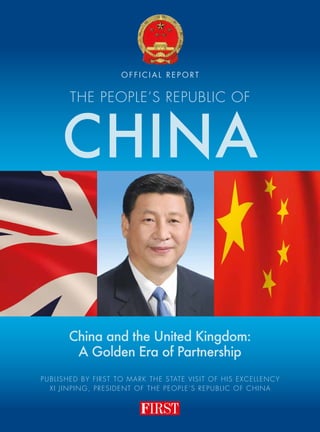
China and the United Kingdom:
A Golden Era of Partnership
THE PEOPLE’S REPUBLIC OF
CHINA
O F F I C I A L R E P O RT
PUBLISHED BY FIRST TO MARK THE STATE VISIT OF HIS EXCELLENCY
XI JINPING, PRESIDENT OF THE PEOPLE’S REPUBLIC OF CHINA
FIRST
© FIRST 2015
FIRST gratefully acknowledges the cooperation of the Ambassador and Staff of the Embassy of the People’s Republic of China in London
Published by FIRST, Victory House, 99-101 Regent Street, London W1B 4EZ
Tel: +44 20 7440 3500 Fax: +44 20 7440 3544 Email: publisher@firstmagazine.com Web: www.firstmagazine.com
Chairman and Founder Rupert Goodman dl
Chairman, Advisory Council Rt Hon Lord Hurd of Westwell ch cbe pc
Chief Operating Officer Eamonn Daly, Executive Publisher and Editor Alastair Harris
Non-Executive Directors Timothy Bunting, Hon Alexander Hambro, Chairman, Public Affairs Lord Cormack fsa dl
Regional Publisher Declan Hartnett, Head of Special Projects Waqäs Ahmed
Designer Jon Mark Deane Marketing Administrator Chris Cammack, PA – Chairman’s Office Hilary Winstanly
Research Assistant Anna Vexler, Editorial Consultant Jonathan Gregson, Design Consultant Stanley Glazer,
Senior Staff Writer Nicholas Lyne Award Advisory Panel Rt Hon Lord Woolf, Hon Philip Lader,
Lord Plant of Highfield, Chief Emeka Anyaoku gcvo tc cfr, Marilyn Carlson Nelson, Dr Daniel Vasella,
Rt Hon Lord Robertson of Port Ellen kt, gcmg, Ratan Tata, Howard Schultz and Philippa Foster Back cbe
Special Advisor, China, Lord Powell of Bayswater kcmg
Special Advisor, Russia Sir Andrew Wood gcmg, Special Advisor, Latin America Jacques Arnold dl,
Special Advisor, Global Issues Professor Victor Bulmer-Thomas cmg obe
FIRST is composed of the opinions and ideas of leading business and political figures. All information in this
publication is verified to the best of the authors’ and publishers’ ability, but no responsibility can be accepted
for loss arising from decisions based on this material. Where opinion is expressed, it is that of the authors.
PUBLISHED BY FIRST TO MARK THE STATE VISIT OF HIS EXCELLENCY
XI JINPING, PRESIDENT OF THE PEOPLE’S REPUBLIC OF CHINA
China and the United Kingdom:
A Golden Era of Partnership
THE PEOPLE’S REPUBLIC OF
CHINA
O F F I C I A L R E P O RT
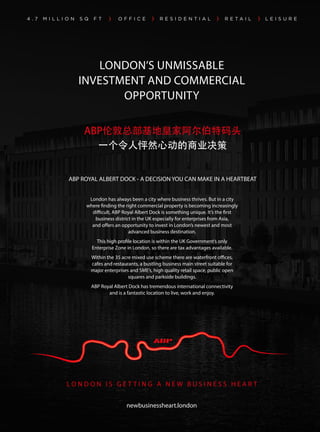
LONDON’S UNMISSABLE
INVESTMENT AND COMMERCIAL
OPPORTUNITY
L O N D O N I S G E T T I N G A N E W B U S I N E S S H E A R T
newbusinessheart.london
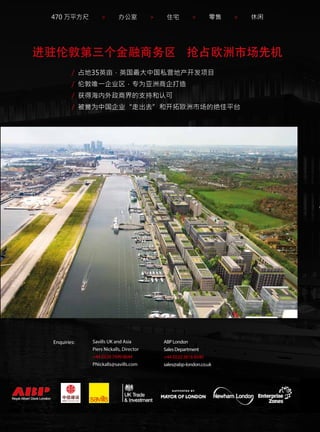
London has always been a city where business thrives. But in a city
where finding the right commercial property is becoming increasingly
difficult, ABP Royal Albert Dock is something unique. It’s the first
business district in the UK especially for enterprises from Asia,
and offers an opportunity to invest in London’s newest and most
advanced business destination.
This high profile location is within the UK Government’s only
Enterprise Zone in London, so there are tax advantages available.
Within the 35 acre mixed use scheme there are waterfront offices,
cafes and restaurants, a bustling business main street suitable for
major enterprises and SME’s, high quality retail space, public open
squares and parkside buildings.
ABP Royal Albert Dock has tremendous international connectivity
and is a fantastic location to live, work and enjoy.
ABP ROYAL ALBERT DOCK - A DECISION YOU CAN MAKE IN A HEARTBEAT
ABP伦敦总部基地皇家阿尔伯特码头
一个令人怦然心动的商业决策
470 万平方尺 > 办公室 > 住宅 > 零售 > 休闲
ABP London
Sales Department
+44 (0)20 3818 8540
sales@abp-london.co.uk
进驻伦敦第三个金融商务区 抢占欧洲市场先机
Enquiries: Savills UK and Asia
Piers Nickalls, Director
+44 (0)20 7499 8644
PNickalls@savills.com
/ 占地35英亩,英国最大中国私营地产开发项目
/ 伦敦唯一企业区,专为亚洲商企打造
/ 获得海内外政商界的支持和认可
/ 被誉为中国企业“走出去”和开拓欧洲市场的绝佳平台
www.chinachamber.org.uk
Golden Era of UK-China Relationship
中 英 关 系 黄 金 时 代
及全体会员 with all CCCUK members
CHINA CHAMBER OF COMMERCE IN THE UK
WELCOMEPRESIDENTXIJINPING
热烈欢迎习主席访英
英 国 中 国 商 会
China and the United Kingdom:
A Golden Era of Partnership
THE PEOPLE’S REPUBLIC OF
CHINA
O F F I C I A L R E P O RT
PUBLISHED BY FIRST TO MARK THE STATE VISIT OF HIS EXCELLENCY
XI JINPING, PRESIDENT OF THE PEOPLE’S REPUBLIC OF CHINA
OFC China 2015 v3.indd 2 15/10/2015 17:11
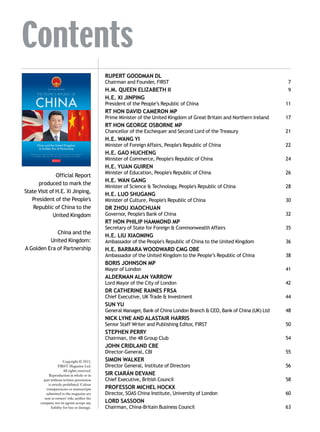
Contents
RUPERT GOODMAN DL
Chairman and Founder, FIRST	 7
H.M. QUEEN ELIZABETH II	 9
H.E. XI JINPING
President of the People’s Republic of China	 11
RT HON DAVID CAMERON MP
Prime Minister of the United Kingdom of Great Britain and Northern Ireland	 17
RT HON GEORGE OSBORNE MP
Chancellor of the Exchequer and Second Lord of the Treasury	 21
H.E. WANG YI
Minister of Foreign Affairs, People's Republic of China	 22
H.E. GAO HUCHENG
Minister of Commerce, People's Republic of China	 24
H.E. YUAN GUIREN
Minister of Education, People's Republic of China	 26
H.E. WAN GANG
Minister of Science & Technology, People's Republic of China	 28
H.E. LUO SHUGANG
Minister of Culture, People's Republic of China	 30
DR ZHOU XIAOCHUAN
Governor, People's Bank of China	 32
RT HON PHILIP HAMMOND MP
Secretary of State for Foreign & Commonwealth Affairs	 35
H.E. LIU XIAOMING
Ambassador of the People's Republic of China to the United Kingdom	 36
H.E. BARBARA WOODWARD CMG OBE
Ambassador of the United Kingdom to the People’s Republic of China	 38
BORIS JOHNSON MP
Mayor of London	 41
ALDERMAN ALAN YARROW
Lord Mayor of the City of London	 42
DR CATHERINE RAINES FRSA
Chief Executive, UK Trade & Investment	 44
SUN YU
General Manager, Bank of China London Branch & CEO, Bank of China (UK) Ltd	 48
NICK LYNE AND ALASTAIR HARRIS
Senior Staff Writer and Publishing Editor, FIRST	 50
STEPHEN PERRY
Chairman, the 48 Group Club	 54
JOHN CRIDLAND CBE
Director-General, CBI	 55
SIMON WALKER
Director General, Institute of Directors	 56
SIR CIARÁN DEVANE
Chief Executive, British Council	 58
PROFESSOR MICHEL HOCKX
Director, SOAS China Institute, University of London	 60
LORD SASSOON
Chairman, China-Britain Business Council	 63
Official Report
produced to mark the
State Visit of H.E. Xi Jinping,
President of the People's
Republic of China to the
United Kingdom
China and the
United Kingdom:
A Golden Era of Partnership
Copyright © 2015,
FIRST Magazine Ltd.
All rights reserved.
Reproduction in whole or in
part without written permission
is strictly prohibited. Colour
transparencies or manuscripts
submitted to the magazine are
sent at owners’ risk; neither the
company nor its agents accept any
liability for loss or damage.
FIRST
6
SPONSORED STATEMENT
HE YU
Chairman of the Board,
Professorship Senior
Engineer,
PhD of Management
Science,
Chairman General
Nuclear Power
Corporation
By HE YU
Chairman of the Board, China General Nuclear Power Corporation
CGN’s activerole in UK nuclearsector
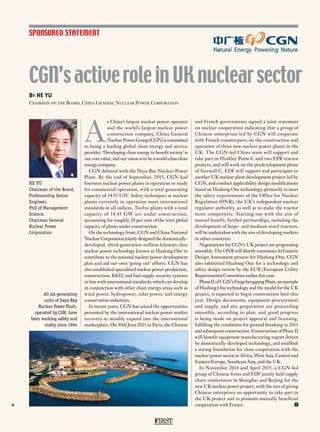
All six generating
units of Daya Bay
Nuclear Power Plant,
operated by CGN, have
been working safely and
stably since 1994
A
s China’s largest nuclear power operator
and the world’s largest nuclear power
construction company, China General
Nuclear Power Group (CGN) is committed
to being a leading global clean energy and service
provider. ‘Developing clean energy to benefit society’ is
our core value, and our vision is to be a world-class clean
energy company.
CGN debuted with the Daya Bay Nuclear Power
Plant. By the end of September, 2015, CGN had
fourteen nuclear power plants in operation or ready
for commercial operation, with a total generating
capacity of 14.92 GW. Safety techniques at nuclear
plants currently in operation meet international
standards in all indices. Twelve plants with a total
capacity of 14.45 GW are under construction,
accounting for roughly 20 per cent of the total global
capacity of plants under construction.
On the technology front, CGN and China National
Nuclear Corporation jointly designed the domestically-
developed, third-generation million-kilowatt class
nuclear power technology known as Hualong One to
contribute to the national nuclear power development
plan and aid our own ‘going out’ efforts. CGN has
also established specialised nuclear power production,
construction, R&D, and fuel supply security systems
in line with international standards, which can develop
in conjunction with other clean energy areas such as
wind power, hydropower, solar power, and energy
conservation industries.
In recent years, CGN has seized the opportunities
presented by the international nuclear power market
recovery to steadily expand into the international
marketplace. On 30th June 2015 in Paris, the Chinese
and French governments signed a joint statement
on nuclear cooperation indicating that a group of
Chinese enterprises led by CGN will cooperate
with French counterparts on the construction and
operation of three new nuclear power plants in the
UK. The CGN-led China team will support and
take part in Hinkley Point C and two EPR reactor
projects, and will work on the predevelopment phase
of Sizewell C. EDF will support and participate in
another UK nuclear plant development project led by
CGN, and conduct applicability design modifications
based on Hualong One technology, primarily to meet
the safety requirements of the Office for Nuclear
Regulation (ONR), the UK’s independent nuclear
regulator authority, as well as to make the reactor
more competitive. Starting out with the aim of
mutual benefit, further partnerships, including the
development of large- and medium-sized reactors,
will be undertaken with the aim of developing markets
in other countries.
Negotiations for CGN’s UK project are progressing
smoothly. The ONR will shortly commence its Generic
Design Assessment process for Hualong One; CGN
also submitted Hualong One for a technology and
safety design review by the EUR (European Utility
Requirements) Committee earlier this year.
Phase II of CGN’s Fangchenggang Plant, an example
of Hualong One technology and the model for the UK
project, is expected to begin construction later this
year. Design documents, equipment procurement
and supply, and site preparation are proceeding
smoothly, according to plan, and good progress
is being made on project approval and licensing,
fulfilling the conditions for ground breaking in 2015
and subsequent construction. Construction of Phase II
will benefit equipment manufacturing export driven
by domestically-developed technology, and establish
a strong foundation for close cooperation with the
nuclear power sector in Africa, West Asia, Central and
Eastern Europe, Southeast Asia, and the UK.
In November 2014 and April 2015, a CGN-led
group of Chinese firms and EDF jointly held supply
chain conferences in Shanghai and Beijing for the
new UK nuclear power project, with the aim of giving
Chinese enterprises an opportunity to take part in
the UK project and to promote mutually beneficial
cooperation with France. F
Foreword by
Rupert Goodman dl
Chairman and Founder
FIRST
I
t gives me great pleasure to introduce
this Official Report on China to
mark the State Visit of President
Xi Jinping to the United Kingdom.
Lord Hurd and I are especially grateful to
His Excellency Liu Xiaoming, the Chinese
Ambassador, and his staff for all their help
and guidance in the preparation of this
report. We are also very grateful to the
Prime Minister, David Cameron and the
President, Xi Jinping, for contributing
such important and personal messages to
this Official Report.
The strength of the United Kingdom’s
strategic partnership with the People’s
Republic of China has also been underlined
by the successful visits of the Prime
Minister, Chancellor George Osborne,
the Foreign Secretary and the Mayor of
London, Boris Johnson. The Duke of
Cambridge made an important visit earlier
this year and Lord Maude, the Trade
Minister, has just returned from China.
The President’s State Visit to the
United Kingdom, with its full schedule,
is particularly timely and will help focus
the attention of business leaders and
policy makers on the many investment
opportunities that exist in China.
China is the world’s second largest
economy, its biggest exporter and the
second largest importer of goods and
services, accounting for around 10 per
cent of total world trade. Despite global
economic turbulence, China’s expansion
record continues with a GDP growth
rate of 6.7 per cent predicted for 2016.
Expanding our international trade and
investment links with China is playing
an important role in the government’s
economic and financial strategy.
The growth in trade and investment
between the United Kingdom and China
has been impressive; last year UK exports
to China were over £12.5 billion and
China was the UK’s 6th largest goods
export market. The UK also attracted
some US$12 billion of Chinese foreign
direct investment in 2014 – more than
France and Germany combined. London
accounts for two thirds of offshore
renminbi payments outside mainland
China and Hong Kong.
China’s growth and development
provides important opportunities for
further strengthening the bilateral
business relationship. The United
Kingdom’s high technology and research-
based industries will find opportunities to
co-operate further with Chinese partners.
Britain’s financial and banking services,
as well as the retail and creative sectors,
will identify enormous opportunities
as China’s consumers increase their
purchasing power. Both countries also
share the desire to move to low-carbon,
sustainable economies. To Chinese
business leaders the United Kingdom
represents an ideal gateway to Europe for
Chinese exports and investment.
The United Kingdom-China strategic
partnership also covers significant co-
operation in education – over 130,000
Chinese students study in Britain and an
increasing number of British students are
attending courses in China. These links in
education are paving the way for greater
cultural and scientific exchange, to both
nations’ mutual benefit.
The State Visit of President Xi Jinping
to the United Kingdom, while providing
an opportunity for private discussions,
will give us all an opportunity to study
the important developments in China
and to weigh carefully the opportunities
for our countries to work together even
more closely.
We at FIRST are delighted to have
been asked to produce this official
publication to mark the State Visit and
hope that it contributes, in a small way, to
its success and the further development
of the bilateral relationship, especially in
trade and investment.  F 07
CHINA
FIRST
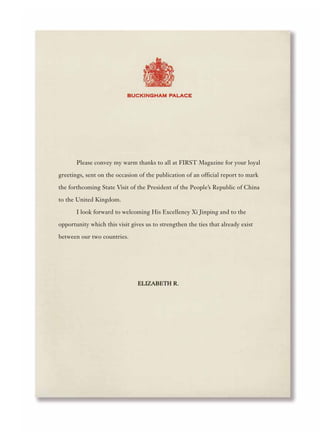
Please convey my warm thanks to all at FIRST Magazine for your loyal
greetings, sent on the occasion of the publication of an official report to mark
the forthcoming State Visit of the President of the People’s Republic of China
to the United Kingdom.
I look forward to welcoming His Excellency Xi Jinping and to the
opportunity which this visit gives us to strengthen the ties that already exist
between our two countries.
FIRST
11
CHINA
Message from
His Excellency Xi Jinping,
President of The People’s Republic of China
O
n the occasion of my State Visit to the
United Kingdom, I would like to extend
my sincere greetings and best wishes to the
British Government and the British people
through FIRST Magazine.
The Chinese and the British are both great peoples. We
have long histories and outstanding cultures, and we share
a determined pursuit of new developments and progress
in accordance with the times. Despite the geographical
distance between China and the UK, our peoples feel
close as each is drawn to the other’s literature and arts,
and science and technology. Since the establishment of
the comprehensive strategic partnership between our
countries in 2004, substantial progress has been made in
bilateral relations, with remarkable achievements in all
the areas of cooperation, including economy and trade,
education, science and technology, culture, climate change,
and energy. China is willing to work with the UK to foster
new growth points and to provide new impetus that will
facilitate the common development of our two countries
and deepen our comprehensive strategic partnership.
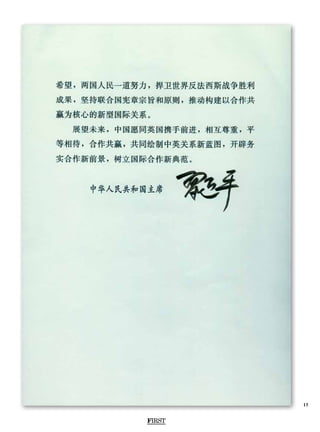
This year marks the 70th anniversary of the World
Anti-fascist War and the founding of the United
Nations. China and the UK have each held a series
of commemorative events. Seventy years ago, our
two countries joined in the building of the post-war
international order based on the UN Charter, and we
have since worked together to maintain that order.
It is my hope that the Chinese and British peoples
will carry on our joint efforts in defense of the fruits
of the victory in the World Anti-fascist War, that we
will uphold the purposes and principles of the UN
Charter, and that we will promote the building of a
new type of international relations based on win-win
cooperation.
Looking to the future, China wishes to join hands
with the UK as we press forward in a spirit of mutual
respect and equality and as we pool our efforts in
the drive for mutually beneficial results. Let us work
together to open a new chapter in China-UK relations,
to create new prospects for productive cooperation, and
to build a new model of state-to-state relations. F
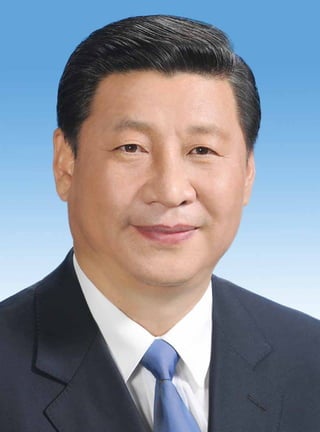
His Excellency Xi Jinping,
President of The People’s Republic of China
Quote here	 F
COUNTRY
FIRST
13
FIRST
15
FIRST
17
CHINA
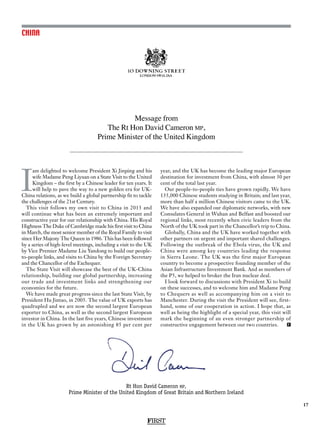
Message from
The Rt Hon David Cameron mp,
Prime Minister of the United Kingdom
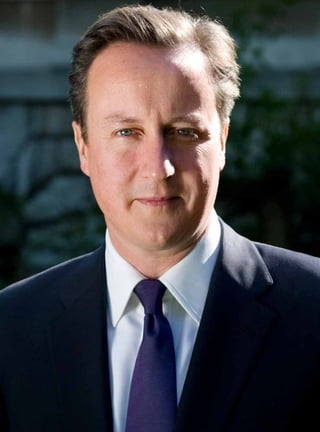
Rt Hon David Cameron mp,
Prime Minister of the United Kingdom of Great Britain and Northern Ireland
I
am delighted to welcome President Xi Jinping and his
wife Madame Peng Liyuan on a State Visit to the United
Kingdom – the first by a Chinese leader for ten years. It
will help to pave the way to a new golden era for UK-
China relations, as we build a global partnership fit to tackle
the challenges of the 21st Century.
This visit follows my own visit to China in 2013 and
will continue what has been an extremely important and
constructive year for our relationship with China. His Royal
Highness The Duke of Cambridge made his first visit to China
in March, the most senior member of the Royal Family to visit
since Her Majesty The Queen in 1986. This has been followed
by a series of high-level meetings, including a visit to the UK
by Vice Premier Madame Liu Yandong to build our people-
to-people links, and visits to China by the Foreign Secretary
and the Chancellor of the Exchequer.
The State Visit will showcase the best of the UK-China
relationship, building our global partnership, increasing
our trade and investment links and strengthening our
economies for the future.
We have made great progress since the last State Visit, by
President Hu Jintao, in 2005. The value of UK exports has
quadrupled and we are now the second largest European
exporter to China, as well as the second largest European
investor in China. In the last five years, Chinese investment
in the UK has grown by an astonishing 85 per cent per
year, and the UK has become the leading major European
destination for investment from China, with almost 30 per
cent of the total last year.
Our people-to-people ties have grown rapidly. We have
135,000 Chinese students studying in Britain; and last year,
more than half a million Chinese visitors came to the UK.
We have also expanded our diplomatic networks, with new
Consulates General in Wuhan and Belfast and boosted our
regional links, most recently when civic leaders from the
North of the UK took part in the Chancellor’s trip to China.
Globally, China and the UK have worked together with
other partners on urgent and important shared challenges.
Following the outbreak of the Ebola virus, the UK and
China were among key countries leading the response
in Sierra Leone. The UK was the first major European
country to become a prospective founding member of the
Asian Infrastructure Investment Bank. And as members of
the P5, we helped to broker the Iran nuclear deal.
I look forward to discussions with President Xi to build
on these successes, and to welcome him and Madame Peng
to Chequers as well as accompanying him on a visit to
Manchester. During the visit the President will see, first-
hand, some of our cooperation in action. I hope that, as
well as being the highlight of a special year, this visit will
mark the beginning of an even stronger partnership of
constructive engagement between our two countries. F
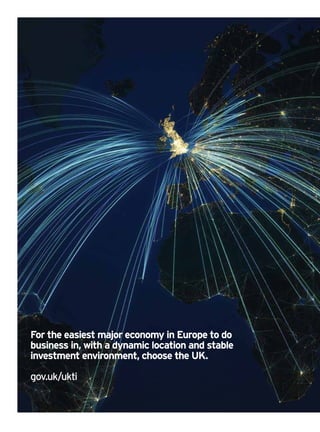
For the easiest major economy in Europe to do
business in, with a dynamic location and stable
investment environment, choose the UK.
gov.uk/ukti
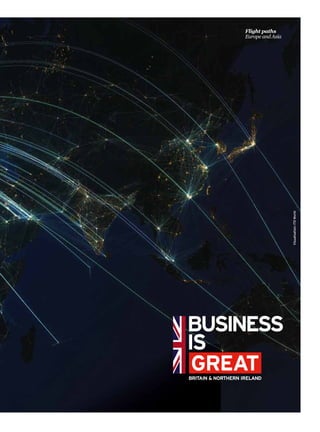
Visualisation:ITOWorld
Flight paths
Europe and Asia
Message from
The Rt Hon George Osborne mp,
Chancellor of the Exchequer and Second Lord of the Treasury
21
FIRST
CHINA
FIRST
T
his year is set to mark the start of a truly
golden age in UK-China relations. The
recent annual Economic and Financial
Dialogue was a real success, making
considerable progress on a number of high priority
issues across trade, investment and financial services.
I am confident that, as the Queen and Prime Minister
welcome President Xi and Madame Peng to the UK for
this historic State Visit, our two nations will take another
big step forward together.
The UK and China are clear natural partners for
growth, and continued collaboration and engagement
is good for both countries. As China continues to grow
and implement its ambitious reform plans to rebalance
its economy, British businesses become increasingly well
placed to provide the products and services that China
wants to consume. As the world’s global financial centre,
Britain can support China’s important financial reforms.
And we both gain from a vibrant and open exchange of
ideas, science, culture and people.
We also make excellent partners in building the
economies of the future: Chinese companies have already
invested in the Northern Powerhouse and we welcome
others to do the same, while our early membership of
the Asian Infrastructure Investment Bank is an important
example of the UK’s commitment to supporting
President Xi’s One Belt One Road initiative – a modern-
day Silk Road to transform connectivity from China,
across Asia to Europe.
By maintaining a high level of ambition on both sides,
I am confident that this will be a golden era for the UK-
China relationship for many years to come. F
Rt Hon George Osborne mp
Chancellor of the Exchequer and
Second Lord of the Treasury
FIRST
22
CHINA
T
his year is a significant one in the
global endeavour to enhance world
peace and development, and both
China and the UK play an important
role in driving this process.
First, this year marks the 70th anniversary of the
victory of the World Anti-Fascist War, an occasion
solemnly commemorated by China, the UK and
many other countries around the world in various
forms. An important lesson history teaches us is that
the arbitrary use of force and seeking domination
through raw power is no recipe for peace, and that
the logic of winner-takes-all and zero-sum game can
only block the development of human society. As our
world moves faster towards multi-polarity, economic
globalisation, cultural diversity and an information
society, countries are becoming increasingly
interdependent, and their interests are intertwined as
never before. We share a growing stake in each others’
wellbeing. Only peaceful development and win-win
cooperation is the right path we should pursue.
Second, this year also marks the 70th anniversary
of the founding of the United Nations. Last month,
world leaders gathered in New York to draw a
blueprint for creating a better future for mankind.
Chinese President Xi Jinping articulated China’s
vision of a new type of international relations. He
called for the pursuit of a five-pronged strategy
to build a community of shared future – namely,
forging partnerships in which countries treat each
other as equals, engage in mutual consultation
and show mutual understanding; jointly creating
a security architecture of equity and justice that
benefits all; promoting open, innovative, inclusive
and win-win development; increasing cultural
exchanges to promote harmony, inclusiveness and
respect for differences; and building an ecosystem
that puts nature and green development first. This
comprehensive proposition lays out a new vision for
the development of international relations.
Third, in building a new type of international
relations, China and the UK have every reason to
become good partners in cooperation. Both countries
have important influence in the world and are
permanent members of the UN Security Council. We
share similar views on many international and regional
issues, and our respective interests are converging.
The upcoming State Visit by President Xi Jinping
By H.E. WANG YI
Minister of Foreign Affairs, People’s Republic of China
Enhancing practical cooperation
WANG YI
holds a Master’s degree
in Economics. He has
worked as Assistant
Minister of Foreign
Affairs (1998-2001),
Vice Minister of Foreign
Affairs (2001-04),
Ambassador
Extraordinary and
Plenipotentiary of the
People’s Republic of
China to Japan (2004-
07) and Minister of
Taiwan Affairs in the
Office of the State
Council (2008-13).
He assumed his
current position as
Minister of Foreign
Affairs in 2013.
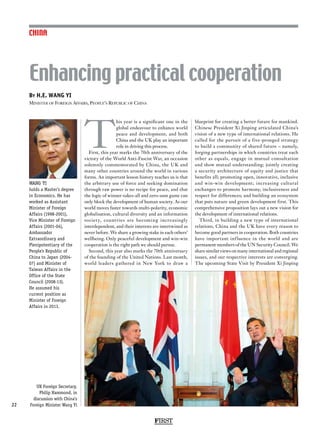
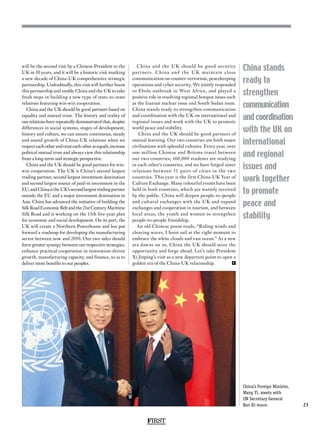
UK Foreign Secretary,
Philip Hammond, in
discussion with China’s
Foreign Minister Wang Yi
FIRST
23
China stands
ready to
strengthen
communication
and coordination
with the UK on
international
and regional
issues and
work together
to promote
peace and
stability
will be the second visit by a Chinese President to the
UK in 10 years, and it will be a historic visit marking
a new decade of China-UK comprehensive strategic
partnership. Undoubtedly, this visit will further boost
this partnership and enable China and the UK to take
fresh steps in building a new type of state-to-state
relations featuring win-win cooperation.
China and the UK should be good partners based on
equality and mutual trust. The history and reality of
our relations have repeatedly demonstrated that, despite
differences in social systems, stages of development,
history and culture, we can ensure continuous, steady
and sound growth of China-UK relations when we
respecteachotherandtreateachotherasequals,increase
political mutual trust and always view this relationship
from a long-term and strategic perspective.
China and the UK should be good partners for win-
win cooperation. The UK is China’s second largest
trading partner, second largest investment destination
and second largest source of paid-in investment in the
EU,andChinaistheUK’ssecondlargesttradingpartner
outside the EU and a major investment destination in
Asia. China has advanced the initiative of building the
SilkRoadEconomicBeltandthe21stCenturyMaritime
Silk Road and is working on the 13th five-year plan
for economic and social development. On its part, the
UK will create a Northern Powerhouse and has put
forward a roadmap for developing the manufacturing
sector between now and 2050. Our two sides should
form greater synergy between our respective strategies,
enhance practical cooperation in innovation-driven
growth, manufacturing capacity, and finance, so as to
deliver more benefits to our peoples.
China and the UK should be good security
partners. China and the UK maintain close
communication on counter-terrorism, peacekeeping
operations and cyber security. We jointly responded
to Ebola outbreak in West Africa, and played a
positive role in resolving regional hotspot issues such
as the Iranian nuclear issue and South Sudan issue.
China stands ready to strengthen communication
and coordination with the UK on international and
regional issues and work with the UK to promote
world peace and stability.
China and the UK should be good partners of
mutual learning. Our two countries are both major
civilisations with splendid cultures. Every year, over
one million Chinese and Britons travel between
our two countries; 160,000 students are studying
in each other’s countries, and we have forged sister
relations between 51 pairs of cities in the two
countries. This year is the first China-UK Year of
Culture Exchange. Many colourful events have been
held in both countries, which are warmly received
by the public. China will deepen people-to-people
and cultural exchanges with the UK and expand
exchanges and cooperation in tourism, and between
local areas, the youth and women to strengthen
people-to-people friendship.
An old Chinese poem reads, “Riding winds and
cleaving waves, I hoist sail at the right moment to
embrace the white clouds and vast ocean.” As a new
era dawns on us, China the UK should seize the
opportunity and forge ahead. Let’s take President
Xi Jinping’s visit as a new departure point to open a
golden era of the China-UK relationship. F
China’s Foreign Minister,
Wang Yi, meets with
UN Secretary General
Ban Ki-moon
FIRST
24
CHINA
I
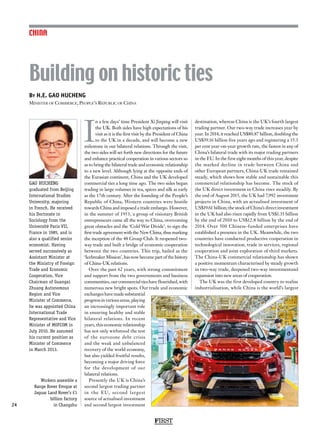
n a few days’ time President Xi Jinping will visit
the UK. Both sides have high expectations of his
visit as it is the first visit by the President of China
to the UK in a decade, and will become a new
milestone in our bilateral relations. Through the visit,
the two sides will set forth new directions for the future
and enhance practical cooperation in various sectors so
as to bring the bilateral trade and economic relationship
to a new level. Although lying at the opposite ends of
the Eurasian continent, China and the UK developed
commercial ties a long time ago. The two sides began
trading in large volumes in tea, spices and silk as early
as the 17th century. After the founding of the People’s
Republic of China, Western countries were hostile
towards China and imposed a trade embargo. However,
in the summer of 1953, a group of visionary British
entrepreneurs came all the way to China, overcoming
great obstacles and the ‘Cold War Divide’, to sign the
first trade agreement with the New China, thus marking
the inception of the 48 Group Club. It reopened two-
way trade and built a bridge of economic cooperation
between the two countries. This trip, hailed as the
‘Icebreaker Mission’, has now become part of the history
of China-UK relations.
Over the past 62 years, with strong commitment
and support from the two governments and business
communities, our commercial ties have flourished, with
numerous new bright spots. Our trade and economic
exchanges have made substantial
progress in various areas, playing
an increasingly important role
in ensuring healthy and stable
bilateral relations. In recent
years, this economic relationship
has not only withstood the test
of the eurozone debt crisis
and the weak and unbalanced
recovery of the world economy,
but also yielded fruitful results,
becoming a major driving force
for the development of our
bilateral relations.
Presently the UK is China’s
second largest trading partner
in the EU, second largest
source of actualised investment
and second largest investment
destination, whereas China is the UK’s fourth largest
trading partner. Our two-way trade increases year by
year. In 2014, it reached US$80.87 billion, doubling the
US$39.16 billion five years ago and registering a 15.3
per cent year-on-year growth rate, the fastest in any of
China’s bilateral trade with its major trading partners
in the EU. In the first eight months of this year, despite
the marked decline in trade between China and
other European partners, China-UK trade remained
steady, which shows how stable and sustainable this
commercial relationship has become. The stock of
the UK direct investment in China rises steadily. By
the end of August 2015, the UK had 7,992 investment
projects in China, with an actualised investment of
US$19.61 billion; the stock of China’s direct investment
in the UK had also risen rapidly from US$1.35 billion
by the end of 2010 to US$12.8 billion by the end of
2014. Over 500 Chinese-funded enterprises have
established a presence in the UK. Meanwhile, the two
countries have conducted productive cooperation in
technological innovation, trade in services, regional
cooperation and joint exploration of third markets.
The China-UK commercial relationship has shown
a positive momentum characterised by steady growth
in two-way trade, deepened two-way investmentand
expansion into new areas of cooperation.
The UK was the first developed country to realise
industrialisation, while China is the world’s largest
By H.E. GAO HUCHENG
Minister of Commerce, People’s Republic of China
Building on historic ties
GAO HUCHENG
graduated from Beijing
International Studies
University, majoring
in French. He received
his Doctorate in
Sociology from the
Université Paris VII,
France in 1985, and is
also a qualified senior
economist. Having
served successively as
Assistant Minister at
the Ministry of Foreign
Trade and Economic
Cooperation, Vice
Chairman of Guangxi
Zhuang Autonomous
Region and Vice
Minister of Commerce,
he was appointed China
International Trade
Representative and Vice
Minister of MOFCOM in
July 2010. He assumed
his current position as
Minister of Commerce
in March 2013.
Workers assemble a
Range Rover Evoque at
Jaguar Land Rover’s £1
billion factory
in Changshu
FIRST
25
The
‘Icebreaker
Mission’
62 years
ago created
a close
connection
between
China and the
UK through
trade and
economic
cooperation
developing country. China and the UK share strong
economic complementarity, compatible cooperation
philosophies and enormous cooperation potential.
At present, China is drafting its 13th Five-Year Plan
for Economic and Social Development, with a focus
on a new round of opening up at a higher level, and
establishing a new, open economic system in an
expeditious way. The UK, always a champion of free
trade, has a highly open market and is committed
to promoting sustained economic growth. China’s
Belt and Road Initiative, the Asian Infrastructure
Investment Bank (AIIB), which the UK joined as a
founding member, and the Northern Powerhouse
Plan in England will all create more opportunities for
cooperation between enterprises of the two countries.
To seize this historic opportunity, further
promote bilateral trade ties and realise win-win
cooperation based on the complementarity between
our two business communities, the two sides need to
strengthen cooperation in the following areas:
1. Fully tap into the trade potential of the two countries.
We shall encourage Chinese export of high value-added
products to the UK, leverage Britain’s advantages in
high-end manufacturing, high technology and RD,
and identify new growth areas in trade in goods. In
the meantime, both sides should further promote
cooperation in trade in services such as technological
innovation, e-commerce, financial and legal services,
medicine and health, and creative industries, so that
trade in goods and services can grow at the same pace.
2. Deepen cooperation in investment and big projects.
The Belt and Road Initiative and the establishment
of the AIIB will further spur business cooperation in
infrastructure. Beginning with high-speed railway
and nuclear projects, the two sides should step up
cooperation in emerging industries such as life
sciences, satellite applications, new energies, new-
energy automobile and information technology,
and focus on accomplishing some demonstrative
landmark projects, so as to deepen cooperation in
two-way investment.
3. Strengthen cooperation between regional governments
and in third markets. The two governments should
establish a long-term mechanism for regional
cooperation and explore chances for business
cooperation in the Northern Powerhouse initiative.
Also, we need to combine China’s advantage in
equipment manufacturing and financing with
Britain’s advantage in innovation, management and
financial services, so as to boost cooperation between
our businesses in third countries and open up new
space for commercial cooperation.
4. Create a better environment for trade and
investment. I hope that the UK can continue to be
a proponent within the EU of high-tech exports to
China, an early conclusion of the China-EU bilateral
investment agreement and the early launching of a
joint feasibility study into a China-EU FTA, so as to
achieve sustainable growth in trade and investment.
The ‘Icebreaker Mission’ 62 years ago created a close
connection between China and the UK through trade
and economic cooperation. Six decades on, the two
countries have forged an all-dimensional, wide-ranging
and multi-tiered commercial relationship. As an ancient
Chinese poem goes, “When you hoist the sails to cross
the sea, you will ride the winds and cleave the waves.” I
hopethattheentrepreneursfromthetwocountriescould
carry forward the “Icebreaker Spirit”, and in today’s
world where profound changes are taking place on the
economic landscape, that they join hands to advance
together, reap the dividends that arise from China’s
continuedreformandopeningupandBritain’ssustained
economic recovery, and jointly embrace a “Golden Era”
in China-UK trade and economic relations. F
Huawei Technologies’
UK headquarters near
Reading: the company
is at the forefront of
Chinese investment in
the United Kingdom
FIRST
26
CHINA
T
he State Visit by the Chinese President Xi
JinpingtotheUKisanimportantmilestone
in our bilateral relations and has historical
significance on their future development.
Both China and the UK enjoy long histories
and splendid culture and are committed to the
development of their countries and the wellbeing of its
people. Since 2004 when the two countries established
comprehensive strategic partnership, cooperation
in all fields and at all levels has been continuously
expanded and strengthened. As an important
component of China-UK people-to-people exchange
and bilateral relations, our educational cooperation
currently covers a wide range from basic education
to higher education, of various forms and at various
levels. Remarkable achievements made from such
cooperation have extensive and positive influence
among the public and plays a vital role in promoting
China-UK relations.
Firstly, student mobility has been continuously
enlarged. Chinese students take the UK as an
important destination for overseas study while coming
to study in China is also an increasing trend in the
UK. The Chinese government plays an active role in
promoting student mobility and increasing Chinese
Government Scholarship every year. In 2014, China
announced the decision to send 10 thousand students
to study in the UK for the coming 5 years. In the single
year of 2014, China sent 2400 students and scholars
to the UK and received 224 students from the UK,
all sponsored by Chinese Government Scholarship.
By the end of 2014, Chinese students in the UK have
exceeded 150 thousand. To encourage studying in
China, the UK government has decided to support
80 thousand students to study or work as interns in
China from 2013 through 2020 with the launching
of “Generation UK”. The number of UK students
studying in China has reached over 6 thousand for the
year of 2014, showing quite considerable growth. The
two countries will continue to encourage and support
young people to study in the other country which not
only benefits their own personal development, but
also injects continuous momentum to the long-term
development of China-UK relations.
Secondly, cooperation programmes have been
effectively implemented. In basic education, secondary
school students in Shanghai scored high
in their first trial in PISA and hence
drew global attention to China’s basic
education. China and the UK then decided
to select and exchange maths teachers
from Shanghai and the UK since 2014.
In vocational education, the Shadowing
Programme provides access for principals
of secondary vocational schools to go
to sister schools and gain first-hand
experience by working side-by-side with
their counterparts. The pilot of the UK’s
modern apprenticeship programme and
cooperation in developing curricula are
also going on to enrich the whole range
of vocational education cooperation. In
higher education, the two sides support
the training of high-calibre talents
and cooperation in scientific research
by implementing the China-UK PhD
Candidates Partnership Programme.
The China Scholarship Council has also
initiated joint scholarships with leading
UK universities including Russell Group
By H.E. YUAN GUIREN
Minister of Education, People’s Republic of China
A deeper understanding
YUAN GUIREN
graduated from Beijing
Normal University
(BNU), majoring in
Philosophy. Over the
course of his career,
he has held a number
of senior positions
including Executive
Vice President of BNU,
Assistant Mayor of
Beijing, Director-General
of the Beijing Municipal
Education Commission,
and President of BNU.
He was appointed Vice
Minister of Education
in 2001 and assumed
his current position as
Minister of Education
in 2009.
HRH The Duke of
Cambridge opens the
Dickson Poon University
of Oxford China Centre
in September 2014
FIRST
27
China has
the largest
number of
English
learners and
UK has the
largest
number of
Confucius
Institutes and
Confucius
Classrooms
in Europe
members to send excellent Chinese students to study
in the best UK Universities.
China-UK cooperation in joint schools started early
and progressed smoothly. The Ningbo-Nottingham
University set up in 2004 and Xi’an Jiaotong-
Liverpool University established in 2006 are among
the first batches of joint schools approved by the
Chinese Ministry of Education and have now become
successful examples in this field. By the end of August
2015, 17 China-UK jointly run education institutions
and 240 joint programmes have been established
in China. Meanwhile, Chinese universities are
accelerating their pace of internationalisation. This
September, the Chinese Language School of Beijing
Normal University-Cardiff University was formally
established. It represents a positive exploration by
Chinese higher education institutions in setting up
joint education programmes and schools in developed
countries, and also another highlight in China-UK
educational cooperation.
Thirdly, collaboration in language teaching and
learning has been closer and deepening. Language is
a carrier for culture and means for exchange. China
has the largest number of English learners and UK
has the largest number of Confucius Institutes and
Confucius Classrooms in Europe. Both countries
attach great importance to the collaboration in
language learning and teaching. The UK government
has been determined to substantially increase the
number of learners of the Chinese language and also
to improve the learning quality. The Headquarter
of Confucius Institutes in China will also continue
to support the Confucius Institutes and Confucius
Classrooms in the UK.
Fourthly, policy exchange has been conducted on a
regular basis. Since 2004, the Ministries of Education
of both countries established a regular dialogue at
ministerial level (i.e. Education Summit). Every year,
both sides hold meetings to have in-depth exchange
on the latest developments in each others’ educational
reforms,andjointlydecidetheannualcooperativeplanto
provide guidance in promoting China-UK educational
collaboration. In 2012, the China-UK High-Level
People-to-People Dialogue was formally established.
The Education Summit, as the thematic dialogue under
this People-to-People Dialogue framework, enriches
the content of the Dialogue and hence facilitates the
People-to-Peopleexchangeofthetwocountries.During
the 3rd meeting of this People-to-People Dialogue and
Education Summit in 2015, 24 agreements and MoUs
were signed in the field of education.
As an old Chinese expression goes, “amity between
people holds the key to sound relations between the
states and can be achieved through their connection
of hearts and minds”. On the new historical turning
point, exchange and collaboration in education will
have a wider space and more promising future than
ever. The Chinese Ministry of Education is willing to
join hands with the UK to further expand and deepen
existing cooperation, promote understanding and
friendship between young people, and push forward
win-win cooperation in education so as to make
contribution to the development of the China-UK
strategic partnership. F
A teacher from Clover
Hill Community
Primary School in
Newcastle-Upon-Tyne
visits a school in China
while working for the
British Council
FIRST
28
By H.E. WAN GANG
Minister of Science  Technology, People’s Republic of China
Partners in innovation
CHINA
WAN GANG
holds a PhD in
engineering. He is
Vice Chairman of the
12th Chinese People’s
Political Consultative
Conference (CPPCC),
Chairman of China
Zhi Gong Party, and
Minister of Science and
Technology. Over the
course of his career,
Professor Wan also
worked for the German
automotive company
Audi (1991-2001), and
as President of Tongji
University in China.
He was appointed as
Minister of Science and
Technology in April 2007.
C
hina President Xi Jinping will pay a State
Visit to the UK in the beautiful autumn
season of 2015, opening a golden age in the
bilateral relationship and a new chapter of
cooperation in science, technology and innovation (STI).
Both China and the UK highlight the importance of
the cooperation. The Intergovernmental Agreement
on Scientific and Technological Cooperation was
signed in 1978. Over the past 37 years, under the
joint efforts of the science communities, including
universities and research institutes, the two sides have
expanded mechanisms and innovated modalities of
collaboration, leading to fruitful outcomes for both.
The two sides have been continuously expanding
cooperation mechanisms, forming multi-tiered STI
platforms. Under the framework of China-UK High-
Level People-to-People Dialogue, steady progress has
been made in implementing the China-UK Research
and Innovation Partnership Fund, promoting
joint research and personnel exchanges. Another
example is the China-UK Economic and Financial
Dialogue, which has continuously strengthened
the collaboration in innovation and its application.
Since 1998, the two sides have held regular joint
commission meetings, pushing forward the STI
cooperation. All these high-level mechanisms have
not only driven the bilateral relationship in science
and technology, but also facilitated interaction among
scientists and engineers.
The two sides have been exploring new means of
cooperation and implementing the China-UK Research
and Innovation Partnership Fund. In December, 2013,
Prime Minister David Cameron visited China, jointly
announcing the establishment of the Fund with Premier
Li Keqiang. The Fund is a new model and a milestone
in bilateral STI collaboration. Over the past year
and more, the Fund has played an active role in basic
research, innovation cooperation, talent development
and regional innovation. This September, when China’s
Vice Premier Liu Yandong visited the UK, the two
sides signed an MoU on the UK-China Research and
Innovation Bridges Programme. This Programme will
give priority to strengthening ties among universities,
research institutes and enterprises.
Blue sky thinking:
China Museum
of Science and
Technology in Beijing
FIRST
29
President
Xi’s visit will
inject new
impetus in
to China-UK
innovation
cooperation
and open
up new
opportunities
for STI
development
In recent years, under the China-UK comprehensive
strategic partnership, Chinese and British universities,
research institutes, and hi-tech enterprises have been
very keen on innovation cooperation and made
outstanding achievements. For example, China
Railway Rolling Stock Corporation (CRRC) and its
British partner will jointly set up a China-UK Rail
Transit Technology RD Centre. At the same time
Huawei and the University of Surrey are collaborating
in 5G technology development. All these have helped
boost innovation cooperation in priority areas.
During President Xi’s visit to the UK, the two
sides will confirm cooperation items in antimicrobial
resistance, rail transit technology, climate change
and low-carbon technology, aeronautics, SKA,
astronomy and high-performance computing, and
agreed to strengthen cooperation among enterprises,
universities and research institutes with a focus on
technology application.
So far, win-win cooperation has become the major
theme of China-UK STI development. In the future,
China-UK STI cooperation is bound to enter a fast
track of development.
At present, boosting science, technology and
innovation has become an important approach to
enhancing economic competitiveness. The two sides
should seize opportunities to deepen STI cooperation
and build innovation partnership, which encompasses
the following aspects:
1. Highlighting China-UK cooperation and dialogue
in innovation areas. The two sides will prepare for
the establishment of a regular high-level innovation
cooperation dialogue on innovation strategy,
translation of research findings, ST policies, IPR,
health, agriculture and aerospace, and strive to build it
into an important platform for innovation cooperation.
2. Establishing China-UK joint labs or joint research
centers. On the basis of fruitful STI cooperation in
multiple areas, we can build a number of excellent
joint labs and research centres, so as to conduct
collaborative research in fundamental and strategic
areas of common interest.
3. Boosting China-UK technology and industrial
capacity cooperation. The United Kingdom is a science
powerhouse with solid research strengths, while
China is a big manufacturing country with an urgent
need for stable growth, economic restructuring and a
transformation of its development model. With high
complementarity in technology industrialisation,
the two countries should work together to explore
more efficient mechanisms of cooperation, facilitate
translation of research findings and boost industrial
capacity through ST cooperation.
4. Strengthening exchanges and cooperation between
China and UK science parks. Having accumulated
successful experience in science park development,
the two sides have great potential to work together
to facilitate ST innovation and entrepreneurship
activities.
I believe that President Xi’s visit will inject new
impetus in to China-UK innovation cooperation and
open up new opportunities for STI development. F
Here be dragons:
Shanghai’s Science and
Technology Museum
FIRST
30
CHINA
T
he year 2015 has witnessed extraordinary
progress in China-UK cultural relations,
and it ushers in the second decade of the
comprehensive strategic partnership
between the two countries. This year, the State Visit of
Chinese President Xi Jinping to the UK is also expected
to mark a new milestone for China-UK relations.
China and the UK are significant representatives
of the Eastern and Western civilisations, each
boasting a time-honoured history, splendid culture,
and remarkable contributions to the intellectual
endeavours of mankind. For a long period of time in
history, China and the UK have served as important
gateways for exchange and communication between
the East and the West.
The key to sound relations between nations lies in the
amity between their peoples. Intercultural dialogues
are essential for deepening mutual understanding and
recognition between the Chinese and British peoples.
Since the establishment of China-UK diplomatic
relations in 1972, the two countries have enjoyed a
sound and dynamic cultural relationship featuring
frequent exchange and cooperation. Collaborative
mechanisms have been constantly upgraded to expand
thecoverageandenrichthecontentofculturalexchange
programmes. Today, culture has become an important
pillar of the comprehensive China-UK relations.
Following the agreement on cultural cooperation
signed by the Chinese and British governments in
1979, executive programmes on cultural exchange
have been signed between the two sides on a regular
basis since 1984. In 2012, culture was identified as a
key area of cooperation, and its importance was further
confirmed within the framework of China-UK High-
Level People-to-People Dialogue, the first Dialogue
mechanism of its kind established between the People’s
Republic of China and an EU country.
Facilitated by inter-government cultural
cooperation mechanisms, more and more China-UK
cultural exchange and cooperation programmes are
being developed with contributions from various
social sectors and promoted in a market-oriented
manner under the guidance of the government.
Endorsed by the two governments, China and the
UK jointly presented various major cultural events,
including China Now and UK Now, which were
respectively held in the UK and China during the
2008 Beijing Olympic Games and 2012 London
Olympic Games. Both China Now and UK Now
focused on culture and creativity, and rolled out
a rich variety of activities covering culture, trade,
education, technology, and sports, to attach rich
cultural meaning to the Olympic Games and inject
new momentum into the progress of bilateral cultural
relations. This year, as a significant testimony of
strengthened ties between the two countries, the
China-UK Year of Cultural Exchange has been
carried out, during which the Chinese and British
sides agreed to exchange cultural seasons to showcase
the cultural diversity and celebrate the creativity
of both countries. The British Cultural Season was
opened in March, 2015 during the visit of the Duke of
Cambridge to China, when he added a final touch
to a Shaun the Sheep sculpture in a traditional eye-
dopping ceremony. With more than 30 creative and
cross-boundary modern arts programmes, the Season
offers the Chinese audience rich and diversified
experiences of the contemporary cultural and creative
development of the UK. In the second half of this
year, the Chinese Culture Season, themed Creative
China has been launched in the UK, presenting the
By H.E. LUO SHUGANG
Minister of Culture, People’s Republic of China
A culture of collaboration
LUO SHUGANG
studied Scientific
Socialism at the Renmin
University of China and
also holds a Master’s
degree from the Party
School of the Central
Committee of the
Communist Party of
China (CPC). Between
1986 and 2014 he held
a number of positions
including Director for
Policy and Legislation
Research and Director
General of the Bureau
for Political Theories
in the Publicity
Department of the
CPC Central Committee.
Within this department
he also served as Vice
Minister and Executive
Deputy Minister. He
assumed his current
position as Minister
of Culture in
September 2014.
Spring Festival
celebrations in
London’s Chinatown
FIRST
31
Despite being
geographically
distant and with
different social
systems and
historic
backgrounds,
China and the
UK are always
mutually
attracted by
each other’s
cultural
appeal
Chinese culture and creativity to the British public.
By jointly hosting such major cultural events, China
and the UK shared with each other their respective
traditions and latest development in the cultural
fields, and enhanced the mutual understanding and
friendship between the two peoples.
In addition to governmental support, direct
dialogue between the Chinese and British cultural
institutions, art societies and artists also ensure and
greatly foster the advancement of China-UK cultural
relations. It is delightful to see that in recent years,
various major Chinese and British cultural and arts
institutions have established sustainable and long-
term partnerships, facilitating the cultural exchange
and collaboration between the two countries in a
substantial way. Such institutions include the Chinese
National Museum, Palace Museum, National Library,
National Centre for the Performing Arts, and
National Theatre Company, and the British Museum,
the Victoria and Albert Museum, the British Library,
the Royal Opera House, and National Theatre of the
UK. In 2012 , Passion for Porcelain, a British Museum/
Victoria and Albert Museum Porcelain Collection
Exhibition was held in the National Museum of China
and in 2014, Ming: 50 Years That Changed China was
held in the British Museum, both attracting huge
public interest, and were very warmly received. As a
successful role model case in China-UK collaboration
in arts and the creative economy, the Chinese version
of the stage play War horse, a joint production of the
National Theatre Company of China and the British
National Theatre, is currently playing and highly
acclaimed in China.
As the China-UK cultural relationship intensifies,
professional and skill development become a new
focus. In 2014, a Memorandum of Understanding
between the Ministry of Culture of China and the
British Council on China-UK Arts and Creative
Industries Professional Development was signed to
develop different approaches towards professional
training and jointly identify different training options.
In 2015, the China-UK Workshop for Senior Museum
Management was successfully held in Beijing, at which
experts from the British Museum, Victoria and Albert
Museum, National Museum Wales, and Whitworth
and Manchester Museum conducted face-to-face
dialogues and discussions on museum-related issues
with about one hundred senior museum curators and
managers from all across China.
Cultural dialogues are about the communication
between hearts and minds. In the context of economic
globalisation, cultural exchange and cooperation play an
increasingly important role in international relations.
Despite being geographically distant and with different
social systems and historic backgrounds, China and
the UK are always mutually attracted by each other’s
cultural appeal. Such mutual appreciation provides a
solid foundation for the sustainable growth of bilateral
cultural exchange and cooperation. It is my sincere hope
thattheculturaladministrations,localgovernmentsand
cultural institutions continue to make concerted efforts
to encourage substantial and practical collaborations
between the Chinese and British art companies and
cultural societies in cultural, arts and creative industry
fields, and make further and greater contributions to the
deepening of the China-UK strategic partnership.  F
Chancellor George
Osborne meets the cast
of the Chinese touring
production of War Horse
FIRST
32
CHINA
ZHOU XIAOCHUAN
graduated with a BE
degree from Beijing
Institute of Chemical
Technology in 1975
and received a PhD
in Economic Systems
Engineering from
Tsinghua University
in 1985. He has
held various senior
positions in the
Chinese government
and commercial banks,
including Vice President
of the Bank of China
(1991-1995), Deputy
Governor of the People’s
Bank of China (1995-
1998), President of the
China Construction
Bank (1998-2000) and
Chairman of China
Securities Regulatory
Commission(2000-2002).
Dr Zhou became
Governor of the People’s
Bank of China in 2002.
I
t is vitally important for China and the UK, an
emerging market economy and a mature one,
to step up our bilateral financial cooperation.
Our markets cooperating means that financial
resources will be used more efficiently, growth
dividends can be shared, and both the Chinese and
British people will benefit. It also promotes economic
and financial rule-making across the world.
In recent years, British and Chinese leaders
have worked together to make important strategic
decisions on bilateral financial cooperation.
Representatives of the financial sectors of the
two countries have worked together to identify
innovative potential areas for future cooperation. As
the comprehensive strategic partnership between
China and the UK enters into its second decade, the
financial communities of the two countries will build
on the momentum already established and join hands
to bring in a golden age of financial cooperation.
This bilateral financial cooperation has produced
fruitful results. In recent years, politicians, financial
experts, and academics in both countries have worked
closely in promoting pragmatic financial cooperation
through bilateral and multilateral channels. During
all seven rounds of the China-UK Economic and
Financial Dialogue, financial cooperation has
remained at the core of the agenda. The Dialogue
has meant policy communication and coordination
on macro-economic policy and financial regulatory
reform, as well as on the mutual opening of our
financial markets. At the same time, it has effectively
maintained monetary and financial stability, and
promoted sound and stable real economic growth.
Moreover, Chinese and British financial institutions
have entered each other’s markets to provide services
to the local economy. HSBC, Standard Chartered and
other UK institutions have been important players in the
Chinese market for many years. In recent years, China’s
four largest commercial banks have expanded their
businessintheUK.Otherfinancialinstitutions,including
the China Development Bank, China Investment
Corporation Limited, and China Foreign Exchange
Trade System, are also looking to open London branches
oroffices.AndtodayallATMsandmanyshops,especially
in London, accept China’s popular UnionPay cards.
Since the outbreak of the global financial crisis in
2008, China and the UK have jointly participated
in crisis resolution through multilateral platforms,
and promoted international monetary system
and global financial sector reform. In particular,
the two countries have enhanced financial policy
coordination and promoted standard-setting in major
platforms and international financial organisations
such as the G20, the IMF, the FSB and others.
This year, the IMF is conducting its Special Drawing
Rights(SDR)reviewofthecurrenciesitusestomaintain
its supplemental foreign exchange assets. China wants
to see the yuan included in this basket of currencies,
and the UK has provided important technical assistance
for this goal, including providing the IMF with the
benchmark yuan exchange rate of the London market.
These acts reflect the shared hope of the two countries
to improve the international monetary system.
China and the UK are pioneering and innovative in
bilateral financial cooperation. Talking of pioneering,
the UK was the first country to sign a bilateral currency
swap agreement with China. The two countries will
soon renew the arrangement and expand the size of
the facility to maintain financial stability. Among
By DR ZHOU XIAOCHUAN
Governor , People’s Bank of China
Increasing financial cooperation
Local landmark:
London’s famous Lloyd’s
Building was acquired by
China’s Ping An Insurance
Group in 2013
FIRST
33
Pillar of the community:
Bank of China’s London
Branch office building.
The bank has maintained
a continuous presence in
London since 1929
The PBC
will issue
a 5 billion
yuan central
bank note in
London, the
first time
the Chinese
central bank
has done so in
an overseas
market
developed countries, Britain was the first to obtain a
yuan qualified foreign institutional investor (RQFII)
quota, and among the first European countries to
establish a yuan clearing arrangement. The direct
trading of the yuan against the pound sterling
has started, ahead of many other countries. In the
developed world, the UK has been a forerunner
in fostering the offshore yuan market in London.
As early as 2011, HSBC was qualified as an
underwriter of debt financing instruments for non-
financial companies, as a result of market-based
assessment. We are also supportive of Standard
Chartered being qualified on the basis of meeting
the existing market criteria. Thus far, no other
foreign banks have been qualified to underwrite
debt instruments for non-financial companies in
the Chinese market. In the aftermath of the global
financial crisis, China was the first country to open
new bank branches in Britain. Moreover, in the process
of establishing the Asian Infrastructure Investment
Bank (AIIB), the UK was the first developed country
to support the initiative and played an important
role in the preparation for the AIIB’s launch.
There have also been innovative new means of
financial cooperation. In October 2014, the UK
Government issued a milestone yuan denominated
sovereign bond and included the proceeds of 3
billion yuan in the country’s foreign exchange
reserve. This is the first time ever that a Western
country has issued a yuan-denominated government
bond and announced the inclusion of the yuan in its
reserve. We in China regard this as a big innovation
in pragmatic bilateral financial cooperation.
On 20 October 2015, the PBC will issue a 5
billion yuan central bank note in London, the first
time for the Chinese central bank to do so in an
overseas market. The Agricultural Bank of China
has also recently issued a yuan-denominated green
bond in London. Furthermore, the two countries
are working together to promote the building of
infrastructure for our financial markets, and to
strengthen cross-border regulatory cooperation
on the trading of over-the-counter derivatives.
Looking ahead, I see broad prospects for bilateral
financial cooperation and envisage much more to
come. There is a lot of room for cooperation in
further opening the bond markets (including the
issuance of yuan sovereign bonds and enterprise
bonds), the connectivity of the two capital markets,
commodity market cooperation, and other areas.
In the near future, we look forward to progress in
mutual recognition of fund products, the connectivity
of the Shanghai and London Stock Exchanges, the
regulation of internet finance and shadow banking,
financial support for tech firms, financial consumer
protection, insurance industry, and more. This
cooperation is consistent with the direction of financial
development in both counties, and will be mutually
beneficial. I am confident that by taking a long term
perspective and fully capitalising on the existing
momentum, the two sides will work together to create
a golden age of bilateral financial cooperation. 	 F
Winner of the Queen’s Award
for Enterprise 2010 and 2013
promoting international dialogue
and responsible capitalism
for 30 years
L O N D O N • W A S H I N G T O N
FIRST
35
CHINA
PHILIP HAMMOND
graduated in Philosophy,
Politics and Economics
from University College,
Oxford. After a 20-year
career in the private
sector, he entered
Parliament in 1997 as
the Conservative MP
for Runnymede and
Weybridge. He was
appointed Secretary of
State for Transport on
12 May 2010, a position
he held until 14 October
2011, when he was
appointed Secretary
of State for Defence. He
was appointed Secretary
of State for Foreign 
Commonwealth Affairs
on 15 July 2014.
T
his week’s State Visit is well-timed. Our
two dynamic nations already enjoy a
vibrant relationship, and our co-operation
has brought significant benefits. We have
a shared interest in boosting our collaboration; and in
strengthening our dialogue across the board.
President Xi and Madame Peng will enjoy a busy
and ambitious programme reflecting the three themes
of the Visit:
The United Kingdom is Open for Business – British
companies are exporting a rapidly increasing amount
of goods and services to China. At the same time,
the UK has become China’s number one investment
destination among major EU countries.
The United Kingdom and China share a focus on
Economies of the Future – clean technologies, climate
change, healthcare, science and the creative industries
offer exciting potential for collaboration. This year
we have also celebrated the inaugural Year of UK-
China Cultural Exchange.
And the UK and China are committed to Working
Together Globally – especially as China is an increasingly
important actor on the global stage.
During my visit to Beijing in August for the
Strategic Dialogue, I outlined how the UK and
China, as Permanent Members of the UN Security
Council, have a responsibility for stewardship of the
international rules based system developed after the
Second World War. Global stability is fundamental
to our future prosperity: and we have a good track
record of working together. China’s participation in the
international coalition led by the UK, in response to
the Ebola Crisis, in Sierra Leone was unprecedented.
It showed a great willingness and capability to work
with us and others, to contain and suppress a disease
that was potentially a threat to all mankind. And no
member of the P5+1 could have achieved alone the
momentous deal reached with Iran in Vienna this year.
In March 2015, the UK became the first major
Western country to join the Asian Infrastructure
Investment Bank (AIIB). And last year, the UK became
the first Western country to issue RMB-denominated
sovereign debt. We believe that China’s ‘One Belt One
Road’ initiative offers long-term opportunities for UK
– China collaboration in third markets, supporting
infrastructure development across Asia. The State Visit
will also include a business element in Manchester,
promoting Chinese investment in the Northern
Powerhouse. I welcome China’s investment in the
expansion of Manchester Airport City and the launch
of direct flights from Manchester to Beijing.
There are growing opportunities to broaden our
partnership in the future. China is the world’s biggest
carbon emitter and one of the biggest consumers
of antibiotics, and we will continue to develop our
joint work in areas like climate change and anti-
microbial resistance. There are also opportunities for
enhanced collaboration in areas like peacekeeping, and
international development, particularly Africa.
We are supporting this co-operation with an
increased diplomatic presence in China. In the last five
years, we have expanded the UK’s diplomatic network
in China, opening a new Consulate General in Wuhan
and boosting the number of British diplomats. We
are delighted that China, in turn, has added a new
Consulate General in Belfast to its established ones in
Edinburgh and Manchester.
The State Visit is a key moment – but our work
together will extend beyond this week’s events. I am
confident that the State Visit of President Xi will herald
the start of a 21st Century global partnership; that
these four days will set the tone for the next decade. F
By RT HON PHILIP HAMMOND MP
Secretary of State for Foreign  Commonwealth Affairs
A strong bilateral relationship
Foreign Secretary Philip
Hammond with President
Xi Jinping of the People’s
Republic of China
FIRST
36
CHINA
By H.E. LIU XIAOMING
Ambassador of the People’s Republic of China to the United Kingdom
LIU XIAOMING
was educated at Dalian
University of Foreign
Languages and also
earned a Master’s
degree in International
Relations at Tufts
University, USA.
He joined the Chinese
Foreign Service in 1974.
Following postings
in Zambia and the
US, he was appointed
Ambassador to Egypt
in 2001. He became
Vice Minister of the
Office of Foreign Affairs
Leading Group of the
CPC Central Committee
in 2005 and was
appointed Ambassador
to the Democratic
People’s Republic of
Korea (DPRK) in 2006.
He was appointed
Ambassador to the
United Kingdom
in 2009.
P
resident Xi Jinping will pay a State Visit to
the UK at the invitation of Her Majesty The
Queen in October 2015. This will be the
first State Visit by a Chinese President in a
decade. This heralds a happy and significant event as
it will mark a new milestone in China-UK relations.
Indeed, October 2015 and the State Visit is sure to be
remembered as the start of a ‘Golden Era’ in the Sino-
British bilateral relationship.
This ‘Golden Era’ has arisen from solid foundations
built up over the past ten years. 2015 marks the
tenth year of the establishment of the ‘China-UK
Comprehensive Strategic Partnership’. This means
that the two countries now enjoy a more mature and
stable relationship. This has been achieved against
a background of profound transformation of the
international landscape. Despite these far-reaching
changes, the interests shared by China and the UK
have become deeply intertwined. In addition, the
China-UK relationship is mutually complementary
and has brought tangible benefits to the peoples of our
two countries. Relations between the two nations have a
global and strategic significance – for example, bringing
many benefits to world peace and development.
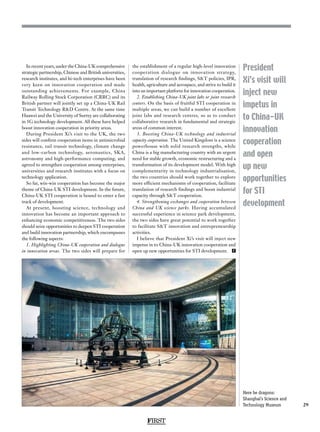
2015 saw the China-UK comprehensive and
strategic partnership embarking on a fast track. This
trend is expanding the reach of the ‘Golden Era’. It is
one of many highlights creating a golden glow across
the panoramic view of the China-UK relationship.
The first bright highlight is the unprecedented level
of official visits. This is matched by the increasingly
deep mutual political trust. Earlier this year, the Duke
of Cambridge paid his first-ever visit to China, which
was the most important royal visit to China in nearly
three decades. In June, shortly after the UK General
Election, there were a succession of high level visits
to London from China to establish contact with
the new Government. These visitors included the
Chinese Foreign Minister, Wang Yi, Secretary of
Beijing Municipal CPC Committee, Guo Jinlong and
special envoy of President Xi Jinping, Secretary Meng
Jianzhu. In August and September, three of the annual
key bilateral dialogues were held. These included the
Strategic Dialogue, the High-Level People-to-People
Dialogue and the Economic and Financial Dialogue.
The outcome of these top-level meetings are being
translated into all-round progress in China-UK
cooperation. On top of that, new British and Chinese
consulates were established in Wuhan and Belfast,
respectively.
The second highlight is the productive economic,
trade and financial cooperation. Added to that is the
reality of an excellent match between Chinese and
British development strategies. These factors helped
deliver, in the first half of this year, China-UK trade
in goods totaling US$36.74 billion. This means that
China now ranks as the UK’s fourth largest trading
partner in the world. It raised Britain to the level of
China’s second-largest trading partner in the European
Union. China’s cumulative investment in the UK
now exceeds US$40 billion. As a symbol of deeper
China-UK financial cooperation, Britain became the
overseas trading centre for the Chinese currency, the
yuan or renminbi (RMB). That is a ranking second only
to Hong Kong. Most significantly, the UK became the
first developed country to become a founding member
of the China-initiated Asian Infrastructure Investment
Bank (AIIB).
China and the UK are also making progress on a
number of cooperation projects. These include nuclear
power generation and high-speed rail. From China’s
‘One Belt, One Road’ initiative and ‘Made in China 2025’,
to Britain’s ‘National Infrastructure Plan’ and ‘Northern
Powerhouse’ project, the two countries are exploring
the opportunity to pool their respective strengths and
dovetail their development strategies. All this adds
up to a new era where China and the UK are already
deeply engaged in all-round economic and financial
cooperation. The result will reap all-round benefits
for the peoples of China and Britain.
The third highlight is better understanding and
closer affinity. This is as a result of flourishing cultural
events and exchanges. 2015 is designated as the Year
of China-UK Cultural Exchange. The UK Season in
China ran from January to June and was a resounding
success. This enabled the unique British creative
industry to enjoy full exposure to the Chinese public.
The China Season in Britain was launched in July.
Entitled ‘Creative China’, this China Season is rolling
out a rich variety of events across Britain. In Edinburgh,
Chinese performing artists put on powerful and
captivating shows at both the Military Tattoo and the
International Festival. In London, Chinese creativity,
Chinese design and Chinese fashion lit up the stages
The future is golden
FIRST
37
China and
the UK can
engage
in mutual
investment,
infrastructure
cooperation
and joint
advanced
research
The China Conservatory
Orchestra performs in
Edinburgh as part of
the 2015 UK-China Year
of Cultural Exchange
of the London Design Festival and London Fashion
Week. The close affinity between Chinese and British
people can be highlighted by the fact that there are more
Chinese students and Confucius Institutes in the UK
than in any other European country. A further testimony
to such closeness is the concurrent commemorations
in both China and the UK of the 70th anniversaries
of VJ Day and the Victory in the World Anti-Fascist
War. Through these many commemorations, the two
countries relived their time of fighting side-by-side.
In turn, both nations reaffirmed their commitment to
safeguarding world peace and security.
Looking ahead, the future of the China-UK
relationship glistens golden bright. That glow will
get ever brighter as both countries build on existing
consensus, expand cooperation and keep making new
progress in their comprehensive strategic partnership.
Building stronger China-UK ties calls for
determination and confidence. One must always adopt
a long-term, strategic approach and see the relationship
between China and the UK not as a rivalry but an
opportunity for both countries. Indeed, China and the
UK have every opportunity to set an example for East-
West cooperation in this new era. Progress can move at
optimal speed if the advance is mixed with realism. It is
realistic to ground any relationship in the recognition
there will be bumps and obstacles. Travelling forward
with open minds can help identify these potential
disruptions and obstacles. With this spirit bound into the
relationship,delayscanbeminimised.Inthefinalanalysis,
it all comes down to respecting each other’s core interests
and carrying on with equal and win-win cooperation.
Building stronger ties calls for broader and deeper
cooperation that is mutually beneficial. China and
the UK are both committed to economic growth, to
structural adjustment, to reform and innovation, and
to emerging industries. By dovetailing their respective
strengths, China and the UK can engage in mutual
investment, infrastructure cooperation and joint
advanced research. China’s ‘Belt and Road’ initiative
and the UK’s ‘Northern Powerhouse’ are excellent
platforms for production capacity cooperation on an
international scale. China and the UK should make use
of these platforms to showcase a number of flagship
projects in order to make the ‘cake’ of mutual interests
larger and enable both countries to grow.
Building stronger ties also calls for enhanced global
significance and influence of China-UK cooperation.
As permanent members of the UN Security Council
and key players in the G20, China and the UK
have on their shoulders the heavy responsibility of
safeguarding world peace and promoting common
development. Both countries should work to build a
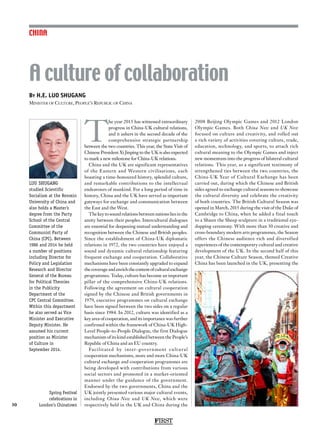
new type of state-to-state relationship based on win-
win cooperation, to improve the global economic
and financial governance systems and to enhance
global trade liberalisation and facilitation. Going
forward, the world is to face global challenges such as
epidemics, climate change and terrorism. This means
that with any post-2015 agenda, China and the UK
should coordinate their policies, play a leading role
and engage in effective cooperation.
President Xi Jinping’s State Visit to the UK will
unveil the goals for the ‘Golden Era’. The State Visit
will map out the ‘blueprint’ for the second decade of
the China-UK comprehensive strategic partnership.
The historic significance of this State Visit cannot
be overstated. The State Visit will carry China-UK
relations into the future. Now is the time for both
China and the UK to seize the opportunities presented
by the ‘Golden Era’ and join hands in writing an
exceptional new chapter for China-UK relations. F
FIRST
38
CHINA
I
n recent months we have been talking about a
golden year for UK-China relations. President
Xi Jinping’s State Visit to the UK is a once
in a decade opportunity to embark on a new
chapter in our relationship with our sights set even
higher. As we move forward together to embrace the
opportunities and challenges of the 21st century, I
believe we can turn a golden year into a golden era.
It has been quite a year for the UK-China
relationship. It began for me with the first visit
to China by His Royal Highness The Duke of
Cambridge. In my first week as Her Majesty’s
Ambassador to China I accompanied the Duke in
Beijing as he met President Xi Jinping, to Shanghai
to open the GREAT Festival of Creativity and
launch the first ever UK-China Year of Cultural
Exchange, and finally to Xishuangbanna in Yunnan
province to see efforts to combat the illicit trade in
endangered wildlife species.
August saw the first visit to China by a Foreign
Secretary for 5 years for our Strategic Dialogue
with China. Then, in September, I was part of
one of the most ambitious and rewarding weeks
I have experienced in UK-China relations. The
Chancellor of the Exchequer, George Osborne’s
delegation for the 7th UK-China Economic and
Financial Dialogue, co-chaired by Vice Premier
Ma Kai, included three Secretaries of State, three
Ministers of State, the Deputy Governor of the Bank
of England, Heads of the Prudential Regulatory
Authority (PRA) and Financial Conduct Authority
(FCA), a FTSE 100 business delegation, a Northern
Powerhouse business delegation, a Cultural Leaders
Delegation, a Northern City Leaders Delegation and
an accompanying media delegation. Across five days
and seven cities, I saw numerous examples of our ties
with China and our commitment to broadening and
deepening them. The Chancellor’s commitment
that the United Kingdom wanted to be China’s
“best partner in the West” echoed from Shanghai
to Urumqi and from London to the Northern
Powerhouse.
Meanwhile, the All Party Parliamentary Group
on China and the Lord Mayor of London with
another business delegation were here for separate
programmes.
All this came immediately after a highly successful
People to People Dialogue (P2P) in London, Cardiff
and Oxfordshire, with a delegation led by Vice
Premier Liu Yandong – China’s most senior female
politician. The P2P covers a range of knowledge
economy and social policy issues: health, science,
education, culture and creative industries, tourism,
sport, youth and regional cooperation. These
ministerial-level talks showcased the breadth of our
co-operation and looked to the future with a large
number of agreements that helped cement the United
Kingdom as China’s partner on innovation.
Looking Back
When President Hu Jintao visited the UK in 2005
China’s economy was growing at 10 per cent a year.
The Global Financial Crisis was three years away. UK
exports to China were worth £4 billion a year. Ten years
on, the UK economy has emerged from a difficult
period to grow faster than any other major developed
country for the past two years. China is embracing a
‘new normal’ of slower, more balanced growth.
Over that time, through political ups and downs,
financial shocks and changes of leadership in both
countries, our economic relationship has continued
to grow. In 2014, our two-way trade reached an all-
time high of US$80 billion. UK exports to China
have quadrupled in value to £18.2 billion.
We are doing more trade and more investment with
China than ever before. The opportunities are not
confined to the first tier cities of Beijing, Shanghai and
Guangzhou (or to London and the South East). The
bulk of China’s new, estimated 600 million middle
class consumers by 2020 will be living in second and
third tier cities.
Coming together
Our two governments recognised several years ago
that our economies were becoming more and more
complementary. Together they coined the term
‘partners for growth’. Each country had a long-term
economic plan and vision for economic reform.
There was a natural fit between our two economies.
As growth slowed or went into reverse in other parts
of the world, China could become an important new
market for UK exports. Our companies, technology
and services could complement China’s development
and help it achieve its ambitions.
By H.E. BARBARA WOODWARD CMG OBE
Ambassador of the United Kingdom to the People’s Republic of China
The benefits of global partnership
BARBARA WOODWARD
holds an MA in History
from St Andrew’s
University and in
International Relations
from Yale. She joined
the Board of the Foreign
 Commonwealth Office
as Director General
Economic  Consular
in October 2011, where
she worked on economic
diplomacy and emerging
powers. Ms Woodward
has worked on economic
and security aspects
of foreign policy in
China (where she was
Deputy Ambassador
from 2007-09) and
Russia (1994-98), as
well as in the EU and
at the UN. She took
up her current post as
HM Ambassador to the
People’s Republic of
China in February 2015.
FIRST
39
China has
become the
UK’s 6th
largest export
market,
second only
to the US
outside
Europe
As China looked to put its huge foreign exchange
reserves to work and its businesses sought new
markets, the UK offered an economy with openness
in its DNA and a direct route into China’s biggest
market, the EU. The result has been huge expansion
in our trade and investment relationship. China
(excluding Hong Kong) has become our 6th largest
export market, second only to the US outside Europe.
The Chancellor of the Exchequer has set the ambition
that in ten years’ time it should be our second largest
export market globally.
The United Kingdom has established itself as
by far the leading major European destination for
investment from China. Investment has come from
all major categories of Chinese investor, and flowed
into a wide range of sectors, from energy to high-end
manufacturing, real estate, retail, professional services
and the digital economy. London has become the most
dynamic hub for offshore RMB business outside Asia.
Win-Wins
This has been good for both countries. China is
now Jaguar Land Rover’s largest market. To keep
up with demand, it has invested £520 million in the
most modern engine plant in the UK, creating 1,000
new jobs. It has also opened its first ever overseas
manufacturing facility in Changshu, East China. The
Chinese car maker Geely rescued the London Taxi
Company (LTC) from administration. It announced
earlier this year it would invest £250m in a new factory,
research  development centre and assembly plant to
build the next generation of electric and low-emission
vehicles in the UK, including the iconic black cab.
The Chinese rail company CSR Times Electric
bought Dynex, a Rail semi-conductors business in
2009. The technology it acquired would have taken
15 years to develop. It has invested in RD, new
products and expanding Dynex’s manufacturing
facilities in Lincoln. This year it invested in SMD,
a UK underwater robotics company in Newcastle,
which will become the headquarters for its new
global marine business. The 5GIC at the University
of Surrey is the world’s leading independent facility
for researching and trialling 5G technologies. It is
working with Huawei to develop the world’s first
5G test bed – UK and China tech industry leaders
working hand in hand to develop new technology.
Looking forward
These are just a few examples of the benefits of
working together. I believe there is much more to
come. China’s progress in rail is astonishing. We want
it to be part of the renaissance of our rail industry.
Through encouraging Chinese investment in the
HS2 project and the potential of HS3 we want to help
open up China’s supply chains for British companies.
When China sets up a manufacturing base in Europe,
we want it to be in the UK.
Through investing in RD to develop better
engines, drive trains and electronic control systems
and new energy vehicle technology, the UK and
China can work together to develop globally
competitive cars. We want the UK supply chain that
provides up to half the content in an Airbus to help
China develop its own aircraft build programmes.
We want to increase the number of banks clearing
RMB payments in London. We want more British
brands to tap into the dramatic growth in Chinese
consumption online and offline. Adidas has 8,400
stores in China. No UK consumer goods firm comes
close. We want more Chinese tech companies to do
their RD in the UK. As demand for international
standard hospitals and elderly care facilities grows, we
want to work with China to deliver better healthcare
and help create the medicines of tomorrow.
Our early support for the Asian Infrastructure and
Investment Bank (AIIB) showed our commitment to
better regional connectivity, economic co-operation
and common development. We are putting in the
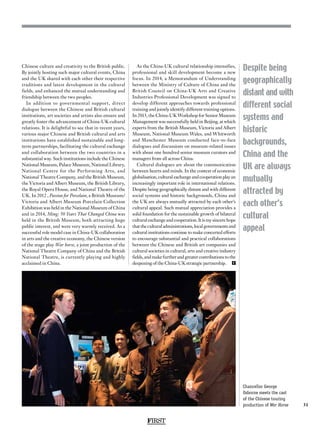
groundwork so British companies are well placed to
benefit from President Xi’s flagship One Belt, One
Road initiative. We want to encourage Chinese
investment in UK regeneration, including the
Northern Powerhouse, and National Infrastructure
Plan projects such as transport hubs around HS2.
And last but not least, we welcome and encourage
Chinese involvement in the UK civil nuclear market.
A New Era
Our economic partnership is supporting jobs and
prosperity in both countries. Even if China’s economy
grows by only 5 per cent this year, it would represent
the same value increase in GDP as 10 per cent growth
in 2007 when China’s economy was half today’s size,
and a quarter of all global GDP growth in 2015.
The many exciting announcements this autumn
will showcase the breadth and depth of our 21st
century global partnership. They will symbolise our
commitment to take a bold step forward together.
There will be ups and downs in the years ahead,
but by working together we can make this a golden
era for the UK-China relationship for many years
to come.  F
• UK exports to China: £18.25 billion
• Bilateral trade: US $80 billion
• Chinese investment received by the
United Kingdom: US $5.1 billion
UK-China Economic Statistics 2014
To His Excellency Mr Xi Jinping, President of the People’s Republic of China
Your Excellency
As Mayor of London I would like to offer you the most heartfelt of welcomes on the occasion
of your State Visit to our city in October 2015.
When I met with Party Secretary Guo Jinlong from Beijing earlier this year, I was particularly
interested to hear about the One Belt, One Road initiative that accentuates China’s ambition
to have an important role in the international market place. I am also delighted to note the
Shanghai Free Trade Zone, which was first trial-led when I last visited China in 2013, is
operating in full swing and expanded this year. The institutions and mechanisms around
the Free Trade Zone, I believe, could offer very large opportunities in future for UK-China
business relations if the experiment is successful and repeated elsewhere in the country. I would
like to reinforce my message that London supports these initiatives and I hope that you will
actively consider the high-quality expertise and products offered by London’s companies.
The UK government is creating the ideal business environment for investment in regeneration
projects across the UK. We are particularly pleased to be observing the growing interest
and confidence from the Chinese partners to invest in our strong pipeline of urban renewal
projects in London, such as those in Vauxhall and the Royal Docks. London is immensely
proud to be home to nearly 200 Chinese firms operating in London’s key sectors, including
the creative industries, industrial and business services, and financial services.
2015 marks a flagship year for UK-China relations with the first ever UK-China Year of
Cultural Exchange. It is an incredible platform to promote the understanding between our
peoples and also to build new creative partnerships to capitalise on exciting opportunities. My
office has been privileged to support a number of China/UK cultural events, for example the
Night of Beijing concert co-hosted with the Beijing Municipal Government in June.
London contains a wealth of opportunities which Chinese individuals, companies and
organisations could be a part of, and I look forward to welcoming more students, tourists
and businesses from China to our great city.
I hope you have a fantastic and successful visit to London and if there is anything my office
can help with, please do not hesitate to ask.
Yours sincerely,
Boris Johnson
Mayor of London
41
FIRST
FIRST
42
CHINA
The Lord Mayor’s annual trip to China is always
a highlight of the City calendar. What was the
background to this year’s visit?
It all stems from a speech the Queen made during her
State Visit to Ireland in 2011, in which she noted that
our exports to Ireland were greater than those to Brazil,
Russia, India and China combined – that’s a country
with a population of about four and a half million
versus an economic bloc with about 2.8 billion. I think
that was a big wake-up call for a lot of people – and it
made the UK government realise that something had
to change in terms of our global trading relationships.
There is a possibility that we might not be in the
same situation with Europe in two or three years’
time, and we’re going to need to have other irons in
the fire. The Germans do it, the Italians do it, the
French do it – and they all seem to do it better than us.
Why do you think that is?
I think our focus on Europe distracted us from
building relationships across the rest of the world.
Europe is only one continent, and we need to
remember that. The fact is we’ve got to get out there
and sell our products and services – and I like selling
the City, because it’s an extremely good product.
I’m always amazed at the discrepancy between the
reception I get when I go to a country like Mexico,
where they think the streets of London are paved with
gold, and the attitude of the media in this country,
which sees the City as an easy target.
What do you see as the UK’s biggest attraction, in
financial services terms, for a country like China?
Where do you want to start? We can offer them our
technological expertise, our capital markets, and our
capabilities across a whole range of professional services.
It all comes back to trade, and the importance of
having a diversified portfolio. China doesn’t want to
spend all its money with the Germans, or the French,
or the Italians, they want to spread their risk and
invest in a variety of industries and economies – and
the one truly world-beating industry we’ve got is
financial and professional services.
We have the largest international financial market
in the world, and we’ve got hundreds of years of
experience to back it up – both good and bad. As I told
some of the investors I just met in China, I’ve lived
through eight bear markets, three of them nasty ones,
and we often get it wrong. But we are willing to accept
the fact that we got it wrong – and we are willing to
share with them how we put it right.
How did that message go down, in light of the
recent turbulence in the Chinese stock market?
I think they were glad to hear it. The fact is that the
Chinese stock market is still very young: 85 or 90 per
cent of it is made up of individual investors, basically
speculating on the market – and that’s very volatile. One
of the most important messages I wanted to get across
during my visit is that long-term institutional investors
are critical shock-absorbers in volatile markets, because
if you’ve got a thirty-year view, you’re a value buyer,
you’re not a momentum buyer. Whereas if you’re an
individual investor in a country like China, you might
have a five-minute view of a stock, or a day’s view – but
you’re basically a day trader. On top of which many
of them are heavily leveraged. But if you don’t look at
earnings per share, if you don’t look at the cash flow, it’s
literally someone’s latest tip.
What we are talking about is life assurance, pension
funds – 30-year money, effectively – which is ideally
suited for infrastructure spend. Those are the people
who sell when the market is looking expensive and buy
when it’s cheap, and that’s what gives you the shock
absorbers at each end. The UK market is 85 per cent
institutional – in China it’s 85 per cent retail.
I’m not saying that’s a bad thing, after all you’ve got
to start somewhere, and speculation is quite a good way
of starting a business. After all, the London market
began with merchants taking risk on ships laden with
mace or nutmeg coming back from the Caribbean or
the East Indies. It all comes back to hunger and desire
for profit, and harnessing those basic emotions to raise
money for small companies, thereby creating jobs and
growth. The trick is to harness the gambling instinct
and put it to productive use in the capital markets.
Having spoken to policy makers, business leaders
and investors during your time in China, what is
your analysis of the economic temperature and
sentiment in the country?
Well, there’s no doubt that things are slowing down,
that much is evident, but is that necessarily a bad thing?
After all, I expect 5 per cent growth in 2015 is probably
Interview with ALDERMAN ALAN YARROW
Lord Mayor of the City of London
Sharing best practice
ALAN YARROW
graduated from
Manchester Business
School. He left Dresdner
Kleinwort in December
2009 after 37 years with
the group, latterly as
Group Vice Chairman
and Chairman of the UK
Bank. He was formerly
Deputy Chairman of the
FSA Practitioner Panel,
Chairman of LIBA,
Director of Complinet, a
member of the Takeover
Panel and of the Council
of the British Bankers
Association. He was
appointed Chairman
of CISI (Chartered
Institute of Securities
and Investment) in
September 2009. He
was also a member of
the Chancellor of the
Exchequer’s High Level
Stakeholder Group and
was appointed Lord
Mayor of the City
of London in
November 2014.
FIRST
43
The UK stands
to benefit
hugely from
the Chinese
demand for
education,
training and
qualifications
– and in turn,
this will
enhance
the quality
of Chinese
businesses
and
institutions
still greater than 15 per cent growth was in 2007 – it’s
still phenomenal growth, particularly when you think
that people are worried America’s about to overheat at
3.5 per cent.
As for falling copper prices, falling nickel prices,
falling oil prices – is that good or bad for the world
economy? Well, I’m afraid I’m old school – I think
it’s good for the world economy because it puts more
money in consumers’ pockets, and the consumer
begins to spend a bit more.
These are natural balancing items. Prices go down,
inflation’s under pressure. Do I think deflation is a
big problem? Potentially – but there are two different
types of deflation: one is a commodity-driven one, but
it’s certainly not apparent in property prices.
Before the recent stock market ‘wobble’, the Chinese
government’s stated policy was that market forces
should play a more decisive role in the country’s
economy. Do you think the experience of the last few
months is likely to reinforce that view or reverse it?
First of all, they need to take stock and work out what
went wrong. And I don’t mean what went wrong with
the market, because they know that – it had leverage,
it was far too expensive, and it was far too high. It had
to be brought back under control. Ironically, their
problem was more to do with the regulatory measures
that were taken to try and control events. We, in the
UK, learned from the exit of sterling from the ERM
– and more recently, the Swiss Government’s efforts
to control the value of the Swiss franc – that trying to
intervene in the market on that scale simply doesn’t
work. It is one thing to try and take some of the
volatility out of the short-term movements, but you
can’t change the overall trend.
I think it’s been a learning experience, particularly
for the regulators, and this is an area where we can
help, because we’ve been in that position ourselves.
When something goes wrong on this scale, the first
bullet to be fired is always at the short sellers. But short
selling per se is not actually a bad thing, because it can
help to get you closer to a realistic evaluation for a stock
more quickly.
I think there are a couple of things that could be done
to strengthen the market going forward though, and
perhaps the most important of these is to improve the
transparency of the official economic statistics – because
if investors don’t know where the figures are coming
from, it’s very difficult to arrive at a true valuation
of an asset. The government needs to be much more
transparent about what the figures are, where they come
from, and how they are accumulated. Once you improve
thecollectionofofficialstatistics,properanalysiscantake
place and people can put a value on what they’re buying.
The second point is the rule of law – including
the rule of contract and dispute resolution. This is
another area of expertise that the UK has, and one
that we are happy to share.
Will the ‘rebalancing’ of the Chinese economy
prove a challenge or an opportunity for the City?
Oh, I think there’s a huge upside. I have no doubt that
we are going to see Chinese companies coming over
here to buy banks, insurance companies and private
wealth management companies – Fosun has already
bid for Kleinwort Benson, for example, and there are
a number of other bids out at the moment. We have
already seen a number of high-profile property deals,
such as the acquisition of the Lloyd’s building by Ping
An Insurance Group, and this is only going to increase.
It all comes down to global standards. We are seeing
more and more Chinese coming to the UK to learn
English, and Chinese companies opening offices
here, to improve their accounting and legal standards.
The UK stands to benefit hugely from the Chinese
demand for education, training and qualifications –
and in turn, this will enhance the quality of Chinese
businesses and institutions.
For the past thirty years, the Chinese economy
has been dominated by the state owned enterprises
(SOEs), but all the recent productivity gains have
come from the private sector. Next year, the working
population of China is going to decrease, for the first
time ever, so they are going to have to get five per cent
growth out of a falling working population – and this
is going to have to come from the private sector, so
they need to make their private sector more fungible
and better placed to innovate.
I think the proposed Shanghai-London Stock
Connect is going to give the whole process a fresh
impetus. They need to iron out certain technical issues
of course, because H shares aren’t fungible to A shares
(which have a 30 per cent premium) and if they’re not
fungible you don’t get arbitrage, so you’re not getting
an equalisation of prices. But at the end of the day, you
could have a situation where we’re seeing a lot more
Chinese companies being quoted on the London
market as a dual listing.
The other major factor in London’s favour is the
internationalisation of the renminbi: over 42 per cent
of global foreign exchange trading takes place here,
twice as much as any other country, so if they want to
grow their currency, we need to be involved.
Last year, China Construction Bank was named as
the first RMB clearing bank in London – the first in
the world outside Asia – while Bank of China fulfils the
samefunctioninHongKong.So,they’reusingtheirown
institutions and spreading the institutional knowledge
around, which is entirely sensible. But the next stage will
be to allow branches of Western banks to do it in China,
and again, that’s another area where I think we can steal
a march on the competition. F
FIRST
44
CHINA
By DR CATHERINE RAINES FRSA
Chief Executive, UK Trade  Investment (UKTI)
CATHERINE RAINES
was appointed Chief
Executive of UKTI on
7 September 2015.
She was previously
Minister and Director-
General of UKTI China,
a position she held
from April 2013, after a
25-year career in both
the public and private
sectors, including
periods spent living
and working in the UK,
USA, Sweden and China.
At UKTI China, she
led an organisational
transformation that
saw business wins grow
ten-fold, from around
£300 million to almost
£4 billion in two years.
I
am delighted to mark the occasion of the State
Visit by President Xi Jinping of China to the
UK with this FIRST report. This comes during
a golden period for UK-China relations. The
State Visit, including as it does a substantial business
delegation, highlights the strong state of trade and
investment relations between our two countries, and
the prospects they offer for strong further growth.
China’s growth story has been one of the great feats of
all our lifetimes. China has grown at an average annual
rate of around 10 per cent since the early 1980s. Growth
now amounts to adding the equivalent of the UK’s GDP
every 4 years. Income per capita has quadrupled over
the last decade. China now has 213 dollar billionaires
(according to Forbes), 8 times the number it had in 2009
and nearly twice those in the UK.
China is urbanising rapidly. McKinsey predicts
there will be 221 cities in China with a population
of more than 1 million in 2030, compared with 35 in
Europe now. Since 2000, China has built residential
property equivalent to the entire housing stocks of the
UK, Germany and France combined. China became
the world’s largest goods exporter in 2009, surpassed
the US as the biggest goods trading nation (exports
plus imports) in 2013 and recipient of foreign direct
investment in 2014. The business opportunities that
flow from this are tremendous.
The UK’s offer is remarkable too. All major
independent sources confirm the UK as the number
one destination in Europe for FDI. The UK received
net FDI inflows of £44 billion (US$72 billion) in 2014
– representing one-third of total European Union
inflows. The UK has risen for the third year running
in the 2015 A.T. Kearney Foreign Direct Investment
Confidence Index to become the third most sought-
after country in the world for investment. The UK is
the highest placed European economy in this Index,
which measures the effect of political, regulatory
and economic systems on FDI inflows. A study by
PricewaterhouseCoopers identifies London as second
only to Shanghai as the most attractive city in the world
for FDI. London comes out top overall as the world’s
leading centre for business, finance and culture.
Exports of £500 billion in goods and services in
2014 placed the UK sixth in UNCTAD’s index of
top exporting countries. The United Kingdom is the
second largest global online retail exporter after the
US, and the largest in Europe. The UK is the ideal base
for onward global investment to increase profitability
and competitiveness.
British business is engaging strongly with China. In
2014 the UK overtook France to become the second
largest European exporter to China after Germany,
with exports worth £18.25 billion. Two way trade was
worth US$80 billion (£52million) in 2014. China is the
UK’s second largest import partner after the US.
Historically, the trade balance for the UK has been
stronger on services than goods, but with a greater
volume of goods. In 2014 we had a goods trade deficit
of £22.1 billion and a £2.7 billion surplus in services.
British business, supported strongly by its partners
in government, is working well to strengthen the
country’s position across the board. Since the last State
Visit in 2005, UK goods exports to China have grown
from £4 billion to £14.1 billion in 2014, doubling over
the term of the last UK parliament. UK goods exports
to Hong Kong were worth £6.3 billion in 2014. In 2014
China became the UK’s sixth largest export market.
The Chancellor has announced that he wants mainland
China – and Hong Kong – to become the UK’s second
largest export market within the next 10 years.
Companies across a broad range of sectors are
finding success in China. Road vehicles accounted
for 35 per cent of all UK goods exports to China in
2014. Jaguar Land Rover is our single biggest exporter.
Other major export categories include machinery and
electrical products (13 per cent), travel services – goods
and services purchased by Chinese visitors to the UK
(8 per cent) – and metals (6 per cent). High-growth
sectors include financial services, aerospace and energy.
A major expansion in healthcare is under way as
China’s reforms open up new opportunities in hospital
management, training, digital health and elderly care.
Some sectors have dipped this year, with change in
the macroeconomic context. Still, most independent
analysts agree that the long-term prospects for China
are some of the most impressive anywhere in the world.
UK goods exports rose in the first half of 2015.
UK Trade  Investment, UKTI, is the arm of the
government that helps British companies export, and
encourages Chinese companies to invest in the UK.
Our record is strong, and we look to work with ever
more British and Chinese companies to make the most
of the opportunities that exist. We are prioritising our
Strong potential for further growth
FIRST
45
UKTI China
supported
just under
£4bn worth
of business
wins for UK
companies
in 2014-15,
tenfold what
it did just two
years before
China work. The team in our offices in China is noted
for its ambition, capability, insight and access. UKTI
China supported just under £4bn worth of business
wins for UK companies in 2014-15, tenfold what it
did just two years before. I am driving for that record
of success to continue and grow, and I welcome your
company to play a part.
For the future, the UK’s export performance is heavily
dependent on how far China opens up its services sector
to greater foreign competition, with a number of areas
(insurance, telecommunications, legal and banking
services, design services, education) currently subject to
ownership and licensing restrictions. The warmth of the
UK-China relationship, exemplified by the State Visit
of President Xi, bodes well for taking forward market
access developments. We engage positively and steadily
with our partners in and across China.
On investment as well as trade, the UK-China story
in recent years has been remarkable. This is set to
continue. Chinese outward investment is booming,
both in terms of absolute figures, as well as in terms
of China’s share of global Foreign Direct Investment
(FDI). In 2014 President Xi Jinping estimated that
Chinese outward investment would exceed US$1.25
trillion over the next 10 years. This growth would
take China’s stock of global overseas direct investment
(ODI) to nearly US$2 trillion.
The UK is the most popular major European
destination for Chinese investment. In 2014 the UK
received US$5.1bn of Chinese investment, nearly 30
per cent of Europe’s total. The Chinese investment
stock in the UK reached US$11.8 billion in 2013, with
average annual growth of 85 per cent for the past five
years. In the financial year 2014-15 Chinese companies
were responsible for 112 FDI projects in the UK that
resulted in 5,927 new and secured jobs.
These numbers are set to grow, benefiting businesses
and communities all over the UK. A recent report
from Pinsent Masons forecast that China was set to
invest £105 billion in British infrastructure by 2025,
with energy, property and transport sectors likely to
be particularly popular, as illustrated respectively by
Chinese interest in Hinkley Point C, One Nine Elms
and High Speed Two. Europe is following our lead.
In 2014 China’s outward investments into the EU
increased by 170 per cent.
I am delighted that the business delegation
accompanying President Xi will be with him in
Manchester as well as London. UKTI is engaging
strongly with its partners in British central and local
government, as well as with business, to shape the
vision of the Northern Powerhouse, across the great
industrial cities of the north of England. Our vision is
to bring these cities together, creating modern high-
speed transport links between them, making sure that
they have strong civic leadership, bringing investment
to them, and as a result creating a North of England
that is greater than the individual parts. We welcome
the degree to which Chinese businesses and potential
investors are already engaging with opportunities
across the North of England, and its rich business and
industrial fabric.
Many regions of the UK have much to offer, and
we welcome members of the business delegation
exploring all that the whole UK offers China. Scotland
has doubled exports to China in recent years through
high quality premium products, including textiles and
technical textiles, RD, tourism, financial services and
low carbon/renewable energy – all industries where
Scotland offers world-leading capability, products,
exceptional knowledge and skills. Scotland is the UK’s
most successful region for attracting inward foreign
direct investment outside of London.
Northern Ireland offers excellence in engineering
but also clusters in a number of knowledge-based
sectors. Its engineering products and services
are currently supplying China’s aircraft industry,
transportation, mining and quarrying sectors. Belfast
is a leading centre in Europe for software development
and technical support. The pharmaceutical industry has
also developed state of the art products for personalised
health, food safety, and the veterinary industry.
Advanced materials and manufacturing productivity
are markedly high in Wales. There are 160 aerospace
and defence companies employing 20,000 people with
a combined turnover of more than £5 billion. Wales
has 20 per cent of the UK aviation maintenance, repair
and overhaul (MRO) market, while Airbus’ wing
manufacturing operation in North Wales is the single
largest manufacturing plant in Britain. Wales has a
£100m dedicated Life Sciences Fund and is home to
Europe’s first Centre for NanoHealth, while academic
researchers lead the world in areas including wound
healing, stem cells, neurosciences, e-health, in-vitro
diagnostics, medical devices and more. Welsh creative
companies employ around 50,000 people and generate
a £1.6 billion annual turnover, with 25,000 more
working in creative roles in other sectors. Two of the
UK’s largest independent TV production companies
are headquartered in Wales, which has excellent
studios and post-production facilities.
The UK is open for business, and relations between
Britain and China are at an all-time high. I hope that
for our two countries the State Visit of President Xi
Jinping to the UK will both mark a high point for all
that we have achieved together, and act as a platform
for further ambition and development between us. F
UK Trade  Investment
Further information online: www.Gov.UK/ukti
NorthernPowerhousegetsitswings
46
How did Beijing Construction Engineering Group
first become active in the international arena?
Beijing Construction Engineering Group (BCEG)
launched its international construction business in
the 1950s, when it began to contract the Chinese
government’s foreign aid projects overseas. BCEG was
one of China’s first enterprises to invest abroad and
undertake overseas projects and, in 1992, the company
was permitted to contract overseas projects on its own
account. Since then, the company has embarked upon
international project operations as an independent
business entity. Engineering News Record (ENR) has
named BCEG as one of the Top 225 Global Contractors
since 1993. And, as the group became increasingly
prominent in the global construction market, the
company corporatised its business operations. In July
2008, BCEG International Co Ltd (BCEGI) was
founded and officially began operating on 1st January
2010. The company’s international businesses cover 27
countries and regions throughout the world, including
construction projects, EPC contract construction, real
estate development, international trade and investment,
and financing construction contracts, as well as domestic
project contracting.
What are the company’s key international
projects and markets?
As I mentioned, BCEGI’s operations cover 27 countries
and regions worldwide, including developed countries
such as the UK, Canada, the USA, and Australia. Other
areas include Rwanda, Mauritius and Angola in Africa,
and Singapore, Thailand and Malaysia in Southeast
Asia. Our main projects include the Tanzania National
Stadium Project, which won the first ever Luban Award
– the most prestigious construction industry award in
China – for Overseas Projects; the KK Project, which
was the largest social housing project in Angola; the
Antigua 30MW New Power Plant Project, which was
BCEGI’s EPC industrial contractor project; and the
300-metre high Thailand Landmark Hotel.
David Cameron announced the Airport City
Manchester (ACM) project during his last visit to
China. What is the background to this initiative?
The purpose of David Cameron’s visit to China was
to improve and consolidate bilateral relations, to sign
a series of agreements for investment projects in the
UK, and to strengthen Britain’s position as China’s
major investment destination country in Europe.
The announcement of the ACM Project will aid
the promotion of trade and investment, strengthen
financial cooperation and macroeconomic policy
coordination, so as to promote future-oriented Sino-
British relations, mutual growth, joint benefit and a
win-win partnership.
ACM is the first official project following the
signature of the Sino-British Infrastructure
Cooperation Memorandum. What opportunities
and challenges does the project present?
The UK economy has been recovering strongly and
shows promising upside potential. The need for
renovation and upgrading of certain infrastructure
has therefore increased significantly. This provides
important opportunities for Chinese enterprises,
especially for construction companies, to invest in
cross-border contract projects. For BCEGI, getting
involved in one of the biggest projects in the UK is a
valuable opportunity, as well as a challenge. On the one
hand, the great amount of support received from the
SPONSORED STATEMENT
FIRST
Interview with BINBIN DAI
Chairman, Beijing Construction Engineering Group (BCEG)
BINBIN DAI
graduated from Tsinghua
University in 1990
and also holds an
MBA from the School
of Management and
Economics at the Beijing
Institute of Technology.
He began his career at
Beijing Mechanical and
Electrical Engineering
Group (BMEEG), a
subsidiary of Beijing
Constuction Engineering
Group (BCEG), becoming
Vice President in 1995
and subsequently
General Manager.
Mr Dai was appointed
Vice President of BCEG
in 2001, becoming
General Manager of the
Group in 2010 and later
Chairman in 2013.
Walk to work: an artist’s
impression of ACM’s
Central Business District
00
FIRST
government, and the professionalism and outstanding
tracking records of the other parties involved have
minimised the risk of the project, thus ensuring its
success. On the other hand, BCEGI, like other Chinese
companies in the UK, needs to operate and deliver
construction work in accordance with the UK’s local
rules and regulations. This may present challenges
for BCEGI in terms of compliance with the business
environment, process technology, legal system, human
resources, and so on. Through careful planning and
implementation of the Airport City project, BCEGI
will accept the challenge as an opportunity to enhance
its ability to adapt to the UK market and deepen its
development there, as well as exploring the continental
European market.
What is your vision for this vital infrastructure
project and what is the precise role of BCEGI?
The Manchester Airport City project is the first
infrastructure project BCEGI has participated in within
the European market, it is also a milestone project for
the group, giving us the opportunity to enter a high-
end, developed market. We are looking forward to the
Airport City project, not only in a way of promoting the
transformation and upgrading of the group’s business
in the international market, but also to contribute to
the China-UK business partnership by bridging the
gap in cooperation and trade between Chinese and UK
enterprises. In the Airport City project, BCEGI plays
two important roles: as investor and as one of the main
contractors. On the one hand, we have a 20 per cent
share in the joint venture, with a capital injection of
£12 million into the project. On the other hand, over
the next 10-15 years, we will work together with other
local contractors to be collaboratively responsible for
the project construction work.
How do you see China-UK business relations
developing in the future?
Last year was the 10th anniversary of the establishment
of the comprehensive strategic partnership between
China and the UK. We have witnessed a rapid and
fruitful development of trading activities between
our two countries as a result. This trend is especially
inspiring in the context of the gloomy economic
climate across the rest of Europe, and means that
the UK has overtaken the Netherlands to become
China’s second largest trading partner within the EU.
These promising results have no doubt cheered and
encouraged both countries, thus raising our confidence
in the development of future economic and trade
cooperation. Meanwhile, the frequent high-level
exchanges and strengthened political trust between
the two countries have also injected new vitality into
the development of bilateral relations. Premier Li
Keqiang put forward the new concept of ‘common
growth, inclusive development’ during his visit to the
UK last year, which clearly indicates the development
of the future business partnership between China
and the UK. I strongly believe that China-UK
bilateral relations are about to enter a ‘golden era’ of
all-round development. F
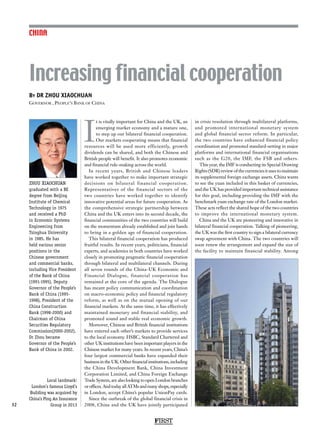
The Airport City
Manchester
(ACM) project
is the first
outcome of
the Sino-British
Infrastructure
Cooperation
Memorandum
View from the top:
an artist’s impression
of the ACM site 47
FIRST
48
CHINA
How do you see the recent growth of economic ties
between China and the UK? As the first Chinese
financial institution to open an overseas office,
what role has Bank of China played in this processs?
As Prime Minister David Cameron remarked in his
Chinese New Year message, 2015 is the ‘Golden Year’
for China-UK relations. Along with President Xi’s
State Visit in October, this year will see the unveiling
of a special ‘Golden Era’ for China-UK relations over
the next five years and more.
The UK remains China’s most popular European
investment destination, and its second largest
European trading partner. Late last year the UK
became the first sovereign nation outside China to
issue an RMB bond, confirming London’s position
as Europe’s most vibrant centre for RMB business.
China has embarked on a new development strategy
to ‘rebalance’ its economy and reinforce its integration
into global markets. Elements of this – including the
‘One Belt One Road’ initiative – are likely to have a
major impact across the globe.
One fruitful area of cooperation between the
UK and China has been the development of strong
financial ties. Earlier this year, the UK was among the
first European countries to join the China-initiated
Asian Infrastructure Investment Bank (AIIB),
earning it a sharp rebuke from other G7 countries.
Furthermore, the UK is playing a crucial role in the
development of the global RMB market.
Founded in 1912, Bank of China is the country’s
most international and diversified bank, serving
customers across the Chinese mainland, Hong Kong,
Macau, Taiwan and 41 other countries. In 2011, it
was the first Chinese bank identified by the Financial
Stability Board (FSB) as a Global Systemically
Important Bank (G-SIB), and it has been the only
G-SIB headquartered in an emerging market for four
consecutive years.
Bank of China London Branch, founded in 1929,
was China’s first overseas financial institution. Since
then, the Bank has acted as a bridge for facilitating
bilateral trade and investment between China
and the UK. As the founding member of City of
London’s RMB Initiatives, Bank of China has been
instrumental in helping London develop into a
leading RMB offshore centre. In October 2014, Bank
of China acted as the joint lead manager when the
UK government became the first country to issue an
RMB denominated sovereign bond. Later this month,
Bank of China will launch its global trading centre in
London to further boost RMB business in the world’s
leading financial centre.
Among the many significant milestones of the
Bank’s long history in the UK, what advantages
has the establishment of its wholly-owned
subsidiary, Bank of China (UK) Limited, in 2007,
brought in particular?
With nearly a hundred years of overseas operation,
Bank of China has built the most globalised service
network and most diversified financial service platform.
Bank of China London Branch has been acting as the
bridge between China and the UK.
In 2007, the Financial Services Authority approved
Bank of China to establish a UK subsidiary – Bank
of China (UK) Limited. Its establishment has been
significant to the development of the Bank of China
Group in both Britain and Europe. Since then, UK
subsidiary has run alongside London Branch, while
continuing to maintain a competitive edge and to
promote the Bank’s image and reputation in the UK.
In the future, the Bank will continue to strengthen
linkages between China and abroad, expand large
wholesale business, accelerate business development,
support Chinese enterprises’ ‘going out’ endeavours,
promote the development of RMB business, and
continue to serve as a bridges between the two nations.
The city of Manchester, which President Xi is due
to visit later this month, has one of the largest
and longest-established Chinese populations in
the UK. How do you see Bank of China’s presence
in the city assisting in the growth of the so-called
‘Northern Powerhouse’?
Manchester has a significant importance in the Bank’s
development strategy. The Bank established a sub-
branch in Manchester in 1979.
On 23rd October this year, working together with
UK Trade  Investment (UKTI), Bank of China will
organise a business match-making event in Manchester,
promoting businesses in the ‘Northern Powerhouse’.
The main purpose of this event is to help SMEs
in both the UK and China to break down barriers
and bring them together to do business. China is a
Interview with SUN YU
General Manager, Bank of China London Branch  CEO, Bank of China (UK) Limited
Internationalising the renminbi
SUN YU
began his career at
Bank of China Head
Office in 1998, and has
held a number of senior
positions at the Bank in
both Mainland China
and Hong Kong,
including the Deputy
General Manager of
the Global Markets
Department at Bank
of China Head Office,
the Deputy General
Manager of Bank of
China Shanghai Branch
and the General
Manager of Global
Markets in Bank of
China Hong Kong Ltd.
He was appointed the
General Manager of
Bank of China London
Branch and CEO of Bank
of China (UK) Ltd
in 2014.
FIRST
49
In 2014, China
accounted for
over 13 per
cent of the
world’s total
GDP, but its
currency
status is not
in line with
its economic
position,
which also
means a great
potential
upside
huge and expanding market for UK businesses. UK
exports have increased by over 37 per cent in the last
2 years. The UK is well known for its innovation,
advanced technology, and business heritage,
particularly in certain sectors such as food and
drink, consumer goods, manufacturing, renewable
energy, healthcare and medical equipment while
Chinese companies have manufacturing capacity
and large potential market place. Businesses from
both countries are supplemental to each other.
However, very often we have found that SMEs
have limited access to the market overseas due to
culture difference, language barriers, and lack of
resources. As the most internationalised bank in
China, Bank of China will provide a network of over
10,000 branches and 60,000 small and medium sized
customers (SME) in China potentially looking to do
business with the UK SMEs.
Why is the internationalisation of China’s currency
so important? What are the greatest challenges to
internationalising the RMB?
RMB internalisation is so important because currency
diversification has become a vital element of global
financial stability. The collapse of the Bretton Woods
System showed the inherent vulnerability of the gold
standard and that a single currency-dominated system
cannot avoid the ‘Triffin dilemma’. In 2014, China
accounted for over 13 per cent of the world’s total GDP,
but its currency status is not in line with its economic
position, which also means a great potential upside.
Historical experience suggests that the basic conditions
areripefortheRMBtobecomeaninternationalcurrency.
The RMB has become a force in safeguarding
global financial stability, especially during times of
crisis. In 1997, Southeast Asian countries rushed to
devalue their currencies to absorb the shock of the
Asian financial crisis. China pledged not to devalue
the RMB, giving confidence to the market. In the
global financial crisis that broke in 2008, the RMB’s
value was rising, providing a significant contribution
to economic stability. China’s stable social and
political environment, rapid economic growth,
balance of international payments, low foreign debts
and huge foreign exchange reserves are essential to
avoiding drastic exchange rate fluctuations, and help
underpin confidence in the RMB.
One of the biggest challenges of R MB
internationalisation is the relatively low acceptance of
the RMB outside the Asia-Pacific region. Although
Chinese banks have some overseas corporate
customers, RMB usage by foreign business is very
limited. It is vital for China to better meet their
demands, while expanding and deepening the offshore
RMB capital market, so that the currency can develop
internationally in the years to come.
The other greatest challenge is to maintain
stability while carrying out domestic financial
reforms, such as liberalising interest and exchange
rates, and opening up the capital account. At
present, China’s macroeconomic environment is
stable and foreign exchange reserves are plentiful,
but the level of financial supervision is still far
behind developed economies, and the country lacks
experience in coping with international financial
risk. Any premature opening of the capital account
will cause great risk to China. Therefore, RMB
internationalisation will take time and careful
planning, and will require significant investment in
market infrastructure and development.
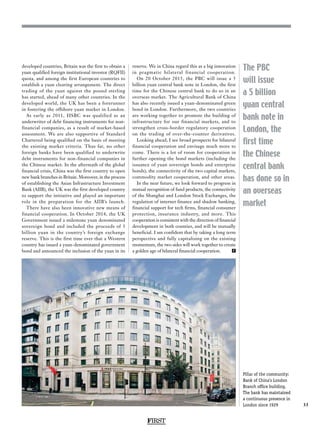
The British government is keen to develop London
as an offshore RMB centre. What business changes
will the Bank of China need to make?
As China’s RMB internationalisation progresses,
Britain and China will enjoy better and closer financial
co-operation and bilateral economic ties. The countries
both agreed to hold the first meeting of the China-UK
Bilateral Investment Taskforce in the latter part of this
year to optimise the investment environment.
During its 86 years of continuous operation in
Britain, the Bank of China has been playing an active
role in promoting economic and trade relations. On
23rd September, we organised the first China-UK
Cross-Border e-Commerce Co-operation Roundtable
in Shanghai, during which Sajid Javid, the UK
Business Secretary, signed an agreement that will
support British exporters and help promote their
online sales in China.
When cross-border RMB pilot programmes were
launched as early as July 2009, the Bank of China
London Branch took the lead, offering comprehensive
RMB products and services. After more than six years
of continuous hard work, the Bank’s RMB business
has achieved sustained and rapid development,
maintaining its leading position. Over the years,
London has grown to be an offshore RMB trading
centre, with its RMB forex trading volume close to
that of Hong Kong. Therefore, it is time for the Bank
to upgrade its existing trading capabilities to enhance
its competitiveness in the London market.
The bank is building up a global service platform
for customers comprised of a trading centre,
syndication centre and commodity centre. Later this
month, to fully utilise London’s position as a rising
offshore RMB trading centre, the Bank plans to
launch a global trading centre in London. This will
be the group’s second largest offshore trading centre
after Hong Kong, which will allow 24-hour integrated
operation of its financial markets business and will
strengthen the position of London as a global offshore
RMB trading centre. F
FIRST
50
By NICK LYNE and ALASTAIR HARRIS
Senior Staff Writer and Publishing Editor, FIRST
CHINA
A UK hub for Asian investment
Advanced
Business
Parks is
investing
£1.7 billion
to develop
the 35-acre
Thames-side
expanse of the
former Royal
Albert Dock
H
aving established itself as one of China’s
most successful large-scale business
district developers over the last decade,
ABP is now undertaking the biggest
real estate development by a Chinese company in
the UK as it seeks to turn an historic Victorian dock
in East London into an international business hub to
bolster trade links with Asian markets and attract new
companies from there to set up European HQs.
Advanced Business Parks, founded in 2003 by Xu
Weiping, is investing £1.7 billion to develop the 35-
acre Thames-side expanse of the former Royal Albert
Dock, a few miles downstream from the centre of
London in the borough of Newham, where it aims
to build around 4.7 million square feet of office,
residential, retail and leisure space through to 2025.
In a city as ‘fashion forward’ as London, it pays to
make an impression, and Mr Xu, as he is universally
known, has become a familiar figure in the business
pages of the British press, thanks to a fondness for
colourful designer suits, collectable watches and luxury
cars. There is steel behind the style, however, and the
former engineer, who grew up against the backdrop
of China’s Cultural Revolution and made his initial
‘fortune’ selling electric fans during the country’s first
flush of capitalism in the 1980s, says ABP will use up to
£500 million of equity money and some £1.2 billion in
finance to fund the project, depending on how many
units it sells early on, the idea being to funnel this
money back into developing the later stages.
“We want to attract high-quality businesses from
China, from the rest of Asia and Europe across a range
of sectors, including high tech, science, innovation
technologies, and finance. But our development will
also have a strong emphasis on culture, art and leisure
for those business people working here,” says Mr Xu,
citing the ‘executive clubs’ – including a multi-storey,
largely subterranean, fine wine emporium – that are a
feature of the company’s Beijing flagship.
Made in China
ABP’s business model, pioneered in Beijing, is based
on finding undeveloped land on the margins of fast-
growing cities that local governments are keen to
develop, then building on a large, cost-effective
scale, creating new business districts with their own
‘economic gravity’ in the process.
“Our success is based on moving away from central
business districts (CBDs). Traditionally, in the city
centre, because of the costs, we had to increase the
height of the building or pull in more investment –
but we changed that approach,” explains Mr Xu,
adding: “We moved the CBD to the outskirts of the
city, because it has a better ecosystem and less traffic,
enabling us to lower the investment and service costs.”
ABP calls this the ‘headquarters economy’ – the literal
translation of the company’s name in Chinese. As ABP’s
Vice Chairman, and CEO of ABP London, Nancy Xu,
explains: “It’s a model designed to appeal to China’s
expanding small and medium-sized businesses, giving
them the opportunity to own their own building outright.
It also gives larger companies the chance to open regional
offices in key cities, at a fraction of the cost of city centre
schemes. For a company growing up to a certain stage, it
isimportanttoshowconfidenceandprojectabrandimage
tothemarket:owningyourownbuildingisveryimportant
and can be done for the same cost as renting,” she adds.
This strategy of focusing on the businesses of the
future rather than those of the past is echoed by the
company’s founder: “There are many companies not
ranked in the Fortune Global 500 which have also
made a major contribution to the world economy and
have enjoyed rapid growth, which is why ABP decided
to focus on serving those companies by creating new
business parks tailored to meet their needs.”
ABP already owns four business developments in
China, all on a much bigger scale than the Royal Albert
Thinking big:
ABP’s flagship
development in Beijing
FIRST
51
ABP’s
development
of the Royal
Albert Dock
will eventually
add about
£6 billion to
the British
economy
and transform
the area into
‘a world-class
international
business
district’
Working on water:
ABP is keen to highlight
the leisure and amenities
aspects of its Royal
Albert Dock project
Dock project. The company’s first, and to date only,
completed scheme, in Beijing’s Feng Tai district on
the city’s fourth ring road, consists of more than 400
individual office buildings. It was built in just 10 years
and all units had been sold by the time it was completed
in 2013, with some 60,000 people now working at the
site, according to ABP.
By contrast, ABP’s Qingdao scheme, around
500 miles southeast of the capital, benefits from its
immediate proximity to the city’s airport and is made
up of around 800 buildings, of which around a quarter
have already been built. The scheme is due to complete
in 2019, and Mr Xu says around 40 per cent of the
units have now been sold. Like the company’s Maya
Island Hotel in Beijing – an agglomeration of seven
interconnected buildings topped with ziggurats and
decorated throughout with replicas of Mexican artefacts
from the country’s ancient Maya civilisation – the
architecture of ABP Qingdao was inspired by Mr Xu’s
travels: in the latter’s case, London’s neoclassical facades
and Georgian terraces. Some of the development’s office
buildings also include luxury penthouses for the use of
visiting company executives, an approach ABP is keen to
replicate in London.
Some 900 miles south of Beijing, in Mr Xu’s home
region of Zhejiang, a vast new project is taking shape
on the outskirts of the city of Haining that will be
home to some 2,000 units spread over 12 square
kilometres. “ABP Southern Yangtze taps into the
rapidly expanding Zhejiang region, which is dominated
by Shanghai, and is one of the country’s wealthiest,”
explains ABP’s Vice Chairman, Nancy Xu. The region
also boasts the country’s most developed private sector,
whose entrepreneurs are widely predicted to be the
main engine for growth in the new, post-slowdown,
consumer-driven China.
“This is where we’re developing our factory store
concept–rollingoffices,retail,designandproductioninto
one–providingofficeanddevelopmentspaceforthemass
of manufacturing sectors located nearby,” adds Ms Xu.
Individual offices are complemented by nearby retail
outlet stores, where products can be displayed and
sampled, tapping into what ABP calls the Online to
Offline (O2O) offering: an offline [physical] experience
combined with an online delivery that gives customers
greater confidence in the quality of the product, as well
as facilitating customisation to the client’s specifications.
ABP’s fourth project is in the northeastern city of
Shenyang, where the company is building more than
2,000 office units, of which more than 400 have been
built, and the majority already sold. This is perhaps
ABP’s most bullish undertaking, given the decline
of the region’s traditional heavy industries and the
recent slowdown in the Chinese economy. Home to
seven million people, Shenyang is in the process of
transforming itself from an industrial centre into a hub
for service industries and RD, but this is not a process
that is likely to happen overnight.
Confidently rebuffing concerns about oversupply
of office space in Shanyang, Mr Xu says his model of
selling smaller units will allow all his projects to ride
out the problems that may hit the Chinese economy in
the coming years. Nevertheless, his decision to set up
shop in London seems an astute one.
Friends in high places
John Miu, COO of ABP London, who is overseeing
the Royal Albert Dock project, says ABP’s experience
is that local governments are keen to cooperate,
providing infrastructure to accompany schemes that
generate millions of pounds in business taxes, as well
as local employment.
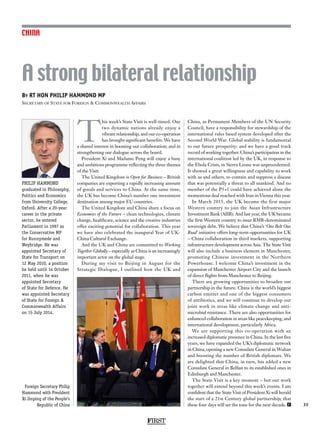
As in China, the local authority in London responsible
for the Royal Albert Dock, Newham Borough Council,
is keen to attract this kind of investment. The site is one
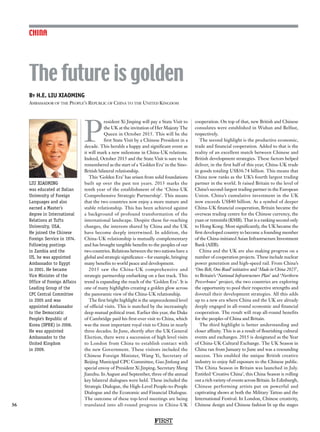
of the largest undeveloped areas in London and has
been a major headache for the city, resisting 30 years
of attempts at regeneration. The plan has the backing
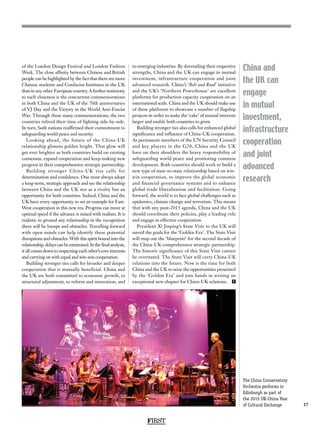
of Newham’s Mayor, Sir Robin Wales, who points out
that rising demand from tenants as Britain’s economy
continues to recover, combined with a backlog of
planned developments, is pushing up rents and creating
a shortage of supply in Canary Wharf a couple of miles
upstream.MrXubelievesthattheRoyalAlbertDockwill
eventually add about £6 billion to the British economy
and transform the area into “a world-class international
business district.”  Sir Robin says the project will not
repeat the “mistakes” of Canary Wharf, describing the
1980s development as “symbolic of a divided London,
with a rich, cosmopolitan workforce largely cut off from
some of the capital’s poorest neighbourhoods.”
City within a city
Royal Albert Dock was the United Kingdom’s largest
purpose-built dockyard when completed in 1880, at
Get your business
China ready
The China-Britain Business Council (CBBC) helps UK companies of
all sizes and sectors access the full potential of the fastest growing
market in the world. CBBC provides:
o practical in-market assistance
o business services
o industry initiatives
o a membership programme delivering
access, seminars and networking
Visit www.cbbc.org to get your business China ready.
ChinaBritain CBBC_China China-Britain Business Council CBBCChina
建议 Advice | 支持 Support | 网络 Networking
FIRST
53
The
transformation
of the Royal
Albert Dock
into a hub
for Asian
investment
adds a new
dimension
to London’s
strategy to
strengthen
its global
standing
CHINA
the height of the British Empire. In its imperial heyday,
it was the country’s most modern waterfront, the first
to use electricity, and equipped with cutting-edge
cranes and steel winches that unloaded tobacco from
the United States and fruit and meat from continental
Europe. But by the 1960s it was becoming outdated
and couldn’t handle container traffic, finally closing in
1981. Coincidentally, the area is also a stone’s throw,
in London terms, from the site of the city’s original
Chinatown, at nearby Limehouse.
Within a decade, Mr Xu says, this symbol of post-
industrial decline will be transformed into a 24-hour
‘city within a city’. Local residents will also be able to
enjoy around half a mile of waterfront, along with eight
new public squares, a dockside promenade and green
links throughout the site. ABP has proposed to develop
just over 20 per cent of the site for residential use,
with an indicative maximum of 845 units given in the
outline planning application. “A mix of uses, particularly
residential, is critical to creating and sustaining a ‘sense
of place’” and “residential development is very important
to create vibrancy and activity,” according to Mr Xu.
When complete, Royal Albert Dock will have some
of the best transport links in the capital, with direct
access to central and west London via the new Crossrail
station, opening in 2018. It also benefits from close
proximity to the University of East London, the ExCel
exhibition centre and City Airport (“the only airport in
London,” as Sir Robin Wales is fond of pointing out to
Chinese dignitaries), providing direct links to Europe’s
key business destinations.
ABP has already received more than 60 expressions of
interest from Chinese companies in taking office space
on the site and, earlier this year, ABP established First
StopLondon,acorporatelandingservicetohelpChinese
enterprises locate in the capital and access the support
they need to succeed. At the same time, Mr Xu says he is
reaching out to businesses from the UK and across Asia:
“It’s not just for Chinese firms but for everyone. This isn’t
a Chinese business park: it’s a global business park.”
Attracting global investment
The same applies to potential investors. In July, ABP
announced that Indian property company Strawberry
Star Group was investing in the Royal Albert Dock, in
return for equity.
“We have taken 8 per cent of the total equity in the
main company for £40 million; that translates into
50 per cent of the residential element, which in turn
accounts for 16 per cent of the main scheme,” says
Santhosh Gowda, Chairman of Strawberry Star Group.
Strawberry Star is also behind the Hoola
development in the adjacent Royal Victoria Dock,
where it is building two large residential towers.
At the official sales launch of the Royal Albert Dock
project in June, more than 10 businesses from the
UK and Asia signed confirmation agreements, each
paying a £50,000 reservation fee to secure office space
in the first phase of the development, in advance of
construction work starting on site later this year.
Among the first occupiers are companies operating
in the life sciences, high tech and financial sectors.
Building bridges
As part of its mission to promote international trade
through the Royal Albert Dock project, ABP has
set up what it calls the ABP International Alliance.
“The purpose of the Alliance is to build a platform of
cooperation and communication for enterprises in
the UK and China, to assist businesses to expand into
new international markets and to take advantage of
opportunities emerging through the strengthening of
trade relations between the UK and China,” says Mr Xu.
The transformation of the Royal Albert Dock into
a hub for Asian investment adds a new dimension to
London’s strategy to strengthen its global standing
in the 21st century. At the same time,
Mr Xu’s project fits perfectly with the
Chinese government’s One Belt, One
Road policy to rebuild the country’s
historic Silk Road trade links with
Europe and Asia, extending its global
influence by financing infrastructure
projects abroad, while winning new
markets for companies weighed down
by profit-crushing overcapacity at home.
With a foot in both camps, Mr Xu
believes he is once again well positioned
to reap the benefits of the next phase of
China’s development: “ABP has every
confidence in the development of the
Chinese economy – and at the same
time, the company is conducting its own
transformation.” F
Holding court:
Back (left to right): ABP
London COO John Miu,
Director City Account
of Siemens, Mark
Jenkinson, GLA Director,
Strategic Projects 
Property, Simon Powell,
ABP Vice Chairman
Nancy Xu, CEO of London
Borough of Newham, Kim
Bromley-Derry.
Front (left to right):
Vice Mayor of Haining
City Hu Yanzi, Mayor
of London Borough
of Newham, Sir Robin
Wales, ABP Chairman
Xu Weiping and Chair of
Chinese People’s Political
Consultative Congress
Zhang Weifen
FIRST
CHINA
54
STEPHEN PERRY
is the Chairman of
the 48 Group Club,
the oldest UK trading
partner with the
People’s Republic
of China and one of
the longest-standing
in the world. In
addition, Mr Perry is
Vice Chairman of the
China-Britain Business
Council and a trustee of
the Needham Research
Institute. He is also the
Chairman of London
Export Corporation and
has made over 200 trips
to China, negotiating
numerous joint ventures
with a value in excess
of US$1 billion.
By STEPHEN PERRY
Chairman, the 48 Group Club
Whatwecanlearnfromeachother
Northern Powerhouse:
Manchester, the cradle of
the Industrial Revolution
T
he visit of President Xi Jinping is a
watershed in international relations, and
UK-China relations in particular. He will
be greeted here in the UK as a partner
in so many ways – for investment in infrastructure
projects, investment in British companies, fast-growing
trade, and a variety of other measurements which
demonstrate that China is still outgrowing the world,
and the UK is growing faster with China than most.
In the early 1950s, the ambition of the 48 Group
was for the United Kingdom to be always in the top
three trading nations with China. Latterly, we have
slipped a long way down the scale, but I am pleased to
see we are now rising back up the charts.
As the Presidential car sweeps into the courtyard
of Buckingham Palace, we should salute the Chinese
and British engineers of this truly special, unfolding
relationship and the opportunities which it brings.
The palace guards will in turn salute the President,
and in the process, signal our deep welcome and wish
for this reciprocal trade and investment to grow and
grow. It certainly seems set to do so for the foreseeable
future. The only inhibiting factor is if London should
cease to be the leading centre for finance in Europe.
Provided we can maintain that important position,
China will only have increasing reasons to focus on
London and the UK, as the country’s government
continues to internationalise the renminbi.
It does not mean we have to stay in or out of the
European Union, we just have just to remain the
European capital of finance.
The Chancellor of the Exchequer, George
Osborne, who saw the opportunities with China,
based on mutual interest, knows this well, and will
take the necessary steps to ensure we maintain the
role we have worked so hard to create.
China has studied the UK for many years and
knew what would interest the British. They have
accordingly worked hard at many levels to improve
relations and develop meaningful people-to-people
dialogue across many areas, including sport, the arts,
and education.
So, as the President moves up to Manchester
he will explore the history of the world’s first
industrial revolution, learning how we coped with
the transformation from a low-cost exporter into a
modern economy. We underwent many social and
economic crises in the process, but we maintained
our stability. In so doing, we managed to find a
balance in the distribution of wealth, and move
from a predominantly working class population to a
predominantly service-based economy.
The President will be fascinated to hear what we
managed well – and what not so well. He will see how
we managed to move the majority of our population off
the land into cities, and into new areas of the economy.
China is now experiencing that
same transition, from a rural to an
urban way of life.
In all this he will enjoy our
traditions and culture, at the apex
of which is our Royal Family,
embodied by Her Majesty The
Queen. He will see how he and
our Queen combine the most
important characteristic for a
leader of nations – to hear the
people, to listen and respect.
In this way, they will set an
example of how two different
cultures and systems can find
common understandings and
build a special economic
relationship, based upon
understanding and trust. F
FIRST
55
CHINA
JOHN CRIDLAND
was educated at Boston
Grammar School and
holds an MA in History
from Christ’s College
Cambridge. He joined
the CBI as a policy
adviser in 1982 and
has been Director of
Environmental Affairs
and of Human Resources
Policy, as well as Deputy
Director-General from
2000 to 2010, before
assuming his current
position. As Director-
General of the CBI,
Mr Cridland is the key
spokesman for the UK
business community
in the media, on
public platforms and
in its dealings with
Government.
A
s Director General of the Confederation
of British Industry (CBI) I am delighted
that His Excellency President Xi Jinping
will be visiting the UK in mid-October
and would like to extend my warmest welcome to
President Xi and First Lady Madam Peng on behalf
of the CBI and our members.
Their visit comes at a time of great optimism for
UK-China relations. Bilateral trade, for example, has
already reached £51 billion and the UK is now China’s
sixth-largest trading partner.
And over the last five years Chinese investment
in the UK has increased by 85 per cent a year with
our country the top destination for Chinese foreign
direct investment in Europe. In 2014 alone Chinese
businesses started 112 projects in the UK resulting in
close to 6,000 new or safeguarded jobs.
We are second only in Europe to Germany in
exports to China, with new export markets offering
opportunities to UK business. Take, for example, the
UK pork sector. Exports have surged by 44 per cent
over the past 5 years generating £214 million for the
UK economy, with China now the largest international
export market for UK pork.
2014 marked the 40th anniversary of UK-China
student exchanges totalling 450,000 Chinese and
35,000 British over this period. More than 135,000
Chinese students are studying in the UK – and that
does not include the 500,000 who visited as tourists
last year.
In addition to this rich growth of business, cultural
and educational exchange, the UK also made its mark
in April by being the first major European country to
join the Asian Infrastructure Investment Bank (AIIB).
TheUKgovernmenthasalsocommittedtodeveloping
London as an RMB hub with the appointment of China
ConstructionBankasthefirstRMBclearingbankoutside
Asia. This follows the opening of the Industrial and
Commercial Bank of China’s (ICBC) wholesale branch
in London – the first since the founding of the People’s
Republic of China (PRC) in 1949.
Only last month the first ever China season of the
UK-China Year of Cultural Exchange was launched
in London. The UK season was formally opened by
the Duke of Cambridge during his visit to Shanghai in
March. A Chinese version of the iconic play War Horse
is also touring China this autumn, again underlying the
depth and breadth of the UK-China cultural partnership.
And I am proud of the contribution that CBI
member companies are making to China’s growth and
development. World renowned engineering and design
firm Arup has recently installed a sophisticated city air
purification system in Beijing’s Tsinghua University,
exemplifying the green growth opportunities available
to UK business in China. PwC, the accounting
consultation support supplier for the 2022 Beijing
Winter Olympic Games Bid Committee, witnessed
and participated in Beijing’s successful bid. In the first
half of 2015 UK based Intercontinental Hotel Group
(IHG) opened eight hotels in Greater China, including
its first two HUALUXE hotels and Resorts in Yangjiang
(Guangdong) and Nanchang (Jiangxi). IHG has
established itself as a market leader by tapping in to the
country’s rapidly growing travel and tourism sector. And
Virgin Atlantic launched its maiden 787-9 Dreamliner
to London from Shanghai this summer ensuring extra
efficiency and comfort for the many Chinese travellers
visiting the UK and adding more than £549 Million to
UK GDP. Finally it has been good to see Chinese CBI
members such as Huawei making major, long-term
investments into the UK. Their UK investment of
£956 million (2012-2014) supports 7,400 jobs directly
through the supply chain.
To conclude, UK-China relations have never looked
better and I very much look forward to seeing our
bilateral relationship continue to deepen and grow
over the years ahead. F
By JOHN CRIDLAND CBE
Director-General CBI
UK powers ahead in China
Horses for courses:
Britain’s iconic play
War Horse is touring
China this Autumn
By SIMON WALKER
Director General, Institute of Directors (IoD)
SIMON WALKER
became Director General
of the Institute of
Directors in October
2011. He previously
served as Chief
Executive of the BVCA,
the organisation that
represents British
private equity and
venture capital, from
October 2007 to March
2011. Between 2003
and 2007 Mr Walker
worked at Reuters as
Director of Corporate
Communications and
Marketing, and he
was Communications
Secretary to HM The
Queen at Buckingham
Palace from 2000 to
2003. Simon was a
special adviser in the
Prime Minister’s Policy
Unit at 10 Downing
Street from 1996
to 1997.
Putting China in context
56
T
he past month has seen news coming
out of China that paints an apparently
worrying picture for business. Drilling
down, the concern is not so much about
China itself however, but a broader global economic
slowdown, in particular among emerging markets, a
term that includes but is not limited to China. It is
therefore important to consider events in the context
of longer-term macro-economic trends, several of
which are key for UK businesses and the British
economy as a whole. Increasing consumption and
domestic demand, a rising middle class, the shift in
focus away from raw materials and the advent of new
trade agreement opportunities will ensure that China
continues to be a critical trading partner for the UK,
as well as Europe, for the forseeable future.
Much of China’s meteoric rise to economic
powerhouse status has been attributed to its incredible
export drive during the first decade of the millennium,
although the economic reform programme embarked
upon in 1979 laid many of the foundations for this
growth expansion. In 1995, exports accounted for 15
per cent of the country’s GDP; by 2004 this share had
risen to 30 per cent, with an export growth rate seven
times higher than the export growth rate recorded
by the world as a whole. But accompanying these
extraordinary statistics were inevitable questions
about the sustainability of this overall growth rate, and
the new focus of the government shifted from export
capacity to addressing domestic consumer demand.
This shift is still ‘work in progress’, but that fact offers
good news for the balance of trade of other countries.
With the current slowdown in some of its traditionally
important European target export markets, China can
no longer rely on external global demand to sustain
its economic expansion. The new market on which to
focus in order to help absorb its output is the Chinese
consumer, and with a steadily growing middle class, we
are likely to see a continuing rise in imports as consumer
preferences change over time.
Urbanisation policies in China have been a key focus
of the government to attract millions of people from
farms into the cities and spur wage growth and the
development of household wealth. While this trend has
not been fully consolidated, it is an all but irreversible
one, and holds significant opportunities for economies
like the UK, which exports services and high-value
consumer goods. Young people in urban areas are key
drivers of the growth of China’s middle class, with a
significant interest in the world beyond the country’s
borders – chiefly through technological means.
Their appetite for Western brands and know-how
in these areas – the gaming sector based in Glasgow
is one notable example – means that the UK’s creative
industries have a huge market to tap into. In fact, despite
the acknowledged potential for British professional
services to gain a foothold in China, the gaming industry
has been among the fastest to convert opportunity to
reality. The rapid growth of game companies in the
UK focusing on developing games for online platforms
has made accessing that market even easier. British
success story Inspired Gaming recently won a contract
to supply China’s national sports lottery with a host of
virtual games, and the government’s recent move to lift
a 15-year ban on video games will ensure this important
trend continues to develop.
The appetite for recognised luxury goods has also
been a growing phenomenon as Chinese household
incomes have risen. While some are still sensitive to
price, older professionals are now interested in the name
recognition of established brands to display improving
social status. Interestingly, a significant share of these
are bought by consumers while abroad, and the demand
for “Made in Britain” or “Made in Italy” labels are
popular amongst Chinese shoppers. This pattern is but
one reason for the decision taken by Home Secretary
Theresa May last year to simplify visa procedures for
Chinese visitors to the UK.
Theincreasingsophisticationofconsumerpreferences
is also a trend unfolding in Chinese investment interests
abroad. A decade ago, these interests focused primarily
on raw materials and extractive minerals, with Africa
being a more natural target market of choice. Now
Chinese companies are increasingly looking to set
up manufacturing bases overseas and in developed
economies, with far more attention being concentrated
on harnessing innovation, research and design abroad,
rather than simply trying to compete on price. Urban
infrastructure and development in the UK is attracting
huge interest from China, with energy, property and
transport being among the most attractive to investors.
This focus on local manufacturing will help to improve
the perception of the expansion of China’s share of
foreign goods markets over the past two decades.
CHINA
FIRST
57
Young people
in urban
areas are key
drivers of the
growth of
China’s middle
class, with
a significant
interest in the
world beyond
the country’s
borders
One particularly welcome aspect of this increasing
investment expansion into British and European
markets is that Chinese companies will need to co-
ordinate their operating standards with UK and EU
regulations. On everything from labour market rules
to planning permission, this provides an opportunity to
bring China into line with international best practices.
And for a UK economy still hamstrung by tackling debt
and deficit levels, yet trying to upgrade and invest in
infrastructure at the same time, this [co]financing will be
of immense value to doing the latter affordably. China’s
shift in focus to investing in advanced, innovative
economies will continue to be a trend over the next
decade, as an estimated £105 billion of Chinese capital
is expected to flow into the UK between now and 2025.
Activity on regional trade agreements continues to be
a priority for China, although there is some hesitation
in Europe. While the EU recently opened negotiations
on an investment deal with Beijing, it has been resistant
to the idea of doing the same for a free trade agreement.
China has made no secret of its desire to move on both
fronts, a call endorsed by David Cameron but seen as
pre-emptive by the European Commission. Should
investment negotiations proceed, however, – and
there will doubtless be some sticky discussions over
intellectual property, in particular, which many UK
businesses should be following – then movement on
the latter may be possible. China recently won a pledge
from the EU to consider a joint feasibility study into a
free trade agreement, which is a very welcome pre-step
in the direction.
For the IoD, China continues to be a strong focus
for international trading activity – 28 per cent of our
exporting members sell to, or operate, in the country
– representing 16 per cent of the total membership
overall. To increase this share, further economic and
legal reforms to ensure UK businesses and investors
become more comfortable about operating in the
country are needed. President Xi has signalled his
commitment on this front to let the market play a
‘decisive role’ in the economy, but this needs to be
reflected in the on-the-ground reality. Standardising
tax incentives, treatment for foreign investors and
simplifying the pre-approvals process across the
regions will be crucial to achieving this objective. The
opportunities are endless, and further business-to-
business engagement on best practice will be crucial
to converting them into reality for IoD members, who
place great emphasis on good corporate governance
and transparency when making the decision to
trade abroad.
The stock market volatility emanating from China
will continue to set the scene in the near term, but
the macroeconomic trends are what UK businesses
will rely on when deciding whether to boost trade and
investment links with the country. The extent to which
these troubles will act as a drag on its economic growth
is questionable, particularly given the comparatively low
level of household financial assets that are comitted to
its stock market. The government’s asset accumulation
over its explosive growth period is significant, easily
outstripping the size of China’s GDP. It is essential to
read beyond the headlines – something that British
business knows only too well. Digging deeper, it is clear
that opportunity for closer commercial links between
the united Kingdom and China is as ripe as ever. F
FIRST
Screen teens: the UK
gaming industry has
been quick to convert
opportunity into
reality in China
FIRST
58
CHINA
SIR CIARÁN DEVANE
was educated at
University College,
Dublin, where he
gained first-class
honours in biochemical
engineering. He also
holds a Master’s degree
in International Policy
and Practice from
George Washington
University. He started
his career as an
engineer before joining
Gemini Consulting.
After serving as Chief
Executive of Macmillan
Cancer Support from
May 2007 to December
2014, he took up the
role of Chief Executive
of the British Council in
January 2015. He was
awarded a knighthood
in 2015 for his services
to cancer patients.
M
y predecessor as Chief Executive of the
British Council, and avid Sinophile,
Sir Martin Davidson, was head of our
Beijing office in the early 1980s. At that
time – as Martin was fond of recalling – the entire British
Council China operation, six people strong, was run out
of a bicycle shed in the grounds of the British Embassy.
Things are very different today. On a recent trip
to the country, I visited an operation with 750 staff
working across five of China’s largest cities: Beijing,
Shanghai, Guangzhou, Chongqing and Wuhan.
The British Council uses the cultural resources
of the United Kingdom – art, education, culture,
language, and our values and ways of living – to
positively contribute to over 100 countries we work in
worldwide. Every year we reach over 20 million people
face to face and through our events, and more than
500 million online and via broadcasts and publications.
Nowhere is the idea of connecting people in the belief
that mutually beneficial things will happen more
important than in our relationship with China.
The British Council has been working in China since
1942, when the renowned scholar of China, Joseph
Needham, ran the Sino-British Science Co-operation
Office in Chongqing. We were formally established
as the Cultural and Education Section of the British
Embassy in 1979, and are co-signatories to the 1979
Cultural Exchange Agreement as well as to a number
of Memoranda of Understanding between the UK and
China on education, culture and sport.
In China we work in several different areas – arts,
education, exams, civil society, and language – but
mutuality is at the heart of all our programmes
and projects. Our arts work connects professionals
and audiences in both countries – not only bringing
British creative work to the attention of Chinese
audiences, and vice versa, but sharing the skills
that made that work possible, through training and
professional exchange.
In education, we work hard to nurture lifelong links
between young people of all ages, and between academics
and institutions in both our countries. We also run
programmes to encourage more young British people
to study in China; and our work contributes to China’s
ambitions to internationalise its higher education system.
The British Council’s examinations work, in
language and other assessments, is on a large
scale: every year two million people globally take
international exams with us. We deliver a range of
highly valued UK qualifications, in which success can
open the door to an education in the UK, or provide the
key to a professional career. I am particularly pleased
that our IELTS preparation course on the FutureLearn
platform is one of the world’s most popular MOOCs.
Our work with civil society ranges from a major
access to justice (legal aid) programme, to work with
social entrepreneurs and social policy makers in China.
And we are delighted to work with our partners in the
General Administration of Sport on various sporting
programmes such as Premier Skills.
We do not currently have English language
teaching centres in China. But no matter what
your age or current standard of English, we offer
interactive material online, on mobile devices, in
print and on the radio. We also work with partners
in Chinese education institutions to raise English
standards – something we have been doing for over 35
years. We are also very happy to support the growth
of Chinese teaching in schools in the UK, and the
significant expansion of the Confucius Centre and
Confucius Classroom networks.
Under the Generation UK China programme we
have also greatly increased the opportunities for young
British people to study and complete internships in
China, and to build a greater understanding of a
nation which plays an increasing role in all our lives.
In a similar vein, we are working with our friends in
Hanban, China’s cultural relations institution, to
promote the learning of Chinese in the UK.
During the last year we have led the UK season of
the first bilateral UK/China Year of Cultural Exchange,
creating opportunities for our partners to showcase the
best of culture from both countries. We also played
a leading role in the Third High Level People to People
Dialogue in September 2015, led by Vice Premier
Madame Liu Yandong: a celebration of the work we
do with UK government partners to build strong links
between our two peoples, to the benefit of each.
At the heart of all our activity is the personal
connection: it’s when people meet people that trust
is created and real understanding grows. This is
back to our founding ideal. That the interchange of
discoveries, of knowledge, of ideas makes the world a
better, safer, more prosperous place.
By SIR CIARÁN DEVANE
Chief Executive, British Council
The power of cultural exchange
FIRST
59
At the heart
of all our
activity is
the personal
connection:
it’s when
people meet
people
that trust
is created
and real
understanding
grows
The dramatic expansion of our activity with China
is the result of the hard work of many colleagues over
many years, of course. Just like everywhere else we
work, in China we have made a commitment for the
long term – it’s how we build the relationships that are
central to our work. But the transformation in the size
and scope of our operations is also a result of China’s
economic miracle, and its new appetite for engagement
with the rest of the world.
You don’t have to visit China to experience its
industrial might. From the iPod in your jacket pocket,
to the jacket itself, to the smartphone used to buy
the jacket – many objects around us have a ‘Made in
China’ stamp. And China’s economic miracle takes
place within a historical context that puts the British
Council’s claim to long-term thinking in perspective. It
is worth remembering that China has been the world’s
largest and most advanced economy for most of the last
two millennia. The grand sweep of history looks very
different if you’re standing on Chinese soil.
As does the grand sweep of the future. Whether
this will be the ‘Chinese Century’ or not, China will
undoubtedly be a major world player for many decades
to come: a geopolitical force to be reckoned with, an
economic powerhouse against which every other
economy will inevitably be measured, and a cultural
benchmark against which to assess our own.
For an organisation like the British Council, which
exists to build friendly relations between nations and
peoples, this fact presents an excellent opportunity to
demonstrate the real power of cultural relations on the
very largest scale.
Itisagiantopportunity;butiftherelationshipistobea
properly mutual one, we face an equally giant challenge.
It is only necessary to look at one set of statistics to see
the scale of that challenge. Almost all Chinese
students leaving compulsory education each
year (14 million) take an exam in English. At
the same time, fewer than 4,000 UK students,
far fewer than 1 per cent, take a GCSE
equivalent in Chinese. Even taking into
account the enormous disparity in our national
populations, that is a very unequal statistic.
Our government is currently investing
a lot of time and effort in the UK-China
relationship. The value placed on those links
is demonstrated by the State Visit of President
Xi Jinping, as well as Prime Minister David
Cameron’s and other British ministers’ visits
to China for the purpose of building trade and
diplomatic ties.
On a UK trade mission to China in
December 2013, the Prime Minister said
he hoped to “plant the seeds of a long-term
relationship which will benefit China, Britain
and the world for generations to come”.
I  join him in that wish, and agree with him that such
a relationship will come about not simply as a result of
trade agreements, but by working together on issues
that affect us all – whether that is the impact of climate
change, or providing young people with the skills to
make their way in the world, or gender equality.
Getting under the skin of China should be an
ambition not only for our diplomats, but for any
ambitious UK business seeking export growth or inward
investment. It should be on the agenda of every young
person interested in shaping the future and joining
conversations about the world we will be living in,
twenty, thirty or fifty years hence. China is important.
Smart young people will spot that and react to that.
That is why the British Council’s encouragement
and support for the learning of Chinese in the UK is
so important. It is essential to the wider cultural and
economic engagement between our two nations, and
a key part of helping to bring what promises to be a
‘golden age’ of UK-China cultural relations to reality.
The UK and China, for all their obvious differences,
have in common the status of great trading nations. Both
nations are famously businesslike. And the expression
‘we can do business’ after all means: we understand each
other, we can work with each other in various different
spheres because we have established a territory of trust.
In a world which is increasingly unstable and
unpredictable, dependable ties between nations are
ever more valuable. Our work for the future must be
to expand that notion of ‘trading trust’ to encompass
our joint national prosperity and security.
Such a valuable commodity can only be produced
intentionally and (literally) inter-nationally. Not ‘Made
in China’, or ‘Made in the United Kingdom’, but
‘Made Together’. F
Character forming:
British children
practising traditional
Chinese calligraphy
Photo© ITNProductions
FIRST
CHINA
60
MICHEL HOCKX
is Professor of Chinese
at SOAS, University of
London and founding
director of the SOAS
China Institute.
He studied Chinese
language and literature
at Leiden university in
The Netherlands and
at Liaoning and Peking
universities in China.
He has been involved
in teaching Chinese
language and culture
in the UK for the past
twenty years and he
is a past president
(2011-14) of the British
Association for
Chinese Studies.
B
ritish people have an unenviable reputation
when it comes to learning languages. With
so many speaking English as a second
language all around the world, there often
does not seem to be a need for native speakers of
English to aspire to becoming bilingual.
The manner in which people in the UK have
taken to learning Chinese in recent years is therefore
nothing short of amazing. English is widely spoken in
China, so objectively there was no need for Brits to
make the effort, yet they did. In the twenty years that
I have been involved in teaching Chinese language and
literature in the UK, the landscape of learning has been
dramatically transformed.
When I joined the Chinese department at SOAS,
University of London, back in 1996, there were fewer
than ten universities in the UK offering Chinese as a
subject. The learning and teaching of Chinese was, by
and large, the territory of a small number of enthusiasts.
Students embarking on a BA Chinese typically had no
prior knowledge of the language at all and needed to
be taught from scratch. Indeed, those who did already
know Chinese were often not accepted onto such
programmes because they were seen as overqualified!
The situation could not be more different nowadays.
According to a 2013 survey by the University Council
of Modern Languages, Chinese is now taught at 90
per cent of all UK universities. Only Spanish, French,
and German are taught more widely across the UK.
What this means is that in addition to the universities
traditionally offering full degree programmes in
Chinese, virtually every other university in the country
now offers at least some elective courses in Chinese
language. Fluency in Chinese is increasingly widely
seen as a useful element in the any graduate’s skill set.
Since 2012, when higher tuition fees were introduced
at UK universities, the number of students applying
to do full degrees in foreign languages has drastically
declined. In the first two years of the new fee regime,
the number of applications for French courses had
gone down by 25 per cent, and for Japanese courses
by 40 per cent. However the number of applicants for
Chinese courses remained stable. In fact, Chinese was
one of the very few subjects in the humanities where
recruitment did not seem to suffer significantly as a
result of higher fees. Amidst widespread uncertainty
about the prospects for humanities graduates on the
future job market, Chinese once again bucked the
trend. Here, too, the conclusion can only be that
knowledge of Chinese is perceived as a very useful skill.
A large part of Chinese language teaching at UK
universities, and indeed in UK schools, is connected
in some way with the establishment of Confucius
Institutes. No country in Europe has been more
welcoming to the Confucius Institute movement
than the UK. There are currently 25 Confucius
Institutes based at UK universities and the vast
majority of them are actively involved in the provision
of Chinese language teaching. The UK also has 92
Confucius Classrooms, which are Chinese language
teaching programmes in schools that are supported by
Confucius Institutes. The figures for the rest of Europe
pale in comparison. The UK’s closest rival in this
ranking is Italy, which has 11 Confucius Institutes and
20 Confucius Classrooms. Germany has 15 Institutes
and three Classrooms.
Chinese is now taught widely in secondary schools
up to GCSE level and is increasingly popular at A level.
Many school leavers take gap years in China in order to
pick up some of the language. All Chinese programmes
at UK universities have in recent years changed their
admissions policy and are now very welcoming to non-
beginners. Although it is still possible to study Chinese
at university from scratch, the number of students
arriving at our gates with no knowledge of the language
at all is now incredibly small.
Beyond language learning per se, universities in the
UK have also invested heavily in developing courses
about different aspects of Chinese culture and society,
Chinese economy, politics, and international relations,
as well as the country’s history. In recent years, several
universities have opened China Institutes that take
responsibility for teaching and learning about China
across all disciplines. In addition to the SOAS China
Institute, which houses by far the largest and most
diverse community of China scholars in Europe, there
are new, vibrant China institutes at the University of
Oxford and at King’s College.
UK universities have also successfully explored ways
of working together with Chinese universities and
establishingapresenceforUKhighereducationinChina.
The University of Nottingham has for quite a few years
been teaching courses at its campus in Ningbo, whereas
Liverpool University and Xi’an Jiaotong University are
By PROFESSOR MICHEL HOCKX
Director, SOAS China Institute, University of London
Transforming linguistic skills
FIRST
61
According
to a 2013
survey by the
University
Council of
Modern
Languages,
Chinese is
now taught
at 90 per
cent of all UK
universities
jointly running a campus in Suzhou. Even more recently,
the University of Cardiff and Beijing Normal University
have announced a joint undergraduate programme in
Chinese, with students spending half of their time in
Cardiff and half of their time in Beijing.
More opportunities are also becoming available
for UK graduates to further advance their China-
related skill-set at the postgraduate level. Only last
year, a project led by SOAS and funded by the Higher
Education Council for England (HEFCE) made it
possible for several UK universities to promote two-
year MA programmes in Chinese Studies, where
students are given the opportunity to integrate their
studies of particular scholarly disciplines with the
opportunity to apply those disciplines to Chinese-
language material and study the publications of
Chinese scholars. Programmes like this will finally help
to address the long-standing shortage of UK-trained
advanced China specialists. (Currently, only about a
third of all scholars teaching Chinese Studies at UK
universities were wholly trained in the UK).
The rise in numbers of Chinese speakers and readers
in the UK also bodes well for the future of cultural
exchange between the two countries. Although it is
still the case that Chinese people on average learn a
lot more about Britain in their basic education than
the other way around, and although products of British
popular culture ranging from Sherlock Holmes to
James Bond, and from Harry Potter to Wayne Rooney,
are infinitely better known in China than their Chinese
equivalents are in the UK, there are plenty of initiatives
underway that illustrate cultural influences flowing in
the other direction, including the recent BBC reality
TV programme featuring the experiences of Chinese
teachers in a British school, the Chinese-English
literary translation workshops organised by the British
Centre for Literary Translation, the activities of the
Writing Chinese network at the University of Leeds,
and the upcoming festive commemorations of the
400th anniversary of the deaths of two of the world’s
greatest playwrights: Tang Xianzu from China, and
William Shakespeare from Britain.
Sure enough, learning Chinese is not easy but if
millions of Chinese people can learn English, then
there is no reason why millions of Brits can’t learn
Chinese. Contrary to what one may think, Chinese
is not a difficult language to learn to speak and
understand. The main difficulty lies in learning to read
and write. English is written with twenty-six letters
representing sounds, and by and large if you hear an
English word spoken you will know more or less how
to write it. Chinese is written in characters that need to
be individually memorised. If you hear a Chinese word
spoken you won’t know how to write it unless you have
memorised the characters in question. Memorising
characters takes time but can also be lots of fun. Even
after three decades of learning Chinese, I still take
pleasure in practising my characters when I sit on the
tube doing my daily commute – these days drawing the
characters on the screen of my smartphone rather than
on a piece of paper. For those just beginning to learn
there are countless methods to try and remember the
characters better, including a very imaginative method
called ‘Chineasy’ which was developed by a London-
based, Cambridge-educated entrepreneur.
It is estimated that a knowledge of around 3,500
characters is needed to read a newspaper. The good
news is, however, that compared to the time when
I learned Chinese back in the 1980s, it is nowadays
no longer essential to learn to write the characters
by hand. One can type what one wants to say into a
computer using a phonetic transliteration, and then
the computer will select the characters – as long as
you can recognise the right character so that you can,
if necessary, tell the computer which one to select.
This not only speeds up the writing of Chinese, it
also means that time previously invested by learners
of Chinese in practising writing characters can now
be used instead to practise speaking, listening, and
reading. As a result those skills are now learned
much more quickly and efficiently by many learners
than before.
These developments, and all the other elements
of the blossoming UK-China cultural relationship
referred to in this short overview, will surely help to
bring about that most remarkable historical change:
Brits are becoming bilingual, and Chinese is their
second language of choice. F
Cultural export:
Bond market
peaks in China
More overseas financial institutions choose
to do business in, and with, the UK than any
other country. For an unrivalled concentration
of capital and capabilities, choose the UK.
Canary Wharf
London gov.uk/ukti
FIRST
63
Changing the way we view China
A
fter 30 years of spectacular economic
growth and social change, China is
embarking on the next – inevitably more
difficult – phase of its development;
the impact of which will be global and long-lasting.
Commentators on all sides are currently competing to
be right about what the future holds for China.
China’s changes in perspective – real growth,
policy drivers and the need for reform
The current UK government has made clear its
determination to pursue closer economic ties with
China. This can be seen in the recent trip of the
Chancellor of the Exchequer, George Osborne, to
China during which he announced a new ambition
to make China the United Kingdom’s second largest
trading partner by 2025. It was the fourth largest
export market for UK goods in the first seven months
of 2015 – worth £18 billion on an annualised basis.
There are few more symbolically important
moments between two countries than a State Visit.
The spotlight of attention will come with forensic
levels of analysis and opinion. At the China-Britain
Business Council (CBBC), it is our responsibility to
give our member companies, which range from the
UK’s largest multinationals to SMEs, an impartial
perspective on the business environment in China.
CBBC is a reference point and trusted advisor to
almost a thousand member companies in the UK, as
well as thousands more to whom we provide support.
Most companies don’t have extensive in-house China
expertise to guide their senior managers in decision-
making and are, to varying degrees, reliant on the
deep and broad expertise within CBBC, and the
platform of peers within our organisation, to make
informed decisions for their businesses.
So what do we, at CBBC, think about the future?
China is undoubtedly changing and the nature of
the commercial opportunities is changing too. The
opportunities for British companies are more varied
and accessible than ever before. Those opportunities
are in China; they are to work with Chinese
companies in the UK; and they are opportunities to
work together in third markets around the world.
The CBBC also believes that the days of looking at
China as one market are long over. Each region of
China can, and indeed must, be looked at in the way
that a business would look at the different countries
of Europe.
Looking ahead, One Belt One Road has the potential
to be the most significant business initiative of this
generation. In Urumqi last month, the Chancellor
launched a report prepared by CBBC and the
Foreign and Commonwealth Office showcasing the
opportunities for UK companies flowing from One
Belt One Road. Another key policy, Made in China
2025, aims to move China’s manufacturing up the
value chain. At CBBC we are confident that the
services and expertise in the UK are exactly what
China needs to make this move. And we await, with
eager anticipation, the outcomes of the 13th Five Year
Plan, which will set the direction of travel for China
over the coming years.
China has made an important step-change in its
development. GDP growth around the 7 per cent
mark or, possibly, significantly lower will become the
norm. But the focus on growth rates is simplistic: the
absolute growth in the size of the Chinese economy
this year is almost triple what it was a decade ago.
It is this growth in the absolute size of the economy
and, by extension, in GDP per capita that is key for
UK business. The GDP growth figures of individual
provinces, regions with a population greater than the
UK, show enormous disparities, with a reported 4-5
per cent in regions like Liaoning and Heilongjiang,
while others such as Chongqing, Fujian and Jiangxi
still have growth around or above 10 per cent per
annum. The on-going adjustments in the Chinese
economy will not be without pain but should be
viewed in a positive light for the opportunities they
offer to British companies.
At CBBC, we recognise the challenges ahead for
the Chinese government. China’s is a gargantuan
economy with some significant legacy issues. But
the need for reform and further opening up is
just as important today as it was 30 years ago. We
welcome the recent move by The State-owned Assets
Supervision and Administration Commission of the
State Council, only last month, to initiate a path
to energise its State Owned Enterprises. Allowing
private investment should bring about increased
productivity – but we accept that it will take time.
Recent reports of increased protectionism and opacity
are worrying. Developing competition in a more open
CHINA
By LORD SASSOON
Chairman, China-Britain Business Council (CBBC)
LORD SASSOON
read Philosophy,
Politics and Economics
at Christ Church, Oxford.
He began his career at
KPMG, before joining
SG Warburg (now part
of UBS) in 1985, where
he became a managing
director and head of
the investment bank’s
global privatisation
business. He has held
senior positions in the
UK Treasury, first as
a senior civil servant
(2002-06) and then as
Commercial Secretary
to the Treasury (2010-
13), and was appointed
a Director of Jardine
Matheson Holdings
in January 2013.
FIRST
64
Each region of
China can, and
indeed must,
be looked at
in the way
that a business
would look at
the different
countries of
Europe
CHINA
business environment will encourage innovation
in China’s domestic businesses. This should be
welcomed, as ultimately, Chinese companies will be
less competitive abroad if they have not been driven
to innovate in China. Chinese companies will be
best served by becoming used to a more transparent
business environment at home, as this is what they
will find as they increasingly invest abroad.
Seizing the varied UK-China opportunities – all
over the world
The UK is uniquely placed as a catalyst for China’s
New Normal. It is our products, services, education
and healthcare, advanced manufacturing and
innovation that can meet China’s needs as it moves to a
consumption-driven economy. Deals of all shapes and
sizes are being done by UK and Chinese partners in
both our countries and in third markets.
At CBBC, we are seeing our members doing
increasingly exciting and broad work in China. Our
multinational companies are building stronger
bonds in China, becoming part of the fabric of the
business environment there and the same is true for
SMEs. At our recent SME China Forum, held this
year in Nottingham, our panellists included small
East Midlands companies placing custom-branded
photo booths in China, selling fruit salads and juices,
delivering training on aviation regulations and
compliance, and selling essential oils and aromatherapy
treatments. They are not huge businesses with limitless
resources. They were canny, did their research,
understood their markets, found help in organisations
such as CBBC and took informed business risks. These
companies, whether large or small, represent the future
of UK business in and with China.
The UK welcomes Chinese companies to invest
and do business here. The UK’s FDI stock of Chinese
investment was US$11.8 billion in 2013 – more than
that of France and Germany combined. With Chinese
outbound investment reported to have surpassed that
of inward foreign investment in recent months, the
UK is well-positioned to take advantage. Projects
such as Swansea Bay Tidal Lagoon, Manchester
Airport City and, prospectively, Hinkley Point C are
examples of commitment at all levels to seek much-
needed infrastructure investment from China. But it
is not just in infrastructure where this partnership can
be successful. In late 2013, for example, Coventry-
based Covpress International Holdings, a world class
pressings supplier with a 123 year history, was acquired
by a major Chinese automotive components supplier,
Shandong Yongtai, in a multi-million pound deal.
CBBC does not forget the importance of UK
investments into China. My own group, Jardine
Matheson, has committed more than US$2 billion to
new retail and property investments in China in the
past 18 months – a clear statement of our confidence
in China.
And looking at third country cooperation, CBBC
works with the Commonwealth Enterprise and
Investment Council to encourage partnerships
between UK and Chinese companies in the rapidly
developing Commonwealth countries. These are
markets in which the UK has significant experience,
and which will suit the expertise of Chinese companies
who want to explore international markets.
No discussion of UK-China trade could omit the
role played by the City of London, with the best
financial, legal and consulting services in the world.
And China recognises this – continually testing RMB
products and initiatives in London. Forex trading in
RMB has grown 143 per cent in the last year, according
to a recent report by the City of London Corporation.
At the 7th Economic and Financial Dialogue in Beijing,
China and the UK agreed to extend and expand the
RMB/Sterling swap line; to support the Shanghai
Stock Exchange and London Stock Exchange Group
to carry out a feasibility study on a stock connect; and
that the People’s Bank of China will issue an RMB
denominated central bank note in London in the near
future, the first outside of China. More details are
emerging that China Development Bank will open a
Representative Office in the UK as soon as possible.
Looking to the future
To maintain the momentum of this State Visit, CBBC
will host one of its pillar events in China next month.
On 3 November, the 3rd Annual China Outbound
Conference will take place in Beijing, laying out the
opportunities across the UK for Chinese investors,
as well as introducing our international financial and
professional services industry. CBBC’s Great British
Brands Festival, now in its third year, will bring around
50 UK brands to eight cities across China in 2015, and
recently held an online flash sale on Juhuasuan, one of
the Alibaba Group’s emerging e-commerce champions,
resulting in RMB 6 million of sales in just 3 days. Only
a year or two ago, this level of exposure would have
been unimaginable for some of these brands so early in
their China journey. It is initiatives such as these that
deepen our already strong trade ties.
A State Visit involves a huge amount of work for
those involved. I would like to offer my congratulations
to all those who made this happen on both sides – to
Buckingham Palace, the FCO, to the Chinese Embassy
in London, the Foreign Affairs Office in Beijing
and all other relevant parts of the UK and Chinese
governments.
Finally, I wish President Xi and all our guests from
China a pleasant and successful time in the UK. F
As one of the major integrated financial service providers in China, the Bank is committed to catering
to the needs of Sannong and capitalizing on the synergy between the Urban Areas and the County
Areas. Benefiting upon the comprehensive business portfolio, extensive distribution network and
advanced IT platform, the Bank strives to expand into the international market and provide diversified
services so as to become an international first-class large-scale commercial bank.
www.abchina.com 客服热线 95599
Together
We Achieve
FIRST China State Visit Report 2015

FIRST China State Visit Report 2015

  • 1.
    China and theUnited Kingdom: A Golden Era of Partnership THE PEOPLE’S REPUBLIC OF CHINA O F F I C I A L R E P O RT PUBLISHED BY FIRST TO MARK THE STATE VISIT OF HIS EXCELLENCY XI JINPING, PRESIDENT OF THE PEOPLE’S REPUBLIC OF CHINA
  • 3.
    FIRST © FIRST 2015 FIRSTgratefully acknowledges the cooperation of the Ambassador and Staff of the Embassy of the People’s Republic of China in London Published by FIRST, Victory House, 99-101 Regent Street, London W1B 4EZ Tel: +44 20 7440 3500 Fax: +44 20 7440 3544 Email: publisher@firstmagazine.com Web: www.firstmagazine.com Chairman and Founder Rupert Goodman dl Chairman, Advisory Council Rt Hon Lord Hurd of Westwell ch cbe pc Chief Operating Officer Eamonn Daly, Executive Publisher and Editor Alastair Harris Non-Executive Directors Timothy Bunting, Hon Alexander Hambro, Chairman, Public Affairs Lord Cormack fsa dl Regional Publisher Declan Hartnett, Head of Special Projects Waqäs Ahmed Designer Jon Mark Deane Marketing Administrator Chris Cammack, PA – Chairman’s Office Hilary Winstanly Research Assistant Anna Vexler, Editorial Consultant Jonathan Gregson, Design Consultant Stanley Glazer, Senior Staff Writer Nicholas Lyne Award Advisory Panel Rt Hon Lord Woolf, Hon Philip Lader, Lord Plant of Highfield, Chief Emeka Anyaoku gcvo tc cfr, Marilyn Carlson Nelson, Dr Daniel Vasella, Rt Hon Lord Robertson of Port Ellen kt, gcmg, Ratan Tata, Howard Schultz and Philippa Foster Back cbe Special Advisor, China, Lord Powell of Bayswater kcmg Special Advisor, Russia Sir Andrew Wood gcmg, Special Advisor, Latin America Jacques Arnold dl, Special Advisor, Global Issues Professor Victor Bulmer-Thomas cmg obe FIRST is composed of the opinions and ideas of leading business and political figures. All information in this publication is verified to the best of the authors’ and publishers’ ability, but no responsibility can be accepted for loss arising from decisions based on this material. Where opinion is expressed, it is that of the authors. PUBLISHED BY FIRST TO MARK THE STATE VISIT OF HIS EXCELLENCY XI JINPING, PRESIDENT OF THE PEOPLE’S REPUBLIC OF CHINA China and the United Kingdom: A Golden Era of Partnership THE PEOPLE’S REPUBLIC OF CHINA O F F I C I A L R E P O RT
  • 4.
    LONDON’S UNMISSABLE INVESTMENT ANDCOMMERCIAL OPPORTUNITY L O N D O N I S G E T T I N G A N E W B U S I N E S S H E A R T newbusinessheart.london London has always been a city where business thrives. But in a city where finding the right commercial property is becoming increasingly difficult, ABP Royal Albert Dock is something unique. It’s the first business district in the UK especially for enterprises from Asia, and offers an opportunity to invest in London’s newest and most advanced business destination. This high profile location is within the UK Government’s only Enterprise Zone in London, so there are tax advantages available. Within the 35 acre mixed use scheme there are waterfront offices, cafes and restaurants, a bustling business main street suitable for major enterprises and SME’s, high quality retail space, public open squares and parkside buildings. ABP Royal Albert Dock has tremendous international connectivity and is a fantastic location to live, work and enjoy. ABP ROYAL ALBERT DOCK - A DECISION YOU CAN MAKE IN A HEARTBEAT ABP伦敦总部基地皇家阿尔伯特码头 一个令人怦然心动的商业决策
  • 5.
    470 万平方尺 >办公室 > 住宅 > 零售 > 休闲 ABP London Sales Department +44 (0)20 3818 8540 sales@abp-london.co.uk 进驻伦敦第三个金融商务区 抢占欧洲市场先机 Enquiries: Savills UK and Asia Piers Nickalls, Director +44 (0)20 7499 8644 PNickalls@savills.com / 占地35英亩,英国最大中国私营地产开发项目 / 伦敦唯一企业区,专为亚洲商企打造 / 获得海内外政商界的支持和认可 / 被誉为中国企业“走出去”和开拓欧洲市场的绝佳平台
  • 6.
    www.chinachamber.org.uk Golden Era ofUK-China Relationship 中 英 关 系 黄 金 时 代 及全体会员 with all CCCUK members CHINA CHAMBER OF COMMERCE IN THE UK WELCOMEPRESIDENTXIJINPING 热烈欢迎习主席访英 英 国 中 国 商 会
  • 7.
    China and theUnited Kingdom: A Golden Era of Partnership THE PEOPLE’S REPUBLIC OF CHINA O F F I C I A L R E P O RT PUBLISHED BY FIRST TO MARK THE STATE VISIT OF HIS EXCELLENCY XI JINPING, PRESIDENT OF THE PEOPLE’S REPUBLIC OF CHINA OFC China 2015 v3.indd 2 15/10/2015 17:11 Contents RUPERT GOODMAN DL Chairman and Founder, FIRST 7 H.M. QUEEN ELIZABETH II 9 H.E. XI JINPING President of the People’s Republic of China 11 RT HON DAVID CAMERON MP Prime Minister of the United Kingdom of Great Britain and Northern Ireland 17 RT HON GEORGE OSBORNE MP Chancellor of the Exchequer and Second Lord of the Treasury 21 H.E. WANG YI Minister of Foreign Affairs, People's Republic of China 22 H.E. GAO HUCHENG Minister of Commerce, People's Republic of China 24 H.E. YUAN GUIREN Minister of Education, People's Republic of China 26 H.E. WAN GANG Minister of Science & Technology, People's Republic of China 28 H.E. LUO SHUGANG Minister of Culture, People's Republic of China 30 DR ZHOU XIAOCHUAN Governor, People's Bank of China 32 RT HON PHILIP HAMMOND MP Secretary of State for Foreign & Commonwealth Affairs 35 H.E. LIU XIAOMING Ambassador of the People's Republic of China to the United Kingdom 36 H.E. BARBARA WOODWARD CMG OBE Ambassador of the United Kingdom to the People’s Republic of China 38 BORIS JOHNSON MP Mayor of London 41 ALDERMAN ALAN YARROW Lord Mayor of the City of London 42 DR CATHERINE RAINES FRSA Chief Executive, UK Trade & Investment 44 SUN YU General Manager, Bank of China London Branch & CEO, Bank of China (UK) Ltd 48 NICK LYNE AND ALASTAIR HARRIS Senior Staff Writer and Publishing Editor, FIRST 50 STEPHEN PERRY Chairman, the 48 Group Club 54 JOHN CRIDLAND CBE Director-General, CBI 55 SIMON WALKER Director General, Institute of Directors 56 SIR CIARÁN DEVANE Chief Executive, British Council 58 PROFESSOR MICHEL HOCKX Director, SOAS China Institute, University of London 60 LORD SASSOON Chairman, China-Britain Business Council 63 Official Report produced to mark the State Visit of H.E. Xi Jinping, President of the People's Republic of China to the United Kingdom China and the United Kingdom: A Golden Era of Partnership Copyright © 2015, FIRST Magazine Ltd. All rights reserved. Reproduction in whole or in part without written permission is strictly prohibited. Colour transparencies or manuscripts submitted to the magazine are sent at owners’ risk; neither the company nor its agents accept any liability for loss or damage.
  • 8.
    FIRST 6 SPONSORED STATEMENT HE YU Chairmanof the Board, Professorship Senior Engineer, PhD of Management Science, Chairman General Nuclear Power Corporation By HE YU Chairman of the Board, China General Nuclear Power Corporation CGN’s activerole in UK nuclearsector All six generating units of Daya Bay Nuclear Power Plant, operated by CGN, have been working safely and stably since 1994 A s China’s largest nuclear power operator and the world’s largest nuclear power construction company, China General Nuclear Power Group (CGN) is committed to being a leading global clean energy and service provider. ‘Developing clean energy to benefit society’ is our core value, and our vision is to be a world-class clean energy company. CGN debuted with the Daya Bay Nuclear Power Plant. By the end of September, 2015, CGN had fourteen nuclear power plants in operation or ready for commercial operation, with a total generating capacity of 14.92 GW. Safety techniques at nuclear plants currently in operation meet international standards in all indices. Twelve plants with a total capacity of 14.45 GW are under construction, accounting for roughly 20 per cent of the total global capacity of plants under construction. On the technology front, CGN and China National Nuclear Corporation jointly designed the domestically- developed, third-generation million-kilowatt class nuclear power technology known as Hualong One to contribute to the national nuclear power development plan and aid our own ‘going out’ efforts. CGN has also established specialised nuclear power production, construction, R&D, and fuel supply security systems in line with international standards, which can develop in conjunction with other clean energy areas such as wind power, hydropower, solar power, and energy conservation industries. In recent years, CGN has seized the opportunities presented by the international nuclear power market recovery to steadily expand into the international marketplace. On 30th June 2015 in Paris, the Chinese and French governments signed a joint statement on nuclear cooperation indicating that a group of Chinese enterprises led by CGN will cooperate with French counterparts on the construction and operation of three new nuclear power plants in the UK. The CGN-led China team will support and take part in Hinkley Point C and two EPR reactor projects, and will work on the predevelopment phase of Sizewell C. EDF will support and participate in another UK nuclear plant development project led by CGN, and conduct applicability design modifications based on Hualong One technology, primarily to meet the safety requirements of the Office for Nuclear Regulation (ONR), the UK’s independent nuclear regulator authority, as well as to make the reactor more competitive. Starting out with the aim of mutual benefit, further partnerships, including the development of large- and medium-sized reactors, will be undertaken with the aim of developing markets in other countries. Negotiations for CGN’s UK project are progressing smoothly. The ONR will shortly commence its Generic Design Assessment process for Hualong One; CGN also submitted Hualong One for a technology and safety design review by the EUR (European Utility Requirements) Committee earlier this year. Phase II of CGN’s Fangchenggang Plant, an example of Hualong One technology and the model for the UK project, is expected to begin construction later this year. Design documents, equipment procurement and supply, and site preparation are proceeding smoothly, according to plan, and good progress is being made on project approval and licensing, fulfilling the conditions for ground breaking in 2015 and subsequent construction. Construction of Phase II will benefit equipment manufacturing export driven by domestically-developed technology, and establish a strong foundation for close cooperation with the nuclear power sector in Africa, West Asia, Central and Eastern Europe, Southeast Asia, and the UK. In November 2014 and April 2015, a CGN-led group of Chinese firms and EDF jointly held supply chain conferences in Shanghai and Beijing for the new UK nuclear power project, with the aim of giving Chinese enterprises an opportunity to take part in the UK project and to promote mutually beneficial cooperation with France. F
  • 9.
    Foreword by Rupert Goodmandl Chairman and Founder FIRST I t gives me great pleasure to introduce this Official Report on China to mark the State Visit of President Xi Jinping to the United Kingdom. Lord Hurd and I are especially grateful to His Excellency Liu Xiaoming, the Chinese Ambassador, and his staff for all their help and guidance in the preparation of this report. We are also very grateful to the Prime Minister, David Cameron and the President, Xi Jinping, for contributing such important and personal messages to this Official Report. The strength of the United Kingdom’s strategic partnership with the People’s Republic of China has also been underlined by the successful visits of the Prime Minister, Chancellor George Osborne, the Foreign Secretary and the Mayor of London, Boris Johnson. The Duke of Cambridge made an important visit earlier this year and Lord Maude, the Trade Minister, has just returned from China. The President’s State Visit to the United Kingdom, with its full schedule, is particularly timely and will help focus the attention of business leaders and policy makers on the many investment opportunities that exist in China. China is the world’s second largest economy, its biggest exporter and the second largest importer of goods and services, accounting for around 10 per cent of total world trade. Despite global economic turbulence, China’s expansion record continues with a GDP growth rate of 6.7 per cent predicted for 2016. Expanding our international trade and investment links with China is playing an important role in the government’s economic and financial strategy. The growth in trade and investment between the United Kingdom and China has been impressive; last year UK exports to China were over £12.5 billion and China was the UK’s 6th largest goods export market. The UK also attracted some US$12 billion of Chinese foreign direct investment in 2014 – more than France and Germany combined. London accounts for two thirds of offshore renminbi payments outside mainland China and Hong Kong. China’s growth and development provides important opportunities for further strengthening the bilateral business relationship. The United Kingdom’s high technology and research- based industries will find opportunities to co-operate further with Chinese partners. Britain’s financial and banking services, as well as the retail and creative sectors, will identify enormous opportunities as China’s consumers increase their purchasing power. Both countries also share the desire to move to low-carbon, sustainable economies. To Chinese business leaders the United Kingdom represents an ideal gateway to Europe for Chinese exports and investment. The United Kingdom-China strategic partnership also covers significant co- operation in education – over 130,000 Chinese students study in Britain and an increasing number of British students are attending courses in China. These links in education are paving the way for greater cultural and scientific exchange, to both nations’ mutual benefit. The State Visit of President Xi Jinping to the United Kingdom, while providing an opportunity for private discussions, will give us all an opportunity to study the important developments in China and to weigh carefully the opportunities for our countries to work together even more closely. We at FIRST are delighted to have been asked to produce this official publication to mark the State Visit and hope that it contributes, in a small way, to its success and the further development of the bilateral relationship, especially in trade and investment. F 07 CHINA FIRST
  • 11.
    Please convey mywarm thanks to all at FIRST Magazine for your loyal greetings, sent on the occasion of the publication of an official report to mark the forthcoming State Visit of the President of the People’s Republic of China to the United Kingdom. I look forward to welcoming His Excellency Xi Jinping and to the opportunity which this visit gives us to strengthen the ties that already exist between our two countries.
  • 13.
    FIRST 11 CHINA Message from His ExcellencyXi Jinping, President of The People’s Republic of China O n the occasion of my State Visit to the United Kingdom, I would like to extend my sincere greetings and best wishes to the British Government and the British people through FIRST Magazine. The Chinese and the British are both great peoples. We have long histories and outstanding cultures, and we share a determined pursuit of new developments and progress in accordance with the times. Despite the geographical distance between China and the UK, our peoples feel close as each is drawn to the other’s literature and arts, and science and technology. Since the establishment of the comprehensive strategic partnership between our countries in 2004, substantial progress has been made in bilateral relations, with remarkable achievements in all the areas of cooperation, including economy and trade, education, science and technology, culture, climate change, and energy. China is willing to work with the UK to foster new growth points and to provide new impetus that will facilitate the common development of our two countries and deepen our comprehensive strategic partnership. This year marks the 70th anniversary of the World Anti-fascist War and the founding of the United Nations. China and the UK have each held a series of commemorative events. Seventy years ago, our two countries joined in the building of the post-war international order based on the UN Charter, and we have since worked together to maintain that order. It is my hope that the Chinese and British peoples will carry on our joint efforts in defense of the fruits of the victory in the World Anti-fascist War, that we will uphold the purposes and principles of the UN Charter, and that we will promote the building of a new type of international relations based on win-win cooperation. Looking to the future, China wishes to join hands with the UK as we press forward in a spirit of mutual respect and equality and as we pool our efforts in the drive for mutually beneficial results. Let us work together to open a new chapter in China-UK relations, to create new prospects for productive cooperation, and to build a new model of state-to-state relations. F His Excellency Xi Jinping, President of The People’s Republic of China
  • 15.
  • 17.
  • 19.
    FIRST 17 CHINA Message from The RtHon David Cameron mp, Prime Minister of the United Kingdom Rt Hon David Cameron mp, Prime Minister of the United Kingdom of Great Britain and Northern Ireland I am delighted to welcome President Xi Jinping and his wife Madame Peng Liyuan on a State Visit to the United Kingdom – the first by a Chinese leader for ten years. It will help to pave the way to a new golden era for UK- China relations, as we build a global partnership fit to tackle the challenges of the 21st Century. This visit follows my own visit to China in 2013 and will continue what has been an extremely important and constructive year for our relationship with China. His Royal Highness The Duke of Cambridge made his first visit to China in March, the most senior member of the Royal Family to visit since Her Majesty The Queen in 1986. This has been followed by a series of high-level meetings, including a visit to the UK by Vice Premier Madame Liu Yandong to build our people- to-people links, and visits to China by the Foreign Secretary and the Chancellor of the Exchequer. The State Visit will showcase the best of the UK-China relationship, building our global partnership, increasing our trade and investment links and strengthening our economies for the future. We have made great progress since the last State Visit, by President Hu Jintao, in 2005. The value of UK exports has quadrupled and we are now the second largest European exporter to China, as well as the second largest European investor in China. In the last five years, Chinese investment in the UK has grown by an astonishing 85 per cent per year, and the UK has become the leading major European destination for investment from China, with almost 30 per cent of the total last year. Our people-to-people ties have grown rapidly. We have 135,000 Chinese students studying in Britain; and last year, more than half a million Chinese visitors came to the UK. We have also expanded our diplomatic networks, with new Consulates General in Wuhan and Belfast and boosted our regional links, most recently when civic leaders from the North of the UK took part in the Chancellor’s trip to China. Globally, China and the UK have worked together with other partners on urgent and important shared challenges. Following the outbreak of the Ebola virus, the UK and China were among key countries leading the response in Sierra Leone. The UK was the first major European country to become a prospective founding member of the Asian Infrastructure Investment Bank. And as members of the P5, we helped to broker the Iran nuclear deal. I look forward to discussions with President Xi to build on these successes, and to welcome him and Madame Peng to Chequers as well as accompanying him on a visit to Manchester. During the visit the President will see, first- hand, some of our cooperation in action. I hope that, as well as being the highlight of a special year, this visit will mark the beginning of an even stronger partnership of constructive engagement between our two countries. F
  • 20.
    For the easiestmajor economy in Europe to do business in, with a dynamic location and stable investment environment, choose the UK. gov.uk/ukti
  • 21.
  • 23.
    Message from The RtHon George Osborne mp, Chancellor of the Exchequer and Second Lord of the Treasury 21 FIRST CHINA FIRST T his year is set to mark the start of a truly golden age in UK-China relations. The recent annual Economic and Financial Dialogue was a real success, making considerable progress on a number of high priority issues across trade, investment and financial services. I am confident that, as the Queen and Prime Minister welcome President Xi and Madame Peng to the UK for this historic State Visit, our two nations will take another big step forward together. The UK and China are clear natural partners for growth, and continued collaboration and engagement is good for both countries. As China continues to grow and implement its ambitious reform plans to rebalance its economy, British businesses become increasingly well placed to provide the products and services that China wants to consume. As the world’s global financial centre, Britain can support China’s important financial reforms. And we both gain from a vibrant and open exchange of ideas, science, culture and people. We also make excellent partners in building the economies of the future: Chinese companies have already invested in the Northern Powerhouse and we welcome others to do the same, while our early membership of the Asian Infrastructure Investment Bank is an important example of the UK’s commitment to supporting President Xi’s One Belt One Road initiative – a modern- day Silk Road to transform connectivity from China, across Asia to Europe. By maintaining a high level of ambition on both sides, I am confident that this will be a golden era for the UK- China relationship for many years to come. F Rt Hon George Osborne mp Chancellor of the Exchequer and Second Lord of the Treasury
  • 24.
    FIRST 22 CHINA T his year isa significant one in the global endeavour to enhance world peace and development, and both China and the UK play an important role in driving this process. First, this year marks the 70th anniversary of the victory of the World Anti-Fascist War, an occasion solemnly commemorated by China, the UK and many other countries around the world in various forms. An important lesson history teaches us is that the arbitrary use of force and seeking domination through raw power is no recipe for peace, and that the logic of winner-takes-all and zero-sum game can only block the development of human society. As our world moves faster towards multi-polarity, economic globalisation, cultural diversity and an information society, countries are becoming increasingly interdependent, and their interests are intertwined as never before. We share a growing stake in each others’ wellbeing. Only peaceful development and win-win cooperation is the right path we should pursue. Second, this year also marks the 70th anniversary of the founding of the United Nations. Last month, world leaders gathered in New York to draw a blueprint for creating a better future for mankind. Chinese President Xi Jinping articulated China’s vision of a new type of international relations. He called for the pursuit of a five-pronged strategy to build a community of shared future – namely, forging partnerships in which countries treat each other as equals, engage in mutual consultation and show mutual understanding; jointly creating a security architecture of equity and justice that benefits all; promoting open, innovative, inclusive and win-win development; increasing cultural exchanges to promote harmony, inclusiveness and respect for differences; and building an ecosystem that puts nature and green development first. This comprehensive proposition lays out a new vision for the development of international relations. Third, in building a new type of international relations, China and the UK have every reason to become good partners in cooperation. Both countries have important influence in the world and are permanent members of the UN Security Council. We share similar views on many international and regional issues, and our respective interests are converging. The upcoming State Visit by President Xi Jinping By H.E. WANG YI Minister of Foreign Affairs, People’s Republic of China Enhancing practical cooperation WANG YI holds a Master’s degree in Economics. He has worked as Assistant Minister of Foreign Affairs (1998-2001), Vice Minister of Foreign Affairs (2001-04), Ambassador Extraordinary and Plenipotentiary of the People’s Republic of China to Japan (2004- 07) and Minister of Taiwan Affairs in the Office of the State Council (2008-13). He assumed his current position as Minister of Foreign Affairs in 2013. UK Foreign Secretary, Philip Hammond, in discussion with China’s Foreign Minister Wang Yi
  • 25.
    FIRST 23 China stands ready to strengthen communication andcoordination with the UK on international and regional issues and work together to promote peace and stability will be the second visit by a Chinese President to the UK in 10 years, and it will be a historic visit marking a new decade of China-UK comprehensive strategic partnership. Undoubtedly, this visit will further boost this partnership and enable China and the UK to take fresh steps in building a new type of state-to-state relations featuring win-win cooperation. China and the UK should be good partners based on equality and mutual trust. The history and reality of our relations have repeatedly demonstrated that, despite differences in social systems, stages of development, history and culture, we can ensure continuous, steady and sound growth of China-UK relations when we respecteachotherandtreateachotherasequals,increase political mutual trust and always view this relationship from a long-term and strategic perspective. China and the UK should be good partners for win- win cooperation. The UK is China’s second largest trading partner, second largest investment destination and second largest source of paid-in investment in the EU,andChinaistheUK’ssecondlargesttradingpartner outside the EU and a major investment destination in Asia. China has advanced the initiative of building the SilkRoadEconomicBeltandthe21stCenturyMaritime Silk Road and is working on the 13th five-year plan for economic and social development. On its part, the UK will create a Northern Powerhouse and has put forward a roadmap for developing the manufacturing sector between now and 2050. Our two sides should form greater synergy between our respective strategies, enhance practical cooperation in innovation-driven growth, manufacturing capacity, and finance, so as to deliver more benefits to our peoples. China and the UK should be good security partners. China and the UK maintain close communication on counter-terrorism, peacekeeping operations and cyber security. We jointly responded to Ebola outbreak in West Africa, and played a positive role in resolving regional hotspot issues such as the Iranian nuclear issue and South Sudan issue. China stands ready to strengthen communication and coordination with the UK on international and regional issues and work with the UK to promote world peace and stability. China and the UK should be good partners of mutual learning. Our two countries are both major civilisations with splendid cultures. Every year, over one million Chinese and Britons travel between our two countries; 160,000 students are studying in each other’s countries, and we have forged sister relations between 51 pairs of cities in the two countries. This year is the first China-UK Year of Culture Exchange. Many colourful events have been held in both countries, which are warmly received by the public. China will deepen people-to-people and cultural exchanges with the UK and expand exchanges and cooperation in tourism, and between local areas, the youth and women to strengthen people-to-people friendship. An old Chinese poem reads, “Riding winds and cleaving waves, I hoist sail at the right moment to embrace the white clouds and vast ocean.” As a new era dawns on us, China the UK should seize the opportunity and forge ahead. Let’s take President Xi Jinping’s visit as a new departure point to open a golden era of the China-UK relationship. F China’s Foreign Minister, Wang Yi, meets with UN Secretary General Ban Ki-moon
  • 26.
    FIRST 24 CHINA I n a fewdays’ time President Xi Jinping will visit the UK. Both sides have high expectations of his visit as it is the first visit by the President of China to the UK in a decade, and will become a new milestone in our bilateral relations. Through the visit, the two sides will set forth new directions for the future and enhance practical cooperation in various sectors so as to bring the bilateral trade and economic relationship to a new level. Although lying at the opposite ends of the Eurasian continent, China and the UK developed commercial ties a long time ago. The two sides began trading in large volumes in tea, spices and silk as early as the 17th century. After the founding of the People’s Republic of China, Western countries were hostile towards China and imposed a trade embargo. However, in the summer of 1953, a group of visionary British entrepreneurs came all the way to China, overcoming great obstacles and the ‘Cold War Divide’, to sign the first trade agreement with the New China, thus marking the inception of the 48 Group Club. It reopened two- way trade and built a bridge of economic cooperation between the two countries. This trip, hailed as the ‘Icebreaker Mission’, has now become part of the history of China-UK relations. Over the past 62 years, with strong commitment and support from the two governments and business communities, our commercial ties have flourished, with numerous new bright spots. Our trade and economic exchanges have made substantial progress in various areas, playing an increasingly important role in ensuring healthy and stable bilateral relations. In recent years, this economic relationship has not only withstood the test of the eurozone debt crisis and the weak and unbalanced recovery of the world economy, but also yielded fruitful results, becoming a major driving force for the development of our bilateral relations. Presently the UK is China’s second largest trading partner in the EU, second largest source of actualised investment and second largest investment destination, whereas China is the UK’s fourth largest trading partner. Our two-way trade increases year by year. In 2014, it reached US$80.87 billion, doubling the US$39.16 billion five years ago and registering a 15.3 per cent year-on-year growth rate, the fastest in any of China’s bilateral trade with its major trading partners in the EU. In the first eight months of this year, despite the marked decline in trade between China and other European partners, China-UK trade remained steady, which shows how stable and sustainable this commercial relationship has become. The stock of the UK direct investment in China rises steadily. By the end of August 2015, the UK had 7,992 investment projects in China, with an actualised investment of US$19.61 billion; the stock of China’s direct investment in the UK had also risen rapidly from US$1.35 billion by the end of 2010 to US$12.8 billion by the end of 2014. Over 500 Chinese-funded enterprises have established a presence in the UK. Meanwhile, the two countries have conducted productive cooperation in technological innovation, trade in services, regional cooperation and joint exploration of third markets. The China-UK commercial relationship has shown a positive momentum characterised by steady growth in two-way trade, deepened two-way investmentand expansion into new areas of cooperation. The UK was the first developed country to realise industrialisation, while China is the world’s largest By H.E. GAO HUCHENG Minister of Commerce, People’s Republic of China Building on historic ties GAO HUCHENG graduated from Beijing International Studies University, majoring in French. He received his Doctorate in Sociology from the Université Paris VII, France in 1985, and is also a qualified senior economist. Having served successively as Assistant Minister at the Ministry of Foreign Trade and Economic Cooperation, Vice Chairman of Guangxi Zhuang Autonomous Region and Vice Minister of Commerce, he was appointed China International Trade Representative and Vice Minister of MOFCOM in July 2010. He assumed his current position as Minister of Commerce in March 2013. Workers assemble a Range Rover Evoque at Jaguar Land Rover’s £1 billion factory in Changshu
  • 27.
    FIRST 25 The ‘Icebreaker Mission’ 62 years ago created aclose connection between China and the UK through trade and economic cooperation developing country. China and the UK share strong economic complementarity, compatible cooperation philosophies and enormous cooperation potential. At present, China is drafting its 13th Five-Year Plan for Economic and Social Development, with a focus on a new round of opening up at a higher level, and establishing a new, open economic system in an expeditious way. The UK, always a champion of free trade, has a highly open market and is committed to promoting sustained economic growth. China’s Belt and Road Initiative, the Asian Infrastructure Investment Bank (AIIB), which the UK joined as a founding member, and the Northern Powerhouse Plan in England will all create more opportunities for cooperation between enterprises of the two countries. To seize this historic opportunity, further promote bilateral trade ties and realise win-win cooperation based on the complementarity between our two business communities, the two sides need to strengthen cooperation in the following areas: 1. Fully tap into the trade potential of the two countries. We shall encourage Chinese export of high value-added products to the UK, leverage Britain’s advantages in high-end manufacturing, high technology and RD, and identify new growth areas in trade in goods. In the meantime, both sides should further promote cooperation in trade in services such as technological innovation, e-commerce, financial and legal services, medicine and health, and creative industries, so that trade in goods and services can grow at the same pace. 2. Deepen cooperation in investment and big projects. The Belt and Road Initiative and the establishment of the AIIB will further spur business cooperation in infrastructure. Beginning with high-speed railway and nuclear projects, the two sides should step up cooperation in emerging industries such as life sciences, satellite applications, new energies, new- energy automobile and information technology, and focus on accomplishing some demonstrative landmark projects, so as to deepen cooperation in two-way investment. 3. Strengthen cooperation between regional governments and in third markets. The two governments should establish a long-term mechanism for regional cooperation and explore chances for business cooperation in the Northern Powerhouse initiative. Also, we need to combine China’s advantage in equipment manufacturing and financing with Britain’s advantage in innovation, management and financial services, so as to boost cooperation between our businesses in third countries and open up new space for commercial cooperation. 4. Create a better environment for trade and investment. I hope that the UK can continue to be a proponent within the EU of high-tech exports to China, an early conclusion of the China-EU bilateral investment agreement and the early launching of a joint feasibility study into a China-EU FTA, so as to achieve sustainable growth in trade and investment. The ‘Icebreaker Mission’ 62 years ago created a close connection between China and the UK through trade and economic cooperation. Six decades on, the two countries have forged an all-dimensional, wide-ranging and multi-tiered commercial relationship. As an ancient Chinese poem goes, “When you hoist the sails to cross the sea, you will ride the winds and cleave the waves.” I hopethattheentrepreneursfromthetwocountriescould carry forward the “Icebreaker Spirit”, and in today’s world where profound changes are taking place on the economic landscape, that they join hands to advance together, reap the dividends that arise from China’s continuedreformandopeningupandBritain’ssustained economic recovery, and jointly embrace a “Golden Era” in China-UK trade and economic relations. F Huawei Technologies’ UK headquarters near Reading: the company is at the forefront of Chinese investment in the United Kingdom
  • 28.
    FIRST 26 CHINA T he State Visitby the Chinese President Xi JinpingtotheUKisanimportantmilestone in our bilateral relations and has historical significance on their future development. Both China and the UK enjoy long histories and splendid culture and are committed to the development of their countries and the wellbeing of its people. Since 2004 when the two countries established comprehensive strategic partnership, cooperation in all fields and at all levels has been continuously expanded and strengthened. As an important component of China-UK people-to-people exchange and bilateral relations, our educational cooperation currently covers a wide range from basic education to higher education, of various forms and at various levels. Remarkable achievements made from such cooperation have extensive and positive influence among the public and plays a vital role in promoting China-UK relations. Firstly, student mobility has been continuously enlarged. Chinese students take the UK as an important destination for overseas study while coming to study in China is also an increasing trend in the UK. The Chinese government plays an active role in promoting student mobility and increasing Chinese Government Scholarship every year. In 2014, China announced the decision to send 10 thousand students to study in the UK for the coming 5 years. In the single year of 2014, China sent 2400 students and scholars to the UK and received 224 students from the UK, all sponsored by Chinese Government Scholarship. By the end of 2014, Chinese students in the UK have exceeded 150 thousand. To encourage studying in China, the UK government has decided to support 80 thousand students to study or work as interns in China from 2013 through 2020 with the launching of “Generation UK”. The number of UK students studying in China has reached over 6 thousand for the year of 2014, showing quite considerable growth. The two countries will continue to encourage and support young people to study in the other country which not only benefits their own personal development, but also injects continuous momentum to the long-term development of China-UK relations. Secondly, cooperation programmes have been effectively implemented. In basic education, secondary school students in Shanghai scored high in their first trial in PISA and hence drew global attention to China’s basic education. China and the UK then decided to select and exchange maths teachers from Shanghai and the UK since 2014. In vocational education, the Shadowing Programme provides access for principals of secondary vocational schools to go to sister schools and gain first-hand experience by working side-by-side with their counterparts. The pilot of the UK’s modern apprenticeship programme and cooperation in developing curricula are also going on to enrich the whole range of vocational education cooperation. In higher education, the two sides support the training of high-calibre talents and cooperation in scientific research by implementing the China-UK PhD Candidates Partnership Programme. The China Scholarship Council has also initiated joint scholarships with leading UK universities including Russell Group By H.E. YUAN GUIREN Minister of Education, People’s Republic of China A deeper understanding YUAN GUIREN graduated from Beijing Normal University (BNU), majoring in Philosophy. Over the course of his career, he has held a number of senior positions including Executive Vice President of BNU, Assistant Mayor of Beijing, Director-General of the Beijing Municipal Education Commission, and President of BNU. He was appointed Vice Minister of Education in 2001 and assumed his current position as Minister of Education in 2009. HRH The Duke of Cambridge opens the Dickson Poon University of Oxford China Centre in September 2014
  • 29.
    FIRST 27 China has the largest numberof English learners and UK has the largest number of Confucius Institutes and Confucius Classrooms in Europe members to send excellent Chinese students to study in the best UK Universities. China-UK cooperation in joint schools started early and progressed smoothly. The Ningbo-Nottingham University set up in 2004 and Xi’an Jiaotong- Liverpool University established in 2006 are among the first batches of joint schools approved by the Chinese Ministry of Education and have now become successful examples in this field. By the end of August 2015, 17 China-UK jointly run education institutions and 240 joint programmes have been established in China. Meanwhile, Chinese universities are accelerating their pace of internationalisation. This September, the Chinese Language School of Beijing Normal University-Cardiff University was formally established. It represents a positive exploration by Chinese higher education institutions in setting up joint education programmes and schools in developed countries, and also another highlight in China-UK educational cooperation. Thirdly, collaboration in language teaching and learning has been closer and deepening. Language is a carrier for culture and means for exchange. China has the largest number of English learners and UK has the largest number of Confucius Institutes and Confucius Classrooms in Europe. Both countries attach great importance to the collaboration in language learning and teaching. The UK government has been determined to substantially increase the number of learners of the Chinese language and also to improve the learning quality. The Headquarter of Confucius Institutes in China will also continue to support the Confucius Institutes and Confucius Classrooms in the UK. Fourthly, policy exchange has been conducted on a regular basis. Since 2004, the Ministries of Education of both countries established a regular dialogue at ministerial level (i.e. Education Summit). Every year, both sides hold meetings to have in-depth exchange on the latest developments in each others’ educational reforms,andjointlydecidetheannualcooperativeplanto provide guidance in promoting China-UK educational collaboration. In 2012, the China-UK High-Level People-to-People Dialogue was formally established. The Education Summit, as the thematic dialogue under this People-to-People Dialogue framework, enriches the content of the Dialogue and hence facilitates the People-to-Peopleexchangeofthetwocountries.During the 3rd meeting of this People-to-People Dialogue and Education Summit in 2015, 24 agreements and MoUs were signed in the field of education. As an old Chinese expression goes, “amity between people holds the key to sound relations between the states and can be achieved through their connection of hearts and minds”. On the new historical turning point, exchange and collaboration in education will have a wider space and more promising future than ever. The Chinese Ministry of Education is willing to join hands with the UK to further expand and deepen existing cooperation, promote understanding and friendship between young people, and push forward win-win cooperation in education so as to make contribution to the development of the China-UK strategic partnership. F A teacher from Clover Hill Community Primary School in Newcastle-Upon-Tyne visits a school in China while working for the British Council
  • 30.
    FIRST 28 By H.E. WANGANG Minister of Science Technology, People’s Republic of China Partners in innovation CHINA WAN GANG holds a PhD in engineering. He is Vice Chairman of the 12th Chinese People’s Political Consultative Conference (CPPCC), Chairman of China Zhi Gong Party, and Minister of Science and Technology. Over the course of his career, Professor Wan also worked for the German automotive company Audi (1991-2001), and as President of Tongji University in China. He was appointed as Minister of Science and Technology in April 2007. C hina President Xi Jinping will pay a State Visit to the UK in the beautiful autumn season of 2015, opening a golden age in the bilateral relationship and a new chapter of cooperation in science, technology and innovation (STI). Both China and the UK highlight the importance of the cooperation. The Intergovernmental Agreement on Scientific and Technological Cooperation was signed in 1978. Over the past 37 years, under the joint efforts of the science communities, including universities and research institutes, the two sides have expanded mechanisms and innovated modalities of collaboration, leading to fruitful outcomes for both. The two sides have been continuously expanding cooperation mechanisms, forming multi-tiered STI platforms. Under the framework of China-UK High- Level People-to-People Dialogue, steady progress has been made in implementing the China-UK Research and Innovation Partnership Fund, promoting joint research and personnel exchanges. Another example is the China-UK Economic and Financial Dialogue, which has continuously strengthened the collaboration in innovation and its application. Since 1998, the two sides have held regular joint commission meetings, pushing forward the STI cooperation. All these high-level mechanisms have not only driven the bilateral relationship in science and technology, but also facilitated interaction among scientists and engineers. The two sides have been exploring new means of cooperation and implementing the China-UK Research and Innovation Partnership Fund. In December, 2013, Prime Minister David Cameron visited China, jointly announcing the establishment of the Fund with Premier Li Keqiang. The Fund is a new model and a milestone in bilateral STI collaboration. Over the past year and more, the Fund has played an active role in basic research, innovation cooperation, talent development and regional innovation. This September, when China’s Vice Premier Liu Yandong visited the UK, the two sides signed an MoU on the UK-China Research and Innovation Bridges Programme. This Programme will give priority to strengthening ties among universities, research institutes and enterprises. Blue sky thinking: China Museum of Science and Technology in Beijing
  • 31.
    FIRST 29 President Xi’s visit will injectnew impetus in to China-UK innovation cooperation and open up new opportunities for STI development In recent years, under the China-UK comprehensive strategic partnership, Chinese and British universities, research institutes, and hi-tech enterprises have been very keen on innovation cooperation and made outstanding achievements. For example, China Railway Rolling Stock Corporation (CRRC) and its British partner will jointly set up a China-UK Rail Transit Technology RD Centre. At the same time Huawei and the University of Surrey are collaborating in 5G technology development. All these have helped boost innovation cooperation in priority areas. During President Xi’s visit to the UK, the two sides will confirm cooperation items in antimicrobial resistance, rail transit technology, climate change and low-carbon technology, aeronautics, SKA, astronomy and high-performance computing, and agreed to strengthen cooperation among enterprises, universities and research institutes with a focus on technology application. So far, win-win cooperation has become the major theme of China-UK STI development. In the future, China-UK STI cooperation is bound to enter a fast track of development. At present, boosting science, technology and innovation has become an important approach to enhancing economic competitiveness. The two sides should seize opportunities to deepen STI cooperation and build innovation partnership, which encompasses the following aspects: 1. Highlighting China-UK cooperation and dialogue in innovation areas. The two sides will prepare for the establishment of a regular high-level innovation cooperation dialogue on innovation strategy, translation of research findings, ST policies, IPR, health, agriculture and aerospace, and strive to build it into an important platform for innovation cooperation. 2. Establishing China-UK joint labs or joint research centers. On the basis of fruitful STI cooperation in multiple areas, we can build a number of excellent joint labs and research centres, so as to conduct collaborative research in fundamental and strategic areas of common interest. 3. Boosting China-UK technology and industrial capacity cooperation. The United Kingdom is a science powerhouse with solid research strengths, while China is a big manufacturing country with an urgent need for stable growth, economic restructuring and a transformation of its development model. With high complementarity in technology industrialisation, the two countries should work together to explore more efficient mechanisms of cooperation, facilitate translation of research findings and boost industrial capacity through ST cooperation. 4. Strengthening exchanges and cooperation between China and UK science parks. Having accumulated successful experience in science park development, the two sides have great potential to work together to facilitate ST innovation and entrepreneurship activities. I believe that President Xi’s visit will inject new impetus in to China-UK innovation cooperation and open up new opportunities for STI development. F Here be dragons: Shanghai’s Science and Technology Museum
  • 32.
    FIRST 30 CHINA T he year 2015has witnessed extraordinary progress in China-UK cultural relations, and it ushers in the second decade of the comprehensive strategic partnership between the two countries. This year, the State Visit of Chinese President Xi Jinping to the UK is also expected to mark a new milestone for China-UK relations. China and the UK are significant representatives of the Eastern and Western civilisations, each boasting a time-honoured history, splendid culture, and remarkable contributions to the intellectual endeavours of mankind. For a long period of time in history, China and the UK have served as important gateways for exchange and communication between the East and the West. The key to sound relations between nations lies in the amity between their peoples. Intercultural dialogues are essential for deepening mutual understanding and recognition between the Chinese and British peoples. Since the establishment of China-UK diplomatic relations in 1972, the two countries have enjoyed a sound and dynamic cultural relationship featuring frequent exchange and cooperation. Collaborative mechanisms have been constantly upgraded to expand thecoverageandenrichthecontentofculturalexchange programmes. Today, culture has become an important pillar of the comprehensive China-UK relations. Following the agreement on cultural cooperation signed by the Chinese and British governments in 1979, executive programmes on cultural exchange have been signed between the two sides on a regular basis since 1984. In 2012, culture was identified as a key area of cooperation, and its importance was further confirmed within the framework of China-UK High- Level People-to-People Dialogue, the first Dialogue mechanism of its kind established between the People’s Republic of China and an EU country. Facilitated by inter-government cultural cooperation mechanisms, more and more China-UK cultural exchange and cooperation programmes are being developed with contributions from various social sectors and promoted in a market-oriented manner under the guidance of the government. Endorsed by the two governments, China and the UK jointly presented various major cultural events, including China Now and UK Now, which were respectively held in the UK and China during the 2008 Beijing Olympic Games and 2012 London Olympic Games. Both China Now and UK Now focused on culture and creativity, and rolled out a rich variety of activities covering culture, trade, education, technology, and sports, to attach rich cultural meaning to the Olympic Games and inject new momentum into the progress of bilateral cultural relations. This year, as a significant testimony of strengthened ties between the two countries, the China-UK Year of Cultural Exchange has been carried out, during which the Chinese and British sides agreed to exchange cultural seasons to showcase the cultural diversity and celebrate the creativity of both countries. The British Cultural Season was opened in March, 2015 during the visit of the Duke of Cambridge to China, when he added a final touch to a Shaun the Sheep sculpture in a traditional eye- dopping ceremony. With more than 30 creative and cross-boundary modern arts programmes, the Season offers the Chinese audience rich and diversified experiences of the contemporary cultural and creative development of the UK. In the second half of this year, the Chinese Culture Season, themed Creative China has been launched in the UK, presenting the By H.E. LUO SHUGANG Minister of Culture, People’s Republic of China A culture of collaboration LUO SHUGANG studied Scientific Socialism at the Renmin University of China and also holds a Master’s degree from the Party School of the Central Committee of the Communist Party of China (CPC). Between 1986 and 2014 he held a number of positions including Director for Policy and Legislation Research and Director General of the Bureau for Political Theories in the Publicity Department of the CPC Central Committee. Within this department he also served as Vice Minister and Executive Deputy Minister. He assumed his current position as Minister of Culture in September 2014. Spring Festival celebrations in London’s Chinatown
  • 33.
    FIRST 31 Despite being geographically distant andwith different social systems and historic backgrounds, China and the UK are always mutually attracted by each other’s cultural appeal Chinese culture and creativity to the British public. By jointly hosting such major cultural events, China and the UK shared with each other their respective traditions and latest development in the cultural fields, and enhanced the mutual understanding and friendship between the two peoples. In addition to governmental support, direct dialogue between the Chinese and British cultural institutions, art societies and artists also ensure and greatly foster the advancement of China-UK cultural relations. It is delightful to see that in recent years, various major Chinese and British cultural and arts institutions have established sustainable and long- term partnerships, facilitating the cultural exchange and collaboration between the two countries in a substantial way. Such institutions include the Chinese National Museum, Palace Museum, National Library, National Centre for the Performing Arts, and National Theatre Company, and the British Museum, the Victoria and Albert Museum, the British Library, the Royal Opera House, and National Theatre of the UK. In 2012 , Passion for Porcelain, a British Museum/ Victoria and Albert Museum Porcelain Collection Exhibition was held in the National Museum of China and in 2014, Ming: 50 Years That Changed China was held in the British Museum, both attracting huge public interest, and were very warmly received. As a successful role model case in China-UK collaboration in arts and the creative economy, the Chinese version of the stage play War horse, a joint production of the National Theatre Company of China and the British National Theatre, is currently playing and highly acclaimed in China. As the China-UK cultural relationship intensifies, professional and skill development become a new focus. In 2014, a Memorandum of Understanding between the Ministry of Culture of China and the British Council on China-UK Arts and Creative Industries Professional Development was signed to develop different approaches towards professional training and jointly identify different training options. In 2015, the China-UK Workshop for Senior Museum Management was successfully held in Beijing, at which experts from the British Museum, Victoria and Albert Museum, National Museum Wales, and Whitworth and Manchester Museum conducted face-to-face dialogues and discussions on museum-related issues with about one hundred senior museum curators and managers from all across China. Cultural dialogues are about the communication between hearts and minds. In the context of economic globalisation, cultural exchange and cooperation play an increasingly important role in international relations. Despite being geographically distant and with different social systems and historic backgrounds, China and the UK are always mutually attracted by each other’s cultural appeal. Such mutual appreciation provides a solid foundation for the sustainable growth of bilateral cultural exchange and cooperation. It is my sincere hope thattheculturaladministrations,localgovernmentsand cultural institutions continue to make concerted efforts to encourage substantial and practical collaborations between the Chinese and British art companies and cultural societies in cultural, arts and creative industry fields, and make further and greater contributions to the deepening of the China-UK strategic partnership. F Chancellor George Osborne meets the cast of the Chinese touring production of War Horse
  • 34.
    FIRST 32 CHINA ZHOU XIAOCHUAN graduated witha BE degree from Beijing Institute of Chemical Technology in 1975 and received a PhD in Economic Systems Engineering from Tsinghua University in 1985. He has held various senior positions in the Chinese government and commercial banks, including Vice President of the Bank of China (1991-1995), Deputy Governor of the People’s Bank of China (1995- 1998), President of the China Construction Bank (1998-2000) and Chairman of China Securities Regulatory Commission(2000-2002). Dr Zhou became Governor of the People’s Bank of China in 2002. I t is vitally important for China and the UK, an emerging market economy and a mature one, to step up our bilateral financial cooperation. Our markets cooperating means that financial resources will be used more efficiently, growth dividends can be shared, and both the Chinese and British people will benefit. It also promotes economic and financial rule-making across the world. In recent years, British and Chinese leaders have worked together to make important strategic decisions on bilateral financial cooperation. Representatives of the financial sectors of the two countries have worked together to identify innovative potential areas for future cooperation. As the comprehensive strategic partnership between China and the UK enters into its second decade, the financial communities of the two countries will build on the momentum already established and join hands to bring in a golden age of financial cooperation. This bilateral financial cooperation has produced fruitful results. In recent years, politicians, financial experts, and academics in both countries have worked closely in promoting pragmatic financial cooperation through bilateral and multilateral channels. During all seven rounds of the China-UK Economic and Financial Dialogue, financial cooperation has remained at the core of the agenda. The Dialogue has meant policy communication and coordination on macro-economic policy and financial regulatory reform, as well as on the mutual opening of our financial markets. At the same time, it has effectively maintained monetary and financial stability, and promoted sound and stable real economic growth. Moreover, Chinese and British financial institutions have entered each other’s markets to provide services to the local economy. HSBC, Standard Chartered and other UK institutions have been important players in the Chinese market for many years. In recent years, China’s four largest commercial banks have expanded their businessintheUK.Otherfinancialinstitutions,including the China Development Bank, China Investment Corporation Limited, and China Foreign Exchange Trade System, are also looking to open London branches oroffices.AndtodayallATMsandmanyshops,especially in London, accept China’s popular UnionPay cards. Since the outbreak of the global financial crisis in 2008, China and the UK have jointly participated in crisis resolution through multilateral platforms, and promoted international monetary system and global financial sector reform. In particular, the two countries have enhanced financial policy coordination and promoted standard-setting in major platforms and international financial organisations such as the G20, the IMF, the FSB and others. This year, the IMF is conducting its Special Drawing Rights(SDR)reviewofthecurrenciesitusestomaintain its supplemental foreign exchange assets. China wants to see the yuan included in this basket of currencies, and the UK has provided important technical assistance for this goal, including providing the IMF with the benchmark yuan exchange rate of the London market. These acts reflect the shared hope of the two countries to improve the international monetary system. China and the UK are pioneering and innovative in bilateral financial cooperation. Talking of pioneering, the UK was the first country to sign a bilateral currency swap agreement with China. The two countries will soon renew the arrangement and expand the size of the facility to maintain financial stability. Among By DR ZHOU XIAOCHUAN Governor , People’s Bank of China Increasing financial cooperation Local landmark: London’s famous Lloyd’s Building was acquired by China’s Ping An Insurance Group in 2013
  • 35.
    FIRST 33 Pillar of thecommunity: Bank of China’s London Branch office building. The bank has maintained a continuous presence in London since 1929 The PBC will issue a 5 billion yuan central bank note in London, the first time the Chinese central bank has done so in an overseas market developed countries, Britain was the first to obtain a yuan qualified foreign institutional investor (RQFII) quota, and among the first European countries to establish a yuan clearing arrangement. The direct trading of the yuan against the pound sterling has started, ahead of many other countries. In the developed world, the UK has been a forerunner in fostering the offshore yuan market in London. As early as 2011, HSBC was qualified as an underwriter of debt financing instruments for non- financial companies, as a result of market-based assessment. We are also supportive of Standard Chartered being qualified on the basis of meeting the existing market criteria. Thus far, no other foreign banks have been qualified to underwrite debt instruments for non-financial companies in the Chinese market. In the aftermath of the global financial crisis, China was the first country to open new bank branches in Britain. Moreover, in the process of establishing the Asian Infrastructure Investment Bank (AIIB), the UK was the first developed country to support the initiative and played an important role in the preparation for the AIIB’s launch. There have also been innovative new means of financial cooperation. In October 2014, the UK Government issued a milestone yuan denominated sovereign bond and included the proceeds of 3 billion yuan in the country’s foreign exchange reserve. This is the first time ever that a Western country has issued a yuan-denominated government bond and announced the inclusion of the yuan in its reserve. We in China regard this as a big innovation in pragmatic bilateral financial cooperation. On 20 October 2015, the PBC will issue a 5 billion yuan central bank note in London, the first time for the Chinese central bank to do so in an overseas market. The Agricultural Bank of China has also recently issued a yuan-denominated green bond in London. Furthermore, the two countries are working together to promote the building of infrastructure for our financial markets, and to strengthen cross-border regulatory cooperation on the trading of over-the-counter derivatives. Looking ahead, I see broad prospects for bilateral financial cooperation and envisage much more to come. There is a lot of room for cooperation in further opening the bond markets (including the issuance of yuan sovereign bonds and enterprise bonds), the connectivity of the two capital markets, commodity market cooperation, and other areas. In the near future, we look forward to progress in mutual recognition of fund products, the connectivity of the Shanghai and London Stock Exchanges, the regulation of internet finance and shadow banking, financial support for tech firms, financial consumer protection, insurance industry, and more. This cooperation is consistent with the direction of financial development in both counties, and will be mutually beneficial. I am confident that by taking a long term perspective and fully capitalising on the existing momentum, the two sides will work together to create a golden age of bilateral financial cooperation. F
  • 36.
    Winner of theQueen’s Award for Enterprise 2010 and 2013 promoting international dialogue and responsible capitalism for 30 years L O N D O N • W A S H I N G T O N
  • 37.
    FIRST 35 CHINA PHILIP HAMMOND graduated inPhilosophy, Politics and Economics from University College, Oxford. After a 20-year career in the private sector, he entered Parliament in 1997 as the Conservative MP for Runnymede and Weybridge. He was appointed Secretary of State for Transport on 12 May 2010, a position he held until 14 October 2011, when he was appointed Secretary of State for Defence. He was appointed Secretary of State for Foreign Commonwealth Affairs on 15 July 2014. T his week’s State Visit is well-timed. Our two dynamic nations already enjoy a vibrant relationship, and our co-operation has brought significant benefits. We have a shared interest in boosting our collaboration; and in strengthening our dialogue across the board. President Xi and Madame Peng will enjoy a busy and ambitious programme reflecting the three themes of the Visit: The United Kingdom is Open for Business – British companies are exporting a rapidly increasing amount of goods and services to China. At the same time, the UK has become China’s number one investment destination among major EU countries. The United Kingdom and China share a focus on Economies of the Future – clean technologies, climate change, healthcare, science and the creative industries offer exciting potential for collaboration. This year we have also celebrated the inaugural Year of UK- China Cultural Exchange. And the UK and China are committed to Working Together Globally – especially as China is an increasingly important actor on the global stage. During my visit to Beijing in August for the Strategic Dialogue, I outlined how the UK and China, as Permanent Members of the UN Security Council, have a responsibility for stewardship of the international rules based system developed after the Second World War. Global stability is fundamental to our future prosperity: and we have a good track record of working together. China’s participation in the international coalition led by the UK, in response to the Ebola Crisis, in Sierra Leone was unprecedented. It showed a great willingness and capability to work with us and others, to contain and suppress a disease that was potentially a threat to all mankind. And no member of the P5+1 could have achieved alone the momentous deal reached with Iran in Vienna this year. In March 2015, the UK became the first major Western country to join the Asian Infrastructure Investment Bank (AIIB). And last year, the UK became the first Western country to issue RMB-denominated sovereign debt. We believe that China’s ‘One Belt One Road’ initiative offers long-term opportunities for UK – China collaboration in third markets, supporting infrastructure development across Asia. The State Visit will also include a business element in Manchester, promoting Chinese investment in the Northern Powerhouse. I welcome China’s investment in the expansion of Manchester Airport City and the launch of direct flights from Manchester to Beijing. There are growing opportunities to broaden our partnership in the future. China is the world’s biggest carbon emitter and one of the biggest consumers of antibiotics, and we will continue to develop our joint work in areas like climate change and anti- microbial resistance. There are also opportunities for enhanced collaboration in areas like peacekeeping, and international development, particularly Africa. We are supporting this co-operation with an increased diplomatic presence in China. In the last five years, we have expanded the UK’s diplomatic network in China, opening a new Consulate General in Wuhan and boosting the number of British diplomats. We are delighted that China, in turn, has added a new Consulate General in Belfast to its established ones in Edinburgh and Manchester. The State Visit is a key moment – but our work together will extend beyond this week’s events. I am confident that the State Visit of President Xi will herald the start of a 21st Century global partnership; that these four days will set the tone for the next decade. F By RT HON PHILIP HAMMOND MP Secretary of State for Foreign Commonwealth Affairs A strong bilateral relationship Foreign Secretary Philip Hammond with President Xi Jinping of the People’s Republic of China
  • 38.
    FIRST 36 CHINA By H.E. LIUXIAOMING Ambassador of the People’s Republic of China to the United Kingdom LIU XIAOMING was educated at Dalian University of Foreign Languages and also earned a Master’s degree in International Relations at Tufts University, USA. He joined the Chinese Foreign Service in 1974. Following postings in Zambia and the US, he was appointed Ambassador to Egypt in 2001. He became Vice Minister of the Office of Foreign Affairs Leading Group of the CPC Central Committee in 2005 and was appointed Ambassador to the Democratic People’s Republic of Korea (DPRK) in 2006. He was appointed Ambassador to the United Kingdom in 2009. P resident Xi Jinping will pay a State Visit to the UK at the invitation of Her Majesty The Queen in October 2015. This will be the first State Visit by a Chinese President in a decade. This heralds a happy and significant event as it will mark a new milestone in China-UK relations. Indeed, October 2015 and the State Visit is sure to be remembered as the start of a ‘Golden Era’ in the Sino- British bilateral relationship. This ‘Golden Era’ has arisen from solid foundations built up over the past ten years. 2015 marks the tenth year of the establishment of the ‘China-UK Comprehensive Strategic Partnership’. This means that the two countries now enjoy a more mature and stable relationship. This has been achieved against a background of profound transformation of the international landscape. Despite these far-reaching changes, the interests shared by China and the UK have become deeply intertwined. In addition, the China-UK relationship is mutually complementary and has brought tangible benefits to the peoples of our two countries. Relations between the two nations have a global and strategic significance – for example, bringing many benefits to world peace and development. 2015 saw the China-UK comprehensive and strategic partnership embarking on a fast track. This trend is expanding the reach of the ‘Golden Era’. It is one of many highlights creating a golden glow across the panoramic view of the China-UK relationship. The first bright highlight is the unprecedented level of official visits. This is matched by the increasingly deep mutual political trust. Earlier this year, the Duke of Cambridge paid his first-ever visit to China, which was the most important royal visit to China in nearly three decades. In June, shortly after the UK General Election, there were a succession of high level visits to London from China to establish contact with the new Government. These visitors included the Chinese Foreign Minister, Wang Yi, Secretary of Beijing Municipal CPC Committee, Guo Jinlong and special envoy of President Xi Jinping, Secretary Meng Jianzhu. In August and September, three of the annual key bilateral dialogues were held. These included the Strategic Dialogue, the High-Level People-to-People Dialogue and the Economic and Financial Dialogue. The outcome of these top-level meetings are being translated into all-round progress in China-UK cooperation. On top of that, new British and Chinese consulates were established in Wuhan and Belfast, respectively. The second highlight is the productive economic, trade and financial cooperation. Added to that is the reality of an excellent match between Chinese and British development strategies. These factors helped deliver, in the first half of this year, China-UK trade in goods totaling US$36.74 billion. This means that China now ranks as the UK’s fourth largest trading partner in the world. It raised Britain to the level of China’s second-largest trading partner in the European Union. China’s cumulative investment in the UK now exceeds US$40 billion. As a symbol of deeper China-UK financial cooperation, Britain became the overseas trading centre for the Chinese currency, the yuan or renminbi (RMB). That is a ranking second only to Hong Kong. Most significantly, the UK became the first developed country to become a founding member of the China-initiated Asian Infrastructure Investment Bank (AIIB). China and the UK are also making progress on a number of cooperation projects. These include nuclear power generation and high-speed rail. From China’s ‘One Belt, One Road’ initiative and ‘Made in China 2025’, to Britain’s ‘National Infrastructure Plan’ and ‘Northern Powerhouse’ project, the two countries are exploring the opportunity to pool their respective strengths and dovetail their development strategies. All this adds up to a new era where China and the UK are already deeply engaged in all-round economic and financial cooperation. The result will reap all-round benefits for the peoples of China and Britain. The third highlight is better understanding and closer affinity. This is as a result of flourishing cultural events and exchanges. 2015 is designated as the Year of China-UK Cultural Exchange. The UK Season in China ran from January to June and was a resounding success. This enabled the unique British creative industry to enjoy full exposure to the Chinese public. The China Season in Britain was launched in July. Entitled ‘Creative China’, this China Season is rolling out a rich variety of events across Britain. In Edinburgh, Chinese performing artists put on powerful and captivating shows at both the Military Tattoo and the International Festival. In London, Chinese creativity, Chinese design and Chinese fashion lit up the stages The future is golden
  • 39.
    FIRST 37 China and the UKcan engage in mutual investment, infrastructure cooperation and joint advanced research The China Conservatory Orchestra performs in Edinburgh as part of the 2015 UK-China Year of Cultural Exchange of the London Design Festival and London Fashion Week. The close affinity between Chinese and British people can be highlighted by the fact that there are more Chinese students and Confucius Institutes in the UK than in any other European country. A further testimony to such closeness is the concurrent commemorations in both China and the UK of the 70th anniversaries of VJ Day and the Victory in the World Anti-Fascist War. Through these many commemorations, the two countries relived their time of fighting side-by-side. In turn, both nations reaffirmed their commitment to safeguarding world peace and security. Looking ahead, the future of the China-UK relationship glistens golden bright. That glow will get ever brighter as both countries build on existing consensus, expand cooperation and keep making new progress in their comprehensive strategic partnership. Building stronger China-UK ties calls for determination and confidence. One must always adopt a long-term, strategic approach and see the relationship between China and the UK not as a rivalry but an opportunity for both countries. Indeed, China and the UK have every opportunity to set an example for East- West cooperation in this new era. Progress can move at optimal speed if the advance is mixed with realism. It is realistic to ground any relationship in the recognition there will be bumps and obstacles. Travelling forward with open minds can help identify these potential disruptions and obstacles. With this spirit bound into the relationship,delayscanbeminimised.Inthefinalanalysis, it all comes down to respecting each other’s core interests and carrying on with equal and win-win cooperation. Building stronger ties calls for broader and deeper cooperation that is mutually beneficial. China and the UK are both committed to economic growth, to structural adjustment, to reform and innovation, and to emerging industries. By dovetailing their respective strengths, China and the UK can engage in mutual investment, infrastructure cooperation and joint advanced research. China’s ‘Belt and Road’ initiative and the UK’s ‘Northern Powerhouse’ are excellent platforms for production capacity cooperation on an international scale. China and the UK should make use of these platforms to showcase a number of flagship projects in order to make the ‘cake’ of mutual interests larger and enable both countries to grow. Building stronger ties also calls for enhanced global significance and influence of China-UK cooperation. As permanent members of the UN Security Council and key players in the G20, China and the UK have on their shoulders the heavy responsibility of safeguarding world peace and promoting common development. Both countries should work to build a new type of state-to-state relationship based on win- win cooperation, to improve the global economic and financial governance systems and to enhance global trade liberalisation and facilitation. Going forward, the world is to face global challenges such as epidemics, climate change and terrorism. This means that with any post-2015 agenda, China and the UK should coordinate their policies, play a leading role and engage in effective cooperation. President Xi Jinping’s State Visit to the UK will unveil the goals for the ‘Golden Era’. The State Visit will map out the ‘blueprint’ for the second decade of the China-UK comprehensive strategic partnership. The historic significance of this State Visit cannot be overstated. The State Visit will carry China-UK relations into the future. Now is the time for both China and the UK to seize the opportunities presented by the ‘Golden Era’ and join hands in writing an exceptional new chapter for China-UK relations. F
  • 40.
    FIRST 38 CHINA I n recent monthswe have been talking about a golden year for UK-China relations. President Xi Jinping’s State Visit to the UK is a once in a decade opportunity to embark on a new chapter in our relationship with our sights set even higher. As we move forward together to embrace the opportunities and challenges of the 21st century, I believe we can turn a golden year into a golden era. It has been quite a year for the UK-China relationship. It began for me with the first visit to China by His Royal Highness The Duke of Cambridge. In my first week as Her Majesty’s Ambassador to China I accompanied the Duke in Beijing as he met President Xi Jinping, to Shanghai to open the GREAT Festival of Creativity and launch the first ever UK-China Year of Cultural Exchange, and finally to Xishuangbanna in Yunnan province to see efforts to combat the illicit trade in endangered wildlife species. August saw the first visit to China by a Foreign Secretary for 5 years for our Strategic Dialogue with China. Then, in September, I was part of one of the most ambitious and rewarding weeks I have experienced in UK-China relations. The Chancellor of the Exchequer, George Osborne’s delegation for the 7th UK-China Economic and Financial Dialogue, co-chaired by Vice Premier Ma Kai, included three Secretaries of State, three Ministers of State, the Deputy Governor of the Bank of England, Heads of the Prudential Regulatory Authority (PRA) and Financial Conduct Authority (FCA), a FTSE 100 business delegation, a Northern Powerhouse business delegation, a Cultural Leaders Delegation, a Northern City Leaders Delegation and an accompanying media delegation. Across five days and seven cities, I saw numerous examples of our ties with China and our commitment to broadening and deepening them. The Chancellor’s commitment that the United Kingdom wanted to be China’s “best partner in the West” echoed from Shanghai to Urumqi and from London to the Northern Powerhouse. Meanwhile, the All Party Parliamentary Group on China and the Lord Mayor of London with another business delegation were here for separate programmes. All this came immediately after a highly successful People to People Dialogue (P2P) in London, Cardiff and Oxfordshire, with a delegation led by Vice Premier Liu Yandong – China’s most senior female politician. The P2P covers a range of knowledge economy and social policy issues: health, science, education, culture and creative industries, tourism, sport, youth and regional cooperation. These ministerial-level talks showcased the breadth of our co-operation and looked to the future with a large number of agreements that helped cement the United Kingdom as China’s partner on innovation. Looking Back When President Hu Jintao visited the UK in 2005 China’s economy was growing at 10 per cent a year. The Global Financial Crisis was three years away. UK exports to China were worth £4 billion a year. Ten years on, the UK economy has emerged from a difficult period to grow faster than any other major developed country for the past two years. China is embracing a ‘new normal’ of slower, more balanced growth. Over that time, through political ups and downs, financial shocks and changes of leadership in both countries, our economic relationship has continued to grow. In 2014, our two-way trade reached an all- time high of US$80 billion. UK exports to China have quadrupled in value to £18.2 billion. We are doing more trade and more investment with China than ever before. The opportunities are not confined to the first tier cities of Beijing, Shanghai and Guangzhou (or to London and the South East). The bulk of China’s new, estimated 600 million middle class consumers by 2020 will be living in second and third tier cities. Coming together Our two governments recognised several years ago that our economies were becoming more and more complementary. Together they coined the term ‘partners for growth’. Each country had a long-term economic plan and vision for economic reform. There was a natural fit between our two economies. As growth slowed or went into reverse in other parts of the world, China could become an important new market for UK exports. Our companies, technology and services could complement China’s development and help it achieve its ambitions. By H.E. BARBARA WOODWARD CMG OBE Ambassador of the United Kingdom to the People’s Republic of China The benefits of global partnership BARBARA WOODWARD holds an MA in History from St Andrew’s University and in International Relations from Yale. She joined the Board of the Foreign Commonwealth Office as Director General Economic Consular in October 2011, where she worked on economic diplomacy and emerging powers. Ms Woodward has worked on economic and security aspects of foreign policy in China (where she was Deputy Ambassador from 2007-09) and Russia (1994-98), as well as in the EU and at the UN. She took up her current post as HM Ambassador to the People’s Republic of China in February 2015.
  • 41.
    FIRST 39 China has become the UK’s6th largest export market, second only to the US outside Europe As China looked to put its huge foreign exchange reserves to work and its businesses sought new markets, the UK offered an economy with openness in its DNA and a direct route into China’s biggest market, the EU. The result has been huge expansion in our trade and investment relationship. China (excluding Hong Kong) has become our 6th largest export market, second only to the US outside Europe. The Chancellor of the Exchequer has set the ambition that in ten years’ time it should be our second largest export market globally. The United Kingdom has established itself as by far the leading major European destination for investment from China. Investment has come from all major categories of Chinese investor, and flowed into a wide range of sectors, from energy to high-end manufacturing, real estate, retail, professional services and the digital economy. London has become the most dynamic hub for offshore RMB business outside Asia. Win-Wins This has been good for both countries. China is now Jaguar Land Rover’s largest market. To keep up with demand, it has invested £520 million in the most modern engine plant in the UK, creating 1,000 new jobs. It has also opened its first ever overseas manufacturing facility in Changshu, East China. The Chinese car maker Geely rescued the London Taxi Company (LTC) from administration. It announced earlier this year it would invest £250m in a new factory, research development centre and assembly plant to build the next generation of electric and low-emission vehicles in the UK, including the iconic black cab. The Chinese rail company CSR Times Electric bought Dynex, a Rail semi-conductors business in 2009. The technology it acquired would have taken 15 years to develop. It has invested in RD, new products and expanding Dynex’s manufacturing facilities in Lincoln. This year it invested in SMD, a UK underwater robotics company in Newcastle, which will become the headquarters for its new global marine business. The 5GIC at the University of Surrey is the world’s leading independent facility for researching and trialling 5G technologies. It is working with Huawei to develop the world’s first 5G test bed – UK and China tech industry leaders working hand in hand to develop new technology. Looking forward These are just a few examples of the benefits of working together. I believe there is much more to come. China’s progress in rail is astonishing. We want it to be part of the renaissance of our rail industry. Through encouraging Chinese investment in the HS2 project and the potential of HS3 we want to help open up China’s supply chains for British companies. When China sets up a manufacturing base in Europe, we want it to be in the UK. Through investing in RD to develop better engines, drive trains and electronic control systems and new energy vehicle technology, the UK and China can work together to develop globally competitive cars. We want the UK supply chain that provides up to half the content in an Airbus to help China develop its own aircraft build programmes. We want to increase the number of banks clearing RMB payments in London. We want more British brands to tap into the dramatic growth in Chinese consumption online and offline. Adidas has 8,400 stores in China. No UK consumer goods firm comes close. We want more Chinese tech companies to do their RD in the UK. As demand for international standard hospitals and elderly care facilities grows, we want to work with China to deliver better healthcare and help create the medicines of tomorrow. Our early support for the Asian Infrastructure and Investment Bank (AIIB) showed our commitment to better regional connectivity, economic co-operation and common development. We are putting in the groundwork so British companies are well placed to benefit from President Xi’s flagship One Belt, One Road initiative. We want to encourage Chinese investment in UK regeneration, including the Northern Powerhouse, and National Infrastructure Plan projects such as transport hubs around HS2. And last but not least, we welcome and encourage Chinese involvement in the UK civil nuclear market. A New Era Our economic partnership is supporting jobs and prosperity in both countries. Even if China’s economy grows by only 5 per cent this year, it would represent the same value increase in GDP as 10 per cent growth in 2007 when China’s economy was half today’s size, and a quarter of all global GDP growth in 2015. The many exciting announcements this autumn will showcase the breadth and depth of our 21st century global partnership. They will symbolise our commitment to take a bold step forward together. There will be ups and downs in the years ahead, but by working together we can make this a golden era for the UK-China relationship for many years to come. F • UK exports to China: £18.25 billion • Bilateral trade: US $80 billion • Chinese investment received by the United Kingdom: US $5.1 billion UK-China Economic Statistics 2014
  • 43.
    To His ExcellencyMr Xi Jinping, President of the People’s Republic of China Your Excellency As Mayor of London I would like to offer you the most heartfelt of welcomes on the occasion of your State Visit to our city in October 2015. When I met with Party Secretary Guo Jinlong from Beijing earlier this year, I was particularly interested to hear about the One Belt, One Road initiative that accentuates China’s ambition to have an important role in the international market place. I am also delighted to note the Shanghai Free Trade Zone, which was first trial-led when I last visited China in 2013, is operating in full swing and expanded this year. The institutions and mechanisms around the Free Trade Zone, I believe, could offer very large opportunities in future for UK-China business relations if the experiment is successful and repeated elsewhere in the country. I would like to reinforce my message that London supports these initiatives and I hope that you will actively consider the high-quality expertise and products offered by London’s companies. The UK government is creating the ideal business environment for investment in regeneration projects across the UK. We are particularly pleased to be observing the growing interest and confidence from the Chinese partners to invest in our strong pipeline of urban renewal projects in London, such as those in Vauxhall and the Royal Docks. London is immensely proud to be home to nearly 200 Chinese firms operating in London’s key sectors, including the creative industries, industrial and business services, and financial services. 2015 marks a flagship year for UK-China relations with the first ever UK-China Year of Cultural Exchange. It is an incredible platform to promote the understanding between our peoples and also to build new creative partnerships to capitalise on exciting opportunities. My office has been privileged to support a number of China/UK cultural events, for example the Night of Beijing concert co-hosted with the Beijing Municipal Government in June. London contains a wealth of opportunities which Chinese individuals, companies and organisations could be a part of, and I look forward to welcoming more students, tourists and businesses from China to our great city. I hope you have a fantastic and successful visit to London and if there is anything my office can help with, please do not hesitate to ask. Yours sincerely, Boris Johnson Mayor of London 41 FIRST
  • 44.
    FIRST 42 CHINA The Lord Mayor’sannual trip to China is always a highlight of the City calendar. What was the background to this year’s visit? It all stems from a speech the Queen made during her State Visit to Ireland in 2011, in which she noted that our exports to Ireland were greater than those to Brazil, Russia, India and China combined – that’s a country with a population of about four and a half million versus an economic bloc with about 2.8 billion. I think that was a big wake-up call for a lot of people – and it made the UK government realise that something had to change in terms of our global trading relationships. There is a possibility that we might not be in the same situation with Europe in two or three years’ time, and we’re going to need to have other irons in the fire. The Germans do it, the Italians do it, the French do it – and they all seem to do it better than us. Why do you think that is? I think our focus on Europe distracted us from building relationships across the rest of the world. Europe is only one continent, and we need to remember that. The fact is we’ve got to get out there and sell our products and services – and I like selling the City, because it’s an extremely good product. I’m always amazed at the discrepancy between the reception I get when I go to a country like Mexico, where they think the streets of London are paved with gold, and the attitude of the media in this country, which sees the City as an easy target. What do you see as the UK’s biggest attraction, in financial services terms, for a country like China? Where do you want to start? We can offer them our technological expertise, our capital markets, and our capabilities across a whole range of professional services. It all comes back to trade, and the importance of having a diversified portfolio. China doesn’t want to spend all its money with the Germans, or the French, or the Italians, they want to spread their risk and invest in a variety of industries and economies – and the one truly world-beating industry we’ve got is financial and professional services. We have the largest international financial market in the world, and we’ve got hundreds of years of experience to back it up – both good and bad. As I told some of the investors I just met in China, I’ve lived through eight bear markets, three of them nasty ones, and we often get it wrong. But we are willing to accept the fact that we got it wrong – and we are willing to share with them how we put it right. How did that message go down, in light of the recent turbulence in the Chinese stock market? I think they were glad to hear it. The fact is that the Chinese stock market is still very young: 85 or 90 per cent of it is made up of individual investors, basically speculating on the market – and that’s very volatile. One of the most important messages I wanted to get across during my visit is that long-term institutional investors are critical shock-absorbers in volatile markets, because if you’ve got a thirty-year view, you’re a value buyer, you’re not a momentum buyer. Whereas if you’re an individual investor in a country like China, you might have a five-minute view of a stock, or a day’s view – but you’re basically a day trader. On top of which many of them are heavily leveraged. But if you don’t look at earnings per share, if you don’t look at the cash flow, it’s literally someone’s latest tip. What we are talking about is life assurance, pension funds – 30-year money, effectively – which is ideally suited for infrastructure spend. Those are the people who sell when the market is looking expensive and buy when it’s cheap, and that’s what gives you the shock absorbers at each end. The UK market is 85 per cent institutional – in China it’s 85 per cent retail. I’m not saying that’s a bad thing, after all you’ve got to start somewhere, and speculation is quite a good way of starting a business. After all, the London market began with merchants taking risk on ships laden with mace or nutmeg coming back from the Caribbean or the East Indies. It all comes back to hunger and desire for profit, and harnessing those basic emotions to raise money for small companies, thereby creating jobs and growth. The trick is to harness the gambling instinct and put it to productive use in the capital markets. Having spoken to policy makers, business leaders and investors during your time in China, what is your analysis of the economic temperature and sentiment in the country? Well, there’s no doubt that things are slowing down, that much is evident, but is that necessarily a bad thing? After all, I expect 5 per cent growth in 2015 is probably Interview with ALDERMAN ALAN YARROW Lord Mayor of the City of London Sharing best practice ALAN YARROW graduated from Manchester Business School. He left Dresdner Kleinwort in December 2009 after 37 years with the group, latterly as Group Vice Chairman and Chairman of the UK Bank. He was formerly Deputy Chairman of the FSA Practitioner Panel, Chairman of LIBA, Director of Complinet, a member of the Takeover Panel and of the Council of the British Bankers Association. He was appointed Chairman of CISI (Chartered Institute of Securities and Investment) in September 2009. He was also a member of the Chancellor of the Exchequer’s High Level Stakeholder Group and was appointed Lord Mayor of the City of London in November 2014.
  • 45.
    FIRST 43 The UK stands tobenefit hugely from the Chinese demand for education, training and qualifications – and in turn, this will enhance the quality of Chinese businesses and institutions still greater than 15 per cent growth was in 2007 – it’s still phenomenal growth, particularly when you think that people are worried America’s about to overheat at 3.5 per cent. As for falling copper prices, falling nickel prices, falling oil prices – is that good or bad for the world economy? Well, I’m afraid I’m old school – I think it’s good for the world economy because it puts more money in consumers’ pockets, and the consumer begins to spend a bit more. These are natural balancing items. Prices go down, inflation’s under pressure. Do I think deflation is a big problem? Potentially – but there are two different types of deflation: one is a commodity-driven one, but it’s certainly not apparent in property prices. Before the recent stock market ‘wobble’, the Chinese government’s stated policy was that market forces should play a more decisive role in the country’s economy. Do you think the experience of the last few months is likely to reinforce that view or reverse it? First of all, they need to take stock and work out what went wrong. And I don’t mean what went wrong with the market, because they know that – it had leverage, it was far too expensive, and it was far too high. It had to be brought back under control. Ironically, their problem was more to do with the regulatory measures that were taken to try and control events. We, in the UK, learned from the exit of sterling from the ERM – and more recently, the Swiss Government’s efforts to control the value of the Swiss franc – that trying to intervene in the market on that scale simply doesn’t work. It is one thing to try and take some of the volatility out of the short-term movements, but you can’t change the overall trend. I think it’s been a learning experience, particularly for the regulators, and this is an area where we can help, because we’ve been in that position ourselves. When something goes wrong on this scale, the first bullet to be fired is always at the short sellers. But short selling per se is not actually a bad thing, because it can help to get you closer to a realistic evaluation for a stock more quickly. I think there are a couple of things that could be done to strengthen the market going forward though, and perhaps the most important of these is to improve the transparency of the official economic statistics – because if investors don’t know where the figures are coming from, it’s very difficult to arrive at a true valuation of an asset. The government needs to be much more transparent about what the figures are, where they come from, and how they are accumulated. Once you improve thecollectionofofficialstatistics,properanalysiscantake place and people can put a value on what they’re buying. The second point is the rule of law – including the rule of contract and dispute resolution. This is another area of expertise that the UK has, and one that we are happy to share. Will the ‘rebalancing’ of the Chinese economy prove a challenge or an opportunity for the City? Oh, I think there’s a huge upside. I have no doubt that we are going to see Chinese companies coming over here to buy banks, insurance companies and private wealth management companies – Fosun has already bid for Kleinwort Benson, for example, and there are a number of other bids out at the moment. We have already seen a number of high-profile property deals, such as the acquisition of the Lloyd’s building by Ping An Insurance Group, and this is only going to increase. It all comes down to global standards. We are seeing more and more Chinese coming to the UK to learn English, and Chinese companies opening offices here, to improve their accounting and legal standards. The UK stands to benefit hugely from the Chinese demand for education, training and qualifications – and in turn, this will enhance the quality of Chinese businesses and institutions. For the past thirty years, the Chinese economy has been dominated by the state owned enterprises (SOEs), but all the recent productivity gains have come from the private sector. Next year, the working population of China is going to decrease, for the first time ever, so they are going to have to get five per cent growth out of a falling working population – and this is going to have to come from the private sector, so they need to make their private sector more fungible and better placed to innovate. I think the proposed Shanghai-London Stock Connect is going to give the whole process a fresh impetus. They need to iron out certain technical issues of course, because H shares aren’t fungible to A shares (which have a 30 per cent premium) and if they’re not fungible you don’t get arbitrage, so you’re not getting an equalisation of prices. But at the end of the day, you could have a situation where we’re seeing a lot more Chinese companies being quoted on the London market as a dual listing. The other major factor in London’s favour is the internationalisation of the renminbi: over 42 per cent of global foreign exchange trading takes place here, twice as much as any other country, so if they want to grow their currency, we need to be involved. Last year, China Construction Bank was named as the first RMB clearing bank in London – the first in the world outside Asia – while Bank of China fulfils the samefunctioninHongKong.So,they’reusingtheirown institutions and spreading the institutional knowledge around, which is entirely sensible. But the next stage will be to allow branches of Western banks to do it in China, and again, that’s another area where I think we can steal a march on the competition. F
  • 46.
    FIRST 44 CHINA By DR CATHERINERAINES FRSA Chief Executive, UK Trade Investment (UKTI) CATHERINE RAINES was appointed Chief Executive of UKTI on 7 September 2015. She was previously Minister and Director- General of UKTI China, a position she held from April 2013, after a 25-year career in both the public and private sectors, including periods spent living and working in the UK, USA, Sweden and China. At UKTI China, she led an organisational transformation that saw business wins grow ten-fold, from around £300 million to almost £4 billion in two years. I am delighted to mark the occasion of the State Visit by President Xi Jinping of China to the UK with this FIRST report. This comes during a golden period for UK-China relations. The State Visit, including as it does a substantial business delegation, highlights the strong state of trade and investment relations between our two countries, and the prospects they offer for strong further growth. China’s growth story has been one of the great feats of all our lifetimes. China has grown at an average annual rate of around 10 per cent since the early 1980s. Growth now amounts to adding the equivalent of the UK’s GDP every 4 years. Income per capita has quadrupled over the last decade. China now has 213 dollar billionaires (according to Forbes), 8 times the number it had in 2009 and nearly twice those in the UK. China is urbanising rapidly. McKinsey predicts there will be 221 cities in China with a population of more than 1 million in 2030, compared with 35 in Europe now. Since 2000, China has built residential property equivalent to the entire housing stocks of the UK, Germany and France combined. China became the world’s largest goods exporter in 2009, surpassed the US as the biggest goods trading nation (exports plus imports) in 2013 and recipient of foreign direct investment in 2014. The business opportunities that flow from this are tremendous. The UK’s offer is remarkable too. All major independent sources confirm the UK as the number one destination in Europe for FDI. The UK received net FDI inflows of £44 billion (US$72 billion) in 2014 – representing one-third of total European Union inflows. The UK has risen for the third year running in the 2015 A.T. Kearney Foreign Direct Investment Confidence Index to become the third most sought- after country in the world for investment. The UK is the highest placed European economy in this Index, which measures the effect of political, regulatory and economic systems on FDI inflows. A study by PricewaterhouseCoopers identifies London as second only to Shanghai as the most attractive city in the world for FDI. London comes out top overall as the world’s leading centre for business, finance and culture. Exports of £500 billion in goods and services in 2014 placed the UK sixth in UNCTAD’s index of top exporting countries. The United Kingdom is the second largest global online retail exporter after the US, and the largest in Europe. The UK is the ideal base for onward global investment to increase profitability and competitiveness. British business is engaging strongly with China. In 2014 the UK overtook France to become the second largest European exporter to China after Germany, with exports worth £18.25 billion. Two way trade was worth US$80 billion (£52million) in 2014. China is the UK’s second largest import partner after the US. Historically, the trade balance for the UK has been stronger on services than goods, but with a greater volume of goods. In 2014 we had a goods trade deficit of £22.1 billion and a £2.7 billion surplus in services. British business, supported strongly by its partners in government, is working well to strengthen the country’s position across the board. Since the last State Visit in 2005, UK goods exports to China have grown from £4 billion to £14.1 billion in 2014, doubling over the term of the last UK parliament. UK goods exports to Hong Kong were worth £6.3 billion in 2014. In 2014 China became the UK’s sixth largest export market. The Chancellor has announced that he wants mainland China – and Hong Kong – to become the UK’s second largest export market within the next 10 years. Companies across a broad range of sectors are finding success in China. Road vehicles accounted for 35 per cent of all UK goods exports to China in 2014. Jaguar Land Rover is our single biggest exporter. Other major export categories include machinery and electrical products (13 per cent), travel services – goods and services purchased by Chinese visitors to the UK (8 per cent) – and metals (6 per cent). High-growth sectors include financial services, aerospace and energy. A major expansion in healthcare is under way as China’s reforms open up new opportunities in hospital management, training, digital health and elderly care. Some sectors have dipped this year, with change in the macroeconomic context. Still, most independent analysts agree that the long-term prospects for China are some of the most impressive anywhere in the world. UK goods exports rose in the first half of 2015. UK Trade Investment, UKTI, is the arm of the government that helps British companies export, and encourages Chinese companies to invest in the UK. Our record is strong, and we look to work with ever more British and Chinese companies to make the most of the opportunities that exist. We are prioritising our Strong potential for further growth
  • 47.
    FIRST 45 UKTI China supported just under £4bnworth of business wins for UK companies in 2014-15, tenfold what it did just two years before China work. The team in our offices in China is noted for its ambition, capability, insight and access. UKTI China supported just under £4bn worth of business wins for UK companies in 2014-15, tenfold what it did just two years before. I am driving for that record of success to continue and grow, and I welcome your company to play a part. For the future, the UK’s export performance is heavily dependent on how far China opens up its services sector to greater foreign competition, with a number of areas (insurance, telecommunications, legal and banking services, design services, education) currently subject to ownership and licensing restrictions. The warmth of the UK-China relationship, exemplified by the State Visit of President Xi, bodes well for taking forward market access developments. We engage positively and steadily with our partners in and across China. On investment as well as trade, the UK-China story in recent years has been remarkable. This is set to continue. Chinese outward investment is booming, both in terms of absolute figures, as well as in terms of China’s share of global Foreign Direct Investment (FDI). In 2014 President Xi Jinping estimated that Chinese outward investment would exceed US$1.25 trillion over the next 10 years. This growth would take China’s stock of global overseas direct investment (ODI) to nearly US$2 trillion. The UK is the most popular major European destination for Chinese investment. In 2014 the UK received US$5.1bn of Chinese investment, nearly 30 per cent of Europe’s total. The Chinese investment stock in the UK reached US$11.8 billion in 2013, with average annual growth of 85 per cent for the past five years. In the financial year 2014-15 Chinese companies were responsible for 112 FDI projects in the UK that resulted in 5,927 new and secured jobs. These numbers are set to grow, benefiting businesses and communities all over the UK. A recent report from Pinsent Masons forecast that China was set to invest £105 billion in British infrastructure by 2025, with energy, property and transport sectors likely to be particularly popular, as illustrated respectively by Chinese interest in Hinkley Point C, One Nine Elms and High Speed Two. Europe is following our lead. In 2014 China’s outward investments into the EU increased by 170 per cent. I am delighted that the business delegation accompanying President Xi will be with him in Manchester as well as London. UKTI is engaging strongly with its partners in British central and local government, as well as with business, to shape the vision of the Northern Powerhouse, across the great industrial cities of the north of England. Our vision is to bring these cities together, creating modern high- speed transport links between them, making sure that they have strong civic leadership, bringing investment to them, and as a result creating a North of England that is greater than the individual parts. We welcome the degree to which Chinese businesses and potential investors are already engaging with opportunities across the North of England, and its rich business and industrial fabric. Many regions of the UK have much to offer, and we welcome members of the business delegation exploring all that the whole UK offers China. Scotland has doubled exports to China in recent years through high quality premium products, including textiles and technical textiles, RD, tourism, financial services and low carbon/renewable energy – all industries where Scotland offers world-leading capability, products, exceptional knowledge and skills. Scotland is the UK’s most successful region for attracting inward foreign direct investment outside of London. Northern Ireland offers excellence in engineering but also clusters in a number of knowledge-based sectors. Its engineering products and services are currently supplying China’s aircraft industry, transportation, mining and quarrying sectors. Belfast is a leading centre in Europe for software development and technical support. The pharmaceutical industry has also developed state of the art products for personalised health, food safety, and the veterinary industry. Advanced materials and manufacturing productivity are markedly high in Wales. There are 160 aerospace and defence companies employing 20,000 people with a combined turnover of more than £5 billion. Wales has 20 per cent of the UK aviation maintenance, repair and overhaul (MRO) market, while Airbus’ wing manufacturing operation in North Wales is the single largest manufacturing plant in Britain. Wales has a £100m dedicated Life Sciences Fund and is home to Europe’s first Centre for NanoHealth, while academic researchers lead the world in areas including wound healing, stem cells, neurosciences, e-health, in-vitro diagnostics, medical devices and more. Welsh creative companies employ around 50,000 people and generate a £1.6 billion annual turnover, with 25,000 more working in creative roles in other sectors. Two of the UK’s largest independent TV production companies are headquartered in Wales, which has excellent studios and post-production facilities. The UK is open for business, and relations between Britain and China are at an all-time high. I hope that for our two countries the State Visit of President Xi Jinping to the UK will both mark a high point for all that we have achieved together, and act as a platform for further ambition and development between us. F UK Trade Investment Further information online: www.Gov.UK/ukti
  • 48.
    NorthernPowerhousegetsitswings 46 How did BeijingConstruction Engineering Group first become active in the international arena? Beijing Construction Engineering Group (BCEG) launched its international construction business in the 1950s, when it began to contract the Chinese government’s foreign aid projects overseas. BCEG was one of China’s first enterprises to invest abroad and undertake overseas projects and, in 1992, the company was permitted to contract overseas projects on its own account. Since then, the company has embarked upon international project operations as an independent business entity. Engineering News Record (ENR) has named BCEG as one of the Top 225 Global Contractors since 1993. And, as the group became increasingly prominent in the global construction market, the company corporatised its business operations. In July 2008, BCEG International Co Ltd (BCEGI) was founded and officially began operating on 1st January 2010. The company’s international businesses cover 27 countries and regions throughout the world, including construction projects, EPC contract construction, real estate development, international trade and investment, and financing construction contracts, as well as domestic project contracting. What are the company’s key international projects and markets? As I mentioned, BCEGI’s operations cover 27 countries and regions worldwide, including developed countries such as the UK, Canada, the USA, and Australia. Other areas include Rwanda, Mauritius and Angola in Africa, and Singapore, Thailand and Malaysia in Southeast Asia. Our main projects include the Tanzania National Stadium Project, which won the first ever Luban Award – the most prestigious construction industry award in China – for Overseas Projects; the KK Project, which was the largest social housing project in Angola; the Antigua 30MW New Power Plant Project, which was BCEGI’s EPC industrial contractor project; and the 300-metre high Thailand Landmark Hotel. David Cameron announced the Airport City Manchester (ACM) project during his last visit to China. What is the background to this initiative? The purpose of David Cameron’s visit to China was to improve and consolidate bilateral relations, to sign a series of agreements for investment projects in the UK, and to strengthen Britain’s position as China’s major investment destination country in Europe. The announcement of the ACM Project will aid the promotion of trade and investment, strengthen financial cooperation and macroeconomic policy coordination, so as to promote future-oriented Sino- British relations, mutual growth, joint benefit and a win-win partnership. ACM is the first official project following the signature of the Sino-British Infrastructure Cooperation Memorandum. What opportunities and challenges does the project present? The UK economy has been recovering strongly and shows promising upside potential. The need for renovation and upgrading of certain infrastructure has therefore increased significantly. This provides important opportunities for Chinese enterprises, especially for construction companies, to invest in cross-border contract projects. For BCEGI, getting involved in one of the biggest projects in the UK is a valuable opportunity, as well as a challenge. On the one hand, the great amount of support received from the SPONSORED STATEMENT FIRST Interview with BINBIN DAI Chairman, Beijing Construction Engineering Group (BCEG) BINBIN DAI graduated from Tsinghua University in 1990 and also holds an MBA from the School of Management and Economics at the Beijing Institute of Technology. He began his career at Beijing Mechanical and Electrical Engineering Group (BMEEG), a subsidiary of Beijing Constuction Engineering Group (BCEG), becoming Vice President in 1995 and subsequently General Manager. Mr Dai was appointed Vice President of BCEG in 2001, becoming General Manager of the Group in 2010 and later Chairman in 2013. Walk to work: an artist’s impression of ACM’s Central Business District
  • 49.
    00 FIRST government, and theprofessionalism and outstanding tracking records of the other parties involved have minimised the risk of the project, thus ensuring its success. On the other hand, BCEGI, like other Chinese companies in the UK, needs to operate and deliver construction work in accordance with the UK’s local rules and regulations. This may present challenges for BCEGI in terms of compliance with the business environment, process technology, legal system, human resources, and so on. Through careful planning and implementation of the Airport City project, BCEGI will accept the challenge as an opportunity to enhance its ability to adapt to the UK market and deepen its development there, as well as exploring the continental European market. What is your vision for this vital infrastructure project and what is the precise role of BCEGI? The Manchester Airport City project is the first infrastructure project BCEGI has participated in within the European market, it is also a milestone project for the group, giving us the opportunity to enter a high- end, developed market. We are looking forward to the Airport City project, not only in a way of promoting the transformation and upgrading of the group’s business in the international market, but also to contribute to the China-UK business partnership by bridging the gap in cooperation and trade between Chinese and UK enterprises. In the Airport City project, BCEGI plays two important roles: as investor and as one of the main contractors. On the one hand, we have a 20 per cent share in the joint venture, with a capital injection of £12 million into the project. On the other hand, over the next 10-15 years, we will work together with other local contractors to be collaboratively responsible for the project construction work. How do you see China-UK business relations developing in the future? Last year was the 10th anniversary of the establishment of the comprehensive strategic partnership between China and the UK. We have witnessed a rapid and fruitful development of trading activities between our two countries as a result. This trend is especially inspiring in the context of the gloomy economic climate across the rest of Europe, and means that the UK has overtaken the Netherlands to become China’s second largest trading partner within the EU. These promising results have no doubt cheered and encouraged both countries, thus raising our confidence in the development of future economic and trade cooperation. Meanwhile, the frequent high-level exchanges and strengthened political trust between the two countries have also injected new vitality into the development of bilateral relations. Premier Li Keqiang put forward the new concept of ‘common growth, inclusive development’ during his visit to the UK last year, which clearly indicates the development of the future business partnership between China and the UK. I strongly believe that China-UK bilateral relations are about to enter a ‘golden era’ of all-round development. F The Airport City Manchester (ACM) project is the first outcome of the Sino-British Infrastructure Cooperation Memorandum View from the top: an artist’s impression of the ACM site 47
  • 50.
    FIRST 48 CHINA How do yousee the recent growth of economic ties between China and the UK? As the first Chinese financial institution to open an overseas office, what role has Bank of China played in this processs? As Prime Minister David Cameron remarked in his Chinese New Year message, 2015 is the ‘Golden Year’ for China-UK relations. Along with President Xi’s State Visit in October, this year will see the unveiling of a special ‘Golden Era’ for China-UK relations over the next five years and more. The UK remains China’s most popular European investment destination, and its second largest European trading partner. Late last year the UK became the first sovereign nation outside China to issue an RMB bond, confirming London’s position as Europe’s most vibrant centre for RMB business. China has embarked on a new development strategy to ‘rebalance’ its economy and reinforce its integration into global markets. Elements of this – including the ‘One Belt One Road’ initiative – are likely to have a major impact across the globe. One fruitful area of cooperation between the UK and China has been the development of strong financial ties. Earlier this year, the UK was among the first European countries to join the China-initiated Asian Infrastructure Investment Bank (AIIB), earning it a sharp rebuke from other G7 countries. Furthermore, the UK is playing a crucial role in the development of the global RMB market. Founded in 1912, Bank of China is the country’s most international and diversified bank, serving customers across the Chinese mainland, Hong Kong, Macau, Taiwan and 41 other countries. In 2011, it was the first Chinese bank identified by the Financial Stability Board (FSB) as a Global Systemically Important Bank (G-SIB), and it has been the only G-SIB headquartered in an emerging market for four consecutive years. Bank of China London Branch, founded in 1929, was China’s first overseas financial institution. Since then, the Bank has acted as a bridge for facilitating bilateral trade and investment between China and the UK. As the founding member of City of London’s RMB Initiatives, Bank of China has been instrumental in helping London develop into a leading RMB offshore centre. In October 2014, Bank of China acted as the joint lead manager when the UK government became the first country to issue an RMB denominated sovereign bond. Later this month, Bank of China will launch its global trading centre in London to further boost RMB business in the world’s leading financial centre. Among the many significant milestones of the Bank’s long history in the UK, what advantages has the establishment of its wholly-owned subsidiary, Bank of China (UK) Limited, in 2007, brought in particular? With nearly a hundred years of overseas operation, Bank of China has built the most globalised service network and most diversified financial service platform. Bank of China London Branch has been acting as the bridge between China and the UK. In 2007, the Financial Services Authority approved Bank of China to establish a UK subsidiary – Bank of China (UK) Limited. Its establishment has been significant to the development of the Bank of China Group in both Britain and Europe. Since then, UK subsidiary has run alongside London Branch, while continuing to maintain a competitive edge and to promote the Bank’s image and reputation in the UK. In the future, the Bank will continue to strengthen linkages between China and abroad, expand large wholesale business, accelerate business development, support Chinese enterprises’ ‘going out’ endeavours, promote the development of RMB business, and continue to serve as a bridges between the two nations. The city of Manchester, which President Xi is due to visit later this month, has one of the largest and longest-established Chinese populations in the UK. How do you see Bank of China’s presence in the city assisting in the growth of the so-called ‘Northern Powerhouse’? Manchester has a significant importance in the Bank’s development strategy. The Bank established a sub- branch in Manchester in 1979. On 23rd October this year, working together with UK Trade Investment (UKTI), Bank of China will organise a business match-making event in Manchester, promoting businesses in the ‘Northern Powerhouse’. The main purpose of this event is to help SMEs in both the UK and China to break down barriers and bring them together to do business. China is a Interview with SUN YU General Manager, Bank of China London Branch CEO, Bank of China (UK) Limited Internationalising the renminbi SUN YU began his career at Bank of China Head Office in 1998, and has held a number of senior positions at the Bank in both Mainland China and Hong Kong, including the Deputy General Manager of the Global Markets Department at Bank of China Head Office, the Deputy General Manager of Bank of China Shanghai Branch and the General Manager of Global Markets in Bank of China Hong Kong Ltd. He was appointed the General Manager of Bank of China London Branch and CEO of Bank of China (UK) Ltd in 2014.
  • 51.
    FIRST 49 In 2014, China accountedfor over 13 per cent of the world’s total GDP, but its currency status is not in line with its economic position, which also means a great potential upside huge and expanding market for UK businesses. UK exports have increased by over 37 per cent in the last 2 years. The UK is well known for its innovation, advanced technology, and business heritage, particularly in certain sectors such as food and drink, consumer goods, manufacturing, renewable energy, healthcare and medical equipment while Chinese companies have manufacturing capacity and large potential market place. Businesses from both countries are supplemental to each other. However, very often we have found that SMEs have limited access to the market overseas due to culture difference, language barriers, and lack of resources. As the most internationalised bank in China, Bank of China will provide a network of over 10,000 branches and 60,000 small and medium sized customers (SME) in China potentially looking to do business with the UK SMEs. Why is the internationalisation of China’s currency so important? What are the greatest challenges to internationalising the RMB? RMB internalisation is so important because currency diversification has become a vital element of global financial stability. The collapse of the Bretton Woods System showed the inherent vulnerability of the gold standard and that a single currency-dominated system cannot avoid the ‘Triffin dilemma’. In 2014, China accounted for over 13 per cent of the world’s total GDP, but its currency status is not in line with its economic position, which also means a great potential upside. Historical experience suggests that the basic conditions areripefortheRMBtobecomeaninternationalcurrency. The RMB has become a force in safeguarding global financial stability, especially during times of crisis. In 1997, Southeast Asian countries rushed to devalue their currencies to absorb the shock of the Asian financial crisis. China pledged not to devalue the RMB, giving confidence to the market. In the global financial crisis that broke in 2008, the RMB’s value was rising, providing a significant contribution to economic stability. China’s stable social and political environment, rapid economic growth, balance of international payments, low foreign debts and huge foreign exchange reserves are essential to avoiding drastic exchange rate fluctuations, and help underpin confidence in the RMB. One of the biggest challenges of R MB internationalisation is the relatively low acceptance of the RMB outside the Asia-Pacific region. Although Chinese banks have some overseas corporate customers, RMB usage by foreign business is very limited. It is vital for China to better meet their demands, while expanding and deepening the offshore RMB capital market, so that the currency can develop internationally in the years to come. The other greatest challenge is to maintain stability while carrying out domestic financial reforms, such as liberalising interest and exchange rates, and opening up the capital account. At present, China’s macroeconomic environment is stable and foreign exchange reserves are plentiful, but the level of financial supervision is still far behind developed economies, and the country lacks experience in coping with international financial risk. Any premature opening of the capital account will cause great risk to China. Therefore, RMB internationalisation will take time and careful planning, and will require significant investment in market infrastructure and development. The British government is keen to develop London as an offshore RMB centre. What business changes will the Bank of China need to make? As China’s RMB internationalisation progresses, Britain and China will enjoy better and closer financial co-operation and bilateral economic ties. The countries both agreed to hold the first meeting of the China-UK Bilateral Investment Taskforce in the latter part of this year to optimise the investment environment. During its 86 years of continuous operation in Britain, the Bank of China has been playing an active role in promoting economic and trade relations. On 23rd September, we organised the first China-UK Cross-Border e-Commerce Co-operation Roundtable in Shanghai, during which Sajid Javid, the UK Business Secretary, signed an agreement that will support British exporters and help promote their online sales in China. When cross-border RMB pilot programmes were launched as early as July 2009, the Bank of China London Branch took the lead, offering comprehensive RMB products and services. After more than six years of continuous hard work, the Bank’s RMB business has achieved sustained and rapid development, maintaining its leading position. Over the years, London has grown to be an offshore RMB trading centre, with its RMB forex trading volume close to that of Hong Kong. Therefore, it is time for the Bank to upgrade its existing trading capabilities to enhance its competitiveness in the London market. The bank is building up a global service platform for customers comprised of a trading centre, syndication centre and commodity centre. Later this month, to fully utilise London’s position as a rising offshore RMB trading centre, the Bank plans to launch a global trading centre in London. This will be the group’s second largest offshore trading centre after Hong Kong, which will allow 24-hour integrated operation of its financial markets business and will strengthen the position of London as a global offshore RMB trading centre. F
  • 52.
    FIRST 50 By NICK LYNEand ALASTAIR HARRIS Senior Staff Writer and Publishing Editor, FIRST CHINA A UK hub for Asian investment Advanced Business Parks is investing £1.7 billion to develop the 35-acre Thames-side expanse of the former Royal Albert Dock H aving established itself as one of China’s most successful large-scale business district developers over the last decade, ABP is now undertaking the biggest real estate development by a Chinese company in the UK as it seeks to turn an historic Victorian dock in East London into an international business hub to bolster trade links with Asian markets and attract new companies from there to set up European HQs. Advanced Business Parks, founded in 2003 by Xu Weiping, is investing £1.7 billion to develop the 35- acre Thames-side expanse of the former Royal Albert Dock, a few miles downstream from the centre of London in the borough of Newham, where it aims to build around 4.7 million square feet of office, residential, retail and leisure space through to 2025. In a city as ‘fashion forward’ as London, it pays to make an impression, and Mr Xu, as he is universally known, has become a familiar figure in the business pages of the British press, thanks to a fondness for colourful designer suits, collectable watches and luxury cars. There is steel behind the style, however, and the former engineer, who grew up against the backdrop of China’s Cultural Revolution and made his initial ‘fortune’ selling electric fans during the country’s first flush of capitalism in the 1980s, says ABP will use up to £500 million of equity money and some £1.2 billion in finance to fund the project, depending on how many units it sells early on, the idea being to funnel this money back into developing the later stages. “We want to attract high-quality businesses from China, from the rest of Asia and Europe across a range of sectors, including high tech, science, innovation technologies, and finance. But our development will also have a strong emphasis on culture, art and leisure for those business people working here,” says Mr Xu, citing the ‘executive clubs’ – including a multi-storey, largely subterranean, fine wine emporium – that are a feature of the company’s Beijing flagship. Made in China ABP’s business model, pioneered in Beijing, is based on finding undeveloped land on the margins of fast- growing cities that local governments are keen to develop, then building on a large, cost-effective scale, creating new business districts with their own ‘economic gravity’ in the process. “Our success is based on moving away from central business districts (CBDs). Traditionally, in the city centre, because of the costs, we had to increase the height of the building or pull in more investment – but we changed that approach,” explains Mr Xu, adding: “We moved the CBD to the outskirts of the city, because it has a better ecosystem and less traffic, enabling us to lower the investment and service costs.” ABP calls this the ‘headquarters economy’ – the literal translation of the company’s name in Chinese. As ABP’s Vice Chairman, and CEO of ABP London, Nancy Xu, explains: “It’s a model designed to appeal to China’s expanding small and medium-sized businesses, giving them the opportunity to own their own building outright. It also gives larger companies the chance to open regional offices in key cities, at a fraction of the cost of city centre schemes. For a company growing up to a certain stage, it isimportanttoshowconfidenceandprojectabrandimage tothemarket:owningyourownbuildingisveryimportant and can be done for the same cost as renting,” she adds. This strategy of focusing on the businesses of the future rather than those of the past is echoed by the company’s founder: “There are many companies not ranked in the Fortune Global 500 which have also made a major contribution to the world economy and have enjoyed rapid growth, which is why ABP decided to focus on serving those companies by creating new business parks tailored to meet their needs.” ABP already owns four business developments in China, all on a much bigger scale than the Royal Albert Thinking big: ABP’s flagship development in Beijing
  • 53.
    FIRST 51 ABP’s development of the Royal AlbertDock will eventually add about £6 billion to the British economy and transform the area into ‘a world-class international business district’ Working on water: ABP is keen to highlight the leisure and amenities aspects of its Royal Albert Dock project Dock project. The company’s first, and to date only, completed scheme, in Beijing’s Feng Tai district on the city’s fourth ring road, consists of more than 400 individual office buildings. It was built in just 10 years and all units had been sold by the time it was completed in 2013, with some 60,000 people now working at the site, according to ABP. By contrast, ABP’s Qingdao scheme, around 500 miles southeast of the capital, benefits from its immediate proximity to the city’s airport and is made up of around 800 buildings, of which around a quarter have already been built. The scheme is due to complete in 2019, and Mr Xu says around 40 per cent of the units have now been sold. Like the company’s Maya Island Hotel in Beijing – an agglomeration of seven interconnected buildings topped with ziggurats and decorated throughout with replicas of Mexican artefacts from the country’s ancient Maya civilisation – the architecture of ABP Qingdao was inspired by Mr Xu’s travels: in the latter’s case, London’s neoclassical facades and Georgian terraces. Some of the development’s office buildings also include luxury penthouses for the use of visiting company executives, an approach ABP is keen to replicate in London. Some 900 miles south of Beijing, in Mr Xu’s home region of Zhejiang, a vast new project is taking shape on the outskirts of the city of Haining that will be home to some 2,000 units spread over 12 square kilometres. “ABP Southern Yangtze taps into the rapidly expanding Zhejiang region, which is dominated by Shanghai, and is one of the country’s wealthiest,” explains ABP’s Vice Chairman, Nancy Xu. The region also boasts the country’s most developed private sector, whose entrepreneurs are widely predicted to be the main engine for growth in the new, post-slowdown, consumer-driven China. “This is where we’re developing our factory store concept–rollingoffices,retail,designandproductioninto one–providingofficeanddevelopmentspaceforthemass of manufacturing sectors located nearby,” adds Ms Xu. Individual offices are complemented by nearby retail outlet stores, where products can be displayed and sampled, tapping into what ABP calls the Online to Offline (O2O) offering: an offline [physical] experience combined with an online delivery that gives customers greater confidence in the quality of the product, as well as facilitating customisation to the client’s specifications. ABP’s fourth project is in the northeastern city of Shenyang, where the company is building more than 2,000 office units, of which more than 400 have been built, and the majority already sold. This is perhaps ABP’s most bullish undertaking, given the decline of the region’s traditional heavy industries and the recent slowdown in the Chinese economy. Home to seven million people, Shenyang is in the process of transforming itself from an industrial centre into a hub for service industries and RD, but this is not a process that is likely to happen overnight. Confidently rebuffing concerns about oversupply of office space in Shanyang, Mr Xu says his model of selling smaller units will allow all his projects to ride out the problems that may hit the Chinese economy in the coming years. Nevertheless, his decision to set up shop in London seems an astute one. Friends in high places John Miu, COO of ABP London, who is overseeing the Royal Albert Dock project, says ABP’s experience is that local governments are keen to cooperate, providing infrastructure to accompany schemes that generate millions of pounds in business taxes, as well as local employment. As in China, the local authority in London responsible for the Royal Albert Dock, Newham Borough Council, is keen to attract this kind of investment. The site is one of the largest undeveloped areas in London and has been a major headache for the city, resisting 30 years of attempts at regeneration. The plan has the backing of Newham’s Mayor, Sir Robin Wales, who points out that rising demand from tenants as Britain’s economy continues to recover, combined with a backlog of planned developments, is pushing up rents and creating a shortage of supply in Canary Wharf a couple of miles upstream.MrXubelievesthattheRoyalAlbertDockwill eventually add about £6 billion to the British economy and transform the area into “a world-class international business district.”  Sir Robin says the project will not repeat the “mistakes” of Canary Wharf, describing the 1980s development as “symbolic of a divided London, with a rich, cosmopolitan workforce largely cut off from some of the capital’s poorest neighbourhoods.” City within a city Royal Albert Dock was the United Kingdom’s largest purpose-built dockyard when completed in 1880, at
  • 54.
    Get your business Chinaready The China-Britain Business Council (CBBC) helps UK companies of all sizes and sectors access the full potential of the fastest growing market in the world. CBBC provides: o practical in-market assistance o business services o industry initiatives o a membership programme delivering access, seminars and networking Visit www.cbbc.org to get your business China ready. ChinaBritain CBBC_China China-Britain Business Council CBBCChina 建议 Advice | 支持 Support | 网络 Networking
  • 55.
    FIRST 53 The transformation of the Royal AlbertDock into a hub for Asian investment adds a new dimension to London’s strategy to strengthen its global standing CHINA the height of the British Empire. In its imperial heyday, it was the country’s most modern waterfront, the first to use electricity, and equipped with cutting-edge cranes and steel winches that unloaded tobacco from the United States and fruit and meat from continental Europe. But by the 1960s it was becoming outdated and couldn’t handle container traffic, finally closing in 1981. Coincidentally, the area is also a stone’s throw, in London terms, from the site of the city’s original Chinatown, at nearby Limehouse. Within a decade, Mr Xu says, this symbol of post- industrial decline will be transformed into a 24-hour ‘city within a city’. Local residents will also be able to enjoy around half a mile of waterfront, along with eight new public squares, a dockside promenade and green links throughout the site. ABP has proposed to develop just over 20 per cent of the site for residential use, with an indicative maximum of 845 units given in the outline planning application. “A mix of uses, particularly residential, is critical to creating and sustaining a ‘sense of place’” and “residential development is very important to create vibrancy and activity,” according to Mr Xu. When complete, Royal Albert Dock will have some of the best transport links in the capital, with direct access to central and west London via the new Crossrail station, opening in 2018. It also benefits from close proximity to the University of East London, the ExCel exhibition centre and City Airport (“the only airport in London,” as Sir Robin Wales is fond of pointing out to Chinese dignitaries), providing direct links to Europe’s key business destinations. ABP has already received more than 60 expressions of interest from Chinese companies in taking office space on the site and, earlier this year, ABP established First StopLondon,acorporatelandingservicetohelpChinese enterprises locate in the capital and access the support they need to succeed. At the same time, Mr Xu says he is reaching out to businesses from the UK and across Asia: “It’s not just for Chinese firms but for everyone. This isn’t a Chinese business park: it’s a global business park.” Attracting global investment The same applies to potential investors. In July, ABP announced that Indian property company Strawberry Star Group was investing in the Royal Albert Dock, in return for equity. “We have taken 8 per cent of the total equity in the main company for £40 million; that translates into 50 per cent of the residential element, which in turn accounts for 16 per cent of the main scheme,” says Santhosh Gowda, Chairman of Strawberry Star Group. Strawberry Star is also behind the Hoola development in the adjacent Royal Victoria Dock, where it is building two large residential towers. At the official sales launch of the Royal Albert Dock project in June, more than 10 businesses from the UK and Asia signed confirmation agreements, each paying a £50,000 reservation fee to secure office space in the first phase of the development, in advance of construction work starting on site later this year. Among the first occupiers are companies operating in the life sciences, high tech and financial sectors. Building bridges As part of its mission to promote international trade through the Royal Albert Dock project, ABP has set up what it calls the ABP International Alliance. “The purpose of the Alliance is to build a platform of cooperation and communication for enterprises in the UK and China, to assist businesses to expand into new international markets and to take advantage of opportunities emerging through the strengthening of trade relations between the UK and China,” says Mr Xu. The transformation of the Royal Albert Dock into a hub for Asian investment adds a new dimension to London’s strategy to strengthen its global standing in the 21st century. At the same time, Mr Xu’s project fits perfectly with the Chinese government’s One Belt, One Road policy to rebuild the country’s historic Silk Road trade links with Europe and Asia, extending its global influence by financing infrastructure projects abroad, while winning new markets for companies weighed down by profit-crushing overcapacity at home. With a foot in both camps, Mr Xu believes he is once again well positioned to reap the benefits of the next phase of China’s development: “ABP has every confidence in the development of the Chinese economy – and at the same time, the company is conducting its own transformation.” F Holding court: Back (left to right): ABP London COO John Miu, Director City Account of Siemens, Mark Jenkinson, GLA Director, Strategic Projects Property, Simon Powell, ABP Vice Chairman Nancy Xu, CEO of London Borough of Newham, Kim Bromley-Derry. Front (left to right): Vice Mayor of Haining City Hu Yanzi, Mayor of London Borough of Newham, Sir Robin Wales, ABP Chairman Xu Weiping and Chair of Chinese People’s Political Consultative Congress Zhang Weifen
  • 56.
    FIRST CHINA 54 STEPHEN PERRY is theChairman of the 48 Group Club, the oldest UK trading partner with the People’s Republic of China and one of the longest-standing in the world. In addition, Mr Perry is Vice Chairman of the China-Britain Business Council and a trustee of the Needham Research Institute. He is also the Chairman of London Export Corporation and has made over 200 trips to China, negotiating numerous joint ventures with a value in excess of US$1 billion. By STEPHEN PERRY Chairman, the 48 Group Club Whatwecanlearnfromeachother Northern Powerhouse: Manchester, the cradle of the Industrial Revolution T he visit of President Xi Jinping is a watershed in international relations, and UK-China relations in particular. He will be greeted here in the UK as a partner in so many ways – for investment in infrastructure projects, investment in British companies, fast-growing trade, and a variety of other measurements which demonstrate that China is still outgrowing the world, and the UK is growing faster with China than most. In the early 1950s, the ambition of the 48 Group was for the United Kingdom to be always in the top three trading nations with China. Latterly, we have slipped a long way down the scale, but I am pleased to see we are now rising back up the charts. As the Presidential car sweeps into the courtyard of Buckingham Palace, we should salute the Chinese and British engineers of this truly special, unfolding relationship and the opportunities which it brings. The palace guards will in turn salute the President, and in the process, signal our deep welcome and wish for this reciprocal trade and investment to grow and grow. It certainly seems set to do so for the foreseeable future. The only inhibiting factor is if London should cease to be the leading centre for finance in Europe. Provided we can maintain that important position, China will only have increasing reasons to focus on London and the UK, as the country’s government continues to internationalise the renminbi. It does not mean we have to stay in or out of the European Union, we just have just to remain the European capital of finance. The Chancellor of the Exchequer, George Osborne, who saw the opportunities with China, based on mutual interest, knows this well, and will take the necessary steps to ensure we maintain the role we have worked so hard to create. China has studied the UK for many years and knew what would interest the British. They have accordingly worked hard at many levels to improve relations and develop meaningful people-to-people dialogue across many areas, including sport, the arts, and education. So, as the President moves up to Manchester he will explore the history of the world’s first industrial revolution, learning how we coped with the transformation from a low-cost exporter into a modern economy. We underwent many social and economic crises in the process, but we maintained our stability. In so doing, we managed to find a balance in the distribution of wealth, and move from a predominantly working class population to a predominantly service-based economy. The President will be fascinated to hear what we managed well – and what not so well. He will see how we managed to move the majority of our population off the land into cities, and into new areas of the economy. China is now experiencing that same transition, from a rural to an urban way of life. In all this he will enjoy our traditions and culture, at the apex of which is our Royal Family, embodied by Her Majesty The Queen. He will see how he and our Queen combine the most important characteristic for a leader of nations – to hear the people, to listen and respect. In this way, they will set an example of how two different cultures and systems can find common understandings and build a special economic relationship, based upon understanding and trust. F
  • 57.
    FIRST 55 CHINA JOHN CRIDLAND was educatedat Boston Grammar School and holds an MA in History from Christ’s College Cambridge. He joined the CBI as a policy adviser in 1982 and has been Director of Environmental Affairs and of Human Resources Policy, as well as Deputy Director-General from 2000 to 2010, before assuming his current position. As Director- General of the CBI, Mr Cridland is the key spokesman for the UK business community in the media, on public platforms and in its dealings with Government. A s Director General of the Confederation of British Industry (CBI) I am delighted that His Excellency President Xi Jinping will be visiting the UK in mid-October and would like to extend my warmest welcome to President Xi and First Lady Madam Peng on behalf of the CBI and our members. Their visit comes at a time of great optimism for UK-China relations. Bilateral trade, for example, has already reached £51 billion and the UK is now China’s sixth-largest trading partner. And over the last five years Chinese investment in the UK has increased by 85 per cent a year with our country the top destination for Chinese foreign direct investment in Europe. In 2014 alone Chinese businesses started 112 projects in the UK resulting in close to 6,000 new or safeguarded jobs. We are second only in Europe to Germany in exports to China, with new export markets offering opportunities to UK business. Take, for example, the UK pork sector. Exports have surged by 44 per cent over the past 5 years generating £214 million for the UK economy, with China now the largest international export market for UK pork. 2014 marked the 40th anniversary of UK-China student exchanges totalling 450,000 Chinese and 35,000 British over this period. More than 135,000 Chinese students are studying in the UK – and that does not include the 500,000 who visited as tourists last year. In addition to this rich growth of business, cultural and educational exchange, the UK also made its mark in April by being the first major European country to join the Asian Infrastructure Investment Bank (AIIB). TheUKgovernmenthasalsocommittedtodeveloping London as an RMB hub with the appointment of China ConstructionBankasthefirstRMBclearingbankoutside Asia. This follows the opening of the Industrial and Commercial Bank of China’s (ICBC) wholesale branch in London – the first since the founding of the People’s Republic of China (PRC) in 1949. Only last month the first ever China season of the UK-China Year of Cultural Exchange was launched in London. The UK season was formally opened by the Duke of Cambridge during his visit to Shanghai in March. A Chinese version of the iconic play War Horse is also touring China this autumn, again underlying the depth and breadth of the UK-China cultural partnership. And I am proud of the contribution that CBI member companies are making to China’s growth and development. World renowned engineering and design firm Arup has recently installed a sophisticated city air purification system in Beijing’s Tsinghua University, exemplifying the green growth opportunities available to UK business in China. PwC, the accounting consultation support supplier for the 2022 Beijing Winter Olympic Games Bid Committee, witnessed and participated in Beijing’s successful bid. In the first half of 2015 UK based Intercontinental Hotel Group (IHG) opened eight hotels in Greater China, including its first two HUALUXE hotels and Resorts in Yangjiang (Guangdong) and Nanchang (Jiangxi). IHG has established itself as a market leader by tapping in to the country’s rapidly growing travel and tourism sector. And Virgin Atlantic launched its maiden 787-9 Dreamliner to London from Shanghai this summer ensuring extra efficiency and comfort for the many Chinese travellers visiting the UK and adding more than £549 Million to UK GDP. Finally it has been good to see Chinese CBI members such as Huawei making major, long-term investments into the UK. Their UK investment of £956 million (2012-2014) supports 7,400 jobs directly through the supply chain. To conclude, UK-China relations have never looked better and I very much look forward to seeing our bilateral relationship continue to deepen and grow over the years ahead. F By JOHN CRIDLAND CBE Director-General CBI UK powers ahead in China Horses for courses: Britain’s iconic play War Horse is touring China this Autumn
  • 58.
    By SIMON WALKER DirectorGeneral, Institute of Directors (IoD) SIMON WALKER became Director General of the Institute of Directors in October 2011. He previously served as Chief Executive of the BVCA, the organisation that represents British private equity and venture capital, from October 2007 to March 2011. Between 2003 and 2007 Mr Walker worked at Reuters as Director of Corporate Communications and Marketing, and he was Communications Secretary to HM The Queen at Buckingham Palace from 2000 to 2003. Simon was a special adviser in the Prime Minister’s Policy Unit at 10 Downing Street from 1996 to 1997. Putting China in context 56 T he past month has seen news coming out of China that paints an apparently worrying picture for business. Drilling down, the concern is not so much about China itself however, but a broader global economic slowdown, in particular among emerging markets, a term that includes but is not limited to China. It is therefore important to consider events in the context of longer-term macro-economic trends, several of which are key for UK businesses and the British economy as a whole. Increasing consumption and domestic demand, a rising middle class, the shift in focus away from raw materials and the advent of new trade agreement opportunities will ensure that China continues to be a critical trading partner for the UK, as well as Europe, for the forseeable future. Much of China’s meteoric rise to economic powerhouse status has been attributed to its incredible export drive during the first decade of the millennium, although the economic reform programme embarked upon in 1979 laid many of the foundations for this growth expansion. In 1995, exports accounted for 15 per cent of the country’s GDP; by 2004 this share had risen to 30 per cent, with an export growth rate seven times higher than the export growth rate recorded by the world as a whole. But accompanying these extraordinary statistics were inevitable questions about the sustainability of this overall growth rate, and the new focus of the government shifted from export capacity to addressing domestic consumer demand. This shift is still ‘work in progress’, but that fact offers good news for the balance of trade of other countries. With the current slowdown in some of its traditionally important European target export markets, China can no longer rely on external global demand to sustain its economic expansion. The new market on which to focus in order to help absorb its output is the Chinese consumer, and with a steadily growing middle class, we are likely to see a continuing rise in imports as consumer preferences change over time. Urbanisation policies in China have been a key focus of the government to attract millions of people from farms into the cities and spur wage growth and the development of household wealth. While this trend has not been fully consolidated, it is an all but irreversible one, and holds significant opportunities for economies like the UK, which exports services and high-value consumer goods. Young people in urban areas are key drivers of the growth of China’s middle class, with a significant interest in the world beyond the country’s borders – chiefly through technological means. Their appetite for Western brands and know-how in these areas – the gaming sector based in Glasgow is one notable example – means that the UK’s creative industries have a huge market to tap into. In fact, despite the acknowledged potential for British professional services to gain a foothold in China, the gaming industry has been among the fastest to convert opportunity to reality. The rapid growth of game companies in the UK focusing on developing games for online platforms has made accessing that market even easier. British success story Inspired Gaming recently won a contract to supply China’s national sports lottery with a host of virtual games, and the government’s recent move to lift a 15-year ban on video games will ensure this important trend continues to develop. The appetite for recognised luxury goods has also been a growing phenomenon as Chinese household incomes have risen. While some are still sensitive to price, older professionals are now interested in the name recognition of established brands to display improving social status. Interestingly, a significant share of these are bought by consumers while abroad, and the demand for “Made in Britain” or “Made in Italy” labels are popular amongst Chinese shoppers. This pattern is but one reason for the decision taken by Home Secretary Theresa May last year to simplify visa procedures for Chinese visitors to the UK. Theincreasingsophisticationofconsumerpreferences is also a trend unfolding in Chinese investment interests abroad. A decade ago, these interests focused primarily on raw materials and extractive minerals, with Africa being a more natural target market of choice. Now Chinese companies are increasingly looking to set up manufacturing bases overseas and in developed economies, with far more attention being concentrated on harnessing innovation, research and design abroad, rather than simply trying to compete on price. Urban infrastructure and development in the UK is attracting huge interest from China, with energy, property and transport being among the most attractive to investors. This focus on local manufacturing will help to improve the perception of the expansion of China’s share of foreign goods markets over the past two decades. CHINA FIRST
  • 59.
    57 Young people in urban areasare key drivers of the growth of China’s middle class, with a significant interest in the world beyond the country’s borders One particularly welcome aspect of this increasing investment expansion into British and European markets is that Chinese companies will need to co- ordinate their operating standards with UK and EU regulations. On everything from labour market rules to planning permission, this provides an opportunity to bring China into line with international best practices. And for a UK economy still hamstrung by tackling debt and deficit levels, yet trying to upgrade and invest in infrastructure at the same time, this [co]financing will be of immense value to doing the latter affordably. China’s shift in focus to investing in advanced, innovative economies will continue to be a trend over the next decade, as an estimated £105 billion of Chinese capital is expected to flow into the UK between now and 2025. Activity on regional trade agreements continues to be a priority for China, although there is some hesitation in Europe. While the EU recently opened negotiations on an investment deal with Beijing, it has been resistant to the idea of doing the same for a free trade agreement. China has made no secret of its desire to move on both fronts, a call endorsed by David Cameron but seen as pre-emptive by the European Commission. Should investment negotiations proceed, however, – and there will doubtless be some sticky discussions over intellectual property, in particular, which many UK businesses should be following – then movement on the latter may be possible. China recently won a pledge from the EU to consider a joint feasibility study into a free trade agreement, which is a very welcome pre-step in the direction. For the IoD, China continues to be a strong focus for international trading activity – 28 per cent of our exporting members sell to, or operate, in the country – representing 16 per cent of the total membership overall. To increase this share, further economic and legal reforms to ensure UK businesses and investors become more comfortable about operating in the country are needed. President Xi has signalled his commitment on this front to let the market play a ‘decisive role’ in the economy, but this needs to be reflected in the on-the-ground reality. Standardising tax incentives, treatment for foreign investors and simplifying the pre-approvals process across the regions will be crucial to achieving this objective. The opportunities are endless, and further business-to- business engagement on best practice will be crucial to converting them into reality for IoD members, who place great emphasis on good corporate governance and transparency when making the decision to trade abroad. The stock market volatility emanating from China will continue to set the scene in the near term, but the macroeconomic trends are what UK businesses will rely on when deciding whether to boost trade and investment links with the country. The extent to which these troubles will act as a drag on its economic growth is questionable, particularly given the comparatively low level of household financial assets that are comitted to its stock market. The government’s asset accumulation over its explosive growth period is significant, easily outstripping the size of China’s GDP. It is essential to read beyond the headlines – something that British business knows only too well. Digging deeper, it is clear that opportunity for closer commercial links between the united Kingdom and China is as ripe as ever. F FIRST Screen teens: the UK gaming industry has been quick to convert opportunity into reality in China
  • 60.
    FIRST 58 CHINA SIR CIARÁN DEVANE waseducated at University College, Dublin, where he gained first-class honours in biochemical engineering. He also holds a Master’s degree in International Policy and Practice from George Washington University. He started his career as an engineer before joining Gemini Consulting. After serving as Chief Executive of Macmillan Cancer Support from May 2007 to December 2014, he took up the role of Chief Executive of the British Council in January 2015. He was awarded a knighthood in 2015 for his services to cancer patients. M y predecessor as Chief Executive of the British Council, and avid Sinophile, Sir Martin Davidson, was head of our Beijing office in the early 1980s. At that time – as Martin was fond of recalling – the entire British Council China operation, six people strong, was run out of a bicycle shed in the grounds of the British Embassy. Things are very different today. On a recent trip to the country, I visited an operation with 750 staff working across five of China’s largest cities: Beijing, Shanghai, Guangzhou, Chongqing and Wuhan. The British Council uses the cultural resources of the United Kingdom – art, education, culture, language, and our values and ways of living – to positively contribute to over 100 countries we work in worldwide. Every year we reach over 20 million people face to face and through our events, and more than 500 million online and via broadcasts and publications. Nowhere is the idea of connecting people in the belief that mutually beneficial things will happen more important than in our relationship with China. The British Council has been working in China since 1942, when the renowned scholar of China, Joseph Needham, ran the Sino-British Science Co-operation Office in Chongqing. We were formally established as the Cultural and Education Section of the British Embassy in 1979, and are co-signatories to the 1979 Cultural Exchange Agreement as well as to a number of Memoranda of Understanding between the UK and China on education, culture and sport. In China we work in several different areas – arts, education, exams, civil society, and language – but mutuality is at the heart of all our programmes and projects. Our arts work connects professionals and audiences in both countries – not only bringing British creative work to the attention of Chinese audiences, and vice versa, but sharing the skills that made that work possible, through training and professional exchange. In education, we work hard to nurture lifelong links between young people of all ages, and between academics and institutions in both our countries. We also run programmes to encourage more young British people to study in China; and our work contributes to China’s ambitions to internationalise its higher education system. The British Council’s examinations work, in language and other assessments, is on a large scale: every year two million people globally take international exams with us. We deliver a range of highly valued UK qualifications, in which success can open the door to an education in the UK, or provide the key to a professional career. I am particularly pleased that our IELTS preparation course on the FutureLearn platform is one of the world’s most popular MOOCs. Our work with civil society ranges from a major access to justice (legal aid) programme, to work with social entrepreneurs and social policy makers in China. And we are delighted to work with our partners in the General Administration of Sport on various sporting programmes such as Premier Skills. We do not currently have English language teaching centres in China. But no matter what your age or current standard of English, we offer interactive material online, on mobile devices, in print and on the radio. We also work with partners in Chinese education institutions to raise English standards – something we have been doing for over 35 years. We are also very happy to support the growth of Chinese teaching in schools in the UK, and the significant expansion of the Confucius Centre and Confucius Classroom networks. Under the Generation UK China programme we have also greatly increased the opportunities for young British people to study and complete internships in China, and to build a greater understanding of a nation which plays an increasing role in all our lives. In a similar vein, we are working with our friends in Hanban, China’s cultural relations institution, to promote the learning of Chinese in the UK. During the last year we have led the UK season of the first bilateral UK/China Year of Cultural Exchange, creating opportunities for our partners to showcase the best of culture from both countries. We also played a leading role in the Third High Level People to People Dialogue in September 2015, led by Vice Premier Madame Liu Yandong: a celebration of the work we do with UK government partners to build strong links between our two peoples, to the benefit of each. At the heart of all our activity is the personal connection: it’s when people meet people that trust is created and real understanding grows. This is back to our founding ideal. That the interchange of discoveries, of knowledge, of ideas makes the world a better, safer, more prosperous place. By SIR CIARÁN DEVANE Chief Executive, British Council The power of cultural exchange
  • 61.
    FIRST 59 At the heart ofall our activity is the personal connection: it’s when people meet people that trust is created and real understanding grows The dramatic expansion of our activity with China is the result of the hard work of many colleagues over many years, of course. Just like everywhere else we work, in China we have made a commitment for the long term – it’s how we build the relationships that are central to our work. But the transformation in the size and scope of our operations is also a result of China’s economic miracle, and its new appetite for engagement with the rest of the world. You don’t have to visit China to experience its industrial might. From the iPod in your jacket pocket, to the jacket itself, to the smartphone used to buy the jacket – many objects around us have a ‘Made in China’ stamp. And China’s economic miracle takes place within a historical context that puts the British Council’s claim to long-term thinking in perspective. It is worth remembering that China has been the world’s largest and most advanced economy for most of the last two millennia. The grand sweep of history looks very different if you’re standing on Chinese soil. As does the grand sweep of the future. Whether this will be the ‘Chinese Century’ or not, China will undoubtedly be a major world player for many decades to come: a geopolitical force to be reckoned with, an economic powerhouse against which every other economy will inevitably be measured, and a cultural benchmark against which to assess our own. For an organisation like the British Council, which exists to build friendly relations between nations and peoples, this fact presents an excellent opportunity to demonstrate the real power of cultural relations on the very largest scale. Itisagiantopportunity;butiftherelationshipistobea properly mutual one, we face an equally giant challenge. It is only necessary to look at one set of statistics to see the scale of that challenge. Almost all Chinese students leaving compulsory education each year (14 million) take an exam in English. At the same time, fewer than 4,000 UK students, far fewer than 1 per cent, take a GCSE equivalent in Chinese. Even taking into account the enormous disparity in our national populations, that is a very unequal statistic. Our government is currently investing a lot of time and effort in the UK-China relationship. The value placed on those links is demonstrated by the State Visit of President Xi Jinping, as well as Prime Minister David Cameron’s and other British ministers’ visits to China for the purpose of building trade and diplomatic ties. On a UK trade mission to China in December 2013, the Prime Minister said he hoped to “plant the seeds of a long-term relationship which will benefit China, Britain and the world for generations to come”. I  join him in that wish, and agree with him that such a relationship will come about not simply as a result of trade agreements, but by working together on issues that affect us all – whether that is the impact of climate change, or providing young people with the skills to make their way in the world, or gender equality. Getting under the skin of China should be an ambition not only for our diplomats, but for any ambitious UK business seeking export growth or inward investment. It should be on the agenda of every young person interested in shaping the future and joining conversations about the world we will be living in, twenty, thirty or fifty years hence. China is important. Smart young people will spot that and react to that. That is why the British Council’s encouragement and support for the learning of Chinese in the UK is so important. It is essential to the wider cultural and economic engagement between our two nations, and a key part of helping to bring what promises to be a ‘golden age’ of UK-China cultural relations to reality. The UK and China, for all their obvious differences, have in common the status of great trading nations. Both nations are famously businesslike. And the expression ‘we can do business’ after all means: we understand each other, we can work with each other in various different spheres because we have established a territory of trust. In a world which is increasingly unstable and unpredictable, dependable ties between nations are ever more valuable. Our work for the future must be to expand that notion of ‘trading trust’ to encompass our joint national prosperity and security. Such a valuable commodity can only be produced intentionally and (literally) inter-nationally. Not ‘Made in China’, or ‘Made in the United Kingdom’, but ‘Made Together’. F Character forming: British children practising traditional Chinese calligraphy Photo© ITNProductions
  • 62.
    FIRST CHINA 60 MICHEL HOCKX is Professorof Chinese at SOAS, University of London and founding director of the SOAS China Institute. He studied Chinese language and literature at Leiden university in The Netherlands and at Liaoning and Peking universities in China. He has been involved in teaching Chinese language and culture in the UK for the past twenty years and he is a past president (2011-14) of the British Association for Chinese Studies. B ritish people have an unenviable reputation when it comes to learning languages. With so many speaking English as a second language all around the world, there often does not seem to be a need for native speakers of English to aspire to becoming bilingual. The manner in which people in the UK have taken to learning Chinese in recent years is therefore nothing short of amazing. English is widely spoken in China, so objectively there was no need for Brits to make the effort, yet they did. In the twenty years that I have been involved in teaching Chinese language and literature in the UK, the landscape of learning has been dramatically transformed. When I joined the Chinese department at SOAS, University of London, back in 1996, there were fewer than ten universities in the UK offering Chinese as a subject. The learning and teaching of Chinese was, by and large, the territory of a small number of enthusiasts. Students embarking on a BA Chinese typically had no prior knowledge of the language at all and needed to be taught from scratch. Indeed, those who did already know Chinese were often not accepted onto such programmes because they were seen as overqualified! The situation could not be more different nowadays. According to a 2013 survey by the University Council of Modern Languages, Chinese is now taught at 90 per cent of all UK universities. Only Spanish, French, and German are taught more widely across the UK. What this means is that in addition to the universities traditionally offering full degree programmes in Chinese, virtually every other university in the country now offers at least some elective courses in Chinese language. Fluency in Chinese is increasingly widely seen as a useful element in the any graduate’s skill set. Since 2012, when higher tuition fees were introduced at UK universities, the number of students applying to do full degrees in foreign languages has drastically declined. In the first two years of the new fee regime, the number of applications for French courses had gone down by 25 per cent, and for Japanese courses by 40 per cent. However the number of applicants for Chinese courses remained stable. In fact, Chinese was one of the very few subjects in the humanities where recruitment did not seem to suffer significantly as a result of higher fees. Amidst widespread uncertainty about the prospects for humanities graduates on the future job market, Chinese once again bucked the trend. Here, too, the conclusion can only be that knowledge of Chinese is perceived as a very useful skill. A large part of Chinese language teaching at UK universities, and indeed in UK schools, is connected in some way with the establishment of Confucius Institutes. No country in Europe has been more welcoming to the Confucius Institute movement than the UK. There are currently 25 Confucius Institutes based at UK universities and the vast majority of them are actively involved in the provision of Chinese language teaching. The UK also has 92 Confucius Classrooms, which are Chinese language teaching programmes in schools that are supported by Confucius Institutes. The figures for the rest of Europe pale in comparison. The UK’s closest rival in this ranking is Italy, which has 11 Confucius Institutes and 20 Confucius Classrooms. Germany has 15 Institutes and three Classrooms. Chinese is now taught widely in secondary schools up to GCSE level and is increasingly popular at A level. Many school leavers take gap years in China in order to pick up some of the language. All Chinese programmes at UK universities have in recent years changed their admissions policy and are now very welcoming to non- beginners. Although it is still possible to study Chinese at university from scratch, the number of students arriving at our gates with no knowledge of the language at all is now incredibly small. Beyond language learning per se, universities in the UK have also invested heavily in developing courses about different aspects of Chinese culture and society, Chinese economy, politics, and international relations, as well as the country’s history. In recent years, several universities have opened China Institutes that take responsibility for teaching and learning about China across all disciplines. In addition to the SOAS China Institute, which houses by far the largest and most diverse community of China scholars in Europe, there are new, vibrant China institutes at the University of Oxford and at King’s College. UK universities have also successfully explored ways of working together with Chinese universities and establishingapresenceforUKhighereducationinChina. The University of Nottingham has for quite a few years been teaching courses at its campus in Ningbo, whereas Liverpool University and Xi’an Jiaotong University are By PROFESSOR MICHEL HOCKX Director, SOAS China Institute, University of London Transforming linguistic skills
  • 63.
    FIRST 61 According to a 2013 surveyby the University Council of Modern Languages, Chinese is now taught at 90 per cent of all UK universities jointly running a campus in Suzhou. Even more recently, the University of Cardiff and Beijing Normal University have announced a joint undergraduate programme in Chinese, with students spending half of their time in Cardiff and half of their time in Beijing. More opportunities are also becoming available for UK graduates to further advance their China- related skill-set at the postgraduate level. Only last year, a project led by SOAS and funded by the Higher Education Council for England (HEFCE) made it possible for several UK universities to promote two- year MA programmes in Chinese Studies, where students are given the opportunity to integrate their studies of particular scholarly disciplines with the opportunity to apply those disciplines to Chinese- language material and study the publications of Chinese scholars. Programmes like this will finally help to address the long-standing shortage of UK-trained advanced China specialists. (Currently, only about a third of all scholars teaching Chinese Studies at UK universities were wholly trained in the UK). The rise in numbers of Chinese speakers and readers in the UK also bodes well for the future of cultural exchange between the two countries. Although it is still the case that Chinese people on average learn a lot more about Britain in their basic education than the other way around, and although products of British popular culture ranging from Sherlock Holmes to James Bond, and from Harry Potter to Wayne Rooney, are infinitely better known in China than their Chinese equivalents are in the UK, there are plenty of initiatives underway that illustrate cultural influences flowing in the other direction, including the recent BBC reality TV programme featuring the experiences of Chinese teachers in a British school, the Chinese-English literary translation workshops organised by the British Centre for Literary Translation, the activities of the Writing Chinese network at the University of Leeds, and the upcoming festive commemorations of the 400th anniversary of the deaths of two of the world’s greatest playwrights: Tang Xianzu from China, and William Shakespeare from Britain. Sure enough, learning Chinese is not easy but if millions of Chinese people can learn English, then there is no reason why millions of Brits can’t learn Chinese. Contrary to what one may think, Chinese is not a difficult language to learn to speak and understand. The main difficulty lies in learning to read and write. English is written with twenty-six letters representing sounds, and by and large if you hear an English word spoken you will know more or less how to write it. Chinese is written in characters that need to be individually memorised. If you hear a Chinese word spoken you won’t know how to write it unless you have memorised the characters in question. Memorising characters takes time but can also be lots of fun. Even after three decades of learning Chinese, I still take pleasure in practising my characters when I sit on the tube doing my daily commute – these days drawing the characters on the screen of my smartphone rather than on a piece of paper. For those just beginning to learn there are countless methods to try and remember the characters better, including a very imaginative method called ‘Chineasy’ which was developed by a London- based, Cambridge-educated entrepreneur. It is estimated that a knowledge of around 3,500 characters is needed to read a newspaper. The good news is, however, that compared to the time when I learned Chinese back in the 1980s, it is nowadays no longer essential to learn to write the characters by hand. One can type what one wants to say into a computer using a phonetic transliteration, and then the computer will select the characters – as long as you can recognise the right character so that you can, if necessary, tell the computer which one to select. This not only speeds up the writing of Chinese, it also means that time previously invested by learners of Chinese in practising writing characters can now be used instead to practise speaking, listening, and reading. As a result those skills are now learned much more quickly and efficiently by many learners than before. These developments, and all the other elements of the blossoming UK-China cultural relationship referred to in this short overview, will surely help to bring about that most remarkable historical change: Brits are becoming bilingual, and Chinese is their second language of choice. F Cultural export: Bond market peaks in China
  • 64.
    More overseas financialinstitutions choose to do business in, and with, the UK than any other country. For an unrivalled concentration of capital and capabilities, choose the UK. Canary Wharf London gov.uk/ukti
  • 65.
    FIRST 63 Changing the waywe view China A fter 30 years of spectacular economic growth and social change, China is embarking on the next – inevitably more difficult – phase of its development; the impact of which will be global and long-lasting. Commentators on all sides are currently competing to be right about what the future holds for China. China’s changes in perspective – real growth, policy drivers and the need for reform The current UK government has made clear its determination to pursue closer economic ties with China. This can be seen in the recent trip of the Chancellor of the Exchequer, George Osborne, to China during which he announced a new ambition to make China the United Kingdom’s second largest trading partner by 2025. It was the fourth largest export market for UK goods in the first seven months of 2015 – worth £18 billion on an annualised basis. There are few more symbolically important moments between two countries than a State Visit. The spotlight of attention will come with forensic levels of analysis and opinion. At the China-Britain Business Council (CBBC), it is our responsibility to give our member companies, which range from the UK’s largest multinationals to SMEs, an impartial perspective on the business environment in China. CBBC is a reference point and trusted advisor to almost a thousand member companies in the UK, as well as thousands more to whom we provide support. Most companies don’t have extensive in-house China expertise to guide their senior managers in decision- making and are, to varying degrees, reliant on the deep and broad expertise within CBBC, and the platform of peers within our organisation, to make informed decisions for their businesses. So what do we, at CBBC, think about the future? China is undoubtedly changing and the nature of the commercial opportunities is changing too. The opportunities for British companies are more varied and accessible than ever before. Those opportunities are in China; they are to work with Chinese companies in the UK; and they are opportunities to work together in third markets around the world. The CBBC also believes that the days of looking at China as one market are long over. Each region of China can, and indeed must, be looked at in the way that a business would look at the different countries of Europe. Looking ahead, One Belt One Road has the potential to be the most significant business initiative of this generation. In Urumqi last month, the Chancellor launched a report prepared by CBBC and the Foreign and Commonwealth Office showcasing the opportunities for UK companies flowing from One Belt One Road. Another key policy, Made in China 2025, aims to move China’s manufacturing up the value chain. At CBBC we are confident that the services and expertise in the UK are exactly what China needs to make this move. And we await, with eager anticipation, the outcomes of the 13th Five Year Plan, which will set the direction of travel for China over the coming years. China has made an important step-change in its development. GDP growth around the 7 per cent mark or, possibly, significantly lower will become the norm. But the focus on growth rates is simplistic: the absolute growth in the size of the Chinese economy this year is almost triple what it was a decade ago. It is this growth in the absolute size of the economy and, by extension, in GDP per capita that is key for UK business. The GDP growth figures of individual provinces, regions with a population greater than the UK, show enormous disparities, with a reported 4-5 per cent in regions like Liaoning and Heilongjiang, while others such as Chongqing, Fujian and Jiangxi still have growth around or above 10 per cent per annum. The on-going adjustments in the Chinese economy will not be without pain but should be viewed in a positive light for the opportunities they offer to British companies. At CBBC, we recognise the challenges ahead for the Chinese government. China’s is a gargantuan economy with some significant legacy issues. But the need for reform and further opening up is just as important today as it was 30 years ago. We welcome the recent move by The State-owned Assets Supervision and Administration Commission of the State Council, only last month, to initiate a path to energise its State Owned Enterprises. Allowing private investment should bring about increased productivity – but we accept that it will take time. Recent reports of increased protectionism and opacity are worrying. Developing competition in a more open CHINA By LORD SASSOON Chairman, China-Britain Business Council (CBBC) LORD SASSOON read Philosophy, Politics and Economics at Christ Church, Oxford. He began his career at KPMG, before joining SG Warburg (now part of UBS) in 1985, where he became a managing director and head of the investment bank’s global privatisation business. He has held senior positions in the UK Treasury, first as a senior civil servant (2002-06) and then as Commercial Secretary to the Treasury (2010- 13), and was appointed a Director of Jardine Matheson Holdings in January 2013.
  • 66.
    FIRST 64 Each region of Chinacan, and indeed must, be looked at in the way that a business would look at the different countries of Europe CHINA business environment will encourage innovation in China’s domestic businesses. This should be welcomed, as ultimately, Chinese companies will be less competitive abroad if they have not been driven to innovate in China. Chinese companies will be best served by becoming used to a more transparent business environment at home, as this is what they will find as they increasingly invest abroad. Seizing the varied UK-China opportunities – all over the world The UK is uniquely placed as a catalyst for China’s New Normal. It is our products, services, education and healthcare, advanced manufacturing and innovation that can meet China’s needs as it moves to a consumption-driven economy. Deals of all shapes and sizes are being done by UK and Chinese partners in both our countries and in third markets. At CBBC, we are seeing our members doing increasingly exciting and broad work in China. Our multinational companies are building stronger bonds in China, becoming part of the fabric of the business environment there and the same is true for SMEs. At our recent SME China Forum, held this year in Nottingham, our panellists included small East Midlands companies placing custom-branded photo booths in China, selling fruit salads and juices, delivering training on aviation regulations and compliance, and selling essential oils and aromatherapy treatments. They are not huge businesses with limitless resources. They were canny, did their research, understood their markets, found help in organisations such as CBBC and took informed business risks. These companies, whether large or small, represent the future of UK business in and with China. The UK welcomes Chinese companies to invest and do business here. The UK’s FDI stock of Chinese investment was US$11.8 billion in 2013 – more than that of France and Germany combined. With Chinese outbound investment reported to have surpassed that of inward foreign investment in recent months, the UK is well-positioned to take advantage. Projects such as Swansea Bay Tidal Lagoon, Manchester Airport City and, prospectively, Hinkley Point C are examples of commitment at all levels to seek much- needed infrastructure investment from China. But it is not just in infrastructure where this partnership can be successful. In late 2013, for example, Coventry- based Covpress International Holdings, a world class pressings supplier with a 123 year history, was acquired by a major Chinese automotive components supplier, Shandong Yongtai, in a multi-million pound deal. CBBC does not forget the importance of UK investments into China. My own group, Jardine Matheson, has committed more than US$2 billion to new retail and property investments in China in the past 18 months – a clear statement of our confidence in China. And looking at third country cooperation, CBBC works with the Commonwealth Enterprise and Investment Council to encourage partnerships between UK and Chinese companies in the rapidly developing Commonwealth countries. These are markets in which the UK has significant experience, and which will suit the expertise of Chinese companies who want to explore international markets. No discussion of UK-China trade could omit the role played by the City of London, with the best financial, legal and consulting services in the world. And China recognises this – continually testing RMB products and initiatives in London. Forex trading in RMB has grown 143 per cent in the last year, according to a recent report by the City of London Corporation. At the 7th Economic and Financial Dialogue in Beijing, China and the UK agreed to extend and expand the RMB/Sterling swap line; to support the Shanghai Stock Exchange and London Stock Exchange Group to carry out a feasibility study on a stock connect; and that the People’s Bank of China will issue an RMB denominated central bank note in London in the near future, the first outside of China. More details are emerging that China Development Bank will open a Representative Office in the UK as soon as possible. Looking to the future To maintain the momentum of this State Visit, CBBC will host one of its pillar events in China next month. On 3 November, the 3rd Annual China Outbound Conference will take place in Beijing, laying out the opportunities across the UK for Chinese investors, as well as introducing our international financial and professional services industry. CBBC’s Great British Brands Festival, now in its third year, will bring around 50 UK brands to eight cities across China in 2015, and recently held an online flash sale on Juhuasuan, one of the Alibaba Group’s emerging e-commerce champions, resulting in RMB 6 million of sales in just 3 days. Only a year or two ago, this level of exposure would have been unimaginable for some of these brands so early in their China journey. It is initiatives such as these that deepen our already strong trade ties. A State Visit involves a huge amount of work for those involved. I would like to offer my congratulations to all those who made this happen on both sides – to Buckingham Palace, the FCO, to the Chinese Embassy in London, the Foreign Affairs Office in Beijing and all other relevant parts of the UK and Chinese governments. Finally, I wish President Xi and all our guests from China a pleasant and successful time in the UK. F
  • 67.
    As one ofthe major integrated financial service providers in China, the Bank is committed to catering to the needs of Sannong and capitalizing on the synergy between the Urban Areas and the County Areas. Benefiting upon the comprehensive business portfolio, extensive distribution network and advanced IT platform, the Bank strives to expand into the international market and provide diversified services so as to become an international first-class large-scale commercial bank. www.abchina.com 客服热线 95599 Together We Achieve