First Aid
to Non-Medical staffs
Patient assessment
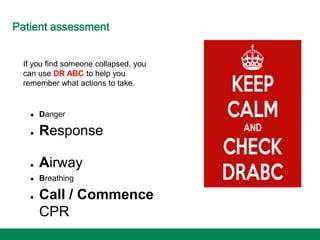
If you find someone collapsed, you
can use DR ABC to help you
remember what actions to take.
● Danger
● Response
● Airway
● Breathing
● Call / Commence
CPR
FIRSTAIDPOWERPOI
Danger
Ensure there are no dangers to yourself, other bystanders
or the patient
Ask yourself - why has the patient collapsed? Are there
any hazards? Am I at risk?
Dangers could include moving vehicles, electricity, water,
other people or smoke/fire
Only enter a situation if it is safe to do so. Remember, you
are the most important person.
Response
Try and wake the victim up - are they responding to
you?
Kneel by their head, shout loudly in both ears and
tap them on the shoulders.
If you do not get aa response, the patient is
unconscious. This is an emergency.
Try and attract attention to yourself/the patient by
shouting for help. However, do not leave the
patient.
Airway
When a patient is unconscious, their tongue can fall
backwards and block their airway. This can cause an
obstruction and the victim will quickly suffocate.
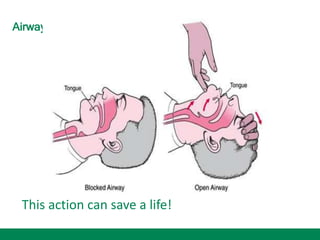
To open an unconscious patient’s airway, place one hand
on their forehead and tilt their head backwards.
Then place two fingers on the bony part of their chin and
lift it.
This is known as the “head tilt, chin lift” maneuver.
Airway
This action can save a life!
Breathing
Keep your hands on the person’s head/chin. Place your cheek above their
mouth and look at their chest.
Look, listen and feel for normal, regular breathing for up to 10 seconds.
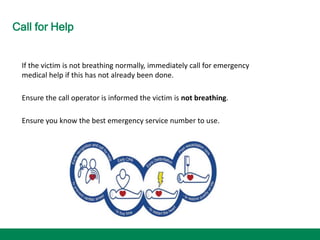
Call for Help
If the victim is not breathing normally, immediately call for emergency
medical help if this has not already been done.
Ensure the call operator is informed the victim is not breathing.
Ensure you know the best emergency service number to use.
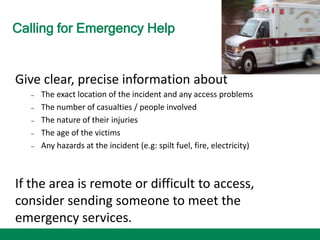
Calling for Emergency Help
Give clear, precise information about
– The exact location of the incident and any access problems
– The number of casualties / people involved
– The nature of their injuries
– The age of the victims
– Any hazards at the incident (e.g: spilt fuel, fire, electricity)
If the area is remote or difficult to access,
consider sending someone to meet the
emergency services.
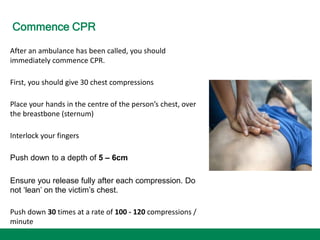
Commence CPR
After an ambulance has been called, you should
immediately commence CPR.
First, you should give 30 chest compressions
Place your hands in the centre of the person’s chest, over
the breastbone (sternum)
Interlock your fingers
Push down to a depth of 5 – 6cm
Ensure you release fully after each compression. Do
not ‘lean’ on the victim’s chest.
Push down 30 times at a rate of 100 - 120 compressions /
minute
CPR: Rescue Breaths
If you have been trained in CPR and are willing to,
give two rescue breaths after every thirty chest
compressions.
Tilt the patient’s head backwards, life their chin and
then pinch their nose
Make a seal over their mouth and breath in for
approximately one second. Do not overinflate the
patient’s chest – you are not blowing up a balloon!
CPR
Continue the cycle of 30 chest
compressions to 2 rescue breaths until
help arrives.
If there is more than one first aider, swap
over doing chest compressions every two
minutes.
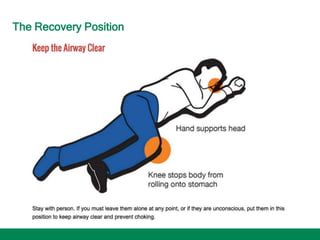
The Recovery Position
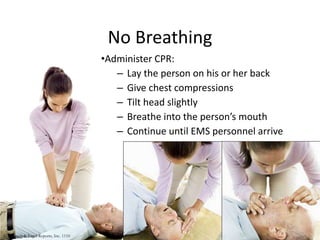
No Breathing
© Business & Legal Reports, Inc. 1110
•Administer CPR:
– Lay the person on his or her back
– Give chest compressions
– Tilt head slightly
– Breathe into the person’s mouth
– Continue until EMS personnel arrive
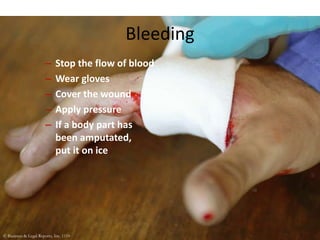
Bleeding
– Stop the flow of blood
– Wear gloves
– Cover the wound
– Apply pressure
– If a body part has
been amputated,
put it on ice
© Business & Legal Reports, Inc. 1110
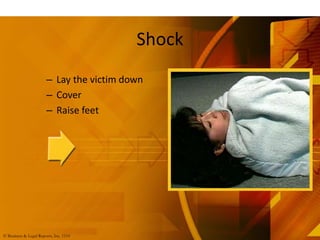
Shock
– Lay the victim down
– Cover
– Raise feet
© Business & Legal Reports, Inc. 1110
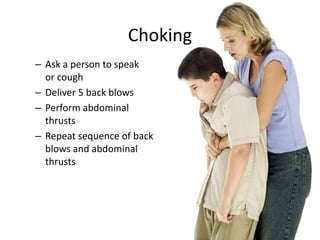
Choking
– Ask a person to speak
or cough
– Deliver 5 back blows
– Perform abdominal
thrusts
– Repeat sequence of back
blows and abdominal
thrusts
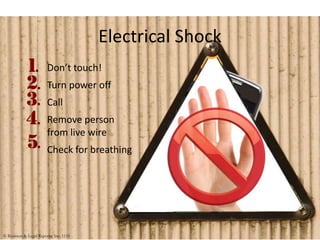
Electrical Shock
Don’t touch!
Turn power off
Call
Remove person
from live wire
Check for breathing
© Business & Legal Reports, Inc. 1110
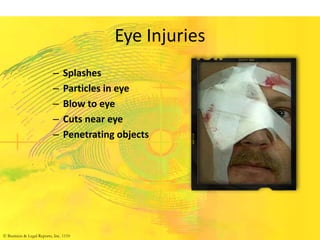
Eye Injuries
– Splashes
– Particles in eye
– Blow to eye
– Cuts near eye
– Penetrating objects
© Business & Legal Reports, Inc. 1110
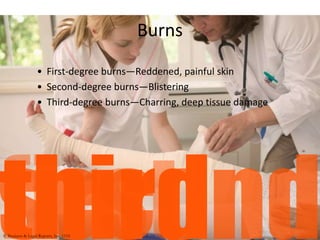
Burns
• First-degree burns—Reddened, painful skin
• Second-degree burns—Blistering
• Third-degree burns—Charring, deep tissue damage
© Business & Legal Reports, Inc. 1110
FIRSTAIDPOWERPOI
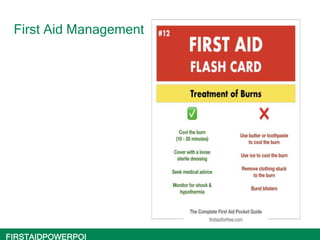
First Aid Management
• Eyes
• Skin
• Inhalation
• Ingestion
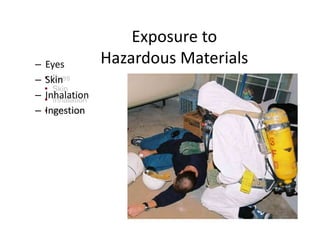
Exposure to
Hazardous Materials
– Eyes
– Skin
– Inhalation
– Ingestion
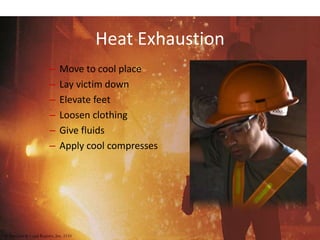
Heat Exhaustion
– Move to cool place
– Lay victim down
– Elevate feet
– Loosen clothing
– Give fluids
– Apply cool compresses
© Business & Legal Reports, Inc. 1110
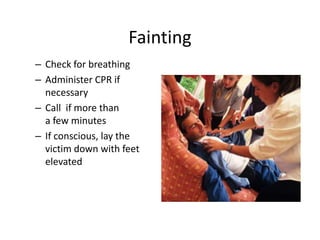
Fainting
– Check for breathing
– Administer CPR if
necessary
– Call if more than
a few minutes
– If conscious, lay the
victim down with feet
elevated
Bee Sting
• Remove the stinger with sterile gauze, meanwhile avoiding
pressure on the affected area or using tweezers.
• Wash the affected area with soap and water.
• Apply ice packs or cold compress to reduce swelling.
• Avoid scratching the sting area. This will worsen itching and
swelling and increase your risk of infection.
• Take an over-the-counter pain reliever as needed, such as
acetaminophen or ibuprofen to help ease discomfort.
• When swelling moves to other areas of the body, or when the
person has breathing difficulty, nausea, or dizziness, s/he should
seek emergency immediately; because the person suffers from a
severe allergic reaction to bee stings, and must be treated
instantly.
• A severe allergic reaction (anaphylaxis) to bee stings is
potentially life-threatening and requires emergency treatment.
Snake Bite
• Call an ambulance straight away.
• Keep the bitten person still and calm, as this can help slow down
the spread of venom in the body.
• Wash the bite area with soap and water immediately.
• Keep the affected area below the heart level to reduce the flow
of venom.
• Cover the bite with clean gauze.
• Avoid touching or pressing the affected area.
• Avoid injuring the affected area or sucking poison from it.
• Avoid applying ice or soaking the wound in a water.
• Avoid drinking caffeinated beverages.
• Remember the color and shape of the snake; as this can help
with treatment of the snakebite.
Scorpion Sting
• Call an ambulance straight away.
• Apply ice packs to the affected area, but
avoid soaking it in cold water.
• Keep the victim still and calm.
• Avoid taking sedatives.
THANK YOU
• https://www.moh.go
v.sa/en/HealthAware
ness/EducationalCon
tent/Firstaid/Pages/0
15.aspx

First Aid.pptx

  • 1.
  • 2.
    Patient assessment If youfind someone collapsed, you can use DR ABC to help you remember what actions to take. ● Danger ● Response ● Airway ● Breathing ● Call / Commence CPR
  • 3.
    FIRSTAIDPOWERPOI Danger Ensure there areno dangers to yourself, other bystanders or the patient Ask yourself - why has the patient collapsed? Are there any hazards? Am I at risk? Dangers could include moving vehicles, electricity, water, other people or smoke/fire Only enter a situation if it is safe to do so. Remember, you are the most important person.
  • 4.
    Response Try and wakethe victim up - are they responding to you? Kneel by their head, shout loudly in both ears and tap them on the shoulders. If you do not get aa response, the patient is unconscious. This is an emergency. Try and attract attention to yourself/the patient by shouting for help. However, do not leave the patient.
  • 5.
    Airway When a patientis unconscious, their tongue can fall backwards and block their airway. This can cause an obstruction and the victim will quickly suffocate. To open an unconscious patient’s airway, place one hand on their forehead and tilt their head backwards. Then place two fingers on the bony part of their chin and lift it. This is known as the “head tilt, chin lift” maneuver.
  • 6.
  • 7.
    Breathing Keep your handson the person’s head/chin. Place your cheek above their mouth and look at their chest. Look, listen and feel for normal, regular breathing for up to 10 seconds.
  • 8.
    Call for Help Ifthe victim is not breathing normally, immediately call for emergency medical help if this has not already been done. Ensure the call operator is informed the victim is not breathing. Ensure you know the best emergency service number to use.
  • 9.
    Calling for EmergencyHelp Give clear, precise information about – The exact location of the incident and any access problems – The number of casualties / people involved – The nature of their injuries – The age of the victims – Any hazards at the incident (e.g: spilt fuel, fire, electricity) If the area is remote or difficult to access, consider sending someone to meet the emergency services.
  • 10.
    Commence CPR After anambulance has been called, you should immediately commence CPR. First, you should give 30 chest compressions Place your hands in the centre of the person’s chest, over the breastbone (sternum) Interlock your fingers Push down to a depth of 5 – 6cm Ensure you release fully after each compression. Do not ‘lean’ on the victim’s chest. Push down 30 times at a rate of 100 - 120 compressions / minute
  • 11.
    CPR: Rescue Breaths Ifyou have been trained in CPR and are willing to, give two rescue breaths after every thirty chest compressions. Tilt the patient’s head backwards, life their chin and then pinch their nose Make a seal over their mouth and breath in for approximately one second. Do not overinflate the patient’s chest – you are not blowing up a balloon!
  • 12.
    CPR Continue the cycleof 30 chest compressions to 2 rescue breaths until help arrives. If there is more than one first aider, swap over doing chest compressions every two minutes.
  • 13.
  • 15.
    No Breathing © Business& Legal Reports, Inc. 1110 •Administer CPR: – Lay the person on his or her back – Give chest compressions – Tilt head slightly – Breathe into the person’s mouth – Continue until EMS personnel arrive
  • 16.
    Bleeding – Stop theflow of blood – Wear gloves – Cover the wound – Apply pressure – If a body part has been amputated, put it on ice © Business & Legal Reports, Inc. 1110
  • 17.
    Shock – Lay thevictim down – Cover – Raise feet © Business & Legal Reports, Inc. 1110
  • 18.
    Choking – Ask aperson to speak or cough – Deliver 5 back blows – Perform abdominal thrusts – Repeat sequence of back blows and abdominal thrusts
  • 19.
    Electrical Shock Don’t touch! Turnpower off Call Remove person from live wire Check for breathing © Business & Legal Reports, Inc. 1110
  • 20.
    Eye Injuries – Splashes –Particles in eye – Blow to eye – Cuts near eye – Penetrating objects © Business & Legal Reports, Inc. 1110
  • 21.
    Burns • First-degree burns—Reddened,painful skin • Second-degree burns—Blistering • Third-degree burns—Charring, deep tissue damage © Business & Legal Reports, Inc. 1110
  • 22.
  • 23.
    • Eyes • Skin •Inhalation • Ingestion Exposure to Hazardous Materials – Eyes – Skin – Inhalation – Ingestion
  • 24.
    Heat Exhaustion – Moveto cool place – Lay victim down – Elevate feet – Loosen clothing – Give fluids – Apply cool compresses © Business & Legal Reports, Inc. 1110
  • 25.
    Fainting – Check forbreathing – Administer CPR if necessary – Call if more than a few minutes – If conscious, lay the victim down with feet elevated
  • 26.
    Bee Sting • Removethe stinger with sterile gauze, meanwhile avoiding pressure on the affected area or using tweezers. • Wash the affected area with soap and water. • Apply ice packs or cold compress to reduce swelling. • Avoid scratching the sting area. This will worsen itching and swelling and increase your risk of infection. • Take an over-the-counter pain reliever as needed, such as acetaminophen or ibuprofen to help ease discomfort. • When swelling moves to other areas of the body, or when the person has breathing difficulty, nausea, or dizziness, s/he should seek emergency immediately; because the person suffers from a severe allergic reaction to bee stings, and must be treated instantly. • A severe allergic reaction (anaphylaxis) to bee stings is potentially life-threatening and requires emergency treatment.
  • 27.
    Snake Bite • Callan ambulance straight away. • Keep the bitten person still and calm, as this can help slow down the spread of venom in the body. • Wash the bite area with soap and water immediately. • Keep the affected area below the heart level to reduce the flow of venom. • Cover the bite with clean gauze. • Avoid touching or pressing the affected area. • Avoid injuring the affected area or sucking poison from it. • Avoid applying ice or soaking the wound in a water. • Avoid drinking caffeinated beverages. • Remember the color and shape of the snake; as this can help with treatment of the snakebite.
  • 28.
    Scorpion Sting • Callan ambulance straight away. • Apply ice packs to the affected area, but avoid soaking it in cold water. • Keep the victim still and calm. • Avoid taking sedatives.
  • 29.