CLOUD
COMPUTING
Cloud Computing
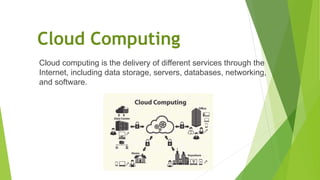
Cloud computing is the delivery of different services through the
Internet, including data storage, servers, databases, networking,
and software.
Qualities of Cloud
 Self-service on-demand: A customer can voluntarily provision computing
resources like server time and network storage.
 Broad network access: Various clients and devices can access the network’s
capabilities.
 Resources Pooling: A multi-tenant model is used to pool the provider’s
computer resources to service a large number of customers.
 Rapid elasticity: Through software, users can increase or decrease capacity.
 Manages Services: Service metrics Resources are managed and optimized
automatically, with information on who is using what and how much.
Types of Cloud
 Public Cloud - The cloud provider offers a public cloud environment model through the internet on
a pay-per-use basis for multiple businesses.
 Private Cloud - An enterprise can own and host a private cloud environment.
 Hybrid Cloud - A hybrid cloud environment model is a combination of a private and public cloud
environment model. ...
 Community Cloud - A community cloud environment is shared between organizations that fit into a
specific community, such as geographic or professional communities, having a common goal.
Cloud Services
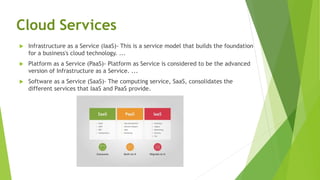
 Infrastructure as a Service (IaaS)- This is a service model that builds the foundation
for a business's cloud technology. ...
 Platform as a Service (PaaS)- Platform as Service is considered to be the advanced
version of Infrastructure as a Service. ...
 Software as a Service (SaaS)- The computing service, SaaS, consolidates the
different services that IaaS and PaaS provide.
FIREWALL & CLOUD COMPUTING.pptx

FIREWALL & CLOUD COMPUTING.pptx

  • 1.
  • 2.
    Cloud Computing Cloud computingis the delivery of different services through the Internet, including data storage, servers, databases, networking, and software.
  • 3.
    Qualities of Cloud Self-service on-demand: A customer can voluntarily provision computing resources like server time and network storage.  Broad network access: Various clients and devices can access the network’s capabilities.  Resources Pooling: A multi-tenant model is used to pool the provider’s computer resources to service a large number of customers.  Rapid elasticity: Through software, users can increase or decrease capacity.  Manages Services: Service metrics Resources are managed and optimized automatically, with information on who is using what and how much.
  • 4.
    Types of Cloud Public Cloud - The cloud provider offers a public cloud environment model through the internet on a pay-per-use basis for multiple businesses.  Private Cloud - An enterprise can own and host a private cloud environment.  Hybrid Cloud - A hybrid cloud environment model is a combination of a private and public cloud environment model. ...  Community Cloud - A community cloud environment is shared between organizations that fit into a specific community, such as geographic or professional communities, having a common goal.
  • 5.
    Cloud Services  Infrastructureas a Service (IaaS)- This is a service model that builds the foundation for a business's cloud technology. ...  Platform as a Service (PaaS)- Platform as Service is considered to be the advanced version of Infrastructure as a Service. ...  Software as a Service (SaaS)- The computing service, SaaS, consolidates the different services that IaaS and PaaS provide.