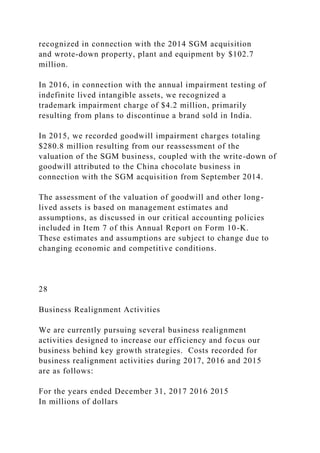
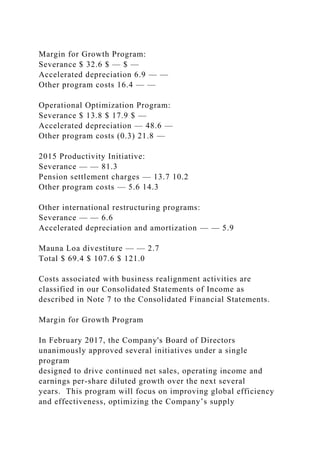
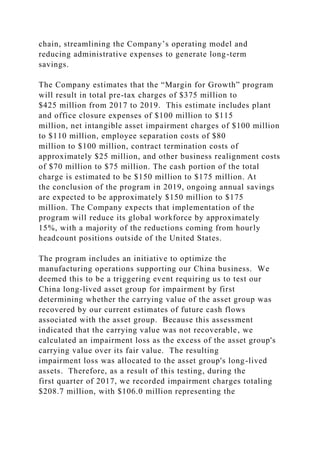
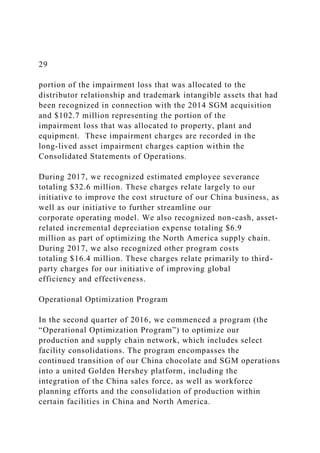
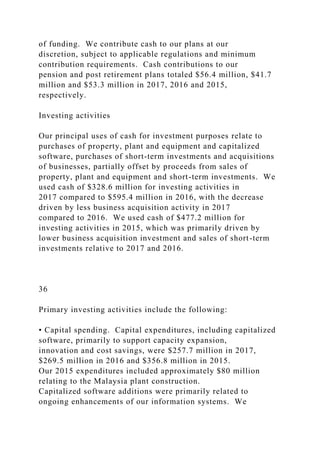
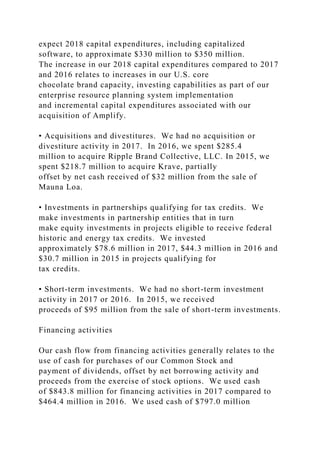
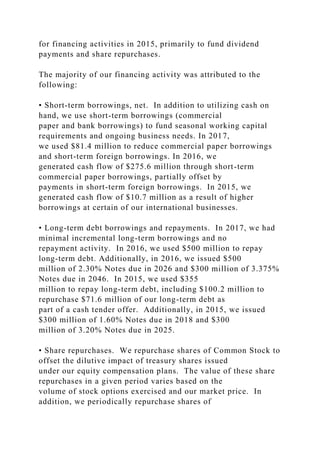
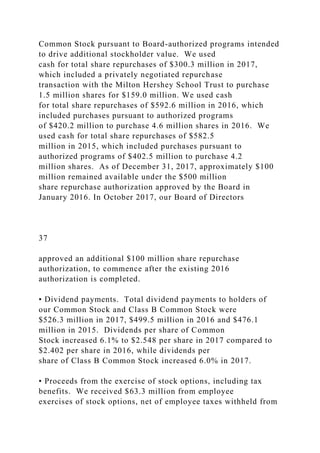
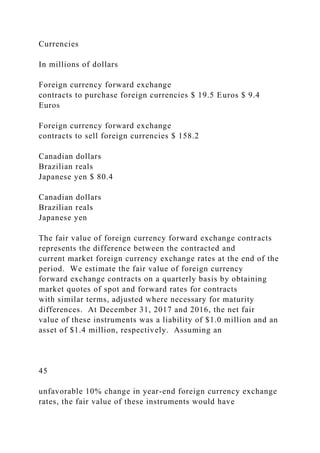
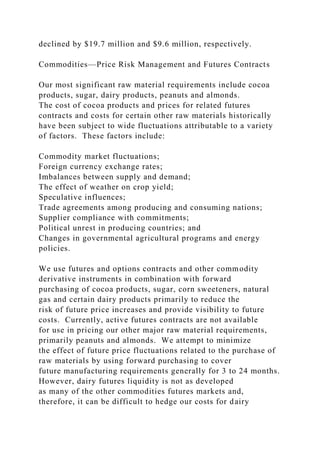
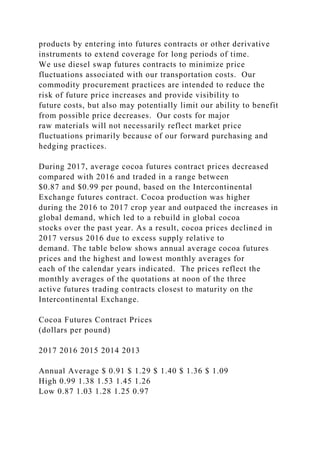
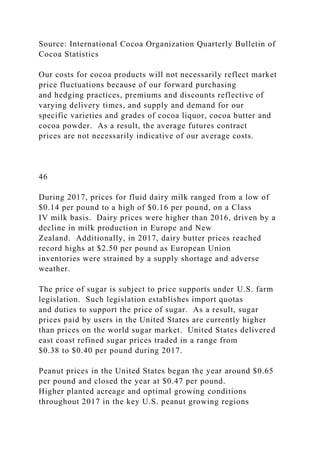
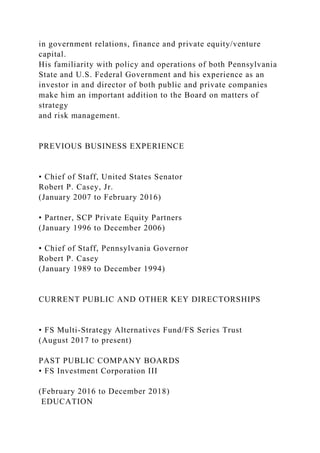
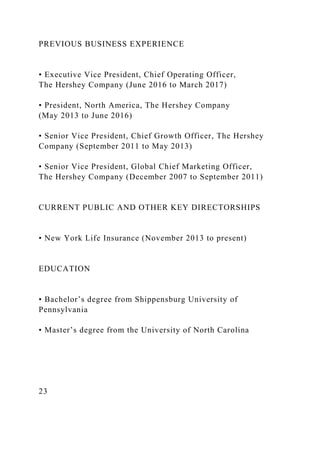
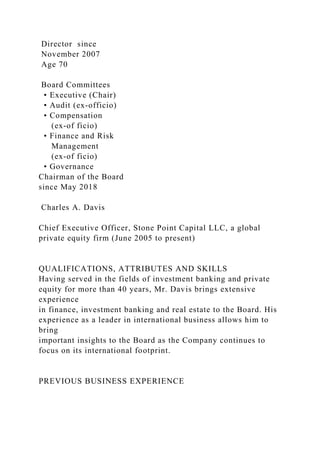
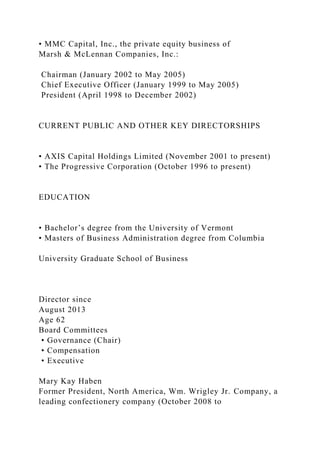
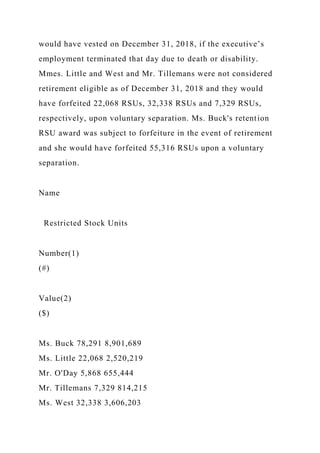
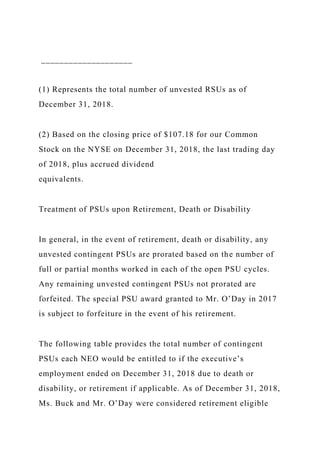
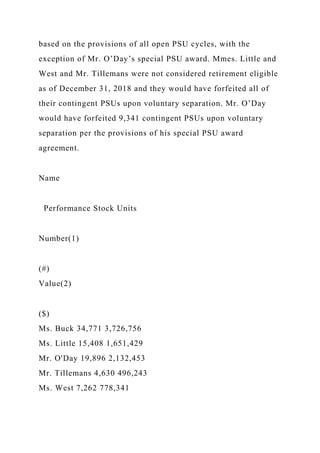
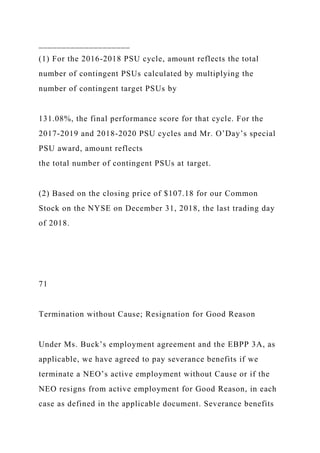
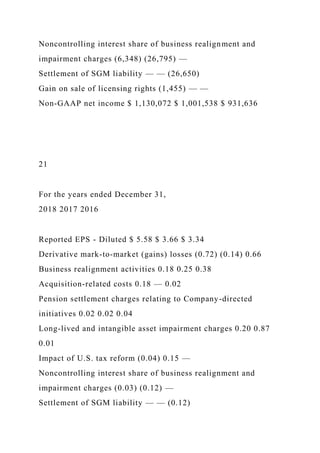
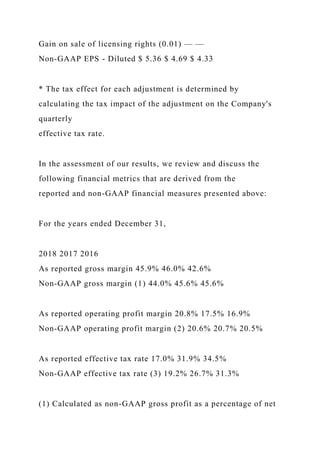
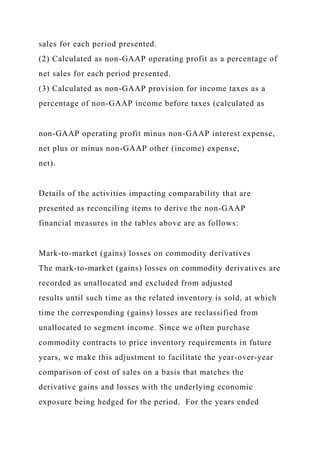
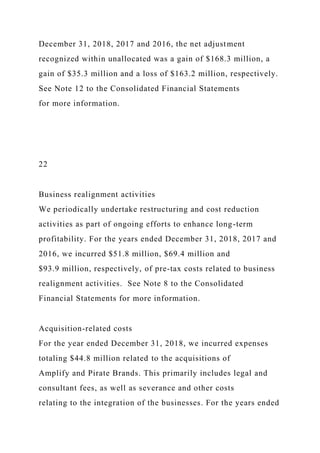
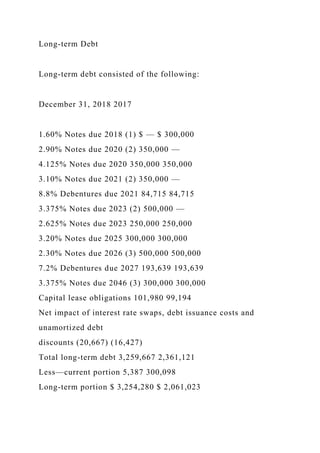
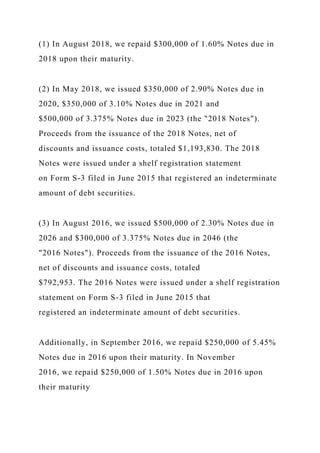
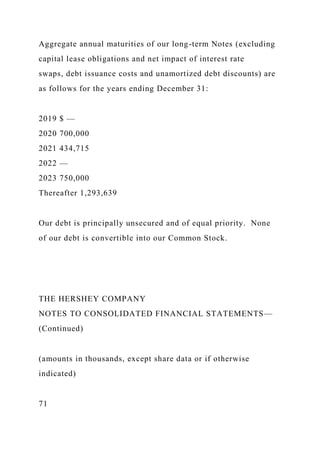
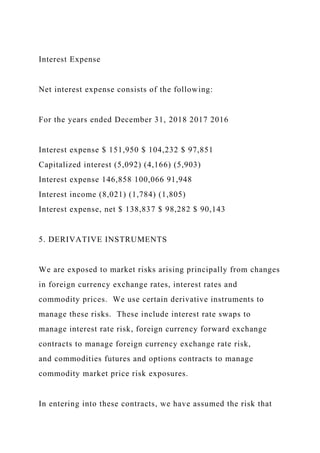
Financial Statements Project – ACG203 – Summer 2019
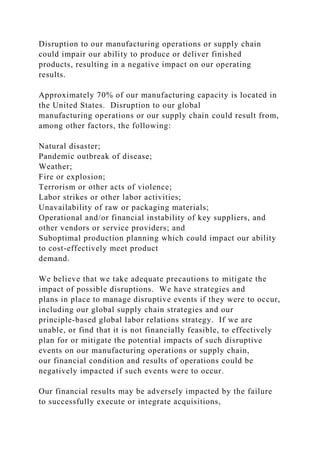
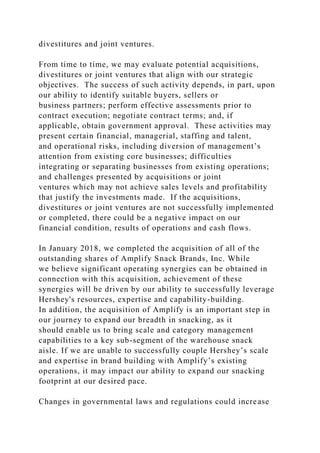
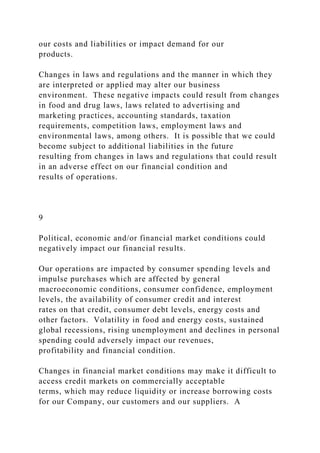
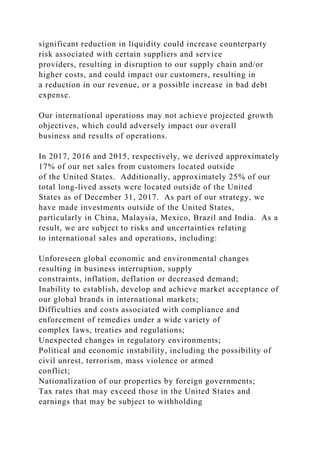
1
Instructions:
A. Locate Annual report - Search your company’s website under
investor relations to locate the latest annual report published to
shareholders.
B. Reference the annual report page number when you take
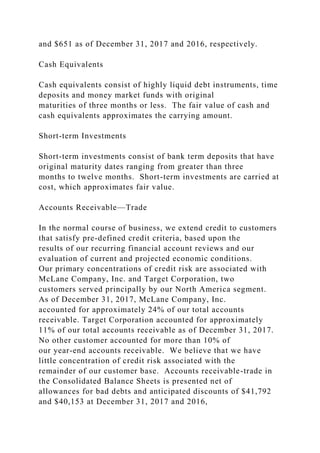
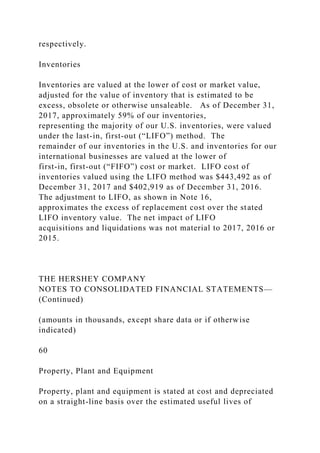
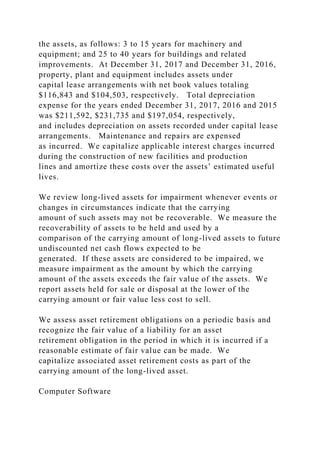
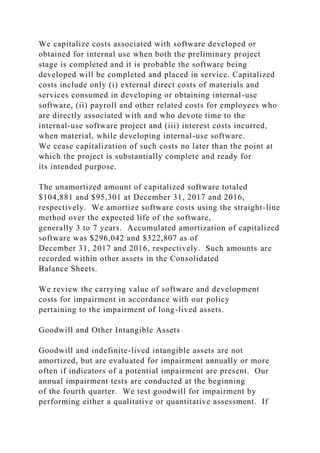
information from the annual report in your discussions. There is
no need to reference the financial statement page numbers for
you calculations. Only reference for your discussion.
C. Read Chapter 13– Financial statement analysis – Most of
Chapter 13 will be covered throughout the semester while
covering the other chapters in the text; therefore, there will be
limited in-class coverage of Chapter 13. Use Chapter 13 as a
resource when answering questions.
D. Copy the questions below - Use the electronic copy of this
assignment from Blackboard as the starting WORD document.
Insert your answers under each question. Answer the questions
completely and show the details of all calculations in your
report. When you use financial information from the annual
report or the 10-K report, include the page number as a
reference.
E. Team Update Form - Meet as a team to pick a team name,
choose a team leader, set team rules and guidelines, and to set
up regular meetings. Turn in this information when the Team
update is due.
F. Team effort required - Completion of this project must be a
team effort! The finished project must ‘flow’. It is not
acceptable to have each member to complete one portion of the
project, and then put the pieces together to hand it in. Points
will be taken of if this is done!
G. Peer evaluation form must be completed by each team
member and uploaded before the due date.
· You must evaluate yourself and your team members.
· IF YOU DO NOT HAND IN YOUR EVALUATION, YOUR
GRADE WILL BE REDUCED BY 20%!!
· Your individual grade may differ from the project grade based
on these evaluations.
H. The following deadlines apply:
Final due date for the project is the last day of summer class
Summary of deliverables:
· Project report – uploaded to Bb and will be analyzed by
Turnitin for plagiarism.
· Team evaluation form – uploaded to Bb
Questions to be answered:
Management Discussion & Analysis section and Miscellaneous
(15 points)
1. Review the annual report contents and identify the page
numbers for the following sections:
a. Management Discussion and Analysis
b. Financial Statements and Supplementary data
c. Any other sections that is of interest to you. Indicate why it
is of interest to you.
2. Read the Management Discussion and Analysis. Describe the
major products and/or service the company provides to its
customers. Based on what you read, do you get a positive or
negative impression about company performance and what the
company is doing to grow in the future? Be sure to specifically
discuss management perspectives in order to support your
impression.
3. Locate the financial statements, and a few pages after the
financial statements, the Report of Independent Registered
Public Accounting Firm.
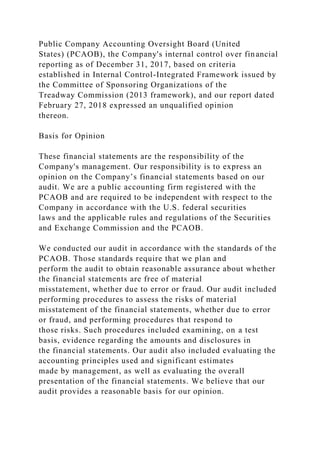
a. Who is the company’s independent auditor and what type of
audit opinion on the financial statements was rendered
(qualified, unqualified, adverse, disclaimer)? What are the
implications of this opinion to users?
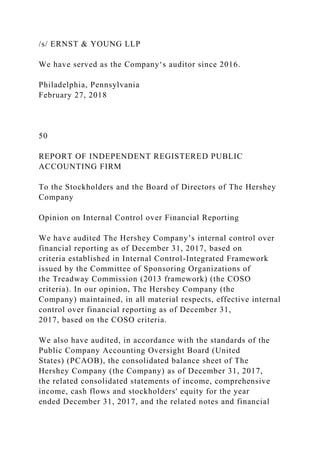
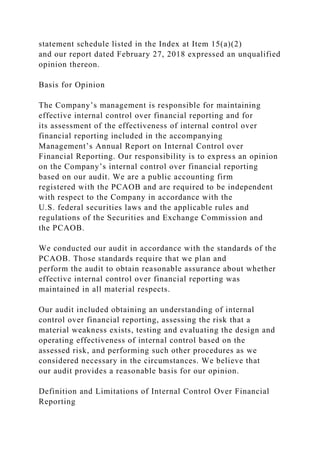
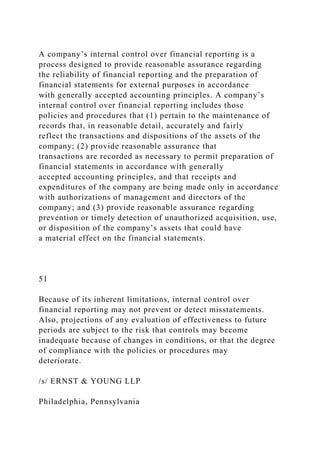
b. What is the auditor’s opinion on Internal Control over
Financial Statements. What are the implications of this opinion
to users?
c. Who is responsible for the company’s financial statements?
What are the implications of this to management?
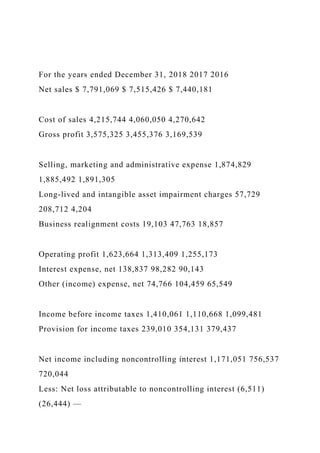
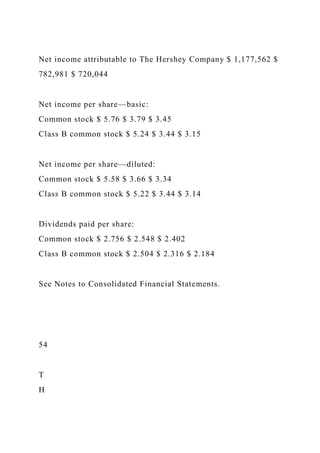
Income Statement and Profitability (10 points)
4. Analysis of Profitability
a. For each ratio below, calculate the ratio for the past two
years, explain the interpretation of the ratio, and analyze the
trend in the ratio for the past two years.
i. Net profit Margin Ratio
ii. Gross Profit Margin Ratio
iii. Return on Assets Ratio
b. Overall, analyze the trend in profitability for your company.
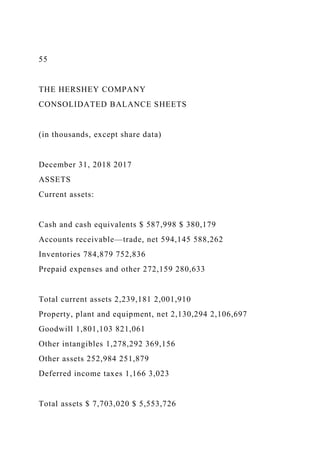
Balance Sheet – Analysis of Liquidity and Solvency (55 points)
5. Analysis of Liquidity
a. For each ratio below, calculate the ratio for the past two
years, explain the interpretation of the ratio, and analyze the
trend in the ratio for the past two years.
i. Current Ratio
ii. Acid Test Ratio
iii. A/R turnover
iv. Days to Sell Inventory
b. Overall, analyze the trend in liquidity for your company.
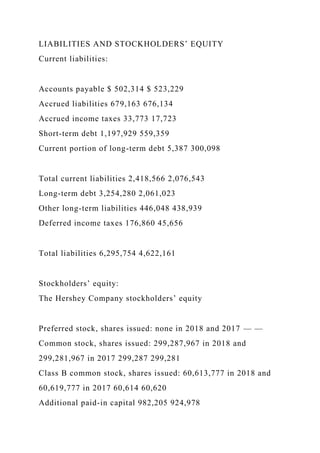
6. Analysis of Solvency
a. Calculate the Debt Ratio for the past two years, explain the
interpretation of the ratio, and analyze the trend in the ratio for
the past two years.
7. Analysis of Accounts Receivable
a. What are the numbers for A/R, Allowance for Doubtful
Accounts, and A/R (net)?
b. What percent of A/R does the Allowance account represent?
What conclusions can you draw from this percentage?
8. Analysis of Plant Asset and Depreciation
a. What are the numbers for Plant Assets at cost, accumulated
depreciation, and Plant Assets (net)? These numbers will be
available in the notes to the financial statements if they are not
apparent on the balance sheet itself.
b. Calculate accumulated depreciation as a percent of total Plant
Assets? What general conclusions can you make about this
percentage?
c. What depreciation method(s) does the company use and how
does the depreciation method chosen affect the financial
statements versus other methods?
9. Analysis of Intangible Assets - Does the company have any
intangible assets? If so, what are they and describe what they
mean? If not, what are intangible assets and what is an example
of an intangible asset.
Cash Flows (10 points)
10. Analysis of Statement of Cash Flows
a. For your company’s past two years, create a table that
summarizes the total cash flow from Operating, Investing, and
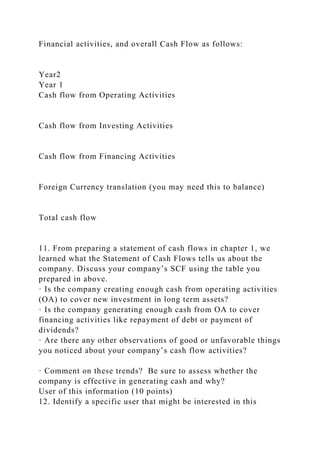
Financial activities, and overall Cash Flow as follows:
Year2
Year 1
Cash flow from Operating Activities
Cash flow from Investing Activities
Cash flow from Financing Activities
Foreign Currency translation (you may need this to balance)
Total cash flow
11. From preparing a statement of cash flows in chapter 1, we
learned what the Statement of Cash Flows tells us about the
company. Discuss your company’s SCF using the table you
prepared in above.
· Is the company creating enough cash from operating activities
(OA) to cover new investment in long term assets?
· Is the company generating enough cash from OA to cover
financing activities like repayment of debt or payment of
dividends?
· Are there any other observations of good or unfavorable things
you noticed about your company’s cash flow activities?
· Comment on these trends? Be sure to assess whether the
company is effective in generating cash and why?
User of this information (10 points)
12. Identify a specific user that might be interested in this
company analysis that you conducted. Discuss how the user
might use this financial information and related decision that
could be made based on this analysis. Discuss what other
information (not provided in your analysis) the user might need
in order to finalize his/her decision.
Writing Quality and Report Presentation
Characteristics to be evaluated:
· Is the final report professionally written, professional in
appearance, and easy to read?
· Did the writer go above and beyond in answering the
questions? Did the writer make connections between answers of
various questions?
· Would the report be good enough to show your boss in a
professional work environment?
· Fatal Flaws - Your grade will be penalized for fatal flaws
(misspelled words, incorrect punctuation, sentence fragments,
awkward wording, incorrect sentence structure, incorrect
paragraph structure, etc.)
Total Points (100 POINTS)
Writing Quality and Report Presentation
Characteristics to be evaluated:
· Is the final report professionally written, professional in
appearance, easy to read, and user-friendly? Use of tables for
presentation of numerical data is suggested.
· Did the team take the time to make the report have a
consistent and professional appearance throughout?
· Are page numbers from annual report referenced
appropriately?
· Did the writer go above and beyond in answering the
questions? Did the writer make connections between answers of
various questions?
· Is each chart presented on the same page and NOT split
between pages.
· Fatal Flaws - Your grade will be penalized for fatal flaws –
grammar, punctuation, awkward wording, word choice errors,
fragments, etc.
6/19/2019 Environmental Science: Active Learning Laboratories
and Applied Problem Sets - Pages 175 - 180
https://phoenix.vitalsource.com/#/books/9781119033172/cfi/6/7
8!/4/6/30/6/4/2/2/[email protected]:100 1/6
PRINTED BY: [email protected] Printing is for personal,
private use only. No part of this book may be
reproduced or transmitted without publisher's prior permission.
Violators will be prosecuted.
6/19/2019 Environmental Science: Active Learning Laboratories
and Applied Problem Sets - Pages 175 - 180
https://phoenix.vitalsource.com/#/books/9781119033172/cfi/6/7
8!/4/6/30/6/4/2/2/[email protected]:100 2/6
PRINTED BY: [email protected] Printing is for personal,
private use only. No part of this book may be
reproduced or transmitted without publisher's prior permission.
Violators will be prosecuted.
6/19/2019 Environmental Science: Active Learning Laboratories
and Applied Problem Sets - Pages 175 - 180
https://phoenix.vitalsource.com/#/books/9781119033172/cfi/6/7
8!/4/6/30/6/4/2/2/[email protected]:100 3/6
PRINTED BY: [email protected] Printing is for personal,
private use only. No part of this book may be
reproduced or transmitted without publisher's prior permission.
Violators will be prosecuted.
6/19/2019 Environmental Science: Active Learning Laboratories
and Applied Problem Sets - Pages 175 - 180
https://phoenix.vitalsource.com/#/books/9781119033172/cfi/6/7
8!/4/6/30/6/4/2/2/[email protected]:100 4/6
PRINTED BY: [email protected] Printing is for personal,
private use only. No part of this book may be
reproduced or transmitted without publisher's prior permission.
Violators will be prosecuted.
6/19/2019 Environmental Science: Active Learning Laboratories
and Applied Problem Sets - Pages 175 - 180
https://phoenix.vitalsource.com/#/books/9781119033172/cfi/6/7
8!/4/6/30/6/4/2/2/[email protected]:100 5/6
PRINTED BY: [email protected] Printing is for personal,
private use only. No part of this book may be
reproduced or transmitted without publisher's prior permission.
Violators will be prosecuted.
6/19/2019 Environmental Science: Active Learning Laboratories
and Applied Problem Sets - Pages 175 - 180
https://phoenix.vitalsource.com/#/books/9781119033172/cfi/6/7
8!/4/6/30/6/4/2/2/[email protected]:100 6/6
PRINTED BY: [email protected] Printing is for personal,
private use only. No part of this book may be
reproduced or transmitted without publisher's prior permission.
Violators will be prosecuted.
UNITED STATES
SECURITIES AND EXCHANGE COMMISSION
WASHINGTON, D.C. 20549
FORM 10-K
Annual Report Pursuant to Section 13 or 15(d) of the Securities
Exchange Act of 1934
For the fiscal year ended December 31, 2017
OR
Transition Report Pursuant to Section 13 or 15(d) of the
Securities Exchange Act of 1934
For the transition period from to
Commission File Number 1-183
THE HERSHEY COMPANY
(Exact name of registrant as specified in its charter)
Delaware 23-0691590
(State or other jurisdiction of
incorporation or organization)
(I.R.S. Employer Identification No.)
100 Crystal A Drive, Hershey, PA 17033
(Address of principal executive offices) (Zip Code)
Registrant’s telephone number, including area code: (717) 534-
4200
Securities registered pursuant to Section 12(b) of the Act:
Title of each class Name of each exchange on which registered
Common Stock, one dollar par value New York Stock Exchange
Securities registered pursuant to Section 12(g) of the Act:
Title of class
Class B Common Stock, one dollar par value
Indicate by check mark if the registrant is a well-known
seasoned issuer, as defined in Rule 405 of the Securities Act.
Yes No
Indicate by check mark if the registrant is not required to file
reports pursuant to Section 13 or Section 15(d) of the Act.
Yes No
Indicate by check mark whether the registrant (1) has filed all
reports required to be filed by Section 13 or 15(d) of the
Securities
Exchange Act of 1934 during the preceding 12 months (or for
such shorter period that the registrant was required to file such
reports), and (2) has been subject to such filing requirements for
the past 90 days. Yes No
Indicate by check mark whether the registrant has submitted
electronically and posted on its corporate Web site, if any,
every
Interactive Data File required to be submitted and posted
pursuant to Rule 405 of Regulation S-T (§232.405 of this
chapter) during
the preceding 12 months (or for such shorter period that the
registrant was required to submit and post such files). Yes
No
Indicate by check mark if disclosure of delinquent filers
pursuant to Item 405 of Regulation S-K (§229.405 of this
chapter) is not
contained herein, and will not be contained, to the best of
registrant’s knowledge, in definitive proxy or information
statements
incorporated by reference in Part III of this Form 10-K or any
amendment to this Form 10-K.
Indicate by check mark whether the registrant is a large
accelerated filer, an accelerated filer, a non-accelerated filer, a
smaller
reporting company, or an emerging growth company. See the
definitions of “large accelerated filer,” “accelerated filer,”
“smaller
reporting company” and “emerging growth company” in Rule
12b-2 of the Exchange Act. (Check one):
Large accelerated filer Accelerated filer Smaller reporting
company
Non-accelerated filer (Do not check if a smaller reporting
company) Emerging growth company
If an emerging growth company, indicate by check mark if the
registrant has elected not to use the extended transition period
for
complying with any new or revised financial accounting
standards provided pursuant to Section 13(a) of the Exchange
Act.
Indicate by check mark whether the registrant is a shell
company (as defined in Rule 12b-2 of the Exchange Act). Yes
No
As of June 30, 2017 (the last business day of the registrant’s
most recently completed second fiscal quarter), the aggregate
market
value of the voting and non-voting common equity held by non-
affiliates was $14,885,931,198. Class B Common Stock is not
listed
for public trading on any exchange or market system. However,
Class B shares are convertible into shares of Common Stock at
any
time on a share-for-share basis. Determination of aggregate
market value assumes all outstanding shares of Class B
Common Stock
were converted to Common Stock as of June 30, 2017. The
market value indicated is calculated based on the closing price
of the
Common Stock on the New York Stock Exchange on June 30,
2017 ($107.37 per share).
Indicate the number of shares outstanding of each of the
registrant’s classes of common stock as of the latest practicable
date.
Common Stock, one dollar par value—149,863,997 shares, as of
February 16, 2018.
Class B Common Stock, one dollar par value—60,619,777
shares, as of February 16, 2018.
DOCUMENTS INCORPORATED BY REFERENCE
Portions of the Proxy Statement for the 2018 Annual Meeting of
Stockholders are incorporated by reference into Part III of this
Annual Report on Form 10-K.
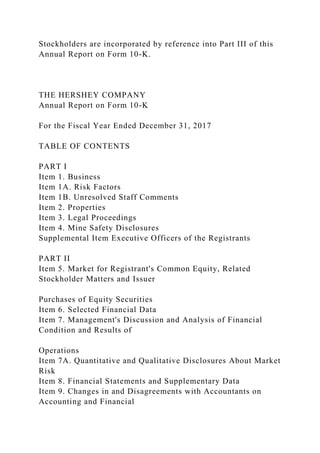
THE HERSHEY COMPANY
Annual Report on Form 10-K
For the Fiscal Year Ended December 31, 2017
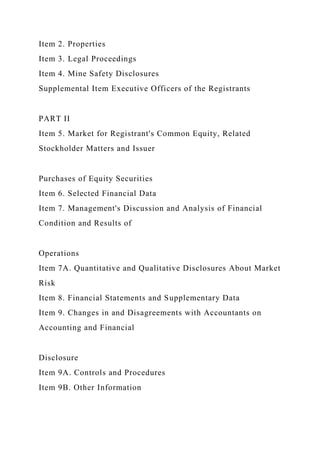
TABLE OF CONTENTS
PART I
Item 1. Business
Item 1A. Risk Factors
Item 1B. Unresolved Staff Comments
Item 2. Properties
Item 3. Legal Proceedings
Item 4. Mine Safety Disclosures
Supplemental Item Executive Officers of the Registrants
PART II
Item 5. Market for Registrant's Common Equity, Related
Stockholder Matters and Issuer
Purchases of Equity Securities
Item 6. Selected Financial Data
Item 7. Management's Discussion and Analysis of Financial
Condition and Results of
Operations
Item 7A. Quantitative and Qualitative Disclosures About Market
Risk
Item 8. Financial Statements and Supplementary Data
Item 9. Changes in and Disagreements with Accountants on
Accounting and Financial
Disclosure
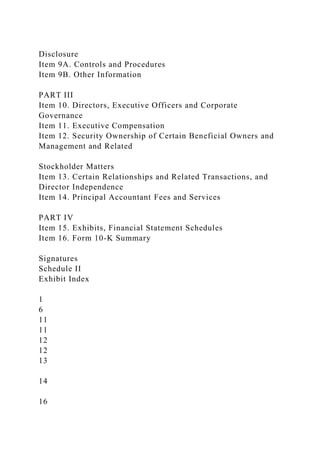
Item 9A. Controls and Procedures
Item 9B. Other Information
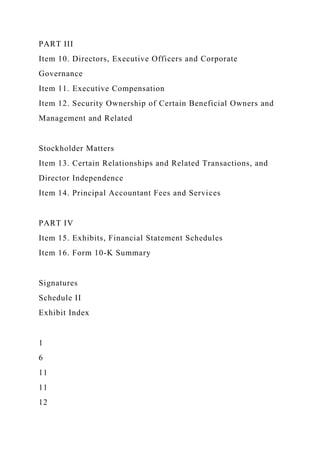
PART III
Item 10. Directors, Executive Officers and Corporate
Governance
Item 11. Executive Compensation
Item 12. Security Ownership of Certain Beneficial Owners and
Management and Related
Stockholder Matters
Item 13. Certain Relationships and Related Transactions, and
Director Independence
Item 14. Principal Accountant Fees and Services
PART IV
Item 15. Exhibits, Financial Statement Schedules
Item 16. Form 10-K Summary
Signatures
Schedule II
Exhibit Index
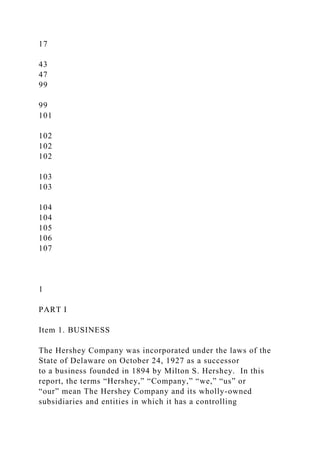
1
6
11
11
12
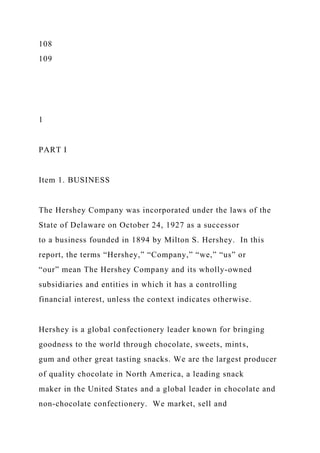
12
13
14
16
17
43
47
99
99
101
102
102
102
103
103
104
104
105
106
107
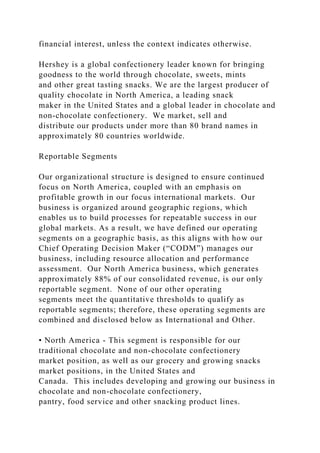
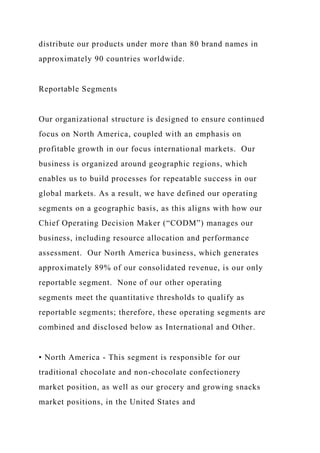
1
PART I
Item 1. BUSINESS
The Hershey Company was incorporated under the laws of the
State of Delaware on October 24, 1927 as a successor
to a business founded in 1894 by Milton S. Hershey. In this
report, the terms “Hershey,” “Company,” “we,” “us” or
“our” mean The Hershey Company and its wholly-owned
subsidiaries and entities in which it has a controlling
financial interest, unless the context indicates otherwise.
Hershey is a global confectionery leader known for bringing
goodness to the world through chocolate, sweets, mints
and other great tasting snacks. We are the largest producer of
quality chocolate in North America, a leading snack
maker in the United States and a global leader in chocolate and
non-chocolate confectionery. We market, sell and
distribute our products under more than 80 brand names in
approximately 80 countries worldwide.
Reportable Segments
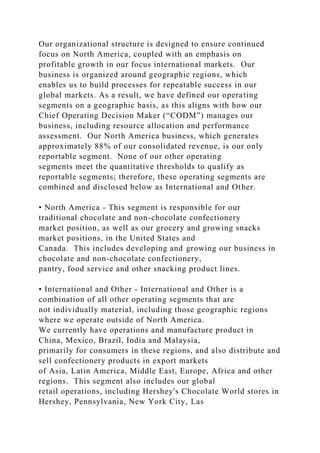
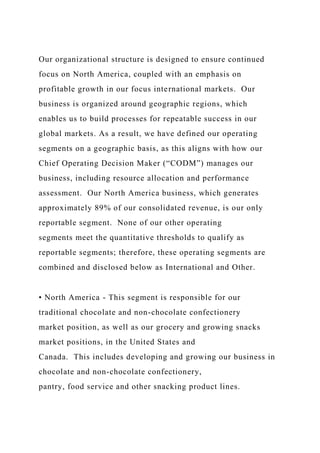
Our organizational structure is designed to ensure continued
focus on North America, coupled with an emphasis on
profitable growth in our focus international markets. Our
business is organized around geographic regions, which
enables us to build processes for repeatable success in our
global markets. As a result, we have defined our operating
segments on a geographic basis, as this aligns with how our
Chief Operating Decision Maker (“CODM”) manages our
business, including resource allocation and performance
assessment. Our North America business, which generates
approximately 88% of our consolidated revenue, is our only
reportable segment. None of our other operating
segments meet the quantitative thresholds to qualify as
reportable segments; therefore, these operating segments are
combined and disclosed below as International and Other.
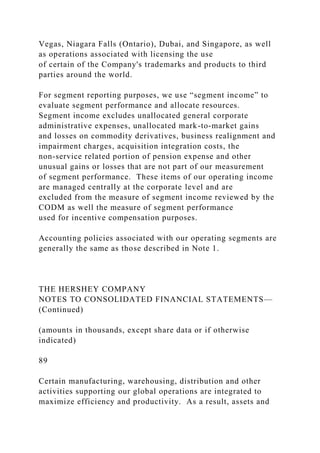
• North America - This segment is responsible for our
traditional chocolate and non-chocolate confectionery
market position, as well as our grocery and growing snacks
market positions, in the United States and
Canada. This includes developing and growing our business in
chocolate and non-chocolate confectionery,
pantry, food service and other snacking product lines.
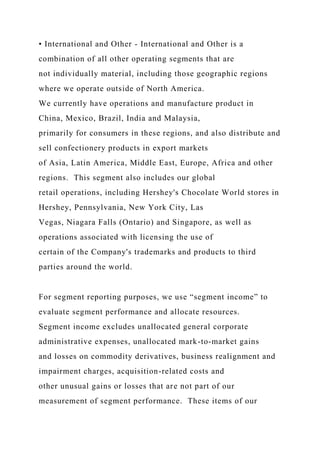
• International and Other - International and Other is a
combination of all other operating segments that are
not individually material, including those geographic regions
where we operate outside of North America.
We currently have operations and manufacture product in
China, Mexico, Brazil, India and Malaysia,
primarily for consumers in these regions, and also distribute and
sell confectionery products in export markets
of Asia, Latin America, Middle East, Europe, Africa and other
regions. This segment also includes our global
retail operations, including Hershey's Chocolate World stores in
Hershey, Pennsylvania, New York City, Las
Vegas, Niagara Falls (Ontario), Dubai, and Singapore, as well
as operations associated with licensing the use
of certain of the Company's trademarks and products to third
parties around the world.
Financial and other information regarding our reportable
segments is provided in our Management’s Discussion and
Analysis and Note 11 to the Consolidated Financial Statements.
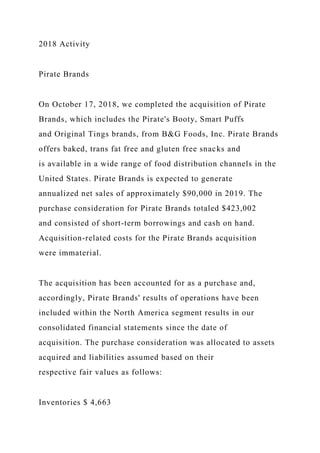
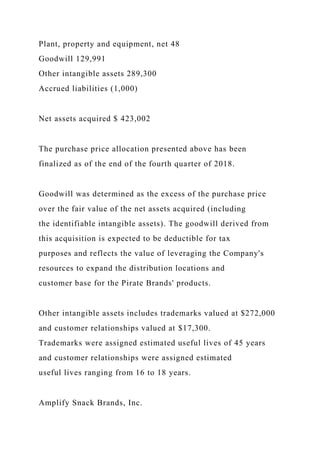
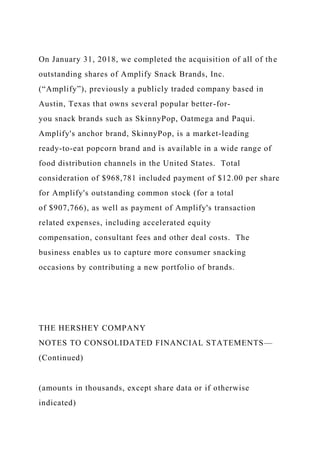
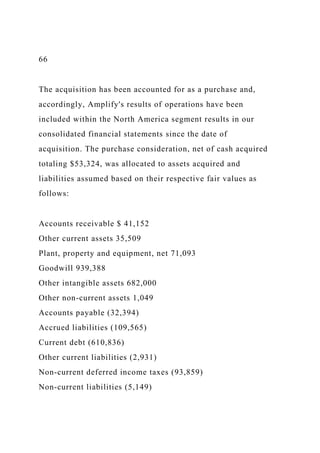
Business Acquisitions
In January 2018, we completed the acquisition of all of the
outstanding shares of Amplify Snack Brands, Inc.
("Amplify"), a publicly traded company based in Austin, Texas
that owns several popular better-for-you snack brands
such as SkinnyPop, Oatmega, Paqui and Tyrrells. The
acquisition enables us to capture more consumer snacking
occasions by creating a broader portfolio of brands.
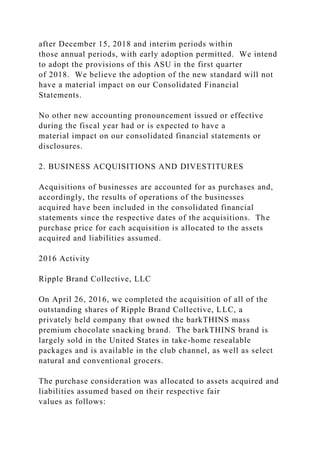
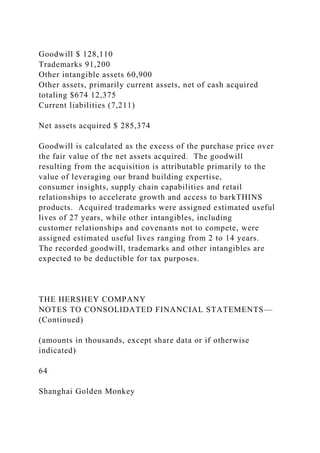
In April 2016, we completed the acquisition of all of the
outstanding shares of Ripple Brand Collective, LLC, a
privately held company based in Congers, New York that owns
the barkTHINS mass premium chocolate snacking
brand. The acquisition was undertaken in order to broaden our
product offerings in the premium and portable snacking
categories.
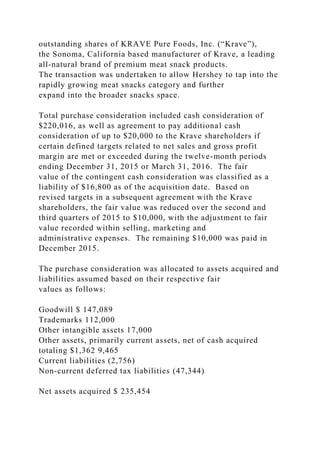
In March 2015, we completed the acquisition of all of the
outstanding shares of KRAVE Pure Foods, Inc. (“Krave”),
the Sonoma, California based manufacturer of Krave, a leading
all-natural brand of premium meat snack products.
The transaction was undertaken to enable us to tap into the
rapidly growing meat snacks category and further expand
into the broader snacks space.
2
Products and Brands
Our principal product offerings include chocolate and non-
chocolate confectionery products; gum and mint
refreshment products; pantry items, such as baking ingredients,
toppings and beverages; and snack items such as
spreads, meat snacks, bars and snack bites and mixes, popcorn
and protein bars and cookies.
• Within our North America markets, our product portfolio
includes a wide variety of chocolate offerings
marketed and sold under the renowned brands of Hershey’s,
Reese’s and Kisses, along with other popular
chocolate and non-chocolate confectionery brands such as Jolly
Rancher, Almond Joy, Brookside,
barkTHINS, Cadbury, Good & Plenty, Heath, Kit Kat®,
Lancaster, Payday, Rolo®, Twizzlers, Whoppers and
York. We also offer premium chocolate products, primarily in
the United States, through the Scharffen Berger
and Dagoba brands. Our gum and mint products include Ice
Breakers mints and chewing gum, Breathsavers
mints and Bubble Yum bubble gum. Our pantry and snack items
that are principally sold in North America
include baking products, toppings and sundae syrups sold under
the Hershey’s, Reese’s and Heath brands, as
well as Hershey’s and Reese’s chocolate spreads, snack bites
and mixes, Krave meat snack products, Popwell
half-popped corn snacks, ready-to-eat SkinnyPop popcorn and
other better-for-you snack brands such as
Oatmega, Paqui and Tyrrells.
• Within our International and Other markets, we manufacture,
market and sell many of these same brands, as
well as other brands that are marketed regionally, such as
Golden Monkey confectionery and Munching
Monkey snack products in China, Pelon Pelo Rico confectionery
products in Mexico, IO-IO snack products in
Brazil, and Nutrine and Maha Lacto confectionery products and
Jumpin and Sofit beverage products in India.
Principal Customers and Marketing Strategy
Our customers are mainly wholesale distributors, chain grocery
stores, mass merchandisers, chain drug stores, vending
companies, wholesale clubs, convenience stores, dollar stores,
concessionaires and department stores. The majority of
our customers, with the exception of wholesale distributors,
resell our products to end-consumers in retail outlets in
North America and other locations worldwide.
In 2017, approximately 29% of our consolidated net sales were
made to McLane Company, Inc., one of the largest
wholesale distributors in the United States to convenience
stores, drug stores, wholesale clubs and mass merchandisers
and the primary distributor of our products to Wal-Mart Stores,
Inc.
The foundation of our marketing strategy is our strong brand
equities, product innovation and the consistently superior
quality of our products. We devote considerable resources to
the identification, development, testing, manufacturing
and marketing of new products. We utilize a variety of
promotional programs directed towards our customers, as well
as advertising and promotional programs for consumers of our
products, to stimulate sales of certain products at
various times throughout the year.
In conjunction with our sales and marketing efforts, our
efficient product distribution network helps us maintain sales
growth and provide superior customer service by facilitating the
shipment of our products from our manufacturing
plants to strategically located distribution centers. We
primarily use common carriers to deliver our products from
these distribution points to our customers.
Raw Materials and Pricing
Cocoa products, including cocoa liquor, cocoa butter and cocoa
powder processed from cocoa beans, are the most
significant raw materials we use to produce our chocolate
products. These cocoa products are purchased directly from
third-party suppliers, who source cocoa beans that are grown
principally in Far Eastern, West African, Central and
South American regions. West Africa accounts for
approximately 70% of the world’s supply of cocoa beans.
Adverse weather, crop disease, political unrest and other
problems in cocoa-producing countries have caused price
fluctuations in the past, but have never resulted in the total loss
of a particular producing country’s cocoa crop and/or
exports. In the event that a significant disruption occurs in any
given country, we believe cocoa from other producing
countries and from current physical cocoa stocks in consuming
countries would provide a significant supply buffer.
3
In 2016, we established a trading company in Switzerland that
performs all aspects of cocoa procurement, including
price risk management, physical supply procurement and
sustainable sourcing oversight. The trading company was
implemented to optimize the supply chain for our cocoa
requirements, with a strategic focus on gaining real time
access to cocoa market intelligence. It also provides us with the
ability to recruit and retain world class commodities
traders and procurement professionals and enables enhanced
collaboration with commodities trade groups, the global
cocoa community and sustainable sourcing resources.
We also use substantial quantities of sugar, Class II and IV
dairy products, peanuts, almonds and energy in our
production process. Most of these inputs for our domestic and
Canadian operations are purchased from suppliers in
the United States. For our international operations, inputs not
locally available may be imported from other countries.
We change prices and weights of our products when necessary
to accommodate changes in input costs, the competitive
environment and profit objectives, while at the same time
maintaining consumer value. Price increases and weight
changes help to offset increases in our input costs, including
raw and packaging materials, fuel, utilities, transportation
costs and employee benefits. When we implement price
increases, there is usually a time lag between the effective
date of the list price increases and the impact of the price
increases on net sales, in part because we typically honor
previous commitments to planned consumer and customer
promotions and merchandising events subsequent to the
effective date of the price increases. In addition, promotional
allowances may be increased subsequent to the effective
date, delaying or partially offsetting the impact of price
increases on net sales.
Competition
Many of our confectionery brands enjoy wide consumer
acceptance and are among the leading brands sold in the
marketplace in North America and certain markets in Latin
America. We sell our brands in highly competitive markets
with many other global multinational, national, regional and
local firms. Some of our competitors are large companies
with significant resources and substantial international
operations. Competition in our product categories is based on
product innovation, product quality, price, brand recognition
and loyalty, effectiveness of marketing and promotional
activity, the ability to identify and satisfy consumer
preferences, as well as convenience and service. In recent
years,
we have also experienced increased competition from other
snack items, which has pressured confectionery category
growth.
Working Capital, Seasonality and Backlog
Our sales are typically higher during the third and fourth
quarters of the year, representing seasonal and holiday-related
sales patterns. We manufacture primarily for stock and
typically fill customer orders within a few days of receipt.
Therefore, the backlog of any unfilled orders is not material to
our total annual sales. Additional information relating
to our cash flows from operations and working capital practices
is provided in our Management’s Discussion and
Analysis.
Trademarks, Service Marks and License Agreements
We own various registered and unregistered trademarks and
service marks. The trademarks covering our key product
brands are of material importance to our business. We follow a
practice of seeking trademark protection in the United
States and other key international markets where our products
are sold. We also grant trademark licenses to third
parties to produce and sell pantry items, flavored milks and
various other products primarily under the Hershey’s and
Reese’s brand names.
4
Furthermore, we have rights under license agreements with
several companies to manufacture and/or sell and
distribute certain products. Our rights under these agreements
are extendible on a long-term basis at our option. Our
most significant licensing agreements are as follows:
Company Brand Location Requirements
Kraft Foods Ireland Intellectual Property
Limited
York
Peter Paul Almond Joy
Peter Paul Mounds
Worldwide None
Cadbury UK Limited
Cadbury
Caramello
United States
Minimum sales
requirement
exceeded in 2017
Société des Produits Nestlé SA Kit Kat®Rolo® United States
Minimum unit
volume sales
exceeded in 2017
Huhtamäki Oy affiliate
Good & Plenty
Heath
Jolly Rancher
Milk Duds
Payday
Whoppers
Worldwide None
Research and Development
We engage in a variety of research and development activities
in a number of countries, including the United States,
Mexico, Brazil, India and China. We develop new products,
improve the quality of existing products, improve and
modernize production processes, and develop and implement
new technologies to enhance the quality and value of
both current and proposed product lines. Information
concerning our research and development expense is contained
in Note 1 to the Consolidated Financial Statements.
Food Quality and Safety Regulation
The manufacture and sale of consumer food products is highly
regulated. In the United States, our activities are
subject to regulation by various government agencies, including
the Food and Drug Administration, the Department of
Agriculture, the Federal Trade Commission, the Department of
Commerce and the Environmental Protection Agency,
as well as various state and local agencies. Similar agencies
also regulate our businesses outside of the United States.
We believe our Product Excellence Program provides us with an
effective product quality and safety program. This
program is integral to our global supply chain platform and is
intended to ensure that all products we purchase,
manufacture and distribute are safe, are of high quality and
comply with applicable laws and regulations.
Through our Product Excellence Program, we evaluate our
supply chain including ingredients, packaging, processes,
products, distribution and the environment to determine where
product quality and safety controls are necessary. We
identify risks and establish controls intended to ensure product
quality and safety. Various government agencies and
third-party firms as well as our quality assurance staff conduct
audits of all facilities that manufacture our products to
assure effectiveness and compliance with our program and
applicable laws and regulations.
Environmental Considerations
We make routine operating and capital expenditures to comply
with environmental laws and regulations. These annual
expenditures are not material with respect to our results of
operations, capital expenditures or competitive position.
5
Employees
As of December 31, 2017, we employed approximately 15,360
full-time and 1,550 part-time employees worldwide.
Collective bargaining agreements covered approximately 5,450
employees. During 2018, agreements will be
negotiated for certain employees at four facilities outside of the
United States, comprising approximately 72% of total
employees under collective bargaining agreements. We believe
that our employee relations are generally good.
Financial Information by Geographic Area
Our principal operations and markets are located in the United
States. The percentage of total consolidated net sales
for our businesses outside of the United States was 16.7% for
2017, 16.7% for 2016 and 17.2% for 2015. The
percentage of total long-lived assets outside of the United
States was 25.2% as of December 31, 2017 and 29.8% as of
December 31, 2016.
Corporate Social Responsibility
Our founder, Milton S. Hershey, established an enduring model
of responsible citizenship while creating a successful
business. Driving sustainable business practices, making a
difference in our communities and operating with the
highest integrity are vital parts of our heritage. We continue
this legacy today by providing high quality products
while conducting our business in a socially responsible and
environmentally sustainable manner. Each year we publish
a full corporate social responsibility (“CSR”) report which
provides an update on the progress we have made in
advancing our CSR priorities such as food safety, responsible
sourcing of ingredients, corporate transparency, our
focus on improving basic nutrition to help children learn and
grow and our continued investment in the communities
where we live and work. To learn more about our goals,
progress and initiatives, you can access our full CSR report at
www.thehersheycompany.com/en_us/responsibility.html.
Available Information
The Company's website address is
www.thehersheycompany.com. We file or furnish annual,
quarterly and current
reports, proxy statements and other information with the United
States Securities and Exchange Commission (“SEC”).
You may obtain a copy of any of these reports, free of charge,
from the Investors section of our website as soon as
reasonably practicable after we electronically file such material
with, or furnish it to, the SEC. The SEC maintains an
Internet site that also contains these reports at: www.sec.gov.
In addition, copies of the Company's annual report will
be made available, free of charge, on written request to the
Company.
We have a Code of Conduct that applies to our Board of
Directors (“Board”) and all Company officers and employees,
including, without limitation, our Chief Executive Officer and
“senior financial officers” (including the Chief
Financial Officer, Chief Accounting Officer and persons
performing similar functions). You can obtain a copy of our
Code of Conduct, as well as our Corporate Governance
Guidelines and charters for each of the Board’s standing
committees, from the Investors section of our website. If we
change or waive any portion of the Code of Conduct that
applies to any of our directors, executive officers or senior
financial officers, we will post that information on our
website.
6
Item 1A. RISK FACTORS
Cautionary Note Regarding Forward-Looking Statements
This Annual Report on Form 10-K, including the exhibits hereto
and the information incorporated by reference herein,
contains “forward-looking statements” within the meaning of
Section 27A of the Securities Act of 1933, as amended,
and Section 21E of the Securities Exchange Act of 1934, as
amended, which are subject to risks and uncertainties.
Other than statements of historical fact, information regarding
activities, events and developments that we expect or
anticipate will or may occur in the future, including, but not
limited to, information relating to our future growth and
profitability targets and strategies designed to increase total
shareholder value, are forward-looking statements based
on management’s estimates, assumptions and projections.
Forward-looking statements also include, but are not
limited to, statements regarding our future economic and
financial condition and results of operations, the plans and
objectives of management and our assumptions regarding our
performance and such plans and objectives. Many of
the forward-looking statements contained in this document may
be identified by the use of words such as “intend,”
“believe,” “expect,” “anticipate,” “should,” “planned,”
“projected,” “estimated” and “potential,” among others.
Forward-looking statements contained in this Annual Report on
Form 10-K are predictions only and actual results
could differ materially from management’s expectations due to
a variety of factors, including those described below.
All forward-looking statements attributable to us or persons
working on our behalf are expressly qualified in their
entirety by such risk factors. The forward-looking statements
that we make in this Annual Report on Form 10-K are
based on management’s current views and assumptions
regarding future events and speak only as of their dates. We
assume no obligation to update developments of these risk
factors or to announce publicly any revisions to any of the
forward-looking statements that we make, or to make
corrections to reflect future events or developments, except as
required by the federal securities laws.
Issues or concerns related to the quality and safety of our
products, ingredients or packaging could cause a product
recall and/or result in harm to the Company’s reputation,
negatively impacting our operating results.
In order to sell our iconic, branded products, we need to
maintain a good reputation with our customers and
consumers. Issues related to the quality and safety of our
products, ingredients or packaging could jeopardize our
Company’s image and reputation. Negative publicity related to
these types of concerns, or related to product
contamination or product tampering, whether valid or not, could
decrease demand for our products or cause production
and delivery disruptions. We may need to recall products if any
of our products become unfit for consumption. In
addition, we could potentially be subject to litigation or
government actions, which could result in payments of fines or
damages. Costs associated with these potential actions could
negatively affect our operating results.
Increases in raw material and energy costs along with the
availability of adequate supplies of raw materials could
affect future financial results.
We use many different commodities for our business, including
cocoa products, sugar, dairy products, peanuts,
almonds, corn sweeteners, natural gas and fuel oil.
Commodities are subject to price volatility and changes in
supply caused by numerous factors, including:
Commodity market fluctuations;
Currency exchange rates;
Imbalances between supply and demand;
The effect of weather on crop yield;
Speculative influences;
Trade agreements among producing and consuming nations;
Supplier compliance with commitments;
Political unrest in producing countries; and
Changes in governmental agricultural programs and energy
policies.
7
Although we use forward contracts and commodity futures and
options contracts where possible to hedge commodity
prices, commodity price increases ultimately result in
corresponding increases in our raw material and energy costs.
If
we are unable to offset cost increases for major raw materials
and energy, there could be a negative impact on our
financial condition and results of operations.
Price increases may not be sufficient to offset cost increases
and maintain profitability or may result in sales
volume declines associated with pricing elasticity.
We may be able to pass some or all raw material, energy and
other input cost increases to customers by increasing the
selling prices of our products or decreasing the size of our
products; however, higher product prices or decreased
product sizes may also result in a reduction in sales volume
and/or consumption. If we are not able to increase our
selling prices or reduce product sizes sufficiently, or in a timely
manner, to offset increased raw material, energy or
other input costs, including packaging, freight, direct labor,
overhead and employee benefits, or if our sales volume
decreases significantly, there could be a negative impact on our
financial condition and results of operations.
Market demand for new and existing products could decline.
We operate in highly competitive markets and rely on continued
demand for our products. To generate revenues and
profits, we must sell products that appeal to our customers and
to consumers. Our continued success is impacted by
many factors, including the following:
Effective retail execution;
Appropriate advertising campaigns and marketing programs;
Our ability to secure adequate shelf space at retail locations;
Our ability to drive sustainable innovation and maintain a
strong pipeline of new products in the
confectionery and broader snacking categories;
Changes in product category consumption;
Our response to consumer demographics and trends, including
but not limited to, trends relating to store
trips and the impact of the growing e-commerce channel; and
Consumer health concerns, including obesity and the
consumption of certain ingredients.
There continues to be competitive product and pricing pressures
in the markets where we operate, as well as
challenges in maintaining profit margins. We must maintain
mutually beneficial relationships with our key customers,
including retailers and distributors, to compete effectively. Our
largest customer, McLane Company, Inc., accounted
for approximately 29% of our total net sales in 2017. McLane
Company, Inc. is one of the largest wholesale
distributors in the United States to convenience stores, drug
stores, wholesale clubs and mass merchandisers, including
Wal-Mart Stores, Inc.
Increased marketplace competition could hurt our business.
The global confectionery packaged goods industry is intensely
competitive and consolidation in this industry
continues. Some of our competitors are large companies that
have significant resources and substantial international
operations. We continue to experience increased levels of in-
store activity for other snack items, which has pressured
confectionery category growth. In order to protect our existing
market share or capture increased market share in this
highly competitive retail environment, we may be required to
increase expenditures for promotions and advertising,
and must continue to introduce and establish new products. Due
to inherent risks in the marketplace associated with
advertising and new product introductions, including
uncertainties about trade and consumer acceptance, increased
expenditures may not prove successful in maintaining or
enhancing our market share and could result in lower sales
and profits. In addition, we may incur increased credit and
other business risks because we operate in a highly
competitive retail environment.
8
Disruption to our manufacturing operations or supply chain
could impair our ability to produce or deliver finished
products, resulting in a negative impact on our operating
results.
Approximately 70% of our manufacturing capacity is located in
the United States. Disruption to our global
manufacturing operations or our supply chain could result from,
among other factors, the following:
Natural disaster;
Pandemic outbreak of disease;
Weather;
Fire or explosion;
Terrorism or other acts of violence;
Labor strikes or other labor activities;
Unavailability of raw or packaging materials;
Operational and/or financial instability of key suppliers, and
other vendors or service providers; and
Suboptimal production planning which could impact our ability
to cost-effectively meet product
demand.
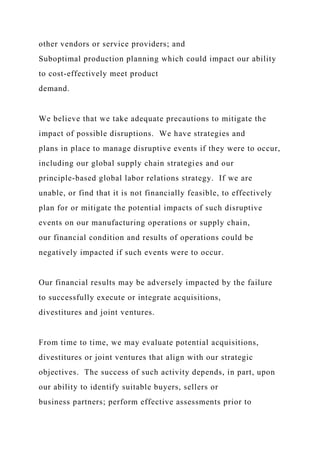
We believe that we take adequate precautions to mitigate the
impact of possible disruptions. We have strategies and
plans in place to manage disruptive events if they were to occur,
including our global supply chain strategies and our
principle-based global labor relations strategy. If we are
unable, or find that it is not financially feasible, to effectively
plan for or mitigate the potential impacts of such disruptive
events on our manufacturing operations or supply chain,
our financial condition and results of operations could be
negatively impacted if such events were to occur.
Our financial results may be adversely impacted by the failure
to successfully execute or integrate acquisitions,
divestitures and joint ventures.
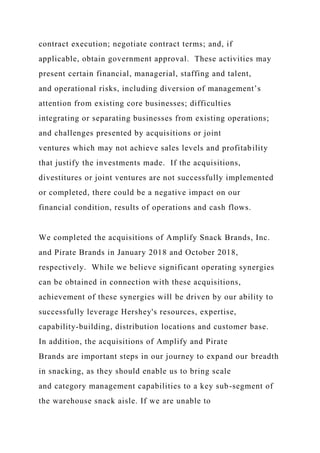
From time to time, we may evaluate potential acquisitions,
divestitures or joint ventures that align with our strategic
objectives. The success of such activity depends, in part, upon
our ability to identify suitable buyers, sellers or
business partners; perform effective assessments prior to
contract execution; negotiate contract terms; and, if
applicable, obtain government approval. These activities may
present certain financial, managerial, staffing and talent,
and operational risks, including diversion of management’s
attention from existing core businesses; difficulties
integrating or separating businesses from existing operations;
and challenges presented by acquisitions or joint
ventures which may not achieve sales levels and profitability
that justify the investments made. If the acquisitions,
divestitures or joint ventures are not successfully implemented
or completed, there could be a negative impact on our
financial condition, results of operations and cash flows.
In January 2018, we completed the acquisition of all of the
outstanding shares of Amplify Snack Brands, Inc. While
we believe significant operating synergies can be obtained in
connection with this acquisition, achievement of these
synergies will be driven by our ability to successfully leverage
Hershey's resources, expertise and capability-building.
In addition, the acquisition of Amplify is an important step in
our journey to expand our breadth in snacking, as it
should enable us to bring scale and category management
capabilities to a key sub-segment of the warehouse snack
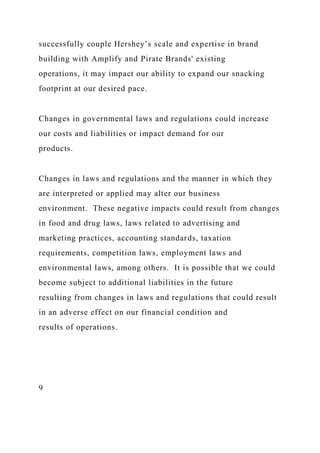
aisle. If we are unable to successfully couple Hershey’s scale
and expertise in brand building with Amplify’s existing
operations, it may impact our ability to expand our snacking
footprint at our desired pace.
Changes in governmental laws and regulations could increase
our costs and liabilities or impact demand for our
products.
Changes in laws and regulations and the manner in which they
are interpreted or applied may alter our business
environment. These negative impacts could result from changes
in food and drug laws, laws related to advertising and
marketing practices, accounting standards, taxation
requirements, competition laws, employment laws and
environmental laws, among others. It is possible that we could
become subject to additional liabilities in the future
resulting from changes in laws and regulations that could result
in an adverse effect on our financial condition and
results of operations.
9
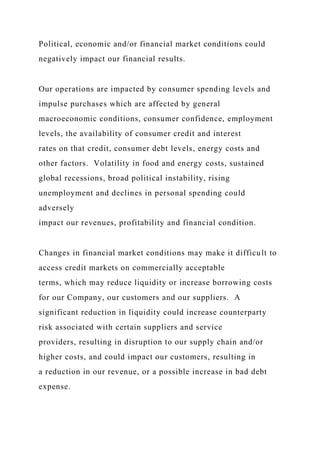
Political, economic and/or financial market conditions could
negatively impact our financial results.
Our operations are impacted by consumer spending levels and
impulse purchases which are affected by general
macroeconomic conditions, consumer confidence, employment
levels, the availability of consumer credit and interest
rates on that credit, consumer debt levels, energy costs and
other factors. Volatility in food and energy costs, sustained
global recessions, rising unemployment and declines in personal
spending could adversely impact our revenues,
profitability and financial condition.
Changes in financial market conditions may make it difficult to
access credit markets on commercially acceptable
terms, which may reduce liquidity or increase borrowing costs
for our Company, our customers and our suppliers. A
significant reduction in liquidity could increase counterparty
risk associated with certain suppliers and service
providers, resulting in disruption to our supply chain and/or
higher costs, and could impact our customers, resulting in
a reduction in our revenue, or a possible increase in bad debt
expense.
Our international operations may not achieve projected growth
objectives, which could adversely impact our overall
business and results of operations.
In 2017, 2016 and 2015, respectively, we derived approximately
17% of our net sales from customers located outside
of the United States. Additionally, approximately 25% of our
total long-lived assets were located outside of the United
States as of December 31, 2017. As part of our strategy, we
have made investments outside of the United States,
particularly in China, Malaysia, Mexico, Brazil and India. As a
result, we are subject to risks and uncertainties relating
to international sales and operations, including:
Unforeseen global economic and environmental changes
resulting in business interruption, supply
constraints, inflation, deflation or decreased demand;
Inability to establish, develop and achieve market acceptance of
our global brands in international markets;
Difficulties and costs associated with compliance and
enforcement of remedies under a wide variety of
complex laws, treaties and regulations;
Unexpected changes in regulatory environments;
Political and economic instability, including the possibility of
civil unrest, terrorism, mass violence or armed
conflict;
Nationalization of our properties by foreign governments;
Tax rates that may exceed those in the United States and
earnings that may be subject to withholding
requirements and incremental taxes upon repatriation;
Potentially negative consequences from changes in tax laws;
The imposition of tariffs, quotas, trade barriers, other trade
protection measures and import or export
licensing requirements;
Increased costs, disruptions in shipping or reduced availability
of freight transportation;
The impact of currency exchange rate fluctuations between the
U.S. dollar and foreign currencies;
Failure to gain sufficient profitable scale in certain international
markets resulting in an inability to cover
manufacturing fixed costs or resulting in losses from
impairment or sale of assets; and
Failure to recruit, retain and build a talented and engaged global
workforce.
If we are not able to achieve our projected international growth
objectives and mitigate the numerous risks and
uncertainties associated with our international operations, there
could be a negative impact on our financial condition
and results of operations.
Disruptions, failures or security breaches of our information
technology infrastructure could have a negative
impact on our operations.
Information technology is critically important to our business
operations. We use information technology to manage
all business processes including manufacturing, financial,
logistics, sales, marketing and administrative functions.
These processes collect, interpret and distribute business data
and communicate internally and externally with
employees, suppliers, customers and others.
10
We are regularly the target of attempted cyber and other
security threats. Therefore, we continuously monitor and
update our information technology networks and infrastructure
to prevent, detect, address and mitigate the risk of
unauthorized access, misuse, computer viruses and other events
that could have a security impact. We invest in
industry standard security technology to protect the Company’s
data and business processes against risk of data
security breach and cyber attack. Our data security management
program includes identity, trust, vulnerability and
threat management business processes as well as adoption of
standard data protection policies. We measure our data
security effectiveness through industry accepted methods and
remediate significant findings. Additionally, we certify
our major technology suppliers and any outsourced services
through accepted security certification standards. We
maintain and routinely test backup systems and disaster
recovery, along with external network security penetration
testing by an independent third party as part of our business
continuity preparedness. We also have processes in place
to prevent disruptions resulting from the implementation of new
software and systems of the latest technology.
While we have been subject to cyber attacks and other security
breaches, these incidents did not have a significant
impact on our business operations. We believe our security
technology tools and processes provide adequate measures
of protection against security breaches and in reducing
cybersecurity risks. Nevertheless, despite continued vigilance
in these areas, disruptions in or failures of information
technology systems are possible and could have a negative
impact on our operations or business reputation. Failure of our
systems, including failures due to cyber attacks that
would prevent the ability of systems to function as intended,
could cause transaction errors, loss of customers and
sales, and could have negative consequences to our Company,
our employees and those with whom we do business.
This in turn could have a negative impact on our financial
condition and results or operations. In addition, the cost to
remediate any damages to our information technology systems
suffered as a result of a cyber attack could be
significant.
We might not be able to hire, engage and retain the talented
global workforce we need to drive our growth
strategies.
Our future success depends upon our ability to identify, hire,
develop, engage and retain talented personnel across the
globe. Competition for global talent is intense, and we might
not be able to identify and hire the personnel we need to
continue to evolve and grow our business. In particular, if we
are unable to hire the right individuals to fill new or
existing senior management positions as vacancies arise, our
business performance may be impacted.
Activities related to identifying, recruiting, hiring and
integrating qualified individuals require significant time and
attention. We may also need to invest significant amounts of
cash and equity to attract talented new employees, and we
may never realize returns on these investments.
In addition to hiring new employees, we must continue to focus
on retaining and engaging the talented individuals we
need to sustain our core business and lead our developing
businesses into new markets, channels and categories. This
may require significant investments in training, coaching and
other career development and retention activities. If we
are not able to effectively retain and grow our talent, our ability
to achieve our strategic objectives will be adversely
affected, which may impact our financial condition and results
of operations.
We may not fully realize the expected costs savings and/or
operating efficiencies associated with our strategic
initiatives or restructuring programs, which may have an
adverse impact on our business.
We depend on our ability to evolve and grow, and as changes in
our business environment occur, we may adjust our
business plans by introducing new strategic initiatives or
restructuring programs to meet these changes. From time to
time, we implement business realignment activities to support
key strategic initiatives designed to maintain long-term
sustainable growth, such as the Margin for Growth Program we
commenced in the first quarter of 2017. These
programs are intended to increase our operating effectiveness
and efficiency, to reduce our costs and/or to generate
savings that can be reinvested in other areas of our business.
We cannot guarantee that we will be able to successfully
implement these strategic initiatives and restructuring programs,
that we will achieve or sustain the intended benefits
under these programs, or that the benefits, even if achieved, will
be adequate to meet our long-term growth and
profitability expectations, which could in turn adversely affect
our business.
11
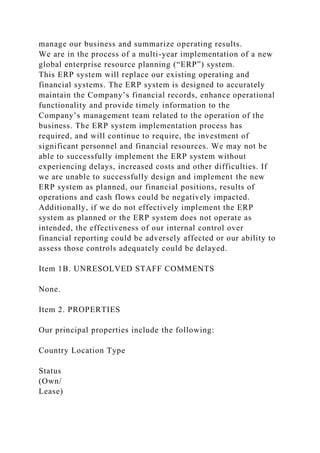
Complications with the design or implementation of our new
enterprise resource planning system could adversely
impact our business and operations.
We rely extensively on information systems and technology to
manage our business and summarize operating results.
We are in the process of a multi-year implementation of a new
global enterprise resource planning (“ERP”) system.
This ERP system will replace our existing operating and
financial systems. The ERP system is designed to accurately
maintain the Company’s financial records, enhance operational
functionality and provide timely information to the
Company’s management team related to the operation of the
business. The ERP system implementation process has
required, and will continue to require, the investment of
significant personnel and financial resources. We may not be
able to successfully implement the ERP system without
experiencing delays, increased costs and other difficulties. If
we are unable to successfully design and implement the new
ERP system as planned, our financial positions, results of
operations and cash flows could be negatively impacted.
Additionally, if we do not effectively implement the ERP
system as planned or the ERP system does not operate as
intended, the effectiveness of our internal control over
financial reporting could be adversely affected or our ability to
assess those controls adequately could be delayed.
Item 1B. UNRESOLVED STAFF COMMENTS
None.
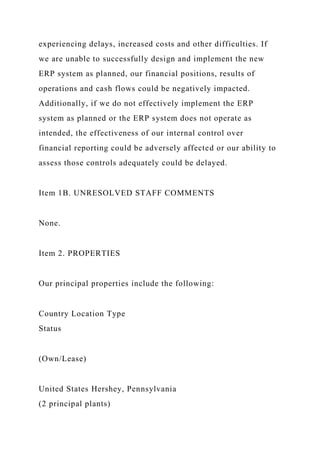
Item 2. PROPERTIES
Our principal properties include the following:
Country Location Type
Status
(Own/
Lease)
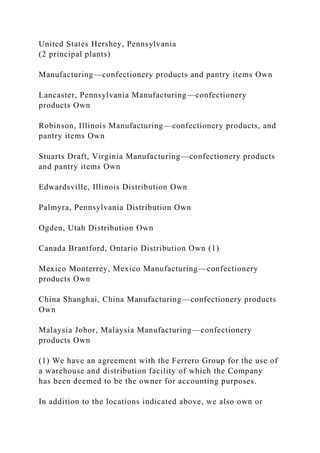
United States Hershey, Pennsylvania
(2 principal plants)
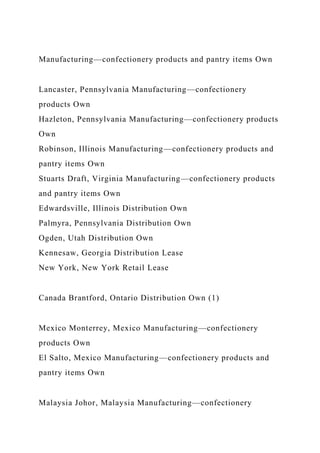
Manufacturing—confectionery products and pantry items Own
Lancaster, Pennsylvania Manufacturing—confectionery
products Own
Robinson, Illinois Manufacturing—confectionery products, and
pantry items Own
Stuarts Draft, Virginia Manufacturing—confectionery products
and pantry items Own
Edwardsville, Illinois Distribution Own
Palmyra, Pennsylvania Distribution Own
Ogden, Utah Distribution Own
Canada Brantford, Ontario Distribution Own (1)
Mexico Monterrey, Mexico Manufacturing—confectionery
products Own
China Shanghai, China Manufacturing—confectionery products
Own
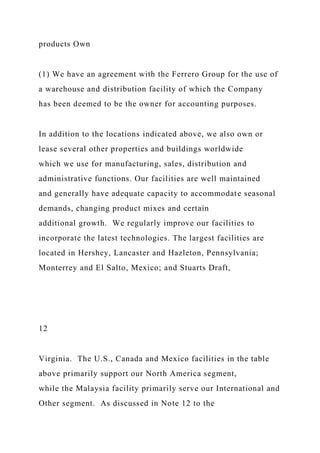
Malaysia Johor, Malaysia Manufacturing—confectionery
products Own
(1) We have an agreement with the Ferrero Group for the use of
a warehouse and distribution facility of which the Company
has been deemed to be the owner for accounting purposes.
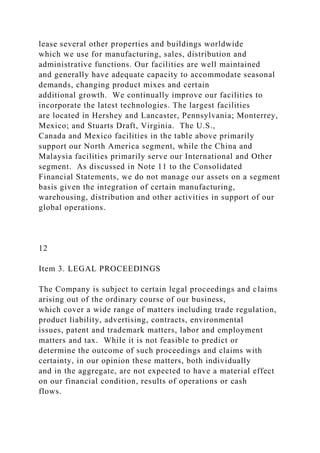
In addition to the locations indicated above, we also own or
lease several other properties and buildings worldwide
which we use for manufacturing, sales, distribution and
administrative functions. Our facilities are well maintained
and generally have adequate capacity to accommodate seasonal
demands, changing product mixes and certain
additional growth. We continually improve our facilities to
incorporate the latest technologies. The largest facilities
are located in Hershey and Lancaster, Pennsylvania; Monterrey,
Mexico; and Stuarts Draft, Virginia. The U.S.,
Canada and Mexico facilities in the table above primarily
support our North America segment, while the China and
Malaysia facilities primarily serve our International and Other
segment. As discussed in Note 11 to the Consolidated
Financial Statements, we do not manage our assets on a segment
basis given the integration of certain manufacturing,
warehousing, distribution and other activities in support of our
global operations.
12
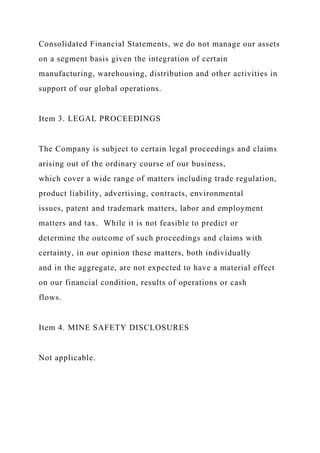
Item 3. LEGAL PROCEEDINGS
The Company is subject to certain legal proceedings and claims
arising out of the ordinary course of our business,
which cover a wide range of matters including trade regulation,
product liability, advertising, contracts, environmental
issues, patent and trademark matters, labor and employment
matters and tax. While it is not feasible to predict or
determine the outcome of such proceedings and claims with
certainty, in our opinion these matters, both individually
and in the aggregate, are not expected to have a material effect
on our financial condition, results of operations or cash
flows.
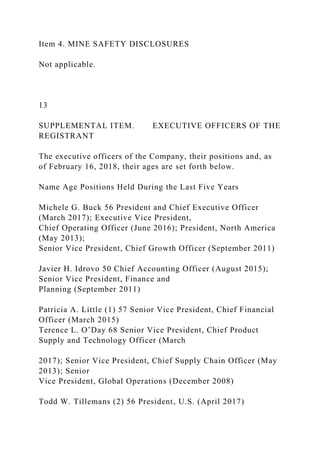
Item 4. MINE SAFETY DISCLOSURES
Not applicable.
13
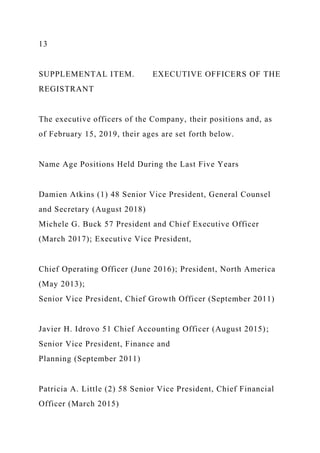
SUPPLEMENTAL ITEM. EXECUTIVE OFFICERS OF THE
REGISTRANT
The executive officers of the Company, their positions and, as
of February 16, 2018, their ages are set forth below.
Name Age Positions Held During the Last Five Years
Michele G. Buck 56 President and Chief Executive Officer
(March 2017); Executive Vice President,
Chief Operating Officer (June 2016); President, North America
(May 2013);
Senior Vice President, Chief Growth Officer (September 2011)
Javier H. Idrovo 50 Chief Accounting Officer (August 2015);
Senior Vice President, Finance and
Planning (September 2011)
Patricia A. Little (1) 57 Senior Vice President, Chief Financial
Officer (March 2015)
Terence L. O’Day 68 Senior Vice President, Chief Product
Supply and Technology Officer (March
2017); Senior Vice President, Chief Supply Chain Officer (May
2013); Senior
Vice President, Global Operations (December 2008)
Todd W. Tillemans (2) 56 President, U.S. (April 2017)
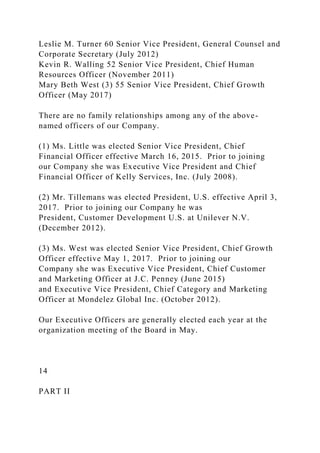
Leslie M. Turner 60 Senior Vice President, General Counsel and
Corporate Secretary (July 2012)
Kevin R. Walling 52 Senior Vice President, Chief Human
Resources Officer (November 2011)
Mary Beth West (3) 55 Senior Vice President, Chief Growth
Officer (May 2017)
There are no family relationships among any of the above-
named officers of our Company.
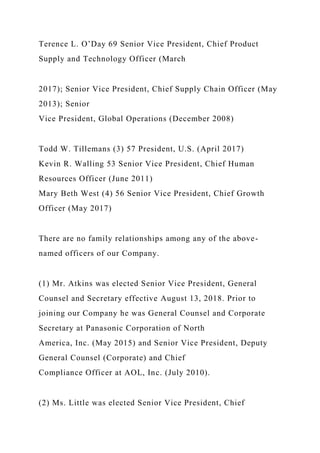
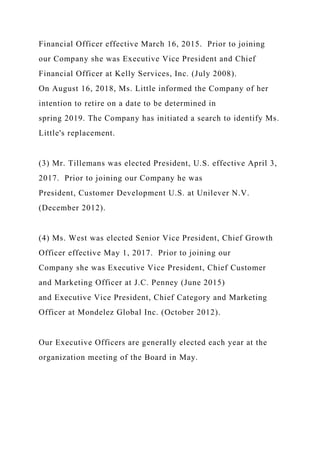
(1) Ms. Little was elected Senior Vice President, Chief
Financial Officer effective March 16, 2015. Prior to joining
our Company she was Executive Vice President and Chief
Financial Officer of Kelly Services, Inc. (July 2008).
(2) Mr. Tillemans was elected President, U.S. effective April 3,
2017. Prior to joining our Company he was
President, Customer Development U.S. at Unilever N.V.
(December 2012).
(3) Ms. West was elected Senior Vice President, Chief Growth
Officer effective May 1, 2017. Prior to joining our
Company she was Executive Vice President, Chief Customer
and Marketing Officer at J.C. Penney (June 2015)
and Executive Vice President, Chief Category and Marketing
Officer at Mondelez Global Inc. (October 2012).
Our Executive Officers are generally elected each year at the
organization meeting of the Board in May.
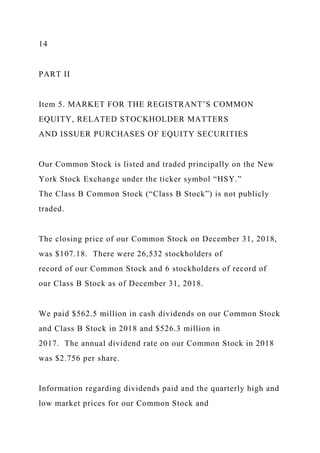
14
PART II
Item 5. MARKET FOR THE REGISTRANT’S COMMON
EQUITY, RELATED STOCKHOLDER MATTERS
AND ISSUER PURCHASES OF EQUITY SECURITIES
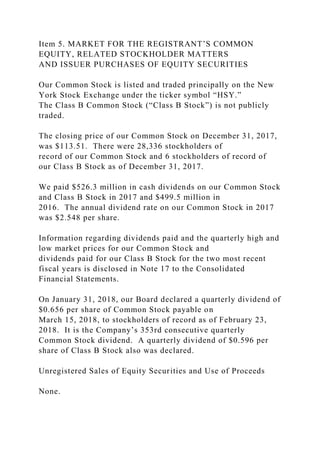
Our Common Stock is listed and traded principally on the New
York Stock Exchange under the ticker symbol “HSY.”
The Class B Common Stock (“Class B Stock”) is not publicly
traded.
The closing price of our Common Stock on December 31, 2017,
was $113.51. There were 28,336 stockholders of
record of our Common Stock and 6 stockholders of record of
our Class B Stock as of December 31, 2017.
We paid $526.3 million in cash dividends on our Common Stock
and Class B Stock in 2017 and $499.5 million in
2016. The annual dividend rate on our Common Stock in 2017
was $2.548 per share.
Information regarding dividends paid and the quarterly high and
low market prices for our Common Stock and
dividends paid for our Class B Stock for the two most recent
fiscal years is disclosed in Note 17 to the Consolidated
Financial Statements.
On January 31, 2018, our Board declared a quarterly dividend of
$0.656 per share of Common Stock payable on
March 15, 2018, to stockholders of record as of February 23,
2018. It is the Company’s 353rd consecutive quarterly
Common Stock dividend. A quarterly dividend of $0.596 per
share of Class B Stock also was declared.
Unregistered Sales of Equity Securities and Use of Proceeds
None.
Issuer Purchases of Equity Securities
There were no purchases of our Common Stock during the three
months ended December 31, 2017.
In January 2016, our Board of Directors approved a $500
million share repurchase authorization. As of December 31,
2017, approximately $100 million remained available for
repurchases of our Common Stock under this program. In
October 2017, our Board of Directors approved an additional
$100 million share repurchase authorization, to
commence after the existing 2016 authorization is completed.
Neither the 2016 nor the 2017 share repurchase
programs have an expiration date.
In August 2017, the Company entered into a Stock Purchase
Agreement with Hershey Trust Company, as trustee for
the Milton Hershey School Trust (the “Trust”), pursuant to
which the Company agreed to purchase 1,500,000 shares of
the Company’s common stock from the Trust at a price equal to
$106.01 per share, for a total purchase price of $159
million.
15
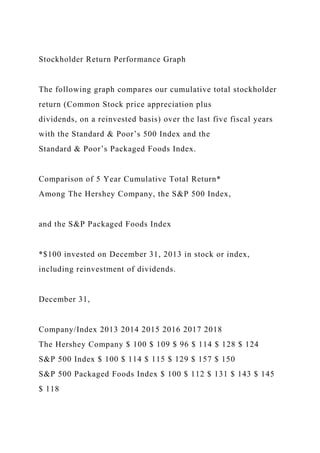
Stockholder Return Performance Graph
The following graph compares our cumulative total stockholder
return (Common Stock price appreciation plus
dividends, on a reinvested basis) over the last five fiscal years
with the Standard & Poor’s 500 Index and the
Standard & Poor’s Packaged Foods Index.
Comparison of 5 Year Cumulative Total Return*
Among The Hershey Company, the S&P 500 Index,
and the S&P Packaged Foods Index
*$100 invested on December 31, 2012 in stock or index,
including reinvestment of dividends.
December 31,
Company/Index 2012 2013 2014 2015 2016 2017
The Hershey Company $ 100 $ 137 $ 150 $ 132 $ 157 $ 176
S&P 500 Index $ 100 $ 132 $ 150 $ 153 $ 171 $ 208
S&P 500 Packaged Foods Index $ 100 $ 126 $ 146 $ 156 $ 164
$ 186
The stock price performance included in this graph is not
necessarily indicative of future stock price performance.
16
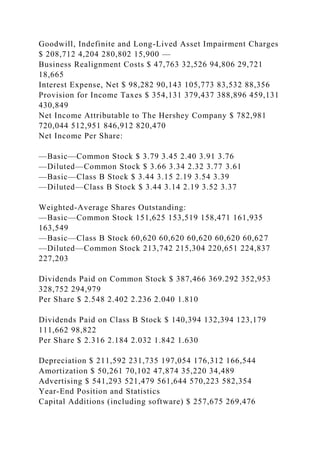
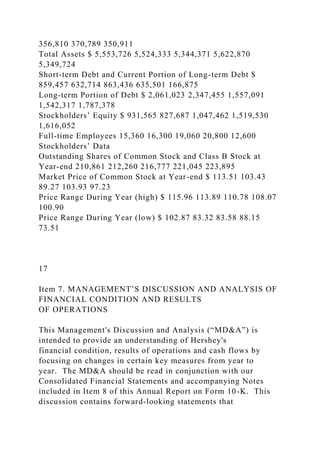
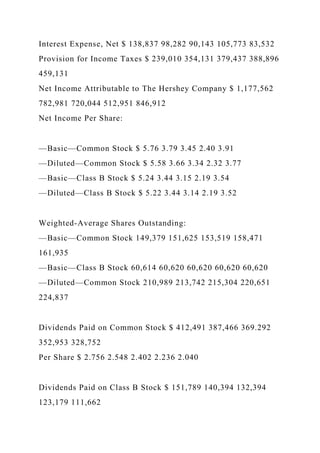
Item 6. SELECTED FINANCIAL DATA
FIVE-YEAR CONSOLIDATED FINANCIAL SUMMARY
(All dollar and share amounts in thousands except market price
and per share statistics)
2017 2016 2015 2014 2013
Summary of Operations
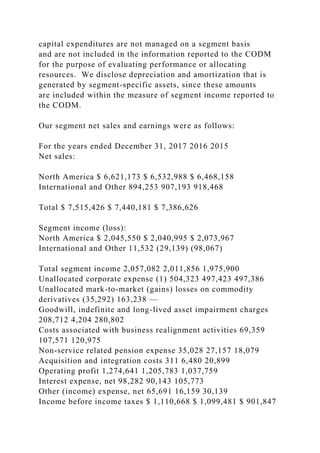
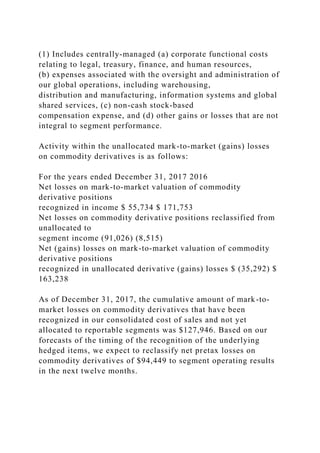
Net Sales $ 7,515,426 7,440,181 7,386,626 7,421,768 7,146,079
Cost of Sales $ 4,070,907 4,282,290 4,003,951 4,085,602
3,865,231
Selling, Marketing and Administrative $ 1,913,403 1,915,378
1,969,308 1,900,970 1,922,508
Goodwill, Indefinite and Long-Lived Asset Impairment Charges
$ 208,712 4,204 280,802 15,900 —
Business Realignment Costs $ 47,763 32,526 94,806 29,721
18,665
Interest Expense, Net $ 98,282 90,143 105,773 83,532 88,356
Provision for Income Taxes $ 354,131 379,437 388,896 459,131
430,849
Net Income Attributable to The Hershey Company $ 782,981
720,044 512,951 846,912 820,470
Net Income Per Share:
—Basic—Common Stock $ 3.79 3.45 2.40 3.91 3.76
—Diluted—Common Stock $ 3.66 3.34 2.32 3.77 3.61
—Basic—Class B Stock $ 3.44 3.15 2.19 3.54 3.39
—Diluted—Class B Stock $ 3.44 3.14 2.19 3.52 3.37
Weighted-Average Shares Outstanding:
—Basic—Common Stock 151,625 153,519 158,471 161,935
163,549
—Basic—Class B Stock 60,620 60,620 60,620 60,620 60,627
—Diluted—Common Stock 213,742 215,304 220,651 224,837
227,203
Dividends Paid on Common Stock $ 387,466 369.292 352,953
328,752 294,979
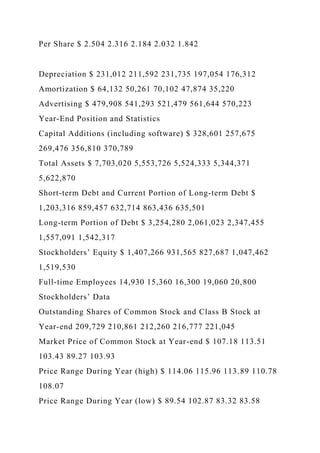
Per Share $ 2.548 2.402 2.236 2.040 1.810
Dividends Paid on Class B Stock $ 140,394 132,394 123,179
111,662 98,822
Per Share $ 2.316 2.184 2.032 1.842 1.630
Depreciation $ 211,592 231,735 197,054 176,312 166,544
Amortization $ 50,261 70,102 47,874 35,220 34,489
Advertising $ 541,293 521,479 561,644 570,223 582,354
Year-End Position and Statistics
Capital Additions (including software) $ 257,675 269,476
356,810 370,789 350,911
Total Assets $ 5,553,726 5,524,333 5,344,371 5,622,870
5,349,724
Short-term Debt and Current Portion of Long-term Debt $
859,457 632,714 863,436 635,501 166,875
Long-term Portion of Debt $ 2,061,023 2,347,455 1,557,091
1,542,317 1,787,378
Stockholders’ Equity $ 931,565 827,687 1,047,462 1,519,530
1,616,052
Full-time Employees 15,360 16,300 19,060 20,800 12,600
Stockholders’ Data
Outstanding Shares of Common Stock and Class B Stock at
Year-end 210,861 212,260 216,777 221,045 223,895
Market Price of Common Stock at Year-end $ 113.51 103.43
89.27 103.93 97.23
Price Range During Year (high) $ 115.96 113.89 110.78 108.07
100.90
Price Range During Year (low) $ 102.87 83.32 83.58 88.15
73.51
17
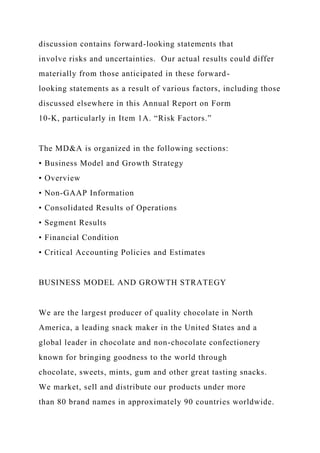
Item 7. MANAGEMENT’S DISCUSSION AND ANALYSIS OF
FINANCIAL CONDITION AND RESULTS
OF OPERATIONS
This Management's Discussion and Analysis (“MD&A”) is
intended to provide an understanding of Hershey's
financial condition, results of operations and cash flows by
focusing on changes in certain key measures from year to
year. The MD&A should be read in conjunction with our
Consolidated Financial Statements and accompanying Notes
included in Item 8 of this Annual Report on Form 10-K. This
discussion contains forward-looking statements that
involve risks and uncertainties. Our actual results could differ
materially from those anticipated in these forward-
looking statements as a result of various factors, including those
discussed elsewhere in this Annual Report on Form
10-K, particularly in Item 1A. “Risk Factors.”
The MD&A is organized in the following sections:
• Business Model and Growth Strategy
• Overview
• Non-GAAP Information
• Consolidated Results of Operations
• Segment Results
• Financial Condition
• Critical Accounting Policies and Estimates
BUSINESS MODEL AND GROWTH STRATEGY
We are the largest producer of quality chocolate in North
America, a leading snack maker in the United States and a
global leader in chocolate and non-chocolate confectionery
known for bringing goodness to the world through
chocolate, sweets, mints and other great tasting snacks. We
market, sell and distribute our products under more than
80 brand names in approximately 80 countries worldwide. We
report our operations through two segments: North
America and International and Other.
We believe we have a set of differentiated capabilities that
when integrated, can create advantage in the marketplace.
Our focus on the following key elements of our strategy should
enable us to deliver top-tier growth and industry-
leading shareholder returns.
• Reignite Core Confection and Expand Breadth in Snacking.
We are taking actions in an effort to deepen our
consumer connections, deliver meaningful innovation and
reinvent the shopping experience, while also pursuing
opportunities to diversify our portfolio and establish a strong
presence across snacking.
We are a part of special meaningful moments with family and
friends. Seasons are an important part of
our business model and for consumers, they are highly
anticipated, cherished special times, centered
around traditions. For us, it’s an opportunity for our brands to
be part of many connections during the
year when family and friends gather.
Innovation is an important lever in this variety seeking
category and we are leveraging some exciting
work from our proprietary demand landscape to shape our future
innovation and make it more impactful.
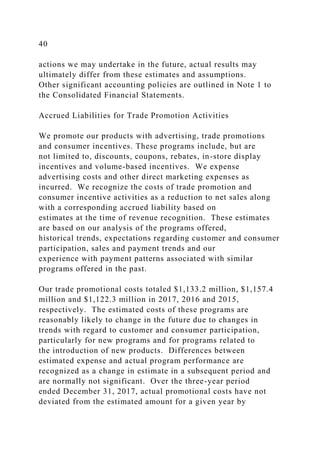
We are becoming more disciplined in our relentless focus on
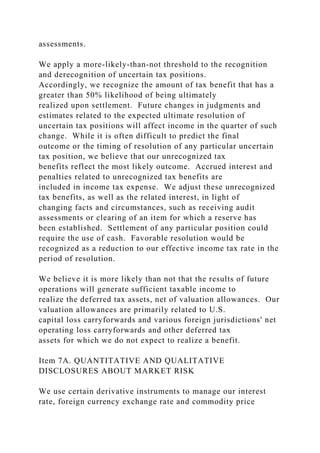
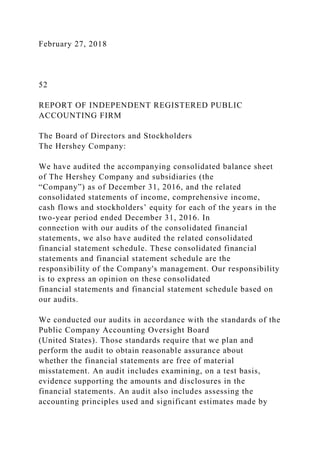
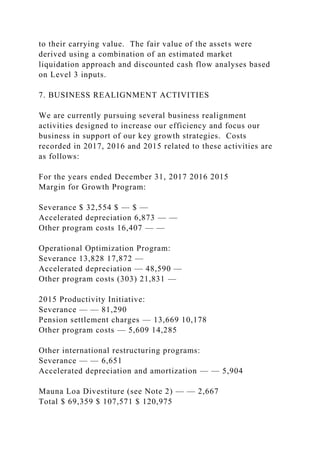
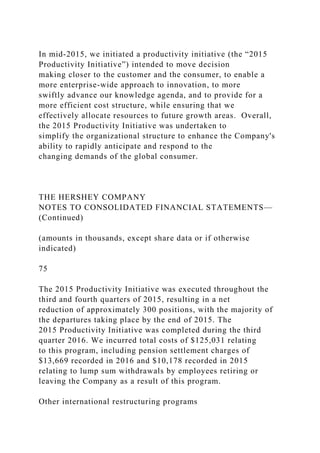
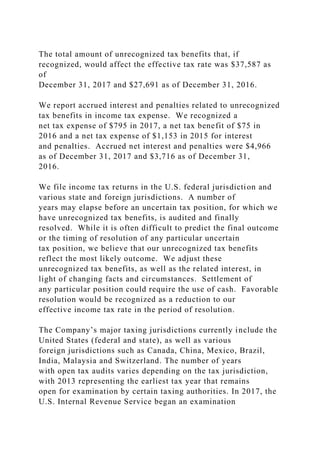
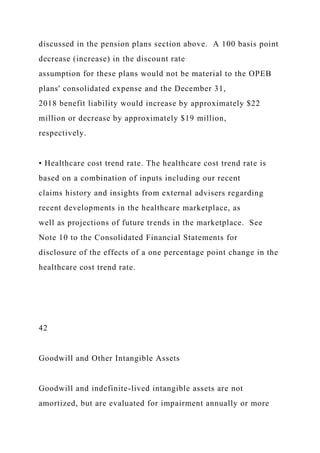
platform innovation, which enables
sustainable growth over time and significant extensions to our
core.
Through our shopper insights, we are currently working with
our retail partners on in-aisle strategy that
will breathe life into the center of the store and transform the
shopping experience by improving paths to
purchase, stopping power, navigation, engagement and
conversion. We have also responded to the
changing retail environment by investing in e-commerce
capabilities.
To expand our breadth in snacking, we are focused on
expanding the boundaries of our core confection
brands to capture new snacking occasions and increasing our
exposure into new snack categories through
acquisitions.
18
• Reallocate Resources to Expand Margins and Fuel Growth.
We are focused on ensuring that we allocate our
resources efficiently to the areas with the highest potential for
profitable growth. We believe this will enable
significant margin expansion and position us in the top quartile
related to operating income margin.
We have reset our international investment, while we still
believe strongly that our targeted emerging
markets will provide long-term growth. The uncertain
macroeconomic environment in many of these
markets is expected to continue and our investments in these
international markets need to be relative to
the size of the opportunity.
We have heightened our selling, marketing and administrative
expense discipline within the Company in
an effort to make improvements without jeopardizing our
topline growth. Our expectation is that
advertising and related marketing expense will grow roughly in
line with sales.
We will continue cost of goods sold optimization through
pricing and programs like network supply
chain optimization and lean manufacturing.
• Strengthen Capabilities & Leverage Technology for
Commercial Advantage. The world is changing fast and so is
the data on which we rely to make decisions. In order to
generate insights, we must acquire, integrate and access
vast sources of the right data in an effective manner. We are
working to leverage our advanced analytical
techniques which will give us a deep understanding of
consumers, our shoppers, our end-to-end supply chain, our
retail environment and macroeconomic factors at both a broad
and precision level. In addition, we are in the
process of transforming our enterprise resource planning system
which will allow employees to work more
efficiently and effectively.
OVERVIEW
The Overview presented below is an executive-level summary
highlighting the key trends and measures on which the
Company’s management focuses in evaluating its financial
condition and operating performance. Certain earnings and
performance measures within the Overview include financial
information determined on a non-GAAP basis, which
aligns with how management internally evaluates the Company's
results of operations, determines incentive
compensation, and assesses the impact of known trends and
uncertainties on the business. A detailed reconciliation of
the non-GAAP financial measures referenced herein to their
nearest comparable GAAP financial measures follows this
summary. For a detailed analysis of the Company's operations
prepared in accordance with accounting principles
generally accepted in the United States of America ("GAAP"),
referred to as "reported" herein, refer to the discussion
and analysis in the Consolidated Results of Operations.
In 2017, we made solid progress on our strategic initiatives,
including strengthening our core chocolate brands,
positioning our snacks business for success and generating
operating profit margin expansion. These initiatives will
benefit the Company over the long term and enable us to
achieve our sales and earnings per share-diluted
("EPS") targets. We continued to generate solid operating cash
flow, totaling approximately $1.2 billion in 2017, which
affords the Company significant financial flexibility. The recent
acquisition of Amplify is an important step in our
journey to expand our breadth in snacking as it should enable us
to bring scale and category management capabilities
to a key sub-segment of the warehouse snack aisle.
Our full year 2017 net sales totaled $7,515.4 million, an
increase of 1.0%, versus $7,440.2 million for the comparable
period of 2016. Excluding a 0.2% impact from favorable foreign
exchange rates, our net sales increased 0.8%. Net
sales growth was driven by lower levels of trade promotional
spending in both the North America and International
and Other segments, as well as higher sales volume in North
America, primarily from 2017 innovation and new
launches, including Hershey's Cookie Layer Crunch, Hershey's
Gold and Hershey's and Reese's Popped Snack Mix
and Chocolate Dipped Pretzels.
Our reported gross margin was 45.8% for the full year 2017, an
increase of 340 basis points compared to the full year
2016. Our 2017 non-GAAP gross margin of 45.6% was on par
with the prior year margin, as the benefits from supply
chain productivity and cost savings initiatives, as well as lower
input costs, were offset by higher freight rates and
increased levels of manufacturing and distribution costs
associated with an effort to maintain customer service targets
at fast growing retail customers.
19
Our full year 2017 reported net income and EPS-diluted totaled
$783.0 million and $3.66, respectively, compared to
the full year 2016 reported net income and EPS-diluted of
$720.0 million and $3.34, respectively. From a non-GAAP
perspective, full year 2017 adjusted net income was $1,016.9
million, an increase of 7.2% versus $948.5 million in
2016. Our adjusted EPS-diluted for the full year 2017 was $4.76
compared to $4.41 for the same period of 2016, an
increase of 7.9%.
NON-GAAP INFORMATION
The comparability of certain of our financial measures is
impacted by unallocated mark-to-market (gains) losses on
commodity derivatives, costs associated with business
realignment activities, costs relating to the integration of
acquisitions, non-service related components of our pension
expense ("NSRPE"), impairment of goodwill, indefinite
and long-lived assets, settlement of the SGM liability in
conjunction with the purchase of the remaining 20% of the
outstanding shares of SGM, the gain realized on the sale of a
trademark, costs associated with the early extinguishment
of debt and other non-recurring gains and losses.
To provide additional information to investors to facilitate the
comparison of past and present performance, we use
non-GAAP financial measures within MD&A that exclude the
financial impact of these activities. These non-GAAP
financial measures are used internally by management in
evaluating results of operations and determining incentive
compensation, and in assessing the impact of known trends and
uncertainties on our business, but they are not intended
to replace the presentation of financial results in accordance
with GAAP. A reconciliation of the non-GAAP financial
measures referenced in MD&A to their nearest comparable
GAAP financial measures as presented in the Consolidated
Statements of Income is provided below.
20
Reconciliation of Certain Non-GAAP Financial Measures
Consolidated results For the years ended December 31,
In thousands except per share data 2017 2016 2015
Reported gross profit $ 3,444,519 $ 3,157,891 $ 3,382,675
Derivative mark-to-market (gains) losses (35,292) 163,238 —
Business realignment activities 5,147 58,106 8,801
Acquisition integration costs — — 7,308
NSRPE 11,125 11,953 2,516
Non-GAAP gross profit $ 3,425,499 $ 3,391,188 $ 3,401,300
Reported operating profit $ 1,274,641 $ 1,205,783 $ 1,037,759
Derivative mark-to-market (gains) losses (35,292) 163,238 —
Business realignment activities 69,359 107,571 120,975
Acquisition integration costs 311 6,480 20,899
NSRPE 35,028 27,157 18,079
Goodwill, indefinite and long-lived asset impairment charges
208,712 4,204 280,802
Non-GAAP operating profit $ 1,552,759 $ 1,514,433 $
1,478,514
Reported provision for income taxes $ 354,131 $ 379,437 $
388,896
Derivative mark-to-market (gains) losses* (4,746) 20,500 —
Business realignment activities* 17,903 19,138 41,648
Acquisition integration costs* 118 2,456 8,264
NSRPE* 13,258 10,283 6,955
Goodwill, indefinite and long-lived asset impairment charges*
23,292 1,157 —
Impact of U.S. tax reform (32,467) — —
Loss on early extinguishment of debt* — — 10,736
Gain on sale of trademark* — — (3,652)
Non-GAAP provision for income taxes $ 371,489 $ 432,971 $
452,847
Reported net income $ 782,981 $ 720,044 $ 512,951
Derivative mark-to-market (gains) losses (30,546) 142,738 —
Business realignment activities 51,456 88,433 79,327
Acquisition integration costs 193 4,024 14,196
NSRPE 21,770 16,874 11,124
Goodwill, indefinite and long-lived asset impairment charges
185,420 3,047 280,802
Impact of U.S. tax reform 32,467 — —
Noncontrolling interest share of business realignment and
impairment charges (26,795) — —
Settlement of SGM liability — (26,650) —
Loss on early extinguishment of debt — — 17,591
Gain on sale of trademark — — (6,298)
Non-GAAP net income $ 1,016,946 $ 948,510 $ 909,693
21
For the years ended December 31,
2017 2016 2015
Reported EPS - Diluted $ 3.66 $ 3.34 $ 2.32
Derivative mark-to-market (gains) losses (0.14) 0.66 —
Business realignment activities 0.25 0.42 0.36
Acquisition integration costs — 0.02 0.05
NSRPE 0.09 0.08 0.05
Goodwill, indefinite and long-lived asset impairment charges
0.87 0.01 1.28
Impact of U.S. tax reform 0.15 — —
Noncontrolling interest share of business realignment and
impairment charges (0.12) — —
Settlement of SGM liability — (0.12) —
Loss on early extinguishment of debt — — 0.09
Gain on sale of trademark — — (0.03)
Non-GAAP EPS - Diluted $ 4.76 $ 4.41 $ 4.12
* The tax effect for each adjustment is determined by
calculating the tax impact of the adjustment on the Company's
quarterly
effective tax rate.
In the assessment of our results, we review and discuss the
following financial metrics that are derived from the
reported and non-GAAP financial measures presented above:
For the years ended December 31,
2017 2016 2015
As reported gross margin 45.8% 42.4% 45.8%
Non-GAAP gross margin (1) 45.6% 45.6% 46.0%
As reported operating profit margin 17.0% 16.2% 14.0%
Non-GAAP operating profit margin (2) 20.7% 20.4% 20.0%
As reported effective tax rate 31.9% 34.5% 43.1%
Non-GAAP effective tax rate (3) 26.7% 31.3% 33.2%
(1) Calculated as non-GAAP gross profit as a percentage of net
sales for each period presented.
(2) Calculated as non-GAAP operating profit as a percentage of
net sales for each period presented.
(3) Calculated as non-GAAP provision for income taxes as a
percentage of non-GAAP income before taxes (calculated as
non-GAAP operating profit minus non-GAAP interest expense,
net plus or minus non-GAAP other (income) expense,
net).
Details of the activities impacting comparability that are
presented as reconciling items to derive the non-GAAP
financial measures in the tables above are as follows:
Mark-to-market (gains) losses on commodity derivatives
The mark-to-market (gains) losses on commodity derivatives are
recorded as unallocated and excluded from adjusted
results until such time as the related inventory is sold, at which
time the corresponding (gains) losses are reclassified from
unallocated to segment income. Since we often purchase
commodity contracts to price inventory requirements in future
years, we make this adjustment to facilitate the year-over-year
comparison of cost of sales on a basis that matches the
derivative gains and losses with the underlying economic
exposure being hedged for the period. For the years ended
December 31, 2017 and 2016, the net adjustment recognized
within unallocated was a gain of $35.3 million and a loss
of $163.2 million, respectively. See Note 11 to the
Consolidated Financial Statements for more information.
22
Business realignment activities
We periodically undertake restructuring and cost reduction
activities as part of ongoing efforts to enhance long-term
profitability. For the years ended December 31, 2017, 2016 and
2015, we incurred $69.4 million, $107.6 million and
$121.0 million, respectively, of pre-tax costs related to business
realignment activities. See Note 7 to the Consolidated
Financial Statements for more information.
Acquisition integration costs
For the years ended December 31, 2017 and 2016, we incurred
expenses totaling $0.3 million and $6.5 million,
respectively, related to integration of the 2016 acquisition of
Ripple Brand Collective, LLC, as we incorporated this
business into our operating practices and information systems.
For the year ended December 31, 2015, we incurred
costs related to the integration of the 2014 acquisitions of SGM
and The Allan Candy Company and the 2015
acquisition of Krave totaling $22.5 million as we incorporated
these businesses into our operating practices and
information systems. These 2015 expenses included charges
incurred to write-down approximately $6.4 million of
expired or near-expiration work-in-process inventory at SGM,
in connection with the implementation of our global
quality standards and practices. In addition, integration costs
for 2015 were offset by a $6.8 million reduction in the
fair value of contingent consideration paid to the Krave
shareholders.
Non-service related pension expense
NSRPE includes interest costs, the expected return on pension
plan assets, the amortization of actuarial gains and
losses, and certain curtailment and settlement losses or credits.
NSRPE can fluctuate from year to year as a result of
changes in market interest rates and market returns on pension
plan assets. We believe that the service cost component
of our total pension benefit costs closely reflects the operating
costs of our business and provides for a better
comparison of our operating results from year to year.
Therefore, we exclude NSRPE from our internal performance
measures. Our most significant defined benefit pension plans
have been closed to new participants for a number of
years, resulting in ongoing service costs that are stable and
predictable. We recorded pre-tax NSRPE of $35.0 million,
$27.2 million and $18.1 million for the years ended December
31, 2017, 2016 and 2015, respectively.
Goodwill, indefinite and long-lived asset impairment charges
For the year ended December 31, 2017, we incurred $208.7
million of pre-tax long-lived asset impairment charges
related to certain business realignment activities. This includes
a write-down of certain intangible assets that had been
recognized in connection with the 2014 SGM acquisition and
write-down of property, plant and equipment. For the
year ended December 31, 2016, in connection with our 2016
annual impairment testing of other indefinite lived assets,
we recognized a trademark impairment charge of $4.2 million
primarily resulting from plans to discontinue a brand
sold in India. In the second and third quarters of 2015, we
recorded a total $280.8 million non-cash goodwill
impairment charge, representing a write-down of all of the
goodwill resulting from the SGM acquisition, including
$14.4 million relating to the portion of goodwill that had been
allocated to our China chocolate reporting unit, based
on synergies to be realized by this business.
Impact of U.S. tax reform
In connection with the enactment of U.S. tax reform in
December 2017, we recorded a net charge of $32.5 million
during the fourth quarter of 2017, which includes the estimated
impact of the one-time mandatory tax on previously
deferred earnings of non-U.S. subsidiaries offset in part by the
benefit from revaluation of net deferred tax liabilities
based on the new lower corporate income tax rate.
Noncontrolling interest share of business realignment and
impairment charges
Certain of the business realignment and impairment charges
recorded in connection with the Margin for Growth
Program related to Lotte Shanghai Foods Co., Ltd., a joint
venture in which we own a 50% controlling interest.
Therefore, we have also adjusted for the portion of these
charges included within the loss attributed to the non-
controlling interest.
23
Settlement of SGM liability
In the fourth quarter of 2015, we reached an agreement with the
SGM selling shareholders to reduce the originally-
agreed purchase price for the remaining 20% of SGM, and we
completed the purchase on February 3, 2016. In the
first quarter of 2016, we recorded a $26.7 million gain relating
to the settlement of the SGM liability, representing the
net carrying amount of the recorded liability in excess of the
cash paid to settle the obligation for the remaining 20% of
the outstanding shares.
Loss on early extinguishment of debt
During the third quarter of 2015, we recorded a $28.3 million
loss on the early extinguishment of debt relating to a
cash tender offer. See Note 4 to the Consolidated Financial
Statements for further information.
Gain on sale of trademark
During the first quarter of 2015, we recorded a $9.9 million
gain relating to the sale of a non-core trademark.
Constant Currency Net Sales Growth
We present certain percentage changes in net sales on a constant
currency basis, which excludes the impact of foreign
currency exchange. This measure is used internally by
management in evaluating results of operations and
determining incentive compensation. We believe that this
measure provides useful information to investors because it
provides transparency to underlying performance in our net
sales by excluding the effect that foreign currency
exchange rate fluctuations have on the year-to-year
comparability given volatility in foreign currency exchange
markets.
To present this information for historical periods, current period
net sales for entities reporting in other than the U.S.
dollar are translated into U.S. dollars at the average monthly
exchange rates in effect during the corresponding period
of the prior fiscal year, rather than at the actual average
monthly exchange rates in effect during the current period of
the current fiscal year. As a result, the foreign currency impact
is equal to the current year results in local currencies
multiplied by the change in average foreign currency exchange
rate between the current fiscal period and the
corresponding period of the prior fiscal year.
The following tables set forth a reconciliation between reported
and constant currency growth rates for the years ended
December 31, 2017 and 2016:
For the Year Ended December 31, 2017
Percentage Change as
Reported
Impact of Foreign
Currency Exchange
Percentage Change on
Constant Currency
Basis
North America segment
Canada 6.3 % 2.1 % 4.2 %
Total North America segment 1.3 % 0.1 % 1.2 %
International and Other segment
Mexico 9.7 % (1.1)% 10.8 %
Brazil 19.9 % 9.4 % 10.5 %
India 17.0 % 3.2 % 13.8 %
Greater China (18.1)% (0.8)% (17.3)%
Total International and Other segment (1.4)% 0.6 % (2.0)%
Total Company 1.0 % 0.2 % 0.8 %
24
For the Year Ended December 31, 2016
Percentage Change as
Reported
Impact of Foreign
Currency Exchange
Percentage Change on
Constant Currency
Basis
North America segment
Canada (3.5)% (3.0)% (0.5)%
Total North America segment 1.0 % (0.2)% 1.2 %
International and Other segment
Mexico (8.5)% (16.0)% 7.5 %
Brazil 15.7 % (6.0)% 21.7 %
India (26.6)% (3.6)% (23.0)%
Greater China (0.3)% (4.9)% 4.6 %
Total International and Other segment (1.2)% (4.4)% 3.2 %
Total Company 0.7 % (0.7)% 1.4 %
25
CONSOLIDATED RESULTS OF OPERATIONS
Percent Change
For the years ended December 31, 2017 2016 2015 2017 vs
2016 2016 vs 2015
In millions of dollars except per share amounts
Net Sales $ 7,515.4 $ 7,440.2 $ 7,386.6 1.0 % 0.7 %
Cost of Sales 4,070.9 4,282.3 4,003.9 (4.9)% 7.0 %
Gross Profit 3,444.5 3,157.9 3,382.7 9.1 % (6.6)%
Gross Margin 45.8% 42.4% 45.8%
SM&A Expense 1,913.4 1,915.4 1,969.3 (0.1)% (2.7)%
SM&A Expense as a percent of net sales 25.5% 25.7% 26.7%
Goodwill, Indefinite and Long-Lived Asset
Impairment Charges 208.7 4.2 280.8 NM NM
Business Realignment Costs 47.8 32.5 94.8 46.8 % (65.7)%
Operating Profit 1,274.6 1,205.8 1,037.8 5.7 % 16.2 %
Operating Profit Margin 17.0% 16.2% 14.0%
Interest Expense, Net 98.3 90.2 105.8 9.0 % (14.8)%
Other (Income) Expense, Net 65.7 16.2 30.1 306.5 % (46.4)%
Provision for Income Taxes 354.1 379.4 388.9 (6.7)% (2.4)%
Effective Income Tax Rate 31.9% 34.5% 43.1%
Net Income Including Noncontrolling Interest 756.5 720.0 513.0
5.1 % 40.4 %
Less: Net Loss Attributable to Noncontrolling
Interest (26.4) — — NM NM
Net Income Attributable to The Hershey
Company $ 783.0 $ 720.0 $ 513.0 8.7 % 40.4 %
Net Income Per Share—Diluted $ 3.66 $ 3.34 $ 2.32 9.6 % 44.0
%
Note: Percentage changes may not compute directly as shown
due to rounding of amounts presented above.
NM = not meaningful.
Net Sales
2017 compared with 2016
Net sales increased 1.0% in 2017 compared with 2016,
reflecting favorable price realization of 0.7%, a benefit from
acquisitions of 0.3%, and a favorable impact from foreign
currency exchange rates of 0.2%, partially offset by a
volume decrease of 0.2%. Excluding foreign currency, our net
sales increased 0.8% in 2017. The favorable net price
realization was attributed to lower levels of trade promotional
spending in both the North America and International
and Other segments versus the prior year. Consolidated volume
decreased as a result of lower sales volume in the
International and Other segment, primarily attributed to our
China business and the softness in the modern trade
channel coupled with a focus on optimizing our product
offerings. These volume decreases were partially offset by
higher sales volume in North America, specifically from 2017
innovation and new launches, including Hershey's
Cookie Layer Crunch, Hershey's Gold and Hershey's and
Reese's Popped Snack Mix and Chocolate Dipped Pretzels.
2016 compared with 2015
Net sales increased 0.7% in 2016 compared with 2015,
reflecting volume increases of 0.8% and a 0.6% benefit from
net acquisitions and divestitures, partially offset by an
unfavorable impact from foreign currency exchange rates of
0.7%. Excluding foreign currency, our net sales increased 1.4%
in 2016. The volume improvement was primarily
driven by new chocolate and snacking products in the United
States, including Snack Mix, Snack Bites and Hershey's
Cookie Layer Crunch bars. While the North America segment
had unfavorable price realization due to increased
levels of trade promotional spending, this was essentially offset
by favorable price realization in the International and
Other segment, due to significantly lower levels of trade
spending and returns, discounts and allowances.
26
Key U.S. Marketplace Metrics
For the full year 2017, our U.S. candy, mint and gum ("CMG")
consumer takeaway increased 1.6%, which was in line
with the category increase, resulting in market share of 30.6%.
The CMG consumer takeaway and market share
information reflect measured channels of distribution
accounting for approximately 90% of our U.S. confectionery
retail business. These channels of distribution primarily include
food, drug, mass merchandisers, and convenience
store channels, plus Wal-Mart Stores, Inc., partial dollar, club
and military channels. These metrics are based on
measured market scanned purchases as reported by Information
Resources, Incorporated ("IRI"), the Company's
market insights and analytics provider, and provide a means to
assess our retail takeaway and market position relative
to the overall category. The amounts presented above are solely
for the U.S. CMG category which does not include
revenue from our snack mixes and grocery items. For the full
year 2017, our U.S. retail takeaway increased 1.2% in
the expanded multi-outlet combined plus convenience store
channels (IRI MULO + C-Stores), which includes candy,
mint, gum, salty snacks, snack bars, meat snacks and grocery
items.
Cost of Sales and Gross Margin
2017 compared with 2016
Cost of sales decreased 4.9% in 2017 compared with 2016. The
reduction was driven by lower commodity costs
coupled with an incremental $116.0 million favorable impact
from marking-to-market our commodity derivative
instruments intended to economically hedge future years'
commodity purchases, a $53.0 million decrease in business
realignment costs, and supply chain productivity and cost
savings initiatives. These benefits were offset in part by
higher freight and warehousing costs and unfavorable
manufacturing variances.
Gross margin increased by 340 basis points in 2017 compared
with 2016. Lower commodity costs coupled with the
favorable year-over-year mark-to-market impact from
commodity derivative instruments, lower business realignment
costs, and supply chain productivity contributed to the
improvement in gross margin. However, higher supply chain
costs and unfavorable product mix partially offset the increase
in gross margin.
2016 compared with 2015
Cost of sales increased 7.0% in 2016 compared with 2015.
Incremental business realignment costs and mark-to-
market losses on commodity derivative instruments increased
cost of sales by 5.3%, while the remaining increase was
primarily attributed to higher volume and higher supply chain
costs, in part due to higher manufacturing variances and
some incremental fixed costs related to the commencement of
manufacturing in the Malaysia facility.
Gross margin decreased by 340 basis points in 2016 compared
with 2015. Mark-to-market losses on commodity
derivative instruments and incremental depreciation expense
related to business realignment activities drove a 300
basis point decline in gross margin. Higher trade promotional
spending and supply chain costs also contributed to the
decreased gross margin, but were partially offset by supply
chain productivity and cost savings initiatives.
27
Selling, Marketing and Administrative
2017 compared with 2016
Selling, marketing and administrative (“SM&A”) expenses
decreased $2.0 million or 0.1% in 2017. Advertising and
related consumer marketing expense remaining consistent with
2016 levels, as higher spending by the North America
segment was offset by reduced spending by the International
and Other segment. While 2017 SM&A benefited from
costs savings and efficiency initiatives, lower business
realignment costs, and lower acquisition integration costs, these
savings were offset in part by higher pension settlement charges
and higher costs related to acquisition due diligence
activities and the implementation of our new enterprise resource
planning system.
2016 compared with 2015
SM&A expenses decreased $53.9 million or 2.7% in 2016.
Advertising and related consumer marketing expense
decreased 4.0% during this period. We spent less on
advertising and related consumer marketing in our International
and Other segment, particularly in the China market, and our
spending in North America declined as our marketing
mix models were weighted toward higher trade promotional
spending. Excluding these advertising and related
consumer marketing costs, selling and administrative expenses
for 2016 decreased by 2.0% as compared to 2015 as a
result of our continued focus on reducing non-essential
spending. SM&A expenses in 2016 were also impacted by
business realignment costs of $18.6 million, NSRPE of $15.2
million and acquisition and integration costs of $6.5
million. In 2015, SM&A expenses included business
realignment costs of $17.4 million, NSRPE of $15.6 million and
acquisition and integration costs of $13.6 million.
Goodwill, Indefinite and Long-Lived Asset Impairment Charges
In 2017, we recorded long-lived asset impairment charges
totaling $106.0 million to write-down distributor
relationship and trademark intangible assets that had been
recognized in connection with the 2014 SGM acquisition
and wrote-down property, plant and equipment by $102.7
million.
In 2016, in connection with the annual impairment testing of
indefinite lived intangible assets, we recognized a
trademark impairment charge of $4.2 million, primarily
resulting from plans to discontinue a brand sold in India.
In 2015, we recorded goodwill impairment charges totaling
$280.8 million resulting from our reassessment of the
valuation of the SGM business, coupled with the write-down of
goodwill attributed to the China chocolate business in
connection with the SGM acquisition from September 2014.
The assessment of the valuation of goodwill and other long-
lived assets is based on management estimates and
assumptions, as discussed in our critical accounting policies
included in Item 7 of this Annual Report on Form 10-K.
These estimates and assumptions are subject to change due to
changing economic and competitive conditions.
28
Business Realignment Activities
We are currently pursuing several business realignment
activities designed to increase our efficiency and focus our
business behind key growth strategies. Costs recorded for
business realignment activities during 2017, 2016 and 2015
are as follows:
For the years ended December 31, 2017 2016 2015
In millions of dollars
Margin for Growth Program:
Severance $ 32.6 $ — $ —
Accelerated depreciation 6.9 — —
Other program costs 16.4 — —
Operational Optimization Program:
Severance $ 13.8 $ 17.9 $ —
Accelerated depreciation — 48.6 —
Other program costs (0.3) 21.8 —
2015 Productivity Initiative:
Severance — — 81.3
Pension settlement charges — 13.7 10.2
Other program costs — 5.6 14.3
Other international restructuring programs:
Severance — — 6.6
Accelerated depreciation and amortization — — 5.9
Mauna Loa divestiture — — 2.7
Total $ 69.4 $ 107.6 $ 121.0
Costs associated with business realignment activities are
classified in our Consolidated Statements of Income as
described in Note 7 to the Consolidated Financial Statements.
Margin for Growth Program
In February 2017, the Company's Board of Directors
unanimously approved several initiatives under a single
program
designed to drive continued net sales, operating income and
earnings per-share diluted growth over the next several
years. This program will focus on improving global efficiency
and effectiveness, optimizing the Company’s supply
chain, streamlining the Company’s operating model and
reducing administrative expenses to generate long-term
savings.
The Company estimates that the “Margin for Growth” program
will result in total pre-tax charges of $375 million to
$425 million from 2017 to 2019. This estimate includes plant
and office closure expenses of $100 million to $115
million, net intangible asset impairment charges of $100 million
to $110 million, employee separation costs of $80
million to $100 million, contract termination costs of
approximately $25 million, and other business realignment costs
of $70 million to $75 million. The cash portion of the total
charge is estimated to be $150 million to $175 million. At
the conclusion of the program in 2019, ongoing annual savings
are expected to be approximately $150 million to $175
million. The Company expects that implementation of the
program will reduce its global workforce by approximately
15%, with a majority of the reductions coming from hourly
headcount positions outside of the United States.
The program includes an initiative to optimize the
manufacturing operations supporting our China business. We
deemed this to be a triggering event requiring us to test our
China long-lived asset group for impairment by first
determining whether the carrying value of the asset group was
recovered by our current estimates of future cash flows
associated with the asset group. Because this assessment
indicated that the carrying value was not recoverable, we
calculated an impairment loss as the excess of the asset group's
carrying value over its fair value. The resulting
impairment loss was allocated to the asset group's long-lived
assets. Therefore, as a result of this testing, during the
first quarter of 2017, we recorded impairment charges totaling
$208.7 million, with $106.0 million representing the
29
portion of the impairment loss that was allocated to the
distributor relationship and trademark intangible assets that had
been recognized in connection with the 2014 SGM acquisition
and $102.7 million representing the portion of the
impairment loss that was allocated to property, plant and
equipment. These impairment charges are recorded in the
long-lived asset impairment charges caption within the
Consolidated Statements of Operations.
During 2017, we recognized estimated employee severance
totaling $32.6 million. These charges relate largely to our
initiative to improve the cost structure of our China business, as
well as our initiative to further streamline our
corporate operating model. We also recognized non-cash, asset-
related incremental depreciation expense totaling $6.9
million as part of optimizing the North America supply chain.
During 2017, we also recognized other program costs
totaling $16.4 million. These charges relate primarily to third-
party charges for our initiative of improving global
efficiency and effectiveness.
Operational Optimization Program
In the second quarter of 2016, we commenced a program (the
“Operational Optimization Program”) to optimize our
production and supply chain network, which includes select
facility consolidations. The program encompasses the
continued transition of our China chocolate and SGM operations
into a united Golden Hershey platform, including the
integration of the China sales force, as well as workforce
planning efforts and the consolidation of production within
certain facilities in China and North America.
For the year ended December 31, 2017, we incurred pre-tax
costs totaling $13.5 million, primarily related to employee
severance associated with the workforce planning efforts within
North America. We currently expect to incur
additional cash costs of approximately $8 million over the next
twelve months to complete this program.
2015 Productivity Initiative
In mid-2015, we initiated a productivity initiative (the “2015
Productivity Initiative”) intended to move decision
making closer to the customer and the consumer, to enable a
more enterprise-wide approach to innovation, to more
swiftly advance our knowledge agenda, and to provide for a
more efficient cost structure, while ensuring that we
effectively allocate resources to future growth areas. Overall,
the 2015 Productivity Initiative was undertaken to
simplify the organizational structure to enhance the Company's
ability to rapidly anticipate and respond to the
changing demands of the global consumer.
The 2015 Productivity Initiative was executed throughout the
third and fourth quarters of 2015, resulting in a net
reduction of approximately 300 positions, with the majority of
the departures taking place by the end of 2015. The
2015 Productivity Initiative was completed during the third
quarter 2016. We incurred total costs of $125 million
relating to this program, including pension settlement charges
of $13.7 million recorded in 2016 and $10.2 million
recorded in 2015 relating to lump sum withdrawals by
employees retiring or leaving the Company as a result of this
program.
Other international restructuring programs
Costs incurred for the year ended December 31, 2015 related
principally to accelerated depreciation and amortization
and employee severance costs for minor programs commenced
in 2014 to rationalize certain non-U.S. manufacturing
and distribution activities and to establish our own sales and
distribution teams in Brazil in connection with our exit
from the Bauducco joint venture.
Operating Profit and Operating Profit Margin
2017 compared with 2016
Operating profit increased 5.7% in 2017 compared with 2016
due primarily to higher gross profit and slightly lower
SM&A expenses, as discussed previously. Operating profit
margin increased to 17.0% in 2017 from 16.2% in 2016
driven by the improvement in gross margin.
2016 compared with 2015
Operating profit increased 16.2% in 2016 compared with 2015
due primarily to lower goodwill and intangible asset
impairment charges, lower SM&A costs and lower business
realignment costs, offset in part by the lower gross profit.
Operating profit margin increased to 16.2% in 2016 from 14.0%
in 2015 due primarily to these same factors.
30
Interest Expense, Net
2017 compared with 2016
Net interest expense was $8.1 million higher in 2017 than in
2016. The increase was due to higher levels of long-term
debt outstanding and higher interest rates on commercial paper
during the 2017 period, as well as a decreased benefit
from the fixed to floating swaps.
2016 compared with 2015
Net interest expense was $15.6 million lower in 2016 than in
2015, as the 2015 amount included the premium paid to
repurchase long-term debt as part of a cash tender offer. This
decrease was partially offset by lower capitalized
interest expense and lower interest income.
Other (Income) Expense, Net
2017 compared with 2016
Other (income) expense, net totaled expense of $65.7 million in
2017 versus expense of $16.2 million 2016. In 2017
we recognized a $66.2 million write-down on equity
investments qualifying for federal historic and energy tax
credits,
compared to a $43.5 million write down in 2016. Additionally,
2016 was offset by an extinguishment gain of $26.7
million related to the settlement of the SGM liability.
2016 compared with 2015
Other (income) expense, net totaled expense of $16.2 million in
2016 versus expense of $30.1 million in 2015. The
decrease was primarily due to the $26.7 million settlement of
the SGM liability in 2016, partially offset by an increase
in the write-down of equity investments qualifying for federal
historic and energy tax credits.
Income Taxes and Effective Tax Rate
2017 compared with 2016
Our effective income tax rate was 31.9% for 2017 compared
with 34.5% for 2016. Relative to the statutory rate, the
2017 effective tax rate was impacted by a favorable foreign rate
differential relating to foreign operations and cocoa
procurement, investment tax credits and the benefit of ASU
2016-09 for the accounting of employee share-based
payments, which were partially offset by the impact of U.S. tax
reform and non-benefited costs resulting from the
Margin for Growth Program. The 2016 effective rate benefited
from the impact of non-taxable income related to the
settlement of the SGM liability and investment tax credits.
2016 compared with 2015
Our effective income tax rate was 34.5% for 2016 compared
with 43.1% for 2015. Relative to the statutory rate, the
2016 effective tax rate was impacted by greater benefits from
manufacturing deductions, research and development
and investment tax credits, and a favorable foreign rate
differential relating to our cocoa procurement operations.
Net Income attributable to The Hershey Company and Earnings
Per Share-diluted
2017 compared with 2016
Net income increased $62.9 million, or 8.7%, while EPS-diluted
increased $0.32, or 9.6%, in 2017 compared with
2016. The increase in both net income and EPS-diluted were
driven by higher gross profit, lower SM&A and lower
income taxes, partly offset by the long-lived asset impairment
charges and higher write-downs relating to tax credit
investments, as noted above. Our 2017 EPS-diluted also
benefited from lower weighted-average shares outstanding as
a result of share repurchases, including a current year
repurchase from the Milton Hershey School Trust and prior year
repurchases pursuant to our Board-approved repurchase
programs.
2016 compared with 2015
Net income increased $207.0 million, or 40.4%, while EPS-
diluted increased $1.02, or 44.0%, in 2016 compared with
2015. The increases in both net income and EPS-diluted were
driven by the lower goodwill and intangible asset
impairment charges, lower SM&A costs and lower business
realignment costs, as noted above. Our 2016 EPS-diluted
also benefited from lower weighted-average shares outstanding
as a result of share repurchases pursuant to our Board-
approved repurchase programs.
31
SEGMENT RESULTS
The summary that follows provides a discussion of the results
of operations of our two reportable segments: North
America and International and Other. The segments reflect our
operations on a geographic basis. For segment
reporting purposes, we use “segment income” to evaluate
segment performance and allocate resources. Segment
income excludes unallocated general corporate administrative
expenses, unallocated mark-to-market gains and losses
on commodity derivatives, business realignment and impairment
charges, acquisition integration costs and NSRPE
that are not part of our measurement of segment performance.
These items of our operating income are largely
managed centrally at the corporate level and are excluded from
the measure of segment income reviewed by the
CODM and used for resource allocation and internal
management reporting and performance evaluation. Segment
income and segment income margin, which are presented in the
segment discussion that follows, are non-GAAP
measures and do not purport to be alternatives to operating
income as a measure of operating performance. We believe
that these measures are useful to investors and other users of
our financial information in evaluating ongoing operating
profitability as well as in evaluating operating performance in
relation to our competitors, as they exclude the activities
that are not directly attributable to our ongoing segment
operations. For further information, see the Non-GAAP
Information section of this MD&A.
Our segment results, including a reconciliation to our
consolidated results, were as follows:
For the years ended December 31, 2017 2016 2015
In millions of dollars
Net Sales:
North America $ 6,621.2 $ 6,533.0 $ 6,468.1
International and Other 894.3 907.2 918.5
Total $ 7,515.4 $ 7,440.2 $ 7,386.6
Segment Income (Loss):
North America $ 2,045.6 $ 2,041.0 $ 2,074.0
International and Other 11.5 (29.1) (98.1)
Total segment income 2,057.1 2,011.9 1,975.9
Unallocated corporate expense (1) 504.3 497.4 497.4
Unallocated mark-to-market (gains) losses on commodity
derivatives (2) (35.3) 163.2 —
Goodwill, indefinite and long-lived asset impairment charges
208.7 4.2 280.8
Costs associated with business realignment activities 69.4 107.6
121.0
Non-service related pension expense 35.0 27.2 18.1
Acquisition and integration costs 0.3 6.5 20.9
Operating profit 1,274.6 1,205.8 1,037.7
Interest expense, net 98.3 90.1 105.8
Other (income) expense, net 65.7 16.2 30.1
Income before income taxes $ 1,110.7 $ 1,099.5 $ 901.8
(1) Includes centrally-managed (a) corporate functional costs
relating to legal, treasury, finance and human resources, (b)
expenses
associated with the oversight and administration of our global
operations, including warehousing, distribution and
manufacturing, information systems and global shared services,
(c) non-cash stock-based compensation expense and (d) other
gains or losses that are not integral to segment performance.
(2) Net (gains) losses on mark-to-market valuation of
commodity derivative positions recognized in unallocated
derivative (gains)
losses. See Note 11 to the Consolidated Financial Statements.
32
North America
The North America segment is responsible for our chocolate and
non-chocolate confectionery market position, as well
as our grocery and growing snacks market positions, in the
United States and Canada. This includes developing and
growing our business in chocolate and non-chocolate
confectionery, pantry, food service and other snacking product
lines. North America accounted for 88.1%, 87.8% and 87.6% of
our net sales in 2017, 2016 and 2015, respectively.
North America results for the years ended December 31, 2017,
2016 and 2015 were as follows:
Percent Change
For the years ended December 31, 2017 2016 2015 2017 vs
2016 2016 vs 2015
In millions of dollars
Net sales $ 6,621.2 $ 6,533.0 $ 6,468.1 1.3% 1.0 %
Segment income 2,045.6 2,041.0 2,074.0 0.2% (1.6)%
Segment margin 30.9% 31.2% 32.1%
2017 compared with 2016
Net sales of our North America segment increased $88.2 million
or 1.3% in 2017 compared to 2016, driven by
increased volume of 0.5% due to a longer Easter season, as well
as 2017 innovation, specifically, Hershey's Cookie
Layer Crunch, and the launch of Hershey's Gold and Hershey's
and Reese's Popped Snack Mix and Chocolate Dipped
Pretzels. Additionally, the barkTHINS brand acquisition
contributed 0.3%. Net price realization increased by 0.4% due
to decreased levels of trade promotional spending. Excluding
the favorable impact of foreign currency exchange rates
of 0.1%, the net sales of our North America segment increased
by approximately 1.2%.
Our North America segment income increased $4.6 million or
0.2% in 2017 compared to 2016, driven by higher gross
profit, partially offset by investments in greater levels of
advertising expense and go-to-market capabilities, as well as
unfavorable manufacturing variances and higher freight and
warehousing costs.
2016 compared with 2015
Net sales of our North America segment increased $64.9 million
or 1.0% in 2016 compared to 2015, reflecting volume
increases of 1.4% and the favorable net impact of acquisitions
and divestitures of 0.7%, partially offset by unfavorable
net price realization of 0.9% and an unfavorable impact from
foreign currency exchange rates that reduced net sales by
approximately 0.2%. Our 2016 North America performance was
similar to the slower growth experienced by other
CPG companies. Additionally, the U.S. CMG category and
manufacturers were impacted by a shorter Easter season
and merchandising and display strategies at select customers.
The segment's volume increase was primarily
attributable to new product introductions, partially offset by
lower everyday product sales. The unfavorable net price
realization resulted from increased levels of trade promotional
spending necessary to support higher levels of in-store
merchandising and display activity. Our Canada operations
were impacted by the stronger U.S. dollar, which drove
the unfavorable foreign currency impact.
Our North America segment income decreased $33.0 million or
1.6% in 2016 compared to 2015, driven by lower
gross margin as higher trade promotional spending and higher
supply chain costs were only partially offset by the
benefit from supply chain productivity and cost savings
initiatives.
33
International and Other
The International and Other segment includes all other countries
where we currently manufacture, import, market, sell
or distribute chocolate and non-chocolate confectionery and
other products. Currently, this includes our operations in
China and other Asia markets, Latin America, Europe, Africa
and the Middle East, along with exports to these regions.
While a less significant component, this segment also includes
our global retail operations, including Hershey’s
Chocolate World stores in Hershey, Pennsylvania, New York
City, Las Vegas, Niagara Falls (Ontario), Dubai and
Singapore, as well as operations associated with licensing the
use of certain trademarks and products to third parties
around the world. International and Other accounted for 11.9%,
12.2% and 12.4% of our net sales in 2017, 2016 and
2015, respectively. International and Other results for the years
ended December 31, 2017, 2016 and 2015 were as
follows:
Percent Change
For the years ended December 31, 2017 2016 2015 2017 vs
2016 2016 vs 2015
In millions of dollars
Net sales $ 894.3 $ 907.2 $ 918.5 (1.4)% (1.2)%
Segment income (loss) 11.5 (29.1) (98.1) NM NM
Segment margin 1.3% (3.2)% (10.7)%
2017 compared with 2016
Net sales of our International and Other segment decreased
$12.9 million or 1.4% in 2017 compared to 2016,
reflecting volume declines of 4.7%, partially offset by favorable
price realization of 2.7% and a favorable impact from
foreign currency exchange rates of 0.6%. Excluding the
unfavorable impact of foreign currency exchange rates, the net
sales of our International and Other segment decreased by
approximately 2.0%.
The volume decrease is primarily attributed to our China
business, driven by softness in the modern trade channel
coupled with a focus on optimizing our product offerings. The
favorable net price realization was driven by higher
prices in select markets, as well as reduced levels of trade
promotional spending, which declined significantly
compared to the prior year. Constant currency net sales in
Mexico and Brazil increased by 10.8% and 10.5%,
respectively, driven by solid chocolate marketplace
performance. India also experienced constant currency net sales
growth of 13.8%.
Our International and Other segment generated income of $11.5
million in 2017 compared to a loss of $29.1 million in
2016 due to benefits from reduced trade promotional spending
and lower operating expenses in China as a result of our
Margin for Growth Program. Additionally, segment income
benefited from the improved combined income in Latin
America and export markets versus the prior year.
2016 compared with 2015
Net sales of our International and Other segment decreased
$11.3 million or 1.2% in 2016 compared to 2015,
reflecting an unfavorable impact from foreign currency
exchange rates of 4.4%, volume declines of 3.7% and the
unfavorable impact of net acquisitions and divestitures of 0.1%,
substantially offset by favorable net price realization
of 7.0%. Excluding the unfavorable impact of foreign currency
exchange rates, the net sales of our International and
Other segment increased by approximately 3.2%.
The favorable net price realization was driven by lower direct
trade expense as well as lower returns, discounts and
allowances in China, which declined significantly compared to
the prior year. The volume decrease primarily related
to lower sales in India due to the discontinuance of the edible
oil business as well as lower sales in our global retail and
licensing business, partially offset by net sales increases in
Latin America and select export markets. Constant
currency net sales in Mexico and Brazil increased on a
combined basis by approximately 13%, driven by solid
chocolate marketplace performance.
Our International and Other segment loss decreased $69.0
million in 2016 compared to 2015. Combined income in
Latin America and export markets improved versus the prior
year and performance in China benefited from lower
direct trade and returns, discounts and allowances that were
significantly lower than the prior year.
34
Unallocated Corporate Expense
Unallocated corporate expense includes centrally-managed (a)
corporate functional costs relating to legal, treasury,
finance and human resources, (b) expenses associated with the
oversight and administration of our global operations,
including warehousing, distribution and manufacturing,
information systems and global shared services, (c) non-cash
stock-based compensation expense and (d) other gains or losses
that are not integral to segment performance.
Unallocated corporate expense totaled $504.3 million in 2017,
as compared to $497.4 million in 2016. While we
realized savings in 2017 from our productivity and cost savings
initiatives, these savings were more than offset by
higher costs related to the multi-year implementation of our
enterprise resource planning system, as well as higher due
diligence costs related to merger and acquisition activity.
Unallocated corporate expense in 2016 was consistent with
2015 levels, as savings realized from our productivity and cost
savings initiatives were offset by higher employee-
related costs and an increase in corporate depreciation and
amortization.
FINANCIAL CONDITION
We assess our liquidity in terms of our ability to generate cash
to fund our operating, investing and financing activities.
Significant factors affecting liquidity include cash flows
generated from operating activities, capital expenditures,
acquisitions, dividends, repurchases of outstanding shares, the
adequacy of available commercial paper and bank lines
of credit, and the ability to attract long-term capital with
satisfactory terms. We generate substantial cash from
operations and remain in a strong financial position, with
sufficient liquidity available for capital reinvestment,
payment of dividends and strategic acquisitions.
Cash Flow Summary
The following table is derived from our Consolidated Statement
of Cash Flows:
In millions of dollars 2017 2016 2015
Net cash provided by (used in):
Operating activities $ 1,249.5 $ 1,013.4 $ 1,256.3
Investing activities (328.6) (595.4) (477.2)
Financing activities (843.8) (464.4) (797.0)
Effect of exchange rate changes on cash and cash equivalents
6.1 (3.1) (10.4)
Increase (decrease) in cash and cash equivalents 83.2 (49.5)
(28.3)
Operating activities
Our principal source of liquidity is cash flow from operations.
Our net income and, consequently, our cash provided
by operations are impacted by sales volume, seasonal sales
patterns, timing of new product introductions, profit
margins and price changes. Sales are typically higher during
the third and fourth quarters of the year due to seasonal
and holiday-related sales patterns. Generally, working capital
needs peak during the summer months. We meet these
needs primarily with cash on hand, bank borrowings or the
issuance of commercial paper.
Cash provided by operating activities in 2017 increased $236.1
million relative to 2016. This increase was driven by
the following factors:
• Net income adjusted for non-cash charges to operations
(including depreciation, amortization, stock-based
compensation, deferred income taxes, goodwill, indefinite and
long-lived asset charges, write-down of equity
investments, the gain on settlement of the SGM liability and
other charges) contributed $329 million of additional
cash flow in 2017 relative to 2016.
• Prepaid expenses and other current assets generated cash of
$18 million in 2017, compared to a use of cash of $43
million in 2016. This $61 million fluctuation was mainly driven
by the timing of payments on commodity futures.
In addition, in 2017, the volume of commodity futures held,
which require margin deposits, was lower compared
to 2016. We utilize commodity futures contracts to
economically manage the risk of future price fluctuations
associated with our purchase of raw materials.
35
• The increase in cash provided by operating activities was
partially offset by the following net cash outflows:
Working capital (comprised of trade accounts receivable,
inventory, accounts payable and accrued
liabilities) consumed cash of $131 million in 2017 and $28
million in 2016. This $103 million
fluctuation was mainly due to a higher year-over-year build up
of U.S. inventories to satisfy product
requirements and maintain sufficient levels to accommodate
customer requirements, coupled with a
higher investment in inventory in Mexico and India, driven by
volume growth in those markets.
The use of cash for income taxes increased $70 million, mainly
due to the variance in actual tax expense
for 2017 relative to the timing of quarterly estimated tax
payments, which resulted in a higher prepaid tax
position at the end of 2017 compared to 2016.
Cash provided by operating activities in 2016 decreased $242.9
million relative to 2015. This decrease was driven by
the following factors:
• Working capital (comprised of trade accounts receivable,
inventory, accounts payable and accrued liabilities)
consumed cash of $28 million in 2016, while it generated cash
of $37 million in 2015. This $65 million
fluctuation was mainly driven by an $87 million payment to
settle an interest rate swap in connection with the
issuance of new debt in August 2016.
• Prepaid expenses and other current assets consumed cash of
$43 million in 2016, compared to cash generated of
$118 million in 2015. This $161 million fluctuation was mainly
driven by higher payments on commodity futures
contracts in 2016 as the market price of cocoa declined, versus
receipts in the 2015 period. We utilize commodity
futures contracts to economically manage the risk of future
price fluctuations associated with our purchase of raw
materials.
• Net income adjusted for non-cash charges to operations
(including depreciation, amortization, stock-based
compensation, deferred income taxes, goodwill, indefinite and
long-lived asset charges, write-down of equity
investments, the gain on settlement of the SGM liability and
other charges) decreased cash flow by $37 million in
2016 relative to 2015.
Pension and Post-Retirement Activity. We recorded net
periodic benefit costs of $59.7 million, $72.8 million and
$66.8 million in 2017, 2016 and 2015, respectively, relating to
our benefit plans (including our defined benefit and
other post retirement plans). The main drivers of fluctuations
in expense from year to year are assumptions in
formulating our long-term estimates, including discount rates
used to value plan obligations, expected returns on plan
assets, the service and interest costs and the amortization of
actuarial gains and losses.
The funded status of our qualified defined benefit pension plans
is dependent upon many factors, including returns on
invested assets, the level of market interest rates and the level
of funding. We contribute cash to our plans at our
discretion, subject to applicable regulations and minimum
contribution requirements. Cash contributions to our
pension and post retirement plans totaled $56.4 million, $41.7
million and $53.3 million in 2017, 2016 and 2015,
respectively.
Investing activities
Our principal uses of cash for investment purposes relate to
purchases of property, plant and equipment and capitalized
software, purchases of short-term investments and acquisitions
of businesses, partially offset by proceeds from sales of
property, plant and equipment and short-term investments. We
used cash of $328.6 million for investing activities in
2017 compared to $595.4 million in 2016, with the decrease
driven by less business acquisition activity in 2017
compared to 2016. We used cash of $477.2 million for
investing activities in 2015, which was primarily driven by
lower business acquisition investment and sales of short-term
investments relative to 2017 and 2016.
36
Primary investing activities include the following:
• Capital spending. Capital expenditures, including capitalized
software, primarily to support capacity expansion,
innovation and cost savings, were $257.7 million in 2017,
$269.5 million in 2016 and $356.8 million in 2015.
Our 2015 expenditures included approximately $80 million
relating to the Malaysia plant construction.
Capitalized software additions were primarily related to
ongoing enhancements of our information systems. We
expect 2018 capital expenditures, including capitalized
software, to approximate $330 million to $350 million.
The increase in our 2018 capital expenditures compared to 2017
and 2016 relates to increases in our U.S. core
chocolate brand capacity, investing capabilities as part of our
enterprise resource planning system implementation
and incremental capital expenditures associated with our
acquisition of Amplify.
• Acquisitions and divestitures. We had no acquisition or
divestiture activity in 2017. In 2016, we spent $285.4
million to acquire Ripple Brand Collective, LLC. In 2015, we
spent $218.7 million to acquire Krave, partially
offset by net cash received of $32 million from the sale of
Mauna Loa.
• Investments in partnerships qualifying for tax credits. We
make investments in partnership entities that in turn
make equity investments in projects eligible to receive federal
historic and energy tax credits. We invested
approximately $78.6 million in 2017, $44.3 million in 2016 and
$30.7 million in 2015 in projects qualifying for
tax credits.
• Short-term investments. We had no short-term investment
activity in 2017 or 2016. In 2015, we received
proceeds of $95 million from the sale of short-term investments.
Financing activities
Our cash flow from financing activities generally relates to the
use of cash for purchases of our Common Stock and
payment of dividends, offset by net borrowing activity and
proceeds from the exercise of stock options. We used cash
of $843.8 million for financing activities in 2017 compared to
$464.4 million in 2016. We used cash of $797.0 million
for financing activities in 2015, primarily to fund dividend
payments and share repurchases.
The majority of our financing activity was attributed to the
following:
• Short-term borrowings, net. In addition to utilizing cash on
hand, we use short-term borrowings (commercial
paper and bank borrowings) to fund seasonal working capital
requirements and ongoing business needs. In 2017,
we used $81.4 million to reduce commercial paper borrowings
and short-term foreign borrowings. In 2016, we
generated cash flow of $275.6 million through short-term
commercial paper borrowings, partially offset by
payments in short-term foreign borrowings. In 2015, we
generated cash flow of $10.7 million as a result of higher
borrowings at certain of our international businesses.
• Long-term debt borrowings and repayments. In 2017, we had
minimal incremental long-term borrowings and no
repayment activity. In 2016, we used $500 million to repay
long-term debt. Additionally, in 2016, we issued $500
million of 2.30% Notes due in 2026 and $300 million of 3.375%
Notes due in 2046. In 2015, we used $355
million to repay long-term debt, including $100.2 million to
repurchase $71.6 million of our long-term debt as
part of a cash tender offer. Additionally, in 2015, we issued
$300 million of 1.60% Notes due in 2018 and $300
million of 3.20% Notes due in 2025.
• Share repurchases. We repurchase shares of Common Stock to
offset the dilutive impact of treasury shares issued
under our equity compensation plans. The value of these share
repurchases in a given period varies based on the
volume of stock options exercised and our market price. In
addition, we periodically repurchase shares of
Common Stock pursuant to Board-authorized programs intended
to drive additional stockholder value. We used
cash for total share repurchases of $300.3 million in 2017,
which included a privately negotiated repurchase
transaction with the Milton Hershey School Trust to purchase
1.5 million shares for $159.0 million. We used cash
for total share repurchases of $592.6 million in 2016, which
included purchases pursuant to authorized programs
of $420.2 million to purchase 4.6 million shares in 2016. We
used cash for total share repurchases of $582.5
million in 2015, which included purchases pursuant to
authorized programs of $402.5 million to purchase 4.2
million shares. As of December 31, 2017, approximately $100
million remained available under the $500 million
share repurchase authorization approved by the Board in
January 2016. In October 2017, our Board of Directors
37
approved an additional $100 million share repurchase
authorization, to commence after the existing 2016
authorization is completed.
• Dividend payments. Total dividend payments to holders of
our Common Stock and Class B Common Stock were
$526.3 million in 2017, $499.5 million in 2016 and $476.1
million in 2015. Dividends per share of Common
Stock increased 6.1% to $2.548 per share in 2017 compared to
$2.402 per share in 2016, while dividends per
share of Class B Common Stock increased 6.0% in 2017.
• Proceeds from the exercise of stock options, including tax
benefits. We received $63.3 million from employee
exercises of stock options, net of employee taxes withheld from
share-based awards in 2017, as compared to $94.8
million in 2016 and $55.7 million in 2015. Variances are driven
primarily by the number of shares exercised and
the share price at the date of grant.
• Other. In February 2016, we used $35.8 million to purchase
the remaining 20% of the outstanding shares of
SGM. In September 2015, we acquired the remaining 49%
interest in Hershey do Brasil Ltda. under a cooperative
agreement with Bauducco for approximately $38.3 million.
Additionally, in December 2015, we paid $10.0
million in contingent consideration to the shareholders of
Krave.
Liquidity and Capital Resources
At December 31, 2017, our cash and cash equivalents totaled
$380.2 million. At December 31, 2016, our cash and
cash equivalents totaled $297.0 million. Our cash and cash
equivalents at the end of 2017 increased $83.2 million
compared to the 2016 year-end balance as a result of the sources
of net cash outlined in the previous discussion.
Approximately 75% of the balance of our cash and cash
equivalents at December 31, 2017 was held by subsidiaries
domiciled outside of the United States. The Company
recognized the one-time U.S. repatriation tax due under U.S.
tax reform and, as a result, repatriation of these amounts would
not be subject to additional U.S. federal income tax but
would be subject to applicable withholding taxes in the relevant
jurisdiction. Our intent is to permanently reinvest
these funds outside of the United States. The cash that our
foreign subsidiaries hold for indefinite reinvestment is
expected to be used to finance foreign operations and
investments. We believe we have sufficient liquidity to satisfy
our cash needs, including our cash needs in the United States.
We maintain debt levels we consider prudent based on our cash
flow, interest coverage ratio and percentage of debt to
capital. We use debt financing to lower our overall cost of
capital which increases our return on stockholders’ equity.
Our total debt was $2.9 billion at December 31, 2017 and $3.0
billion at December 31, 2016. Our total debt decreased
slightly in 2017 as we reduced our commercial paper and short-
term foreign borrowings.
As a source of short-term financing, we maintain a $1.0 billion
unsecured revolving credit facility, with an option to
increase borrowings by an additional $400 million with the
consent of the lenders. As of December 31, 2017, the
termination date of this agreement is November 2020. We may
use these funds for general corporate purposes,
including commercial paper backstop and business acquisitions.
As of December 31, 2017, we had $551 million of
available capacity under the agreement. The unsecured
revolving credit agreement contains certain financial and other
covenants, customary representations, warranties and events of
default. We were in compliance with all covenants as
of December 31, 2017.
In addition to the revolving credit facility, we maintain lines of
credit in various currencies with domestic and
international commercial banks. As of December 31, 2017, we
had available capacity of $329 million under these
lines of credit.
On January 8, 2018, we entered into an additional credit facility
under which the Company may borrow up to
$1.5 billion on an unsecured, revolving basis. Funds borrowed
may be used for general corporate purposes, including
commercial paper backstop and acquisitions. This facility is
scheduled to expire on January 7, 2019.
Furthermore, we have a current shelf registration statement filed
with the SEC that allows for the issuance of an
indeterminate amount of debt securities. Proceeds from the
debt issuances and any other offerings under the current
registration statement may be used for general corporate
requirements, including reducing existing borrowings,
financing capital additions and funding contributions to our
pension plans, future business acquisitions and working
capital requirements.
38
Our ability to obtain debt financing at comparable risk-based
interest rates is partly a function of our existing cash-
flow-to-debt and debt-to-capitalization levels as well as our
current credit standing.
We believe that our existing sources of liquidity are adequate to
meet anticipated funding needs at comparable risk-
based interest rates for the foreseeable future. Acquisition
spending and/or share repurchases could potentially
increase our debt. Operating cash flow and access to capital
markets are expected to satisfy our various cash flow
requirements, including acquisitions and capital expenditures.
Equity Structure
We have two classes of stock outstanding – Common Stock and
Class B Stock. Holders of the Common Stock and the
Class B Stock generally vote together without regard to class on
matters submitted to stockholders, including the
election of directors. Holders of the Common Stock have 1 vote
per share. Holders of the Class B Stock have 10
votes per share. Holders of the Common Stock, voting
separately as a class, are entitled to elect one-sixth of our
Board. With respect to dividend rights, holders of the Common
Stock are entitled to cash dividends 10% higher than
those declared and paid on the Class B Stock.
Hershey Trust Company, as trustee for the trust established by
Milton S. and Catherine S. Hershey that has as its sole
beneficiary Milton Hershey School (such trust, the "Milton
Hershey School Trust"), maintains voting control over The
Hershey Company. In addition, a representative of Hershey
Trust Company currently serves as a member of the
Company's Board. In performing his responsibilities on the
Company’s Board, this representative may from time to
time exercise influence with regard to the ongoing business
decisions of our Board or management. Hershey Trust
Company, as trustee for the Milton Hershey School Trust, in its
role as controlling stockholder of the Company, has
indicated it intends to retain its controlling interest in The
Hershey Company. The Company's Board, and not the
Hershey Trust Company board, is solely responsible and
accountable for the Company’s management and
performance.
Pennsylvania law requires that the Office of Attorney General
be provided advance notice of any transaction that
would result in Hershey Trust Company, as trustee for the
Milton Hershey School Trust, no longer having voting
control of the Company. The law provides specific statutory
authority for the Attorney General to intercede and
petition the court having jurisdiction over Hershey Trust
Company, as trustee for the Milton Hershey School Trust, to
stop such a transaction if the Attorney General can prove that
the transaction is unnecessary for the future economic
viability of the Company and is inconsistent with investment
and management considerations under fiduciary
obligations. This legislation makes it more difficult for a third
party to acquire a majority of our outstanding voting
stock and thereby may delay or prevent a change in control of
the Company.
Guarantees and Other Off-Balance Sheet Arrangements
We do not have guarantees or other off-balance sheet financing
arrangements, including variable interest entities, that
we believe could have a material impact on our financial
condition or liquidity.
Contractual Obligations
The following table summarizes our contractual obligations at
December 31, 2017:
Payments due by Period
In millions of dollars
Contractual Obligations Total
Less than 1
year 1-3 years 3-5 years
More than 5
years
Long-term notes (excluding capital leases obligations) $ 2,278.4
$ 300.1 $ 350.0 $ 84.7 $ 1,543.6
Interest expense (1) 725.3 78.4 148.9 107.2 390.8
Operating lease obligations (2) 254.3 16.2 31.5 24.2 182.4
Capital lease obligations (3) 193.5 3.4 7.0 7.8 175.3
Minimum pension plan funding obligations (4) 17.8 1.6 6.4 6.5
3.3
Unconditional purchase obligations (5) 1,646.6 1,359.7 283.7
3.2 —
Total obligations $ 5,115.9 $ 1,759.4 $ 827.5 $ 233.6 $ 2,295.4
39
(1) Includes the net interest payments on fixed rate debt
associated with long-term notes.
(2) Includes the minimum rental commitments under non-
cancelable operating leases primarily for offices, retail stores,
warehouses and distribution facilities.
(3) Includes the minimum rental commitments (including
interest expense) under non-cancelable capital leases primarily
for offices
and warehouse facilities.
(4) Represents future pension payments to comply with local
funding requirements. Our policy is to fund domestic pension
liabilities in accordance with the minimum and maximum limits
imposed by the Employee Retirement Income Security Act of
1974
(“ERISA”), federal income tax laws and the funding
requirements of the Pension Protection Act of 2006. We fund
non-domestic
pension liabilities in accordance with laws and regulations
applicable to those plans. For more information, see Note 9 to
the
Consolidated Financial Statements.
(5) Purchase obligations consist primarily of fixed
commitments for the purchase of raw materials to be utilized in
the normal
course of business. Amounts presented included fixed price
forward contracts and unpriced contracts that were valued using
market
prices as of December 31, 2017. The amounts presented in the
table do not include items already recorded in accounts payable
or
accrued liabilities at year-end 2017, nor does the table reflect
cash flows we are likely to incur based on our plans, but are not
obligated to incur. Such amounts are part of normal operations
and are reflected in historical operating cash flow trends. We do
not
believe such purchase obligations will adversely affect our
liquidity position.
In entering into contractual obligations, we have assumed the
risk that might arise from the possible inability of
counterparties to meet the terms of their contracts. We mitigate
this risk by performing financial assessments prior to
contract execution, conducting periodic evaluations of
counterparty performance and maintaining a diverse portfolio
of qualified counterparties. Our risk is limited to replacing the
contracts at prevailing market rates. We do not expect
any significant losses resulting from counterparty defaults.
Asset Retirement Obligations
We have a number of facilities that contain varying amounts of
asbestos in certain locations within the facilities. Our
asbestos management program is compliant with current
applicable regulations, which require that we handle or
dispose of asbestos in a specified manner if such facilities
undergo major renovations or are demolished. We do not
have sufficient information to estimate the fair value of any
asset retirement obligations related to these facilities. We
cannot specify the settlement date or range of potential
settlement dates and, therefore, sufficient information is not
available to apply an expected present value technique. We
expect to maintain the facilities with repairs and
maintenance activities that would not involve or require the
removal of significant quantities of asbestos.
Income Tax Obligations
Liabilities for unrecognized income tax benefits are excluded
from the table above as we are unable to reasonably
predict the ultimate amount or timing of a settlement of these
potential liabilities. See Note 8 to the Consolidated
Financial Statements for more information.
Recent Accounting Pronouncements
Information on recently adopted and issued accounting
standards is included in Note 1 to the Consolidated Financial
Statements.
CRITICAL ACCOUNTING POLICIES AND ESTIMATES
The preparation of financial statements requires management to
use judgment and make estimates and assumptions.
We believe that our most critical accounting policies and
estimates relate to the following:
Accrued Liabilities for Trade Promotion Activities
Pension and Other Post-Retirement Benefits Plans
Goodwill and Other Intangible Assets
Income Taxes
Management has discussed the development, selection and
disclosure of critical accounting policies and estimates with
the Audit Committee of our Board. While we base estimates
and assumptions on our knowledge of current events and
40
actions we may undertake in the future, actual results may
ultimately differ from these estimates and assumptions.
Other significant accounting policies are outlined in Note 1 to
the Consolidated Financial Statements.
Accrued Liabilities for Trade Promotion Activities
We promote our products with advertising, trade promotions
and consumer incentives. These programs include, but are
not limited to, discounts, coupons, rebates, in-store display
incentives and volume-based incentives. We expense
advertising costs and other direct marketing expenses as
incurred. We recognize the costs of trade promotion and
consumer incentive activities as a reduction to net sales along
with a corresponding accrued liability based on
estimates at the time of revenue recognition. These estimates
are based on our analysis of the programs offered,
historical trends, expectations regarding customer and consumer
participation, sales and payment trends and our
experience with payment patterns associated with similar
programs offered in the past.
Our trade promotional costs totaled $1,133.2 million, $1,157.4
million and $1,122.3 million in 2017, 2016 and 2015,
respectively. The estimated costs of these programs are
reasonably likely to change in the future due to changes in
trends with regard to customer and consumer participation,
particularly for new programs and for programs related to
the introduction of new products. Differences between
estimated expense and actual program performance are
recognized as a change in estimate in a subsequent period and
are normally not significant. Over the three-year period
ended December 31, 2017, actual promotional costs have not
deviated from the estimated amount for a given year by
more than 3%.
Pension and Other Post-Retirement Benefits Plans
We sponsor various defined benefit pension plans. The primary
plans are The Hershey Company Retirement Plan and
The Hershey Company Retirement Plan for Hourly Employees,
which are cash balance plans that provide pension
benefits for most U.S. employees hired prior to January 1, 2007.
We also sponsor two primary other post-employment
benefit (“OPEB”) plans, consisting of a health care plan and life
insurance plan for retirees. The health care plan is
contributory, with participants’ contributions adjusted annually,
and the life insurance plan is non-contributory.
For accounting purposes, the defined benefit pension and OPEB
plans require assumptions to estimate the projected
and accumulated benefit obligations, including the following
variables: discount rate; expected salary increases;
certain employee-related factors, such as turnover, retirement
age and mortality; expected return on assets; and health
care cost trend rates. These and other assumptions affect the
annual expense and obligations recognized for the
underlying plans. Our assumptions reflect our historical
experiences and management's best judgment regarding future
expectations. Our related accounting policies, accounting
balances and plan assumptions are discussed in Note 9 to
the Consolidated Financial Statements.
Pension Plans
Changes in certain assumptions could significantly affect
pension expense and benefit obligations, particularly the
estimated long-term rate of return on plan assets and the
discount rates used to calculate such obligations:
• Long-term rate of return on plan assets. The expected long-
term rate of return is evaluated on an annual basis. We
consider a number of factors when setting assumptions with
respect to the long-term rate of return, including
current and expected asset allocation and historical and
expected returns on the plan asset categories. Actual asset
allocations are regularly reviewed and periodically rebalanced
to the targeted allocations when considered
appropriate. Investment gains or losses represent the difference
between the expected return estimated using the
long-term rate of return and the actual return realized. For
2018, the expected return on plan assets assumption is
5.8%, which was the same percentage used during 2017. The
historical average return (compounded annually)
over the 20 years prior to December 31, 2017 was
approximately 6.2%.
As of December 31, 2017, our primary plans had cumulative
unrecognized investment and actuarial losses of
approximately $345 million. We amortize the unrecognized net
actuarial gains and losses in excess of the corridor
amount, which is the greater of 10% of a respective plan’s
projected benefit obligation or the fair market value of
plan assets. These unrecognized net losses may increase future
pension expense if not offset by (i) actual
investment returns that exceed the expected long-term rate of
investment returns, (ii) other factors, including
reduced pension liabilities arising from higher discount rates
used to calculate pension obligations or (iii) other
41
actuarial gains when actual plan experience is favorable as
compared to the assumed experience. A 100 basis
point decrease or increase in the long-term rate of return on
pension assets would correspondingly increase or
decrease annual net periodic pension benefit expense by
approximately $10 million.
• Discount rate. Prior to December 31, 2017, the service and
interest cost components of net periodic benefit cost
were determined utilizing a single weighted-average discount
rate derived from the yield curve used to measure
the plan obligations. Beginning in 2018, we have elected to
utilize a full yield curve approach in the estimation of
service and interest costs by applying the specific spot rates
along that yield curve used in the determination of the
benefit obligation to the relevant projected cash flows. We
made this change to provide a more precise
measurement of service and interest costs by improving the
correlation between the projected cash flows to the
corresponding spot rates along the yield curve. Compared to
the method used in 2017, we expect this change to
result in lower pension and other post-retirement benefit
expense of approximately $6 million in 2018. This
change will have no impact on pension and other post-
retirement benefit liabilities and will be accounted for
prospectively as a change in accounting estimate.
A 100 basis point decrease (increase) in the weighted-average
pension discount rate would increase (decrease)
annual net periodic pension benefit expense by approximately
$4 million and the December 31, 2017 pension
liability would increase by approximately $100 million or
decrease by approximately $85 million, respectively.
Pension expense for defined benefit pension plans is expected to
be approximately $13 million in 2018. Pension
expense beyond 2018 will depend on future investment
performance, our contributions to the pension trusts, changes
in discount rates and various other factors related to the covered
employees in the plans.
Other Post-Employment Benefit Plans
Changes in significant assumptions could affect consolidated
expense and benefit obligations, particularly the discount
rates used to calculate such obligations and the healthcare cost
trend rate:
• Discount rate. The determination of the discount rate used to
calculate the benefit obligations of the OPEB plans is
discussed in the pension plans section above. A 100 basis point
decrease (increase) in the discount rate
assumption for these plans would not be material to the OPEB
plans' consolidated expense and the December 31,
2017 benefit liability would increase by approximately $26
million or decrease by approximately $22 million,
respectively.
• Healthcare cost trend rate. The healthcare cost trend rate is
based on a combination of inputs including our recent
claims history and insights from external advisers regarding
recent developments in the healthcare marketplace, as
well as projections of future trends in the marketplace. See
Note 9 to the Consolidated Financial Statements for
disclosure of the effects of a one percentage point change in the
healthcare cost trend rate.
Goodwill and Other Intangible Assets
Goodwill and indefinite-lived intangible assets are not
amortized, but are evaluated for impairment annually or more
often if indicators of a potential impairment are present. Our
annual impairment tests are conducted at the beginning
of the fourth quarter.
We test goodwill for impairment by performing either a
qualitative or quantitative assessment. If we choose to
perform a qualitative assessment, we evaluate economic,
industry and company-specific factors in assessing the fair
value of the related reporting unit. If we determine that it is
more likely than not that the fair value of the reporting
unit is less than its carrying value, a quantitative test is then
performed. Otherwise, no further testing is required. For
those reporting units tested using a quantitative approach, we
compare the fair value of each reporting unit with the
carrying amount of the reporting unit, including goodwill. If
the estimated fair value of the reporting unit is less than
the carrying amount of the reporting unit, impairment is
indicated, requiring recognition of a goodwill impairment
charge for the differential (up to the carrying value of
goodwill). We test individual indefinite-lived intangible assets
by comparing the estimated fair values with the book values of
each asset.
We determine the fair value of our reporting units and
indefinite-lived intangible assets using an income approach.
Under the income approach, we calculate the fair value of our
reporting units and indefinite-lived intangible assets
based on the present value of estimated future cash flows.
Considerable management judgment is necessary to
42
evaluate the impact of operating and macroeconomic changes
and to estimate the future cash flows used to measure
fair value. Our estimates of future cash flows consider past
performance, current and anticipated market conditions
and internal projections and operating plans which incorporate
estimates for sales growth and profitability, and cash
flows associated with taxes and capital spending. Additional
assumptions include forecasted growth rates, estimated
discount rates, which may be risk-adjusted for the operating
market of the reporting unit, and estimated royalty rates
that would be charged for comparable branded licenses. We
believe such assumptions also reflect current and
anticipated market conditions and are consistent with those that
would be used by other marketplace participants for
similar valuation purposes. Such assumptions are subject to
change due to changing economic and competitive
conditions.
We also have intangible assets, consisting primarily of certain
trademarks, customer-related intangible assets and
patents obtained through business acquisitions, that are
expected to have determinable useful lives. The costs of finite-
lived intangible assets are amortized to expense over their
estimated lives. Our estimates of the useful lives of finite-
lived intangible assets consider judgments regarding the future
effects of obsolescence, demand, competition and other
economic factors. We conduct impairment tests when events or
changes in circumstances indicate that the carrying
value of these finite-lived assets may not be recoverable.
Undiscounted cash flow analyses are used to determine if an
impairment exists. If an impairment is determined to exist, the
loss is calculated based on the estimated fair value of
the assets.
At December 31, 2017, the net book value of our goodwill
totaled $821.1 million and related to five reporting units.
Based on our most recent quantitative testing, all of our
reporting units had a percentage of excess fair value over
carrying value of at least 100%. Therefore, as it relates to our
2017 annual testing performed at the beginning of the
fourth quarter, we tested all five reporting units using a
qualitative assessment and determined that no quantitative
testing was deemed necessary. There were no other events or
circumstances that would indicate that impairment may
exist.
In February 2017, we commenced the Margin for Growth
Program which includes an initiative to optimize the
manufacturing operations supporting our China business. We
deemed this to be a triggering event requiring us to test
our China long-lived asset group for impairment by first
determining whether the carrying value of the asset group was
recovered by our current estimates of future cash flows
associated with the asset group. Because this assessment
indicated that the carrying value was not recoverable, we
calculated an impairment loss as the excess of the asset
group's carrying value over its fair value. The resulting
impairment loss was allocated to the asset group's long-lived
assets. Therefore, as a result of this testing, during the first
quarter of 2017, we recorded an impairment charge
totaling $105.9 million representing the portion of the
impairment loss that was allocated to the distributor
relationship
and trademark intangible assets that had been recognized in
connection with the 2014 SGM acquisition.
In 2016, in connection with our annual impairment testing of
indefinite lived intangible assets, we recognized a
trademark impairment charge of $4.2 million, primarily
resulting from plans to discontinue a brand sold in India.
In 2015, we recorded a $280.8 million impairment charge
resulting from our interim reassessment of the valuation of
the SGM business, coupled with the write-down of goodwill
attributed to the China chocolate business in connection
with the SGM acquisition. As a result of declining performance
levels and our post-acquisition assessment, we
determined that GAAP required an interim impairment test of
the SGM reporting unit. We performed the first step of
this test as of July 5, 2015 using an income approach based on
our estimates of future performance scenarios for the
business. The results of this test indicated that the fair value of
the reporting unit was less than the carrying amount as
of the measurement date, suggesting that a goodwill impairment
was probable, which required us to perform a second
step analysis to confirm that an impairment existed and to
determine the amount of the impairment based on our
reassessed value of the reporting unit. Although preliminary, as
a result of this reassessment, in the second quarter of
2015 we recorded an estimated $249.8 million non-cash
goodwill impairment charge, representing a write-down of all
of the goodwill related to the SGM reporting unit as of July 5,
2015. During the third quarter, we increased the value
of acquired goodwill by $16.6 million, with the corresponding
offset principally represented by the establishment of
additional opening balance sheet liabilities for additional
commitments and contingencies that were identified through
our post-acquisition assessment. We also finalized the
impairment test of the goodwill relating to the SGM reporting
unit, which resulted in a write-off of this additional goodwill in
the third quarter, for a total impairment of $266.4
million. As of the date of our original impairment test, we also
tested the other long-lived assets of SGM for
recoverability by comparing the sum of the undiscounted cash
flows to the carrying value of the asset group, and no
impairment was indicated.
43
In connection with the 2014 SGM acquisition, we had assigned
approximately $15 million of goodwill to our existing
China chocolate business, as this reporting unit was expected to
benefit from acquisition synergies relating to the sale
of Golden Monkey-branded product through its Tier 1 and
hypermarket distributor networks. As the net sales and
earnings of our China business continued to be adversely
impacted by macroeconomic challenges and changing
consumer shopping behavior through the third quarter of 2015,
we determined that an interim impairment test of the
goodwill in this reporting unit was also required. We performed
the first step of this test in the third quarter of 2015
using an income approach based on our estimates of future
performance scenarios for the business. The results of this
test suggested that a goodwill impairment was probable, and the
conclusions of the second step analysis resulted in a
write-down of $14.4 million, representing the full value of
goodwill attributed to this reporting unit as of October 4,
2015. As of the date of our original impairment test, we also
tested the other long-lived assets of the China asset group
for recoverability by comparing the sum of the undiscounted
cash flows to the carrying value of the asset group, and
no impairment was indicated.
Income Taxes
We base our deferred income taxes, accrued income taxes and
provision for income taxes upon income, statutory tax
rates, the legal structure of our Company, interpretation of tax
laws and tax planning opportunities available to us in
the various jurisdictions in which we operate. We file income
tax returns in the U.S. federal jurisdiction and various
state and foreign jurisdictions. We are regularly audited by
federal, state and foreign tax authorities, but a number of
years may elapse before an uncertain tax position, for which we
have unrecognized tax benefits, is audited and finally
resolved. From time to time, these audits result in assessments
of additional tax. We maintain reserves for such
assessments.
We apply a more-likely-than-not threshold to the recognition
and derecognition of uncertain tax positions.
Accordingly, we recognize the amount of tax benefit that has a
greater than 50% likelihood of being ultimately
realized upon settlement. Future changes in judgments and
estimates related to the expected ultimate resolution of
uncertain tax positions will affect income in the quarter of such
change. While it is often difficult to predict the final
outcome or the timing of resolution of any particular uncertain
tax position, we believe that our unrecognized tax
benefits reflect the most likely outcome. Accrued interest and
penalties related to unrecognized tax benefits are
included in income tax expense. We adjust these unrecognized
tax benefits, as well as the related interest, in light of
changing facts and circumstances, such as receiving audit
assessments or clearing of an item for which a reserve has
been established. Settlement of any particular position could
require the use of cash. Favorable resolution would be
recognized as a reduction to our effective income tax rate in the
period of resolution.
We believe it is more likely than not that the results of future
operations will generate sufficient taxable income to
realize the deferred tax assets, net of valuation allowances. Our
valuation allowances are primarily related to U.S.
capital loss carryforwards and various foreign jurisdictions' net
operating loss carryforwards and other deferred tax
assets for which we do not expect to realize a benefit.
Item 7A. QUANTITATIVE AND QUALITATIVE
DISCLOSURES ABOUT MARKET RISK
We use certain derivative instruments to manage our interest
rate, foreign currency exchange rate and commodity price
risks. We monitor and manage these exposures as part of our
overall risk management program.
We enter into interest rate swap agreements and foreign
currency forward exchange contracts for periods consistent
with related underlying exposures. We enter into commodities
futures and options contracts and other derivative
instruments for varying periods. These commodity derivative
instruments are intended to be, and are effective as,
economic hedges of market price risks associated with
anticipated raw material purchases, energy requirements and
transportation costs. We do not hold or issue derivative
instruments for trading purposes and are not a party to any
instruments with leverage or prepayment features.
In entering into these contracts, we have assumed the risk that
might arise from the possible inability of counterparties
to meet the terms of their contracts. We mitigate this risk by
entering into exchange-traded contracts with collateral
posting requirements and/or by performing financial
assessments prior to contract execution, conducting periodic
evaluations of counterparty performance and maintaining a
diverse portfolio of qualified counterparties. We do not
expect any significant losses from counterparty defaults.
44
Refer to Note 1 and Note 5 to the Consolidated Financial
Statements for further discussion of these derivative
instruments and our hedging policies.
Interest Rate Risk
The total notional amount of interest rate swaps outstanding at
December 31, 2017 and 2016 was $350 million. The
notional amount relates to fixed-to-floating interest rate swaps
which convert a comparable amount of fixed-rate debt
to variable rate debt at December 31, 2017 and 2016. A
hypothetical 100 basis point increase in interest rates applied
to this now variable-rate debt as of December 31, 2017 would
have increased interest expense by approximately $3.5
million and $3.6 million for the full year 2017 and 2016,
respectively.
We consider our current risk related to market fluctuations in
interest rates on our remaining debt portfolio, excluding
fixed-rate debt converted to variable rates with fixed-to-floating
instruments, to be minimal since this debt is largely
long-term and fixed-rate in nature. Generally, the fair market
value of fixed-rate debt will increase as interest rates fall
and decrease as interest rates rise. A 100 basis point increase in
market interest rates would decrease the fair value of
our fixed-rate long-term debt at December 31, 2017 and
December 31, 2016 by approximately $134 million and $142
million, respectively. However, since we currently have no
plans to repurchase our outstanding fixed-rate instruments
before their maturities, the impact of market interest rate
fluctuations on our long-term debt does not affect our results
of operations or financial position.
In order to manage interest rate exposure, in previous years we
utilized interest rate swap agreements to protect against
unfavorable interest rate changes relating to forecasted debt
transactions. These swaps, which were settled upon
issuance of the related debt, were designated as cash flow
hedges and the gains and losses that were deferred in other
comprehensive income are being recognized as an adjustment to
interest expense over the same period that the hedged
interest payments affect earnings. During 2016, we had one
interest rate swap agreement in a cash flow hedging
relationship with a notional amount of $500 million, which was
settled in connection with the issuance of debt in
August 2016, resulting in a payment of approximately $87
million which is reflected as an operating cash flow within
the Consolidated Statement of Cash Flows.
Foreign Currency Exchange Rate Risk
We are exposed to currency fluctuations related to
manufacturing or selling products in currencies other than the
U.S.
dollar. We may enter into foreign currency forward exchange
contracts to reduce fluctuations in our long or short
currency positions relating primarily to purchase commitments
or forecasted purchases for equipment, raw materials
and finished goods denominated in foreign currencies. We also
may hedge payment of forecasted intercompany
transactions with our subsidiaries outside of the United States.
We generally hedge foreign currency price risks for
periods from 3 to 12 months.
A summary of foreign currency forward exchange contracts and
the corresponding amounts at contracted forward rates
is as follows:
December 31, 2017 2016
Contract
Amount
Primary
Currencies
Contract
Amount
Primary
Currencies
In millions of dollars
Foreign currency forward exchange
contracts to purchase foreign currencies $ 19.5 Euros $ 9.4
Euros
Foreign currency forward exchange
contracts to sell foreign currencies $ 158.2
Canadian dollars
Brazilian reals
Japanese yen $ 80.4
Canadian dollars
Brazilian reals
Japanese yen
The fair value of foreign currency forward exchange contracts
represents the difference between the contracted and
current market foreign currency exchange rates at the end of the
period. We estimate the fair value of foreign currency
forward exchange contracts on a quarterly basis by obtaining
market quotes of spot and forward rates for contracts
with similar terms, adjusted where necessary for maturity
differences. At December 31, 2017 and 2016, the net fair
value of these instruments was a liability of $1.0 million and an
asset of $1.4 million, respectively. Assuming an
45
unfavorable 10% change in year-end foreign currency exchange
rates, the fair value of these instruments would have
declined by $19.7 million and $9.6 million, respectively.
Commodities—Price Risk Management and Futures Contracts
Our most significant raw material requirements include cocoa
products, sugar, dairy products, peanuts and almonds.
The cost of cocoa products and prices for related futures
contracts and costs for certain other raw materials historically
have been subject to wide fluctuations attributable to a variety
of factors. These factors include:
Commodity market fluctuations;
Foreign currency exchange rates;
Imbalances between supply and demand;
The effect of weather on crop yield;
Speculative influences;
Trade agreements among producing and consuming nations;
Supplier compliance with commitments;
Political unrest in producing countries; and
Changes in governmental agricultural programs and energy
policies.
We use futures and options contracts and other commodity
derivative instruments in combination with forward
purchasing of cocoa products, sugar, corn sweeteners, natural
gas and certain dairy products primarily to reduce the
risk of future price increases and provide visibility to future
costs. Currently, active futures contracts are not available
for use in pricing our other major raw material requirements,
primarily peanuts and almonds. We attempt to minimize
the effect of future price fluctuations related to the purchase of
raw materials by using forward purchasing to cover
future manufacturing requirements generally for 3 to 24 months.
However, dairy futures liquidity is not as developed
as many of the other commodities futures markets and,
therefore, it can be difficult to hedge our costs for dairy
products by entering into futures contracts or other derivative
instruments to extend coverage for long periods of time.
We use diesel swap futures contracts to minimize price
fluctuations associated with our transportation costs. Our
commodity procurement practices are intended to reduce the
risk of future price increases and provide visibility to
future costs, but also may potentially limit our ability to benefit
from possible price decreases. Our costs for major
raw materials will not necessarily reflect market price
fluctuations primarily because of our forward purchasing and
hedging practices.
During 2017, average cocoa futures contract prices decreased
compared with 2016 and traded in a range between
$0.87 and $0.99 per pound, based on the Intercontinental
Exchange futures contract. Cocoa production was higher
during the 2016 to 2017 crop year and outpaced the increases in
global demand, which led to a rebuild in global cocoa
stocks over the past year. As a result, cocoa prices declined in
2017 versus 2016 due to excess supply relative to
demand. The table below shows annual average cocoa futures
prices and the highest and lowest monthly averages for
each of the calendar years indicated. The prices reflect the
monthly averages of the quotations at noon of the three
active futures trading contracts closest to maturity on the
Intercontinental Exchange.
Cocoa Futures Contract Prices
(dollars per pound)
2017 2016 2015 2014 2013
Annual Average $ 0.91 $ 1.29 $ 1.40 $ 1.36 $ 1.09
High 0.99 1.38 1.53 1.45 1.26
Low 0.87 1.03 1.28 1.25 0.97
Source: International Cocoa Organization Quarterly Bulletin of
Cocoa Statistics
Our costs for cocoa products will not necessarily reflect market
price fluctuations because of our forward purchasing
and hedging practices, premiums and discounts reflective of
varying delivery times, and supply and demand for our
specific varieties and grades of cocoa liquor, cocoa butter and
cocoa powder. As a result, the average futures contract
prices are not necessarily indicative of our average costs.
46
During 2017, prices for fluid dairy milk ranged from a low of
$0.14 per pound to a high of $0.16 per pound, on a Class
IV milk basis. Dairy prices were higher than 2016, driven by a
decline in milk production in Europe and New
Zealand. Additionally, in 2017, dairy butter prices reached
record highs at $2.50 per pound as European Union
inventories were strained by a supply shortage and adverse
weather.
The price of sugar is subject to price supports under U.S. farm
legislation. Such legislation establishes import quotas
and duties to support the price of sugar. As a result, sugar
prices paid by users in the United States are currently higher
than prices on the world sugar market. United States delivered
east coast refined sugar prices traded in a range from
$0.38 to $0.40 per pound during 2017.
Peanut prices in the United States began the year around $0.65
per pound and closed the year at $0.47 per pound.
Higher planted acreage and optimal growing conditions
throughout 2017 in the key U.S. peanut growing regions
resulted in an estimated 21% larger crop versus the 2016 crop
and drove price decreases. Almond prices began the
year at $2.84 per pound and closed the year at $2.84 per pound.
Almond supply is ample to support U.S. demand
heading into 2018 as the 2017 crop is expected to be
approximately 5.1% larger than the 2016 crop. (Source:
Almond
Board of California)
We make or receive cash transfers to or from commodity futures
brokers on a daily basis reflecting changes in the
value of futures contracts on the Intercontinental Exchange or
various other exchanges. These changes in value
represent unrealized gains and losses. The cash transfers offset
higher or lower cash requirements for the payment of
future invoice prices of raw materials, energy requirements and
transportation costs.
Commodity Sensitivity Analysis
Our open commodity derivative contracts had a notional value
of $405.3 million as of December 31, 2017 and $739.4
million as of December 31, 2016. At the end of 2017, the
potential change in fair value of commodity derivative
instruments, assuming a 10% decrease in the underlying
commodity price, would have increased our net unrealized
losses in 2017 by $38.6 million, generally offset by a reduction
in the cost of the underlying commodity purchases.
47
Item 8. FINANCIAL STATEMENTS AND SUPPLEMENTARY
DATA
INDEX TO CONSOLIDATED FINANCIAL STATEMENTS
Responsibility for Financial Statements
Report of Independent Registered Public Accounting Firm
Consolidated Statements of Income for the years ended
December 31, 2017, 2016 and 2015
Consolidated Statements of Comprehensive Income for the
years ended December 31, 2017, 2016 and 2015
Consolidated Balance Sheets as of December 31, 2017 and 2016
Consolidated Statements of Cash Flows for the years ended
December 31, 2017, 2016 and 2015
Consolidated Statements of Stockholders’ Equity for the years
ended December 31, 2017, 2016 and 2015
Notes to Consolidated Financial Statements
48
49
53
54
55
56
57
58
48
RESPONSIBILITY FOR FINANCIAL STATEMENTS
The Hershey Company is responsible for the financial
statements and other financial information contained in this
report. We believe that the financial statements have been
prepared in conformity with U.S. generally accepted
accounting principles appropriate under the circumstances to
reflect in all material respects the substance of applicable
events and transactions. In preparing the financial statements, it
is necessary that management make informed
estimates and judgments. The other financial information in this
annual report is consistent with the financial
statements.
We maintain a system of internal accounting controls designed
to provide reasonable assurance that financial records
are reliable for purposes of preparing financial statements and
that assets are properly accounted for and safeguarded.
The concept of reasonable assurance is based on the recognition
that the cost of the system must be related to the
benefits to be derived. We believe our system provides an
appropriate balance in this regard. We maintain an Internal
Audit Department which reviews the adequacy and tests the
application of internal accounting controls.
The 2017 financial statements have been audited by Ernst &
Young LLP, an independent registered public accounting
firm. The 2016 and 2015 financial statements have been audited
by KPMG LLP, an independent registered public
accounting firm. Ernst & Young LLP's reports on our financial
statements and internal controls over financial reporting
as of December 31, 2017 are included herein.
The Audit Committee of the Board of Directors of the
Company, consisting solely of independent, non-management
directors, meets regularly with the independent auditors,
internal auditors and management to discuss, among other
things, the audit scope and results. Ernst & Young LLP and the
internal auditors both have full and free access to the
Audit Committee, with and without the presence of
management.
/s/ MICHELE G. BUCK /s/ PATRICIA A. LITTLE
Michele G. Buck
Chief Executive Officer
(Principal Executive Officer)
Patricia A. Little
Chief Financial Officer
(Principal Financial Officer)
49
REPORT OF INDEPENDENT REGISTERED PUBLIC
ACCOUNTING FIRM
To the Stockholders and the Board of Directors of The Hershey
Company
Opinion on the Financial Statements
We have audited the accompanying consolidated balance sheet
of The Hershey Company (the Company) as of
December 31, 2017, the related consolidated statements of
income, comprehensive income, cash flows, and
stockholders' equity for the year ended December 31, 2017, and
the related notes and financial statement schedule
listed in the Index at Item 15(a)(2) (collectively referred to as
the “consolidated financial statements”). In our opinion,
the consolidated financial statements present fairly, in all
material respects, the financial position of the Company at
December 31, 2017, and the results of its operations and its cash
flows for the year ended December 31, 2017, in
conformity with U.S. generally accepted accounting principles.
We also have audited, in accordance with the standards of the
Public Company Accounting Oversight Board (United
States) (PCAOB), the Company's internal control over financial
reporting as of December 31, 2017, based on criteria
established in Internal Control-Integrated Framework issued by
the Committee of Sponsoring Organizations of the
Treadway Commission (2013 framework), and our report dated
February 27, 2018 expressed an unqualified opinion
thereon.
Basis for Opinion
These financial statements are the responsibility of the
Company's management. Our responsibility is to express an
opinion on the Company’s financial statements based on our
audit. We are a public accounting firm registered with the
PCAOB and are required to be independent with respect to the
Company in accordance with the U.S. federal securities
laws and the applicable rules and regulations of the Securities
and Exchange Commission and the PCAOB.
We conducted our audit in accordance with the standards of the
PCAOB. Those standards require that we plan and
perform the audit to obtain reasonable assurance about whether
the financial statements are free of material
misstatement, whether due to error or fraud. Our audit included
performing procedures to assess the risks of material
misstatement of the financial statements, whether due to error
or fraud, and performing procedures that respond to
those risks. Such procedures included examining, on a test
basis, evidence regarding the amounts and disclosures in
the financial statements. Our audit also included evaluating the
accounting principles used and significant estimates
made by management, as well as evaluating the overall
presentation of the financial statements. We believe that our
audit provides a reasonable basis for our opinion.
/s/ ERNST & YOUNG LLP
We have served as the Company‘s auditor since 2016.
Philadelphia, Pennsylvania
February 27, 2018
50
REPORT OF INDEPENDENT REGISTERED PUBLIC
ACCOUNTING FIRM
To the Stockholders and the Board of Directors of The Hershey
Company
Opinion on Internal Control over Financial Reporting
We have audited The Hershey Company’s internal control over
financial reporting as of December 31, 2017, based on
criteria established in Internal Control-Integrated Framework
issued by the Committee of Sponsoring Organizations of
the Treadway Commission (2013 framework) (the COSO
criteria). In our opinion, The Hershey Company (the
Company) maintained, in all material respects, effective internal
control over financial reporting as of December 31,
2017, based on the COSO criteria.
We also have audited, in accordance with the standards of the
Public Company Accounting Oversight Board (United
States) (PCAOB), the consolidated balance sheet of The
Hershey Company (the Company) as of December 31, 2017,
the related consolidated statements of income, comprehensive
income, cash flows and stockholders' equity for the year
ended December 31, 2017, and the related notes and financial
statement schedule listed in the Index at Item 15(a)(2)
and our report dated February 27, 2018 expressed an unqualified
opinion thereon.
Basis for Opinion
The Company’s management is responsible for maintaining
effective internal control over financial reporting and for
its assessment of the effectiveness of internal control over
financial reporting included in the accompanying
Management’s Annual Report on Internal Control over
Financial Reporting. Our responsibility is to express an opinion
on the Company’s internal control over financial reporting
based on our audit. We are a public accounting firm
registered with the PCAOB and are required to be independent
with respect to the Company in accordance with the
U.S. federal securities laws and the applicable rules and
regulations of the Securities and Exchange Commission and
the PCAOB.
We conducted our audit in accordance with the standards of the
PCAOB. Those standards require that we plan and
perform the audit to obtain reasonable assurance about whether
effective internal control over financial reporting was
maintained in all material respects.
Our audit included obtaining an understanding of internal
control over financial reporting, assessing the risk that a
material weakness exists, testing and evaluating the design and
operating effectiveness of internal control based on the
assessed risk, and performing such other procedures as we
considered necessary in the circumstances. We believe that
our audit provides a reasonable basis for our opinion.
Definition and Limitations of Internal Control Over Financial
Reporting
A company’s internal control over financial reporting is a
process designed to provide reasonable assurance regarding
the reliability of financial reporting and the preparation of
financial statements for external purposes in accordance
with generally accepted accounting principles. A company’s
internal control over financial reporting includes those
policies and procedures that (1) pertain to the maintenance of
records that, in reasonable detail, accurately and fairly
reflect the transactions and dispositions of the assets of the
company; (2) provide reasonable assurance that
transactions are recorded as necessary to permit preparation of
financial statements in accordance with generally
accepted accounting principles, and that receipts and
expenditures of the company are being made only in accordance
with authorizations of management and directors of the
company; and (3) provide reasonable assurance regarding
prevention or timely detection of unauthorized acquisition, use,
or disposition of the company’s assets that could have
a material effect on the financial statements.
51
Because of its inherent limitations, internal control over
financial reporting may not prevent or detect misstatements.
Also, projections of any evaluation of effectiveness to future
periods are subject to the risk that controls may become
inadequate because of changes in conditions, or that the degree
of compliance with the policies or procedures may
deteriorate.
/s/ ERNST & YOUNG LLP
Philadelphia, Pennsylvania
February 27, 2018
52
REPORT OF INDEPENDENT REGISTERED PUBLIC
ACCOUNTING FIRM
The Board of Directors and Stockholders
The Hershey Company:
We have audited the accompanying consolidated balance sheet
of The Hershey Company and subsidiaries (the
“Company”) as of December 31, 2016, and the related
consolidated statements of income, comprehensive income,
cash flows and stockholders’ equity for each of the years in the
two-year period ended December 31, 2016. In
connection with our audits of the consolidated financial
statements, we also have audited the related consolidated
financial statement schedule. These consolidated financial
statements and financial statement schedule are the
responsibility of the Company's management. Our responsibility
is to express an opinion on these consolidated
financial statements and financial statement schedule based on
our audits.
We conducted our audits in accordance with the standards of the
Public Company Accounting Oversight Board
(United States). Those standards require that we plan and
perform the audit to obtain reasonable assurance about
whether the financial statements are free of material
misstatement. An audit includes examining, on a test basis,
evidence supporting the amounts and disclosures in the
financial statements. An audit also includes assessing the
accounting principles used and significant estimates made by
management, as well as evaluating the overall financial
statement presentation. We believe that our audits provide a
reasonable basis for our opinion.
In our opinion, the consolidated financial statements referred to
above present fairly, in all material respects, the
financial position of The Hershey Company and subsidiaries as
of December 31, 2016, and the results of their
operations and their cash flows for each of the years in the two-
year period ended December 31, 2016, in conformity
with U.S. generally accepted accounting principles. Also in our
opinion, the related consolidated financial statement
schedule, when considered in relation to the basic consolidated
financial statements taken as a whole, presents fairly, in
all material respects, the information set forth therein.
/s/ KPMG LLP
New York, New York
February 21, 2017, except for the classification adjustments to
the Consolidated Statements of Cash Flows related to
the adoption of Accounting Standards Update 2016-09,
Compensation—Stock Compensation (Topic 718):
Improvements to Employee Share-Based Payment Accounting,
described in Note 1, as to which the date is February
27, 2018
53
THE HERSHEY COMPANY
CONSOLIDATED STATEMENTS OF INCOME
(in thousands, except per share amounts)
For the years ended December 31, 2017 2016 2015
Net sales $ 7,515,426 $ 7,440,181 $ 7,386,626
Cost of sales 4,070,907 4,282,290 4,003,951
Gross profit 3,444,519 3,157,891 3,382,675
Selling, marketing and administrative expense 1,913,403
1,915,378 1,969,308
Long-lived asset impairment charges 208,712 — —
Goodwill and indefinite-lived intangible asset impairment
charges — 4,204 280,802
Business realignment costs 47,763 32,526 94,806
Operating profit 1,274,641 1,205,783 1,037,759
Interest expense, net 98,282 90,143 105,773
Other (income) expense, net 65,691 16,159 30,139
Income before income taxes 1,110,668 1,099,481 901,847
Provision for income taxes 354,131 379,437 388,896
Net income including noncontrolling interest 756,537 720,044
512,951
Less: Net loss attributable to noncontrolling interest (26,444) —
—
Net income attributable to The Hershey Company $ 782,981 $
720,044 $ 512,951
Net income per share—basic:
Common stock $ 3.79 $ 3.45 $ 2.40
Class B common stock $ 3.44 $ 3.15 $ 2.19
Net income per share—diluted:
Common stock $ 3.66 $ 3.34 $ 2.32
Class B common stock $ 3.44 $ 3.14 $ 2.19
Dividends paid per share:
Common stock $ 2.548 $ 2.402 $ 2.236
Class B common stock $ 2.316 $ 2.184 $ 2.032
See Notes to Consolidated Financial Statements.
54
THE HERSHEY COMPANY
CONSOLIDATED STATEMENTS OF COMPREHENSIVE
INCOME
(in thousands)
For the years ended December 31,
2017 2016 2015
Pre-Tax
Amount
Tax
(Expense)
Benefit
After-Tax
Amount
Pre-Tax
Amount
Tax
(Expense)
Benefit
After-Tax
Amount
Pre-Tax
Amount
Tax
(Expense)
Benefit
After-Tax
Amount
Net income including noncontrolling
interest $ 756,537 $ 720,044 $ 512,951
Other comprehensive income (loss), net
of tax:
Foreign currency translation adjustments $ 19,616 $ — 19,616 $
(13,041) $ — (13,041) $ (59,707) $ — (59,707)
Pension and post-retirement benefit
plans:
Net actuarial gain (loss) and prior
service cost 28,718 (10,883) 17,835 20,304 (7,776) 12,528
(5,559) 2,002 (3,557)
Reclassification to earnings 46,305 (26,497) 19,808 56,604
(21,653) 34,951 52,469 (18,910) 33,559
Cash flow hedges:
Gains (losses) on cash flow hedging
derivatives (4,931) 73 (4,858) (52,708) 18,701 (34,007) 61,839
(23,520) 38,319
Reclassification to earnings 14,434 (3,853) 10,581 (16,482)
7,524 (8,958) (36,634) 13,416 (23,218)
Total other comprehensive income
(loss), net of tax $ 104,142 $ (41,160) 62,982 $ (5,323) $
(3,204) (8,527) $ 12,408 $ (27,012) (14,604)
Total comprehensive income including
noncontrolling interest $ 819,519 $ 711,517 $ 498,347
Comprehensive loss attributable to
noncontrolling interest (25,604) (3,664) (2,152)
Comprehensive income attributable to
The Hershey Company $ 845,123 $ 715,181 $ 500,499
See Notes to Consolidated Financial Statements.
55
THE HERSHEY COMPANY
CONSOLIDATED BALANCE SHEETS
(in thousands, except share data)
December 31, 2017 2016
ASSETS
Current assets:
Cash and cash equivalents $ 380,179 $ 296,967
Accounts receivable—trade, net 588,262 581,381
Inventories 752,836 745,678
Prepaid expenses and other 280,633 192,752
Total current assets 2,001,910 1,816,778
Property, plant and equipment, net 2,106,697 2,177,248
Goodwill 821,061 812,344
Other intangibles 369,156 492,737
Other assets 251,879 168,365
Deferred income taxes 3,023 56,861
Total assets $ 5,553,726 $ 5,524,333
LIABILITIES AND STOCKHOLDERS’ EQUITY
Current liabilities:
Accounts payable $ 523,229 $ 522,536
Accrued liabilities 676,134 750,986
Accrued income taxes 17,723 3,207
Short-term debt 559,359 632,471
Current portion of long-term debt 300,098 243
Total current liabilities 2,076,543 1,909,443
Long-term debt 2,061,023 2,347,455
Other long-term liabilities 438,939 400,161
Deferred income taxes 45,656 39,587
Total liabilities 4,622,161 4,696,646
Stockholders’ equity:
The Hershey Company stockholders’ equity
Preferred stock, shares issued: none in 2017 and 2016 — —
Common stock, shares issued: 299,281,967 in 2017 and 2016
299,281 299,281
Class B common stock, shares issued: 60,619,777 in 2017 and
2016 60,620 60,620
Additional paid-in capital 924,978 869,857
Retained earnings 6,371,082 6,115,961
Treasury—common stock shares, at cost: 149,040,927 in 2017
and
147,642,009 in 2016 (6,426,877) (6,183,975)
Accumulated other comprehensive loss (313,746) (375,888)
Total—The Hershey Company stockholders’ equity 915,338
785,856
Noncontrolling interest in subsidiary 16,227 41,831
Total stockholders’ equity 931,565 827,687
Total liabilities and stockholders’ equity $ 5,553,726 $
5,524,333
See Notes to Consolidated Financial Statements.
56
THE HERSHEY COMPANY
CONSOLIDATED STATEMENTS OF CASH FLOWS
(in thousands)
For the years ended December 31, 2017 2016 2015
Operating Activities
Net income including noncontrolling interest $ 756,537 $
720,044 $ 512,951
Adjustments to reconcile net income to net cash provided by
operating activities:
Depreciation and amortization 261,853 301,837 244,928
Stock-based compensation expense 51,061 54,785 51,533
Deferred income taxes 18,582 (38,097) (38,537)
Impairment of goodwill, indefinite and long-lived assets (see
Notes 3 and 7) 208,712 4,204 280,802
Loss on early extinguishment of debt (see Note 4) — — 28,326
Write-down of equity investments 66,209 43,482 39,489
Gain on settlement of SGM liability (see Note 2) — (26,650) —
Other 77,291 51,375 28,467
Changes in assets and liabilities, net of business acquisitions
and divestitures:
Accounts receivable—trade, net (6,881) 21,096 (24,440)
Inventories (71,404) 13,965 52,049
Prepaid expenses and other current assets 18,214 (42,955)
118,007
Accounts payable and accrued liabilities (52,960) (63,467)
9,574
Accrued income taxes (71,027) (937) 36,848
Contributions to pension and other benefit plans (56,433)
(41,697) (53,273)
Other assets and liabilities 49,761 16,443 (30,413)
Net cash provided by operating activities 1,249,515 1,013,428
1,256,311
Investing Activities
Capital additions (including software) (257,675) (269,476)
(356,810)
Proceeds from sales of property, plant and equipment 7,609
3,651 1,205
Proceeds from sale of business — — 32,408
Equity investments in tax credit qualifying partnerships
(78,598) (44,255) (30,720)
Business acquisitions, net of cash and cash equivalents acquired
— (285,374) (218,654)
Sale of short-term investments — — 95,316
Net cash used in investing activities (328,664) (595,454)
(477,255)
Financing Activities
Net (decrease) increase in short-term debt (81,426) 275,607
10,720
Long-term borrowings 954 792,953 599,031
Repayment of long-term debt — (500,000) (355,446)
Payment of SGM liability (see Note 2) — (35,762) —
Cash dividends paid (526,272) (499,475) (476,132)
Repurchase of common stock (300,312) (592,550) (582,623)
Exercise of stock options 63,288 94,831 55,703
Other — — (48,270)
Net cash used in financing activities (843,768) (464,396)
(797,017)
Effect of exchange rate changes on cash and cash equivalents
6,129 (3,140) (10,364)
Increase (decrease) in cash and cash equivalents 83,212
(49,562) (28,325)
Cash and cash equivalents, beginning of period 296,967 346,529
374,854
Cash and cash equivalents, end of period $ 380,179 $ 296,967 $
346,529
Supplemental Disclosure
Interest paid (excluding loss on early extinguishment of debt in
2015) $ 101,874 $ 90,951 $ 88,448
Income taxes paid 351,832 425,539 368,926
See Notes to Consolidated Financial Statements.
57
T
H
E
H
E
R
SH
E
Y
C
O
M
PA
N
Y
C
O
N
SO
L
ID
A
T
E
D
S
TA
T
E
M
E
N
T
S
O
F
ST
O
C
K
H
O
L
D
E
R
S’
E
Q
U
IT
Y
(i
n
th
ou
sa
nd
s)
P
re
fe
rr
ed
St
oc
k
C
om
m
on
St
oc
k
C
la
ss
B
C
om
m
on
St
oc
k
A
dd
it
io
na
l
P
ai
d-
in
C
ap
it
al
R
et
ai
ne
d
E
ar
ni
ng
s
T
re
as
ur
y
C
om
m
on
St
oc
k
A
cc
um
ul
at
ed
O
th
er
C
om
pr
eh
en
si
ve
In
co
m
e
(L
os
s)
N
on
co
nt
ro
lli
ng
In
te
re
st
s
in
Su
bs
id
ia
ri
es
To
ta
l
St
oc
kh
ol
de
rs
’
E
qu
it
y
B
al
an
ce
, J
an
ua
ry
1
, 2
01
5
$
—
$
29
9,
28
1
$
60
,6
20
$
75
4,
18
6
$
5,
86
0,
78
4
$
(5
,1
61
,2
36
)
$
(3
58
,5
73
)
$
64
,4
68
$
1,
51
9,
53
0
N
et
in
co
m
e
51
2,
95
1
51
2,
95
1
O
th
er
c
om
pr
eh
en
si
ve
lo
ss
(1
2,
45
2 )
(2
,1
52
)
(1
4,
60
4 )
D
iv
id
en
ds
:
C
om
m
on
S
to
ck
, $
2.
23
6
pe
r s
ha
re
(3
52
,9
53
)
(3
52
,9
53
)
C
la
ss
B
C
om
m
on
S
to
ck
, $
2.
03
2
pe
r s
ha
re
(1
23
,1
79
)
(1
23
,1
79
)
St
oc
k-
ba
se
d
co
m
pe
ns
at
io
n
50
,7
22
50
,7
22
E
xe
rc
is
e
of
s
to
ck
o
pt
io
ns
a
nd
in
ce
nt
iv
e-
ba
se
d
tr
an
sa
ct
io
ns
8,
20
4
71
,5
00
79
,7
04
R
ep
ur
ch
as
e
of
c
om
m
on
s
to
ck
(5
82
,6
23
)
(5
82
,6
23
)
Im
pa
ct
o
f r
ec
la
ss
if
ic
at
io
ns
to
a
nd
p
ur
ch
as
e
of
re
de
em
ab
le
no
nc
on
tr
ol
lin
g
in
te
re
st
(2
9,
23
5)
(1
3,
42
8 )
(4
2,
66
3 )
E
ar
ni
ng
s
of
n
on
co
nt
ro
lli
ng
in
te
re
st
s
57
7
57
7
B
al
an
ce
, D
ec
em
be
r
31
, 2
01
5
—
29
9,
28
1
60
,6
20
78
3,
87
7
5,
89
7,
60
3
(5
,6
72
,3
59
)
(3
71
,0
25
)
49
,4
65
1,
04
7,
46
2
N
et
in
co
m
e
72
0,
04
4
72
0,
04
4
O
th
er
c
om
pr
eh
en
si
ve
lo
ss
(4
,8
63
)
(3
,6
64
)
(8
,5
27
)
D
iv
id
en
ds
(i
nc
lu
di
ng
d
iv
id
en
d
eq
ui
va
le
nt
s)
:
C
om
m
on
S
to
ck
, $
2.
40
2
pe
r s
ha
re
(3
69
,2
92
)
(3
69
,2
92
)
C
la
ss
B
C
om
m
on
S
to
ck
, $
2.
18
4
pe
r s
ha
re
(1
32
,3
94
)
(1
32
,3
94
)
St
oc
k-
ba
se
d
co
m
pe
ns
at
io
n
54
,4
29
54
,4
29
E
xe
rc
is
e
of
s
to
ck
o
pt
io
ns
a
nd
in
ce
nt
iv
e-
ba
se
d
tr
an
sa
ct
io
ns
31
,5
51
80
,9
34
11
2,
48
5
R
ep
ur
ch
as
e
of
c
om
m
on
s
to
ck
(5
92
,5
50
)
(5
92
,5
50
)
L
os
s
of
n
on
co
nt
ro
lli
ng
in
te
re
st
(3
,9
70
)
(3
,9
70
)
B
al
an
ce
, D
ec
em
be
r
31
, 2
01
6
—
29
9,
28
1
60
,6
20
86
9,
85
7
6,
11
5,
96
1
(6
,1
83
,9
75
)
(3
75
,8
88
)
41
,8
31
82
7,
68
7
N
et
in
co
m
e
(l
os
s)
78
2,
98
1
(2
6,
44
4 )
75
6,
53
7
O
th
er
c
om
pr
eh
en
si
ve
in
co
m
e
62
,1
42
84
0
62
,9
82
D
iv
id
en
ds
(i
nc
lu
di
ng
d
iv
id
en
d
eq
ui
va
le
nt
s)
:
C
om
m
on
S
to
ck
, $
2.
54
8
pe
r s
ha
re
(3
87
,4
66
)
(3
87
,4
66
)
C
la
ss
B
C
om
m
on
S
to
ck
, $
2.
31
6
pe
r s
ha
re
(1
40
,3
94
)
(1
40
,3
94
)
St
oc
k-
ba
se
d
co
m
pe
ns
at
io
n
49
,2
43
49
,2
43
E
xe
rc
is
e
of
s
to
ck
o
pt
io
ns
a
nd
in
ce
nt
iv
e-
ba
se
d
tr
an
sa
ct
io
ns
5,
87
8
57
,4
10
63
,2
88
R
ep
ur
ch
as
e
of
c
om
m
on
s
to
ck
(3
00
,3
12
)
(3
00
,3
12
)
B
al
an
ce
, D
ec
em
be
r
31
, 2
01
7
$
—
$
29
9,
28
1
$
60
,6
20
$
92
4,
97
8
$
6,
37
1,
08
2
$
(6
,4
26
,8
77
)
$
(3
13
,7
46
)
$
16
,2
27
$
93
1,
56
5
Se
e
N
ot
es
to
C
on
so
lid
at
ed
F
in
an
ci
al
S
ta
te
m
en
ts
.
THE HERSHEY COMPANY
NOTES TO CONSOLIDATED FINANCIAL STATEMENTS
(amounts in thousands, except share data or if otherwise
indicated)
58
1. SUMMARY OF SIGNIFICANT ACCOUNTING POLICIES
Description of Business
The Hershey Company together with its wholly-owned
subsidiaries and entities in which it has a controlling interest,
(the “Company,” “Hershey,” “we” or “us”) is a global
confectionery leader known for its branded portfolio of
chocolate, sweets, mints and other great-tasting snacks. The
Company has more than 80 brands worldwide including
such iconic brand names as Hershey’s, Reese’s, Kisses, Jolly
Rancher and Ice Breakers, which are marketed, sold and
distributed in approximately 80 countries worldwide. Hershey
is focused on growing its presence in key international
markets while continuing to build its competitive advantage in
North America. The Company currently operates
through two reportable segments that are aligned with its
management structure and the key markets it serves: North
America and International and Other. For additional
information on our segment presentation, see Note 11.
Basis of Presentation
Our consolidated financial statements include the accounts of
The Hershey Company and its majority-owned or
controlled subsidiaries. Intercompany transactions and balances
have been eliminated. We have a controlling
financial interest if we own a majority of the outstanding voting
common stock and minority shareholders do not have
substantive participating rights, we have significant control
through contractual or economic interests in which we are
the primary beneficiary or we have the power to direct the
activities that most significantly impact the entity's
economic performance. Net income (loss) attributable to
noncontrolling interests in 2016 and 2015 was not
considered significant and was recorded within selling,
marketing and administrative expense in the Consolidated
Statements of Income. See Note 12 for additional information
on our noncontrolling interest. We use the equity
method of accounting when we have a 20% to 50% interest in
other companies and exercise significant influence. In
addition, we use the equity method of accounting for our
investments in partnership entities which make equity
investments in projects eligible to receive federal historic and
energy tax credits. See Note 8 for additional
information on our equity investments in partnership entities
qualifying for tax credits.
Use of Estimates
The preparation of financial statements in conformity with
accounting principles generally accepted in the United
States of America (“GAAP”) requires management to make
estimates and assumptions that affect the amounts
reported in the consolidated financial statements and
accompanying disclosures. Our significant estimates and
assumptions include, among others, pension and other post-
retirement benefit plan assumptions, valuation assumptions
of goodwill and other intangible assets, useful lives of long-
lived assets, marketing and trade promotion accruals and
income taxes. These estimates and assumptions are based on
management’s best judgment. Management evaluates its
estimates and assumptions on an ongoing basis using historical
experience and other factors, including the current
economic environment, and the effects of any revisions are
reflected in the consolidated financial statements in the
period that they are determined. As future events and their
effects cannot be determined with precision, actual results
could differ significantly from these estimates.
Revenue Recognition
We record sales when all of the following criteria have been
met:
A valid customer order with a fixed price has been received;
The product has been delivered to the customer;
There is no further significant obligation to assist in the resale
of the product; and
Collectability is reasonably assured.
Net sales include revenue from the sale of finished goods and
royalty income, net of allowances for trade promotions,
consumer coupon programs and other sales incentives, and
allowances and discounts associated with aged or
potentially unsaleable products. Trade promotions and sales
incentives primarily include reduced price features,
THE HERSHEY COMPANY
NOTES TO CONSOLIDATED FINANCIAL STATEMENTS—
(Continued)
(amounts in thousands, except share data or if otherwise
indicated)
59
merchandising displays, sales growth incentives, new item
allowances and cooperative advertising. Sales, use, value-
added and other excise taxes are not recognized in revenue.
In 2017, 2016 and 2015, approximately 29%, 25% and 26%,
respectively, of our consolidated net sales were made to
McLane Company, Inc., one of the largest wholesale
distributors in the United States to convenience stores, drug
stores, wholesale clubs and mass merchandisers and the primary
distributor of our products to Wal-Mart Stores, Inc.
Cost of Sales
Cost of sales represents costs directly related to the manufacture
and distribution of our products. Primary costs
include raw materials, packaging, direct labor, overhead,
shipping and handling, warehousing and the depreciation of
manufacturing, warehousing and distribution facilities.
Manufacturing overhead and related expenses include salaries,
wages, employee benefits, utilities, maintenance and property
taxes.
Selling, Marketing and Administrative Expense
Selling, marketing and administrative expense (“SM&A”)
represents costs incurred in generating revenues and in
managing our business. Such costs include advertising and
other marketing expenses, selling expenses, research and
development, administrative and other indirect overhead costs,
amortization of capitalized software and intangible
assets and depreciation of administrative facilities. Research
and development costs, charged to expense as incurred,
totaled $45,850 in 2017, $47,268 in 2016 and $49,281 in 2015.
Advertising expense is also charged to expense as
incurred and totaled $541,293 in 2017, $521,479 in 2016 and
$561,644 in 2015. Prepaid advertising expense was $56
and $651 as of December 31, 2017 and 2016, respectively.
Cash Equivalents
Cash equivalents consist of highly liquid debt instruments, time
deposits and money market funds with original
maturities of three months or less. The fair value of cash and
cash equivalents approximates the carrying amount.
Short-term Investments
Short-term investments consist of bank term deposits that have
original maturity dates ranging from greater than three
months to twelve months. Short-term investments are carried at
cost, which approximates fair value.
Accounts Receivable—Trade
In the normal course of business, we extend credit to customers
that satisfy pre-defined credit criteria, based upon the
results of our recurring financial account reviews and our
evaluation of current and projected economic conditions.
Our primary concentrations of credit risk are associated with
McLane Company, Inc. and Target Corporation, two
customers served principally by our North America segment.
As of December 31, 2017, McLane Company, Inc.
accounted for approximately 24% of our total accounts
receivable. Target Corporation accounted for approximately
11% of our total accounts receivable as of December 31, 2017.
No other customer accounted for more than 10% of
our year-end accounts receivable. We believe that we have
little concentration of credit risk associated with the
remainder of our customer base. Accounts receivable-trade in
the Consolidated Balance Sheets is presented net of
allowances for bad debts and anticipated discounts of $41,792
and $40,153 at December 31, 2017 and 2016,
respectively.
Inventories
Inventories are valued at the lower of cost or market value,
adjusted for the value of inventory that is estimated to be
excess, obsolete or otherwise unsaleable. As of December 31,
2017, approximately 59% of our inventories,
representing the majority of our U.S. inventories, were valued
under the last-in, first-out (“LIFO”) method. The
remainder of our inventories in the U.S. and inventories for our
international businesses are valued at the lower of
first-in, first-out (“FIFO”) cost or market. LIFO cost of
inventories valued using the LIFO method was $443,492 as of
December 31, 2017 and $402,919 as of December 31, 2016.
The adjustment to LIFO, as shown in Note 16,
approximates the excess of replacement cost over the stated
LIFO inventory value. The net impact of LIFO
acquisitions and liquidations was not material to 2017, 2016 or
2015.
THE HERSHEY COMPANY
NOTES TO CONSOLIDATED FINANCIAL STATEMENTS—
(Continued)
(amounts in thousands, except share data or if otherwise
indicated)
60
Property, Plant and Equipment
Property, plant and equipment is stated at cost and depreciated
on a straight-line basis over the estimated useful lives of
the assets, as follows: 3 to 15 years for machinery and
equipment; and 25 to 40 years for buildings and related
improvements. At December 31, 2017 and December 31, 2016,
property, plant and equipment includes assets under
capital lease arrangements with net book values totaling
$116,843 and $104,503, respectively. Total depreciation
expense for the years ended December 31, 2017, 2016 and 2015
was $211,592, $231,735 and $197,054, respectively,
and includes depreciation on assets recorded under capital lease
arrangements. Maintenance and repairs are expensed
as incurred. We capitalize applicable interest charges incurred
during the construction of new facilities and production
lines and amortize these costs over the assets’ estimated useful
lives.
We review long-lived assets for impairment whenever events or
changes in circumstances indicate that the carrying
amount of such assets may not be recoverable. We measure the
recoverability of assets to be held and used by a
comparison of the carrying amount of long-lived assets to future
undiscounted net cash flows expected to be
generated. If these assets are considered to be impaired, we
measure impairment as the amount by which the carrying
amount of the assets exceeds the fair value of the assets. We
report assets held for sale or disposal at the lower of the
carrying amount or fair value less cost to sell.
We assess asset retirement obligations on a periodic basis and
recognize the fair value of a liability for an asset
retirement obligation in the period in which it is incurred if a
reasonable estimate of fair value can be made. We
capitalize associated asset retirement costs as part of the
carrying amount of the long-lived asset.
Computer Software
We capitalize costs associated with software developed or
obtained for internal use when both the preliminary project
stage is completed and it is probable the software being
developed will be completed and placed in service. Capitalized
costs include only (i) external direct costs of materials and
services consumed in developing or obtaining internal-use
software, (ii) payroll and other related costs for employees who
are directly associated with and who devote time to the
internal-use software project and (iii) interest costs incurred,
when material, while developing internal-use software.
We cease capitalization of such costs no later than the point at
which the project is substantially complete and ready for
its intended purpose.
The unamortized amount of capitalized software totaled
$104,881 and $95,301 at December 31, 2017 and 2016,
respectively. We amortize software costs using the straight-line
method over the expected life of the software,
generally 3 to 7 years. Accumulated amortization of capitalized
software was $296,042 and $322,807 as of
December 31, 2017 and 2016, respectively. Such amounts are
recorded within other assets in the Consolidated
Balance Sheets.
We review the carrying value of software and development
costs for impairment in accordance with our policy
pertaining to the impairment of long-lived assets.
Goodwill and Other Intangible Assets
Goodwill and indefinite-lived intangible assets are not
amortized, but are evaluated for impairment annually or more
often if indicators of a potential impairment are present. Our
annual impairment tests are conducted at the beginning
of the fourth quarter. We test goodwill for impairment by
performing either a qualitative or quantitative assessment. If
we choose to perform a qualitative assessment, we evaluate
economic, industry and company-specific factors in
assessing the fair value of the related reporting unit. If we
determine that it is more likely than not that the fair value
of the reporting unit is less than its carrying value, a
quantitative test is then performed. Otherwise, no further
testing
is required. For those reporting units tested using a quantitative
approach, we compare the fair value of each reporting
unit with the carrying amount of the reporting unit, including
goodwill. If the estimated fair value of the reporting unit
is less than the carrying amount of the reporting unit,
impairment is indicated, requiring recognition of a goodwill
impairment charge for the differential (up to the carrying value
of goodwill). We test individual indefinite-lived
intangible assets by comparing the estimated fair values with
the book values of each asset.
We determine the fair value of our reporting units and
indefinite-lived intangible assets using an income approach.
Under the income approach, we calculate the fair value of our
reporting units and indefinite-lived intangible assets
based on the present value of estimated future cash flows.
Considerable management judgment is necessary to
THE HERSHEY COMPANY
NOTES TO CONSOLIDATED FINANCIAL STATEMENTS—
(Continued)
(amounts in thousands, except share data or if otherwise
indicated)
61
evaluate the impact of operating and macroeconomic changes
and to estimate the future cash flows used to measure
fair value. Our estimates of future cash flows consider past
performance, current and anticipated market conditions
and internal projections and operating plans which incorporate
estimates for sales growth and profitability, and cash
flows associated with taxes and capital spending. Additional
assumptions include forecasted growth rates, estimated
discount rates, which may be risk-adjusted for the operating
market of the reporting unit, and estimated royalty rates
that would be charged for comparable branded licenses. We
believe such assumptions also reflect current and
anticipated market conditions and are consistent with those that
would be used by other marketplace participants for
similar valuation purposes. Such assumptions are subject to
change due to changing economic and competitive
conditions. See Note 3 for additional information regarding the
results of impairment tests.
The cost of intangible assets with finite useful lives is
amortized on a straight-line basis. Our finite-lived intangible
assets consist primarily of certain trademarks, customer-related
intangible assets and patents obtained through business
acquisitions, which are amortized over estimated useful lives of
approximately 25 years, 15 years, and 5 years,
respectively. If certain events or changes in operating
conditions indicate that the carrying value of these assets, or
related asset groups, may not be recoverable, we perform an
impairment assessment and may adjust the remaining
useful lives.
Currency Translation
The financial statements of our foreign entities with functional
currencies other than the U.S. dollar are translated into
U.S. dollars, with the resulting translation adjustments recorded
as a component of other comprehensive income (loss).
Assets and liabilities are translated into U.S. dollars using the
exchange rates in effect at the balance sheet date, while
income and expense items are translated using the average
exchange rates during the period.
Derivative Instruments
We use derivative instruments principally to offset exposure to
market risks arising from changes in commodity prices,
foreign currency exchange rates and interest rates. See Note 5
for additional information on our risk management
strategy and the types of instruments we use.
Derivative instruments are recognized on the balance sheet at
their fair values. When we become party to a derivative
instrument and intend to apply hedge accounting, we designate
the instrument for financial reporting purposes as a
cash flow or fair value hedge. The accounting for changes in
fair value (gains or losses) of a derivative instrument
depends on whether we have designated it and it qualified as
part of a hedging relationship, as noted below:
• Changes in the fair value of a derivative that is designated as a
cash flow hedge are recorded in accumulated
other comprehensive income (“AOCI”) to the extent effective
and reclassified into earnings in the same
period or periods during which the transaction hedged by that
derivative also affects earnings.
• Changes in the fair value of a derivative that is designated as a
fair value hedge, along with the offsetting loss
or gain on the hedged asset or liability that is attributable to the
risk being hedged, are recorded in earnings,
thereby reflecting in earnings the net extent to which the hedge
is not effective in achieving offsetting changes
in fair value.
• Changes in the fair value of a derivative not designated as a
hedging instrument are recognized in earnings in
cost of sales or SM&A, consistent with the related exposure.
For derivatives designated as hedges, we assess, both at the
hedge's inception and on an ongoing basis, whether they
are highly effective in offsetting changes in fair values or cash
flows of hedged items. The ineffective portion, if any,
is recorded directly in earnings. In addition, if we determine
that a derivative is not highly effective as a hedge or that
it has ceased to be a highly effective hedge, we discontinue
hedge accounting prospectively.
We do not hold or issue derivative instruments for trading or
speculative purposes and are not a party to any
instruments with leverage or prepayment features.
Cash flows related to the derivative instruments we use to
manage interest, commodity or other currency exposures are
classified as operating activities.
THE HERSHEY COMPANY
NOTES TO CONSOLIDATED FINANCIAL STATEMENTS—
(Continued)
(amounts in thousands, except share data or if otherwise
indicated)
62
Reclassifications
Certain prior period amounts have been reclassified to conform
to current year presentation. Specifically, this includes
amounts reclassified to conform to the current year presentation
in the Consolidated Statements of Cash Flows.
Recent Accounting Pronouncements
Recently Adopted Accounting Pronouncements
In March 2016, the Financial Accounting Standards Board
(“FASB”) issued Accounting Standards Update (“ASU”)
No. 2016-09, Compensation—Stock Compensation (Topic 718):
Improvements to Employee Share-Based Payment
Accounting. We adopted the provisions of this ASU in the first
quarter of 2017. This update principally affects the
recognition of excess tax benefits and deficiencies and the cash
flow classification of share-based compensation-
related transactions. The requirement to recognize excess tax
benefits and deficiencies as income tax expense or
benefit in the income statement was applied prospectively, with
a benefit of $11,745 recognized during the year ended
December 31, 2017. Additionally, within the Consolidated
Statement of Cash Flows, the impact of the adoption
resulted in a $24,901 increase in net cash flow from operating
activities and a corresponding decrease in net cash flow
from financing activities for the year ended December 31, 2017.
These classification requirements were adopted
retrospectively to the Consolidated Statement of Cash Flows. As
a result, for the year ended December 31, 2016, the
impact resulted in a $29,953 increase in net cash flow from
operating activities and a corresponding $29,953 decrease
in net cash flow from financing activities. For the year ended
December 31, 2015, the impact resulted in a $41,855
increase in net cash flow from operating activities and a
corresponding $41,855 decrease in net cash flow from
financing activities.
In January 2017, the FASB issued ASU No. 2017-04,
Intangibles-Goodwill and Other (Topic 350): Simplifying the
Test for Goodwill Impairment. This ASU eliminated Step 2
from the goodwill impairment test, which required a
hypothetical purchase price allocation. A goodwill impairment
will now be the amount by which a reporting unit’s
carrying value exceeds its fair value. ASU 2017-04 is effective
for annual or any interim goodwill impairment tests in
fiscal years beginning after December 15, 2019. Entities are
permitted to adopt the standard early for interim or annual
goodwill impairment tests performed on testing dates after
January 1, 2017. We early-adopted the provisions of this
ASU in the fourth quarter of 2017 in conjunction with our
annual impairment testing. The adoption had no impact on
our Consolidated Financial Statements.
Recently Issued Accounting Pronouncements Not Yet Adopted
In May 2014, the FASB issued ASU No. 2014-09, Revenue from
Contracts with Customers, which outlines a single
comprehensive model for entities to use in accounting for
revenue arising from contracts with customers that
supersedes most current revenue recognition guidance. This
guidance requires an entity to recognize revenue when it
transfers promised goods or services to customers in an amount
that reflects the consideration to which the entity
expects to be entitled in exchange for those goods or services.
The guidance also requires additional financial
statement disclosures that will enable users to understand the
nature, amount, timing and uncertainty of revenue and
cash flows relating to customer contracts. The new standard
was originally effective for us on January 1, 2017;
however, in July 2015 the FASB decided to defer the effective
date by one year. Early application is not permitted, but
reporting entities may choose to adopt the standard as of the
original effective date. The standard permits the use of
either the full retrospective or modified retrospective transition
method. We have concluded our assessment of the
new standard and will be adopting the provisions of this ASU in
the first quarter of 2018 utilizing the modified
retrospective transition method. The adoption of the new
standard will not have a material impact on our Consolidated
Financial Statements.
In February 2016, the FASB issued ASU No. 2016-02, Leases
(Topic 842). This ASU will require lessees to recognize
a right-of-use asset and lease liability for all leases with terms
of more than 12 months. Recognition, measurement and
presentation of expenses will depend on classification as a
finance or operating lease. This ASU also requires certain
quantitative and qualitative disclosures. Accounting guidance
for lessors is largely unchanged. The amendments
should be applied on a modified retrospective basis. ASU 2016-
02 is effective for us beginning January 1, 2019. We
are in the process of developing an inventory of our lease
arrangements in order to determine the impact that the
adoption of ASU 2016-02 will have on our consolidated
financial statements and related disclosures. Based on our
assessment to date, we expect adoption of this standard to result
in a material increase in lease-related assets and
THE HERSHEY COMPANY
NOTES TO CONSOLIDATED FINANCIAL STATEMENTS—
(Continued)
(amounts in thousands, except share data or if otherwise
indicated)
63
liabilities on our Consolidated Balance Sheets; however, we do
not expect it to have a significant impact on our
Consolidated Statements of Income or Cash Flows.
In March 2017, the FASB issued ASU No. 2017-07,
Compensation-Retirement Benefits (Topic 715). This ASU will
require an employer to report the service cost component of net
benefit cost in the same line item as other
compensation costs arising from services rendered by the
pertinent employees during the period. The other
components of net benefit cost are required to be presented in
the income statement separately from the service cost
component and outside a subtotal of income from operations, if
presented, or disclosed separately. In addition, only the
service cost component may be eligible for capitalization where
applicable. The amendments should be applied on a
retrospective basis. ASU 2017-07 is effective for us beginning
January 1, 2018, with early adoption permitted as of
the beginning of a financial year. We will adopt the provisions
of this ASU in the first quarter of 2018. Adoption of
the new standard will only impact classification within our
Consolidated Statements of Income.
In August 2017, the FASB issued ASU No. 2017-12,
Derivatives and Hedging (Topic 815): Targeted Improvements
to
Accounting for Hedging Activities, which amends ASC 815.
The purpose of this ASU is to better align accounting
rules with a company’s risk management activities and financial
reporting for hedging relationships, better reflect
economic results of hedging in financial statements, simplify
hedge accounting requirements and improve the
disclosures of hedging arrangements. The amendment should be
applied using the modified retrospective transition
method. ASU 2017-12 is effective for annual periods beginning
after December 15, 2018 and interim periods within
those annual periods, with early adoption permitted. We intend
to adopt the provisions of this ASU in the first quarter
of 2018. We believe the adoption of the new standard will not
have a material impact on our Consolidated Financial
Statements.
No other new accounting pronouncement issued or effective
during the fiscal year had or is expected to have a
material impact on our consolidated financial statements or
disclosures.
2. BUSINESS ACQUISITIONS AND DIVESTITURES
Acquisitions of businesses are accounted for as purchases and,
accordingly, the results of operations of the businesses
acquired have been included in the consolidated financial
statements since the respective dates of the acquisitions. The
purchase price for each acquisition is allocated to the assets
acquired and liabilities assumed.
2016 Activity
Ripple Brand Collective, LLC
On April 26, 2016, we completed the acquisition of all of the
outstanding shares of Ripple Brand Collective, LLC, a
privately held company that owned the barkTHINS mass
premium chocolate snacking brand. The barkTHINS brand is
largely sold in the United States in take-home resealable
packages and is available in the club channel, as well as select
natural and conventional grocers.
The purchase consideration was allocated to assets acquired and
liabilities assumed based on their respective fair
values as follows:
Goodwill $ 128,110
Trademarks 91,200
Other intangible assets 60,900
Other assets, primarily current assets, net of cash acquired
totaling $674 12,375
Current liabilities (7,211)
Net assets acquired $ 285,374
Goodwill is calculated as the excess of the purchase price over
the fair value of the net assets acquired. The goodwill
resulting from the acquisition is attributable primarily to the
value of leveraging our brand building expertise,
consumer insights, supply chain capabilities and retail
relationships to accelerate growth and access to barkTHINS
products. Acquired trademarks were assigned estimated useful
lives of 27 years, while other intangibles, including
customer relationships and covenants not to compete, were
assigned estimated useful lives ranging from 2 to 14 years.
The recorded goodwill, trademarks and other intangibles are
expected to be deductible for tax purposes.
THE HERSHEY COMPANY
NOTES TO CONSOLIDATED FINANCIAL STATEMENTS—
(Continued)
(amounts in thousands, except share data or if otherwise
indicated)
64
Shanghai Golden Monkey
In September 2014, we completed the acquisition of 80% of the
outstanding shares of Shanghai Golden Monkey Food
Joint Stock Co., Ltd. (“SGM”), a confectionery company based
in Shanghai, China, whose product line is primarily
sold through traditional trade channels. The acquisition was
undertaken in order to leverage these traditional trade
channels, which complemented our traditional China chocolate
business that has historically been primarily distributed
through Tier 1 or hypermarket channels.
On February 3, 2016, we completed the purchase of the
remaining 20% of the outstanding shares of SGM for cash
consideration totaling $35,762, pursuant to a new agreement
entered into during the fourth quarter of 2015 with the
selling SGM shareholders which revised the originally-agreed
purchase price for these shares. For accounting
purposes, we treated the acquisition as if we had acquired 100%
at the initial acquisition date in 2014 and financed the
payment for the remaining 20% of the outstanding shares.
Therefore, the cash settlement of the liability for the
purchase of these remaining shares is reflected within the
financing section of the Consolidated Statements of Cash
Flows.
The final settlement also resulted in an extinguishment gain of
$26,650 representing the net carrying amount of the
recorded liability in excess of the cash paid to settle the
obligation for the remaining 20% of the outstanding shares.
This gain is recorded within non-operating other (income)
expense, net within the Consolidated Statements of Income.
2015 Activity
KRAVE Pure Foods
In March 2015, we completed the acquisition of all of the
outstanding shares of KRAVE Pure Foods, Inc. (“Krave”),
the Sonoma, California based manufacturer of Krave, a leading
all-natural brand of premium meat snack products.
The transaction was undertaken to allow Hershey to tap into the
rapidly growing meat snacks category and further
expand into the broader snacks space.
Total purchase consideration included cash consideration of
$220,016, as well as agreement to pay additional cash
consideration of up to $20,000 to the Krave shareholders if
certain defined targets related to net sales and gross profit
margin are met or exceeded during the twelve-month periods
ending December 31, 2015 or March 31, 2016. The fair
value of the contingent cash consideration was classified as a
liability of $16,800 as of the acquisition date. Based on
revised targets in a subsequent agreement with the Krave
shareholders, the fair value was reduced over the second and
third quarters of 2015 to $10,000, with the adjustment to fair
value recorded within selling, marketing and
administrative expenses. The remaining $10,000 was paid in
December 2015.
The purchase consideration was allocated to assets acquired and
liabilities assumed based on their respective fair
values as follows:
Goodwill $ 147,089
Trademarks 112,000
Other intangible assets 17,000
Other assets, primarily current assets, net of cash acquired
totaling $1,362 9,465
Current liabilities (2,756)
Non-current deferred tax liabilities (47,344)
Net assets acquired $ 235,454
Goodwill was calculated as the excess of the purchase price
over the fair value of the net assets acquired. The
goodwill resulting from the acquisition was attributable
primarily to the value of leveraging our brand building
expertise, consumer insights, supply chain capabilities and
retail relationships to accelerate growth and access to Krave
products. The recorded goodwill is not expected to be
deductible for tax purposes.
THE HERSHEY COMPANY
NOTES TO CONSOLIDATED FINANCIAL STATEMENTS—
(Continued)
(amounts in thousands, except share data or if otherwise
indicated)
65
Mauna Loa
In December 2014, we entered into an agreement to sell the
Mauna Loa Macadamia Nut Corporation (“Mauna Loa”),
a business that had historically been reported within our North
America segment. The transaction closed in the first
quarter of 2015, resulting in proceeds, net of selling expenses
and an estimated working capital adjustment, of
$32,408. The sale of Mauna Loa resulted in the recording of an
additional loss on sale of $2,667 in the first quarter of
2015, based on updates to the selling expenses and tax benefits.
The loss on the sale is reflected within business
realignment costs in the Consolidated Statements of Income.
3. GOODWILL AND INTANGIBLE ASSETS
The changes in the carrying value of goodwill by reportable
segment for the years ended December 31, 2017 and 2016
are as follows:
North America
International
and Other Total
Goodwill $ 667,056 $ 379,544 $ 1,046,600
Accumulated impairment loss (4,973) (357,375) (362,348)
Balance at January 1, 2016 662,083 22,169 684,252
Acquired during the period (see Note 2) 128,110 — 128,110
Foreign currency translation 1,997 (2,015) (18)
Balance at December 31, 2016 792,190 20,154 812,344
Foreign currency translation 7,739 978 8,717
Balance at December 31, 2017 $ 799,929 $ 21,132 $ 821,061
We had no goodwill impairment charges in 2017 or 2016. In
2015, we recorded goodwill impairment charges totaling
$280,802, which resulted from our interim reassessment of the
valuation of the SGM business, coupled with a write-
down of goodwill attributed to the China chocolate business in
connection with the SGM acquisition, as discussed
below.
In 2015, since the SGM business had been performing below
expectations, with net sales and earnings levels well
below pre-acquisition levels, we performed an interim
impairment test of the SGM reporting unit as of July 5, 2015
using an income approach based on our estimates of future
performance scenarios for the business. The results of this
test indicated that the fair value of the reporting unit was less
than the carrying amount as of the measurement date,
suggesting that a goodwill impairment was probable, which
required us to perform a second step analysis to confirm
that an impairment exists and to determine the amount of the
impairment based on our reassessed value of the
reporting unit. Although preliminary, as a result of this
reassessment, in the second quarter of 2015 we recorded an
estimated $249,811 non-cash goodwill impairment charge,
representing a write-down of all of the goodwill related to
the SGM reporting unit as of July 5, 2015. During the third
quarter of 2015, we increased the value of acquired
goodwill by $16,599, with the corresponding offset principally
represented by the establishment of additional opening
balance sheet liabilities. We also finalized the impairment test
of the goodwill relating to the SGM reporting unit,
which resulted in a write-off of this additional goodwill in the
third quarter, for a total impairment of $266,409. At this
time, we also tested the other long-lived assets of SGM for
recoverability by comparing the sum of the undiscounted
cash flows to the carrying value of the asset group, and no
impairment was indicated.
In connection with the 2014 SGM acquisition, we assigned
approximately $15,000 of goodwill to our existing China
chocolate business, as this reporting unit was expected to
benefit from acquisition synergies relating to the sale of
Golden Monkey-branded product through its Tier 1 and
hypermarket distributor networks. As the net sales and
earnings of our China business continued to be adversely
impacted by macroeconomic challenges and changing
consumer shopping behavior through the third quarter of 2015,
we determined that an interim impairment test of the
goodwill in this reporting unit was also required. We performed
the first step of this test in the third quarter of 2015
using an income approach based on our estimates of future
performance scenarios for the business. The results of this
test suggested that a goodwill impairment was probable, and the
conclusions of the second step analysis resulted in a
write-down of $14,393, representing the full value of goodwill
attributed to this reporting unit as of October 4, 2015.
THE HERSHEY COMPANY
NOTES TO CONSOLIDATED FINANCIAL STATEMENTS—
(Continued)
(amounts in thousands, except share data or if otherwise
indicated)
66
The following table provides the gross carrying amount and
accumulated amortization for each major class of
intangible asset:
December 31, 2017 2016
Gross
Carrying
Amount
Accumulated
Amortization
Gross
Carrying
Amount
Accumulated
Amortization
Intangible assets subject to amortization:
Trademarks $ 277,473 $ (37,510) $ 317,023 $ (30,458)
Customer-related 128,182 (34,659) 200,409 (36,482)
Patents 17,009 (15,975) 16,426 (13,700)
Total 422,664 (88,144) 533,858 (80,640)
Intangible assets not subject to amortization:
Trademarks 34,636 39,519
Total other intangible assets $ 369,156 $ 492,737
As discussed in Note 7, in February 2017, we commenced the
Margin for Growth Program which includes an initiative
to optimize the manufacturing operations supporting our China
business. We deemed this to be a triggering event
requiring us to test our China long-lived asset group for
impairment by first determining whether the carrying value of
the asset group was recovered by our current estimates of future
cash flows associated with the asset group. Because
this assessment indicated that the carrying value was not
recoverable, we calculated an impairment loss as the excess
of the asset group's carrying value over its fair value. The
resulting impairment loss was allocated to the asset group's
long-lived assets. Therefore, as a result of this testing, during
the first quarter of 2017, we recorded an impairment
charge totaling $105,992 representing the portion of the
impairment loss that was allocated to the distributor
relationship and trademark intangible assets that had been
recognized in connection with the 2014 SGM acquisition.
In connection with our annual impairment testing of indefinite
lived intangible assets for 2016, we recognized a
trademark impairment charge of $4,204, primarily resulting
from plans to discontinue a brand sold in India.
Total amortization expense for the years ended December 31,
2017, 2016 and 2015 was $23,376, $26,687 and
$22,306, respectively.
Amortization expense for the next five years, based on current
intangible balances, is estimated to be as follows:
Year ending December 31, 2018 2019 2020 2021 2022
Amortization expense $ 20,529 $ 19,599 $ 19,360 $ 19,345 $
19,345
4. SHORT AND LONG-TERM DEBT
Short-term Debt
As a source of short-term financing, we utilize cash on hand and
commercial paper or bank loans with an original
maturity of three months or less. We maintain a $1.0 billion
unsecured revolving credit facility, which currently
expires in November 2020. This agreement also includes an
option to increase borrowings by an additional $400
million with the consent of the lenders.
The unsecured committed revolving credit agreement contains a
financial covenant whereby the ratio of (a) pre-tax
income from operations from the most recent four fiscal
quarters to (b) consolidated interest expense for the most
recent four fiscal quarters may not be less than 2.0 to 1.0 at the
end of each fiscal quarter. The credit agreement also
contains customary representations, warranties and events of
default. Payment of outstanding advances may be
accelerated, at the option of the lenders, should we default in
our obligation under the credit agreement. As of
December 31, 2017, we complied with all customary affirmative
and negative covenants and the financial covenant
pertaining to our credit agreement. There were no significant
compensating balance agreements that legally restricted
these funds.
THE HERSHEY COMPANY
NOTES TO CONSOLIDATED FINANCIAL STATEMENTS—
(Continued)
(amounts in thousands, except share data or if otherwise
indicated)
67
In addition to the revolving credit facility, we maintain lines of
credit with domestic and international commercial
banks. Our credit limit in various currencies was $440,148 at
December 31, 2017 and $504,237 at December 31,
2016. These lines permit us to borrow at the respective banks’
prime commercial interest rates, or lower. We had
short-term foreign bank loans against these lines of credit for
$110,684 at December 31, 2017 and $158,805 at
December 31, 2016. Commitment fees relating to our revolving
credit facility and lines of credit are not material.
At December 31, 2017, we had outstanding commercial paper
totaling $448,675, at a weighted average interest rate of
1.4%. At December 31, 2016, we had outstanding commercial
paper totaling $473,666, at a weighted average interest
rate of 0.6%.
The maximum amount of short-term borrowings outstanding
during 2017 was $815,588. The weighted-average
interest rate on short-term borrowings outstanding was 1.7% as
of December 31, 2017 and 1.0% as of December 31,
2016.
Long-term Debt
Long-term debt consisted of the following:
December 31, 2017 2016
1.60% Notes due 2018 $ 300,000 $ 300,000
4.125% Notes due 2020 350,000 350,000
8.8% Debentures due 2021 84,715 84,715
2.625% Notes due 2023 250,000 250,000
3.20% Notes due 2025 300,000 300,000
2.30% Notes due 2026 500,000 500,000
7.2% Debentures due 2027 193,639 193,639
3.375% Notes due 2046 300,000 300,000
Capital lease obligations 99,194 83,619
Net impact of interest rate swaps, debt issuance costs and
unamortized debt
discounts (16,427) (14,275)
Total long-term debt 2,361,121 2,347,698
Less—current portion 300,098 243
Long-term portion $ 2,061,023 $ 2,347,455
In September 2016, we repaid $250,000 of 5.45% Notes due in
2016 upon their maturity. In November 2016, we
repaid $250,000 of 1.50% Notes due in 2016 upon their
maturity. In August 2016, we issued $500,000 of 2.30% Notes
due in 2026 and $300,000 of 3.375% Notes due in 2046 (the
"Notes"). Proceeds from the issuance of the Notes, net of
discounts and issuance costs, totaled $792,953. The Notes were
issued under a shelf registration statement on Form
S-3 filed in June 2015 that registered an indeterminate amount
of debt securities.
In August 2015, we paid $100,165 to repurchase $71,646 of our
long-term debt as part of a cash tender offer,
consisting of $15,285 of our 8.80% Debentures due in 2021 and
$56,361 of our 7.20% Debentures due in 2027. We
used a portion of the proceeds from the Notes issued in August
2015 to fund the repurchase. As a result of the
repurchase, we recorded interest expense of $28,326 which
represented the premium paid for the tender offer as well
as the write-off of the related unamortized debt discount and
debt issuance costs. Upon extinguishment of the debt, we
unwound the fixed-to-floating interest rate swaps related to the
tendered bonds and recognized a gain of $278 currently
in interest expense resulting from the hedging instruments.
THE HERSHEY COMPANY
NOTES TO CONSOLIDATED FINANCIAL STATEMENTS—
(Continued)
(amounts in thousands, except share data or if otherwise
indicated)
68
Aggregate annual maturities of our long-term Notes (excluding
capital lease obligations and net impact of interest rate
swaps, debt issuance costs and unamortized debt discounts) are
as follows for the years ending December 31:
2018 $ 300,098
2019 —
2020 350,000
2021 84,715
2022 —
Thereafter 1,543,639
Our debt is principally unsecured and of equal priority. None
of our debt is convertible into our Common Stock.
Interest Expense
Net interest expense consists of the following:
For the years ended December 31, 2017 2016 2015
Interest expense $ 104,232 $ 97,851 $ 93,520
Capitalized interest (4,166) (5,903) (12,537)
Loss on extinguishment of debt — — 28,326
Interest expense 100,066 91,948 109,309
Interest income (1,784) (1,805) (3,536)
Interest expense, net $ 98,282 $ 90,143 $ 105,773
5. DERIVATIVE INSTRUMENTS
We are exposed to market risks arising principally from changes
in foreign currency exchange rates, interest rates and
commodity prices. We use certain derivative instruments to
manage these risks. These include interest rate swaps to
manage interest rate risk, foreign currency forward exchange
contracts to manage foreign currency exchange rate risk,
and commodities futures and options contracts to manage
commodity market price risk exposures.
In entering into these contracts, we have assumed the risk that
might arise from the possible inability of counterparties
to meet the terms of their contracts. We mitigate this risk by
entering into exchanged-traded contracts with collateral
posting requirements and/or by performing financial
assessments prior to contract execution, conducting periodic
evaluations of counterparty performance and maintaining a
diverse portfolio of qualified counterparties. We do not
expect any significant losses from counterparty defaults.
Commodity Price Risk
We enter into commodities futures and options contracts and
other commodity derivative instruments to reduce the
effect of future price fluctuations associated with the purchase
of raw materials, energy requirements and
transportation services. We generally hedge commodity price
risks for 3- to 24-month periods. Our open commodity
derivative contracts had a notional value of $405,288 as of
December 31, 2017 and $739,374 as of December 31,
2016.
Derivatives used to manage commodity price risk are not
designated for hedge accounting treatment. Therefore, the
changes in fair value of these derivatives are recorded as
incurred within cost of sales. As discussed in Note 11, we
define our segment income to exclude gains and losses on
commodity derivatives until the related inventory is sold, at
which time the related gains and losses are reflected within
segment income. This enables us to continue to align the
derivative gains and losses with the underlying economic
exposure being hedged and thereby eliminate the mark-to-
market volatility within our reported segment income.
THE HERSHEY COMPANY
NOTES TO CONSOLIDATED FINANCIAL STATEMENTS—
(Continued)
(amounts in thousands, except share data or if otherwise
indicated)
69
Foreign Exchange Price Risk
We are exposed to foreign currency exchange rate risk related
to our international operations, including non-functional
currency intercompany debt and other non-functional currency
transactions of certain subsidiaries. Principal
currencies hedged include the euro, Canadian dollar, Japanese
yen, and Brazilian real. We typically utilize foreign
currency forward exchange contracts to hedge these exposures
for periods ranging from 3 to 12 months. The contracts
are either designated as cash flow hedges or are undesignated.
The net notional amount of foreign exchange contracts
accounted for as cash flow hedges was $135,962 at December
31, 2017 and $68,263 at December 31, 2016. The
effective portion of the changes in fair value on these contracts
is recorded in other comprehensive income and
reclassified into earnings in the same period in which the
hedged transactions affect earnings. The net notional amount
of foreign exchange contracts that are not designated as
accounting hedges was $2,791 at December 31, 2017 and
December 31, 2016, respectively. The change in fair value on
these instruments is recorded directly in cost of sales or
selling, marketing and administrative expense, depending on the
nature of the underlying exposure.
Interest Rate Risk
We manage our targeted mix of fixed and floating rate debt with
debt issuances and by entering into fixed-to-floating
interest rate swaps in order to mitigate fluctuations in earnings
and cash flows that may result from interest rate
volatility. These swaps are designated as fair value hedges, for
which the gain or loss on the derivative and the
offsetting loss or gain on the hedged item are recognized in
current earnings as interest expense (income), net. We had
one interest rate derivative instrument in a fair value hedging
relationship with a notional amount of $350,000 at
December 31, 2017 and 2016.
In order to manage interest rate exposure, in previous years we
utilized interest rate swap agreements to protect against
unfavorable interest rate changes relating to forecasted debt
transactions. These swaps, which were settled upon
issuance of the related debt, were designated as cash flow
hedges and the gains and losses that were deferred in other
comprehensive income are being recognized as an adjustment to
interest expense over the same period that the hedged
interest payments affect earnings. During 2016, we had one
interest rate swap agreement in a cash flow hedging
relationship with a notional amount of $500,000, which was
settled in connection with the issuance of debt in August
2016, resulting in a payment of approximately $87,000 which is
reflected as an operating cash flow within the
Consolidated Statement of Cash Flows.
Equity Price Risk
We are exposed to market price changes in certain broad market
indices related to our deferred compensation
obligations to our employees. To mitigate this risk, we use
equity swap contracts to hedge the portion of the exposure
that is linked to market-level equity returns. These contracts
are not designated as hedges for accounting purposes and
are entered into for periods of 3 to 12 months. The change in
fair value of these derivatives is recorded in selling,
marketing and administrative expense, together with the change
in the related liabilities. The notional amount of the
contracts outstanding at December 31, 2017 and 2016 was
$25,246 and $22,099, respectively.
THE HERSHEY COMPANY
NOTES TO CONSOLIDATED FINANCIAL STATEMENTS—
(Continued)
(amounts in thousands, except share data or if otherwise
indicated)
70
The following table presents the classification of derivative
assets and liabilities within the Consolidated Balance
Sheets as of December 31, 2017 and 2016:
December 31, 2017 2016
Assets (1) Liabilities (1) Assets (1) Liabilities (1)
Derivatives designated as cash flow hedging
instruments:
Foreign exchange contracts $ 423 $ 1,427 $ 2,229 $ 809
Derivatives designated as fair value hedging
instruments:
Interest rate swap agreements — 1,897 1,768 —
Derivatives not designated as hedging
instruments:
Commodities futures and options (2) 390 3,054 2,348 10,000
Deferred compensation derivatives 1,581 — 717 —
Foreign exchange contracts 31 — — 16
2,002 3,054 3,065 10,016
Total $ 2,425 $ 6,378 $ 7,062 $ 10,825
(1) Derivatives assets are classified on our balance sheet within
prepaid expenses and other as well as other assets.
Derivative liabilities are classified on our balance sheet within
accrued liabilities and other long-term liabilities.
(2) As of December 31, 2017, amounts reflected on a net basis
in liabilities were assets of $48,505 and liabilities of
$50,179, which are associated with cash transfers receivable or
payable on commodities futures contracts
reflecting the change in quoted market prices on the last trading
day for the period. The comparable amounts
reflected on a net basis in liabilities at December 31, 2016 were
assets of $140,885 and liabilities of $150,872.
At December 31, 2017 and 2016, the remaining amount
reflected in assets and liabilities related to the fair value
of other non-exchange traded derivative instruments,
respectively.
Income Statement Impact of Derivative Instruments
The effect of derivative instruments on the Consolidated
Statements of Income for the years ended December 31, 2017
and December 31, 2016 was as follows:
Non-designated Hedges Cash Flow Hedges
Gains (losses) recognized
in income (a)
Gains (losses) recognized
in other comprehensive
income (“OCI”)
(effective portion)
Gains (losses) reclassified
from accumulated OCI
into income (effective
portion) (b)
2017 2016 2017 2016 2017 2016
Commodities futures and options $ (55,734) $ (171,753) $ — $
— $ (1,774) $ 30,783
Foreign exchange contracts (23) (46) (4,931) (5,485) (3,180)
(5,625)
Interest rate swap agreements — — — (47,223) (9,480) (8,676)
Deferred compensation derivatives 4,497 2,203 — — — —
Total $ (51,260) $ (169,596) $ (4,931) $ (52,708) $ (14,434) $
16,482
THE HERSHEY COMPANY
NOTES TO CONSOLIDATED FINANCIAL STATEMENTS—
(Continued)
(amounts in thousands, except share data or if otherwise
indicated)
71
(a) Gains (losses) recognized in income for non-designated
commodities futures and options contracts were included
in cost of sales. Gains (losses) recognized in income for non-
designated foreign currency forward exchange
contracts and deferred compensation derivatives were included
in selling, marketing and administrative expenses.
(b) Gains (losses) reclassified from AOCI into income were
included in cost of sales for commodities futures and
options contracts and for foreign currency forward exchange
contracts designated as hedges of purchases of
inventory or other productive assets. Other gains (losses) for
foreign currency forward exchange contracts were
included in selling, marketing and administrative expenses.
Losses reclassified from AOCI into income for
interest rate swap agreements were included in interest expense.
The amount of pretax net losses on derivative instruments,
including interest rate swap agreements and foreign
currency forward exchange contracts expected to be reclassified
into earnings in the next 12 months was
approximately $10,484 as of December 31, 2017. This amount
was primarily associated with interest rate swap
agreements.
Fair Value Hedges
For the years ended December 31, 2017 and 2016, we
recognized a net pretax benefit to interest expense of $2,660
and
$4,365 relating to our fixed-to-floating interest swap
arrangements.
6. FAIR VALUE MEASUREMENTS
Accounting guidance on fair value measurements requires that
financial assets and liabilities be classified and
disclosed in one of the following categories of the fair value
hierarchy:
Level 1 – Based on unadjusted quoted prices for identical assets
or liabilities in an active market.
Level 2 – Based on observable market-based inputs or
unobservable inputs that are corroborated by market data.
Level 3 – Based on unobservable inputs that reflect the entity's
own assumptions about the assumptions that a market
participant would use in pricing the asset or liability.
We did not have any level 3 financial assets or liabilities, nor
were there any transfers between levels during the
periods presented.
THE HERSHEY COMPANY
NOTES TO CONSOLIDATED FINANCIAL STATEMENTS—
(Continued)
(amounts in thousands, except share data or if otherwise
indicated)
72
The following table presents assets and liabilities that were
measured at fair value in the Consolidated Balance Sheet
on a recurring basis as of December 31, 2017 and 2016:
Assets (Liabilities)
Level 1 Level 2 Level 3 Total
December 31, 2017:
Derivative Instruments:
Assets:
Foreign exchange contracts (1) $ — $ 454 $ — $ 454
Deferred compensation derivatives (3) — 1,581 — 1,581
Commodities futures and options (4) 390 — — 390
Liabilities:
Foreign exchange contracts (1) — 1,427 — 1,427
Interest rate swap agreements (2) — 1,897 — 1,897
Commodities futures and options (4) 3,054 — — 3,054
December 31, 2016:
Assets:
Foreign exchange contracts (1) $ — $ 2,229 $ — $ 2,229
Interest rate swap agreements (2) — 1,768 — 1,768
Deferred compensation derivatives (3) — 717 — 717
Commodities futures and options (4) 2,348 — — 2,348
Liabilities:
Foreign exchange contracts (1) — 825 — 825
Commodities futures and options (4) 10,000 — —
10,000
(1) The fair value of foreign currency forward exchange
contracts is the difference between the contract and
current market foreign currency exchange rates at the end of the
period. We estimate the fair value of foreign
currency forward exchange contracts on a quarterly basis by
obtaining market quotes of spot and forward
rates for contracts with similar terms, adjusted where necessary
for maturity differences.
(2) The fair value of interest rate swap agreements represents
the difference in the present value of cash flows
calculated at the contracted interest rates and at current market
interest rates at the end of the period. We
calculate the fair value of interest rate swap agreements
quarterly based on the quoted market price for the
same or similar financial instruments.
(3) The fair value of deferred compensation derivatives is based
on quoted prices for market interest rates and a
broad market equity index.
(4) The fair value of commodities futures and options contracts
is based on quoted market prices.
Other Financial Instruments
The carrying amounts of cash and cash equivalents, short-term
investments, accounts receivable, accounts payable and
short-term debt approximated fair values as of December 31,
2017 and December 31, 2016 because of the relatively
short maturity of these instruments.
The estimated fair value of our long-term debt is based on
quoted market prices for similar debt issues and is,
therefore, classified as Level 2 within the valuation hierarchy.
The fair values and carrying values of long-term debt,
including the current portion, were as follows:
THE HERSHEY COMPANY
NOTES TO CONSOLIDATED FINANCIAL STATEMENTS—
(Continued)
(amounts in thousands, except share data or if otherwise
indicated)
73
Fair Value Carrying Value
At December 31, 2017 2016 2017 2016
Current portion of long-term debt $ 299,430 $ 243 $ 300,098 $
243
Long-term debt 2,113,296 2,379,054 2,061,023 2,347,455
Total $ 2,412,726 $ 2,379,297 $ 2,361,121 $ 2,347,698
Other Fair Value Measurements
In addition to assets and liabilities that are recorded at fair
value on a recurring basis, GAAP requires that, under
certain circumstances, we also record assets and liabilities at
fair value on a nonrecurring basis. Generally, assets are
recorded at fair value on a nonrecurring basis as a result of
impairment charges. During the first quarter of 2017, as
discussed in Note 7, we recorded impairment charges totaling
$105,992 to write-down distributor relationship and
trademark intangible assets that had been recognized in
connection with the 2014 SGM acquisition and wrote-down
property, plant and equipment by $102,720. These charges were
determined by comparing the fair value of the assets
to their carrying value. The fair value of the assets were
derived using a combination of an estimated market
liquidation approach and discounted cash flow analyses based
on Level 3 inputs.
7. BUSINESS REALIGNMENT ACTIVITIES
We are currently pursuing several business realignment
activities designed to increase our efficiency and focus our
business in support of our key growth strategies. Costs
recorded in 2017, 2016 and 2015 related to these activities are
as follows:
For the years ended December 31, 2017 2016 2015
Margin for Growth Program:
Severance $ 32,554 $ — $ —
Accelerated depreciation 6,873 — —
Other program costs 16,407 — —
Operational Optimization Program:
Severance 13,828 17,872 —
Accelerated depreciation — 48,590 —
Other program costs (303) 21,831 —
2015 Productivity Initiative:
Severance — — 81,290
Pension settlement charges — 13,669 10,178
Other program costs — 5,609 14,285
Other international restructuring programs:
Severance — — 6,651
Accelerated depreciation and amortization — — 5,904
Mauna Loa Divestiture (see Note 2) — — 2,667
Total $ 69,359 $ 107,571 $ 120,975
The costs and related benefits of the Margin for Growth
Program relate approximately 45% to the North America
segment and 55% to the International and Other segment. The
costs and related benefits of the Operational
Optimization Program relate approximately 35% to the North
America segment and 65% to the International and
Other segment on a cumulative program to date basis. The costs
and related benefits to be derived from the 2015
Productivity Initiative relate primarily to the North American
segment. However, segment operating results do not
include these business realignment expenses because we
evaluate segment performance excluding such costs.
THE HERSHEY COMPANY
NOTES TO CONSOLIDATED FINANCIAL STATEMENTS—
(Continued)
(amounts in thousands, except share data or if otherwise
indicated)
74
Margin for Growth Program
In February 2017, the Company's Board of Directors
unanimously approved several initiatives under a single
program
designed to drive continued net sales, operating income and
earnings per-share diluted growth over the next several
years. This program will focus on improving global efficiency
and effectiveness, optimizing the Company’s supply
chain, streamlining the Company’s operating model and
reducing administrative expenses to generate long-term
savings.
The Company estimates that the “Margin for Growth” program
will result in total pre-tax charges of $375,000 to
$425,000 from 2017 to 2019. This estimate includes plant and
office closure expenses of $100,000 to $115,000, net
intangible asset impairment charges of $100,000 to $110,000,
employee separation costs of $80,000 to $100,000,
contract termination costs of approximately $25,000, and other
business realignment costs of $70,000 to $75,000. The
cash portion of the total charge is estimated to be $150,000 to
$175,000. The Company expects that implementation of
the program will reduce its global workforce by approximately
15%, with a majority of the reductions coming from
hourly headcount positions outside of the United States.
The program includes an initiative to optimize the
manufacturing operations supporting our China business. We
deemed this to be a triggering event requiring us to test our
China long-lived asset group for impairment by first
determining whether the carrying value of the asset group was
recovered by our current estimates of future cash flows
associated with the asset group. Because this assessment
indicated that the carrying value was not recoverable, we
calculated an impairment loss as the excess of the asset group's
carrying value over its fair value. The resulting
impairment loss was allocated to the asset group's long-lived
assets. Therefore, as a result of this testing, during the
first quarter of 2017, we recorded impairment charges totaling
$208,712, with $105,992 representing the portion of the
impairment loss that was allocated to the distributor
relationship and trademark intangible assets that had been
recognized in connection with the 2014 SGM acquisition and
$102,720 representing the portion of the impairment loss
that was allocated to property, plant and equipment. These
impairment charges are recorded in the long-lived asset
impairment charges caption within the Consolidated Statements
of Operations.
During 2017, we recognized estimated employee severance
totaling $32,554. These charges relate largely to our
initiative to improve the cost structure of our China business, as
well as our initiative to further streamline our
corporate operating model. We also recognized non-cash, asset-
related incremental depreciation expense totaling
$6,873 as part of optimizing the North America supply chain.
During 2017, we also incurred other program costs
totaling $16,407, which relate primarily to third-party charges
in support of our initiative to improve global efficiency
and effectiveness.
2016 Operational Optimization Program
In the second quarter of 2016, we commenced a program (the
“Operational Optimization Program”) to optimize our
production and supply chain network, which includes select
facility consolidations. The program encompasses the
continued transition of our China chocolate and SGM operations
into a united Golden Hershey platform, including the
integration of the China sales force, as well as workforce
planning efforts and the consolidation of production within
certain facilities in China and North America.
For the year ended December 31, 2017, we incurred pre-tax
costs totaling $13,525, primarily related to employee
severance associated with the workforce planning efforts within
North America. We currently expect to incur
additional cash costs of approximately $8,000 over the next
twelve months to complete the remaining facility
consolidation efforts relating to this program.
2015 Productivity Initiative
In mid-2015, we initiated a productivity initiative (the “2015
Productivity Initiative”) intended to move decision
making closer to the customer and the consumer, to enable a
more enterprise-wide approach to innovation, to more
swiftly advance our knowledge agenda, and to provide for a
more efficient cost structure, while ensuring that we
effectively allocate resources to future growth areas. Overall,
the 2015 Productivity Initiative was undertaken to
simplify the organizational structure to enhance the Company's
ability to rapidly anticipate and respond to the
changing demands of the global consumer.
THE HERSHEY COMPANY
NOTES TO CONSOLIDATED FINANCIAL STATEMENTS—
(Continued)
(amounts in thousands, except share data or if otherwise
indicated)
75
The 2015 Productivity Initiative was executed throughout the
third and fourth quarters of 2015, resulting in a net
reduction of approximately 300 positions, with the majority of
the departures taking place by the end of 2015. The
2015 Productivity Initiative was completed during the third
quarter 2016. We incurred total costs of $125,031 relating
to this program, including pension settlement charges of
$13,669 recorded in 2016 and $10,178 recorded in 2015
relating to lump sum withdrawals by employees retiring or
leaving the Company as a result of this program.
Other international restructuring programs
Costs incurred for the year ended December 31, 2015 related
principally to accelerated depreciation and amortization
and employee severance costs for minor programs commenced
in 2014 to rationalize certain non-U.S. manufacturing
and distribution activities and to establish our own sales and
distribution teams in Brazil in connection with our exit
from the Bauducco joint venture.
Costs associated with business realignment activities are
classified in our Consolidated Statements of Income as
follows:
For the years ended December 31, 2017 2016 2015
Cost of sales $ 5,147 $ 58,106 $ 8,801
Selling, marketing and administrative expense 16,449 16,939
17,368
Business realignment costs 47,763 32,526 94,806
Costs associated with business realignment activities $ 69,359 $
107,571 $ 120,975
The following table presents the liability activity for costs
qualifying as exit and disposal costs for the year ended
December 31, 2017:
Total
Liability balance at December 31, 2016 $ 3,725
2017 business realignment charges (1) 61,872
Cash payments (26,536)
Other, net (69)
Liability balance at December 31, 2017 (reported within
accrued and other long-term liabilities) $ 38,992
(1) The costs reflected in the liability roll-forward represent
employee-related and certain third-party service
provider charges. These costs do not include items charged
directly to expense, such as accelerated depreciation
and amortization and certain of the third-party charges
associated with various programs, as those items are not
reflected in the business realignment liability in our
Consolidated Balance Sheets.
THE HERSHEY COMPANY
NOTES TO CONSOLIDATED FINANCIAL STATEMENTS—
(Continued)
(amounts in thousands, except share data or if otherwise
indicated)
76
8. INCOME TAXES
The components of income (loss) before income taxes are as
follows:
For the years ended December 31, 2017 2016 2015
Domestic $ 1,187,825 $ 1,395,440 $ 1,357,618
Foreign (77,157) (295,959) (455,771)
Income before income taxes $ 1,110,668 $ 1,099,481 $ 901,847
The components of our provision for income taxes are as
follows:
For the years ended December 31, 2017 2016 2015
Current:
Federal $ 314,277 $ 391,705 $ 409,060
State 37,628 51,706 47,978
Foreign (16,356) (25,877) (29,605)
335,549 417,534 427,433
Deferred:
Federal 19,204 (7,706) (31,153)
State 7,573 (452) (2,346)
Foreign (8,195) (29,939) (5,038)
18,582 (38,097) (38,537)
Total provision for income taxes $ 354,131 $ 379,437 $ 388,896
U.S. Tax Cuts and Jobs Act of 2017
The U.S. Tax Cuts and Jobs Act, enacted in December 2017,
(“U.S. tax reform”) significantly changes U.S. corporate
income tax laws by, among other things, reducing the U.S.
corporate income tax rate to 21% starting in 2018 and
creating a territorial tax system with a one-time mandatory tax
on previously deferred foreign earnings of U.S.
subsidiaries. Under GAAP (specifically, ASC Topic 740), the
effects of changes in tax rates and laws on deferred tax
balances are recognized in the period in which the new
legislation is enacted.
In response to U.S. tax reform, the Staff of the U.S. Securities
and Exchange Commission issued Staff Accounting
Bulletin No. 118 (“SAB No. 118”) to provide guidance to
registrants in applying ASC Topic 740 in connection with
U.S. tax reform. SAB No. 118 provides that in the period of
enactment, the income tax effects of U.S. tax reform may
be reported as a provisional amount based on a reasonable
estimate (to the extent a reasonable estimate can be
determined), which would be subject to adjustment during a
“measurement period.” The measurement period begins in
the reporting period of U.S. tax reform’s enactment and ends
when a registrant has obtained, prepared and analyzed the
information that was needed in order to complete the accounting
requirements under ASC Topic 740. SAB No. 118
also describes supplemental disclosure that should accompany
the provisional amounts.
U.S. tax reform represents the first significant change in U.S.
tax law in over 30 years. As permitted by SAB No. 118,
some elements of the tax expense recorded in the fourth quarter
of 2017 due to the enactment of U.S. tax reform are
considered “provisional,” based on reasonable estimates. The
Company is continuing to collect and analyze detailed
information about deferred income taxes, the earnings and
profits of its non-U.S. subsidiaries, the related taxes paid,
the amounts which could be repatriated, the foreign taxes which
may be incurred on repatriation and the associated
impact of these items under U.S. tax reform. The Company may
record adjustments to refine those estimates during
the measurement period, as additional analysis is completed.
THE HERSHEY COMPANY
NOTES TO CONSOLIDATED FINANCIAL STATEMENTS—
(Continued)
(amounts in thousands, except share data or if otherwise
indicated)
77
As a result, we recorded a net charge of $32.5 million during
the fourth quarter of 2017. This amount, which is
reflected within the provision for income taxes in the
Consolidated Statement of Income, includes the estimated
impact
of the one-time mandatory tax on previously deferred earnings
of non-U.S. subsidiaries offset in part by the benefit
from revaluation of net deferred tax liabilities based on the new
lower corporate income tax rate. The impact of the
U.S. tax reform may differ from this estimate, possibly
materially, due to, among other things, changes in
interpretations and assumptions made, additional guidance that
may be issued and actions taken by Hershey as a result
of the U.S. tax reform.
Deferred taxes reflect temporary differences between the tax
basis and financial statement carrying value of assets and
liabilities. The significant temporary differences that
comprised the deferred tax assets and liabilities are as follows:
December 31, 2017 2016
Deferred tax assets:
Post-retirement benefit obligations $ 58,306 $ 90,584
Accrued expenses and other reserves 103,769 141,228
Stock-based compensation 31,364 48,500
Derivative instruments 27,109 44,010
Pension — 14,662
Lease financing obligation 12,310 18,950
Accrued trade promotion reserves 26,028 50,463
Net operating loss carryforwards 226,142 143,085
Capital loss carryforwards 23,215 38,691
Other 7,748 14,452
Gross deferred tax assets 515,991 604,625
Valuation allowance (312,148) (235,485)
Total deferred tax assets 203,843 369,140
Deferred tax liabilities:
Property, plant and equipment, net 132,443 202,300
Acquired intangibles 68,476 113,074
Inventories 20,769 27,608
Pension 969 —
Other 23,819 8,884
Total deferred tax liabilities 246,476 351,866
Net deferred tax (liabilities) assets $ (42,633) $ 17,274
Included in:
Non-current deferred tax assets, net 3,023 56,861
Non-current deferred tax liabilities, net (45,656) (39,587)
Net deferred tax (liabilities) assets $ (42,633) $ 17,274
Changes in deferred taxes includes the impact of remeasurement
on U.S. deferred taxes at the lower enacted corporate
tax rates resulting from the U.S. tax reform. Changes in
deferred tax assets for net operating loss carryforwards
resulted primarily from current year losses in foreign
jurisdictions.
The valuation allowances as of December 31, 2017 and 2016 are
primarily related to U.S. capital loss carryforwards
and various foreign jurisdictions' net operating loss
carryforwards and other deferred tax assets that we do not
expect
to realize.
THE HERSHEY COMPANY
NOTES TO CONSOLIDATED FINANCIAL STATEMENTS—
(Continued)
(amounts in thousands, except share data or if otherwise
indicated)
78
The following table reconciles the federal statutory income tax
rate with our effective income tax rate:
For the years ended December 31, 2017 2016 2015
Federal statutory income tax rate 35.0% 35.0% 35.0%
Increase (reduction) resulting from:
State income taxes, net of Federal income tax benefits 2.6 3.4
4.2
Qualified production income deduction (2.9 ) (3.8 ) (4.4)
Business realignment and impairment charges and gain on sale
of
trademark licensing rights 4.3 0.4 10.8
Foreign rate differences (4.3 ) 3.6 2.2
Historic and solar tax credits (4.8) (3.3) (3.3)
U.S. tax reform 2.9 — —
Other, net (0.9 ) (0.8 ) (1.4)
Effective income tax rate 31.9% 34.5% 43.1%
A reconciliation of the beginning and ending amount of
unrecognized tax benefits is as follows:
December 31, 2017 2016
Balance at beginning of year $ 36,002 $ 33,411
Additions for tax positions taken during prior years 2,492 2,804
Reductions for tax positions taken during prior years (1,689)
(4,080)
Additions for tax positions taken during the current year 10,018
9,100
Settlements (1,481) —
Expiration of statutes of limitations (3,260) (5,233)
Balance at end of year $ 42,082 $ 36,002
The total amount of unrecognized tax benefits that, if
recognized, would affect the effective tax rate was $37,587 as
of
December 31, 2017 and $27,691 as of December 31, 2016.
We report accrued interest and penalties related to unrecognized
tax benefits in income tax expense. We recognized a
net tax expense of $795 in 2017, a net tax benefit of $75 in
2016 and a net tax expense of $1,153 in 2015 for interest
and penalties. Accrued net interest and penalties were $4,966
as of December 31, 2017 and $3,716 as of December 31,
2016.
We file income tax returns in the U.S. federal jurisdiction and
various state and foreign jurisdictions. A number of
years may elapse before an uncertain tax position, for which we
have unrecognized tax benefits, is audited and finally
resolved. While it is often difficult to predict the final outcome
or the timing of resolution of any particular uncertain
tax position, we believe that our unrecognized tax benefits
reflect the most likely outcome. We adjust these
unrecognized tax benefits, as well as the related interest, in
light of changing facts and circumstances. Settlement of
any particular position could require the use of cash. Favorable
resolution would be recognized as a reduction to our
effective income tax rate in the period of resolution.
The Company’s major taxing jurisdictions currently include the
United States (federal and state), as well as various
foreign jurisdictions such as Canada, China, Mexico, Brazil,
India, Malaysia and Switzerland. The number of years
with open tax audits varies depending on the tax jurisdiction,
with 2013 representing the earliest tax year that remains
open for examination by certain taxing authorities. In 2017, the
U.S. Internal Revenue Service began an examination
of our U.S. federal income tax returns for 2013 and 2014.
We reasonably expect reductions in the liability for
unrecognized tax benefits of approximately $8,089 within the
next
12 months because of the expiration of statutes of limitations
and settlements of tax audits.
THE HERSHEY COMPANY
NOTES TO CONSOLIDATED FINANCIAL STATEMENTS—
(Continued)
(amounts in thousands, except share data or if otherwise
indicated)
79
As of December 31, 2017, we had approximately $370,027 of
undistributed earnings of our international subsidiaries.
We intend to continue to reinvest earnings outside the United
States for the foreseeable future and, therefore, have not
recognized additional tax expense (e.g., foreign withholding
taxes) on these earnings beyond the one-time U.S.
repatriation tax due under the Tax Cuts and Jobs Act.
Investments in Partnerships Qualifying for Tax Credits
We invest in partnerships which make equity investments in
projects eligible to receive federal historic and energy tax
credits. The investments are accounted for under the equity
method and reported within other assets in our
Consolidated Balance Sheets. The tax credits, when realized,
are recognized as a reduction of tax expense, at which
time the corresponding equity investment is written-down to
reflect the remaining value of the future benefits to be
realized. For the years ended December 31, 2017 and 2016, we
recognized investment tax credits and related outside
basis difference benefit totaling $74,600 and $52,342,
respectively, and we wrote-down the equity investment by
$66,209 and $43,482, respectively, to reflect the realization of
these benefits. The equity investment write-down is
reflected within other (income) expense, net in the Consolidated
Statements of Income.
9. PENSION AND OTHER POST-RETIREMENT BENEFIT
PLANS
We sponsor a number of defined benefit pension plans. The
primary plans are The Hershey Company Retirement Plan
and The Hershey Company Retirement Plan for Hourly
Employees. These are cash balance plans that provide pension
benefits for most domestic employees hired prior to January 1,
2007. We also sponsor two post-retirement benefit
plans: health care and life insurance. The health care plan is
contributory, with participants’ contributions adjusted
annually. The life insurance plan is non-contributory.
THE HERSHEY COMPANY
NOTES TO CONSOLIDATED FINANCIAL STATEMENTS—
(Continued)
(amounts in thousands, except share data or if otherwise
indicated)
80
Obligations and Funded Status
A summary of the changes in benefit obligations, plan assets
and funded status of these plans is as follows:
Pension Benefits Other Benefits
December 31, 2017 2016 2017 2016
Change in benefit obligation
Projected benefit obligation at beginning of year $ 1,118,318 $
1,169,424 $ 242,846 $ 255,617
Service cost 20,657 23,075 263 299
Interest cost 40,996 41,875 8,837 9,731
Plan amendments (8,473) (43,065) — —
Actuarial (gain) loss 40,768 15,804 2,207 (2,998)
Settlement (44,978) (59,784) — —
Currency translation and other 6,749 1,416 889 314
Benefits paid (56,473) (30,427) (18,930) (20,117)
Projected benefit obligation at end of year 1,117,564 1,118,318
236,112 242,846
Change in plan assets
Fair value of plan assets at beginning of year 1,023,676
1,041,902 — —
Actual return on plan assets 121,241 49,012 — —
Employer contributions 37,503 21,580 18,930 20,117
Settlement (44,978) (59,784) — —
Currency translation and other 5,257 1,393 — —
Benefits paid (56,473) (30,427) (18,930) (20,117)
Fair value of plan assets at end of year 1,086,226 1,023,676 —
—
Funded status at end of year $ (31,338) $ (94,642) $ (236,112) $
(242,846)
Amounts recognized in the Consolidated Balance
Sheets:
Other assets $ 14,988 $ 39 $ — $ —
Accrued liabilities (6,916) (28,994) (20,792) (22,576)
Other long-term liabilities (39,410) (65,687) (215,320)
(220,270)
Total $ (31,338) $ (94,642) $ (236,112) $ (242,846)
Amounts recognized in Accumulated Other
Comprehensive Income (Loss), net of tax:
Actuarial net (loss) gain $ (207,659) $ (243,228) $ 8,313 $
9,264
Net prior service credit (cost) 30,994 28,360 (1,174) (1,565)
Net amounts recognized in AOCI $ (176,665) $ (214,868) $
7,139 $ 7,699
The accumulated benefit obligation for all defined benefit
pension plans was $1,077,112 as of December 31, 2017 and
$1,081,261 as of December 31, 2016.
THE HERSHEY COMPANY
NOTES TO CONSOLIDATED FINANCIAL STATEMENTS—
(Continued)
(amounts in thousands, except share data or if otherwise
indicated)
81
Plans with accumulated benefit obligations in excess of plan
assets were as follows:
December 31, 2017 2016
Projected benefit obligation $ 711,767 $ 1,118,294
Accumulated benefit obligation 675,660 1,081,254
Fair value of plan assets 665,441 1,023,613
Net Periodic Benefit Cost
The components of net periodic benefit cost were as follows:
Pension Benefits Other Benefits
For the years ended December 31, 2017 2016 2015 2017 2016
2015
Amounts recognized in net
periodic benefit cost
Service cost $ 20,657 $ 23,075 $ 28,300 $ 263 $ 299 $ 542
Interest cost 40,996 41,875 44,179 8,837 9,731 10,187
Expected return on plan assets (57,370) (58,820) (68,830) — —
—
Amortization of prior service
(credit) cost (5,822) (1,555) (1,178) 748 575 611
Amortization of net loss (gain) 33,648 34,940 30,510 (1) (13)
(57)
Curtailment credit — — (688) — — 204
Settlement loss 17,732 22,657 23,067 — — —
Total net periodic benefit cost $ 49,841 $ 62,172 $ 55,360 $
9,847 $ 10,592 $ 11,487
Change in plan assets and benefit
obligations recognized in AOCI,
pre-tax
Actuarial net (gain) loss $ (73,768) $ (31,772) $ (21,554) $
2,139 $ (3,047) $ (26,270)
Prior service (credit) cost (2,650) (41,517) 1,748 (744) (572)
(834)
Total recognized in other
comprehensive (income) loss, pre-
tax $ (76,418) $ (73,289) $ (19,806) $ 1,395 $ (3,619) $
(27,104)
Net amounts recognized in periodic
benefit cost and AOCI $ (26,577) $ (11,117) $ 35,554 $ 11,242
$ 6,973 $ (15,617)
Amounts expected to be amortized from AOCI into net periodic
benefit cost during 2018 are as follows:
Pension Plans
Post-Retirement
Benefit Plans
Amortization of net actuarial loss $ 26,735 $ —
Amortization of prior service (credit) cost $ (7,197) $ 836
Assumptions
The weighted-average assumptions used in computing the
benefit obligations were as follows:
Pension Benefits Other Benefits
December 31, 2017 2016 2017 2016
Discount rate 3.4% 3.8% 3.5% 3.8%
Rate of increase in compensation levels 3.8% 3.8% N/A N/A
THE HERSHEY COMPANY
NOTES TO CONSOLIDATED FINANCIAL STATEMENTS—
(Continued)
(amounts in thousands, except share data or if otherwise
indicated)
82
The weighted-average assumptions used in computing net
periodic benefit cost were as follows:
Pension Benefits Other Benefits
For the years ended December 31, 2017 2016 2015 2017 2016
2015
Discount rate 3.8% 4.0% 3.7% 3.8% 4.0% 3.7%
Expected long-term return on plan assets 5.8% 6.1% 6.3% N/A
N/A N/A
Rate of compensation increase 3.8% 3.8% 4.1% N/A N/A N/A
The Company’s discount rate assumption is determined by
developing a yield curve based on high quality corporate
bonds with maturities matching the plans’ expected benefit
payment streams. The plans’ expected cash flows are then
discounted by the resulting year-by-year spot rates. We base
the asset return assumption on current and expected asset
allocations, as well as historical and expected returns on the
plan asset categories.
Prior to December 31, 2017, the service and interest cost
components of net periodic benefit cost were determined
utilizing a single weighted-average discount rate derived from
the yield curve used to measure the plan obligations.
Beginning in 2018, we have elected to utilize a full yield curve
approach in the estimation of service and interest costs
by applying the specific spot rates along the yield curve used in
the determination of the benefit obligation to the
relevant projected cash flows. We made this change to provide
a more precise measurement of service and interest
costs by improving the correlation between the projected cash
flows to the corresponding spot rates along the yield
curve. This change does not affect the measurement of our
pension and other post-retirement benefit liabilities but
generally results in lower benefit expense in periods when the
yield curve is upward sloping. Compared to the method
used in 2017, we expect this change to result in lower pension
and other post-retirement benefit expense of
approximately $5,800 in 2018. We are accounting for this
change prospectively as a change in accounting estimate
that is inseparable from a change in accounting principle.
For purposes of measuring our post-retirement benefit
obligation at December 31, 2017, we assumed a 7.0% annual
rate of increase in the per capita cost of covered health care
benefits for 2018, grading down to 5.0% by 2023. For
measurement purposes as of December 31, 2016, we assumed a
7.0% annual rate of increase in the per capita cost of
covered health care benefits for 2017, grading down to 5.0% by
2021. Assumed health care cost trend rates could have
a significant effect on the amounts reported for the post-
retirement health care plans. A one-percentage point change
in assumed health care cost trend rates would have the
following effects:
Impact of assumed health care cost trend rates
One-Percentage
Point Increase
One-Percentage
Point Decrease
Effect on total service and interest cost components $ 148 $
(129)
Effect on accumulated post-retirement benefit obligation 3,133
(2,758)
The valuations and assumptions reflect adoption of the Society
of Actuaries updated RP-2014 mortality tables with
MP-2017 generational projection scales, which we adopted as of
December 31, 2017. Adoption of the updated scale
did not have a significant impact on our current pension
obligations or net period benefit cost since our primary plans
are cash balance plans and most participants take lump-sum
settlements upon retirement.
Plan Assets
We broadly diversify our pension plan assets across public
equity, fixed income, diversified credit strategies and
diversified alternative strategies asset classes. Our target asset
allocation for our major domestic pension plans as of
December 31, 2017 was as follows:
Asset Class Target Asset Allocation
Cash 1%
Equity securities 25%
Fixed income securities 49%
Alternative investments, including real estate, listed
infrastructure and other 25%
THE HERSHEY COMPANY
NOTES TO CONSOLIDATED FINANCIAL STATEMENTS—
(Continued)
(amounts in thousands, except share data or if otherwise
indicated)
83
As of December 31, 2017, actual allocations were consistent
with the targets and within our allowable ranges. We
expect the level of volatility in pension plan asset returns to be
in line with the overall volatility of the markets within
each asset class.
The following table sets forth by level, within the fair value
hierarchy (as defined in Note 6), pension plan assets at
their fair values as of December 31, 2017:
Quoted
prices in
active
markets of
identical
assets
(Level 1)
Significant
other
observable
inputs
(Level 2)
Significant
other
unobservable
inputs
(Level 3)
Investments
Using NAV as
a Practical
Expedient (1) Total
Cash and cash equivalents $ 1,179 $ 18,161 $ — $ 730 $ 20,070
Equity securities:
Global all-cap (a) — — — 276,825 276,825
Fixed income securities:
U.S. government/agency — — — 239,686 239,686
Corporate bonds (b) — 33,019 — 162,633 195,652
Collateralized obligations (c) — 40,350 — 34,538 74,888
International government/corporate
bonds (d) — — — 32,447 32,447
Alternative investments:
Global diversified assets (e) — — — 149,030 149,030
Global real estate investment trusts (f) — — — 50,213 50,213
Global infrastructure (g) — — — 47,415 47,415
Total pension plan assets $ 1,179 $ 91,530 $ — $ 993,517 $
1,086,226
The following table sets forth by level, within the fair value
hierarchy, pension plan assets at their fair values as of
December 31, 2016:
Quoted prices in
active markets of
identical assets
(Level 1)
Significant other
observable inputs
(Level 2)
Significant other
unobservable
inputs (Level 3) Total
Cash and cash equivalents $ 576 $ 9,540 $ — $ 10,116
Equity securities:
Global all-cap (a) 20,216 242,214 — 262,430
Fixed income securities:
U.S. government/agency — 228,648 — 228,648
Corporate bonds (b) — 199,634 — 199,634
Collateralized obligations (c) — 50,532 — 50,532
International government/corporate
bonds (d) — 30,928 — 30,928
Alternative investments:
Global diversified assets (e) — 146,975 — 146,975
Global real estate investment trusts (f) — 48,000 — 48,000
Global infrastructure (g) — 46,413 — 46,413
Total pension plan assets $ 20,792 $ 1,002,884 $ — $ 1,023,676
THE HERSHEY COMPANY
NOTES TO CONSOLIDATED FINANCIAL STATEMENTS—
(Continued)
(amounts in thousands, except share data or if otherwise
indicated)
84
(1) Certain investments that are measured at fair value using the
net asset value per share (or its equivalent)
practical expedient have not been categorized in the fair value
hierarchy but are included to reconcile to the
amounts presented in our Obligations and Funded Status table.
(a)
This category comprises equity funds that primarily track the
MSCI World Index or MSCI All Country World
Index.
(b) This category comprises fixed income funds primarily
invested in investment grade and high yield bonds.
(c)
This category comprises fixed income funds primarily invested
in high quality mortgage-backed securities and
other asset-backed obligations.
(d) This category comprises fixed income funds primarily
invested in Canadian and other international bonds.
(e) This category comprises diversified funds invested across
alternative asset classes.
(f) This category comprises equity funds primarily invested in
publicly traded real estate securities.
(g) This category comprises equity funds primarily invested in
publicly traded listed infrastructure securities.
The fair value of the Level 1 assets was based on quoted prices
in active markets for the identical assets. The fair
value of the Level 2 assets was determined by management
based on an assessment of valuations provided by asset
management entities and was calculated by aggregating market
prices for all underlying securities.
Investment objectives for our domestic plan assets are:
To ensure high correlation between the value of plan assets and
liabilities;
To maintain careful control of the risk level within each asset
class; and
To focus on a long-term return objective.
We believe that there are no significant concentrations of risk
within our plan assets as of December 31, 2017. We
comply with the rules and regulations promulgated under the
Employee Retirement Income Security Act of 1974
(“ERISA”) and we prohibit investments and investment
strategies not allowed by ERISA. We do not permit direct
purchases of our Company’s securities or the use of derivatives
for the purpose of speculation. We invest the assets of
non-domestic plans in compliance with laws and regulations
applicable to those plans.
Cash Flows and Plan Termination
Our policy is to fund domestic pension liabilities in accordance
with the limits imposed by the ERISA, federal income
tax laws and the funding requirements of the Pension Protection
Act of 2006. We fund non-domestic pension
liabilities in accordance with laws and regulations applicable to
those plans.
We made total contributions to the pension plans of $37,503
during 2017. This included contributions totaling $29,201
to fund payouts from the unfunded supplemental retirement
plans and $6,461 to complete the termination of the
Hershey Company Puerto Rico Hourly Pension Plan, which was
approved in 2016 by the Company's Board
Compensation and Executive Organization Committee. In 2016,
we made total contributions of $21,580 to the
pension plans. For 2018, minimum funding requirements for
our pension plans are approximately $1,591.
Total benefit payments expected to be paid to plan participants,
including pension benefits funded from the plans and
other benefits funded from Company assets, are as follows:
Expected Benefit Payments
2018 2019 2020 2021 2022 2023-2027
Pension Benefits $ 126,392 $ 78,614 $ 85,804 $ 87,159 $
107,005 $ 407,769
Other Benefits 20,773 19,026 17,768 16,863 15,767 69,003
During the third quarter of 2017, cumulative lump sum
distributions from our supplemental executive retirement plan
exceeded the plan’s anticipated annual service and interest
costs, triggering the recognition of non-cash pension
settlement charges due to the acceleration of a portion of the
accumulated unrecognized actuarial loss. In addition,
THE HERSHEY COMPANY
NOTES TO CONSOLIDATED FINANCIAL STATEMENTS—
(Continued)
(amounts in thousands, except share data or if otherwise
indicated)
85
settlement charges were also triggered in the pension plan
benefiting our employees in Puerto Rico as a result of lump
sum distributions and the purchase of annuity contracts relating
to the termination of this plan.
Multiemployer Pension Plan
During 2016, we exited a facility as part of the 2016
Operational Optimization Program (see Note 7) and no longer
participate in the BCTGM Union and Industry Canadian Pension
Plan, a trustee-managed multiemployer defined
benefit pension plan. Our obligation during the term of the
collective bargaining agreement was limited to remitting
the required contributions to the plan and contributions made
were not significant during 2015 through 2016.
Savings Plans
The Company sponsors several defined contribution plans to
provide retirement benefits to employees. Contributions
to The Hershey Company 401(k) Plan and similar plans for non-
domestic employees are based on a portion of eligible
pay up to a defined maximum. All matching contributions were
made in cash. Expense associated with the defined
contribution plans was $46,154 in 2017, $43,545 in 2016 and
$44,285 in 2015.
10. STOCK COMPENSATION PLANS
Share-based grants for compensation and incentive purposes are
made pursuant to the Equity and Incentive
Compensation Plan (“EICP”). The EICP provides for grants of
one or more of the following stock-based
compensation awards to employees, non-employee directors and
certain service providers upon whom the successful
conduct of our business is dependent:
Non-qualified stock options (“stock options”);
Performance stock units (“PSUs”) and performance stock;
Stock appreciation rights;
Restricted stock units (“RSUs”) and restricted stock; and
Other stock-based awards.
As of December 31, 2017, 65.8 million shares were authorized
and approved by our stockholders for grants under the
EICP. The EICP also provides for the deferral of stock-based
compensation awards by participants if approved by the
Compensation and Executive Organization Committee of our
Board and if in accordance with an applicable deferred
compensation plan of the Company. Currently, the
Compensation and Executive Organization Committee has
authorized the deferral of PSU and RSU awards by certain
eligible employees under the Company’s Deferred
Compensation Plan. Our Board has authorized our non-
employee directors to defer any portion of their cash retainer,
committee chair fees and RSUs awarded that they elect to
convert into deferred stock units under our Directors’
Compensation Plan.
At the time stock options are exercised or RSUs and PSUs
become payable, common stock is issued from our
accumulated treasury shares. Dividend equivalents are credited
on RSUs on the same date and at the same rate as
dividends are paid on Hershey’s common stock. These dividend
equivalents are charged to retained earnings.
For the periods presented, compensation expense for all types of
stock-based compensation programs and the related
income tax benefit recognized were as follows:
For the years ended December 31, 2017 2016 2015
Pre-tax compensation expense $ 51,061 $ 54,785 $ 51,533
Related income tax benefit 13,684 17,148 17,109
Compensation costs for stock compensation plans are primarily
included in selling, marketing and administrative
expense. As of December 31, 2017, total stock-based
compensation cost related to non-vested awards not yet
recognized was $62,274 and the weighted-average period over
which this amount is expected to be recognized was
approximately 2.1 years.
THE HERSHEY COMPANY
NOTES TO CONSOLIDATED FINANCIAL STATEMENTS—
(Continued)
(amounts in thousands, except share data or if otherwise
indicated)
86
Stock Options
The exercise price of each stock option awarded under the EICP
equals the closing price of our Common Stock on the
New York Stock Exchange on the date of grant. Each stock
option has a maximum term of 10 years. Grants of stock
options provide for pro-rated vesting, typically over a four-year
period. Expense for stock options is based on grant
date fair value and recognized on a straight-line method over
the vesting period, net of estimated forfeitures.
A summary of activity relating to grants of stock options for the
year ended December 31, 2017 is as follows:
Stock Options Shares
Weighted-
Average
Exercise Price
(per share)
Weighted-
Average
Remaining
Contractual
Term
Aggregate
Intrinsic Value
Outstanding at beginning of the period 6,192,008 $82.67 6.2
years
Granted 1,094,155 $108.06
Exercised (1,133,511) $69.64
Forfeited (231,590) $103.03
Outstanding as of December 31, 2017 5,921,062 $89.06 5.8
years $ 141,893
Options exercisable as of December 31, 2017 3,699,469 $81.65
4.3 years $ 116,067
The weighted-average fair value of options granted was $15.76,
$11.46 and $18.99 per share in 2017, 2016 and 2015,
respectively. The fair value was estimated on the date of grant
using a Black-Scholes option-pricing model and the
following weighted-average assumptions:
For the years ended December 31, 2017 2016 2015
Dividend yields 2.4% 2.4% 2.1%
Expected volatility 17.2% 16.8% 20.7%
Risk-free interest rates 2.2% 1.5% 1.9%
Expected term in years 6.8 6.8 6.7
“Dividend yields” means the sum of dividends declared for the
four most recent quarterly periods,
divided by the average price of our Common Stock for the
comparable periods;
“Expected volatility” means the historical volatility of our
Common Stock over the expected term of
each grant;
“Risk-free interest rates” means the U.S. Treasury yield curve
rate in effect at the time of grant for
periods within the contractual life of the stock option; and
“Expected term” means the period of time that stock options
granted are expected to be outstanding
based primarily on historical data.
The total intrinsic value of options exercised was $45,998,
$73,944 and $66,161 in 2017, 2016 and 2015, respectively.
As of December 31, 2017, there was $15,849 of total
unrecognized compensation cost related to non-vested stock
option awards granted under the EICP, which we expect to
recognize over a weighted-average period of 2.4 years.
THE HERSHEY COMPANY
NOTES TO CONSOLIDATED FINANCIAL STATEMENTS—
(Continued)
(amounts in thousands, except share data or if otherwise
indicated)
87
The following table summarizes information about stock options
outstanding as of December 31, 2017:
Options Outstanding Options Exercisable
Range of Exercise Prices
Number
Outstanding as
of 12/31/17
Weighted-
Average
Remaining
Contractual
Life in Years
Weighted-
Average
Exercise Price
Number
Exercisable as of
12/31/17
Weighted-
Average
Exercise Price
$33.40 - $81.73 1,985,084 3.4 $63.53 1,985,084 $63.53
$81.74 - $105.91 2,060,833 6.9 $97.25 929,199 $99.72
$105.92 - $111.76 1,875,145 7.1 $107.06 785,186 $106.04
$33.40 - $111.76 5,921,062 5.8 $89.06 3,699,469 $81.65
Performance Stock Units and Restricted Stock Units
Under the EICP, we grant PSUs to selected executives and other
key employees. Vesting is contingent upon the
achievement of certain performance objectives. We grant PSUs
over 3-year performance cycles. If we meet targets
for financial measures at the end of the applicable 3-year
performance cycle, we award a resulting number of shares of
our Common Stock to the participants. For PSUs granted, the
target award is a combination of a market-based total
shareholder return and performance-based components. The
performance scores for 2015 through 2017 grants of
PSUs can range from 0% to 250% of the targeted amounts.
We recognize the compensation cost associated with PSUs
ratably over the 3-year term. Compensation cost is based
on the grant date fair value because the grants can only be
settled in shares of our Common Stock. The grant date fair
value of PSUs is determined based on the Monte Carlo
simulation model for the market-based total shareholder return
component and the closing market price of the Company’s
Common Stock on the date of grant for performance-based
components.
In 2017, 2016 and 2015, we awarded RSUs to certain executive
officers and other key employees under the EICP. We
also awarded RSUs quarterly to non-employee directors.
We recognize the compensation cost associated with employee
RSUs over a specified award vesting period based on
the grant date fair value of our Common Stock. We recognize
expense for employee RSUs based on the straight-line
method. We recognize the compensation cost associated with
non-employee director RSUs ratably over the vesting
period, net of estimated forfeitures.
A summary of activity relating to grants of PSUs and RSUs for
the period ended December 31, 2017 is as follows:
Performance Stock Units and Restricted Stock Units Number of
units
Weighted-average grant date fair value
for equity awards (per unit)
Outstanding at beginning of year 828,228 $102.66
Granted 478,044 $110.97
Performance assumption change 21,305 $96.71
Vested (277,261) $109.35
Forfeited (126,952) $107.91
Outstanding at end of year 923,364 $103.11
The following table sets forth information about the fair value
of the PSUs and RSUs granted for potential future
distribution to employees and non-employee directors. In
addition, the table provides assumptions used to determine
the fair value of the market-based total shareholder return
component using the Monte Carlo simulation model on the
date of grant.
THE HERSHEY COMPANY
NOTES TO CONSOLIDATED FINANCIAL STATEMENTS—
(Continued)
(amounts in thousands, except share data or if otherwise
indicated)
88
For the years ended December 31, 2017 2016 2015
Units granted 478,044 545,750 381,407
Weighted-average fair value at date of grant $ 110.97 $ 93.55 $
104.68
Monte Carlo simulation assumptions:
Estimated values $ 46.85 $ 38.02 $ 61.22
Dividend yields 2.3% 2.5% 2.0%
Expected volatility 20.4% 17.0% 14.9%
“Estimated values” means the fair value for the market-based
total shareholder return component of
each PSU at the date of grant using a Monte Carlo simulation
model;
“Dividend yields” means the sum of dividends declared for the
four most recent quarterly periods,
divided by the average price of our Common Stock for the
comparable periods;
“Expected volatility” means the historical volatility of our
Common Stock over the expected term of
each grant.
The fair value of shares vested totaled $29,981, $22,062 and
$46,113 in 2017, 2016 and 2015, respectively.
Deferred PSUs, deferred RSUs and deferred stock units
representing directors’ fees totaled 369,278 units as of
December 31, 2017. Each unit is equivalent to one share of the
Company’s Common Stock.
11. SEGMENT INFORMATION
Our organizational structure is designed to ensure continued
focus on North America, coupled with an emphasis on
profitable growth in our focus international markets. Our
business is organized around geographic regions, which
enables us to build processes for repeatable success in our
global markets. As a result, we have defined our operating
segments on a geographic basis, as this aligns with how our
Chief Operating Decision Maker (“CODM”) manages our
business, including resource allocation and performance
assessment. Our North America business, which generates
approximately 88% of our consolidated revenue, is our only
reportable segment. None of our other operating
segments meet the quantitative thresholds to qualify as
reportable segments; therefore, these operating segments are
combined and disclosed below as International and Other.
• North America - This segment is responsible for our
traditional chocolate and non-chocolate confectionery
market position, as well as our grocery and growing snacks
market positions, in the United States and
Canada. This includes developing and growing our business in
chocolate and non-chocolate confectionery,
pantry, food service and other snacking product lines.
• International and Other - International and Other is a
combination of all other operating segments that are
not individually material, including those geographic regions
where we operate outside of North America.
We currently have operations and manufacture product in
China, Mexico, Brazil, India and Malaysia,
primarily for consumers in these regions, and also distribute and
sell confectionery products in export markets
of Asia, Latin America, Middle East, Europe, Africa and other
regions. This segment also includes our global
retail operations, including Hershey's Chocolate World stores in
Hershey, Pennsylvania, New York City, Las
Vegas, Niagara Falls (Ontario), Dubai, and Singapore, as well
as operations associated with licensing the use
of certain of the Company's trademarks and products to third
parties around the world.
For segment reporting purposes, we use “segment income” to
evaluate segment performance and allocate resources.
Segment income excludes unallocated general corporate
administrative expenses, unallocated mark-to-market gains
and losses on commodity derivatives, business realignment and
impairment charges, acquisition integration costs, the
non-service related portion of pension expense and other
unusual gains or losses that are not part of our measurement
of segment performance. These items of our operating income
are managed centrally at the corporate level and are
excluded from the measure of segment income reviewed by the
CODM as well the measure of segment performance
used for incentive compensation purposes.
Accounting policies associated with our operating segments are
generally the same as those described in Note 1.
THE HERSHEY COMPANY
NOTES TO CONSOLIDATED FINANCIAL STATEMENTS—
(Continued)
(amounts in thousands, except share data or if otherwise
indicated)
89
Certain manufacturing, warehousing, distribution and other
activities supporting our global operations are integrated to
maximize efficiency and productivity. As a result, assets and
capital expenditures are not managed on a segment basis
and are not included in the information reported to the CODM
for the purpose of evaluating performance or allocating
resources. We disclose depreciation and amortization that is
generated by segment-specific assets, since these amounts
are included within the measure of segment income reported to
the CODM.
Our segment net sales and earnings were as follows:
For the years ended December 31, 2017 2016 2015
Net sales:
North America $ 6,621,173 $ 6,532,988 $ 6,468,158
International and Other 894,253 907,193 918,468
Total $ 7,515,426 $ 7,440,181 $ 7,386,626
Segment income (loss):
North America $ 2,045,550 $ 2,040,995 $ 2,073,967
International and Other 11,532 (29,139) (98,067)
Total segment income 2,057,082 2,011,856 1,975,900
Unallocated corporate expense (1) 504,323 497,423 497,386
Unallocated mark-to-market (gains) losses on commodity
derivatives (35,292) 163,238 —
Goodwill, indefinite and long-lived asset impairment charges
208,712 4,204 280,802
Costs associated with business realignment activities 69,359
107,571 120,975
Non-service related pension expense 35,028 27,157 18,079
Acquisition and integration costs 311 6,480 20,899
Operating profit 1,274,641 1,205,783 1,037,759
Interest expense, net 98,282 90,143 105,773
Other (income) expense, net 65,691 16,159 30,139
Income before income taxes $ 1,110,668 $ 1,099,481 $ 901,847
(1) Includes centrally-managed (a) corporate functional costs
relating to legal, treasury, finance, and human resources,
(b) expenses associated with the oversight and administration of
our global operations, including warehousing,
distribution and manufacturing, information systems and global
shared services, (c) non-cash stock-based
compensation expense, and (d) other gains or losses that are not
integral to segment performance.
Activity within the unallocated mark-to-market (gains) losses
on commodity derivatives is as follows:
For the years ended December 31, 2017 2016
Net losses on mark-to-market valuation of commodity
derivative positions
recognized in income $ 55,734 $ 171,753
Net losses on commodity derivative positions reclassified from
unallocated to
segment income (91,026) (8,515)
Net (gains) losses on mark-to-market valuation of commodity
derivative positions
recognized in unallocated derivative (gains) losses $ (35,292) $
163,238
As of December 31, 2017, the cumulative amount of mark-to-
market losses on commodity derivatives that have been
recognized in our consolidated cost of sales and not yet
allocated to reportable segments was $127,946. Based on our
forecasts of the timing of the recognition of the underlying
hedged items, we expect to reclassify net pretax losses on
commodity derivatives of $94,449 to segment operating results
in the next twelve months.
THE HERSHEY COMPANY
NOTES TO CONSOLIDATED FINANCIAL STATEMENTS—
(Continued)
(amounts in thousands, except share data or if otherwise
indicated)
90
Depreciation and amortization expense included within segment
income presented above is as follows:
For the years ended December 31, 2017 2016 2015
North America $ 171,265 $ 162,211 $ 153,185
International and Other 42,542 50,753 46,342
Corporate (1) 48,046 88,873 45,401
Total $ 261,853 $ 301,837 $ 244,928
(1) Corporate includes non-cash asset-related accelerated
depreciation and amortization related to business
realignment activities, as discussed in Note 7. Such amounts
are not included within our measure of segment
income.
Additional geographic information is as follows:
2017 2016 2015
Net sales:
United States $ 6,263,703 $ 6,196,723 $ 6,116,490
Other 1,251,723 1,243,458 1,270,136
Total $ 7,515,426 $ 7,440,181 $ 7,386,626
Long-lived assets:
United States $ 1,575,496 $ 1,528,255 $ 1,528,723
Other 531,201 648,993 711,737
Total $ 2,106,697 $ 2,177,248 $ 2,240,460
12. EQUITY AND NONCONTROLLING INTEREST
We had 1,055,000,000 authorized shares of capital stock as of
December 31, 2017. Of this total, 900,000,000 shares
were designated as Common Stock, 150,000,000 shares were
designated as Class B Stock and 5,000,000 shares were
designated as Preferred Stock. Each class has a par value of
one dollar per share.
Holders of the Common Stock and the Class B Stock generally
vote together without regard to class on matters
submitted to stockholders, including the election of directors.
The holders of Common Stock have 1 vote per share
and the holders of Class B Stock have 10 votes per share.
However, the Common Stock holders, voting separately as a
class, are entitled to elect one-sixth of the Board. With respect
to dividend rights, the Common Stock holders are
entitled to cash dividends 10% higher than those declared and
paid on the Class B Stock.
Class B Stock can be converted into Common Stock on a share-
for-share basis at any time. During 2017, 2016, and
2015 no shares of Class B Stock were converted into Common
Stock.
THE HERSHEY COMPANY
NOTES TO CONSOLIDATED FINANCIAL STATEMENTS—
(Continued)
(amounts in thousands, except share data or if otherwise
indicated)
91
Changes in the outstanding shares of Common Stock for the past
three years were as follows:
For the years ended December 31, 2017 2016 2015
Shares issued 359,901,744 359,901,744 359,901,744
Treasury shares at beginning of year (147,642,009)
(143,124,384) (138,856,786)
Stock repurchases:
Shares repurchased in the open market under pre-
approved share repurchase programs — (4,640,964) (4,209,112)
Milton Hershey School Trust repurchase (1,500,000) — —
Shares repurchased to replace Treasury Stock issued for
stock options and incentive compensation (1,278,675)
(1,820,766) (1,776,838)
Stock issuances:
Shares issued for stock options and incentive
compensation 1,379,757 1,944,105 1,718,352
Treasury shares at end of year (149,040,927) (147,642,009)
(143,124,384)
Net shares outstanding at end of year 210,860,817 212,259,735
216,777,360
We are authorized to purchase our outstanding shares in open
market and privately negotiated transactions. The
programs have no expiration date and acquired shares of
Common Stock will be held as treasury shares. Purchases
under approved share repurchase authorizations are in addition
to our practice of buying back shares sufficient to offset
those issued under incentive compensation plans.
Hershey Trust Company
Hershey Trust Company, as trustee for the Milton Hershey
School Trust (the "Trust") and as direct owner of
investment shares, held 8,403,121 shares of our Common Stock
as of December 31, 2017. As trustee for the Trust,
Hershey Trust Company held 60,612,012 shares of the Class B
Stock as of December 31, 2017, and was entitled to
cast approximately 80% of all of the votes entitled to be cast on
matters requiring the vote of both classes of our
common stock voting together. Hershey Trust Company, as
trustee for the Trust, or any successor trustee, or Milton
Hershey School, as appropriate, must approve any issuance of
shares of Common Stock or other action that would
result in it not continuing to have voting control of our
Company.
In August 2017, the Company entered into a Stock Purchase
Agreement with Hershey Trust Company, as trustee for
the Trust, pursuant to which the Company agreed to purchase
1,500,000 shares of the Company’s common stock from
the Trust at a price equal to $106.01 per share, for a total
purchase price of $159,015.
Noncontrolling Interest in Subsidiary
We currently own a 50% controlling interest in Lotte Shanghai
Foods Co., Ltd. (“LSFC”), a joint venture established
in 2007 in China for the purpose of manufacturing and selling
product to the venture partners.
A roll-forward showing the 2017 activity relating to the
noncontrolling interest follows:
Noncontrolling
Interest
Balance, December 31, 2016 $ 41,831
Net loss attributable to noncontrolling interest (26,444)
Other comprehensive income - foreign currency translation
adjustments 840
Balance, December 31, 2017 $ 16,227
The 2017 net loss attributable to the noncontrolling interest
reflects the 50% allocation of LSFC-related business
realignment and impairment costs (see Note 7). The 2016 net
loss attributable to noncontrolling interests totaled
$3,970, which was presented within selling, marketing and
administrative expense in the Consolidated Statements of
Income since the amount was not considered significant.
THE HERSHEY COMPANY
NOTES TO CONSOLIDATED FINANCIAL STATEMENTS—
(Continued)
(amounts in thousands, except share data or if otherwise
indicated)
92
13. COMMITMENTS AND CONTINGENCIES
Purchase obligations
We enter into certain obligations for the purchase of raw
materials. These obligations are primarily in the form of
forward contracts for the purchase of raw materials from third-
party brokers and dealers. These contracts minimize the
effect of future price fluctuations by fixing the price of part or
all of these purchase obligations. Total obligations
consisted of fixed price contracts for the purchase of
commodities and unpriced contracts that were valued using
market prices as of December 31, 2017.
The cost of commodities associated with the unpriced contracts
is variable as market prices change over future
periods. We mitigate the variability of these costs to the extent
that we have entered into commodities futures contracts
or other commodity derivative instruments to hedge our costs
for those periods. Increases or decreases in market prices
are offset by gains or losses on commodities futures contracts or
other commodity derivative instruments. Taking
delivery of and making payments for the specific commodities
for use in the manufacture of finished goods satisfies
our obligations under the forward purchase contracts. For each
of the three years in the period ended December 31,
2017, we satisfied these obligations by taking delivery of and
making payment for the specific commodities.
As of December 31, 2017, we had entered into agreements for
the purchase of raw materials with various suppliers.
Subject to meeting our quality standards, the purchase
obligations covered by these agreements were as follows as of
December 31, 2017:
in millions 2018 2019 2020 2021 2022
Purchase obligations $ 1,359.7 $ 272.3 $ 11.4 $ 2.5 $ 0.7
Lease commitments
We also have commitments under various operating and capital
lease arrangements. Future minimum payments under
lease arrangements with a remaining term in excess of one year
were as follows as of December 31, 2017:
Operating leases (1) Capital leases (2)
2018 $ 16,241 $ 3,401
2019 16,784 3,469
2020 14,763 3,538
2021 12,914 3,609
2022 11,267 4,216
Thereafter 182,368 175,313
(1) Future minimum rental payments reflect commitments under
non-cancelable operating leases primarily for
offices, retail stores, warehouse and distribution facilities.
Total rent expense for the years ended December 31,
2017, 2016 and 2015 was $25,525, $20,330 and $19,754,
respectively, including short-term rentals.
(2) Future minimum rental payments reflect commitments under
non-cancelable capital leases primarily for offices
and warehouse facilities.
THE HERSHEY COMPANY
NOTES TO CONSOLIDATED FINANCIAL STATEMENTS—
(Continued)
(amounts in thousands, except share data or if otherwise
indicated)
93
Environmental contingencies
We have a number of facilities that contain varying amounts of
asbestos in certain locations within the facilities. Our
asbestos management program is compliant with current
applicable regulations, which require that we handle or
dispose of asbestos in a special manner if such facilities
undergo major renovations or are demolished. We do not have
sufficient information to estimate the fair value of any asset
retirement obligations related to these facilities. We
cannot specify the settlement date or range of potential
settlement dates and, therefore, sufficient information is not
available to apply an expected present value technique. We
expect to maintain the facilities with repairs and
maintenance activities that would not involve or require the
removal of significant quantities of asbestos.
Legal contingencies
We are subject to various pending or threatened legal
proceedings and claims that arise in the ordinary course of our
business. While it is not feasible to predict or determine the
outcome of such proceedings and claims with certainty, in
our opinion these matters, both individually and in the
aggregate, are not expected to have a material effect on our
financial condition, results of operations or cash flows.
Collective Bargaining
As of December 31, 2017, the Company employed
approximately 15,360 full-time and 1,550 part-time employees
worldwide. Collective bargaining agreements covered
approximately 5,450 employees, or approximately 32% of the
Company’s employees worldwide. During 2018, agreements
will be negotiated for certain employees at four facilities
outside of the United States, comprising approximately 72% of
total employees under collective bargaining
agreements. We currently expect that we will be able to
renegotiate such agreements on satisfactory terms when they
expire.
THE HERSHEY COMPANY
NOTES TO CONSOLIDATED FINANCIAL STATEMENTS—
(Continued)
(amounts in thousands, except share data or if otherwise
indicated)
94
14. EARNINGS PER SHARE
We compute basic earnings per share for Common Stock and
Class B common stock using the two-class method. The
Class B common stock is convertible into Common Stock on a
share-for-share basis at any time. The computation of
diluted earnings per share for Common Stock assumes the
conversion of Class B common stock using the if-converted
method, while the diluted earnings per share of Class B common
stock does not assume the conversion of those shares.
We compute basic and diluted earnings per share based on the
weighted-average number of shares of Common Stock
and Class B common stock outstanding as follows:
For the years ended December 31, 2017 2016 2015
Common
Stock
Class B
Common
Stock
Common
Stock
Class B
Common
Stock
Common
Stock
Class B
Common
Stock
Basic earnings per share:
Numerator:
Allocation of distributed earnings (cash
dividends paid) $ 385,878 $ 140,394 $ 367,081 $ 132,394 $
352,953 $ 123,179
Allocation of undistributed earnings 188,286 68,423 162,299
58,270 27,324 9,495
Total earnings—basic $ 574,164 $ 208,817 $ 529,380 $ 190,664
$ 380,277 $ 132,674
Denominator (shares in thousands):
Total weighted-average shares—basic 151,625 60,620 153,519
60,620 158,471 60,620
Earnings Per Share—basic $ 3.79 $ 3.44 $ 3.45 $ 3.15 $ 2.40 $
2.19
Diluted earnings per share:
Numerator:
Allocation of total earnings used in basic
computation $ 574,164 $ 208,817 $ 529,380 $ 190,664 $
380,277 $ 132,674
Reallocation of total earnings as a result
of conversion of Class B common stock
to Common stock 208,817 — 190,664 — 132,674 —
Reallocation of undistributed earnings — (492) — (324) — (69)
Total earnings—diluted $ 782,981 $ 208,325 $ 720,044 $
190,340 $ 512,951 $ 132,605
Denominator (shares in thousands):
Number of shares used in basic
computation 151,625 60,620 153,519 60,620 158,471 60,620
Weighted-average effect of dilutive
securities:
Conversion of Class B common stock
to Common shares outstanding 60,620 — 60,620 — 60,620 —
Employee stock options 1,144 — 964 — 1,335 —
Performance and restricted stock units 353 — 201 — 225 —
Total weighted-average shares—diluted 213,742 60,620 215,304
60,620 220,651 60,620
Earnings Per Share—diluted $ 3.66 $ 3.44 $ 3.34 $ 3.14 $ 2.32
$ 2.19
The earnings per share calculations for the years ended
December 31, 2017, 2016 and 2015 excluded 2,374, 3,680 and
2,660 stock options (in thousands), respectively, that would
have been antidilutive.
THE HERSHEY COMPANY
NOTES TO CONSOLIDATED FINANCIAL STATEMENTS—
(Continued)
(amounts in thousands, except share data or if otherwise
indicated)
95
15. OTHER (INCOME) EXPENSE, NET
Other (income) expense, net reports certain gains and losses
associated with activities not directly related to our core
operations. A summary of the components of other (income)
expense, net is as follows:
For the years ended December 31, 2017 2016 2015
Write-down of equity investments in partnerships qualifying for
tax
credits $ 66,209 $ 43,482 $ 39,489
Settlement of SGM liability (see Note 2) — (26,650) —
Gain on sale of non-core trademark — — (9,950)
Other (income) expense, net (518) (673) 600
Total $ 65,691 $ 16,159 $ 30,139
THE HERSHEY COMPANY
NOTES TO CONSOLIDATED FINANCIAL STATEMENTS—
(Continued)
(amounts in thousands, except share data or if otherwise
indicated)
96
16. SUPPLEMENTAL BALANCE SHEET INFORMATION
The components of certain Consolidated Balance Sheet accounts
are as follows:
December 31, 2017 2016
Inventories:
Raw materials $ 224,940 $ 315,239
Goods in process 93,627 88,490
Finished goods 614,945 528,587
Inventories at FIFO 933,512 932,316
Adjustment to LIFO (180,676) (186,638)
Total inventories $ 752,836 $ 745,678
Property, plant and equipment:
Land $ 108,300 $ 103,865
Buildings 1,214,158 1,238,634
Machinery and equipment 2,925,353 3,001,552
Construction in progress 212,912 230,987
Property, plant and equipment, gross 4,460,723 4,575,038
Accumulated depreciation (2,354,026) (2,397,790)
Property, plant and equipment, net $ 2,106,697 $ 2,177,248
Other assets:
Capitalized software, net $ 104,881 $ 95,301
Income tax receivable — 1,449
Other non-current assets 146,998 71,615
Total other assets $ 251,879 $ 168,365
Accrued liabilities:
Payroll, compensation and benefits $ 190,863 $ 240,080
Advertising and promotion 305,107 358,573
Other 180,164 152,333
Total accrued liabilities $ 676,134 $ 750,986
Other long-term liabilities:
Post-retirement benefits liabilities $ 215,320 $ 220,270
Pension benefits liabilities 39,410 65,687
Other 184,209 114,204
Total other long-term liabilities $ 438,939 $ 400,161
Accumulated other comprehensive loss:
Foreign currency translation adjustments $ (91,837) $ (110,613)
Pension and post-retirement benefit plans, net of tax (169,526)
(207,169)
Cash flow hedges, net of tax (52,383) (58,106)
Total accumulated other comprehensive loss $ (313,746) $
(375,888)
THE HERSHEY COMPANY
NOTES TO CONSOLIDATED FINANCIAL STATEMENTS—
(Continued)
(amounts in thousands, except share data or if otherwise
indicated)
97
17. QUARTERLY DATA (Unaudited)
Summary quarterly results were as follows:
Year 2017 First Second Third Fourth
Net sales $ 1,879,678 $ 1,662,991 $ 2,033,121 $ 1,939,636
Gross profit 906,560 763,210 940,222 834,527
Net income attributable to The Hershey Company 125,044
203,501 273,303 181,133
Common stock:
Net income per share—Basic(a) 0.60 0.98 1.32 0.88
Net income per share—Diluted(a) 0.58 0.95 1.28 0.85
Dividends paid per share 0.618 0.618 0.656 0.656
Class B common stock:
Net income per share—Basic(a) 0.55 0.89 1.20 0.80
Net income per share—Diluted(a) 0.55 0.89 1.20 0.80
Dividends paid per share 0.562 0.562 0.596 0.596
Market price—common stock:
High 109.61 115.96 110.50 115.45
Low 103.45 106.41 104.06 102.87
Year 2016 First Second Third Fourth
Net sales $ 1,828,812 $ 1,637,671 $ 2,003,454 $ 1,970,244
Gross profit 817,376 747,398 850,848 742,269
Net income attributable to The Hershey Company 229,832
145,956 227,403 116,853
Common stock:
Net income per share—Basic(a) 1.09 0.70 1.09 0.56
Net income per share—Diluted(a) 1.06 0.68 1.06 0.55
Dividends paid per share 0.583 0.583 0.618 0.618
Class B common stock:
Net income per share—Basic(a) 0.99 0.64 0.99 0.51
Net income per share—Diluted(a) 0.99 0.64 0.99 0.51
Dividends paid per share 0.530 0.530 0.562 0.562
Market price—common stock:
High 93.71 113.49 113.89 104.44
Low 83.32 89.60 94.64 94.63
(a) Quarterly income per share amounts do not total to the
annual amount due to changes in weighted-average shares
outstanding
during the year.
18. SUBSEQUENT EVENTS
Short-term Debt
On January 8, 2018, we entered into an additional credit facility
under which the Company may borrow up to $1.5
billion on an unsecured, revolving basis. Funds borrowed may
be used for general corporate purposes, including
commercial paper backstop and acquisitions. This facility is
scheduled to expire on January 7, 2019.
THE HERSHEY COMPANY
NOTES TO CONSOLIDATED FINANCIAL STATEMENTS—
(Continued)
(amounts in thousands, except share data or if otherwise
indicated)
98
Business Acquisition
On January 31, 2018, we completed the acquisition of all of the
outstanding shares of Amplify Snack Brands, Inc.
(“Amplify”), a publicly traded company based in Austin, Texas
that owns several popular better-for-you snack brands
such as SkinnyPop, Oatmega, Paqui and Tyrrells. Amplify's
anchor brand, SkinnyPop, is a market-leading ready-to-eat
popcorn brand and is available in a wide range of food
distribution channels in the United States. The business enables
us to capture more consumer snacking occasions by creating a
broader portfolio of brands and is expected to generate
2018 post-acquisition net sales of approximately $375,000 to
$385,000.
The purchase consideration for the outstanding shares totaled
approximately $908,000, or $12.00 per outstanding
share. In connection with acquisition, the Company paid a total
amount of approximately $607,000 to pay in full all
outstanding debt owed by Amplify under its existing credit
agreement as of January 31, 2018. Funding for the
acquisition and repayment of the acquired debt consisted of
cash borrowings under the Company's new revolving
credit facility. We are currently in the process of determining
the allocation of the purchase price, which will include
the recognition of identifiable intangible assets and goodwill.
We anticipate that the value of Amplify's acquired net
assets will be minimal. Goodwill is being determined as the
excess of the purchase price over the fair value of the net
assets acquired (including the identifiable intangible assets) and
is not expected to be deductible for tax purposes. The
goodwill that will result from the acquisition is attributable
primarily to cost-reduction synergies as Amplify leverages
Hershey's resources, expertise and capability-building.
99
Item 9. CHANGES IN AND DISAGREEMENTS WITH
ACCOUNTANTS ON ACCOUNTING AND
FINANCIAL DISCLOSURE
None.
Item 9A. CONTROLS AND PROCEDURES
Evaluation of Disclosure Controls and Procedures
The Company’s management, with the participation of the
Company’s Chief Executive Officer and Chief Financial
Officer, has evaluated the effectiveness of the Company’s
disclosure controls and procedures, as defined in Rules
13a-15(e) and 15d-15(e) of the Securities Exchange Act of 1934
(the “Exchange Act”), as of December 31, 2017.
Based on that evaluation, the Company’s Chief Executive
Officer and Chief Financial Officer concluded that the
Company’s disclosure controls and procedures were effective as
of December 31, 2017.
Design and Evaluation of Internal Control Over Financial
Reporting
Disclosure controls and procedures are controls and other
procedures that are designed to ensure that information
required to be disclosed in the Company’s reports filed or
submitted under the Exchange Act is recorded, processed,
summarized and reported within the time periods specified in
the Securities and Exchange Commission’s rules and
forms. Disclosure controls and procedures include, without
limitation, controls and procedures designed to ensure that
information required to be disclosed in the Company’s reports
filed under the Exchange Act is accumulated and
communicated to management, including the Company’s Chief
Executive Officer and Chief Financial Officer, as
appropriate, to allow timely decisions regarding required
disclosure.
Changes in Internal Control Over Financial Reporting
Management's report on the Company's internal control over
financial reporting appears on the following page. There
were no changes in the Company’s internal control over
financial reporting during the fourth quarter of 2017 that have
materially affected, or are reasonably likely to materially affect,
the Company’s internal control over financial
reporting.
100
MANAGEMENT'S ANNUAL REPORT ON INTERNAL
CONTROL OVER FINANCIAL REPORTING
The management of The Hershey Company is responsible for
establishing and maintaining adequate internal control
over financial reporting, as such term is defined in Exchange
Act Rule 13a-15(f). The Company’s internal control
system was designed to provide reasonable assurance to the
Company’s management and Board of Directors regarding
the preparation and fair presentation of published financial
statements.
All internal control systems, no matter how well designed, have
inherent limitations. Therefore, even those systems
determined to be effective can provide only reasonable
assurance with respect to financial statement preparation and
presentation.
The Company’s management, including the Company’s Chief
Executive Officer and Chief Financial Officer, assessed
the effectiveness of the Company’s internal control over
financial reporting as of December 31, 2017. In making this
assessment, the Company’s management used the criteria set
forth by the Committee of Sponsoring Organizations of
the Treadway Commission (COSO) in Internal Control–
Integrated Framework (2013 edition). Based on this
assessment, management concluded that, as of December 31,
2017, the Company’s internal control over financial
reporting was effective based on those criteria.
The Company’s independent auditors have audited, and reported
on, the Company’s internal control over financial
reporting as of December 31, 2017.
/s/ MICHELE G. BUCK /s/ PATRICIA A. LITTLE
Michele G. Buck
Chief Executive Officer
(Principal Executive Officer)
Patricia A. Little
Chief Financial Officer
(Principal Financial Officer)
101
Item 9B. OTHER INFORMATION
None.
102
PART III
Item 10. DIRECTORS, EXECUTIVE OFFICERS AND
CORPORATE GOVERNANCE
The information regarding executive officers of the Company
required by Item 401 of SEC Regulation S-K is
incorporated herein by reference from the disclosure included
under the caption “Supplemental Item. Executive
Officers of the Registrant” at the end of Part I of this Annual
Report on Form 10-K.
The information required by Item 401 of SEC Regulation S-K
concerning the directors and nominees for director of
the Company, together with a discussion of the specific
experience, qualifications, attributes and skills that led the
Board to conclude that the director or nominee should serve as a
director at this time, will be located in the Proxy
Statement in the section entitled “Proposal No. 1 – Election of
Directors,” which information is incorporated herein by
reference.
Information regarding the identification of the Audit Committee
as a separately-designated standing committee of the
Board and information regarding the status of one or more
members of the Audit Committee as an “audit committee
financial expert” will be located in the Proxy Statement in the
section entitled “Meetings and Committees of the Board
– Committees of the Board,” which information is incorporated
herein by reference.
Reporting of any inadvertent late filings under Section 16(a) of
the Securities Exchange Act of 1934, as amended, will
be located in the Proxy Statement in the section entitled
“Section 16(a) Beneficial Ownership Reporting Compliance,”
which information is incorporated herein by reference.
Information regarding our Code of Conduct applicable to our
directors, officers and employees is located in Part I of
this Annual Report on Form 10-K, under the heading “Available
Information.”
Item 11. EXECUTIVE COMPENSATION
Information regarding the compensation of each of our named
executive officers, including our Chief Executive
Officer, will be located in the Proxy Statement in the section
entitled “Compensation Discussion & Analysis,” which
information is incorporated herein by reference. Information
regarding the compensation of our directors will be
located in the Proxy Statement in the section entitled “Non-
Employee Director Compensation,” which information is
incorporated herein by reference.
The information required by Item 407(e)(4) of SEC Regulation
S-K will be located in the Proxy Statement in the
section entitled “Compensation Committee Interlocks and
Insider Participation,” which information is incorporated
herein by reference.
The information required by Item 407(e)(5) of SEC Regulation
S-K will be located in the Proxy Statement in the
section entitled “Compensation Committee Report,” which
information is incorporated herein by reference.
Item 12. SECURITY OWNERSHIP OF CERTAIN
BENEFICIAL OWNERS AND MANAGEMENT AND
RELATED STOCKHOLDER MATTERS
Information concerning ownership of our voting securities by
certain beneficial owners, individual nominees for
director, the named executive officers, including persons
serving as our Chief Executive Officer and Chief Financial
Officer, and directors and executive officers as a group, will be
located in the Proxy Statement in the section entitled
“Share Ownership of Directors, Management and Certain
Beneficial Owners,” which information is incorporated
herein by reference.
Information regarding all of the Company’s equity
compensation plans will be located in the Proxy Statement in
the
section entitled “Equity Compensation Plan Information,” which
information is incorporated herein by reference.
103
Item 13. CERTAIN RELATIONSHIPS AND RELATED
TRANSACTIONS, AND DIRECTOR
INDEPENDENCE
Information regarding transactions with related persons will be
located in the Proxy Statement in the section entitled
“Certain Transactions and Relationships,” which information is
incorporated herein by reference. Information
regarding director independence will be located in the Proxy
Statement in the section entitled “Corporate Governance
– Director Independence,” which information is incorporated
herein by reference.
Item 14. PRINCIPAL ACCOUNTING FEES AND SERVICES
Information regarding “Principal Accounting Fees and
Services,” including the policy regarding pre-approval of audit
and non-audit services performed by our Company’s
independent auditors, will be located in the Proxy Statement in
the section entitled “Information about our Independent
Auditors,” which information is incorporated herein by
reference.
104
PART IV
Item 15. EXHIBITS, FINANCIAL STATEMENT SCHEDULES
Item 15(a)(1): Financial Statements
The audited consolidated financial statements of The Hershey
Company and its subsidiaries and the Report of
Independent Registered Public Accounting Firm thereon, as
required to be filed, are located under Item 8 of this
Annual Report on Form 10-K.
Item 15(a)(2): Financial Statement Schedule
Schedule II—Valuation and Qualifying Accounts for The
Hershey Company and its subsidiaries for the years ended
December 31, 2017, 2016 and 2015 is filed as part of this
Annual Report on Form 10-K as required by Item 15(c).
We omitted other schedules because they are not applicable or
the required information is set forth in the consolidated
financial statements or notes thereto.
Item 15(a)(3): Exhibits
The information called for by this Item is incorporated by
reference from the Exhibit Index included in this Annual
Report on Form 10-K.
Item 16. FORM 10-K SUMMARY
None.
105
SIGNATURES
Pursuant to the requirements of Section 13 or 15(d) of the
Securities Exchange Act of 1934, the Company has
duly caused this report to be signed on its behalf by the
undersigned, thereunto duly authorized, this 27th day
of February, 2018.
THE HERSHEY COMPANY
(Registrant)
By: /s/ PATRICIA A. LITTLE
Patricia A. Little
Chief Financial Officer
Pursuant to the requirements of the Securities Exchange Act of
1934, this report has been signed below by the
following persons on behalf of the Company and in the
capacities and on the date indicated.
Signature Title Date
/s/ MICHELE G. BUCK Chief Executive Officer and Director
February 27, 2018
Michele G. Buck (Principal Executive Officer)
/s/ PATRICIA A. LITTLE Chief Financial Officer February 27,
2018
Patricia A. Little (Principal Financial Officer)
/s/ JAVIER H. IDROVO Chief Accounting Officer February 27,
2018
Javier H. Idrovo (Principal Accounting Officer)
/s/ JOHN P. BILBREY Chairman of the Board February 27,
2018
John P. Bilbrey
/s/ PAMELA M. ARWAY Director February 27, 2018
Pamela M. Arway
/s/ JAMES W. BROWN Director February 27, 2018
James W. Brown
/s/ CHARLES A. DAVIS Director February 27, 2018
Charles A. Davis
/s/ MARY KAY HABEN Director February 27, 2018
Mary Kay Haben
/s/ M. DIANE KOKEN Director February 27, 2018
M. Diane Koken
/s/ ROBERT M. MALCOLM Director February 27, 2018
Robert M. Malcolm
/s/ JAMES M. MEAD Director February 27, 2018
James M. Mead
/s/ ANTHONY J. PALMER Director February 27, 2018
Anthony J. Palmer
/s/ THOMAS J. RIDGE Director February 27, 2018
Thomas J. Ridge
/s/ WENDY L. SCHOPPERT Director February 27, 2018
Wendy L. Schoppert
/s/ DAVID L. SHEDLARZ Director February 27, 2018
David L. Shedlarz
106
Schedule II
THE HERSHEY COMPANY AND SUBSIDIARIES
SCHEDULE II—VALUATION AND QUALIFYING
ACCOUNTS
For the Years Ended December 31, 2017, 2016 and 2015
Additions
Description
Balance at
Beginning
of Period
Charged to
Costs and
Expenses
Charged
to Other
Accounts
Deductions
from
Reserves
Balance
at End
of Period
In thousands of dollars
For the year ended December 31, 2017
Allowances deducted from assets
Accounts receivable—trade, net (a) $ 40,153 $ 166,993 $ — $
(165,354) $ 41,792
Valuation allowance on net deferred taxes (b) 235,485 92,139
— (15,476) 312,148
Inventory obsolescence reserve (c) 20,043 35,666 — (36,361)
19,348
Total allowances deducted from assets $ 295,681 $ 294,798 $ —
$ (217,191) $ 373,288
For the year ended December 31, 2016
Allowances deducted from assets
Accounts receivable—trade, net (a) $ 32,638 $ 174,314 $ — $
(166,799) $ 40,153
Valuation allowance on net deferred taxes (b) 207,055 28,430
— — 235,485
Inventory obsolescence reserve (c) 22,632 30,053 — (32,642)
20,043
Total allowances deducted from assets $ 262,325 $ 232,797 $ —
$ (199,441) $ 295,681
For the year ended December 31, 2015
Allowances deducted from assets
Accounts receivable—trade, net (a) $ 15,885 $ 172,622 $ — $
(155,869) $ 32,638
Valuation allowance on net deferred taxes (b) 147,223 59,832
— — 207,055
Inventory obsolescence reserve (c) 11,748 32,434 — (21,550)
22,632
Total allowances deducted from assets $ 174,856 $ 264,888 $ —
$ (177,419) $ 262,325
(a) Includes allowances for doubtful accounts, anticipated
discounts and write-offs of uncollectible accounts
receivable.
(b) Includes adjustments to the valuation allowance for deferred
tax assets that we do not expect to realize. The
2017 deductions from reserves reflects the change in valuation
allowance due to the remeasurement of
corresponding U.S. deferred tax assets at the lower enacted
corporate tax rates resulting from the U.S. tax reform.
(c) Includes adjustments to the inventory reserve, transfers,
disposals and write-offs of obsolete inventory.
107
EXHIBIT INDEX
Exhibit
Number Description
2.1 Share Purchase Agreement by and among Shanghai Golden
Monkey Food Joint Stock Co., Ltd., various
shareholders thereof and Hershey Netherlands B.V., a wholly-
owned subsidiary of the Company, as of December
18, 2013, is incorporated by reference from Exhibit 2.1 to the
Company’s Annual Report on Form 10-K for the
fiscal year ended December 31, 2013.
2.2 Agreement and Plan of Merger, dated as of December 17,
2017, among the Company, Alphabet Merger Sub Inc.
and Amplify Snack Brands, Inc. is incorporated by reference
from Exhibit 2.1 to the Company’s Current Report on
Form 8-K filed December 18, 2017.
3.1 The Company’s Restated Certificate of Incorporation, as
amended, is incorporated by reference from Exhibit 3 to
the Company’s Quarterly Report on Form 10-Q for the quarter
ended April 3, 2005.
3.2 The Company's By-laws, as amended and restated as of
February 21, 2017, are incorporated by reference from
Exhibit 3.1 to the Company’s Current Report on Form 8-K filed
February 22, 2017.
4.1 The Company has issued certain long-term debt instruments,
no one class of which creates indebtedness exceeding
10% of the total assets of the Company and its subsidiaries on a
consolidated basis. These classes consist of the
following:
1) 1.600% Notes due 2018
2) 4.125% Notes due 2020
3) 8.8% Debentures due 2021#
4) 2.625% Notes due 2023
5) 3.200% Notes due 2025
6) 2.300% Notes due 2026
7) 7.2% Debentures due 2027
8) 3.375% Notes due 2046
9) Other Obligations
The Company undertakes to furnish copies of the agreements
governing these debt instruments to the Securities
and Exchange Commission upon its request.
10.1(a) Kit Kat® and Rolo® License Agreement (the “License
Agreement”) between the Company and Rowntree
Mackintosh Confectionery Limited is incorporated by reference
from Exhibit 10(a) to the Company’s Annual
Report on Form 10-K for the fiscal year ended December 31,
1980.#
10.1(b) Amendment to the License Agreement is incorporated
by reference from Exhibit 19 to the Company’s Quarterly
Report on Form 10-Q for the quarter ended July 3, 1988.#
10.1(c) Assignment of the License Agreement by Rowntree
Mackintosh Confectionery Limited to Société des Produits
Nestlé SA as of January 1, 1990 is incorporated by reference
from Exhibit 19 to the Company’s Annual Report on
Form 10-K for the fiscal year ended December 31, 1990.#
10.2 Peter Paul/York Domestic Trademark & Technology
License Agreement between the Company and Cadbury
Schweppes Inc. (now Kraft Foods Ireland Intellectual Property
Limited) dated August 25, 1988, is incorporated by
reference from Exhibit 2(a) to the Company’s Current Report on
Form 8-K dated September 8, 1988.#
10.3 Cadbury Trademark & Technology License Agreement
between the Company and Cadbury Limited (now Cadbury
UK Limited) dated August 25, 1988, is incorporated by
reference from Exhibit 2(a) to the Company’s Current
Report on Form 8-K dated September 8, 1988.#
10.4(a) Trademark and Technology License Agreement between
Huhtamäki and the Company dated December 30, 1996, is
incorporated by reference from Exhibit 10 to the Company’s
Current Report on Form 8-K filed February 26, 1997.
10.4(b) Amended and Restated Trademark and Technology
License Agreement between Huhtamäki and the Company is
incorporated by reference from Exhibit 10.2 to the Company’s
Annual Report on Form 10-K for the fiscal year
ended December 31, 1999.
108
10.5(a) Five Year Credit Agreement dated as of October 14,
2011, among the Company and the banks, financial institutions
and other institutional lenders listed on the respective signature
pages thereof (“Lenders”), Bank of America, N.A.,
as administrative agent for the Lenders, JPMorgan Chase Bank,
N.A., as syndication agent, Citibank, N.A. and
PNC Bank, National Association, as documentation agents, and
Bank of America Merrill Lynch, J.P. Morgan
Securities LLC, Citigroup Global Markets, Inc. and PNC
Capital Markets LLC, as joint lead arrangers and joint
book managers, is incorporated by reference from Exhibit 10.1
to the Company's Current Report on Form 8-K filed
October 20, 2011.
10.5(b) Amendment No. 1 to Credit Agreement dated as of
November 12, 2013, among the Company, the banks, financial
institutions and other institutional lenders who are parties to the
Five Year Credit Agreement and Bank of America,
N.A., as agent, is incorporated by reference from Exhibit 10.6
to the Company’s Annual Report on Form 10-K for
the fiscal year ended December 31, 2013.
10.6 364 Day Credit Agreement, dated as of June 16, 2016,
among the Company and Citibank, N.A, as lender and
administrative agent, is incorporated by reference from Exhibit
10.1 to the Company’s Current Report on Form 8-K
filed June 17, 2016.
10.7(a) Master Innovation and Supply Agreement between the
Company and Barry Callebaut, AG, dated July 13, 2007, is
incorporated by reference from Exhibit 10.1 to the Company’s
Current Report on Form 8-K filed July 19, 2007.
10.7(b) First Amendment to Master Innovation and Supply
Agreement between the Company and Barry Callebaut, AG,
dated April 14, 2011, is incorporated by reference from Exhibit
10.4 to the Company’s Quarterly Report on Form
10-Q for the quarter ended July 3, 2011.
10.8 Supply Agreement for Monterrey, Mexico, between the
Company and Barry Callebaut, AG, dated July 13, 2007, is
incorporated by reference from Exhibit 10.2 to the Company’s
Current Report on Form 8-K filed July 19, 2007.
10.9 Stock Purchase Agreement, dated August 24, 2017,
between Milton Hershey School Trust, by its trustee, Hershey
Trust Company, and the Company is incorporated by reference
from Exhibit 10.1 to the Company’s Current Report
on Form 8-K filed August 28, 2017.
10.10 The Company’s Equity and Incentive Compensation Plan,
amended and restated February 22, 2011, and approved
by our stockholders on April 28, 2011, is incorporated by
reference from Appendix B to the Company’s proxy
statement filed March 15, 2011.+
10.11(a) Form of Notice of Award of Restricted Stock Units
(pre-February 15, 2016 version) is incorporated by reference
from Exhibit 10.9 to the Company’s Annual Report on Form 10-
K for the fiscal year ended December 31, 2015.+
10.11(b) Form of Notice of Award of Restricted Stock Units
(effective February 15, 2016 - February 21, 2017 version) is
incorporated by reference from Exhibit 10.10(b) to the
Company’s Annual Report on Form 10-K for the fiscal year
ended December 31, 2016.+
10.11(c) Form of Notice of Award of Restricted Stock Units
(effective February 22, 2017) is incorporated by reference from
Exhibit 10.1 to the Company’s Quarterly Report on Form 10-Q
for the quarter ended April 2, 2017.+
10.12(a) Form of Notice of Special Award of Restricted Stock
Units (pro-rata vest, pre-February 15, 2016 version) is
incorporated by reference from Exhibit 10.2 to the Company’s
Current Report on Form 8-K filed June 16, 2011.+
10.12(b) Form of Notice of Special Award of Restricted Stock
Units (pro-rata vest, effective February 15, 2016 - February
21, 2017 version) is incorporated by reference from Exhibit
10.1 to the Company’s Current Report on Form 8-K
filed June 17, 2016.+
10.12(c) Form of Notice of Special Award of Restricted Stock
Units (pro-rata vest, effective February 22, 2017) is
incorporated by reference from Exhibit 10.2(a) to the
Company’s Quarterly Report on Form 10-Q for the quarter
ended April 2, 2017.+
10.12(d) Form of Notice of Special Award of Restricted Stock
Units (3-year cliff vest, pre-February 22, 2017 version) is
incorporated by reference from Exhibit 10.1 to the Company’s
Current Report on Form 8-K filed February 18,
2016.+
10.12(e) Form of Notice of Special Award of Restricted Stock
Units (3-year cliff vest, effective February 22, 2017) is
incorporated by reference from Exhibit 10.2(b) to the
Company’s Quarterly Report on Form 10-Q for the quarter
ended April 2, 2017.+
10.13(a) Terms and Conditions of Nonqualified Stock Option
Awards under the Equity and Incentive Compensation Plan
(pre-February 15, 2016 version) is incorporated by reference
from Exhibit 10.2 to the Company’s Current Report
on Form 8-K filed February 24, 2012.+
10.13(b) Terms and Conditions of Nonqualified Stock Option
Awards under the Equity and Incentive Compensation Plan
(effective February 15, 2016 - February 21, 2017 version) is
incorporated by reference from Exhibit 10.12(b) to the
Company’s Annual Report on Form 10-K for the fiscal year
ended December 31, 2016.+
10.13(c) Terms and Conditions of Nonqualified Stock Option
Awards under the Equity and Incentive Compensation Plan
(effective February 22, 2017) is incorporated by reference from
Exhibit 10.3 to the Company’s Quarterly Report on
Form 10-Q for the quarter ended April 2, 2017.+
109
10.14(a) Form of Notice of Award of Performance Stock Units
(pre-February 15, 2016 version) is incorporated by reference
from Exhibit 10.1 to the Company's Current Report on Form 8-
K filed February 24, 2012.+
10.14(b) Form of Notice of Award of Performance Stock Units
(effective February 15, 2016 - February 21, 2017 version) is
incorporated by reference from Exhibit 10.13(b) to the
Company’s Annual Report on Form 10-K for the fiscal year
ended December 31, 2016.+
10.14(c) Form of Notice of Award of Performance Stock Units
(effective February 22, 2017) is incorporated by reference
from Exhibit 10.4 to the Company’s Quarterly Report on Form
10-Q for the quarter ended April 2, 2017.+
10.15 Form of Notice of Special Award of Performance Stock
Units is incorporated by reference from Exhibit 10.1 to the
Company’s Current Report on Form 8-K filed May 5, 2017.+
10.16 The Long-Term Incentive Program Participation
Agreement is incorporated by reference from Exhibit 10.2 to the
Company's Current Report on Form 8-K filed February 18,
2005.+
10.17 The Company’s Deferred Compensation Plan, Amended
and Restated as of June 27, 2012, is incorporated by
reference from Exhibit 10.3 to the Company’s Quarterly Report
on Form 10-Q for the quarter ended July 1, 2012.+
10.18(a) The Company’s Supplemental Executive Retirement
Plan, Amended and Restated as of October 2, 2007, is
incorporated by reference from Exhibit 10.6 to the Company’s
Annual Report on Form 10-K for the fiscal year
ended December 31, 2007.+
10.18(b) First Amendment to the Company’s Supplemental
Executive Retirement Plan, Amended and Restated as of
October 2, 2007, is incorporated by reference from Exhibit 10.5
to the Company’s Annual Report on Form 10-K
for the fiscal year ended December 31, 2008.+
10.19 The Company’s Compensation Limit Replacement Plan,
Amended and Restated as of January 1, 2009, is
incorporated by reference from Exhibit 10.6 to the Company’s
Annual Report on Form 10-K for the fiscal year
ended December 31, 2008.+
10.20 The Company’s Executive Benefits Protection Plan
(Group 3A), Amended and Restated as of June 27, 2012, is
incorporated by reference from Exhibit 10.2 to the Company’s
Quarterly Report on Form 10-Q for the quarter
ended July 1, 2012.+
10.21 The Company's Executive Benefits Protection Plan
(Group 3), Amended and Restated as of June 27, 2012, is
incorporated by reference from Exhibit 10.18 to the Company’s
Annual Report on Form 10-K for the fiscal year
ended December 31, 2015.+
10.22 Executive Confidentiality and Restrictive Covenant
Agreement, adopted as of February 16, 2009, is incorporated
by reference from Exhibit 10.4 to the Company’s Annual Report
on Form 10-K for the fiscal year ended
December 31, 2008.+
10.23(a) Employee Confidentiality and Restrictive Covenant
Agreement, amended as of February 18, 2013, is incorporated
by reference from Exhibit 10.1 to the Company's Quarterly
Report on Form 10-Q for the quarter ended March 31,
2013.+
10.23(b) Employee Confidentiality and Restrictive Covenant
Agreement, amended as of October 10, 2016, is incorporated
by reference from Exhibit 10.21(b) to the Company’s Annual
Report on Form 10-K for the fiscal year ended
December 31, 2016.+
10.24(a) Executive Employment Agreement with John P.
Bilbrey, dated as of August 7, 2012, is incorporated by
reference
from Exhibit 10.1 to the Company's Quarterly Report on Form
10-Q for the quarter ended July 1, 2012.+
10.24(b) First Amendment to Executive Employment
Agreement, dated as of November 16, 2015, by and between the
Company and John P. Bilbrey is incorporated by reference from
Exhibit 10.1 to the Company's Current Report on
Form 8-K filed November 19, 2015.+
10.24(c) Retirement Agreement, dated as of February 22, 2017,
by and between the Company and John P. Bilbrey is
incorporated by reference from Exhibit 10.2 to the Company’s
Current Report on Form 8-K/A filed February 24,
2017.+
10.25 Executive Employment Agreement, effective as of March
1, 2017, by and between the Company and Michele G.
Buck is incorporated by reference from Exhibit 10.1 to the
Company’s Current Report on Form 8-K/A filed
February 24, 2017.+
10.26 The Company’s Directors’ Compensation Plan, Amended
and Restated as of December 2, 2008, is incorporated by
reference from Exhibit 10.8 to the Company’s Annual Report on
Form 10-K for the fiscal year ended December 31,
2008.
12.1 Computation of ratio of earnings to fixed charges
statement.*
16.1(a) Letter from KPMG, LLP, dated April 27, 2016,
regarding dismissal as the Company’s independent registered
public accounting firm is incorporated by reference from
Exhibit 16.1 to the Company’s Current Report on Form 8-
K filed April 27, 2016.
110
16.1(b) Letter from KPMG, LLP, dated February 27, 2017,
regarding dismissal as the Company’s independent registered
public accounting firm is incorporated by reference from
Exhibit 16.1 to the Company’s Current Report on Form
8 K/A filed February 27, 2017.
21.1 Subsidiaries of the Registrant.*
23.1 Consent of Ernst & Young LLP.*
23.2 ` Consent of KPMG LLP.*
31.1 Certification of Michele G. Buck, Chief Executive Officer,
pursuant to Section 302 of the Sarbanes-Oxley Act of
2002.*
31.2 Certification of Patricia A. Little, Chief Financial Officer,
pursuant to Section 302 of the Sarbanes-Oxley Act of
2002.*
32.1 Certification of Michele G. Buck, Chief Executive Officer,
and Patricia A. Little, Chief Financial Officer, pursuant
to Section 906 of the Sarbanes-Oxley Act of 2002.**
101.INS XBRL Instance Document
101.SCH XBRL Taxonomy Extension Schema
101.CAL XBRL Taxonomy Extension Calculation Linkbase
101.LAB XBRL Taxonomy Extension Label Linkbase
101.PRE XBRL Taxonomy Extension Presentation Linkbase
101.DEF XBRL Taxonomy Extension Definition Linkbase
* Filed herewith
** Furnished herewith
+ Management contract, compensatory plan or arrangement
# Pursuant to Instruction 1 to Regulation S-T Rule 105(d), no
hyperlink is required for any exhibit incorporated by
reference that has not been filed with the SEC in electronic
format
111
Exhibit 31.1
CERTIFICATION
I, Michele G. Buck, certify that:
1. I have reviewed this Annual Report on Form 10-K of The
Hershey Company;
2. Based on my knowledge, this report does not contain any
untrue statement of a material fact or omit to state a material
fact necessary to make the statements made, in light of the
circumstances under which such statements were made, not
misleading with respect to the period covered by this report;
3. Based on my knowledge, the financial statements, and other
financial information included in this report, fairly present
in all material respects the financial condition, results of
operations and cash flows of the registrant as of, and for, the
periods presented in this report;
4. The registrant’s other certifying officer(s) and I are
responsible for establishing and maintaining disclosure controls
and
procedures (as defined in Exchange Act Rules 13a-15(e) and
15d-15(e)) and internal control over financial reporting (as
defined in Exchange Act Rules 13a-15(f) and 15d-15(f)) for the
registrant and have:
(a) Designed such disclosure controls and procedures, or caused
such disclosure controls and procedures to be
designed under our supervision, to ensure that material
information relating to the registrant, including its
consolidated subsidiaries, is made known to us by others within
those entities, particularly during the period in
which this report is being prepared;
(b) Designed such internal control over financial reporting, or
caused such internal control over financial reporting to
be designed under our supervision, to provide reasonable
assurance regarding the reliability of financial reporting
and the preparation of financial statements for external purposes
in accordance with generally accepted
accounting principles;
(c) Evaluated the effectiveness of the registrant’s disclosure
controls and procedures and presented in this report our
conclusions about the effectiveness of the disclosure controls
and procedures, as of the end of the period covered
by this report based on such evaluation; and
(d) Disclosed in this report any change in the registrant’s
internal control over financial reporting that occurred
during the registrant’s most recent fiscal quarter (the
registrant’s fourth fiscal quarter in the case of an annual
report) that has materially affected, or is reasonably likely to
materially affect, the registrant’s internal control
over financial reporting; and
5. The registrant’s other certifying officer(s) and I have
disclosed, based on our most recent evaluation of internal
control
over financial reporting, to the registrant’s auditors and the
audit committee of the registrant’s board of directors (or
persons performing the equivalent functions):
(a) All significant deficiencies and material weaknesses in the
design or operation of internal control over financial
reporting which are reasonably likely to adversely affect the
registrant’s ability to record, process, summarize and
report financial information; and
(b) Any fraud, whether or not material, that involves
management or other employees who have a significant role in
the registrant’s internal control over financial reporting.
/s/ MICHELE G. BUCK
Michele G. Buck
Chief Executive Officer
February 27, 2018
112
Exhibit 31.2
CERTIFICATION
I, Patricia A. Little, certify that:
1. I have reviewed this Annual Report on Form 10-K of The
Hershey Company;
2. Based on my knowledge, this report does not contain any
untrue statement of a material fact or omit to state a material
fact necessary to make the statements made, in light of the
circumstances under which such statements were made, not
misleading with respect to the period covered by this report;
3. Based on my knowledge, the financial statements, and other
financial information included in this report, fairly present
in all material respects the financial condition, results of
operations and cash flows of the registrant as of, and for, the
periods presented in this report;
4. The registrant’s other certifying officer(s) and I are
responsible for establishing and maintaining disclosure controls
and
procedures (as defined in Exchange Act Rules 13a-15(e) and
15d-15(e)) and internal control over financial reporting (as
defined in Exchange Act Rules 13a-15(f) and 15d-15(f)) for the
registrant and have:
(a) Designed such disclosure controls and procedures, or caused
such disclosure controls and procedures to be
designed under our supervision, to ensure that material
information relating to the registrant, including its
consolidated subsidiaries, is made known to us by others within
those entities, particularly during the period in
which this report is being prepared;
(b) Designed such internal control over financial reporting, or
caused such internal control over financial reporting to
be designed under our supervision, to provide reasonable
assurance regarding the reliability of financial reporting
and the preparation of financial statements for external purposes
in accordance with generally accepted
accounting principles;
(c) Evaluated the effectiveness of the registrant’s disclosure
controls and procedures and presented in this report our
conclusions about the effectiveness of the disclosure controls
and procedures, as of the end of the period covered
by this report based on such evaluation; and
(d) Disclosed in this report any change in the registrant’s
internal control over financial reporting that occurred
during the registrant’s most recent fiscal quarter (the
registrant’s fourth fiscal quarter in the case of an annual
report) that has materially affected, or is reasonably likely to
materially affect, the registrant’s internal control
over financial reporting; and
5. The registrant’s other certifying officer(s) and I have
disclosed, based on our most recent evaluation of internal
control
over financial reporting, to the registrant’s auditors and the
audit committee of the registrant’s board of directors (or
persons performing the equivalent functions):
(a) All significant deficiencies and material weaknesses in the
design or operation of internal control over financial
reporting which are reasonably likely to adversely affect the
registrant’s ability to record, process, summarize and
report financial information; and
(b) Any fraud, whether or not material, that involves
management or other employees who have a significant role in
the registrant’s internal control over financial reporting.
/S/ PATRICIA A. LITTLE
Patricia A. Little
Chief Financial Officer
February 27, 2018
113
Exhibit 32.1
CERTIFICATION
Pursuant to Section 906 of the Sarbanes-Oxley Act of 2002, the
undersigned officers of The Hershey Company (the
“Company”) hereby certify that the Company’s Annual Report
on Form 10-K for the year ended December 31, 2017 (the
“Report”) fully complies with the requirements of Section 13(a)
or 15(d), as applicable, of the Securities Exchange Act of
1934 and that the information contained in the Report fairly
presents, in all material respects, the financial condition and
results of operations of the Company.
Date: February 27, 2018 /s/ MICHELE G. BUCK
Michele G. Buck
Chief Executive Officer
Date: February 27, 2018 /s/ PATRICIA A. LITTLE
Patricia A. Little
Chief Financial Officer
A signed original of this written statement required by Section
906, or other document authenticating, acknowledging, or
otherwise adopting the signature that appears in typed form
within the electronic version of this written statement required
by
Section 906, has been provided to the Company and will be
retained by the Company and furnished to the Securities and
Exchange Commission or its staff upon request.
TABLE OF CONTENTSNOTICE OF 2018 ANNUAL MEETING
OF STOCKHOLDERSPROXY STATEMENT SUMMARY2018
Annual Meeting of StockholdersVoting Matters and Board
RecommendationsOur Director NomineesGovernance
HighlightsExecutive Compensation HighlightsPROXY
STATEMENTQuestions and Answers about the Annual
MeetingCorporate GovernanceThe Board of DirectorsMeetings
and Committees of the BoardProposal No. 1 – Election of
DirectorsNon-Employee Director CompensationShare
Ownership of Directors, Management and Certain Beneficial
OwnersAudit Committee ReportInformation about our
Independent AuditorsProposal No. 2 – Ratification of
Appointment of Independent AuditorsCompensation Discussion
& AnalysisExecutive CompensationExecutive SummaryThe
Role and Philosophy of the Compensation
CommitteeCompensation ComponentsSetting CompensationBase
SalaryAnnual IncentivesLong-Term
IncentivesPerquisitesRetirement PlansEmployment
AgreementsSeverance and Change in Control
PlansCompensation Policies and PracticesStock Ownership
GuidelinesCompensation Committee Report2017 Summary
Compensation Table2017 Grants of Plan-Based Awards
TableOutstanding Equity Awards at 2017 Fiscal-Year End
Table2017 Option Exercises and Stock Vested Table2017
Pension Benefits Table2017 Non-Qualified Deferred
Compensation TablePotential Payments upon Termination or
Change in ControlSeparation Payments under Retirement
AgreementCEO Pay Ratio DisclosureProposal No. 3 – Advise
on Named Executive Officer CompensationSection 16(a)
Beneficial Ownership Reporting ComplianceCertain
Transactions and RelationshipsCompensation Committee
Interlocks and Insider ParticipationOther Matters2017
ANNUAL REPORT TO STOCKHOLDERSItem 1. BusinessItem
1A. Risk FactorsItem 1B. Unresolved Staff CommentsItem 2.
PropertiesItem 3. Legal ProceedingsItem 4. Mine Safety
DisclosuresSupplemental Item. Executive Officers of the
RegistrantItem 5. Market for the Registrant's Common Equity,
Related Stockholder Matters and Issuer Purchases of Equity
SecuritiesItem 6. Selected Financial DataItem 7. Management's
Discussion and Analysis of Financial Condition and Results of
OperationsItem 7A. Quantitative and Qualitative Disclosures
about Market RiskItem 8. Financial Statements and
Supplementary DataItem 9. Changes in and Disagreements with
Accountants on Accounting and Financial DisclosureItem 9A.
Controls and ProceduresItem 9B. Other InformationItem 10.
Directors, Executive Officers and Corporate GovernanceItem
11. Executive CompensationItem 12. Security Ownership of
Certain Beneficial Owners and Management and Related
Stockholder MattersItem 13. Certain Relationships and Related
Transactions, and Director IndependenceItem 14. Principal
Accountant Fees and ServicesItem 15. Exhibits, Financial
Statement SchedulesItem 16. Form 10- K
SummarySignaturesSchedule IIExhibit IndexCertifications
<<
/ASCII85EncodePages false
/AllowTransparency false
/AutoPositionEPSFiles true
/AutoRotatePages /None
/Binding /Left
/CalGrayProfile (Dot Gain 20%)
/CalRGBProfile (sRGB IEC61966-2.1)
/CalCMYKProfile (U.S. Web Coated 050SWOP051 v2)
/sRGBProfile (sRGB IEC61966-2.1)
/CannotEmbedFontPolicy /Error
/CompatibilityLevel 1.3
/CompressObjects /Off
/CompressPages true
/ConvertImagesToIndexed true
/PassThroughJPEGImages false
/CreateJobTicket false
/DefaultRenderingIntent /Default
/DetectBlends true
/DetectCurves 0.1000
/ColorConversionStrategy /LeaveColorUnchanged
/DoThumbnails false
/EmbedAllFonts true
/EmbedOpenType false
/ParseICCProfilesInComments true
/EmbedJobOptions true
/DSCReportingLevel 0
/EmitDSCWarnings false
/EndPage -1
/ImageMemory 1048576
/LockDistillerParams true
/MaxSubsetPct 100
/Optimize true
/OPM 1
/ParseDSCComments true
/ParseDSCCommentsForDocInfo true
/PreserveCopyPage true
/PreserveDICMYKValues true
/PreserveEPSInfo true
/PreserveFlatness true
/PreserveHalftoneInfo false
/PreserveOPIComments false
/PreserveOverprintSettings false
/StartPage 1
/SubsetFonts true
/TransferFunctionInfo /Preserve
/UCRandBGInfo /Preserve
/UsePrologue false
/ColorSettingsFile ()
/AlwaysEmbed [ true
]
/NeverEmbed [ true
]
/AntiAliasColorImages false
/CropColorImages true
/ColorImageMinResolution 300
/ColorImageMinResolutionPolicy /OK
/DownsampleColorImages true
/ColorImageDownsampleType /Bicubic
/ColorImageResolution 100
/ColorImageDepth -1
/ColorImageMinDownsampleDepth 1
/ColorImageDownsampleThreshold 1.00000
/EncodeColorImages true
/ColorImageFilter /DCTEncode
/AutoFilterColorImages false
/ColorImageAutoFilterStrategy /JPEG
/ColorACSImageDict <<
/QFactor 0.15
/HSamples [1 1 1 1] /VSamples [1 1 1 1]
>>
/ColorImageDict <<
/QFactor 0.15
/HSamples [1 1 1 1] /VSamples [1 1 1 1]
>>
/JPEG2000ColorACSImageDict <<
/TileWidth 256
/TileHeight 256
/Quality 30
>>
/JPEG2000ColorImageDict <<
/TileWidth 256
/TileHeight 256
/Quality 30
>>
/AntiAliasGrayImages false
/CropGrayImages true
/GrayImageMinResolution 300
/GrayImageMinResolutionPolicy /OK
/DownsampleGrayImages true
/GrayImageDownsampleType /Bicubic
/GrayImageResolution 100
/GrayImageDepth -1
/GrayImageMinDownsampleDepth 2
/GrayImageDownsampleThreshold 1.00000
/EncodeGrayImages true
/GrayImageFilter /DCTEncode
/AutoFilterGrayImages false
/GrayImageAutoFilterStrategy /JPEG
/GrayACSImageDict <<
/QFactor 0.15
/HSamples [1 1 1 1] /VSamples [1 1 1 1]
>>
/GrayImageDict <<
/QFactor 0.15
/HSamples [1 1 1 1] /VSamples [1 1 1 1]
>>
/JPEG2000GrayACSImageDict <<
/TileWidth 256
/TileHeight 256
/Quality 30
>>
/JPEG2000GrayImageDict <<
/TileWidth 256
/TileHeight 256
/Quality 30
>>
/AntiAliasMonoImages false
/CropMonoImages true
/MonoImageMinResolution 1200
/MonoImageMinResolutionPolicy /OK
/DownsampleMonoImages true
/MonoImageDownsampleType /Bicubic
/MonoImageResolution 150
/MonoImageDepth -1
/MonoImageDownsampleThreshold 2.00000
/EncodeMonoImages true
/MonoImageFilter /CCITTFaxEncode
/MonoImageDict <<
/K -1
>>
/AllowPSXObjects false
/CheckCompliance [
/None
]
/PDFX1aCheck false
/PDFX3Check false
/PDFXCompliantPDFOnly false
/PDFXNoTrimBoxError true
/PDFXTrimBoxToMediaBoxOffset [
0.00000
0.00000
0.00000
0.00000
]
/PDFXSetBleedBoxToMediaBox true
/PDFXBleedBoxToTrimBoxOffset [
0.00000
0.00000
0.00000
0.00000
]
/PDFXOutputIntentProfile (None)
/PDFXOutputConditionIdentifier ()
/PDFXOutputCondition ()
/PDFXRegistryName ()
/PDFXTrapped /False
/CreateJDFFile false
/Description <<
/CHS
<FEFF4f7f75288fd94e9b8bbe5b9a521b5efa76840020004100640
06f006200650020005000440046002065876863900275284e8e9a
d88d2891cf76845370524d53705237300260a853ef4ee54f7f7528
0020004100630072006f0062006100740020548c0020004100640
06f00620065002000520065006100640065007200200035002e00
3000204ee553ca66f49ad87248672c676562535f00521b5efa7684
00200050004400460020658768633002>
/CHT
<FEFF4f7f752890194e9b8a2d7f6e5efa7acb76840020004100640
06f006200650020005000440046002065874ef69069752865bc9a
d854c18cea76845370524d5370523786557406300260a853ef4ee5
4f7f75280020004100630072006f0062006100740020548c002000
410064006f0062006500200052006500610064006500720020003
5002e003000204ee553ca66f49ad87248672c4f86958b555f5df25e
fa7acb76840020005000440046002065874ef63002>
/DAN
<FEFF004200720075006700200069006e0064007300740069006
c006c0069006e006700650072006e0065002000740069006c0020
006100740020006f0070007200650074007400650020004100640
06f006200650020005000440046002d0064006f006b0075006d00
65006e007400650072002c0020006400650072002000620065006
400730074002000650067006e0065007200200073006900670020
00740069006c002000700072006500700072006500730073002d0
07500640073006b007200690076006e0069006e00670020006100
660020006800f8006a0020006b00760061006c006900740065007
4002e0020004400650020006f0070007200650074007400650064
00650020005000440046002d0064006f006b0075006d0065006e0
074006500720020006b0061006e002000e50062006e0065007300
2000690020004100630072006f00620061007400200065006c006
c006500720020004100630072006f006200610074002000520065
006100640065007200200035002e00300020006f00670020006e0
079006500720065002e>
/DEU
<FEFF00560065007200770065006e00640065006e00200053006
90065002000640069006500730065002000450069006e00730074
0065006c006c0075006e00670065006e0020007a0075006d00200
0450072007300740065006c006c0065006e00200076006f006e00
2000410064006f006200650020005000440046002d0044006f006
b0075006d0065006e00740065006e002c00200076006f006e0020
00640065006e0065006e002000530069006500200068006f00630
06800770065007200740069006700650020005000720065007000
72006500730073002d0044007200750063006b006500200065007
2007a0065007500670065006e0020006d00f60063006800740065
006e002e002000450072007300740065006c006c0074006500200
05000440046002d0044006f006b0075006d0065006e0074006500
20006b00f6006e006e0065006e0020006d0069007400200041006
30072006f00620061007400200075006e0064002000410064006f
00620065002000520065006100640065007200200035002e00300
020006f0064006500720020006800f60068006500720020006700
6500f600660066006e00650074002000770065007200640065006
e002e>
/ESP
<FEFF005500740069006c0069006300650020006500730074006
100200063006f006e0066006900670075007200610063006900f3
006e0020007000610072006100200063007200650061007200200
064006f00630075006d0065006e0074006f007300200050004400
46002000640065002000410064006f00620065002000610064006
50063007500610064006f00730020007000610072006100200069
006d0070007200650073006900f3006e0020007000720065002d0
065006400690074006f007200690061006c002000640065002000
61006c00740061002000630061006c0069006400610064002e002
000530065002000700075006500640065006e0020006100620072
0069007200200064006f00630075006d0065006e0074006f00730
020005000440046002000630072006500610064006f0073002000
63006f006e0020004100630072006f006200610074002c0020004
10064006f00620065002000520065006100640065007200200035
002e003000200079002000760065007200730069006f006e00650
07300200070006f00730074006500720069006f00720065007300
2e>
/FRA
<FEFF005500740069006c006900730065007a002000630065007
30020006f007000740069006f006e00730020006100660069006e
00200064006500200063007200e90065007200200064006500730
0200064006f00630075006d0065006e0074007300200041006400
6f00620065002000500044004600200070006f007500720020007
5006e00650020007100750061006c0069007400e9002000640027
0069006d007000720065007300730069006f006e0020007000720
0e9007000720065007300730065002e0020004c00650073002000
64006f00630075006d0065006e007400730020005000440046002
00063007200e900e90073002000700065007500760065006e0074
002000ea0074007200650020006f0075007600650072007400730
02000640061006e00730020004100630072006f00620061007400
2c002000610069006e00730069002000710075002700410064006
f00620065002000520065006100640065007200200035002e0030
002000650074002000760065007200730069006f006e007300200
075006c007400e90072006900650075007200650073002e>
/ITA
<FEFF005500740069006c0069007a007a0061007200650020007
10075006500730074006500200069006d0070006f007300740061
007a0069006f006e0069002000700065007200200063007200650
0610072006500200064006f00630075006d0065006e0074006900
2000410064006f00620065002000500044004600200070006900f
900200061006400610074007400690020006100200075006e0061
0020007000720065007300740061006d007000610020006400690
0200061006c007400610020007100750061006c0069007400e000
2e0020004900200064006f00630075006d0065006e00740069002
0005000440046002000630072006500610074006900200070006f
00730073006f006e006f002000650073007300650072006500200
0610070006500720074006900200063006f006e00200041006300
72006f00620061007400200065002000410064006f00620065002
000520065006100640065007200200035002e0030002000650020
00760065007200730069006f006e0069002000730075006300630
06500730073006900760065002e>
/JPN
<FEFF9ad854c18cea306a30d730ea30d730ec30b951fa529b7528
002000410064006f0062006500200050004400460020658766f83
06e4f5c6210306b4f7f75283057307e305930023053306e8a2d5b9
a30674f5c62103055308c305f0020005000440046002030d530a13
0a430eb306f3001004100630072006f0062006100740020304a30
883073002000410064006f0062006500200052006500610064006
5007200200035002e003000204ee5964d3067958b304f30533068
304c3067304d307e305930023053306e8a2d5b9a306b306f30d53
0a930f330c8306e57cb30818fbc307f304c5fc5980830673059300
2>
/KOR
<FEFFc7740020c124c815c7440020c0acc6a9d558c5ec0020ace0
d488c9c80020c2dcd5d80020c778c1c4c5d00020ac00c7a50020c8
01d569d55c002000410064006f006200650020005000440046002
0bb38c11cb97c0020c791c131d569b2c8b2e4002e0020c774b807a
c8c0020c791c131b41c00200050004400460020bb38c11cb29400
20004100630072006f0062006100740020bc0f002000410064006f
00620065002000520065006100640065007200200035002e00300
020c774c0c1c5d0c11c0020c5f40020c2180020c788c2b5b2c8b2e
4002e>
/NLD (Gebruik deze instellingen om Adobe PDF-documenten
te maken die zijn geoptimaliseerd voor prepress-afdrukken van
hoge kwaliteit. De gemaakte PDF-documenten kunnen worden
geopend met Acrobat en Adobe Reader 5.0 en hoger.)
/NOR
<FEFF004200720075006b0020006400690073007300650020006
9006e006e007300740069006c006c0069006e00670065006e0065
002000740069006c002000e50020006f007000700072006500740
0740065002000410064006f006200650020005000440046002d00
64006f006b0075006d0065006e00740065007200200073006f006
d00200065007200200062006500730074002000650067006e0065
007400200066006f00720020006600f80072007400720079006b0
06b0073007500740073006b007200690066007400200061007600
20006800f800790020006b00760061006c0069007400650074002
e0020005000440046002d0064006f006b0075006d0065006e0074
0065006e00650020006b0061006e002000e50070006e006500730
02000690020004100630072006f00620061007400200065006c00
6c00650072002000410064006f006200650020005200650061006
40065007200200035002e003000200065006c006c006500720020
00730065006e006500720065002e>
/PTB
<FEFF005500740069006c0069007a00650020006500730073006
1007300200063006f006e00660069006700750072006100e700f5
0065007300200064006500200066006f0072006d0061002000610
0200063007200690061007200200064006f00630075006d006500
6e0074006f0073002000410064006f00620065002000500044004
60020006d00610069007300200061006400650071007500610064
006f00730020007000610072006100200070007200e9002d00690
06d0070007200650073007300f500650073002000640065002000
61006c007400610020007100750061006c0069006400610064006
5002e0020004f007300200064006f00630075006d0065006e0074
006f00730020005000440046002000630072006900610064006f0
07300200070006f00640065006d00200073006500720020006100
62006500720074006f007300200063006f006d0020006f0020004
100630072006f006200610074002000650020006f002000410064
006f00620065002000520065006100640065007200200035002e0
030002000650020007600650072007300f5006500730020007000
6f00730074006500720069006f007200650073002e>
/SUO
<FEFF004b00e40079007400e40020006e00e40069007400e4002
000610073006500740075006b007300690061002c0020006b0075
006e0020006c0075006f00740020006c00e400680069006e006e0
0e4002000760061006100740069007600610061006e0020007000
610069006e006100740075006b00730065006e002000760061006
c006d0069007300740065006c00750074007900f6006800f6006e
00200073006f00700069007600690061002000410064006f00620
06500200050004400460020002d0064006f006b0075006d006500
6e007400740065006a0061002e0020004c0075006f00640075007
40020005000440046002d0064006f006b0075006d0065006e0074
0069007400200076006f0069006400610061006e0020006100760
061007400610020004100630072006f0062006100740069006c00
6c00610020006a0061002000410064006f0062006500200052006
5006100640065007200200035002e0030003a006c006c00610020
006a006100200075007500640065006d006d0069006c006c00610
02e>
/SVE
<FEFF0041006e007600e4006e00640020006400650020006800e
4007200200069006e0073007400e4006c006c006e0069006e0067
00610072006e00610020006f006d0020006400750020007600690
06c006c00200073006b006100700061002000410064006f006200
650020005000440046002d0064006f006b0075006d0065006e007
400200073006f006d002000e400720020006c00e4006d0070006c
0069006700610020006600f600720020007000720065007000720
06500730073002d007500740073006b0072006900660074002000
6d006500640020006800f600670020006b00760061006c0069007
400650074002e002000200053006b006100700061006400650020
005000440046002d0064006f006b0075006d0065006e007400200
06b0061006e002000f600700070006e0061007300200069002000
4100630072006f0062006100740020006f0063006800200041006
4006f00620065002000520065006100640065007200200035002e
00300020006f00630068002000730065006e006100720065002e>
/ENU (RRD Low Resolution (Letter Page Size))
>>
/Namespace [
(Adobe)
(Common)
(1.0)
]
/OtherNamespaces [
<<
/AsReaderSpreads false
/CropImagesToFrames true
/ErrorControl /WarnAndContinue
/FlattenerIgnoreSpreadOverrides false
/IncludeGuidesGrids false
/IncludeNonPrinting false
/IncludeSlug false
/Namespace [
(Adobe)
(InDesign)
(4.0)
]
/OmitPlacedBitmaps false
/OmitPlacedEPS false
/OmitPlacedPDF false
/SimulateOverprint /Legacy
>>
<<
/AddBleedMarks false
/AddColorBars false
/AddCropMarks false
/AddPageInfo false
/AddRegMarks false
/ConvertColors /ConvertToCMYK
/DestinationProfileName ()
/DestinationProfileSelector /DocumentCMYK
/Downsample16BitImages true
/FlattenerPreset <<
/PresetSelector /MediumResolution
>>
/FormElements false
/GenerateStructure false
/IncludeBookmarks false
/IncludeHyperlinks false
/IncludeInteractive false
/IncludeLayers false
/IncludeProfiles false
/MultimediaHandling /UseObjectSettings
/Namespace [
(Adobe)
(CreativeSuite)
(2.0)
]
/PDFXOutputIntentProfileSelector /DocumentCMYK
/PreserveEditing true
/UntaggedCMYKHandling /LeaveUntagged
/UntaggedRGBHandling /UseDocumentProfile
/UseDocumentBleed false
>>
]
>> setdistillerparams
<<
/HWResolution [2400 2400]
/PageSize [612.000 792.000]
>> setpagedevice
NOTICE OF 201 ANNUAL MEETING
AND PROXY STATEMENT
201 ANNUAL REPORT
TO STOCKHOLDERS
May 2 , 201
10:00 a.m., Eastern Daylight Time
GIANT Center
550 West Hersheypark Drive
Hershey, Pennsylvania
Michele Buck
President and Chief Executive Officer
April 11, 2019
Dear Stockholder:
I am pleased to invite you to The Hershey Company’s 2019
Annual Meeting of Stockholders. Our
meeting will be held on Tuesday, May 21, 2019, at 10:00 a.m.
Eastern Standard Time. Detailed
instructions for attending the meeting and how to vote your
Hershey shares prior to the meeting are
included in the proxy materials that accompany this letter.
Your vote is extremely important to us, and I
encourage you to review the materials and submit your vote
today.
This year we are celebrating the company’s 125th anniversary.
We are one of the few Fortune 500
companies that are connecting with consumers as strongly today
as we were more than a century ago and
that is because, quite simply, we love making the brands that
our consumers love. As we celebrate this
extraordinary milestone, I am honored to lead a company with
teams of people who care about one
another and their communities, have deep pride in our
incredible portfolio of brands and recognize that as
the stewards of this incredible legacy, we are entrusted to build
for the future and make the strategic
decisions that ensure Hershey is well-positioned for generations
to come.
As I look back on 2018, the marketplace continues to be
dynamic and fast-moving. We have amazing
brands in categories that are growing. Consumers continue to
snack throughout the day and Hershey is
offering more snacking options to satisfy their needs by
broadening our product portfolio beyond
confection to reflect the changing way people want to snack.
In 2018, we again delivered our earnings per share commitment
and outpaced our peer set relative to total
shareholder return while continuing to invest for future growth.
With a 3.7% net sales increase for the
full year, our commercial strategies to deliver are working.
Our core confection sales and margin trends are improving. We
remain the #1 manufacturer in the U.S.
confection category from a sales standpoint, but as importantly
we have a portfolio of iconic brands that
are loved by consumers. Hershey owns 6 out of the top 10
brands in the category, all greater than a half
billion dollars in sales. We also rank #2 on the list of the 100
most powerful brands.
Our recently acquired snacking businesses – Amplify and Pirate
Brands – are growing and delivering
against our financial objectives. These two high-growth, high-
margin, better-for-you snacking assets
demonstrate our M&A capabilities, complement our existing
portfolio and enable us to capture
incremental consumer occasions. We are confident that we can
further build on this momentum in 2019.
Last year, we reduced our general administrative costs to enable
investment in growth-generating assets
and capabilities. We made difficult decisions to reallocate
resources to our highest priorities and
reorganized every function to achieve greater focus on our
commercial objectives. Our SKU
rationalization program and pricing actions also are assisting in
improving our margins and position us
well to make additional progress in 2019.
Hershey’s strong cash flow and healthy balance sheet give us
the on-going flexibility to invest and deliver
long-term shareholder value. In 2018, we continued to invest in
additional capacity for our core brands
with new Reese’s and Kit Kat® production lines, as well as
expanded capacity for IceBreakers Gum and
within our distribution network. And our multi-year Enterprise
Resource Planning (ERP) initiative is on
track and rolling out, enabling our broader digital
transformation efforts.
We made great progress in our international business this year,
which has undergone a broad
transformation and delivered strong top and bottom line results
that exceeded our growth expectations for
2018. International operating income hit a historic high that
beat our previous full-year International
record set in 2012. And our transformation in China is moving
ahead of expectations and contributing to
our strong gross margin improvement. Our International
strategy, with a “Hershey’s First” focus on our
iconic flagship brand, is working and resulted in solid share
gains in our key focus markets. We expect to
make continued progress in International in 2019, but at a
slower pace given the considerable gains we
achieved last year.
Foundational to the progress we made in 2018 are the
remarkable employees and culture of Hershey –
they are the key to our ability to execute and quickly move
resources to areas that will have the greatest
commercial impact. As the marketplace around us changes, we
are making changes with the launch of
new behaviors that define how our teams work together to win.
We are moving faster, experimenting
more and expanding employees’ freedom to operate while
retaining our collaborative spirit. We launched
our ‘Heartwarming the World’ campaign for the Hershey’s
brand, which reminds people how this iconic
brand can melt the distance between people. And I am
incredibly proud of the launch of our new
sustainability strategy, Shared Goodness Promise, and our cocoa
strategy called Cocoa For Good, a set of
new commitments to sustainable and responsible cocoa. This
work will improve lives in communities
worldwide.
Looking ahead to 2019, we are confident in the plans we are
executing. We remain focused on driving
long-term shareholder value by delivering balanced top and
bottom line growth while investing in
differentiated capabilities that will expand our competitive
advantage in the future.
Thank you for your continued trust in The Hershey Company.
We look forward to sharing more details
about the year we had, where we are heading in 2019 and
celebrating our 125th anniversary together when
we see you at the meeting.
Michele Buck
____________________
Safe Harbor Statement
Please refer to the 2018 Annual Report to Stockholders that
accompanies this letter for a discussion of
Risk Factors that could cause future results to differ materially
from the forward-looking statements,
expectations and assumptions expressed or implied in this letter
to stockholders or elsewhere. This letter
to stockholders is not part of our proxy solicitating material.
Charles A. Davis
Chairman of the Board
April 11, 2019
After more than a decade serving as an independent director for
The Hershey Company, it was my great
honor last year to take on the role of Chairman of the Board. In
this role, I am privileged to work with the
company’s talented leadership team and our highly seasoned
Board of Directors as we continue to guide
Hershey’s future success.
During my time on the Hershey Board of Directors, I have
witnessed the evolution taking place at the
company from a U.S.-based chocolate company to a more
diversified snacking company with operations
in key markets around the world. Since becoming Chief
Executive Officer in 2017, Michele Buck has led
a broad transformation of the company, focusing the
organization against business strategies that address
the changing dynamics of consumer eating and shopping habits
while investing in the iconic brands that
have always made Hershey great.
The company’s results in 2018 show that this strategic approach
is working. Our core confection exited
the year with momentum and the recent acquisitions of Amplify
and Pirate Brands are contributing to top
and bottom line growth for the company. The success of the
international business in 2018 demonstrates
that making focused investments and executing solid growth
strategies in growing markets play a critical
role in delivering strong returns for the company and our
investors.
The company continues to deliver financial success while living
its values and doing business the right
way. Last year, Hershey made a number of sustainability
commitments and implemented programs that
benefit our communities around the world and trace directly to
the rich history of Milton S. Hershey and
his belief in operating with integrity and for the benefit of
society.
It is a privilege to serve as Chairman of this great company as
we celebrate 125 years of leadership in
confection and snacking and bring these beloved brands to
markets around the world. I feel good about
the progress in 2018 and am confident that the strategic
initiatives now in place set up the company for
many more years of growth.
On behalf of The Hershey Company Board of Directors, I want
to thank all of our stockholders for the
trust you have put in this iconic company and its leadership.
We are in a good position to continue to be a
snacking leader that the world looks to with respect and
admiration for another 125 years.
Charles A. Davis
TABLE OF CONTENTS
Page
2019 Annual Meeting of Stockholders
...............................................................................................
1
Voting Matters and Board Recommendations
................................................................................... 1
Our Director Nominees
...............................................................................................
....................... 2
Governance Highlights
...............................................................................................
........................ 3
Company Strategy and 2018 Business Highlights
............................................................................. 5
Executive Compensation Highlights
...............................................................................................
... 6
Questions and Answers about the Annual Meeting
........................................................................... 7
Corporate Governance
............................................................................... ................
....................... 12
The Board of Directors
...............................................................................................
...................... 15
Meetings and Committees of the Board
...........................................................................................
18
Proposal No. 1 – Election of Directors
.......................................................................................... 21
Non-Employee Director Compensation
.......................................................................................... 26
Share Ownership of Directors, Management and Certain
Beneficial Owners ................................. 30
Audit Committee Report
...............................................................................................
................... 34
Information about our Independent Auditors
................................................................................... 36
Proposal No. 2 – Ratification of Appointment of Ernst & Young
LLP as
Independent Auditors
...............................................................................................
.................. 37
Compensation Discussion & Analysis
.......................................................................................... 38
Executive Compensation
...............................................................................................
................... 38
Executive Summary
...............................................................................................
................. 38
The Role of the Compensation Committee
............................................................................. 43
Compensation Components
...............................................................................................
...... 44
Setting Compensation
...............................................................................................
.............. 45
Base Salary
...............................................................................................
............................... 46
Annual Incentives
...............................................................................................
..................... 46
Long-Term Incentives
...............................................................................................
.............. 49
Perquisites
...............................................................................................
................................ 52
Retirement Plans
...............................................................................................
...................... 52
Employment Agreements
...............................................................................................
......... 53
Severance and Change in Control Plans
................................................................................. 53
Stock Ownership Guidelines
...............................................................................................
.... 54
Other Compensation Policies and Practices
............................................................................ 54
Compensation Committee Report
...............................................................................................
..... 56
2018 Summary Compensation Table
...................................................................................... 57
2018 Grants of Plan-Based Awards Table
.............................................................................. 60
NOTICE OF 2019 ANNUAL MEETING OF STOCKHOLDERS
PROXY STATEMENT SUMMARY
PROXY STATEMENT
i
Outstanding Equity Awards at 2018 Fiscal-Year End Table
.................................................. 61
2018 Option Exercises and Stock Vested Table
..................................................................... 63
2018 Pension Benefits Table
...............................................................................................
.... 64
2018 Non-Qualified Deferred Compensation Table
............................................................... 65
Potential Payments upon Termination or Change in Control
................................................. 67
Separation Payments under Confidential Separation Agreement
and General Release ......... 74
CEO Pay Ratio Disclosure
...............................................................................................
....... 75
Equity Compensation Plan Information
.................................................................................. 75
Proposal No. 3 – Advise on Named Executive Officer
Compensation ...................................... 76
Section 16(a) Beneficial Ownership Reporting Compliance
........................................................... 77
Certain Transactions and Relationships
...........................................................................................
77
Compensation Committee Interlocks and Insider Participation
....................................................... 78
Other Matters
...............................................................................................
..................................... 79
Item 1. Business
...............................................................................................
.................................. 1
Item 1A. Risk Factors
...............................................................................................
.......................... 6
Item 1B. Unresolved Staff Comments
.............................................................................................
11
Item 2. Properties
...............................................................................................
.............................. 11
Item 3. Legal Proceedings
...............................................................................................
................. 12
Item 4. Mine Safety Disclosures
...............................................................................................
....... 12
Supplemental Item. Executive Officers of the Registrant
................................................................ 13
Item 5. Market for the Registrant’s Common Equity, Related
Stockholder Matters
and Issuer Purchases of Equity Securities
.................................................................................... 14
Item 6. Selected Financial Data
...............................................................................................
......... 16
Item 7. Management’s Discussion and Analysis of Financial
Condition and
Results of Operations
...............................................................................................
.................... 17
Item 7A. Quantitative and Qualitative Disclosures about Market
Risk ........................................... 43
Item 8. Financial Statements and Supplementary Data
.................................................................... 47
Item 9. Changes in and Disagreements with Accountants on
Accounting and
Financial Disclosure
...............................................................................................
.................... 101
Item 9A. Controls and Procedures
...............................................................................................
.. 101
Item 9B. Other Information
...............................................................................................
............. 103
Item 10. Directors, Executive Officers and Corporate
Governance............................................... 104
Item 11. Executive Compensation
...............................................................................................
.. 104
Item 12. Security Ownership of Certain Beneficial Owners and
Management and
Related Stockholder Matters
...............................................................................................
....... 104
Item 13. Certain Relationships and Related Transactions, and
Director Independence ................ 105
Item 14. Principal Accountant Fees and Services
.......................................................................... 105
Item 15. Exhibits, Financial Statement Schedules
......................................................................... 106
Item 16. Form 10-K Summary
...............................................................................................
........ 106
Signatures
...............................................................................................
........................................ 107
Schedule II
...............................................................................................
....................................... 108
Exhibit Index
...............................................................................................
................................... 109
Certifications
...............................................................................................
................................... 113
2018 ANNUAL REPORT TO STOCKHOLDERS
ii
Notice of 2019 Annual Meeting of
Stockholders
Tuesday, May 21, 2019
10:00 a.m., Eastern Daylight Time
GIANT Center
The 2019 Annual Meeting of Stockholders (the “Annual
Meeting”) of The Hershey Company (the “Company”) will be
held on
Tuesday, May 21, 2019, beginning at 10:00 a.m., Eastern
Daylight Time, at GIANT Center, 550 West Hersheypark Drive,
Hershey, Pennsylvania. The purposes of the meeting are as
follows:
1. To elect the 12 nominees named in the Proxy Statement to
serve as directors of the Company until the 2020 Annual
Meeting of Stockholders;
2. To ratify the appointment of Ernst & Young LLP as the
Company’s independent auditors for the fiscal year ending
December 31, 2019;
3. To conduct an advisory vote regarding the compensation of
the Company’s named executive officers; and
4. To discuss and take action on any other business that is
properly brought before the Annual Meeting.
The Proxy Statement accompanying this Notice of 2019 Annual
Meeting of Stockholders describes each of these items in
detail. The Proxy Statement contains other important
information that you should read and consider before you vote.
The Board of Directors of the Company has established the
close of business on March 22, 2019 as the record date for
determining the stockholders who are entitled to notice of, and
to vote at, the Annual Meeting and any adjournment or
postponement thereof.
The Company is furnishing proxy materials to its stockholders
through the Internet as permitted under the rules of the
Securities and Exchange Commission. Under these rules, many
of the Company’s stockholders will receive a Notice of Internet
Availability of Proxy Materials instead of a paper copy of the
Notice of 2019 Annual Meeting of Stockholders and Proxy
Statement, our proxy card, and our Annual Report on Form 10-
K. We believe this process gives us the opportunity to serve you
more efficiently by making the proxy materials available
quickly online and reducing costs associated with printing and
postage. Stockholders who do not receive a Notice of Internet
Availability of Proxy Materials will receive a paper copy of the
proxy materials by mail.
By order of the Board of Directors,
Damien Atkins
Senior Vice President,
General Counsel and Secretary
April 11, 2019
Your vote is important. Instructions on how to vote are
contained in our Proxy Statement and in the Notice of Internet
Availability of Proxy Materials. Please cast your vote by
telephone or over the Internet as described in those materials.
Alternatively, if you requested a copy of the proxy/voting
instruction card by mail, you may mark, sign, date and return
the proxy/voting instruction card in the envelope provided.
1
Proxy Statement Summary
2019 ANNUAL MEETING OF STOCKHOLDERS
Date and Time: Tuesday, May 21, 2019
10:00 a.m., Eastern Daylight Time
Place: GIANT Center
550 West Hersheypark Drive
Hershey, Pennsylvania 17033
Record Date: March 22, 2019
VOTING MATTERS AND BOARD RECOMMENDATIONS
Voting Matter
Board Vote
Recommendation
Page Number with
More Information
Proposal 1: Election of Directors FOR each nominee 21
Proposal 2: Ratification of Appointment of Independent
Auditors FOR 37
Proposal 3: Advise on Named Executive Officer
Compensation FOR 76
This Proxy Statement Summary contains highlights of certain
information in this Proxy Statement. Because it is only a
summary, it does not contain all the information that you should
consider prior to voting. Please review the complete Proxy
Statement and the Company’s 2018 Annual Report on Form 10-
K that accompanies the Proxy Statement for additional
information.
2
OUR DIRECTOR NOMINEES
You have the opportunity to vote on the election of the
following 12 nominees for director. Additional information
regarding
each director nominee’s experience, skills and qualifications to
serve as a member of the Company’s Board of Directors (the
“Board”) can be found in the Proxy Statement under Proposal
No. 1 – Election of Directors.
Name Age
Years on
Board Position Independent
Committee
Memberships*
Pamela M. Arway 65 9
Former President, Japan/Asia Pacific/
Australia Region, American Express
International, Inc.
Yes CompensationFinance & Risk
James W. Brown 67 2
Director, Hershey Trust Company;
Member, Board of Managers, Milton
Hershey School
Yes AuditGovernance
Michele G. Buck 57 2 President and Chief Executive
Officer,The Hershey Company No None
Charles A. Davis** 70 12 Chief Executive Officer, Stone
PointCapital LLC Yes
Audit***
Compensation***
Executive+
Finance & Risk***
Governance
Mary Kay Haben 62 6 Former President, North America,
Wm.Wrigley Jr. Company Yes
Compensation
Executive
Governance+
James C. Katzman 51 1
Director, Hershey Trust Company;
Member, Board of Managers, Milton
Hershey School
Yes Finance & Risk
M. Diane Koken 66 2
Director, Hershey Trust Company;
Member, Board of Managers, Milton
Hershey School
Yes AuditCompensation
Robert M. Malcolm 66 8 Former President, Global
Marketing,Sales & Innovation, Diageo PLC Yes
Audit
Executive
Finance & Risk+
Anthony J. Palmer 59 8 Yes
Compensation+
Executive
Governance
Juan R. Perez 52 0 Chief Information and EngineeringOfficer,
United Parcel Service, Inc. Yes None
Wendy L. Schoppert 52 2
Former Executive Vice President and
Chief Financial Officer, Sleep Number
Corporation
Yes AuditFinance & Risk
David L. Shedlarz 70 11 Former Vice Chairman, Pfizer Inc. Yes
Audit+
Executive
Finance & Risk
____________________
* Compensation = Compensation and Executive Organization
Committee
Finance & Risk = Finance and Risk Management Committee
** Chairman of the Board
*** Mr. Davis, as our Chairman of the Board, is an ex-officio
member of the Audit Committee, the Compensation and
Executive Organization
Committee and the Finance and Risk Management Committee
+ Committee Chair
Chief Executive Officer,
TropicSport
3
GOVERNANCE HIGHLIGHTS
Composition of Directors and Director Nominees
11+
(2)
Average Tenure 5 Years
0-2
(6)
3-6
(1)
7-10
(3)
50s
(5)
60s
(5)
70s
(2)
Average Age 61 Years
Gender Diversity
Women
(5)
Men
(7)
Non-Independent
(1)
Independent
(11)
Independent Directors
4
Board Meetings and Attendance
Average Director Attendance
95%
Corporate Governance
Board Structure Ensures
Strong Oversight
Policies and Practices Align
to High Corporate
Governance Standards
4 standing independent Board committees All directors
elected annually
Separate Chairman of the Board and CEO
positions
Highly qualified directors reflect broad mix
of skills, experiences and attributes
Independent directors meet separately at each
regularly-scheduled Board meeting
Generally, committee chairs required to step
down after 4 consecutive years as chair
Frequent Board and committee meetings to
ensure awareness and alignment
Directors generally not nominated for re-
election after 72nd birthday
Active role in risk oversight, including
separate risk management committee
Strong Alignment with
Stockholders' Interests
Strong clawback and anti-hedging policies
Significant stock ownership requirements
Annual advisory vote on executive
compensation
Approximately 95% stockholder
approval every year
Board
(11)
Audit
(6)Compensation
(6)
Finance &
Risk
(7)
Governance
(5)
2018 Board and Committee Meetings
5
COMPANY STRATEGY AND 2018 BUSINESS HIGHLIGHTS
16,420 $7.8B 80+
EMPLOYEES
GLOBALLY
IN ANNUAL
REVENUES BRANDS
Our vision is to be an innovative snacking powerhouse
We are focused on three strategic imperatives to ensure the
Company's success now and in the future:
Reignite our core confection
business and broaden participation
in snacking
Reallocate resources to enable
margin expansion and fuel growth
Invest to strengthen our
capabilities and leverage
technology for commercial
advantage and growth
2018 Performance Highlights
3.7% 14.3%
NET SALES GROWTH ADJUSTED EARNINGS PER SHARE-
DILUTED GROWTH(1)
Over the last three years, we have delivered
peer-leading Total Shareholder Return
(1) While we report our financial results in accordance with
U.S. generally accepted accounting principles (“GAAP”), we
also use non-GAAP financial
measures within Management’s Discussion and Analysis in the
2018 Annual Report on Form 10-K that accompanies this Proxy
Statement in order to
provide additional information to investors to facilitate the
comparison of past and present performance. Some of the
financial targets under our short-
and long-term incentive programs are also based on non-GAAP
financial measures. Non-GAAP financial measures are used by
management in
evaluating results of operations internally and in assessing the
impact of known trends and uncertainties on our business, but
they are not intended to
replace the presentation of financial results in accordance with
GAAP. Adjusted earnings per share-diluted is a non-GAAP
financial measure. We
define adjusted earnings per share-diluted as diluted earnings
per share of the Company’s common stock (“Common Stock”),
excluding costs
associated with business realignment activities, costs relating to
the integration of acquisitions, long-lived and intangible asset
impairment charges,
unallocated gains and losses associated with mark-to-market
commodity derivatives, pension settlement charges relating to
Company-directed
initiatives, the one-time impact of U.S. tax reform and the gain
realized on the sale of certain licensing rights.
Hershey
2016 Peer Group (Median)
S&P 500
(9.5)%
29.5%
30.4%
Total Shareholder Return
December 31, 2015 through December 31, 2018
6
EXECUTIVE COMPENSATION HIGHLIGHTS
Our strategic plan and the financial metrics we establish to help
achieve and measure success against that plan, serve as the
foundation of our executive compensation program. Our
executive compensation program is intended to provide
competitive
compensation based on performance and contributions to the
Company, to incentivize, attract and retain key executives, to
align the interests of our executive officers and our stockholders
and to drive stockholder value over the long term. To achieve
these objectives, our executive compensation program includes
the following key features:
• We Pay for Performance by aligning our short- and long-term
incentive compensation plans with business strategies to
reward executives who achieve or exceed applicable Company
and business division goals.
• The target total direct compensation mix in 2018 for our Chief
Executive Officer (“CEO”) and our other named
executive officers (“NEOs”), excluding Leslie M. Turner, our
former Senior Vice President, General Counsel
and Corporate Secretary, who retired from the Company on
April 1, 2018, reflects this philosophy.
• Payouts under our annual cash incentive program for 2018
were 100% performance based.
• 50% of the equity awards granted to our NEOs in 2018 took
the form of performance stock units, which will be
earned based on achievement of pre-determined performance
goals.
• We Pay Competitively by targeting total direct compensation
for our executive officers, in aggregate, at competitive
pay levels using the median of our peer group for reference.
• We regularly review and, as appropriate, make changes to our
peer group to ensure it is representative of our
market for talent, our business portfolio, our overall size and
our global footprint.
• We do not provide excessive benefits and perquisites to our
executives.
• We Align Our Compensation Program with Stockholder
Interests by providing a significant amount of each NEO’s
compensation opportunity in the form of equity and requiring
executive stock ownership.
• Equity grants represented 67% of our CEO’s 2018 target total
direct compensation and, on average, 52% of the
2018 target total direct compensation for our other NEOs,
excluding Ms. Turner.
• Stock ownership requirements for our NEOs range from 6x
salary (for our CEO) to 3x salary (for NEOs other
than our CEO).
Target Total Direct Compensation
CEO
Performance
Stock Units
33%
Stock
Options
17%
Restricted
Stock Units
17%
Salary
13%
Annual Cash
Incentive
20%
At-Risk Compensation= 87%
Average Target Total Direct Compensation
Other NEOs
At-Risk Compensation= 74%
Performance
Stock Units
26% Stock
Options
13%
Restricted
Stock Units
13%
Salary
26%
Annual Cash
Incentive
22%
7
Proxy Statement
The Board of Directors (the “Board”) of The Hershey Company
(the “Company,” “we,” or “us”) is furnishing this Proxy
Statement and the accompanying form of proxy in connection
with the solicitation of proxies for the 2019 Annual Meeting of
Stockholders of the Company (the “Annual Meeting”). The
Annual Meeting will be held on May 21, 2019, beginning at
10:00 a.m., Eastern Daylight Time (“EDT”), at GIANT Center,
550 West Hersheypark Drive, Hershey, Pennsylvania 17033.
Important Notice Regarding the Availability of Proxy Materials
for the
2019 Annual Meeting of Stockholders to be held on May 21,
2019
The Notice of 2019 Annual Meeting of Stockholders and Proxy
Statement, our proxy card, our Annual Report on Form
10-K and other annual meeting materials are available free of
charge on the Internet at www.proxyvote.com. We intend to
begin mailing our Notice of Internet Availability of Proxy
Materials to stockholders on or about April 11, 2019. At that
time, we
also will begin mailing paper copies of our proxy materials to
stockholders who requested them.
QUESTIONS AND ANSWERS ABOUT THE ANNUAL
MEETING
Q: Who is entitled to attend and vote at the Annual Meeting?
A: You can attend and vote at the Annual Meeting if, as of the
close of business on March 22, 2019 (the “Record Date”),
you were a stockholder of record of the Company’s common
stock (“Common Stock”) or Class B common stock
(“Class B Common Stock”). As of the Record Date, there were
147,913,263 shares of our Common Stock and
60,613,777 shares of our Class B Common Stock outstanding.
Q: How do I gain admission to the Annual Meeting?
A: If you are a registered stockholder, you must bring with you
the Notice of Internet Availability of Proxy Materials and
a government-issued photo identification (such as a valid
driver’s license or passport) to gain admission to the Annual
Meeting. If you did not receive a Notice of Internet Availability
of Proxy Materials because you elected to receive a
paper copy of the proxy materials, please bring the admission
ticket printed on the top half of the proxy card supplied
with those materials, together with your government-issued
photo identification. If you receive your proxy materials
by email, please call our Investor Relations Department at (800)
539-0261 and request an admission ticket for the
meeting.
If you hold your shares in street name and want to attend the
Annual Meeting, you must bring your government-issued
photo identification, together with:
• The Notice of Internet Availability of Proxy Materials you
received from your broker, bank or other holder of
record; or
• A letter from your broker, bank or other holder of record
indicating that you were the beneficial owner of
Company stock as of the Record Date; or
• Your most recent account statement indicating that you were
the beneficial owner of Company stock as of the
Record Date.
Q: What is the difference between a registered stockholder and
a stockholder who owns stock in
street name?
A: If you hold shares of Common Stock or Class B Common
Stock directly in your name on the books of the Company’s
transfer agent, you are a registered stockholder. If you own your
Company shares indirectly through a broker, bank or
other holder of record, then you are a beneficial owner and
those shares are held in street name.
8
Q: What are the voting rights of each class of stock?
A: Stockholders are entitled to cast one vote for each share of
Common Stock held as of the Record Date, and 10 votes
for each share of Class B Common Stock held as of the Record
Date. There are no cumulative voting rights.
Q: Can I vote my shares before the Annual Meeting?
A: Yes. If you are a registered stockholder, there are three ways
to vote your shares before the Annual Meeting:
By Internet (www.proxyvote.com) – Use the Internet to transmit
your voting instructions until
11:59 p.m. EDT on May 20, 2019. Have your Notice of Internet
Availability of Proxy Materials or
proxy card available and follow the instructions on the website
to vote your shares.
By telephone (800-690-6903) – Submit your vote by telephone
until 11:59 p.m. EDT on May 20, 2019. Have
your Notice of Internet Availability of Proxy Materials or proxy
card available and follow the instructions
provided by the recorded message to vote your shares.
By mail – If you received a paper copy of the proxy materials,
you can vote by mail by filling out the proxy
card enclosed with those materials and returning it pursuant to
the instructions set forth on the card. To be
valid, proxy cards must be received before the start of the
Annual Meeting.
If your shares are held in street name, your broker, bank or
other holder of record may provide you with a Notice of
Internet Availability of Proxy Materials that contains
instructions on how to access our proxy materials and vote
online or to request a paper or email copy of our proxy
materials. If you received these materials in paper form, the
materials included a voting instruction card so you can instruct
your broker, bank or other holder of record how to
vote your shares.
Please see the Notice of Internet Availability of Proxy Materials
or the information your bank, broker or other holder
of record provided you for more information on these voting
options.
Q: Can I vote in person at the Annual Meeting instead of by
proxy?
A: If you are a registered stockholder, you can vote at the
Annual Meeting any shares that were registered in your name
as the stockholder of record as of the Record Date.
If your shares are held in street name, you cannot vote those
shares at the Annual Meeting unless you have a legal
proxy from the holder of record. If you plan to attend and vote
your street-name shares at the Annual Meeting, you
should request a legal proxy from your broker, bank or other
holder of record and bring it with you to the Annual
Meeting.
If you plan to vote at the Annual Meeting, please pick up a
ballot at the designated voting booth upon your arrival. You
may then either deposit your ballot in any of the designated
ballot boxes located inside the meeting room before the
meeting begins or submit your ballot to a meeting usher at the
time designated during the meeting. Ballots will not be
distributed during the meeting. Shares may not be voted after
the polls close.
Whether or not you plan to attend the Annual Meeting, we
strongly encourage you to vote your shares by proxy prior
to the Annual Meeting.
9
Q: Can I revoke my proxy or change my voting instructions
once submitted?
A: If you are a registered stockholder, you can revoke your
proxy and change your vote prior to the Annual Meeting by:
• Sending a written notice of revocation to our Secretary at 19
East Chocolate Avenue, Hershey, Pennsylvania
17033 (the notification must be received by the close of
business on May 20, 2019);
• Voting again by Internet or telephone prior to 11:59 p.m. EDT
on May 20, 2019 (only the latest vote you submit
will be counted); or
• Submitting a new properly signed and dated paper proxy card
with a later date (your proxy card must be received
before the start of the Annual Meeting).
If your shares are held in street name, you should contact
your broker, bank or other holder of record about revoking
your voting instructions and changing your vote prior to the
Annual Meeting.
If you are eligible to vote at the Annual Meeting, you also
can revoke your proxy or voting instructions and change
your vote at the Annual Meeting by submitting a written ballot
before the polls close.
Q: What will happen if I submit my proxy but do not vote on a
proposal?
A: If you submit a valid proxy but fail to provide instructions
on how you want your shares to be voted, your proxy will
be voted in the manner recommended by the Board on all
matters presented in this Proxy Statement, which is as
follows:
• “FOR” the election of all director nominees;
• “FOR” the ratification of the appointment of Ernst & Young
LLP as our independent auditors; and
• “FOR” the approval of the compensation of the Company’s
named executive officers (“NEOs”).
If any other item is properly presented for a vote at the
Annual Meeting, the shares represented by your properly
submitted proxy will be voted at the discretion of the proxies.
Q: What will happen if I neither submit my proxy nor vote my
shares in person at the Annual
Meeting?
A: If you are a registered stockholder, your shares will not be
voted.
If your shares are held in street name, your broker, bank or
other holder of record may vote your shares on certain
“routine” matters. The ratification of independent auditors is
currently considered to be a routine matter. On this
matter, your broker, bank or other holder of record can:
• Vote your street-name shares even though you have not
provided voting instructions; or
• Choose not to vote your shares.
The other matters you are being asked to vote on are not
routine and cannot be voted by your broker, bank or other
holder of record without your instructions. When a broker, bank
or other holder of record is unable to vote shares for
this reason, it is called a “broker non-vote.”
Q: How do I vote my shares in the Company’s Automatic
Dividend Reinvestment Service Plan?
A: Computershare, our transfer agent, has arranged for any
shares that you hold in the Automatic Dividend Reinvestment
Service Plan to be included in the total registered shares of
Common Stock shown on the Notice of Internet
Availability of Proxy Materials or proxy card we have provided
you. By voting these shares, you also will be voting
your shares in the Automatic Dividend Reinvestment Service
Plan.
10
Q: What does it mean if I received more than one Notice of
Internet Availability of Proxy
Materials or proxy card?
A: You probably have multiple accounts with us and/or brokers,
banks or other holders of record. You should vote all of
the shares represented by these Notices/proxy cards. Certain
brokers, banks and other holders of record have
procedures in place to discontinue duplicate mailings upon a
stockholder’s request. You should contact your broker,
bank or other holder of record for more information.
Additionally, Computershare can assist you if you want to
consolidate multiple registered accounts existing in your name.
To contact Computershare, visit their website at
www.computershare.com/investor; or write to P.O. Box 505000,
Louisville, KY 40233-5000; or for overnight
delivery, to Computershare, 462 South 4th Street, Suite 1600,
Louisville, KY 40202; or call:
• (800) 851-4216 Domestic Holders
• (201) 680-6578 Foreign Holders
• (800) 952-9245 Domestic TDD line for hearing impaired
• (312) 588-4110 Foreign TDD line for hearing impaired
Q: How many shares must be present to conduct business at the
Annual Meeting?
A: To carry on the business of the Annual Meeting, a minimum
number of shares, constituting a quorum, must be present,
either in person or by proxy.
On most matters, the votes of the holders of the Common Stock
and Class B Common Stock are counted together.
However, there are some matters that must be voted on only by
the holders of one class of stock. We will have a
quorum for all matters to be voted on at the Annual Meeting if
the following number of votes is present, in person or
by proxy:
• For any matter requiring the vote of the Common Stock voting
separately: a majority of the votes of the Common
Stock outstanding on the Record Date.
• For any matter requiring the vote of the Class B Common
Stock voting separately: a majority of the votes of the
Class B Common Stock outstanding on the Record Date.
• For any matter requiring the vote of the Common Stock and
Class B Common Stock voting together without
regard to class: a majority of the votes of the Common Stock
and Class B Common Stock outstanding on the
Record Date.
It is possible that we could have a quorum for certain items
of business to be voted on at the Annual Meeting and not
have a quorum for other matters. If that occurs, we will proceed
with a vote only on the matters for which a quorum is
present.
Q: What vote is required to approve each proposal?
A: Assuming that a quorum is present:
• Proposal No. 1: Election of Directors – the two nominees to be
elected by holders of our Common Stock voting
separately as a class who receive the greatest number of votes
cast “FOR,” and the 10 nominees to be elected by
holders of our Common Stock and Class B Common Stock
voting together who receive the greatest number of
votes cast “FOR,” will be elected as directors.
• Proposal No. 2: Ratification of the Appointment of Ernst &
Young LLP as Independent Auditors – the affirmative
vote of the holders of at least a majority of the shares of
Common Stock and Class B Common Stock (voting
together as a class) represented at the Annual Meeting.
• Proposal No. 3: Advise on Named Executive Officer
Compensation – the affirmative vote of the holders of at
least a majority of the shares of Common Stock and Class B
Common Stock (voting together as a class)
represented at the Annual Meeting.
11
Q: Are abstentions and broker non-votes counted in the vote
totals?
A: Abstentions are counted as being present and entitled to vote
in determining whether a quorum is present. Shares as to
which broker non-votes exist will be counted as present and
entitled to vote in determining whether a quorum is
present for any matter requiring the vote of the Common Stock
and Class B Common Stock voting together as a class,
but they will not be counted as present and entitled to vote in
determining whether a quorum is present for any matter
requiring the vote of the Common Stock or Class B Common
Stock voting separately as a class.
If you mark or vote “abstain” on Proposal Nos. 2 or 3, the
abstention will have the effect of being counted as a vote
“AGAINST” the proposal. Broker non-votes with respect to
Proposal Nos. 1-3 are not included in vote totals and will
not affect the outcome of the vote on those proposals.
Q: Who will pay the cost of soliciting votes for the Annual
Meeting?
A: We will pay the cost of preparing, assembling and furnishing
proxy solicitation and other required Annual Meeting
materials. We do not use a third-party solicitor. It is possible
that our directors, officers and employees might solicit
proxies by mail, telephone, telefax, electronically over the
Internet or by personal contact, without receiving additional
compensation. We will reimburse brokers, banks and other
nominees, fiduciaries and custodians who nominally hold
shares of our stock as of the Record Date for the reasonable
costs they incur furnishing proxy solicitation and other
required Annual Meeting materials to street-name holders who
beneficially own those shares on the Record Date.
12
CORPORATE GOVERNANCE
We have a long-standing commitment to good corporate
governance practices. Our corporate governance policies and
other
documents establish the high standards of professional and
personal conduct we expect of our Board, members of senior
management and all employees, and promote compliance with
various financial, ethical, legal and other obligations and
responsibilities.
The business activities of the Company are carried out by our
employees under the direction and supervision of our President
and Chief Executive Officer (“CEO”). The Board is responsible
for overseeing these activities. In doing so, each director is
required to use his or her business judgment in the best interests
of the Company. The Board’s responsibilities include:
• Reviewing the Company’s performance, strategies and major
decisions;
• Overseeing the Company’s compliance with legal and
regulatory requirements and the integrity of its financial
statements;
• Overseeing the Company’s policies and practices for
identifying, managing and mitigating key enterprise risks;
• Overseeing management, including reviewing the CEO’s
performance and succession planning for key management
roles; and
• Overseeing executive and director compensation, and our
compensation program and policies.
Corporate Governance Guidelines
The Board has adopted Corporate Governance Guidelines that,
along with the charters of the Board committees, provide the
basic framework for the Board’s operation and role in the
governance of the Company. The guidelines include the Board’s
policies regarding director independence, qualifications and
responsibilities, access to management and outside advisors,
compensation, continuing education, oversight of management
succession and stockholding requirements. They also provide a
process for directors to annually evaluate the performance of
the Board.
The Governance Committee is responsible for overseeing and
reviewing the Board’s Corporate Governance Guidelines at least
annually and recommending any proposed changes to the Board
for approval. The Corporate Governance Guidelines are
available on the Investors section of our website at
www.thehersheycompany.com.
Code of Conduct
The Board has adopted a Code of Conduct that applies to all of
our directors, officers and employees worldwide. Adherence to
this Code of Conduct assures that our directors, officers and
employees are held to the highest standards of integrity. The
Code
of Conduct covers areas such as conflicts of interest, insider
trading and compliance with laws and regulations. The Audit
Committee oversees the Company’s communication of, and
compliance with, the Code of Conduct. The Code of Conduct,
including amendments thereto or waivers granted to a director
or officer, if any, can be viewed on the Investors section of our
website at www.thehersheycompany.com.
Stockholder and Interested Party Communications with
Directors
Stockholders and other interested parties may communicate with
our directors in several ways. Communications regarding
accounting, internal accounting controls or auditing matters
may be emailed to the Audit Committee at
[email protected] or addressed to the Audit Committee at the
following address:
Audit Committee
c/o Secretary
The Hershey Company
19 East Chocolate Avenue
P.O. Box 819
Hershey, PA 17033-0819
Stockholders and other interested parties also can submit
comments, confidentially and anonymously if desired, to the
Audit
Committee by calling the Hershey Concern Line at (800) 362-
8321 or by accessing the Hershey Concern Line website at
www.HersheysConcern.com.
13
Stockholders and other interested parties may contact any of the
independent directors, including the Chairman of the Board, as
well as the independent directors as a group, by writing to the
specified party at the address set forth above or by emailing the
independent directors (or a specific independent director,
including the Chairman of the Board) at
[email protected] Stockholders and other interested parties may
also contact any of the independent
directors using the Hershey Concern Line telephone number or
website noted above.
Communications to the Audit Committee, any of the
independent directors and the Hershey Concern Line are
processed by the
Office of General Counsel. The Office of General Counsel
reviews and summarizes these communications and provides
reports
to the applicable party on a periodic basis. Communications
regarding any accounting, internal control or auditing matter are
reported immediately to the Audit Committee, as are allegations
about our officers. The Audit Committee will address
communications from any interested party in accordance with
our Board-approved Procedures for Submission and Handling of
Complaints Regarding Compliance Matters, which are available
for viewing on the Investors section of our website at
www.thehersheycompany.com. Solicitations, junk mail and
obviously frivolous or inappropriate communications are not
forwarded to the Audit Committee or the independent directors,
but copies are retained and made available to any director who
wishes to review them.
Director Independence
The Board, in consultation with the Governance Committee,
determines which of our directors are independent. The Board
has
adopted categorical standards for independence that the Board
uses in determining which directors are independent. The Board
bases its determination of independence for each director on the
more stringent independence standards applicable to Audit
Committee members regardless of whether such director serves
on the Audit Committee. These standards are contained in the
Board’s Corporate Governance Guidelines.
Applying these categorical standards for independence, as well
as the independence requirements set forth in the listing
standards of the New York Stock Exchange (the “NYSE Rules”)
and the rules and regulations of the Securities and Exchange
Commission (“SEC”), the Board determined that the following
directors and director nominees recommended for election at
the Annual Meeting are independent: Pamela M. Arway, James
W. Brown, Charles A. Davis, Mary Kay Haben, James C.
Katzman, M. Diane Koken, Robert M. Malcolm, Anthony J.
Palmer, Juan R. Perez, Wendy L. Schoppert and
David L. Shedlarz. In addition, the Board determined the
following directors who served in 2018 were independent:
James M.
Mead and Thomas J. Ridge. The Board determined that John P.
Bilbrey, who served as a director in 2018, was not independent
because he served as an executive officer of the Company until
March 1, 2017, and that Michele G. Buck is not independent
because she is an executive officer of the Company.
In making its independence determinations, the Board, in
consultation with the Governance Committee, reviewed the
direct and
indirect relationships between each director and the Company
and its subsidiaries, as well as the compensation and other
payments each director received from or made to the Company
and its subsidiaries.
In making its independence determinations with respect to Ms.
Koken and Messrs. Brown and Katzman, the Board considered
their roles as current members of the board of directors of
Hershey Trust Company and the board of managers (governing
body) of Milton Hershey School, as well as certain transactions
the Company had or may have with these entities.
Hershey Trust Company, as trustee for the trust established by
Milton S. and Catherine S. Hershey that has as its sole
beneficiary Milton Hershey School (such trust, the “Milton
Hershey School Trust”), is our controlling stockholder. Hershey
Trust Company is in turn owned by the Milton Hershey School
Trust. As such, Hershey Trust Company, Milton Hershey
School, the Milton Hershey School Trust and companies owned
by the Milton Hershey School Trust are considered affiliates of
the Company under SEC rules. During 2018, we had a number
of transactions with Hershey Trust Company, Milton Hershey
School and companies owned by the Milton Hershey School
Trust involving the purchase and sale of goods and services in
the
ordinary course of business and the leasing of real estate at
market rates. We have outlined these transactions in greater
detail in
the section entitled “Certain Transactions and Relationships.”
We have provided information about Company stock owned by
Hershey Trust Company, as trustee for the Milton Hershey
School Trust, and by Hershey Trust Company for its own
investment
purposes in the section entitled “Information Regarding Our
Controlling Stockholder.”
Ms. Koken and Messrs. Brown and Katzman do not receive any
compensation from The Hershey Company, from Hershey
Trust Company or from Milton Hershey School other than
compensation they receive or will receive in the ordinary course
as
members of the board of directors or board of managers of each
of those entities, as applicable. In addition, Ms. Koken and
Messrs. Brown and Katzman do not vote on Board decisions in
connection with the Company’s transactions with Hershey Trust
Company, Milton Hershey School and companies owned by the
Milton Hershey School Trust. The Board therefore concluded
that the positions Ms. Koken and Messrs. Brown and Katzman
have as members of the board of directors of Hershey Trust
Company and the board of managers of Milton Hershey School
do not impact their independence.
14
Director Nominations
The Governance Committee is responsible for identifying and
recommending to the Board candidates for Board membership.
As our controlling stockholder, Hershey Trust Company, as
trustee for the Milton Hershey School Trust, also may from time
to
time recommend to the Governance Committee, or elect
outright, individuals to serve on our Board.
In administering its responsibilities, the Governance Committee
has not adopted formal selection procedures, but instead
utilizes general guidelines that allow it to adjust the selection
process to best satisfy the objectives established for any
director
search. The Governance Committee considers director
candidates recommended by any reasonable source, including
current
directors, management, stockholders (including Hershey Trust
Company, as trustee for the Milton Hershey School Trust) and
other sources. The Governance Committee evaluates all director
candidates in the same manner, regardless of the source of the
recommendation.
Occasionally, the Governance Committee engages a paid third-
party consultant to assist in identifying and evaluating director
candidates. The Governance Committee has sole authority under
its charter to retain, compensate and terminate these
consultants. In 2018, the Governance Committee retained Egon
Zehnder to assist in identifying potential future director
candidates.
Stockholders desiring to recommend or nominate a director
candidate must comply with certain procedures. If you are a
stockholder and desire to nominate a director candidate at the
2020 Annual Meeting of Stockholders of the Company, you
must
comply with the procedures for nomination set forth in the
section entitled “Information Regarding the 2020 Annual
Meeting of
Stockholders.” Stockholders who do not intend to nominate a
director at an annual meeting may recommend a director
candidate to the Governance Committee for consideration at any
time. Stockholders desiring to do so must submit their
recommendation in writing to The Hershey Company, c/o
Secretary, 19 East Chocolate Avenue, Hershey, Pennsylvania
17033,
and include in the submission all of the information that would
be required if the stockholder nominated the candidate at an
annual meeting. The Governance Committee may require the
nominating stockholder to submit additional information before
considering the candidate.
There were no changes to the procedures relating to stockholder
nominations during 2018, and there have been no changes to
such procedures to date in 2019. These procedural requirements
are intended to ensure the Governance Committee has
sufficient time and a basis on which to assess potential director
candidates and are not intended to discourage or interfere with
appropriate stockholder nominations. The Governance
Committee does not believe that these procedural requirements
subject
any stockholder or proposed nominee to unreasonable burdens.
The Governance Committee and the Board reserve the right to
change the procedural requirements from time to time and/or to
waive some or all of the requirements with respect to certain
nominees, but any such waiver shall not preclude the
Governance Committee from insisting upon compliance with
any and all
of the above requirements by any other recommending
stockholder or proposed nominees.
15
THE BOARD OF DIRECTORS
General Oversight
The Board has general oversight responsibility for the
Company’s affairs. Although the Board does not have
responsibility for
day-to-day management of the Company, Board members stay
informed about the Company’s business through regular
meetings, site visits and other periodic interactions with
management. The Board is deeply involved in the Company’s
strategic
planning process. The Board also plays an important oversight
role in the Company’s leadership development, succession
planning and risk management processes.
Composition
The Board is currently comprised of 11 members, each serving a
one-year term that expires at the Annual Meeting. Eleven of
the 12 director nominees are considered independent under the
NYSE Rules and the Board’s Corporate Governance Guidelines.
Leadership Structure
The Company’s governance documents provide the Board with
flexibility to select the leadership structure that is most
appropriate for the Company and its stockholders. The Board
regularly evaluates its governance structure and has concluded
that the Company and its stockholders are best served by not
having a formal policy regarding whether the same individual
should serve as both Chairman of the Board and CEO. This
approach allows the Board to exercise its business judgment in
determining the most appropriate leadership structure in light of
the current facts and circumstances facing the Company,
including the composition and tenure of the Board, the tenure of
the CEO, the strength of the Company’s management team,
the Company’s recent financial performance, the Company’s
current strategic plan and the current economic environment,
among other factors. At various times during the Company's
history, the roles of Chairman of the Board and CEO have been
combined. At this time, the roles are held by separate
individuals.
Currently, Michele G. Buck serves as our President and CEO, a
position she has held since March 1, 2017. In this role, Ms.
Buck is responsible for managing the day-to-day operations of
the Company and for planning, formulating and coordinating the
development and execution of our corporate strategy, policies,
goals and objectives. She also serves as the primary liaison
between the Board and Company management. Ms. Buck is
responsible for Company performance and reports directly to
the
Board.
Charles A. Davis currently serves as our Chairman of the Board,
a position he has held since May 2, 2018. The Board has
determined that Mr. Davis is an independent member of the
Board under the NYSE Rules and the Board’s Corporate
Governance Guidelines.
As our Chairman of the Board, Mr. Davis’s responsibilities
include the following:
• Presiding at all Board and stockholder meetings;
• Approving Board meeting agendas and schedules to assure
there is sufficient time for discussion of all agenda items;
• Approving Board meeting materials and other information sent
to the Board;
• Reviewing committee agenda topics and time allotted for
discussion (based on recommendations from the committee
chairs);
• Evaluating the quality and timeliness of information sent to
the Board by the CEO and other members of management;
• Calling meetings of the independent directors of the Board, in
addition to the executive sessions of independent
directors held during each Board meeting;
• Establishing the agenda and presiding at all executive sessions
and other meetings of the independent directors of the
Board;
• Communicating with the independent directors of the Board
between meetings as necessary or appropriate;
• Ensuring that all orders, resolutions and policies adopted or
established by the Board are carried into effect;
• Serving as a liaison between the Board and the CEO, ensuring
Board consensus is communicated to the CEO and
communicating the results of meetings of the independent
directors to the CEO;
• Implementing and overseeing the Board succession planning
process;
• Overseeing the Board’s role in crisis management;
• Overseeing the evaluation of the CEO;
• Assisting the Chair of the Governance Committee with Board
and individual evaluations; and
• Being available for consultation and direct communication at
the request of major stockholders.
16
The Board has established five standing committees to assist
with its oversight responsibilities: (1) Audit Committee;
(2) Compensation and Executive Organization Committee
(“Compensation Committee”); (3) Finance and Risk
Management
Committee; (4) Governance Committee; and (5) Executive
Committee. Each of the Audit Committee, the Compensation
Committee, the Finance and Risk Management Committee, and
the Governance Committee is comprised entirely of
independent directors. Finally, Ms. Koken and Messrs. Brown
and Katzman are direct representatives of the Company’s largest
stockholder. This composition of our Board helps to ensure that
boardroom discussions reflect the views of management, our
independent directors and our stockholders.
Board Role in Risk Oversight
Our Board takes an active role in risk oversight. While
management is responsible for identifying, evaluating,
managing and
mitigating the Company’s exposure to risk, it is the Board’s
responsibility to oversee the Company’s risk management
process
and to ensure that management is taking appropriate action to
identify, manage and mitigate key risks. The Board administers
its risk oversight responsibilities both through active review and
discussion of key risks facing the Company and by delegating
certain risk oversight responsibilities to committees for further
consideration and evaluation.
The following table summarizes the role of the Board and each
of its committees in overseeing risk:
Governing Body Role in Risk Oversight
Board • Regularly reviews and evaluates the Company’s
strategic plans and associated risks.
• Oversees the Company’s enterprise risk management
(“ERM”) framework and the
overall ERM process.
• Conducts annual succession plan reviews to ensure the
Company maintains appropriate
succession plans for members of senior management.
Audit Committee • Oversees compliance with legal and
regulatory requirements and the Company’s Code
of Conduct.
• Oversees risks relating to key accounting policies.
• Reviews internal controls with the Principal Financial
Officer, Principal Accounting
Officer and internal auditors.
• Meets regularly with representatives of the Company’s
independent auditors.
Compensation and
Executive Organization
Committee
• Oversees risks relating to the Company’s compensation
program and policies.
• Oversees the process for conducting annual risk assessments
of the Company’s
compensation policies and practices.
• Employs independent compensation consultants to assist in
reviewing the Company’s
compensation program, including the potential risks created by
such program.
• Oversees the Company’s succession planning and talent
processes and programs.
Finance and Risk
Management Committee
• Reviews enterprise-level and other key risks identified
through the Company’s ERM
process as well as management’s plans to mitigate those risks.
• Oversees key financial risks.
• Oversees and approves proposed merger and acquisition
activities and related risks.
• Chair meets at least annually with the Audit Committee to
discuss the Company’s risk
management programs.
Governance Committee • Oversees risks relating to the
Company’s governance structure and other corporate
governance matters and processes.
• Oversees compliance with key corporate governance
documents, including the
Corporate Governance Guidelines and the Insider Trading
Policy.
Executive Committee
• Independent, disinterested members approve any related party
transactions between the
Company and entities affiliated with the Company and certain
of its directors.
The decision to administer the Board’s oversight
responsibilities in this manner has an important effect on the
Board’s
leadership and committee structure, described in more detail
above. The Board believes that its structure – including a
strong, independent Chairman of the Board, 11 of 12
independent directors and key committees comprised entirely of
independent directors – helps to ensure that key strategic
decisions made by senior management, up to and including the
CEO,
are reviewed and overseen by independent directors of the
Board.
17
Experiences, Skills and Qualifications
The Governance Committee works with the Board to determine
the appropriate skills, experiences and attributes that should be
possessed by the Board as a whole as well as its individual
members. While the Governance Committee has not established
minimum criteria for director candidates, in general, the Board
seeks individuals with skills and backgrounds that will
complement those of other directors and maximize the diversity
and effectiveness of the Board as a whole. The Board also
seeks individuals who bring unique and varied perspectives and
life experiences to the Board. As such, the Governance
Committee assists the Board by recommending prospective
director candidates who will enhance the overall diversity of the
Board. The Board views diversity broadly, taking into
consideration the age, professional experience, race, education,
gender
and other attributes of its members. In addition, the Board’s
Corporate Governance Guidelines describe the general
experiences, qualifications, attributes and skills sought by the
Board of any director nominee, including:
Qualifications, Attributes and Skills Knowledge and Experience
Integrity Finance
Judgment
Emerging Markets
Skill Marketing
Diversity
Retail
Ability to express informed, useful and constructive views
Mergers and acquisitions
Experience with businesses and other organizations of
comparable size Risk management
Ability to commit the time necessary to learn our business and
to
prepare for and participate actively in committee meetings and
in
Board meetings
Innovation
Interplay of skills, experiences and attributes with those of
the other
Board members Digital technology
Overall desirability as an addition to the Board and its
committees Data analytics
Supply chain
Information technology
Consumer products
Government, public policy and regulatory affairs
In addition to evaluating new director candidates, the
Governance Committee regularly assesses the composition of
the Board
in order to ensure it reflects an appropriate balance of
knowledge, skills, expertise, diversity and independence. As
part of this
assessment, each director is asked to identify and assess the
particular experiences, skills and other attributes that qualify
him or
her to serve as a member of the Board. Based on the most recent
assessment of the Board’s composition completed in February
2019, the Governance Committee and the Board have
determined that, in light of the Company’s current business
structure and
strategies, the Board has an appropriate mix of director
experiences, skills, qualifications and backgrounds.
A description of the most relevant experiences, skills and
attributes that qualify each director nominee to serve as a
member of
the Board is included in his or her biography.
18
MEETINGS AND COMMITTEES OF THE BOARD
Meetings of the Board of Directors and Director Attendance at
Annual Meeting
The Board held 11 meetings in 2018. Each incumbent director
attended at least 88% of all of the meetings of the Board and
committees of the Board on which he or she served in 2018.
Average director attendance for all meetings equaled 95%.
In addition, the independent directors meet regularly in
executive session at every Board meeting and at other times as
the
independent directors deem necessary. These meetings allow the
independent directors to discuss important issues, including
the business and affairs of the Company as well as matters
concerning management, without any member of management
present. Each executive session is chaired by the Chairman of
the Board. In the absence of the Chairman of the Board,
executive sessions are chaired by an independent director
assigned on a rotating basis. Members of the Audit Committee,
Compensation Committee, Finance and Risk Management
Committee, and Governance Committee also meet regularly in
executive session.
Directors are expected to attend our annual meetings of
stockholders. All of the directors standing for election at the
2018
Annual Meeting of Stockholders of the Company attended that
meeting.
Committees of the Board
The Board has established five standing committees.
Membership on each of these committees, as of March 22, 2019,
is shown
in the following chart:
Name Audit
Compensation
and Executive
Organization
Finance and Risk
Management Governance Executive
Pamela M. Arway
James W. Brown
Charles A. Davis * * * Chair
Mary Kay Haben
Chair
James C. Katzman
M. Diane Koken
Robert M. Malcolm
Chair
Anthony J. Palmer Chair
Wendy L. Schoppert
David L. Shedlarz Chair
The Board’s Corporate Governance Guidelines require that
every member of the Audit Committee, Compensation
Committee,
Finance and Risk Management Committee, and Governance
Committee be independent.
The Board may also from time to time establish committees of
limited duration for a special purpose. No such committees were
established in 2018.
Committee Member
* Ex-Officio
____________________
19
The table below identifies the number of meetings held by each
standing committee in 2018, provides a brief description of the
duties and responsibilities of each committee, and provides
general information regarding the location of each committee’s
charter:
Committee Audit
Meetings 6
Duties and
Responsibilities
• Oversee the Company’s financial reporting processes and the
integrity of the Company’s financial
statements.
• Oversee the Company’s compliance with legal and regulatory
requirements.
• Oversee the performance of the Company’s independent
auditors and the internal audit function.
• Approve all audit and non-audit services and fees.
• Oversee (in consultation with the Finance and Risk
Management Committee) the Company’s risk
management processes and policies.
• Review the adequacy of internal controls.
• Review and discuss with management Quarterly Reports on
Form 10-Q and Annual Report on
Form 10-K prior to filing with the SEC.
• Review and discuss with management earnings releases.
• Administer the Company’s Procedures for Submission and
Handling of Complaints Regarding
Compliance Matters.
General Information • The Board has determined that all
directors on the Audit Committee are financially literate. The
Board has also determined that Ms. Schoppert and Mr. Shedlarz
qualify as “audit committee
financial experts” as defined in SEC regulations and that each
has accounting or related financial
management expertise.
• Charter can be viewed on the Investors section of our website
at www.thehersheycompany.com.
• Charter prohibits any member of the Audit Committee from
serving on the audit committees of
more than two other public companies unless the Board
determines that such simultaneous service
would not impair the ability of the director to effectively serve
on the Committee.
Committee Compensation and Executive Organization
Meetings 6
Duties and
Responsibilities
• Establish executive officer compensation (other than CEO
compensation) and oversee the
compensation program and policies for all executive officers.
• Evaluate the performance of the CEO and make
recommendations to the independent directors of
the Board regarding CEO compensation.
• Review and recommend to the Board the form and amount of
director compensation.
• Make equity grants under and administer the Company’s
Equity and Incentive Compensation Plan
(the “EICP”).
• Establish target award levels and make awards under the
annual cash incentive component of the
EICP.
• Monitor executive compensation arrangements for
consistency with corporate objectives and
stockholders’ interests.
• Review the executive organization of the Company.
• Monitor the development of personnel available to fill key
executive positions as part of the
succession planning process.
General Information • Charter can be viewed on the Investors
section of our website at www.thehersheycompany.com.
Committee Finance and Risk Management
Meetings 7
Duties and
Responsibilities
• Oversee management of the Company’s assets, liabilities and
risks.
• Review and make recommendations regarding capital
projects, acquisitions and dispositions of
assets and changes in capital structure.
• Review the annual budget and monitor performance against
operational plans.
• Recommend to the Board the terms of the Company’s
principal banking relationships, credit
facilities and commercial paper programs.
• Oversee (in consultation with the Audit Committee) the
Company’s risk management processes and
policies.
General Information • Charter can be viewed on the Investors
section of our website at www.thehersheycompany.com.
20
Committee Governance
Meetings 5
Duties and
Responsibilities
• Review and make recommendations on the composition of the
Board and its committees.
• Identify, evaluate and recommend candidates for election to
the Board consistent with the Board’s
membership qualifications.
• Review and make recommendations to the Board on corporate
governance matters and policies,
including the Board’s Corporate Governance Guidelines.
• Administer the Company’s Related Person Transaction Policy
as directed by the Board.
• Evaluate the performance of the Board, its independent
committees and each director.
General Information • Charter can be viewed on the Investors
section of our website at www.thehersheycompany.com.
Committee Executive
Meetings 0
Duties and
Responsibilities
• Manage the business and affairs of the Company, to the extent
permitted by the Delaware General
Corporation Law, when the Board is not in session.
• Review, and approve through a subcommittee consisting of
the independent directors on the
Executive Committee who are not affiliated with Hershey Trust
Company, Hershey
Entertainment & Resorts Company and/or Milton Hershey
School, or any of their affiliates, any
transaction not in the ordinary course of business between the
Company and any of these entities,
unless otherwise provided by the Board or the Corporate
Governance Guidelines.
General Information • Charter can be viewed on the Investors
section of our website at www.thehersheycompany.com.
• For more information regarding the review, approval or
ratification of related-party transactions,
please refer to the section entitled “Certain Transactions and
Relationships.”
21
PROPOSAL NO. 1 – ELECTION OF DIRECTORS
The Board of Directors unanimously recommends that
stockholders vote FOR each of the nominees for director at the
2019 Annual Meeting
The first proposal to be voted on at the Annual Meeting is the
election of 12 directors. If elected, the directors will hold office
until the 2020 Annual Meeting of Stockholders of the Company
or until their successors are elected and qualified.
Election Procedures
We have two classes of common stock outstanding: Common
Stock and Class B Common Stock. Under our certificate of
incorporation and by-laws:
• One-sixth of the total number of our directors (which equates
presently to two directors) will be elected by the holders
of our Common Stock voting separately as a class. For the 2019
Annual Meeting, the Board has nominated Juan R.
Perez and Wendy L. Schoppert for election by the holders of our
Common Stock voting separately as a class.
• The remaining 10 directors will be elected by the holders of
our Common Stock and Class B Common Stock voting
together without regard to class.
With respect to the nominees to be elected by the holders of the
Common Stock and the Class B Common Stock voting
together, the 10 nominees receiving the greatest number of
votes of the Common Stock and Class B Common Stock will be
elected as directors. With respect to the nominees to be elected
by the holders of the Common Stock voting separately as a
class, the two nominees receiving the greatest number of votes
of the Common Stock will be elected as directors.
The Board’s Corporate Governance Guidelines provide that
directors will generally not be nominated for re-election after
their
72nd birthday. All of the directors standing for election at the
2019 Annual Meeting satisfied the applicable age requirement at
the time of their nomination.
All nominees for election as director have indicated their
willingness to serve if elected. If a nominee becomes
unavailable for
election for any reason, the proxies will have discretionary
authority to vote for a substitute.
Nominees for Director
The Board unanimously recommends the following nominees for
election at the 2019 Annual Meeting. These nominees were
recommended to the Board by the Governance Committee. In
making its recommendation, the Governance Committee
considered the experience, qualifications, attributes and skills
of each nominee, as well as each director’s past performance on
our Board, as reflected in the Governance Committee’s annual
evaluation of Board and committee performance. This
evaluation
considers, among other things, each director’s individual
contributions to the Board, the director’s ability to work
collaboratively with other directors and the effectiveness of the
Board as a whole.
On the following pages, we provide certain biographical
information about each nominee for director, as well as
information
regarding the nominee’s specific experience, qualifications,
attributes and skills that qualify him or her to serve as a director
and
as a member of the committee(s) of the Board on which the
nominee serves.
22
Director since
May 2010
Age 65
Board Committees
• Compensation
• Finance and Risk
Management
Pamela M. Arway
Former President, Japan/Asia Pacific/Australia Region,
American Express International, Inc., a global payments,
network
and travel company, and its subsidiaries (October 2005 to
January 2008)
QUALIFICATIONS, ATTRIBUTES AND SKILLS
Throughout her 21-year career with American Express
Company, Inc., Ms. Arway gained experience in the areas of
finance,
marketing, international business, government affairs, consumer
products and human resources. She is a significant contributor
to
the Board in each of these areas.
PREVIOUS BUSINESS EXPERIENCE
• Spent 21 years in positions of increasing responsibility at
American Express Company, Inc. and its subsidiaries
CURRENT PUBLIC AND OTHER KEY
DIRECTORSHIPS
• Iron Mountain Incorporated (May 2014 to present)
• DaVita Inc. (July 2009 to present)
EDUCATION
• Bachelor’s degree in languages from Memorial University of
Newfoundland
• Masters of Business Administration degree from Queen’s
University, Kingston, Ontario, Canada
Director since
May 2017
Age 67
Board Committees
• Audit
• Governance
James W. Brown
Director, Hershey Trust Company; Member, Board of Managers,
Milton Hershey School (February 2016 to present)
QUALIFICATIONS, ATTRIBUTES AND SKILLS
One of three representatives of Hershey Trust Company and
Milton Hershey School currently serving on the Board, Mr.
Brown
provides valuable perspectives not only as a representative of
our largest stockholder, but also of the school that is its sole
beneficiary. In addition, Mr. Brown has significant experience
in government relations, finance and private equity/venture
capital.
His familiarity with policy and operations of both Pennsylvania
State and U.S. Federal Government and his experience as an
investor in and director of both public and private companies
make him an important addition to the Board on matters of
strategy
and risk management.
PREVIOUS BUSINESS EXPERIENCE
• Chief of Staff, United States Senator
Robert P. Casey, Jr.
(January 2007 to February 2016)
• Partner, SCP Private Equity Partners
(January 1996 to December 2006)
• Chief of Staff, Pennsylvania Governor
Robert P. Casey
(January 1989 to December 1994)
CURRENT PUBLIC AND OTHER KEY DIRECTORSHIPS
• FS Multi-Strategy Alternatives Fund/FS Series Trust
(August 2017 to present)
PAST PUBLIC COMPANY BOARDS
• FS Investment Corporation III
(February 2016 to December 2018)
EDUCATION
• Bachelor’s degree, magna cum laude, from Villanova
University
• Juris Doctor degree from the University of Virginia Law
School
Director since
March 2017
Age 57
Board Committees
• None
Michele G. Buck
President and Chief Executive Officer, The Hershey Company
(March 2017 to present)
QUALIFICATIONS, ATTRIBUTES AND SKILLS
As the President and Chief Executive Officer, Ms. Buck is
responsible for all day-to-day global operations and commercial
activities of the Company. Having served at the Company for
more than 13 years and as an executive in the consumer
packaged
goods industry for more than 25 years, Ms. Buck is a valuable
contributor to the Board in the areas of marketing, consumer
products, strategy, supply chain management and mergers and
acquisitions. Her presence in the boardroom also ensures
efficient
communication between the Board and Company management.
PREVIOUS BUSINESS EXPERIENCE
• Executive Vice President, Chief Operating Officer,
The Hershey Company (June 2016 to March 2017)
• President, North America, The Hershey Company
(May 2013 to June 2016)
• Senior Vice President, Chief Growth Officer, The Hershey
Company (September 2011 to May 2013)
• Senior Vice President, Global Chief Marketing Officer,
The Hershey Company (December 2007 to September 2011)
CURRENT PUBLIC AND OTHER KEY DIRECTORSHIPS
• New York Life Insurance (November 2013 to present)
EDUCATION
• Bachelor’s degree from Shippensburg University of
Pennsylvania
• Master’s degree from the University of North Carolina
23
Director since
November 2007
Age 70
Board Committees
• Executive (Chair)
• Audit (ex-officio)
• Compensation
(ex-of ficio)
• Finance and Risk
Management
(ex-of ficio)
• Governance
Chairman of the Board
since May 2018
Charles A. Davis
Chief Executive Officer, Stone Point Capital LLC, a global
private equity firm (June 2005 to present)
QUALIFICATIONS, ATTRIBUTES AND SKILLS
Having served in the fields of investment banking and private
equity for more than 40 years, Mr. Davis brings extensive
experience
in finance, investment banking and real estate to the Board. His
experience as a leader in international business allows him to
bring
important insights to the Board as the Company continues to
focus on its international footprint.
PREVIOUS BUSINESS EXPERIENCE
• MMC Capital, Inc., the private equity business of
Marsh & McLennan Companies, Inc.:
Chairman (January 2002 to May 2005)
Chief Executive Officer (January 1999 to May 2005)
President (April 1998 to December 2002)
CURRENT PUBLIC AND OTHER KEY DIRECTORSHIPS
• AXIS Capital Holdings Limited (November 2001 to present)
• The Progressive Corporation (October 1996 to present)
EDUCATION
• Bachelor’s degree from the University of Vermont
• Masters of Business Administration degree from Columbia
University Graduate School of Business
Director since
August 2013
Age 62
Board Committees
• Governance (Chair)
• Compensation
• Executive
Mary Kay Haben
Former President, North America, Wm. Wrigley Jr. Company, a
leading confectionery company (October 2008 to
February 2011)
QUALIFICATIONS, ATTRIBUTES AND SKILLS
Throughout Ms. Haben’s 33-year career, she gained extensive
experience managing businesses in the consumer packaged
goods
industry and developed a track record of growing brands and
developing new products. Her knowledge of and ability to
analyze
the overall consumer packaged goods industry, evolving market
dynamics and consumers’ relationships with brands make her a
valuable contributor to the Board and the Company.
PREVIOUS BUSINESS EXPERIENCE
• Group Vice President and Managing Director,
North America, Wm. Wrigley Jr. Company
(April 2007 to October 2008)
• Held several key positions during 27-year career
with Kraft Foods, Inc., a grocery manufacturing
and processing conglomerate
CURRENT PUBLIC AND OTHER KEY DIRECTORSHIPS
• Trustee of Equity Residential (July 2011 to present); currently
serves as Chair of the Compensation Committee
EDUCATION
• Bachelor's degree, magna cum laude, in business
administration
from the University of Illinois
• Masters of Business Administration degree in marketing from
the University of Michigan, Ross School of Business
May 2018
Age 51
Board Committees
• Finance and Risk
Management
James C. Katzman
Director, Hershey Trust Company; Member, Board of Managers,
Milton Hershey School (April 2017 to present)
QUALIFICATIONS, ATTRIBUTES AND SKILLS
One of three representatives of Hershey Trust Company and
Milton Hershey School currently serving on the Board, Mr.
Katzman
provides the Board with valuable perspectives of our largest
stockholder and the school that is its sole beneficiary. In
addition, he
has extensive experience in corporate financial matters and
merger transactions, developed throughout his career in
investment
banking, which further adds to the Board as it oversees the
Company’s financial stewardship and transformation into an
innovative
snacking powerhouse.
PREVIOUS BUSINESS EXPERIENCE
• Partner, Goldman Sachs Group, Inc.
(December 2004 to March 2015)
CURRENT PUBLIC AND OTHER KEY
DIRECTORSHIPS
• Brinker International, Inc.
(January 2018 to present)
EDUCATION
• Bachelor’s degree, cum laude, from Dartmouth College
• Masters of Business Administration degree from Columbia
University Graduate School of Business
Director since
24
Director since
May 2017
Age 66
Board Committees
• Audit
• Compensation
M. Diane Koken
Director, Hershey Trust Company; Member, Board of Managers,
Milton Hershey School (December 2015 to present)
QUALIFICATIONS, ATTRIBUTES AND SKILLS
One of three representatives of Hershey Trust Company and
Milton Hershey School currently serving on the Board, Ms.
Koken
brings to the Board valuable insights from our largest
stockholder. Having served as Insurance Commissioner of
Pennsylvania for
three governors and as President of the National Association of
Insurance Commissioners, Ms. Koken has considerable
expertise in
the areas of insurance, risk management and regulatory affairs.
Her experience in the areas of legal operations and corporate
governance, developed throughout her 22-year career at a
national life insurer that culminated in her serving as Vice
President,
General Counsel and Corporate Secretary, further adds to the
Board.
PREVIOUS BUSINESS EXPERIENCE
• Commissioner of Insurance in Pennsylvania
(August 1997 to February 2007)
• Provident Mutual Life Insurance Company
(October 1975 to July 1997)
CURRENT PUBLIC AND OTHER KEY DIRECTORSHIPS
• Capital BlueCross (December 2011 to present)
• NORCAL Mutual (January 2009 to present)
• Nationwide Corporation; Nationwide Mutual Insurance
Company; Nationwide Mutual Fire Insurance Company
(April 2007 to present)
• Nationwide Mutual Funds (April 2019 to present)
EDUCATION
• Bachelor’s degree, magna cum laude, in education from
Millersville University
• Juris Doctor degree from Villanova University School of Law
Director since
December 2011
Age 66
Board Committees
• Finance and Risk
Management (Chair)
• Audit
• Executive
Robert M. Malcolm
Former President, Global Marketing, Sales & Innovation,
Diageo PLC, a leading premium drinks company (June 2002 to
December 2008)
QUALIFICATIONS, ATTRIBUTES AND SKILLS
Mr. Malcolm is a globally recognized expert in strategic
marketing and is currently Executive in Residence, Center for
Customer
Insight and Marketing
Solution
s, McCombs School of Business, University of Texas. He brings
to the Board significant experience
in emerging markets and in the marketing and sales of consumer
products, including consumer packaged goods and fast-moving
consumer goods.
PREVIOUS BUSINESS EXPERIENCE
• Spent 24 years at The Procter & Gamble Company
in positions of increasing responsibility
CURRENT PUBLIC AND OTHER KEY DIRECTORSHIPS
• Boston Consulting Group (senior advisor)
EDUCATION
• Bachelor’s degree in marketing from the University of
Southern California
• Masters of Business Administration degree in marketing from
the University of Southern California
Director since
April 2011
Age 59
Board Committees
• Compensation
(Chair)
• Executive
• Governance
Anthony J. Palmer
QUALIFICATIONS, ATTRIBUTES AND SKILLS
Having spent most of his professional career in the consumer
packaged goods industry, Mr. Palmer brings to the Board
substantial
experience and insight in several key strategic areas for the
Company, including fast-moving consumer packaged goods,
emerging
markets, marketing and human resources.
PREVIOUS BUSINESS EXPERIENCE
EDUCATION
• Bachelor’s degree in business marketing from Monash
University in Melbourne, Australia
• Masters of Business Administration degree, with distinction,
from the International Management Institute, Geneva,
Switzerland
Chief Executive Officer, TropicSport, a natural suncare and
skincare products company (April 2019 to present)
Kimberly-Clark Corporation
President, Global Brands and Innovation (April 2012
to April 2019)
Senior Vice President and Chief Marketing Officer
(October 2006 to March 2012)
•
o
o
25
Director Nominee
Age 52
Board Committees
• None
Juan R. Perez
Chief Information and Engineering Officer, United Parcel
Service, Inc., a multinational package delivery and supply chain
management company (April 2017 to present)
QUALIFICATIONS, ATTRIBUTES AND SKILLS
During his nearly 30-year career at United Parcel Service, Inc.,
Mr. Perez has developed a broad range of commercial,
operational
and technological expertise. In addition to his overall
leadership experience, Mr. Perez will bring significant strength
in the areas
of supply chain management and logistics, digital technology,
innovation and data analytics to the Board. Mr. Perez was
identified
as a potential director nominee by Egon Zehnder as part of the
Governance Committee’s director succession planning process.
PREVIOUS BUSINESS EXPERIENCE
• Chief Information Officer, United Parcel Service, Inc.
(March 2016 to April 2017)
• Vice President, Technology, United Parcel Service, Inc.
(August 2012 to March 2016)
EDUCATION
• Bachelor of Science in industrial and systems engineering
from
the University of Southern California
• Masters of Science in computer and manufacturing
engineering from the University of Southern California
One of two directors nominated for election by the holders
of the Common Stock voting separately as a class.
Director since
December 2017
Age 52
Board Committees
• Audit
• Finance and Risk
Management
Wendy L. Schoppert
Former Executive Vice President and Chief Financial Officer,
Sleep Number Corporation, a bedding manufacturer,
marketer and retailer (June 2011 to February 2014)
QUALIFICATIONS, ATTRIBUTES AND SKILLS
As Chief Financial Officer for Sleep Number Corporation, Ms.
Schoppert gained extensive experience leading all finance
functions including financial planning and analysis, accounting,
tax, treasury, investor relations, decision support and IT. She
began her career in the airline industry, serving in various
financial, strategic, and general management leadership
positions at
American Airlines, Northwest Airlines and America West
Airlines.
PREVIOUS BUSINESS EXPERIENCE
• Senior Vice President and Chief Information Officer,
Sleep Number Corporation (March 2008 to June 2011)
• Senior Vice President, International and New Channel
Development, Sleep Number Corporation (April 2005 to
March 2008)
CURRENT PUBLIC AND OTHER KEY
DIRECTORSHIPS
• Bremer Financial Corporation (May 2017 to present)
• Big Lots, Inc. (May 2015 to present)
PAST PUBLIC COMPANY BOARDS
• Gaia, Inc. (October 2013 to December 2018)
EDUCATION
• Bachelor of Arts in mathematics and operations research from
Cornell University
• Masters of Business Administration in finance and general
management from Cornell University
One of two directors nominated for election by the holders
of the Common Stock voting separately as a class.
Director since
August 2008
Age 70
Board Committees
• Audit (Chair)
• Executive
• Finance and Risk
Management
David L. Shedlarz
Former Vice Chairman, Pfizer Inc., a pharmaceutical, consumer
and animal products health company (July 2005 to
December 2007)
QUALIFICATIONS, ATTRIBUTES AND SKILLS
Mr. Shedlarz spent the majority of his professional career with
Pfizer. At the time of his retirement in 2007, Mr. Shedlarz was
responsible for operations including the animal health business,
finance, accounting, strategic planning, business development,
global sourcing, manufacturing, information systems and human
resources, skills that are particularly valuable to the Board
given
his role as chair of the Audit Committee and a member of the
Finance and Risk Management Committee. Mr. Shedlarz also
brings
to the Board considerable international business and leadership
experience he gained while at Pfizer.
PREVIOUS BUSINESS EXPERIENCE
• Executive Vice President and Chief Financial Officer,
Pfizer Inc. (January 1999 to July 2005)
CURRENT PUBLIC AND OTHER KEY
DIRECTORSHIPS
• Teladoc Health, Inc. (September 2016 to present)
• Pitney Bowes, Inc. (May 2001 to present)
• Teachers Insurance and Annuity Association Board of Trustees
(March 2007 to present)
EDUCATION
• Bachelor’s degree in economics and mathematics from
Oakland/Michigan State University
• Masters of Business Administration degree in finance and
accounting from the New York University, Leonard N. Stern
School of Business
26
NON-EMPLOYEE DIRECTOR COMPENSATION
The Hershey Company Directors’ Compensation Plan
We maintain a Directors’ Compensation Plan that is designed
to:
• Attract and retain highly qualified, non-employee directors;
and
• Align the interests of non-employee directors with those of
our stockholders by paying a portion of non-employee
compensation in units representing shares of our Common
Stock.
Directors who are employees of the Company receive no
additional compensation for their service on our Board. Ms.
Buck is
the only employee of the Company who also served as a director
during 2018 and thus received no additional compensation for
her Board service.
The Board targets non-employee director compensation at the
50th percentile of compensation paid to directors at a peer
group
of companies we call the 2018 Peer Group. Information about
the 2018 Peer Group is included in the section entitled “Setting
Compensation” in the Compensation Discussion & Analysis.
Each year, with the assistance of the Compensation Committee
and the Compensation Committee’s compensation consultant,
the Board reviews the compensation paid to directors at
companies in the current peer group to determine whether any
changes to non-employee director compensation are warranted.
As a result of its review in December 2017, the Board increased
the annual restricted stock unit (“RSU”) award from $150,000
to $155,000 and increased the annual Audit Committee Chair
retainer from $15,000 to $20,000.
Accordingly, compensation paid to non-employee directors in
2018 was as follows:
Form of Compensation
Payment
($)
Annual retainer for Chairman of the Board(1) (2) 150,000
Annual retainer for other non-employee directors 100,000
Annual RSU award 155,000
Annual fee for Lead Independent Director(2) (3) 25,000
Annual fee for chair of Audit Committee(2) 20,000
Annual fees for chairs of Compensation, Finance and Risk
Management, and Governance
Committees(2) 15,000
____________________
(1) Applies only when Chairman of the Board is a non-employee
director.
(2) Paid in addition to $100,000 annual retainer for non-
employee directors.
(3) A Lead Independent Director is appointed if the Chairman of
the Board is not independent.
The Board completed its annual review of non-employee
director compensation in December 2018 and determined that no
changes to any of the compensation elements were warranted
for 2019.
Payment of Annual Retainer, Lead Independent Director Fee
and Committee Chair Fees
The annual retainer (including the annual retainer for the
Chairman of the Board, when applicable) and any applicable
Lead
Independent Director or committee chair fees for all non-
employee directors are paid in quarterly installments on the
15th day
of March, June, September and December, or the prior business
day if the 15th is not a business day. Non-employee directors
may elect to receive all or a portion of the annual retainer
(including the annual retainer for the Chairman of the Board,
when
applicable) in cash or in Common Stock. Non-employee
directors may also elect to defer receipt of all or a portion of
the
retainer, (including the annual retainer for the Chairman of the
Board, when applicable) any applicable Lead Independent
Director fee or committee chair fees until the date their
membership on the Board ends. Lead Independent Director and
committee chair fees that are not deferred are paid only in cash.
27
Non-employee directors choosing to defer all or a portion of
their retainer, any applicable Lead Independent Director fee or
committee chair fees may invest the deferred amounts in two
ways:
• In a cash account that values the performance of the
investment based upon the performance of one or more third-
party
investment funds selected by the director from among the
mutual funds or other investment options available to all
employees participating in our 401(k) Plan. Amounts invested
in the cash account are paid only in cash.
• In a deferred common stock unit account that we value
according to the performance of our Common Stock, including
reinvested dividends. Amounts invested in the deferred common
stock unit account are paid in shares of Common
Stock.
Restricted Stock Units
RSUs are granted quarterly to non-employee directors on the
first day of January, April, July and October. In 2018, the
number
of RSUs granted in each quarter was determined by dividing
$38,750 by the average closing price of a share of our Common
Stock on the New York Stock Exchange (“NYSE”) on the last
three trading days preceding the grant date. RSUs awarded to
non-employee directors vest one year after the date of grant, or
earlier upon termination of the director’s membership on the
Board by reason of retirement (termination of service from the
Board after the director’s 60th birthday), death or disability, for
any reason after a Change in Control as defined in our
Executive Benefits Protection Plan (Group 3A) (“EBPP 3A”), or
under
such other circumstances as the Board may determine. Vested
RSUs are payable to directors in shares of Common Stock or, at
the option of the director, can be deferred as common stock
units under the Directors’ Compensation Plan until the
director’s
membership on the Board ends. Dividend equivalent units are
credited at regular rates on the RSUs during the restriction
period
and, upon vesting of the RSUs, are payable in shares of
Common Stock or deferred as common stock units together with
any
RSUs the director has deferred.
As of March 22, 2019, Messrs. Brown, Davis, Malcolm and
Shedlarz and Mmes. Arway, Haben and Koken had attained
retirement age for purposes of the vesting of RSUs.
Other Compensation, Reimbursements and Programs
The Board occasionally establishes committees of limited
duration for special purposes. When a special committee is
established, the Board will determine whether to provide non-
employee directors with additional compensation for service on
such committee based on the expected duties of the committee,
the anticipated number and length of any committee meetings,
and other factors the Board, in its discretion, may deem
relevant. No such committees were established in 2018.
We reimburse our directors for travel and other out-of-pocket
expenses they incur when attending Board and committee
meetings and for minor incidental expenses they incur when
performing directors’ services. We also provide reimbursement
for
at least one director continuing education program each year.
Directors receive travel accident insurance while traveling on
the
Company’s business and receive discounts on the purchase of
our products to the same extent and on the same terms as our
employees. Directors also are eligible to participate in the
Company’s Gift Matching Program. Under the Gift Matching
Program, the Company will match, upon a director’s request,
contributions made by the director to one or more charitable
organizations, on a dollar-for-dollar basis up to a maximum
aggregate contribution of $5,000 annually.
Stock Ownership Guidelines
Pursuant to the Board’s Corporate Governance Guidelines, non-
employee directors are expected to own shares of Common
Stock having a value equal to at least five times the annual
retainer. Each non-employee director has until January 1 of the
year
following his or her fifth anniversary of becoming a director to
satisfy the guideline. The Compensation Committee reviews the
stock ownership guidelines annually to ensure they are aligned
with external market comparisons.
28
2018 Director Compensation
The following table and explanatory footnotes provide
information with respect to the compensation paid or provided
to non-
employee directors during 2018:
Name
Fees Earned
or Paid in Cash(3)
($)
Stock
Awards(4)
($)
All Other
Compensation(5)
($)
Total
($)
Pamela M. Arway 100,000 155,000 5,000 260,000
John P. Bilbrey(1) 84,478 52,376 1,500 138,354
James W. Brown 100,000 155,000 5,000 260,000
Charles A. Davis(2) 207,761 155,000 5,000 367,761
Mary Kay Haben 115,000 155,000 5,000 275,000
James C. Katzman 66,209 102,624 5,000 173,833
M. Diane Koken 100,000 155,000 500 255,500
Robert M. Malcolm 115,000 155,000 5,000 275,000
James M. Mead(1) 38,860 52,376 5,000 96,236
Anthony J. Palmer 109,931 155,000 5,000 269,931
Thomas J. Ridge(1) 33,792 52,376 2,500 88,668
Wendy L. Schoppert 100,000 166,005 5,000 271,005
David L. Shedlarz 120,000 155,000 — 275,000
___________________
(1) Messrs. Bilbrey, Mead and Ridge retired from the Board on
May 2, 2018.
(2) During 2018, Mr. Davis served as Lead Independent
Director until May 2, 2018, when he was appointed Chairman of
the Board.
(3) Includes amounts earned or paid in cash or shares of
Common Stock at the election of the director or deferred by the
director under the Directors’
Compensation Plan. Amounts credited as earnings on amounts
deferred under the Directors’ Compensation Plan are based on
investment options available
to all participants in our 401(k) Plan or our Common Stock and,
accordingly, the earnings credited during 2018 were not
considered “above market” or
“preferential” earnings.
The following table sets forth the portion of fees earned or paid
in cash or Common Stock, and the portion deferred with respect
to retainers and fees
earned during 2018:
Name
Immediate Payment
Deferred and Investment Election
Cash
Paid
($)
Value Paid in
Shares of
Common Stock
($)
Number
of Shares
of Common
Stock
(#)
Value
Deferred
to a Cash
Account
($)
Value Deferred
to a Common
Stock Unit
Account
($)
Number of
Deferred
Common Stock
Units
(#)
Pamela M. Arway 100,000 — — — — —
John P. Bilbrey — — — 84,478 — —
James W. Brown 100,000 — — — — —
Charles A. Davis 207,761 — — — — —
Mary Kay Haben 115,000 — — — — —
James C. Katzman — — — — 66,209 669
M. Diane Koken 100,000 — — — — —
Robert M. Malcolm 115,000 — — — — —
James M. Mead 38,860 — — — — —
Anthony J. Palmer 9,931 100,000 992 — — —
Thomas J. Ridge 16,896 16,896 162 — — —
Wendy L. Schoppert 100,000 — — — — —
David L. Shedlarz 120,000 — — — — —
(4) Represents the dollar amount recognized as expense during
2018 for financial statement reporting purposes with respect to
RSUs awarded to the directors
during 2018. RSUs awarded to directors are charged to expense
in the Company’s financial statements at the grant date fair
value on each quarterly grant
date. With the exception of Ms. Schoppert, the target annual
grant date fair value of the RSUs for each director during 2018
was $155,000. The target
annual grant date fair value of Ms. Schoppert's 2018 RSUs was
$166,005, which includes pro-rated RSUs related to her service
in the final quarter of
2017 as she joined the Board in December 2017.
29
The following table provides information with respect to the
number and market value of deferred common stock units and
RSUs held as of
December 31, 2018, based on the $107.18 closing price of our
Common Stock as reported by NYSE on December 31, 2018, the
last trading day of 2018.
The information presented includes the accumulated value of
each director’s deferred common stock units and RSUs.
Balances shown below include
dividend equivalent units credited in the form of additional
common stock units on retainers and committee chair fees that
have been deferred as common
stock units and dividend equivalent units credited in the form of
additional common stock units on RSUs.
Name
Number of
Deferred
Common Stock
Units
(#)
Market Value of
Retainers and
Committee Chair Fees
Deferred to the
Common Stock Unit
Account as of
December 31, 2018
($)
Number of
RSUs
(#)
Market
Value of
RSUs as of
December 31, 2018
($)
Pamela M. Arway — — 1,553 166,451
John P. Bilbrey — — — —
James W. Brown 952 102,035 1,553 166,451
Charles A. Davis — — 1,553 166,451
Mary Kay Haben 6,649 712,640 1,553 166,451
James C. Katzman 673 72,132 1,061 113,718
M. Diane Koken 952 102,035 1,553 166,451
Robert M. Malcolm — — 1,553 166,451
James M. Mead — — — —
Anthony J. Palmer — — 1,553 166,451
Thomas J. Ridge 4,939 529,362 — —
Wendy L. Schoppert — — 1,657 177,597
David L. Shedlarz — — 1,553 166,451
(5) Represents the Company match for contributions made by
the director to one or more charitable organizations during 2018
under the Gift Matching
Program.
30
SHARE OWNERSHIP OF DIRECTORS, MANAGEMENT
AND CERTAIN BENEFICIAL OWNERS
The following table sets forth information with respect to the
beneficial ownership of our outstanding voting securities and
stock options by:
• Stockholders who we believe owned more than 5% of our
outstanding Common Stock or Class B Common Stock, as
of March 22, 2019; and
• Our directors, director nominees, NEOs and all directors and
executive officers as a group, as of March 22, 2019.
Holder
Common
Stock(1)
Exercisable
Stock
Options(2)
Percent of
Common
Stock(3)
Class B
Common
Stock
Percent
of
Class B
Common
Stock(4)
Hershey Trust Company,
as trustee for the
Milton Hershey School Trust(5)
100 Mansion Road
Hershey, PA 17033
Milton Hershey School(5)
Founders Hall
Hershey, PA 17033
3,800,791 — 2.6 60,612,012 99.9
Hershey Trust Company(6) 102,330 — ** — —
BlackRock, Inc.(7)
55 East 52nd Street
New York, NY 10055
13,764,673 — 9.2 — —
Vanguard Group, Inc.(8)
100 Vanguard Blvd.
Malvern, PA 19355
11,174,446 — 7.5 — —
Pamela M. Arway* 14,013 — ** — —
James W. Brown* — — ** — —
Michele G. Buck* 51,815 211,288 ** — —
Charles A. Davis* 21,992 — ** — —
Mary Kay Haben* — — ** — —
James C. Katzman* — — ** — —
M. Diane Koken* 600 — ** — —
Patricia A. Little — 12,641 ** — —
Robert M. Malcolm* 9,950 — ** — —
Terence L. O’Day 36,298 172,931 ** — —
Anthony J. Palmer* 13,502 — ** — —
Juan R. Perez* — — ** — —
Wendy L. Schoppert* — — ** — —
David L. Shedlarz* 12,080 — ** — —
Todd W. Tillemans 6,463 11,653 ** — —
Leslie M. Turner — 118,238 ** — —
Mary Beth West 23,083 21,666 ** — —
All directors and executive officers as
a group (20 persons) 208,590 655,739 ** — —
____________________
* Director
** Less than 1%
31
(1) Amounts listed also include the following RSUs that will
vest and be paid to the following holders within 60 days of
March 22, 2019:
Name
RSUs
(#)
Pamela M. Arway 405
Charles A. Davis 405
Robert M. Malcolm 405
Anthony J. Palmer 405
David L. Shedlarz 405
Todd W. Tillemans 2,200
Mary Beth West 13,236
Amounts listed also include shares for which certain of the
directors share voting and/or investment power with one or
more other persons as follows:
Ms. Arway, 13,608 shares owned jointly with her spouse; Ms.
Koken, 600 shares held at Glenmede Trust Company; Mr.
Malcolm, 9,545 shares owned
jointly with his spouse; and Mr. Palmer, 13,097 shares owned
jointly with his spouse.
(2) This column reflects stock options that were exercisable by
the NEOs and the executive officers as a group on March 22,
2019. For Mmes. Little and
West and Mr. Tillemans, the column reflects stock options that
will become exercisable within 60 days of March 22, 2019.
(3) Based upon 147,913,263 shares of Common Stock
outstanding on March 22, 2019.
(4) Based upon 60,613,777 shares of Class B Common Stock
outstanding on March 22, 2019.
(5) Hershey Trust Company, as trustee for the Milton Hershey
School Trust, has the right at any time to convert its Class B
Common Stock into Common
Stock on a share-for-share basis. If on March 22, 2019, Hershey
Trust Company, as trustee for the Milton Hershey School Trust,
converted all of its
Class B Common Stock into Common Stock, Hershey Trust
Company, as trustee for the Milton Hershey School Trust,
would own beneficially
64,412,803 shares of our Common Stock (3,800,791 Common
Stock shares plus 60,612,012 converted Class B Common Stock
shares), or 30.9% of the
208,525,275 shares of Common Stock outstanding following the
conversion (calculated as 147,913,263 Common Stock shares
outstanding prior to the
conversion plus 60,612,012 converted Class B Common Stock
shares). For more information about the Milton Hershey School
Trust, Hershey Trust
Company, Milton Hershey School and the ownership and voting
of these securities, please see the section entitled “Information
Regarding Our
Controlling Stockholder.”
(6) Please see the section entitled “Information Regarding Our
Controlling Stockholder” for more information about shares of
Common Stock held by
Hershey Trust Company as investments.
(7) Information regarding BlackRock, Inc. and its beneficial
holdings was obtained from a Schedule 13G/A filed with the
SEC on February 4, 2019. The
filing indicated that, as of December 31, 2018, BlackRock, Inc.
had sole voting and investment power over 13,764,673 shares of
Common Stock. The
filing indicated that BlackRock, Inc. is a parent holding
company or control person in accordance with Rule 13d-
1(b)(1)(ii)(G) and that various persons
have the right to receive or the power to direct the receipt of
dividends from, or the proceeds from the sale of, our Common
Stock.
(8) Information regarding Vanguard Group, Inc. and its
beneficial holdings was obtained from a Schedule 13G/A filed
with the SEC on February 11, 2019.
The filing indicated that, as of December 31, 2018, Vanguard
Group, Inc. had sole voting and investment power over
11,174,446 shares of Common
Stock. The filing indicated that Vanguard Group, Inc. is a
parent holding company or control person in accordance with
Rule 13d-1(b)(1)(ii)(G) and that
various persons have the right to receive or the power to direct
the receipt of dividends from, or the proceeds from the sale of,
our Common Stock.
Ownership of Other Company Securities
Certain directors and NEOs hold Company securities not
reflected in the beneficial ownership table above because they
will
not convert, or cannot be converted, to shares of Common Stock
within 60 days of our March 22, 2019 Record Date. These
securities include:
• Certain unvested RSUs or deferred common stock units held
by our directors and NEOs; and
• Certain unvested stock options held by our NEOs.
32
The table below shows these holdings as of March 22, 2019.
You can find additional information about RSUs and deferred
common stock units held by directors in the Non-Employee
Director Compensation section of this Proxy Statement. You
can
find additional information about stock options, RSUs and
deferred common stock units held by the NEOs in the Executive
Compensation section of this Proxy Statement.
Holder
Shares Underlying RSUs and
Common Stock Units Not
Beneficially Owned
Shares Underlying
Stock Options Not
Beneficially Owned
Pamela M. Arway* 1,163 —
James W. Brown* 2,869 —
Michele G. Buck* 111,114 114,562
Charles A. Davis* 1,163 —
Mary Kay Haben* 8,565 —
James C. Katzman* 2,331 —
M. Diane Koken* 2,869 —
Patricia A. Little 49,158 35,590
Robert M. Malcolm* 1,163 —
Terence L. O’Day 7,128 30,409
Anthony J. Palmer* 1,163 —
Juan R. Perez* — —
Wendy L. Schoppert* 2,021 —
David L. Shedlarz* 1,163 —
Todd W. Tillemans 7,960 21,042
Leslie M. Turner 38,195 —
Mary Beth West 23,336 40,469
____________________
* Director
Information Regarding Our Controlling Stockholder
In 1909, Milton S. and Catherine S. Hershey established a trust
having as its sole beneficiary Milton Hershey School, a non-
profit school for the full-time care and education of
disadvantaged children located in Hershey, Pennsylvania.
Hershey Trust
Company, a state-chartered trust company, is trustee of the
Milton Hershey School Trust.
In its capacity as trustee for the Milton Hershey School Trust,
Hershey Trust Company is our controlling stockholder. In this
capacity, it will have the right to cast 2.6% of all of the votes
entitled to be cast on matters requiring the vote of the Common
Stock voting separately and 80.9% of all of the votes entitled to
be cast on matters requiring the vote of the Common Stock and
Class B Common Stock voting together. The board of directors
of Hershey Trust Company, with the approval of the board of
managers (governing body) of Milton Hershey School, decides
how funds held by Hershey Trust Company, as trustee for the
Milton Hershey School Trust, will be invested. The board of
directors of Hershey Trust Company generally decides how
shares
of The Hershey Company held by Hershey Trust Company, as
trustee for the Milton Hershey School Trust, will be voted.
As of the Record Date, Hershey Trust Company also held
102,330 shares of our Common Stock as investments. The board
of
directors or management of Hershey Trust Company decides
how these shares will be voted.
In all, Hershey Trust Company, as trustee for the Milton
Hershey School Trust and as direct owner of investment shares,
will be
entitled to vote 3,903,121 shares of our Common Stock and
60,612,012 shares of our Class B Common Stock at the Annual
Meeting. Stated in terms of voting power, Hershey Trust
Company will have the right to cast 2.6% of all of the votes
entitled to
be cast on matters requiring the vote of the Common Stock
voting separately and 80.9% of all of the votes entitled to be
cast on
matters requiring the vote of the Common Stock and Class B
Common Stock voting together at the Annual Meeting.
33
Our certificate of incorporation contains the following
important provisions regarding our Class B Common Stock:
• All holders of Class B Common Stock, including Hershey
Trust Company, as trustee for Milton Hershey School Trust,
may convert any of their Class B Common Stock shares into
shares of our Common Stock at any time on a share-for-
share basis.
• All shares of Class B Common Stock will automatically be
converted to shares of Common Stock on a share-for-share
basis if Hershey Trust Company, as trustee for Milton Hershey
School Trust, or any successor trustee, or Milton
Hershey School, as appropriate, ceases to hold more than 50%
of the total Class B Common Stock shares outstanding
and at least 15% of the total Common Stock and Class B
Common Stock shares outstanding.
• We must obtain the approval of Hershey Trust Company, as
trustee for Milton Hershey School Trust, or any successor
trustee, or Milton Hershey School, as appropriate, before we
issue any Common Stock or take any other action that
would deprive Hershey Trust Company, as trustee for Milton
Hershey School Trust, or any successor trustee, or Milton
Hershey School, as appropriate, of the ability to cast a majority
of the votes on any matter where the Class B Common
Stock is entitled to vote, either separately as a class or together
with any other class.
34
AUDIT COMMITTEE REPORT
To Our Stockholders:
The Audit Committee is currently comprised of five directors,
each of whom is considered independent under the NYSE Rules
and the rules and regulations of the SEC. The Board has
determined that each member of the Audit Committee is
financially
literate and that each of Ms. Schoppert and Mr. Shedlarz
qualifies as an “audit committee financial expert,” as that term
is
defined under the rules promulgated by the SEC.
Our role as the Audit Committee is to assist the Board in its
oversight of:
• The integrity of the Company’s financial statements;
• The Company’s compliance with legal and regulatory
requirements;
• The independent auditors’ qualifications and independence;
and
• The performance of the independent auditors and the
Company’s internal audit function.
The Audit Committee operates under a written charter that was
last reviewed by the Audit Committee on December 12, 2018.
Our duties as an Audit Committee include overseeing the
Company’s management, internal auditors and independent
auditors
in their performance of the following functions, for which they
are responsible:
Management
• Preparing the Company’s financial statements;
• Establishing effective financial reporting systems and internal
controls and procedures; and
• Reporting on the effectiveness of the Company’s internal
control over financial reporting.
Internal Audit Department
• Independently assessing management’s system of internal
controls and procedures; and
• Reporting on the effectiveness of that system.
Independent Auditors
• Auditing the Company’s financial statements;
• Expressing an opinion about the financial statements’
conformity with U.S. generally accepted accounting principles;
and
• Annually auditing the effectiveness of the Company’s internal
control over financial reporting.
We meet periodically with management, the internal auditors
and independent auditors, independently and collectively, to
discuss the quality of the Company’s financial reporting process
and the adequacy and effectiveness of the Company’s internal
controls. Prior to the Company filing its Annual Report on Form
10-K for the year ended December 31, 2018 with the SEC, we
also:
• Reviewed and discussed the audited financial statements with
management and the independent auditors;
• Discussed with the independent auditors the matters required
to be discussed by applicable requirements of the Public
Company Accounting Oversight Board;
• Received the written disclosures and the letter from the
independent auditors in accordance with applicable
requirements of the Public Company Accounting Oversight
Board regarding the independent auditors’
communications with the Audit Committee concerning
independence; and
• Discussed with the independent auditors their independence
from the Company.
We are not employees of the Company and are not performing
the functions of auditors or accountants. We are not responsible
as an Audit Committee or individually to conduct “field work”
or other types of auditing or accounting reviews or procedures
or to set auditor independence standards. In carrying out our
duties as Audit Committee members, we have relied on the
information provided to us by management and the independent
auditors. Consequently, we do not assure that the audit of the
Company’s financial statements has been carried out in
accordance with generally accepted auditing standards, that the
financial statements are presented in accordance with U.S.
generally accepted accounting principles or that the Company’s
auditors are in fact “independent.”
35
Based on the reports and discussions described in this report,
and subject to the limitations on our role and responsibilities as
an
Audit Committee referred to above and in our charter, we
recommended to the Board that the audited financial statements
be
included in the Company’s Annual Report on Form 10-K for the
year ended December 31, 2018, filed with the SEC on
February 22, 2019.
Submitted by the Audit Committee:
David L. Shedlarz, Chair
James W. Brown
M. Diane Koken
Robert M. Malcolm
Wendy L. Schoppert
36
INFORMATION ABOUT OUR INDEPENDENT AUDITORS
The following table sets forth the amount of audit fees, audit-
related fees, tax fees and all other fees billed or expected to be
billed by Ernst & Young LLP, our independent auditors for the
fiscal years ended December 31, 2018 and December 31, 2017:
Nature of Fees
2018
($)
2017
($)
Audit Fees 5,224,136 4,745,504
Audit-Related Fees(1) 1,186,311 1,204,499
Tax Fees(2) 593,707 1,820,281
All Other Fees(3) 2,000 1,995
Total Fees 7,006,154 7,772,279
____________________
(1) Fees associated primarily with services related to due
diligence for potential business acquisitions.
(2) Fees pertaining primarily to tax consultation and tax
compliance services.
(3) Fees for other permissible services that do not meet the
above category descriptions, including subscription programs.
The Audit Committee pre-approves all audit, audit-related and
non-audit services performed by the independent auditors. The
Audit Committee is authorized by its charter to delegate to one
or more of its members the authority to pre-approve any audit,
audit-related or non-audit services, provided that the approval is
presented to the Audit Committee at its next scheduled
meeting.
The Audit Committee pre-approved all services provided by
Ernst & Young LLP in 2018.
37
PROPOSAL NO. 2 – RATIFICATION OF APPOINTMENT
OF INDEPENDENT AUDITORS
The Board of Directors unanimously recommends that
stockholders
vote FOR ratification of the Audit Committee's appointment of
Ernst & Young LLP as the Company's independent auditors for
2019
The Audit Committee has appointed Ernst & Young LLP as the
Company’s independent auditors for 2019. Although not
required to do so, the Board, upon the Audit Committee’s
recommendation, has determined to submit the Audit
Committee’s
appointment of Ernst & Young LLP as our independent auditors
to stockholders for ratification as a matter of good corporate
governance.
The Audit Committee’s appointment of Ernst & Young LLP as
the Company’s independent auditors for 2019 will be considered
ratified if a majority of the shares of the Common Stock and
Class B Common Stock (voting together without regard to class)
present and entitled to vote at the Annual Meeting are voted for
the proposal. If stockholders do not ratify the appointment of
Ernst & Young LLP as the Company’s independent auditors for
2019, the Audit Committee will reconsider its appointment.
Representatives of Ernst & Young LLP will attend the Annual
Meeting, will have the opportunity to make a statement, if they
so desire, and will be available to respond to questions.
38
COMPENSATION DISCUSSION & ANALYSIS
EXECUTIVE COMPENSATION
This section discusses and analyzes the decisions we made
concerning the compensation of our named executive officers
(“NEOs”) for 2018. It also describes the process for
determining executive compensation and the factors considered
in
determining the amount of compensation awarded to our NEOs.
Our NEOs for 2018 are:
Name Title
Michele G. Buck President and Chief Executive Officer
(“CEO”)
Patricia A. Little Senior Vice President, Chief Financial Officer
(“CFO”)
Terence L. O’Day Senior Vice President, Chief Product Supply
and Technology Officer
Todd W. Tillemans President, U.S.
Mary Beth West Senior Vice President, Chief Growth Officer
Leslie M. Turner (1) Former Senior Vice President, General
Counsel and Corporate Secretary
____________________
(1) Ms. Turner retired on April 1, 2018.
Executive Summary
Strategic Plan
The Hershey Company (the “Company”), headquartered in
Hershey, Pa., is a global confectionery leader known for
bringing
goodness to the world through its chocolate, sweets, mints, gum
and other great-tasting snacks. We have approximately 16,420
employees around the world who work every day to deliver
delicious, quality products. We have more than 80 brands that
drive
approximately $7.8 billion in annual revenues.
Our vision is to be an innovative snacking powerhouse. We are
currently the number two snacking manufacturer in the United
States with leading edge capabilities. We aspire to be a leader
in meeting consumers' evolving snacking needs while
strengthening the capabilities that drive our growth. We are
focused on three strategic imperatives to ensure the Company's
success now and in the future:
• Reignite our core confection business and broaden
participation in snacking;
• Reallocate resources to enable margin expansion and fuel
growth; and
• Invest to strengthen our capabilities and leverage technology
for commercial advantage and growth.
Our strategic plan and the financial metrics we establish to help
achieve and measure success against that plan, serve as the
foundation of our executive compensation program. In
February 2018, we announced the following Company financial
expectations:
• Increase net sales between 5% and 7% from 2017; and
• Increase adjusted earnings per share-diluted(1) between 12%
and 14% from 2017.
See the section entitled "Annual Incentives" for more
information regarding our 2018 annual incentive targets and
related
results.
(1) While we report our financial results in accordance with
U.S. generally accepted accounting principles (“GAAP”), we
also use non-GAAP financial
measures within Management’s Discussion and Analysis in the
2018 Annual Report on Form 10-K that accompanies this Proxy
Statement in order to
provide additional information to investors to facilitate the
comparison of past and present performance. Some of the
financial targets under our short-
and long-term incentive programs are also based on non-GAAP
financial measures. Non-GAAP financial measures are used by
management in evaluating
results of operations internally and in assessing the impact of
known trends and uncertainties on our business, but they are not
intended to replace the
presentation of financial results in accordance with GAAP.
Adjusted earnings per share-diluted is a non-GAAP financial
measure. We define adjusted
earnings per share-diluted as diluted earnings per share of the
Company’s common stock (“Common Stock”), excluding costs
associated with business
realignment activities, costs relating to the integration of
acquisitions, long-lived and intangible asset impairment
charges, unallocated gains and losses
associated with mark-to-market commodity derivatives, pension
settlement charges relating to Company-directed initiatives, the
one-time impact of U.S.
tax reform and the gain realized on the sale of certain licensing
rights.
39
While our 2018 net sales results did not meet our expectations,
we delivered on our adjusted earnings per share-diluted
commitment and our financial performance exceeded the median
performance of our 2018 Peer Group. Our 2018 Peer Group is
described in more detail in the section entitled "Setting
Compensation."
Executive Compensation Philosophy
Our executive compensation philosophy is to provide
compelling, dynamic, market-based total compensation tied to
performance and aligned with our stockholders’ interests. Our
goal is to ensure the Company has the talent it needs to
maintain
sustained long-term performance for our stockholders,
employees and communities. The guiding principles that help us
achieve
this goal are compensation programs which:
Align payouts
with long-term
stockholder interests
EXECUTIVE
COMPENSATION
PHILOSOPHY
Are market
competitive and
flexible to recruit
and retain top talent
Consider internal and
external market data
Play a key role in
ensuring we have the
talent needed for
long-term strategic
success
Tie a significant
portion of executives’
compensation to
Company’s
performance
Focus the executives on
delivering against the
metrics underlying our
strategic plan
Data-Driven
Decision
Making
Recruit
and Retain
Pay for
Performance
Reinforce
Robust
Succession
Planning
Aligned with
Strategy
Aligned with
Stockholders
2018 Growth in Net Sales
In millions of dollars
2018 Growth in Adjusted Earnings Per Share-Diluted
$8,000
$7,750
$7,500
$7,250
$7,000
$7,515
$7,791
2017 2018
3.7% Growth
$4.69
$5.36$
2017 2018
14.3% Growth
$5.50
$5.25
$5.00
$4.75
$4.50
$4.25
$4.00
$3.75
40
Hershey Has Strong Pay-for-Performance Alignment
The Compensation and Executive Organization Committee (the
“Compensation Committee”) of our Board of Directors (the
“Board”) has oversight responsibility for our executive
compensation framework and for aligning our executives’ pay
with the
Company’s performance. We believe we have strong pay-for-
performance alignment because a significant portion of each
NEO’s target total direct compensation is tied to the financial
performance of the Company as well as stockholder returns.
In 2018, approximately 87% of our CEO’s and 74% of our other
NEOs’ target total direct compensation, excluding Ms.
Turner’s, was at-risk, including a substantial portion tied to
stockholder value. Specifically, 34% of our Performance Stock
Units ("PSUs") were tied to Total Shareholder Return (“TSR”).
Combined with the other financial and strategic metrics that
determine our NEOs’ compensation, we have aligned our
executive compensation program with the long-term interests of
our
stockholders.
Our Stockholders Strongly Approve of Our Pay Practices
Last year, our stockholders overwhelmingly approved our “say-
on-pay” resolution, with more than 93% of the votes cast by the
holders of Common Stock and more than 99% of the combined
votes cast by the holders of the Common Stock and Class B
Common Stock voting in favor. Our Compensation Committee
believes the results of last year’s “say-on-pay” vote affirmed
our stockholders’ support of our Company’s executive
compensation program. Consequentially, our approach to
executive
compensation in 2018 was substantially the same as the
approach stockholders approved in 2017. At the 2017 Annual
Meeting
of Stockholders, our stockholders voted to continue having an
annual “say-on-pay” vote as described in Proposal No. 3 –
Advise on Named Executive Officer Compensation. We plan to
ask stockholders to express a preference for the frequency of
the “say-on-pay” vote at our 2023 Annual Meeting of
Stockholders.
41
We believe our compensation and governance policies and
practices are significant drivers of our stockholder support.
These
policies and practices include:
WHAT WE DO
Pay for performance: A substantial percentage of each NEO's
target total direct compensation is at-
risk.
Performance measures support strategic objectives: The
performance measures we use in our
compensation programs reflect strategic and operating
objectives, creating long-term value for our
stockholders.
Appropriate risk-taking: We set performance goals that
consider our publicly-announced financial
expectations, which we believe will encourage appropriate risk
taking. Our incentive programs are
appropriately capped so as not to encourage excessive risk
taking.
“Double-trigger” benefits in the event of a change in control:
In the event of a change in control, the
payment of severance benefits and the acceleration of vesting of
long-term incentive awards that are
replaced with qualifying awards will not occur unless there is
also a qualifying termination of
employment upon or within two years following the change in
control.
Clawbacks and other covenants: We require our NEOs to enter
into an Employee Confidentiality and
Restrictive Covenant Agreement (“ECRCA”) as a condition of
receipt of long-term incentive awards.
Failure to comply with the ECRCA may subject the employee to
cancellation of awards and a
requirement to repay amounts received from awards.
Under the Equity and Incentive Compensation Plan (“EICP”),
when an individual’s actions result in the
filing of financial documents not in compliance with financial
reporting requirements, the Company has
the right to recoup or require repayment of an award earned or
accrued during the 12-month period
following the first public issuance or filing with the Securities
and Exchange Commission (“SEC”) of
the non-compliant document.
Significant stock ownership guidelines: Our NEOs and other
executives are required to accumulate
and hold stock equal to a multiple of base salary. If an
executive has not met his or her ownership
requirement in a timely manner, the executive is required to
retain a portion of shares received under
long-term incentive awards until the requirement is met.
WHAT WE
DON'T DO
Provide excessive perquisites: Executive perquisites are kept to
a minimal level relative to a NEO’s
total compensation and do not play a significant role in our
executive compensation program.
Tax gross-ups: We generally do not provide tax gross-ups,
except for relocation expenses.
Provide for the prepayment of dividends on unearned PSUs:
Dividends are not paid on PSU awards
during the three-year performance cycle.
Hedging Company stock: Our NEOs, directors and other
insiders are prohibited from entering into
hedging transactions related to our stock, including forward sale
purchase contracts, equity swaps,
collars or exchange fund.
Pledging Company stock: Our NEOs, directors and other
insiders are prohibited from entering into
pledging transactions related to our stock.
Re-pricings or exchanges of underwater stock options: Our
stockholder-approved EICP prohibits re-
pricing or exchange of underwater stock options without
stockholder approval.
42
2018 Performance Results and Payouts
2018 One Hershey Incentive Program ("OHIP") - Performance
Metrics and Results
Payouts under the 2018 OHIP reflect our below-target
performance in net sales and above-target performance in
adjusted
earnings per share-diluted and operating cash flow. As a result,
65% of the 2018 OHIP award for each NEO was based on the
Company performance score of 99.09%. The remainder of the
2018 OHIP award for each NEO was determined by individual
performance as described in more detail in the section entitled
"Annual Incentives."
Metric 2018 ResultsRe 2018 Awards
Net Sales(1) 5.0% growth was below target
Company performance score of
99.09%Adjusted Earnings per Share-Diluted(2) 14.9% growth
was above target
Operating Cash Flow(3) 11.1% growth was above target
Individual Performance Metrics
Described in more detail in the section
entitled "Annual Incentives"
Individual performance scores
ranged from 80% to 130% of target
for each NEO
____________________
(1) For purposes of determining the Company performance
score, net sales is measured on a constant currency basis,
further adjusted to reflect the impact of
divestitures and acquisitions, which is a non-GAAP
performance measure. To calculate net sales on a constant
currency basis, net sales for the current
fiscal year period for entities reporting in currencies other than
the U.S. dollar are translated into U.S. dollars at the average
rates during the comparable
period of the prior fiscal year. For more information on our use
of non-GAAP performance measures, please see footnote (1) in
the section entitled
"Executive Summary."
(2) For purposes of determining the Company performance
score, adjusted earnings per share-diluted as determined for
financial reporting purposes, which is
a non-GAAP performance measure, is further adjusted to reflect
the impact of divestitures and acquisitions. For more
information regarding how we
define adjusted earnings per share-diluted, please see footnote
(1) in the section entitled “Executive Summary.”
(3) Operating cash flow is a non-GAAP performance measure.
We define operating cash flow as the average of cash from
operations less certain one-time
items impacting comparability. For more information regarding
our use of non-GAAP performance measures, please see
footnote (1) in the section
entitled “Executive Summary.”
2016-2018 PSU Cycle - Performance Metrics and Results
Our TSR results were significantly above target for the 2016-
2018 PSU cycle, therefore our NEOs received a 247% payout
for
this metric, significantly increasing their overall PSU payout, as
shown in the table below and described in more detail in the
section entitled “Performance Stock Unit Targets and Results."
Metric 2016-2018 ResultsRe 2016-2018 Awards
Total Shareholder Return 89th percentile was above target
131.08% payout
Three-year Compound Annual Growth Rate
("CAGR") in Net Sales Growth(1)(2) 0.6% CAGR was below
threshold
Three-year CAGR in Adjusted Earnings
per Share-Diluted(1)(3) 7.1% CAGR was above target
____________________
(1) Results for our barkTHINS, Amplify and Pirate Brands
businesses were excluded from the following metrics, as
applicable, as these acquisitions were
made subsequent to the approval of the 2016-2018 PSU cycle
metrics:
• Three-year CAGR in net sales growth; and
• Three-year CAGR in adjusted earnings per share-diluted.
(2) Net Sales is measured on a constant currency basis, which is
a non-GAAP performance measure. To calculate net sales on a
constant currency basis, net
sales for the current fiscal year period for entities reporting in
currencies other than the U.S. dollar are translated into U.S.
dollars at the average rates
during the comparable period of the base fiscal year.
(3) Adjusted earnings per share-diluted is a non-GAAP
performance measure. For more information regarding how we
define adjusted earnings per share-
diluted, please see footnote (1) in the section entitled
“Executive Summary.”
43
The Role of the Compensation Committee
The Compensation Committee has primary responsibility for
making compensation decisions for our NEOs other than our
CEO. Our CEO’s compensation is approved by the independent
members of the Board based on the recommendations of the
Compensation Committee.
The Compensation Committee operates under a charter approved
by the Board. The Compensation Committee uses information
from its independent executive compensation consultant, input
from our CEO (except for matters regarding her own pay) and
assistance from our Human Resources Department to make
decisions and to conduct its annual review of the Company’s
executive compensation program.
The Compensation Committee works with a rolling agenda, with
its heaviest workload occurring during the first quarter of the
year. During this quarter, decisions are made with respect to
annual and long-term incentives earned based on the prior
year’s
performance and target compensation levels are finalized for the
current year. The Compensation Committee also reviews and
approves this Compensation Discussion & Analysis. During the
second and third quarters, the Compensation Committee
reviews materials relating to peer group composition, tally
sheets, competitive pay analysis and other information that
forms
the foundation for future decisions. The Compensation
Committee uses the third and fourth quarters to finalize
decisions
relating to the peer group and compensation plan design for use
in the upcoming year.
The Compensation Committee may, in its discretion, delegate
all or a portion of its duties and responsibilities to a
subcommittee of the Compensation Committee and, pursuant to
the provisions of the EICP, may appoint the CEO as a
committee of the Board as necessary for the purpose of making
equity grants under the EICP; provided, however, the
Compensation Committee may not delegate the approval of
certain transactions to a subcommittee or to the CEO if such
transactions involve the approval or grant of equity-based
compensation to an “officer” for purposes of Rule 16b-3 under
the
Securities Exchange Act of 1934 (“Exchange Act”) or
certification as to the attainment of performance goals for a
“covered
employee” for purposes of Section 162(m) of the Internal
Revenue Code (“IRC”) unless such subcommittee consists
solely of
members of the Compensation Committee who are (i) “Non-
Employee Directors” for the purposes of Rule 16b-3 under the
Exchange Act, and (ii) “outside directors” for the purposes of
Section 162(m) of the IRC.
Compensation Advisor Independence
The Compensation Committee retained Frederic W. Cook & Co.,
Inc. ("F.W. Cook") as its independent executive compensation
consultant for fiscal 2018. F.W. Cook advised the Compensation
Committee on director and executive compensation, but did no
other work for the Company. Mercer (US) Inc. (“Mercer”)
served as the Compensation Committee’s independent executive
compensation consultant in fiscal 2017 and continued to provide
ad-hoc services related to executive and director
compensation through February 2018.
The Compensation Committee reviews all fees for services
related to executive and director compensation provided by
F.W.
Cook. Because Mercer continued to provide ad-hoc executive
and director compensation consultation services to the
Compensation Committee through February 2018, as well as
other compensation-related products and services to the
Company,
the Compensation Committee also reviewed fees paid to Mercer
in 2018. Fees paid to Mercer and its affiliates for services
provided in 2018 related to executive and director compensation
and compensation-related products and services totaled
$26,706 and $111,231, respectively. The decision to engage
Mercer for compensation-related products and services was
made
by management.
The Compensation Committee also received and discussed with
F.W. Cook its letter to the Compensation Committee
addressing factors relevant under the SEC and New York Stock
Exchange (“NYSE”) rules in assessing F.W. Cook’s
independence from management and whether F.W. Cook’s work
for the Compensation Committee has raised any conflicts of
interest, as well as F.W. Cook’s belief that no conflict of
interest exists and that it serves as an independent advisor to the
Compensation Committee. The factors addressed included the
extent of any business or personal relationships with any
member of the Compensation Committee or any executive
officer of the Company; F.W. Cook’s provision of other
services to
the Company; the level of fees received from the Company as a
percentage of total revenue of F.W. Cook; the policies and
procedures employed by F.W. Cook to avoid conflicts of
interest; and any ownership of Company stock by individuals
employed by F.W. Cook to advise the Compensation Committee.
The Compensation Committee considered these factors before
selecting or receiving advice from F.W. Cook, and after
considering these and other factors in their totality, the
Compensation
Committee identified no conflicts of interest with respect to
F.W. Cook’s advice.
44
In establishing compensation levels and awards for executive
officers other than our CEO, the Compensation Committee takes
into consideration the recommendations of the independent
executive compensation consultant and the Human Resources
Department, combined with our CEO's evaluations of each
officer’s individual performance and Company performance.
The
Compensation Committee evaluates director compensation
primarily on the basis of peer group data used for benchmarking
director compensation provided by the independent executive
compensation consultant.
Compensation Components
Our executive compensation program includes the following key
elements:
Element Design Purpose Key 2018 Actions
Base Salary Fixed compensation component.
Reviewed annually and adjusted
as appropriate.
Intended to attract and retain
executives with proven skills
and leadership abilities that will
enable us to be successful.
With the exception of Ms.
Turner, each NEO received an
increase at the beginning of the
year consistent with how the
Company sets compensation as
described below.
Annual Incentive Award Variable, performance-based
compensation component.
Payable based on business
results and individual
performance.
Intended to motivate and reward
executives for successful
execution of strategic priorities.
Targets as a percentage of base
salary were established at the
beginning of 2018 for each
NEO. The plan design remained
consistent with the previous
year.
Long-Term Incentive Awards Variable compensation
component. Granted annually as
a combination of Restricted
Stock Units (“RSUs”), PSUs
and stock options. PSUs and
stock options are considered to
be performance-based; the value
of amounts actually earned
depend on Company and stock
price performance.
Intended to motivate and reward
executives for long-term
Company financial performance
and enhanced long-term
stockholder value by balancing
compensation opportunity and
risk, while encouraging
sustained performance and
retention.
Targets as a percentage of base
salary were established at the
beginning of 2018 for each
NEO. The plan design remained
consistent with the previous
year.
The following charts illustrate the weighting of base salary,
annual incentive awards and long-term incentive awards at
target
for our CEO and our other NEOs, excluding Ms. Turner, during
2018:
Target Total Direct Compensation
CEO
Performance
Stock Units
33%
Stock
Options
17%
Restricted
Stock Units
17%
Salary
13%
Annual Cash
Incentive
20%
At-Risk Compensation= 87%
Average Target Total Direct Compensation
Other NEOs
At-Risk Compensation= 74%
Performance
Stock Units
26% Stock
Options
13%
Restricted
Stock Units
13%
Salary
26%
Annual Cash
Incentive
22%
45
Setting Compensation
The Compensation Committee’s annual compensation review for
2018 included an analysis of data, comparing the Company’s
executive compensation levels against a peer group of publicly-
held consumer products companies. The independent executive
compensation consultant provides the Compensation Committee
with advice, counsel and recommendations with respect to the
composition of the peer group and competitive data used for
benchmarking our compensation program. The Compensation
Committee uses this and other information provided by the
independent executive compensation consultant to reach an
independent recommendation regarding compensation to be paid
to our CEO, directors and other officers. The Compensation
Committee’s final recommendation with respect to CEO
compensation is then given to the independent directors of our
Board
for review and final approval.
Companies in the peer group used to benchmark executive pay
levels for 2018 (the “2018 Peer Group”) are:
Brown-Forman Corporation Dean Foods Company McCormick
& Company, Inc.
Campbell Soup Company Dr Pepper Snapple Group, Inc.
Molson Coors Brewing Company
Colgate-Palmolive Company General Mills, Inc. Mondelez
International
ConAgra Foods, Inc. Hormel Foods Corporation The Clorox
Company
Constellation Brands, Inc. Kellogg Company The J. M. Smucker
Company
The Compensation Committee selected these companies after
reviewing publicly-held companies offering products/services
similar to ours, with annual revenues within a range of
approximately one-half to two and one-half times our annual
revenue
(with the exception of Mondelez International whom we also
consider a peer company for executive talent) and market
capitalization within a reasonable range of our market
capitalization. The 2018 Peer Group was composed of
companies with
annual revenues ranging from $3.9 billion to $25.9 billion
(trailing twelve months as of August 2017) and market
capitalization
ranging from $1.8 billion to $65.5 billion (most recent quarter
as of August 2017). Hershey’s equivalent 2017 revenue of
$7.5 billion and market capitalization of $23.2 billion were at
the 45th and 66th percentiles, respectively. All of the companies
in our 2018 Peer Group were included in our 2017 peer group.
Mead Johnson Nutrition Company, which was also included in
our 2017 peer group, was not included in our 2018 Peer Group
because it was acquired in 2017. For the purposes of measuring
performance in our open PSU cycles only, Dr Pepper Snapple
Group, Inc. was removed from our 2018 Peer Group as a result
of its merger with Keurig Green Mountain, Inc. in July 2018.
Data from the 2018 Peer Group was supplemented by composite
data from consumer products companies ranging in size from
$3 billion to $17 billion in approximate annual sales. This
information was included in three national surveys conducted by
Aon
Hewitt, Mercer and Willis Towers Watson. The survey
composite data provided us with broader, industry-specific
information
regarding pay levels at consumer products companies for
positions similar to those held by our NEOs.
The Compensation Committee reviewed a report summarizing
target total cash compensation (base salary plus target annual
incentive) and target total direct compensation (base salary plus
target annual incentive plus target long-term incentive) levels
at the 25th, 50th and 75th percentiles of the 2018 Peer Group
and the survey composite data for positions comparable to those
held by each of our NEOs. Hershey targets total direct
compensation for its executive officers, in aggregate, at
competitive pay
levels using the median of our peer group for reference.
Positioning varies by job, and the Compensation Committee
considers
a number of factors including market competitiveness, specific
duties and responsibilities of the executive versus those of
peers, experience and succession planning. The Compensation
Committee believes it is appropriate to reward the executive
management team with compensation above or below the
competitive median if the financial targets associated with its
variable pay programs are above or below target, respectively.
During 2018, the Compensation Committee received detailed
tally sheets prepared by management. Each tally sheet captures
comprehensive compensation, benefits and stock ownership
data. The tally sheets provide the Compensation Committee
with a
complete picture of each executive’s current and projected
compensation and the amount of each element of compensation
or
other benefit the executive would receive in the event of
voluntary or involuntary termination, retirement, disability,
death, or
upon change in control. The Compensation Committee considers
this information, as well as the benchmark information, when
making compensation decisions.
46
Base Salary
Base salary for each NEO is determined by considering the
relative importance of the position, the competitive marketplace
and the individual’s performance, responsibilities and
experience. Salary reviews are generally conducted annually at
the
beginning of the year. Each NEO’s base salary is compared to
internal and external references. Base salary adjustments, if
any,
are made after considering market references, Company
performance against financial goals and individual performance.
CEO
performance is evaluated by the Compensation Committee and
independent members of the Board. The CEO evaluates the
performance of her direct reports, including all NEOs, and
reviews her recommendations for salary adjustments with the
Compensation Committee prior to its approval of the base salary
for each NEO. If a NEO has responsibility for a particular
business unit, the business unit’s financial results also will be
strongly considered.
On the basis of the foregoing considerations, the Compensation
Committee, and all independent directors in the case of our
CEO, approved base salaries for 2018 as follows:
Name
2018
Base Salary
($)
Increase
from 2017
(%)
Ms. Buck 1,133,000 3.0
Ms. Little 658,730 2.0
Mr. O'Day 627,300 2.0
Mr. Tillemans 650,000 4.0
Ms. West 679,250 4.5
Ms. Turner 642,680 0.0
See Column (c) of the 2018 Summary Compensation Table for
information regarding the base salary earned by each of our
NEOs during 2018.
Annual Incentives
Our NEOs are eligible to receive an annual cash incentive award
under the OHIP. The OHIP links the NEO’s annual payout
opportunity to measures he or she can affect most directly. For
2018, our CEO and all employees reporting directly to her,
including the NEOs, had common financial objectives tied to
total Company performance consistent with their responsibility
to
manage the entire Company. Total Company performance
targets are established in the context of our announced
expectations
for financial performance, prior year results and market
conditions.
For 2018, our NEOs were eligible to earn individual OHIP
awards as follows:
Name
2018 Target OHIP
(% of Base Salary)
Ms. Buck 150
Ms. Little 85
Mr. O'Day 80
Mr. Tillemans 80
Ms. West 80
Ms. Turner 70
In determining the target OHIP percentage for each of the
NEOs, the Compensation Committee, and the independent
directors
in the case of our CEO, considered the value of target total cash
compensation against market references. Target total cash
compensation levels for each of the NEOs fall within an
appropriate range relative to the median for comparable
positions
given each incumbent’s performance, responsibilities and tenure
in the role.
In general, the final OHIP award is determined by multiplying
the NEO’s base salary, the applicable target percentage and
performance scores ranging from 0% to 200% based on
Company and individual performance. The Company
performance
goals are established at the beginning of each year by the
Compensation Committee. Individual performance goals also
are
established at that time, or at the time of hire if later. If
performance scores exceed the target objectives, a NEO may
receive an
OHIP payout greater than his or her target award value. If
performance scores are below the target objectives, the NEO’s
OHIP
payout will be below his or her target award value, subject to no
award if performance is below threshold levels.
47
For 2018, Company financial performance metrics accounted for
65% of each NEO’s target award under the program. The
remaining 35% was based upon individual performance toward
achievement of a common goal as well as individual
performance goals focused on strategic priorities applicable to
the NEO’s position, but tied to the overall Company’s top
priorities for the year.
2018 OHIP Financial Performance Targets and Results (65% of
Total OHIP)
Our 2018 OHIP financial performance targets, our financial
performance results for 2018 and the resulting financial
performance scores for OHIP were as follows:
Metric
2018 Target 2018 Actual Target
Award
(%)
Performance
Score
(%) ($) (% growth) ($) (% growth)
Net Sales(1) 7.974 billion 6.1 7.892 billion 5.0 45.00 42.26
Adjusted Earnings per Share-
Diluted(2) 5.37 14.5 5.39 14.9 40.00 40.95
Operating Cash Flow(3) 1.355 billion 9.0 1.381 billion 11.1
15.00 15.88
Total OHIP Company Score 100.00 99.09
____________________
(1) For purposes of determining the Company performance
score, net sales is measured on a constant currency basis,
further adjusted to reflect the impact of
divestitures and acquisitions, which is a non-GAAP
performance measure. To calculate net sales on a constant
currency basis, net sales for the current
fiscal year period for entities reporting in currencies other than
the U.S. dollar are translated into U.S. dollars at the average
rates during the comparable
period of the prior fiscal year. For more information on our use
of non-GAAP performance measures, please see footnote (1) in
the section entitled
"Executive Summary."
(2) For purposes of determining the Company performance
score, adjusted earnings per share-diluted as determined for
financial reporting purposes, which is
a non-GAAP performance measure, is further adjusted to reflect
the impact of divestitures and acquisitions. For more
information regarding how we
define adjusted earnings per share-diluted, please see footnote
(1) in the section entitled “Executive Summary.”
(3) Operating cash flow is a non-GAAP performance measure.
We define operating cash flow as the average of cash from
operations less certain one-time
items impacting comparability. For more information regarding
our use of non-GAAP performance measures, please see
footnote (1) in the section
entitled “Executive Summary.”
2018 OHIP Individual Performance Results (35% of Total
OHIP)
2018 Common Goal
The NEOs had a common goal to design and implement a new
enterprise organizational model to deliver peer leading growth
and margin by reallocating resources to commercial capabilities
that accelerate growth and improve operational efficiency, our
workplace experience and the overall quality of our talent. The
new model was installed ahead of schedule and over delivered
on all financial and operational objectives.
_____________________________________________________
_________________________________________________
Michele G. Buck, President and CEO
Ms. Buck delivered financial performance that solidly
outperformed the Consumer Packaged Goods Food Sector peers
while
making strong progress towards creating an Innovative
Snacking Powerhouse. Core brands were strengthened, and new
media
models were delivered (in house creative studio, new data and
analytics for better targeting). Our International and Other
Segment business delivered top-line organic growth(2) of 6.0%
and over delivered operating income, with a record $74 million
in profit.
_____________________________________________________
_________________________________________________
(2) Organic growth, which is a non-GAAP performance
measure, excludes the impact of divestitures and acquisitions.
For more information on our use of
non-GAAP performance measures, please see footnote (1) in the
section entitled "Executive Summary."
48
Patricia A. Little, Senior Vice President, CFO
Ms. Little led, to a successful completion, the master data and
central finance reporting streams of our Enterprise Resource
Planning ("ERP") project. Ms. Little developed a 3-year profit
and loss statement designed to deliver balanced revenue and
margin growth in line with Hershey’s top quartile net sales and
earnings before interest and taxes aspirations.
_____________________________________________________
_________________________________________________
Terence L. O’Day, Senior Vice President, Chief Product Supply
and Technology Officer
Mr. O’Day led the design and implementation of Hershey’s next
generation ERP model, providing oversight and governance,
delivering the project on time, on budget, and on scope for each
workstream. He also activated initiatives to expand
manufacturing, improve fulfillment and develop supply chain
capabilities intended to further optimize manufacturing and
distribution operations.
_____________________________________________________
_________________________________________________
Todd W. Tillemans, President, U.S.
Mr. Tillemans designed and deployed growth enabling strategies
focused on delivering sustainable, profitable growth and
market share gains. Progress was made in strengthening our
digital commerce and U.S. commercial planning capabilities,
and
in sharpening our brand positioning with customers and
consumers.
_____________________________________________________
_________________________________________________
Mary Beth West, Senior Vice President, Chief Growth Officer
Ms. West designed the enterprise growth strategy, defining the
2019-2021 strategic roadmap and key strategic growth
initiatives that will deliver sustainable, profitable growth. She
led the successful integration of Amplify Brands, Inc. and the
acquisition of Pirate Brands to capture more snacking
occasions.
_____________________________________________________
_________________________________________________
Leslie M. Turner, Former Senior Vice President, General
Counsel and Corporate Secretary
Ms. Turner successfully executed and transitioned all of her
general counsel accountabilities.
_____________________________________________________
_________________________________________________
49
Following the close of 2018, the Compensation Committee
provided the independent directors with an assessment of
Ms. Buck’s 2018 performance and achievement relative to her
individual performance goals. Based upon those assessments,
the Compensation Committee recommended, and the Board
approved, the individual performance award and total OHIP
payout
for Ms. Buck as shown in the table below.
Ms. Buck provided the Compensation Committee with her
assessment of each NEO’s 2018 performance and achievement
in
relation to their performance goals. Based upon those
assessments, Ms. Buck recommended, and the Compensation
Committee
approved, the individual performance awards and total OHIP
payouts as shown in the table below.
Based upon a 65% weight for the Company financial score of
99.09% of target and a 35% weight for individual performance,
our NEOs earned the following 2018 OHIP awards:
Name
Award
Target
(%)
Award
Target(1)
($)
Company
Financial
Performance
Award (65%
Weighting)
($)
Individual
Performance
Award (35%
Weighting)
($)
2018
OHIP
Award
($)
Ms. Buck 150 1,698,548 1,094,009 653,941 1,747,950
Ms. Little 85 559,709 360,500 195,899 556,399
Mr. O'Day 80 501,651 323,106 201,914 525,020
Mr. Tillemans 80 519,615 334,676 145,493 480,169
Ms. West 80 542,950 349,706 247,042 596,748
Ms. Turner(2) 70 449,876 403,776 42,392 446,168
____________________
(1) Target award is based upon actual salary received in 2018.
(2) Per the terms of Ms. Turner's Confidential Separation
Agreement and General Release, her 2018 OHIP award was
calculated as follows:
• From January 1, 2018 through March 31, 2018, Ms. Turner's
2018 OHIP award was based 65% on Company financial
performance results and 35% on
individual performance.
• From April 1, 2018 through December 31, 2018, Ms. Turner's
2018 OHIP award was based 100% on Company financial
performance, calculated as
the lower of the Company financial performance score or target.
The 2018 OHIP payments are included in Column (g) of the
2018 Summary Compensation Table for each NEO.
Long-Term Incentives
We provide long-term incentive opportunities to motivate,
retain and reward our NEOs for their contributions to multi-year
performance in achieving strategies and improving long-term
share value. In February of each year, the Compensation
Committee awards long-term incentive grants, including PSUs,
stock options and RSUs, to our NEOs.
The Compensation Committee, and the independent directors in
the case of our CEO, determines the value of long-term
incentive awards made to each NEO by considering the NEO’s
target total direct compensation against internal and external
references. The target award percentages approved in February
2018, expressed as a percentage of base salary, were:
Name
Target Long-
Term Incentive Award
(% of Salary)
Ms. Buck 500
Ms. Little 210
Mr. O'Day 170
Mr. Tillemans 180
Ms. West 230
Ms. Turner(1) 170
____________________
(1) Ms. Turner retired on April 1, 2018.
50
The Compensation Committee values RSUs and PSUs using the
closing stock price of the Company’s Common Stock on the
NYSE on the date of grant. The Compensation Committee
values stock options using the value of the stock options at the
date
of grant as determined for financial reporting purposes (the
Black-Scholes value). Target total direct compensation levels
for
each of the NEOs fall within an appropriate range relative to the
median for comparable positions given each incumbent’s
performance, responsibilities and tenure in the role.
Performance Stock Unit Targets and Results (50% of long-term
incentive mix)
PSUs are granted to NEOs and other executives in a position to
affect the Company’s long-term results. At the start of each
three-year cycle, a contingent target number of PSUs is
established for each executive. This target is expressed as a
percentage
of the executive’s base salary and is determined as part of a
total compensation package based on the peer group and survey
composite benchmarks. The PSU award generally represents
approximately one-half of the recipient’s long-term incentive
compensation target award. Dividends are not paid on PSU
awards during the three-year performance cycle.
2016-2018 PSU Cycle Award
The performance objectives for the 2016-2018 performance
cycle awarded in 2016 were based upon the following metrics:
• Three-year relative TSR versus the 2016 peer group described
below;
• Three-year CAGR in total Company net sales; and
• Three-year CAGR in adjusted earnings per share-diluted
measured against an internal target.
The Compensation Committee selected these metrics to measure
performance against internal targets aligned with our
stockholders’ interests and investment returns offered by our
peer companies. The 2016 peer group originally included 16
companies with median revenues of $6.2 billion. Mead Johnson
Nutrition Company and Dr Pepper Snapple Group, Inc. were
subsequently removed from the 2016 peer group as a result of
corporate transactions, which occurred in June 2017 and July
2018, respectively. Therefore, 14 companies remained in the
2016-2018 cycle for use in assessing our Company's 2016-2018
TSR.
Companies included in the 2016 peer group for the 2016-2018
PSU cycle award were:
Brown-Forman Corporation Dean Foods Company Molson
Coors Brewing Company
Campbell Soup Company General Mills, Inc. Mondelez
International
Colgate-Palmolive Company Hormel Foods Corporation The
Clorox Company
ConAgra Foods, Inc. Kellogg Company The J. M. Smucker
Company
Constellation Brands, Inc. McCormick & Company, Inc.
Payment of any amounts earned is made in shares of Common
Stock at the conclusion of the three-year performance cycle.
The
maximum award for any participant in a performance cycle is
250% of the contingent target award.
51
Targets and results for the 2016-2018 performance cycle were
as follows:
Metric Target
Actual
Performance
Target
Award
Weighting
(%)
Final
Performance
Score
(%)
Total Shareholder Return 50th Percentile 89th Percentile 34.00
83.87
Three-year CAGR in Net Sales
Growth(1)(2) 3.0% CAGR 0.6% CAGR 33.00 —
Three-year CAGR in Adjusted Earnings
per Share-Diluted(1)(3) 6.0% CAGR 7.1% CAGR 33.00 47.21
Total 100.00 131.08
____________________
(1) Results for our barkTHINS, Amplify and Pirate Brands
businesses were excluded from the following metrics, as
applicable, as these acquisitions were
made in April 2016, January 2018 and October 2018,
respectively:
• Three-year CAGR in net sales growth; and
• Three-year CAGR in adjusted earnings per share-diluted.
(2) Net Sales is measured on a constant currency basis, which is
a non-GAAP performance measure. To calculate net sales on a
constant currency basis, net
sales for the current fiscal year period for entities reporting in
currencies other than the U.S. dollar are translated into U.S.
dollars at the average rates
during the comparable period of the base fiscal year.
(3) Adjusted earnings per share-diluted is a non-GAAP
performance measure. For more information regarding how we
define adjusted earnings per share-
diluted, please see footnote (1) in the section entitled
“Executive Summary.”
At the conclusion of each three-year, the Compensation
Committee reviews the level of performance achieved and the
percentage, if any, of the applicable portion of the target
number of PSUs earned. In determining the final performance
cycle
score, negative adjustments may be made by the Compensation
Committee to the Company’s performance score to take into
account extraordinary or unusual items occurring during the
period. No adjustments were made in determining the 131.08%
performance score or the number of PSUs earned by our NEOs
for the 2016-2018 performance cycle.
2017-2019 and 2018-2020 PSU Awards
The performance metrics and weightings for the 2017-2019 and
the 2018-2020 performance cycles are the same as the
2016-2018 performance cycle. The three-year relative TSR
metric for the 2017-2019 performance cycle is based on our
2017
peer group, which was unchanged from the 2016 peer group. As
describe above, Mead Johnson Nutrition Company and Dr
Pepper Snapple Group, Inc. were subsequently removed from
the 2017 peer group as a result of corporate transactions. The
three-year relative TSR metric for the 2018-2020 performance
cycle is based on our 2018 Peer Group, which is further
described in the section entitled “Setting Compensation.” Dr
Pepper Snapple Group, Inc. was subsequently removed from the
2018 Peer Group as a result of a corporate transaction.
See Column (e) of the 2018 Summary Compensation Table,
Columns (f) through (h) of the 2018 Grants of Plan-Based
Awards
Table, Columns (i) and (j) of the Outstanding Equity Awards at
2018 Fiscal-Year End Table and Columns (d) and (e) of the
2018 Option Exercises and Stock Vested Table for more
information about PSUs awarded to the NEOs.
Stock Options (25% of long-term incentive mix)
In general, stock options are awarded annually to the
Company’s executives as well as to other key managerial
employees.
Stock options entitle the holder to purchase a fixed number of
shares of Common Stock at a set price during a specified period
of time. The right to exercise the options is subject to a vesting
schedule. Because stock options vest over time and only have
value if the price of our Common Stock increases, they
encourage efforts to enhance long-term stockholder value.
The Compensation Committee sets guidelines for the value of
stock options to be awarded based on competitive compensation
data. The stock option award represents approximately one-
quarter of the NEO’s long-term incentive compensation target
award. In 2018, the target number of stock options awarded to
each NEO was determined by multiplying the NEO’s base salary
by one-quarter of his or her target long-term incentive award
percentage divided by the Black-Scholes value of each option
on
the grant date. The Black-Scholes option-pricing model is
described in Note 11 to the Consolidated Financial Statements
contained in the 2018 Annual Report on Form 10-K that
accompanies this Proxy Statement. The actual number of
options
awarded may vary from the target level based on each NEO’s
individual performance evaluation.
52
Stock options vest in equal increments over four years and have
a 10-year term. As required by the EICP, the options have an
exercise price equal to the closing market price of the Common
Stock on the NYSE on the date of the award.
See Column (f) of the 2018 Summary Compensation Table,
Columns (j) through (l) of the 2018 Grants of Plan-Based
Awards
Table, Columns (b) through (f) of the Outstanding Equity
Awards at 2018 Fiscal-Year End Table and Columns (b) and (c)
of the
2018 Option Exercises and Stock Vested Table for more
information on stock options awarded to the NEOs.
Restricted Stock Units (25% of long-term incentive mix)
The Compensation Committee sets guidelines for the value of
the annual RSUs to be awarded based on competitive
compensation data. These RSU awards represent approximately
one-quarter of the NEO’s long-term incentive compensation
target award. In 2018, the target number of RSUs awarded to
each NEO was determined by multiplying the NEO’s base salary
by one-quarter of his or her target long-term incentive award
percentage divided by the closing price of the Company’s
Common Stock on the NYSE on the grant date. The actual
number of RSUs awarded may vary from the target level based
on
each NEO’s individual performance evaluation. Annual RSUs
vest in equal increments over three years.
The Compensation Committee also awards RSUs to NEOs and
other executives from time to time as special incentives. RSUs
also are awarded by the Compensation Committee to replace
compensation forfeited by newly-hired executive officers.
See Column (e) of the 2018 Summary Compensation Table,
Column (i) of the 2018 Grants of Plan-Based Awards Table,
Columns (g) and (h) of the Outstanding Equity Awards at 2018
Fiscal-Year End Table and Columns (d) and (e) of the 2018
Option Exercises and Stock Vested Table for more information
about RSUs awarded to the NEOs.
Perquisites
Executive perquisites are kept to a minimal level relative to a
NEO’s total compensation and do not play a significant role in
our executive compensation program. The perquisites that we
provide include personal use of Company aircraft and financial
counseling and tax preparation reimbursement. See the
footnotes to Column (i) of the 2018 Summary Compensation
Table for
information regarding the perquisites received by our NEOs.
Our CEO and the other NEOs are eligible to participate in our
Gift Matching Program on the same basis as other employees,
retirees or their spouses. Through the Gift Matching Program,
we match contributions made to one or more non-profit
organizations on a dollar-for-dollar basis up to a maximum
aggregate contribution of $5,000 per employee annually. These
matching contributions are not considered compensation and are
not included in Column (i) of the 2018 Summary
Compensation Table.
Retirement Plans
NEOs are eligible to participate in our tax-qualified defined
benefit pension plan (“pension plan”) and tax-qualified defined
contribution 401(k) plan (“401(k) plan”) on the same basis as
other salaried employees of the Company. IRC regulations do
not
permit the Company to use base salary and other compensation
paid above certain limits to determine the benefits earned by
the NEOs under tax-qualified plans. The Company maintains a
defined benefit Supplemental Executive Retirement Plan
(“DB SERP”), a defined contribution Supplemental Executive
Retirement Plan (“DC SERP”) and a Deferred Compensation
Plan to provide these and additional benefits that are
comparable to those offered by our peers. Under the provisions
of the
Deferred Compensation Plan, our NEOs may elect to defer
payments from the OHIP, PSU and RSU awards, but not stock
options or base salary.
The DB SERP was closed to new participants in 2006. No new
participants have been or will be added to the DB SERP. NEOs
and other senior executives reporting to the CEO not eligible
for the DB SERP are considered by the Compensation
Committee
for participation in the DC SERP. In comparison, the DC SERP
typically yields a lower benefit than the DB SERP upon
retirement. The Company believes that the DB SERP, DC SERP
and Deferred Compensation Plan help, in the aggregate, to
attract and retain executive talent, as similar plans are often
components of the executive compensation programs within our
peer group. The DC SERP was established as part of our
Deferred Compensation Plan and is not a separate plan.
See the 2018 Pension Benefits Table and accompanying
narrative and the 2018 Non-Qualified Deferred Compensation
Table
and accompanying narrative for more information regarding the
DB SERP, DC SERP and other retirement benefits.
53
Employment Agreements
The Company entered into an employment agreement with Ms.
Buck in February 2017, which provides for Ms. Buck’s
continued employment as President and CEO and continued
nomination as a member of the Board of Directors. The
employment agreement does not have a specified term. Under
the terms of the employment agreement, in the event Ms. Buck’s
employment is terminated by the Company without Cause or she
resigns for Good Reason (in each case as defined in the
employment agreement), Ms. Buck will be entitled to certain
severance benefits. In the event of her termination after a
change
in control, Ms. Buck will be eligible to receive benefits under
the Executive Benefits Protection Plan (Group 3A) (“EBPP
3A”).
She is not entitled to an excise tax gross-up. The employment
agreement subjects Ms. Buck to certain non-competition and
non-solicitation covenants under the ECRCA and to
compensation recovery (clawback) to the extent required by
applicable law
and regulations.
See the section entitled “Potential Payments upon Termination
or Change in Control” for information regarding the payments
Ms. Buck would receive in the event of an applicable
termination or change in control occurring on December 31,
2018.
Other than as set forth above, we have not entered into
employment agreements with any NEO.
Severance and Change in Control Plans
All of the NEOs are covered by our EBPP 3A. The EBPP 3A is
intended to help us attract and retain executive talent and
maintain a stable work environment in the event of activity that
could potentially result in a Change in Control. The severance
protection provided under the EBPP 3A upon a Change in
Control is based upon a “double trigger.” The terms of the plan
generally provide that a covered NEO whose employment with
the Company terminates in qualifying circumstances within two
years after a Change in Control of the Company is entitled to
certain severance payments and benefits. The EBPP 3A also
provides severance benefits in the event of involuntary
termination without Cause unrelated to a Change in Control or
voluntary termination for Good Reason within two years after
election of a new CEO. Change in Control, Cause and Good
Reason are defined in the EBPP 3A.
See the discussion in the section entitled “Potential Payments
upon Termination or Change in Control” for information
regarding the payments that would be due to our NEOs under
the EBPP 3A in the event of an applicable termination of
employment or a Change in Control.
54
Stock Ownership Guidelines
The Compensation Committee believes that requiring NEOs and
other executive officers to hold significant amounts of our
Common Stock strengthens their alignment with the interest of
our stockholders and promotes achievement of long-term
business objectives. Our executive stock ownership policy has
been in place for more than 20 years. The Compensation
Committee reviews ownership requirements annually to ensure
they are aligned with external market comparisons. As a result
of its review in May 2018, the Compensation Committee
increased the CEO's stock ownership guideline level from 5
times
base salary to 6 times base salary.
Executives with stock ownership requirements have five years
from their initial election to their position to accumulate and
hold the minimum number of shares required. For purposes of
this requirement, “shares” include shares of our Common Stock
that are owned by the executive, unvested time-based RSUs and
vested RSUs and PSUs that have been deferred by the
executive as Common Stock units under our Deferred
Compensation Plan. It is anticipated that executives will hold a
significant number of the shares earned from PSU and RSU
awards and the exercise of stock options to satisfy their
obligations. Minimum stockholding requirements for the CEO
and the other executives are as follows:
Position
Stock Ownership Level
CEO
6 times base salary
CFO and Senior Vice Presidents
3 times base salary
Other executives subject to stockholding requirements
1 times base salary
The dollar value of shares which must be acquired and held
equals a multiple of the individual executive’s base salary.
Stockholding requirements are updated whenever a change in
base salary occurs. Failure to reach the minimum holding
requirement within the five-year period results in a notification
letter to the executive, with a copy to the CEO, and a
requirement that future stock option exercises, RSU
distributions and PSU payments be settled by retaining at least
50% of the
shares of Common Stock received until the minimum ownership
level is attained. The Compensation Committee receives an
annual summary of each individual executive’s ownership status
to monitor compliance.
Other Compensation Policies and Practices
Clawbacks
Under the EICP, when an individual’s actions result in the filing
of financial documents not in compliance with financial
reporting requirements, the Company has the right to recoup or
require repayment of an award earned or accrued during the
twelve-month period following the first public issuance or filing
with the SEC of the non compliant financial document.
Repayment or clawback occurs where the material
noncompliance results from misconduct, the participant’s
knowledge or
gross negligence in engaging in the misconduct or failing to
prevent the misconduct, or if the participant is one of the
individuals subject to automatic forfeiture under Section 304 of
the Sarbanes-Oxley Act of 2002.
In 2008, the Company initiated the execution of the ECRCA by
executive officers as a condition for the receipt of long-term
incentive awards and, for new executive officers, also as a
condition of employment. The purpose of the ECRCA is to
protect
the Company and further align the interests of the executive
officer with those of the Company. The terms of the ECRCA
prohibit the executive from misusing or disclosing the
Company’s confidential information, competing with the
Company in
specific categories for a period of 12 months following
separation from employment, recruiting or soliciting the
Company’s
employees, or disparaging the Company’s reputation in any
way. For those officers or employees based outside the U.S., the
restrictive covenants and terms may be modified to comply with
local laws.
Failure to comply with the provisions of the ECRCA may result
in cancellation of the unvested portion of PSU and RSU
awards, cancellation of any unexercised stock options and a
requirement for repayment of amounts received from equity
awards during the last year of employment, as well as any
amounts received from the DB SERP or DC SERP.
55
Tax Considerations
As in effect through December 31, 2017, Section 162(m) of the
IRC generally disallowed the Company’s ability to deduct
compensation in excess of $1.0 million paid to our CEO or to
our other NEOs who were employed on the last day of the fiscal
year (other than officers who served as CFO during the year),
but did not disallow a deduction for compensation that qualifies
as “performance-based” under applicable Internal Revenue
Service (“IRS”) regulations or that was paid after termination of
employment. As a result of changes to Section 162(m) of the
IRC resulting from federal legislation referred to as the Tax
Cuts
and Jobs Act, the $1.0 million deduction limitation described
above has been expanded to disallow the deduction for
compensation payable to a larger group of employees, effective
for tax years beginning after December 31, 2017. Performance-
based compensation, including equity awards, is no longer
exempt from the Section 162(m) deduction limitation, subject to
a
transition rule. The employees (referred to as “covered
employees”) to whom the deduction limitation applies include
the CEO
and CFO (in each case, whether or not serving as executive
officers as of the end of the fiscal year) and the three other most
highly compensated executive officers. In addition, once
considered a “covered employee” for a given year, the
individual will
be treated as a “covered employee” for all subsequent years.
The Compensation Committee has considered the effect of
Section 162(m) of the IRC on the Company’s executive
compensation program. The Compensation Committee exercises
discretion in setting base salaries, structuring incentive
compensation awards and in determining payments in relation to
levels of achievement of performance goals. The
Compensation Committee believes that the total compensation
program for NEOs should be managed in accordance with the
objectives outlined in the Company’s compensation philosophy
and in the best overall interests of the Company’s stockholders.
Accordingly, compensation paid by the Company may not be
deductible because such compensation exceeds the limitations
for
deductibility under Section 162(m) of the IRC.
Section 409A of the IRC specifies certain rules and limitations
regarding the operation of our Deferred Compensation Plan and
other retirement programs. Failure to comply with these rules
could subject participants in those plans and programs to
additional income tax and interest penalties. We believe our
plans and programs comply with Section 409A of the IRC.
56
COMPENSATION COMMITTEE REPORT
To Our Stockholders:
We have reviewed and discussed with management the
Compensation Discussion & Analysis. Based on that review and
discussion, we have recommended to the Board of Directors that
the Compensation Discussion & Analysis be included in this
Proxy Statement.
Submitted by the Compensation and Executive Organization
Committee of the Board of Directors:
Anthony J. Palmer, Chair
Pamela M. Arway
Mary Kay Haben
M. Diane Koken
The independent members of the Board of Directors who are not
members of the Compensation and Executive Organization
Committee join in the Compensation Committee Report with
respect to the approval of Ms. Buck’s compensation.
James W. Brown
Charles A. Davis
James C. Katzman
Robert M. Malcolm
Wendy L. Schoppert
David L. Shedlarz
57
2018 Summary Compensation Table
The following table and explanatory footnotes provide
information regarding compensation earned by, held by, or paid
to,
individuals holding the positions of Chief (Principal) Executive
Officer and Chief (Principal) Financial Officer during 2018, the
three most highly compensated of our other executive officers
and one additional executive officer who separated from service
during the year, but whose compensation would have been
among the highest of those who served as executive officers
during
2018. These individuals collectively comprise our NEOs. The
table provides information with respect to 2018, as well as 2017
and 2016 compensation where required. 2016 information is not
provided for Mr. Tillemans and Ms. West and 2017
information is not provided for Ms. Turner because they were
not NEOs in those years.
Name and
Principal
Position Year
Salary(2)
($)
Bonus(3)
($)
Stock
Awards(4)
($)
Option
Awards(5)
($)
Non-
Equity
Incentive
Plan
Compen-
sation(6)
($)
Change in
Pension
Value
and
Non-
Qualified
Deferred
Compen-
sation
Earnings(7)
($)
All
Other
Compen-
sation(8)
($)
Total
($)
(a)
(b)
(c)
(d)
(e)
(f)
(g)
(h)
(i)
(j)
Ms. Buck 2018 1,137,357 — 4,112,889 1,416,300 1,747,950
2,988,474 315,402 11,718,372
President and CEO 2017 1,043,462 — 3,986,306 1,243,048
1,307,941 2,491,271 202,573 10,274,601
2016 720,352 — 6,208,007 356,418 713,907 832,570 67,490
8,898,744
Ms. Little 2018 661,264 — 1,004,362 345,876 556,399 —
248,961 2,816,862
Senior Vice President,
Chief Financial Officer
2017 645,809 — 1,114,210 342,326 531,541 — 251,353
2,885,239
2016 629,412 — 2,067,059 368,695 559,457 — 194,425
3,819,048
Mr. O'Day 2018 629,712 — 774,315 266,652 525,020 —
228,413 2,424,112
Senior Vice President,
Chief Product Supply
and Technology Officer
2017 606,003 — 2,326,600 379,181 463,975 — 218,867
3,994,626
2016 590,061 — 1,354,674 252,782 466,330 — 188,577
2,852,424
Mr. Tillemans 2018 652,500 — 849,427 292,515 480,169 —
613,549 2,888,160
President, U.S. 2017 468,750 438,000 1,197,508 218,822
373,163 — 593,371 3,289,614
Ms. West 2018 681,863 — 1,329,645 585,886 596,748 —
977,954 4,172,096
Senior Vice President,
Chief Growth Officer
2017 437,500 1,350,000 5,068,455 377,026 394,840 — 277,918
7,905,739
Ms. Turner(1) 2018 160,670 — 793,362 273,195 446,168 —
6,028,885 7,702,280
Former Senior Vice
President, General
Counsel and Corporate
Secretary
2016 629,412 — 3,959,690 323,586 497,201 — 210,647
5,620,536
____________________
(1) Ms. Turner retired on April 1, 2018.
(2) Column (c) reflects base salary earned, on an accrual basis,
for the years indicated and includes IRC Section 125 deductions
pursuant to The Hershey
Company Flexible Benefits Plan and amounts deferred by the
NEOs in accordance with the provisions of the 401(k) plan.
(3) With the exception of Mr. Tillemans and Ms. West, Column
(d) indicates that no discretionary bonuses were paid to the
NEOs in 2018, 2017 or 2016.
Mr. Tillemans and Ms. West, who joined the Company in April
2017 and May 2017, respectively, each received a cash sign-on
bonus in 2017 to replace
awards forfeited at their prior employers.
(4) Column (e) shows the aggregate grant date fair value of
RSUs and contingent target PSU awards granted to the NEOs in
the years indicated. The
assumptions used to determine the grant date fair value of
awards listed in Column (e) are set forth in Note 11 to the
Company’s Consolidated Financial
Statements included in our 2018 Annual Report on Form 10-K
that accompanies this Proxy Statement. The amounts in Column
(e) do not reflect the value
of shares actually received or which may be received in the
future with respect to such awards.
58
The number of contingent target PSUs awarded in 2018 to each
NEO is shown on the 2018 Grants of Plan-Based Awards Table
in Column (g). Assuming
the highest level of performance is achieved for each of the PSU
awards included in Column (e), the value of the awards at grant
date for each of the
NEOs would be as follows:
Name
Year
Maximum Value at
Grant Date
($)
Ms. Buck 2018 7,081,412
2017 6,305,597
2016 1,968,242
Ms. Little 2018 1,729,269
2017 1,786,573
2016 1,612,558
Mr. O’Day 2018 1,333,166
2017 2,831,634
2016 1,393,633
Mr. Tillemans 2018 1,462,536
2017 1,093,884
Ms. West 2018 1,953,045
2017 1,868,879
Ms. Turner 2018 1,365,933
2016 1,475,165
The unvested portion of RSU awards is included in the amounts
presented in Columns (g) and (h) of the Outstanding Equity
Awards at 2018 Fiscal-Year
End Table. The number of shares acquired and value received
by the NEOs with respect to PSU and RSU awards that vested in
2018 is included in
Columns (d) and (e) of the 2018 Option Exercises and Stock
Vested Table.
As a result of her retirement on April 1, 2018, Ms. Turner
forfeited a prorated portion of her outstanding PSU awards,
including those shown in
Column (e) of the 2018 Summary Compensation Table. She also
forfeited a prorated portion of her 2018 RSU grant, the value of
which is included in
Column (e) of the 2018 Summary Compensation Table.
(5) Column (f) presents the grant date fair value of stock
options awarded to the NEOs for the years indicated and does
not reflect the value of shares actually
received or which may be received in the future with respect to
such stock options. The assumptions we made to determine the
value of these awards are
set forth in Note 11 to the Company’s Consolidated Financial
Statements included in our 2018 Annual Report on Form 10-K
that accompanies this Proxy
Statement. The number of stock options awarded to each NEO
during 2018 appears in Column (j) of the 2018 Grants of Plan-
Based Awards Table. As a
result of her retirement on April 1, 2018, Ms. Turner forfeited a
prorated portion of her 2018 stock option grant, the value of
which is included in
Column (e) of the 2018 Summary Compensation Table.
(6) Column (g) reflects the OHIP payments made to each NEO
based upon actual salary received in 2018.
(7) Column (h) reflects the aggregate change in the actuarial
present value of the NEO’s retirement benefit under the
Company’s pension plan and the DB
SERP. The change in value calculation uses the same discount
rate and mortality rate assumptions as the 2018 and 2017
audited financial statements, as
applicable, and measures the change in value between the
pension plan measurement date in the 2018 and 2017 audited
financial statements. The change
in value during a year is primarily driven by three factors: 1)
changes in valuation assumptions; 2) changes in the NEO’s
pensionable earnings; and 3) an
additional year of service and age. During 2018, changes in
valuation assumptions caused a minor decrease in pension
value, while changes in the NEO's
pensionable earnings and an additional year of service and age
caused a relatively larger increase in the pension value. During
2017, each of the three
factors driving change caused an increase to the pension value.
The amounts in Column (h) do not reflect amounts paid or that
might be paid to the NEO.
Mmes. Little, Turner and West and Messrs. O’Day and
Tillemans participate in the DC SERP rather than the DB SERP.
The DC SERP is established
under the Company’s Deferred Compensation Plan. DC SERP
contributions for Mmes. Little, Turner and West and Messrs.
O’Day and Tillemans are
included in Column (i) as explained in more detail in footnote
(8) below.
The NEOs also participate in our non-qualified, non-funded
Deferred Compensation Plan under which deferred amounts are
credited with notional
earnings based on the performance of one or more third-party
investment options available to all participants in our 401(k)
plan. No portion of the
notional earnings credited during 2018 was “above market” or
“preferential.” Consequently, no Deferred Compensation Plan
earnings are included in
amounts reported in Column (h) above. See the 2018 Pension
Benefits Table and the 2018 Non-Qualified Deferred
Compensation Table for more
information on the benefits payable to the NEOs under the
pension plan, DB SERP and Deferred Compensation Plan.
59
(8) All other compensation includes amounts as described
below:
Name
Year
Retirement Income Perquisites and Other Benefits
401(k)
Match
($)
Supple-
mental
401(k)
Match(a)
($)
Supple-
mental
Retirement
Contri-
bution
($)
DC SERP
Contribution
($)
Core
Retirement
Contri-
bution(b)
($)
Supple-
mental
Core
Retirement
Contri-
bution(b)
($)
Personal
Use of
Company
Aircraft(c)
($)
Company-
Paid
Financial
Counseling
($)
Reimburse-
ment of
Personal
Tax
Return
Preparation
Fee
($)
Relocation
Expenses
and
Related
Taxes(d)
($)
Separation
Benefits(e)
($)
Ms. Buck 2018 12,375 97,663 1,021 — — — 192,443 10,400
1,500 — —
2017 12,150 66,932 967 — — — 100,455 10,300 1,500 — —
2016 11,925 38,627 913 — — — 4,325 10,200 1,500 — —
Ms. Little 2018 12,375 41,301 — 149,101 8,250 27,534 —
10,400 — — —
2017 12,150 42,087 — 150,658 8,100 28,058 — 10,300 — — —
2016 11,925 29,395 — 114,777 7,950 19,596 — 10,782 — — —
Mr. O’Day 2018 12,375 36,841 — 136,711 8,250 24,561 —
8,400 1,275 — —
2017 12,150 35,205 — 131,542 8,100 23,470 — 8,400 — — —
2016 11,925 26,752 — 107,437 7,950 17,835 — 8,400 — 8,278
—
Mr. Tillemans 2018 12,375 33,780 — 128,208 8,250 22,520 —
10,760 — 397,656 —
2017 12,150 8,944 — 58,594 8,100 5,963 — 5,027 — 494,593
—
Ms. West 2018 12,375 36,077 — 134,588 8,250 24,051 —
10,400 — 752,213 —
2017 12,150 7,538 — 54,688 8,100 5,025 — 6,914 — 183,503
—
Ms. Turner 2018 7,786 14,814 — 75,525 8,250 9,876 — 15,000
1,500 — 5,896,134
2016 11,925 31,760 — 121,348 7,950 21,174 — 15,000 1,490
—
(a) Employees who earn over the IRS compensation limit and/or
defer any portion of their OHIP award are eligible for the
Supplemental 401(k) Match,
contingent on the employee contributing an amount to the
401(k) plan equal to the annual pre-tax limit established by the
IRS. Mmes. Buck, Little, Turner
and West and Messrs. O’Day and Tillemans are eligible to
receive a Supplemental 401(k) Match Contribution equal to
4.5% of the amount by which their
eligible earnings (salary and OHIP) exceeds the IRS
compensation limit.
(b) As are all new hires of the Company since January 1, 2007,
Mmes. Little, Turner and West and Messrs. O’Day and
Tillemans are eligible to receive a
contribution to their 401(k) plan account equal to 3% of base
salary and OHIP up to the maximum amount permitted by the
IRS. We call this contribution
the Core Retirement Contribution (“CRC”). They also are
eligible to receive a Supplemental Core Retirement Contribution
(“Supplemental CRC”) equal
to 3% of the amount by which their eligible earnings (salary and
OHIP) exceeds the IRS compensation limit.
(c) The value of any personal use of Company aircraft by the
NEOs is based on the Company’s aggregate incremental per-
flight hour cost for the aircraft
used and flight time of the applicable flight. The incremental
per-flight hour cost is calculated by reference to fuel,
maintenance (labor and parts), crew,
landing and parking expenses.
(d) Mr. Tillemans and Ms. West received Company relocation
benefits totaling $384,773 and $702,093, respectively, for
shipment of household goods and
assistance in selling a former residence. Mr. Tillemans and Ms.
West also each received a net tax gross up totaling $12,883 and
$50,120, respectively, to
offset the amounts imputed to their income as a result of these
benefits.
(e) Includes the following benefits paid under the terms of
EBPP 3A in connection with Ms. Turner's retirement on April 1,
2018: cash separation payment of
$964,020, pro-rated vesting of 2016-2018 PSUs ($635,943),
pro-rated vesting of 2018 Annual RSUs ($75,269), full vesting
of 2017 and 2016 Annual
RSUs ($359,886), health and welfare benefit continuation
($4,054) and outplacement services ($35,000). In addition, Ms.
Turner received full vesting of
her retention RSUs granted in February 2016 ($3,821,961).
60
2018 Grants of Plan-Based Awards Table
The following table and explanatory footnotes provide
information with regard to the potential cash award that each
NEO had
the opportunity to earn during 2018 under the OHIP, and with
regard to PSUs, RSUs and stock options awarded to each NEO
during 2018, as applicable. The amounts that were actually
earned under the OHIP during 2018 by the NEOs are set forth in
Column (g) of the 2018 Summary Compensation Table.
Name
Grant
Date(1)
Estimated Future
Payouts Under
Non-Equity Incentive
Plan Awards(2)
Estimated Future
Payouts Under
Equity Incentive
Plan Awards(3)
All Other
Stock
Awards:
Number of
Shares of
Stock or
Units(4)
(#)
All Other
Option
Awards:
Number of
Securities
Under-
lying
Options(5)
(#)
Exercise
or
Base
Price
of Option
Awards(6)
($)
Grant Date
Fair
Value
of Stock
and
Option
Awards(7)
($)
Thresh-
old
($)
Target
($)
Maximum
($)
Thresh-
old
(#)
Target
(#)
Maxi-
mum
(#)
(a) (b) (c) (d) (e) (f) (g) (h) (i) (j) (k) (l)
Ms. Buck 2/20/2018 5,945 1,698,548 3,397,096 28 28,354
70,885 14,177 90,905 99.90 5,529,189
Ms. Little 2/20/2018 1,959 559,709 1,119,418 7 6,924 17,310
3,462 22,200 99.90 1,350,238
Mr. O'Day 2/20/2018 1,756 501,651 1,003,302 5 5,338 13,345
2,669 17,115 99.90 1,040,967
Mr. Tillemans 2/20/2018 1,819 519,615 1,039,230 6 5,856
14,640 2,928 18,775 99.90 1,141,942
Ms. West 2/20/2018 1,900 542,950 1,085,900 8 7,820 19,550
5,865 37,605 99.90 1,915,531
Ms. Turner 2/20/2018 1,575 449,876 899,752 5 5,469 13,673
2,735 17,535 99.90 1,066,557
____________________
(1) Column (b) represents the grant date for the PSUs reflected
in Columns (f), (g) and (h), the RSUs reflected in Column (i)
and the stock options reflected
in Column (j). All awards were made under the EICP.
(2) Columns (c), (d) and (e) represent the threshold, target and
maximum potential amounts each NEO had the opportunity to
earn based on the OHIP targets
approved for the NEOs in February 2018. All amounts shown in
Columns (c), (d) and (e) are based upon actual salary received
in 2018.
The threshold amount is the amount that would have been
payable had the minimum individual performance score been
achieved and the Company
performance score been zero. The target amount is the amount
that would have been payable had the Company and individual
performance scores been
100% on all metrics. The maximum amount is the amount that
would have been payable had the maximum score been achieved
on all metrics.
(3) Columns (f), (g) and (h) represent the number of threshold,
target and maximum potential PSUs that can be earned for the
2018-2020 performance cycle.
Each PSU represents the value of one share of our Common
Stock. The number of PSUs earned for the 2018-2020
performance cycle will depend upon
achievement against the metrics explained in the Compensation
Discussion & Analysis in the section entitled “Performance
Stock Unit Targets and
Results.”
Payment, if any, will be made in shares of the Company’s
Common Stock at the conclusion of the three-year performance
cycle. The minimum award as
shown in Column (f) is the number of shares payable for
achievement of the threshold level of performance on one of the
metrics and the maximum
award as shown in Column (h) is the number of shares payable
for achievement of the maximum level of performance on all
metrics.
More information regarding PSUs and the 2018 awards can be
found in the Compensation Discussion & Analysis and the
Outstanding Equity Awards at
2018 Fiscal-Year End Table.
(4) For each NEO, Column (i) represents the number of annual
RSUs granted on February 20, 2018. Target RSU awards were
determined by multiplying
one-quarter of the executive’s long-term incentive target
percentage times his or her 2018 base salary, divided by the
closing price of the Company’s
Common Stock on the NYSE on the award date as shown in
Column (k). The actual number of RSUs awarded varied from
the target level based on the
executive’s performance evaluation for the year ended
December 31, 2017. Annual RSU awards vest in thirds over
three years.
Information on the treatment of RSUs upon retirement, death,
disability, termination, or Change in Control can be found in the
section entitled “Potential
Payments upon Termination or Change in Control.”
(5) Column (j) represents the number of options awarded to
each NEO. Target option awards were determined by
multiplying one-quarter of the executive’s
long-term incentive target percentage times his or her 2018 base
salary, divided by the Black-Scholes value of $15.58 per option.
The Black-Scholes
value is based on the option exercise price, which is equal to the
closing price of the Company’s Common Stock on the NYSE on
the award date. The
actual number of options awarded varied from the target level
based on the executive’s performance evaluation for the year
ended December 31, 2017.
Stock option awards vest in 25% increments over four years and
have a 10-year term. Information on the treatment of stock
options upon retirement,
death, disability, termination, or Change in Control can be
found in the section entitled “Potential Payments upon
Termination or Change in Control.”
(6) Column (k) presents the exercise price for each option
award based upon the closing price of the Company’s Common
Stock on the NYSE on the award
date shown in Column (b).
(7) Column (l) presents the aggregate grant date fair value of
(1) the target number of PSUs reported in Column (g), (2) the
number of RSUs reported in
Column (i) and (3) the number of stock options reported in
Column (j), in each case as determined in accordance with
Financial Accounting Standards
Board Accounting Standards Codification Topic 718. The
assumptions used in determining these amounts are set forth in
Note 11 to the Company’s
Consolidated Financial Statements included in our 2018 Annual
Report on Form 10-K that accompanies this Proxy Statement.
61
Outstanding Equity Awards at 2018 Fiscal-Year End Table
The following table and explanatory footnotes provide
information regarding unexercised stock options and unvested
stock
awards held by our NEOs as of December 31, 2018:
Name
Option Awards(1) Stock Awards
Number of
Securities
Underlying
Unexercised
Options-
Exercisable(2)
(#)
Number of
Securities
Underlying
Unexercised
Options-
Unexercisable(3)
(#)
Equity
Incentive
Plan
Awards:
Number of
Securities
Underlying
Unexercised
Unearned
Options
(#)
Option
Exercise
Price
($)
Option
Expiration
Date
Number
of
Shares
or Units
of Stock
That
Have
Not
Vested(4)
(#)
Market
Value
of
Shares
or Units
of Stock
That
Have
Not
Vested(4)
($)
Equity
Incentive
Plan
Awards:
Number
of
Unearned
Shares,
Units or
Other
Rights
That
Have Not
Vested(5)
(#)
Equity
Incentive
Plan
Awards:
Market
or Payout
Value of
Unearned
Shares,
Units or
Other
Rights
That
Have Not
Vested(5)
($)
(a) (b) (c) (d) (e) (f) (g) (h) (i) (j)
Ms. Buck — 90,905 — 99.90 2/19/2028 78,291 8,901,689
70,885 7,597,454
19,290 57,870 — 109.40 2/28/2027 — — 56,560 6,062,101
15,605 15,605 — 90.39 2/15/2026 — — — —
26,625 8,875 — 105.91 2/16/2025 — — — —
46,755 — — 105.96 2/17/2024 — — — —
42,320 — — 81.73 2/18/2023 — — — —
2,000 — — 60.68 2/20/2022 — — — —
Total 152,595 173,255 — — — 78,291 8,901,689 127,445
13,659,555
Ms. Little — 22,200 — 99.90 2/19/2028 22,068 2,520,219
17,310 1,855,286
5,433 16,302 — 107.95 2/21/2027 — — 15,705 1,683,262
— 16,143 — 90.39 2/15/2026 — — — —
— 7,208 — 100.65 4/14/2025 — — — —
Total 5,433 61,853 — — — 22,068 2,520,219 33,015 3,538,548
Mr. O'Day — 17,115 — 99.90 2/19/2028 5,868 655,444 13,345
1,430,317
6,018 18,057 — 107.95 2/21/2027 — — 11,573 1,240,394
11,067 11,068 — 90.39 2/15/2026 — — 14,012 1,501,806
18,840 6,280 — 105.91 2/16/2025 — — — —
26,735 — — 105.96 2/17/2024 — — — —
38,270 — — 81.73 2/18/2023 — — — —
49,890 — — 60.68 2/20/2022 — — — —
Total 150,820 52,520 — — — 5,868 655,444 38,930 4,172,517
Mr. Tillemans — 18,775 — 99.90 2/19/2028 7,329 814,215
14,640 1,569,115
3,480 10,440 — 108.92 4/2/2027 — — 10,043 1,076,409
Total 3,480 29,215 — — — 7,329 814,215 24,683 2,645,524
Ms. West — 37,605 — 99.90 2/19/2028 32,338 3,606,203
19,550 2,095,369
6,132 18,398 — 107.05 4/30/2027 — — 17,458 1,871,148
Total 6,132 56,003 — — — 32,338 3,606,203 37,008 3,966,517
Ms. Turner 4,383 — — 99.90 2/19/2028 — — 1,135 121,649
21,060 — — 107.95 2/21/2027 — — 5,268 564,624
28,335 — — 90.39 2/15/2026 — — — —
39,620 — — 105.91 2/16/2025 — — — —
24,840 — — 105.96 2/17/2024 — — — —
Total 118,238 — — — — — — 6,403 686,273
____________________
(1) Columns (b) through (f) represent information about stock
options awarded to each NEO under the EICP. Stock option
awards vest in 25% increments
over four years and have a ten-year term. Information on the
treatment of stock options upon retirement, death, disability,
termination, or Change in
Control can be found in the section entitled “Potential Payments
upon Termination or Change in Control.”
(2) Options listed in Column (b) are vested and may be
exercised by the NEO at any time subject to the terms of the
stock option.
62
(3) Options listed in Column (c) were not vested as of
December 31, 2018. The following table provides information
with respect to the dates on which these
options vested or are scheduled to vest, subject to continued
employment (or retirement, death or disability), and subject
further to proration in the event
of severance and possible acceleration in the event of a Change
in Control:
Grant
Date
Future
Vesting
Dates
Number of Options Vesting
Ms. Buck Ms. Little Mr. O’Day Mr. Tillemans Ms. West Ms.
Turner
2/20/2018 2/20/2019 22,726 5,550 4,278 4,693 9,401 —
2/20/2020 22,726 5,550 4,279 4,694 9,401 —
2/20/2021 22,726 5,550 4,279 4,694 9,401 —
2/20/2022 22,727 5,550 4,279 4,694 9,402 —
5/1/2017 5/1/2019 — — — — 6,133 —
5/1/2020 — — — — 6,132 —
5/1/2021 — — — — 6,133 —
4/3/2017 4/3/2019 — — — 3,480 — —
4/3/2020 — — — 3,480 — —
4/3/2021 — — — 3,480 — —
3/1/2017 3/1/2019 19,290 — — — — —
3/1/2020 19,290 — — — — —
3/1/2021 19,290 — — — — —
2/22/2017 2/22/2019 — 5,434 6,019 — — —
2/22/2020 — 5,434 6,019 — — —
2/22/2021 — 5,434 6,019 — — —
2/16/2016 2/16/2019 7,802 8,071 5,534 — — —
2/16/2020 7,803 8,072 5,534 — — —
4/15/2015 4/15/2019 — 7,208 — — — —
2/17/2015 2/17/2019 8,875 — 6,280 — — —
Total per NEO 173,255 61,853 52,520 29,215 56,003 —
(4) For Ms. Buck, Column (g) includes unvested annual RSUs
awarded in February 2016, March 2017 and February 2018,
which vest ratably over 3 years
and unvested retention RSUs granted in February 2016, which
cliff vest after 3 years. For Ms. Little, Column (g) includes
unvested annual RSUs awarded
in February 2016, February 2017 and February 2018, which vest
ratably over 3 years, unvested retention RSUs granted in
February 2016, which cliff vest
after 3 years and unvested new hire RSUs granted in April 2015,
which vest ratably over 4 years. For Mr. O’Day, Column (g)
includes unvested annual
RSUs awarded in February 2016, February 2017 and February
2018, which vest ratably over 3 years. For Mr. Tillemans and
Ms. West, Column
(g) includes unvested new hire and replacement RSUs granted
in April 2017 and May 2017, respectively, which vest ratably
over 3 years and unvested
annual RSUs awarded in February 2018, which vest ratably over
3 years. Column (h) sets forth the value of the RSUs reported in
Column (g) using the
$107.18 closing price per share of our Common Stock on the
NYSE on December 31, 2018, the last trading day of 2018.
Column (h) also includes the
value of dividend equivalents accrued through December 31,
2018, on the RSUs included in Column (g).
(5) Based on progress to date against the performance metrics
established for open PSU performance cycles, the first number
in Column (i) for each NEO is
the maximum number of PSUs potentially payable for the 2018-
2020 performance cycle ending on December 31, 2020 and the
second number in Column
(i) for each NEO is the maximum number of PSUs potentially
payable for the 2017-2019 performance cycle ending on
December 31, 2019. For
Mr. O’Day only, the third number in Column (i) is the target
number of PSUs potentially payable for the special PSU award
granted to him on May 2,
2017, with a performance cycle ending on May 2, 2019. The
actual number of PSUs earned, if any, will be determined at the
end of each performance
cycle and may be fewer than the number reflected in Column
(i). Column (j) sets forth the value of PSUs reported in Column
(i) using the $107.18
closing price per share of our Common Stock on the NYSE on
December 31, 2018, the last trading day of 2018.
63
2018 Option Exercises and Stock Vested Table
The following table and explanatory footnotes provide
information with regard to amounts paid to or received by our
NEOs
during 2018 as a result of the exercise of stock options or the
vesting of stock awards:
Name
Option Awards(1) Stock Awards(2) (3)
Number of
Shares
Acquired on
Exercise
(#)
Value
Realized on
Exercise
($)
Number of
Shares
Acquired on
Vesting
(#)
Value
Realized on
Vesting
($)
(a) (b) (c) (d) (e)
Ms. Buck — — 10,237 1,123,408
— — 5,044 510,297
Ms. Little(4) 37,764 318,366 8,912 978,003
— — 6,505 675,289
Mr. O'Day — — 7,247 795,286
— — 2,054 210,847
Mr. Tillemans(5) — — 2,199 202,937
Ms. West(6) — — 13,234 1,234,097
Ms. Turner(7) — — 5,795 635,943
— — 39,206 4,480,571
____________________
(1) Column (b) represents the number of stock options exercised
by the NEO during 2018, and Column (c) represents the market
value at the time of exercise
of the shares purchased less the exercise price paid.
(2) For Mmes. Buck, Little and Turner and Mr. O’Day, the first
number in Column (d) includes the number of PSUs earned from
the 2016-2018 performance
cycle that ended on December 31, 2018, as determined by the
Compensation Committee, or, in the case of Ms. Buck, by the
independent members of our
Board. The number of PSUs included in Column (d) reflects
payment of the 2016-2018 PSU cycle at 131.08% of target. All
of the applicable NEOs
received payment of the award in Common Stock in February
2019. In accordance with the terms of the PSU award
agreement, each PSU represents one
share of our Common Stock valued in Column (e) at $109.74,
the closing price of our Common Stock on the NYSE on
February 26, 2019, the date the
Compensation Committee approved the PSU payment.
Ms. Turner elected to defer 100% of the PSUs earned from the
2016-2018 performance cycle. As a result, on the award
payment date, 266 shares were
liquidated to cover the associated tax liability and the remaining
5,529 shares were credited to Ms. Turner's Deferred
Compensation account.
(3) For Mmes. Buck, Little and Turner and Mr. O’Day, the
second number in Column (d) reflects annual RSUs that were
distributed in 2018 from the 2016
and 2017 awards and the number in Column (e) sets forth the
value of such RSUs at vesting on February 16, 2018 and March
22, 2018, respectively, and
cash credits equivalent to dividends accrued during the vesting
period.
Ms. Little elected to defer 100% of her 2016 annual award. As a
result, on the vesting date of these RSUs, because the cash
credits earned for the shares
deferred exceeded the tax liability associated with those shares,
all of the 1,332 shares were credited to Ms. Little’s Deferred
Compensation account and
she received a cash payment for the remaining dividend value
(less cash withheld to meet tax obligations).
Ms. Turner elected to defer 100% of her 2016 and 2017 annual
awards. As a result, on the vesting date of these RSUs, because
the cash credits earned for
the 1,166 and 1,000 shares deferred, respectively, exceeded the
tax liability associated with those shares, a total of 2,166 shares
were credited to
Ms. Turner’s Deferred Compensation account and she received a
cash payment for the remaining dividend value (less cash
withheld to meet tax
obligations).
(4) For Ms. Little, the second number in Column (d) also
reflects RSUs that were distributed in 2018 from a 2015 award
and the number in Column (e) sets
forth the value of such RSUs at vesting on April 15, 2018 and
cash credits equivalent to dividends accrued during the vesting
period. Ms. Little elected to
defer 100% of this award. Because the cash credits earned for
the shares deferred exceeded the tax liability associated with
those shares, all of the 4,136
shares were credited to Ms. Little’s Deferred Compensation
account and she received a cash payment for the remaining
dividend value (less cash
withheld to meet tax obligations).
(5) For Mr. Tillemans, the number in Column (d) reflects RSUs
that were distributed in 2018 from 2017 awards and the number
in Column (e) sets forth the
value of such RSUs at vesting on May 3, 2018 and cash credits
equivalent to dividends accrued during the vesting period.
(6) For Ms. West, the number in Column (d) reflects RSUs that
were distributed in 2018 from 2017 awards and the number in
Column (e) sets forth the value
of such RSUs at vesting on June 1, 2018 and cash credits
equivalent to dividends accrued during the vesting period.
64
(7) For Ms. Turner, the second number in Column (d) also
reflects RSUs that were distributed in 2018 in connection with
her retirement and the number in
Column (e) sets forth the value of such RSUs at vesting on
October 24, 2018 and cash credits equivalent to dividends
accrued during the vesting period.
These amounts are further described in the section entitled
“Separation Payments under Confidential Separation Agreement
and Release.” Ms. Turner
elected to defer 100% of her 2016 and 2017 annual awards. As a
result, on the vesting date of the portion of these RSU awards
that received accelerated
vesting treatment in connection with Ms. Turner's retirement,
because the cash credits earned for the 1,166 and 2,001 shares
deferred, respectively,
exceeded the tax liability associated with those shares, a total of
3,167 shares were credited to Ms. Turner’s Deferred
Compensation account and she
received a cash payment for the remaining dividend value (less
cash withheld to meet tax obligations).
2018 Pension Benefits Table
Ms. Buck is a participant in our pension plan and is fully vested
in benefits under that plan. Ms. Buck is also eligible to
participate in our non-qualified DB SERP. No benefit is payable
under the DB SERP if the executive officer terminates
employment prior to age 55 or if he or she does not have five
years of service with the Company. As of December 31, 2018,
Ms. Buck had attained age 55 with five years of service and
therefore was fully vested in her DB SERP benefit.
The combination of the pension and DB SERP plans was
designed to provide a benefit upon retirement at or after
reaching age
60 based on a joint and survivor annuity equal to 55% of final
average compensation for an executive with 15 or more years of
service (reduced pro rata for each year of service under 15).
Effective January 1, 2007, the benefit payable under the DB
SERP
to an executive who was age 50 or over as of January 1, 2007,
was reduced by 10%, and the benefit payable to an executive
who had not attained age 50 as of January 1, 2007, was reduced
by 20%. As a result, the benefit payable to Ms. Buck was
reduced by 20%.
Under the terms of the DB SERP, final average compensation is
calculated as the sum of (i) the average of the highest three
calendar years of base salary paid over the last five years of
employment with the Company and (ii) the average of the
highest
three OHIP awards, paid or deferred, for the last five years of
employment with the Company. The benefit accrued under the
DB SERP is payable upon retirement (subject to the provisions
of Section 409A of the IRC) as a lump sum or a life annuity
with 50% benefit continuation to the participant’s surviving
spouse, or payment may be deferred in accordance with the
provisions of the Company’s Deferred Compensation Plan. The
lump sum is equal to the actuarial present value of the joint and
survivor pension earned, reduced by the lump sum value of the
benefits to be paid under the pension plan and the value of the
executive’s Social Security benefits. If the executive terminates
employment after age 55 but before age 60, the benefit is
reduced for early retirement at a rate of 5% per year for the
period until the executive would have turned 60.
65
The following table and explanatory footnote provide
information regarding the present value of benefits accrued
under the
pension plan and the DB SERP, as applicable, for each NEO as
of December 31, 2018. The amounts shown for the DB SERP
reflect the reduction for the present value of the benefits under
the pension plan and Social Security benefits.
Name Plan Name
Number of Years
Credited
Service
(#)
Present Value of
Accumulated
Benefit(1)
($)
Payments During
Last Fiscal
Year
($)
(a) (b) (c) (d) (e)
Ms. Buck Pension Plan 14 169,528 —
DB SERP 14 10,859,612 —
Ms. Little — — — —
Mr. O’Day — — — —
Mr. Tillemans — — — —
Ms. West — — — —
Ms. Turner — — — —
____________________
(1) These amounts have been calculated using discount rate,
mortality and other assumptions consistent with those used for
financial reporting purposes as
set forth in Note 10 to the Company’s Consolidated Financial
Statements included in our 2018 Annual Report on Form 10-K
which accompanies this
Proxy Statement. The actual payments would differ due to plan
assumptions. The estimated vested DB SERP benefit, as of
December 31, 2018, for
Ms. Buck was $11,002,231. The amount is based on Ms. Buck’s
final average compensation under the terms of the DB SERP, as
of December 31, 2018,
as shown below:
Name
Final Average Compensation
($)
Ms. Buck 1,857,532
Ms. Little —
Mr. O’Day —
Mr. Tillemans —
Ms. West —
Ms. Turner —
2018 Non-Qualified Deferred Compensation Table
Our NEOs are eligible to participate in the Company’s Deferred
Compensation Plan. The Deferred Compensation Plan is a
non-qualified, non-funded plan that permits participants to defer
compensation that would otherwise be paid to them currently.
The Deferred Compensation Plan is intended to secure the
goodwill and loyalty of participants by enabling them to defer
compensation when the participants deem it beneficial to do so
and by providing a vehicle for the Company to make, on a non-
qualified basis, contributions that could not be made on the
participants’ behalf to the 401(k) plan. The Company credits the
Deferred Compensation Plan with a specified percentage of
compensation for NEOs participating in the non-qualified
DC SERP.
Our NEOs may elect to defer payments to be received from the
OHIP, PSU and RSU awards, but not stock options or base
salary. Amounts deferred under the DB SERP, DC SERP, OHIP,
PSU and RSU awards are fully vested and are credited to the
individual’s account under the Deferred Compensation Plan.
Participants elect to receive payment at termination of
employment or some other future date. DB SERP payments
designated for deferral into the Deferred Compensation Plan are
not credited as earned but are credited in full upon the
participant’s retirement.
Payments are distributed in a lump sum or in annual
installments for up to 15 years. All amounts are payable in a
lump sum
following a Change in Control (as such terms is defined in the
EICP). All elections and payments under the Deferred
Compensation Plan are subject to compliance with Section 409A
of the IRC, which may limit elections and require a delay in
payment of benefits in certain circumstances.
66
While deferred, amounts are credited with notional earnings as
if they were invested by the participant in one or more
investment options offered by the Deferred Compensation Plan.
The investment options under the Deferred Compensation Plan
consist of investment in a deferred common stock unit account
that we value according to the performance of our Common
Stock (for awards paid in stock) or in mutual funds or other
investments available to participants in our 401(k) plan (for
awards
paid in cash). The participants’ accounts under the Deferred
Compensation Plan fluctuate daily, depending upon
performance of
the investment options elected.
Effective January 1, 2007, we began crediting the deferred
compensation accounts of all employees, including the NEOs,
with
the amount of employer matching contributions that exceed the
limits established by the IRS for contribution to the 401(k)
plan. These amounts are credited in the first quarter of the year
after they are earned. As shown in the footnotes to the 2018
Summary Compensation Table, these amounts are designated as
“Supplemental 401(k) Match” and are included as “All Other
Compensation” in the year earned. These amounts also are
included in Column (c) of the 2018 Non-Qualified Deferred
Compensation Table in the year earned. All of our NEOs are
eligible for a Supplemental 401(k) Match credit for 2018. With
the
exception of Mr. Tillemans and Ms. West, all of the NEOs are
fully vested in the Supplemental 401(k) Match credits presented
and will be paid at a future date or at termination of
employment, as elected by the executive subject to the
provisions of
Section 409A of the IRC. Mr. Tillemans and Ms. West will vest
in this benefit upon completion of two years of employment. If
vested, they will receive payment for this benefit at termination
of employment subject to the provisions of Section 409A of the
IRC.
Effective January 1, 2007, we began crediting the deferred
compensation accounts of all employees hired on or after
January 1, 2007, including eligible NEOs, with the amount of
Core Retirement Contributions that exceed the limits
established
by the IRS for contribution to the 401(k) plan. These amounts
are credited in the first quarter of the year after they are earned.
As shown in the footnotes to the 2018 Summary Compensation
Table, these amounts are designated as “Supplemental Core
Retirement Contribution” and are included as “All Other
Compensation” in the year earned. These amounts also are
included in
Column (c) of the 2018 Non-Qualified Deferred Compensation
Table in the year earned. Mmes. Little, Turner and West and
Messrs. O’Day and Tillemans are eligible for a Supplemental
CRC credit for 2018. Ms. Little and Mr. O’Day are fully vested
in
this benefit and will receive payment at termination of
employment subject to the provisions of Section 409A of the
IRC.
Mr. Tillemans and Ms. West will vest in this benefit upon
completion of two years of employment. If vested, they will
receive
payment for this benefit at termination of employment subject
to the provisions of Section 409A of the IRC. Ms. Turner was
fully vested in this benefit upon her retirement.
Mmes. Little and West and Messrs. O’Day and Tillemans are
also eligible to participate in our DC SERP, a part of the
Deferred
Compensation Plan. The DC SERP provides annual allocations
to the Deferred Compensation Plan equal to a percentage of
compensation determined by the Compensation Committee in its
sole discretion. In order to receive the annual DC SERP
allocation, an executive must (i) defer into the 401(k) plan the
maximum amount allowed by the Company or the IRS and
(ii) be employed on the last day of the plan year, unless the
executive terminates employment after age 55 and completion
of
five years of continuous employment preceding termination,
dies or becomes disabled. After completing five years of service
with the Company, an executive is vested in 10% increments
based on his or her age. An executive age 46 with five years of
service is 10% vested and an executive age 55 with five years of
service is 100% vested. The annual DC SERP allocation for
Mmes. Little and West and Messrs. O’Day and Tillemans is
equal to 12.5% of base salary and OHIP award for the calendar
year, whether paid or deferred. Mr. O’Day is 100% vested in his
DC SERP benefit, while Mmes. Little and West and
Mr. Tillemans are 0% vested because they have not yet
completed five years of continuous employment with the
Company. Ms.
Turner was eligible to participate in our DC SERP benefit prior
to her retirement and she was fully vested at retirement.
67
The following table and explanatory footnotes provide
information relating to the activity in the Deferred
Compensation Plan
accounts of the NEOs during 2018 and the aggregate balance of
the accounts as of December 31, 2018:
Name
Executive
Contributions in
Last Fiscal
Year(1)
($)
Registrant
Contributions in
Last Fiscal
Year(2)
($)
Aggregate
Earnings in
Last Fiscal
Year(3)
($)
Aggregate
Withdrawals/
Distributions(4)
($)
Aggregate
Balance at
Last Fiscal
Year-End(5)
($)
(a) (b) (c) (d) (e) (f)
Ms. Buck — 97,439 (241,511) — 10,126,110
Ms. Little 534,511 217,380 2,927 — 2,365,723
Mr. O'Day — 197,583 (58,435) — 2,076,715
Mr. Tillemans — 183,911 (4,458) — 250,549
Ms. West — 194,081 (7,060) — 251,771
Ms. Turner 861,496 102,687 (157,767) 1,867,601 4,316,421
____________________
(1) Column (b) reflects the value of RSU awards that otherwise
would have been received by Mmes. Little and Turner during
2018 and the value of PSU
awards that otherwise would have been received by Ms. Turner
during 2018 had they not been deferred under the Deferred
Compensation Plan.
(2) For Ms. Buck, Column (c) reflects the Supplemental 401(k)
Match contributions earned for 2018. For Mmes. Little, Turner
and West and Messrs. O’Day
and Tillemans, Column (c) reflects the DC SERP, the
Supplemental 401(k) Match contributions and the Supplemental
CRC earned for 2018. These
contributions are included in Column (i) of the 2018 Summary
Compensation Table.
(3) Column (d) reflects the adjustment made to each NEO’s
account during 2018 to reflect the performance of the
investment options chosen by the
executive. Amounts reported in Column (d) were not required to
be reported as compensation in the 2018 Summary
Compensation Table.
(4) Column (e) reflects the aggregate value of vested amounts
under the Deferred Compensation Plan paid to Ms. Turner in
connection with her retirement in
2018. In accordance with section 409A of the IRC, these
payments were delayed for six months following Ms. Turner’s
separation from service.
(5) Column (f) reflects the aggregate balance credited to each
NEO as of December 31, 2018, including the 2018 amounts
reflected in Columns (b), (c) and
(d). The following table indicates the portion of the Column (f)
balance that reflects amounts disclosed in a Summary
Compensation Table included in
proxy statements for years prior to 2018:
Name
Amounts Reported in
Previous Years(a)
($)
Ms. Buck 3,852,805
Ms. Little 2,148,342
Mr. O'Day 1,870,940
Mr. Tillemans 66,638
Ms. West 57,690
Ms. Turner 4,187,286
(a) This amount reflects the fair market value as of December
31, 2018, of vested PSU, RSU and OHIP awards as well as DC
SERP, Supplemental
401(k) Match and Supplemental CRC credits. The amounts
disclosed in the Summary Compensation Table included in
proxy statements for years
prior to 2018 reflect the grant date value of such awards, rather
than the fair market value as of December 31, 2018.
Potential Payments upon Termination or Change in Control
We maintain plans covering our NEOs that will require us to
provide incremental compensation in the event of termination of
employment or a Change in Control (as such term is defined in
the applicable governing document), provided certain
conditions are met. The following narrative takes each
hypothetical termination of employment situation – voluntary
resignation, termination for Cause, death, disability, retirement,
termination without Cause, and resignation for Good Reason –
and a Change in Control of the Company, and describes the
additional amounts, if any, that the Company would pay or
provide
to the NEOs, or their beneficiaries, as a result. This narrative
regarding hypothetical termination events does not include
information on benefits the Company would pay or provide to
Ms. Turner upon the occurrence of such events as she was no
longer an employee of the Company on December 31, 2018.
Instead, the actual payments made to Ms. Turner upon her
retirement are described below under the section entitled
“Separation Payments under Confidential Separation Agreement
and
General Release.”
68
The narrative below and the amounts shown reflect certain
assumptions we have made in accordance with SEC rules. We
have
assumed that the termination of employment or Change in
Control occurred on December 31, 2018, and that the value of a
share of our Common Stock on that day was $107.18, the
closing price on the NYSE on December 31, 2018, the last
trading
day of 2018.
In addition, in keeping with SEC rules, the following narrative
and amounts do not include payments and benefits which are not
enhanced by a qualifying termination of employment or Change
in Control. These payments and benefits are referred to as
“vested benefits” and include:
• Vested benefits accrued under the 401(k) and pension plans;
• Accrued vacation pay, health plan continuation and other
similar amounts payable when employment terminates under
programs generally applicable to the Company’s salaried
employees;
• Vested Supplemental 401(k) Match and Supplemental CRC
provided to the NEOs on the same basis as all other
employees eligible for Supplemental 401(k) Match and
Supplemental CRC;
• Vested benefits accrued under the DB SERP and account
balances held under the Deferred Compensation Plan as
previously described in the sections entitled “2018 Pension
Benefits Table” and “2018 Non-Qualified Deferred
Compensation Table”; and
• Stock options which have vested and become exercisable prior
to termination of employment or Change in Control.
Voluntary Resignation (other than a Resignation for Good
Reason)
We are not obligated to pay amounts over and above vested
benefits to a NEO who voluntarily resigns. Vested stock options
may not be exercised after the NEO’s resignation date unless
the executive meets retirement eligibility requirements
(separation
after attainment of age 55 with at least five years of continuous
service).
Termination for Cause
If we terminate a NEO’s employment for Cause, we are not
obligated to pay the executive any amounts over and above
vested
benefits. The NEO’s right to exercise vested stock options
expires upon termination for Cause, and amounts otherwise
payable
under the DB SERP are subject to forfeiture at the Company’s
discretion. In general, a termination will be for Cause if the
executive has been convicted of a felony or has engaged in
gross negligence or willful misconduct in the performance of
duties,
material dishonesty or a material violation of Company policies,
including our Code of Conduct, or bad faith actions in the
performance of duties not in the best interests of the Company.
Death or Disability
If a NEO dies prior to meeting the vesting requirements under
the DB SERP, no benefits are paid. As of December 31, 2018,
Ms. Buck was fully vested in her DB SERP benefit and her
estate would therefore be entitled to a payout of such benefits in
the
event of her death.
If a NEO dies or becomes disabled prior to meeting the vesting
requirements under the 401(k) plan or for the Supplemental
401(k) Match, Supplemental CRC or DC SERP benefits, the
accrued amounts under those plans become vested. Mr.
Tillemans
and Ms. West are not fully vested in these benefits. In the event
of death or disability, Mr. Tillemans and Ms. West would have
received $290,375 and $289,656, respectively, as a result of
vesting. Ms. Little is not fully vested in her DC SERP benefit.
In
the event of death or disability, Ms. Little would have received
$482,697 as a result of vesting.
69
In the event of termination due to disability, long-term
disability (“LTD”) benefits are generally payable until age 65,
but may
extend longer if disability benefits begin after age 60, and are
offset by other benefits such as Social Security. The maximum
amount of the monthly LTD payments from all sources,
assuming LTD began on December 31, 2018, is set forth in the
table
below:
Name
Long-Term Disability Benefit
Maximum
Monthly
Amount
($)
Years and
Months Until End
of LTD Benefits
(#)
Total of Payments
($)
Lump Sum
Benefit(1)
($)
Ms. Buck 35,000 7 years 9 months 3,255,000 317,566
Ms. Little 25,000 6 years 5 months 1,925,000 851,681
Mr. O'Day 25,000 1 year 300,000 169,148
Mr. Tillemans 25,000 7 years 3 months 2,175,000 607,556
Ms. West 25,000 8 years 9 months 2,625,000 622,624
____________________
(1) For Ms. Buck, the amount reflects additional DB SERP and
pension plan benefits payable at age 65 that are attributable to
benefit service credited during
the disability period, along with additional SRC contributions
through the year prior to which she reaches age 65. For Mr.
O’Day, the amount reflects 12
additional months of CRC, Supplemental CRC and DC SERP
credit upon disability. For Ms. Little, the amount reflects two
additional years of CRC,
Supplemental CRC and DC SERP credit and vesting in the DC
SERP upon disability. For Mr. Tillemans and Ms. West,
amounts reflect an additional two
years of CRC, Supplemental CRC and DC SERP credits and
vesting in their respective 401(k) Match, CRC, Supplemental
401(k) Match, Supplemental
CRC and DC SERP upon disability.
Treatment of Stock Options upon Retirement, Death or
Disability
In the event of retirement, death or disability, vested stock
options remain exercisable for a period of three or five years,
not to
exceed the option expiration date. The exercise period is based
upon the terms and conditions of the individual grant.
Retirement is defined as separation after attainment of age 55
with at least five years of continuous service.
Options that are not vested at the time of retirement, death or
disability will generally vest in full (subject to the exception
described in the following sentence) and the options will remain
exercisable for three or five years following termination,
depending on the terms and conditions of the grant. Options
granted in the year of retirement are prorated based upon the
number of full calendar months worked in that year.
The following table provides the number of unvested stock
options that would have become vested and remained
exercisable
during the three-year or five-year periods following death or
disability, or retirement if applicable, on December 31, 2018,
and
the value of those options based on the excess of the fair market
value of our Common Stock on December 31, 2018, the last
trading day of 2018, over the applicable option exercise price.
As of December 31, 2018, Ms. Buck and Mr. O’Day were
considered retirement eligible based on the provisions of all
outstanding option awards. Because Mmes. Little and West and
Mr. Tillemans were not considered retirement eligible as of
December 31, 2018, they would have forfeited 61,853 stock
options, 56,003 stock options and 29,215 stock options,
respectively, upon voluntary separation.
Name
Stock Options
Number(1)
(#)
Value(2)
($)
Ms. Buck 173,255 935,068
Ms. Little 61,853 479,725
Mr. O'Day 52,520 318,405
Mr. Tillemans 29,215 136,682
Ms. West 56,003 276,156
____________________
(1) Represents the total number of unvested options as of
December 31, 2018.
(2) Reflects the difference between $107.18, the closing price
for our Common Stock on the NYSE on December 31, 2018, the
last trading day of 2018, and
the exercise price for each option. Options for which the
exercise price exceeds $107.18 are not included in the
calculations.
70
Treatment of RSUs upon Retirement, Death or Disability
In the event of retirement, death or disability, RSUs that are not
vested will generally vest in full (subject to the exception
described in the following sentence). RSUs granted in the year
of retirement are prorated based upon the number of full
calendar months worked in that year. The retention RSU awards
granted to Ms. Buck and Ms. Little in 2016 were subject to
forfeiture in the event of retirement.
The following table provides the number of unvested RSUs that
would have vested on December 31, 2018, if the executive’s
employment terminated that day due to death or disability.
Mmes. Little and West and Mr. Tillemans were not considered
retirement eligible as of December 31, 2018 and they would
have forfeited 22,068 RSUs, 32,338 RSUs and 7,329 RSUs,
respectively, upon voluntary separation. Ms. Buck's retention
RSU award was subject to forfeiture in the event of retirement
and she would have forfeited 55,316 RSUs upon a voluntary
separation.
Name
Restricted Stock Units
Number(1)
(#)
Value(2)
($)
Ms. Buck 78,291 8,901,689
Ms. Little 22,068 2,520,219
Mr. O'Day 5,868 655,444
Mr. Tillemans 7,329 814,215
Ms. West 32,338 3,606,203
____________________
(1) Represents the total number of unvested RSUs as of
December 31, 2018.
(2) Based on the closing price of $107.18 for our Common
Stock on the NYSE on December 31, 2018, the last trading day
of 2018, plus accrued dividend
equivalents.
Treatment of PSUs upon Retirement, Death or Disability
In general, in the event of retirement, death or disability, any
unvested contingent PSUs are prorated based on the number of
full or partial months worked in each of the open PSU cycles.
Any remaining unvested contingent PSUs not prorated are
forfeited. The special PSU award granted to Mr. O’Day in 2017
is subject to forfeiture in the event of his retirement.
The following table provides the total number of contingent
PSUs each NEO would be entitled to if the executive’s
employment ended on December 31, 2018 due to death or
disability, or retirement if applicable. As of December 31, 2018,
Ms. Buck and Mr. O’Day were considered retirement eligible
based on the provisions of all open PSU cycles, with the
exception of Mr. O’Day’s special PSU award. Mmes. Little and
West and Mr. Tillemans were not considered retirement eligible
as of December 31, 2018 and they would have forfeited all of
their contingent PSUs upon voluntary separation. Mr. O’Day
would have forfeited 9,341 contingent PSUs upon voluntary
separation per the provisions of his special PSU award
agreement.
Name
Performance Stock Units
Number(1)
(#)
Value(2)
($)
Ms. Buck 34,771 3,726,756
Ms. Little 15,408 1,651,429
Mr. O'Day 19,896 2,132,453
Mr. Tillemans 4,630 496,243
Ms. West 7,262 778,341
____________________
(1) For the 2016-2018 PSU cycle, amount reflects the total
number of contingent PSUs calculated by multiplying the
number of contingent target PSUs by
131.08%, the final performance score for that cycle. For the
2017-2019 and 2018-2020 PSU cycles and Mr. O’Day’s special
PSU award, amount reflects
the total number of contingent PSUs at target.
(2) Based on the closing price of $107.18 for our Common
Stock on the NYSE on December 31, 2018, the last trading day
of 2018.
71
Termination without Cause; Resignation for Good Reason
Under Ms. Buck’s employment agreement and the EBPP 3A, as
applicable, we have agreed to pay severance benefits if we
terminate a NEO’s active employment without Cause or if the
NEO resigns from active employment for Good Reason, in each
case as defined in the applicable document. Severance benefits
consist of a lump sum payment calculated as a multiple of base
salary as well as continued OHIP eligibility, calculated as the
lower of target or actual Company performance, for a set period
of time, as shown in the table below. Additionally, all NEOs
would be entitled to receive a pro rata payment of the OHIP
award,
if any, earned for the year in which termination occurs,
continuation of health and welfare benefits and financial
planning and
tax preparation benefits for a set period of time, as shown in the
table below as well as outplacement services up to $35,000.
Plan
Benefit Entitlement
Severance
Multiple
OHIP
Continuation
Health and
Welfare Benefits
Financial
Planning and
Tax Preparation
Benefits
Ms. Buck’s employment agreement and
participants in EBPP 3A on or before
February 22, 2011 2 times 24 months 24 months 24 months
Participants in EBPP 3A after February 22,
2011 1.5 times 18 months 18 months 18 months
If a NEO has not met retirement eligibility requirements and his
or her employment is terminated for reasons other than for
Cause, or if the NEO terminates for Good Reason, he or she will
be eligible to exercise all vested stock options and a prorated
portion of his or her unvested stock options held on the date of
separation from service for a period of 120 days following
separation. If the NEO is age 55 or older with five or more
years of continuous service and his or her employment is
terminated
for reasons other than for Cause, or if the NEO terminates for
Good Reason, the NEO will be entitled to exercise any vested
stock options until the earlier of three or five years (based on
the provisions of the individual grant) from the date of
termination or the expiration of the options.
In addition, if a NEO has not met retirement eligibility
requirements and his or her employment is terminated for
reasons other
than for Cause, or if the NEO terminates for Good Reason, the
NEO will vest in a prorated portion of any unvested RSUs held
on the date of separation from service.
The following table provides the incremental amounts that
would have vested and become payable to each NEO had his or
her
employment terminated on December 31, 2018, under
circumstances entitling the NEO to severance benefits as
described
above:
Name
Salary
($)
OHIP
at Target
($)
PSU
Related
Payments(1)
($)
Vesting
of
Stock
Options(1)
($)
Vesting
of
Restricted
Stock
Units(1)
($)
Value of Benefits
Continuation(2)
($)
Value of
Financial
Planning
and
Outplacement(3)
($)
Total
($)
Ms. Buck 2,266,000 3,399,000 — — 6,082,409 41,444 68,000
11,856,853
Ms. Little 988,095 839,881 — 343,048 2,199,100 28,006 59,750
4,457,880
Mr. O'Day 1,254,600 1,003,680 — — — 27,124 68,000
2,353,404
Mr. Tillemans 975,000 780,000 — 61,210 520,011 2,796 59,750
2,398,767
Ms. West 1,018,875 815,100 — 122,617 2,383,293 28,105
59,750 4,427,740
____________________
(1) Reflects the value of equity awards that would have vested
and become payable to each NEO over and above amounts they
would have received upon a
voluntary termination.
(2) Reflects projected medical, dental, vision and life insurance
continuation premiums paid by the Company during the
applicable time period following
termination.
(3) Value of maximum payment for financial planning and tax
preparation continuation during the applicable time period
following termination plus
outplacement services of $35,000.
For information with respect to stock options, RSUs and PSUs
held by each NEO as of December 31, 2018, refer to the
Outstanding Equity Awards at 2018 Fiscal-Year End Table.
72
Change in Control
The EBPP 3A and the terms of the applicable award agreements
provide for the vesting and payment of the following benefits
to each of the NEOs upon a Change in Control:
• An OHIP payment for the year in which the Change in Control
occurs, calculated as the greater of target or the estimated
payment based on actual performance through the date of the
Change in Control;
• To the extent not vested, full vesting of benefits accrued under
the DB SERP and the Deferred Compensation Plan;
• To the extent not vested, full vesting of benefits under the
401(k) and pension plans;
• If not replaced with awards that qualify as Replacement
Awards (as defined in the EICP), full vesting of all outstanding
RSUs and stock options;
• If not replaced with awards that qualify as Replacement
Awards (as defined in the EICP), a vested and non-forfeitable
right
to receive a lump sum cash payment equal to the target PSU
grant for the performance cycle ending in the year of the
Change in Control, determined based upon the greater of target
or actual performance through the date of the Change in
Control, with each PSU valued at the higher of (a) the highest
closing price for our Common Stock during the 60 days
prior to (and including the date of) the Change in Control and
(b) the price at which an offer is made to purchase shares of
our Common Stock from the Company’s stockholders, if
applicable (the higher of (a) and (b), the “Transaction Value”);
and
• If not replaced with awards that qualify as Replacement
Awards (as defined in the EICP), a vested and non-forfeitable
right
to receive a lump sum cash payment equal to the target PSU
grant for the second year of the performance cycle and a
prorated portion of the target PSU grant for the first year of the
performance cycle at the time of the Change in Control,
with each PSU valued at the higher of the Transaction Value
and the highest closing price of our Common Stock from the
date of the Change of Control until the earlier of the end of the
applicable grant cycle or the NEO’s separation from
service.
Under our EICP and the terms of the applicable award
agreements, awards that are continued as Replacement Awards
after a
Change in Control are not subject to accelerated vesting or
payment upon the Change in Control. In the event of
termination of
employment within two years following the Change in Control
for any reason other than termination for Cause or resignation
without Good Reason, the replacement awards will vest and
become payable as described below.
The following table and explanatory footnotes provide
information with respect to the incremental amounts that would
have
vested and become payable on December 31, 2018, if a Change
in Control occurred on that date.
Name
OHIP
Related
Payment(1)
($)
PSU
Related
Payments(2)
($)
Vesting
of
Stock
Options(3)
($)
Vesting
of
Restricted
Stock
Units(3)
($)
Retirement
and Deferred
Compensation
Benefits(4)
($)
Total(5)
($)
Ms. Buck — 927,986 — 6,355,034 — 7,283,020
Ms. Little 3,310 970,207 479,725 2,520,219 482,697 4,456,158
Mr. O'Day — 1,231,625 — — — 1,231,625
Mr. Tillemans 39,446 656,650 136,682 814,215 290,375
1,937,368
Ms. West — 1,054,996 276,156 3,606,203 289,656 5,227,011
____________________
(1) With the exception of Ms. Little and Mr. Tillemans, the
amount of the OHIP award earned for 2018 was greater than
target. Therefore, no incremental
amount attributable to that program would have been payable
upon a Change in Control. For Ms. Little and Mr. Tillemans,
reflects the difference between
the target amount and the actual amount earned.
(2) Amounts reflect vesting of PSUs awarded, as follows:
• For the performance cycle which ended on December 31,
2018, the difference between a value per PSU of $110.01, the
highest closing price for our
Common Stock on the NYSE during the last 60 days of 2018,
and a value per PSU of $107.18, the closing price of our
Common Stock on the NYSE
on December 31, 2018, the last trading day of 2018;
• For the performance cycle ending December 31, 2019, and
for Mr. O’Day’s special PSU award, at target performance, with
a value per PSU of
$110.01, the highest closing price for our Common Stock on the
NYSE during the last 60 days of 2018; and
• For the performance cycle ending December 31, 2020, one-
third of the contingent target units awarded, at target
performance, with a value per PSU of
$110.01, the highest closing price for our Common Stock on the
NYSE during the last 60 days of 2018.
73
Because Mr. O’Day and Ms. Buck were retirement eligible as
of December 31, 2018, as of that date they had already vested in
a portion of the PSU
awards for the performance cycles ending December 31, 2019
and December 31, 2020. Accordingly, with respect to these
NEOs, the amount for the
performance cycle ending December 31, 2019, reflects only (i)
an incremental payment of the portion of the PSU award that
would vest upon ta Change
in Control if the awards were not continued as Replacement
Awards (i.e., 1/3 of the total award) and (ii) an incremental
benefit equal to the difference
between a value per PSU of $110.01, the highest closing price
of our Common Stock on the NYSE during the last 60 days of
2018, and a value per PSU
of $107.18, the closing price of our Common Stock on the
NYSE on December 31, 2018, the last trading day of 2018,
while the amount for the
performance cycle ending December 31, 2020, reflects only an
incremental benefit equal to the difference between a value per
PSU of $110.01 and a
value per PSU of $107.18.
(3) Reflects the value of equity awards that would have vested
and become payable to each NEO over and above amounts that
would have already vested.
(4) Reflects the full vesting value of DB SERP benefits and
more favorable early retirement discount factors as provided
under the EBPP 3A. Ms. Buck is
fully vested in her DB SERP benefit and the more favorable
early retirement factors do not apply to the CEO, so no
additional benefit is applicable. For
Ms. West and Mr. Tillemans, the amount includes the vesting of
their respective DC SERP benefit, 401(k), Supplemental 401(k)
Match, CRC and
Supplemental CRC. For Ms. Little, the amount includes the
vesting of her DC SERP benefit. Mr. O’Day is fully vested in
his DC SERP benefit so no
additional benefit is applicable.
(5) For any given executive, the total payments made in the
event of a Change in Control would be reduced to the “safe
harbor” limit under IRC
Section 280G if such reduction would result in a greater after-
tax benefit for the executive.
Termination without Cause or Resignation for Good Reason
after Change in Control
If a NEO’s employment is terminated by the Company without
Cause or by the NEO for Good Reason within two years after a
Change in Control, we pay severance benefits under the EBPP
3A to assist the NEO in transitioning to new employment. These
severance benefits as of December 31, 2018, consist of:
• A lump sum cash payment equal to two (or, if less, the number
of full and fractional years from the date of termination
to the executive’s 65th birthday, but not less than one) times:
• The executive’s base salary; and
• The highest OHIP award payment paid or payable during the
three years preceding the year of the Change in
Control (but not less than the OHIP target award for the year of
the termination) ("Highest OHIP");
• For replacement PSU awards, a lump sum cash payment equal
to the target PSU grant for the performance cycle
ending in the year of the Change in Control, determined based
upon the greater of target or actual performance through
the date of the Change in Control, with each PSU valued at the
Transaction Value;
• For replacement PSU awards, a lump sum cash payment equal
to the target PSU grant for the second year of the
performance cycle and a prorated portion of the target PSU
grant for the first year of the performance cycle at the time
of the Change in Control, with each PSU valued at the higher of
the Transaction Value and the highest closing price of
our Common Stock from the date of the Change of Control until
the NEO’s separation from service;
• For replacement stock options and RSU awards (including
accrued cash credits equivalent to dividends that would
have been earned had the executive held Common Stock instead
of RSUs), full vesting of all unvested stock options
and RSUs;
• Continuation of medical, dental, vision and life benefits for 24
months (or, if less, the number of months until the
executive attains age 65, but not less than 12 months), or
payment of the value of such benefits if continuation is not
permitted under the terms of the applicable plan;
• For executives who do not participate in the pension plan, a
lump sum equal to the CRC rate times the sum of their
base salary and Highest OHIP times the number of years in their
severance period (two, or, if less, the number of full
and fractional years from the date of termination to the
executive’s 65th birthday, but not less than one). IRS
limitations imposed on the 401(k) and pension plans will not
apply for this purpose;
• Outplacement services up to $35,000 and reimbursement for
financial counseling and tax preparation services for two
years;
• An enhanced matching contribution cash payment equal to the
401(k) matching contribution rate of 4.5% multiplied
by the executive’s base salary and Highest OHIP calculated as
if such amounts were paid during the years in the
executive’s severance period. For this purpose, the IRS
limitations imposed on the 401(k) plan do not apply;
• For executives who participate in the DB SERP, an enhanced
benefit reflecting an additional two years of credit; and
• For executives who participate in the DC SERP, an enhanced
benefit reflecting a cash payment equal to the applicable
percentage rate multiplied by his or her base salary and Highest
OHIP calculated as if such amounts were paid during
the years in the executive’s severance period.
74
The following table provides amounts that would have vested
and become payable to each NEO over and above amounts they
would have received upon a termination by the Company
without Cause or by the NEO for Good Reason, assuming a
Change
in Control occurred and the executive’s employment terminated
on December 31, 2018:
Name
Lump Sum
Cash
Severance
Payment
($)
PSU Related
Payments(1)
($)
Vesting
of Stock
Options
($)
Vesting of
RSUs
($)
Value of
Medical and
Other Benefits
Continuation
($)
Value of
Financial
Planning
and
Outplace-
ment
($)
Value of
Enhanced
DB SERP/
DC SERP
and
401(k)
Benefit(2)
($)
Total(3)
($)
Ms. Buck — 927,986 — 272,625 — — 6,756,963 7,957,574
Ms. Little 609,325 970,207 136,677 321,119 9,678 8,250
487,460 2,542,716
Mr. O'Day — 1,231,625 — — — — 225,828 1,457,453
Mr. Tillemans 585,000 656,650 75,472 294,204 946 8,250
468,000 2,088,522
Ms. West 611,325 1,054,996 153,539 1,222,910 9,712 8,250
489,060 3,549,792
____________________
(1) Amounts reflect vesting of PSUs awarded as described in
footnote (2) to the Change in Control table.
(2) For Ms. Buck, this value reflects the amounts of enhanced
DB SERP, 401(k) Match and Supplemental 401(k) Match over a
24-month period. For
Mmes. Little and West and Mr. Tillemans, the value reflects the
amounts of DC SERP, CRC, Supplemental CRC, 401(k) Match
and Supplemental 401(k)
Match that would have been paid had they remained employees
for 24 months after their termination. For Mr. O’Day, the value
reflects the amounts of
DC SERP, CRC, Supplemental CRC, 401(k) Match and
Supplemental 401(k) Match that would have been paid had he
remained an employee for 12
months after his termination.
(3) For any given executive the total payments made in the
event of termination after a Change in Control would be reduced
to the “safe harbor” limit under
IRC Section 280G if such reduction would result in a greater
after-tax benefit for the executive.
Separation Payments under Confidential Separation Agreement
and General Release
On January 18, 2018, we announced that Ms. Turner, then
Senior Vice President, General Counsel and Corporate
Secretary, had
informed the Company of her intention to retire effective March
31, 2018. In connection with her retirement, Ms. Turner
entered into a Confidential Separation Agreement and General
Release pursuant to which she received or will receive certain
payments and benefits, including the following:
• A lump sum cash separation payment equal to $964,020;
• Payment of her 2018 OHIP award ($446,168) and eligibility to
receive a pro rata 2019 OHIP award, depending on
Company performance;
• Retirement treatment for stock options, RSUs and PSUs,
which resulted in accelerated vesting of 44,251 stock options,
accelerated vesting and distribution of 3,850 RSUs and a non-
forfeitable right to receive 6,982 contingent target PSUs;
• Accelerated vesting and distribution of 33,190 retention RSUs
granted in February 2016;
• Health and welfare benefit continuation for 18 months;
• A lump sum distribution of vested amounts under the Deferred
Compensation Plan, including the DC SERP, equal to
$1,867,601;
• Reimbursement for financial counseling and tax preparation
for a maximum of 24 months following her retirement
(maximum reimbursement of $15,000 for financial counseling
and $1,500 for tax preparation in 2018 and 2019, and
$3,750 for financial counseling and $375 for tax preparation in
2020); and
• Outplacement services equal to $35,000.
Under the terms of the Confidential Separation Agreement and
General Release, Ms. Turner remains subject to all of the terms
and conditions of her ECRCA with the Company, dated as of
June 8, 2012, that survive the termination of her employment
with
the Company. In consideration of the payments and benefits
provided to Ms. Turner under the Confidential Separation
Agreement and General Release, she executed a release of all
claims against the Company.
75
CEO Pay Ratio Disclosure
The annual total compensation of our CEO for fiscal year 2018
was $11,718,372. The median of the annual total compensation
for all employees, excluding the CEO, for fiscal year 2018 was
$29,270. As a result, we estimate that the ratio of the annual
total compensation of our CEO to the annual total compensation
of the median employee for fiscal year 2018 was 400 to 1.
We identified the median employee using base salary, including
overtime, earned in the first nine months of 2018 for all
employees, excluding our CEO, as of October 9, 2018, the
second Tuesday in October in 2018. After identifying the
median
employee, we calculated annual total compensation for such
employee using the same methodology used for calculating the
total compensation of our NEOs as set forth in the Summary
Compensation Table.
Equity Compensation Plan Information
The following table provides information about all of the
Company's equity compensation plans as of December 31, 2018:
Plan Category
Number of securities to
be issued upon exercise of
outstanding options,
warrants and rights
(#)
Weighted-average
exercise price of
outstanding options,
warrants and rights
($)
Number of securities
remaining available for
future issuance under
equity compensation
plans (excluding
securities reflected in
column (a))
(#)
(a) (b) (c)
Equity compensation plans approved by
security holders(1)
Stock Options 5,394,382 94.28
Performance Stock Units and
Restricted Stock Units 999,018 N/A
Subtotal 6,393,400 94.28 9,949,523
Equity compensation plans not approved
by security holders N/A N/A N/A
Total 6,393,400 94.28(2) 9,949,523
____________________
(1) Includes amounts earned or paid in cash or shares of
Common Stock at the election of the director or deferred by the
director under the Directors'
Compensation Plan. Column (a) includes stock options, PSUs
and RSUs granted under the EICP. Of the securities available
for future issuances under the
EICP in column (c), 5,201,978 were available for awards of
stock options and 4,747,545 were available for full-value
awards such as PSUs, performance
stock, RSUs, restricted stock and other stock-based awards.
Securities available for future issuance of full-value awards
may also be used for stock option
awards.
(2) Weighted-average exercise price of outstanding stock
options only.
76
PROPOSAL NO. 3 – ADVISE ON NAMED EXECUTIVE
OFFICER COMPENSATION
The Board of Directors unanimously recommends that
stockholders
vote FOR approval, on a non-binding advisory basis, of the
compensation
of the Company's named executive officers
In accordance with the Dodd-Frank Wall Street Reform and
Consumer Protection Act and related SEC rules, and as required
under Section 14A of the Exchange Act, we are providing
stockholders an opportunity to conduct an advisory vote
regarding
the compensation of our NEOs as disclosed in this Proxy
Statement.
Prior to submitting your vote, we encourage you to read our
Compensation Discussion & Analysis and the accompanying
executive compensation tables for details about our executive
compensation program, including information about the 2018
compensation of our NEOs.
As discussed in more detail in the Compensation Discussion &
Analysis, we believe our executive compensation program is
competitive and governed by pay-for-performance principles.
We emphasize compensation opportunities that reward results.
Our stock ownership requirements and use of stock-based
incentives reinforce the alignment of the interests of our
executives
with those of our long-term stockholders. In doing so, our
executive compensation program supports our strategic
objectives
and mission.
Accordingly, we ask you to approve the following resolution at
the Annual Meeting:
“RESOLVED, that the stockholders of The Hershey Company
approve, on an advisory basis, the compensation paid to
the Company’s named executive officers, as disclosed in the
Proxy Statement for the 2019 Annual Meeting of
Stockholders pursuant to the SEC’s compensation disclosure
rules, including the Compensation Discussion &
Analysis, the Executive Compensation Tables and the related
narrative discussion.”
Because your vote is advisory, it will not be binding upon the
Board. However, as noted in the Compensation Discussion &
Analysis, the Compensation Committee and the Board will, as
deemed appropriate, take into account the outcome of the vote
when considering future decisions affecting executive
compensation.
The affirmative vote of the holders of at least a majority of the
shares of Common Stock and Class B Common Stock (voting
together as a class) represented at the Annual Meeting, in
person or by proxy, is required to approve this proposal.
77
SECTION 16(a) BENEFICIAL OWNERSHIP
REPORTING COMPLIANCE
Section 16(a) of the Exchange Act requires our directors and
executive officers, as well as any person who is the beneficial
owner of more than 10% of our outstanding Common Stock, to
file reports with the SEC and NYSE showing their ownership
and changes in ownership of the Company’s securities. Copies
of these reports also must be furnished to us. Based on an
examination of these reports and on written representations
provided to us, it is our opinion that all reports for 2018 were
timely filed.
CERTAIN TRANSACTIONS AND RELATIONSHIPS
Item 404 of SEC Regulation S-K requires that we disclose any
transaction or series of similar transactions, or any currently
proposed transaction(s), in which (i) the Company was or is to
be a participant, (ii) the amount involved exceeds $120,000 and
(iii) any of the following persons had or will have a direct or
indirect material interest:
• Our directors or nominees for director;
• Our executive officers;
• Persons owning more than 5% of any class of our outstanding
voting securities; or
• The immediate family members of any of the persons
identified in the preceding three bullets.
Policies and Procedures Regarding Transactions with Related
Persons
The Board has adopted a written Related Person Transaction
Policy that governs the review, approval or ratification of
related
person transactions. The Related Person Transaction Policy may
be viewed on the Investors section of our website at
www.thehersheycompany.com.
Under the Related Person Transaction Policy, each related
person transaction, and any significant amendment or
modification
to a related person transaction, must be reviewed and approved
or ratified by a committee of our Board composed solely of
independent directors who have no interest in the transaction.
We refer to each such committee as a Reviewing Committee.
The
Related Person Transaction Policy also permits the disinterested
members of the full Board to act as a Reviewing Committee.
The Board has designated the Governance Committee as the
Reviewing Committee primarily responsible for the
administration
of the Related Person Transaction Policy. In addition, the Board
has designated a special Reviewing Committee to oversee
certain transactions involving the Company and Hershey Trust
Company, Milton Hershey School, the Milton Hershey School
Trust and companies owned by or affiliated with any of the
foregoing. Finally, the Related Person Transaction Policy
provides
that the Compensation Committee will review and approve, or
review and recommend to the Board for approval, any
employment relationship or transaction involving an executive
officer of the Company and any related compensation.
When reviewing, approving or ratifying a related person
transaction, the Reviewing Committee will examine all material
facts
about the related person’s interest in, or relationship to, the
transaction, including the approximate dollar value of the
transaction. If the related person transaction involves an outside
director or nominee for director, the Reviewing Committee
also may consider whether the transaction would compromise
the director’s status as an “independent director,” “outside
director” or “non-employee director” under the Board’s
Corporate Governance Guidelines, the NYSE Rules, the IRC or
the
Exchange Act.
Transactions with Hershey Trust Company, Milton Hershey
School and the
Milton Hershey School Trust
During 2018, there were no transactions with the Company in
which any executive officer, director or nominee for director, or
any of their immediate family members, had a direct or indirect
material interest that would need to be disclosed pursuant to
Item 404 of SEC Regulation S-K, nor were any such
transactions planned.
78
In any given year, we may engage in certain transactions with
Hershey Trust Company, Milton Hershey School, the Milton
Hershey School Trust and companies owned by or affiliated
with any of the foregoing. These transactions are typically
immaterial, ordinary-course transactions that do not constitute
related person transactions. However, from time to time we may
also engage in related person transactions with Hershey Trust
Company, Milton Hershey School, the Milton Hershey School
Trust and/or their subsidiaries and affiliates. Under the Board’s
Corporate Governance Guidelines, a special Reviewing
Committee composed of the independent, disinterested members
of the Executive Committee must approve these transactions.
Effective November 7, 2018, the Company entered into a Stock
Purchase Agreement with Hershey Trust Company, as trustee
for the Milton Hershey School Trust, pursuant to which the
Company agreed to purchase 450,000 shares of the Company’s
common stock from Milton Hershey School Trust at a price
equal to $106.30 per share, for a total purchase price of
$47,835,000. The transaction was approved by the independent
directors of the Company’s Board having no affiliation with
Hershey Trust Company, Milton Hershey School, the Milton
Hershey School Trust or their affiliates.
The Company was not a participant in any other transactions in
2018, and does not currently contemplate being a participant in
any transactions in 2019, with any stockholder owning more
than 5% of any class of the Company’s outstanding voting
securities that would need to be disclosed pursuant to Item 404
of SEC Regulation S-K.
During 2018, we engaged in transactions in the ordinary course
of our business with Hershey Trust Company, Milton Hershey
School and companies affiliated with Hershey Trust Company,
Milton Hershey School and the Milton Hershey School Trust.
These transactions involved the sale and purchase of goods and
services as well as the leasing of real estate at market rates. The
transactions were primarily with Hershey Entertainment &
Resorts Company, a company that is owned by the Milton
Hershey
School Trust. All sales and purchases were made on terms and
at prices we believe were generally available in the marketplace
and were in amounts that were not material to us or to Hershey
Entertainment & Resorts Company. Therefore, these
transactions did not require approval under our Related Person
Transaction Policy.
Although our transactions with Hershey Trust Company, Milton
Hershey School and the companies affiliated with each of the
foregoing and with the Milton Hershey School Trust (including
Hershey Entertainment & Resorts Company) are either
immaterial or otherwise not required to be disclosed under Item
404 of SEC Regulation S-K, because of our relationship with
these entities, we have elected to disclose the aggregate
amounts of our purchase and sale transactions with these
entities for
your information. In this regard:
• Our total sales to these entities in 2018 were approximately
$1.5 million; and
• Our total purchases from these entities in 2018 were
approximately $1.7 million.
We do not expect the types of transactions or the amount of
payments to change materially in 2019.
Effective June 1, 2017, the Company entered into a lease with
Hershey Entertainment & Resorts Company for a portion of a
building owned and occupied by the Company in Hershey,
Pennsylvania. The leased area consists of approximately 17,660
square feet of storage space in the building that is not being
utilized currently by the Company. The lease permits Hershey
Entertainment & Resorts Company to renew the lease for
subsequent one-year terms and, if space is available, to request
an
increase in the area occupied. The lease is on terms we believe
are generally available in the marketplace and is not material to
us or Hershey Entertainment & Resorts Company. Rent during
2018 was $66,850, which included a pro rata allocation of
utilities, insurance, maintenance and other operating costs.
COMPENSATION COMMITTEE INTERLOCKS
AND INSIDER PARTICIPATION
Mmes. Arway, Haben and Koken and Messrs. Mead, Palmer and
Ridge served as members of our Compensation Committee at
various times during 2018. None of the members of our
Compensation Committee served as one of our officers or
employees
during 2018 or at any time in the past, and neither they nor any
other director served as an executive officer of any entity for
which any of our executive officers served as a director or
member of its compensation committee.
None of the members of our Compensation Committee has a
relationship with us that is required to be disclosed under
Item 404 of SEC Regulation S-K.
79
OTHER MATTERS
Householding of Proxy Materials
The SEC has adopted rules that allow us to send in a single
envelope our Notice of Internet Availability of Proxy Materials
or a
single copy of our proxy solicitation and other required annual
meeting materials to two or more stockholders sharing the same
address. We may do this only if the stockholders at that address
share the same last name or if we reasonably believe that the
stockholders are members of the same family. If we are sending
a Notice of Internet Availability of Proxy Materials, the
envelope must contain a separate notice for each stockholder at
the shared address. Each Notice of Internet Availability of
Proxy Materials must contain a unique control number that each
stockholder will use to gain access to our proxy materials and
vote online. If we are mailing a paper copy of our proxy
materials, the rules require us to send each stockholder at the
shared
address a separate proxy card.
We believe this rule is beneficial both to our stockholders and
to the Company. Our printing and postage costs are lowered
anytime we eliminate duplicate mailings to the same household.
However, stockholders at a shared address may revoke their
consent to the householding program and receive their Notice of
Internet Availability of Proxy Materials in a separate envelope,
or, if they have elected to receive a full copy of our proxy
materials in the mail, receive a separate copy of these materials.
If
you have elected to receive paper copies of our proxy materials
and want to receive a separate copy of these materials for our
2019 Annual Meeting, please call our Investor Relations
Department, toll free, at (800) 539-0261. If you consented to the
householding program and wish to revoke your consent for
future years, simply call, toll free, (866) 540-7095, or write to
Broadridge, Householding Department, 51 Mercedes Way,
Edgewood, New York 11717.
Information Regarding the 2020 Annual Meeting of
Stockholders
The 2020 Annual Meeting of Stockholders is expected to be
held on May 12, 2020. To be eligible for inclusion in the proxy
materials for the 2020 Annual Meeting of Stockholders, a
stockholder proposal must be received by our Secretary by no
later
than December 13, 2019, and must comply in all respects with
applicable rules of the SEC. Stockholder proposals should be
addressed to The Hershey Company, c/o Secretary, 19 East
Chocolate Avenue, Hershey, Pennsylvania 17033.
A stockholder may present a proposal not included in our proxy
materials from the floor of the 2020 Annual Meeting of
Stockholders only if our Secretary receives notice of the
proposal, along with additional information required by our by-
laws,
between January 22, 2020 and February 21, 2020. Notice should
be addressed to The Hershey Company, c/o Secretary, 19 East
Chocolate Avenue, Hershey, Pennsylvania 17033.
The notice must contain the following additional information:
• The stockholder’s name and address;
• The stockholder’s shareholdings;
• A brief description of the proposal;
• A brief description of any financial or other interest the
stockholder has in the proposal; and
• Any additional information that the SEC would require if the
proposal were presented in a proxy statement.
80
A stockholder may nominate a director from the floor of the
2020 Annual Meeting of Stockholders only if our Secretary
receives notice of the nomination, along with additional
information required by our by-laws, between January 22, 2020
and
February 21, 2020. The notice must contain the following
additional information:
• The stockholder’s name and address;
• A representation that the stockholder is a holder of record of
any class of our equity securities;
• A representation that the stockholder intends to make the
nomination in person or by proxy at the meeting;
• A description of any arrangement the stockholder has with the
individual the stockholder plans to nominate and the
reason for making the nomination;
• The nominee’s name, address and biographical information;
• The written consent of the nominee to serve as a director if
elected;
• Any additional information regarding the nominee that the
SEC would require if the nomination were included in a
proxy statement regardless of whether the nomination may be
included in such proxy statement; and
• Any stockholder holding 25% or more of the votes entitled to
be cast at the 2020 Annual Meeting of Stockholders is
not required to comply with these pre-notification requirements.
By order of the Board of Directors,
Damien Atkins
Senior Vice President,
General Counsel and Secretary
April 11, 2019
UNITED STATES
SECURITIES AND EXCHANGE COMMISSION
WASHINGTON, D.C. 20549
FORM 10-K
Annual Report Pursuant to Section 13 or 15(d) of the Securities
Exchange Act of 1934
For the fiscal year ended December 31, 2018
OR
Transition Report Pursuant to Section 13 or 15(d) of the
Securities Exchange Act of 1934
For the transition period from to
Commission File Number 1-183
THE HERSHEY COMPANY
(Exact name of registrant as specified in its charter)
Delaware 23-0691590
(State or other jurisdiction of
incorporation or organization)
(I.R.S. Employer Identification No.)
19 East Chocolate Avenue, Hershey, PA 17033
(Address of principal executive offices) (Zip Code)
Registrant’s telephone number, including area code: (717) 534-
4200
Securities registered pursuant to Section 12(b) of the Act:
Title of each class Name of each exchange on which registered
Common Stock, one dollar par value New York Stock Exchange
Securities registered pursuant to Section 12(g) of the Act:
Title of class
Class B Common Stock, one dollar par value
Indicate by check mark if the registrant is a well-known
seasoned issuer, as defined in Rule 405 of the Securities Act.
Yes No
Indicate by check mark if the registrant is not required to file
reports pursuant to Section 13 or Section 15(d) of the Act.
Yes No
Indicate by check mark whether the registrant (1) has filed all
reports required to be filed by Section 13 or 15(d) of the
Securities
Exchange Act of 1934 during the preceding 12 months (or for
such shorter period that the registrant was required to file such
reports), and (2) has been subject to such filing requirements for
the past 90 days. Yes No
Indicate by check mark whether the registrant has submitted
electronically every Interactive Data File required to be
submitted
pursuant to Rule 405 of Regulation S-T (§232.405 of this
chapter) during the preceding 12 months (or for such shorter
period that
the registrant was required to submit such files). Yes No
Indicate by check mark if disclosure of delinquent filers
pursuant to Item 405 of Regulation S-K (§229.405 of this
chapter) is not
contained herein, and will not be contained, to the best of
registrant’s knowledge, in definitive proxy or information
statements
incorporated by reference in Part III of this Form 10-K or any
amendment to this Form 10-K.
Indicate by check mark whether the registrant is a large
accelerated filer, an accelerated filer, a non-accelerated filer, a
smaller
reporting company, or an emerging growth company. See the
definitions of “large accelerated filer,” “accelerated filer,”
“smaller
reporting company” and “emerging growth company” in Rule
12b-2 of the Exchange Act. (Check one):
Large accelerated filer Accelerated filer Non-accelerated filer
Smaller reporting company
Emerging growth company
If an emerging growth company, indicate by check mark if the
registrant has elected not to use the extended transition period
for
complying with any new or revised financial accounting
standards provided pursuant to Section 13(a) of the Exchange
Act.
Indicate by check mark whether the registrant is a shell
company (as defined in Rule 12b-2 of the Exchange Act). Yes
No
As of June 29, 2018 (the last business day of the registrant’s
most recently completed second fiscal quarter), the aggregate
market
value of the voting and non-voting common equity held by non-
affiliates was $13,038,400,227. Class B Common Stock is not
listed
for public trading on any exchange or market system. However,
Class B shares are convertible into shares of Common Stock at
any
time on a share-for-share basis. Determination of aggregate
market value assumes all outstanding shares of Class B
Common Stock
were converted to Common Stock as of June 29, 2018. The
market value indicated is calculated based on the closing price
of the
Common Stock on the New York Stock Exchange on June 29,
2018 ($93.06 per share).
Indicate the number of shares outstanding of each of the
registrant’s classes of common stock as of the latest practicable
date.
Common Stock, one dollar par value—147,906,017 shares, as of
February 15, 2019.
Class B Common Stock, one dollar par value—60,613,777
shares, as of February 15, 2019.
DOCUMENTS INCORPORATED BY REFERENCE
Portions of the Proxy Statement for the 2019 Annual Meeting of
Stockholders are incorporated by reference into Part III of this
Annual Report on Form 10-K.
THE HERSHEY COMPANY
Annual Report on Form 10-K
For the Fiscal Year Ended December 31, 2018
TABLE OF CONTENTS
PART I
Item 1. Business
Item 1A. Risk Factors
Item 1B. Unresolved Staff Comments
Item 2. Properties
Item 3. Legal Proceedings
Item 4. Mine Safety Disclosures
Supplemental Item Executive Officers of the Registrants
PART II
Item 5. Market for Registrant's Common Equity, Related
Stockholder Matters and Issuer
Purchases of Equity Securities
Item 6. Selected Financial Data
Item 7. Management's Discussion and Analysis of Financial
Condition and Results of
Operations
Item 7A. Quantitative and Qualitative Disclosures About Market
Risk
Item 8. Financial Statements and Supplementary Data
Item 9. Changes in and Disagreements with Accountants on
Accounting and Financial
Disclosure
Item 9A. Controls and Procedures
Item 9B. Other Information
PART III
Item 10. Directors, Executive Officers and Corporate
Governance
Item 11. Executive Compensation
Item 12. Security Ownership of Certain Beneficial Owners and
Management and Related
Stockholder Matters
Item 13. Certain Relationships and Related Transactions, and
Director Independence
Item 14. Principal Accountant Fees and Services
PART IV
Item 15. Exhibits, Financial Statement Schedules
Item 16. Form 10-K Summary
Signatures
Schedule II
Exhibit Index
1
6
11
11
12
12
13
14
16
17
43
47
101
101
103
104
104
104
105
105
106
106
107
108
109
1
PART I
Item 1. BUSINESS
The Hershey Company was incorporated under the laws of the
State of Delaware on October 24, 1927 as a successor
to a business founded in 1894 by Milton S. Hershey. In this
report, the terms “Hershey,” “Company,” “we,” “us” or
“our” mean The Hershey Company and its wholly-owned
subsidiaries and entities in which it has a controlling
financial interest, unless the context indicates otherwise.
Hershey is a global confectionery leader known for bringing
goodness to the world through chocolate, sweets, mints,
gum and other great tasting snacks. We are the largest producer
of quality chocolate in North America, a leading snack
maker in the United States and a global leader in chocolate and
non-chocolate confectionery. We market, sell and
distribute our products under more than 80 brand names in
approximately 90 countries worldwide.
Reportable Segments
Our organizational structure is designed to ensure continued
focus on North America, coupled with an emphasis on
profitable growth in our focus international markets. Our
business is organized around geographic regions, which
enables us to build processes for repeatable success in our
global markets. As a result, we have defined our operating
segments on a geographic basis, as this aligns with how our
Chief Operating Decision Maker (“CODM”) manages our
business, including resource allocation and performance
assessment. Our North America business, which generates
approximately 89% of our consolidated revenue, is our only
reportable segment. None of our other operating
segments meet the quantitative thresholds to qualify as
reportable segments; therefore, these operating segments are
combined and disclosed below as International and Other.
• North America - This segment is responsible for our
traditional chocolate and non-chocolate confectionery
market position, as well as our grocery and growing snacks
market positions, in the United States and
Canada. This includes developing and growing our business in
chocolate and non-chocolate confectionery,
pantry, food service and other snacking product lines.
• International and Other - International and Other is a
combination of all other operating segments that are
not individually material, including those geographic regions
where we operate outside of North America.
We currently have operations and manufacture product in
China, Mexico, Brazil, India and Malaysia,
primarily for consumers in these regions, and also distribute and
sell confectionery products in export markets
of Asia, Latin America, Middle East, Europe, Africa and other
regions. This segment also includes our global
retail operations, including Hershey's Chocolate World stores in
Hershey, Pennsylvania, New York City, Las
Vegas, Niagara Falls (Ontario) and Singapore, as well as
operations associated with licensing the use of
certain of the Company's trademarks and products to third
parties around the world.
Financial and other information regarding our reportable
segments is provided in our Management’s Discussion and
Analysis and Note 12 to the Consolidated Financial Statements.
Business Acquisitions
In October 2018, we completed the acquisition of Pirate Brands,
which includes the Pirate's Booty, Smart
Puffs and Original Tings brands, from B&G Foods, Inc. Pirate
Brands offers baked, trans fat free and gluten free
snacks and is available in a wide range of food distribution
channels in the United States.
In January 2018, we completed the acquisition of all of the
outstanding shares of Amplify Snack Brands, Inc.
("Amplify"), a publicly traded company based in Austin, Texas
that owns several popular better-for-you snack brands
such as SkinnyPop, Oatmega and Paqui. The acquisition enables
us to capture more consumer snacking occasions by
creating a broader portfolio of brands.
In April 2016, we completed the acquisition of all of the
outstanding shares of Ripple Brand Collective, LLC, a
privately held company based in Congers, New York that owns
the barkTHINS mass premium chocolate snacking
brand. The acquisition was undertaken in order to broaden our
product offerings in the premium and portable snacking
categories.
2
Products and Brands
Our principal product offerings include chocolate and non-
chocolate confectionery products; gum and mint
refreshment products; pantry items, such as baking ingredients,
toppings and beverages; and snack items such as
spreads, meat snacks, bars and snack bites and mixes, popcorn
and protein bars and cookies.
• Within our North America markets, our product portfolio
includes a wide variety of chocolate offerings
marketed and sold under the renowned brands of Hershey’s,
Reese’s and Kisses, along with other popular
chocolate and non-chocolate confectionery brands such as Jolly
Rancher, Almond Joy, Brookside,
barkTHINS, Cadbury, Good & Plenty, Heath, Kit Kat®,
Lancaster, Payday, Rolo®, Twizzlers, Whoppers and
York. We also offer premium chocolate products, primarily in
the United States, through the Scharffen Berger
and Dagoba brands. Our gum and mint products include Ice
Breakers mints and chewing gum, Breathsavers
mints and Bubble Yum bubble gum. Our pantry and snack items
that are principally sold in North America
include baking products, toppings and sundae syrups sold under
the Hershey’s, Reese’s and Heath brands, as
well as Hershey’s and Reese’s chocolate spreads, snack bites
and mixes, Krave meat snack products, Popwell
half-popped corn snacks, ready-to-eat SkinnyPop popcorn,
baked and trans fat free Pirate's Booty snacks and
other better-for-you snack brands such as Oatmega and Paqui.
• Within our International and Other markets, we manufacture,
market and sell many of these same brands, as
well as other brands that are marketed regionally, such as Pelon
Pelo Rico confectionery products in Mexico,
IO-IO snack products in Brazil, and Nutrine and Maha Lacto
confectionery products and Jumpin and Sofit
beverage products in India.
Principal Customers and Marketing Strategy
Our customers are mainly wholesale distributors, chain grocery
stores, mass merchandisers, chain drug stores, vending
companies, wholesale clubs, convenience stores, dollar stores,
concessionaires and department stores. The majority of
our customers, with the exception of wholesale distributors,
resell our products to end-consumers in retail outlets in
North America and other locations worldwide.
In 2018, approximately 28% of our consolidated net sales were
made to McLane Company, Inc., one of the largest
wholesale distributors in the United States to convenience
stores, drug stores, wholesale clubs and mass merchandisers
and the primary distributor of our products to Wal-Mart Stores,
Inc.
The foundation of our marketing strategy is our strong brand
equities, product innovation and the consistently superior
quality of our products. We devote considerable resources to
the identification, development, testing, manufacturing
and marketing of new products. We utilize a variety of
promotional programs directed towards our customers, as well
as advertising and promotional programs for consumers of our
products, to stimulate sales of certain products at
various times throughout the year.
In conjunction with our sales and marketing efforts, our
efficient product distribution network helps us maintain sales
growth and provide superior customer service by facilitating the
shipment of our products from our manufacturing
plants to strategically located distribution centers. We
primarily use common carriers to deliver our products from
these distribution points to our customers.
Raw Materials and Pricing
Cocoa products, including cocoa liquor, cocoa butter and cocoa
powder processed from cocoa beans, are the most
significant raw materials we use to produce our chocolate
products. These cocoa products are purchased directly from
third-party suppliers, who source cocoa beans that are grown
principally in Far Eastern, West African, Central and
South American regions. West Africa accounts for
approximately 70% of the world’s supply of cocoa beans.
Adverse weather, crop disease, political unrest and other
problems in cocoa-producing countries have caused price
fluctuations in the past, but have never resulted in the total loss
of a particular producing country’s cocoa crop and/or
exports. In the event that a significant disruption occurs in any
given country, we believe cocoa from other producing
countries and from current physical cocoa stocks in consuming
countries would provide a significant supply buffer.
3
In 2016, we established a trading company in Switzerland that
performs all aspects of cocoa procurement, including
price risk management, physical supply procurement and
sustainable sourcing oversight. The trading company was
implemented to optimize the supply chain for our cocoa
requirements, with a strategic focus on gaining real time
access to cocoa market intelligence. It also provides us with the
ability to recruit and retain world class commodities
traders and procurement professionals and enables enhanced
collaboration with commodities trade groups, the global
cocoa community and sustainable sourcing resources.
We also use substantial quantities of sugar, Class II and IV
dairy products, peanuts, almonds and energy in our
production process. Most of these inputs for our domestic and
Canadian operations are purchased from suppliers in
the United States. For our international operations, inputs not
locally available may be imported from other countries.
We change prices and weights of our products when necessary
to accommodate changes in input costs, the competitive
environment and profit objectives, while at the same time
maintaining consumer value. Price increases and weight
changes help to offset increases in our input costs, including
raw and packaging materials, fuel, utilities, transportation
costs and employee benefits. When we implement price
increases, there is usually a time lag between the effective
date of the list price increases and the impact of the price
increases on net sales, in part because we typically honor
previous commitments to planned consumer and customer
promotions and merchandising events subsequent to the
effective date of the price increases. In addition, promotional
allowances may be increased subsequent to the effective
date, delaying or partially offsetting the impact of price
increases on net sales.
Competition
Many of our confectionery brands enjoy wide consumer
acceptance and are among the leading brands sold in the
marketplace in North America and certain markets in Latin
America. We sell our brands in highly competitive markets
with many other global multinational, national, regional and
local firms. Some of our competitors are large companies
with significant resources and substantial international
operations. Competition in our product categories is based on
product innovation, product quality, price, brand recognition
and loyalty, effectiveness of marketing and promotional
activity, the ability to identify and satisfy consumer
preferences, as well as convenience and service. In recent
years,
we have also experienced increased competition from other
snack items, which has pressured confectionery category
growth.
Working Capital, Seasonality and Backlog
Our sales are typically higher during the third and fourth
quarters of the year, representing seasonal and holiday-related
sales patterns. We manufacture primarily for stock and
typically fill customer orders within a few days of receipt.
Therefore, the backlog of any unfilled orders is not material to
our total annual sales. Additional information relating
to our cash flows from operations and working capital practices
is provided in our Management’s Discussion and
Analysis.
Trademarks, Service Marks and License Agreements
We own various registered and unregistered trademarks and
service marks. The trademarks covering our key product
brands are of material importance to our business. We follow a
practice of seeking trademark protection in the United
States and other key international markets where our products
are sold. We also grant trademark licenses to third
parties to produce and sell pantry items, flavored milks and
various other products primarily under the Hershey’s and
Reese’s brand names.
4
Furthermore, we have rights under license agreements with
several companies to manufacture and/or sell and
distribute certain products. Our rights under these agreements
are extendible on a long-term basis at our option. Our
most significant licensing agreements are as follows:
Company Brand Location Requirements
Kraft Foods Ireland Intellectual Property
Limited/Cadbury UK Limited
York
Peter Paul Almond Joy
Peter Paul Mounds
Worldwide None
Cadbury UK Limited
Cadbury
Caramello
United States
Minimum sales
requirement
exceeded in 2018
Société des Produits Nestlé SA Kit Kat®Rolo® United States
Minimum unit
volume sales
exceeded in 2018
Iconic IP Interests, LLC
Good & Plenty
Heath
Jolly Rancher
Milk Duds
Payday
Whoppers
Worldwide None
Research and Development
We engage in a variety of research and development activities
in a number of countries, including the United States,
Mexico, Brazil, India and China. We develop new products,
improve the quality of existing products, improve and
modernize production processes, and develop and implement
new technologies to enhance the quality and value of
both current and proposed product lines. Information
concerning our research and development expense is contained
in Note 1 to the Consolidated Financial Statements.
Food Quality and Safety Regulation
The manufacture and sale of consumer food products is highly
regulated. In the United States, our activities are
subject to regulation by various government agencies, including
the Food and Drug Administration, the Department of
Agriculture, the Federal Trade Commission, the Department of
Commerce and the Environmental Protection Agency,
as well as various state and local agencies. Similar agencies
also regulate our businesses outside of the United States.
We believe our Product Excellence Program provides us with an
effective product quality and safety program. This
program is integral to our global supply chain platform and is
intended to ensure that all products we purchase,
manufacture and distribute are safe, are of high quality and
comply with applicable laws and regulations.
Through our Product Excellence Program, we evaluate our
supply chain including ingredients, packaging, processes,
products, distribution and the environment to determine where
product quality and safety controls are necessary. We
identify risks and establish controls intended to ensure product
quality and safety. Various government agencies and
third-party firms as well as our quality assurance staff conduct
audits of all facilities that manufacture our products to
assure effectiveness and compliance with our program and
applicable laws and regulations.
Environmental Considerations
Beyond ordinary course operating and capital expenditures we
make to comply with environmental laws and
regulations, we have made a number of commitments to protect
and reduce our impact on the environment in recent
years, including efforts to protect forests and forested habitats
and reduce emissions across our supply chain. The
annual operating and capital expenditures associated with these
ordinary course payments and additional commitments
are not material with respect to our results of operations, capital
expenditures or competitive position.
5
Employees
As of December 31, 2018, we employed approximately 14,930
full-time and 1,490 part-time employees worldwide.
Collective bargaining agreements covered approximately 5,780
employees. During 2019, agreements will be
negotiated for certain employees at three facilities outside of
the United States, comprising approximately 67% of total
employees under collective bargaining agreements. We believe
that our employee relations are generally good.
Financial Information by Geographic Area
Our principal operations and markets are located in the United
States. The percentage of total consolidated net sales
for our businesses outside of the United States was 16.1% for
2018, 16.7% for 2017 and 16.7% for 2016. The
percentage of total long-lived assets outside of the United
States was 21.7% as of December 31, 2018 and 25.2% as of
December 31, 2017.
Sustainability
The Hershey Company’s commitment to sustainability started
with our founder’s belief in responsible citizenship. He
was a purpose-driven leader who believed we could use
chocolate to create goodness in the world. This belief resulted
in strong investment in local communities and the establishment
of the Milton Hershey School for disadvantaged kids.
We continue that legacy today through our sustainability
strategy “The Shared Goodness Promise” by operating the
business with sustainable practices, sourcing ingredients
responsibly, protecting our environment, making a difference
in our communities and helping kids globally reach their full
potential. To learn more about our sustainability goals,
progress and initiatives, you can access our full Sustainability
Report at https://www.thehersheycompany.com/en_us/
shared-goodness/csr-reports.html.
Available Information
The Company's website address is
www.thehersheycompany.com. We file or furnish annual,
quarterly and current
reports, proxy statements and other information with the United
States Securities and Exchange Commission (“SEC”).
You may obtain a copy of any of these reports, free of charge,
from the Investors section of our website as soon as
reasonably practicable after we electronically file such material
with, or furnish it to, the SEC. The SEC maintains an
Internet site that also contains these reports at: www.sec.gov.
In addition, copies of the Company's annual report will
be made available, free of charge, on written request to the
Company.
We have a Code of Conduct that applies to our Board of
Directors (“Board”) and all Company officers and employees,
including, without limitation, our Chief Executive Officer and
“senior financial officers” (including the Chief
Financial Officer, Chief Accounting Officer and persons
performing similar functions). You can obtain a copy of our
Code of Conduct, as well as our Corporate Governance
Guidelines and charters for each of the Board’s standing
committees, from the Investors section of our website. If we
change or waive any portion of the Code of Conduct that
applies to any of our directors, executive officers or senior
financial officers, we will post that information on our
website.
6
Item 1A. RISK FACTORS
Cautionary Note Regarding Forward-Looking Statements
This Annual Report on Form 10-K, including the exhibits hereto
and the information incorporated by reference herein,
contains “forward-looking statements” within the meaning of
Section 27A of the Securities Act of 1933, as amended,
and Section 21E of the Securities Exchange Act of 1934, as
amended, which are subject to risks and uncertainties.
Other than statements of historical fact, information regarding
activities, events and developments that we expect or
anticipate will or may occur in the future, including, but not
limited to, information relating to our future growth and
profitability targets and strategies designed to increase total
shareholder value, are forward-looking statements based
on management’s estimates, assumptions and projections.
Forward-looking statements also include, but are not
limited to, statements regarding our future economic and
financial condition and results of operations, the plans and
objectives of management and our assumptions regarding our
performance and such plans and objectives. Many of
the forward-looking statements contained in this document may
be identified by the use of words such as “intend,”
“believe,” “expect,” “anticipate,” “should,” “planned,”
“projected,” “estimated” and “potential,” among others.
Forward-looking statements contained in this Annual Report on
Form 10-K are predictions only and actual results
could differ materially from management’s expectations due to
a variety of factors, including those described below.
All forward-looking statements attributable to us or persons
working on our behalf are expressly qualified in their
entirety by such risk factors. The forward-looking statements
that we make in this Annual Report on Form 10-K are
based on management’s current views and assumptions
regarding future events and speak only as of their dates. We
assume no obligation to update developments of these risk
factors or to announce publicly any revisions to any of the
forward-looking statements that we make, or to make
corrections to reflect future events or developments, except as
required by the federal securities laws.
Issues or concerns related to the quality and safety of our
products, ingredients or packaging could cause a product
recall and/or result in harm to the Company’s reputation,
negatively impacting our operating results.
In order to sell our iconic, branded products, we need to
maintain a good reputation with our customers and
consumers. Issues related to the quality and safety of our
products, ingredients or packaging could jeopardize our
Company’s image and reputation. Negative publicity related to
these types of concerns, or related to product
contamination or product tampering, whether valid or not, could
decrease demand for our products or cause production
and delivery disruptions. We may need to recall products if any
of our products become unfit for consumption. In
addition, we could potentially be subject to litigation or
government actions, which could result in payments of fines or
damages. Costs associated with these potential actions could
negatively affect our operating results.
Increases in raw material and energy costs along with the
availability of adequate supplies of raw materials could
affect future financial results.
We use many different commodities for our business, including
cocoa products, sugar, dairy products, peanuts,
almonds, corn sweeteners, natural gas and fuel oil.
Commodities are subject to price volatility and changes in
supply caused by numerous factors, including:
Commodity market fluctuations;
Currency exchange rates;
Imbalances between supply and demand;
The effect of weather on crop yield;
Speculative influences;
Trade agreements among producing and consuming nations;
Supplier compliance with commitments;
Political unrest in producing countries; and
Changes in governmental agricultural programs and energy
policies.
7
Although we use forward contracts and commodity futures and
options contracts where possible to hedge commodity
prices, commodity price increases ultimately result in
corresponding increases in our raw material and energy costs.
If
we are unable to offset cost increases for major raw materials
and energy, there could be a negative impact on our
financial condition and results of operations.
Price increases may not be sufficient to offset cost increases
and maintain profitability or may result in sales
volume declines associated with pricing elasticity.
We may be able to pass some or all raw material, energy and
other input cost increases to customers by increasing the
selling prices of our products or decreasing the size of our
products; however, higher product prices or decreased
product sizes may also result in a reduction in sales volume
and/or consumption. If we are not able to increase our
selling prices or reduce product sizes sufficiently, or in a timely
manner, to offset increased raw material, energy or
other input costs, including packaging, freight, direct labor,
overhead and employee benefits, or if our sales volume
decreases significantly, there could be a negative impact on our
financial condition and results of operations.
Market demand for new and existing products could decline.
We operate in highly competitive markets and rely on continued
demand for our products. To generate revenues and
profits, we must sell products that appeal to our customers and
to consumers. Our continued success is impacted by
many factors, including the following:
Effective retail execution;
Appropriate advertising campaigns and marketing programs;
Our ability to secure adequate shelf space at retail locations;
Our ability to drive sustainable innovation and maintain a
strong pipeline of new products in the
confectionery and broader snacking categories;
Changes in product category consumption;
Our response to consumer demographics and trends, including
but not limited to, trends relating to store
trips and the impact of the growing digital commerce channel;
and
Consumer health concerns, including obesity and the
consumption of certain ingredients.
There continues to be competitive product and pricing pressures
in the markets where we operate, as well as
challenges in maintaining profit margins. We must maintain
mutually beneficial relationships with our key customers,
including retailers and distributors, to compete effectively. Our
largest customer, McLane Company, Inc., accounted
for approximately 28% of our total net sales in 2018. McLane
Company, Inc. is one of the largest wholesale
distributors in the United States to convenience stores, drug
stores, wholesale clubs and mass merchandisers, including
Wal-Mart Stores, Inc.
Increased marketplace competition could hurt our business.
The global confectionery packaged goods industry is intensely
competitive and consolidation in this industry
continues. Some of our competitors are large companies that
have significant resources and substantial international
operations. We continue to experience increased levels of in-
store activity for other snack items, which has pressured
confectionery category growth. In order to protect our existing
market share or capture increased market share in this
highly competitive retail environment, we may be required to
increase expenditures for promotions and advertising,
and must continue to introduce and establish new products. Due
to inherent risks in the marketplace associated with
advertising and new product introductions, including
uncertainties about trade and consumer acceptance, increased
expenditures may not prove successful in maintaining or
enhancing our market share and could result in lower sales
and profits. In addition, we may incur increased credit and
other business risks because we operate in a highly
competitive retail environment.
8
Disruption to our manufacturing operations or supply chain
could impair our ability to produce or deliver finished
products, resulting in a negative impact on our operating
results.
Approximately 71% of our manufacturing capacity is located in
the United States. Disruption to our global
manufacturing operations or our supply chain could result from,
among other factors, the following:
Natural disaster;
Pandemic outbreak of disease;
Weather;
Fire or explosion;
Terrorism or other acts of violence;
Labor strikes or other labor activities;
Unavailability of raw or packaging materials;
Operational and/or financial instability of key suppliers, and
other vendors or service providers; and
Suboptimal production planning which could impact our ability
to cost-effectively meet product
demand.
We believe that we take adequate precautions to mitigate the
impact of possible disruptions. We have strategies and
plans in place to manage disruptive events if they were to occur,
including our global supply chain strategies and our
principle-based global labor relations strategy. If we are
unable, or find that it is not financially feasible, to effectively
plan for or mitigate the potential impacts of such disruptive
events on our manufacturing operations or supply chain,
our financial condition and results of operations could be
negatively impacted if such events were to occur.
Our financial results may be adversely impacted by the failure
to successfully execute or integrate acquisitions,
divestitures and joint ventures.
From time to time, we may evaluate potential acquisitions,
divestitures or joint ventures that align with our strategic
objectives. The success of such activity depends, in part, upon
our ability to identify suitable buyers, sellers or
business partners; perform effective assessments prior to
contract execution; negotiate contract terms; and, if
applicable, obtain government approval. These activities may
present certain financial, managerial, staffing and talent,
and operational risks, including diversion of management’s
attention from existing core businesses; difficulties
integrating or separating businesses from existing operations;
and challenges presented by acquisitions or joint
ventures which may not achieve sales levels and profitability
that justify the investments made. If the acquisitions,
divestitures or joint ventures are not successfully implemented
or completed, there could be a negative impact on our
financial condition, results of operations and cash flows.
We completed the acquisitions of Amplify Snack Brands, Inc.
and Pirate Brands in January 2018 and October 2018,
respectively. While we believe significant operating synergies
can be obtained in connection with these acquisitions,
achievement of these synergies will be driven by our ability to
successfully leverage Hershey's resources, expertise,
capability-building, distribution locations and customer base.
In addition, the acquisitions of Amplify and Pirate
Brands are important steps in our journey to expand our breadth
in snacking, as they should enable us to bring scale
and category management capabilities to a key sub-segment of
the warehouse snack aisle. If we are unable to
successfully couple Hershey’s scale and expertise in brand
building with Amplify and Pirate Brands' existing
operations, it may impact our ability to expand our snacking
footprint at our desired pace.
Changes in governmental laws and regulations could increase
our costs and liabilities or impact demand for our
products.
Changes in laws and regulations and the manner in which they
are interpreted or applied may alter our business
environment. These negative impacts could result from changes
in food and drug laws, laws related to advertising and
marketing practices, accounting standards, taxation
requirements, competition laws, employment laws and
environmental laws, among others. It is possible that we could
become subject to additional liabilities in the future
resulting from changes in laws and regulations that could result
in an adverse effect on our financial condition and
results of operations.
9
Political, economic and/or financial market conditions could
negatively impact our financial results.
Our operations are impacted by consumer spending levels and
impulse purchases which are affected by general
macroeconomic conditions, consumer confidence, employment
levels, the availability of consumer credit and interest
rates on that credit, consumer debt levels, energy costs and
other factors. Volatility in food and energy costs, sustained
global recessions, broad political instability, rising
unemployment and declines in personal spending could
adversely
impact our revenues, profitability and financial condition.
Changes in financial market conditions may make it difficult to
access credit markets on commercially acceptable
terms, which may reduce liquidity or increase borrowing costs
for our Company, our customers and our suppliers. A
significant reduction in liquidity could increase counterparty
risk associated with certain suppliers and service
providers, resulting in disruption to our supply chain and/or
higher costs, and could impact our customers, resulting in
a reduction in our revenue, or a possible increase in bad debt
expense.
Our international operations may not achieve projected growth
objectives, which could adversely impact our overall
business and results of operations.
In 2018, 2017 and 2016, respectively, we derived approximately
16%, 17% and 17% of our net sales from customers
located outside of the United States. Additionally,
approximately 22% of our total long-lived assets were located
outside of the United States as of December 31, 2018. As part
of our strategy, we have made investments outside of
the United States, particularly in Canada, China, Malaysia,
Mexico, Brazil and India. As a result, we are subject to
risks and uncertainties relating to international sales and
operations, including:
Unforeseen global economic and environmental changes
resulting in business interruption, supply
constraints, inflation, deflation or decreased demand;
Inability to establish, develop and achieve market acceptance of
our global brands in international markets;
Difficulties and costs associated with compliance and
enforcement of remedies under a wide variety of
complex laws, treaties and regulations;
Unexpected changes in regulatory environments;
Political and economic instability, including the possibility of
civil unrest, terrorism, mass violence or armed
conflict;
Nationalization of our properties by foreign governments;
Tax rates that may exceed those in the United States and
earnings that may be subject to withholding
requirements and incremental taxes upon repatriation;
Potentially negative consequences from changes in tax laws;
The imposition of tariffs, quotas, trade barriers, other trade
protection measures and import or export
licensing requirements;
Increased costs, disruptions in shipping or reduced availability
of freight transportation;
The impact of currency exchange rate fluctuations between the
U.S. dollar and foreign currencies;
Failure to gain sufficient profitable scale in certain international
markets resulting in an inability to cover
manufacturing fixed costs or resulting in losses from
impairment or sale of assets; and
Failure to recruit, retain and build a talented and engaged global
workforce.
If we are not able to achieve our projected international growth
objectives and mitigate the numerous risks and
uncertainties associated with our international operations, there
could be a negative impact on our financial condition
and results of operations.
Disruptions, failures or security breaches of our information
technology infrastructure could have a negative
impact on our operations.
Information technology is critically important to our business
operations. We use information technology to manage
all business processes including manufacturing, financial,
logistics, sales, marketing and administrative functions.
These processes collect, interpret and distribute business data
and communicate internally and externally with
employees, suppliers, customers and others.
10
We are regularly the target of attempted cyber and other
security threats. Therefore, we continuously monitor and
update our information technology networks and infrastructure
to prevent, detect, address and mitigate the risk of
unauthorized access, misuse, computer viruses and other events
that could have a security impact. We invest in
industry standard security technology to protect the Company’s
data and business processes against risk of data
security breach and cyber attack. Our data security management
program includes identity, trust, vulnerability and
threat management business processes as well as adoption of
standard data protection policies. We measure our data
security effectiveness through industry accepted methods and
remediate significant findings. Additionally, we certify
our major technology suppliers and any outsourced services
through accepted security certification standards. We
maintain and routinely test backup systems and disaster
recovery, along with external network security penetration
testing by an independent third party as part of our business
continuity preparedness. We also have processes in place
to prevent disruptions resulting from the implementation of new
software and systems of the latest technology.
While we have been subject to cyber attacks and other security
breaches, these incidents did not have a significant
impact on our business operations. We believe our security
technology tools and processes provide adequate measures
of protection against security breaches and in reducing
cybersecurity risks. Nevertheless, despite continued vigilance
in these areas, disruptions in or failures of information
technology systems are possible and could have a negative
impact on our operations or business reputation. Failure of our
systems, including failures due to cyber attacks that
would prevent the ability of systems to function as intended,
could cause transaction errors, loss of customers and
sales, and could have negative consequences to our Company,
our employees and those with whom we do business.
This in turn could have a negative impact on our financial
condition and results or operations. In addition, the cost to
remediate any damages to our information technology systems
suffered as a result of a cyber attack could be
significant.
We might not be able to hire, engage and retain the talented
global workforce we need to drive our growth
strategies.
Our future success depends upon our ability to identify, hire,
develop, engage and retain talented personnel across the
globe. Competition for global talent is intense, and we might
not be able to identify and hire the personnel we need to
continue to evolve and grow our business. In particular, if we
are unable to hire the right individuals to fill new or
existing senior management positions as vacancies arise, our
business performance may be impacted.
Activities related to identifying, recruiting, hiring and
integrating qualified individuals require significant time and
attention. We may also need to invest significant amounts of
cash and equity to attract talented new employees, and we
may never realize returns on these investments.
In addition to hiring new employees, we must continue to focus
on retaining and engaging the talented individuals we
need to sustain our core business and lead our developing
businesses into new markets, channels and categories. This
may require significant investments in training, coaching and
other career development and retention activities. If we
are not able to effectively retain and grow our talent, our ability
to achieve our strategic objectives will be adversely
affected, which may impact our financial condition and results
of operations.
We may not fully realize the expected costs savings and/or
operating efficiencies associated with our strategic
initiatives or restructuring programs, which may have an
adverse impact on our business.
We depend on our ability to evolve and grow, and as changes in
our business environment occur, we may adjust our
business plans by introducing new strategic initiatives or
restructuring programs to meet these changes. Recently
introduced strategic initiatives include our efforts to continue to
expand our presence in digital commerce, to transform
our manufacturing, commercial and corporate operations
through digital technologies and to enhance our data
analytics capabilities to develop new commercial insights. If
we are not able to capture our share of the expanding
digital commerce market, if we do not adequately leverage
technology to improve operating efficiencies or if we are
unable to develop the data analytics capabilities needed to
generate actionable commercial insights, our business
performance may be impacted, which may negatively impact our
financial condition and results of operations.
Additionally, from time to time we implement business
realignment activities to support key strategic initiatives
designed to maintain long-term sustainable growth, such as the
Margin for Growth Program we commenced in the first
quarter of 2017. These programs are intended to increase our
operating effectiveness and efficiency, to reduce our
costs and/or to generate savings that can be reinvested in other
areas of our business. We cannot guarantee that we will
11
be able to successfully implement these strategic initiatives and
restructuring programs, that we will achieve or sustain
the intended benefits under these programs, or that the benefits,
even if achieved, will be adequate to meet our long-
term growth and profitability expectations, which could in turn
adversely affect our business.
Complications with the design or implementation of our new
enterprise resource planning system could adversely
impact our business and operations.
We rely extensively on information systems and technology to
manage our business and summarize operating results.
We are in the process of a multi-year implementation of a new
global enterprise resource planning (“ERP”) system.
This ERP system will replace our existing operating and
financial systems. The ERP system is designed to accurately
maintain the Company’s financial records, enhance operational
functionality and provide timely information to the
Company’s management team related to the operation of the
business. The ERP system implementation process has
required, and will continue to require, the investment of
significant personnel and financial resources. We may not be
able to successfully implement the ERP system without
experiencing delays, increased costs and other difficulties. If
we are unable to successfully design and implement the new
ERP system as planned, our financial positions, results of
operations and cash flows could be negatively impacted.
Additionally, if we do not effectively implement the ERP
system as planned or the ERP system does not operate as
intended, the effectiveness of our internal control over
financial reporting could be adversely affected or our ability to
assess those controls adequately could be delayed.
Item 1B. UNRESOLVED STAFF COMMENTS
None.
Item 2. PROPERTIES
Our principal properties include the following:
Country Location Type
Status
(Own/Lease)
United States Hershey, Pennsylvania
(2 principal plants)
Manufacturing—confectionery products and pantry items Own
Lancaster, Pennsylvania Manufacturing—confectionery
products Own
Hazleton, Pennsylvania Manufacturing—confectionery products
Own
Robinson, Illinois Manufacturing—confectionery products and
pantry items Own
Stuarts Draft, Virginia Manufacturing—confectionery products
and pantry items Own
Edwardsville, Illinois Distribution Own
Palmyra, Pennsylvania Distribution Own
Ogden, Utah Distribution Own
Kennesaw, Georgia Distribution Lease
New York, New York Retail Lease
Canada Brantford, Ontario Distribution Own (1)
Mexico Monterrey, Mexico Manufacturing—confectionery
products Own
El Salto, Mexico Manufacturing—confectionery products and
pantry items Own
Malaysia Johor, Malaysia Manufacturing—confectionery
products Own
(1) We have an agreement with the Ferrero Group for the use of
a warehouse and distribution facility of which the Company
has been deemed to be the owner for accounting purposes.
In addition to the locations indicated above, we also own or
lease several other properties and buildings worldwide
which we use for manufacturing, sales, distribution and
administrative functions. Our facilities are well maintained
and generally have adequate capacity to accommodate seasonal
demands, changing product mixes and certain
additional growth. We regularly improve our facilities to
incorporate the latest technologies. The largest facilities are
located in Hershey, Lancaster and Hazleton, Pennsylvania;
Monterrey and El Salto, Mexico; and Stuarts Draft,
12
Virginia. The U.S., Canada and Mexico facilities in the table
above primarily support our North America segment,
while the Malaysia facility primarily serve our International and
Other segment. As discussed in Note 12 to the
Consolidated Financial Statements, we do not manage our assets
on a segment basis given the integration of certain
manufacturing, warehousing, distribution and other activities in
support of our global operations.
Item 3. LEGAL PROCEEDINGS
The Company is subject to certain legal proceedings and claims
arising out of the ordinary course of our business,
which cover a wide range of matters including trade regulation,
product liability, advertising, contracts, environmental
issues, patent and trademark matters, labor and employment
matters and tax. While it is not feasible to predict or
determine the outcome of such proceedings and claims with
certainty, in our opinion these matters, both individually
and in the aggregate, are not expected to have a material effect
on our financial condition, results of operations or cash
flows.
Item 4. MINE SAFETY DISCLOSURES
Not applicable.
13
SUPPLEMENTAL ITEM. EXECUTIVE OFFICERS OF THE
REGISTRANT
The executive officers of the Company, their positions and, as
of February 15, 2019, their ages are set forth below.
Name Age Positions Held During the Last Five Years
Damien Atkins (1) 48 Senior Vice President, General Counsel
and Secretary (August 2018)
Michele G. Buck 57 President and Chief Executive Officer
(March 2017); Executive Vice President,
Chief Operating Officer (June 2016); President, North America
(May 2013);
Senior Vice President, Chief Growth Officer (September 2011)
Javier H. Idrovo 51 Chief Accounting Officer (August 2015);
Senior Vice President, Finance and
Planning (September 2011)
Patricia A. Little (2) 58 Senior Vice President, Chief Financial
Officer (March 2015)
Terence L. O’Day 69 Senior Vice President, Chief Product
Supply and Technology Officer (March
2017); Senior Vice President, Chief Supply Chain Officer (May
2013); Senior
Vice President, Global Operations (December 2008)
Todd W. Tillemans (3) 57 President, U.S. (April 2017)
Kevin R. Walling 53 Senior Vice President, Chief Human
Resources Officer (June 2011)
Mary Beth West (4) 56 Senior Vice President, Chief Growth
Officer (May 2017)
There are no family relationships among any of the above-
named officers of our Company.
(1) Mr. Atkins was elected Senior Vice President, General
Counsel and Secretary effective August 13, 2018. Prior to
joining our Company he was General Counsel and Corporate
Secretary at Panasonic Corporation of North
America, Inc. (May 2015) and Senior Vice President, Deputy
General Counsel (Corporate) and Chief
Compliance Officer at AOL, Inc. (July 2010).
(2) Ms. Little was elected Senior Vice President, Chief
Financial Officer effective March 16, 2015. Prior to joining
our Company she was Executive Vice President and Chief
Financial Officer at Kelly Services, Inc. (July 2008).
On August 16, 2018, Ms. Little informed the Company of her
intention to retire on a date to be determined in
spring 2019. The Company has initiated a search to identify Ms.
Little's replacement.
(3) Mr. Tillemans was elected President, U.S. effective April 3,
2017. Prior to joining our Company he was
President, Customer Development U.S. at Unilever N.V.
(December 2012).
(4) Ms. West was elected Senior Vice President, Chief Growth
Officer effective May 1, 2017. Prior to joining our
Company she was Executive Vice President, Chief Customer
and Marketing Officer at J.C. Penney (June 2015)
and Executive Vice President, Chief Category and Marketing
Officer at Mondelez Global Inc. (October 2012).
Our Executive Officers are generally elected each year at the
organization meeting of the Board in May.
14
PART II
Item 5. MARKET FOR THE REGISTRANT’S COMMON
EQUITY, RELATED STOCKHOLDER MATTERS
AND ISSUER PURCHASES OF EQUITY SECURITIES
Our Common Stock is listed and traded principally on the New
York Stock Exchange under the ticker symbol “HSY.”
The Class B Common Stock (“Class B Stock”) is not publicly
traded.
The closing price of our Common Stock on December 31, 2018,
was $107.18. There were 26,532 stockholders of
record of our Common Stock and 6 stockholders of record of
our Class B Stock as of December 31, 2018.
We paid $562.5 million in cash dividends on our Common Stock
and Class B Stock in 2018 and $526.3 million in
2017. The annual dividend rate on our Common Stock in 2018
was $2.756 per share.
Information regarding dividends paid and the quarterly high and
low market prices for our Common Stock and
dividends paid for our Class B Stock for the two most recent
fiscal years is disclosed in Note 18 to the Consolidated
Financial Statements.
On January 29, 2019, our Board declared a quarterly dividend of
$0.722 per share of Common Stock payable on
March 15, 2019, to stockholders of record as of February 22,
2019. It is the Company’s 357th consecutive quarterly
Common Stock dividend. A quarterly dividend of $0.656 per
share of Class B Stock also was declared.
Unregistered Sales of Equity Securities and Use of Proceeds
None.
Issuer Purchases of Equity Securities
In January 2016, our Board approved a $500 million share
repurchase authorization. This program was completed in
the first quarter of 2018. In October 2017, our Board approved
an additional $100 million share repurchase
authorization, to commence after the existing 2016
authorization was completed. As of December 31, 2018,
approximately $60 million remained available for repurchases
of our Common Stock under this program. The share
repurchase program does not have an expiration date. In July
2018, our Board approved an additional $500
million share repurchase authorization (excluded from amount
above). This program is to commence after the existing
2017 authorization is completed and is to be utilized at
management's discretion.
In August 2017, the Company entered into a Stock Purchase
Agreement with Hershey Trust Company, as trustee for
the Milton Hershey School Trust (the “Trust”), pursuant to
which the Company agreed to purchase 1,500,000 shares of
the Company’s common stock from the Trust at a price equal to
$106.01 per share, for a total purchase price of $159
million.
In November 2018, the Company entered into a Stock Purchase
Agreement with Hershey Trust Company, as trustee
for the Trust, pursuant to which the Company agreed to
purchase 450,000 shares of the Company’s common stock
from the Trust at a price equal to $106.30 per share, for a total
purchase price of $47.8 million.
15
Stockholder Return Performance Graph
The following graph compares our cumulative total stockholder
return (Common Stock price appreciation plus
dividends, on a reinvested basis) over the last five fiscal years
with the Standard & Poor’s 500 Index and the
Standard & Poor’s Packaged Foods Index.
Comparison of 5 Year Cumulative Total Return*
Among The Hershey Company, the S&P 500 Index,
and the S&P Packaged Foods Index
*$100 invested on December 31, 2013 in stock or index,
including reinvestment of dividends.
December 31,
Company/Index 2013 2014 2015 2016 2017 2018
The Hershey Company $ 100 $ 109 $ 96 $ 114 $ 128 $ 124
S&P 500 Index $ 100 $ 114 $ 115 $ 129 $ 157 $ 150
S&P 500 Packaged Foods Index $ 100 $ 112 $ 131 $ 143 $ 145
$ 118
The stock price performance included in this graph is not
necessarily indicative of future stock price performance.
16
Item 6. SELECTED FINANCIAL DATA
FIVE-YEAR CONSOLIDATED FINANCIAL SUMMARY
(All dollar and share amounts in thousands except market price
and per share statistics)
2018 2017 2016 2015 2014
Summary of Operations
Net Sales $ 7,791,069 7,515,426 7,440,181 7,386,626 7,421,768
Cost of Sales (1) $ 4,215,744 4,060,050 4,270,642 4,000,071
4,085,602
Selling, Marketing and Administrative (1) $ 1,874,829
1,885,492 1,891,305 1,945,361 1,900,970
Goodwill, Long-Lived & Intangible Asset Impairment Charges $
57,729 208,712 4,204 280,802 15,900
Business Realignment Costs (1) $ 19,103 47,763 18.857 84.628
29,721
Interest Expense, Net $ 138,837 98,282 90,143 105,773 83,532
Provision for Income Taxes $ 239,010 354,131 379,437 388,896
459,131
Net Income Attributable to The Hershey Company $ 1,177,562
782,981 720,044 512,951 846,912
Net Income Per Share:
—Basic—Common Stock $ 5.76 3.79 3.45 2.40 3.91
—Diluted—Common Stock $ 5.58 3.66 3.34 2.32 3.77
—Basic—Class B Stock $ 5.24 3.44 3.15 2.19 3.54
—Diluted—Class B Stock $ 5.22 3.44 3.14 2.19 3.52
Weighted-Average Shares Outstanding:
—Basic—Common Stock 149,379 151,625 153,519 158,471
161,935
—Basic—Class B Stock 60,614 60,620 60,620 60,620 60,620
—Diluted—Common Stock 210,989 213,742 215,304 220,651
224,837
Dividends Paid on Common Stock $ 412,491 387,466 369.292
352,953 328,752
Per Share $ 2.756 2.548 2.402 2.236 2.040
Dividends Paid on Class B Stock $ 151,789 140,394 132,394
123,179 111,662
Per Share $ 2.504 2.316 2.184 2.032 1.842
Depreciation $ 231,012 211,592 231,735 197,054 176,312
Amortization $ 64,132 50,261 70,102 47,874 35,220
Advertising $ 479,908 541,293 521,479 561,644 570,223
Year-End Position and Statistics
Capital Additions (including software) $ 328,601 257,675
269,476 356,810 370,789
Total Assets $ 7,703,020 5,553,726 5,524,333 5,344,371
5,622,870
Short-term Debt and Current Portion of Long-term Debt $
1,203,316 859,457 632,714 863,436 635,501
Long-term Portion of Debt $ 3,254,280 2,061,023 2,347,455
1,557,091 1,542,317
Stockholders’ Equity $ 1,407,266 931,565 827,687 1,047,462
1,519,530
Full-time Employees 14,930 15,360 16,300 19,060 20,800
Stockholders’ Data
Outstanding Shares of Common Stock and Class B Stock at
Year-end 209,729 210,861 212,260 216,777 221,045
Market Price of Common Stock at Year-end $ 107.18 113.51
103.43 89.27 103.93
Price Range During Year (high) $ 114.06 115.96 113.89 110.78
108.07
Price Range During Year (low) $ 89.54 102.87 83.32 83.58
88.15
(1) In accordance with ASU No. 2017-07, the non-service cost
components of net periodic benefit cost relating to the
Company's pension and other post retirement benefit plans have
been reclassified to the Other (income) expense,
net caption for the years ended December 31, 2017, 2016 and
2015 to conform to the 2018 presentation. Other
(income) expense, net is not presented above.
17
Item 7. MANAGEMENT’S DISCUSSION AND ANALYSIS OF
FINANCIAL CONDITION AND RESULTS
OF OPERATIONS
This Management's Discussion and Analysis (“MD&A”) is
intended to provide an understanding of Hershey's
financial condition, results of operations and cash flows by
focusing on changes in certain key measures from year to
year. The MD&A should be read in conjunction with our
Consolidated Financial Statements and accompanying Notes
included in Item 8 of this Annual Report on Form 10-K. This
discussion contains forward-looking statements that
involve risks and uncertainties. Our actual results could differ
materially from those anticipated in these forward-
looking statements as a result of various factors, including those
discussed elsewhere in this Annual Report on Form
10-K, particularly in Item 1A. “Risk Factors.”
The MD&A is organized in the following sections:
• Business Model and Growth Strategy
• Overview
• Non-GAAP Information
• Consolidated Results of Operations
• Segment Results
• Financial Condition
• Critical Accounting Policies and Estimates
BUSINESS MODEL AND GROWTH STRATEGY
We are the largest producer of quality chocolate in North
America, a leading snack maker in the United States and a
global leader in chocolate and non-chocolate confectionery
known for bringing goodness to the world through
chocolate, sweets, mints, gum and other great tasting snacks.
We market, sell and distribute our products under more
than 80 brand names in approximately 90 countries worldwide.
We report our operations through two segments: North
America and International and Other.
We believe we have a set of differentiated capabilities that
when integrated, can create advantage in the marketplace.
Our focus on the following key elements of our strategy should
enable us to deliver top-tier growth and industry-
leading shareholder returns.
• Reignite Core Confection and Expand Breadth in Snacking.
We are taking actions to deepen our consumer
connections, deliver meaningful innovation and reinvent the
shopping experience, while also pursuing
opportunities to diversify our portfolio and establish a strong
presence across the broader snacking continuum.
Our products frequently play an important role in special
meaningful moments among family and friends.
Seasons are an important part of our business model and for
consumers, they are highly anticipated,
cherished special times, centered around traditions. For us, it’s
an opportunity for our brands to be part of
many connections during the year when family and friends
gather.
Innovation is an important lever in this variety seeking
category and we are leveraging work from our
proprietary demand landscape analytical tool to shape our future
innovation and make it more impactful.
We are becoming more disciplined in our focus on platform
innovation, which should enable sustainable
growth over time and significant extensions to our core.
Through our shopper insights work, we are currently
collaborating with our retail partners on in-aisle
strategies that we believe will breathe life into the center of the
store and transform the shopping
experience by improving paths to purchase, stopping power,
navigation, engagement and conversion. We
have also responded to the changing retail environment by
investing in digital commerce capabilities.
To expand our breadth in snacking, we are focused on
expanding the boundaries of our core confection
brands to capture new snacking occasions and increasing our
exposure into new snack categories through
acquisitions. Our expansion into snacking is being fueled by
the recent acquisitions of Amplify and
Pirate Brands in January 2018 and October 2018, respectively.
18
• Reallocate Resources to Expand Margins and Fuel Growth.
We are focused on ensuring that we efficiently
allocate our resources to the areas with the highest potential for
profitable growth. We believe this will enable
margin expansion and position us within the top quartile of
operating income margin relative to our peers.
We have reset our international investment, while holding fast
to our belief that our targeted emerging
market strategy will deliver long-term, profitable growth. The
uncertain macroeconomic environment in
many of these markets is expected to continue and we aim to
ensure our investments in these
international markets are appropriate relative to the size of the
opportunity.
We have heightened our selling, marketing and administrative
expense discipline in an effort to make
improvements to our cost structure without jeopardizing topline
growth. Our expectation is that
advertising and related marketing expense will grow roughly in
line with sales.
We will continue to optimize our cost of goods sold through
pricing activities and programs like network
supply chain optimization and lean manufacturing.
• Strengthen Capabilities & Leverage Technology for
Commercial Advantage. In order to generate actionable
insights, we must acquire, integrate, access and utilize vast
sources of the right data in an effective manner. We are
working to leverage our advanced analytical techniques to gain
a deep understanding of consumers, our
customers, our shoppers, our end-to-end supply chain, our retail
environment and key economic drivers at both a
macro and precision level. In addition, we are in the process of
transforming our enterprise resource planning
system, which will enable employees to work more efficiently
and effectively.
OVERVIEW
The Overview presented below is an executive-level summary
highlighting the key trends and measures on which the
Company’s management focuses in evaluating its financial
condition and operating performance. Certain earnings and
performance measures within the Overview include financial
information determined on a non-GAAP basis, which
aligns with how management internally evaluates the Company's
results of operations, determines incentive
compensation, and assesses the impact of known trends and
uncertainties on the business. A detailed reconciliation of
the non-GAAP financial measures referenced herein to their
nearest comparable GAAP financial measures follows this
summary. For a detailed analysis of the Company's operations
prepared in accordance with accounting principles
generally accepted in the United States of America ("GAAP"),
referred to as "reported" herein, refer to the discussion
and analysis in the Consolidated Results of Operations.
In 2018, we made strong progress on our strategic initiatives,
including strengthening our U.S. core confection
business, expanding our snacks portfolio to capture incremental
consumer occasions and optimizing the product
portfolio across various international markets. We continued to
generate solid operating cash flow, totaling
approximately $1.6 billion in 2018, which affords the Company
significant financial flexibility.
In January 2018, we completed the acquisition of all of the
outstanding shares of Amplify Snack Brands, Inc.
("Amplify"), previously a publicly traded company based in
Austin, Texas that owns several popular better-for-
you snack brands such as SkinnyPop, Oatmega, Paqui and
Tyrrells. Amplify's anchor brand, SkinnyPop, is a market-
leading ready-to-eat popcorn brand and is available in a wide
range of food distribution channels in the United States.
The business enables us to capture more consumer snacking
occasions by contributing a new portfolio of brands. On
July 5, 2018, we sold the Tyrrells business in order to focus on
the U.S. growth opportunities.
In October 2018, we completed the acquisition of Pirate Brands,
which includes the Pirate's Booty, Smart
Puffs and Original Tings brands, from B&G Foods, Inc. Pirate
Brands offers baked, trans fat free and gluten free
snacks and is available in a wide range of food distribution
channels in the United States.
Our full year 2018 net sales totaled $7,791.1 million, an
increase of 3.7%, versus $7,515.4 million for the comparable
period of 2017. Excluding a 0.2% impact from unfavorable
foreign exchange rates, our net sales increased 3.9%. Net
sales growth was driven primarily by the revenue contributions
from Amplify and Pirate Brands.
Our reported gross margin was 45.9% for the full year 2018, a
decrease of 10 basis points compared to the full year
2017. Our 2018 non-GAAP gross margin was 44.0%, a decrease
of 160 basis points compared to the full year 2017
due to higher freight and logistics costs, unfavorable mix and
additional plant costs related to new production lines.
19
Our full year 2018 reported operating profit and reported
operating profit margin totaled $1,623.7 million and 20.8%,
respectively, compared to full year 2017 reported operating
profit and reported operating profit margin of $1,313.4
million and 17.5%, respectively. From a non-GAAP perspective,
full year 2018 adjusted operating profit and adjusted
operating profit margin totaled $1,607.1 million and 20.6%,
respectively, compared to full year 2017 adjusted
operating profit and adjusted operating profit margin of
$1,556.5 million and 20.7%, respectively. The decrease in our
adjusted operating profit margin was primarily due to lower
non-GAAP gross margin.
Our full year 2018 reported net income and reported EPS-
diluted totaled $1,177.6 million and $5.58, respectively,
compared to full year 2017 reported net income and reported
EPS-diluted of $783.0 million and $3.66, respectively.
From a non-GAAP perspective, full year 2018 adjusted net
income was $1,130.1 million, an increase
of 12.8% versus adjusted net income of $1,001.5 million in
2017. Our adjusted EPS-diluted for the full year 2018
was $5.36 compared to $4.69 for the same period of 2017, an
increase of 14.3%. The increases in our adjusted net
income and adjusted EPS-diluted in 2018 compared to 2017
were primarily due to slightly lower selling, marketing
and administrative expenses, as well as a lower 2018 tax rate as
a result of U.S. tax reform, partially offset by
unfavorable gross profit.
NON-GAAP INFORMATION
Comparability of Certain Financial Measures
The comparability of certain of our financial measures is
impacted by unallocated mark-to-market (gains) losses on
commodity derivatives, pension settlement charges relating to
company-directed initiatives, costs associated with
business realignment activities, costs relating to the integration
of acquisitions, impairment of long-lived assets, the
one-time impact of U.S. tax reform, the gain realized on the sale
of a trademark and the gain recorded upon settlement
of a liability in conjunction with the purchase of the remaining
20% of the outstanding shares of Shanghai Golden
Monkey Food Joint Stock Co., Ltd. ("SGM").
To provide additional information to investors to facilitate the
comparison of past and present performance, we use
non-GAAP financial measures within MD&A that exclude the
financial impact of these activities. These non-GAAP
financial measures are used internally by management in
evaluating results of operations and determining incentive
compensation, and in assessing the impact of known trends and
uncertainties on our business, but they are not intended
to replace the presentation of financial results in accordance
with GAAP. A reconciliation of the non-GAAP financial
measures referenced in MD&A to their nearest comparable
GAAP financial measures as presented in the Consolidated
Statements of Income is provided below.
Explanatory Note
In conjunction with the adoption of ASU 2017-07,
Compensation-Retirement Benefits (Topic 715), in the first
quarter
of 2018, the Company elected to discontinue its practice of
excluding the non-service related components of its net
periodic benefit cost in deriving its non-GAAP financial
measures, with a minor exception. Historically, the Company
excluded from its non-GAAP results the following components
relating to its pension benefit plans: interest cost,
expected return on plan assets, amortization of net loss (gain),
and settlement and curtailment charges. The Company
did not historically exclude from its non-GAAP results the non-
service related components relating to its other post
retirement benefit plans. Starting with the first quarter of 2018,
the Company will continue to exclude from its non-
GAAP results the portion of pension settlement and/or
curtailment charges relating to Company-directed initiatives,
such as significant business realignment events and benefit plan
terminations or amendments. As a result of this
change, the non-GAAP reconciliations presented for the years
ended December 31, 2017 and 2016 that follow have
been revised to conform to this updated presentation. The
revision in the Company’s determination of non-GAAP
earnings resulted in a reduction of $0.07 to adjusted earnings
per share-diluted from $4.76 to $4.69 for 2017 and a
reduction of $0.08 to adjusted earnings per share-diluted from
$4.41 to $4.33 for 2016.
20
Reconciliation of Certain Non-GAAP Financial Measures
Consolidated results For the years ended December 31,
In thousands except per share data 2018 2017 2016
Reported gross profit $ 3,575,325 $ 3,455,376 $ 3,169,539
Derivative mark-to-market (gains) losses (168,263) (35,292)
163,238
Business realignment activities 11,323 5,147 58,106
Acquisition-related costs 6,194 — —
Non-GAAP gross profit $ 3,424,579 $ 3,425,231 $ 3,390,883
Reported operating profit $ 1,623,664 $ 1,313,409 $ 1,255,173
Derivative mark-to-market (gains) losses (168,263) (35,292)
163,238
Business realignment activities 51,827 69,359 93,902
Acquisition-related costs 44,829 311 6,480
Long-lived and intangible asset impairment charges 57,729
208,712 4,204
Gain on sale of licensing rights (2,658) — —
Non-GAAP operating profit $ 1,607,128 $ 1,556,499 $
1,522,997
Reported provision for income taxes $ 239,010 $ 354,131 $
379,437
Derivative mark-to-market (gains) losses* (15,778) (4,746)
20,500
Business realignment activities* 12,961 18,337 13,957
Acquisition-related costs* 9,105 118 2,456
Pension settlement charges relating to Company-directed
initiatives* 1,347 4,148 5,181
Long-lived and intangible asset impairment charges* 15,875
23,292 1,157
Impact of U.S. tax reform 7,754 (32,467) —
Gain on sale of licensing rights* (1,203) — —
Non-GAAP provision for income taxes $ 269,071 $ 362,813 $
422,688
Reported net income $ 1,177,562 $ 782,981 $ 720,044
Derivative mark-to-market (gains) losses (152,485) (30,546)
142,738
Business realignment activities 38,866 51,022 79,945
Acquisition-related costs 35,724 193 4,024
Pension settlement charges relating to Company-directed
initiatives 4,108 6,796 8,488
Long-lived and intangible asset impairment charges 41,854
185,420 3,047
Impact of U.S. tax reform (7,754) 32,467 —
Noncontrolling interest share of business realignment and
impairment charges (6,348) (26,795) —
Settlement of SGM liability — — (26,650)
Gain on sale of licensing rights (1,455) — —
Non-GAAP net income $ 1,130,072 $ 1,001,538 $ 931,636
21
For the years ended December 31,
2018 2017 2016
Reported EPS - Diluted $ 5.58 $ 3.66 $ 3.34
Derivative mark-to-market (gains) losses (0.72) (0.14) 0.66
Business realignment activities 0.18 0.25 0.38
Acquisition-related costs 0.18 — 0.02
Pension settlement charges relating to Company-directed
initiatives 0.02 0.02 0.04
Long-lived and intangible asset impairment charges 0.20 0.87
0.01
Impact of U.S. tax reform (0.04) 0.15 —
Noncontrolling interest share of business realignment and
impairment charges (0.03) (0.12) —
Settlement of SGM liability — — (0.12)
Gain on sale of licensing rights (0.01) — —
Non-GAAP EPS - Diluted $ 5.36 $ 4.69 $ 4.33
* The tax effect for each adjustment is determined by
calculating the tax impact of the adjustment on the Company's
quarterly
effective tax rate.
In the assessment of our results, we review and discuss the
following financial metrics that are derived from the
reported and non-GAAP financial measures presented above:
For the years ended December 31,
2018 2017 2016
As reported gross margin 45.9% 46.0% 42.6%
Non-GAAP gross margin (1) 44.0% 45.6% 45.6%
As reported operating profit margin 20.8% 17.5% 16.9%
Non-GAAP operating profit margin (2) 20.6% 20.7% 20.5%
As reported effective tax rate 17.0% 31.9% 34.5%
Non-GAAP effective tax rate (3) 19.2% 26.7% 31.3%
(1) Calculated as non-GAAP gross profit as a percentage of net
sales for each period presented.
(2) Calculated as non-GAAP operating profit as a percentage of
net sales for each period presented.
(3) Calculated as non-GAAP provision for income taxes as a
percentage of non-GAAP income before taxes (calculated as
non-GAAP operating profit minus non-GAAP interest expense,
net plus or minus non-GAAP other (income) expense,
net).
Details of the activities impacting comparability that are
presented as reconciling items to derive the non-GAAP
financial measures in the tables above are as follows:
Mark-to-market (gains) losses on commodity derivatives
The mark-to-market (gains) losses on commodity derivatives are
recorded as unallocated and excluded from adjusted
results until such time as the related inventory is sold, at which
time the corresponding (gains) losses are reclassified from
unallocated to segment income. Since we often purchase
commodity contracts to price inventory requirements in future
years, we make this adjustment to facilitate the year-over-year
comparison of cost of sales on a basis that matches the
derivative gains and losses with the underlying economic
exposure being hedged for the period. For the years ended
December 31, 2018, 2017 and 2016, the net adjustment
recognized within unallocated was a gain of $168.3 million, a
gain of $35.3 million and a loss of $163.2 million, respectively.
See Note 12 to the Consolidated Financial Statements
for more information.
22
Business realignment activities
We periodically undertake restructuring and cost reduction
activities as part of ongoing efforts to enhance long-term
profitability. For the years ended December 31, 2018, 2017 and
2016, we incurred $51.8 million, $69.4 million and
$93.9 million, respectively, of pre-tax costs related to business
realignment activities. See Note 8 to the Consolidated
Financial Statements for more information.
Acquisition-related costs
For the year ended December 31, 2018, we incurred expenses
totaling $44.8 million related to the acquisitions of
Amplify and Pirate Brands. This primarily includes legal and
consultant fees, as well as severance and other costs
relating to the integration of the businesses. For the years ended
December 31, 2017 and 2016, we incurred expenses
totaling $0.3 million and $6.5 million, respectively, related to
integration of the 2016 acquisition of Ripple Brand
Collective, LLC, as we incorporated this business into our
operating practices and information systems.
Pension settlement charges related to Company-directed
initiatives
In 2018, settlement charges in our hourly defined benefit plan
were triggered by lump sum withdrawals by employees
retiring or leaving the Company under a voluntary separation
plan included within the Operational Optimization
Program (as defined below). In 2017, settlement charges were
triggered in the pension plan benefiting our employees
in Puerto Rico as a result of lump sum distributions and the
purchase of annuity contracts relating to the termination of
this plan. In 2016, settlement charges in our hourly defined
benefit plan were triggered by lump sum withdrawals by
employees retiring or leaving the Company under a voluntary
separation plan included within the 2015 Productivity
Initiative (as defined below).
Long-lived and intangible asset impairment charges
For the year ended December 31, 2018, we incurred $57.7
million of pre-tax long-lived asset impairment charges to
adjust the long-lived asset values of certain disposal groups,
including the SGM and Tyrrells businesses, the Lotte
Shanghai Foods Co., Ltd. joint venture and other assets. These
charges represent the excess of the disposal groups'
carrying values, including the related currency translation
adjustment amounts realized or to be realized upon
completion of the sales, over the sales values less costs to sell
for the respective businesses. The fair values of the
disposal groups were supported by the sales prices paid by
third-party buyers or estimated sales prices based on
marketing of the disposal group, when the sale has not yet been
completed. For the year ended December 31, 2017, we
incurred $208.7 million of pre-tax long-lived asset impairment
charges related to certain business realignment
activities. This included a write-down of certain intangible
assets that had been recognized in connection with the
2014 SGM acquisition and a write-down of property, plant and
equipment. For the year ended December 31, 2016, in
connection with our 2016 annual impairment testing of other
indefinite lived assets, we recognized a trademark
impairment charge of $4.2 million primarily resulting from
plans to discontinue a brand sold in India.
Impact of U.S. tax reform
During the fourth quarter of 2018, we recorded a net benefit of
$7.8 million as a measurement period adjustment to the
one-time mandatory tax on previously deferred earnings of non-
U.S. subsidiaries, recorded in connection with the
enactment of U.S. tax reform in December 2017. During the
fourth quarter of 2017, we recorded a net charge of $32.5
million, which included the estimated impact of the one-time
mandatory tax on previously deferred earnings of non-
U.S. subsidiaries offset in part by the benefit from revaluation
of net deferred tax liabilities based on the new lower
corporate income tax rate.
Noncontrolling interest share of business realignment and
impairment charges
Certain of the business realignment and impairment charges
recorded in connection with the Margin for Growth
Program related to Lotte Shanghai Foods Co., Ltd., a joint
venture in which we own a 50% controlling interest.
Therefore, we have also adjusted for the portion of these
charges included within the loss attributed to the non-
controlling interest.
23
Settlement of SGM liability
In the fourth quarter of 2015, we reached an agreement with the
SGM selling shareholders to reduce the originally-
agreed purchase price for the remaining 20% of SGM, and we
completed the purchase on February 3, 2016. In the
first quarter of 2016, we recorded a $26.7 million gain relating
to the settlement of the SGM liability, representing the
net carrying amount of the recorded liability in excess of the
cash paid to settle the obligation for the remaining 20% of
the outstanding shares.
Gain on sale of licensing rights
During the second quarter of 2018, we recorded a $2.7 million
gain on the sale of licensing rights for a non-core
trademark relating to a brand marketed outside of the U.S.
Constant Currency Net Sales Growth
We present certain percentage changes in net sales on a constant
currency basis, which excludes the impact of foreign
currency exchange. This measure is used internally by
management in evaluating results of operations and
determining incentive compensation. We believe that this
measure provides useful information to investors because it
provides transparency to underlying performance in our net
sales by excluding the effect that foreign currency
exchange rate fluctuations have on the year-to-year
comparability given volatility in foreign currency exchange
markets.
To present this information for historical periods, current period
net sales for entities reporting in other than the U.S.
dollar are translated into U.S. dollars at the average monthly
exchange rates in effect during the comparable period of
the prior fiscal year, rather than at the actual average monthly
exchange rates in effect during the current period of the
current fiscal year. As a result, the foreign currency impact is
equal to the current year results in local currencies
multiplied by the change in average foreign currency exchange
rate between the current fiscal period and the
comparable period of the prior fiscal year.
The following tables set forth a reconciliation between reported
and constant currency growth rates for the years ended
December 31, 2018 and 2017:
For the Year Ended December 31, 2018
Percentage Change as
Reported
Impact of Foreign
Currency Exchange
Percentage Change on
Constant Currency
Basis
North America segment
Canada 2.4 % (0.3)% 2.7 %
Total North America segment 4.2 % (0.1)% 4.3 %
International and Other segment
Mexico 4.3 % (1.9)% 6.2 %
Brazil (4.7)% (13.1)% 8.4 %
India 21.5 % (4.8)% 26.3 %
China (20.5)% 1.0 % (21.5)%
Total International and Other segment (0.5)% (1.8)% 1.3 %
Total Company 3.7 % (0.2)% 3.9 %
24
For the Year Ended December 31, 2017
Percentage Change as
Reported
Impact of Foreign
Currency Exchange
Percentage Change on
Constant Currency
Basis
North America segment
Canada 6.3 % 2.1 % 4.2 %
Total North America segment 1.3 % 0.1 % 1.2 %
International and Other segment
Mexico 9.7 % (1.1)% 10.8 %
Brazil 19.9 % 9.4 % 10.5 %
India 17.0 % 3.2 % 13.8 %
China (18.1)% (0.8)% (17.3)%
Total International and Other segment (1.4)% 0.6 % (2.0)%
Total Company 1.0 % 0.2 % 0.8 %
25
CONSOLIDATED RESULTS OF OPERATIONS
Percent Change
For the years ended December 31, 2018 2017 2016 2018 vs
2017 2017 vs 2016
In millions of dollars except per share amounts
Net Sales $ 7,791.1 $ 7,515.4 $ 7,440.2 3.7 % 1.0 %
Cost of Sales 4,215.7 4,060.0 4,270.6 3.8 % (4.9)%
Gross Profit 3,575.4 3,455.4 3,169.6 3.5 % 9.0 %
Gross Margin 45.9% 46.0% 42.6%
SM&A Expense 1,874.8 1,885.5 1,891.3 (0.6)% (0.3)%
SM&A Expense as a percent of net sales 24.1% 25.1% 25.4%
Long-Lived and Intangible Asset Impairment
Charges 57.7 208.7 4.2 (72.3)% NM
Business Realignment Costs 19.1 47.8 18.9 (60.0)% 153.3 %
Operating Profit 1,623.8 1,313.4 1,255.2 23.6 % 4.6 %
Operating Profit Margin 20.8% 17.5% 16.9%
Interest Expense, Net 138.8 98.3 90.2 41.3 % 9.0 %
Other (Income) Expense, Net 74.8 104.4 65.6 (28.4)% 59.4 %
Provision for Income Taxes 239.0 354.1 379.4 (32.5)% (6.7)%
Effective Income Tax Rate 17.0% 31.9% 34.5%
Net Income Including Noncontrolling Interest 1,171.2 756.6
720.0 54.8 % 5.1 %
Less: Net Loss Attributable to Noncontrolling
Interest (6.5) (26.4) — NM NM
Net Income Attributable to The Hershey
Company $ 1,177.7 $ 783.0 $ 720.0 50.4 % 8.7 %
Net Income Per Share—Diluted $ 5.58 $ 3.66 $ 3.34 52.5 % 9.6
%
Note: Percentage changes may not compute directly as shown
due to rounding of amounts presented above.
NM = not meaningful.
Net Sales
2018 compared with 2017
Net sales increased 3.7% in 2018 compared with 2017,
reflecting a benefit from the recent Amplify and Pirate Brands
acquisitions of 3.6% and a volume increase of 1.3%, partially
offset by unfavorable price realization of 1.0% and an
unfavorable impact from foreign currency exchange rates of
0.2%. Excluding the unfavorable impact from foreign
currency exchange rates, our net sales increased 3.9%.
Consolidated volumes increased due to the acquisitions of
Amplify and Pirate Brands, as well as solid performance in
select international markets, which more than offset the
volume reduction resulting from the sale of SGM in July 2018.
The net increase in volume was partially offset by
unfavorable net price realization, which was primarily
attributed to incremental trade promotional expense in the
North America segment in support of 2018 programming.
2017 compared with 2016
Net sales increased 1.0% in 2017 compared with 2016,
reflecting favorable price realization of 0.7%, a benefit from
acquisitions of 0.3%, and a favorable impact from foreign
currency exchange rates of 0.2%, partially offset by a
volume decrease of 0.2%. Excluding foreign currency, our net
sales increased 0.8% in 2017. The favorable net price
realization was attributed to lower levels of trade promotional
spending in both the North America and International
and Other segments versus the prior year. Consolidated volume
decreased as a result of lower sales volume in the
International and Other segment, primarily attributed to our
China business and the softness in the modern trade
channel coupled with a focus on optimizing our product
offerings. These volume decreases were partially offset by
26
higher sales volume in North America, specifically from 2017
innovation and new launches, including Hershey's
Cookie Layer Crunch, Hershey's Gold and Hershey's and
Reese's Popped Snack Mix and Chocolate Dipped Pretzels.
Key U.S. Marketplace Metrics
For the full year 2018, our total U.S. retail takeaway, including
Amplify, increased 0.3% in the expanded multi-outlet
combined plus convenience store channels (IRI MULO + C-
Stores), which includes candy, mint, gum, salty snacks,
snack bars, meat snacks and grocery items. Our U.S. candy,
mint and gum ("CMG") consumer takeaway was in line
with prior year, resulting in a CMG market share loss of
approximately 36 basis points due to the timing of innovation
and promotional activity relative to our competitors.
The CMG consumer takeaway and market share information
reflect measured channels of distribution accounting for
approximately 90% of our U.S. confectionery retail business.
These channels of distribution primarily include food,
drug, mass merchandisers, and convenience store channels, plus
Wal-Mart Stores, Inc., partial dollar, club and military
channels. These metrics are based on measured market scanned
purchases as reported by Information Resources,
Incorporated ("IRI"), the Company's market insights and
analytics provider, and provide a means to assess our retail
takeaway and market position relative to the overall category.
Cost of Sales and Gross Margin
2018 compared with 2017
Cost of sales increased 3.8% in 2018 compared with 2017. The
increase was driven by higher sales volume, higher
freight and logistics costs and additional plant costs. These
drivers were partially offset by an incremental $125.1
million favorable impact from marking-to-market our
commodity derivative instruments intended to economically
hedge future years' commodity purchases and supply chain
productivity,
Gross margin decreased by 10 basis points in 2018 compared
with 2017. The decrease was primarily due to the higher
freight and logistics costs, unfavorable product mix, additional
plant costs related to new production lines, and
incremental trade promotional expense. These factors were
partially offset by the favorable year-over-year mark-to-
market impact from commodity derivative instruments and
supply chain productivity.
2017 compared with 2016
Cost of sales decreased 4.9% in 2017 compared with 2016. The
reduction was driven by lower commodity costs
coupled with an incremental $116.0 million favorable impact
from marking-to-market our commodity derivative
instruments intended to economically hedge future years'
commodity purchases, a $53.0 million decrease in business
realignment costs, and supply chain productivity and cost
savings initiatives. These benefits were offset in part by
higher freight and warehousing costs and unfavorable
manufacturing variances.
Gross margin increased by 340 basis points in 2017 compared
with 2016. Lower commodity costs coupled with the
favorable year-over-year mark-to-market impact from
commodity derivative instruments, lower business realignment
costs, and supply chain productivity contributed to the
improvement in gross margin. However, higher supply chain
costs and unfavorable product mix partially offset the increase
in gross margin.
Selling, Marketing and Administrative
2018 compared with 2017
Selling, marketing and administrative (“SM&A”) expenses
decreased $10.7 million or 0.6% in 2018. Total advertising
and related consumer marketing expenses declined 10.9% due
mainly to spend optimization and shifts relating to our
emerging brands, as well as reductions in agency and production
fees. Selling, marketing and administrative expenses,
excluding advertising and related consumer marketing,
increased approximately 6.2% in 2018 due to incremental
expenses from Amplify and Pirate Brands and higher expenses
related to the multi-year implementation of our
enterprise resource planning system, which more than offset
reductions in our base spending from the Margin for
Growth Program.
27
2017 compared with 2016
SM&A expenses decreased $5.8 million or 0.3% in 2017.
Advertising and related consumer marketing expense
remaining consistent with 2016 levels, as higher spending by
the North America segment was offset by reduced
spending by the International and Other segment. While 2017
SM&A benefited from costs savings and efficiency
initiatives, lower business realignment costs, and lower
acquisition integration costs, these savings were offset in part
by higher costs related to acquisition due diligence activities
and the implementation of our new enterprise resource
planning system.
Long-Lived and Intangible Asset Impairment Charges
In 2018, we recorded impairment charges totaling $57.7 million
to adjust the long-lived asset values within certain
disposal groups, including the SGM and Tyrrells businesses, the
Lotte Shanghai Foods Co., Ltd. joint venture and
other assets. These charges represent the excess of the disposal
groups' carrying values, including the related currency
translation adjustment amounts realized or to be realized upon
completion of the sales, over the sales values less costs
to sell for the respective businesses. The fair values of the
disposal groups were supported by the sales prices paid by
third-party buyers or estimated sales prices based on marketing
of the disposal group, when the sale has not yet been
completed. The sales of SGM and Tyrrells were both completed
in July 2018.
In 2017, in connection with the Margin for Growth Program and
our initiative to optimize the manufacturing
operations supporting our China business, we tested our China
long-lived asset group for impairment. Our assessment
indicated that the carrying value of the asset group was not
recoverable, and as a result, the impairment loss was
allocated to the asset group's long-lived assets. We recorded
long-lived asset impairment charges totaling $106.0
million to write-down distributor relationship and trademark
intangible assets that had been recognized in connection
with the 2014 SGM acquisition and wrote-down property, plant
and equipment by $102.7 million.
In 2016, in connection with the annual impairment testing of
indefinite lived intangible assets, we recognized a
trademark impairment charge of $4.2 million, primarily
resulting from plans to discontinue a brand sold in India.
The assessment of the valuation of goodwill and other long-
lived assets is based on management estimates and
assumptions, as discussed in our critical accounting policies
included in Item 7 of this Annual Report on Form 10-K.
These estimates and assumptions are subject to change due to
changing economic and competitive conditions.
Business Realignment Activities
We are currently pursuing several business realignment
activities designed to increase our efficiency and focus our
business behind key growth strategies. Costs recorded for
business realignment activities during 2018, 2017 and 2016
are as follows:
For the years ended December 31, 2018 2017 2016
In millions of dollars
Margin for Growth Program:
Severance $ 15.4 $ 32.6 $ —
Accelerated depreciation 9.1 6.9 —
Other program costs 30.9 16.4 —
Operational Optimization Program:
Severance — 13.8 17.9
Gain on sale of facilities (6.6) — —
Accelerated depreciation — — 48.6
Other program costs 2.9 (0.3) 21.8
2015 Productivity Initiative:
Other program costs — — 5.6
Total $ 51.8 $ 69.4 $ 93.9
28
Costs associated with business realignment activities are
classified in our Consolidated Statements of Income as
described in Note 8 to the Consolidated Financial Statements.
Margin for Growth Program
In the first quarter 2017, the Company's Board of Directors
("Board") unanimously approved several initiatives under
a single program designed to drive continued net sales,
operating income and earnings per-share diluted growth over
the next several years. This program is focused on improving
global efficiency and effectiveness, optimizing the
Company’s supply chain, streamlining the Company’s operating
model and reducing administrative expenses to
generate long-term savings.
We originally estimated that the Margin for Growth Program
would result in total pre-tax charges of $375 million to
$425 million, to be incurred from 2017 to 2019. The majority
of the initiatives relating to the program have been
executed, with the final initiatives to be completed over
approximately the next nine months. To date, we have
incurred pre-tax charges to execute the program totaling $336
million. This includes long-lived asset impairment
charges of $209 million related to the operations supporting our
China business as noted below, as well as the $16
million incremental impairment charge resulting from the sale
of SGM (see Note 7). In addition to the impairment
charges, we have incurred employee separation costs of $48
million and other business realignment costs of $63
million. We expect the remaining spending on this program to
be minimal in 2019, bringing total estimated project
costs to approximately $340 million to $355 million. The cash
portion of the total program charges is estimated to be
$97 million to $110 million. The Company reduced its global
workforce by approximately 15% as a result of this
program, with a majority of the reductions coming from hourly
headcount positions outside of the United States.
During 2018, we recognized total costs associated with the
Margin for Growth Program of $55 million. These charges
included employee severance, largely relating to initiatives to
improve the cost structure of our China business and to
further streamline our corporate operating model, as well as
non-cash, asset-related incremental depreciation expense
as part of optimizing the global supply chain. In addition, we
incurred other program costs, which relate primarily to
third-party charges in support of our initiative to improve
global efficiency and effectiveness. During 2017, we
recognized total costs associated with the Margin for Growth
Program of $56 million. The 2017 charges are consistent
in nature to the 2018 activity.
The program included an initiative to optimize the
manufacturing operations supporting our China business. When
the
program was approved in 2017, we deemed this to be a
triggering event requiring us to test our China long-lived asset
group for impairment by first determining whether the carrying
value of the asset group was recovered by our current
estimates of future cash flows associated with the asset group.
Because this assessment indicated that the carrying
value was not recoverable, we calculated an impairment loss as
the excess of the asset group's carrying value over its
fair value. The resulting impairment loss was allocated to the
asset group's long-lived assets. Therefore, as a result of
this testing, during the first quarter of 2017, we recorded
impairment charges totaling $209 million, with $106 million
representing the portion of the impairment loss that was
allocated to the distributor relationship and trademark
intangible assets that had been recognized in connection with
the 2014 SGM acquisition and $103 million representing
the portion of the impairment loss that was allocated to
property, plant and equipment. These impairment charges are
recorded in the long-lived asset impairment charges caption
within the Consolidated Statements of Operations.
Operational Optimization Program
In the second quarter of 2016, we commenced a program (the
“Operational Optimization Program”) to optimize our
production and supply chain network, which included select
facility consolidations. The program encompassed the
transition of our China chocolate and SGM operations into a
united Golden Hershey platform, including the
integration of the China sales force, as well as workforce
planning efforts and the consolidation of production within
certain facilities in China and North America.
During 2018, we incurred pre-tax costs totaling $3 million,
relating primarily to third-party charges in support of our
initiative to optimize our production and supply chain network.
In addition, we completed the sale of select China
facilities in 2018 that had been taken out of service in
connection with the Operational Optimization Program resulting
in a gain of $7 million. During 2017 and 2016, we incurred pre-
tax costs totaling $14 million and $88 million
respectively, including non-cash asset-related incremental
depreciation costs in 2016, employee related costs, costs to
consolidate and relocate production, and third party costs
incurred to execute these activities. This program was
completed in 2018.
29
2015 Productivity Initiative
In mid-2015, we initiated a productivity initiative (the “2015
Productivity Initiative”) intended to move decision
making closer to the customer and the consumer, to enable a
more enterprise-wide approach to innovation, to more
swiftly advance our knowledge agenda, and to provide for a
more efficient cost structure, while ensuring that we
effectively allocate resources to future growth areas. Overall,
the 2015 Productivity Initiative was undertaken to
simplify the organizational structure to enhance the Company's
ability to rapidly anticipate and respond to the
changing demands of the global consumer.
The 2015 Productivity Initiative was executed throughout the
third and fourth quarters of 2015, resulting in a net
reduction of approximately 300 positions, with the majority of
the departures taking place by the end of 2015. The
2015 Productivity Initiative was completed during the third
quarter 2016. Final costs incurred in 2016 relating to this
program totaled $5,609.
Operating Profit and Operating Profit Margin
2018 compared with 2017
Operating profit increased 23.6% in 2018 compared with 2017
due primarily to higher gross profit, lower impairment
charges and business realignment costs, and lower SM&A in the
2018 period. Operating profit margin increased to
20.8% in 2018 from 17.5% in 2017 driven by these same
factors.
2017 compared with 2016
Operating profit increased 4.6% in 2017 compared with 2016
due primarily to higher gross profit and slightly lower
SM&A expenses, as discussed previously. Operating profit
margin increased to 17.5% in 2017 from 16.9% in 2016
driven by the improvement in gross margin.
Interest Expense, Net
2018 compared with 2017
Net interest expense was $40.6 million higher in 2018 than in
2017. The increase was due to higher levels of
commercial paper issued to fund the Amplify acquisition and
higher interest rates on our short-term debt, as well as
incremental interest on $1.2 billion of notes issued in May
2018.
2017 compared with 2016
Net interest expense was $8.1 million higher in 2017 than in
2016. The increase was due to higher levels of long-term
debt outstanding and higher interest rates on commercial paper
during the 2017 period, as well as a decreased benefit
from the fixed to floating swaps.
Other (Income) Expense, Net
2018 compared with 2017
Other (income) expense, net totaled expense of $74.8 million in
2018 versus expense of $104.4 million 2017. The
decrease in the net expense was primarily due to lower non-
service cost components of net periodic benefit cost
relating to pension and other post-retirement benefit plans
during 2018, as well as lower write-downs on equity
investments qualifying for federal historic and energy tax
credits.
2017 compared with 2016
Other (income) expense, net totaled expense of $104.4 million
in 2017 versus expense of $65.6 million in 2016. In
2017 we recognized a $66.2 million write-down on equity
investments qualifying for federal historic and energy tax
credits, compared to a $43.5 million write down in 2016. In
2017, the non-service cost components of net periodic
benefit cost relating to pension and other post-retirement
benefit plans totaled $38.8 million compared to $49.4 million
in 2016. Additionally, 2016 was offset by an extinguishment
gain of $26.7 million related to the settlement of the SGM
liability.
30
Income Taxes and Effective Tax Rate
2018 compared with 2017
Our effective income tax rate was 17.0% for 2018 compared
with 31.9% for 2017. Relative to the 21% statutory rate,
the 2018 effective tax rate was impacted by a favorable foreign
rate differential and investment tax credits, which were
partially offset by the impact of state taxes. The 2017 effective
rate, relative to the previous statutory rate of 35%,
benefited from a favorable foreign rate differential, investment
tax credits and the benefit of ASU 2016-09 for the
accounting of employee share-based payments, which were
partially offset by the impact of U.S. tax reform and non-
benefited costs resulting from the Margin for Growth Program.
2017 compared with 2016
Our effective income tax rate was 31.9% for 2017 compared
with 34.5% for 2016. Relative to the statutory rate, the
2017 effective tax rate was impacted by a favorable foreign rate
differential relating to foreign operations and cocoa
procurement, investment tax credits and the benefit of ASU
2016-09 for the accounting of employee share-based
payments, which were partially offset by the impact of U.S. tax
reform and non-benefited costs resulting from the
Margin for Growth Program. The 2016 effective rate benefited
from the impact of non-taxable income related to the
settlement of the SGM liability and investment tax credits.
Net Income attributable to The Hershey Company and Earnings
Per Share-diluted
2018 compared with 2017
Net income increased $394.6 million, or 50.4%, while EPS-
diluted increased $1.92, or 52.5%, in 2018 compared with
2017. The increase in both net income and EPS-diluted was
driven primarily by 2018 higher gross profit, lower
impairment charges and business realignment costs, lower
SM&A, and lower income taxes, which were partly offset
by higher interest expense, as noted above. Our 2018 EPS-
diluted also benefited from lower weighted-average shares
outstanding as a result of share repurchases, including both
current year and prior year repurchases from the Milton
Hershey School Trust (the "Trust"), as well as current year
repurchases pursuant to our Board-approved repurchase
programs.
2017 compared with 2016
Net income increased $62.9 million, or 8.7%, while EPS-diluted
increased $0.32, or 9.6%, in 2017 compared
with 2016. The increase in both net income and EPS-diluted
were driven by higher gross profit, lower SM&A and
lower income taxes, partly offset by the long-lived asset
impairment charges and higher write-downs relating to tax
credit investments, as noted above. Our 2017 EPS-diluted also
benefited from lower weighted-average shares
outstanding as a result of share repurchases, including a current
year repurchase from the Trust and prior year
repurchases pursuant to our Board-approved repurchase
programs.
SEGMENT RESULTS
The summary that follows provides a discussion of the results
of operations of our two reportable segments: North
America and International and Other. The segments reflect our
operations on a geographic basis. For segment
reporting purposes, we use “segment income” to evaluate
segment performance and allocate resources. Segment
income excludes unallocated general corporate administrative
expenses, unallocated mark-to-market gains and losses
on commodity derivatives, business realignment and impairment
charges, acquisition-related costs and other unusual
gains or losses that are not part of our measurement of segment
performance. These items of our operating income are
largely managed centrally at the corporate level and are
excluded from the measure of segment income reviewed by
the CODM and used for resource allocation and internal
management reporting and performance evaluation. Segment
income and segment income margin, which are presented in the
segment discussion that follows, are non-GAAP
measures and do not purport to be alternatives to operating
income as a measure of operating performance. We believe
that these measures are useful to investors and other users of
our financial information in evaluating ongoing operating
profitability as well as in evaluating operating performance in
relation to our competitors, as they exclude the activities
that are not directly attributable to our ongoing segment
operations. For further information, see the Non-GAAP
Information section of this MD&A.
31
Our segment results, including a reconciliation to our
consolidated results, were as follows:
For the years ended December 31, 2018 2017 2016
In millions of dollars
Net Sales:
North America $ 6,901.6 $ 6,621.2 $ 6,533.0
International and Other 889.5 894.3 907.2
Total $ 7,791.1 $ 7,515.4 $ 7,440.2
Segment Income (Loss):
North America $ 2,020.1 $ 2,044.2 $ 2,040.5
International and Other 73.8 11.5 (29.1)
Total segment income 2,093.9 2,055.7 2,011.4
Unallocated corporate expense (1) 486.8 499.2 488.3
Unallocated mark-to-market (gains) losses on commodity
derivatives (2) (168.3) (35.3) 163.2
Long-lived and intangible asset impairment charges 57.8 208.7
4.2
Costs associated with business realignment activities 51.8 69.4
93.9
Acquisition-related costs 44.8 0.3 6.5
Gain on sale of licensing costs (2.7) — —
Operating profit 1,623.7 1,313.4 1,255.3
Interest expense, net 138.8 98.3 90.2
Other (income) expense, net 74.8 104.4 65.6
Income before income taxes $ 1,410.1 $ 1,110.7 $ 1,099.5
(1) Includes centrally-managed (a) corporate functional costs
relating to legal, treasury, finance and human resources, (b)
expenses
associated with the oversight and administration of our global
operations, including warehousing, distribution and
manufacturing, information systems and global shared services,
(c) non-cash stock-based compensation expense and (d) other
gains or losses that are not integral to segment performance.
(2) Net (gains) losses on mark-to-market valuation of
commodity derivative positions recognized in unallocated
derivative (gains)
losses. See Note 12 to the Consolidated Financial Statements.
32
North America
The North America segment is responsible for our chocolate and
non-chocolate confectionery market position, as well
as our grocery and growing snacks market positions, in the
United States and Canada. This includes developing and
growing our business in chocolate and non-chocolate
confectionery, pantry, food service and other snacking product
lines. North America accounted for 88.6%, 88.1% and 87.8% of
our net sales in 2018, 2017 and 2016, respectively.
North America results for the years ended December 31, 2018,
2017 and 2016 were as follows:
Percent Change
For the years ended December 31, 2018 2017 2016 2018 vs
2017 2017 vs 2016
In millions of dollars
Net sales $ 6,901.6 $ 6,621.2 $ 6,533.0 4.2 % 1.3%
Segment income 2,020.1 2,044.2 2,040.5 (1.2)% 0.2%
Segment margin 29.3% 30.9% 31.2%
2018 compared with 2017
Net sales of our North America segment increased $280.4
million or 4.2% in 2018 compared to 2017, which includes a
4.6% benefit from the Amplify and Pirate Brands acquisitions.
Excluding the Amplify and Pirate Brands acquisitions,
our North America segment net sales decreased 0.4%. Net price
realization declined 1.3% due to incremental trade
promotional expense in support of 2018 programming, partially
offset by volume increases of 0.9% due to innovation,
specifically driven by Reese's Outrageous bars and Hershey's
Gold.
Our North America segment income decreased $24.1 million or
1.2% in 2018 compared to 2017, primarily due to
higher trade promotional expense, higher logistics costs,
unfavorable sales mix and additional plant costs, as well as
incremental SM&A expense, including amortization expense,
from the Amplify and Pirate Brands acquisitions. These
higher expenses more than offset reductions in advertising and
related consumer marketing expense, which declined
11.2% versus the 2017 period, with the reduction driven by
spend optimization and shifts relating to our emerging
brands, as advertising and related consumer marketing on our
core U.S. brands increased during the year.
2017 compared with 2016
Net sales of our North America segment increased $88.2 million
or 1.3% in 2017 compared to 2016, driven by
increased volume of 0.5% due to a longer Easter season, as well
as 2017 innovation, specifically, Hershey's Cookie
Layer Crunch, and the launch of Hershey's Gold and Hershey's
and Reese's Popped Snack Mix and Chocolate Dipped
Pretzels. Additionally, the barkTHINS brand acquisition
contributed 0.3%. Net price realization increased by 0.4% due
to decreased levels of trade promotional spending. Excluding
the favorable impact of foreign currency exchange rates
of 0.1%, the net sales of our North America segment increased
by approximately 1.2%.
Our North America segment income increased $3.7 million or
0.2% in 2017 compared to 2016, driven by higher gross
profit, partially offset by investments in greater levels of
advertising expense and go-to-market capabilities, as well as
unfavorable manufacturing variances and higher freight and
warehousing costs.
33
International and Other
The International and Other segment includes all other countries
where we currently manufacture, import, market, sell
or distribute chocolate and non-chocolate confectionery and
other products. Currently, this includes our operations in
China and other Asia markets, Latin America, Europe, Africa
and the Middle East, along with exports to these regions.
While a less significant component, this segment also includes
our global retail operations, including Hershey’s
Chocolate World stores in Hershey, Pennsylvania, New York
City, Las Vegas, Niagara Falls (Ontario) and Singapore,
as well as operations associated with licensing the use of certain
trademarks and products to third parties around the
world. International and Other accounted for 11.4%, 11.9% and
12.2% of our net sales in 2018, 2017 and 2016,
respectively. International and Other results for the years ended
December 31, 2018, 2017 and 2016 were as follows:
Percent Change
For the years ended December 31, 2018 2017 2016 2018 vs
2017 2017 vs 2016
In millions of dollars
Net sales $ 889.5 $ 894.3 $ 907.2 (0.5)% (1.4)%
Segment income (loss) 73.8 11.5 (29.1) NM NM
Segment margin 8.3% 1.3% (3.2)%
2018 compared with 2017
Net sales of our International and Other segment decreased $4.8
million or 0.5% in 2018 compared to 2017, reflecting
a 4.4% reduction in net sales from the divestiture of SGM and
an unfavorable impact from foreign currency exchange
rates of 1.8%, partially offset by volume increases of 4.7% and
favorable price realization of 1.0%. Excluding the sale
of SGM and unfavorable foreign currency exchange rates, our
International and Other segment net sales increased
5.7%.
The volume increase was primarily attributed to solid
marketplace growth in India, Brazil and Mexico, where constant
currency net sales increased by 26.3%, 8.4%, and 6.2%,
respectively. The favorable net price realization was driven
by decreased levels of trade promotional spending compared to
the prior year.
Our International and Other segment generated income of $73.8
million in 2018 compared to $11.5 million in 2017,
with the improvement primarily resulting from our efforts to
drive sustainable gross margin improvements as we
executed our Margin for Growth program and optimize the
product portfolio across various international markets.
Additionally, segment income benefited from continued growth
across Mexico, Brazil, India and regional markets.
2017 compared with 2016
Net sales of our International and Other segment decreased
$12.9 million or 1.4% in 2017 compared to 2016,
reflecting volume declines of 4.7%, partially offset by favorable
price realization of 2.7% and a favorable impact from
foreign currency exchange rates of 0.6%. Excluding the
unfavorable impact of foreign currency exchange rates, the net
sales of our International and Other segment decreased by
approximately 2.0%.
The volume decrease is primarily attributed to our China
business, driven by softness in the modern trade channel
coupled with a focus on optimizing our product offerings. The
favorable net price realization was driven by higher
prices in select markets, as well as reduced levels of trade
promotional spending, which declined significantly
compared to the prior year. Constant currency net sales in
Mexico and Brazil increased by 10.8% and 10.5%,
respectively, driven by solid chocolate marketplace
performance. India also experienced constant currency net sales
growth of 13.8%.
Our International and Other segment generated income of $11.5
million in 2017 compared to a loss of $29.1 million in
2016 due to benefits from reduced trade promotional spending
and lower operating expenses in China as a result of our
Margin for Growth Program. Additionally, segment income
benefited from the improved combined income in Latin
America and export markets versus the prior year.
34
Unallocated Corporate Expense
Unallocated corporate expense includes centrally-managed (a)
corporate functional costs relating to legal, treasury,
finance and human resources, (b) expenses associated with the
oversight and administration of our global operations,
including warehousing, distribution and manufacturing,
information systems and global shared services, (c) non-cash
stock-based compensation expense and (d) other gains or losses
that are not integral to segment performance.
Unallocated corporate expense totaled $486.8 million in 2018 as
compared to $499.2 million in 2017 primarily driven
by savings from our productivity and cost savings initiatives,
partially offset by spending on the multi-year
implementation of our enterprise resource planning system. In
2017, unallocated corporate expense increased $10.9
million from $488.3 million in 2016. While we realized savings
in 2017 from our productivity and cost savings
initiatives, these savings were more than offset by higher costs
related to the multi-year implementation of our
enterprise resource planning system, as well as higher due
diligence costs related to merger and acquisition activity.
FINANCIAL CONDITION
We assess our liquidity in terms of our ability to generate cash
to fund our operating, investing and financing activities.
Significant factors affecting liquidity include cash flows
generated from operating activities, capital expenditures,
acquisitions, dividends, repurchases of outstanding shares, the
adequacy of available commercial paper and bank lines
of credit, and the ability to attract long-term capital with
satisfactory terms. We generate substantial cash from
operations and remain in a strong financial position, with
sufficient liquidity available for capital reinvestment,
strategic acquisitions and the payment of dividends.
Cash Flow Summary
The following table is derived from our Consolidated Statement
of Cash Flows:
In millions of dollars 2018 2017 2016
Net cash provided by (used in):
Operating activities $ 1,599.9 $ 1,249.5 $ 1,013.4
Investing activities (1,502.9) (328.6) (595.4)
Financing activities 116.1 (843.8) (464.4)
Effect of exchange rate changes on cash and cash equivalents
(5.3) 6.1 (3.1)
Increase (decrease) in cash and cash equivalents 207.8 83.2
(49.5)
Operating activities
Our principal source of liquidity is cash flow from operations.
Our net income and, consequently, our cash provided
by operations are impacted by sales volume, seasonal sales
patterns, timing of new product introductions, profit
margins and price changes. Sales are typically higher during
the third and fourth quarters of the year due to seasonal
and holiday-related sales patterns. Generally, working capital
needs peak during the summer months. We meet these
needs primarily with cash on hand, bank borrowings or the
issuance of commercial paper.
Cash provided by operating activities in 2018 increased $350.4
million relative to 2017. This increase was driven by
the following factors:
• Net income adjusted for non-cash charges to operations
(including depreciation, amortization, stock-based
compensation, deferred income taxes, goodwill, indefinite and
long-lived asset charges, write-down of equity
investments and other charges) contributed $257 million of
additional cash flow in 2018 relative to 2017.
• Incomes taxes generated cash of $76 million in 2018,
compared to a use of cash of $71 million in 2017. This $147
million fluctuation was mainly due to the variance in actual tax
expense for 2018 relative to the timing of
quarterly estimated tax payments, which resulted in a higher
taxes payable position at the end of 2018 compared
to 2017.
• The increase in cash provided by operating activities was
partially offset by the following net cash outflows:
35
Prepaid expenses and other current assets used cash of $40
million in 2018, compared to cash generated
of $18 million in 2017. This $58 million fluctuation was
mainly driven by the timing of payments on
commodity futures. In addition, in 2018, the volume of
commodity futures held, which require margin
deposits, was higher compared to 2017. We utilize commodity
futures contracts to economically manage
the risk of future price fluctuations associated with our purchase
of raw materials.
Cash provided by operating activities in 2017 increased $236.1
million relative to 2016. This increase was driven by
the following factors:
• Net income adjusted for non-cash charges to operations
(including depreciation, amortization, stock-based
compensation, deferred income taxes, goodwill, indefinite and
long-lived asset charges, write-down of equity
investments, the gain on settlement of the SGM liability and
other charges) contributed $329 million of additional
cash flow in 2017 relative to 2016.
• Prepaid expenses and other current assets generated cash of
$18 million in 2017, compared to a use of cash of $43
million in 2016. This $61 million fluctuation was mainly driven
by the timing of payments on commodity futures.
In addition, in 2017, the volume of commodity futures held,
which require margin deposits, was lower compared
to 2016. We utilize commodity futures contracts to
economically manage the risk of future price fluctuations
associated with our purchase of raw materials.
• The increase in cash provided by operating activities was
partially offset by the following net cash outflows:
Working capital (comprised of trade accounts receivable,
inventory, accounts payable and accrued
liabilities) consumed cash of $131 million in 2017 and $28
million in 2016. This $103 million
fluctuation was mainly due to a higher year-over-year build up
of U.S. inventories to satisfy product
requirements and maintain sufficient levels to accommodate
customer requirements, coupled with a
higher investment in inventory in Mexico and India, driven by
volume growth in those markets.
The use of cash for income taxes increased $70 million, mainly
due to the variance in actual tax expense
for 2017 relative to the timing of quarterly estimated tax
payments, which resulted in a higher prepaid tax
position at the end of 2017 compared to 2016.
Pension and Post-Retirement Activity. We recorded net
periodic benefit costs of $42.1 million, $59.7 million and
$72.8 million in 2018, 2017 and 2016, respectively, relating to
our benefit plans (including our defined benefit and
other post retirement plans). The main drivers of fluctuations
in expense from year to year are assumptions in
formulating our long-term estimates, including discount rates
used to value plan obligations, expected returns on plan
assets, the service and interest costs and the amortization of
actuarial gains and losses.
The funded status of our qualified defined benefit pension plans
is dependent upon many factors, including returns on
invested assets, the level of market interest rates and the level
of funding. We contribute cash to our plans at our
discretion, subject to applicable regulations and minimum
contribution requirements. Cash contributions to our
pension and post retirement plans totaled $25.9 million, $56.4
million and $41.7 million in 2018, 2017 and 2016,
respectively.
Investing activities
Our principal uses of cash for investment purposes relate to
purchases of property, plant and equipment and capitalized
software, as well as acquisitions of businesses, partially offset
by proceeds from sales of property, plant and
equipment. We used cash of $1,502.9 million for investing
activities in 2018 compared to $328.6 million in 2017,
with the increase driven by two business acquisitions in 2018
compared to no business acquisition activity in 2017.
We used cash of $595.4 million for investing activities in 2016,
with the increases versus 2017 primarily driven by a
business acquisition in 2016.
36
Primary investing activities include the following:
• Capital spending. Capital expenditures, including capitalized
software, primarily to support capacity expansion,
innovation and cost savings, were $328.6 million in 2018,
$257.7 million in 2017 and $269.5 million in 2016.
Our 2018 expenditures were higher compared to 2017 and 2016
as a result of increased U.S. core chocolate brand
capacity expansion and investments in our enterprise resource
planning system implementation. We expect 2019
capital expenditures, including capitalized software, to
approximate $330 million to $350 million.
• Proceeds from sales of property, plant and equipment and
other long-lived assets. During 2018, we generated
$49.8 million of proceeds from the sale of property, plant and
equipment and other long-lived assets. This
included sales of select China facilities that were taken out of
operation in connection with the Operational
Optimization Program. Proceeds from the sale of these facilities
totaled $27.5 million, resulting in a gain of $6.6
million. Additionally, we sold licensing rights for a non-core
trademark relating to a brand marketed outside of the
U.S. for $13.0 million, resulting in a gain of $2.7 million.
• Proceeds from the sales of businesses. In July 2018, we sold
the Tyrrells and SGM businesses. Collectively, the
proceeds from the sales of these businesses, net of cash
divested, totaled approximately $167.0 million. We had no
divestiture activity in the comparable 2017 or 2016 periods.
• Business acquisitions. In 2018, we spent $915 million to
acquire Amplify and $423 million to acquire Pirate
Brands. We had no acquisition activity in 2017. In 2016, we
spent $285.4 million to acquire Ripple Brand
Collective, LLC.
• Investments in partnerships qualifying for tax credits. We
make investments in partnership entities that in turn
make equity investments in projects eligible to receive federal
historic and energy tax credits. We invested
approximately $52.6 million in 2018, $78.6 million in 2017 and
$44.3 million in 2016 in projects qualifying for
tax credits.
Financing activities
Our cash flow from financing activities generally relates to the
use of cash for purchases of our Common Stock and
payment of dividends, offset by net borrowing activity and
proceeds from the exercise of stock options. Financing
activities in 2018 increased cash by $116.1 million, compared to
cash used of $843.8 million in 2017. We used cash of
$464.4 million for financing activities in 2016, primarily to
fund dividend payments and share repurchases, partially
offset by incremental borrowings.
The majority of our financing activity was attributed to the
following:
• Short-term borrowings, net. In addition to utilizing cash on
hand, we use short-term borrowings (commercial
paper and bank borrowings) to fund seasonal working capital
requirements and ongoing business needs. In 2018,
we generated cash flow of $645.8 million through the issuance
of short-term commercial paper, partially offset by
a reduction in short-term foreign bank borrowings. We utilized
the proceeds from the issuance of commercial
paper to fund the Amplify acquisition and repay Amplify's
outstanding debt owed under its existing credit
agreement. A portion of the commercial paper borrowings used
to fund the Amplify acquisition were subsequently
refinanced with the proceeds of new notes issued during the
second quarter of 2018, as discussed below. In 2017,
we used $81.4 million to reduce commercial paper borrowings
and short-term foreign borrowings. In 2016, we
generated cash flow of $275.6 million through short-term
commercial paper borrowings, partially offset by
payments in short-term foreign borrowings.
• Long-term debt borrowings and repayments. In 2018, we
issued $350 million of 2.90% Notes due in 2020, $350
million of 3.10% Notes due in 2021 and $500 million of 3.375%
Notes due in 2023. Proceeds from the issuance
of the Notes, net of discounts and issuance costs, totaled
$1,193.8 million. In 2018, we repaid $300 million of
1.60% Notes due in 2018 upon their maturity. Additionally, in
2018, we repaid a portion of the commercial paper
borrowings that had been used to fund the Amplify acquisition.
In 2017, we had minimal incremental long-term
borrowings and no repayment activity. In 2016, we used $500
million to repay long-term debt. Additionally, in
2016, we issued $500 million of 2.30% Notes due in 2026 and
$300 million of 3.375% Notes due in 2046.
37
• Tax receivable obligation. In connection with the Amplify
acquisition, the Company agreed to make payments to
the counterparty of a tax receivable agreement. In 2018, we paid
$72.0 million to settle the tax receivable
obligation.
• Share repurchases. We repurchase shares of Common Stock to
offset the dilutive impact of treasury shares issued
under our equity compensation plans. The value of these share
repurchases in a given period varies based on the
volume of stock options exercised and our market price. In
addition, we periodically repurchase shares of
Common Stock pursuant to Board-authorized programs intended
to drive additional stockholder value. We used
cash for total share repurchases of $247.5 million in 2018,
which included a privately negotiated repurchase
transaction with Hershey Trust Company, as trustee for the
Trust, to purchase 450 thousand shares for $47.8
million. We used cash for total share repurchases of $300.3
million in 2017, which included a privately negotiated
repurchase transaction with Hershey Trust Company, as trustee
for the Trust, to purchase 1.5 million shares for
$159.0 million. We used cash for total share repurchases of
$592.6 million in 2016, which included purchases
pursuant to authorized programs of $420.2 million to purchase
4.6 million shares. As of December 31, 2018,
approximately $60 million remained available under the $100
million share repurchase authorization approved by
the Board in October 2017. In July 2018, our Board approved an
additional $500 million share repurchase
authorization, which is to commence after the existing 2017
authorization is completed and is to be utilized at
management's discretion.
• Dividend payments. Total dividend payments to holders of
our Common Stock and Class B Common Stock were
$562.5 million in 2018, $526.3 million in 2017 and $499.5
million in 2016. Dividends per share of Common
Stock increased 8.2% to $2.756 per share in 2018 compared to
$2.548 per share in 2017, while dividends per
share of Class B Common Stock increased 8.1% in 2018.
• Proceeds from the exercise of stock options, including tax
benefits. We received $63.3 million from employee
exercises of stock options, net of employee taxes withheld from
share-based awards in 2018 and 2017,
respectively, and $94.8 million in 2016. Variances are driven
primarily by the number of shares exercised and the
share price at the date of grant.
• Other. In February 2016, we used $35.8 million to purchase
the remaining 20% of the outstanding shares of
SGM.
Liquidity and Capital Resources
At December 31, 2018, our cash and cash equivalents totaled
$588.0 million. At December 31, 2017, our cash and
cash equivalents totaled $380.2 million. Our cash and cash
equivalents at the end of 2018 increased $207.8 million
compared to the 2017 year-end balance as a result of the sources
of net cash outlined in the previous discussion.
Approximately 75% of the balance of our cash and cash
equivalents at December 31, 2018 was held by subsidiaries
domiciled outside of the United States. The Company
recognized the one-time U.S. repatriation tax due under U.S. tax
reform and, as a result, repatriation of these amounts would not
be subject to additional U.S. federal income tax but
would be subject to applicable withholding taxes in the relevant
jurisdiction. Our intent is to reinvest funds earned
outside of the United States to finance foreign operations and
investments, and our current plans do not demonstrate a
need to repatriate them to fund our U.S. operations. We believe
we have sufficient liquidity to satisfy our cash needs,
including our cash needs in the United States.
We maintain debt levels we consider prudent based on our cash
flow, interest coverage ratio and percentage of debt to
capital. We use debt financing to lower our overall cost of
capital which increases our return on stockholders’ equity.
Our total debt was $4.5 billion at December 31, 2018 and $2.9
billion at December 31, 2017. Our total debt increased
in 2018 mainly due to the additional Notes issued mid-year,
which were used to repay a portion of the commercial
paper borrowings that had been used to fund the Amplify
acquisition and repay Amplify's outstanding debt owed under
its existing credit agreement.
As a source of short-term financing, we maintain a $1.4 billion
unsecured revolving credit facility. As of
December 31, 2018, the termination date of this agreement is
November 2020. We may use these funds for general
corporate purposes, including commercial paper backstop and
business acquisitions. As of December 31, 2018, we
had $315 million of available capacity under the agreement.
The unsecured revolving credit agreement contains
38
certain financial and other covenants, customary
representations, warranties and events of default. We were in
compliance with all covenants as of December 31, 2018.
In addition to the revolving credit facility, we maintain lines of
credit in various currencies with domestic and
international commercial banks. As of December 31, 2018, we
had available capacity of $273 million under these
lines of credit.
Furthermore, we have a current shelf registration statement filed
with the SEC that allows for the issuance of an
indeterminate amount of debt securities. Proceeds from the
debt issuances and any other offerings under the current
registration statement may be used for general corporate
requirements, including reducing existing borrowings,
financing capital additions and funding contributions to our
pension plans, future business acquisitions and working
capital requirements.
Our ability to obtain debt financing at comparable risk-based
interest rates is partly a function of our existing cash-
flow-to-debt and debt-to-capitalization levels as well as our
current credit standing.
We believe that our existing sources of liquidity are adequate to
meet anticipated funding needs at comparable risk-
based interest rates for the foreseeable future. Acquisition
spending and/or share repurchases could potentially
increase our debt. Operating cash flow and access to capital
markets are expected to satisfy our various cash flow
requirements, including acquisitions and capital expenditures.
Equity Structure
We have two classes of stock outstanding – Common Stock and
Class B Stock. Holders of the Common Stock and the
Class B Stock generally vote together without regard to class on
matters submitted to stockholders, including the
election of directors. Holders of the Common Stock have 1 vote
per share. Holders of the Class B Stock have 10
votes per share. Holders of the Common Stock, voting
separately as a class, are entitled to elect one-sixth of our
Board. With respect to dividend rights, holders of the Common
Stock are entitled to cash dividends 10% higher than
those declared and paid on the Class B Stock.
Hershey Trust Company, as trustee for the trust established by
Milton S. and Catherine S. Hershey that has as its sole
beneficiary Milton Hershey School, maintains voting control
over The Hershey Company. In addition, three
representatives of Hershey Trust Company currently serve as
members of the Company's Board. In performing their
responsibilities on the Company’s Board, these representatives
may from time to time exercise influence with regard to
the ongoing business decisions of our Board or management.
Hershey Trust Company, as trustee for the Trust, in its
role as controlling stockholder of the Company, has indicated it
intends to retain its controlling interest in The Hershey
Company. The Company's Board, and not the Hershey Trust
Company board, is solely responsible and accountable for
the Company’s management and performance.
Pennsylvania law requires that the Office of Attorney General
be provided advance notice of any transaction that
would result in Hershey Trust Company, as trustee for the
Trust, no longer having voting control of the Company. The
law provides specific statutory authority for the Attorney
General to intercede and petition the court having jurisdiction
over Hershey Trust Company, as trustee for the Trust, to stop
such a transaction if the Attorney General can prove that
the transaction is unnecessary for the future economic viability
of the Company and is inconsistent with investment
and management considerations under fiduciary obligations.
This legislation makes it more difficult for a third party
to acquire a majority of our outstanding voting stock and
thereby may delay or prevent a change in control of the
Company.
Guarantees and Other Off-Balance Sheet Arrangements
We do not have guarantees or other off-balance sheet financing
arrangements, including variable interest entities, that
we believe could have a material impact on our financial
condition or liquidity.
39
Contractual Obligations
The following table summarizes our contractual obligations at
December 31, 2018:
Payments due by Period
In millions of dollars
Contractual Obligations Total
Less than 1
year 1-3 years 3-5 years
More than 5
years
Long-term notes (excluding capital leases obligations) $ 3,178.3
$ — $ 1,134.7 $ 750.0 $ 1,293.6
Interest expense (1) 763.5 114.9 180.8 125.5 342.3
Operating lease obligations (2) 293.4 38.0 40.9 28.9 185.6
Capital lease obligations (3) 194.8 7.0 9.2 8.9 169.7
Minimum pension plan funding obligations (4) 8.8 1.4 2.9 3.0
1.5
Unconditional purchase obligations (5) 2,375.0 1,495.9 878.4
0.7 —
Total obligations $ 6,813.8 $ 1,657.2 $ 2,246.9 $ 917.0 $
1,992.7
(1) Includes the net interest payments on fixed rate debt
associated with long-term notes.
(2) Includes the minimum rental commitments under non-
cancelable operating leases primarily for offices, retail stores,
warehouses and distribution facilities.
(3) Includes the minimum rental commitments (including
interest expense) under non-cancelable capital leases primarily
for offices
and warehouse facilities, as well as vehicles.
(4) Represents future pension payments to comply with local
funding requirements. Our policy is to fund domestic pension
liabilities in accordance with the minimum and maximum limits
imposed by the Employee Retirement Income Security Act of
1974
(“ERISA”), federal income tax laws and the funding
requirements of the Pension Protection Act of 2006. We fund
non-domestic
pension liabilities in accordance with laws and regulations
applicable to those plans. For more information, see Note 10 to
the
Consolidated Financial Statements.
(5) Purchase obligations consist primarily of fixed
commitments for the purchase of raw materials to be utilized in
the normal
course of business. Amounts presented included fixed price
forward contracts and unpriced contracts that were valued using
market
prices as of December 31, 2018. The amounts presented in the
table do not include items already recorded in accounts payable
or
accrued liabilities at year-end 2018, nor does the table reflect
cash flows we are likely to incur based on our plans, but are not
obligated to incur. Such amounts are part of normal operations
and are reflected in historical operating cash flow trends. We do
not
believe such purchase obligations will adversely affect our
liquidity position.
In entering into contractual obligations, we have assumed the
risk that might arise from the possible inability of
counterparties to meet the terms of their contracts. We mitigate
this risk by performing financial assessments prior to
contract execution, conducting periodic evaluations of
counterparty performance and maintaining a diverse portfolio
of qualified counterparties. Our risk is limited to replacing the
contracts at prevailing market rates. We do not expect
any significant losses resulting from counterparty defaults.
Asset Retirement Obligations
We have a number of facilities that contain varying amounts of
asbestos in certain locations within the facilities. Our
asbestos management program is compliant with current
applicable regulations, which require that we handle or
dispose of asbestos in a specified manner if such facilities
undergo major renovations or are demolished. We do not
have sufficient information to estimate the fair value of any
asset retirement obligations related to these facilities. We
cannot specify the settlement date or range of potential
settlement dates and, therefore, sufficient information is not
available to apply an expected present value technique. We
expect to maintain the facilities with repairs and
maintenance activities that would not involve or require the
removal of significant quantities of asbestos.
Income Tax Obligations
Liabilities for unrecognized income tax benefits are excluded
from the table above as we are unable to reasonably
predict the ultimate amount or timing of a settlement of these
potential liabilities. See Note 9 to the Consolidated
Financial Statements for more information.
40
Recent Accounting Pronouncements
Information on recently adopted and issued accounting
standards is included in Note 1 to the Consolidated Financial
Statements.
CRITICAL ACCOUNTING POLICIES AND ESTIMATES
The preparation of financial statements requires management to
use judgment and make estimates and assumptions.
We believe that our most critical accounting policies and
estimates relate to the following:
Accrued Liabilities for Trade Promotion Activities
Pension and Other Post-Retirement Benefits Plans
Goodwill and Other Intangible Assets
Income Taxes
Management has discussed the development, selection and
disclosure of critical accounting policies and estimates with
the Audit Committee of our Board. While we base estimates
and assumptions on our knowledge of current events and
actions we may undertake in the future, actual results may
ultimately differ from these estimates and assumptions.
Other significant accounting policies are outlined in Note 1 to
the Consolidated Financial Statements.
Accrued Liabilities for Trade Promotion Activities
We promote our products with advertising, trade promotions
and consumer incentives. These programs include, but are
not limited to, discounts, coupons, rebates, in-store display
incentives and volume-based incentives. We expense
advertising costs and other direct marketing expenses as
incurred. We recognize the costs of trade promotion and
consumer incentive activities as a reduction to net sales along
with a corresponding accrued liability based on
estimates at the time of revenue recognition. These estimates
are based on our analysis of the programs offered,
historical trends, expectations regarding customer and consumer
participation, sales and payment trends and our
experience with payment patterns associated with similar
programs offered in the past. The estimated costs of these
programs are reasonably likely to change in future periods due
to changes in trends with regard to customer and
consumer participation, particularly for new programs and for
programs related to the introduction of new products.
Differences between estimated expense and actual program
performance are recognized as a change in estimate in a
subsequent period and are normally not significant. During
2018, 2017, and 2016, actual annual promotional costs
have not deviated from the estimated amount by more than 3%.
Our trade promotion and consumer incentive accrued
liabilities totaled $171.4 million and $173.7 million at
December 31, 2018 and 2017, respectively.
Pension and Other Post-Retirement Benefits Plans
We sponsor various defined benefit pension plans. The primary
plans are The Hershey Company Retirement Plan and
The Hershey Company Retirement Plan for Hourly Employees,
which are cash balance plans that provide pension
benefits for most U.S. employees hired prior to January 1, 2007.
We also sponsor two primary other post-employment
benefit (“OPEB”) plans, consisting of a health care plan and life
insurance plan for retirees. The health care plan is
contributory, with participants’ contributions adjusted annually,
and the life insurance plan is non-contributory.
For accounting purposes, the defined benefit pension and OPEB
plans require assumptions to estimate the projected
and accumulated benefit obligations, including the following
variables: discount rate; expected salary increases;
certain employee-related factors, such as turnover, retirement
age and mortality; expected return on assets; and health
care cost trend rates. These and other assumptions affect the
annual expense and obligations recognized for the
underlying plans. Our assumptions reflect our historical
experiences and management's best judgment regarding future
expectations. Our related accounting policies, accounting
balances and plan assumptions are discussed in Note 10 to
the Consolidated Financial Statements.
Pension Plans
Changes in certain assumptions could significantly affect
pension expense and benefit obligations, particularly the
estimated long-term rate of return on plan assets and the
discount rates used to calculate such obligations:
41
• Long-term rate of return on plan assets. The expected long-
term rate of return is evaluated on an annual basis. We
consider a number of factors when setting assumptions with
respect to the long-term rate of return, including
current and expected asset allocation and historical and
expected returns on the plan asset categories. Actual asset
allocations are regularly reviewed and periodically rebalanced
to the targeted allocations when considered
appropriate. Investment gains or losses represent the difference
between the expected return estimated using the
long-term rate of return and the actual return realized. For
2019, we increased the expected return on plan assets
assumption to 6.0% from the 5.8% assumption used during
2018. The historical average return (compounded
annually) over the 20 years prior to December 31, 2018 was
approximately 6.0%.
As of December 31, 2018, our primary plans had cumulative
unrecognized investment and actuarial losses of
approximately $348 million. We amortize the unrecognized net
actuarial gains and losses in excess of the corridor
amount, which is the greater of 10% of a respective plan’s
projected benefit obligation or the fair market value of
plan assets. These unrecognized net losses may increase future
pension expense if not offset by (i) actual
investment returns that exceed the expected long-term rate of
investment returns, (ii) other factors, including
reduced pension liabilities arising from higher discount rates
used to calculate pension obligations or (iii) other
actuarial gains when actual plan experience is favorable as
compared to the assumed experience. A 100 basis
point decrease or increase in the long-term rate of return on
pension assets would correspondingly increase or
decrease annual net periodic pension benefit expense by
approximately $10 million.
• Discount rate. Prior to December 31, 2017, the service and
interest cost components of net periodic benefit cost
were determined utilizing a single weighted-average discount
rate derived from the yield curve used to measure
the plan obligations. Beginning in 2018, we elected to utilize a
full yield curve approach in the estimation of
service and interest costs by applying the specific spot rates
along the yield curve used in the determination of the
benefit obligation to the relevant projected cash flows. We
made this change to provide a more precise
measurement of service and interest costs by improving the
correlation between the projected cash flows to the
corresponding spot rates along the yield curve. This change
does not affect the measurement of our pension and
other post-retirement benefit liabilities but generally results in
lower benefit expense in periods when the yield
curve is upward sloping, which was the case in 2018. We
accounted for this change as a change in accounting
estimate and, accordingly, accounted for it on a prospective
basis starting in 2018.
A 100 basis point decrease (increase) in the weighted-average
pension discount rate would increase (decrease)
annual net periodic pension benefit expense by approximately
$5 million and the December 31, 2018 pension
liability would increase by approximately $87 million or
decrease by approximately $75 million, respectively.
Pension expense for defined benefit pension plans is expected to
be approximately $30 million in 2019. Pension
expense beyond 2019 will depend on future investment
performance, our contributions to the pension trusts, changes
in discount rates and various other factors related to the covered
employees in the plans.
Other Post-Employment Benefit Plans
Changes in significant assumptions could affect consolidated
expense and benefit obligations, particularly the discount
rates used to calculate such obligations and the healthcare cost
trend rate:
• Discount rate. The determination of the discount rate used to
calculate the benefit obligations of the OPEB plans is
discussed in the pension plans section above. A 100 basis point
decrease (increase) in the discount rate
assumption for these plans would not be material to the OPEB
plans' consolidated expense and the December 31,
2018 benefit liability would increase by approximately $22
million or decrease by approximately $19 million,
respectively.
• Healthcare cost trend rate. The healthcare cost trend rate is
based on a combination of inputs including our recent
claims history and insights from external advisers regarding
recent developments in the healthcare marketplace, as
well as projections of future trends in the marketplace. See
Note 10 to the Consolidated Financial Statements for
disclosure of the effects of a one percentage point change in the
healthcare cost trend rate.
42
Goodwill and Other Intangible Assets
Goodwill and indefinite-lived intangible assets are not
amortized, but are evaluated for impairment annually or more
often if indicators of a potential impairment are present. Our
annual impairment tests are conducted at the beginning
of the fourth quarter.
We test goodwill for impairment by performing either a
qualitative or quantitative assessment. If we choose to
perform a qualitative assessment, we evaluate economic,
industry and company-specific factors in assessing the fair
value of the related reporting unit. If we determine that it is
more likely than not that the fair value of the reporting
unit is less than its carrying value, a quantitative test is then
performed. Otherwise, no further testing is required. For
those reporting units tested using a quantitative approach, we
compare the fair value of each reporting unit with the
carrying amount of the reporting unit, including goodwill. If
the estimated fair value of the reporting unit is less than
the carrying amount of the reporting unit, impairment is
indicated, requiring recognition of a goodwill impairment
charge for the differential (up to the carrying value of
goodwill). We test individual indefinite-lived intangible assets
by comparing the estimated fair values with the book values of
each asset.
We determine the fair value of our reporting units and
indefinite-lived intangible assets using an income approach.
Under the income approach, we calculate the fair value of our
reporting units and indefinite-lived intangible assets
based on the present value of estimated future cash flows.
Considerable management judgment is necessary to
evaluate the impact of operating and macroeconomic changes
and to estimate the future cash flows used to measure
fair value. Our estimates of future cash flows consider past
performance, current and anticipated market conditions
and internal projections and operating plans which incorporate
estimates for sales growth and profitability, and cash
flows associated with taxes and capital spending. Additional
assumptions include forecasted growth rates, estimated
discount rates, which may be risk-adjusted for the operating
market of the reporting unit, and estimated royalty rates
that would be charged for comparable branded licenses. We
believe such assumptions also reflect current and
anticipated market conditions and are consistent with those that
would be used by other marketplace participants for
similar valuation purposes. Such assumptions are subject to
change due to changing economic and competitive
conditions.
We also have intangible assets, consisting primarily of certain
trademarks, customer-related intangible assets and
patents obtained through business acquisitions, that are
expected to have determinable useful lives. The costs of finite-
lived intangible assets are amortized to expense over their
estimated lives. Our estimates of the useful lives of finite-
lived intangible assets consider judgments regarding the future
effects of obsolescence, demand, competition and other
economic factors. We conduct impairment tests when events or
changes in circumstances indicate that the carrying
value of these finite-lived assets may not be recoverable.
Undiscounted cash flow analyses are used to determine if an
impairment exists. If an impairment is determined to exist, the
loss is calculated based on the estimated fair value of
the assets.
At December 31, 2018, the net book value of our goodwill
totaled $1,801.1 million and related to four reporting units.
Based on our most recent quantitative testing, all of our
reporting units had a percentage of excess fair value over
carrying value of 100% or more. Therefore, as it relates to our
2018 annual testing performed at the beginning of the
fourth quarter, we tested all four reporting units using a
qualitative assessment and determined that no quantitative
testing was deemed necessary. There were no other events or
circumstances that would indicate that impairment may
exist.
In February 2017, we commenced the Margin for Growth
Program which includes an initiative to optimize the
manufacturing operations supporting our China business. We
deemed this to be a triggering event requiring us to test
our China long-lived asset group for impairment by first
determining whether the carrying value of the asset group was
recovered by our current estimates of future cash flows
associated with the asset group. Because this assessment
indicated that the carrying value was not recoverable, we
calculated an impairment loss as the excess of the asset
group's carrying value over its fair value. The resulting
impairment loss was allocated to the asset group's long-lived
assets. Therefore, as a result of this testing, during the first
quarter of 2017, we recorded an impairment charge
totaling $105.9 million representing the portion of the
impairment loss that was allocated to the distributor
relationship
and trademark intangible assets that had been recognized in
connection with the 2014 SGM acquisition.
In 2016, in connection with our annual impairment testing of
indefinite lived intangible assets, we recognized a
trademark impairment charge of $4.2 million, primarily
resulting from plans to discontinue a brand sold in India.
43
Income Taxes
We base our deferred income taxes, accrued income taxes and
provision for income taxes upon income, statutory tax
rates, the legal structure of our Company, interpretation of tax
laws and tax planning opportunities available to us in
the various jurisdictions in which we operate. We file income
tax returns in the U.S. federal jurisdiction and various
state and foreign jurisdictions. We are regularly audited by
federal, state and foreign tax authorities, but a number of
years may elapse before an uncertain tax position, for which we
have unrecognized tax benefits, is audited and finally
resolved. From time to time, these audits result in assessments
of additional tax. We maintain reserves for such
assessments.
We apply a more-likely-than-not threshold to the recognition
and derecognition of uncertain tax positions.
Accordingly, we recognize the amount of tax benefit that has a
greater than 50% likelihood of being ultimately
realized upon settlement. Future changes in judgments and
estimates related to the expected ultimate resolution of
uncertain tax positions will affect income in the quarter of such
change. While it is often difficult to predict the final
outcome or the timing of resolution of any particular uncertain
tax position, we believe that our unrecognized tax
benefits reflect the most likely outcome. Accrued interest and
penalties related to unrecognized tax benefits are
included in income tax expense. We adjust these unrecognized
tax benefits, as well as the related interest, in light of
changing facts and circumstances, such as receiving audit
assessments or clearing of an item for which a reserve has
been established. Settlement of any particular position could
require the use of cash. Favorable resolution would be
recognized as a reduction to our effective income tax rate in the
period of resolution.
We believe it is more likely than not that the results of future
operations will generate sufficient taxable income to
realize the deferred tax assets, net of valuation allowances. Our
valuation allowances are primarily related to U.S.
capital loss carryforwards and various foreign jurisdictions' net
operating loss carryforwards and other deferred tax
assets for which we do not expect to realize a benefit.
Item 7A. QUANTITATIVE AND QUALITATIVE
DISCLOSURES ABOUT MARKET RISK
We use certain derivative instruments to manage our interest
rate, foreign currency exchange rate and commodity price
risks. We monitor and manage these exposures as part of our
overall risk management program.
We enter into interest rate swap agreements and foreign
currency forward exchange contracts for periods consistent
with related underlying exposures. We enter into commodities
futures and options contracts and other derivative
instruments for varying periods. These commodity derivative
instruments are intended to be, and are effective as,
economic hedges of market price risks associated with
anticipated raw material purchases, energy requirements and
transportation costs. We do not hold or issue derivative
instruments for trading purposes and are not a party to any
instruments with leverage or prepayment features.
In entering into these contracts, we have assumed the risk that
might arise from the possible inability of counterparties
to meet the terms of their contracts. We mitigate this risk by
entering into exchange-traded contracts with collateral
posting requirements and/or by performing financial
assessments prior to contract execution, conducting periodic
evaluations of counterparty performance and maintaining a
diverse portfolio of qualified counterparties. We do not
expect any significant losses from counterparty defaults.
Refer to Note 1 and Note 5 to the Consolidated Financial
Statements for further discussion of these derivative
instruments and our hedging policies.
Interest Rate Risk
The total notional amount of interest rate swaps outstanding at
December 31, 2018 and 2017 was $350 million. The
notional amount relates to fixed-to-floating interest rate swaps
which convert a comparable amount of fixed-rate debt
to variable rate debt at December 31, 2018 and 2017. A
hypothetical 100 basis point increase in interest rates applied
to this now variable-rate debt as of December 31, 2018 would
have increased interest expense by approximately $3.5
million for the full year 2018 and 2017, respectively.
We consider our current risk related to market fluctuations in
interest rates on our remaining debt portfolio, excluding
fixed-rate debt converted to variable rates with fixed-to-floating
instruments, to be minimal since this debt is largely
long-term and fixed-rate in nature. Generally, the fair market
value of fixed-rate debt will increase as interest rates fall
44
and decrease as interest rates rise. A 100 basis point increase in
market interest rates would decrease the fair value of
our fixed-rate long-term debt at December 31, 2018 and
December 31, 2017 by approximately $121 million and $134
million, respectively. However, since we currently have no
plans to repurchase our outstanding fixed-rate instruments
before their maturities, the impact of market interest rate
fluctuations on our long-term debt does not affect our results
of operations or financial position.
In order to manage interest rate exposure, in previous years we
utilized interest rate swap agreements to protect against
unfavorable interest rate changes relating to forecasted debt
transactions. These swaps, which were settled upon
issuance of the related debt, were designated as cash flow
hedges and the gains and losses that were deferred in other
comprehensive income are being recognized as an adjustment to
interest expense over the same period that the hedged
interest payments affect earnings. During 2016, we had one
interest rate swap agreement in a cash flow hedging
relationship with a notional amount of $500 million, which was
settled in connection with the issuance of debt in
August 2016, resulting in a payment of approximately $87
million which is reflected as an operating cash flow within
the Consolidated Statement of Cash Flows.
Foreign Currency Exchange Rate Risk
We are exposed to currency fluctuations related to
manufacturing or selling products in currencies other than the
U.S.
dollar. We may enter into foreign currency forward exchange
contracts to reduce fluctuations in our long or short
currency positions relating primarily to purchase commitments
or forecasted purchases for equipment, raw materials
and finished goods denominated in foreign currencies. We also
may hedge payment of forecasted intercompany
transactions with our subsidiaries outside of the United States.
We generally hedge foreign currency price risks for
periods from 3 to 12 months.
A summary of foreign currency forward exchange contracts and
the corresponding amounts at contracted forward rates
is as follows:
December 31, 2018 2017
Contract
Amount
Primary
Currencies
Contract
Amount
Primary
Currencies
In millions of dollars
Foreign currency forward exchange
contracts to purchase foreign currencies $ 33.4
Euros
British pound $ 19.5 Euros
Foreign currency forward exchange
contracts to sell foreign currencies $ 51.8
Canadian dollars
Brazilian reals
Japanese yen $ 158.2
Canadian dollars
Brazilian reals
Japanese yen
The fair value of foreign currency forward exchange contracts
represents the difference between the contracted and
current market foreign currency exchange rates at the end of the
period. We estimate the fair value of foreign currency
forward exchange contracts on a quarterly basis by obtaining
market quotes of spot and forward rates for contracts
with similar terms, adjusted where necessary for maturity
differences. At December 31, 2018 and 2017, the net fair
value of these instruments was an asset of $2.5 million and a
liability of $1.0 million, respectively. Assuming an
unfavorable 10% change in year-end foreign currency exchange
rates, the fair value of these instruments would have
declined by $4.5 million and $19.7 million, respectively.
45
Commodities—Price Risk Management and Futures Contracts
Our most significant raw material requirements include cocoa
products, sugar, dairy products, peanuts and almonds.
The cost of cocoa products and prices for related futures
contracts and costs for certain other raw materials historically
have been subject to wide fluctuations attributable to a variety
of factors. These factors include:
Commodity market fluctuations;
Foreign currency exchange rates;
Imbalances between supply and demand;
The effect of weather on crop yield;
Speculative influences;
Trade agreements among producing and consuming nations;
Supplier compliance with commitments;
Political unrest in producing countries; and
Changes in governmental agricultural programs and energy
policies.
We use futures and options contracts and other commodity
derivative instruments in combination with forward
purchasing of cocoa products, sugar, corn sweeteners, natural
gas and certain dairy products primarily to reduce the
risk of future price increases and provide visibility to future
costs. Currently, active futures contracts are not available
for use in pricing our other major raw material requirements,
primarily peanuts and almonds. We attempt to minimize
the effect of future price fluctuations related to the purchase of
raw materials by using forward purchasing to cover
future manufacturing requirements generally for 3 to 24 months.
However, dairy futures liquidity is not as developed
as many of the other commodities futures markets and,
therefore, it can be difficult to hedge our costs for dairy
products by entering into futures contracts or other derivative
instruments to extend coverage for long periods of time.
We use diesel swap futures contracts to minimize price
fluctuations associated with our transportation costs. Our
commodity procurement practices are intended to reduce the
risk of future price increases and provide visibility to
future costs, but also may potentially limit our ability to benefit
from possible price decreases. Our costs for major
raw materials will not necessarily reflect market price
fluctuations primarily because of our forward purchasing and
hedging practices.
During 2018, average cocoa futures contract prices increased
compared with 2017 and traded in a range between $0.88
and $1.23 per pound, based on the Intercontinental Exchange
futures contract. Cocoa production was higher during the
2017 to 2018 crop year and slightly outpaced the increase in
global demand, which led to a small rebuild in global
cocoa stocks over the past year. At the beginning of the year,
cocoa prices rallied sharply before declining in the
second half due to increased supply relative to demand. The
table below shows annual average cocoa futures prices
and the highest and lowest monthly averages for each of the
calendar years indicated. The prices reflect the monthly
averages of the quotations at noon of the three active futures
trading contracts closest to maturity on the
Intercontinental Exchange.
Cocoa Futures Contract Prices
(dollars per pound)
2018 2017 2016 2015 2014
Annual Average $ 1.06 $ 0.91 $ 1.29 $ 1.40 $ 1.36
High 1.23 0.99 1.38 1.53 1.45
Low 0.88 0.87 1.03 1.28 1.25
Source: International Cocoa Organization Quarterly Bulletin of
Cocoa Statistics
Our costs for cocoa products will not necessarily reflect market
price fluctuations because of our forward purchasing
and hedging practices, premiums and discounts reflective of
varying delivery times, and supply and demand for our
specific varieties and grades of cocoa liquor, cocoa butter and
cocoa powder. As a result, the average futures contract
prices are not necessarily indicative of our average costs.
During 2018, prices for fluid dairy milk ranged from a low of
$0.13 per pound to a high of $0.15 per pound, on a Class
IV milk basis. Fluid dairy milk prices were lower than 2017,
driven by higher U.S. inventories.
46
The price of sugar is subject to price supports under U.S. farm
legislation. Such legislation establishes import quotas
and duties to support the price of sugar. As a result, sugar
prices paid by users in the United States are currently higher
than prices on the world sugar market. United States delivered
east coast refined sugar prices traded in a range from
$0.38 to $0.40 per pound during 2018.
Peanut prices in the United States ranged from a from a low of
$0.45 per pound to a high of $0.50 per pound. Lower
planted acreage and unfavorable weather conditions during
harvest in the key U.S. peanut growing regions resulted in
an estimated 26% smaller crop versus the 2017 crop. Almond
prices began the year at $2.89 per pound and closed the
year at $2.98 per pound, driven by record shipments and lower
than expected yields for the 2018 crop.
We make or receive cash transfers to or from commodity futures
brokers on a daily basis reflecting changes in the
value of futures contracts on the Intercontinental Exchange or
various other exchanges. These changes in value
represent unrealized gains and losses. The cash transfers offset
higher or lower cash requirements for the payment of
future invoice prices of raw materials, energy requirements and
transportation costs.
Commodity Sensitivity Analysis
Our open commodity derivative contracts had a notional value
of $693.5 million as of December 31, 2018 and $405.3
million as of December 31, 2017. At the end of 2018, the
potential change in fair value of commodity derivative
instruments, assuming a 10% decrease in the underlying
commodity price, would have increased our net unrealized
losses in 2018 by $71.6 million, generally offset by a reduction
in the cost of the underlying commodity purchases.
47
Item 8. FINANCIAL STATEMENTS AND SUPPLEMENTARY
DATA
INDEX TO CONSOLIDATED FINANCIAL STATEMENTS
Responsibility for Financial Statements
Report of Independent Registered Public Accounting Firm
Consolidated Statements of Income for the years ended
December 31, 2018, 2017 and 2016
Consolidated Statements of Comprehensive Income for the
years ended December 31, 2018, 2017 and 2016
Consolidated Balance Sheets as of December 31, 2018 and 2017
Consolidated Statements of Cash Flows for the years ended
December 31, 2018, 2017 and 2016
Consolidated Statements of Stockholders’ Equity for the years
ended December 31, 2018, 2017 and 2016
Notes to Consolidated Financial Statements
48
49
53
54
55
56
57
58
48
RESPONSIBILITY FOR FINANCIAL STATEMENTS
The Hershey Company is responsible for the financial
statements and other financial information contained in this
report. We believe that the financial statements have been
prepared in conformity with U.S. generally accepted
accounting principles appropriate under the circumstances to
reflect in all material respects the substance of applicable
events and transactions. In preparing the financial statements, it
is necessary that management make informed
estimates and judgments. The other financial information in this
annual report is consistent with the financial
statements.
We maintain a system of internal accounting controls designed
to provide reasonable assurance that financial records
are reliable for purposes of preparing financial statements and
that assets are properly accounted for and safeguarded.
The concept of reasonable assurance is based on the recognition
that the cost of the system must be related to the
benefits to be derived. We believe our system provides an
appropriate balance in this regard. We maintain an Internal
Audit Department which reviews the adequacy and tests the
application of internal accounting controls.
The 2018 and 2017 financial statements have been audited by
Ernst & Young LLP, an independent registered public
accounting firm. The 2016 financial statements have been
audited by KPMG LLP, an independent registered public
accounting firm. Ernst & Young LLP's reports on our financial
statements and internal controls over financial reporting
as of December 31, 2018 are included herein.
The Audit Committee of the Board of Directors of the
Company, consisting solely of independent, non-management
directors, meets regularly with the independent auditors,
internal auditors and management to discuss, among other
things, the audit scope and results. Ernst & Young LLP and the
internal auditors both have full and free access to the
Audit Committee, with and without the presence of
management.
/s/ MICHELE G. BUCK /s/ PATRICIA A. LITTLE
Michele G. Buck
Chief Executive Officer
(Principal Executive Officer)
Patricia A. Little
Chief Financial Officer
(Principal Financial Officer)
49
REPORT OF INDEPENDENT REGISTERED PUBLIC
ACCOUNTING FIRM
To the Stockholders and the Board of Directors of The Hershey
Company
Opinion on the Financial Statements
We have audited the accompanying consolidated balance sheets
of The Hershey Company (the Company) as of December
31, 2018 and 2017, the related consolidated statements of
income, comprehensive income, cash flows, and stockholders'
equity for the years ended December 31, 2018 and 2017, and the
related notes and financial statement schedule listed in
the Index at Item 15(a)(2) (collectively referred to as the
“consolidated financial statements”). In our opinion, the
consolidated financial statements present fairly, in all material
respects, the financial position of the Company at December
31, 2018 and 2017, and the results of its operations and its cash
flows for the years ended December 31, 2018 and 2017,
in conformity with U.S. generally accepted accounting
principles.
We also have audited, in accordance with the standards of the
Public Company Accounting Oversight Board (United
States) (PCAOB), the Company's internal control over financial
reporting as of December 31, 2018, based on criteria
established in Internal Control-Integrated Framework issued by
the Committee of Sponsoring Organizations of the
Treadway Commission (2013 framework), and our report dated
February 22, 2019 expressed an unqualified opinion
thereon.
Basis for Opinion
These financial statements are the responsibility of the
Company's management. Our responsibility is to express an
opinion
on the Company’s financial statements based on our audits. We
are a public accounting firm registered with the PCAOB
and are required to be independent with respect to the Company
in accordance with the U.S. federal securities laws and
the applicable rules and regulations of the Securities and
Exchange Commission and the PCAOB.
We conducted our audits in accordance with the standards of the
PCAOB. Those standards require that we plan and
perform the audit to obtain reasonable assurance about whether
the financial statements are free of material
misstatement, whether due to error or fraud. Our audits included
performing procedures to assess the risks of material
misstatement of the financial statements, whether due to error
or fraud, and performing procedures that respond to
those risks. Such procedures included examining, on a test
basis, evidence regarding the amounts and disclosures in
the financial statements. Our audits also included evaluating the
accounting principles used and significant estimates
made by management, as well as evaluating the overall
presentation of the financial statements. We believe that our
audits provide a reasonable basis for our opinion.
/s/ ERNST & YOUNG LLP
We have served as the Company‘s auditor since 2016.
Philadelphia, Pennsylvania
February 22, 2019
50
REPORT OF INDEPENDENT REGISTERED PUBLIC
ACCOUNTING FIRM
To the Stockholders and the Board of Directors of The Hershey
Company
Opinion on Internal Control over Financial Reporting
We have audited The Hershey Company’s internal control over
financial reporting as of December 31, 2018, based on
criteria established in Internal Control-Integrated Framework
issued by the Committee of Sponsoring Organizations of
the Treadway Commission (2013 framework) (the COSO
criteria). In our opinion, The Hershey Company (the Company)
maintained, in all material respects, effective internal control
over financial reporting as of December 31, 2018, based on
the COSO criteria.
As indicated in the accompanying Management’s Annual Report
on Internal Control Over Financial Reporting,
management’s assessment of and conclusion on the
effectiveness of internal control over financial reporting did not
include the internal controls of Amplify Snack Brands, Inc. or
Pirate Brands (collectively, “the Acquired Companies”)
which are included in the 2018 consolidated financial
statements of the Company and constituted 28.2% of total assets
as of December 31, 2018 and 4.0% of net sales for the year then
ended. Our audit of internal control over financial
reporting of the Company also did not include an evaluation of
the internal control over financial reporting of the Acquired
Companies.
We also have audited, in accordance with the standards of the
Public Company Accounting Oversight Board (United
States) (PCAOB), the consolidated balance sheets of the
Company as of December 31, 2018 and 2017, the related
consolidated statements of income, comprehensive income, cash
flows, and stockholders' equity for the years ended
December 31, 2018 and 2017, and the related notes and
financial statement schedule listed in the Index at Item 15(a)
(2) and our report dated February 22, 2019 expressed an
unqualified opinion thereon.
Basis for Opinion
The Company’s management is responsible for maintaining
effective internal control over financial reporting and for its
assessment of the effectiveness of internal control over
financial reporting included in the accompanying Management’s
Annual Report on Internal Control over Financial Reporting.
Our responsibility is to express an opinion on the Company’s
internal control over financial reporting based on our audit. We
are a public accounting firm registered with the PCAOB
and are required to be independent with respect to the Company
in accordance with the U.S. federal securities laws and
the applicable rules and regulations of the Securities and
Exchange Commission and the PCAOB.
We conducted our audit in accordance with the standards of the
PCAOB. Those standards require that we plan and perform
the audit to obtain reasonable assurance about whether effective
internal control over financial reporting was maintained
in all material respects.
Our audit included obtaining an understanding of internal
control over financial reporting, assessing the risk that a
material weakness exists, testing and evaluating the design and
operating effectiveness of internal control based on the
assessed risk, and performing such other procedures as we
considered necessary in the circumstances. We believe that
our audit provides a reasonable basis for our opinion.
Definition and Limitations of Internal Control Over Financial
Reporting
A company’s internal control over financial reporting is a
process designed to provide reasonable assurance regarding
the reliability of financial reporting and the preparation of
financial statements for external purposes in accordance with
generally accepted accounting principles. A company’s internal
control over financial reporting includes those policies
and procedures that (1) pertain to the maintenance of records
that, in reasonable detail, accurately and fairly reflect the
transactions and dispositions of the assets of the company; (2)
provide reasonable assurance that transactions are recorded
as necessary to permit preparation of financial statements in
accordance with generally accepted accounting principles,
and that receipts and expenditures of the company are being
made only in accordance with authorizations of management
and directors of the company; and (3) provide reasonable
assurance regarding prevention or timely detection of
unauthorized acquisition, use, or disposition of the company’s
assets that could have a material effect on the financial
statements.
51
Because of its inherent limitations, internal control over
financial reporting may not prevent or detect misstatements.
Also, projections of any evaluation of effectiveness to future
periods are subject to the risk that controls may become
inadequate because of changes in conditions, or that the degree
of compliance with the policies or procedures may
deteriorate.
/s/ ERNST & YOUNG LLP
Philadelphia, Pennsylvania
February 22, 2019
52
REPORT OF INDEPENDENT REGISTERED PUBLIC
ACCOUNTING FIRM
The Board of Directors and Stockholders
The Hershey Company:
We have audited the accompanying consolidated statements of
income, comprehensive income, cash flows and
stockholders’ equity of The Hershey Company and subsidiaries
(the “Company”) for the year ended December 31,
2016. In connection with our audit of the consolidated financial
statements, we also have audited the related
consolidated financial statement schedule for the year ended
December 31, 2016. These consolidated financial
statements and financial statement schedule are the
responsibility of the Company's management. Our responsibility
is
to express an opinion on these consolidated financial statements
and financial statement schedule based on our audit.
We conducted our audit in accordance with the standards of the
Public Company Accounting Oversight Board (United
States). Those standards require that we plan and perform the
audit to obtain reasonable assurance about whether the
financial statements are free of material misstatement. An audit
includes examining, on a test basis, evidence
supporting the amounts and disclosures in the financial
statements. An audit also includes assessing the accounting
principles used and significant estimates made by management,
as well as evaluating the overall financial statement
presentation. We believe that our audits provide a reasonable
basis for our opinion.
In our opinion, the consolidated financial statements referred to
above present fairly, in all material respects, the results
of operations and the cash flows of The Hershey Company and
subsidiaries for the year ended December 31, 2016, in
conformity with U.S. generally accepted accounting principles.
Also in our opinion, the related consolidated financial
statement schedule for the year ended December 31, 2016, when
considered in relation to the basic consolidated
financial statements taken as a whole, presents fairly, in all
material respects, the information set forth therein.
/s/ KPMG LLP
New York, New York
February 21, 2017, except for the classification adjustments to
the Consolidated Statements of Cash Flows related to
the adoption of Accounting Standards Update 2016-09,
Compensation --Stock Compensation (Topic 718):
Improvements to Employee Share-Based Payment Accounting,
described in Note 1, as to which the date is February
27, 2018 and the classification adjustments related to the
adoption of Accounting Standards Update 2017-07,
Compensation-Retirement Benefits (Topic 715), described in
Note 1, as to which the date is May 25, 2018.
53
THE HERSHEY COMPANY
CONSOLIDATED STATEMENTS OF INCOME
(in thousands, except per share amounts)
For the years ended December 31, 2018 2017 2016
Net sales $ 7,791,069 $ 7,515,426 $ 7,440,181
Cost of sales 4,215,744 4,060,050 4,270,642
Gross profit 3,575,325 3,455,376 3,169,539
Selling, marketing and administrative expense 1,874,829
1,885,492 1,891,305
Long-lived and intangible asset impairment charges 57,729
208,712 4,204
Business realignment costs 19,103 47,763 18,857
Operating profit 1,623,664 1,313,409 1,255,173
Interest expense, net 138,837 98,282 90,143
Other (income) expense, net 74,766 104,459 65,549
Income before income taxes 1,410,061 1,110,668 1,099,481
Provision for income taxes 239,010 354,131 379,437
Net income including noncontrolling interest 1,171,051 756,537
720,044
Less: Net loss attributable to noncontrolling interest (6,511)
(26,444) —
Net income attributable to The Hershey Company $ 1,177,562 $
782,981 $ 720,044
Net income per share—basic:
Common stock $ 5.76 $ 3.79 $ 3.45
Class B common stock $ 5.24 $ 3.44 $ 3.15
Net income per share—diluted:
Common stock $ 5.58 $ 3.66 $ 3.34
Class B common stock $ 5.22 $ 3.44 $ 3.14
Dividends paid per share:
Common stock $ 2.756 $ 2.548 $ 2.402
Class B common stock $ 2.504 $ 2.316 $ 2.184
See Notes to Consolidated Financial Statements.
54
T
H
E
H
E
R
SH
E
Y
C
O
M
PA
N
Y
C
O
N
SO
L
ID
A
T
E
D
S
TA
T
E
M
E
N
T
S
O
F
C
O
M
P
R
E
H
E
N
SI
V
E
I
N
C
O
M
E
(i
n
th
ou
sa
nd
s)
F
or
th
e
ye
ar
s
en
de
d
D
ec
em
be
r
31
,
20
18
20
17
20
16
P
re
-T
ax
A
m
ou
nt
T
ax
(E
xp
en
se
)
B
en
ef
it
A
ft
er
-T
ax
A
m
ou
nt
P
re
-T
ax
A
m
ou
nt
T
ax
(E
xp
en
se
)
B
en
ef
it
A
ft
er
-T
ax
A
m
ou
nt
P
re
-T
ax
A
m
ou
nt
T
ax
(E
xp
en
se
)
B
en
ef
it
A
ft
er
-T
ax
A
m
ou
nt
N
et
in
co
m
e
in
cl
ud
in
g
no
nc
on
tr
ol
lin
g
in
te
re
st
$
1,
17
1,
05
1
$
75
6,
53
7
$
72
0,
04
4
O
th
er
c
om
pr
eh
en
si
ve
in
co
m
e
(l
os
s)
, n
et
o
f t
ax
:
Fo
re
ig
n
cu
rr
en
cy
tr
an
sl
at
io
n
ad
ju
st
m
en
ts
:
Fo
re
ig
n
cu
rr
en
cy
tr
an
sl
at
io
n
ga
in
s
(l
os
se
s)
d
ur
in
g
pe
ri
od
$
(3
1,
14
3)
$
—
(3
1,
14
3)
$
19
,6
16
$
—
19
,6
16
$
(1
3,
04
1 )
$
—
(1
3,
04
1 )
R
ec
la
ss
if
ic
at
io
n
to
e
ar
ni
ng
s
du
e
to
th
e
sa
le
o
f b
us
in
es
se
s
25
,1
31
—
25
,1
31
—
—
—
—
—
—
Pe
ns
io
n
an
d
po
st
-r
et
ir
em
en
t b
en
ef
it
pl
an
s:
N
et
a
ct
ua
ri
al
g
ai
n
(l
os
s)
a
nd
p
ri
or
s
er
vi
ce
c
os
t
(3
9,
72
4)
10
,1
20
(2
9,
60
4)
28
,7
18
(1
0,
88
3)
17
,8
35
20
,3
04
(7
,7
76
)
12
,5
28
R
ec
la
ss
if
ic
at
io
n
of
ta
x
ef
fe
ct
s
re
la
tin
g
to
U
.S
. t
ax
re
fo
rm
—
(3
6,
53
5)
(3
6,
53
5)
—
—
—
—
—
—
R
ec
la
ss
if
ic
at
io
n
to
e
ar
ni
ng
s
40
,4
21
(9
,9
86
)
30
,4
35
46
,3
05
(2
6,
49
7)
19
,8
08
56
,6
04
(2
1,
65
3 )
34
,9
51
C
as
h
fl
ow
h
ed
ge
s:
G
ai
ns
(l
os
se
s)
o
n
ca
sh
fl
ow
h
ed
gi
ng
d
er
iv
at
iv
es
5,
82
2
(8
6)
5,
73
6
(4
,9
31
)
73
(4
,8
58
)
(5
2,
70
8 )
18
,7
01
(3
4,
00
7 )
R
ec
la
ss
if
ic
at
io
n
of
ta
x
ef
fe
ct
s
re
la
tin
g
to
U
.S
. t
ax
re
fo
rm
—
(1
1,
12
1)
(1
1,
12
1)
—
—
—
—
—
—
R
ec
la
ss
if
ic
at
io
n
to
e
ar
ni
ng
s
5,
57
3
(2
,6
77
)
2,
89
6
14
,4
34
(3
,8
53
)
10
,5
81
(1
6,
48
2 )
7,
52
4
(8
,9
58
)
T
ot
al
o
th
er
c
om
pr
eh
en
si
ve
in
co
m
e
(l
os
s)
, n
et
o
f t
ax
$
6,
08
0
$
(5
0,
28
5)
(4
4,
20
5)
$
10
4,
14
2
$
(4
1,
16
0)
62
,9
82
$
(5
,3
23
)
$
(3
,2
04
)
(8
,5
27
)
T
ot
al
c
om
pr
eh
en
si
ve
in
co
m
e
in
cl
ud
in
g
no
nc
on
tr
ol
lin
g
in
te
re
st
$
1,
12
6,
84
6
$
81
9,
51
9
$
71
1,
51
7
C
om
pr
eh
en
si
ve
lo
ss
a
ttr
ib
ut
ab
le
to
n
on
co
nt
ro
lli
ng
in
te
re
st
(7
,6
82
)
(2
5,
60
4 )
(3
,6
64
)
C
om
pr
eh
en
si
ve
in
co
m
e
at
tr
ib
ut
ab
le
to
T
he
H
er
sh
ey
C
om
pa
ny
$
1,
13
4,
52
8
$
84
5,
12
3
$
71
5,
18
1
Se
e
N
ot
es
to
C
on
so
lid
at
ed
F
in
an
ci
al
S
ta
te
m
en
ts
.
55
THE HERSHEY COMPANY
CONSOLIDATED BALANCE SHEETS
(in thousands, except share data)
December 31, 2018 2017
ASSETS
Current assets:
Cash and cash equivalents $ 587,998 $ 380,179
Accounts receivable—trade, net 594,145 588,262
Inventories 784,879 752,836
Prepaid expenses and other 272,159 280,633
Total current assets 2,239,181 2,001,910
Property, plant and equipment, net 2,130,294 2,106,697
Goodwill 1,801,103 821,061
Other intangibles 1,278,292 369,156
Other assets 252,984 251,879
Deferred income taxes 1,166 3,023
Total assets $ 7,703,020 $ 5,553,726
LIABILITIES AND STOCKHOLDERS’ EQUITY
Current liabilities:
Accounts payable $ 502,314 $ 523,229
Accrued liabilities 679,163 676,134
Accrued income taxes 33,773 17,723
Short-term debt 1,197,929 559,359
Current portion of long-term debt 5,387 300,098
Total current liabilities 2,418,566 2,076,543
Long-term debt 3,254,280 2,061,023
Other long-term liabilities 446,048 438,939
Deferred income taxes 176,860 45,656
Total liabilities 6,295,754 4,622,161
Stockholders’ equity:
The Hershey Company stockholders’ equity
Preferred stock, shares issued: none in 2018 and 2017 — —
Common stock, shares issued: 299,287,967 in 2018 and
299,281,967 in 2017 299,287 299,281
Class B common stock, shares issued: 60,613,777 in 2018 and
60,619,777 in 2017 60,614 60,620
Additional paid-in capital 982,205 924,978
Retained earnings 7,032,020 6,371,082
Treasury—common stock shares, at cost: 150,172,840 in 2018
and 149,040,927 in
2017 (6,618,625) (6,426,877)
Accumulated other comprehensive loss (356,780) (313,746)
Total—The Hershey Company stockholders’ equity 1,398,721
915,338
Noncontrolling interest in subsidiary 8,545 16,227
Total stockholders’ equity 1,407,266 931,565
Total liabilities and stockholders’ equity $ 7,703,020 $
5,553,726
See Notes to Consolidated Financial Statements.
56
THE HERSHEY COMPANY
CONSOLIDATED STATEMENTS OF CASH FLOWS
(in thousands)
For the years ended December 31, 2018 2017 2016
Operating Activities
Net income including noncontrolling interest $ 1,171,051 $
756,537 $ 720,044
Adjustments to reconcile net income to net cash provided by
operating activities:
Depreciation and amortization 295,144 261,853 301,837
Stock-based compensation expense 49,286 51,061 54,785
Deferred income taxes 36,255 18,582 (38,097)
Impairment of long-lived and intangible assets (see Notes 3 and
7) 57,729 208,712 4,204
Write-down of equity investments 50,329 66,209 43,482
Gain on settlement of SGM liability (see Note 2) — — (26,650)
Other 37,278 77,291 51,375
Changes in assets and liabilities, net of business acquisitions
and divestitures:
Accounts receivable—trade, net 8,585 (6,881) 21,096
Inventories (12,746) (71,404) 13,965
Prepaid expenses and other current assets (39,899) 18,214
(42,955)
Accounts payable and accrued liabilities (100,252) (52,960)
(63,467)
Accrued income taxes 75,568 (71,027) (937)
Contributions to pension and other benefit plans (25,864)
(56,433) (41,697)
Other assets and liabilities (2,471) 49,761 16,443
Net cash provided by operating activities 1,599,993 1,249,515
1,013,428
Investing Activities
Capital additions (including software) (328,601) (257,675)
(269,476)
Proceeds from sales of property, plant and equipment and other
long-lived assets 49,759 7,609 3,651
Proceeds from sales of businesses, net of cash and cash
equivalents divested 167,048 — —
Equity investments in tax credit qualifying partnerships
(52,641) (78,598) (44,255)
Business acquisitions, net of cash and cash equivalents acquired
(1,338,459) — (285,374)
Net cash used in investing activities (1,502,894) (328,664)
(595,454)
Financing Activities
Net increase (decrease) in short-term debt 645,805 (81,426)
275,607
Long-term borrowings 1,199,845 954 792,953
Repayment of long-term debt (910,844) — (500,000)
Repayment of tax receivable obligation (72,000) — —
Payment of SGM liability (see Note 2) — — (35,762)
Cash dividends paid (562,521) (526,272) (499,475)
Repurchase of common stock (247,500) (300,312) (592,550)
Exercise of stock options 63,323 63,288 94,831
Net cash provided by (used in) financing activities 116,108
(843,768) (464,396)
Effect of exchange rate changes on cash and cash equivalents
(5,388) 6,129 (3,140)
Increase (decrease) in cash and cash equivalents 207,819 83,212
(49,562)
Cash and cash equivalents, beginning of period 380,179 296,967
346,529
Cash and cash equivalents, end of period $ 587,998 $ 380,179 $
296,967
Supplemental Disclosure
Interest paid $ 132,486 $ 101,874 $ 90,951
Income taxes paid 118,842 351,832 425,539
See Notes to Consolidated Financial Statements.
57
T
H
E
H
E
R
SH
E
Y
C
O
M
PA
N
Y
C
O
N
SO
L
ID
A
T
E
D
S
TA
T
E
M
E
N
T
S
O
F
ST
O
C
K
H
O
L
D
E
R
S’
E
Q
U
IT
Y
(i
n
th
ou
sa
nd
s)
P
re
fe
rr
ed
St
oc
k
C
om
m
on
St
oc
k
C
la
ss
B
C
om
m
on
St
oc
k
A
dd
it
io
na
l
P
ai
d-
in
C
ap
it
al
R
et
ai
ne
d
E
ar
ni
ng
s
T
re
as
ur
y
C
om
m
on
St
oc
k
A
cc
um
ul
at
ed
O
th
er
C
om
pr
eh
en
si
ve
In
co
m
e
(L
os
s)
N
on
co
nt
ro
lli
ng
In
te
re
st
s
in
Su
bs
id
ia
ri
es
To
ta
l
St
oc
kh
ol
de
rs
’
E
qu
it
y
B
al
an
ce
, J
an
ua
ry
1
, 2
01
6
$
—
$
29
9,
28
1
$
60
,6
20
$
78
3,
87
7
$
5,
89
7,
60
3
$
(5
,6
72
,3
59
)
$
(3
71
,0
25
)
$
49
,4
65
$
1,
04
7,
46
2
N
et
in
co
m
e
72
0,
04
4
72
0,
04
4
O
th
er
c
om
pr
eh
en
si
ve
lo
ss
(4
,8
63
)
(3
,6
64
)
(8
,5
27
)
D
iv
id
en
ds
(i
nc
lu
di
ng
d
iv
id
en
d
eq
ui
va
le
nt
s)
:
C
om
m
on
S
to
ck
, $
2.
40
2
pe
r s
ha
re
(3
69
,2
92
)
(3
69
,2
92
)
C
la
ss
B
C
om
m
on
S
to
ck
, $
2.
18
4
pe
r s
ha
re
(1
32
,3
94
)
(1
32
,3
94
)
St
oc
k-
ba
se
d
co
m
pe
ns
at
io
n
54
,4
29
54
,4
29
E
xe
rc
is
e
of
s
to
ck
o
pt
io
ns
a
nd
in
ce
nt
iv
e-
ba
se
d
tr
an
sa
ct
io
ns
31
,5
51
80
,9
34
11
2,
48
5
R
ep
ur
ch
as
e
of
c
om
m
on
s
to
ck
(5
92
,5
50
)
(5
92
,5
50
)
L
os
s
of
n
on
co
nt
ro
lli
ng
in
te
re
st
s
(3
,9
70
)
(3
,9
70
)
B
al
an
ce
, D
ec
em
be
r
31
, 2
01
6
—
29
9,
28
1
60
,6
20
86
9,
85
7
6,
11
5,
96
1
(6
,1
83
,9
75
)
(3
75
,8
88
)
41
,8
31
82
7,
68
7
N
et
in
co
m
e
(l
os
s)
78
2,
98
1
(2
6,
44
4 )
75
6,
53
7
O
th
er
c
om
pr
eh
en
si
ve
in
co
m
e
62
,1
42
84
0
62
,9
82
D
iv
id
en
ds
(i
nc
lu
di
ng
d
iv
id
en
d
eq
ui
va
le
nt
s)
:
C
om
m
on
S
to
ck
, $
2.
54
8
pe
r s
ha
re
(3
87
,4
66
)
(3
87
,4
66
)
C
la
ss
B
C
om
m
on
S
to
ck
, $
2.
31
6
pe
r s
ha
re
(1
40
,3
94
)
(1
40
,3
94
)
St
oc
k-
ba
se
d
co
m
pe
ns
at
io
n
49
,2
43
49
,2
43
E
xe
rc
is
e
of
s
to
ck
o
pt
io
ns
a
nd
in
ce
nt
iv
e-
ba
se
d
tr
an
sa
ct
io
ns
5,
87
8
57
,4
10
63
,2
88
R
ep
ur
ch
as
e
of
c
om
m
on
s
to
ck
(3
00
,3
12
)
(3
00
,3
12
)
B
al
an
ce
, D
ec
em
be
r
31
, 2
01
7
—
29
9,
28
1
60
,6
20
92
4,
97
8
6,
37
1,
08
2
(6
,4
26
,8
77
)
(3
13
,7
46
)
16
,2
27
93
1,
56
5
N
et
in
co
m
e
(l
os
s)
1,
17
7,
56
2
(6
,5
11
)
1,
17
1,
05
1
O
th
er
c
om
pr
eh
en
si
ve
in
co
m
e
(l
os
s)
4,
62
2
(1
,1
71
)
3,
45
1
D
iv
id
en
ds
(i
nc
lu
di
ng
d
iv
id
en
d
eq
ui
va
le
nt
s)
:
C
om
m
on
S
to
ck
, $
2.
75
6
pe
r s
ha
re
(4
12
,4
91
)
(4
12
,4
91
)
C
la
ss
B
C
om
m
on
S
to
ck
, $
2.
50
4
pe
r s
ha
re
(1
51
,7
89
)
(1
51
,7
89
)
C
on
ve
rs
io
n
of
C
la
ss
B
C
om
m
on
S
to
ck
in
to
C
om
m
on
S
to
ck
6
(6
)
—
St
oc
k-
ba
se
d
co
m
pe
ns
at
io
n
49
,6
56
49
,6
56
E
xe
rc
is
e
of
s
to
ck
o
pt
io
ns
a
nd
in
ce
nt
iv
e-
ba
se
d
tr
an
sa
ct
io
ns
7,
57
1
55
,7
52
63
,3
23
R
ep
ur
ch
as
e
of
c
om
m
on
s
to
ck
(2
47
,5
00
)
(2
47
,5
00
)
R
ec
la
ss
if
ic
at
io
n
of
ta
x
ef
fe
ct
s
re
la
tin
g
to
U
.S
. t
ax
re
fo
rm
47
,6
56
(4
7,
65
6 )
—
B
al
an
ce
, D
ec
em
be
r
31
, 2
01
8
$
—
$
29
9,
28
7
$
60
,6
14
$
98
2,
20
5
$
7,
03
2,
02
0
$
(6
,6
18
,6
25
)
$
(3
56
,7
80
)
$
8,
54
5
$
1,
40
7,
26
6
Se
e
N
ot
es
to
C
on
so
lid
at
ed
F
in
an
ci
al
S
ta
te
m
en
ts
.
THE HERSHEY COMPANY
NOTES TO CONSOLIDATED FINANCIAL STATEMENTS
(amounts in thousands, except share data or if otherwise
indicated)
58
1. SUMMARY OF SIGNIFICANT ACCOUNTING POLICIES
Description of Business
The Hershey Company together with its wholly-owned
subsidiaries and entities in which it has a controlling interest,
(the “Company,” “Hershey,” “we” or “us”) is a global
confectionery leader known for its branded portfolio of
chocolate, sweets, mints and other great-tasting snacks. The
Company has more than 80 brands worldwide including
such iconic brand names as Hershey’s, Reese’s, Kisses, Jolly
Rancher and Ice Breakers, which are marketed, sold and
distributed in approximately 90 countries worldwide. Hershey's
structure is designed to ensure continued focus on
North America, coupled with an emphasis on profitable growth
in our focus international markets. The Company
currently operates through two reportable segments that are
aligned with its management structure and the key markets
it serves: North America and International and Other. For
additional information on our segment presentation, see
Note 12.
Basis of Presentation
Our consolidated financial statements include the accounts of
The Hershey Company and its majority-owned or
controlled subsidiaries. Intercompany transactions and balances
have been eliminated. We have a controlling
financial interest if we own a majority of the outstanding voting
common stock and minority shareholders do not have
substantive participating rights, we have significant control
through contractual or economic interests in which we are
the primary beneficiary or we have the power to direct the
activities that most significantly impact the entity's
economic performance. Net income (loss) attributable to
noncontrolling interests in 2016 was not considered
significant and was recorded within selling, marketing and
administrative expense in the Consolidated Statements of
Income. See Note 13 for additional information on our
noncontrolling interest. We use the equity method of
accounting when we have a 20% to 50% interest in other
companies and exercise significant influence. In addition,
we use the equity method of accounting for our investments in
partnership entities which make equity investments in
projects eligible to receive federal historic and energy tax
credits. See Note 9 for additional information on our equity
investments in partnership entities qualifying for tax credits.
Use of Estimates
The preparation of financial statements in conformity with
accounting principles generally accepted in the United
States of America (“GAAP”) requires management to make
estimates and assumptions that affect the amounts
reported in the consolidated financial statements and
accompanying disclosures. Our significant estimates and
assumptions include, among others, pension and other post-
retirement benefit plan assumptions, valuation assumptions
of goodwill and other intangible assets, useful lives of long-
lived assets, marketing and trade promotion accruals and
income taxes. These estimates and assumptions are based on
management’s best judgment. Management evaluates its
estimates and assumptions on an ongoing basis using historical
experience and other factors, including the current
economic environment, and the effects of any revisions are
reflected in the consolidated financial statements in the
period that they are determined. As future events and their
effects cannot be determined with precision, actual results
could differ significantly from these estimates.
Revenue Recognition
The majority of our revenue contracts represent a single
performance obligation related to the fulfillment of customer
orders for the purchase of our products, including chocolate,
sweets, mints and other grocery and snack offerings. Net
sales reflect the transaction prices for these contracts based on
our selling list price which is then reduced by estimated
costs for trade promotional programs, consumer incentives, and
allowances and discounts associated with aged or
potentially unsaleable products. We recognize revenue at the
point in time that control of the ordered product(s) is
transferred to the customer, which is typically upon delivery to
the customer or other customer-designated delivery
point. Amounts billed and due from our customers are
classified as accounts receivables on the balance sheet and
require payment on a short-term basis.
Our trade promotional programs and consumer incentives are
used to promote our products and include, but are not
limited to, discounts, coupons, rebates, in-store display
incentives, and volume-based incentives. The estimated costs
THE HERSHEY COMPANY
NOTES TO CONSOLIDATED FINANCIAL STATEMENTS—
(Continued)
(amounts in thousands, except share data or if otherwise
indicated)
59
associated with these programs and incentives are based upon
our analysis of the programs offered, expectations
regarding customer and consumer participation, historical sales
and payment trends, and our experience with payment
patterns associated with similar programs offered in the past.
The estimated costs of these programs are reasonably
likely to change in future periods due to changes in trends with
regard to customer and consumer participation,
particularly for new programs and for programs related to the
introduction of new products. Differences between
estimated expense and actual program performance are
recognized as a change in estimate in a subsequent period and
are normally not significant. During 2018, 2017 and 2016,
actual promotional costs have not deviated from the
estimated amount by more than 3%. The Company’s unsettled
portion remaining in accrued liabilities at year-end for
these activities was $171,449 and $173,669 at December 31,
2018 and 2017, respectively.
We also recognize a minor amount of royalty income (less than
1% of our consolidated net sales) from sales-based
licensing arrangements, pursuant to which revenue is recognized
as the third-party licensee sales occur. Shipping and
handling costs incurred to deliver product to the customer are
recorded within cost of sales. Sales, value add, and
other taxes we collect concurrent with revenue producing
activities are excluded from revenue.
The majority of our products are confectionery or
confectionery-based and, therefore, exhibit similar economic
characteristics, as they are based on similar ingredients and are
marketed and sold through the same channels to the
same customers. In connection with our recent acquisitions, we
have expanded our portfolio of snacking products,
which also exhibit similar economic characteristics to our
confectionery products and are sold through the same
channels to the same customers. See Note 12 for revenues
reported by geographic segment, which is consistent with
how we organize and manage our operations, as well as product
line net sales information.
In 2018, 2017 and 2016, approximately 28%, 29% and 25%,
respectively, of our consolidated net sales were made to
McLane Company, Inc., one of the largest wholesale
distributors in the United States to convenience stores, drug
stores, wholesale clubs and mass merchandisers and the primary
distributor of our products to Wal-Mart Stores, Inc.
Cost of Sales
Cost of sales represents costs directly related to the manufacture
and distribution of our products. Primary costs
include raw materials, packaging, direct labor, overhead,
shipping and handling, warehousing and the depreciation of
manufacturing, warehousing and distribution facilities.
Manufacturing overhead and related expenses include salaries,
wages, employee benefits, utilities, maintenance and property
taxes.
Selling, Marketing and Administrative Expense
Selling, marketing and administrative expense (“SM&A”)
represents costs incurred in generating revenues and in
managing our business. Such costs include advertising and
other marketing expenses, selling expenses, research and
development costs, administrative and other indirect overhead
costs, amortization of capitalized software and
intangible assets and depreciation of administrative facilities.
Research and development costs, charged to expense as
incurred, totaled $38,521 in 2018, $45,850 in 2017 and $47,268
in 2016. Advertising expense is also charged to
expense as incurred and totaled $479,908 in 2018, $541,293 in
2017 and $521,479 in 2016. Prepaid advertising
expense was $594 and $56 as of December 31, 2018 and 2017,
respectively.
Cash Equivalents
Cash equivalents consist of highly liquid debt instruments, time
deposits and money market funds with original
maturities of three months or less. The fair value of cash and
cash equivalents approximates the carrying amount.
Short-term Investments
Short-term investments consist of bank term deposits that have
original maturity dates ranging from greater than three
months to twelve months. Short-term investments are carried at
cost, which approximates fair value.
THE HERSHEY COMPANY
NOTES TO CONSOLIDATED FINANCIAL STATEMENTS—
(Continued)
(amounts in thousands, except share data or if otherwise
indicated)
60
Accounts Receivable—Trade
In the normal course of business, we extend credit to customers
that satisfy pre-defined credit criteria, based upon the
results of our recurring financial account reviews and our
evaluation of current and projected economic conditions.
Our primary concentrations of credit risk are associated with
McLane Company, Inc. and Target Corporation, two
customers served principally by our North America segment.
As of December 31, 2018, McLane Company, Inc.
accounted for approximately 26% of our total accounts
receivable. No other customer accounted for more than 10%
of our year-end accounts receivable. We believe that we have
little concentration of credit risk associated with the
remainder of our customer base. Accounts receivable-trade in
the Consolidated Balance Sheets is presented net of
allowances for bad debts and anticipated discounts of $24,610
and $41,792 at December 31, 2018 and 2017,
respectively.
Inventories
Inventories are valued at the lower of cost or market value,
adjusted for the value of inventory that is estimated to be
excess, obsolete or otherwise unsaleable. As of December 31,
2018, approximately 60% of our inventories,
representing the majority of our U.S. inventories, were valued
under the last-in, first-out (“LIFO”) method. The
remainder of our inventories in the U.S. and inventories for our
international businesses were valued at the lower of
first-in, first-out (“FIFO”) cost or net realizable value. LIFO
cost of inventories valued using the LIFO method was
$466,911 as of December 31, 2018 and $443,492 as of
December 31, 2017. The adjustment to LIFO, as shown in
Note 17, approximates the excess of replacement cost over the
stated LIFO inventory value. The net impact of LIFO
acquisitions and liquidations was not material to 2018, 2017 or
2016.
Property, Plant and Equipment
Property, plant and equipment is stated at cost and depreciated
on a straight-line basis over the estimated useful lives of
the assets, as follows: 3 to 15 years for machinery and
equipment; and 25 to 40 years for buildings and related
improvements. At December 31, 2018 and December 31, 2017,
property, plant and equipment included assets under
capital lease arrangements with net book values totaling
$110,249 and $116,843, respectively. Total depreciation
expense for the years ended December 31, 2018, 2017 and 2016
was $231,012, $211,592 and $231,735, respectively,
and included depreciation on assets recorded under capital lease
arrangements. Maintenance and repairs are expensed
as incurred. We capitalize applicable interest charges incurred
during the construction of new facilities and production
lines and amortize these costs over the assets’ estimated useful
lives.
We review long-lived assets for impairment whenever events or
changes in circumstances indicate that the carrying
amount of such assets may not be recoverable. We measure the
recoverability of assets to be held and used by a
comparison of the carrying amount of long-lived assets to future
undiscounted net cash flows expected to be
generated. If these assets are considered to be impaired, we
measure impairment as the amount by which the carrying
amount of the assets exceeds the fair value of the assets. We
report assets held for sale or disposal at the lower of the
carrying amount or fair value less cost to sell.
We assess asset retirement obligations on a periodic basis and
recognize the fair value of a liability for an asset
retirement obligation in the period in which it is incurred if a
reasonable estimate of fair value can be made. We
capitalize associated asset retirement costs as part of the
carrying amount of the long-lived asset.
Computer Software
We capitalize costs associated with software developed or
obtained for internal use when both the preliminary project
stage is completed and it is probable the software being
developed will be completed and placed in service. Capitalized
costs include only (i) external direct costs of materials and
services consumed in developing or obtaining internal-use
software, (ii) payroll and other related costs for employees who
are directly associated with and who devote time to the
internal-use software project and (iii) interest costs incurred,
when material, while developing internal-use software.
We cease capitalization of such costs no later than the point at
which the project is substantially complete and ready for
its intended purpose.
The unamortized amount of capitalized software totaled
$126,379 and $104,881 at December 31, 2018 and 2017,
respectively. We amortize software costs using the straight-line
method over the expected life of the software,
generally 3 to 7 years. Accumulated amortization of capitalized
software was $316,710 and $296,042 as of
THE HERSHEY COMPANY
NOTES TO CONSOLIDATED FINANCIAL STATEMENTS—
(Continued)
(amounts in thousands, except share data or if otherwise
indicated)
61
December 31, 2018 and 2017, respectively. Such amounts are
recorded within other assets in the Consolidated
Balance Sheets.
We review the carrying value of software and development
costs for impairment in accordance with our policy
pertaining to the impairment of long-lived assets.
Goodwill and Other Intangible Assets
Goodwill and indefinite-lived intangible assets are not
amortized, but are evaluated for impairment annually or more
often if indicators of a potential impairment are present. Our
annual impairment tests are conducted at the beginning
of the fourth quarter. We test goodwill for impairment by
performing either a qualitative or quantitative assessment. If
we choose to perform a qualitative assessment, we evaluate
economic, industry and company-specific factors in
assessing the fair value of the related reporting unit. If we
determine that it is more likely than not that the fair value
of the reporting unit is less than its carrying value, a
quantitative test is then performed. Otherwise, no further
testing
is required. For those reporting units tested using a quantitative
approach, we compare the fair value of each reporting
unit with the carrying amount of the reporting unit, including
goodwill. If the estimated fair value of the reporting unit
is less than the carrying amount of the reporting unit,
impairment is indicated, requiring recognition of a goodwill
impairment charge for the differential (up to the carrying value
of goodwill). We test individual indefinite-lived
intangible assets by comparing the estimated fair values with
the book values of each asset.
We determine the fair value of our reporting units and
indefinite-lived intangible assets using an income approach.
Under the income approach, we calculate the fair value of our
reporting units and indefinite-lived intangible assets
based on the present value of estimated future cash flows.
Considerable management judgment is necessary to
evaluate the impact of operating and macroeconomic changes
and to estimate the future cash flows used to measure
fair value. Our estimates of future cash flows consider past
performance, current and anticipated market conditions
and internal projections and operating plans which incorporate
estimates for sales growth and profitability, and cash
flows associated with taxes and capital spending. Additional
assumptions include forecasted growth rates, estimated
discount rates, which may be risk-adjusted for the operating
market of the reporting unit, and estimated royalty rates
that would be charged for comparable branded licenses. We
believe such assumptions also reflect current and
anticipated market conditions and are consistent with those that
would be used by other marketplace participants for
similar valuation purposes. Such assumptions are subject to
change due to changing economic and competitive
conditions. See Note 3 for additional information regarding the
results of impairment tests.
The cost of intangible assets with finite useful lives is
amortized on a straight-line basis. Our finite-lived intangible
assets consist primarily of certain trademarks, customer-related
intangible assets and patents obtained through business
acquisitions. The weighted-average amortization period for our
finite-lived intangible assets is approximately 27 years,
which is primarily driven by recently acquired trademarks. If
certain events or changes in operating conditions
indicate that the carrying value of these assets, or related asset
groups, may not be recoverable, we perform an
impairment assessment and may adjust the remaining useful
lives.
Currency Translation
The financial statements of our foreign entities with functional
currencies other than the U.S. dollar are translated into
U.S. dollars, with the resulting translation adjustments recorded
as a component of other comprehensive income (loss).
Assets and liabilities are translated into U.S. dollars using the
exchange rates in effect at the balance sheet date, while
income and expense items are translated using the average
exchange rates during the period.
Derivative Instruments
We use derivative instruments principally to offset exposure to
market risks arising from changes in commodity prices,
foreign currency exchange rates and interest rates. See Note 5
for additional information on our risk management
strategy and the types of instruments we use.
Derivative instruments are recognized on the balance sheet at
their fair values. When we become party to a derivative
instrument and intend to apply hedge accounting, we designate
the instrument for financial reporting purposes as a
cash flow or fair value hedge. The accounting for changes in
fair value (gains or losses) of a derivative instrument
depends on whether we have designated it and it qualified as
part of a hedging relationship, as noted below:
THE HERSHEY COMPANY
NOTES TO CONSOLIDATED FINANCIAL STATEMENTS—
(Continued)
(amounts in thousands, except share data or if otherwise
indicated)
62
• Changes in the fair value of a derivative that is designated as a
cash flow hedge are recorded in accumulated
other comprehensive income (“AOCI”) to the extent effective
and reclassified into earnings in the same
period or periods during which the transaction hedged by that
derivative also affects earnings.
• Changes in the fair value of a derivative that is designated as a
fair value hedge, along with the offsetting loss
or gain on the hedged asset or liability that is attributable to the
risk being hedged, are recorded in earnings,
thereby reflecting in earnings the net extent to which the hedge
is not effective in achieving offsetting changes
in fair value.
• Changes in the fair value of a derivative not designated as a
hedging instrument are recognized in earnings in
cost of sales or SM&A, consistent with the related exposure.
For derivatives designated as hedges, we assess, both at the
hedge's inception and on an ongoing basis, whether they
are highly effective in offsetting changes in fair values or cash
flows of hedged items. The ineffective portion, if any,
is recorded directly in earnings. In addition, if we determine
that a derivative is not highly effective as a hedge or that
it has ceased to be a highly effective hedge, we discontinue
hedge accounting prospectively.
We do not hold or issue derivative instruments for trading or
speculative purposes and are not a party to any
instruments with leverage or prepayment features.
Cash flows related to the derivative instruments we use to
manage interest, commodity or other currency exposures are
classified as operating activities.
Recent Accounting Pronouncements
Recently Adopted Accounting Pronouncements
In February 2018, the Financial Accounting Standards Board
("FASB") issued Accounting Standards Update ("ASU")
No. 2018-02, Income Statement-Reporting Comprehensive
Income (Topic 220): Reclassification of Certain Tax Effects
from Accumulated Other Comprehensive Income. This ASU
permits a company to reclassify the income tax effects of
the 2017 Tax Cuts and Jobs Act (“U.S. tax reform”) on items
within AOCI to retained earnings. We adopted the
provisions of this ASU in the first quarter of 2018. We elected
to reclassify the income tax effects of U.S. tax reform
from items in AOCI as of January 1, 2018 so that the tax effects
of items within AOCI are reflected at the appropriate
tax rate. The impact of the reclassification resulted in a
$47,656 decrease to AOCI and a corresponding increase to
retained earnings.
In March 2017, the FASB issued ASU No. 2017-07,
Compensation-Retirement Benefits (Topic 715). This ASU
requires an employer to report the service cost component of net
benefit cost in the same line item as other
compensation costs arising from services rendered by the
pertinent employees during the period. The other
components of net benefit cost are required to be presented in
the income statement separately from the service cost
component and outside a subtotal of income from operations, if
presented, or disclosed separately. In addition, only the
service cost component may be eligible for capitalization where
applicable. The amendments should be applied on a
retrospective basis. We adopted the provisions of this ASU in
the first quarter of 2018, with retrospective adjustment
to the comparative periods determined using the previously
disclosed service cost and other costs from our prior year
pension and other post-retirement benefit plan footnote. As a
result, the following amounts were reclassified for the
the years ended December 31, 2017 and 2016 to correspond to
the current year presentation:
2017 2016
Reclassified from:
Cost of sales $ 10,857 $ 11,648
Selling, marketing and administrative expense 27,911 24,073
Business realignment costs — 13,669
Reclassified to Other (income) expense, net $ 38,768 $ 49,390
The adoption of this ASU had no impact on our consolidated
balance sheets or statements of cash flows.
THE HERSHEY COMPANY
NOTES TO CONSOLIDATED FINANCIAL STATEMENTS—
(Continued)
(amounts in thousands, except share data or if otherwise
indicated)
63
In May 2014, the FASB issued ASU No. 2014-09, Revenue from
Contracts with Customers (ASC Topic 606), which
replaces numerous requirements in U.S. GAAP, including
industry-specific requirements, and provides companies
with a single revenue recognition model for recognizing revenue
from contracts with customers. On January 1, 2018,
we adopted the requirements of ASC Topic 606 and the
amendments related thereto and applied the new requirements
to all of our contracts using the modified retrospective method.
Upon completing our implementation assessment of
ASC Topic 606, we concluded that no adjustment was required
to the opening balance of retained earnings at the date
of initial application. The comparative information was not
restated and continues to be reported under the accounting
standards in effect for those periods. Additional disclosures
required by ASC Topic 606 are presented within the
aforementioned Revenue Recognition policy disclosure.
In October 2016, the FASB issued ASU No. 2016-16, Income
Taxes (Topic 740): Intra-Entity Transfers of Assets Other
Than Inventory. This ASU requires the income tax
consequences of intra-entity transfers of assets other than
inventory
to be recognized when the intra-entity transfer occurs rather
than deferring recognition of income tax consequences
until the transfer was made with an outside party. We adopted
the provisions of this ASU in the first quarter of 2018.
Adoption of the new standard did not have a material impact on
our consolidated financial statements.
In March 2016, the FASB issued ASU No. 2016-09,
Compensation—Stock Compensation (Topic 718):
Improvements
to Employee Share-Based Payment Accounting. We adopted the
provisions of this ASU in the first quarter of 2017.
This update principally affects the recognition of excess tax
benefits and deficiencies and the cash flow classification
of share-based compensation-related transactions. These
classification requirements were adopted retrospectively to
the Consolidated Statement of Cash Flows. As a result, for the
year ended December 31, 2017, the impact resulted in a
$24,901 increase in net cash flow from operating activities and
a corresponding $24,901 decrease in net cash flow
from financing activities. For the year ended December 31,
2016, the impact resulted in a $29,953 increase in net cash
flow from operating activities and a corresponding $29,953
decrease in net cash flow from financing activities.
Recently Issued Accounting Pronouncements Not Yet Adopted
In February 2016, the FASB issued ASU No. 2016-02, Leases
(Topic 842). This ASU will require lessees to recognize
most leases on their balance sheets as lease liabilities with
corresponding right-of-use (“ROU”) assets. Recognition,
measurement and presentation of expenses will depend on
classification as a finance or operating lease. The Company
adopted the standard as of January 1, 2019, using a modified
retrospective approach and applying the standard’s
transition provisions at January 1, 2019, the effective date.
We elected the package of practical expedients permitted under
the transition guidance, which among other things,
allows us to carryforward the historical lease classification. In
addition, we elected to combine the lease and non-lease
components for the asset categories comprising the majority of
our leases and are making an accounting policy
election to exclude from balance sheet reporting those leases
with initial terms of 12 months or less.
We have implemented new controls and processes, as well as
new software functionality, to enable the preparation of
financial information as necessitated by the new standard. We
estimate that adoption of the standard will result in
recognition of operating lease ROU assets and lease liabilities
of approximately $230,000 and $220,000, respectively,
with the difference largely due to prepaid and deferred rent that
will be reclassified to the ROU asset value. In
addition, we expect to derecognize a build-to-suit arrangement
in accordance with the transition requirements, which
will result in an adjustment to retained earnings of
approximately $7,000. We do not expect adoption of the
standard
to materially affect our consolidated net income or cash flows.
In August 2017, the FASB issued ASU No. 2017-12,
Derivatives and Hedging (Topic 815): Targeted Improvements
to
Accounting for Hedging Activities, which amends ASC 815.
The purpose of this ASU is to better align accounting
rules with a company’s risk management activities and financial
reporting for hedging relationships, better reflect
economic results of hedging in financial statements, simplify
hedge accounting requirements and improve the
disclosures of hedging arrangements. The amendment should be
applied using the modified retrospective transition
method. ASU 2017-12 is effective for annual periods beginning
after December 15, 2018 and interim periods within
those annual periods, with early adoption permitted. We intend
to adopt the provisions of this ASU in the first quarter
of 2019. We believe the adoption of the new standard will not
have a material impact on our consolidated financial
statements.
THE HERSHEY COMPANY
NOTES TO CONSOLIDATED FINANCIAL STATEMENTS—
(Continued)
(amounts in thousands, except share data or if otherwise
indicated)
64
In June 2018, the FASB issued ASU No. 2018-07,
Compensation – Stock Compensation (Topic 718),
Improvements to
Nonemployee Share-Based Payment Accounting. This ASU is
intended to simplify aspects of share-based
compensation issued to non-employees by making the guidance
consistent with accounting for employee share-based
compensation. ASU 2018-07 is effective for annual periods
beginning after December 15, 2018 and interim periods
within those annual periods, with early adoption permitted but
no earlier than an entity’s adoption date of ASC Topic
606. The new guidance is required to be applied retrospectively
with the cumulative effect recognized at the date of
initial application. We will adopt the provisions of this ASU in
the first quarter of 2019. Adoption of the new standard
is not expected to have a material impact on our consolidated
financial statements.
In August 2018, the FASB issued ASU No. 2018-13, Fair Value
Measurement (Topic 820), Disclosure Framework-
Changes to the Disclosure Requirements for Fair Value
Measurement. This ASU modifies the disclosure requirements
for fair value measurements by removing, modifying or adding
certain disclosures. ASU 2018-13 is effective for
annual periods beginning after December 15, 2019 and interim
periods within those annual periods, with early
adoption permitted. The amendments on changes in unrealized
gains and losses, the range and weighted average of
significant unobservable inputs used to develop Level 3 fair
value measurements, and the narrative description of
measurement uncertainty should be applied prospectively for
only the most recent interim or annual period presented
in the initial fiscal year of adoption. All other amendments
should be applied retrospectively to all periods presented
upon their effective date. We are currently evaluating the effect
that ASU 2018-13 will have on our consolidated
financial statements and related disclosures.
In August 2018, the FASB issued ASU No. 2018-14,
Compensation—Retirement Benefits—Defined Benefit Plans—
General (Topic 715-20): Disclosure Framework—Changes to the
Disclosure Requirements for Defined Benefit Plans,
which modifies the disclosure requirements for defined benefit
pension plans and other post-retirement plans. ASU
2018-14 is effective for annual periods beginning after
December 15, 2020, with early adoption permitted. The
amendments in this ASU should be applied on a retrospective
basis to all periods presented. We are currently
evaluating the effect that ASU 2018-14 will have on our
consolidated financial statements and related disclosures.
In August 2018, the FASB issued ASU No. 2018-15,
Intangibles-Goodwill and Other-Internal-Use Software
(Subtopic
350-40), Customer's Accounting for Implementation Costs
Incurred in a Cloud Computing Arrangement That Is a
Service Contract. This ASU aligns the requirements for
capitalizing implementation costs incurred in a hosting
arrangement that is a service contract with the requirements for
capitalizing implementation costs incurred to develop
or obtain internal-use software (and hosting arrangements that
include an internal-use software license). ASU 2018-15
is effective for annual periods beginning after December 15,
2019 and interim periods within those annual periods,
with early adoption permitted. The amendments in this ASU
should be applied either retrospectively or prospectively
to all implementation costs incurred after the date of adoption.
We are currently evaluating the effect that ASU
2018-15 will have on our consolidated financial statements and
related disclosures.
No other new accounting pronouncement issued or effective
during the fiscal year had or is expected to have a
material impact on our consolidated financial statements or
disclosures.
2. BUSINESS ACQUISITIONS
Acquisitions of businesses are accounted for as purchases and,
accordingly, the results of operations of the businesses
acquired have been included in the consolidated financial
statements since the respective dates of the acquisitions. The
purchase price for each acquisition is allocated to the assets
acquired and liabilities assumed.
In conjunction with acquisitions noted below, we used various
valuation techniques to determine fair value of the
assets acquired, with the primary techniques being discounted
cash flow analysis, relief-from-royalty, and a form of
the multi-period excess earnings valuation approaches, which
use significant unobservable inputs, or Level 3 inputs, as
defined by the fair value hierarchy. Under these valuation
approaches, we are required to make estimates and
assumptions about sales, operating margins, growth rates,
royalty rates and discount rates based on budgets, business
plans, economic projections, anticipated future cash flows and
marketplace data.
THE HERSHEY COMPANY
NOTES TO CONSOLIDATED FINANCIAL STATEMENTS—
(Continued)
(amounts in thousands, except share data or if otherwise
indicated)
65
2018 Activity
Pirate Brands
On October 17, 2018, we completed the acquisition of Pirate
Brands, which includes the Pirate's Booty, Smart Puffs
and Original Tings brands, from B&G Foods, Inc. Pirate Brands
offers baked, trans fat free and gluten free snacks and
is available in a wide range of food distribution channels in the
United States. Pirate Brands is expected to generate
annualized net sales of approximately $90,000 in 2019. The
purchase consideration for Pirate Brands totaled $423,002
and consisted of short-term borrowings and cash on hand.
Acquisition-related costs for the Pirate Brands acquisition
were immaterial.
The acquisition has been accounted for as a purchase and,
accordingly, Pirate Brands' results of operations have been
included within the North America segment results in our
consolidated financial statements since the date of
acquisition. The purchase consideration was allocated to assets
acquired and liabilities assumed based on their
respective fair values as follows:
Inventories $ 4,663
Plant, property and equipment, net 48
Goodwill 129,991
Other intangible assets 289,300
Accrued liabilities (1,000)
Net assets acquired $ 423,002
The purchase price allocation presented above has been
finalized as of the end of the fourth quarter of 2018.
Goodwill was determined as the excess of the purchase price
over the fair value of the net assets acquired (including
the identifiable intangible assets). The goodwill derived from
this acquisition is expected to be deductible for tax
purposes and reflects the value of leveraging the Company's
resources to expand the distribution locations and
customer base for the Pirate Brands' products.
Other intangible assets includes trademarks valued at $272,000
and customer relationships valued at $17,300.
Trademarks were assigned estimated useful lives of 45 years
and customer relationships were assigned estimated
useful lives ranging from 16 to 18 years.
Amplify Snack Brands, Inc.
On January 31, 2018, we completed the acquisition of all of the
outstanding shares of Amplify Snack Brands, Inc.
(“Amplify”), previously a publicly traded company based in
Austin, Texas that owns several popular better-for-
you snack brands such as SkinnyPop, Oatmega and Paqui.
Amplify's anchor brand, SkinnyPop, is a market-leading
ready-to-eat popcorn brand and is available in a wide range of
food distribution channels in the United States. Total
consideration of $968,781 included payment of $12.00 per share
for Amplify's outstanding common stock (for a total
of $907,766), as well as payment of Amplify's transaction
related expenses, including accelerated equity
compensation, consultant fees and other deal costs. The
business enables us to capture more consumer snacking
occasions by contributing a new portfolio of brands.
THE HERSHEY COMPANY
NOTES TO CONSOLIDATED FINANCIAL STATEMENTS—
(Continued)
(amounts in thousands, except share data or if otherwise
indicated)
66
The acquisition has been accounted for as a purchase and,
accordingly, Amplify's results of operations have been
included within the North America segment results in our
consolidated financial statements since the date of
acquisition. The purchase consideration, net of cash acquired
totaling $53,324, was allocated to assets acquired and
liabilities assumed based on their respective fair values as
follows:
Accounts receivable $ 41,152
Other current assets 35,509
Plant, property and equipment, net 71,093
Goodwill 939,388
Other intangible assets 682,000
Other non-current assets 1,049
Accounts payable (32,394)
Accrued liabilities (109,565)
Current debt (610,836)
Other current liabilities (2,931)
Non-current deferred income taxes (93,859)
Non-current liabilities (5,149)
Net assets acquired $ 915,457
In connection with the acquisition, the Company agreed to pay
in full all outstanding debt owed by Amplify under its
existing credit agreement as of January 31, 2018, as well as the
amount due under Amplify's existing tax receivable
obligation. The Company funded the acquisition and repayment
of the acquired debt utilizing proceeds from the
issuance of commercial paper.
During 2018, we recorded measurement period adjustments
totaling $27,001, the majority of which related to an
increase in the final valuation of the assumed tax receivable
obligation. The purchase price allocation has been
finalized as of the end of the fourth quarter of 2018.
Goodwill was determined as the excess of the purchase price
over the fair value of the net assets acquired (including
the identifiable intangible assets) and is not expected to be
deductible for tax purposes. The goodwill that resulted
from the acquisition is attributable primarily to cost-reduction
synergies as Amplify leverages Hershey's resources,
expertise and capability-building.
Other intangible assets includes trademarks valued at $648,000
and customer relationships valued at $34,000.
Trademarks were assigned estimated useful lives ranging from
28 to 38 years and customer relationships were
assigned estimated useful lives ranging from 14 to 18 years.
The Company incurred acquisition-related costs of $20,577
related to the acquisition of Amplify, the majority of which
were incurred during the first quarter of 2018. Acquisition-
related costs consisted primarily of legal fees, consultant
fees, valuation fees and other deal costs and are recorded in the
selling, marketing and administrative expense caption
within the Consolidated Statements of Operations.
THE HERSHEY COMPANY
NOTES TO CONSOLIDATED FINANCIAL STATEMENTS—
(Continued)
(amounts in thousands, except share data or if otherwise
indicated)
67
2016 Activity
Ripple Brand Collective, LLC
On April 26, 2016, we completed the acquisition of all of the
outstanding shares of Ripple Brand Collective, LLC, a
privately held company that owned the barkTHINS mass
premium chocolate snacking brand. The barkTHINS brand is
largely sold in the United States in take-home resealable
packages and is available in the club channel, as well as select
natural and conventional grocers.
The purchase consideration was allocated to assets acquired and
liabilities assumed based on their respective fair
values as follows:
Goodwill $ 128,110
Trademarks 91,200
Other intangible assets 60,900
Other assets, primarily current assets, net of cash acquired
totaling $674 12,375
Current liabilities (7,211)
Net assets acquired $ 285,374
Goodwill was calculated as the excess of the purchase price
over the fair value of the net assets acquired. The
goodwill resulting from the acquisition is attributable primarily
to the value of leveraging our brand building expertise,
consumer insights, supply chain capabilities and retail
relationships to accelerate growth and access to barkTHINS
products. Acquired trademarks were assigned estimated useful
lives of 27 years, while other intangibles, including
customer relationships and covenants not to compete, were
assigned estimated useful lives ranging from 2 to 14 years.
The recorded goodwill, trademarks and other intangibles are
expected to be deductible for tax purposes.
Shanghai Golden Monkey
In September 2014, we completed the acquisition of 80% of the
outstanding shares of Shanghai Golden Monkey Food
Joint Stock Co., Ltd. (“SGM”), a confectionery company based
in Shanghai, China, whose product line is primarily
sold through traditional trade channels. The acquisition was
undertaken in order to leverage these traditional trade
channels, which complemented our traditional China chocolate
business that has historically been primarily distributed
through Tier 1 or hypermarket channels.
On February 3, 2016, we completed the purchase of the
remaining 20% of the outstanding shares of SGM for cash
consideration totaling $35,762, pursuant to a new agreement
entered into during the fourth quarter of 2015 with the
selling SGM shareholders which revised the originally-agreed
purchase price for these shares. For accounting
purposes, we treated the acquisition as if we had acquired 100%
at the initial acquisition date in 2014 and financed the
payment for the remaining 20% of the outstanding shares.
Therefore, the cash settlement of the liability for the
purchase of these remaining shares is reflected within the
financing section of the Consolidated Statements of Cash
Flows.
The final settlement also resulted in an extinguishment gain of
$26,650 representing the net carrying amount of the
recorded liability in excess of the cash paid to settle the
obligation for the remaining 20% of the outstanding shares.
This gain is recorded within non-operating other (income)
expense, net within the Consolidated Statements of Income.
In July 2018, we sold the SGM business. Refer to Note 6 and
Note 7 for further discussion regarding the divestiture of
SGM.
THE HERSHEY COMPANY
NOTES TO CONSOLIDATED FINANCIAL STATEMENTS—
(Continued)
(amounts in thousands, except share data or if otherwise
indicated)
68
3. GOODWILL AND INTANGIBLE ASSETS
The changes in the carrying value of goodwill by reportable
segment for the years ended December 31, 2018 and 2017
are as follows:
North America
International
and Other Total
Goodwill $ 797,163 $ 377,529 $ 1,174,692
Accumulated impairment loss (4,973) (357,375) (362,348)
Balance at January 1, 2017 792,190 20,154 812,344
Foreign currency translation 7,739 978 8,717
Balance at December 31, 2017 799,929 21,132 821,061
Acquired during the period (see Note 2) 1,069,379 — 1,069,379
Purchase price allocation adjustments (see Note 2) 27,001 —
27,001
Divested during the period (see Note 7) (98,379) — (98,379)
Foreign currency translation (15,085) (2,874) (17,959)
Balance at December 31, 2018 $ 1,782,845 $ 18,258 $
1,801,103
We had no goodwill impairment charges in 2018, 2017 or 2016.
The following table provides the gross carrying amount and
accumulated amortization for each major class of
intangible asset:
December 31, 2018 2017
Gross
Carrying
Amount
Accumulated
Amortization
Gross
Carrying
Amount
Accumulated
Amortization
Intangible assets subject to amortization:
Trademarks $ 1,173,770 $ (60,995) $ 277,473 $ (37,510)
Customer-related 163,860 (33,516) 128,182 (34,659)
Patents 16,306 (15,772) 17,009 (15,975)
Total 1,353,936 (110,283) 422,664 (88,144)
Intangible assets not subject to amortization:
Trademarks 34,639 34,636
Total other intangible assets $ 1,278,292 $ 369,156
As discussed in Note 8, in February 2017, we commenced the
Margin for Growth Program which included an
initiative to optimize the manufacturing operations supporting
our China business. We deemed this to be a triggering
event requiring us to test our China long-lived asset group for
impairment by first determining whether the carrying
value of the asset group was recovered by our current estimates
of future cash flows associated with the asset group.
Because this assessment indicated that the carrying value was
not recoverable, we calculated an impairment loss as the
excess of the asset group's carrying value over its fair value.
The resulting impairment loss was allocated to the asset
group's long-lived assets. Therefore, as a result of this testing,
during the first quarter of 2017, we recorded an
impairment charge totaling $105,992 representing the portion of
the impairment loss that was allocated to the
distributor relationship and trademark intangible assets that had
been recognized in connection with the 2014 SGM
acquisition.
In connection with our annual impairment testing of indefinite
lived intangible assets for 2016, we recognized a
trademark impairment charge of $4,204, primarily resulting
from plans to discontinue a brand sold in India.
THE HERSHEY COMPANY
NOTES TO CONSOLIDATED FINANCIAL STATEMENTS—
(Continued)
(amounts in thousands, except share data or if otherwise
indicated)
69
Total amortization expense for the years ended December 31,
2018, 2017 and 2016 was $38,555, $23,376 and
$26,687, respectively.
Amortization expense for the next five years, based on current
intangible asset balances, is estimated to be as follows:
Year ending December 31, 2019 2020 2021 2022 2023
Amortization expense $ 44,565 $ 43,986 $ 43,971 $ 43,971 $
43,971
4. SHORT AND LONG-TERM DEBT
Short-term Debt
As a source of short-term financing, we utilize cash on hand and
commercial paper or bank loans with an original
maturity of three months or less. We maintain a $1.4 billion
unsecured revolving credit facility, which currently
expires in November 2020.
The unsecured committed revolving credit agreement contains a
financial covenant whereby the ratio of (a) pre-tax
income from operations from the most recent four fiscal
quarters to (b) consolidated interest expense for the most
recent four fiscal quarters may not be less than 2.0 to 1.0 at the
end of each fiscal quarter. The credit agreement also
contains customary representations, warranties and events of
default. Payment of outstanding advances may be
accelerated, at the option of the lenders, should we default in
our obligation under the credit agreement. As of
December 31, 2018, we are in compliance with all customary
affirmative and negative covenants and the financial
covenant pertaining to our credit agreement. There were no
significant compensating balance agreements that legally
restricted these funds.
In addition to the revolving credit facility, we maintain lines of
credit with domestic and international commercial
banks. Our credit limit in various currencies was $386,590 at
December 31, 2018 and $440,148 at December 31,
2017. These lines permit us to borrow at the respective banks’
prime commercial interest rates, or lower. We had
short-term foreign bank loans against these lines of credit for
$113,189 at December 31, 2018 and $110,684 at
December 31, 2017. Commitment fees relating to our revolving
credit facility and lines of credit are not material.
At December 31, 2018, we had outstanding commercial paper
totaling $1,084,740, at a weighted average interest rate
of 2.4%. At December 31, 2017, we had outstanding
commercial paper totaling $448,675, at a weighted average
interest rate of 1.4%.
The maximum amount of short-term borrowings outstanding
during 2018 and 2017 was $2,246,485 and $815,588,
respectively. The weighted-average interest rate on short-term
borrowings outstanding was 2.5% as of December 31,
2018 and 1.7% as of December 31, 2017.
THE HERSHEY COMPANY
NOTES TO CONSOLIDATED FINANCIAL STATEMENTS—
(Continued)
(amounts in thousands, except share data or if otherwise
indicated)
70
Long-term Debt
Long-term debt consisted of the following:
December 31, 2018 2017
1.60% Notes due 2018 (1) $ — $ 300,000
2.90% Notes due 2020 (2) 350,000 —
4.125% Notes due 2020 350,000 350,000
3.10% Notes due 2021 (2) 350,000 —
8.8% Debentures due 2021 84,715 84,715
3.375% Notes due 2023 (2) 500,000 —
2.625% Notes due 2023 250,000 250,000
3.20% Notes due 2025 300,000 300,000
2.30% Notes due 2026 (3) 500,000 500,000
7.2% Debentures due 2027 193,639 193,639
3.375% Notes due 2046 (3) 300,000 300,000
Capital lease obligations 101,980 99,194
Net impact of interest rate swaps, debt issuance costs and
unamortized debt
discounts (20,667) (16,427)
Total long-term debt 3,259,667 2,361,121
Less—current portion 5,387 300,098
Long-term portion $ 3,254,280 $ 2,061,023
(1) In August 2018, we repaid $300,000 of 1.60% Notes due in
2018 upon their maturity.
(2) In May 2018, we issued $350,000 of 2.90% Notes due in
2020, $350,000 of 3.10% Notes due in 2021 and
$500,000 of 3.375% Notes due in 2023 (the "2018 Notes").
Proceeds from the issuance of the 2018 Notes, net of
discounts and issuance costs, totaled $1,193,830. The 2018
Notes were issued under a shelf registration statement
on Form S-3 filed in June 2015 that registered an indeterminate
amount of debt securities.
(3) In August 2016, we issued $500,000 of 2.30% Notes due in
2026 and $300,000 of 3.375% Notes due in 2046 (the
"2016 Notes"). Proceeds from the issuance of the 2016 Notes,
net of discounts and issuance costs, totaled
$792,953. The 2016 Notes were issued under a shelf registration
statement on Form S-3 filed in June 2015 that
registered an indeterminate amount of debt securities.
Additionally, in September 2016, we repaid $250,000 of 5.45%
Notes due in 2016 upon their maturity. In November
2016, we repaid $250,000 of 1.50% Notes due in 2016 upon
their maturity
Aggregate annual maturities of our long-term Notes (excluding
capital lease obligations and net impact of interest rate
swaps, debt issuance costs and unamortized debt discounts) are
as follows for the years ending December 31:
2019 $ —
2020 700,000
2021 434,715
2022 —
2023 750,000
Thereafter 1,293,639
Our debt is principally unsecured and of equal priority. None
of our debt is convertible into our Common Stock.
THE HERSHEY COMPANY
NOTES TO CONSOLIDATED FINANCIAL STATEMENTS—
(Continued)
(amounts in thousands, except share data or if otherwise
indicated)
71
Interest Expense
Net interest expense consists of the following:
For the years ended December 31, 2018 2017 2016
Interest expense $ 151,950 $ 104,232 $ 97,851
Capitalized interest (5,092) (4,166) (5,903)
Interest expense 146,858 100,066 91,948
Interest income (8,021) (1,784) (1,805)
Interest expense, net $ 138,837 $ 98,282 $ 90,143
5. DERIVATIVE INSTRUMENTS
We are exposed to market risks arising principally from changes
in foreign currency exchange rates, interest rates and
commodity prices. We use certain derivative instruments to
manage these risks. These include interest rate swaps to
manage interest rate risk, foreign currency forward exchange
contracts to manage foreign currency exchange rate risk,
and commodities futures and options contracts to manage
commodity market price risk exposures.
In entering into these contracts, we have assumed the risk that
might arise from the possible inability of counterparties
to meet the terms of their contracts. We mitigate this risk by
entering into exchanged-traded contracts with collateral
posting requirements and/or by performing financial
assessments prior to contract execution, conducting periodic
evaluations of counterparty performance and maintaining a
diverse portfolio of qualified counterparties. We do not
expect any significant losses from counterparty defaults.
Commodity Price Risk
We enter into commodities futures and options contracts and
other commodity derivative instruments to reduce the
effect of future price fluctuations associated with the purchase
of raw materials, energy requirements and
transportation services. We generally hedge commodity price
risks for 3- to 24-month periods. Our open commodity
derivative contracts had a notional value of $693,463 as of
December 31, 2018 and $405,288 as of December 31,
2017.
Derivatives used to manage commodity price risk are not
designated for hedge accounting treatment. Therefore, the
changes in fair value of these derivatives are recorded as
incurred within cost of sales. As discussed in Note 12, we
define our segment income to exclude gains and losses on
commodity derivatives until the related inventory is sold, at
which time the related gains and losses are reflected within
segment income. This enables us to continue to align the
derivative gains and losses with the underlying economic
exposure being hedged and thereby eliminate the mark-to-
market volatility within our reported segment income.
Foreign Exchange Price Risk
We are exposed to foreign currency exchange rate risk related
to our international operations, including non-functional
currency intercompany debt and other non-functional currency
transactions of certain subsidiaries. Principal
currencies hedged include the euro, Canadian dollar, Japanese
yen, British pound, and Brazilian real. We typically
utilize foreign currency forward exchange contracts to hedge
these exposures for periods ranging from 3 to 12 months.
The contracts are either designated as cash flow hedges or are
undesignated. The net notional amount of foreign
exchange contracts accounted for as cash flow hedges was
$29,458 at December 31, 2018 and $135,962 at
December 31, 2017. The effective portion of the changes in fair
value on these contracts is recorded in other
comprehensive income and reclassified into earnings in the
same period in which the hedged transactions affect
earnings. The net notional amount of foreign exchange
contracts that are not designated as accounting hedges was
$11,072 at December 31, 2018 and $2,791 at December 31,
2017. The change in fair value on these instruments is
recorded directly in cost of sales or selling, marketing and
administrative expense, depending on the nature of the
underlying exposure.
THE HERSHEY COMPANY
NOTES TO CONSOLIDATED FINANCIAL STATEMENTS—
(Continued)
(amounts in thousands, except share data or if otherwise
indicated)
72
Interest Rate Risk
We manage our targeted mix of fixed and floating rate debt with
debt issuances and by entering into fixed-to-floating
interest rate swaps in order to mitigate fluctuations in earnings
and cash flows that may result from interest rate
volatility. These swaps are designated as fair value hedges, for
which the gain or loss on the derivative and the
offsetting loss or gain on the hedged item are recognized in
current earnings as interest expense (income), net. We had
one interest rate derivative instrument in a fair value hedging
relationship with a notional amount of $350,000 at
December 31, 2018 and 2017.
In order to manage interest rate exposure, in previous years we
utilized interest rate swap agreements to protect against
unfavorable interest rate changes relating to forecasted debt
transactions. These swaps, which were settled upon
issuance of the related debt, were designated as cash flow
hedges and the gains and losses that were deferred in other
comprehensive income are being recognized as an adjustment to
interest expense over the same period that the hedged
interest payments affect earnings. During 2016, we had one
interest rate swap agreement in a cash flow hedging
relationship with a notional amount of $500,000, which was
settled in connection with the issuance of debt in August
2016, resulting in a payment of approximately $87,000 which is
reflected as an operating cash flow within the
Consolidated Statement of Cash Flows.
Equity Price Risk
We are exposed to market price changes in certain broad market
indices related to our deferred compensation
obligations to our employees. To mitigate this risk, we use
equity swap contracts to hedge the portion of the exposure
that is linked to market-level equity returns. These contracts
are not designated as hedges for accounting purposes and
are entered into for periods of 3 to 12 months. The change in
fair value of these derivatives is recorded in selling,
marketing and administrative expense, together with the change
in the related liabilities. The notional amount of the
contracts outstanding at December 31, 2018 and 2017 was
$33,168 and $25,246, respectively.
The following table presents the classification of derivative
assets and liabilities within the Consolidated Balance
Sheets as of December 31, 2018 and 2017:
December 31, 2018 2017
Assets (1) Liabilities (1) Assets (1) Liabilities (1)
Derivatives designated as cash flow hedging
instruments:
Foreign exchange contracts $ 3,394 $ 485 $ 423 $ 1,427
Derivatives designated as fair value hedging
instruments:
Interest rate swap agreements — 4,832 — 1,897
Derivatives not designated as hedging
instruments:
Commodities futures and options (2) 7,230 262 390 3,054
Deferred compensation derivatives — 4,736 1,581 —
Foreign exchange contracts 70 484 31 —
7,300 5,482 2,002 3,054
Total $ 10,694 $ 10,799 $ 2,425 $ 6,378
(1) Derivatives assets are classified on our balance sheet within
prepaid expenses and other as well as other assets.
Derivative liabilities are classified on our balance sheet within
accrued liabilities and other long-term liabilities.
(2) As of December 31, 2018, amounts reflected on a net basis
in assets were assets of $63,978 and liabilities of
$57,351, which are associated with cash transfers receivable or
payable on commodities futures contracts
reflecting the change in quoted market prices on the last trading
day for the period. The comparable amounts
THE HERSHEY COMPANY
NOTES TO CONSOLIDATED FINANCIAL STATEMENTS—
(Continued)
(amounts in thousands, except share data or if otherwise
indicated)
73
reflected on a net basis in liabilities at December 31, 2017 were
assets of $48,505 and liabilities of $50,179. At
December 31, 2018 and 2017, the remaining amount reflected in
assets and liabilities related to the fair value of
other non-exchange traded derivative instruments, respectively.
Income Statement Impact of Derivative Instruments
The effect of derivative instruments on the Consolidated
Statements of Income for the years ended December 31, 2018
and December 31, 2017 was as follows:
Non-designated Hedges Cash Flow Hedges
Gains (losses) recognized
in income (a)
Gains (losses) recognized
in other comprehensive
income (“OCI”)
(effective portion)
Gains (losses) reclassified
from accumulated OCI
into income (effective
portion) (b)
2018 2017 2018 2017 2018 2017
Commodities futures and options $ 69,379 $ (55,734) $ — $ —
$ — $ (1,774)
Foreign exchange contracts 972 (23) 5,822 (4,931) 3,906
(3,180)
Interest rate swap agreements — — — — (9,479) (9,480)
Deferred compensation derivatives (2,173) 4,497 — — — —
Total $ 68,178 $ (51,260) $ 5,822 $ (4,931) $ (5,573) $ (14,434)
(a) Gains (losses) recognized in income for non-designated
commodities futures and options contracts were included
in cost of sales. Gains (losses) recognized in income for non-
designated foreign currency forward exchange
contracts and deferred compensation derivatives were included
in selling, marketing and administrative expenses.
(b) Gains (losses) reclassified from AOCI into income were
included in cost of sales for commodities futures and
options contracts and for foreign currency forward exchange
contracts designated as hedges of purchases of
inventory or other productive assets. Other gains (losses) for
foreign currency forward exchange contracts were
included in selling, marketing and administrative expenses.
Losses reclassified from AOCI into income for
interest rate swap agreements were included in interest expense.
The amount of pretax net losses on derivative instruments,
including interest rate swap agreements and foreign
currency forward exchange contracts expected to be reclassified
into earnings in the next 12 months was
approximately $6,570 as of December 31, 2018. This amount is
primarily associated with interest rate swap
agreements.
Fair Value Hedges
For the years ended December 31, 2018 and 2017, we
recognized net incremental interest expense of $748 and a net
benefit to interest expense of $2,660 relating to our fixed-to-
floating interest swap arrangements.
6. FAIR VALUE MEASUREMENTS
Accounting guidance on fair value measurements requires that
financial assets and liabilities be classified and
disclosed in one of the following categories of the fair value
hierarchy:
Level 1 – Based on unadjusted quoted prices for identical assets
or liabilities in an active market.
Level 2 – Based on observable market-based inputs or
unobservable inputs that are corroborated by market data.
Level 3 – Based on unobservable inputs that reflect the entity's
own assumptions about the assumptions that a market
participant would use in pricing the asset or liability.
We did not have any level 3 financial assets or liabilities, nor
were there any transfers between levels during the
periods presented.
THE HERSHEY COMPANY
NOTES TO CONSOLIDATED FINANCIAL STATEMENTS—
(Continued)
(amounts in thousands, except share data or if otherwise
indicated)
74
The following table presents assets and liabilities that were
measured at fair value in the Consolidated Balance Sheet
on a recurring basis as of December 31, 2018 and 2017:
Assets (Liabilities)
Level 1 Level 2 Level 3 Total
December 31, 2018:
Derivative Instruments:
Assets:
Foreign exchange contracts (1) $ — $ 3,464 $ — $ 3,464
Commodities futures and options (4) 7,230 — — 7,230
Liabilities:
Foreign exchange contracts (1) — 969 — 969
Interest rate swap agreements (2) — 4,832 — 4,832
Deferred compensation derivatives (3) — 4,736 — 4,736
Commodities futures and options (4) 262 — — 262
December 31, 2017:
Assets:
Foreign exchange contracts (1) $ — $ 454 $ — $ 454
Deferred compensation derivatives (3) — 1,581 — 1,581
Commodities futures and options (4) 390 — — 390
Liabilities:
Foreign exchange contracts (1) — 1,427 — 1,427
Interest rate swap agreements (2) — 1,897 — 1,897
Commodities futures and options (4) 3,054 — — 3,054
(1) The fair value of foreign currency forward exchange
contracts is the difference between the contract and
current market foreign currency exchange rates at the end of the
period. We estimate the fair value of foreign
currency forward exchange contracts on a quarterly basis by
obtaining market quotes of spot and forward
rates for contracts with similar terms, adjusted where necessary
for maturity differences.
(2) The fair value of interest rate swap agreements represents
the difference in the present value of cash flows
calculated at the contracted interest rates and at current market
interest rates at the end of the period. We
calculate the fair value of interest rate swap agreements
quarterly based on the quoted market price for the
same or similar financial instruments.
(3) The fair value of deferred compensation derivatives is based
on quoted prices for market interest rates and a
broad market equity index.
(4) The fair value of commodities futures and options contracts
is based on quoted market prices.
Other Financial Instruments
The carrying amounts of cash and cash equivalents, accounts
receivable, accounts payable and short-term debt
approximated fair values as of December 31, 2018 and
December 31, 2017 because of the relatively short maturity of
these instruments.
The estimated fair value of our long-term debt is based on
quoted market prices for similar debt issues and is,
therefore, classified as Level 2 within the valuation hierarchy.
The fair values and carrying values of long-term debt,
including the current portion, were as follows:
THE HERSHEY COMPANY
NOTES TO CONSOLIDATED FINANCIAL STATEMENTS—
(Continued)
(amounts in thousands, except share data or if otherwise
indicated)
75
Fair Value Carrying Value
At December 31, 2018 2017 2018 2017
Current portion of long-term debt $ 5,387 $ 299,430 $ 5,387 $
300,098
Long-term debt 3,228,877 2,113,296 3,254,280 2,061,023
Total $ 3,234,264 $ 2,412,726 $ 3,259,667 $ 2,361,121
Other Fair Value Measurements
In addition to assets and liabilities that are recorded at fair
value on a recurring basis, GAAP requires that, under
certain circumstances, we also record assets and liabilities at
fair value on a nonrecurring basis.
In connection with the acquisitions of Amplify in the first
quarter of 2018 and Pirate Brands in the fourth quarter of
2018, as discussed in Note 2, we used various valuation
techniques to determine fair value, with the primary
techniques being discounted cash flow analysis, relief-from-
royalty, and a form of the multi-period excess earnings
valuation approaches, which use significant unobservable
inputs, or Level 3 inputs, as defined by the fair value
hierarchy. In connection with disposal groups classified as held
for sale, as discussed in Note 7, during 2018, we
recorded impairment charges totaling $57,729 to adjust the
long-lived asset values within certain disposal groups,
including the SGM and Tyrrells businesses, the Lotte Shanghai
Foods Co., Ltd. joint venture and other assets. These
charges represent the excess of the disposal groups' carrying
values, including the related currency translation
adjustment amounts realized or to be realized upon completion
of the sales, over the sales values less costs to sell for
the respective businesses. The fair values of the disposal
groups were supported by the sales prices paid by third-party
buyers or estimated sales prices based on marketing of the
disposal group, when the sale has not yet been completed.
The sales of SGM and Tyrrells were both completed in July
2018.
During the first quarter of 2017, as discussed in Note 8, we
recorded impairment charges totaling $105,992 to write
down distributor relationship and trademark intangible assets
that had been recognized in connection with the 2014
SGM acquisition and wrote down property, plant and equipment
by $102,720. These charges were determined by
comparing the fair value of the assets to their carrying value.
The fair value of the assets was derived using a
combination of an estimated market liquidation approach and
discounted cash flow analyses based on Level 3 inputs.
7. ASSETS AND LIABILITIES HELD FOR SALE
As of December 31, 2018, the following disposal groups have
been classified as held for sale, in each case stated at the
lower of net book value or estimated sales value less costs to
sell:
• The Lotte Shanghai Foods Co., Ltd. joint venture, which was
taken out of operation and classified as held for
sale during the second quarter of 2018. We sold a portion of
the joint venture's equipment in the third and
fourth quarters of 2018, and expect the sale of the remaining
business to be completed by mid-2019.
• Other assets, which are predominantly comprised of select
Pennsylvania facilities and land that met the held
for sale criteria in the third quarter of 2018. We expect these
long-lived assets to be sold by the end of 2019.
The amounts classified as assets and liabilities held for sale at
December 31, 2018 include the following:
Assets held for sale, included in prepaid expenses and other
assets
Property, plant and equipment, net $ 20,905
Other assets 2,516
$ 23,421
Liabilities held for sale, included in accrued liabilities
Accounts payable and accrued liabilities $ 596
$ 596
THE HERSHEY COMPANY
NOTES TO CONSOLIDATED FINANCIAL STATEMENTS—
(Continued)
(amounts in thousands, except share data or if otherwise
indicated)
76
During 2018, we completed the sale of other disposal groups
that had been previously classified as assets and
liabilities held for sale, as follows:
• In April 2018, we sold the licensing rights for a non-core
trademark relating to a brand marketed outside of
the United States for sale proceeds of approximately $13,000,
realizing a gain on the sale of $2,658, which is
recorded in the selling, marketing and administrative expense
caption within the Consolidated Statements of
Operations.
• During the second and third quarters of 2018, we sold select
China facilities that were taken out of operation
and classified as assets held for sale during the first quarter of
2017 in connection with the Operational
Optimization Program (as defined in Note 8). Proceeds from
the sale of these facilities totaled $27,468,
resulting in a gain on the sale of $6,562, which is recorded in
the business realignment costs caption within
the Consolidated Statements of Operations.
• In July 2018, we sold the Tyrrells and SGM businesses, both
of which were previously classified as held for
sale. Total proceeds from the sale of Tyrrells and SGM, net of
cash divested, were approximately $167,048.
We recorded impairment charges of $33,729 to adjust the book
values of the disposal groups to the sales
value less costs to sell.
8. BUSINESS REALIGNMENT ACTIVITIES
We periodically undertake business realignment activities
designed to increase our efficiency and focus our business in
support of our key growth strategies. Costs recorded in 2018,
2017 and 2016 related to these activities were as
follows:
For the years ended December 31, 2018 2017 2016
Margin for Growth Program:
Severance $ 15,378 $ 32,554 $ —
Accelerated depreciation 9,131 6,873 —
Other program costs 30,940 16,407 —
Operational Optimization Program:
Severance — 13,828 17,872
Gain on sale of facilities (6,562) — —
Accelerated depreciation — — 48,590
Other program costs 2,940 (303) 21,831
2015 Productivity Initiative:
Other program costs — — 5,609
Total $ 51,827 $ 69,359 $ 93,902
The costs and related benefits of the Margin for Growth
Program relate approximately 60% to the North America
segment and 40% to the International and Other segment. The
costs and related benefits of the Operational
Optimization Program relate approximately 40% to the North
America segment and 60% to the International and
Other segment. The costs and related benefits to be derived
from the 2015 Productivity Initiative relate primarily to the
North America segment. However, segment operating results do
not include these business realignment expenses
because we evaluate segment performance excluding such costs.
Margin for Growth Program
In the first quarter 2017, the Company's Board of Directors
("Board") unanimously approved several initiatives under
a single program designed to drive continued net sales,
operating income and earnings per-share diluted growth over
the next several years. This program is focused on improving
global efficiency and effectiveness, optimizing the
Company’s supply chain, streamlining the Company’s operating
model and reducing administrative expenses to
generate long-term savings.
THE HERSHEY COMPANY
NOTES TO CONSOLIDATED FINANCIAL STATEMENTS—
(Continued)
(amounts in thousands, except share data or if otherwise
indicated)
77
We originally estimated that the Margin for Growth Program
would result in total pre-tax charges of $375,000 to
$425,000, to be incurred from 2017 to 2019. The majority of
the initiatives relating to the program have been
executed, with the final initiatives to be completed over
approximately the next nine months. To date, we have
incurred pre-tax charges to execute the program totaling
$336,295. This includes long-lived asset impairment charges
of $208,712 related to the operations supporting our China
business as noted below, as well as the $16,300 incremental
impairment charge resulting from the sale of SGM (see Note 7).
In addition to the impairment charges, we have
incurred employee separation costs of $47,932 and other
business realignment costs of $63,351. We expect the
remaining spending on this program to be minimal in 2019,
bringing total estimated project costs to approximately
$340,000 to $355,000. The cash portion of the total program
charges is estimated to be $97,000 to $110,000. The
Company reduced its global workforce by approximately 15% as
a result of this program, with a majority of the
reductions coming from hourly headcount positions outside of
the United States.
During 2018, we recognized total costs associated with the
Margin for Growth Program of $55,449. These charges
include employee severance, largely relating to initiatives to
improve the cost structure of our China business and to
further streamline our corporate operating model, as well as
non-cash, asset-related incremental depreciation expense
as part of optimizing the global supply chain. In addition, we
incurred other program costs, which relate primarily to
third-party charges in support of our initiative to improve
global efficiency and effectiveness. During 2017, we
recognized total costs associated with the Margin for Growth
Program of $55,834. The 2017 charges are consistent in
nature to the 2018 activity.
The program included an initiative to optimize the
manufacturing operations supporting our China business. When
the
program was approved in 2017, we deemed this to be a
triggering event requiring us to test our China long-lived asset
group for impairment by first determining whether the carrying
value of the asset group was recovered by our current
estimates of future cash flows associated with the asset group.
Because this assessment indicated that the carrying
value was not recoverable, we calculated an impairment loss as
the excess of the asset group's carrying value over its
fair value. The resulting impairment loss was allocated to the
asset group's long-lived assets. Therefore, as a result of
this testing, during the first quarter of 2017, we recorded
impairment charges totaling $208,712, with $105,992
representing the portion of the impairment loss that was
allocated to the distributor relationship and trademark
intangible assets that had been recognized in connection with
the 2014 SGM acquisition and $102,720 representing the
portion of the impairment loss that was allocated to property,
plant and equipment. These impairment charges are
recorded in the long-lived asset impairment charges caption
within the Consolidated Statements of Operations.
2016 Operational Optimization Program
In the second quarter of 2016, we commenced a program (the
“Operational Optimization Program”) to optimize our
production and supply chain network, which included select
facility consolidations. The program encompassed the
transition of our China chocolate and SGM operations into a
united Golden Hershey platform, including the
integration of the China sales force, as well as workforce
planning efforts and the consolidation of production within
certain facilities in China and North America.
During 2018, we incurred pre-tax costs totaling $2,940, relating
primarily to third-party charges in support of our
initiative to optimize our production and supply chain network.
In addition, we completed the sale of select China
facilities in 2018 that had been taken out of service in
connection with the Operational Optimization Program resulting
in a gain of $6,562. During 2017 and 2016, we incurred pre-tax
costs totaling $13,525 and $88,293, respectively,
including non-cash asset-related incremental depreciation costs
in 2016, employee related costs, costs to consolidate,
and relocate production, and third party costs incurred to
execute these activities. This program was completed in
2018.
2015 Productivity Initiative
In mid-2015, we initiated a productivity initiative (the “2015
Productivity Initiative”) intended to move decision
making closer to the customer and the consumer, to enable a
more enterprise-wide approach to innovation, to more
swiftly advance our knowledge agenda, and to provide for a
more efficient cost structure, while ensuring that we
effectively allocate resources to future growth areas. Overall,
the 2015 Productivity Initiative was undertaken to
simplify the organizational structure to enhance the Company's
ability to rapidly anticipate and respond to the
changing demands of the global consumer.
THE HERSHEY COMPANY
NOTES TO CONSOLIDATED FINANCIAL STATEMENTS—
(Continued)
(amounts in thousands, except share data or if otherwise
indicated)
78
The 2015 Productivity Initiative was executed throughout the
third and fourth quarters of 2015, resulting in a net
reduction of approximately 300 positions, with the majority of
the departures taking place by the end of 2015. The
2015 Productivity Initiative was completed during the third
quarter 2016. Final costs incurred in 2016 relating to this
program totaled $5,609.
Costs associated with business realignment activities are
classified in our Consolidated Statements of Income as
follows:
For the years ended December 31, 2018 2017 2016
Cost of sales $ 11,323 $ 5,147 $ 58,106
Selling, marketing and administrative expense 21,401 16,449
16,939
Business realignment costs 19,103 47,763 18,857
Costs associated with business realignment activities $ 51,827 $
69,359 $ 93,902
The following table presents the liability activity for costs
qualifying as exit and disposal costs for the year ended
December 31, 2018:
Total
Liability balance at December 31, 2017 $ 38,992
2018 business realignment charges (1) 25,940
Cash payments (50,996)
Other, net 669
Liability balance at December 31, 2018 (reported within
accrued liabilities) $ 14,605
(1) The costs reflected in the liability roll-forward represent
employee-related and certain third-party service
provider charges. These costs do not include items charged
directly to expense, such as accelerated depreciation
and amortization and certain of the third-party charges
associated with various programs, as those items are not
reflected in the business realignment liability in our
Consolidated Balance Sheets.
9. INCOME TAXES
The components of income (loss) before income taxes were as
follows:
For the years ended December 31, 2018 2017 2016
Domestic $ 1,195,645 $ 1,187,825 $ 1,395,440
Foreign 214,416 (77,157) (295,959)
Income before income taxes $ 1,410,061 $ 1,110,668 $
1,099,481
THE HERSHEY COMPANY
NOTES TO CONSOLIDATED FINANCIAL STATEMENTS—
(Continued)
(amounts in thousands, except share data or if otherwise
indicated)
79
The components of our provision for income taxes were as
follows:
For the years ended December 31, 2018 2017 2016
Current:
Federal $ 151,107 $ 314,277 $ 391,705
State 38,243 37,628 51,706
Foreign 13,405 (16,356) (25,877)
202,755 335,549 417,534
Deferred:
Federal 35,035 19,204 (7,706)
State 7,572 7,573 (452)
Foreign (6,352) (8,195) (29,939)
36,255 18,582 (38,097)
Total provision for income taxes $ 239,010 $ 354,131 $ 379,437
U.S. Tax Cuts and Jobs Act of 2017
The U.S. Tax Cuts and Jobs Act, enacted in December 2017
(“U.S. tax reform”), significantly changed U.S. corporate
income tax laws by, among other things, reducing the U.S.
corporate income tax rate to 21% starting in 2018 and
creating a territorial tax system with a one-time mandatory tax
on previously deferred foreign earnings of U.S.
subsidiaries. Under GAAP (specifically, ASC Topic 740), the
effects of changes in tax rates and laws on deferred tax
balances are recognized in the period in which the new
legislation is enacted.
During the fourth quarter of 2017, we recorded a net provisional
charge of $32.5 million, which included the estimated
impact of the one-time mandatory tax on previously deferred
earnings of non-U.S. subsidiaries offset in part by the
benefit from revaluation of net deferred tax liabilities based on
the new lower corporate income tax rate. During 2018,
we recorded net benefits totaling $19.5 million as measurement
period adjustments to the net provisional charge. The
accounting for income tax effects of U.S. tax reform is complete
based on additional tax regulations available as of
December 31, 2018. Amounts recorded during 2018 and 2017
are reflected within the respective provision for income
taxes in the Consolidated Statements of Income.
Additionally, U.S. tax reform subjects a U.S. shareholder to
current tax on global intangible low-taxed income
("GILTI") earned by certain foreign subsidiaries. We have
elected to not recognize deferred taxes for temporary
differences until such differences reverse as GILTI in future
years.
THE HERSHEY COMPANY
NOTES TO CONSOLIDATED FINANCIAL STATEMENTS—
(Continued)
(amounts in thousands, except share data or if otherwise
indicated)
80
Deferred taxes reflect temporary differences between the tax
basis and financial statement carrying value of assets and
liabilities. The significant temporary differences that
comprised the deferred tax assets and liabilities are as follows:
December 31, 2018 2017
Deferred tax assets:
Post-retirement benefit obligations $ 52,915 $ 58,306
Accrued expenses and other reserves 85,180 103,769
Stock-based compensation 30,448 31,364
Derivative instruments 17,423 27,109
Pension 8,921 —
Lease financing obligation 12,284 12,310
Accrued trade promotion reserves 13,670 26,028
Net operating loss carryforwards 161,242 226,142
Capital loss carryforwards 26,670 23,215
Other 9,969 7,748
Gross deferred tax assets 418,722 515,991
Valuation allowance (239,959) (312,148)
Total deferred tax assets 178,763 203,843
Deferred tax liabilities:
Property, plant and equipment, net 144,044 132,443
Acquired intangibles 161,003 68,476
Inventories 21,366 20,769
Pension — 969
Other 28,044 23,819
Total deferred tax liabilities 354,457 246,476
Net deferred tax (liabilities) assets $ (175,694) $ (42,633)
Included in:
Non-current deferred tax assets, net 1,166 3,023
Non-current deferred tax liabilities, net (176,860) (45,656)
Net deferred tax (liabilities) assets $ (175,694) $ (42,633)
Changes in deferred tax assets for net operating loss
carryforwards resulted primarily from the sale of SGM in July
2018. Changes in the valuation allowance resulted primarily
from the sale of SGM and the realization of U.S. capital
loss carryforwards for which there was previously a valuation
allowance. Changes in the deferred tax liabilities for
acquired intangibles resulted primarily from the acquisition of
Amplify in January 2018.
The valuation allowances as of December 31, 2018 and 2017
were primarily related to U.S. capital loss carryforwards
and various foreign jurisdictions' net operating loss
carryforwards and other deferred tax assets that we do not
expect
to realize.
THE HERSHEY COMPANY
NOTES TO CONSOLIDATED FINANCIAL STATEMENTS—
(Continued)
(amounts in thousands, except share data or if otherwise
indicated)
81
The following table reconciles the federal statutory income tax
rate with our effective income tax rate:
For the years ended December 31, 2018 2017 2016
Federal statutory income tax rate 21.0% 35.0% 35.0%
Increase (reduction) resulting from:
State income taxes, net of Federal income tax benefits 2.7 2.6
3.4
Qualified production income deduction — (2.9 ) (3.8)
Business realignment and impairment charges 0.6 4.3 0.4
Foreign rate differences (2.0 ) (4.3 ) 3.6
Historic and solar tax credits (3.5) (4.8) (3.3)
U.S. tax reform (1.4 ) 2.9 —
Tax contingencies 0.5 0.5 0.1
Other, net (0.9 ) (1.4 ) (0.9)
Effective income tax rate 17.0% 31.9% 34.5%
A reconciliation of the beginning and ending amount of
unrecognized tax benefits is as follows:
December 31, 2018 2017
Balance at beginning of year $ 42,082 $ 36,002
Additions for tax positions taken during prior years 1,174 2,492
Reductions for tax positions taken during prior years (2,581)
(1,689)
Additions for tax positions taken during the current year 61,627
10,018
Settlements — (1,481)
Expiration of statutes of limitations (4,772) (3,260)
Balance at end of year $ 97,530 $ 42,082
The total amount of unrecognized tax benefits that, if
recognized, would affect the effective tax rate was $93,507 as
of
December 31, 2018 and $37,587 as of December 31, 2017.
We report accrued interest and penalties related to unrecognized
tax benefits in income tax expense. We recognized a
net tax expense of $1,785 in 2018, a net tax expense of $795 in
2017 and a net tax benefit of $75 in 2016 for interest
and penalties. Accrued net interest and penalties were $6,154
as of December 31, 2018 and $4,966 as of December 31,
2017.
We file income tax returns in the U.S. federal jurisdiction and
various state and foreign jurisdictions. A number of
years may elapse before an uncertain tax position, for which we
have unrecognized tax benefits, is audited and finally
resolved. While it is often difficult to predict the final outcome
or the timing of resolution of any particular uncertain
tax position, we believe that our unrecognized tax benefits
reflect the most likely outcome. We adjust these
unrecognized tax benefits, as well as the related interest, in
light of changing facts and circumstances. Settlement of
any particular position could require the use of cash. Favorable
resolution would be recognized as a reduction to our
effective income tax rate in the period of resolution.
The Company’s major taxing jurisdictions currently include the
United States (federal and state), as well as various
foreign jurisdictions such as Canada, China, Mexico, Brazil,
India, Malaysia and Switzerland. The number of years
with open tax audits varies depending on the tax jurisdiction,
with 2010 representing the earliest tax year that remains
open for examination by certain taxing authorities. The U.S.
Internal Revenue Service is examining our U.S. federal
income tax returns for 2013, 2014 and 2016.
We reasonably expect reductions in the liability for
unrecognized tax benefits of approximately $9,637 within the
next
12 months because of the expiration of statutes of limitations
and settlements of tax audits.
As of December 31, 2018, we had approximately $550,591 of
undistributed earnings of our international subsidiaries.
We intend to continue to reinvest earnings outside of the United
States for the foreseeable future and, therefore, have
THE HERSHEY COMPANY
NOTES TO CONSOLIDATED FINANCIAL STATEMENTS—
(Continued)
(amounts in thousands, except share data or if otherwise
indicated)
82
not recognized additional tax expense (e.g., foreign withholding
taxes due upon repatriation) on these earnings beyond
the one-time U.S. repatriation tax due under the 2017 Tax Cuts
and Jobs Act.
Investments in Partnerships Qualifying for Tax Credits
We invest in partnerships which make equity investments in
projects eligible to receive federal historic and energy tax
credits. The investments are accounted for under the equity
method and reported within other assets in our
Consolidated Balance Sheets. The tax credits, when realized,
are recognized as a reduction of tax expense, at which
time the corresponding equity investment is written-down to
reflect the remaining value of the future benefits to be
realized. For the years ended December 31, 2018 and 2017, we
recognized investment tax credits and related outside
basis difference benefits totaling $60,111 and $74,600,
respectively, and we wrote-down the equity investment by
$50,329 and $66,209, respectively, to reflect the realization of
these benefits. The equity investment write-down is
reflected within other (income) expense, net in the Consolidated
Statements of Income.
10. PENSION AND OTHER POST-RETIREMENT BENEFIT
PLANS
We sponsor a number of defined benefit pension plans. The
primary plans are The Hershey Company Retirement Plan
and The Hershey Company Retirement Plan for Hourly
Employees. These are cash balance plans that provide pension
benefits for most domestic employees hired prior to January 1,
2007. We also sponsor two post-retirement benefit
plans: health care and life insurance. The health care plan is
contributory, with participants’ contributions adjusted
annually. The life insurance plan is non-contributory.
THE HERSHEY COMPANY
NOTES TO CONSOLIDATED FINANCIAL STATEMENTS—
(Continued)
(amounts in thousands, except share data or if otherwise
indicated)
83
Obligations and Funded Status
A summary of the changes in benefit obligations, plan assets
and funded status of these plans is as follows:
Pension Benefits Other Benefits
December 31, 2018 2017 2018 2017
Change in benefit obligation
Projected benefit obligation at beginning of year $ 1,117,564 $
1,118,318 $ 236,112 $ 242,846
Service cost 21,223 20,657 230 263
Interest cost 31,943 40,996 6,923 8,837
Plan amendments — (8,473) — —
Actuarial (gain) loss (50,432) 40,768 (10,842) 2,207
Curtailment (16) — — —
Settlement (61,268) (44,978) — —
Currency translation and other (4,674) 6,749 (1,073) 889
Benefits paid (23,134) (56,473) (16,631) (18,930)
Projected benefit obligation at end of year 1,031,206 1,117,564
214,719 236,112
Change in plan assets
Fair value of plan assets at beginning of year 1,086,226
1,023,676 — —
Actual return on plan assets (43,118) 121,241 — —
Employer contributions 9,233 37,503 16,631 18,930
Settlement (61,268) (44,978) — —
Currency translation and other (4,078) 5,257 — —
Benefits paid (23,134) (56,473) (16,631) (18,930)
Fair value of plan assets at end of year 963,861 1,086,226 — —
Funded status at end of year $ (67,345) $ (31,338) $ (214,719) $
(236,112)
Amounts recognized in the Consolidated Balance
Sheets:
Other assets $ 332 $ 14,988 $ — $ —
Accrued liabilities (1,298) (6,916) (19,553) (20,792)
Other long-term liabilities (66,379) (39,410) (195,166)
(215,320)
Total $ (67,345) $ (31,338) $ (214,719) $ (236,112)
Amounts recognized in Accumulated Other
Comprehensive Income (Loss), net of tax:
Actuarial net (loss) gain $ (254,735) $ (207,659) $ 17,967 $
8,313
Net prior service credit (cost) 32,350 30,994 (812) (1,174)
Net amounts recognized in AOCI $ (222,385) $ (176,665) $
17,155 $ 7,139
The accumulated benefit obligation for all defined benefit
pension plans was $994,278 as of December 31, 2018 and
$1,077,112 as of December 31, 2017.
THE HERSHEY COMPANY
NOTES TO CONSOLIDATED FINANCIAL STATEMENTS—
(Continued)
(amounts in thousands, except share data or if otherwise
indicated)
84
Plans with accumulated benefit obligations in excess of plan
assets were as follows:
December 31, 2018 2017
Projected benefit obligation $ 1,030,382 $ 711,767
Accumulated benefit obligation 993,892 675,660
Fair value of plan assets 962,705 665,441
Net Periodic Benefit Cost
The components of net periodic benefit cost were as follows:
Pension Benefits Other Benefits
For the years ended December 31, 2018 2017 2016 2018 2017
2016
Amounts recognized in net
periodic benefit cost
Service cost $ 21,223 $ 20,657 $ 23,075 $ 230 $ 263 $ 299
Interest cost 31,943 40,996 41,875 6,923 8,837 9,731
Expected return on plan assets (58,612) (57,370) (58,820) — —
—
Amortization of prior service
(credit) cost (7,202) (5,822) (1,555) 836 748 575
Amortization of net loss (gain) 26,875 33,648 34,940 — (1)
(13)
Curtailment credit (299) — — — — —
Settlement loss 20,211 17,732 22,657 — — —
Total net periodic benefit cost $ 34,139 $ 49,841 $ 62,172 $
7,989 $ 9,847 $ 10,592
Change in plan assets and benefit
obligations recognized in AOCI,
pre-tax
Actuarial net (gain) loss $ 3,715 $ (73,768) $ (31,772) $
(10,771) $ 2,139 $ (3,047)
Prior service (credit) cost 7,198 (2,650) (41,517) (838) (744)
(572)
Total recognized in other
comprehensive (income) loss, pre-
tax $ 10,913 $ (76,418) $ (73,289) $ (11,609) $ 1,395 $ (3,619)
Net amounts recognized in periodic
benefit cost and AOCI $ 45,052 $ (26,577) $ (11,117) $ (3,620)
$ 11,242 $ 6,973
Amounts expected to be amortized from AOCI into net periodic
benefit cost during 2019 are as follows:
Pension Plans
Post-Retirement
Benefit Plans
Amortization of net actuarial loss $ 33,695 $ 811
Amortization of prior service (credit) cost $ (7,235) $ (384)
Assumptions
The weighted-average assumptions used in computing the year
end benefit obligations were as follows:
Pension Benefits Other Benefits
December 31, 2018 2017 2018 2017
Discount rate 4.1% 3.4% 4.2% 3.5%
Rate of increase in compensation levels 3.6% 3.8% N/A N/A
THE HERSHEY COMPANY
NOTES TO CONSOLIDATED FINANCIAL STATEMENTS—
(Continued)
(amounts in thousands, except share data or if otherwise
indicated)
85
The weighted-average assumptions used in computing net
periodic benefit cost were as follows:
Pension Benefits Other Benefits
For the years ended December 31, 2018 2017 2016 2018 2017
2016
Discount rate 3.4% 3.8% 4.0% 3.5% 3.8% 4.0%
Expected long-term return on plan assets 5.8% 5.8% 6.1% N/A
N/A N/A
Rate of compensation increase 3.8% 3.8% 3.8% N/A N/A N/A
The Company’s discount rate assumption is determined by
developing a yield curve based on high quality corporate
bonds with maturities matching the plans’ expected benefit
payment streams. The plans’ expected cash flows are then
discounted by the resulting year-by-year spot rates. We base
the asset return assumption on current and expected asset
allocations, as well as historical and expected returns on the
plan asset categories.
Prior to December 31, 2017, the service and interest cost
components of net periodic benefit cost were determined
utilizing a single weighted-average discount rate derived from
the yield curve used to measure the plan obligations.
Beginning in 2018, we elected to utilize a full yield curve
approach in the estimation of service and interest costs by
applying the specific spot rates along the yield curve used in the
determination of the benefit obligation to the relevant
projected cash flows. We made this change to provide a more
precise measurement of service and interest costs by
improving the correlation between the projected cash flows to
the corresponding spot rates along the yield curve. This
change does not affect the measurement of our pension and
other post-retirement benefit liabilities but generally
results in lower benefit expense in periods when the yield curve
is upward sloping, which was the case in 2018. We
accounted for this change as a change in accounting estimate
and, accordingly, accounted for it on a prospective basis
starting in 2018.
For purposes of measuring our post-retirement benefit
obligation at December 31, 2018 and December 31, 2017, we
assumed a 7.0% annual rate of increase in the per capita cost of
covered health care benefits for 2019 and 2018,
grading down to 5.0% by 2023. Assumed health care cost trend
rates could have a significant effect on the amounts
reported for the post-retirement health care plans. A one-
percentage point change in assumed health care cost trend
rates would have the following effects:
Impact of assumed health care cost trend rates
One-Percentage
Point Increase
One-Percentage
Point Decrease
Effect on total service and interest cost components $ 94 $ (82)
Effect on accumulated post-retirement benefit obligation 3,213
(2,833)
The valuations and assumptions reflect adoption of the Society
of Actuaries updated RP-2014 mortality tables with
MP-2018 generational projection scales, which we adopted as of
December 31, 2018. Adoption of the updated scale
did not have a significant impact on our current pension
obligations or net period benefit cost since our primary plans
are cash balance plans and most participants take lump-sum
settlements upon retirement.
Plan Assets
We broadly diversify our pension plan assets across public
equity, fixed income, diversified credit strategies and
diversified alternative strategies asset classes. Our target asset
allocation for our major domestic pension plans as of
December 31, 2018 was as follows:
Asset Class Target Asset Allocation
Cash 1%
Equity securities 25%
Fixed income securities 49%
Alternative investments, including real estate, listed
infrastructure and other 25%
As of December 31, 2018, actual allocations were consistent
with the targets and within our allowable ranges. We
expect the level of volatility in pension plan asset returns to be
in line with the overall volatility of the markets within
THE HERSHEY COMPANY
NOTES TO CONSOLIDATED FINANCIAL STATEMENTS—
(Continued)
(amounts in thousands, except share data or if otherwise
indicated)
86
each asset class.
The following table sets forth by level, within the fair value
hierarchy (as defined in Note 6), pension plan assets at
their fair values as of December 31, 2018:
Quoted
prices in
active
markets of
identical
assets
(Level 1)
Significant
other
observable
inputs
(Level 2)
Significant
other
unobservable
inputs
(Level 3)
Investments
Using NAV as
a Practical
Expedient (1) Total
Cash and cash equivalents $ 1,040 $ 17,857 $ — $ 664 $ 19,561
Equity securities:
Global all-cap (a) — — — 210,850 210,850
Fixed income securities:
U.S. government/agency — — — 242,618 242,618
Corporate bonds (b) — — — 117,656 117,656
International government/corporate
bonds (d) — — — 29,115 29,115
Diversified credit (e) — — — 94,008 94,008
Alternative investments:
Global diversified assets (f) — — — 147,661 147,661
Global real estate investment trusts (g) — — — 57,854 57,854
Global infrastructure (h) — — — 44,538 44,538
Total pension plan assets $ 1,040 $ 17,857 $ — $ 944,964 $
963,861
The following table sets forth by level, within the fair value
hierarchy, pension plan assets at their fair values as of
December 31, 2017:
Quoted
prices in
active
markets of
identical
assets
(Level 1)
Significant
other
observable
inputs
(Level 2)
Significant
other
unobservable
inputs
(Level 3)
Investments
Using NAV as
a Practical
Expedient (1) Total
Cash and cash equivalents $ 1,179 $ 18,161 $ — $ 730 $ 20,070
Equity securities:
Global all-cap (a) — — — 276,825 276,825
Fixed income securities:
U.S. government/agency — — — 239,686 239,686
Corporate bonds (b) — 33,019 — 162,633 195,652
Collateralized obligations (c) — 40,350 — 34,538 74,888
International government/corporate
bonds (d) — — — 32,447 32,447
Alternative investments:
Global diversified assets (f) — — — 149,030 149,030
Global real estate investment trusts (g) — — — 50,213 50,213
Global infrastructure (h) — — — 47,415 47,415
Total pension plan assets $ 1,179 $ 91,530 $ — $ 993,517 $
1,086,226
THE HERSHEY COMPANY
NOTES TO CONSOLIDATED FINANCIAL STATEMENTS—
(Continued)
(amounts in thousands, except share data or if otherwise
indicated)
87
(1) Certain investments that are measured at fair value using the
net asset value per share (or its equivalent)
practical expedient have not been categorized in the fair value
hierarchy but are included to reconcile to the
amounts presented in our Obligations and Funded Status table.
(a)
This category comprises equity funds that primarily track the
MSCI World Index or MSCI All Country World
Index.
(b) This category comprises fixed income funds primarily
invested in investment grade and high yield bonds.
(c)
This category comprises fixed income funds primarily invested
in high quality mortgage-backed securities and
other asset-backed obligations.
(d) This category comprises fixed income funds primarily
invested in Canadian and other international bonds.
(e)
This category comprises fixed income funds primarily invested
in high yield bonds, loans, securitized debt, and
emerging market debt.
(f) This category comprises diversified funds invested across
alternative asset classes.
(g) This category comprises equity funds primarily invested in
publicly traded real estate securities.
(h) This category comprises equity funds primarily invested in
publicly traded listed infrastructure securities.
The fair value of the Level 1 assets was based on quoted prices
in active markets for the identical assets. The fair
value of the Level 2 assets was determined by management
based on an assessment of valuations provided by asset
management entities and was calculated by aggregating market
prices for all underlying securities.
Investment objectives for our domestic plan assets are:
To ensure high correlation between the value of plan assets and
liabilities;
To maintain careful control of the risk level within each asset
class; and
To focus on a long-term return objective.
We believe that there are no significant concentrations of risk
within our plan assets as of December 31, 2018. We
comply with the rules and regulations promulgated under the
Employee Retirement Income Security Act of 1974
(“ERISA”) and we prohibit investments and investment
strategies not allowed by ERISA. We do not permit direct
purchases of our Company’s securities or the use of derivatives
for the purpose of speculation. We invest the assets of
non-domestic plans in compliance with laws and regulations
applicable to those plans.
Cash Flows and Plan Termination
Our policy is to fund domestic pension liabilities in accordance
with the limits imposed by the ERISA, federal income
tax laws and the funding requirements of the Pension Protection
Act of 2006. We fund non-domestic pension
liabilities in accordance with laws and regulations applicable to
those plans.
We made total contributions to the pension plans of $9,233
during 2018. In 2017, we made total contributions of
$37,503 to the pension plans. These included contributions
totaling $29,201 to fund payouts from the unfunded
supplemental retirement plans and $6,461 to complete the
termination of The Hershey Company Puerto Rico Hourly
Pension Plan, which was approved in 2016 by the Compensation
and Executive Organization Committee of the Board.
For 2019, minimum funding requirements for our pension plans
are approximately $1,445.
Total benefit payments expected to be paid to plan participants,
including pension benefits funded from the plans and
other benefits funded from Company assets, are as follows:
Expected Benefit Payments
2019 2020 2021 2022 2023 2024-2028
Pension Benefits $ 113,395 $ 95,461 $ 92,790 $ 115,509 $
92,411 $ 396,875
Other Benefits 19,582 18,573 17,407 16,595 15,841 68,234
THE HERSHEY COMPANY
NOTES TO CONSOLIDATED FINANCIAL STATEMENTS—
(Continued)
(amounts in thousands, except share data or if otherwise
indicated)
88
Multiemployer Pension Plan
During 2016, we exited a facility as part of the Operational
Optimization Program (see Note 7) and no longer
participate in the BCTGM Union and Industry Canadian Pension
Plan, a trustee-managed multiemployer defined
benefit pension plan. Our obligation during the term of the
collective bargaining agreement was limited to remitting
the required contributions to the plan and contributions made
were not significant during 2015 through 2016.
Savings Plans
The Company sponsors several defined contribution plans to
provide retirement benefits to employees. Contributions
to The Hershey Company 401(k) Plan and similar plans for non-
domestic employees are based on a portion of eligible
pay up to a defined maximum. All matching contributions were
made in cash. Expense associated with the defined
contribution plans was $47,959 in 2018, $46,154 in 2017 and
$43,545 in 2016.
11. STOCK COMPENSATION PLANS
Share-based grants for compensation and incentive purposes are
made pursuant to the Equity and Incentive
Compensation Plan (“EICP”). The EICP provides for grants of
one or more of the following stock-based
compensation awards to employees, non-employee directors and
certain service providers upon whom the successful
conduct of our business is dependent:
Non-qualified stock options (“stock options”);
Performance stock units (“PSUs”) and performance stock;
Stock appreciation rights;
Restricted stock units (“RSUs”) and restricted stock; and
Other stock-based awards.
As of December 31, 2018, 65.8 million shares were authorized
and approved by our stockholders for grants under the
EICP. The EICP also provides for the deferral of stock-based
compensation awards by participants if approved by the
Compensation and Executive Organization Committee of our
Board and if in accordance with an applicable deferred
compensation plan of the Company. Currently, the
Compensation and Executive Organization Committee has
authorized the deferral of PSU and RSU awards by certain
eligible employees under the Company’s Deferred
Compensation Plan. Our Board has authorized our non-
employee directors to defer any portion of their cash retainer,
committee chair fees and RSUs awarded that they elect to
convert into deferred stock units under our Directors’
Compensation Plan.
At the time stock options are exercised or RSUs and PSUs
become payable, common stock is issued from our
accumulated treasury shares. Dividend equivalents are credited
on RSUs on the same date and at the same rate as
dividends are paid on Hershey’s common stock. These dividend
equivalents are charged to retained earnings.
For the periods presented, compensation expense for all types of
stock-based compensation programs and the related
income tax benefit recognized were as follows:
For the years ended December 31, 2018 2017 2016
Pre-tax compensation expense $ 49,286 $ 51,061 $ 54,785
Related income tax benefit 9,463 13,684 17,148
Compensation costs for stock compensation plans are primarily
included in selling, marketing and administrative
expense. As of December 31, 2018, total stock-based
compensation cost related to non-vested awards not yet
recognized was $56,547 and the weighted-average period over
which this amount is expected to be recognized was
approximately 2.1 years.
THE HERSHEY COMPANY
NOTES TO CONSOLIDATED FINANCIAL STATEMENTS—
(Continued)
(amounts in thousands, except share data or if otherwise
indicated)
89
Stock Options
The exercise price of each stock option awarded under the EICP
equals the closing price of our Common Stock on the
New York Stock Exchange on the date of grant. Each stock
option has a maximum term of 10 years. Grants of stock
options provide for pro-rated vesting, typically over a four-year
period. Expense for stock options is based on grant
date fair value and recognized on a straight-line method over
the vesting period, net of estimated forfeitures.
A summary of activity relating to grants of stock options for the
year ended December 31, 2018 is as follows:
Stock Options Shares
Weighted-
Average
Exercise Price
(per share)
Weighted-
Average
Remaining
Contractual
Term
Aggregate
Intrinsic Value
Outstanding at beginning of the period 5,921,062 $89.06 5.8
years
Granted 945,220 $99.93
Exercised (1,110,712) $68.69
Forfeited (361,188) $102.20
Outstanding as of December 31, 2018 5,394,382 $94.28 5.6
years $ 70,398
Options exercisable as of December 31, 2018 3,506,304 $90.77
4.1 years $ 57,789
The weighted-average fair value of options granted was $15.58,
$15.76 and $11.46 per share in 2018, 2017 and 2016,
respectively. The fair value was estimated on the date of grant
using a Black-Scholes option-pricing model and the
following weighted-average assumptions:
For the years ended December 31, 2018 2017 2016
Dividend yields 2.4% 2.4% 2.4%
Expected volatility 16.6% 17.2% 16.8%
Risk-free interest rates 2.8% 2.2% 1.5%
Expected term in years 6.6 6.8 6.8
“Dividend yields” means the sum of dividends declared for the
four most recent quarterly periods,
divided by the average price of our Common Stock for the
comparable periods;
“Expected volatility” means the historical volatility of our
Common Stock over the expected term of
each grant;
“Risk-free interest rates” means the U.S. Treasury yield curve
rate in effect at the time of grant for
periods within the contractual life of the stock option; and
“Expected term” means the period of time that stock options
granted are expected to be outstanding
based primarily on historical data.
The total intrinsic value of options exercised was $38,382,
$45,998 and $73,944 in 2018, 2017 and 2016, respectively.
As of December 31, 2018, there was $13,902 of total
unrecognized compensation cost related to non-vested stock
option awards granted under the EICP, which we expect to
recognize over a weighted-average period of 2.4 years.
THE HERSHEY COMPANY
NOTES TO CONSOLIDATED FINANCIAL STATEMENTS—
(Continued)
(amounts in thousands, except share data or if otherwise
indicated)
90
The following table summarizes information about stock options
outstanding as of December 31, 2018:
Options Outstanding Options Exercisable
Range of Exercise Prices
Number
Outstanding as
of 12/31/18
Weighted-
Average
Remaining
Contractual
Life in Years
Weighted-
Average
Exercise Price
Number
Exercisable as of
12/31/18
Weighted-
Average
Exercise Price
$33.40 - $90.39 2,079,250 4.2 $77.54 1,704,705 $74.72
$90.40 - $105.91 1,676,763 7.0 $102.54 711,683 $105.12
$105.92 - $111.76 1,638,369 5.8 $107.06 1,089,916 $106.52
$33.40 - $111.76 5,394,382 5.6 $94.28 3,506,304 $90.77
Performance Stock Units and Restricted Stock Units
Under the EICP, we grant PSUs to selected executives and other
key employees. Vesting is contingent upon the
achievement of certain performance objectives. We grant PSUs
over 3-year performance cycles. If we meet targets
for financial measures at the end of the applicable 3-year
performance cycle, we award a resulting number of shares of
our Common Stock to the participants. For PSUs granted, the
target award is a combination of a market-based total
shareholder return and performance-based components. The
performance scores for 2016 through 2018 grants of
PSUs can range from 0% to 250% of the targeted amounts.
We recognize the compensation cost associated with PSUs
ratably over the 3-year term. Compensation cost is based
on the grant date fair value because the grants can only be
settled in shares of our Common Stock. The grant date fair
value of PSUs is determined based on the Monte Carlo
simulation model for the market-based total shareholder return
component and the closing market price of the Company’s
Common Stock on the date of grant for performance-based
components.
In 2018, 2017 and 2016, we awarded RSUs to certain executive
officers and other key employees under the EICP. We
also awarded RSUs quarterly to non-employee directors.
We recognize the compensation cost associated with employee
RSUs over a specified award vesting period based on
the grant date fair value of our Common Stock. We recognize
expense for employee RSUs based on the straight-line
method. We recognize the compensation cost associated with
non-employee director RSUs ratably over the vesting
period, net of estimated forfeitures.
A summary of activity relating to grants of PSUs and RSUs for
the period ended December 31, 2018 is as follows:
Performance Stock Units and Restricted Stock Units Number of
units
Weighted-average grant date fair value
for equity awards (per unit)
Outstanding at beginning of year 923,364 $103.11
Granted 457,315 $97.86
Performance assumption change 16,961 $102.71
Vested (287,101) $103.59
Forfeited (111,521) $103.48
Outstanding at end of year 999,018 $101.57
The following table sets forth information about the fair value
of the PSUs and RSUs granted for potential future
distribution to employees and non-employee directors. In
addition, the table provides assumptions used to determine
the fair value of the market-based total shareholder return
component using the Monte Carlo simulation model on the
date of grant.
THE HERSHEY COMPANY
NOTES TO CONSOLIDATED FINANCIAL STATEMENTS—
(Continued)
(amounts in thousands, except share data or if otherwise
indicated)
91
For the years ended December 31, 2018 2017 2016
Units granted 457,315 478,044 545,750
Weighted-average fair value at date of grant $ 97.86 $ 110.97 $
93.55
Monte Carlo simulation assumptions:
Estimated values $ 29.17 $ 46.85 $ 38.02
Dividend yields 2.6% 2.3% 2.5%
Expected volatility 20.4% 20.4% 17.0%
“Estimated values” means the fair value for the market-based
total shareholder return component of
each PSU at the date of grant using a Monte Carlo simulation
model;
“Dividend yields” means the sum of dividends declared for the
four most recent quarterly periods,
divided by the average price of our Common Stock for the
comparable periods;
“Expected volatility” means the historical volatility of our
Common Stock over the expected term of
each grant.
The fair value of shares vested totaled $28,752, $29,981 and
$22,062 in 2018, 2017 and 2016, respectively.
Deferred PSUs, deferred RSUs and deferred stock units
representing directors’ fees totaled 303,855 units as of
December 31, 2018. Each unit is equivalent to one share of the
Company’s Common Stock.
12. SEGMENT INFORMATION
Our organizational structure is designed to ensure continued
focus on North America, coupled with an emphasis on
profitable growth in our focus international markets. Our
business is organized around geographic regions, which
enables us to build processes for repeatable success in our
global markets. As a result, we have defined our operating
segments on a geographic basis, as this aligns with how our
Chief Operating Decision Maker (“CODM”) manages our
business, including resource allocation and performance
assessment. Our North America business, which generates
approximately 89% of our consolidated revenue, is our only
reportable segment. None of our other operating
segments meet the quantitative thresholds to qualify as
reportable segments; therefore, these operating segments are
combined and disclosed below as International and Other.
• North America - This segment is responsible for our
traditional chocolate and non-chocolate confectionery
market position, as well as our grocery and growing snacks
market positions, in the United States and
Canada. This includes developing and growing our business in
chocolate and non-chocolate confectionery,
pantry, food service and other snacking product lines.
• International and Other - International and Other is a
combination of all other operating segments that are
not individually material, including those geographic regions
where we operate outside of North America.
We currently have operations and manufacture product in
China, Mexico, Brazil, India and Malaysia,
primarily for consumers in these regions, and also distribute and
sell confectionery products in export markets
of Asia, Latin America, Middle East, Europe, Africa and other
regions. This segment also includes our global
retail operations, including Hershey's Chocolate World stores in
Hershey, Pennsylvania, New York City, Las
Vegas, Niagara Falls (Ontario) and Singapore, as well as
operations associated with licensing the use of
certain of the Company's trademarks and products to third
parties around the world.
For segment reporting purposes, we use “segment income” to
evaluate segment performance and allocate resources.
Segment income excludes unallocated general corporate
administrative expenses, unallocated mark-to-market gains
and losses on commodity derivatives, business realignment and
impairment charges, acquisition-related costs and
other unusual gains or losses that are not part of our
measurement of segment performance. These items of our
operating income are managed centrally at the corporate level
and are excluded from the measure of segment income
reviewed by the CODM as well the measure of segment
performance used for incentive compensation purposes.
Accounting policies associated with our operating segments are
generally the same as those described in Note 1.
THE HERSHEY COMPANY
NOTES TO CONSOLIDATED FINANCIAL STATEMENTS—
(Continued)
(amounts in thousands, except share data or if otherwise
indicated)
92
Certain manufacturing, warehousing, distribution and other
activities supporting our global operations are integrated to
maximize efficiency and productivity. As a result, assets and
capital expenditures are not managed on a segment basis
and are not included in the information reported to the CODM
for the purpose of evaluating performance or allocating
resources. We disclose depreciation and amortization that is
generated by segment-specific assets, since these amounts
are included within the measure of segment income reported to
the CODM.
Our segment net sales and earnings were as follows:
For the years ended December 31, 2018 2017 2016
Net sales:
North America $ 6,901,607 $ 6,621,173 $ 6,532,988
International and Other 889,462 894,253 907,193
Total $ 7,791,069 $ 7,515,426 $ 7,440,181
Segment income (loss):
North America $ 2,020,082 $ 2,044,218 $ 2,040,454
International and Other 73,762 11,532 (29,139)
Total segment income 2,093,844 2,055,750 2,011,315
Unallocated corporate expense (1) 486,716 499,251 488,318
Unallocated mark-to-market (gains) losses on commodity
derivatives (168,263) (35,292) 163,238
Long-lived and intangible asset impairment charges 57,729
208,712 4,204
Costs associated with business realignment activities 51,827
69,359 93,902
Acquisition-related costs 44,829 311 6,480
Gain on sale of licensing costs (2,658) — —
Operating profit 1,623,664 1,313,409 1,255,173
Interest expense, net 138,837 98,282 90,143
Other (income) expense, net 74,766 104,459 65,549
Income before income taxes $ 1,410,061 $ 1,110,668 $
1,099,481
(1) Includes centrally-managed (a) corporate functional costs
relating to legal, treasury, finance, and human resources,
(b) expenses associated with the oversight and administration of
our global operations, including warehousing,
distribution and manufacturing, information systems and global
shared services, (c) non-cash stock-based
compensation expense, and (d) other gains or losses that are not
integral to segment performance.
Activity within the unallocated mark-to-market (gains) losses
on commodity derivatives is as follows:
For the years ended December 31, 2018 2017 2016
Net (gains) losses on mark-to-market valuation of commodity
derivative
positions recognized in income $ (69,379) $ 55,734 $ 171,753
Net losses on commodity derivative positions reclassified from
unallocated to segment income (98,884) (91,026) (8,515)
Net (gains) losses on mark-to-market valuation of commodity
derivative
positions recognized in unallocated derivative (gains) losses $
(168,263) $ (35,292) $ 163,238
As of December 31, 2018, the cumulative amount of mark-to-
market gains on commodity derivatives that have been
recognized in our consolidated cost of sales and not yet
allocated to reportable segments was $40,318. Based on our
forecasts of the timing of the recognition of the underlying
hedged items, we expect to reclassify net pretax losses on
commodity derivatives of $409 to segment operating results in
the next twelve months.
THE HERSHEY COMPANY
NOTES TO CONSOLIDATED FINANCIAL STATEMENTS—
(Continued)
(amounts in thousands, except share data or if otherwise
indicated)
93
Depreciation and amortization expense included within segment
income presented above is as follows:
For the years ended December 31, 2018 2017 2016
North America $ 205,340 $ 171,265 $ 162,211
International and Other 35,656 42,542 50,753
Corporate (1) 54,148 48,046 88,873
Total $ 295,144 $ 261,853 $ 301,837
(1) Corporate includes non-cash asset-related accelerated
depreciation and amortization related to business
realignment activities, as discussed in Note 8. Such amounts
are not included within our measure of segment
income.
Additional geographic information is as follows:
For the years ended December 31, 2018 2017 2016
Net sales:
United States $ 6,535,675 $ 6,263,703 $ 6,196,723
Other 1,255,394 1,251,723 1,243,458
Total $ 7,791,069 $ 7,515,426 $ 7,440,181
Long-lived assets:
United States $ 1,668,186 $ 1,575,496 $ 1,528,255
Other 462,108 531,201 648,993
Total $ 2,130,294 $ 2,106,697 $ 2,177,248
In conjunction with recent acquisitions, in 2018 we introduced
our snacks portfolio, an additional product line
represented by ready-to-eat popcorn, baked snacks, meat snack
products and other better-for-you snacks. Net sales
related to our snacks portfolio in 2017 and 2016, respectively,
were immaterial. Additional product line information is
as follows:
For the year ended December 31, 2018
Net sales:
Confectionery and confectionery-based portfolio $ 7,453,364
Snacks portfolio 337,705
Total $ 7,791,069
13. EQUITY AND NONCONTROLLING INTEREST
We had 1,055,000,000 authorized shares of capital stock as of
December 31, 2018. Of this total, 900,000,000 shares
were designated as Common Stock, 150,000,000 shares were
designated as Class B Stock and 5,000,000 shares were
designated as Preferred Stock. Each class has a par value of
one dollar per share.
Holders of the Common Stock and the Class B Stock generally
vote together without regard to class on matters
submitted to stockholders, including the election of directors.
The holders of Common Stock have 1 vote per share
and the holders of Class B Stock have 10 votes per share.
However, the Common Stock holders, voting separately as a
class, are entitled to elect one-sixth of the Board. With respect
to dividend rights, the Common Stock holders are
entitled to cash dividends 10% higher than those declared and
paid on the Class B Stock.
Class B Stock can be converted into Common Stock on a share-
for-share basis at any time. During 2018, 6,000 shares
of Class B Stock were converted into Common Stock. During
2017 and 2016 no shares of Class B Stock were
converted into Common Stock.
THE HERSHEY COMPANY
NOTES TO CONSOLIDATED FINANCIAL STATEMENTS—
(Continued)
(amounts in thousands, except share data or if otherwise
indicated)
94
Changes in the outstanding shares of Common Stock for the past
three years were as follows:
For the years ended December 31, 2018 2017 2016
Shares issued 359,901,744 359,901,744 359,901,744
Treasury shares at beginning of year (149,040,927)
(147,642,009) (143,124,384)
Stock repurchases:
Shares repurchased in the open market under pre-
approved share repurchase programs (1,406,093) — (4,640,964)
Shares repurchased directly from the Milton Hershey
School Trust (450,000) (1,500,000) —
Shares repurchased to replace Treasury Stock issued for
stock options and incentive compensation (615,719) (1,278,675)
(1,820,766)
Stock issuances:
Shares issued for stock options and incentive
compensation 1,339,899 1,379,757 1,944,105
Treasury shares at end of year (150,172,840) (149,040,927)
(147,642,009)
Net shares outstanding at end of year 209,728,904 210,860,817
212,259,735
We are authorized to purchase our outstanding shares in open
market and privately negotiated transactions. The
programs have no expiration date and acquired shares of
Common Stock will be held as treasury shares. Purchases
under approved share repurchase authorizations are in addition
to our practice of buying back shares sufficient to offset
those issued under incentive compensation plans.
Hershey Trust Company
Hershey Trust Company, as trustee for the Milton Hershey
School Trust (the "Trust") and as direct owner of
investment shares, held 3,903,121 shares of our Common Stock
as of December 31, 2018. As trustee for the Trust,
Hershey Trust Company held 60,612,012 shares of the Class B
Stock as of December 31, 2018, and was entitled to
cast approximately 80% of all of the votes entitled to be cast on
matters requiring the vote of both classes of our
common stock voting together. Hershey Trust Company, as
trustee for the Trust, or any successor trustee, or Milton
Hershey School, as appropriate, must approve any issuance of
shares of Common Stock or other action that would
result in it not continuing to have voting control of our
Company.
In November 2018, the Company entered into a Stock Purchase
Agreement with Hershey Trust Company, as trustee
for the Trust, pursuant to which the Company agreed to
purchase 450,000 shares of the Company’s common stock
from the Trust at a price equal to $106.30 per share, for a total
purchase price of $47,835.
In August 2017, the Company entered into a Stock Purchase
Agreement with Hershey Trust Company, as trustee for
the Trust, pursuant to which the Company agreed to purchase
1,500,000 shares of the Company’s common stock from
the Trust at a price equal to $106.01 per share, for a total
purchase price of $159,015.
Noncontrolling Interest in Subsidiary
We currently own a 50% controlling interest in Lotte Shanghai
Foods Co., Ltd. (“LSFC”), a joint venture established
in 2007 in China for the purpose of manufacturing and selling
product to the joint venture partners.
A roll-forward showing the 2018 activity relating to the
noncontrolling interest follows:
Noncontrolling
Interest
Balance, December 31, 2017 $ 16,227
Net loss attributable to noncontrolling interest (6,511)
Other comprehensive loss - foreign currency translation
adjustments (1,171)
Balance, December 31, 2018 $ 8,545
THE HERSHEY COMPANY
NOTES TO CONSOLIDATED FINANCIAL STATEMENTS—
(Continued)
(amounts in thousands, except share data or if otherwise
indicated)
95
The 2018 net loss attributable to the noncontrolling interest
reflects the 50% allocation of LSFC-related business
realignment and impairment costs (see Note 8).
14. COMMITMENTS AND CONTINGENCIES
Purchase obligations
We enter into certain obligations for the purchase of raw
materials. These obligations are primarily in the form of
forward contracts for the purchase of raw materials from third-
party brokers and dealers. These contracts minimize the
effect of future price fluctuations by fixing the price of part or
all of these purchase obligations. Total obligations
consisted of fixed price contracts for the purchase of
commodities and unpriced contracts that were valued using
market prices as of December 31, 2018.
The cost of commodities associated with the unpriced contracts
is variable as market prices change over future
periods. We mitigate the variability of these costs to the extent
that we have entered into commodities futures contracts
or other commodity derivative instruments to hedge our costs
for those periods. Increases or decreases in market prices
are offset by gains or losses on commodities futures contracts or
other commodity derivative instruments. Taking
delivery of and making payments for the specific commodities
for use in the manufacture of finished goods satisfies
our obligations under the forward purchase contracts. For each
of the three years in the period ended December 31,
2018, we satisfied these obligations by taking delivery of and
making payment for the specific commodities.
As of December 31, 2018, we had entered into agreements for
the purchase of raw materials with various suppliers.
Subject to meeting our quality standards, the purchase
obligations covered by these agreements were as follows as of
December 31, 2018:
in millions 2019 2020 2021 2022 2023
Purchase obligations $ 1,495.9 $ 870.9 $ 7.5 $ 0.7 $ —
Lease commitments
We also have commitments under various operating and capital
lease arrangements. Future minimum payments under
lease arrangements with a remaining term in excess of one year
were as follows as of December 31, 2018:
Operating leases (1) Capital leases (2)
2019 $ 38,041 $ 6,980
2020 24,047 5,272
2021 16,883 3,901
2022 15,424 4,399
2023 13,494 4,577
Thereafter 185,608 169,686
(1) Future minimum rental payments reflect commitments under
non-cancelable operating leases primarily for
offices, retail stores, warehouse and distribution facilities.
Total rent expense for the years ended December 31,
2018, 2017 and 2016 was $34,157, $25,525 and $20,330,
respectively, including short-term rentals.
(2) Future minimum rental payments reflect commitments under
non-cancelable capital leases primarily for offices
and warehouse facilities, as well as vehicles.
Environmental contingencies
We have a number of facilities that contain varying amounts of
asbestos in certain locations within the facilities. Our
asbestos management program is compliant with current
applicable regulations, which require that we handle or
dispose of asbestos in a special manner if such facilities
undergo major renovations or are demolished. We do not have
sufficient information to estimate the fair value of any asset
retirement obligations related to these facilities. We
cannot specify the settlement date or range of potential
settlement dates and, therefore, sufficient information is not
available to apply an expected present value technique. We
expect to maintain the facilities with repairs and
maintenance activities that would not involve or require the
removal of significant quantities of asbestos.
THE HERSHEY COMPANY
NOTES TO CONSOLIDATED FINANCIAL STATEMENTS—
(Continued)
(amounts in thousands, except share data or if otherwise
indicated)
96
Legal contingencies
We are subject to various pending or threatened legal
proceedings and claims that arise in the ordinary course of our
business. While it is not feasible to predict or determine the
outcome of such proceedings and claims with certainty, in
our opinion these matters, both individually and in the
aggregate, are not expected to have a material effect on our
financial condition, results of operations or cash flows.
Collective Bargaining
As of December 31, 2018, the Company employed
approximately 14,930 full-time and 1,490 part-time employees
worldwide. Collective bargaining agreements covered
approximately 5,780 employees, or approximately 35% of the
Company’s employees worldwide. During 2019, agreements
will be negotiated for certain employees at three
facilities outside of the United States, comprising
approximately 67% of total employees under collective
bargaining
agreements. We currently expect that we will be able to
renegotiate such agreements on satisfactory terms when they
expire.
THE HERSHEY COMPANY
NOTES TO CONSOLIDATED FINANCIAL STATEMENTS—
(Continued)
(amounts in thousands, except share data or if otherwise
indicated)
97
15. EARNINGS PER SHARE
We compute basic earnings per share for Common Stock and
Class B common stock using the two-class method. The
Class B common stock is convertible into Common Stock on a
share-for-share basis at any time. The computation of
diluted earnings per share for Common Stock assumes the
conversion of Class B common stock using the if-converted
method, while the diluted earnings per share of Class B common
stock does not assume the conversion of those shares.
We compute basic and diluted earnings per share based on the
weighted-average number of shares of Common Stock
and Class B common stock outstanding as follows:
For the years ended December 31, 2018 2017 2016
Common
Stock
Class B
Common
Stock
Common
Stock
Class B
Common
Stock
Common
Stock
Class B
Common
Stock
Basic earnings per share:
Numerator:
Allocation of distributed earnings (cash
dividends paid) $ 410,732 $ 151,789 $ 385,878 $ 140,394 $
367,081 $ 132,394
Allocation of undistributed earnings 449,372 165,669 188,286
68,423 162,299 58,270
Total earnings—basic $ 860,104 $ 317,458 $ 574,164 $ 208,817
$ 529,380 $ 190,664
Denominator (shares in thousands):
Total weighted-average shares—basic 149,379 60,614 151,625
60,620 153,519 60,620
Earnings Per Share—basic $ 5.76 $ 5.24 $ 3.79 $ 3.44 $ 3.45 $
3.15
Diluted earnings per share:
Numerator:
Allocation of total earnings used in basic
computation $ 860,104 $ 317,458 $ 574,164 $ 208,817 $
529,380 $ 190,664
Reallocation of total earnings as a result
of conversion of Class B common stock
to Common stock 317,458 — 208,817 — 190,664 —
Reallocation of undistributed earnings — (803) — (492) —
(324)
Total earnings—diluted $1,177,562 $ 316,655 $ 782,981 $
208,325 $ 720,044 $ 190,340
Denominator (shares in thousands):
Number of shares used in basic
computation 149,379 60,614 151,625 60,620 153,519 60,620
Weighted-average effect of dilutive
securities:
Conversion of Class B common stock
to Common shares outstanding 60,614 — 60,620 — 60,620 —
Employee stock options 651 — 1,144 — 964 —
Performance and restricted stock units 345 — 353 — 201 —
Total weighted-average shares—diluted 210,989 60,614 213,742
60,620 215,304 60,620
Earnings Per Share—diluted $ 5.58 $ 5.22 $ 3.66 $ 3.44 $ 3.34
$ 3.14
The earnings per share calculations for the years ended
December 31, 2018, 2017 and 2016 excluded 4,196, 2,374 and
3,680 stock options (in thousands), respectively, that would
have been antidilutive.
THE HERSHEY COMPANY
NOTES TO CONSOLIDATED FINANCIAL STATEMENTS—
(Continued)
(amounts in thousands, except share data or if otherwise
indicated)
98
16. OTHER (INCOME) EXPENSE, NET
Other (income) expense, net reports certain gains and losses
associated with activities not directly related to our core
operations. A summary of the components of other (income)
expense, net is as follows:
For the years ended December 31, 2018 2017 2016
Write-down of equity investments in partnerships qualifying for
tax
credits $ 50,329 $ 66,209 $ 43,482
Non-service cost components of net periodic benefit cost
relating to
pension and other post-retirement benefit plans 20,672 38,768
49,390
Settlement of SGM liability (see Note 2) — — (26,650)
Other (income) expense, net 3,765 (518) (673)
Total $ 74,766 $ 104,459 $ 65,549
THE HERSHEY COMPANY
NOTES TO CONSOLIDATED FINANCIAL STATEMENTS—
(Continued)
(amounts in thousands, except share data or if otherwise
indicated)
99
17. SUPPLEMENTAL BALANCE SHEET INFORMATION
The components of certain Consolidated Balance Sheet accounts
are as follows:
December 31, 2018 2017
Inventories:
Raw materials $ 237,086 $ 224,940
Goods in process 107,139 93,627
Finished goods 618,798 614,945
Inventories at FIFO 963,023 933,512
Adjustment to LIFO (178,144) (180,676)
Total inventories $ 784,879 $ 752,836
Prepaid expenses and other:
Prepaid expenses $ 68,490 $ 128,735
Assets held for sale 23,421 21,124
Other current assets 180,248 130,774
Total prepaid expenses and other $ 272,159 $ 280,633
Property, plant and equipment:
Land $ 102,074 $ 108,300
Buildings 1,211,011 1,214,158
Machinery and equipment 2,988,027 2,925,353
Construction in progress 280,559 212,912
Property, plant and equipment, gross 4,581,671 4,460,723
Accumulated depreciation (2,451,377) (2,354,026)
Property, plant and equipment, net $ 2,130,294 $ 2,106,697
Other assets:
Capitalized software, net $ 126,379 $ 104,881
Other non-current assets 126,605 146,998
Total other assets $ 252,984 $ 251,879
Accrued liabilities:
Payroll, compensation and benefits $ 180,546 $ 190,863
Advertising, promotion and product allowances 293,642
305,107
Liabilities held for sale 596 —
Other 204,379 180,164
Total accrued liabilities $ 679,163 $ 676,134
Other long-term liabilities:
Post-retirement benefits liabilities $ 195,166 $ 215,320
Pension benefits liabilities 66,379 39,410
Other 184,503 184,209
Total other long-term liabilities $ 446,048 $ 438,939
Accumulated other comprehensive loss:
Foreign currency translation adjustments $ (96,678) $ (91,837)
Pension and post-retirement benefit plans, net of tax (205,230)
(169,526)
Cash flow hedges, net of tax (54,872) (52,383)
Total accumulated other comprehensive loss $ (356,780) $
(313,746)
THE HERSHEY COMPANY
NOTES TO CONSOLIDATED FINANCIAL STATEMENTS—
(Continued)
(amounts in thousands, except share data or if otherwise
indicated)
100
18. QUARTERLY DATA (Unaudited)
Summary quarterly results were as follows:
Year 2018 First Second Third Fourth
Net sales $ 1,971,959 $ 1,751,615 $ 2,079,593 $ 1,987,902
Gross profit 974,060 793,420 863,493 944,352
Net income attributable to The Hershey Company 350,203
226,855 263,713 336,791
Common stock:
Net income per share—Basic(a) 1.71 1.11 1.29 1.65
Net income per share—Diluted(a) 1.65 1.08 1.25 1.60
Dividends paid per share 0.656 0.656 0.722 0.722
Class B common stock:
Net income per share—Basic(a) 1.55 1.01 1.17 1.50
Net income per share—Diluted(a) 1.55 1.01 1.17 1.49
Dividends paid per share 0.596 0.596 0.656 0.656
Market price—common stock:
High 114.06 100.60 106.60 110.01
Low 96.06 89.54 91.04 101.64
Year 2017 First Second Third Fourth
Net sales $ 1,879,678 $ 1,662,991 $ 2,033,121 $ 1,939,636
Gross profit 909,352 765,847 942,936 837,241
Net income attributable to The Hershey Company 125,044
203,501 273,303 181,133
Common stock:
Net income per share—Basic(a) 0.60 0.98 1.32 0.88
Net income per share—Diluted(a) 0.58 0.95 1.28 0.85
Dividends paid per share 0.618 0.618 0.656 0.656
Class B common stock:
Net income per share—Basic(a) 0.55 0.89 1.20 0.80
Net income per share—Diluted(a) 0.55 0.89 1.20 0.80
Dividends paid per share 0.562 0.562 0.596 0.596
Market price—common stock:
High 109.61 115.96 110.50 115.45
Low 103.45 106.41 104.06 102.87
(a) Quarterly income per share amounts do not total to the
annual amount due to changes in weighted-average shares
outstanding
during the year.
101
Item 9. CHANGES IN AND DISAGREEMENTS WITH
ACCOUNTANTS ON ACCOUNTING AND
FINANCIAL DISCLOSURE
None.
Item 9A. CONTROLS AND PROCEDURES
Evaluation of Disclosure Controls and Procedures
The Company’s management, with the participation of the
Company’s Chief Executive Officer and Chief Financial
Officer, has evaluated the effectiveness of the Company’s
disclosure controls and procedures, as defined in Rules
13a-15(e) and 15d-15(e) of the Securities Exchange Act of 1934
(the “Exchange Act”), as of December 31, 2018.
Based on that evaluation, the Company’s Chief Executive
Officer and Chief Financial Officer concluded that the
Company’s disclosure controls and procedures were effective as
of December 31, 2018.
We rely extensively on information systems and technology to
manage our business and summarize operating results.
We are in the process of a multi-year implementation of a new
global enterprise resource planning (“ERP”) system,
which will replace our existing operating and financial systems.
The ERP system is designed to accurately maintain
the Company’s financial records, enhance operational
functionality and provide timely information to the Company’s
management team related to the operation of the business. The
implementation is expected to occur in phases over the
next several years. The initial changes to our consolidated
financial reporting took place in the second quarter of 2018.
The transition to the new financial reporting platform did not
result in significant changes in our internal control over
financial reporting. However, as the next phases of the updated
processes are rolled out in connection with the ERP
implementation, we will give appropriate consideration to
whether these process changes necessitate changes in the
design of and testing for effectiveness of internal controls over
financial reporting.
Design and Evaluation of Internal Control Over Financial
Reporting
Disclosure controls and procedures are controls and other
procedures that are designed to ensure that information
required to be disclosed in the Company’s reports filed or
submitted under the Exchange Act is recorded, processed,
summarized and reported within the time periods specified in
the Securities and Exchange Commission’s rules and
forms. Disclosure controls and procedures include, without
limitation, controls and procedures designed to ensure that
information required to be disclosed in the Company’s reports
filed under the Exchange Act is accumulated and
communicated to management, including the Company’s Chief
Executive Officer and Chief Financial Officer, as
appropriate, to allow timely decisions regarding required
disclosure.
Changes in Internal Control Over Financial Reporting
Management's report on the Company's internal control over
financial reporting appears on the following page. There
were no changes in the Company’s internal control over
financial reporting during the fourth quarter of 2018 that have
materially affected, or are reasonably likely to materially affect,
the Company’s internal control over financial
reporting.
102
MANAGEMENT'S ANNUAL REPORT ON INTERNAL
CONTROL OVER FINANCIAL REPORTING
The management of The Hershey Company is responsible for
establishing and maintaining adequate internal control
over financial reporting, as such term is defined in Exchange
Act Rule 13a-15(f). The Company’s internal control
system was designed to provide reasonable assurance to the
Company’s management and Board of Directors regarding
the preparation and fair presentation of published financial
statements.
All internal control systems, no matter how well designed, have
inherent limitations. Therefore, even those systems
determined to be effective can provide only reasonable
assurance with respect to financial statement preparation and
presentation.
The Company’s management, including the Company’s Chief
Executive Officer and Chief Financial Officer, assessed
the effectiveness of the Company’s internal control over
financial reporting as of December 31, 2018. In making this
assessment, the Company’s management used the criteria set
forth by the Committee of Sponsoring Organizations of
the Treadway Commission (COSO) in Internal Control–
Integrated Framework (2013 edition). Based on this
assessment, management concluded that, as of December 31,
2018, the Company’s internal control over financial
reporting was effective based on those criteria.
Management’s assessment of and conclusion on the
effectiveness of internal control over financial reporting did not
include the internal controls of Amplify Snack Brands, Inc. or
Pirate Brands which were acquired on January 31, 2018
and October 17, 2018, respectively, and are included in the
2018 consolidated financial statements of the Company and
constituted 28.2% of total assets as of December 31, 2018 and
4.0% of net sales for the year then ended.
The Company’s independent auditors have audited, and reported
on, the Company’s internal control over financial
reporting as of December 31, 2018.
/s/ MICHELE G. BUCK /s/ PATRICIA A. LITTLE
Michele G. Buck
Chief Executive Officer
(Principal Executive Officer)
Patricia A. Little
Chief Financial Officer
(Principal Financial Officer)
103
Item 9B. OTHER INFORMATION
None.
104
PART III
Item 10. DIRECTORS, EXECUTIVE OFFICERS AND
CORPORATE GOVERNANCE
The information regarding executive officers of the Company
required by Item 401 of SEC Regulation S-K is
incorporated herein by reference from the disclosure included
under the caption “Supplemental Item. Executive
Officers of the Registrant” at the end of Part I of this Annual
Report on Form 10-K.
The information required by Item 401 of SEC Regulation S-K
concerning the directors and nominees for director of
the Company, together with a discussion of the specific
experience, qualifications, attributes and skills that led the
Board to conclude that the director or nominee should serve as a
director at this time, will be located in the Proxy
Statement in the section entitled “Proposal No. 1 – Election of
Directors,” which information is incorporated herein by
reference.
Information regarding the identification of the Audit Committee
as a separately-designated standing committee of the
Board and information regarding the status of one or more
members of the Audit Committee as an “audit committee
financial expert” will be located in the Proxy Statement in the
section entitled “Meetings and Committees of the Board
– Committees of the Board,” which information is incorporated
herein by reference.
Reporting of any inadvertent late filings under Section 16(a) of
the Securities Exchange Act of 1934, as amended, will
be located in the Proxy Statement in the section entitled
“Section 16(a) Beneficial Ownership Reporting Compliance,”
which information is incorporated herein by reference.
Information regarding our Code of Conduct applicable to our
directors, officers and employees is located in Part I of
this Annual Report on Form 10-K, under the heading “Available
Information.”
Item 11. EXECUTIVE COMPENSATION
Information regarding the compensation of each of our named
executive officers, including our Chief Executive
Officer, will be located in the Proxy Statement in the section
entitled “Compensation Discussion & Analysis,” which
information is incorporated herein by reference. Information
regarding the compensation of our directors will be
located in the Proxy Statement in the section entitled “Non-
Employee Director Compensation,” which information is
incorporated herein by reference.
The information required by Item 407(e)(4) of SEC Regulation
S-K will be located in the Proxy Statement in the
section entitled “Compensation Committee Interlocks and
Insider Participation,” which information is incorporated
herein by reference.
The information required by Item 407(e)(5) of SEC Regulation
S-K will be located in the Proxy Statement in the
section entitled “Compensation Committee Report,” which
information is incorporated herein by reference.
Item 12. SECURITY OWNERSHIP OF CERTAIN
BENEFICIAL OWNERS AND MANAGEMENT AND
RELATED STOCKHOLDER MATTERS
Information concerning ownership of our voting securities by
certain beneficial owners, individual nominees for
director, the named executive officers, including persons
serving as our Chief Executive Officer and Chief Financial
Officer, and directors and executive officers as a group, will be
located in the Proxy Statement in the section entitled
“Share Ownership of Directors, Management and Certain
Beneficial Owners,” which information is incorporated
herein by reference.
Information regarding all of the Company’s equity
compensation plans will be located in the Proxy Statement in
the
section entitled “Equity Compensation Plan Information,” which
information is incorporated herein by reference.
105
Item 13. CERTAIN RELATIONSHIPS AND RELATED
TRANSACTIONS, AND DIRECTOR
INDEPENDENCE
Information regarding transactions with related persons will be
located in the Proxy Statement in the section entitled
“Certain Transactions and Relationships,” which information is
incorporated herein by reference. Information
regarding director independence will be located in the Proxy
Statement in the section entitled “Corporate Governance
– Director Independence,” which information is incorporated
herein by reference.
Item 14. PRINCIPAL ACCOUNTING FEES AND SERVICES
Information regarding “Principal Accounting Fees and
Services,” including the policy regarding pre-approval of audit
and non-audit services performed by our Company’s
independent auditors, will be located in the Proxy Statement in
the section entitled “Information about our Independent
Auditors,” which information is incorporated herein by
reference.
106
PART IV
Item 15. EXHIBITS, FINANCIAL STATEMENT SCHEDULES
Item 15(a)(1): Financial Statements
The audited consolidated financial statements of The Hershey
Company and its subsidiaries and the Report of
Independent Registered Public Accounting Firm thereon, as
required to be filed, are located under Item 8 of this
Annual Report on Form 10-K.
Item 15(a)(2): Financial Statement Schedule
Schedule II—Valuation and Qualifying Accounts for The
Hershey Company and its subsidiaries for the years ended
December 31, 2018, 2017 and 2016 is filed as part of this
Annual Report on Form 10-K as required by Item 15(c).
We omitted other schedules because they are not applicable or
the required information is set forth in the consolidated
financial statements or notes thereto.
Item 15(a)(3): Exhibits
The information called for by this Item is incorporated by
reference from the Exhibit Index included in this Annual
Report on Form 10-K.
Item 16. FORM 10-K SUMMARY
None.
107
SIGNATURES
Pursuant to the requirements of Section 13 or 15(d) of the
Securities Exchange Act of 1934, the Company has
duly caused this report to be signed on its behalf by the
undersigned, thereunto duly authorized, this 22nd day
of February, 2019.
THE HERSHEY COMPANY
(Registrant)
By: /s/ PATRICIA A. LITTLE
Patricia A. Little
Chief Financial Officer
Pursuant to the requirements of the Securities Exchange Act of
1934, this report has been signed below by the
following persons on behalf of the Company and in the
capacities and on the date indicated.
Signature Title Date
/s/ MICHELE G. BUCK Chief Executive Officer and Director
February 22, 2019
Michele G. Buck (Principal Executive Officer)
/s/ PATRICIA A. LITTLE Chief Financial Officer February 22,
2019
Patricia A. Little (Principal Financial Officer)
/s/ JAVIER H. IDROVO Chief Accounting Officer February 22,
2019
Javier H. Idrovo (Principal Accounting Officer)
/s/ CHARLES A. DAVIS Chairman of the Board February 22,
2019
Charles A. Davis
/s/ PAMELA M. ARWAY Director February 22, 2019
Pamela M. Arway
/s/ JAMES W. BROWN Director February 22, 2019
James W. Brown
/s/ MARY KAY HABEN Director February 22, 2019
Mary Kay Haben
/s/ JAMES C. KATZMAN Director February 22, 2019
James C. Katzman
/s/ M. DIANE KOKEN Director February 22, 2019
M. Diane Koken
/s/ ROBERT M. MALCOLM Director February 22, 2019
Robert M. Malcolm
/s/ ANTHONY J. PALMER Director February 22, 2019
Anthony J. Palmer
/s/ WENDY L. SCHOPPERT Director February 22, 2019
Wendy L. Schoppert
/s/ DAVID L. SHEDLARZ Director February 22, 2019
David L. Shedlarz
108
Schedule II
THE HERSHEY COMPANY AND SUBSIDIARIES
SCHEDULE II—VALUATION AND QUALIFYING
ACCOUNTS
For the Years Ended December 31, 2018, 2017 and 2016
Additions
Description
Balance at
Beginning
of Period
Charged to
Costs and
Expenses
Charged
to Other
Accounts
Deductions
from
Reserves
Balance
at End
of Period
In thousands of dollars
For the year ended December 31, 2018
Allowances deducted from assets
Accounts receivable—trade, net (a) $ 41,792 $ 222,819 $ — $
(240,001) $ 24,610
Valuation allowance on net deferred taxes (b) 312,148 18,413
— (90,602) 239,959
Inventory obsolescence reserve (c) 19,348 32,379 — (31,591)
20,136
Total allowances deducted from assets $ 373,288 $ 273,611 $ —
$ (362,194) $ 284,705
For the year ended December 31, 2017
Allowances deducted from assets
Accounts receivable—trade, net (a) $ 40,153 $ 166,993 $ — $
(165,354) $ 41,792
Valuation allowance on net deferred taxes (b) 235,485 92,139
— (15,476) 312,148
Inventory obsolescence reserve (c) 20,043 35,666 — (36,361)
19,348
Total allowances deducted from assets $ 295,681 $ 294,798 $ —
$ (217,191) $ 373,288
For the year ended December 31, 2016
Allowances deducted from assets
Accounts receivable—trade, net (a) $ 32,638 $ 174,314 $ — $
(166,799) $ 40,153
Valuation allowance on net deferred taxes (b) 207,055 28,430
— — 235,485
Inventory obsolescence reserve (c) 22,632 30,053 — (32,642)
20,043
Total allowances deducted from assets $ 262,325 $ 232,797 $ —
$ (199,441) $ 295,681
(a) Includes allowances for doubtful accounts, anticipated
discounts and write-offs of uncollectible accounts
receivable.
(b) Includes adjustments to the valuation allowance for deferred
tax assets that we do not expect to realize. The
2017 deductions from reserves reflects the change in valuation
allowance due to the remeasurement of
corresponding U.S. deferred tax assets at the lower enacted
corporate tax rates resulting from the U.S. tax reform.
(c) Includes adjustments to the inventory reserve, transfers,
disposals and write-offs of obsolete inventory.
109
EXHIBIT INDEX
Exhibit
Number Description
2.1 Agreement and Plan of Merger, dated as of December 17,
2017, among the Company, Alphabet Merger Sub Inc.
and Amplify Snack Brands, Inc. is incorporated by reference
from Exhibit 2.1 to the Company’s Current Report on
Form 8-K filed December 18, 2017.
2.2 Asset Purchase Agreement, dated as of September 12, 2018,
among the Company, B&G Foods, Inc. and the Selling
Subsidiaries (as named therein) is incorporated by reference
from Exhibit 2.1 to the Company's Current Report on
Form 8-K filed September 13, 2018.
3.1 The Company’s Restated Certificate of Incorporation, as
amended, is incorporated by reference from Exhibit 3 to
the Company’s Quarterly Report on Form 10-Q for the quarter
ended April 3, 2005.
3.2 The Company's By-laws, as amended and restated as of
February 21, 2017.*
4.1 The Company has issued certain long-term debt instruments,
no one class of which creates indebtedness exceeding
10% of the total assets of the Company and its subsidiaries on a
consolidated basis. These classes consist of the
following:
1) 2.900% Notes due 2020
2) 4.125% Notes due 2020
3) 3.100% Notes due 2021
4) 8.8% Debentures due 2021#
5) 3.375% Notes due 2023
6) 2.625% Notes due 2023
7) 3.200% Notes due 2025
8) 2.300% Notes due 2026
9) 7.2% Debentures due 2027
10) 3.375% Notes due 2046
11) Other Obligations
The Company undertakes to furnish copies of the agreements
governing these debt instruments to the Securities
and Exchange Commission upon its request.
10.1(a) Kit Kat® and Rolo® License Agreement (the “License
Agreement”) between the Company and Rowntree
Mackintosh Confectionery Limited is incorporated by reference
from Exhibit 10(a) to the Company’s Annual
Report on Form 10-K for the fiscal year ended December 31,
1980.#
10.1(b) Amendment to the License Agreement is incorporated
by reference from Exhibit 19 to the Company’s Quarterly
Report on Form 10-Q for the quarter ended July 3, 1988.#
10.1(c) Assignment of the License Agreement by Rowntree
Mackintosh Confectionery Limited to Société des Produits
Nestlé SA as of January 1, 1990 is incorporated by reference
from Exhibit 19 to the Company’s Annual Report on
Form 10-K for the fiscal year ended December 31, 1990.#
10.2 Peter Paul/York Domestic Trademark & Technology
License Agreement between the Company and Cadbury
Schweppes Inc. (now Kraft Foods Ireland Intellectual Property
Limited) dated August 25, 1988, is incorporated by
reference from Exhibit 2(a) to the Company’s Current Report on
Form 8-K dated September 8, 1988.#
10.3 Cadbury Trademark & Technology License Agreement
between the Company and Cadbury Limited (now Cadbury
UK Limited) dated August 25, 1988, is incorporated by
reference from Exhibit 2(a) to the Company’s Current
Report on Form 8-K dated September 8, 1988.#
10.4(a) Trademark and Technology License Agreement between
Huhtamäki (now Iconic IP Interests, LLC) and the
Company dated December 30, 1996, is incorporated by
reference from Exhibit 10 to the Company’s Current Report
on Form 8-K filed February 26, 1997.
10.4(b) Amended and Restated Trademark and Technology
License Agreement between Huhtamäki (now Iconic IP
Interests, LLC) and the Company is incorporated by reference
from Exhibit 10.2 to the Company’s Annual Report
on Form 10-K for the fiscal year ended December 31, 1999.
110
10.5(a) Five Year Credit Agreement dated as of October 14,
2011, among the Company and the banks, financial institutions
and other institutional lenders listed on the respective signature
pages thereof (“Lenders”), Bank of America, N.A.,
as administrative agent for the Lenders, JPMorgan Chase Bank,
N.A., as syndication agent, Citibank, N.A. and
PNC Bank, National Association, as documentation agents, and
Bank of America Merrill Lynch, J.P. Morgan
Securities LLC, Citigroup Global Markets, Inc. and PNC
Capital Markets LLC, as joint lead arrangers and joint
book managers, is incorporated by reference from Exhibit 10.1
to the Company's Current Report on Form 8-K filed
October 20, 2011.
10.5(b) Amendment No. 1 to Credit Agreement dated as of
November 12, 2013, among the Company, the banks, financial
institutions and other institutional lenders who are parties to the
Five Year Credit Agreement and Bank of America,
N.A., as agent, is incorporated by reference from Exhibit 10.6
to the Company’s Annual Report on Form 10-K for
the fiscal year ended December 31, 2013.
10.6(a) 364 Day Credit Agreement, dated as of January 8, 2018,
among the Company, Citibank, N.A., Bank of America
N.A. and Royal Bank of Canada, is incorporated by reference
from Exhibit 10.1 to the Company’s Current Report
on Form 8-K filed January 9, 2018.
10.6(b) Letter Agreement, by and between the Company and
Citibank, N.A., terminating the 364 Day Credit Agreement
effective October 24, 2018 is incorporated by reference from
Exhibit 10.1 to the Company's Quarterly Report on
Form 10-Q for the quarter ended September 30, 2018.
10.7(a) Master Innovation and Supply Agreement between the
Company and Barry Callebaut, AG, dated July 13, 2007, is
incorporated by reference from Exhibit 10.1 to the Company’s
Current Report on Form 8-K filed July 19, 2007.
10.7(b) First Amendment to Master Innovation and Supply
Agreement between the Company and Barry Callebaut, AG,
dated April 14, 2011, is incorporated by reference from Exhibit
10.4 to the Company’s Quarterly Report on Form
10-Q for the quarter ended July 3, 2011.
10.8 Supply Agreement for Monterrey, Mexico, between the
Company and Barry Callebaut, AG, dated July 13, 2007, is
incorporated by reference from Exhibit 10.2 to the Company’s
Current Report on Form 8-K filed July 19, 2007.
10.9(a) Stock Purchase Agreement, dated August 24, 2017,
between Milton Hershey School Trust, by its trustee, Hershey
Trust Company, and the Company is incorporated by reference
from Exhibit 10.1 to the Company’s Current Report
on Form 8-K filed August 28, 2017.
10.9(b) Stock Purchase Agreement, dated November 7, 2018,
between Milton Hershey School Trust, by its trustee, Hershey
Trust Company, and the Company is incorporated by reference
from Exhibit 10.1 to the Company's Current Report
on Form 8-K filed November 8, 2018.
10.10 The Company’s Equity and Incentive Compensation Plan,
amended and restated February 22, 2011, and approved
by our stockholders on April 28, 2011, is incorporated by
reference from Appendix B to the Company’s proxy
statement filed March 15, 2011.+
10.11(a) Form of Notice of Award of Restricted Stock Units
(pre-February 15, 2016 version) is incorporated by reference
from Exhibit 10.9 to the Company’s Annual Report on Form 10-
K for the fiscal year ended December 31, 2015.+
10.11(b) Form of Notice of Award of Restricted Stock Units
(effective February 15, 2016 - February 21, 2017 version) is
incorporated by reference from Exhibit 10.10(b) to the
Company’s Annual Report on Form 10-K for the fiscal year
ended December 31, 2016.+
10.11(c) Form of Notice of Award of Restricted Stock Units
(effective February 22, 2017) is incorporated by reference from
Exhibit 10.1 to the Company’s Quarterly Report on Form 10-Q
for the quarter ended April 2, 2017.+
10.12(a) Form of Notice of Special Award of Restricted Stock
Units (pro-rata vest, pre-February 15, 2016 version) is
incorporated by reference from Exhibit 10.2 to the Company’s
Current Report on Form 8-K filed June 16, 2011.+
10.12(b) Form of Notice of Special Award of Restricted Stock
Units (pro-rata vest, effective February 15, 2016 - February
21, 2017 version) is incorporated by reference from Exhibit
10.1 to the Company’s Current Report on Form 8-K
filed June 17, 2016.+
10.12(c) Form of Notice of Special Award of Restricted Stock
Units (pro-rata vest, effective February 22, 2017) is
incorporated by reference from Exhibit 10.2(a) to the
Company’s Quarterly Report on Form 10-Q for the quarter
ended April 2, 2017.+
10.12(d) Form of Notice of Special Award of Restricted Stock
Units (3-year cliff vest, pre-February 22, 2017 version) is
incorporated by reference from Exhibit 10.1 to the Company’s
Current Report on Form 8-K filed February 18,
2016.+
10.12(e) Form of Notice of Special Award of Restricted Stock
Units (3-year cliff vest, effective February 22, 2017) is
incorporated by reference from Exhibit 10.2(b) to the
Company’s Quarterly Report on Form 10-Q for the quarter
ended April 2, 2017.+
10.13(a) Terms and Conditions of Nonqualified Stock Option
Awards under the Equity and Incentive Compensation Plan
(pre-February 15, 2016 version) is incorporated by reference
from Exhibit 10.2 to the Company’s Current Report
on Form 8-K filed February 24, 2012.+
111
10.13(b) Terms and Conditions of Nonqualified Stock Option
Awards under the Equity and Incentive Compensation Plan
(effective February 15, 2016 - February 21, 2017 version) is
incorporated by reference from Exhibit 10.12(b) to the
Company’s Annual Report on Form 10-K for the fiscal year
ended December 31, 2016.+
10.13(c) Terms and Conditions of Nonqualified Stock Option
Awards under the Equity and Incentive Compensation Plan
(effective February 22, 2017) is incorporated by reference from
Exhibit 10.3 to the Company’s Quarterly Report on
Form 10-Q for the quarter ended April 2, 2017.+
10.14(a) Form of Notice of Award of Performance Stock Units
(pre-February 15, 2016 version) is incorporated by reference
from Exhibit 10.1 to the Company's Current Report on Form 8-
K filed February 24, 2012.+
10.14(b) Form of Notice of Award of Performance Stock Units
(effective February 15, 2016 - February 21, 2017 version) is
incorporated by reference from Exhibit 10.13(b) to the
Company’s Annual Report on Form 10-K for the fiscal year
ended December 31, 2016.+
10.14(c) Form of Notice of Award of Performance Stock Units
(effective February 22, 2017) is incorporated by reference
from Exhibit 10.4 to the Company’s Quarterly Report on Form
10-Q for the quarter ended April 2, 2017.+
10.15 Form of Notice of Special Award of Performance Stock
Units is incorporated by reference from Exhibit 10.1 to the
Company’s Current Report on Form 8-K filed May 5, 2017.+
10.16 The Long-Term Incentive Program Participation
Agreement is incorporated by reference from Exhibit 10.2 to the
Company's Current Report on Form 8-K filed February 18,
2005.+
10.17 The Company’s Deferred Compensation Plan, Amended
and Restated as of June 27, 2012, is incorporated by
reference from Exhibit 10.3 to the Company’s Quarterly Report
on Form 10-Q for the quarter ended July 1, 2012.+
10.18(a) The Company’s Supplemental Executive Retirement
Plan, Amended and Restated as of October 2, 2007, is
incorporated by reference from Exhibit 10.6 to the Company’s
Annual Report on Form 10-K for the fiscal year
ended December 31, 2007.+
10.18(b) First Amendment to the Company’s Supplemental
Executive Retirement Plan, Amended and Restated as of
October 2, 2007, is incorporated by reference from Exhibit 10.5
to the Company’s Annual Report on Form 10-K
for the fiscal year ended December 31, 2008.+
10.19 The Company’s Compensation Limit Replacement Plan,
Amended and Restated as of January 1, 2009, is
incorporated by reference from Exhibit 10.6 to the Company’s
Annual Report on Form 10-K for the fiscal year
ended December 31, 2008.+
10.20 The Company’s Executive Benefits Protection Plan
(Group 3A), Amended and Restated as of June 27, 2012, is
incorporated by reference from Exhibit 10.2 to the Company’s
Quarterly Report on Form 10-Q for the quarter
ended July 1, 2012.+
10.21 The Company's Executive Benefits Protection Plan
(Group 3), Amended and Restated as of June 27, 2012, is
incorporated by reference from Exhibit 10.18 to the Company’s
Annual Report on Form 10-K for the fiscal year
ended December 31, 2015.+
10.22 Executive Confidentiality and Restrictive Covenant
Agreement, adopted as of February 16, 2009, is incorporated
by reference from Exhibit 10.4 to the Company’s Annual Report
on Form 10-K for the fiscal year ended
December 31, 2008.+
10.23(a) Employee Confidentiality and Restrictive Covenant
Agreement, amended as of February 18, 2013, is incorporated
by reference from Exhibit 10.1 to the Company's Quarterly
Report on Form 10-Q for the quarter ended March 31,
2013.+
10.23(b) Employee Confidentiality and Restrictive Covenant
Agreement, amended as of October 10, 2016, is incorporated
by reference from Exhibit 10.21(b) to the Company’s Annual
Report on Form 10-K for the fiscal year ended
December 31, 2016.+
10.24(a) Executive Employment Agreement with John P.
Bilbrey, dated as of August 7, 2012, is incorporated by
reference
from Exhibit 10.1 to the Company's Quarterly Report on Form
10-Q for the quarter ended July 1, 2012.+
10.24(b) First Amendment to Executive Employment
Agreement, dated as of November 16, 2015, by and between the
Company and John P. Bilbrey is incorporated by reference from
Exhibit 10.1 to the Company's Current Report on
Form 8-K filed November 19, 2015.+
10.24(c) Retirement Agreement, dated as of February 22, 2017,
by and between the Company and John P. Bilbrey is
incorporated by reference from Exhibit 10.2 to the Company’s
Current Report on Form 8-K/A filed February 24,
2017.+
10.25 Executive Employment Agreement, effective as of March
1, 2017, by and between the Company and Michele G.
Buck is incorporated by reference from Exhibit 10.1 to the
Company’s Current Report on Form 8-K/A filed
February 24, 2017.+
10.26 The Company’s Directors’ Compensation Plan, Amended
and Restated as of December 2, 2008, is incorporated by
reference from Exhibit 10.8 to the Company’s Annual Report on
Form 10-K for the fiscal year ended December 31,
2008.
112
21.1 Subsidiaries of the Registrant.*
23.1 Consent of Ernst & Young LLP.*
23.2 ` Consent of KPMG LLP.*
31.1 Certification of Michele G. Buck, Chief Executive Officer,
pursuant to Section 302 of the Sarbanes-Oxley Act of
2002.*
31.2 Certification of Patricia A. Little, Chief Financial Officer,
pursuant to Section 302 of the Sarbanes-Oxley Act of
2002.*
32.1 Certification of Michele G. Buck, Chief Executive Officer,
and Patricia A. Little, Chief Financial Officer, pursuant
to Section 906 of the Sarbanes-Oxley Act of 2002.**
101.INS XBRL Instance Document - the instance document does
not appear in the Interactive Data File because its XBRL
tags are embedded within the Inline XBRL document.
101.SCH XBRL Taxonomy Extension Schema
101.CAL XBRL Taxonomy Extension Calculation Linkbase
101.LAB XBRL Taxonomy Extension Label Linkbase
101.PRE XBRL Taxonomy Extension Presentation Linkbase
101.DEF XBRL Taxonomy Extension Definition Linkbase
* Filed herewith
** Furnished herewith
+ Management contract, compensatory plan or arrangement
# Pursuant to Instruction 1 to Regulation S-T Rule 105(d), no
hyperlink is required for any exhibit incorporated by
reference that has not been filed with the SEC in electronic
format
Exhibit 31.1
CERTIFICATION
I, Michele G. Buck, certify that:
1. I have reviewed this Annual Report on Form 10-K of The
Hershey Company;
2. Based on my knowledge, this report does not contain any
untrue statement of a material fact or omit to state a material
fact necessary to make the statements made, in light of the
circumstances under which such statements were made, not
misleading with respect to the period covered by this report;
3. Based on my knowledge, the financial statements, and other
financial information included in this report, fairly present
in all material respects the financial condition, results of
operations and cash flows of the registrant as of, and for, the
periods presented in this report;
4. The registrant’s other certifying officer(s) and I are
responsible for establishing and maintaining disclosure controls
and
procedures (as defined in Exchange Act Rules 13a-15(e) and
15d-15(e)) and internal control over financial reporting (as
defined in Exchange Act Rules 13a-15(f) and 15d-15(f)) for the
registrant and have:
(a) Designed such disclosure controls and procedures, or caused
such disclosure controls and procedures to be
designed under our supervision, to ensure that material
information relating to the registrant, including its
consolidated subsidiaries, is made known to us by others within
those entities, particularly during the period in
which this report is being prepared;
(b) Designed such internal control over financial reporting, or
caused such internal control over financial reporting to
be designed under our supervision, to provide reasonable
assurance regarding the reliability of financial reporting
and the preparation of financial statements for external purposes
in accordance with generally accepted
accounting principles;
(c) Evaluated the effectiveness of the registrant’s disclosure
controls and procedures and presented in this report our
conclusions about the effectiveness of the disclosure controls
and procedures, as of the end of the period covered
by this report based on such evaluation; and
(d) Disclosed in this report any change in the registrant’s
internal control over financial reporting that occurred
during the registrant’s most recent fiscal quarter (the
registrant’s fourth fiscal quarter in the case of an annual
report) that has materially affected, or is reasonably likely to
materially affect, the registrant’s internal control
over financial reporting; and
5. The registrant’s other certifying officer(s) and I have
disclosed, based on our most recent evaluation of internal
control
over financial reporting, to the registrant’s auditors and the
audit committee of the registrant’s board of directors (or
persons performing the equivalent functions):
(a) All significant deficiencies and material weaknesses in the
design or operation of internal control over financial
reporting which are reasonably likely to adversely affect the
registrant’s ability to record, process, summarize and
report financial information; and
(b) Any fraud, whether or not material, that involves
management or other employees who have a significant role in
the registrant’s internal control over financial reporting.
/s/ MICHELE G. BUCK
Michele G. Buck
Chief Executive Officer
February 22, 2019
11
Exhibit 31.2
CERTIFICATION
I, Patricia A. Little, certify that:
1. I have reviewed this Annual Report on Form 10-K of The
Hershey Company;
2. Based on my knowledge, this report does not contain any
untrue statement of a material fact or omit to state a material
fact necessary to make the statements made, in light of the
circumstances under which such statements were made, not
misleading with respect to the period covered by this report;
3. Based on my knowledge, the financial statements, and other
financial information included in this report, fairly present
in all material respects the financial condition, results of
operations and cash flows of the registrant as of, and for, the
periods presented in this report;
4. The registrant’s other certifying officer(s) and I are
responsible for establishing and maintaining disclosure controls
and
procedures (as defined in Exchange Act Rules 13a-15(e) and
15d-15(e)) and internal control over financial reporting (as
defined in Exchange Act Rules 13a-15(f) and 15d-15(f)) for the
registrant and have:
(a) Designed such disclosure controls and procedures, or caused
such disclosure controls and procedures to be
designed under our supervision, to ensure that material
information relating to the registrant, including its
consolidated subsidiaries, is made known to us by others within
those entities, particularly during the period in
which this report is being prepared;
(b) Designed such internal control over financial reporting, or
caused such internal control over financial reporting to
be designed under our supervision, to provide reasonable
assurance regarding the reliability of financial reporting
and the preparation of financial statements for external purposes
in accordance with generally accepted
accounting principles;
(c) Evaluated the effectiveness of the registrant’s disclosure
controls and procedures and presented in this report our
conclusions about the effectiveness of the disclosure controls
and procedures, as of the end of the period covered
by this report based on such evaluation; and
(d) Disclosed in this report any change in the registrant’s
internal control over financial reporting that occurred
during the registrant’s most recent fiscal quarter (the
registrant’s fourth fiscal quarter in the case of an annual
report) that has materially affected, or is reasonably likely to
materially affect, the registrant’s internal control
over financial reporting; and
5. The registrant’s other certifying officer(s) and I have
disclosed, based on our most recent evaluation of internal
control
over financial reporting, to the registrant’s auditors and the
audit committee of the registrant’s board of directors (or
persons performing the equivalent functions):
(a) All significant deficiencies and material weaknesses in the
design or operation of internal control over financial
reporting which are reasonably likely to adversely affect the
registrant’s ability to record, process, summarize and
report financial information; and
(b) Any fraud, whether or not material, that involves
management or other employees who have a significant role in
the registrant’s internal control over financial reporting.
/S/ PATRICIA A. LITTLE
Patricia A. Little
Chief Financial Officer
February 22, 2019
11
Exhibit 32.1
CERTIFICATION
Pursuant to Section 906 of the Sarbanes-Oxley Act of 2002, the
undersigned officers of The Hershey Company (the
“Company”) hereby certify that the Company’s Annual Report
on Form 10-K for the year ended December 31, 2018 (the
“Report”) fully complies with the requirements of Section 13(a)
or 15(d), as applicable, of the Securities Exchange Act of
1934 and that the information contained in the Report fairly
presents, in all material respects, the financial condition and
results of operations of the Company.
Date: February 22, 2019 /s/ MICHELE G. BUCK
Michele G. Buck
Chief Executive Officer
Date: February 22, 2019 /s/ PATRICIA A. LITTLE
Patricia A. Little
Chief Financial Officer
A signed original of this written statement required by Section
906, or other document authenticating, acknowledging, or
otherwise adopting the signature that appears in typed form
within the electronic version of this written statement required
by
Section 906, has been provided to the Company and will be
retained by the Company and furnished to the Securities and
Exchange Commission or its staff upon request.
11
Directors and Officers as of April 11, 2019
Directors
Charles A. Davis
Chairman of the Board
The Hershey Company
Chief Executive Officer
Stone Point Capital LLC
Greenwich, CT
Pamela M. Arway
Former Executive
American Express Company, Inc.
New York, NY
James W. Brown
Director, Hershey Trust Company;
Member, Board of Managers
Milton Hershey School
Michele G. Buck
President and Chief Executive Officer
The Hershey Company
Mary Kay Haben
Former President, North America
Wm. Wrigley Jr. Company
Chicago, IL
C. Katzman
Director, Hershey Trust Company;
Member, Board of Managers
Milton Hershey School
M. Diane Koken
Director, Hershey Trust Company;
Member, Board of Managers
Milton Hershey School
Robert M. Malcolm
Former President,
Global Marketing, Sales & Innovation
Diageo PLC
London, UK
Anthony J. Palmer
Committees
Audit
David L. Shedlarz*
James W. Brown
Charles A. Davis**
M. Diane Koken
Robert M. Malcolm
Wendy L. Schoppert
* Committee Chair
** Ex-Officio
Compensation and
Executive Organization
Anthony J. Palmer*
Pamela M. Arway
Charles A. Davis**
Mary Kay Haben
M. Diane Koken
Finance and Risk
Management
Robert M. Malcolm*
Pamela M. Arway
Charles A. Davis**
James C. Katzman
Wendy L. Schoppert
David L. Shedlarz
Governance
Mary Kay Haben*
James W. Brown
Charles A. Davis
Anthony J. Palmer
Executive
Charles A. Davis*
Mary Kay Haben
Robert M. Malcolm
Anthony J. Palmer
David L. Shedlarz
Officers
Michele G. Buck
President and Chief Executive Officer
Damien Atkins
Senior Vice President
Javier H. Idrovo
Vice President
Chief Accounting Officer
Patricia A. Little
Senior Vice President
Chief Financial Officer
Terence L. O’Day
Senior Vice President
Chief Product Supply and
Technology Officer
President, International
Todd W. Tillemans
President, U.S.
Kevin R. Walling
Senior Vice President
Chief Human Resources Officer
Mary Beth West
Senior Vice President
Chief Growth Officer
Stockholder Information
Transfer Agent and Registrar
Computershare
Standard Delivery:
P.O. Box 505000, Louisville, KY 40233-5000
Overnight Delivery:
462 South 4th Street, Suite 1600, Louisville, KY 40202
Domestic Holders: (800) 851-4216
Foreign Holders: (201) 680-6578
Hearing Impaired (Domestic): (800) 952-9245
Hearing Impaired (Foreign): (312) 588-4110
www.computershare.com/investor
Investor Relations Contact / Financial Information
Melissa Poole
Vice President, Investor Relations
19 East Chocolate Avenue
P. O. Box 819
Hershey, PA 17033-0819
(800) 539-0261
www.thehersheycompany.com
Steven C. Schiller
James
General Counsel and Secretary
Dallas, TX
Wendy L. Schoppert
Former Executive Vice President and
Chief Financial Officer
Sleep Number Corporation
Minneapolis, MN
David L. Shedlarz
Former Vice Chairman
Pfizer Inc.
New York, NY
Chief Executive Officer
TropicSport
DIRECTIONS AND GENERAL INFORMATION
REGARDING ANNUAL MEETING
The doors to GIANT Center will open at 8:30 a.m. Please note
the only entrance to the meeting will
be at the rear entrance of GIANT Center and transportation from
the parking area will be available.
There will be designated seating for those using wheelchairs or
requiring special assistance.
Everyone will walk through a magnetometer and is subject to
further inspection. All handbags and
packages will be inspected. Weapons and sharp objects (such as
pocketknives and scissors), cell
phones, pagers, cameras and recording devices will not be
permitted inside the meeting room.
HERSHEY’S CHOCOLATE WORLD Attraction will be open
from 9:00 a.m. to 6:00 p.m. on the day
of the Annual Meeting and we are offering stockholders a
special 25% discount on selected items on
that date. You will need to show your admission ticket at
HERSHEY’S CHOCOLATE WORLD
Attraction on the day of the meeting to receive the special
discount.
May 21, 2019
10:00 a.m. Eastern Daylight Time
GIANT Center
550 West Hersheypark Drive
Hershey, PA
Scranton
Wilkes-Barre
Harrisburg
Lancaster
Gettysburg
Baltimore
Washington, DC
MD
DE
N
Wilmington
Philadelphia
Reading
Allentown
78
76
83
95
322
Hershey, PA
• Traveling South on I-81
Take exit 80 and follow Route 743 South to Hershey.
Follow Route 743 South / Hersheypark Drive to GIANT
Center. Follow signs for parking.
• Traveling North on I-81
Take exit 77 and follow Route 39 East to Hershey.
Continue to GIANT Center. Follow signs for parking.
• Traveling West on the PA Turnpike (I-76)
Take exit 266. Turn left on Route 72 North. Follow Route
72 North to Route 322 West. Follow Route 322 West into
Hershey. Stay straight as Route 322 West becomes
Hersheypark Drive / Route 39 West. Continue to GIANT
Center. Follow signs for parking.
• Traveling East on PA Turnpike (I-76)
Take exit 247. Take I-283 North to exit 3 and follow Route 322
East to Hershey. Take
the Hersheypark Drive / Route 39 West exit. Follow Route 39 to
GIANT Center. Follow
signs for parking.
• Traveling North on I-83
Approaching Harrisburg, follow signs to continue on I-83
North. Follow I-83 North to
Route 322 East to Hershey. Take the Hersheypark Drive / Route
39 West exit. Follow
Route 39 to GIANT Center. Follow signs for parking.
TABLE OF CONTENTSNOTICE OF 2019 ANNUAL MEETING
OF STOCKHOLDERSPROXY STATEMENT SUMMARY2019
Annual Meeting of StockholdersVOTING MATTERS AND
BOARD RECOMMENDATIONSOur Director
NomineesGovernance HighlightsCompany Strategy and 2018
Business HighlightsExecutive Compensation HighlightsPROXY
STATEMENTQuestions and Answers about the Annual
MeetingCorporate GovernanceThe Board of DirectorsMeetings
and Committees of the BoardProposal No. 1–Election of
DirectorsNon-Employee Director CompensationShare
Ownership of Directors, Management and Certain Beneficial
OwnersAudit Committee ReportInformation about our
Independent AuditorsProposal No. 2–Ratification of
Appointment of Ernst & Young LLP as Independent
AuditorsCompensation Discussion & AnalysisExecutive
CompensationExecutive SummaryThe Role of the Compensation
CommitteeCompensation ComponentsSetting CompensationBase
SalaryAnnual IncentivesLong-Term
IncentivesPerquisitesRetirement PlansEmployment
AgreementsSeverance and Change in Control PlansStock
Ownership GuidelinesOther Compensation Policies and
PracticesCompensation Committee Report2018 Summary
Compensation Table2018 Grants of Plan-Based Awards
TableOutstanding Equity Awards at 2018 Fiscal-Year End
Table2018 Option Exercises and Stock Vested Table2018
Pension Benefits Table2018 Non-Qualified Deferred
Compensation TablePotential Payments upon Termination or
Change in ControlSeparation Payments under Confidential
Separation Agreement and General ReleaseCEO Pay Ratio
DisclosureEquity Compensation Plan InformationProposal No.
3–Advise on Named Executive Officer CompensationSection
16(a) Beneficial Ownership Reporting ComplianceCertain
Transactions and RelationshipsCompensation Committee
Interlocks and Insider ParticipationOther Matters2018
ANNUAL REPORT TO STOCKHOLDERSItem 1. BusinessItem
1A. Risk FactorsItem 1B. Unresolved Staff CommentsItem 2.
PropertiesItem 3. Legal ProceedingsItem 4. Mine Safety
DisclosuresSupplemental Item. Executive Officers of the
RegistrantItem 5. Market for the Registrant's Common Equity,
Related Stockholder Matters14 and Issuer Purchases of Equity
SecuritiesItem 6. Selected Financial DataItem 7. Management's
Discussion and Analysis of Financial Condition and17 Results
of OperationsItem 7A. Quantitative and Qualitative Disclosures
about Market RiskItem 8. Financial Statements and
Supplementary DataItem 9. Changes in and Disagreements with
Accountants on Accounting and Financial DisclosureItem 9A.
Controls and ProceduresItem 9B. Other InformationItem 10.
Directors, Executive Officers and Corporate GovernanceItem
11. Executive CompensationItem 12. Security Ownership of
Certain Beneficial Owners and Management and Related
Stockholder MattersItem 13. Certain Relationships and Related
Transactions, and Director IndependenceItem 14. Principal
Accountant Fees and ServicesItem 15. Exhibits, Financial
Statement SchedulesItem 16. Form 10- K
SummarySignaturesSchedule IIExhibit IndexCertifications
<<
/ASCII85EncodePages false
/AllowTransparency false
/AutoPositionEPSFiles true
/AutoRotatePages /None
/Binding /Left
/CalGrayProfile (Dot Gain 20%)
/CalRGBProfile (sRGB IEC61966-2.1)
/CalCMYKProfile (U.S. Web Coated 050SWOP051 v2)
/sRGBProfile (sRGB IEC61966-2.1)
/CannotEmbedFontPolicy /Error
/CompatibilityLevel 1.3
/CompressObjects /Off
/CompressPages true
/ConvertImagesToIndexed true
/PassThroughJPEGImages false
/CreateJobTicket false
/DefaultRenderingIntent /Default
/DetectBlends true
/DetectCurves 0.1000
/ColorConversionStrategy /LeaveColorUnchanged
/DoThumbnails false
/EmbedAllFonts true
/EmbedOpenType false
/ParseICCProfilesInComments true
/EmbedJobOptions true
/DSCReportingLevel 0
/EmitDSCWarnings false
/EndPage -1
/ImageMemory 1048576
/LockDistillerParams true
/MaxSubsetPct 100
/Optimize true
/OPM 1
/ParseDSCComments true
/ParseDSCCommentsForDocInfo true
/PreserveCopyPage true
/PreserveDICMYKValues true
/PreserveEPSInfo true
/PreserveFlatness true
/PreserveHalftoneInfo false
/PreserveOPIComments false
/PreserveOverprintSettings false
/StartPage 1
/SubsetFonts true
/TransferFunctionInfo /Preserve
/UCRandBGInfo /Preserve
/UsePrologue false
/ColorSettingsFile ()
/AlwaysEmbed [ true
]
/NeverEmbed [ true
]
/AntiAliasColorImages false
/CropColorImages true
/ColorImageMinResolution 300
/ColorImageMinResolutionPolicy /OK
/DownsampleColorImages true
/ColorImageDownsampleType /Bicubic
/ColorImageResolution 100
/ColorImageDepth -1
/ColorImageMinDownsampleDepth 1
/ColorImageDownsampleThreshold 1.00000
/EncodeColorImages true
/ColorImageFilter /DCTEncode
/AutoFilterColorImages false
/ColorImageAutoFilterStrategy /JPEG
/ColorACSImageDict <<
/QFactor 0.15
/HSamples [1 1 1 1] /VSamples [1 1 1 1]
>>
/ColorImageDict <<
/QFactor 0.15
/HSamples [1 1 1 1] /VSamples [1 1 1 1]
>>
/JPEG2000ColorACSImageDict <<
/TileWidth 256
/TileHeight 256
/Quality 30
>>
/JPEG2000ColorImageDict <<
/TileWidth 256
/TileHeight 256
/Quality 30
>>
/AntiAliasGrayImages false
/CropGrayImages true
/GrayImageMinResolution 300
/GrayImageMinResolutionPolicy /OK
/DownsampleGrayImages true
/GrayImageDownsampleType /Bicubic
/GrayImageResolution 100
/GrayImageDepth -1
/GrayImageMinDownsampleDepth 2
/GrayImageDownsampleThreshold 1.00000
/EncodeGrayImages true
/GrayImageFilter /DCTEncode
/AutoFilterGrayImages false
/GrayImageAutoFilterStrategy /JPEG
/GrayACSImageDict <<
/QFactor 0.15
/HSamples [1 1 1 1] /VSamples [1 1 1 1]
>>
/GrayImageDict <<
/QFactor 0.15
/HSamples [1 1 1 1] /VSamples [1 1 1 1]
>>
/JPEG2000GrayACSImageDict <<
/TileWidth 256
/TileHeight 256
/Quality 30
>>
/JPEG2000GrayImageDict <<
/TileWidth 256
/TileHeight 256
/Quality 30
>>
/AntiAliasMonoImages false
/CropMonoImages true
/MonoImageMinResolution 1200
/MonoImageMinResolutionPolicy /OK
/DownsampleMonoImages true
/MonoImageDownsampleType /Bicubic
/MonoImageResolution 150
/MonoImageDepth -1
/MonoImageDownsampleThreshold 2.00000
/EncodeMonoImages true
/MonoImageFilter /CCITTFaxEncode
/MonoImageDict <<
/K -1
>>
/AllowPSXObjects false
/CheckCompliance [
/None
]
/PDFX1aCheck false
/PDFX3Check false
/PDFXCompliantPDFOnly false
/PDFXNoTrimBoxError true
/PDFXTrimBoxToMediaBoxOffset [
0.00000
0.00000
0.00000
0.00000
]
/PDFXSetBleedBoxToMediaBox true
/PDFXBleedBoxToTrimBoxOffset [
0.00000
0.00000
0.00000
0.00000
]
/PDFXOutputIntentProfile (None)
/PDFXOutputConditionIdentifier ()
/PDFXOutputCondition ()
/PDFXRegistryName ()
/PDFXTrapped /False
/CreateJDFFile false
/Description <<
/CHS
<FEFF4f7f75288fd94e9b8bbe5b9a521b5efa76840020004100640
06f006200650020005000440046002065876863900275284e8e9a
d88d2891cf76845370524d53705237300260a853ef4ee54f7f7528
0020004100630072006f0062006100740020548c0020004100640
06f00620065002000520065006100640065007200200035002e00
3000204ee553ca66f49ad87248672c676562535f00521b5efa7684
00200050004400460020658768633002>
/CHT
<FEFF4f7f752890194e9b8a2d7f6e5efa7acb76840020004100640
06f006200650020005000440046002065874ef69069752865bc9a
d854c18cea76845370524d5370523786557406300260a853ef4ee5
4f7f75280020004100630072006f0062006100740020548c002000
410064006f0062006500200052006500610064006500720020003
5002e003000204ee553ca66f49ad87248672c4f86958b555f5df25e
fa7acb76840020005000440046002065874ef63002>
/DAN
<FEFF004200720075006700200069006e0064007300740069006
c006c0069006e006700650072006e0065002000740069006c0020
006100740020006f0070007200650074007400650020004100640
06f006200650020005000440046002d0064006f006b0075006d00
65006e007400650072002c0020006400650072002000620065006
400730074002000650067006e0065007200200073006900670020
00740069006c002000700072006500700072006500730073002d0
07500640073006b007200690076006e0069006e00670020006100
660020006800f8006a0020006b00760061006c006900740065007
4002e0020004400650020006f0070007200650074007400650064
00650020005000440046002d0064006f006b0075006d0065006e0
074006500720020006b0061006e002000e50062006e0065007300
2000690020004100630072006f00620061007400200065006c006
c006500720020004100630072006f006200610074002000520065
006100640065007200200035002e00300020006f00670020006e0
079006500720065002e>
/DEU
<FEFF00560065007200770065006e00640065006e00200053006
90065002000640069006500730065002000450069006e00730074
0065006c006c0075006e00670065006e0020007a0075006d00200
0450072007300740065006c006c0065006e00200076006f006e00
2000410064006f006200650020005000440046002d0044006f006
b0075006d0065006e00740065006e002c00200076006f006e0020
00640065006e0065006e002000530069006500200068006f00630
06800770065007200740069006700650020005000720065007000
72006500730073002d0044007200750063006b006500200065007
2007a0065007500670065006e0020006d00f60063006800740065
006e002e002000450072007300740065006c006c0074006500200
05000440046002d0044006f006b0075006d0065006e0074006500
20006b00f6006e006e0065006e0020006d0069007400200041006
30072006f00620061007400200075006e0064002000410064006f
00620065002000520065006100640065007200200035002e00300
020006f0064006500720020006800f60068006500720020006700
6500f600660066006e00650074002000770065007200640065006
e002e>
/ESP
<FEFF005500740069006c0069006300650020006500730074006
100200063006f006e0066006900670075007200610063006900f3
006e0020007000610072006100200063007200650061007200200
064006f00630075006d0065006e0074006f007300200050004400
46002000640065002000410064006f00620065002000610064006
50063007500610064006f00730020007000610072006100200069
006d0070007200650073006900f3006e0020007000720065002d0
065006400690074006f007200690061006c002000640065002000
61006c00740061002000630061006c0069006400610064002e002
000530065002000700075006500640065006e0020006100620072
0069007200200064006f00630075006d0065006e0074006f00730
020005000440046002000630072006500610064006f0073002000
63006f006e0020004100630072006f006200610074002c0020004
10064006f00620065002000520065006100640065007200200035
002e003000200079002000760065007200730069006f006e00650
07300200070006f00730074006500720069006f00720065007300
2e>
/FRA
<FEFF005500740069006c006900730065007a002000630065007
30020006f007000740069006f006e00730020006100660069006e
00200064006500200063007200e90065007200200064006500730
0200064006f00630075006d0065006e0074007300200041006400
6f00620065002000500044004600200070006f007500720020007
5006e00650020007100750061006c0069007400e9002000640027
0069006d007000720065007300730069006f006e0020007000720
0e9007000720065007300730065002e0020004c00650073002000
64006f00630075006d0065006e007400730020005000440046002
00063007200e900e90073002000700065007500760065006e0074
002000ea0074007200650020006f0075007600650072007400730
02000640061006e00730020004100630072006f00620061007400
2c002000610069006e00730069002000710075002700410064006
f00620065002000520065006100640065007200200035002e0030
002000650074002000760065007200730069006f006e007300200
075006c007400e90072006900650075007200650073002e>
/ITA
<FEFF005500740069006c0069007a007a0061007200650020007
10075006500730074006500200069006d0070006f007300740061
007a0069006f006e0069002000700065007200200063007200650
0610072006500200064006f00630075006d0065006e0074006900
2000410064006f00620065002000500044004600200070006900f
900200061006400610074007400690020006100200075006e0061
0020007000720065007300740061006d007000610020006400690
0200061006c007400610020007100750061006c0069007400e000
2e0020004900200064006f00630075006d0065006e00740069002
0005000440046002000630072006500610074006900200070006f
00730073006f006e006f002000650073007300650072006500200
0610070006500720074006900200063006f006e00200041006300
72006f00620061007400200065002000410064006f00620065002
000520065006100640065007200200035002e0030002000650020
00760065007200730069006f006e0069002000730075006300630
06500730073006900760065002e>
/JPN
<FEFF9ad854c18cea306a30d730ea30d730ec30b951fa529b7528
002000410064006f0062006500200050004400460020658766f83
06e4f5c6210306b4f7f75283057307e305930023053306e8a2d5b9
a30674f5c62103055308c305f0020005000440046002030d530a13
0a430eb306f3001004100630072006f0062006100740020304a30
883073002000410064006f0062006500200052006500610064006
5007200200035002e003000204ee5964d3067958b304f30533068
304c3067304d307e305930023053306e8a2d5b9a306b306f30d53
0a930f330c8306e57cb30818fbc307f304c5fc5980830673059300
2>
/KOR
<FEFFc7740020c124c815c7440020c0acc6a9d558c5ec0020ace0
d488c9c80020c2dcd5d80020c778c1c4c5d00020ac00c7a50020c8
01d569d55c002000410064006f006200650020005000440046002
0bb38c11cb97c0020c791c131d569b2c8b2e4002e0020c774b807a
c8c0020c791c131b41c00200050004400460020bb38c11cb29400
20004100630072006f0062006100740020bc0f002000410064006f
00620065002000520065006100640065007200200035002e00300
020c774c0c1c5d0c11c0020c5f40020c2180020c788c2b5b2c8b2e
4002e>
/NLD (Gebruik deze instellingen om Adobe PDF-documenten
te maken die zijn geoptimaliseerd voor prepress-afdrukken van
hoge kwaliteit. De gemaakte PDF-documenten kunnen worden
geopend met Acrobat en Adobe Reader 5.0 en hoger.)
/NOR
<FEFF004200720075006b0020006400690073007300650020006
9006e006e007300740069006c006c0069006e00670065006e0065
002000740069006c002000e50020006f007000700072006500740
0740065002000410064006f006200650020005000440046002d00
64006f006b0075006d0065006e00740065007200200073006f006
d00200065007200200062006500730074002000650067006e0065
007400200066006f00720020006600f80072007400720079006b0
06b0073007500740073006b007200690066007400200061007600
20006800f800790020006b00760061006c0069007400650074002
e0020005000440046002d0064006f006b0075006d0065006e0074
0065006e00650020006b0061006e002000e50070006e006500730
02000690020004100630072006f00620061007400200065006c00
6c00650072002000410064006f006200650020005200650061006
40065007200200035002e003000200065006c006c006500720020
00730065006e006500720065002e>
/PTB
<FEFF005500740069006c0069007a00650020006500730073006
1007300200063006f006e00660069006700750072006100e700f5
0065007300200064006500200066006f0072006d0061002000610
0200063007200690061007200200064006f00630075006d006500
6e0074
Financial Statements Project – ACG203 – Summer 20191Instruct.docx

Financial Statements Project – ACG203 – Summer 20191Instruct.docx

  • 1.
    Financial Statements Project– ACG203 – Summer 2019 1 Instructions: A. Locate Annual report - Search your company’s website under investor relations to locate the latest annual report published to shareholders. B. Reference the annual report page number when you take information from the annual report in your discussions. There is no need to reference the financial statement page numbers for you calculations. Only reference for your discussion. C. Read Chapter 13– Financial statement analysis – Most of Chapter 13 will be covered throughout the semester while covering the other chapters in the text; therefore, there will be limited in-class coverage of Chapter 13. Use Chapter 13 as a resource when answering questions. D. Copy the questions below - Use the electronic copy of this assignment from Blackboard as the starting WORD document. Insert your answers under each question. Answer the questions completely and show the details of all calculations in your report. When you use financial information from the annual report or the 10-K report, include the page number as a reference. E. Team Update Form - Meet as a team to pick a team name, choose a team leader, set team rules and guidelines, and to set up regular meetings. Turn in this information when the Team update is due. F. Team effort required - Completion of this project must be a team effort! The finished project must ‘flow’. It is not acceptable to have each member to complete one portion of the project, and then put the pieces together to hand it in. Points will be taken of if this is done!
  • 2.
    G. Peer evaluationform must be completed by each team member and uploaded before the due date. · You must evaluate yourself and your team members. · IF YOU DO NOT HAND IN YOUR EVALUATION, YOUR GRADE WILL BE REDUCED BY 20%!! · Your individual grade may differ from the project grade based on these evaluations. H. The following deadlines apply: Final due date for the project is the last day of summer class Summary of deliverables: · Project report – uploaded to Bb and will be analyzed by Turnitin for plagiarism. · Team evaluation form – uploaded to Bb Questions to be answered: Management Discussion & Analysis section and Miscellaneous (15 points) 1. Review the annual report contents and identify the page numbers for the following sections: a. Management Discussion and Analysis b. Financial Statements and Supplementary data c. Any other sections that is of interest to you. Indicate why it is of interest to you. 2. Read the Management Discussion and Analysis. Describe the major products and/or service the company provides to its customers. Based on what you read, do you get a positive or negative impression about company performance and what the company is doing to grow in the future? Be sure to specifically discuss management perspectives in order to support your impression.
  • 3.
    3. Locate thefinancial statements, and a few pages after the financial statements, the Report of Independent Registered Public Accounting Firm. a. Who is the company’s independent auditor and what type of audit opinion on the financial statements was rendered (qualified, unqualified, adverse, disclaimer)? What are the implications of this opinion to users? b. What is the auditor’s opinion on Internal Control over Financial Statements. What are the implications of this opinion to users? c. Who is responsible for the company’s financial statements? What are the implications of this to management? Income Statement and Profitability (10 points) 4. Analysis of Profitability a. For each ratio below, calculate the ratio for the past two years, explain the interpretation of the ratio, and analyze the trend in the ratio for the past two years. i. Net profit Margin Ratio ii. Gross Profit Margin Ratio iii. Return on Assets Ratio b. Overall, analyze the trend in profitability for your company. Balance Sheet – Analysis of Liquidity and Solvency (55 points) 5. Analysis of Liquidity a. For each ratio below, calculate the ratio for the past two years, explain the interpretation of the ratio, and analyze the trend in the ratio for the past two years. i. Current Ratio
  • 4.
    ii. Acid TestRatio iii. A/R turnover iv. Days to Sell Inventory b. Overall, analyze the trend in liquidity for your company. 6. Analysis of Solvency a. Calculate the Debt Ratio for the past two years, explain the interpretation of the ratio, and analyze the trend in the ratio for the past two years. 7. Analysis of Accounts Receivable a. What are the numbers for A/R, Allowance for Doubtful Accounts, and A/R (net)? b. What percent of A/R does the Allowance account represent? What conclusions can you draw from this percentage? 8. Analysis of Plant Asset and Depreciation a. What are the numbers for Plant Assets at cost, accumulated depreciation, and Plant Assets (net)? These numbers will be available in the notes to the financial statements if they are not apparent on the balance sheet itself. b. Calculate accumulated depreciation as a percent of total Plant Assets? What general conclusions can you make about this percentage? c. What depreciation method(s) does the company use and how does the depreciation method chosen affect the financial statements versus other methods? 9. Analysis of Intangible Assets - Does the company have any intangible assets? If so, what are they and describe what they mean? If not, what are intangible assets and what is an example of an intangible asset. Cash Flows (10 points) 10. Analysis of Statement of Cash Flows a. For your company’s past two years, create a table that summarizes the total cash flow from Operating, Investing, and
  • 5.
    Financial activities, andoverall Cash Flow as follows: Year2 Year 1 Cash flow from Operating Activities Cash flow from Investing Activities Cash flow from Financing Activities Foreign Currency translation (you may need this to balance) Total cash flow 11. From preparing a statement of cash flows in chapter 1, we learned what the Statement of Cash Flows tells us about the company. Discuss your company’s SCF using the table you prepared in above. · Is the company creating enough cash from operating activities (OA) to cover new investment in long term assets? · Is the company generating enough cash from OA to cover financing activities like repayment of debt or payment of dividends? · Are there any other observations of good or unfavorable things you noticed about your company’s cash flow activities? · Comment on these trends? Be sure to assess whether the company is effective in generating cash and why? User of this information (10 points) 12. Identify a specific user that might be interested in this
  • 6.
    company analysis thatyou conducted. Discuss how the user might use this financial information and related decision that could be made based on this analysis. Discuss what other information (not provided in your analysis) the user might need in order to finalize his/her decision. Writing Quality and Report Presentation Characteristics to be evaluated: · Is the final report professionally written, professional in appearance, and easy to read? · Did the writer go above and beyond in answering the questions? Did the writer make connections between answers of various questions? · Would the report be good enough to show your boss in a professional work environment? · Fatal Flaws - Your grade will be penalized for fatal flaws (misspelled words, incorrect punctuation, sentence fragments, awkward wording, incorrect sentence structure, incorrect paragraph structure, etc.) Total Points (100 POINTS) Writing Quality and Report Presentation Characteristics to be evaluated: · Is the final report professionally written, professional in appearance, easy to read, and user-friendly? Use of tables for presentation of numerical data is suggested. · Did the team take the time to make the report have a consistent and professional appearance throughout? · Are page numbers from annual report referenced appropriately?
  • 7.
    · Did thewriter go above and beyond in answering the questions? Did the writer make connections between answers of various questions? · Is each chart presented on the same page and NOT split between pages. · Fatal Flaws - Your grade will be penalized for fatal flaws – grammar, punctuation, awkward wording, word choice errors, fragments, etc. 6/19/2019 Environmental Science: Active Learning Laboratories and Applied Problem Sets - Pages 175 - 180 https://phoenix.vitalsource.com/#/books/9781119033172/cfi/6/7 8!/4/6/30/6/4/2/2/[email protected]:100 1/6 PRINTED BY: [email protected] Printing is for personal, private use only. No part of this book may be reproduced or transmitted without publisher's prior permission. Violators will be prosecuted. 6/19/2019 Environmental Science: Active Learning Laboratories and Applied Problem Sets - Pages 175 - 180 https://phoenix.vitalsource.com/#/books/9781119033172/cfi/6/7 8!/4/6/30/6/4/2/2/[email protected]:100 2/6 PRINTED BY: [email protected] Printing is for personal, private use only. No part of this book may be reproduced or transmitted without publisher's prior permission. Violators will be prosecuted.
  • 8.
    6/19/2019 Environmental Science:Active Learning Laboratories and Applied Problem Sets - Pages 175 - 180 https://phoenix.vitalsource.com/#/books/9781119033172/cfi/6/7 8!/4/6/30/6/4/2/2/[email protected]:100 3/6 PRINTED BY: [email protected] Printing is for personal, private use only. No part of this book may be reproduced or transmitted without publisher's prior permission. Violators will be prosecuted. 6/19/2019 Environmental Science: Active Learning Laboratories and Applied Problem Sets - Pages 175 - 180 https://phoenix.vitalsource.com/#/books/9781119033172/cfi/6/7 8!/4/6/30/6/4/2/2/[email protected]:100 4/6 PRINTED BY: [email protected] Printing is for personal, private use only. No part of this book may be reproduced or transmitted without publisher's prior permission. Violators will be prosecuted. 6/19/2019 Environmental Science: Active Learning Laboratories and Applied Problem Sets - Pages 175 - 180 https://phoenix.vitalsource.com/#/books/9781119033172/cfi/6/7 8!/4/6/30/6/4/2/2/[email protected]:100 5/6 PRINTED BY: [email protected] Printing is for personal, private use only. No part of this book may be reproduced or transmitted without publisher's prior permission.
  • 9.
    Violators will beprosecuted. 6/19/2019 Environmental Science: Active Learning Laboratories and Applied Problem Sets - Pages 175 - 180 https://phoenix.vitalsource.com/#/books/9781119033172/cfi/6/7 8!/4/6/30/6/4/2/2/[email protected]:100 6/6 PRINTED BY: [email protected] Printing is for personal, private use only. No part of this book may be reproduced or transmitted without publisher's prior permission. Violators will be prosecuted. UNITED STATES SECURITIES AND EXCHANGE COMMISSION WASHINGTON, D.C. 20549 FORM 10-K Annual Report Pursuant to Section 13 or 15(d) of the Securities Exchange Act of 1934 For the fiscal year ended December 31, 2017 OR Transition Report Pursuant to Section 13 or 15(d) of the Securities Exchange Act of 1934 For the transition period from to Commission File Number 1-183
  • 10.
    THE HERSHEY COMPANY (Exactname of registrant as specified in its charter) Delaware 23-0691590 (State or other jurisdiction of incorporation or organization) (I.R.S. Employer Identification No.) 100 Crystal A Drive, Hershey, PA 17033 (Address of principal executive offices) (Zip Code) Registrant’s telephone number, including area code: (717) 534- 4200 Securities registered pursuant to Section 12(b) of the Act: Title of each class Name of each exchange on which registered Common Stock, one dollar par value New York Stock Exchange Securities registered pursuant to Section 12(g) of the Act: Title of class Class B Common Stock, one dollar par value Indicate by check mark if the registrant is a well-known seasoned issuer, as defined in Rule 405 of the Securities Act. Yes No Indicate by check mark if the registrant is not required to file reports pursuant to Section 13 or Section 15(d) of the Act. Yes No Indicate by check mark whether the registrant (1) has filed all reports required to be filed by Section 13 or 15(d) of the Securities Exchange Act of 1934 during the preceding 12 months (or for such shorter period that the registrant was required to file such
  • 11.
    reports), and (2)has been subject to such filing requirements for the past 90 days. Yes No Indicate by check mark whether the registrant has submitted electronically and posted on its corporate Web site, if any, every Interactive Data File required to be submitted and posted pursuant to Rule 405 of Regulation S-T (§232.405 of this chapter) during the preceding 12 months (or for such shorter period that the registrant was required to submit and post such files). Yes No Indicate by check mark if disclosure of delinquent filers pursuant to Item 405 of Regulation S-K (§229.405 of this chapter) is not contained herein, and will not be contained, to the best of registrant’s knowledge, in definitive proxy or information statements incorporated by reference in Part III of this Form 10-K or any amendment to this Form 10-K. Indicate by check mark whether the registrant is a large accelerated filer, an accelerated filer, a non-accelerated filer, a smaller reporting company, or an emerging growth company. See the definitions of “large accelerated filer,” “accelerated filer,” “smaller reporting company” and “emerging growth company” in Rule 12b-2 of the Exchange Act. (Check one): Large accelerated filer Accelerated filer Smaller reporting company Non-accelerated filer (Do not check if a smaller reporting company) Emerging growth company If an emerging growth company, indicate by check mark if the
  • 12.
    registrant has electednot to use the extended transition period for complying with any new or revised financial accounting standards provided pursuant to Section 13(a) of the Exchange Act. Indicate by check mark whether the registrant is a shell company (as defined in Rule 12b-2 of the Exchange Act). Yes No As of June 30, 2017 (the last business day of the registrant’s most recently completed second fiscal quarter), the aggregate market value of the voting and non-voting common equity held by non- affiliates was $14,885,931,198. Class B Common Stock is not listed for public trading on any exchange or market system. However, Class B shares are convertible into shares of Common Stock at any time on a share-for-share basis. Determination of aggregate market value assumes all outstanding shares of Class B Common Stock were converted to Common Stock as of June 30, 2017. The market value indicated is calculated based on the closing price of the Common Stock on the New York Stock Exchange on June 30, 2017 ($107.37 per share). Indicate the number of shares outstanding of each of the registrant’s classes of common stock as of the latest practicable date. Common Stock, one dollar par value—149,863,997 shares, as of February 16, 2018. Class B Common Stock, one dollar par value—60,619,777 shares, as of February 16, 2018. DOCUMENTS INCORPORATED BY REFERENCE Portions of the Proxy Statement for the 2018 Annual Meeting of
  • 13.
    Stockholders are incorporatedby reference into Part III of this Annual Report on Form 10-K. THE HERSHEY COMPANY Annual Report on Form 10-K For the Fiscal Year Ended December 31, 2017 TABLE OF CONTENTS PART I Item 1. Business Item 1A. Risk Factors Item 1B. Unresolved Staff Comments Item 2. Properties Item 3. Legal Proceedings Item 4. Mine Safety Disclosures Supplemental Item Executive Officers of the Registrants PART II Item 5. Market for Registrant's Common Equity, Related Stockholder Matters and Issuer Purchases of Equity Securities Item 6. Selected Financial Data Item 7. Management's Discussion and Analysis of Financial Condition and Results of Operations Item 7A. Quantitative and Qualitative Disclosures About Market Risk Item 8. Financial Statements and Supplementary Data Item 9. Changes in and Disagreements with Accountants on Accounting and Financial
  • 14.
    Disclosure Item 9A. Controlsand Procedures Item 9B. Other Information PART III Item 10. Directors, Executive Officers and Corporate Governance Item 11. Executive Compensation Item 12. Security Ownership of Certain Beneficial Owners and Management and Related Stockholder Matters Item 13. Certain Relationships and Related Transactions, and Director Independence Item 14. Principal Accountant Fees and Services PART IV Item 15. Exhibits, Financial Statement Schedules Item 16. Form 10-K Summary Signatures Schedule II Exhibit Index 1 6 11 11 12 12 13 14 16
  • 15.
    17 43 47 99 99 101 102 102 102 103 103 104 104 105 106 107 1 PART I Item 1.BUSINESS The Hershey Company was incorporated under the laws of the State of Delaware on October 24, 1927 as a successor to a business founded in 1894 by Milton S. Hershey. In this report, the terms “Hershey,” “Company,” “we,” “us” or “our” mean The Hershey Company and its wholly-owned subsidiaries and entities in which it has a controlling
  • 16.
    financial interest, unlessthe context indicates otherwise. Hershey is a global confectionery leader known for bringing goodness to the world through chocolate, sweets, mints and other great tasting snacks. We are the largest producer of quality chocolate in North America, a leading snack maker in the United States and a global leader in chocolate and non-chocolate confectionery. We market, sell and distribute our products under more than 80 brand names in approximately 80 countries worldwide. Reportable Segments Our organizational structure is designed to ensure continued focus on North America, coupled with an emphasis on profitable growth in our focus international markets. Our business is organized around geographic regions, which enables us to build processes for repeatable success in our global markets. As a result, we have defined our operating segments on a geographic basis, as this aligns with how our Chief Operating Decision Maker (“CODM”) manages our business, including resource allocation and performance assessment. Our North America business, which generates approximately 88% of our consolidated revenue, is our only reportable segment. None of our other operating segments meet the quantitative thresholds to qualify as reportable segments; therefore, these operating segments are combined and disclosed below as International and Other. • North America - This segment is responsible for our traditional chocolate and non-chocolate confectionery market position, as well as our grocery and growing snacks market positions, in the United States and Canada. This includes developing and growing our business in chocolate and non-chocolate confectionery, pantry, food service and other snacking product lines.
  • 17.
    • International andOther - International and Other is a combination of all other operating segments that are not individually material, including those geographic regions where we operate outside of North America. We currently have operations and manufacture product in China, Mexico, Brazil, India and Malaysia, primarily for consumers in these regions, and also distribute and sell confectionery products in export markets of Asia, Latin America, Middle East, Europe, Africa and other regions. This segment also includes our global retail operations, including Hershey's Chocolate World stores in Hershey, Pennsylvania, New York City, Las Vegas, Niagara Falls (Ontario), Dubai, and Singapore, as well as operations associated with licensing the use of certain of the Company's trademarks and products to third parties around the world. Financial and other information regarding our reportable segments is provided in our Management’s Discussion and Analysis and Note 11 to the Consolidated Financial Statements. Business Acquisitions In January 2018, we completed the acquisition of all of the outstanding shares of Amplify Snack Brands, Inc. ("Amplify"), a publicly traded company based in Austin, Texas that owns several popular better-for-you snack brands such as SkinnyPop, Oatmega, Paqui and Tyrrells. The acquisition enables us to capture more consumer snacking occasions by creating a broader portfolio of brands. In April 2016, we completed the acquisition of all of the outstanding shares of Ripple Brand Collective, LLC, a privately held company based in Congers, New York that owns the barkTHINS mass premium chocolate snacking
  • 18.
    brand. The acquisitionwas undertaken in order to broaden our product offerings in the premium and portable snacking categories. In March 2015, we completed the acquisition of all of the outstanding shares of KRAVE Pure Foods, Inc. (“Krave”), the Sonoma, California based manufacturer of Krave, a leading all-natural brand of premium meat snack products. The transaction was undertaken to enable us to tap into the rapidly growing meat snacks category and further expand into the broader snacks space. 2 Products and Brands Our principal product offerings include chocolate and non- chocolate confectionery products; gum and mint refreshment products; pantry items, such as baking ingredients, toppings and beverages; and snack items such as spreads, meat snacks, bars and snack bites and mixes, popcorn and protein bars and cookies. • Within our North America markets, our product portfolio includes a wide variety of chocolate offerings marketed and sold under the renowned brands of Hershey’s, Reese’s and Kisses, along with other popular chocolate and non-chocolate confectionery brands such as Jolly Rancher, Almond Joy, Brookside, barkTHINS, Cadbury, Good & Plenty, Heath, Kit Kat®, Lancaster, Payday, Rolo®, Twizzlers, Whoppers and York. We also offer premium chocolate products, primarily in the United States, through the Scharffen Berger and Dagoba brands. Our gum and mint products include Ice
  • 19.
    Breakers mints andchewing gum, Breathsavers mints and Bubble Yum bubble gum. Our pantry and snack items that are principally sold in North America include baking products, toppings and sundae syrups sold under the Hershey’s, Reese’s and Heath brands, as well as Hershey’s and Reese’s chocolate spreads, snack bites and mixes, Krave meat snack products, Popwell half-popped corn snacks, ready-to-eat SkinnyPop popcorn and other better-for-you snack brands such as Oatmega, Paqui and Tyrrells. • Within our International and Other markets, we manufacture, market and sell many of these same brands, as well as other brands that are marketed regionally, such as Golden Monkey confectionery and Munching Monkey snack products in China, Pelon Pelo Rico confectionery products in Mexico, IO-IO snack products in Brazil, and Nutrine and Maha Lacto confectionery products and Jumpin and Sofit beverage products in India. Principal Customers and Marketing Strategy Our customers are mainly wholesale distributors, chain grocery stores, mass merchandisers, chain drug stores, vending companies, wholesale clubs, convenience stores, dollar stores, concessionaires and department stores. The majority of our customers, with the exception of wholesale distributors, resell our products to end-consumers in retail outlets in North America and other locations worldwide. In 2017, approximately 29% of our consolidated net sales were made to McLane Company, Inc., one of the largest wholesale distributors in the United States to convenience stores, drug stores, wholesale clubs and mass merchandisers and the primary distributor of our products to Wal-Mart Stores, Inc.
  • 20.
    The foundation ofour marketing strategy is our strong brand equities, product innovation and the consistently superior quality of our products. We devote considerable resources to the identification, development, testing, manufacturing and marketing of new products. We utilize a variety of promotional programs directed towards our customers, as well as advertising and promotional programs for consumers of our products, to stimulate sales of certain products at various times throughout the year. In conjunction with our sales and marketing efforts, our efficient product distribution network helps us maintain sales growth and provide superior customer service by facilitating the shipment of our products from our manufacturing plants to strategically located distribution centers. We primarily use common carriers to deliver our products from these distribution points to our customers. Raw Materials and Pricing Cocoa products, including cocoa liquor, cocoa butter and cocoa powder processed from cocoa beans, are the most significant raw materials we use to produce our chocolate products. These cocoa products are purchased directly from third-party suppliers, who source cocoa beans that are grown principally in Far Eastern, West African, Central and South American regions. West Africa accounts for approximately 70% of the world’s supply of cocoa beans. Adverse weather, crop disease, political unrest and other problems in cocoa-producing countries have caused price fluctuations in the past, but have never resulted in the total loss of a particular producing country’s cocoa crop and/or exports. In the event that a significant disruption occurs in any given country, we believe cocoa from other producing
  • 21.
    countries and fromcurrent physical cocoa stocks in consuming countries would provide a significant supply buffer. 3 In 2016, we established a trading company in Switzerland that performs all aspects of cocoa procurement, including price risk management, physical supply procurement and sustainable sourcing oversight. The trading company was implemented to optimize the supply chain for our cocoa requirements, with a strategic focus on gaining real time access to cocoa market intelligence. It also provides us with the ability to recruit and retain world class commodities traders and procurement professionals and enables enhanced collaboration with commodities trade groups, the global cocoa community and sustainable sourcing resources. We also use substantial quantities of sugar, Class II and IV dairy products, peanuts, almonds and energy in our production process. Most of these inputs for our domestic and Canadian operations are purchased from suppliers in the United States. For our international operations, inputs not locally available may be imported from other countries. We change prices and weights of our products when necessary to accommodate changes in input costs, the competitive environment and profit objectives, while at the same time maintaining consumer value. Price increases and weight changes help to offset increases in our input costs, including raw and packaging materials, fuel, utilities, transportation costs and employee benefits. When we implement price increases, there is usually a time lag between the effective date of the list price increases and the impact of the price increases on net sales, in part because we typically honor
  • 22.
    previous commitments toplanned consumer and customer promotions and merchandising events subsequent to the effective date of the price increases. In addition, promotional allowances may be increased subsequent to the effective date, delaying or partially offsetting the impact of price increases on net sales. Competition Many of our confectionery brands enjoy wide consumer acceptance and are among the leading brands sold in the marketplace in North America and certain markets in Latin America. We sell our brands in highly competitive markets with many other global multinational, national, regional and local firms. Some of our competitors are large companies with significant resources and substantial international operations. Competition in our product categories is based on product innovation, product quality, price, brand recognition and loyalty, effectiveness of marketing and promotional activity, the ability to identify and satisfy consumer preferences, as well as convenience and service. In recent years, we have also experienced increased competition from other snack items, which has pressured confectionery category growth. Working Capital, Seasonality and Backlog Our sales are typically higher during the third and fourth quarters of the year, representing seasonal and holiday-related sales patterns. We manufacture primarily for stock and typically fill customer orders within a few days of receipt. Therefore, the backlog of any unfilled orders is not material to our total annual sales. Additional information relating to our cash flows from operations and working capital practices is provided in our Management’s Discussion and
  • 23.
    Analysis. Trademarks, Service Marksand License Agreements We own various registered and unregistered trademarks and service marks. The trademarks covering our key product brands are of material importance to our business. We follow a practice of seeking trademark protection in the United States and other key international markets where our products are sold. We also grant trademark licenses to third parties to produce and sell pantry items, flavored milks and various other products primarily under the Hershey’s and Reese’s brand names. 4 Furthermore, we have rights under license agreements with several companies to manufacture and/or sell and distribute certain products. Our rights under these agreements are extendible on a long-term basis at our option. Our most significant licensing agreements are as follows: Company Brand Location Requirements Kraft Foods Ireland Intellectual Property Limited York Peter Paul Almond Joy Peter Paul Mounds Worldwide None Cadbury UK Limited
  • 24.
    Cadbury Caramello United States Minimum sales requirement exceededin 2017 Société des Produits Nestlé SA Kit Kat®Rolo® United States Minimum unit volume sales exceeded in 2017 Huhtamäki Oy affiliate Good & Plenty Heath Jolly Rancher Milk Duds Payday Whoppers Worldwide None Research and Development We engage in a variety of research and development activities in a number of countries, including the United States, Mexico, Brazil, India and China. We develop new products, improve the quality of existing products, improve and modernize production processes, and develop and implement new technologies to enhance the quality and value of both current and proposed product lines. Information concerning our research and development expense is contained in Note 1 to the Consolidated Financial Statements.
  • 25.
    Food Quality andSafety Regulation The manufacture and sale of consumer food products is highly regulated. In the United States, our activities are subject to regulation by various government agencies, including the Food and Drug Administration, the Department of Agriculture, the Federal Trade Commission, the Department of Commerce and the Environmental Protection Agency, as well as various state and local agencies. Similar agencies also regulate our businesses outside of the United States. We believe our Product Excellence Program provides us with an effective product quality and safety program. This program is integral to our global supply chain platform and is intended to ensure that all products we purchase, manufacture and distribute are safe, are of high quality and comply with applicable laws and regulations. Through our Product Excellence Program, we evaluate our supply chain including ingredients, packaging, processes, products, distribution and the environment to determine where product quality and safety controls are necessary. We identify risks and establish controls intended to ensure product quality and safety. Various government agencies and third-party firms as well as our quality assurance staff conduct audits of all facilities that manufacture our products to assure effectiveness and compliance with our program and applicable laws and regulations. Environmental Considerations We make routine operating and capital expenditures to comply with environmental laws and regulations. These annual expenditures are not material with respect to our results of operations, capital expenditures or competitive position.
  • 26.
    5 Employees As of December31, 2017, we employed approximately 15,360 full-time and 1,550 part-time employees worldwide. Collective bargaining agreements covered approximately 5,450 employees. During 2018, agreements will be negotiated for certain employees at four facilities outside of the United States, comprising approximately 72% of total employees under collective bargaining agreements. We believe that our employee relations are generally good. Financial Information by Geographic Area Our principal operations and markets are located in the United States. The percentage of total consolidated net sales for our businesses outside of the United States was 16.7% for 2017, 16.7% for 2016 and 17.2% for 2015. The percentage of total long-lived assets outside of the United States was 25.2% as of December 31, 2017 and 29.8% as of December 31, 2016. Corporate Social Responsibility Our founder, Milton S. Hershey, established an enduring model of responsible citizenship while creating a successful business. Driving sustainable business practices, making a difference in our communities and operating with the highest integrity are vital parts of our heritage. We continue this legacy today by providing high quality products while conducting our business in a socially responsible and environmentally sustainable manner. Each year we publish a full corporate social responsibility (“CSR”) report which
  • 27.
    provides an updateon the progress we have made in advancing our CSR priorities such as food safety, responsible sourcing of ingredients, corporate transparency, our focus on improving basic nutrition to help children learn and grow and our continued investment in the communities where we live and work. To learn more about our goals, progress and initiatives, you can access our full CSR report at www.thehersheycompany.com/en_us/responsibility.html. Available Information The Company's website address is www.thehersheycompany.com. We file or furnish annual, quarterly and current reports, proxy statements and other information with the United States Securities and Exchange Commission (“SEC”). You may obtain a copy of any of these reports, free of charge, from the Investors section of our website as soon as reasonably practicable after we electronically file such material with, or furnish it to, the SEC. The SEC maintains an Internet site that also contains these reports at: www.sec.gov. In addition, copies of the Company's annual report will be made available, free of charge, on written request to the Company. We have a Code of Conduct that applies to our Board of Directors (“Board”) and all Company officers and employees, including, without limitation, our Chief Executive Officer and “senior financial officers” (including the Chief Financial Officer, Chief Accounting Officer and persons performing similar functions). You can obtain a copy of our Code of Conduct, as well as our Corporate Governance Guidelines and charters for each of the Board’s standing committees, from the Investors section of our website. If we change or waive any portion of the Code of Conduct that applies to any of our directors, executive officers or senior
  • 28.
    financial officers, wewill post that information on our website. 6 Item 1A. RISK FACTORS Cautionary Note Regarding Forward-Looking Statements This Annual Report on Form 10-K, including the exhibits hereto and the information incorporated by reference herein, contains “forward-looking statements” within the meaning of Section 27A of the Securities Act of 1933, as amended, and Section 21E of the Securities Exchange Act of 1934, as amended, which are subject to risks and uncertainties. Other than statements of historical fact, information regarding activities, events and developments that we expect or anticipate will or may occur in the future, including, but not limited to, information relating to our future growth and profitability targets and strategies designed to increase total shareholder value, are forward-looking statements based on management’s estimates, assumptions and projections. Forward-looking statements also include, but are not limited to, statements regarding our future economic and financial condition and results of operations, the plans and objectives of management and our assumptions regarding our performance and such plans and objectives. Many of the forward-looking statements contained in this document may be identified by the use of words such as “intend,” “believe,” “expect,” “anticipate,” “should,” “planned,” “projected,” “estimated” and “potential,” among others. Forward-looking statements contained in this Annual Report on Form 10-K are predictions only and actual results could differ materially from management’s expectations due to
  • 29.
    a variety offactors, including those described below. All forward-looking statements attributable to us or persons working on our behalf are expressly qualified in their entirety by such risk factors. The forward-looking statements that we make in this Annual Report on Form 10-K are based on management’s current views and assumptions regarding future events and speak only as of their dates. We assume no obligation to update developments of these risk factors or to announce publicly any revisions to any of the forward-looking statements that we make, or to make corrections to reflect future events or developments, except as required by the federal securities laws. Issues or concerns related to the quality and safety of our products, ingredients or packaging could cause a product recall and/or result in harm to the Company’s reputation, negatively impacting our operating results. In order to sell our iconic, branded products, we need to maintain a good reputation with our customers and consumers. Issues related to the quality and safety of our products, ingredients or packaging could jeopardize our Company’s image and reputation. Negative publicity related to these types of concerns, or related to product contamination or product tampering, whether valid or not, could decrease demand for our products or cause production and delivery disruptions. We may need to recall products if any of our products become unfit for consumption. In addition, we could potentially be subject to litigation or government actions, which could result in payments of fines or damages. Costs associated with these potential actions could negatively affect our operating results. Increases in raw material and energy costs along with the availability of adequate supplies of raw materials could affect future financial results.
  • 30.
    We use manydifferent commodities for our business, including cocoa products, sugar, dairy products, peanuts, almonds, corn sweeteners, natural gas and fuel oil. Commodities are subject to price volatility and changes in supply caused by numerous factors, including: Commodity market fluctuations; Currency exchange rates; Imbalances between supply and demand; The effect of weather on crop yield; Speculative influences; Trade agreements among producing and consuming nations; Supplier compliance with commitments; Political unrest in producing countries; and Changes in governmental agricultural programs and energy policies. 7 Although we use forward contracts and commodity futures and options contracts where possible to hedge commodity prices, commodity price increases ultimately result in corresponding increases in our raw material and energy costs. If we are unable to offset cost increases for major raw materials and energy, there could be a negative impact on our financial condition and results of operations. Price increases may not be sufficient to offset cost increases and maintain profitability or may result in sales volume declines associated with pricing elasticity.
  • 31.
    We may beable to pass some or all raw material, energy and other input cost increases to customers by increasing the selling prices of our products or decreasing the size of our products; however, higher product prices or decreased product sizes may also result in a reduction in sales volume and/or consumption. If we are not able to increase our selling prices or reduce product sizes sufficiently, or in a timely manner, to offset increased raw material, energy or other input costs, including packaging, freight, direct labor, overhead and employee benefits, or if our sales volume decreases significantly, there could be a negative impact on our financial condition and results of operations. Market demand for new and existing products could decline. We operate in highly competitive markets and rely on continued demand for our products. To generate revenues and profits, we must sell products that appeal to our customers and to consumers. Our continued success is impacted by many factors, including the following: Effective retail execution; Appropriate advertising campaigns and marketing programs; Our ability to secure adequate shelf space at retail locations; Our ability to drive sustainable innovation and maintain a strong pipeline of new products in the confectionery and broader snacking categories; Changes in product category consumption; Our response to consumer demographics and trends, including but not limited to, trends relating to store trips and the impact of the growing e-commerce channel; and Consumer health concerns, including obesity and the consumption of certain ingredients. There continues to be competitive product and pricing pressures in the markets where we operate, as well as
  • 32.
    challenges in maintainingprofit margins. We must maintain mutually beneficial relationships with our key customers, including retailers and distributors, to compete effectively. Our largest customer, McLane Company, Inc., accounted for approximately 29% of our total net sales in 2017. McLane Company, Inc. is one of the largest wholesale distributors in the United States to convenience stores, drug stores, wholesale clubs and mass merchandisers, including Wal-Mart Stores, Inc. Increased marketplace competition could hurt our business. The global confectionery packaged goods industry is intensely competitive and consolidation in this industry continues. Some of our competitors are large companies that have significant resources and substantial international operations. We continue to experience increased levels of in- store activity for other snack items, which has pressured confectionery category growth. In order to protect our existing market share or capture increased market share in this highly competitive retail environment, we may be required to increase expenditures for promotions and advertising, and must continue to introduce and establish new products. Due to inherent risks in the marketplace associated with advertising and new product introductions, including uncertainties about trade and consumer acceptance, increased expenditures may not prove successful in maintaining or enhancing our market share and could result in lower sales and profits. In addition, we may incur increased credit and other business risks because we operate in a highly competitive retail environment. 8
  • 33.
    Disruption to ourmanufacturing operations or supply chain could impair our ability to produce or deliver finished products, resulting in a negative impact on our operating results. Approximately 70% of our manufacturing capacity is located in the United States. Disruption to our global manufacturing operations or our supply chain could result from, among other factors, the following: Natural disaster; Pandemic outbreak of disease; Weather; Fire or explosion; Terrorism or other acts of violence; Labor strikes or other labor activities; Unavailability of raw or packaging materials; Operational and/or financial instability of key suppliers, and other vendors or service providers; and Suboptimal production planning which could impact our ability to cost-effectively meet product demand. We believe that we take adequate precautions to mitigate the impact of possible disruptions. We have strategies and plans in place to manage disruptive events if they were to occur, including our global supply chain strategies and our principle-based global labor relations strategy. If we are unable, or find that it is not financially feasible, to effectively plan for or mitigate the potential impacts of such disruptive events on our manufacturing operations or supply chain, our financial condition and results of operations could be negatively impacted if such events were to occur. Our financial results may be adversely impacted by the failure to successfully execute or integrate acquisitions,
  • 34.
    divestitures and jointventures. From time to time, we may evaluate potential acquisitions, divestitures or joint ventures that align with our strategic objectives. The success of such activity depends, in part, upon our ability to identify suitable buyers, sellers or business partners; perform effective assessments prior to contract execution; negotiate contract terms; and, if applicable, obtain government approval. These activities may present certain financial, managerial, staffing and talent, and operational risks, including diversion of management’s attention from existing core businesses; difficulties integrating or separating businesses from existing operations; and challenges presented by acquisitions or joint ventures which may not achieve sales levels and profitability that justify the investments made. If the acquisitions, divestitures or joint ventures are not successfully implemented or completed, there could be a negative impact on our financial condition, results of operations and cash flows. In January 2018, we completed the acquisition of all of the outstanding shares of Amplify Snack Brands, Inc. While we believe significant operating synergies can be obtained in connection with this acquisition, achievement of these synergies will be driven by our ability to successfully leverage Hershey's resources, expertise and capability-building. In addition, the acquisition of Amplify is an important step in our journey to expand our breadth in snacking, as it should enable us to bring scale and category management capabilities to a key sub-segment of the warehouse snack aisle. If we are unable to successfully couple Hershey’s scale and expertise in brand building with Amplify’s existing operations, it may impact our ability to expand our snacking footprint at our desired pace. Changes in governmental laws and regulations could increase
  • 35.
    our costs andliabilities or impact demand for our products. Changes in laws and regulations and the manner in which they are interpreted or applied may alter our business environment. These negative impacts could result from changes in food and drug laws, laws related to advertising and marketing practices, accounting standards, taxation requirements, competition laws, employment laws and environmental laws, among others. It is possible that we could become subject to additional liabilities in the future resulting from changes in laws and regulations that could result in an adverse effect on our financial condition and results of operations. 9 Political, economic and/or financial market conditions could negatively impact our financial results. Our operations are impacted by consumer spending levels and impulse purchases which are affected by general macroeconomic conditions, consumer confidence, employment levels, the availability of consumer credit and interest rates on that credit, consumer debt levels, energy costs and other factors. Volatility in food and energy costs, sustained global recessions, rising unemployment and declines in personal spending could adversely impact our revenues, profitability and financial condition. Changes in financial market conditions may make it difficult to access credit markets on commercially acceptable terms, which may reduce liquidity or increase borrowing costs for our Company, our customers and our suppliers. A
  • 36.
    significant reduction inliquidity could increase counterparty risk associated with certain suppliers and service providers, resulting in disruption to our supply chain and/or higher costs, and could impact our customers, resulting in a reduction in our revenue, or a possible increase in bad debt expense. Our international operations may not achieve projected growth objectives, which could adversely impact our overall business and results of operations. In 2017, 2016 and 2015, respectively, we derived approximately 17% of our net sales from customers located outside of the United States. Additionally, approximately 25% of our total long-lived assets were located outside of the United States as of December 31, 2017. As part of our strategy, we have made investments outside of the United States, particularly in China, Malaysia, Mexico, Brazil and India. As a result, we are subject to risks and uncertainties relating to international sales and operations, including: Unforeseen global economic and environmental changes resulting in business interruption, supply constraints, inflation, deflation or decreased demand; Inability to establish, develop and achieve market acceptance of our global brands in international markets; Difficulties and costs associated with compliance and enforcement of remedies under a wide variety of complex laws, treaties and regulations; Unexpected changes in regulatory environments; Political and economic instability, including the possibility of civil unrest, terrorism, mass violence or armed conflict; Nationalization of our properties by foreign governments; Tax rates that may exceed those in the United States and earnings that may be subject to withholding
  • 37.
    requirements and incrementaltaxes upon repatriation; Potentially negative consequences from changes in tax laws; The imposition of tariffs, quotas, trade barriers, other trade protection measures and import or export licensing requirements; Increased costs, disruptions in shipping or reduced availability of freight transportation; The impact of currency exchange rate fluctuations between the U.S. dollar and foreign currencies; Failure to gain sufficient profitable scale in certain international markets resulting in an inability to cover manufacturing fixed costs or resulting in losses from impairment or sale of assets; and Failure to recruit, retain and build a talented and engaged global workforce. If we are not able to achieve our projected international growth objectives and mitigate the numerous risks and uncertainties associated with our international operations, there could be a negative impact on our financial condition and results of operations. Disruptions, failures or security breaches of our information technology infrastructure could have a negative impact on our operations. Information technology is critically important to our business operations. We use information technology to manage all business processes including manufacturing, financial, logistics, sales, marketing and administrative functions. These processes collect, interpret and distribute business data and communicate internally and externally with employees, suppliers, customers and others.
  • 38.
    10 We are regularlythe target of attempted cyber and other security threats. Therefore, we continuously monitor and update our information technology networks and infrastructure to prevent, detect, address and mitigate the risk of unauthorized access, misuse, computer viruses and other events that could have a security impact. We invest in industry standard security technology to protect the Company’s data and business processes against risk of data security breach and cyber attack. Our data security management program includes identity, trust, vulnerability and threat management business processes as well as adoption of standard data protection policies. We measure our data security effectiveness through industry accepted methods and remediate significant findings. Additionally, we certify our major technology suppliers and any outsourced services through accepted security certification standards. We maintain and routinely test backup systems and disaster recovery, along with external network security penetration testing by an independent third party as part of our business continuity preparedness. We also have processes in place to prevent disruptions resulting from the implementation of new software and systems of the latest technology. While we have been subject to cyber attacks and other security breaches, these incidents did not have a significant impact on our business operations. We believe our security technology tools and processes provide adequate measures of protection against security breaches and in reducing cybersecurity risks. Nevertheless, despite continued vigilance in these areas, disruptions in or failures of information technology systems are possible and could have a negative impact on our operations or business reputation. Failure of our systems, including failures due to cyber attacks that would prevent the ability of systems to function as intended,
  • 39.
    could cause transactionerrors, loss of customers and sales, and could have negative consequences to our Company, our employees and those with whom we do business. This in turn could have a negative impact on our financial condition and results or operations. In addition, the cost to remediate any damages to our information technology systems suffered as a result of a cyber attack could be significant. We might not be able to hire, engage and retain the talented global workforce we need to drive our growth strategies. Our future success depends upon our ability to identify, hire, develop, engage and retain talented personnel across the globe. Competition for global talent is intense, and we might not be able to identify and hire the personnel we need to continue to evolve and grow our business. In particular, if we are unable to hire the right individuals to fill new or existing senior management positions as vacancies arise, our business performance may be impacted. Activities related to identifying, recruiting, hiring and integrating qualified individuals require significant time and attention. We may also need to invest significant amounts of cash and equity to attract talented new employees, and we may never realize returns on these investments. In addition to hiring new employees, we must continue to focus on retaining and engaging the talented individuals we need to sustain our core business and lead our developing businesses into new markets, channels and categories. This may require significant investments in training, coaching and other career development and retention activities. If we are not able to effectively retain and grow our talent, our ability to achieve our strategic objectives will be adversely
  • 40.
    affected, which mayimpact our financial condition and results of operations. We may not fully realize the expected costs savings and/or operating efficiencies associated with our strategic initiatives or restructuring programs, which may have an adverse impact on our business. We depend on our ability to evolve and grow, and as changes in our business environment occur, we may adjust our business plans by introducing new strategic initiatives or restructuring programs to meet these changes. From time to time, we implement business realignment activities to support key strategic initiatives designed to maintain long-term sustainable growth, such as the Margin for Growth Program we commenced in the first quarter of 2017. These programs are intended to increase our operating effectiveness and efficiency, to reduce our costs and/or to generate savings that can be reinvested in other areas of our business. We cannot guarantee that we will be able to successfully implement these strategic initiatives and restructuring programs, that we will achieve or sustain the intended benefits under these programs, or that the benefits, even if achieved, will be adequate to meet our long-term growth and profitability expectations, which could in turn adversely affect our business. 11 Complications with the design or implementation of our new enterprise resource planning system could adversely impact our business and operations. We rely extensively on information systems and technology to
  • 41.
    manage our businessand summarize operating results. We are in the process of a multi-year implementation of a new global enterprise resource planning (“ERP”) system. This ERP system will replace our existing operating and financial systems. The ERP system is designed to accurately maintain the Company’s financial records, enhance operational functionality and provide timely information to the Company’s management team related to the operation of the business. The ERP system implementation process has required, and will continue to require, the investment of significant personnel and financial resources. We may not be able to successfully implement the ERP system without experiencing delays, increased costs and other difficulties. If we are unable to successfully design and implement the new ERP system as planned, our financial positions, results of operations and cash flows could be negatively impacted. Additionally, if we do not effectively implement the ERP system as planned or the ERP system does not operate as intended, the effectiveness of our internal control over financial reporting could be adversely affected or our ability to assess those controls adequately could be delayed. Item 1B. UNRESOLVED STAFF COMMENTS None. Item 2. PROPERTIES Our principal properties include the following: Country Location Type Status (Own/ Lease)
  • 42.
    United States Hershey,Pennsylvania (2 principal plants) Manufacturing—confectionery products and pantry items Own Lancaster, Pennsylvania Manufacturing—confectionery products Own Robinson, Illinois Manufacturing—confectionery products, and pantry items Own Stuarts Draft, Virginia Manufacturing—confectionery products and pantry items Own Edwardsville, Illinois Distribution Own Palmyra, Pennsylvania Distribution Own Ogden, Utah Distribution Own Canada Brantford, Ontario Distribution Own (1) Mexico Monterrey, Mexico Manufacturing—confectionery products Own China Shanghai, China Manufacturing—confectionery products Own Malaysia Johor, Malaysia Manufacturing—confectionery products Own (1) We have an agreement with the Ferrero Group for the use of a warehouse and distribution facility of which the Company has been deemed to be the owner for accounting purposes. In addition to the locations indicated above, we also own or
  • 43.
    lease several otherproperties and buildings worldwide which we use for manufacturing, sales, distribution and administrative functions. Our facilities are well maintained and generally have adequate capacity to accommodate seasonal demands, changing product mixes and certain additional growth. We continually improve our facilities to incorporate the latest technologies. The largest facilities are located in Hershey and Lancaster, Pennsylvania; Monterrey, Mexico; and Stuarts Draft, Virginia. The U.S., Canada and Mexico facilities in the table above primarily support our North America segment, while the China and Malaysia facilities primarily serve our International and Other segment. As discussed in Note 11 to the Consolidated Financial Statements, we do not manage our assets on a segment basis given the integration of certain manufacturing, warehousing, distribution and other activities in support of our global operations. 12 Item 3. LEGAL PROCEEDINGS The Company is subject to certain legal proceedings and claims arising out of the ordinary course of our business, which cover a wide range of matters including trade regulation, product liability, advertising, contracts, environmental issues, patent and trademark matters, labor and employment matters and tax. While it is not feasible to predict or determine the outcome of such proceedings and claims with certainty, in our opinion these matters, both individually and in the aggregate, are not expected to have a material effect on our financial condition, results of operations or cash flows.
  • 44.
    Item 4. MINESAFETY DISCLOSURES Not applicable. 13 SUPPLEMENTAL ITEM. EXECUTIVE OFFICERS OF THE REGISTRANT The executive officers of the Company, their positions and, as of February 16, 2018, their ages are set forth below. Name Age Positions Held During the Last Five Years Michele G. Buck 56 President and Chief Executive Officer (March 2017); Executive Vice President, Chief Operating Officer (June 2016); President, North America (May 2013); Senior Vice President, Chief Growth Officer (September 2011) Javier H. Idrovo 50 Chief Accounting Officer (August 2015); Senior Vice President, Finance and Planning (September 2011) Patricia A. Little (1) 57 Senior Vice President, Chief Financial Officer (March 2015) Terence L. O’Day 68 Senior Vice President, Chief Product Supply and Technology Officer (March 2017); Senior Vice President, Chief Supply Chain Officer (May 2013); Senior Vice President, Global Operations (December 2008) Todd W. Tillemans (2) 56 President, U.S. (April 2017)
  • 45.
    Leslie M. Turner60 Senior Vice President, General Counsel and Corporate Secretary (July 2012) Kevin R. Walling 52 Senior Vice President, Chief Human Resources Officer (November 2011) Mary Beth West (3) 55 Senior Vice President, Chief Growth Officer (May 2017) There are no family relationships among any of the above- named officers of our Company. (1) Ms. Little was elected Senior Vice President, Chief Financial Officer effective March 16, 2015. Prior to joining our Company she was Executive Vice President and Chief Financial Officer of Kelly Services, Inc. (July 2008). (2) Mr. Tillemans was elected President, U.S. effective April 3, 2017. Prior to joining our Company he was President, Customer Development U.S. at Unilever N.V. (December 2012). (3) Ms. West was elected Senior Vice President, Chief Growth Officer effective May 1, 2017. Prior to joining our Company she was Executive Vice President, Chief Customer and Marketing Officer at J.C. Penney (June 2015) and Executive Vice President, Chief Category and Marketing Officer at Mondelez Global Inc. (October 2012). Our Executive Officers are generally elected each year at the organization meeting of the Board in May. 14 PART II
  • 46.
    Item 5. MARKETFOR THE REGISTRANT’S COMMON EQUITY, RELATED STOCKHOLDER MATTERS AND ISSUER PURCHASES OF EQUITY SECURITIES Our Common Stock is listed and traded principally on the New York Stock Exchange under the ticker symbol “HSY.” The Class B Common Stock (“Class B Stock”) is not publicly traded. The closing price of our Common Stock on December 31, 2017, was $113.51. There were 28,336 stockholders of record of our Common Stock and 6 stockholders of record of our Class B Stock as of December 31, 2017. We paid $526.3 million in cash dividends on our Common Stock and Class B Stock in 2017 and $499.5 million in 2016. The annual dividend rate on our Common Stock in 2017 was $2.548 per share. Information regarding dividends paid and the quarterly high and low market prices for our Common Stock and dividends paid for our Class B Stock for the two most recent fiscal years is disclosed in Note 17 to the Consolidated Financial Statements. On January 31, 2018, our Board declared a quarterly dividend of $0.656 per share of Common Stock payable on March 15, 2018, to stockholders of record as of February 23, 2018. It is the Company’s 353rd consecutive quarterly Common Stock dividend. A quarterly dividend of $0.596 per share of Class B Stock also was declared. Unregistered Sales of Equity Securities and Use of Proceeds None.
  • 47.
    Issuer Purchases ofEquity Securities There were no purchases of our Common Stock during the three months ended December 31, 2017. In January 2016, our Board of Directors approved a $500 million share repurchase authorization. As of December 31, 2017, approximately $100 million remained available for repurchases of our Common Stock under this program. In October 2017, our Board of Directors approved an additional $100 million share repurchase authorization, to commence after the existing 2016 authorization is completed. Neither the 2016 nor the 2017 share repurchase programs have an expiration date. In August 2017, the Company entered into a Stock Purchase Agreement with Hershey Trust Company, as trustee for the Milton Hershey School Trust (the “Trust”), pursuant to which the Company agreed to purchase 1,500,000 shares of the Company’s common stock from the Trust at a price equal to $106.01 per share, for a total purchase price of $159 million. 15 Stockholder Return Performance Graph The following graph compares our cumulative total stockholder return (Common Stock price appreciation plus dividends, on a reinvested basis) over the last five fiscal years with the Standard & Poor’s 500 Index and the Standard & Poor’s Packaged Foods Index. Comparison of 5 Year Cumulative Total Return*
  • 48.
    Among The HersheyCompany, the S&P 500 Index, and the S&P Packaged Foods Index *$100 invested on December 31, 2012 in stock or index, including reinvestment of dividends. December 31, Company/Index 2012 2013 2014 2015 2016 2017 The Hershey Company $ 100 $ 137 $ 150 $ 132 $ 157 $ 176 S&P 500 Index $ 100 $ 132 $ 150 $ 153 $ 171 $ 208 S&P 500 Packaged Foods Index $ 100 $ 126 $ 146 $ 156 $ 164 $ 186 The stock price performance included in this graph is not necessarily indicative of future stock price performance. 16 Item 6. SELECTED FINANCIAL DATA FIVE-YEAR CONSOLIDATED FINANCIAL SUMMARY (All dollar and share amounts in thousands except market price and per share statistics) 2017 2016 2015 2014 2013 Summary of Operations Net Sales $ 7,515,426 7,440,181 7,386,626 7,421,768 7,146,079 Cost of Sales $ 4,070,907 4,282,290 4,003,951 4,085,602 3,865,231 Selling, Marketing and Administrative $ 1,913,403 1,915,378 1,969,308 1,900,970 1,922,508
  • 49.
    Goodwill, Indefinite andLong-Lived Asset Impairment Charges $ 208,712 4,204 280,802 15,900 — Business Realignment Costs $ 47,763 32,526 94,806 29,721 18,665 Interest Expense, Net $ 98,282 90,143 105,773 83,532 88,356 Provision for Income Taxes $ 354,131 379,437 388,896 459,131 430,849 Net Income Attributable to The Hershey Company $ 782,981 720,044 512,951 846,912 820,470 Net Income Per Share: —Basic—Common Stock $ 3.79 3.45 2.40 3.91 3.76 —Diluted—Common Stock $ 3.66 3.34 2.32 3.77 3.61 —Basic—Class B Stock $ 3.44 3.15 2.19 3.54 3.39 —Diluted—Class B Stock $ 3.44 3.14 2.19 3.52 3.37 Weighted-Average Shares Outstanding: —Basic—Common Stock 151,625 153,519 158,471 161,935 163,549 —Basic—Class B Stock 60,620 60,620 60,620 60,620 60,627 —Diluted—Common Stock 213,742 215,304 220,651 224,837 227,203 Dividends Paid on Common Stock $ 387,466 369.292 352,953 328,752 294,979 Per Share $ 2.548 2.402 2.236 2.040 1.810 Dividends Paid on Class B Stock $ 140,394 132,394 123,179 111,662 98,822 Per Share $ 2.316 2.184 2.032 1.842 1.630 Depreciation $ 211,592 231,735 197,054 176,312 166,544 Amortization $ 50,261 70,102 47,874 35,220 34,489 Advertising $ 541,293 521,479 561,644 570,223 582,354 Year-End Position and Statistics Capital Additions (including software) $ 257,675 269,476
  • 50.
    356,810 370,789 350,911 TotalAssets $ 5,553,726 5,524,333 5,344,371 5,622,870 5,349,724 Short-term Debt and Current Portion of Long-term Debt $ 859,457 632,714 863,436 635,501 166,875 Long-term Portion of Debt $ 2,061,023 2,347,455 1,557,091 1,542,317 1,787,378 Stockholders’ Equity $ 931,565 827,687 1,047,462 1,519,530 1,616,052 Full-time Employees 15,360 16,300 19,060 20,800 12,600 Stockholders’ Data Outstanding Shares of Common Stock and Class B Stock at Year-end 210,861 212,260 216,777 221,045 223,895 Market Price of Common Stock at Year-end $ 113.51 103.43 89.27 103.93 97.23 Price Range During Year (high) $ 115.96 113.89 110.78 108.07 100.90 Price Range During Year (low) $ 102.87 83.32 83.58 88.15 73.51 17 Item 7. MANAGEMENT’S DISCUSSION AND ANALYSIS OF FINANCIAL CONDITION AND RESULTS OF OPERATIONS This Management's Discussion and Analysis (“MD&A”) is intended to provide an understanding of Hershey's financial condition, results of operations and cash flows by focusing on changes in certain key measures from year to year. The MD&A should be read in conjunction with our Consolidated Financial Statements and accompanying Notes included in Item 8 of this Annual Report on Form 10-K. This discussion contains forward-looking statements that
  • 51.
    involve risks anduncertainties. Our actual results could differ materially from those anticipated in these forward- looking statements as a result of various factors, including those discussed elsewhere in this Annual Report on Form 10-K, particularly in Item 1A. “Risk Factors.” The MD&A is organized in the following sections: • Business Model and Growth Strategy • Overview • Non-GAAP Information • Consolidated Results of Operations • Segment Results • Financial Condition • Critical Accounting Policies and Estimates BUSINESS MODEL AND GROWTH STRATEGY We are the largest producer of quality chocolate in North America, a leading snack maker in the United States and a global leader in chocolate and non-chocolate confectionery known for bringing goodness to the world through chocolate, sweets, mints and other great tasting snacks. We market, sell and distribute our products under more than 80 brand names in approximately 80 countries worldwide. We report our operations through two segments: North America and International and Other. We believe we have a set of differentiated capabilities that when integrated, can create advantage in the marketplace. Our focus on the following key elements of our strategy should enable us to deliver top-tier growth and industry- leading shareholder returns. • Reignite Core Confection and Expand Breadth in Snacking. We are taking actions in an effort to deepen our consumer connections, deliver meaningful innovation and
  • 52.
    reinvent the shoppingexperience, while also pursuing opportunities to diversify our portfolio and establish a strong presence across snacking. We are a part of special meaningful moments with family and friends. Seasons are an important part of our business model and for consumers, they are highly anticipated, cherished special times, centered around traditions. For us, it’s an opportunity for our brands to be part of many connections during the year when family and friends gather. Innovation is an important lever in this variety seeking category and we are leveraging some exciting work from our proprietary demand landscape to shape our future innovation and make it more impactful. We are becoming more disciplined in our relentless focus on platform innovation, which enables sustainable growth over time and significant extensions to our core. Through our shopper insights, we are currently working with our retail partners on in-aisle strategy that will breathe life into the center of the store and transform the shopping experience by improving paths to purchase, stopping power, navigation, engagement and conversion. We have also responded to the changing retail environment by investing in e-commerce capabilities. To expand our breadth in snacking, we are focused on expanding the boundaries of our core confection brands to capture new snacking occasions and increasing our exposure into new snack categories through acquisitions.
  • 53.
    18 • Reallocate Resourcesto Expand Margins and Fuel Growth. We are focused on ensuring that we allocate our resources efficiently to the areas with the highest potential for profitable growth. We believe this will enable significant margin expansion and position us in the top quartile related to operating income margin. We have reset our international investment, while we still believe strongly that our targeted emerging markets will provide long-term growth. The uncertain macroeconomic environment in many of these markets is expected to continue and our investments in these international markets need to be relative to the size of the opportunity. We have heightened our selling, marketing and administrative expense discipline within the Company in an effort to make improvements without jeopardizing our topline growth. Our expectation is that advertising and related marketing expense will grow roughly in line with sales. We will continue cost of goods sold optimization through pricing and programs like network supply chain optimization and lean manufacturing. • Strengthen Capabilities & Leverage Technology for Commercial Advantage. The world is changing fast and so is the data on which we rely to make decisions. In order to generate insights, we must acquire, integrate and access vast sources of the right data in an effective manner. We are working to leverage our advanced analytical
  • 54.
    techniques which willgive us a deep understanding of consumers, our shoppers, our end-to-end supply chain, our retail environment and macroeconomic factors at both a broad and precision level. In addition, we are in the process of transforming our enterprise resource planning system which will allow employees to work more efficiently and effectively. OVERVIEW The Overview presented below is an executive-level summary highlighting the key trends and measures on which the Company’s management focuses in evaluating its financial condition and operating performance. Certain earnings and performance measures within the Overview include financial information determined on a non-GAAP basis, which aligns with how management internally evaluates the Company's results of operations, determines incentive compensation, and assesses the impact of known trends and uncertainties on the business. A detailed reconciliation of the non-GAAP financial measures referenced herein to their nearest comparable GAAP financial measures follows this summary. For a detailed analysis of the Company's operations prepared in accordance with accounting principles generally accepted in the United States of America ("GAAP"), referred to as "reported" herein, refer to the discussion and analysis in the Consolidated Results of Operations. In 2017, we made solid progress on our strategic initiatives, including strengthening our core chocolate brands, positioning our snacks business for success and generating operating profit margin expansion. These initiatives will benefit the Company over the long term and enable us to achieve our sales and earnings per share-diluted ("EPS") targets. We continued to generate solid operating cash flow, totaling approximately $1.2 billion in 2017, which
  • 55.
    affords the Companysignificant financial flexibility. The recent acquisition of Amplify is an important step in our journey to expand our breadth in snacking as it should enable us to bring scale and category management capabilities to a key sub-segment of the warehouse snack aisle. Our full year 2017 net sales totaled $7,515.4 million, an increase of 1.0%, versus $7,440.2 million for the comparable period of 2016. Excluding a 0.2% impact from favorable foreign exchange rates, our net sales increased 0.8%. Net sales growth was driven by lower levels of trade promotional spending in both the North America and International and Other segments, as well as higher sales volume in North America, primarily from 2017 innovation and new launches, including Hershey's Cookie Layer Crunch, Hershey's Gold and Hershey's and Reese's Popped Snack Mix and Chocolate Dipped Pretzels. Our reported gross margin was 45.8% for the full year 2017, an increase of 340 basis points compared to the full year 2016. Our 2017 non-GAAP gross margin of 45.6% was on par with the prior year margin, as the benefits from supply chain productivity and cost savings initiatives, as well as lower input costs, were offset by higher freight rates and increased levels of manufacturing and distribution costs associated with an effort to maintain customer service targets at fast growing retail customers. 19 Our full year 2017 reported net income and EPS-diluted totaled $783.0 million and $3.66, respectively, compared to the full year 2016 reported net income and EPS-diluted of $720.0 million and $3.34, respectively. From a non-GAAP
  • 56.
    perspective, full year2017 adjusted net income was $1,016.9 million, an increase of 7.2% versus $948.5 million in 2016. Our adjusted EPS-diluted for the full year 2017 was $4.76 compared to $4.41 for the same period of 2016, an increase of 7.9%. NON-GAAP INFORMATION The comparability of certain of our financial measures is impacted by unallocated mark-to-market (gains) losses on commodity derivatives, costs associated with business realignment activities, costs relating to the integration of acquisitions, non-service related components of our pension expense ("NSRPE"), impairment of goodwill, indefinite and long-lived assets, settlement of the SGM liability in conjunction with the purchase of the remaining 20% of the outstanding shares of SGM, the gain realized on the sale of a trademark, costs associated with the early extinguishment of debt and other non-recurring gains and losses. To provide additional information to investors to facilitate the comparison of past and present performance, we use non-GAAP financial measures within MD&A that exclude the financial impact of these activities. These non-GAAP financial measures are used internally by management in evaluating results of operations and determining incentive compensation, and in assessing the impact of known trends and uncertainties on our business, but they are not intended to replace the presentation of financial results in accordance with GAAP. A reconciliation of the non-GAAP financial measures referenced in MD&A to their nearest comparable GAAP financial measures as presented in the Consolidated Statements of Income is provided below.
  • 57.
    20 Reconciliation of CertainNon-GAAP Financial Measures Consolidated results For the years ended December 31, In thousands except per share data 2017 2016 2015 Reported gross profit $ 3,444,519 $ 3,157,891 $ 3,382,675 Derivative mark-to-market (gains) losses (35,292) 163,238 — Business realignment activities 5,147 58,106 8,801 Acquisition integration costs — — 7,308 NSRPE 11,125 11,953 2,516 Non-GAAP gross profit $ 3,425,499 $ 3,391,188 $ 3,401,300 Reported operating profit $ 1,274,641 $ 1,205,783 $ 1,037,759 Derivative mark-to-market (gains) losses (35,292) 163,238 — Business realignment activities 69,359 107,571 120,975 Acquisition integration costs 311 6,480 20,899 NSRPE 35,028 27,157 18,079 Goodwill, indefinite and long-lived asset impairment charges 208,712 4,204 280,802 Non-GAAP operating profit $ 1,552,759 $ 1,514,433 $ 1,478,514 Reported provision for income taxes $ 354,131 $ 379,437 $ 388,896 Derivative mark-to-market (gains) losses* (4,746) 20,500 — Business realignment activities* 17,903 19,138 41,648 Acquisition integration costs* 118 2,456 8,264 NSRPE* 13,258 10,283 6,955 Goodwill, indefinite and long-lived asset impairment charges* 23,292 1,157 — Impact of U.S. tax reform (32,467) — — Loss on early extinguishment of debt* — — 10,736 Gain on sale of trademark* — — (3,652) Non-GAAP provision for income taxes $ 371,489 $ 432,971 $ 452,847
  • 58.
    Reported net income$ 782,981 $ 720,044 $ 512,951 Derivative mark-to-market (gains) losses (30,546) 142,738 — Business realignment activities 51,456 88,433 79,327 Acquisition integration costs 193 4,024 14,196 NSRPE 21,770 16,874 11,124 Goodwill, indefinite and long-lived asset impairment charges 185,420 3,047 280,802 Impact of U.S. tax reform 32,467 — — Noncontrolling interest share of business realignment and impairment charges (26,795) — — Settlement of SGM liability — (26,650) — Loss on early extinguishment of debt — — 17,591 Gain on sale of trademark — — (6,298) Non-GAAP net income $ 1,016,946 $ 948,510 $ 909,693 21 For the years ended December 31, 2017 2016 2015 Reported EPS - Diluted $ 3.66 $ 3.34 $ 2.32 Derivative mark-to-market (gains) losses (0.14) 0.66 — Business realignment activities 0.25 0.42 0.36 Acquisition integration costs — 0.02 0.05 NSRPE 0.09 0.08 0.05 Goodwill, indefinite and long-lived asset impairment charges 0.87 0.01 1.28 Impact of U.S. tax reform 0.15 — — Noncontrolling interest share of business realignment and impairment charges (0.12) — — Settlement of SGM liability — (0.12) — Loss on early extinguishment of debt — — 0.09 Gain on sale of trademark — — (0.03) Non-GAAP EPS - Diluted $ 4.76 $ 4.41 $ 4.12
  • 59.
    * The taxeffect for each adjustment is determined by calculating the tax impact of the adjustment on the Company's quarterly effective tax rate. In the assessment of our results, we review and discuss the following financial metrics that are derived from the reported and non-GAAP financial measures presented above: For the years ended December 31, 2017 2016 2015 As reported gross margin 45.8% 42.4% 45.8% Non-GAAP gross margin (1) 45.6% 45.6% 46.0% As reported operating profit margin 17.0% 16.2% 14.0% Non-GAAP operating profit margin (2) 20.7% 20.4% 20.0% As reported effective tax rate 31.9% 34.5% 43.1% Non-GAAP effective tax rate (3) 26.7% 31.3% 33.2% (1) Calculated as non-GAAP gross profit as a percentage of net sales for each period presented. (2) Calculated as non-GAAP operating profit as a percentage of net sales for each period presented. (3) Calculated as non-GAAP provision for income taxes as a percentage of non-GAAP income before taxes (calculated as non-GAAP operating profit minus non-GAAP interest expense, net plus or minus non-GAAP other (income) expense, net). Details of the activities impacting comparability that are presented as reconciling items to derive the non-GAAP financial measures in the tables above are as follows:
  • 60.
    Mark-to-market (gains) losseson commodity derivatives The mark-to-market (gains) losses on commodity derivatives are recorded as unallocated and excluded from adjusted results until such time as the related inventory is sold, at which time the corresponding (gains) losses are reclassified from unallocated to segment income. Since we often purchase commodity contracts to price inventory requirements in future years, we make this adjustment to facilitate the year-over-year comparison of cost of sales on a basis that matches the derivative gains and losses with the underlying economic exposure being hedged for the period. For the years ended December 31, 2017 and 2016, the net adjustment recognized within unallocated was a gain of $35.3 million and a loss of $163.2 million, respectively. See Note 11 to the Consolidated Financial Statements for more information. 22 Business realignment activities We periodically undertake restructuring and cost reduction activities as part of ongoing efforts to enhance long-term profitability. For the years ended December 31, 2017, 2016 and 2015, we incurred $69.4 million, $107.6 million and $121.0 million, respectively, of pre-tax costs related to business realignment activities. See Note 7 to the Consolidated Financial Statements for more information. Acquisition integration costs For the years ended December 31, 2017 and 2016, we incurred expenses totaling $0.3 million and $6.5 million, respectively, related to integration of the 2016 acquisition of Ripple Brand Collective, LLC, as we incorporated this business into our operating practices and information systems.
  • 61.
    For the yearended December 31, 2015, we incurred costs related to the integration of the 2014 acquisitions of SGM and The Allan Candy Company and the 2015 acquisition of Krave totaling $22.5 million as we incorporated these businesses into our operating practices and information systems. These 2015 expenses included charges incurred to write-down approximately $6.4 million of expired or near-expiration work-in-process inventory at SGM, in connection with the implementation of our global quality standards and practices. In addition, integration costs for 2015 were offset by a $6.8 million reduction in the fair value of contingent consideration paid to the Krave shareholders. Non-service related pension expense NSRPE includes interest costs, the expected return on pension plan assets, the amortization of actuarial gains and losses, and certain curtailment and settlement losses or credits. NSRPE can fluctuate from year to year as a result of changes in market interest rates and market returns on pension plan assets. We believe that the service cost component of our total pension benefit costs closely reflects the operating costs of our business and provides for a better comparison of our operating results from year to year. Therefore, we exclude NSRPE from our internal performance measures. Our most significant defined benefit pension plans have been closed to new participants for a number of years, resulting in ongoing service costs that are stable and predictable. We recorded pre-tax NSRPE of $35.0 million, $27.2 million and $18.1 million for the years ended December 31, 2017, 2016 and 2015, respectively. Goodwill, indefinite and long-lived asset impairment charges For the year ended December 31, 2017, we incurred $208.7 million of pre-tax long-lived asset impairment charges related to certain business realignment activities. This includes
  • 62.
    a write-down ofcertain intangible assets that had been recognized in connection with the 2014 SGM acquisition and write-down of property, plant and equipment. For the year ended December 31, 2016, in connection with our 2016 annual impairment testing of other indefinite lived assets, we recognized a trademark impairment charge of $4.2 million primarily resulting from plans to discontinue a brand sold in India. In the second and third quarters of 2015, we recorded a total $280.8 million non-cash goodwill impairment charge, representing a write-down of all of the goodwill resulting from the SGM acquisition, including $14.4 million relating to the portion of goodwill that had been allocated to our China chocolate reporting unit, based on synergies to be realized by this business. Impact of U.S. tax reform In connection with the enactment of U.S. tax reform in December 2017, we recorded a net charge of $32.5 million during the fourth quarter of 2017, which includes the estimated impact of the one-time mandatory tax on previously deferred earnings of non-U.S. subsidiaries offset in part by the benefit from revaluation of net deferred tax liabilities based on the new lower corporate income tax rate. Noncontrolling interest share of business realignment and impairment charges Certain of the business realignment and impairment charges recorded in connection with the Margin for Growth Program related to Lotte Shanghai Foods Co., Ltd., a joint venture in which we own a 50% controlling interest. Therefore, we have also adjusted for the portion of these charges included within the loss attributed to the non- controlling interest.
  • 63.
    23 Settlement of SGMliability In the fourth quarter of 2015, we reached an agreement with the SGM selling shareholders to reduce the originally- agreed purchase price for the remaining 20% of SGM, and we completed the purchase on February 3, 2016. In the first quarter of 2016, we recorded a $26.7 million gain relating to the settlement of the SGM liability, representing the net carrying amount of the recorded liability in excess of the cash paid to settle the obligation for the remaining 20% of the outstanding shares. Loss on early extinguishment of debt During the third quarter of 2015, we recorded a $28.3 million loss on the early extinguishment of debt relating to a cash tender offer. See Note 4 to the Consolidated Financial Statements for further information. Gain on sale of trademark During the first quarter of 2015, we recorded a $9.9 million gain relating to the sale of a non-core trademark. Constant Currency Net Sales Growth We present certain percentage changes in net sales on a constant currency basis, which excludes the impact of foreign currency exchange. This measure is used internally by management in evaluating results of operations and determining incentive compensation. We believe that this measure provides useful information to investors because it provides transparency to underlying performance in our net sales by excluding the effect that foreign currency exchange rate fluctuations have on the year-to-year comparability given volatility in foreign currency exchange markets.
  • 64.
    To present thisinformation for historical periods, current period net sales for entities reporting in other than the U.S. dollar are translated into U.S. dollars at the average monthly exchange rates in effect during the corresponding period of the prior fiscal year, rather than at the actual average monthly exchange rates in effect during the current period of the current fiscal year. As a result, the foreign currency impact is equal to the current year results in local currencies multiplied by the change in average foreign currency exchange rate between the current fiscal period and the corresponding period of the prior fiscal year. The following tables set forth a reconciliation between reported and constant currency growth rates for the years ended December 31, 2017 and 2016: For the Year Ended December 31, 2017 Percentage Change as Reported Impact of Foreign Currency Exchange Percentage Change on Constant Currency Basis North America segment Canada 6.3 % 2.1 % 4.2 % Total North America segment 1.3 % 0.1 % 1.2 % International and Other segment Mexico 9.7 % (1.1)% 10.8 %
  • 65.
    Brazil 19.9 %9.4 % 10.5 % India 17.0 % 3.2 % 13.8 % Greater China (18.1)% (0.8)% (17.3)% Total International and Other segment (1.4)% 0.6 % (2.0)% Total Company 1.0 % 0.2 % 0.8 % 24 For the Year Ended December 31, 2016 Percentage Change as Reported Impact of Foreign Currency Exchange Percentage Change on Constant Currency Basis North America segment Canada (3.5)% (3.0)% (0.5)% Total North America segment 1.0 % (0.2)% 1.2 % International and Other segment Mexico (8.5)% (16.0)% 7.5 % Brazil 15.7 % (6.0)% 21.7 % India (26.6)% (3.6)% (23.0)% Greater China (0.3)% (4.9)% 4.6 % Total International and Other segment (1.2)% (4.4)% 3.2 %
  • 66.
    Total Company 0.7% (0.7)% 1.4 % 25 CONSOLIDATED RESULTS OF OPERATIONS Percent Change For the years ended December 31, 2017 2016 2015 2017 vs 2016 2016 vs 2015 In millions of dollars except per share amounts Net Sales $ 7,515.4 $ 7,440.2 $ 7,386.6 1.0 % 0.7 % Cost of Sales 4,070.9 4,282.3 4,003.9 (4.9)% 7.0 % Gross Profit 3,444.5 3,157.9 3,382.7 9.1 % (6.6)% Gross Margin 45.8% 42.4% 45.8% SM&A Expense 1,913.4 1,915.4 1,969.3 (0.1)% (2.7)% SM&A Expense as a percent of net sales 25.5% 25.7% 26.7% Goodwill, Indefinite and Long-Lived Asset Impairment Charges 208.7 4.2 280.8 NM NM Business Realignment Costs 47.8 32.5 94.8 46.8 % (65.7)% Operating Profit 1,274.6 1,205.8 1,037.8 5.7 % 16.2 % Operating Profit Margin 17.0% 16.2% 14.0% Interest Expense, Net 98.3 90.2 105.8 9.0 % (14.8)% Other (Income) Expense, Net 65.7 16.2 30.1 306.5 % (46.4)%
  • 67.
    Provision for IncomeTaxes 354.1 379.4 388.9 (6.7)% (2.4)% Effective Income Tax Rate 31.9% 34.5% 43.1% Net Income Including Noncontrolling Interest 756.5 720.0 513.0 5.1 % 40.4 % Less: Net Loss Attributable to Noncontrolling Interest (26.4) — — NM NM Net Income Attributable to The Hershey Company $ 783.0 $ 720.0 $ 513.0 8.7 % 40.4 % Net Income Per Share—Diluted $ 3.66 $ 3.34 $ 2.32 9.6 % 44.0 % Note: Percentage changes may not compute directly as shown due to rounding of amounts presented above. NM = not meaningful. Net Sales 2017 compared with 2016 Net sales increased 1.0% in 2017 compared with 2016, reflecting favorable price realization of 0.7%, a benefit from acquisitions of 0.3%, and a favorable impact from foreign currency exchange rates of 0.2%, partially offset by a volume decrease of 0.2%. Excluding foreign currency, our net sales increased 0.8% in 2017. The favorable net price realization was attributed to lower levels of trade promotional spending in both the North America and International and Other segments versus the prior year. Consolidated volume decreased as a result of lower sales volume in the International and Other segment, primarily attributed to our
  • 68.
    China business andthe softness in the modern trade channel coupled with a focus on optimizing our product offerings. These volume decreases were partially offset by higher sales volume in North America, specifically from 2017 innovation and new launches, including Hershey's Cookie Layer Crunch, Hershey's Gold and Hershey's and Reese's Popped Snack Mix and Chocolate Dipped Pretzels. 2016 compared with 2015 Net sales increased 0.7% in 2016 compared with 2015, reflecting volume increases of 0.8% and a 0.6% benefit from net acquisitions and divestitures, partially offset by an unfavorable impact from foreign currency exchange rates of 0.7%. Excluding foreign currency, our net sales increased 1.4% in 2016. The volume improvement was primarily driven by new chocolate and snacking products in the United States, including Snack Mix, Snack Bites and Hershey's Cookie Layer Crunch bars. While the North America segment had unfavorable price realization due to increased levels of trade promotional spending, this was essentially offset by favorable price realization in the International and Other segment, due to significantly lower levels of trade spending and returns, discounts and allowances. 26 Key U.S. Marketplace Metrics For the full year 2017, our U.S. candy, mint and gum ("CMG") consumer takeaway increased 1.6%, which was in line with the category increase, resulting in market share of 30.6%. The CMG consumer takeaway and market share information reflect measured channels of distribution
  • 69.
    accounting for approximately90% of our U.S. confectionery retail business. These channels of distribution primarily include food, drug, mass merchandisers, and convenience store channels, plus Wal-Mart Stores, Inc., partial dollar, club and military channels. These metrics are based on measured market scanned purchases as reported by Information Resources, Incorporated ("IRI"), the Company's market insights and analytics provider, and provide a means to assess our retail takeaway and market position relative to the overall category. The amounts presented above are solely for the U.S. CMG category which does not include revenue from our snack mixes and grocery items. For the full year 2017, our U.S. retail takeaway increased 1.2% in the expanded multi-outlet combined plus convenience store channels (IRI MULO + C-Stores), which includes candy, mint, gum, salty snacks, snack bars, meat snacks and grocery items. Cost of Sales and Gross Margin 2017 compared with 2016 Cost of sales decreased 4.9% in 2017 compared with 2016. The reduction was driven by lower commodity costs coupled with an incremental $116.0 million favorable impact from marking-to-market our commodity derivative instruments intended to economically hedge future years' commodity purchases, a $53.0 million decrease in business realignment costs, and supply chain productivity and cost savings initiatives. These benefits were offset in part by higher freight and warehousing costs and unfavorable manufacturing variances. Gross margin increased by 340 basis points in 2017 compared with 2016. Lower commodity costs coupled with the favorable year-over-year mark-to-market impact from
  • 70.
    commodity derivative instruments,lower business realignment costs, and supply chain productivity contributed to the improvement in gross margin. However, higher supply chain costs and unfavorable product mix partially offset the increase in gross margin. 2016 compared with 2015 Cost of sales increased 7.0% in 2016 compared with 2015. Incremental business realignment costs and mark-to- market losses on commodity derivative instruments increased cost of sales by 5.3%, while the remaining increase was primarily attributed to higher volume and higher supply chain costs, in part due to higher manufacturing variances and some incremental fixed costs related to the commencement of manufacturing in the Malaysia facility. Gross margin decreased by 340 basis points in 2016 compared with 2015. Mark-to-market losses on commodity derivative instruments and incremental depreciation expense related to business realignment activities drove a 300 basis point decline in gross margin. Higher trade promotional spending and supply chain costs also contributed to the decreased gross margin, but were partially offset by supply chain productivity and cost savings initiatives. 27 Selling, Marketing and Administrative 2017 compared with 2016 Selling, marketing and administrative (“SM&A”) expenses decreased $2.0 million or 0.1% in 2017. Advertising and
  • 71.
    related consumer marketingexpense remaining consistent with 2016 levels, as higher spending by the North America segment was offset by reduced spending by the International and Other segment. While 2017 SM&A benefited from costs savings and efficiency initiatives, lower business realignment costs, and lower acquisition integration costs, these savings were offset in part by higher pension settlement charges and higher costs related to acquisition due diligence activities and the implementation of our new enterprise resource planning system. 2016 compared with 2015 SM&A expenses decreased $53.9 million or 2.7% in 2016. Advertising and related consumer marketing expense decreased 4.0% during this period. We spent less on advertising and related consumer marketing in our International and Other segment, particularly in the China market, and our spending in North America declined as our marketing mix models were weighted toward higher trade promotional spending. Excluding these advertising and related consumer marketing costs, selling and administrative expenses for 2016 decreased by 2.0% as compared to 2015 as a result of our continued focus on reducing non-essential spending. SM&A expenses in 2016 were also impacted by business realignment costs of $18.6 million, NSRPE of $15.2 million and acquisition and integration costs of $6.5 million. In 2015, SM&A expenses included business realignment costs of $17.4 million, NSRPE of $15.6 million and acquisition and integration costs of $13.6 million. Goodwill, Indefinite and Long-Lived Asset Impairment Charges In 2017, we recorded long-lived asset impairment charges totaling $106.0 million to write-down distributor relationship and trademark intangible assets that had been
  • 72.
    recognized in connectionwith the 2014 SGM acquisition and wrote-down property, plant and equipment by $102.7 million. In 2016, in connection with the annual impairment testing of indefinite lived intangible assets, we recognized a trademark impairment charge of $4.2 million, primarily resulting from plans to discontinue a brand sold in India. In 2015, we recorded goodwill impairment charges totaling $280.8 million resulting from our reassessment of the valuation of the SGM business, coupled with the write-down of goodwill attributed to the China chocolate business in connection with the SGM acquisition from September 2014. The assessment of the valuation of goodwill and other long- lived assets is based on management estimates and assumptions, as discussed in our critical accounting policies included in Item 7 of this Annual Report on Form 10-K. These estimates and assumptions are subject to change due to changing economic and competitive conditions. 28 Business Realignment Activities We are currently pursuing several business realignment activities designed to increase our efficiency and focus our business behind key growth strategies. Costs recorded for business realignment activities during 2017, 2016 and 2015 are as follows: For the years ended December 31, 2017 2016 2015 In millions of dollars
  • 73.
    Margin for GrowthProgram: Severance $ 32.6 $ — $ — Accelerated depreciation 6.9 — — Other program costs 16.4 — — Operational Optimization Program: Severance $ 13.8 $ 17.9 $ — Accelerated depreciation — 48.6 — Other program costs (0.3) 21.8 — 2015 Productivity Initiative: Severance — — 81.3 Pension settlement charges — 13.7 10.2 Other program costs — 5.6 14.3 Other international restructuring programs: Severance — — 6.6 Accelerated depreciation and amortization — — 5.9 Mauna Loa divestiture — — 2.7 Total $ 69.4 $ 107.6 $ 121.0 Costs associated with business realignment activities are classified in our Consolidated Statements of Income as described in Note 7 to the Consolidated Financial Statements. Margin for Growth Program In February 2017, the Company's Board of Directors unanimously approved several initiatives under a single program designed to drive continued net sales, operating income and earnings per-share diluted growth over the next several years. This program will focus on improving global efficiency and effectiveness, optimizing the Company’s supply
  • 74.
    chain, streamlining theCompany’s operating model and reducing administrative expenses to generate long-term savings. The Company estimates that the “Margin for Growth” program will result in total pre-tax charges of $375 million to $425 million from 2017 to 2019. This estimate includes plant and office closure expenses of $100 million to $115 million, net intangible asset impairment charges of $100 million to $110 million, employee separation costs of $80 million to $100 million, contract termination costs of approximately $25 million, and other business realignment costs of $70 million to $75 million. The cash portion of the total charge is estimated to be $150 million to $175 million. At the conclusion of the program in 2019, ongoing annual savings are expected to be approximately $150 million to $175 million. The Company expects that implementation of the program will reduce its global workforce by approximately 15%, with a majority of the reductions coming from hourly headcount positions outside of the United States. The program includes an initiative to optimize the manufacturing operations supporting our China business. We deemed this to be a triggering event requiring us to test our China long-lived asset group for impairment by first determining whether the carrying value of the asset group was recovered by our current estimates of future cash flows associated with the asset group. Because this assessment indicated that the carrying value was not recoverable, we calculated an impairment loss as the excess of the asset group's carrying value over its fair value. The resulting impairment loss was allocated to the asset group's long-lived assets. Therefore, as a result of this testing, during the first quarter of 2017, we recorded impairment charges totaling $208.7 million, with $106.0 million representing the
  • 75.
    29 portion of theimpairment loss that was allocated to the distributor relationship and trademark intangible assets that had been recognized in connection with the 2014 SGM acquisition and $102.7 million representing the portion of the impairment loss that was allocated to property, plant and equipment. These impairment charges are recorded in the long-lived asset impairment charges caption within the Consolidated Statements of Operations. During 2017, we recognized estimated employee severance totaling $32.6 million. These charges relate largely to our initiative to improve the cost structure of our China business, as well as our initiative to further streamline our corporate operating model. We also recognized non-cash, asset- related incremental depreciation expense totaling $6.9 million as part of optimizing the North America supply chain. During 2017, we also recognized other program costs totaling $16.4 million. These charges relate primarily to third- party charges for our initiative of improving global efficiency and effectiveness. Operational Optimization Program In the second quarter of 2016, we commenced a program (the “Operational Optimization Program”) to optimize our production and supply chain network, which includes select facility consolidations. The program encompasses the continued transition of our China chocolate and SGM operations into a united Golden Hershey platform, including the integration of the China sales force, as well as workforce planning efforts and the consolidation of production within certain facilities in China and North America.
  • 76.
    For the yearended December 31, 2017, we incurred pre-tax costs totaling $13.5 million, primarily related to employee severance associated with the workforce planning efforts within North America. We currently expect to incur additional cash costs of approximately $8 million over the next twelve months to complete this program. 2015 Productivity Initiative In mid-2015, we initiated a productivity initiative (the “2015 Productivity Initiative”) intended to move decision making closer to the customer and the consumer, to enable a more enterprise-wide approach to innovation, to more swiftly advance our knowledge agenda, and to provide for a more efficient cost structure, while ensuring that we effectively allocate resources to future growth areas. Overall, the 2015 Productivity Initiative was undertaken to simplify the organizational structure to enhance the Company's ability to rapidly anticipate and respond to the changing demands of the global consumer. The 2015 Productivity Initiative was executed throughout the third and fourth quarters of 2015, resulting in a net reduction of approximately 300 positions, with the majority of the departures taking place by the end of 2015. The 2015 Productivity Initiative was completed during the third quarter 2016. We incurred total costs of $125 million relating to this program, including pension settlement charges of $13.7 million recorded in 2016 and $10.2 million recorded in 2015 relating to lump sum withdrawals by employees retiring or leaving the Company as a result of this program. Other international restructuring programs
  • 77.
    Costs incurred forthe year ended December 31, 2015 related principally to accelerated depreciation and amortization and employee severance costs for minor programs commenced in 2014 to rationalize certain non-U.S. manufacturing and distribution activities and to establish our own sales and distribution teams in Brazil in connection with our exit from the Bauducco joint venture. Operating Profit and Operating Profit Margin 2017 compared with 2016 Operating profit increased 5.7% in 2017 compared with 2016 due primarily to higher gross profit and slightly lower SM&A expenses, as discussed previously. Operating profit margin increased to 17.0% in 2017 from 16.2% in 2016 driven by the improvement in gross margin. 2016 compared with 2015 Operating profit increased 16.2% in 2016 compared with 2015 due primarily to lower goodwill and intangible asset impairment charges, lower SM&A costs and lower business realignment costs, offset in part by the lower gross profit. Operating profit margin increased to 16.2% in 2016 from 14.0% in 2015 due primarily to these same factors. 30 Interest Expense, Net 2017 compared with 2016 Net interest expense was $8.1 million higher in 2017 than in
  • 78.
    2016. The increasewas due to higher levels of long-term debt outstanding and higher interest rates on commercial paper during the 2017 period, as well as a decreased benefit from the fixed to floating swaps. 2016 compared with 2015 Net interest expense was $15.6 million lower in 2016 than in 2015, as the 2015 amount included the premium paid to repurchase long-term debt as part of a cash tender offer. This decrease was partially offset by lower capitalized interest expense and lower interest income. Other (Income) Expense, Net 2017 compared with 2016 Other (income) expense, net totaled expense of $65.7 million in 2017 versus expense of $16.2 million 2016. In 2017 we recognized a $66.2 million write-down on equity investments qualifying for federal historic and energy tax credits, compared to a $43.5 million write down in 2016. Additionally, 2016 was offset by an extinguishment gain of $26.7 million related to the settlement of the SGM liability. 2016 compared with 2015 Other (income) expense, net totaled expense of $16.2 million in 2016 versus expense of $30.1 million in 2015. The decrease was primarily due to the $26.7 million settlement of the SGM liability in 2016, partially offset by an increase in the write-down of equity investments qualifying for federal historic and energy tax credits. Income Taxes and Effective Tax Rate
  • 79.
    2017 compared with2016 Our effective income tax rate was 31.9% for 2017 compared with 34.5% for 2016. Relative to the statutory rate, the 2017 effective tax rate was impacted by a favorable foreign rate differential relating to foreign operations and cocoa procurement, investment tax credits and the benefit of ASU 2016-09 for the accounting of employee share-based payments, which were partially offset by the impact of U.S. tax reform and non-benefited costs resulting from the Margin for Growth Program. The 2016 effective rate benefited from the impact of non-taxable income related to the settlement of the SGM liability and investment tax credits. 2016 compared with 2015 Our effective income tax rate was 34.5% for 2016 compared with 43.1% for 2015. Relative to the statutory rate, the 2016 effective tax rate was impacted by greater benefits from manufacturing deductions, research and development and investment tax credits, and a favorable foreign rate differential relating to our cocoa procurement operations. Net Income attributable to The Hershey Company and Earnings Per Share-diluted 2017 compared with 2016 Net income increased $62.9 million, or 8.7%, while EPS-diluted increased $0.32, or 9.6%, in 2017 compared with 2016. The increase in both net income and EPS-diluted were driven by higher gross profit, lower SM&A and lower income taxes, partly offset by the long-lived asset impairment charges and higher write-downs relating to tax credit investments, as noted above. Our 2017 EPS-diluted also
  • 80.
    benefited from lowerweighted-average shares outstanding as a result of share repurchases, including a current year repurchase from the Milton Hershey School Trust and prior year repurchases pursuant to our Board-approved repurchase programs. 2016 compared with 2015 Net income increased $207.0 million, or 40.4%, while EPS- diluted increased $1.02, or 44.0%, in 2016 compared with 2015. The increases in both net income and EPS-diluted were driven by the lower goodwill and intangible asset impairment charges, lower SM&A costs and lower business realignment costs, as noted above. Our 2016 EPS-diluted also benefited from lower weighted-average shares outstanding as a result of share repurchases pursuant to our Board- approved repurchase programs. 31 SEGMENT RESULTS The summary that follows provides a discussion of the results of operations of our two reportable segments: North America and International and Other. The segments reflect our operations on a geographic basis. For segment reporting purposes, we use “segment income” to evaluate segment performance and allocate resources. Segment income excludes unallocated general corporate administrative expenses, unallocated mark-to-market gains and losses on commodity derivatives, business realignment and impairment charges, acquisition integration costs and NSRPE that are not part of our measurement of segment performance. These items of our operating income are largely
  • 81.
    managed centrally atthe corporate level and are excluded from the measure of segment income reviewed by the CODM and used for resource allocation and internal management reporting and performance evaluation. Segment income and segment income margin, which are presented in the segment discussion that follows, are non-GAAP measures and do not purport to be alternatives to operating income as a measure of operating performance. We believe that these measures are useful to investors and other users of our financial information in evaluating ongoing operating profitability as well as in evaluating operating performance in relation to our competitors, as they exclude the activities that are not directly attributable to our ongoing segment operations. For further information, see the Non-GAAP Information section of this MD&A. Our segment results, including a reconciliation to our consolidated results, were as follows: For the years ended December 31, 2017 2016 2015 In millions of dollars Net Sales: North America $ 6,621.2 $ 6,533.0 $ 6,468.1 International and Other 894.3 907.2 918.5 Total $ 7,515.4 $ 7,440.2 $ 7,386.6 Segment Income (Loss): North America $ 2,045.6 $ 2,041.0 $ 2,074.0 International and Other 11.5 (29.1) (98.1) Total segment income 2,057.1 2,011.9 1,975.9 Unallocated corporate expense (1) 504.3 497.4 497.4 Unallocated mark-to-market (gains) losses on commodity derivatives (2) (35.3) 163.2 —
  • 82.
    Goodwill, indefinite andlong-lived asset impairment charges 208.7 4.2 280.8 Costs associated with business realignment activities 69.4 107.6 121.0 Non-service related pension expense 35.0 27.2 18.1 Acquisition and integration costs 0.3 6.5 20.9 Operating profit 1,274.6 1,205.8 1,037.7 Interest expense, net 98.3 90.1 105.8 Other (income) expense, net 65.7 16.2 30.1 Income before income taxes $ 1,110.7 $ 1,099.5 $ 901.8 (1) Includes centrally-managed (a) corporate functional costs relating to legal, treasury, finance and human resources, (b) expenses associated with the oversight and administration of our global operations, including warehousing, distribution and manufacturing, information systems and global shared services, (c) non-cash stock-based compensation expense and (d) other gains or losses that are not integral to segment performance. (2) Net (gains) losses on mark-to-market valuation of commodity derivative positions recognized in unallocated derivative (gains) losses. See Note 11 to the Consolidated Financial Statements. 32 North America The North America segment is responsible for our chocolate and non-chocolate confectionery market position, as well as our grocery and growing snacks market positions, in the United States and Canada. This includes developing and growing our business in chocolate and non-chocolate
  • 83.
    confectionery, pantry, foodservice and other snacking product lines. North America accounted for 88.1%, 87.8% and 87.6% of our net sales in 2017, 2016 and 2015, respectively. North America results for the years ended December 31, 2017, 2016 and 2015 were as follows: Percent Change For the years ended December 31, 2017 2016 2015 2017 vs 2016 2016 vs 2015 In millions of dollars Net sales $ 6,621.2 $ 6,533.0 $ 6,468.1 1.3% 1.0 % Segment income 2,045.6 2,041.0 2,074.0 0.2% (1.6)% Segment margin 30.9% 31.2% 32.1% 2017 compared with 2016 Net sales of our North America segment increased $88.2 million or 1.3% in 2017 compared to 2016, driven by increased volume of 0.5% due to a longer Easter season, as well as 2017 innovation, specifically, Hershey's Cookie Layer Crunch, and the launch of Hershey's Gold and Hershey's and Reese's Popped Snack Mix and Chocolate Dipped Pretzels. Additionally, the barkTHINS brand acquisition contributed 0.3%. Net price realization increased by 0.4% due to decreased levels of trade promotional spending. Excluding the favorable impact of foreign currency exchange rates of 0.1%, the net sales of our North America segment increased by approximately 1.2%. Our North America segment income increased $4.6 million or 0.2% in 2017 compared to 2016, driven by higher gross profit, partially offset by investments in greater levels of advertising expense and go-to-market capabilities, as well as unfavorable manufacturing variances and higher freight and
  • 84.
    warehousing costs. 2016 comparedwith 2015 Net sales of our North America segment increased $64.9 million or 1.0% in 2016 compared to 2015, reflecting volume increases of 1.4% and the favorable net impact of acquisitions and divestitures of 0.7%, partially offset by unfavorable net price realization of 0.9% and an unfavorable impact from foreign currency exchange rates that reduced net sales by approximately 0.2%. Our 2016 North America performance was similar to the slower growth experienced by other CPG companies. Additionally, the U.S. CMG category and manufacturers were impacted by a shorter Easter season and merchandising and display strategies at select customers. The segment's volume increase was primarily attributable to new product introductions, partially offset by lower everyday product sales. The unfavorable net price realization resulted from increased levels of trade promotional spending necessary to support higher levels of in-store merchandising and display activity. Our Canada operations were impacted by the stronger U.S. dollar, which drove the unfavorable foreign currency impact. Our North America segment income decreased $33.0 million or 1.6% in 2016 compared to 2015, driven by lower gross margin as higher trade promotional spending and higher supply chain costs were only partially offset by the benefit from supply chain productivity and cost savings initiatives. 33 International and Other
  • 85.
    The International andOther segment includes all other countries where we currently manufacture, import, market, sell or distribute chocolate and non-chocolate confectionery and other products. Currently, this includes our operations in China and other Asia markets, Latin America, Europe, Africa and the Middle East, along with exports to these regions. While a less significant component, this segment also includes our global retail operations, including Hershey’s Chocolate World stores in Hershey, Pennsylvania, New York City, Las Vegas, Niagara Falls (Ontario), Dubai and Singapore, as well as operations associated with licensing the use of certain trademarks and products to third parties around the world. International and Other accounted for 11.9%, 12.2% and 12.4% of our net sales in 2017, 2016 and 2015, respectively. International and Other results for the years ended December 31, 2017, 2016 and 2015 were as follows: Percent Change For the years ended December 31, 2017 2016 2015 2017 vs 2016 2016 vs 2015 In millions of dollars Net sales $ 894.3 $ 907.2 $ 918.5 (1.4)% (1.2)% Segment income (loss) 11.5 (29.1) (98.1) NM NM Segment margin 1.3% (3.2)% (10.7)% 2017 compared with 2016 Net sales of our International and Other segment decreased $12.9 million or 1.4% in 2017 compared to 2016, reflecting volume declines of 4.7%, partially offset by favorable price realization of 2.7% and a favorable impact from foreign currency exchange rates of 0.6%. Excluding the
  • 86.
    unfavorable impact offoreign currency exchange rates, the net sales of our International and Other segment decreased by approximately 2.0%. The volume decrease is primarily attributed to our China business, driven by softness in the modern trade channel coupled with a focus on optimizing our product offerings. The favorable net price realization was driven by higher prices in select markets, as well as reduced levels of trade promotional spending, which declined significantly compared to the prior year. Constant currency net sales in Mexico and Brazil increased by 10.8% and 10.5%, respectively, driven by solid chocolate marketplace performance. India also experienced constant currency net sales growth of 13.8%. Our International and Other segment generated income of $11.5 million in 2017 compared to a loss of $29.1 million in 2016 due to benefits from reduced trade promotional spending and lower operating expenses in China as a result of our Margin for Growth Program. Additionally, segment income benefited from the improved combined income in Latin America and export markets versus the prior year. 2016 compared with 2015 Net sales of our International and Other segment decreased $11.3 million or 1.2% in 2016 compared to 2015, reflecting an unfavorable impact from foreign currency exchange rates of 4.4%, volume declines of 3.7% and the unfavorable impact of net acquisitions and divestitures of 0.1%, substantially offset by favorable net price realization of 7.0%. Excluding the unfavorable impact of foreign currency exchange rates, the net sales of our International and Other segment increased by approximately 3.2%.
  • 87.
    The favorable netprice realization was driven by lower direct trade expense as well as lower returns, discounts and allowances in China, which declined significantly compared to the prior year. The volume decrease primarily related to lower sales in India due to the discontinuance of the edible oil business as well as lower sales in our global retail and licensing business, partially offset by net sales increases in Latin America and select export markets. Constant currency net sales in Mexico and Brazil increased on a combined basis by approximately 13%, driven by solid chocolate marketplace performance. Our International and Other segment loss decreased $69.0 million in 2016 compared to 2015. Combined income in Latin America and export markets improved versus the prior year and performance in China benefited from lower direct trade and returns, discounts and allowances that were significantly lower than the prior year. 34 Unallocated Corporate Expense Unallocated corporate expense includes centrally-managed (a) corporate functional costs relating to legal, treasury, finance and human resources, (b) expenses associated with the oversight and administration of our global operations, including warehousing, distribution and manufacturing, information systems and global shared services, (c) non-cash stock-based compensation expense and (d) other gains or losses that are not integral to segment performance. Unallocated corporate expense totaled $504.3 million in 2017, as compared to $497.4 million in 2016. While we
  • 88.
    realized savings in2017 from our productivity and cost savings initiatives, these savings were more than offset by higher costs related to the multi-year implementation of our enterprise resource planning system, as well as higher due diligence costs related to merger and acquisition activity. Unallocated corporate expense in 2016 was consistent with 2015 levels, as savings realized from our productivity and cost savings initiatives were offset by higher employee- related costs and an increase in corporate depreciation and amortization. FINANCIAL CONDITION We assess our liquidity in terms of our ability to generate cash to fund our operating, investing and financing activities. Significant factors affecting liquidity include cash flows generated from operating activities, capital expenditures, acquisitions, dividends, repurchases of outstanding shares, the adequacy of available commercial paper and bank lines of credit, and the ability to attract long-term capital with satisfactory terms. We generate substantial cash from operations and remain in a strong financial position, with sufficient liquidity available for capital reinvestment, payment of dividends and strategic acquisitions. Cash Flow Summary The following table is derived from our Consolidated Statement of Cash Flows: In millions of dollars 2017 2016 2015 Net cash provided by (used in): Operating activities $ 1,249.5 $ 1,013.4 $ 1,256.3 Investing activities (328.6) (595.4) (477.2) Financing activities (843.8) (464.4) (797.0)
  • 89.
    Effect of exchangerate changes on cash and cash equivalents 6.1 (3.1) (10.4) Increase (decrease) in cash and cash equivalents 83.2 (49.5) (28.3) Operating activities Our principal source of liquidity is cash flow from operations. Our net income and, consequently, our cash provided by operations are impacted by sales volume, seasonal sales patterns, timing of new product introductions, profit margins and price changes. Sales are typically higher during the third and fourth quarters of the year due to seasonal and holiday-related sales patterns. Generally, working capital needs peak during the summer months. We meet these needs primarily with cash on hand, bank borrowings or the issuance of commercial paper. Cash provided by operating activities in 2017 increased $236.1 million relative to 2016. This increase was driven by the following factors: • Net income adjusted for non-cash charges to operations (including depreciation, amortization, stock-based compensation, deferred income taxes, goodwill, indefinite and long-lived asset charges, write-down of equity investments, the gain on settlement of the SGM liability and other charges) contributed $329 million of additional cash flow in 2017 relative to 2016. • Prepaid expenses and other current assets generated cash of $18 million in 2017, compared to a use of cash of $43 million in 2016. This $61 million fluctuation was mainly driven by the timing of payments on commodity futures. In addition, in 2017, the volume of commodity futures held, which require margin deposits, was lower compared
  • 90.
    to 2016. Weutilize commodity futures contracts to economically manage the risk of future price fluctuations associated with our purchase of raw materials. 35 • The increase in cash provided by operating activities was partially offset by the following net cash outflows: Working capital (comprised of trade accounts receivable, inventory, accounts payable and accrued liabilities) consumed cash of $131 million in 2017 and $28 million in 2016. This $103 million fluctuation was mainly due to a higher year-over-year build up of U.S. inventories to satisfy product requirements and maintain sufficient levels to accommodate customer requirements, coupled with a higher investment in inventory in Mexico and India, driven by volume growth in those markets. The use of cash for income taxes increased $70 million, mainly due to the variance in actual tax expense for 2017 relative to the timing of quarterly estimated tax payments, which resulted in a higher prepaid tax position at the end of 2017 compared to 2016. Cash provided by operating activities in 2016 decreased $242.9 million relative to 2015. This decrease was driven by the following factors: • Working capital (comprised of trade accounts receivable, inventory, accounts payable and accrued liabilities) consumed cash of $28 million in 2016, while it generated cash of $37 million in 2015. This $65 million
  • 91.
    fluctuation was mainlydriven by an $87 million payment to settle an interest rate swap in connection with the issuance of new debt in August 2016. • Prepaid expenses and other current assets consumed cash of $43 million in 2016, compared to cash generated of $118 million in 2015. This $161 million fluctuation was mainly driven by higher payments on commodity futures contracts in 2016 as the market price of cocoa declined, versus receipts in the 2015 period. We utilize commodity futures contracts to economically manage the risk of future price fluctuations associated with our purchase of raw materials. • Net income adjusted for non-cash charges to operations (including depreciation, amortization, stock-based compensation, deferred income taxes, goodwill, indefinite and long-lived asset charges, write-down of equity investments, the gain on settlement of the SGM liability and other charges) decreased cash flow by $37 million in 2016 relative to 2015. Pension and Post-Retirement Activity. We recorded net periodic benefit costs of $59.7 million, $72.8 million and $66.8 million in 2017, 2016 and 2015, respectively, relating to our benefit plans (including our defined benefit and other post retirement plans). The main drivers of fluctuations in expense from year to year are assumptions in formulating our long-term estimates, including discount rates used to value plan obligations, expected returns on plan assets, the service and interest costs and the amortization of actuarial gains and losses. The funded status of our qualified defined benefit pension plans is dependent upon many factors, including returns on invested assets, the level of market interest rates and the level
  • 92.
    of funding. Wecontribute cash to our plans at our discretion, subject to applicable regulations and minimum contribution requirements. Cash contributions to our pension and post retirement plans totaled $56.4 million, $41.7 million and $53.3 million in 2017, 2016 and 2015, respectively. Investing activities Our principal uses of cash for investment purposes relate to purchases of property, plant and equipment and capitalized software, purchases of short-term investments and acquisitions of businesses, partially offset by proceeds from sales of property, plant and equipment and short-term investments. We used cash of $328.6 million for investing activities in 2017 compared to $595.4 million in 2016, with the decrease driven by less business acquisition activity in 2017 compared to 2016. We used cash of $477.2 million for investing activities in 2015, which was primarily driven by lower business acquisition investment and sales of short-term investments relative to 2017 and 2016. 36 Primary investing activities include the following: • Capital spending. Capital expenditures, including capitalized software, primarily to support capacity expansion, innovation and cost savings, were $257.7 million in 2017, $269.5 million in 2016 and $356.8 million in 2015. Our 2015 expenditures included approximately $80 million relating to the Malaysia plant construction. Capitalized software additions were primarily related to ongoing enhancements of our information systems. We
  • 93.
    expect 2018 capitalexpenditures, including capitalized software, to approximate $330 million to $350 million. The increase in our 2018 capital expenditures compared to 2017 and 2016 relates to increases in our U.S. core chocolate brand capacity, investing capabilities as part of our enterprise resource planning system implementation and incremental capital expenditures associated with our acquisition of Amplify. • Acquisitions and divestitures. We had no acquisition or divestiture activity in 2017. In 2016, we spent $285.4 million to acquire Ripple Brand Collective, LLC. In 2015, we spent $218.7 million to acquire Krave, partially offset by net cash received of $32 million from the sale of Mauna Loa. • Investments in partnerships qualifying for tax credits. We make investments in partnership entities that in turn make equity investments in projects eligible to receive federal historic and energy tax credits. We invested approximately $78.6 million in 2017, $44.3 million in 2016 and $30.7 million in 2015 in projects qualifying for tax credits. • Short-term investments. We had no short-term investment activity in 2017 or 2016. In 2015, we received proceeds of $95 million from the sale of short-term investments. Financing activities Our cash flow from financing activities generally relates to the use of cash for purchases of our Common Stock and payment of dividends, offset by net borrowing activity and proceeds from the exercise of stock options. We used cash of $843.8 million for financing activities in 2017 compared to $464.4 million in 2016. We used cash of $797.0 million
  • 94.
    for financing activitiesin 2015, primarily to fund dividend payments and share repurchases. The majority of our financing activity was attributed to the following: • Short-term borrowings, net. In addition to utilizing cash on hand, we use short-term borrowings (commercial paper and bank borrowings) to fund seasonal working capital requirements and ongoing business needs. In 2017, we used $81.4 million to reduce commercial paper borrowings and short-term foreign borrowings. In 2016, we generated cash flow of $275.6 million through short-term commercial paper borrowings, partially offset by payments in short-term foreign borrowings. In 2015, we generated cash flow of $10.7 million as a result of higher borrowings at certain of our international businesses. • Long-term debt borrowings and repayments. In 2017, we had minimal incremental long-term borrowings and no repayment activity. In 2016, we used $500 million to repay long-term debt. Additionally, in 2016, we issued $500 million of 2.30% Notes due in 2026 and $300 million of 3.375% Notes due in 2046. In 2015, we used $355 million to repay long-term debt, including $100.2 million to repurchase $71.6 million of our long-term debt as part of a cash tender offer. Additionally, in 2015, we issued $300 million of 1.60% Notes due in 2018 and $300 million of 3.20% Notes due in 2025. • Share repurchases. We repurchase shares of Common Stock to offset the dilutive impact of treasury shares issued under our equity compensation plans. The value of these share repurchases in a given period varies based on the volume of stock options exercised and our market price. In addition, we periodically repurchase shares of
  • 95.
    Common Stock pursuantto Board-authorized programs intended to drive additional stockholder value. We used cash for total share repurchases of $300.3 million in 2017, which included a privately negotiated repurchase transaction with the Milton Hershey School Trust to purchase 1.5 million shares for $159.0 million. We used cash for total share repurchases of $592.6 million in 2016, which included purchases pursuant to authorized programs of $420.2 million to purchase 4.6 million shares in 2016. We used cash for total share repurchases of $582.5 million in 2015, which included purchases pursuant to authorized programs of $402.5 million to purchase 4.2 million shares. As of December 31, 2017, approximately $100 million remained available under the $500 million share repurchase authorization approved by the Board in January 2016. In October 2017, our Board of Directors 37 approved an additional $100 million share repurchase authorization, to commence after the existing 2016 authorization is completed. • Dividend payments. Total dividend payments to holders of our Common Stock and Class B Common Stock were $526.3 million in 2017, $499.5 million in 2016 and $476.1 million in 2015. Dividends per share of Common Stock increased 6.1% to $2.548 per share in 2017 compared to $2.402 per share in 2016, while dividends per share of Class B Common Stock increased 6.0% in 2017. • Proceeds from the exercise of stock options, including tax benefits. We received $63.3 million from employee exercises of stock options, net of employee taxes withheld from
  • 96.
    share-based awards in2017, as compared to $94.8 million in 2016 and $55.7 million in 2015. Variances are driven primarily by the number of shares exercised and the share price at the date of grant. • Other. In February 2016, we used $35.8 million to purchase the remaining 20% of the outstanding shares of SGM. In September 2015, we acquired the remaining 49% interest in Hershey do Brasil Ltda. under a cooperative agreement with Bauducco for approximately $38.3 million. Additionally, in December 2015, we paid $10.0 million in contingent consideration to the shareholders of Krave. Liquidity and Capital Resources At December 31, 2017, our cash and cash equivalents totaled $380.2 million. At December 31, 2016, our cash and cash equivalents totaled $297.0 million. Our cash and cash equivalents at the end of 2017 increased $83.2 million compared to the 2016 year-end balance as a result of the sources of net cash outlined in the previous discussion. Approximately 75% of the balance of our cash and cash equivalents at December 31, 2017 was held by subsidiaries domiciled outside of the United States. The Company recognized the one-time U.S. repatriation tax due under U.S. tax reform and, as a result, repatriation of these amounts would not be subject to additional U.S. federal income tax but would be subject to applicable withholding taxes in the relevant jurisdiction. Our intent is to permanently reinvest these funds outside of the United States. The cash that our foreign subsidiaries hold for indefinite reinvestment is expected to be used to finance foreign operations and investments. We believe we have sufficient liquidity to satisfy our cash needs, including our cash needs in the United States.
  • 97.
    We maintain debtlevels we consider prudent based on our cash flow, interest coverage ratio and percentage of debt to capital. We use debt financing to lower our overall cost of capital which increases our return on stockholders’ equity. Our total debt was $2.9 billion at December 31, 2017 and $3.0 billion at December 31, 2016. Our total debt decreased slightly in 2017 as we reduced our commercial paper and short- term foreign borrowings. As a source of short-term financing, we maintain a $1.0 billion unsecured revolving credit facility, with an option to increase borrowings by an additional $400 million with the consent of the lenders. As of December 31, 2017, the termination date of this agreement is November 2020. We may use these funds for general corporate purposes, including commercial paper backstop and business acquisitions. As of December 31, 2017, we had $551 million of available capacity under the agreement. The unsecured revolving credit agreement contains certain financial and other covenants, customary representations, warranties and events of default. We were in compliance with all covenants as of December 31, 2017. In addition to the revolving credit facility, we maintain lines of credit in various currencies with domestic and international commercial banks. As of December 31, 2017, we had available capacity of $329 million under these lines of credit. On January 8, 2018, we entered into an additional credit facility under which the Company may borrow up to $1.5 billion on an unsecured, revolving basis. Funds borrowed may be used for general corporate purposes, including commercial paper backstop and acquisitions. This facility is scheduled to expire on January 7, 2019.
  • 98.
    Furthermore, we havea current shelf registration statement filed with the SEC that allows for the issuance of an indeterminate amount of debt securities. Proceeds from the debt issuances and any other offerings under the current registration statement may be used for general corporate requirements, including reducing existing borrowings, financing capital additions and funding contributions to our pension plans, future business acquisitions and working capital requirements. 38 Our ability to obtain debt financing at comparable risk-based interest rates is partly a function of our existing cash- flow-to-debt and debt-to-capitalization levels as well as our current credit standing. We believe that our existing sources of liquidity are adequate to meet anticipated funding needs at comparable risk- based interest rates for the foreseeable future. Acquisition spending and/or share repurchases could potentially increase our debt. Operating cash flow and access to capital markets are expected to satisfy our various cash flow requirements, including acquisitions and capital expenditures. Equity Structure We have two classes of stock outstanding – Common Stock and Class B Stock. Holders of the Common Stock and the Class B Stock generally vote together without regard to class on matters submitted to stockholders, including the election of directors. Holders of the Common Stock have 1 vote per share. Holders of the Class B Stock have 10
  • 99.
    votes per share.Holders of the Common Stock, voting separately as a class, are entitled to elect one-sixth of our Board. With respect to dividend rights, holders of the Common Stock are entitled to cash dividends 10% higher than those declared and paid on the Class B Stock. Hershey Trust Company, as trustee for the trust established by Milton S. and Catherine S. Hershey that has as its sole beneficiary Milton Hershey School (such trust, the "Milton Hershey School Trust"), maintains voting control over The Hershey Company. In addition, a representative of Hershey Trust Company currently serves as a member of the Company's Board. In performing his responsibilities on the Company’s Board, this representative may from time to time exercise influence with regard to the ongoing business decisions of our Board or management. Hershey Trust Company, as trustee for the Milton Hershey School Trust, in its role as controlling stockholder of the Company, has indicated it intends to retain its controlling interest in The Hershey Company. The Company's Board, and not the Hershey Trust Company board, is solely responsible and accountable for the Company’s management and performance. Pennsylvania law requires that the Office of Attorney General be provided advance notice of any transaction that would result in Hershey Trust Company, as trustee for the Milton Hershey School Trust, no longer having voting control of the Company. The law provides specific statutory authority for the Attorney General to intercede and petition the court having jurisdiction over Hershey Trust Company, as trustee for the Milton Hershey School Trust, to stop such a transaction if the Attorney General can prove that the transaction is unnecessary for the future economic viability of the Company and is inconsistent with investment and management considerations under fiduciary
  • 100.
    obligations. This legislationmakes it more difficult for a third party to acquire a majority of our outstanding voting stock and thereby may delay or prevent a change in control of the Company. Guarantees and Other Off-Balance Sheet Arrangements We do not have guarantees or other off-balance sheet financing arrangements, including variable interest entities, that we believe could have a material impact on our financial condition or liquidity. Contractual Obligations The following table summarizes our contractual obligations at December 31, 2017: Payments due by Period In millions of dollars Contractual Obligations Total Less than 1 year 1-3 years 3-5 years More than 5 years Long-term notes (excluding capital leases obligations) $ 2,278.4 $ 300.1 $ 350.0 $ 84.7 $ 1,543.6 Interest expense (1) 725.3 78.4 148.9 107.2 390.8 Operating lease obligations (2) 254.3 16.2 31.5 24.2 182.4 Capital lease obligations (3) 193.5 3.4 7.0 7.8 175.3 Minimum pension plan funding obligations (4) 17.8 1.6 6.4 6.5 3.3 Unconditional purchase obligations (5) 1,646.6 1,359.7 283.7 3.2 —
  • 101.
    Total obligations $5,115.9 $ 1,759.4 $ 827.5 $ 233.6 $ 2,295.4 39 (1) Includes the net interest payments on fixed rate debt associated with long-term notes. (2) Includes the minimum rental commitments under non- cancelable operating leases primarily for offices, retail stores, warehouses and distribution facilities. (3) Includes the minimum rental commitments (including interest expense) under non-cancelable capital leases primarily for offices and warehouse facilities. (4) Represents future pension payments to comply with local funding requirements. Our policy is to fund domestic pension liabilities in accordance with the minimum and maximum limits imposed by the Employee Retirement Income Security Act of 1974 (“ERISA”), federal income tax laws and the funding requirements of the Pension Protection Act of 2006. We fund non-domestic pension liabilities in accordance with laws and regulations applicable to those plans. For more information, see Note 9 to the Consolidated Financial Statements. (5) Purchase obligations consist primarily of fixed commitments for the purchase of raw materials to be utilized in the normal course of business. Amounts presented included fixed price forward contracts and unpriced contracts that were valued using
  • 102.
    market prices as ofDecember 31, 2017. The amounts presented in the table do not include items already recorded in accounts payable or accrued liabilities at year-end 2017, nor does the table reflect cash flows we are likely to incur based on our plans, but are not obligated to incur. Such amounts are part of normal operations and are reflected in historical operating cash flow trends. We do not believe such purchase obligations will adversely affect our liquidity position. In entering into contractual obligations, we have assumed the risk that might arise from the possible inability of counterparties to meet the terms of their contracts. We mitigate this risk by performing financial assessments prior to contract execution, conducting periodic evaluations of counterparty performance and maintaining a diverse portfolio of qualified counterparties. Our risk is limited to replacing the contracts at prevailing market rates. We do not expect any significant losses resulting from counterparty defaults. Asset Retirement Obligations We have a number of facilities that contain varying amounts of asbestos in certain locations within the facilities. Our asbestos management program is compliant with current applicable regulations, which require that we handle or dispose of asbestos in a specified manner if such facilities undergo major renovations or are demolished. We do not have sufficient information to estimate the fair value of any asset retirement obligations related to these facilities. We cannot specify the settlement date or range of potential settlement dates and, therefore, sufficient information is not available to apply an expected present value technique. We expect to maintain the facilities with repairs and
  • 103.
    maintenance activities thatwould not involve or require the removal of significant quantities of asbestos. Income Tax Obligations Liabilities for unrecognized income tax benefits are excluded from the table above as we are unable to reasonably predict the ultimate amount or timing of a settlement of these potential liabilities. See Note 8 to the Consolidated Financial Statements for more information. Recent Accounting Pronouncements Information on recently adopted and issued accounting standards is included in Note 1 to the Consolidated Financial Statements. CRITICAL ACCOUNTING POLICIES AND ESTIMATES The preparation of financial statements requires management to use judgment and make estimates and assumptions. We believe that our most critical accounting policies and estimates relate to the following: Accrued Liabilities for Trade Promotion Activities Pension and Other Post-Retirement Benefits Plans Goodwill and Other Intangible Assets Income Taxes Management has discussed the development, selection and disclosure of critical accounting policies and estimates with the Audit Committee of our Board. While we base estimates and assumptions on our knowledge of current events and
  • 104.
    40 actions we mayundertake in the future, actual results may ultimately differ from these estimates and assumptions. Other significant accounting policies are outlined in Note 1 to the Consolidated Financial Statements. Accrued Liabilities for Trade Promotion Activities We promote our products with advertising, trade promotions and consumer incentives. These programs include, but are not limited to, discounts, coupons, rebates, in-store display incentives and volume-based incentives. We expense advertising costs and other direct marketing expenses as incurred. We recognize the costs of trade promotion and consumer incentive activities as a reduction to net sales along with a corresponding accrued liability based on estimates at the time of revenue recognition. These estimates are based on our analysis of the programs offered, historical trends, expectations regarding customer and consumer participation, sales and payment trends and our experience with payment patterns associated with similar programs offered in the past. Our trade promotional costs totaled $1,133.2 million, $1,157.4 million and $1,122.3 million in 2017, 2016 and 2015, respectively. The estimated costs of these programs are reasonably likely to change in the future due to changes in trends with regard to customer and consumer participation, particularly for new programs and for programs related to the introduction of new products. Differences between estimated expense and actual program performance are recognized as a change in estimate in a subsequent period and are normally not significant. Over the three-year period ended December 31, 2017, actual promotional costs have not deviated from the estimated amount for a given year by
  • 105.
    more than 3%. Pensionand Other Post-Retirement Benefits Plans We sponsor various defined benefit pension plans. The primary plans are The Hershey Company Retirement Plan and The Hershey Company Retirement Plan for Hourly Employees, which are cash balance plans that provide pension benefits for most U.S. employees hired prior to January 1, 2007. We also sponsor two primary other post-employment benefit (“OPEB”) plans, consisting of a health care plan and life insurance plan for retirees. The health care plan is contributory, with participants’ contributions adjusted annually, and the life insurance plan is non-contributory. For accounting purposes, the defined benefit pension and OPEB plans require assumptions to estimate the projected and accumulated benefit obligations, including the following variables: discount rate; expected salary increases; certain employee-related factors, such as turnover, retirement age and mortality; expected return on assets; and health care cost trend rates. These and other assumptions affect the annual expense and obligations recognized for the underlying plans. Our assumptions reflect our historical experiences and management's best judgment regarding future expectations. Our related accounting policies, accounting balances and plan assumptions are discussed in Note 9 to the Consolidated Financial Statements. Pension Plans Changes in certain assumptions could significantly affect pension expense and benefit obligations, particularly the estimated long-term rate of return on plan assets and the discount rates used to calculate such obligations:
  • 106.
    • Long-term rateof return on plan assets. The expected long- term rate of return is evaluated on an annual basis. We consider a number of factors when setting assumptions with respect to the long-term rate of return, including current and expected asset allocation and historical and expected returns on the plan asset categories. Actual asset allocations are regularly reviewed and periodically rebalanced to the targeted allocations when considered appropriate. Investment gains or losses represent the difference between the expected return estimated using the long-term rate of return and the actual return realized. For 2018, the expected return on plan assets assumption is 5.8%, which was the same percentage used during 2017. The historical average return (compounded annually) over the 20 years prior to December 31, 2017 was approximately 6.2%. As of December 31, 2017, our primary plans had cumulative unrecognized investment and actuarial losses of approximately $345 million. We amortize the unrecognized net actuarial gains and losses in excess of the corridor amount, which is the greater of 10% of a respective plan’s projected benefit obligation or the fair market value of plan assets. These unrecognized net losses may increase future pension expense if not offset by (i) actual investment returns that exceed the expected long-term rate of investment returns, (ii) other factors, including reduced pension liabilities arising from higher discount rates used to calculate pension obligations or (iii) other 41 actuarial gains when actual plan experience is favorable as compared to the assumed experience. A 100 basis
  • 107.
    point decrease orincrease in the long-term rate of return on pension assets would correspondingly increase or decrease annual net periodic pension benefit expense by approximately $10 million. • Discount rate. Prior to December 31, 2017, the service and interest cost components of net periodic benefit cost were determined utilizing a single weighted-average discount rate derived from the yield curve used to measure the plan obligations. Beginning in 2018, we have elected to utilize a full yield curve approach in the estimation of service and interest costs by applying the specific spot rates along that yield curve used in the determination of the benefit obligation to the relevant projected cash flows. We made this change to provide a more precise measurement of service and interest costs by improving the correlation between the projected cash flows to the corresponding spot rates along the yield curve. Compared to the method used in 2017, we expect this change to result in lower pension and other post-retirement benefit expense of approximately $6 million in 2018. This change will have no impact on pension and other post- retirement benefit liabilities and will be accounted for prospectively as a change in accounting estimate. A 100 basis point decrease (increase) in the weighted-average pension discount rate would increase (decrease) annual net periodic pension benefit expense by approximately $4 million and the December 31, 2017 pension liability would increase by approximately $100 million or decrease by approximately $85 million, respectively. Pension expense for defined benefit pension plans is expected to be approximately $13 million in 2018. Pension expense beyond 2018 will depend on future investment performance, our contributions to the pension trusts, changes
  • 108.
    in discount ratesand various other factors related to the covered employees in the plans. Other Post-Employment Benefit Plans Changes in significant assumptions could affect consolidated expense and benefit obligations, particularly the discount rates used to calculate such obligations and the healthcare cost trend rate: • Discount rate. The determination of the discount rate used to calculate the benefit obligations of the OPEB plans is discussed in the pension plans section above. A 100 basis point decrease (increase) in the discount rate assumption for these plans would not be material to the OPEB plans' consolidated expense and the December 31, 2017 benefit liability would increase by approximately $26 million or decrease by approximately $22 million, respectively. • Healthcare cost trend rate. The healthcare cost trend rate is based on a combination of inputs including our recent claims history and insights from external advisers regarding recent developments in the healthcare marketplace, as well as projections of future trends in the marketplace. See Note 9 to the Consolidated Financial Statements for disclosure of the effects of a one percentage point change in the healthcare cost trend rate. Goodwill and Other Intangible Assets Goodwill and indefinite-lived intangible assets are not amortized, but are evaluated for impairment annually or more often if indicators of a potential impairment are present. Our annual impairment tests are conducted at the beginning of the fourth quarter.
  • 109.
    We test goodwillfor impairment by performing either a qualitative or quantitative assessment. If we choose to perform a qualitative assessment, we evaluate economic, industry and company-specific factors in assessing the fair value of the related reporting unit. If we determine that it is more likely than not that the fair value of the reporting unit is less than its carrying value, a quantitative test is then performed. Otherwise, no further testing is required. For those reporting units tested using a quantitative approach, we compare the fair value of each reporting unit with the carrying amount of the reporting unit, including goodwill. If the estimated fair value of the reporting unit is less than the carrying amount of the reporting unit, impairment is indicated, requiring recognition of a goodwill impairment charge for the differential (up to the carrying value of goodwill). We test individual indefinite-lived intangible assets by comparing the estimated fair values with the book values of each asset. We determine the fair value of our reporting units and indefinite-lived intangible assets using an income approach. Under the income approach, we calculate the fair value of our reporting units and indefinite-lived intangible assets based on the present value of estimated future cash flows. Considerable management judgment is necessary to 42 evaluate the impact of operating and macroeconomic changes and to estimate the future cash flows used to measure fair value. Our estimates of future cash flows consider past performance, current and anticipated market conditions and internal projections and operating plans which incorporate
  • 110.
    estimates for salesgrowth and profitability, and cash flows associated with taxes and capital spending. Additional assumptions include forecasted growth rates, estimated discount rates, which may be risk-adjusted for the operating market of the reporting unit, and estimated royalty rates that would be charged for comparable branded licenses. We believe such assumptions also reflect current and anticipated market conditions and are consistent with those that would be used by other marketplace participants for similar valuation purposes. Such assumptions are subject to change due to changing economic and competitive conditions. We also have intangible assets, consisting primarily of certain trademarks, customer-related intangible assets and patents obtained through business acquisitions, that are expected to have determinable useful lives. The costs of finite- lived intangible assets are amortized to expense over their estimated lives. Our estimates of the useful lives of finite- lived intangible assets consider judgments regarding the future effects of obsolescence, demand, competition and other economic factors. We conduct impairment tests when events or changes in circumstances indicate that the carrying value of these finite-lived assets may not be recoverable. Undiscounted cash flow analyses are used to determine if an impairment exists. If an impairment is determined to exist, the loss is calculated based on the estimated fair value of the assets. At December 31, 2017, the net book value of our goodwill totaled $821.1 million and related to five reporting units. Based on our most recent quantitative testing, all of our reporting units had a percentage of excess fair value over carrying value of at least 100%. Therefore, as it relates to our 2017 annual testing performed at the beginning of the fourth quarter, we tested all five reporting units using a
  • 111.
    qualitative assessment anddetermined that no quantitative testing was deemed necessary. There were no other events or circumstances that would indicate that impairment may exist. In February 2017, we commenced the Margin for Growth Program which includes an initiative to optimize the manufacturing operations supporting our China business. We deemed this to be a triggering event requiring us to test our China long-lived asset group for impairment by first determining whether the carrying value of the asset group was recovered by our current estimates of future cash flows associated with the asset group. Because this assessment indicated that the carrying value was not recoverable, we calculated an impairment loss as the excess of the asset group's carrying value over its fair value. The resulting impairment loss was allocated to the asset group's long-lived assets. Therefore, as a result of this testing, during the first quarter of 2017, we recorded an impairment charge totaling $105.9 million representing the portion of the impairment loss that was allocated to the distributor relationship and trademark intangible assets that had been recognized in connection with the 2014 SGM acquisition. In 2016, in connection with our annual impairment testing of indefinite lived intangible assets, we recognized a trademark impairment charge of $4.2 million, primarily resulting from plans to discontinue a brand sold in India. In 2015, we recorded a $280.8 million impairment charge resulting from our interim reassessment of the valuation of the SGM business, coupled with the write-down of goodwill attributed to the China chocolate business in connection with the SGM acquisition. As a result of declining performance levels and our post-acquisition assessment, we
  • 112.
    determined that GAAPrequired an interim impairment test of the SGM reporting unit. We performed the first step of this test as of July 5, 2015 using an income approach based on our estimates of future performance scenarios for the business. The results of this test indicated that the fair value of the reporting unit was less than the carrying amount as of the measurement date, suggesting that a goodwill impairment was probable, which required us to perform a second step analysis to confirm that an impairment existed and to determine the amount of the impairment based on our reassessed value of the reporting unit. Although preliminary, as a result of this reassessment, in the second quarter of 2015 we recorded an estimated $249.8 million non-cash goodwill impairment charge, representing a write-down of all of the goodwill related to the SGM reporting unit as of July 5, 2015. During the third quarter, we increased the value of acquired goodwill by $16.6 million, with the corresponding offset principally represented by the establishment of additional opening balance sheet liabilities for additional commitments and contingencies that were identified through our post-acquisition assessment. We also finalized the impairment test of the goodwill relating to the SGM reporting unit, which resulted in a write-off of this additional goodwill in the third quarter, for a total impairment of $266.4 million. As of the date of our original impairment test, we also tested the other long-lived assets of SGM for recoverability by comparing the sum of the undiscounted cash flows to the carrying value of the asset group, and no impairment was indicated. 43 In connection with the 2014 SGM acquisition, we had assigned approximately $15 million of goodwill to our existing
  • 113.
    China chocolate business,as this reporting unit was expected to benefit from acquisition synergies relating to the sale of Golden Monkey-branded product through its Tier 1 and hypermarket distributor networks. As the net sales and earnings of our China business continued to be adversely impacted by macroeconomic challenges and changing consumer shopping behavior through the third quarter of 2015, we determined that an interim impairment test of the goodwill in this reporting unit was also required. We performed the first step of this test in the third quarter of 2015 using an income approach based on our estimates of future performance scenarios for the business. The results of this test suggested that a goodwill impairment was probable, and the conclusions of the second step analysis resulted in a write-down of $14.4 million, representing the full value of goodwill attributed to this reporting unit as of October 4, 2015. As of the date of our original impairment test, we also tested the other long-lived assets of the China asset group for recoverability by comparing the sum of the undiscounted cash flows to the carrying value of the asset group, and no impairment was indicated. Income Taxes We base our deferred income taxes, accrued income taxes and provision for income taxes upon income, statutory tax rates, the legal structure of our Company, interpretation of tax laws and tax planning opportunities available to us in the various jurisdictions in which we operate. We file income tax returns in the U.S. federal jurisdiction and various state and foreign jurisdictions. We are regularly audited by federal, state and foreign tax authorities, but a number of years may elapse before an uncertain tax position, for which we have unrecognized tax benefits, is audited and finally resolved. From time to time, these audits result in assessments of additional tax. We maintain reserves for such
  • 114.
    assessments. We apply amore-likely-than-not threshold to the recognition and derecognition of uncertain tax positions. Accordingly, we recognize the amount of tax benefit that has a greater than 50% likelihood of being ultimately realized upon settlement. Future changes in judgments and estimates related to the expected ultimate resolution of uncertain tax positions will affect income in the quarter of such change. While it is often difficult to predict the final outcome or the timing of resolution of any particular uncertain tax position, we believe that our unrecognized tax benefits reflect the most likely outcome. Accrued interest and penalties related to unrecognized tax benefits are included in income tax expense. We adjust these unrecognized tax benefits, as well as the related interest, in light of changing facts and circumstances, such as receiving audit assessments or clearing of an item for which a reserve has been established. Settlement of any particular position could require the use of cash. Favorable resolution would be recognized as a reduction to our effective income tax rate in the period of resolution. We believe it is more likely than not that the results of future operations will generate sufficient taxable income to realize the deferred tax assets, net of valuation allowances. Our valuation allowances are primarily related to U.S. capital loss carryforwards and various foreign jurisdictions' net operating loss carryforwards and other deferred tax assets for which we do not expect to realize a benefit. Item 7A. QUANTITATIVE AND QUALITATIVE DISCLOSURES ABOUT MARKET RISK We use certain derivative instruments to manage our interest rate, foreign currency exchange rate and commodity price
  • 115.
    risks. We monitorand manage these exposures as part of our overall risk management program. We enter into interest rate swap agreements and foreign currency forward exchange contracts for periods consistent with related underlying exposures. We enter into commodities futures and options contracts and other derivative instruments for varying periods. These commodity derivative instruments are intended to be, and are effective as, economic hedges of market price risks associated with anticipated raw material purchases, energy requirements and transportation costs. We do not hold or issue derivative instruments for trading purposes and are not a party to any instruments with leverage or prepayment features. In entering into these contracts, we have assumed the risk that might arise from the possible inability of counterparties to meet the terms of their contracts. We mitigate this risk by entering into exchange-traded contracts with collateral posting requirements and/or by performing financial assessments prior to contract execution, conducting periodic evaluations of counterparty performance and maintaining a diverse portfolio of qualified counterparties. We do not expect any significant losses from counterparty defaults. 44 Refer to Note 1 and Note 5 to the Consolidated Financial Statements for further discussion of these derivative instruments and our hedging policies. Interest Rate Risk The total notional amount of interest rate swaps outstanding at
  • 116.
    December 31, 2017and 2016 was $350 million. The notional amount relates to fixed-to-floating interest rate swaps which convert a comparable amount of fixed-rate debt to variable rate debt at December 31, 2017 and 2016. A hypothetical 100 basis point increase in interest rates applied to this now variable-rate debt as of December 31, 2017 would have increased interest expense by approximately $3.5 million and $3.6 million for the full year 2017 and 2016, respectively. We consider our current risk related to market fluctuations in interest rates on our remaining debt portfolio, excluding fixed-rate debt converted to variable rates with fixed-to-floating instruments, to be minimal since this debt is largely long-term and fixed-rate in nature. Generally, the fair market value of fixed-rate debt will increase as interest rates fall and decrease as interest rates rise. A 100 basis point increase in market interest rates would decrease the fair value of our fixed-rate long-term debt at December 31, 2017 and December 31, 2016 by approximately $134 million and $142 million, respectively. However, since we currently have no plans to repurchase our outstanding fixed-rate instruments before their maturities, the impact of market interest rate fluctuations on our long-term debt does not affect our results of operations or financial position. In order to manage interest rate exposure, in previous years we utilized interest rate swap agreements to protect against unfavorable interest rate changes relating to forecasted debt transactions. These swaps, which were settled upon issuance of the related debt, were designated as cash flow hedges and the gains and losses that were deferred in other comprehensive income are being recognized as an adjustment to interest expense over the same period that the hedged interest payments affect earnings. During 2016, we had one interest rate swap agreement in a cash flow hedging
  • 117.
    relationship with anotional amount of $500 million, which was settled in connection with the issuance of debt in August 2016, resulting in a payment of approximately $87 million which is reflected as an operating cash flow within the Consolidated Statement of Cash Flows. Foreign Currency Exchange Rate Risk We are exposed to currency fluctuations related to manufacturing or selling products in currencies other than the U.S. dollar. We may enter into foreign currency forward exchange contracts to reduce fluctuations in our long or short currency positions relating primarily to purchase commitments or forecasted purchases for equipment, raw materials and finished goods denominated in foreign currencies. We also may hedge payment of forecasted intercompany transactions with our subsidiaries outside of the United States. We generally hedge foreign currency price risks for periods from 3 to 12 months. A summary of foreign currency forward exchange contracts and the corresponding amounts at contracted forward rates is as follows: December 31, 2017 2016 Contract Amount Primary Currencies Contract Amount Primary
  • 118.
    Currencies In millions ofdollars Foreign currency forward exchange contracts to purchase foreign currencies $ 19.5 Euros $ 9.4 Euros Foreign currency forward exchange contracts to sell foreign currencies $ 158.2 Canadian dollars Brazilian reals Japanese yen $ 80.4 Canadian dollars Brazilian reals Japanese yen The fair value of foreign currency forward exchange contracts represents the difference between the contracted and current market foreign currency exchange rates at the end of the period. We estimate the fair value of foreign currency forward exchange contracts on a quarterly basis by obtaining market quotes of spot and forward rates for contracts with similar terms, adjusted where necessary for maturity differences. At December 31, 2017 and 2016, the net fair value of these instruments was a liability of $1.0 million and an asset of $1.4 million, respectively. Assuming an 45 unfavorable 10% change in year-end foreign currency exchange rates, the fair value of these instruments would have
  • 119.
    declined by $19.7million and $9.6 million, respectively. Commodities—Price Risk Management and Futures Contracts Our most significant raw material requirements include cocoa products, sugar, dairy products, peanuts and almonds. The cost of cocoa products and prices for related futures contracts and costs for certain other raw materials historically have been subject to wide fluctuations attributable to a variety of factors. These factors include: Commodity market fluctuations; Foreign currency exchange rates; Imbalances between supply and demand; The effect of weather on crop yield; Speculative influences; Trade agreements among producing and consuming nations; Supplier compliance with commitments; Political unrest in producing countries; and Changes in governmental agricultural programs and energy policies. We use futures and options contracts and other commodity derivative instruments in combination with forward purchasing of cocoa products, sugar, corn sweeteners, natural gas and certain dairy products primarily to reduce the risk of future price increases and provide visibility to future costs. Currently, active futures contracts are not available for use in pricing our other major raw material requirements, primarily peanuts and almonds. We attempt to minimize the effect of future price fluctuations related to the purchase of raw materials by using forward purchasing to cover future manufacturing requirements generally for 3 to 24 months. However, dairy futures liquidity is not as developed as many of the other commodities futures markets and, therefore, it can be difficult to hedge our costs for dairy
  • 120.
    products by enteringinto futures contracts or other derivative instruments to extend coverage for long periods of time. We use diesel swap futures contracts to minimize price fluctuations associated with our transportation costs. Our commodity procurement practices are intended to reduce the risk of future price increases and provide visibility to future costs, but also may potentially limit our ability to benefit from possible price decreases. Our costs for major raw materials will not necessarily reflect market price fluctuations primarily because of our forward purchasing and hedging practices. During 2017, average cocoa futures contract prices decreased compared with 2016 and traded in a range between $0.87 and $0.99 per pound, based on the Intercontinental Exchange futures contract. Cocoa production was higher during the 2016 to 2017 crop year and outpaced the increases in global demand, which led to a rebuild in global cocoa stocks over the past year. As a result, cocoa prices declined in 2017 versus 2016 due to excess supply relative to demand. The table below shows annual average cocoa futures prices and the highest and lowest monthly averages for each of the calendar years indicated. The prices reflect the monthly averages of the quotations at noon of the three active futures trading contracts closest to maturity on the Intercontinental Exchange. Cocoa Futures Contract Prices (dollars per pound) 2017 2016 2015 2014 2013 Annual Average $ 0.91 $ 1.29 $ 1.40 $ 1.36 $ 1.09 High 0.99 1.38 1.53 1.45 1.26 Low 0.87 1.03 1.28 1.25 0.97
  • 121.
    Source: International CocoaOrganization Quarterly Bulletin of Cocoa Statistics Our costs for cocoa products will not necessarily reflect market price fluctuations because of our forward purchasing and hedging practices, premiums and discounts reflective of varying delivery times, and supply and demand for our specific varieties and grades of cocoa liquor, cocoa butter and cocoa powder. As a result, the average futures contract prices are not necessarily indicative of our average costs. 46 During 2017, prices for fluid dairy milk ranged from a low of $0.14 per pound to a high of $0.16 per pound, on a Class IV milk basis. Dairy prices were higher than 2016, driven by a decline in milk production in Europe and New Zealand. Additionally, in 2017, dairy butter prices reached record highs at $2.50 per pound as European Union inventories were strained by a supply shortage and adverse weather. The price of sugar is subject to price supports under U.S. farm legislation. Such legislation establishes import quotas and duties to support the price of sugar. As a result, sugar prices paid by users in the United States are currently higher than prices on the world sugar market. United States delivered east coast refined sugar prices traded in a range from $0.38 to $0.40 per pound during 2017. Peanut prices in the United States began the year around $0.65 per pound and closed the year at $0.47 per pound. Higher planted acreage and optimal growing conditions throughout 2017 in the key U.S. peanut growing regions
  • 122.
    resulted in anestimated 21% larger crop versus the 2016 crop and drove price decreases. Almond prices began the year at $2.84 per pound and closed the year at $2.84 per pound. Almond supply is ample to support U.S. demand heading into 2018 as the 2017 crop is expected to be approximately 5.1% larger than the 2016 crop. (Source: Almond Board of California) We make or receive cash transfers to or from commodity futures brokers on a daily basis reflecting changes in the value of futures contracts on the Intercontinental Exchange or various other exchanges. These changes in value represent unrealized gains and losses. The cash transfers offset higher or lower cash requirements for the payment of future invoice prices of raw materials, energy requirements and transportation costs. Commodity Sensitivity Analysis Our open commodity derivative contracts had a notional value of $405.3 million as of December 31, 2017 and $739.4 million as of December 31, 2016. At the end of 2017, the potential change in fair value of commodity derivative instruments, assuming a 10% decrease in the underlying commodity price, would have increased our net unrealized losses in 2017 by $38.6 million, generally offset by a reduction in the cost of the underlying commodity purchases. 47 Item 8. FINANCIAL STATEMENTS AND SUPPLEMENTARY DATA
  • 123.
    INDEX TO CONSOLIDATEDFINANCIAL STATEMENTS Responsibility for Financial Statements Report of Independent Registered Public Accounting Firm Consolidated Statements of Income for the years ended December 31, 2017, 2016 and 2015 Consolidated Statements of Comprehensive Income for the years ended December 31, 2017, 2016 and 2015 Consolidated Balance Sheets as of December 31, 2017 and 2016 Consolidated Statements of Cash Flows for the years ended December 31, 2017, 2016 and 2015 Consolidated Statements of Stockholders’ Equity for the years ended December 31, 2017, 2016 and 2015 Notes to Consolidated Financial Statements 48 49 53 54 55 56 57 58 48 RESPONSIBILITY FOR FINANCIAL STATEMENTS The Hershey Company is responsible for the financial statements and other financial information contained in this report. We believe that the financial statements have been prepared in conformity with U.S. generally accepted accounting principles appropriate under the circumstances to reflect in all material respects the substance of applicable
  • 124.
    events and transactions.In preparing the financial statements, it is necessary that management make informed estimates and judgments. The other financial information in this annual report is consistent with the financial statements. We maintain a system of internal accounting controls designed to provide reasonable assurance that financial records are reliable for purposes of preparing financial statements and that assets are properly accounted for and safeguarded. The concept of reasonable assurance is based on the recognition that the cost of the system must be related to the benefits to be derived. We believe our system provides an appropriate balance in this regard. We maintain an Internal Audit Department which reviews the adequacy and tests the application of internal accounting controls. The 2017 financial statements have been audited by Ernst & Young LLP, an independent registered public accounting firm. The 2016 and 2015 financial statements have been audited by KPMG LLP, an independent registered public accounting firm. Ernst & Young LLP's reports on our financial statements and internal controls over financial reporting as of December 31, 2017 are included herein. The Audit Committee of the Board of Directors of the Company, consisting solely of independent, non-management directors, meets regularly with the independent auditors, internal auditors and management to discuss, among other things, the audit scope and results. Ernst & Young LLP and the internal auditors both have full and free access to the Audit Committee, with and without the presence of management. /s/ MICHELE G. BUCK /s/ PATRICIA A. LITTLE Michele G. Buck
  • 125.
    Chief Executive Officer (PrincipalExecutive Officer) Patricia A. Little Chief Financial Officer (Principal Financial Officer) 49 REPORT OF INDEPENDENT REGISTERED PUBLIC ACCOUNTING FIRM To the Stockholders and the Board of Directors of The Hershey Company Opinion on the Financial Statements We have audited the accompanying consolidated balance sheet of The Hershey Company (the Company) as of December 31, 2017, the related consolidated statements of income, comprehensive income, cash flows, and stockholders' equity for the year ended December 31, 2017, and the related notes and financial statement schedule listed in the Index at Item 15(a)(2) (collectively referred to as the “consolidated financial statements”). In our opinion, the consolidated financial statements present fairly, in all material respects, the financial position of the Company at December 31, 2017, and the results of its operations and its cash flows for the year ended December 31, 2017, in conformity with U.S. generally accepted accounting principles. We also have audited, in accordance with the standards of the
  • 126.
    Public Company AccountingOversight Board (United States) (PCAOB), the Company's internal control over financial reporting as of December 31, 2017, based on criteria established in Internal Control-Integrated Framework issued by the Committee of Sponsoring Organizations of the Treadway Commission (2013 framework), and our report dated February 27, 2018 expressed an unqualified opinion thereon. Basis for Opinion These financial statements are the responsibility of the Company's management. Our responsibility is to express an opinion on the Company’s financial statements based on our audit. We are a public accounting firm registered with the PCAOB and are required to be independent with respect to the Company in accordance with the U.S. federal securities laws and the applicable rules and regulations of the Securities and Exchange Commission and the PCAOB. We conducted our audit in accordance with the standards of the PCAOB. Those standards require that we plan and perform the audit to obtain reasonable assurance about whether the financial statements are free of material misstatement, whether due to error or fraud. Our audit included performing procedures to assess the risks of material misstatement of the financial statements, whether due to error or fraud, and performing procedures that respond to those risks. Such procedures included examining, on a test basis, evidence regarding the amounts and disclosures in the financial statements. Our audit also included evaluating the accounting principles used and significant estimates made by management, as well as evaluating the overall presentation of the financial statements. We believe that our audit provides a reasonable basis for our opinion.
  • 127.
    /s/ ERNST &YOUNG LLP We have served as the Company‘s auditor since 2016. Philadelphia, Pennsylvania February 27, 2018 50 REPORT OF INDEPENDENT REGISTERED PUBLIC ACCOUNTING FIRM To the Stockholders and the Board of Directors of The Hershey Company Opinion on Internal Control over Financial Reporting We have audited The Hershey Company’s internal control over financial reporting as of December 31, 2017, based on criteria established in Internal Control-Integrated Framework issued by the Committee of Sponsoring Organizations of the Treadway Commission (2013 framework) (the COSO criteria). In our opinion, The Hershey Company (the Company) maintained, in all material respects, effective internal control over financial reporting as of December 31, 2017, based on the COSO criteria. We also have audited, in accordance with the standards of the Public Company Accounting Oversight Board (United States) (PCAOB), the consolidated balance sheet of The Hershey Company (the Company) as of December 31, 2017, the related consolidated statements of income, comprehensive income, cash flows and stockholders' equity for the year ended December 31, 2017, and the related notes and financial
  • 128.
    statement schedule listedin the Index at Item 15(a)(2) and our report dated February 27, 2018 expressed an unqualified opinion thereon. Basis for Opinion The Company’s management is responsible for maintaining effective internal control over financial reporting and for its assessment of the effectiveness of internal control over financial reporting included in the accompanying Management’s Annual Report on Internal Control over Financial Reporting. Our responsibility is to express an opinion on the Company’s internal control over financial reporting based on our audit. We are a public accounting firm registered with the PCAOB and are required to be independent with respect to the Company in accordance with the U.S. federal securities laws and the applicable rules and regulations of the Securities and Exchange Commission and the PCAOB. We conducted our audit in accordance with the standards of the PCAOB. Those standards require that we plan and perform the audit to obtain reasonable assurance about whether effective internal control over financial reporting was maintained in all material respects. Our audit included obtaining an understanding of internal control over financial reporting, assessing the risk that a material weakness exists, testing and evaluating the design and operating effectiveness of internal control based on the assessed risk, and performing such other procedures as we considered necessary in the circumstances. We believe that our audit provides a reasonable basis for our opinion. Definition and Limitations of Internal Control Over Financial Reporting
  • 129.
    A company’s internalcontrol over financial reporting is a process designed to provide reasonable assurance regarding the reliability of financial reporting and the preparation of financial statements for external purposes in accordance with generally accepted accounting principles. A company’s internal control over financial reporting includes those policies and procedures that (1) pertain to the maintenance of records that, in reasonable detail, accurately and fairly reflect the transactions and dispositions of the assets of the company; (2) provide reasonable assurance that transactions are recorded as necessary to permit preparation of financial statements in accordance with generally accepted accounting principles, and that receipts and expenditures of the company are being made only in accordance with authorizations of management and directors of the company; and (3) provide reasonable assurance regarding prevention or timely detection of unauthorized acquisition, use, or disposition of the company’s assets that could have a material effect on the financial statements. 51 Because of its inherent limitations, internal control over financial reporting may not prevent or detect misstatements. Also, projections of any evaluation of effectiveness to future periods are subject to the risk that controls may become inadequate because of changes in conditions, or that the degree of compliance with the policies or procedures may deteriorate. /s/ ERNST & YOUNG LLP Philadelphia, Pennsylvania
  • 130.
    February 27, 2018 52 REPORTOF INDEPENDENT REGISTERED PUBLIC ACCOUNTING FIRM The Board of Directors and Stockholders The Hershey Company: We have audited the accompanying consolidated balance sheet of The Hershey Company and subsidiaries (the “Company”) as of December 31, 2016, and the related consolidated statements of income, comprehensive income, cash flows and stockholders’ equity for each of the years in the two-year period ended December 31, 2016. In connection with our audits of the consolidated financial statements, we also have audited the related consolidated financial statement schedule. These consolidated financial statements and financial statement schedule are the responsibility of the Company's management. Our responsibility is to express an opinion on these consolidated financial statements and financial statement schedule based on our audits. We conducted our audits in accordance with the standards of the Public Company Accounting Oversight Board (United States). Those standards require that we plan and perform the audit to obtain reasonable assurance about whether the financial statements are free of material misstatement. An audit includes examining, on a test basis, evidence supporting the amounts and disclosures in the financial statements. An audit also includes assessing the accounting principles used and significant estimates made by
  • 131.
    management, as wellas evaluating the overall financial statement presentation. We believe that our audits provide a reasonable basis for our opinion. In our opinion, the consolidated financial statements referred to above present fairly, in all material respects, the financial position of The Hershey Company and subsidiaries as of December 31, 2016, and the results of their operations and their cash flows for each of the years in the two- year period ended December 31, 2016, in conformity with U.S. generally accepted accounting principles. Also in our opinion, the related consolidated financial statement schedule, when considered in relation to the basic consolidated financial statements taken as a whole, presents fairly, in all material respects, the information set forth therein. /s/ KPMG LLP New York, New York February 21, 2017, except for the classification adjustments to the Consolidated Statements of Cash Flows related to the adoption of Accounting Standards Update 2016-09, Compensation—Stock Compensation (Topic 718): Improvements to Employee Share-Based Payment Accounting, described in Note 1, as to which the date is February 27, 2018 53 THE HERSHEY COMPANY CONSOLIDATED STATEMENTS OF INCOME (in thousands, except per share amounts)
  • 132.
    For the yearsended December 31, 2017 2016 2015 Net sales $ 7,515,426 $ 7,440,181 $ 7,386,626 Cost of sales 4,070,907 4,282,290 4,003,951 Gross profit 3,444,519 3,157,891 3,382,675 Selling, marketing and administrative expense 1,913,403 1,915,378 1,969,308 Long-lived asset impairment charges 208,712 — — Goodwill and indefinite-lived intangible asset impairment charges — 4,204 280,802 Business realignment costs 47,763 32,526 94,806 Operating profit 1,274,641 1,205,783 1,037,759 Interest expense, net 98,282 90,143 105,773 Other (income) expense, net 65,691 16,159 30,139 Income before income taxes 1,110,668 1,099,481 901,847 Provision for income taxes 354,131 379,437 388,896 Net income including noncontrolling interest 756,537 720,044 512,951 Less: Net loss attributable to noncontrolling interest (26,444) — — Net income attributable to The Hershey Company $ 782,981 $ 720,044 $ 512,951 Net income per share—basic: Common stock $ 3.79 $ 3.45 $ 2.40 Class B common stock $ 3.44 $ 3.15 $ 2.19 Net income per share—diluted: Common stock $ 3.66 $ 3.34 $ 2.32
  • 133.
    Class B commonstock $ 3.44 $ 3.14 $ 2.19 Dividends paid per share: Common stock $ 2.548 $ 2.402 $ 2.236 Class B common stock $ 2.316 $ 2.184 $ 2.032 See Notes to Consolidated Financial Statements. 54 THE HERSHEY COMPANY CONSOLIDATED STATEMENTS OF COMPREHENSIVE INCOME (in thousands) For the years ended December 31, 2017 2016 2015 Pre-Tax Amount Tax (Expense) Benefit After-Tax Amount Pre-Tax Amount Tax
  • 134.
    (Expense) Benefit After-Tax Amount Pre-Tax Amount Tax (Expense) Benefit After-Tax Amount Net income includingnoncontrolling interest $ 756,537 $ 720,044 $ 512,951 Other comprehensive income (loss), net of tax: Foreign currency translation adjustments $ 19,616 $ — 19,616 $ (13,041) $ — (13,041) $ (59,707) $ — (59,707) Pension and post-retirement benefit plans: Net actuarial gain (loss) and prior service cost 28,718 (10,883) 17,835 20,304 (7,776) 12,528 (5,559) 2,002 (3,557) Reclassification to earnings 46,305 (26,497) 19,808 56,604 (21,653) 34,951 52,469 (18,910) 33,559 Cash flow hedges: Gains (losses) on cash flow hedging derivatives (4,931) 73 (4,858) (52,708) 18,701 (34,007) 61,839 (23,520) 38,319
  • 135.
    Reclassification to earnings14,434 (3,853) 10,581 (16,482) 7,524 (8,958) (36,634) 13,416 (23,218) Total other comprehensive income (loss), net of tax $ 104,142 $ (41,160) 62,982 $ (5,323) $ (3,204) (8,527) $ 12,408 $ (27,012) (14,604) Total comprehensive income including noncontrolling interest $ 819,519 $ 711,517 $ 498,347 Comprehensive loss attributable to noncontrolling interest (25,604) (3,664) (2,152) Comprehensive income attributable to The Hershey Company $ 845,123 $ 715,181 $ 500,499 See Notes to Consolidated Financial Statements. 55 THE HERSHEY COMPANY CONSOLIDATED BALANCE SHEETS (in thousands, except share data) December 31, 2017 2016 ASSETS Current assets: Cash and cash equivalents $ 380,179 $ 296,967 Accounts receivable—trade, net 588,262 581,381 Inventories 752,836 745,678 Prepaid expenses and other 280,633 192,752 Total current assets 2,001,910 1,816,778
  • 136.
    Property, plant andequipment, net 2,106,697 2,177,248 Goodwill 821,061 812,344 Other intangibles 369,156 492,737 Other assets 251,879 168,365 Deferred income taxes 3,023 56,861 Total assets $ 5,553,726 $ 5,524,333 LIABILITIES AND STOCKHOLDERS’ EQUITY Current liabilities: Accounts payable $ 523,229 $ 522,536 Accrued liabilities 676,134 750,986 Accrued income taxes 17,723 3,207 Short-term debt 559,359 632,471 Current portion of long-term debt 300,098 243 Total current liabilities 2,076,543 1,909,443 Long-term debt 2,061,023 2,347,455 Other long-term liabilities 438,939 400,161 Deferred income taxes 45,656 39,587 Total liabilities 4,622,161 4,696,646 Stockholders’ equity: The Hershey Company stockholders’ equity Preferred stock, shares issued: none in 2017 and 2016 — — Common stock, shares issued: 299,281,967 in 2017 and 2016 299,281 299,281 Class B common stock, shares issued: 60,619,777 in 2017 and 2016 60,620 60,620 Additional paid-in capital 924,978 869,857 Retained earnings 6,371,082 6,115,961 Treasury—common stock shares, at cost: 149,040,927 in 2017 and 147,642,009 in 2016 (6,426,877) (6,183,975)
  • 137.
    Accumulated other comprehensiveloss (313,746) (375,888) Total—The Hershey Company stockholders’ equity 915,338 785,856 Noncontrolling interest in subsidiary 16,227 41,831 Total stockholders’ equity 931,565 827,687 Total liabilities and stockholders’ equity $ 5,553,726 $ 5,524,333 See Notes to Consolidated Financial Statements. 56 THE HERSHEY COMPANY CONSOLIDATED STATEMENTS OF CASH FLOWS (in thousands) For the years ended December 31, 2017 2016 2015 Operating Activities Net income including noncontrolling interest $ 756,537 $ 720,044 $ 512,951 Adjustments to reconcile net income to net cash provided by operating activities: Depreciation and amortization 261,853 301,837 244,928 Stock-based compensation expense 51,061 54,785 51,533 Deferred income taxes 18,582 (38,097) (38,537) Impairment of goodwill, indefinite and long-lived assets (see Notes 3 and 7) 208,712 4,204 280,802 Loss on early extinguishment of debt (see Note 4) — — 28,326 Write-down of equity investments 66,209 43,482 39,489
  • 138.
    Gain on settlementof SGM liability (see Note 2) — (26,650) — Other 77,291 51,375 28,467 Changes in assets and liabilities, net of business acquisitions and divestitures: Accounts receivable—trade, net (6,881) 21,096 (24,440) Inventories (71,404) 13,965 52,049 Prepaid expenses and other current assets 18,214 (42,955) 118,007 Accounts payable and accrued liabilities (52,960) (63,467) 9,574 Accrued income taxes (71,027) (937) 36,848 Contributions to pension and other benefit plans (56,433) (41,697) (53,273) Other assets and liabilities 49,761 16,443 (30,413) Net cash provided by operating activities 1,249,515 1,013,428 1,256,311 Investing Activities Capital additions (including software) (257,675) (269,476) (356,810) Proceeds from sales of property, plant and equipment 7,609 3,651 1,205 Proceeds from sale of business — — 32,408 Equity investments in tax credit qualifying partnerships (78,598) (44,255) (30,720) Business acquisitions, net of cash and cash equivalents acquired — (285,374) (218,654) Sale of short-term investments — — 95,316 Net cash used in investing activities (328,664) (595,454) (477,255) Financing Activities Net (decrease) increase in short-term debt (81,426) 275,607
  • 139.
    10,720 Long-term borrowings 954792,953 599,031 Repayment of long-term debt — (500,000) (355,446) Payment of SGM liability (see Note 2) — (35,762) — Cash dividends paid (526,272) (499,475) (476,132) Repurchase of common stock (300,312) (592,550) (582,623) Exercise of stock options 63,288 94,831 55,703 Other — — (48,270) Net cash used in financing activities (843,768) (464,396) (797,017) Effect of exchange rate changes on cash and cash equivalents 6,129 (3,140) (10,364) Increase (decrease) in cash and cash equivalents 83,212 (49,562) (28,325) Cash and cash equivalents, beginning of period 296,967 346,529 374,854 Cash and cash equivalents, end of period $ 380,179 $ 296,967 $ 346,529 Supplemental Disclosure Interest paid (excluding loss on early extinguishment of debt in 2015) $ 101,874 $ 90,951 $ 88,448 Income taxes paid 351,832 425,539 368,926 See Notes to Consolidated Financial Statements. 57 T H E H
  • 140.
  • 141.
  • 142.
  • 143.
  • 144.
  • 145.
  • 146.
  • 147.
  • 148.
  • 149.
  • 150.
  • 151.
  • 152.
  • 153.
  • 154.
  • 155.
  • 156.
  • 157.
  • 158.
  • 159.
  • 160.
  • 161.
  • 162.
  • 163.
  • 164.
  • 165.
  • 166.
  • 167.
  • 168.
  • 169.
  • 170.
  • 171.
  • 172.
  • 173.
  • 174.
  • 175.
  • 176.
  • 177.
  • 178.
  • 179.
  • 180.
  • 181.
  • 182.
  • 183.
  • 184.
  • 185.
    THE HERSHEY COMPANY NOTESTO CONSOLIDATED FINANCIAL STATEMENTS (amounts in thousands, except share data or if otherwise indicated) 58 1. SUMMARY OF SIGNIFICANT ACCOUNTING POLICIES Description of Business The Hershey Company together with its wholly-owned subsidiaries and entities in which it has a controlling interest, (the “Company,” “Hershey,” “we” or “us”) is a global confectionery leader known for its branded portfolio of chocolate, sweets, mints and other great-tasting snacks. The Company has more than 80 brands worldwide including such iconic brand names as Hershey’s, Reese’s, Kisses, Jolly Rancher and Ice Breakers, which are marketed, sold and distributed in approximately 80 countries worldwide. Hershey is focused on growing its presence in key international markets while continuing to build its competitive advantage in North America. The Company currently operates through two reportable segments that are aligned with its management structure and the key markets it serves: North America and International and Other. For additional information on our segment presentation, see Note 11. Basis of Presentation Our consolidated financial statements include the accounts of The Hershey Company and its majority-owned or controlled subsidiaries. Intercompany transactions and balances have been eliminated. We have a controlling
  • 186.
    financial interest ifwe own a majority of the outstanding voting common stock and minority shareholders do not have substantive participating rights, we have significant control through contractual or economic interests in which we are the primary beneficiary or we have the power to direct the activities that most significantly impact the entity's economic performance. Net income (loss) attributable to noncontrolling interests in 2016 and 2015 was not considered significant and was recorded within selling, marketing and administrative expense in the Consolidated Statements of Income. See Note 12 for additional information on our noncontrolling interest. We use the equity method of accounting when we have a 20% to 50% interest in other companies and exercise significant influence. In addition, we use the equity method of accounting for our investments in partnership entities which make equity investments in projects eligible to receive federal historic and energy tax credits. See Note 8 for additional information on our equity investments in partnership entities qualifying for tax credits. Use of Estimates The preparation of financial statements in conformity with accounting principles generally accepted in the United States of America (“GAAP”) requires management to make estimates and assumptions that affect the amounts reported in the consolidated financial statements and accompanying disclosures. Our significant estimates and assumptions include, among others, pension and other post- retirement benefit plan assumptions, valuation assumptions of goodwill and other intangible assets, useful lives of long- lived assets, marketing and trade promotion accruals and income taxes. These estimates and assumptions are based on management’s best judgment. Management evaluates its estimates and assumptions on an ongoing basis using historical
  • 187.
    experience and otherfactors, including the current economic environment, and the effects of any revisions are reflected in the consolidated financial statements in the period that they are determined. As future events and their effects cannot be determined with precision, actual results could differ significantly from these estimates. Revenue Recognition We record sales when all of the following criteria have been met: A valid customer order with a fixed price has been received; The product has been delivered to the customer; There is no further significant obligation to assist in the resale of the product; and Collectability is reasonably assured. Net sales include revenue from the sale of finished goods and royalty income, net of allowances for trade promotions, consumer coupon programs and other sales incentives, and allowances and discounts associated with aged or potentially unsaleable products. Trade promotions and sales incentives primarily include reduced price features, THE HERSHEY COMPANY NOTES TO CONSOLIDATED FINANCIAL STATEMENTS— (Continued) (amounts in thousands, except share data or if otherwise indicated) 59
  • 188.
    merchandising displays, salesgrowth incentives, new item allowances and cooperative advertising. Sales, use, value- added and other excise taxes are not recognized in revenue. In 2017, 2016 and 2015, approximately 29%, 25% and 26%, respectively, of our consolidated net sales were made to McLane Company, Inc., one of the largest wholesale distributors in the United States to convenience stores, drug stores, wholesale clubs and mass merchandisers and the primary distributor of our products to Wal-Mart Stores, Inc. Cost of Sales Cost of sales represents costs directly related to the manufacture and distribution of our products. Primary costs include raw materials, packaging, direct labor, overhead, shipping and handling, warehousing and the depreciation of manufacturing, warehousing and distribution facilities. Manufacturing overhead and related expenses include salaries, wages, employee benefits, utilities, maintenance and property taxes. Selling, Marketing and Administrative Expense Selling, marketing and administrative expense (“SM&A”) represents costs incurred in generating revenues and in managing our business. Such costs include advertising and other marketing expenses, selling expenses, research and development, administrative and other indirect overhead costs, amortization of capitalized software and intangible assets and depreciation of administrative facilities. Research and development costs, charged to expense as incurred, totaled $45,850 in 2017, $47,268 in 2016 and $49,281 in 2015. Advertising expense is also charged to expense as incurred and totaled $541,293 in 2017, $521,479 in 2016 and $561,644 in 2015. Prepaid advertising expense was $56
  • 189.
    and $651 asof December 31, 2017 and 2016, respectively. Cash Equivalents Cash equivalents consist of highly liquid debt instruments, time deposits and money market funds with original maturities of three months or less. The fair value of cash and cash equivalents approximates the carrying amount. Short-term Investments Short-term investments consist of bank term deposits that have original maturity dates ranging from greater than three months to twelve months. Short-term investments are carried at cost, which approximates fair value. Accounts Receivable—Trade In the normal course of business, we extend credit to customers that satisfy pre-defined credit criteria, based upon the results of our recurring financial account reviews and our evaluation of current and projected economic conditions. Our primary concentrations of credit risk are associated with McLane Company, Inc. and Target Corporation, two customers served principally by our North America segment. As of December 31, 2017, McLane Company, Inc. accounted for approximately 24% of our total accounts receivable. Target Corporation accounted for approximately 11% of our total accounts receivable as of December 31, 2017. No other customer accounted for more than 10% of our year-end accounts receivable. We believe that we have little concentration of credit risk associated with the remainder of our customer base. Accounts receivable-trade in the Consolidated Balance Sheets is presented net of allowances for bad debts and anticipated discounts of $41,792 and $40,153 at December 31, 2017 and 2016,
  • 190.
    respectively. Inventories Inventories are valuedat the lower of cost or market value, adjusted for the value of inventory that is estimated to be excess, obsolete or otherwise unsaleable. As of December 31, 2017, approximately 59% of our inventories, representing the majority of our U.S. inventories, were valued under the last-in, first-out (“LIFO”) method. The remainder of our inventories in the U.S. and inventories for our international businesses are valued at the lower of first-in, first-out (“FIFO”) cost or market. LIFO cost of inventories valued using the LIFO method was $443,492 as of December 31, 2017 and $402,919 as of December 31, 2016. The adjustment to LIFO, as shown in Note 16, approximates the excess of replacement cost over the stated LIFO inventory value. The net impact of LIFO acquisitions and liquidations was not material to 2017, 2016 or 2015. THE HERSHEY COMPANY NOTES TO CONSOLIDATED FINANCIAL STATEMENTS— (Continued) (amounts in thousands, except share data or if otherwise indicated) 60 Property, Plant and Equipment Property, plant and equipment is stated at cost and depreciated on a straight-line basis over the estimated useful lives of
  • 191.
    the assets, asfollows: 3 to 15 years for machinery and equipment; and 25 to 40 years for buildings and related improvements. At December 31, 2017 and December 31, 2016, property, plant and equipment includes assets under capital lease arrangements with net book values totaling $116,843 and $104,503, respectively. Total depreciation expense for the years ended December 31, 2017, 2016 and 2015 was $211,592, $231,735 and $197,054, respectively, and includes depreciation on assets recorded under capital lease arrangements. Maintenance and repairs are expensed as incurred. We capitalize applicable interest charges incurred during the construction of new facilities and production lines and amortize these costs over the assets’ estimated useful lives. We review long-lived assets for impairment whenever events or changes in circumstances indicate that the carrying amount of such assets may not be recoverable. We measure the recoverability of assets to be held and used by a comparison of the carrying amount of long-lived assets to future undiscounted net cash flows expected to be generated. If these assets are considered to be impaired, we measure impairment as the amount by which the carrying amount of the assets exceeds the fair value of the assets. We report assets held for sale or disposal at the lower of the carrying amount or fair value less cost to sell. We assess asset retirement obligations on a periodic basis and recognize the fair value of a liability for an asset retirement obligation in the period in which it is incurred if a reasonable estimate of fair value can be made. We capitalize associated asset retirement costs as part of the carrying amount of the long-lived asset. Computer Software
  • 192.
    We capitalize costsassociated with software developed or obtained for internal use when both the preliminary project stage is completed and it is probable the software being developed will be completed and placed in service. Capitalized costs include only (i) external direct costs of materials and services consumed in developing or obtaining internal-use software, (ii) payroll and other related costs for employees who are directly associated with and who devote time to the internal-use software project and (iii) interest costs incurred, when material, while developing internal-use software. We cease capitalization of such costs no later than the point at which the project is substantially complete and ready for its intended purpose. The unamortized amount of capitalized software totaled $104,881 and $95,301 at December 31, 2017 and 2016, respectively. We amortize software costs using the straight-line method over the expected life of the software, generally 3 to 7 years. Accumulated amortization of capitalized software was $296,042 and $322,807 as of December 31, 2017 and 2016, respectively. Such amounts are recorded within other assets in the Consolidated Balance Sheets. We review the carrying value of software and development costs for impairment in accordance with our policy pertaining to the impairment of long-lived assets. Goodwill and Other Intangible Assets Goodwill and indefinite-lived intangible assets are not amortized, but are evaluated for impairment annually or more often if indicators of a potential impairment are present. Our annual impairment tests are conducted at the beginning of the fourth quarter. We test goodwill for impairment by performing either a qualitative or quantitative assessment. If
  • 193.
    we choose toperform a qualitative assessment, we evaluate economic, industry and company-specific factors in assessing the fair value of the related reporting unit. If we determine that it is more likely than not that the fair value of the reporting unit is less than its carrying value, a quantitative test is then performed. Otherwise, no further testing is required. For those reporting units tested using a quantitative approach, we compare the fair value of each reporting unit with the carrying amount of the reporting unit, including goodwill. If the estimated fair value of the reporting unit is less than the carrying amount of the reporting unit, impairment is indicated, requiring recognition of a goodwill impairment charge for the differential (up to the carrying value of goodwill). We test individual indefinite-lived intangible assets by comparing the estimated fair values with the book values of each asset. We determine the fair value of our reporting units and indefinite-lived intangible assets using an income approach. Under the income approach, we calculate the fair value of our reporting units and indefinite-lived intangible assets based on the present value of estimated future cash flows. Considerable management judgment is necessary to THE HERSHEY COMPANY NOTES TO CONSOLIDATED FINANCIAL STATEMENTS— (Continued) (amounts in thousands, except share data or if otherwise indicated) 61
  • 194.
    evaluate the impactof operating and macroeconomic changes and to estimate the future cash flows used to measure fair value. Our estimates of future cash flows consider past performance, current and anticipated market conditions and internal projections and operating plans which incorporate estimates for sales growth and profitability, and cash flows associated with taxes and capital spending. Additional assumptions include forecasted growth rates, estimated discount rates, which may be risk-adjusted for the operating market of the reporting unit, and estimated royalty rates that would be charged for comparable branded licenses. We believe such assumptions also reflect current and anticipated market conditions and are consistent with those that would be used by other marketplace participants for similar valuation purposes. Such assumptions are subject to change due to changing economic and competitive conditions. See Note 3 for additional information regarding the results of impairment tests. The cost of intangible assets with finite useful lives is amortized on a straight-line basis. Our finite-lived intangible assets consist primarily of certain trademarks, customer-related intangible assets and patents obtained through business acquisitions, which are amortized over estimated useful lives of approximately 25 years, 15 years, and 5 years, respectively. If certain events or changes in operating conditions indicate that the carrying value of these assets, or related asset groups, may not be recoverable, we perform an impairment assessment and may adjust the remaining useful lives. Currency Translation The financial statements of our foreign entities with functional currencies other than the U.S. dollar are translated into U.S. dollars, with the resulting translation adjustments recorded
  • 195.
    as a componentof other comprehensive income (loss). Assets and liabilities are translated into U.S. dollars using the exchange rates in effect at the balance sheet date, while income and expense items are translated using the average exchange rates during the period. Derivative Instruments We use derivative instruments principally to offset exposure to market risks arising from changes in commodity prices, foreign currency exchange rates and interest rates. See Note 5 for additional information on our risk management strategy and the types of instruments we use. Derivative instruments are recognized on the balance sheet at their fair values. When we become party to a derivative instrument and intend to apply hedge accounting, we designate the instrument for financial reporting purposes as a cash flow or fair value hedge. The accounting for changes in fair value (gains or losses) of a derivative instrument depends on whether we have designated it and it qualified as part of a hedging relationship, as noted below: • Changes in the fair value of a derivative that is designated as a cash flow hedge are recorded in accumulated other comprehensive income (“AOCI”) to the extent effective and reclassified into earnings in the same period or periods during which the transaction hedged by that derivative also affects earnings. • Changes in the fair value of a derivative that is designated as a fair value hedge, along with the offsetting loss or gain on the hedged asset or liability that is attributable to the risk being hedged, are recorded in earnings, thereby reflecting in earnings the net extent to which the hedge is not effective in achieving offsetting changes
  • 196.
    in fair value. •Changes in the fair value of a derivative not designated as a hedging instrument are recognized in earnings in cost of sales or SM&A, consistent with the related exposure. For derivatives designated as hedges, we assess, both at the hedge's inception and on an ongoing basis, whether they are highly effective in offsetting changes in fair values or cash flows of hedged items. The ineffective portion, if any, is recorded directly in earnings. In addition, if we determine that a derivative is not highly effective as a hedge or that it has ceased to be a highly effective hedge, we discontinue hedge accounting prospectively. We do not hold or issue derivative instruments for trading or speculative purposes and are not a party to any instruments with leverage or prepayment features. Cash flows related to the derivative instruments we use to manage interest, commodity or other currency exposures are classified as operating activities. THE HERSHEY COMPANY NOTES TO CONSOLIDATED FINANCIAL STATEMENTS— (Continued) (amounts in thousands, except share data or if otherwise indicated) 62 Reclassifications
  • 197.
    Certain prior periodamounts have been reclassified to conform to current year presentation. Specifically, this includes amounts reclassified to conform to the current year presentation in the Consolidated Statements of Cash Flows. Recent Accounting Pronouncements Recently Adopted Accounting Pronouncements In March 2016, the Financial Accounting Standards Board (“FASB”) issued Accounting Standards Update (“ASU”) No. 2016-09, Compensation—Stock Compensation (Topic 718): Improvements to Employee Share-Based Payment Accounting. We adopted the provisions of this ASU in the first quarter of 2017. This update principally affects the recognition of excess tax benefits and deficiencies and the cash flow classification of share-based compensation- related transactions. The requirement to recognize excess tax benefits and deficiencies as income tax expense or benefit in the income statement was applied prospectively, with a benefit of $11,745 recognized during the year ended December 31, 2017. Additionally, within the Consolidated Statement of Cash Flows, the impact of the adoption resulted in a $24,901 increase in net cash flow from operating activities and a corresponding decrease in net cash flow from financing activities for the year ended December 31, 2017. These classification requirements were adopted retrospectively to the Consolidated Statement of Cash Flows. As a result, for the year ended December 31, 2016, the impact resulted in a $29,953 increase in net cash flow from operating activities and a corresponding $29,953 decrease in net cash flow from financing activities. For the year ended December 31, 2015, the impact resulted in a $41,855 increase in net cash flow from operating activities and a corresponding $41,855 decrease in net cash flow from financing activities.
  • 198.
    In January 2017,the FASB issued ASU No. 2017-04, Intangibles-Goodwill and Other (Topic 350): Simplifying the Test for Goodwill Impairment. This ASU eliminated Step 2 from the goodwill impairment test, which required a hypothetical purchase price allocation. A goodwill impairment will now be the amount by which a reporting unit’s carrying value exceeds its fair value. ASU 2017-04 is effective for annual or any interim goodwill impairment tests in fiscal years beginning after December 15, 2019. Entities are permitted to adopt the standard early for interim or annual goodwill impairment tests performed on testing dates after January 1, 2017. We early-adopted the provisions of this ASU in the fourth quarter of 2017 in conjunction with our annual impairment testing. The adoption had no impact on our Consolidated Financial Statements. Recently Issued Accounting Pronouncements Not Yet Adopted In May 2014, the FASB issued ASU No. 2014-09, Revenue from Contracts with Customers, which outlines a single comprehensive model for entities to use in accounting for revenue arising from contracts with customers that supersedes most current revenue recognition guidance. This guidance requires an entity to recognize revenue when it transfers promised goods or services to customers in an amount that reflects the consideration to which the entity expects to be entitled in exchange for those goods or services. The guidance also requires additional financial statement disclosures that will enable users to understand the nature, amount, timing and uncertainty of revenue and cash flows relating to customer contracts. The new standard was originally effective for us on January 1, 2017; however, in July 2015 the FASB decided to defer the effective date by one year. Early application is not permitted, but reporting entities may choose to adopt the standard as of the
  • 199.
    original effective date.The standard permits the use of either the full retrospective or modified retrospective transition method. We have concluded our assessment of the new standard and will be adopting the provisions of this ASU in the first quarter of 2018 utilizing the modified retrospective transition method. The adoption of the new standard will not have a material impact on our Consolidated Financial Statements. In February 2016, the FASB issued ASU No. 2016-02, Leases (Topic 842). This ASU will require lessees to recognize a right-of-use asset and lease liability for all leases with terms of more than 12 months. Recognition, measurement and presentation of expenses will depend on classification as a finance or operating lease. This ASU also requires certain quantitative and qualitative disclosures. Accounting guidance for lessors is largely unchanged. The amendments should be applied on a modified retrospective basis. ASU 2016- 02 is effective for us beginning January 1, 2019. We are in the process of developing an inventory of our lease arrangements in order to determine the impact that the adoption of ASU 2016-02 will have on our consolidated financial statements and related disclosures. Based on our assessment to date, we expect adoption of this standard to result in a material increase in lease-related assets and THE HERSHEY COMPANY NOTES TO CONSOLIDATED FINANCIAL STATEMENTS— (Continued) (amounts in thousands, except share data or if otherwise indicated) 63
  • 200.
    liabilities on ourConsolidated Balance Sheets; however, we do not expect it to have a significant impact on our Consolidated Statements of Income or Cash Flows. In March 2017, the FASB issued ASU No. 2017-07, Compensation-Retirement Benefits (Topic 715). This ASU will require an employer to report the service cost component of net benefit cost in the same line item as other compensation costs arising from services rendered by the pertinent employees during the period. The other components of net benefit cost are required to be presented in the income statement separately from the service cost component and outside a subtotal of income from operations, if presented, or disclosed separately. In addition, only the service cost component may be eligible for capitalization where applicable. The amendments should be applied on a retrospective basis. ASU 2017-07 is effective for us beginning January 1, 2018, with early adoption permitted as of the beginning of a financial year. We will adopt the provisions of this ASU in the first quarter of 2018. Adoption of the new standard will only impact classification within our Consolidated Statements of Income. In August 2017, the FASB issued ASU No. 2017-12, Derivatives and Hedging (Topic 815): Targeted Improvements to Accounting for Hedging Activities, which amends ASC 815. The purpose of this ASU is to better align accounting rules with a company’s risk management activities and financial reporting for hedging relationships, better reflect economic results of hedging in financial statements, simplify hedge accounting requirements and improve the disclosures of hedging arrangements. The amendment should be applied using the modified retrospective transition method. ASU 2017-12 is effective for annual periods beginning
  • 201.
    after December 15,2018 and interim periods within those annual periods, with early adoption permitted. We intend to adopt the provisions of this ASU in the first quarter of 2018. We believe the adoption of the new standard will not have a material impact on our Consolidated Financial Statements. No other new accounting pronouncement issued or effective during the fiscal year had or is expected to have a material impact on our consolidated financial statements or disclosures. 2. BUSINESS ACQUISITIONS AND DIVESTITURES Acquisitions of businesses are accounted for as purchases and, accordingly, the results of operations of the businesses acquired have been included in the consolidated financial statements since the respective dates of the acquisitions. The purchase price for each acquisition is allocated to the assets acquired and liabilities assumed. 2016 Activity Ripple Brand Collective, LLC On April 26, 2016, we completed the acquisition of all of the outstanding shares of Ripple Brand Collective, LLC, a privately held company that owned the barkTHINS mass premium chocolate snacking brand. The barkTHINS brand is largely sold in the United States in take-home resealable packages and is available in the club channel, as well as select natural and conventional grocers. The purchase consideration was allocated to assets acquired and liabilities assumed based on their respective fair values as follows:
  • 202.
    Goodwill $ 128,110 Trademarks91,200 Other intangible assets 60,900 Other assets, primarily current assets, net of cash acquired totaling $674 12,375 Current liabilities (7,211) Net assets acquired $ 285,374 Goodwill is calculated as the excess of the purchase price over the fair value of the net assets acquired. The goodwill resulting from the acquisition is attributable primarily to the value of leveraging our brand building expertise, consumer insights, supply chain capabilities and retail relationships to accelerate growth and access to barkTHINS products. Acquired trademarks were assigned estimated useful lives of 27 years, while other intangibles, including customer relationships and covenants not to compete, were assigned estimated useful lives ranging from 2 to 14 years. The recorded goodwill, trademarks and other intangibles are expected to be deductible for tax purposes. THE HERSHEY COMPANY NOTES TO CONSOLIDATED FINANCIAL STATEMENTS— (Continued) (amounts in thousands, except share data or if otherwise indicated) 64 Shanghai Golden Monkey
  • 203.
    In September 2014,we completed the acquisition of 80% of the outstanding shares of Shanghai Golden Monkey Food Joint Stock Co., Ltd. (“SGM”), a confectionery company based in Shanghai, China, whose product line is primarily sold through traditional trade channels. The acquisition was undertaken in order to leverage these traditional trade channels, which complemented our traditional China chocolate business that has historically been primarily distributed through Tier 1 or hypermarket channels. On February 3, 2016, we completed the purchase of the remaining 20% of the outstanding shares of SGM for cash consideration totaling $35,762, pursuant to a new agreement entered into during the fourth quarter of 2015 with the selling SGM shareholders which revised the originally-agreed purchase price for these shares. For accounting purposes, we treated the acquisition as if we had acquired 100% at the initial acquisition date in 2014 and financed the payment for the remaining 20% of the outstanding shares. Therefore, the cash settlement of the liability for the purchase of these remaining shares is reflected within the financing section of the Consolidated Statements of Cash Flows. The final settlement also resulted in an extinguishment gain of $26,650 representing the net carrying amount of the recorded liability in excess of the cash paid to settle the obligation for the remaining 20% of the outstanding shares. This gain is recorded within non-operating other (income) expense, net within the Consolidated Statements of Income. 2015 Activity KRAVE Pure Foods In March 2015, we completed the acquisition of all of the
  • 204.
    outstanding shares ofKRAVE Pure Foods, Inc. (“Krave”), the Sonoma, California based manufacturer of Krave, a leading all-natural brand of premium meat snack products. The transaction was undertaken to allow Hershey to tap into the rapidly growing meat snacks category and further expand into the broader snacks space. Total purchase consideration included cash consideration of $220,016, as well as agreement to pay additional cash consideration of up to $20,000 to the Krave shareholders if certain defined targets related to net sales and gross profit margin are met or exceeded during the twelve-month periods ending December 31, 2015 or March 31, 2016. The fair value of the contingent cash consideration was classified as a liability of $16,800 as of the acquisition date. Based on revised targets in a subsequent agreement with the Krave shareholders, the fair value was reduced over the second and third quarters of 2015 to $10,000, with the adjustment to fair value recorded within selling, marketing and administrative expenses. The remaining $10,000 was paid in December 2015. The purchase consideration was allocated to assets acquired and liabilities assumed based on their respective fair values as follows: Goodwill $ 147,089 Trademarks 112,000 Other intangible assets 17,000 Other assets, primarily current assets, net of cash acquired totaling $1,362 9,465 Current liabilities (2,756) Non-current deferred tax liabilities (47,344) Net assets acquired $ 235,454
  • 205.
    Goodwill was calculatedas the excess of the purchase price over the fair value of the net assets acquired. The goodwill resulting from the acquisition was attributable primarily to the value of leveraging our brand building expertise, consumer insights, supply chain capabilities and retail relationships to accelerate growth and access to Krave products. The recorded goodwill is not expected to be deductible for tax purposes. THE HERSHEY COMPANY NOTES TO CONSOLIDATED FINANCIAL STATEMENTS— (Continued) (amounts in thousands, except share data or if otherwise indicated) 65 Mauna Loa In December 2014, we entered into an agreement to sell the Mauna Loa Macadamia Nut Corporation (“Mauna Loa”), a business that had historically been reported within our North America segment. The transaction closed in the first quarter of 2015, resulting in proceeds, net of selling expenses and an estimated working capital adjustment, of $32,408. The sale of Mauna Loa resulted in the recording of an additional loss on sale of $2,667 in the first quarter of 2015, based on updates to the selling expenses and tax benefits. The loss on the sale is reflected within business realignment costs in the Consolidated Statements of Income. 3. GOODWILL AND INTANGIBLE ASSETS
  • 206.
    The changes inthe carrying value of goodwill by reportable segment for the years ended December 31, 2017 and 2016 are as follows: North America International and Other Total Goodwill $ 667,056 $ 379,544 $ 1,046,600 Accumulated impairment loss (4,973) (357,375) (362,348) Balance at January 1, 2016 662,083 22,169 684,252 Acquired during the period (see Note 2) 128,110 — 128,110 Foreign currency translation 1,997 (2,015) (18) Balance at December 31, 2016 792,190 20,154 812,344 Foreign currency translation 7,739 978 8,717 Balance at December 31, 2017 $ 799,929 $ 21,132 $ 821,061 We had no goodwill impairment charges in 2017 or 2016. In 2015, we recorded goodwill impairment charges totaling $280,802, which resulted from our interim reassessment of the valuation of the SGM business, coupled with a write- down of goodwill attributed to the China chocolate business in connection with the SGM acquisition, as discussed below. In 2015, since the SGM business had been performing below expectations, with net sales and earnings levels well below pre-acquisition levels, we performed an interim impairment test of the SGM reporting unit as of July 5, 2015 using an income approach based on our estimates of future performance scenarios for the business. The results of this test indicated that the fair value of the reporting unit was less than the carrying amount as of the measurement date, suggesting that a goodwill impairment was probable, which required us to perform a second step analysis to confirm that an impairment exists and to determine the amount of the
  • 207.
    impairment based onour reassessed value of the reporting unit. Although preliminary, as a result of this reassessment, in the second quarter of 2015 we recorded an estimated $249,811 non-cash goodwill impairment charge, representing a write-down of all of the goodwill related to the SGM reporting unit as of July 5, 2015. During the third quarter of 2015, we increased the value of acquired goodwill by $16,599, with the corresponding offset principally represented by the establishment of additional opening balance sheet liabilities. We also finalized the impairment test of the goodwill relating to the SGM reporting unit, which resulted in a write-off of this additional goodwill in the third quarter, for a total impairment of $266,409. At this time, we also tested the other long-lived assets of SGM for recoverability by comparing the sum of the undiscounted cash flows to the carrying value of the asset group, and no impairment was indicated. In connection with the 2014 SGM acquisition, we assigned approximately $15,000 of goodwill to our existing China chocolate business, as this reporting unit was expected to benefit from acquisition synergies relating to the sale of Golden Monkey-branded product through its Tier 1 and hypermarket distributor networks. As the net sales and earnings of our China business continued to be adversely impacted by macroeconomic challenges and changing consumer shopping behavior through the third quarter of 2015, we determined that an interim impairment test of the goodwill in this reporting unit was also required. We performed the first step of this test in the third quarter of 2015 using an income approach based on our estimates of future performance scenarios for the business. The results of this test suggested that a goodwill impairment was probable, and the conclusions of the second step analysis resulted in a write-down of $14,393, representing the full value of goodwill attributed to this reporting unit as of October 4, 2015.
  • 208.
    THE HERSHEY COMPANY NOTESTO CONSOLIDATED FINANCIAL STATEMENTS— (Continued) (amounts in thousands, except share data or if otherwise indicated) 66 The following table provides the gross carrying amount and accumulated amortization for each major class of intangible asset: December 31, 2017 2016 Gross Carrying Amount Accumulated Amortization Gross Carrying Amount Accumulated Amortization Intangible assets subject to amortization: Trademarks $ 277,473 $ (37,510) $ 317,023 $ (30,458) Customer-related 128,182 (34,659) 200,409 (36,482) Patents 17,009 (15,975) 16,426 (13,700)
  • 209.
    Total 422,664 (88,144)533,858 (80,640) Intangible assets not subject to amortization: Trademarks 34,636 39,519 Total other intangible assets $ 369,156 $ 492,737 As discussed in Note 7, in February 2017, we commenced the Margin for Growth Program which includes an initiative to optimize the manufacturing operations supporting our China business. We deemed this to be a triggering event requiring us to test our China long-lived asset group for impairment by first determining whether the carrying value of the asset group was recovered by our current estimates of future cash flows associated with the asset group. Because this assessment indicated that the carrying value was not recoverable, we calculated an impairment loss as the excess of the asset group's carrying value over its fair value. The resulting impairment loss was allocated to the asset group's long-lived assets. Therefore, as a result of this testing, during the first quarter of 2017, we recorded an impairment charge totaling $105,992 representing the portion of the impairment loss that was allocated to the distributor relationship and trademark intangible assets that had been recognized in connection with the 2014 SGM acquisition. In connection with our annual impairment testing of indefinite lived intangible assets for 2016, we recognized a trademark impairment charge of $4,204, primarily resulting from plans to discontinue a brand sold in India. Total amortization expense for the years ended December 31, 2017, 2016 and 2015 was $23,376, $26,687 and $22,306, respectively.
  • 210.
    Amortization expense forthe next five years, based on current intangible balances, is estimated to be as follows: Year ending December 31, 2018 2019 2020 2021 2022 Amortization expense $ 20,529 $ 19,599 $ 19,360 $ 19,345 $ 19,345 4. SHORT AND LONG-TERM DEBT Short-term Debt As a source of short-term financing, we utilize cash on hand and commercial paper or bank loans with an original maturity of three months or less. We maintain a $1.0 billion unsecured revolving credit facility, which currently expires in November 2020. This agreement also includes an option to increase borrowings by an additional $400 million with the consent of the lenders. The unsecured committed revolving credit agreement contains a financial covenant whereby the ratio of (a) pre-tax income from operations from the most recent four fiscal quarters to (b) consolidated interest expense for the most recent four fiscal quarters may not be less than 2.0 to 1.0 at the end of each fiscal quarter. The credit agreement also contains customary representations, warranties and events of default. Payment of outstanding advances may be accelerated, at the option of the lenders, should we default in our obligation under the credit agreement. As of December 31, 2017, we complied with all customary affirmative and negative covenants and the financial covenant pertaining to our credit agreement. There were no significant compensating balance agreements that legally restricted these funds.
  • 211.
    THE HERSHEY COMPANY NOTESTO CONSOLIDATED FINANCIAL STATEMENTS— (Continued) (amounts in thousands, except share data or if otherwise indicated) 67 In addition to the revolving credit facility, we maintain lines of credit with domestic and international commercial banks. Our credit limit in various currencies was $440,148 at December 31, 2017 and $504,237 at December 31, 2016. These lines permit us to borrow at the respective banks’ prime commercial interest rates, or lower. We had short-term foreign bank loans against these lines of credit for $110,684 at December 31, 2017 and $158,805 at December 31, 2016. Commitment fees relating to our revolving credit facility and lines of credit are not material. At December 31, 2017, we had outstanding commercial paper totaling $448,675, at a weighted average interest rate of 1.4%. At December 31, 2016, we had outstanding commercial paper totaling $473,666, at a weighted average interest rate of 0.6%. The maximum amount of short-term borrowings outstanding during 2017 was $815,588. The weighted-average interest rate on short-term borrowings outstanding was 1.7% as of December 31, 2017 and 1.0% as of December 31, 2016. Long-term Debt
  • 212.
    Long-term debt consistedof the following: December 31, 2017 2016 1.60% Notes due 2018 $ 300,000 $ 300,000 4.125% Notes due 2020 350,000 350,000 8.8% Debentures due 2021 84,715 84,715 2.625% Notes due 2023 250,000 250,000 3.20% Notes due 2025 300,000 300,000 2.30% Notes due 2026 500,000 500,000 7.2% Debentures due 2027 193,639 193,639 3.375% Notes due 2046 300,000 300,000 Capital lease obligations 99,194 83,619 Net impact of interest rate swaps, debt issuance costs and unamortized debt discounts (16,427) (14,275) Total long-term debt 2,361,121 2,347,698 Less—current portion 300,098 243 Long-term portion $ 2,061,023 $ 2,347,455 In September 2016, we repaid $250,000 of 5.45% Notes due in 2016 upon their maturity. In November 2016, we repaid $250,000 of 1.50% Notes due in 2016 upon their maturity. In August 2016, we issued $500,000 of 2.30% Notes due in 2026 and $300,000 of 3.375% Notes due in 2046 (the "Notes"). Proceeds from the issuance of the Notes, net of discounts and issuance costs, totaled $792,953. The Notes were issued under a shelf registration statement on Form S-3 filed in June 2015 that registered an indeterminate amount of debt securities. In August 2015, we paid $100,165 to repurchase $71,646 of our long-term debt as part of a cash tender offer, consisting of $15,285 of our 8.80% Debentures due in 2021 and $56,361 of our 7.20% Debentures due in 2027. We used a portion of the proceeds from the Notes issued in August
  • 213.
    2015 to fundthe repurchase. As a result of the repurchase, we recorded interest expense of $28,326 which represented the premium paid for the tender offer as well as the write-off of the related unamortized debt discount and debt issuance costs. Upon extinguishment of the debt, we unwound the fixed-to-floating interest rate swaps related to the tendered bonds and recognized a gain of $278 currently in interest expense resulting from the hedging instruments. THE HERSHEY COMPANY NOTES TO CONSOLIDATED FINANCIAL STATEMENTS— (Continued) (amounts in thousands, except share data or if otherwise indicated) 68 Aggregate annual maturities of our long-term Notes (excluding capital lease obligations and net impact of interest rate swaps, debt issuance costs and unamortized debt discounts) are as follows for the years ending December 31: 2018 $ 300,098 2019 — 2020 350,000 2021 84,715 2022 — Thereafter 1,543,639 Our debt is principally unsecured and of equal priority. None of our debt is convertible into our Common Stock. Interest Expense
  • 214.
    Net interest expenseconsists of the following: For the years ended December 31, 2017 2016 2015 Interest expense $ 104,232 $ 97,851 $ 93,520 Capitalized interest (4,166) (5,903) (12,537) Loss on extinguishment of debt — — 28,326 Interest expense 100,066 91,948 109,309 Interest income (1,784) (1,805) (3,536) Interest expense, net $ 98,282 $ 90,143 $ 105,773 5. DERIVATIVE INSTRUMENTS We are exposed to market risks arising principally from changes in foreign currency exchange rates, interest rates and commodity prices. We use certain derivative instruments to manage these risks. These include interest rate swaps to manage interest rate risk, foreign currency forward exchange contracts to manage foreign currency exchange rate risk, and commodities futures and options contracts to manage commodity market price risk exposures. In entering into these contracts, we have assumed the risk that might arise from the possible inability of counterparties to meet the terms of their contracts. We mitigate this risk by entering into exchanged-traded contracts with collateral posting requirements and/or by performing financial assessments prior to contract execution, conducting periodic evaluations of counterparty performance and maintaining a diverse portfolio of qualified counterparties. We do not expect any significant losses from counterparty defaults. Commodity Price Risk We enter into commodities futures and options contracts and
  • 215.
    other commodity derivativeinstruments to reduce the effect of future price fluctuations associated with the purchase of raw materials, energy requirements and transportation services. We generally hedge commodity price risks for 3- to 24-month periods. Our open commodity derivative contracts had a notional value of $405,288 as of December 31, 2017 and $739,374 as of December 31, 2016. Derivatives used to manage commodity price risk are not designated for hedge accounting treatment. Therefore, the changes in fair value of these derivatives are recorded as incurred within cost of sales. As discussed in Note 11, we define our segment income to exclude gains and losses on commodity derivatives until the related inventory is sold, at which time the related gains and losses are reflected within segment income. This enables us to continue to align the derivative gains and losses with the underlying economic exposure being hedged and thereby eliminate the mark-to- market volatility within our reported segment income. THE HERSHEY COMPANY NOTES TO CONSOLIDATED FINANCIAL STATEMENTS— (Continued) (amounts in thousands, except share data or if otherwise indicated) 69 Foreign Exchange Price Risk We are exposed to foreign currency exchange rate risk related to our international operations, including non-functional
  • 216.
    currency intercompany debtand other non-functional currency transactions of certain subsidiaries. Principal currencies hedged include the euro, Canadian dollar, Japanese yen, and Brazilian real. We typically utilize foreign currency forward exchange contracts to hedge these exposures for periods ranging from 3 to 12 months. The contracts are either designated as cash flow hedges or are undesignated. The net notional amount of foreign exchange contracts accounted for as cash flow hedges was $135,962 at December 31, 2017 and $68,263 at December 31, 2016. The effective portion of the changes in fair value on these contracts is recorded in other comprehensive income and reclassified into earnings in the same period in which the hedged transactions affect earnings. The net notional amount of foreign exchange contracts that are not designated as accounting hedges was $2,791 at December 31, 2017 and December 31, 2016, respectively. The change in fair value on these instruments is recorded directly in cost of sales or selling, marketing and administrative expense, depending on the nature of the underlying exposure. Interest Rate Risk We manage our targeted mix of fixed and floating rate debt with debt issuances and by entering into fixed-to-floating interest rate swaps in order to mitigate fluctuations in earnings and cash flows that may result from interest rate volatility. These swaps are designated as fair value hedges, for which the gain or loss on the derivative and the offsetting loss or gain on the hedged item are recognized in current earnings as interest expense (income), net. We had one interest rate derivative instrument in a fair value hedging relationship with a notional amount of $350,000 at December 31, 2017 and 2016. In order to manage interest rate exposure, in previous years we
  • 217.
    utilized interest rateswap agreements to protect against unfavorable interest rate changes relating to forecasted debt transactions. These swaps, which were settled upon issuance of the related debt, were designated as cash flow hedges and the gains and losses that were deferred in other comprehensive income are being recognized as an adjustment to interest expense over the same period that the hedged interest payments affect earnings. During 2016, we had one interest rate swap agreement in a cash flow hedging relationship with a notional amount of $500,000, which was settled in connection with the issuance of debt in August 2016, resulting in a payment of approximately $87,000 which is reflected as an operating cash flow within the Consolidated Statement of Cash Flows. Equity Price Risk We are exposed to market price changes in certain broad market indices related to our deferred compensation obligations to our employees. To mitigate this risk, we use equity swap contracts to hedge the portion of the exposure that is linked to market-level equity returns. These contracts are not designated as hedges for accounting purposes and are entered into for periods of 3 to 12 months. The change in fair value of these derivatives is recorded in selling, marketing and administrative expense, together with the change in the related liabilities. The notional amount of the contracts outstanding at December 31, 2017 and 2016 was $25,246 and $22,099, respectively. THE HERSHEY COMPANY NOTES TO CONSOLIDATED FINANCIAL STATEMENTS— (Continued)
  • 218.
    (amounts in thousands,except share data or if otherwise indicated) 70 The following table presents the classification of derivative assets and liabilities within the Consolidated Balance Sheets as of December 31, 2017 and 2016: December 31, 2017 2016 Assets (1) Liabilities (1) Assets (1) Liabilities (1) Derivatives designated as cash flow hedging instruments: Foreign exchange contracts $ 423 $ 1,427 $ 2,229 $ 809 Derivatives designated as fair value hedging instruments: Interest rate swap agreements — 1,897 1,768 — Derivatives not designated as hedging instruments: Commodities futures and options (2) 390 3,054 2,348 10,000 Deferred compensation derivatives 1,581 — 717 — Foreign exchange contracts 31 — — 16 2,002 3,054 3,065 10,016 Total $ 2,425 $ 6,378 $ 7,062 $ 10,825 (1) Derivatives assets are classified on our balance sheet within prepaid expenses and other as well as other assets. Derivative liabilities are classified on our balance sheet within accrued liabilities and other long-term liabilities. (2) As of December 31, 2017, amounts reflected on a net basis in liabilities were assets of $48,505 and liabilities of
  • 219.
    $50,179, which areassociated with cash transfers receivable or payable on commodities futures contracts reflecting the change in quoted market prices on the last trading day for the period. The comparable amounts reflected on a net basis in liabilities at December 31, 2016 were assets of $140,885 and liabilities of $150,872. At December 31, 2017 and 2016, the remaining amount reflected in assets and liabilities related to the fair value of other non-exchange traded derivative instruments, respectively. Income Statement Impact of Derivative Instruments The effect of derivative instruments on the Consolidated Statements of Income for the years ended December 31, 2017 and December 31, 2016 was as follows: Non-designated Hedges Cash Flow Hedges Gains (losses) recognized in income (a) Gains (losses) recognized in other comprehensive income (“OCI”) (effective portion) Gains (losses) reclassified from accumulated OCI into income (effective portion) (b) 2017 2016 2017 2016 2017 2016 Commodities futures and options $ (55,734) $ (171,753) $ — $
  • 220.
    — $ (1,774)$ 30,783 Foreign exchange contracts (23) (46) (4,931) (5,485) (3,180) (5,625) Interest rate swap agreements — — — (47,223) (9,480) (8,676) Deferred compensation derivatives 4,497 2,203 — — — — Total $ (51,260) $ (169,596) $ (4,931) $ (52,708) $ (14,434) $ 16,482 THE HERSHEY COMPANY NOTES TO CONSOLIDATED FINANCIAL STATEMENTS— (Continued) (amounts in thousands, except share data or if otherwise indicated) 71 (a) Gains (losses) recognized in income for non-designated commodities futures and options contracts were included in cost of sales. Gains (losses) recognized in income for non- designated foreign currency forward exchange contracts and deferred compensation derivatives were included in selling, marketing and administrative expenses. (b) Gains (losses) reclassified from AOCI into income were included in cost of sales for commodities futures and options contracts and for foreign currency forward exchange contracts designated as hedges of purchases of inventory or other productive assets. Other gains (losses) for foreign currency forward exchange contracts were included in selling, marketing and administrative expenses. Losses reclassified from AOCI into income for interest rate swap agreements were included in interest expense.
  • 221.
    The amount ofpretax net losses on derivative instruments, including interest rate swap agreements and foreign currency forward exchange contracts expected to be reclassified into earnings in the next 12 months was approximately $10,484 as of December 31, 2017. This amount was primarily associated with interest rate swap agreements. Fair Value Hedges For the years ended December 31, 2017 and 2016, we recognized a net pretax benefit to interest expense of $2,660 and $4,365 relating to our fixed-to-floating interest swap arrangements. 6. FAIR VALUE MEASUREMENTS Accounting guidance on fair value measurements requires that financial assets and liabilities be classified and disclosed in one of the following categories of the fair value hierarchy: Level 1 – Based on unadjusted quoted prices for identical assets or liabilities in an active market. Level 2 – Based on observable market-based inputs or unobservable inputs that are corroborated by market data. Level 3 – Based on unobservable inputs that reflect the entity's own assumptions about the assumptions that a market participant would use in pricing the asset or liability. We did not have any level 3 financial assets or liabilities, nor were there any transfers between levels during the periods presented.
  • 222.
    THE HERSHEY COMPANY NOTESTO CONSOLIDATED FINANCIAL STATEMENTS— (Continued) (amounts in thousands, except share data or if otherwise indicated) 72 The following table presents assets and liabilities that were measured at fair value in the Consolidated Balance Sheet on a recurring basis as of December 31, 2017 and 2016: Assets (Liabilities) Level 1 Level 2 Level 3 Total December 31, 2017: Derivative Instruments: Assets: Foreign exchange contracts (1) $ — $ 454 $ — $ 454 Deferred compensation derivatives (3) — 1,581 — 1,581 Commodities futures and options (4) 390 — — 390 Liabilities: Foreign exchange contracts (1) — 1,427 — 1,427 Interest rate swap agreements (2) — 1,897 — 1,897 Commodities futures and options (4) 3,054 — — 3,054 December 31, 2016: Assets: Foreign exchange contracts (1) $ — $ 2,229 $ — $ 2,229 Interest rate swap agreements (2) — 1,768 — 1,768 Deferred compensation derivatives (3) — 717 — 717 Commodities futures and options (4) 2,348 — — 2,348 Liabilities: Foreign exchange contracts (1) — 825 — 825 Commodities futures and options (4) 10,000 — —
  • 223.
    10,000 (1) The fairvalue of foreign currency forward exchange contracts is the difference between the contract and current market foreign currency exchange rates at the end of the period. We estimate the fair value of foreign currency forward exchange contracts on a quarterly basis by obtaining market quotes of spot and forward rates for contracts with similar terms, adjusted where necessary for maturity differences. (2) The fair value of interest rate swap agreements represents the difference in the present value of cash flows calculated at the contracted interest rates and at current market interest rates at the end of the period. We calculate the fair value of interest rate swap agreements quarterly based on the quoted market price for the same or similar financial instruments. (3) The fair value of deferred compensation derivatives is based on quoted prices for market interest rates and a broad market equity index. (4) The fair value of commodities futures and options contracts is based on quoted market prices. Other Financial Instruments The carrying amounts of cash and cash equivalents, short-term investments, accounts receivable, accounts payable and short-term debt approximated fair values as of December 31, 2017 and December 31, 2016 because of the relatively short maturity of these instruments. The estimated fair value of our long-term debt is based on quoted market prices for similar debt issues and is,
  • 224.
    therefore, classified asLevel 2 within the valuation hierarchy. The fair values and carrying values of long-term debt, including the current portion, were as follows: THE HERSHEY COMPANY NOTES TO CONSOLIDATED FINANCIAL STATEMENTS— (Continued) (amounts in thousands, except share data or if otherwise indicated) 73 Fair Value Carrying Value At December 31, 2017 2016 2017 2016 Current portion of long-term debt $ 299,430 $ 243 $ 300,098 $ 243 Long-term debt 2,113,296 2,379,054 2,061,023 2,347,455 Total $ 2,412,726 $ 2,379,297 $ 2,361,121 $ 2,347,698 Other Fair Value Measurements In addition to assets and liabilities that are recorded at fair value on a recurring basis, GAAP requires that, under certain circumstances, we also record assets and liabilities at fair value on a nonrecurring basis. Generally, assets are recorded at fair value on a nonrecurring basis as a result of impairment charges. During the first quarter of 2017, as discussed in Note 7, we recorded impairment charges totaling $105,992 to write-down distributor relationship and trademark intangible assets that had been recognized in connection with the 2014 SGM acquisition and wrote-down property, plant and equipment by $102,720. These charges were determined by comparing the fair value of the assets
  • 225.
    to their carryingvalue. The fair value of the assets were derived using a combination of an estimated market liquidation approach and discounted cash flow analyses based on Level 3 inputs. 7. BUSINESS REALIGNMENT ACTIVITIES We are currently pursuing several business realignment activities designed to increase our efficiency and focus our business in support of our key growth strategies. Costs recorded in 2017, 2016 and 2015 related to these activities are as follows: For the years ended December 31, 2017 2016 2015 Margin for Growth Program: Severance $ 32,554 $ — $ — Accelerated depreciation 6,873 — — Other program costs 16,407 — — Operational Optimization Program: Severance 13,828 17,872 — Accelerated depreciation — 48,590 — Other program costs (303) 21,831 — 2015 Productivity Initiative: Severance — — 81,290 Pension settlement charges — 13,669 10,178 Other program costs — 5,609 14,285 Other international restructuring programs: Severance — — 6,651 Accelerated depreciation and amortization — — 5,904 Mauna Loa Divestiture (see Note 2) — — 2,667 Total $ 69,359 $ 107,571 $ 120,975
  • 226.
    The costs andrelated benefits of the Margin for Growth Program relate approximately 45% to the North America segment and 55% to the International and Other segment. The costs and related benefits of the Operational Optimization Program relate approximately 35% to the North America segment and 65% to the International and Other segment on a cumulative program to date basis. The costs and related benefits to be derived from the 2015 Productivity Initiative relate primarily to the North American segment. However, segment operating results do not include these business realignment expenses because we evaluate segment performance excluding such costs. THE HERSHEY COMPANY NOTES TO CONSOLIDATED FINANCIAL STATEMENTS— (Continued) (amounts in thousands, except share data or if otherwise indicated) 74 Margin for Growth Program In February 2017, the Company's Board of Directors unanimously approved several initiatives under a single program designed to drive continued net sales, operating income and earnings per-share diluted growth over the next several years. This program will focus on improving global efficiency and effectiveness, optimizing the Company’s supply chain, streamlining the Company’s operating model and reducing administrative expenses to generate long-term
  • 227.
    savings. The Company estimatesthat the “Margin for Growth” program will result in total pre-tax charges of $375,000 to $425,000 from 2017 to 2019. This estimate includes plant and office closure expenses of $100,000 to $115,000, net intangible asset impairment charges of $100,000 to $110,000, employee separation costs of $80,000 to $100,000, contract termination costs of approximately $25,000, and other business realignment costs of $70,000 to $75,000. The cash portion of the total charge is estimated to be $150,000 to $175,000. The Company expects that implementation of the program will reduce its global workforce by approximately 15%, with a majority of the reductions coming from hourly headcount positions outside of the United States. The program includes an initiative to optimize the manufacturing operations supporting our China business. We deemed this to be a triggering event requiring us to test our China long-lived asset group for impairment by first determining whether the carrying value of the asset group was recovered by our current estimates of future cash flows associated with the asset group. Because this assessment indicated that the carrying value was not recoverable, we calculated an impairment loss as the excess of the asset group's carrying value over its fair value. The resulting impairment loss was allocated to the asset group's long-lived assets. Therefore, as a result of this testing, during the first quarter of 2017, we recorded impairment charges totaling $208,712, with $105,992 representing the portion of the impairment loss that was allocated to the distributor relationship and trademark intangible assets that had been recognized in connection with the 2014 SGM acquisition and $102,720 representing the portion of the impairment loss that was allocated to property, plant and equipment. These impairment charges are recorded in the long-lived asset
  • 228.
    impairment charges captionwithin the Consolidated Statements of Operations. During 2017, we recognized estimated employee severance totaling $32,554. These charges relate largely to our initiative to improve the cost structure of our China business, as well as our initiative to further streamline our corporate operating model. We also recognized non-cash, asset- related incremental depreciation expense totaling $6,873 as part of optimizing the North America supply chain. During 2017, we also incurred other program costs totaling $16,407, which relate primarily to third-party charges in support of our initiative to improve global efficiency and effectiveness. 2016 Operational Optimization Program In the second quarter of 2016, we commenced a program (the “Operational Optimization Program”) to optimize our production and supply chain network, which includes select facility consolidations. The program encompasses the continued transition of our China chocolate and SGM operations into a united Golden Hershey platform, including the integration of the China sales force, as well as workforce planning efforts and the consolidation of production within certain facilities in China and North America. For the year ended December 31, 2017, we incurred pre-tax costs totaling $13,525, primarily related to employee severance associated with the workforce planning efforts within North America. We currently expect to incur additional cash costs of approximately $8,000 over the next twelve months to complete the remaining facility consolidation efforts relating to this program. 2015 Productivity Initiative
  • 229.
    In mid-2015, weinitiated a productivity initiative (the “2015 Productivity Initiative”) intended to move decision making closer to the customer and the consumer, to enable a more enterprise-wide approach to innovation, to more swiftly advance our knowledge agenda, and to provide for a more efficient cost structure, while ensuring that we effectively allocate resources to future growth areas. Overall, the 2015 Productivity Initiative was undertaken to simplify the organizational structure to enhance the Company's ability to rapidly anticipate and respond to the changing demands of the global consumer. THE HERSHEY COMPANY NOTES TO CONSOLIDATED FINANCIAL STATEMENTS— (Continued) (amounts in thousands, except share data or if otherwise indicated) 75 The 2015 Productivity Initiative was executed throughout the third and fourth quarters of 2015, resulting in a net reduction of approximately 300 positions, with the majority of the departures taking place by the end of 2015. The 2015 Productivity Initiative was completed during the third quarter 2016. We incurred total costs of $125,031 relating to this program, including pension settlement charges of $13,669 recorded in 2016 and $10,178 recorded in 2015 relating to lump sum withdrawals by employees retiring or leaving the Company as a result of this program. Other international restructuring programs
  • 230.
    Costs incurred forthe year ended December 31, 2015 related principally to accelerated depreciation and amortization and employee severance costs for minor programs commenced in 2014 to rationalize certain non-U.S. manufacturing and distribution activities and to establish our own sales and distribution teams in Brazil in connection with our exit from the Bauducco joint venture. Costs associated with business realignment activities are classified in our Consolidated Statements of Income as follows: For the years ended December 31, 2017 2016 2015 Cost of sales $ 5,147 $ 58,106 $ 8,801 Selling, marketing and administrative expense 16,449 16,939 17,368 Business realignment costs 47,763 32,526 94,806 Costs associated with business realignment activities $ 69,359 $ 107,571 $ 120,975 The following table presents the liability activity for costs qualifying as exit and disposal costs for the year ended December 31, 2017: Total Liability balance at December 31, 2016 $ 3,725 2017 business realignment charges (1) 61,872 Cash payments (26,536) Other, net (69) Liability balance at December 31, 2017 (reported within accrued and other long-term liabilities) $ 38,992 (1) The costs reflected in the liability roll-forward represent employee-related and certain third-party service provider charges. These costs do not include items charged
  • 231.
    directly to expense,such as accelerated depreciation and amortization and certain of the third-party charges associated with various programs, as those items are not reflected in the business realignment liability in our Consolidated Balance Sheets. THE HERSHEY COMPANY NOTES TO CONSOLIDATED FINANCIAL STATEMENTS— (Continued) (amounts in thousands, except share data or if otherwise indicated) 76 8. INCOME TAXES The components of income (loss) before income taxes are as follows: For the years ended December 31, 2017 2016 2015 Domestic $ 1,187,825 $ 1,395,440 $ 1,357,618 Foreign (77,157) (295,959) (455,771) Income before income taxes $ 1,110,668 $ 1,099,481 $ 901,847 The components of our provision for income taxes are as follows: For the years ended December 31, 2017 2016 2015 Current: Federal $ 314,277 $ 391,705 $ 409,060 State 37,628 51,706 47,978
  • 232.
    Foreign (16,356) (25,877)(29,605) 335,549 417,534 427,433 Deferred: Federal 19,204 (7,706) (31,153) State 7,573 (452) (2,346) Foreign (8,195) (29,939) (5,038) 18,582 (38,097) (38,537) Total provision for income taxes $ 354,131 $ 379,437 $ 388,896 U.S. Tax Cuts and Jobs Act of 2017 The U.S. Tax Cuts and Jobs Act, enacted in December 2017, (“U.S. tax reform”) significantly changes U.S. corporate income tax laws by, among other things, reducing the U.S. corporate income tax rate to 21% starting in 2018 and creating a territorial tax system with a one-time mandatory tax on previously deferred foreign earnings of U.S. subsidiaries. Under GAAP (specifically, ASC Topic 740), the effects of changes in tax rates and laws on deferred tax balances are recognized in the period in which the new legislation is enacted. In response to U.S. tax reform, the Staff of the U.S. Securities and Exchange Commission issued Staff Accounting Bulletin No. 118 (“SAB No. 118”) to provide guidance to registrants in applying ASC Topic 740 in connection with U.S. tax reform. SAB No. 118 provides that in the period of enactment, the income tax effects of U.S. tax reform may be reported as a provisional amount based on a reasonable estimate (to the extent a reasonable estimate can be determined), which would be subject to adjustment during a “measurement period.” The measurement period begins in the reporting period of U.S. tax reform’s enactment and ends
  • 233.
    when a registranthas obtained, prepared and analyzed the information that was needed in order to complete the accounting requirements under ASC Topic 740. SAB No. 118 also describes supplemental disclosure that should accompany the provisional amounts. U.S. tax reform represents the first significant change in U.S. tax law in over 30 years. As permitted by SAB No. 118, some elements of the tax expense recorded in the fourth quarter of 2017 due to the enactment of U.S. tax reform are considered “provisional,” based on reasonable estimates. The Company is continuing to collect and analyze detailed information about deferred income taxes, the earnings and profits of its non-U.S. subsidiaries, the related taxes paid, the amounts which could be repatriated, the foreign taxes which may be incurred on repatriation and the associated impact of these items under U.S. tax reform. The Company may record adjustments to refine those estimates during the measurement period, as additional analysis is completed. THE HERSHEY COMPANY NOTES TO CONSOLIDATED FINANCIAL STATEMENTS— (Continued) (amounts in thousands, except share data or if otherwise indicated) 77 As a result, we recorded a net charge of $32.5 million during the fourth quarter of 2017. This amount, which is reflected within the provision for income taxes in the Consolidated Statement of Income, includes the estimated impact
  • 234.
    of the one-timemandatory tax on previously deferred earnings of non-U.S. subsidiaries offset in part by the benefit from revaluation of net deferred tax liabilities based on the new lower corporate income tax rate. The impact of the U.S. tax reform may differ from this estimate, possibly materially, due to, among other things, changes in interpretations and assumptions made, additional guidance that may be issued and actions taken by Hershey as a result of the U.S. tax reform. Deferred taxes reflect temporary differences between the tax basis and financial statement carrying value of assets and liabilities. The significant temporary differences that comprised the deferred tax assets and liabilities are as follows: December 31, 2017 2016 Deferred tax assets: Post-retirement benefit obligations $ 58,306 $ 90,584 Accrued expenses and other reserves 103,769 141,228 Stock-based compensation 31,364 48,500 Derivative instruments 27,109 44,010 Pension — 14,662 Lease financing obligation 12,310 18,950 Accrued trade promotion reserves 26,028 50,463 Net operating loss carryforwards 226,142 143,085 Capital loss carryforwards 23,215 38,691 Other 7,748 14,452 Gross deferred tax assets 515,991 604,625 Valuation allowance (312,148) (235,485) Total deferred tax assets 203,843 369,140 Deferred tax liabilities: Property, plant and equipment, net 132,443 202,300 Acquired intangibles 68,476 113,074
  • 235.
    Inventories 20,769 27,608 Pension969 — Other 23,819 8,884 Total deferred tax liabilities 246,476 351,866 Net deferred tax (liabilities) assets $ (42,633) $ 17,274 Included in: Non-current deferred tax assets, net 3,023 56,861 Non-current deferred tax liabilities, net (45,656) (39,587) Net deferred tax (liabilities) assets $ (42,633) $ 17,274 Changes in deferred taxes includes the impact of remeasurement on U.S. deferred taxes at the lower enacted corporate tax rates resulting from the U.S. tax reform. Changes in deferred tax assets for net operating loss carryforwards resulted primarily from current year losses in foreign jurisdictions. The valuation allowances as of December 31, 2017 and 2016 are primarily related to U.S. capital loss carryforwards and various foreign jurisdictions' net operating loss carryforwards and other deferred tax assets that we do not expect to realize. THE HERSHEY COMPANY NOTES TO CONSOLIDATED FINANCIAL STATEMENTS— (Continued) (amounts in thousands, except share data or if otherwise indicated) 78
  • 236.
    The following tablereconciles the federal statutory income tax rate with our effective income tax rate: For the years ended December 31, 2017 2016 2015 Federal statutory income tax rate 35.0% 35.0% 35.0% Increase (reduction) resulting from: State income taxes, net of Federal income tax benefits 2.6 3.4 4.2 Qualified production income deduction (2.9 ) (3.8 ) (4.4) Business realignment and impairment charges and gain on sale of trademark licensing rights 4.3 0.4 10.8 Foreign rate differences (4.3 ) 3.6 2.2 Historic and solar tax credits (4.8) (3.3) (3.3) U.S. tax reform 2.9 — — Other, net (0.9 ) (0.8 ) (1.4) Effective income tax rate 31.9% 34.5% 43.1% A reconciliation of the beginning and ending amount of unrecognized tax benefits is as follows: December 31, 2017 2016 Balance at beginning of year $ 36,002 $ 33,411 Additions for tax positions taken during prior years 2,492 2,804 Reductions for tax positions taken during prior years (1,689) (4,080) Additions for tax positions taken during the current year 10,018 9,100 Settlements (1,481) — Expiration of statutes of limitations (3,260) (5,233) Balance at end of year $ 42,082 $ 36,002
  • 237.
    The total amountof unrecognized tax benefits that, if recognized, would affect the effective tax rate was $37,587 as of December 31, 2017 and $27,691 as of December 31, 2016. We report accrued interest and penalties related to unrecognized tax benefits in income tax expense. We recognized a net tax expense of $795 in 2017, a net tax benefit of $75 in 2016 and a net tax expense of $1,153 in 2015 for interest and penalties. Accrued net interest and penalties were $4,966 as of December 31, 2017 and $3,716 as of December 31, 2016. We file income tax returns in the U.S. federal jurisdiction and various state and foreign jurisdictions. A number of years may elapse before an uncertain tax position, for which we have unrecognized tax benefits, is audited and finally resolved. While it is often difficult to predict the final outcome or the timing of resolution of any particular uncertain tax position, we believe that our unrecognized tax benefits reflect the most likely outcome. We adjust these unrecognized tax benefits, as well as the related interest, in light of changing facts and circumstances. Settlement of any particular position could require the use of cash. Favorable resolution would be recognized as a reduction to our effective income tax rate in the period of resolution. The Company’s major taxing jurisdictions currently include the United States (federal and state), as well as various foreign jurisdictions such as Canada, China, Mexico, Brazil, India, Malaysia and Switzerland. The number of years with open tax audits varies depending on the tax jurisdiction, with 2013 representing the earliest tax year that remains open for examination by certain taxing authorities. In 2017, the U.S. Internal Revenue Service began an examination
  • 238.
    of our U.S.federal income tax returns for 2013 and 2014. We reasonably expect reductions in the liability for unrecognized tax benefits of approximately $8,089 within the next 12 months because of the expiration of statutes of limitations and settlements of tax audits. THE HERSHEY COMPANY NOTES TO CONSOLIDATED FINANCIAL STATEMENTS— (Continued) (amounts in thousands, except share data or if otherwise indicated) 79 As of December 31, 2017, we had approximately $370,027 of undistributed earnings of our international subsidiaries. We intend to continue to reinvest earnings outside the United States for the foreseeable future and, therefore, have not recognized additional tax expense (e.g., foreign withholding taxes) on these earnings beyond the one-time U.S. repatriation tax due under the Tax Cuts and Jobs Act. Investments in Partnerships Qualifying for Tax Credits We invest in partnerships which make equity investments in projects eligible to receive federal historic and energy tax credits. The investments are accounted for under the equity method and reported within other assets in our Consolidated Balance Sheets. The tax credits, when realized, are recognized as a reduction of tax expense, at which time the corresponding equity investment is written-down to
  • 239.
    reflect the remainingvalue of the future benefits to be realized. For the years ended December 31, 2017 and 2016, we recognized investment tax credits and related outside basis difference benefit totaling $74,600 and $52,342, respectively, and we wrote-down the equity investment by $66,209 and $43,482, respectively, to reflect the realization of these benefits. The equity investment write-down is reflected within other (income) expense, net in the Consolidated Statements of Income. 9. PENSION AND OTHER POST-RETIREMENT BENEFIT PLANS We sponsor a number of defined benefit pension plans. The primary plans are The Hershey Company Retirement Plan and The Hershey Company Retirement Plan for Hourly Employees. These are cash balance plans that provide pension benefits for most domestic employees hired prior to January 1, 2007. We also sponsor two post-retirement benefit plans: health care and life insurance. The health care plan is contributory, with participants’ contributions adjusted annually. The life insurance plan is non-contributory. THE HERSHEY COMPANY NOTES TO CONSOLIDATED FINANCIAL STATEMENTS— (Continued) (amounts in thousands, except share data or if otherwise indicated) 80 Obligations and Funded Status
  • 240.
    A summary ofthe changes in benefit obligations, plan assets and funded status of these plans is as follows: Pension Benefits Other Benefits December 31, 2017 2016 2017 2016 Change in benefit obligation Projected benefit obligation at beginning of year $ 1,118,318 $ 1,169,424 $ 242,846 $ 255,617 Service cost 20,657 23,075 263 299 Interest cost 40,996 41,875 8,837 9,731 Plan amendments (8,473) (43,065) — — Actuarial (gain) loss 40,768 15,804 2,207 (2,998) Settlement (44,978) (59,784) — — Currency translation and other 6,749 1,416 889 314 Benefits paid (56,473) (30,427) (18,930) (20,117) Projected benefit obligation at end of year 1,117,564 1,118,318 236,112 242,846 Change in plan assets Fair value of plan assets at beginning of year 1,023,676 1,041,902 — — Actual return on plan assets 121,241 49,012 — — Employer contributions 37,503 21,580 18,930 20,117 Settlement (44,978) (59,784) — — Currency translation and other 5,257 1,393 — — Benefits paid (56,473) (30,427) (18,930) (20,117) Fair value of plan assets at end of year 1,086,226 1,023,676 — — Funded status at end of year $ (31,338) $ (94,642) $ (236,112) $ (242,846) Amounts recognized in the Consolidated Balance Sheets: Other assets $ 14,988 $ 39 $ — $ — Accrued liabilities (6,916) (28,994) (20,792) (22,576)
  • 241.
    Other long-term liabilities(39,410) (65,687) (215,320) (220,270) Total $ (31,338) $ (94,642) $ (236,112) $ (242,846) Amounts recognized in Accumulated Other Comprehensive Income (Loss), net of tax: Actuarial net (loss) gain $ (207,659) $ (243,228) $ 8,313 $ 9,264 Net prior service credit (cost) 30,994 28,360 (1,174) (1,565) Net amounts recognized in AOCI $ (176,665) $ (214,868) $ 7,139 $ 7,699 The accumulated benefit obligation for all defined benefit pension plans was $1,077,112 as of December 31, 2017 and $1,081,261 as of December 31, 2016. THE HERSHEY COMPANY NOTES TO CONSOLIDATED FINANCIAL STATEMENTS— (Continued) (amounts in thousands, except share data or if otherwise indicated) 81 Plans with accumulated benefit obligations in excess of plan assets were as follows: December 31, 2017 2016 Projected benefit obligation $ 711,767 $ 1,118,294 Accumulated benefit obligation 675,660 1,081,254 Fair value of plan assets 665,441 1,023,613
  • 242.
    Net Periodic BenefitCost The components of net periodic benefit cost were as follows: Pension Benefits Other Benefits For the years ended December 31, 2017 2016 2015 2017 2016 2015 Amounts recognized in net periodic benefit cost Service cost $ 20,657 $ 23,075 $ 28,300 $ 263 $ 299 $ 542 Interest cost 40,996 41,875 44,179 8,837 9,731 10,187 Expected return on plan assets (57,370) (58,820) (68,830) — — — Amortization of prior service (credit) cost (5,822) (1,555) (1,178) 748 575 611 Amortization of net loss (gain) 33,648 34,940 30,510 (1) (13) (57) Curtailment credit — — (688) — — 204 Settlement loss 17,732 22,657 23,067 — — — Total net periodic benefit cost $ 49,841 $ 62,172 $ 55,360 $ 9,847 $ 10,592 $ 11,487 Change in plan assets and benefit obligations recognized in AOCI, pre-tax Actuarial net (gain) loss $ (73,768) $ (31,772) $ (21,554) $ 2,139 $ (3,047) $ (26,270) Prior service (credit) cost (2,650) (41,517) 1,748 (744) (572) (834) Total recognized in other comprehensive (income) loss, pre- tax $ (76,418) $ (73,289) $ (19,806) $ 1,395 $ (3,619) $ (27,104)
  • 243.
    Net amounts recognizedin periodic benefit cost and AOCI $ (26,577) $ (11,117) $ 35,554 $ 11,242 $ 6,973 $ (15,617) Amounts expected to be amortized from AOCI into net periodic benefit cost during 2018 are as follows: Pension Plans Post-Retirement Benefit Plans Amortization of net actuarial loss $ 26,735 $ — Amortization of prior service (credit) cost $ (7,197) $ 836 Assumptions The weighted-average assumptions used in computing the benefit obligations were as follows: Pension Benefits Other Benefits December 31, 2017 2016 2017 2016 Discount rate 3.4% 3.8% 3.5% 3.8% Rate of increase in compensation levels 3.8% 3.8% N/A N/A THE HERSHEY COMPANY NOTES TO CONSOLIDATED FINANCIAL STATEMENTS— (Continued) (amounts in thousands, except share data or if otherwise indicated)
  • 244.
    82 The weighted-average assumptionsused in computing net periodic benefit cost were as follows: Pension Benefits Other Benefits For the years ended December 31, 2017 2016 2015 2017 2016 2015 Discount rate 3.8% 4.0% 3.7% 3.8% 4.0% 3.7% Expected long-term return on plan assets 5.8% 6.1% 6.3% N/A N/A N/A Rate of compensation increase 3.8% 3.8% 4.1% N/A N/A N/A The Company’s discount rate assumption is determined by developing a yield curve based on high quality corporate bonds with maturities matching the plans’ expected benefit payment streams. The plans’ expected cash flows are then discounted by the resulting year-by-year spot rates. We base the asset return assumption on current and expected asset allocations, as well as historical and expected returns on the plan asset categories. Prior to December 31, 2017, the service and interest cost components of net periodic benefit cost were determined utilizing a single weighted-average discount rate derived from the yield curve used to measure the plan obligations. Beginning in 2018, we have elected to utilize a full yield curve approach in the estimation of service and interest costs by applying the specific spot rates along the yield curve used in the determination of the benefit obligation to the relevant projected cash flows. We made this change to provide a more precise measurement of service and interest costs by improving the correlation between the projected cash flows to the corresponding spot rates along the yield
  • 245.
    curve. This changedoes not affect the measurement of our pension and other post-retirement benefit liabilities but generally results in lower benefit expense in periods when the yield curve is upward sloping. Compared to the method used in 2017, we expect this change to result in lower pension and other post-retirement benefit expense of approximately $5,800 in 2018. We are accounting for this change prospectively as a change in accounting estimate that is inseparable from a change in accounting principle. For purposes of measuring our post-retirement benefit obligation at December 31, 2017, we assumed a 7.0% annual rate of increase in the per capita cost of covered health care benefits for 2018, grading down to 5.0% by 2023. For measurement purposes as of December 31, 2016, we assumed a 7.0% annual rate of increase in the per capita cost of covered health care benefits for 2017, grading down to 5.0% by 2021. Assumed health care cost trend rates could have a significant effect on the amounts reported for the post- retirement health care plans. A one-percentage point change in assumed health care cost trend rates would have the following effects: Impact of assumed health care cost trend rates One-Percentage Point Increase One-Percentage Point Decrease Effect on total service and interest cost components $ 148 $ (129) Effect on accumulated post-retirement benefit obligation 3,133 (2,758) The valuations and assumptions reflect adoption of the Society
  • 246.
    of Actuaries updatedRP-2014 mortality tables with MP-2017 generational projection scales, which we adopted as of December 31, 2017. Adoption of the updated scale did not have a significant impact on our current pension obligations or net period benefit cost since our primary plans are cash balance plans and most participants take lump-sum settlements upon retirement. Plan Assets We broadly diversify our pension plan assets across public equity, fixed income, diversified credit strategies and diversified alternative strategies asset classes. Our target asset allocation for our major domestic pension plans as of December 31, 2017 was as follows: Asset Class Target Asset Allocation Cash 1% Equity securities 25% Fixed income securities 49% Alternative investments, including real estate, listed infrastructure and other 25% THE HERSHEY COMPANY NOTES TO CONSOLIDATED FINANCIAL STATEMENTS— (Continued) (amounts in thousands, except share data or if otherwise indicated) 83 As of December 31, 2017, actual allocations were consistent
  • 247.
    with the targetsand within our allowable ranges. We expect the level of volatility in pension plan asset returns to be in line with the overall volatility of the markets within each asset class. The following table sets forth by level, within the fair value hierarchy (as defined in Note 6), pension plan assets at their fair values as of December 31, 2017: Quoted prices in active markets of identical assets (Level 1) Significant other observable inputs (Level 2) Significant other unobservable inputs (Level 3) Investments
  • 248.
    Using NAV as aPractical Expedient (1) Total Cash and cash equivalents $ 1,179 $ 18,161 $ — $ 730 $ 20,070 Equity securities: Global all-cap (a) — — — 276,825 276,825 Fixed income securities: U.S. government/agency — — — 239,686 239,686 Corporate bonds (b) — 33,019 — 162,633 195,652 Collateralized obligations (c) — 40,350 — 34,538 74,888 International government/corporate bonds (d) — — — 32,447 32,447 Alternative investments: Global diversified assets (e) — — — 149,030 149,030 Global real estate investment trusts (f) — — — 50,213 50,213 Global infrastructure (g) — — — 47,415 47,415 Total pension plan assets $ 1,179 $ 91,530 $ — $ 993,517 $ 1,086,226 The following table sets forth by level, within the fair value hierarchy, pension plan assets at their fair values as of December 31, 2016: Quoted prices in active markets of identical assets (Level 1)
  • 249.
    Significant other observable inputs (Level2) Significant other unobservable inputs (Level 3) Total Cash and cash equivalents $ 576 $ 9,540 $ — $ 10,116 Equity securities: Global all-cap (a) 20,216 242,214 — 262,430 Fixed income securities: U.S. government/agency — 228,648 — 228,648 Corporate bonds (b) — 199,634 — 199,634 Collateralized obligations (c) — 50,532 — 50,532 International government/corporate bonds (d) — 30,928 — 30,928 Alternative investments: Global diversified assets (e) — 146,975 — 146,975 Global real estate investment trusts (f) — 48,000 — 48,000 Global infrastructure (g) — 46,413 — 46,413 Total pension plan assets $ 20,792 $ 1,002,884 $ — $ 1,023,676 THE HERSHEY COMPANY NOTES TO CONSOLIDATED FINANCIAL STATEMENTS— (Continued)
  • 250.
    (amounts in thousands,except share data or if otherwise indicated) 84 (1) Certain investments that are measured at fair value using the net asset value per share (or its equivalent) practical expedient have not been categorized in the fair value hierarchy but are included to reconcile to the amounts presented in our Obligations and Funded Status table. (a) This category comprises equity funds that primarily track the MSCI World Index or MSCI All Country World Index. (b) This category comprises fixed income funds primarily invested in investment grade and high yield bonds. (c) This category comprises fixed income funds primarily invested in high quality mortgage-backed securities and other asset-backed obligations. (d) This category comprises fixed income funds primarily invested in Canadian and other international bonds. (e) This category comprises diversified funds invested across alternative asset classes. (f) This category comprises equity funds primarily invested in publicly traded real estate securities. (g) This category comprises equity funds primarily invested in publicly traded listed infrastructure securities. The fair value of the Level 1 assets was based on quoted prices in active markets for the identical assets. The fair value of the Level 2 assets was determined by management
  • 251.
    based on anassessment of valuations provided by asset management entities and was calculated by aggregating market prices for all underlying securities. Investment objectives for our domestic plan assets are: To ensure high correlation between the value of plan assets and liabilities; To maintain careful control of the risk level within each asset class; and To focus on a long-term return objective. We believe that there are no significant concentrations of risk within our plan assets as of December 31, 2017. We comply with the rules and regulations promulgated under the Employee Retirement Income Security Act of 1974 (“ERISA”) and we prohibit investments and investment strategies not allowed by ERISA. We do not permit direct purchases of our Company’s securities or the use of derivatives for the purpose of speculation. We invest the assets of non-domestic plans in compliance with laws and regulations applicable to those plans. Cash Flows and Plan Termination Our policy is to fund domestic pension liabilities in accordance with the limits imposed by the ERISA, federal income tax laws and the funding requirements of the Pension Protection Act of 2006. We fund non-domestic pension liabilities in accordance with laws and regulations applicable to those plans. We made total contributions to the pension plans of $37,503 during 2017. This included contributions totaling $29,201 to fund payouts from the unfunded supplemental retirement plans and $6,461 to complete the termination of the
  • 252.
    Hershey Company PuertoRico Hourly Pension Plan, which was approved in 2016 by the Company's Board Compensation and Executive Organization Committee. In 2016, we made total contributions of $21,580 to the pension plans. For 2018, minimum funding requirements for our pension plans are approximately $1,591. Total benefit payments expected to be paid to plan participants, including pension benefits funded from the plans and other benefits funded from Company assets, are as follows: Expected Benefit Payments 2018 2019 2020 2021 2022 2023-2027 Pension Benefits $ 126,392 $ 78,614 $ 85,804 $ 87,159 $ 107,005 $ 407,769 Other Benefits 20,773 19,026 17,768 16,863 15,767 69,003 During the third quarter of 2017, cumulative lump sum distributions from our supplemental executive retirement plan exceeded the plan’s anticipated annual service and interest costs, triggering the recognition of non-cash pension settlement charges due to the acceleration of a portion of the accumulated unrecognized actuarial loss. In addition, THE HERSHEY COMPANY NOTES TO CONSOLIDATED FINANCIAL STATEMENTS— (Continued) (amounts in thousands, except share data or if otherwise indicated) 85
  • 253.
    settlement charges werealso triggered in the pension plan benefiting our employees in Puerto Rico as a result of lump sum distributions and the purchase of annuity contracts relating to the termination of this plan. Multiemployer Pension Plan During 2016, we exited a facility as part of the 2016 Operational Optimization Program (see Note 7) and no longer participate in the BCTGM Union and Industry Canadian Pension Plan, a trustee-managed multiemployer defined benefit pension plan. Our obligation during the term of the collective bargaining agreement was limited to remitting the required contributions to the plan and contributions made were not significant during 2015 through 2016. Savings Plans The Company sponsors several defined contribution plans to provide retirement benefits to employees. Contributions to The Hershey Company 401(k) Plan and similar plans for non- domestic employees are based on a portion of eligible pay up to a defined maximum. All matching contributions were made in cash. Expense associated with the defined contribution plans was $46,154 in 2017, $43,545 in 2016 and $44,285 in 2015. 10. STOCK COMPENSATION PLANS Share-based grants for compensation and incentive purposes are made pursuant to the Equity and Incentive Compensation Plan (“EICP”). The EICP provides for grants of one or more of the following stock-based compensation awards to employees, non-employee directors and certain service providers upon whom the successful conduct of our business is dependent:
  • 254.
    Non-qualified stock options(“stock options”); Performance stock units (“PSUs”) and performance stock; Stock appreciation rights; Restricted stock units (“RSUs”) and restricted stock; and Other stock-based awards. As of December 31, 2017, 65.8 million shares were authorized and approved by our stockholders for grants under the EICP. The EICP also provides for the deferral of stock-based compensation awards by participants if approved by the Compensation and Executive Organization Committee of our Board and if in accordance with an applicable deferred compensation plan of the Company. Currently, the Compensation and Executive Organization Committee has authorized the deferral of PSU and RSU awards by certain eligible employees under the Company’s Deferred Compensation Plan. Our Board has authorized our non- employee directors to defer any portion of their cash retainer, committee chair fees and RSUs awarded that they elect to convert into deferred stock units under our Directors’ Compensation Plan. At the time stock options are exercised or RSUs and PSUs become payable, common stock is issued from our accumulated treasury shares. Dividend equivalents are credited on RSUs on the same date and at the same rate as dividends are paid on Hershey’s common stock. These dividend equivalents are charged to retained earnings. For the periods presented, compensation expense for all types of stock-based compensation programs and the related income tax benefit recognized were as follows: For the years ended December 31, 2017 2016 2015
  • 255.
    Pre-tax compensation expense$ 51,061 $ 54,785 $ 51,533 Related income tax benefit 13,684 17,148 17,109 Compensation costs for stock compensation plans are primarily included in selling, marketing and administrative expense. As of December 31, 2017, total stock-based compensation cost related to non-vested awards not yet recognized was $62,274 and the weighted-average period over which this amount is expected to be recognized was approximately 2.1 years. THE HERSHEY COMPANY NOTES TO CONSOLIDATED FINANCIAL STATEMENTS— (Continued) (amounts in thousands, except share data or if otherwise indicated) 86 Stock Options The exercise price of each stock option awarded under the EICP equals the closing price of our Common Stock on the New York Stock Exchange on the date of grant. Each stock option has a maximum term of 10 years. Grants of stock options provide for pro-rated vesting, typically over a four-year period. Expense for stock options is based on grant date fair value and recognized on a straight-line method over the vesting period, net of estimated forfeitures. A summary of activity relating to grants of stock options for the year ended December 31, 2017 is as follows: Stock Options Shares
  • 256.
    Weighted- Average Exercise Price (per share) Weighted- Average Remaining Contractual Term Aggregate IntrinsicValue Outstanding at beginning of the period 6,192,008 $82.67 6.2 years Granted 1,094,155 $108.06 Exercised (1,133,511) $69.64 Forfeited (231,590) $103.03 Outstanding as of December 31, 2017 5,921,062 $89.06 5.8 years $ 141,893 Options exercisable as of December 31, 2017 3,699,469 $81.65 4.3 years $ 116,067 The weighted-average fair value of options granted was $15.76, $11.46 and $18.99 per share in 2017, 2016 and 2015, respectively. The fair value was estimated on the date of grant using a Black-Scholes option-pricing model and the following weighted-average assumptions: For the years ended December 31, 2017 2016 2015 Dividend yields 2.4% 2.4% 2.1%
  • 257.
    Expected volatility 17.2%16.8% 20.7% Risk-free interest rates 2.2% 1.5% 1.9% Expected term in years 6.8 6.8 6.7 “Dividend yields” means the sum of dividends declared for the four most recent quarterly periods, divided by the average price of our Common Stock for the comparable periods; “Expected volatility” means the historical volatility of our Common Stock over the expected term of each grant; “Risk-free interest rates” means the U.S. Treasury yield curve rate in effect at the time of grant for periods within the contractual life of the stock option; and “Expected term” means the period of time that stock options granted are expected to be outstanding based primarily on historical data. The total intrinsic value of options exercised was $45,998, $73,944 and $66,161 in 2017, 2016 and 2015, respectively. As of December 31, 2017, there was $15,849 of total unrecognized compensation cost related to non-vested stock option awards granted under the EICP, which we expect to recognize over a weighted-average period of 2.4 years. THE HERSHEY COMPANY NOTES TO CONSOLIDATED FINANCIAL STATEMENTS— (Continued) (amounts in thousands, except share data or if otherwise indicated) 87
  • 258.
    The following tablesummarizes information about stock options outstanding as of December 31, 2017: Options Outstanding Options Exercisable Range of Exercise Prices Number Outstanding as of 12/31/17 Weighted- Average Remaining Contractual Life in Years Weighted- Average Exercise Price Number Exercisable as of 12/31/17 Weighted- Average Exercise Price $33.40 - $81.73 1,985,084 3.4 $63.53 1,985,084 $63.53
  • 259.
    $81.74 - $105.912,060,833 6.9 $97.25 929,199 $99.72 $105.92 - $111.76 1,875,145 7.1 $107.06 785,186 $106.04 $33.40 - $111.76 5,921,062 5.8 $89.06 3,699,469 $81.65 Performance Stock Units and Restricted Stock Units Under the EICP, we grant PSUs to selected executives and other key employees. Vesting is contingent upon the achievement of certain performance objectives. We grant PSUs over 3-year performance cycles. If we meet targets for financial measures at the end of the applicable 3-year performance cycle, we award a resulting number of shares of our Common Stock to the participants. For PSUs granted, the target award is a combination of a market-based total shareholder return and performance-based components. The performance scores for 2015 through 2017 grants of PSUs can range from 0% to 250% of the targeted amounts. We recognize the compensation cost associated with PSUs ratably over the 3-year term. Compensation cost is based on the grant date fair value because the grants can only be settled in shares of our Common Stock. The grant date fair value of PSUs is determined based on the Monte Carlo simulation model for the market-based total shareholder return component and the closing market price of the Company’s Common Stock on the date of grant for performance-based components. In 2017, 2016 and 2015, we awarded RSUs to certain executive officers and other key employees under the EICP. We also awarded RSUs quarterly to non-employee directors. We recognize the compensation cost associated with employee RSUs over a specified award vesting period based on the grant date fair value of our Common Stock. We recognize expense for employee RSUs based on the straight-line
  • 260.
    method. We recognizethe compensation cost associated with non-employee director RSUs ratably over the vesting period, net of estimated forfeitures. A summary of activity relating to grants of PSUs and RSUs for the period ended December 31, 2017 is as follows: Performance Stock Units and Restricted Stock Units Number of units Weighted-average grant date fair value for equity awards (per unit) Outstanding at beginning of year 828,228 $102.66 Granted 478,044 $110.97 Performance assumption change 21,305 $96.71 Vested (277,261) $109.35 Forfeited (126,952) $107.91 Outstanding at end of year 923,364 $103.11 The following table sets forth information about the fair value of the PSUs and RSUs granted for potential future distribution to employees and non-employee directors. In addition, the table provides assumptions used to determine the fair value of the market-based total shareholder return component using the Monte Carlo simulation model on the date of grant. THE HERSHEY COMPANY NOTES TO CONSOLIDATED FINANCIAL STATEMENTS— (Continued) (amounts in thousands, except share data or if otherwise indicated)
  • 261.
    88 For the yearsended December 31, 2017 2016 2015 Units granted 478,044 545,750 381,407 Weighted-average fair value at date of grant $ 110.97 $ 93.55 $ 104.68 Monte Carlo simulation assumptions: Estimated values $ 46.85 $ 38.02 $ 61.22 Dividend yields 2.3% 2.5% 2.0% Expected volatility 20.4% 17.0% 14.9% “Estimated values” means the fair value for the market-based total shareholder return component of each PSU at the date of grant using a Monte Carlo simulation model; “Dividend yields” means the sum of dividends declared for the four most recent quarterly periods, divided by the average price of our Common Stock for the comparable periods; “Expected volatility” means the historical volatility of our Common Stock over the expected term of each grant. The fair value of shares vested totaled $29,981, $22,062 and $46,113 in 2017, 2016 and 2015, respectively. Deferred PSUs, deferred RSUs and deferred stock units representing directors’ fees totaled 369,278 units as of December 31, 2017. Each unit is equivalent to one share of the Company’s Common Stock. 11. SEGMENT INFORMATION
  • 262.
    Our organizational structureis designed to ensure continued focus on North America, coupled with an emphasis on profitable growth in our focus international markets. Our business is organized around geographic regions, which enables us to build processes for repeatable success in our global markets. As a result, we have defined our operating segments on a geographic basis, as this aligns with how our Chief Operating Decision Maker (“CODM”) manages our business, including resource allocation and performance assessment. Our North America business, which generates approximately 88% of our consolidated revenue, is our only reportable segment. None of our other operating segments meet the quantitative thresholds to qualify as reportable segments; therefore, these operating segments are combined and disclosed below as International and Other. • North America - This segment is responsible for our traditional chocolate and non-chocolate confectionery market position, as well as our grocery and growing snacks market positions, in the United States and Canada. This includes developing and growing our business in chocolate and non-chocolate confectionery, pantry, food service and other snacking product lines. • International and Other - International and Other is a combination of all other operating segments that are not individually material, including those geographic regions where we operate outside of North America. We currently have operations and manufacture product in China, Mexico, Brazil, India and Malaysia, primarily for consumers in these regions, and also distribute and sell confectionery products in export markets of Asia, Latin America, Middle East, Europe, Africa and other regions. This segment also includes our global retail operations, including Hershey's Chocolate World stores in Hershey, Pennsylvania, New York City, Las
  • 263.
    Vegas, Niagara Falls(Ontario), Dubai, and Singapore, as well as operations associated with licensing the use of certain of the Company's trademarks and products to third parties around the world. For segment reporting purposes, we use “segment income” to evaluate segment performance and allocate resources. Segment income excludes unallocated general corporate administrative expenses, unallocated mark-to-market gains and losses on commodity derivatives, business realignment and impairment charges, acquisition integration costs, the non-service related portion of pension expense and other unusual gains or losses that are not part of our measurement of segment performance. These items of our operating income are managed centrally at the corporate level and are excluded from the measure of segment income reviewed by the CODM as well the measure of segment performance used for incentive compensation purposes. Accounting policies associated with our operating segments are generally the same as those described in Note 1. THE HERSHEY COMPANY NOTES TO CONSOLIDATED FINANCIAL STATEMENTS— (Continued) (amounts in thousands, except share data or if otherwise indicated) 89 Certain manufacturing, warehousing, distribution and other activities supporting our global operations are integrated to maximize efficiency and productivity. As a result, assets and
  • 264.
    capital expenditures arenot managed on a segment basis and are not included in the information reported to the CODM for the purpose of evaluating performance or allocating resources. We disclose depreciation and amortization that is generated by segment-specific assets, since these amounts are included within the measure of segment income reported to the CODM. Our segment net sales and earnings were as follows: For the years ended December 31, 2017 2016 2015 Net sales: North America $ 6,621,173 $ 6,532,988 $ 6,468,158 International and Other 894,253 907,193 918,468 Total $ 7,515,426 $ 7,440,181 $ 7,386,626 Segment income (loss): North America $ 2,045,550 $ 2,040,995 $ 2,073,967 International and Other 11,532 (29,139) (98,067) Total segment income 2,057,082 2,011,856 1,975,900 Unallocated corporate expense (1) 504,323 497,423 497,386 Unallocated mark-to-market (gains) losses on commodity derivatives (35,292) 163,238 — Goodwill, indefinite and long-lived asset impairment charges 208,712 4,204 280,802 Costs associated with business realignment activities 69,359 107,571 120,975 Non-service related pension expense 35,028 27,157 18,079 Acquisition and integration costs 311 6,480 20,899 Operating profit 1,274,641 1,205,783 1,037,759 Interest expense, net 98,282 90,143 105,773 Other (income) expense, net 65,691 16,159 30,139 Income before income taxes $ 1,110,668 $ 1,099,481 $ 901,847
  • 265.
    (1) Includes centrally-managed(a) corporate functional costs relating to legal, treasury, finance, and human resources, (b) expenses associated with the oversight and administration of our global operations, including warehousing, distribution and manufacturing, information systems and global shared services, (c) non-cash stock-based compensation expense, and (d) other gains or losses that are not integral to segment performance. Activity within the unallocated mark-to-market (gains) losses on commodity derivatives is as follows: For the years ended December 31, 2017 2016 Net losses on mark-to-market valuation of commodity derivative positions recognized in income $ 55,734 $ 171,753 Net losses on commodity derivative positions reclassified from unallocated to segment income (91,026) (8,515) Net (gains) losses on mark-to-market valuation of commodity derivative positions recognized in unallocated derivative (gains) losses $ (35,292) $ 163,238 As of December 31, 2017, the cumulative amount of mark-to- market losses on commodity derivatives that have been recognized in our consolidated cost of sales and not yet allocated to reportable segments was $127,946. Based on our forecasts of the timing of the recognition of the underlying hedged items, we expect to reclassify net pretax losses on commodity derivatives of $94,449 to segment operating results in the next twelve months.
  • 266.
    THE HERSHEY COMPANY NOTESTO CONSOLIDATED FINANCIAL STATEMENTS— (Continued) (amounts in thousands, except share data or if otherwise indicated) 90 Depreciation and amortization expense included within segment income presented above is as follows: For the years ended December 31, 2017 2016 2015 North America $ 171,265 $ 162,211 $ 153,185 International and Other 42,542 50,753 46,342 Corporate (1) 48,046 88,873 45,401 Total $ 261,853 $ 301,837 $ 244,928 (1) Corporate includes non-cash asset-related accelerated depreciation and amortization related to business realignment activities, as discussed in Note 7. Such amounts are not included within our measure of segment income. Additional geographic information is as follows: 2017 2016 2015 Net sales: United States $ 6,263,703 $ 6,196,723 $ 6,116,490 Other 1,251,723 1,243,458 1,270,136 Total $ 7,515,426 $ 7,440,181 $ 7,386,626 Long-lived assets: United States $ 1,575,496 $ 1,528,255 $ 1,528,723
  • 267.
    Other 531,201 648,993711,737 Total $ 2,106,697 $ 2,177,248 $ 2,240,460 12. EQUITY AND NONCONTROLLING INTEREST We had 1,055,000,000 authorized shares of capital stock as of December 31, 2017. Of this total, 900,000,000 shares were designated as Common Stock, 150,000,000 shares were designated as Class B Stock and 5,000,000 shares were designated as Preferred Stock. Each class has a par value of one dollar per share. Holders of the Common Stock and the Class B Stock generally vote together without regard to class on matters submitted to stockholders, including the election of directors. The holders of Common Stock have 1 vote per share and the holders of Class B Stock have 10 votes per share. However, the Common Stock holders, voting separately as a class, are entitled to elect one-sixth of the Board. With respect to dividend rights, the Common Stock holders are entitled to cash dividends 10% higher than those declared and paid on the Class B Stock. Class B Stock can be converted into Common Stock on a share- for-share basis at any time. During 2017, 2016, and 2015 no shares of Class B Stock were converted into Common Stock. THE HERSHEY COMPANY NOTES TO CONSOLIDATED FINANCIAL STATEMENTS— (Continued) (amounts in thousands, except share data or if otherwise
  • 268.
    indicated) 91 Changes in theoutstanding shares of Common Stock for the past three years were as follows: For the years ended December 31, 2017 2016 2015 Shares issued 359,901,744 359,901,744 359,901,744 Treasury shares at beginning of year (147,642,009) (143,124,384) (138,856,786) Stock repurchases: Shares repurchased in the open market under pre- approved share repurchase programs — (4,640,964) (4,209,112) Milton Hershey School Trust repurchase (1,500,000) — — Shares repurchased to replace Treasury Stock issued for stock options and incentive compensation (1,278,675) (1,820,766) (1,776,838) Stock issuances: Shares issued for stock options and incentive compensation 1,379,757 1,944,105 1,718,352 Treasury shares at end of year (149,040,927) (147,642,009) (143,124,384) Net shares outstanding at end of year 210,860,817 212,259,735 216,777,360 We are authorized to purchase our outstanding shares in open market and privately negotiated transactions. The programs have no expiration date and acquired shares of Common Stock will be held as treasury shares. Purchases under approved share repurchase authorizations are in addition to our practice of buying back shares sufficient to offset
  • 269.
    those issued underincentive compensation plans. Hershey Trust Company Hershey Trust Company, as trustee for the Milton Hershey School Trust (the "Trust") and as direct owner of investment shares, held 8,403,121 shares of our Common Stock as of December 31, 2017. As trustee for the Trust, Hershey Trust Company held 60,612,012 shares of the Class B Stock as of December 31, 2017, and was entitled to cast approximately 80% of all of the votes entitled to be cast on matters requiring the vote of both classes of our common stock voting together. Hershey Trust Company, as trustee for the Trust, or any successor trustee, or Milton Hershey School, as appropriate, must approve any issuance of shares of Common Stock or other action that would result in it not continuing to have voting control of our Company. In August 2017, the Company entered into a Stock Purchase Agreement with Hershey Trust Company, as trustee for the Trust, pursuant to which the Company agreed to purchase 1,500,000 shares of the Company’s common stock from the Trust at a price equal to $106.01 per share, for a total purchase price of $159,015. Noncontrolling Interest in Subsidiary We currently own a 50% controlling interest in Lotte Shanghai Foods Co., Ltd. (“LSFC”), a joint venture established in 2007 in China for the purpose of manufacturing and selling product to the venture partners. A roll-forward showing the 2017 activity relating to the noncontrolling interest follows:
  • 270.
    Noncontrolling Interest Balance, December 31,2016 $ 41,831 Net loss attributable to noncontrolling interest (26,444) Other comprehensive income - foreign currency translation adjustments 840 Balance, December 31, 2017 $ 16,227 The 2017 net loss attributable to the noncontrolling interest reflects the 50% allocation of LSFC-related business realignment and impairment costs (see Note 7). The 2016 net loss attributable to noncontrolling interests totaled $3,970, which was presented within selling, marketing and administrative expense in the Consolidated Statements of Income since the amount was not considered significant. THE HERSHEY COMPANY NOTES TO CONSOLIDATED FINANCIAL STATEMENTS— (Continued) (amounts in thousands, except share data or if otherwise indicated) 92 13. COMMITMENTS AND CONTINGENCIES Purchase obligations We enter into certain obligations for the purchase of raw materials. These obligations are primarily in the form of forward contracts for the purchase of raw materials from third- party brokers and dealers. These contracts minimize the
  • 271.
    effect of futureprice fluctuations by fixing the price of part or all of these purchase obligations. Total obligations consisted of fixed price contracts for the purchase of commodities and unpriced contracts that were valued using market prices as of December 31, 2017. The cost of commodities associated with the unpriced contracts is variable as market prices change over future periods. We mitigate the variability of these costs to the extent that we have entered into commodities futures contracts or other commodity derivative instruments to hedge our costs for those periods. Increases or decreases in market prices are offset by gains or losses on commodities futures contracts or other commodity derivative instruments. Taking delivery of and making payments for the specific commodities for use in the manufacture of finished goods satisfies our obligations under the forward purchase contracts. For each of the three years in the period ended December 31, 2017, we satisfied these obligations by taking delivery of and making payment for the specific commodities. As of December 31, 2017, we had entered into agreements for the purchase of raw materials with various suppliers. Subject to meeting our quality standards, the purchase obligations covered by these agreements were as follows as of December 31, 2017: in millions 2018 2019 2020 2021 2022 Purchase obligations $ 1,359.7 $ 272.3 $ 11.4 $ 2.5 $ 0.7 Lease commitments We also have commitments under various operating and capital lease arrangements. Future minimum payments under lease arrangements with a remaining term in excess of one year were as follows as of December 31, 2017:
  • 272.
    Operating leases (1)Capital leases (2) 2018 $ 16,241 $ 3,401 2019 16,784 3,469 2020 14,763 3,538 2021 12,914 3,609 2022 11,267 4,216 Thereafter 182,368 175,313 (1) Future minimum rental payments reflect commitments under non-cancelable operating leases primarily for offices, retail stores, warehouse and distribution facilities. Total rent expense for the years ended December 31, 2017, 2016 and 2015 was $25,525, $20,330 and $19,754, respectively, including short-term rentals. (2) Future minimum rental payments reflect commitments under non-cancelable capital leases primarily for offices and warehouse facilities. THE HERSHEY COMPANY NOTES TO CONSOLIDATED FINANCIAL STATEMENTS— (Continued) (amounts in thousands, except share data or if otherwise indicated) 93 Environmental contingencies We have a number of facilities that contain varying amounts of asbestos in certain locations within the facilities. Our asbestos management program is compliant with current
  • 273.
    applicable regulations, whichrequire that we handle or dispose of asbestos in a special manner if such facilities undergo major renovations or are demolished. We do not have sufficient information to estimate the fair value of any asset retirement obligations related to these facilities. We cannot specify the settlement date or range of potential settlement dates and, therefore, sufficient information is not available to apply an expected present value technique. We expect to maintain the facilities with repairs and maintenance activities that would not involve or require the removal of significant quantities of asbestos. Legal contingencies We are subject to various pending or threatened legal proceedings and claims that arise in the ordinary course of our business. While it is not feasible to predict or determine the outcome of such proceedings and claims with certainty, in our opinion these matters, both individually and in the aggregate, are not expected to have a material effect on our financial condition, results of operations or cash flows. Collective Bargaining As of December 31, 2017, the Company employed approximately 15,360 full-time and 1,550 part-time employees worldwide. Collective bargaining agreements covered approximately 5,450 employees, or approximately 32% of the Company’s employees worldwide. During 2018, agreements will be negotiated for certain employees at four facilities outside of the United States, comprising approximately 72% of total employees under collective bargaining agreements. We currently expect that we will be able to renegotiate such agreements on satisfactory terms when they expire.
  • 274.
    THE HERSHEY COMPANY NOTESTO CONSOLIDATED FINANCIAL STATEMENTS— (Continued) (amounts in thousands, except share data or if otherwise indicated) 94 14. EARNINGS PER SHARE We compute basic earnings per share for Common Stock and Class B common stock using the two-class method. The Class B common stock is convertible into Common Stock on a share-for-share basis at any time. The computation of diluted earnings per share for Common Stock assumes the conversion of Class B common stock using the if-converted method, while the diluted earnings per share of Class B common stock does not assume the conversion of those shares. We compute basic and diluted earnings per share based on the weighted-average number of shares of Common Stock and Class B common stock outstanding as follows: For the years ended December 31, 2017 2016 2015 Common Stock Class B Common Stock Common
  • 275.
    Stock Class B Common Stock Common Stock Class B Common Stock Basicearnings per share: Numerator: Allocation of distributed earnings (cash dividends paid) $ 385,878 $ 140,394 $ 367,081 $ 132,394 $ 352,953 $ 123,179 Allocation of undistributed earnings 188,286 68,423 162,299 58,270 27,324 9,495 Total earnings—basic $ 574,164 $ 208,817 $ 529,380 $ 190,664 $ 380,277 $ 132,674 Denominator (shares in thousands): Total weighted-average shares—basic 151,625 60,620 153,519 60,620 158,471 60,620 Earnings Per Share—basic $ 3.79 $ 3.44 $ 3.45 $ 3.15 $ 2.40 $ 2.19 Diluted earnings per share:
  • 276.
    Numerator: Allocation of totalearnings used in basic computation $ 574,164 $ 208,817 $ 529,380 $ 190,664 $ 380,277 $ 132,674 Reallocation of total earnings as a result of conversion of Class B common stock to Common stock 208,817 — 190,664 — 132,674 — Reallocation of undistributed earnings — (492) — (324) — (69) Total earnings—diluted $ 782,981 $ 208,325 $ 720,044 $ 190,340 $ 512,951 $ 132,605 Denominator (shares in thousands): Number of shares used in basic computation 151,625 60,620 153,519 60,620 158,471 60,620 Weighted-average effect of dilutive securities: Conversion of Class B common stock to Common shares outstanding 60,620 — 60,620 — 60,620 — Employee stock options 1,144 — 964 — 1,335 — Performance and restricted stock units 353 — 201 — 225 — Total weighted-average shares—diluted 213,742 60,620 215,304 60,620 220,651 60,620 Earnings Per Share—diluted $ 3.66 $ 3.44 $ 3.34 $ 3.14 $ 2.32 $ 2.19 The earnings per share calculations for the years ended December 31, 2017, 2016 and 2015 excluded 2,374, 3,680 and 2,660 stock options (in thousands), respectively, that would have been antidilutive. THE HERSHEY COMPANY
  • 277.
    NOTES TO CONSOLIDATEDFINANCIAL STATEMENTS— (Continued) (amounts in thousands, except share data or if otherwise indicated) 95 15. OTHER (INCOME) EXPENSE, NET Other (income) expense, net reports certain gains and losses associated with activities not directly related to our core operations. A summary of the components of other (income) expense, net is as follows: For the years ended December 31, 2017 2016 2015 Write-down of equity investments in partnerships qualifying for tax credits $ 66,209 $ 43,482 $ 39,489 Settlement of SGM liability (see Note 2) — (26,650) — Gain on sale of non-core trademark — — (9,950) Other (income) expense, net (518) (673) 600 Total $ 65,691 $ 16,159 $ 30,139 THE HERSHEY COMPANY NOTES TO CONSOLIDATED FINANCIAL STATEMENTS— (Continued) (amounts in thousands, except share data or if otherwise indicated) 96
  • 278.
    16. SUPPLEMENTAL BALANCESHEET INFORMATION The components of certain Consolidated Balance Sheet accounts are as follows: December 31, 2017 2016 Inventories: Raw materials $ 224,940 $ 315,239 Goods in process 93,627 88,490 Finished goods 614,945 528,587 Inventories at FIFO 933,512 932,316 Adjustment to LIFO (180,676) (186,638) Total inventories $ 752,836 $ 745,678 Property, plant and equipment: Land $ 108,300 $ 103,865 Buildings 1,214,158 1,238,634 Machinery and equipment 2,925,353 3,001,552 Construction in progress 212,912 230,987 Property, plant and equipment, gross 4,460,723 4,575,038 Accumulated depreciation (2,354,026) (2,397,790) Property, plant and equipment, net $ 2,106,697 $ 2,177,248 Other assets: Capitalized software, net $ 104,881 $ 95,301 Income tax receivable — 1,449 Other non-current assets 146,998 71,615 Total other assets $ 251,879 $ 168,365 Accrued liabilities: Payroll, compensation and benefits $ 190,863 $ 240,080 Advertising and promotion 305,107 358,573
  • 279.
    Other 180,164 152,333 Totalaccrued liabilities $ 676,134 $ 750,986 Other long-term liabilities: Post-retirement benefits liabilities $ 215,320 $ 220,270 Pension benefits liabilities 39,410 65,687 Other 184,209 114,204 Total other long-term liabilities $ 438,939 $ 400,161 Accumulated other comprehensive loss: Foreign currency translation adjustments $ (91,837) $ (110,613) Pension and post-retirement benefit plans, net of tax (169,526) (207,169) Cash flow hedges, net of tax (52,383) (58,106) Total accumulated other comprehensive loss $ (313,746) $ (375,888) THE HERSHEY COMPANY NOTES TO CONSOLIDATED FINANCIAL STATEMENTS— (Continued) (amounts in thousands, except share data or if otherwise indicated) 97 17. QUARTERLY DATA (Unaudited) Summary quarterly results were as follows: Year 2017 First Second Third Fourth
  • 280.
    Net sales $1,879,678 $ 1,662,991 $ 2,033,121 $ 1,939,636 Gross profit 906,560 763,210 940,222 834,527 Net income attributable to The Hershey Company 125,044 203,501 273,303 181,133 Common stock: Net income per share—Basic(a) 0.60 0.98 1.32 0.88 Net income per share—Diluted(a) 0.58 0.95 1.28 0.85 Dividends paid per share 0.618 0.618 0.656 0.656 Class B common stock: Net income per share—Basic(a) 0.55 0.89 1.20 0.80 Net income per share—Diluted(a) 0.55 0.89 1.20 0.80 Dividends paid per share 0.562 0.562 0.596 0.596 Market price—common stock: High 109.61 115.96 110.50 115.45 Low 103.45 106.41 104.06 102.87 Year 2016 First Second Third Fourth Net sales $ 1,828,812 $ 1,637,671 $ 2,003,454 $ 1,970,244 Gross profit 817,376 747,398 850,848 742,269 Net income attributable to The Hershey Company 229,832 145,956 227,403 116,853 Common stock: Net income per share—Basic(a) 1.09 0.70 1.09 0.56 Net income per share—Diluted(a) 1.06 0.68 1.06 0.55 Dividends paid per share 0.583 0.583 0.618 0.618 Class B common stock: Net income per share—Basic(a) 0.99 0.64 0.99 0.51 Net income per share—Diluted(a) 0.99 0.64 0.99 0.51 Dividends paid per share 0.530 0.530 0.562 0.562
  • 281.
    Market price—common stock: High93.71 113.49 113.89 104.44 Low 83.32 89.60 94.64 94.63 (a) Quarterly income per share amounts do not total to the annual amount due to changes in weighted-average shares outstanding during the year. 18. SUBSEQUENT EVENTS Short-term Debt On January 8, 2018, we entered into an additional credit facility under which the Company may borrow up to $1.5 billion on an unsecured, revolving basis. Funds borrowed may be used for general corporate purposes, including commercial paper backstop and acquisitions. This facility is scheduled to expire on January 7, 2019. THE HERSHEY COMPANY NOTES TO CONSOLIDATED FINANCIAL STATEMENTS— (Continued) (amounts in thousands, except share data or if otherwise indicated) 98 Business Acquisition On January 31, 2018, we completed the acquisition of all of the outstanding shares of Amplify Snack Brands, Inc.
  • 282.
    (“Amplify”), a publiclytraded company based in Austin, Texas that owns several popular better-for-you snack brands such as SkinnyPop, Oatmega, Paqui and Tyrrells. Amplify's anchor brand, SkinnyPop, is a market-leading ready-to-eat popcorn brand and is available in a wide range of food distribution channels in the United States. The business enables us to capture more consumer snacking occasions by creating a broader portfolio of brands and is expected to generate 2018 post-acquisition net sales of approximately $375,000 to $385,000. The purchase consideration for the outstanding shares totaled approximately $908,000, or $12.00 per outstanding share. In connection with acquisition, the Company paid a total amount of approximately $607,000 to pay in full all outstanding debt owed by Amplify under its existing credit agreement as of January 31, 2018. Funding for the acquisition and repayment of the acquired debt consisted of cash borrowings under the Company's new revolving credit facility. We are currently in the process of determining the allocation of the purchase price, which will include the recognition of identifiable intangible assets and goodwill. We anticipate that the value of Amplify's acquired net assets will be minimal. Goodwill is being determined as the excess of the purchase price over the fair value of the net assets acquired (including the identifiable intangible assets) and is not expected to be deductible for tax purposes. The goodwill that will result from the acquisition is attributable primarily to cost-reduction synergies as Amplify leverages Hershey's resources, expertise and capability-building. 99 Item 9. CHANGES IN AND DISAGREEMENTS WITH
  • 283.
    ACCOUNTANTS ON ACCOUNTINGAND FINANCIAL DISCLOSURE None. Item 9A. CONTROLS AND PROCEDURES Evaluation of Disclosure Controls and Procedures The Company’s management, with the participation of the Company’s Chief Executive Officer and Chief Financial Officer, has evaluated the effectiveness of the Company’s disclosure controls and procedures, as defined in Rules 13a-15(e) and 15d-15(e) of the Securities Exchange Act of 1934 (the “Exchange Act”), as of December 31, 2017. Based on that evaluation, the Company’s Chief Executive Officer and Chief Financial Officer concluded that the Company’s disclosure controls and procedures were effective as of December 31, 2017. Design and Evaluation of Internal Control Over Financial Reporting Disclosure controls and procedures are controls and other procedures that are designed to ensure that information required to be disclosed in the Company’s reports filed or submitted under the Exchange Act is recorded, processed, summarized and reported within the time periods specified in the Securities and Exchange Commission’s rules and forms. Disclosure controls and procedures include, without limitation, controls and procedures designed to ensure that information required to be disclosed in the Company’s reports filed under the Exchange Act is accumulated and communicated to management, including the Company’s Chief Executive Officer and Chief Financial Officer, as appropriate, to allow timely decisions regarding required
  • 284.
    disclosure. Changes in InternalControl Over Financial Reporting Management's report on the Company's internal control over financial reporting appears on the following page. There were no changes in the Company’s internal control over financial reporting during the fourth quarter of 2017 that have materially affected, or are reasonably likely to materially affect, the Company’s internal control over financial reporting. 100 MANAGEMENT'S ANNUAL REPORT ON INTERNAL CONTROL OVER FINANCIAL REPORTING The management of The Hershey Company is responsible for establishing and maintaining adequate internal control over financial reporting, as such term is defined in Exchange Act Rule 13a-15(f). The Company’s internal control system was designed to provide reasonable assurance to the Company’s management and Board of Directors regarding the preparation and fair presentation of published financial statements. All internal control systems, no matter how well designed, have inherent limitations. Therefore, even those systems determined to be effective can provide only reasonable assurance with respect to financial statement preparation and presentation. The Company’s management, including the Company’s Chief Executive Officer and Chief Financial Officer, assessed
  • 285.
    the effectiveness ofthe Company’s internal control over financial reporting as of December 31, 2017. In making this assessment, the Company’s management used the criteria set forth by the Committee of Sponsoring Organizations of the Treadway Commission (COSO) in Internal Control– Integrated Framework (2013 edition). Based on this assessment, management concluded that, as of December 31, 2017, the Company’s internal control over financial reporting was effective based on those criteria. The Company’s independent auditors have audited, and reported on, the Company’s internal control over financial reporting as of December 31, 2017. /s/ MICHELE G. BUCK /s/ PATRICIA A. LITTLE Michele G. Buck Chief Executive Officer (Principal Executive Officer) Patricia A. Little Chief Financial Officer (Principal Financial Officer) 101 Item 9B. OTHER INFORMATION None. 102
  • 286.
    PART III Item 10.DIRECTORS, EXECUTIVE OFFICERS AND CORPORATE GOVERNANCE The information regarding executive officers of the Company required by Item 401 of SEC Regulation S-K is incorporated herein by reference from the disclosure included under the caption “Supplemental Item. Executive Officers of the Registrant” at the end of Part I of this Annual Report on Form 10-K. The information required by Item 401 of SEC Regulation S-K concerning the directors and nominees for director of the Company, together with a discussion of the specific experience, qualifications, attributes and skills that led the Board to conclude that the director or nominee should serve as a director at this time, will be located in the Proxy Statement in the section entitled “Proposal No. 1 – Election of Directors,” which information is incorporated herein by reference. Information regarding the identification of the Audit Committee as a separately-designated standing committee of the Board and information regarding the status of one or more members of the Audit Committee as an “audit committee financial expert” will be located in the Proxy Statement in the section entitled “Meetings and Committees of the Board – Committees of the Board,” which information is incorporated herein by reference. Reporting of any inadvertent late filings under Section 16(a) of the Securities Exchange Act of 1934, as amended, will be located in the Proxy Statement in the section entitled “Section 16(a) Beneficial Ownership Reporting Compliance,”
  • 287.
    which information isincorporated herein by reference. Information regarding our Code of Conduct applicable to our directors, officers and employees is located in Part I of this Annual Report on Form 10-K, under the heading “Available Information.” Item 11. EXECUTIVE COMPENSATION Information regarding the compensation of each of our named executive officers, including our Chief Executive Officer, will be located in the Proxy Statement in the section entitled “Compensation Discussion & Analysis,” which information is incorporated herein by reference. Information regarding the compensation of our directors will be located in the Proxy Statement in the section entitled “Non- Employee Director Compensation,” which information is incorporated herein by reference. The information required by Item 407(e)(4) of SEC Regulation S-K will be located in the Proxy Statement in the section entitled “Compensation Committee Interlocks and Insider Participation,” which information is incorporated herein by reference. The information required by Item 407(e)(5) of SEC Regulation S-K will be located in the Proxy Statement in the section entitled “Compensation Committee Report,” which information is incorporated herein by reference. Item 12. SECURITY OWNERSHIP OF CERTAIN BENEFICIAL OWNERS AND MANAGEMENT AND RELATED STOCKHOLDER MATTERS Information concerning ownership of our voting securities by certain beneficial owners, individual nominees for
  • 288.
    director, the namedexecutive officers, including persons serving as our Chief Executive Officer and Chief Financial Officer, and directors and executive officers as a group, will be located in the Proxy Statement in the section entitled “Share Ownership of Directors, Management and Certain Beneficial Owners,” which information is incorporated herein by reference. Information regarding all of the Company’s equity compensation plans will be located in the Proxy Statement in the section entitled “Equity Compensation Plan Information,” which information is incorporated herein by reference. 103 Item 13. CERTAIN RELATIONSHIPS AND RELATED TRANSACTIONS, AND DIRECTOR INDEPENDENCE Information regarding transactions with related persons will be located in the Proxy Statement in the section entitled “Certain Transactions and Relationships,” which information is incorporated herein by reference. Information regarding director independence will be located in the Proxy Statement in the section entitled “Corporate Governance – Director Independence,” which information is incorporated herein by reference. Item 14. PRINCIPAL ACCOUNTING FEES AND SERVICES Information regarding “Principal Accounting Fees and Services,” including the policy regarding pre-approval of audit and non-audit services performed by our Company’s
  • 289.
    independent auditors, willbe located in the Proxy Statement in the section entitled “Information about our Independent Auditors,” which information is incorporated herein by reference. 104 PART IV Item 15. EXHIBITS, FINANCIAL STATEMENT SCHEDULES Item 15(a)(1): Financial Statements The audited consolidated financial statements of The Hershey Company and its subsidiaries and the Report of Independent Registered Public Accounting Firm thereon, as required to be filed, are located under Item 8 of this Annual Report on Form 10-K. Item 15(a)(2): Financial Statement Schedule Schedule II—Valuation and Qualifying Accounts for The Hershey Company and its subsidiaries for the years ended December 31, 2017, 2016 and 2015 is filed as part of this Annual Report on Form 10-K as required by Item 15(c). We omitted other schedules because they are not applicable or the required information is set forth in the consolidated financial statements or notes thereto. Item 15(a)(3): Exhibits The information called for by this Item is incorporated by reference from the Exhibit Index included in this Annual
  • 290.
    Report on Form10-K. Item 16. FORM 10-K SUMMARY None. 105 SIGNATURES Pursuant to the requirements of Section 13 or 15(d) of the Securities Exchange Act of 1934, the Company has duly caused this report to be signed on its behalf by the undersigned, thereunto duly authorized, this 27th day of February, 2018. THE HERSHEY COMPANY (Registrant) By: /s/ PATRICIA A. LITTLE Patricia A. Little Chief Financial Officer Pursuant to the requirements of the Securities Exchange Act of 1934, this report has been signed below by the following persons on behalf of the Company and in the capacities and on the date indicated. Signature Title Date /s/ MICHELE G. BUCK Chief Executive Officer and Director February 27, 2018 Michele G. Buck (Principal Executive Officer)
  • 291.
    /s/ PATRICIA A.LITTLE Chief Financial Officer February 27, 2018 Patricia A. Little (Principal Financial Officer) /s/ JAVIER H. IDROVO Chief Accounting Officer February 27, 2018 Javier H. Idrovo (Principal Accounting Officer) /s/ JOHN P. BILBREY Chairman of the Board February 27, 2018 John P. Bilbrey /s/ PAMELA M. ARWAY Director February 27, 2018 Pamela M. Arway /s/ JAMES W. BROWN Director February 27, 2018 James W. Brown /s/ CHARLES A. DAVIS Director February 27, 2018 Charles A. Davis /s/ MARY KAY HABEN Director February 27, 2018 Mary Kay Haben /s/ M. DIANE KOKEN Director February 27, 2018 M. Diane Koken /s/ ROBERT M. MALCOLM Director February 27, 2018 Robert M. Malcolm /s/ JAMES M. MEAD Director February 27, 2018 James M. Mead /s/ ANTHONY J. PALMER Director February 27, 2018 Anthony J. Palmer
  • 292.
    /s/ THOMAS J.RIDGE Director February 27, 2018 Thomas J. Ridge /s/ WENDY L. SCHOPPERT Director February 27, 2018 Wendy L. Schoppert /s/ DAVID L. SHEDLARZ Director February 27, 2018 David L. Shedlarz 106 Schedule II THE HERSHEY COMPANY AND SUBSIDIARIES SCHEDULE II—VALUATION AND QUALIFYING ACCOUNTS For the Years Ended December 31, 2017, 2016 and 2015 Additions Description Balance at Beginning of Period Charged to Costs and Expenses Charged to Other
  • 293.
    Accounts Deductions from Reserves Balance at End of Period Inthousands of dollars For the year ended December 31, 2017 Allowances deducted from assets Accounts receivable—trade, net (a) $ 40,153 $ 166,993 $ — $ (165,354) $ 41,792 Valuation allowance on net deferred taxes (b) 235,485 92,139 — (15,476) 312,148 Inventory obsolescence reserve (c) 20,043 35,666 — (36,361) 19,348 Total allowances deducted from assets $ 295,681 $ 294,798 $ — $ (217,191) $ 373,288 For the year ended December 31, 2016 Allowances deducted from assets Accounts receivable—trade, net (a) $ 32,638 $ 174,314 $ — $ (166,799) $ 40,153 Valuation allowance on net deferred taxes (b) 207,055 28,430 — — 235,485 Inventory obsolescence reserve (c) 22,632 30,053 — (32,642) 20,043
  • 294.
    Total allowances deductedfrom assets $ 262,325 $ 232,797 $ — $ (199,441) $ 295,681 For the year ended December 31, 2015 Allowances deducted from assets Accounts receivable—trade, net (a) $ 15,885 $ 172,622 $ — $ (155,869) $ 32,638 Valuation allowance on net deferred taxes (b) 147,223 59,832 — — 207,055 Inventory obsolescence reserve (c) 11,748 32,434 — (21,550) 22,632 Total allowances deducted from assets $ 174,856 $ 264,888 $ — $ (177,419) $ 262,325 (a) Includes allowances for doubtful accounts, anticipated discounts and write-offs of uncollectible accounts receivable. (b) Includes adjustments to the valuation allowance for deferred tax assets that we do not expect to realize. The 2017 deductions from reserves reflects the change in valuation allowance due to the remeasurement of corresponding U.S. deferred tax assets at the lower enacted corporate tax rates resulting from the U.S. tax reform. (c) Includes adjustments to the inventory reserve, transfers, disposals and write-offs of obsolete inventory. 107 EXHIBIT INDEX
  • 295.
    Exhibit Number Description 2.1 SharePurchase Agreement by and among Shanghai Golden Monkey Food Joint Stock Co., Ltd., various shareholders thereof and Hershey Netherlands B.V., a wholly- owned subsidiary of the Company, as of December 18, 2013, is incorporated by reference from Exhibit 2.1 to the Company’s Annual Report on Form 10-K for the fiscal year ended December 31, 2013. 2.2 Agreement and Plan of Merger, dated as of December 17, 2017, among the Company, Alphabet Merger Sub Inc. and Amplify Snack Brands, Inc. is incorporated by reference from Exhibit 2.1 to the Company’s Current Report on Form 8-K filed December 18, 2017. 3.1 The Company’s Restated Certificate of Incorporation, as amended, is incorporated by reference from Exhibit 3 to the Company’s Quarterly Report on Form 10-Q for the quarter ended April 3, 2005. 3.2 The Company's By-laws, as amended and restated as of February 21, 2017, are incorporated by reference from Exhibit 3.1 to the Company’s Current Report on Form 8-K filed February 22, 2017. 4.1 The Company has issued certain long-term debt instruments, no one class of which creates indebtedness exceeding 10% of the total assets of the Company and its subsidiaries on a consolidated basis. These classes consist of the following: 1) 1.600% Notes due 2018 2) 4.125% Notes due 2020 3) 8.8% Debentures due 2021#
  • 296.
    4) 2.625% Notesdue 2023 5) 3.200% Notes due 2025 6) 2.300% Notes due 2026 7) 7.2% Debentures due 2027 8) 3.375% Notes due 2046 9) Other Obligations The Company undertakes to furnish copies of the agreements governing these debt instruments to the Securities and Exchange Commission upon its request. 10.1(a) Kit Kat® and Rolo® License Agreement (the “License Agreement”) between the Company and Rowntree Mackintosh Confectionery Limited is incorporated by reference from Exhibit 10(a) to the Company’s Annual Report on Form 10-K for the fiscal year ended December 31, 1980.# 10.1(b) Amendment to the License Agreement is incorporated by reference from Exhibit 19 to the Company’s Quarterly Report on Form 10-Q for the quarter ended July 3, 1988.# 10.1(c) Assignment of the License Agreement by Rowntree Mackintosh Confectionery Limited to Société des Produits Nestlé SA as of January 1, 1990 is incorporated by reference from Exhibit 19 to the Company’s Annual Report on Form 10-K for the fiscal year ended December 31, 1990.# 10.2 Peter Paul/York Domestic Trademark & Technology License Agreement between the Company and Cadbury Schweppes Inc. (now Kraft Foods Ireland Intellectual Property Limited) dated August 25, 1988, is incorporated by reference from Exhibit 2(a) to the Company’s Current Report on Form 8-K dated September 8, 1988.# 10.3 Cadbury Trademark & Technology License Agreement between the Company and Cadbury Limited (now Cadbury
  • 297.
    UK Limited) datedAugust 25, 1988, is incorporated by reference from Exhibit 2(a) to the Company’s Current Report on Form 8-K dated September 8, 1988.# 10.4(a) Trademark and Technology License Agreement between Huhtamäki and the Company dated December 30, 1996, is incorporated by reference from Exhibit 10 to the Company’s Current Report on Form 8-K filed February 26, 1997. 10.4(b) Amended and Restated Trademark and Technology License Agreement between Huhtamäki and the Company is incorporated by reference from Exhibit 10.2 to the Company’s Annual Report on Form 10-K for the fiscal year ended December 31, 1999. 108 10.5(a) Five Year Credit Agreement dated as of October 14, 2011, among the Company and the banks, financial institutions and other institutional lenders listed on the respective signature pages thereof (“Lenders”), Bank of America, N.A., as administrative agent for the Lenders, JPMorgan Chase Bank, N.A., as syndication agent, Citibank, N.A. and PNC Bank, National Association, as documentation agents, and Bank of America Merrill Lynch, J.P. Morgan Securities LLC, Citigroup Global Markets, Inc. and PNC Capital Markets LLC, as joint lead arrangers and joint book managers, is incorporated by reference from Exhibit 10.1 to the Company's Current Report on Form 8-K filed October 20, 2011. 10.5(b) Amendment No. 1 to Credit Agreement dated as of November 12, 2013, among the Company, the banks, financial institutions and other institutional lenders who are parties to the
  • 298.
    Five Year CreditAgreement and Bank of America, N.A., as agent, is incorporated by reference from Exhibit 10.6 to the Company’s Annual Report on Form 10-K for the fiscal year ended December 31, 2013. 10.6 364 Day Credit Agreement, dated as of June 16, 2016, among the Company and Citibank, N.A, as lender and administrative agent, is incorporated by reference from Exhibit 10.1 to the Company’s Current Report on Form 8-K filed June 17, 2016. 10.7(a) Master Innovation and Supply Agreement between the Company and Barry Callebaut, AG, dated July 13, 2007, is incorporated by reference from Exhibit 10.1 to the Company’s Current Report on Form 8-K filed July 19, 2007. 10.7(b) First Amendment to Master Innovation and Supply Agreement between the Company and Barry Callebaut, AG, dated April 14, 2011, is incorporated by reference from Exhibit 10.4 to the Company’s Quarterly Report on Form 10-Q for the quarter ended July 3, 2011. 10.8 Supply Agreement for Monterrey, Mexico, between the Company and Barry Callebaut, AG, dated July 13, 2007, is incorporated by reference from Exhibit 10.2 to the Company’s Current Report on Form 8-K filed July 19, 2007. 10.9 Stock Purchase Agreement, dated August 24, 2017, between Milton Hershey School Trust, by its trustee, Hershey Trust Company, and the Company is incorporated by reference from Exhibit 10.1 to the Company’s Current Report on Form 8-K filed August 28, 2017. 10.10 The Company’s Equity and Incentive Compensation Plan, amended and restated February 22, 2011, and approved by our stockholders on April 28, 2011, is incorporated by
  • 299.
    reference from AppendixB to the Company’s proxy statement filed March 15, 2011.+ 10.11(a) Form of Notice of Award of Restricted Stock Units (pre-February 15, 2016 version) is incorporated by reference from Exhibit 10.9 to the Company’s Annual Report on Form 10- K for the fiscal year ended December 31, 2015.+ 10.11(b) Form of Notice of Award of Restricted Stock Units (effective February 15, 2016 - February 21, 2017 version) is incorporated by reference from Exhibit 10.10(b) to the Company’s Annual Report on Form 10-K for the fiscal year ended December 31, 2016.+ 10.11(c) Form of Notice of Award of Restricted Stock Units (effective February 22, 2017) is incorporated by reference from Exhibit 10.1 to the Company’s Quarterly Report on Form 10-Q for the quarter ended April 2, 2017.+ 10.12(a) Form of Notice of Special Award of Restricted Stock Units (pro-rata vest, pre-February 15, 2016 version) is incorporated by reference from Exhibit 10.2 to the Company’s Current Report on Form 8-K filed June 16, 2011.+ 10.12(b) Form of Notice of Special Award of Restricted Stock Units (pro-rata vest, effective February 15, 2016 - February 21, 2017 version) is incorporated by reference from Exhibit 10.1 to the Company’s Current Report on Form 8-K filed June 17, 2016.+ 10.12(c) Form of Notice of Special Award of Restricted Stock Units (pro-rata vest, effective February 22, 2017) is incorporated by reference from Exhibit 10.2(a) to the Company’s Quarterly Report on Form 10-Q for the quarter ended April 2, 2017.+
  • 300.
    10.12(d) Form ofNotice of Special Award of Restricted Stock Units (3-year cliff vest, pre-February 22, 2017 version) is incorporated by reference from Exhibit 10.1 to the Company’s Current Report on Form 8-K filed February 18, 2016.+ 10.12(e) Form of Notice of Special Award of Restricted Stock Units (3-year cliff vest, effective February 22, 2017) is incorporated by reference from Exhibit 10.2(b) to the Company’s Quarterly Report on Form 10-Q for the quarter ended April 2, 2017.+ 10.13(a) Terms and Conditions of Nonqualified Stock Option Awards under the Equity and Incentive Compensation Plan (pre-February 15, 2016 version) is incorporated by reference from Exhibit 10.2 to the Company’s Current Report on Form 8-K filed February 24, 2012.+ 10.13(b) Terms and Conditions of Nonqualified Stock Option Awards under the Equity and Incentive Compensation Plan (effective February 15, 2016 - February 21, 2017 version) is incorporated by reference from Exhibit 10.12(b) to the Company’s Annual Report on Form 10-K for the fiscal year ended December 31, 2016.+ 10.13(c) Terms and Conditions of Nonqualified Stock Option Awards under the Equity and Incentive Compensation Plan (effective February 22, 2017) is incorporated by reference from Exhibit 10.3 to the Company’s Quarterly Report on Form 10-Q for the quarter ended April 2, 2017.+ 109 10.14(a) Form of Notice of Award of Performance Stock Units
  • 301.
    (pre-February 15, 2016version) is incorporated by reference from Exhibit 10.1 to the Company's Current Report on Form 8- K filed February 24, 2012.+ 10.14(b) Form of Notice of Award of Performance Stock Units (effective February 15, 2016 - February 21, 2017 version) is incorporated by reference from Exhibit 10.13(b) to the Company’s Annual Report on Form 10-K for the fiscal year ended December 31, 2016.+ 10.14(c) Form of Notice of Award of Performance Stock Units (effective February 22, 2017) is incorporated by reference from Exhibit 10.4 to the Company’s Quarterly Report on Form 10-Q for the quarter ended April 2, 2017.+ 10.15 Form of Notice of Special Award of Performance Stock Units is incorporated by reference from Exhibit 10.1 to the Company’s Current Report on Form 8-K filed May 5, 2017.+ 10.16 The Long-Term Incentive Program Participation Agreement is incorporated by reference from Exhibit 10.2 to the Company's Current Report on Form 8-K filed February 18, 2005.+ 10.17 The Company’s Deferred Compensation Plan, Amended and Restated as of June 27, 2012, is incorporated by reference from Exhibit 10.3 to the Company’s Quarterly Report on Form 10-Q for the quarter ended July 1, 2012.+ 10.18(a) The Company’s Supplemental Executive Retirement Plan, Amended and Restated as of October 2, 2007, is incorporated by reference from Exhibit 10.6 to the Company’s Annual Report on Form 10-K for the fiscal year ended December 31, 2007.+ 10.18(b) First Amendment to the Company’s Supplemental
  • 302.
    Executive Retirement Plan,Amended and Restated as of October 2, 2007, is incorporated by reference from Exhibit 10.5 to the Company’s Annual Report on Form 10-K for the fiscal year ended December 31, 2008.+ 10.19 The Company’s Compensation Limit Replacement Plan, Amended and Restated as of January 1, 2009, is incorporated by reference from Exhibit 10.6 to the Company’s Annual Report on Form 10-K for the fiscal year ended December 31, 2008.+ 10.20 The Company’s Executive Benefits Protection Plan (Group 3A), Amended and Restated as of June 27, 2012, is incorporated by reference from Exhibit 10.2 to the Company’s Quarterly Report on Form 10-Q for the quarter ended July 1, 2012.+ 10.21 The Company's Executive Benefits Protection Plan (Group 3), Amended and Restated as of June 27, 2012, is incorporated by reference from Exhibit 10.18 to the Company’s Annual Report on Form 10-K for the fiscal year ended December 31, 2015.+ 10.22 Executive Confidentiality and Restrictive Covenant Agreement, adopted as of February 16, 2009, is incorporated by reference from Exhibit 10.4 to the Company’s Annual Report on Form 10-K for the fiscal year ended December 31, 2008.+ 10.23(a) Employee Confidentiality and Restrictive Covenant Agreement, amended as of February 18, 2013, is incorporated by reference from Exhibit 10.1 to the Company's Quarterly Report on Form 10-Q for the quarter ended March 31, 2013.+ 10.23(b) Employee Confidentiality and Restrictive Covenant
  • 303.
    Agreement, amended asof October 10, 2016, is incorporated by reference from Exhibit 10.21(b) to the Company’s Annual Report on Form 10-K for the fiscal year ended December 31, 2016.+ 10.24(a) Executive Employment Agreement with John P. Bilbrey, dated as of August 7, 2012, is incorporated by reference from Exhibit 10.1 to the Company's Quarterly Report on Form 10-Q for the quarter ended July 1, 2012.+ 10.24(b) First Amendment to Executive Employment Agreement, dated as of November 16, 2015, by and between the Company and John P. Bilbrey is incorporated by reference from Exhibit 10.1 to the Company's Current Report on Form 8-K filed November 19, 2015.+ 10.24(c) Retirement Agreement, dated as of February 22, 2017, by and between the Company and John P. Bilbrey is incorporated by reference from Exhibit 10.2 to the Company’s Current Report on Form 8-K/A filed February 24, 2017.+ 10.25 Executive Employment Agreement, effective as of March 1, 2017, by and between the Company and Michele G. Buck is incorporated by reference from Exhibit 10.1 to the Company’s Current Report on Form 8-K/A filed February 24, 2017.+ 10.26 The Company’s Directors’ Compensation Plan, Amended and Restated as of December 2, 2008, is incorporated by reference from Exhibit 10.8 to the Company’s Annual Report on Form 10-K for the fiscal year ended December 31, 2008. 12.1 Computation of ratio of earnings to fixed charges
  • 304.
    statement.* 16.1(a) Letter fromKPMG, LLP, dated April 27, 2016, regarding dismissal as the Company’s independent registered public accounting firm is incorporated by reference from Exhibit 16.1 to the Company’s Current Report on Form 8- K filed April 27, 2016. 110 16.1(b) Letter from KPMG, LLP, dated February 27, 2017, regarding dismissal as the Company’s independent registered public accounting firm is incorporated by reference from Exhibit 16.1 to the Company’s Current Report on Form 8 K/A filed February 27, 2017. 21.1 Subsidiaries of the Registrant.* 23.1 Consent of Ernst & Young LLP.* 23.2 ` Consent of KPMG LLP.* 31.1 Certification of Michele G. Buck, Chief Executive Officer, pursuant to Section 302 of the Sarbanes-Oxley Act of 2002.* 31.2 Certification of Patricia A. Little, Chief Financial Officer, pursuant to Section 302 of the Sarbanes-Oxley Act of 2002.* 32.1 Certification of Michele G. Buck, Chief Executive Officer, and Patricia A. Little, Chief Financial Officer, pursuant to Section 906 of the Sarbanes-Oxley Act of 2002.** 101.INS XBRL Instance Document 101.SCH XBRL Taxonomy Extension Schema 101.CAL XBRL Taxonomy Extension Calculation Linkbase
  • 305.
    101.LAB XBRL TaxonomyExtension Label Linkbase 101.PRE XBRL Taxonomy Extension Presentation Linkbase 101.DEF XBRL Taxonomy Extension Definition Linkbase * Filed herewith ** Furnished herewith + Management contract, compensatory plan or arrangement # Pursuant to Instruction 1 to Regulation S-T Rule 105(d), no hyperlink is required for any exhibit incorporated by reference that has not been filed with the SEC in electronic format 111 Exhibit 31.1 CERTIFICATION I, Michele G. Buck, certify that: 1. I have reviewed this Annual Report on Form 10-K of The Hershey Company; 2. Based on my knowledge, this report does not contain any untrue statement of a material fact or omit to state a material fact necessary to make the statements made, in light of the circumstances under which such statements were made, not misleading with respect to the period covered by this report; 3. Based on my knowledge, the financial statements, and other financial information included in this report, fairly present in all material respects the financial condition, results of operations and cash flows of the registrant as of, and for, the
  • 306.
    periods presented inthis report; 4. The registrant’s other certifying officer(s) and I are responsible for establishing and maintaining disclosure controls and procedures (as defined in Exchange Act Rules 13a-15(e) and 15d-15(e)) and internal control over financial reporting (as defined in Exchange Act Rules 13a-15(f) and 15d-15(f)) for the registrant and have: (a) Designed such disclosure controls and procedures, or caused such disclosure controls and procedures to be designed under our supervision, to ensure that material information relating to the registrant, including its consolidated subsidiaries, is made known to us by others within those entities, particularly during the period in which this report is being prepared; (b) Designed such internal control over financial reporting, or caused such internal control over financial reporting to be designed under our supervision, to provide reasonable assurance regarding the reliability of financial reporting and the preparation of financial statements for external purposes in accordance with generally accepted accounting principles; (c) Evaluated the effectiveness of the registrant’s disclosure controls and procedures and presented in this report our conclusions about the effectiveness of the disclosure controls and procedures, as of the end of the period covered by this report based on such evaluation; and (d) Disclosed in this report any change in the registrant’s internal control over financial reporting that occurred during the registrant’s most recent fiscal quarter (the registrant’s fourth fiscal quarter in the case of an annual
  • 307.
    report) that hasmaterially affected, or is reasonably likely to materially affect, the registrant’s internal control over financial reporting; and 5. The registrant’s other certifying officer(s) and I have disclosed, based on our most recent evaluation of internal control over financial reporting, to the registrant’s auditors and the audit committee of the registrant’s board of directors (or persons performing the equivalent functions): (a) All significant deficiencies and material weaknesses in the design or operation of internal control over financial reporting which are reasonably likely to adversely affect the registrant’s ability to record, process, summarize and report financial information; and (b) Any fraud, whether or not material, that involves management or other employees who have a significant role in the registrant’s internal control over financial reporting. /s/ MICHELE G. BUCK Michele G. Buck Chief Executive Officer February 27, 2018 112 Exhibit 31.2 CERTIFICATION
  • 308.
    I, Patricia A.Little, certify that: 1. I have reviewed this Annual Report on Form 10-K of The Hershey Company; 2. Based on my knowledge, this report does not contain any untrue statement of a material fact or omit to state a material fact necessary to make the statements made, in light of the circumstances under which such statements were made, not misleading with respect to the period covered by this report; 3. Based on my knowledge, the financial statements, and other financial information included in this report, fairly present in all material respects the financial condition, results of operations and cash flows of the registrant as of, and for, the periods presented in this report; 4. The registrant’s other certifying officer(s) and I are responsible for establishing and maintaining disclosure controls and procedures (as defined in Exchange Act Rules 13a-15(e) and 15d-15(e)) and internal control over financial reporting (as defined in Exchange Act Rules 13a-15(f) and 15d-15(f)) for the registrant and have: (a) Designed such disclosure controls and procedures, or caused such disclosure controls and procedures to be designed under our supervision, to ensure that material information relating to the registrant, including its consolidated subsidiaries, is made known to us by others within those entities, particularly during the period in which this report is being prepared; (b) Designed such internal control over financial reporting, or caused such internal control over financial reporting to be designed under our supervision, to provide reasonable
  • 309.
    assurance regarding thereliability of financial reporting and the preparation of financial statements for external purposes in accordance with generally accepted accounting principles; (c) Evaluated the effectiveness of the registrant’s disclosure controls and procedures and presented in this report our conclusions about the effectiveness of the disclosure controls and procedures, as of the end of the period covered by this report based on such evaluation; and (d) Disclosed in this report any change in the registrant’s internal control over financial reporting that occurred during the registrant’s most recent fiscal quarter (the registrant’s fourth fiscal quarter in the case of an annual report) that has materially affected, or is reasonably likely to materially affect, the registrant’s internal control over financial reporting; and 5. The registrant’s other certifying officer(s) and I have disclosed, based on our most recent evaluation of internal control over financial reporting, to the registrant’s auditors and the audit committee of the registrant’s board of directors (or persons performing the equivalent functions): (a) All significant deficiencies and material weaknesses in the design or operation of internal control over financial reporting which are reasonably likely to adversely affect the registrant’s ability to record, process, summarize and report financial information; and (b) Any fraud, whether or not material, that involves management or other employees who have a significant role in the registrant’s internal control over financial reporting.
  • 310.
    /S/ PATRICIA A.LITTLE Patricia A. Little Chief Financial Officer February 27, 2018 113 Exhibit 32.1 CERTIFICATION Pursuant to Section 906 of the Sarbanes-Oxley Act of 2002, the undersigned officers of The Hershey Company (the “Company”) hereby certify that the Company’s Annual Report on Form 10-K for the year ended December 31, 2017 (the “Report”) fully complies with the requirements of Section 13(a) or 15(d), as applicable, of the Securities Exchange Act of 1934 and that the information contained in the Report fairly presents, in all material respects, the financial condition and results of operations of the Company. Date: February 27, 2018 /s/ MICHELE G. BUCK Michele G. Buck Chief Executive Officer Date: February 27, 2018 /s/ PATRICIA A. LITTLE Patricia A. Little Chief Financial Officer
  • 311.
    A signed originalof this written statement required by Section 906, or other document authenticating, acknowledging, or otherwise adopting the signature that appears in typed form within the electronic version of this written statement required by Section 906, has been provided to the Company and will be retained by the Company and furnished to the Securities and Exchange Commission or its staff upon request. TABLE OF CONTENTSNOTICE OF 2018 ANNUAL MEETING OF STOCKHOLDERSPROXY STATEMENT SUMMARY2018 Annual Meeting of StockholdersVoting Matters and Board RecommendationsOur Director NomineesGovernance HighlightsExecutive Compensation HighlightsPROXY STATEMENTQuestions and Answers about the Annual MeetingCorporate GovernanceThe Board of DirectorsMeetings and Committees of the BoardProposal No. 1 – Election of DirectorsNon-Employee Director CompensationShare Ownership of Directors, Management and Certain Beneficial OwnersAudit Committee ReportInformation about our Independent AuditorsProposal No. 2 – Ratification of Appointment of Independent AuditorsCompensation Discussion & AnalysisExecutive CompensationExecutive SummaryThe Role and Philosophy of the Compensation CommitteeCompensation ComponentsSetting CompensationBase SalaryAnnual IncentivesLong-Term IncentivesPerquisitesRetirement PlansEmployment AgreementsSeverance and Change in Control PlansCompensation Policies and PracticesStock Ownership GuidelinesCompensation Committee Report2017 Summary Compensation Table2017 Grants of Plan-Based Awards TableOutstanding Equity Awards at 2017 Fiscal-Year End Table2017 Option Exercises and Stock Vested Table2017 Pension Benefits Table2017 Non-Qualified Deferred Compensation TablePotential Payments upon Termination or Change in ControlSeparation Payments under Retirement AgreementCEO Pay Ratio DisclosureProposal No. 3 – Advise
  • 312.
    on Named ExecutiveOfficer CompensationSection 16(a) Beneficial Ownership Reporting ComplianceCertain Transactions and RelationshipsCompensation Committee Interlocks and Insider ParticipationOther Matters2017 ANNUAL REPORT TO STOCKHOLDERSItem 1. BusinessItem 1A. Risk FactorsItem 1B. Unresolved Staff CommentsItem 2. PropertiesItem 3. Legal ProceedingsItem 4. Mine Safety DisclosuresSupplemental Item. Executive Officers of the RegistrantItem 5. Market for the Registrant's Common Equity, Related Stockholder Matters and Issuer Purchases of Equity SecuritiesItem 6. Selected Financial DataItem 7. Management's Discussion and Analysis of Financial Condition and Results of OperationsItem 7A. Quantitative and Qualitative Disclosures about Market RiskItem 8. Financial Statements and Supplementary DataItem 9. Changes in and Disagreements with Accountants on Accounting and Financial DisclosureItem 9A. Controls and ProceduresItem 9B. Other InformationItem 10. Directors, Executive Officers and Corporate GovernanceItem 11. Executive CompensationItem 12. Security Ownership of Certain Beneficial Owners and Management and Related Stockholder MattersItem 13. Certain Relationships and Related Transactions, and Director IndependenceItem 14. Principal Accountant Fees and ServicesItem 15. Exhibits, Financial Statement SchedulesItem 16. Form 10- K SummarySignaturesSchedule IIExhibit IndexCertifications << /ASCII85EncodePages false /AllowTransparency false /AutoPositionEPSFiles true /AutoRotatePages /None /Binding /Left /CalGrayProfile (Dot Gain 20%) /CalRGBProfile (sRGB IEC61966-2.1) /CalCMYKProfile (U.S. Web Coated 050SWOP051 v2) /sRGBProfile (sRGB IEC61966-2.1) /CannotEmbedFontPolicy /Error
  • 313.
    /CompatibilityLevel 1.3 /CompressObjects /Off /CompressPagestrue /ConvertImagesToIndexed true /PassThroughJPEGImages false /CreateJobTicket false /DefaultRenderingIntent /Default /DetectBlends true /DetectCurves 0.1000 /ColorConversionStrategy /LeaveColorUnchanged /DoThumbnails false /EmbedAllFonts true /EmbedOpenType false /ParseICCProfilesInComments true /EmbedJobOptions true /DSCReportingLevel 0 /EmitDSCWarnings false /EndPage -1 /ImageMemory 1048576 /LockDistillerParams true /MaxSubsetPct 100 /Optimize true /OPM 1 /ParseDSCComments true /ParseDSCCommentsForDocInfo true /PreserveCopyPage true /PreserveDICMYKValues true /PreserveEPSInfo true /PreserveFlatness true /PreserveHalftoneInfo false /PreserveOPIComments false /PreserveOverprintSettings false /StartPage 1 /SubsetFonts true /TransferFunctionInfo /Preserve /UCRandBGInfo /Preserve
  • 314.
    /UsePrologue false /ColorSettingsFile () /AlwaysEmbed[ true ] /NeverEmbed [ true ] /AntiAliasColorImages false /CropColorImages true /ColorImageMinResolution 300 /ColorImageMinResolutionPolicy /OK /DownsampleColorImages true /ColorImageDownsampleType /Bicubic /ColorImageResolution 100 /ColorImageDepth -1 /ColorImageMinDownsampleDepth 1 /ColorImageDownsampleThreshold 1.00000 /EncodeColorImages true /ColorImageFilter /DCTEncode /AutoFilterColorImages false /ColorImageAutoFilterStrategy /JPEG /ColorACSImageDict << /QFactor 0.15 /HSamples [1 1 1 1] /VSamples [1 1 1 1] >> /ColorImageDict << /QFactor 0.15 /HSamples [1 1 1 1] /VSamples [1 1 1 1] >> /JPEG2000ColorACSImageDict << /TileWidth 256 /TileHeight 256 /Quality 30 >> /JPEG2000ColorImageDict << /TileWidth 256 /TileHeight 256
  • 315.
    /Quality 30 >> /AntiAliasGrayImages false /CropGrayImagestrue /GrayImageMinResolution 300 /GrayImageMinResolutionPolicy /OK /DownsampleGrayImages true /GrayImageDownsampleType /Bicubic /GrayImageResolution 100 /GrayImageDepth -1 /GrayImageMinDownsampleDepth 2 /GrayImageDownsampleThreshold 1.00000 /EncodeGrayImages true /GrayImageFilter /DCTEncode /AutoFilterGrayImages false /GrayImageAutoFilterStrategy /JPEG /GrayACSImageDict << /QFactor 0.15 /HSamples [1 1 1 1] /VSamples [1 1 1 1] >> /GrayImageDict << /QFactor 0.15 /HSamples [1 1 1 1] /VSamples [1 1 1 1] >> /JPEG2000GrayACSImageDict << /TileWidth 256 /TileHeight 256 /Quality 30 >> /JPEG2000GrayImageDict << /TileWidth 256 /TileHeight 256 /Quality 30 >> /AntiAliasMonoImages false /CropMonoImages true
  • 316.
    /MonoImageMinResolution 1200 /MonoImageMinResolutionPolicy /OK /DownsampleMonoImagestrue /MonoImageDownsampleType /Bicubic /MonoImageResolution 150 /MonoImageDepth -1 /MonoImageDownsampleThreshold 2.00000 /EncodeMonoImages true /MonoImageFilter /CCITTFaxEncode /MonoImageDict << /K -1 >> /AllowPSXObjects false /CheckCompliance [ /None ] /PDFX1aCheck false /PDFX3Check false /PDFXCompliantPDFOnly false /PDFXNoTrimBoxError true /PDFXTrimBoxToMediaBoxOffset [ 0.00000 0.00000 0.00000 0.00000 ] /PDFXSetBleedBoxToMediaBox true /PDFXBleedBoxToTrimBoxOffset [ 0.00000 0.00000 0.00000 0.00000 ] /PDFXOutputIntentProfile (None) /PDFXOutputConditionIdentifier () /PDFXOutputCondition ()
  • 317.
    /PDFXRegistryName () /PDFXTrapped /False /CreateJDFFilefalse /Description << /CHS <FEFF4f7f75288fd94e9b8bbe5b9a521b5efa76840020004100640 06f006200650020005000440046002065876863900275284e8e9a d88d2891cf76845370524d53705237300260a853ef4ee54f7f7528 0020004100630072006f0062006100740020548c0020004100640 06f00620065002000520065006100640065007200200035002e00 3000204ee553ca66f49ad87248672c676562535f00521b5efa7684 00200050004400460020658768633002> /CHT <FEFF4f7f752890194e9b8a2d7f6e5efa7acb76840020004100640 06f006200650020005000440046002065874ef69069752865bc9a d854c18cea76845370524d5370523786557406300260a853ef4ee5 4f7f75280020004100630072006f0062006100740020548c002000 410064006f0062006500200052006500610064006500720020003 5002e003000204ee553ca66f49ad87248672c4f86958b555f5df25e fa7acb76840020005000440046002065874ef63002> /DAN <FEFF004200720075006700200069006e0064007300740069006 c006c0069006e006700650072006e0065002000740069006c0020 006100740020006f0070007200650074007400650020004100640 06f006200650020005000440046002d0064006f006b0075006d00 65006e007400650072002c0020006400650072002000620065006 400730074002000650067006e0065007200200073006900670020 00740069006c002000700072006500700072006500730073002d0 07500640073006b007200690076006e0069006e00670020006100 660020006800f8006a0020006b00760061006c006900740065007 4002e0020004400650020006f0070007200650074007400650064 00650020005000440046002d0064006f006b0075006d0065006e0 074006500720020006b0061006e002000e50062006e0065007300 2000690020004100630072006f00620061007400200065006c006 c006500720020004100630072006f006200610074002000520065
  • 318.
    006100640065007200200035002e00300020006f00670020006e0 079006500720065002e> /DEU <FEFF00560065007200770065006e00640065006e00200053006 90065002000640069006500730065002000450069006e00730074 0065006c006c0075006e00670065006e0020007a0075006d00200 0450072007300740065006c006c0065006e00200076006f006e00 2000410064006f006200650020005000440046002d0044006f006 b0075006d0065006e00740065006e002c00200076006f006e0020 00640065006e0065006e002000530069006500200068006f00630 06800770065007200740069006700650020005000720065007000 72006500730073002d0044007200750063006b006500200065007 2007a0065007500670065006e0020006d00f60063006800740065 006e002e002000450072007300740065006c006c0074006500200 05000440046002d0044006f006b0075006d0065006e0074006500 20006b00f6006e006e0065006e0020006d0069007400200041006 30072006f00620061007400200075006e0064002000410064006f 00620065002000520065006100640065007200200035002e00300 020006f0064006500720020006800f60068006500720020006700 6500f600660066006e00650074002000770065007200640065006 e002e> /ESP <FEFF005500740069006c0069006300650020006500730074006 100200063006f006e0066006900670075007200610063006900f3 006e0020007000610072006100200063007200650061007200200 064006f00630075006d0065006e0074006f007300200050004400 46002000640065002000410064006f00620065002000610064006 50063007500610064006f00730020007000610072006100200069 006d0070007200650073006900f3006e0020007000720065002d0 065006400690074006f007200690061006c002000640065002000 61006c00740061002000630061006c0069006400610064002e002 000530065002000700075006500640065006e0020006100620072 0069007200200064006f00630075006d0065006e0074006f00730 020005000440046002000630072006500610064006f0073002000 63006f006e0020004100630072006f006200610074002c0020004 10064006f00620065002000520065006100640065007200200035
  • 319.
    002e003000200079002000760065007200730069006f006e00650 07300200070006f00730074006500720069006f00720065007300 2e> /FRA <FEFF005500740069006c006900730065007a002000630065007 30020006f007000740069006f006e00730020006100660069006e 00200064006500200063007200e90065007200200064006500730 0200064006f00630075006d0065006e0074007300200041006400 6f00620065002000500044004600200070006f007500720020007 5006e00650020007100750061006c0069007400e9002000640027 0069006d007000720065007300730069006f006e0020007000720 0e9007000720065007300730065002e0020004c00650073002000 64006f00630075006d0065006e007400730020005000440046002 00063007200e900e90073002000700065007500760065006e0074 002000ea0074007200650020006f0075007600650072007400730 02000640061006e00730020004100630072006f00620061007400 2c002000610069006e00730069002000710075002700410064006 f00620065002000520065006100640065007200200035002e0030 002000650074002000760065007200730069006f006e007300200 075006c007400e90072006900650075007200650073002e> /ITA <FEFF005500740069006c0069007a007a0061007200650020007 10075006500730074006500200069006d0070006f007300740061 007a0069006f006e0069002000700065007200200063007200650 0610072006500200064006f00630075006d0065006e0074006900 2000410064006f00620065002000500044004600200070006900f 900200061006400610074007400690020006100200075006e0061 0020007000720065007300740061006d007000610020006400690 0200061006c007400610020007100750061006c0069007400e000 2e0020004900200064006f00630075006d0065006e00740069002 0005000440046002000630072006500610074006900200070006f 00730073006f006e006f002000650073007300650072006500200 0610070006500720074006900200063006f006e00200041006300 72006f00620061007400200065002000410064006f00620065002 000520065006100640065007200200035002e0030002000650020 00760065007200730069006f006e0069002000730075006300630
  • 320.
    06500730073006900760065002e> /JPN <FEFF9ad854c18cea306a30d730ea30d730ec30b951fa529b7528 002000410064006f0062006500200050004400460020658766f83 06e4f5c6210306b4f7f75283057307e305930023053306e8a2d5b9 a30674f5c62103055308c305f0020005000440046002030d530a13 0a430eb306f3001004100630072006f0062006100740020304a30 883073002000410064006f0062006500200052006500610064006 5007200200035002e003000204ee5964d3067958b304f30533068 304c3067304d307e305930023053306e8a2d5b9a306b306f30d53 0a930f330c8306e57cb30818fbc307f304c5fc5980830673059300 2> /KOR <FEFFc7740020c124c815c7440020c0acc6a9d558c5ec0020ace0 d488c9c80020c2dcd5d80020c778c1c4c5d00020ac00c7a50020c8 01d569d55c002000410064006f006200650020005000440046002 0bb38c11cb97c0020c791c131d569b2c8b2e4002e0020c774b807a c8c0020c791c131b41c00200050004400460020bb38c11cb29400 20004100630072006f0062006100740020bc0f002000410064006f 00620065002000520065006100640065007200200035002e00300 020c774c0c1c5d0c11c0020c5f40020c2180020c788c2b5b2c8b2e 4002e> /NLD (Gebruik dezeinstellingen om Adobe PDF-documenten te maken die zijn geoptimaliseerd voor prepress-afdrukken van hoge kwaliteit. De gemaakte PDF-documenten kunnen worden geopend met Acrobat en Adobe Reader 5.0 en hoger.) /NOR <FEFF004200720075006b0020006400690073007300650020006 9006e006e007300740069006c006c0069006e00670065006e0065 002000740069006c002000e50020006f007000700072006500740 0740065002000410064006f006200650020005000440046002d00 64006f006b0075006d0065006e00740065007200200073006f006 d00200065007200200062006500730074002000650067006e0065 007400200066006f00720020006600f80072007400720079006b0 06b0073007500740073006b007200690066007400200061007600 20006800f800790020006b00760061006c0069007400650074002
  • 321.
    e0020005000440046002d0064006f006b0075006d0065006e0074 0065006e00650020006b0061006e002000e50070006e006500730 02000690020004100630072006f00620061007400200065006c00 6c00650072002000410064006f006200650020005200650061006 40065007200200035002e003000200065006c006c006500720020 00730065006e006500720065002e> /PTB <FEFF005500740069006c0069007a00650020006500730073006 1007300200063006f006e00660069006700750072006100e700f5 0065007300200064006500200066006f0072006d0061002000610 0200063007200690061007200200064006f00630075006d006500 6e0074006f0073002000410064006f00620065002000500044004 60020006d00610069007300200061006400650071007500610064 006f00730020007000610072006100200070007200e9002d00690 06d0070007200650073007300f500650073002000640065002000 61006c007400610020007100750061006c0069006400610064006 5002e0020004f007300200064006f00630075006d0065006e0074 006f00730020005000440046002000630072006900610064006f0 07300200070006f00640065006d00200073006500720020006100 62006500720074006f007300200063006f006d0020006f0020004 100630072006f006200610074002000650020006f002000410064 006f00620065002000520065006100640065007200200035002e0 030002000650020007600650072007300f5006500730020007000 6f00730074006500720069006f007200650073002e> /SUO <FEFF004b00e40079007400e40020006e00e40069007400e4002 000610073006500740075006b007300690061002c0020006b0075 006e0020006c0075006f00740020006c00e400680069006e006e0 0e4002000760061006100740069007600610061006e0020007000 610069006e006100740075006b00730065006e002000760061006 c006d0069007300740065006c00750074007900f6006800f6006e 00200073006f00700069007600690061002000410064006f00620 06500200050004400460020002d0064006f006b0075006d006500 6e007400740065006a0061002e0020004c0075006f00640075007 40020005000440046002d0064006f006b0075006d0065006e0074 0069007400200076006f0069006400610061006e0020006100760
  • 322.
    061007400610020004100630072006f0062006100740069006c00 6c00610020006a0061002000410064006f0062006500200052006 5006100640065007200200035002e0030003a006c006c00610020 006a006100200075007500640065006d006d0069006c006c00610 02e> /SVE <FEFF0041006e007600e4006e00640020006400650020006800e 4007200200069006e0073007400e4006c006c006e0069006e0067 00610072006e00610020006f006d0020006400750020007600690 06c006c00200073006b006100700061002000410064006f006200 650020005000440046002d0064006f006b0075006d0065006e007 400200073006f006d002000e400720020006c00e4006d0070006c 0069006700610020006600f600720020007000720065007000720 06500730073002d007500740073006b0072006900660074002000 6d006500640020006800f600670020006b00760061006c0069007 400650074002e002000200053006b006100700061006400650020 005000440046002d0064006f006b0075006d0065006e007400200 06b0061006e002000f600700070006e0061007300200069002000 4100630072006f0062006100740020006f0063006800200041006 4006f00620065002000520065006100640065007200200035002e 00300020006f00630068002000730065006e006100720065002e> /ENU (RRD LowResolution (Letter Page Size)) >> /Namespace [ (Adobe) (Common) (1.0) ] /OtherNamespaces [ << /AsReaderSpreads false /CropImagesToFrames true /ErrorControl /WarnAndContinue /FlattenerIgnoreSpreadOverrides false /IncludeGuidesGrids false /IncludeNonPrinting false
  • 323.
    /IncludeSlug false /Namespace [ (Adobe) (InDesign) (4.0) ] /OmitPlacedBitmapsfalse /OmitPlacedEPS false /OmitPlacedPDF false /SimulateOverprint /Legacy >> << /AddBleedMarks false /AddColorBars false /AddCropMarks false /AddPageInfo false /AddRegMarks false /ConvertColors /ConvertToCMYK /DestinationProfileName () /DestinationProfileSelector /DocumentCMYK /Downsample16BitImages true /FlattenerPreset << /PresetSelector /MediumResolution >> /FormElements false /GenerateStructure false /IncludeBookmarks false /IncludeHyperlinks false /IncludeInteractive false /IncludeLayers false /IncludeProfiles false /MultimediaHandling /UseObjectSettings /Namespace [ (Adobe) (CreativeSuite) (2.0)
  • 324.
    ] /PDFXOutputIntentProfileSelector /DocumentCMYK /PreserveEditing true /UntaggedCMYKHandling/LeaveUntagged /UntaggedRGBHandling /UseDocumentProfile /UseDocumentBleed false >> ] >> setdistillerparams << /HWResolution [2400 2400] /PageSize [612.000 792.000] >> setpagedevice NOTICE OF 201 ANNUAL MEETING AND PROXY STATEMENT 201 ANNUAL REPORT TO STOCKHOLDERS May 2 , 201 10:00 a.m., Eastern Daylight Time GIANT Center 550 West Hersheypark Drive Hershey, Pennsylvania Michele Buck
  • 325.
    President and ChiefExecutive Officer April 11, 2019 Dear Stockholder: I am pleased to invite you to The Hershey Company’s 2019 Annual Meeting of Stockholders. Our meeting will be held on Tuesday, May 21, 2019, at 10:00 a.m. Eastern Standard Time. Detailed instructions for attending the meeting and how to vote your Hershey shares prior to the meeting are included in the proxy materials that accompany this letter. Your vote is extremely important to us, and I encourage you to review the materials and submit your vote today. This year we are celebrating the company’s 125th anniversary. We are one of the few Fortune 500 companies that are connecting with consumers as strongly today as we were more than a century ago and that is because, quite simply, we love making the brands that our consumers love. As we celebrate this extraordinary milestone, I am honored to lead a company with teams of people who care about one another and their communities, have deep pride in our incredible portfolio of brands and recognize that as the stewards of this incredible legacy, we are entrusted to build for the future and make the strategic decisions that ensure Hershey is well-positioned for generations to come. As I look back on 2018, the marketplace continues to be dynamic and fast-moving. We have amazing brands in categories that are growing. Consumers continue to snack throughout the day and Hershey is
  • 326.
    offering more snackingoptions to satisfy their needs by broadening our product portfolio beyond confection to reflect the changing way people want to snack. In 2018, we again delivered our earnings per share commitment and outpaced our peer set relative to total shareholder return while continuing to invest for future growth. With a 3.7% net sales increase for the full year, our commercial strategies to deliver are working. Our core confection sales and margin trends are improving. We remain the #1 manufacturer in the U.S. confection category from a sales standpoint, but as importantly we have a portfolio of iconic brands that are loved by consumers. Hershey owns 6 out of the top 10 brands in the category, all greater than a half billion dollars in sales. We also rank #2 on the list of the 100 most powerful brands. Our recently acquired snacking businesses – Amplify and Pirate Brands – are growing and delivering against our financial objectives. These two high-growth, high- margin, better-for-you snacking assets demonstrate our M&A capabilities, complement our existing portfolio and enable us to capture incremental consumer occasions. We are confident that we can further build on this momentum in 2019. Last year, we reduced our general administrative costs to enable investment in growth-generating assets and capabilities. We made difficult decisions to reallocate resources to our highest priorities and reorganized every function to achieve greater focus on our commercial objectives. Our SKU rationalization program and pricing actions also are assisting in improving our margins and position us
  • 327.
    well to makeadditional progress in 2019. Hershey’s strong cash flow and healthy balance sheet give us the on-going flexibility to invest and deliver long-term shareholder value. In 2018, we continued to invest in additional capacity for our core brands with new Reese’s and Kit Kat® production lines, as well as expanded capacity for IceBreakers Gum and within our distribution network. And our multi-year Enterprise Resource Planning (ERP) initiative is on track and rolling out, enabling our broader digital transformation efforts. We made great progress in our international business this year, which has undergone a broad transformation and delivered strong top and bottom line results that exceeded our growth expectations for 2018. International operating income hit a historic high that beat our previous full-year International record set in 2012. And our transformation in China is moving ahead of expectations and contributing to our strong gross margin improvement. Our International strategy, with a “Hershey’s First” focus on our iconic flagship brand, is working and resulted in solid share gains in our key focus markets. We expect to make continued progress in International in 2019, but at a slower pace given the considerable gains we achieved last year. Foundational to the progress we made in 2018 are the remarkable employees and culture of Hershey – they are the key to our ability to execute and quickly move resources to areas that will have the greatest
  • 328.
    commercial impact. Asthe marketplace around us changes, we are making changes with the launch of new behaviors that define how our teams work together to win. We are moving faster, experimenting more and expanding employees’ freedom to operate while retaining our collaborative spirit. We launched our ‘Heartwarming the World’ campaign for the Hershey’s brand, which reminds people how this iconic brand can melt the distance between people. And I am incredibly proud of the launch of our new sustainability strategy, Shared Goodness Promise, and our cocoa strategy called Cocoa For Good, a set of new commitments to sustainable and responsible cocoa. This work will improve lives in communities worldwide. Looking ahead to 2019, we are confident in the plans we are executing. We remain focused on driving long-term shareholder value by delivering balanced top and bottom line growth while investing in differentiated capabilities that will expand our competitive advantage in the future. Thank you for your continued trust in The Hershey Company. We look forward to sharing more details about the year we had, where we are heading in 2019 and celebrating our 125th anniversary together when we see you at the meeting. Michele Buck ____________________ Safe Harbor Statement Please refer to the 2018 Annual Report to Stockholders that
  • 329.
    accompanies this letterfor a discussion of Risk Factors that could cause future results to differ materially from the forward-looking statements, expectations and assumptions expressed or implied in this letter to stockholders or elsewhere. This letter to stockholders is not part of our proxy solicitating material. Charles A. Davis Chairman of the Board April 11, 2019 After more than a decade serving as an independent director for The Hershey Company, it was my great honor last year to take on the role of Chairman of the Board. In this role, I am privileged to work with the company’s talented leadership team and our highly seasoned Board of Directors as we continue to guide Hershey’s future success. During my time on the Hershey Board of Directors, I have witnessed the evolution taking place at the company from a U.S.-based chocolate company to a more diversified snacking company with operations in key markets around the world. Since becoming Chief Executive Officer in 2017, Michele Buck has led a broad transformation of the company, focusing the organization against business strategies that address the changing dynamics of consumer eating and shopping habits
  • 330.
    while investing inthe iconic brands that have always made Hershey great. The company’s results in 2018 show that this strategic approach is working. Our core confection exited the year with momentum and the recent acquisitions of Amplify and Pirate Brands are contributing to top and bottom line growth for the company. The success of the international business in 2018 demonstrates that making focused investments and executing solid growth strategies in growing markets play a critical role in delivering strong returns for the company and our investors. The company continues to deliver financial success while living its values and doing business the right way. Last year, Hershey made a number of sustainability commitments and implemented programs that benefit our communities around the world and trace directly to the rich history of Milton S. Hershey and his belief in operating with integrity and for the benefit of society. It is a privilege to serve as Chairman of this great company as we celebrate 125 years of leadership in confection and snacking and bring these beloved brands to markets around the world. I feel good about the progress in 2018 and am confident that the strategic initiatives now in place set up the company for many more years of growth. On behalf of The Hershey Company Board of Directors, I want to thank all of our stockholders for the trust you have put in this iconic company and its leadership. We are in a good position to continue to be a snacking leader that the world looks to with respect and
  • 331.
    admiration for another125 years. Charles A. Davis TABLE OF CONTENTS Page 2019 Annual Meeting of Stockholders ............................................................................................... 1 Voting Matters and Board Recommendations ................................................................................... 1 Our Director Nominees ............................................................................................... ....................... 2 Governance Highlights ............................................................................................... ........................ 3 Company Strategy and 2018 Business Highlights ............................................................................. 5 Executive Compensation Highlights ............................................................................................... ... 6
  • 332.
    Questions and Answersabout the Annual Meeting ........................................................................... 7 Corporate Governance ............................................................................... ................ ....................... 12 The Board of Directors ............................................................................................... ...................... 15 Meetings and Committees of the Board ........................................................................................... 18 Proposal No. 1 – Election of Directors .......................................................................................... 21 Non-Employee Director Compensation .......................................................................................... 26 Share Ownership of Directors, Management and Certain Beneficial Owners ................................. 30 Audit Committee Report ............................................................................................... ................... 34 Information about our Independent Auditors ................................................................................... 36 Proposal No. 2 – Ratification of Appointment of Ernst & Young LLP as Independent Auditors ............................................................................................... .................. 37 Compensation Discussion & Analysis .......................................................................................... 38 Executive Compensation ............................................................................................... ................... 38 Executive Summary ............................................................................................... ................. 38
  • 333.
    The Role ofthe Compensation Committee ............................................................................. 43 Compensation Components ............................................................................................... ...... 44 Setting Compensation ............................................................................................... .............. 45 Base Salary ............................................................................................... ............................... 46 Annual Incentives ............................................................................................... ..................... 46 Long-Term Incentives ............................................................................................... .............. 49 Perquisites ............................................................................................... ................................ 52 Retirement Plans ............................................................................................... ...................... 52 Employment Agreements ............................................................................................... ......... 53 Severance and Change in Control Plans ................................................................................. 53 Stock Ownership Guidelines ............................................................................................... .... 54 Other Compensation Policies and Practices ............................................................................ 54 Compensation Committee Report
  • 334.
    ............................................................................................... ..... 56 2018 SummaryCompensation Table ...................................................................................... 57 2018 Grants of Plan-Based Awards Table .............................................................................. 60 NOTICE OF 2019 ANNUAL MEETING OF STOCKHOLDERS PROXY STATEMENT SUMMARY PROXY STATEMENT i Outstanding Equity Awards at 2018 Fiscal-Year End Table .................................................. 61 2018 Option Exercises and Stock Vested Table ..................................................................... 63 2018 Pension Benefits Table ............................................................................................... .... 64 2018 Non-Qualified Deferred Compensation Table ............................................................... 65 Potential Payments upon Termination or Change in Control ................................................. 67 Separation Payments under Confidential Separation Agreement and General Release ......... 74 CEO Pay Ratio Disclosure ............................................................................................... ....... 75 Equity Compensation Plan Information .................................................................................. 75
  • 335.
    Proposal No. 3– Advise on Named Executive Officer Compensation ...................................... 76 Section 16(a) Beneficial Ownership Reporting Compliance ........................................................... 77 Certain Transactions and Relationships ........................................................................................... 77 Compensation Committee Interlocks and Insider Participation ....................................................... 78 Other Matters ............................................................................................... ..................................... 79 Item 1. Business ............................................................................................... .................................. 1 Item 1A. Risk Factors ............................................................................................... .......................... 6 Item 1B. Unresolved Staff Comments ............................................................................................. 11 Item 2. Properties ............................................................................................... .............................. 11 Item 3. Legal Proceedings ............................................................................................... ................. 12 Item 4. Mine Safety Disclosures ............................................................................................... ....... 12 Supplemental Item. Executive Officers of the Registrant ................................................................ 13 Item 5. Market for the Registrant’s Common Equity, Related Stockholder Matters and Issuer Purchases of Equity Securities
  • 336.
    .................................................................................... 14 Item 6.Selected Financial Data ............................................................................................... ......... 16 Item 7. Management’s Discussion and Analysis of Financial Condition and Results of Operations ............................................................................................... .................... 17 Item 7A. Quantitative and Qualitative Disclosures about Market Risk ........................................... 43 Item 8. Financial Statements and Supplementary Data .................................................................... 47 Item 9. Changes in and Disagreements with Accountants on Accounting and Financial Disclosure ............................................................................................... .................... 101 Item 9A. Controls and Procedures ............................................................................................... .. 101 Item 9B. Other Information ............................................................................................... ............. 103 Item 10. Directors, Executive Officers and Corporate Governance............................................... 104 Item 11. Executive Compensation ............................................................................................... .. 104 Item 12. Security Ownership of Certain Beneficial Owners and Management and Related Stockholder Matters ............................................................................................... ....... 104 Item 13. Certain Relationships and Related Transactions, and Director Independence ................ 105
  • 337.
    Item 14. PrincipalAccountant Fees and Services .......................................................................... 105 Item 15. Exhibits, Financial Statement Schedules ......................................................................... 106 Item 16. Form 10-K Summary ............................................................................................... ........ 106 Signatures ............................................................................................... ........................................ 107 Schedule II ............................................................................................... ....................................... 108 Exhibit Index ............................................................................................... ................................... 109 Certifications ............................................................................................... ................................... 113 2018 ANNUAL REPORT TO STOCKHOLDERS ii Notice of 2019 Annual Meeting of Stockholders Tuesday, May 21, 2019 10:00 a.m., Eastern Daylight Time GIANT Center The 2019 Annual Meeting of Stockholders (the “Annual Meeting”) of The Hershey Company (the “Company”) will be
  • 338.
    held on Tuesday, May21, 2019, beginning at 10:00 a.m., Eastern Daylight Time, at GIANT Center, 550 West Hersheypark Drive, Hershey, Pennsylvania. The purposes of the meeting are as follows: 1. To elect the 12 nominees named in the Proxy Statement to serve as directors of the Company until the 2020 Annual Meeting of Stockholders; 2. To ratify the appointment of Ernst & Young LLP as the Company’s independent auditors for the fiscal year ending December 31, 2019; 3. To conduct an advisory vote regarding the compensation of the Company’s named executive officers; and 4. To discuss and take action on any other business that is properly brought before the Annual Meeting. The Proxy Statement accompanying this Notice of 2019 Annual Meeting of Stockholders describes each of these items in detail. The Proxy Statement contains other important information that you should read and consider before you vote. The Board of Directors of the Company has established the close of business on March 22, 2019 as the record date for determining the stockholders who are entitled to notice of, and to vote at, the Annual Meeting and any adjournment or postponement thereof. The Company is furnishing proxy materials to its stockholders through the Internet as permitted under the rules of the Securities and Exchange Commission. Under these rules, many of the Company’s stockholders will receive a Notice of Internet Availability of Proxy Materials instead of a paper copy of the
  • 339.
    Notice of 2019Annual Meeting of Stockholders and Proxy Statement, our proxy card, and our Annual Report on Form 10- K. We believe this process gives us the opportunity to serve you more efficiently by making the proxy materials available quickly online and reducing costs associated with printing and postage. Stockholders who do not receive a Notice of Internet Availability of Proxy Materials will receive a paper copy of the proxy materials by mail. By order of the Board of Directors, Damien Atkins Senior Vice President, General Counsel and Secretary April 11, 2019 Your vote is important. Instructions on how to vote are contained in our Proxy Statement and in the Notice of Internet Availability of Proxy Materials. Please cast your vote by telephone or over the Internet as described in those materials. Alternatively, if you requested a copy of the proxy/voting instruction card by mail, you may mark, sign, date and return the proxy/voting instruction card in the envelope provided. 1 Proxy Statement Summary 2019 ANNUAL MEETING OF STOCKHOLDERS Date and Time: Tuesday, May 21, 2019 10:00 a.m., Eastern Daylight Time
  • 340.
    Place: GIANT Center 550West Hersheypark Drive Hershey, Pennsylvania 17033 Record Date: March 22, 2019 VOTING MATTERS AND BOARD RECOMMENDATIONS Voting Matter Board Vote Recommendation Page Number with More Information Proposal 1: Election of Directors FOR each nominee 21 Proposal 2: Ratification of Appointment of Independent Auditors FOR 37 Proposal 3: Advise on Named Executive Officer Compensation FOR 76 This Proxy Statement Summary contains highlights of certain information in this Proxy Statement. Because it is only a summary, it does not contain all the information that you should consider prior to voting. Please review the complete Proxy Statement and the Company’s 2018 Annual Report on Form 10- K that accompanies the Proxy Statement for additional information. 2 OUR DIRECTOR NOMINEES
  • 341.
    You have theopportunity to vote on the election of the following 12 nominees for director. Additional information regarding each director nominee’s experience, skills and qualifications to serve as a member of the Company’s Board of Directors (the “Board”) can be found in the Proxy Statement under Proposal No. 1 – Election of Directors. Name Age Years on Board Position Independent Committee Memberships* Pamela M. Arway 65 9 Former President, Japan/Asia Pacific/ Australia Region, American Express International, Inc. Yes CompensationFinance & Risk James W. Brown 67 2 Director, Hershey Trust Company; Member, Board of Managers, Milton Hershey School Yes AuditGovernance Michele G. Buck 57 2 President and Chief Executive Officer,The Hershey Company No None Charles A. Davis** 70 12 Chief Executive Officer, Stone PointCapital LLC Yes
  • 342.
    Audit*** Compensation*** Executive+ Finance & Risk*** Governance MaryKay Haben 62 6 Former President, North America, Wm.Wrigley Jr. Company Yes Compensation Executive Governance+ James C. Katzman 51 1 Director, Hershey Trust Company; Member, Board of Managers, Milton Hershey School Yes Finance & Risk M. Diane Koken 66 2 Director, Hershey Trust Company; Member, Board of Managers, Milton Hershey School Yes AuditCompensation Robert M. Malcolm 66 8 Former President, Global Marketing,Sales & Innovation, Diageo PLC Yes Audit Executive Finance & Risk+
  • 343.
    Anthony J. Palmer59 8 Yes Compensation+ Executive Governance Juan R. Perez 52 0 Chief Information and EngineeringOfficer, United Parcel Service, Inc. Yes None Wendy L. Schoppert 52 2 Former Executive Vice President and Chief Financial Officer, Sleep Number Corporation Yes AuditFinance & Risk David L. Shedlarz 70 11 Former Vice Chairman, Pfizer Inc. Yes Audit+ Executive Finance & Risk ____________________ * Compensation = Compensation and Executive Organization Committee Finance & Risk = Finance and Risk Management Committee ** Chairman of the Board *** Mr. Davis, as our Chairman of the Board, is an ex-officio member of the Audit Committee, the Compensation and Executive Organization Committee and the Finance and Risk Management Committee
  • 344.
    + Committee Chair ChiefExecutive Officer, TropicSport 3 GOVERNANCE HIGHLIGHTS Composition of Directors and Director Nominees 11+ (2) Average Tenure 5 Years 0-2 (6) 3-6 (1) 7-10 (3) 50s (5) 60s (5) 70s (2)
  • 345.
    Average Age 61Years Gender Diversity Women (5) Men (7) Non-Independent (1) Independent (11) Independent Directors 4 Board Meetings and Attendance Average Director Attendance 95% Corporate Governance Board Structure Ensures Strong Oversight Policies and Practices Align to High Corporate
  • 346.
    Governance Standards 4 standingindependent Board committees All directors elected annually Separate Chairman of the Board and CEO positions Highly qualified directors reflect broad mix of skills, experiences and attributes Independent directors meet separately at each regularly-scheduled Board meeting Generally, committee chairs required to step down after 4 consecutive years as chair Frequent Board and committee meetings to ensure awareness and alignment Directors generally not nominated for re- election after 72nd birthday Active role in risk oversight, including separate risk management committee Strong Alignment with Stockholders' Interests Strong clawback and anti-hedging policies Significant stock ownership requirements Annual advisory vote on executive compensation Approximately 95% stockholder approval every year
  • 347.
    Board (11) Audit (6)Compensation (6) Finance & Risk (7) Governance (5) 2018 Boardand Committee Meetings 5 COMPANY STRATEGY AND 2018 BUSINESS HIGHLIGHTS 16,420 $7.8B 80+ EMPLOYEES GLOBALLY IN ANNUAL REVENUES BRANDS Our vision is to be an innovative snacking powerhouse We are focused on three strategic imperatives to ensure the Company's success now and in the future: Reignite our core confection
  • 348.
    business and broadenparticipation in snacking Reallocate resources to enable margin expansion and fuel growth Invest to strengthen our capabilities and leverage technology for commercial advantage and growth 2018 Performance Highlights 3.7% 14.3% NET SALES GROWTH ADJUSTED EARNINGS PER SHARE- DILUTED GROWTH(1) Over the last three years, we have delivered peer-leading Total Shareholder Return (1) While we report our financial results in accordance with U.S. generally accepted accounting principles (“GAAP”), we also use non-GAAP financial measures within Management’s Discussion and Analysis in the 2018 Annual Report on Form 10-K that accompanies this Proxy Statement in order to provide additional information to investors to facilitate the comparison of past and present performance. Some of the financial targets under our short- and long-term incentive programs are also based on non-GAAP financial measures. Non-GAAP financial measures are used by management in evaluating results of operations internally and in assessing the impact of known trends and uncertainties on our business, but
  • 349.
    they are notintended to replace the presentation of financial results in accordance with GAAP. Adjusted earnings per share-diluted is a non-GAAP financial measure. We define adjusted earnings per share-diluted as diluted earnings per share of the Company’s common stock (“Common Stock”), excluding costs associated with business realignment activities, costs relating to the integration of acquisitions, long-lived and intangible asset impairment charges, unallocated gains and losses associated with mark-to-market commodity derivatives, pension settlement charges relating to Company-directed initiatives, the one-time impact of U.S. tax reform and the gain realized on the sale of certain licensing rights. Hershey 2016 Peer Group (Median) S&P 500 (9.5)% 29.5% 30.4% Total Shareholder Return December 31, 2015 through December 31, 2018 6 EXECUTIVE COMPENSATION HIGHLIGHTS
  • 350.
    Our strategic planand the financial metrics we establish to help achieve and measure success against that plan, serve as the foundation of our executive compensation program. Our executive compensation program is intended to provide competitive compensation based on performance and contributions to the Company, to incentivize, attract and retain key executives, to align the interests of our executive officers and our stockholders and to drive stockholder value over the long term. To achieve these objectives, our executive compensation program includes the following key features: • We Pay for Performance by aligning our short- and long-term incentive compensation plans with business strategies to reward executives who achieve or exceed applicable Company and business division goals. • The target total direct compensation mix in 2018 for our Chief Executive Officer (“CEO”) and our other named executive officers (“NEOs”), excluding Leslie M. Turner, our former Senior Vice President, General Counsel and Corporate Secretary, who retired from the Company on April 1, 2018, reflects this philosophy. • Payouts under our annual cash incentive program for 2018 were 100% performance based. • 50% of the equity awards granted to our NEOs in 2018 took the form of performance stock units, which will be earned based on achievement of pre-determined performance goals. • We Pay Competitively by targeting total direct compensation for our executive officers, in aggregate, at competitive pay levels using the median of our peer group for reference.
  • 351.
    • We regularlyreview and, as appropriate, make changes to our peer group to ensure it is representative of our market for talent, our business portfolio, our overall size and our global footprint. • We do not provide excessive benefits and perquisites to our executives. • We Align Our Compensation Program with Stockholder Interests by providing a significant amount of each NEO’s compensation opportunity in the form of equity and requiring executive stock ownership. • Equity grants represented 67% of our CEO’s 2018 target total direct compensation and, on average, 52% of the 2018 target total direct compensation for our other NEOs, excluding Ms. Turner. • Stock ownership requirements for our NEOs range from 6x salary (for our CEO) to 3x salary (for NEOs other than our CEO). Target Total Direct Compensation CEO Performance Stock Units 33% Stock Options 17%
  • 352.
    Restricted Stock Units 17% Salary 13% Annual Cash Incentive 20% At-RiskCompensation= 87% Average Target Total Direct Compensation Other NEOs At-Risk Compensation= 74% Performance Stock Units 26% Stock Options 13% Restricted Stock Units
  • 353.
    13% Salary 26% Annual Cash Incentive 22% 7 Proxy Statement TheBoard of Directors (the “Board”) of The Hershey Company (the “Company,” “we,” or “us”) is furnishing this Proxy Statement and the accompanying form of proxy in connection with the solicitation of proxies for the 2019 Annual Meeting of Stockholders of the Company (the “Annual Meeting”). The Annual Meeting will be held on May 21, 2019, beginning at 10:00 a.m., Eastern Daylight Time (“EDT”), at GIANT Center, 550 West Hersheypark Drive, Hershey, Pennsylvania 17033. Important Notice Regarding the Availability of Proxy Materials for the 2019 Annual Meeting of Stockholders to be held on May 21, 2019 The Notice of 2019 Annual Meeting of Stockholders and Proxy Statement, our proxy card, our Annual Report on Form 10-K and other annual meeting materials are available free of charge on the Internet at www.proxyvote.com. We intend to begin mailing our Notice of Internet Availability of Proxy Materials to stockholders on or about April 11, 2019. At that time, we also will begin mailing paper copies of our proxy materials to
  • 354.
    stockholders who requestedthem. QUESTIONS AND ANSWERS ABOUT THE ANNUAL MEETING Q: Who is entitled to attend and vote at the Annual Meeting? A: You can attend and vote at the Annual Meeting if, as of the close of business on March 22, 2019 (the “Record Date”), you were a stockholder of record of the Company’s common stock (“Common Stock”) or Class B common stock (“Class B Common Stock”). As of the Record Date, there were 147,913,263 shares of our Common Stock and 60,613,777 shares of our Class B Common Stock outstanding. Q: How do I gain admission to the Annual Meeting? A: If you are a registered stockholder, you must bring with you the Notice of Internet Availability of Proxy Materials and a government-issued photo identification (such as a valid driver’s license or passport) to gain admission to the Annual Meeting. If you did not receive a Notice of Internet Availability of Proxy Materials because you elected to receive a paper copy of the proxy materials, please bring the admission ticket printed on the top half of the proxy card supplied with those materials, together with your government-issued photo identification. If you receive your proxy materials by email, please call our Investor Relations Department at (800) 539-0261 and request an admission ticket for the meeting. If you hold your shares in street name and want to attend the Annual Meeting, you must bring your government-issued photo identification, together with: • The Notice of Internet Availability of Proxy Materials you
  • 355.
    received from yourbroker, bank or other holder of record; or • A letter from your broker, bank or other holder of record indicating that you were the beneficial owner of Company stock as of the Record Date; or • Your most recent account statement indicating that you were the beneficial owner of Company stock as of the Record Date. Q: What is the difference between a registered stockholder and a stockholder who owns stock in street name? A: If you hold shares of Common Stock or Class B Common Stock directly in your name on the books of the Company’s transfer agent, you are a registered stockholder. If you own your Company shares indirectly through a broker, bank or other holder of record, then you are a beneficial owner and those shares are held in street name. 8 Q: What are the voting rights of each class of stock? A: Stockholders are entitled to cast one vote for each share of Common Stock held as of the Record Date, and 10 votes for each share of Class B Common Stock held as of the Record Date. There are no cumulative voting rights. Q: Can I vote my shares before the Annual Meeting? A: Yes. If you are a registered stockholder, there are three ways
  • 356.
    to vote yourshares before the Annual Meeting: By Internet (www.proxyvote.com) – Use the Internet to transmit your voting instructions until 11:59 p.m. EDT on May 20, 2019. Have your Notice of Internet Availability of Proxy Materials or proxy card available and follow the instructions on the website to vote your shares. By telephone (800-690-6903) – Submit your vote by telephone until 11:59 p.m. EDT on May 20, 2019. Have your Notice of Internet Availability of Proxy Materials or proxy card available and follow the instructions provided by the recorded message to vote your shares. By mail – If you received a paper copy of the proxy materials, you can vote by mail by filling out the proxy card enclosed with those materials and returning it pursuant to the instructions set forth on the card. To be valid, proxy cards must be received before the start of the Annual Meeting. If your shares are held in street name, your broker, bank or other holder of record may provide you with a Notice of Internet Availability of Proxy Materials that contains instructions on how to access our proxy materials and vote online or to request a paper or email copy of our proxy materials. If you received these materials in paper form, the materials included a voting instruction card so you can instruct your broker, bank or other holder of record how to vote your shares. Please see the Notice of Internet Availability of Proxy Materials or the information your bank, broker or other holder
  • 357.
    of record providedyou for more information on these voting options. Q: Can I vote in person at the Annual Meeting instead of by proxy? A: If you are a registered stockholder, you can vote at the Annual Meeting any shares that were registered in your name as the stockholder of record as of the Record Date. If your shares are held in street name, you cannot vote those shares at the Annual Meeting unless you have a legal proxy from the holder of record. If you plan to attend and vote your street-name shares at the Annual Meeting, you should request a legal proxy from your broker, bank or other holder of record and bring it with you to the Annual Meeting. If you plan to vote at the Annual Meeting, please pick up a ballot at the designated voting booth upon your arrival. You may then either deposit your ballot in any of the designated ballot boxes located inside the meeting room before the meeting begins or submit your ballot to a meeting usher at the time designated during the meeting. Ballots will not be distributed during the meeting. Shares may not be voted after the polls close. Whether or not you plan to attend the Annual Meeting, we strongly encourage you to vote your shares by proxy prior to the Annual Meeting. 9
  • 358.
    Q: Can Irevoke my proxy or change my voting instructions once submitted? A: If you are a registered stockholder, you can revoke your proxy and change your vote prior to the Annual Meeting by: • Sending a written notice of revocation to our Secretary at 19 East Chocolate Avenue, Hershey, Pennsylvania 17033 (the notification must be received by the close of business on May 20, 2019); • Voting again by Internet or telephone prior to 11:59 p.m. EDT on May 20, 2019 (only the latest vote you submit will be counted); or • Submitting a new properly signed and dated paper proxy card with a later date (your proxy card must be received before the start of the Annual Meeting). If your shares are held in street name, you should contact your broker, bank or other holder of record about revoking your voting instructions and changing your vote prior to the Annual Meeting. If you are eligible to vote at the Annual Meeting, you also can revoke your proxy or voting instructions and change your vote at the Annual Meeting by submitting a written ballot before the polls close. Q: What will happen if I submit my proxy but do not vote on a proposal? A: If you submit a valid proxy but fail to provide instructions on how you want your shares to be voted, your proxy will be voted in the manner recommended by the Board on all matters presented in this Proxy Statement, which is as follows:
  • 359.
    • “FOR” theelection of all director nominees; • “FOR” the ratification of the appointment of Ernst & Young LLP as our independent auditors; and • “FOR” the approval of the compensation of the Company’s named executive officers (“NEOs”). If any other item is properly presented for a vote at the Annual Meeting, the shares represented by your properly submitted proxy will be voted at the discretion of the proxies. Q: What will happen if I neither submit my proxy nor vote my shares in person at the Annual Meeting? A: If you are a registered stockholder, your shares will not be voted. If your shares are held in street name, your broker, bank or other holder of record may vote your shares on certain “routine” matters. The ratification of independent auditors is currently considered to be a routine matter. On this matter, your broker, bank or other holder of record can: • Vote your street-name shares even though you have not provided voting instructions; or • Choose not to vote your shares. The other matters you are being asked to vote on are not routine and cannot be voted by your broker, bank or other holder of record without your instructions. When a broker, bank or other holder of record is unable to vote shares for this reason, it is called a “broker non-vote.” Q: How do I vote my shares in the Company’s Automatic
  • 360.
    Dividend Reinvestment ServicePlan? A: Computershare, our transfer agent, has arranged for any shares that you hold in the Automatic Dividend Reinvestment Service Plan to be included in the total registered shares of Common Stock shown on the Notice of Internet Availability of Proxy Materials or proxy card we have provided you. By voting these shares, you also will be voting your shares in the Automatic Dividend Reinvestment Service Plan. 10 Q: What does it mean if I received more than one Notice of Internet Availability of Proxy Materials or proxy card? A: You probably have multiple accounts with us and/or brokers, banks or other holders of record. You should vote all of the shares represented by these Notices/proxy cards. Certain brokers, banks and other holders of record have procedures in place to discontinue duplicate mailings upon a stockholder’s request. You should contact your broker, bank or other holder of record for more information. Additionally, Computershare can assist you if you want to consolidate multiple registered accounts existing in your name. To contact Computershare, visit their website at www.computershare.com/investor; or write to P.O. Box 505000, Louisville, KY 40233-5000; or for overnight delivery, to Computershare, 462 South 4th Street, Suite 1600, Louisville, KY 40202; or call: • (800) 851-4216 Domestic Holders • (201) 680-6578 Foreign Holders
  • 361.
    • (800) 952-9245Domestic TDD line for hearing impaired • (312) 588-4110 Foreign TDD line for hearing impaired Q: How many shares must be present to conduct business at the Annual Meeting? A: To carry on the business of the Annual Meeting, a minimum number of shares, constituting a quorum, must be present, either in person or by proxy. On most matters, the votes of the holders of the Common Stock and Class B Common Stock are counted together. However, there are some matters that must be voted on only by the holders of one class of stock. We will have a quorum for all matters to be voted on at the Annual Meeting if the following number of votes is present, in person or by proxy: • For any matter requiring the vote of the Common Stock voting separately: a majority of the votes of the Common Stock outstanding on the Record Date. • For any matter requiring the vote of the Class B Common Stock voting separately: a majority of the votes of the Class B Common Stock outstanding on the Record Date. • For any matter requiring the vote of the Common Stock and Class B Common Stock voting together without regard to class: a majority of the votes of the Common Stock and Class B Common Stock outstanding on the Record Date. It is possible that we could have a quorum for certain items of business to be voted on at the Annual Meeting and not have a quorum for other matters. If that occurs, we will proceed with a vote only on the matters for which a quorum is
  • 362.
    present. Q: What voteis required to approve each proposal? A: Assuming that a quorum is present: • Proposal No. 1: Election of Directors – the two nominees to be elected by holders of our Common Stock voting separately as a class who receive the greatest number of votes cast “FOR,” and the 10 nominees to be elected by holders of our Common Stock and Class B Common Stock voting together who receive the greatest number of votes cast “FOR,” will be elected as directors. • Proposal No. 2: Ratification of the Appointment of Ernst & Young LLP as Independent Auditors – the affirmative vote of the holders of at least a majority of the shares of Common Stock and Class B Common Stock (voting together as a class) represented at the Annual Meeting. • Proposal No. 3: Advise on Named Executive Officer Compensation – the affirmative vote of the holders of at least a majority of the shares of Common Stock and Class B Common Stock (voting together as a class) represented at the Annual Meeting. 11 Q: Are abstentions and broker non-votes counted in the vote totals? A: Abstentions are counted as being present and entitled to vote in determining whether a quorum is present. Shares as to which broker non-votes exist will be counted as present and entitled to vote in determining whether a quorum is
  • 363.
    present for anymatter requiring the vote of the Common Stock and Class B Common Stock voting together as a class, but they will not be counted as present and entitled to vote in determining whether a quorum is present for any matter requiring the vote of the Common Stock or Class B Common Stock voting separately as a class. If you mark or vote “abstain” on Proposal Nos. 2 or 3, the abstention will have the effect of being counted as a vote “AGAINST” the proposal. Broker non-votes with respect to Proposal Nos. 1-3 are not included in vote totals and will not affect the outcome of the vote on those proposals. Q: Who will pay the cost of soliciting votes for the Annual Meeting? A: We will pay the cost of preparing, assembling and furnishing proxy solicitation and other required Annual Meeting materials. We do not use a third-party solicitor. It is possible that our directors, officers and employees might solicit proxies by mail, telephone, telefax, electronically over the Internet or by personal contact, without receiving additional compensation. We will reimburse brokers, banks and other nominees, fiduciaries and custodians who nominally hold shares of our stock as of the Record Date for the reasonable costs they incur furnishing proxy solicitation and other required Annual Meeting materials to street-name holders who beneficially own those shares on the Record Date. 12 CORPORATE GOVERNANCE We have a long-standing commitment to good corporate
  • 364.
    governance practices. Ourcorporate governance policies and other documents establish the high standards of professional and personal conduct we expect of our Board, members of senior management and all employees, and promote compliance with various financial, ethical, legal and other obligations and responsibilities. The business activities of the Company are carried out by our employees under the direction and supervision of our President and Chief Executive Officer (“CEO”). The Board is responsible for overseeing these activities. In doing so, each director is required to use his or her business judgment in the best interests of the Company. The Board’s responsibilities include: • Reviewing the Company’s performance, strategies and major decisions; • Overseeing the Company’s compliance with legal and regulatory requirements and the integrity of its financial statements; • Overseeing the Company’s policies and practices for identifying, managing and mitigating key enterprise risks; • Overseeing management, including reviewing the CEO’s performance and succession planning for key management roles; and • Overseeing executive and director compensation, and our compensation program and policies. Corporate Governance Guidelines The Board has adopted Corporate Governance Guidelines that, along with the charters of the Board committees, provide the basic framework for the Board’s operation and role in the governance of the Company. The guidelines include the Board’s policies regarding director independence, qualifications and
  • 365.
    responsibilities, access tomanagement and outside advisors, compensation, continuing education, oversight of management succession and stockholding requirements. They also provide a process for directors to annually evaluate the performance of the Board. The Governance Committee is responsible for overseeing and reviewing the Board’s Corporate Governance Guidelines at least annually and recommending any proposed changes to the Board for approval. The Corporate Governance Guidelines are available on the Investors section of our website at www.thehersheycompany.com. Code of Conduct The Board has adopted a Code of Conduct that applies to all of our directors, officers and employees worldwide. Adherence to this Code of Conduct assures that our directors, officers and employees are held to the highest standards of integrity. The Code of Conduct covers areas such as conflicts of interest, insider trading and compliance with laws and regulations. The Audit Committee oversees the Company’s communication of, and compliance with, the Code of Conduct. The Code of Conduct, including amendments thereto or waivers granted to a director or officer, if any, can be viewed on the Investors section of our website at www.thehersheycompany.com. Stockholder and Interested Party Communications with Directors Stockholders and other interested parties may communicate with our directors in several ways. Communications regarding accounting, internal accounting controls or auditing matters may be emailed to the Audit Committee at [email protected] or addressed to the Audit Committee at the following address:
  • 366.
    Audit Committee c/o Secretary TheHershey Company 19 East Chocolate Avenue P.O. Box 819 Hershey, PA 17033-0819 Stockholders and other interested parties also can submit comments, confidentially and anonymously if desired, to the Audit Committee by calling the Hershey Concern Line at (800) 362- 8321 or by accessing the Hershey Concern Line website at www.HersheysConcern.com. 13 Stockholders and other interested parties may contact any of the independent directors, including the Chairman of the Board, as well as the independent directors as a group, by writing to the specified party at the address set forth above or by emailing the independent directors (or a specific independent director, including the Chairman of the Board) at [email protected] Stockholders and other interested parties may also contact any of the independent directors using the Hershey Concern Line telephone number or website noted above. Communications to the Audit Committee, any of the independent directors and the Hershey Concern Line are processed by the Office of General Counsel. The Office of General Counsel reviews and summarizes these communications and provides reports to the applicable party on a periodic basis. Communications
  • 367.
    regarding any accounting,internal control or auditing matter are reported immediately to the Audit Committee, as are allegations about our officers. The Audit Committee will address communications from any interested party in accordance with our Board-approved Procedures for Submission and Handling of Complaints Regarding Compliance Matters, which are available for viewing on the Investors section of our website at www.thehersheycompany.com. Solicitations, junk mail and obviously frivolous or inappropriate communications are not forwarded to the Audit Committee or the independent directors, but copies are retained and made available to any director who wishes to review them. Director Independence The Board, in consultation with the Governance Committee, determines which of our directors are independent. The Board has adopted categorical standards for independence that the Board uses in determining which directors are independent. The Board bases its determination of independence for each director on the more stringent independence standards applicable to Audit Committee members regardless of whether such director serves on the Audit Committee. These standards are contained in the Board’s Corporate Governance Guidelines. Applying these categorical standards for independence, as well as the independence requirements set forth in the listing standards of the New York Stock Exchange (the “NYSE Rules”) and the rules and regulations of the Securities and Exchange Commission (“SEC”), the Board determined that the following directors and director nominees recommended for election at the Annual Meeting are independent: Pamela M. Arway, James W. Brown, Charles A. Davis, Mary Kay Haben, James C. Katzman, M. Diane Koken, Robert M. Malcolm, Anthony J. Palmer, Juan R. Perez, Wendy L. Schoppert and David L. Shedlarz. In addition, the Board determined the
  • 368.
    following directors whoserved in 2018 were independent: James M. Mead and Thomas J. Ridge. The Board determined that John P. Bilbrey, who served as a director in 2018, was not independent because he served as an executive officer of the Company until March 1, 2017, and that Michele G. Buck is not independent because she is an executive officer of the Company. In making its independence determinations, the Board, in consultation with the Governance Committee, reviewed the direct and indirect relationships between each director and the Company and its subsidiaries, as well as the compensation and other payments each director received from or made to the Company and its subsidiaries. In making its independence determinations with respect to Ms. Koken and Messrs. Brown and Katzman, the Board considered their roles as current members of the board of directors of Hershey Trust Company and the board of managers (governing body) of Milton Hershey School, as well as certain transactions the Company had or may have with these entities. Hershey Trust Company, as trustee for the trust established by Milton S. and Catherine S. Hershey that has as its sole beneficiary Milton Hershey School (such trust, the “Milton Hershey School Trust”), is our controlling stockholder. Hershey Trust Company is in turn owned by the Milton Hershey School Trust. As such, Hershey Trust Company, Milton Hershey School, the Milton Hershey School Trust and companies owned by the Milton Hershey School Trust are considered affiliates of the Company under SEC rules. During 2018, we had a number of transactions with Hershey Trust Company, Milton Hershey School and companies owned by the Milton Hershey School Trust involving the purchase and sale of goods and services in the
  • 369.
    ordinary course ofbusiness and the leasing of real estate at market rates. We have outlined these transactions in greater detail in the section entitled “Certain Transactions and Relationships.” We have provided information about Company stock owned by Hershey Trust Company, as trustee for the Milton Hershey School Trust, and by Hershey Trust Company for its own investment purposes in the section entitled “Information Regarding Our Controlling Stockholder.” Ms. Koken and Messrs. Brown and Katzman do not receive any compensation from The Hershey Company, from Hershey Trust Company or from Milton Hershey School other than compensation they receive or will receive in the ordinary course as members of the board of directors or board of managers of each of those entities, as applicable. In addition, Ms. Koken and Messrs. Brown and Katzman do not vote on Board decisions in connection with the Company’s transactions with Hershey Trust Company, Milton Hershey School and companies owned by the Milton Hershey School Trust. The Board therefore concluded that the positions Ms. Koken and Messrs. Brown and Katzman have as members of the board of directors of Hershey Trust Company and the board of managers of Milton Hershey School do not impact their independence. 14 Director Nominations The Governance Committee is responsible for identifying and recommending to the Board candidates for Board membership. As our controlling stockholder, Hershey Trust Company, as trustee for the Milton Hershey School Trust, also may from time
  • 370.
    to time recommend tothe Governance Committee, or elect outright, individuals to serve on our Board. In administering its responsibilities, the Governance Committee has not adopted formal selection procedures, but instead utilizes general guidelines that allow it to adjust the selection process to best satisfy the objectives established for any director search. The Governance Committee considers director candidates recommended by any reasonable source, including current directors, management, stockholders (including Hershey Trust Company, as trustee for the Milton Hershey School Trust) and other sources. The Governance Committee evaluates all director candidates in the same manner, regardless of the source of the recommendation. Occasionally, the Governance Committee engages a paid third- party consultant to assist in identifying and evaluating director candidates. The Governance Committee has sole authority under its charter to retain, compensate and terminate these consultants. In 2018, the Governance Committee retained Egon Zehnder to assist in identifying potential future director candidates. Stockholders desiring to recommend or nominate a director candidate must comply with certain procedures. If you are a stockholder and desire to nominate a director candidate at the 2020 Annual Meeting of Stockholders of the Company, you must comply with the procedures for nomination set forth in the section entitled “Information Regarding the 2020 Annual Meeting of Stockholders.” Stockholders who do not intend to nominate a director at an annual meeting may recommend a director
  • 371.
    candidate to theGovernance Committee for consideration at any time. Stockholders desiring to do so must submit their recommendation in writing to The Hershey Company, c/o Secretary, 19 East Chocolate Avenue, Hershey, Pennsylvania 17033, and include in the submission all of the information that would be required if the stockholder nominated the candidate at an annual meeting. The Governance Committee may require the nominating stockholder to submit additional information before considering the candidate. There were no changes to the procedures relating to stockholder nominations during 2018, and there have been no changes to such procedures to date in 2019. These procedural requirements are intended to ensure the Governance Committee has sufficient time and a basis on which to assess potential director candidates and are not intended to discourage or interfere with appropriate stockholder nominations. The Governance Committee does not believe that these procedural requirements subject any stockholder or proposed nominee to unreasonable burdens. The Governance Committee and the Board reserve the right to change the procedural requirements from time to time and/or to waive some or all of the requirements with respect to certain nominees, but any such waiver shall not preclude the Governance Committee from insisting upon compliance with any and all of the above requirements by any other recommending stockholder or proposed nominees. 15 THE BOARD OF DIRECTORS
  • 372.
    General Oversight The Boardhas general oversight responsibility for the Company’s affairs. Although the Board does not have responsibility for day-to-day management of the Company, Board members stay informed about the Company’s business through regular meetings, site visits and other periodic interactions with management. The Board is deeply involved in the Company’s strategic planning process. The Board also plays an important oversight role in the Company’s leadership development, succession planning and risk management processes. Composition The Board is currently comprised of 11 members, each serving a one-year term that expires at the Annual Meeting. Eleven of the 12 director nominees are considered independent under the NYSE Rules and the Board’s Corporate Governance Guidelines. Leadership Structure The Company’s governance documents provide the Board with flexibility to select the leadership structure that is most appropriate for the Company and its stockholders. The Board regularly evaluates its governance structure and has concluded that the Company and its stockholders are best served by not having a formal policy regarding whether the same individual should serve as both Chairman of the Board and CEO. This approach allows the Board to exercise its business judgment in determining the most appropriate leadership structure in light of the current facts and circumstances facing the Company, including the composition and tenure of the Board, the tenure of the CEO, the strength of the Company’s management team, the Company’s recent financial performance, the Company’s current strategic plan and the current economic environment, among other factors. At various times during the Company's history, the roles of Chairman of the Board and CEO have been
  • 373.
    combined. At thistime, the roles are held by separate individuals. Currently, Michele G. Buck serves as our President and CEO, a position she has held since March 1, 2017. In this role, Ms. Buck is responsible for managing the day-to-day operations of the Company and for planning, formulating and coordinating the development and execution of our corporate strategy, policies, goals and objectives. She also serves as the primary liaison between the Board and Company management. Ms. Buck is responsible for Company performance and reports directly to the Board. Charles A. Davis currently serves as our Chairman of the Board, a position he has held since May 2, 2018. The Board has determined that Mr. Davis is an independent member of the Board under the NYSE Rules and the Board’s Corporate Governance Guidelines. As our Chairman of the Board, Mr. Davis’s responsibilities include the following: • Presiding at all Board and stockholder meetings; • Approving Board meeting agendas and schedules to assure there is sufficient time for discussion of all agenda items; • Approving Board meeting materials and other information sent to the Board; • Reviewing committee agenda topics and time allotted for discussion (based on recommendations from the committee chairs); • Evaluating the quality and timeliness of information sent to the Board by the CEO and other members of management; • Calling meetings of the independent directors of the Board, in addition to the executive sessions of independent
  • 374.
    directors held duringeach Board meeting; • Establishing the agenda and presiding at all executive sessions and other meetings of the independent directors of the Board; • Communicating with the independent directors of the Board between meetings as necessary or appropriate; • Ensuring that all orders, resolutions and policies adopted or established by the Board are carried into effect; • Serving as a liaison between the Board and the CEO, ensuring Board consensus is communicated to the CEO and communicating the results of meetings of the independent directors to the CEO; • Implementing and overseeing the Board succession planning process; • Overseeing the Board’s role in crisis management; • Overseeing the evaluation of the CEO; • Assisting the Chair of the Governance Committee with Board and individual evaluations; and • Being available for consultation and direct communication at the request of major stockholders. 16 The Board has established five standing committees to assist with its oversight responsibilities: (1) Audit Committee; (2) Compensation and Executive Organization Committee (“Compensation Committee”); (3) Finance and Risk Management Committee; (4) Governance Committee; and (5) Executive Committee. Each of the Audit Committee, the Compensation Committee, the Finance and Risk Management Committee, and
  • 375.
    the Governance Committeeis comprised entirely of independent directors. Finally, Ms. Koken and Messrs. Brown and Katzman are direct representatives of the Company’s largest stockholder. This composition of our Board helps to ensure that boardroom discussions reflect the views of management, our independent directors and our stockholders. Board Role in Risk Oversight Our Board takes an active role in risk oversight. While management is responsible for identifying, evaluating, managing and mitigating the Company’s exposure to risk, it is the Board’s responsibility to oversee the Company’s risk management process and to ensure that management is taking appropriate action to identify, manage and mitigate key risks. The Board administers its risk oversight responsibilities both through active review and discussion of key risks facing the Company and by delegating certain risk oversight responsibilities to committees for further consideration and evaluation. The following table summarizes the role of the Board and each of its committees in overseeing risk: Governing Body Role in Risk Oversight Board • Regularly reviews and evaluates the Company’s strategic plans and associated risks. • Oversees the Company’s enterprise risk management (“ERM”) framework and the overall ERM process. • Conducts annual succession plan reviews to ensure the
  • 376.
    Company maintains appropriate successionplans for members of senior management. Audit Committee • Oversees compliance with legal and regulatory requirements and the Company’s Code of Conduct. • Oversees risks relating to key accounting policies. • Reviews internal controls with the Principal Financial Officer, Principal Accounting Officer and internal auditors. • Meets regularly with representatives of the Company’s independent auditors. Compensation and Executive Organization Committee • Oversees risks relating to the Company’s compensation program and policies. • Oversees the process for conducting annual risk assessments of the Company’s compensation policies and practices. • Employs independent compensation consultants to assist in reviewing the Company’s compensation program, including the potential risks created by
  • 377.
    such program. • Overseesthe Company’s succession planning and talent processes and programs. Finance and Risk Management Committee • Reviews enterprise-level and other key risks identified through the Company’s ERM process as well as management’s plans to mitigate those risks. • Oversees key financial risks. • Oversees and approves proposed merger and acquisition activities and related risks. • Chair meets at least annually with the Audit Committee to discuss the Company’s risk management programs. Governance Committee • Oversees risks relating to the Company’s governance structure and other corporate governance matters and processes. • Oversees compliance with key corporate governance documents, including the Corporate Governance Guidelines and the Insider Trading Policy. Executive Committee
  • 378.
    • Independent, disinterestedmembers approve any related party transactions between the Company and entities affiliated with the Company and certain of its directors. The decision to administer the Board’s oversight responsibilities in this manner has an important effect on the Board’s leadership and committee structure, described in more detail above. The Board believes that its structure – including a strong, independent Chairman of the Board, 11 of 12 independent directors and key committees comprised entirely of independent directors – helps to ensure that key strategic decisions made by senior management, up to and including the CEO, are reviewed and overseen by independent directors of the Board. 17 Experiences, Skills and Qualifications The Governance Committee works with the Board to determine the appropriate skills, experiences and attributes that should be possessed by the Board as a whole as well as its individual members. While the Governance Committee has not established minimum criteria for director candidates, in general, the Board seeks individuals with skills and backgrounds that will complement those of other directors and maximize the diversity and effectiveness of the Board as a whole. The Board also seeks individuals who bring unique and varied perspectives and life experiences to the Board. As such, the Governance Committee assists the Board by recommending prospective
  • 379.
    director candidates whowill enhance the overall diversity of the Board. The Board views diversity broadly, taking into consideration the age, professional experience, race, education, gender and other attributes of its members. In addition, the Board’s Corporate Governance Guidelines describe the general experiences, qualifications, attributes and skills sought by the Board of any director nominee, including: Qualifications, Attributes and Skills Knowledge and Experience Integrity Finance Judgment Emerging Markets Skill Marketing Diversity Retail Ability to express informed, useful and constructive views Mergers and acquisitions Experience with businesses and other organizations of comparable size Risk management Ability to commit the time necessary to learn our business and to prepare for and participate actively in committee meetings and in Board meetings
  • 380.
    Innovation Interplay of skills,experiences and attributes with those of the other Board members Digital technology Overall desirability as an addition to the Board and its committees Data analytics Supply chain Information technology Consumer products Government, public policy and regulatory affairs In addition to evaluating new director candidates, the Governance Committee regularly assesses the composition of the Board in order to ensure it reflects an appropriate balance of knowledge, skills, expertise, diversity and independence. As part of this assessment, each director is asked to identify and assess the particular experiences, skills and other attributes that qualify him or her to serve as a member of the Board. Based on the most recent assessment of the Board’s composition completed in February 2019, the Governance Committee and the Board have determined that, in light of the Company’s current business structure and strategies, the Board has an appropriate mix of director experiences, skills, qualifications and backgrounds. A description of the most relevant experiences, skills and attributes that qualify each director nominee to serve as a
  • 381.
    member of the Boardis included in his or her biography. 18 MEETINGS AND COMMITTEES OF THE BOARD Meetings of the Board of Directors and Director Attendance at Annual Meeting The Board held 11 meetings in 2018. Each incumbent director attended at least 88% of all of the meetings of the Board and committees of the Board on which he or she served in 2018. Average director attendance for all meetings equaled 95%. In addition, the independent directors meet regularly in executive session at every Board meeting and at other times as the independent directors deem necessary. These meetings allow the independent directors to discuss important issues, including the business and affairs of the Company as well as matters concerning management, without any member of management present. Each executive session is chaired by the Chairman of the Board. In the absence of the Chairman of the Board, executive sessions are chaired by an independent director assigned on a rotating basis. Members of the Audit Committee, Compensation Committee, Finance and Risk Management Committee, and Governance Committee also meet regularly in executive session. Directors are expected to attend our annual meetings of stockholders. All of the directors standing for election at the 2018 Annual Meeting of Stockholders of the Company attended that meeting.
  • 382.
    Committees of theBoard The Board has established five standing committees. Membership on each of these committees, as of March 22, 2019, is shown in the following chart: Name Audit Compensation and Executive Organization Finance and Risk Management Governance Executive Pamela M. Arway James W. Brown Charles A. Davis * * * Chair Mary Kay Haben Chair James C. Katzman M. Diane Koken Robert M. Malcolm Chair
  • 383.
    Anthony J. PalmerChair Wendy L. Schoppert David L. Shedlarz Chair The Board’s Corporate Governance Guidelines require that every member of the Audit Committee, Compensation Committee, Finance and Risk Management Committee, and Governance Committee be independent. The Board may also from time to time establish committees of limited duration for a special purpose. No such committees were established in 2018. Committee Member * Ex-Officio ____________________ 19 The table below identifies the number of meetings held by each standing committee in 2018, provides a brief description of the duties and responsibilities of each committee, and provides general information regarding the location of each committee’s charter: Committee Audit Meetings 6
  • 384.
    Duties and Responsibilities • Overseethe Company’s financial reporting processes and the integrity of the Company’s financial statements. • Oversee the Company’s compliance with legal and regulatory requirements. • Oversee the performance of the Company’s independent auditors and the internal audit function. • Approve all audit and non-audit services and fees. • Oversee (in consultation with the Finance and Risk Management Committee) the Company’s risk management processes and policies. • Review the adequacy of internal controls. • Review and discuss with management Quarterly Reports on Form 10-Q and Annual Report on Form 10-K prior to filing with the SEC. • Review and discuss with management earnings releases. • Administer the Company’s Procedures for Submission and Handling of Complaints Regarding Compliance Matters. General Information • The Board has determined that all directors on the Audit Committee are financially literate. The Board has also determined that Ms. Schoppert and Mr. Shedlarz qualify as “audit committee financial experts” as defined in SEC regulations and that each has accounting or related financial management expertise. • Charter can be viewed on the Investors section of our website
  • 385.
    at www.thehersheycompany.com. • Charterprohibits any member of the Audit Committee from serving on the audit committees of more than two other public companies unless the Board determines that such simultaneous service would not impair the ability of the director to effectively serve on the Committee. Committee Compensation and Executive Organization Meetings 6 Duties and Responsibilities • Establish executive officer compensation (other than CEO compensation) and oversee the compensation program and policies for all executive officers. • Evaluate the performance of the CEO and make recommendations to the independent directors of the Board regarding CEO compensation. • Review and recommend to the Board the form and amount of director compensation. • Make equity grants under and administer the Company’s Equity and Incentive Compensation Plan (the “EICP”). • Establish target award levels and make awards under the annual cash incentive component of the EICP. • Monitor executive compensation arrangements for consistency with corporate objectives and
  • 386.
    stockholders’ interests. • Reviewthe executive organization of the Company. • Monitor the development of personnel available to fill key executive positions as part of the succession planning process. General Information • Charter can be viewed on the Investors section of our website at www.thehersheycompany.com. Committee Finance and Risk Management Meetings 7 Duties and Responsibilities • Oversee management of the Company’s assets, liabilities and risks. • Review and make recommendations regarding capital projects, acquisitions and dispositions of assets and changes in capital structure. • Review the annual budget and monitor performance against operational plans. • Recommend to the Board the terms of the Company’s principal banking relationships, credit facilities and commercial paper programs. • Oversee (in consultation with the Audit Committee) the Company’s risk management processes and policies. General Information • Charter can be viewed on the Investors section of our website at www.thehersheycompany.com.
  • 387.
    20 Committee Governance Meetings 5 Dutiesand Responsibilities • Review and make recommendations on the composition of the Board and its committees. • Identify, evaluate and recommend candidates for election to the Board consistent with the Board’s membership qualifications. • Review and make recommendations to the Board on corporate governance matters and policies, including the Board’s Corporate Governance Guidelines. • Administer the Company’s Related Person Transaction Policy as directed by the Board. • Evaluate the performance of the Board, its independent committees and each director. General Information • Charter can be viewed on the Investors section of our website at www.thehersheycompany.com. Committee Executive Meetings 0 Duties and Responsibilities
  • 388.
    • Manage thebusiness and affairs of the Company, to the extent permitted by the Delaware General Corporation Law, when the Board is not in session. • Review, and approve through a subcommittee consisting of the independent directors on the Executive Committee who are not affiliated with Hershey Trust Company, Hershey Entertainment & Resorts Company and/or Milton Hershey School, or any of their affiliates, any transaction not in the ordinary course of business between the Company and any of these entities, unless otherwise provided by the Board or the Corporate Governance Guidelines. General Information • Charter can be viewed on the Investors section of our website at www.thehersheycompany.com. • For more information regarding the review, approval or ratification of related-party transactions, please refer to the section entitled “Certain Transactions and Relationships.” 21 PROPOSAL NO. 1 – ELECTION OF DIRECTORS The Board of Directors unanimously recommends that stockholders vote FOR each of the nominees for director at the 2019 Annual Meeting The first proposal to be voted on at the Annual Meeting is the election of 12 directors. If elected, the directors will hold office
  • 389.
    until the 2020Annual Meeting of Stockholders of the Company or until their successors are elected and qualified. Election Procedures We have two classes of common stock outstanding: Common Stock and Class B Common Stock. Under our certificate of incorporation and by-laws: • One-sixth of the total number of our directors (which equates presently to two directors) will be elected by the holders of our Common Stock voting separately as a class. For the 2019 Annual Meeting, the Board has nominated Juan R. Perez and Wendy L. Schoppert for election by the holders of our Common Stock voting separately as a class. • The remaining 10 directors will be elected by the holders of our Common Stock and Class B Common Stock voting together without regard to class. With respect to the nominees to be elected by the holders of the Common Stock and the Class B Common Stock voting together, the 10 nominees receiving the greatest number of votes of the Common Stock and Class B Common Stock will be elected as directors. With respect to the nominees to be elected by the holders of the Common Stock voting separately as a class, the two nominees receiving the greatest number of votes of the Common Stock will be elected as directors. The Board’s Corporate Governance Guidelines provide that directors will generally not be nominated for re-election after their 72nd birthday. All of the directors standing for election at the 2019 Annual Meeting satisfied the applicable age requirement at the time of their nomination. All nominees for election as director have indicated their
  • 390.
    willingness to serveif elected. If a nominee becomes unavailable for election for any reason, the proxies will have discretionary authority to vote for a substitute. Nominees for Director The Board unanimously recommends the following nominees for election at the 2019 Annual Meeting. These nominees were recommended to the Board by the Governance Committee. In making its recommendation, the Governance Committee considered the experience, qualifications, attributes and skills of each nominee, as well as each director’s past performance on our Board, as reflected in the Governance Committee’s annual evaluation of Board and committee performance. This evaluation considers, among other things, each director’s individual contributions to the Board, the director’s ability to work collaboratively with other directors and the effectiveness of the Board as a whole. On the following pages, we provide certain biographical information about each nominee for director, as well as information regarding the nominee’s specific experience, qualifications, attributes and skills that qualify him or her to serve as a director and as a member of the committee(s) of the Board on which the nominee serves. 22 Director since May 2010
  • 391.
    Age 65 Board Committees •Compensation • Finance and Risk Management Pamela M. Arway Former President, Japan/Asia Pacific/Australia Region, American Express International, Inc., a global payments, network and travel company, and its subsidiaries (October 2005 to January 2008) QUALIFICATIONS, ATTRIBUTES AND SKILLS Throughout her 21-year career with American Express Company, Inc., Ms. Arway gained experience in the areas of finance, marketing, international business, government affairs, consumer products and human resources. She is a significant contributor to the Board in each of these areas. PREVIOUS BUSINESS EXPERIENCE • Spent 21 years in positions of increasing responsibility at American Express Company, Inc. and its subsidiaries CURRENT PUBLIC AND OTHER KEY DIRECTORSHIPS
  • 392.
    • Iron MountainIncorporated (May 2014 to present) • DaVita Inc. (July 2009 to present) EDUCATION • Bachelor’s degree in languages from Memorial University of Newfoundland • Masters of Business Administration degree from Queen’s University, Kingston, Ontario, Canada Director since May 2017 Age 67 Board Committees • Audit • Governance James W. Brown Director, Hershey Trust Company; Member, Board of Managers, Milton Hershey School (February 2016 to present) QUALIFICATIONS, ATTRIBUTES AND SKILLS One of three representatives of Hershey Trust Company and Milton Hershey School currently serving on the Board, Mr. Brown provides valuable perspectives not only as a representative of our largest stockholder, but also of the school that is its sole beneficiary. In addition, Mr. Brown has significant experience
  • 393.
    in government relations,finance and private equity/venture capital. His familiarity with policy and operations of both Pennsylvania State and U.S. Federal Government and his experience as an investor in and director of both public and private companies make him an important addition to the Board on matters of strategy and risk management. PREVIOUS BUSINESS EXPERIENCE • Chief of Staff, United States Senator Robert P. Casey, Jr. (January 2007 to February 2016) • Partner, SCP Private Equity Partners (January 1996 to December 2006) • Chief of Staff, Pennsylvania Governor Robert P. Casey (January 1989 to December 1994) CURRENT PUBLIC AND OTHER KEY DIRECTORSHIPS • FS Multi-Strategy Alternatives Fund/FS Series Trust (August 2017 to present) PAST PUBLIC COMPANY BOARDS • FS Investment Corporation III (February 2016 to December 2018) EDUCATION
  • 394.
    • Bachelor’s degree,magna cum laude, from Villanova University • Juris Doctor degree from the University of Virginia Law School Director since March 2017 Age 57 Board Committees • None Michele G. Buck President and Chief Executive Officer, The Hershey Company (March 2017 to present) QUALIFICATIONS, ATTRIBUTES AND SKILLS As the President and Chief Executive Officer, Ms. Buck is responsible for all day-to-day global operations and commercial activities of the Company. Having served at the Company for more than 13 years and as an executive in the consumer packaged goods industry for more than 25 years, Ms. Buck is a valuable contributor to the Board in the areas of marketing, consumer products, strategy, supply chain management and mergers and acquisitions. Her presence in the boardroom also ensures efficient communication between the Board and Company management.
  • 395.
    PREVIOUS BUSINESS EXPERIENCE •Executive Vice President, Chief Operating Officer, The Hershey Company (June 2016 to March 2017) • President, North America, The Hershey Company (May 2013 to June 2016) • Senior Vice President, Chief Growth Officer, The Hershey Company (September 2011 to May 2013) • Senior Vice President, Global Chief Marketing Officer, The Hershey Company (December 2007 to September 2011) CURRENT PUBLIC AND OTHER KEY DIRECTORSHIPS • New York Life Insurance (November 2013 to present) EDUCATION • Bachelor’s degree from Shippensburg University of Pennsylvania • Master’s degree from the University of North Carolina 23
  • 396.
    Director since November 2007 Age70 Board Committees • Executive (Chair) • Audit (ex-officio) • Compensation (ex-of ficio) • Finance and Risk Management (ex-of ficio) • Governance Chairman of the Board since May 2018 Charles A. Davis Chief Executive Officer, Stone Point Capital LLC, a global private equity firm (June 2005 to present) QUALIFICATIONS, ATTRIBUTES AND SKILLS Having served in the fields of investment banking and private equity for more than 40 years, Mr. Davis brings extensive experience in finance, investment banking and real estate to the Board. His experience as a leader in international business allows him to bring important insights to the Board as the Company continues to focus on its international footprint. PREVIOUS BUSINESS EXPERIENCE
  • 397.
    • MMC Capital,Inc., the private equity business of Marsh & McLennan Companies, Inc.: Chairman (January 2002 to May 2005) Chief Executive Officer (January 1999 to May 2005) President (April 1998 to December 2002) CURRENT PUBLIC AND OTHER KEY DIRECTORSHIPS • AXIS Capital Holdings Limited (November 2001 to present) • The Progressive Corporation (October 1996 to present) EDUCATION • Bachelor’s degree from the University of Vermont • Masters of Business Administration degree from Columbia University Graduate School of Business Director since August 2013 Age 62 Board Committees • Governance (Chair) • Compensation • Executive Mary Kay Haben Former President, North America, Wm. Wrigley Jr. Company, a leading confectionery company (October 2008 to
  • 398.
    February 2011) QUALIFICATIONS, ATTRIBUTESAND SKILLS Throughout Ms. Haben’s 33-year career, she gained extensive experience managing businesses in the consumer packaged goods industry and developed a track record of growing brands and developing new products. Her knowledge of and ability to analyze the overall consumer packaged goods industry, evolving market dynamics and consumers’ relationships with brands make her a valuable contributor to the Board and the Company. PREVIOUS BUSINESS EXPERIENCE • Group Vice President and Managing Director, North America, Wm. Wrigley Jr. Company (April 2007 to October 2008) • Held several key positions during 27-year career with Kraft Foods, Inc., a grocery manufacturing and processing conglomerate CURRENT PUBLIC AND OTHER KEY DIRECTORSHIPS • Trustee of Equity Residential (July 2011 to present); currently serves as Chair of the Compensation Committee EDUCATION • Bachelor's degree, magna cum laude, in business administration
  • 399.
    from the Universityof Illinois • Masters of Business Administration degree in marketing from the University of Michigan, Ross School of Business May 2018 Age 51 Board Committees • Finance and Risk Management James C. Katzman Director, Hershey Trust Company; Member, Board of Managers, Milton Hershey School (April 2017 to present) QUALIFICATIONS, ATTRIBUTES AND SKILLS One of three representatives of Hershey Trust Company and Milton Hershey School currently serving on the Board, Mr. Katzman provides the Board with valuable perspectives of our largest stockholder and the school that is its sole beneficiary. In addition, he has extensive experience in corporate financial matters and merger transactions, developed throughout his career in investment banking, which further adds to the Board as it oversees the Company’s financial stewardship and transformation into an innovative snacking powerhouse. PREVIOUS BUSINESS EXPERIENCE
  • 400.
    • Partner, GoldmanSachs Group, Inc. (December 2004 to March 2015) CURRENT PUBLIC AND OTHER KEY DIRECTORSHIPS • Brinker International, Inc. (January 2018 to present) EDUCATION • Bachelor’s degree, cum laude, from Dartmouth College • Masters of Business Administration degree from Columbia University Graduate School of Business Director since 24 Director since May 2017 Age 66 Board Committees • Audit
  • 401.
    • Compensation M. DianeKoken Director, Hershey Trust Company; Member, Board of Managers, Milton Hershey School (December 2015 to present) QUALIFICATIONS, ATTRIBUTES AND SKILLS One of three representatives of Hershey Trust Company and Milton Hershey School currently serving on the Board, Ms. Koken brings to the Board valuable insights from our largest stockholder. Having served as Insurance Commissioner of Pennsylvania for three governors and as President of the National Association of Insurance Commissioners, Ms. Koken has considerable expertise in the areas of insurance, risk management and regulatory affairs. Her experience in the areas of legal operations and corporate governance, developed throughout her 22-year career at a national life insurer that culminated in her serving as Vice President, General Counsel and Corporate Secretary, further adds to the Board. PREVIOUS BUSINESS EXPERIENCE • Commissioner of Insurance in Pennsylvania (August 1997 to February 2007) • Provident Mutual Life Insurance Company (October 1975 to July 1997)
  • 402.
    CURRENT PUBLIC ANDOTHER KEY DIRECTORSHIPS • Capital BlueCross (December 2011 to present) • NORCAL Mutual (January 2009 to present) • Nationwide Corporation; Nationwide Mutual Insurance Company; Nationwide Mutual Fire Insurance Company (April 2007 to present) • Nationwide Mutual Funds (April 2019 to present) EDUCATION • Bachelor’s degree, magna cum laude, in education from Millersville University • Juris Doctor degree from Villanova University School of Law Director since December 2011 Age 66 Board Committees • Finance and Risk Management (Chair) • Audit
  • 403.
    • Executive Robert M.Malcolm Former President, Global Marketing, Sales & Innovation, Diageo PLC, a leading premium drinks company (June 2002 to December 2008) QUALIFICATIONS, ATTRIBUTES AND SKILLS Mr. Malcolm is a globally recognized expert in strategic marketing and is currently Executive in Residence, Center for Customer Insight and Marketing Solution s, McCombs School of Business, University of Texas. He brings to the Board significant experience in emerging markets and in the marketing and sales of consumer products, including consumer packaged goods and fast-moving consumer goods. PREVIOUS BUSINESS EXPERIENCE • Spent 24 years at The Procter & Gamble Company in positions of increasing responsibility
  • 404.
    CURRENT PUBLIC ANDOTHER KEY DIRECTORSHIPS • Boston Consulting Group (senior advisor) EDUCATION • Bachelor’s degree in marketing from the University of Southern California • Masters of Business Administration degree in marketing from the University of Southern California Director since April 2011 Age 59 Board Committees • Compensation
  • 405.
    (Chair) • Executive • Governance AnthonyJ. Palmer QUALIFICATIONS, ATTRIBUTES AND SKILLS Having spent most of his professional career in the consumer packaged goods industry, Mr. Palmer brings to the Board substantial experience and insight in several key strategic areas for the Company, including fast-moving consumer packaged goods, emerging markets, marketing and human resources. PREVIOUS BUSINESS EXPERIENCE EDUCATION
  • 406.
    • Bachelor’s degreein business marketing from Monash University in Melbourne, Australia • Masters of Business Administration degree, with distinction, from the International Management Institute, Geneva, Switzerland Chief Executive Officer, TropicSport, a natural suncare and skincare products company (April 2019 to present) Kimberly-Clark Corporation President, Global Brands and Innovation (April 2012 to April 2019) Senior Vice President and Chief Marketing Officer (October 2006 to March 2012) • o o
  • 407.
    25 Director Nominee Age 52 BoardCommittees • None Juan R. Perez Chief Information and Engineering Officer, United Parcel Service, Inc., a multinational package delivery and supply chain management company (April 2017 to present) QUALIFICATIONS, ATTRIBUTES AND SKILLS During his nearly 30-year career at United Parcel Service, Inc., Mr. Perez has developed a broad range of commercial, operational and technological expertise. In addition to his overall leadership experience, Mr. Perez will bring significant strength in the areas of supply chain management and logistics, digital technology,
  • 408.
    innovation and dataanalytics to the Board. Mr. Perez was identified as a potential director nominee by Egon Zehnder as part of the Governance Committee’s director succession planning process. PREVIOUS BUSINESS EXPERIENCE • Chief Information Officer, United Parcel Service, Inc. (March 2016 to April 2017) • Vice President, Technology, United Parcel Service, Inc. (August 2012 to March 2016) EDUCATION • Bachelor of Science in industrial and systems engineering from the University of Southern California • Masters of Science in computer and manufacturing engineering from the University of Southern California
  • 409.
    One of twodirectors nominated for election by the holders of the Common Stock voting separately as a class. Director since December 2017 Age 52 Board Committees • Audit • Finance and Risk Management Wendy L. Schoppert Former Executive Vice President and Chief Financial Officer, Sleep Number Corporation, a bedding manufacturer, marketer and retailer (June 2011 to February 2014)
  • 410.
    QUALIFICATIONS, ATTRIBUTES ANDSKILLS As Chief Financial Officer for Sleep Number Corporation, Ms. Schoppert gained extensive experience leading all finance functions including financial planning and analysis, accounting, tax, treasury, investor relations, decision support and IT. She began her career in the airline industry, serving in various financial, strategic, and general management leadership positions at American Airlines, Northwest Airlines and America West Airlines. PREVIOUS BUSINESS EXPERIENCE • Senior Vice President and Chief Information Officer, Sleep Number Corporation (March 2008 to June 2011) • Senior Vice President, International and New Channel Development, Sleep Number Corporation (April 2005 to March 2008) CURRENT PUBLIC AND OTHER KEY
  • 411.
    DIRECTORSHIPS • Bremer FinancialCorporation (May 2017 to present) • Big Lots, Inc. (May 2015 to present) PAST PUBLIC COMPANY BOARDS • Gaia, Inc. (October 2013 to December 2018) EDUCATION • Bachelor of Arts in mathematics and operations research from Cornell University • Masters of Business Administration in finance and general management from Cornell University One of two directors nominated for election by the holders of the Common Stock voting separately as a class.
  • 412.
    Director since August 2008 Age70 Board Committees • Audit (Chair) • Executive • Finance and Risk Management David L. Shedlarz Former Vice Chairman, Pfizer Inc., a pharmaceutical, consumer and animal products health company (July 2005 to December 2007) QUALIFICATIONS, ATTRIBUTES AND SKILLS Mr. Shedlarz spent the majority of his professional career with Pfizer. At the time of his retirement in 2007, Mr. Shedlarz was responsible for operations including the animal health business, finance, accounting, strategic planning, business development, global sourcing, manufacturing, information systems and human resources, skills that are particularly valuable to the Board
  • 413.
    given his role aschair of the Audit Committee and a member of the Finance and Risk Management Committee. Mr. Shedlarz also brings to the Board considerable international business and leadership experience he gained while at Pfizer. PREVIOUS BUSINESS EXPERIENCE • Executive Vice President and Chief Financial Officer, Pfizer Inc. (January 1999 to July 2005) CURRENT PUBLIC AND OTHER KEY DIRECTORSHIPS • Teladoc Health, Inc. (September 2016 to present) • Pitney Bowes, Inc. (May 2001 to present) • Teachers Insurance and Annuity Association Board of Trustees (March 2007 to present)
  • 414.
    EDUCATION • Bachelor’s degreein economics and mathematics from Oakland/Michigan State University • Masters of Business Administration degree in finance and accounting from the New York University, Leonard N. Stern School of Business 26 NON-EMPLOYEE DIRECTOR COMPENSATION The Hershey Company Directors’ Compensation Plan We maintain a Directors’ Compensation Plan that is designed to: • Attract and retain highly qualified, non-employee directors; and • Align the interests of non-employee directors with those of
  • 415.
    our stockholders bypaying a portion of non-employee compensation in units representing shares of our Common Stock. Directors who are employees of the Company receive no additional compensation for their service on our Board. Ms. Buck is the only employee of the Company who also served as a director during 2018 and thus received no additional compensation for her Board service. The Board targets non-employee director compensation at the 50th percentile of compensation paid to directors at a peer group of companies we call the 2018 Peer Group. Information about the 2018 Peer Group is included in the section entitled “Setting Compensation” in the Compensation Discussion & Analysis. Each year, with the assistance of the Compensation Committee and the Compensation Committee’s compensation consultant, the Board reviews the compensation paid to directors at companies in the current peer group to determine whether any changes to non-employee director compensation are warranted. As a result of its review in December 2017, the Board increased
  • 416.
    the annual restrictedstock unit (“RSU”) award from $150,000 to $155,000 and increased the annual Audit Committee Chair retainer from $15,000 to $20,000. Accordingly, compensation paid to non-employee directors in 2018 was as follows: Form of Compensation Payment ($) Annual retainer for Chairman of the Board(1) (2) 150,000 Annual retainer for other non-employee directors 100,000 Annual RSU award 155,000
  • 417.
    Annual fee forLead Independent Director(2) (3) 25,000 Annual fee for chair of Audit Committee(2) 20,000 Annual fees for chairs of Compensation, Finance and Risk Management, and Governance Committees(2) 15,000 ____________________ (1) Applies only when Chairman of the Board is a non-employee director. (2) Paid in addition to $100,000 annual retainer for non- employee directors. (3) A Lead Independent Director is appointed if the Chairman of the Board is not independent. The Board completed its annual review of non-employee director compensation in December 2018 and determined that no changes to any of the compensation elements were warranted for 2019. Payment of Annual Retainer, Lead Independent Director Fee and Committee Chair Fees
  • 418.
    The annual retainer(including the annual retainer for the Chairman of the Board, when applicable) and any applicable Lead Independent Director or committee chair fees for all non- employee directors are paid in quarterly installments on the 15th day of March, June, September and December, or the prior business day if the 15th is not a business day. Non-employee directors may elect to receive all or a portion of the annual retainer (including the annual retainer for the Chairman of the Board, when applicable) in cash or in Common Stock. Non-employee directors may also elect to defer receipt of all or a portion of the retainer, (including the annual retainer for the Chairman of the Board, when applicable) any applicable Lead Independent Director fee or committee chair fees until the date their membership on the Board ends. Lead Independent Director and committee chair fees that are not deferred are paid only in cash. 27 Non-employee directors choosing to defer all or a portion of
  • 419.
    their retainer, anyapplicable Lead Independent Director fee or committee chair fees may invest the deferred amounts in two ways: • In a cash account that values the performance of the investment based upon the performance of one or more third- party investment funds selected by the director from among the mutual funds or other investment options available to all employees participating in our 401(k) Plan. Amounts invested in the cash account are paid only in cash. • In a deferred common stock unit account that we value according to the performance of our Common Stock, including reinvested dividends. Amounts invested in the deferred common stock unit account are paid in shares of Common Stock. Restricted Stock Units RSUs are granted quarterly to non-employee directors on the first day of January, April, July and October. In 2018, the number of RSUs granted in each quarter was determined by dividing $38,750 by the average closing price of a share of our Common
  • 420.
    Stock on theNew York Stock Exchange (“NYSE”) on the last three trading days preceding the grant date. RSUs awarded to non-employee directors vest one year after the date of grant, or earlier upon termination of the director’s membership on the Board by reason of retirement (termination of service from the Board after the director’s 60th birthday), death or disability, for any reason after a Change in Control as defined in our Executive Benefits Protection Plan (Group 3A) (“EBPP 3A”), or under such other circumstances as the Board may determine. Vested RSUs are payable to directors in shares of Common Stock or, at the option of the director, can be deferred as common stock units under the Directors’ Compensation Plan until the director’s membership on the Board ends. Dividend equivalent units are credited at regular rates on the RSUs during the restriction period and, upon vesting of the RSUs, are payable in shares of Common Stock or deferred as common stock units together with any RSUs the director has deferred. As of March 22, 2019, Messrs. Brown, Davis, Malcolm and Shedlarz and Mmes. Arway, Haben and Koken had attained retirement age for purposes of the vesting of RSUs.
  • 421.
    Other Compensation, Reimbursementsand Programs The Board occasionally establishes committees of limited duration for special purposes. When a special committee is established, the Board will determine whether to provide non- employee directors with additional compensation for service on such committee based on the expected duties of the committee, the anticipated number and length of any committee meetings, and other factors the Board, in its discretion, may deem relevant. No such committees were established in 2018. We reimburse our directors for travel and other out-of-pocket expenses they incur when attending Board and committee meetings and for minor incidental expenses they incur when performing directors’ services. We also provide reimbursement for at least one director continuing education program each year. Directors receive travel accident insurance while traveling on the Company’s business and receive discounts on the purchase of our products to the same extent and on the same terms as our employees. Directors also are eligible to participate in the Company’s Gift Matching Program. Under the Gift Matching Program, the Company will match, upon a director’s request, contributions made by the director to one or more charitable
  • 422.
    organizations, on adollar-for-dollar basis up to a maximum aggregate contribution of $5,000 annually. Stock Ownership Guidelines Pursuant to the Board’s Corporate Governance Guidelines, non- employee directors are expected to own shares of Common Stock having a value equal to at least five times the annual retainer. Each non-employee director has until January 1 of the year following his or her fifth anniversary of becoming a director to satisfy the guideline. The Compensation Committee reviews the stock ownership guidelines annually to ensure they are aligned with external market comparisons. 28 2018 Director Compensation The following table and explanatory footnotes provide information with respect to the compensation paid or provided to non- employee directors during 2018:
  • 423.
    Name Fees Earned or Paidin Cash(3) ($) Stock Awards(4) ($) All Other Compensation(5) ($) Total
  • 424.
    ($) Pamela M. Arway100,000 155,000 5,000 260,000 John P. Bilbrey(1) 84,478 52,376 1,500 138,354 James W. Brown 100,000 155,000 5,000 260,000 Charles A. Davis(2) 207,761 155,000 5,000 367,761 Mary Kay Haben 115,000 155,000 5,000 275,000 James C. Katzman 66,209 102,624 5,000 173,833 M. Diane Koken 100,000 155,000 500 255,500 Robert M. Malcolm 115,000 155,000 5,000 275,000 James M. Mead(1) 38,860 52,376 5,000 96,236 Anthony J. Palmer 109,931 155,000 5,000 269,931 Thomas J. Ridge(1) 33,792 52,376 2,500 88,668 Wendy L. Schoppert 100,000 166,005 5,000 271,005 David L. Shedlarz 120,000 155,000 — 275,000 ___________________ (1) Messrs. Bilbrey, Mead and Ridge retired from the Board on May 2, 2018. (2) During 2018, Mr. Davis served as Lead Independent Director until May 2, 2018, when he was appointed Chairman of the Board.
  • 425.
    (3) Includes amountsearned or paid in cash or shares of Common Stock at the election of the director or deferred by the director under the Directors’ Compensation Plan. Amounts credited as earnings on amounts deferred under the Directors’ Compensation Plan are based on investment options available to all participants in our 401(k) Plan or our Common Stock and, accordingly, the earnings credited during 2018 were not considered “above market” or “preferential” earnings. The following table sets forth the portion of fees earned or paid in cash or Common Stock, and the portion deferred with respect to retainers and fees earned during 2018: Name Immediate Payment Deferred and Investment Election
  • 426.
    Cash Paid ($) Value Paid in Sharesof Common Stock ($) Number of Shares of Common Stock (#)
  • 427.
    Value Deferred to a Cash Account ($) ValueDeferred to a Common Stock Unit Account ($) Number of Deferred Common Stock Units
  • 428.
    (#) Pamela M. Arway100,000 — — — — — John P. Bilbrey — — — 84,478 — — James W. Brown 100,000 — — — — — Charles A. Davis 207,761 — — — — — Mary Kay Haben 115,000 — — — — — James C. Katzman — — — — 66,209 669 M. Diane Koken 100,000 — — — — — Robert M. Malcolm 115,000 — — — — — James M. Mead 38,860 — — — — — Anthony J. Palmer 9,931 100,000 992 — — — Thomas J. Ridge 16,896 16,896 162 — — — Wendy L. Schoppert 100,000 — — — — — David L. Shedlarz 120,000 — — — — — (4) Represents the dollar amount recognized as expense during 2018 for financial statement reporting purposes with respect to RSUs awarded to the directors during 2018. RSUs awarded to directors are charged to expense in the Company’s financial statements at the grant date fair value on each quarterly grant date. With the exception of Ms. Schoppert, the target annual grant date fair value of the RSUs for each director during 2018
  • 429.
    was $155,000. Thetarget annual grant date fair value of Ms. Schoppert's 2018 RSUs was $166,005, which includes pro-rated RSUs related to her service in the final quarter of 2017 as she joined the Board in December 2017. 29 The following table provides information with respect to the number and market value of deferred common stock units and RSUs held as of December 31, 2018, based on the $107.18 closing price of our Common Stock as reported by NYSE on December 31, 2018, the last trading day of 2018. The information presented includes the accumulated value of each director’s deferred common stock units and RSUs. Balances shown below include dividend equivalent units credited in the form of additional common stock units on retainers and committee chair fees that have been deferred as common stock units and dividend equivalent units credited in the form of additional common stock units on RSUs.
  • 430.
    Name Number of Deferred Common Stock Units (#) MarketValue of Retainers and Committee Chair Fees Deferred to the Common Stock Unit Account as of December 31, 2018 ($)
  • 431.
    Number of RSUs (#) Market Value of RSUsas of December 31, 2018 ($) Pamela M. Arway — — 1,553 166,451 John P. Bilbrey — — — — James W. Brown 952 102,035 1,553 166,451 Charles A. Davis — — 1,553 166,451 Mary Kay Haben 6,649 712,640 1,553 166,451 James C. Katzman 673 72,132 1,061 113,718 M. Diane Koken 952 102,035 1,553 166,451 Robert M. Malcolm — — 1,553 166,451 James M. Mead — — — —
  • 432.
    Anthony J. Palmer— — 1,553 166,451 Thomas J. Ridge 4,939 529,362 — — Wendy L. Schoppert — — 1,657 177,597 David L. Shedlarz — — 1,553 166,451 (5) Represents the Company match for contributions made by the director to one or more charitable organizations during 2018 under the Gift Matching Program. 30 SHARE OWNERSHIP OF DIRECTORS, MANAGEMENT AND CERTAIN BENEFICIAL OWNERS The following table sets forth information with respect to the beneficial ownership of our outstanding voting securities and stock options by: • Stockholders who we believe owned more than 5% of our outstanding Common Stock or Class B Common Stock, as
  • 433.
    of March 22,2019; and • Our directors, director nominees, NEOs and all directors and executive officers as a group, as of March 22, 2019. Holder Common Stock(1) Exercisable Stock Options(2) Percent of Common Stock(3) Class B Common Stock Percent of
  • 434.
    Class B Common Stock(4) Hershey TrustCompany, as trustee for the Milton Hershey School Trust(5) 100 Mansion Road Hershey, PA 17033 Milton Hershey School(5) Founders Hall Hershey, PA 17033 3,800,791 — 2.6 60,612,012 99.9 Hershey Trust Company(6) 102,330 — ** — — BlackRock, Inc.(7) 55 East 52nd Street New York, NY 10055 13,764,673 — 9.2 — — Vanguard Group, Inc.(8) 100 Vanguard Blvd. Malvern, PA 19355
  • 435.
    11,174,446 — 7.5— — Pamela M. Arway* 14,013 — ** — — James W. Brown* — — ** — — Michele G. Buck* 51,815 211,288 ** — — Charles A. Davis* 21,992 — ** — — Mary Kay Haben* — — ** — — James C. Katzman* — — ** — — M. Diane Koken* 600 — ** — — Patricia A. Little — 12,641 ** — — Robert M. Malcolm* 9,950 — ** — — Terence L. O’Day 36,298 172,931 ** — — Anthony J. Palmer* 13,502 — ** — — Juan R. Perez* — — ** — — Wendy L. Schoppert* — — ** — — David L. Shedlarz* 12,080 — ** — — Todd W. Tillemans 6,463 11,653 ** — — Leslie M. Turner — 118,238 ** — — Mary Beth West 23,083 21,666 ** — — All directors and executive officers as a group (20 persons) 208,590 655,739 ** — — ____________________
  • 436.
    * Director ** Lessthan 1% 31 (1) Amounts listed also include the following RSUs that will vest and be paid to the following holders within 60 days of March 22, 2019: Name RSUs (#) Pamela M. Arway 405 Charles A. Davis 405 Robert M. Malcolm 405 Anthony J. Palmer 405 David L. Shedlarz 405 Todd W. Tillemans 2,200 Mary Beth West 13,236
  • 437.
    Amounts listed alsoinclude shares for which certain of the directors share voting and/or investment power with one or more other persons as follows: Ms. Arway, 13,608 shares owned jointly with her spouse; Ms. Koken, 600 shares held at Glenmede Trust Company; Mr. Malcolm, 9,545 shares owned jointly with his spouse; and Mr. Palmer, 13,097 shares owned jointly with his spouse. (2) This column reflects stock options that were exercisable by the NEOs and the executive officers as a group on March 22, 2019. For Mmes. Little and West and Mr. Tillemans, the column reflects stock options that will become exercisable within 60 days of March 22, 2019. (3) Based upon 147,913,263 shares of Common Stock outstanding on March 22, 2019. (4) Based upon 60,613,777 shares of Class B Common Stock outstanding on March 22, 2019. (5) Hershey Trust Company, as trustee for the Milton Hershey School Trust, has the right at any time to convert its Class B Common Stock into Common Stock on a share-for-share basis. If on March 22, 2019, Hershey
  • 438.
    Trust Company, astrustee for the Milton Hershey School Trust, converted all of its Class B Common Stock into Common Stock, Hershey Trust Company, as trustee for the Milton Hershey School Trust, would own beneficially 64,412,803 shares of our Common Stock (3,800,791 Common Stock shares plus 60,612,012 converted Class B Common Stock shares), or 30.9% of the 208,525,275 shares of Common Stock outstanding following the conversion (calculated as 147,913,263 Common Stock shares outstanding prior to the conversion plus 60,612,012 converted Class B Common Stock shares). For more information about the Milton Hershey School Trust, Hershey Trust Company, Milton Hershey School and the ownership and voting of these securities, please see the section entitled “Information Regarding Our Controlling Stockholder.” (6) Please see the section entitled “Information Regarding Our Controlling Stockholder” for more information about shares of Common Stock held by Hershey Trust Company as investments. (7) Information regarding BlackRock, Inc. and its beneficial
  • 439.
    holdings was obtainedfrom a Schedule 13G/A filed with the SEC on February 4, 2019. The filing indicated that, as of December 31, 2018, BlackRock, Inc. had sole voting and investment power over 13,764,673 shares of Common Stock. The filing indicated that BlackRock, Inc. is a parent holding company or control person in accordance with Rule 13d- 1(b)(1)(ii)(G) and that various persons have the right to receive or the power to direct the receipt of dividends from, or the proceeds from the sale of, our Common Stock. (8) Information regarding Vanguard Group, Inc. and its beneficial holdings was obtained from a Schedule 13G/A filed with the SEC on February 11, 2019. The filing indicated that, as of December 31, 2018, Vanguard Group, Inc. had sole voting and investment power over 11,174,446 shares of Common Stock. The filing indicated that Vanguard Group, Inc. is a parent holding company or control person in accordance with Rule 13d-1(b)(1)(ii)(G) and that various persons have the right to receive or the power to direct the receipt of dividends from, or the proceeds from the sale of, our Common Stock.
  • 440.
    Ownership of OtherCompany Securities Certain directors and NEOs hold Company securities not reflected in the beneficial ownership table above because they will not convert, or cannot be converted, to shares of Common Stock within 60 days of our March 22, 2019 Record Date. These securities include: • Certain unvested RSUs or deferred common stock units held by our directors and NEOs; and • Certain unvested stock options held by our NEOs. 32 The table below shows these holdings as of March 22, 2019. You can find additional information about RSUs and deferred common stock units held by directors in the Non-Employee Director Compensation section of this Proxy Statement. You can find additional information about stock options, RSUs and deferred common stock units held by the NEOs in the Executive Compensation section of this Proxy Statement.
  • 441.
    Holder Shares Underlying RSUsand Common Stock Units Not Beneficially Owned Shares Underlying Stock Options Not Beneficially Owned Pamela M. Arway* 1,163 — James W. Brown* 2,869 — Michele G. Buck* 111,114 114,562 Charles A. Davis* 1,163 — Mary Kay Haben* 8,565 — James C. Katzman* 2,331 — M. Diane Koken* 2,869 — Patricia A. Little 49,158 35,590 Robert M. Malcolm* 1,163 — Terence L. O’Day 7,128 30,409 Anthony J. Palmer* 1,163 — Juan R. Perez* — — Wendy L. Schoppert* 2,021 — David L. Shedlarz* 1,163 —
  • 442.
    Todd W. Tillemans7,960 21,042 Leslie M. Turner 38,195 — Mary Beth West 23,336 40,469 ____________________ * Director Information Regarding Our Controlling Stockholder In 1909, Milton S. and Catherine S. Hershey established a trust having as its sole beneficiary Milton Hershey School, a non- profit school for the full-time care and education of disadvantaged children located in Hershey, Pennsylvania. Hershey Trust Company, a state-chartered trust company, is trustee of the Milton Hershey School Trust. In its capacity as trustee for the Milton Hershey School Trust, Hershey Trust Company is our controlling stockholder. In this capacity, it will have the right to cast 2.6% of all of the votes entitled to be cast on matters requiring the vote of the Common Stock voting separately and 80.9% of all of the votes entitled to be cast on matters requiring the vote of the Common Stock and Class B Common Stock voting together. The board of directors
  • 443.
    of Hershey TrustCompany, with the approval of the board of managers (governing body) of Milton Hershey School, decides how funds held by Hershey Trust Company, as trustee for the Milton Hershey School Trust, will be invested. The board of directors of Hershey Trust Company generally decides how shares of The Hershey Company held by Hershey Trust Company, as trustee for the Milton Hershey School Trust, will be voted. As of the Record Date, Hershey Trust Company also held 102,330 shares of our Common Stock as investments. The board of directors or management of Hershey Trust Company decides how these shares will be voted. In all, Hershey Trust Company, as trustee for the Milton Hershey School Trust and as direct owner of investment shares, will be entitled to vote 3,903,121 shares of our Common Stock and 60,612,012 shares of our Class B Common Stock at the Annual Meeting. Stated in terms of voting power, Hershey Trust Company will have the right to cast 2.6% of all of the votes entitled to be cast on matters requiring the vote of the Common Stock voting separately and 80.9% of all of the votes entitled to be
  • 444.
    cast on matters requiringthe vote of the Common Stock and Class B Common Stock voting together at the Annual Meeting. 33 Our certificate of incorporation contains the following important provisions regarding our Class B Common Stock: • All holders of Class B Common Stock, including Hershey Trust Company, as trustee for Milton Hershey School Trust, may convert any of their Class B Common Stock shares into shares of our Common Stock at any time on a share-for- share basis. • All shares of Class B Common Stock will automatically be converted to shares of Common Stock on a share-for-share basis if Hershey Trust Company, as trustee for Milton Hershey School Trust, or any successor trustee, or Milton Hershey School, as appropriate, ceases to hold more than 50% of the total Class B Common Stock shares outstanding and at least 15% of the total Common Stock and Class B Common Stock shares outstanding.
  • 445.
    • We mustobtain the approval of Hershey Trust Company, as trustee for Milton Hershey School Trust, or any successor trustee, or Milton Hershey School, as appropriate, before we issue any Common Stock or take any other action that would deprive Hershey Trust Company, as trustee for Milton Hershey School Trust, or any successor trustee, or Milton Hershey School, as appropriate, of the ability to cast a majority of the votes on any matter where the Class B Common Stock is entitled to vote, either separately as a class or together with any other class. 34 AUDIT COMMITTEE REPORT To Our Stockholders: The Audit Committee is currently comprised of five directors, each of whom is considered independent under the NYSE Rules and the rules and regulations of the SEC. The Board has determined that each member of the Audit Committee is financially
  • 446.
    literate and thateach of Ms. Schoppert and Mr. Shedlarz qualifies as an “audit committee financial expert,” as that term is defined under the rules promulgated by the SEC. Our role as the Audit Committee is to assist the Board in its oversight of: • The integrity of the Company’s financial statements; • The Company’s compliance with legal and regulatory requirements; • The independent auditors’ qualifications and independence; and • The performance of the independent auditors and the Company’s internal audit function. The Audit Committee operates under a written charter that was last reviewed by the Audit Committee on December 12, 2018. Our duties as an Audit Committee include overseeing the Company’s management, internal auditors and independent auditors in their performance of the following functions, for which they are responsible:
  • 447.
    Management • Preparing theCompany’s financial statements; • Establishing effective financial reporting systems and internal controls and procedures; and • Reporting on the effectiveness of the Company’s internal control over financial reporting. Internal Audit Department • Independently assessing management’s system of internal controls and procedures; and • Reporting on the effectiveness of that system. Independent Auditors • Auditing the Company’s financial statements; • Expressing an opinion about the financial statements’ conformity with U.S. generally accepted accounting principles; and • Annually auditing the effectiveness of the Company’s internal control over financial reporting. We meet periodically with management, the internal auditors
  • 448.
    and independent auditors,independently and collectively, to discuss the quality of the Company’s financial reporting process and the adequacy and effectiveness of the Company’s internal controls. Prior to the Company filing its Annual Report on Form 10-K for the year ended December 31, 2018 with the SEC, we also: • Reviewed and discussed the audited financial statements with management and the independent auditors; • Discussed with the independent auditors the matters required to be discussed by applicable requirements of the Public Company Accounting Oversight Board; • Received the written disclosures and the letter from the independent auditors in accordance with applicable requirements of the Public Company Accounting Oversight Board regarding the independent auditors’ communications with the Audit Committee concerning independence; and • Discussed with the independent auditors their independence from the Company. We are not employees of the Company and are not performing
  • 449.
    the functions ofauditors or accountants. We are not responsible as an Audit Committee or individually to conduct “field work” or other types of auditing or accounting reviews or procedures or to set auditor independence standards. In carrying out our duties as Audit Committee members, we have relied on the information provided to us by management and the independent auditors. Consequently, we do not assure that the audit of the Company’s financial statements has been carried out in accordance with generally accepted auditing standards, that the financial statements are presented in accordance with U.S. generally accepted accounting principles or that the Company’s auditors are in fact “independent.” 35 Based on the reports and discussions described in this report, and subject to the limitations on our role and responsibilities as an Audit Committee referred to above and in our charter, we recommended to the Board that the audited financial statements be included in the Company’s Annual Report on Form 10-K for the year ended December 31, 2018, filed with the SEC on
  • 450.
    February 22, 2019. Submittedby the Audit Committee: David L. Shedlarz, Chair James W. Brown M. Diane Koken Robert M. Malcolm Wendy L. Schoppert 36 INFORMATION ABOUT OUR INDEPENDENT AUDITORS The following table sets forth the amount of audit fees, audit- related fees, tax fees and all other fees billed or expected to be billed by Ernst & Young LLP, our independent auditors for the fiscal years ended December 31, 2018 and December 31, 2017: Nature of Fees 2018 ($)
  • 451.
    2017 ($) Audit Fees 5,224,1364,745,504 Audit-Related Fees(1) 1,186,311 1,204,499 Tax Fees(2) 593,707 1,820,281 All Other Fees(3) 2,000 1,995 Total Fees 7,006,154 7,772,279 ____________________ (1) Fees associated primarily with services related to due diligence for potential business acquisitions. (2) Fees pertaining primarily to tax consultation and tax compliance services. (3) Fees for other permissible services that do not meet the above category descriptions, including subscription programs. The Audit Committee pre-approves all audit, audit-related and non-audit services performed by the independent auditors. The Audit Committee is authorized by its charter to delegate to one or more of its members the authority to pre-approve any audit, audit-related or non-audit services, provided that the approval is
  • 452.
    presented to theAudit Committee at its next scheduled meeting. The Audit Committee pre-approved all services provided by Ernst & Young LLP in 2018. 37 PROPOSAL NO. 2 – RATIFICATION OF APPOINTMENT OF INDEPENDENT AUDITORS The Board of Directors unanimously recommends that stockholders vote FOR ratification of the Audit Committee's appointment of Ernst & Young LLP as the Company's independent auditors for 2019 The Audit Committee has appointed Ernst & Young LLP as the Company’s independent auditors for 2019. Although not required to do so, the Board, upon the Audit Committee’s
  • 453.
    recommendation, has determinedto submit the Audit Committee’s appointment of Ernst & Young LLP as our independent auditors to stockholders for ratification as a matter of good corporate governance. The Audit Committee’s appointment of Ernst & Young LLP as the Company’s independent auditors for 2019 will be considered ratified if a majority of the shares of the Common Stock and Class B Common Stock (voting together without regard to class) present and entitled to vote at the Annual Meeting are voted for the proposal. If stockholders do not ratify the appointment of Ernst & Young LLP as the Company’s independent auditors for 2019, the Audit Committee will reconsider its appointment. Representatives of Ernst & Young LLP will attend the Annual Meeting, will have the opportunity to make a statement, if they so desire, and will be available to respond to questions. 38 COMPENSATION DISCUSSION & ANALYSIS
  • 454.
    EXECUTIVE COMPENSATION This sectiondiscusses and analyzes the decisions we made concerning the compensation of our named executive officers (“NEOs”) for 2018. It also describes the process for determining executive compensation and the factors considered in determining the amount of compensation awarded to our NEOs. Our NEOs for 2018 are: Name Title Michele G. Buck President and Chief Executive Officer (“CEO”) Patricia A. Little Senior Vice President, Chief Financial Officer (“CFO”) Terence L. O’Day Senior Vice President, Chief Product Supply and Technology Officer Todd W. Tillemans President, U.S. Mary Beth West Senior Vice President, Chief Growth Officer Leslie M. Turner (1) Former Senior Vice President, General Counsel and Corporate Secretary ____________________ (1) Ms. Turner retired on April 1, 2018.
  • 455.
    Executive Summary Strategic Plan TheHershey Company (the “Company”), headquartered in Hershey, Pa., is a global confectionery leader known for bringing goodness to the world through its chocolate, sweets, mints, gum and other great-tasting snacks. We have approximately 16,420 employees around the world who work every day to deliver delicious, quality products. We have more than 80 brands that drive approximately $7.8 billion in annual revenues. Our vision is to be an innovative snacking powerhouse. We are currently the number two snacking manufacturer in the United States with leading edge capabilities. We aspire to be a leader in meeting consumers' evolving snacking needs while strengthening the capabilities that drive our growth. We are focused on three strategic imperatives to ensure the Company's success now and in the future: • Reignite our core confection business and broaden participation in snacking;
  • 456.
    • Reallocate resourcesto enable margin expansion and fuel growth; and • Invest to strengthen our capabilities and leverage technology for commercial advantage and growth. Our strategic plan and the financial metrics we establish to help achieve and measure success against that plan, serve as the foundation of our executive compensation program. In February 2018, we announced the following Company financial expectations: • Increase net sales between 5% and 7% from 2017; and • Increase adjusted earnings per share-diluted(1) between 12% and 14% from 2017. See the section entitled "Annual Incentives" for more information regarding our 2018 annual incentive targets and related results. (1) While we report our financial results in accordance with U.S. generally accepted accounting principles (“GAAP”), we also use non-GAAP financial measures within Management’s Discussion and Analysis in the 2018 Annual Report on Form 10-K that accompanies this Proxy
  • 457.
    Statement in orderto provide additional information to investors to facilitate the comparison of past and present performance. Some of the financial targets under our short- and long-term incentive programs are also based on non-GAAP financial measures. Non-GAAP financial measures are used by management in evaluating results of operations internally and in assessing the impact of known trends and uncertainties on our business, but they are not intended to replace the presentation of financial results in accordance with GAAP. Adjusted earnings per share-diluted is a non-GAAP financial measure. We define adjusted earnings per share-diluted as diluted earnings per share of the Company’s common stock (“Common Stock”), excluding costs associated with business realignment activities, costs relating to the integration of acquisitions, long-lived and intangible asset impairment charges, unallocated gains and losses associated with mark-to-market commodity derivatives, pension settlement charges relating to Company-directed initiatives, the one-time impact of U.S. tax reform and the gain realized on the sale of certain licensing rights.
  • 458.
    39 While our 2018net sales results did not meet our expectations, we delivered on our adjusted earnings per share-diluted commitment and our financial performance exceeded the median performance of our 2018 Peer Group. Our 2018 Peer Group is described in more detail in the section entitled "Setting Compensation." Executive Compensation Philosophy Our executive compensation philosophy is to provide compelling, dynamic, market-based total compensation tied to performance and aligned with our stockholders’ interests. Our goal is to ensure the Company has the talent it needs to maintain sustained long-term performance for our stockholders, employees and communities. The guiding principles that help us achieve this goal are compensation programs which: Align payouts with long-term stockholder interests
  • 459.
    EXECUTIVE COMPENSATION PHILOSOPHY Are market competitive and flexibleto recruit and retain top talent Consider internal and external market data Play a key role in ensuring we have the talent needed for long-term strategic success Tie a significant portion of executives’ compensation to Company’s performance
  • 460.
    Focus the executiveson delivering against the metrics underlying our strategic plan Data-Driven Decision Making Recruit and Retain Pay for Performance Reinforce Robust Succession Planning Aligned with Strategy Aligned with
  • 461.
    Stockholders 2018 Growth inNet Sales In millions of dollars 2018 Growth in Adjusted Earnings Per Share-Diluted $8,000 $7,750 $7,500 $7,250 $7,000 $7,515 $7,791 2017 2018 3.7% Growth
  • 462.
    $4.69 $5.36$ 2017 2018 14.3% Growth $5.50 $5.25 $5.00 $4.75 $4.50 $4.25 $4.00 $3.75 40 HersheyHas Strong Pay-for-Performance Alignment The Compensation and Executive Organization Committee (the “Compensation Committee”) of our Board of Directors (the
  • 463.
    “Board”) has oversightresponsibility for our executive compensation framework and for aligning our executives’ pay with the Company’s performance. We believe we have strong pay-for- performance alignment because a significant portion of each NEO’s target total direct compensation is tied to the financial performance of the Company as well as stockholder returns. In 2018, approximately 87% of our CEO’s and 74% of our other NEOs’ target total direct compensation, excluding Ms. Turner’s, was at-risk, including a substantial portion tied to stockholder value. Specifically, 34% of our Performance Stock Units ("PSUs") were tied to Total Shareholder Return (“TSR”). Combined with the other financial and strategic metrics that determine our NEOs’ compensation, we have aligned our executive compensation program with the long-term interests of our stockholders. Our Stockholders Strongly Approve of Our Pay Practices Last year, our stockholders overwhelmingly approved our “say- on-pay” resolution, with more than 93% of the votes cast by the holders of Common Stock and more than 99% of the combined votes cast by the holders of the Common Stock and Class B
  • 464.
    Common Stock votingin favor. Our Compensation Committee believes the results of last year’s “say-on-pay” vote affirmed our stockholders’ support of our Company’s executive compensation program. Consequentially, our approach to executive compensation in 2018 was substantially the same as the approach stockholders approved in 2017. At the 2017 Annual Meeting of Stockholders, our stockholders voted to continue having an annual “say-on-pay” vote as described in Proposal No. 3 – Advise on Named Executive Officer Compensation. We plan to ask stockholders to express a preference for the frequency of the “say-on-pay” vote at our 2023 Annual Meeting of Stockholders. 41 We believe our compensation and governance policies and practices are significant drivers of our stockholder support. These policies and practices include: WHAT WE DO
  • 465.
    Pay for performance:A substantial percentage of each NEO's target total direct compensation is at- risk. Performance measures support strategic objectives: The performance measures we use in our compensation programs reflect strategic and operating objectives, creating long-term value for our stockholders. Appropriate risk-taking: We set performance goals that consider our publicly-announced financial expectations, which we believe will encourage appropriate risk taking. Our incentive programs are appropriately capped so as not to encourage excessive risk taking. “Double-trigger” benefits in the event of a change in control: In the event of a change in control, the payment of severance benefits and the acceleration of vesting of long-term incentive awards that are replaced with qualifying awards will not occur unless there is also a qualifying termination of employment upon or within two years following the change in control. Clawbacks and other covenants: We require our NEOs to enter into an Employee Confidentiality and
  • 466.
    Restrictive Covenant Agreement(“ECRCA”) as a condition of receipt of long-term incentive awards. Failure to comply with the ECRCA may subject the employee to cancellation of awards and a requirement to repay amounts received from awards. Under the Equity and Incentive Compensation Plan (“EICP”), when an individual’s actions result in the filing of financial documents not in compliance with financial reporting requirements, the Company has the right to recoup or require repayment of an award earned or accrued during the 12-month period following the first public issuance or filing with the Securities and Exchange Commission (“SEC”) of the non-compliant document. Significant stock ownership guidelines: Our NEOs and other executives are required to accumulate and hold stock equal to a multiple of base salary. If an executive has not met his or her ownership requirement in a timely manner, the executive is required to retain a portion of shares received under long-term incentive awards until the requirement is met. WHAT WE DON'T DO
  • 467.
    Provide excessive perquisites:Executive perquisites are kept to a minimal level relative to a NEO’s total compensation and do not play a significant role in our executive compensation program. Tax gross-ups: We generally do not provide tax gross-ups, except for relocation expenses. Provide for the prepayment of dividends on unearned PSUs: Dividends are not paid on PSU awards during the three-year performance cycle. Hedging Company stock: Our NEOs, directors and other insiders are prohibited from entering into hedging transactions related to our stock, including forward sale purchase contracts, equity swaps, collars or exchange fund. Pledging Company stock: Our NEOs, directors and other insiders are prohibited from entering into pledging transactions related to our stock. Re-pricings or exchanges of underwater stock options: Our stockholder-approved EICP prohibits re- pricing or exchange of underwater stock options without stockholder approval. 42
  • 468.
    2018 Performance Resultsand Payouts 2018 One Hershey Incentive Program ("OHIP") - Performance Metrics and Results Payouts under the 2018 OHIP reflect our below-target performance in net sales and above-target performance in adjusted earnings per share-diluted and operating cash flow. As a result, 65% of the 2018 OHIP award for each NEO was based on the Company performance score of 99.09%. The remainder of the 2018 OHIP award for each NEO was determined by individual performance as described in more detail in the section entitled "Annual Incentives." Metric 2018 ResultsRe 2018 Awards Net Sales(1) 5.0% growth was below target Company performance score of 99.09%Adjusted Earnings per Share-Diluted(2) 14.9% growth was above target Operating Cash Flow(3) 11.1% growth was above target
  • 469.
    Individual Performance Metrics Describedin more detail in the section entitled "Annual Incentives" Individual performance scores ranged from 80% to 130% of target for each NEO ____________________ (1) For purposes of determining the Company performance score, net sales is measured on a constant currency basis, further adjusted to reflect the impact of divestitures and acquisitions, which is a non-GAAP performance measure. To calculate net sales on a constant currency basis, net sales for the current fiscal year period for entities reporting in currencies other than the U.S. dollar are translated into U.S. dollars at the average rates during the comparable period of the prior fiscal year. For more information on our use of non-GAAP performance measures, please see footnote (1) in the section entitled
  • 470.
    "Executive Summary." (2) Forpurposes of determining the Company performance score, adjusted earnings per share-diluted as determined for financial reporting purposes, which is a non-GAAP performance measure, is further adjusted to reflect the impact of divestitures and acquisitions. For more information regarding how we define adjusted earnings per share-diluted, please see footnote (1) in the section entitled “Executive Summary.” (3) Operating cash flow is a non-GAAP performance measure. We define operating cash flow as the average of cash from operations less certain one-time items impacting comparability. For more information regarding our use of non-GAAP performance measures, please see footnote (1) in the section entitled “Executive Summary.” 2016-2018 PSU Cycle - Performance Metrics and Results Our TSR results were significantly above target for the 2016- 2018 PSU cycle, therefore our NEOs received a 247% payout for this metric, significantly increasing their overall PSU payout, as
  • 471.
    shown in thetable below and described in more detail in the section entitled “Performance Stock Unit Targets and Results." Metric 2016-2018 ResultsRe 2016-2018 Awards Total Shareholder Return 89th percentile was above target 131.08% payout Three-year Compound Annual Growth Rate ("CAGR") in Net Sales Growth(1)(2) 0.6% CAGR was below threshold Three-year CAGR in Adjusted Earnings per Share-Diluted(1)(3) 7.1% CAGR was above target ____________________ (1) Results for our barkTHINS, Amplify and Pirate Brands businesses were excluded from the following metrics, as applicable, as these acquisitions were made subsequent to the approval of the 2016-2018 PSU cycle metrics: • Three-year CAGR in net sales growth; and • Three-year CAGR in adjusted earnings per share-diluted.
  • 472.
    (2) Net Salesis measured on a constant currency basis, which is a non-GAAP performance measure. To calculate net sales on a constant currency basis, net sales for the current fiscal year period for entities reporting in currencies other than the U.S. dollar are translated into U.S. dollars at the average rates during the comparable period of the base fiscal year. (3) Adjusted earnings per share-diluted is a non-GAAP performance measure. For more information regarding how we define adjusted earnings per share- diluted, please see footnote (1) in the section entitled “Executive Summary.” 43 The Role of the Compensation Committee The Compensation Committee has primary responsibility for making compensation decisions for our NEOs other than our CEO. Our CEO’s compensation is approved by the independent members of the Board based on the recommendations of the Compensation Committee.
  • 473.
    The Compensation Committeeoperates under a charter approved by the Board. The Compensation Committee uses information from its independent executive compensation consultant, input from our CEO (except for matters regarding her own pay) and assistance from our Human Resources Department to make decisions and to conduct its annual review of the Company’s executive compensation program. The Compensation Committee works with a rolling agenda, with its heaviest workload occurring during the first quarter of the year. During this quarter, decisions are made with respect to annual and long-term incentives earned based on the prior year’s performance and target compensation levels are finalized for the current year. The Compensation Committee also reviews and approves this Compensation Discussion & Analysis. During the second and third quarters, the Compensation Committee reviews materials relating to peer group composition, tally sheets, competitive pay analysis and other information that forms the foundation for future decisions. The Compensation Committee uses the third and fourth quarters to finalize decisions relating to the peer group and compensation plan design for use
  • 474.
    in the upcomingyear. The Compensation Committee may, in its discretion, delegate all or a portion of its duties and responsibilities to a subcommittee of the Compensation Committee and, pursuant to the provisions of the EICP, may appoint the CEO as a committee of the Board as necessary for the purpose of making equity grants under the EICP; provided, however, the Compensation Committee may not delegate the approval of certain transactions to a subcommittee or to the CEO if such transactions involve the approval or grant of equity-based compensation to an “officer” for purposes of Rule 16b-3 under the Securities Exchange Act of 1934 (“Exchange Act”) or certification as to the attainment of performance goals for a “covered employee” for purposes of Section 162(m) of the Internal Revenue Code (“IRC”) unless such subcommittee consists solely of members of the Compensation Committee who are (i) “Non- Employee Directors” for the purposes of Rule 16b-3 under the Exchange Act, and (ii) “outside directors” for the purposes of Section 162(m) of the IRC. Compensation Advisor Independence
  • 475.
    The Compensation Committeeretained Frederic W. Cook & Co., Inc. ("F.W. Cook") as its independent executive compensation consultant for fiscal 2018. F.W. Cook advised the Compensation Committee on director and executive compensation, but did no other work for the Company. Mercer (US) Inc. (“Mercer”) served as the Compensation Committee’s independent executive compensation consultant in fiscal 2017 and continued to provide ad-hoc services related to executive and director compensation through February 2018. The Compensation Committee reviews all fees for services related to executive and director compensation provided by F.W. Cook. Because Mercer continued to provide ad-hoc executive and director compensation consultation services to the Compensation Committee through February 2018, as well as other compensation-related products and services to the Company, the Compensation Committee also reviewed fees paid to Mercer in 2018. Fees paid to Mercer and its affiliates for services provided in 2018 related to executive and director compensation and compensation-related products and services totaled $26,706 and $111,231, respectively. The decision to engage Mercer for compensation-related products and services was
  • 476.
    made by management. The CompensationCommittee also received and discussed with F.W. Cook its letter to the Compensation Committee addressing factors relevant under the SEC and New York Stock Exchange (“NYSE”) rules in assessing F.W. Cook’s independence from management and whether F.W. Cook’s work for the Compensation Committee has raised any conflicts of interest, as well as F.W. Cook’s belief that no conflict of interest exists and that it serves as an independent advisor to the Compensation Committee. The factors addressed included the extent of any business or personal relationships with any member of the Compensation Committee or any executive officer of the Company; F.W. Cook’s provision of other services to the Company; the level of fees received from the Company as a percentage of total revenue of F.W. Cook; the policies and procedures employed by F.W. Cook to avoid conflicts of interest; and any ownership of Company stock by individuals employed by F.W. Cook to advise the Compensation Committee. The Compensation Committee considered these factors before selecting or receiving advice from F.W. Cook, and after considering these and other factors in their totality, the Compensation
  • 477.
    Committee identified noconflicts of interest with respect to F.W. Cook’s advice. 44 In establishing compensation levels and awards for executive officers other than our CEO, the Compensation Committee takes into consideration the recommendations of the independent executive compensation consultant and the Human Resources Department, combined with our CEO's evaluations of each officer’s individual performance and Company performance. The Compensation Committee evaluates director compensation primarily on the basis of peer group data used for benchmarking director compensation provided by the independent executive compensation consultant. Compensation Components Our executive compensation program includes the following key elements: Element Design Purpose Key 2018 Actions Base Salary Fixed compensation component.
  • 478.
    Reviewed annually andadjusted as appropriate. Intended to attract and retain executives with proven skills and leadership abilities that will enable us to be successful. With the exception of Ms. Turner, each NEO received an increase at the beginning of the year consistent with how the Company sets compensation as described below. Annual Incentive Award Variable, performance-based compensation component. Payable based on business results and individual performance. Intended to motivate and reward executives for successful execution of strategic priorities.
  • 479.
    Targets as apercentage of base salary were established at the beginning of 2018 for each NEO. The plan design remained consistent with the previous year. Long-Term Incentive Awards Variable compensation component. Granted annually as a combination of Restricted Stock Units (“RSUs”), PSUs and stock options. PSUs and stock options are considered to be performance-based; the value of amounts actually earned depend on Company and stock price performance. Intended to motivate and reward executives for long-term Company financial performance and enhanced long-term stockholder value by balancing compensation opportunity and
  • 480.
    risk, while encouraging sustainedperformance and retention. Targets as a percentage of base salary were established at the beginning of 2018 for each NEO. The plan design remained consistent with the previous year. The following charts illustrate the weighting of base salary, annual incentive awards and long-term incentive awards at target for our CEO and our other NEOs, excluding Ms. Turner, during 2018: Target Total Direct Compensation CEO Performance Stock Units
  • 481.
  • 482.
    Other NEOs At-Risk Compensation=74% Performance Stock Units 26% Stock Options 13% Restricted Stock Units 13% Salary 26% Annual Cash Incentive 22%
  • 483.
    45 Setting Compensation The CompensationCommittee’s annual compensation review for 2018 included an analysis of data, comparing the Company’s executive compensation levels against a peer group of publicly- held consumer products companies. The independent executive compensation consultant provides the Compensation Committee with advice, counsel and recommendations with respect to the composition of the peer group and competitive data used for benchmarking our compensation program. The Compensation Committee uses this and other information provided by the independent executive compensation consultant to reach an independent recommendation regarding compensation to be paid to our CEO, directors and other officers. The Compensation Committee’s final recommendation with respect to CEO compensation is then given to the independent directors of our Board for review and final approval. Companies in the peer group used to benchmark executive pay levels for 2018 (the “2018 Peer Group”) are:
  • 484.
    Brown-Forman Corporation DeanFoods Company McCormick & Company, Inc. Campbell Soup Company Dr Pepper Snapple Group, Inc. Molson Coors Brewing Company Colgate-Palmolive Company General Mills, Inc. Mondelez International ConAgra Foods, Inc. Hormel Foods Corporation The Clorox Company Constellation Brands, Inc. Kellogg Company The J. M. Smucker Company The Compensation Committee selected these companies after reviewing publicly-held companies offering products/services similar to ours, with annual revenues within a range of approximately one-half to two and one-half times our annual revenue (with the exception of Mondelez International whom we also consider a peer company for executive talent) and market capitalization within a reasonable range of our market capitalization. The 2018 Peer Group was composed of
  • 485.
    companies with annual revenuesranging from $3.9 billion to $25.9 billion (trailing twelve months as of August 2017) and market capitalization ranging from $1.8 billion to $65.5 billion (most recent quarter as of August 2017). Hershey’s equivalent 2017 revenue of $7.5 billion and market capitalization of $23.2 billion were at the 45th and 66th percentiles, respectively. All of the companies in our 2018 Peer Group were included in our 2017 peer group. Mead Johnson Nutrition Company, which was also included in our 2017 peer group, was not included in our 2018 Peer Group because it was acquired in 2017. For the purposes of measuring performance in our open PSU cycles only, Dr Pepper Snapple Group, Inc. was removed from our 2018 Peer Group as a result of its merger with Keurig Green Mountain, Inc. in July 2018. Data from the 2018 Peer Group was supplemented by composite data from consumer products companies ranging in size from $3 billion to $17 billion in approximate annual sales. This information was included in three national surveys conducted by Aon Hewitt, Mercer and Willis Towers Watson. The survey composite data provided us with broader, industry-specific information regarding pay levels at consumer products companies for
  • 486.
    positions similar tothose held by our NEOs. The Compensation Committee reviewed a report summarizing target total cash compensation (base salary plus target annual incentive) and target total direct compensation (base salary plus target annual incentive plus target long-term incentive) levels at the 25th, 50th and 75th percentiles of the 2018 Peer Group and the survey composite data for positions comparable to those held by each of our NEOs. Hershey targets total direct compensation for its executive officers, in aggregate, at competitive pay levels using the median of our peer group for reference. Positioning varies by job, and the Compensation Committee considers a number of factors including market competitiveness, specific duties and responsibilities of the executive versus those of peers, experience and succession planning. The Compensation Committee believes it is appropriate to reward the executive management team with compensation above or below the competitive median if the financial targets associated with its variable pay programs are above or below target, respectively. During 2018, the Compensation Committee received detailed tally sheets prepared by management. Each tally sheet captures comprehensive compensation, benefits and stock ownership
  • 487.
    data. The tallysheets provide the Compensation Committee with a complete picture of each executive’s current and projected compensation and the amount of each element of compensation or other benefit the executive would receive in the event of voluntary or involuntary termination, retirement, disability, death, or upon change in control. The Compensation Committee considers this information, as well as the benchmark information, when making compensation decisions. 46 Base Salary Base salary for each NEO is determined by considering the relative importance of the position, the competitive marketplace and the individual’s performance, responsibilities and experience. Salary reviews are generally conducted annually at the beginning of the year. Each NEO’s base salary is compared to internal and external references. Base salary adjustments, if any,
  • 488.
    are made afterconsidering market references, Company performance against financial goals and individual performance. CEO performance is evaluated by the Compensation Committee and independent members of the Board. The CEO evaluates the performance of her direct reports, including all NEOs, and reviews her recommendations for salary adjustments with the Compensation Committee prior to its approval of the base salary for each NEO. If a NEO has responsibility for a particular business unit, the business unit’s financial results also will be strongly considered. On the basis of the foregoing considerations, the Compensation Committee, and all independent directors in the case of our CEO, approved base salaries for 2018 as follows: Name 2018 Base Salary ($) Increase from 2017
  • 489.
    (%) Ms. Buck 1,133,0003.0 Ms. Little 658,730 2.0 Mr. O'Day 627,300 2.0 Mr. Tillemans 650,000 4.0 Ms. West 679,250 4.5 Ms. Turner 642,680 0.0 See Column (c) of the 2018 Summary Compensation Table for information regarding the base salary earned by each of our NEOs during 2018. Annual Incentives Our NEOs are eligible to receive an annual cash incentive award under the OHIP. The OHIP links the NEO’s annual payout opportunity to measures he or she can affect most directly. For 2018, our CEO and all employees reporting directly to her, including the NEOs, had common financial objectives tied to total Company performance consistent with their responsibility to manage the entire Company. Total Company performance targets are established in the context of our announced expectations for financial performance, prior year results and market
  • 490.
    conditions. For 2018, ourNEOs were eligible to earn individual OHIP awards as follows: Name 2018 Target OHIP (% of Base Salary) Ms. Buck 150 Ms. Little 85 Mr. O'Day 80 Mr. Tillemans 80 Ms. West 80 Ms. Turner 70 In determining the target OHIP percentage for each of the NEOs, the Compensation Committee, and the independent directors in the case of our CEO, considered the value of target total cash compensation against market references. Target total cash compensation levels for each of the NEOs fall within an appropriate range relative to the median for comparable positions given each incumbent’s performance, responsibilities and tenure
  • 491.
    in the role. Ingeneral, the final OHIP award is determined by multiplying the NEO’s base salary, the applicable target percentage and performance scores ranging from 0% to 200% based on Company and individual performance. The Company performance goals are established at the beginning of each year by the Compensation Committee. Individual performance goals also are established at that time, or at the time of hire if later. If performance scores exceed the target objectives, a NEO may receive an OHIP payout greater than his or her target award value. If performance scores are below the target objectives, the NEO’s OHIP payout will be below his or her target award value, subject to no award if performance is below threshold levels. 47 For 2018, Company financial performance metrics accounted for 65% of each NEO’s target award under the program. The
  • 492.
    remaining 35% wasbased upon individual performance toward achievement of a common goal as well as individual performance goals focused on strategic priorities applicable to the NEO’s position, but tied to the overall Company’s top priorities for the year. 2018 OHIP Financial Performance Targets and Results (65% of Total OHIP) Our 2018 OHIP financial performance targets, our financial performance results for 2018 and the resulting financial performance scores for OHIP were as follows: Metric 2018 Target 2018 Actual Target Award (%) Performance Score (%) ($) (% growth) ($) (% growth) Net Sales(1) 7.974 billion 6.1 7.892 billion 5.0 45.00 42.26
  • 493.
    Adjusted Earnings perShare- Diluted(2) 5.37 14.5 5.39 14.9 40.00 40.95 Operating Cash Flow(3) 1.355 billion 9.0 1.381 billion 11.1 15.00 15.88 Total OHIP Company Score 100.00 99.09 ____________________ (1) For purposes of determining the Company performance score, net sales is measured on a constant currency basis, further adjusted to reflect the impact of divestitures and acquisitions, which is a non-GAAP performance measure. To calculate net sales on a constant currency basis, net sales for the current fiscal year period for entities reporting in currencies other than the U.S. dollar are translated into U.S. dollars at the average rates during the comparable period of the prior fiscal year. For more information on our use of non-GAAP performance measures, please see footnote (1) in the section entitled "Executive Summary." (2) For purposes of determining the Company performance score, adjusted earnings per share-diluted as determined for
  • 494.
    financial reporting purposes,which is a non-GAAP performance measure, is further adjusted to reflect the impact of divestitures and acquisitions. For more information regarding how we define adjusted earnings per share-diluted, please see footnote (1) in the section entitled “Executive Summary.” (3) Operating cash flow is a non-GAAP performance measure. We define operating cash flow as the average of cash from operations less certain one-time items impacting comparability. For more information regarding our use of non-GAAP performance measures, please see footnote (1) in the section entitled “Executive Summary.” 2018 OHIP Individual Performance Results (35% of Total OHIP) 2018 Common Goal The NEOs had a common goal to design and implement a new enterprise organizational model to deliver peer leading growth and margin by reallocating resources to commercial capabilities that accelerate growth and improve operational efficiency, our workplace experience and the overall quality of our talent. The
  • 495.
    new model wasinstalled ahead of schedule and over delivered on all financial and operational objectives. _____________________________________________________ _________________________________________________ Michele G. Buck, President and CEO Ms. Buck delivered financial performance that solidly outperformed the Consumer Packaged Goods Food Sector peers while making strong progress towards creating an Innovative Snacking Powerhouse. Core brands were strengthened, and new media models were delivered (in house creative studio, new data and analytics for better targeting). Our International and Other Segment business delivered top-line organic growth(2) of 6.0% and over delivered operating income, with a record $74 million in profit. _____________________________________________________ _________________________________________________ (2) Organic growth, which is a non-GAAP performance measure, excludes the impact of divestitures and acquisitions. For more information on our use of non-GAAP performance measures, please see footnote (1) in the
  • 496.
    section entitled "ExecutiveSummary." 48 Patricia A. Little, Senior Vice President, CFO Ms. Little led, to a successful completion, the master data and central finance reporting streams of our Enterprise Resource Planning ("ERP") project. Ms. Little developed a 3-year profit and loss statement designed to deliver balanced revenue and margin growth in line with Hershey’s top quartile net sales and earnings before interest and taxes aspirations. _____________________________________________________ _________________________________________________ Terence L. O’Day, Senior Vice President, Chief Product Supply and Technology Officer Mr. O’Day led the design and implementation of Hershey’s next generation ERP model, providing oversight and governance, delivering the project on time, on budget, and on scope for each workstream. He also activated initiatives to expand
  • 497.
    manufacturing, improve fulfillmentand develop supply chain capabilities intended to further optimize manufacturing and distribution operations. _____________________________________________________ _________________________________________________ Todd W. Tillemans, President, U.S. Mr. Tillemans designed and deployed growth enabling strategies focused on delivering sustainable, profitable growth and market share gains. Progress was made in strengthening our digital commerce and U.S. commercial planning capabilities, and in sharpening our brand positioning with customers and consumers. _____________________________________________________ _________________________________________________ Mary Beth West, Senior Vice President, Chief Growth Officer Ms. West designed the enterprise growth strategy, defining the 2019-2021 strategic roadmap and key strategic growth initiatives that will deliver sustainable, profitable growth. She
  • 498.
    led the successfulintegration of Amplify Brands, Inc. and the acquisition of Pirate Brands to capture more snacking occasions. _____________________________________________________ _________________________________________________ Leslie M. Turner, Former Senior Vice President, General Counsel and Corporate Secretary Ms. Turner successfully executed and transitioned all of her general counsel accountabilities. _____________________________________________________ _________________________________________________ 49 Following the close of 2018, the Compensation Committee provided the independent directors with an assessment of Ms. Buck’s 2018 performance and achievement relative to her individual performance goals. Based upon those assessments, the Compensation Committee recommended, and the Board
  • 499.
    approved, the individualperformance award and total OHIP payout for Ms. Buck as shown in the table below. Ms. Buck provided the Compensation Committee with her assessment of each NEO’s 2018 performance and achievement in relation to their performance goals. Based upon those assessments, Ms. Buck recommended, and the Compensation Committee approved, the individual performance awards and total OHIP payouts as shown in the table below. Based upon a 65% weight for the Company financial score of 99.09% of target and a 35% weight for individual performance, our NEOs earned the following 2018 OHIP awards: Name Award Target (%) Award
  • 500.
  • 501.
    Ms. Buck 1501,698,548 1,094,009 653,941 1,747,950 Ms. Little 85 559,709 360,500 195,899 556,399 Mr. O'Day 80 501,651 323,106 201,914 525,020 Mr. Tillemans 80 519,615 334,676 145,493 480,169 Ms. West 80 542,950 349,706 247,042 596,748 Ms. Turner(2) 70 449,876 403,776 42,392 446,168 ____________________ (1) Target award is based upon actual salary received in 2018. (2) Per the terms of Ms. Turner's Confidential Separation Agreement and General Release, her 2018 OHIP award was calculated as follows: • From January 1, 2018 through March 31, 2018, Ms. Turner's 2018 OHIP award was based 65% on Company financial performance results and 35% on individual performance. • From April 1, 2018 through December 31, 2018, Ms. Turner's 2018 OHIP award was based 100% on Company financial performance, calculated as the lower of the Company financial performance score or target. The 2018 OHIP payments are included in Column (g) of the
  • 502.
    2018 Summary CompensationTable for each NEO. Long-Term Incentives We provide long-term incentive opportunities to motivate, retain and reward our NEOs for their contributions to multi-year performance in achieving strategies and improving long-term share value. In February of each year, the Compensation Committee awards long-term incentive grants, including PSUs, stock options and RSUs, to our NEOs. The Compensation Committee, and the independent directors in the case of our CEO, determines the value of long-term incentive awards made to each NEO by considering the NEO’s target total direct compensation against internal and external references. The target award percentages approved in February 2018, expressed as a percentage of base salary, were: Name Target Long- Term Incentive Award (% of Salary) Ms. Buck 500
  • 503.
    Ms. Little 210 Mr.O'Day 170 Mr. Tillemans 180 Ms. West 230 Ms. Turner(1) 170 ____________________ (1) Ms. Turner retired on April 1, 2018. 50 The Compensation Committee values RSUs and PSUs using the closing stock price of the Company’s Common Stock on the NYSE on the date of grant. The Compensation Committee values stock options using the value of the stock options at the date of grant as determined for financial reporting purposes (the Black-Scholes value). Target total direct compensation levels for each of the NEOs fall within an appropriate range relative to the median for comparable positions given each incumbent’s performance, responsibilities and tenure in the role.
  • 504.
    Performance Stock UnitTargets and Results (50% of long-term incentive mix) PSUs are granted to NEOs and other executives in a position to affect the Company’s long-term results. At the start of each three-year cycle, a contingent target number of PSUs is established for each executive. This target is expressed as a percentage of the executive’s base salary and is determined as part of a total compensation package based on the peer group and survey composite benchmarks. The PSU award generally represents approximately one-half of the recipient’s long-term incentive compensation target award. Dividends are not paid on PSU awards during the three-year performance cycle. 2016-2018 PSU Cycle Award The performance objectives for the 2016-2018 performance cycle awarded in 2016 were based upon the following metrics: • Three-year relative TSR versus the 2016 peer group described below; • Three-year CAGR in total Company net sales; and • Three-year CAGR in adjusted earnings per share-diluted measured against an internal target.
  • 505.
    The Compensation Committeeselected these metrics to measure performance against internal targets aligned with our stockholders’ interests and investment returns offered by our peer companies. The 2016 peer group originally included 16 companies with median revenues of $6.2 billion. Mead Johnson Nutrition Company and Dr Pepper Snapple Group, Inc. were subsequently removed from the 2016 peer group as a result of corporate transactions, which occurred in June 2017 and July 2018, respectively. Therefore, 14 companies remained in the 2016-2018 cycle for use in assessing our Company's 2016-2018 TSR. Companies included in the 2016 peer group for the 2016-2018 PSU cycle award were: Brown-Forman Corporation Dean Foods Company Molson Coors Brewing Company Campbell Soup Company General Mills, Inc. Mondelez International Colgate-Palmolive Company Hormel Foods Corporation The Clorox Company
  • 506.
    ConAgra Foods, Inc.Kellogg Company The J. M. Smucker Company Constellation Brands, Inc. McCormick & Company, Inc. Payment of any amounts earned is made in shares of Common Stock at the conclusion of the three-year performance cycle. The maximum award for any participant in a performance cycle is 250% of the contingent target award. 51 Targets and results for the 2016-2018 performance cycle were as follows: Metric Target Actual Performance Target Award
  • 507.
    Weighting (%) Final Performance Score (%) Total Shareholder Return50th Percentile 89th Percentile 34.00 83.87 Three-year CAGR in Net Sales Growth(1)(2) 3.0% CAGR 0.6% CAGR 33.00 — Three-year CAGR in Adjusted Earnings per Share-Diluted(1)(3) 6.0% CAGR 7.1% CAGR 33.00 47.21 Total 100.00 131.08 ____________________ (1) Results for our barkTHINS, Amplify and Pirate Brands businesses were excluded from the following metrics, as applicable, as these acquisitions were made in April 2016, January 2018 and October 2018, respectively:
  • 508.
    • Three-year CAGRin net sales growth; and • Three-year CAGR in adjusted earnings per share-diluted. (2) Net Sales is measured on a constant currency basis, which is a non-GAAP performance measure. To calculate net sales on a constant currency basis, net sales for the current fiscal year period for entities reporting in currencies other than the U.S. dollar are translated into U.S. dollars at the average rates during the comparable period of the base fiscal year. (3) Adjusted earnings per share-diluted is a non-GAAP performance measure. For more information regarding how we define adjusted earnings per share- diluted, please see footnote (1) in the section entitled “Executive Summary.” At the conclusion of each three-year, the Compensation Committee reviews the level of performance achieved and the percentage, if any, of the applicable portion of the target number of PSUs earned. In determining the final performance cycle score, negative adjustments may be made by the Compensation Committee to the Company’s performance score to take into account extraordinary or unusual items occurring during the
  • 509.
    period. No adjustmentswere made in determining the 131.08% performance score or the number of PSUs earned by our NEOs for the 2016-2018 performance cycle. 2017-2019 and 2018-2020 PSU Awards The performance metrics and weightings for the 2017-2019 and the 2018-2020 performance cycles are the same as the 2016-2018 performance cycle. The three-year relative TSR metric for the 2017-2019 performance cycle is based on our 2017 peer group, which was unchanged from the 2016 peer group. As describe above, Mead Johnson Nutrition Company and Dr Pepper Snapple Group, Inc. were subsequently removed from the 2017 peer group as a result of corporate transactions. The three-year relative TSR metric for the 2018-2020 performance cycle is based on our 2018 Peer Group, which is further described in the section entitled “Setting Compensation.” Dr Pepper Snapple Group, Inc. was subsequently removed from the 2018 Peer Group as a result of a corporate transaction. See Column (e) of the 2018 Summary Compensation Table, Columns (f) through (h) of the 2018 Grants of Plan-Based Awards Table, Columns (i) and (j) of the Outstanding Equity Awards at
  • 510.
    2018 Fiscal-Year EndTable and Columns (d) and (e) of the 2018 Option Exercises and Stock Vested Table for more information about PSUs awarded to the NEOs. Stock Options (25% of long-term incentive mix) In general, stock options are awarded annually to the Company’s executives as well as to other key managerial employees. Stock options entitle the holder to purchase a fixed number of shares of Common Stock at a set price during a specified period of time. The right to exercise the options is subject to a vesting schedule. Because stock options vest over time and only have value if the price of our Common Stock increases, they encourage efforts to enhance long-term stockholder value. The Compensation Committee sets guidelines for the value of stock options to be awarded based on competitive compensation data. The stock option award represents approximately one- quarter of the NEO’s long-term incentive compensation target award. In 2018, the target number of stock options awarded to each NEO was determined by multiplying the NEO’s base salary by one-quarter of his or her target long-term incentive award percentage divided by the Black-Scholes value of each option on
  • 511.
    the grant date.The Black-Scholes option-pricing model is described in Note 11 to the Consolidated Financial Statements contained in the 2018 Annual Report on Form 10-K that accompanies this Proxy Statement. The actual number of options awarded may vary from the target level based on each NEO’s individual performance evaluation. 52 Stock options vest in equal increments over four years and have a 10-year term. As required by the EICP, the options have an exercise price equal to the closing market price of the Common Stock on the NYSE on the date of the award. See Column (f) of the 2018 Summary Compensation Table, Columns (j) through (l) of the 2018 Grants of Plan-Based Awards Table, Columns (b) through (f) of the Outstanding Equity Awards at 2018 Fiscal-Year End Table and Columns (b) and (c) of the 2018 Option Exercises and Stock Vested Table for more information on stock options awarded to the NEOs.
  • 512.
    Restricted Stock Units(25% of long-term incentive mix) The Compensation Committee sets guidelines for the value of the annual RSUs to be awarded based on competitive compensation data. These RSU awards represent approximately one-quarter of the NEO’s long-term incentive compensation target award. In 2018, the target number of RSUs awarded to each NEO was determined by multiplying the NEO’s base salary by one-quarter of his or her target long-term incentive award percentage divided by the closing price of the Company’s Common Stock on the NYSE on the grant date. The actual number of RSUs awarded may vary from the target level based on each NEO’s individual performance evaluation. Annual RSUs vest in equal increments over three years. The Compensation Committee also awards RSUs to NEOs and other executives from time to time as special incentives. RSUs also are awarded by the Compensation Committee to replace compensation forfeited by newly-hired executive officers. See Column (e) of the 2018 Summary Compensation Table, Column (i) of the 2018 Grants of Plan-Based Awards Table, Columns (g) and (h) of the Outstanding Equity Awards at 2018
  • 513.
    Fiscal-Year End Tableand Columns (d) and (e) of the 2018 Option Exercises and Stock Vested Table for more information about RSUs awarded to the NEOs. Perquisites Executive perquisites are kept to a minimal level relative to a NEO’s total compensation and do not play a significant role in our executive compensation program. The perquisites that we provide include personal use of Company aircraft and financial counseling and tax preparation reimbursement. See the footnotes to Column (i) of the 2018 Summary Compensation Table for information regarding the perquisites received by our NEOs. Our CEO and the other NEOs are eligible to participate in our Gift Matching Program on the same basis as other employees, retirees or their spouses. Through the Gift Matching Program, we match contributions made to one or more non-profit organizations on a dollar-for-dollar basis up to a maximum aggregate contribution of $5,000 per employee annually. These matching contributions are not considered compensation and are not included in Column (i) of the 2018 Summary Compensation Table.
  • 514.
    Retirement Plans NEOs areeligible to participate in our tax-qualified defined benefit pension plan (“pension plan”) and tax-qualified defined contribution 401(k) plan (“401(k) plan”) on the same basis as other salaried employees of the Company. IRC regulations do not permit the Company to use base salary and other compensation paid above certain limits to determine the benefits earned by the NEOs under tax-qualified plans. The Company maintains a defined benefit Supplemental Executive Retirement Plan (“DB SERP”), a defined contribution Supplemental Executive Retirement Plan (“DC SERP”) and a Deferred Compensation Plan to provide these and additional benefits that are comparable to those offered by our peers. Under the provisions of the Deferred Compensation Plan, our NEOs may elect to defer payments from the OHIP, PSU and RSU awards, but not stock options or base salary. The DB SERP was closed to new participants in 2006. No new participants have been or will be added to the DB SERP. NEOs and other senior executives reporting to the CEO not eligible for the DB SERP are considered by the Compensation Committee
  • 515.
    for participation inthe DC SERP. In comparison, the DC SERP typically yields a lower benefit than the DB SERP upon retirement. The Company believes that the DB SERP, DC SERP and Deferred Compensation Plan help, in the aggregate, to attract and retain executive talent, as similar plans are often components of the executive compensation programs within our peer group. The DC SERP was established as part of our Deferred Compensation Plan and is not a separate plan. See the 2018 Pension Benefits Table and accompanying narrative and the 2018 Non-Qualified Deferred Compensation Table and accompanying narrative for more information regarding the DB SERP, DC SERP and other retirement benefits. 53 Employment Agreements The Company entered into an employment agreement with Ms. Buck in February 2017, which provides for Ms. Buck’s continued employment as President and CEO and continued nomination as a member of the Board of Directors. The
  • 516.
    employment agreement doesnot have a specified term. Under the terms of the employment agreement, in the event Ms. Buck’s employment is terminated by the Company without Cause or she resigns for Good Reason (in each case as defined in the employment agreement), Ms. Buck will be entitled to certain severance benefits. In the event of her termination after a change in control, Ms. Buck will be eligible to receive benefits under the Executive Benefits Protection Plan (Group 3A) (“EBPP 3A”). She is not entitled to an excise tax gross-up. The employment agreement subjects Ms. Buck to certain non-competition and non-solicitation covenants under the ECRCA and to compensation recovery (clawback) to the extent required by applicable law and regulations. See the section entitled “Potential Payments upon Termination or Change in Control” for information regarding the payments Ms. Buck would receive in the event of an applicable termination or change in control occurring on December 31, 2018. Other than as set forth above, we have not entered into employment agreements with any NEO.
  • 517.
    Severance and Changein Control Plans All of the NEOs are covered by our EBPP 3A. The EBPP 3A is intended to help us attract and retain executive talent and maintain a stable work environment in the event of activity that could potentially result in a Change in Control. The severance protection provided under the EBPP 3A upon a Change in Control is based upon a “double trigger.” The terms of the plan generally provide that a covered NEO whose employment with the Company terminates in qualifying circumstances within two years after a Change in Control of the Company is entitled to certain severance payments and benefits. The EBPP 3A also provides severance benefits in the event of involuntary termination without Cause unrelated to a Change in Control or voluntary termination for Good Reason within two years after election of a new CEO. Change in Control, Cause and Good Reason are defined in the EBPP 3A. See the discussion in the section entitled “Potential Payments upon Termination or Change in Control” for information regarding the payments that would be due to our NEOs under the EBPP 3A in the event of an applicable termination of employment or a Change in Control.
  • 518.
    54 Stock Ownership Guidelines TheCompensation Committee believes that requiring NEOs and other executive officers to hold significant amounts of our Common Stock strengthens their alignment with the interest of our stockholders and promotes achievement of long-term business objectives. Our executive stock ownership policy has been in place for more than 20 years. The Compensation Committee reviews ownership requirements annually to ensure they are aligned with external market comparisons. As a result of its review in May 2018, the Compensation Committee increased the CEO's stock ownership guideline level from 5 times base salary to 6 times base salary. Executives with stock ownership requirements have five years from their initial election to their position to accumulate and hold the minimum number of shares required. For purposes of this requirement, “shares” include shares of our Common Stock that are owned by the executive, unvested time-based RSUs and vested RSUs and PSUs that have been deferred by the
  • 519.
    executive as CommonStock units under our Deferred Compensation Plan. It is anticipated that executives will hold a significant number of the shares earned from PSU and RSU awards and the exercise of stock options to satisfy their obligations. Minimum stockholding requirements for the CEO and the other executives are as follows: Position Stock Ownership Level CEO 6 times base salary CFO and Senior Vice Presidents 3 times base salary Other executives subject to stockholding requirements
  • 520.
    1 times basesalary The dollar value of shares which must be acquired and held equals a multiple of the individual executive’s base salary. Stockholding requirements are updated whenever a change in base salary occurs. Failure to reach the minimum holding requirement within the five-year period results in a notification letter to the executive, with a copy to the CEO, and a requirement that future stock option exercises, RSU distributions and PSU payments be settled by retaining at least 50% of the shares of Common Stock received until the minimum ownership level is attained. The Compensation Committee receives an annual summary of each individual executive’s ownership status to monitor compliance. Other Compensation Policies and Practices Clawbacks Under the EICP, when an individual’s actions result in the filing of financial documents not in compliance with financial
  • 521.
    reporting requirements, theCompany has the right to recoup or require repayment of an award earned or accrued during the twelve-month period following the first public issuance or filing with the SEC of the non compliant financial document. Repayment or clawback occurs where the material noncompliance results from misconduct, the participant’s knowledge or gross negligence in engaging in the misconduct or failing to prevent the misconduct, or if the participant is one of the individuals subject to automatic forfeiture under Section 304 of the Sarbanes-Oxley Act of 2002. In 2008, the Company initiated the execution of the ECRCA by executive officers as a condition for the receipt of long-term incentive awards and, for new executive officers, also as a condition of employment. The purpose of the ECRCA is to protect the Company and further align the interests of the executive officer with those of the Company. The terms of the ECRCA prohibit the executive from misusing or disclosing the Company’s confidential information, competing with the Company in specific categories for a period of 12 months following separation from employment, recruiting or soliciting the Company’s
  • 522.
    employees, or disparagingthe Company’s reputation in any way. For those officers or employees based outside the U.S., the restrictive covenants and terms may be modified to comply with local laws. Failure to comply with the provisions of the ECRCA may result in cancellation of the unvested portion of PSU and RSU awards, cancellation of any unexercised stock options and a requirement for repayment of amounts received from equity awards during the last year of employment, as well as any amounts received from the DB SERP or DC SERP. 55 Tax Considerations As in effect through December 31, 2017, Section 162(m) of the IRC generally disallowed the Company’s ability to deduct compensation in excess of $1.0 million paid to our CEO or to our other NEOs who were employed on the last day of the fiscal year (other than officers who served as CFO during the year), but did not disallow a deduction for compensation that qualifies as “performance-based” under applicable Internal Revenue
  • 523.
    Service (“IRS”) regulationsor that was paid after termination of employment. As a result of changes to Section 162(m) of the IRC resulting from federal legislation referred to as the Tax Cuts and Jobs Act, the $1.0 million deduction limitation described above has been expanded to disallow the deduction for compensation payable to a larger group of employees, effective for tax years beginning after December 31, 2017. Performance- based compensation, including equity awards, is no longer exempt from the Section 162(m) deduction limitation, subject to a transition rule. The employees (referred to as “covered employees”) to whom the deduction limitation applies include the CEO and CFO (in each case, whether or not serving as executive officers as of the end of the fiscal year) and the three other most highly compensated executive officers. In addition, once considered a “covered employee” for a given year, the individual will be treated as a “covered employee” for all subsequent years. The Compensation Committee has considered the effect of Section 162(m) of the IRC on the Company’s executive compensation program. The Compensation Committee exercises discretion in setting base salaries, structuring incentive
  • 524.
    compensation awards andin determining payments in relation to levels of achievement of performance goals. The Compensation Committee believes that the total compensation program for NEOs should be managed in accordance with the objectives outlined in the Company’s compensation philosophy and in the best overall interests of the Company’s stockholders. Accordingly, compensation paid by the Company may not be deductible because such compensation exceeds the limitations for deductibility under Section 162(m) of the IRC. Section 409A of the IRC specifies certain rules and limitations regarding the operation of our Deferred Compensation Plan and other retirement programs. Failure to comply with these rules could subject participants in those plans and programs to additional income tax and interest penalties. We believe our plans and programs comply with Section 409A of the IRC. 56 COMPENSATION COMMITTEE REPORT To Our Stockholders:
  • 525.
    We have reviewedand discussed with management the Compensation Discussion & Analysis. Based on that review and discussion, we have recommended to the Board of Directors that the Compensation Discussion & Analysis be included in this Proxy Statement. Submitted by the Compensation and Executive Organization Committee of the Board of Directors: Anthony J. Palmer, Chair Pamela M. Arway Mary Kay Haben M. Diane Koken The independent members of the Board of Directors who are not members of the Compensation and Executive Organization Committee join in the Compensation Committee Report with respect to the approval of Ms. Buck’s compensation. James W. Brown Charles A. Davis James C. Katzman Robert M. Malcolm Wendy L. Schoppert
  • 526.
    David L. Shedlarz 57 2018Summary Compensation Table The following table and explanatory footnotes provide information regarding compensation earned by, held by, or paid to, individuals holding the positions of Chief (Principal) Executive Officer and Chief (Principal) Financial Officer during 2018, the three most highly compensated of our other executive officers and one additional executive officer who separated from service during the year, but whose compensation would have been among the highest of those who served as executive officers during 2018. These individuals collectively comprise our NEOs. The table provides information with respect to 2018, as well as 2017 and 2016 compensation where required. 2016 information is not provided for Mr. Tillemans and Ms. West and 2017 information is not provided for Ms. Turner because they were not NEOs in those years.
  • 527.
  • 528.
  • 529.
  • 530.
    (e) (f) (g) (h) (i) (j) Ms. Buck 20181,137,357 — 4,112,889 1,416,300 1,747,950
  • 531.
    2,988,474 315,402 11,718,372 Presidentand CEO 2017 1,043,462 — 3,986,306 1,243,048 1,307,941 2,491,271 202,573 10,274,601 2016 720,352 — 6,208,007 356,418 713,907 832,570 67,490 8,898,744 Ms. Little 2018 661,264 — 1,004,362 345,876 556,399 — 248,961 2,816,862 Senior Vice President, Chief Financial Officer 2017 645,809 — 1,114,210 342,326 531,541 — 251,353 2,885,239 2016 629,412 — 2,067,059 368,695 559,457 — 194,425 3,819,048 Mr. O'Day 2018 629,712 — 774,315 266,652 525,020 — 228,413 2,424,112 Senior Vice President, Chief Product Supply and Technology Officer 2017 606,003 — 2,326,600 379,181 463,975 — 218,867 3,994,626
  • 532.
    2016 590,061 —1,354,674 252,782 466,330 — 188,577 2,852,424 Mr. Tillemans 2018 652,500 — 849,427 292,515 480,169 — 613,549 2,888,160 President, U.S. 2017 468,750 438,000 1,197,508 218,822 373,163 — 593,371 3,289,614 Ms. West 2018 681,863 — 1,329,645 585,886 596,748 — 977,954 4,172,096 Senior Vice President, Chief Growth Officer 2017 437,500 1,350,000 5,068,455 377,026 394,840 — 277,918 7,905,739 Ms. Turner(1) 2018 160,670 — 793,362 273,195 446,168 — 6,028,885 7,702,280 Former Senior Vice President, General Counsel and Corporate Secretary 2016 629,412 — 3,959,690 323,586 497,201 — 210,647 5,620,536
  • 533.
    ____________________ (1) Ms. Turnerretired on April 1, 2018. (2) Column (c) reflects base salary earned, on an accrual basis, for the years indicated and includes IRC Section 125 deductions pursuant to The Hershey Company Flexible Benefits Plan and amounts deferred by the NEOs in accordance with the provisions of the 401(k) plan. (3) With the exception of Mr. Tillemans and Ms. West, Column (d) indicates that no discretionary bonuses were paid to the NEOs in 2018, 2017 or 2016. Mr. Tillemans and Ms. West, who joined the Company in April 2017 and May 2017, respectively, each received a cash sign-on bonus in 2017 to replace awards forfeited at their prior employers. (4) Column (e) shows the aggregate grant date fair value of RSUs and contingent target PSU awards granted to the NEOs in the years indicated. The assumptions used to determine the grant date fair value of awards listed in Column (e) are set forth in Note 11 to the Company’s Consolidated Financial Statements included in our 2018 Annual Report on Form 10-K
  • 534.
    that accompanies thisProxy Statement. The amounts in Column (e) do not reflect the value of shares actually received or which may be received in the future with respect to such awards. 58 The number of contingent target PSUs awarded in 2018 to each NEO is shown on the 2018 Grants of Plan-Based Awards Table in Column (g). Assuming the highest level of performance is achieved for each of the PSU awards included in Column (e), the value of the awards at grant date for each of the NEOs would be as follows: Name Year
  • 535.
    Maximum Value at GrantDate ($) Ms. Buck 2018 7,081,412 2017 6,305,597 2016 1,968,242 Ms. Little 2018 1,729,269 2017 1,786,573 2016 1,612,558 Mr. O’Day 2018 1,333,166 2017 2,831,634 2016 1,393,633 Mr. Tillemans 2018 1,462,536 2017 1,093,884 Ms. West 2018 1,953,045 2017 1,868,879
  • 536.
    Ms. Turner 20181,365,933 2016 1,475,165 The unvested portion of RSU awards is included in the amounts presented in Columns (g) and (h) of the Outstanding Equity Awards at 2018 Fiscal-Year End Table. The number of shares acquired and value received by the NEOs with respect to PSU and RSU awards that vested in 2018 is included in Columns (d) and (e) of the 2018 Option Exercises and Stock Vested Table. As a result of her retirement on April 1, 2018, Ms. Turner forfeited a prorated portion of her outstanding PSU awards, including those shown in Column (e) of the 2018 Summary Compensation Table. She also forfeited a prorated portion of her 2018 RSU grant, the value of which is included in Column (e) of the 2018 Summary Compensation Table. (5) Column (f) presents the grant date fair value of stock options awarded to the NEOs for the years indicated and does not reflect the value of shares actually received or which may be received in the future with respect to
  • 537.
    such stock options.The assumptions we made to determine the value of these awards are set forth in Note 11 to the Company’s Consolidated Financial Statements included in our 2018 Annual Report on Form 10-K that accompanies this Proxy Statement. The number of stock options awarded to each NEO during 2018 appears in Column (j) of the 2018 Grants of Plan- Based Awards Table. As a result of her retirement on April 1, 2018, Ms. Turner forfeited a prorated portion of her 2018 stock option grant, the value of which is included in Column (e) of the 2018 Summary Compensation Table. (6) Column (g) reflects the OHIP payments made to each NEO based upon actual salary received in 2018. (7) Column (h) reflects the aggregate change in the actuarial present value of the NEO’s retirement benefit under the Company’s pension plan and the DB SERP. The change in value calculation uses the same discount rate and mortality rate assumptions as the 2018 and 2017 audited financial statements, as applicable, and measures the change in value between the pension plan measurement date in the 2018 and 2017 audited financial statements. The change
  • 538.
    in value duringa year is primarily driven by three factors: 1) changes in valuation assumptions; 2) changes in the NEO’s pensionable earnings; and 3) an additional year of service and age. During 2018, changes in valuation assumptions caused a minor decrease in pension value, while changes in the NEO's pensionable earnings and an additional year of service and age caused a relatively larger increase in the pension value. During 2017, each of the three factors driving change caused an increase to the pension value. The amounts in Column (h) do not reflect amounts paid or that might be paid to the NEO. Mmes. Little, Turner and West and Messrs. O’Day and Tillemans participate in the DC SERP rather than the DB SERP. The DC SERP is established under the Company’s Deferred Compensation Plan. DC SERP contributions for Mmes. Little, Turner and West and Messrs. O’Day and Tillemans are included in Column (i) as explained in more detail in footnote (8) below. The NEOs also participate in our non-qualified, non-funded Deferred Compensation Plan under which deferred amounts are credited with notional
  • 539.
    earnings based onthe performance of one or more third-party investment options available to all participants in our 401(k) plan. No portion of the notional earnings credited during 2018 was “above market” or “preferential.” Consequently, no Deferred Compensation Plan earnings are included in amounts reported in Column (h) above. See the 2018 Pension Benefits Table and the 2018 Non-Qualified Deferred Compensation Table for more information on the benefits payable to the NEOs under the pension plan, DB SERP and Deferred Compensation Plan. 59 (8) All other compensation includes amounts as described below: Name Year
  • 540.
    Retirement Income Perquisitesand Other Benefits 401(k) Match ($) Supple- mental 401(k) Match(a) ($) Supple- mental Retirement Contri- bution ($)
  • 541.
  • 542.
  • 543.
  • 544.
    Ms. Buck 201812,375 97,663 1,021 — — — 192,443 10,400 1,500 — — 2017 12,150 66,932 967 — — — 100,455 10,300 1,500 — — 2016 11,925 38,627 913 — — — 4,325 10,200 1,500 — — Ms. Little 2018 12,375 41,301 — 149,101 8,250 27,534 — 10,400 — — — 2017 12,150 42,087 — 150,658 8,100 28,058 — 10,300 — — — 2016 11,925 29,395 — 114,777 7,950 19,596 — 10,782 — — — Mr. O’Day 2018 12,375 36,841 — 136,711 8,250 24,561 — 8,400 1,275 — — 2017 12,150 35,205 — 131,542 8,100 23,470 — 8,400 — — — 2016 11,925 26,752 — 107,437 7,950 17,835 — 8,400 — 8,278 — Mr. Tillemans 2018 12,375 33,780 — 128,208 8,250 22,520 — 10,760 — 397,656 —
  • 545.
    2017 12,150 8,944— 58,594 8,100 5,963 — 5,027 — 494,593 — Ms. West 2018 12,375 36,077 — 134,588 8,250 24,051 — 10,400 — 752,213 — 2017 12,150 7,538 — 54,688 8,100 5,025 — 6,914 — 183,503 — Ms. Turner 2018 7,786 14,814 — 75,525 8,250 9,876 — 15,000 1,500 — 5,896,134 2016 11,925 31,760 — 121,348 7,950 21,174 — 15,000 1,490 — (a) Employees who earn over the IRS compensation limit and/or defer any portion of their OHIP award are eligible for the Supplemental 401(k) Match, contingent on the employee contributing an amount to the 401(k) plan equal to the annual pre-tax limit established by the IRS. Mmes. Buck, Little, Turner and West and Messrs. O’Day and Tillemans are eligible to receive a Supplemental 401(k) Match Contribution equal to 4.5% of the amount by which their eligible earnings (salary and OHIP) exceeds the IRS compensation limit.
  • 546.
    (b) As areall new hires of the Company since January 1, 2007, Mmes. Little, Turner and West and Messrs. O’Day and Tillemans are eligible to receive a contribution to their 401(k) plan account equal to 3% of base salary and OHIP up to the maximum amount permitted by the IRS. We call this contribution the Core Retirement Contribution (“CRC”). They also are eligible to receive a Supplemental Core Retirement Contribution (“Supplemental CRC”) equal to 3% of the amount by which their eligible earnings (salary and OHIP) exceeds the IRS compensation limit. (c) The value of any personal use of Company aircraft by the NEOs is based on the Company’s aggregate incremental per- flight hour cost for the aircraft used and flight time of the applicable flight. The incremental per-flight hour cost is calculated by reference to fuel, maintenance (labor and parts), crew, landing and parking expenses. (d) Mr. Tillemans and Ms. West received Company relocation benefits totaling $384,773 and $702,093, respectively, for shipment of household goods and assistance in selling a former residence. Mr. Tillemans and Ms.
  • 547.
    West also eachreceived a net tax gross up totaling $12,883 and $50,120, respectively, to offset the amounts imputed to their income as a result of these benefits. (e) Includes the following benefits paid under the terms of EBPP 3A in connection with Ms. Turner's retirement on April 1, 2018: cash separation payment of $964,020, pro-rated vesting of 2016-2018 PSUs ($635,943), pro-rated vesting of 2018 Annual RSUs ($75,269), full vesting of 2017 and 2016 Annual RSUs ($359,886), health and welfare benefit continuation ($4,054) and outplacement services ($35,000). In addition, Ms. Turner received full vesting of her retention RSUs granted in February 2016 ($3,821,961). 60 2018 Grants of Plan-Based Awards Table The following table and explanatory footnotes provide information with regard to the potential cash award that each NEO had
  • 548.
    the opportunity toearn during 2018 under the OHIP, and with regard to PSUs, RSUs and stock options awarded to each NEO during 2018, as applicable. The amounts that were actually earned under the OHIP during 2018 by the NEOs are set forth in Column (g) of the 2018 Summary Compensation Table. Name Grant Date(1) Estimated Future Payouts Under Non-Equity Incentive Plan Awards(2) Estimated Future Payouts Under Equity Incentive Plan Awards(3) All Other Stock
  • 549.
    Awards: Number of Shares of Stockor Units(4) (#) All Other Option Awards: Number of Securities Under- lying Options(5) (#) Exercise or
  • 550.
    Base Price of Option Awards(6) ($) Grant Date Fair Value ofStock and Option Awards(7) ($) Thresh- old ($)
  • 551.
    Target ($) Maximum ($) Thresh- old (#) Target (#) Maxi- mum (#) (a) (b) (c)(d) (e) (f) (g) (h) (i) (j) (k) (l) Ms. Buck 2/20/2018 5,945 1,698,548 3,397,096 28 28,354 70,885 14,177 90,905 99.90 5,529,189 Ms. Little 2/20/2018 1,959 559,709 1,119,418 7 6,924 17,310 3,462 22,200 99.90 1,350,238
  • 552.
    Mr. O'Day 2/20/20181,756 501,651 1,003,302 5 5,338 13,345 2,669 17,115 99.90 1,040,967 Mr. Tillemans 2/20/2018 1,819 519,615 1,039,230 6 5,856 14,640 2,928 18,775 99.90 1,141,942 Ms. West 2/20/2018 1,900 542,950 1,085,900 8 7,820 19,550 5,865 37,605 99.90 1,915,531 Ms. Turner 2/20/2018 1,575 449,876 899,752 5 5,469 13,673 2,735 17,535 99.90 1,066,557 ____________________ (1) Column (b) represents the grant date for the PSUs reflected in Columns (f), (g) and (h), the RSUs reflected in Column (i) and the stock options reflected in Column (j). All awards were made under the EICP. (2) Columns (c), (d) and (e) represent the threshold, target and maximum potential amounts each NEO had the opportunity to earn based on the OHIP targets approved for the NEOs in February 2018. All amounts shown in Columns (c), (d) and (e) are based upon actual salary received
  • 553.
    in 2018. The thresholdamount is the amount that would have been payable had the minimum individual performance score been achieved and the Company performance score been zero. The target amount is the amount that would have been payable had the Company and individual performance scores been 100% on all metrics. The maximum amount is the amount that would have been payable had the maximum score been achieved on all metrics. (3) Columns (f), (g) and (h) represent the number of threshold, target and maximum potential PSUs that can be earned for the 2018-2020 performance cycle. Each PSU represents the value of one share of our Common Stock. The number of PSUs earned for the 2018-2020 performance cycle will depend upon achievement against the metrics explained in the Compensation Discussion & Analysis in the section entitled “Performance Stock Unit Targets and Results.” Payment, if any, will be made in shares of the Company’s
  • 554.
    Common Stock atthe conclusion of the three-year performance cycle. The minimum award as shown in Column (f) is the number of shares payable for achievement of the threshold level of performance on one of the metrics and the maximum award as shown in Column (h) is the number of shares payable for achievement of the maximum level of performance on all metrics. More information regarding PSUs and the 2018 awards can be found in the Compensation Discussion & Analysis and the Outstanding Equity Awards at 2018 Fiscal-Year End Table. (4) For each NEO, Column (i) represents the number of annual RSUs granted on February 20, 2018. Target RSU awards were determined by multiplying one-quarter of the executive’s long-term incentive target percentage times his or her 2018 base salary, divided by the closing price of the Company’s Common Stock on the NYSE on the award date as shown in Column (k). The actual number of RSUs awarded varied from the target level based on the executive’s performance evaluation for the year ended December 31, 2017. Annual RSU awards vest in thirds over
  • 555.
    three years. Information onthe treatment of RSUs upon retirement, death, disability, termination, or Change in Control can be found in the section entitled “Potential Payments upon Termination or Change in Control.” (5) Column (j) represents the number of options awarded to each NEO. Target option awards were determined by multiplying one-quarter of the executive’s long-term incentive target percentage times his or her 2018 base salary, divided by the Black-Scholes value of $15.58 per option. The Black-Scholes value is based on the option exercise price, which is equal to the closing price of the Company’s Common Stock on the NYSE on the award date. The actual number of options awarded varied from the target level based on the executive’s performance evaluation for the year ended December 31, 2017. Stock option awards vest in 25% increments over four years and have a 10-year term. Information on the treatment of stock options upon retirement, death, disability, termination, or Change in Control can be found in the section entitled “Potential Payments upon
  • 556.
    Termination or Changein Control.” (6) Column (k) presents the exercise price for each option award based upon the closing price of the Company’s Common Stock on the NYSE on the award date shown in Column (b). (7) Column (l) presents the aggregate grant date fair value of (1) the target number of PSUs reported in Column (g), (2) the number of RSUs reported in Column (i) and (3) the number of stock options reported in Column (j), in each case as determined in accordance with Financial Accounting Standards Board Accounting Standards Codification Topic 718. The assumptions used in determining these amounts are set forth in Note 11 to the Company’s Consolidated Financial Statements included in our 2018 Annual Report on Form 10-K that accompanies this Proxy Statement. 61 Outstanding Equity Awards at 2018 Fiscal-Year End Table
  • 557.
    The following tableand explanatory footnotes provide information regarding unexercised stock options and unvested stock awards held by our NEOs as of December 31, 2018: Name Option Awards(1) Stock Awards Number of Securities Underlying Unexercised Options- Exercisable(2) (#) Number of Securities Underlying Unexercised
  • 558.
  • 559.
  • 560.
  • 561.
  • 562.
    Rights That Have Not Vested(5) ($) (a) (b)(c) (d) (e) (f) (g) (h) (i) (j) Ms. Buck — 90,905 — 99.90 2/19/2028 78,291 8,901,689 70,885 7,597,454 19,290 57,870 — 109.40 2/28/2027 — — 56,560 6,062,101 15,605 15,605 — 90.39 2/15/2026 — — — — 26,625 8,875 — 105.91 2/16/2025 — — — — 46,755 — — 105.96 2/17/2024 — — — — 42,320 — — 81.73 2/18/2023 — — — — 2,000 — — 60.68 2/20/2022 — — — — Total 152,595 173,255 — — — 78,291 8,901,689 127,445 13,659,555 Ms. Little — 22,200 — 99.90 2/19/2028 22,068 2,520,219 17,310 1,855,286 5,433 16,302 — 107.95 2/21/2027 — — 15,705 1,683,262
  • 563.
    — 16,143 —90.39 2/15/2026 — — — — — 7,208 — 100.65 4/14/2025 — — — — Total 5,433 61,853 — — — 22,068 2,520,219 33,015 3,538,548 Mr. O'Day — 17,115 — 99.90 2/19/2028 5,868 655,444 13,345 1,430,317 6,018 18,057 — 107.95 2/21/2027 — — 11,573 1,240,394 11,067 11,068 — 90.39 2/15/2026 — — 14,012 1,501,806 18,840 6,280 — 105.91 2/16/2025 — — — — 26,735 — — 105.96 2/17/2024 — — — — 38,270 — — 81.73 2/18/2023 — — — — 49,890 — — 60.68 2/20/2022 — — — — Total 150,820 52,520 — — — 5,868 655,444 38,930 4,172,517 Mr. Tillemans — 18,775 — 99.90 2/19/2028 7,329 814,215 14,640 1,569,115 3,480 10,440 — 108.92 4/2/2027 — — 10,043 1,076,409 Total 3,480 29,215 — — — 7,329 814,215 24,683 2,645,524 Ms. West — 37,605 — 99.90 2/19/2028 32,338 3,606,203 19,550 2,095,369 6,132 18,398 — 107.05 4/30/2027 — — 17,458 1,871,148 Total 6,132 56,003 — — — 32,338 3,606,203 37,008 3,966,517
  • 564.
    Ms. Turner 4,383— — 99.90 2/19/2028 — — 1,135 121,649 21,060 — — 107.95 2/21/2027 — — 5,268 564,624 28,335 — — 90.39 2/15/2026 — — — — 39,620 — — 105.91 2/16/2025 — — — — 24,840 — — 105.96 2/17/2024 — — — — Total 118,238 — — — — — — 6,403 686,273 ____________________ (1) Columns (b) through (f) represent information about stock options awarded to each NEO under the EICP. Stock option awards vest in 25% increments over four years and have a ten-year term. Information on the treatment of stock options upon retirement, death, disability, termination, or Change in Control can be found in the section entitled “Potential Payments upon Termination or Change in Control.” (2) Options listed in Column (b) are vested and may be exercised by the NEO at any time subject to the terms of the stock option.
  • 565.
    62 (3) Options listedin Column (c) were not vested as of December 31, 2018. The following table provides information with respect to the dates on which these options vested or are scheduled to vest, subject to continued employment (or retirement, death or disability), and subject further to proration in the event of severance and possible acceleration in the event of a Change in Control: Grant Date Future Vesting Dates Number of Options Vesting Ms. Buck Ms. Little Mr. O’Day Mr. Tillemans Ms. West Ms. Turner 2/20/2018 2/20/2019 22,726 5,550 4,278 4,693 9,401 —
  • 566.
    2/20/2020 22,726 5,5504,279 4,694 9,401 — 2/20/2021 22,726 5,550 4,279 4,694 9,401 — 2/20/2022 22,727 5,550 4,279 4,694 9,402 — 5/1/2017 5/1/2019 — — — — 6,133 — 5/1/2020 — — — — 6,132 — 5/1/2021 — — — — 6,133 — 4/3/2017 4/3/2019 — — — 3,480 — — 4/3/2020 — — — 3,480 — — 4/3/2021 — — — 3,480 — — 3/1/2017 3/1/2019 19,290 — — — — — 3/1/2020 19,290 — — — — — 3/1/2021 19,290 — — — — — 2/22/2017 2/22/2019 — 5,434 6,019 — — — 2/22/2020 — 5,434 6,019 — — — 2/22/2021 — 5,434 6,019 — — — 2/16/2016 2/16/2019 7,802 8,071 5,534 — — — 2/16/2020 7,803 8,072 5,534 — — — 4/15/2015 4/15/2019 — 7,208 — — — — 2/17/2015 2/17/2019 8,875 — 6,280 — — —
  • 567.
    Total per NEO173,255 61,853 52,520 29,215 56,003 — (4) For Ms. Buck, Column (g) includes unvested annual RSUs awarded in February 2016, March 2017 and February 2018, which vest ratably over 3 years and unvested retention RSUs granted in February 2016, which cliff vest after 3 years. For Ms. Little, Column (g) includes unvested annual RSUs awarded in February 2016, February 2017 and February 2018, which vest ratably over 3 years, unvested retention RSUs granted in February 2016, which cliff vest after 3 years and unvested new hire RSUs granted in April 2015, which vest ratably over 4 years. For Mr. O’Day, Column (g) includes unvested annual RSUs awarded in February 2016, February 2017 and February 2018, which vest ratably over 3 years. For Mr. Tillemans and Ms. West, Column (g) includes unvested new hire and replacement RSUs granted in April 2017 and May 2017, respectively, which vest ratably over 3 years and unvested annual RSUs awarded in February 2018, which vest ratably over 3 years. Column (h) sets forth the value of the RSUs reported in Column (g) using the $107.18 closing price per share of our Common Stock on the NYSE on December 31, 2018, the last trading day of 2018.
  • 568.
    Column (h) alsoincludes the value of dividend equivalents accrued through December 31, 2018, on the RSUs included in Column (g). (5) Based on progress to date against the performance metrics established for open PSU performance cycles, the first number in Column (i) for each NEO is the maximum number of PSUs potentially payable for the 2018- 2020 performance cycle ending on December 31, 2020 and the second number in Column (i) for each NEO is the maximum number of PSUs potentially payable for the 2017-2019 performance cycle ending on December 31, 2019. For Mr. O’Day only, the third number in Column (i) is the target number of PSUs potentially payable for the special PSU award granted to him on May 2, 2017, with a performance cycle ending on May 2, 2019. The actual number of PSUs earned, if any, will be determined at the end of each performance cycle and may be fewer than the number reflected in Column (i). Column (j) sets forth the value of PSUs reported in Column (i) using the $107.18 closing price per share of our Common Stock on the NYSE on December 31, 2018, the last trading day of 2018.
  • 569.
    63 2018 Option Exercisesand Stock Vested Table The following table and explanatory footnotes provide information with regard to amounts paid to or received by our NEOs during 2018 as a result of the exercise of stock options or the vesting of stock awards: Name Option Awards(1) Stock Awards(2) (3) Number of Shares Acquired on Exercise (#) Value
  • 570.
    Realized on Exercise ($) Number of Shares Acquiredon Vesting (#) Value Realized on Vesting ($) (a) (b) (c) (d) (e) Ms. Buck — — 10,237 1,123,408 — — 5,044 510,297
  • 571.
    Ms. Little(4) 37,764318,366 8,912 978,003 — — 6,505 675,289 Mr. O'Day — — 7,247 795,286 — — 2,054 210,847 Mr. Tillemans(5) — — 2,199 202,937 Ms. West(6) — — 13,234 1,234,097 Ms. Turner(7) — — 5,795 635,943 — — 39,206 4,480,571 ____________________ (1) Column (b) represents the number of stock options exercised by the NEO during 2018, and Column (c) represents the market value at the time of exercise of the shares purchased less the exercise price paid. (2) For Mmes. Buck, Little and Turner and Mr. O’Day, the first number in Column (d) includes the number of PSUs earned from the 2016-2018 performance
  • 572.
    cycle that endedon December 31, 2018, as determined by the Compensation Committee, or, in the case of Ms. Buck, by the independent members of our Board. The number of PSUs included in Column (d) reflects payment of the 2016-2018 PSU cycle at 131.08% of target. All of the applicable NEOs received payment of the award in Common Stock in February 2019. In accordance with the terms of the PSU award agreement, each PSU represents one share of our Common Stock valued in Column (e) at $109.74, the closing price of our Common Stock on the NYSE on February 26, 2019, the date the Compensation Committee approved the PSU payment. Ms. Turner elected to defer 100% of the PSUs earned from the 2016-2018 performance cycle. As a result, on the award payment date, 266 shares were liquidated to cover the associated tax liability and the remaining 5,529 shares were credited to Ms. Turner's Deferred Compensation account. (3) For Mmes. Buck, Little and Turner and Mr. O’Day, the second number in Column (d) reflects annual RSUs that were distributed in 2018 from the 2016 and 2017 awards and the number in Column (e) sets forth the
  • 573.
    value of suchRSUs at vesting on February 16, 2018 and March 22, 2018, respectively, and cash credits equivalent to dividends accrued during the vesting period. Ms. Little elected to defer 100% of her 2016 annual award. As a result, on the vesting date of these RSUs, because the cash credits earned for the shares deferred exceeded the tax liability associated with those shares, all of the 1,332 shares were credited to Ms. Little’s Deferred Compensation account and she received a cash payment for the remaining dividend value (less cash withheld to meet tax obligations). Ms. Turner elected to defer 100% of her 2016 and 2017 annual awards. As a result, on the vesting date of these RSUs, because the cash credits earned for the 1,166 and 1,000 shares deferred, respectively, exceeded the tax liability associated with those shares, a total of 2,166 shares were credited to Ms. Turner’s Deferred Compensation account and she received a cash payment for the remaining dividend value (less cash withheld to meet tax obligations).
  • 574.
    (4) For Ms.Little, the second number in Column (d) also reflects RSUs that were distributed in 2018 from a 2015 award and the number in Column (e) sets forth the value of such RSUs at vesting on April 15, 2018 and cash credits equivalent to dividends accrued during the vesting period. Ms. Little elected to defer 100% of this award. Because the cash credits earned for the shares deferred exceeded the tax liability associated with those shares, all of the 4,136 shares were credited to Ms. Little’s Deferred Compensation account and she received a cash payment for the remaining dividend value (less cash withheld to meet tax obligations). (5) For Mr. Tillemans, the number in Column (d) reflects RSUs that were distributed in 2018 from 2017 awards and the number in Column (e) sets forth the value of such RSUs at vesting on May 3, 2018 and cash credits equivalent to dividends accrued during the vesting period. (6) For Ms. West, the number in Column (d) reflects RSUs that were distributed in 2018 from 2017 awards and the number in Column (e) sets forth the value of such RSUs at vesting on June 1, 2018 and cash credits equivalent to dividends accrued during the vesting period.
  • 575.
    64 (7) For Ms.Turner, the second number in Column (d) also reflects RSUs that were distributed in 2018 in connection with her retirement and the number in Column (e) sets forth the value of such RSUs at vesting on October 24, 2018 and cash credits equivalent to dividends accrued during the vesting period. These amounts are further described in the section entitled “Separation Payments under Confidential Separation Agreement and Release.” Ms. Turner elected to defer 100% of her 2016 and 2017 annual awards. As a result, on the vesting date of the portion of these RSU awards that received accelerated vesting treatment in connection with Ms. Turner's retirement, because the cash credits earned for the 1,166 and 2,001 shares deferred, respectively, exceeded the tax liability associated with those shares, a total of 3,167 shares were credited to Ms. Turner’s Deferred Compensation account and she received a cash payment for the remaining dividend value (less cash withheld to meet tax obligations).
  • 576.
    2018 Pension BenefitsTable Ms. Buck is a participant in our pension plan and is fully vested in benefits under that plan. Ms. Buck is also eligible to participate in our non-qualified DB SERP. No benefit is payable under the DB SERP if the executive officer terminates employment prior to age 55 or if he or she does not have five years of service with the Company. As of December 31, 2018, Ms. Buck had attained age 55 with five years of service and therefore was fully vested in her DB SERP benefit. The combination of the pension and DB SERP plans was designed to provide a benefit upon retirement at or after reaching age 60 based on a joint and survivor annuity equal to 55% of final average compensation for an executive with 15 or more years of service (reduced pro rata for each year of service under 15). Effective January 1, 2007, the benefit payable under the DB SERP to an executive who was age 50 or over as of January 1, 2007, was reduced by 10%, and the benefit payable to an executive who had not attained age 50 as of January 1, 2007, was reduced by 20%. As a result, the benefit payable to Ms. Buck was reduced by 20%.
  • 577.
    Under the termsof the DB SERP, final average compensation is calculated as the sum of (i) the average of the highest three calendar years of base salary paid over the last five years of employment with the Company and (ii) the average of the highest three OHIP awards, paid or deferred, for the last five years of employment with the Company. The benefit accrued under the DB SERP is payable upon retirement (subject to the provisions of Section 409A of the IRC) as a lump sum or a life annuity with 50% benefit continuation to the participant’s surviving spouse, or payment may be deferred in accordance with the provisions of the Company’s Deferred Compensation Plan. The lump sum is equal to the actuarial present value of the joint and survivor pension earned, reduced by the lump sum value of the benefits to be paid under the pension plan and the value of the executive’s Social Security benefits. If the executive terminates employment after age 55 but before age 60, the benefit is reduced for early retirement at a rate of 5% per year for the period until the executive would have turned 60. 65
  • 578.
    The following tableand explanatory footnote provide information regarding the present value of benefits accrued under the pension plan and the DB SERP, as applicable, for each NEO as of December 31, 2018. The amounts shown for the DB SERP reflect the reduction for the present value of the benefits under the pension plan and Social Security benefits. Name Plan Name Number of Years Credited Service (#) Present Value of Accumulated Benefit(1) ($) Payments During Last Fiscal
  • 579.
    Year ($) (a) (b) (c)(d) (e) Ms. Buck Pension Plan 14 169,528 — DB SERP 14 10,859,612 — Ms. Little — — — — Mr. O’Day — — — — Mr. Tillemans — — — — Ms. West — — — — Ms. Turner — — — — ____________________ (1) These amounts have been calculated using discount rate, mortality and other assumptions consistent with those used for financial reporting purposes as set forth in Note 10 to the Company’s Consolidated Financial Statements included in our 2018 Annual Report on Form 10-K which accompanies this Proxy Statement. The actual payments would differ due to plan assumptions. The estimated vested DB SERP benefit, as of December 31, 2018, for
  • 580.
    Ms. Buck was$11,002,231. The amount is based on Ms. Buck’s final average compensation under the terms of the DB SERP, as of December 31, 2018, as shown below: Name Final Average Compensation ($) Ms. Buck 1,857,532 Ms. Little — Mr. O’Day — Mr. Tillemans — Ms. West — Ms. Turner — 2018 Non-Qualified Deferred Compensation Table Our NEOs are eligible to participate in the Company’s Deferred Compensation Plan. The Deferred Compensation Plan is a non-qualified, non-funded plan that permits participants to defer compensation that would otherwise be paid to them currently. The Deferred Compensation Plan is intended to secure the goodwill and loyalty of participants by enabling them to defer compensation when the participants deem it beneficial to do so
  • 581.
    and by providinga vehicle for the Company to make, on a non- qualified basis, contributions that could not be made on the participants’ behalf to the 401(k) plan. The Company credits the Deferred Compensation Plan with a specified percentage of compensation for NEOs participating in the non-qualified DC SERP. Our NEOs may elect to defer payments to be received from the OHIP, PSU and RSU awards, but not stock options or base salary. Amounts deferred under the DB SERP, DC SERP, OHIP, PSU and RSU awards are fully vested and are credited to the individual’s account under the Deferred Compensation Plan. Participants elect to receive payment at termination of employment or some other future date. DB SERP payments designated for deferral into the Deferred Compensation Plan are not credited as earned but are credited in full upon the participant’s retirement. Payments are distributed in a lump sum or in annual installments for up to 15 years. All amounts are payable in a lump sum following a Change in Control (as such terms is defined in the EICP). All elections and payments under the Deferred Compensation Plan are subject to compliance with Section 409A of the IRC, which may limit elections and require a delay in
  • 582.
    payment of benefitsin certain circumstances. 66 While deferred, amounts are credited with notional earnings as if they were invested by the participant in one or more investment options offered by the Deferred Compensation Plan. The investment options under the Deferred Compensation Plan consist of investment in a deferred common stock unit account that we value according to the performance of our Common Stock (for awards paid in stock) or in mutual funds or other investments available to participants in our 401(k) plan (for awards paid in cash). The participants’ accounts under the Deferred Compensation Plan fluctuate daily, depending upon performance of the investment options elected. Effective January 1, 2007, we began crediting the deferred compensation accounts of all employees, including the NEOs, with the amount of employer matching contributions that exceed the limits established by the IRS for contribution to the 401(k)
  • 583.
    plan. These amountsare credited in the first quarter of the year after they are earned. As shown in the footnotes to the 2018 Summary Compensation Table, these amounts are designated as “Supplemental 401(k) Match” and are included as “All Other Compensation” in the year earned. These amounts also are included in Column (c) of the 2018 Non-Qualified Deferred Compensation Table in the year earned. All of our NEOs are eligible for a Supplemental 401(k) Match credit for 2018. With the exception of Mr. Tillemans and Ms. West, all of the NEOs are fully vested in the Supplemental 401(k) Match credits presented and will be paid at a future date or at termination of employment, as elected by the executive subject to the provisions of Section 409A of the IRC. Mr. Tillemans and Ms. West will vest in this benefit upon completion of two years of employment. If vested, they will receive payment for this benefit at termination of employment subject to the provisions of Section 409A of the IRC. Effective January 1, 2007, we began crediting the deferred compensation accounts of all employees hired on or after January 1, 2007, including eligible NEOs, with the amount of Core Retirement Contributions that exceed the limits established
  • 584.
    by the IRSfor contribution to the 401(k) plan. These amounts are credited in the first quarter of the year after they are earned. As shown in the footnotes to the 2018 Summary Compensation Table, these amounts are designated as “Supplemental Core Retirement Contribution” and are included as “All Other Compensation” in the year earned. These amounts also are included in Column (c) of the 2018 Non-Qualified Deferred Compensation Table in the year earned. Mmes. Little, Turner and West and Messrs. O’Day and Tillemans are eligible for a Supplemental CRC credit for 2018. Ms. Little and Mr. O’Day are fully vested in this benefit and will receive payment at termination of employment subject to the provisions of Section 409A of the IRC. Mr. Tillemans and Ms. West will vest in this benefit upon completion of two years of employment. If vested, they will receive payment for this benefit at termination of employment subject to the provisions of Section 409A of the IRC. Ms. Turner was fully vested in this benefit upon her retirement. Mmes. Little and West and Messrs. O’Day and Tillemans are also eligible to participate in our DC SERP, a part of the Deferred
  • 585.
    Compensation Plan. TheDC SERP provides annual allocations to the Deferred Compensation Plan equal to a percentage of compensation determined by the Compensation Committee in its sole discretion. In order to receive the annual DC SERP allocation, an executive must (i) defer into the 401(k) plan the maximum amount allowed by the Company or the IRS and (ii) be employed on the last day of the plan year, unless the executive terminates employment after age 55 and completion of five years of continuous employment preceding termination, dies or becomes disabled. After completing five years of service with the Company, an executive is vested in 10% increments based on his or her age. An executive age 46 with five years of service is 10% vested and an executive age 55 with five years of service is 100% vested. The annual DC SERP allocation for Mmes. Little and West and Messrs. O’Day and Tillemans is equal to 12.5% of base salary and OHIP award for the calendar year, whether paid or deferred. Mr. O’Day is 100% vested in his DC SERP benefit, while Mmes. Little and West and Mr. Tillemans are 0% vested because they have not yet completed five years of continuous employment with the Company. Ms. Turner was eligible to participate in our DC SERP benefit prior to her retirement and she was fully vested at retirement.
  • 586.
    67 The following tableand explanatory footnotes provide information relating to the activity in the Deferred Compensation Plan accounts of the NEOs during 2018 and the aggregate balance of the accounts as of December 31, 2018: Name Executive Contributions in Last Fiscal Year(1) ($) Registrant Contributions in Last Fiscal Year(2)
  • 587.
  • 588.
    Ms. Buck —97,439 (241,511) — 10,126,110 Ms. Little 534,511 217,380 2,927 — 2,365,723 Mr. O'Day — 197,583 (58,435) — 2,076,715 Mr. Tillemans — 183,911 (4,458) — 250,549 Ms. West — 194,081 (7,060) — 251,771 Ms. Turner 861,496 102,687 (157,767) 1,867,601 4,316,421 ____________________ (1) Column (b) reflects the value of RSU awards that otherwise would have been received by Mmes. Little and Turner during 2018 and the value of PSU awards that otherwise would have been received by Ms. Turner during 2018 had they not been deferred under the Deferred Compensation Plan. (2) For Ms. Buck, Column (c) reflects the Supplemental 401(k) Match contributions earned for 2018. For Mmes. Little, Turner and West and Messrs. O’Day and Tillemans, Column (c) reflects the DC SERP, the Supplemental 401(k) Match contributions and the Supplemental CRC earned for 2018. These contributions are included in Column (i) of the 2018 Summary Compensation Table.
  • 589.
    (3) Column (d)reflects the adjustment made to each NEO’s account during 2018 to reflect the performance of the investment options chosen by the executive. Amounts reported in Column (d) were not required to be reported as compensation in the 2018 Summary Compensation Table. (4) Column (e) reflects the aggregate value of vested amounts under the Deferred Compensation Plan paid to Ms. Turner in connection with her retirement in 2018. In accordance with section 409A of the IRC, these payments were delayed for six months following Ms. Turner’s separation from service. (5) Column (f) reflects the aggregate balance credited to each NEO as of December 31, 2018, including the 2018 amounts reflected in Columns (b), (c) and (d). The following table indicates the portion of the Column (f) balance that reflects amounts disclosed in a Summary Compensation Table included in proxy statements for years prior to 2018: Name Amounts Reported in
  • 590.
    Previous Years(a) ($) Ms. Buck3,852,805 Ms. Little 2,148,342 Mr. O'Day 1,870,940 Mr. Tillemans 66,638 Ms. West 57,690 Ms. Turner 4,187,286 (a) This amount reflects the fair market value as of December 31, 2018, of vested PSU, RSU and OHIP awards as well as DC SERP, Supplemental 401(k) Match and Supplemental CRC credits. The amounts disclosed in the Summary Compensation Table included in proxy statements for years prior to 2018 reflect the grant date value of such awards, rather than the fair market value as of December 31, 2018. Potential Payments upon Termination or Change in Control We maintain plans covering our NEOs that will require us to provide incremental compensation in the event of termination of employment or a Change in Control (as such term is defined in the applicable governing document), provided certain
  • 591.
    conditions are met.The following narrative takes each hypothetical termination of employment situation – voluntary resignation, termination for Cause, death, disability, retirement, termination without Cause, and resignation for Good Reason – and a Change in Control of the Company, and describes the additional amounts, if any, that the Company would pay or provide to the NEOs, or their beneficiaries, as a result. This narrative regarding hypothetical termination events does not include information on benefits the Company would pay or provide to Ms. Turner upon the occurrence of such events as she was no longer an employee of the Company on December 31, 2018. Instead, the actual payments made to Ms. Turner upon her retirement are described below under the section entitled “Separation Payments under Confidential Separation Agreement and General Release.” 68 The narrative below and the amounts shown reflect certain assumptions we have made in accordance with SEC rules. We have
  • 592.
    assumed that thetermination of employment or Change in Control occurred on December 31, 2018, and that the value of a share of our Common Stock on that day was $107.18, the closing price on the NYSE on December 31, 2018, the last trading day of 2018. In addition, in keeping with SEC rules, the following narrative and amounts do not include payments and benefits which are not enhanced by a qualifying termination of employment or Change in Control. These payments and benefits are referred to as “vested benefits” and include: • Vested benefits accrued under the 401(k) and pension plans; • Accrued vacation pay, health plan continuation and other similar amounts payable when employment terminates under programs generally applicable to the Company’s salaried employees; • Vested Supplemental 401(k) Match and Supplemental CRC provided to the NEOs on the same basis as all other employees eligible for Supplemental 401(k) Match and Supplemental CRC; • Vested benefits accrued under the DB SERP and account
  • 593.
    balances held underthe Deferred Compensation Plan as previously described in the sections entitled “2018 Pension Benefits Table” and “2018 Non-Qualified Deferred Compensation Table”; and • Stock options which have vested and become exercisable prior to termination of employment or Change in Control. Voluntary Resignation (other than a Resignation for Good Reason) We are not obligated to pay amounts over and above vested benefits to a NEO who voluntarily resigns. Vested stock options may not be exercised after the NEO’s resignation date unless the executive meets retirement eligibility requirements (separation after attainment of age 55 with at least five years of continuous service). Termination for Cause If we terminate a NEO’s employment for Cause, we are not obligated to pay the executive any amounts over and above vested
  • 594.
    benefits. The NEO’sright to exercise vested stock options expires upon termination for Cause, and amounts otherwise payable under the DB SERP are subject to forfeiture at the Company’s discretion. In general, a termination will be for Cause if the executive has been convicted of a felony or has engaged in gross negligence or willful misconduct in the performance of duties, material dishonesty or a material violation of Company policies, including our Code of Conduct, or bad faith actions in the performance of duties not in the best interests of the Company. Death or Disability If a NEO dies prior to meeting the vesting requirements under the DB SERP, no benefits are paid. As of December 31, 2018, Ms. Buck was fully vested in her DB SERP benefit and her estate would therefore be entitled to a payout of such benefits in the event of her death. If a NEO dies or becomes disabled prior to meeting the vesting requirements under the 401(k) plan or for the Supplemental 401(k) Match, Supplemental CRC or DC SERP benefits, the accrued amounts under those plans become vested. Mr.
  • 595.
    Tillemans and Ms. Westare not fully vested in these benefits. In the event of death or disability, Mr. Tillemans and Ms. West would have received $290,375 and $289,656, respectively, as a result of vesting. Ms. Little is not fully vested in her DC SERP benefit. In the event of death or disability, Ms. Little would have received $482,697 as a result of vesting. 69 In the event of termination due to disability, long-term disability (“LTD”) benefits are generally payable until age 65, but may extend longer if disability benefits begin after age 60, and are offset by other benefits such as Social Security. The maximum amount of the monthly LTD payments from all sources, assuming LTD began on December 31, 2018, is set forth in the table below: Name
  • 596.
    Long-Term Disability Benefit Maximum Monthly Amount ($) Yearsand Months Until End of LTD Benefits (#) Total of Payments ($) Lump Sum Benefit(1) ($) Ms. Buck 35,000 7 years 9 months 3,255,000 317,566 Ms. Little 25,000 6 years 5 months 1,925,000 851,681 Mr. O'Day 25,000 1 year 300,000 169,148 Mr. Tillemans 25,000 7 years 3 months 2,175,000 607,556
  • 597.
    Ms. West 25,0008 years 9 months 2,625,000 622,624 ____________________ (1) For Ms. Buck, the amount reflects additional DB SERP and pension plan benefits payable at age 65 that are attributable to benefit service credited during the disability period, along with additional SRC contributions through the year prior to which she reaches age 65. For Mr. O’Day, the amount reflects 12 additional months of CRC, Supplemental CRC and DC SERP credit upon disability. For Ms. Little, the amount reflects two additional years of CRC, Supplemental CRC and DC SERP credit and vesting in the DC SERP upon disability. For Mr. Tillemans and Ms. West, amounts reflect an additional two years of CRC, Supplemental CRC and DC SERP credits and vesting in their respective 401(k) Match, CRC, Supplemental 401(k) Match, Supplemental CRC and DC SERP upon disability. Treatment of Stock Options upon Retirement, Death or Disability In the event of retirement, death or disability, vested stock
  • 598.
    options remain exercisablefor a period of three or five years, not to exceed the option expiration date. The exercise period is based upon the terms and conditions of the individual grant. Retirement is defined as separation after attainment of age 55 with at least five years of continuous service. Options that are not vested at the time of retirement, death or disability will generally vest in full (subject to the exception described in the following sentence) and the options will remain exercisable for three or five years following termination, depending on the terms and conditions of the grant. Options granted in the year of retirement are prorated based upon the number of full calendar months worked in that year. The following table provides the number of unvested stock options that would have become vested and remained exercisable during the three-year or five-year periods following death or disability, or retirement if applicable, on December 31, 2018, and the value of those options based on the excess of the fair market value of our Common Stock on December 31, 2018, the last trading day of 2018, over the applicable option exercise price. As of December 31, 2018, Ms. Buck and Mr. O’Day were
  • 599.
    considered retirement eligiblebased on the provisions of all outstanding option awards. Because Mmes. Little and West and Mr. Tillemans were not considered retirement eligible as of December 31, 2018, they would have forfeited 61,853 stock options, 56,003 stock options and 29,215 stock options, respectively, upon voluntary separation. Name Stock Options Number(1) (#) Value(2) ($) Ms. Buck 173,255 935,068 Ms. Little 61,853 479,725 Mr. O'Day 52,520 318,405 Mr. Tillemans 29,215 136,682 Ms. West 56,003 276,156 ____________________
  • 600.
    (1) Represents thetotal number of unvested options as of December 31, 2018. (2) Reflects the difference between $107.18, the closing price for our Common Stock on the NYSE on December 31, 2018, the last trading day of 2018, and the exercise price for each option. Options for which the exercise price exceeds $107.18 are not included in the calculations. 70 Treatment of RSUs upon Retirement, Death or Disability In the event of retirement, death or disability, RSUs that are not vested will generally vest in full (subject to the exception described in the following sentence). RSUs granted in the year of retirement are prorated based upon the number of full calendar months worked in that year. The retention RSU awards granted to Ms. Buck and Ms. Little in 2016 were subject to forfeiture in the event of retirement. The following table provides the number of unvested RSUs that
  • 601.
    would have vestedon December 31, 2018, if the executive’s employment terminated that day due to death or disability. Mmes. Little and West and Mr. Tillemans were not considered retirement eligible as of December 31, 2018 and they would have forfeited 22,068 RSUs, 32,338 RSUs and 7,329 RSUs, respectively, upon voluntary separation. Ms. Buck's retention RSU award was subject to forfeiture in the event of retirement and she would have forfeited 55,316 RSUs upon a voluntary separation. Name Restricted Stock Units Number(1) (#) Value(2) ($) Ms. Buck 78,291 8,901,689 Ms. Little 22,068 2,520,219 Mr. O'Day 5,868 655,444 Mr. Tillemans 7,329 814,215 Ms. West 32,338 3,606,203
  • 602.
    ____________________ (1) Represents thetotal number of unvested RSUs as of December 31, 2018. (2) Based on the closing price of $107.18 for our Common Stock on the NYSE on December 31, 2018, the last trading day of 2018, plus accrued dividend equivalents. Treatment of PSUs upon Retirement, Death or Disability In general, in the event of retirement, death or disability, any unvested contingent PSUs are prorated based on the number of full or partial months worked in each of the open PSU cycles. Any remaining unvested contingent PSUs not prorated are forfeited. The special PSU award granted to Mr. O’Day in 2017 is subject to forfeiture in the event of his retirement. The following table provides the total number of contingent PSUs each NEO would be entitled to if the executive’s employment ended on December 31, 2018 due to death or disability, or retirement if applicable. As of December 31, 2018, Ms. Buck and Mr. O’Day were considered retirement eligible
  • 603.
    based on theprovisions of all open PSU cycles, with the exception of Mr. O’Day’s special PSU award. Mmes. Little and West and Mr. Tillemans were not considered retirement eligible as of December 31, 2018 and they would have forfeited all of their contingent PSUs upon voluntary separation. Mr. O’Day would have forfeited 9,341 contingent PSUs upon voluntary separation per the provisions of his special PSU award agreement. Name Performance Stock Units Number(1) (#) Value(2) ($) Ms. Buck 34,771 3,726,756 Ms. Little 15,408 1,651,429 Mr. O'Day 19,896 2,132,453 Mr. Tillemans 4,630 496,243 Ms. West 7,262 778,341
  • 604.
    ____________________ (1) For the2016-2018 PSU cycle, amount reflects the total number of contingent PSUs calculated by multiplying the number of contingent target PSUs by 131.08%, the final performance score for that cycle. For the 2017-2019 and 2018-2020 PSU cycles and Mr. O’Day’s special PSU award, amount reflects the total number of contingent PSUs at target. (2) Based on the closing price of $107.18 for our Common Stock on the NYSE on December 31, 2018, the last trading day of 2018. 71 Termination without Cause; Resignation for Good Reason Under Ms. Buck’s employment agreement and the EBPP 3A, as applicable, we have agreed to pay severance benefits if we terminate a NEO’s active employment without Cause or if the NEO resigns from active employment for Good Reason, in each case as defined in the applicable document. Severance benefits
  • 605.
    consist of alump sum payment calculated as a multiple of base salary as well as continued OHIP eligibility, calculated as the lower of target or actual Company performance, for a set period of time, as shown in the table below. Additionally, all NEOs would be entitled to receive a pro rata payment of the OHIP award, if any, earned for the year in which termination occurs, continuation of health and welfare benefits and financial planning and tax preparation benefits for a set period of time, as shown in the table below as well as outplacement services up to $35,000. Plan Benefit Entitlement Severance Multiple OHIP Continuation Health and Welfare Benefits
  • 606.
    Financial Planning and Tax Preparation Benefits Ms.Buck’s employment agreement and participants in EBPP 3A on or before February 22, 2011 2 times 24 months 24 months 24 months Participants in EBPP 3A after February 22, 2011 1.5 times 18 months 18 months 18 months If a NEO has not met retirement eligibility requirements and his or her employment is terminated for reasons other than for Cause, or if the NEO terminates for Good Reason, he or she will be eligible to exercise all vested stock options and a prorated portion of his or her unvested stock options held on the date of separation from service for a period of 120 days following separation. If the NEO is age 55 or older with five or more years of continuous service and his or her employment is terminated for reasons other than for Cause, or if the NEO terminates for Good Reason, the NEO will be entitled to exercise any vested stock options until the earlier of three or five years (based on the provisions of the individual grant) from the date of
  • 607.
    termination or theexpiration of the options. In addition, if a NEO has not met retirement eligibility requirements and his or her employment is terminated for reasons other than for Cause, or if the NEO terminates for Good Reason, the NEO will vest in a prorated portion of any unvested RSUs held on the date of separation from service. The following table provides the incremental amounts that would have vested and become payable to each NEO had his or her employment terminated on December 31, 2018, under circumstances entitling the NEO to severance benefits as described above: Name Salary ($) OHIP at Target
  • 608.
  • 609.
    Value of Benefits Continuation(2) ($) Valueof Financial Planning and Outplacement(3) ($) Total ($) Ms. Buck 2,266,000 3,399,000 — — 6,082,409 41,444 68,000 11,856,853 Ms. Little 988,095 839,881 — 343,048 2,199,100 28,006 59,750 4,457,880 Mr. O'Day 1,254,600 1,003,680 — — — 27,124 68,000 2,353,404
  • 610.
    Mr. Tillemans 975,000780,000 — 61,210 520,011 2,796 59,750 2,398,767 Ms. West 1,018,875 815,100 — 122,617 2,383,293 28,105 59,750 4,427,740 ____________________ (1) Reflects the value of equity awards that would have vested and become payable to each NEO over and above amounts they would have received upon a voluntary termination. (2) Reflects projected medical, dental, vision and life insurance continuation premiums paid by the Company during the applicable time period following termination. (3) Value of maximum payment for financial planning and tax preparation continuation during the applicable time period following termination plus outplacement services of $35,000. For information with respect to stock options, RSUs and PSUs
  • 611.
    held by eachNEO as of December 31, 2018, refer to the Outstanding Equity Awards at 2018 Fiscal-Year End Table. 72 Change in Control The EBPP 3A and the terms of the applicable award agreements provide for the vesting and payment of the following benefits to each of the NEOs upon a Change in Control: • An OHIP payment for the year in which the Change in Control occurs, calculated as the greater of target or the estimated payment based on actual performance through the date of the Change in Control; • To the extent not vested, full vesting of benefits accrued under the DB SERP and the Deferred Compensation Plan; • To the extent not vested, full vesting of benefits under the 401(k) and pension plans; • If not replaced with awards that qualify as Replacement Awards (as defined in the EICP), full vesting of all outstanding
  • 612.
    RSUs and stockoptions; • If not replaced with awards that qualify as Replacement Awards (as defined in the EICP), a vested and non-forfeitable right to receive a lump sum cash payment equal to the target PSU grant for the performance cycle ending in the year of the Change in Control, determined based upon the greater of target or actual performance through the date of the Change in Control, with each PSU valued at the higher of (a) the highest closing price for our Common Stock during the 60 days prior to (and including the date of) the Change in Control and (b) the price at which an offer is made to purchase shares of our Common Stock from the Company’s stockholders, if applicable (the higher of (a) and (b), the “Transaction Value”); and • If not replaced with awards that qualify as Replacement Awards (as defined in the EICP), a vested and non-forfeitable right to receive a lump sum cash payment equal to the target PSU grant for the second year of the performance cycle and a prorated portion of the target PSU grant for the first year of the performance cycle at the time of the Change in Control, with each PSU valued at the higher of the Transaction Value
  • 613.
    and the highestclosing price of our Common Stock from the date of the Change of Control until the earlier of the end of the applicable grant cycle or the NEO’s separation from service. Under our EICP and the terms of the applicable award agreements, awards that are continued as Replacement Awards after a Change in Control are not subject to accelerated vesting or payment upon the Change in Control. In the event of termination of employment within two years following the Change in Control for any reason other than termination for Cause or resignation without Good Reason, the replacement awards will vest and become payable as described below. The following table and explanatory footnotes provide information with respect to the incremental amounts that would have vested and become payable on December 31, 2018, if a Change in Control occurred on that date. Name OHIP
  • 614.
  • 615.
    Stock Units(3) ($) Retirement and Deferred Compensation Benefits(4) ($) Total(5) ($) Ms. Buck— 927,986 — 6,355,034 — 7,283,020 Ms. Little 3,310 970,207 479,725 2,520,219 482,697 4,456,158 Mr. O'Day — 1,231,625 — — — 1,231,625 Mr. Tillemans 39,446 656,650 136,682 814,215 290,375 1,937,368 Ms. West — 1,054,996 276,156 3,606,203 289,656 5,227,011 ____________________ (1) With the exception of Ms. Little and Mr. Tillemans, the
  • 616.
    amount of theOHIP award earned for 2018 was greater than target. Therefore, no incremental amount attributable to that program would have been payable upon a Change in Control. For Ms. Little and Mr. Tillemans, reflects the difference between the target amount and the actual amount earned. (2) Amounts reflect vesting of PSUs awarded, as follows: • For the performance cycle which ended on December 31, 2018, the difference between a value per PSU of $110.01, the highest closing price for our Common Stock on the NYSE during the last 60 days of 2018, and a value per PSU of $107.18, the closing price of our Common Stock on the NYSE on December 31, 2018, the last trading day of 2018; • For the performance cycle ending December 31, 2019, and for Mr. O’Day’s special PSU award, at target performance, with a value per PSU of $110.01, the highest closing price for our Common Stock on the NYSE during the last 60 days of 2018; and • For the performance cycle ending December 31, 2020, one-
  • 617.
    third of thecontingent target units awarded, at target performance, with a value per PSU of $110.01, the highest closing price for our Common Stock on the NYSE during the last 60 days of 2018. 73 Because Mr. O’Day and Ms. Buck were retirement eligible as of December 31, 2018, as of that date they had already vested in a portion of the PSU awards for the performance cycles ending December 31, 2019 and December 31, 2020. Accordingly, with respect to these NEOs, the amount for the performance cycle ending December 31, 2019, reflects only (i) an incremental payment of the portion of the PSU award that would vest upon ta Change in Control if the awards were not continued as Replacement Awards (i.e., 1/3 of the total award) and (ii) an incremental benefit equal to the difference between a value per PSU of $110.01, the highest closing price of our Common Stock on the NYSE during the last 60 days of
  • 618.
    2018, and avalue per PSU of $107.18, the closing price of our Common Stock on the NYSE on December 31, 2018, the last trading day of 2018, while the amount for the performance cycle ending December 31, 2020, reflects only an incremental benefit equal to the difference between a value per PSU of $110.01 and a value per PSU of $107.18. (3) Reflects the value of equity awards that would have vested and become payable to each NEO over and above amounts that would have already vested. (4) Reflects the full vesting value of DB SERP benefits and more favorable early retirement discount factors as provided under the EBPP 3A. Ms. Buck is fully vested in her DB SERP benefit and the more favorable early retirement factors do not apply to the CEO, so no additional benefit is applicable. For Ms. West and Mr. Tillemans, the amount includes the vesting of their respective DC SERP benefit, 401(k), Supplemental 401(k) Match, CRC and Supplemental CRC. For Ms. Little, the amount includes the vesting of her DC SERP benefit. Mr. O’Day is fully vested in his DC SERP benefit so no
  • 619.
    additional benefit isapplicable. (5) For any given executive, the total payments made in the event of a Change in Control would be reduced to the “safe harbor” limit under IRC Section 280G if such reduction would result in a greater after- tax benefit for the executive. Termination without Cause or Resignation for Good Reason after Change in Control If a NEO’s employment is terminated by the Company without Cause or by the NEO for Good Reason within two years after a Change in Control, we pay severance benefits under the EBPP 3A to assist the NEO in transitioning to new employment. These severance benefits as of December 31, 2018, consist of: • A lump sum cash payment equal to two (or, if less, the number of full and fractional years from the date of termination to the executive’s 65th birthday, but not less than one) times: • The executive’s base salary; and • The highest OHIP award payment paid or payable during the three years preceding the year of the Change in
  • 620.
    Control (but notless than the OHIP target award for the year of the termination) ("Highest OHIP"); • For replacement PSU awards, a lump sum cash payment equal to the target PSU grant for the performance cycle ending in the year of the Change in Control, determined based upon the greater of target or actual performance through the date of the Change in Control, with each PSU valued at the Transaction Value; • For replacement PSU awards, a lump sum cash payment equal to the target PSU grant for the second year of the performance cycle and a prorated portion of the target PSU grant for the first year of the performance cycle at the time of the Change in Control, with each PSU valued at the higher of the Transaction Value and the highest closing price of our Common Stock from the date of the Change of Control until the NEO’s separation from service; • For replacement stock options and RSU awards (including accrued cash credits equivalent to dividends that would have been earned had the executive held Common Stock instead of RSUs), full vesting of all unvested stock options and RSUs;
  • 621.
    • Continuation ofmedical, dental, vision and life benefits for 24 months (or, if less, the number of months until the executive attains age 65, but not less than 12 months), or payment of the value of such benefits if continuation is not permitted under the terms of the applicable plan; • For executives who do not participate in the pension plan, a lump sum equal to the CRC rate times the sum of their base salary and Highest OHIP times the number of years in their severance period (two, or, if less, the number of full and fractional years from the date of termination to the executive’s 65th birthday, but not less than one). IRS limitations imposed on the 401(k) and pension plans will not apply for this purpose; • Outplacement services up to $35,000 and reimbursement for financial counseling and tax preparation services for two years; • An enhanced matching contribution cash payment equal to the 401(k) matching contribution rate of 4.5% multiplied by the executive’s base salary and Highest OHIP calculated as if such amounts were paid during the years in the executive’s severance period. For this purpose, the IRS limitations imposed on the 401(k) plan do not apply;
  • 622.
    • For executiveswho participate in the DB SERP, an enhanced benefit reflecting an additional two years of credit; and • For executives who participate in the DC SERP, an enhanced benefit reflecting a cash payment equal to the applicable percentage rate multiplied by his or her base salary and Highest OHIP calculated as if such amounts were paid during the years in the executive’s severance period. 74 The following table provides amounts that would have vested and become payable to each NEO over and above amounts they would have received upon a termination by the Company without Cause or by the NEO for Good Reason, assuming a Change in Control occurred and the executive’s employment terminated on December 31, 2018: Name Lump Sum
  • 623.
  • 624.
  • 625.
    ($) Total(3) ($) Ms. Buck —927,986 — 272,625 — — 6,756,963 7,957,574 Ms. Little 609,325 970,207 136,677 321,119 9,678 8,250 487,460 2,542,716 Mr. O'Day — 1,231,625 — — — — 225,828 1,457,453 Mr. Tillemans 585,000 656,650 75,472 294,204 946 8,250 468,000 2,088,522 Ms. West 611,325 1,054,996 153,539 1,222,910 9,712 8,250 489,060 3,549,792 ____________________ (1) Amounts reflect vesting of PSUs awarded as described in footnote (2) to the Change in Control table. (2) For Ms. Buck, this value reflects the amounts of enhanced DB SERP, 401(k) Match and Supplemental 401(k) Match over a
  • 626.
    24-month period. For Mmes.Little and West and Mr. Tillemans, the value reflects the amounts of DC SERP, CRC, Supplemental CRC, 401(k) Match and Supplemental 401(k) Match that would have been paid had they remained employees for 24 months after their termination. For Mr. O’Day, the value reflects the amounts of DC SERP, CRC, Supplemental CRC, 401(k) Match and Supplemental 401(k) Match that would have been paid had he remained an employee for 12 months after his termination. (3) For any given executive the total payments made in the event of termination after a Change in Control would be reduced to the “safe harbor” limit under IRC Section 280G if such reduction would result in a greater after-tax benefit for the executive. Separation Payments under Confidential Separation Agreement and General Release On January 18, 2018, we announced that Ms. Turner, then Senior Vice President, General Counsel and Corporate Secretary, had
  • 627.
    informed the Companyof her intention to retire effective March 31, 2018. In connection with her retirement, Ms. Turner entered into a Confidential Separation Agreement and General Release pursuant to which she received or will receive certain payments and benefits, including the following: • A lump sum cash separation payment equal to $964,020; • Payment of her 2018 OHIP award ($446,168) and eligibility to receive a pro rata 2019 OHIP award, depending on Company performance; • Retirement treatment for stock options, RSUs and PSUs, which resulted in accelerated vesting of 44,251 stock options, accelerated vesting and distribution of 3,850 RSUs and a non- forfeitable right to receive 6,982 contingent target PSUs; • Accelerated vesting and distribution of 33,190 retention RSUs granted in February 2016; • Health and welfare benefit continuation for 18 months; • A lump sum distribution of vested amounts under the Deferred Compensation Plan, including the DC SERP, equal to $1,867,601; • Reimbursement for financial counseling and tax preparation for a maximum of 24 months following her retirement
  • 628.
    (maximum reimbursement of$15,000 for financial counseling and $1,500 for tax preparation in 2018 and 2019, and $3,750 for financial counseling and $375 for tax preparation in 2020); and • Outplacement services equal to $35,000. Under the terms of the Confidential Separation Agreement and General Release, Ms. Turner remains subject to all of the terms and conditions of her ECRCA with the Company, dated as of June 8, 2012, that survive the termination of her employment with the Company. In consideration of the payments and benefits provided to Ms. Turner under the Confidential Separation Agreement and General Release, she executed a release of all claims against the Company. 75 CEO Pay Ratio Disclosure The annual total compensation of our CEO for fiscal year 2018
  • 629.
    was $11,718,372. Themedian of the annual total compensation for all employees, excluding the CEO, for fiscal year 2018 was $29,270. As a result, we estimate that the ratio of the annual total compensation of our CEO to the annual total compensation of the median employee for fiscal year 2018 was 400 to 1. We identified the median employee using base salary, including overtime, earned in the first nine months of 2018 for all employees, excluding our CEO, as of October 9, 2018, the second Tuesday in October in 2018. After identifying the median employee, we calculated annual total compensation for such employee using the same methodology used for calculating the total compensation of our NEOs as set forth in the Summary Compensation Table. Equity Compensation Plan Information The following table provides information about all of the Company's equity compensation plans as of December 31, 2018: Plan Category Number of securities to be issued upon exercise of
  • 630.
    outstanding options, warrants andrights (#) Weighted-average exercise price of outstanding options, warrants and rights ($) Number of securities remaining available for future issuance under equity compensation plans (excluding securities reflected in column (a)) (#)
  • 631.
    (a) (b) (c) Equitycompensation plans approved by security holders(1) Stock Options 5,394,382 94.28 Performance Stock Units and Restricted Stock Units 999,018 N/A Subtotal 6,393,400 94.28 9,949,523 Equity compensation plans not approved by security holders N/A N/A N/A Total 6,393,400 94.28(2) 9,949,523 ____________________ (1) Includes amounts earned or paid in cash or shares of Common Stock at the election of the director or deferred by the director under the Directors' Compensation Plan. Column (a) includes stock options, PSUs and RSUs granted under the EICP. Of the securities available for future issuances under the EICP in column (c), 5,201,978 were available for awards of stock options and 4,747,545 were available for full-value awards such as PSUs, performance stock, RSUs, restricted stock and other stock-based awards.
  • 632.
    Securities available forfuture issuance of full-value awards may also be used for stock option awards. (2) Weighted-average exercise price of outstanding stock options only. 76 PROPOSAL NO. 3 – ADVISE ON NAMED EXECUTIVE OFFICER COMPENSATION The Board of Directors unanimously recommends that stockholders vote FOR approval, on a non-binding advisory basis, of the compensation of the Company's named executive officers In accordance with the Dodd-Frank Wall Street Reform and Consumer Protection Act and related SEC rules, and as required under Section 14A of the Exchange Act, we are providing stockholders an opportunity to conduct an advisory vote
  • 633.
    regarding the compensation ofour NEOs as disclosed in this Proxy Statement. Prior to submitting your vote, we encourage you to read our Compensation Discussion & Analysis and the accompanying executive compensation tables for details about our executive compensation program, including information about the 2018 compensation of our NEOs. As discussed in more detail in the Compensation Discussion & Analysis, we believe our executive compensation program is competitive and governed by pay-for-performance principles. We emphasize compensation opportunities that reward results. Our stock ownership requirements and use of stock-based incentives reinforce the alignment of the interests of our executives with those of our long-term stockholders. In doing so, our executive compensation program supports our strategic objectives and mission. Accordingly, we ask you to approve the following resolution at the Annual Meeting:
  • 634.
    “RESOLVED, that thestockholders of The Hershey Company approve, on an advisory basis, the compensation paid to the Company’s named executive officers, as disclosed in the Proxy Statement for the 2019 Annual Meeting of Stockholders pursuant to the SEC’s compensation disclosure rules, including the Compensation Discussion & Analysis, the Executive Compensation Tables and the related narrative discussion.” Because your vote is advisory, it will not be binding upon the Board. However, as noted in the Compensation Discussion & Analysis, the Compensation Committee and the Board will, as deemed appropriate, take into account the outcome of the vote when considering future decisions affecting executive compensation. The affirmative vote of the holders of at least a majority of the shares of Common Stock and Class B Common Stock (voting together as a class) represented at the Annual Meeting, in person or by proxy, is required to approve this proposal. 77
  • 635.
    SECTION 16(a) BENEFICIALOWNERSHIP REPORTING COMPLIANCE Section 16(a) of the Exchange Act requires our directors and executive officers, as well as any person who is the beneficial owner of more than 10% of our outstanding Common Stock, to file reports with the SEC and NYSE showing their ownership and changes in ownership of the Company’s securities. Copies of these reports also must be furnished to us. Based on an examination of these reports and on written representations provided to us, it is our opinion that all reports for 2018 were timely filed. CERTAIN TRANSACTIONS AND RELATIONSHIPS Item 404 of SEC Regulation S-K requires that we disclose any transaction or series of similar transactions, or any currently proposed transaction(s), in which (i) the Company was or is to be a participant, (ii) the amount involved exceeds $120,000 and (iii) any of the following persons had or will have a direct or indirect material interest: • Our directors or nominees for director; • Our executive officers; • Persons owning more than 5% of any class of our outstanding
  • 636.
    voting securities; or •The immediate family members of any of the persons identified in the preceding three bullets. Policies and Procedures Regarding Transactions with Related Persons The Board has adopted a written Related Person Transaction Policy that governs the review, approval or ratification of related person transactions. The Related Person Transaction Policy may be viewed on the Investors section of our website at www.thehersheycompany.com. Under the Related Person Transaction Policy, each related person transaction, and any significant amendment or modification to a related person transaction, must be reviewed and approved or ratified by a committee of our Board composed solely of independent directors who have no interest in the transaction. We refer to each such committee as a Reviewing Committee. The Related Person Transaction Policy also permits the disinterested members of the full Board to act as a Reviewing Committee.
  • 637.
    The Board hasdesignated the Governance Committee as the Reviewing Committee primarily responsible for the administration of the Related Person Transaction Policy. In addition, the Board has designated a special Reviewing Committee to oversee certain transactions involving the Company and Hershey Trust Company, Milton Hershey School, the Milton Hershey School Trust and companies owned by or affiliated with any of the foregoing. Finally, the Related Person Transaction Policy provides that the Compensation Committee will review and approve, or review and recommend to the Board for approval, any employment relationship or transaction involving an executive officer of the Company and any related compensation. When reviewing, approving or ratifying a related person transaction, the Reviewing Committee will examine all material facts about the related person’s interest in, or relationship to, the transaction, including the approximate dollar value of the transaction. If the related person transaction involves an outside director or nominee for director, the Reviewing Committee also may consider whether the transaction would compromise the director’s status as an “independent director,” “outside director” or “non-employee director” under the Board’s
  • 638.
    Corporate Governance Guidelines,the NYSE Rules, the IRC or the Exchange Act. Transactions with Hershey Trust Company, Milton Hershey School and the Milton Hershey School Trust During 2018, there were no transactions with the Company in which any executive officer, director or nominee for director, or any of their immediate family members, had a direct or indirect material interest that would need to be disclosed pursuant to Item 404 of SEC Regulation S-K, nor were any such transactions planned. 78 In any given year, we may engage in certain transactions with Hershey Trust Company, Milton Hershey School, the Milton Hershey School Trust and companies owned by or affiliated with any of the foregoing. These transactions are typically immaterial, ordinary-course transactions that do not constitute related person transactions. However, from time to time we may
  • 639.
    also engage inrelated person transactions with Hershey Trust Company, Milton Hershey School, the Milton Hershey School Trust and/or their subsidiaries and affiliates. Under the Board’s Corporate Governance Guidelines, a special Reviewing Committee composed of the independent, disinterested members of the Executive Committee must approve these transactions. Effective November 7, 2018, the Company entered into a Stock Purchase Agreement with Hershey Trust Company, as trustee for the Milton Hershey School Trust, pursuant to which the Company agreed to purchase 450,000 shares of the Company’s common stock from Milton Hershey School Trust at a price equal to $106.30 per share, for a total purchase price of $47,835,000. The transaction was approved by the independent directors of the Company’s Board having no affiliation with Hershey Trust Company, Milton Hershey School, the Milton Hershey School Trust or their affiliates. The Company was not a participant in any other transactions in 2018, and does not currently contemplate being a participant in any transactions in 2019, with any stockholder owning more than 5% of any class of the Company’s outstanding voting securities that would need to be disclosed pursuant to Item 404 of SEC Regulation S-K.
  • 640.
    During 2018, weengaged in transactions in the ordinary course of our business with Hershey Trust Company, Milton Hershey School and companies affiliated with Hershey Trust Company, Milton Hershey School and the Milton Hershey School Trust. These transactions involved the sale and purchase of goods and services as well as the leasing of real estate at market rates. The transactions were primarily with Hershey Entertainment & Resorts Company, a company that is owned by the Milton Hershey School Trust. All sales and purchases were made on terms and at prices we believe were generally available in the marketplace and were in amounts that were not material to us or to Hershey Entertainment & Resorts Company. Therefore, these transactions did not require approval under our Related Person Transaction Policy. Although our transactions with Hershey Trust Company, Milton Hershey School and the companies affiliated with each of the foregoing and with the Milton Hershey School Trust (including Hershey Entertainment & Resorts Company) are either immaterial or otherwise not required to be disclosed under Item 404 of SEC Regulation S-K, because of our relationship with these entities, we have elected to disclose the aggregate amounts of our purchase and sale transactions with these entities for
  • 641.
    your information. Inthis regard: • Our total sales to these entities in 2018 were approximately $1.5 million; and • Our total purchases from these entities in 2018 were approximately $1.7 million. We do not expect the types of transactions or the amount of payments to change materially in 2019. Effective June 1, 2017, the Company entered into a lease with Hershey Entertainment & Resorts Company for a portion of a building owned and occupied by the Company in Hershey, Pennsylvania. The leased area consists of approximately 17,660 square feet of storage space in the building that is not being utilized currently by the Company. The lease permits Hershey Entertainment & Resorts Company to renew the lease for subsequent one-year terms and, if space is available, to request an increase in the area occupied. The lease is on terms we believe are generally available in the marketplace and is not material to us or Hershey Entertainment & Resorts Company. Rent during 2018 was $66,850, which included a pro rata allocation of utilities, insurance, maintenance and other operating costs.
  • 642.
    COMPENSATION COMMITTEE INTERLOCKS ANDINSIDER PARTICIPATION Mmes. Arway, Haben and Koken and Messrs. Mead, Palmer and Ridge served as members of our Compensation Committee at various times during 2018. None of the members of our Compensation Committee served as one of our officers or employees during 2018 or at any time in the past, and neither they nor any other director served as an executive officer of any entity for which any of our executive officers served as a director or member of its compensation committee. None of the members of our Compensation Committee has a relationship with us that is required to be disclosed under Item 404 of SEC Regulation S-K. 79 OTHER MATTERS Householding of Proxy Materials
  • 643.
    The SEC hasadopted rules that allow us to send in a single envelope our Notice of Internet Availability of Proxy Materials or a single copy of our proxy solicitation and other required annual meeting materials to two or more stockholders sharing the same address. We may do this only if the stockholders at that address share the same last name or if we reasonably believe that the stockholders are members of the same family. If we are sending a Notice of Internet Availability of Proxy Materials, the envelope must contain a separate notice for each stockholder at the shared address. Each Notice of Internet Availability of Proxy Materials must contain a unique control number that each stockholder will use to gain access to our proxy materials and vote online. If we are mailing a paper copy of our proxy materials, the rules require us to send each stockholder at the shared address a separate proxy card. We believe this rule is beneficial both to our stockholders and to the Company. Our printing and postage costs are lowered anytime we eliminate duplicate mailings to the same household. However, stockholders at a shared address may revoke their consent to the householding program and receive their Notice of Internet Availability of Proxy Materials in a separate envelope, or, if they have elected to receive a full copy of our proxy
  • 644.
    materials in themail, receive a separate copy of these materials. If you have elected to receive paper copies of our proxy materials and want to receive a separate copy of these materials for our 2019 Annual Meeting, please call our Investor Relations Department, toll free, at (800) 539-0261. If you consented to the householding program and wish to revoke your consent for future years, simply call, toll free, (866) 540-7095, or write to Broadridge, Householding Department, 51 Mercedes Way, Edgewood, New York 11717. Information Regarding the 2020 Annual Meeting of Stockholders The 2020 Annual Meeting of Stockholders is expected to be held on May 12, 2020. To be eligible for inclusion in the proxy materials for the 2020 Annual Meeting of Stockholders, a stockholder proposal must be received by our Secretary by no later than December 13, 2019, and must comply in all respects with applicable rules of the SEC. Stockholder proposals should be addressed to The Hershey Company, c/o Secretary, 19 East Chocolate Avenue, Hershey, Pennsylvania 17033. A stockholder may present a proposal not included in our proxy
  • 645.
    materials from thefloor of the 2020 Annual Meeting of Stockholders only if our Secretary receives notice of the proposal, along with additional information required by our by- laws, between January 22, 2020 and February 21, 2020. Notice should be addressed to The Hershey Company, c/o Secretary, 19 East Chocolate Avenue, Hershey, Pennsylvania 17033. The notice must contain the following additional information: • The stockholder’s name and address; • The stockholder’s shareholdings; • A brief description of the proposal; • A brief description of any financial or other interest the stockholder has in the proposal; and • Any additional information that the SEC would require if the proposal were presented in a proxy statement. 80 A stockholder may nominate a director from the floor of the 2020 Annual Meeting of Stockholders only if our Secretary receives notice of the nomination, along with additional
  • 646.
    information required byour by-laws, between January 22, 2020 and February 21, 2020. The notice must contain the following additional information: • The stockholder’s name and address; • A representation that the stockholder is a holder of record of any class of our equity securities; • A representation that the stockholder intends to make the nomination in person or by proxy at the meeting; • A description of any arrangement the stockholder has with the individual the stockholder plans to nominate and the reason for making the nomination; • The nominee’s name, address and biographical information; • The written consent of the nominee to serve as a director if elected; • Any additional information regarding the nominee that the SEC would require if the nomination were included in a proxy statement regardless of whether the nomination may be included in such proxy statement; and • Any stockholder holding 25% or more of the votes entitled to be cast at the 2020 Annual Meeting of Stockholders is
  • 647.
    not required tocomply with these pre-notification requirements. By order of the Board of Directors, Damien Atkins Senior Vice President, General Counsel and Secretary April 11, 2019 UNITED STATES SECURITIES AND EXCHANGE COMMISSION WASHINGTON, D.C. 20549 FORM 10-K Annual Report Pursuant to Section 13 or 15(d) of the Securities Exchange Act of 1934 For the fiscal year ended December 31, 2018 OR Transition Report Pursuant to Section 13 or 15(d) of the
  • 648.
    Securities Exchange Actof 1934 For the transition period from to Commission File Number 1-183 THE HERSHEY COMPANY (Exact name of registrant as specified in its charter) Delaware 23-0691590 (State or other jurisdiction of incorporation or organization) (I.R.S. Employer Identification No.) 19 East Chocolate Avenue, Hershey, PA 17033 (Address of principal executive offices) (Zip Code) Registrant’s telephone number, including area code: (717) 534- 4200 Securities registered pursuant to Section 12(b) of the Act: Title of each class Name of each exchange on which registered Common Stock, one dollar par value New York Stock Exchange
  • 649.
    Securities registered pursuantto Section 12(g) of the Act: Title of class Class B Common Stock, one dollar par value Indicate by check mark if the registrant is a well-known seasoned issuer, as defined in Rule 405 of the Securities Act. Yes No Indicate by check mark if the registrant is not required to file reports pursuant to Section 13 or Section 15(d) of the Act. Yes No Indicate by check mark whether the registrant (1) has filed all reports required to be filed by Section 13 or 15(d) of the Securities Exchange Act of 1934 during the preceding 12 months (or for such shorter period that the registrant was required to file such reports), and (2) has been subject to such filing requirements for the past 90 days. Yes No Indicate by check mark whether the registrant has submitted electronically every Interactive Data File required to be submitted pursuant to Rule 405 of Regulation S-T (§232.405 of this chapter) during the preceding 12 months (or for such shorter period that the registrant was required to submit such files). Yes No
  • 650.
    Indicate by checkmark if disclosure of delinquent filers pursuant to Item 405 of Regulation S-K (§229.405 of this chapter) is not contained herein, and will not be contained, to the best of registrant’s knowledge, in definitive proxy or information statements incorporated by reference in Part III of this Form 10-K or any amendment to this Form 10-K. Indicate by check mark whether the registrant is a large accelerated filer, an accelerated filer, a non-accelerated filer, a smaller reporting company, or an emerging growth company. See the definitions of “large accelerated filer,” “accelerated filer,” “smaller reporting company” and “emerging growth company” in Rule 12b-2 of the Exchange Act. (Check one): Large accelerated filer Accelerated filer Non-accelerated filer Smaller reporting company Emerging growth company If an emerging growth company, indicate by check mark if the registrant has elected not to use the extended transition period for
  • 651.
    complying with anynew or revised financial accounting standards provided pursuant to Section 13(a) of the Exchange Act. Indicate by check mark whether the registrant is a shell company (as defined in Rule 12b-2 of the Exchange Act). Yes No As of June 29, 2018 (the last business day of the registrant’s most recently completed second fiscal quarter), the aggregate market value of the voting and non-voting common equity held by non- affiliates was $13,038,400,227. Class B Common Stock is not listed for public trading on any exchange or market system. However, Class B shares are convertible into shares of Common Stock at any time on a share-for-share basis. Determination of aggregate market value assumes all outstanding shares of Class B Common Stock were converted to Common Stock as of June 29, 2018. The market value indicated is calculated based on the closing price of the Common Stock on the New York Stock Exchange on June 29, 2018 ($93.06 per share). Indicate the number of shares outstanding of each of the registrant’s classes of common stock as of the latest practicable
  • 652.
    date. Common Stock, onedollar par value—147,906,017 shares, as of February 15, 2019. Class B Common Stock, one dollar par value—60,613,777 shares, as of February 15, 2019. DOCUMENTS INCORPORATED BY REFERENCE Portions of the Proxy Statement for the 2019 Annual Meeting of Stockholders are incorporated by reference into Part III of this Annual Report on Form 10-K. THE HERSHEY COMPANY Annual Report on Form 10-K For the Fiscal Year Ended December 31, 2018 TABLE OF CONTENTS PART I Item 1. Business Item 1A. Risk Factors Item 1B. Unresolved Staff Comments
  • 653.
    Item 2. Properties Item3. Legal Proceedings Item 4. Mine Safety Disclosures Supplemental Item Executive Officers of the Registrants PART II Item 5. Market for Registrant's Common Equity, Related Stockholder Matters and Issuer Purchases of Equity Securities Item 6. Selected Financial Data Item 7. Management's Discussion and Analysis of Financial Condition and Results of Operations Item 7A. Quantitative and Qualitative Disclosures About Market Risk Item 8. Financial Statements and Supplementary Data Item 9. Changes in and Disagreements with Accountants on Accounting and Financial Disclosure Item 9A. Controls and Procedures Item 9B. Other Information
  • 654.
    PART III Item 10.Directors, Executive Officers and Corporate Governance Item 11. Executive Compensation Item 12. Security Ownership of Certain Beneficial Owners and Management and Related Stockholder Matters Item 13. Certain Relationships and Related Transactions, and Director Independence Item 14. Principal Accountant Fees and Services PART IV Item 15. Exhibits, Financial Statement Schedules Item 16. Form 10-K Summary Signatures Schedule II Exhibit Index 1 6 11 11 12
  • 655.
  • 656.
    108 109 1 PART I Item 1.BUSINESS The Hershey Company was incorporated under the laws of the State of Delaware on October 24, 1927 as a successor to a business founded in 1894 by Milton S. Hershey. In this report, the terms “Hershey,” “Company,” “we,” “us” or “our” mean The Hershey Company and its wholly-owned subsidiaries and entities in which it has a controlling financial interest, unless the context indicates otherwise. Hershey is a global confectionery leader known for bringing goodness to the world through chocolate, sweets, mints, gum and other great tasting snacks. We are the largest producer of quality chocolate in North America, a leading snack maker in the United States and a global leader in chocolate and non-chocolate confectionery. We market, sell and
  • 657.
    distribute our productsunder more than 80 brand names in approximately 90 countries worldwide. Reportable Segments Our organizational structure is designed to ensure continued focus on North America, coupled with an emphasis on profitable growth in our focus international markets. Our business is organized around geographic regions, which enables us to build processes for repeatable success in our global markets. As a result, we have defined our operating segments on a geographic basis, as this aligns with how our Chief Operating Decision Maker (“CODM”) manages our business, including resource allocation and performance assessment. Our North America business, which generates approximately 89% of our consolidated revenue, is our only reportable segment. None of our other operating segments meet the quantitative thresholds to qualify as reportable segments; therefore, these operating segments are combined and disclosed below as International and Other. • North America - This segment is responsible for our traditional chocolate and non-chocolate confectionery market position, as well as our grocery and growing snacks market positions, in the United States and
  • 658.
    Canada. This includesdeveloping and growing our business in chocolate and non-chocolate confectionery, pantry, food service and other snacking product lines. • International and Other - International and Other is a combination of all other operating segments that are not individually material, including those geographic regions where we operate outside of North America. We currently have operations and manufacture product in China, Mexico, Brazil, India and Malaysia, primarily for consumers in these regions, and also distribute and sell confectionery products in export markets of Asia, Latin America, Middle East, Europe, Africa and other regions. This segment also includes our global retail operations, including Hershey's Chocolate World stores in Hershey, Pennsylvania, New York City, Las Vegas, Niagara Falls (Ontario) and Singapore, as well as operations associated with licensing the use of certain of the Company's trademarks and products to third parties around the world. Financial and other information regarding our reportable segments is provided in our Management’s Discussion and Analysis and Note 12 to the Consolidated Financial Statements.
  • 659.
    Business Acquisitions In October2018, we completed the acquisition of Pirate Brands, which includes the Pirate's Booty, Smart Puffs and Original Tings brands, from B&G Foods, Inc. Pirate Brands offers baked, trans fat free and gluten free snacks and is available in a wide range of food distribution channels in the United States. In January 2018, we completed the acquisition of all of the outstanding shares of Amplify Snack Brands, Inc. ("Amplify"), a publicly traded company based in Austin, Texas that owns several popular better-for-you snack brands such as SkinnyPop, Oatmega and Paqui. The acquisition enables us to capture more consumer snacking occasions by creating a broader portfolio of brands. In April 2016, we completed the acquisition of all of the outstanding shares of Ripple Brand Collective, LLC, a privately held company based in Congers, New York that owns the barkTHINS mass premium chocolate snacking brand. The acquisition was undertaken in order to broaden our product offerings in the premium and portable snacking categories.
  • 660.
    2 Products and Brands Ourprincipal product offerings include chocolate and non- chocolate confectionery products; gum and mint refreshment products; pantry items, such as baking ingredients, toppings and beverages; and snack items such as spreads, meat snacks, bars and snack bites and mixes, popcorn and protein bars and cookies. • Within our North America markets, our product portfolio includes a wide variety of chocolate offerings marketed and sold under the renowned brands of Hershey’s, Reese’s and Kisses, along with other popular chocolate and non-chocolate confectionery brands such as Jolly Rancher, Almond Joy, Brookside, barkTHINS, Cadbury, Good & Plenty, Heath, Kit Kat®, Lancaster, Payday, Rolo®, Twizzlers, Whoppers and York. We also offer premium chocolate products, primarily in the United States, through the Scharffen Berger and Dagoba brands. Our gum and mint products include Ice Breakers mints and chewing gum, Breathsavers
  • 661.
    mints and BubbleYum bubble gum. Our pantry and snack items that are principally sold in North America include baking products, toppings and sundae syrups sold under the Hershey’s, Reese’s and Heath brands, as well as Hershey’s and Reese’s chocolate spreads, snack bites and mixes, Krave meat snack products, Popwell half-popped corn snacks, ready-to-eat SkinnyPop popcorn, baked and trans fat free Pirate's Booty snacks and other better-for-you snack brands such as Oatmega and Paqui. • Within our International and Other markets, we manufacture, market and sell many of these same brands, as well as other brands that are marketed regionally, such as Pelon Pelo Rico confectionery products in Mexico, IO-IO snack products in Brazil, and Nutrine and Maha Lacto confectionery products and Jumpin and Sofit beverage products in India. Principal Customers and Marketing Strategy Our customers are mainly wholesale distributors, chain grocery stores, mass merchandisers, chain drug stores, vending companies, wholesale clubs, convenience stores, dollar stores, concessionaires and department stores. The majority of our customers, with the exception of wholesale distributors,
  • 662.
    resell our productsto end-consumers in retail outlets in North America and other locations worldwide. In 2018, approximately 28% of our consolidated net sales were made to McLane Company, Inc., one of the largest wholesale distributors in the United States to convenience stores, drug stores, wholesale clubs and mass merchandisers and the primary distributor of our products to Wal-Mart Stores, Inc. The foundation of our marketing strategy is our strong brand equities, product innovation and the consistently superior quality of our products. We devote considerable resources to the identification, development, testing, manufacturing and marketing of new products. We utilize a variety of promotional programs directed towards our customers, as well as advertising and promotional programs for consumers of our products, to stimulate sales of certain products at various times throughout the year. In conjunction with our sales and marketing efforts, our efficient product distribution network helps us maintain sales growth and provide superior customer service by facilitating the shipment of our products from our manufacturing plants to strategically located distribution centers. We
  • 663.
    primarily use commoncarriers to deliver our products from these distribution points to our customers. Raw Materials and Pricing Cocoa products, including cocoa liquor, cocoa butter and cocoa powder processed from cocoa beans, are the most significant raw materials we use to produce our chocolate products. These cocoa products are purchased directly from third-party suppliers, who source cocoa beans that are grown principally in Far Eastern, West African, Central and South American regions. West Africa accounts for approximately 70% of the world’s supply of cocoa beans. Adverse weather, crop disease, political unrest and other problems in cocoa-producing countries have caused price fluctuations in the past, but have never resulted in the total loss of a particular producing country’s cocoa crop and/or exports. In the event that a significant disruption occurs in any given country, we believe cocoa from other producing countries and from current physical cocoa stocks in consuming countries would provide a significant supply buffer.
  • 664.
    3 In 2016, weestablished a trading company in Switzerland that performs all aspects of cocoa procurement, including price risk management, physical supply procurement and sustainable sourcing oversight. The trading company was implemented to optimize the supply chain for our cocoa requirements, with a strategic focus on gaining real time access to cocoa market intelligence. It also provides us with the ability to recruit and retain world class commodities traders and procurement professionals and enables enhanced collaboration with commodities trade groups, the global cocoa community and sustainable sourcing resources. We also use substantial quantities of sugar, Class II and IV dairy products, peanuts, almonds and energy in our production process. Most of these inputs for our domestic and Canadian operations are purchased from suppliers in the United States. For our international operations, inputs not locally available may be imported from other countries. We change prices and weights of our products when necessary to accommodate changes in input costs, the competitive environment and profit objectives, while at the same time maintaining consumer value. Price increases and weight
  • 665.
    changes help tooffset increases in our input costs, including raw and packaging materials, fuel, utilities, transportation costs and employee benefits. When we implement price increases, there is usually a time lag between the effective date of the list price increases and the impact of the price increases on net sales, in part because we typically honor previous commitments to planned consumer and customer promotions and merchandising events subsequent to the effective date of the price increases. In addition, promotional allowances may be increased subsequent to the effective date, delaying or partially offsetting the impact of price increases on net sales. Competition Many of our confectionery brands enjoy wide consumer acceptance and are among the leading brands sold in the marketplace in North America and certain markets in Latin America. We sell our brands in highly competitive markets with many other global multinational, national, regional and local firms. Some of our competitors are large companies with significant resources and substantial international operations. Competition in our product categories is based on product innovation, product quality, price, brand recognition and loyalty, effectiveness of marketing and promotional
  • 666.
    activity, the abilityto identify and satisfy consumer preferences, as well as convenience and service. In recent years, we have also experienced increased competition from other snack items, which has pressured confectionery category growth. Working Capital, Seasonality and Backlog Our sales are typically higher during the third and fourth quarters of the year, representing seasonal and holiday-related sales patterns. We manufacture primarily for stock and typically fill customer orders within a few days of receipt. Therefore, the backlog of any unfilled orders is not material to our total annual sales. Additional information relating to our cash flows from operations and working capital practices is provided in our Management’s Discussion and Analysis. Trademarks, Service Marks and License Agreements We own various registered and unregistered trademarks and service marks. The trademarks covering our key product brands are of material importance to our business. We follow a practice of seeking trademark protection in the United
  • 667.
    States and otherkey international markets where our products are sold. We also grant trademark licenses to third parties to produce and sell pantry items, flavored milks and various other products primarily under the Hershey’s and Reese’s brand names. 4 Furthermore, we have rights under license agreements with several companies to manufacture and/or sell and distribute certain products. Our rights under these agreements are extendible on a long-term basis at our option. Our most significant licensing agreements are as follows: Company Brand Location Requirements Kraft Foods Ireland Intellectual Property Limited/Cadbury UK Limited York Peter Paul Almond Joy Peter Paul Mounds
  • 668.
    Worldwide None Cadbury UKLimited Cadbury Caramello United States Minimum sales requirement exceeded in 2018 Société des Produits Nestlé SA Kit Kat®Rolo® United States Minimum unit volume sales exceeded in 2018 Iconic IP Interests, LLC Good & Plenty Heath Jolly Rancher Milk Duds Payday Whoppers
  • 669.
    Worldwide None Research andDevelopment We engage in a variety of research and development activities in a number of countries, including the United States, Mexico, Brazil, India and China. We develop new products, improve the quality of existing products, improve and modernize production processes, and develop and implement new technologies to enhance the quality and value of both current and proposed product lines. Information concerning our research and development expense is contained in Note 1 to the Consolidated Financial Statements. Food Quality and Safety Regulation The manufacture and sale of consumer food products is highly regulated. In the United States, our activities are subject to regulation by various government agencies, including the Food and Drug Administration, the Department of Agriculture, the Federal Trade Commission, the Department of Commerce and the Environmental Protection Agency, as well as various state and local agencies. Similar agencies also regulate our businesses outside of the United States.
  • 670.
    We believe ourProduct Excellence Program provides us with an effective product quality and safety program. This program is integral to our global supply chain platform and is intended to ensure that all products we purchase, manufacture and distribute are safe, are of high quality and comply with applicable laws and regulations. Through our Product Excellence Program, we evaluate our supply chain including ingredients, packaging, processes, products, distribution and the environment to determine where product quality and safety controls are necessary. We identify risks and establish controls intended to ensure product quality and safety. Various government agencies and third-party firms as well as our quality assurance staff conduct audits of all facilities that manufacture our products to assure effectiveness and compliance with our program and applicable laws and regulations. Environmental Considerations Beyond ordinary course operating and capital expenditures we make to comply with environmental laws and regulations, we have made a number of commitments to protect and reduce our impact on the environment in recent years, including efforts to protect forests and forested habitats
  • 671.
    and reduce emissionsacross our supply chain. The annual operating and capital expenditures associated with these ordinary course payments and additional commitments are not material with respect to our results of operations, capital expenditures or competitive position. 5 Employees As of December 31, 2018, we employed approximately 14,930 full-time and 1,490 part-time employees worldwide. Collective bargaining agreements covered approximately 5,780 employees. During 2019, agreements will be negotiated for certain employees at three facilities outside of the United States, comprising approximately 67% of total employees under collective bargaining agreements. We believe that our employee relations are generally good. Financial Information by Geographic Area Our principal operations and markets are located in the United States. The percentage of total consolidated net sales
  • 672.
    for our businessesoutside of the United States was 16.1% for 2018, 16.7% for 2017 and 16.7% for 2016. The percentage of total long-lived assets outside of the United States was 21.7% as of December 31, 2018 and 25.2% as of December 31, 2017. Sustainability The Hershey Company’s commitment to sustainability started with our founder’s belief in responsible citizenship. He was a purpose-driven leader who believed we could use chocolate to create goodness in the world. This belief resulted in strong investment in local communities and the establishment of the Milton Hershey School for disadvantaged kids. We continue that legacy today through our sustainability strategy “The Shared Goodness Promise” by operating the business with sustainable practices, sourcing ingredients responsibly, protecting our environment, making a difference in our communities and helping kids globally reach their full potential. To learn more about our sustainability goals, progress and initiatives, you can access our full Sustainability Report at https://www.thehersheycompany.com/en_us/ shared-goodness/csr-reports.html. Available Information
  • 673.
    The Company's websiteaddress is www.thehersheycompany.com. We file or furnish annual, quarterly and current reports, proxy statements and other information with the United States Securities and Exchange Commission (“SEC”). You may obtain a copy of any of these reports, free of charge, from the Investors section of our website as soon as reasonably practicable after we electronically file such material with, or furnish it to, the SEC. The SEC maintains an Internet site that also contains these reports at: www.sec.gov. In addition, copies of the Company's annual report will be made available, free of charge, on written request to the Company. We have a Code of Conduct that applies to our Board of Directors (“Board”) and all Company officers and employees, including, without limitation, our Chief Executive Officer and “senior financial officers” (including the Chief Financial Officer, Chief Accounting Officer and persons performing similar functions). You can obtain a copy of our Code of Conduct, as well as our Corporate Governance Guidelines and charters for each of the Board’s standing committees, from the Investors section of our website. If we change or waive any portion of the Code of Conduct that
  • 674.
    applies to anyof our directors, executive officers or senior financial officers, we will post that information on our website. 6 Item 1A. RISK FACTORS Cautionary Note Regarding Forward-Looking Statements This Annual Report on Form 10-K, including the exhibits hereto and the information incorporated by reference herein, contains “forward-looking statements” within the meaning of Section 27A of the Securities Act of 1933, as amended, and Section 21E of the Securities Exchange Act of 1934, as amended, which are subject to risks and uncertainties. Other than statements of historical fact, information regarding activities, events and developments that we expect or anticipate will or may occur in the future, including, but not limited to, information relating to our future growth and profitability targets and strategies designed to increase total shareholder value, are forward-looking statements based on management’s estimates, assumptions and projections.
  • 675.
    Forward-looking statements alsoinclude, but are not limited to, statements regarding our future economic and financial condition and results of operations, the plans and objectives of management and our assumptions regarding our performance and such plans and objectives. Many of the forward-looking statements contained in this document may be identified by the use of words such as “intend,” “believe,” “expect,” “anticipate,” “should,” “planned,” “projected,” “estimated” and “potential,” among others. Forward-looking statements contained in this Annual Report on Form 10-K are predictions only and actual results could differ materially from management’s expectations due to a variety of factors, including those described below. All forward-looking statements attributable to us or persons working on our behalf are expressly qualified in their entirety by such risk factors. The forward-looking statements that we make in this Annual Report on Form 10-K are based on management’s current views and assumptions regarding future events and speak only as of their dates. We assume no obligation to update developments of these risk factors or to announce publicly any revisions to any of the forward-looking statements that we make, or to make corrections to reflect future events or developments, except as required by the federal securities laws.
  • 676.
    Issues or concernsrelated to the quality and safety of our products, ingredients or packaging could cause a product recall and/or result in harm to the Company’s reputation, negatively impacting our operating results. In order to sell our iconic, branded products, we need to maintain a good reputation with our customers and consumers. Issues related to the quality and safety of our products, ingredients or packaging could jeopardize our Company’s image and reputation. Negative publicity related to these types of concerns, or related to product contamination or product tampering, whether valid or not, could decrease demand for our products or cause production and delivery disruptions. We may need to recall products if any of our products become unfit for consumption. In addition, we could potentially be subject to litigation or government actions, which could result in payments of fines or damages. Costs associated with these potential actions could negatively affect our operating results. Increases in raw material and energy costs along with the availability of adequate supplies of raw materials could affect future financial results. We use many different commodities for our business, including
  • 677.
    cocoa products, sugar,dairy products, peanuts, almonds, corn sweeteners, natural gas and fuel oil. Commodities are subject to price volatility and changes in supply caused by numerous factors, including: Commodity market fluctuations; Currency exchange rates; Imbalances between supply and demand; The effect of weather on crop yield; Speculative influences; Trade agreements among producing and consuming nations; Supplier compliance with commitments; Political unrest in producing countries; and Changes in governmental agricultural programs and energy policies. 7 Although we use forward contracts and commodity futures and options contracts where possible to hedge commodity prices, commodity price increases ultimately result in corresponding increases in our raw material and energy costs.
  • 678.
    If we are unableto offset cost increases for major raw materials and energy, there could be a negative impact on our financial condition and results of operations. Price increases may not be sufficient to offset cost increases and maintain profitability or may result in sales volume declines associated with pricing elasticity. We may be able to pass some or all raw material, energy and other input cost increases to customers by increasing the selling prices of our products or decreasing the size of our products; however, higher product prices or decreased product sizes may also result in a reduction in sales volume and/or consumption. If we are not able to increase our selling prices or reduce product sizes sufficiently, or in a timely manner, to offset increased raw material, energy or other input costs, including packaging, freight, direct labor, overhead and employee benefits, or if our sales volume decreases significantly, there could be a negative impact on our financial condition and results of operations. Market demand for new and existing products could decline. We operate in highly competitive markets and rely on continued
  • 679.
    demand for ourproducts. To generate revenues and profits, we must sell products that appeal to our customers and to consumers. Our continued success is impacted by many factors, including the following: Effective retail execution; Appropriate advertising campaigns and marketing programs; Our ability to secure adequate shelf space at retail locations; Our ability to drive sustainable innovation and maintain a strong pipeline of new products in the confectionery and broader snacking categories; Changes in product category consumption; Our response to consumer demographics and trends, including but not limited to, trends relating to store trips and the impact of the growing digital commerce channel; and Consumer health concerns, including obesity and the consumption of certain ingredients. There continues to be competitive product and pricing pressures in the markets where we operate, as well as challenges in maintaining profit margins. We must maintain mutually beneficial relationships with our key customers, including retailers and distributors, to compete effectively. Our largest customer, McLane Company, Inc., accounted
  • 680.
    for approximately 28%of our total net sales in 2018. McLane Company, Inc. is one of the largest wholesale distributors in the United States to convenience stores, drug stores, wholesale clubs and mass merchandisers, including Wal-Mart Stores, Inc. Increased marketplace competition could hurt our business. The global confectionery packaged goods industry is intensely competitive and consolidation in this industry continues. Some of our competitors are large companies that have significant resources and substantial international operations. We continue to experience increased levels of in- store activity for other snack items, which has pressured confectionery category growth. In order to protect our existing market share or capture increased market share in this highly competitive retail environment, we may be required to increase expenditures for promotions and advertising, and must continue to introduce and establish new products. Due to inherent risks in the marketplace associated with advertising and new product introductions, including uncertainties about trade and consumer acceptance, increased expenditures may not prove successful in maintaining or enhancing our market share and could result in lower sales and profits. In addition, we may incur increased credit and
  • 681.
    other business risksbecause we operate in a highly competitive retail environment. 8 Disruption to our manufacturing operations or supply chain could impair our ability to produce or deliver finished products, resulting in a negative impact on our operating results. Approximately 71% of our manufacturing capacity is located in the United States. Disruption to our global manufacturing operations or our supply chain could result from, among other factors, the following: Natural disaster; Pandemic outbreak of disease; Weather; Fire or explosion; Terrorism or other acts of violence; Labor strikes or other labor activities; Unavailability of raw or packaging materials; Operational and/or financial instability of key suppliers, and
  • 682.
    other vendors orservice providers; and Suboptimal production planning which could impact our ability to cost-effectively meet product demand. We believe that we take adequate precautions to mitigate the impact of possible disruptions. We have strategies and plans in place to manage disruptive events if they were to occur, including our global supply chain strategies and our principle-based global labor relations strategy. If we are unable, or find that it is not financially feasible, to effectively plan for or mitigate the potential impacts of such disruptive events on our manufacturing operations or supply chain, our financial condition and results of operations could be negatively impacted if such events were to occur. Our financial results may be adversely impacted by the failure to successfully execute or integrate acquisitions, divestitures and joint ventures. From time to time, we may evaluate potential acquisitions, divestitures or joint ventures that align with our strategic objectives. The success of such activity depends, in part, upon our ability to identify suitable buyers, sellers or business partners; perform effective assessments prior to
  • 683.
    contract execution; negotiatecontract terms; and, if applicable, obtain government approval. These activities may present certain financial, managerial, staffing and talent, and operational risks, including diversion of management’s attention from existing core businesses; difficulties integrating or separating businesses from existing operations; and challenges presented by acquisitions or joint ventures which may not achieve sales levels and profitability that justify the investments made. If the acquisitions, divestitures or joint ventures are not successfully implemented or completed, there could be a negative impact on our financial condition, results of operations and cash flows. We completed the acquisitions of Amplify Snack Brands, Inc. and Pirate Brands in January 2018 and October 2018, respectively. While we believe significant operating synergies can be obtained in connection with these acquisitions, achievement of these synergies will be driven by our ability to successfully leverage Hershey's resources, expertise, capability-building, distribution locations and customer base. In addition, the acquisitions of Amplify and Pirate Brands are important steps in our journey to expand our breadth in snacking, as they should enable us to bring scale and category management capabilities to a key sub-segment of the warehouse snack aisle. If we are unable to
  • 684.
    successfully couple Hershey’sscale and expertise in brand building with Amplify and Pirate Brands' existing operations, it may impact our ability to expand our snacking footprint at our desired pace. Changes in governmental laws and regulations could increase our costs and liabilities or impact demand for our products. Changes in laws and regulations and the manner in which they are interpreted or applied may alter our business environment. These negative impacts could result from changes in food and drug laws, laws related to advertising and marketing practices, accounting standards, taxation requirements, competition laws, employment laws and environmental laws, among others. It is possible that we could become subject to additional liabilities in the future resulting from changes in laws and regulations that could result in an adverse effect on our financial condition and results of operations. 9
  • 685.
    Political, economic and/orfinancial market conditions could negatively impact our financial results. Our operations are impacted by consumer spending levels and impulse purchases which are affected by general macroeconomic conditions, consumer confidence, employment levels, the availability of consumer credit and interest rates on that credit, consumer debt levels, energy costs and other factors. Volatility in food and energy costs, sustained global recessions, broad political instability, rising unemployment and declines in personal spending could adversely impact our revenues, profitability and financial condition. Changes in financial market conditions may make it difficult to access credit markets on commercially acceptable terms, which may reduce liquidity or increase borrowing costs for our Company, our customers and our suppliers. A significant reduction in liquidity could increase counterparty risk associated with certain suppliers and service providers, resulting in disruption to our supply chain and/or higher costs, and could impact our customers, resulting in a reduction in our revenue, or a possible increase in bad debt expense.
  • 686.
    Our international operationsmay not achieve projected growth objectives, which could adversely impact our overall business and results of operations. In 2018, 2017 and 2016, respectively, we derived approximately 16%, 17% and 17% of our net sales from customers located outside of the United States. Additionally, approximately 22% of our total long-lived assets were located outside of the United States as of December 31, 2018. As part of our strategy, we have made investments outside of the United States, particularly in Canada, China, Malaysia, Mexico, Brazil and India. As a result, we are subject to risks and uncertainties relating to international sales and operations, including: Unforeseen global economic and environmental changes resulting in business interruption, supply constraints, inflation, deflation or decreased demand; Inability to establish, develop and achieve market acceptance of our global brands in international markets; Difficulties and costs associated with compliance and enforcement of remedies under a wide variety of complex laws, treaties and regulations; Unexpected changes in regulatory environments; Political and economic instability, including the possibility of
  • 687.
    civil unrest, terrorism,mass violence or armed conflict; Nationalization of our properties by foreign governments; Tax rates that may exceed those in the United States and earnings that may be subject to withholding requirements and incremental taxes upon repatriation; Potentially negative consequences from changes in tax laws; The imposition of tariffs, quotas, trade barriers, other trade protection measures and import or export licensing requirements; Increased costs, disruptions in shipping or reduced availability of freight transportation; The impact of currency exchange rate fluctuations between the U.S. dollar and foreign currencies; Failure to gain sufficient profitable scale in certain international markets resulting in an inability to cover manufacturing fixed costs or resulting in losses from impairment or sale of assets; and Failure to recruit, retain and build a talented and engaged global workforce. If we are not able to achieve our projected international growth objectives and mitigate the numerous risks and uncertainties associated with our international operations, there could be a negative impact on our financial condition
  • 688.
    and results ofoperations. Disruptions, failures or security breaches of our information technology infrastructure could have a negative impact on our operations. Information technology is critically important to our business operations. We use information technology to manage all business processes including manufacturing, financial, logistics, sales, marketing and administrative functions. These processes collect, interpret and distribute business data and communicate internally and externally with employees, suppliers, customers and others. 10 We are regularly the target of attempted cyber and other security threats. Therefore, we continuously monitor and update our information technology networks and infrastructure to prevent, detect, address and mitigate the risk of unauthorized access, misuse, computer viruses and other events that could have a security impact. We invest in industry standard security technology to protect the Company’s
  • 689.
    data and businessprocesses against risk of data security breach and cyber attack. Our data security management program includes identity, trust, vulnerability and threat management business processes as well as adoption of standard data protection policies. We measure our data security effectiveness through industry accepted methods and remediate significant findings. Additionally, we certify our major technology suppliers and any outsourced services through accepted security certification standards. We maintain and routinely test backup systems and disaster recovery, along with external network security penetration testing by an independent third party as part of our business continuity preparedness. We also have processes in place to prevent disruptions resulting from the implementation of new software and systems of the latest technology. While we have been subject to cyber attacks and other security breaches, these incidents did not have a significant impact on our business operations. We believe our security technology tools and processes provide adequate measures of protection against security breaches and in reducing cybersecurity risks. Nevertheless, despite continued vigilance in these areas, disruptions in or failures of information technology systems are possible and could have a negative impact on our operations or business reputation. Failure of our
  • 690.
    systems, including failuresdue to cyber attacks that would prevent the ability of systems to function as intended, could cause transaction errors, loss of customers and sales, and could have negative consequences to our Company, our employees and those with whom we do business. This in turn could have a negative impact on our financial condition and results or operations. In addition, the cost to remediate any damages to our information technology systems suffered as a result of a cyber attack could be significant. We might not be able to hire, engage and retain the talented global workforce we need to drive our growth strategies. Our future success depends upon our ability to identify, hire, develop, engage and retain talented personnel across the globe. Competition for global talent is intense, and we might not be able to identify and hire the personnel we need to continue to evolve and grow our business. In particular, if we are unable to hire the right individuals to fill new or existing senior management positions as vacancies arise, our business performance may be impacted. Activities related to identifying, recruiting, hiring and
  • 691.
    integrating qualified individualsrequire significant time and attention. We may also need to invest significant amounts of cash and equity to attract talented new employees, and we may never realize returns on these investments. In addition to hiring new employees, we must continue to focus on retaining and engaging the talented individuals we need to sustain our core business and lead our developing businesses into new markets, channels and categories. This may require significant investments in training, coaching and other career development and retention activities. If we are not able to effectively retain and grow our talent, our ability to achieve our strategic objectives will be adversely affected, which may impact our financial condition and results of operations. We may not fully realize the expected costs savings and/or operating efficiencies associated with our strategic initiatives or restructuring programs, which may have an adverse impact on our business. We depend on our ability to evolve and grow, and as changes in our business environment occur, we may adjust our business plans by introducing new strategic initiatives or restructuring programs to meet these changes. Recently
  • 692.
    introduced strategic initiativesinclude our efforts to continue to expand our presence in digital commerce, to transform our manufacturing, commercial and corporate operations through digital technologies and to enhance our data analytics capabilities to develop new commercial insights. If we are not able to capture our share of the expanding digital commerce market, if we do not adequately leverage technology to improve operating efficiencies or if we are unable to develop the data analytics capabilities needed to generate actionable commercial insights, our business performance may be impacted, which may negatively impact our financial condition and results of operations. Additionally, from time to time we implement business realignment activities to support key strategic initiatives designed to maintain long-term sustainable growth, such as the Margin for Growth Program we commenced in the first quarter of 2017. These programs are intended to increase our operating effectiveness and efficiency, to reduce our costs and/or to generate savings that can be reinvested in other areas of our business. We cannot guarantee that we will 11
  • 693.
    be able tosuccessfully implement these strategic initiatives and restructuring programs, that we will achieve or sustain the intended benefits under these programs, or that the benefits, even if achieved, will be adequate to meet our long- term growth and profitability expectations, which could in turn adversely affect our business. Complications with the design or implementation of our new enterprise resource planning system could adversely impact our business and operations. We rely extensively on information systems and technology to manage our business and summarize operating results. We are in the process of a multi-year implementation of a new global enterprise resource planning (“ERP”) system. This ERP system will replace our existing operating and financial systems. The ERP system is designed to accurately maintain the Company’s financial records, enhance operational functionality and provide timely information to the Company’s management team related to the operation of the business. The ERP system implementation process has required, and will continue to require, the investment of significant personnel and financial resources. We may not be able to successfully implement the ERP system without
  • 694.
    experiencing delays, increasedcosts and other difficulties. If we are unable to successfully design and implement the new ERP system as planned, our financial positions, results of operations and cash flows could be negatively impacted. Additionally, if we do not effectively implement the ERP system as planned or the ERP system does not operate as intended, the effectiveness of our internal control over financial reporting could be adversely affected or our ability to assess those controls adequately could be delayed. Item 1B. UNRESOLVED STAFF COMMENTS None. Item 2. PROPERTIES Our principal properties include the following: Country Location Type Status (Own/Lease) United States Hershey, Pennsylvania (2 principal plants)
  • 695.
    Manufacturing—confectionery products andpantry items Own Lancaster, Pennsylvania Manufacturing—confectionery products Own Hazleton, Pennsylvania Manufacturing—confectionery products Own Robinson, Illinois Manufacturing—confectionery products and pantry items Own Stuarts Draft, Virginia Manufacturing—confectionery products and pantry items Own Edwardsville, Illinois Distribution Own Palmyra, Pennsylvania Distribution Own Ogden, Utah Distribution Own Kennesaw, Georgia Distribution Lease New York, New York Retail Lease Canada Brantford, Ontario Distribution Own (1) Mexico Monterrey, Mexico Manufacturing—confectionery products Own El Salto, Mexico Manufacturing—confectionery products and pantry items Own Malaysia Johor, Malaysia Manufacturing—confectionery
  • 696.
    products Own (1) Wehave an agreement with the Ferrero Group for the use of a warehouse and distribution facility of which the Company has been deemed to be the owner for accounting purposes. In addition to the locations indicated above, we also own or lease several other properties and buildings worldwide which we use for manufacturing, sales, distribution and administrative functions. Our facilities are well maintained and generally have adequate capacity to accommodate seasonal demands, changing product mixes and certain additional growth. We regularly improve our facilities to incorporate the latest technologies. The largest facilities are located in Hershey, Lancaster and Hazleton, Pennsylvania; Monterrey and El Salto, Mexico; and Stuarts Draft, 12 Virginia. The U.S., Canada and Mexico facilities in the table above primarily support our North America segment, while the Malaysia facility primarily serve our International and Other segment. As discussed in Note 12 to the
  • 697.
    Consolidated Financial Statements,we do not manage our assets on a segment basis given the integration of certain manufacturing, warehousing, distribution and other activities in support of our global operations. Item 3. LEGAL PROCEEDINGS The Company is subject to certain legal proceedings and claims arising out of the ordinary course of our business, which cover a wide range of matters including trade regulation, product liability, advertising, contracts, environmental issues, patent and trademark matters, labor and employment matters and tax. While it is not feasible to predict or determine the outcome of such proceedings and claims with certainty, in our opinion these matters, both individually and in the aggregate, are not expected to have a material effect on our financial condition, results of operations or cash flows. Item 4. MINE SAFETY DISCLOSURES Not applicable.
  • 698.
    13 SUPPLEMENTAL ITEM. EXECUTIVEOFFICERS OF THE REGISTRANT The executive officers of the Company, their positions and, as of February 15, 2019, their ages are set forth below. Name Age Positions Held During the Last Five Years Damien Atkins (1) 48 Senior Vice President, General Counsel and Secretary (August 2018) Michele G. Buck 57 President and Chief Executive Officer (March 2017); Executive Vice President, Chief Operating Officer (June 2016); President, North America (May 2013); Senior Vice President, Chief Growth Officer (September 2011) Javier H. Idrovo 51 Chief Accounting Officer (August 2015); Senior Vice President, Finance and Planning (September 2011) Patricia A. Little (2) 58 Senior Vice President, Chief Financial Officer (March 2015)
  • 699.
    Terence L. O’Day69 Senior Vice President, Chief Product Supply and Technology Officer (March 2017); Senior Vice President, Chief Supply Chain Officer (May 2013); Senior Vice President, Global Operations (December 2008) Todd W. Tillemans (3) 57 President, U.S. (April 2017) Kevin R. Walling 53 Senior Vice President, Chief Human Resources Officer (June 2011) Mary Beth West (4) 56 Senior Vice President, Chief Growth Officer (May 2017) There are no family relationships among any of the above- named officers of our Company. (1) Mr. Atkins was elected Senior Vice President, General Counsel and Secretary effective August 13, 2018. Prior to joining our Company he was General Counsel and Corporate Secretary at Panasonic Corporation of North America, Inc. (May 2015) and Senior Vice President, Deputy General Counsel (Corporate) and Chief Compliance Officer at AOL, Inc. (July 2010). (2) Ms. Little was elected Senior Vice President, Chief
  • 700.
    Financial Officer effectiveMarch 16, 2015. Prior to joining our Company she was Executive Vice President and Chief Financial Officer at Kelly Services, Inc. (July 2008). On August 16, 2018, Ms. Little informed the Company of her intention to retire on a date to be determined in spring 2019. The Company has initiated a search to identify Ms. Little's replacement. (3) Mr. Tillemans was elected President, U.S. effective April 3, 2017. Prior to joining our Company he was President, Customer Development U.S. at Unilever N.V. (December 2012). (4) Ms. West was elected Senior Vice President, Chief Growth Officer effective May 1, 2017. Prior to joining our Company she was Executive Vice President, Chief Customer and Marketing Officer at J.C. Penney (June 2015) and Executive Vice President, Chief Category and Marketing Officer at Mondelez Global Inc. (October 2012). Our Executive Officers are generally elected each year at the organization meeting of the Board in May.
  • 701.
    14 PART II Item 5.MARKET FOR THE REGISTRANT’S COMMON EQUITY, RELATED STOCKHOLDER MATTERS AND ISSUER PURCHASES OF EQUITY SECURITIES Our Common Stock is listed and traded principally on the New York Stock Exchange under the ticker symbol “HSY.” The Class B Common Stock (“Class B Stock”) is not publicly traded. The closing price of our Common Stock on December 31, 2018, was $107.18. There were 26,532 stockholders of record of our Common Stock and 6 stockholders of record of our Class B Stock as of December 31, 2018. We paid $562.5 million in cash dividends on our Common Stock and Class B Stock in 2018 and $526.3 million in 2017. The annual dividend rate on our Common Stock in 2018 was $2.756 per share. Information regarding dividends paid and the quarterly high and low market prices for our Common Stock and
  • 702.
    dividends paid forour Class B Stock for the two most recent fiscal years is disclosed in Note 18 to the Consolidated Financial Statements. On January 29, 2019, our Board declared a quarterly dividend of $0.722 per share of Common Stock payable on March 15, 2019, to stockholders of record as of February 22, 2019. It is the Company’s 357th consecutive quarterly Common Stock dividend. A quarterly dividend of $0.656 per share of Class B Stock also was declared. Unregistered Sales of Equity Securities and Use of Proceeds None. Issuer Purchases of Equity Securities In January 2016, our Board approved a $500 million share repurchase authorization. This program was completed in the first quarter of 2018. In October 2017, our Board approved an additional $100 million share repurchase authorization, to commence after the existing 2016 authorization was completed. As of December 31, 2018, approximately $60 million remained available for repurchases of our Common Stock under this program. The share
  • 703.
    repurchase program doesnot have an expiration date. In July 2018, our Board approved an additional $500 million share repurchase authorization (excluded from amount above). This program is to commence after the existing 2017 authorization is completed and is to be utilized at management's discretion. In August 2017, the Company entered into a Stock Purchase Agreement with Hershey Trust Company, as trustee for the Milton Hershey School Trust (the “Trust”), pursuant to which the Company agreed to purchase 1,500,000 shares of the Company’s common stock from the Trust at a price equal to $106.01 per share, for a total purchase price of $159 million. In November 2018, the Company entered into a Stock Purchase Agreement with Hershey Trust Company, as trustee for the Trust, pursuant to which the Company agreed to purchase 450,000 shares of the Company’s common stock from the Trust at a price equal to $106.30 per share, for a total purchase price of $47.8 million. 15
  • 704.
    Stockholder Return PerformanceGraph The following graph compares our cumulative total stockholder return (Common Stock price appreciation plus dividends, on a reinvested basis) over the last five fiscal years with the Standard & Poor’s 500 Index and the Standard & Poor’s Packaged Foods Index. Comparison of 5 Year Cumulative Total Return* Among The Hershey Company, the S&P 500 Index, and the S&P Packaged Foods Index *$100 invested on December 31, 2013 in stock or index, including reinvestment of dividends. December 31, Company/Index 2013 2014 2015 2016 2017 2018 The Hershey Company $ 100 $ 109 $ 96 $ 114 $ 128 $ 124 S&P 500 Index $ 100 $ 114 $ 115 $ 129 $ 157 $ 150 S&P 500 Packaged Foods Index $ 100 $ 112 $ 131 $ 143 $ 145 $ 118
  • 705.
    The stock priceperformance included in this graph is not necessarily indicative of future stock price performance. 16 Item 6. SELECTED FINANCIAL DATA FIVE-YEAR CONSOLIDATED FINANCIAL SUMMARY (All dollar and share amounts in thousands except market price and per share statistics) 2018 2017 2016 2015 2014 Summary of Operations Net Sales $ 7,791,069 7,515,426 7,440,181 7,386,626 7,421,768 Cost of Sales (1) $ 4,215,744 4,060,050 4,270,642 4,000,071 4,085,602 Selling, Marketing and Administrative (1) $ 1,874,829 1,885,492 1,891,305 1,945,361 1,900,970 Goodwill, Long-Lived & Intangible Asset Impairment Charges $ 57,729 208,712 4,204 280,802 15,900 Business Realignment Costs (1) $ 19,103 47,763 18.857 84.628 29,721
  • 706.
    Interest Expense, Net$ 138,837 98,282 90,143 105,773 83,532 Provision for Income Taxes $ 239,010 354,131 379,437 388,896 459,131 Net Income Attributable to The Hershey Company $ 1,177,562 782,981 720,044 512,951 846,912 Net Income Per Share: —Basic—Common Stock $ 5.76 3.79 3.45 2.40 3.91 —Diluted—Common Stock $ 5.58 3.66 3.34 2.32 3.77 —Basic—Class B Stock $ 5.24 3.44 3.15 2.19 3.54 —Diluted—Class B Stock $ 5.22 3.44 3.14 2.19 3.52 Weighted-Average Shares Outstanding: —Basic—Common Stock 149,379 151,625 153,519 158,471 161,935 —Basic—Class B Stock 60,614 60,620 60,620 60,620 60,620 —Diluted—Common Stock 210,989 213,742 215,304 220,651 224,837 Dividends Paid on Common Stock $ 412,491 387,466 369.292 352,953 328,752 Per Share $ 2.756 2.548 2.402 2.236 2.040 Dividends Paid on Class B Stock $ 151,789 140,394 132,394 123,179 111,662
  • 707.
    Per Share $2.504 2.316 2.184 2.032 1.842 Depreciation $ 231,012 211,592 231,735 197,054 176,312 Amortization $ 64,132 50,261 70,102 47,874 35,220 Advertising $ 479,908 541,293 521,479 561,644 570,223 Year-End Position and Statistics Capital Additions (including software) $ 328,601 257,675 269,476 356,810 370,789 Total Assets $ 7,703,020 5,553,726 5,524,333 5,344,371 5,622,870 Short-term Debt and Current Portion of Long-term Debt $ 1,203,316 859,457 632,714 863,436 635,501 Long-term Portion of Debt $ 3,254,280 2,061,023 2,347,455 1,557,091 1,542,317 Stockholders’ Equity $ 1,407,266 931,565 827,687 1,047,462 1,519,530 Full-time Employees 14,930 15,360 16,300 19,060 20,800 Stockholders’ Data Outstanding Shares of Common Stock and Class B Stock at Year-end 209,729 210,861 212,260 216,777 221,045 Market Price of Common Stock at Year-end $ 107.18 113.51 103.43 89.27 103.93 Price Range During Year (high) $ 114.06 115.96 113.89 110.78 108.07 Price Range During Year (low) $ 89.54 102.87 83.32 83.58
  • 708.
    88.15 (1) In accordancewith ASU No. 2017-07, the non-service cost components of net periodic benefit cost relating to the Company's pension and other post retirement benefit plans have been reclassified to the Other (income) expense, net caption for the years ended December 31, 2017, 2016 and 2015 to conform to the 2018 presentation. Other (income) expense, net is not presented above. 17 Item 7. MANAGEMENT’S DISCUSSION AND ANALYSIS OF FINANCIAL CONDITION AND RESULTS OF OPERATIONS This Management's Discussion and Analysis (“MD&A”) is intended to provide an understanding of Hershey's financial condition, results of operations and cash flows by focusing on changes in certain key measures from year to year. The MD&A should be read in conjunction with our Consolidated Financial Statements and accompanying Notes included in Item 8 of this Annual Report on Form 10-K. This
  • 709.
    discussion contains forward-lookingstatements that involve risks and uncertainties. Our actual results could differ materially from those anticipated in these forward- looking statements as a result of various factors, including those discussed elsewhere in this Annual Report on Form 10-K, particularly in Item 1A. “Risk Factors.” The MD&A is organized in the following sections: • Business Model and Growth Strategy • Overview • Non-GAAP Information • Consolidated Results of Operations • Segment Results • Financial Condition • Critical Accounting Policies and Estimates BUSINESS MODEL AND GROWTH STRATEGY We are the largest producer of quality chocolate in North America, a leading snack maker in the United States and a global leader in chocolate and non-chocolate confectionery known for bringing goodness to the world through chocolate, sweets, mints, gum and other great tasting snacks. We market, sell and distribute our products under more than 80 brand names in approximately 90 countries worldwide.
  • 710.
    We report ouroperations through two segments: North America and International and Other. We believe we have a set of differentiated capabilities that when integrated, can create advantage in the marketplace. Our focus on the following key elements of our strategy should enable us to deliver top-tier growth and industry- leading shareholder returns. • Reignite Core Confection and Expand Breadth in Snacking. We are taking actions to deepen our consumer connections, deliver meaningful innovation and reinvent the shopping experience, while also pursuing opportunities to diversify our portfolio and establish a strong presence across the broader snacking continuum. Our products frequently play an important role in special meaningful moments among family and friends. Seasons are an important part of our business model and for consumers, they are highly anticipated, cherished special times, centered around traditions. For us, it’s an opportunity for our brands to be part of many connections during the year when family and friends gather.
  • 711.
    Innovation is animportant lever in this variety seeking category and we are leveraging work from our proprietary demand landscape analytical tool to shape our future innovation and make it more impactful. We are becoming more disciplined in our focus on platform innovation, which should enable sustainable growth over time and significant extensions to our core. Through our shopper insights work, we are currently collaborating with our retail partners on in-aisle strategies that we believe will breathe life into the center of the store and transform the shopping experience by improving paths to purchase, stopping power, navigation, engagement and conversion. We have also responded to the changing retail environment by investing in digital commerce capabilities. To expand our breadth in snacking, we are focused on expanding the boundaries of our core confection brands to capture new snacking occasions and increasing our exposure into new snack categories through acquisitions. Our expansion into snacking is being fueled by the recent acquisitions of Amplify and Pirate Brands in January 2018 and October 2018, respectively.
  • 712.
    18 • Reallocate Resourcesto Expand Margins and Fuel Growth. We are focused on ensuring that we efficiently allocate our resources to the areas with the highest potential for profitable growth. We believe this will enable margin expansion and position us within the top quartile of operating income margin relative to our peers. We have reset our international investment, while holding fast to our belief that our targeted emerging market strategy will deliver long-term, profitable growth. The uncertain macroeconomic environment in many of these markets is expected to continue and we aim to ensure our investments in these international markets are appropriate relative to the size of the opportunity. We have heightened our selling, marketing and administrative expense discipline in an effort to make improvements to our cost structure without jeopardizing topline growth. Our expectation is that advertising and related marketing expense will grow roughly in
  • 713.
    line with sales. Wewill continue to optimize our cost of goods sold through pricing activities and programs like network supply chain optimization and lean manufacturing. • Strengthen Capabilities & Leverage Technology for Commercial Advantage. In order to generate actionable insights, we must acquire, integrate, access and utilize vast sources of the right data in an effective manner. We are working to leverage our advanced analytical techniques to gain a deep understanding of consumers, our customers, our shoppers, our end-to-end supply chain, our retail environment and key economic drivers at both a macro and precision level. In addition, we are in the process of transforming our enterprise resource planning system, which will enable employees to work more efficiently and effectively. OVERVIEW The Overview presented below is an executive-level summary highlighting the key trends and measures on which the Company’s management focuses in evaluating its financial condition and operating performance. Certain earnings and
  • 714.
    performance measures withinthe Overview include financial information determined on a non-GAAP basis, which aligns with how management internally evaluates the Company's results of operations, determines incentive compensation, and assesses the impact of known trends and uncertainties on the business. A detailed reconciliation of the non-GAAP financial measures referenced herein to their nearest comparable GAAP financial measures follows this summary. For a detailed analysis of the Company's operations prepared in accordance with accounting principles generally accepted in the United States of America ("GAAP"), referred to as "reported" herein, refer to the discussion and analysis in the Consolidated Results of Operations. In 2018, we made strong progress on our strategic initiatives, including strengthening our U.S. core confection business, expanding our snacks portfolio to capture incremental consumer occasions and optimizing the product portfolio across various international markets. We continued to generate solid operating cash flow, totaling approximately $1.6 billion in 2018, which affords the Company significant financial flexibility. In January 2018, we completed the acquisition of all of the outstanding shares of Amplify Snack Brands, Inc.
  • 715.
    ("Amplify"), previously apublicly traded company based in Austin, Texas that owns several popular better-for- you snack brands such as SkinnyPop, Oatmega, Paqui and Tyrrells. Amplify's anchor brand, SkinnyPop, is a market- leading ready-to-eat popcorn brand and is available in a wide range of food distribution channels in the United States. The business enables us to capture more consumer snacking occasions by contributing a new portfolio of brands. On July 5, 2018, we sold the Tyrrells business in order to focus on the U.S. growth opportunities. In October 2018, we completed the acquisition of Pirate Brands, which includes the Pirate's Booty, Smart Puffs and Original Tings brands, from B&G Foods, Inc. Pirate Brands offers baked, trans fat free and gluten free snacks and is available in a wide range of food distribution channels in the United States. Our full year 2018 net sales totaled $7,791.1 million, an increase of 3.7%, versus $7,515.4 million for the comparable period of 2017. Excluding a 0.2% impact from unfavorable foreign exchange rates, our net sales increased 3.9%. Net sales growth was driven primarily by the revenue contributions from Amplify and Pirate Brands.
  • 716.
    Our reported grossmargin was 45.9% for the full year 2018, a decrease of 10 basis points compared to the full year 2017. Our 2018 non-GAAP gross margin was 44.0%, a decrease of 160 basis points compared to the full year 2017 due to higher freight and logistics costs, unfavorable mix and additional plant costs related to new production lines. 19 Our full year 2018 reported operating profit and reported operating profit margin totaled $1,623.7 million and 20.8%, respectively, compared to full year 2017 reported operating profit and reported operating profit margin of $1,313.4 million and 17.5%, respectively. From a non-GAAP perspective, full year 2018 adjusted operating profit and adjusted operating profit margin totaled $1,607.1 million and 20.6%, respectively, compared to full year 2017 adjusted operating profit and adjusted operating profit margin of $1,556.5 million and 20.7%, respectively. The decrease in our adjusted operating profit margin was primarily due to lower non-GAAP gross margin. Our full year 2018 reported net income and reported EPS-
  • 717.
    diluted totaled $1,177.6million and $5.58, respectively, compared to full year 2017 reported net income and reported EPS-diluted of $783.0 million and $3.66, respectively. From a non-GAAP perspective, full year 2018 adjusted net income was $1,130.1 million, an increase of 12.8% versus adjusted net income of $1,001.5 million in 2017. Our adjusted EPS-diluted for the full year 2018 was $5.36 compared to $4.69 for the same period of 2017, an increase of 14.3%. The increases in our adjusted net income and adjusted EPS-diluted in 2018 compared to 2017 were primarily due to slightly lower selling, marketing and administrative expenses, as well as a lower 2018 tax rate as a result of U.S. tax reform, partially offset by unfavorable gross profit. NON-GAAP INFORMATION Comparability of Certain Financial Measures The comparability of certain of our financial measures is impacted by unallocated mark-to-market (gains) losses on commodity derivatives, pension settlement charges relating to company-directed initiatives, costs associated with business realignment activities, costs relating to the integration of acquisitions, impairment of long-lived assets, the
  • 718.
    one-time impact ofU.S. tax reform, the gain realized on the sale of a trademark and the gain recorded upon settlement of a liability in conjunction with the purchase of the remaining 20% of the outstanding shares of Shanghai Golden Monkey Food Joint Stock Co., Ltd. ("SGM"). To provide additional information to investors to facilitate the comparison of past and present performance, we use non-GAAP financial measures within MD&A that exclude the financial impact of these activities. These non-GAAP financial measures are used internally by management in evaluating results of operations and determining incentive compensation, and in assessing the impact of known trends and uncertainties on our business, but they are not intended to replace the presentation of financial results in accordance with GAAP. A reconciliation of the non-GAAP financial measures referenced in MD&A to their nearest comparable GAAP financial measures as presented in the Consolidated Statements of Income is provided below. Explanatory Note In conjunction with the adoption of ASU 2017-07, Compensation-Retirement Benefits (Topic 715), in the first quarter
  • 719.
    of 2018, theCompany elected to discontinue its practice of excluding the non-service related components of its net periodic benefit cost in deriving its non-GAAP financial measures, with a minor exception. Historically, the Company excluded from its non-GAAP results the following components relating to its pension benefit plans: interest cost, expected return on plan assets, amortization of net loss (gain), and settlement and curtailment charges. The Company did not historically exclude from its non-GAAP results the non- service related components relating to its other post retirement benefit plans. Starting with the first quarter of 2018, the Company will continue to exclude from its non- GAAP results the portion of pension settlement and/or curtailment charges relating to Company-directed initiatives, such as significant business realignment events and benefit plan terminations or amendments. As a result of this change, the non-GAAP reconciliations presented for the years ended December 31, 2017 and 2016 that follow have been revised to conform to this updated presentation. The revision in the Company’s determination of non-GAAP earnings resulted in a reduction of $0.07 to adjusted earnings per share-diluted from $4.76 to $4.69 for 2017 and a reduction of $0.08 to adjusted earnings per share-diluted from $4.41 to $4.33 for 2016.
  • 720.
    20 Reconciliation of CertainNon-GAAP Financial Measures Consolidated results For the years ended December 31, In thousands except per share data 2018 2017 2016 Reported gross profit $ 3,575,325 $ 3,455,376 $ 3,169,539 Derivative mark-to-market (gains) losses (168,263) (35,292) 163,238 Business realignment activities 11,323 5,147 58,106 Acquisition-related costs 6,194 — — Non-GAAP gross profit $ 3,424,579 $ 3,425,231 $ 3,390,883 Reported operating profit $ 1,623,664 $ 1,313,409 $ 1,255,173 Derivative mark-to-market (gains) losses (168,263) (35,292) 163,238 Business realignment activities 51,827 69,359 93,902 Acquisition-related costs 44,829 311 6,480 Long-lived and intangible asset impairment charges 57,729 208,712 4,204 Gain on sale of licensing rights (2,658) — — Non-GAAP operating profit $ 1,607,128 $ 1,556,499 $ 1,522,997
  • 721.
    Reported provision forincome taxes $ 239,010 $ 354,131 $ 379,437 Derivative mark-to-market (gains) losses* (15,778) (4,746) 20,500 Business realignment activities* 12,961 18,337 13,957 Acquisition-related costs* 9,105 118 2,456 Pension settlement charges relating to Company-directed initiatives* 1,347 4,148 5,181 Long-lived and intangible asset impairment charges* 15,875 23,292 1,157 Impact of U.S. tax reform 7,754 (32,467) — Gain on sale of licensing rights* (1,203) — — Non-GAAP provision for income taxes $ 269,071 $ 362,813 $ 422,688 Reported net income $ 1,177,562 $ 782,981 $ 720,044 Derivative mark-to-market (gains) losses (152,485) (30,546) 142,738 Business realignment activities 38,866 51,022 79,945 Acquisition-related costs 35,724 193 4,024 Pension settlement charges relating to Company-directed initiatives 4,108 6,796 8,488 Long-lived and intangible asset impairment charges 41,854 185,420 3,047 Impact of U.S. tax reform (7,754) 32,467 —
  • 722.
    Noncontrolling interest shareof business realignment and impairment charges (6,348) (26,795) — Settlement of SGM liability — — (26,650) Gain on sale of licensing rights (1,455) — — Non-GAAP net income $ 1,130,072 $ 1,001,538 $ 931,636 21 For the years ended December 31, 2018 2017 2016 Reported EPS - Diluted $ 5.58 $ 3.66 $ 3.34 Derivative mark-to-market (gains) losses (0.72) (0.14) 0.66 Business realignment activities 0.18 0.25 0.38 Acquisition-related costs 0.18 — 0.02 Pension settlement charges relating to Company-directed initiatives 0.02 0.02 0.04 Long-lived and intangible asset impairment charges 0.20 0.87 0.01 Impact of U.S. tax reform (0.04) 0.15 — Noncontrolling interest share of business realignment and impairment charges (0.03) (0.12) — Settlement of SGM liability — — (0.12)
  • 723.
    Gain on saleof licensing rights (0.01) — — Non-GAAP EPS - Diluted $ 5.36 $ 4.69 $ 4.33 * The tax effect for each adjustment is determined by calculating the tax impact of the adjustment on the Company's quarterly effective tax rate. In the assessment of our results, we review and discuss the following financial metrics that are derived from the reported and non-GAAP financial measures presented above: For the years ended December 31, 2018 2017 2016 As reported gross margin 45.9% 46.0% 42.6% Non-GAAP gross margin (1) 44.0% 45.6% 45.6% As reported operating profit margin 20.8% 17.5% 16.9% Non-GAAP operating profit margin (2) 20.6% 20.7% 20.5% As reported effective tax rate 17.0% 31.9% 34.5% Non-GAAP effective tax rate (3) 19.2% 26.7% 31.3% (1) Calculated as non-GAAP gross profit as a percentage of net
  • 724.
    sales for eachperiod presented. (2) Calculated as non-GAAP operating profit as a percentage of net sales for each period presented. (3) Calculated as non-GAAP provision for income taxes as a percentage of non-GAAP income before taxes (calculated as non-GAAP operating profit minus non-GAAP interest expense, net plus or minus non-GAAP other (income) expense, net). Details of the activities impacting comparability that are presented as reconciling items to derive the non-GAAP financial measures in the tables above are as follows: Mark-to-market (gains) losses on commodity derivatives The mark-to-market (gains) losses on commodity derivatives are recorded as unallocated and excluded from adjusted results until such time as the related inventory is sold, at which time the corresponding (gains) losses are reclassified from unallocated to segment income. Since we often purchase commodity contracts to price inventory requirements in future years, we make this adjustment to facilitate the year-over-year comparison of cost of sales on a basis that matches the derivative gains and losses with the underlying economic exposure being hedged for the period. For the years ended
  • 725.
    December 31, 2018,2017 and 2016, the net adjustment recognized within unallocated was a gain of $168.3 million, a gain of $35.3 million and a loss of $163.2 million, respectively. See Note 12 to the Consolidated Financial Statements for more information. 22 Business realignment activities We periodically undertake restructuring and cost reduction activities as part of ongoing efforts to enhance long-term profitability. For the years ended December 31, 2018, 2017 and 2016, we incurred $51.8 million, $69.4 million and $93.9 million, respectively, of pre-tax costs related to business realignment activities. See Note 8 to the Consolidated Financial Statements for more information. Acquisition-related costs For the year ended December 31, 2018, we incurred expenses totaling $44.8 million related to the acquisitions of Amplify and Pirate Brands. This primarily includes legal and consultant fees, as well as severance and other costs relating to the integration of the businesses. For the years ended
  • 726.
    December 31, 2017and 2016, we incurred expenses totaling $0.3 million and $6.5 million, respectively, related to integration of the 2016 acquisition of Ripple Brand Collective, LLC, as we incorporated this business into our operating practices and information systems. Pension settlement charges related to Company-directed initiatives In 2018, settlement charges in our hourly defined benefit plan were triggered by lump sum withdrawals by employees retiring or leaving the Company under a voluntary separation plan included within the Operational Optimization Program (as defined below). In 2017, settlement charges were triggered in the pension plan benefiting our employees in Puerto Rico as a result of lump sum distributions and the purchase of annuity contracts relating to the termination of this plan. In 2016, settlement charges in our hourly defined benefit plan were triggered by lump sum withdrawals by employees retiring or leaving the Company under a voluntary separation plan included within the 2015 Productivity Initiative (as defined below). Long-lived and intangible asset impairment charges For the year ended December 31, 2018, we incurred $57.7 million of pre-tax long-lived asset impairment charges to
  • 727.
    adjust the long-livedasset values of certain disposal groups, including the SGM and Tyrrells businesses, the Lotte Shanghai Foods Co., Ltd. joint venture and other assets. These charges represent the excess of the disposal groups' carrying values, including the related currency translation adjustment amounts realized or to be realized upon completion of the sales, over the sales values less costs to sell for the respective businesses. The fair values of the disposal groups were supported by the sales prices paid by third-party buyers or estimated sales prices based on marketing of the disposal group, when the sale has not yet been completed. For the year ended December 31, 2017, we incurred $208.7 million of pre-tax long-lived asset impairment charges related to certain business realignment activities. This included a write-down of certain intangible assets that had been recognized in connection with the 2014 SGM acquisition and a write-down of property, plant and equipment. For the year ended December 31, 2016, in connection with our 2016 annual impairment testing of other indefinite lived assets, we recognized a trademark impairment charge of $4.2 million primarily resulting from plans to discontinue a brand sold in India. Impact of U.S. tax reform During the fourth quarter of 2018, we recorded a net benefit of
  • 728.
    $7.8 million asa measurement period adjustment to the one-time mandatory tax on previously deferred earnings of non- U.S. subsidiaries, recorded in connection with the enactment of U.S. tax reform in December 2017. During the fourth quarter of 2017, we recorded a net charge of $32.5 million, which included the estimated impact of the one-time mandatory tax on previously deferred earnings of non- U.S. subsidiaries offset in part by the benefit from revaluation of net deferred tax liabilities based on the new lower corporate income tax rate. Noncontrolling interest share of business realignment and impairment charges Certain of the business realignment and impairment charges recorded in connection with the Margin for Growth Program related to Lotte Shanghai Foods Co., Ltd., a joint venture in which we own a 50% controlling interest. Therefore, we have also adjusted for the portion of these charges included within the loss attributed to the non- controlling interest. 23
  • 729.
    Settlement of SGMliability In the fourth quarter of 2015, we reached an agreement with the SGM selling shareholders to reduce the originally- agreed purchase price for the remaining 20% of SGM, and we completed the purchase on February 3, 2016. In the first quarter of 2016, we recorded a $26.7 million gain relating to the settlement of the SGM liability, representing the net carrying amount of the recorded liability in excess of the cash paid to settle the obligation for the remaining 20% of the outstanding shares. Gain on sale of licensing rights During the second quarter of 2018, we recorded a $2.7 million gain on the sale of licensing rights for a non-core trademark relating to a brand marketed outside of the U.S. Constant Currency Net Sales Growth We present certain percentage changes in net sales on a constant currency basis, which excludes the impact of foreign currency exchange. This measure is used internally by management in evaluating results of operations and determining incentive compensation. We believe that this measure provides useful information to investors because it provides transparency to underlying performance in our net
  • 730.
    sales by excludingthe effect that foreign currency exchange rate fluctuations have on the year-to-year comparability given volatility in foreign currency exchange markets. To present this information for historical periods, current period net sales for entities reporting in other than the U.S. dollar are translated into U.S. dollars at the average monthly exchange rates in effect during the comparable period of the prior fiscal year, rather than at the actual average monthly exchange rates in effect during the current period of the current fiscal year. As a result, the foreign currency impact is equal to the current year results in local currencies multiplied by the change in average foreign currency exchange rate between the current fiscal period and the comparable period of the prior fiscal year. The following tables set forth a reconciliation between reported and constant currency growth rates for the years ended December 31, 2018 and 2017: For the Year Ended December 31, 2018 Percentage Change as Reported
  • 731.
    Impact of Foreign CurrencyExchange Percentage Change on Constant Currency Basis North America segment Canada 2.4 % (0.3)% 2.7 % Total North America segment 4.2 % (0.1)% 4.3 % International and Other segment Mexico 4.3 % (1.9)% 6.2 % Brazil (4.7)% (13.1)% 8.4 % India 21.5 % (4.8)% 26.3 % China (20.5)% 1.0 % (21.5)% Total International and Other segment (0.5)% (1.8)% 1.3 % Total Company 3.7 % (0.2)% 3.9 %
  • 732.
    24 For the YearEnded December 31, 2017 Percentage Change as Reported Impact of Foreign Currency Exchange Percentage Change on Constant Currency Basis North America segment Canada 6.3 % 2.1 % 4.2 % Total North America segment 1.3 % 0.1 % 1.2 % International and Other segment Mexico 9.7 % (1.1)% 10.8 % Brazil 19.9 % 9.4 % 10.5 % India 17.0 % 3.2 % 13.8 % China (18.1)% (0.8)% (17.3)%
  • 733.
    Total International andOther segment (1.4)% 0.6 % (2.0)% Total Company 1.0 % 0.2 % 0.8 % 25 CONSOLIDATED RESULTS OF OPERATIONS Percent Change For the years ended December 31, 2018 2017 2016 2018 vs 2017 2017 vs 2016 In millions of dollars except per share amounts Net Sales $ 7,791.1 $ 7,515.4 $ 7,440.2 3.7 % 1.0 % Cost of Sales 4,215.7 4,060.0 4,270.6 3.8 % (4.9)% Gross Profit 3,575.4 3,455.4 3,169.6 3.5 % 9.0 % Gross Margin 45.9% 46.0% 42.6% SM&A Expense 1,874.8 1,885.5 1,891.3 (0.6)% (0.3)%
  • 734.
    SM&A Expense asa percent of net sales 24.1% 25.1% 25.4% Long-Lived and Intangible Asset Impairment Charges 57.7 208.7 4.2 (72.3)% NM Business Realignment Costs 19.1 47.8 18.9 (60.0)% 153.3 % Operating Profit 1,623.8 1,313.4 1,255.2 23.6 % 4.6 % Operating Profit Margin 20.8% 17.5% 16.9% Interest Expense, Net 138.8 98.3 90.2 41.3 % 9.0 % Other (Income) Expense, Net 74.8 104.4 65.6 (28.4)% 59.4 % Provision for Income Taxes 239.0 354.1 379.4 (32.5)% (6.7)% Effective Income Tax Rate 17.0% 31.9% 34.5% Net Income Including Noncontrolling Interest 1,171.2 756.6 720.0 54.8 % 5.1 % Less: Net Loss Attributable to Noncontrolling Interest (6.5) (26.4) — NM NM Net Income Attributable to The Hershey Company $ 1,177.7 $ 783.0 $ 720.0 50.4 % 8.7 % Net Income Per Share—Diluted $ 5.58 $ 3.66 $ 3.34 52.5 % 9.6
  • 735.
    % Note: Percentage changesmay not compute directly as shown due to rounding of amounts presented above. NM = not meaningful. Net Sales 2018 compared with 2017 Net sales increased 3.7% in 2018 compared with 2017, reflecting a benefit from the recent Amplify and Pirate Brands acquisitions of 3.6% and a volume increase of 1.3%, partially offset by unfavorable price realization of 1.0% and an unfavorable impact from foreign currency exchange rates of 0.2%. Excluding the unfavorable impact from foreign currency exchange rates, our net sales increased 3.9%. Consolidated volumes increased due to the acquisitions of Amplify and Pirate Brands, as well as solid performance in select international markets, which more than offset the volume reduction resulting from the sale of SGM in July 2018. The net increase in volume was partially offset by unfavorable net price realization, which was primarily attributed to incremental trade promotional expense in the
  • 736.
    North America segmentin support of 2018 programming. 2017 compared with 2016 Net sales increased 1.0% in 2017 compared with 2016, reflecting favorable price realization of 0.7%, a benefit from acquisitions of 0.3%, and a favorable impact from foreign currency exchange rates of 0.2%, partially offset by a volume decrease of 0.2%. Excluding foreign currency, our net sales increased 0.8% in 2017. The favorable net price realization was attributed to lower levels of trade promotional spending in both the North America and International and Other segments versus the prior year. Consolidated volume decreased as a result of lower sales volume in the International and Other segment, primarily attributed to our China business and the softness in the modern trade channel coupled with a focus on optimizing our product offerings. These volume decreases were partially offset by 26 higher sales volume in North America, specifically from 2017 innovation and new launches, including Hershey's
  • 737.
    Cookie Layer Crunch,Hershey's Gold and Hershey's and Reese's Popped Snack Mix and Chocolate Dipped Pretzels. Key U.S. Marketplace Metrics For the full year 2018, our total U.S. retail takeaway, including Amplify, increased 0.3% in the expanded multi-outlet combined plus convenience store channels (IRI MULO + C- Stores), which includes candy, mint, gum, salty snacks, snack bars, meat snacks and grocery items. Our U.S. candy, mint and gum ("CMG") consumer takeaway was in line with prior year, resulting in a CMG market share loss of approximately 36 basis points due to the timing of innovation and promotional activity relative to our competitors. The CMG consumer takeaway and market share information reflect measured channels of distribution accounting for approximately 90% of our U.S. confectionery retail business. These channels of distribution primarily include food, drug, mass merchandisers, and convenience store channels, plus Wal-Mart Stores, Inc., partial dollar, club and military channels. These metrics are based on measured market scanned purchases as reported by Information Resources, Incorporated ("IRI"), the Company's market insights and analytics provider, and provide a means to assess our retail
  • 738.
    takeaway and marketposition relative to the overall category. Cost of Sales and Gross Margin 2018 compared with 2017 Cost of sales increased 3.8% in 2018 compared with 2017. The increase was driven by higher sales volume, higher freight and logistics costs and additional plant costs. These drivers were partially offset by an incremental $125.1 million favorable impact from marking-to-market our commodity derivative instruments intended to economically hedge future years' commodity purchases and supply chain productivity, Gross margin decreased by 10 basis points in 2018 compared with 2017. The decrease was primarily due to the higher freight and logistics costs, unfavorable product mix, additional plant costs related to new production lines, and incremental trade promotional expense. These factors were partially offset by the favorable year-over-year mark-to- market impact from commodity derivative instruments and supply chain productivity. 2017 compared with 2016
  • 739.
    Cost of salesdecreased 4.9% in 2017 compared with 2016. The reduction was driven by lower commodity costs coupled with an incremental $116.0 million favorable impact from marking-to-market our commodity derivative instruments intended to economically hedge future years' commodity purchases, a $53.0 million decrease in business realignment costs, and supply chain productivity and cost savings initiatives. These benefits were offset in part by higher freight and warehousing costs and unfavorable manufacturing variances. Gross margin increased by 340 basis points in 2017 compared with 2016. Lower commodity costs coupled with the favorable year-over-year mark-to-market impact from commodity derivative instruments, lower business realignment costs, and supply chain productivity contributed to the improvement in gross margin. However, higher supply chain costs and unfavorable product mix partially offset the increase in gross margin. Selling, Marketing and Administrative 2018 compared with 2017
  • 740.
    Selling, marketing andadministrative (“SM&A”) expenses decreased $10.7 million or 0.6% in 2018. Total advertising and related consumer marketing expenses declined 10.9% due mainly to spend optimization and shifts relating to our emerging brands, as well as reductions in agency and production fees. Selling, marketing and administrative expenses, excluding advertising and related consumer marketing, increased approximately 6.2% in 2018 due to incremental expenses from Amplify and Pirate Brands and higher expenses related to the multi-year implementation of our enterprise resource planning system, which more than offset reductions in our base spending from the Margin for Growth Program. 27 2017 compared with 2016 SM&A expenses decreased $5.8 million or 0.3% in 2017. Advertising and related consumer marketing expense remaining consistent with 2016 levels, as higher spending by the North America segment was offset by reduced spending by the International and Other segment. While 2017
  • 741.
    SM&A benefited fromcosts savings and efficiency initiatives, lower business realignment costs, and lower acquisition integration costs, these savings were offset in part by higher costs related to acquisition due diligence activities and the implementation of our new enterprise resource planning system. Long-Lived and Intangible Asset Impairment Charges In 2018, we recorded impairment charges totaling $57.7 million to adjust the long-lived asset values within certain disposal groups, including the SGM and Tyrrells businesses, the Lotte Shanghai Foods Co., Ltd. joint venture and other assets. These charges represent the excess of the disposal groups' carrying values, including the related currency translation adjustment amounts realized or to be realized upon completion of the sales, over the sales values less costs to sell for the respective businesses. The fair values of the disposal groups were supported by the sales prices paid by third-party buyers or estimated sales prices based on marketing of the disposal group, when the sale has not yet been completed. The sales of SGM and Tyrrells were both completed in July 2018. In 2017, in connection with the Margin for Growth Program and
  • 742.
    our initiative tooptimize the manufacturing operations supporting our China business, we tested our China long-lived asset group for impairment. Our assessment indicated that the carrying value of the asset group was not recoverable, and as a result, the impairment loss was allocated to the asset group's long-lived assets. We recorded long-lived asset impairment charges totaling $106.0 million to write-down distributor relationship and trademark intangible assets that had been recognized in connection with the 2014 SGM acquisition and wrote-down property, plant and equipment by $102.7 million. In 2016, in connection with the annual impairment testing of indefinite lived intangible assets, we recognized a trademark impairment charge of $4.2 million, primarily resulting from plans to discontinue a brand sold in India. The assessment of the valuation of goodwill and other long- lived assets is based on management estimates and assumptions, as discussed in our critical accounting policies included in Item 7 of this Annual Report on Form 10-K. These estimates and assumptions are subject to change due to changing economic and competitive conditions. Business Realignment Activities
  • 743.
    We are currentlypursuing several business realignment activities designed to increase our efficiency and focus our business behind key growth strategies. Costs recorded for business realignment activities during 2018, 2017 and 2016 are as follows: For the years ended December 31, 2018 2017 2016 In millions of dollars Margin for Growth Program: Severance $ 15.4 $ 32.6 $ — Accelerated depreciation 9.1 6.9 — Other program costs 30.9 16.4 — Operational Optimization Program: Severance — 13.8 17.9 Gain on sale of facilities (6.6) — — Accelerated depreciation — — 48.6 Other program costs 2.9 (0.3) 21.8 2015 Productivity Initiative: Other program costs — — 5.6 Total $ 51.8 $ 69.4 $ 93.9
  • 744.
    28 Costs associated withbusiness realignment activities are classified in our Consolidated Statements of Income as described in Note 8 to the Consolidated Financial Statements. Margin for Growth Program In the first quarter 2017, the Company's Board of Directors ("Board") unanimously approved several initiatives under a single program designed to drive continued net sales, operating income and earnings per-share diluted growth over the next several years. This program is focused on improving global efficiency and effectiveness, optimizing the Company’s supply chain, streamlining the Company’s operating model and reducing administrative expenses to generate long-term savings. We originally estimated that the Margin for Growth Program would result in total pre-tax charges of $375 million to $425 million, to be incurred from 2017 to 2019. The majority of the initiatives relating to the program have been
  • 745.
    executed, with thefinal initiatives to be completed over approximately the next nine months. To date, we have incurred pre-tax charges to execute the program totaling $336 million. This includes long-lived asset impairment charges of $209 million related to the operations supporting our China business as noted below, as well as the $16 million incremental impairment charge resulting from the sale of SGM (see Note 7). In addition to the impairment charges, we have incurred employee separation costs of $48 million and other business realignment costs of $63 million. We expect the remaining spending on this program to be minimal in 2019, bringing total estimated project costs to approximately $340 million to $355 million. The cash portion of the total program charges is estimated to be $97 million to $110 million. The Company reduced its global workforce by approximately 15% as a result of this program, with a majority of the reductions coming from hourly headcount positions outside of the United States. During 2018, we recognized total costs associated with the Margin for Growth Program of $55 million. These charges included employee severance, largely relating to initiatives to improve the cost structure of our China business and to further streamline our corporate operating model, as well as non-cash, asset-related incremental depreciation expense
  • 746.
    as part ofoptimizing the global supply chain. In addition, we incurred other program costs, which relate primarily to third-party charges in support of our initiative to improve global efficiency and effectiveness. During 2017, we recognized total costs associated with the Margin for Growth Program of $56 million. The 2017 charges are consistent in nature to the 2018 activity. The program included an initiative to optimize the manufacturing operations supporting our China business. When the program was approved in 2017, we deemed this to be a triggering event requiring us to test our China long-lived asset group for impairment by first determining whether the carrying value of the asset group was recovered by our current estimates of future cash flows associated with the asset group. Because this assessment indicated that the carrying value was not recoverable, we calculated an impairment loss as the excess of the asset group's carrying value over its fair value. The resulting impairment loss was allocated to the asset group's long-lived assets. Therefore, as a result of this testing, during the first quarter of 2017, we recorded impairment charges totaling $209 million, with $106 million representing the portion of the impairment loss that was allocated to the distributor relationship and trademark
  • 747.
    intangible assets thathad been recognized in connection with the 2014 SGM acquisition and $103 million representing the portion of the impairment loss that was allocated to property, plant and equipment. These impairment charges are recorded in the long-lived asset impairment charges caption within the Consolidated Statements of Operations. Operational Optimization Program In the second quarter of 2016, we commenced a program (the “Operational Optimization Program”) to optimize our production and supply chain network, which included select facility consolidations. The program encompassed the transition of our China chocolate and SGM operations into a united Golden Hershey platform, including the integration of the China sales force, as well as workforce planning efforts and the consolidation of production within certain facilities in China and North America. During 2018, we incurred pre-tax costs totaling $3 million, relating primarily to third-party charges in support of our initiative to optimize our production and supply chain network. In addition, we completed the sale of select China facilities in 2018 that had been taken out of service in connection with the Operational Optimization Program resulting
  • 748.
    in a gainof $7 million. During 2017 and 2016, we incurred pre- tax costs totaling $14 million and $88 million respectively, including non-cash asset-related incremental depreciation costs in 2016, employee related costs, costs to consolidate and relocate production, and third party costs incurred to execute these activities. This program was completed in 2018. 29 2015 Productivity Initiative In mid-2015, we initiated a productivity initiative (the “2015 Productivity Initiative”) intended to move decision making closer to the customer and the consumer, to enable a more enterprise-wide approach to innovation, to more swiftly advance our knowledge agenda, and to provide for a more efficient cost structure, while ensuring that we effectively allocate resources to future growth areas. Overall, the 2015 Productivity Initiative was undertaken to simplify the organizational structure to enhance the Company's ability to rapidly anticipate and respond to the changing demands of the global consumer.
  • 749.
    The 2015 ProductivityInitiative was executed throughout the third and fourth quarters of 2015, resulting in a net reduction of approximately 300 positions, with the majority of the departures taking place by the end of 2015. The 2015 Productivity Initiative was completed during the third quarter 2016. Final costs incurred in 2016 relating to this program totaled $5,609. Operating Profit and Operating Profit Margin 2018 compared with 2017 Operating profit increased 23.6% in 2018 compared with 2017 due primarily to higher gross profit, lower impairment charges and business realignment costs, and lower SM&A in the 2018 period. Operating profit margin increased to 20.8% in 2018 from 17.5% in 2017 driven by these same factors. 2017 compared with 2016 Operating profit increased 4.6% in 2017 compared with 2016 due primarily to higher gross profit and slightly lower SM&A expenses, as discussed previously. Operating profit
  • 750.
    margin increased to17.5% in 2017 from 16.9% in 2016 driven by the improvement in gross margin. Interest Expense, Net 2018 compared with 2017 Net interest expense was $40.6 million higher in 2018 than in 2017. The increase was due to higher levels of commercial paper issued to fund the Amplify acquisition and higher interest rates on our short-term debt, as well as incremental interest on $1.2 billion of notes issued in May 2018. 2017 compared with 2016 Net interest expense was $8.1 million higher in 2017 than in 2016. The increase was due to higher levels of long-term debt outstanding and higher interest rates on commercial paper during the 2017 period, as well as a decreased benefit from the fixed to floating swaps. Other (Income) Expense, Net 2018 compared with 2017
  • 751.
    Other (income) expense,net totaled expense of $74.8 million in 2018 versus expense of $104.4 million 2017. The decrease in the net expense was primarily due to lower non- service cost components of net periodic benefit cost relating to pension and other post-retirement benefit plans during 2018, as well as lower write-downs on equity investments qualifying for federal historic and energy tax credits. 2017 compared with 2016 Other (income) expense, net totaled expense of $104.4 million in 2017 versus expense of $65.6 million in 2016. In 2017 we recognized a $66.2 million write-down on equity investments qualifying for federal historic and energy tax credits, compared to a $43.5 million write down in 2016. In 2017, the non-service cost components of net periodic benefit cost relating to pension and other post-retirement benefit plans totaled $38.8 million compared to $49.4 million in 2016. Additionally, 2016 was offset by an extinguishment gain of $26.7 million related to the settlement of the SGM liability.
  • 752.
    30 Income Taxes andEffective Tax Rate 2018 compared with 2017 Our effective income tax rate was 17.0% for 2018 compared with 31.9% for 2017. Relative to the 21% statutory rate, the 2018 effective tax rate was impacted by a favorable foreign rate differential and investment tax credits, which were partially offset by the impact of state taxes. The 2017 effective rate, relative to the previous statutory rate of 35%, benefited from a favorable foreign rate differential, investment tax credits and the benefit of ASU 2016-09 for the accounting of employee share-based payments, which were partially offset by the impact of U.S. tax reform and non- benefited costs resulting from the Margin for Growth Program. 2017 compared with 2016 Our effective income tax rate was 31.9% for 2017 compared with 34.5% for 2016. Relative to the statutory rate, the 2017 effective tax rate was impacted by a favorable foreign rate differential relating to foreign operations and cocoa
  • 753.
    procurement, investment taxcredits and the benefit of ASU 2016-09 for the accounting of employee share-based payments, which were partially offset by the impact of U.S. tax reform and non-benefited costs resulting from the Margin for Growth Program. The 2016 effective rate benefited from the impact of non-taxable income related to the settlement of the SGM liability and investment tax credits. Net Income attributable to The Hershey Company and Earnings Per Share-diluted 2018 compared with 2017 Net income increased $394.6 million, or 50.4%, while EPS- diluted increased $1.92, or 52.5%, in 2018 compared with 2017. The increase in both net income and EPS-diluted was driven primarily by 2018 higher gross profit, lower impairment charges and business realignment costs, lower SM&A, and lower income taxes, which were partly offset by higher interest expense, as noted above. Our 2018 EPS- diluted also benefited from lower weighted-average shares outstanding as a result of share repurchases, including both current year and prior year repurchases from the Milton Hershey School Trust (the "Trust"), as well as current year repurchases pursuant to our Board-approved repurchase
  • 754.
    programs. 2017 compared with2016 Net income increased $62.9 million, or 8.7%, while EPS-diluted increased $0.32, or 9.6%, in 2017 compared with 2016. The increase in both net income and EPS-diluted were driven by higher gross profit, lower SM&A and lower income taxes, partly offset by the long-lived asset impairment charges and higher write-downs relating to tax credit investments, as noted above. Our 2017 EPS-diluted also benefited from lower weighted-average shares outstanding as a result of share repurchases, including a current year repurchase from the Trust and prior year repurchases pursuant to our Board-approved repurchase programs. SEGMENT RESULTS The summary that follows provides a discussion of the results of operations of our two reportable segments: North America and International and Other. The segments reflect our operations on a geographic basis. For segment reporting purposes, we use “segment income” to evaluate segment performance and allocate resources. Segment
  • 755.
    income excludes unallocatedgeneral corporate administrative expenses, unallocated mark-to-market gains and losses on commodity derivatives, business realignment and impairment charges, acquisition-related costs and other unusual gains or losses that are not part of our measurement of segment performance. These items of our operating income are largely managed centrally at the corporate level and are excluded from the measure of segment income reviewed by the CODM and used for resource allocation and internal management reporting and performance evaluation. Segment income and segment income margin, which are presented in the segment discussion that follows, are non-GAAP measures and do not purport to be alternatives to operating income as a measure of operating performance. We believe that these measures are useful to investors and other users of our financial information in evaluating ongoing operating profitability as well as in evaluating operating performance in relation to our competitors, as they exclude the activities that are not directly attributable to our ongoing segment operations. For further information, see the Non-GAAP Information section of this MD&A. 31
  • 756.
    Our segment results,including a reconciliation to our consolidated results, were as follows: For the years ended December 31, 2018 2017 2016 In millions of dollars Net Sales: North America $ 6,901.6 $ 6,621.2 $ 6,533.0 International and Other 889.5 894.3 907.2 Total $ 7,791.1 $ 7,515.4 $ 7,440.2 Segment Income (Loss): North America $ 2,020.1 $ 2,044.2 $ 2,040.5 International and Other 73.8 11.5 (29.1) Total segment income 2,093.9 2,055.7 2,011.4 Unallocated corporate expense (1) 486.8 499.2 488.3 Unallocated mark-to-market (gains) losses on commodity derivatives (2) (168.3) (35.3) 163.2 Long-lived and intangible asset impairment charges 57.8 208.7 4.2 Costs associated with business realignment activities 51.8 69.4 93.9
  • 757.
    Acquisition-related costs 44.80.3 6.5 Gain on sale of licensing costs (2.7) — — Operating profit 1,623.7 1,313.4 1,255.3 Interest expense, net 138.8 98.3 90.2 Other (income) expense, net 74.8 104.4 65.6 Income before income taxes $ 1,410.1 $ 1,110.7 $ 1,099.5 (1) Includes centrally-managed (a) corporate functional costs relating to legal, treasury, finance and human resources, (b) expenses associated with the oversight and administration of our global operations, including warehousing, distribution and manufacturing, information systems and global shared services, (c) non-cash stock-based compensation expense and (d) other gains or losses that are not integral to segment performance. (2) Net (gains) losses on mark-to-market valuation of commodity derivative positions recognized in unallocated derivative (gains) losses. See Note 12 to the Consolidated Financial Statements. 32
  • 758.
    North America The NorthAmerica segment is responsible for our chocolate and non-chocolate confectionery market position, as well as our grocery and growing snacks market positions, in the United States and Canada. This includes developing and growing our business in chocolate and non-chocolate confectionery, pantry, food service and other snacking product lines. North America accounted for 88.6%, 88.1% and 87.8% of our net sales in 2018, 2017 and 2016, respectively. North America results for the years ended December 31, 2018, 2017 and 2016 were as follows: Percent Change For the years ended December 31, 2018 2017 2016 2018 vs 2017 2017 vs 2016 In millions of dollars Net sales $ 6,901.6 $ 6,621.2 $ 6,533.0 4.2 % 1.3% Segment income 2,020.1 2,044.2 2,040.5 (1.2)% 0.2% Segment margin 29.3% 30.9% 31.2% 2018 compared with 2017
  • 759.
    Net sales ofour North America segment increased $280.4 million or 4.2% in 2018 compared to 2017, which includes a 4.6% benefit from the Amplify and Pirate Brands acquisitions. Excluding the Amplify and Pirate Brands acquisitions, our North America segment net sales decreased 0.4%. Net price realization declined 1.3% due to incremental trade promotional expense in support of 2018 programming, partially offset by volume increases of 0.9% due to innovation, specifically driven by Reese's Outrageous bars and Hershey's Gold. Our North America segment income decreased $24.1 million or 1.2% in 2018 compared to 2017, primarily due to higher trade promotional expense, higher logistics costs, unfavorable sales mix and additional plant costs, as well as incremental SM&A expense, including amortization expense, from the Amplify and Pirate Brands acquisitions. These higher expenses more than offset reductions in advertising and related consumer marketing expense, which declined 11.2% versus the 2017 period, with the reduction driven by spend optimization and shifts relating to our emerging brands, as advertising and related consumer marketing on our core U.S. brands increased during the year. 2017 compared with 2016
  • 760.
    Net sales ofour North America segment increased $88.2 million or 1.3% in 2017 compared to 2016, driven by increased volume of 0.5% due to a longer Easter season, as well as 2017 innovation, specifically, Hershey's Cookie Layer Crunch, and the launch of Hershey's Gold and Hershey's and Reese's Popped Snack Mix and Chocolate Dipped Pretzels. Additionally, the barkTHINS brand acquisition contributed 0.3%. Net price realization increased by 0.4% due to decreased levels of trade promotional spending. Excluding the favorable impact of foreign currency exchange rates of 0.1%, the net sales of our North America segment increased by approximately 1.2%. Our North America segment income increased $3.7 million or 0.2% in 2017 compared to 2016, driven by higher gross profit, partially offset by investments in greater levels of advertising expense and go-to-market capabilities, as well as unfavorable manufacturing variances and higher freight and warehousing costs. 33
  • 761.
    International and Other TheInternational and Other segment includes all other countries where we currently manufacture, import, market, sell or distribute chocolate and non-chocolate confectionery and other products. Currently, this includes our operations in China and other Asia markets, Latin America, Europe, Africa and the Middle East, along with exports to these regions. While a less significant component, this segment also includes our global retail operations, including Hershey’s Chocolate World stores in Hershey, Pennsylvania, New York City, Las Vegas, Niagara Falls (Ontario) and Singapore, as well as operations associated with licensing the use of certain trademarks and products to third parties around the world. International and Other accounted for 11.4%, 11.9% and 12.2% of our net sales in 2018, 2017 and 2016, respectively. International and Other results for the years ended December 31, 2018, 2017 and 2016 were as follows: Percent Change For the years ended December 31, 2018 2017 2016 2018 vs 2017 2017 vs 2016 In millions of dollars
  • 762.
    Net sales $889.5 $ 894.3 $ 907.2 (0.5)% (1.4)% Segment income (loss) 73.8 11.5 (29.1) NM NM Segment margin 8.3% 1.3% (3.2)% 2018 compared with 2017 Net sales of our International and Other segment decreased $4.8 million or 0.5% in 2018 compared to 2017, reflecting a 4.4% reduction in net sales from the divestiture of SGM and an unfavorable impact from foreign currency exchange rates of 1.8%, partially offset by volume increases of 4.7% and favorable price realization of 1.0%. Excluding the sale of SGM and unfavorable foreign currency exchange rates, our International and Other segment net sales increased 5.7%. The volume increase was primarily attributed to solid marketplace growth in India, Brazil and Mexico, where constant currency net sales increased by 26.3%, 8.4%, and 6.2%, respectively. The favorable net price realization was driven by decreased levels of trade promotional spending compared to the prior year. Our International and Other segment generated income of $73.8 million in 2018 compared to $11.5 million in 2017,
  • 763.
    with the improvementprimarily resulting from our efforts to drive sustainable gross margin improvements as we executed our Margin for Growth program and optimize the product portfolio across various international markets. Additionally, segment income benefited from continued growth across Mexico, Brazil, India and regional markets. 2017 compared with 2016 Net sales of our International and Other segment decreased $12.9 million or 1.4% in 2017 compared to 2016, reflecting volume declines of 4.7%, partially offset by favorable price realization of 2.7% and a favorable impact from foreign currency exchange rates of 0.6%. Excluding the unfavorable impact of foreign currency exchange rates, the net sales of our International and Other segment decreased by approximately 2.0%. The volume decrease is primarily attributed to our China business, driven by softness in the modern trade channel coupled with a focus on optimizing our product offerings. The favorable net price realization was driven by higher prices in select markets, as well as reduced levels of trade promotional spending, which declined significantly compared to the prior year. Constant currency net sales in
  • 764.
    Mexico and Brazilincreased by 10.8% and 10.5%, respectively, driven by solid chocolate marketplace performance. India also experienced constant currency net sales growth of 13.8%. Our International and Other segment generated income of $11.5 million in 2017 compared to a loss of $29.1 million in 2016 due to benefits from reduced trade promotional spending and lower operating expenses in China as a result of our Margin for Growth Program. Additionally, segment income benefited from the improved combined income in Latin America and export markets versus the prior year. 34 Unallocated Corporate Expense Unallocated corporate expense includes centrally-managed (a) corporate functional costs relating to legal, treasury, finance and human resources, (b) expenses associated with the oversight and administration of our global operations, including warehousing, distribution and manufacturing, information systems and global shared services, (c) non-cash
  • 765.
    stock-based compensation expenseand (d) other gains or losses that are not integral to segment performance. Unallocated corporate expense totaled $486.8 million in 2018 as compared to $499.2 million in 2017 primarily driven by savings from our productivity and cost savings initiatives, partially offset by spending on the multi-year implementation of our enterprise resource planning system. In 2017, unallocated corporate expense increased $10.9 million from $488.3 million in 2016. While we realized savings in 2017 from our productivity and cost savings initiatives, these savings were more than offset by higher costs related to the multi-year implementation of our enterprise resource planning system, as well as higher due diligence costs related to merger and acquisition activity. FINANCIAL CONDITION We assess our liquidity in terms of our ability to generate cash to fund our operating, investing and financing activities. Significant factors affecting liquidity include cash flows generated from operating activities, capital expenditures, acquisitions, dividends, repurchases of outstanding shares, the adequacy of available commercial paper and bank lines of credit, and the ability to attract long-term capital with
  • 766.
    satisfactory terms. Wegenerate substantial cash from operations and remain in a strong financial position, with sufficient liquidity available for capital reinvestment, strategic acquisitions and the payment of dividends. Cash Flow Summary The following table is derived from our Consolidated Statement of Cash Flows: In millions of dollars 2018 2017 2016 Net cash provided by (used in): Operating activities $ 1,599.9 $ 1,249.5 $ 1,013.4 Investing activities (1,502.9) (328.6) (595.4) Financing activities 116.1 (843.8) (464.4) Effect of exchange rate changes on cash and cash equivalents (5.3) 6.1 (3.1) Increase (decrease) in cash and cash equivalents 207.8 83.2 (49.5) Operating activities Our principal source of liquidity is cash flow from operations. Our net income and, consequently, our cash provided
  • 767.
    by operations areimpacted by sales volume, seasonal sales patterns, timing of new product introductions, profit margins and price changes. Sales are typically higher during the third and fourth quarters of the year due to seasonal and holiday-related sales patterns. Generally, working capital needs peak during the summer months. We meet these needs primarily with cash on hand, bank borrowings or the issuance of commercial paper. Cash provided by operating activities in 2018 increased $350.4 million relative to 2017. This increase was driven by the following factors: • Net income adjusted for non-cash charges to operations (including depreciation, amortization, stock-based compensation, deferred income taxes, goodwill, indefinite and long-lived asset charges, write-down of equity investments and other charges) contributed $257 million of additional cash flow in 2018 relative to 2017. • Incomes taxes generated cash of $76 million in 2018, compared to a use of cash of $71 million in 2017. This $147 million fluctuation was mainly due to the variance in actual tax expense for 2018 relative to the timing of quarterly estimated tax payments, which resulted in a higher
  • 768.
    taxes payable positionat the end of 2018 compared to 2017. • The increase in cash provided by operating activities was partially offset by the following net cash outflows: 35 Prepaid expenses and other current assets used cash of $40 million in 2018, compared to cash generated of $18 million in 2017. This $58 million fluctuation was mainly driven by the timing of payments on commodity futures. In addition, in 2018, the volume of commodity futures held, which require margin deposits, was higher compared to 2017. We utilize commodity futures contracts to economically manage the risk of future price fluctuations associated with our purchase of raw materials. Cash provided by operating activities in 2017 increased $236.1 million relative to 2016. This increase was driven by the following factors:
  • 769.
    • Net incomeadjusted for non-cash charges to operations (including depreciation, amortization, stock-based compensation, deferred income taxes, goodwill, indefinite and long-lived asset charges, write-down of equity investments, the gain on settlement of the SGM liability and other charges) contributed $329 million of additional cash flow in 2017 relative to 2016. • Prepaid expenses and other current assets generated cash of $18 million in 2017, compared to a use of cash of $43 million in 2016. This $61 million fluctuation was mainly driven by the timing of payments on commodity futures. In addition, in 2017, the volume of commodity futures held, which require margin deposits, was lower compared to 2016. We utilize commodity futures contracts to economically manage the risk of future price fluctuations associated with our purchase of raw materials. • The increase in cash provided by operating activities was partially offset by the following net cash outflows: Working capital (comprised of trade accounts receivable, inventory, accounts payable and accrued liabilities) consumed cash of $131 million in 2017 and $28 million in 2016. This $103 million
  • 770.
    fluctuation was mainlydue to a higher year-over-year build up of U.S. inventories to satisfy product requirements and maintain sufficient levels to accommodate customer requirements, coupled with a higher investment in inventory in Mexico and India, driven by volume growth in those markets. The use of cash for income taxes increased $70 million, mainly due to the variance in actual tax expense for 2017 relative to the timing of quarterly estimated tax payments, which resulted in a higher prepaid tax position at the end of 2017 compared to 2016. Pension and Post-Retirement Activity. We recorded net periodic benefit costs of $42.1 million, $59.7 million and $72.8 million in 2018, 2017 and 2016, respectively, relating to our benefit plans (including our defined benefit and other post retirement plans). The main drivers of fluctuations in expense from year to year are assumptions in formulating our long-term estimates, including discount rates used to value plan obligations, expected returns on plan assets, the service and interest costs and the amortization of actuarial gains and losses. The funded status of our qualified defined benefit pension plans
  • 771.
    is dependent uponmany factors, including returns on invested assets, the level of market interest rates and the level of funding. We contribute cash to our plans at our discretion, subject to applicable regulations and minimum contribution requirements. Cash contributions to our pension and post retirement plans totaled $25.9 million, $56.4 million and $41.7 million in 2018, 2017 and 2016, respectively. Investing activities Our principal uses of cash for investment purposes relate to purchases of property, plant and equipment and capitalized software, as well as acquisitions of businesses, partially offset by proceeds from sales of property, plant and equipment. We used cash of $1,502.9 million for investing activities in 2018 compared to $328.6 million in 2017, with the increase driven by two business acquisitions in 2018 compared to no business acquisition activity in 2017. We used cash of $595.4 million for investing activities in 2016, with the increases versus 2017 primarily driven by a business acquisition in 2016.
  • 772.
    36 Primary investing activitiesinclude the following: • Capital spending. Capital expenditures, including capitalized software, primarily to support capacity expansion, innovation and cost savings, were $328.6 million in 2018, $257.7 million in 2017 and $269.5 million in 2016. Our 2018 expenditures were higher compared to 2017 and 2016 as a result of increased U.S. core chocolate brand capacity expansion and investments in our enterprise resource planning system implementation. We expect 2019 capital expenditures, including capitalized software, to approximate $330 million to $350 million. • Proceeds from sales of property, plant and equipment and other long-lived assets. During 2018, we generated $49.8 million of proceeds from the sale of property, plant and equipment and other long-lived assets. This included sales of select China facilities that were taken out of operation in connection with the Operational Optimization Program. Proceeds from the sale of these facilities totaled $27.5 million, resulting in a gain of $6.6 million. Additionally, we sold licensing rights for a non-core trademark relating to a brand marketed outside of the
  • 773.
    U.S. for $13.0million, resulting in a gain of $2.7 million. • Proceeds from the sales of businesses. In July 2018, we sold the Tyrrells and SGM businesses. Collectively, the proceeds from the sales of these businesses, net of cash divested, totaled approximately $167.0 million. We had no divestiture activity in the comparable 2017 or 2016 periods. • Business acquisitions. In 2018, we spent $915 million to acquire Amplify and $423 million to acquire Pirate Brands. We had no acquisition activity in 2017. In 2016, we spent $285.4 million to acquire Ripple Brand Collective, LLC. • Investments in partnerships qualifying for tax credits. We make investments in partnership entities that in turn make equity investments in projects eligible to receive federal historic and energy tax credits. We invested approximately $52.6 million in 2018, $78.6 million in 2017 and $44.3 million in 2016 in projects qualifying for tax credits. Financing activities Our cash flow from financing activities generally relates to the
  • 774.
    use of cashfor purchases of our Common Stock and payment of dividends, offset by net borrowing activity and proceeds from the exercise of stock options. Financing activities in 2018 increased cash by $116.1 million, compared to cash used of $843.8 million in 2017. We used cash of $464.4 million for financing activities in 2016, primarily to fund dividend payments and share repurchases, partially offset by incremental borrowings. The majority of our financing activity was attributed to the following: • Short-term borrowings, net. In addition to utilizing cash on hand, we use short-term borrowings (commercial paper and bank borrowings) to fund seasonal working capital requirements and ongoing business needs. In 2018, we generated cash flow of $645.8 million through the issuance of short-term commercial paper, partially offset by a reduction in short-term foreign bank borrowings. We utilized the proceeds from the issuance of commercial paper to fund the Amplify acquisition and repay Amplify's outstanding debt owed under its existing credit agreement. A portion of the commercial paper borrowings used to fund the Amplify acquisition were subsequently refinanced with the proceeds of new notes issued during the
  • 775.
    second quarter of2018, as discussed below. In 2017, we used $81.4 million to reduce commercial paper borrowings and short-term foreign borrowings. In 2016, we generated cash flow of $275.6 million through short-term commercial paper borrowings, partially offset by payments in short-term foreign borrowings. • Long-term debt borrowings and repayments. In 2018, we issued $350 million of 2.90% Notes due in 2020, $350 million of 3.10% Notes due in 2021 and $500 million of 3.375% Notes due in 2023. Proceeds from the issuance of the Notes, net of discounts and issuance costs, totaled $1,193.8 million. In 2018, we repaid $300 million of 1.60% Notes due in 2018 upon their maturity. Additionally, in 2018, we repaid a portion of the commercial paper borrowings that had been used to fund the Amplify acquisition. In 2017, we had minimal incremental long-term borrowings and no repayment activity. In 2016, we used $500 million to repay long-term debt. Additionally, in 2016, we issued $500 million of 2.30% Notes due in 2026 and $300 million of 3.375% Notes due in 2046. 37
  • 776.
    • Tax receivableobligation. In connection with the Amplify acquisition, the Company agreed to make payments to the counterparty of a tax receivable agreement. In 2018, we paid $72.0 million to settle the tax receivable obligation. • Share repurchases. We repurchase shares of Common Stock to offset the dilutive impact of treasury shares issued under our equity compensation plans. The value of these share repurchases in a given period varies based on the volume of stock options exercised and our market price. In addition, we periodically repurchase shares of Common Stock pursuant to Board-authorized programs intended to drive additional stockholder value. We used cash for total share repurchases of $247.5 million in 2018, which included a privately negotiated repurchase transaction with Hershey Trust Company, as trustee for the Trust, to purchase 450 thousand shares for $47.8 million. We used cash for total share repurchases of $300.3 million in 2017, which included a privately negotiated repurchase transaction with Hershey Trust Company, as trustee for the Trust, to purchase 1.5 million shares for $159.0 million. We used cash for total share repurchases of $592.6 million in 2016, which included purchases
  • 777.
    pursuant to authorizedprograms of $420.2 million to purchase 4.6 million shares. As of December 31, 2018, approximately $60 million remained available under the $100 million share repurchase authorization approved by the Board in October 2017. In July 2018, our Board approved an additional $500 million share repurchase authorization, which is to commence after the existing 2017 authorization is completed and is to be utilized at management's discretion. • Dividend payments. Total dividend payments to holders of our Common Stock and Class B Common Stock were $562.5 million in 2018, $526.3 million in 2017 and $499.5 million in 2016. Dividends per share of Common Stock increased 8.2% to $2.756 per share in 2018 compared to $2.548 per share in 2017, while dividends per share of Class B Common Stock increased 8.1% in 2018. • Proceeds from the exercise of stock options, including tax benefits. We received $63.3 million from employee exercises of stock options, net of employee taxes withheld from share-based awards in 2018 and 2017, respectively, and $94.8 million in 2016. Variances are driven primarily by the number of shares exercised and the share price at the date of grant.
  • 778.
    • Other. InFebruary 2016, we used $35.8 million to purchase the remaining 20% of the outstanding shares of SGM. Liquidity and Capital Resources At December 31, 2018, our cash and cash equivalents totaled $588.0 million. At December 31, 2017, our cash and cash equivalents totaled $380.2 million. Our cash and cash equivalents at the end of 2018 increased $207.8 million compared to the 2017 year-end balance as a result of the sources of net cash outlined in the previous discussion. Approximately 75% of the balance of our cash and cash equivalents at December 31, 2018 was held by subsidiaries domiciled outside of the United States. The Company recognized the one-time U.S. repatriation tax due under U.S. tax reform and, as a result, repatriation of these amounts would not be subject to additional U.S. federal income tax but would be subject to applicable withholding taxes in the relevant jurisdiction. Our intent is to reinvest funds earned outside of the United States to finance foreign operations and investments, and our current plans do not demonstrate a need to repatriate them to fund our U.S. operations. We believe
  • 779.
    we have sufficientliquidity to satisfy our cash needs, including our cash needs in the United States. We maintain debt levels we consider prudent based on our cash flow, interest coverage ratio and percentage of debt to capital. We use debt financing to lower our overall cost of capital which increases our return on stockholders’ equity. Our total debt was $4.5 billion at December 31, 2018 and $2.9 billion at December 31, 2017. Our total debt increased in 2018 mainly due to the additional Notes issued mid-year, which were used to repay a portion of the commercial paper borrowings that had been used to fund the Amplify acquisition and repay Amplify's outstanding debt owed under its existing credit agreement. As a source of short-term financing, we maintain a $1.4 billion unsecured revolving credit facility. As of December 31, 2018, the termination date of this agreement is November 2020. We may use these funds for general corporate purposes, including commercial paper backstop and business acquisitions. As of December 31, 2018, we had $315 million of available capacity under the agreement. The unsecured revolving credit agreement contains
  • 780.
    38 certain financial andother covenants, customary representations, warranties and events of default. We were in compliance with all covenants as of December 31, 2018. In addition to the revolving credit facility, we maintain lines of credit in various currencies with domestic and international commercial banks. As of December 31, 2018, we had available capacity of $273 million under these lines of credit. Furthermore, we have a current shelf registration statement filed with the SEC that allows for the issuance of an indeterminate amount of debt securities. Proceeds from the debt issuances and any other offerings under the current registration statement may be used for general corporate requirements, including reducing existing borrowings, financing capital additions and funding contributions to our pension plans, future business acquisitions and working capital requirements. Our ability to obtain debt financing at comparable risk-based interest rates is partly a function of our existing cash-
  • 781.
    flow-to-debt and debt-to-capitalizationlevels as well as our current credit standing. We believe that our existing sources of liquidity are adequate to meet anticipated funding needs at comparable risk- based interest rates for the foreseeable future. Acquisition spending and/or share repurchases could potentially increase our debt. Operating cash flow and access to capital markets are expected to satisfy our various cash flow requirements, including acquisitions and capital expenditures. Equity Structure We have two classes of stock outstanding – Common Stock and Class B Stock. Holders of the Common Stock and the Class B Stock generally vote together without regard to class on matters submitted to stockholders, including the election of directors. Holders of the Common Stock have 1 vote per share. Holders of the Class B Stock have 10 votes per share. Holders of the Common Stock, voting separately as a class, are entitled to elect one-sixth of our Board. With respect to dividend rights, holders of the Common Stock are entitled to cash dividends 10% higher than those declared and paid on the Class B Stock.
  • 782.
    Hershey Trust Company,as trustee for the trust established by Milton S. and Catherine S. Hershey that has as its sole beneficiary Milton Hershey School, maintains voting control over The Hershey Company. In addition, three representatives of Hershey Trust Company currently serve as members of the Company's Board. In performing their responsibilities on the Company’s Board, these representatives may from time to time exercise influence with regard to the ongoing business decisions of our Board or management. Hershey Trust Company, as trustee for the Trust, in its role as controlling stockholder of the Company, has indicated it intends to retain its controlling interest in The Hershey Company. The Company's Board, and not the Hershey Trust Company board, is solely responsible and accountable for the Company’s management and performance. Pennsylvania law requires that the Office of Attorney General be provided advance notice of any transaction that would result in Hershey Trust Company, as trustee for the Trust, no longer having voting control of the Company. The law provides specific statutory authority for the Attorney General to intercede and petition the court having jurisdiction over Hershey Trust Company, as trustee for the Trust, to stop such a transaction if the Attorney General can prove that the transaction is unnecessary for the future economic viability
  • 783.
    of the Companyand is inconsistent with investment and management considerations under fiduciary obligations. This legislation makes it more difficult for a third party to acquire a majority of our outstanding voting stock and thereby may delay or prevent a change in control of the Company. Guarantees and Other Off-Balance Sheet Arrangements We do not have guarantees or other off-balance sheet financing arrangements, including variable interest entities, that we believe could have a material impact on our financial condition or liquidity. 39 Contractual Obligations The following table summarizes our contractual obligations at December 31, 2018: Payments due by Period In millions of dollars
  • 784.
    Contractual Obligations Total Lessthan 1 year 1-3 years 3-5 years More than 5 years Long-term notes (excluding capital leases obligations) $ 3,178.3 $ — $ 1,134.7 $ 750.0 $ 1,293.6 Interest expense (1) 763.5 114.9 180.8 125.5 342.3 Operating lease obligations (2) 293.4 38.0 40.9 28.9 185.6 Capital lease obligations (3) 194.8 7.0 9.2 8.9 169.7 Minimum pension plan funding obligations (4) 8.8 1.4 2.9 3.0 1.5 Unconditional purchase obligations (5) 2,375.0 1,495.9 878.4 0.7 — Total obligations $ 6,813.8 $ 1,657.2 $ 2,246.9 $ 917.0 $ 1,992.7 (1) Includes the net interest payments on fixed rate debt associated with long-term notes. (2) Includes the minimum rental commitments under non- cancelable operating leases primarily for offices, retail stores,
  • 785.
    warehouses and distributionfacilities. (3) Includes the minimum rental commitments (including interest expense) under non-cancelable capital leases primarily for offices and warehouse facilities, as well as vehicles. (4) Represents future pension payments to comply with local funding requirements. Our policy is to fund domestic pension liabilities in accordance with the minimum and maximum limits imposed by the Employee Retirement Income Security Act of 1974 (“ERISA”), federal income tax laws and the funding requirements of the Pension Protection Act of 2006. We fund non-domestic pension liabilities in accordance with laws and regulations applicable to those plans. For more information, see Note 10 to the Consolidated Financial Statements. (5) Purchase obligations consist primarily of fixed commitments for the purchase of raw materials to be utilized in the normal course of business. Amounts presented included fixed price forward contracts and unpriced contracts that were valued using
  • 786.
    market prices as ofDecember 31, 2018. The amounts presented in the table do not include items already recorded in accounts payable or accrued liabilities at year-end 2018, nor does the table reflect cash flows we are likely to incur based on our plans, but are not obligated to incur. Such amounts are part of normal operations and are reflected in historical operating cash flow trends. We do not believe such purchase obligations will adversely affect our liquidity position. In entering into contractual obligations, we have assumed the risk that might arise from the possible inability of counterparties to meet the terms of their contracts. We mitigate this risk by performing financial assessments prior to contract execution, conducting periodic evaluations of counterparty performance and maintaining a diverse portfolio of qualified counterparties. Our risk is limited to replacing the contracts at prevailing market rates. We do not expect any significant losses resulting from counterparty defaults. Asset Retirement Obligations We have a number of facilities that contain varying amounts of
  • 787.
    asbestos in certainlocations within the facilities. Our asbestos management program is compliant with current applicable regulations, which require that we handle or dispose of asbestos in a specified manner if such facilities undergo major renovations or are demolished. We do not have sufficient information to estimate the fair value of any asset retirement obligations related to these facilities. We cannot specify the settlement date or range of potential settlement dates and, therefore, sufficient information is not available to apply an expected present value technique. We expect to maintain the facilities with repairs and maintenance activities that would not involve or require the removal of significant quantities of asbestos. Income Tax Obligations Liabilities for unrecognized income tax benefits are excluded from the table above as we are unable to reasonably predict the ultimate amount or timing of a settlement of these potential liabilities. See Note 9 to the Consolidated Financial Statements for more information. 40
  • 788.
    Recent Accounting Pronouncements Informationon recently adopted and issued accounting standards is included in Note 1 to the Consolidated Financial Statements. CRITICAL ACCOUNTING POLICIES AND ESTIMATES The preparation of financial statements requires management to use judgment and make estimates and assumptions. We believe that our most critical accounting policies and estimates relate to the following: Accrued Liabilities for Trade Promotion Activities Pension and Other Post-Retirement Benefits Plans Goodwill and Other Intangible Assets Income Taxes Management has discussed the development, selection and disclosure of critical accounting policies and estimates with the Audit Committee of our Board. While we base estimates and assumptions on our knowledge of current events and actions we may undertake in the future, actual results may ultimately differ from these estimates and assumptions.
  • 789.
    Other significant accountingpolicies are outlined in Note 1 to the Consolidated Financial Statements. Accrued Liabilities for Trade Promotion Activities We promote our products with advertising, trade promotions and consumer incentives. These programs include, but are not limited to, discounts, coupons, rebates, in-store display incentives and volume-based incentives. We expense advertising costs and other direct marketing expenses as incurred. We recognize the costs of trade promotion and consumer incentive activities as a reduction to net sales along with a corresponding accrued liability based on estimates at the time of revenue recognition. These estimates are based on our analysis of the programs offered, historical trends, expectations regarding customer and consumer participation, sales and payment trends and our experience with payment patterns associated with similar programs offered in the past. The estimated costs of these programs are reasonably likely to change in future periods due to changes in trends with regard to customer and consumer participation, particularly for new programs and for programs related to the introduction of new products. Differences between estimated expense and actual program performance are recognized as a change in estimate in a
  • 790.
    subsequent period andare normally not significant. During 2018, 2017, and 2016, actual annual promotional costs have not deviated from the estimated amount by more than 3%. Our trade promotion and consumer incentive accrued liabilities totaled $171.4 million and $173.7 million at December 31, 2018 and 2017, respectively. Pension and Other Post-Retirement Benefits Plans We sponsor various defined benefit pension plans. The primary plans are The Hershey Company Retirement Plan and The Hershey Company Retirement Plan for Hourly Employees, which are cash balance plans that provide pension benefits for most U.S. employees hired prior to January 1, 2007. We also sponsor two primary other post-employment benefit (“OPEB”) plans, consisting of a health care plan and life insurance plan for retirees. The health care plan is contributory, with participants’ contributions adjusted annually, and the life insurance plan is non-contributory. For accounting purposes, the defined benefit pension and OPEB plans require assumptions to estimate the projected and accumulated benefit obligations, including the following variables: discount rate; expected salary increases; certain employee-related factors, such as turnover, retirement
  • 791.
    age and mortality;expected return on assets; and health care cost trend rates. These and other assumptions affect the annual expense and obligations recognized for the underlying plans. Our assumptions reflect our historical experiences and management's best judgment regarding future expectations. Our related accounting policies, accounting balances and plan assumptions are discussed in Note 10 to the Consolidated Financial Statements. Pension Plans Changes in certain assumptions could significantly affect pension expense and benefit obligations, particularly the estimated long-term rate of return on plan assets and the discount rates used to calculate such obligations: 41 • Long-term rate of return on plan assets. The expected long- term rate of return is evaluated on an annual basis. We consider a number of factors when setting assumptions with respect to the long-term rate of return, including current and expected asset allocation and historical and
  • 792.
    expected returns onthe plan asset categories. Actual asset allocations are regularly reviewed and periodically rebalanced to the targeted allocations when considered appropriate. Investment gains or losses represent the difference between the expected return estimated using the long-term rate of return and the actual return realized. For 2019, we increased the expected return on plan assets assumption to 6.0% from the 5.8% assumption used during 2018. The historical average return (compounded annually) over the 20 years prior to December 31, 2018 was approximately 6.0%. As of December 31, 2018, our primary plans had cumulative unrecognized investment and actuarial losses of approximately $348 million. We amortize the unrecognized net actuarial gains and losses in excess of the corridor amount, which is the greater of 10% of a respective plan’s projected benefit obligation or the fair market value of plan assets. These unrecognized net losses may increase future pension expense if not offset by (i) actual investment returns that exceed the expected long-term rate of investment returns, (ii) other factors, including reduced pension liabilities arising from higher discount rates used to calculate pension obligations or (iii) other actuarial gains when actual plan experience is favorable as
  • 793.
    compared to theassumed experience. A 100 basis point decrease or increase in the long-term rate of return on pension assets would correspondingly increase or decrease annual net periodic pension benefit expense by approximately $10 million. • Discount rate. Prior to December 31, 2017, the service and interest cost components of net periodic benefit cost were determined utilizing a single weighted-average discount rate derived from the yield curve used to measure the plan obligations. Beginning in 2018, we elected to utilize a full yield curve approach in the estimation of service and interest costs by applying the specific spot rates along the yield curve used in the determination of the benefit obligation to the relevant projected cash flows. We made this change to provide a more precise measurement of service and interest costs by improving the correlation between the projected cash flows to the corresponding spot rates along the yield curve. This change does not affect the measurement of our pension and other post-retirement benefit liabilities but generally results in lower benefit expense in periods when the yield curve is upward sloping, which was the case in 2018. We accounted for this change as a change in accounting estimate and, accordingly, accounted for it on a prospective
  • 794.
    basis starting in2018. A 100 basis point decrease (increase) in the weighted-average pension discount rate would increase (decrease) annual net periodic pension benefit expense by approximately $5 million and the December 31, 2018 pension liability would increase by approximately $87 million or decrease by approximately $75 million, respectively. Pension expense for defined benefit pension plans is expected to be approximately $30 million in 2019. Pension expense beyond 2019 will depend on future investment performance, our contributions to the pension trusts, changes in discount rates and various other factors related to the covered employees in the plans. Other Post-Employment Benefit Plans Changes in significant assumptions could affect consolidated expense and benefit obligations, particularly the discount rates used to calculate such obligations and the healthcare cost trend rate: • Discount rate. The determination of the discount rate used to calculate the benefit obligations of the OPEB plans is
  • 795.
    discussed in thepension plans section above. A 100 basis point decrease (increase) in the discount rate assumption for these plans would not be material to the OPEB plans' consolidated expense and the December 31, 2018 benefit liability would increase by approximately $22 million or decrease by approximately $19 million, respectively. • Healthcare cost trend rate. The healthcare cost trend rate is based on a combination of inputs including our recent claims history and insights from external advisers regarding recent developments in the healthcare marketplace, as well as projections of future trends in the marketplace. See Note 10 to the Consolidated Financial Statements for disclosure of the effects of a one percentage point change in the healthcare cost trend rate. 42 Goodwill and Other Intangible Assets Goodwill and indefinite-lived intangible assets are not amortized, but are evaluated for impairment annually or more
  • 796.
    often if indicatorsof a potential impairment are present. Our annual impairment tests are conducted at the beginning of the fourth quarter. We test goodwill for impairment by performing either a qualitative or quantitative assessment. If we choose to perform a qualitative assessment, we evaluate economic, industry and company-specific factors in assessing the fair value of the related reporting unit. If we determine that it is more likely than not that the fair value of the reporting unit is less than its carrying value, a quantitative test is then performed. Otherwise, no further testing is required. For those reporting units tested using a quantitative approach, we compare the fair value of each reporting unit with the carrying amount of the reporting unit, including goodwill. If the estimated fair value of the reporting unit is less than the carrying amount of the reporting unit, impairment is indicated, requiring recognition of a goodwill impairment charge for the differential (up to the carrying value of goodwill). We test individual indefinite-lived intangible assets by comparing the estimated fair values with the book values of each asset. We determine the fair value of our reporting units and indefinite-lived intangible assets using an income approach.
  • 797.
    Under the incomeapproach, we calculate the fair value of our reporting units and indefinite-lived intangible assets based on the present value of estimated future cash flows. Considerable management judgment is necessary to evaluate the impact of operating and macroeconomic changes and to estimate the future cash flows used to measure fair value. Our estimates of future cash flows consider past performance, current and anticipated market conditions and internal projections and operating plans which incorporate estimates for sales growth and profitability, and cash flows associated with taxes and capital spending. Additional assumptions include forecasted growth rates, estimated discount rates, which may be risk-adjusted for the operating market of the reporting unit, and estimated royalty rates that would be charged for comparable branded licenses. We believe such assumptions also reflect current and anticipated market conditions and are consistent with those that would be used by other marketplace participants for similar valuation purposes. Such assumptions are subject to change due to changing economic and competitive conditions. We also have intangible assets, consisting primarily of certain trademarks, customer-related intangible assets and patents obtained through business acquisitions, that are
  • 798.
    expected to havedeterminable useful lives. The costs of finite- lived intangible assets are amortized to expense over their estimated lives. Our estimates of the useful lives of finite- lived intangible assets consider judgments regarding the future effects of obsolescence, demand, competition and other economic factors. We conduct impairment tests when events or changes in circumstances indicate that the carrying value of these finite-lived assets may not be recoverable. Undiscounted cash flow analyses are used to determine if an impairment exists. If an impairment is determined to exist, the loss is calculated based on the estimated fair value of the assets. At December 31, 2018, the net book value of our goodwill totaled $1,801.1 million and related to four reporting units. Based on our most recent quantitative testing, all of our reporting units had a percentage of excess fair value over carrying value of 100% or more. Therefore, as it relates to our 2018 annual testing performed at the beginning of the fourth quarter, we tested all four reporting units using a qualitative assessment and determined that no quantitative testing was deemed necessary. There were no other events or circumstances that would indicate that impairment may exist.
  • 799.
    In February 2017,we commenced the Margin for Growth Program which includes an initiative to optimize the manufacturing operations supporting our China business. We deemed this to be a triggering event requiring us to test our China long-lived asset group for impairment by first determining whether the carrying value of the asset group was recovered by our current estimates of future cash flows associated with the asset group. Because this assessment indicated that the carrying value was not recoverable, we calculated an impairment loss as the excess of the asset group's carrying value over its fair value. The resulting impairment loss was allocated to the asset group's long-lived assets. Therefore, as a result of this testing, during the first quarter of 2017, we recorded an impairment charge totaling $105.9 million representing the portion of the impairment loss that was allocated to the distributor relationship and trademark intangible assets that had been recognized in connection with the 2014 SGM acquisition. In 2016, in connection with our annual impairment testing of indefinite lived intangible assets, we recognized a trademark impairment charge of $4.2 million, primarily resulting from plans to discontinue a brand sold in India.
  • 800.
    43 Income Taxes We baseour deferred income taxes, accrued income taxes and provision for income taxes upon income, statutory tax rates, the legal structure of our Company, interpretation of tax laws and tax planning opportunities available to us in the various jurisdictions in which we operate. We file income tax returns in the U.S. federal jurisdiction and various state and foreign jurisdictions. We are regularly audited by federal, state and foreign tax authorities, but a number of years may elapse before an uncertain tax position, for which we have unrecognized tax benefits, is audited and finally resolved. From time to time, these audits result in assessments of additional tax. We maintain reserves for such assessments. We apply a more-likely-than-not threshold to the recognition and derecognition of uncertain tax positions. Accordingly, we recognize the amount of tax benefit that has a greater than 50% likelihood of being ultimately realized upon settlement. Future changes in judgments and
  • 801.
    estimates related tothe expected ultimate resolution of uncertain tax positions will affect income in the quarter of such change. While it is often difficult to predict the final outcome or the timing of resolution of any particular uncertain tax position, we believe that our unrecognized tax benefits reflect the most likely outcome. Accrued interest and penalties related to unrecognized tax benefits are included in income tax expense. We adjust these unrecognized tax benefits, as well as the related interest, in light of changing facts and circumstances, such as receiving audit assessments or clearing of an item for which a reserve has been established. Settlement of any particular position could require the use of cash. Favorable resolution would be recognized as a reduction to our effective income tax rate in the period of resolution. We believe it is more likely than not that the results of future operations will generate sufficient taxable income to realize the deferred tax assets, net of valuation allowances. Our valuation allowances are primarily related to U.S. capital loss carryforwards and various foreign jurisdictions' net operating loss carryforwards and other deferred tax assets for which we do not expect to realize a benefit. Item 7A. QUANTITATIVE AND QUALITATIVE
  • 802.
    DISCLOSURES ABOUT MARKETRISK We use certain derivative instruments to manage our interest rate, foreign currency exchange rate and commodity price risks. We monitor and manage these exposures as part of our overall risk management program. We enter into interest rate swap agreements and foreign currency forward exchange contracts for periods consistent with related underlying exposures. We enter into commodities futures and options contracts and other derivative instruments for varying periods. These commodity derivative instruments are intended to be, and are effective as, economic hedges of market price risks associated with anticipated raw material purchases, energy requirements and transportation costs. We do not hold or issue derivative instruments for trading purposes and are not a party to any instruments with leverage or prepayment features. In entering into these contracts, we have assumed the risk that might arise from the possible inability of counterparties to meet the terms of their contracts. We mitigate this risk by entering into exchange-traded contracts with collateral posting requirements and/or by performing financial assessments prior to contract execution, conducting periodic
  • 803.
    evaluations of counterpartyperformance and maintaining a diverse portfolio of qualified counterparties. We do not expect any significant losses from counterparty defaults. Refer to Note 1 and Note 5 to the Consolidated Financial Statements for further discussion of these derivative instruments and our hedging policies. Interest Rate Risk The total notional amount of interest rate swaps outstanding at December 31, 2018 and 2017 was $350 million. The notional amount relates to fixed-to-floating interest rate swaps which convert a comparable amount of fixed-rate debt to variable rate debt at December 31, 2018 and 2017. A hypothetical 100 basis point increase in interest rates applied to this now variable-rate debt as of December 31, 2018 would have increased interest expense by approximately $3.5 million for the full year 2018 and 2017, respectively. We consider our current risk related to market fluctuations in interest rates on our remaining debt portfolio, excluding fixed-rate debt converted to variable rates with fixed-to-floating instruments, to be minimal since this debt is largely long-term and fixed-rate in nature. Generally, the fair market
  • 804.
    value of fixed-ratedebt will increase as interest rates fall 44 and decrease as interest rates rise. A 100 basis point increase in market interest rates would decrease the fair value of our fixed-rate long-term debt at December 31, 2018 and December 31, 2017 by approximately $121 million and $134 million, respectively. However, since we currently have no plans to repurchase our outstanding fixed-rate instruments before their maturities, the impact of market interest rate fluctuations on our long-term debt does not affect our results of operations or financial position. In order to manage interest rate exposure, in previous years we utilized interest rate swap agreements to protect against unfavorable interest rate changes relating to forecasted debt transactions. These swaps, which were settled upon issuance of the related debt, were designated as cash flow hedges and the gains and losses that were deferred in other comprehensive income are being recognized as an adjustment to interest expense over the same period that the hedged interest payments affect earnings. During 2016, we had one
  • 805.
    interest rate swapagreement in a cash flow hedging relationship with a notional amount of $500 million, which was settled in connection with the issuance of debt in August 2016, resulting in a payment of approximately $87 million which is reflected as an operating cash flow within the Consolidated Statement of Cash Flows. Foreign Currency Exchange Rate Risk We are exposed to currency fluctuations related to manufacturing or selling products in currencies other than the U.S. dollar. We may enter into foreign currency forward exchange contracts to reduce fluctuations in our long or short currency positions relating primarily to purchase commitments or forecasted purchases for equipment, raw materials and finished goods denominated in foreign currencies. We also may hedge payment of forecasted intercompany transactions with our subsidiaries outside of the United States. We generally hedge foreign currency price risks for periods from 3 to 12 months. A summary of foreign currency forward exchange contracts and the corresponding amounts at contracted forward rates is as follows:
  • 806.
    December 31, 20182017 Contract Amount Primary Currencies Contract Amount Primary Currencies In millions of dollars Foreign currency forward exchange contracts to purchase foreign currencies $ 33.4 Euros British pound $ 19.5 Euros Foreign currency forward exchange contracts to sell foreign currencies $ 51.8
  • 807.
    Canadian dollars Brazilian reals Japaneseyen $ 158.2 Canadian dollars Brazilian reals Japanese yen The fair value of foreign currency forward exchange contracts represents the difference between the contracted and current market foreign currency exchange rates at the end of the period. We estimate the fair value of foreign currency forward exchange contracts on a quarterly basis by obtaining market quotes of spot and forward rates for contracts with similar terms, adjusted where necessary for maturity differences. At December 31, 2018 and 2017, the net fair value of these instruments was an asset of $2.5 million and a liability of $1.0 million, respectively. Assuming an unfavorable 10% change in year-end foreign currency exchange rates, the fair value of these instruments would have declined by $4.5 million and $19.7 million, respectively. 45
  • 808.
    Commodities—Price Risk Managementand Futures Contracts Our most significant raw material requirements include cocoa products, sugar, dairy products, peanuts and almonds. The cost of cocoa products and prices for related futures contracts and costs for certain other raw materials historically have been subject to wide fluctuations attributable to a variety of factors. These factors include: Commodity market fluctuations; Foreign currency exchange rates; Imbalances between supply and demand; The effect of weather on crop yield; Speculative influences; Trade agreements among producing and consuming nations; Supplier compliance with commitments; Political unrest in producing countries; and Changes in governmental agricultural programs and energy policies. We use futures and options contracts and other commodity derivative instruments in combination with forward purchasing of cocoa products, sugar, corn sweeteners, natural gas and certain dairy products primarily to reduce the
  • 809.
    risk of futureprice increases and provide visibility to future costs. Currently, active futures contracts are not available for use in pricing our other major raw material requirements, primarily peanuts and almonds. We attempt to minimize the effect of future price fluctuations related to the purchase of raw materials by using forward purchasing to cover future manufacturing requirements generally for 3 to 24 months. However, dairy futures liquidity is not as developed as many of the other commodities futures markets and, therefore, it can be difficult to hedge our costs for dairy products by entering into futures contracts or other derivative instruments to extend coverage for long periods of time. We use diesel swap futures contracts to minimize price fluctuations associated with our transportation costs. Our commodity procurement practices are intended to reduce the risk of future price increases and provide visibility to future costs, but also may potentially limit our ability to benefit from possible price decreases. Our costs for major raw materials will not necessarily reflect market price fluctuations primarily because of our forward purchasing and hedging practices. During 2018, average cocoa futures contract prices increased compared with 2017 and traded in a range between $0.88 and $1.23 per pound, based on the Intercontinental Exchange
  • 810.
    futures contract. Cocoaproduction was higher during the 2017 to 2018 crop year and slightly outpaced the increase in global demand, which led to a small rebuild in global cocoa stocks over the past year. At the beginning of the year, cocoa prices rallied sharply before declining in the second half due to increased supply relative to demand. The table below shows annual average cocoa futures prices and the highest and lowest monthly averages for each of the calendar years indicated. The prices reflect the monthly averages of the quotations at noon of the three active futures trading contracts closest to maturity on the Intercontinental Exchange. Cocoa Futures Contract Prices (dollars per pound) 2018 2017 2016 2015 2014 Annual Average $ 1.06 $ 0.91 $ 1.29 $ 1.40 $ 1.36 High 1.23 0.99 1.38 1.53 1.45 Low 0.88 0.87 1.03 1.28 1.25 Source: International Cocoa Organization Quarterly Bulletin of Cocoa Statistics
  • 811.
    Our costs forcocoa products will not necessarily reflect market price fluctuations because of our forward purchasing and hedging practices, premiums and discounts reflective of varying delivery times, and supply and demand for our specific varieties and grades of cocoa liquor, cocoa butter and cocoa powder. As a result, the average futures contract prices are not necessarily indicative of our average costs. During 2018, prices for fluid dairy milk ranged from a low of $0.13 per pound to a high of $0.15 per pound, on a Class IV milk basis. Fluid dairy milk prices were lower than 2017, driven by higher U.S. inventories. 46 The price of sugar is subject to price supports under U.S. farm legislation. Such legislation establishes import quotas and duties to support the price of sugar. As a result, sugar prices paid by users in the United States are currently higher than prices on the world sugar market. United States delivered east coast refined sugar prices traded in a range from $0.38 to $0.40 per pound during 2018.
  • 812.
    Peanut prices inthe United States ranged from a from a low of $0.45 per pound to a high of $0.50 per pound. Lower planted acreage and unfavorable weather conditions during harvest in the key U.S. peanut growing regions resulted in an estimated 26% smaller crop versus the 2017 crop. Almond prices began the year at $2.89 per pound and closed the year at $2.98 per pound, driven by record shipments and lower than expected yields for the 2018 crop. We make or receive cash transfers to or from commodity futures brokers on a daily basis reflecting changes in the value of futures contracts on the Intercontinental Exchange or various other exchanges. These changes in value represent unrealized gains and losses. The cash transfers offset higher or lower cash requirements for the payment of future invoice prices of raw materials, energy requirements and transportation costs. Commodity Sensitivity Analysis Our open commodity derivative contracts had a notional value of $693.5 million as of December 31, 2018 and $405.3 million as of December 31, 2017. At the end of 2018, the potential change in fair value of commodity derivative instruments, assuming a 10% decrease in the underlying
  • 813.
    commodity price, wouldhave increased our net unrealized losses in 2018 by $71.6 million, generally offset by a reduction in the cost of the underlying commodity purchases. 47 Item 8. FINANCIAL STATEMENTS AND SUPPLEMENTARY DATA INDEX TO CONSOLIDATED FINANCIAL STATEMENTS Responsibility for Financial Statements Report of Independent Registered Public Accounting Firm Consolidated Statements of Income for the years ended December 31, 2018, 2017 and 2016 Consolidated Statements of Comprehensive Income for the years ended December 31, 2018, 2017 and 2016 Consolidated Balance Sheets as of December 31, 2018 and 2017 Consolidated Statements of Cash Flows for the years ended December 31, 2018, 2017 and 2016 Consolidated Statements of Stockholders’ Equity for the years ended December 31, 2018, 2017 and 2016 Notes to Consolidated Financial Statements
  • 814.
    48 49 53 54 55 56 57 58 48 RESPONSIBILITY FOR FINANCIALSTATEMENTS The Hershey Company is responsible for the financial statements and other financial information contained in this report. We believe that the financial statements have been prepared in conformity with U.S. generally accepted accounting principles appropriate under the circumstances to reflect in all material respects the substance of applicable events and transactions. In preparing the financial statements, it is necessary that management make informed estimates and judgments. The other financial information in this
  • 815.
    annual report isconsistent with the financial statements. We maintain a system of internal accounting controls designed to provide reasonable assurance that financial records are reliable for purposes of preparing financial statements and that assets are properly accounted for and safeguarded. The concept of reasonable assurance is based on the recognition that the cost of the system must be related to the benefits to be derived. We believe our system provides an appropriate balance in this regard. We maintain an Internal Audit Department which reviews the adequacy and tests the application of internal accounting controls. The 2018 and 2017 financial statements have been audited by Ernst & Young LLP, an independent registered public accounting firm. The 2016 financial statements have been audited by KPMG LLP, an independent registered public accounting firm. Ernst & Young LLP's reports on our financial statements and internal controls over financial reporting as of December 31, 2018 are included herein. The Audit Committee of the Board of Directors of the Company, consisting solely of independent, non-management directors, meets regularly with the independent auditors,
  • 816.
    internal auditors andmanagement to discuss, among other things, the audit scope and results. Ernst & Young LLP and the internal auditors both have full and free access to the Audit Committee, with and without the presence of management. /s/ MICHELE G. BUCK /s/ PATRICIA A. LITTLE Michele G. Buck Chief Executive Officer (Principal Executive Officer) Patricia A. Little Chief Financial Officer (Principal Financial Officer) 49 REPORT OF INDEPENDENT REGISTERED PUBLIC ACCOUNTING FIRM To the Stockholders and the Board of Directors of The Hershey
  • 817.
    Company Opinion on theFinancial Statements We have audited the accompanying consolidated balance sheets of The Hershey Company (the Company) as of December 31, 2018 and 2017, the related consolidated statements of income, comprehensive income, cash flows, and stockholders' equity for the years ended December 31, 2018 and 2017, and the related notes and financial statement schedule listed in the Index at Item 15(a)(2) (collectively referred to as the “consolidated financial statements”). In our opinion, the consolidated financial statements present fairly, in all material respects, the financial position of the Company at December 31, 2018 and 2017, and the results of its operations and its cash flows for the years ended December 31, 2018 and 2017, in conformity with U.S. generally accepted accounting principles. We also have audited, in accordance with the standards of the Public Company Accounting Oversight Board (United States) (PCAOB), the Company's internal control over financial reporting as of December 31, 2018, based on criteria established in Internal Control-Integrated Framework issued by the Committee of Sponsoring Organizations of the
  • 818.
    Treadway Commission (2013framework), and our report dated February 22, 2019 expressed an unqualified opinion thereon. Basis for Opinion These financial statements are the responsibility of the Company's management. Our responsibility is to express an opinion on the Company’s financial statements based on our audits. We are a public accounting firm registered with the PCAOB and are required to be independent with respect to the Company in accordance with the U.S. federal securities laws and the applicable rules and regulations of the Securities and Exchange Commission and the PCAOB. We conducted our audits in accordance with the standards of the PCAOB. Those standards require that we plan and perform the audit to obtain reasonable assurance about whether the financial statements are free of material misstatement, whether due to error or fraud. Our audits included performing procedures to assess the risks of material misstatement of the financial statements, whether due to error or fraud, and performing procedures that respond to those risks. Such procedures included examining, on a test
  • 819.
    basis, evidence regardingthe amounts and disclosures in the financial statements. Our audits also included evaluating the accounting principles used and significant estimates made by management, as well as evaluating the overall presentation of the financial statements. We believe that our audits provide a reasonable basis for our opinion. /s/ ERNST & YOUNG LLP We have served as the Company‘s auditor since 2016. Philadelphia, Pennsylvania February 22, 2019 50 REPORT OF INDEPENDENT REGISTERED PUBLIC ACCOUNTING FIRM To the Stockholders and the Board of Directors of The Hershey Company Opinion on Internal Control over Financial Reporting
  • 820.
    We have auditedThe Hershey Company’s internal control over financial reporting as of December 31, 2018, based on criteria established in Internal Control-Integrated Framework issued by the Committee of Sponsoring Organizations of the Treadway Commission (2013 framework) (the COSO criteria). In our opinion, The Hershey Company (the Company) maintained, in all material respects, effective internal control over financial reporting as of December 31, 2018, based on the COSO criteria. As indicated in the accompanying Management’s Annual Report on Internal Control Over Financial Reporting, management’s assessment of and conclusion on the effectiveness of internal control over financial reporting did not include the internal controls of Amplify Snack Brands, Inc. or Pirate Brands (collectively, “the Acquired Companies”) which are included in the 2018 consolidated financial statements of the Company and constituted 28.2% of total assets as of December 31, 2018 and 4.0% of net sales for the year then ended. Our audit of internal control over financial reporting of the Company also did not include an evaluation of the internal control over financial reporting of the Acquired Companies.
  • 821.
    We also haveaudited, in accordance with the standards of the Public Company Accounting Oversight Board (United States) (PCAOB), the consolidated balance sheets of the Company as of December 31, 2018 and 2017, the related consolidated statements of income, comprehensive income, cash flows, and stockholders' equity for the years ended December 31, 2018 and 2017, and the related notes and financial statement schedule listed in the Index at Item 15(a) (2) and our report dated February 22, 2019 expressed an unqualified opinion thereon. Basis for Opinion The Company’s management is responsible for maintaining effective internal control over financial reporting and for its assessment of the effectiveness of internal control over financial reporting included in the accompanying Management’s Annual Report on Internal Control over Financial Reporting. Our responsibility is to express an opinion on the Company’s internal control over financial reporting based on our audit. We are a public accounting firm registered with the PCAOB and are required to be independent with respect to the Company in accordance with the U.S. federal securities laws and the applicable rules and regulations of the Securities and Exchange Commission and the PCAOB.
  • 822.
    We conducted ouraudit in accordance with the standards of the PCAOB. Those standards require that we plan and perform the audit to obtain reasonable assurance about whether effective internal control over financial reporting was maintained in all material respects. Our audit included obtaining an understanding of internal control over financial reporting, assessing the risk that a material weakness exists, testing and evaluating the design and operating effectiveness of internal control based on the assessed risk, and performing such other procedures as we considered necessary in the circumstances. We believe that our audit provides a reasonable basis for our opinion. Definition and Limitations of Internal Control Over Financial Reporting A company’s internal control over financial reporting is a process designed to provide reasonable assurance regarding the reliability of financial reporting and the preparation of financial statements for external purposes in accordance with generally accepted accounting principles. A company’s internal control over financial reporting includes those policies and procedures that (1) pertain to the maintenance of records
  • 823.
    that, in reasonabledetail, accurately and fairly reflect the transactions and dispositions of the assets of the company; (2) provide reasonable assurance that transactions are recorded as necessary to permit preparation of financial statements in accordance with generally accepted accounting principles, and that receipts and expenditures of the company are being made only in accordance with authorizations of management and directors of the company; and (3) provide reasonable assurance regarding prevention or timely detection of unauthorized acquisition, use, or disposition of the company’s assets that could have a material effect on the financial statements. 51 Because of its inherent limitations, internal control over financial reporting may not prevent or detect misstatements. Also, projections of any evaluation of effectiveness to future periods are subject to the risk that controls may become inadequate because of changes in conditions, or that the degree of compliance with the policies or procedures may deteriorate.
  • 824.
    /s/ ERNST &YOUNG LLP Philadelphia, Pennsylvania February 22, 2019 52 REPORT OF INDEPENDENT REGISTERED PUBLIC ACCOUNTING FIRM The Board of Directors and Stockholders The Hershey Company: We have audited the accompanying consolidated statements of income, comprehensive income, cash flows and stockholders’ equity of The Hershey Company and subsidiaries (the “Company”) for the year ended December 31, 2016. In connection with our audit of the consolidated financial statements, we also have audited the related consolidated financial statement schedule for the year ended December 31, 2016. These consolidated financial statements and financial statement schedule are the responsibility of the Company's management. Our responsibility
  • 825.
    is to express anopinion on these consolidated financial statements and financial statement schedule based on our audit. We conducted our audit in accordance with the standards of the Public Company Accounting Oversight Board (United States). Those standards require that we plan and perform the audit to obtain reasonable assurance about whether the financial statements are free of material misstatement. An audit includes examining, on a test basis, evidence supporting the amounts and disclosures in the financial statements. An audit also includes assessing the accounting principles used and significant estimates made by management, as well as evaluating the overall financial statement presentation. We believe that our audits provide a reasonable basis for our opinion. In our opinion, the consolidated financial statements referred to above present fairly, in all material respects, the results of operations and the cash flows of The Hershey Company and subsidiaries for the year ended December 31, 2016, in conformity with U.S. generally accepted accounting principles. Also in our opinion, the related consolidated financial statement schedule for the year ended December 31, 2016, when considered in relation to the basic consolidated
  • 826.
    financial statements takenas a whole, presents fairly, in all material respects, the information set forth therein. /s/ KPMG LLP New York, New York February 21, 2017, except for the classification adjustments to the Consolidated Statements of Cash Flows related to the adoption of Accounting Standards Update 2016-09, Compensation --Stock Compensation (Topic 718): Improvements to Employee Share-Based Payment Accounting, described in Note 1, as to which the date is February 27, 2018 and the classification adjustments related to the adoption of Accounting Standards Update 2017-07, Compensation-Retirement Benefits (Topic 715), described in Note 1, as to which the date is May 25, 2018. 53 THE HERSHEY COMPANY CONSOLIDATED STATEMENTS OF INCOME (in thousands, except per share amounts)
  • 827.
    For the yearsended December 31, 2018 2017 2016 Net sales $ 7,791,069 $ 7,515,426 $ 7,440,181 Cost of sales 4,215,744 4,060,050 4,270,642 Gross profit 3,575,325 3,455,376 3,169,539 Selling, marketing and administrative expense 1,874,829 1,885,492 1,891,305 Long-lived and intangible asset impairment charges 57,729 208,712 4,204 Business realignment costs 19,103 47,763 18,857 Operating profit 1,623,664 1,313,409 1,255,173 Interest expense, net 138,837 98,282 90,143 Other (income) expense, net 74,766 104,459 65,549 Income before income taxes 1,410,061 1,110,668 1,099,481 Provision for income taxes 239,010 354,131 379,437 Net income including noncontrolling interest 1,171,051 756,537 720,044 Less: Net loss attributable to noncontrolling interest (6,511) (26,444) —
  • 828.
    Net income attributableto The Hershey Company $ 1,177,562 $ 782,981 $ 720,044 Net income per share—basic: Common stock $ 5.76 $ 3.79 $ 3.45 Class B common stock $ 5.24 $ 3.44 $ 3.15 Net income per share—diluted: Common stock $ 5.58 $ 3.66 $ 3.34 Class B common stock $ 5.22 $ 3.44 $ 3.14 Dividends paid per share: Common stock $ 2.756 $ 2.548 $ 2.402 Class B common stock $ 2.504 $ 2.316 $ 2.184 See Notes to Consolidated Financial Statements. 54 T H
  • 829.
  • 830.
  • 831.
  • 832.
  • 833.
  • 834.
  • 835.
  • 836.
  • 837.
  • 838.
  • 839.
  • 840.
  • 841.
  • 842.
  • 843.
  • 844.
  • 845.
  • 846.
  • 847.
  • 848.
  • 849.
  • 850.
  • 851.
  • 852.
  • 853.
  • 854.
  • 855.
  • 856.
  • 857.
  • 858.
  • 859.
  • 860.
  • 861.
  • 862.
  • 863.
  • 864.
  • 865.
  • 866.
  • 867.
  • 868.
  • 869.
  • 870.
  • 871.
  • 872.
  • 873.
  • 874.
  • 875.
  • 876.
  • 877.
  • 878.
  • 879.
  • 880.
  • 881.
  • 882.
    55 THE HERSHEY COMPANY CONSOLIDATEDBALANCE SHEETS (in thousands, except share data) December 31, 2018 2017 ASSETS Current assets: Cash and cash equivalents $ 587,998 $ 380,179 Accounts receivable—trade, net 594,145 588,262 Inventories 784,879 752,836 Prepaid expenses and other 272,159 280,633 Total current assets 2,239,181 2,001,910 Property, plant and equipment, net 2,130,294 2,106,697 Goodwill 1,801,103 821,061 Other intangibles 1,278,292 369,156 Other assets 252,984 251,879 Deferred income taxes 1,166 3,023 Total assets $ 7,703,020 $ 5,553,726
  • 883.
    LIABILITIES AND STOCKHOLDERS’EQUITY Current liabilities: Accounts payable $ 502,314 $ 523,229 Accrued liabilities 679,163 676,134 Accrued income taxes 33,773 17,723 Short-term debt 1,197,929 559,359 Current portion of long-term debt 5,387 300,098 Total current liabilities 2,418,566 2,076,543 Long-term debt 3,254,280 2,061,023 Other long-term liabilities 446,048 438,939 Deferred income taxes 176,860 45,656 Total liabilities 6,295,754 4,622,161 Stockholders’ equity: The Hershey Company stockholders’ equity Preferred stock, shares issued: none in 2018 and 2017 — — Common stock, shares issued: 299,287,967 in 2018 and 299,281,967 in 2017 299,287 299,281 Class B common stock, shares issued: 60,613,777 in 2018 and 60,619,777 in 2017 60,614 60,620 Additional paid-in capital 982,205 924,978
  • 884.
    Retained earnings 7,032,0206,371,082 Treasury—common stock shares, at cost: 150,172,840 in 2018 and 149,040,927 in 2017 (6,618,625) (6,426,877) Accumulated other comprehensive loss (356,780) (313,746) Total—The Hershey Company stockholders’ equity 1,398,721 915,338 Noncontrolling interest in subsidiary 8,545 16,227 Total stockholders’ equity 1,407,266 931,565 Total liabilities and stockholders’ equity $ 7,703,020 $ 5,553,726 See Notes to Consolidated Financial Statements. 56 THE HERSHEY COMPANY CONSOLIDATED STATEMENTS OF CASH FLOWS (in thousands)
  • 885.
    For the yearsended December 31, 2018 2017 2016 Operating Activities Net income including noncontrolling interest $ 1,171,051 $ 756,537 $ 720,044 Adjustments to reconcile net income to net cash provided by operating activities: Depreciation and amortization 295,144 261,853 301,837 Stock-based compensation expense 49,286 51,061 54,785 Deferred income taxes 36,255 18,582 (38,097) Impairment of long-lived and intangible assets (see Notes 3 and 7) 57,729 208,712 4,204 Write-down of equity investments 50,329 66,209 43,482 Gain on settlement of SGM liability (see Note 2) — — (26,650) Other 37,278 77,291 51,375 Changes in assets and liabilities, net of business acquisitions and divestitures: Accounts receivable—trade, net 8,585 (6,881) 21,096 Inventories (12,746) (71,404) 13,965 Prepaid expenses and other current assets (39,899) 18,214 (42,955) Accounts payable and accrued liabilities (100,252) (52,960) (63,467)
  • 886.
    Accrued income taxes75,568 (71,027) (937) Contributions to pension and other benefit plans (25,864) (56,433) (41,697) Other assets and liabilities (2,471) 49,761 16,443 Net cash provided by operating activities 1,599,993 1,249,515 1,013,428 Investing Activities Capital additions (including software) (328,601) (257,675) (269,476) Proceeds from sales of property, plant and equipment and other long-lived assets 49,759 7,609 3,651 Proceeds from sales of businesses, net of cash and cash equivalents divested 167,048 — — Equity investments in tax credit qualifying partnerships (52,641) (78,598) (44,255) Business acquisitions, net of cash and cash equivalents acquired (1,338,459) — (285,374) Net cash used in investing activities (1,502,894) (328,664) (595,454) Financing Activities Net increase (decrease) in short-term debt 645,805 (81,426)
  • 887.
    275,607 Long-term borrowings 1,199,845954 792,953 Repayment of long-term debt (910,844) — (500,000) Repayment of tax receivable obligation (72,000) — — Payment of SGM liability (see Note 2) — — (35,762) Cash dividends paid (562,521) (526,272) (499,475) Repurchase of common stock (247,500) (300,312) (592,550) Exercise of stock options 63,323 63,288 94,831 Net cash provided by (used in) financing activities 116,108 (843,768) (464,396) Effect of exchange rate changes on cash and cash equivalents (5,388) 6,129 (3,140) Increase (decrease) in cash and cash equivalents 207,819 83,212 (49,562) Cash and cash equivalents, beginning of period 380,179 296,967 346,529 Cash and cash equivalents, end of period $ 587,998 $ 380,179 $ 296,967 Supplemental Disclosure Interest paid $ 132,486 $ 101,874 $ 90,951 Income taxes paid 118,842 351,832 425,539 See Notes to Consolidated Financial Statements.
  • 888.
  • 889.
  • 890.
  • 891.
  • 892.
  • 893.
  • 894.
  • 895.
  • 896.
  • 897.
  • 898.
  • 899.
  • 900.
  • 901.
  • 902.
  • 903.
  • 904.
  • 905.
  • 906.
  • 907.
  • 908.
  • 909.
  • 910.
  • 911.
  • 912.
  • 913.
  • 914.
  • 915.
  • 916.
  • 917.
  • 918.
  • 919.
  • 920.
  • 921.
  • 922.
  • 923.
  • 924.
  • 925.
  • 926.
  • 927.
  • 928.
  • 929.
  • 930.
  • 931.
  • 932.
  • 933.
  • 934.
  • 935.
  • 936.
  • 937.
  • 938.
  • 939.
  • 940.
  • 941.
  • 942.
  • 943.
  • 944.
  • 945.
  • 946.
  • 947.
  • 948.
  • 949.
  • 950.
  • 951.
  • 952.
  • 953.
  • 954.
    an ci al S ta te m en ts . THE HERSHEY COMPANY NOTESTO CONSOLIDATED FINANCIAL STATEMENTS (amounts in thousands, except share data or if otherwise indicated) 58
  • 955.
    1. SUMMARY OFSIGNIFICANT ACCOUNTING POLICIES Description of Business The Hershey Company together with its wholly-owned subsidiaries and entities in which it has a controlling interest, (the “Company,” “Hershey,” “we” or “us”) is a global confectionery leader known for its branded portfolio of chocolate, sweets, mints and other great-tasting snacks. The Company has more than 80 brands worldwide including such iconic brand names as Hershey’s, Reese’s, Kisses, Jolly Rancher and Ice Breakers, which are marketed, sold and distributed in approximately 90 countries worldwide. Hershey's structure is designed to ensure continued focus on North America, coupled with an emphasis on profitable growth in our focus international markets. The Company currently operates through two reportable segments that are aligned with its management structure and the key markets it serves: North America and International and Other. For additional information on our segment presentation, see Note 12. Basis of Presentation Our consolidated financial statements include the accounts of
  • 956.
    The Hershey Companyand its majority-owned or controlled subsidiaries. Intercompany transactions and balances have been eliminated. We have a controlling financial interest if we own a majority of the outstanding voting common stock and minority shareholders do not have substantive participating rights, we have significant control through contractual or economic interests in which we are the primary beneficiary or we have the power to direct the activities that most significantly impact the entity's economic performance. Net income (loss) attributable to noncontrolling interests in 2016 was not considered significant and was recorded within selling, marketing and administrative expense in the Consolidated Statements of Income. See Note 13 for additional information on our noncontrolling interest. We use the equity method of accounting when we have a 20% to 50% interest in other companies and exercise significant influence. In addition, we use the equity method of accounting for our investments in partnership entities which make equity investments in projects eligible to receive federal historic and energy tax credits. See Note 9 for additional information on our equity investments in partnership entities qualifying for tax credits. Use of Estimates
  • 957.
    The preparation offinancial statements in conformity with accounting principles generally accepted in the United States of America (“GAAP”) requires management to make estimates and assumptions that affect the amounts reported in the consolidated financial statements and accompanying disclosures. Our significant estimates and assumptions include, among others, pension and other post- retirement benefit plan assumptions, valuation assumptions of goodwill and other intangible assets, useful lives of long- lived assets, marketing and trade promotion accruals and income taxes. These estimates and assumptions are based on management’s best judgment. Management evaluates its estimates and assumptions on an ongoing basis using historical experience and other factors, including the current economic environment, and the effects of any revisions are reflected in the consolidated financial statements in the period that they are determined. As future events and their effects cannot be determined with precision, actual results could differ significantly from these estimates. Revenue Recognition The majority of our revenue contracts represent a single performance obligation related to the fulfillment of customer orders for the purchase of our products, including chocolate,
  • 958.
    sweets, mints andother grocery and snack offerings. Net sales reflect the transaction prices for these contracts based on our selling list price which is then reduced by estimated costs for trade promotional programs, consumer incentives, and allowances and discounts associated with aged or potentially unsaleable products. We recognize revenue at the point in time that control of the ordered product(s) is transferred to the customer, which is typically upon delivery to the customer or other customer-designated delivery point. Amounts billed and due from our customers are classified as accounts receivables on the balance sheet and require payment on a short-term basis. Our trade promotional programs and consumer incentives are used to promote our products and include, but are not limited to, discounts, coupons, rebates, in-store display incentives, and volume-based incentives. The estimated costs THE HERSHEY COMPANY NOTES TO CONSOLIDATED FINANCIAL STATEMENTS— (Continued) (amounts in thousands, except share data or if otherwise
  • 959.
    indicated) 59 associated with theseprograms and incentives are based upon our analysis of the programs offered, expectations regarding customer and consumer participation, historical sales and payment trends, and our experience with payment patterns associated with similar programs offered in the past. The estimated costs of these programs are reasonably likely to change in future periods due to changes in trends with regard to customer and consumer participation, particularly for new programs and for programs related to the introduction of new products. Differences between estimated expense and actual program performance are recognized as a change in estimate in a subsequent period and are normally not significant. During 2018, 2017 and 2016, actual promotional costs have not deviated from the estimated amount by more than 3%. The Company’s unsettled portion remaining in accrued liabilities at year-end for these activities was $171,449 and $173,669 at December 31, 2018 and 2017, respectively. We also recognize a minor amount of royalty income (less than 1% of our consolidated net sales) from sales-based
  • 960.
    licensing arrangements, pursuantto which revenue is recognized as the third-party licensee sales occur. Shipping and handling costs incurred to deliver product to the customer are recorded within cost of sales. Sales, value add, and other taxes we collect concurrent with revenue producing activities are excluded from revenue. The majority of our products are confectionery or confectionery-based and, therefore, exhibit similar economic characteristics, as they are based on similar ingredients and are marketed and sold through the same channels to the same customers. In connection with our recent acquisitions, we have expanded our portfolio of snacking products, which also exhibit similar economic characteristics to our confectionery products and are sold through the same channels to the same customers. See Note 12 for revenues reported by geographic segment, which is consistent with how we organize and manage our operations, as well as product line net sales information. In 2018, 2017 and 2016, approximately 28%, 29% and 25%, respectively, of our consolidated net sales were made to McLane Company, Inc., one of the largest wholesale distributors in the United States to convenience stores, drug stores, wholesale clubs and mass merchandisers and the primary
  • 961.
    distributor of ourproducts to Wal-Mart Stores, Inc. Cost of Sales Cost of sales represents costs directly related to the manufacture and distribution of our products. Primary costs include raw materials, packaging, direct labor, overhead, shipping and handling, warehousing and the depreciation of manufacturing, warehousing and distribution facilities. Manufacturing overhead and related expenses include salaries, wages, employee benefits, utilities, maintenance and property taxes. Selling, Marketing and Administrative Expense Selling, marketing and administrative expense (“SM&A”) represents costs incurred in generating revenues and in managing our business. Such costs include advertising and other marketing expenses, selling expenses, research and development costs, administrative and other indirect overhead costs, amortization of capitalized software and intangible assets and depreciation of administrative facilities. Research and development costs, charged to expense as incurred, totaled $38,521 in 2018, $45,850 in 2017 and $47,268 in 2016. Advertising expense is also charged to
  • 962.
    expense as incurredand totaled $479,908 in 2018, $541,293 in 2017 and $521,479 in 2016. Prepaid advertising expense was $594 and $56 as of December 31, 2018 and 2017, respectively. Cash Equivalents Cash equivalents consist of highly liquid debt instruments, time deposits and money market funds with original maturities of three months or less. The fair value of cash and cash equivalents approximates the carrying amount. Short-term Investments Short-term investments consist of bank term deposits that have original maturity dates ranging from greater than three months to twelve months. Short-term investments are carried at cost, which approximates fair value. THE HERSHEY COMPANY NOTES TO CONSOLIDATED FINANCIAL STATEMENTS— (Continued)
  • 963.
    (amounts in thousands,except share data or if otherwise indicated) 60 Accounts Receivable—Trade In the normal course of business, we extend credit to customers that satisfy pre-defined credit criteria, based upon the results of our recurring financial account reviews and our evaluation of current and projected economic conditions. Our primary concentrations of credit risk are associated with McLane Company, Inc. and Target Corporation, two customers served principally by our North America segment. As of December 31, 2018, McLane Company, Inc. accounted for approximately 26% of our total accounts receivable. No other customer accounted for more than 10% of our year-end accounts receivable. We believe that we have little concentration of credit risk associated with the remainder of our customer base. Accounts receivable-trade in the Consolidated Balance Sheets is presented net of allowances for bad debts and anticipated discounts of $24,610 and $41,792 at December 31, 2018 and 2017, respectively.
  • 964.
    Inventories Inventories are valuedat the lower of cost or market value, adjusted for the value of inventory that is estimated to be excess, obsolete or otherwise unsaleable. As of December 31, 2018, approximately 60% of our inventories, representing the majority of our U.S. inventories, were valued under the last-in, first-out (“LIFO”) method. The remainder of our inventories in the U.S. and inventories for our international businesses were valued at the lower of first-in, first-out (“FIFO”) cost or net realizable value. LIFO cost of inventories valued using the LIFO method was $466,911 as of December 31, 2018 and $443,492 as of December 31, 2017. The adjustment to LIFO, as shown in Note 17, approximates the excess of replacement cost over the stated LIFO inventory value. The net impact of LIFO acquisitions and liquidations was not material to 2018, 2017 or 2016. Property, Plant and Equipment Property, plant and equipment is stated at cost and depreciated on a straight-line basis over the estimated useful lives of the assets, as follows: 3 to 15 years for machinery and equipment; and 25 to 40 years for buildings and related
  • 965.
    improvements. At December31, 2018 and December 31, 2017, property, plant and equipment included assets under capital lease arrangements with net book values totaling $110,249 and $116,843, respectively. Total depreciation expense for the years ended December 31, 2018, 2017 and 2016 was $231,012, $211,592 and $231,735, respectively, and included depreciation on assets recorded under capital lease arrangements. Maintenance and repairs are expensed as incurred. We capitalize applicable interest charges incurred during the construction of new facilities and production lines and amortize these costs over the assets’ estimated useful lives. We review long-lived assets for impairment whenever events or changes in circumstances indicate that the carrying amount of such assets may not be recoverable. We measure the recoverability of assets to be held and used by a comparison of the carrying amount of long-lived assets to future undiscounted net cash flows expected to be generated. If these assets are considered to be impaired, we measure impairment as the amount by which the carrying amount of the assets exceeds the fair value of the assets. We report assets held for sale or disposal at the lower of the carrying amount or fair value less cost to sell.
  • 966.
    We assess assetretirement obligations on a periodic basis and recognize the fair value of a liability for an asset retirement obligation in the period in which it is incurred if a reasonable estimate of fair value can be made. We capitalize associated asset retirement costs as part of the carrying amount of the long-lived asset. Computer Software We capitalize costs associated with software developed or obtained for internal use when both the preliminary project stage is completed and it is probable the software being developed will be completed and placed in service. Capitalized costs include only (i) external direct costs of materials and services consumed in developing or obtaining internal-use software, (ii) payroll and other related costs for employees who are directly associated with and who devote time to the internal-use software project and (iii) interest costs incurred, when material, while developing internal-use software. We cease capitalization of such costs no later than the point at which the project is substantially complete and ready for its intended purpose. The unamortized amount of capitalized software totaled $126,379 and $104,881 at December 31, 2018 and 2017,
  • 967.
    respectively. We amortizesoftware costs using the straight-line method over the expected life of the software, generally 3 to 7 years. Accumulated amortization of capitalized software was $316,710 and $296,042 as of THE HERSHEY COMPANY NOTES TO CONSOLIDATED FINANCIAL STATEMENTS— (Continued) (amounts in thousands, except share data or if otherwise indicated) 61 December 31, 2018 and 2017, respectively. Such amounts are recorded within other assets in the Consolidated Balance Sheets. We review the carrying value of software and development costs for impairment in accordance with our policy pertaining to the impairment of long-lived assets. Goodwill and Other Intangible Assets
  • 968.
    Goodwill and indefinite-livedintangible assets are not amortized, but are evaluated for impairment annually or more often if indicators of a potential impairment are present. Our annual impairment tests are conducted at the beginning of the fourth quarter. We test goodwill for impairment by performing either a qualitative or quantitative assessment. If we choose to perform a qualitative assessment, we evaluate economic, industry and company-specific factors in assessing the fair value of the related reporting unit. If we determine that it is more likely than not that the fair value of the reporting unit is less than its carrying value, a quantitative test is then performed. Otherwise, no further testing is required. For those reporting units tested using a quantitative approach, we compare the fair value of each reporting unit with the carrying amount of the reporting unit, including goodwill. If the estimated fair value of the reporting unit is less than the carrying amount of the reporting unit, impairment is indicated, requiring recognition of a goodwill impairment charge for the differential (up to the carrying value of goodwill). We test individual indefinite-lived intangible assets by comparing the estimated fair values with the book values of each asset.
  • 969.
    We determine thefair value of our reporting units and indefinite-lived intangible assets using an income approach. Under the income approach, we calculate the fair value of our reporting units and indefinite-lived intangible assets based on the present value of estimated future cash flows. Considerable management judgment is necessary to evaluate the impact of operating and macroeconomic changes and to estimate the future cash flows used to measure fair value. Our estimates of future cash flows consider past performance, current and anticipated market conditions and internal projections and operating plans which incorporate estimates for sales growth and profitability, and cash flows associated with taxes and capital spending. Additional assumptions include forecasted growth rates, estimated discount rates, which may be risk-adjusted for the operating market of the reporting unit, and estimated royalty rates that would be charged for comparable branded licenses. We believe such assumptions also reflect current and anticipated market conditions and are consistent with those that would be used by other marketplace participants for similar valuation purposes. Such assumptions are subject to change due to changing economic and competitive conditions. See Note 3 for additional information regarding the results of impairment tests.
  • 970.
    The cost ofintangible assets with finite useful lives is amortized on a straight-line basis. Our finite-lived intangible assets consist primarily of certain trademarks, customer-related intangible assets and patents obtained through business acquisitions. The weighted-average amortization period for our finite-lived intangible assets is approximately 27 years, which is primarily driven by recently acquired trademarks. If certain events or changes in operating conditions indicate that the carrying value of these assets, or related asset groups, may not be recoverable, we perform an impairment assessment and may adjust the remaining useful lives. Currency Translation The financial statements of our foreign entities with functional currencies other than the U.S. dollar are translated into U.S. dollars, with the resulting translation adjustments recorded as a component of other comprehensive income (loss). Assets and liabilities are translated into U.S. dollars using the exchange rates in effect at the balance sheet date, while income and expense items are translated using the average exchange rates during the period. Derivative Instruments
  • 971.
    We use derivativeinstruments principally to offset exposure to market risks arising from changes in commodity prices, foreign currency exchange rates and interest rates. See Note 5 for additional information on our risk management strategy and the types of instruments we use. Derivative instruments are recognized on the balance sheet at their fair values. When we become party to a derivative instrument and intend to apply hedge accounting, we designate the instrument for financial reporting purposes as a cash flow or fair value hedge. The accounting for changes in fair value (gains or losses) of a derivative instrument depends on whether we have designated it and it qualified as part of a hedging relationship, as noted below: THE HERSHEY COMPANY NOTES TO CONSOLIDATED FINANCIAL STATEMENTS— (Continued) (amounts in thousands, except share data or if otherwise indicated)
  • 972.
    62 • Changes inthe fair value of a derivative that is designated as a cash flow hedge are recorded in accumulated other comprehensive income (“AOCI”) to the extent effective and reclassified into earnings in the same period or periods during which the transaction hedged by that derivative also affects earnings. • Changes in the fair value of a derivative that is designated as a fair value hedge, along with the offsetting loss or gain on the hedged asset or liability that is attributable to the risk being hedged, are recorded in earnings, thereby reflecting in earnings the net extent to which the hedge is not effective in achieving offsetting changes in fair value. • Changes in the fair value of a derivative not designated as a hedging instrument are recognized in earnings in cost of sales or SM&A, consistent with the related exposure. For derivatives designated as hedges, we assess, both at the hedge's inception and on an ongoing basis, whether they are highly effective in offsetting changes in fair values or cash flows of hedged items. The ineffective portion, if any,
  • 973.
    is recorded directlyin earnings. In addition, if we determine that a derivative is not highly effective as a hedge or that it has ceased to be a highly effective hedge, we discontinue hedge accounting prospectively. We do not hold or issue derivative instruments for trading or speculative purposes and are not a party to any instruments with leverage or prepayment features. Cash flows related to the derivative instruments we use to manage interest, commodity or other currency exposures are classified as operating activities. Recent Accounting Pronouncements Recently Adopted Accounting Pronouncements In February 2018, the Financial Accounting Standards Board ("FASB") issued Accounting Standards Update ("ASU") No. 2018-02, Income Statement-Reporting Comprehensive Income (Topic 220): Reclassification of Certain Tax Effects from Accumulated Other Comprehensive Income. This ASU permits a company to reclassify the income tax effects of the 2017 Tax Cuts and Jobs Act (“U.S. tax reform”) on items within AOCI to retained earnings. We adopted the
  • 974.
    provisions of thisASU in the first quarter of 2018. We elected to reclassify the income tax effects of U.S. tax reform from items in AOCI as of January 1, 2018 so that the tax effects of items within AOCI are reflected at the appropriate tax rate. The impact of the reclassification resulted in a $47,656 decrease to AOCI and a corresponding increase to retained earnings. In March 2017, the FASB issued ASU No. 2017-07, Compensation-Retirement Benefits (Topic 715). This ASU requires an employer to report the service cost component of net benefit cost in the same line item as other compensation costs arising from services rendered by the pertinent employees during the period. The other components of net benefit cost are required to be presented in the income statement separately from the service cost component and outside a subtotal of income from operations, if presented, or disclosed separately. In addition, only the service cost component may be eligible for capitalization where applicable. The amendments should be applied on a retrospective basis. We adopted the provisions of this ASU in the first quarter of 2018, with retrospective adjustment to the comparative periods determined using the previously disclosed service cost and other costs from our prior year pension and other post-retirement benefit plan footnote. As a
  • 975.
    result, the followingamounts were reclassified for the the years ended December 31, 2017 and 2016 to correspond to the current year presentation: 2017 2016 Reclassified from: Cost of sales $ 10,857 $ 11,648 Selling, marketing and administrative expense 27,911 24,073 Business realignment costs — 13,669 Reclassified to Other (income) expense, net $ 38,768 $ 49,390 The adoption of this ASU had no impact on our consolidated balance sheets or statements of cash flows. THE HERSHEY COMPANY NOTES TO CONSOLIDATED FINANCIAL STATEMENTS— (Continued) (amounts in thousands, except share data or if otherwise indicated)
  • 976.
    63 In May 2014,the FASB issued ASU No. 2014-09, Revenue from Contracts with Customers (ASC Topic 606), which replaces numerous requirements in U.S. GAAP, including industry-specific requirements, and provides companies with a single revenue recognition model for recognizing revenue from contracts with customers. On January 1, 2018, we adopted the requirements of ASC Topic 606 and the amendments related thereto and applied the new requirements to all of our contracts using the modified retrospective method. Upon completing our implementation assessment of ASC Topic 606, we concluded that no adjustment was required to the opening balance of retained earnings at the date of initial application. The comparative information was not restated and continues to be reported under the accounting standards in effect for those periods. Additional disclosures required by ASC Topic 606 are presented within the aforementioned Revenue Recognition policy disclosure. In October 2016, the FASB issued ASU No. 2016-16, Income Taxes (Topic 740): Intra-Entity Transfers of Assets Other Than Inventory. This ASU requires the income tax consequences of intra-entity transfers of assets other than inventory
  • 977.
    to be recognizedwhen the intra-entity transfer occurs rather than deferring recognition of income tax consequences until the transfer was made with an outside party. We adopted the provisions of this ASU in the first quarter of 2018. Adoption of the new standard did not have a material impact on our consolidated financial statements. In March 2016, the FASB issued ASU No. 2016-09, Compensation—Stock Compensation (Topic 718): Improvements to Employee Share-Based Payment Accounting. We adopted the provisions of this ASU in the first quarter of 2017. This update principally affects the recognition of excess tax benefits and deficiencies and the cash flow classification of share-based compensation-related transactions. These classification requirements were adopted retrospectively to the Consolidated Statement of Cash Flows. As a result, for the year ended December 31, 2017, the impact resulted in a $24,901 increase in net cash flow from operating activities and a corresponding $24,901 decrease in net cash flow from financing activities. For the year ended December 31, 2016, the impact resulted in a $29,953 increase in net cash flow from operating activities and a corresponding $29,953 decrease in net cash flow from financing activities.
  • 978.
    Recently Issued AccountingPronouncements Not Yet Adopted In February 2016, the FASB issued ASU No. 2016-02, Leases (Topic 842). This ASU will require lessees to recognize most leases on their balance sheets as lease liabilities with corresponding right-of-use (“ROU”) assets. Recognition, measurement and presentation of expenses will depend on classification as a finance or operating lease. The Company adopted the standard as of January 1, 2019, using a modified retrospective approach and applying the standard’s transition provisions at January 1, 2019, the effective date. We elected the package of practical expedients permitted under the transition guidance, which among other things, allows us to carryforward the historical lease classification. In addition, we elected to combine the lease and non-lease components for the asset categories comprising the majority of our leases and are making an accounting policy election to exclude from balance sheet reporting those leases with initial terms of 12 months or less. We have implemented new controls and processes, as well as new software functionality, to enable the preparation of financial information as necessitated by the new standard. We estimate that adoption of the standard will result in
  • 979.
    recognition of operatinglease ROU assets and lease liabilities of approximately $230,000 and $220,000, respectively, with the difference largely due to prepaid and deferred rent that will be reclassified to the ROU asset value. In addition, we expect to derecognize a build-to-suit arrangement in accordance with the transition requirements, which will result in an adjustment to retained earnings of approximately $7,000. We do not expect adoption of the standard to materially affect our consolidated net income or cash flows. In August 2017, the FASB issued ASU No. 2017-12, Derivatives and Hedging (Topic 815): Targeted Improvements to Accounting for Hedging Activities, which amends ASC 815. The purpose of this ASU is to better align accounting rules with a company’s risk management activities and financial reporting for hedging relationships, better reflect economic results of hedging in financial statements, simplify hedge accounting requirements and improve the disclosures of hedging arrangements. The amendment should be applied using the modified retrospective transition method. ASU 2017-12 is effective for annual periods beginning after December 15, 2018 and interim periods within those annual periods, with early adoption permitted. We intend
  • 980.
    to adopt theprovisions of this ASU in the first quarter of 2019. We believe the adoption of the new standard will not have a material impact on our consolidated financial statements. THE HERSHEY COMPANY NOTES TO CONSOLIDATED FINANCIAL STATEMENTS— (Continued) (amounts in thousands, except share data or if otherwise indicated) 64 In June 2018, the FASB issued ASU No. 2018-07, Compensation – Stock Compensation (Topic 718), Improvements to Nonemployee Share-Based Payment Accounting. This ASU is intended to simplify aspects of share-based compensation issued to non-employees by making the guidance consistent with accounting for employee share-based compensation. ASU 2018-07 is effective for annual periods beginning after December 15, 2018 and interim periods
  • 981.
    within those annualperiods, with early adoption permitted but no earlier than an entity’s adoption date of ASC Topic 606. The new guidance is required to be applied retrospectively with the cumulative effect recognized at the date of initial application. We will adopt the provisions of this ASU in the first quarter of 2019. Adoption of the new standard is not expected to have a material impact on our consolidated financial statements. In August 2018, the FASB issued ASU No. 2018-13, Fair Value Measurement (Topic 820), Disclosure Framework- Changes to the Disclosure Requirements for Fair Value Measurement. This ASU modifies the disclosure requirements for fair value measurements by removing, modifying or adding certain disclosures. ASU 2018-13 is effective for annual periods beginning after December 15, 2019 and interim periods within those annual periods, with early adoption permitted. The amendments on changes in unrealized gains and losses, the range and weighted average of significant unobservable inputs used to develop Level 3 fair value measurements, and the narrative description of measurement uncertainty should be applied prospectively for only the most recent interim or annual period presented in the initial fiscal year of adoption. All other amendments should be applied retrospectively to all periods presented
  • 982.
    upon their effectivedate. We are currently evaluating the effect that ASU 2018-13 will have on our consolidated financial statements and related disclosures. In August 2018, the FASB issued ASU No. 2018-14, Compensation—Retirement Benefits—Defined Benefit Plans— General (Topic 715-20): Disclosure Framework—Changes to the Disclosure Requirements for Defined Benefit Plans, which modifies the disclosure requirements for defined benefit pension plans and other post-retirement plans. ASU 2018-14 is effective for annual periods beginning after December 15, 2020, with early adoption permitted. The amendments in this ASU should be applied on a retrospective basis to all periods presented. We are currently evaluating the effect that ASU 2018-14 will have on our consolidated financial statements and related disclosures. In August 2018, the FASB issued ASU No. 2018-15, Intangibles-Goodwill and Other-Internal-Use Software (Subtopic 350-40), Customer's Accounting for Implementation Costs Incurred in a Cloud Computing Arrangement That Is a Service Contract. This ASU aligns the requirements for capitalizing implementation costs incurred in a hosting arrangement that is a service contract with the requirements for
  • 983.
    capitalizing implementation costsincurred to develop or obtain internal-use software (and hosting arrangements that include an internal-use software license). ASU 2018-15 is effective for annual periods beginning after December 15, 2019 and interim periods within those annual periods, with early adoption permitted. The amendments in this ASU should be applied either retrospectively or prospectively to all implementation costs incurred after the date of adoption. We are currently evaluating the effect that ASU 2018-15 will have on our consolidated financial statements and related disclosures. No other new accounting pronouncement issued or effective during the fiscal year had or is expected to have a material impact on our consolidated financial statements or disclosures. 2. BUSINESS ACQUISITIONS Acquisitions of businesses are accounted for as purchases and, accordingly, the results of operations of the businesses acquired have been included in the consolidated financial statements since the respective dates of the acquisitions. The purchase price for each acquisition is allocated to the assets acquired and liabilities assumed.
  • 984.
    In conjunction withacquisitions noted below, we used various valuation techniques to determine fair value of the assets acquired, with the primary techniques being discounted cash flow analysis, relief-from-royalty, and a form of the multi-period excess earnings valuation approaches, which use significant unobservable inputs, or Level 3 inputs, as defined by the fair value hierarchy. Under these valuation approaches, we are required to make estimates and assumptions about sales, operating margins, growth rates, royalty rates and discount rates based on budgets, business plans, economic projections, anticipated future cash flows and marketplace data. THE HERSHEY COMPANY NOTES TO CONSOLIDATED FINANCIAL STATEMENTS— (Continued) (amounts in thousands, except share data or if otherwise indicated) 65
  • 985.
    2018 Activity Pirate Brands OnOctober 17, 2018, we completed the acquisition of Pirate Brands, which includes the Pirate's Booty, Smart Puffs and Original Tings brands, from B&G Foods, Inc. Pirate Brands offers baked, trans fat free and gluten free snacks and is available in a wide range of food distribution channels in the United States. Pirate Brands is expected to generate annualized net sales of approximately $90,000 in 2019. The purchase consideration for Pirate Brands totaled $423,002 and consisted of short-term borrowings and cash on hand. Acquisition-related costs for the Pirate Brands acquisition were immaterial. The acquisition has been accounted for as a purchase and, accordingly, Pirate Brands' results of operations have been included within the North America segment results in our consolidated financial statements since the date of acquisition. The purchase consideration was allocated to assets acquired and liabilities assumed based on their respective fair values as follows: Inventories $ 4,663
  • 986.
    Plant, property andequipment, net 48 Goodwill 129,991 Other intangible assets 289,300 Accrued liabilities (1,000) Net assets acquired $ 423,002 The purchase price allocation presented above has been finalized as of the end of the fourth quarter of 2018. Goodwill was determined as the excess of the purchase price over the fair value of the net assets acquired (including the identifiable intangible assets). The goodwill derived from this acquisition is expected to be deductible for tax purposes and reflects the value of leveraging the Company's resources to expand the distribution locations and customer base for the Pirate Brands' products. Other intangible assets includes trademarks valued at $272,000 and customer relationships valued at $17,300. Trademarks were assigned estimated useful lives of 45 years and customer relationships were assigned estimated useful lives ranging from 16 to 18 years. Amplify Snack Brands, Inc.
  • 987.
    On January 31,2018, we completed the acquisition of all of the outstanding shares of Amplify Snack Brands, Inc. (“Amplify”), previously a publicly traded company based in Austin, Texas that owns several popular better-for- you snack brands such as SkinnyPop, Oatmega and Paqui. Amplify's anchor brand, SkinnyPop, is a market-leading ready-to-eat popcorn brand and is available in a wide range of food distribution channels in the United States. Total consideration of $968,781 included payment of $12.00 per share for Amplify's outstanding common stock (for a total of $907,766), as well as payment of Amplify's transaction related expenses, including accelerated equity compensation, consultant fees and other deal costs. The business enables us to capture more consumer snacking occasions by contributing a new portfolio of brands. THE HERSHEY COMPANY NOTES TO CONSOLIDATED FINANCIAL STATEMENTS— (Continued) (amounts in thousands, except share data or if otherwise indicated)
  • 988.
    66 The acquisition hasbeen accounted for as a purchase and, accordingly, Amplify's results of operations have been included within the North America segment results in our consolidated financial statements since the date of acquisition. The purchase consideration, net of cash acquired totaling $53,324, was allocated to assets acquired and liabilities assumed based on their respective fair values as follows: Accounts receivable $ 41,152 Other current assets 35,509 Plant, property and equipment, net 71,093 Goodwill 939,388 Other intangible assets 682,000 Other non-current assets 1,049 Accounts payable (32,394) Accrued liabilities (109,565) Current debt (610,836) Other current liabilities (2,931) Non-current deferred income taxes (93,859) Non-current liabilities (5,149)
  • 989.
    Net assets acquired$ 915,457 In connection with the acquisition, the Company agreed to pay in full all outstanding debt owed by Amplify under its existing credit agreement as of January 31, 2018, as well as the amount due under Amplify's existing tax receivable obligation. The Company funded the acquisition and repayment of the acquired debt utilizing proceeds from the issuance of commercial paper. During 2018, we recorded measurement period adjustments totaling $27,001, the majority of which related to an increase in the final valuation of the assumed tax receivable obligation. The purchase price allocation has been finalized as of the end of the fourth quarter of 2018. Goodwill was determined as the excess of the purchase price over the fair value of the net assets acquired (including the identifiable intangible assets) and is not expected to be deductible for tax purposes. The goodwill that resulted from the acquisition is attributable primarily to cost-reduction synergies as Amplify leverages Hershey's resources, expertise and capability-building. Other intangible assets includes trademarks valued at $648,000
  • 990.
    and customer relationshipsvalued at $34,000. Trademarks were assigned estimated useful lives ranging from 28 to 38 years and customer relationships were assigned estimated useful lives ranging from 14 to 18 years. The Company incurred acquisition-related costs of $20,577 related to the acquisition of Amplify, the majority of which were incurred during the first quarter of 2018. Acquisition- related costs consisted primarily of legal fees, consultant fees, valuation fees and other deal costs and are recorded in the selling, marketing and administrative expense caption within the Consolidated Statements of Operations. THE HERSHEY COMPANY NOTES TO CONSOLIDATED FINANCIAL STATEMENTS— (Continued) (amounts in thousands, except share data or if otherwise indicated) 67 2016 Activity
  • 991.
    Ripple Brand Collective,LLC On April 26, 2016, we completed the acquisition of all of the outstanding shares of Ripple Brand Collective, LLC, a privately held company that owned the barkTHINS mass premium chocolate snacking brand. The barkTHINS brand is largely sold in the United States in take-home resealable packages and is available in the club channel, as well as select natural and conventional grocers. The purchase consideration was allocated to assets acquired and liabilities assumed based on their respective fair values as follows: Goodwill $ 128,110 Trademarks 91,200 Other intangible assets 60,900 Other assets, primarily current assets, net of cash acquired totaling $674 12,375 Current liabilities (7,211) Net assets acquired $ 285,374 Goodwill was calculated as the excess of the purchase price
  • 992.
    over the fairvalue of the net assets acquired. The goodwill resulting from the acquisition is attributable primarily to the value of leveraging our brand building expertise, consumer insights, supply chain capabilities and retail relationships to accelerate growth and access to barkTHINS products. Acquired trademarks were assigned estimated useful lives of 27 years, while other intangibles, including customer relationships and covenants not to compete, were assigned estimated useful lives ranging from 2 to 14 years. The recorded goodwill, trademarks and other intangibles are expected to be deductible for tax purposes. Shanghai Golden Monkey In September 2014, we completed the acquisition of 80% of the outstanding shares of Shanghai Golden Monkey Food Joint Stock Co., Ltd. (“SGM”), a confectionery company based in Shanghai, China, whose product line is primarily sold through traditional trade channels. The acquisition was undertaken in order to leverage these traditional trade channels, which complemented our traditional China chocolate business that has historically been primarily distributed through Tier 1 or hypermarket channels. On February 3, 2016, we completed the purchase of the
  • 993.
    remaining 20% ofthe outstanding shares of SGM for cash consideration totaling $35,762, pursuant to a new agreement entered into during the fourth quarter of 2015 with the selling SGM shareholders which revised the originally-agreed purchase price for these shares. For accounting purposes, we treated the acquisition as if we had acquired 100% at the initial acquisition date in 2014 and financed the payment for the remaining 20% of the outstanding shares. Therefore, the cash settlement of the liability for the purchase of these remaining shares is reflected within the financing section of the Consolidated Statements of Cash Flows. The final settlement also resulted in an extinguishment gain of $26,650 representing the net carrying amount of the recorded liability in excess of the cash paid to settle the obligation for the remaining 20% of the outstanding shares. This gain is recorded within non-operating other (income) expense, net within the Consolidated Statements of Income. In July 2018, we sold the SGM business. Refer to Note 6 and Note 7 for further discussion regarding the divestiture of SGM.
  • 994.
    THE HERSHEY COMPANY NOTESTO CONSOLIDATED FINANCIAL STATEMENTS— (Continued) (amounts in thousands, except share data or if otherwise indicated) 68 3. GOODWILL AND INTANGIBLE ASSETS The changes in the carrying value of goodwill by reportable segment for the years ended December 31, 2018 and 2017 are as follows: North America International and Other Total Goodwill $ 797,163 $ 377,529 $ 1,174,692 Accumulated impairment loss (4,973) (357,375) (362,348) Balance at January 1, 2017 792,190 20,154 812,344 Foreign currency translation 7,739 978 8,717 Balance at December 31, 2017 799,929 21,132 821,061
  • 995.
    Acquired during theperiod (see Note 2) 1,069,379 — 1,069,379 Purchase price allocation adjustments (see Note 2) 27,001 — 27,001 Divested during the period (see Note 7) (98,379) — (98,379) Foreign currency translation (15,085) (2,874) (17,959) Balance at December 31, 2018 $ 1,782,845 $ 18,258 $ 1,801,103 We had no goodwill impairment charges in 2018, 2017 or 2016. The following table provides the gross carrying amount and accumulated amortization for each major class of intangible asset: December 31, 2018 2017 Gross Carrying Amount Accumulated Amortization Gross Carrying
  • 996.
    Amount Accumulated Amortization Intangible assets subjectto amortization: Trademarks $ 1,173,770 $ (60,995) $ 277,473 $ (37,510) Customer-related 163,860 (33,516) 128,182 (34,659) Patents 16,306 (15,772) 17,009 (15,975) Total 1,353,936 (110,283) 422,664 (88,144) Intangible assets not subject to amortization: Trademarks 34,639 34,636 Total other intangible assets $ 1,278,292 $ 369,156 As discussed in Note 8, in February 2017, we commenced the Margin for Growth Program which included an initiative to optimize the manufacturing operations supporting our China business. We deemed this to be a triggering event requiring us to test our China long-lived asset group for impairment by first determining whether the carrying value of the asset group was recovered by our current estimates of future cash flows associated with the asset group.
  • 997.
    Because this assessmentindicated that the carrying value was not recoverable, we calculated an impairment loss as the excess of the asset group's carrying value over its fair value. The resulting impairment loss was allocated to the asset group's long-lived assets. Therefore, as a result of this testing, during the first quarter of 2017, we recorded an impairment charge totaling $105,992 representing the portion of the impairment loss that was allocated to the distributor relationship and trademark intangible assets that had been recognized in connection with the 2014 SGM acquisition. In connection with our annual impairment testing of indefinite lived intangible assets for 2016, we recognized a trademark impairment charge of $4,204, primarily resulting from plans to discontinue a brand sold in India. THE HERSHEY COMPANY NOTES TO CONSOLIDATED FINANCIAL STATEMENTS— (Continued) (amounts in thousands, except share data or if otherwise indicated)
  • 998.
    69 Total amortization expensefor the years ended December 31, 2018, 2017 and 2016 was $38,555, $23,376 and $26,687, respectively. Amortization expense for the next five years, based on current intangible asset balances, is estimated to be as follows: Year ending December 31, 2019 2020 2021 2022 2023 Amortization expense $ 44,565 $ 43,986 $ 43,971 $ 43,971 $ 43,971 4. SHORT AND LONG-TERM DEBT Short-term Debt As a source of short-term financing, we utilize cash on hand and commercial paper or bank loans with an original maturity of three months or less. We maintain a $1.4 billion unsecured revolving credit facility, which currently expires in November 2020.
  • 999.
    The unsecured committedrevolving credit agreement contains a financial covenant whereby the ratio of (a) pre-tax income from operations from the most recent four fiscal quarters to (b) consolidated interest expense for the most recent four fiscal quarters may not be less than 2.0 to 1.0 at the end of each fiscal quarter. The credit agreement also contains customary representations, warranties and events of default. Payment of outstanding advances may be accelerated, at the option of the lenders, should we default in our obligation under the credit agreement. As of December 31, 2018, we are in compliance with all customary affirmative and negative covenants and the financial covenant pertaining to our credit agreement. There were no significant compensating balance agreements that legally restricted these funds. In addition to the revolving credit facility, we maintain lines of credit with domestic and international commercial banks. Our credit limit in various currencies was $386,590 at December 31, 2018 and $440,148 at December 31, 2017. These lines permit us to borrow at the respective banks’ prime commercial interest rates, or lower. We had short-term foreign bank loans against these lines of credit for $113,189 at December 31, 2018 and $110,684 at December 31, 2017. Commitment fees relating to our revolving
  • 1000.
    credit facility andlines of credit are not material. At December 31, 2018, we had outstanding commercial paper totaling $1,084,740, at a weighted average interest rate of 2.4%. At December 31, 2017, we had outstanding commercial paper totaling $448,675, at a weighted average interest rate of 1.4%. The maximum amount of short-term borrowings outstanding during 2018 and 2017 was $2,246,485 and $815,588, respectively. The weighted-average interest rate on short-term borrowings outstanding was 2.5% as of December 31, 2018 and 1.7% as of December 31, 2017. THE HERSHEY COMPANY NOTES TO CONSOLIDATED FINANCIAL STATEMENTS— (Continued) (amounts in thousands, except share data or if otherwise indicated) 70
  • 1001.
    Long-term Debt Long-term debtconsisted of the following: December 31, 2018 2017 1.60% Notes due 2018 (1) $ — $ 300,000 2.90% Notes due 2020 (2) 350,000 — 4.125% Notes due 2020 350,000 350,000 3.10% Notes due 2021 (2) 350,000 — 8.8% Debentures due 2021 84,715 84,715 3.375% Notes due 2023 (2) 500,000 — 2.625% Notes due 2023 250,000 250,000 3.20% Notes due 2025 300,000 300,000 2.30% Notes due 2026 (3) 500,000 500,000 7.2% Debentures due 2027 193,639 193,639 3.375% Notes due 2046 (3) 300,000 300,000 Capital lease obligations 101,980 99,194 Net impact of interest rate swaps, debt issuance costs and unamortized debt discounts (20,667) (16,427) Total long-term debt 3,259,667 2,361,121 Less—current portion 5,387 300,098 Long-term portion $ 3,254,280 $ 2,061,023
  • 1002.
    (1) In August2018, we repaid $300,000 of 1.60% Notes due in 2018 upon their maturity. (2) In May 2018, we issued $350,000 of 2.90% Notes due in 2020, $350,000 of 3.10% Notes due in 2021 and $500,000 of 3.375% Notes due in 2023 (the "2018 Notes"). Proceeds from the issuance of the 2018 Notes, net of discounts and issuance costs, totaled $1,193,830. The 2018 Notes were issued under a shelf registration statement on Form S-3 filed in June 2015 that registered an indeterminate amount of debt securities. (3) In August 2016, we issued $500,000 of 2.30% Notes due in 2026 and $300,000 of 3.375% Notes due in 2046 (the "2016 Notes"). Proceeds from the issuance of the 2016 Notes, net of discounts and issuance costs, totaled $792,953. The 2016 Notes were issued under a shelf registration statement on Form S-3 filed in June 2015 that registered an indeterminate amount of debt securities. Additionally, in September 2016, we repaid $250,000 of 5.45% Notes due in 2016 upon their maturity. In November 2016, we repaid $250,000 of 1.50% Notes due in 2016 upon their maturity
  • 1003.
    Aggregate annual maturitiesof our long-term Notes (excluding capital lease obligations and net impact of interest rate swaps, debt issuance costs and unamortized debt discounts) are as follows for the years ending December 31: 2019 $ — 2020 700,000 2021 434,715 2022 — 2023 750,000 Thereafter 1,293,639 Our debt is principally unsecured and of equal priority. None of our debt is convertible into our Common Stock. THE HERSHEY COMPANY NOTES TO CONSOLIDATED FINANCIAL STATEMENTS— (Continued) (amounts in thousands, except share data or if otherwise indicated) 71
  • 1004.
    Interest Expense Net interestexpense consists of the following: For the years ended December 31, 2018 2017 2016 Interest expense $ 151,950 $ 104,232 $ 97,851 Capitalized interest (5,092) (4,166) (5,903) Interest expense 146,858 100,066 91,948 Interest income (8,021) (1,784) (1,805) Interest expense, net $ 138,837 $ 98,282 $ 90,143 5. DERIVATIVE INSTRUMENTS We are exposed to market risks arising principally from changes in foreign currency exchange rates, interest rates and commodity prices. We use certain derivative instruments to manage these risks. These include interest rate swaps to manage interest rate risk, foreign currency forward exchange contracts to manage foreign currency exchange rate risk, and commodities futures and options contracts to manage commodity market price risk exposures. In entering into these contracts, we have assumed the risk that
  • 1005.
    might arise fromthe possible inability of counterparties to meet the terms of their contracts. We mitigate this risk by entering into exchanged-traded contracts with collateral posting requirements and/or by performing financial assessments prior to contract execution, conducting periodic evaluations of counterparty performance and maintaining a diverse portfolio of qualified counterparties. We do not expect any significant losses from counterparty defaults. Commodity Price Risk We enter into commodities futures and options contracts and other commodity derivative instruments to reduce the effect of future price fluctuations associated with the purchase of raw materials, energy requirements and transportation services. We generally hedge commodity price risks for 3- to 24-month periods. Our open commodity derivative contracts had a notional value of $693,463 as of December 31, 2018 and $405,288 as of December 31, 2017. Derivatives used to manage commodity price risk are not designated for hedge accounting treatment. Therefore, the changes in fair value of these derivatives are recorded as incurred within cost of sales. As discussed in Note 12, we
  • 1006.
    define our segmentincome to exclude gains and losses on commodity derivatives until the related inventory is sold, at which time the related gains and losses are reflected within segment income. This enables us to continue to align the derivative gains and losses with the underlying economic exposure being hedged and thereby eliminate the mark-to- market volatility within our reported segment income. Foreign Exchange Price Risk We are exposed to foreign currency exchange rate risk related to our international operations, including non-functional currency intercompany debt and other non-functional currency transactions of certain subsidiaries. Principal currencies hedged include the euro, Canadian dollar, Japanese yen, British pound, and Brazilian real. We typically utilize foreign currency forward exchange contracts to hedge these exposures for periods ranging from 3 to 12 months. The contracts are either designated as cash flow hedges or are undesignated. The net notional amount of foreign exchange contracts accounted for as cash flow hedges was $29,458 at December 31, 2018 and $135,962 at December 31, 2017. The effective portion of the changes in fair value on these contracts is recorded in other comprehensive income and reclassified into earnings in the
  • 1007.
    same period inwhich the hedged transactions affect earnings. The net notional amount of foreign exchange contracts that are not designated as accounting hedges was $11,072 at December 31, 2018 and $2,791 at December 31, 2017. The change in fair value on these instruments is recorded directly in cost of sales or selling, marketing and administrative expense, depending on the nature of the underlying exposure. THE HERSHEY COMPANY NOTES TO CONSOLIDATED FINANCIAL STATEMENTS— (Continued) (amounts in thousands, except share data or if otherwise indicated) 72 Interest Rate Risk We manage our targeted mix of fixed and floating rate debt with debt issuances and by entering into fixed-to-floating interest rate swaps in order to mitigate fluctuations in earnings
  • 1008.
    and cash flowsthat may result from interest rate volatility. These swaps are designated as fair value hedges, for which the gain or loss on the derivative and the offsetting loss or gain on the hedged item are recognized in current earnings as interest expense (income), net. We had one interest rate derivative instrument in a fair value hedging relationship with a notional amount of $350,000 at December 31, 2018 and 2017. In order to manage interest rate exposure, in previous years we utilized interest rate swap agreements to protect against unfavorable interest rate changes relating to forecasted debt transactions. These swaps, which were settled upon issuance of the related debt, were designated as cash flow hedges and the gains and losses that were deferred in other comprehensive income are being recognized as an adjustment to interest expense over the same period that the hedged interest payments affect earnings. During 2016, we had one interest rate swap agreement in a cash flow hedging relationship with a notional amount of $500,000, which was settled in connection with the issuance of debt in August 2016, resulting in a payment of approximately $87,000 which is reflected as an operating cash flow within the Consolidated Statement of Cash Flows.
  • 1009.
    Equity Price Risk Weare exposed to market price changes in certain broad market indices related to our deferred compensation obligations to our employees. To mitigate this risk, we use equity swap contracts to hedge the portion of the exposure that is linked to market-level equity returns. These contracts are not designated as hedges for accounting purposes and are entered into for periods of 3 to 12 months. The change in fair value of these derivatives is recorded in selling, marketing and administrative expense, together with the change in the related liabilities. The notional amount of the contracts outstanding at December 31, 2018 and 2017 was $33,168 and $25,246, respectively. The following table presents the classification of derivative assets and liabilities within the Consolidated Balance Sheets as of December 31, 2018 and 2017: December 31, 2018 2017 Assets (1) Liabilities (1) Assets (1) Liabilities (1) Derivatives designated as cash flow hedging instruments: Foreign exchange contracts $ 3,394 $ 485 $ 423 $ 1,427
  • 1010.
    Derivatives designated asfair value hedging instruments: Interest rate swap agreements — 4,832 — 1,897 Derivatives not designated as hedging instruments: Commodities futures and options (2) 7,230 262 390 3,054 Deferred compensation derivatives — 4,736 1,581 — Foreign exchange contracts 70 484 31 — 7,300 5,482 2,002 3,054 Total $ 10,694 $ 10,799 $ 2,425 $ 6,378 (1) Derivatives assets are classified on our balance sheet within prepaid expenses and other as well as other assets. Derivative liabilities are classified on our balance sheet within accrued liabilities and other long-term liabilities. (2) As of December 31, 2018, amounts reflected on a net basis in assets were assets of $63,978 and liabilities of $57,351, which are associated with cash transfers receivable or payable on commodities futures contracts reflecting the change in quoted market prices on the last trading day for the period. The comparable amounts
  • 1011.
    THE HERSHEY COMPANY NOTESTO CONSOLIDATED FINANCIAL STATEMENTS— (Continued) (amounts in thousands, except share data or if otherwise indicated) 73 reflected on a net basis in liabilities at December 31, 2017 were assets of $48,505 and liabilities of $50,179. At December 31, 2018 and 2017, the remaining amount reflected in assets and liabilities related to the fair value of other non-exchange traded derivative instruments, respectively. Income Statement Impact of Derivative Instruments The effect of derivative instruments on the Consolidated Statements of Income for the years ended December 31, 2018 and December 31, 2017 was as follows: Non-designated Hedges Cash Flow Hedges
  • 1012.
    Gains (losses) recognized inincome (a) Gains (losses) recognized in other comprehensive income (“OCI”) (effective portion) Gains (losses) reclassified from accumulated OCI into income (effective portion) (b) 2018 2017 2018 2017 2018 2017 Commodities futures and options $ 69,379 $ (55,734) $ — $ — $ — $ (1,774) Foreign exchange contracts 972 (23) 5,822 (4,931) 3,906 (3,180) Interest rate swap agreements — — — — (9,479) (9,480) Deferred compensation derivatives (2,173) 4,497 — — — — Total $ 68,178 $ (51,260) $ 5,822 $ (4,931) $ (5,573) $ (14,434)
  • 1013.
    (a) Gains (losses)recognized in income for non-designated commodities futures and options contracts were included in cost of sales. Gains (losses) recognized in income for non- designated foreign currency forward exchange contracts and deferred compensation derivatives were included in selling, marketing and administrative expenses. (b) Gains (losses) reclassified from AOCI into income were included in cost of sales for commodities futures and options contracts and for foreign currency forward exchange contracts designated as hedges of purchases of inventory or other productive assets. Other gains (losses) for foreign currency forward exchange contracts were included in selling, marketing and administrative expenses. Losses reclassified from AOCI into income for interest rate swap agreements were included in interest expense. The amount of pretax net losses on derivative instruments, including interest rate swap agreements and foreign currency forward exchange contracts expected to be reclassified into earnings in the next 12 months was approximately $6,570 as of December 31, 2018. This amount is primarily associated with interest rate swap agreements.
  • 1014.
    Fair Value Hedges Forthe years ended December 31, 2018 and 2017, we recognized net incremental interest expense of $748 and a net benefit to interest expense of $2,660 relating to our fixed-to- floating interest swap arrangements. 6. FAIR VALUE MEASUREMENTS Accounting guidance on fair value measurements requires that financial assets and liabilities be classified and disclosed in one of the following categories of the fair value hierarchy: Level 1 – Based on unadjusted quoted prices for identical assets or liabilities in an active market. Level 2 – Based on observable market-based inputs or unobservable inputs that are corroborated by market data. Level 3 – Based on unobservable inputs that reflect the entity's own assumptions about the assumptions that a market participant would use in pricing the asset or liability. We did not have any level 3 financial assets or liabilities, nor were there any transfers between levels during the periods presented.
  • 1015.
    THE HERSHEY COMPANY NOTESTO CONSOLIDATED FINANCIAL STATEMENTS— (Continued) (amounts in thousands, except share data or if otherwise indicated) 74 The following table presents assets and liabilities that were measured at fair value in the Consolidated Balance Sheet on a recurring basis as of December 31, 2018 and 2017: Assets (Liabilities) Level 1 Level 2 Level 3 Total December 31, 2018: Derivative Instruments: Assets: Foreign exchange contracts (1) $ — $ 3,464 $ — $ 3,464 Commodities futures and options (4) 7,230 — — 7,230
  • 1016.
    Liabilities: Foreign exchange contracts(1) — 969 — 969 Interest rate swap agreements (2) — 4,832 — 4,832 Deferred compensation derivatives (3) — 4,736 — 4,736 Commodities futures and options (4) 262 — — 262 December 31, 2017: Assets: Foreign exchange contracts (1) $ — $ 454 $ — $ 454 Deferred compensation derivatives (3) — 1,581 — 1,581 Commodities futures and options (4) 390 — — 390 Liabilities: Foreign exchange contracts (1) — 1,427 — 1,427 Interest rate swap agreements (2) — 1,897 — 1,897 Commodities futures and options (4) 3,054 — — 3,054 (1) The fair value of foreign currency forward exchange contracts is the difference between the contract and current market foreign currency exchange rates at the end of the period. We estimate the fair value of foreign currency forward exchange contracts on a quarterly basis by obtaining market quotes of spot and forward
  • 1017.
    rates for contractswith similar terms, adjusted where necessary for maturity differences. (2) The fair value of interest rate swap agreements represents the difference in the present value of cash flows calculated at the contracted interest rates and at current market interest rates at the end of the period. We calculate the fair value of interest rate swap agreements quarterly based on the quoted market price for the same or similar financial instruments. (3) The fair value of deferred compensation derivatives is based on quoted prices for market interest rates and a broad market equity index. (4) The fair value of commodities futures and options contracts is based on quoted market prices. Other Financial Instruments The carrying amounts of cash and cash equivalents, accounts receivable, accounts payable and short-term debt approximated fair values as of December 31, 2018 and December 31, 2017 because of the relatively short maturity of these instruments.
  • 1018.
    The estimated fairvalue of our long-term debt is based on quoted market prices for similar debt issues and is, therefore, classified as Level 2 within the valuation hierarchy. The fair values and carrying values of long-term debt, including the current portion, were as follows: THE HERSHEY COMPANY NOTES TO CONSOLIDATED FINANCIAL STATEMENTS— (Continued) (amounts in thousands, except share data or if otherwise indicated) 75 Fair Value Carrying Value At December 31, 2018 2017 2018 2017 Current portion of long-term debt $ 5,387 $ 299,430 $ 5,387 $ 300,098 Long-term debt 3,228,877 2,113,296 3,254,280 2,061,023 Total $ 3,234,264 $ 2,412,726 $ 3,259,667 $ 2,361,121
  • 1019.
    Other Fair ValueMeasurements In addition to assets and liabilities that are recorded at fair value on a recurring basis, GAAP requires that, under certain circumstances, we also record assets and liabilities at fair value on a nonrecurring basis. In connection with the acquisitions of Amplify in the first quarter of 2018 and Pirate Brands in the fourth quarter of 2018, as discussed in Note 2, we used various valuation techniques to determine fair value, with the primary techniques being discounted cash flow analysis, relief-from- royalty, and a form of the multi-period excess earnings valuation approaches, which use significant unobservable inputs, or Level 3 inputs, as defined by the fair value hierarchy. In connection with disposal groups classified as held for sale, as discussed in Note 7, during 2018, we recorded impairment charges totaling $57,729 to adjust the long-lived asset values within certain disposal groups, including the SGM and Tyrrells businesses, the Lotte Shanghai Foods Co., Ltd. joint venture and other assets. These charges represent the excess of the disposal groups' carrying values, including the related currency translation adjustment amounts realized or to be realized upon completion of the sales, over the sales values less costs to sell for
  • 1020.
    the respective businesses.The fair values of the disposal groups were supported by the sales prices paid by third-party buyers or estimated sales prices based on marketing of the disposal group, when the sale has not yet been completed. The sales of SGM and Tyrrells were both completed in July 2018. During the first quarter of 2017, as discussed in Note 8, we recorded impairment charges totaling $105,992 to write down distributor relationship and trademark intangible assets that had been recognized in connection with the 2014 SGM acquisition and wrote down property, plant and equipment by $102,720. These charges were determined by comparing the fair value of the assets to their carrying value. The fair value of the assets was derived using a combination of an estimated market liquidation approach and discounted cash flow analyses based on Level 3 inputs. 7. ASSETS AND LIABILITIES HELD FOR SALE As of December 31, 2018, the following disposal groups have been classified as held for sale, in each case stated at the lower of net book value or estimated sales value less costs to sell:
  • 1021.
    • The LotteShanghai Foods Co., Ltd. joint venture, which was taken out of operation and classified as held for sale during the second quarter of 2018. We sold a portion of the joint venture's equipment in the third and fourth quarters of 2018, and expect the sale of the remaining business to be completed by mid-2019. • Other assets, which are predominantly comprised of select Pennsylvania facilities and land that met the held for sale criteria in the third quarter of 2018. We expect these long-lived assets to be sold by the end of 2019. The amounts classified as assets and liabilities held for sale at December 31, 2018 include the following: Assets held for sale, included in prepaid expenses and other assets Property, plant and equipment, net $ 20,905 Other assets 2,516 $ 23,421 Liabilities held for sale, included in accrued liabilities Accounts payable and accrued liabilities $ 596
  • 1022.
    $ 596 THE HERSHEYCOMPANY NOTES TO CONSOLIDATED FINANCIAL STATEMENTS— (Continued) (amounts in thousands, except share data or if otherwise indicated) 76 During 2018, we completed the sale of other disposal groups that had been previously classified as assets and liabilities held for sale, as follows: • In April 2018, we sold the licensing rights for a non-core trademark relating to a brand marketed outside of the United States for sale proceeds of approximately $13,000, realizing a gain on the sale of $2,658, which is recorded in the selling, marketing and administrative expense caption within the Consolidated Statements of Operations.
  • 1023.
    • During thesecond and third quarters of 2018, we sold select China facilities that were taken out of operation and classified as assets held for sale during the first quarter of 2017 in connection with the Operational Optimization Program (as defined in Note 8). Proceeds from the sale of these facilities totaled $27,468, resulting in a gain on the sale of $6,562, which is recorded in the business realignment costs caption within the Consolidated Statements of Operations. • In July 2018, we sold the Tyrrells and SGM businesses, both of which were previously classified as held for sale. Total proceeds from the sale of Tyrrells and SGM, net of cash divested, were approximately $167,048. We recorded impairment charges of $33,729 to adjust the book values of the disposal groups to the sales value less costs to sell. 8. BUSINESS REALIGNMENT ACTIVITIES We periodically undertake business realignment activities designed to increase our efficiency and focus our business in support of our key growth strategies. Costs recorded in 2018, 2017 and 2016 related to these activities were as follows:
  • 1024.
    For the yearsended December 31, 2018 2017 2016 Margin for Growth Program: Severance $ 15,378 $ 32,554 $ — Accelerated depreciation 9,131 6,873 — Other program costs 30,940 16,407 — Operational Optimization Program: Severance — 13,828 17,872 Gain on sale of facilities (6,562) — — Accelerated depreciation — — 48,590 Other program costs 2,940 (303) 21,831 2015 Productivity Initiative: Other program costs — — 5,609 Total $ 51,827 $ 69,359 $ 93,902 The costs and related benefits of the Margin for Growth Program relate approximately 60% to the North America segment and 40% to the International and Other segment. The costs and related benefits of the Operational Optimization Program relate approximately 40% to the North America segment and 60% to the International and
  • 1025.
    Other segment. Thecosts and related benefits to be derived from the 2015 Productivity Initiative relate primarily to the North America segment. However, segment operating results do not include these business realignment expenses because we evaluate segment performance excluding such costs. Margin for Growth Program In the first quarter 2017, the Company's Board of Directors ("Board") unanimously approved several initiatives under a single program designed to drive continued net sales, operating income and earnings per-share diluted growth over the next several years. This program is focused on improving global efficiency and effectiveness, optimizing the Company’s supply chain, streamlining the Company’s operating model and reducing administrative expenses to generate long-term savings. THE HERSHEY COMPANY NOTES TO CONSOLIDATED FINANCIAL STATEMENTS— (Continued) (amounts in thousands, except share data or if otherwise
  • 1026.
    indicated) 77 We originally estimatedthat the Margin for Growth Program would result in total pre-tax charges of $375,000 to $425,000, to be incurred from 2017 to 2019. The majority of the initiatives relating to the program have been executed, with the final initiatives to be completed over approximately the next nine months. To date, we have incurred pre-tax charges to execute the program totaling $336,295. This includes long-lived asset impairment charges of $208,712 related to the operations supporting our China business as noted below, as well as the $16,300 incremental impairment charge resulting from the sale of SGM (see Note 7). In addition to the impairment charges, we have incurred employee separation costs of $47,932 and other business realignment costs of $63,351. We expect the remaining spending on this program to be minimal in 2019, bringing total estimated project costs to approximately $340,000 to $355,000. The cash portion of the total program charges is estimated to be $97,000 to $110,000. The Company reduced its global workforce by approximately 15% as a result of this program, with a majority of the reductions coming from hourly headcount positions outside of
  • 1027.
    the United States. During2018, we recognized total costs associated with the Margin for Growth Program of $55,449. These charges include employee severance, largely relating to initiatives to improve the cost structure of our China business and to further streamline our corporate operating model, as well as non-cash, asset-related incremental depreciation expense as part of optimizing the global supply chain. In addition, we incurred other program costs, which relate primarily to third-party charges in support of our initiative to improve global efficiency and effectiveness. During 2017, we recognized total costs associated with the Margin for Growth Program of $55,834. The 2017 charges are consistent in nature to the 2018 activity. The program included an initiative to optimize the manufacturing operations supporting our China business. When the program was approved in 2017, we deemed this to be a triggering event requiring us to test our China long-lived asset group for impairment by first determining whether the carrying value of the asset group was recovered by our current estimates of future cash flows associated with the asset group. Because this assessment indicated that the carrying
  • 1028.
    value was notrecoverable, we calculated an impairment loss as the excess of the asset group's carrying value over its fair value. The resulting impairment loss was allocated to the asset group's long-lived assets. Therefore, as a result of this testing, during the first quarter of 2017, we recorded impairment charges totaling $208,712, with $105,992 representing the portion of the impairment loss that was allocated to the distributor relationship and trademark intangible assets that had been recognized in connection with the 2014 SGM acquisition and $102,720 representing the portion of the impairment loss that was allocated to property, plant and equipment. These impairment charges are recorded in the long-lived asset impairment charges caption within the Consolidated Statements of Operations. 2016 Operational Optimization Program In the second quarter of 2016, we commenced a program (the “Operational Optimization Program”) to optimize our production and supply chain network, which included select facility consolidations. The program encompassed the transition of our China chocolate and SGM operations into a united Golden Hershey platform, including the integration of the China sales force, as well as workforce planning efforts and the consolidation of production within
  • 1029.
    certain facilities inChina and North America. During 2018, we incurred pre-tax costs totaling $2,940, relating primarily to third-party charges in support of our initiative to optimize our production and supply chain network. In addition, we completed the sale of select China facilities in 2018 that had been taken out of service in connection with the Operational Optimization Program resulting in a gain of $6,562. During 2017 and 2016, we incurred pre-tax costs totaling $13,525 and $88,293, respectively, including non-cash asset-related incremental depreciation costs in 2016, employee related costs, costs to consolidate, and relocate production, and third party costs incurred to execute these activities. This program was completed in 2018. 2015 Productivity Initiative In mid-2015, we initiated a productivity initiative (the “2015 Productivity Initiative”) intended to move decision making closer to the customer and the consumer, to enable a more enterprise-wide approach to innovation, to more swiftly advance our knowledge agenda, and to provide for a more efficient cost structure, while ensuring that we effectively allocate resources to future growth areas. Overall,
  • 1030.
    the 2015 ProductivityInitiative was undertaken to simplify the organizational structure to enhance the Company's ability to rapidly anticipate and respond to the changing demands of the global consumer. THE HERSHEY COMPANY NOTES TO CONSOLIDATED FINANCIAL STATEMENTS— (Continued) (amounts in thousands, except share data or if otherwise indicated) 78 The 2015 Productivity Initiative was executed throughout the third and fourth quarters of 2015, resulting in a net reduction of approximately 300 positions, with the majority of the departures taking place by the end of 2015. The 2015 Productivity Initiative was completed during the third quarter 2016. Final costs incurred in 2016 relating to this program totaled $5,609. Costs associated with business realignment activities are
  • 1031.
    classified in ourConsolidated Statements of Income as follows: For the years ended December 31, 2018 2017 2016 Cost of sales $ 11,323 $ 5,147 $ 58,106 Selling, marketing and administrative expense 21,401 16,449 16,939 Business realignment costs 19,103 47,763 18,857 Costs associated with business realignment activities $ 51,827 $ 69,359 $ 93,902 The following table presents the liability activity for costs qualifying as exit and disposal costs for the year ended December 31, 2018: Total Liability balance at December 31, 2017 $ 38,992 2018 business realignment charges (1) 25,940 Cash payments (50,996) Other, net 669 Liability balance at December 31, 2018 (reported within accrued liabilities) $ 14,605 (1) The costs reflected in the liability roll-forward represent employee-related and certain third-party service
  • 1032.
    provider charges. Thesecosts do not include items charged directly to expense, such as accelerated depreciation and amortization and certain of the third-party charges associated with various programs, as those items are not reflected in the business realignment liability in our Consolidated Balance Sheets. 9. INCOME TAXES The components of income (loss) before income taxes were as follows: For the years ended December 31, 2018 2017 2016 Domestic $ 1,195,645 $ 1,187,825 $ 1,395,440 Foreign 214,416 (77,157) (295,959) Income before income taxes $ 1,410,061 $ 1,110,668 $ 1,099,481 THE HERSHEY COMPANY NOTES TO CONSOLIDATED FINANCIAL STATEMENTS— (Continued)
  • 1033.
    (amounts in thousands,except share data or if otherwise indicated) 79 The components of our provision for income taxes were as follows: For the years ended December 31, 2018 2017 2016 Current: Federal $ 151,107 $ 314,277 $ 391,705 State 38,243 37,628 51,706 Foreign 13,405 (16,356) (25,877) 202,755 335,549 417,534 Deferred: Federal 35,035 19,204 (7,706) State 7,572 7,573 (452) Foreign (6,352) (8,195) (29,939) 36,255 18,582 (38,097) Total provision for income taxes $ 239,010 $ 354,131 $ 379,437
  • 1034.
    U.S. Tax Cutsand Jobs Act of 2017 The U.S. Tax Cuts and Jobs Act, enacted in December 2017 (“U.S. tax reform”), significantly changed U.S. corporate income tax laws by, among other things, reducing the U.S. corporate income tax rate to 21% starting in 2018 and creating a territorial tax system with a one-time mandatory tax on previously deferred foreign earnings of U.S. subsidiaries. Under GAAP (specifically, ASC Topic 740), the effects of changes in tax rates and laws on deferred tax balances are recognized in the period in which the new legislation is enacted. During the fourth quarter of 2017, we recorded a net provisional charge of $32.5 million, which included the estimated impact of the one-time mandatory tax on previously deferred earnings of non-U.S. subsidiaries offset in part by the benefit from revaluation of net deferred tax liabilities based on the new lower corporate income tax rate. During 2018, we recorded net benefits totaling $19.5 million as measurement period adjustments to the net provisional charge. The accounting for income tax effects of U.S. tax reform is complete based on additional tax regulations available as of December 31, 2018. Amounts recorded during 2018 and 2017 are reflected within the respective provision for income
  • 1035.
    taxes in theConsolidated Statements of Income. Additionally, U.S. tax reform subjects a U.S. shareholder to current tax on global intangible low-taxed income ("GILTI") earned by certain foreign subsidiaries. We have elected to not recognize deferred taxes for temporary differences until such differences reverse as GILTI in future years. THE HERSHEY COMPANY NOTES TO CONSOLIDATED FINANCIAL STATEMENTS— (Continued) (amounts in thousands, except share data or if otherwise indicated) 80 Deferred taxes reflect temporary differences between the tax basis and financial statement carrying value of assets and liabilities. The significant temporary differences that comprised the deferred tax assets and liabilities are as follows:
  • 1036.
    December 31, 20182017 Deferred tax assets: Post-retirement benefit obligations $ 52,915 $ 58,306 Accrued expenses and other reserves 85,180 103,769 Stock-based compensation 30,448 31,364 Derivative instruments 17,423 27,109 Pension 8,921 — Lease financing obligation 12,284 12,310 Accrued trade promotion reserves 13,670 26,028 Net operating loss carryforwards 161,242 226,142 Capital loss carryforwards 26,670 23,215 Other 9,969 7,748 Gross deferred tax assets 418,722 515,991 Valuation allowance (239,959) (312,148) Total deferred tax assets 178,763 203,843 Deferred tax liabilities: Property, plant and equipment, net 144,044 132,443 Acquired intangibles 161,003 68,476 Inventories 21,366 20,769 Pension — 969 Other 28,044 23,819
  • 1037.
    Total deferred taxliabilities 354,457 246,476 Net deferred tax (liabilities) assets $ (175,694) $ (42,633) Included in: Non-current deferred tax assets, net 1,166 3,023 Non-current deferred tax liabilities, net (176,860) (45,656) Net deferred tax (liabilities) assets $ (175,694) $ (42,633) Changes in deferred tax assets for net operating loss carryforwards resulted primarily from the sale of SGM in July 2018. Changes in the valuation allowance resulted primarily from the sale of SGM and the realization of U.S. capital loss carryforwards for which there was previously a valuation allowance. Changes in the deferred tax liabilities for acquired intangibles resulted primarily from the acquisition of Amplify in January 2018. The valuation allowances as of December 31, 2018 and 2017 were primarily related to U.S. capital loss carryforwards and various foreign jurisdictions' net operating loss carryforwards and other deferred tax assets that we do not expect to realize.
  • 1038.
    THE HERSHEY COMPANY NOTESTO CONSOLIDATED FINANCIAL STATEMENTS— (Continued) (amounts in thousands, except share data or if otherwise indicated) 81 The following table reconciles the federal statutory income tax rate with our effective income tax rate: For the years ended December 31, 2018 2017 2016 Federal statutory income tax rate 21.0% 35.0% 35.0% Increase (reduction) resulting from: State income taxes, net of Federal income tax benefits 2.7 2.6 3.4 Qualified production income deduction — (2.9 ) (3.8) Business realignment and impairment charges 0.6 4.3 0.4 Foreign rate differences (2.0 ) (4.3 ) 3.6 Historic and solar tax credits (3.5) (4.8) (3.3) U.S. tax reform (1.4 ) 2.9 —
  • 1039.
    Tax contingencies 0.50.5 0.1 Other, net (0.9 ) (1.4 ) (0.9) Effective income tax rate 17.0% 31.9% 34.5% A reconciliation of the beginning and ending amount of unrecognized tax benefits is as follows: December 31, 2018 2017 Balance at beginning of year $ 42,082 $ 36,002 Additions for tax positions taken during prior years 1,174 2,492 Reductions for tax positions taken during prior years (2,581) (1,689) Additions for tax positions taken during the current year 61,627 10,018 Settlements — (1,481) Expiration of statutes of limitations (4,772) (3,260) Balance at end of year $ 97,530 $ 42,082 The total amount of unrecognized tax benefits that, if recognized, would affect the effective tax rate was $93,507 as of December 31, 2018 and $37,587 as of December 31, 2017.
  • 1040.
    We report accruedinterest and penalties related to unrecognized tax benefits in income tax expense. We recognized a net tax expense of $1,785 in 2018, a net tax expense of $795 in 2017 and a net tax benefit of $75 in 2016 for interest and penalties. Accrued net interest and penalties were $6,154 as of December 31, 2018 and $4,966 as of December 31, 2017. We file income tax returns in the U.S. federal jurisdiction and various state and foreign jurisdictions. A number of years may elapse before an uncertain tax position, for which we have unrecognized tax benefits, is audited and finally resolved. While it is often difficult to predict the final outcome or the timing of resolution of any particular uncertain tax position, we believe that our unrecognized tax benefits reflect the most likely outcome. We adjust these unrecognized tax benefits, as well as the related interest, in light of changing facts and circumstances. Settlement of any particular position could require the use of cash. Favorable resolution would be recognized as a reduction to our effective income tax rate in the period of resolution. The Company’s major taxing jurisdictions currently include the United States (federal and state), as well as various foreign jurisdictions such as Canada, China, Mexico, Brazil,
  • 1041.
    India, Malaysia andSwitzerland. The number of years with open tax audits varies depending on the tax jurisdiction, with 2010 representing the earliest tax year that remains open for examination by certain taxing authorities. The U.S. Internal Revenue Service is examining our U.S. federal income tax returns for 2013, 2014 and 2016. We reasonably expect reductions in the liability for unrecognized tax benefits of approximately $9,637 within the next 12 months because of the expiration of statutes of limitations and settlements of tax audits. As of December 31, 2018, we had approximately $550,591 of undistributed earnings of our international subsidiaries. We intend to continue to reinvest earnings outside of the United States for the foreseeable future and, therefore, have THE HERSHEY COMPANY NOTES TO CONSOLIDATED FINANCIAL STATEMENTS— (Continued) (amounts in thousands, except share data or if otherwise
  • 1042.
    indicated) 82 not recognized additionaltax expense (e.g., foreign withholding taxes due upon repatriation) on these earnings beyond the one-time U.S. repatriation tax due under the 2017 Tax Cuts and Jobs Act. Investments in Partnerships Qualifying for Tax Credits We invest in partnerships which make equity investments in projects eligible to receive federal historic and energy tax credits. The investments are accounted for under the equity method and reported within other assets in our Consolidated Balance Sheets. The tax credits, when realized, are recognized as a reduction of tax expense, at which time the corresponding equity investment is written-down to reflect the remaining value of the future benefits to be realized. For the years ended December 31, 2018 and 2017, we recognized investment tax credits and related outside basis difference benefits totaling $60,111 and $74,600, respectively, and we wrote-down the equity investment by $50,329 and $66,209, respectively, to reflect the realization of these benefits. The equity investment write-down is
  • 1043.
    reflected within other(income) expense, net in the Consolidated Statements of Income. 10. PENSION AND OTHER POST-RETIREMENT BENEFIT PLANS We sponsor a number of defined benefit pension plans. The primary plans are The Hershey Company Retirement Plan and The Hershey Company Retirement Plan for Hourly Employees. These are cash balance plans that provide pension benefits for most domestic employees hired prior to January 1, 2007. We also sponsor two post-retirement benefit plans: health care and life insurance. The health care plan is contributory, with participants’ contributions adjusted annually. The life insurance plan is non-contributory. THE HERSHEY COMPANY NOTES TO CONSOLIDATED FINANCIAL STATEMENTS— (Continued) (amounts in thousands, except share data or if otherwise indicated)
  • 1044.
    83 Obligations and FundedStatus A summary of the changes in benefit obligations, plan assets and funded status of these plans is as follows: Pension Benefits Other Benefits December 31, 2018 2017 2018 2017 Change in benefit obligation Projected benefit obligation at beginning of year $ 1,117,564 $ 1,118,318 $ 236,112 $ 242,846 Service cost 21,223 20,657 230 263 Interest cost 31,943 40,996 6,923 8,837 Plan amendments — (8,473) — — Actuarial (gain) loss (50,432) 40,768 (10,842) 2,207 Curtailment (16) — — — Settlement (61,268) (44,978) — — Currency translation and other (4,674) 6,749 (1,073) 889 Benefits paid (23,134) (56,473) (16,631) (18,930) Projected benefit obligation at end of year 1,031,206 1,117,564 214,719 236,112 Change in plan assets Fair value of plan assets at beginning of year 1,086,226
  • 1045.
    1,023,676 — — Actualreturn on plan assets (43,118) 121,241 — — Employer contributions 9,233 37,503 16,631 18,930 Settlement (61,268) (44,978) — — Currency translation and other (4,078) 5,257 — — Benefits paid (23,134) (56,473) (16,631) (18,930) Fair value of plan assets at end of year 963,861 1,086,226 — — Funded status at end of year $ (67,345) $ (31,338) $ (214,719) $ (236,112) Amounts recognized in the Consolidated Balance Sheets: Other assets $ 332 $ 14,988 $ — $ — Accrued liabilities (1,298) (6,916) (19,553) (20,792) Other long-term liabilities (66,379) (39,410) (195,166) (215,320) Total $ (67,345) $ (31,338) $ (214,719) $ (236,112) Amounts recognized in Accumulated Other Comprehensive Income (Loss), net of tax: Actuarial net (loss) gain $ (254,735) $ (207,659) $ 17,967 $ 8,313 Net prior service credit (cost) 32,350 30,994 (812) (1,174)
  • 1046.
    Net amounts recognizedin AOCI $ (222,385) $ (176,665) $ 17,155 $ 7,139 The accumulated benefit obligation for all defined benefit pension plans was $994,278 as of December 31, 2018 and $1,077,112 as of December 31, 2017. THE HERSHEY COMPANY NOTES TO CONSOLIDATED FINANCIAL STATEMENTS— (Continued) (amounts in thousands, except share data or if otherwise indicated) 84 Plans with accumulated benefit obligations in excess of plan assets were as follows: December 31, 2018 2017 Projected benefit obligation $ 1,030,382 $ 711,767 Accumulated benefit obligation 993,892 675,660
  • 1047.
    Fair value ofplan assets 962,705 665,441 Net Periodic Benefit Cost The components of net periodic benefit cost were as follows: Pension Benefits Other Benefits For the years ended December 31, 2018 2017 2016 2018 2017 2016 Amounts recognized in net periodic benefit cost Service cost $ 21,223 $ 20,657 $ 23,075 $ 230 $ 263 $ 299 Interest cost 31,943 40,996 41,875 6,923 8,837 9,731 Expected return on plan assets (58,612) (57,370) (58,820) — — — Amortization of prior service (credit) cost (7,202) (5,822) (1,555) 836 748 575 Amortization of net loss (gain) 26,875 33,648 34,940 — (1) (13) Curtailment credit (299) — — — — — Settlement loss 20,211 17,732 22,657 — — — Total net periodic benefit cost $ 34,139 $ 49,841 $ 62,172 $ 7,989 $ 9,847 $ 10,592
  • 1048.
    Change in planassets and benefit obligations recognized in AOCI, pre-tax Actuarial net (gain) loss $ 3,715 $ (73,768) $ (31,772) $ (10,771) $ 2,139 $ (3,047) Prior service (credit) cost 7,198 (2,650) (41,517) (838) (744) (572) Total recognized in other comprehensive (income) loss, pre- tax $ 10,913 $ (76,418) $ (73,289) $ (11,609) $ 1,395 $ (3,619) Net amounts recognized in periodic benefit cost and AOCI $ 45,052 $ (26,577) $ (11,117) $ (3,620) $ 11,242 $ 6,973 Amounts expected to be amortized from AOCI into net periodic benefit cost during 2019 are as follows: Pension Plans Post-Retirement Benefit Plans Amortization of net actuarial loss $ 33,695 $ 811 Amortization of prior service (credit) cost $ (7,235) $ (384)
  • 1049.
    Assumptions The weighted-average assumptionsused in computing the year end benefit obligations were as follows: Pension Benefits Other Benefits December 31, 2018 2017 2018 2017 Discount rate 4.1% 3.4% 4.2% 3.5% Rate of increase in compensation levels 3.6% 3.8% N/A N/A THE HERSHEY COMPANY NOTES TO CONSOLIDATED FINANCIAL STATEMENTS— (Continued) (amounts in thousands, except share data or if otherwise indicated) 85 The weighted-average assumptions used in computing net
  • 1050.
    periodic benefit costwere as follows: Pension Benefits Other Benefits For the years ended December 31, 2018 2017 2016 2018 2017 2016 Discount rate 3.4% 3.8% 4.0% 3.5% 3.8% 4.0% Expected long-term return on plan assets 5.8% 5.8% 6.1% N/A N/A N/A Rate of compensation increase 3.8% 3.8% 3.8% N/A N/A N/A The Company’s discount rate assumption is determined by developing a yield curve based on high quality corporate bonds with maturities matching the plans’ expected benefit payment streams. The plans’ expected cash flows are then discounted by the resulting year-by-year spot rates. We base the asset return assumption on current and expected asset allocations, as well as historical and expected returns on the plan asset categories. Prior to December 31, 2017, the service and interest cost components of net periodic benefit cost were determined utilizing a single weighted-average discount rate derived from the yield curve used to measure the plan obligations.
  • 1051.
    Beginning in 2018,we elected to utilize a full yield curve approach in the estimation of service and interest costs by applying the specific spot rates along the yield curve used in the determination of the benefit obligation to the relevant projected cash flows. We made this change to provide a more precise measurement of service and interest costs by improving the correlation between the projected cash flows to the corresponding spot rates along the yield curve. This change does not affect the measurement of our pension and other post-retirement benefit liabilities but generally results in lower benefit expense in periods when the yield curve is upward sloping, which was the case in 2018. We accounted for this change as a change in accounting estimate and, accordingly, accounted for it on a prospective basis starting in 2018. For purposes of measuring our post-retirement benefit obligation at December 31, 2018 and December 31, 2017, we assumed a 7.0% annual rate of increase in the per capita cost of covered health care benefits for 2019 and 2018, grading down to 5.0% by 2023. Assumed health care cost trend rates could have a significant effect on the amounts reported for the post-retirement health care plans. A one- percentage point change in assumed health care cost trend rates would have the following effects:
  • 1052.
    Impact of assumedhealth care cost trend rates One-Percentage Point Increase One-Percentage Point Decrease Effect on total service and interest cost components $ 94 $ (82) Effect on accumulated post-retirement benefit obligation 3,213 (2,833) The valuations and assumptions reflect adoption of the Society of Actuaries updated RP-2014 mortality tables with MP-2018 generational projection scales, which we adopted as of December 31, 2018. Adoption of the updated scale did not have a significant impact on our current pension obligations or net period benefit cost since our primary plans are cash balance plans and most participants take lump-sum settlements upon retirement. Plan Assets We broadly diversify our pension plan assets across public equity, fixed income, diversified credit strategies and
  • 1053.
    diversified alternative strategiesasset classes. Our target asset allocation for our major domestic pension plans as of December 31, 2018 was as follows: Asset Class Target Asset Allocation Cash 1% Equity securities 25% Fixed income securities 49% Alternative investments, including real estate, listed infrastructure and other 25% As of December 31, 2018, actual allocations were consistent with the targets and within our allowable ranges. We expect the level of volatility in pension plan asset returns to be in line with the overall volatility of the markets within THE HERSHEY COMPANY NOTES TO CONSOLIDATED FINANCIAL STATEMENTS— (Continued) (amounts in thousands, except share data or if otherwise indicated)
  • 1054.
    86 each asset class. Thefollowing table sets forth by level, within the fair value hierarchy (as defined in Note 6), pension plan assets at their fair values as of December 31, 2018: Quoted prices in active markets of identical assets (Level 1) Significant other observable inputs
  • 1055.
    (Level 2) Significant other unobservable inputs (Level 3) Investments UsingNAV as a Practical Expedient (1) Total Cash and cash equivalents $ 1,040 $ 17,857 $ — $ 664 $ 19,561 Equity securities: Global all-cap (a) — — — 210,850 210,850 Fixed income securities: U.S. government/agency — — — 242,618 242,618 Corporate bonds (b) — — — 117,656 117,656 International government/corporate
  • 1056.
    bonds (d) —— — 29,115 29,115 Diversified credit (e) — — — 94,008 94,008 Alternative investments: Global diversified assets (f) — — — 147,661 147,661 Global real estate investment trusts (g) — — — 57,854 57,854 Global infrastructure (h) — — — 44,538 44,538 Total pension plan assets $ 1,040 $ 17,857 $ — $ 944,964 $ 963,861 The following table sets forth by level, within the fair value hierarchy, pension plan assets at their fair values as of December 31, 2017: Quoted prices in active markets of identical assets (Level 1)
  • 1057.
    Significant other observable inputs (Level 2) Significant other unobservable inputs (Level 3) Investments UsingNAV as a Practical Expedient (1) Total Cash and cash equivalents $ 1,179 $ 18,161 $ — $ 730 $ 20,070 Equity securities:
  • 1058.
    Global all-cap (a)— — — 276,825 276,825 Fixed income securities: U.S. government/agency — — — 239,686 239,686 Corporate bonds (b) — 33,019 — 162,633 195,652 Collateralized obligations (c) — 40,350 — 34,538 74,888 International government/corporate bonds (d) — — — 32,447 32,447 Alternative investments: Global diversified assets (f) — — — 149,030 149,030 Global real estate investment trusts (g) — — — 50,213 50,213 Global infrastructure (h) — — — 47,415 47,415 Total pension plan assets $ 1,179 $ 91,530 $ — $ 993,517 $ 1,086,226 THE HERSHEY COMPANY NOTES TO CONSOLIDATED FINANCIAL STATEMENTS— (Continued)
  • 1059.
    (amounts in thousands,except share data or if otherwise indicated) 87 (1) Certain investments that are measured at fair value using the net asset value per share (or its equivalent) practical expedient have not been categorized in the fair value hierarchy but are included to reconcile to the amounts presented in our Obligations and Funded Status table. (a) This category comprises equity funds that primarily track the MSCI World Index or MSCI All Country World Index. (b) This category comprises fixed income funds primarily invested in investment grade and high yield bonds. (c) This category comprises fixed income funds primarily invested in high quality mortgage-backed securities and other asset-backed obligations. (d) This category comprises fixed income funds primarily
  • 1060.
    invested in Canadianand other international bonds. (e) This category comprises fixed income funds primarily invested in high yield bonds, loans, securitized debt, and emerging market debt. (f) This category comprises diversified funds invested across alternative asset classes. (g) This category comprises equity funds primarily invested in publicly traded real estate securities. (h) This category comprises equity funds primarily invested in publicly traded listed infrastructure securities. The fair value of the Level 1 assets was based on quoted prices in active markets for the identical assets. The fair value of the Level 2 assets was determined by management based on an assessment of valuations provided by asset management entities and was calculated by aggregating market prices for all underlying securities. Investment objectives for our domestic plan assets are: To ensure high correlation between the value of plan assets and liabilities;
  • 1061.
    To maintain carefulcontrol of the risk level within each asset class; and To focus on a long-term return objective. We believe that there are no significant concentrations of risk within our plan assets as of December 31, 2018. We comply with the rules and regulations promulgated under the Employee Retirement Income Security Act of 1974 (“ERISA”) and we prohibit investments and investment strategies not allowed by ERISA. We do not permit direct purchases of our Company’s securities or the use of derivatives for the purpose of speculation. We invest the assets of non-domestic plans in compliance with laws and regulations applicable to those plans. Cash Flows and Plan Termination Our policy is to fund domestic pension liabilities in accordance with the limits imposed by the ERISA, federal income tax laws and the funding requirements of the Pension Protection Act of 2006. We fund non-domestic pension liabilities in accordance with laws and regulations applicable to those plans. We made total contributions to the pension plans of $9,233
  • 1062.
    during 2018. In2017, we made total contributions of $37,503 to the pension plans. These included contributions totaling $29,201 to fund payouts from the unfunded supplemental retirement plans and $6,461 to complete the termination of The Hershey Company Puerto Rico Hourly Pension Plan, which was approved in 2016 by the Compensation and Executive Organization Committee of the Board. For 2019, minimum funding requirements for our pension plans are approximately $1,445. Total benefit payments expected to be paid to plan participants, including pension benefits funded from the plans and other benefits funded from Company assets, are as follows: Expected Benefit Payments 2019 2020 2021 2022 2023 2024-2028 Pension Benefits $ 113,395 $ 95,461 $ 92,790 $ 115,509 $ 92,411 $ 396,875 Other Benefits 19,582 18,573 17,407 16,595 15,841 68,234 THE HERSHEY COMPANY NOTES TO CONSOLIDATED FINANCIAL STATEMENTS—
  • 1063.
    (Continued) (amounts in thousands,except share data or if otherwise indicated) 88 Multiemployer Pension Plan During 2016, we exited a facility as part of the Operational Optimization Program (see Note 7) and no longer participate in the BCTGM Union and Industry Canadian Pension Plan, a trustee-managed multiemployer defined benefit pension plan. Our obligation during the term of the collective bargaining agreement was limited to remitting the required contributions to the plan and contributions made were not significant during 2015 through 2016. Savings Plans The Company sponsors several defined contribution plans to provide retirement benefits to employees. Contributions to The Hershey Company 401(k) Plan and similar plans for non- domestic employees are based on a portion of eligible pay up to a defined maximum. All matching contributions were
  • 1064.
    made in cash.Expense associated with the defined contribution plans was $47,959 in 2018, $46,154 in 2017 and $43,545 in 2016. 11. STOCK COMPENSATION PLANS Share-based grants for compensation and incentive purposes are made pursuant to the Equity and Incentive Compensation Plan (“EICP”). The EICP provides for grants of one or more of the following stock-based compensation awards to employees, non-employee directors and certain service providers upon whom the successful conduct of our business is dependent: Non-qualified stock options (“stock options”); Performance stock units (“PSUs”) and performance stock; Stock appreciation rights; Restricted stock units (“RSUs”) and restricted stock; and Other stock-based awards. As of December 31, 2018, 65.8 million shares were authorized and approved by our stockholders for grants under the EICP. The EICP also provides for the deferral of stock-based compensation awards by participants if approved by the Compensation and Executive Organization Committee of our
  • 1065.
    Board and ifin accordance with an applicable deferred compensation plan of the Company. Currently, the Compensation and Executive Organization Committee has authorized the deferral of PSU and RSU awards by certain eligible employees under the Company’s Deferred Compensation Plan. Our Board has authorized our non- employee directors to defer any portion of their cash retainer, committee chair fees and RSUs awarded that they elect to convert into deferred stock units under our Directors’ Compensation Plan. At the time stock options are exercised or RSUs and PSUs become payable, common stock is issued from our accumulated treasury shares. Dividend equivalents are credited on RSUs on the same date and at the same rate as dividends are paid on Hershey’s common stock. These dividend equivalents are charged to retained earnings. For the periods presented, compensation expense for all types of stock-based compensation programs and the related income tax benefit recognized were as follows: For the years ended December 31, 2018 2017 2016 Pre-tax compensation expense $ 49,286 $ 51,061 $ 54,785
  • 1066.
    Related income taxbenefit 9,463 13,684 17,148 Compensation costs for stock compensation plans are primarily included in selling, marketing and administrative expense. As of December 31, 2018, total stock-based compensation cost related to non-vested awards not yet recognized was $56,547 and the weighted-average period over which this amount is expected to be recognized was approximately 2.1 years. THE HERSHEY COMPANY NOTES TO CONSOLIDATED FINANCIAL STATEMENTS— (Continued) (amounts in thousands, except share data or if otherwise indicated) 89 Stock Options The exercise price of each stock option awarded under the EICP equals the closing price of our Common Stock on the New York Stock Exchange on the date of grant. Each stock
  • 1067.
    option has amaximum term of 10 years. Grants of stock options provide for pro-rated vesting, typically over a four-year period. Expense for stock options is based on grant date fair value and recognized on a straight-line method over the vesting period, net of estimated forfeitures. A summary of activity relating to grants of stock options for the year ended December 31, 2018 is as follows: Stock Options Shares Weighted- Average Exercise Price (per share) Weighted- Average Remaining Contractual Term Aggregate
  • 1068.
    Intrinsic Value Outstanding atbeginning of the period 5,921,062 $89.06 5.8 years Granted 945,220 $99.93 Exercised (1,110,712) $68.69 Forfeited (361,188) $102.20 Outstanding as of December 31, 2018 5,394,382 $94.28 5.6 years $ 70,398 Options exercisable as of December 31, 2018 3,506,304 $90.77 4.1 years $ 57,789 The weighted-average fair value of options granted was $15.58, $15.76 and $11.46 per share in 2018, 2017 and 2016, respectively. The fair value was estimated on the date of grant using a Black-Scholes option-pricing model and the following weighted-average assumptions: For the years ended December 31, 2018 2017 2016 Dividend yields 2.4% 2.4% 2.4% Expected volatility 16.6% 17.2% 16.8% Risk-free interest rates 2.8% 2.2% 1.5% Expected term in years 6.6 6.8 6.8
  • 1069.
    “Dividend yields” meansthe sum of dividends declared for the four most recent quarterly periods, divided by the average price of our Common Stock for the comparable periods; “Expected volatility” means the historical volatility of our Common Stock over the expected term of each grant; “Risk-free interest rates” means the U.S. Treasury yield curve rate in effect at the time of grant for periods within the contractual life of the stock option; and “Expected term” means the period of time that stock options granted are expected to be outstanding based primarily on historical data. The total intrinsic value of options exercised was $38,382, $45,998 and $73,944 in 2018, 2017 and 2016, respectively. As of December 31, 2018, there was $13,902 of total unrecognized compensation cost related to non-vested stock option awards granted under the EICP, which we expect to recognize over a weighted-average period of 2.4 years. THE HERSHEY COMPANY
  • 1070.
    NOTES TO CONSOLIDATEDFINANCIAL STATEMENTS— (Continued) (amounts in thousands, except share data or if otherwise indicated) 90 The following table summarizes information about stock options outstanding as of December 31, 2018: Options Outstanding Options Exercisable Range of Exercise Prices Number Outstanding as of 12/31/18 Weighted- Average Remaining Contractual
  • 1071.
    Life in Years Weighted- Average ExercisePrice Number Exercisable as of 12/31/18 Weighted- Average Exercise Price $33.40 - $90.39 2,079,250 4.2 $77.54 1,704,705 $74.72 $90.40 - $105.91 1,676,763 7.0 $102.54 711,683 $105.12 $105.92 - $111.76 1,638,369 5.8 $107.06 1,089,916 $106.52 $33.40 - $111.76 5,394,382 5.6 $94.28 3,506,304 $90.77 Performance Stock Units and Restricted Stock Units Under the EICP, we grant PSUs to selected executives and other
  • 1072.
    key employees. Vestingis contingent upon the achievement of certain performance objectives. We grant PSUs over 3-year performance cycles. If we meet targets for financial measures at the end of the applicable 3-year performance cycle, we award a resulting number of shares of our Common Stock to the participants. For PSUs granted, the target award is a combination of a market-based total shareholder return and performance-based components. The performance scores for 2016 through 2018 grants of PSUs can range from 0% to 250% of the targeted amounts. We recognize the compensation cost associated with PSUs ratably over the 3-year term. Compensation cost is based on the grant date fair value because the grants can only be settled in shares of our Common Stock. The grant date fair value of PSUs is determined based on the Monte Carlo simulation model for the market-based total shareholder return component and the closing market price of the Company’s Common Stock on the date of grant for performance-based components. In 2018, 2017 and 2016, we awarded RSUs to certain executive officers and other key employees under the EICP. We also awarded RSUs quarterly to non-employee directors.
  • 1073.
    We recognize thecompensation cost associated with employee RSUs over a specified award vesting period based on the grant date fair value of our Common Stock. We recognize expense for employee RSUs based on the straight-line method. We recognize the compensation cost associated with non-employee director RSUs ratably over the vesting period, net of estimated forfeitures. A summary of activity relating to grants of PSUs and RSUs for the period ended December 31, 2018 is as follows: Performance Stock Units and Restricted Stock Units Number of units Weighted-average grant date fair value for equity awards (per unit) Outstanding at beginning of year 923,364 $103.11 Granted 457,315 $97.86 Performance assumption change 16,961 $102.71 Vested (287,101) $103.59 Forfeited (111,521) $103.48 Outstanding at end of year 999,018 $101.57 The following table sets forth information about the fair value
  • 1074.
    of the PSUsand RSUs granted for potential future distribution to employees and non-employee directors. In addition, the table provides assumptions used to determine the fair value of the market-based total shareholder return component using the Monte Carlo simulation model on the date of grant. THE HERSHEY COMPANY NOTES TO CONSOLIDATED FINANCIAL STATEMENTS— (Continued) (amounts in thousands, except share data or if otherwise indicated) 91 For the years ended December 31, 2018 2017 2016 Units granted 457,315 478,044 545,750 Weighted-average fair value at date of grant $ 97.86 $ 110.97 $ 93.55 Monte Carlo simulation assumptions:
  • 1075.
    Estimated values $29.17 $ 46.85 $ 38.02 Dividend yields 2.6% 2.3% 2.5% Expected volatility 20.4% 20.4% 17.0% “Estimated values” means the fair value for the market-based total shareholder return component of each PSU at the date of grant using a Monte Carlo simulation model; “Dividend yields” means the sum of dividends declared for the four most recent quarterly periods, divided by the average price of our Common Stock for the comparable periods; “Expected volatility” means the historical volatility of our Common Stock over the expected term of each grant. The fair value of shares vested totaled $28,752, $29,981 and $22,062 in 2018, 2017 and 2016, respectively. Deferred PSUs, deferred RSUs and deferred stock units representing directors’ fees totaled 303,855 units as of December 31, 2018. Each unit is equivalent to one share of the Company’s Common Stock. 12. SEGMENT INFORMATION
  • 1076.
    Our organizational structureis designed to ensure continued focus on North America, coupled with an emphasis on profitable growth in our focus international markets. Our business is organized around geographic regions, which enables us to build processes for repeatable success in our global markets. As a result, we have defined our operating segments on a geographic basis, as this aligns with how our Chief Operating Decision Maker (“CODM”) manages our business, including resource allocation and performance assessment. Our North America business, which generates approximately 89% of our consolidated revenue, is our only reportable segment. None of our other operating segments meet the quantitative thresholds to qualify as reportable segments; therefore, these operating segments are combined and disclosed below as International and Other. • North America - This segment is responsible for our traditional chocolate and non-chocolate confectionery market position, as well as our grocery and growing snacks market positions, in the United States and Canada. This includes developing and growing our business in chocolate and non-chocolate confectionery, pantry, food service and other snacking product lines.
  • 1077.
    • International andOther - International and Other is a combination of all other operating segments that are not individually material, including those geographic regions where we operate outside of North America. We currently have operations and manufacture product in China, Mexico, Brazil, India and Malaysia, primarily for consumers in these regions, and also distribute and sell confectionery products in export markets of Asia, Latin America, Middle East, Europe, Africa and other regions. This segment also includes our global retail operations, including Hershey's Chocolate World stores in Hershey, Pennsylvania, New York City, Las Vegas, Niagara Falls (Ontario) and Singapore, as well as operations associated with licensing the use of certain of the Company's trademarks and products to third parties around the world. For segment reporting purposes, we use “segment income” to evaluate segment performance and allocate resources. Segment income excludes unallocated general corporate administrative expenses, unallocated mark-to-market gains and losses on commodity derivatives, business realignment and impairment charges, acquisition-related costs and other unusual gains or losses that are not part of our measurement of segment performance. These items of our
  • 1078.
    operating income aremanaged centrally at the corporate level and are excluded from the measure of segment income reviewed by the CODM as well the measure of segment performance used for incentive compensation purposes. Accounting policies associated with our operating segments are generally the same as those described in Note 1. THE HERSHEY COMPANY NOTES TO CONSOLIDATED FINANCIAL STATEMENTS— (Continued) (amounts in thousands, except share data or if otherwise indicated) 92 Certain manufacturing, warehousing, distribution and other activities supporting our global operations are integrated to maximize efficiency and productivity. As a result, assets and capital expenditures are not managed on a segment basis and are not included in the information reported to the CODM for the purpose of evaluating performance or allocating
  • 1079.
    resources. We disclosedepreciation and amortization that is generated by segment-specific assets, since these amounts are included within the measure of segment income reported to the CODM. Our segment net sales and earnings were as follows: For the years ended December 31, 2018 2017 2016 Net sales: North America $ 6,901,607 $ 6,621,173 $ 6,532,988 International and Other 889,462 894,253 907,193 Total $ 7,791,069 $ 7,515,426 $ 7,440,181 Segment income (loss): North America $ 2,020,082 $ 2,044,218 $ 2,040,454 International and Other 73,762 11,532 (29,139) Total segment income 2,093,844 2,055,750 2,011,315 Unallocated corporate expense (1) 486,716 499,251 488,318 Unallocated mark-to-market (gains) losses on commodity derivatives (168,263) (35,292) 163,238 Long-lived and intangible asset impairment charges 57,729 208,712 4,204
  • 1080.
    Costs associated withbusiness realignment activities 51,827 69,359 93,902 Acquisition-related costs 44,829 311 6,480 Gain on sale of licensing costs (2,658) — — Operating profit 1,623,664 1,313,409 1,255,173 Interest expense, net 138,837 98,282 90,143 Other (income) expense, net 74,766 104,459 65,549 Income before income taxes $ 1,410,061 $ 1,110,668 $ 1,099,481 (1) Includes centrally-managed (a) corporate functional costs relating to legal, treasury, finance, and human resources, (b) expenses associated with the oversight and administration of our global operations, including warehousing, distribution and manufacturing, information systems and global shared services, (c) non-cash stock-based compensation expense, and (d) other gains or losses that are not integral to segment performance. Activity within the unallocated mark-to-market (gains) losses on commodity derivatives is as follows: For the years ended December 31, 2018 2017 2016 Net (gains) losses on mark-to-market valuation of commodity derivative
  • 1081.
    positions recognized inincome $ (69,379) $ 55,734 $ 171,753 Net losses on commodity derivative positions reclassified from unallocated to segment income (98,884) (91,026) (8,515) Net (gains) losses on mark-to-market valuation of commodity derivative positions recognized in unallocated derivative (gains) losses $ (168,263) $ (35,292) $ 163,238 As of December 31, 2018, the cumulative amount of mark-to- market gains on commodity derivatives that have been recognized in our consolidated cost of sales and not yet allocated to reportable segments was $40,318. Based on our forecasts of the timing of the recognition of the underlying hedged items, we expect to reclassify net pretax losses on commodity derivatives of $409 to segment operating results in the next twelve months. THE HERSHEY COMPANY NOTES TO CONSOLIDATED FINANCIAL STATEMENTS— (Continued) (amounts in thousands, except share data or if otherwise indicated)
  • 1082.
    93 Depreciation and amortizationexpense included within segment income presented above is as follows: For the years ended December 31, 2018 2017 2016 North America $ 205,340 $ 171,265 $ 162,211 International and Other 35,656 42,542 50,753 Corporate (1) 54,148 48,046 88,873 Total $ 295,144 $ 261,853 $ 301,837 (1) Corporate includes non-cash asset-related accelerated depreciation and amortization related to business realignment activities, as discussed in Note 8. Such amounts are not included within our measure of segment income. Additional geographic information is as follows: For the years ended December 31, 2018 2017 2016 Net sales: United States $ 6,535,675 $ 6,263,703 $ 6,196,723 Other 1,255,394 1,251,723 1,243,458
  • 1083.
    Total $ 7,791,069$ 7,515,426 $ 7,440,181 Long-lived assets: United States $ 1,668,186 $ 1,575,496 $ 1,528,255 Other 462,108 531,201 648,993 Total $ 2,130,294 $ 2,106,697 $ 2,177,248 In conjunction with recent acquisitions, in 2018 we introduced our snacks portfolio, an additional product line represented by ready-to-eat popcorn, baked snacks, meat snack products and other better-for-you snacks. Net sales related to our snacks portfolio in 2017 and 2016, respectively, were immaterial. Additional product line information is as follows: For the year ended December 31, 2018 Net sales: Confectionery and confectionery-based portfolio $ 7,453,364 Snacks portfolio 337,705 Total $ 7,791,069
  • 1084.
    13. EQUITY ANDNONCONTROLLING INTEREST We had 1,055,000,000 authorized shares of capital stock as of December 31, 2018. Of this total, 900,000,000 shares were designated as Common Stock, 150,000,000 shares were designated as Class B Stock and 5,000,000 shares were designated as Preferred Stock. Each class has a par value of one dollar per share. Holders of the Common Stock and the Class B Stock generally vote together without regard to class on matters submitted to stockholders, including the election of directors. The holders of Common Stock have 1 vote per share and the holders of Class B Stock have 10 votes per share. However, the Common Stock holders, voting separately as a class, are entitled to elect one-sixth of the Board. With respect to dividend rights, the Common Stock holders are entitled to cash dividends 10% higher than those declared and paid on the Class B Stock. Class B Stock can be converted into Common Stock on a share- for-share basis at any time. During 2018, 6,000 shares of Class B Stock were converted into Common Stock. During 2017 and 2016 no shares of Class B Stock were converted into Common Stock.
  • 1085.
    THE HERSHEY COMPANY NOTESTO CONSOLIDATED FINANCIAL STATEMENTS— (Continued) (amounts in thousands, except share data or if otherwise indicated) 94 Changes in the outstanding shares of Common Stock for the past three years were as follows: For the years ended December 31, 2018 2017 2016 Shares issued 359,901,744 359,901,744 359,901,744 Treasury shares at beginning of year (149,040,927) (147,642,009) (143,124,384) Stock repurchases: Shares repurchased in the open market under pre- approved share repurchase programs (1,406,093) — (4,640,964) Shares repurchased directly from the Milton Hershey
  • 1086.
    School Trust (450,000)(1,500,000) — Shares repurchased to replace Treasury Stock issued for stock options and incentive compensation (615,719) (1,278,675) (1,820,766) Stock issuances: Shares issued for stock options and incentive compensation 1,339,899 1,379,757 1,944,105 Treasury shares at end of year (150,172,840) (149,040,927) (147,642,009) Net shares outstanding at end of year 209,728,904 210,860,817 212,259,735 We are authorized to purchase our outstanding shares in open market and privately negotiated transactions. The programs have no expiration date and acquired shares of Common Stock will be held as treasury shares. Purchases under approved share repurchase authorizations are in addition to our practice of buying back shares sufficient to offset those issued under incentive compensation plans. Hershey Trust Company Hershey Trust Company, as trustee for the Milton Hershey
  • 1087.
    School Trust (the"Trust") and as direct owner of investment shares, held 3,903,121 shares of our Common Stock as of December 31, 2018. As trustee for the Trust, Hershey Trust Company held 60,612,012 shares of the Class B Stock as of December 31, 2018, and was entitled to cast approximately 80% of all of the votes entitled to be cast on matters requiring the vote of both classes of our common stock voting together. Hershey Trust Company, as trustee for the Trust, or any successor trustee, or Milton Hershey School, as appropriate, must approve any issuance of shares of Common Stock or other action that would result in it not continuing to have voting control of our Company. In November 2018, the Company entered into a Stock Purchase Agreement with Hershey Trust Company, as trustee for the Trust, pursuant to which the Company agreed to purchase 450,000 shares of the Company’s common stock from the Trust at a price equal to $106.30 per share, for a total purchase price of $47,835. In August 2017, the Company entered into a Stock Purchase Agreement with Hershey Trust Company, as trustee for the Trust, pursuant to which the Company agreed to purchase 1,500,000 shares of the Company’s common stock from
  • 1088.
    the Trust ata price equal to $106.01 per share, for a total purchase price of $159,015. Noncontrolling Interest in Subsidiary We currently own a 50% controlling interest in Lotte Shanghai Foods Co., Ltd. (“LSFC”), a joint venture established in 2007 in China for the purpose of manufacturing and selling product to the joint venture partners. A roll-forward showing the 2018 activity relating to the noncontrolling interest follows: Noncontrolling Interest Balance, December 31, 2017 $ 16,227 Net loss attributable to noncontrolling interest (6,511) Other comprehensive loss - foreign currency translation adjustments (1,171) Balance, December 31, 2018 $ 8,545 THE HERSHEY COMPANY
  • 1089.
    NOTES TO CONSOLIDATEDFINANCIAL STATEMENTS— (Continued) (amounts in thousands, except share data or if otherwise indicated) 95 The 2018 net loss attributable to the noncontrolling interest reflects the 50% allocation of LSFC-related business realignment and impairment costs (see Note 8). 14. COMMITMENTS AND CONTINGENCIES Purchase obligations We enter into certain obligations for the purchase of raw materials. These obligations are primarily in the form of forward contracts for the purchase of raw materials from third- party brokers and dealers. These contracts minimize the effect of future price fluctuations by fixing the price of part or all of these purchase obligations. Total obligations consisted of fixed price contracts for the purchase of commodities and unpriced contracts that were valued using market prices as of December 31, 2018.
  • 1090.
    The cost ofcommodities associated with the unpriced contracts is variable as market prices change over future periods. We mitigate the variability of these costs to the extent that we have entered into commodities futures contracts or other commodity derivative instruments to hedge our costs for those periods. Increases or decreases in market prices are offset by gains or losses on commodities futures contracts or other commodity derivative instruments. Taking delivery of and making payments for the specific commodities for use in the manufacture of finished goods satisfies our obligations under the forward purchase contracts. For each of the three years in the period ended December 31, 2018, we satisfied these obligations by taking delivery of and making payment for the specific commodities. As of December 31, 2018, we had entered into agreements for the purchase of raw materials with various suppliers. Subject to meeting our quality standards, the purchase obligations covered by these agreements were as follows as of December 31, 2018: in millions 2019 2020 2021 2022 2023 Purchase obligations $ 1,495.9 $ 870.9 $ 7.5 $ 0.7 $ —
  • 1091.
    Lease commitments We alsohave commitments under various operating and capital lease arrangements. Future minimum payments under lease arrangements with a remaining term in excess of one year were as follows as of December 31, 2018: Operating leases (1) Capital leases (2) 2019 $ 38,041 $ 6,980 2020 24,047 5,272 2021 16,883 3,901 2022 15,424 4,399 2023 13,494 4,577 Thereafter 185,608 169,686 (1) Future minimum rental payments reflect commitments under non-cancelable operating leases primarily for offices, retail stores, warehouse and distribution facilities. Total rent expense for the years ended December 31, 2018, 2017 and 2016 was $34,157, $25,525 and $20,330, respectively, including short-term rentals. (2) Future minimum rental payments reflect commitments under non-cancelable capital leases primarily for offices and warehouse facilities, as well as vehicles.
  • 1092.
    Environmental contingencies We havea number of facilities that contain varying amounts of asbestos in certain locations within the facilities. Our asbestos management program is compliant with current applicable regulations, which require that we handle or dispose of asbestos in a special manner if such facilities undergo major renovations or are demolished. We do not have sufficient information to estimate the fair value of any asset retirement obligations related to these facilities. We cannot specify the settlement date or range of potential settlement dates and, therefore, sufficient information is not available to apply an expected present value technique. We expect to maintain the facilities with repairs and maintenance activities that would not involve or require the removal of significant quantities of asbestos. THE HERSHEY COMPANY NOTES TO CONSOLIDATED FINANCIAL STATEMENTS— (Continued) (amounts in thousands, except share data or if otherwise
  • 1093.
    indicated) 96 Legal contingencies We aresubject to various pending or threatened legal proceedings and claims that arise in the ordinary course of our business. While it is not feasible to predict or determine the outcome of such proceedings and claims with certainty, in our opinion these matters, both individually and in the aggregate, are not expected to have a material effect on our financial condition, results of operations or cash flows. Collective Bargaining As of December 31, 2018, the Company employed approximately 14,930 full-time and 1,490 part-time employees worldwide. Collective bargaining agreements covered approximately 5,780 employees, or approximately 35% of the Company’s employees worldwide. During 2019, agreements will be negotiated for certain employees at three facilities outside of the United States, comprising approximately 67% of total employees under collective bargaining
  • 1094.
    agreements. We currentlyexpect that we will be able to renegotiate such agreements on satisfactory terms when they expire. THE HERSHEY COMPANY NOTES TO CONSOLIDATED FINANCIAL STATEMENTS— (Continued) (amounts in thousands, except share data or if otherwise indicated) 97 15. EARNINGS PER SHARE We compute basic earnings per share for Common Stock and Class B common stock using the two-class method. The Class B common stock is convertible into Common Stock on a share-for-share basis at any time. The computation of diluted earnings per share for Common Stock assumes the conversion of Class B common stock using the if-converted method, while the diluted earnings per share of Class B common stock does not assume the conversion of those shares.
  • 1095.
    We compute basicand diluted earnings per share based on the weighted-average number of shares of Common Stock and Class B common stock outstanding as follows: For the years ended December 31, 2018 2017 2016 Common Stock Class B Common Stock Common Stock Class B Common Stock Common Stock
  • 1096.
    Class B Common Stock Basic earningsper share: Numerator: Allocation of distributed earnings (cash dividends paid) $ 410,732 $ 151,789 $ 385,878 $ 140,394 $ 367,081 $ 132,394 Allocation of undistributed earnings 449,372 165,669 188,286 68,423 162,299 58,270 Total earnings—basic $ 860,104 $ 317,458 $ 574,164 $ 208,817 $ 529,380 $ 190,664 Denominator (shares in thousands): Total weighted-average shares—basic 149,379 60,614 151,625 60,620 153,519 60,620 Earnings Per Share—basic $ 5.76 $ 5.24 $ 3.79 $ 3.44 $ 3.45 $ 3.15
  • 1097.
    Diluted earnings pershare: Numerator: Allocation of total earnings used in basic computation $ 860,104 $ 317,458 $ 574,164 $ 208,817 $ 529,380 $ 190,664 Reallocation of total earnings as a result of conversion of Class B common stock to Common stock 317,458 — 208,817 — 190,664 — Reallocation of undistributed earnings — (803) — (492) — (324) Total earnings—diluted $1,177,562 $ 316,655 $ 782,981 $ 208,325 $ 720,044 $ 190,340 Denominator (shares in thousands): Number of shares used in basic computation 149,379 60,614 151,625 60,620 153,519 60,620 Weighted-average effect of dilutive securities: Conversion of Class B common stock to Common shares outstanding 60,614 — 60,620 — 60,620 — Employee stock options 651 — 1,144 — 964 — Performance and restricted stock units 345 — 353 — 201 — Total weighted-average shares—diluted 210,989 60,614 213,742
  • 1098.
    60,620 215,304 60,620 EarningsPer Share—diluted $ 5.58 $ 5.22 $ 3.66 $ 3.44 $ 3.34 $ 3.14 The earnings per share calculations for the years ended December 31, 2018, 2017 and 2016 excluded 4,196, 2,374 and 3,680 stock options (in thousands), respectively, that would have been antidilutive. THE HERSHEY COMPANY NOTES TO CONSOLIDATED FINANCIAL STATEMENTS— (Continued) (amounts in thousands, except share data or if otherwise indicated) 98 16. OTHER (INCOME) EXPENSE, NET Other (income) expense, net reports certain gains and losses associated with activities not directly related to our core
  • 1099.
    operations. A summaryof the components of other (income) expense, net is as follows: For the years ended December 31, 2018 2017 2016 Write-down of equity investments in partnerships qualifying for tax credits $ 50,329 $ 66,209 $ 43,482 Non-service cost components of net periodic benefit cost relating to pension and other post-retirement benefit plans 20,672 38,768 49,390 Settlement of SGM liability (see Note 2) — — (26,650) Other (income) expense, net 3,765 (518) (673) Total $ 74,766 $ 104,459 $ 65,549 THE HERSHEY COMPANY NOTES TO CONSOLIDATED FINANCIAL STATEMENTS— (Continued) (amounts in thousands, except share data or if otherwise indicated)
  • 1100.
    99 17. SUPPLEMENTAL BALANCESHEET INFORMATION The components of certain Consolidated Balance Sheet accounts are as follows: December 31, 2018 2017 Inventories: Raw materials $ 237,086 $ 224,940 Goods in process 107,139 93,627 Finished goods 618,798 614,945 Inventories at FIFO 963,023 933,512 Adjustment to LIFO (178,144) (180,676) Total inventories $ 784,879 $ 752,836 Prepaid expenses and other: Prepaid expenses $ 68,490 $ 128,735 Assets held for sale 23,421 21,124 Other current assets 180,248 130,774 Total prepaid expenses and other $ 272,159 $ 280,633
  • 1101.
    Property, plant andequipment: Land $ 102,074 $ 108,300 Buildings 1,211,011 1,214,158 Machinery and equipment 2,988,027 2,925,353 Construction in progress 280,559 212,912 Property, plant and equipment, gross 4,581,671 4,460,723 Accumulated depreciation (2,451,377) (2,354,026) Property, plant and equipment, net $ 2,130,294 $ 2,106,697 Other assets: Capitalized software, net $ 126,379 $ 104,881 Other non-current assets 126,605 146,998 Total other assets $ 252,984 $ 251,879 Accrued liabilities: Payroll, compensation and benefits $ 180,546 $ 190,863 Advertising, promotion and product allowances 293,642 305,107 Liabilities held for sale 596 — Other 204,379 180,164 Total accrued liabilities $ 679,163 $ 676,134
  • 1102.
    Other long-term liabilities: Post-retirementbenefits liabilities $ 195,166 $ 215,320 Pension benefits liabilities 66,379 39,410 Other 184,503 184,209 Total other long-term liabilities $ 446,048 $ 438,939 Accumulated other comprehensive loss: Foreign currency translation adjustments $ (96,678) $ (91,837) Pension and post-retirement benefit plans, net of tax (205,230) (169,526) Cash flow hedges, net of tax (54,872) (52,383) Total accumulated other comprehensive loss $ (356,780) $ (313,746) THE HERSHEY COMPANY NOTES TO CONSOLIDATED FINANCIAL STATEMENTS— (Continued) (amounts in thousands, except share data or if otherwise indicated)
  • 1103.
    100 18. QUARTERLY DATA(Unaudited) Summary quarterly results were as follows: Year 2018 First Second Third Fourth Net sales $ 1,971,959 $ 1,751,615 $ 2,079,593 $ 1,987,902 Gross profit 974,060 793,420 863,493 944,352 Net income attributable to The Hershey Company 350,203 226,855 263,713 336,791 Common stock: Net income per share—Basic(a) 1.71 1.11 1.29 1.65 Net income per share—Diluted(a) 1.65 1.08 1.25 1.60 Dividends paid per share 0.656 0.656 0.722 0.722 Class B common stock: Net income per share—Basic(a) 1.55 1.01 1.17 1.50 Net income per share—Diluted(a) 1.55 1.01 1.17 1.49 Dividends paid per share 0.596 0.596 0.656 0.656 Market price—common stock: High 114.06 100.60 106.60 110.01
  • 1104.
    Low 96.06 89.5491.04 101.64 Year 2017 First Second Third Fourth Net sales $ 1,879,678 $ 1,662,991 $ 2,033,121 $ 1,939,636 Gross profit 909,352 765,847 942,936 837,241 Net income attributable to The Hershey Company 125,044 203,501 273,303 181,133 Common stock: Net income per share—Basic(a) 0.60 0.98 1.32 0.88 Net income per share—Diluted(a) 0.58 0.95 1.28 0.85 Dividends paid per share 0.618 0.618 0.656 0.656 Class B common stock: Net income per share—Basic(a) 0.55 0.89 1.20 0.80 Net income per share—Diluted(a) 0.55 0.89 1.20 0.80 Dividends paid per share 0.562 0.562 0.596 0.596 Market price—common stock: High 109.61 115.96 110.50 115.45 Low 103.45 106.41 104.06 102.87 (a) Quarterly income per share amounts do not total to the annual amount due to changes in weighted-average shares
  • 1105.
    outstanding during the year. 101 Item9. CHANGES IN AND DISAGREEMENTS WITH ACCOUNTANTS ON ACCOUNTING AND FINANCIAL DISCLOSURE None. Item 9A. CONTROLS AND PROCEDURES Evaluation of Disclosure Controls and Procedures The Company’s management, with the participation of the Company’s Chief Executive Officer and Chief Financial Officer, has evaluated the effectiveness of the Company’s disclosure controls and procedures, as defined in Rules 13a-15(e) and 15d-15(e) of the Securities Exchange Act of 1934 (the “Exchange Act”), as of December 31, 2018. Based on that evaluation, the Company’s Chief Executive Officer and Chief Financial Officer concluded that the
  • 1106.
    Company’s disclosure controlsand procedures were effective as of December 31, 2018. We rely extensively on information systems and technology to manage our business and summarize operating results. We are in the process of a multi-year implementation of a new global enterprise resource planning (“ERP”) system, which will replace our existing operating and financial systems. The ERP system is designed to accurately maintain the Company’s financial records, enhance operational functionality and provide timely information to the Company’s management team related to the operation of the business. The implementation is expected to occur in phases over the next several years. The initial changes to our consolidated financial reporting took place in the second quarter of 2018. The transition to the new financial reporting platform did not result in significant changes in our internal control over financial reporting. However, as the next phases of the updated processes are rolled out in connection with the ERP implementation, we will give appropriate consideration to whether these process changes necessitate changes in the design of and testing for effectiveness of internal controls over financial reporting. Design and Evaluation of Internal Control Over Financial
  • 1107.
    Reporting Disclosure controls andprocedures are controls and other procedures that are designed to ensure that information required to be disclosed in the Company’s reports filed or submitted under the Exchange Act is recorded, processed, summarized and reported within the time periods specified in the Securities and Exchange Commission’s rules and forms. Disclosure controls and procedures include, without limitation, controls and procedures designed to ensure that information required to be disclosed in the Company’s reports filed under the Exchange Act is accumulated and communicated to management, including the Company’s Chief Executive Officer and Chief Financial Officer, as appropriate, to allow timely decisions regarding required disclosure. Changes in Internal Control Over Financial Reporting Management's report on the Company's internal control over financial reporting appears on the following page. There were no changes in the Company’s internal control over financial reporting during the fourth quarter of 2018 that have materially affected, or are reasonably likely to materially affect, the Company’s internal control over financial
  • 1108.
    reporting. 102 MANAGEMENT'S ANNUAL REPORTON INTERNAL CONTROL OVER FINANCIAL REPORTING The management of The Hershey Company is responsible for establishing and maintaining adequate internal control over financial reporting, as such term is defined in Exchange Act Rule 13a-15(f). The Company’s internal control system was designed to provide reasonable assurance to the Company’s management and Board of Directors regarding the preparation and fair presentation of published financial statements. All internal control systems, no matter how well designed, have inherent limitations. Therefore, even those systems determined to be effective can provide only reasonable assurance with respect to financial statement preparation and presentation. The Company’s management, including the Company’s Chief
  • 1109.
    Executive Officer andChief Financial Officer, assessed the effectiveness of the Company’s internal control over financial reporting as of December 31, 2018. In making this assessment, the Company’s management used the criteria set forth by the Committee of Sponsoring Organizations of the Treadway Commission (COSO) in Internal Control– Integrated Framework (2013 edition). Based on this assessment, management concluded that, as of December 31, 2018, the Company’s internal control over financial reporting was effective based on those criteria. Management’s assessment of and conclusion on the effectiveness of internal control over financial reporting did not include the internal controls of Amplify Snack Brands, Inc. or Pirate Brands which were acquired on January 31, 2018 and October 17, 2018, respectively, and are included in the 2018 consolidated financial statements of the Company and constituted 28.2% of total assets as of December 31, 2018 and 4.0% of net sales for the year then ended. The Company’s independent auditors have audited, and reported on, the Company’s internal control over financial reporting as of December 31, 2018. /s/ MICHELE G. BUCK /s/ PATRICIA A. LITTLE
  • 1110.
    Michele G. Buck ChiefExecutive Officer (Principal Executive Officer) Patricia A. Little Chief Financial Officer (Principal Financial Officer) 103 Item 9B. OTHER INFORMATION None. 104 PART III Item 10. DIRECTORS, EXECUTIVE OFFICERS AND
  • 1111.
    CORPORATE GOVERNANCE The informationregarding executive officers of the Company required by Item 401 of SEC Regulation S-K is incorporated herein by reference from the disclosure included under the caption “Supplemental Item. Executive Officers of the Registrant” at the end of Part I of this Annual Report on Form 10-K. The information required by Item 401 of SEC Regulation S-K concerning the directors and nominees for director of the Company, together with a discussion of the specific experience, qualifications, attributes and skills that led the Board to conclude that the director or nominee should serve as a director at this time, will be located in the Proxy Statement in the section entitled “Proposal No. 1 – Election of Directors,” which information is incorporated herein by reference. Information regarding the identification of the Audit Committee as a separately-designated standing committee of the Board and information regarding the status of one or more members of the Audit Committee as an “audit committee financial expert” will be located in the Proxy Statement in the section entitled “Meetings and Committees of the Board
  • 1112.
    – Committees ofthe Board,” which information is incorporated herein by reference. Reporting of any inadvertent late filings under Section 16(a) of the Securities Exchange Act of 1934, as amended, will be located in the Proxy Statement in the section entitled “Section 16(a) Beneficial Ownership Reporting Compliance,” which information is incorporated herein by reference. Information regarding our Code of Conduct applicable to our directors, officers and employees is located in Part I of this Annual Report on Form 10-K, under the heading “Available Information.” Item 11. EXECUTIVE COMPENSATION Information regarding the compensation of each of our named executive officers, including our Chief Executive Officer, will be located in the Proxy Statement in the section entitled “Compensation Discussion & Analysis,” which information is incorporated herein by reference. Information regarding the compensation of our directors will be located in the Proxy Statement in the section entitled “Non- Employee Director Compensation,” which information is incorporated herein by reference.
  • 1113.
    The information requiredby Item 407(e)(4) of SEC Regulation S-K will be located in the Proxy Statement in the section entitled “Compensation Committee Interlocks and Insider Participation,” which information is incorporated herein by reference. The information required by Item 407(e)(5) of SEC Regulation S-K will be located in the Proxy Statement in the section entitled “Compensation Committee Report,” which information is incorporated herein by reference. Item 12. SECURITY OWNERSHIP OF CERTAIN BENEFICIAL OWNERS AND MANAGEMENT AND RELATED STOCKHOLDER MATTERS Information concerning ownership of our voting securities by certain beneficial owners, individual nominees for director, the named executive officers, including persons serving as our Chief Executive Officer and Chief Financial Officer, and directors and executive officers as a group, will be located in the Proxy Statement in the section entitled “Share Ownership of Directors, Management and Certain Beneficial Owners,” which information is incorporated herein by reference.
  • 1114.
    Information regarding allof the Company’s equity compensation plans will be located in the Proxy Statement in the section entitled “Equity Compensation Plan Information,” which information is incorporated herein by reference. 105 Item 13. CERTAIN RELATIONSHIPS AND RELATED TRANSACTIONS, AND DIRECTOR INDEPENDENCE Information regarding transactions with related persons will be located in the Proxy Statement in the section entitled “Certain Transactions and Relationships,” which information is incorporated herein by reference. Information regarding director independence will be located in the Proxy Statement in the section entitled “Corporate Governance – Director Independence,” which information is incorporated herein by reference. Item 14. PRINCIPAL ACCOUNTING FEES AND SERVICES
  • 1115.
    Information regarding “PrincipalAccounting Fees and Services,” including the policy regarding pre-approval of audit and non-audit services performed by our Company’s independent auditors, will be located in the Proxy Statement in the section entitled “Information about our Independent Auditors,” which information is incorporated herein by reference. 106 PART IV Item 15. EXHIBITS, FINANCIAL STATEMENT SCHEDULES Item 15(a)(1): Financial Statements The audited consolidated financial statements of The Hershey Company and its subsidiaries and the Report of Independent Registered Public Accounting Firm thereon, as required to be filed, are located under Item 8 of this Annual Report on Form 10-K.
  • 1116.
    Item 15(a)(2): FinancialStatement Schedule Schedule II—Valuation and Qualifying Accounts for The Hershey Company and its subsidiaries for the years ended December 31, 2018, 2017 and 2016 is filed as part of this Annual Report on Form 10-K as required by Item 15(c). We omitted other schedules because they are not applicable or the required information is set forth in the consolidated financial statements or notes thereto. Item 15(a)(3): Exhibits The information called for by this Item is incorporated by reference from the Exhibit Index included in this Annual Report on Form 10-K. Item 16. FORM 10-K SUMMARY None. 107
  • 1117.
    SIGNATURES Pursuant to therequirements of Section 13 or 15(d) of the Securities Exchange Act of 1934, the Company has duly caused this report to be signed on its behalf by the undersigned, thereunto duly authorized, this 22nd day of February, 2019. THE HERSHEY COMPANY (Registrant) By: /s/ PATRICIA A. LITTLE Patricia A. Little Chief Financial Officer Pursuant to the requirements of the Securities Exchange Act of 1934, this report has been signed below by the following persons on behalf of the Company and in the capacities and on the date indicated. Signature Title Date /s/ MICHELE G. BUCK Chief Executive Officer and Director February 22, 2019
  • 1118.
    Michele G. Buck(Principal Executive Officer) /s/ PATRICIA A. LITTLE Chief Financial Officer February 22, 2019 Patricia A. Little (Principal Financial Officer) /s/ JAVIER H. IDROVO Chief Accounting Officer February 22, 2019 Javier H. Idrovo (Principal Accounting Officer) /s/ CHARLES A. DAVIS Chairman of the Board February 22, 2019 Charles A. Davis /s/ PAMELA M. ARWAY Director February 22, 2019 Pamela M. Arway /s/ JAMES W. BROWN Director February 22, 2019 James W. Brown /s/ MARY KAY HABEN Director February 22, 2019 Mary Kay Haben /s/ JAMES C. KATZMAN Director February 22, 2019 James C. Katzman
  • 1119.
    /s/ M. DIANEKOKEN Director February 22, 2019 M. Diane Koken /s/ ROBERT M. MALCOLM Director February 22, 2019 Robert M. Malcolm /s/ ANTHONY J. PALMER Director February 22, 2019 Anthony J. Palmer /s/ WENDY L. SCHOPPERT Director February 22, 2019 Wendy L. Schoppert /s/ DAVID L. SHEDLARZ Director February 22, 2019 David L. Shedlarz 108 Schedule II THE HERSHEY COMPANY AND SUBSIDIARIES SCHEDULE II—VALUATION AND QUALIFYING ACCOUNTS
  • 1120.
    For the YearsEnded December 31, 2018, 2017 and 2016 Additions Description Balance at Beginning of Period Charged to Costs and Expenses Charged to Other Accounts Deductions from Reserves Balance
  • 1121.
    at End of Period Inthousands of dollars For the year ended December 31, 2018 Allowances deducted from assets Accounts receivable—trade, net (a) $ 41,792 $ 222,819 $ — $ (240,001) $ 24,610 Valuation allowance on net deferred taxes (b) 312,148 18,413 — (90,602) 239,959 Inventory obsolescence reserve (c) 19,348 32,379 — (31,591) 20,136 Total allowances deducted from assets $ 373,288 $ 273,611 $ — $ (362,194) $ 284,705 For the year ended December 31, 2017 Allowances deducted from assets Accounts receivable—trade, net (a) $ 40,153 $ 166,993 $ — $ (165,354) $ 41,792 Valuation allowance on net deferred taxes (b) 235,485 92,139 — (15,476) 312,148
  • 1122.
    Inventory obsolescence reserve(c) 20,043 35,666 — (36,361) 19,348 Total allowances deducted from assets $ 295,681 $ 294,798 $ — $ (217,191) $ 373,288 For the year ended December 31, 2016 Allowances deducted from assets Accounts receivable—trade, net (a) $ 32,638 $ 174,314 $ — $ (166,799) $ 40,153 Valuation allowance on net deferred taxes (b) 207,055 28,430 — — 235,485 Inventory obsolescence reserve (c) 22,632 30,053 — (32,642) 20,043 Total allowances deducted from assets $ 262,325 $ 232,797 $ — $ (199,441) $ 295,681 (a) Includes allowances for doubtful accounts, anticipated discounts and write-offs of uncollectible accounts receivable. (b) Includes adjustments to the valuation allowance for deferred tax assets that we do not expect to realize. The 2017 deductions from reserves reflects the change in valuation
  • 1123.
    allowance due tothe remeasurement of corresponding U.S. deferred tax assets at the lower enacted corporate tax rates resulting from the U.S. tax reform. (c) Includes adjustments to the inventory reserve, transfers, disposals and write-offs of obsolete inventory. 109 EXHIBIT INDEX Exhibit Number Description 2.1 Agreement and Plan of Merger, dated as of December 17, 2017, among the Company, Alphabet Merger Sub Inc. and Amplify Snack Brands, Inc. is incorporated by reference from Exhibit 2.1 to the Company’s Current Report on Form 8-K filed December 18, 2017. 2.2 Asset Purchase Agreement, dated as of September 12, 2018, among the Company, B&G Foods, Inc. and the Selling
  • 1124.
    Subsidiaries (as namedtherein) is incorporated by reference from Exhibit 2.1 to the Company's Current Report on Form 8-K filed September 13, 2018. 3.1 The Company’s Restated Certificate of Incorporation, as amended, is incorporated by reference from Exhibit 3 to the Company’s Quarterly Report on Form 10-Q for the quarter ended April 3, 2005. 3.2 The Company's By-laws, as amended and restated as of February 21, 2017.* 4.1 The Company has issued certain long-term debt instruments, no one class of which creates indebtedness exceeding 10% of the total assets of the Company and its subsidiaries on a consolidated basis. These classes consist of the following: 1) 2.900% Notes due 2020 2) 4.125% Notes due 2020 3) 3.100% Notes due 2021 4) 8.8% Debentures due 2021# 5) 3.375% Notes due 2023 6) 2.625% Notes due 2023 7) 3.200% Notes due 2025
  • 1125.
    8) 2.300% Notesdue 2026 9) 7.2% Debentures due 2027 10) 3.375% Notes due 2046 11) Other Obligations The Company undertakes to furnish copies of the agreements governing these debt instruments to the Securities and Exchange Commission upon its request. 10.1(a) Kit Kat® and Rolo® License Agreement (the “License Agreement”) between the Company and Rowntree Mackintosh Confectionery Limited is incorporated by reference from Exhibit 10(a) to the Company’s Annual Report on Form 10-K for the fiscal year ended December 31, 1980.# 10.1(b) Amendment to the License Agreement is incorporated by reference from Exhibit 19 to the Company’s Quarterly Report on Form 10-Q for the quarter ended July 3, 1988.# 10.1(c) Assignment of the License Agreement by Rowntree Mackintosh Confectionery Limited to Société des Produits Nestlé SA as of January 1, 1990 is incorporated by reference from Exhibit 19 to the Company’s Annual Report on Form 10-K for the fiscal year ended December 31, 1990.#
  • 1126.
    10.2 Peter Paul/YorkDomestic Trademark & Technology License Agreement between the Company and Cadbury Schweppes Inc. (now Kraft Foods Ireland Intellectual Property Limited) dated August 25, 1988, is incorporated by reference from Exhibit 2(a) to the Company’s Current Report on Form 8-K dated September 8, 1988.# 10.3 Cadbury Trademark & Technology License Agreement between the Company and Cadbury Limited (now Cadbury UK Limited) dated August 25, 1988, is incorporated by reference from Exhibit 2(a) to the Company’s Current Report on Form 8-K dated September 8, 1988.# 10.4(a) Trademark and Technology License Agreement between Huhtamäki (now Iconic IP Interests, LLC) and the Company dated December 30, 1996, is incorporated by reference from Exhibit 10 to the Company’s Current Report on Form 8-K filed February 26, 1997. 10.4(b) Amended and Restated Trademark and Technology License Agreement between Huhtamäki (now Iconic IP Interests, LLC) and the Company is incorporated by reference from Exhibit 10.2 to the Company’s Annual Report on Form 10-K for the fiscal year ended December 31, 1999.
  • 1127.
    110 10.5(a) Five YearCredit Agreement dated as of October 14, 2011, among the Company and the banks, financial institutions and other institutional lenders listed on the respective signature pages thereof (“Lenders”), Bank of America, N.A., as administrative agent for the Lenders, JPMorgan Chase Bank, N.A., as syndication agent, Citibank, N.A. and PNC Bank, National Association, as documentation agents, and Bank of America Merrill Lynch, J.P. Morgan Securities LLC, Citigroup Global Markets, Inc. and PNC Capital Markets LLC, as joint lead arrangers and joint book managers, is incorporated by reference from Exhibit 10.1 to the Company's Current Report on Form 8-K filed October 20, 2011. 10.5(b) Amendment No. 1 to Credit Agreement dated as of November 12, 2013, among the Company, the banks, financial institutions and other institutional lenders who are parties to the Five Year Credit Agreement and Bank of America, N.A., as agent, is incorporated by reference from Exhibit 10.6 to the Company’s Annual Report on Form 10-K for the fiscal year ended December 31, 2013.
  • 1128.
    10.6(a) 364 DayCredit Agreement, dated as of January 8, 2018, among the Company, Citibank, N.A., Bank of America N.A. and Royal Bank of Canada, is incorporated by reference from Exhibit 10.1 to the Company’s Current Report on Form 8-K filed January 9, 2018. 10.6(b) Letter Agreement, by and between the Company and Citibank, N.A., terminating the 364 Day Credit Agreement effective October 24, 2018 is incorporated by reference from Exhibit 10.1 to the Company's Quarterly Report on Form 10-Q for the quarter ended September 30, 2018. 10.7(a) Master Innovation and Supply Agreement between the Company and Barry Callebaut, AG, dated July 13, 2007, is incorporated by reference from Exhibit 10.1 to the Company’s Current Report on Form 8-K filed July 19, 2007. 10.7(b) First Amendment to Master Innovation and Supply Agreement between the Company and Barry Callebaut, AG, dated April 14, 2011, is incorporated by reference from Exhibit 10.4 to the Company’s Quarterly Report on Form 10-Q for the quarter ended July 3, 2011. 10.8 Supply Agreement for Monterrey, Mexico, between the
  • 1129.
    Company and BarryCallebaut, AG, dated July 13, 2007, is incorporated by reference from Exhibit 10.2 to the Company’s Current Report on Form 8-K filed July 19, 2007. 10.9(a) Stock Purchase Agreement, dated August 24, 2017, between Milton Hershey School Trust, by its trustee, Hershey Trust Company, and the Company is incorporated by reference from Exhibit 10.1 to the Company’s Current Report on Form 8-K filed August 28, 2017. 10.9(b) Stock Purchase Agreement, dated November 7, 2018, between Milton Hershey School Trust, by its trustee, Hershey Trust Company, and the Company is incorporated by reference from Exhibit 10.1 to the Company's Current Report on Form 8-K filed November 8, 2018. 10.10 The Company’s Equity and Incentive Compensation Plan, amended and restated February 22, 2011, and approved by our stockholders on April 28, 2011, is incorporated by reference from Appendix B to the Company’s proxy statement filed March 15, 2011.+ 10.11(a) Form of Notice of Award of Restricted Stock Units (pre-February 15, 2016 version) is incorporated by reference from Exhibit 10.9 to the Company’s Annual Report on Form 10-
  • 1130.
    K for thefiscal year ended December 31, 2015.+ 10.11(b) Form of Notice of Award of Restricted Stock Units (effective February 15, 2016 - February 21, 2017 version) is incorporated by reference from Exhibit 10.10(b) to the Company’s Annual Report on Form 10-K for the fiscal year ended December 31, 2016.+ 10.11(c) Form of Notice of Award of Restricted Stock Units (effective February 22, 2017) is incorporated by reference from Exhibit 10.1 to the Company’s Quarterly Report on Form 10-Q for the quarter ended April 2, 2017.+ 10.12(a) Form of Notice of Special Award of Restricted Stock Units (pro-rata vest, pre-February 15, 2016 version) is incorporated by reference from Exhibit 10.2 to the Company’s Current Report on Form 8-K filed June 16, 2011.+ 10.12(b) Form of Notice of Special Award of Restricted Stock Units (pro-rata vest, effective February 15, 2016 - February 21, 2017 version) is incorporated by reference from Exhibit 10.1 to the Company’s Current Report on Form 8-K filed June 17, 2016.+ 10.12(c) Form of Notice of Special Award of Restricted Stock
  • 1131.
    Units (pro-rata vest,effective February 22, 2017) is incorporated by reference from Exhibit 10.2(a) to the Company’s Quarterly Report on Form 10-Q for the quarter ended April 2, 2017.+ 10.12(d) Form of Notice of Special Award of Restricted Stock Units (3-year cliff vest, pre-February 22, 2017 version) is incorporated by reference from Exhibit 10.1 to the Company’s Current Report on Form 8-K filed February 18, 2016.+ 10.12(e) Form of Notice of Special Award of Restricted Stock Units (3-year cliff vest, effective February 22, 2017) is incorporated by reference from Exhibit 10.2(b) to the Company’s Quarterly Report on Form 10-Q for the quarter ended April 2, 2017.+ 10.13(a) Terms and Conditions of Nonqualified Stock Option Awards under the Equity and Incentive Compensation Plan (pre-February 15, 2016 version) is incorporated by reference from Exhibit 10.2 to the Company’s Current Report on Form 8-K filed February 24, 2012.+
  • 1132.
    111 10.13(b) Terms andConditions of Nonqualified Stock Option Awards under the Equity and Incentive Compensation Plan (effective February 15, 2016 - February 21, 2017 version) is incorporated by reference from Exhibit 10.12(b) to the Company’s Annual Report on Form 10-K for the fiscal year ended December 31, 2016.+ 10.13(c) Terms and Conditions of Nonqualified Stock Option Awards under the Equity and Incentive Compensation Plan (effective February 22, 2017) is incorporated by reference from Exhibit 10.3 to the Company’s Quarterly Report on Form 10-Q for the quarter ended April 2, 2017.+ 10.14(a) Form of Notice of Award of Performance Stock Units (pre-February 15, 2016 version) is incorporated by reference from Exhibit 10.1 to the Company's Current Report on Form 8- K filed February 24, 2012.+ 10.14(b) Form of Notice of Award of Performance Stock Units (effective February 15, 2016 - February 21, 2017 version) is incorporated by reference from Exhibit 10.13(b) to the Company’s Annual Report on Form 10-K for the fiscal year ended December 31, 2016.+
  • 1133.
    10.14(c) Form ofNotice of Award of Performance Stock Units (effective February 22, 2017) is incorporated by reference from Exhibit 10.4 to the Company’s Quarterly Report on Form 10-Q for the quarter ended April 2, 2017.+ 10.15 Form of Notice of Special Award of Performance Stock Units is incorporated by reference from Exhibit 10.1 to the Company’s Current Report on Form 8-K filed May 5, 2017.+ 10.16 The Long-Term Incentive Program Participation Agreement is incorporated by reference from Exhibit 10.2 to the Company's Current Report on Form 8-K filed February 18, 2005.+ 10.17 The Company’s Deferred Compensation Plan, Amended and Restated as of June 27, 2012, is incorporated by reference from Exhibit 10.3 to the Company’s Quarterly Report on Form 10-Q for the quarter ended July 1, 2012.+ 10.18(a) The Company’s Supplemental Executive Retirement Plan, Amended and Restated as of October 2, 2007, is incorporated by reference from Exhibit 10.6 to the Company’s Annual Report on Form 10-K for the fiscal year ended December 31, 2007.+
  • 1134.
    10.18(b) First Amendmentto the Company’s Supplemental Executive Retirement Plan, Amended and Restated as of October 2, 2007, is incorporated by reference from Exhibit 10.5 to the Company’s Annual Report on Form 10-K for the fiscal year ended December 31, 2008.+ 10.19 The Company’s Compensation Limit Replacement Plan, Amended and Restated as of January 1, 2009, is incorporated by reference from Exhibit 10.6 to the Company’s Annual Report on Form 10-K for the fiscal year ended December 31, 2008.+ 10.20 The Company’s Executive Benefits Protection Plan (Group 3A), Amended and Restated as of June 27, 2012, is incorporated by reference from Exhibit 10.2 to the Company’s Quarterly Report on Form 10-Q for the quarter ended July 1, 2012.+ 10.21 The Company's Executive Benefits Protection Plan (Group 3), Amended and Restated as of June 27, 2012, is incorporated by reference from Exhibit 10.18 to the Company’s Annual Report on Form 10-K for the fiscal year ended December 31, 2015.+
  • 1135.
    10.22 Executive Confidentialityand Restrictive Covenant Agreement, adopted as of February 16, 2009, is incorporated by reference from Exhibit 10.4 to the Company’s Annual Report on Form 10-K for the fiscal year ended December 31, 2008.+ 10.23(a) Employee Confidentiality and Restrictive Covenant Agreement, amended as of February 18, 2013, is incorporated by reference from Exhibit 10.1 to the Company's Quarterly Report on Form 10-Q for the quarter ended March 31, 2013.+ 10.23(b) Employee Confidentiality and Restrictive Covenant Agreement, amended as of October 10, 2016, is incorporated by reference from Exhibit 10.21(b) to the Company’s Annual Report on Form 10-K for the fiscal year ended December 31, 2016.+ 10.24(a) Executive Employment Agreement with John P. Bilbrey, dated as of August 7, 2012, is incorporated by reference from Exhibit 10.1 to the Company's Quarterly Report on Form 10-Q for the quarter ended July 1, 2012.+ 10.24(b) First Amendment to Executive Employment
  • 1136.
    Agreement, dated asof November 16, 2015, by and between the Company and John P. Bilbrey is incorporated by reference from Exhibit 10.1 to the Company's Current Report on Form 8-K filed November 19, 2015.+ 10.24(c) Retirement Agreement, dated as of February 22, 2017, by and between the Company and John P. Bilbrey is incorporated by reference from Exhibit 10.2 to the Company’s Current Report on Form 8-K/A filed February 24, 2017.+ 10.25 Executive Employment Agreement, effective as of March 1, 2017, by and between the Company and Michele G. Buck is incorporated by reference from Exhibit 10.1 to the Company’s Current Report on Form 8-K/A filed February 24, 2017.+ 10.26 The Company’s Directors’ Compensation Plan, Amended and Restated as of December 2, 2008, is incorporated by reference from Exhibit 10.8 to the Company’s Annual Report on Form 10-K for the fiscal year ended December 31, 2008.
  • 1137.
    112 21.1 Subsidiaries ofthe Registrant.* 23.1 Consent of Ernst & Young LLP.* 23.2 ` Consent of KPMG LLP.* 31.1 Certification of Michele G. Buck, Chief Executive Officer, pursuant to Section 302 of the Sarbanes-Oxley Act of 2002.* 31.2 Certification of Patricia A. Little, Chief Financial Officer, pursuant to Section 302 of the Sarbanes-Oxley Act of 2002.* 32.1 Certification of Michele G. Buck, Chief Executive Officer, and Patricia A. Little, Chief Financial Officer, pursuant to Section 906 of the Sarbanes-Oxley Act of 2002.** 101.INS XBRL Instance Document - the instance document does not appear in the Interactive Data File because its XBRL tags are embedded within the Inline XBRL document. 101.SCH XBRL Taxonomy Extension Schema 101.CAL XBRL Taxonomy Extension Calculation Linkbase 101.LAB XBRL Taxonomy Extension Label Linkbase 101.PRE XBRL Taxonomy Extension Presentation Linkbase
  • 1138.
    101.DEF XBRL TaxonomyExtension Definition Linkbase * Filed herewith ** Furnished herewith + Management contract, compensatory plan or arrangement # Pursuant to Instruction 1 to Regulation S-T Rule 105(d), no hyperlink is required for any exhibit incorporated by reference that has not been filed with the SEC in electronic format Exhibit 31.1 CERTIFICATION I, Michele G. Buck, certify that: 1. I have reviewed this Annual Report on Form 10-K of The Hershey Company; 2. Based on my knowledge, this report does not contain any untrue statement of a material fact or omit to state a material fact necessary to make the statements made, in light of the
  • 1139.
    circumstances under whichsuch statements were made, not misleading with respect to the period covered by this report; 3. Based on my knowledge, the financial statements, and other financial information included in this report, fairly present in all material respects the financial condition, results of operations and cash flows of the registrant as of, and for, the periods presented in this report; 4. The registrant’s other certifying officer(s) and I are responsible for establishing and maintaining disclosure controls and procedures (as defined in Exchange Act Rules 13a-15(e) and 15d-15(e)) and internal control over financial reporting (as defined in Exchange Act Rules 13a-15(f) and 15d-15(f)) for the registrant and have: (a) Designed such disclosure controls and procedures, or caused such disclosure controls and procedures to be designed under our supervision, to ensure that material information relating to the registrant, including its consolidated subsidiaries, is made known to us by others within those entities, particularly during the period in which this report is being prepared;
  • 1140.
    (b) Designed suchinternal control over financial reporting, or caused such internal control over financial reporting to be designed under our supervision, to provide reasonable assurance regarding the reliability of financial reporting and the preparation of financial statements for external purposes in accordance with generally accepted accounting principles; (c) Evaluated the effectiveness of the registrant’s disclosure controls and procedures and presented in this report our conclusions about the effectiveness of the disclosure controls and procedures, as of the end of the period covered by this report based on such evaluation; and (d) Disclosed in this report any change in the registrant’s internal control over financial reporting that occurred during the registrant’s most recent fiscal quarter (the registrant’s fourth fiscal quarter in the case of an annual report) that has materially affected, or is reasonably likely to materially affect, the registrant’s internal control over financial reporting; and 5. The registrant’s other certifying officer(s) and I have disclosed, based on our most recent evaluation of internal control
  • 1141.
    over financial reporting,to the registrant’s auditors and the audit committee of the registrant’s board of directors (or persons performing the equivalent functions): (a) All significant deficiencies and material weaknesses in the design or operation of internal control over financial reporting which are reasonably likely to adversely affect the registrant’s ability to record, process, summarize and report financial information; and (b) Any fraud, whether or not material, that involves management or other employees who have a significant role in the registrant’s internal control over financial reporting. /s/ MICHELE G. BUCK Michele G. Buck Chief Executive Officer February 22, 2019 11 Exhibit 31.2
  • 1142.
    CERTIFICATION I, Patricia A.Little, certify that: 1. I have reviewed this Annual Report on Form 10-K of The Hershey Company; 2. Based on my knowledge, this report does not contain any untrue statement of a material fact or omit to state a material fact necessary to make the statements made, in light of the circumstances under which such statements were made, not misleading with respect to the period covered by this report; 3. Based on my knowledge, the financial statements, and other financial information included in this report, fairly present in all material respects the financial condition, results of operations and cash flows of the registrant as of, and for, the periods presented in this report; 4. The registrant’s other certifying officer(s) and I are responsible for establishing and maintaining disclosure controls and procedures (as defined in Exchange Act Rules 13a-15(e) and 15d-15(e)) and internal control over financial reporting (as
  • 1143.
    defined in ExchangeAct Rules 13a-15(f) and 15d-15(f)) for the registrant and have: (a) Designed such disclosure controls and procedures, or caused such disclosure controls and procedures to be designed under our supervision, to ensure that material information relating to the registrant, including its consolidated subsidiaries, is made known to us by others within those entities, particularly during the period in which this report is being prepared; (b) Designed such internal control over financial reporting, or caused such internal control over financial reporting to be designed under our supervision, to provide reasonable assurance regarding the reliability of financial reporting and the preparation of financial statements for external purposes in accordance with generally accepted accounting principles; (c) Evaluated the effectiveness of the registrant’s disclosure controls and procedures and presented in this report our conclusions about the effectiveness of the disclosure controls and procedures, as of the end of the period covered by this report based on such evaluation; and
  • 1144.
    (d) Disclosed inthis report any change in the registrant’s internal control over financial reporting that occurred during the registrant’s most recent fiscal quarter (the registrant’s fourth fiscal quarter in the case of an annual report) that has materially affected, or is reasonably likely to materially affect, the registrant’s internal control over financial reporting; and 5. The registrant’s other certifying officer(s) and I have disclosed, based on our most recent evaluation of internal control over financial reporting, to the registrant’s auditors and the audit committee of the registrant’s board of directors (or persons performing the equivalent functions): (a) All significant deficiencies and material weaknesses in the design or operation of internal control over financial reporting which are reasonably likely to adversely affect the registrant’s ability to record, process, summarize and report financial information; and (b) Any fraud, whether or not material, that involves management or other employees who have a significant role in the registrant’s internal control over financial reporting.
  • 1145.
    /S/ PATRICIA A.LITTLE Patricia A. Little Chief Financial Officer February 22, 2019 11 Exhibit 32.1 CERTIFICATION Pursuant to Section 906 of the Sarbanes-Oxley Act of 2002, the undersigned officers of The Hershey Company (the “Company”) hereby certify that the Company’s Annual Report on Form 10-K for the year ended December 31, 2018 (the “Report”) fully complies with the requirements of Section 13(a) or 15(d), as applicable, of the Securities Exchange Act of 1934 and that the information contained in the Report fairly presents, in all material respects, the financial condition and results of operations of the Company. Date: February 22, 2019 /s/ MICHELE G. BUCK
  • 1146.
    Michele G. Buck ChiefExecutive Officer Date: February 22, 2019 /s/ PATRICIA A. LITTLE Patricia A. Little Chief Financial Officer A signed original of this written statement required by Section 906, or other document authenticating, acknowledging, or otherwise adopting the signature that appears in typed form within the electronic version of this written statement required by Section 906, has been provided to the Company and will be retained by the Company and furnished to the Securities and Exchange Commission or its staff upon request. 11 Directors and Officers as of April 11, 2019 Directors
  • 1147.
    Charles A. Davis Chairmanof the Board The Hershey Company Chief Executive Officer Stone Point Capital LLC Greenwich, CT Pamela M. Arway Former Executive American Express Company, Inc. New York, NY James W. Brown Director, Hershey Trust Company; Member, Board of Managers Milton Hershey School Michele G. Buck President and Chief Executive Officer The Hershey Company Mary Kay Haben Former President, North America Wm. Wrigley Jr. Company Chicago, IL C. Katzman Director, Hershey Trust Company;
  • 1148.
    Member, Board ofManagers Milton Hershey School M. Diane Koken Director, Hershey Trust Company; Member, Board of Managers Milton Hershey School Robert M. Malcolm Former President, Global Marketing, Sales & Innovation Diageo PLC London, UK Anthony J. Palmer Committees Audit David L. Shedlarz* James W. Brown Charles A. Davis** M. Diane Koken Robert M. Malcolm Wendy L. Schoppert * Committee Chair
  • 1149.
    ** Ex-Officio Compensation and ExecutiveOrganization Anthony J. Palmer* Pamela M. Arway Charles A. Davis** Mary Kay Haben M. Diane Koken Finance and Risk Management Robert M. Malcolm* Pamela M. Arway Charles A. Davis** James C. Katzman Wendy L. Schoppert David L. Shedlarz Governance Mary Kay Haben* James W. Brown Charles A. Davis
  • 1150.
    Anthony J. Palmer Executive CharlesA. Davis* Mary Kay Haben Robert M. Malcolm Anthony J. Palmer David L. Shedlarz Officers Michele G. Buck President and Chief Executive Officer Damien Atkins Senior Vice President Javier H. Idrovo Vice President Chief Accounting Officer Patricia A. Little Senior Vice President Chief Financial Officer Terence L. O’Day
  • 1151.
    Senior Vice President ChiefProduct Supply and Technology Officer President, International Todd W. Tillemans President, U.S. Kevin R. Walling Senior Vice President Chief Human Resources Officer Mary Beth West Senior Vice President Chief Growth Officer Stockholder Information Transfer Agent and Registrar Computershare Standard Delivery: P.O. Box 505000, Louisville, KY 40233-5000 Overnight Delivery: 462 South 4th Street, Suite 1600, Louisville, KY 40202 Domestic Holders: (800) 851-4216
  • 1152.
    Foreign Holders: (201)680-6578 Hearing Impaired (Domestic): (800) 952-9245 Hearing Impaired (Foreign): (312) 588-4110 www.computershare.com/investor Investor Relations Contact / Financial Information Melissa Poole Vice President, Investor Relations 19 East Chocolate Avenue P. O. Box 819 Hershey, PA 17033-0819 (800) 539-0261 www.thehersheycompany.com Steven C. Schiller James General Counsel and Secretary Dallas, TX Wendy L. Schoppert Former Executive Vice President and
  • 1153.
    Chief Financial Officer SleepNumber Corporation Minneapolis, MN David L. Shedlarz Former Vice Chairman Pfizer Inc. New York, NY Chief Executive Officer TropicSport DIRECTIONS AND GENERAL INFORMATION REGARDING ANNUAL MEETING The doors to GIANT Center will open at 8:30 a.m. Please note the only entrance to the meeting will be at the rear entrance of GIANT Center and transportation from the parking area will be available. There will be designated seating for those using wheelchairs or requiring special assistance.
  • 1154.
    Everyone will walkthrough a magnetometer and is subject to further inspection. All handbags and packages will be inspected. Weapons and sharp objects (such as pocketknives and scissors), cell phones, pagers, cameras and recording devices will not be permitted inside the meeting room. HERSHEY’S CHOCOLATE WORLD Attraction will be open from 9:00 a.m. to 6:00 p.m. on the day of the Annual Meeting and we are offering stockholders a special 25% discount on selected items on that date. You will need to show your admission ticket at HERSHEY’S CHOCOLATE WORLD Attraction on the day of the meeting to receive the special discount.
  • 1155.
    May 21, 2019 10:00a.m. Eastern Daylight Time GIANT Center 550 West Hersheypark Drive Hershey, PA Scranton Wilkes-Barre Harrisburg Lancaster Gettysburg Baltimore Washington, DC MD DE
  • 1156.
    N Wilmington Philadelphia Reading Allentown 78 76 83 95 322 Hershey, PA • TravelingSouth on I-81 Take exit 80 and follow Route 743 South to Hershey. Follow Route 743 South / Hersheypark Drive to GIANT Center. Follow signs for parking.
  • 1157.
    • Traveling Northon I-81 Take exit 77 and follow Route 39 East to Hershey. Continue to GIANT Center. Follow signs for parking. • Traveling West on the PA Turnpike (I-76) Take exit 266. Turn left on Route 72 North. Follow Route 72 North to Route 322 West. Follow Route 322 West into Hershey. Stay straight as Route 322 West becomes Hersheypark Drive / Route 39 West. Continue to GIANT Center. Follow signs for parking. • Traveling East on PA Turnpike (I-76) Take exit 247. Take I-283 North to exit 3 and follow Route 322 East to Hershey. Take the Hersheypark Drive / Route 39 West exit. Follow Route 39 to GIANT Center. Follow signs for parking. • Traveling North on I-83 Approaching Harrisburg, follow signs to continue on I-83 North. Follow I-83 North to Route 322 East to Hershey. Take the Hersheypark Drive / Route 39 West exit. Follow Route 39 to GIANT Center. Follow signs for parking.
  • 1158.
    TABLE OF CONTENTSNOTICEOF 2019 ANNUAL MEETING OF STOCKHOLDERSPROXY STATEMENT SUMMARY2019 Annual Meeting of StockholdersVOTING MATTERS AND BOARD RECOMMENDATIONSOur Director NomineesGovernance HighlightsCompany Strategy and 2018 Business HighlightsExecutive Compensation HighlightsPROXY STATEMENTQuestions and Answers about the Annual MeetingCorporate GovernanceThe Board of DirectorsMeetings and Committees of the BoardProposal No. 1–Election of DirectorsNon-Employee Director CompensationShare Ownership of Directors, Management and Certain Beneficial OwnersAudit Committee ReportInformation about our Independent AuditorsProposal No. 2–Ratification of Appointment of Ernst & Young LLP as Independent AuditorsCompensation Discussion & AnalysisExecutive CompensationExecutive SummaryThe Role of the Compensation CommitteeCompensation ComponentsSetting CompensationBase SalaryAnnual IncentivesLong-Term IncentivesPerquisitesRetirement PlansEmployment AgreementsSeverance and Change in Control PlansStock Ownership GuidelinesOther Compensation Policies and PracticesCompensation Committee Report2018 Summary Compensation Table2018 Grants of Plan-Based Awards TableOutstanding Equity Awards at 2018 Fiscal-Year End Table2018 Option Exercises and Stock Vested Table2018
  • 1159.
    Pension Benefits Table2018Non-Qualified Deferred Compensation TablePotential Payments upon Termination or Change in ControlSeparation Payments under Confidential Separation Agreement and General ReleaseCEO Pay Ratio DisclosureEquity Compensation Plan InformationProposal No. 3–Advise on Named Executive Officer CompensationSection 16(a) Beneficial Ownership Reporting ComplianceCertain Transactions and RelationshipsCompensation Committee Interlocks and Insider ParticipationOther Matters2018 ANNUAL REPORT TO STOCKHOLDERSItem 1. BusinessItem 1A. Risk FactorsItem 1B. Unresolved Staff CommentsItem 2. PropertiesItem 3. Legal ProceedingsItem 4. Mine Safety DisclosuresSupplemental Item. Executive Officers of the RegistrantItem 5. Market for the Registrant's Common Equity, Related Stockholder Matters14 and Issuer Purchases of Equity SecuritiesItem 6. Selected Financial DataItem 7. Management's Discussion and Analysis of Financial Condition and17 Results of OperationsItem 7A. Quantitative and Qualitative Disclosures about Market RiskItem 8. Financial Statements and Supplementary DataItem 9. Changes in and Disagreements with Accountants on Accounting and Financial DisclosureItem 9A. Controls and ProceduresItem 9B. Other InformationItem 10. Directors, Executive Officers and Corporate GovernanceItem 11. Executive CompensationItem 12. Security Ownership of Certain Beneficial Owners and Management and Related
  • 1160.
    Stockholder MattersItem 13.Certain Relationships and Related Transactions, and Director IndependenceItem 14. Principal Accountant Fees and ServicesItem 15. Exhibits, Financial Statement SchedulesItem 16. Form 10- K SummarySignaturesSchedule IIExhibit IndexCertifications << /ASCII85EncodePages false /AllowTransparency false /AutoPositionEPSFiles true /AutoRotatePages /None /Binding /Left /CalGrayProfile (Dot Gain 20%) /CalRGBProfile (sRGB IEC61966-2.1) /CalCMYKProfile (U.S. Web Coated 050SWOP051 v2) /sRGBProfile (sRGB IEC61966-2.1) /CannotEmbedFontPolicy /Error /CompatibilityLevel 1.3 /CompressObjects /Off /CompressPages true /ConvertImagesToIndexed true /PassThroughJPEGImages false /CreateJobTicket false /DefaultRenderingIntent /Default /DetectBlends true /DetectCurves 0.1000
  • 1161.
    /ColorConversionStrategy /LeaveColorUnchanged /DoThumbnails false /EmbedAllFontstrue /EmbedOpenType false /ParseICCProfilesInComments true /EmbedJobOptions true /DSCReportingLevel 0 /EmitDSCWarnings false /EndPage -1 /ImageMemory 1048576 /LockDistillerParams true /MaxSubsetPct 100 /Optimize true /OPM 1 /ParseDSCComments true /ParseDSCCommentsForDocInfo true /PreserveCopyPage true /PreserveDICMYKValues true /PreserveEPSInfo true /PreserveFlatness true /PreserveHalftoneInfo false /PreserveOPIComments false /PreserveOverprintSettings false /StartPage 1 /SubsetFonts true
  • 1162.
    /TransferFunctionInfo /Preserve /UCRandBGInfo /Preserve /UseProloguefalse /ColorSettingsFile () /AlwaysEmbed [ true ] /NeverEmbed [ true ] /AntiAliasColorImages false /CropColorImages true /ColorImageMinResolution 300 /ColorImageMinResolutionPolicy /OK /DownsampleColorImages true /ColorImageDownsampleType /Bicubic /ColorImageResolution 100 /ColorImageDepth -1 /ColorImageMinDownsampleDepth 1 /ColorImageDownsampleThreshold 1.00000 /EncodeColorImages true /ColorImageFilter /DCTEncode /AutoFilterColorImages false /ColorImageAutoFilterStrategy /JPEG /ColorACSImageDict << /QFactor 0.15 /HSamples [1 1 1 1] /VSamples [1 1 1 1]
  • 1163.
    >> /ColorImageDict << /QFactor 0.15 /HSamples[1 1 1 1] /VSamples [1 1 1 1] >> /JPEG2000ColorACSImageDict << /TileWidth 256 /TileHeight 256 /Quality 30 >> /JPEG2000ColorImageDict << /TileWidth 256 /TileHeight 256 /Quality 30 >> /AntiAliasGrayImages false /CropGrayImages true /GrayImageMinResolution 300 /GrayImageMinResolutionPolicy /OK /DownsampleGrayImages true /GrayImageDownsampleType /Bicubic /GrayImageResolution 100 /GrayImageDepth -1 /GrayImageMinDownsampleDepth 2 /GrayImageDownsampleThreshold 1.00000
  • 1164.
    /EncodeGrayImages true /GrayImageFilter /DCTEncode /AutoFilterGrayImagesfalse /GrayImageAutoFilterStrategy /JPEG /GrayACSImageDict << /QFactor 0.15 /HSamples [1 1 1 1] /VSamples [1 1 1 1] >> /GrayImageDict << /QFactor 0.15 /HSamples [1 1 1 1] /VSamples [1 1 1 1] >> /JPEG2000GrayACSImageDict << /TileWidth 256 /TileHeight 256 /Quality 30 >> /JPEG2000GrayImageDict << /TileWidth 256 /TileHeight 256 /Quality 30 >> /AntiAliasMonoImages false /CropMonoImages true /MonoImageMinResolution 1200
  • 1165.
    /MonoImageMinResolutionPolicy /OK /DownsampleMonoImages true /MonoImageDownsampleType/Bicubic /MonoImageResolution 150 /MonoImageDepth -1 /MonoImageDownsampleThreshold 2.00000 /EncodeMonoImages true /MonoImageFilter /CCITTFaxEncode /MonoImageDict << /K -1 >> /AllowPSXObjects false /CheckCompliance [ /None ] /PDFX1aCheck false /PDFX3Check false /PDFXCompliantPDFOnly false /PDFXNoTrimBoxError true /PDFXTrimBoxToMediaBoxOffset [ 0.00000 0.00000 0.00000 0.00000 ]
  • 1166.
    /PDFXSetBleedBoxToMediaBox true /PDFXBleedBoxToTrimBoxOffset [ 0.00000 0.00000 0.00000 0.00000 ] /PDFXOutputIntentProfile(None) /PDFXOutputConditionIdentifier () /PDFXOutputCondition () /PDFXRegistryName () /PDFXTrapped /False /CreateJDFFile false /Description << /CHS <FEFF4f7f75288fd94e9b8bbe5b9a521b5efa76840020004100640 06f006200650020005000440046002065876863900275284e8e9a d88d2891cf76845370524d53705237300260a853ef4ee54f7f7528 0020004100630072006f0062006100740020548c0020004100640 06f00620065002000520065006100640065007200200035002e00 3000204ee553ca66f49ad87248672c676562535f00521b5efa7684 00200050004400460020658768633002> /CHT <FEFF4f7f752890194e9b8a2d7f6e5efa7acb76840020004100640
  • 1167.
    06f006200650020005000440046002065874ef69069752865bc9a d854c18cea76845370524d5370523786557406300260a853ef4ee5 4f7f75280020004100630072006f0062006100740020548c002000 410064006f0062006500200052006500610064006500720020003 5002e003000204ee553ca66f49ad87248672c4f86958b555f5df25e fa7acb76840020005000440046002065874ef63002> /DAN <FEFF004200720075006700200069006e0064007300740069006 c006c0069006e006700650072006e0065002000740069006c0020 006100740020006f0070007200650074007400650020004100640 06f006200650020005000440046002d0064006f006b0075006d00 65006e007400650072002c0020006400650072002000620065006 400730074002000650067006e0065007200200073006900670020 00740069006c002000700072006500700072006500730073002d0 07500640073006b007200690076006e0069006e00670020006100 660020006800f8006a0020006b00760061006c006900740065007 4002e0020004400650020006f0070007200650074007400650064 00650020005000440046002d0064006f006b0075006d0065006e0 074006500720020006b0061006e002000e50062006e0065007300 2000690020004100630072006f00620061007400200065006c006 c006500720020004100630072006f006200610074002000520065 006100640065007200200035002e00300020006f00670020006e0 079006500720065002e> /DEU <FEFF00560065007200770065006e00640065006e00200053006
  • 1168.
    90065002000640069006500730065002000450069006e00730074 0065006c006c0075006e00670065006e0020007a0075006d00200 0450072007300740065006c006c0065006e00200076006f006e00 2000410064006f006200650020005000440046002d0044006f006 b0075006d0065006e00740065006e002c00200076006f006e0020 00640065006e0065006e002000530069006500200068006f00630 06800770065007200740069006700650020005000720065007000 72006500730073002d0044007200750063006b006500200065007 2007a0065007500670065006e0020006d00f60063006800740065 006e002e002000450072007300740065006c006c0074006500200 05000440046002d0044006f006b0075006d0065006e0074006500 20006b00f6006e006e0065006e0020006d0069007400200041006 30072006f00620061007400200075006e0064002000410064006f 00620065002000520065006100640065007200200035002e00300 020006f0064006500720020006800f60068006500720020006700 6500f600660066006e00650074002000770065007200640065006 e002e> /ESP <FEFF005500740069006c0069006300650020006500730074006 100200063006f006e0066006900670075007200610063006900f3 006e0020007000610072006100200063007200650061007200200 064006f00630075006d0065006e0074006f007300200050004400 46002000640065002000410064006f00620065002000610064006 50063007500610064006f00730020007000610072006100200069 006d0070007200650073006900f3006e0020007000720065002d0
  • 1169.
    065006400690074006f007200690061006c002000640065002000 61006c00740061002000630061006c0069006400610064002e002 000530065002000700075006500640065006e0020006100620072 0069007200200064006f00630075006d0065006e0074006f00730 020005000440046002000630072006500610064006f0073002000 63006f006e0020004100630072006f006200610074002c0020004 10064006f00620065002000520065006100640065007200200035 002e003000200079002000760065007200730069006f006e00650 07300200070006f00730074006500720069006f00720065007300 2e> /FRA <FEFF005500740069006c006900730065007a002000630065007 30020006f007000740069006f006e00730020006100660069006e 00200064006500200063007200e90065007200200064006500730 0200064006f00630075006d0065006e0074007300200041006400 6f00620065002000500044004600200070006f007500720020007 5006e00650020007100750061006c0069007400e9002000640027 0069006d007000720065007300730069006f006e0020007000720 0e9007000720065007300730065002e0020004c00650073002000 64006f00630075006d0065006e007400730020005000440046002 00063007200e900e90073002000700065007500760065006e0074 002000ea0074007200650020006f0075007600650072007400730 02000640061006e00730020004100630072006f00620061007400 2c002000610069006e00730069002000710075002700410064006 f00620065002000520065006100640065007200200035002e0030
  • 1170.
    002000650074002000760065007200730069006f006e007300200 075006c007400e90072006900650075007200650073002e> /ITA <FEFF005500740069006c0069007a007a0061007200650020007 10075006500730074006500200069006d0070006f007300740061 007a0069006f006e0069002000700065007200200063007200650 0610072006500200064006f00630075006d0065006e0074006900 2000410064006f00620065002000500044004600200070006900f 900200061006400610074007400690020006100200075006e0061 0020007000720065007300740061006d007000610020006400690 0200061006c007400610020007100750061006c0069007400e000 2e0020004900200064006f00630075006d0065006e00740069002 0005000440046002000630072006500610074006900200070006f 00730073006f006e006f002000650073007300650072006500200 0610070006500720074006900200063006f006e00200041006300 72006f00620061007400200065002000410064006f00620065002 000520065006100640065007200200035002e0030002000650020 00760065007200730069006f006e0069002000730075006300630 06500730073006900760065002e> /JPN <FEFF9ad854c18cea306a30d730ea30d730ec30b951fa529b7528 002000410064006f0062006500200050004400460020658766f83 06e4f5c6210306b4f7f75283057307e305930023053306e8a2d5b9 a30674f5c62103055308c305f0020005000440046002030d530a13 0a430eb306f3001004100630072006f0062006100740020304a30
  • 1171.
    883073002000410064006f0062006500200052006500610064006 5007200200035002e003000204ee5964d3067958b304f30533068 304c3067304d307e305930023053306e8a2d5b9a306b306f30d53 0a930f330c8306e57cb30818fbc307f304c5fc5980830673059300 2> /KOR <FEFFc7740020c124c815c7440020c0acc6a9d558c5ec0020ace0 d488c9c80020c2dcd5d80020c778c1c4c5d00020ac00c7a50020c8 01d569d55c002000410064006f006200650020005000440046002 0bb38c11cb97c0020c791c131d569b2c8b2e4002e0020c774b807a c8c0020c791c131b41c00200050004400460020bb38c11cb29400 20004100630072006f0062006100740020bc0f002000410064006f 00620065002000520065006100640065007200200035002e00300 020c774c0c1c5d0c11c0020c5f40020c2180020c788c2b5b2c8b2e 4002e> /NLD (Gebruik dezeinstellingen om Adobe PDF-documenten te maken die zijn geoptimaliseerd voor prepress-afdrukken van hoge kwaliteit. De gemaakte PDF-documenten kunnen worden geopend met Acrobat en Adobe Reader 5.0 en hoger.) /NOR <FEFF004200720075006b0020006400690073007300650020006 9006e006e007300740069006c006c0069006e00670065006e0065 002000740069006c002000e50020006f007000700072006500740 0740065002000410064006f006200650020005000440046002d00 64006f006b0075006d0065006e00740065007200200073006f006
  • 1172.