FINANCIAL SECTORS IN INDIA
INVESTOR OPPORTUNITY
FINANCIAL SECTOR
The financial sector is a section of the economy
made up of firms and institutions that provide
financial services to commercial and retail
customers.
“A strong financial sector is a sign of a healthy
economy.”
FINANCIAL SECTORS IN INDIA
SHARE
MARKET
MUTUAL
FUNDS
GOLD BANK /
FIXED
DEPOSIT
PROVIDENT
FUND
REAL
ESTATE
POST
OFFICE
INSURANCE
SECTORS
SHARE MARKET
The share market is a platform where buyers
and sellers come together to trade on
publicly listed shares during specific hours
of the day. People often use the terms ‘share
market’ and ‘stock market’ interchangeably.
The principal stock exchanges in India are
the National Stock Exchange (NSE) and the
Bombay Stock Exchange (BSE).
The BSE has been in existence since 1875.
The NSE, on the other hand, was founded in
1992 and started trading in 1994.
The Securities and Exchange Board of India
(SEBI) is the regulatory authority established
under the SEBI Act 1992.
Risk
Stockholders of broke
companies get paid last
Takes time to research
Taxes on profitable stock
sales
Emotional ups and downs
Competing with institutional
and professional investors
PROS CONS
Higher chances of return
Grow with economy
Stay ahead of inflation
Easy to buy
Flexible investing
Income from price
appreciation and dividends
Liquidity
MUTUAL FUNDS
 A mutual fund is a type of investment vehicle consisting of a portfolio of
stocks, bonds, or other securities.
 Mutual funds give small or individual investors access to diversified,
professionally managed portfolios at a low price.
 Mutual funds are divided into several kinds of categories, representing the
kinds of securities they invest in, their investment objectives, and the type
of returns they seek.
 Mutual funds charge annual fees (called expense ratios) and, in some cases,
commissions, which can affect their overall returns.
Liquidity
Safety
Tax-efficiency
Diversification
Suit your financial goals
Quick & painless process
Capital gains tax
Dilution
Lock-in Peroids
No Control
Fluctuating returns
High Operating Cost
GOLD
Due to some influencing factors such as
high liquidity and inflation-beating
capacity, gold is one of the most preferred
investments in India. Gold investment can
be done in many forms like buying jewelry,
coins, bars, gold exchange-traded funds,
Gold funds, sovereign gold bond scheme,
etc.
Digital gold is a new age investment
instrument that allows you to invest in 24
Karat, 999.9 purest gold, which is then
stored in MMTC-PAMP's secure vaults
under your ownership. If you wish to take
possession of the same, you can redeem
digital gold for 24 Karat, 999.9 purest gold
coins and gold bars.
 Inflation Hedge
 Security of Value Portfolio
 Diversification Simplicity
 Hedge Against a Disaster
 Liquidity
 Most Desired Commodity
PROS
 Storage of the Physical
Gold Not A Passive
 Income Asset Premiums
and Taxes.
 Theft
 Gold Has A Terrible
Historical Return.
 Gold doesn’t pay any
dividend.
CONS
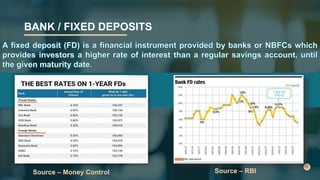
BANK / FIXED DEPOSITS
Source – Money Control Source – RBI
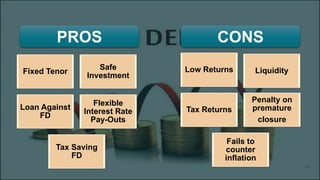
Fixed Tenor
Safe
Investment
Loan Against
FD
Flexible
Interest Rate
Pay-Outs
Tax Saving
FD
Low Returns Liquidity
Tax Returns
Penalty on
premature
closure
Fails to
counter
inflation
PROS CONS
PROVIDENT FUND
The Provident Fund (PF) is a pension fund that
helps people regularly save a portion of their
salary to provide enough money for a good and
healthy lifestyle after retirement.
This program is provided by the Employment
Provident Fund Organization (EPFO). All
companies with more than 20 members can apply
for the EPF scheme.
The first Provident Fund Act, passed in 1925.
. .
It was replaced by the Employees' Provident Funds
Act, which extended to the whole of India except
Jammu & Kashmir. The Employees' Provident
Funds Scheme, framed under section 5 of the Act,
was introduced in stages and came into force in its
entirety by 1 November 1952.
There are four types of PF that are Recognized
Provident Fund, PPF (Public Provident Fund),
Statutory Provident Fund and Unrecognized
Provident Fund
PROS CONS
PROS
CONS
Indian Post offers diverse
investment options to cater
to the varying needs of
different investors.
All Post office savings
schemes guarantee returns
as they are backed up by
the government of India.
Moreover, most of the post
office investment schemes
are tax-exempt
under Section 80C, i.e. tax
exemption up to Rs.
1,50,000 is allowed.
Small Savings Scheme Interest Rate Tenure
Tax Deduction on
Investment?
Interest Taxable
Post Office Savings Account 4.0% NA No Yes
Post Office Recurring Deposit 5.8% 5 Years No Yes
Post Office Monthly Income Scheme 6.6% 5 Years No Yes
Post Office Time Deposit (1 year) 5.5% 1 Year No Yes
Post Office Time Deposit (2 year) 5.5% 2 Years No Yes
Post Office Time Deposit (3 year) 5.5% 3 Years No Yes
Post Office Time Deposit (5 year) 6.7% 5 Years Yes Yes
Kisan Vikas Patra (KVP) 6.9% 30 Months Lock-in period No Yes
Public Provident Fund (PPF) 7.1% 15 Years Yes No
Sukanya Samriddhi Yojana 7.6% 21 Years Yes No
National Savings Certificate 6.8% 5 Years Yes No
Senior Citizens Savings Scheme 7.4% 5 Years Yes Yes
Easy Enrollment Process
Invest Money for Long
Term
Simple to Invest
Good Interest Rate
Tax Exemption
Risk-Free Investment
Unfriendly Post office
Staff
High Paper Work
Post Office Agents Rule
the Roost
Lack of Digitalization
linked to Place of
Investment
A
FINANCIAL SECTORS IN INDIA.pptx

FINANCIAL SECTORS IN INDIA.pptx

  • 1.
    FINANCIAL SECTORS ININDIA INVESTOR OPPORTUNITY
  • 3.
    FINANCIAL SECTOR The financialsector is a section of the economy made up of firms and institutions that provide financial services to commercial and retail customers. “A strong financial sector is a sign of a healthy economy.”
  • 4.
    FINANCIAL SECTORS ININDIA SHARE MARKET MUTUAL FUNDS GOLD BANK / FIXED DEPOSIT PROVIDENT FUND REAL ESTATE POST OFFICE INSURANCE SECTORS
  • 5.
    SHARE MARKET The sharemarket is a platform where buyers and sellers come together to trade on publicly listed shares during specific hours of the day. People often use the terms ‘share market’ and ‘stock market’ interchangeably. The principal stock exchanges in India are the National Stock Exchange (NSE) and the Bombay Stock Exchange (BSE). The BSE has been in existence since 1875. The NSE, on the other hand, was founded in 1992 and started trading in 1994. The Securities and Exchange Board of India (SEBI) is the regulatory authority established under the SEBI Act 1992.
  • 6.
    Risk Stockholders of broke companiesget paid last Takes time to research Taxes on profitable stock sales Emotional ups and downs Competing with institutional and professional investors PROS CONS Higher chances of return Grow with economy Stay ahead of inflation Easy to buy Flexible investing Income from price appreciation and dividends Liquidity
  • 7.
    MUTUAL FUNDS  Amutual fund is a type of investment vehicle consisting of a portfolio of stocks, bonds, or other securities.  Mutual funds give small or individual investors access to diversified, professionally managed portfolios at a low price.  Mutual funds are divided into several kinds of categories, representing the kinds of securities they invest in, their investment objectives, and the type of returns they seek.  Mutual funds charge annual fees (called expense ratios) and, in some cases, commissions, which can affect their overall returns.
  • 8.
    Liquidity Safety Tax-efficiency Diversification Suit your financialgoals Quick & painless process Capital gains tax Dilution Lock-in Peroids No Control Fluctuating returns High Operating Cost
  • 9.
    GOLD Due to someinfluencing factors such as high liquidity and inflation-beating capacity, gold is one of the most preferred investments in India. Gold investment can be done in many forms like buying jewelry, coins, bars, gold exchange-traded funds, Gold funds, sovereign gold bond scheme, etc. Digital gold is a new age investment instrument that allows you to invest in 24 Karat, 999.9 purest gold, which is then stored in MMTC-PAMP's secure vaults under your ownership. If you wish to take possession of the same, you can redeem digital gold for 24 Karat, 999.9 purest gold coins and gold bars.
  • 10.
     Inflation Hedge Security of Value Portfolio  Diversification Simplicity  Hedge Against a Disaster  Liquidity  Most Desired Commodity PROS  Storage of the Physical Gold Not A Passive  Income Asset Premiums and Taxes.  Theft  Gold Has A Terrible Historical Return.  Gold doesn’t pay any dividend. CONS
  • 11.
    BANK / FIXEDDEPOSITS Source – Money Control Source – RBI
  • 12.
    Fixed Tenor Safe Investment Loan Against FD Flexible InterestRate Pay-Outs Tax Saving FD Low Returns Liquidity Tax Returns Penalty on premature closure Fails to counter inflation PROS CONS
  • 13.
    PROVIDENT FUND The ProvidentFund (PF) is a pension fund that helps people regularly save a portion of their salary to provide enough money for a good and healthy lifestyle after retirement. This program is provided by the Employment Provident Fund Organization (EPFO). All companies with more than 20 members can apply for the EPF scheme. The first Provident Fund Act, passed in 1925. . . It was replaced by the Employees' Provident Funds Act, which extended to the whole of India except Jammu & Kashmir. The Employees' Provident Funds Scheme, framed under section 5 of the Act, was introduced in stages and came into force in its entirety by 1 November 1952. There are four types of PF that are Recognized Provident Fund, PPF (Public Provident Fund), Statutory Provident Fund and Unrecognized Provident Fund
  • 14.
  • 16.
  • 17.
    Indian Post offersdiverse investment options to cater to the varying needs of different investors. All Post office savings schemes guarantee returns as they are backed up by the government of India. Moreover, most of the post office investment schemes are tax-exempt under Section 80C, i.e. tax exemption up to Rs. 1,50,000 is allowed. Small Savings Scheme Interest Rate Tenure Tax Deduction on Investment? Interest Taxable Post Office Savings Account 4.0% NA No Yes Post Office Recurring Deposit 5.8% 5 Years No Yes Post Office Monthly Income Scheme 6.6% 5 Years No Yes Post Office Time Deposit (1 year) 5.5% 1 Year No Yes Post Office Time Deposit (2 year) 5.5% 2 Years No Yes Post Office Time Deposit (3 year) 5.5% 3 Years No Yes Post Office Time Deposit (5 year) 6.7% 5 Years Yes Yes Kisan Vikas Patra (KVP) 6.9% 30 Months Lock-in period No Yes Public Provident Fund (PPF) 7.1% 15 Years Yes No Sukanya Samriddhi Yojana 7.6% 21 Years Yes No National Savings Certificate 6.8% 5 Years Yes No Senior Citizens Savings Scheme 7.4% 5 Years Yes Yes
  • 18.
    Easy Enrollment Process InvestMoney for Long Term Simple to Invest Good Interest Rate Tax Exemption Risk-Free Investment Unfriendly Post office Staff High Paper Work Post Office Agents Rule the Roost Lack of Digitalization linked to Place of Investment
  • 21.