Understanding Investment
Sectors
A comprehensive guide to navigating India's key investment
opportunities and building wealth through informed financial
decisions.
Share Market
Equity Investment Overview
The share market represents ownership in companies through
stocks and securities traded on exchanges like NSE and BSE. Equity
investments offer potential for significant capital appreciation
through direct participation in corporate growth.
Investors can purchase shares through demat accounts, trading
platforms, and brokerage services, gaining exposure to diverse
sectors of the Indian economy.
Share Market: Investment Analysis
Advantages of Equity Investment
• High returns potential exceeding inflation by
significant margins
• Liquidity with ability to buy and sell during
market hours
• Dividend income from profitable companies
• Portfolio diversification across sectors and
market caps
Considerations and Risks
• Market volatility can lead to significant short-
term losses
• Requires research, analysis, and continuous
monitoring
• Emotional decision-making can impact returns
• Timing and selection risks affect overall performance
Mutual Funds
Professional Investment
Management
Mutual funds pool money from multiple investors to create
diversified portfolios managed by experienced fund managers.
These instruments offer exposure to equity, debt, or hybrid
strategies based on risk appetite and financial goals.
Available through SIP (Systematic Investment Plans) or lump sum
investments, mutual funds provide accessibility to professional
management with varying levels of risk and return potential across
categories.
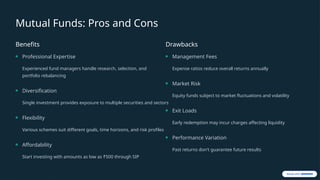
Mutual Funds: Pros and Cons
Benefits
Professional Expertise
Experienced fund managers handle research, selection, and
portfolio rebalancing
Diversification
Single investment provides exposure to multiple securities and sectors
Flexibility
Various schemes suit different goals, time horizons, and risk profiles
Affordability
Start investing with amounts as low as ₹500 through SIP
Drawbacks
Management Fees
Expense ratios reduce overall returns annually
Market Risk
Equity funds subject to market fluctuations and volatility
Exit Loads
Early redemption may incur charges affecting liquidity
Performance Variation
Past returns don't guarantee future results
Traditional Investment Options
Gold and Fixed Deposits
Gold Investment
Precious metal investment through physical gold, digital
gold, gold ETFs, or sovereign gold bonds. Traditionally
viewed as a hedge against inflation and currency
fluctuation.
Bank Fixed Deposits
Guaranteed return instruments offered by banks with
fixed interest rates and maturity periods. Capital
protection with assured returns backed by deposit
insurance.
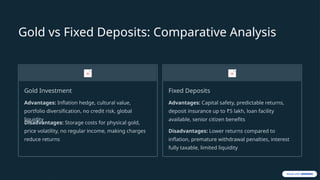
Gold vs Fixed Deposits: Comparative Analysis
Gold Investment
Advantages: Inflation hedge, cultural value,
portfolio diversification, no credit risk, global
liquidity
Disadvantages: Storage costs for physical gold,
price volatility, no regular income, making charges
reduce returns
Fixed Deposits
Advantages: Capital safety, predictable returns,
deposit insurance up to ₹5 lakh, loan facility
available, senior citizen benefits
Disadvantages: Lower returns compared to
inflation, premature withdrawal penalties, interest
fully taxable, limited liquidity
Government-Backed Schemes
PPF and Post Office Savings
Public Provident Fund (PPF)
Long-term savings scheme with 15-year lock-in period offering tax
benefits under Section 80C. Government-backed with sovereign
guarantee ensuring capital safety.
Current interest rates revised quarterly, with compound interest
calculated annually. Partial withdrawals permitted after 7 years.
Post Office Schemes
Various investment options including savings accounts, recurring
deposits, time deposits, monthly income schemes, and senior
citizen savings schemes offering competitive returns with
government backing.
Real Estate and Insurance Investment
Real Estate Investment
Pros: Tangible asset, rental income potential, capital
appreciation, leverage through home loans, tax benefits
Cons: High capital requirement, illiquidity, maintenance
costs, legal complexities, market cycles affect returns
Insurance Products
Pros: Life protection coverage, tax benefits under 80C
and 10(10D), disciplined savings, loan facility available
Cons: Lower returns compared to pure investments, high
charges, long lock-in periods, complex policy terms
Building Your Investment Strategy
01
Assess Risk Profile
Understand your risk tolerance, investment horizon, and financial goals
02
Diversify Portfolio
Allocate across multiple sectors to balance risk and return potential
03
Review Regularly
Monitor performance and rebalance based on changing circumstances
04
Stay Informed
Continuously educate yourself about market trends and opportunities
Successful investing requires discipline, patience, and a clear understanding of each sector's characteristics. Consult financial advisors for
personalised guidance.


Understanding-Investment-Sector for the MBA program

  • 1.
    Understanding Investment Sectors A comprehensiveguide to navigating India's key investment opportunities and building wealth through informed financial decisions.
  • 2.
    Share Market Equity InvestmentOverview The share market represents ownership in companies through stocks and securities traded on exchanges like NSE and BSE. Equity investments offer potential for significant capital appreciation through direct participation in corporate growth. Investors can purchase shares through demat accounts, trading platforms, and brokerage services, gaining exposure to diverse sectors of the Indian economy.
  • 3.
    Share Market: InvestmentAnalysis Advantages of Equity Investment • High returns potential exceeding inflation by significant margins • Liquidity with ability to buy and sell during market hours • Dividend income from profitable companies • Portfolio diversification across sectors and market caps Considerations and Risks • Market volatility can lead to significant short- term losses • Requires research, analysis, and continuous monitoring • Emotional decision-making can impact returns • Timing and selection risks affect overall performance
  • 4.
    Mutual Funds Professional Investment Management Mutualfunds pool money from multiple investors to create diversified portfolios managed by experienced fund managers. These instruments offer exposure to equity, debt, or hybrid strategies based on risk appetite and financial goals. Available through SIP (Systematic Investment Plans) or lump sum investments, mutual funds provide accessibility to professional management with varying levels of risk and return potential across categories.
  • 5.
    Mutual Funds: Prosand Cons Benefits Professional Expertise Experienced fund managers handle research, selection, and portfolio rebalancing Diversification Single investment provides exposure to multiple securities and sectors Flexibility Various schemes suit different goals, time horizons, and risk profiles Affordability Start investing with amounts as low as ₹500 through SIP Drawbacks Management Fees Expense ratios reduce overall returns annually Market Risk Equity funds subject to market fluctuations and volatility Exit Loads Early redemption may incur charges affecting liquidity Performance Variation Past returns don't guarantee future results
  • 6.
    Traditional Investment Options Goldand Fixed Deposits Gold Investment Precious metal investment through physical gold, digital gold, gold ETFs, or sovereign gold bonds. Traditionally viewed as a hedge against inflation and currency fluctuation. Bank Fixed Deposits Guaranteed return instruments offered by banks with fixed interest rates and maturity periods. Capital protection with assured returns backed by deposit insurance.
  • 7.
    Gold vs FixedDeposits: Comparative Analysis Gold Investment Advantages: Inflation hedge, cultural value, portfolio diversification, no credit risk, global liquidity Disadvantages: Storage costs for physical gold, price volatility, no regular income, making charges reduce returns Fixed Deposits Advantages: Capital safety, predictable returns, deposit insurance up to ₹5 lakh, loan facility available, senior citizen benefits Disadvantages: Lower returns compared to inflation, premature withdrawal penalties, interest fully taxable, limited liquidity
  • 8.
    Government-Backed Schemes PPF andPost Office Savings Public Provident Fund (PPF) Long-term savings scheme with 15-year lock-in period offering tax benefits under Section 80C. Government-backed with sovereign guarantee ensuring capital safety. Current interest rates revised quarterly, with compound interest calculated annually. Partial withdrawals permitted after 7 years. Post Office Schemes Various investment options including savings accounts, recurring deposits, time deposits, monthly income schemes, and senior citizen savings schemes offering competitive returns with government backing.
  • 9.
    Real Estate andInsurance Investment Real Estate Investment Pros: Tangible asset, rental income potential, capital appreciation, leverage through home loans, tax benefits Cons: High capital requirement, illiquidity, maintenance costs, legal complexities, market cycles affect returns Insurance Products Pros: Life protection coverage, tax benefits under 80C and 10(10D), disciplined savings, loan facility available Cons: Lower returns compared to pure investments, high charges, long lock-in periods, complex policy terms
  • 10.
    Building Your InvestmentStrategy 01 Assess Risk Profile Understand your risk tolerance, investment horizon, and financial goals 02 Diversify Portfolio Allocate across multiple sectors to balance risk and return potential 03 Review Regularly Monitor performance and rebalance based on changing circumstances 04 Stay Informed Continuously educate yourself about market trends and opportunities Successful investing requires discipline, patience, and a clear understanding of each sector's characteristics. Consult financial advisors for personalised guidance.