https://scaalex.com/blog/financial-
modeling-and-forecast/
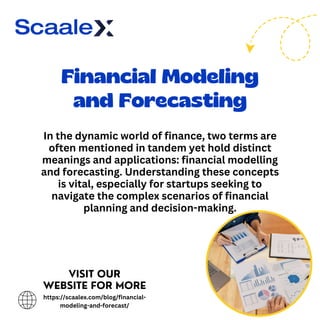
Financial Modeling
and Forecasting
VISIT OUR
WEBSITE FOR MORE
In the dynamic world of finance, two terms are
often mentioned in tandem yet hold distinct
meanings and applications: financial modelling
and forecasting. Understanding these concepts
is vital, especially for startups seeking to
navigate the complex scenarios of financial
planning and decision-making.
FORECASTING IS THE PROCESS OF PREDICTING FUTURE
FINANCIAL OUTCOMES BASED ON HISTORICAL AND
CURRENT DATA. IT IS A CORNERSTONE OF FINANCIAL
PLANNING, PROVIDING BUSINESSES WITH A ROADMAP
FOR THE FUTURE. IN THE CONTEXT OF FINANCIAL
FORECASTING, THE FOCUS IS ON IDENTIFYING TRENDS,
ANTICIPATING CHANGES, AND PREPARING FOR
POTENTIAL OPPORTUNITIES AND RISKS.
Why Is Forecasting
Important?
There are various methods of financial forecasting, each with its
strengths and suitability for different business scenarios. The
most common methods include:
Time Series Analysis: This method involves analysing
historical data to identify trends and patterns. It’s particularly
useful for short-term forecasting.
Econometric Modeling: This involves using statistical
methods to test hypotheses and forecast future trends based
on economic theory.
Judgmental Forecasting: Here, forecasting is based on
intuitive judgments, opinions, and probability estimates. This
method is often used when there is a lack of historical data.
What Are the Methods of
Financial Forecasting?
Financial Modeling, on the other hand, is the process of creating
a summary of a company’s expenses and earnings in the form of
a spreadsheet that can be used to calculate the impact of a
future event or decision. A financial model is a tool used for
decision-making, not just prediction.
Financial modelling for startups is indispensable. It enables
entrepreneurs to test different scenarios and see their potential
financial impact. This is crucial for startups that need to make
important decisions on funding, growth strategies, and resource
allocation.
Why Is Modeling
Important?

Financial modelling and Forecasting

  • 1.
    https://scaalex.com/blog/financial- modeling-and-forecast/ Financial Modeling and Forecasting VISITOUR WEBSITE FOR MORE In the dynamic world of finance, two terms are often mentioned in tandem yet hold distinct meanings and applications: financial modelling and forecasting. Understanding these concepts is vital, especially for startups seeking to navigate the complex scenarios of financial planning and decision-making.
  • 2.
    FORECASTING IS THEPROCESS OF PREDICTING FUTURE FINANCIAL OUTCOMES BASED ON HISTORICAL AND CURRENT DATA. IT IS A CORNERSTONE OF FINANCIAL PLANNING, PROVIDING BUSINESSES WITH A ROADMAP FOR THE FUTURE. IN THE CONTEXT OF FINANCIAL FORECASTING, THE FOCUS IS ON IDENTIFYING TRENDS, ANTICIPATING CHANGES, AND PREPARING FOR POTENTIAL OPPORTUNITIES AND RISKS. Why Is Forecasting Important?
  • 3.
    There are variousmethods of financial forecasting, each with its strengths and suitability for different business scenarios. The most common methods include: Time Series Analysis: This method involves analysing historical data to identify trends and patterns. It’s particularly useful for short-term forecasting. Econometric Modeling: This involves using statistical methods to test hypotheses and forecast future trends based on economic theory. Judgmental Forecasting: Here, forecasting is based on intuitive judgments, opinions, and probability estimates. This method is often used when there is a lack of historical data. What Are the Methods of Financial Forecasting?
  • 4.
    Financial Modeling, onthe other hand, is the process of creating a summary of a company’s expenses and earnings in the form of a spreadsheet that can be used to calculate the impact of a future event or decision. A financial model is a tool used for decision-making, not just prediction. Financial modelling for startups is indispensable. It enables entrepreneurs to test different scenarios and see their potential financial impact. This is crucial for startups that need to make important decisions on funding, growth strategies, and resource allocation. Why Is Modeling Important?