Making
Capital
Investment
Decisions
Group 4
THE NATURE OF
INVESTMENT DECISIONS
Investments
Large amounts of
resources are often
involved
Relatively long
timescales are involved
Questions? When managers of a business are making decision involving
capital investment, what should the decision seek to achieve?
MACHINES
• Tarpaulin Printing
• Banner Printing
• Sticker Printing
• Canvas Printing
• Roll up Banner Printing
• Billboard
• Hoarding
• Sticker on forex
• Sticker on foamboard
• Picture Frame with canvas
• Photopaper
• Acrylic Signage
• Aluminum signage
• Wooden Signage
• Carpentry
• Photography
FAST PRODUCE PRODUCT & SERVICES
ARE THE FOLLOWING;
• Cut-out Sticker Labels
• T-shirts printing
• T-Mug Printing
• Button Pin printing
• Other Giveaways
• Events Set-up
• Events Photobooth
• Photo Printing
From A5 to A0 Size
• Invitation Cards
• Flyers
• Books binding
• Brochure
• Designing
• 3D Designing
Overview: H2N Enterprise
01 02
03
04
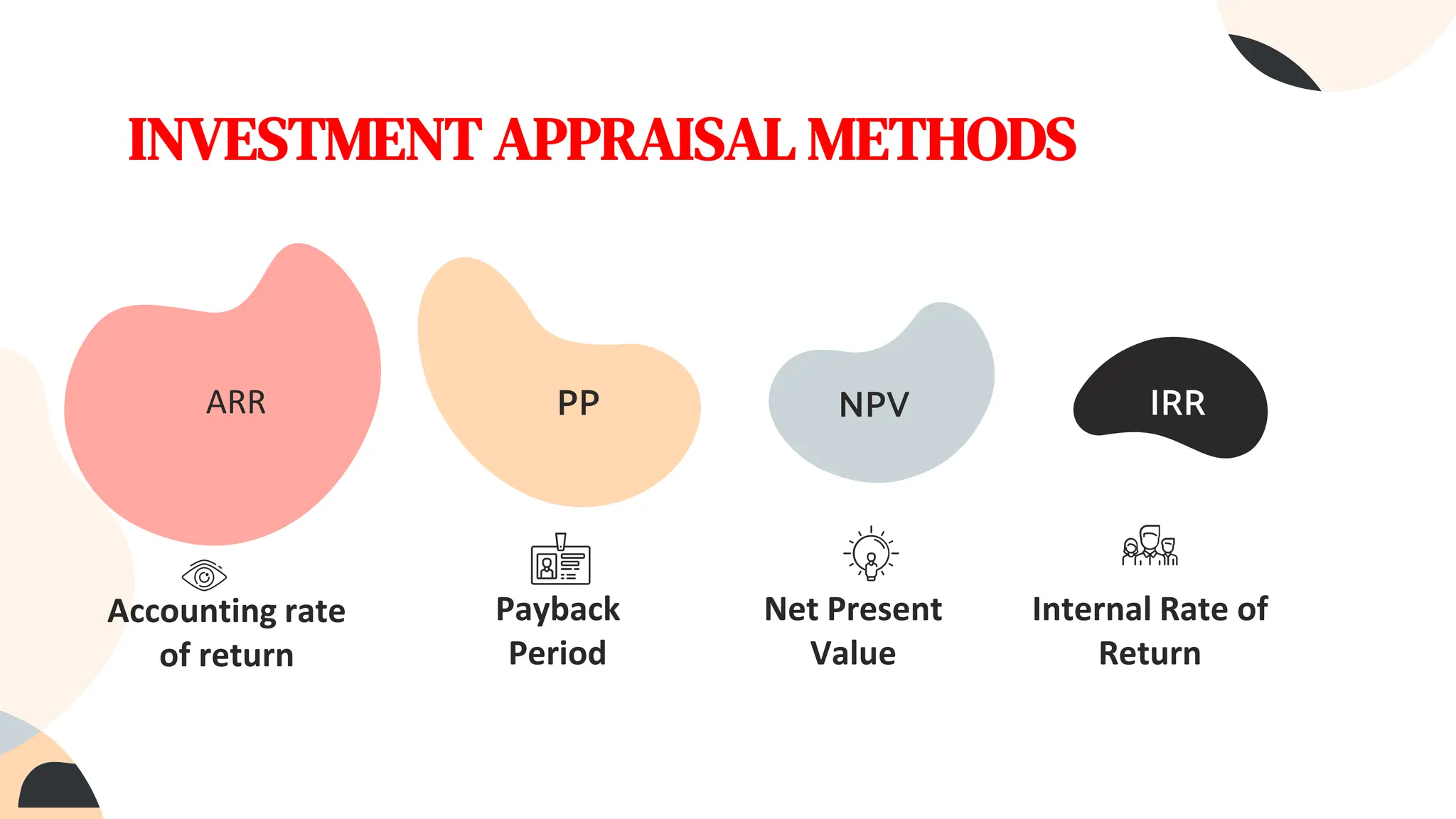
INVESTMENT APPRAISAL METHODS
ARR PP NPV IRR
Accounting rate
of return
Payback
Period
Net Present
Value
Internal Rate of
Return
IAM: Answering Qs?
Does the decision
rule depend on
management
judgement?
Is all relevant
information (apart
from timing) taken
into account?
Does it take
account of the time
value of money?
Is there a clear
decision rule?
Is it based on the
use cash flows?
Is it directly relation
to shareholder wealth
maximization?
Is it easy to use?
ARR
YOUR
LOGO
Example 1
H2N Enterprise has conducted research relating to a service that it has recently developed. Provision of
the service would require investment in a machine that would cost Php 100,000, payable immediately.
Sales of the service would take place throughout the next five year. At the end of that time, it is
estimated that the machine sold Php 20,000.
In our example, the average annual operating profit before depreciation over the five years
is Php40,000 (that is, Php(20 + 40 + 60 + 60 + 20)000/5) Assuming ‘straight-line’ depreciation
(that is, equal annual amounts), the annual depreciation charge will be Php16,000 (that is,
Php(100,000 - 20,000)/5). Thus, the average annual operating profit after depreciation is 24,000
(that is, Php40,000 - Php16,000).
The average investment over the five years can be calculated as follows:
Average investment =
Payback Period (PP)
YOUR
LOGO
This is the time taken for an initial investment to be repaid out of the net cash inflows
from a project.
Figure1
For a project to be acceptable, it
should have a payback period no
longer than a maximum payback
period set by the business.
If there are two (or more) competing projects
with payback periods that are no longer than
the maximum payback period, the project
with the shorter (or shortest) payback
period should be selected.
Figure2
Problems with PP
Figure3
There are further problems with the PP method, which are considered below:
Relevant information
We saw earlier that the PP method is simply concerned with how quickly the initial investment can be recovered.
Cashflows arising beyond the payback period will be ignored.
Risk
By favoring projects with a short payback period, the PP method provides a way of dealing with risk. However, it
offers a fairly simple approach to the problem. It deals only with the risk that the project will end earlier than
expected.
Wealth maximization
Although the PP method takes some note of the timing of project costs and benefits, it is not concerned with
maximizing the wealth of the business owners. Rather, it favors projects that pay for themselves quickly.
Target payback period
Managers must decide upon a maximum acceptable payback period. When doing so, they confront a similar
problem to that arising when setting a target ARR. No objective basis can be used to determine this period: it is
simply a matter of judgement.
Net Present Value - NPV
This methods tells how much an investment is worth throughout its lifetime,
discounted to today's value. It considers all of the cash flows for each investment
opportunity, and makes a logical allowance for the timing of those cash flows.
1. Interest lost- interest which is
forgone by not placing our money
on deposit. It represents an
opportunity cost that arises where
one course of action deprives us of
the opportunity to derive benefit
from an alternative course of action
2. Risk – things may not turn out as
expected. It should expect much
greater returns than the bank
deposit interest rate because of the
much greater risk involved. The
logical equivalent of investing in the
machine would be an investment of
similar risk.
3. Inflation- loss in the purchasing
power of money.
Let us assume that the business could make an alternative investment with similar risk and
obtain a return of 20 per cent a year.
Given that the H2N Enterprise could invest its money at a rate of 20 percent a year, what is the present (immediate)
value of the expected first-year receipt of Php20,000? In other words, if instead of having to wait a year for the Php
20,000, and therefore be deprived of the opportunity to invest it at 20 percent, the business could have some
money now, what sum would be equivalent to getting Php20,000 in one year’s time?
PV + (PV * 20%) = Php20,000
That is, the amount plus income from investing the amount for the year equals the Php20,000. If we rearrange this
equation, we find:
PV X (1+0.2) = Php 20,000
PV= Php20,000/(1.2)=Php 16,667
Calculating the Net present value of H2N Enterprise is shown below:
PV of the cash flow of year n = Actual CF of the year/(1+r)ⁿ
To compute for the PV of year 2 cash flow:
PV of year 2 cash flow (Php 40,000) = Php 40,000/(1 + 0.2)2 = Php 40,000/(1.2)2
= Php 40,000/1.44 = Php 27,778
If the NPV is positive, the project
should be accepted; if it is negative,
the project should be rejected.
If there are two (or more) competing projects
that have positive NPVs, the project with the
higher (or highest) NPV should be selected.
From the table below, NPV calculation as follows:
 Note that we have used Discount Factor to calculate the present value.
Advantages of Net Present Value:
1. The timing of the cash flows- By discounting the various cash flows associated with each
project according to when they arise, NPV takes account of the time value of money.
Furthermore, as the discounting process takes account of the opportunity cost of capital, the
net benefit after financing costs have been met is identified (as the NPV of the project).
2. The whole of the relevant cash flows. NPV includes all of the relevant cash flows. They are
treated differently according to their date of occurrence, but they are all taken into account.
Thus, they all have an influence on the decision.
3. The objectives of the business. NPV is the only method of appraisal in which the output of the
analysis has a direct bearing on the wealth of the owners of the business. Positive NPVs
enhance wealth; negative ones reduce it.
Internal Rate of Return
The discount rate that, when applied to its future cash flows, will produce an NPV
of precisely zero. In essence, it represents the yield, or percentage return, from an
investment opportunity.
The higher the discount rate, the lower will be the NPV. This is
because a higher discount rate gives a lower discounted figure.
Let us try a higher rate, say 30 per cent, and see what happens.
For any project to be acceptable, it must
meet a minimum IRR requirement. This
is often referred to as the hurdle rate
and, logically, this should be the
opportunity cost of capital.
If two, or more, competing projects meet the
hurdle rate, the one with the higher
(or highest) IRR should be selected
Problems with IRR
 IRR shares certain key attributes with NPV. All cash flows are taken into account and
their timing is logically handled. The main problem of IRR, however, is that it does not
directly address the question of wealth generation. It can therefore lead to the wrong
decision being made.
THE MAIN METHODS SUMMARISED
What is Investment Appraisal?
● the techniques used by firms and
investors primarily to determine whether
an investment is profit-making or not
● it includes assessing the
profitability and affordability of
investing in long-term projects,
new products, machinery, etc.
INVESTMENT APPRAISAL IN PRACTICE
■ Businesses tend to use more than one method to
assess each investment decision.
■ The discounting methods (NPV and IRR) have become
increasingly popular over time. NPV and IRR are now the
most popular of the four methods.
■ PP continues to be popular and, to a lesser extent, so
does ARR. This is despite the theoretical shortcomings of
both methods.
■ Larger businesses rely more heavily on discounting
methods than smaller businesses and tend to use more
of the four methods.
Many surveys have been conducted in economically developed countries into the methods of
investment appraisal used by businesses. They have revealed the following:
Look at this
picture!
A survey of investment and financing
practices in five different countries
was carried out by Cohen and Yagil.
This survey, based on a sample of the
largest 300 businesses in each
country, revealed the following
concerning the popularity of three of
the investment appraisal methods
discussed in this chapter.
INVESTMENT APPRAISAL AND STRATEGIC
PLANNING So far, we have viewed investment opportunities as unconnected,
independent events. In practice, however, successful businesses establish
a clear framework for the selection of investment projects. Unless this
framework is in place, it may be difficult to identify those projects that
are likely to generate a positive NPV.
The best investment projects are usually those that match the business’s
internal strengths (for example, skills, experience, access to finance) with
the opportunities available. In areas where this match does not exist,
other businesses, for which the match does exist, will have a competitive
advantage. This means that they will be able to provide the product or
service at a better price and/or quality. Setting out the framework just
described is an essential part of strategic planning. In practice, strategic
plans often have a time span of around three to five years. It involves
asking, ‘Where do we want our business to be in (say) five years’ time
and how can we get there?’ It will set the appropriate direction in terms
of products, markets, financing and so on, to ensure that the business is
best placed to generate profitable investment opportunities.
THE INVESTMENT APPRAISAL PROCESS
Stage 1: Determine investment funds available
Stage 2: Identify profitable project opportunities
Stage 3: Refine and classify proposed projects
Stage 4: Evaluate the proposed project(s)
Stage 5: Approve the project(s)
Stage 6: Monitor and control the project(s)
Our team
Nina Marie
Sansano
Hazel Guevarra Hazel Magonles
CREDITS: This presentation template was
created by Slidesgo, including icons by Flaticon,
infographics & images by Freepik and
illustrations by Storyset
Thanks!
Do you have any questions?
addyouremail@freepik.com
+91 620 421 838
yourcompany.com

Financial Management- Making Capital Investment Decision

  • 1.
  • 2.
    THE NATURE OF INVESTMENTDECISIONS Investments Large amounts of resources are often involved Relatively long timescales are involved Questions? When managers of a business are making decision involving capital investment, what should the decision seek to achieve?
  • 3.
    MACHINES • Tarpaulin Printing •Banner Printing • Sticker Printing • Canvas Printing • Roll up Banner Printing • Billboard • Hoarding • Sticker on forex • Sticker on foamboard • Picture Frame with canvas • Photopaper • Acrylic Signage • Aluminum signage • Wooden Signage • Carpentry • Photography FAST PRODUCE PRODUCT & SERVICES ARE THE FOLLOWING; • Cut-out Sticker Labels • T-shirts printing • T-Mug Printing • Button Pin printing • Other Giveaways • Events Set-up • Events Photobooth • Photo Printing From A5 to A0 Size • Invitation Cards • Flyers • Books binding • Brochure • Designing • 3D Designing
  • 4.
  • 5.
    INVESTMENT APPRAISAL METHODS ARRPP NPV IRR Accounting rate of return Payback Period Net Present Value Internal Rate of Return
  • 6.
    IAM: Answering Qs? Doesthe decision rule depend on management judgement? Is all relevant information (apart from timing) taken into account? Does it take account of the time value of money? Is there a clear decision rule? Is it based on the use cash flows? Is it directly relation to shareholder wealth maximization? Is it easy to use?
  • 7.
    ARR YOUR LOGO Example 1 H2N Enterprisehas conducted research relating to a service that it has recently developed. Provision of the service would require investment in a machine that would cost Php 100,000, payable immediately. Sales of the service would take place throughout the next five year. At the end of that time, it is estimated that the machine sold Php 20,000.
  • 8.
    In our example,the average annual operating profit before depreciation over the five years is Php40,000 (that is, Php(20 + 40 + 60 + 60 + 20)000/5) Assuming ‘straight-line’ depreciation (that is, equal annual amounts), the annual depreciation charge will be Php16,000 (that is, Php(100,000 - 20,000)/5). Thus, the average annual operating profit after depreciation is 24,000 (that is, Php40,000 - Php16,000). The average investment over the five years can be calculated as follows: Average investment =
  • 11.
    Payback Period (PP) YOUR LOGO Thisis the time taken for an initial investment to be repaid out of the net cash inflows from a project. Figure1
  • 12.
    For a projectto be acceptable, it should have a payback period no longer than a maximum payback period set by the business. If there are two (or more) competing projects with payback periods that are no longer than the maximum payback period, the project with the shorter (or shortest) payback period should be selected. Figure2
  • 13.
  • 14.
    There are furtherproblems with the PP method, which are considered below: Relevant information We saw earlier that the PP method is simply concerned with how quickly the initial investment can be recovered. Cashflows arising beyond the payback period will be ignored. Risk By favoring projects with a short payback period, the PP method provides a way of dealing with risk. However, it offers a fairly simple approach to the problem. It deals only with the risk that the project will end earlier than expected. Wealth maximization Although the PP method takes some note of the timing of project costs and benefits, it is not concerned with maximizing the wealth of the business owners. Rather, it favors projects that pay for themselves quickly. Target payback period Managers must decide upon a maximum acceptable payback period. When doing so, they confront a similar problem to that arising when setting a target ARR. No objective basis can be used to determine this period: it is simply a matter of judgement.
  • 15.
    Net Present Value- NPV This methods tells how much an investment is worth throughout its lifetime, discounted to today's value. It considers all of the cash flows for each investment opportunity, and makes a logical allowance for the timing of those cash flows. 1. Interest lost- interest which is forgone by not placing our money on deposit. It represents an opportunity cost that arises where one course of action deprives us of the opportunity to derive benefit from an alternative course of action 2. Risk – things may not turn out as expected. It should expect much greater returns than the bank deposit interest rate because of the much greater risk involved. The logical equivalent of investing in the machine would be an investment of similar risk. 3. Inflation- loss in the purchasing power of money.
  • 16.
    Let us assumethat the business could make an alternative investment with similar risk and obtain a return of 20 per cent a year. Given that the H2N Enterprise could invest its money at a rate of 20 percent a year, what is the present (immediate) value of the expected first-year receipt of Php20,000? In other words, if instead of having to wait a year for the Php 20,000, and therefore be deprived of the opportunity to invest it at 20 percent, the business could have some money now, what sum would be equivalent to getting Php20,000 in one year’s time? PV + (PV * 20%) = Php20,000 That is, the amount plus income from investing the amount for the year equals the Php20,000. If we rearrange this equation, we find: PV X (1+0.2) = Php 20,000 PV= Php20,000/(1.2)=Php 16,667
  • 17.
    Calculating the Netpresent value of H2N Enterprise is shown below: PV of the cash flow of year n = Actual CF of the year/(1+r)ⁿ To compute for the PV of year 2 cash flow: PV of year 2 cash flow (Php 40,000) = Php 40,000/(1 + 0.2)2 = Php 40,000/(1.2)2 = Php 40,000/1.44 = Php 27,778
  • 18.
    If the NPVis positive, the project should be accepted; if it is negative, the project should be rejected. If there are two (or more) competing projects that have positive NPVs, the project with the higher (or highest) NPV should be selected. From the table below, NPV calculation as follows:  Note that we have used Discount Factor to calculate the present value.
  • 19.
    Advantages of NetPresent Value: 1. The timing of the cash flows- By discounting the various cash flows associated with each project according to when they arise, NPV takes account of the time value of money. Furthermore, as the discounting process takes account of the opportunity cost of capital, the net benefit after financing costs have been met is identified (as the NPV of the project). 2. The whole of the relevant cash flows. NPV includes all of the relevant cash flows. They are treated differently according to their date of occurrence, but they are all taken into account. Thus, they all have an influence on the decision. 3. The objectives of the business. NPV is the only method of appraisal in which the output of the analysis has a direct bearing on the wealth of the owners of the business. Positive NPVs enhance wealth; negative ones reduce it.
  • 20.
    Internal Rate ofReturn The discount rate that, when applied to its future cash flows, will produce an NPV of precisely zero. In essence, it represents the yield, or percentage return, from an investment opportunity. The higher the discount rate, the lower will be the NPV. This is because a higher discount rate gives a lower discounted figure. Let us try a higher rate, say 30 per cent, and see what happens.
  • 22.
    For any projectto be acceptable, it must meet a minimum IRR requirement. This is often referred to as the hurdle rate and, logically, this should be the opportunity cost of capital. If two, or more, competing projects meet the hurdle rate, the one with the higher (or highest) IRR should be selected Problems with IRR  IRR shares certain key attributes with NPV. All cash flows are taken into account and their timing is logically handled. The main problem of IRR, however, is that it does not directly address the question of wealth generation. It can therefore lead to the wrong decision being made.
  • 23.
    THE MAIN METHODSSUMMARISED
  • 25.
    What is InvestmentAppraisal? ● the techniques used by firms and investors primarily to determine whether an investment is profit-making or not ● it includes assessing the profitability and affordability of investing in long-term projects, new products, machinery, etc.
  • 26.
    INVESTMENT APPRAISAL INPRACTICE ■ Businesses tend to use more than one method to assess each investment decision. ■ The discounting methods (NPV and IRR) have become increasingly popular over time. NPV and IRR are now the most popular of the four methods. ■ PP continues to be popular and, to a lesser extent, so does ARR. This is despite the theoretical shortcomings of both methods. ■ Larger businesses rely more heavily on discounting methods than smaller businesses and tend to use more of the four methods. Many surveys have been conducted in economically developed countries into the methods of investment appraisal used by businesses. They have revealed the following:
  • 27.
    Look at this picture! Asurvey of investment and financing practices in five different countries was carried out by Cohen and Yagil. This survey, based on a sample of the largest 300 businesses in each country, revealed the following concerning the popularity of three of the investment appraisal methods discussed in this chapter.
  • 28.
    INVESTMENT APPRAISAL ANDSTRATEGIC PLANNING So far, we have viewed investment opportunities as unconnected, independent events. In practice, however, successful businesses establish a clear framework for the selection of investment projects. Unless this framework is in place, it may be difficult to identify those projects that are likely to generate a positive NPV. The best investment projects are usually those that match the business’s internal strengths (for example, skills, experience, access to finance) with the opportunities available. In areas where this match does not exist, other businesses, for which the match does exist, will have a competitive advantage. This means that they will be able to provide the product or service at a better price and/or quality. Setting out the framework just described is an essential part of strategic planning. In practice, strategic plans often have a time span of around three to five years. It involves asking, ‘Where do we want our business to be in (say) five years’ time and how can we get there?’ It will set the appropriate direction in terms of products, markets, financing and so on, to ensure that the business is best placed to generate profitable investment opportunities.
  • 29.
  • 30.
    Stage 1: Determineinvestment funds available Stage 2: Identify profitable project opportunities Stage 3: Refine and classify proposed projects Stage 4: Evaluate the proposed project(s) Stage 5: Approve the project(s) Stage 6: Monitor and control the project(s)
  • 31.
    Our team Nina Marie Sansano HazelGuevarra Hazel Magonles
  • 32.
    CREDITS: This presentationtemplate was created by Slidesgo, including icons by Flaticon, infographics & images by Freepik and illustrations by Storyset Thanks! Do you have any questions? addyouremail@freepik.com +91 620 421 838 yourcompany.com