ANNUAL REPORT
2010-11
Developing an integrated
system of excellence
for the prevention
and management of
cardiovascular disease
in the champlain
district of ontario
Partner Organizations
Champlain Local Health
Integration Network
Champlain Regional Stroke Network
Department of Family Medicine,
University of Ottawa and Institute
of Population Health, University of
Ottawa
Eastern Ontario Community Primary
Health Care Network
Eastern Ontario Health Unit
Élisabeth Bruyère Research Institute
Healthy Active Living & Obesity
Research Group, CHEO
Heart and Stroke Foundation
of Ontario
Leeds, Grenville &
Lanark District Health Unit
Ottawa Public Health
Renfrew County &
District Health Unit
The Ottawa Hospital
University of Ottawa Heart Institute
CCPN Founding Industry Partner
Pfizer Canada Inc.
Funding Support
Champlain Local Health
Integration Network
Heart and Stroke Foundation
of Ontario
Ontario Ministry of Health
and Long-Term Care
Ontario Ministry of
Health Promotion and Sport
Public Health Agency of Canada
Smoke-Free Ontario, Ontario
Ministry of Health Promotion
and Sport
Société Santé en français
Health Canada
Canadian Stroke Network
Eastern Ontario Community
Primary Health Care
Network
The development of the Champlain
Cardiovascular Disease Prevention Network
(CCPN) was catalyzed by the University of
Ottawa Heart Institute (UOHI), who recognized
the need for increased leadership and strategic
action to address the burden of cardiovascular
disease in the Champlain region. The CCPN’s
Project Management Team is housed at the
UOHI on behalf of our partner organizations.
The Champlain Cardiovascular Disease Prevention Strategy
1
The Champlain Cardiovascular Disease
Prevention Network is committed to
leading the way in Ontario with new
standards for the prevention and
management of cardiovascular disease
(CVD). It is my pleasure to share with you the 2010-11
Annual Report for the Network. We are proud of the
significant accomplishments that have resulted since the
launch of the Champlain CVD Prevention Strategy in
2007. We have successfully introduced in hospitals across
the region state-of-the-art prevention programs and are
showing measurable results in regards to health care
excellence. Similarly, evidence-based programs are now
in place in primary care settings across the region and
strategic investments have been made in two upstream
prevention initiatives to ensure our residents – both young
and old – reduce their risk for CVD. In a concerted and
combined effort, the school system, the health system,
and community organizations are all working to make our
region one of the healthiest in the province. I would like to
personally acknowledge the efforts of leaders from across
the Champlain District for your work in improving the
quality of programs and services in the Champlain region.
Sincerely,
Andrew Pipe, CM, MD
Chair, Champlain CVD Prevention Network
Medical Director, Minto Prevention and Rehabilitation
Centre, University of Ottawa Heart Institute
The Champlain LHIN has been a
proud partner of the Champlain CVD
Prevention Network during the past
several years. The LHIN helps to bring
providers and communities together to
benefit patients, and our support of the Network is a good
example of this. We continued our commitment in 2010-
11 to support leading-edge initiatives that are improving
the health of our community and performance of the
health system. Programs directed toward reducing smoking
rates, preventing high blood pressure, and increasing good
nutrition and activity habits in children and youth are key
factors in the creation of a healthier population. Significant
quality improvements in CVD prevention - both in primary
care settings and in hospitals - are also being accomplished.
Certainly, it is this type of preventive approach that has
the most impact in bringing about real change in health
care. The CCPN is building a better system of best practice
in CVD prevention and management, and all partners
involved are playing an important role in advancing these
improvements across our region. Your hard work, your
enthusiasm, and your innovation are appreciated.
Alex Munter
CEO, Champlain Local Health Integration Network
CCPN Board of Directors 2010-11
Dr. Andrew Pipe 	 Dr. Isra Levy
Chair			 Director
Ms. Marion Fraser	 Dr. David Salisbury
Director			 Director
Mr. Randy Penney	 Dr. Robert Cushman
Director			 Director
WORKING TOGETHER TO PREVENT HEART
DISEASE AND STROKE
CCPN | ANNUAL REPORT 2010-11
2
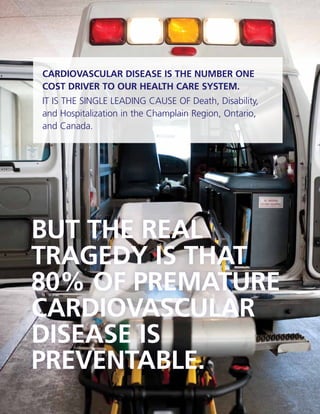
CARDIOVASCULAR DISEASE IS THE NUMBER ONE
COST DRIVER TO OUR HEALTH CARE SYSTEM.
IT IS THE SINGLE LEADING CAUSE OF Death, Disability,
and Hospitalization in the Champlain Region, Ontario,
and Canada.
BUT THE REAL
TRAGEDY IS THAT
80% OF PREMATURE
CARDIOVASCULAR
DISEASE IS
PREVENTABLE.
The Champlain Cardiovascular Disease Prevention Strategy
3
THE COST OF CVD TO THE
CHAMPLAIN DISTRICT IS
ENORMOUS.
CARDIOVASCULAR DISEASE (CVD) is the number one
cost driver to our health care system.
$7.6 billion is spent annually in Ontario on the treatment of CVD.
CVD accounts for the largest proportion of health care spending in Ontario
including 20% of acute care hospital costs, 15% of home care, 10.5% of
emergency room visits, 10% of medical services, and 17% of drug expenditures.
CVD is the leading cause of death and disability
in Canada, Ontario, and the Champlain region.
Approximately 40,000 Canadians, 26,000 Ontarians, and 2,600 Champlain
residents die each year of CVD.
More than 90,000 Champlain residents are living with CVD.
8 in 10 Ontarians are living with one or more cardiovascular risk factors.
Several Champlain communities have among
the highest rates of CVD in the province.
Renfrew County, Eastern Ontario (Prescott & Russell), and Leeds, Grenville &
Lanark Counties are three of Ontario’s “hot spots” for CVD.
These regions experience rates of CVD morbidity and mortality which are
significantly higher than both the City of Ottawa and the provincial average.
The economic impact of CVD will continue to
grow and threatens the sustainability of our
health care system.
The number of deaths caused by CVD is expected to double by 2018 as a result
of an aging demographic, population growth, and increasing prevalence of CVD
risk factors.
Ontario is currently spending $46.1 billion per year on health care, representing
46% of all spending, which has increased by $17 billion per year since 2003.
If the rate of health care spending is not curbed, it will represent 70% of all
program spending in Ontario within 12 years.
Source: Ontario Ministry of Finance. 2010 Ontario Budget.
CCPN | ANNUAL REPORT 2010-11
4
THE CHAMPLAIN
CVD PREVENTION
NETWORK:
CATALYZING CHANGE
The Champlain Cardiovascular Disease Prevention Strategy
5
DEMONSTRATING
PROVINCIAL LEADERSHIP
IN CHRONIC DISEASE
PREVENTION &
MANAGEMENT
Through the implementation of an integrated, regional CVD prevention and
management strategy, the Champlain region is actively contributing to the
province’s commitment to reduce the burden of chronic disease, helping to
transform the health system at the local level and better serve Ontarians. The
CCPN has already made great strides in bridging the silos between health and
community partners which previously limited the ability to successfully address
chronic disease prevention and management in a unified manner.
THE CHAMPLAIN CVD PREVENTION AND MANAGEMENT
STRATEGY
The Champlain CVD Prevention and Management Strategy was developed in
response to the growing necessity to establish an integrated, coordinated, and
comprehensive approach to preventing and managing CVD. The Champlain
CVD Strategy is a five-year plan designed to eliminate disparities in CVD health
and make the residents of the Champlain region the most heart healthy and
stroke-free in Canada.
Implementation of the Strategy has been led by a multi-sectoral group of
dedicated partners, known as the Champlain CVD Prevention Network (CCPN).
The CCPN was formed in November 2005 and includes partners from public
health, specialty (cardiac and stroke) care, primary care, hospitals, academia,
and the community who are committed to a common vision and goals.
The Strategy is focused on the implementation of six large-scale, population-level
priority initiatives. The six initiatives are the building blocks for a comprehensive
CVD prevention and management system.
“ Change requires our best
collaborative efforts to
create, apply, and sustain
multiple strategies. Many
actors must work together
on comprehensive and
coordinated policies and
programs. The complexity
of the interrelationships
between the factors
affecting health means
that broad involvement
is required across
sectors and at all levels
of society to create an
integrated approach.”
 - Improving the Health
of Canadians, Canadian
Institute for Health
Information (2004)
Our Vision: To develop an
integrated system of excellence in
CVD prevention for the Champlain
region that acts as a model for
Ontario and Canada.
Our Mission: To implement
unified approaches to reduce the
burden of CVD in the Champlain region,
spanning the continuum of healthy
persons to those with sub-clinical and
known disease. The CCPN will act
to mobilize and integrate partners in
public health, community, primary
care, institutional sectors, academia,
and industry to eliminate disparities in
CVD risk and ensure the citizens of the
Champlain region are the most heart
healthy and stroke-free in Canada.
Evidence-based strategies for CVD prevention and
management are already well established and have
been proven to be highly cost-effective.
CCPN | ANNUAL REPORT 2010-11
6
PERFORMANCE REPORT
2010-11
The CCPN performance management plan has been designed to align
activities and outcomes to Ontario’s Health System Strategy and the
Excellent Care for All Act. Performance indicators (process, outcome,
and impact) and annual benchmarks are established for each priority
initiative and tracked by the CCPN’s leadership team.
The 2010-11 operating year marks the end of the fourth year of the
five-year Champlain CVD Prevention Strategy. Detailed progress of the
six priority initiatives is highlighted on the pages that follow.
CCPN HEALTH SYSTEM GOALS
The CCPN is working towards achieving the following health
system goals:
1. Build linkages and improve coordination of programs and services across
the Champlain LHIN
2. Drive results through better data, performance standards, and transparency
of reporting
3. Improve delivery and effectiveness of evidence-based prevention and
management programs and services
4. Leverage scarce health care and public health dollars to improve outcomes
5. Increase sustainability and equity of the local health system

The CCPN is ensuring
state-of-the-art CVD
prevention and
management programs
and services are
available to Champlain
residents.
The Champlain Cardiovascular Disease Prevention Strategy
7
Champlain
Community Heart
Health Survey
(CVD Surveillance
Initiative)
SUMMARY OF
ACHIEVEMENTS
Investing in Upstream Prevention
The Champlain “Give Your Head a Shake” Sodium Reduction Campaign is a
mass media campaign designed to help residents take action to reduce their daily
sodium intake. The campaign features quick and easy tips for reducing sodium
when buying foods, eating out, or cooking at home. More than 6,500 campaign
ads have been seen and heard throughout the region on TV, radio, print, and web,
generating more than 100 news stories.
Building from the Champlain Declaration, the Healthy Schools 2020 action plan
is focused on supporting the nine school boards in the implementation of healthy
lunch programs, healthy fundraising, and healthy classroom rewards. More than
660 principals, parents, teachers, and public health professionals attended a Healthy
Schools 2020 workshop in 2010-11.
Excellence in Evidence-based Care in Hospitals
The Champlain Get with the Guidelines (GWG) Initiative is ensuring that
hospitals in the Champlain region are providing the highest standard of care for
patients who are hospitalized with cardiac symptoms. In 2010, the GWG program
expanded to include Heart Failure.
The Ottawa Model for Smoking Cessation (OMSC) in Hospitals continues
to reach hospitalized smokers across the Champlain region. Since 2006, more
than 21,360 hospitalized smokers have received the OMSC intervention,
resulting in over 6,100 patients who are smoke-free. The Champlain LHIN
was also the first health authority to include OMSC performance targets in its
hospital accountability agreements.
Strengthening Disease Management and
Preventative Care in our Primary Care
Health System
The Improved Delivery of Cardiovascular Care (IDOCC) Initiative has engaged
190 physicians in 83 primary care practices throughout the Champlain region.
Participating practices are supported by trained facilitators in creating targeted
prevention activities and increasing linkages with community resources.
In 2010-11, the Ottawa Model for Smoking Cessation (OMSC) in
Primary Care Initiative was expanded to seven new primary care clinics in
the Champlain region. A total of 11 of the 16 Family Health Teams (15 clinics
total) in the Champlain region and 160 family doctors are now involved in
delivering this program with a total of 3,000 smokers identified and offered
cessation intervention.
Ottawa Modelfor
Smoking Cessation
Improved Delivery
of Cardiovascular Care
IDOCC
In Primary Care
Champlain
Get with the
Guidelines
Initiative
Champlain
“Give Your Head
a Shake”
Sodium Reduction
Campaign
Champlain Healthy
School-aged
Children
Initiative
CCPN | ANNUAL REPORT 2010-11 The Champlain Cardiovascular Disease Prevention Strategy
8 9
Ottawa Modelfor
Smoking Cessation
•
•
•
•
•
•
•
•
•
•
•
•
•
••
•
•
•
•
•
•
•
• •
•••••••
•••
•••••••••••••
••••••••••••••••
••••••
•
•
•
•
•
•
•
•
•
•
•
••••
•
•
•
•
Connection Family Health Team
•
Family First Family Health Team
•
Lower Outaouis Family
Health Team
•Deep River and District Hospital
• •
North Renfrew Family Health Team
•
The Ottawa Hospital Academic Family Health Team Riverside and Civic
•
University of Ottawa Health Services Family Health Team
•
Greenboro Family Medicine Centre
•
Children’s Hospital of Eastern Ontario
•
Royal Ottawa Hospital
•
Rivercourt Family Health Team
•
Sandy Hill Community Health Centre
•
Westend
Family
Health Team
•
West Carleton
Family Health Team
•
Petawawa Family Health Team
•
University of Ottawa Heart Institute
• •
Queensway Carleton
Hospital
• •
• Hôpital Montfort
The Ottawa Hospital
• •
Arnprior and District
Memorial Hospital
• •
Glengarry
Memorial
Hospital
• •
Hawkesbury and District
General Hospital
• •
Deep River and District Hospital
• •
Pembroke Regional Hospital
• •
Renfrew Victoria Hospital
• •
Renfrew County Catholic
District School Board
Renfrew County District
School Board
• •
Carleton Place
and District
Memorial
Hospital
• •
St. Francis Memorial
Hospital Association
• •
Cornwall Community
Hospital
Ottawa-Carleton
District School Board
•
St. Lawrence Medical Centre
Conseil scolaire de district
catholique de L'Est ontarien
Catholic District School
Board of Eastern Ontario
Conseil des écoles publiques
de l'Est de l'Ontario
• •
Winchester District Memorial Hospital
Ottawa Catholic School Board
Conseil des écoles catholiques du Centre-Est
• •
Almonte
General
Hospital
• •
Kemptville
District
Hospital
Upper Canada
District School Board
•
Manotick
Medical
Centre
IMPLEMENTATION OF PRIORITY INITIATIVES
ACROSS THE CHAMPLAIN REGION
Improved Delivery
of Cardiovascular Care
IDOCC
In Primary Care
Champlain
Get with the
Guidelines
Initiative
Champlain Healthy
School-aged
Children
Initiative
Champlain
Community Heart
Health Survey
(CVD Surveillance
Initiative)
Champlain
“Give Your Head
a Shake”
Sodium Reduction
Campaign
CCPN | ANNUAL REPORT 2010-11
10
Investing in Upstream
Prevention
Champlain Healthy
School-aged Children
Initiative
Health and Education Leaders Unite to
Ensure Champlain Kids are Physically Active
and Eating Healthy.
The Champlain Healthy School-aged Children (CHSAC) Initiative is
focused on addressing healthy eating and physical activity behaviours
among our children and youth through a regional strategy aimed at
home, school, and community environments.
The Champlain Declaration: Our Call to Action
Signed in April 2009, the Champlain Declaration continues to engage and motivate
our nine school boards and public health community towards the vision of creating
healthy school environments so that children and youth can be physically active and
making healthy food choices every day.
HEALTHY SCHOOLS 2020:
The Champlain Declaration in Action!
Health and school board partners prioritized Healthy School Nutrition Environments
for the first two years of our work with a particular focus on three priorities.
HEALTHY SCHOOLS 2020 PRIORITY AREAS FOR ACTION
1 Healthy lunch programs and food service contracts
2 Healthy fundraising
3 Healthy classroom rewards
This includes supporting schools in the implementation of the new School Food
and Beverage Policy (PPM 150), which comes into effect across all publicly-funded
Ontario elementary and secondary schools on September 1st, 2011.
LEARN MORE! Check out the video on our newly launched Healthy Schools
2020 website: www.healthyschools2020.ca
Over 660 Principals,
Parents  Teachers
Attend Healthy Schools
2020 Workshops
To support schools in making these
important changes, a series of school
board workshops were co-hosted in
partnership with public health over
the course of the fall 2010 and winter
2011. Participants were provided
with practical tools and resources to
support their implementation efforts.
A Workshop Report was created to
highlight the wealth of ideas shared at
the workshops for each priority area.
The Champlain Cardiovascular Disease Prevention Strategy
11
Know More Do More:
Building Healthy Active
Families
Know More Do More (KMDM) is a campaign
to encourage parents to create more physical
activity and healthy eating opportunities for their
families. Launched in March 2010, the KMDM
campaign generated 32 community newspaper
articles as well as a variety of coverage on local
TV and radio stations. Over 4,000 healthy active living tip sheets were distributed
throughout the community. In fall 2010, a KMDM newsletter was produced and
disseminated across all nine school boards.
Partnering with known Ottawa blogger Andrea Tomkins, KMDM continues
to actively promote its message through the use of social media outlets
such as Facebook and Twitter.
www.knowmore-domore.ca | www.savoirplus-faireplus.ca
First Champlain Report
Card Released in April 2011
To help us better understand our
starting point, all school principals in
the Champlain region were invited to
complete a brief survey to assess what
is currently happening in schools with
respect to nutrition environments,
and in particular, lunch programs,
fundraising and classroom rewards.
Nearly 300 principals completed the
survey. A complete summary of survey
results can be found in the Champlain
Report Card, located on the website.
MOST common food
fundraising items reported
in 2010 by champlain
schools
The CCPN is a partner in the Heart
and Stroke Foundation of Ontario
Spark Together for Healthy KidsTM
initiative.
The Champlain Healthy School-aged
Children Initiative was made possible
through funding from the Ontario
Ministry of Health Promotion and Sport,
the Heart and Stroke Foundation of
Ontario, and the Société Santé en français
(in partnership with Health Canada).
BBQ ITEMS
CHOCOLATE  CANDY
BAKE SALE ITEMS
PIZZA
38.3%
34.2%
28.5%
15.8%
CCPN | ANNUAL REPORT 2010-11
12
CHAMPLAIN “GIVE YOUR
HEAD A SHAKE” SODIUM
REDUCTION CAMPAIGN
The Champlain “Give Your Head a Shake” (“Secouez-vous” en français)
Sodium Reduction Campaign was launched in August 2009. The bilingual
mass media campaign targets adults aged 35-50 with quick and easy tips
to reduce their sodium intake. The quirky campaign was designed to grab
the attention of our target audience and show that “cutting sodium is
pretty easy when you think about it.”
KEY PERFORMANCE INDICATORS IN 2010-11
• 6,500 campaign ads seen and heard throughout the region on TV, radio,
print, and web.
• More than 100 news stories were published or broadcast in media outlets.
• Overall reach of the campaign was more than 7 million impressions from
August 2009 to August 2010.
• The 12-month interim campaign evaluation indicates residents exposed to the
campaign are more likely to be taking action to reduce their sodium intake.
Awareness of Sodium Messages in Media and
Give Your Head a Shake Campaign by Region and Time
The 12-month interim evaluation of the Champlain “Give Your Head a Shake”
Sodium Reduction Campaign was completed in fall 2010.
Indicator Baseline 12 months
Process Control Champlain Control Champlain
Campaign awareness % % % %
Aided recall of Give your Head a
Shake Campaign Tag Line
0 0 6.6 28.0
Seen/ heard tips to reduce
sodium in your diet
29.0 32.2 41.5 50.6
DID YOU KNOW…
70%of Champlain residents
aged 35-50 years surveyed report
they are trying to cut back on
sodium.
Almost half of
Champlain residents
surveyed were not able
to correctly identify the
following popular foods
as being high in sodium:
Processed Cheese
Bottled Salad Dressings
Canned Vegetables, Tomato Sauces
and Pasta Sauces
Frozen Packaged Meats
Hamburgers and French Fries
Ketchup and Mustard
Cutting sodium:
it’s pretty easy when you think about it.
giveyourheadashake.ca
Using bottled marinades?
Try olive oil, lemon juice, and herbs instead.
Give your head a shake.))
))
CCP-15323 • Sodium Citizen Ad (sponsored by EHOU) • Marinade • Size: 10.5” x 2.857” • Prints CMYK • Material deadline: June 21, 2010 (12 PM) • Publication date: June 24, 2010
The Champlain Cardiovascular Disease Prevention Strategy
13
A TIP IN THE RIGHT DIRECTION!
Are you: Make the healthier choice and:
Not looking at food
labels when you shop?
Compare products and choose the one
with less sodium.
Buying pre-seasoned
chicken breasts?
Add your own flavour to unseasoned chicken.
Using canned
spaghetti sauce?
Buy sauce with no added salt.
For more tips, visit www.giveyourheadashake.ca
Campaign Funding Partners
Sodium consumption continues to
garner significant attention - and
for good reason. Excess sodium in
processed foods – such as breads,
cheeses, processed meats, pasta
sauces, and vegetable juices –
causes 5,000 to 16,000 premature
heart attack and stroke deaths in
Canada each year and costs the
health care system and economy
at least $2 billion annually.
CCPN | ANNUAL REPORT 2010-11
14
Improved Delivery of
Cardiovascular Care
(IDOCC) in Primary Care
Idocc is an innovative program designed to assist primary health care
providers to improve the delivery of evidence-based prevention and
management strategies for CVD within their practice.
The IDOCC initiative is based on best known evidence regarding clinical best
practices for the management of disease as well as evidence regarding the most
effective strategies to introduce quality improvements in primary care settings.
IDOCC aims to provide busy primary care providers with supports and tools
to deliver best available care to their patients. www.idocc.ca
How does the IDOCC
program work?
The IDOCC initiative uses an Outreach Facilitation
Model, a proven knowledge translation strategy
that will help family physicians improve their practice
and patient care. Outreach Facilitators support
practices with organizing work, implementing
specific care improvements, and ultimately,
increasing the use of evidence-based guidelines.
KEY PERFORMANCE INDICATORS 2010-11
Indicator Phase 1 Phase 2 Phase 3
ALL
PhaseS
Year Launched 2007 2008 2009
Number of physicians
signed on as partner
66 77 47 190
Number of practices
signed on as partner
26 30 27 83
IDOCC Team Hosts Quality Improvement 
Outreach Training Workshop
On January 24-26th, 2011, the C.T. Lamont Primary Health Care Research Centre
at the Élisabeth Bruyère Research Institute hosted the Art  Science of Outreach
Facilitation. This three-day workshop attracted over 70 participants from across
Ontario and focused on the theory of facilitation and practical tools for initiating
and supporting change in practices, as well as providing an extensive introduction
to chronic disease self-management.
2011 UPDATE
THE CHAMPLAIN PRIMARY
CARE CARDIOVASCULAR
DISEASE PREVENTION AND
MANAGEMENT GUIDELINE
The Champlain Primary Care
Cardiovascular Disease Prevention and
Management Guideline was updated in
2011 to provide primary care physicians
and health professionals with the latest
evidence in preventing and managing
heart disease, stroke, diabetes and their
associated risk factors.
Approximately 1 in
5 physicians from
across the Champlain
region are partnered
in the IDOCC program,
making it one of
the largest primary
health care quality
improvement
initiatives in Canada.
As in the rest of Ontario and Canada, the incidence of diabetes in the
residents of the Champlain LHIN is increasing due, in part, to an aging
population, increased weight and/or obesity and decreased levels of physical
activity. From 1995 to 2005, the number of people with diabetes doubled
to 67,050.
1 Another 47,300 cases may develop in the region by 2017.2 To
help alleviate the burden on family practices, additional diabetes education
teams have been set up. Their mandate is to increase available health and
nutritional counselling, and to provide tools and resources to assist patients
with managing their diabetes
Different models of diabetes programs have been developed throughout the
region. Here are two interesting examples.
The Eastern Counties Diabetes Education Program offers pre-diabetes, and
diabetes education, and insulin initiation. Even physicians or patients who are
not part of le Centre de Santé Communautaire de l’Estrie can refer and attend
the CSC Diabetes Education Programs which may have shorter wait times than
some hospital programs. Contact the Diabetes Education Programs Manager,
Eastern Counties, at Tel: 613-487-1802.
The Rideau Valley Diabetes Clinic Program provides general diabetes education,
self management techniques, initiates insulin and follow up to patients
identified by the family practice provider. These half or full day sessions are
offered by a diabetes nurse educator and a dietician at the family practice
office every 2-4 weeks depending on practice needs. For more information
visit the website: http://www.rvds.ca/ or contact the Rideau Valley Diabetes
Services Director at Tel: 1-877-321-4500 ext.308.
For a complete listing of diabetes programs, details and contact information,
follow the link at: http://www.champlainhealthline.ca/listServices.aspx?id=1346
References
1. Champlain Diabetes Strategy (2009).
2. ICES Investigative Report (2010). How many Canadians will be diagnosed
with diabetes between 2007 and 2017?
Diabetes in the Champlain LHIN
1
Volume 1 No.5 Sept 2010
www.idocc.ca
The Improved Delivery of Cardiovascular Care (IDOCC) Program is a regional program designed to assist primary health
care providers in the Champlain district improve the delivery of evidence-based prevention and management strategies
for heart disease, stroke and diabetes within their practice.
IDOCC NewS
UpCOmINg eVeNt
IDOCC: FOCUS ON DIabeteS
Tapping into diabetes resources
in the Champlain LHIN
Sept. 24, 2010 @ the Brookstreet Hotel, Kanata
12:30 – 3:30pm
Ask your Outreach Facilitator for more details
The Champlain Cardiovascular Disease Prevention Strategy
15
DEMONSTRATING IMPACT ON
OUTCOME INDICATORS
IMPROVEMENTS IN PATIENTS ACHIEVING LDL TARGETS
A 19% increase in the percentage of patients with Diabetes LDL target levels was
documented upon completion of the IDOCC intervention.
IDOCC PRACTICES HAVE IMPROVED THE QUALITY OF
CARE FOR PATIENTS WITH CHRONIC KIDNEY DISEASE
Patients with chronic kidney disease (CKD) are at increased risk for developing
CVD. Upon completion of the 24-month IDOCC intervention in 26 Phase I
practices, consistent improvements were seen in care delivery and health
outcomes for patients with CKD:
Adherence rates for performing albumin-to-creatinine ratio (ACR) screening increased
by over 10% in 13 of 26 practices and by over 40% in five of these practices;
The percentage of patients who received a lipid profile measurement increased
by 11%; four practices improved by over 40%; and,
There was an 11% increase in the percentage of patients at LDL target levels.
The IDOCC project management team
is housed at the CT Lamont Primary
Health Care Research Centre at the
Elisabeth Bruyère Research Institute,
University of Ottawa.
The IDOCC Initiative is sponsored by
the Champlain Local Health Integration
Network, the Ontario Ministry of
Health and Long-Term Care, and Pfizer
Canada Inc., a Founding Industry
Partner of the CCPN.
IDOCC facilitators are trained to help
practices better engage their patients
in self-management and are able to
easily tap into a multitude of resources
for the practice.
“Our facilitator was key to
investigating best evidence/
practices, especially around self-
management topics. We never felt
like we had to reinvent the wheel.
We did modify some tools for our
patients - like the Hypertension
Bubble Chart - which allowed
patients to choose what they
wanted to talk to us about.”
— Dr. Lisa Rosenkrantz
Family Practitioner
West Carleton Family
Health Team
IDOCC Practice
PErCENTAGE OF PATIENTS AT
LDL TARGET LEVELS
Before After
(24-month follow-up)
DIABETES
DYS
CKD
38%
52.5%
52.5%
64%
CAD
46%
61%
42%
60.5%
CCPN | ANNUAL REPORT 2010-11
16
PRACTICE CHANGE SUPPORTS (“HOW”)
INTERVENTION COMPONENTS
Formation of Smoking Cessation Task Force
and Identification of Clinic Champions
Coaching and Outreach Facilitations Visits
Real Time Provider Prompts and
Patient Tools
Provider Training
Provider Audit and Feedback
Smoker’s Follow-up Program
OTTAWA MODEL FOR
SMOKING CESSATION
The Ottawa Model for Smoking Cessation (OMSC) is an evidence-
based best practice model to address tobacco use in clinical settings.
It is designed to identify, treat, and offer follow-up support to smokers
identified in clinical settings such as hospitals, outpatient clinics and
family medicine, in order to increase patient success with quitting.
WHY MAKE SMOKING CESSATION A PRIORITY IN
CLINICAL SETTINGS?
Tobacco use is the single largest preventable cause
of death.
Tobacco use is a major risk factor for each of the leading chronic diseases,
including cancer, heart disease, stroke, and respiratory illness.
Smoking cessation is the most powerful preventative
intervention available.
There is an abundance of evidence regarding the distinct health benefits associated
with quitting. If your patients smoke, helping them to quit is far more important to
their health than many other common preventative treatments.
WHAT IS the OTTAWA
MODEL FOR SMOKING
CESSATION?
The OMSC clinical protocol has five
main components:
1 Identification: Smoking status of all
patients is acquired.
2 Documentation: Smoking status is
noted on patient’s record.
3 Strategic Advice: Brief counseling
and strategies for withdrawal
management and quit attempts are
offered to all patients who smoke.
4 Pharmacotherapy: First-line
smoking cessation medications are
offered to all patients who smoke.
5 Follow-up: Automated follow-
up support for 6 months and/ or
link to primary care or community
programs is offered.
Tobacco Use Survey
Please comPlete the following questions:
answeR heRe
1. Have you used any form of tobacco in the past 6-months?
Yes No – please return the survey to the
clinic receptionist
2. Have you used any form of tobacco in the past 7 days? Yes – please continue to question 3
No – please skip to questions 18 – 27 (flip side)
3. What form of tobacco do you currently use?
Cigarettes Pipe Cigar Smokeless tobacco
4. How many years in total have you been smoking?
___________Years
5. How many cigarettes do you usually smoke per day? ___________Cigarettes
/ day or
___________Cigarettes
/ month
6. How soon after you wake up do you smoke your first cigarette? within 5 minutes 6- 30 minutes
31-60 minutes
60 minutes
7. How many quit attempts (lasting 24 hours) have you made No attempts 1-2 attempts
in the past year?
3 or more attempts
8. Do others smoke in your home?
Yes No
9. Which of the following best describes your feelings about I would like to quit in the next 30 days
smoking right now?
I would like to quit in the next 6 months
I am not planning on quitting in the next 6 months
10. On a scale from 1-5, how important is it to you to quit smoking? 1 2 3 4 5
(1=not important at all, 5=extremely important)
11. On a scale from 1-5, how confident are you that you can 1 2 3 4 5
quit smoking?
(1=not at all confident, 5=extremely confident)
12. What are your reasons for wanting to quit smoking?
Health Reasons Children/Spouse
Financial (Save Money) Social
Other: _________________________
___________
13. What concerns, if any, do you have about quitting smoking? Weight Gain Withdrawal symptoms
I won’t be successful Stress
Depression
Boredom
Social
Other: ________________
14. Have you previously used quit smoking medications?
Nicotine Replacement Therapy:
Gum Patch Inhaler
Bupropion / Zyban Varenicline / Champix
15. Does your drug benefit plan cover quit smoking medications?
Yes
No
Don’t know
no benefit plan
16. Are you presently receiving follow-up telephone calls from the Yes No
Quit Smoking Program?
17. How many caffeinated drinks (eg. coffee, tea, pop) do you ___________Drinks
consume per day?
thank you. Please return this survey to the clinic receptionist.
Smoking Cessation Consult Form
Last Name:
First Name:
Address:
City:
Postal Code:
Tel:
Date of Birth: dd /mm / yyPreferred language: English French Other (specify):______________
______________________
______________________
____First Visit Annual Exam Other Visit MD/AHP Name: ______________________
_________ Date of Visit: ________________Physician consult [E079, K013]
ADVISE Strong, Personalized, Unambiguous Advice to Quit and Offer of Assistance with Quitting“You probably already know many of the risks involved with smoking, but I cannot stress
enough how important it is to stop. Your _______________ (e.g. family history, high
cholesterol) makes it even more important for you to quit now. I would advise you to stop as
soon as possible.”
“Quitting smoking is not always easy but we can help you with quitting and there are
medications available to make quitting easier.” Yes No
Not Appropriate
ASSESS “Would you be willing to make an attempt to quit smoking in the next month?”
Yes NosMoKER not REaDy to Quit sMoKERs REaDy to Quit innEXt 30 DaysASSIST Yes No
Brief Counseling + Self-Help Materials ASSIST Yes No
Refer to Smoking Cessation Counsellor
“Quitting smoking takes a lot of determination and works bestwhen you are ready to make the commitment to quit.”
“If you do not feel you are ready to quit smoking then you shouldwait. On the other hand there is never really a good time to stopsmoking and you should not postpone quitting by waiting forthe right time.”
“I’d like you to take these materials about getting ready toquit smoking home with you. Please look them over and thinkseriously about quitting soon. We have new ways to help youwith quitting and when you’re ready I can work with you toensure you have a plan in place to deal with withdrawl, and_____________________.
”
Provide Patient with copy of Information Sheet for Smokersnot Ready to Quit
“It’s great to hear that you are ready to make a commitment tostop smoking. It’s important that you have a plan for quittingsmoking. I would like to arrange for you to meet with a quitsmoking counsellor. She/he will work with you to develop yourpersonalized quit plan.”
MD/AHP referral to “Smoking Cessation Counsellor”
Yes No
REFER Yes No
For Telephone Follow-up in 30 Days
“We’d like to check in with you in a few weeks time to see if youare interested in quitting smoking. Would you be okay with usarranging to follow-up with you in 30 and 60 days time to see ifyou are ready to quit? The call will be placed by our automatedsmoker’s follow-up system. This is a great way to check in withyou. If you are interested in quitting at that time we will arrange toconnect you to our smoking cessation counsellor.”
Is the number we have on file the best one to reach you at duringthe day?
Yes No Alternate: ( )_____________________
_What is the best time of the day to call you?
7AM-9AM 9AM-12PM 1PM-5PM 6PM-9PM
Copyright © University of Ottawa Heart Institute
Primary Care Consult – IVR
YOUR QUIT
SMOKING PLAN
FOR SMOKERSNOT READYTO QUIT
LOOKINGFOR MORESUPPORT?There
are several quit smoking
programs in our region which
offer
telephone, group
, or individual
support with quitting smoking.
Smoke
rs’ Helpli
ne Canad
ian Cance
r Societ
y
Tel: 1-877-
513-53
33Appro
priate
for:• Smoke
rs who want to quit, may be thinkin
g
about
quittin
g, or needsuppo
rt to remain
smoke
-free
• Family
memb
ersHours
: Mon to Thurs:
8:00 a.m. – 9:00 p.m.
Fri: 8:00 a.m. – 6:00 p.m.Sat  Sun: 9:00 a.m. – 5:00 p.m.
www.s
moker
shelpli
ne.ca
Quit Smoki
ng Progra
m Heart
Health
Educa
tion CentreUniver
sity of Ottaw
a Heart
Institu
te (UOHI
)
Room
H-2342
40 Ruskin
Street
, Ottaw
a, ON
Tel: 613-76
1-5464
Toll Free: 1-866-
399-44
32
Fax: 613-76
1-5309Appro
priate
for: All adult smoke
rs
requiri
ng assista
nce with makin
g a
cessat
ion attemp
tHours
: Clinic
hours
weekd
ays and evenin
gs
A.C.E.
S.S. Smoki
ng Cessa
tion Progra
m
Ottaw
a Public
Health
(OPH)
100 Conste
llation
Cresce
nt, Ottaw
a, ON Tel: 613-58
0-6744
or
Toll Free: 1-866-
426-88
85
Descri
ption:
This progra
m is a partne
rship
betwe
en Ottaw
a Public
Health
and
Comm
unity
Health
Centre
s. 8-wee
k group
progra
m offere
d fall, spring
, and winter
. The
progra
m offers
subsid
ized NRT. Sched
ule
and locatio
n of quit smoki
ng progra
ms
poste
d 3 times
per year.
Quit Smoki
ng Progra
m
Easter
n Ontari
o Health
Unit
Head
Office
: 1000 Pitt Street
, Cornw
all, ON
Tel: 613-93
3-1375
or Toll Free:
1-800-
267-71
20 (Ask for Health
Line)
Appro
priate
for: All smoke
rs
Variou
s locatio
ns across
five counti
es based
on deman
d.Hours
: Offere
d in fall and winterOut-P
atient
Smoki
ngCessa
tion Progra
mHawke
sbury
 Distric
t Gener
al Hospit
al
Conta
ct: Dierdr
e Gilber
t
Tel: 613-63
2-1111
Ext. 168
Appro
priate
for: Reside
nts of Ontari
o who
are 18 and over and want to quit smokin
g
using
NRT.
Hours
: Clinic
hours
weekd
ays and evenin
gs
Renfre
w Count
y and Distric
t Health
Unit
7 Interna
tional
Drive,
Pemb
roke, ON
Tel: 613-73
2-3629
or Toll Free: 1-800-
267-10
97
Appro
priate
for: All smoke
rs
Hours
: Vary
Leeds
, Grenv
ille  Lanark
Distric
t
Health
Unit
458 Laurie
r Boulev
ard, Brockv
ille, ON
Tel: 613-34
5-5685
or Toll Free: 1-800-
660-58
53
Appro
priate
for: All smoke
rs
Hours
: Vary
ACKN
OWLE
DGEM
ENTS
Inform
ation
in this quit plan has been
adapte
d
from the followi
ng source
s:One step at a time:
For Smoke
rs who don’t
want
to quit. Canad
ian Cancer
Society
.
On the Road
to Quittin
g: Guide
to becom
ing a
non-sm
oker. Health
Canad
a.
Quit:
You have it in you. Smoke
Free Ontario
.
Ontario
Ministr
y of Health
Promo
tion.
U.S. Depart
ment
of Health
and Human
Service
s.
Treatin
g Tobacc
o use and depen
dence:
Clinica
l
practic
e guideli
ne 2008 update
.
Copyri
ght © Univer
sity of Ottawa
Heart
Institut
e
The Champlain Cardiovascular Disease Prevention Strategy
17
CHAMPLAIN HOSPITAL-
BASED SMOKING
CESSATION PROGRAM
18 hospitals in the Champlain LHIN are implementing the OMSC to
address tobacco use among hospitalized patients.
OMSC DEMONSTRATES SAVING HEALTH CARE DOLLARS
A recent case study was completed at the University of Ottawa Heart Institute
(UOHI) looking at the costs and benefits related to implementation of the OMSC.
The total operating costs for the OMSC for inpatient smokers at UOHI was
$237,806. Over a 2-year follow-up period, the following results were achieved as
a result of the OMSC program:
• 141 readmissions were avoided;
• 881 bed-days were saved;
• $1,321,500 were saved; and,
• Return on investment was estimated at 556%.
Key Performance Indicators 2010-11
Indicator
Performance
2010-11
Process
Number of hospitals signed as partner in Champlain
Hospital-based Smoking Cessation Network 18
Number of health professionals trained in best practice
cessation guidelines in Champlain LHIN 500
Number of Champlain LHIN hospitals implementing the
Ottawa Model for Smoking Cessation 18
Number of outpatient clinics implementing the Ottawa
Model for Smoking Cessation 12
Number of Ontario Hospitals implementing the Ottawa
Model for Smoking Cessation 39
Outcome
Number of smokers identified and offered treatment in
Champlain Network Hospitals 4,841
Impact
Improvement in 6-month quit rate attributable to
cessation intervention 11%
Number of smokers quit at 6-month post-discharge 1,423
Since April 2007, over
21,360 hospitalized
smokers in the
Champlain LHIN have
been provided the
OMSC intervention,
resulting in more than
6,100 quitters at
6 months post-
discharge.
Ottawa Model Statistics
Smokers treated
(2006-present)
PLAN FOR INCREASING REACH
OF OMSC IN CHAMPLAIN
HOSPITALS 2010-13
As part the Champlain LHIN’s
Accountability Agreements with
Hospitals, a target has been included to
increase the number of smokers who
receive the OMSC by 25% in 2010-11
and reach 80% of all inpatient smokers
by March 31, 2013.
The Champlain
Hospital-Based
Smoking Cessation
Network is funded
by the Smoke-Free
Ontario Strategy of
the Ontario Ministry
of Health Promotion
and Sport and
Health Canada.
2010-11
2009-10
2008-09
2007-08
2006-07
2,561
7,291
11,892
16,519
21,360
CCPN | ANNUAL REPORT 2010-11
18
PRIMARY CARE SMOKING
CESSATION PROGRAM
Based on the success of the hospital-based program, the OMSC
was adapted for use in busy primary care clinics. This adaptation of
the program included the revision of protocols and tools to meet
the needs of primary care clinicians as well as the customization of
provider education and patient follow-up supports.
There are now 15 primary care practices and 160 family doctors implementing the
OMSC. More than 3,000 patients who smoke have been delivered treatment.
ONTARIO FAMILY HEALTH TEAMS
The OMSC is particularly well-suited for implementation in Family Health Teams
in which intra-disciplinary models are in place. The OMSC also meets all criteria
for the Ministry of Health and Long-Term Care’s Chronic Disease Prevention and
Management Best Practice Program for Family Health Teams:
• Targets specific patient populations;
• Follows evidence-based guidelines and may include clinical pathways or flowcharts;
• Includes defined roles for specific healthcare providers on the team; and,
• Includes meaningful, measurable objectives and outcomes.
Key Performance Indicators 2010-11
Indicator
Performance
2010-11
Process
Number of primary care clinics in Champlain LHIN implementing
the Ottawa Model for Smoking Cessation 15
Number of primary care health professionals trained in best
practice cessation guidelines in Champlain LHIN 160
Outcome
Number of smokers identified and offered treatment in
Champlain primary care clinics 3,000
The Primary Care Pilot Program was
funded by the Canadian Tobacco Control
Research Initiative and the Ontario Ministry
of Health and Long-Term Care. The
OMSC in Primary Care Expansion Program
is funded by Pfizer Canada Inc., and the
Heart and Stroke Foundation of Ontario.
In 2010-11, the OMSC
was expanded to
seven new Family
Health Teams in the
Champlain Region.
The Champlain Cardiovascular Disease Prevention Strategy
19
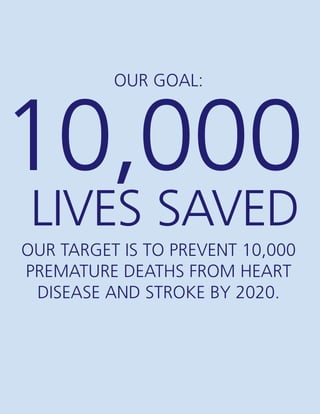
Our Goal:
Our target is to prevent 10,000
premature deaths from heart
disease and stroke by 2020.
10,000
Lives Saved
CCPN | ANNUAL REPORT 2010-11
20
CHAMPLAIN GET WITH THE
GUIDELINES INITIATIVE
The Champlain Get with the Guidelines (GWG) Initiative is a quality
improvement initiative to ensure that patients admitted to hospitals in the
Champlain LHIN receive treatment according to evidence-based guidelines.
The Get with the Guidelines Program
The “Guidelines in Practice” toolkit supports integration of best practice guidelines
into routine hospital practices. The toolkit includes clinical pathways, physician
orders, patient education materials, and a data abstraction process to support the
collection of performance metrics, quality reporting and quality improvement cycles.
The Champlain GWG Initiative was first implemented in 2007 with a focus on
patients admitted with Acute Coronary Syndrome (ACS). In May of 2010, building
from the success of the GWG-ACS initiative, a second phase of the GWG Program
was launched to provide best available evidence-based treatment to patients
admitted with Heart Failure.
EVIDENCE-BASED CARE IS A PROVEN METHOD FOR SAVING LIVES…
AND HEALTH CARE DOLLARS
Research has shown that implementation of a standard discharge protocol in
hospitals is effective in increasing utilization of evidence-based therapies. These
evidence-based treatments have been shown to reduce future emergency room
visits, hospital admissions, subsequent cardiac attack events, and death.
KEY PERFORMANCE INDICATORS 2010-11
Indicator
ACS
Launched
2007
Heart Failure
Launched
2010
Number of hospitals in which initial site
visit completed 16 15
Number of hospitals completed baseline
chart audit 16 14
Number of hospitals implementing GWG 15 2
Number of hospitals completed post-
implementation audit 15 N/A
Number of hospitals submitting data to CIHI 14 N/A
% of patients for which GAP tool was
complete 71% N/A
C h a m p l a i n
GET WiTh ThE
GUiDElinES
ACUTE CORONARY SYNDROME
PERFORMANCE REPORT 2008-09
ACUTE CORONARY
SYNDROME
Acute Coronary Syndrome (ACS)
includes patients with chronic heart
disease and can range from chest pain
(angina) to heart attack (myocardial
infarction). In the Champlain LHIN:
• 6% (16,000 visits) of all emergency
department hospital visits are due to
ACS related diagnoses
• 6,259 patients are admitted to
hospital with a diagnosis of ACS every
year, representing close to one-third
of all cardiac-related admissions
HEART FAILURE
• Congestive Heart Failure (CHF) is the
fourth most common chronic disease.
• Heart Failure is the most common
reason residents over the age of 65
years are admitted to hospital.
• Over the next three decades, it is
expected that the number of people
with CHF will double.
• In Ontario, less than a third of Heart
Failure patients are on the right
medication regimen, which is a major
cause of unnecessary hospital visits.
The Champlain Cardiovascular Disease Prevention Strategy
21
The Champlain Get with the Guidelines
initiative is proudly sponsored by the
Ontario Ministry of Health and Long-
Term Care and Pfizer Canada Inc., a
Founding Industry Partner of the CCPN.
GWG-ACS (Outcome Indicators):
Indicator
Performance
Target
2010-11
Regional
Performance
2008-09
Regional
Performance
2009-10
Regional
Performance
2010-11*
% of patients for which GAP tool was complete 80% 49% 67% 71%
% of ACS patients prescribed ASA 90% 95% 92% 91%
% of ACS patients prescribed beta-blocker 90% 89% 83% 77%
% of ACS patients prescribed ACE/ARB 90% 81% 72% 71%
% of ACS patients prescribed statins 90% 93% 88% 88%
% of ACS patients prescribed Plavix 90% 92% 83% 84%
% of ACS patients prescribed nitroglycerin 90% 69% 67% 67%
% of ACS patients receiving education about heart disease 90% 89% 90% 89%
% of ACS patients referred to cardiac rehabilitation 90% 87% 84% 80%
% of ACS patients receiving diet advice 90% 87% 89% 88%
*Three quarters only
“The GWG program is a
wonderful example of the
way in which collaboration
between health care providers
delivers excellent results for
our patients. Whether you
are in Mississippi Mills or in
Downtown Ottawa, you
will be treated using the
same clinical best practice
guidelines. I am proud to be
part of this team.”
— Tammy Hirkala,
Acute Care Manager,
Almonte General Hospital
3rd Annual Champlain
GWG Performance Report
Released in 2010
Highlights include:
88%of GWG-ACS hospitals are
submitting data on performance
indicators to support continuous
quality improvement activities.
80%of GWG-ACS hospitals
reached benchmarks for Best
Practice Guidelines for ACS patients.
CCPN | ANNUAL REPORT 2010-11
22
CHAMPLAIN CVD
SURVEILLANCE PROGRAM
Monitoring the Heart Health of
Champlain Residents!
2011 UPDATE - Atlas of Cardiovascular Health in the
Champlain Region
The CCPN has released the Atlas of Cardiovascular Health in the Champlain
Region 2011 – a comprehensive regional report on the state of cardiovascular
health and risk factors across the Champlain region. Unique to this 2011 version
is the inclusion of regional data acquired from the Champlain Community
Heart Health Survey (CCHHS), which was completed in 2009 by the CCPN in
partnership with the international PURE study (McMaster University).
The Atlas was produced by the CCPN Monitoring, Surveillance  Evaluation
Expert Panel in collaboration with many epidemiologists in our region,
to inform and assist a broad audience, including policy makers, health
care providers, health planners, researchers, and the general public of the
Champlain region.
A T L A S
OF CARDIOVASCULAR HEALTH
IN THE CHAMPLAIN REGION
2011
Self-reported prevalence of risk factors in persons aged 12 years and older in Canada,
Ontario, Champlain Region and its Health Regions, 2009.
REGION Diabetes Hypertension Overweight* Daily Smoking Physical Inactivity
Canada 6.0% 16.9% 33.7% 15.6% 47.5%
Ontario 6.4% 17.2% 34.0% 14.4% 49.3%
Champlain 6.1% 14.9% 33.4% 12.8% 41.6%
City of Ottawa 5.5% 14.4% 31.5% 9.4% 39.7%
Eastern Counties 8.5% 14.0% 40.0% 20.7% 49.2%
Renfrew County 7.1% 18.5% 39.1% 22.4% 44.0%
Leeds, Grenville  Lanark 6.2% 18.5% 37.1% 21.1% 42.2%
*Prevalence based on the population aged 18 and over.
SOURCE: Statistics Canada, Canadian Community Health Survey , CANSIM Table 105-0501
The Champlain Community Heart Health Survey was funded by the PURE
International Study and the Public Health Agency of Canada.
The Champlain Cardiovascular Disease Prevention Strategy
23
OPERATING PLAN 2011-12
Network Operations
Business Plan Development for 2013 and beyond, including plan for CCPN operations (Fall 2011/ Winter 2012)
Ottawa Model for Smoking Cessation
Hospitals
6,000 smokers identified and offered treatment in Champlain hospitals
Each LHIN hospital will expand the OMSC program to improve reach by 25% by March 31, 2012
Primary Care
Expansion of OMSC to 3 new Champlain Family Health Teams, CHCs, or clinics for a total of 18 (Fall 2011/ Winter 2012)
4,000 smokers identified and offered treatment in Champlain primary care clinics
Champlain Primary Care CVD Prevention and Management Guideline
Dissemination of the 2011 Update of the Primary Care Guideline to 1,300 practitioners in Champlain LHIN (Fall 2011)
Improved Delivery of Cardiovascular Care (IDOCC) in Primary Care
Complete active facilitation in Phase 3 IDOCC clinics (Fall 2011)
Complete sustainability phase of facilitation in Phase 2 IDOCC clinics (Fall 2011)
Complete follow-up evaluation of Phase 2 of the IDOCC program (Winter/ Spring 2012)
Champlain Get with the Guidelines Initiative
Release of 4th Annual Champlain Regional GWG Report Card (Fall 2011)
Acute Coronary Syndrome:
All 16 Champlain LHIN GWG hospitals submitting data to CIHI
90% of ACS patients in LHIN receiving GAP tool
80% of Champlain hospitals achieving Canadian ACS Best Practice Benchmarks
Heart Failure:
All 16 Champlain LHIN GWG hospitals implementing Heart Failure GAP tool
Eight Champlain LHIN hospitals submitting Heart Failure GAP tool data
Champlain Healthy School-aged Children Initiative
Conduct teacher workshops to support the Healthy Schools 2020 initiative in partnership with the four public health units
and nine Champlain schools boards
Develop Parent Engagement Strategy to support the Healthy Schools 2020 initiative in partnership with the four public
health units and nine Champlain school boards, including workshops for Parent Involvement Committees and expansion of
communications and resources for parents
Launch of Francophone Healthy Schools 2020 Facilitation Program in three Francophone school boards and active facilitation
activities with Nutrition Tools for Schools©
Champlain “Give Your Head a Shake” Sodium Reduction Campaign
Complete Phase 3 of the campaign strategy and media advertising waves Summer/ Fall 2011
Conduct 24-month evaluation of the campaign (Fall 2011)
Support the Ontario Sodium Summit (led by Heart and Stroke Foundation of Ontario)
Champlain CVD Surveillance Program
Dissemination of the 2011 Update of Champlain Atlas of Cardiovascular Health
CCPN | ANNUAL REPORT 2010-11
24
Financial Report, 2010-11
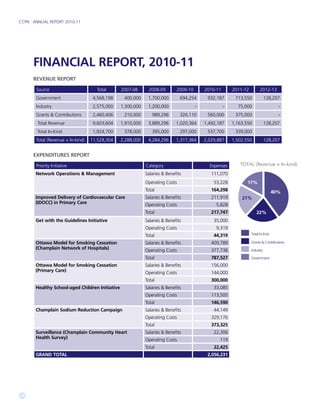
Revenue Report
Source Total 2007-08 2008-09 2009-10 2010-11 2011-12 2012-13
Government 4,568,198 400,000 1,700,000 694,254 932,187 713,550 128,207
Industry 2,575,000 1,300,000 1,200,000 - - 75,000 -
Grants  Contributions 2,460,406 210,000 989,296 326,110 560,000 375,000 -
Total Revenue 9,603,604 1,910,000 3,889,296 1,020,364 1,492,187 1,163,550 128,207
Total In-Kind 1,924,700 378,000 395,000 297,000 537,700 339,000
Total (Revenue + In-kind) 11,528,304 2,288,000 4,284,296 1,317,364 2,029,887 1,502,550 128,207
Expenditures Report
Priority Initiative Category Expenses
Network Operations  Management Salaries  Benefits 111,070
Operating Costs 53,228
Total 164,298
Improved Delivery of Cardiovascular Care
(IDOCC) in Primary Care
Salaries  Benefits 211,919
Operating Costs 5,828
Total 217,747
Get with the Guidelines Initiative Salaries  Benefits 35,000
Operating Costs 9,319
Total 44,319
Ottawa Model for Smoking Cessation
(Champlain Network of Hospitals)
Salaries  Benefits 409,789
Operating Costs 377,738
Total 787,527
Ottawa Model for Smoking Cessation
(Primary Care)
Salaries  Benefits 156,000
Operating Costs 144,000
Total 300,000
Healthy School-aged Children Initiative Salaries  Benefits 33,085
Operating Costs 113,505
Total 146,590
Champlain Sodium Reduction Campaign Salaries  Benefits 44,149
Operating Costs 329,176
Total 373,325
Surveillance (Champlain Community Heart
Health Survey)
Salaries  Benefits 22,306
Operating Costs 119
Total 22,425
GRAND TOTAL 2,056,231
TOTAL (Revenue + In-kind)
Total In-kind
Grants  Contributions
Industry
Government
21%
17%
40%
22%
The Champlain Cardiovascular Disease Prevention Strategy
25
CCPN LEADERSHIP TEAM
Board MemberS
Dr. Andrew Pipe
Medical Director, Minto
Prevention and Rehabilitation
Centre, University of Ottawa
Heart Institute
Marion Fraser
CFO, VP Finance and
Administration, University of
Ottawa Heart Institute
Dr. Isra Levy
Medical Officer of Health,
Ottawa Public Health
Randy Penney
President  CEO, Renfrew
Victoria Hospital  St. Francis
Memorial Hospital
Dr. David Salisbury
CCPN Board of Directors
Dr. Robert Cushman
Former CEO, Champlain
Local Health Integration
Network
Expert Panel Chairs 
Project Directors
Dr. Bob Reid
Chair, Expert Panel Priority
Programs and Populations,
and Director, Champlain
Hospital-based Smoking
Cessation Network
Heather Sherrard
Director, Champlain Get with
the Guidelines Initiative
Dr. Clare Liddy
Co-Director, IDOCC Initiative
Dr. William Hogg
Co-Director, IDOCC Initiative
Dr. Andreas Wielgosz
Chair, Expert Panel
Monitoring, Surveillance and
Evaluation
John Goldsmith
Chair, Expert Panel Marketing
and Communications
Dr. Sophia Papadakis
Program Director, Primary
Care Smoking Cessation
Program
Johanne Levesque
Chair, Expert Panel Policy and
Environment
Louise Simmons
Chair, Champlain Healthy
School-aged Children
Committee
Health  Community
Leaders
Dr. Paul Roumeliotis
Medical Officer of Health,
Eastern Ontario Health Unit
Dr. Vera Etches
Associate Medical Officer
of Health and Manager of
Clinical Programs, Ottawa
Public Health
Dr. Paula Stewart
Medical Officer of Health,
Leeds, Grenville and Lanark
District Health Unit
Dr. Michael Sharma
Director, Champlain Regional
Stroke Network
Jim Lumsden
Manager, Champlain
Regional Stroke Network
Karen Patzer
Senior Planning 
Engagement Specialist,
Champlain Local Health
Integration Network
Liz McLaren
Coordinator, Health
Promotion  Clinical Services,
Renfrew County and District
Health Unit
David Gibson
Executive Director, Sandy Hill
Community Health Centre
Dr. Elaine Jolly
Director, Shirley E. Greenberg
Women’s Health Centre
Dr. Mark Tremblay
Director, Healthy Active Living
and Obesity Research Group,
CHEO
Dr. Mark Lundie
Director, Research 
Development, Ontario
Medical Division, Pfizer
Canada Inc.
PROJECT MANAGEMENT
TEAM
Dr. Sophia Papadakis
Program Director, CCPN
Laurie Dojeiji
Coordinator, CCPN
Danielle Simpson
Analyst, CCPN
Danielle Côté
Communications Specialist,
CCPN
Melissa Martins
Administrative Officer, CCPN
Monique van Schie
Financial Officer, CCPN
Micheline Turnau
Community Mission
Specialist, HSFO
Aaron Service
Project Manager, IDOCC
Initiative
Sharon Ann Kearns
Manager, Champlain Get
with the Guidelines Initiative
Lorraine Montoya
Lead Facilitator, Champlain
Get with the Guidelines
Initiative
Debbie Aitken
Project Leader, Champlain
Hospital-based Smoking
Cessation Network
Kerri-Anne Mullen
Network Manager, Ottawa
Model for Smoking Cessation
c/o University of Ottawa Heart Institute
40 Ruskin Street, H-2353 Ottawa ON K1Y 4W7
Tel: (613) 798-5555, ext. 18054 Fax: (613) 761-4595
www.ccpnetwork.ca
Our Goal:
To prevent 10,000 premature deaths from heart disease and stroke by 2020.
Our Vision:
To develop an integrated system of excellence in CVD prevention for the Champlain region that acts as
a model for Ontario and Canada.
Our Mission:
To implement unified approaches to reduce the burden of CVD in the Champlain region, spanning
the continuum of healthy persons to those with sub-clinical and known disease; and, to mobilize
and integrate partners in public health, community, primary care, institutional sectors, academia, and
industry to eliminate disparities in CVD risk and ensure the citizens of the Champlain region are the
most heart healthy and stroke-free in Canada.

FINALCCPNAR10-11_000

  • 1.
    ANNUAL REPORT 2010-11 Developing anintegrated system of excellence for the prevention and management of cardiovascular disease in the champlain district of ontario
  • 2.
    Partner Organizations Champlain LocalHealth Integration Network Champlain Regional Stroke Network Department of Family Medicine, University of Ottawa and Institute of Population Health, University of Ottawa Eastern Ontario Community Primary Health Care Network Eastern Ontario Health Unit Élisabeth Bruyère Research Institute Healthy Active Living & Obesity Research Group, CHEO Heart and Stroke Foundation of Ontario Leeds, Grenville & Lanark District Health Unit Ottawa Public Health Renfrew County & District Health Unit The Ottawa Hospital University of Ottawa Heart Institute CCPN Founding Industry Partner Pfizer Canada Inc. Funding Support Champlain Local Health Integration Network Heart and Stroke Foundation of Ontario Ontario Ministry of Health and Long-Term Care Ontario Ministry of Health Promotion and Sport Public Health Agency of Canada Smoke-Free Ontario, Ontario Ministry of Health Promotion and Sport Société Santé en français Health Canada Canadian Stroke Network Eastern Ontario Community Primary Health Care Network The development of the Champlain Cardiovascular Disease Prevention Network (CCPN) was catalyzed by the University of Ottawa Heart Institute (UOHI), who recognized the need for increased leadership and strategic action to address the burden of cardiovascular disease in the Champlain region. The CCPN’s Project Management Team is housed at the UOHI on behalf of our partner organizations.
  • 3.
    The Champlain CardiovascularDisease Prevention Strategy 1 The Champlain Cardiovascular Disease Prevention Network is committed to leading the way in Ontario with new standards for the prevention and management of cardiovascular disease (CVD). It is my pleasure to share with you the 2010-11 Annual Report for the Network. We are proud of the significant accomplishments that have resulted since the launch of the Champlain CVD Prevention Strategy in 2007. We have successfully introduced in hospitals across the region state-of-the-art prevention programs and are showing measurable results in regards to health care excellence. Similarly, evidence-based programs are now in place in primary care settings across the region and strategic investments have been made in two upstream prevention initiatives to ensure our residents – both young and old – reduce their risk for CVD. In a concerted and combined effort, the school system, the health system, and community organizations are all working to make our region one of the healthiest in the province. I would like to personally acknowledge the efforts of leaders from across the Champlain District for your work in improving the quality of programs and services in the Champlain region. Sincerely, Andrew Pipe, CM, MD Chair, Champlain CVD Prevention Network Medical Director, Minto Prevention and Rehabilitation Centre, University of Ottawa Heart Institute The Champlain LHIN has been a proud partner of the Champlain CVD Prevention Network during the past several years. The LHIN helps to bring providers and communities together to benefit patients, and our support of the Network is a good example of this. We continued our commitment in 2010- 11 to support leading-edge initiatives that are improving the health of our community and performance of the health system. Programs directed toward reducing smoking rates, preventing high blood pressure, and increasing good nutrition and activity habits in children and youth are key factors in the creation of a healthier population. Significant quality improvements in CVD prevention - both in primary care settings and in hospitals - are also being accomplished. Certainly, it is this type of preventive approach that has the most impact in bringing about real change in health care. The CCPN is building a better system of best practice in CVD prevention and management, and all partners involved are playing an important role in advancing these improvements across our region. Your hard work, your enthusiasm, and your innovation are appreciated. Alex Munter CEO, Champlain Local Health Integration Network CCPN Board of Directors 2010-11 Dr. Andrew Pipe Dr. Isra Levy Chair Director Ms. Marion Fraser Dr. David Salisbury Director Director Mr. Randy Penney Dr. Robert Cushman Director Director WORKING TOGETHER TO PREVENT HEART DISEASE AND STROKE
  • 4.
    CCPN | ANNUALREPORT 2010-11 2 CARDIOVASCULAR DISEASE IS THE NUMBER ONE COST DRIVER TO OUR HEALTH CARE SYSTEM. IT IS THE SINGLE LEADING CAUSE OF Death, Disability, and Hospitalization in the Champlain Region, Ontario, and Canada. BUT THE REAL TRAGEDY IS THAT 80% OF PREMATURE CARDIOVASCULAR DISEASE IS PREVENTABLE.
  • 5.
    The Champlain CardiovascularDisease Prevention Strategy 3 THE COST OF CVD TO THE CHAMPLAIN DISTRICT IS ENORMOUS. CARDIOVASCULAR DISEASE (CVD) is the number one cost driver to our health care system. $7.6 billion is spent annually in Ontario on the treatment of CVD. CVD accounts for the largest proportion of health care spending in Ontario including 20% of acute care hospital costs, 15% of home care, 10.5% of emergency room visits, 10% of medical services, and 17% of drug expenditures. CVD is the leading cause of death and disability in Canada, Ontario, and the Champlain region. Approximately 40,000 Canadians, 26,000 Ontarians, and 2,600 Champlain residents die each year of CVD. More than 90,000 Champlain residents are living with CVD. 8 in 10 Ontarians are living with one or more cardiovascular risk factors. Several Champlain communities have among the highest rates of CVD in the province. Renfrew County, Eastern Ontario (Prescott & Russell), and Leeds, Grenville & Lanark Counties are three of Ontario’s “hot spots” for CVD. These regions experience rates of CVD morbidity and mortality which are significantly higher than both the City of Ottawa and the provincial average. The economic impact of CVD will continue to grow and threatens the sustainability of our health care system. The number of deaths caused by CVD is expected to double by 2018 as a result of an aging demographic, population growth, and increasing prevalence of CVD risk factors. Ontario is currently spending $46.1 billion per year on health care, representing 46% of all spending, which has increased by $17 billion per year since 2003. If the rate of health care spending is not curbed, it will represent 70% of all program spending in Ontario within 12 years. Source: Ontario Ministry of Finance. 2010 Ontario Budget.
  • 6.
    CCPN | ANNUALREPORT 2010-11 4 THE CHAMPLAIN CVD PREVENTION NETWORK: CATALYZING CHANGE
  • 7.
    The Champlain CardiovascularDisease Prevention Strategy 5 DEMONSTRATING PROVINCIAL LEADERSHIP IN CHRONIC DISEASE PREVENTION & MANAGEMENT Through the implementation of an integrated, regional CVD prevention and management strategy, the Champlain region is actively contributing to the province’s commitment to reduce the burden of chronic disease, helping to transform the health system at the local level and better serve Ontarians. The CCPN has already made great strides in bridging the silos between health and community partners which previously limited the ability to successfully address chronic disease prevention and management in a unified manner. THE CHAMPLAIN CVD PREVENTION AND MANAGEMENT STRATEGY The Champlain CVD Prevention and Management Strategy was developed in response to the growing necessity to establish an integrated, coordinated, and comprehensive approach to preventing and managing CVD. The Champlain CVD Strategy is a five-year plan designed to eliminate disparities in CVD health and make the residents of the Champlain region the most heart healthy and stroke-free in Canada. Implementation of the Strategy has been led by a multi-sectoral group of dedicated partners, known as the Champlain CVD Prevention Network (CCPN). The CCPN was formed in November 2005 and includes partners from public health, specialty (cardiac and stroke) care, primary care, hospitals, academia, and the community who are committed to a common vision and goals. The Strategy is focused on the implementation of six large-scale, population-level priority initiatives. The six initiatives are the building blocks for a comprehensive CVD prevention and management system. “ Change requires our best collaborative efforts to create, apply, and sustain multiple strategies. Many actors must work together on comprehensive and coordinated policies and programs. The complexity of the interrelationships between the factors affecting health means that broad involvement is required across sectors and at all levels of society to create an integrated approach.” - Improving the Health of Canadians, Canadian Institute for Health Information (2004) Our Vision: To develop an integrated system of excellence in CVD prevention for the Champlain region that acts as a model for Ontario and Canada. Our Mission: To implement unified approaches to reduce the burden of CVD in the Champlain region, spanning the continuum of healthy persons to those with sub-clinical and known disease. The CCPN will act to mobilize and integrate partners in public health, community, primary care, institutional sectors, academia, and industry to eliminate disparities in CVD risk and ensure the citizens of the Champlain region are the most heart healthy and stroke-free in Canada. Evidence-based strategies for CVD prevention and management are already well established and have been proven to be highly cost-effective.
  • 8.
    CCPN | ANNUALREPORT 2010-11 6 PERFORMANCE REPORT 2010-11 The CCPN performance management plan has been designed to align activities and outcomes to Ontario’s Health System Strategy and the Excellent Care for All Act. Performance indicators (process, outcome, and impact) and annual benchmarks are established for each priority initiative and tracked by the CCPN’s leadership team. The 2010-11 operating year marks the end of the fourth year of the five-year Champlain CVD Prevention Strategy. Detailed progress of the six priority initiatives is highlighted on the pages that follow. CCPN HEALTH SYSTEM GOALS The CCPN is working towards achieving the following health system goals: 1. Build linkages and improve coordination of programs and services across the Champlain LHIN 2. Drive results through better data, performance standards, and transparency of reporting 3. Improve delivery and effectiveness of evidence-based prevention and management programs and services 4. Leverage scarce health care and public health dollars to improve outcomes 5. Increase sustainability and equity of the local health system The CCPN is ensuring state-of-the-art CVD prevention and management programs and services are available to Champlain residents.
  • 9.
    The Champlain CardiovascularDisease Prevention Strategy 7 Champlain Community Heart Health Survey (CVD Surveillance Initiative) SUMMARY OF ACHIEVEMENTS Investing in Upstream Prevention The Champlain “Give Your Head a Shake” Sodium Reduction Campaign is a mass media campaign designed to help residents take action to reduce their daily sodium intake. The campaign features quick and easy tips for reducing sodium when buying foods, eating out, or cooking at home. More than 6,500 campaign ads have been seen and heard throughout the region on TV, radio, print, and web, generating more than 100 news stories. Building from the Champlain Declaration, the Healthy Schools 2020 action plan is focused on supporting the nine school boards in the implementation of healthy lunch programs, healthy fundraising, and healthy classroom rewards. More than 660 principals, parents, teachers, and public health professionals attended a Healthy Schools 2020 workshop in 2010-11. Excellence in Evidence-based Care in Hospitals The Champlain Get with the Guidelines (GWG) Initiative is ensuring that hospitals in the Champlain region are providing the highest standard of care for patients who are hospitalized with cardiac symptoms. In 2010, the GWG program expanded to include Heart Failure. The Ottawa Model for Smoking Cessation (OMSC) in Hospitals continues to reach hospitalized smokers across the Champlain region. Since 2006, more than 21,360 hospitalized smokers have received the OMSC intervention, resulting in over 6,100 patients who are smoke-free. The Champlain LHIN was also the first health authority to include OMSC performance targets in its hospital accountability agreements. Strengthening Disease Management and Preventative Care in our Primary Care Health System The Improved Delivery of Cardiovascular Care (IDOCC) Initiative has engaged 190 physicians in 83 primary care practices throughout the Champlain region. Participating practices are supported by trained facilitators in creating targeted prevention activities and increasing linkages with community resources. In 2010-11, the Ottawa Model for Smoking Cessation (OMSC) in Primary Care Initiative was expanded to seven new primary care clinics in the Champlain region. A total of 11 of the 16 Family Health Teams (15 clinics total) in the Champlain region and 160 family doctors are now involved in delivering this program with a total of 3,000 smokers identified and offered cessation intervention. Ottawa Modelfor Smoking Cessation Improved Delivery of Cardiovascular Care IDOCC In Primary Care Champlain Get with the Guidelines Initiative Champlain “Give Your Head a Shake” Sodium Reduction Campaign Champlain Healthy School-aged Children Initiative
  • 10.
    CCPN | ANNUALREPORT 2010-11 The Champlain Cardiovascular Disease Prevention Strategy 8 9 Ottawa Modelfor Smoking Cessation • • • • • • • • • • • • • •• • • • • • • • • • ••••••• ••• ••••••••••••• •••••••••••••••• •••••• • • • • • • • • • • • •••• • • • • Connection Family Health Team • Family First Family Health Team • Lower Outaouis Family Health Team •Deep River and District Hospital • • North Renfrew Family Health Team • The Ottawa Hospital Academic Family Health Team Riverside and Civic • University of Ottawa Health Services Family Health Team • Greenboro Family Medicine Centre • Children’s Hospital of Eastern Ontario • Royal Ottawa Hospital • Rivercourt Family Health Team • Sandy Hill Community Health Centre • Westend Family Health Team • West Carleton Family Health Team • Petawawa Family Health Team • University of Ottawa Heart Institute • • Queensway Carleton Hospital • • • Hôpital Montfort The Ottawa Hospital • • Arnprior and District Memorial Hospital • • Glengarry Memorial Hospital • • Hawkesbury and District General Hospital • • Deep River and District Hospital • • Pembroke Regional Hospital • • Renfrew Victoria Hospital • • Renfrew County Catholic District School Board Renfrew County District School Board • • Carleton Place and District Memorial Hospital • • St. Francis Memorial Hospital Association • • Cornwall Community Hospital Ottawa-Carleton District School Board • St. Lawrence Medical Centre Conseil scolaire de district catholique de L'Est ontarien Catholic District School Board of Eastern Ontario Conseil des écoles publiques de l'Est de l'Ontario • • Winchester District Memorial Hospital Ottawa Catholic School Board Conseil des écoles catholiques du Centre-Est • • Almonte General Hospital • • Kemptville District Hospital Upper Canada District School Board • Manotick Medical Centre IMPLEMENTATION OF PRIORITY INITIATIVES ACROSS THE CHAMPLAIN REGION Improved Delivery of Cardiovascular Care IDOCC In Primary Care Champlain Get with the Guidelines Initiative Champlain Healthy School-aged Children Initiative Champlain Community Heart Health Survey (CVD Surveillance Initiative) Champlain “Give Your Head a Shake” Sodium Reduction Campaign
  • 11.
    CCPN | ANNUALREPORT 2010-11 10 Investing in Upstream Prevention Champlain Healthy School-aged Children Initiative Health and Education Leaders Unite to Ensure Champlain Kids are Physically Active and Eating Healthy. The Champlain Healthy School-aged Children (CHSAC) Initiative is focused on addressing healthy eating and physical activity behaviours among our children and youth through a regional strategy aimed at home, school, and community environments. The Champlain Declaration: Our Call to Action Signed in April 2009, the Champlain Declaration continues to engage and motivate our nine school boards and public health community towards the vision of creating healthy school environments so that children and youth can be physically active and making healthy food choices every day. HEALTHY SCHOOLS 2020: The Champlain Declaration in Action! Health and school board partners prioritized Healthy School Nutrition Environments for the first two years of our work with a particular focus on three priorities. HEALTHY SCHOOLS 2020 PRIORITY AREAS FOR ACTION 1 Healthy lunch programs and food service contracts 2 Healthy fundraising 3 Healthy classroom rewards This includes supporting schools in the implementation of the new School Food and Beverage Policy (PPM 150), which comes into effect across all publicly-funded Ontario elementary and secondary schools on September 1st, 2011. LEARN MORE! Check out the video on our newly launched Healthy Schools 2020 website: www.healthyschools2020.ca Over 660 Principals, Parents Teachers Attend Healthy Schools 2020 Workshops To support schools in making these important changes, a series of school board workshops were co-hosted in partnership with public health over the course of the fall 2010 and winter 2011. Participants were provided with practical tools and resources to support their implementation efforts. A Workshop Report was created to highlight the wealth of ideas shared at the workshops for each priority area.
  • 12.
    The Champlain CardiovascularDisease Prevention Strategy 11 Know More Do More: Building Healthy Active Families Know More Do More (KMDM) is a campaign to encourage parents to create more physical activity and healthy eating opportunities for their families. Launched in March 2010, the KMDM campaign generated 32 community newspaper articles as well as a variety of coverage on local TV and radio stations. Over 4,000 healthy active living tip sheets were distributed throughout the community. In fall 2010, a KMDM newsletter was produced and disseminated across all nine school boards. Partnering with known Ottawa blogger Andrea Tomkins, KMDM continues to actively promote its message through the use of social media outlets such as Facebook and Twitter. www.knowmore-domore.ca | www.savoirplus-faireplus.ca First Champlain Report Card Released in April 2011 To help us better understand our starting point, all school principals in the Champlain region were invited to complete a brief survey to assess what is currently happening in schools with respect to nutrition environments, and in particular, lunch programs, fundraising and classroom rewards. Nearly 300 principals completed the survey. A complete summary of survey results can be found in the Champlain Report Card, located on the website. MOST common food fundraising items reported in 2010 by champlain schools The CCPN is a partner in the Heart and Stroke Foundation of Ontario Spark Together for Healthy KidsTM initiative. The Champlain Healthy School-aged Children Initiative was made possible through funding from the Ontario Ministry of Health Promotion and Sport, the Heart and Stroke Foundation of Ontario, and the Société Santé en français (in partnership with Health Canada). BBQ ITEMS CHOCOLATE CANDY BAKE SALE ITEMS PIZZA 38.3% 34.2% 28.5% 15.8%
  • 13.
    CCPN | ANNUALREPORT 2010-11 12 CHAMPLAIN “GIVE YOUR HEAD A SHAKE” SODIUM REDUCTION CAMPAIGN The Champlain “Give Your Head a Shake” (“Secouez-vous” en français) Sodium Reduction Campaign was launched in August 2009. The bilingual mass media campaign targets adults aged 35-50 with quick and easy tips to reduce their sodium intake. The quirky campaign was designed to grab the attention of our target audience and show that “cutting sodium is pretty easy when you think about it.” KEY PERFORMANCE INDICATORS IN 2010-11 • 6,500 campaign ads seen and heard throughout the region on TV, radio, print, and web. • More than 100 news stories were published or broadcast in media outlets. • Overall reach of the campaign was more than 7 million impressions from August 2009 to August 2010. • The 12-month interim campaign evaluation indicates residents exposed to the campaign are more likely to be taking action to reduce their sodium intake. Awareness of Sodium Messages in Media and Give Your Head a Shake Campaign by Region and Time The 12-month interim evaluation of the Champlain “Give Your Head a Shake” Sodium Reduction Campaign was completed in fall 2010. Indicator Baseline 12 months Process Control Champlain Control Champlain Campaign awareness % % % % Aided recall of Give your Head a Shake Campaign Tag Line 0 0 6.6 28.0 Seen/ heard tips to reduce sodium in your diet 29.0 32.2 41.5 50.6 DID YOU KNOW… 70%of Champlain residents aged 35-50 years surveyed report they are trying to cut back on sodium. Almost half of Champlain residents surveyed were not able to correctly identify the following popular foods as being high in sodium: Processed Cheese Bottled Salad Dressings Canned Vegetables, Tomato Sauces and Pasta Sauces Frozen Packaged Meats Hamburgers and French Fries Ketchup and Mustard Cutting sodium: it’s pretty easy when you think about it. giveyourheadashake.ca Using bottled marinades? Try olive oil, lemon juice, and herbs instead. Give your head a shake.)) )) CCP-15323 • Sodium Citizen Ad (sponsored by EHOU) • Marinade • Size: 10.5” x 2.857” • Prints CMYK • Material deadline: June 21, 2010 (12 PM) • Publication date: June 24, 2010
  • 14.
    The Champlain CardiovascularDisease Prevention Strategy 13 A TIP IN THE RIGHT DIRECTION! Are you: Make the healthier choice and: Not looking at food labels when you shop? Compare products and choose the one with less sodium. Buying pre-seasoned chicken breasts? Add your own flavour to unseasoned chicken. Using canned spaghetti sauce? Buy sauce with no added salt. For more tips, visit www.giveyourheadashake.ca Campaign Funding Partners Sodium consumption continues to garner significant attention - and for good reason. Excess sodium in processed foods – such as breads, cheeses, processed meats, pasta sauces, and vegetable juices – causes 5,000 to 16,000 premature heart attack and stroke deaths in Canada each year and costs the health care system and economy at least $2 billion annually.
  • 15.
    CCPN | ANNUALREPORT 2010-11 14 Improved Delivery of Cardiovascular Care (IDOCC) in Primary Care Idocc is an innovative program designed to assist primary health care providers to improve the delivery of evidence-based prevention and management strategies for CVD within their practice. The IDOCC initiative is based on best known evidence regarding clinical best practices for the management of disease as well as evidence regarding the most effective strategies to introduce quality improvements in primary care settings. IDOCC aims to provide busy primary care providers with supports and tools to deliver best available care to their patients. www.idocc.ca How does the IDOCC program work? The IDOCC initiative uses an Outreach Facilitation Model, a proven knowledge translation strategy that will help family physicians improve their practice and patient care. Outreach Facilitators support practices with organizing work, implementing specific care improvements, and ultimately, increasing the use of evidence-based guidelines. KEY PERFORMANCE INDICATORS 2010-11 Indicator Phase 1 Phase 2 Phase 3 ALL PhaseS Year Launched 2007 2008 2009 Number of physicians signed on as partner 66 77 47 190 Number of practices signed on as partner 26 30 27 83 IDOCC Team Hosts Quality Improvement Outreach Training Workshop On January 24-26th, 2011, the C.T. Lamont Primary Health Care Research Centre at the Élisabeth Bruyère Research Institute hosted the Art Science of Outreach Facilitation. This three-day workshop attracted over 70 participants from across Ontario and focused on the theory of facilitation and practical tools for initiating and supporting change in practices, as well as providing an extensive introduction to chronic disease self-management. 2011 UPDATE THE CHAMPLAIN PRIMARY CARE CARDIOVASCULAR DISEASE PREVENTION AND MANAGEMENT GUIDELINE The Champlain Primary Care Cardiovascular Disease Prevention and Management Guideline was updated in 2011 to provide primary care physicians and health professionals with the latest evidence in preventing and managing heart disease, stroke, diabetes and their associated risk factors. Approximately 1 in 5 physicians from across the Champlain region are partnered in the IDOCC program, making it one of the largest primary health care quality improvement initiatives in Canada. As in the rest of Ontario and Canada, the incidence of diabetes in the residents of the Champlain LHIN is increasing due, in part, to an aging population, increased weight and/or obesity and decreased levels of physical activity. From 1995 to 2005, the number of people with diabetes doubled to 67,050. 1 Another 47,300 cases may develop in the region by 2017.2 To help alleviate the burden on family practices, additional diabetes education teams have been set up. Their mandate is to increase available health and nutritional counselling, and to provide tools and resources to assist patients with managing their diabetes Different models of diabetes programs have been developed throughout the region. Here are two interesting examples. The Eastern Counties Diabetes Education Program offers pre-diabetes, and diabetes education, and insulin initiation. Even physicians or patients who are not part of le Centre de Santé Communautaire de l’Estrie can refer and attend the CSC Diabetes Education Programs which may have shorter wait times than some hospital programs. Contact the Diabetes Education Programs Manager, Eastern Counties, at Tel: 613-487-1802. The Rideau Valley Diabetes Clinic Program provides general diabetes education, self management techniques, initiates insulin and follow up to patients identified by the family practice provider. These half or full day sessions are offered by a diabetes nurse educator and a dietician at the family practice office every 2-4 weeks depending on practice needs. For more information visit the website: http://www.rvds.ca/ or contact the Rideau Valley Diabetes Services Director at Tel: 1-877-321-4500 ext.308. For a complete listing of diabetes programs, details and contact information, follow the link at: http://www.champlainhealthline.ca/listServices.aspx?id=1346 References 1. Champlain Diabetes Strategy (2009). 2. ICES Investigative Report (2010). How many Canadians will be diagnosed with diabetes between 2007 and 2017? Diabetes in the Champlain LHIN 1 Volume 1 No.5 Sept 2010 www.idocc.ca The Improved Delivery of Cardiovascular Care (IDOCC) Program is a regional program designed to assist primary health care providers in the Champlain district improve the delivery of evidence-based prevention and management strategies for heart disease, stroke and diabetes within their practice. IDOCC NewS UpCOmINg eVeNt IDOCC: FOCUS ON DIabeteS Tapping into diabetes resources in the Champlain LHIN Sept. 24, 2010 @ the Brookstreet Hotel, Kanata 12:30 – 3:30pm Ask your Outreach Facilitator for more details
  • 16.
    The Champlain CardiovascularDisease Prevention Strategy 15 DEMONSTRATING IMPACT ON OUTCOME INDICATORS IMPROVEMENTS IN PATIENTS ACHIEVING LDL TARGETS A 19% increase in the percentage of patients with Diabetes LDL target levels was documented upon completion of the IDOCC intervention. IDOCC PRACTICES HAVE IMPROVED THE QUALITY OF CARE FOR PATIENTS WITH CHRONIC KIDNEY DISEASE Patients with chronic kidney disease (CKD) are at increased risk for developing CVD. Upon completion of the 24-month IDOCC intervention in 26 Phase I practices, consistent improvements were seen in care delivery and health outcomes for patients with CKD: Adherence rates for performing albumin-to-creatinine ratio (ACR) screening increased by over 10% in 13 of 26 practices and by over 40% in five of these practices; The percentage of patients who received a lipid profile measurement increased by 11%; four practices improved by over 40%; and, There was an 11% increase in the percentage of patients at LDL target levels. The IDOCC project management team is housed at the CT Lamont Primary Health Care Research Centre at the Elisabeth Bruyère Research Institute, University of Ottawa. The IDOCC Initiative is sponsored by the Champlain Local Health Integration Network, the Ontario Ministry of Health and Long-Term Care, and Pfizer Canada Inc., a Founding Industry Partner of the CCPN. IDOCC facilitators are trained to help practices better engage their patients in self-management and are able to easily tap into a multitude of resources for the practice. “Our facilitator was key to investigating best evidence/ practices, especially around self- management topics. We never felt like we had to reinvent the wheel. We did modify some tools for our patients - like the Hypertension Bubble Chart - which allowed patients to choose what they wanted to talk to us about.” — Dr. Lisa Rosenkrantz Family Practitioner West Carleton Family Health Team IDOCC Practice PErCENTAGE OF PATIENTS AT LDL TARGET LEVELS Before After (24-month follow-up) DIABETES DYS CKD 38% 52.5% 52.5% 64% CAD 46% 61% 42% 60.5%
  • 17.
    CCPN | ANNUALREPORT 2010-11 16 PRACTICE CHANGE SUPPORTS (“HOW”) INTERVENTION COMPONENTS Formation of Smoking Cessation Task Force and Identification of Clinic Champions Coaching and Outreach Facilitations Visits Real Time Provider Prompts and Patient Tools Provider Training Provider Audit and Feedback Smoker’s Follow-up Program OTTAWA MODEL FOR SMOKING CESSATION The Ottawa Model for Smoking Cessation (OMSC) is an evidence- based best practice model to address tobacco use in clinical settings. It is designed to identify, treat, and offer follow-up support to smokers identified in clinical settings such as hospitals, outpatient clinics and family medicine, in order to increase patient success with quitting. WHY MAKE SMOKING CESSATION A PRIORITY IN CLINICAL SETTINGS? Tobacco use is the single largest preventable cause of death. Tobacco use is a major risk factor for each of the leading chronic diseases, including cancer, heart disease, stroke, and respiratory illness. Smoking cessation is the most powerful preventative intervention available. There is an abundance of evidence regarding the distinct health benefits associated with quitting. If your patients smoke, helping them to quit is far more important to their health than many other common preventative treatments. WHAT IS the OTTAWA MODEL FOR SMOKING CESSATION? The OMSC clinical protocol has five main components: 1 Identification: Smoking status of all patients is acquired. 2 Documentation: Smoking status is noted on patient’s record. 3 Strategic Advice: Brief counseling and strategies for withdrawal management and quit attempts are offered to all patients who smoke. 4 Pharmacotherapy: First-line smoking cessation medications are offered to all patients who smoke. 5 Follow-up: Automated follow- up support for 6 months and/ or link to primary care or community programs is offered. Tobacco Use Survey Please comPlete the following questions: answeR heRe 1. Have you used any form of tobacco in the past 6-months? Yes No – please return the survey to the clinic receptionist 2. Have you used any form of tobacco in the past 7 days? Yes – please continue to question 3 No – please skip to questions 18 – 27 (flip side) 3. What form of tobacco do you currently use? Cigarettes Pipe Cigar Smokeless tobacco 4. How many years in total have you been smoking? ___________Years 5. How many cigarettes do you usually smoke per day? ___________Cigarettes / day or ___________Cigarettes / month 6. How soon after you wake up do you smoke your first cigarette? within 5 minutes 6- 30 minutes 31-60 minutes 60 minutes 7. How many quit attempts (lasting 24 hours) have you made No attempts 1-2 attempts in the past year? 3 or more attempts 8. Do others smoke in your home? Yes No 9. Which of the following best describes your feelings about I would like to quit in the next 30 days smoking right now? I would like to quit in the next 6 months I am not planning on quitting in the next 6 months 10. On a scale from 1-5, how important is it to you to quit smoking? 1 2 3 4 5 (1=not important at all, 5=extremely important) 11. On a scale from 1-5, how confident are you that you can 1 2 3 4 5 quit smoking? (1=not at all confident, 5=extremely confident) 12. What are your reasons for wanting to quit smoking? Health Reasons Children/Spouse Financial (Save Money) Social Other: _________________________ ___________ 13. What concerns, if any, do you have about quitting smoking? Weight Gain Withdrawal symptoms I won’t be successful Stress Depression Boredom Social Other: ________________ 14. Have you previously used quit smoking medications? Nicotine Replacement Therapy: Gum Patch Inhaler Bupropion / Zyban Varenicline / Champix 15. Does your drug benefit plan cover quit smoking medications? Yes No Don’t know no benefit plan 16. Are you presently receiving follow-up telephone calls from the Yes No Quit Smoking Program? 17. How many caffeinated drinks (eg. coffee, tea, pop) do you ___________Drinks consume per day? thank you. Please return this survey to the clinic receptionist. Smoking Cessation Consult Form Last Name: First Name: Address: City: Postal Code: Tel: Date of Birth: dd /mm / yyPreferred language: English French Other (specify):______________ ______________________ ______________________ ____First Visit Annual Exam Other Visit MD/AHP Name: ______________________ _________ Date of Visit: ________________Physician consult [E079, K013] ADVISE Strong, Personalized, Unambiguous Advice to Quit and Offer of Assistance with Quitting“You probably already know many of the risks involved with smoking, but I cannot stress enough how important it is to stop. Your _______________ (e.g. family history, high cholesterol) makes it even more important for you to quit now. I would advise you to stop as soon as possible.” “Quitting smoking is not always easy but we can help you with quitting and there are medications available to make quitting easier.” Yes No Not Appropriate ASSESS “Would you be willing to make an attempt to quit smoking in the next month?” Yes NosMoKER not REaDy to Quit sMoKERs REaDy to Quit innEXt 30 DaysASSIST Yes No Brief Counseling + Self-Help Materials ASSIST Yes No Refer to Smoking Cessation Counsellor “Quitting smoking takes a lot of determination and works bestwhen you are ready to make the commitment to quit.” “If you do not feel you are ready to quit smoking then you shouldwait. On the other hand there is never really a good time to stopsmoking and you should not postpone quitting by waiting forthe right time.” “I’d like you to take these materials about getting ready toquit smoking home with you. Please look them over and thinkseriously about quitting soon. We have new ways to help youwith quitting and when you’re ready I can work with you toensure you have a plan in place to deal with withdrawl, and_____________________. ” Provide Patient with copy of Information Sheet for Smokersnot Ready to Quit “It’s great to hear that you are ready to make a commitment tostop smoking. It’s important that you have a plan for quittingsmoking. I would like to arrange for you to meet with a quitsmoking counsellor. She/he will work with you to develop yourpersonalized quit plan.” MD/AHP referral to “Smoking Cessation Counsellor” Yes No REFER Yes No For Telephone Follow-up in 30 Days “We’d like to check in with you in a few weeks time to see if youare interested in quitting smoking. Would you be okay with usarranging to follow-up with you in 30 and 60 days time to see ifyou are ready to quit? The call will be placed by our automatedsmoker’s follow-up system. This is a great way to check in withyou. If you are interested in quitting at that time we will arrange toconnect you to our smoking cessation counsellor.” Is the number we have on file the best one to reach you at duringthe day? Yes No Alternate: ( )_____________________ _What is the best time of the day to call you? 7AM-9AM 9AM-12PM 1PM-5PM 6PM-9PM Copyright © University of Ottawa Heart Institute Primary Care Consult – IVR YOUR QUIT SMOKING PLAN FOR SMOKERSNOT READYTO QUIT LOOKINGFOR MORESUPPORT?There are several quit smoking programs in our region which offer telephone, group , or individual support with quitting smoking. Smoke rs’ Helpli ne Canad ian Cance r Societ y Tel: 1-877- 513-53 33Appro priate for:• Smoke rs who want to quit, may be thinkin g about quittin g, or needsuppo rt to remain smoke -free • Family memb ersHours : Mon to Thurs: 8:00 a.m. – 9:00 p.m. Fri: 8:00 a.m. – 6:00 p.m.Sat Sun: 9:00 a.m. – 5:00 p.m. www.s moker shelpli ne.ca Quit Smoki ng Progra m Heart Health Educa tion CentreUniver sity of Ottaw a Heart Institu te (UOHI ) Room H-2342 40 Ruskin Street , Ottaw a, ON Tel: 613-76 1-5464 Toll Free: 1-866- 399-44 32 Fax: 613-76 1-5309Appro priate for: All adult smoke rs requiri ng assista nce with makin g a cessat ion attemp tHours : Clinic hours weekd ays and evenin gs A.C.E. S.S. Smoki ng Cessa tion Progra m Ottaw a Public Health (OPH) 100 Conste llation Cresce nt, Ottaw a, ON Tel: 613-58 0-6744 or Toll Free: 1-866- 426-88 85 Descri ption: This progra m is a partne rship betwe en Ottaw a Public Health and Comm unity Health Centre s. 8-wee k group progra m offere d fall, spring , and winter . The progra m offers subsid ized NRT. Sched ule and locatio n of quit smoki ng progra ms poste d 3 times per year. Quit Smoki ng Progra m Easter n Ontari o Health Unit Head Office : 1000 Pitt Street , Cornw all, ON Tel: 613-93 3-1375 or Toll Free: 1-800- 267-71 20 (Ask for Health Line) Appro priate for: All smoke rs Variou s locatio ns across five counti es based on deman d.Hours : Offere d in fall and winterOut-P atient Smoki ngCessa tion Progra mHawke sbury Distric t Gener al Hospit al Conta ct: Dierdr e Gilber t Tel: 613-63 2-1111 Ext. 168 Appro priate for: Reside nts of Ontari o who are 18 and over and want to quit smokin g using NRT. Hours : Clinic hours weekd ays and evenin gs Renfre w Count y and Distric t Health Unit 7 Interna tional Drive, Pemb roke, ON Tel: 613-73 2-3629 or Toll Free: 1-800- 267-10 97 Appro priate for: All smoke rs Hours : Vary Leeds , Grenv ille Lanark Distric t Health Unit 458 Laurie r Boulev ard, Brockv ille, ON Tel: 613-34 5-5685 or Toll Free: 1-800- 660-58 53 Appro priate for: All smoke rs Hours : Vary ACKN OWLE DGEM ENTS Inform ation in this quit plan has been adapte d from the followi ng source s:One step at a time: For Smoke rs who don’t want to quit. Canad ian Cancer Society . On the Road to Quittin g: Guide to becom ing a non-sm oker. Health Canad a. Quit: You have it in you. Smoke Free Ontario . Ontario Ministr y of Health Promo tion. U.S. Depart ment of Health and Human Service s. Treatin g Tobacc o use and depen dence: Clinica l practic e guideli ne 2008 update . Copyri ght © Univer sity of Ottawa Heart Institut e
  • 18.
    The Champlain CardiovascularDisease Prevention Strategy 17 CHAMPLAIN HOSPITAL- BASED SMOKING CESSATION PROGRAM 18 hospitals in the Champlain LHIN are implementing the OMSC to address tobacco use among hospitalized patients. OMSC DEMONSTRATES SAVING HEALTH CARE DOLLARS A recent case study was completed at the University of Ottawa Heart Institute (UOHI) looking at the costs and benefits related to implementation of the OMSC. The total operating costs for the OMSC for inpatient smokers at UOHI was $237,806. Over a 2-year follow-up period, the following results were achieved as a result of the OMSC program: • 141 readmissions were avoided; • 881 bed-days were saved; • $1,321,500 were saved; and, • Return on investment was estimated at 556%. Key Performance Indicators 2010-11 Indicator Performance 2010-11 Process Number of hospitals signed as partner in Champlain Hospital-based Smoking Cessation Network 18 Number of health professionals trained in best practice cessation guidelines in Champlain LHIN 500 Number of Champlain LHIN hospitals implementing the Ottawa Model for Smoking Cessation 18 Number of outpatient clinics implementing the Ottawa Model for Smoking Cessation 12 Number of Ontario Hospitals implementing the Ottawa Model for Smoking Cessation 39 Outcome Number of smokers identified and offered treatment in Champlain Network Hospitals 4,841 Impact Improvement in 6-month quit rate attributable to cessation intervention 11% Number of smokers quit at 6-month post-discharge 1,423 Since April 2007, over 21,360 hospitalized smokers in the Champlain LHIN have been provided the OMSC intervention, resulting in more than 6,100 quitters at 6 months post- discharge. Ottawa Model Statistics Smokers treated (2006-present) PLAN FOR INCREASING REACH OF OMSC IN CHAMPLAIN HOSPITALS 2010-13 As part the Champlain LHIN’s Accountability Agreements with Hospitals, a target has been included to increase the number of smokers who receive the OMSC by 25% in 2010-11 and reach 80% of all inpatient smokers by March 31, 2013. The Champlain Hospital-Based Smoking Cessation Network is funded by the Smoke-Free Ontario Strategy of the Ontario Ministry of Health Promotion and Sport and Health Canada. 2010-11 2009-10 2008-09 2007-08 2006-07 2,561 7,291 11,892 16,519 21,360
  • 19.
    CCPN | ANNUALREPORT 2010-11 18 PRIMARY CARE SMOKING CESSATION PROGRAM Based on the success of the hospital-based program, the OMSC was adapted for use in busy primary care clinics. This adaptation of the program included the revision of protocols and tools to meet the needs of primary care clinicians as well as the customization of provider education and patient follow-up supports. There are now 15 primary care practices and 160 family doctors implementing the OMSC. More than 3,000 patients who smoke have been delivered treatment. ONTARIO FAMILY HEALTH TEAMS The OMSC is particularly well-suited for implementation in Family Health Teams in which intra-disciplinary models are in place. The OMSC also meets all criteria for the Ministry of Health and Long-Term Care’s Chronic Disease Prevention and Management Best Practice Program for Family Health Teams: • Targets specific patient populations; • Follows evidence-based guidelines and may include clinical pathways or flowcharts; • Includes defined roles for specific healthcare providers on the team; and, • Includes meaningful, measurable objectives and outcomes. Key Performance Indicators 2010-11 Indicator Performance 2010-11 Process Number of primary care clinics in Champlain LHIN implementing the Ottawa Model for Smoking Cessation 15 Number of primary care health professionals trained in best practice cessation guidelines in Champlain LHIN 160 Outcome Number of smokers identified and offered treatment in Champlain primary care clinics 3,000 The Primary Care Pilot Program was funded by the Canadian Tobacco Control Research Initiative and the Ontario Ministry of Health and Long-Term Care. The OMSC in Primary Care Expansion Program is funded by Pfizer Canada Inc., and the Heart and Stroke Foundation of Ontario. In 2010-11, the OMSC was expanded to seven new Family Health Teams in the Champlain Region.
  • 20.
    The Champlain CardiovascularDisease Prevention Strategy 19 Our Goal: Our target is to prevent 10,000 premature deaths from heart disease and stroke by 2020. 10,000 Lives Saved
  • 21.
    CCPN | ANNUALREPORT 2010-11 20 CHAMPLAIN GET WITH THE GUIDELINES INITIATIVE The Champlain Get with the Guidelines (GWG) Initiative is a quality improvement initiative to ensure that patients admitted to hospitals in the Champlain LHIN receive treatment according to evidence-based guidelines. The Get with the Guidelines Program The “Guidelines in Practice” toolkit supports integration of best practice guidelines into routine hospital practices. The toolkit includes clinical pathways, physician orders, patient education materials, and a data abstraction process to support the collection of performance metrics, quality reporting and quality improvement cycles. The Champlain GWG Initiative was first implemented in 2007 with a focus on patients admitted with Acute Coronary Syndrome (ACS). In May of 2010, building from the success of the GWG-ACS initiative, a second phase of the GWG Program was launched to provide best available evidence-based treatment to patients admitted with Heart Failure. EVIDENCE-BASED CARE IS A PROVEN METHOD FOR SAVING LIVES… AND HEALTH CARE DOLLARS Research has shown that implementation of a standard discharge protocol in hospitals is effective in increasing utilization of evidence-based therapies. These evidence-based treatments have been shown to reduce future emergency room visits, hospital admissions, subsequent cardiac attack events, and death. KEY PERFORMANCE INDICATORS 2010-11 Indicator ACS Launched 2007 Heart Failure Launched 2010 Number of hospitals in which initial site visit completed 16 15 Number of hospitals completed baseline chart audit 16 14 Number of hospitals implementing GWG 15 2 Number of hospitals completed post- implementation audit 15 N/A Number of hospitals submitting data to CIHI 14 N/A % of patients for which GAP tool was complete 71% N/A C h a m p l a i n GET WiTh ThE GUiDElinES ACUTE CORONARY SYNDROME PERFORMANCE REPORT 2008-09 ACUTE CORONARY SYNDROME Acute Coronary Syndrome (ACS) includes patients with chronic heart disease and can range from chest pain (angina) to heart attack (myocardial infarction). In the Champlain LHIN: • 6% (16,000 visits) of all emergency department hospital visits are due to ACS related diagnoses • 6,259 patients are admitted to hospital with a diagnosis of ACS every year, representing close to one-third of all cardiac-related admissions HEART FAILURE • Congestive Heart Failure (CHF) is the fourth most common chronic disease. • Heart Failure is the most common reason residents over the age of 65 years are admitted to hospital. • Over the next three decades, it is expected that the number of people with CHF will double. • In Ontario, less than a third of Heart Failure patients are on the right medication regimen, which is a major cause of unnecessary hospital visits.
  • 22.
    The Champlain CardiovascularDisease Prevention Strategy 21 The Champlain Get with the Guidelines initiative is proudly sponsored by the Ontario Ministry of Health and Long- Term Care and Pfizer Canada Inc., a Founding Industry Partner of the CCPN. GWG-ACS (Outcome Indicators): Indicator Performance Target 2010-11 Regional Performance 2008-09 Regional Performance 2009-10 Regional Performance 2010-11* % of patients for which GAP tool was complete 80% 49% 67% 71% % of ACS patients prescribed ASA 90% 95% 92% 91% % of ACS patients prescribed beta-blocker 90% 89% 83% 77% % of ACS patients prescribed ACE/ARB 90% 81% 72% 71% % of ACS patients prescribed statins 90% 93% 88% 88% % of ACS patients prescribed Plavix 90% 92% 83% 84% % of ACS patients prescribed nitroglycerin 90% 69% 67% 67% % of ACS patients receiving education about heart disease 90% 89% 90% 89% % of ACS patients referred to cardiac rehabilitation 90% 87% 84% 80% % of ACS patients receiving diet advice 90% 87% 89% 88% *Three quarters only “The GWG program is a wonderful example of the way in which collaboration between health care providers delivers excellent results for our patients. Whether you are in Mississippi Mills or in Downtown Ottawa, you will be treated using the same clinical best practice guidelines. I am proud to be part of this team.” — Tammy Hirkala, Acute Care Manager, Almonte General Hospital 3rd Annual Champlain GWG Performance Report Released in 2010 Highlights include: 88%of GWG-ACS hospitals are submitting data on performance indicators to support continuous quality improvement activities. 80%of GWG-ACS hospitals reached benchmarks for Best Practice Guidelines for ACS patients.
  • 23.
    CCPN | ANNUALREPORT 2010-11 22 CHAMPLAIN CVD SURVEILLANCE PROGRAM Monitoring the Heart Health of Champlain Residents! 2011 UPDATE - Atlas of Cardiovascular Health in the Champlain Region The CCPN has released the Atlas of Cardiovascular Health in the Champlain Region 2011 – a comprehensive regional report on the state of cardiovascular health and risk factors across the Champlain region. Unique to this 2011 version is the inclusion of regional data acquired from the Champlain Community Heart Health Survey (CCHHS), which was completed in 2009 by the CCPN in partnership with the international PURE study (McMaster University). The Atlas was produced by the CCPN Monitoring, Surveillance Evaluation Expert Panel in collaboration with many epidemiologists in our region, to inform and assist a broad audience, including policy makers, health care providers, health planners, researchers, and the general public of the Champlain region. A T L A S OF CARDIOVASCULAR HEALTH IN THE CHAMPLAIN REGION 2011 Self-reported prevalence of risk factors in persons aged 12 years and older in Canada, Ontario, Champlain Region and its Health Regions, 2009. REGION Diabetes Hypertension Overweight* Daily Smoking Physical Inactivity Canada 6.0% 16.9% 33.7% 15.6% 47.5% Ontario 6.4% 17.2% 34.0% 14.4% 49.3% Champlain 6.1% 14.9% 33.4% 12.8% 41.6% City of Ottawa 5.5% 14.4% 31.5% 9.4% 39.7% Eastern Counties 8.5% 14.0% 40.0% 20.7% 49.2% Renfrew County 7.1% 18.5% 39.1% 22.4% 44.0% Leeds, Grenville Lanark 6.2% 18.5% 37.1% 21.1% 42.2% *Prevalence based on the population aged 18 and over. SOURCE: Statistics Canada, Canadian Community Health Survey , CANSIM Table 105-0501 The Champlain Community Heart Health Survey was funded by the PURE International Study and the Public Health Agency of Canada.
  • 24.
    The Champlain CardiovascularDisease Prevention Strategy 23 OPERATING PLAN 2011-12 Network Operations Business Plan Development for 2013 and beyond, including plan for CCPN operations (Fall 2011/ Winter 2012) Ottawa Model for Smoking Cessation Hospitals 6,000 smokers identified and offered treatment in Champlain hospitals Each LHIN hospital will expand the OMSC program to improve reach by 25% by March 31, 2012 Primary Care Expansion of OMSC to 3 new Champlain Family Health Teams, CHCs, or clinics for a total of 18 (Fall 2011/ Winter 2012) 4,000 smokers identified and offered treatment in Champlain primary care clinics Champlain Primary Care CVD Prevention and Management Guideline Dissemination of the 2011 Update of the Primary Care Guideline to 1,300 practitioners in Champlain LHIN (Fall 2011) Improved Delivery of Cardiovascular Care (IDOCC) in Primary Care Complete active facilitation in Phase 3 IDOCC clinics (Fall 2011) Complete sustainability phase of facilitation in Phase 2 IDOCC clinics (Fall 2011) Complete follow-up evaluation of Phase 2 of the IDOCC program (Winter/ Spring 2012) Champlain Get with the Guidelines Initiative Release of 4th Annual Champlain Regional GWG Report Card (Fall 2011) Acute Coronary Syndrome: All 16 Champlain LHIN GWG hospitals submitting data to CIHI 90% of ACS patients in LHIN receiving GAP tool 80% of Champlain hospitals achieving Canadian ACS Best Practice Benchmarks Heart Failure: All 16 Champlain LHIN GWG hospitals implementing Heart Failure GAP tool Eight Champlain LHIN hospitals submitting Heart Failure GAP tool data Champlain Healthy School-aged Children Initiative Conduct teacher workshops to support the Healthy Schools 2020 initiative in partnership with the four public health units and nine Champlain schools boards Develop Parent Engagement Strategy to support the Healthy Schools 2020 initiative in partnership with the four public health units and nine Champlain school boards, including workshops for Parent Involvement Committees and expansion of communications and resources for parents Launch of Francophone Healthy Schools 2020 Facilitation Program in three Francophone school boards and active facilitation activities with Nutrition Tools for Schools© Champlain “Give Your Head a Shake” Sodium Reduction Campaign Complete Phase 3 of the campaign strategy and media advertising waves Summer/ Fall 2011 Conduct 24-month evaluation of the campaign (Fall 2011) Support the Ontario Sodium Summit (led by Heart and Stroke Foundation of Ontario) Champlain CVD Surveillance Program Dissemination of the 2011 Update of Champlain Atlas of Cardiovascular Health
  • 25.
    CCPN | ANNUALREPORT 2010-11 24 Financial Report, 2010-11 Revenue Report Source Total 2007-08 2008-09 2009-10 2010-11 2011-12 2012-13 Government 4,568,198 400,000 1,700,000 694,254 932,187 713,550 128,207 Industry 2,575,000 1,300,000 1,200,000 - - 75,000 - Grants Contributions 2,460,406 210,000 989,296 326,110 560,000 375,000 - Total Revenue 9,603,604 1,910,000 3,889,296 1,020,364 1,492,187 1,163,550 128,207 Total In-Kind 1,924,700 378,000 395,000 297,000 537,700 339,000 Total (Revenue + In-kind) 11,528,304 2,288,000 4,284,296 1,317,364 2,029,887 1,502,550 128,207 Expenditures Report Priority Initiative Category Expenses Network Operations Management Salaries Benefits 111,070 Operating Costs 53,228 Total 164,298 Improved Delivery of Cardiovascular Care (IDOCC) in Primary Care Salaries Benefits 211,919 Operating Costs 5,828 Total 217,747 Get with the Guidelines Initiative Salaries Benefits 35,000 Operating Costs 9,319 Total 44,319 Ottawa Model for Smoking Cessation (Champlain Network of Hospitals) Salaries Benefits 409,789 Operating Costs 377,738 Total 787,527 Ottawa Model for Smoking Cessation (Primary Care) Salaries Benefits 156,000 Operating Costs 144,000 Total 300,000 Healthy School-aged Children Initiative Salaries Benefits 33,085 Operating Costs 113,505 Total 146,590 Champlain Sodium Reduction Campaign Salaries Benefits 44,149 Operating Costs 329,176 Total 373,325 Surveillance (Champlain Community Heart Health Survey) Salaries Benefits 22,306 Operating Costs 119 Total 22,425 GRAND TOTAL 2,056,231 TOTAL (Revenue + In-kind) Total In-kind Grants Contributions Industry Government 21% 17% 40% 22%
  • 26.
    The Champlain CardiovascularDisease Prevention Strategy 25 CCPN LEADERSHIP TEAM Board MemberS Dr. Andrew Pipe Medical Director, Minto Prevention and Rehabilitation Centre, University of Ottawa Heart Institute Marion Fraser CFO, VP Finance and Administration, University of Ottawa Heart Institute Dr. Isra Levy Medical Officer of Health, Ottawa Public Health Randy Penney President CEO, Renfrew Victoria Hospital St. Francis Memorial Hospital Dr. David Salisbury CCPN Board of Directors Dr. Robert Cushman Former CEO, Champlain Local Health Integration Network Expert Panel Chairs Project Directors Dr. Bob Reid Chair, Expert Panel Priority Programs and Populations, and Director, Champlain Hospital-based Smoking Cessation Network Heather Sherrard Director, Champlain Get with the Guidelines Initiative Dr. Clare Liddy Co-Director, IDOCC Initiative Dr. William Hogg Co-Director, IDOCC Initiative Dr. Andreas Wielgosz Chair, Expert Panel Monitoring, Surveillance and Evaluation John Goldsmith Chair, Expert Panel Marketing and Communications Dr. Sophia Papadakis Program Director, Primary Care Smoking Cessation Program Johanne Levesque Chair, Expert Panel Policy and Environment Louise Simmons Chair, Champlain Healthy School-aged Children Committee Health Community Leaders Dr. Paul Roumeliotis Medical Officer of Health, Eastern Ontario Health Unit Dr. Vera Etches Associate Medical Officer of Health and Manager of Clinical Programs, Ottawa Public Health Dr. Paula Stewart Medical Officer of Health, Leeds, Grenville and Lanark District Health Unit Dr. Michael Sharma Director, Champlain Regional Stroke Network Jim Lumsden Manager, Champlain Regional Stroke Network Karen Patzer Senior Planning Engagement Specialist, Champlain Local Health Integration Network Liz McLaren Coordinator, Health Promotion Clinical Services, Renfrew County and District Health Unit David Gibson Executive Director, Sandy Hill Community Health Centre Dr. Elaine Jolly Director, Shirley E. Greenberg Women’s Health Centre Dr. Mark Tremblay Director, Healthy Active Living and Obesity Research Group, CHEO Dr. Mark Lundie Director, Research Development, Ontario Medical Division, Pfizer Canada Inc. PROJECT MANAGEMENT TEAM Dr. Sophia Papadakis Program Director, CCPN Laurie Dojeiji Coordinator, CCPN Danielle Simpson Analyst, CCPN Danielle Côté Communications Specialist, CCPN Melissa Martins Administrative Officer, CCPN Monique van Schie Financial Officer, CCPN Micheline Turnau Community Mission Specialist, HSFO Aaron Service Project Manager, IDOCC Initiative Sharon Ann Kearns Manager, Champlain Get with the Guidelines Initiative Lorraine Montoya Lead Facilitator, Champlain Get with the Guidelines Initiative Debbie Aitken Project Leader, Champlain Hospital-based Smoking Cessation Network Kerri-Anne Mullen Network Manager, Ottawa Model for Smoking Cessation
  • 27.
    c/o University ofOttawa Heart Institute 40 Ruskin Street, H-2353 Ottawa ON K1Y 4W7 Tel: (613) 798-5555, ext. 18054 Fax: (613) 761-4595 www.ccpnetwork.ca Our Goal: To prevent 10,000 premature deaths from heart disease and stroke by 2020. Our Vision: To develop an integrated system of excellence in CVD prevention for the Champlain region that acts as a model for Ontario and Canada. Our Mission: To implement unified approaches to reduce the burden of CVD in the Champlain region, spanning the continuum of healthy persons to those with sub-clinical and known disease; and, to mobilize and integrate partners in public health, community, primary care, institutional sectors, academia, and industry to eliminate disparities in CVD risk and ensure the citizens of the Champlain region are the most heart healthy and stroke-free in Canada.