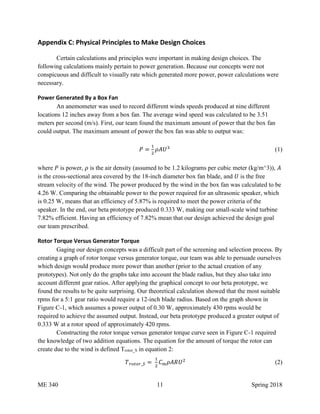
ME 340 1 Spring 2018
Executive Summary: Design for Small-Scale Wind Turbine to Power an
Ultrasonic Mosquito Repellent
Trevor Durako, Asher Odhner, Abhinit Kothari, and Eva Wu Wu
Team 8.7, ME 340, Mechanical Engineering Department, Pennsylvania State University
Our team was tasked with designing a small-scale wind turbine to address a particular
problem in Heredia, Costa Rica. In Heredia, mosquito borne illnesses are a threat among all
individuals. Choosing Heredia involved researching wind speeds because wind turbines require
adequate wind to be effective. On average, Heredia has wind speeds in the range of 13 to 17
miles per hour (mph). According to the Department of Energy, wind speeds of around 15 mph
are sufficient for producing power using the wind [1]. With our location specified, we then had
to more formally address the associated problem.
Heredia has been plagued with mosquito borne diseases such as Malaria, Dengue, and
the Zika Virus all create a negative impact on their population [2]. Ultrasonic speakers are
becoming an increasingly popular method of dealing with mosquitos in a safe manner. The
required power for an ultrasonic speaker is in the range of 0.25 to 0.5 watts (W). 0.25 to 0.5 W of
power seemed to be a reasonable amount to generate using a small-scale wind turbine. Therefore,
we decided to create a small-scale wind turbine that could power an ultrasonic mosquito
repellent.
Based on the problem, customer needs were developed and associated with our design
process. The three most important needs were power produced, aesthetics, and durability. Power
is the main factor that drives the ultrasonic speaker and was the most important criteria that was
considered throughout the entire design process. Aesthetics and durability define how the
product appeals to the customer and how long it can last without ensuing failure, respectively.
Our team also came up with three less important needs: weight, cost, and portability. The aim of
our small-scale turbine was to produce 0.3 W of power, be aesthetically pleasing (good color
coordination), cost less than $20, and be durable. In the end, our team ended up meeting all of
our customer needs and design criteria.
This paper presents the design process that was used to fabricate our wind turbine.
Starting with a brief description of the concept generation and selection process, this document
then moves onto the prototype section. The prototype section explains the sequence in which we
generated different prototypes and the changes that were introduced while going through
different designs. In the last part of the prototype section, a short section is included to describe
the performance of our beta prototype. Also, three appendices have been placed at the end of this
document. Appendix A talks about future design improvements, Appendix B gives instructions
for how the small-scale turbine should be set up, and Appendix C explains various calculations
and principles that were considered in choosing a particular design.
ME 340 2 Spring 2018
Concept Generation, Screening, and Selection
Three main techniques were applied to generate multiple concepts: brainstorming,
Negative Brainstorming, and the 6-3-5 brainstorming method. Brainstorming was a traditional
method that our team commonly used while considering new ideas. The new ideas were
specifically based on the components, which included the blades, gearbox, hub, tower, and
nacelle. In addition, other more complex systems in which the blades pitch could be adjustable
were discussed. Brainstorming created a pathway to be open and improvise rough ideas such as
an adjustable blade design. Another method that our team used during concept generation was
Negative Brainstorming. Unlike brainstorming, Negative Brainstorming considers ideas that
should not be implemented because they will negatively impact the design [3]. Negative
Brainstorming eliminated a large amount of the negative ideas early in the process. Lastly, the 6-
3-5 method allowed us to create ideas on paper through sketches and writings. This method
involved our entire team and required us to individually write down three ideas regarding certain
components of a wind turbine. After five minutes, each team member passed their papers to the
right. Once the original paper made its way back to the team member who started it, the ideas
could be discussed in greater detail.
Our team needed to narrow down to one final design. The first step that was used
involved a concept screening matrix. Out of five concepts, the screening matrix brought the
search down to two concepts which were to be chosen from. The difficult part about using a
concept scoring matrix was deciding how to determine which design could produce power better
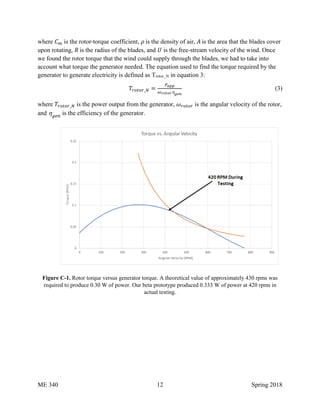
than another design. Our solution for this problem was to create a graph displaying how the rotor
torque compared to the generator torque to generate a specific amount of power. The graph can
be viewed in Figure C-1 located in Appendix C. In addition to power, the concept scoring matrix
also took into account portability, aesthetics, cost, durability, and assembly time.
The final selection process utilized an AHP scoring matrix. In the scoring matrix, weights
were taken into account to fine tune how each design fits specific customer needs. Power,
durability, and aesthetics had the greatest effect on the final concept selection. Once each
customer need was scored appropriately based on the design, the scores were added up. Based on
the scoring matrix, the design that our team chose to continue with was concept 1.
Sequence of Prototypes
In order to effectively learn the process of taking an idea to a manufacturable product, our
team constructed several prototypes. The zeroth prototype was our first rendition and was made
using basic craft supplies such as cardboard and hot glue. The prototype labeled “alpha 1,” was
our first power producing design. Following the alpha 1 prototype is the alpha 2 prototype,
which carried many of alpha 1’s physical features. The last and final prototype created was the
beta prototype, which took on a many new features through significant design changes. Our team
learned various lessons throughout the creation of each prototype and was able to make design
changes along the way.
ME 340 3 Spring 2018
Zeroth Prototype
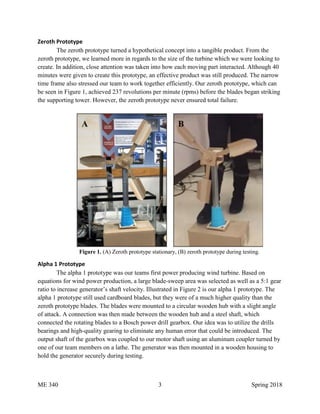
The zeroth prototype turned a hypothetical concept into a tangible product. From the
zeroth prototype, we learned more in regards to the size of the turbine which we were looking to
create. In addition, close attention was taken into how each moving part interacted. Although 40
minutes were given to create this prototype, an effective product was still produced. The narrow
time frame also stressed our team to work together efficiently. Our zeroth prototype, which can
be seen in Figure 1, achieved 237 revolutions per minute (rpms) before the blades began striking
the supporting tower. However, the zeroth prototype never ensured total failure.
Figure 1. (A) Zeroth prototype stationary, (B) zeroth prototype during testing.
Alpha 1 Prototype
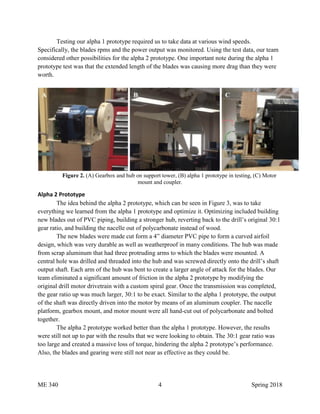
The alpha 1 prototype was our teams first power producing wind turbine. Based on
equations for wind power production, a large blade-sweep area was selected as well as a 5:1 gear
ratio to increase generator’s shaft velocity. Illustrated in Figure 2 is our alpha 1 prototype. The
alpha 1 prototype still used cardboard blades, but they were of a much higher quality than the
zeroth prototype blades. The blades were mounted to a circular wooden hub with a slight angle
of attack. A connection was then made between the wooden hub and a steel shaft, which
connected the rotating blades to a Bosch power drill gearbox. Our idea was to utilize the drills
bearings and high-quality gearing to eliminate any human error that could be introduced. The
output shaft of the gearbox was coupled to our motor shaft using an aluminum coupler turned by
one of our team members on a lathe. The generator was then mounted in a wooden housing to
hold the generator securely during testing.
ME 340 4 Spring 2018
Testing our alpha 1 prototype required us to take data at various wind speeds.
Specifically, the blades rpms and the power output was monitored. Using the test data, our team
considered other possibilities for the alpha 2 prototype. One important note during the alpha 1
prototype test was that the extended length of the blades was causing more drag than they were
worth.
Figure 2. (A) Gearbox and hub on support tower, (B) alpha 1 prototype in testing, (C) Motor
mount and coupler.
Alpha 2 Prototype
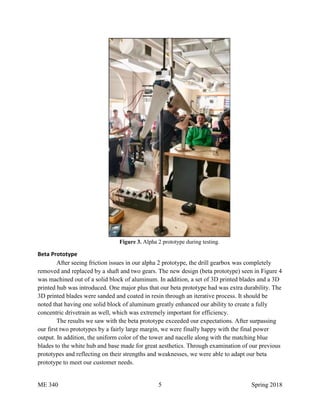
The idea behind the alpha 2 prototype, which can be seen in Figure 3, was to take
everything we learned from the alpha 1 prototype and optimize it. Optimizing included building
new blades out of PVC piping, building a stronger hub, reverting back to the drill’s original 30:1
gear ratio, and building the nacelle out of polycarbonate instead of wood.
The new blades were made cut form a 4” diameter PVC pipe to form a curved airfoil
design, which was very durable as well as weatherproof in many conditions. The hub was made
from scrap aluminum that had three protruding arms to which the blades were mounted. A
central hole was drilled and threaded into the hub and was screwed directly onto the drill’s shaft
output shaft. Each arm of the hub was bent to create a larger angle of attack for the blades. Our
team eliminated a significant amount of friction in the alpha 2 prototype by modifying the
original drill motor drivetrain with a custom spiral gear. Once the transmission was completed,
the gear ratio up was much larger, 30:1 to be exact. Similar to the alpha 1 prototype, the output
of the shaft was directly driven into the motor by means of an aluminum coupler. The nacelle
platform, gearbox mount, and motor mount were all hand-cut out of polycarbonate and bolted
together.
The alpha 2 prototype worked better than the alpha 1 prototype. However, the results
were still not up to par with the results that we were looking to obtain. The 30:1 gear ratio was
too large and created a massive loss of torque, hindering the alpha 2 prototype’s performance.
Also, the blades and gearing were still not near as effective as they could be.
ME 340 5 Spring 2018
Figure 3. Alpha 2 prototype during testing.
Beta Prototype
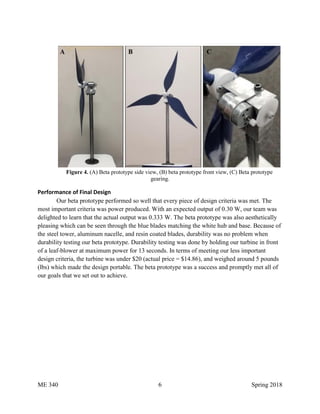
After seeing friction issues in our alpha 2 prototype, the drill gearbox was completely
removed and replaced by a shaft and two gears. The new design (beta prototype) seen in Figure 4
was machined out of a solid block of aluminum. In addition, a set of 3D printed blades and a 3D
printed hub was introduced. One major plus that our beta prototype had was extra durability. The
3D printed blades were sanded and coated in resin through an iterative process. It should be
noted that having one solid block of aluminum greatly enhanced our ability to create a fully
concentric drivetrain as well, which was extremely important for efficiency.
The results we saw with the beta prototype exceeded our expectations. After surpassing
our first two prototypes by a fairly large margin, we were finally happy with the final power
output. In addition, the uniform color of the tower and nacelle along with the matching blue
blades to the white hub and base made for great aesthetics. Through examination of our previous
prototypes and reflecting on their strengths and weaknesses, we were able to adapt our beta
prototype to meet our customer needs.
ME 340 6 Spring 2018
Figure 4. (A) Beta prototype side view, (B) beta prototype front view, (C) Beta prototype
gearing.
Performance of Final Design
Our beta prototype performed so well that every piece of design criteria was met. The
most important criteria was power produced. With an expected output of 0.30 W, our team was
delighted to learn that the actual output was 0.333 W. The beta prototype was also aesthetically
pleasing which can be seen through the blue blades matching the white hub and base. Because of
the steel tower, aluminum nacelle, and resin coated blades, durability was no problem when
durability testing our beta prototype. Durability testing was done by holding our turbine in front
of a leaf-blower at maximum power for 13 seconds. In terms of meeting our less important
design criteria, the turbine was under $20 (actual price = $14.86), and weighed around 5 pounds
(lbs) which made the design portable. The beta prototype was a success and promptly met all of
our goals that we set out to achieve.
ME 340 7 Spring 2018
Appendix A: How the Design Could Have Been Improved
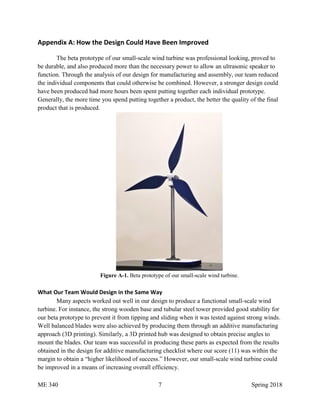
The beta prototype of our small-scale wind turbine was professional looking, proved to
be durable, and also produced more than the necessary power to allow an ultrasonic speaker to
function. Through the analysis of our design for manufacturing and assembly, our team reduced
the individual components that could otherwise be combined. However, a stronger design could
have been produced had more hours been spent putting together each individual prototype.
Generally, the more time you spend putting together a product, the better the quality of the final
product that is produced.
Figure A-1. Beta prototype of our small-scale wind turbine.
What Our Team Would Design in the Same Way
Many aspects worked out well in our design to produce a functional small-scale wind
turbine. For instance, the strong wooden base and tubular steel tower provided good stability for
our beta prototype to prevent it from tipping and sliding when it was tested against strong winds.
Well balanced blades were also achieved by producing them through an additive manufacturing
approach (3D printing). Similarly, a 3D printed hub was designed to obtain precise angles to
mount the blades. Our team was successful in producing these parts as expected from the results
obtained in the design for additive manufacturing checklist where our score (11) was within the
margin to obtain a “higher likelihood of success.” However, our small-scale wind turbine could
be improved in a means of increasing overall efficiency.
ME 340 8 Spring 2018
What Our Team Would Design Differently
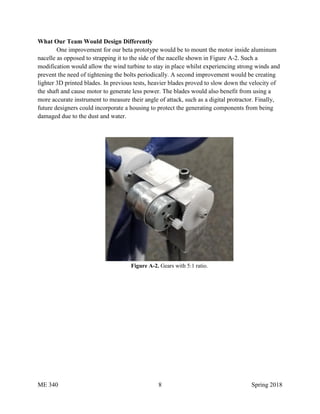
One improvement for our beta prototype would be to mount the motor inside aluminum
nacelle as opposed to strapping it to the side of the nacelle shown in Figure A-2. Such a
modification would allow the wind turbine to stay in place whilst experiencing strong winds and
prevent the need of tightening the bolts periodically. A second improvement would be creating
lighter 3D printed blades. In previous tests, heavier blades proved to slow down the velocity of
the shaft and cause motor to generate less power. The blades would also benefit from using a
more accurate instrument to measure their angle of attack, such as a digital protractor. Finally,
future designers could incorporate a housing to protect the generating components from being
damaged due to the dust and water.
Figure A-2. Gears with 5:1 ratio.
ME 340 9 Spring 2018
Appendix B: Setting Up the Small-Scale Wind Turbine
Appendix B gives information on how to properly set up and use the small-scale wind
turbine. Also, details will be given in regards to the specific location that the wind turbine should
be set up.
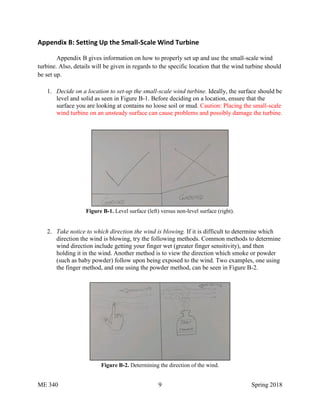
1. Decide on a location to set-up the small-scale wind turbine. Ideally, the surface should be
level and solid as seen in Figure B-1. Before deciding on a location, ensure that the
surface you are looking at contains no loose soil or mud. Caution: Placing the small-scale
wind turbine on an unsteady surface can cause problems and possibly damage the turbine.
Figure B-1. Level surface (left) versus non-level surface (right).
2. Take notice to which direction the wind is blowing. If it is difficult to determine which
direction the wind is blowing, try the following methods. Common methods to determine
wind direction include getting your finger wet (greater finger sensitivity), and then
holding it in the wind. Another method is to view the direction which smoke or powder
(such as baby powder) follow upon being exposed to the wind. Two examples, one using
the finger method, and one using the powder method, can be seen in Figure B-2.
Figure B-2. Determining the direction of the wind.
ME 340 10 Spring 2018
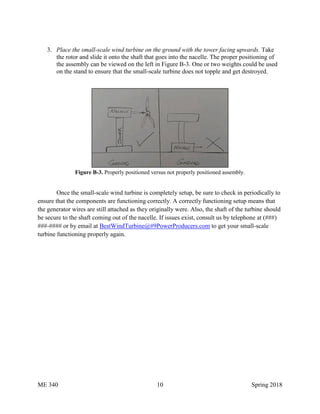
3. Place the small-scale wind turbine on the ground with the tower facing upwards. Take
the rotor and slide it onto the shaft that goes into the nacelle. The proper positioning of
the assembly can be viewed on the left in Figure B-3. One or two weights could be used
on the stand to ensure that the small-scale turbine does not topple and get destroyed.
Figure B-3. Properly positioned versus not properly positioned assembly.
Once the small-scale wind turbine is completely setup, be sure to check in periodically to
ensure that the components are functioning correctly. A correctly functioning setup means that
the generator wires are still attached as they originally were. Also, the shaft of the turbine should
be secure to the shaft coming out of the nacelle. If issues exist, consult us by telephone at (###)
###-#### or by email at BestWindTurbine@#9PowerProducers.com to get your small-scale
turbine functioning properly again.
ME 340 11 Spring 2018
Appendix C: Physical Principles to Make Design Choices
Certain calculations and principles were important in making design choices. The
following calculations mainly pertain to power generation. Because our concepts were not
conspicuous and difficult to visually rate which generated more power, power calculations were
necessary.
Power Generated By a Box Fan
An anemometer was used to record different winds speeds produced at nine different
locations 12 inches away from a box fan. The average wind speed was calculated to be 3.51
meters per second (m/s). First, our team found the maximum amount of power that the box fan
could output. The maximum amount of power the box fan was able to output was:
𝑃 =
1
2
𝜌𝐴𝑈3
(1)
where 𝑃 is power, 𝜌 is the air density (assumed to be 1.2 kilograms per cubic meter (kg/m^3)), 𝐴
is the cross-sectional area covered by the 18-inch diameter box fan blade, and 𝑈 is the free
stream velocity of the wind. The power produced by the wind in the box fan was calculated to be
4.26 W. Comparing the obtainable power to the power required for an ultrasonic speaker, which
is 0.25 W, means that an efficiency of 5.87% is required to meet the power criteria of the
speaker. In the end, our beta prototype produced 0.333 W, making our small-scale wind turbine
7.82% efficient. Having an efficiency of 7.82% mean that our design achieved the design goal
our team prescribed.
Rotor Torque Versus Generator Torque
Gaging our design concepts was a difficult part of the screening and selection process. By
creating a graph of rotor torque versus generator torque, our team was able to persuade ourselves
which design would produce more power than another (prior to the actual creation of any
prototypes). Not only do the graphs take into account the blade radius, but they also take into
account different gear ratios. After applying the graphical concept to our beta prototype, we
found the results to be quite surprising. Our theoretical calculation showed that the most suitable
rpms for a 5:1 gear ratio would require a 12-inch blade radius. Based on the graph shown in
Figure C-1, which assumes a power output of 0.30 W, approximately 430 rpms would be
required to achieve the assumed output. Instead, our beta prototype produced a greater output of
0.333 W at a rotor speed of approximately 420 rpms.
Constructing the rotor torque versus generator torque curve seen in Figure C-1 required
the knowledge of two addition equations. The equation for the amount of torque the rotor can
create due to the wind is defined Trotor_S in equation 2:
𝑇 𝑟𝑜𝑡𝑜𝑟_𝑆 =
1
2
𝐶 𝑚 𝜌𝐴𝑅𝑈2
(2)
ME 340 12 Spring 2018
where 𝐶 𝑚 is the rotor-torque coefficient, 𝜌 is the density of air, 𝐴 is the area that the blades cover
upon rotating, 𝑅 is the radius of the blades, and 𝑈 is the free-stream velocity of the wind. Once
we found the rotor torque that the wind could supply through the blades, we had to take into
account what torque the generator needed. The equation used to find the torque required by the
generator to generate electricity is defined as Trotor_N in equation 3:
𝑇𝑟𝑜𝑡𝑜𝑟_𝑁 =
𝑃 𝑎𝑝𝑝
𝜔 𝑟𝑜𝑡𝑜𝑟 𝑔𝑒𝑛
(3)
where 𝑇𝑟𝑜𝑡𝑜𝑟_𝑁 is the power output from the generator, 𝜔 𝑟𝑜𝑡𝑜𝑟 is the angular velocity of the rotor,
and  𝑔𝑒𝑛
is the efficiency of the generator.
Figure C-1. Rotor torque versus generator torque. A theoretical value of approximately 430 rpms was
required to produce 0.30 W of power. Our beta prototype produced 0.333 W of power at 420 rpms in
actual testing.
ME 340 13 Spring 2018
References
[1] "Average Wind Speed In Heredia," [Online]. Available: https://weather-and-
climate.com/average-monthly-Wind-speed,heredia-cr,Costa-Rica.
[2] W. Anders, "Dengue Rates Fall, But Still a Problem in These Parts of Costa Rica," 7 March
2018. [Online]. Available: https://news.co.cr/dengue-rates-fall-still-problem-parts-costa-
rica/61294/.
[3] "Creativity Techniques," [Online]. Available:
https://www.mycoted.com/Category:Creativity_Techniques.

Final report wind turbine project

  • 1.
    ME 340 1Spring 2018 Executive Summary: Design for Small-Scale Wind Turbine to Power an Ultrasonic Mosquito Repellent Trevor Durako, Asher Odhner, Abhinit Kothari, and Eva Wu Wu Team 8.7, ME 340, Mechanical Engineering Department, Pennsylvania State University Our team was tasked with designing a small-scale wind turbine to address a particular problem in Heredia, Costa Rica. In Heredia, mosquito borne illnesses are a threat among all individuals. Choosing Heredia involved researching wind speeds because wind turbines require adequate wind to be effective. On average, Heredia has wind speeds in the range of 13 to 17 miles per hour (mph). According to the Department of Energy, wind speeds of around 15 mph are sufficient for producing power using the wind [1]. With our location specified, we then had to more formally address the associated problem. Heredia has been plagued with mosquito borne diseases such as Malaria, Dengue, and the Zika Virus all create a negative impact on their population [2]. Ultrasonic speakers are becoming an increasingly popular method of dealing with mosquitos in a safe manner. The required power for an ultrasonic speaker is in the range of 0.25 to 0.5 watts (W). 0.25 to 0.5 W of power seemed to be a reasonable amount to generate using a small-scale wind turbine. Therefore, we decided to create a small-scale wind turbine that could power an ultrasonic mosquito repellent. Based on the problem, customer needs were developed and associated with our design process. The three most important needs were power produced, aesthetics, and durability. Power is the main factor that drives the ultrasonic speaker and was the most important criteria that was considered throughout the entire design process. Aesthetics and durability define how the product appeals to the customer and how long it can last without ensuing failure, respectively. Our team also came up with three less important needs: weight, cost, and portability. The aim of our small-scale turbine was to produce 0.3 W of power, be aesthetically pleasing (good color coordination), cost less than $20, and be durable. In the end, our team ended up meeting all of our customer needs and design criteria. This paper presents the design process that was used to fabricate our wind turbine. Starting with a brief description of the concept generation and selection process, this document then moves onto the prototype section. The prototype section explains the sequence in which we generated different prototypes and the changes that were introduced while going through different designs. In the last part of the prototype section, a short section is included to describe the performance of our beta prototype. Also, three appendices have been placed at the end of this document. Appendix A talks about future design improvements, Appendix B gives instructions for how the small-scale turbine should be set up, and Appendix C explains various calculations and principles that were considered in choosing a particular design.
  • 2.
    ME 340 2Spring 2018 Concept Generation, Screening, and Selection Three main techniques were applied to generate multiple concepts: brainstorming, Negative Brainstorming, and the 6-3-5 brainstorming method. Brainstorming was a traditional method that our team commonly used while considering new ideas. The new ideas were specifically based on the components, which included the blades, gearbox, hub, tower, and nacelle. In addition, other more complex systems in which the blades pitch could be adjustable were discussed. Brainstorming created a pathway to be open and improvise rough ideas such as an adjustable blade design. Another method that our team used during concept generation was Negative Brainstorming. Unlike brainstorming, Negative Brainstorming considers ideas that should not be implemented because they will negatively impact the design [3]. Negative Brainstorming eliminated a large amount of the negative ideas early in the process. Lastly, the 6- 3-5 method allowed us to create ideas on paper through sketches and writings. This method involved our entire team and required us to individually write down three ideas regarding certain components of a wind turbine. After five minutes, each team member passed their papers to the right. Once the original paper made its way back to the team member who started it, the ideas could be discussed in greater detail. Our team needed to narrow down to one final design. The first step that was used involved a concept screening matrix. Out of five concepts, the screening matrix brought the search down to two concepts which were to be chosen from. The difficult part about using a concept scoring matrix was deciding how to determine which design could produce power better than another design. Our solution for this problem was to create a graph displaying how the rotor torque compared to the generator torque to generate a specific amount of power. The graph can be viewed in Figure C-1 located in Appendix C. In addition to power, the concept scoring matrix also took into account portability, aesthetics, cost, durability, and assembly time. The final selection process utilized an AHP scoring matrix. In the scoring matrix, weights were taken into account to fine tune how each design fits specific customer needs. Power, durability, and aesthetics had the greatest effect on the final concept selection. Once each customer need was scored appropriately based on the design, the scores were added up. Based on the scoring matrix, the design that our team chose to continue with was concept 1. Sequence of Prototypes In order to effectively learn the process of taking an idea to a manufacturable product, our team constructed several prototypes. The zeroth prototype was our first rendition and was made using basic craft supplies such as cardboard and hot glue. The prototype labeled “alpha 1,” was our first power producing design. Following the alpha 1 prototype is the alpha 2 prototype, which carried many of alpha 1’s physical features. The last and final prototype created was the beta prototype, which took on a many new features through significant design changes. Our team learned various lessons throughout the creation of each prototype and was able to make design changes along the way.
  • 3.
    ME 340 3Spring 2018 Zeroth Prototype The zeroth prototype turned a hypothetical concept into a tangible product. From the zeroth prototype, we learned more in regards to the size of the turbine which we were looking to create. In addition, close attention was taken into how each moving part interacted. Although 40 minutes were given to create this prototype, an effective product was still produced. The narrow time frame also stressed our team to work together efficiently. Our zeroth prototype, which can be seen in Figure 1, achieved 237 revolutions per minute (rpms) before the blades began striking the supporting tower. However, the zeroth prototype never ensured total failure. Figure 1. (A) Zeroth prototype stationary, (B) zeroth prototype during testing. Alpha 1 Prototype The alpha 1 prototype was our teams first power producing wind turbine. Based on equations for wind power production, a large blade-sweep area was selected as well as a 5:1 gear ratio to increase generator’s shaft velocity. Illustrated in Figure 2 is our alpha 1 prototype. The alpha 1 prototype still used cardboard blades, but they were of a much higher quality than the zeroth prototype blades. The blades were mounted to a circular wooden hub with a slight angle of attack. A connection was then made between the wooden hub and a steel shaft, which connected the rotating blades to a Bosch power drill gearbox. Our idea was to utilize the drills bearings and high-quality gearing to eliminate any human error that could be introduced. The output shaft of the gearbox was coupled to our motor shaft using an aluminum coupler turned by one of our team members on a lathe. The generator was then mounted in a wooden housing to hold the generator securely during testing.
  • 4.
    ME 340 4Spring 2018 Testing our alpha 1 prototype required us to take data at various wind speeds. Specifically, the blades rpms and the power output was monitored. Using the test data, our team considered other possibilities for the alpha 2 prototype. One important note during the alpha 1 prototype test was that the extended length of the blades was causing more drag than they were worth. Figure 2. (A) Gearbox and hub on support tower, (B) alpha 1 prototype in testing, (C) Motor mount and coupler. Alpha 2 Prototype The idea behind the alpha 2 prototype, which can be seen in Figure 3, was to take everything we learned from the alpha 1 prototype and optimize it. Optimizing included building new blades out of PVC piping, building a stronger hub, reverting back to the drill’s original 30:1 gear ratio, and building the nacelle out of polycarbonate instead of wood. The new blades were made cut form a 4” diameter PVC pipe to form a curved airfoil design, which was very durable as well as weatherproof in many conditions. The hub was made from scrap aluminum that had three protruding arms to which the blades were mounted. A central hole was drilled and threaded into the hub and was screwed directly onto the drill’s shaft output shaft. Each arm of the hub was bent to create a larger angle of attack for the blades. Our team eliminated a significant amount of friction in the alpha 2 prototype by modifying the original drill motor drivetrain with a custom spiral gear. Once the transmission was completed, the gear ratio up was much larger, 30:1 to be exact. Similar to the alpha 1 prototype, the output of the shaft was directly driven into the motor by means of an aluminum coupler. The nacelle platform, gearbox mount, and motor mount were all hand-cut out of polycarbonate and bolted together. The alpha 2 prototype worked better than the alpha 1 prototype. However, the results were still not up to par with the results that we were looking to obtain. The 30:1 gear ratio was too large and created a massive loss of torque, hindering the alpha 2 prototype’s performance. Also, the blades and gearing were still not near as effective as they could be.
  • 5.
    ME 340 5Spring 2018 Figure 3. Alpha 2 prototype during testing. Beta Prototype After seeing friction issues in our alpha 2 prototype, the drill gearbox was completely removed and replaced by a shaft and two gears. The new design (beta prototype) seen in Figure 4 was machined out of a solid block of aluminum. In addition, a set of 3D printed blades and a 3D printed hub was introduced. One major plus that our beta prototype had was extra durability. The 3D printed blades were sanded and coated in resin through an iterative process. It should be noted that having one solid block of aluminum greatly enhanced our ability to create a fully concentric drivetrain as well, which was extremely important for efficiency. The results we saw with the beta prototype exceeded our expectations. After surpassing our first two prototypes by a fairly large margin, we were finally happy with the final power output. In addition, the uniform color of the tower and nacelle along with the matching blue blades to the white hub and base made for great aesthetics. Through examination of our previous prototypes and reflecting on their strengths and weaknesses, we were able to adapt our beta prototype to meet our customer needs.
  • 6.
    ME 340 6Spring 2018 Figure 4. (A) Beta prototype side view, (B) beta prototype front view, (C) Beta prototype gearing. Performance of Final Design Our beta prototype performed so well that every piece of design criteria was met. The most important criteria was power produced. With an expected output of 0.30 W, our team was delighted to learn that the actual output was 0.333 W. The beta prototype was also aesthetically pleasing which can be seen through the blue blades matching the white hub and base. Because of the steel tower, aluminum nacelle, and resin coated blades, durability was no problem when durability testing our beta prototype. Durability testing was done by holding our turbine in front of a leaf-blower at maximum power for 13 seconds. In terms of meeting our less important design criteria, the turbine was under $20 (actual price = $14.86), and weighed around 5 pounds (lbs) which made the design portable. The beta prototype was a success and promptly met all of our goals that we set out to achieve.
  • 7.
    ME 340 7Spring 2018 Appendix A: How the Design Could Have Been Improved The beta prototype of our small-scale wind turbine was professional looking, proved to be durable, and also produced more than the necessary power to allow an ultrasonic speaker to function. Through the analysis of our design for manufacturing and assembly, our team reduced the individual components that could otherwise be combined. However, a stronger design could have been produced had more hours been spent putting together each individual prototype. Generally, the more time you spend putting together a product, the better the quality of the final product that is produced. Figure A-1. Beta prototype of our small-scale wind turbine. What Our Team Would Design in the Same Way Many aspects worked out well in our design to produce a functional small-scale wind turbine. For instance, the strong wooden base and tubular steel tower provided good stability for our beta prototype to prevent it from tipping and sliding when it was tested against strong winds. Well balanced blades were also achieved by producing them through an additive manufacturing approach (3D printing). Similarly, a 3D printed hub was designed to obtain precise angles to mount the blades. Our team was successful in producing these parts as expected from the results obtained in the design for additive manufacturing checklist where our score (11) was within the margin to obtain a “higher likelihood of success.” However, our small-scale wind turbine could be improved in a means of increasing overall efficiency.
  • 8.
    ME 340 8Spring 2018 What Our Team Would Design Differently One improvement for our beta prototype would be to mount the motor inside aluminum nacelle as opposed to strapping it to the side of the nacelle shown in Figure A-2. Such a modification would allow the wind turbine to stay in place whilst experiencing strong winds and prevent the need of tightening the bolts periodically. A second improvement would be creating lighter 3D printed blades. In previous tests, heavier blades proved to slow down the velocity of the shaft and cause motor to generate less power. The blades would also benefit from using a more accurate instrument to measure their angle of attack, such as a digital protractor. Finally, future designers could incorporate a housing to protect the generating components from being damaged due to the dust and water. Figure A-2. Gears with 5:1 ratio.
  • 9.
    ME 340 9Spring 2018 Appendix B: Setting Up the Small-Scale Wind Turbine Appendix B gives information on how to properly set up and use the small-scale wind turbine. Also, details will be given in regards to the specific location that the wind turbine should be set up. 1. Decide on a location to set-up the small-scale wind turbine. Ideally, the surface should be level and solid as seen in Figure B-1. Before deciding on a location, ensure that the surface you are looking at contains no loose soil or mud. Caution: Placing the small-scale wind turbine on an unsteady surface can cause problems and possibly damage the turbine. Figure B-1. Level surface (left) versus non-level surface (right). 2. Take notice to which direction the wind is blowing. If it is difficult to determine which direction the wind is blowing, try the following methods. Common methods to determine wind direction include getting your finger wet (greater finger sensitivity), and then holding it in the wind. Another method is to view the direction which smoke or powder (such as baby powder) follow upon being exposed to the wind. Two examples, one using the finger method, and one using the powder method, can be seen in Figure B-2. Figure B-2. Determining the direction of the wind.
  • 10.
    ME 340 10Spring 2018 3. Place the small-scale wind turbine on the ground with the tower facing upwards. Take the rotor and slide it onto the shaft that goes into the nacelle. The proper positioning of the assembly can be viewed on the left in Figure B-3. One or two weights could be used on the stand to ensure that the small-scale turbine does not topple and get destroyed. Figure B-3. Properly positioned versus not properly positioned assembly. Once the small-scale wind turbine is completely setup, be sure to check in periodically to ensure that the components are functioning correctly. A correctly functioning setup means that the generator wires are still attached as they originally were. Also, the shaft of the turbine should be secure to the shaft coming out of the nacelle. If issues exist, consult us by telephone at (###) ###-#### or by email at BestWindTurbine@#9PowerProducers.com to get your small-scale turbine functioning properly again.
  • 11.
    ME 340 11Spring 2018 Appendix C: Physical Principles to Make Design Choices Certain calculations and principles were important in making design choices. The following calculations mainly pertain to power generation. Because our concepts were not conspicuous and difficult to visually rate which generated more power, power calculations were necessary. Power Generated By a Box Fan An anemometer was used to record different winds speeds produced at nine different locations 12 inches away from a box fan. The average wind speed was calculated to be 3.51 meters per second (m/s). First, our team found the maximum amount of power that the box fan could output. The maximum amount of power the box fan was able to output was: 𝑃 = 1 2 𝜌𝐴𝑈3 (1) where 𝑃 is power, 𝜌 is the air density (assumed to be 1.2 kilograms per cubic meter (kg/m^3)), 𝐴 is the cross-sectional area covered by the 18-inch diameter box fan blade, and 𝑈 is the free stream velocity of the wind. The power produced by the wind in the box fan was calculated to be 4.26 W. Comparing the obtainable power to the power required for an ultrasonic speaker, which is 0.25 W, means that an efficiency of 5.87% is required to meet the power criteria of the speaker. In the end, our beta prototype produced 0.333 W, making our small-scale wind turbine 7.82% efficient. Having an efficiency of 7.82% mean that our design achieved the design goal our team prescribed. Rotor Torque Versus Generator Torque Gaging our design concepts was a difficult part of the screening and selection process. By creating a graph of rotor torque versus generator torque, our team was able to persuade ourselves which design would produce more power than another (prior to the actual creation of any prototypes). Not only do the graphs take into account the blade radius, but they also take into account different gear ratios. After applying the graphical concept to our beta prototype, we found the results to be quite surprising. Our theoretical calculation showed that the most suitable rpms for a 5:1 gear ratio would require a 12-inch blade radius. Based on the graph shown in Figure C-1, which assumes a power output of 0.30 W, approximately 430 rpms would be required to achieve the assumed output. Instead, our beta prototype produced a greater output of 0.333 W at a rotor speed of approximately 420 rpms. Constructing the rotor torque versus generator torque curve seen in Figure C-1 required the knowledge of two addition equations. The equation for the amount of torque the rotor can create due to the wind is defined Trotor_S in equation 2: 𝑇 𝑟𝑜𝑡𝑜𝑟_𝑆 = 1 2 𝐶 𝑚 𝜌𝐴𝑅𝑈2 (2)
  • 12.
    ME 340 12Spring 2018 where 𝐶 𝑚 is the rotor-torque coefficient, 𝜌 is the density of air, 𝐴 is the area that the blades cover upon rotating, 𝑅 is the radius of the blades, and 𝑈 is the free-stream velocity of the wind. Once we found the rotor torque that the wind could supply through the blades, we had to take into account what torque the generator needed. The equation used to find the torque required by the generator to generate electricity is defined as Trotor_N in equation 3: 𝑇𝑟𝑜𝑡𝑜𝑟_𝑁 = 𝑃 𝑎𝑝𝑝 𝜔 𝑟𝑜𝑡𝑜𝑟 𝑔𝑒𝑛 (3) where 𝑇𝑟𝑜𝑡𝑜𝑟_𝑁 is the power output from the generator, 𝜔 𝑟𝑜𝑡𝑜𝑟 is the angular velocity of the rotor, and  𝑔𝑒𝑛 is the efficiency of the generator. Figure C-1. Rotor torque versus generator torque. A theoretical value of approximately 430 rpms was required to produce 0.30 W of power. Our beta prototype produced 0.333 W of power at 420 rpms in actual testing.
  • 13.
    ME 340 13Spring 2018 References [1] "Average Wind Speed In Heredia," [Online]. Available: https://weather-and- climate.com/average-monthly-Wind-speed,heredia-cr,Costa-Rica. [2] W. Anders, "Dengue Rates Fall, But Still a Problem in These Parts of Costa Rica," 7 March 2018. [Online]. Available: https://news.co.cr/dengue-rates-fall-still-problem-parts-costa- rica/61294/. [3] "Creativity Techniques," [Online]. Available: https://www.mycoted.com/Category:Creativity_Techniques.