Confidential
Reopening Massachusetts
​ May 18, 2020
2
All public health criteria included in this document are subject to change. As research and data on this novel coronavirus
continue to develop, this plan can and will be updated to reflect the latest science and data
THE ROAD WE'VE TRAVELLED TOGETHER
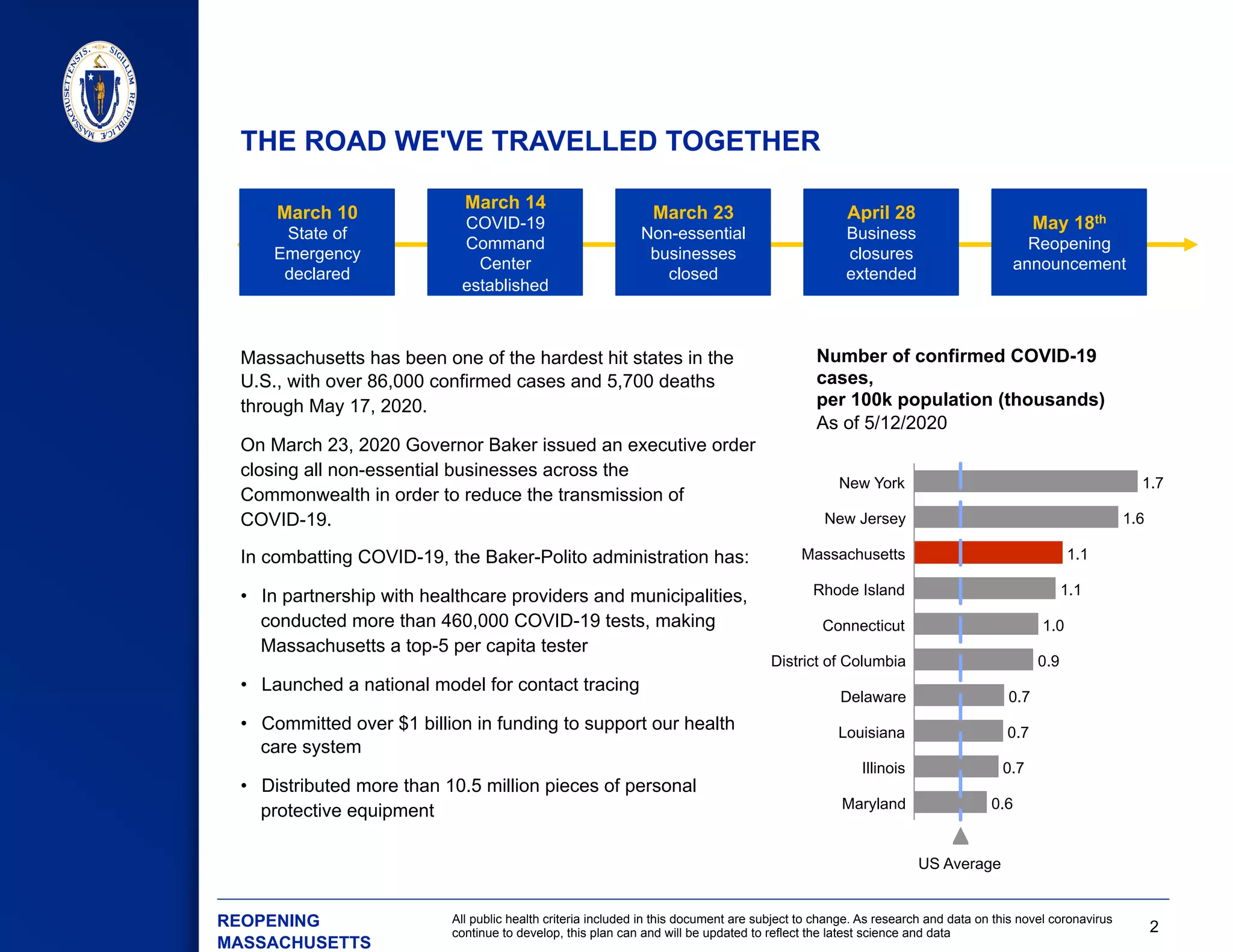
Massachusetts has been one of the hardest hit states in the
U.S., with over 86,000 confirmed cases and 5,700 deaths
through May 17, 2020.
On March 23, 2020 Governor Baker issued an executive order
closing all non-essential businesses across the
Commonwealth in order to reduce the transmission of
COVID-19.
In combatting COVID-19, the Baker-Polito administration has:
•  In partnership with healthcare providers and municipalities,
conducted more than 460,000 COVID-19 tests, making
Massachusetts a top-5 per capita tester
•  Launched a national model for contact tracing
•  Committed over $1 billion in funding to support our health
care system
•  Distributed more than 10.5 million pieces of personal
protective equipment
Number of confirmed COVID-19
cases,
per 100k population (thousands)
As of 5/12/2020
​ 0.7
​ Illinois
​ Massachusetts
​ New York
​ New Jersey
​ US Average
​ Connecticut
​ Delaware
​ Rhode Island
​ District of Columbia
​ Louisiana
​ Maryland
​ 1.7
​ 1.6
​ 1.1
​ 1.1
​ 1.0
​ 0.9
​ 0.7
​ 0.7
​ 0.6
March 10
State of
Emergency
declared
March 14
COVID-19
Command
Center
established
March 23
Non-essential
businesses
closed
April 28
Business
closures
extended
May 18th
Reopening
announcement
​ REOPENING
MASSACHUSETTS
3
All public health criteria included in this document are subject to change. As research and data on this novel coronavirus
continue to develop, this plan can and will be updated to reflect the latest science and data
GETTING STARTED ON THE PATH TO REOPENING
On April 28, Governor Baker formed the Reopening Advisory Board, chaired by Lieutenant Governor Karyn
Polito and Secretary of Housing and Economic Development Mike Kennealy, and comprised of
representatives from the business community, public health officials, and municipal leaders from across the
Commonwealth.
In crafting this report, the Reopening Advisory Board and other state officials:
•  Heard testimony from more than 75 business associations, labor unions, non-profits, and community
coalitions that collectively represent more than 112,000 businesses and more than 2,000,000 employees
•  Received and reviewed more than 4,600 written submissions from associations, businesses, and
residents
•  Engaged stakeholders and analyzed information in over 45 hours of Zoom meetings over the past 20
days
​ REOPENING
MASSACHUSETTS
4
All public health criteria included in this document are subject to change. As research and data on this novel coronavirus
continue to develop, this plan can and will be updated to reflect the latest science and data
WORKING TOGETHER TO REOPEN
Working
Together
to
Reopen
Employers
 Set business practices
that adhere to the
Mandatory Workplace
Safety Standards and
Sector-Specific
Protocols for your
industry
Individuals
•  Cover your face
•  Wash your hands
•  Socially distance
•  Be vigilant for symptoms
•  Stay home if you feel sick
Health system
 Monitor progression to ensure
sufficient system capacity to
meet needs
Employees
 Abide by employer
practices that adhere to
the mandatory safety
standards and sector
specific protocols
 Government
•  Set standards in
the interest of
public health
•  Invest in necessary
capabilities
•  Communicate to
and educate the
public
•  Regularly track and
report COVID-19
data
•  Expand testing
capacity
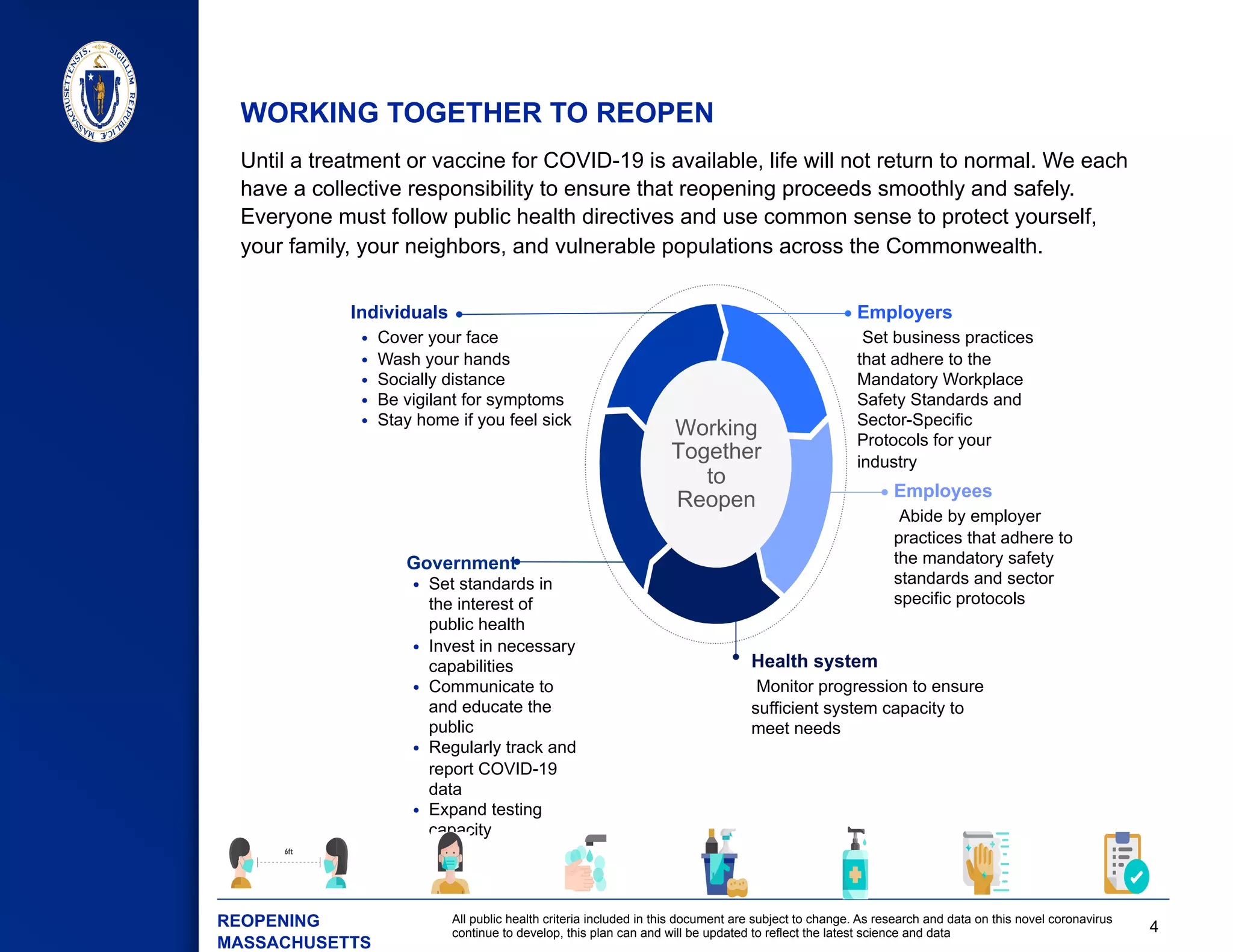
Until a treatment or vaccine for COVID-19 is available, life will not return to normal. We each
have a collective responsibility to ensure that reopening proceeds smoothly and safely.
Everyone must follow public health directives and use common sense to protect yourself,
your family, your neighbors, and vulnerable populations across the Commonwealth.
​ REOPENING
MASSACHUSETTS
5
All public health criteria included in this document are subject to change. As research and data on this novel coronavirus
continue to develop, this plan can and will be updated to reflect the latest science and data
16.5
16.1 15.9
15.3
14.8
14.1 13.7
13.1 12.9 12.8
12.2
11.7
11.3
10.9
10.5 10.4
10
15
20
​ 2.5
​ 3.5
​ 3.0
​ 4.0
​ 3.4
​ 3.1
​ 3.6
​ 2.8
​ 3.7
​ 3.6 ​ 3.6 ​ 3.5 ​ 3.5
​ 3.3
​ 3.2
​ 3.2 ​ 3.1
​ 2.9
​ 3.0
​ 2.7
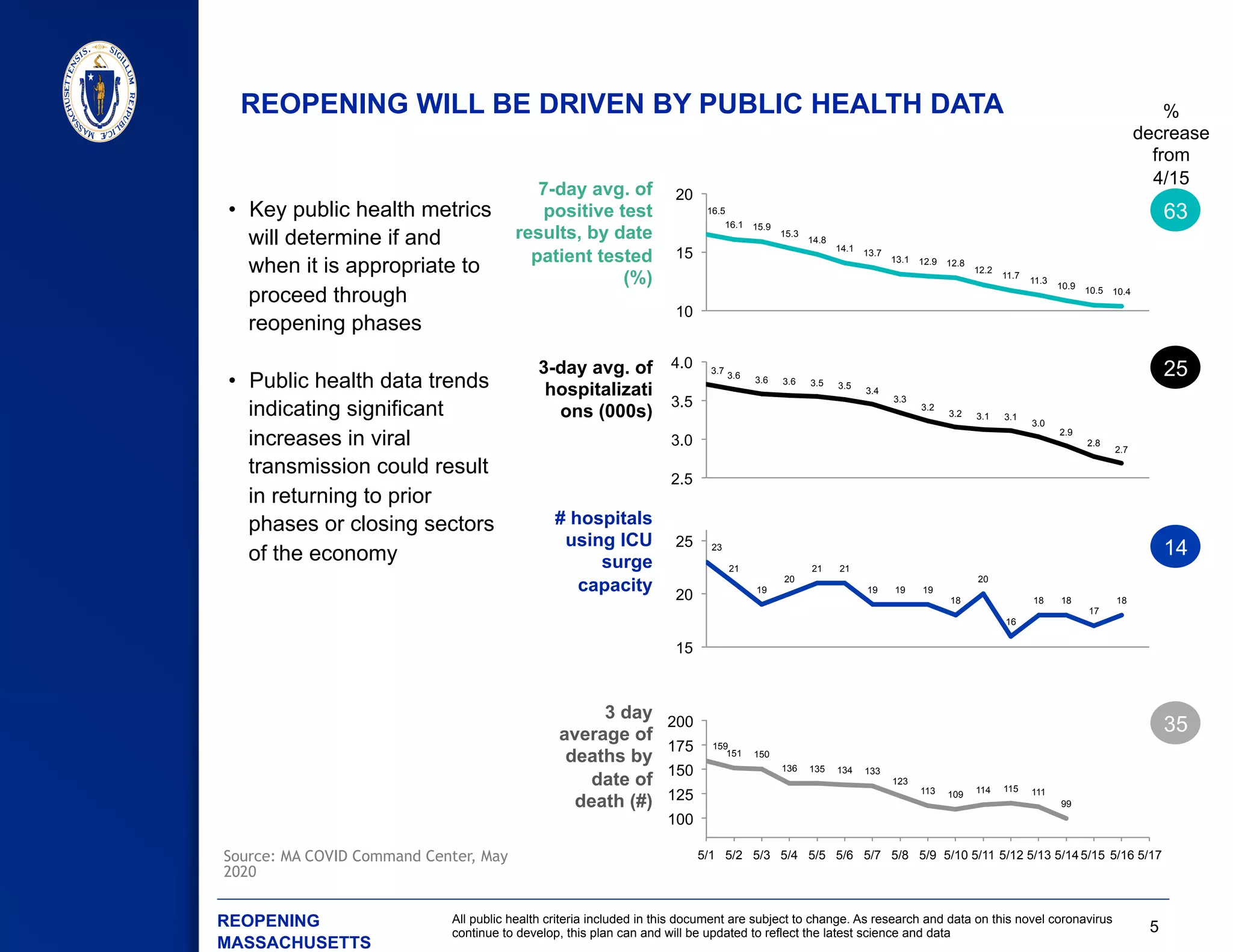
7-day avg. of
positive test
results, by date
patient tested
(%)
REOPENING WILL BE DRIVEN BY PUBLIC HEALTH DATA
3-day avg. of
hospitalizati
ons (000s)
23
21
19
20
21 21
19 19 19
18
20
16
18 18
17
18
15
20
25
159
151 150
136 135 134 133
123
113 109 114 115 111
99
​ 5/6​ 5/4​ 5/3 ​ 5/9 ​ 5/12 ​ 5/15
​ 100
​ 5/1
​ 125
​ 150
​ 175
​ 5/5 ​ 5/14​ 5/11
​ 200
​ 5/17​ 5/8​ 5/2 ​ 5/7 ​ 5/10 ​ 5/13 ​ 5/16
# hospitals
using ICU
surge
capacity
3 day
average of
deaths by
date of
death (#)
%
decrease
from
4/15
63
25
14
35
Source: MA COVID Command Center, May
2020
•  Key public health metrics
will determine if and
when it is appropriate to
proceed through
reopening phases
•  Public health data trends
indicating significant
increases in viral
transmission could result
in returning to prior
phases or closing sectors
of the economy
​ REOPENING
MASSACHUSETTS
6
All public health criteria included in this document are subject to change. As research and data on this novel coronavirus
continue to develop, this plan can and will be updated to reflect the latest science and data
•  Test: Increase
testing capacity and
number of people
tested so people
with COVID-19 are
aware of their
diagnosis and can
self-isolate
•  Trace: Trace all
contacts of people
with COVID-19 to
ensure safe
quarantine and
testing for those
who need it
•  Isolate: Minimize
transmission by
isolating and
quarantining
individuals with
COVID-19 and their
close contacts
•  Support: Provide
support so
individuals can
safely isolate and
quarantine
​ REOPENING
MASSACHUSETTS
MASSACHUSETTS TESTING & TRACING STRATEGY
7
All public health criteria included in this document are subject to change. As research and data on this novel coronavirus
continue to develop, this plan can and will be updated to reflect the latest science and data
Indicator Status
COVID-19 positive test rate
Number of individuals who died from
COVID-19
Number of patients with COVID-19 in
hospitals
Healthcare system readiness
Testing capacity
Contact tracing capabilities
1
2
3
4
Legend
Negative
trend
In progress
Positive
trend
Dashboard of public health indicators
•  Starting on May 18, the COVID-19 Command Center will give updates on six key public health indicators
•  Before and during reopening, these metrics must continue to show progress
Below is the status as of May 18, 2020:
5
6
REOPENING WILL BE DRIVEN BY PUBLIC HEALTH DATA
​ REOPENING
MASSACHUSETTS
8
All public health criteria included in this document are subject to change. As research and data on this novel coronavirus
continue to develop, this plan can and will be updated to reflect the latest science and data
As we reopen the Massachusetts economy, the Baker-Polito administration will provide
guidance that each sector, industry, and business must follow:
REOPENING AND FIGHTING COVID-19
 Social guidance  Business guidance
 General social guidance
 Guidance all individuals must follow
to reduce the risk of new COVID-19
transmission:
•  Cover your face
•  Wash your hands
•  Socially distance
•  Be vigilant for symptoms
•  Stay home if you feel sick
 Mandatory Workplace Safety Standards
New standards for all workplaces that are
designed to reduce the risk of new COVID-19
transmission to employees and customers
 Sector-Specific Protocols and best
practices
Additional safety standards and recommended
best practices to reduce the risk of new
COVID-19 transmission in specific industries
(e.g. restaurants, construction, etc.)
​ REOPENING
MASSACHUSETTS
9
All public health criteria included in this document are subject to change. As research and data on this novel coronavirus
continue to develop, this plan can and will be updated to reflect the latest science and data
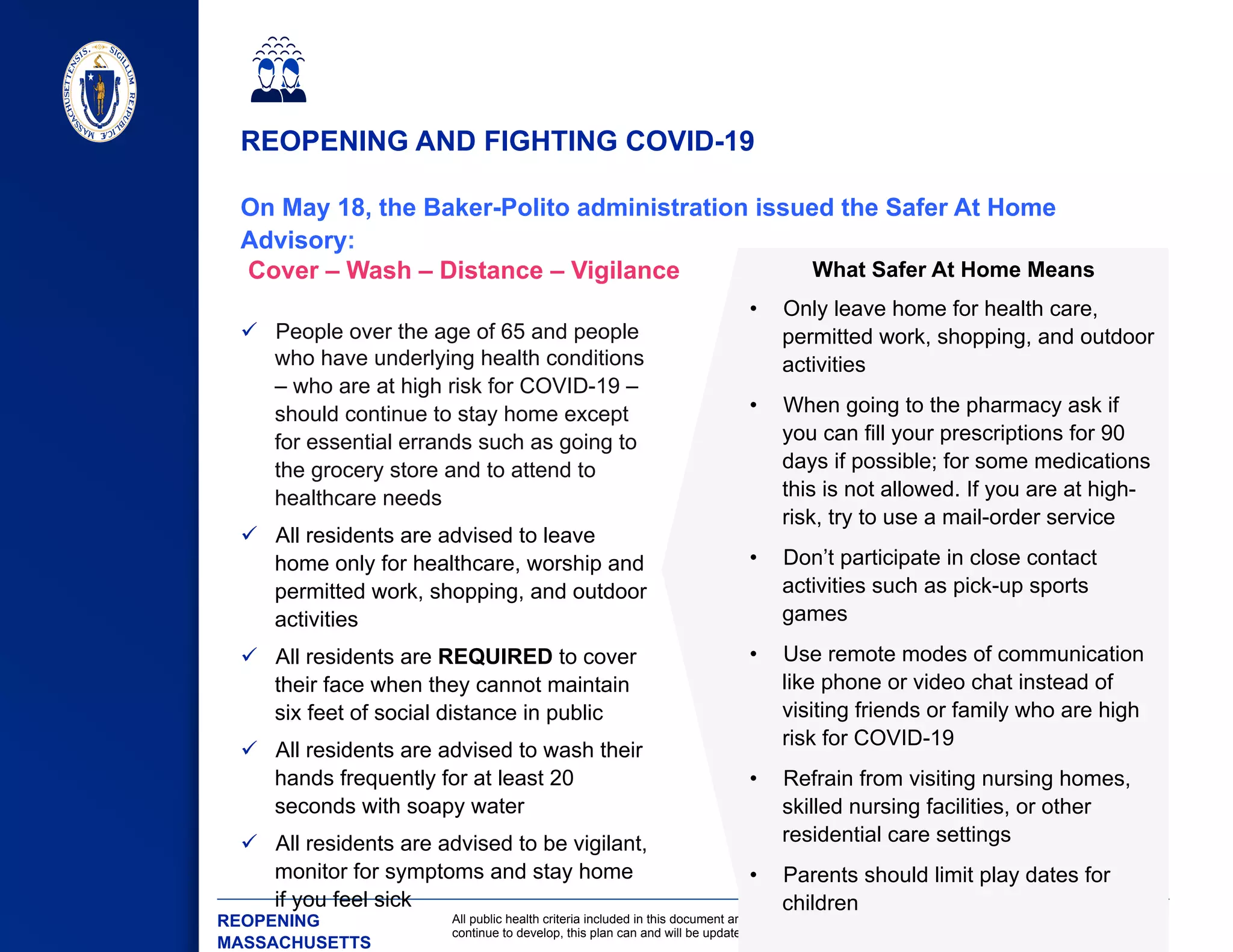
On May 18, the Baker-Polito administration issued the Safer At Home
Advisory:
REOPENING AND FIGHTING COVID-19
 Cover – Wash – Distance – Vigilance
ü  People over the age of 65 and people
who have underlying health conditions
– who are at high risk for COVID-19 –
should continue to stay home except
for essential errands such as going to
the grocery store and to attend to
healthcare needs
ü  All residents are advised to leave
home only for healthcare, worship and
permitted work, shopping, and outdoor
activities
ü  All residents are REQUIRED to cover
their face when they cannot maintain
six feet of social distance in public
ü  All residents are advised to wash their
hands frequently for at least 20
seconds with soapy water
ü  All residents are advised to be vigilant,
monitor for symptoms and stay home
if you feel sick
What Safer At Home Means
•  Only leave home for health care,
permitted work, shopping, and outdoor
activities
•  When going to the pharmacy ask if
you can fill your prescriptions for 90
days if possible; for some medications
this is not allowed. If you are at high-
risk, try to use a mail-order service
•  Don’t participate in close contact
activities such as pick-up sports
games
•  Use remote modes of communication
like phone or video chat instead of
visiting friends or family who are high
risk for COVID-19
•  Refrain from visiting nursing homes,
skilled nursing facilities, or other
residential care settings
•  Parents should limit play dates for
children
​ REOPENING
MASSACHUSETTS
10
All public health criteria included in this document are subject to change. As research and data on this novel coronavirus
continue to develop, this plan can and will be updated to reflect the latest science and data
Mandatory Workplace Safety Standards for reopening
​ Note: Businesses operating to provide Essential Services, as defined in the Governor's March 23, 2020 Executive
Order, updated on March 31, April 28 and May 15, may remain open and have until May 25, 2020 to comply with these
mandatory safety standards.
All businesses and activities, as they reopen, must meet the following minimum safety
standards:
Social
Distancing
•  All persons, including employees, customers, and vendors should remain at least six
feet apart to the greatest extent possible, both inside and outside workplaces
•  Establish protocols to ensure that employees can practice adequate social distancing
•  Provide signage for safe social distancing
•  Require face coverings or masks for all employees
Hygiene
Protocols
•  Provide hand washing capabilities throughout the workplace
•  Ensure frequent hand washing and ensure adequate supplies
•  Provide regular sanitization of high touch areas, such as workstations, equipment,
screens, doorknobs, restrooms throughout work site
Staffing and
Operations
•  Provide training for employees regarding the social distancing and hygiene protocols
•  Employees who are displaying COVID-19-like symptoms do not report to work
•  Establish a plan for employees getting ill from COVID-19 at work, and a return-to-work
plan
Cleaning and
Disinfecting
•  Establish and maintain cleaning protocols specific to the business
•  When an active employee is diagnosed with COVID-19, cleaning and disinfecting must
be performed
•  Disinfection of all common surfaces must take place at intervals appropriate to said
workplace
REOPENING AND FIGHTING COVID-19
​ REOPENING
MASSACHUSETTS
11
All public health criteria included in this document are subject to change. As research and data on this novel coronavirus
continue to develop, this plan can and will be updated to reflect the latest science and data
Sector-Specific Protocols and best practices
The Baker-Polito administration has developed specific guidance so that each industry reopens as safely as
possible. Businesses are expected to implement these protocols in addition to the more general Mandatory
Workplace Safety Standards.
As of May 18, materials for the sectors eligible to open in the first phase of reopening are included on the
mass.gov/reopening. Guidance for sectors opening in later phases will be posted online in advance of those
phases. Each sector will have access to:
Sector Circular
Mandatory safety
standards and
recommended best
practices in social
distancing, hygiene
protocols, staffing/
operations, and
cleaning/disinfecting for
each sector.
Sector Checklist
Checklist developed to
serve as guidance for
employers and
businesses of all sizes
as they adjust
operations to address
worker and customer
safety.
REOPENING AND FIGHTING COVID-19
​ Note: Businesses operating to provide Essential Services, as defined in the Governor's March 23, 2020 Executive
Order, updated on March 31, April 28 and May 15, may remain open and have until May 25, 2020 to comply with their
industry’s sector specific protocols (if applicable).
​ REOPENING
MASSACHUSETTS
12
All public health criteria included in this document are subject to change. As research and data on this novel coronavirus
continue to develop, this plan can and will be updated to reflect the latest science and data
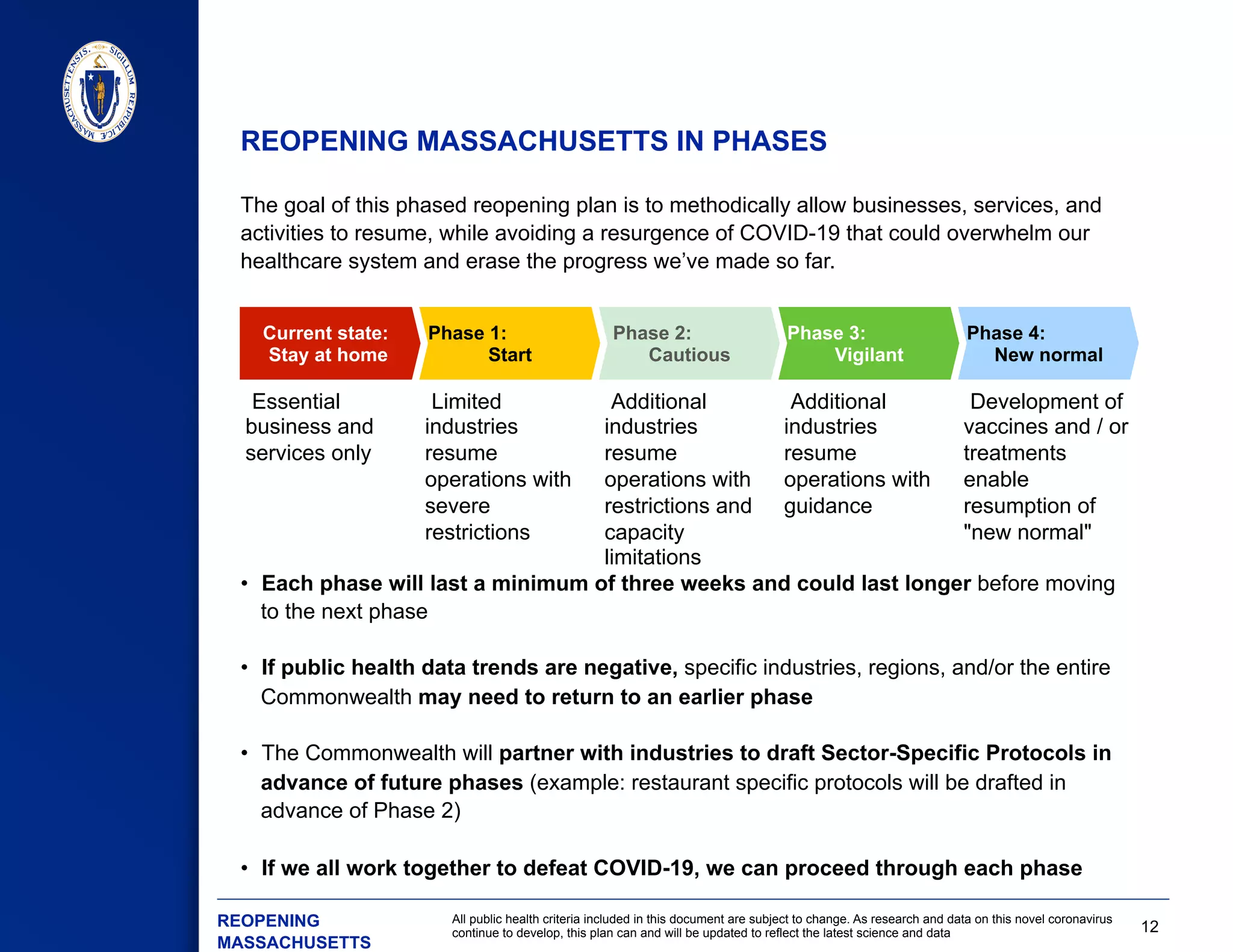
REOPENING MASSACHUSETTS IN PHASES
Current state:
Stay at home
Phase 1:
Start
Phase 3:
Vigilant
Phase 4:
New normal
Phase 2:
Cautious
 Limited
industries
resume
operations with
severe
restrictions
 Additional
industries
resume
operations with
restrictions and
capacity
limitations
 Additional
industries
resume
operations with
guidance
 Development of
vaccines and / or
treatments
enable
resumption of
"new normal"
 Essential
business and
services only
The goal of this phased reopening plan is to methodically allow businesses, services, and
activities to resume, while avoiding a resurgence of COVID-19 that could overwhelm our
healthcare system and erase the progress we’ve made so far.
•  Each phase will last a minimum of three weeks and could last longer before moving
to the next phase
•  If public health data trends are negative, specific industries, regions, and/or the entire
Commonwealth may need to return to an earlier phase
•  The Commonwealth will partner with industries to draft Sector-Specific Protocols in
advance of future phases (example: restaurant specific protocols will be drafted in
advance of Phase 2)
•  If we all work together to defeat COVID-19, we can proceed through each phase
​ REOPENING
MASSACHUSETTS
13
All public health criteria included in this document are subject to change. As research and data on this novel coronavirus
continue to develop, this plan can and will be updated to reflect the latest science and data
REOPENING MASSACHUSETTS IN PHASES
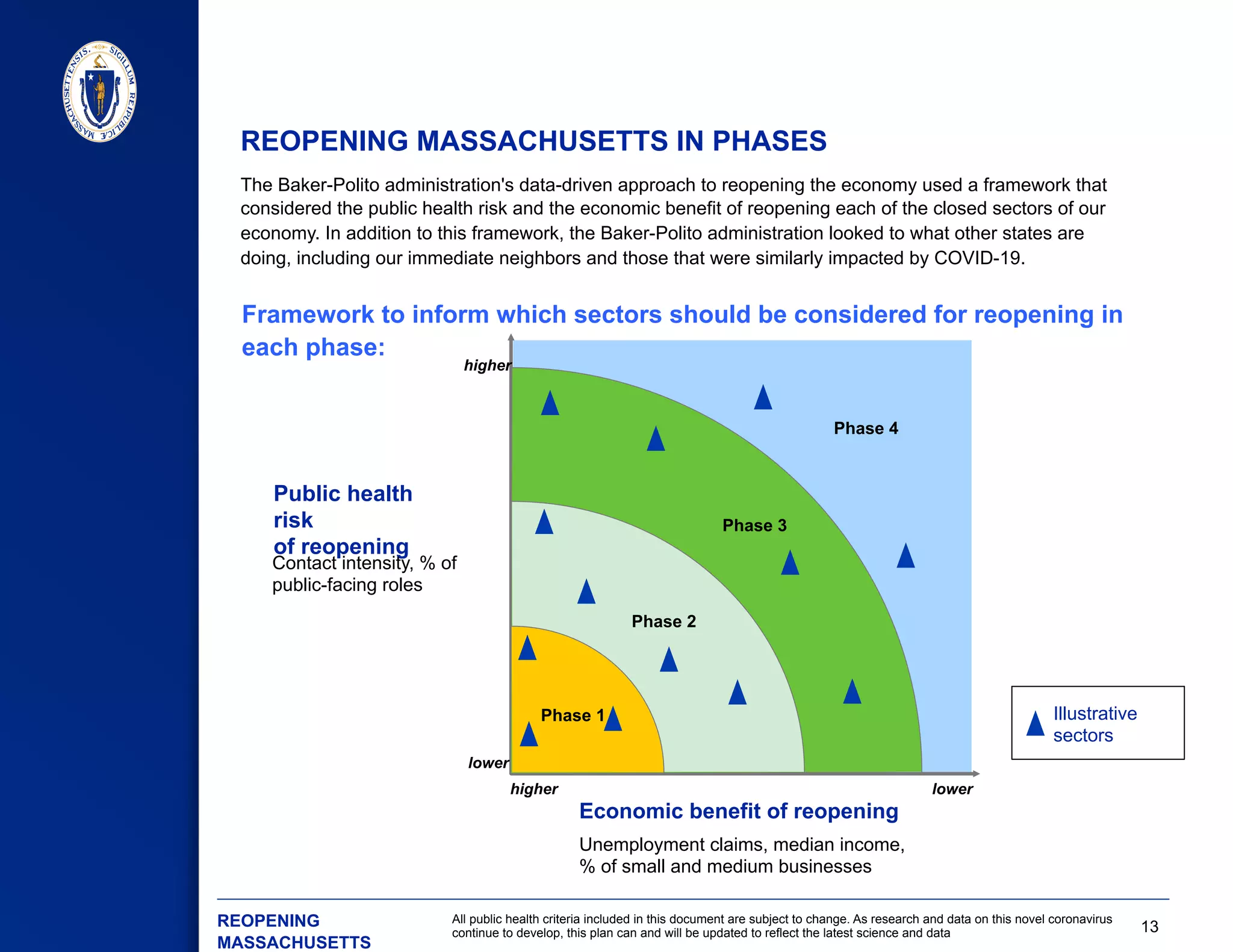
Economic benefit of reopening
Public health
risk
of reopening
Contact intensity, % of
public-facing roles
Unemployment claims, median income,
% of small and medium businesses
higher
lower
Phase 4
The Baker-Polito administration's data-driven approach to reopening the economy used a framework that
considered the public health risk and the economic benefit of reopening each of the closed sectors of our
economy. In addition to this framework, the Baker-Polito administration looked to what other states are
doing, including our immediate neighbors and those that were similarly impacted by COVID-19.
Framework to inform which sectors should be considered for reopening in
each phase:
higher
lower
Phase 2
Phase 3
Phase 1 Illustrative
sectors
​ REOPENING
MASSACHUSETTS
14
All public health criteria included in this document are subject to change. As research and data on this novel coronavirus
continue to develop, this plan can and will be updated to reflect the latest science and data
REOPENING MASSACHUSETTS IN PHASES
Social
guidance
High risk
populations
As defined
by the CDC
•  High risk should
work from home
if possible,
priority
consideration for
workplace
accommodation
s
•  High risk should
work from home
if possible,
priority
consideration for
workplace
accommodation
s
•  High risk should
work from home
if possible,
priority
consideration for
workplace
accommodation
s
•  High risk should
work from home if
possible; priority
consideration for
workplace
accommodations
(these could be
adjusted
depending on
pending
epidemiological
evidence)
•  Resume public
interactions
with physical
distancing
Gathering
size
•  Gatherings of
<10 people
•  Gatherings of
<10 people
•  To be
determined
based on trends
•  To be
determined
based on trends
•  To be
determined
based on trends
Travel •  Stay at home
advisory
•  All travelers to
MA urged to self-
quarantine for 14
days
•  Lodging
restricted to
essential
workers only
•  Safer at home
advisoryAll
travelers to MA
urged to self-
quarantine for 14
days
•  Lodging
restricted to
essential
workers only
•  Business and
recreational
travel
discouraged
•  All travelers to
MA urged to self-
quarantine for 14
days
•  Lodging open
with restrictions
•  To be
determined
based on trends
•  Travel resumes,
continue to
observe social
guidance
Current state:
Stay at home
Phase 1:
Start
Phase 3:
Vigilant
Phase 4:
New normal
Phase 2:
Cautious
Phased approach and reopening summary plan (I)
As residents of Massachusetts, we are all in this together. Across all phases of reopening, please:
Cover your
face
Wash your
hands
Socially
distance
Be vigilant
for
symptoms
Stay home
if you feel
sick
Degree of certainty given the progression of COVID-19Most certain Least certain
15
All public health criteria included in this document are subject to change. As research and data on this novel coronavirus
continue to develop, this plan can and will be updated to reflect the latest science and data
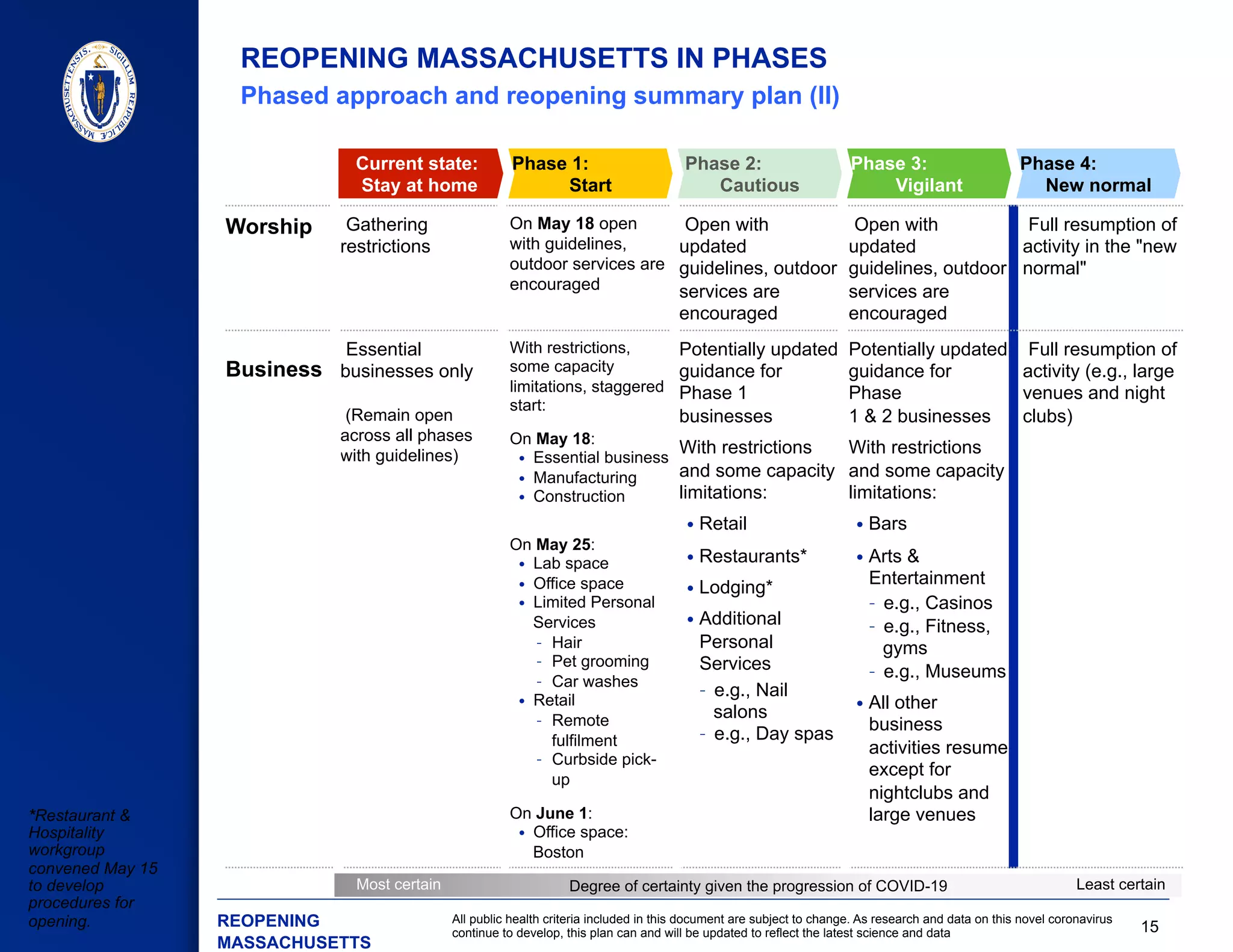
REOPENING MASSACHUSETTS IN PHASES
Worship  Gathering
restrictions
On May 18 open
with guidelines,
outdoor services are
encouraged
 Open with
updated
guidelines, outdoor
services are
encouraged
 Open with
updated
guidelines, outdoor
services are
encouraged
 Full resumption of
activity in the "new
normal"
 
Business
 Essential
businesses only
 (Remain open
across all phases
with guidelines)
With restrictions,
some capacity
limitations, staggered
start:
Potentially updated
guidance for
Phase 1
businesses
With restrictions
and some capacity
limitations:
• Retail
• Restaurants*
• Lodging*
• Additional
Personal
Services
–  e.g., Nail
salons
–  e.g., Day spas
Potentially updated
guidance for
Phase
1 & 2 businesses
With restrictions
and some capacity
limitations:
• Bars
• Arts &
Entertainment
–  e.g., Casinos
–  e.g., Fitness,
gyms
–  e.g., Museums
• All other
business
activities resume
except for
nightclubs and
large venues
 Full resumption of
activity (e.g., large
venues and night
clubs)
On May 18:
•  Essential business
•  Manufacturing
•  Construction
On May 25:
•  Lab space
•  Office space
•  Limited Personal
Services
–  Hair
–  Pet grooming
–  Car washes
•  Retail
–  Remote
fulfilment
–  Curbside pick-
up
On June 1:
•  Office space:
Boston
Current state:
Stay at home
Phase 1:
Start
Phase 3:
Vigilant
Phase 4:
New normal
Phase 2:
Cautious
Phased approach and reopening summary plan (II)
​ *Restaurant &
Hospitality
workgroup
convened May 15
to develop
procedures for
opening.
Degree of certainty given the progression of COVID-19Most certain Least certain
​ REOPENING
MASSACHUSETTS
16
All public health criteria included in this document are subject to change. As research and data on this novel coronavirus
continue to develop, this plan can and will be updated to reflect the latest science and data
Health
and
human
services
Emergency/
Emergent
needs only,
telehealth
encouraged
On May 18, hospitals
and community
health centers:
•  Upon attestation
can provide high
priority preventative
care, pediatric care
and treatment for
high risk patients
and conditions
On May 25,
additional health care
providers:
•  Upon attestation
can provide same
limited services as
above
Expand ambulatory in-person routine
care:
• Less urgent preventative services,
procedures, and care (e.g., routine
dental cleanings, certain elective
procedures)
• Day programs (e.g., Adult Day
Health, Day Habilitation, etc.)
Full resumption of
activity in the
"new normal"
Recreatio
n and
outdoor
Beaches only open
for transitory
activity with no
parking
Parks open with no
services/facilities
 On May 25, can open
with guidelines:
•  Beaches
•  Parks
•  Drive-in theaters
•  Some athletic fields
and courts
•  Many outdoor
adventure activities
•  Most fishing,
hunting, and
boating
•  Outdoor gardens,
zoos, reserves and
public installations
 Can open with
guidelines:
•  Campgrounds
•  Playgrounds
and spray decks
•  Public and
community
pools
•  All athletic fields
and courts with
guidelines
•  Youth sports in
limited fashion
 Can open with
guidelines:
•  Additional
activities and
services
•  Youth sports
with games and
tournaments
(limited crowd
sizes)
Full resumption of
all outdoor
recreation and
activities
REOPENING MASSACHUSETTS IN PHASES
Current state:
Stay at home
Phase 1:
Start
Phase 3:
Vigilant
Phase 4:
New normal
Phase 2:
Cautious
Phased approach and reopening summary plan (III)
​ REOPENING
MASSACHUSETTS
Degree of certainty given the progression of COVID-19Most certain Least certain
17
All public health criteria included in this document are subject to change. As research and data on this novel coronavirus
continue to develop, this plan can and will be updated to reflect the latest science and data
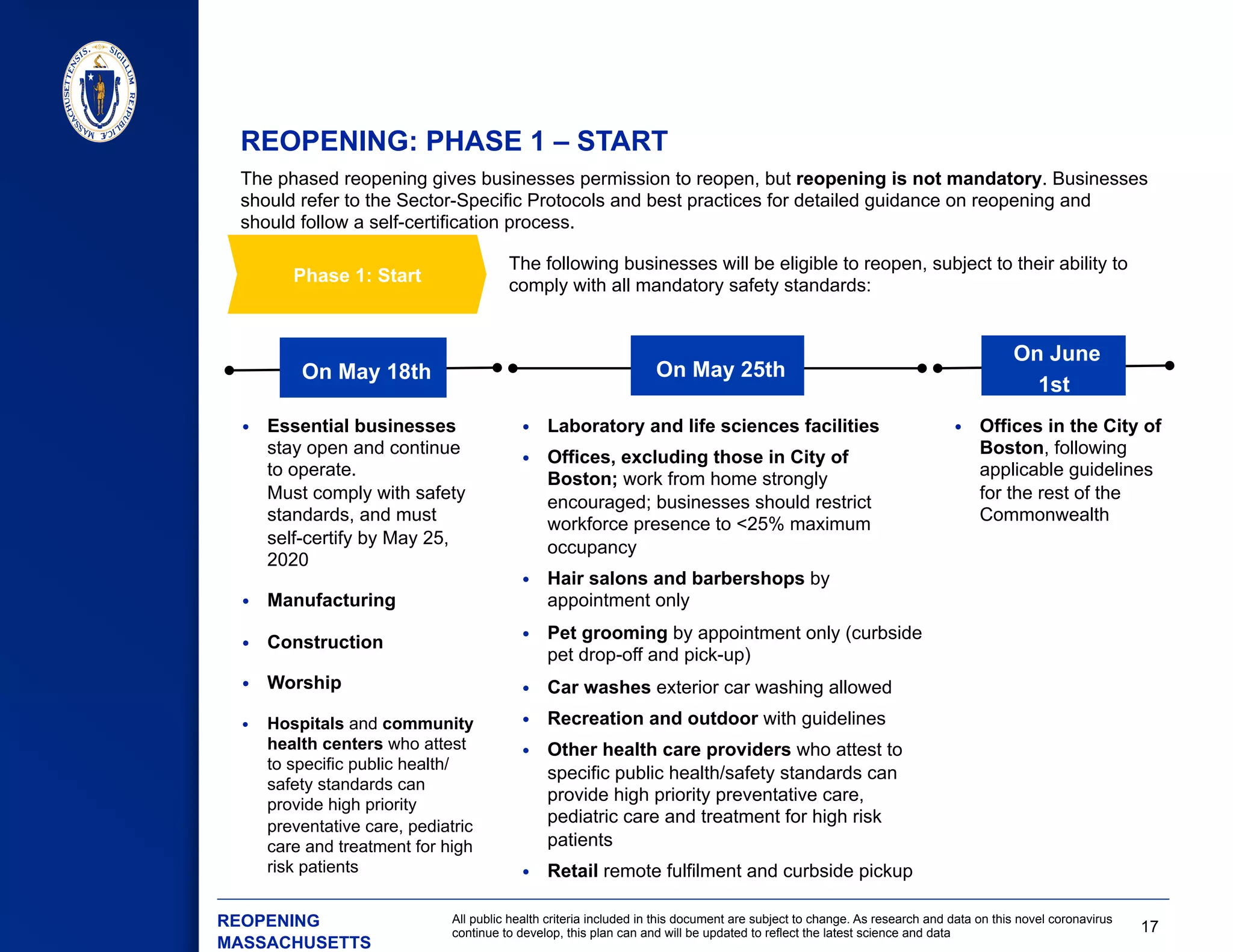
REOPENING: PHASE 1 – START
The phased reopening gives businesses permission to reopen, but reopening is not mandatory. Businesses
should refer to the Sector-Specific Protocols and best practices for detailed guidance on reopening and
should follow a self-certification process.
•  Essential businesses
stay open and continue
to operate.
Must comply with safety
standards, and must
self-certify by May 25,
2020
•  Manufacturing
•  Construction
•  Worship
•  Hospitals and community
health centers who attest
to specific public health/
safety standards can
provide high priority
preventative care, pediatric
care and treatment for high
risk patients
•  Laboratory and life sciences facilities
•  Offices, excluding those in City of
Boston; work from home strongly
encouraged; businesses should restrict
workforce presence to <25% maximum
occupancy
•  Hair salons and barbershops by
appointment only
•  Pet grooming by appointment only (curbside
pet drop-off and pick-up)
•  Car washes exterior car washing allowed
•  Recreation and outdoor with guidelines
•  Other health care providers who attest to
specific public health/safety standards can
provide high priority preventative care,
pediatric care and treatment for high risk
patients
•  Retail remote fulfilment and curbside pickup
•  Offices in the City of
Boston, following
applicable guidelines
for the rest of the
Commonwealth
Phase 1: Start
On May 18th On May 25th
On June
1st
The following businesses will be eligible to reopen, subject to their ability to
comply with all mandatory safety standards:
​ REOPENING
MASSACHUSETTS
18
All public health criteria included in this document are subject to change. As research and data on this novel coronavirus
continue to develop, this plan can and will be updated to reflect the latest science and data
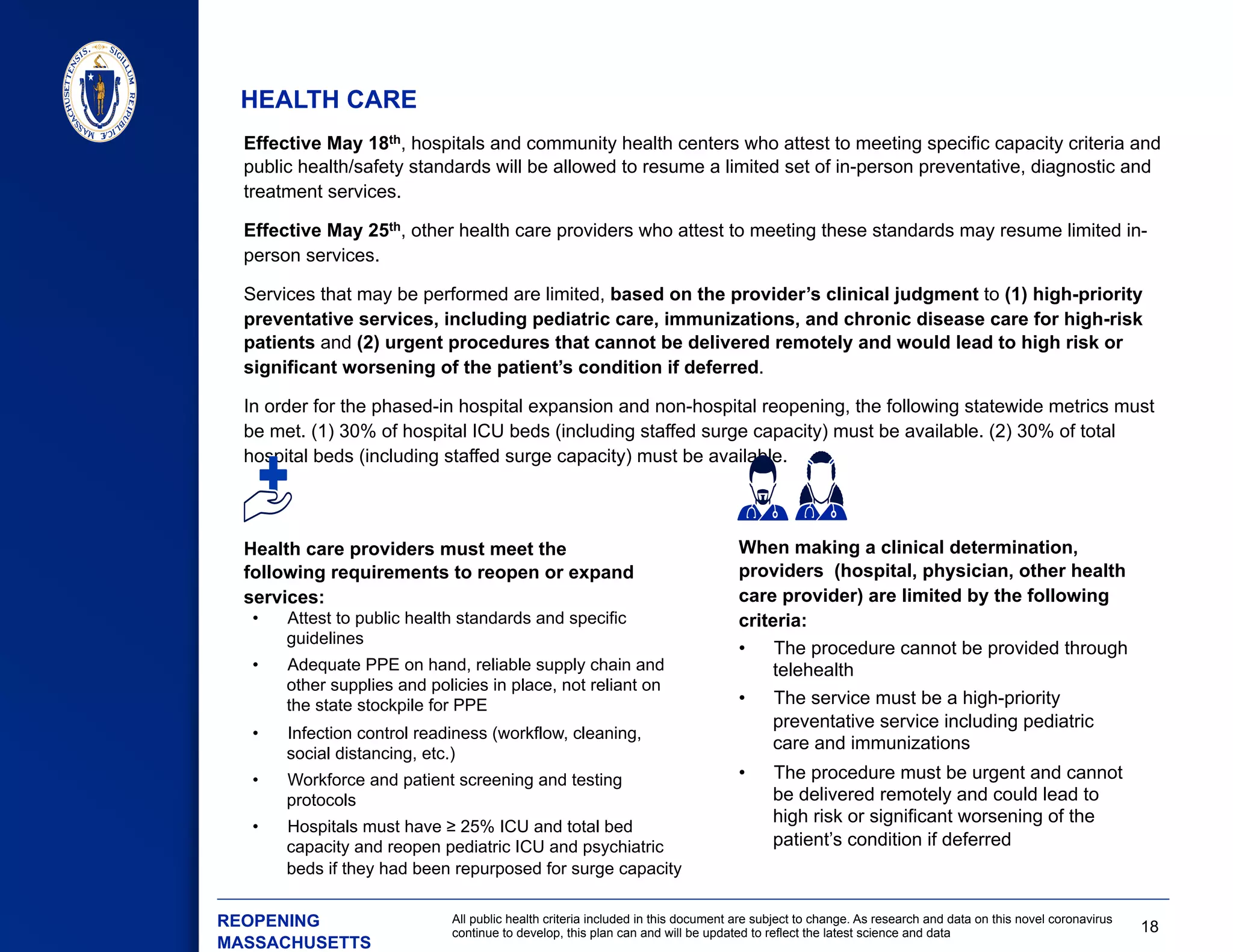
HEALTH CARE
Effective May 18th, hospitals and community health centers who attest to meeting specific capacity criteria and
public health/safety standards will be allowed to resume a limited set of in-person preventative, diagnostic and
treatment services.
Effective May 25th, other health care providers who attest to meeting these standards may resume limited in-
person services.
Services that may be performed are limited, based on the provider’s clinical judgment to (1) high-priority
preventative services, including pediatric care, immunizations, and chronic disease care for high-risk
patients and (2) urgent procedures that cannot be delivered remotely and would lead to high risk or
significant worsening of the patient’s condition if deferred.
In order for the phased-in hospital expansion and non-hospital reopening, the following statewide metrics must
be met. (1) 30% of hospital ICU beds (including staffed surge capacity) must be available. (2) 30% of total
hospital beds (including staffed surge capacity) must be available.
•  The procedure cannot be provided through
telehealth
•  The service must be a high-priority
preventative service including pediatric
care and immunizations
•  The procedure must be urgent and cannot
be delivered remotely and could lead to
high risk or significant worsening of the
patient’s condition if deferred
•  Attest to public health standards and specific
guidelines
•  Adequate PPE on hand, reliable supply chain and
other supplies and policies in place, not reliant on
the state stockpile for PPE
•  Infection control readiness (workflow, cleaning,
social distancing, etc.)
•  Workforce and patient screening and testing
protocols
•  Hospitals must have ≥ 25% ICU and total bed
capacity and reopen pediatric ICU and psychiatric
beds if they had been repurposed for surge capacity
Health care providers must meet the
following requirements to reopen or expand
services:
When making a clinical determination,
providers (hospital, physician, other health
care provider) are limited by the following
criteria:
​ REOPENING
MASSACHUSETTS
19
All public health criteria included in this document are subject to change. As research and data on this novel coronavirus
continue to develop, this plan can and will be updated to reflect the latest science and data
Mandatory self-certification for businesses
In order to reopen, businesses must develop a written COVID-19 Control Plan outlining how its workplace
will prevent the spread of COVID-19. Required Materials are located on mass.gov/reopening, and include:
Note: All reopening businesses must meet these requirements before reopening. Businesses that are
designated as essential may remain open but are required to complete these steps by May 25, 2020.
COVID-19 control plan template
Businesses may complete a template, available on the mass.gov/reopening, to fulfill this
requirement. This plan does not need to be submitted to a state agency for approval, but
must be retained on the premises of the business and be provided in the event of an
inspection.
Compliance attestation
poster
Businesses are required to
sign a poster, attesting that
they have completed a
COVID-19 control plan, and
post it in an area within the
business premises that is
visible to employees and
visitors.
Other posters
Businesses are required to
post signs and posters
describing the rules for
maintaining social
distancing, hygiene
protocols, cleaning, and
disinfecting.
Employ
er
Worker
REOPENING: PHASE 1 – START
​ REOPENING
MASSACHUSETTS
20
All public health criteria included in this document are subject to change. As research and data on this novel coronavirus
continue to develop, this plan can and will be updated to reflect the latest science and data
The Commonwealth's mission in reopening is to increase access to childcare and youth programs, protect
children and staff, and reduce the spread of COVID-19. Child care and summer recreation camps will reopen in
a phased approach. The Departments of Early Education and Care and Public Health are developing guidelines
that balance families' need for child care with heath and safety. The initial reopening plan will focus on families
who have no safe alternative to group care by increasing emergency child care capacity. EEC will also partner
with industries returning to work to develop options specific to their workplaces.
 Prioritizing safe child care options for workers
with no safe alternative to group care.
Leveraging and building capacity across the
emergency child care system.
 Partnering with industries returning to work as
part of this reopening plan to ensure
responsive, innovative options targeted to
specific workplaces.
Opening on a phased basis recreational day
camps in Phase 2 and residential camps in
Phase 3.
 Releasing detailed guidelines in the coming
weeks.
 Childcare operating at reduced
capacity and on an emergency basis
for children of workers with no safe
alternative to group care during Phase
1.
 Implemented virus mitigation
protocols including social distancing,
cleaning and disinfecting, group ratio
changes, isolation and contact tracing
protocols, and extra staffing.
 We continually solicit feedback from
providers about operational support
needed to reopen.
Since March, emergency child care has been
available to children of workers, with extra
virus mitigation protocols
Going forward, we are continuing to tailor
strategies to ensure safe child care and
recreational summer camp options for
Massachusetts families
CARING FOR CHILDREN
​ REOPENING
MASSACHUSETTS
21
All public health criteria included in this document are subject to change. As research and data on this novel coronavirus
continue to develop, this plan can and will be updated to reflect the latest science and data
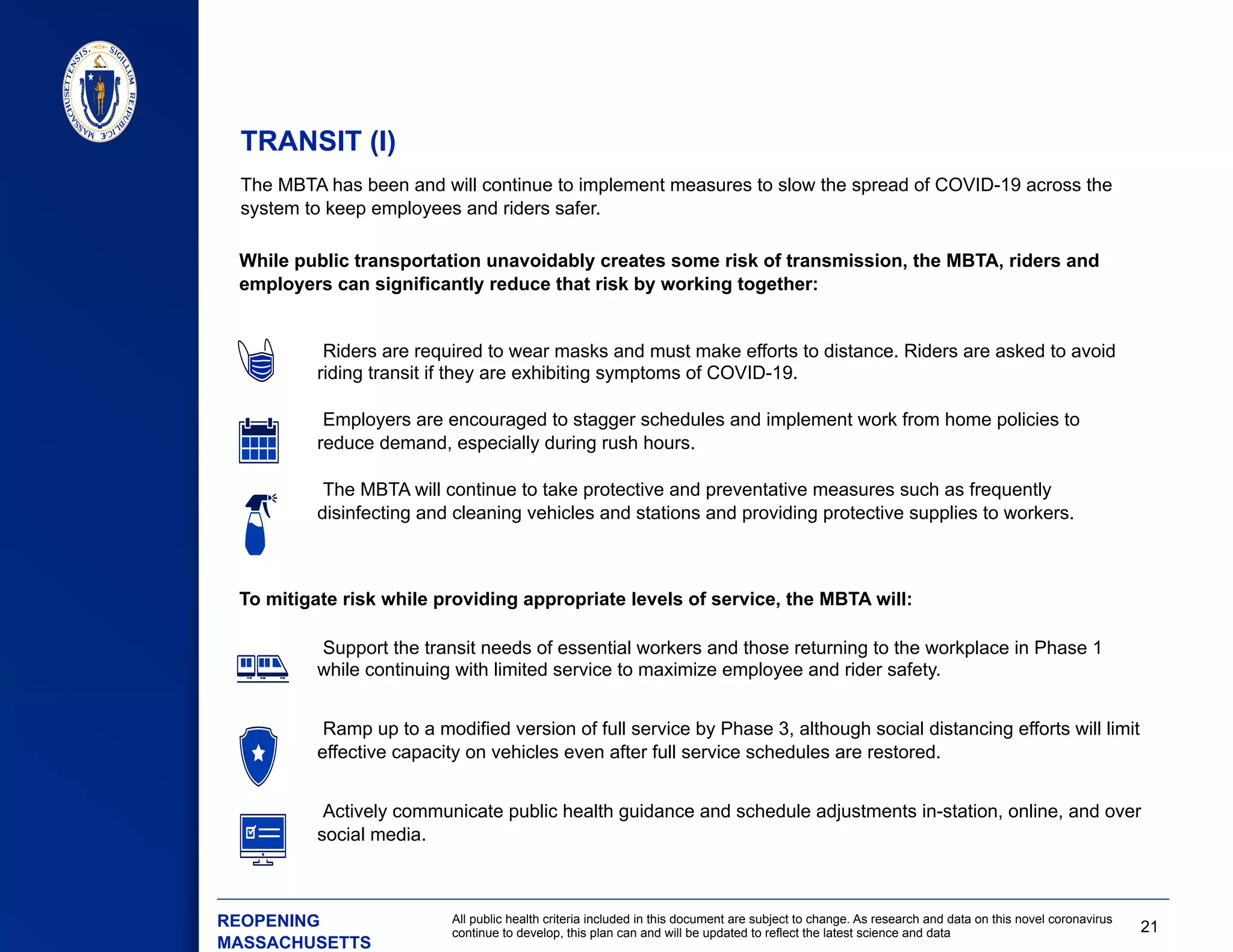
The MBTA has been and will continue to implement measures to slow the spread of COVID-19 across the
system to keep employees and riders safer.
 Support the transit needs of essential workers and those returning to the workplace in Phase 1
while continuing with limited service to maximize employee and rider safety.
 Ramp up to a modified version of full service by Phase 3, although social distancing efforts will limit
effective capacity on vehicles even after full service schedules are restored.
 Actively communicate public health guidance and schedule adjustments in-station, online, and over
social media.
While public transportation unavoidably creates some risk of transmission, the MBTA, riders and
employers can significantly reduce that risk by working together:
TRANSIT (I)
​ REOPENING
MASSACHUSETTS
To mitigate risk while providing appropriate levels of service, the MBTA will:
 Riders are required to wear masks and must make efforts to distance. Riders are asked to avoid
riding transit if they are exhibiting symptoms of COVID-19.
 Employers are encouraged to stagger schedules and implement work from home policies to
reduce demand, especially during rush hours.
 The MBTA will continue to take protective and preventative measures such as frequently
disinfecting and cleaning vehicles and stations and providing protective supplies to workers.
22
All public health criteria included in this document are subject to change. As research and data on this novel coronavirus
continue to develop, this plan can and will be updated to reflect the latest science and data
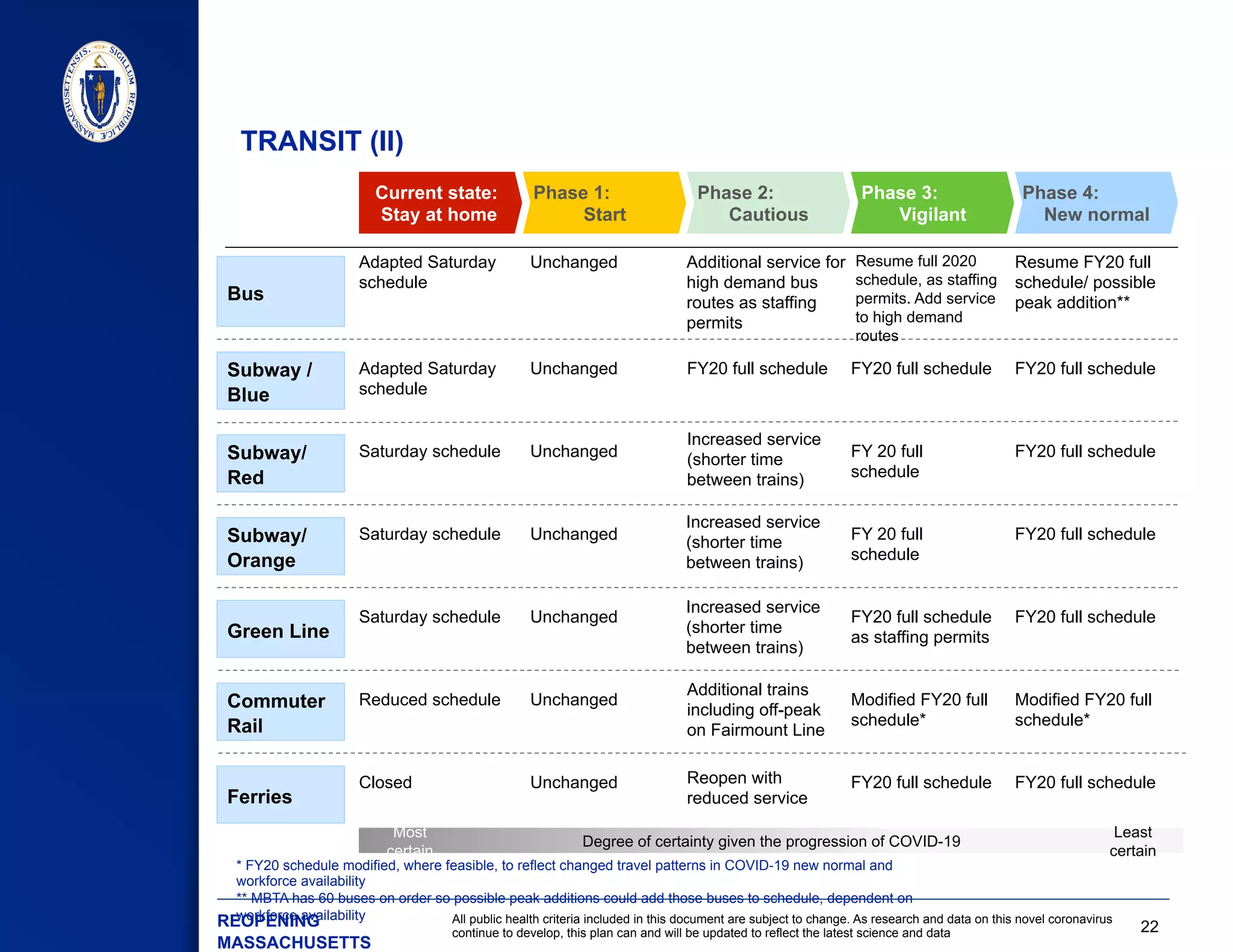
Current state:
Stay at home
Phase 1:
Start
Phase 3:
Vigilant
Phase 4:
New normal
Phase 2:
Cautious
Commuter
Rail
​ Bus
Adapted Saturday
schedule
Unchanged Additional service for
high demand bus
routes as staffing
permits
Resume full 2020
schedule, as staffing
permits. Add service
to high demand
routes
Resume FY20 full
schedule/ possible
peak addition**
Subway /
Blue
Adapted Saturday
schedule
Unchanged FY20 full scheduleFY20 full schedule FY20 full schedule
Subway/
Red
Saturday schedule FY 20 full
schedule
Increased service
(shorter time
between trains)
FY20 full schedule
Subway/
Orange
Saturday schedule FY 20 full
schedule
Increased service
(shorter time
between trains)
FY20 full schedule
Additional trains
including off-peak
on Fairmount Line
Modified FY20 full
schedule*
Modified FY20 full
schedule*
Green Line
Saturday schedule FY20 full schedule
as staffing permits
Increased service
(shorter time
between trains)
FY20 full schedule
Reduced schedule
Ferries
Closed
Unchanged
Unchanged
Unchanged
Unchanged
Unchanged
FY20 full scheduleReopen with
reduced service
FY20 full schedule
Degree of certainty given the progression of COVID-19
Most
certain
Least
certain
TRANSIT (II)
​ REOPENING
MASSACHUSETTS
* FY20 schedule modified, where feasible, to reflect changed travel patterns in COVID-19 new normal and
workforce availability
** MBTA has 60 buses on order so possible peak additions could add those buses to schedule, dependent on
workforce availability
23
All public health criteria included in this document are subject to change. As research and data on this novel coronavirus
continue to develop, this plan can and will be updated to reflect the latest science and data
HYGIENIC AND PROTECTIVE SUPPLIES
​ In order to operate, all Massachusetts businesses will need to meet the Mandatory Workplace Safety
Standards and relevant Sector-Specific Protocols published by the state.
​ The state has developed a guide to educate business owners on what supplies are needed to return to
workplaces, and a portal to connect businesses with manufacturers and distributors.
 Contact and product information for
vendors who have or have had a
contract with the Commonwealth.
 Contract and product information for
manufacturers that have pivoted to
produce hygienic or protective supplies
as part of the
M-ERT process.
Educational materials will be provided to define
how an employer should prepare their work spaces
to reopen and what products are appropriate for
employees to protect themselves at work. Medical
grade face coverings are not necessary for non-
health care workers
A searchable portal has been launched to
connect Massachusetts businesses in need of
supplies with manufacturers whom are actively
producing and selling hygienic and protective
materials in the Commonwealth
 Guidance on protective supplies, including,
but not limited to:
•  What can be used as a face covering
and how to wear it safely
•  When are gloves necessary for
employees, and how to wash your
hands
 Disinfecting and sanitizing guidance and
which materials to use, including, but not
limited to:
•  Disinfecting wipes/spray
•  Sanitizing wipes/spray
•  Hand sanitizer
Access supply vendors on
mass.gov/reopening
 
Manufacturing Emergency Response
Team
 430+
 
Massachusetts
manufacturers
 27
 Graduated M-
ERT
companies
 3.5
 
 Million
pieces of
PPE to date
​ REOPENING
MASSACHUSETTS
24
All public health criteria included in this document are subject to change. As research and data on this novel coronavirus
continue to develop, this plan can and will be updated to reflect the latest science and data
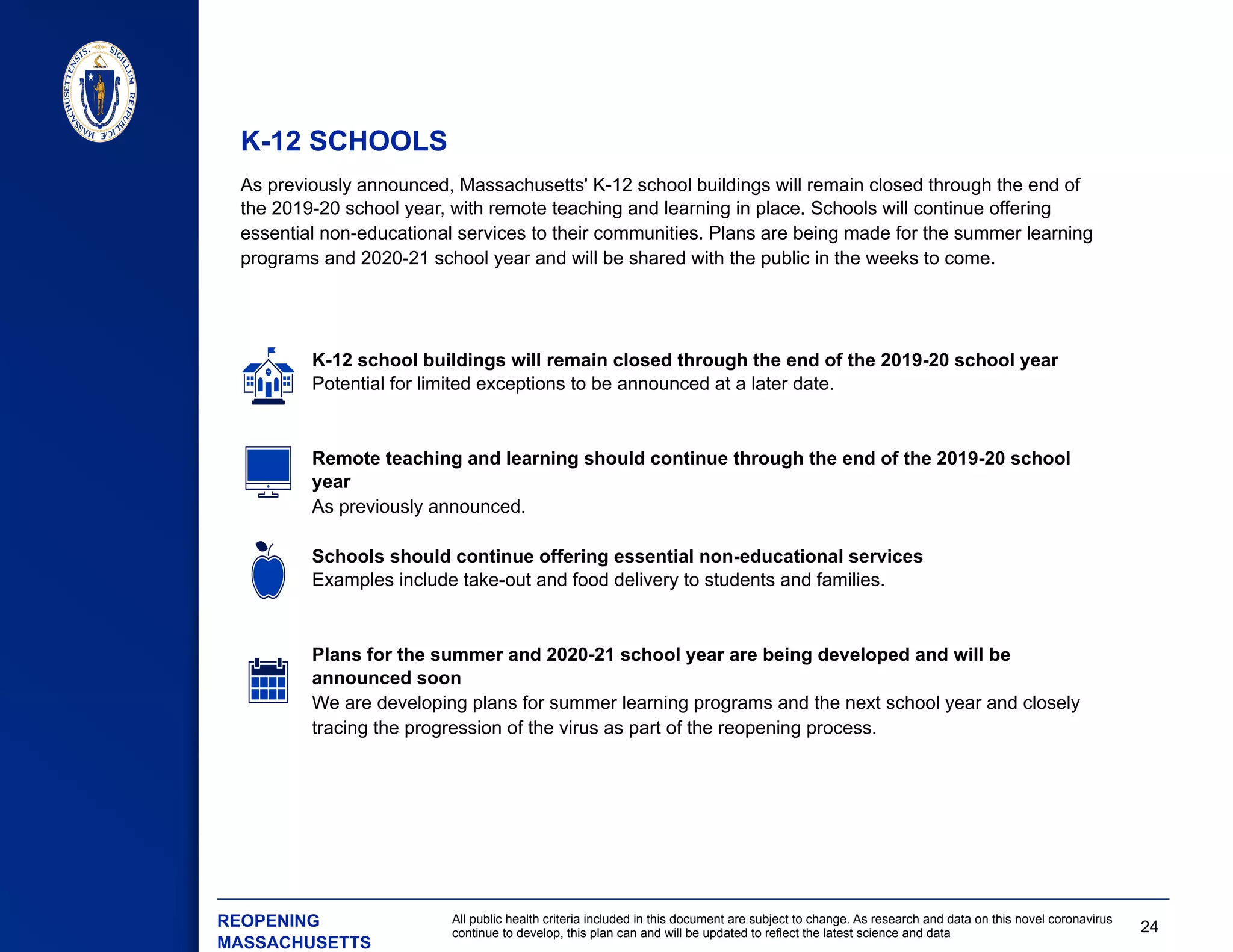
​ As previously announced, Massachusetts' K-12 school buildings will remain closed through the end of
the 2019-20 school year, with remote teaching and learning in place. Schools will continue offering
essential non-educational services to their communities. Plans are being made for the summer learning
programs and 2020-21 school year and will be shared with the public in the weeks to come.
​ K-12 school buildings will remain closed through the end of the 2019-20 school year
​ Potential for limited exceptions to be announced at a later date.
​ Remote teaching and learning should continue through the end of the 2019-20 school
year
​ As previously announced.
​ Schools should continue offering essential non-educational services
​ Examples include take-out and food delivery to students and families.
​ Plans for the summer and 2020-21 school year are being developed and will be
announced soon
​ We are developing plans for summer learning programs and the next school year and closely
tracing the progression of the virus as part of the reopening process.
K-12 SCHOOLS
​ REOPENING
MASSACHUSETTS
25
All public health criteria included in this document are subject to change. As research and data on this novel coronavirus
continue to develop, this plan can and will be updated to reflect the latest science and data
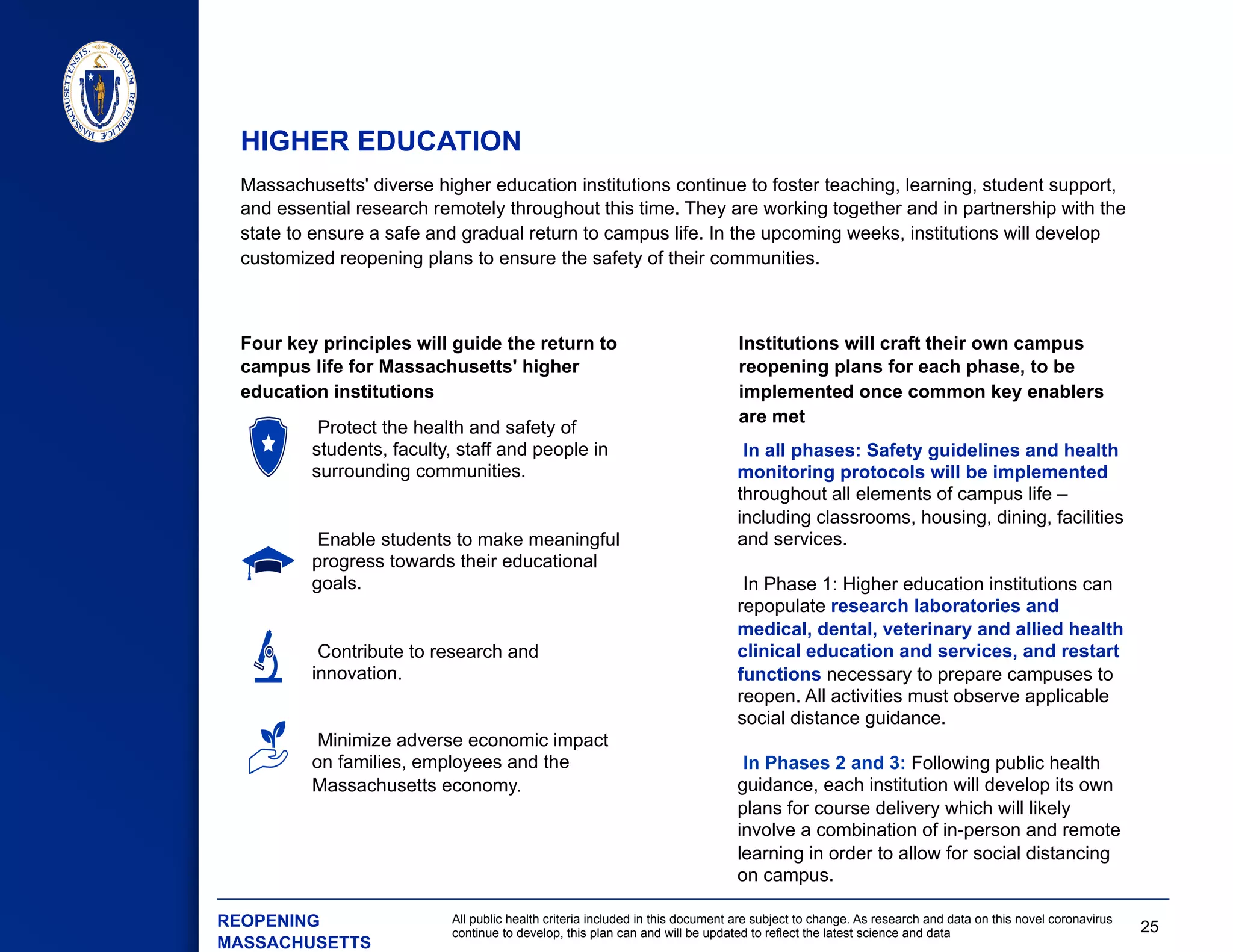
Four key principles will guide the return to
campus life for Massachusetts' higher
education institutions
​ Massachusetts' diverse higher education institutions continue to foster teaching, learning, student support,
and essential research remotely throughout this time. They are working together and in partnership with the
state to ensure a safe and gradual return to campus life. In the upcoming weeks, institutions will develop
customized reopening plans to ensure the safety of their communities.
 In all phases: Safety guidelines and health
monitoring protocols will be implemented
throughout all elements of campus life –
including classrooms, housing, dining, facilities
and services.
 In Phase 1: Higher education institutions can
repopulate research laboratories and
medical, dental, veterinary and allied health
clinical education and services, and restart
functions necessary to prepare campuses to
reopen. All activities must observe applicable
social distance guidance.
 In Phases 2 and 3: Following public health
guidance, each institution will develop its own
plans for course delivery which will likely
involve a combination of in-person and remote
learning in order to allow for social distancing
on campus.
Institutions will craft their own campus
reopening plans for each phase, to be
implemented once common key enablers
are met
 Protect the health and safety of
students, faculty, staff and people in
surrounding communities.
 Enable students to make meaningful
progress towards their educational
goals.
 Contribute to research and
innovation.
 Minimize adverse economic impact
on families, employees and the
Massachusetts economy.
HIGHER EDUCATION
​ REOPENING
MASSACHUSETTS
26
All public health criteria included in this document are subject to change. As research and data on this novel coronavirus
continue to develop, this plan can and will be updated to reflect the latest science and data
For more information:
www.mass.gov/reopening
•  More detailed information on businesses, services, and activities that will open in each
phase
•  Resources for employers and employees
–  Mandatory Workplace Safety Standards
–  Sector-Specific Protocols and best practices
–  Template COVID-19 control plans and workplace posters
•  Copies of this presentation, as well as additional information about the Reopening
Advisory Board
​ REOPENING
MASSACHUSETTS
27
All public health criteria included in this document are subject to change. As research and data on this novel coronavirus
continue to develop, this plan can and will be updated to reflect the latest science and data
We'd like to thank the Reopening Advisory Board and the numerous other stakeholders for their input in
developing this report
Reopening Advisory Board:
 Co-Chairs:
•  Karyn Polito – Lieutenant Governor
•  Mike Kennealy – Secretary, Executive Office of Housing and Economic Development
 Members:
•  Aron Ain – CEO, Kronos Inc & Ultimate Software
•  Joe Bahena – Senior Vice President, Joseph Abboud Manufacturing
•  Monica Bharel MD, MPH – Commissioner of the Massachusetts Department of Public Health
•  Kathryn Burton – Chief of Staff, City of Boston
•  Steve DiFillippo – CEO, Davio's Restaurants
•  Pamela Everhart – Head of Regional Public Affairs and Community Relations, Fidelity Investments
•  Wendy Hudson – Owner, Nantucket Book Partners / Co-Founder, Cisco Brewers
•  Mark Keroack – MD, MPH, President & CEO, Baystate Health
•  Nicole LaChapelle – Mayor, City of Easthampton
•  Laurie Leshin – Ph.D., President, Worcester Polytechnic Institute
•  Linda Markham - President, Cape Air
•  Girish Navani – CEO and Co-Founder, eClinicalWorks
•  Stephanie Pollack – Secretary of Transportation
•  Daniel Rivera – Mayor, City of Lawrence
•  Corey Thomas – CEO, Rapid 7
•  Rochelle Walensky – MD, MPH, Massachusetts General Hospital
•  Carlo Zaffanella – Vice President and General Manager, Maritime & Strategic Systems, General
Dynamics Mission Systems
THANK YOU
​ REOPENING
MASSACHUSETTS
28
All public health criteria included in this document are subject to change. As research and data on this novel coronavirus
continue to develop, this plan can and will be updated to reflect the latest science and data
COVID-19 Updates and Information –
https://www.mass.gov/info-details/covid-19-updates-and-information
COVID-19 Prevention and Treatment –
https://www.mass.gov/info-details/covid-19-prevention-and-treatment
​ COVID-19 Resources and Guidance for Businesses –
https://www.mass.gov/info-details/covid-19-resources-and-guidance-for-businesses
​ COVID-19 Response Reporting –
https://www.mass.gov/info-details/covid-19-response-reporting
Guidance: Wear a Mask In Public (Issued May 1, 2020) –
https://www.mass.gov/news/wear-a-mask-in-public
Mandatory Workplace Safety Standards –
https://www.mass.gov/info-details/reopening-mandatory-safety-standards-for-workplaces
Travel Information Related to COVID-19 –
https://www.mass.gov/info-details/travel-information-related-to-covid-19#travel-to-massachusetts-
Cover Photo Credits –
George Headley, Laurie Turner, Joshua Qualls and David Mark via Pixabay
OTHER RESOURCES
​ REOPENING
MASSACHUSETTS
Confidential

Final Reopening Of Massachusetts

  • 1.
  • 2.
    2 All public healthcriteria included in this document are subject to change. As research and data on this novel coronavirus continue to develop, this plan can and will be updated to reflect the latest science and data THE ROAD WE'VE TRAVELLED TOGETHER Massachusetts has been one of the hardest hit states in the U.S., with over 86,000 confirmed cases and 5,700 deaths through May 17, 2020. On March 23, 2020 Governor Baker issued an executive order closing all non-essential businesses across the Commonwealth in order to reduce the transmission of COVID-19. In combatting COVID-19, the Baker-Polito administration has: •  In partnership with healthcare providers and municipalities, conducted more than 460,000 COVID-19 tests, making Massachusetts a top-5 per capita tester •  Launched a national model for contact tracing •  Committed over $1 billion in funding to support our health care system •  Distributed more than 10.5 million pieces of personal protective equipment Number of confirmed COVID-19 cases, per 100k population (thousands) As of 5/12/2020 ​ 0.7 ​ Illinois ​ Massachusetts ​ New York ​ New Jersey ​ US Average ​ Connecticut ​ Delaware ​ Rhode Island ​ District of Columbia ​ Louisiana ​ Maryland ​ 1.7 ​ 1.6 ​ 1.1 ​ 1.1 ​ 1.0 ​ 0.9 ​ 0.7 ​ 0.7 ​ 0.6 March 10 State of Emergency declared March 14 COVID-19 Command Center established March 23 Non-essential businesses closed April 28 Business closures extended May 18th Reopening announcement ​ REOPENING MASSACHUSETTS
  • 3.
    3 All public healthcriteria included in this document are subject to change. As research and data on this novel coronavirus continue to develop, this plan can and will be updated to reflect the latest science and data GETTING STARTED ON THE PATH TO REOPENING On April 28, Governor Baker formed the Reopening Advisory Board, chaired by Lieutenant Governor Karyn Polito and Secretary of Housing and Economic Development Mike Kennealy, and comprised of representatives from the business community, public health officials, and municipal leaders from across the Commonwealth. In crafting this report, the Reopening Advisory Board and other state officials: •  Heard testimony from more than 75 business associations, labor unions, non-profits, and community coalitions that collectively represent more than 112,000 businesses and more than 2,000,000 employees •  Received and reviewed more than 4,600 written submissions from associations, businesses, and residents •  Engaged stakeholders and analyzed information in over 45 hours of Zoom meetings over the past 20 days ​ REOPENING MASSACHUSETTS
  • 4.
    4 All public healthcriteria included in this document are subject to change. As research and data on this novel coronavirus continue to develop, this plan can and will be updated to reflect the latest science and data WORKING TOGETHER TO REOPEN Working Together to Reopen Employers  Set business practices that adhere to the Mandatory Workplace Safety Standards and Sector-Specific Protocols for your industry Individuals •  Cover your face •  Wash your hands •  Socially distance •  Be vigilant for symptoms •  Stay home if you feel sick Health system  Monitor progression to ensure sufficient system capacity to meet needs Employees  Abide by employer practices that adhere to the mandatory safety standards and sector specific protocols  Government •  Set standards in the interest of public health •  Invest in necessary capabilities •  Communicate to and educate the public •  Regularly track and report COVID-19 data •  Expand testing capacity Until a treatment or vaccine for COVID-19 is available, life will not return to normal. We each have a collective responsibility to ensure that reopening proceeds smoothly and safely. Everyone must follow public health directives and use common sense to protect yourself, your family, your neighbors, and vulnerable populations across the Commonwealth. ​ REOPENING MASSACHUSETTS
  • 5.
    5 All public healthcriteria included in this document are subject to change. As research and data on this novel coronavirus continue to develop, this plan can and will be updated to reflect the latest science and data 16.5 16.1 15.9 15.3 14.8 14.1 13.7 13.1 12.9 12.8 12.2 11.7 11.3 10.9 10.5 10.4 10 15 20 ​ 2.5 ​ 3.5 ​ 3.0 ​ 4.0 ​ 3.4 ​ 3.1 ​ 3.6 ​ 2.8 ​ 3.7 ​ 3.6 ​ 3.6 ​ 3.5 ​ 3.5 ​ 3.3 ​ 3.2 ​ 3.2 ​ 3.1 ​ 2.9 ​ 3.0 ​ 2.7 7-day avg. of positive test results, by date patient tested (%) REOPENING WILL BE DRIVEN BY PUBLIC HEALTH DATA 3-day avg. of hospitalizati ons (000s) 23 21 19 20 21 21 19 19 19 18 20 16 18 18 17 18 15 20 25 159 151 150 136 135 134 133 123 113 109 114 115 111 99 ​ 5/6​ 5/4​ 5/3 ​ 5/9 ​ 5/12 ​ 5/15 ​ 100 ​ 5/1 ​ 125 ​ 150 ​ 175 ​ 5/5 ​ 5/14​ 5/11 ​ 200 ​ 5/17​ 5/8​ 5/2 ​ 5/7 ​ 5/10 ​ 5/13 ​ 5/16 # hospitals using ICU surge capacity 3 day average of deaths by date of death (#) % decrease from 4/15 63 25 14 35 Source: MA COVID Command Center, May 2020 •  Key public health metrics will determine if and when it is appropriate to proceed through reopening phases •  Public health data trends indicating significant increases in viral transmission could result in returning to prior phases or closing sectors of the economy ​ REOPENING MASSACHUSETTS
  • 6.
    6 All public healthcriteria included in this document are subject to change. As research and data on this novel coronavirus continue to develop, this plan can and will be updated to reflect the latest science and data •  Test: Increase testing capacity and number of people tested so people with COVID-19 are aware of their diagnosis and can self-isolate •  Trace: Trace all contacts of people with COVID-19 to ensure safe quarantine and testing for those who need it •  Isolate: Minimize transmission by isolating and quarantining individuals with COVID-19 and their close contacts •  Support: Provide support so individuals can safely isolate and quarantine ​ REOPENING MASSACHUSETTS MASSACHUSETTS TESTING & TRACING STRATEGY
  • 7.
    7 All public healthcriteria included in this document are subject to change. As research and data on this novel coronavirus continue to develop, this plan can and will be updated to reflect the latest science and data Indicator Status COVID-19 positive test rate Number of individuals who died from COVID-19 Number of patients with COVID-19 in hospitals Healthcare system readiness Testing capacity Contact tracing capabilities 1 2 3 4 Legend Negative trend In progress Positive trend Dashboard of public health indicators •  Starting on May 18, the COVID-19 Command Center will give updates on six key public health indicators •  Before and during reopening, these metrics must continue to show progress Below is the status as of May 18, 2020: 5 6 REOPENING WILL BE DRIVEN BY PUBLIC HEALTH DATA ​ REOPENING MASSACHUSETTS
  • 8.
    8 All public healthcriteria included in this document are subject to change. As research and data on this novel coronavirus continue to develop, this plan can and will be updated to reflect the latest science and data As we reopen the Massachusetts economy, the Baker-Polito administration will provide guidance that each sector, industry, and business must follow: REOPENING AND FIGHTING COVID-19  Social guidance  Business guidance  General social guidance  Guidance all individuals must follow to reduce the risk of new COVID-19 transmission: •  Cover your face •  Wash your hands •  Socially distance •  Be vigilant for symptoms •  Stay home if you feel sick  Mandatory Workplace Safety Standards New standards for all workplaces that are designed to reduce the risk of new COVID-19 transmission to employees and customers  Sector-Specific Protocols and best practices Additional safety standards and recommended best practices to reduce the risk of new COVID-19 transmission in specific industries (e.g. restaurants, construction, etc.) ​ REOPENING MASSACHUSETTS
  • 9.
    9 All public healthcriteria included in this document are subject to change. As research and data on this novel coronavirus continue to develop, this plan can and will be updated to reflect the latest science and data On May 18, the Baker-Polito administration issued the Safer At Home Advisory: REOPENING AND FIGHTING COVID-19  Cover – Wash – Distance – Vigilance ü  People over the age of 65 and people who have underlying health conditions – who are at high risk for COVID-19 – should continue to stay home except for essential errands such as going to the grocery store and to attend to healthcare needs ü  All residents are advised to leave home only for healthcare, worship and permitted work, shopping, and outdoor activities ü  All residents are REQUIRED to cover their face when they cannot maintain six feet of social distance in public ü  All residents are advised to wash their hands frequently for at least 20 seconds with soapy water ü  All residents are advised to be vigilant, monitor for symptoms and stay home if you feel sick What Safer At Home Means •  Only leave home for health care, permitted work, shopping, and outdoor activities •  When going to the pharmacy ask if you can fill your prescriptions for 90 days if possible; for some medications this is not allowed. If you are at high- risk, try to use a mail-order service •  Don’t participate in close contact activities such as pick-up sports games •  Use remote modes of communication like phone or video chat instead of visiting friends or family who are high risk for COVID-19 •  Refrain from visiting nursing homes, skilled nursing facilities, or other residential care settings •  Parents should limit play dates for children ​ REOPENING MASSACHUSETTS
  • 10.
    10 All public healthcriteria included in this document are subject to change. As research and data on this novel coronavirus continue to develop, this plan can and will be updated to reflect the latest science and data Mandatory Workplace Safety Standards for reopening ​ Note: Businesses operating to provide Essential Services, as defined in the Governor's March 23, 2020 Executive Order, updated on March 31, April 28 and May 15, may remain open and have until May 25, 2020 to comply with these mandatory safety standards. All businesses and activities, as they reopen, must meet the following minimum safety standards: Social Distancing •  All persons, including employees, customers, and vendors should remain at least six feet apart to the greatest extent possible, both inside and outside workplaces •  Establish protocols to ensure that employees can practice adequate social distancing •  Provide signage for safe social distancing •  Require face coverings or masks for all employees Hygiene Protocols •  Provide hand washing capabilities throughout the workplace •  Ensure frequent hand washing and ensure adequate supplies •  Provide regular sanitization of high touch areas, such as workstations, equipment, screens, doorknobs, restrooms throughout work site Staffing and Operations •  Provide training for employees regarding the social distancing and hygiene protocols •  Employees who are displaying COVID-19-like symptoms do not report to work •  Establish a plan for employees getting ill from COVID-19 at work, and a return-to-work plan Cleaning and Disinfecting •  Establish and maintain cleaning protocols specific to the business •  When an active employee is diagnosed with COVID-19, cleaning and disinfecting must be performed •  Disinfection of all common surfaces must take place at intervals appropriate to said workplace REOPENING AND FIGHTING COVID-19 ​ REOPENING MASSACHUSETTS
  • 11.
    11 All public healthcriteria included in this document are subject to change. As research and data on this novel coronavirus continue to develop, this plan can and will be updated to reflect the latest science and data Sector-Specific Protocols and best practices The Baker-Polito administration has developed specific guidance so that each industry reopens as safely as possible. Businesses are expected to implement these protocols in addition to the more general Mandatory Workplace Safety Standards. As of May 18, materials for the sectors eligible to open in the first phase of reopening are included on the mass.gov/reopening. Guidance for sectors opening in later phases will be posted online in advance of those phases. Each sector will have access to: Sector Circular Mandatory safety standards and recommended best practices in social distancing, hygiene protocols, staffing/ operations, and cleaning/disinfecting for each sector. Sector Checklist Checklist developed to serve as guidance for employers and businesses of all sizes as they adjust operations to address worker and customer safety. REOPENING AND FIGHTING COVID-19 ​ Note: Businesses operating to provide Essential Services, as defined in the Governor's March 23, 2020 Executive Order, updated on March 31, April 28 and May 15, may remain open and have until May 25, 2020 to comply with their industry’s sector specific protocols (if applicable). ​ REOPENING MASSACHUSETTS
  • 12.
    12 All public healthcriteria included in this document are subject to change. As research and data on this novel coronavirus continue to develop, this plan can and will be updated to reflect the latest science and data REOPENING MASSACHUSETTS IN PHASES Current state: Stay at home Phase 1: Start Phase 3: Vigilant Phase 4: New normal Phase 2: Cautious  Limited industries resume operations with severe restrictions  Additional industries resume operations with restrictions and capacity limitations  Additional industries resume operations with guidance  Development of vaccines and / or treatments enable resumption of "new normal"  Essential business and services only The goal of this phased reopening plan is to methodically allow businesses, services, and activities to resume, while avoiding a resurgence of COVID-19 that could overwhelm our healthcare system and erase the progress we’ve made so far. •  Each phase will last a minimum of three weeks and could last longer before moving to the next phase •  If public health data trends are negative, specific industries, regions, and/or the entire Commonwealth may need to return to an earlier phase •  The Commonwealth will partner with industries to draft Sector-Specific Protocols in advance of future phases (example: restaurant specific protocols will be drafted in advance of Phase 2) •  If we all work together to defeat COVID-19, we can proceed through each phase ​ REOPENING MASSACHUSETTS
  • 13.
    13 All public healthcriteria included in this document are subject to change. As research and data on this novel coronavirus continue to develop, this plan can and will be updated to reflect the latest science and data REOPENING MASSACHUSETTS IN PHASES Economic benefit of reopening Public health risk of reopening Contact intensity, % of public-facing roles Unemployment claims, median income, % of small and medium businesses higher lower Phase 4 The Baker-Polito administration's data-driven approach to reopening the economy used a framework that considered the public health risk and the economic benefit of reopening each of the closed sectors of our economy. In addition to this framework, the Baker-Polito administration looked to what other states are doing, including our immediate neighbors and those that were similarly impacted by COVID-19. Framework to inform which sectors should be considered for reopening in each phase: higher lower Phase 2 Phase 3 Phase 1 Illustrative sectors ​ REOPENING MASSACHUSETTS
  • 14.
    14 All public healthcriteria included in this document are subject to change. As research and data on this novel coronavirus continue to develop, this plan can and will be updated to reflect the latest science and data REOPENING MASSACHUSETTS IN PHASES Social guidance High risk populations As defined by the CDC •  High risk should work from home if possible, priority consideration for workplace accommodation s •  High risk should work from home if possible, priority consideration for workplace accommodation s •  High risk should work from home if possible, priority consideration for workplace accommodation s •  High risk should work from home if possible; priority consideration for workplace accommodations (these could be adjusted depending on pending epidemiological evidence) •  Resume public interactions with physical distancing Gathering size •  Gatherings of <10 people •  Gatherings of <10 people •  To be determined based on trends •  To be determined based on trends •  To be determined based on trends Travel •  Stay at home advisory •  All travelers to MA urged to self- quarantine for 14 days •  Lodging restricted to essential workers only •  Safer at home advisoryAll travelers to MA urged to self- quarantine for 14 days •  Lodging restricted to essential workers only •  Business and recreational travel discouraged •  All travelers to MA urged to self- quarantine for 14 days •  Lodging open with restrictions •  To be determined based on trends •  Travel resumes, continue to observe social guidance Current state: Stay at home Phase 1: Start Phase 3: Vigilant Phase 4: New normal Phase 2: Cautious Phased approach and reopening summary plan (I) As residents of Massachusetts, we are all in this together. Across all phases of reopening, please: Cover your face Wash your hands Socially distance Be vigilant for symptoms Stay home if you feel sick Degree of certainty given the progression of COVID-19Most certain Least certain
  • 15.
    15 All public healthcriteria included in this document are subject to change. As research and data on this novel coronavirus continue to develop, this plan can and will be updated to reflect the latest science and data REOPENING MASSACHUSETTS IN PHASES Worship  Gathering restrictions On May 18 open with guidelines, outdoor services are encouraged  Open with updated guidelines, outdoor services are encouraged  Open with updated guidelines, outdoor services are encouraged  Full resumption of activity in the "new normal"   Business  Essential businesses only  (Remain open across all phases with guidelines) With restrictions, some capacity limitations, staggered start: Potentially updated guidance for Phase 1 businesses With restrictions and some capacity limitations: • Retail • Restaurants* • Lodging* • Additional Personal Services –  e.g., Nail salons –  e.g., Day spas Potentially updated guidance for Phase 1 & 2 businesses With restrictions and some capacity limitations: • Bars • Arts & Entertainment –  e.g., Casinos –  e.g., Fitness, gyms –  e.g., Museums • All other business activities resume except for nightclubs and large venues  Full resumption of activity (e.g., large venues and night clubs) On May 18: •  Essential business •  Manufacturing •  Construction On May 25: •  Lab space •  Office space •  Limited Personal Services –  Hair –  Pet grooming –  Car washes •  Retail –  Remote fulfilment –  Curbside pick- up On June 1: •  Office space: Boston Current state: Stay at home Phase 1: Start Phase 3: Vigilant Phase 4: New normal Phase 2: Cautious Phased approach and reopening summary plan (II) ​ *Restaurant & Hospitality workgroup convened May 15 to develop procedures for opening. Degree of certainty given the progression of COVID-19Most certain Least certain ​ REOPENING MASSACHUSETTS
  • 16.
    16 All public healthcriteria included in this document are subject to change. As research and data on this novel coronavirus continue to develop, this plan can and will be updated to reflect the latest science and data Health and human services Emergency/ Emergent needs only, telehealth encouraged On May 18, hospitals and community health centers: •  Upon attestation can provide high priority preventative care, pediatric care and treatment for high risk patients and conditions On May 25, additional health care providers: •  Upon attestation can provide same limited services as above Expand ambulatory in-person routine care: • Less urgent preventative services, procedures, and care (e.g., routine dental cleanings, certain elective procedures) • Day programs (e.g., Adult Day Health, Day Habilitation, etc.) Full resumption of activity in the "new normal" Recreatio n and outdoor Beaches only open for transitory activity with no parking Parks open with no services/facilities  On May 25, can open with guidelines: •  Beaches •  Parks •  Drive-in theaters •  Some athletic fields and courts •  Many outdoor adventure activities •  Most fishing, hunting, and boating •  Outdoor gardens, zoos, reserves and public installations  Can open with guidelines: •  Campgrounds •  Playgrounds and spray decks •  Public and community pools •  All athletic fields and courts with guidelines •  Youth sports in limited fashion  Can open with guidelines: •  Additional activities and services •  Youth sports with games and tournaments (limited crowd sizes) Full resumption of all outdoor recreation and activities REOPENING MASSACHUSETTS IN PHASES Current state: Stay at home Phase 1: Start Phase 3: Vigilant Phase 4: New normal Phase 2: Cautious Phased approach and reopening summary plan (III) ​ REOPENING MASSACHUSETTS Degree of certainty given the progression of COVID-19Most certain Least certain
  • 17.
    17 All public healthcriteria included in this document are subject to change. As research and data on this novel coronavirus continue to develop, this plan can and will be updated to reflect the latest science and data REOPENING: PHASE 1 – START The phased reopening gives businesses permission to reopen, but reopening is not mandatory. Businesses should refer to the Sector-Specific Protocols and best practices for detailed guidance on reopening and should follow a self-certification process. •  Essential businesses stay open and continue to operate. Must comply with safety standards, and must self-certify by May 25, 2020 •  Manufacturing •  Construction •  Worship •  Hospitals and community health centers who attest to specific public health/ safety standards can provide high priority preventative care, pediatric care and treatment for high risk patients •  Laboratory and life sciences facilities •  Offices, excluding those in City of Boston; work from home strongly encouraged; businesses should restrict workforce presence to <25% maximum occupancy •  Hair salons and barbershops by appointment only •  Pet grooming by appointment only (curbside pet drop-off and pick-up) •  Car washes exterior car washing allowed •  Recreation and outdoor with guidelines •  Other health care providers who attest to specific public health/safety standards can provide high priority preventative care, pediatric care and treatment for high risk patients •  Retail remote fulfilment and curbside pickup •  Offices in the City of Boston, following applicable guidelines for the rest of the Commonwealth Phase 1: Start On May 18th On May 25th On June 1st The following businesses will be eligible to reopen, subject to their ability to comply with all mandatory safety standards: ​ REOPENING MASSACHUSETTS
  • 18.
    18 All public healthcriteria included in this document are subject to change. As research and data on this novel coronavirus continue to develop, this plan can and will be updated to reflect the latest science and data HEALTH CARE Effective May 18th, hospitals and community health centers who attest to meeting specific capacity criteria and public health/safety standards will be allowed to resume a limited set of in-person preventative, diagnostic and treatment services. Effective May 25th, other health care providers who attest to meeting these standards may resume limited in- person services. Services that may be performed are limited, based on the provider’s clinical judgment to (1) high-priority preventative services, including pediatric care, immunizations, and chronic disease care for high-risk patients and (2) urgent procedures that cannot be delivered remotely and would lead to high risk or significant worsening of the patient’s condition if deferred. In order for the phased-in hospital expansion and non-hospital reopening, the following statewide metrics must be met. (1) 30% of hospital ICU beds (including staffed surge capacity) must be available. (2) 30% of total hospital beds (including staffed surge capacity) must be available. •  The procedure cannot be provided through telehealth •  The service must be a high-priority preventative service including pediatric care and immunizations •  The procedure must be urgent and cannot be delivered remotely and could lead to high risk or significant worsening of the patient’s condition if deferred •  Attest to public health standards and specific guidelines •  Adequate PPE on hand, reliable supply chain and other supplies and policies in place, not reliant on the state stockpile for PPE •  Infection control readiness (workflow, cleaning, social distancing, etc.) •  Workforce and patient screening and testing protocols •  Hospitals must have ≥ 25% ICU and total bed capacity and reopen pediatric ICU and psychiatric beds if they had been repurposed for surge capacity Health care providers must meet the following requirements to reopen or expand services: When making a clinical determination, providers (hospital, physician, other health care provider) are limited by the following criteria: ​ REOPENING MASSACHUSETTS
  • 19.
    19 All public healthcriteria included in this document are subject to change. As research and data on this novel coronavirus continue to develop, this plan can and will be updated to reflect the latest science and data Mandatory self-certification for businesses In order to reopen, businesses must develop a written COVID-19 Control Plan outlining how its workplace will prevent the spread of COVID-19. Required Materials are located on mass.gov/reopening, and include: Note: All reopening businesses must meet these requirements before reopening. Businesses that are designated as essential may remain open but are required to complete these steps by May 25, 2020. COVID-19 control plan template Businesses may complete a template, available on the mass.gov/reopening, to fulfill this requirement. This plan does not need to be submitted to a state agency for approval, but must be retained on the premises of the business and be provided in the event of an inspection. Compliance attestation poster Businesses are required to sign a poster, attesting that they have completed a COVID-19 control plan, and post it in an area within the business premises that is visible to employees and visitors. Other posters Businesses are required to post signs and posters describing the rules for maintaining social distancing, hygiene protocols, cleaning, and disinfecting. Employ er Worker REOPENING: PHASE 1 – START ​ REOPENING MASSACHUSETTS
  • 20.
    20 All public healthcriteria included in this document are subject to change. As research and data on this novel coronavirus continue to develop, this plan can and will be updated to reflect the latest science and data The Commonwealth's mission in reopening is to increase access to childcare and youth programs, protect children and staff, and reduce the spread of COVID-19. Child care and summer recreation camps will reopen in a phased approach. The Departments of Early Education and Care and Public Health are developing guidelines that balance families' need for child care with heath and safety. The initial reopening plan will focus on families who have no safe alternative to group care by increasing emergency child care capacity. EEC will also partner with industries returning to work to develop options specific to their workplaces.  Prioritizing safe child care options for workers with no safe alternative to group care. Leveraging and building capacity across the emergency child care system.  Partnering with industries returning to work as part of this reopening plan to ensure responsive, innovative options targeted to specific workplaces. Opening on a phased basis recreational day camps in Phase 2 and residential camps in Phase 3.  Releasing detailed guidelines in the coming weeks.  Childcare operating at reduced capacity and on an emergency basis for children of workers with no safe alternative to group care during Phase 1.  Implemented virus mitigation protocols including social distancing, cleaning and disinfecting, group ratio changes, isolation and contact tracing protocols, and extra staffing.  We continually solicit feedback from providers about operational support needed to reopen. Since March, emergency child care has been available to children of workers, with extra virus mitigation protocols Going forward, we are continuing to tailor strategies to ensure safe child care and recreational summer camp options for Massachusetts families CARING FOR CHILDREN ​ REOPENING MASSACHUSETTS
  • 21.
    21 All public healthcriteria included in this document are subject to change. As research and data on this novel coronavirus continue to develop, this plan can and will be updated to reflect the latest science and data The MBTA has been and will continue to implement measures to slow the spread of COVID-19 across the system to keep employees and riders safer.  Support the transit needs of essential workers and those returning to the workplace in Phase 1 while continuing with limited service to maximize employee and rider safety.  Ramp up to a modified version of full service by Phase 3, although social distancing efforts will limit effective capacity on vehicles even after full service schedules are restored.  Actively communicate public health guidance and schedule adjustments in-station, online, and over social media. While public transportation unavoidably creates some risk of transmission, the MBTA, riders and employers can significantly reduce that risk by working together: TRANSIT (I) ​ REOPENING MASSACHUSETTS To mitigate risk while providing appropriate levels of service, the MBTA will:  Riders are required to wear masks and must make efforts to distance. Riders are asked to avoid riding transit if they are exhibiting symptoms of COVID-19.  Employers are encouraged to stagger schedules and implement work from home policies to reduce demand, especially during rush hours.  The MBTA will continue to take protective and preventative measures such as frequently disinfecting and cleaning vehicles and stations and providing protective supplies to workers.
  • 22.
    22 All public healthcriteria included in this document are subject to change. As research and data on this novel coronavirus continue to develop, this plan can and will be updated to reflect the latest science and data Current state: Stay at home Phase 1: Start Phase 3: Vigilant Phase 4: New normal Phase 2: Cautious Commuter Rail ​ Bus Adapted Saturday schedule Unchanged Additional service for high demand bus routes as staffing permits Resume full 2020 schedule, as staffing permits. Add service to high demand routes Resume FY20 full schedule/ possible peak addition** Subway / Blue Adapted Saturday schedule Unchanged FY20 full scheduleFY20 full schedule FY20 full schedule Subway/ Red Saturday schedule FY 20 full schedule Increased service (shorter time between trains) FY20 full schedule Subway/ Orange Saturday schedule FY 20 full schedule Increased service (shorter time between trains) FY20 full schedule Additional trains including off-peak on Fairmount Line Modified FY20 full schedule* Modified FY20 full schedule* Green Line Saturday schedule FY20 full schedule as staffing permits Increased service (shorter time between trains) FY20 full schedule Reduced schedule Ferries Closed Unchanged Unchanged Unchanged Unchanged Unchanged FY20 full scheduleReopen with reduced service FY20 full schedule Degree of certainty given the progression of COVID-19 Most certain Least certain TRANSIT (II) ​ REOPENING MASSACHUSETTS * FY20 schedule modified, where feasible, to reflect changed travel patterns in COVID-19 new normal and workforce availability ** MBTA has 60 buses on order so possible peak additions could add those buses to schedule, dependent on workforce availability
  • 23.
    23 All public healthcriteria included in this document are subject to change. As research and data on this novel coronavirus continue to develop, this plan can and will be updated to reflect the latest science and data HYGIENIC AND PROTECTIVE SUPPLIES ​ In order to operate, all Massachusetts businesses will need to meet the Mandatory Workplace Safety Standards and relevant Sector-Specific Protocols published by the state. ​ The state has developed a guide to educate business owners on what supplies are needed to return to workplaces, and a portal to connect businesses with manufacturers and distributors.  Contact and product information for vendors who have or have had a contract with the Commonwealth.  Contract and product information for manufacturers that have pivoted to produce hygienic or protective supplies as part of the M-ERT process. Educational materials will be provided to define how an employer should prepare their work spaces to reopen and what products are appropriate for employees to protect themselves at work. Medical grade face coverings are not necessary for non- health care workers A searchable portal has been launched to connect Massachusetts businesses in need of supplies with manufacturers whom are actively producing and selling hygienic and protective materials in the Commonwealth  Guidance on protective supplies, including, but not limited to: •  What can be used as a face covering and how to wear it safely •  When are gloves necessary for employees, and how to wash your hands  Disinfecting and sanitizing guidance and which materials to use, including, but not limited to: •  Disinfecting wipes/spray •  Sanitizing wipes/spray •  Hand sanitizer Access supply vendors on mass.gov/reopening   Manufacturing Emergency Response Team  430+   Massachusetts manufacturers  27  Graduated M- ERT companies  3.5    Million pieces of PPE to date ​ REOPENING MASSACHUSETTS
  • 24.
    24 All public healthcriteria included in this document are subject to change. As research and data on this novel coronavirus continue to develop, this plan can and will be updated to reflect the latest science and data ​ As previously announced, Massachusetts' K-12 school buildings will remain closed through the end of the 2019-20 school year, with remote teaching and learning in place. Schools will continue offering essential non-educational services to their communities. Plans are being made for the summer learning programs and 2020-21 school year and will be shared with the public in the weeks to come. ​ K-12 school buildings will remain closed through the end of the 2019-20 school year ​ Potential for limited exceptions to be announced at a later date. ​ Remote teaching and learning should continue through the end of the 2019-20 school year ​ As previously announced. ​ Schools should continue offering essential non-educational services ​ Examples include take-out and food delivery to students and families. ​ Plans for the summer and 2020-21 school year are being developed and will be announced soon ​ We are developing plans for summer learning programs and the next school year and closely tracing the progression of the virus as part of the reopening process. K-12 SCHOOLS ​ REOPENING MASSACHUSETTS
  • 25.
    25 All public healthcriteria included in this document are subject to change. As research and data on this novel coronavirus continue to develop, this plan can and will be updated to reflect the latest science and data Four key principles will guide the return to campus life for Massachusetts' higher education institutions ​ Massachusetts' diverse higher education institutions continue to foster teaching, learning, student support, and essential research remotely throughout this time. They are working together and in partnership with the state to ensure a safe and gradual return to campus life. In the upcoming weeks, institutions will develop customized reopening plans to ensure the safety of their communities.  In all phases: Safety guidelines and health monitoring protocols will be implemented throughout all elements of campus life – including classrooms, housing, dining, facilities and services.  In Phase 1: Higher education institutions can repopulate research laboratories and medical, dental, veterinary and allied health clinical education and services, and restart functions necessary to prepare campuses to reopen. All activities must observe applicable social distance guidance.  In Phases 2 and 3: Following public health guidance, each institution will develop its own plans for course delivery which will likely involve a combination of in-person and remote learning in order to allow for social distancing on campus. Institutions will craft their own campus reopening plans for each phase, to be implemented once common key enablers are met  Protect the health and safety of students, faculty, staff and people in surrounding communities.  Enable students to make meaningful progress towards their educational goals.  Contribute to research and innovation.  Minimize adverse economic impact on families, employees and the Massachusetts economy. HIGHER EDUCATION ​ REOPENING MASSACHUSETTS
  • 26.
    26 All public healthcriteria included in this document are subject to change. As research and data on this novel coronavirus continue to develop, this plan can and will be updated to reflect the latest science and data For more information: www.mass.gov/reopening •  More detailed information on businesses, services, and activities that will open in each phase •  Resources for employers and employees –  Mandatory Workplace Safety Standards –  Sector-Specific Protocols and best practices –  Template COVID-19 control plans and workplace posters •  Copies of this presentation, as well as additional information about the Reopening Advisory Board ​ REOPENING MASSACHUSETTS
  • 27.
    27 All public healthcriteria included in this document are subject to change. As research and data on this novel coronavirus continue to develop, this plan can and will be updated to reflect the latest science and data We'd like to thank the Reopening Advisory Board and the numerous other stakeholders for their input in developing this report Reopening Advisory Board:  Co-Chairs: •  Karyn Polito – Lieutenant Governor •  Mike Kennealy – Secretary, Executive Office of Housing and Economic Development  Members: •  Aron Ain – CEO, Kronos Inc & Ultimate Software •  Joe Bahena – Senior Vice President, Joseph Abboud Manufacturing •  Monica Bharel MD, MPH – Commissioner of the Massachusetts Department of Public Health •  Kathryn Burton – Chief of Staff, City of Boston •  Steve DiFillippo – CEO, Davio's Restaurants •  Pamela Everhart – Head of Regional Public Affairs and Community Relations, Fidelity Investments •  Wendy Hudson – Owner, Nantucket Book Partners / Co-Founder, Cisco Brewers •  Mark Keroack – MD, MPH, President & CEO, Baystate Health •  Nicole LaChapelle – Mayor, City of Easthampton •  Laurie Leshin – Ph.D., President, Worcester Polytechnic Institute •  Linda Markham - President, Cape Air •  Girish Navani – CEO and Co-Founder, eClinicalWorks •  Stephanie Pollack – Secretary of Transportation •  Daniel Rivera – Mayor, City of Lawrence •  Corey Thomas – CEO, Rapid 7 •  Rochelle Walensky – MD, MPH, Massachusetts General Hospital •  Carlo Zaffanella – Vice President and General Manager, Maritime & Strategic Systems, General Dynamics Mission Systems THANK YOU ​ REOPENING MASSACHUSETTS
  • 28.
    28 All public healthcriteria included in this document are subject to change. As research and data on this novel coronavirus continue to develop, this plan can and will be updated to reflect the latest science and data COVID-19 Updates and Information – https://www.mass.gov/info-details/covid-19-updates-and-information COVID-19 Prevention and Treatment – https://www.mass.gov/info-details/covid-19-prevention-and-treatment ​ COVID-19 Resources and Guidance for Businesses – https://www.mass.gov/info-details/covid-19-resources-and-guidance-for-businesses ​ COVID-19 Response Reporting – https://www.mass.gov/info-details/covid-19-response-reporting Guidance: Wear a Mask In Public (Issued May 1, 2020) – https://www.mass.gov/news/wear-a-mask-in-public Mandatory Workplace Safety Standards – https://www.mass.gov/info-details/reopening-mandatory-safety-standards-for-workplaces Travel Information Related to COVID-19 – https://www.mass.gov/info-details/travel-information-related-to-covid-19#travel-to-massachusetts- Cover Photo Credits – George Headley, Laurie Turner, Joshua Qualls and David Mark via Pixabay OTHER RESOURCES ​ REOPENING MASSACHUSETTS
  • 29.