Final Project: Standards-based Unit Template
Subject Matter: Language Arts
Topic: Comprehension
Grade Level: 3rd
English acquisition level of target student: expanding (formerly called intermediate) level of
English language acquisition.
Unit Essential Question: How can traits such as determination and being resourceful
increases our ability to respond to challenges and problems in our community?
Lesson One
Step One: Identify Desired Results
California Department of Education Common Core or Content Standard(s) addressed in this
Lesson: (Give the subject, # and written text of the standard)
CA.CC.RI.3. Reading Standards for Informational Text
RI.3.2. Determine the main idea of a text; recount they key details and explain how they support the main
idea.
RI.3.7. Use information gained from illustrations (e.g., maps, photographs) and the words in a text to
demonstrate understanding of the text (e.g., where, when, why, and how key events occur).
CA.CC.SL.3. Speaking and Listening Standards
SL.3.2. Determine the main ideas and supporting details of a text read aloud or information presented in
diverse media and formats, including visually, quantitatively, and orally.
California Department of Education ELD Standard addressed in this Lesson:
(Select either a reading, writing, listening or speaking standard for the emerging level)
Expanding – Demonstrate active listening to read-aloud and oral presentations by asking and answering
detailed questions with occasional prompting and moderate support.
Expanding – Describe ideas, phenomena (e.g., how cows digest food), and text elements (e.g., main idea,
characters, events) in greater detail based on understanding of a variety of grade-level-texts and viewing of
multimedia with moderate support.
Content Learning Goals & Objectives:
• Students will describe the two problems faced by the people in William’s village and what William
did to solve these problems
English language development Goals & Objectives
• Students will be able to access and comprehend informational text
• Students will be able to answer detailed questions
1
Step 2 – Determine Acceptable Evidence
Performance Task or Authentic Assessment that will demonstrate that students have
achieved desired results
Authentic Formative Assessment:
• Reflective, free writing journal entry revolving around topic: Write a paragraph describing your
opinion on William’s idea to help solve the two problems his village faced. Include three facts that you
agree or disagree with.
Note: Only two authentic assessments are required for the unit and may be included in any
of the three days of instruction.
Rubric that will be used to evaluate Authentic Assessment
Note: Only one rubric is required in the three lesson plans. It may be included on any of the
three days. It should be in chart form, if at all possible.
Step 3 – Plan Learning Experiences and Instruction
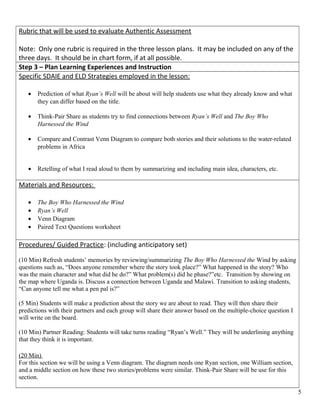
Specific SDAIE and ELD Strategies employed in the lesson:
• Anticipatory chart on KWL to find out how much students know on windmills and water problems
because the story revolves on William’s idea to help his village. This will give students a better
understanding about the story as I read it aloud.
• Prediction of what The Boy Who Harnessed the Wind will be about will help students use what they
already know and what they can differ based on the title and picture. They can also use the
information that was discussed on the KWL chart to try and predict what the story is about.
• In-Text Questions will be asked as I am reading the story aloud. This will help students learn to
implement strategies that will help them better understand what they are reading by making
connections. In addition, they will be able to implement context clues to try and define vocabulary
words that may appear in the reading.
• Retelling of what I read aloud to them by summarizing and including main idea, characters, etc.
• Quickwriting in the form of a journal where students will respond to a prompt without self-editing
Materials and Resources:
2
• Anticipatory Chart – KWL
• The Boy Who Harnessed the Wind
• Flow Chart
• Independent student worksheet (multiple choice and fill-in the blank questions)
• Journal
• Sentence starter frames that will help for the writing section
Procedures/ Guided Practice: (including anticipatory set)
(10 Min) Begin this lesson by first showing students where Malawi is on a map of Africa. Then, use a KWL
chart to find out what we know about how windmills work.
(5 Min) Students will make a prediction about the story we are about to read. They will then share their
predictions with their partners and each group will share their answer based on the multiple-choice question I
will write on the board.
(10 Min) Read The Boy Who Harnessed the Wind aloud and ask in-text questions as reading. Model thinking
by finding connections. There will be words that may be unknown to students and we will try to find its
meanings by using context clues.
(15 min) Start by trying to find the two problems in William’s village and how was William able to solve
them. A flow chart will be use in this section in order to find the answers. The flow chart needs the following
sections that will need to be answer:
• Problem 1
• Problem 2
• Plan to Solve Problems
• Steps to Solve Problems
• Solution to Problem 1
• Solution to Problem 2
This section will be done in their think-pair share groups
End this section by asking, “What is a long-term effect William’s windmills may have?”
Independent Practice:
(5 Min) Quickwriting in journal - freestyle
Topic: Write a paragraph describing your opinion on William’s idea to help solve the two problems his
village faced. Include three facts that you agree or disagree with.
(10 min) Students will complete a worksheet on the story that includes multiple-choice and fill-in the bank
questions
3
Closure/Concluding Activity:
(5 min) Review the lesson objective and pick 2-3 students to share some of their answers.
Lesson Two
Step One: Identify Desired Results
California Department of Education Common Core or Content Standard(s) addressed in this
Lesson: (Give the subject, # and written text of the standard)
CA.CC.RI.3. Reading Standards for Informational Text
RI.3.2. Determine the main idea of a text; recount they key details and explain how they support the main
idea.
RI.3.8: Describe the logical connection between particular sentences and paragraphs in a text (e.g.,
comparison, cause/effect, first/second/third in a sequence).
CA.CC.SL.3. Speaking and Listening Standards
SL.3.2. Determine the main ideas and supporting details of a text read aloud or information presented in
diverse media and formats, including visually, quantitatively, and orally.
California Department of Education ELD Standard addressed in this Lesson:
(Select either a reading, writing, listening or speaking standard for the emerging level)
Expanding – Evaluating how well writers and speakers use language to support ideas and opinions with
details or reasons depending on modality, text type, purpose, audience, topic, and content area.
Content Learning Goals & Objectives:
• Integrate information from the non-fiction passage “Ryan’s Well” and the book The Boy Who
Harnessed the Wind to compare solutions to water-related problems in Africa.
English language development Goals & Objectives
• Students will be able to access and comprehend informational text
• Students will be able to answer detailed questions
Step 2 – Determine Acceptable Evidence
Performance Task or Authentic Assessment that will demonstrate that students have
achieved desired results
• NONE
Note: Only two authentic assessments are required for the unit and may be included in any
of the three days of instruction.
4
Rubric that will be used to evaluate Authentic Assessment
Note: Only one rubric is required in the three lesson plans. It may be included on any of the
three days. It should be in chart form, if at all possible.
Step 3 – Plan Learning Experiences and Instruction
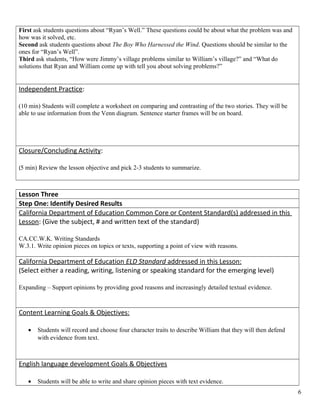
Specific SDAIE and ELD Strategies employed in the lesson:
• Prediction of what Ryan’s Well will be about will help students use what they already know and what
they can differ based on the title.
• Think-Pair Share as students try to find connections between Ryan’s Well and The Boy Who
Harnessed the Wind
• Compare and Contrast Venn Diagram to compare both stories and their solutions to the water-related
problems in Africa
• Retelling of what I read aloud to them by summarizing and including main idea, characters, etc.
Materials and Resources:
• The Boy Who Harnessed the Wind
• Ryan’s Well
• Venn Diagram
• Paired Text Questions worksheet
Procedures/ Guided Practice: (including anticipatory set)
(10 Min) Refresh students’ memories by reviewing/summarizing The Boy Who Harnessed the Wind by asking
questions such as, “Does anyone remember where the story took place?” What happened in the story? Who
was the main character and what did he do?” What problem(s) did he phase?”etc. Transition by showing on
the map where Uganda is. Discuss a connection between Uganda and Malawi. Transition to asking students,
“Can anyone tell me what a pen pal is?”
(5 Min) Students will make a prediction about the story we are about to read. They will then share their
predictions with their partners and each group will share their answer based on the multiple-choice question I
will write on the board.
(10 Min) Partner Reading: Students will take turns reading “Ryan’s Well.” They will be underlining anything
that they think it is important.
(20 Min)
For this section we will be using a Venn diagram. The diagram needs one Ryan section, one William section,
and a middle section on how these two stories/problems were similar. Think-Pair Share will be use for this
section.
5
First ask students questions about “Ryan’s Well.” These questions could be about what the problem was and
how was it solved, etc.
Second ask students questions about The Boy Who Harnessed the Wind. Questions should be similar to the
ones for “Ryan’s Well”.
Third ask students, “How were Jimmy’s village problems similar to William’s village?” and “What do
solutions that Ryan and William come up with tell you about solving problems?”
Independent Practice:
(10 min) Students will complete a worksheet on comparing and contrasting of the two stories. They will be
able to use information from the Venn diagram. Sentence starter frames will be on board.
Closure/Concluding Activity:
(5 min) Review the lesson objective and pick 2-3 students to summarize.
Lesson Three
Step One: Identify Desired Results
California Department of Education Common Core or Content Standard(s) addressed in this
Lesson: (Give the subject, # and written text of the standard)
CA.CC.W.K. Writing Standards
W.3.1. Write opinion pieces on topics or texts, supporting a point of view with reasons.
California Department of Education ELD Standard addressed in this Lesson:
(Select either a reading, writing, listening or speaking standard for the emerging level)
Expanding – Support opinions by providing good reasons and increasingly detailed textual evidence.
Content Learning Goals & Objectives:
• Students will record and choose four character traits to describe William that they will then defend
with evidence from text.
English language development Goals & Objectives
• Students will be able to write and share opinion pieces with text evidence.
6
Step 2 – Determine Acceptable Evidence
Performance Task or Authentic Assessment that will demonstrate that students have
achieved desired results
Authentic Summative Assessment:
• Writing Project: Students select four character traits that describe William the best and then they need
to defend their reasoning with evidence from text.
Note: Only two authentic assessments are required for the unit and may be included in any
of the three days of instruction.
Rubric that will be used to evaluate Authentic Assessment
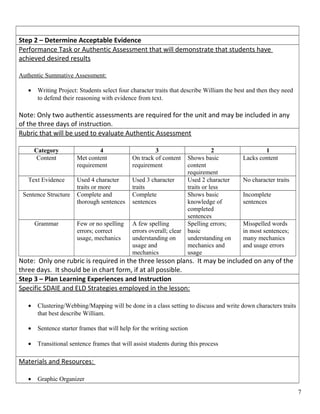
Category 4 3 2 1
Content Met content
requirement
On track of content
requirement
Shows basic
content
requirement
Lacks content
Text Evidence Used 4 character
traits or more
Used 3 character
traits
Used 2 character
traits or less
No character traits
Sentence Structure Complete and
thorough sentences
Complete
sentences
Shows basic
knowledge of
completed
sentences
Incomplete
sentences
Grammar Few or no spelling
errors; correct
usage, mechanics
A few spelling
errors overall; clear
understanding on
usage and
mechanics
Spelling errors;
basic
understanding on
mechanics and
usage
Misspelled words
in most sentences;
many mechanics
and usage errors
Note: Only one rubric is required in the three lesson plans. It may be included on any of the
three days. It should be in chart form, if at all possible.
Step 3 – Plan Learning Experiences and Instruction
Specific SDAIE and ELD Strategies employed in the lesson:
• Clustering/Webbing/Mapping will be done in a class setting to discuss and write down characters traits
that best describe William.
• Sentence starter frames that will help for the writing section
• Transitional sentence frames that will assist students during this process
Materials and Resources:
• Graphic Organizer
7
• Sentence Frames
• Character Trait Worksheet
• Windmill Display
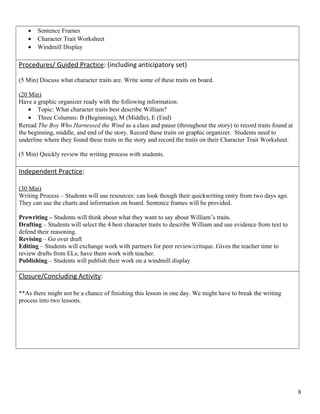
Procedures/ Guided Practice: (including anticipatory set)
(5 Min) Discuss what character traits are. Write some of these traits on board.
(20 Min)
Have a graphic organizer ready with the following information:
• Topic: What character traits best describe William?
• Three Columns: B (Beginning), M (Middle), E (End)
Reread The Boy Who Harnessed the Wind as a class and pause (throughout the story) to record traits found at
the beginning, middle, and end of the story. Record these traits on graphic organizer. Students need to
underline where they found these traits in the story and record the traits on their Character Trait Worksheet.
(5 Min) Quickly review the writing process with students.
Independent Practice:
(30 Min)
Writing Process – Students will use resources: can look though their quickwriting entry from two days ago.
They can use the charts and information on board. Sentence frames will be provided.
Prewriting – Students will think about what they want to say about William’s traits.
Drafting – Students will select the 4 best character traits to describe William and use evidence from text to
defend their reasoning.
Revising – Go over draft
Editing – Students will exchange work with partners for peer review/critique. Gives the teacher time to
review drafts from ELs; have them work with teacher.
Publishing – Students will publish their work on a windmill display
Closure/Concluding Activity:
**As there might not be a chance of finishing this lesson in one day. We might have to break the writing
process into two lessons.
8

Final Project - Language Arts

  • 1.
    Final Project: Standards-basedUnit Template Subject Matter: Language Arts Topic: Comprehension Grade Level: 3rd English acquisition level of target student: expanding (formerly called intermediate) level of English language acquisition. Unit Essential Question: How can traits such as determination and being resourceful increases our ability to respond to challenges and problems in our community? Lesson One Step One: Identify Desired Results California Department of Education Common Core or Content Standard(s) addressed in this Lesson: (Give the subject, # and written text of the standard) CA.CC.RI.3. Reading Standards for Informational Text RI.3.2. Determine the main idea of a text; recount they key details and explain how they support the main idea. RI.3.7. Use information gained from illustrations (e.g., maps, photographs) and the words in a text to demonstrate understanding of the text (e.g., where, when, why, and how key events occur). CA.CC.SL.3. Speaking and Listening Standards SL.3.2. Determine the main ideas and supporting details of a text read aloud or information presented in diverse media and formats, including visually, quantitatively, and orally. California Department of Education ELD Standard addressed in this Lesson: (Select either a reading, writing, listening or speaking standard for the emerging level) Expanding – Demonstrate active listening to read-aloud and oral presentations by asking and answering detailed questions with occasional prompting and moderate support. Expanding – Describe ideas, phenomena (e.g., how cows digest food), and text elements (e.g., main idea, characters, events) in greater detail based on understanding of a variety of grade-level-texts and viewing of multimedia with moderate support. Content Learning Goals & Objectives: • Students will describe the two problems faced by the people in William’s village and what William did to solve these problems English language development Goals & Objectives • Students will be able to access and comprehend informational text • Students will be able to answer detailed questions 1
  • 2.
    Step 2 –Determine Acceptable Evidence Performance Task or Authentic Assessment that will demonstrate that students have achieved desired results Authentic Formative Assessment: • Reflective, free writing journal entry revolving around topic: Write a paragraph describing your opinion on William’s idea to help solve the two problems his village faced. Include three facts that you agree or disagree with. Note: Only two authentic assessments are required for the unit and may be included in any of the three days of instruction. Rubric that will be used to evaluate Authentic Assessment Note: Only one rubric is required in the three lesson plans. It may be included on any of the three days. It should be in chart form, if at all possible. Step 3 – Plan Learning Experiences and Instruction Specific SDAIE and ELD Strategies employed in the lesson: • Anticipatory chart on KWL to find out how much students know on windmills and water problems because the story revolves on William’s idea to help his village. This will give students a better understanding about the story as I read it aloud. • Prediction of what The Boy Who Harnessed the Wind will be about will help students use what they already know and what they can differ based on the title and picture. They can also use the information that was discussed on the KWL chart to try and predict what the story is about. • In-Text Questions will be asked as I am reading the story aloud. This will help students learn to implement strategies that will help them better understand what they are reading by making connections. In addition, they will be able to implement context clues to try and define vocabulary words that may appear in the reading. • Retelling of what I read aloud to them by summarizing and including main idea, characters, etc. • Quickwriting in the form of a journal where students will respond to a prompt without self-editing Materials and Resources: 2
  • 3.
    • Anticipatory Chart– KWL • The Boy Who Harnessed the Wind • Flow Chart • Independent student worksheet (multiple choice and fill-in the blank questions) • Journal • Sentence starter frames that will help for the writing section Procedures/ Guided Practice: (including anticipatory set) (10 Min) Begin this lesson by first showing students where Malawi is on a map of Africa. Then, use a KWL chart to find out what we know about how windmills work. (5 Min) Students will make a prediction about the story we are about to read. They will then share their predictions with their partners and each group will share their answer based on the multiple-choice question I will write on the board. (10 Min) Read The Boy Who Harnessed the Wind aloud and ask in-text questions as reading. Model thinking by finding connections. There will be words that may be unknown to students and we will try to find its meanings by using context clues. (15 min) Start by trying to find the two problems in William’s village and how was William able to solve them. A flow chart will be use in this section in order to find the answers. The flow chart needs the following sections that will need to be answer: • Problem 1 • Problem 2 • Plan to Solve Problems • Steps to Solve Problems • Solution to Problem 1 • Solution to Problem 2 This section will be done in their think-pair share groups End this section by asking, “What is a long-term effect William’s windmills may have?” Independent Practice: (5 Min) Quickwriting in journal - freestyle Topic: Write a paragraph describing your opinion on William’s idea to help solve the two problems his village faced. Include three facts that you agree or disagree with. (10 min) Students will complete a worksheet on the story that includes multiple-choice and fill-in the bank questions 3
  • 4.
    Closure/Concluding Activity: (5 min)Review the lesson objective and pick 2-3 students to share some of their answers. Lesson Two Step One: Identify Desired Results California Department of Education Common Core or Content Standard(s) addressed in this Lesson: (Give the subject, # and written text of the standard) CA.CC.RI.3. Reading Standards for Informational Text RI.3.2. Determine the main idea of a text; recount they key details and explain how they support the main idea. RI.3.8: Describe the logical connection between particular sentences and paragraphs in a text (e.g., comparison, cause/effect, first/second/third in a sequence). CA.CC.SL.3. Speaking and Listening Standards SL.3.2. Determine the main ideas and supporting details of a text read aloud or information presented in diverse media and formats, including visually, quantitatively, and orally. California Department of Education ELD Standard addressed in this Lesson: (Select either a reading, writing, listening or speaking standard for the emerging level) Expanding – Evaluating how well writers and speakers use language to support ideas and opinions with details or reasons depending on modality, text type, purpose, audience, topic, and content area. Content Learning Goals & Objectives: • Integrate information from the non-fiction passage “Ryan’s Well” and the book The Boy Who Harnessed the Wind to compare solutions to water-related problems in Africa. English language development Goals & Objectives • Students will be able to access and comprehend informational text • Students will be able to answer detailed questions Step 2 – Determine Acceptable Evidence Performance Task or Authentic Assessment that will demonstrate that students have achieved desired results • NONE Note: Only two authentic assessments are required for the unit and may be included in any of the three days of instruction. 4
  • 5.
    Rubric that willbe used to evaluate Authentic Assessment Note: Only one rubric is required in the three lesson plans. It may be included on any of the three days. It should be in chart form, if at all possible. Step 3 – Plan Learning Experiences and Instruction Specific SDAIE and ELD Strategies employed in the lesson: • Prediction of what Ryan’s Well will be about will help students use what they already know and what they can differ based on the title. • Think-Pair Share as students try to find connections between Ryan’s Well and The Boy Who Harnessed the Wind • Compare and Contrast Venn Diagram to compare both stories and their solutions to the water-related problems in Africa • Retelling of what I read aloud to them by summarizing and including main idea, characters, etc. Materials and Resources: • The Boy Who Harnessed the Wind • Ryan’s Well • Venn Diagram • Paired Text Questions worksheet Procedures/ Guided Practice: (including anticipatory set) (10 Min) Refresh students’ memories by reviewing/summarizing The Boy Who Harnessed the Wind by asking questions such as, “Does anyone remember where the story took place?” What happened in the story? Who was the main character and what did he do?” What problem(s) did he phase?”etc. Transition by showing on the map where Uganda is. Discuss a connection between Uganda and Malawi. Transition to asking students, “Can anyone tell me what a pen pal is?” (5 Min) Students will make a prediction about the story we are about to read. They will then share their predictions with their partners and each group will share their answer based on the multiple-choice question I will write on the board. (10 Min) Partner Reading: Students will take turns reading “Ryan’s Well.” They will be underlining anything that they think it is important. (20 Min) For this section we will be using a Venn diagram. The diagram needs one Ryan section, one William section, and a middle section on how these two stories/problems were similar. Think-Pair Share will be use for this section. 5
  • 6.
    First ask studentsquestions about “Ryan’s Well.” These questions could be about what the problem was and how was it solved, etc. Second ask students questions about The Boy Who Harnessed the Wind. Questions should be similar to the ones for “Ryan’s Well”. Third ask students, “How were Jimmy’s village problems similar to William’s village?” and “What do solutions that Ryan and William come up with tell you about solving problems?” Independent Practice: (10 min) Students will complete a worksheet on comparing and contrasting of the two stories. They will be able to use information from the Venn diagram. Sentence starter frames will be on board. Closure/Concluding Activity: (5 min) Review the lesson objective and pick 2-3 students to summarize. Lesson Three Step One: Identify Desired Results California Department of Education Common Core or Content Standard(s) addressed in this Lesson: (Give the subject, # and written text of the standard) CA.CC.W.K. Writing Standards W.3.1. Write opinion pieces on topics or texts, supporting a point of view with reasons. California Department of Education ELD Standard addressed in this Lesson: (Select either a reading, writing, listening or speaking standard for the emerging level) Expanding – Support opinions by providing good reasons and increasingly detailed textual evidence. Content Learning Goals & Objectives: • Students will record and choose four character traits to describe William that they will then defend with evidence from text. English language development Goals & Objectives • Students will be able to write and share opinion pieces with text evidence. 6
  • 7.
    Step 2 –Determine Acceptable Evidence Performance Task or Authentic Assessment that will demonstrate that students have achieved desired results Authentic Summative Assessment: • Writing Project: Students select four character traits that describe William the best and then they need to defend their reasoning with evidence from text. Note: Only two authentic assessments are required for the unit and may be included in any of the three days of instruction. Rubric that will be used to evaluate Authentic Assessment Category 4 3 2 1 Content Met content requirement On track of content requirement Shows basic content requirement Lacks content Text Evidence Used 4 character traits or more Used 3 character traits Used 2 character traits or less No character traits Sentence Structure Complete and thorough sentences Complete sentences Shows basic knowledge of completed sentences Incomplete sentences Grammar Few or no spelling errors; correct usage, mechanics A few spelling errors overall; clear understanding on usage and mechanics Spelling errors; basic understanding on mechanics and usage Misspelled words in most sentences; many mechanics and usage errors Note: Only one rubric is required in the three lesson plans. It may be included on any of the three days. It should be in chart form, if at all possible. Step 3 – Plan Learning Experiences and Instruction Specific SDAIE and ELD Strategies employed in the lesson: • Clustering/Webbing/Mapping will be done in a class setting to discuss and write down characters traits that best describe William. • Sentence starter frames that will help for the writing section • Transitional sentence frames that will assist students during this process Materials and Resources: • Graphic Organizer 7
  • 8.
    • Sentence Frames •Character Trait Worksheet • Windmill Display Procedures/ Guided Practice: (including anticipatory set) (5 Min) Discuss what character traits are. Write some of these traits on board. (20 Min) Have a graphic organizer ready with the following information: • Topic: What character traits best describe William? • Three Columns: B (Beginning), M (Middle), E (End) Reread The Boy Who Harnessed the Wind as a class and pause (throughout the story) to record traits found at the beginning, middle, and end of the story. Record these traits on graphic organizer. Students need to underline where they found these traits in the story and record the traits on their Character Trait Worksheet. (5 Min) Quickly review the writing process with students. Independent Practice: (30 Min) Writing Process – Students will use resources: can look though their quickwriting entry from two days ago. They can use the charts and information on board. Sentence frames will be provided. Prewriting – Students will think about what they want to say about William’s traits. Drafting – Students will select the 4 best character traits to describe William and use evidence from text to defend their reasoning. Revising – Go over draft Editing – Students will exchange work with partners for peer review/critique. Gives the teacher time to review drafts from ELs; have them work with teacher. Publishing – Students will publish their work on a windmill display Closure/Concluding Activity: **As there might not be a chance of finishing this lesson in one day. We might have to break the writing process into two lessons. 8