1
CHAPTER NO.1
INTRODUCTION OF MARKETING
2
INTRODUCTION OF MARKETING
A market is one of the many varieties of systems, institutions, procedures,
social relations and infrastructures whereby parties engage in exchange. While
parties may exchange goods and services by barter, most markets rely on sellers
offering their goods or services (including labor) in exchange for money from
buyers. It can be said that a market is the process by which the prices of goods
and services are established.
For a market to be competitive there must be more than a single buyer or seller.
It has been suggested that two people may trade, but it takes at least three
persons to have a market, so that there is competition in at least one of its two
sides.[1] However, competitive markets, as understood in formal economic
theory, rely on much larger numbers of both buyers and sellers. A market with a
single seller and multiple buyers is a monopoly. A market with a single buyer
and multiple sellers is a monophony. These are the extremes of imperfect
competition
Markets vary in form, scale (volume and geographic reach), location, and types
of participants, as well as the types of goods and services traded. Examples
include:
 Physical retail markets, such as local public markets, farmers' markets,
street markets, flea markets, bazaars, and other public marketplaces;
shopping centers and shopping malls
 Physical wholesale markets
Marketing is the process of communicating the value of a product or service to
customers, for the purpose of selling that product or service.
3
Marketing can be looked at as an organizational function and a set of processes
for creating, delivering and communicating value to customers, and customer
relationship management that also benefits the organization. Marketing is the
science of choosing target markets through market analysis and market
segmentation, as well as understanding consumer behavior and providing
superior customer value. From a societal point of view, marketing is the link
between a society's material requirements and its economic patterns of response.
Marketing satisfies these needs and wants through exchange processes and
building long term relationships.
Marketing is a crucial function in any business or organization, and is
increasingly important in the modern globalized economy. This free online
course will introduce learners to marketing strategies and tools that are used
extensively in the marketing industry. You will learn about the ambiguous
nature of marketing and its different meanings for different businesses. You will
also discover the characterizations of marketing that are common to all
businesses, despite their differences. This course will teach you about the
different approaches that affect marketing campaigns used in different types of
businesses. This course will be of great interest to marketing and business
professionals who wish to refresh the basics of marketing and to learners who
are interested in business and wish to have a greater knowledge and
understanding of the role marketing plays in the modern business world.
MEANING
Marketing is the craft of linking the producers (or potential producers)
Of a product or service with customers, both existing and potential. It is an
inevitable and necessary consequence of capitalism. However marketing is not
limited to capitalist countries. Marketing techniques are applied in all political
systems, and in many aspects of life. Marketing methods are informed by many
4
of the social sciences, particularly psychology, sociology, and economics.
Marketing research underpins these activities. Through, it is also related to
many of the creative arts.
WHAT MARKETING INVOLOVES
Contrary to the popular conception, marketing is not just about promotion it
can be divided into four sections, often called the “four Ps”.
FOUR ‘P’S OF MARKETING
Marketing is your most important organizing tool. There are four
basic aspects of marketing, often called the four Ps:
 Product: The item or service you sell.
 Price: The amount you charge for your product or service.
 Promote: The ways you inform your market as to who, what, and where you
are.
5
 Provide: The channels you use to take the product to the customer.
As you can see, marketing encompasses much more than just advertising
or selling. For example, a major part of marketing involves researching your
customers: What do they want? What can they afford? What do they think?
Your understanding and application of the answers to suchquestions play a
major role in the success orfailure of your business.
DEFINITION OF MARKETING
HUGGY AND MITCHEL:
“Marketing includes all the activities in the creation of place, time and
possession utilities. Place utility is created when goods and services are
available at the places they are needed, time utility is created when they are
needed, and possession utility is created when they are transferred to those who
need them”
PAUL MAZUR:
“Marketing is the delivery of a standard of living of society.”
Timeline
Robert A Bartels in The History of Marketing Thought categorized the
development of marketing theory decade by decade from the beginning of the
20th century thus:
 1900s: discovery of basic concepts and their exploration
 1910s: conceptualization, classification and definition of terms
 1920s: integration on the basis of principles
 1930s: development of specialization and variation in theory
 1940s: reappraisal in the light of new demands and a more scientific
approach
6
 1950s: reconceptualization in the light of managerialism, social development
and quantitative approaches
 1960s: differentiation on bases such as
managerialism, holism, environmentalism, systems, and internationalism
 1970s: socialization; the adaptation of marketing to social change
With the growth in importance of marketing departments and their
associated marketing managers, the field has become ripe for the propagation
of management fads which do not always lend themselves to per iodization.
Birth of marketing ideas
In pre-modern economies, the predominance of small enterprises militated
against the recognition of marketing as a separate field of expertise. Changes in
the patterns and intensity of economic activity, as well as the rise
of economics as a science, particularly in the 19th century, paved the way for
studies of marketing. The growth in size and scope of national and international
economies in the course of the Industrial revolution led eventually to a
transcendence of ad hoc retailing and advertising innovations and eventually to
systematization. Marketing emerged as a separate technical field only in the late
19th century. The OED traces the abstract usage of the word only as far back as
1884.
Marketing history
Much of traditional marketing practice prior to the twentieth century remained
hidebound by rules-of-thumb and lack of information. Information technology,
especially since the mid-twentieth century, has given the marketer new channels
of communication as well as enhanced means of aggregating and analyzing
marketing data. Specializations have emerged (especially sales versus marketing
7
and advertising versus retailing) and re-combined (business development) over
the years.
Timeline of innovation
 1450: Gutenberg's metal movable type, leading eventually to mass-
production of flyers and brochures
 1730s: emergence of magazines (a future vector of niche marketing)
 1836: first paid advertising in a newspaper (in France)
 1839: posters on private property banned in London
 1864: earliest recorded use of the telegraph for mass unsolicited spam
 1867: earliest recorded billboard rentals
 1880s: early examples of trademarks as branding
 1905: the University of Pennsylvania offered a course in "The Marketing of
Products"
 1908: Harvard Business School opens
 1922: radio advertising commences
 1940s: electronic computers developed
 1941: first recorded use of television advertising
 1950s: systematization of telemarketing
 1970s: E-commerce invented
 1980s: development of database marketing as precursor to CRM[5]
 1980s: emergence of relationship marketing
 1980s: emergence of computer-oriented spam
 1984: introduction of guerrilla marketing
 1985: desktop publishing democratizes the production of print-advertising
 1991: IMC gains academic status
 1990s CRM and IMC (in various guises and names) gain dominance in
promotions and marketing planning,
8
 1995-2001: the Dot-com bubble temporarily re-defines[the future of
marketing
 1996: identification of viral marketing
 2000s: Integrated marketing gains acceptance and in 2002 its first dedicated
academic research Centre
Periodization
One marketing standard chronology (Bartels, 1974; Dawson, 1969; Keith, 1960;
Kotler and Keller, 2006) subdivides marketing history as follows:
 Production orientation era
 Product orientation era
 Sales orientation era
 Market orientation era
 Customer orientation
 Relationship orientation
 Social/mobile marketing orientate
9
CHAPTER NO.2
INTRODUCTION OF PROJECT
10
INTRODUCTION OF PROJECT
Closed-circuittelevision(CCTV) cameras can produceimages or recordings
for surveillance purposes, and can be either video cameras, or digital stills
cameras. Marie Van Brittan Brown was the inventor of the CCTV camera
Video cameras are either analogue or digital, which means that they work on the
basis of sending analogue or digital signals to a storage device such as a video
tape recorder or desktop computer or laptop computer.
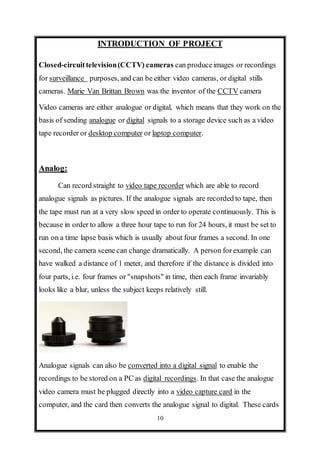
Analog:
Can record straight to video tape recorder which are able to record
analogue signals as pictures. If the analogue signals are recorded to tape, then
the tape must run at a very slow speed in order to operate continuously. This is
because in order to allow a three hour tape to run for 24 hours, it must be set to
run on a time lapse basis which is usually about four frames a second. In one
second, the camera scene can change dramatically. A person for example can
have walked a distance of 1 meter, and therefore if the distance is divided into
four parts, i.e. four frames or "snapshots" in time, then each frame invariably
looks like a blur, unless the subject keeps relatively still.
Analogue signals can also be converted into a digital signal to enable the
recordings to be stored on a PC as digital recordings. In that case the analogue
video camera must be plugged directly into a video capture card in the
computer, and the card then converts the analogue signal to digital. These cards
11
are relatively cheap, but inevitably the resulting digital signals are compressed
5:1 (MPEG compression) in order for the video recordings to be saved on a
continuous basis.Another way to store recordings on a non-analogue media is
through the use of a digital video recorder (DVR). Such a device is similar in
functionality to a PC with a capture card and appropriate video
recording software. Unlike PCs, most DVRs designed for CCTVpurposes are
embedded devices that require less maintenance and simpler setup than a PC-
based solution, for a medium to large number of analogue cameras.Some DVRs
also allow digital broadcasting of the video signal, thus acting like a network
camera. If a device does allow broadcasting of the video, but does not record it,
then it's called a video server. These devices effectively turn any analogue
camera (or any analogue video signal) into a network TV.
Digital:
These cameras do not require a video capture card because they work
using a digital signal which can be saved directly to a computer. The signal is
compressed 5:1, but DVD quality can be achieved with more compression
(MPEG-2 is standard for DVD-video, and has a higher compressionratio than
5:1, with a slightly lower video quality than 5:1 at best, and is adjustable for the
amount of spaceto be taken up versus the quality of picture needed or desired).
The highest picture quality of DVD is only slightly lower than the quality of
basic 5:1-compression DV.
However, in any situation where standard-definition video cameras are
used, the quality is going to be poorbecause the maximum pixel resolution of
the image chips in most of these devices is 320,000 pixels (analogue quality is
measured in TV lines but the results are the same); they generally capture
12
horizontal and vertical fields of lines and blend them together to make a single
frame; the maximum frame rate is normally 30 frames per second.
That said, multi-megapixel IP-CCTV cameras are coming on the market.
Still quite expensive, but they can capture video images at resolutions of 1, 2, 3,
5 and even up to 11 Mpix. Unlike with analogue cameras, details such as
number plates are easily readable. At 11 Mpix, forensic quality images are made
where each hand on a person can be distinguished. Because of the much higher
resolutions available with these types of cameras, they can be set up to cover a
wide area where normally several analogue cameras would have been needed.
Network:
IP cameras or network cameras are analogue or digital video cameras,
plus an embedded video server having an IP address, capable of streaming the
video (and sometimes, even audio).Because network cameras are embedded
devices, and do not need to output an analogue signal, resolutions higher than
CCTVanalogue cameras are possible. A typical analogue CCTV camera has
a PAL (768×576 pixels) or NTSC (720×480 pixels), whereas network cameras
may have VGA (640×480 pixels), SVGA (800×600 pixels) or quad-VGA
(1280×960 pixels, also referred to as "megapixel") resolutions.
13
An analogue or digital camera connected to a video server acts as a
network camera, but the image size is restricted to that of the video standard of
the camera. However, optics (lenses and image sensors), not video resolution,
are the components that determine the image quality.
Network cameras can be used for very cheap surveillance solutions
(requiring one network camera, some Ethernet cabling, and one PC), or to
replace entire CCTVinstallations (cameras become network cameras, tape
recorders become DVRs, and CCTVmonitors become computers
with TFT screens and specialized software. Digital video manufacturers claim
that turning CCTV installations into digital video installations is inherently
better).
There continues to be much debate over the merits and price-for-
performance of Network cameras as compared to analog cameras. Many in the
CCTV industry claim that many analog cameras can outperform network
cameras at a lower price.
Video surveillance systems provide a never closing eye to watch over
property and possessions,allowing a sense of safety and security. Cameras
attached to a closed circuit television system send data to a computer or video
14
recorder for live viewing or later playback. The term closed circuit refers to the
fact that the images recorded by the cameras are not broadcast, butsaved on a
storage device. The CCTV system was originally developed as a security
measure in banks, and later expanded to other businesses and home use.
Meaning of CCTV Camera
CCTVcameras keep an eye on your property and possessions Video
surveillance systems provide a never closing eye to watch over property and
possessions, allowing a sense of safety and security. Cameras attached to a
closed circuit television system send data to a computer or video recorder for
live viewing or later playback. The term closed circuit refers to the fact that the
images recorded by the cameras are not broadcast, but saved on a storage
device. The CCTVsystem was originally developed as a security measure in
banks, and later expanded to other businesses and home use.
Purpose
CCTVcamera systems perform three main aspects of surveillance:
deterrent, documentation and monitoring. The presence of a camera system
helps deter unlawful activity in homes and businesses, and in cases where
deterrent was unsuccessful, the cameras provide a documentation of the crime
to aid in capturing the criminals. Monitoring allows live viewing of an area, a
helpful intervention aid for elderly patients.
15
How Do CCTV Camera Works?
CCTVcamera systems include one or more cameras which are used to
send video images and audio data to a monitor. Essentially, these camera
systems use cameras to transmit the signals to a main hub which then records
that data for later viewing or live viewing if you have full time security
personnel on your premises.
Security Camera Technology
 Bullet Security Cameras
 DomeSecurity Cameras
 Night Vision Security Cameras
 Pan Tilt Zoom Security Cameras
 Silent Witness Vandal Resistant Internal Camera
 Silent Witness Hawk
 Lift Cameras
 Silent Witness Bullet Resistant Camera
 License Plate Recognition Cameras
 IP Security Cameras
 Varifocal Lens Cameras
 Spy Cameras & Hidden Cameras
 Wireless security camera
 HD-SDI Cameras
 100 Megapixel Panoramic IP camera
16
1. Bullet Security Cameras
Bullet A bullet CCTVcamera is a
wall-mount or ceiling-mounted unit that is
typically designed for indoor use, but can
also be fill some outdoorapplications. The
camera derives its name from its sleek, thin
cylindrical shape. Many bullet cameras
alsotout themselves as being waterproof. The camera is not typically designed
to have pan/tilt/zoom control but instead to capture images from a fixed area.
The unit is mounted pointing at a particular area.
2. DomeSecurity Cameras
A dome cameras get their name from
the dome-shaped housing in which they sit.
These housings are designed to make the
cameras unobtrusive… not covert or hidden.
Typical applications are retail, where the
camera is designed to be unobtrusive, but
visible. These units serve a dual purpose:
“bad guys” will know the facility is being watched and patrons will feel at ease
knowing the facility is being protected. Units that allow the camera to spin
quickly within the housing are often referred to as “speed domes.”
17
3. Night Vision Security Cameras
For the human eye to see clearly, it
must have adequate light. The same is true
for security cameras. During the day, when
office spaces and parking areas are properly
lit by natural or florescent lighting, security
cameras provide crisp images and colorful
detail. At night, when those offices are
closed and parking areas are dim, traditional
security cameras may producegrainy video or video that is so dark the objects
within the camera's field of view are unidentifiable. In these types of security
environments, installing a night vision security camera is the most economical
way to producequality 24/7 surveillance video.
Night vision cameras are specifically designed for problem lighting
environments. Instead of installing costly electrical fixtures or wasting
electricity keeping lights on after-hours, consider installing night vision cameras
for your 24-hour surveillance needs
4. Pan Tilt Zoom Security Cameras
PTZ cameras are ideal for wide-area
surveillance. They give operators the ability
to remotely control pan, tilt, and zoom
functions to follow activity and to zoom in
for detailed monitoring. This is an area
where analog CCTVcameras fall behind
their IP camera counterparts. With IP
cameras, the pan/tilt/zoom functions are controlled manually or automatically
18
and delivered over a single network cable, while analog cameras require
additional wiring to perform similar functionality.
Unlike a static security camera, a PTZCamera is built on a swiveling
head mechanism that gives the camera the flexibility to quickly pan a full 360
degrees and tilt up to 90 degrees. This swiveling head mechanism can be
directly controlled one of three ways: at the security office using a security
grade joystick, via the front panel of a digital video recorder (DVR) such as
the EZWatch Turbo View DVR, or remotely through the DVR's software using
your keyboard/mouse. In addition to direct control, the PTZ Camera can be
indirectly controlled by pre-programming viewing tours or setting the camera to
automatically track movement.
5. Silent Witness Vandal Resistant Internal Camera
Ideal for the location where
you may be concerned about people
interfering with your Cameras. The
impact resistant polycarbonate
enclosure can be painted to match
architectural requirements. The
standard white finish will match most
ceiling or wall finishes.
19
6. Silent Witness Hawk
This Advanced Surveillance Camera
comes with the option of an LED and
microphone making it ideal for using as part
of a doorentry system. It can be mounted
anywhere and has a special bracket for angle
adjustment.
7. Lift Cameras
Installing a camera in an elevator is a
common requirement but one that is so often
poorly planned and carried out. The result is
inevitably sub-standard images, high
maintenance costs, elevator down-time and
ultimately customer dissatisfaction
8. Silent Witness Bullet Resistant Camera
If you really have a security problem
then this must be the ultimate camera for
you!Most Silent Witness Cameras come with
a variety of lenses and can be supplied for
colour or monochrome systems.
20
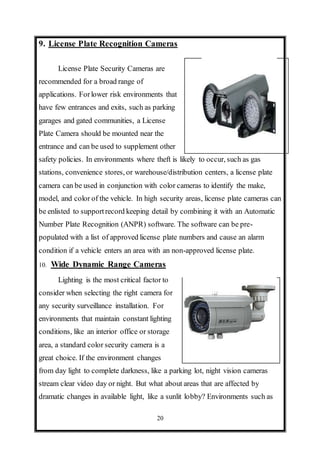
9. License Plate Recognition Cameras
License Plate Security Cameras are
recommended for a broad range of
applications. Forlower risk environments that
have few entrances and exits, such as parking
garages and gated communities, a License
Plate Camera should be mounted near the
entrance and can be used to supplement other
safety policies. In environments where theft is likely to occur, such as gas
stations, convenience stores, or warehouse/distribution centers, a license plate
camera can be used in conjunction with color cameras to identify the make,
model, and color of the vehicle. In high security areas, license plate cameras can
be enlisted to supportrecord keeping detail by combining it with an Automatic
Number Plate Recognition (ANPR) software. The software can be pre-
populated with a list of approved license plate numbers and cause an alarm
condition if a vehicle enters an area with an non-approved license plate.
10. Wide Dynamic Range Cameras
Lighting is the most critical factor to
consider when selecting the right camera for
any security surveillance installation. For
environments that maintain constant lighting
conditions, like an interior office or storage
area, a standard color security camera is a
great choice. If the environment changes
from day light to complete darkness, like a parking lot, night vision cameras
stream clear video day or night. But what about areas that are affected by
dramatic changes in available light, like a sunlit lobby? Environments such as
21
sunlit lobbies or street facing store fronts require a camera that can adapt to
various lighting conditions. Wide have built-in technology which digitally
creates a middle ground between the brightest and darkest areas within the
camera's field of view. The enhanced color image is carefully balanced and
transmitted to the digital video recorder assuring all areas within the field of
view are perfectly exposed.
11. IP Cameras
Security and surveillance technology has come a long way since the
introduction of analog cameras and video cassette recorders (VCR). The new
wave of high performance IP Security Cameras provide even greater
accessibility and controlof your security surveillance system. In addition to
easier installation, IP Cameras offer enhanced digital zoom and on board digital
processing which enables users to recover video faster and extract greater detail.
The IP in IP Cameras refers to Internet protocol;the method these cameras use
to transmit video. This technology enables these cameras to transmit footage
wirelessly to a central DVR point.
22
Potential advantages
 Two-way audio via a single network cable allows users to communicate
with what they are seeing (e.g. gas station clerk assisting a customer on
how to use the pay pumps)
 Flexibility: IP cameras can be moved around anywhere on a network
(wireless).
 Distributed intelligence: with IP cameras, video analytics can be placed in
the camera itself allowing ability in analytics solutions.[4]
 Transmission of commands for PTZ(pan, tilt, zoom) cameras via a single
network.
 Encryption & authentication: IP cameras offer secure data transmission
through encryption and authentication methods such
as WPA, WPA2, TKIP, AES.
 Remote accessibility: live video from selected cameras can be viewed
from any computer, anywhere, and also from many
mobile smartphones and other devices. Remote accessibility also prevents
police officers from confiscating video and audio evidence that you can
use against them
 IP cameras are able to function on a wireless network.
 PoE - Power over Ethernet: Modern IP cameras have the ability to
operate without a power supply. They can work with the PoE-protocol.
23
12. Varifocal Lens Cameras
Measure twice, cut once. That’s the saying
we’ve all heard from professional builders and
carpenters. However, this saying extends to
more than just sawing wood or hammering
nails. Forcameras installed with a fixed focal
length lens, measuring for field of view must
be precise. To use another phrase, once the
camera is fixed in place, what you see is what you get. Considering the many
video surveillance cameras available, a camera with an adjustable lens will give
you greater flexibility during installation and keep you from timely labor spent
on relocating cameras if your needs change in the future.
Security surveillance cameras generally have three uses: to survey an area
for disturbance, monitor behavior, or identify individuals. If your goal is to
survey an area suchas a parking lot, select a lens with the widest field of view.
To monitor behavior, such as making sure a grocery store clerk stays at their
register during their shift, a mid-range lens is ideal. However, if you want to
have enough detail to help police identify someone you don’tknow, like a
robberentering a convenience store, a longer range lens is needed. If you are
unsure how your camera will be used, if your use will change over time, or you
would prefer to have some flexibility in your installation height and field of
view, choosea camera and lens combination with a vari-focal length and
automatic iris lens
24
13. Spy Cameras & Hidden Cameras
When people know they are being monitored, they are more likely to
behave as expected. To find out what is really happening behind the scenes,
strategically placed hidden cameras give home and business owners full access
to employee behavior and provide peace of mind while away. Known as covert
cameras, nanny cameras, spy cameras, and hidden cameras, these unseen
25
cameras can be placed in unexpected places so you can monitor the unfiltered
behavior of their employees, caretakers, or contractors. Determining which type
of cameras you need depends on the level of discreteness you desire and the
other types of security equipment installed.
EZWatch offers two main types of hidden cameras: pinhole and self-
contained. If this will be your only security camera, a completely self-contained
camera with a built-in digital recorder is easy to install and will provide covert
recording. Completely self-contained covert cameras like the Clock Radio Spy
Cameraor the Covert Tissue Box camera include the camera, a fully functional
digital video recorderthat uses a removable memory card or cable to review
recordings, and a power supply or wall transformer. To conserve memory, many
self-contained hidden cameras will use motion activated technology to signal
when the digital video recorder should start and stop recording. In addition to
their small size, these cameras are great to use because they are disguised as
everyday objects and often go un-noticed.
If the hidden camera will be used in conjunction with a security camera
system, a pinhole camera or otherwise disguised camera will be a great addition.
Pinhole cameras are physically smaller than traditional cameras, about the size
of a postage stamp, but producea crisp, clean image. Because of their discrete
design, pinhole cameras can be concealed in almost any object. Likely places to
install this type of camera include a locked filing cabinet, within a busy art
canvas, a hollowed book, a drop ceiling tile or within a lamp base. Ideally, the
object should have enough spaceto secure the camera as well as obscurea small
1/8" hole. If you would rather install a camera that is already hidden within an
everyday object, EZWatch offers the PIR-GOLD Motion Detector Hidden
Camera. Disguised as a typical motion detector, this camera can be mounted
flush to the wall which minimizes exposed wiring. After the ideal angle and
placement is selected, installing a pinhole or hidden cameras is similar to
26
installing a traditional camera. Simply connect the camera to your recording
device via BNC cable, secure power to the camera, and be careful to disguise
the transmission and power cables.
14. Wireless security camera
Many consumers are turning to wireless
security cameras for home surveillance.Wireless
cameras do not require a video cable for
video/audio transmission, simply a cable for
power. Wireless cameras are also easy and
inexpensive to install. Previous generations of
wireless security cameras relied on analog
technology; modern wireless cameras use digital
technology which delivers crisper audio, sharper video, and a secure and
interference-free signal.
15. HD-SDI Cameras
If you want to have the best image quality possible from your video surveillance
system, HD-SDI cameras are the best choice money can currently buy. HD-SDI
cameras transmit uncompressed 1080P video footage. This footage is then
compressed into the H.264 format for storage and play back at a later time.
27
When you choose to pay back recorded video from HD-SDI Systems the video
is decompressed to allow viewing in full 1080P High Definition. This footage is
on the same level of quality that you see on HD television channels or Blu-Ray
movies - up to six times higher resolution than standard definition video
cameras.
Due to a much larger digital signal, it is important to understand the
amount of storage you will need on your hard drives when installing a HD-SDI
system. Calculating the amount of hard drive spaceneeded is based on the
number of cameras recording and time period you want to save the stored video
before you begin recording over the oldest recorded video. The decision to
record only when motion is detected rather than recording all images 24 hours a
day can heavily reduce the hard drive spacerequired. While you can use
ourDVR Storage Calculator to get a rough estimate of hard drive spaceneeded,
it is always recommended to consult with professional system design experts
from a highly reputable company to help with this decision.
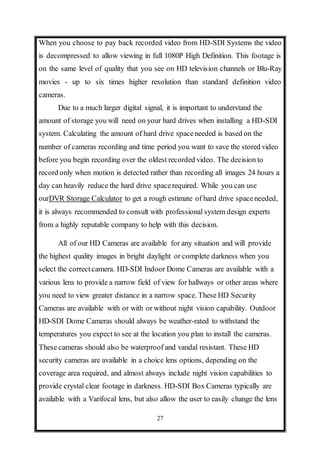
All of our HD Cameras are available for any situation and will provide
the highest quality images in bright daylight or complete darkness when you
select the correctcamera. HD-SDI Indoor Dome Cameras are available with a
various lens to provide a narrow field of view for hallways or other areas where
you need to view greater distance in a narrow space. These HD Security
Cameras are available with or with or without night vision capability. Outdoor
HD-SDI Dome Cameras should always be weather-rated to withstand the
temperatures you expect to see at the location you plan to install the cameras.
These cameras should also be waterproof and vandal resistant. These HD
security cameras are available in a choice lens options, depending on the
coverage area required, and almost always include night vision capabilities to
provide crystal clear footage in darkness. HD-SDI Box Cameras typically are
available with a Varifocal lens, but also allow the user to easily change the lens
28
to any lens needed to provide the desired coverage. HD-SDI Bullet Style
Cameras come in many different shapes & sizes to fit into almost any
application. Bullet cameras are able to view greater distances than most Dome
cameras and are usually designed to be weather and vandal resistant. Most HD
Bullet Style Cameras are equipped with excellent night vision. HD-SDI PTZ
Cameras offer the user the ability to cover a complete 360 degree field of view
with the ability to zoom in on an object up to 400 feet away. Most of these HD
PTZ Cameras allow for preset cruising tracks. The sequences can be set to let
the camera scan from one position to the next in a cycle at a set speed. Built-in
motion detection technology can detect motion in a defined video zoom and
trigger an alarm. The HD-SDI PTZ Cameras may also be manually controlled
with the use of a joystick controller
16. 100 Megapixel Panoramic IP camera
The latest development is the
Logipix Day/Night 15 Megapixel
Auto Back Focus Security Camera
with SATA interface. The device,
which can take more than 100-
megapixel pictures, is built up from
these cameras.
This device consists of nine Logipix Day/Night 15 Megapixel Auto Back
Focus Security Cameras, the images of which are integrated into one high
resolution panorama image.
The cameras are located at an angel of 40° to each other, so the total 360° area
29
can be observed. The frame rate is 5 fps. As in case of all the other products of
the STP Ltd, the 100 megapixel panoramic camera uses JPEG2000 compression
procedureas well.
Application area
The high resolution panorama image is ideal in areas, where large areas must be
simultaneously and continuously monitored. The surveillance work is assisted
by the Logi-Zoom function optimized to small bandwidth. This function allows
only the detailed images to be displayed at full resolution on the control centre,
while the other parts of the image are displayed in low resolution.
Software
In the Video monitor menu point of the ControlCentre the integrated image of
the nine 15-megapixel Logipix cameras can be seen, so the maximum resolution
of this image is 135 megapixel. The detailed, digital zoomed images can be
displayed on the bottom of the window, while the whole panorama image can
be seen in the control center in lower resolution in its real time.
Key Features
 Fully integrated camera head overcoming highlight issues such as car
headlights.
 24/7 day and night operation
 Long bulb life
 Image capture at up to 50m distances
 Number plate recognition at speeds in excess of 100mph
 Simultaneous operation of up to 4 separate lanes
 Multi-lingual number plate recognition
 Fully automated operatorprompts in responseto known / suspectvehicles
30
 Control of barrier gates
 Calculation of car parking charges
 Activation of LED display signs (corporate welcome)
 TCP/IP networkable
 IFSEC Security Industry Awards Winner 2002
Evaluations of CCTV
A number of surveys have examined the perception of CCTV system
managers and the public in regard to CCTV's crime prevention benefits. These
perceptions are usually positive, but evidence of actual crime reduction is harder
to come by. In the early days of CCTV, many evaluations were carried out, but
a number of significant methodological considerations draw into question their
reliability. Problems included a lack of control areas, independence of
researchers, and simplistic approaches to temporal crime patterns.
Establishing if CCTV reduces crime is often difficult because a problem-
oriented policing solution is rarely implemented without incident or without
other crime prevention measures being applied at the same time. The
implementation can often run into problems and commence late or in piecemeal
fashion; crime rates naturally vary and show evidence of seasonality and long-
and short-term trends; offenders are not necessarily aware of the system or
become aware at different times (a theoretically crucial mechanism to CCTV
success);and, there are quantitative challenges to the measurement and
detection of displacement and diffusion of benefits. These issues make it
difficult to detect the impact of CCTV alone. Forexample, although CCTVwas
a factor affecting the operation of four street drug markets in London (UK), the
cameras were often used with other crime prevention/detection efforts, such as
large-scale arrests of sellers and situational crime prevention measures.
In some cases, the sheer lack of crime inhibits any robustevaluation. For
example, the state of Illinois is reported to have spent $4 million installing
31
cameras at all interstate rest areas. The cameras are monitored by state police.
However both the Illinois Department of Transportation and the state police
admit that serious crime at rest areas is extremely rare, with the latter
identifying about 50 total crimes per year at all rest areas in the state. With such
low crime rates, it may be impossible to demonstrate any crime reduction
benefit for the millions spent.
Assessing the impact of CCTVis also complicated by the system's
design. CCTV is designed to see crime. As a result, the cameras may detect
offenses that police would not otherwise notice. This may inadvertently increase
the crime rate, especially for offenses that have low reporting rates - as noted in
this guide. In the United States , the reporting rate of violent crime is only 50
percent. A process bywhich police can becomeaware of street violence without
having to rely on the cooperation of the general public may increase reporting
rates substantially. This does not mean crime will go up, but it is
possible recorded crime may rise, as was probably the cause for a significant
increase in reported woundings and assault in more than one UK town.
Although Appendix A conducts a meta-analysis of existing CCTV evaluations
by predominantly exploring any recorded crime reductions, this may be a less
than ideal way to evaluate CCTV.
There have been a number of evaluation reviews. Phillips concluded that
CCTVcan be effective against property crime, but the results were less clear
regarding personal crime and public order offenses, and the results were mixed
in regard to reducing fear of crime. Similarly Welsh and Farrington’s meta-
analysis of 13 programs found five that appeared to work, three that appeared
not to, and five that produced inconclusive results. Recently, Gill and
Spriggs evaluated 13 UK CCTVsystems, finding that six demonstrated a
relatively substantial reduction in crime in the surveilled area when compared to
the designated control area. Of these six, only two showed a statistically
significant reduction relative to the control zone. In seven areas there was an
32
increase in crime, though the increase could not be attributed to CCTV. Other
potential causes for the crime increase included fluctuations in crime rates
caused by seasonal, divisional, and national trends, and additional initiatives.
The evaluations in Appendix A go some way to confirming these rather
confusing findings. The general findings suggest that:
 CCTVis more effective at combating property offenses than violence or
public order crime (though there have been successes in this area)
 CCTVappears to work best in small, well-defined areas (such as public
car parks)
 The individual context of each area and the way the system is used appear
to be important
 Achieving statistically significant reductions in crime can be difficult
(i.e., crime reductions that clearly go beyond the level that might occur
due to the normal fluctuations in the crime rate are difficult to prove)
 A close relationship with the police appears important in determining a
successfulsystem
 There is an investigative benefit to CCTV once an offense has been
committed
Reading this, you may feel the answer is unclear. Academic evaluators
tend toward caution in their language, as they understand there is often a
complex pattern of factors that dictate whether a system is successfulor not.
The rigid requirements of statistical evidence often limit the conclusions that
quantitative evaluators can draw.
To move beyond a strictly statistical interpretation, it is possible to say
there was some evidence of crime reduction in most of the systems reported in
the appendices. In other words, CCTV will almost certainly not make things
worse (though crime reporting may increase), and there is a growing list of
33
evaluations that suggest CCTV has had some qualified successesin reducing
crime.
The important point is that the local context is central to determining the
likelihood of success.Forexample, city streets with long, clear lines of sight
may be more amenable to CCTVthan short, narrow winding lanes with trees
that might obscurecamera views. The availability of police to respond to
incidents in an appropriate manner may also be a local context that affects
CCTV's success. Areas with high levels of property crime may be more
amenable to CCTV than areas with low levels of public disorder. Smaller
systems in well-defined areas may be more effective than broad-ranging
systems that cover large areas. Understanding your local context is central to a
successfulproblem-oriented policing solution.
CCTV appears to be somewhat effective at reducing fear of crime, but
only among a subset of the population. There are examples of a reduction in fear
of crime among some people who are in CCTV areas, but it requires them to
know they are in a surveillance area, and this is often not the case. Relying on
CCTV to reduce fear of crime.
.
34
CHAPTER NO.3
HISTORICAL BACKGROUND
35
Historical Background
The first CCTV system was installed by Siemens AG at Test Stand
VII in Peenemunde, Germany in 1942, for observing the launch of V-2 rockets.
The noted German engineer Walter Bruch was responsible for the technological
design and installation of the system.
In the U.S. the first commercial closed-circuit television system became
available in 1949, called Vericon. Very little is known about Vericon except it
was advertised as not requiring a government permit.
 1942:-First CCTV security camera surveillance system installed.
German engineer Walter Bruch was responsible for the design and
installation of the CCTV security camera surveillance system.
 1949:-publication of George Orwell's 1984, which is set in London.
 1956:-First VCR produced byAmpex Corporation team led by Charles
Ginsburg. 19 year old engineer Ray Dolby was also part of the team.
Built for commercial business use.
 5 November 1960:Metropolitan Police use two temporary cameras in
Trafalgar Square to monitor "Guy Fawkes Day" activity. 1960’s – First
digital camera signals used in cameras over analog by NASA.
 1961:-installation of video surveillance system at a London Transport
train station.
 1964:-Liverpool police experiment with four covert CCTVcameras in
the city's center.
 1965:-British Railways installs cameras to watch tracks near Dagenham
that had been vandalized.
 1967:-Photo scan(business) markets video surveillance systems to retail
outlets as a means of deterring and catching shoplifters.
36
 1996:-The first IP camera was released in 1996 by Axis
Communications.
 October1968:-Metropolitan Police use temporary cameras in Grosvenor
Square to monitor anto-Vietnam War demonstrators.
 1969:-Metropolitan Police install permanent cameras in Grosvenor
Square, Whitehall and Parliament Square. Total number of cameras
nationally.
 1972:-First VCR for home use produced byPhilips
 1974:-installation of video surveillance systems to monitor traffic on the
major arterial roads in and through London.
 1975:-installation of video surveillance system in four London
Underground train stations.
 1975:-use of video surveillance systems at soccermatches begins.
 1984:-installation of surveillance cameras at major rallying points for
public protest in central London. Picketers surveilled during miners'
strike.
 August 1985:-installation of street-based video surveillance system in
Bournemouth, a south coastseaside resort.
 1987:-use of video surveillance systems at parking garages owned by
local authorities begins.
 1988:-installation of video surveillance systems at "council estates" run
by local authorities.
 1989:-civil rights group Liberty publishes who’s watching you? Video
surveillance in public places.
 1992:-installation of street-based video surveillance system in Newcastle
(a major northern city). The system in Newcastle is closed-circuit
37
television (CCTV) that uses microwaves (an open circuit) to link to the
city's main police station.
 1992:-use of speed cameras and red-light enforcement cameras on the
national road network begins.
 1994:-central government (the Home Office) publishes CCTV:Looking
Out for You. Prime Minister John Major states: "I have no doubtwe will
hear some protestabout a threat to civil liberties. Well, I have no
sympathy whatsoever for so-called liberties of that kind." Between 1994
and 1997, the Home Office spends a total of 38 million pounds of CCTV
schemes.
 July 1994:-use of covert video surveillance systems at automatic teller
machines (ATMs) begins.
 1996:-government spending on CCTVaccounts for more than three-
quarters of total crime prevention budget.
 August 1996:-all of England's major cities except Leeds have video
surveillance systems in their city centers.
 10 May 1997:- public demonstration against surveillance cameras in
Brighton, organized by South Downs Earth First!.
 July 1997:-London police announce installation of surveillance camera
system that automatically reads recognizes and tracks automobiles by
their license plates.
 October1998:-use of face recognition software in the London Borough
of Newham begins. First consumer digital video recorders (DVR)
released to the public.
38
CHAPTER NO.4
OBJECTIVES OF THE STUDY
39
OBJECTIVES OF THE PROJECT ANALYSIS
 To Prevent and detect crime and disorder: -
If CCTV cameras constantly monitor a retail business, criminals will
likely seek an easier target. If employees
know that they are constantly being watched,
they are less likely to steal from their
employer or waste time on the job. School
children who know that their every move is
being recorded may be less likely to carry
guns to schoolor engage in criminal
activities on campus. The effect of
surveillance cameras in Philadelphia was studied over a two year period. While
crime in the surveillance areas dropped overall by 13 percent, the number of
areas where crime did go down was equal to the number of areas that so no drop
at all.
 To Prevent and protect to Employees: -
Customer service employees are often required to handle angry or
frustrated customers. Face-to-face interactions with an angry customer can put
the employee in physical danger. CCTVcameras may save employees from
harm by monitoring these volatile situations. They also serve as a deterrent from
violent behavior by these customers.
 To Keeps a Record: -
If a crime occurs in an establishment that has installed CCTV
surveillance, investigation will be aided by the video. If an argument occurs
40
between two employees, the employer can consult the videotape to determine
what actually happened.
 To improved incident monitoring:-
To improve the ability to observe events at specific locations as they happen.
When and if appropriate, being able to co-ordinate a responsefrom police or
rangers to the incident if necessary.
 To Improved public perception of the area:-
To improve public perception that a certain location is safe and to
increase public use of that area.
 To contribute towards public safety.
 To Prevent and detectanti-socialbehavior.
 To Prevent and detectthe misuse of drugs and alcohol
 To Prevent and detectbehavior adverselyaffecting the environment.
 To Public reassuranceand reduction in the levels of fearof crime.
.
41
CHAPTER NO.5
SCOPE
42
SCOPE
 Use in schools:-
In the United States, closed-circuit television is
used for schoolsecurity to monitor visitors,
track unacceptable student behavior and
maintain a record of evidence in the event of a
crime. There are some restrictions on
installation, cameras may not be used in an area
where there is a "reasonable expectation of privacy". Examples of these are
bathrooms, gym locker areas and private offices (unless consentby the office
owner is given). Cameras are generally acceptable in hallways, parking lots,
front offices where students, employees, and parents come and go, gymnasiums,
cafeterias, supply rooms and classrooms.
 Control of retail:-
Someas software integrate with CCTVto monitor the actions of workers
in retail environments. Every action is recorded as an information block with
subtitles that explain the performed operation. This helps to track the actions of
workers, especially when they are making critical financial transactions, such as
correcting or cancelling of a sale, withdrawing money or altering personal
information.
 Traffic monitoring:-
Many cities and motorway networks have extensive
traffic-monitoring systems, using closed-circuit
television to detect congestion and notice
accidents. Many of these cameras however, are
owned by private companies and transmit data to
43
drivers' GPS systems. The UK Highways Agency has a publicly owned CCTV
network of over 1,200 cameras covering the
British motorway and trunk road network. These cameras are primarily used
to monitor traffic conditions and are not used as speed cameras. With the
addition of fixed cameras for the Active Traffic Management system, the number
of cameras on the Highways Agency's CCTVnetwork is likely to increase
significantly over the next few years.
 Transport safety:-
Digital Video Recorderfor
Public TransportA CCTV system may
be installed where an operator of a
machine cannot directly observe people
who may be injured by some
unexpected machine operation. For example, on a subway train, CCTV cameras
may allow the operator to confirm that people are clear of doors before closing
them and starting the train.
Operators of an amusement park ride may use a CCTV system to observe
that people are not endangered by starting the ride. A CCTVcamera and
dashboard monitor can make reversing a vehicle safer, if it allows the driver to
observe objects or people not otherwise visible.
 Crime Deterrent: -
If CCTV cameras constantly monitor a retail business, criminals will
likely seek an easier target. If employees know that they are constantly being
watched, they are less likely to steal from their employer or waste time on the
job. Schoolchildren who know that their every move is being recorded may be
less likely to carry guns to schoolor engage in criminal activities on campus.
The effect of surveillance cameras in Philadelphia was studied over a two year
44
period. While crime in the surveillance areas dropped overall by 13 percent, the
number of areas where crime did go down was equal to the number of areas that
so no drop at all.
 Protect Employees:-
Customer service employees are often required to handle angry or
frustrated customers. Face-to-face interactions with an angry customer can put
the employee in physical danger. CCTVcameras may save employees from
harm by monitoring these volatile situations. They also serve as a deterrent from
violent behavior by these customers.
 Keeps a Record:-
If a crime occurs in an establishment that has installed CCTV
surveillance, investigation will be aided by the video. If an argument occurs
between two employees, the employer can consult the videotape to determine
what actually happened.
45
CHAPTER NO.6
RESEARCH METHODOLOGY
46
RESEARCH METHODOLOGY
After deciding my research for this project was going to surround the
different functions and effectiveness of CCTV in Nagpur city Centre and
ultimately try to answer the question does CCTVwork; I decided the data I
collected should come from different people who work with CCTVwithin the
city. I also felt that it was important to gain an idea of how the public felt about
CCTVand see if their views differ from different authorities and professionals.
In order to gain this data I decided that a qualitative research design would be
best as I could find out in depthopinions; views and experiences participants had
had with CCTV. However I also decided to incorporate a small amount of
quantitative data by carrying out surveys which were completed by members of
the public. This chapter will describe the methodology I used in order to address
the aims of my research.
The research methodology adopted for the study of the topic“STUDY
OF PRODUCT ANALYSIS OF CCTV CAMERA”is analytical
methodology.
Both Primary and Secondary data are collected from respondents to
address the research. We referred to existing research on some similar products
available in the market to have a better insight about the market stand of the
productof CCTVCameras. Based on a particular format of questionnaire done
with two broad categories of the customers the responses were analyzed
PRIMARY DATA COLLECTION METHOD
The study uses the primary data for the study like:
Interview: -In order to conductmy semi structured interviews I needed to
constructa set of questions. I started off by looking at what I wanted to find out
and what my main themes were. I had some specific topics that I wanted to
47
cover in order to answer my research question so produced a set of about 30
questions that could be asked throughout the interview. I made sure my
questions flowed well with the topics;I used relevant language and tried not to
ask leading questions .This then meant that I had a structure and an aim;
however I could add other questions in freely and take them out if the
participant had already covered them. It also allowed the participant to go off at
a tangent, talk freely and add in any other information they felt was relevant but
at the same time if it went too off track I had a guide to follow. I started off the
interview by asking job roles and how long they had worked in that role in order
to put the participant at ease and start to build a rapport. I also made sure I was
prepared with prompts in case the participant was struggling to answer. This
resulted in the opportunity to conducta long, relevant and detailed interview. I
then transcribed my interviews and from there started my data analysis.
Survey: -When constructing my surveys my aim was to make them quick and
easy to fill in as my time was limited. Therefore I thought of seven questions
relating to different topics. I made most of my questions closed and I had two
open questions to gain some extra opinions. The Survey was easy to follow but
at the same time allowed me to gain the public’s view on CCTV in Nagpur and
find some patterns in the data.
SECONDARY DATA COLLECTION METHOD
The study also uses secondary sources of data for the study.
 Information gathered through surfing the internet;
 Information available on internet site of the company.
48
CHAPTER NO.7
HYPOTHESIS
49
HYPOTHESIS
The hypothesis taken under consideration of the study is:-
H-1:- CCTV as a crime prevention method
The amount of CCTVthat exists in society today is due to the
government’s aims in the 1990’s. “In an attempt to revitalize what had become
rather stale thinking in relation to crime prevention, the home secretary
launched the ‘Partners Against Crime’ initiative in September 1994” (Crawford,
1998: 40). Their main aim of the increase of CCTVin the UK was to reduce
crime and use it as an effective crime prevention method.
H-2:- Help to Protect Human Rights and Privacy
Another issue surrounding CCTVis discriminatory monitoring. It has
been argued that “the target selection of CCTV operators can be massively
discriminatory towards males, particularly black males” (Armitage, 2002: 6).
There have been studies carried out that look at CCTV operators and who they
watch and to see if they watch certain categories of people more than others. For
example Norris and Armstrong (1999) show that blacks are twice more likely
than whites to be surveilled for no apparent reason. (Norris and Armstrong,
1999:).
H-3:- the product of CCTVcameras is most importance and protect to
customer, employee, worker and their works.
H-4:- the CCTVcameras Prevent and detect the misuse of drugs, medicine and
alcohol.
H-5:- the CCTVcameras Public reassurance and reduction in the levels of fear
of crime.
50
CHAPTER NO.8
FINDINGS AND ANALYASIS OF DATA
51
FINDINGS AND ANALYSIS OF DATA
 CCTVcamera is a security device which is detect crime and protectto
people
 CCTVcameras keep an eye on your property and possessions
 Video surveillance systems provide a never closing eye to watch over
property and possessions,allowing a sense of safety and security.
 Cameras attached to a closed circuit television system send data to a
computer or video recorderfor live viewing or later playback. The term
closed circuit refers to the fact that the images recorded by the cameras
are not broadcast, butsaved on a storage device.
 The CCTV system was originally developed as a security measure in
banks, and later expanded to other businesses and home use.
Data Analysis
In order to put my research into context and before looking at the data
analysis it is important to have some knowledge of Nagpur city Centre.
After carrying out my research on CCTV in Nagpur city Centre the next
step I took was analyzing the data I had collected. I have combined the data
collected from my interviews and surveys to discover patterns and themes
within my research to answer my question. I have also divided my data into
different topics these are CCTVin Nagpur city, CCTV and Crime prevention,
CCTVand public safety,CCTV and social control and overall effectiveness.
52
Problems with research methodology
When conducting my research I came across several problems however
and becauseof time limits and lack of resources these were difficult to
overcome. The time limits. I hadwere a major problem, although I had the
right contacts it took a long while to arrange and complete all of my
interviews. I collected a large amount of detailed data from carrying out
interviews. If I had had enough time carrying out second interviews would
have been very useful and added to my research. I would also carry out a few
more interviews to gain even more opinions and views. It would have been
useful to interview the Crime Reduction Officer for Nagpur police station.
My survey was very simple and although I gained enough information to
get a general idea of the public’s views on CCTV, I would also have liked to
extend my survey and have a larger sample. This meant I could have discovered
more patterns and trends within the research. Another problem with my survey
was that the sample was mainly completed by students therefore it could be
argued that this would not represent the general population. Therefore if I
continued with this research I would have used a better, larger sample which
ranged in age, gender, occupation and other social factors.
 I found that the only way CCTVhas changed since it was in Nagpur
which may have an impact is the technology and the quality of the
cameras?
CCTVOperator – “Instead of putting in new cameras in more places
we try andreplace old cameras to upgrade the quality of image we get”.
Shop Owner – “it’s better becausewe have changed the equipment you
know wehave a coloured camera where it was black and white before a couple
of monitors and hard drive rather than video”.
53
 Which then would also give the idea that CCTV must work in some
ways in order for this to happen?
The usage of CCTV in Nagpur also leads to the suggestion that it is
needed in daily life to benefit society. This is also illustrated through the impact
it has on the number of arrests.
 When asked the question how often is CCTVused in one day at work?
All the participants answered with 24 hours a day.
Police officer – “CCTVis used every day some days we are talking
constantly to theCCTV operators”
CCTVoperator – “it’s used 24 hours a day it is impossible to say how
many incidentsthere are. On our last annual report there was about 750 arrests
that we were involved with over the year so a couple of arrests a day.”
This demonstrates that CCTVis involved in crime in a huge way, it shows that
without CCTVmany arrests may not have been made causing society to be at
more of a risk. With this data it would be impossible to argue that CCTV has no
use in society.
 I also asked the question do you think CCTV will change in the future.
How? Increase? Decrease? I felt this was important as it may help
establish whether there was a belief that there would be more CCTV in
the future.
54
Police officer- “I think the systems will become more advanced and
better quality”
CCTVOperator “I Think CCTVcoverage has more or less reached
saturation levelnow I think it will simply stay as it is except for maintenance
and improvements on existing cameras”
Shop Owner – “As technology moves on so will CCTV”
CCTV and Crime detectionand prevention
Another topic that arose throughout my interview process was crime
prevention. I asked a number of questions regarding this because as I explained
earlier the rise in CCTVin the 1990’s was mainly due to the governments aims
in reducing and preventing crime. Therefore in order to establish whether
CCTVworks it is important to look at this. It is clear from my interviews that
CCTVhas been a successfultool in helping authorities tackle crime, however
there is also evidence to show it does not succeed in every way. My interview
data shows that an important aspect of CCTVis how it allows streets to be
monitored at all times and it allows authorities to communicate and get them to
a scene of a crime as soonas possible.
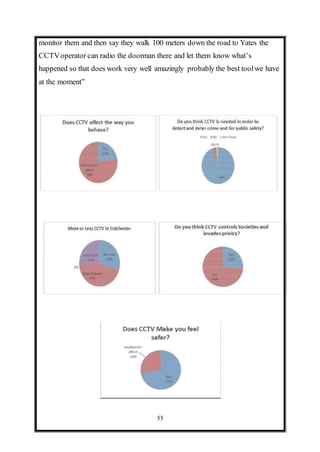
Security Guard – “Nagpur has a lot of big pubs so we have a pub watch system
atnight and a town link radio in the day this means that a council member will
be monitoring them and we let’s say for example at one of the venues let’s take
Gandhi bag in Nagpur if they have an ejection or refuse someone they will get a
radio description and not only will the other bars hear that the town CCTVcan
55
monitor them and then say they walk 100 meters down the road to Yates the
CCTVoperator can radio the doorman there and let them know what’s
happened so that does work very well amazingly probably the best toolwe have
at the moment”
56
AM CONTACT WITH THE DEALER OF NAGPUR CITY & GIVEN
QUATATION FRON IT
WAGHAE SERVICES
Plot no-60/A Ramna maruti nagar, nandanvan, NAGPUR
440009waghae.services@gmail.com
Mob. No.9326785460 Ph. 6500332
_______________________________________________________________________________________
QUOTATION
DATE: 05/12/20114
SUB – Quotation for CCTV
To, CHETAN KUMBHARE
Dear Sir,
As per our discussion on CCTV, we are pleased to quote
For the followings.
Sr
No
Product Qt
y.
Rate/Unit Amount Image/ Picture
01 700 TVL 35 Mtr. IR Bullet
Camera.
*Sony 1/3’’ Effio-E Chipset
*TV system: PAL
*Lens Mount:3.6mm Board
Lens
* Resolution:700 TVL
* IR Distance:35 Meters
*LED length:36 LEDs
03 Rs.2750/- Rs8250/-
57
*Pixels: PAL 720(H) X
582(V)
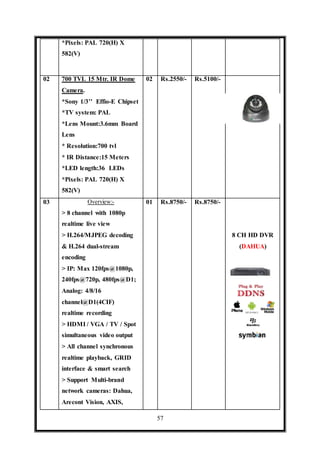
02 700 TVL 15 Mtr. IR Dome
Camera.
*Sony 1/3’’ Effio-E Chipset
*TV system: PAL
*Lens Mount:3.6mm Board
Lens
* Resolution:700 tvl
* IR Distance:15 Meters
*LED length:36 LEDs
*Pixels: PAL 720(H) X
582(V)
02 Rs.2550/- Rs.5100/-
03 Overview:-
> 8 channel with 1080p
realtime live view
> H.264/MJPEG decoding
& H.264 dual-stream
encoding
> IP: Max 120fps@1080p,
240fps@720p, 480fps@D1;
Analog: 4/8/16
channel@D1(4CIF)
realtime recording
> HDMI / VGA / TV / Spot
simultaneous video output
> All channel synchronous
realtime playback, GRID
interface & smart search
> Support Multi-brand
network cameras: Dahua,
Arecont Vision, AXIS,
01 Rs.8750/- Rs.8750/-
8 CH HD DVR
(DAHUA)
58
Bosch, Brickcom, Canon,
CP Plus, Dynacolor,
Honeywell, Panasonic,
Pelco, Samsung, Sanyo,
Sony, Videosec, Vivotech
and etc.
> ONVIF Version 2.0
conformance
> Auto IP address
acquisition by IP Search
function
> 3D intelligent positioning
with Dahua PTZ dome
camera
> Support UP TO 2 TB
SATA HDDs
> Multiple network
monitoring: Web viewer,
CMS(DSS/PSS) & DMSS
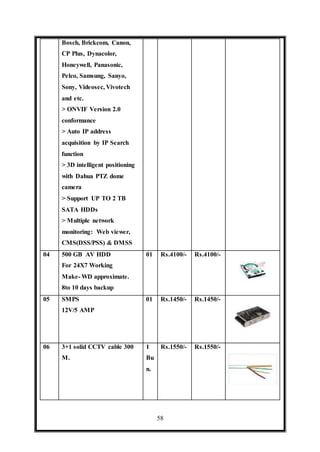
04 500 GB AV HDD
For 24X7 Working
Make- WD approximate.
8to 10 days backup
01 Rs.4100/- Rs.4100/-
05 SMPS
12V/5 AMP
01 Rs.1450/- Rs.1450/-
06 3+1 solid CCTV cable 300
M.
1
Bu
n.
Rs.1550/- Rs.1550/-
59
07 BNC (cable connector) 07 25/- Rs.175/-
Total Rs.29375/
-
08 Installation Charges : Rs.12/- M. open cabling
& Rs.18.5/-M. consoled
We hope it is line with your requirements
Terms and Condition:-
Payment 100% advance
Delivery Within 15 days after receipt of confirm order.
Validity This Quotation is valid for next 10 days from today.
Maintenance One year from the date of installation. (Free)
Taxes 12.5% Taxes (VAT) Extra/ Octroi /LBT Extra as actual
Warranty
1 year from the date of delivery. No warranty for Electrical Goods, Cables, casings Power
Adapter or other non-technical/ Electronics item. Any damage/Damages due to natural
Calamities, Electrical/Failure/Shock, and improper usage, Negligence etc will not be covered
under warranty. Rework/ Shifting of Setup part of the same will be chargeable.
For, WAGHAE SERVICE
Ashlesh Dufare
60
CHAPTER NO.9
LIMITATIONS
61
LIMITATIONS
 CCTV Doesn'tAlways Work: Unfortunately, CCTVis usually not able to
display every square inch of a business or facility. Even if the cameras are
positioned correctly, there is no guarantee that the cameras will catch any crime
or unwanted behavior doneon the property. These cameras can sometimes be
thwarted by covering them up or by sticking a piece of chewing gum on the
lenses. When cameras are high above the ground, criminals can avoid detection
simply by holding their heads down. Someone who is familiar with the property
may still be able to get around the surveillance and avoid getting caught. If the
cameras are positioned incorrectly, the high traffic areas of the facility will not
be shown on camera. In this case, much of the behavior that the CCTVcameras
are designed to detect will not be captured on tape.
 Privacy Concerns:Invasion of privacy is the major issue when it comes to
any security system device like the CCTVcamera system. It lowers the
employee morale and hampers productivity at times. Constant monitoring of
every activity might put the workers ill at ease.
 Initial Costs:The initial costs incurred per camera are high. The
installation may also increase the initial expenditure. It depends upon the
complexity of the CCTV camera system as well
62
CHAPTER NO.10
CONCLUSION & SUGGESTIONS
63
CONCLUSION & SUGGESTIONS
To conclude the use of CCTVcameras has clear benefits. When used in
moderation, under the correct guidance, Surveillance cameras can be invaluable
in aiding the police in their investigations. CCTVcan also act as a twenty-four
hour police presence, helping to make the public feel safer. If used excessively
however, the proliferation can lead to an invasion of privacy and a violation of
human rights. The costof the cameras has also been an issue that has caused
many debates as to whether the costis worth the results. There needs to be
reform into how the authorities use the existing surveillance cameras to enhance
their effectiveness to their impact on crime.
The rise of CCTV
In contemporary society the media often describes the UK as a
'surveillance society' as there have been many estimates about the number of
CCTVcameras that exist. These estimates are often hugely unrealistic and
unreliable. For example in 2003 M.C.Chailland Norris created the most quoted
figure for the number of cameras in the UK this was 4.2 million. Also in 1999
Armstrong and Norris said that “the average Briton is caught on security
cameras some 300 times a day” (Garrard & Thompson, 2011:10). However it
has been argued by members of the CCTV user group that these figures are
incorrect.
Human Rights and Privacy
Another issue surrounding CCTVis discriminatory monitoring. It has
been argued that “the target selection of CCTV operators can be massively
discriminatory towards males, particularly black males” (Armitage, 2002: 6).
There have been studies carried out that look at CCTV operators and who they
watch and to see if they watch certain categories of people more than others. For
example Norris and Armstrong (1999) show that blacks are twice more likely
64
than whites to be surveilled for no apparent reason. (Norris and Armstrong,
1999:).
Risk Society, Fear of Crime and public safety
So far the literature I have looked at covers the functions of CCTV
regarding crime detection and prevention. CCTV however is also useful with
preventing fear of crime and helping with public safety. Contemporary society
today has been described by many criminologists as a risk society. It has been
argued that risk is now a central feature of society. Giddens (1990, 1991) said
“that one of the key societal changes bought by late modernity is the alteration
in the environments of both trust and risk and the growth of ontological
insecurity” (cited in Hughes, 1998: 13). This shows us that as modernity
developed so did problems of safety in society. Structures in society changed
from traditional andcommunity values to more modern individual values.
Place Management:-
CCTVcan be used for general location management. The cameras can be
used to look for lost children, to monitor traffic flow, public meetings, or
demonstrations that may require additional police resources, or to determine if
alarms have been activated unnecessarily thus removing the need for a police
response. Brown reports that some police commanders claim that assaults on
police have reduced because the cameras allow them to determine the
appropriate level of responseto an incident, either by sending more officers to
large fights, or by limiting the number of officers to a minor incident and avoid
inflaming the situation
Increased Suspicion or Fear of Crime
A second concernis the possibility of a negative public responseto the
cameras' existence. In one survey, one-third of respondents felt that one purpose
of CCTV was "to spy on people". In other surveys, some city managers were
65
reluctant to advertise the cameras or have overt CCTVsystems for fear they
would make shoppers and consumers more fearful. In other words, it is hoped
that most citizens will feel safer under the watchful eye of the cameras, but
CCTVmay have the reverse effect on some people.
Increased Crime Reporting
A third unintended consequenceis the possibility that there will be an
increase in recorded crime for some crime types. Many offenses have low
reporting rates, especially minor acts of violence, graffiti, and drug offenses.
CCTVoperators are better placed to spotthese offenses and this can actually
drive up their recorded crime figures, as happened with narcotics offenses in
Oslo Central Train Station. This is not to say there was an increase in actual
crime, just recorded crime. This is a potential outcome, and you may need to
prepare other people involved in a future CCTVsystem of this possibility.
Suggestion & recommendation
 CCTVcamera is most important security device so it install on public
place and on important place.
 Its security device so I suggest to people to install this device on your
office for every time watch online on your computer or on android mobile
phone.
 In CCTV camera many feature is added like HDCVI technologies which
is record you’re recording in Mega pixel. So its provide u bestimage
recording.
 TodayCCTV camera is watch on laptop and your android phone so if
you’re not in office there for u watch anywhere at any time.
66
CHAPTER NO.11
BIBLIGRAPHY
67
BIBLIGRAPHY
 REFERENCES
 Books
 Newspaper Articles
 Journal/Newspaper articles in online collections
 WEBSITES
 www.google.com
 www.wikipedia.com
 www.dahua.com
68
CHAPTER NO.12
ANNEXURE
69
ANNEXURE
 Questionnaire for Dealer & Retailerof OED
1.How long have you worked as a CCTV Operator/Police officer/Shop
Owner/Security?
2. Has the way CCTV is used changed in the time you have been a
CCTV operator/Police officer/Shop Owner/Security?
How?
3. Has CCTV use changed/increased in the last 10 years?
How much?
4.Has the effectiveness of CCTV changed over
time? More/Less?
Questionnaire
Name : - ______________________________________
Address: - ______________________________________
______________________________________
Tele. No.:- ____________________
Mob No. :- _____________________
70
5.How much do you communicate with the authorities?
6.Do you communicate with other organizations e.g. shops, private security,
nightclub owners?
7.In your experience do you think CCTV is a crime prevention method?
In what ways?Is it successful?
8.Does CCTV help to reduce crime rates?
9.Does CCTV affect different crimes in different
ways? E.g. more or less effective for vehicle crime
than assault.
10.How do you think crime in surrounding areas is affected by
CCTV? How?
Reduced? Increased?
11.Is Crime reduced or just moved to areas without CCTV?
12.How often is CCTV used in one day at work?
13.How does CCTV affect public safety?
Detects crime? Deters crime?
14.Do you have an example of a time when CCTV has been used to ensure
71
safety to a member of public?
15.Do you think the public would be safe without CCTV?
16.When crimes that are committed in front of CCTV cameras does a pattern
emerge regarding the time of day?
Night/day? Weekend/weekday?
17.Is there more crime in the town Centre or in surrounding areas?
18.Do you believe there is enough CCTV in Colchester town?
19.Do you think the town would benefit from having more or less CCTV?
20.Overall how useful is CCTV in Colchester?
How and why?
21. Would you say CCTVexists to control societies or for public safety and
crime prevention?
Why?
22. Does CCTV affect the risk of crime?
23.Are the public protected by CCTV?
24.Does CCTV affect victimization?
72
25.Do you think the governments are spending the right amount of money on
CCTV?
26.What is the policy on human rights?
27.How do you prevent discrimination?
28.How do you think CCTV will change in the future?
How do you think it should change?

Final project

  • 1.
  • 2.
    2 INTRODUCTION OF MARKETING Amarket is one of the many varieties of systems, institutions, procedures, social relations and infrastructures whereby parties engage in exchange. While parties may exchange goods and services by barter, most markets rely on sellers offering their goods or services (including labor) in exchange for money from buyers. It can be said that a market is the process by which the prices of goods and services are established. For a market to be competitive there must be more than a single buyer or seller. It has been suggested that two people may trade, but it takes at least three persons to have a market, so that there is competition in at least one of its two sides.[1] However, competitive markets, as understood in formal economic theory, rely on much larger numbers of both buyers and sellers. A market with a single seller and multiple buyers is a monopoly. A market with a single buyer and multiple sellers is a monophony. These are the extremes of imperfect competition Markets vary in form, scale (volume and geographic reach), location, and types of participants, as well as the types of goods and services traded. Examples include:  Physical retail markets, such as local public markets, farmers' markets, street markets, flea markets, bazaars, and other public marketplaces; shopping centers and shopping malls  Physical wholesale markets Marketing is the process of communicating the value of a product or service to customers, for the purpose of selling that product or service.
  • 3.
    3 Marketing can belooked at as an organizational function and a set of processes for creating, delivering and communicating value to customers, and customer relationship management that also benefits the organization. Marketing is the science of choosing target markets through market analysis and market segmentation, as well as understanding consumer behavior and providing superior customer value. From a societal point of view, marketing is the link between a society's material requirements and its economic patterns of response. Marketing satisfies these needs and wants through exchange processes and building long term relationships. Marketing is a crucial function in any business or organization, and is increasingly important in the modern globalized economy. This free online course will introduce learners to marketing strategies and tools that are used extensively in the marketing industry. You will learn about the ambiguous nature of marketing and its different meanings for different businesses. You will also discover the characterizations of marketing that are common to all businesses, despite their differences. This course will teach you about the different approaches that affect marketing campaigns used in different types of businesses. This course will be of great interest to marketing and business professionals who wish to refresh the basics of marketing and to learners who are interested in business and wish to have a greater knowledge and understanding of the role marketing plays in the modern business world. MEANING Marketing is the craft of linking the producers (or potential producers) Of a product or service with customers, both existing and potential. It is an inevitable and necessary consequence of capitalism. However marketing is not limited to capitalist countries. Marketing techniques are applied in all political systems, and in many aspects of life. Marketing methods are informed by many
  • 4.
    4 of the socialsciences, particularly psychology, sociology, and economics. Marketing research underpins these activities. Through, it is also related to many of the creative arts. WHAT MARKETING INVOLOVES Contrary to the popular conception, marketing is not just about promotion it can be divided into four sections, often called the “four Ps”. FOUR ‘P’S OF MARKETING Marketing is your most important organizing tool. There are four basic aspects of marketing, often called the four Ps:  Product: The item or service you sell.  Price: The amount you charge for your product or service.  Promote: The ways you inform your market as to who, what, and where you are.
  • 5.
    5  Provide: Thechannels you use to take the product to the customer. As you can see, marketing encompasses much more than just advertising or selling. For example, a major part of marketing involves researching your customers: What do they want? What can they afford? What do they think? Your understanding and application of the answers to suchquestions play a major role in the success orfailure of your business. DEFINITION OF MARKETING HUGGY AND MITCHEL: “Marketing includes all the activities in the creation of place, time and possession utilities. Place utility is created when goods and services are available at the places they are needed, time utility is created when they are needed, and possession utility is created when they are transferred to those who need them” PAUL MAZUR: “Marketing is the delivery of a standard of living of society.” Timeline Robert A Bartels in The History of Marketing Thought categorized the development of marketing theory decade by decade from the beginning of the 20th century thus:  1900s: discovery of basic concepts and their exploration  1910s: conceptualization, classification and definition of terms  1920s: integration on the basis of principles  1930s: development of specialization and variation in theory  1940s: reappraisal in the light of new demands and a more scientific approach
  • 6.
    6  1950s: reconceptualizationin the light of managerialism, social development and quantitative approaches  1960s: differentiation on bases such as managerialism, holism, environmentalism, systems, and internationalism  1970s: socialization; the adaptation of marketing to social change With the growth in importance of marketing departments and their associated marketing managers, the field has become ripe for the propagation of management fads which do not always lend themselves to per iodization. Birth of marketing ideas In pre-modern economies, the predominance of small enterprises militated against the recognition of marketing as a separate field of expertise. Changes in the patterns and intensity of economic activity, as well as the rise of economics as a science, particularly in the 19th century, paved the way for studies of marketing. The growth in size and scope of national and international economies in the course of the Industrial revolution led eventually to a transcendence of ad hoc retailing and advertising innovations and eventually to systematization. Marketing emerged as a separate technical field only in the late 19th century. The OED traces the abstract usage of the word only as far back as 1884. Marketing history Much of traditional marketing practice prior to the twentieth century remained hidebound by rules-of-thumb and lack of information. Information technology, especially since the mid-twentieth century, has given the marketer new channels of communication as well as enhanced means of aggregating and analyzing marketing data. Specializations have emerged (especially sales versus marketing
  • 7.
    7 and advertising versusretailing) and re-combined (business development) over the years. Timeline of innovation  1450: Gutenberg's metal movable type, leading eventually to mass- production of flyers and brochures  1730s: emergence of magazines (a future vector of niche marketing)  1836: first paid advertising in a newspaper (in France)  1839: posters on private property banned in London  1864: earliest recorded use of the telegraph for mass unsolicited spam  1867: earliest recorded billboard rentals  1880s: early examples of trademarks as branding  1905: the University of Pennsylvania offered a course in "The Marketing of Products"  1908: Harvard Business School opens  1922: radio advertising commences  1940s: electronic computers developed  1941: first recorded use of television advertising  1950s: systematization of telemarketing  1970s: E-commerce invented  1980s: development of database marketing as precursor to CRM[5]  1980s: emergence of relationship marketing  1980s: emergence of computer-oriented spam  1984: introduction of guerrilla marketing  1985: desktop publishing democratizes the production of print-advertising  1991: IMC gains academic status  1990s CRM and IMC (in various guises and names) gain dominance in promotions and marketing planning,
  • 8.
    8  1995-2001: theDot-com bubble temporarily re-defines[the future of marketing  1996: identification of viral marketing  2000s: Integrated marketing gains acceptance and in 2002 its first dedicated academic research Centre Periodization One marketing standard chronology (Bartels, 1974; Dawson, 1969; Keith, 1960; Kotler and Keller, 2006) subdivides marketing history as follows:  Production orientation era  Product orientation era  Sales orientation era  Market orientation era  Customer orientation  Relationship orientation  Social/mobile marketing orientate
  • 9.
  • 10.
    10 INTRODUCTION OF PROJECT Closed-circuittelevision(CCTV)cameras can produceimages or recordings for surveillance purposes, and can be either video cameras, or digital stills cameras. Marie Van Brittan Brown was the inventor of the CCTV camera Video cameras are either analogue or digital, which means that they work on the basis of sending analogue or digital signals to a storage device such as a video tape recorder or desktop computer or laptop computer. Analog: Can record straight to video tape recorder which are able to record analogue signals as pictures. If the analogue signals are recorded to tape, then the tape must run at a very slow speed in order to operate continuously. This is because in order to allow a three hour tape to run for 24 hours, it must be set to run on a time lapse basis which is usually about four frames a second. In one second, the camera scene can change dramatically. A person for example can have walked a distance of 1 meter, and therefore if the distance is divided into four parts, i.e. four frames or "snapshots" in time, then each frame invariably looks like a blur, unless the subject keeps relatively still. Analogue signals can also be converted into a digital signal to enable the recordings to be stored on a PC as digital recordings. In that case the analogue video camera must be plugged directly into a video capture card in the computer, and the card then converts the analogue signal to digital. These cards
  • 11.
    11 are relatively cheap,but inevitably the resulting digital signals are compressed 5:1 (MPEG compression) in order for the video recordings to be saved on a continuous basis.Another way to store recordings on a non-analogue media is through the use of a digital video recorder (DVR). Such a device is similar in functionality to a PC with a capture card and appropriate video recording software. Unlike PCs, most DVRs designed for CCTVpurposes are embedded devices that require less maintenance and simpler setup than a PC- based solution, for a medium to large number of analogue cameras.Some DVRs also allow digital broadcasting of the video signal, thus acting like a network camera. If a device does allow broadcasting of the video, but does not record it, then it's called a video server. These devices effectively turn any analogue camera (or any analogue video signal) into a network TV. Digital: These cameras do not require a video capture card because they work using a digital signal which can be saved directly to a computer. The signal is compressed 5:1, but DVD quality can be achieved with more compression (MPEG-2 is standard for DVD-video, and has a higher compressionratio than 5:1, with a slightly lower video quality than 5:1 at best, and is adjustable for the amount of spaceto be taken up versus the quality of picture needed or desired). The highest picture quality of DVD is only slightly lower than the quality of basic 5:1-compression DV. However, in any situation where standard-definition video cameras are used, the quality is going to be poorbecause the maximum pixel resolution of the image chips in most of these devices is 320,000 pixels (analogue quality is measured in TV lines but the results are the same); they generally capture
  • 12.
    12 horizontal and verticalfields of lines and blend them together to make a single frame; the maximum frame rate is normally 30 frames per second. That said, multi-megapixel IP-CCTV cameras are coming on the market. Still quite expensive, but they can capture video images at resolutions of 1, 2, 3, 5 and even up to 11 Mpix. Unlike with analogue cameras, details such as number plates are easily readable. At 11 Mpix, forensic quality images are made where each hand on a person can be distinguished. Because of the much higher resolutions available with these types of cameras, they can be set up to cover a wide area where normally several analogue cameras would have been needed. Network: IP cameras or network cameras are analogue or digital video cameras, plus an embedded video server having an IP address, capable of streaming the video (and sometimes, even audio).Because network cameras are embedded devices, and do not need to output an analogue signal, resolutions higher than CCTVanalogue cameras are possible. A typical analogue CCTV camera has a PAL (768×576 pixels) or NTSC (720×480 pixels), whereas network cameras may have VGA (640×480 pixels), SVGA (800×600 pixels) or quad-VGA (1280×960 pixels, also referred to as "megapixel") resolutions.
  • 13.
    13 An analogue ordigital camera connected to a video server acts as a network camera, but the image size is restricted to that of the video standard of the camera. However, optics (lenses and image sensors), not video resolution, are the components that determine the image quality. Network cameras can be used for very cheap surveillance solutions (requiring one network camera, some Ethernet cabling, and one PC), or to replace entire CCTVinstallations (cameras become network cameras, tape recorders become DVRs, and CCTVmonitors become computers with TFT screens and specialized software. Digital video manufacturers claim that turning CCTV installations into digital video installations is inherently better). There continues to be much debate over the merits and price-for- performance of Network cameras as compared to analog cameras. Many in the CCTV industry claim that many analog cameras can outperform network cameras at a lower price. Video surveillance systems provide a never closing eye to watch over property and possessions,allowing a sense of safety and security. Cameras attached to a closed circuit television system send data to a computer or video
  • 14.
    14 recorder for liveviewing or later playback. The term closed circuit refers to the fact that the images recorded by the cameras are not broadcast, butsaved on a storage device. The CCTV system was originally developed as a security measure in banks, and later expanded to other businesses and home use. Meaning of CCTV Camera CCTVcameras keep an eye on your property and possessions Video surveillance systems provide a never closing eye to watch over property and possessions, allowing a sense of safety and security. Cameras attached to a closed circuit television system send data to a computer or video recorder for live viewing or later playback. The term closed circuit refers to the fact that the images recorded by the cameras are not broadcast, but saved on a storage device. The CCTVsystem was originally developed as a security measure in banks, and later expanded to other businesses and home use. Purpose CCTVcamera systems perform three main aspects of surveillance: deterrent, documentation and monitoring. The presence of a camera system helps deter unlawful activity in homes and businesses, and in cases where deterrent was unsuccessful, the cameras provide a documentation of the crime to aid in capturing the criminals. Monitoring allows live viewing of an area, a helpful intervention aid for elderly patients.
  • 15.
    15 How Do CCTVCamera Works? CCTVcamera systems include one or more cameras which are used to send video images and audio data to a monitor. Essentially, these camera systems use cameras to transmit the signals to a main hub which then records that data for later viewing or live viewing if you have full time security personnel on your premises. Security Camera Technology  Bullet Security Cameras  DomeSecurity Cameras  Night Vision Security Cameras  Pan Tilt Zoom Security Cameras  Silent Witness Vandal Resistant Internal Camera  Silent Witness Hawk  Lift Cameras  Silent Witness Bullet Resistant Camera  License Plate Recognition Cameras  IP Security Cameras  Varifocal Lens Cameras  Spy Cameras & Hidden Cameras  Wireless security camera  HD-SDI Cameras  100 Megapixel Panoramic IP camera
  • 16.
    16 1. Bullet SecurityCameras Bullet A bullet CCTVcamera is a wall-mount or ceiling-mounted unit that is typically designed for indoor use, but can also be fill some outdoorapplications. The camera derives its name from its sleek, thin cylindrical shape. Many bullet cameras alsotout themselves as being waterproof. The camera is not typically designed to have pan/tilt/zoom control but instead to capture images from a fixed area. The unit is mounted pointing at a particular area. 2. DomeSecurity Cameras A dome cameras get their name from the dome-shaped housing in which they sit. These housings are designed to make the cameras unobtrusive… not covert or hidden. Typical applications are retail, where the camera is designed to be unobtrusive, but visible. These units serve a dual purpose: “bad guys” will know the facility is being watched and patrons will feel at ease knowing the facility is being protected. Units that allow the camera to spin quickly within the housing are often referred to as “speed domes.”
  • 17.
    17 3. Night VisionSecurity Cameras For the human eye to see clearly, it must have adequate light. The same is true for security cameras. During the day, when office spaces and parking areas are properly lit by natural or florescent lighting, security cameras provide crisp images and colorful detail. At night, when those offices are closed and parking areas are dim, traditional security cameras may producegrainy video or video that is so dark the objects within the camera's field of view are unidentifiable. In these types of security environments, installing a night vision security camera is the most economical way to producequality 24/7 surveillance video. Night vision cameras are specifically designed for problem lighting environments. Instead of installing costly electrical fixtures or wasting electricity keeping lights on after-hours, consider installing night vision cameras for your 24-hour surveillance needs 4. Pan Tilt Zoom Security Cameras PTZ cameras are ideal for wide-area surveillance. They give operators the ability to remotely control pan, tilt, and zoom functions to follow activity and to zoom in for detailed monitoring. This is an area where analog CCTVcameras fall behind their IP camera counterparts. With IP cameras, the pan/tilt/zoom functions are controlled manually or automatically
  • 18.
    18 and delivered overa single network cable, while analog cameras require additional wiring to perform similar functionality. Unlike a static security camera, a PTZCamera is built on a swiveling head mechanism that gives the camera the flexibility to quickly pan a full 360 degrees and tilt up to 90 degrees. This swiveling head mechanism can be directly controlled one of three ways: at the security office using a security grade joystick, via the front panel of a digital video recorder (DVR) such as the EZWatch Turbo View DVR, or remotely through the DVR's software using your keyboard/mouse. In addition to direct control, the PTZ Camera can be indirectly controlled by pre-programming viewing tours or setting the camera to automatically track movement. 5. Silent Witness Vandal Resistant Internal Camera Ideal for the location where you may be concerned about people interfering with your Cameras. The impact resistant polycarbonate enclosure can be painted to match architectural requirements. The standard white finish will match most ceiling or wall finishes.
  • 19.
    19 6. Silent WitnessHawk This Advanced Surveillance Camera comes with the option of an LED and microphone making it ideal for using as part of a doorentry system. It can be mounted anywhere and has a special bracket for angle adjustment. 7. Lift Cameras Installing a camera in an elevator is a common requirement but one that is so often poorly planned and carried out. The result is inevitably sub-standard images, high maintenance costs, elevator down-time and ultimately customer dissatisfaction 8. Silent Witness Bullet Resistant Camera If you really have a security problem then this must be the ultimate camera for you!Most Silent Witness Cameras come with a variety of lenses and can be supplied for colour or monochrome systems.
  • 20.
    20 9. License PlateRecognition Cameras License Plate Security Cameras are recommended for a broad range of applications. Forlower risk environments that have few entrances and exits, such as parking garages and gated communities, a License Plate Camera should be mounted near the entrance and can be used to supplement other safety policies. In environments where theft is likely to occur, such as gas stations, convenience stores, or warehouse/distribution centers, a license plate camera can be used in conjunction with color cameras to identify the make, model, and color of the vehicle. In high security areas, license plate cameras can be enlisted to supportrecord keeping detail by combining it with an Automatic Number Plate Recognition (ANPR) software. The software can be pre- populated with a list of approved license plate numbers and cause an alarm condition if a vehicle enters an area with an non-approved license plate. 10. Wide Dynamic Range Cameras Lighting is the most critical factor to consider when selecting the right camera for any security surveillance installation. For environments that maintain constant lighting conditions, like an interior office or storage area, a standard color security camera is a great choice. If the environment changes from day light to complete darkness, like a parking lot, night vision cameras stream clear video day or night. But what about areas that are affected by dramatic changes in available light, like a sunlit lobby? Environments such as
  • 21.
    21 sunlit lobbies orstreet facing store fronts require a camera that can adapt to various lighting conditions. Wide have built-in technology which digitally creates a middle ground between the brightest and darkest areas within the camera's field of view. The enhanced color image is carefully balanced and transmitted to the digital video recorder assuring all areas within the field of view are perfectly exposed. 11. IP Cameras Security and surveillance technology has come a long way since the introduction of analog cameras and video cassette recorders (VCR). The new wave of high performance IP Security Cameras provide even greater accessibility and controlof your security surveillance system. In addition to easier installation, IP Cameras offer enhanced digital zoom and on board digital processing which enables users to recover video faster and extract greater detail. The IP in IP Cameras refers to Internet protocol;the method these cameras use to transmit video. This technology enables these cameras to transmit footage wirelessly to a central DVR point.
  • 22.
    22 Potential advantages  Two-wayaudio via a single network cable allows users to communicate with what they are seeing (e.g. gas station clerk assisting a customer on how to use the pay pumps)  Flexibility: IP cameras can be moved around anywhere on a network (wireless).  Distributed intelligence: with IP cameras, video analytics can be placed in the camera itself allowing ability in analytics solutions.[4]  Transmission of commands for PTZ(pan, tilt, zoom) cameras via a single network.  Encryption & authentication: IP cameras offer secure data transmission through encryption and authentication methods such as WPA, WPA2, TKIP, AES.  Remote accessibility: live video from selected cameras can be viewed from any computer, anywhere, and also from many mobile smartphones and other devices. Remote accessibility also prevents police officers from confiscating video and audio evidence that you can use against them  IP cameras are able to function on a wireless network.  PoE - Power over Ethernet: Modern IP cameras have the ability to operate without a power supply. They can work with the PoE-protocol.
  • 23.
    23 12. Varifocal LensCameras Measure twice, cut once. That’s the saying we’ve all heard from professional builders and carpenters. However, this saying extends to more than just sawing wood or hammering nails. Forcameras installed with a fixed focal length lens, measuring for field of view must be precise. To use another phrase, once the camera is fixed in place, what you see is what you get. Considering the many video surveillance cameras available, a camera with an adjustable lens will give you greater flexibility during installation and keep you from timely labor spent on relocating cameras if your needs change in the future. Security surveillance cameras generally have three uses: to survey an area for disturbance, monitor behavior, or identify individuals. If your goal is to survey an area suchas a parking lot, select a lens with the widest field of view. To monitor behavior, such as making sure a grocery store clerk stays at their register during their shift, a mid-range lens is ideal. However, if you want to have enough detail to help police identify someone you don’tknow, like a robberentering a convenience store, a longer range lens is needed. If you are unsure how your camera will be used, if your use will change over time, or you would prefer to have some flexibility in your installation height and field of view, choosea camera and lens combination with a vari-focal length and automatic iris lens
  • 24.
    24 13. Spy Cameras& Hidden Cameras When people know they are being monitored, they are more likely to behave as expected. To find out what is really happening behind the scenes, strategically placed hidden cameras give home and business owners full access to employee behavior and provide peace of mind while away. Known as covert cameras, nanny cameras, spy cameras, and hidden cameras, these unseen
  • 25.
    25 cameras can beplaced in unexpected places so you can monitor the unfiltered behavior of their employees, caretakers, or contractors. Determining which type of cameras you need depends on the level of discreteness you desire and the other types of security equipment installed. EZWatch offers two main types of hidden cameras: pinhole and self- contained. If this will be your only security camera, a completely self-contained camera with a built-in digital recorder is easy to install and will provide covert recording. Completely self-contained covert cameras like the Clock Radio Spy Cameraor the Covert Tissue Box camera include the camera, a fully functional digital video recorderthat uses a removable memory card or cable to review recordings, and a power supply or wall transformer. To conserve memory, many self-contained hidden cameras will use motion activated technology to signal when the digital video recorder should start and stop recording. In addition to their small size, these cameras are great to use because they are disguised as everyday objects and often go un-noticed. If the hidden camera will be used in conjunction with a security camera system, a pinhole camera or otherwise disguised camera will be a great addition. Pinhole cameras are physically smaller than traditional cameras, about the size of a postage stamp, but producea crisp, clean image. Because of their discrete design, pinhole cameras can be concealed in almost any object. Likely places to install this type of camera include a locked filing cabinet, within a busy art canvas, a hollowed book, a drop ceiling tile or within a lamp base. Ideally, the object should have enough spaceto secure the camera as well as obscurea small 1/8" hole. If you would rather install a camera that is already hidden within an everyday object, EZWatch offers the PIR-GOLD Motion Detector Hidden Camera. Disguised as a typical motion detector, this camera can be mounted flush to the wall which minimizes exposed wiring. After the ideal angle and placement is selected, installing a pinhole or hidden cameras is similar to
  • 26.
    26 installing a traditionalcamera. Simply connect the camera to your recording device via BNC cable, secure power to the camera, and be careful to disguise the transmission and power cables. 14. Wireless security camera Many consumers are turning to wireless security cameras for home surveillance.Wireless cameras do not require a video cable for video/audio transmission, simply a cable for power. Wireless cameras are also easy and inexpensive to install. Previous generations of wireless security cameras relied on analog technology; modern wireless cameras use digital technology which delivers crisper audio, sharper video, and a secure and interference-free signal. 15. HD-SDI Cameras If you want to have the best image quality possible from your video surveillance system, HD-SDI cameras are the best choice money can currently buy. HD-SDI cameras transmit uncompressed 1080P video footage. This footage is then compressed into the H.264 format for storage and play back at a later time.
  • 27.
    27 When you chooseto pay back recorded video from HD-SDI Systems the video is decompressed to allow viewing in full 1080P High Definition. This footage is on the same level of quality that you see on HD television channels or Blu-Ray movies - up to six times higher resolution than standard definition video cameras. Due to a much larger digital signal, it is important to understand the amount of storage you will need on your hard drives when installing a HD-SDI system. Calculating the amount of hard drive spaceneeded is based on the number of cameras recording and time period you want to save the stored video before you begin recording over the oldest recorded video. The decision to record only when motion is detected rather than recording all images 24 hours a day can heavily reduce the hard drive spacerequired. While you can use ourDVR Storage Calculator to get a rough estimate of hard drive spaceneeded, it is always recommended to consult with professional system design experts from a highly reputable company to help with this decision. All of our HD Cameras are available for any situation and will provide the highest quality images in bright daylight or complete darkness when you select the correctcamera. HD-SDI Indoor Dome Cameras are available with a various lens to provide a narrow field of view for hallways or other areas where you need to view greater distance in a narrow space. These HD Security Cameras are available with or with or without night vision capability. Outdoor HD-SDI Dome Cameras should always be weather-rated to withstand the temperatures you expect to see at the location you plan to install the cameras. These cameras should also be waterproof and vandal resistant. These HD security cameras are available in a choice lens options, depending on the coverage area required, and almost always include night vision capabilities to provide crystal clear footage in darkness. HD-SDI Box Cameras typically are available with a Varifocal lens, but also allow the user to easily change the lens
  • 28.
    28 to any lensneeded to provide the desired coverage. HD-SDI Bullet Style Cameras come in many different shapes & sizes to fit into almost any application. Bullet cameras are able to view greater distances than most Dome cameras and are usually designed to be weather and vandal resistant. Most HD Bullet Style Cameras are equipped with excellent night vision. HD-SDI PTZ Cameras offer the user the ability to cover a complete 360 degree field of view with the ability to zoom in on an object up to 400 feet away. Most of these HD PTZ Cameras allow for preset cruising tracks. The sequences can be set to let the camera scan from one position to the next in a cycle at a set speed. Built-in motion detection technology can detect motion in a defined video zoom and trigger an alarm. The HD-SDI PTZ Cameras may also be manually controlled with the use of a joystick controller 16. 100 Megapixel Panoramic IP camera The latest development is the Logipix Day/Night 15 Megapixel Auto Back Focus Security Camera with SATA interface. The device, which can take more than 100- megapixel pictures, is built up from these cameras. This device consists of nine Logipix Day/Night 15 Megapixel Auto Back Focus Security Cameras, the images of which are integrated into one high resolution panorama image. The cameras are located at an angel of 40° to each other, so the total 360° area
  • 29.
    29 can be observed.The frame rate is 5 fps. As in case of all the other products of the STP Ltd, the 100 megapixel panoramic camera uses JPEG2000 compression procedureas well. Application area The high resolution panorama image is ideal in areas, where large areas must be simultaneously and continuously monitored. The surveillance work is assisted by the Logi-Zoom function optimized to small bandwidth. This function allows only the detailed images to be displayed at full resolution on the control centre, while the other parts of the image are displayed in low resolution. Software In the Video monitor menu point of the ControlCentre the integrated image of the nine 15-megapixel Logipix cameras can be seen, so the maximum resolution of this image is 135 megapixel. The detailed, digital zoomed images can be displayed on the bottom of the window, while the whole panorama image can be seen in the control center in lower resolution in its real time. Key Features  Fully integrated camera head overcoming highlight issues such as car headlights.  24/7 day and night operation  Long bulb life  Image capture at up to 50m distances  Number plate recognition at speeds in excess of 100mph  Simultaneous operation of up to 4 separate lanes  Multi-lingual number plate recognition  Fully automated operatorprompts in responseto known / suspectvehicles
  • 30.
    30  Control ofbarrier gates  Calculation of car parking charges  Activation of LED display signs (corporate welcome)  TCP/IP networkable  IFSEC Security Industry Awards Winner 2002 Evaluations of CCTV A number of surveys have examined the perception of CCTV system managers and the public in regard to CCTV's crime prevention benefits. These perceptions are usually positive, but evidence of actual crime reduction is harder to come by. In the early days of CCTV, many evaluations were carried out, but a number of significant methodological considerations draw into question their reliability. Problems included a lack of control areas, independence of researchers, and simplistic approaches to temporal crime patterns. Establishing if CCTV reduces crime is often difficult because a problem- oriented policing solution is rarely implemented without incident or without other crime prevention measures being applied at the same time. The implementation can often run into problems and commence late or in piecemeal fashion; crime rates naturally vary and show evidence of seasonality and long- and short-term trends; offenders are not necessarily aware of the system or become aware at different times (a theoretically crucial mechanism to CCTV success);and, there are quantitative challenges to the measurement and detection of displacement and diffusion of benefits. These issues make it difficult to detect the impact of CCTV alone. Forexample, although CCTVwas a factor affecting the operation of four street drug markets in London (UK), the cameras were often used with other crime prevention/detection efforts, such as large-scale arrests of sellers and situational crime prevention measures. In some cases, the sheer lack of crime inhibits any robustevaluation. For example, the state of Illinois is reported to have spent $4 million installing
  • 31.
    31 cameras at allinterstate rest areas. The cameras are monitored by state police. However both the Illinois Department of Transportation and the state police admit that serious crime at rest areas is extremely rare, with the latter identifying about 50 total crimes per year at all rest areas in the state. With such low crime rates, it may be impossible to demonstrate any crime reduction benefit for the millions spent. Assessing the impact of CCTVis also complicated by the system's design. CCTV is designed to see crime. As a result, the cameras may detect offenses that police would not otherwise notice. This may inadvertently increase the crime rate, especially for offenses that have low reporting rates - as noted in this guide. In the United States , the reporting rate of violent crime is only 50 percent. A process bywhich police can becomeaware of street violence without having to rely on the cooperation of the general public may increase reporting rates substantially. This does not mean crime will go up, but it is possible recorded crime may rise, as was probably the cause for a significant increase in reported woundings and assault in more than one UK town. Although Appendix A conducts a meta-analysis of existing CCTV evaluations by predominantly exploring any recorded crime reductions, this may be a less than ideal way to evaluate CCTV. There have been a number of evaluation reviews. Phillips concluded that CCTVcan be effective against property crime, but the results were less clear regarding personal crime and public order offenses, and the results were mixed in regard to reducing fear of crime. Similarly Welsh and Farrington’s meta- analysis of 13 programs found five that appeared to work, three that appeared not to, and five that produced inconclusive results. Recently, Gill and Spriggs evaluated 13 UK CCTVsystems, finding that six demonstrated a relatively substantial reduction in crime in the surveilled area when compared to the designated control area. Of these six, only two showed a statistically significant reduction relative to the control zone. In seven areas there was an
  • 32.
    32 increase in crime,though the increase could not be attributed to CCTV. Other potential causes for the crime increase included fluctuations in crime rates caused by seasonal, divisional, and national trends, and additional initiatives. The evaluations in Appendix A go some way to confirming these rather confusing findings. The general findings suggest that:  CCTVis more effective at combating property offenses than violence or public order crime (though there have been successes in this area)  CCTVappears to work best in small, well-defined areas (such as public car parks)  The individual context of each area and the way the system is used appear to be important  Achieving statistically significant reductions in crime can be difficult (i.e., crime reductions that clearly go beyond the level that might occur due to the normal fluctuations in the crime rate are difficult to prove)  A close relationship with the police appears important in determining a successfulsystem  There is an investigative benefit to CCTV once an offense has been committed Reading this, you may feel the answer is unclear. Academic evaluators tend toward caution in their language, as they understand there is often a complex pattern of factors that dictate whether a system is successfulor not. The rigid requirements of statistical evidence often limit the conclusions that quantitative evaluators can draw. To move beyond a strictly statistical interpretation, it is possible to say there was some evidence of crime reduction in most of the systems reported in the appendices. In other words, CCTV will almost certainly not make things worse (though crime reporting may increase), and there is a growing list of
  • 33.
    33 evaluations that suggestCCTV has had some qualified successesin reducing crime. The important point is that the local context is central to determining the likelihood of success.Forexample, city streets with long, clear lines of sight may be more amenable to CCTVthan short, narrow winding lanes with trees that might obscurecamera views. The availability of police to respond to incidents in an appropriate manner may also be a local context that affects CCTV's success. Areas with high levels of property crime may be more amenable to CCTV than areas with low levels of public disorder. Smaller systems in well-defined areas may be more effective than broad-ranging systems that cover large areas. Understanding your local context is central to a successfulproblem-oriented policing solution. CCTV appears to be somewhat effective at reducing fear of crime, but only among a subset of the population. There are examples of a reduction in fear of crime among some people who are in CCTV areas, but it requires them to know they are in a surveillance area, and this is often not the case. Relying on CCTV to reduce fear of crime. .
  • 34.
  • 35.
    35 Historical Background The firstCCTV system was installed by Siemens AG at Test Stand VII in Peenemunde, Germany in 1942, for observing the launch of V-2 rockets. The noted German engineer Walter Bruch was responsible for the technological design and installation of the system. In the U.S. the first commercial closed-circuit television system became available in 1949, called Vericon. Very little is known about Vericon except it was advertised as not requiring a government permit.  1942:-First CCTV security camera surveillance system installed. German engineer Walter Bruch was responsible for the design and installation of the CCTV security camera surveillance system.  1949:-publication of George Orwell's 1984, which is set in London.  1956:-First VCR produced byAmpex Corporation team led by Charles Ginsburg. 19 year old engineer Ray Dolby was also part of the team. Built for commercial business use.  5 November 1960:Metropolitan Police use two temporary cameras in Trafalgar Square to monitor "Guy Fawkes Day" activity. 1960’s – First digital camera signals used in cameras over analog by NASA.  1961:-installation of video surveillance system at a London Transport train station.  1964:-Liverpool police experiment with four covert CCTVcameras in the city's center.  1965:-British Railways installs cameras to watch tracks near Dagenham that had been vandalized.  1967:-Photo scan(business) markets video surveillance systems to retail outlets as a means of deterring and catching shoplifters.
  • 36.
    36  1996:-The firstIP camera was released in 1996 by Axis Communications.  October1968:-Metropolitan Police use temporary cameras in Grosvenor Square to monitor anto-Vietnam War demonstrators.  1969:-Metropolitan Police install permanent cameras in Grosvenor Square, Whitehall and Parliament Square. Total number of cameras nationally.  1972:-First VCR for home use produced byPhilips  1974:-installation of video surveillance systems to monitor traffic on the major arterial roads in and through London.  1975:-installation of video surveillance system in four London Underground train stations.  1975:-use of video surveillance systems at soccermatches begins.  1984:-installation of surveillance cameras at major rallying points for public protest in central London. Picketers surveilled during miners' strike.  August 1985:-installation of street-based video surveillance system in Bournemouth, a south coastseaside resort.  1987:-use of video surveillance systems at parking garages owned by local authorities begins.  1988:-installation of video surveillance systems at "council estates" run by local authorities.  1989:-civil rights group Liberty publishes who’s watching you? Video surveillance in public places.  1992:-installation of street-based video surveillance system in Newcastle (a major northern city). The system in Newcastle is closed-circuit
  • 37.
    37 television (CCTV) thatuses microwaves (an open circuit) to link to the city's main police station.  1992:-use of speed cameras and red-light enforcement cameras on the national road network begins.  1994:-central government (the Home Office) publishes CCTV:Looking Out for You. Prime Minister John Major states: "I have no doubtwe will hear some protestabout a threat to civil liberties. Well, I have no sympathy whatsoever for so-called liberties of that kind." Between 1994 and 1997, the Home Office spends a total of 38 million pounds of CCTV schemes.  July 1994:-use of covert video surveillance systems at automatic teller machines (ATMs) begins.  1996:-government spending on CCTVaccounts for more than three- quarters of total crime prevention budget.  August 1996:-all of England's major cities except Leeds have video surveillance systems in their city centers.  10 May 1997:- public demonstration against surveillance cameras in Brighton, organized by South Downs Earth First!.  July 1997:-London police announce installation of surveillance camera system that automatically reads recognizes and tracks automobiles by their license plates.  October1998:-use of face recognition software in the London Borough of Newham begins. First consumer digital video recorders (DVR) released to the public.
  • 38.
  • 39.
    39 OBJECTIVES OF THEPROJECT ANALYSIS  To Prevent and detect crime and disorder: - If CCTV cameras constantly monitor a retail business, criminals will likely seek an easier target. If employees know that they are constantly being watched, they are less likely to steal from their employer or waste time on the job. School children who know that their every move is being recorded may be less likely to carry guns to schoolor engage in criminal activities on campus. The effect of surveillance cameras in Philadelphia was studied over a two year period. While crime in the surveillance areas dropped overall by 13 percent, the number of areas where crime did go down was equal to the number of areas that so no drop at all.  To Prevent and protect to Employees: - Customer service employees are often required to handle angry or frustrated customers. Face-to-face interactions with an angry customer can put the employee in physical danger. CCTVcameras may save employees from harm by monitoring these volatile situations. They also serve as a deterrent from violent behavior by these customers.  To Keeps a Record: - If a crime occurs in an establishment that has installed CCTV surveillance, investigation will be aided by the video. If an argument occurs
  • 40.
    40 between two employees,the employer can consult the videotape to determine what actually happened.  To improved incident monitoring:- To improve the ability to observe events at specific locations as they happen. When and if appropriate, being able to co-ordinate a responsefrom police or rangers to the incident if necessary.  To Improved public perception of the area:- To improve public perception that a certain location is safe and to increase public use of that area.  To contribute towards public safety.  To Prevent and detectanti-socialbehavior.  To Prevent and detectthe misuse of drugs and alcohol  To Prevent and detectbehavior adverselyaffecting the environment.  To Public reassuranceand reduction in the levels of fearof crime. .
  • 41.
  • 42.
    42 SCOPE  Use inschools:- In the United States, closed-circuit television is used for schoolsecurity to monitor visitors, track unacceptable student behavior and maintain a record of evidence in the event of a crime. There are some restrictions on installation, cameras may not be used in an area where there is a "reasonable expectation of privacy". Examples of these are bathrooms, gym locker areas and private offices (unless consentby the office owner is given). Cameras are generally acceptable in hallways, parking lots, front offices where students, employees, and parents come and go, gymnasiums, cafeterias, supply rooms and classrooms.  Control of retail:- Someas software integrate with CCTVto monitor the actions of workers in retail environments. Every action is recorded as an information block with subtitles that explain the performed operation. This helps to track the actions of workers, especially when they are making critical financial transactions, such as correcting or cancelling of a sale, withdrawing money or altering personal information.  Traffic monitoring:- Many cities and motorway networks have extensive traffic-monitoring systems, using closed-circuit television to detect congestion and notice accidents. Many of these cameras however, are owned by private companies and transmit data to
  • 43.
    43 drivers' GPS systems.The UK Highways Agency has a publicly owned CCTV network of over 1,200 cameras covering the British motorway and trunk road network. These cameras are primarily used to monitor traffic conditions and are not used as speed cameras. With the addition of fixed cameras for the Active Traffic Management system, the number of cameras on the Highways Agency's CCTVnetwork is likely to increase significantly over the next few years.  Transport safety:- Digital Video Recorderfor Public TransportA CCTV system may be installed where an operator of a machine cannot directly observe people who may be injured by some unexpected machine operation. For example, on a subway train, CCTV cameras may allow the operator to confirm that people are clear of doors before closing them and starting the train. Operators of an amusement park ride may use a CCTV system to observe that people are not endangered by starting the ride. A CCTVcamera and dashboard monitor can make reversing a vehicle safer, if it allows the driver to observe objects or people not otherwise visible.  Crime Deterrent: - If CCTV cameras constantly monitor a retail business, criminals will likely seek an easier target. If employees know that they are constantly being watched, they are less likely to steal from their employer or waste time on the job. Schoolchildren who know that their every move is being recorded may be less likely to carry guns to schoolor engage in criminal activities on campus. The effect of surveillance cameras in Philadelphia was studied over a two year
  • 44.
    44 period. While crimein the surveillance areas dropped overall by 13 percent, the number of areas where crime did go down was equal to the number of areas that so no drop at all.  Protect Employees:- Customer service employees are often required to handle angry or frustrated customers. Face-to-face interactions with an angry customer can put the employee in physical danger. CCTVcameras may save employees from harm by monitoring these volatile situations. They also serve as a deterrent from violent behavior by these customers.  Keeps a Record:- If a crime occurs in an establishment that has installed CCTV surveillance, investigation will be aided by the video. If an argument occurs between two employees, the employer can consult the videotape to determine what actually happened.
  • 45.
  • 46.
    46 RESEARCH METHODOLOGY After decidingmy research for this project was going to surround the different functions and effectiveness of CCTV in Nagpur city Centre and ultimately try to answer the question does CCTVwork; I decided the data I collected should come from different people who work with CCTVwithin the city. I also felt that it was important to gain an idea of how the public felt about CCTVand see if their views differ from different authorities and professionals. In order to gain this data I decided that a qualitative research design would be best as I could find out in depthopinions; views and experiences participants had had with CCTV. However I also decided to incorporate a small amount of quantitative data by carrying out surveys which were completed by members of the public. This chapter will describe the methodology I used in order to address the aims of my research. The research methodology adopted for the study of the topic“STUDY OF PRODUCT ANALYSIS OF CCTV CAMERA”is analytical methodology. Both Primary and Secondary data are collected from respondents to address the research. We referred to existing research on some similar products available in the market to have a better insight about the market stand of the productof CCTVCameras. Based on a particular format of questionnaire done with two broad categories of the customers the responses were analyzed PRIMARY DATA COLLECTION METHOD The study uses the primary data for the study like: Interview: -In order to conductmy semi structured interviews I needed to constructa set of questions. I started off by looking at what I wanted to find out and what my main themes were. I had some specific topics that I wanted to
  • 47.
    47 cover in orderto answer my research question so produced a set of about 30 questions that could be asked throughout the interview. I made sure my questions flowed well with the topics;I used relevant language and tried not to ask leading questions .This then meant that I had a structure and an aim; however I could add other questions in freely and take them out if the participant had already covered them. It also allowed the participant to go off at a tangent, talk freely and add in any other information they felt was relevant but at the same time if it went too off track I had a guide to follow. I started off the interview by asking job roles and how long they had worked in that role in order to put the participant at ease and start to build a rapport. I also made sure I was prepared with prompts in case the participant was struggling to answer. This resulted in the opportunity to conducta long, relevant and detailed interview. I then transcribed my interviews and from there started my data analysis. Survey: -When constructing my surveys my aim was to make them quick and easy to fill in as my time was limited. Therefore I thought of seven questions relating to different topics. I made most of my questions closed and I had two open questions to gain some extra opinions. The Survey was easy to follow but at the same time allowed me to gain the public’s view on CCTV in Nagpur and find some patterns in the data. SECONDARY DATA COLLECTION METHOD The study also uses secondary sources of data for the study.  Information gathered through surfing the internet;  Information available on internet site of the company.
  • 48.
  • 49.
    49 HYPOTHESIS The hypothesis takenunder consideration of the study is:- H-1:- CCTV as a crime prevention method The amount of CCTVthat exists in society today is due to the government’s aims in the 1990’s. “In an attempt to revitalize what had become rather stale thinking in relation to crime prevention, the home secretary launched the ‘Partners Against Crime’ initiative in September 1994” (Crawford, 1998: 40). Their main aim of the increase of CCTVin the UK was to reduce crime and use it as an effective crime prevention method. H-2:- Help to Protect Human Rights and Privacy Another issue surrounding CCTVis discriminatory monitoring. It has been argued that “the target selection of CCTV operators can be massively discriminatory towards males, particularly black males” (Armitage, 2002: 6). There have been studies carried out that look at CCTV operators and who they watch and to see if they watch certain categories of people more than others. For example Norris and Armstrong (1999) show that blacks are twice more likely than whites to be surveilled for no apparent reason. (Norris and Armstrong, 1999:). H-3:- the product of CCTVcameras is most importance and protect to customer, employee, worker and their works. H-4:- the CCTVcameras Prevent and detect the misuse of drugs, medicine and alcohol. H-5:- the CCTVcameras Public reassurance and reduction in the levels of fear of crime.
  • 50.
  • 51.
    51 FINDINGS AND ANALYSISOF DATA  CCTVcamera is a security device which is detect crime and protectto people  CCTVcameras keep an eye on your property and possessions  Video surveillance systems provide a never closing eye to watch over property and possessions,allowing a sense of safety and security.  Cameras attached to a closed circuit television system send data to a computer or video recorderfor live viewing or later playback. The term closed circuit refers to the fact that the images recorded by the cameras are not broadcast, butsaved on a storage device.  The CCTV system was originally developed as a security measure in banks, and later expanded to other businesses and home use. Data Analysis In order to put my research into context and before looking at the data analysis it is important to have some knowledge of Nagpur city Centre. After carrying out my research on CCTV in Nagpur city Centre the next step I took was analyzing the data I had collected. I have combined the data collected from my interviews and surveys to discover patterns and themes within my research to answer my question. I have also divided my data into different topics these are CCTVin Nagpur city, CCTV and Crime prevention, CCTVand public safety,CCTV and social control and overall effectiveness.
  • 52.
    52 Problems with researchmethodology When conducting my research I came across several problems however and becauseof time limits and lack of resources these were difficult to overcome. The time limits. I hadwere a major problem, although I had the right contacts it took a long while to arrange and complete all of my interviews. I collected a large amount of detailed data from carrying out interviews. If I had had enough time carrying out second interviews would have been very useful and added to my research. I would also carry out a few more interviews to gain even more opinions and views. It would have been useful to interview the Crime Reduction Officer for Nagpur police station. My survey was very simple and although I gained enough information to get a general idea of the public’s views on CCTV, I would also have liked to extend my survey and have a larger sample. This meant I could have discovered more patterns and trends within the research. Another problem with my survey was that the sample was mainly completed by students therefore it could be argued that this would not represent the general population. Therefore if I continued with this research I would have used a better, larger sample which ranged in age, gender, occupation and other social factors.  I found that the only way CCTVhas changed since it was in Nagpur which may have an impact is the technology and the quality of the cameras? CCTVOperator – “Instead of putting in new cameras in more places we try andreplace old cameras to upgrade the quality of image we get”. Shop Owner – “it’s better becausewe have changed the equipment you know wehave a coloured camera where it was black and white before a couple of monitors and hard drive rather than video”.
  • 53.
    53  Which thenwould also give the idea that CCTV must work in some ways in order for this to happen? The usage of CCTV in Nagpur also leads to the suggestion that it is needed in daily life to benefit society. This is also illustrated through the impact it has on the number of arrests.  When asked the question how often is CCTVused in one day at work? All the participants answered with 24 hours a day. Police officer – “CCTVis used every day some days we are talking constantly to theCCTV operators” CCTVoperator – “it’s used 24 hours a day it is impossible to say how many incidentsthere are. On our last annual report there was about 750 arrests that we were involved with over the year so a couple of arrests a day.” This demonstrates that CCTVis involved in crime in a huge way, it shows that without CCTVmany arrests may not have been made causing society to be at more of a risk. With this data it would be impossible to argue that CCTV has no use in society.  I also asked the question do you think CCTV will change in the future. How? Increase? Decrease? I felt this was important as it may help establish whether there was a belief that there would be more CCTV in the future.
  • 54.
    54 Police officer- “Ithink the systems will become more advanced and better quality” CCTVOperator “I Think CCTVcoverage has more or less reached saturation levelnow I think it will simply stay as it is except for maintenance and improvements on existing cameras” Shop Owner – “As technology moves on so will CCTV” CCTV and Crime detectionand prevention Another topic that arose throughout my interview process was crime prevention. I asked a number of questions regarding this because as I explained earlier the rise in CCTVin the 1990’s was mainly due to the governments aims in reducing and preventing crime. Therefore in order to establish whether CCTVworks it is important to look at this. It is clear from my interviews that CCTVhas been a successfultool in helping authorities tackle crime, however there is also evidence to show it does not succeed in every way. My interview data shows that an important aspect of CCTVis how it allows streets to be monitored at all times and it allows authorities to communicate and get them to a scene of a crime as soonas possible. Security Guard – “Nagpur has a lot of big pubs so we have a pub watch system atnight and a town link radio in the day this means that a council member will be monitoring them and we let’s say for example at one of the venues let’s take Gandhi bag in Nagpur if they have an ejection or refuse someone they will get a radio description and not only will the other bars hear that the town CCTVcan
  • 55.
    55 monitor them andthen say they walk 100 meters down the road to Yates the CCTVoperator can radio the doorman there and let them know what’s happened so that does work very well amazingly probably the best toolwe have at the moment”
  • 56.
    56 AM CONTACT WITHTHE DEALER OF NAGPUR CITY & GIVEN QUATATION FRON IT WAGHAE SERVICES Plot no-60/A Ramna maruti nagar, nandanvan, NAGPUR 440009waghae.services@gmail.com Mob. No.9326785460 Ph. 6500332 _______________________________________________________________________________________ QUOTATION DATE: 05/12/20114 SUB – Quotation for CCTV To, CHETAN KUMBHARE Dear Sir, As per our discussion on CCTV, we are pleased to quote For the followings. Sr No Product Qt y. Rate/Unit Amount Image/ Picture 01 700 TVL 35 Mtr. IR Bullet Camera. *Sony 1/3’’ Effio-E Chipset *TV system: PAL *Lens Mount:3.6mm Board Lens * Resolution:700 TVL * IR Distance:35 Meters *LED length:36 LEDs 03 Rs.2750/- Rs8250/-
  • 57.
    57 *Pixels: PAL 720(H)X 582(V) 02 700 TVL 15 Mtr. IR Dome Camera. *Sony 1/3’’ Effio-E Chipset *TV system: PAL *Lens Mount:3.6mm Board Lens * Resolution:700 tvl * IR Distance:15 Meters *LED length:36 LEDs *Pixels: PAL 720(H) X 582(V) 02 Rs.2550/- Rs.5100/- 03 Overview:- > 8 channel with 1080p realtime live view > H.264/MJPEG decoding & H.264 dual-stream encoding > IP: Max 120fps@1080p, 240fps@720p, 480fps@D1; Analog: 4/8/16 channel@D1(4CIF) realtime recording > HDMI / VGA / TV / Spot simultaneous video output > All channel synchronous realtime playback, GRID interface & smart search > Support Multi-brand network cameras: Dahua, Arecont Vision, AXIS, 01 Rs.8750/- Rs.8750/- 8 CH HD DVR (DAHUA)
  • 58.
    58 Bosch, Brickcom, Canon, CPPlus, Dynacolor, Honeywell, Panasonic, Pelco, Samsung, Sanyo, Sony, Videosec, Vivotech and etc. > ONVIF Version 2.0 conformance > Auto IP address acquisition by IP Search function > 3D intelligent positioning with Dahua PTZ dome camera > Support UP TO 2 TB SATA HDDs > Multiple network monitoring: Web viewer, CMS(DSS/PSS) & DMSS 04 500 GB AV HDD For 24X7 Working Make- WD approximate. 8to 10 days backup 01 Rs.4100/- Rs.4100/- 05 SMPS 12V/5 AMP 01 Rs.1450/- Rs.1450/- 06 3+1 solid CCTV cable 300 M. 1 Bu n. Rs.1550/- Rs.1550/-
  • 59.
    59 07 BNC (cableconnector) 07 25/- Rs.175/- Total Rs.29375/ - 08 Installation Charges : Rs.12/- M. open cabling & Rs.18.5/-M. consoled We hope it is line with your requirements Terms and Condition:- Payment 100% advance Delivery Within 15 days after receipt of confirm order. Validity This Quotation is valid for next 10 days from today. Maintenance One year from the date of installation. (Free) Taxes 12.5% Taxes (VAT) Extra/ Octroi /LBT Extra as actual Warranty 1 year from the date of delivery. No warranty for Electrical Goods, Cables, casings Power Adapter or other non-technical/ Electronics item. Any damage/Damages due to natural Calamities, Electrical/Failure/Shock, and improper usage, Negligence etc will not be covered under warranty. Rework/ Shifting of Setup part of the same will be chargeable. For, WAGHAE SERVICE Ashlesh Dufare
  • 60.
  • 61.
    61 LIMITATIONS  CCTV Doesn'tAlwaysWork: Unfortunately, CCTVis usually not able to display every square inch of a business or facility. Even if the cameras are positioned correctly, there is no guarantee that the cameras will catch any crime or unwanted behavior doneon the property. These cameras can sometimes be thwarted by covering them up or by sticking a piece of chewing gum on the lenses. When cameras are high above the ground, criminals can avoid detection simply by holding their heads down. Someone who is familiar with the property may still be able to get around the surveillance and avoid getting caught. If the cameras are positioned incorrectly, the high traffic areas of the facility will not be shown on camera. In this case, much of the behavior that the CCTVcameras are designed to detect will not be captured on tape.  Privacy Concerns:Invasion of privacy is the major issue when it comes to any security system device like the CCTVcamera system. It lowers the employee morale and hampers productivity at times. Constant monitoring of every activity might put the workers ill at ease.  Initial Costs:The initial costs incurred per camera are high. The installation may also increase the initial expenditure. It depends upon the complexity of the CCTV camera system as well
  • 62.
  • 63.
    63 CONCLUSION & SUGGESTIONS Toconclude the use of CCTVcameras has clear benefits. When used in moderation, under the correct guidance, Surveillance cameras can be invaluable in aiding the police in their investigations. CCTVcan also act as a twenty-four hour police presence, helping to make the public feel safer. If used excessively however, the proliferation can lead to an invasion of privacy and a violation of human rights. The costof the cameras has also been an issue that has caused many debates as to whether the costis worth the results. There needs to be reform into how the authorities use the existing surveillance cameras to enhance their effectiveness to their impact on crime. The rise of CCTV In contemporary society the media often describes the UK as a 'surveillance society' as there have been many estimates about the number of CCTVcameras that exist. These estimates are often hugely unrealistic and unreliable. For example in 2003 M.C.Chailland Norris created the most quoted figure for the number of cameras in the UK this was 4.2 million. Also in 1999 Armstrong and Norris said that “the average Briton is caught on security cameras some 300 times a day” (Garrard & Thompson, 2011:10). However it has been argued by members of the CCTV user group that these figures are incorrect. Human Rights and Privacy Another issue surrounding CCTVis discriminatory monitoring. It has been argued that “the target selection of CCTV operators can be massively discriminatory towards males, particularly black males” (Armitage, 2002: 6). There have been studies carried out that look at CCTV operators and who they watch and to see if they watch certain categories of people more than others. For example Norris and Armstrong (1999) show that blacks are twice more likely
  • 64.
    64 than whites tobe surveilled for no apparent reason. (Norris and Armstrong, 1999:). Risk Society, Fear of Crime and public safety So far the literature I have looked at covers the functions of CCTV regarding crime detection and prevention. CCTV however is also useful with preventing fear of crime and helping with public safety. Contemporary society today has been described by many criminologists as a risk society. It has been argued that risk is now a central feature of society. Giddens (1990, 1991) said “that one of the key societal changes bought by late modernity is the alteration in the environments of both trust and risk and the growth of ontological insecurity” (cited in Hughes, 1998: 13). This shows us that as modernity developed so did problems of safety in society. Structures in society changed from traditional andcommunity values to more modern individual values. Place Management:- CCTVcan be used for general location management. The cameras can be used to look for lost children, to monitor traffic flow, public meetings, or demonstrations that may require additional police resources, or to determine if alarms have been activated unnecessarily thus removing the need for a police response. Brown reports that some police commanders claim that assaults on police have reduced because the cameras allow them to determine the appropriate level of responseto an incident, either by sending more officers to large fights, or by limiting the number of officers to a minor incident and avoid inflaming the situation Increased Suspicion or Fear of Crime A second concernis the possibility of a negative public responseto the cameras' existence. In one survey, one-third of respondents felt that one purpose of CCTV was "to spy on people". In other surveys, some city managers were
  • 65.
    65 reluctant to advertisethe cameras or have overt CCTVsystems for fear they would make shoppers and consumers more fearful. In other words, it is hoped that most citizens will feel safer under the watchful eye of the cameras, but CCTVmay have the reverse effect on some people. Increased Crime Reporting A third unintended consequenceis the possibility that there will be an increase in recorded crime for some crime types. Many offenses have low reporting rates, especially minor acts of violence, graffiti, and drug offenses. CCTVoperators are better placed to spotthese offenses and this can actually drive up their recorded crime figures, as happened with narcotics offenses in Oslo Central Train Station. This is not to say there was an increase in actual crime, just recorded crime. This is a potential outcome, and you may need to prepare other people involved in a future CCTVsystem of this possibility. Suggestion & recommendation  CCTVcamera is most important security device so it install on public place and on important place.  Its security device so I suggest to people to install this device on your office for every time watch online on your computer or on android mobile phone.  In CCTV camera many feature is added like HDCVI technologies which is record you’re recording in Mega pixel. So its provide u bestimage recording.  TodayCCTV camera is watch on laptop and your android phone so if you’re not in office there for u watch anywhere at any time.
  • 66.
  • 67.
    67 BIBLIGRAPHY  REFERENCES  Books Newspaper Articles  Journal/Newspaper articles in online collections  WEBSITES  www.google.com  www.wikipedia.com  www.dahua.com
  • 68.
  • 69.
    69 ANNEXURE  Questionnaire forDealer & Retailerof OED 1.How long have you worked as a CCTV Operator/Police officer/Shop Owner/Security? 2. Has the way CCTV is used changed in the time you have been a CCTV operator/Police officer/Shop Owner/Security? How? 3. Has CCTV use changed/increased in the last 10 years? How much? 4.Has the effectiveness of CCTV changed over time? More/Less? Questionnaire Name : - ______________________________________ Address: - ______________________________________ ______________________________________ Tele. No.:- ____________________ Mob No. :- _____________________
  • 70.
    70 5.How much doyou communicate with the authorities? 6.Do you communicate with other organizations e.g. shops, private security, nightclub owners? 7.In your experience do you think CCTV is a crime prevention method? In what ways?Is it successful? 8.Does CCTV help to reduce crime rates? 9.Does CCTV affect different crimes in different ways? E.g. more or less effective for vehicle crime than assault. 10.How do you think crime in surrounding areas is affected by CCTV? How? Reduced? Increased? 11.Is Crime reduced or just moved to areas without CCTV? 12.How often is CCTV used in one day at work? 13.How does CCTV affect public safety? Detects crime? Deters crime? 14.Do you have an example of a time when CCTV has been used to ensure
  • 71.
    71 safety to amember of public? 15.Do you think the public would be safe without CCTV? 16.When crimes that are committed in front of CCTV cameras does a pattern emerge regarding the time of day? Night/day? Weekend/weekday? 17.Is there more crime in the town Centre or in surrounding areas? 18.Do you believe there is enough CCTV in Colchester town? 19.Do you think the town would benefit from having more or less CCTV? 20.Overall how useful is CCTV in Colchester? How and why? 21. Would you say CCTVexists to control societies or for public safety and crime prevention? Why? 22. Does CCTV affect the risk of crime? 23.Are the public protected by CCTV? 24.Does CCTV affect victimization?
  • 72.
    72 25.Do you thinkthe governments are spending the right amount of money on CCTV? 26.What is the policy on human rights? 27.How do you prevent discrimination? 28.How do you think CCTV will change in the future? How do you think it should change?