Introduction to
Marketing
What does the term marketing mean?
As per Philip Kotler, the marketing guru, marketing is a social and managerial process by
which individuals and groups obtain what they need and want through creating and 6
exchanging products and value with others.
Need(s)
Needs can be physical like hunger, clothing, shelter and sex. If unsatisfied it leaves a
person unhappy and uncomfortable. For example, when we are fasting and didn’t have
food since morning the moment a person names our favourite food it is tough for us to
resist.
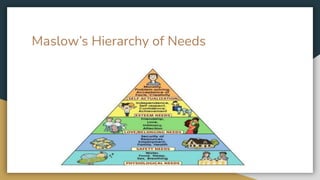
Maslow’s Hierarchy of Needs
Want(s)
Wants are the form taken by human needs as they are shaped by culture and individual
personality. These are essentially dependent upon needs. For example, a person in North
India would satisfy his hunger with rajma and chawal while a person from South India
would like to have fish curry and rice.
Demand(s)
Wants backed by willingness and purchasing power is known as demand. The top
marketing companies like HUL, Idea and Airtel etc. first understand needs and wants of
customers and then fulfil the needs, wants and demands by conducting consumer
research and get regular feedback from their salesmen in the market about unfulfilled
customer needs.
Objectives of Marketing
● Creation of Demand: The marketing management’s first objective is to create
demand through various means. A conscious attempt is made to find out the
preferences and tastes of the consumers by the company. Demand for the products
and services are created by informing the customers their utility.
● Customer Satisfaction: The first and foremost marketing manager must study the
demands of customers before offering any product or services.
● Market Share: Every business aims at increasing its market share. It is the ratio of its sales
to the total sales in the economy. For instance, both Pepsi and Coke compete with each
other to increase their market share.
● Generation of Profits: The marketing department is the only department which generates
revenue for the business. Sufficient profits must be earned as a result of sale of
want-satisfying products.
● Public Image: To build up the public image of a firm over a period is another objective of
marketing. Goodwill of company is created over a period of time with regular emphasis on
customer satisfaction through continuous improvement in product and services.
Create a Market Offering
‘Market Offerings’ are products and services designed to deliver value to customers—either to
fulfill their needs, satisfy their “wants,” or both. Market offering refers to a complete offer for a
product or service. The product or service that is sold into the marketplace is called as a market
offering.
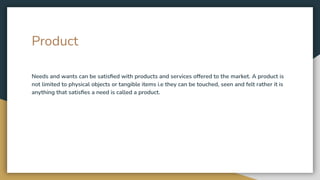
Product
Needs and wants can be satisfied with products and services offered to the market. A product is
not limited to physical objects or tangible items i.e they can be touched, seen and felt rather it is
anything that satisfies a need is called a product.
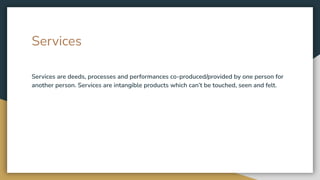
Services
Services are deeds, processes and performances co-produced/provided by one person for
another person. Services are intangible products which can’t be touched, seen and felt.
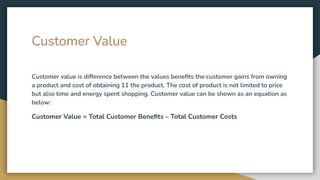
Customer Value
Customer value is difference between the values benefits the customer gains from owning
a product and cost of obtaining 11 the product. The cost of product is not limited to price
but also time and energy spent shopping. Customer value can be shown as an equation as
below:
Customer Value = Total Customer Benefits – Total Customer Costs
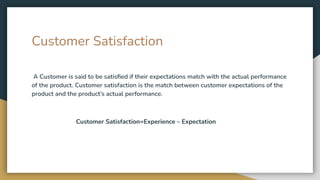
Customer Satisfaction
A Customer is said to be satisfied if their expectations match with the actual performance
of the product. Customer satisfaction is the match between customer expectations of the
product and the product’s actual performance.
Customer Satisfaction=Experience – Expectation
Exchange Process
Exchange process is simply when an individual or an organisation obtain and satisfy a
need or want by offering some money in exchange of products or services. For example we
go get a haircut at a salon, we pay for the hair cut.
Session 2: Scope and Importance of Marketing
The scope of marketing are explained as under:
● Goods: A tangible item which can be an article, commodity, material, merchandise,
supply, wares produced from agricultural, construction, manufacturing or mining
activities.
● Services: Products that have intangible properties such as banking, consultancy,
education, insurance, accounting, expertise, medical treatment or transportation
● Experience: Marketers can create stage and market experiences to the customers. For
example Water Park, and theme parks provide experience marketing.
People
Marketing can help people to market themselves. Politicians are the most suitable and
common example of people marketing.
Places
Cities, state and nation can be marketed to the consumers. Place marketers include real
estate developers, commercial banks, businesses etc.
Organizations
Organizations market themselves to create and boost their image in customers mind. They
try to create a unique and favourable image in the eyes of customers that can give
organizations an edge over others in the marketplace
Property
Properties, whether tangible like real estate or intangibles like stocks can be marketed to
the customers.
Events
Marketers promote different events from time to time their customers. These events can
be for individuals or organizations.
Information
Information is basically produced and marketed and distributed by universities, schools,
colleges, newspapers, magazines, books etc to the customers at a price.
Ideas
Every marketer offers some idea. Some offer it for money others do it for society in
general. Marketers make profit from society and they shall also give back to the society.
What is a market?
Market originates from Latin word ‘MARCUTUS’ which means a place where buyer and
sellers meet for business. Earlier in our country buyer and seller gathered at a specific
place called ‘haats’or ‘melas’. On the basis of end use, market can be of different types:
Consumer Markets (FMCG-Fast moving consumer goods, consumer durables, soft goods),
industrial markets (finished goods, components and services), intermediate markets
(wholesale and retail markets), geographical location (local, national, global/international
markets, rural and urban market), and Non-profit and Governmental Markets (companies
selling to non-profit organizations with limited purchasing power need to be price careful).
The Importance of Marketing
Importance to the Marketers :-
● Marketing Promotes Product Awareness to the Public
The primary task of marketing is to get the product or service recognized by the
market. It is important that public awareness of product and company information is
spread to the buying public, this is possible if heavy advertising, sales promotion,
personal selling, direct 20 marketing is done for creating awareness.
● Marketing Helps In Enhancing Product Sales
Apart from public awareness about a company’s products and services,
marketing helps boost sales and revenue growth.
● Marketing Builds Company Reputation
Marketers continuously aim to create an image of the company in general public
eyes. They tend to create brand name recognition. This is done so that
consumers can easily associate the brand name with the images, logo, or caption
that they hear and see in the advertisements.
Importance to Customers
● Marketing creates Utilities:
Marketing creates different types of utilities, form utility – from a plumber to
furniture, place utility- product moving from the factory to the customer, time utility-
product available when needed, information utility- ingredients of the product and
even how to use the product, and possession utility- transfer of ownership from
retailer to customer.
● Large number of choices available:
Marketers create needs and wants and try to satisfy that through offering
variety of product choices.
● More platforms available:
With the advent of technology, the marketers are offering customers both
offline and online platforms to purchase.
Importance to the Society
● Source of Employment:
Marketing offers a great range of wide and exciting career opportunities. Marketing
offers employment in the field of personal selling, packaging, and advertising,
marketing research, consultancy, distribution and channel sales.
● Welfare of Customers and Stakeholders:
Though profit maximisation is main motive of every business but many
marketers have taken up corporate social responsibility in order to give back to
society.
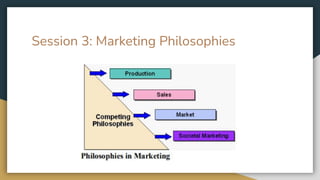
Session 3: Marketing Philosophies
Production Concept
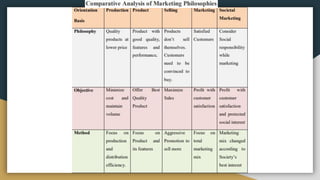
Production concept lays emphasis on affordability and availability of products.
Affordability is possible by reducing cost of production by producing large quantities and
achieving mass production.Availability is possible by mass distribution by making the
product widely available.This philosophy states that any amount of goods produced will
sell if it is available and affordable to customers.
“Low cost and mass production”
Product Concept
During production concept supply increased over demand. Gradually low cost and
availability couldn’t ensure increase in sale and survival along with growth of the firm. The
companies had to innovate products and started giving more choices to customers which
lead to product concept. This concept is based on the philosophy that consumers will
prefer products that have better quality, performance and features.
“good product will sell itself”
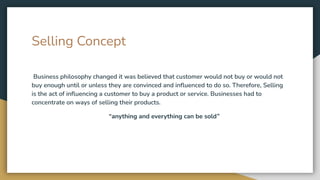
Selling Concept
Business philosophy changed it was believed that customer would not buy or would not
buy enough until or unless they are convinced and influenced to do so. Therefore, Selling
is the act of influencing a customer to buy a product or service. Businesses had to
concentrate on ways of selling their products.
“anything and everything can be sold”
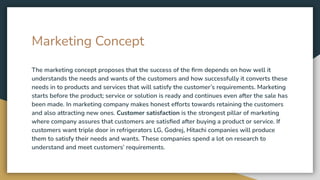
Marketing Concept
The marketing concept proposes that the success of the firm depends on how well it
understands the needs and wants of the customers and how successfully it converts these
needs in to products and services that will satisfy the customer’s requirements. Marketing
starts before the product; service or solution is ready and continues even after the sale has
been made. In marketing company makes honest efforts towards retaining the customers
and also attracting new ones. Customer satisfaction is the strongest pillar of marketing
where company assures that customers are satisfied after buying a product or service. If
customers want triple door in refrigerators LG, Godrej, Hitachi companies will produce
them to satisfy their needs and wants. These companies spend a lot on research to
understand and meet customers’ requirements.
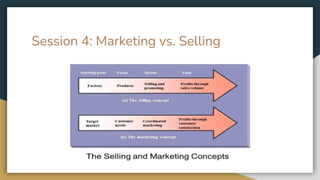
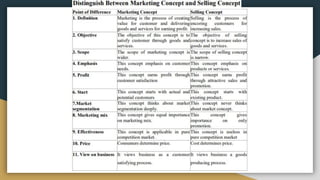
Session 4: Marketing vs. Selling
Societal Marketing Concept
Our environment is facing a lot of problems in the form of pollution, deforestation, increasing
population, depleting natural resources, poverty, and environmental deterioration. There are
many more are challenges posed by social problems too. The duty of business doesn’t end by
just meeting needs and wants of customers rather the duty of business to consider a larger
perspective by really acting in the best interest of individuals and society. 30 The societal
marketing concept believes in giving back to the society as it believes that the company is
profiting because of society and hence it should also take measures to make sure the society also
benefits from the company. The concept advocates to deliver the customer satisfaction in a way
that preserves or enhances the customer’s and the society’s well-being. Societal Marketing can
be defined as a marketing function in which the organizations identify the needs and wants of the
target market and then align the marketing activities of an organization in such a manner that
their marketing efforts are socially responsible and thereby help the organization in gaining the
trust of the society by having an image of a socially responsible organization, but still remaining
profitable. Societal marketing is marketing with a noble cause. Now a day’s one can find number
of examples where companies are supporting one or another good cause. Aircel is promoting
‘Save Tiger Campaign’, Idea is concerned about increasing population and deforestation.
Relationship Marketing
The approach suggests developing strong relationship with its partners who are suppliers
and distributors. It will lead to better channel arrangements, higher levels of cooperation,
less conflict, and increased efficiency. In relationship marketing everyone is treated as
customers. By relationship-building with all of these organizations and individuals, we can
develop strategies that are in the best interest of everyone in the entire channel of
distribution. As a result, everyone wins.
CREDITS
shorturl.at/stW47

Introduction to Marketing.pdf

  • 1.
  • 2.
    What does theterm marketing mean? As per Philip Kotler, the marketing guru, marketing is a social and managerial process by which individuals and groups obtain what they need and want through creating and 6 exchanging products and value with others.
  • 3.
    Need(s) Needs can bephysical like hunger, clothing, shelter and sex. If unsatisfied it leaves a person unhappy and uncomfortable. For example, when we are fasting and didn’t have food since morning the moment a person names our favourite food it is tough for us to resist.
  • 4.
  • 5.
    Want(s) Wants are theform taken by human needs as they are shaped by culture and individual personality. These are essentially dependent upon needs. For example, a person in North India would satisfy his hunger with rajma and chawal while a person from South India would like to have fish curry and rice.
  • 6.
    Demand(s) Wants backed bywillingness and purchasing power is known as demand. The top marketing companies like HUL, Idea and Airtel etc. first understand needs and wants of customers and then fulfil the needs, wants and demands by conducting consumer research and get regular feedback from their salesmen in the market about unfulfilled customer needs.
  • 7.
    Objectives of Marketing ●Creation of Demand: The marketing management’s first objective is to create demand through various means. A conscious attempt is made to find out the preferences and tastes of the consumers by the company. Demand for the products and services are created by informing the customers their utility. ● Customer Satisfaction: The first and foremost marketing manager must study the demands of customers before offering any product or services.
  • 8.
    ● Market Share:Every business aims at increasing its market share. It is the ratio of its sales to the total sales in the economy. For instance, both Pepsi and Coke compete with each other to increase their market share. ● Generation of Profits: The marketing department is the only department which generates revenue for the business. Sufficient profits must be earned as a result of sale of want-satisfying products. ● Public Image: To build up the public image of a firm over a period is another objective of marketing. Goodwill of company is created over a period of time with regular emphasis on customer satisfaction through continuous improvement in product and services.
  • 9.
    Create a MarketOffering ‘Market Offerings’ are products and services designed to deliver value to customers—either to fulfill their needs, satisfy their “wants,” or both. Market offering refers to a complete offer for a product or service. The product or service that is sold into the marketplace is called as a market offering.
  • 10.
    Product Needs and wantscan be satisfied with products and services offered to the market. A product is not limited to physical objects or tangible items i.e they can be touched, seen and felt rather it is anything that satisfies a need is called a product.
  • 11.
    Services Services are deeds,processes and performances co-produced/provided by one person for another person. Services are intangible products which can’t be touched, seen and felt.
  • 12.
    Customer Value Customer valueis difference between the values benefits the customer gains from owning a product and cost of obtaining 11 the product. The cost of product is not limited to price but also time and energy spent shopping. Customer value can be shown as an equation as below: Customer Value = Total Customer Benefits – Total Customer Costs
  • 13.
    Customer Satisfaction A Customeris said to be satisfied if their expectations match with the actual performance of the product. Customer satisfaction is the match between customer expectations of the product and the product’s actual performance. Customer Satisfaction=Experience – Expectation
  • 14.
    Exchange Process Exchange processis simply when an individual or an organisation obtain and satisfy a need or want by offering some money in exchange of products or services. For example we go get a haircut at a salon, we pay for the hair cut.
  • 15.
    Session 2: Scopeand Importance of Marketing The scope of marketing are explained as under: ● Goods: A tangible item which can be an article, commodity, material, merchandise, supply, wares produced from agricultural, construction, manufacturing or mining activities. ● Services: Products that have intangible properties such as banking, consultancy, education, insurance, accounting, expertise, medical treatment or transportation ● Experience: Marketers can create stage and market experiences to the customers. For example Water Park, and theme parks provide experience marketing.
  • 16.
    People Marketing can helppeople to market themselves. Politicians are the most suitable and common example of people marketing.
  • 17.
    Places Cities, state andnation can be marketed to the consumers. Place marketers include real estate developers, commercial banks, businesses etc.
  • 18.
    Organizations Organizations market themselvesto create and boost their image in customers mind. They try to create a unique and favourable image in the eyes of customers that can give organizations an edge over others in the marketplace
  • 19.
    Property Properties, whether tangiblelike real estate or intangibles like stocks can be marketed to the customers.
  • 20.
    Events Marketers promote differentevents from time to time their customers. These events can be for individuals or organizations.
  • 21.
    Information Information is basicallyproduced and marketed and distributed by universities, schools, colleges, newspapers, magazines, books etc to the customers at a price.
  • 22.
    Ideas Every marketer offerssome idea. Some offer it for money others do it for society in general. Marketers make profit from society and they shall also give back to the society.
  • 23.
    What is amarket? Market originates from Latin word ‘MARCUTUS’ which means a place where buyer and sellers meet for business. Earlier in our country buyer and seller gathered at a specific place called ‘haats’or ‘melas’. On the basis of end use, market can be of different types: Consumer Markets (FMCG-Fast moving consumer goods, consumer durables, soft goods), industrial markets (finished goods, components and services), intermediate markets (wholesale and retail markets), geographical location (local, national, global/international markets, rural and urban market), and Non-profit and Governmental Markets (companies selling to non-profit organizations with limited purchasing power need to be price careful).
  • 24.
    The Importance ofMarketing Importance to the Marketers :- ● Marketing Promotes Product Awareness to the Public The primary task of marketing is to get the product or service recognized by the market. It is important that public awareness of product and company information is spread to the buying public, this is possible if heavy advertising, sales promotion, personal selling, direct 20 marketing is done for creating awareness.
  • 25.
    ● Marketing HelpsIn Enhancing Product Sales Apart from public awareness about a company’s products and services, marketing helps boost sales and revenue growth. ● Marketing Builds Company Reputation Marketers continuously aim to create an image of the company in general public eyes. They tend to create brand name recognition. This is done so that consumers can easily associate the brand name with the images, logo, or caption that they hear and see in the advertisements.
  • 26.
    Importance to Customers ●Marketing creates Utilities: Marketing creates different types of utilities, form utility – from a plumber to furniture, place utility- product moving from the factory to the customer, time utility- product available when needed, information utility- ingredients of the product and even how to use the product, and possession utility- transfer of ownership from retailer to customer.
  • 27.
    ● Large numberof choices available: Marketers create needs and wants and try to satisfy that through offering variety of product choices. ● More platforms available: With the advent of technology, the marketers are offering customers both offline and online platforms to purchase.
  • 28.
    Importance to theSociety ● Source of Employment: Marketing offers a great range of wide and exciting career opportunities. Marketing offers employment in the field of personal selling, packaging, and advertising, marketing research, consultancy, distribution and channel sales. ● Welfare of Customers and Stakeholders: Though profit maximisation is main motive of every business but many marketers have taken up corporate social responsibility in order to give back to society.
  • 29.
  • 30.
    Production Concept Production conceptlays emphasis on affordability and availability of products. Affordability is possible by reducing cost of production by producing large quantities and achieving mass production.Availability is possible by mass distribution by making the product widely available.This philosophy states that any amount of goods produced will sell if it is available and affordable to customers. “Low cost and mass production”
  • 31.
    Product Concept During productionconcept supply increased over demand. Gradually low cost and availability couldn’t ensure increase in sale and survival along with growth of the firm. The companies had to innovate products and started giving more choices to customers which lead to product concept. This concept is based on the philosophy that consumers will prefer products that have better quality, performance and features. “good product will sell itself”
  • 32.
    Selling Concept Business philosophychanged it was believed that customer would not buy or would not buy enough until or unless they are convinced and influenced to do so. Therefore, Selling is the act of influencing a customer to buy a product or service. Businesses had to concentrate on ways of selling their products. “anything and everything can be sold”
  • 33.
    Marketing Concept The marketingconcept proposes that the success of the firm depends on how well it understands the needs and wants of the customers and how successfully it converts these needs in to products and services that will satisfy the customer’s requirements. Marketing starts before the product; service or solution is ready and continues even after the sale has been made. In marketing company makes honest efforts towards retaining the customers and also attracting new ones. Customer satisfaction is the strongest pillar of marketing where company assures that customers are satisfied after buying a product or service. If customers want triple door in refrigerators LG, Godrej, Hitachi companies will produce them to satisfy their needs and wants. These companies spend a lot on research to understand and meet customers’ requirements.
  • 34.
  • 36.
    Societal Marketing Concept Ourenvironment is facing a lot of problems in the form of pollution, deforestation, increasing population, depleting natural resources, poverty, and environmental deterioration. There are many more are challenges posed by social problems too. The duty of business doesn’t end by just meeting needs and wants of customers rather the duty of business to consider a larger perspective by really acting in the best interest of individuals and society. 30 The societal marketing concept believes in giving back to the society as it believes that the company is profiting because of society and hence it should also take measures to make sure the society also benefits from the company. The concept advocates to deliver the customer satisfaction in a way that preserves or enhances the customer’s and the society’s well-being. Societal Marketing can be defined as a marketing function in which the organizations identify the needs and wants of the target market and then align the marketing activities of an organization in such a manner that their marketing efforts are socially responsible and thereby help the organization in gaining the trust of the society by having an image of a socially responsible organization, but still remaining profitable. Societal marketing is marketing with a noble cause. Now a day’s one can find number of examples where companies are supporting one or another good cause. Aircel is promoting ‘Save Tiger Campaign’, Idea is concerned about increasing population and deforestation.
  • 37.
    Relationship Marketing The approachsuggests developing strong relationship with its partners who are suppliers and distributors. It will lead to better channel arrangements, higher levels of cooperation, less conflict, and increased efficiency. In relationship marketing everyone is treated as customers. By relationship-building with all of these organizations and individuals, we can develop strategies that are in the best interest of everyone in the entire channel of distribution. As a result, everyone wins.
  • 39.