Workforce and
College Preparation
To: The Illinois Board of Education
Presented by: Daniel Lebowitz
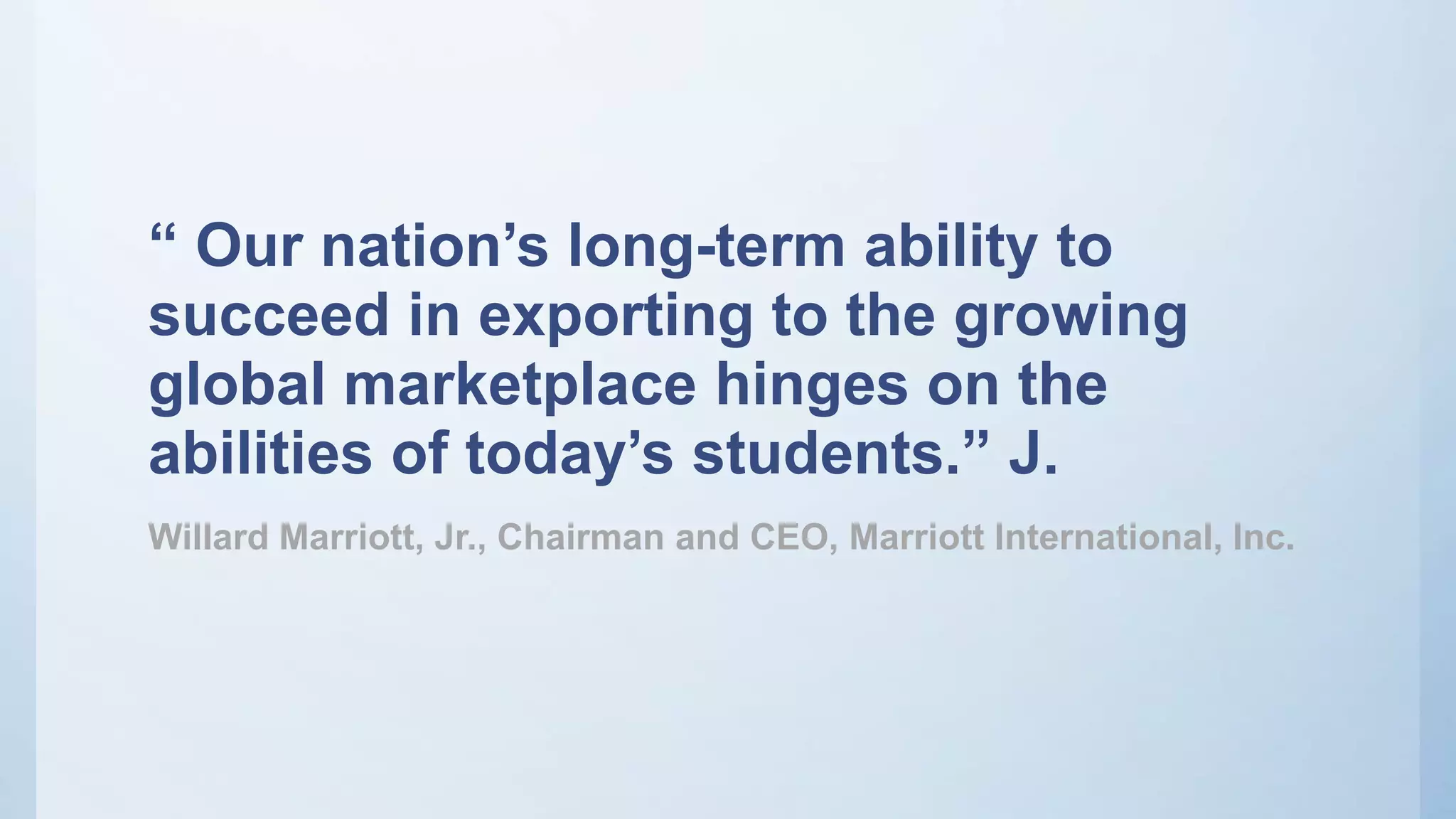
“ Our nation’s long-term ability to
succeed in exporting to the growing
global marketplace hinges on the
abilities of today’s students.” J.
Willard Marriott, Jr., Chairman and CEO, Marriott International, Inc.
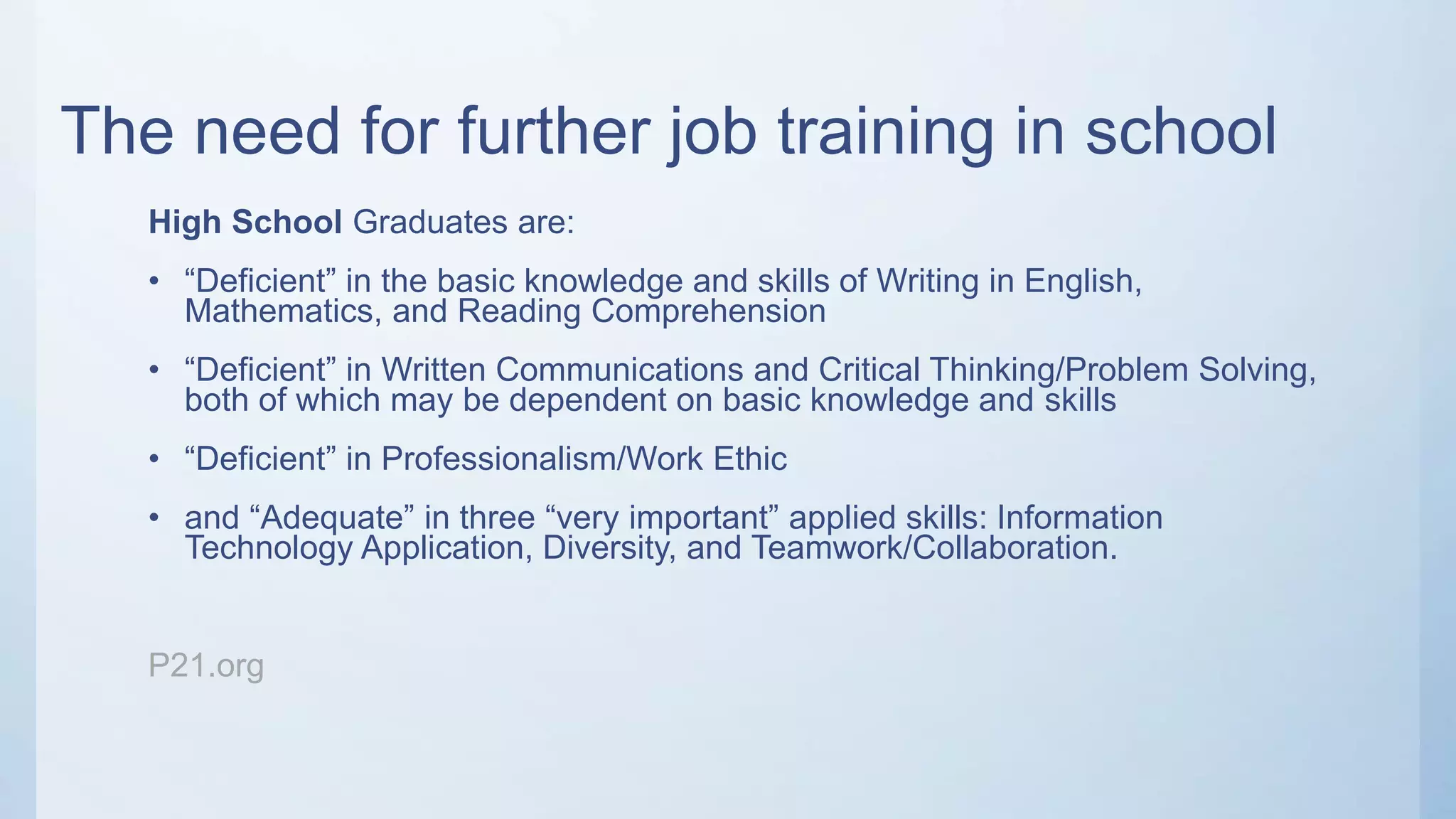
The need for further job training in school
High School Graduates are:
• “Deficient” in the basic knowledge and skills of Writing in English,
Mathematics, and Reading Comprehension
• “Deficient” in Written Communications and Critical Thinking/Problem Solving,
both of which may be dependent on basic knowledge and skills
• “Deficient” in Professionalism/Work Ethic
• and “Adequate” in three “very important” applied skills: Information
Technology Application, Diversity, and Teamwork/Collaboration.
P21.org
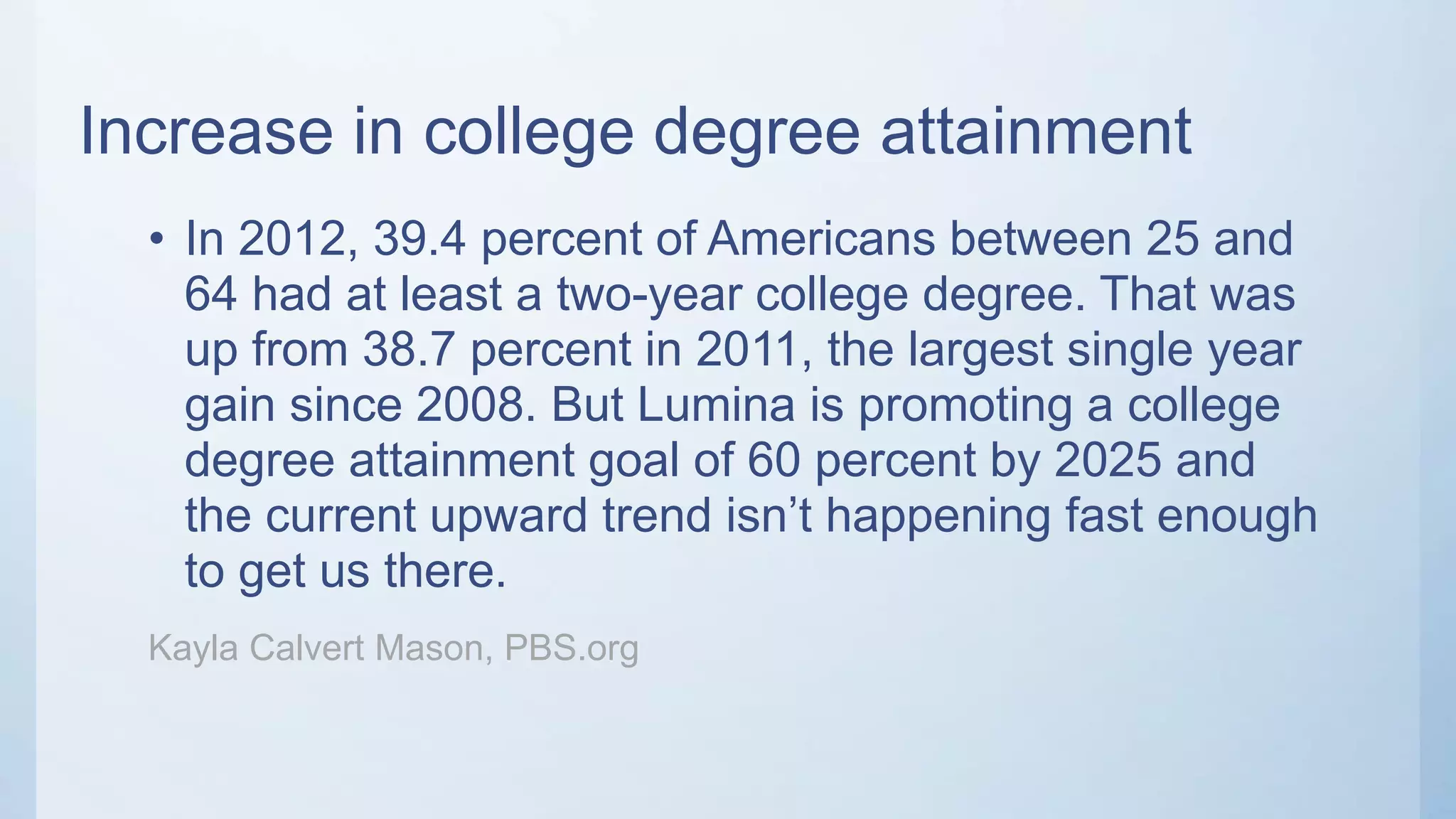
Increase in college degree attainment
• In 2012, 39.4 percent of Americans between 25 and
64 had at least a two-year college degree. That was
up from 38.7 percent in 2011, the largest single year
gain since 2008. But Lumina is promoting a college
degree attainment goal of 60 percent by 2025 and
the current upward trend isn’t happening fast enough
to get us there.
Kayla Calvert Mason, PBS.org
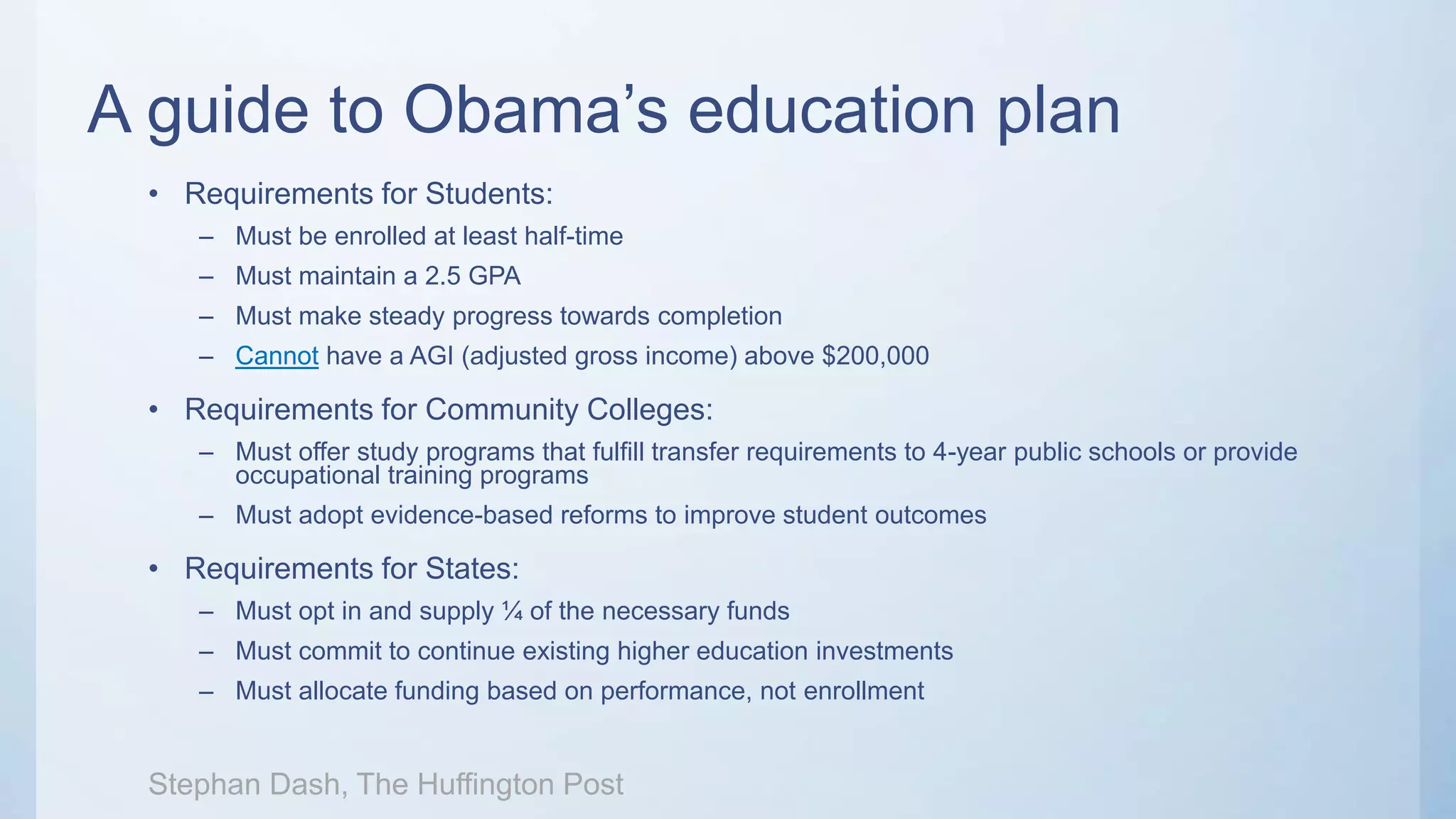
A guide to Obama’s education plan
• Requirements for Students:
– Must be enrolled at least half-time
– Must maintain a 2.5 GPA
– Must make steady progress towards completion
– Cannot have a AGI (adjusted gross income) above $200,000
• Requirements for Community Colleges:
– Must offer study programs that fulfill transfer requirements to 4-year public schools or provide
occupational training programs
– Must adopt evidence-based reforms to improve student outcomes
• Requirements for States:
– Must opt in and supply ¼ of the necessary funds
– Must commit to continue existing higher education investments
– Must allocate funding based on performance, not enrollment
Stephan Dash, The Huffington Post
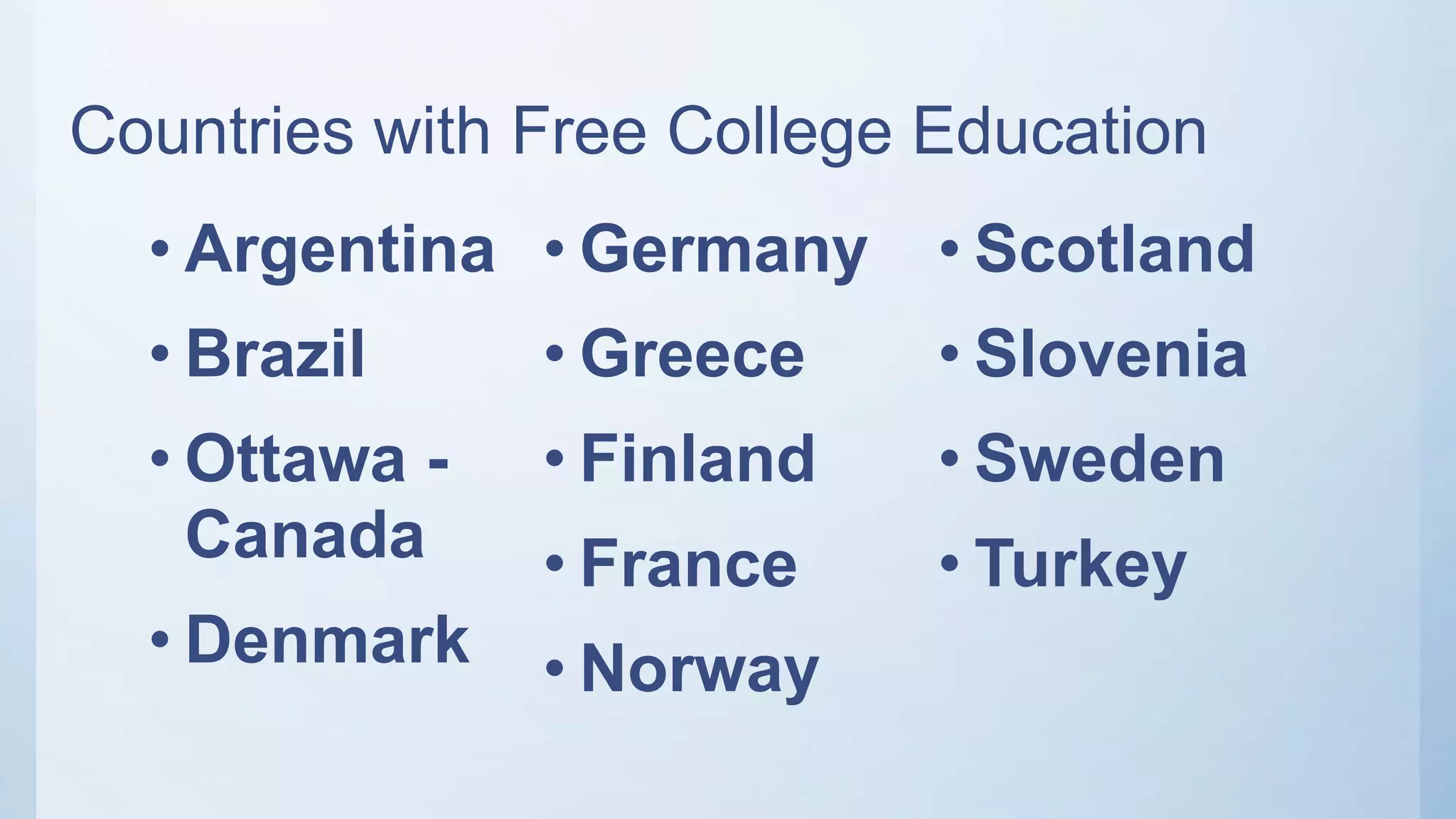
Countries with Free College Education
• Argentina
• Brazil
• Ottawa -
Canada
• Denmark
• Germany
• Greece
• Finland
• France
• Norway
• Scotland
• Slovenia
• Sweden
• Turkey
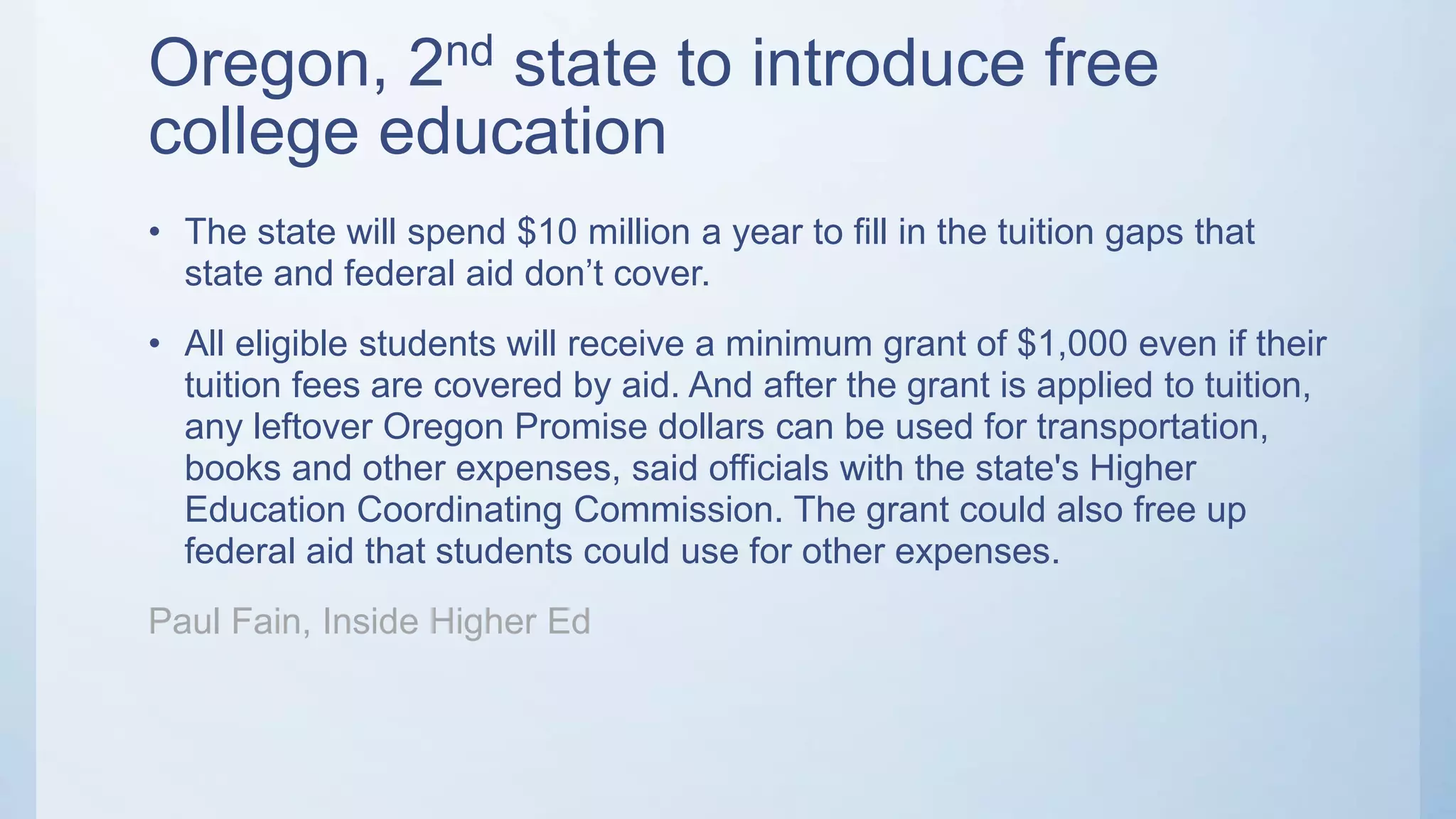
Oregon, 2nd state to introduce free
college education
• The state will spend $10 million a year to fill in the tuition gaps that
state and federal aid don’t cover.
• All eligible students will receive a minimum grant of $1,000 even if their
tuition fees are covered by aid. And after the grant is applied to tuition,
any leftover Oregon Promise dollars can be used for transportation,
books and other expenses, said officials with the state's Higher
Education Coordinating Commission. The grant could also free up
federal aid that students could use for other expenses.
Paul Fain, Inside Higher Ed
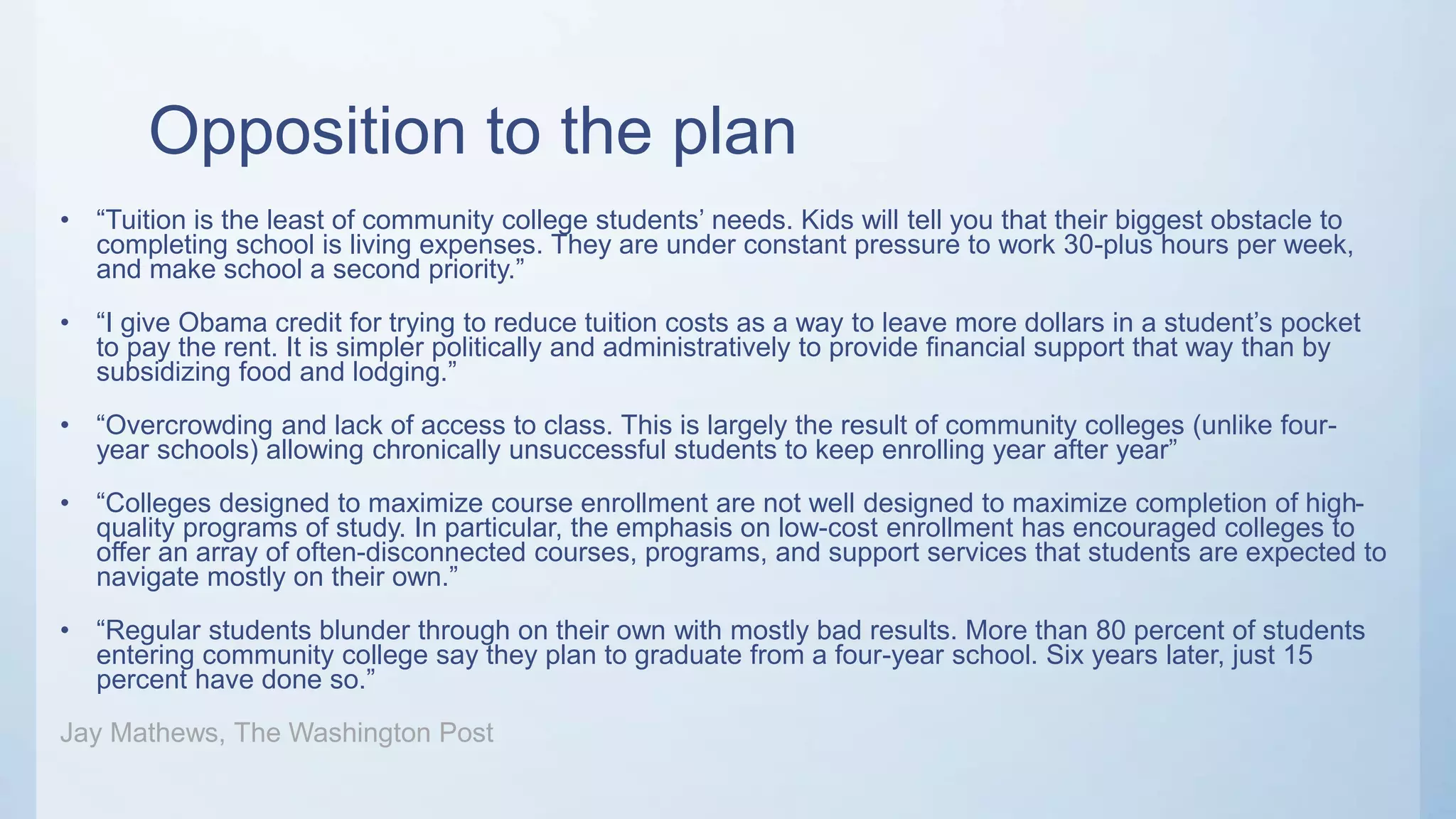
Opposition to the plan
• “Tuition is the least of community college students’ needs. Kids will tell you that their biggest obstacle to
completing school is living expenses. They are under constant pressure to work 30-plus hours per week,
and make school a second priority.”
• “I give Obama credit for trying to reduce tuition costs as a way to leave more dollars in a student’s pocket
to pay the rent. It is simpler politically and administratively to provide financial support that way than by
subsidizing food and lodging.”
• “Overcrowding and lack of access to class. This is largely the result of community colleges (unlike four-
year schools) allowing chronically unsuccessful students to keep enrolling year after year”
• “Colleges designed to maximize course enrollment are not well designed to maximize completion of high-
quality programs of study. In particular, the emphasis on low-cost enrollment has encouraged colleges to
offer an array of often-disconnected courses, programs, and support services that students are expected to
navigate mostly on their own.”
• “Regular students blunder through on their own with mostly bad results. More than 80 percent of students
entering community college say they plan to graduate from a four-year school. Six years later, just 15
percent have done so.”
Jay Mathews, The Washington Post
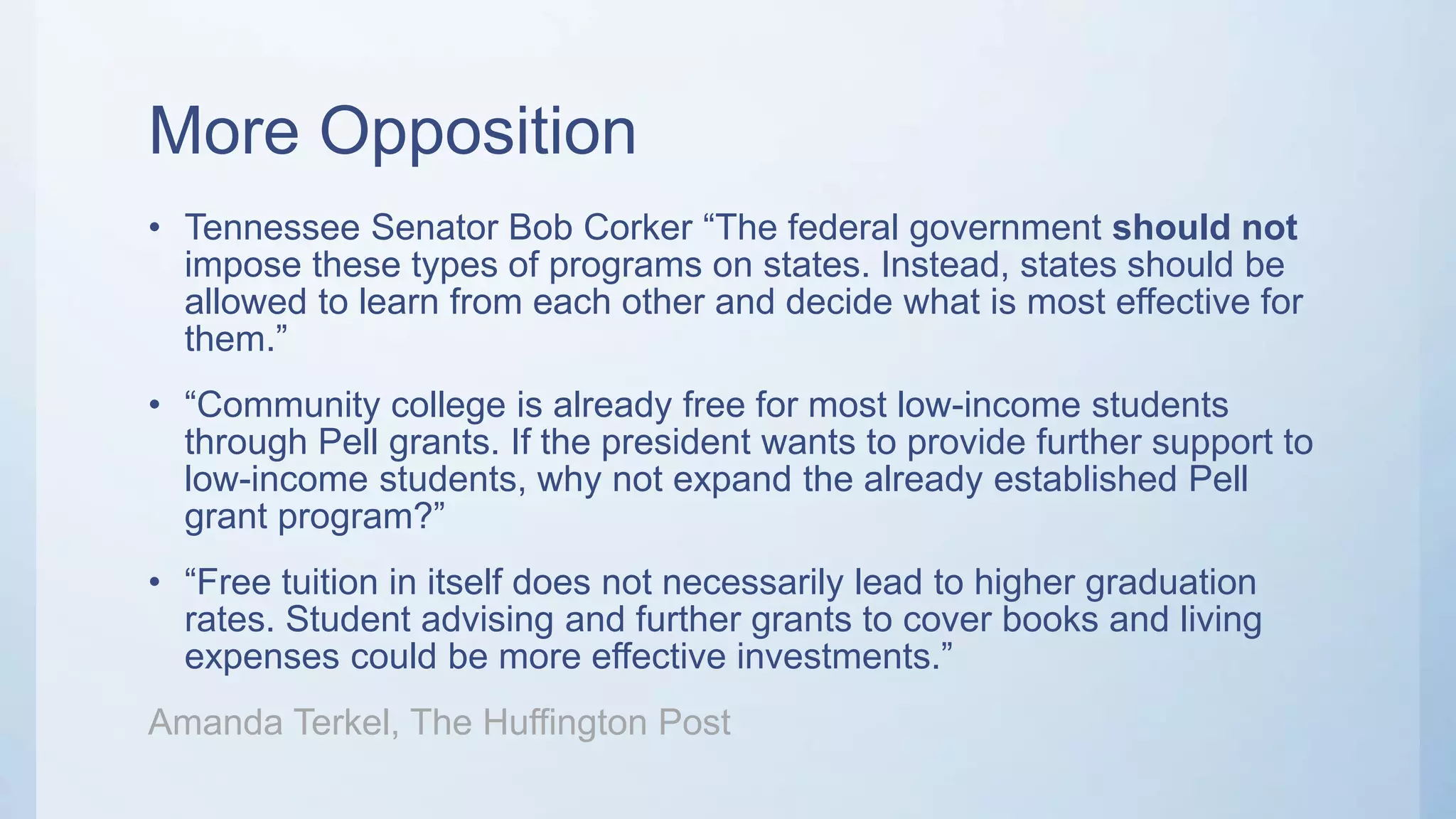
More Opposition
• Tennessee Senator Bob Corker “The federal government should not
impose these types of programs on states. Instead, states should be
allowed to learn from each other and decide what is most effective for
them.”
• “Community college is already free for most low-income students
through Pell grants. If the president wants to provide further support to
low-income students, why not expand the already established Pell
grant program?”
• “Free tuition in itself does not necessarily lead to higher graduation
rates. Student advising and further grants to cover books and living
expenses could be more effective investments.”
Amanda Terkel, The Huffington Post
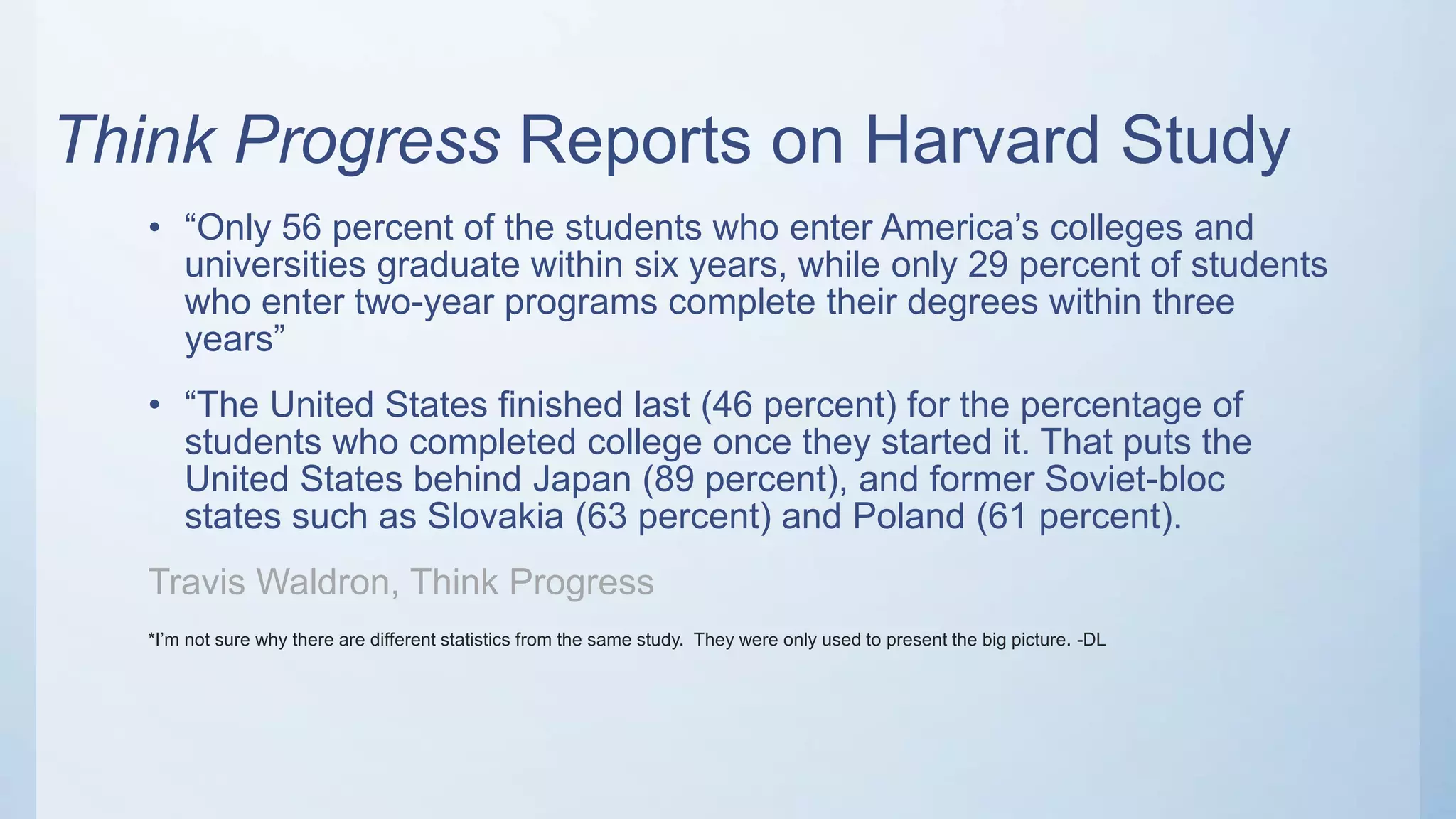
Think Progress Reports on Harvard Study
• “Only 56 percent of the students who enter America’s colleges and
universities graduate within six years, while only 29 percent of students
who enter two-year programs complete their degrees within three
years”
• “The United States finished last (46 percent) for the percentage of
students who completed college once they started it. That puts the
United States behind Japan (89 percent), and former Soviet-bloc
states such as Slovakia (63 percent) and Poland (61 percent).
Travis Waldron, Think Progress
*I’m not sure why there are different statistics from the same study. They were only used to present the big picture. -DL
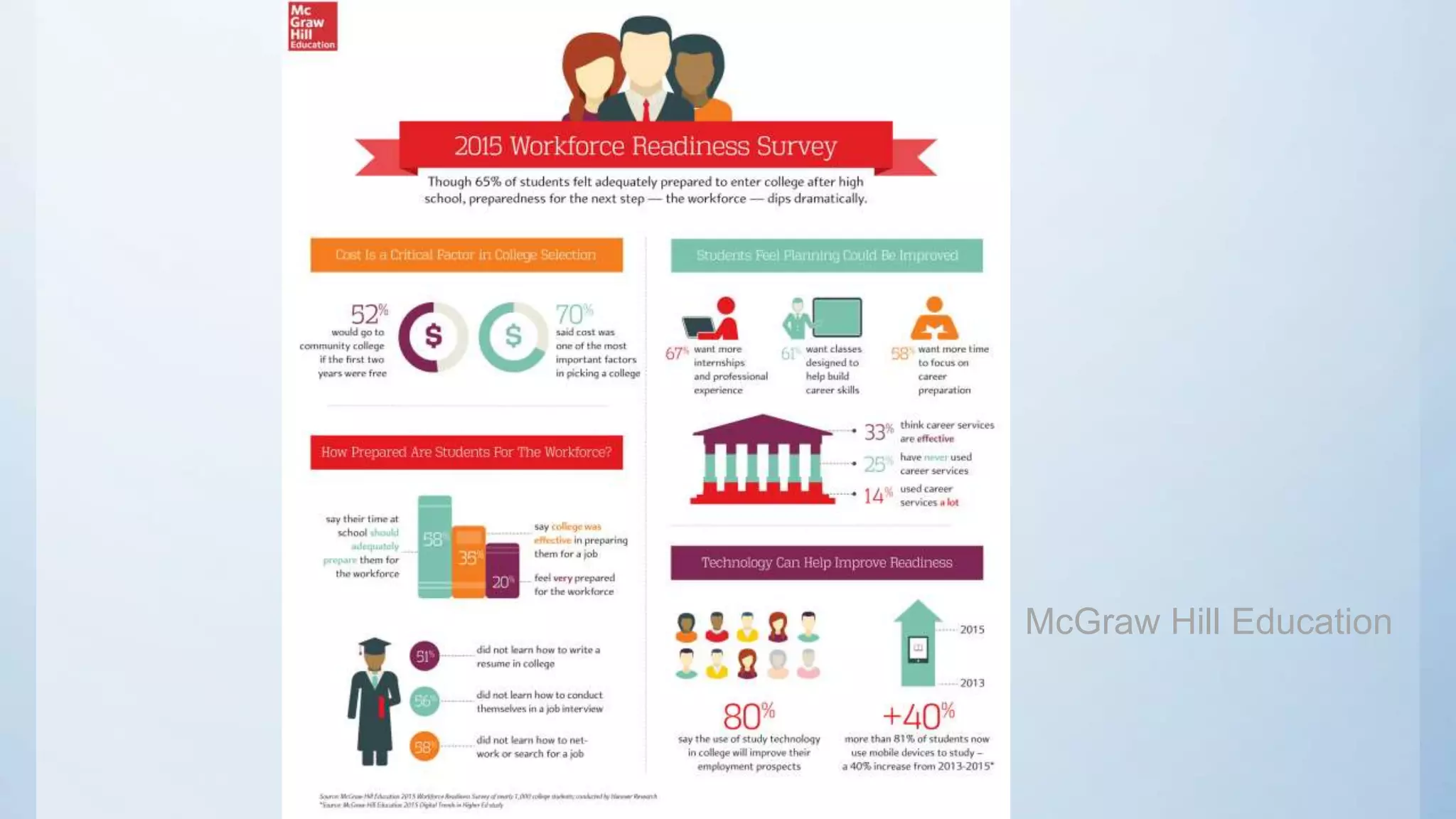
McGraw Hill Education
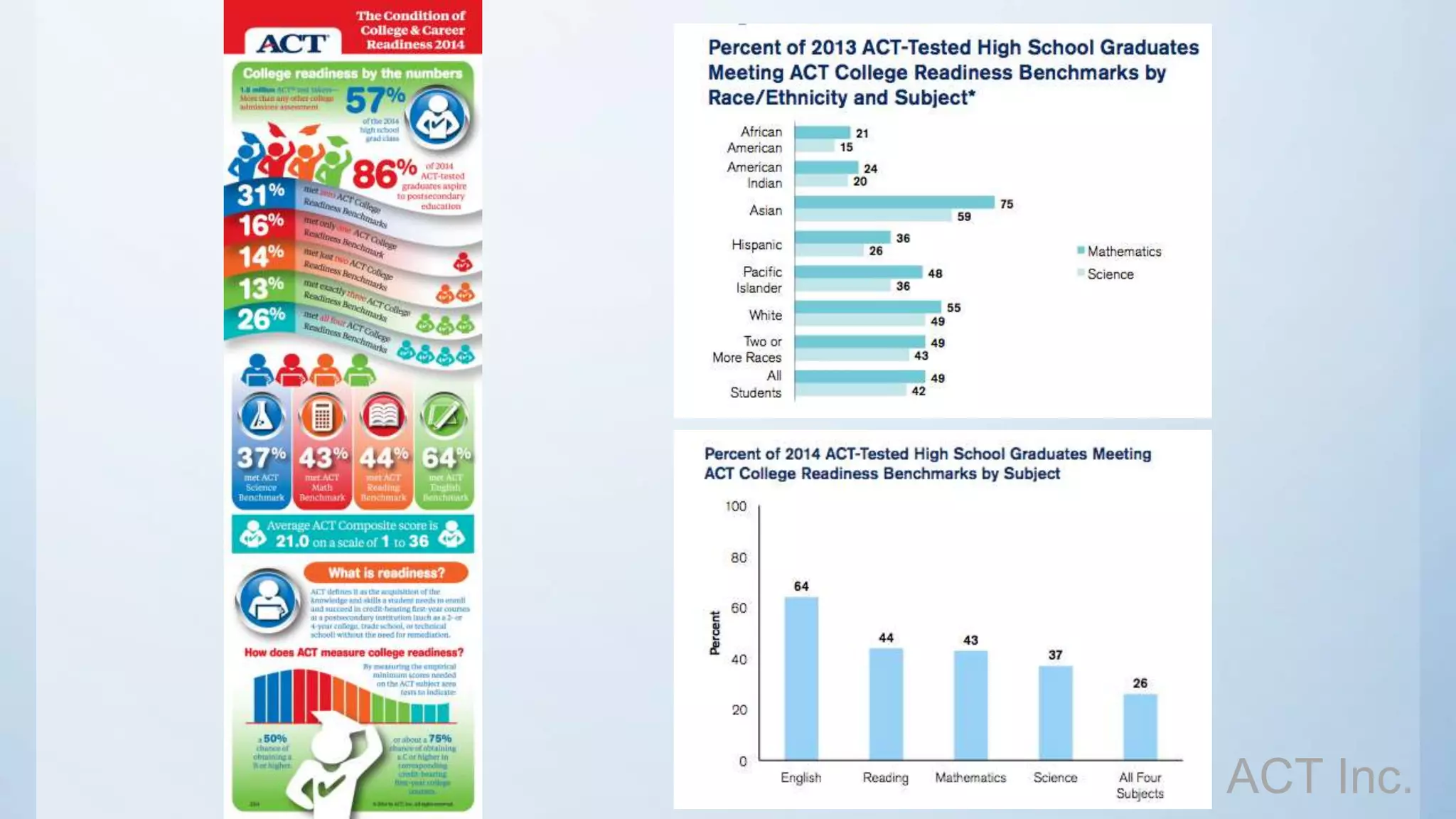
ACT Inc.
Option 2: Another year of high school
“A post-graduate year is a year beyond high school graduation, spent at an independent
school. Some students will consider doing an “extra” year of high school in order to
better prepare themselves for college in a number of areas. Reasons for pursuing a
post-graduate year vary as does the timing of this decision. Some students know early
on that they would like to pursue a post-graduate year and don’t go through the college
application process at all, while others decide to consider both options. Still others go
through the college application process and then realize that they are not pleased with
their college options and would like another year to strengthen their candidacy for
colleges.
In any of these cases, the post-graduate year is a worthwhile option to consider. This
“extra” year allows a student to mature socially and/or academically, provides another
year of academic preparedness and time to enhance study skills and time management,
perhaps another year to strengthen athletic ability to pursue a sport in college. These
are all valid reasons for pursuing a post-graduate year.”
Heather Johnson, Boarding School Review
Oregon already has a program
• “The thinking behind the program is that currently, some 50 percent of
Oregon residents who enroll in community college don’t even make it
through their first year, and that statistic doesn’t account for factors such as
class, race, or whether the student is a first-generation collegiate. Meanwhile,
in some schools, the 13th-grade program, according to The Oregonian, has
a 75 percent success rate. So, for those of us who actually enjoy watching
students succeed, the 13th grade is starting to sound less objectionable. (The
participating students, for what it’s worth, don’t enjoy having to get the
constant progress reports, but do report enjoying their classes.)”
• “Once they finish the 13th grade, students get that diploma and they can enter
college as sophomores.”
Rebecca Schuman, Slate
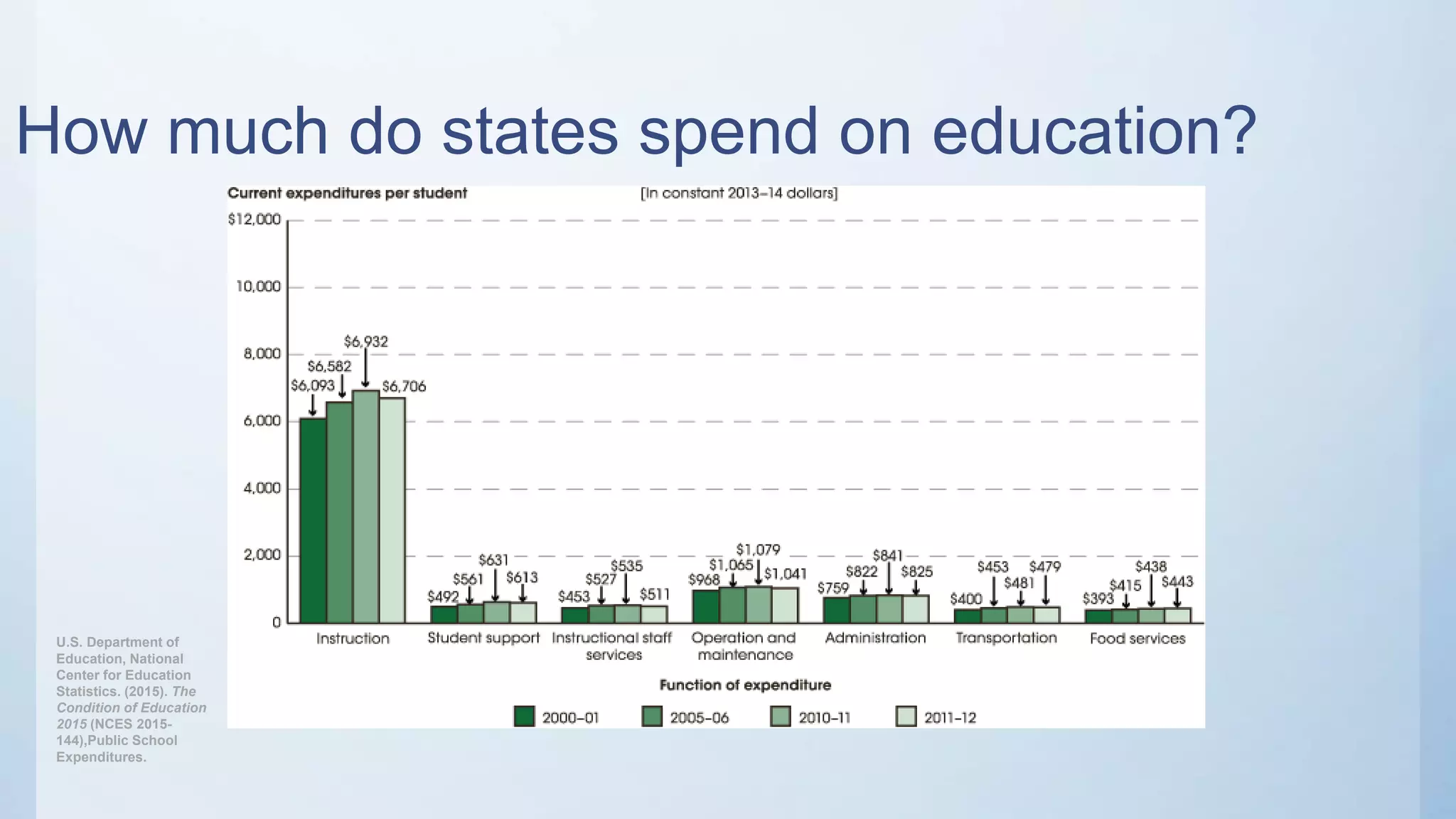
How much do states spend on education?
U.S. Department of
Education, National
Center for Education
Statistics. (2015). The
Condition of Education
2015 (NCES 2015-
144),Public School
Expenditures.
Cost per student (K12)
• Illinois: $12,288 in 2013
• Oregon: $9,543 in 2013
Teacher Qualifications and Cost
Almost the same as Community Colleges
• Similar salary
• Similar degree requirements
Opposition in Oregon
• The 13th year program cost the state of Oregon $9.5 million last school
year
• Schools receive the per-student funding from the State School Fund,
nearly $7,000 last year.
• “Pretty soon, if everybody did this, we’d have a K-14 system,” said
Sen. Mark Hass, D-Beaverton. “We can’t even afford to do K-12 right.”
Taylor W. Anderson, The Bulletin
Option 3: Keep things the same
allthingsd.com
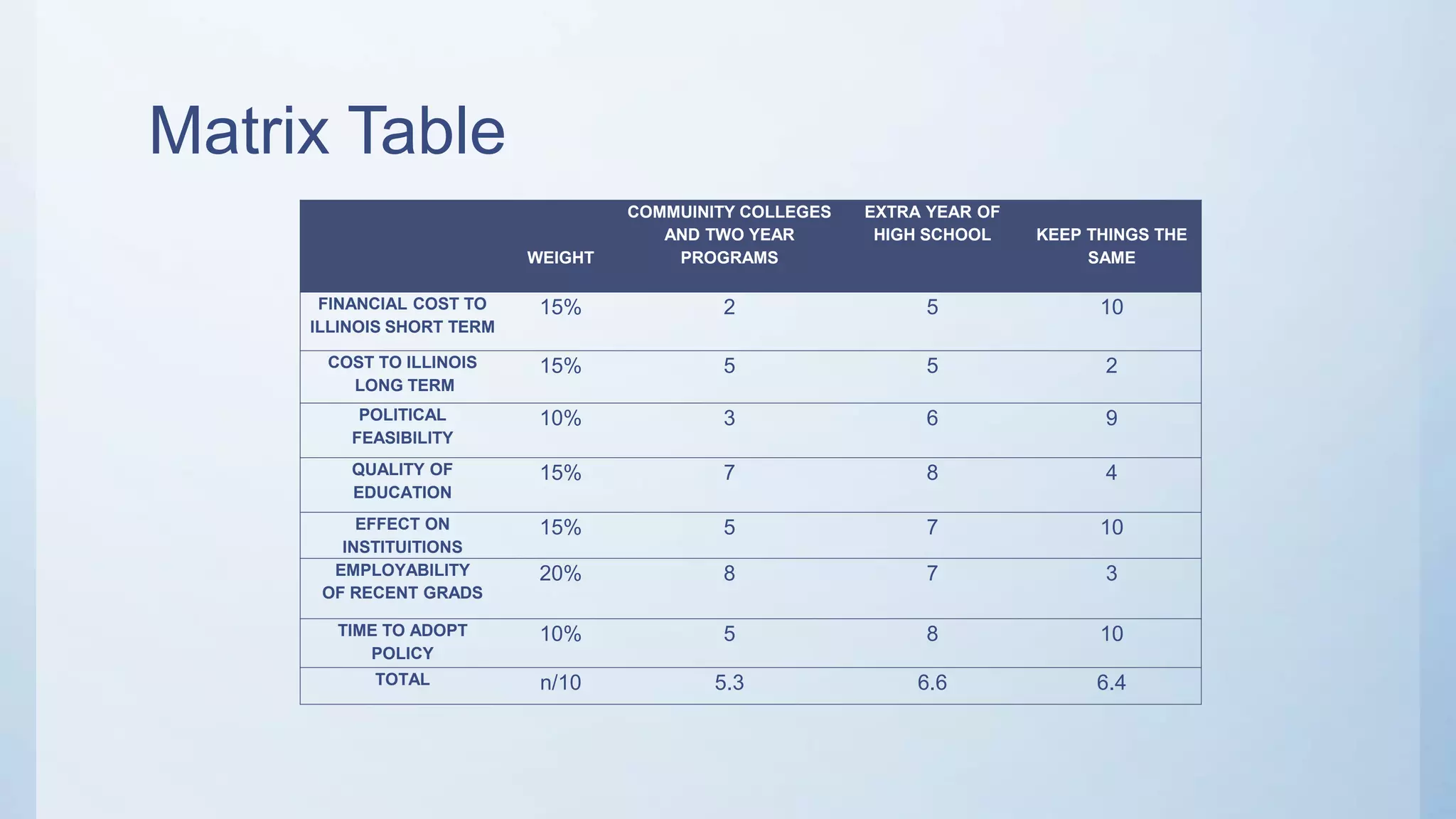
Matrix Table
WEIGHT
COMMUINITY COLLEGES
AND TWO YEAR
PROGRAMS
EXTRA YEAR OF
HIGH SCHOOL KEEP THINGS THE
SAME
FINANCIAL COST TO
ILLINOIS SHORT TERM
15% 2 5 10
COST TO ILLINOIS
LONG TERM
15% 5 5 2
POLITICAL
FEASIBILITY
10% 3 6 9
QUALITY OF
EDUCATION
15% 7 8 4
EFFECT ON
INSTITUITIONS
15% 5 7 10
EMPLOYABILITY
OF RECENT GRADS
20% 8 7 3
TIME TO ADOPT
POLICY
10% 5 8 10
TOTAL n/10 5.3 6.6 6.4
Summary
• Allowing students to take an extra year of high school would be the best
option. An extra year in high school would allow students to receive
coursework needed to better prepare for college, take courses that wouldn’t
otherwise fit in a four year plan, allow students to have time to mature before
attending college, and provide job training suitable to employers.
• To reiterate what was mentioned in the introduction, there is a need to
develop a quality workforce and opportunities for recent high school
graduates. Extending the option to have an additional year in high school
could achieve that goal.
Daniel Lebowitz
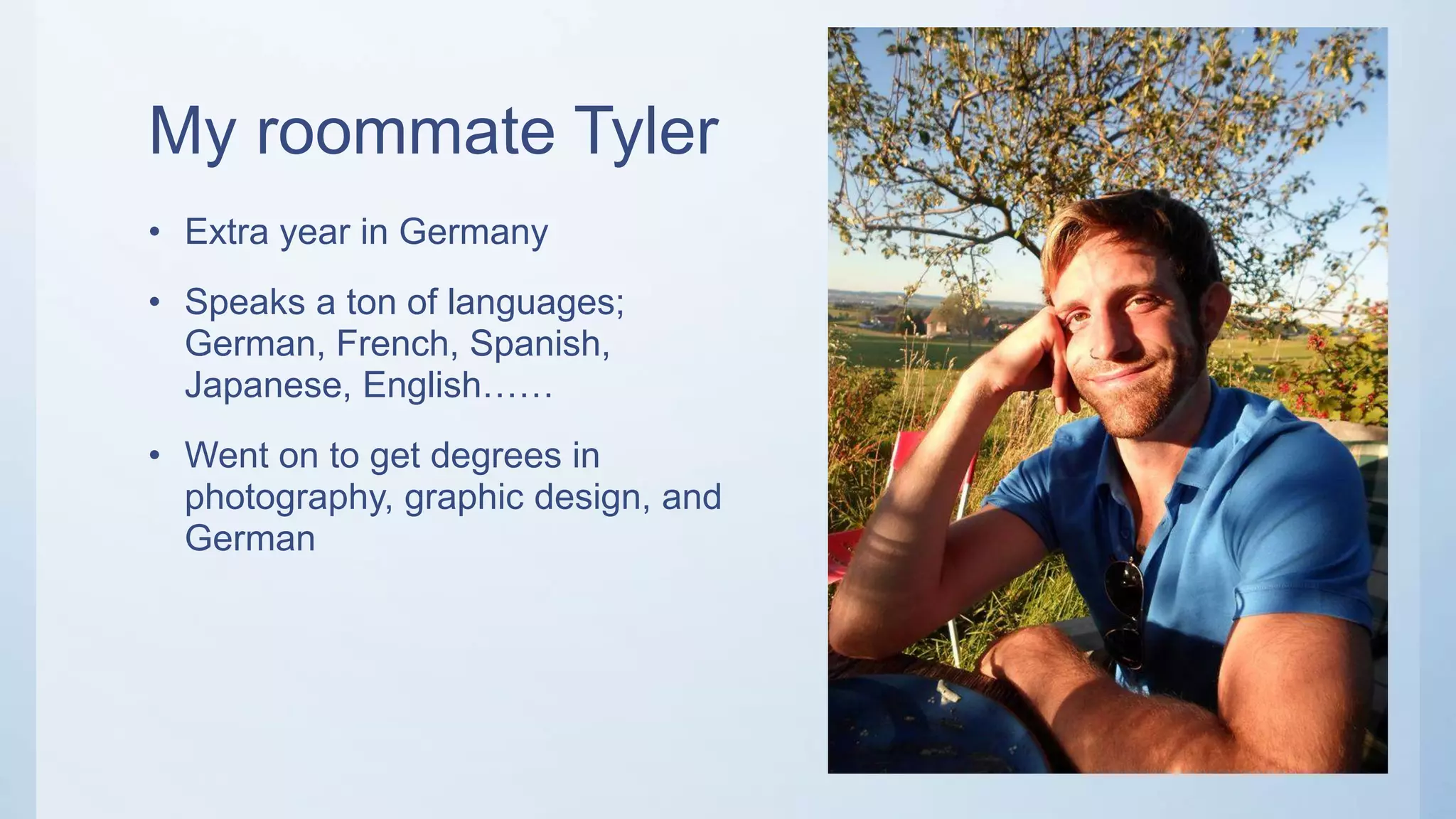
My roommate Tyler
• Extra year in Germany
• Speaks a ton of languages;
German, French, Spanish,
Japanese, English……
• Went on to get degrees in
photography, graphic design, and
German

Final Presentation - Workforce and College Preparation

  • 1.
    Workforce and College Preparation To:The Illinois Board of Education Presented by: Daniel Lebowitz
  • 2.
    “ Our nation’slong-term ability to succeed in exporting to the growing global marketplace hinges on the abilities of today’s students.” J. Willard Marriott, Jr., Chairman and CEO, Marriott International, Inc.
  • 3.
    The need forfurther job training in school High School Graduates are: • “Deficient” in the basic knowledge and skills of Writing in English, Mathematics, and Reading Comprehension • “Deficient” in Written Communications and Critical Thinking/Problem Solving, both of which may be dependent on basic knowledge and skills • “Deficient” in Professionalism/Work Ethic • and “Adequate” in three “very important” applied skills: Information Technology Application, Diversity, and Teamwork/Collaboration. P21.org
  • 4.
    Increase in collegedegree attainment • In 2012, 39.4 percent of Americans between 25 and 64 had at least a two-year college degree. That was up from 38.7 percent in 2011, the largest single year gain since 2008. But Lumina is promoting a college degree attainment goal of 60 percent by 2025 and the current upward trend isn’t happening fast enough to get us there. Kayla Calvert Mason, PBS.org
  • 5.
    A guide toObama’s education plan • Requirements for Students: – Must be enrolled at least half-time – Must maintain a 2.5 GPA – Must make steady progress towards completion – Cannot have a AGI (adjusted gross income) above $200,000 • Requirements for Community Colleges: – Must offer study programs that fulfill transfer requirements to 4-year public schools or provide occupational training programs – Must adopt evidence-based reforms to improve student outcomes • Requirements for States: – Must opt in and supply ¼ of the necessary funds – Must commit to continue existing higher education investments – Must allocate funding based on performance, not enrollment Stephan Dash, The Huffington Post
  • 6.
    Countries with FreeCollege Education • Argentina • Brazil • Ottawa - Canada • Denmark • Germany • Greece • Finland • France • Norway • Scotland • Slovenia • Sweden • Turkey
  • 7.
    Oregon, 2nd stateto introduce free college education • The state will spend $10 million a year to fill in the tuition gaps that state and federal aid don’t cover. • All eligible students will receive a minimum grant of $1,000 even if their tuition fees are covered by aid. And after the grant is applied to tuition, any leftover Oregon Promise dollars can be used for transportation, books and other expenses, said officials with the state's Higher Education Coordinating Commission. The grant could also free up federal aid that students could use for other expenses. Paul Fain, Inside Higher Ed
  • 8.
    Opposition to theplan • “Tuition is the least of community college students’ needs. Kids will tell you that their biggest obstacle to completing school is living expenses. They are under constant pressure to work 30-plus hours per week, and make school a second priority.” • “I give Obama credit for trying to reduce tuition costs as a way to leave more dollars in a student’s pocket to pay the rent. It is simpler politically and administratively to provide financial support that way than by subsidizing food and lodging.” • “Overcrowding and lack of access to class. This is largely the result of community colleges (unlike four- year schools) allowing chronically unsuccessful students to keep enrolling year after year” • “Colleges designed to maximize course enrollment are not well designed to maximize completion of high- quality programs of study. In particular, the emphasis on low-cost enrollment has encouraged colleges to offer an array of often-disconnected courses, programs, and support services that students are expected to navigate mostly on their own.” • “Regular students blunder through on their own with mostly bad results. More than 80 percent of students entering community college say they plan to graduate from a four-year school. Six years later, just 15 percent have done so.” Jay Mathews, The Washington Post
  • 9.
    More Opposition • TennesseeSenator Bob Corker “The federal government should not impose these types of programs on states. Instead, states should be allowed to learn from each other and decide what is most effective for them.” • “Community college is already free for most low-income students through Pell grants. If the president wants to provide further support to low-income students, why not expand the already established Pell grant program?” • “Free tuition in itself does not necessarily lead to higher graduation rates. Student advising and further grants to cover books and living expenses could be more effective investments.” Amanda Terkel, The Huffington Post
  • 10.
    Think Progress Reportson Harvard Study • “Only 56 percent of the students who enter America’s colleges and universities graduate within six years, while only 29 percent of students who enter two-year programs complete their degrees within three years” • “The United States finished last (46 percent) for the percentage of students who completed college once they started it. That puts the United States behind Japan (89 percent), and former Soviet-bloc states such as Slovakia (63 percent) and Poland (61 percent). Travis Waldron, Think Progress *I’m not sure why there are different statistics from the same study. They were only used to present the big picture. -DL
  • 11.
  • 12.
  • 13.
    Option 2: Anotheryear of high school “A post-graduate year is a year beyond high school graduation, spent at an independent school. Some students will consider doing an “extra” year of high school in order to better prepare themselves for college in a number of areas. Reasons for pursuing a post-graduate year vary as does the timing of this decision. Some students know early on that they would like to pursue a post-graduate year and don’t go through the college application process at all, while others decide to consider both options. Still others go through the college application process and then realize that they are not pleased with their college options and would like another year to strengthen their candidacy for colleges. In any of these cases, the post-graduate year is a worthwhile option to consider. This “extra” year allows a student to mature socially and/or academically, provides another year of academic preparedness and time to enhance study skills and time management, perhaps another year to strengthen athletic ability to pursue a sport in college. These are all valid reasons for pursuing a post-graduate year.” Heather Johnson, Boarding School Review
  • 14.
    Oregon already hasa program • “The thinking behind the program is that currently, some 50 percent of Oregon residents who enroll in community college don’t even make it through their first year, and that statistic doesn’t account for factors such as class, race, or whether the student is a first-generation collegiate. Meanwhile, in some schools, the 13th-grade program, according to The Oregonian, has a 75 percent success rate. So, for those of us who actually enjoy watching students succeed, the 13th grade is starting to sound less objectionable. (The participating students, for what it’s worth, don’t enjoy having to get the constant progress reports, but do report enjoying their classes.)” • “Once they finish the 13th grade, students get that diploma and they can enter college as sophomores.” Rebecca Schuman, Slate
  • 15.
    How much dostates spend on education? U.S. Department of Education, National Center for Education Statistics. (2015). The Condition of Education 2015 (NCES 2015- 144),Public School Expenditures.
  • 16.
    Cost per student(K12) • Illinois: $12,288 in 2013 • Oregon: $9,543 in 2013
  • 17.
    Teacher Qualifications andCost Almost the same as Community Colleges • Similar salary • Similar degree requirements
  • 18.
    Opposition in Oregon •The 13th year program cost the state of Oregon $9.5 million last school year • Schools receive the per-student funding from the State School Fund, nearly $7,000 last year. • “Pretty soon, if everybody did this, we’d have a K-14 system,” said Sen. Mark Hass, D-Beaverton. “We can’t even afford to do K-12 right.” Taylor W. Anderson, The Bulletin
  • 19.
    Option 3: Keepthings the same allthingsd.com
  • 20.
    Matrix Table WEIGHT COMMUINITY COLLEGES ANDTWO YEAR PROGRAMS EXTRA YEAR OF HIGH SCHOOL KEEP THINGS THE SAME FINANCIAL COST TO ILLINOIS SHORT TERM 15% 2 5 10 COST TO ILLINOIS LONG TERM 15% 5 5 2 POLITICAL FEASIBILITY 10% 3 6 9 QUALITY OF EDUCATION 15% 7 8 4 EFFECT ON INSTITUITIONS 15% 5 7 10 EMPLOYABILITY OF RECENT GRADS 20% 8 7 3 TIME TO ADOPT POLICY 10% 5 8 10 TOTAL n/10 5.3 6.6 6.4
  • 21.
    Summary • Allowing studentsto take an extra year of high school would be the best option. An extra year in high school would allow students to receive coursework needed to better prepare for college, take courses that wouldn’t otherwise fit in a four year plan, allow students to have time to mature before attending college, and provide job training suitable to employers. • To reiterate what was mentioned in the introduction, there is a need to develop a quality workforce and opportunities for recent high school graduates. Extending the option to have an additional year in high school could achieve that goal. Daniel Lebowitz
  • 23.
    My roommate Tyler •Extra year in Germany • Speaks a ton of languages; German, French, Spanish, Japanese, English…… • Went on to get degrees in photography, graphic design, and German