Flower Image Classification Using Transfer Learning Based Approach
------------------------
Presented by
Vishwajeet Kumar Singh (1901200139003)
Deepak Kumar Tiwary(1901200139001)
Tanmay Singh(1812013032)
Archna(18012013010)
Under the guidance of
Mr. Shubham Srivastava
(Associate Professor, Deptt. Of Computer Science & Engineering)
Institute of Technology and Management, Gida, Gorakhpur
Dr. A.P.J. Abdul Kalam Technical University, Uttar Pradesh, Lucknow
A Presentation on
1. Introduction
2. Motivation
3. Literature review
4. Objectives
5. Methodology
6. References
Content
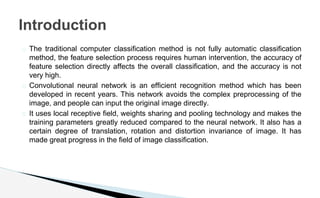
� The traditional computer classification method is not fully automatic classification
method, the feature selection process requires human intervention, the accuracy of
feature selection directly affects the overall classification, and the accuracy is not
very high.
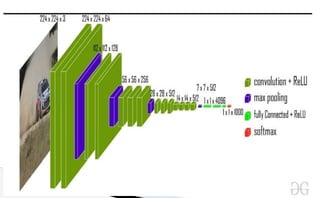
� Convolutional neural network is an efficient recognition method which has been
developed in recent years. This network avoids the complex preprocessing of the
image, and people can input the original image directly.
� It uses local receptive field, weights sharing and pooling technology and makes the
training parameters greatly reduced compared to the neural network. It also has a
certain degree of translation, rotation and distortion invariance of image. It has
made great progress in the field of image classification.
Introduction
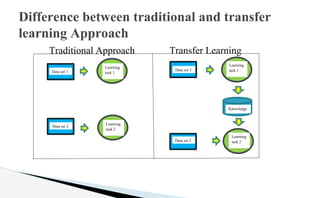
� As we know humans have natural ability to transfer knowledge, we learn things and
then we apply those learning to a particular task. Same way machine can learn and
apply those learning to solve a particular problem. Now if the task is similar or
correlative then it is easy to do the task for both human and machine. The
traditional approach to do a particular task with machine learning or deep learning
is designed to do that particular job. The idea of transfer learning is over coming
this restriction and utilize acquired knowledge to solve related problems.
Transfer Learning
� The key motivation is data insufficiency. Most of the models which solve complex
problem require lot of data to train the model but getting that huge amount of
labeled data for supervised learning is very difficult task itself moreover deep
learning models are very specialized to a task in particular domain to getting such
vast amount of data is the most challenging part. So, transfer learning basically
learn form a labelled data set (basic features like edges, curves, texture etc.) and
apply this learning to do another job.
Why we need transfer Learning ?
Traditional Approach Transfer Learning
Difference between traditional and transfer
learning Approach
Data set 1
Learning
task 1
Data set 2
Learning
task 2
Data set 1
Data set 2
Learning
task 1
Learning
task 2
Knowledge
In the discipline of botany, flower classification is a fundamental research topic.
Flowers have been discovered to have hundreds of thousands of species, making
them one of the most abundant species on the planet. With the advancement of the
economy and technology, an increasing number of individuals are interested in
travelling during the blossoming season. People use cameras, mobile phones, and
other equipment to capture the photograph of flowers at the same time, but they will
be confused since they do not know the type of flowers. As a result, the creation of a
flower classifier will be a lot of fun for individuals.
Motivation
Literature Review
Author Name Description Drawbacks
D. Guru et al.[1] Texture feature-based
method. The proposed
method tested on 35 types
of flower and got accuracy
of 75%
Lot of pre-processing
needed.
H.Mohd-Ekhsan et al. [2] Colour and texture feature
based classification. Tested
on 18 different classes.
Accuracy decreases
significantly with decease in
number of samples.
M. Islam et al. [3] Histogram and LBP based
classification. Which has
achieved 85.3% accuracy
Computationally expensive.
A. Lodh et al. [4] Combined colour and GIST
feature-based
classification. Where SVM
used as a classifier . The
model got an accuracy of
85.93%.
Tested on small amount of
data set.
Author Name Description Drawbacks
K. Mitrović et al.[5] Convolutional neural
network based
classification. The proposed
model achieved highest
accuracy of 73.41%.
_
H. Almogdady et al. [6] Neural network based
classification. Achieved an
accuracy of 81.03%
Optimization problem.
M. Islam et al. [7] Deep neural network-based
algorithm. Achieved an
accuracy of 95%.
Achieved low accuracy with
similar flower species.
Conti..
⮚ If we have large amount of data set then in that case we can train model from scratch
otherwise transfer learning is better approach.
⮚ Transfer learning gives better result than conventional approach.
⮚ Using transfer learning we can train the model faster than other approaches.
⮚ Data set size plays an important role in case of performance of the model that means
when we distribute the images from data set into training and testing which effects the
final result.
⮚ When data set size is small we can use data augmentation to increase the size of the
data set which can improve the performance.
⮚ Different model has its own speciality so the selection of the model for the particular
task is important.
⮚ Most of the data set contain different class of images in variable quantity so get an idea
about the performance of model ROC curve is needed.
Summary of Literature Review
⮚ Enhance the quality of the follower images using different Digital image processing
(DIP) to improve the classification accuracy.
⮚ Classifying the different flower species with the help of transfer learning Method.
⮚ Application of Different classifier to get Test result
⮚ Analysis of result with Confusion matrix ROC curve.
Objective
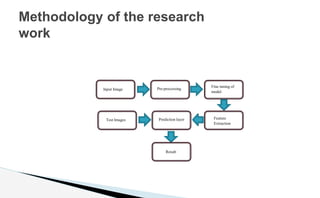
Methodology of the research
work
Fine tuning of
model
Pre-processing
Feature
Extraction
Prediction layer
Result
Test Images
Input Image
References
[1] D.Guru, Y.Kumar, and S.Manjunath, “Textural features in flower classification”, 54(3-4): p. 1030-1036, 2011.
[2] H.Mohd-Ekhsan, J.Hamid, R.Ramle, and M.H.Ismail, “Classification of Flower Images Based on Colour and
Texture Features Using Neural Network”, 2010 International Conference on Intelligent Network and Computing
(ICINC 2010), 2014.
[3] M.Islam, M.Yousuf, and M.M. Billah, “Automatic plant detection using HOG and LBP features with SVM”, 33(1):
p. 26-38, 2019.
[4] A.Lodh and R. Parekh., “Flower recognition system based on color and GIST features”, IEEE, 2017 [Devices
for Integrated Circuit (DevIC)]
[5] K.Mitrović and D. Milošević., “Flower Classification with Convolutional Neural Networks”, IEEE, 2019 23rd
International Conference on System Theory, Control and Computing (ICSTCC)].
[6] H.Almogdady, S.Manaseer, and H.Hiary, “A Flower Recognition System Based On Image Processing And
Neural Networks”, 7(11), 2018
[7] BR.Mete and T. Ensari., “Flower Classification with Deep CNN and Machine Learning Algorithms”,IEEE, 2019
[3rd International Symposium on Multidisciplinary Studies and Innovative Technologies (ISMSIT)].
FINAL PPTt.pptx

FINAL PPTt.pptx

  • 1.
    Flower Image ClassificationUsing Transfer Learning Based Approach ------------------------ Presented by Vishwajeet Kumar Singh (1901200139003) Deepak Kumar Tiwary(1901200139001) Tanmay Singh(1812013032) Archna(18012013010) Under the guidance of Mr. Shubham Srivastava (Associate Professor, Deptt. Of Computer Science & Engineering) Institute of Technology and Management, Gida, Gorakhpur Dr. A.P.J. Abdul Kalam Technical University, Uttar Pradesh, Lucknow A Presentation on
  • 2.
    1. Introduction 2. Motivation 3.Literature review 4. Objectives 5. Methodology 6. References Content
  • 3.
    � The traditionalcomputer classification method is not fully automatic classification method, the feature selection process requires human intervention, the accuracy of feature selection directly affects the overall classification, and the accuracy is not very high. � Convolutional neural network is an efficient recognition method which has been developed in recent years. This network avoids the complex preprocessing of the image, and people can input the original image directly. � It uses local receptive field, weights sharing and pooling technology and makes the training parameters greatly reduced compared to the neural network. It also has a certain degree of translation, rotation and distortion invariance of image. It has made great progress in the field of image classification. Introduction
  • 4.
    � As weknow humans have natural ability to transfer knowledge, we learn things and then we apply those learning to a particular task. Same way machine can learn and apply those learning to solve a particular problem. Now if the task is similar or correlative then it is easy to do the task for both human and machine. The traditional approach to do a particular task with machine learning or deep learning is designed to do that particular job. The idea of transfer learning is over coming this restriction and utilize acquired knowledge to solve related problems. Transfer Learning
  • 5.
    � The keymotivation is data insufficiency. Most of the models which solve complex problem require lot of data to train the model but getting that huge amount of labeled data for supervised learning is very difficult task itself moreover deep learning models are very specialized to a task in particular domain to getting such vast amount of data is the most challenging part. So, transfer learning basically learn form a labelled data set (basic features like edges, curves, texture etc.) and apply this learning to do another job. Why we need transfer Learning ?
  • 6.
    Traditional Approach TransferLearning Difference between traditional and transfer learning Approach Data set 1 Learning task 1 Data set 2 Learning task 2 Data set 1 Data set 2 Learning task 1 Learning task 2 Knowledge
  • 7.
    In the disciplineof botany, flower classification is a fundamental research topic. Flowers have been discovered to have hundreds of thousands of species, making them one of the most abundant species on the planet. With the advancement of the economy and technology, an increasing number of individuals are interested in travelling during the blossoming season. People use cameras, mobile phones, and other equipment to capture the photograph of flowers at the same time, but they will be confused since they do not know the type of flowers. As a result, the creation of a flower classifier will be a lot of fun for individuals. Motivation
  • 8.
    Literature Review Author NameDescription Drawbacks D. Guru et al.[1] Texture feature-based method. The proposed method tested on 35 types of flower and got accuracy of 75% Lot of pre-processing needed. H.Mohd-Ekhsan et al. [2] Colour and texture feature based classification. Tested on 18 different classes. Accuracy decreases significantly with decease in number of samples. M. Islam et al. [3] Histogram and LBP based classification. Which has achieved 85.3% accuracy Computationally expensive. A. Lodh et al. [4] Combined colour and GIST feature-based classification. Where SVM used as a classifier . The model got an accuracy of 85.93%. Tested on small amount of data set.
  • 9.
    Author Name DescriptionDrawbacks K. Mitrović et al.[5] Convolutional neural network based classification. The proposed model achieved highest accuracy of 73.41%. _ H. Almogdady et al. [6] Neural network based classification. Achieved an accuracy of 81.03% Optimization problem. M. Islam et al. [7] Deep neural network-based algorithm. Achieved an accuracy of 95%. Achieved low accuracy with similar flower species. Conti..
  • 10.
    ⮚ If wehave large amount of data set then in that case we can train model from scratch otherwise transfer learning is better approach. ⮚ Transfer learning gives better result than conventional approach. ⮚ Using transfer learning we can train the model faster than other approaches. ⮚ Data set size plays an important role in case of performance of the model that means when we distribute the images from data set into training and testing which effects the final result. ⮚ When data set size is small we can use data augmentation to increase the size of the data set which can improve the performance. ⮚ Different model has its own speciality so the selection of the model for the particular task is important. ⮚ Most of the data set contain different class of images in variable quantity so get an idea about the performance of model ROC curve is needed. Summary of Literature Review
  • 11.
    ⮚ Enhance thequality of the follower images using different Digital image processing (DIP) to improve the classification accuracy. ⮚ Classifying the different flower species with the help of transfer learning Method. ⮚ Application of Different classifier to get Test result ⮚ Analysis of result with Confusion matrix ROC curve. Objective
  • 13.
    Methodology of theresearch work Fine tuning of model Pre-processing Feature Extraction Prediction layer Result Test Images Input Image
  • 14.
    References [1] D.Guru, Y.Kumar,and S.Manjunath, “Textural features in flower classification”, 54(3-4): p. 1030-1036, 2011. [2] H.Mohd-Ekhsan, J.Hamid, R.Ramle, and M.H.Ismail, “Classification of Flower Images Based on Colour and Texture Features Using Neural Network”, 2010 International Conference on Intelligent Network and Computing (ICINC 2010), 2014. [3] M.Islam, M.Yousuf, and M.M. Billah, “Automatic plant detection using HOG and LBP features with SVM”, 33(1): p. 26-38, 2019. [4] A.Lodh and R. Parekh., “Flower recognition system based on color and GIST features”, IEEE, 2017 [Devices for Integrated Circuit (DevIC)] [5] K.Mitrović and D. Milošević., “Flower Classification with Convolutional Neural Networks”, IEEE, 2019 23rd International Conference on System Theory, Control and Computing (ICSTCC)]. [6] H.Almogdady, S.Manaseer, and H.Hiary, “A Flower Recognition System Based On Image Processing And Neural Networks”, 7(11), 2018 [7] BR.Mete and T. Ensari., “Flower Classification with Deep CNN and Machine Learning Algorithms”,IEEE, 2019 [3rd International Symposium on Multidisciplinary Studies and Innovative Technologies (ISMSIT)].