A PROJCT REPORT SUBMITTED TO THE UNIVERSITY OF
BURDWAN IN PARTIAL FULFILLMENT OF REQUIREMENTS
OF THE AWARD OF: BACHELOR OF BUSINESS
ADMINISTRATION (HONS)
NAME : SUBHADIP GHOSH
REG. NO. : 722 OF 2012-2013
ROLLNO. : BUR D BM 2013/57
SESSION : 2012-2015
A STUDY BASED ON CUSTOMER
PERCEPTION TOWARDS THE
PERFORMANCE OF NOKIA AT BURDWAN
MARKET
BURDWAN INSTITUTE OF
MANAGEMENT & COMPUTER
SCIENCE
(Affiliated to the University of Burdwan)
DEWANDIGHI, KATWA ROAD, BURDWAN
ACKNOWLEDGEMET
It’s my privilege acknowledge to each individual those who have given support
& guidance to complete this project report.
I am indebted to my all respected teachers and our Head of The Department
Mr.Subhranil Palit of BBA department of Burdwan institute of Management &
computer science (BIMS), for never ending valuable guidance& direction,
through valuable suggestion with enthusiastic encouragement throughout the
period of my work & preparation of this project.
I am also grateful to Mrs.Lissa Banerjee [Teacher In Charge of Burdwan
Institute of Management & Computer Science (BIMS)] and Mr. Sanjay
Agarwal [Director of NOKIA Priority Dealer [JALAN]] who have guided me
throughout the project.
Finally I am also thankful to all the respondents who look time out of their busy
schedule to respond to this survey.
Date: …./……./……. Thanking You All
Place: Burdwan Subhadip Ghosh
SELF DECLARATION
I am Subhadip Ghosh a student of BBA (HONS) in Burdwan Institute of
Management & Computer Science (BIMS) does hereby declare that the project
report entitled “A STUDY BASED ON CUSTOMER PERCEPTION
TOWARDS THE PERFORMANCE OF NOKIA AT BURDWAN
MARKET” has been prepared by me for the fulfillment of Bachelor of
Business Administration degree from BIMS (Affiliated to the University of
Burdwan). I also declare that the report has not been submitted in any
University or institution for the award of any degree or diploma.
SUBHADIP GHOSH
Date:- ROLL NO: BUR D BM 2013/57
Place:- Burdwan REGISTRATION NO : 722 of 2012-2013
TABLE OF CONTENTS
• INTRODUCTION
• COMPANY PROFILE
• OBJECTIVES OF THE STUDY
• DATA COLLECTION AND METHODOLOGY
• DATA ANALYSIS: FINDINGS AND INTERPRETATION
• LIMITATION OF THE STUDY
• CONCLUSION
• SUGGESTION
• BIBLIOGRAPHY
• QUESTIONNAIRES
INTRODUCTION
The basic focus of marketing centers on its customers. Competition is
increasing day by day and to survive in this competitive era. Companies must
pay proper attention to their customers. Again customers’ retention is much
more important then accruing new customers. So the prime concern of the
companies is to retain customers through meeting consumer needs and wants
and generating customers’ satisfaction. Customers are the main part of the
modern marketing system because they are the decision makers regarding their
purchasing pattern. So the customers lie at the centre of the total marketing
system. The success of any company depends on the perception and
satisfaction of customers. Customer’s behavior is concerned with the activities
and actions of people and organizations that purchases and uses economic
goods and services, including the influences on these activities. Customer’s
behavior is generally used to predict or diagnose buyers’ action in market.
Whether the buyers are satisfied after purchasing a product depends on the
product’s performance in relation to the buyer’s expectations. If the
performance exceeds expectations, the customer is highly satisfied or delighted.
Although the consumer centered firm seeks to create high consumer
satisfaction that is not its ultimate goal. If the company increases customer
satisfaction by lower profit. The company might be able to increase its
profitability by improving manufacturing processes or investing more in
Research and Development.
In the nutshell, each and every business and marketing organization (service)
largely demands customers’ satisfaction. Mobile handset services are not the
exception of this concept. Moreover, this service needs a proper attention
because now-a-days people are using mobile handset for communication in a
gigantic amount.
This project has been done on NOKIA Company’s handset. NOKIA is the
reckoned name in the cell phone company.
This project also stresses on the difference between NOKIA and the
competitors of NOKIA in the cell phone industry. It also endeavors to give an
outline of cell phone market in the stated area and can be used for future
reference.
COMPANY PROFILE
Nokia is a leader in the fields of network infrastructure, location-based
technologies and advanced technologies. Headquartered in Espoo, Finland, and
with operations around the world, Nokia invests in the technologies of the
future.
Today, we have three strong businesses: Nokia Networks, our network
infrastructure business; HERE, our location intelligence business; and
Nokia Technologies, which is focused on technology development and
intellectual property rights activities. Through these businesses, we have a
global presence, employing around 57,000 people. We are also a major investor
in R&D, with investment through the three businesses amounting to more than
EUR 2.5 billion in 2013.
Until recently, Nokia also was a key participant in the mobile devices market
through its Devices & Services business. In September 2013, Nokia announced
an agreement with Microsoft whereby it would sell substantially all of its
Devices & Services business to Microsoft. The transaction was completed on
April 25, 2014.
HISTORY OF THE COMPANY
Nokia has a long history of successful change and innovation, adapting to shifts
in markets and technologies. From its humble beginning with one paper mill,
the company has participated in many sectors over time: cables, paper products,
tires, rubber boots, consumer and industrial electronics, plastics, chemicals,
telecommunications infrastructure and more. Most recently, Nokia has been
best known for its revolutionary wireless communication technologies, which
have connected billions of people through networks and mobile phones.
Nokia’s history dates back to 1865, when mining engineer Fredrik Idestam set
up his first wood pulp mill at the Tammerkoski Rapids in Southwestern
Finland. A few years later he opened a second mill on the banks of the
Nokianvirta River, inspiring him to name his company Nokia Ab in 1871.
In 1967, we took our current form as Nokia Corporation as a result of the
merger of Idestam’s Nokia AB, Finnish Rubber Works, a manufacturer of
rubber boots, tires and other rubber products founded in 1898, and Finnish
Cable Works Ltd, a manufacturer of telephone and power cables founded in
1912. The new Nokia Corporation had five businesses: rubber, cable, forestry,
electronics and power generation.
Nokia first entered the telecommunications equipment market in 1960 when an
electronics department was established at Finnish Cable Works to concentrate
on the production of radio-transmission equipment. Regulatory and
technological reforms have played a role in our success. Deregulation of the
European telecommunications industries since the late 1980s has stimulated
competition and boosted customer demand.
In 1982, we introduced the first fully-digital local telephone exchange in
Europe, and, in the same year, the world’s first car phone for the Nordic Mobile
Telephone analog standard. The technological breakthrough of GSM, which
made more efficient use of frequencies and had greater capacity in addition to
high-quality sound, was followed by the European resolution in 1987 to adopt
GSM as the European digital standard by July 1, 1991. The first GSM call was
made with a Nokia phone over the Nokia-built network of a Finnish operator
called Radiolinja in 1991, and in the same year Nokia won contracts to supply
GSM networks in other European countries.
In the early 1990s, we made a strategic decision to make telecommunications
our core business, with the goal of establishing leadership in every major global
market. Basic industry and non-telecommunications operations—including
paper, personal computer, rubber, footwear, chemicals, power plant, cable,
aluminum and television businesses—were divested between 1989 and 1996.
By 1998, Nokia was the world leader in mobile phones, a position it enjoyed
for more than a decade.
In 2006, Nokia, which had already been investing in its mapping capabilities
for many years, acquired Gate5, a mapping software specialist, and then in
2008 NAVTEQ, the US-based maker of digital mapping and navigational
software. Today, Nokia offers leading location services through the HERE
business and brand, launched in 2012.
In 2007, Nokia combined its telecoms infrastructure operations with those of
Siemens to form a joint venture named Nokia Siemens Networks. NSN has
become a leading global provider of telecommunications infrastructure, with a
focus on offering innovative mobile broadband technology and services.
In 2011, Nokia joined forces with Microsoft to strengthen its position in the
highly competitive smartphone market. Nokia adopted the Windows Phone
operating system for smart devices and through their strategic partnership
Nokia and Microsoft set about establishing an alternative ecosystem to rival
iOS and Android. In 2011, Nokia also started to make a number of changes to
its operations and company culture that would in the course of the next two
years lead to shortened product development times, improved product quality
and better responsiveness to market demand.
In 2013, Nokia moved to reinvent itself with two transformative transactions.
The first was the purchase of Siemens’ stake in NSN, which was nearing the
end of a deep restructuring and remarkable transformation. The second was the
announcement of the sale of substantially all of Nokia’s Devices & Services
business to Microsoft. The Microsoft transaction was originally announced on
September 3, 2013 and was completed on April 25, 2014.
Following the closing of the transaction, Nokia announced its new vision and
strategy, building on its three strong businesses; Nokia Networks, HERE, and
Nokia Technologies.
INFORMATION ABOUT THE COMPANY
Type
Business unit
Industry
Telecommunications
Founded
Fredrik Idestam, Leo Mechelin
Headquarters
Espoo, Uusimaa, Finland
Key people
Rajeev Suri, CEO
Website www.company.nokia.com
PRODUCT OF NOKIA AND ITS FEATURES:
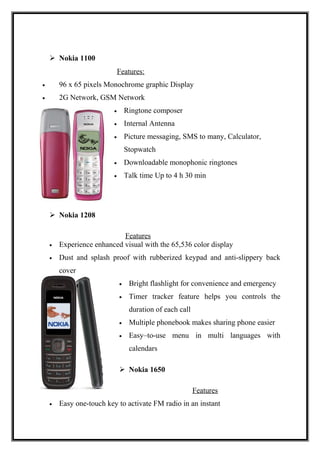
 Nokia 1100
Features:
• 96 x 65 pixels Monochrome graphic Display
• 2G Network, GSM Network
• Ringtone composer
• Internal Antenna
• Picture messaging, SMS to many, Calculator,
Stopwatch
• Downloadable monophonic ringtones
• Talk time Up to 4 h 30 min
 Nokia 1208
Features
• Experience enhanced visual with the 65,536 color display
• Dust and splash proof with rubberized keypad and anti-slippery back
cover
• Bright flashlight for convenience and emergency
• Timer tracker feature helps you controls the
duration of each call
• Multiple phonebook makes sharing phone easier
• Easy–to-use menu in multi languages with
calendars
 Nokia 1650
Features
• Easy one-touch key to activate FM radio in an instant
• Enjoy easy viewing with the 65,536 colors, large screen display and
large font type when dialing
• Personalize your phone ring with quality MP3-grade and 32 Polyphonic
ringtones
• Extend your talk time with Power Saver mode
• Convenient one-touch key to switch on built-in flashlight
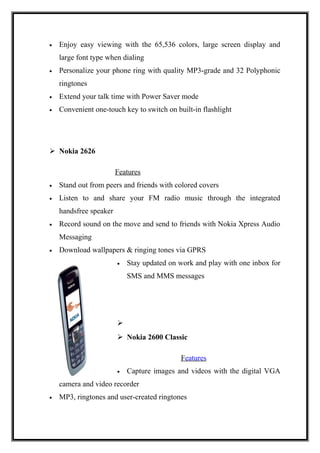
 Nokia 2626
Features
• Stand out from peers and friends with colored covers
• Listen to and share your FM radio music through the integrated
handsfree speaker
• Record sound on the move and send to friends with Nokia Xpress Audio
Messaging
• Download wallpapers & ringing tones via GPRS
• Stay updated on work and play with one inbox for
SMS and MMS messages

 Nokia 2600 Classic
Features
• Capture images and videos with the digital VGA
camera and video recorder
• MP3, ringtones and user-created ringtones
• FM radio
• Monitor call times with Pre-paid Tracker
• Share your photos and video clips with friends and family using
Bluetooth
• 1000-entry phone book
•
• Photo and data sharing with Bluetooth 2.0
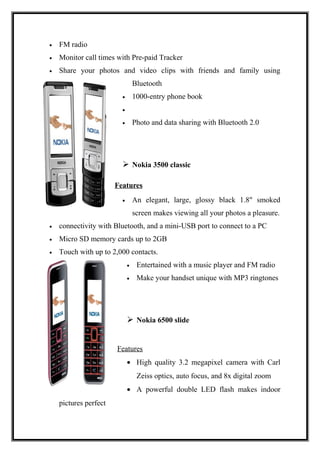
 Nokia 3500 classic
Features
• An elegant, large, glossy black 1.8" smoked
screen makes viewing all your photos a pleasure.
• connectivity with Bluetooth, and a mini-USB port to connect to a PC
• Micro SD memory cards up to 2GB
• Touch with up to 2,000 contacts.
• Entertained with a music player and FM radio
• Make your handset unique with MP3 ringtones
 Nokia 6500 slide
Features
• High quality 3.2 megapixel camera with Carl
Zeiss optics, auto focus, and 8x digital zoom
• A powerful double LED flash makes indoor
pictures perfect
• Share pictures or videos with friends and family via TV-Out
• 3G video calling helps you feel even closer to the people
• Horizontal mode with capture and zoom keys
allows you to use the phone like a digital
camera
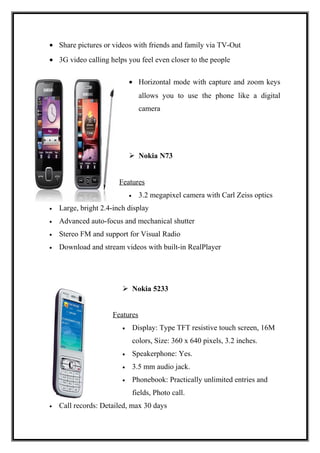
 Nokia N73
Features
• 3.2 megapixel camera with Carl Zeiss optics
• Large, bright 2.4-inch display
• Advanced auto-focus and mechanical shutter
• Stereo FM and support for Visual Radio
• Download and stream videos with built-in RealPlayer
 Nokia 5233
Features
• Display: Type TFT resistive touch screen, 16M
colors, Size: 360 x 640 pixels, 3.2 inches.
• Speakerphone: Yes.
• 3.5 mm audio jack.
• Phonebook: Practically unlimited entries and
fields, Photo call.
• Call records: Detailed, max 30 days
• Internal: 70 MB storage, 128 MB RAM.
• Camera: Primary 2 MP, 1600x1200 pixels.
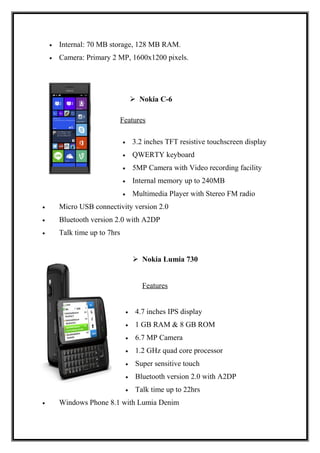
 Nokia C-6
Features
• 3.2 inches TFT resistive touchscreen display
• QWERTY keyboard
• 5MP Camera with Video recording facility
• Internal memory up to 240MB
• Multimedia Player with Stereo FM radio
• Micro USB connectivity version 2.0
• Bluetooth version 2.0 with A2DP
• Talk time up to 7hrs
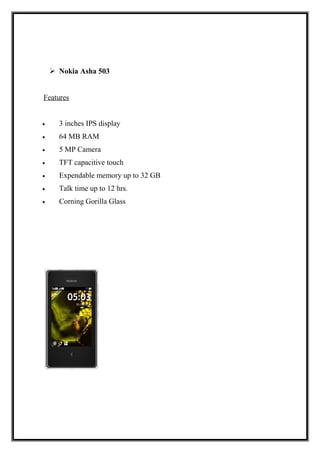
 Nokia Lumia 730
Features
• 4.7 inches IPS display
• 1 GB RAM & 8 GB ROM
• 6.7 MP Camera
• 1.2 GHz quad core processor
• Super sensitive touch
• Bluetooth version 2.0 with A2DP
• Talk time up to 22hrs
• Windows Phone 8.1 with Lumia Denim
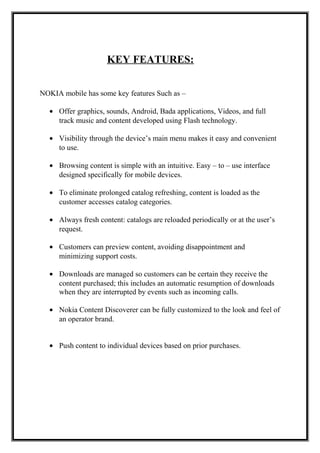
 Nokia Asha 503
Features
• 3 inches IPS display
• 64 MB RAM
• 5 MP Camera
• TFT capacitive touch
• Expendable memory up to 32 GB
• Talk time up to 12 hrs.
• Corning Gorilla Glass
KEY FEATURES:
NOKIA mobile has some key features Such as –
• Offer graphics, sounds, Android, Bada applications, Videos, and full
track music and content developed using Flash technology.
• Visibility through the device’s main menu makes it easy and convenient
to use.
• Browsing content is simple with an intuitive. Easy – to – use interface
designed specifically for mobile devices.
• To eliminate prolonged catalog refreshing, content is loaded as the
customer accesses catalog categories.
• Always fresh content: catalogs are reloaded periodically or at the user’s
request.
• Customers can preview content, avoiding disappointment and
minimizing support costs.
• Downloads are managed so customers can be certain they receive the
content purchased; this includes an automatic resumption of downloads
when they are interrupted by events such as incoming calls.
• Nokia Content Discoverer can be fully customized to the look and feel of
an operator brand.
• Push content to individual devices based on prior purchases.
OBJECTIVES OF THE STUDY
Classroom teaching is more or less theoretical in nature. Unless the theory is
integrated with practice study, the learning remains incomplete. Therefore, this
project work can bridge this gap. The customer’s preferences towards the
NOKIA handsets follow being a student of B.B.A (H) with marketing as my
specializations subjects. At this point of time it is a great opportunity for me to
get knowledge and experience from this study.
The objectives of this project are -
1) To evaluate the performance of NOKIA handsets (benefits and
limitation) on the basis of customers opinion.
2) To determine the market share of NOKIA handset with respect to
total market.
DATA COLLECTION AND METHODOLOGY
In this study both primary and secondary data has been used. The
primary data has been collected through closed end questionnaire in the area
of Burdwan Town. The questionnaire has been prepared according to the
objectives of the study. Before prepare the questionnaire few data has been
collected from secondary source, such as the website of NOKIA company
i.e., www.company.nokia.com. Newspapers, magazines, textbooks of
marketing etc.
In this study small size of samples (100) has been used. Here, however
the judgment of the sampling technique (purposive sampling technique) has
been used. The collected data has been summarized in the “master sheet” in
a systematic manner according to the objective of the study. However, the
summarized data has been analyzed by using the statistical tool like pie
chart & bar chart.
DATA ANALYSIS:
FINDINGS & INTERPRETATION
(ACCORDING TO THE CUSTOMERS
PREFERENCES)
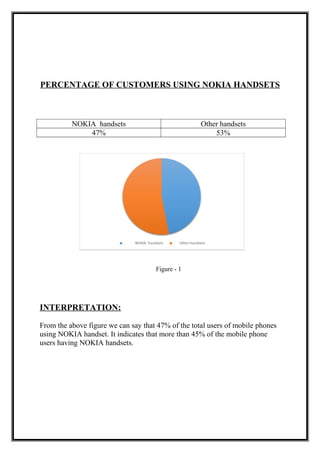
PERCENTAGE OF CUSTOMERS USING NOKIA HANDSETS
NOKIA handsets Other handsets
47% 53%
Figure - 1
INTERPRETATION:
From the above figure we can say that 47% of the total users of mobile phones
using NOKIA handset. It indicates that more than 45% of the mobile phone
users having NOKIA handsets.
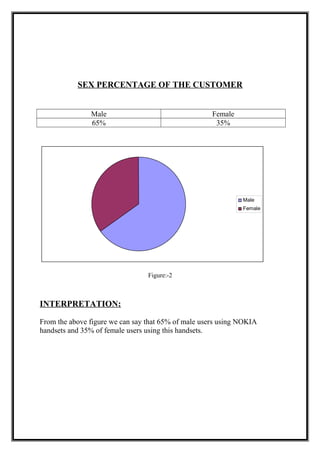
SEX PERCENTAGE OF THE CUSTOMER
Male Female
65% 35%
Male
Female
Figure:-2
INTERPRETATION:
From the above figure we can say that 65% of male users using NOKIA
handsets and 35% of female users using this handsets.
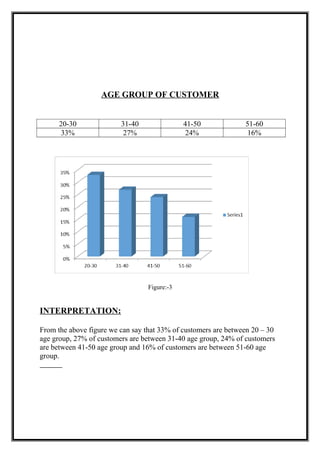
AGE GROUP OF CUSTOMER
20-30 31-40 41-50 51-60
33% 27% 24% 16%
Figure:-3
INTERPRETATION:
From the above figure we can say that 33% of customers are between 20 – 30
age group, 27% of customers are between 31-40 age group, 24% of customers
are between 41-50 age group and 16% of customers are between 51-60 age
group.
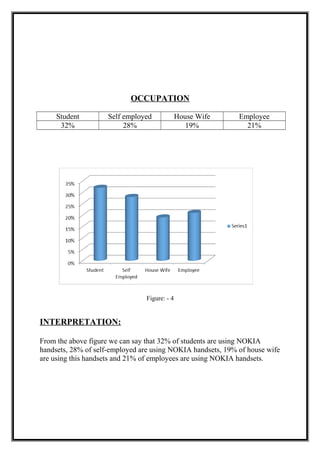
OCCUPATION
Student Self employed House Wife Employee
32% 28% 19% 21%
Figure: - 4
INTERPRETATION:
From the above figure we can say that 32% of students are using NOKIA
handsets, 28% of self-employed are using NOKIA handsets, 19% of house wife
are using this handsets and 21% of employees are using NOKIA handsets.
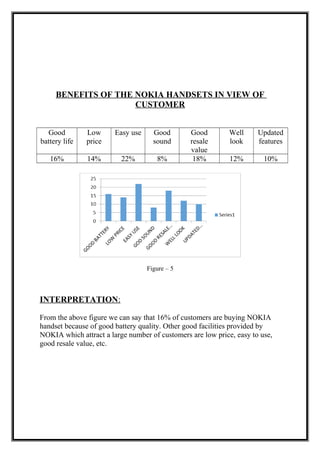
BENEFITS OF THE NOKIA HANDSETS IN VIEW OF
CUSTOMER
Good
battery life
Low
price
Easy use Good
sound
Good
resale
value
Well
look
Updated
features
16% 14% 22% 8% 18% 12% 10%
Figure – 5
INTERPRETATION:
From the above figure we can say that 16% of customers are buying NOKIA
handset because of good battery quality. Other good facilities provided by
NOKIA which attract a large number of customers are low price, easy to use,
good resale value, etc.
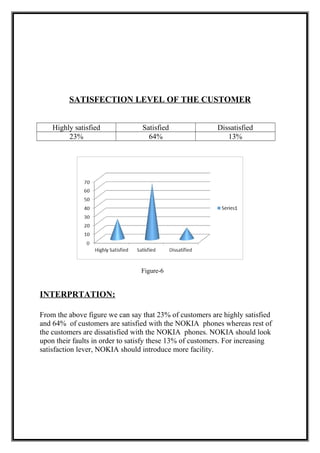
SATISFECTION LEVEL OF THE CUSTOMER
Highly satisfied Satisfied Dissatisfied
23% 64% 13%
Figure-6
INTERPRTATION:
From the above figure we can say that 23% of customers are highly satisfied
and 64% of customers are satisfied with the NOKIA phones whereas rest of
the customers are dissatisfied with the NOKIA phones. NOKIA should look
upon their faults in order to satisfy these 13% of customers. For increasing
satisfaction lever, NOKIA should introduce more facility.
SERVICE QUALITY OF NOKIA HANDSET IN VIEW OF
CUSTOMER
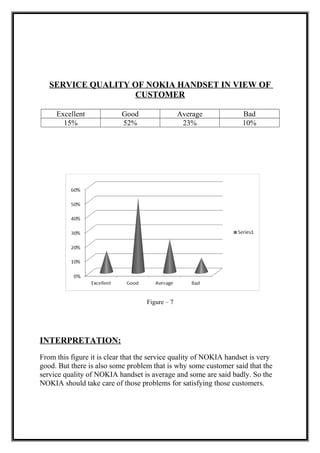
Excellent Good Average Bad
15% 52% 23% 10%
Figure – 7
INTERPRETATION:
From this figure it is clear that the service quality of NOKIA handset is very
good. But there is also some problem that is why some customer said that the
service quality of NOKIA handset is average and some are said badly. So the
NOKIA should take care of those problems for satisfying those customers.
PERCENTAGE OF CUSTOMER WHO WANT TO CHANGE
NOKIA HANDSET
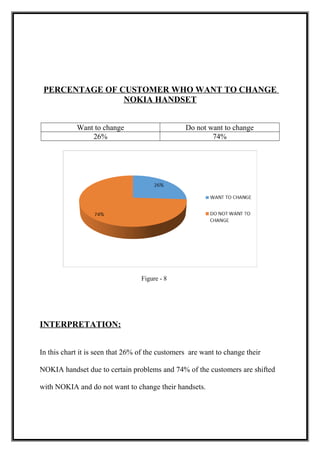
Want to change Do not want to change
26% 74%
Figure - 8
INTERPRETATION:
In this chart it is seen that 26% of the customers are want to change their
NOKIA handset due to certain problems and 74% of the customers are shifted
with NOKIA and do not want to change their handsets.
CAUSES OF CHANGE OF NOKIA HANDSET ACCORDING
TO THE CUSTOMER
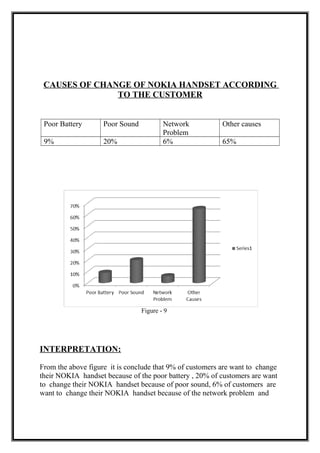
Poor Battery Poor Sound Network
Problem
Other causes
9% 20% 6% 65%
Figure - 9
INTERPRETATION:
From the above figure it is conclude that 9% of customers are want to change
their NOKIA handset because of the poor battery , 20% of customers are want
to change their NOKIA handset because of poor sound, 6% of customers are
want to change their NOKIA handset because of the network problem and
most of the customers are want to change their NOKIA handset because of
other causes.
If Nokia introduces stylist phone in the market then they would be able to hold
the market and people wouldn’t switch over to other companies handset.
LIMITATIONS OF THE STUDY
• Due to the lack of time I have not been able to consider all the factors
that may influence customer’s preferences towards the NOKIA handset.
• Due to short period of time I have not been able to go in front of all the
customers.
• The study was limited only in south Burdwan town.
• Since the sample size (100) was very small, so this study cannot depict
the real perception towards the NOKIA handset.
• Collection of data was very difficult due to the busy schedule of the
customers.
• Data has not been collected properly due to the lack of cooperation of the
customers.
CONCLUSION
NOKIA is the reckoned name in the mobile handset company. NOKIA is the
India’s largest selling mobile handset company.
This project report will be immensely helpful to NOKIA in enhancing total
customer demand & also to satisfy customers of different markets. This report
will help the company to determine the area where it has to concentrate for
optimum customer satisfaction & maximize its market share.
To retain the leading position in the mobile handset market, NOKIA should
improve some of its handset features such as sound & display quality and
camera quality and also its look.
From the project report, it is clear that over 46% of the consumers use NOKIA
handset, while the rest use handsets of other companies. The reason behind this
is that the sound systems of the NOKIA handset are not up to the mark rather
not standard and also NOKIA handset doesn’t have an attractive look; they are
very simple in appearance. From the study it is also clear that a certain
percentage of consumers have changed their NOKIA handset and switched
over to phones of other companies, because sound and display are not good, as
well as some customers are change the NOKIA handset for his passion. So,
NOKIA should improve their sound and display quality, and attractive look of
give their mobile a stylish looks to attract customers. But this is fortunate, that
a huge percentage customers use NOKIA handsets due to its battery legibility,
low price, easy operation and a good re – sale value.
So, from the above discussion it is clear that, an average group of customers
use NOKIA handsets. It is found from the study that many prospective
customers are interested to buy NOKIA handsets during promotional offers.
So, if the company gives such promotional offers then the sale will suddenly
increase a lot.
SUGGESTION
• The company must increase the colour range of the handsets.
• The company should decrease the prices of the parts.
• The repairing cost of the mobile is high; steps should be taken to
decrease it.
• The services rendered by dealer should be improved.
• The company should improve the promotional activities mainly
through print media and television media.
• The network strength must be increase in handsets.
• The design of the mobile has to be updated.
• The awareness program among the customers has to be more.
• They should include the updated features.
BIBLIOGRAPHY
Websites: -
1. www.google.co.in
2. www.company.nokia.com
3. www.wikipedia.org
Books: -
1. Marketing Management-----Philip Kotler.
2. Strategic Management------V.S.P. Roy
.
QUESTIONNAIRES
1. Name:
2. Address:
3. Percentage of customer using NOKIA handsets:
NOKIA others
4. Sex percentage of the customer:
Male Female
5. Age group of customer:
20 – 30 31 – 40 41 – 50 51 – 60
6. Occupation:
Student Self Employed House Wife Employee
7. Benefits of the NOKIA handsets in view of customer?
Good battery Low price Easy to use Good sound
Good resale value Updated Features
8. Satisfaction level 0f the customer:
Highly satisfied Satisfied Dissatisfied
9. Service quality of NOKIA handset in view of customer?
Excellent Good Average Bad
10. Percentage of customer who want to change NOKIA handset?
Do not want to change Want to change
11. Causes of change of NOKIA handset according to the customer?
Poor battery Poor sound Network problem other
12. Your suggestion for improving NOKIA handsets.

Final Nokia project

  • 1.
    A PROJCT REPORTSUBMITTED TO THE UNIVERSITY OF BURDWAN IN PARTIAL FULFILLMENT OF REQUIREMENTS OF THE AWARD OF: BACHELOR OF BUSINESS ADMINISTRATION (HONS) NAME : SUBHADIP GHOSH REG. NO. : 722 OF 2012-2013 ROLLNO. : BUR D BM 2013/57 SESSION : 2012-2015 A STUDY BASED ON CUSTOMER PERCEPTION TOWARDS THE PERFORMANCE OF NOKIA AT BURDWAN MARKET BURDWAN INSTITUTE OF MANAGEMENT & COMPUTER SCIENCE (Affiliated to the University of Burdwan)
  • 2.
  • 3.
    ACKNOWLEDGEMET It’s my privilegeacknowledge to each individual those who have given support & guidance to complete this project report. I am indebted to my all respected teachers and our Head of The Department Mr.Subhranil Palit of BBA department of Burdwan institute of Management & computer science (BIMS), for never ending valuable guidance& direction, through valuable suggestion with enthusiastic encouragement throughout the period of my work & preparation of this project. I am also grateful to Mrs.Lissa Banerjee [Teacher In Charge of Burdwan Institute of Management & Computer Science (BIMS)] and Mr. Sanjay Agarwal [Director of NOKIA Priority Dealer [JALAN]] who have guided me throughout the project. Finally I am also thankful to all the respondents who look time out of their busy schedule to respond to this survey. Date: …./……./……. Thanking You All Place: Burdwan Subhadip Ghosh
  • 4.
    SELF DECLARATION I amSubhadip Ghosh a student of BBA (HONS) in Burdwan Institute of Management & Computer Science (BIMS) does hereby declare that the project report entitled “A STUDY BASED ON CUSTOMER PERCEPTION TOWARDS THE PERFORMANCE OF NOKIA AT BURDWAN MARKET” has been prepared by me for the fulfillment of Bachelor of Business Administration degree from BIMS (Affiliated to the University of Burdwan). I also declare that the report has not been submitted in any University or institution for the award of any degree or diploma. SUBHADIP GHOSH Date:- ROLL NO: BUR D BM 2013/57 Place:- Burdwan REGISTRATION NO : 722 of 2012-2013
  • 5.
    TABLE OF CONTENTS •INTRODUCTION • COMPANY PROFILE • OBJECTIVES OF THE STUDY • DATA COLLECTION AND METHODOLOGY • DATA ANALYSIS: FINDINGS AND INTERPRETATION • LIMITATION OF THE STUDY • CONCLUSION • SUGGESTION • BIBLIOGRAPHY • QUESTIONNAIRES INTRODUCTION
  • 6.
    The basic focusof marketing centers on its customers. Competition is increasing day by day and to survive in this competitive era. Companies must pay proper attention to their customers. Again customers’ retention is much more important then accruing new customers. So the prime concern of the companies is to retain customers through meeting consumer needs and wants and generating customers’ satisfaction. Customers are the main part of the modern marketing system because they are the decision makers regarding their purchasing pattern. So the customers lie at the centre of the total marketing system. The success of any company depends on the perception and satisfaction of customers. Customer’s behavior is concerned with the activities and actions of people and organizations that purchases and uses economic goods and services, including the influences on these activities. Customer’s behavior is generally used to predict or diagnose buyers’ action in market. Whether the buyers are satisfied after purchasing a product depends on the product’s performance in relation to the buyer’s expectations. If the performance exceeds expectations, the customer is highly satisfied or delighted. Although the consumer centered firm seeks to create high consumer satisfaction that is not its ultimate goal. If the company increases customer satisfaction by lower profit. The company might be able to increase its profitability by improving manufacturing processes or investing more in Research and Development. In the nutshell, each and every business and marketing organization (service) largely demands customers’ satisfaction. Mobile handset services are not the exception of this concept. Moreover, this service needs a proper attention because now-a-days people are using mobile handset for communication in a gigantic amount. This project has been done on NOKIA Company’s handset. NOKIA is the reckoned name in the cell phone company. This project also stresses on the difference between NOKIA and the competitors of NOKIA in the cell phone industry. It also endeavors to give an outline of cell phone market in the stated area and can be used for future reference. COMPANY PROFILE
  • 7.
    Nokia is aleader in the fields of network infrastructure, location-based technologies and advanced technologies. Headquartered in Espoo, Finland, and with operations around the world, Nokia invests in the technologies of the future. Today, we have three strong businesses: Nokia Networks, our network infrastructure business; HERE, our location intelligence business; and Nokia Technologies, which is focused on technology development and intellectual property rights activities. Through these businesses, we have a global presence, employing around 57,000 people. We are also a major investor in R&D, with investment through the three businesses amounting to more than EUR 2.5 billion in 2013. Until recently, Nokia also was a key participant in the mobile devices market through its Devices & Services business. In September 2013, Nokia announced an agreement with Microsoft whereby it would sell substantially all of its Devices & Services business to Microsoft. The transaction was completed on April 25, 2014. HISTORY OF THE COMPANY Nokia has a long history of successful change and innovation, adapting to shifts in markets and technologies. From its humble beginning with one paper mill, the company has participated in many sectors over time: cables, paper products, tires, rubber boots, consumer and industrial electronics, plastics, chemicals, telecommunications infrastructure and more. Most recently, Nokia has been best known for its revolutionary wireless communication technologies, which have connected billions of people through networks and mobile phones. Nokia’s history dates back to 1865, when mining engineer Fredrik Idestam set up his first wood pulp mill at the Tammerkoski Rapids in Southwestern Finland. A few years later he opened a second mill on the banks of the Nokianvirta River, inspiring him to name his company Nokia Ab in 1871. In 1967, we took our current form as Nokia Corporation as a result of the merger of Idestam’s Nokia AB, Finnish Rubber Works, a manufacturer of
  • 8.
    rubber boots, tiresand other rubber products founded in 1898, and Finnish Cable Works Ltd, a manufacturer of telephone and power cables founded in 1912. The new Nokia Corporation had five businesses: rubber, cable, forestry, electronics and power generation. Nokia first entered the telecommunications equipment market in 1960 when an electronics department was established at Finnish Cable Works to concentrate on the production of radio-transmission equipment. Regulatory and technological reforms have played a role in our success. Deregulation of the European telecommunications industries since the late 1980s has stimulated competition and boosted customer demand. In 1982, we introduced the first fully-digital local telephone exchange in Europe, and, in the same year, the world’s first car phone for the Nordic Mobile Telephone analog standard. The technological breakthrough of GSM, which made more efficient use of frequencies and had greater capacity in addition to high-quality sound, was followed by the European resolution in 1987 to adopt GSM as the European digital standard by July 1, 1991. The first GSM call was made with a Nokia phone over the Nokia-built network of a Finnish operator called Radiolinja in 1991, and in the same year Nokia won contracts to supply GSM networks in other European countries. In the early 1990s, we made a strategic decision to make telecommunications our core business, with the goal of establishing leadership in every major global market. Basic industry and non-telecommunications operations—including paper, personal computer, rubber, footwear, chemicals, power plant, cable, aluminum and television businesses—were divested between 1989 and 1996. By 1998, Nokia was the world leader in mobile phones, a position it enjoyed for more than a decade. In 2006, Nokia, which had already been investing in its mapping capabilities for many years, acquired Gate5, a mapping software specialist, and then in 2008 NAVTEQ, the US-based maker of digital mapping and navigational software. Today, Nokia offers leading location services through the HERE business and brand, launched in 2012. In 2007, Nokia combined its telecoms infrastructure operations with those of Siemens to form a joint venture named Nokia Siemens Networks. NSN has become a leading global provider of telecommunications infrastructure, with a focus on offering innovative mobile broadband technology and services.
  • 9.
    In 2011, Nokiajoined forces with Microsoft to strengthen its position in the highly competitive smartphone market. Nokia adopted the Windows Phone operating system for smart devices and through their strategic partnership Nokia and Microsoft set about establishing an alternative ecosystem to rival iOS and Android. In 2011, Nokia also started to make a number of changes to its operations and company culture that would in the course of the next two years lead to shortened product development times, improved product quality and better responsiveness to market demand. In 2013, Nokia moved to reinvent itself with two transformative transactions. The first was the purchase of Siemens’ stake in NSN, which was nearing the end of a deep restructuring and remarkable transformation. The second was the announcement of the sale of substantially all of Nokia’s Devices & Services business to Microsoft. The Microsoft transaction was originally announced on September 3, 2013 and was completed on April 25, 2014. Following the closing of the transaction, Nokia announced its new vision and strategy, building on its three strong businesses; Nokia Networks, HERE, and Nokia Technologies. INFORMATION ABOUT THE COMPANY Type Business unit Industry Telecommunications Founded Fredrik Idestam, Leo Mechelin Headquarters Espoo, Uusimaa, Finland Key people Rajeev Suri, CEO Website www.company.nokia.com PRODUCT OF NOKIA AND ITS FEATURES:
  • 10.
     Nokia 1100 Features: •96 x 65 pixels Monochrome graphic Display • 2G Network, GSM Network • Ringtone composer • Internal Antenna • Picture messaging, SMS to many, Calculator, Stopwatch • Downloadable monophonic ringtones • Talk time Up to 4 h 30 min  Nokia 1208 Features • Experience enhanced visual with the 65,536 color display • Dust and splash proof with rubberized keypad and anti-slippery back cover • Bright flashlight for convenience and emergency • Timer tracker feature helps you controls the duration of each call • Multiple phonebook makes sharing phone easier • Easy–to-use menu in multi languages with calendars  Nokia 1650 Features • Easy one-touch key to activate FM radio in an instant
  • 11.
    • Enjoy easyviewing with the 65,536 colors, large screen display and large font type when dialing • Personalize your phone ring with quality MP3-grade and 32 Polyphonic ringtones • Extend your talk time with Power Saver mode • Convenient one-touch key to switch on built-in flashlight  Nokia 2626 Features • Stand out from peers and friends with colored covers • Listen to and share your FM radio music through the integrated handsfree speaker • Record sound on the move and send to friends with Nokia Xpress Audio Messaging • Download wallpapers & ringing tones via GPRS • Stay updated on work and play with one inbox for SMS and MMS messages   Nokia 2600 Classic Features • Capture images and videos with the digital VGA camera and video recorder • MP3, ringtones and user-created ringtones
  • 12.
    • FM radio •Monitor call times with Pre-paid Tracker • Share your photos and video clips with friends and family using Bluetooth • 1000-entry phone book • • Photo and data sharing with Bluetooth 2.0  Nokia 3500 classic Features • An elegant, large, glossy black 1.8" smoked screen makes viewing all your photos a pleasure. • connectivity with Bluetooth, and a mini-USB port to connect to a PC • Micro SD memory cards up to 2GB • Touch with up to 2,000 contacts. • Entertained with a music player and FM radio • Make your handset unique with MP3 ringtones  Nokia 6500 slide Features • High quality 3.2 megapixel camera with Carl Zeiss optics, auto focus, and 8x digital zoom • A powerful double LED flash makes indoor pictures perfect
  • 13.
    • Share picturesor videos with friends and family via TV-Out • 3G video calling helps you feel even closer to the people • Horizontal mode with capture and zoom keys allows you to use the phone like a digital camera  Nokia N73 Features • 3.2 megapixel camera with Carl Zeiss optics • Large, bright 2.4-inch display • Advanced auto-focus and mechanical shutter • Stereo FM and support for Visual Radio • Download and stream videos with built-in RealPlayer  Nokia 5233 Features • Display: Type TFT resistive touch screen, 16M colors, Size: 360 x 640 pixels, 3.2 inches. • Speakerphone: Yes. • 3.5 mm audio jack. • Phonebook: Practically unlimited entries and fields, Photo call. • Call records: Detailed, max 30 days
  • 14.
    • Internal: 70MB storage, 128 MB RAM. • Camera: Primary 2 MP, 1600x1200 pixels.  Nokia C-6 Features • 3.2 inches TFT resistive touchscreen display • QWERTY keyboard • 5MP Camera with Video recording facility • Internal memory up to 240MB • Multimedia Player with Stereo FM radio • Micro USB connectivity version 2.0 • Bluetooth version 2.0 with A2DP • Talk time up to 7hrs  Nokia Lumia 730 Features • 4.7 inches IPS display • 1 GB RAM & 8 GB ROM • 6.7 MP Camera • 1.2 GHz quad core processor • Super sensitive touch • Bluetooth version 2.0 with A2DP • Talk time up to 22hrs • Windows Phone 8.1 with Lumia Denim
  • 15.
     Nokia Asha503 Features • 3 inches IPS display • 64 MB RAM • 5 MP Camera • TFT capacitive touch • Expendable memory up to 32 GB • Talk time up to 12 hrs. • Corning Gorilla Glass
  • 16.
    KEY FEATURES: NOKIA mobilehas some key features Such as – • Offer graphics, sounds, Android, Bada applications, Videos, and full track music and content developed using Flash technology. • Visibility through the device’s main menu makes it easy and convenient to use. • Browsing content is simple with an intuitive. Easy – to – use interface designed specifically for mobile devices. • To eliminate prolonged catalog refreshing, content is loaded as the customer accesses catalog categories. • Always fresh content: catalogs are reloaded periodically or at the user’s request. • Customers can preview content, avoiding disappointment and minimizing support costs. • Downloads are managed so customers can be certain they receive the content purchased; this includes an automatic resumption of downloads when they are interrupted by events such as incoming calls. • Nokia Content Discoverer can be fully customized to the look and feel of an operator brand. • Push content to individual devices based on prior purchases.
  • 17.
    OBJECTIVES OF THESTUDY Classroom teaching is more or less theoretical in nature. Unless the theory is integrated with practice study, the learning remains incomplete. Therefore, this project work can bridge this gap. The customer’s preferences towards the NOKIA handsets follow being a student of B.B.A (H) with marketing as my specializations subjects. At this point of time it is a great opportunity for me to get knowledge and experience from this study. The objectives of this project are - 1) To evaluate the performance of NOKIA handsets (benefits and limitation) on the basis of customers opinion. 2) To determine the market share of NOKIA handset with respect to total market.
  • 18.
    DATA COLLECTION ANDMETHODOLOGY In this study both primary and secondary data has been used. The primary data has been collected through closed end questionnaire in the area of Burdwan Town. The questionnaire has been prepared according to the objectives of the study. Before prepare the questionnaire few data has been collected from secondary source, such as the website of NOKIA company i.e., www.company.nokia.com. Newspapers, magazines, textbooks of marketing etc. In this study small size of samples (100) has been used. Here, however the judgment of the sampling technique (purposive sampling technique) has been used. The collected data has been summarized in the “master sheet” in a systematic manner according to the objective of the study. However, the summarized data has been analyzed by using the statistical tool like pie chart & bar chart.
  • 19.
    DATA ANALYSIS: FINDINGS &INTERPRETATION (ACCORDING TO THE CUSTOMERS PREFERENCES)
  • 20.
    PERCENTAGE OF CUSTOMERSUSING NOKIA HANDSETS NOKIA handsets Other handsets 47% 53% Figure - 1 INTERPRETATION: From the above figure we can say that 47% of the total users of mobile phones using NOKIA handset. It indicates that more than 45% of the mobile phone users having NOKIA handsets.
  • 21.
    SEX PERCENTAGE OFTHE CUSTOMER Male Female 65% 35% Male Female Figure:-2 INTERPRETATION: From the above figure we can say that 65% of male users using NOKIA handsets and 35% of female users using this handsets.
  • 22.
    AGE GROUP OFCUSTOMER 20-30 31-40 41-50 51-60 33% 27% 24% 16% Figure:-3 INTERPRETATION: From the above figure we can say that 33% of customers are between 20 – 30 age group, 27% of customers are between 31-40 age group, 24% of customers are between 41-50 age group and 16% of customers are between 51-60 age group.
  • 23.
    OCCUPATION Student Self employedHouse Wife Employee 32% 28% 19% 21% Figure: - 4 INTERPRETATION: From the above figure we can say that 32% of students are using NOKIA handsets, 28% of self-employed are using NOKIA handsets, 19% of house wife are using this handsets and 21% of employees are using NOKIA handsets.
  • 24.
    BENEFITS OF THENOKIA HANDSETS IN VIEW OF CUSTOMER Good battery life Low price Easy use Good sound Good resale value Well look Updated features 16% 14% 22% 8% 18% 12% 10% Figure – 5 INTERPRETATION: From the above figure we can say that 16% of customers are buying NOKIA handset because of good battery quality. Other good facilities provided by NOKIA which attract a large number of customers are low price, easy to use, good resale value, etc.
  • 25.
    SATISFECTION LEVEL OFTHE CUSTOMER Highly satisfied Satisfied Dissatisfied 23% 64% 13% Figure-6 INTERPRTATION: From the above figure we can say that 23% of customers are highly satisfied and 64% of customers are satisfied with the NOKIA phones whereas rest of the customers are dissatisfied with the NOKIA phones. NOKIA should look upon their faults in order to satisfy these 13% of customers. For increasing satisfaction lever, NOKIA should introduce more facility.
  • 26.
    SERVICE QUALITY OFNOKIA HANDSET IN VIEW OF CUSTOMER Excellent Good Average Bad 15% 52% 23% 10% Figure – 7 INTERPRETATION: From this figure it is clear that the service quality of NOKIA handset is very good. But there is also some problem that is why some customer said that the service quality of NOKIA handset is average and some are said badly. So the NOKIA should take care of those problems for satisfying those customers.
  • 27.
    PERCENTAGE OF CUSTOMERWHO WANT TO CHANGE NOKIA HANDSET Want to change Do not want to change 26% 74% Figure - 8 INTERPRETATION: In this chart it is seen that 26% of the customers are want to change their NOKIA handset due to certain problems and 74% of the customers are shifted with NOKIA and do not want to change their handsets.
  • 28.
    CAUSES OF CHANGEOF NOKIA HANDSET ACCORDING TO THE CUSTOMER Poor Battery Poor Sound Network Problem Other causes 9% 20% 6% 65% Figure - 9 INTERPRETATION: From the above figure it is conclude that 9% of customers are want to change their NOKIA handset because of the poor battery , 20% of customers are want to change their NOKIA handset because of poor sound, 6% of customers are want to change their NOKIA handset because of the network problem and
  • 29.
    most of thecustomers are want to change their NOKIA handset because of other causes. If Nokia introduces stylist phone in the market then they would be able to hold the market and people wouldn’t switch over to other companies handset. LIMITATIONS OF THE STUDY • Due to the lack of time I have not been able to consider all the factors that may influence customer’s preferences towards the NOKIA handset. • Due to short period of time I have not been able to go in front of all the customers. • The study was limited only in south Burdwan town. • Since the sample size (100) was very small, so this study cannot depict the real perception towards the NOKIA handset. • Collection of data was very difficult due to the busy schedule of the customers. • Data has not been collected properly due to the lack of cooperation of the customers.
  • 30.
    CONCLUSION NOKIA is thereckoned name in the mobile handset company. NOKIA is the India’s largest selling mobile handset company. This project report will be immensely helpful to NOKIA in enhancing total customer demand & also to satisfy customers of different markets. This report will help the company to determine the area where it has to concentrate for optimum customer satisfaction & maximize its market share. To retain the leading position in the mobile handset market, NOKIA should improve some of its handset features such as sound & display quality and camera quality and also its look. From the project report, it is clear that over 46% of the consumers use NOKIA handset, while the rest use handsets of other companies. The reason behind this is that the sound systems of the NOKIA handset are not up to the mark rather not standard and also NOKIA handset doesn’t have an attractive look; they are very simple in appearance. From the study it is also clear that a certain percentage of consumers have changed their NOKIA handset and switched over to phones of other companies, because sound and display are not good, as well as some customers are change the NOKIA handset for his passion. So, NOKIA should improve their sound and display quality, and attractive look of give their mobile a stylish looks to attract customers. But this is fortunate, that a huge percentage customers use NOKIA handsets due to its battery legibility, low price, easy operation and a good re – sale value. So, from the above discussion it is clear that, an average group of customers use NOKIA handsets. It is found from the study that many prospective customers are interested to buy NOKIA handsets during promotional offers. So, if the company gives such promotional offers then the sale will suddenly increase a lot.
  • 32.
    SUGGESTION • The companymust increase the colour range of the handsets. • The company should decrease the prices of the parts. • The repairing cost of the mobile is high; steps should be taken to decrease it. • The services rendered by dealer should be improved. • The company should improve the promotional activities mainly through print media and television media. • The network strength must be increase in handsets. • The design of the mobile has to be updated. • The awareness program among the customers has to be more. • They should include the updated features.
  • 33.
    BIBLIOGRAPHY Websites: - 1. www.google.co.in 2.www.company.nokia.com 3. www.wikipedia.org Books: - 1. Marketing Management-----Philip Kotler. 2. Strategic Management------V.S.P. Roy .
  • 34.
    QUESTIONNAIRES 1. Name: 2. Address: 3.Percentage of customer using NOKIA handsets: NOKIA others 4. Sex percentage of the customer: Male Female 5. Age group of customer: 20 – 30 31 – 40 41 – 50 51 – 60 6. Occupation: Student Self Employed House Wife Employee 7. Benefits of the NOKIA handsets in view of customer? Good battery Low price Easy to use Good sound Good resale value Updated Features 8. Satisfaction level 0f the customer: Highly satisfied Satisfied Dissatisfied 9. Service quality of NOKIA handset in view of customer? Excellent Good Average Bad 10. Percentage of customer who want to change NOKIA handset? Do not want to change Want to change 11. Causes of change of NOKIA handset according to the customer? Poor battery Poor sound Network problem other 12. Your suggestion for improving NOKIA handsets.