MARINE ENGINEERING
AUTOMATION AND
CONTROL SYSTEM-1
1
Unit-III
THERMODYNAMICS
INTRODUCTION
• Thermodynamics is a branch of physics
that deals with the laws governing the
energy and work of a system, which may
be described as othe
r
the exchange of heat energy to and
from forms of energy within a given
system.
• Careful study of these concept is
essential for good understanding of
topics in thermodynamics.
• specifically, it defines macroscopic
variables, such as internal energy,
entropy, and pressure.
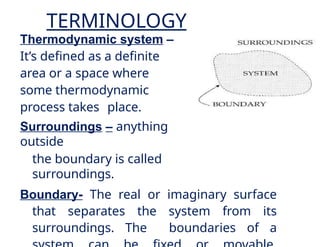
Thermodynamic system –
It’s defined as a definite
area or a space where
some thermodynamic
process takes place.
Surroundings – anything
outside
the boundary is called
surroundings.
Boundary- The real or imaginary surface
that separates the system from its
surroundings. The boundaries of a
TERMINOLOGY
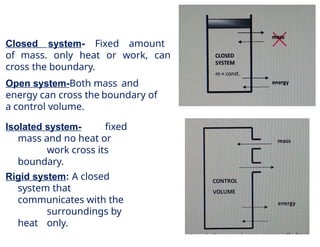
Closed system- Fixed amount
of mass. only heat or work, can
cross the boundary.
Open system-Both mass and
energy can cross the boundary of
a control volume.
Isolated system- fixed
mass and no heat or
work cross its
boundary.
Rigid system: A closed
system that
communicates with the
surroundings by
heat only.
CONTINUE…
• Properties of system- all the quantities such
as volume, pressure, temperature, density
and internal energy etc identify state of a
system are called properties.
1)Extensive- The properties whose value for the
entire system is equal to the sum of their
values for individual part of the system.
i. e. Total volume, total mass, total energy
2)Intensive- The properties whose value for
the entiresystem is NOT equal to the sum
of their values for individual part of the
system.
i.e. temperature, pressure, density etc
CONTINUE…
• Thermal equilibrium- when the temperature
is the same throughout the entire system.
• Mechanical equilibrium- when there is
no change in pressure at any point of the
system. However, the pressure may vary
within the system due to gravitational
effects.
• Phase equilibrium- in a two phase
system, when the mass of each phase
reaches an equilibrium level.
• Chemical equilibrium- when the
chemical composition of a system does not
change with time, i.e., no chemical
CONTINUE…
• Perfect Gas- Its define as a state of
substance whose evaporation from its liquid
state is complete, If evaporation is partial the
substance is called Vapour.
• Absolute zero Temperature- At which the
volume of a gas becomes zero.
Its -273°c OR 0 k.
• Specific Heat- The amount of heat required to
raise the temperature of its unit mass
through 1°.
• Joules Law- “The change of internal
energy of a perfect gas is directly
proportional to the change of the
Laws of Thermodynamics
1) Zeroth law of thermodynamics- When two
bodies are in thermal equilibrium with a third
body, they are also in thermal equilibrium
with each other.
2) First law of thermodynamics- Heat and
mechanical work are mutually convertible. or
Energy can neither be created nor
destroyed, it can transfer from one form to
another.
3) Second law of thermodynamics- There is a
definite limit to the amount of mechanical
energy, which can be obtained from a given
quantity of heat energy.
CONTINUE…
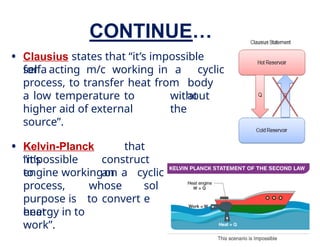
• Clausius states that “it’s impossible
for a
self acting m/c working in a
process, to transfer heat from
a
cyclic
body
at
without
the
a low temperature to
higher aid of external
source”.
• Kelvin-Planck that
“it’s
impossible
to
construct
an
engine workingon a cyclic
sol
e
process, whose
purpose is to convert
heat
energy in to
work”.
4) Third law of thermodynamics- The entropy
of a perfect crystal is zero when the
temperature of the crystal is equal to
absolute zero (0 K).
Laws Of Perfect Gas
1) Boyle’s law- “The absolute pressure of a given mass
of perfect gas varies inversely as its volume, when
the temperature remain constant”. Mathematically
pv = constant (T= const.)
2) Charles law- “The volume of a given mass of a
perfect gas varies directly as its absolute
temperature, when the pressure remains constant”.
Mathematically, V/T = constant (p= const.)
3) Gay-lussac law- “The absolute pressure of a given
mass of a perfect gas varies directly as its absolute
temperature when volume is constant.”
Mathematically, P/T = constant (v= const.)
11
7
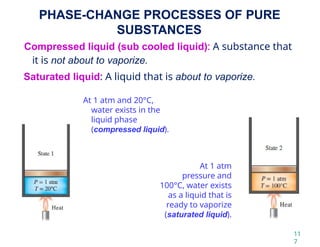
PHASE-CHANGE PROCESSES OF PURE
SUBSTANCES
Compressed liquid (sub cooled liquid): A substance that
it is not about to vaporize.
Saturated liquid: A liquid that is about to vaporize.
At 1 atm and 20°C,
water exists in the
liquid phase
(compressed liquid).
At 1 atm
pressure and
100°C, water exists
as a liquid that is
ready to vaporize
(saturated liquid).
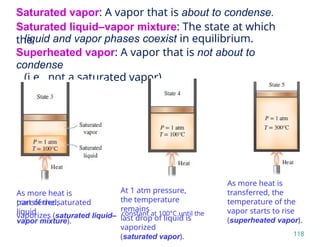
As more heat is
transferred, the
temperature of the
vapor starts to rise
(superheated vapor).
118
Saturated vapor: A vapor that is about to condense.
Saturated liquid–vapor mixture: The state at which
the
liquid and vapor phases coexist in equilibrium.
Superheated vapor: A vapor that is not about to
condense
(i.e., not a saturated vapor).
As more heat is
transferred,
part of the saturated
liquid
vapor mixture).
vaporizes (saturated liquid– constant at 100°C until the
At 1 atm pressure,
the temperature
remains
last drop of liquid is
vaporized
(saturated vapor).
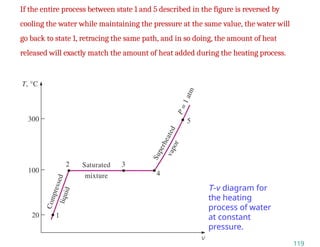
T-v diagram for
the heating
process of water
at constant
pressure.
119
If the entire process between state 1 and 5 described in the figure is reversed by
cooling the water while maintaining the pressure at the same value, the water will
go back to state 1, retracing the same path, and in so doing, the amount of heat
released will exactly match the amount of heat added during the heating process.
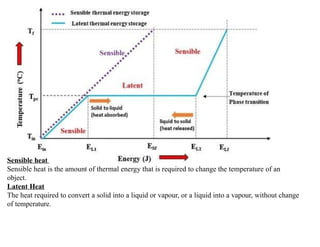
Sensible heat
Sensible heat is the amount of thermal energy that is required to change the temperature of an
object.
Latent Heat
The heat required to convert a solid into a liquid or vapour, or a liquid into a vapour, without change
of temperature.
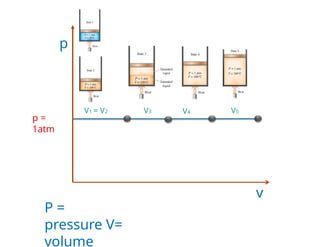
p
v
p =
1atm
V1 = V2 V3 V4 V5
P =
pressure V=
volume
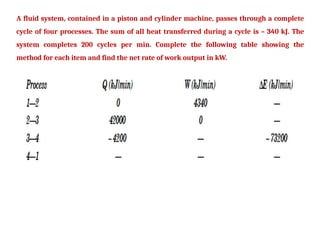
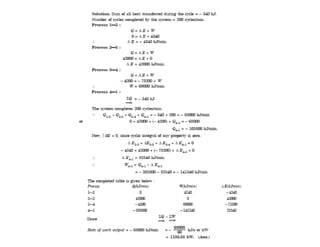
A fluid system, contained in a piston and cylinder machine, passes through a complete
cycle of four processes. The sum of all heat transferred during a cycle is – 340 kJ. The
system completes 200 cycles per min. Complete the following table showing the
method for each item and find the net rate of work output in kW.
Final Meacs Unit 3fsgfsfsfsfsfsfsfsfsfsfsff

Final Meacs Unit 3fsgfsfsfsfsfsfsfsfsfsfsff

  • 1.
  • 2.
  • 3.
    INTRODUCTION • Thermodynamics isa branch of physics that deals with the laws governing the energy and work of a system, which may be described as othe r the exchange of heat energy to and from forms of energy within a given system. • Careful study of these concept is essential for good understanding of topics in thermodynamics. • specifically, it defines macroscopic variables, such as internal energy, entropy, and pressure.
  • 4.
    Thermodynamic system – It’sdefined as a definite area or a space where some thermodynamic process takes place. Surroundings – anything outside the boundary is called surroundings. Boundary- The real or imaginary surface that separates the system from its surroundings. The boundaries of a TERMINOLOGY
  • 5.
    Closed system- Fixedamount of mass. only heat or work, can cross the boundary. Open system-Both mass and energy can cross the boundary of a control volume. Isolated system- fixed mass and no heat or work cross its boundary. Rigid system: A closed system that communicates with the surroundings by heat only.
  • 6.
    CONTINUE… • Properties ofsystem- all the quantities such as volume, pressure, temperature, density and internal energy etc identify state of a system are called properties. 1)Extensive- The properties whose value for the entire system is equal to the sum of their values for individual part of the system. i. e. Total volume, total mass, total energy 2)Intensive- The properties whose value for the entiresystem is NOT equal to the sum of their values for individual part of the system. i.e. temperature, pressure, density etc
  • 7.
    CONTINUE… • Thermal equilibrium-when the temperature is the same throughout the entire system. • Mechanical equilibrium- when there is no change in pressure at any point of the system. However, the pressure may vary within the system due to gravitational effects. • Phase equilibrium- in a two phase system, when the mass of each phase reaches an equilibrium level. • Chemical equilibrium- when the chemical composition of a system does not change with time, i.e., no chemical
  • 8.
    CONTINUE… • Perfect Gas-Its define as a state of substance whose evaporation from its liquid state is complete, If evaporation is partial the substance is called Vapour. • Absolute zero Temperature- At which the volume of a gas becomes zero. Its -273°c OR 0 k. • Specific Heat- The amount of heat required to raise the temperature of its unit mass through 1°. • Joules Law- “The change of internal energy of a perfect gas is directly proportional to the change of the
  • 9.
    Laws of Thermodynamics 1)Zeroth law of thermodynamics- When two bodies are in thermal equilibrium with a third body, they are also in thermal equilibrium with each other. 2) First law of thermodynamics- Heat and mechanical work are mutually convertible. or Energy can neither be created nor destroyed, it can transfer from one form to another. 3) Second law of thermodynamics- There is a definite limit to the amount of mechanical energy, which can be obtained from a given quantity of heat energy.
  • 10.
    CONTINUE… • Clausius statesthat “it’s impossible for a self acting m/c working in a process, to transfer heat from a cyclic body at without the a low temperature to higher aid of external source”. • Kelvin-Planck that “it’s impossible to construct an engine workingon a cyclic sol e process, whose purpose is to convert heat energy in to work”.
  • 11.
    4) Third lawof thermodynamics- The entropy of a perfect crystal is zero when the temperature of the crystal is equal to absolute zero (0 K).
  • 12.
    Laws Of PerfectGas 1) Boyle’s law- “The absolute pressure of a given mass of perfect gas varies inversely as its volume, when the temperature remain constant”. Mathematically pv = constant (T= const.) 2) Charles law- “The volume of a given mass of a perfect gas varies directly as its absolute temperature, when the pressure remains constant”. Mathematically, V/T = constant (p= const.) 3) Gay-lussac law- “The absolute pressure of a given mass of a perfect gas varies directly as its absolute temperature when volume is constant.” Mathematically, P/T = constant (v= const.)
  • 13.
    11 7 PHASE-CHANGE PROCESSES OFPURE SUBSTANCES Compressed liquid (sub cooled liquid): A substance that it is not about to vaporize. Saturated liquid: A liquid that is about to vaporize. At 1 atm and 20°C, water exists in the liquid phase (compressed liquid). At 1 atm pressure and 100°C, water exists as a liquid that is ready to vaporize (saturated liquid).
  • 14.
    As more heatis transferred, the temperature of the vapor starts to rise (superheated vapor). 118 Saturated vapor: A vapor that is about to condense. Saturated liquid–vapor mixture: The state at which the liquid and vapor phases coexist in equilibrium. Superheated vapor: A vapor that is not about to condense (i.e., not a saturated vapor). As more heat is transferred, part of the saturated liquid vapor mixture). vaporizes (saturated liquid– constant at 100°C until the At 1 atm pressure, the temperature remains last drop of liquid is vaporized (saturated vapor).
  • 15.
    T-v diagram for theheating process of water at constant pressure. 119 If the entire process between state 1 and 5 described in the figure is reversed by cooling the water while maintaining the pressure at the same value, the water will go back to state 1, retracing the same path, and in so doing, the amount of heat released will exactly match the amount of heat added during the heating process.
  • 16.
    Sensible heat Sensible heatis the amount of thermal energy that is required to change the temperature of an object. Latent Heat The heat required to convert a solid into a liquid or vapour, or a liquid into a vapour, without change of temperature.
  • 17.
    p v p = 1atm V1 =V2 V3 V4 V5 P = pressure V= volume
  • 18.
    A fluid system,contained in a piston and cylinder machine, passes through a complete cycle of four processes. The sum of all heat transferred during a cycle is – 340 kJ. The system completes 200 cycles per min. Complete the following table showing the method for each item and find the net rate of work output in kW.