ERIKS xx
xxx
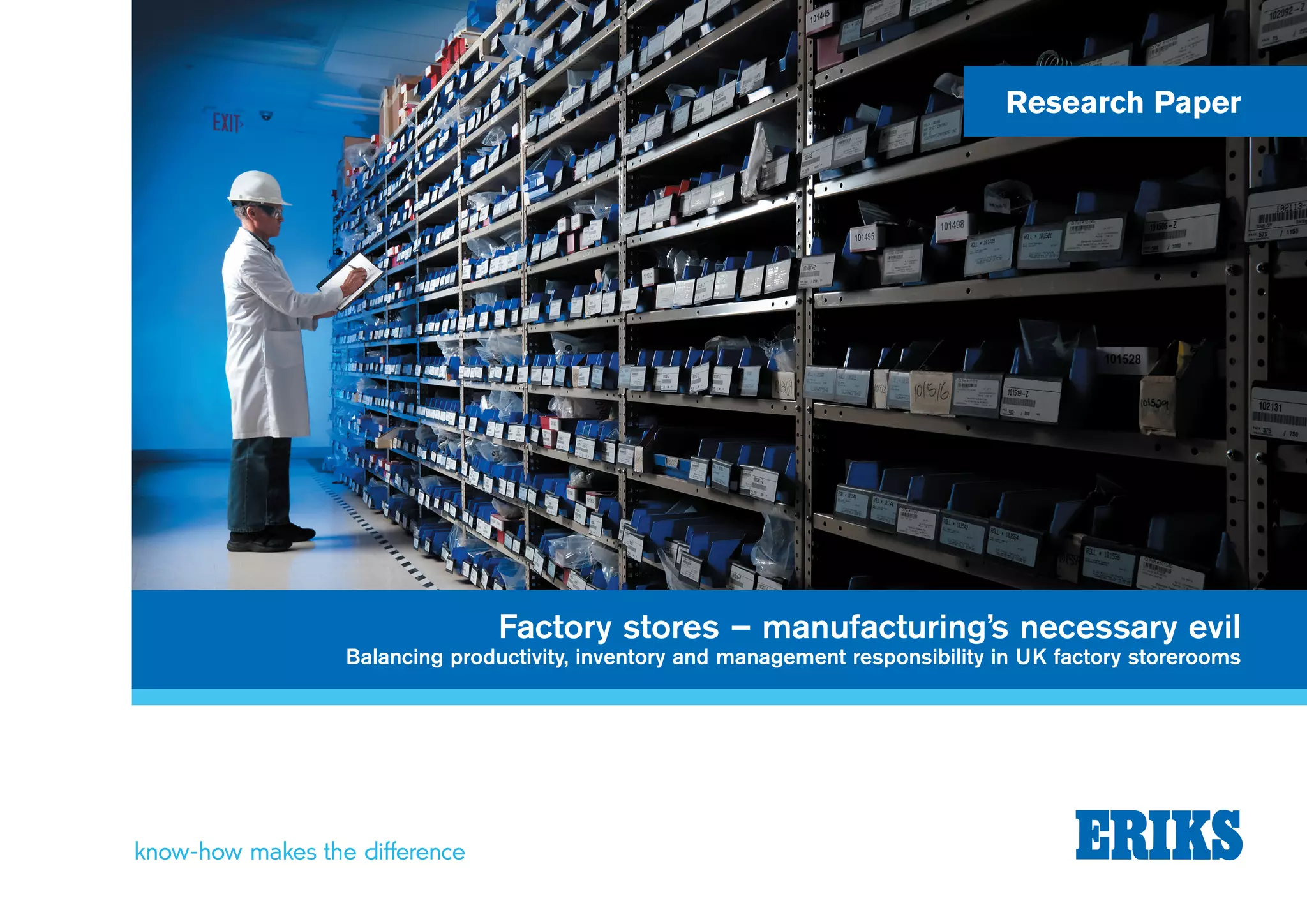
Factory stores – manufacturing’s necessary evil
Balancing productivity, inventory and management responsibility in UK factory storerooms
Research Paper
2
Methodology
ERIKS in association with The IET (The Institution of Engineering and Technology) developed an Industry Stock Management Survey. During the
period 1st July through to the 1st August 2015, ERIKS undertook research via an internet questionnaire to IET members with over 150 Engineers,
Maintenance and Storeroom Personnnel across a variety of industrial sectors participating.
Contents
▪▪ Page 3 	 Foreword by Alan Whetstone, Managing Director ERIKS UK
▪▪ Page 4 	 Section 1: Storeroom management
▪▪ Page 8 	 Section 2: Day-to-day running
▪▪ Page 15 	Conclusion by Andy Silver, Customer Service Director, ERIKS Integrated Solutions
▪▪ Page 16 	Case study 1
▪▪ Page 17 	 Case study 2
Better understanding
by senior management
about the importance
of good storekeeping
on plant reliability has
to be stressed.
3
Foreword
Nobody can deny that UK industry is now amongst the most efficient in the world. A tight focus on cost-down measures has produced lean,
competitive industries which are capable of competing, and winning, in globalised markets.
This mentality has filtered down the supply chain, with suppliers
at all levels capable of delivering raw materials and components,
just-in-time to be fed immediately onto the production line
or into a process, reducing stock and working capital to a
minimum.
And yet, even in the biggest and best industries, just away from
the factory floor there is a room which is cluttered, seemingly
badly managed (or not managed at all) and overloaded with
inventory.
The storeroom or ‘factory stores’ is all-too-often a black hole
which sucks in stock and inventory, and is seemingly incapable
of satisfying the demands of its stakeholders in other parts of
the business.
Engineers, who should be on the factory floor fixing machinery,
are reduced to leafing through catalogues, trying to find exactly
what they need to repair vital equipment.
Procurement are pre-occupied with the often significant
monthly expenditure on ‘spares and consumables’, but do not
have the technical knowledge to ask difficult questions or put
into operation an alternative which satisfies the demands of
engineering.
In the middle of it all, sits the ‘Storeroom Manager’ desperately
fighting a losing battle and expected, in turn, to manage
suppliers, provide technical support, manage inventory, perform
stocktakes and serve behind a counter.
This report attempts to answer one simple question: why is
there such a contrast between the lean and efficient factory
floor and its all-too-often chaotic stores function? Throughout
this report you will find verbatim quotes from engineers,
maintenance personnel and storeroom managers which attest
to the on-going stores management and inventory problems
facing UK industry. These, often frustrated, voices demonstrate
a desire for factory stores to be more proactive, efficient and
aligned with the rest of the organisation.
Our hope is that this report will be thought-provoking,
challenging and act as a spur for UK manufacturers to find out
what is truly going on in its factory stores, to truly listen to their
maintenance teams and take control of one of their last great
areas of inefficiency.
Alan Whetstone,
Managing Director, ERIKS UK
4
Section 1: Storeroom management
Who’s in charge here?
The starting point for this research was to identify who has responsibility for factory storerooms. Our thesis was that part of the problem is that no
one part of a company has overall operational responsibility for its management or performance on a day-to-day basis.
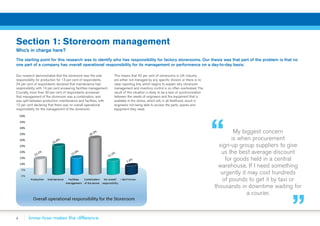
Our research demonstrated that the storeroom was the sole
responsibility for production for 13 per cent of respondents.
24 per cent of respondents declared that maintenance had
responsibility, with 14 per cent answering facilities management.
Crucially, more than 30 per cent of respondents answered
that management of the storeroom was a combination, and
was split between production, maintenance and facilities, with
12 per cent declaring that there was no overall operational
responsibility for the management of the storeroom.
This means that 42 per cent of storerooms in UK industry
are either not managed by any specific division or there is no
clear reporting line, which begins to explain why storeroom
management and inventory control is so often overlooked. The
result of this situation is likely to be a lack of synchronisation
between the needs of engineers and the equipment that is
available in the stores, which will, in all likelihood, result in
engineers not being able to access the parts, spares and
equipment they need.
My biggest concern
is when procurement
sign-up group suppliers to give
us the best average discount
for goods held in a central
warehouse. If I need something
urgently it may cost hundreds
of pounds to get it by taxi or
thousands in downtime waiting for
a courier.
5
How much stock do you keep in your stores?
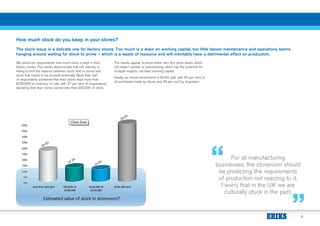
The stock issue is a delicate one for factory stores. Too much is a drain on working capital, too little leaves maintenance and operations teams
hanging around waiting for stock to arrive – which is a waste of resource and will inevitably have a detrimental effect on production.
We asked our respondents how much stock is kept in their
factory stores. The results demonstrate that UK industry is
failing to find the balance between stock held in stores and
stock that needs to be sourced externally. More than half
of respondents answered that their stores kept more than
£250,000 of inventory on site, with 27 per cent of respondents
declaring that their stores carried less than £50,000 of stock.
The results appear to show either very thin stock levels, which
will impact uptime, or overstocking, which has the potential for
multiple impacts, not least working capital.
Ideally, we would recommend a 60/40 split, with 60 per cent of
all purchases made by stores and 40 per cent by engineers.
For all manufacturing
businesses, the storeroom should
be predicting the requirements
of production not reacting to it.
I worry that in the UK we are
culturally stuck in the past.
6
When did you last complete a stocktake?
Crucial to the smooth operation of a factory store is regular
stocktaking, ideally on a monthly basis. Without it, stores
will fall prey to multiple issues, from over-stocking through
to obsolescence issues. We wanted to find out how often
stocktakes are implemented?
The results suggest that industry is inadequately monitoring
stock in its stores, with 23 per cent of respondents answering
I want a thrust roller bearing and I want it now!
One of the biggest challenges facing maintenance teams is
ensuring that highly qualified engineers are on the factory floor
doing their jobs rather than sourcing spares from a catalogue or
online.
We asked our respondents how much time it takes on average
to source or locate equipment in their factory stores. The
answers confirmed our worst fears in that 36 per cent those
who took part answered that it took more than thirty minutes to
find a part in their stores.
This was confirmed when we asked our respondents’ opinion
on whether the timescales were sufficiently quick, about right
or too slow. More than 40 per cent of those who took part in
our survey responded that the service being offered to them by
factory stores was ‘too slow’, which would indicate that factory
stores are struggling to keep pace with the demands placed on
maintenance teams.
If stores are truly to be seen as the engineer’s toolbox, this
performance must improve.
that stocktakes are conducted annually, with 22 per cent
answering that quarterly stocktakes are the norm. Only 16
per cent of those who took part in our survey answered that
monthly stocktakes performed.
7
How are factory stores being managed?
Factory stores can be managed in one of two ways, either
in-house or outsourced to an MRO supplier. If stores are being
managed in-house, modern IT software can make the job
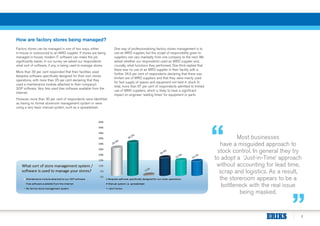
significantly easier. In our survey we asked our respondents
what sort of software, if any, is being used to manage stores.
More than 30 per cent responded that their facilities used
bespoke software specifically designed for their own stores
operations, with more than 25 per cent declaring that they
used a maintenance module attached to their company’s
SOP software. Very few used free software available from the
internet.
However, more than 30 per cent of respondents were identified
as having no formal storeroom management system or were
using a very basic manual system, such as a spreadsheet.
One way of professionalising factory stores management is to
use an MRO supplier, but the scope of responsibility given to
suppliers can vary markedly from one company to the next. We
asked whether our respondents used an MRO supplier and,
crucially, what functions they performed. One third replied that
there was no use of an MRO supplier in their facility with a
further 34.5 per cent of respondents declaring that there was
limited use of MRO suppliers and that they were mainly used
for fast supply of spares and equipment not held in stock. In
total, more than 67 per cent of respondents admitted to limited
use of MRO suppliers, which is likely to have a significant
impact on engineer ‘waiting times’ for equipment or parts.
Most businesses
have a misguided approach to
stock control. In general they try
to adopt a ‘Just-in-Time’ approach
without accounting for lead time,
scrap and logistics. As a result,
the storeroom appears to be a
bottleneck with the real issue
being masked.
8
Section 2: Day-to-day running
Regular ordering or two of everything?
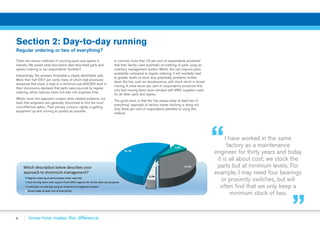
There are various methods of sourcing parts and spares in
industry. We asked what description best described parts and
spares ordering in our respondents’ facilities?
Interestingly, the answers illustrated a clearly identifiable split.
More than half (55.7 per cent), many of whom had previously
answered that stock is kept to a minimum sub-£50,000 level in
their storerooms, declared that parts were sourced by regular
ordering, which reduces stock but eats into engineer time.
What’s more, this approach creates other related problems, not
least that engineers are generally disinclined to find the most
cost-effective option. Their primary concern, rightly, is getting
equipment up and running as quickly as possible.
In contrast, more than 33 per cent of respondents answered
that their facility used automatic re-ordering of parts using an
inventory management system. Whilst, this can improve parts
availability compared to regular ordering, it will inevitably lead
to greater levels of stock and, potentially, problems further
down the line, such as obsolescence, with stock which is slower
moving. A mere seven per cent of respondents answered that
only fast-moving items were stocked with MRO suppliers used
for all other parts and spares.
The good news, is that the “we always keep at least two of
everything” approach to factory stores stocking is dying out.
Only three per cent of respondents admitted to using this
method.
I have worked in the same
factory as a maintenance
engineer for thirty years and today
it is all about cost; we stock the
parts but at minimum levels. For
example, I may need four bearings
or proximity switches, but will
often find that we only keep a
minimum stock of two.
9
Who has responsibility for restocking?
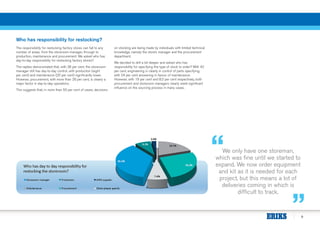
The responsibility for restocking factory stores can fall to any
number of areas, from the storeroom manager, through to
production, maintenance and procurement. We asked who has
day-to-day responsibility for restocking factory stores?
The replies demonstrated that, with 36 per cent, the storeroom
manager still has day-to-day control, with production (eight
per cent) and maintenance (20 per cent) significantly lower.
However, procurement, with more than 26 per cent, is clearly a
major factor in day-to-day operations.
This suggests that, in more than 50 per cent of cases, decisions
on stocking are being made by individuals with limited technical
knowledge, namely the store’s manager and the procurement
department.
We decided to drill a bit deeper and asked who has
responsibility for specifying the type of stock to order? With 42
per cent, engineering is clearly in control of parts specifying,
with 24 per cent answering in favour of maintenance.
However, with 19 per cent and 8.2 per cent respectively, both
procurement and storeroom managers clearly wield significant
influence on the sourcing process in many cases.
We only have one storeman,
which was fine until we started to
expand. We now order equipment
and kit as it is needed for each
project, but this means a lot of
deliveries coming in which is
difficult to track.
10
Online or catalogue?
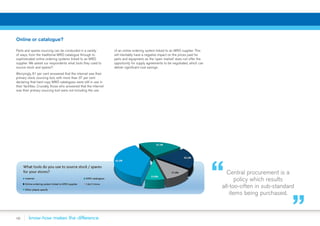
Parts and spares sourcing can be conducted in a variety
of ways, from the traditional MRO catalogue through to
sophisticated online ordering systems linked to an MRO
supplier. We asked our respondents what tools they used to
source stock and spares?
Worryingly, 61 per cent answered that the internet was their
primary stock sourcing tool, with more than 37 per cent
declaring that hard copy MRO catalogues were still in use in
their facilities. Crucially, those who answered that the internet
was their primary sourcing tool were not including the use
Central procurement is a
policy which results
all-too-often in sub-standard
items being purchased.
of an online ordering system linked to an MRO supplier. This
will inevitably have a negative impact on the prices paid for
parts and equipment, as the ‘open market’ does not offer the
opportunity for supply agreements to be negotiated, which can
deliver significant cost savings.
11
You’ll need to get that authorised!
One of the most important ways of ensuring close cost control
in factory stores is by restricting what and who can order new
parts. We asked our respondents about the type of restrictions
placed on ordering in their own facilities. The good news is that
restrictions are in place, in fact 73 per cent of those who took
part in our survey answered that all orders over a specified cost
have to be signed off by a senior manager. Sixteen per cent
answered that only certain types of equipment or stock can be
ordered dependent upon grade, and only 11 per cent answered
that there were no restrictions in place.
However, restrictions are only one method of controlling factory
store costs. Our concern was that, under pressure, engineers
and store room managers would source the most available
part or the one that they find first, regardless of cost. Our
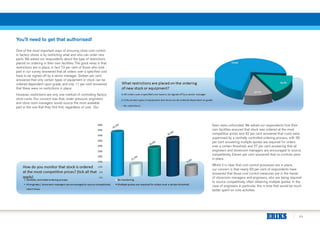
fears were unfounded. We asked our respondents how their
own facilities ensured that stock was ordered at the most
competitive prices and 42 per cent answered that costs were
supervised by a centrally controlled ordering process, with 36
per cent answering multiple quotes are required for orders
over a certain threshold, and 27 per cent answering that all
engineers and storeroom managers are encouraged to source
competitively. Eleven per cent answered that no controls were
in place.
Whilst it is clear that cost control processes are in place,
our concern is that nearly 63 per cent of respondents have
answered that those cost control measures are in the hands
of storeroom managers and engineers, who are being required
to source competitively, often obtaining multiple quotes. In the
case of engineers in particular, this is time that would be much
better spent on core activities.
12
Restricted access
One of the biggest issues for factory stores is access. Free and
open access to all may be democratic, but it is all-too-often a
recipe for chaos. Equipment is taken out without being scanned
or signed-for, and when it is returned it is inevitably put in the
wrong place.
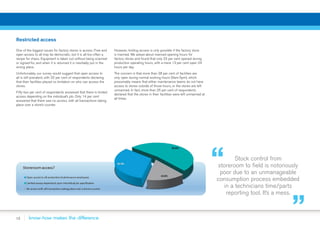
Unfortunately, our survey would suggest that open access to
all is still prevalent, with 32 per cent of respondents declaring
that their facilities placed no limitation on who can access the
stores.
Fifty-two per cent of respondents answered that there is limited
access depending on the individual’s job. Only 14 per cent
answered that there was no access, with all transactions taking
place over a store’s counter.
However, limiting access is only possible if the factory store
is manned. We asked about manned opening hours for
factory stores and found that only 23 per cent opened during
production operating hours, with a mere 13 per cent open 24
hours per day.
The concern is that more than 38 per cent of facilities are
only open during normal working hours (9am-5pm), which
presumably means that either maintenance teams do not have
access to stores outside of those hours, or the stores are left
unmanned. In fact, more than 25 per cent of respondents
declared that the stores in their facilities were left unmanned at
all times.
Stock control from
storeroom to field is notoriously
poor due to an unmanageable
consumption process embedded
in a technicians time/parts
reporting tool. It’s a mess.
13
Out of date, out of mind!
We are not good at
reviewing and ensuring obsolete
stock is removed and the latest
parts stocked correctly.
Obsolescence is a major issue for factory stores, particularly
those which keep large quantities of stock which have low
turnover. It is not unprecedented to find stock that is decades
old in badly run stores, or stock which has been stored badly
and is no longer fit-for-purpose, with inevitable effects if it is put
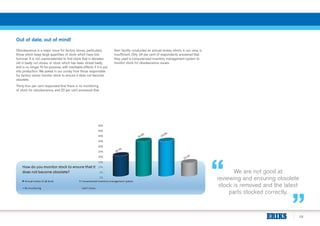
into production. We asked in our survey how those responsible
for factory stores monitor stock to ensure it does not become
obsolete.
Thirty-four per cent responded that there is no monitoring
of stock for obsolescence, and 20 per cent answered that
their facility conducted an annual review, which, in our view, is
insufficient. Only 34 per cent of respondents answered that
they used a computerised inventory management system to
monitor stock for obsolescence issues.
14
Vending slashes spending
The use of vending machines is purported to be an excellent way of controlling access to stock, particularly items which need to be signed out and
returned to stores, such as tooling and expensive cutting equipment. However, our concern is that they are often under-used or misused in many
industrial facilities.
You have to cope with the
pressure of keeping things
running 24/7, maybe having to
use parts from a machine that is
not running to keep one going
and then repair the machine you
have just robbed the parts from.
It can be very frustrating
and morale sapping.
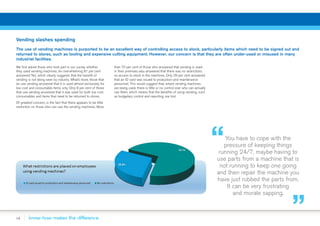
We first asked those who took part in our survey whether
they used vending machines. An overwhelming 81 per cent
answered ‘No’, which clearly suggests that the benefit of
vending is not being seen by industry. What’s more, those that
do use vending answered that it is used almost exclusively for
low cost and consumable items only. Only 8 per cent of those
that use vending answered that it was used for both low cost
consumables and items that need to be returned to stores.
Of greatest concern, is the fact that there appears to be little
restriction on those who can use the vending machines. More
than 70 per cent of those who answered that vending is used
in their premises also answered that there was no restrictions
on access to stock in the machines. Only 29 per cent answered
that an ID card was issued to production and maintenance
personnel. This would suggest that, where vending machines
are being used, there is little or no control over who can actually
use them, which means that the benefits of using vending, such
as budgetary control and reporting, are lost.
15
Conclusion
The management of factory stores is a balancing act. Too little stock impacts maintenance repair times and production. Too much stock is a drain on
resources and a recipe for inefficiency.
I often call factory stores a ‘necessary evil’. In an ideal world,
machines would never break down and parts would never be
required. The reality, of course, is very different, and this report
demonstrates that factory stores are not rising to the challenge
of supporting their engineers.
However, it would be wrong to point the finger at stores, without
acknowledging the exceptionally difficult circumstances in
which they are asked to operate. Storerooms and inventory are
all-too-often overlooked and not given the tools, in terms of IT
equipment, for example, or external MRO supplier support, to do
the job properly.
The vital link between engineering and stores is too often
disrupted, which results in poor stores management and
inventory control, with inevitable out of control spending on
spares and wasted time – often due to engineers not knowing
what is in the stores in the first place.
When I speak to senior managers, procurement people and
engineers about stores management, they universally agree
on the need to take control. But it is not so clear what they
want to take control of MRO stores themselves, the stock, the
expenditure or the suppliers?
The truth is, to take control, you need to grip all four of them.
UK manufacturers have to recognise that spares and parts
sourcing is a complex job, which needs specialist skills and
resource allocated to it. If those skills are not available in-house,
then industry should consider outsourcing. What is striking
about the results in this report is how few of our respondents’
companies have undertaken this option. The desire to maintain
control is trumping the desire for change.
The answer lies in better linkage between engineering and
stores, in order that stores can become the engineer’s toolbox
and, in the words of one respondent, can be in a position to
“predict the requirements of production.”
The ability to ‘predict’ is central to store’s operations. Factory
stores should be dynamic, constantly assessing the needs and
requirements of their engineering ‘partners’ and working to an
agreed strategy.
Only in this way can factory stores stop being a drain on
resources, both financial and engineering, and truly support the
wider business.
Andy Silver,
Customer Service Director, ERIKS Integrated Solutions
16
CASE STUDY
Streamlining the stock of a leading radiator manufacturer
The utilities sector requires large amounts of inventory in the form of spares and
parts for the network, which, in one case, was exacerbated by the closure of three
sites, with all stock being merged into one facility.
SITUATION
The single facility was inundated with spares and required help from ERIKS to rationalise and organise the
stock with an estimated value of £1.8 million.
The main site suffered from a multitude of issues:
▪▪ Poor product descriptions and labelling of products
▪▪ Engineers avoiding storeroom procedures and simply ordering parts as and when they were needed
▪▪ Incorrect use of the site SAP system
▪▪ Incorrect storage of spares in sea containers in a ‘graveyard’ area
▪▪ £700k worth of ‘lost’ stock still on the system
SOLUTION
The ERIKS Storeroom Solutions Team firstly began to catalogue all the spares with the main storeroom. As
part of the process, the facilities were completely refurbished with greater signage and accessibility to the
stock. The team then moved on to the sea containers, whereby all items with an existing SAP number were
inputted back into the system with an updated descriptor. Those products without an SAP number were
investigated further; some featured an inaccurate product descriptor, which was updated, and those without a
record at all were added into the inventory as a new item.
On completion of the full audit, the total stock value was reduced to £1.1 million – as a result of obsolete
stock and parts not being logged out. ERIKS now deploys a Continuous Physical Inventory Count System
for the utility, which comprises a full physical stock take twice a year to help mitigate against future stock and
storeroom issues.
17
CASE STUDY
Helping a utility take full stock of its spares
When one of the UK’s leading manufacturers of radiators needed to refurbish their
storeroom, they approached expert industrial services support partner, ERIKS, to resolve the
matter.
SITUATION
With factory storerooms, the process of solving one problem often uncovers a multitude of other sins. ERIKS
was originally brought in to replace existing on-site pumps used during the painting process, but the scope
of work quickly expanded to include the factory stores, which were suffering from a multitude of problems,
including more than 5,000 items which had to be scrapped.
SOLUTION
The ERIKS solution included:
▪▪ Identification and cataloguing of existing stock
▪▪ Relocation of nearly 4,000 fast moving items and 400 slow moving items to a new ground floor storage area
▪▪ Implementation of 5S diaries to further improve the organisation of specific product types within the stores
▪▪ Dedicated auditing system to log when items left the stores, and ordering of replenishments when the minimum
quantity is reached
▪▪ Colour-coded booking out sheets to ensure that items are supplied against the correct budget ensuring
accurate expenditure tracking
▪▪ Implementation of vending machines with weekly re-stocking for PPE equipment
The vending machines give the customer full traceability of stock usage, as reports can be created online via a
portal connected directly to the machine. The majority of PPE stored in the vending machines are held in stock
at ERIKS’ main warehouse, enabling the team to manage the stock using a ‘just-in-time’ philosophy.
Following the successful refurbishment of the manufacturing site, ERIKS was subsequently appointed to
manage the procurement function of the site and source any item which the customer requires, be it on stock,
non-stock or capex.
www.eriks.co.uk
0845 006 6000

Final - Eriks factory stores white paper

  • 1.
    ERIKS xx xxx Factory stores– manufacturing’s necessary evil Balancing productivity, inventory and management responsibility in UK factory storerooms Research Paper
  • 2.
    2 Methodology ERIKS in associationwith The IET (The Institution of Engineering and Technology) developed an Industry Stock Management Survey. During the period 1st July through to the 1st August 2015, ERIKS undertook research via an internet questionnaire to IET members with over 150 Engineers, Maintenance and Storeroom Personnnel across a variety of industrial sectors participating. Contents ▪▪ Page 3 Foreword by Alan Whetstone, Managing Director ERIKS UK ▪▪ Page 4 Section 1: Storeroom management ▪▪ Page 8 Section 2: Day-to-day running ▪▪ Page 15 Conclusion by Andy Silver, Customer Service Director, ERIKS Integrated Solutions ▪▪ Page 16 Case study 1 ▪▪ Page 17 Case study 2 Better understanding by senior management about the importance of good storekeeping on plant reliability has to be stressed.
  • 3.
    3 Foreword Nobody can denythat UK industry is now amongst the most efficient in the world. A tight focus on cost-down measures has produced lean, competitive industries which are capable of competing, and winning, in globalised markets. This mentality has filtered down the supply chain, with suppliers at all levels capable of delivering raw materials and components, just-in-time to be fed immediately onto the production line or into a process, reducing stock and working capital to a minimum. And yet, even in the biggest and best industries, just away from the factory floor there is a room which is cluttered, seemingly badly managed (or not managed at all) and overloaded with inventory. The storeroom or ‘factory stores’ is all-too-often a black hole which sucks in stock and inventory, and is seemingly incapable of satisfying the demands of its stakeholders in other parts of the business. Engineers, who should be on the factory floor fixing machinery, are reduced to leafing through catalogues, trying to find exactly what they need to repair vital equipment. Procurement are pre-occupied with the often significant monthly expenditure on ‘spares and consumables’, but do not have the technical knowledge to ask difficult questions or put into operation an alternative which satisfies the demands of engineering. In the middle of it all, sits the ‘Storeroom Manager’ desperately fighting a losing battle and expected, in turn, to manage suppliers, provide technical support, manage inventory, perform stocktakes and serve behind a counter. This report attempts to answer one simple question: why is there such a contrast between the lean and efficient factory floor and its all-too-often chaotic stores function? Throughout this report you will find verbatim quotes from engineers, maintenance personnel and storeroom managers which attest to the on-going stores management and inventory problems facing UK industry. These, often frustrated, voices demonstrate a desire for factory stores to be more proactive, efficient and aligned with the rest of the organisation. Our hope is that this report will be thought-provoking, challenging and act as a spur for UK manufacturers to find out what is truly going on in its factory stores, to truly listen to their maintenance teams and take control of one of their last great areas of inefficiency. Alan Whetstone, Managing Director, ERIKS UK
  • 4.
    4 Section 1: Storeroommanagement Who’s in charge here? The starting point for this research was to identify who has responsibility for factory storerooms. Our thesis was that part of the problem is that no one part of a company has overall operational responsibility for its management or performance on a day-to-day basis. Our research demonstrated that the storeroom was the sole responsibility for production for 13 per cent of respondents. 24 per cent of respondents declared that maintenance had responsibility, with 14 per cent answering facilities management. Crucially, more than 30 per cent of respondents answered that management of the storeroom was a combination, and was split between production, maintenance and facilities, with 12 per cent declaring that there was no overall operational responsibility for the management of the storeroom. This means that 42 per cent of storerooms in UK industry are either not managed by any specific division or there is no clear reporting line, which begins to explain why storeroom management and inventory control is so often overlooked. The result of this situation is likely to be a lack of synchronisation between the needs of engineers and the equipment that is available in the stores, which will, in all likelihood, result in engineers not being able to access the parts, spares and equipment they need. My biggest concern is when procurement sign-up group suppliers to give us the best average discount for goods held in a central warehouse. If I need something urgently it may cost hundreds of pounds to get it by taxi or thousands in downtime waiting for a courier.
  • 5.
    5 How much stockdo you keep in your stores? The stock issue is a delicate one for factory stores. Too much is a drain on working capital, too little leaves maintenance and operations teams hanging around waiting for stock to arrive – which is a waste of resource and will inevitably have a detrimental effect on production. We asked our respondents how much stock is kept in their factory stores. The results demonstrate that UK industry is failing to find the balance between stock held in stores and stock that needs to be sourced externally. More than half of respondents answered that their stores kept more than £250,000 of inventory on site, with 27 per cent of respondents declaring that their stores carried less than £50,000 of stock. The results appear to show either very thin stock levels, which will impact uptime, or overstocking, which has the potential for multiple impacts, not least working capital. Ideally, we would recommend a 60/40 split, with 60 per cent of all purchases made by stores and 40 per cent by engineers. For all manufacturing businesses, the storeroom should be predicting the requirements of production not reacting to it. I worry that in the UK we are culturally stuck in the past.
  • 6.
    6 When did youlast complete a stocktake? Crucial to the smooth operation of a factory store is regular stocktaking, ideally on a monthly basis. Without it, stores will fall prey to multiple issues, from over-stocking through to obsolescence issues. We wanted to find out how often stocktakes are implemented? The results suggest that industry is inadequately monitoring stock in its stores, with 23 per cent of respondents answering I want a thrust roller bearing and I want it now! One of the biggest challenges facing maintenance teams is ensuring that highly qualified engineers are on the factory floor doing their jobs rather than sourcing spares from a catalogue or online. We asked our respondents how much time it takes on average to source or locate equipment in their factory stores. The answers confirmed our worst fears in that 36 per cent those who took part answered that it took more than thirty minutes to find a part in their stores. This was confirmed when we asked our respondents’ opinion on whether the timescales were sufficiently quick, about right or too slow. More than 40 per cent of those who took part in our survey responded that the service being offered to them by factory stores was ‘too slow’, which would indicate that factory stores are struggling to keep pace with the demands placed on maintenance teams. If stores are truly to be seen as the engineer’s toolbox, this performance must improve. that stocktakes are conducted annually, with 22 per cent answering that quarterly stocktakes are the norm. Only 16 per cent of those who took part in our survey answered that monthly stocktakes performed.
  • 7.
    7 How are factorystores being managed? Factory stores can be managed in one of two ways, either in-house or outsourced to an MRO supplier. If stores are being managed in-house, modern IT software can make the job significantly easier. In our survey we asked our respondents what sort of software, if any, is being used to manage stores. More than 30 per cent responded that their facilities used bespoke software specifically designed for their own stores operations, with more than 25 per cent declaring that they used a maintenance module attached to their company’s SOP software. Very few used free software available from the internet. However, more than 30 per cent of respondents were identified as having no formal storeroom management system or were using a very basic manual system, such as a spreadsheet. One way of professionalising factory stores management is to use an MRO supplier, but the scope of responsibility given to suppliers can vary markedly from one company to the next. We asked whether our respondents used an MRO supplier and, crucially, what functions they performed. One third replied that there was no use of an MRO supplier in their facility with a further 34.5 per cent of respondents declaring that there was limited use of MRO suppliers and that they were mainly used for fast supply of spares and equipment not held in stock. In total, more than 67 per cent of respondents admitted to limited use of MRO suppliers, which is likely to have a significant impact on engineer ‘waiting times’ for equipment or parts. Most businesses have a misguided approach to stock control. In general they try to adopt a ‘Just-in-Time’ approach without accounting for lead time, scrap and logistics. As a result, the storeroom appears to be a bottleneck with the real issue being masked.
  • 8.
    8 Section 2: Day-to-dayrunning Regular ordering or two of everything? There are various methods of sourcing parts and spares in industry. We asked what description best described parts and spares ordering in our respondents’ facilities? Interestingly, the answers illustrated a clearly identifiable split. More than half (55.7 per cent), many of whom had previously answered that stock is kept to a minimum sub-£50,000 level in their storerooms, declared that parts were sourced by regular ordering, which reduces stock but eats into engineer time. What’s more, this approach creates other related problems, not least that engineers are generally disinclined to find the most cost-effective option. Their primary concern, rightly, is getting equipment up and running as quickly as possible. In contrast, more than 33 per cent of respondents answered that their facility used automatic re-ordering of parts using an inventory management system. Whilst, this can improve parts availability compared to regular ordering, it will inevitably lead to greater levels of stock and, potentially, problems further down the line, such as obsolescence, with stock which is slower moving. A mere seven per cent of respondents answered that only fast-moving items were stocked with MRO suppliers used for all other parts and spares. The good news, is that the “we always keep at least two of everything” approach to factory stores stocking is dying out. Only three per cent of respondents admitted to using this method. I have worked in the same factory as a maintenance engineer for thirty years and today it is all about cost; we stock the parts but at minimum levels. For example, I may need four bearings or proximity switches, but will often find that we only keep a minimum stock of two.
  • 9.
    9 Who has responsibilityfor restocking? The responsibility for restocking factory stores can fall to any number of areas, from the storeroom manager, through to production, maintenance and procurement. We asked who has day-to-day responsibility for restocking factory stores? The replies demonstrated that, with 36 per cent, the storeroom manager still has day-to-day control, with production (eight per cent) and maintenance (20 per cent) significantly lower. However, procurement, with more than 26 per cent, is clearly a major factor in day-to-day operations. This suggests that, in more than 50 per cent of cases, decisions on stocking are being made by individuals with limited technical knowledge, namely the store’s manager and the procurement department. We decided to drill a bit deeper and asked who has responsibility for specifying the type of stock to order? With 42 per cent, engineering is clearly in control of parts specifying, with 24 per cent answering in favour of maintenance. However, with 19 per cent and 8.2 per cent respectively, both procurement and storeroom managers clearly wield significant influence on the sourcing process in many cases. We only have one storeman, which was fine until we started to expand. We now order equipment and kit as it is needed for each project, but this means a lot of deliveries coming in which is difficult to track.
  • 10.
    10 Online or catalogue? Partsand spares sourcing can be conducted in a variety of ways, from the traditional MRO catalogue through to sophisticated online ordering systems linked to an MRO supplier. We asked our respondents what tools they used to source stock and spares? Worryingly, 61 per cent answered that the internet was their primary stock sourcing tool, with more than 37 per cent declaring that hard copy MRO catalogues were still in use in their facilities. Crucially, those who answered that the internet was their primary sourcing tool were not including the use Central procurement is a policy which results all-too-often in sub-standard items being purchased. of an online ordering system linked to an MRO supplier. This will inevitably have a negative impact on the prices paid for parts and equipment, as the ‘open market’ does not offer the opportunity for supply agreements to be negotiated, which can deliver significant cost savings.
  • 11.
    11 You’ll need toget that authorised! One of the most important ways of ensuring close cost control in factory stores is by restricting what and who can order new parts. We asked our respondents about the type of restrictions placed on ordering in their own facilities. The good news is that restrictions are in place, in fact 73 per cent of those who took part in our survey answered that all orders over a specified cost have to be signed off by a senior manager. Sixteen per cent answered that only certain types of equipment or stock can be ordered dependent upon grade, and only 11 per cent answered that there were no restrictions in place. However, restrictions are only one method of controlling factory store costs. Our concern was that, under pressure, engineers and store room managers would source the most available part or the one that they find first, regardless of cost. Our fears were unfounded. We asked our respondents how their own facilities ensured that stock was ordered at the most competitive prices and 42 per cent answered that costs were supervised by a centrally controlled ordering process, with 36 per cent answering multiple quotes are required for orders over a certain threshold, and 27 per cent answering that all engineers and storeroom managers are encouraged to source competitively. Eleven per cent answered that no controls were in place. Whilst it is clear that cost control processes are in place, our concern is that nearly 63 per cent of respondents have answered that those cost control measures are in the hands of storeroom managers and engineers, who are being required to source competitively, often obtaining multiple quotes. In the case of engineers in particular, this is time that would be much better spent on core activities.
  • 12.
    12 Restricted access One ofthe biggest issues for factory stores is access. Free and open access to all may be democratic, but it is all-too-often a recipe for chaos. Equipment is taken out without being scanned or signed-for, and when it is returned it is inevitably put in the wrong place. Unfortunately, our survey would suggest that open access to all is still prevalent, with 32 per cent of respondents declaring that their facilities placed no limitation on who can access the stores. Fifty-two per cent of respondents answered that there is limited access depending on the individual’s job. Only 14 per cent answered that there was no access, with all transactions taking place over a store’s counter. However, limiting access is only possible if the factory store is manned. We asked about manned opening hours for factory stores and found that only 23 per cent opened during production operating hours, with a mere 13 per cent open 24 hours per day. The concern is that more than 38 per cent of facilities are only open during normal working hours (9am-5pm), which presumably means that either maintenance teams do not have access to stores outside of those hours, or the stores are left unmanned. In fact, more than 25 per cent of respondents declared that the stores in their facilities were left unmanned at all times. Stock control from storeroom to field is notoriously poor due to an unmanageable consumption process embedded in a technicians time/parts reporting tool. It’s a mess.
  • 13.
    13 Out of date,out of mind! We are not good at reviewing and ensuring obsolete stock is removed and the latest parts stocked correctly. Obsolescence is a major issue for factory stores, particularly those which keep large quantities of stock which have low turnover. It is not unprecedented to find stock that is decades old in badly run stores, or stock which has been stored badly and is no longer fit-for-purpose, with inevitable effects if it is put into production. We asked in our survey how those responsible for factory stores monitor stock to ensure it does not become obsolete. Thirty-four per cent responded that there is no monitoring of stock for obsolescence, and 20 per cent answered that their facility conducted an annual review, which, in our view, is insufficient. Only 34 per cent of respondents answered that they used a computerised inventory management system to monitor stock for obsolescence issues.
  • 14.
    14 Vending slashes spending Theuse of vending machines is purported to be an excellent way of controlling access to stock, particularly items which need to be signed out and returned to stores, such as tooling and expensive cutting equipment. However, our concern is that they are often under-used or misused in many industrial facilities. You have to cope with the pressure of keeping things running 24/7, maybe having to use parts from a machine that is not running to keep one going and then repair the machine you have just robbed the parts from. It can be very frustrating and morale sapping. We first asked those who took part in our survey whether they used vending machines. An overwhelming 81 per cent answered ‘No’, which clearly suggests that the benefit of vending is not being seen by industry. What’s more, those that do use vending answered that it is used almost exclusively for low cost and consumable items only. Only 8 per cent of those that use vending answered that it was used for both low cost consumables and items that need to be returned to stores. Of greatest concern, is the fact that there appears to be little restriction on those who can use the vending machines. More than 70 per cent of those who answered that vending is used in their premises also answered that there was no restrictions on access to stock in the machines. Only 29 per cent answered that an ID card was issued to production and maintenance personnel. This would suggest that, where vending machines are being used, there is little or no control over who can actually use them, which means that the benefits of using vending, such as budgetary control and reporting, are lost.
  • 15.
    15 Conclusion The management offactory stores is a balancing act. Too little stock impacts maintenance repair times and production. Too much stock is a drain on resources and a recipe for inefficiency. I often call factory stores a ‘necessary evil’. In an ideal world, machines would never break down and parts would never be required. The reality, of course, is very different, and this report demonstrates that factory stores are not rising to the challenge of supporting their engineers. However, it would be wrong to point the finger at stores, without acknowledging the exceptionally difficult circumstances in which they are asked to operate. Storerooms and inventory are all-too-often overlooked and not given the tools, in terms of IT equipment, for example, or external MRO supplier support, to do the job properly. The vital link between engineering and stores is too often disrupted, which results in poor stores management and inventory control, with inevitable out of control spending on spares and wasted time – often due to engineers not knowing what is in the stores in the first place. When I speak to senior managers, procurement people and engineers about stores management, they universally agree on the need to take control. But it is not so clear what they want to take control of MRO stores themselves, the stock, the expenditure or the suppliers? The truth is, to take control, you need to grip all four of them. UK manufacturers have to recognise that spares and parts sourcing is a complex job, which needs specialist skills and resource allocated to it. If those skills are not available in-house, then industry should consider outsourcing. What is striking about the results in this report is how few of our respondents’ companies have undertaken this option. The desire to maintain control is trumping the desire for change. The answer lies in better linkage between engineering and stores, in order that stores can become the engineer’s toolbox and, in the words of one respondent, can be in a position to “predict the requirements of production.” The ability to ‘predict’ is central to store’s operations. Factory stores should be dynamic, constantly assessing the needs and requirements of their engineering ‘partners’ and working to an agreed strategy. Only in this way can factory stores stop being a drain on resources, both financial and engineering, and truly support the wider business. Andy Silver, Customer Service Director, ERIKS Integrated Solutions
  • 16.
    16 CASE STUDY Streamlining thestock of a leading radiator manufacturer The utilities sector requires large amounts of inventory in the form of spares and parts for the network, which, in one case, was exacerbated by the closure of three sites, with all stock being merged into one facility. SITUATION The single facility was inundated with spares and required help from ERIKS to rationalise and organise the stock with an estimated value of £1.8 million. The main site suffered from a multitude of issues: ▪▪ Poor product descriptions and labelling of products ▪▪ Engineers avoiding storeroom procedures and simply ordering parts as and when they were needed ▪▪ Incorrect use of the site SAP system ▪▪ Incorrect storage of spares in sea containers in a ‘graveyard’ area ▪▪ £700k worth of ‘lost’ stock still on the system SOLUTION The ERIKS Storeroom Solutions Team firstly began to catalogue all the spares with the main storeroom. As part of the process, the facilities were completely refurbished with greater signage and accessibility to the stock. The team then moved on to the sea containers, whereby all items with an existing SAP number were inputted back into the system with an updated descriptor. Those products without an SAP number were investigated further; some featured an inaccurate product descriptor, which was updated, and those without a record at all were added into the inventory as a new item. On completion of the full audit, the total stock value was reduced to £1.1 million – as a result of obsolete stock and parts not being logged out. ERIKS now deploys a Continuous Physical Inventory Count System for the utility, which comprises a full physical stock take twice a year to help mitigate against future stock and storeroom issues.
  • 17.
    17 CASE STUDY Helping autility take full stock of its spares When one of the UK’s leading manufacturers of radiators needed to refurbish their storeroom, they approached expert industrial services support partner, ERIKS, to resolve the matter. SITUATION With factory storerooms, the process of solving one problem often uncovers a multitude of other sins. ERIKS was originally brought in to replace existing on-site pumps used during the painting process, but the scope of work quickly expanded to include the factory stores, which were suffering from a multitude of problems, including more than 5,000 items which had to be scrapped. SOLUTION The ERIKS solution included: ▪▪ Identification and cataloguing of existing stock ▪▪ Relocation of nearly 4,000 fast moving items and 400 slow moving items to a new ground floor storage area ▪▪ Implementation of 5S diaries to further improve the organisation of specific product types within the stores ▪▪ Dedicated auditing system to log when items left the stores, and ordering of replenishments when the minimum quantity is reached ▪▪ Colour-coded booking out sheets to ensure that items are supplied against the correct budget ensuring accurate expenditure tracking ▪▪ Implementation of vending machines with weekly re-stocking for PPE equipment The vending machines give the customer full traceability of stock usage, as reports can be created online via a portal connected directly to the machine. The majority of PPE stored in the vending machines are held in stock at ERIKS’ main warehouse, enabling the team to manage the stock using a ‘just-in-time’ philosophy. Following the successful refurbishment of the manufacturing site, ERIKS was subsequently appointed to manage the procurement function of the site and source any item which the customer requires, be it on stock, non-stock or capex.
  • 18.