Presentation
By
Prof. Vinay V. Ankolekar
vinay.ankolekar@gmail.com
9404735591
Department of Mechanical Engineering
Bhivarabai Sawant College of Engineering & Research
Pune, Maharastra
ENGINEERING CURVES
Part- I {Conic Sections}
ENGINEERING CURVES
Part- I {Conic Sections}
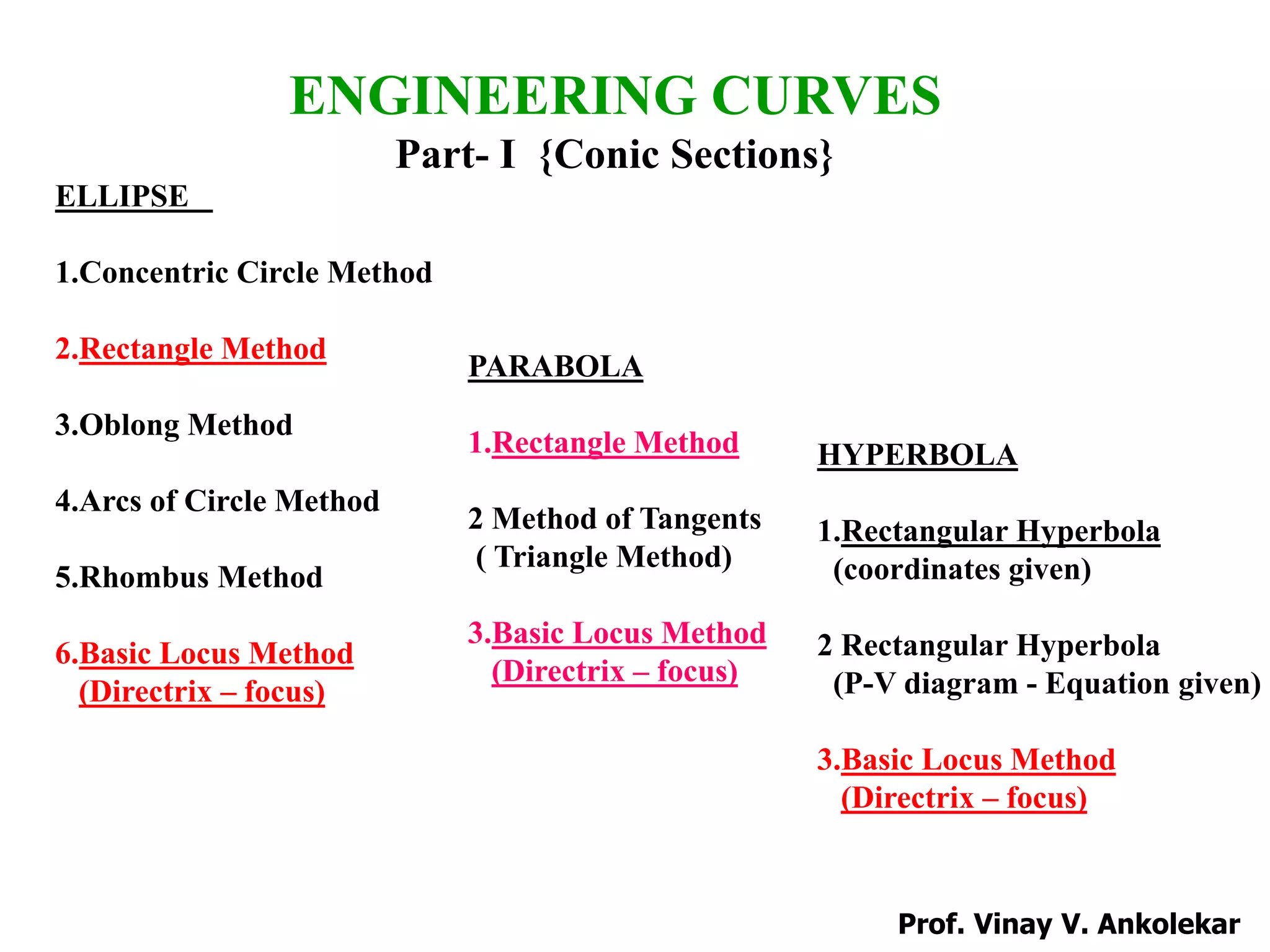
ELLIPSE
1.Concentric Circle Method
2.Rectangle Method
3.Oblong Method
4.Arcs of Circle Method
5.Rhombus Method
6.Basic Locus Method
(Directrix – focus)
HYPERBOLA
1.Rectangular Hyperbola
(coordinates given)
2 Rectangular Hyperbola
(P-V diagram - Equation given)
3.Basic Locus Method
(Directrix – focus)
PARABOLA
1.Rectangle Method
2 Method of Tangents
( Triangle Method)
3.Basic Locus Method
(Directrix – focus)
Prof. Vinay V. Ankolekar
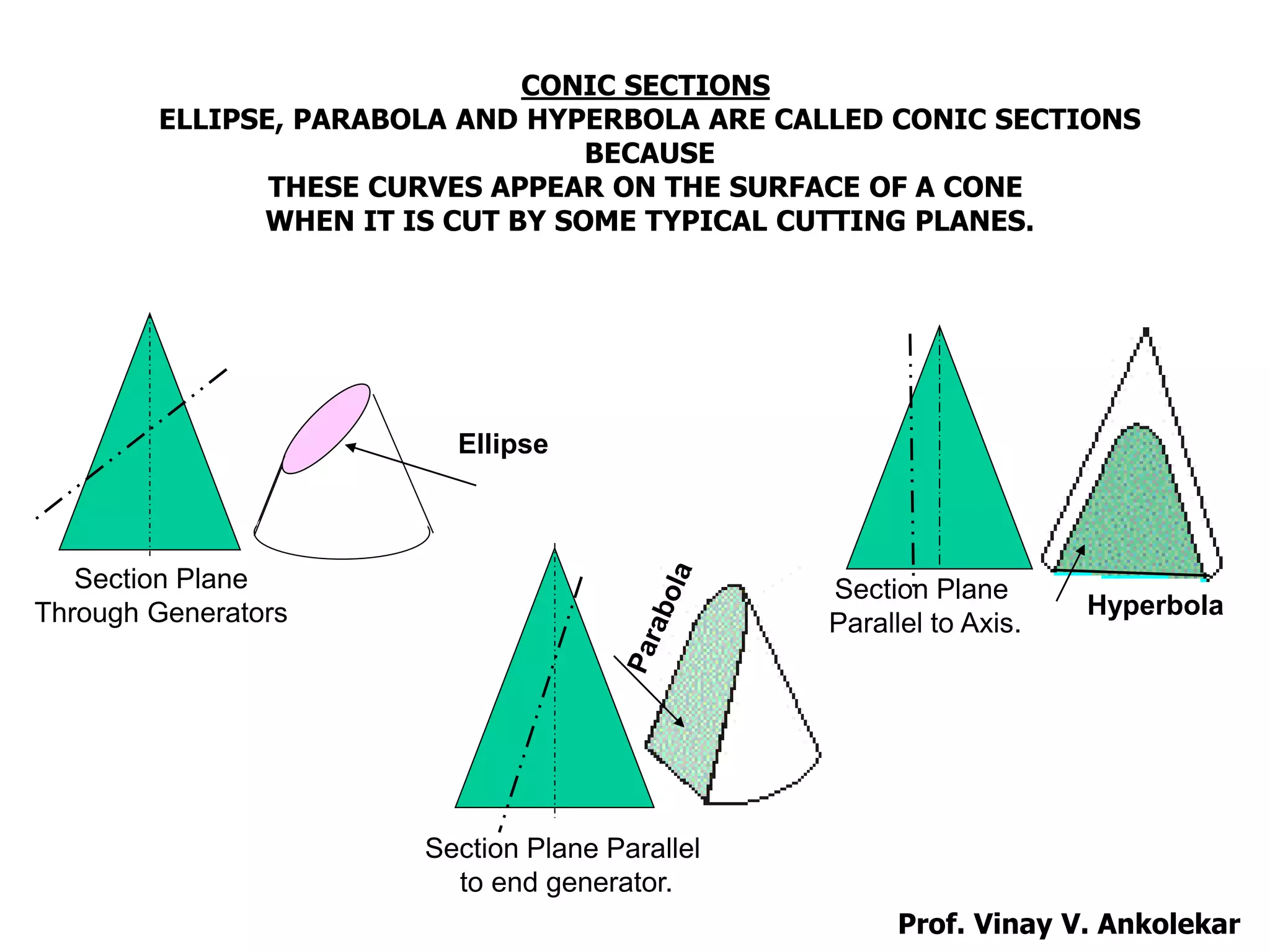
CONIC SECTIONS
ELLIPSE, PARABOLA AND HYPERBOLA ARE CALLED CONIC SECTIONS
BECAUSE
THESE CURVES APPEAR ON THE SURFACE OF A CONE
WHEN IT IS CUT BY SOME TYPICAL CUTTING PLANES.
Section Plane
Through Generators
Ellipse
Section Plane Parallel
to end generator.
Section Plane
Parallel to Axis.
Hyperbola
Prof. Vinay V. Ankolekar
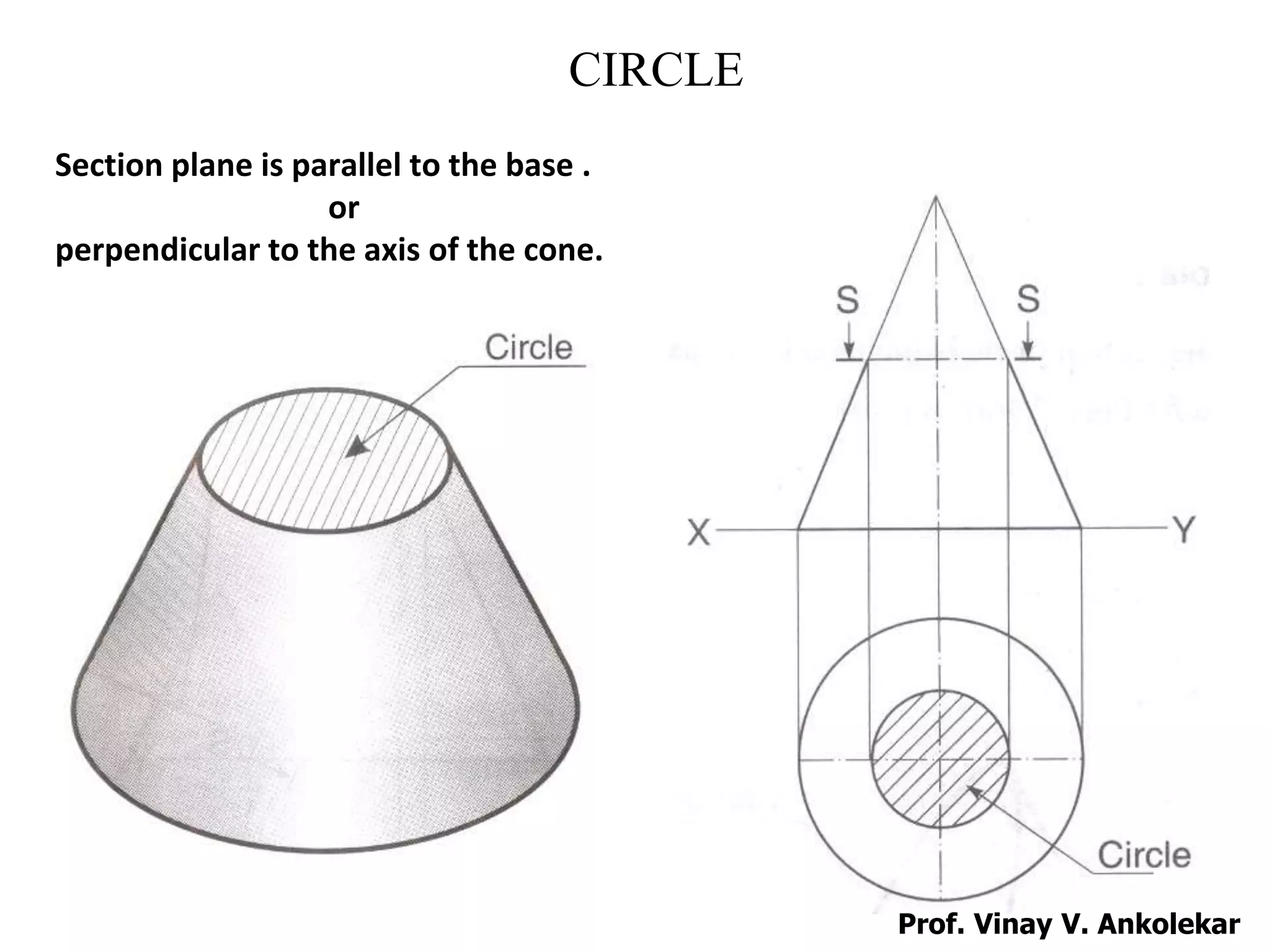
CIRCLE
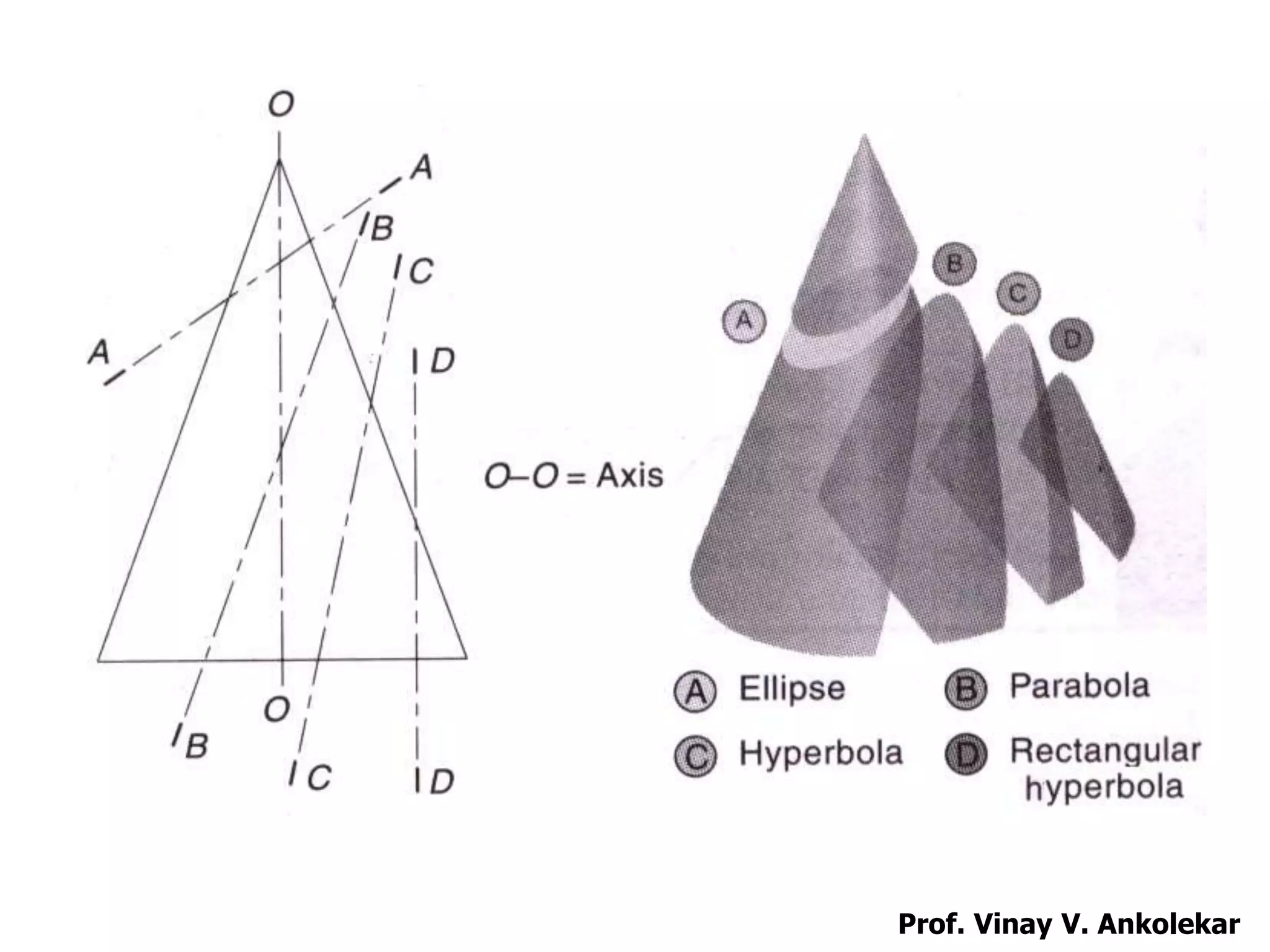
Section plane is parallel to the base .
or
perpendicular to the axis of the cone.
Prof. Vinay V. Ankolekar
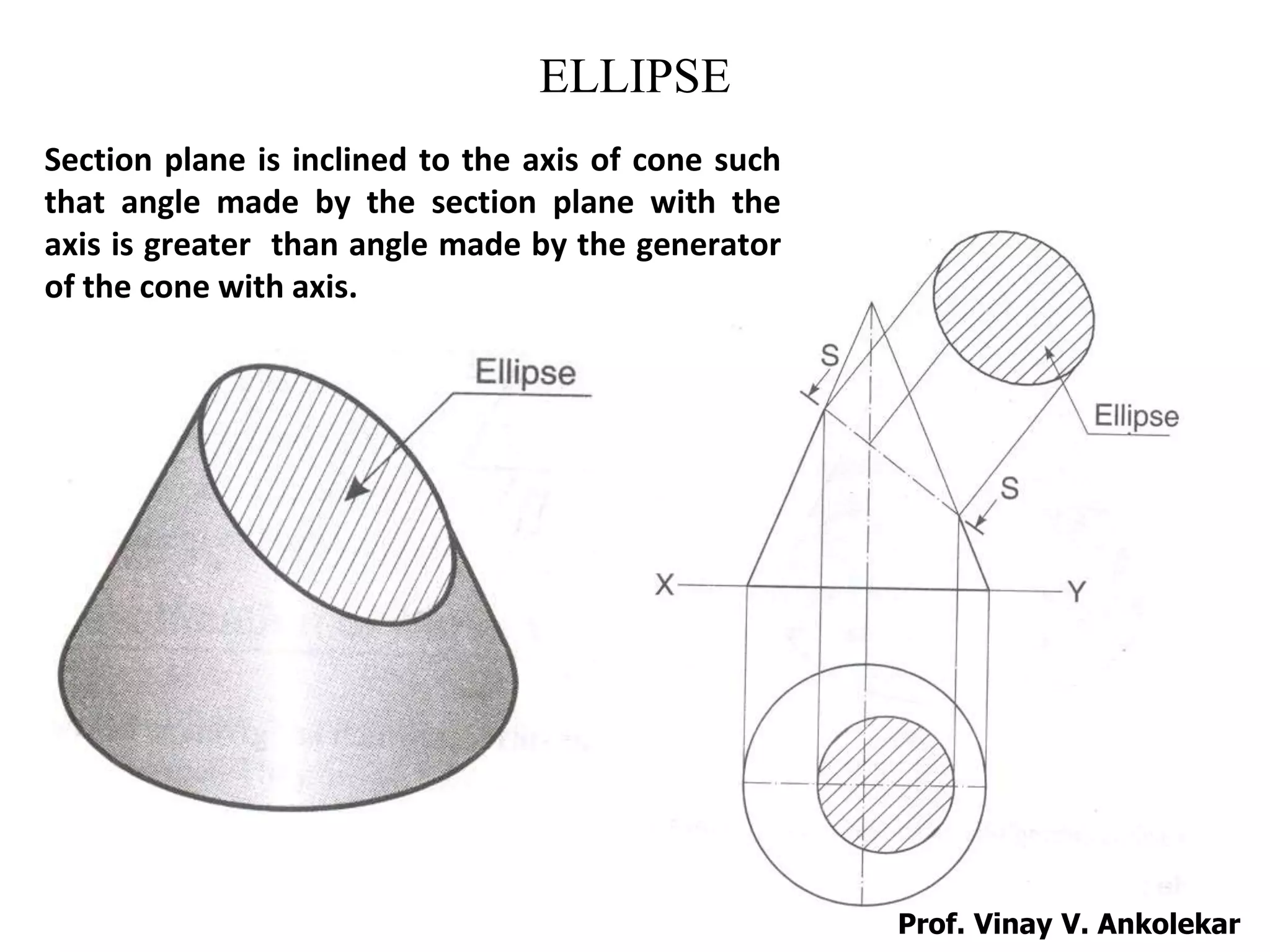
ELLIPSE
Section plane is inclined to the axis of cone such
that angle made by the section plane with the
axis is greater than angle made by the generator
of the cone with axis.
Prof. Vinay V. Ankolekar
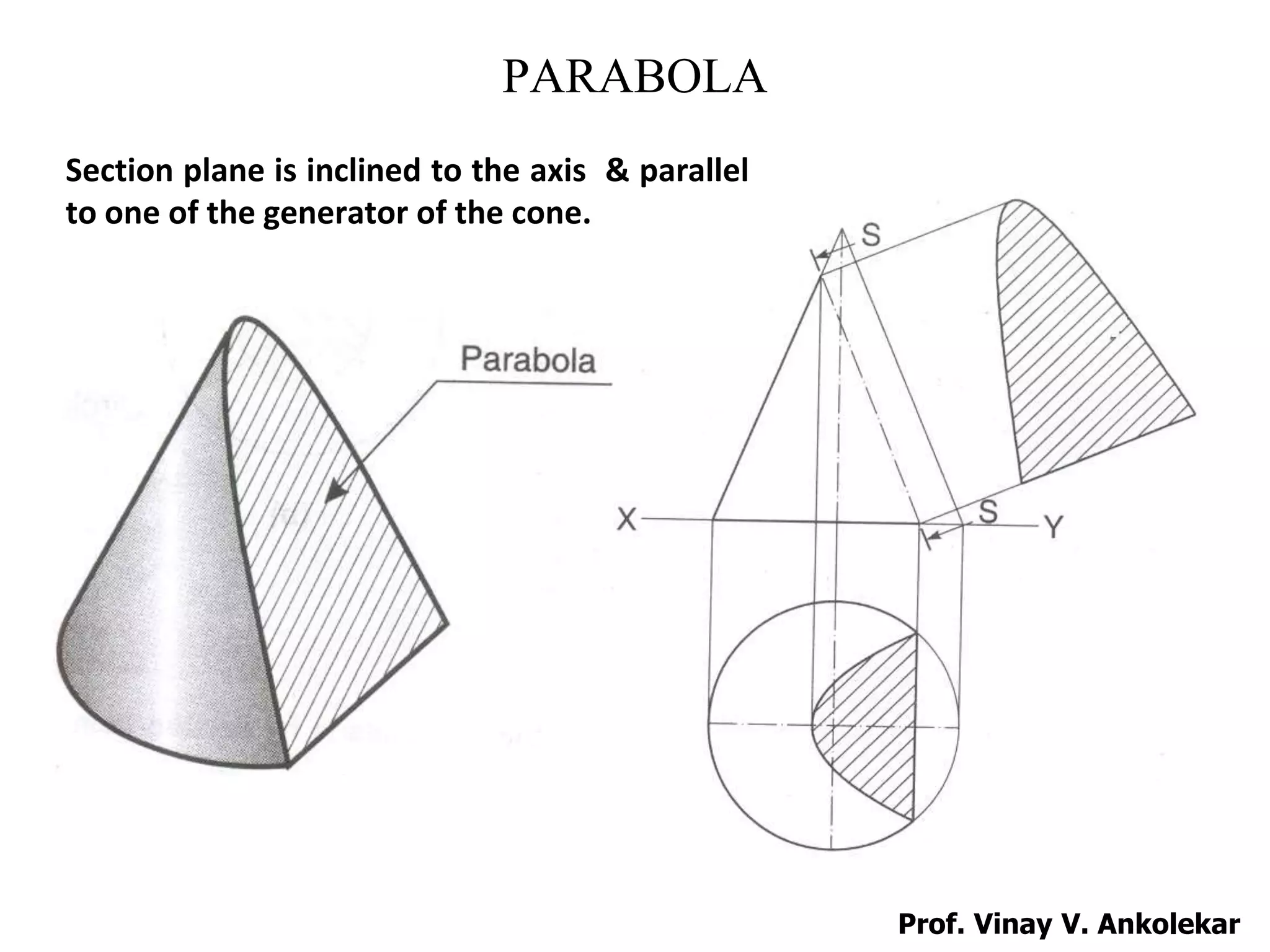
PARABOLA
Section plane is inclined to the axis & parallel
to one of the generator of the cone.
Prof. Vinay V. Ankolekar
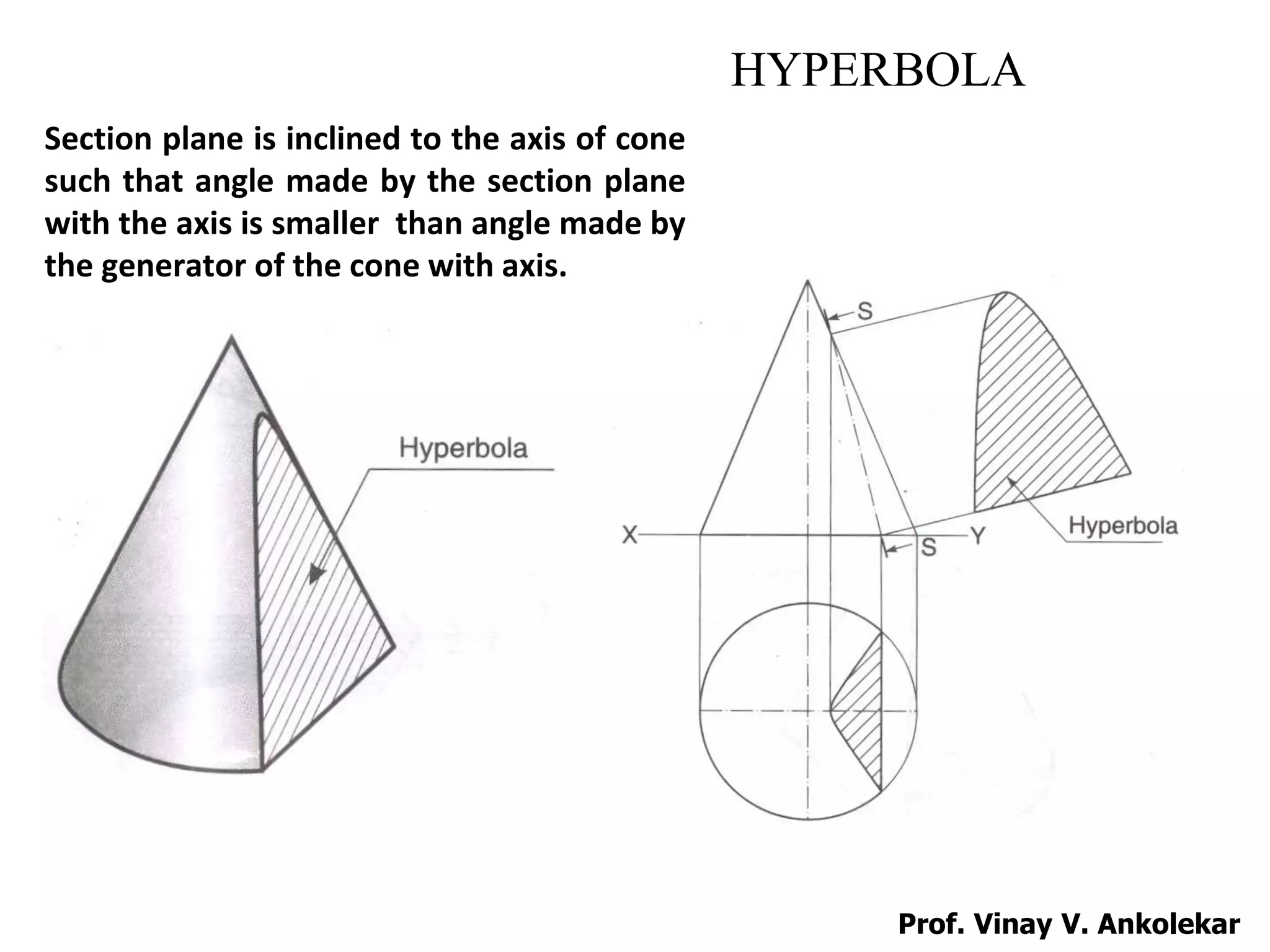
HYPERBOLA
Section plane is inclined to the axis of cone
such that angle made by the section plane
with the axis is smaller than angle made by
the generator of the cone with axis.
Prof. Vinay V. Ankolekar
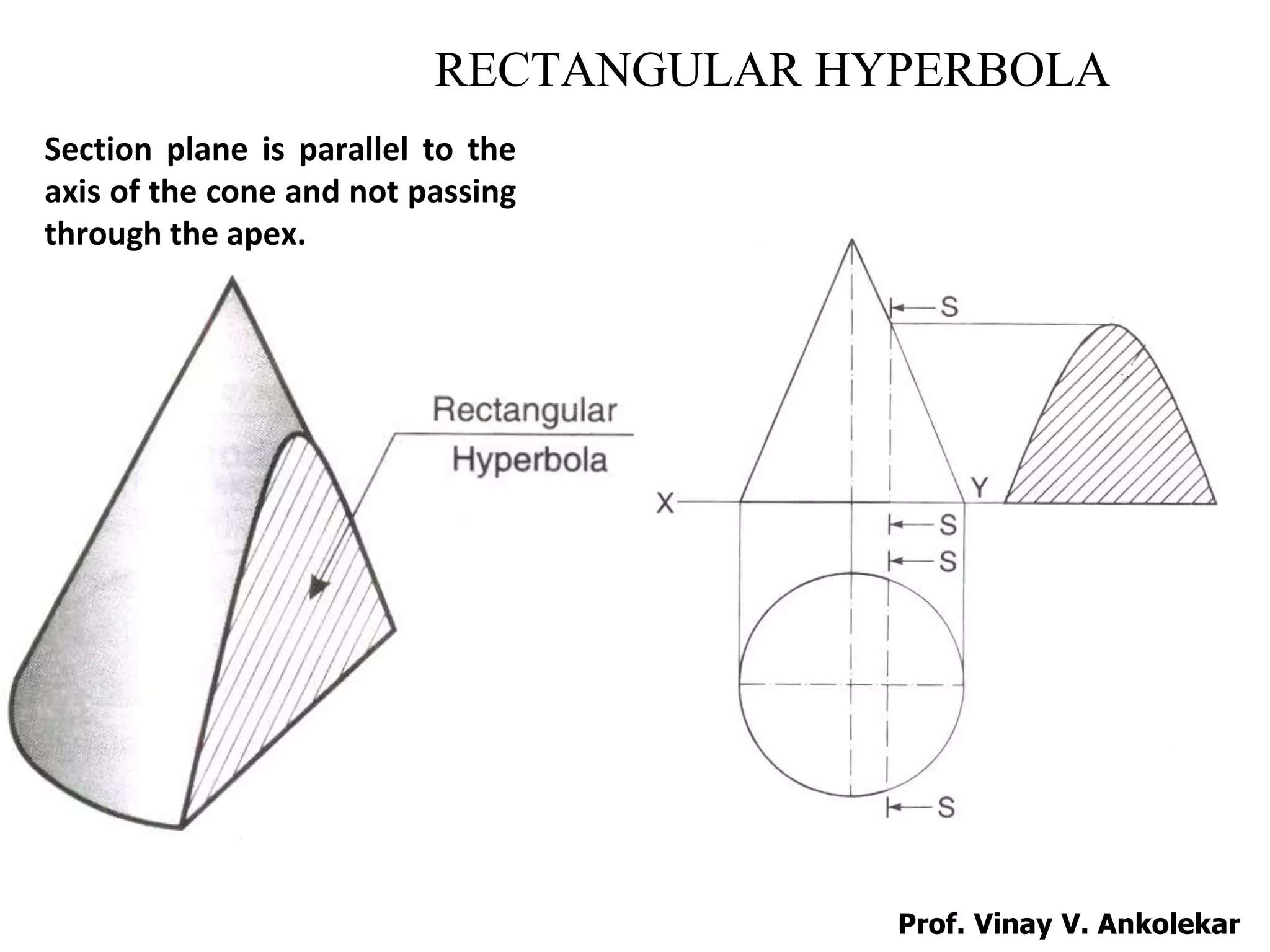
RECTANGULAR HYPERBOLA
Section plane is parallel to the
axis of the cone and not passing
through the apex.
Prof. Vinay V. Ankolekar
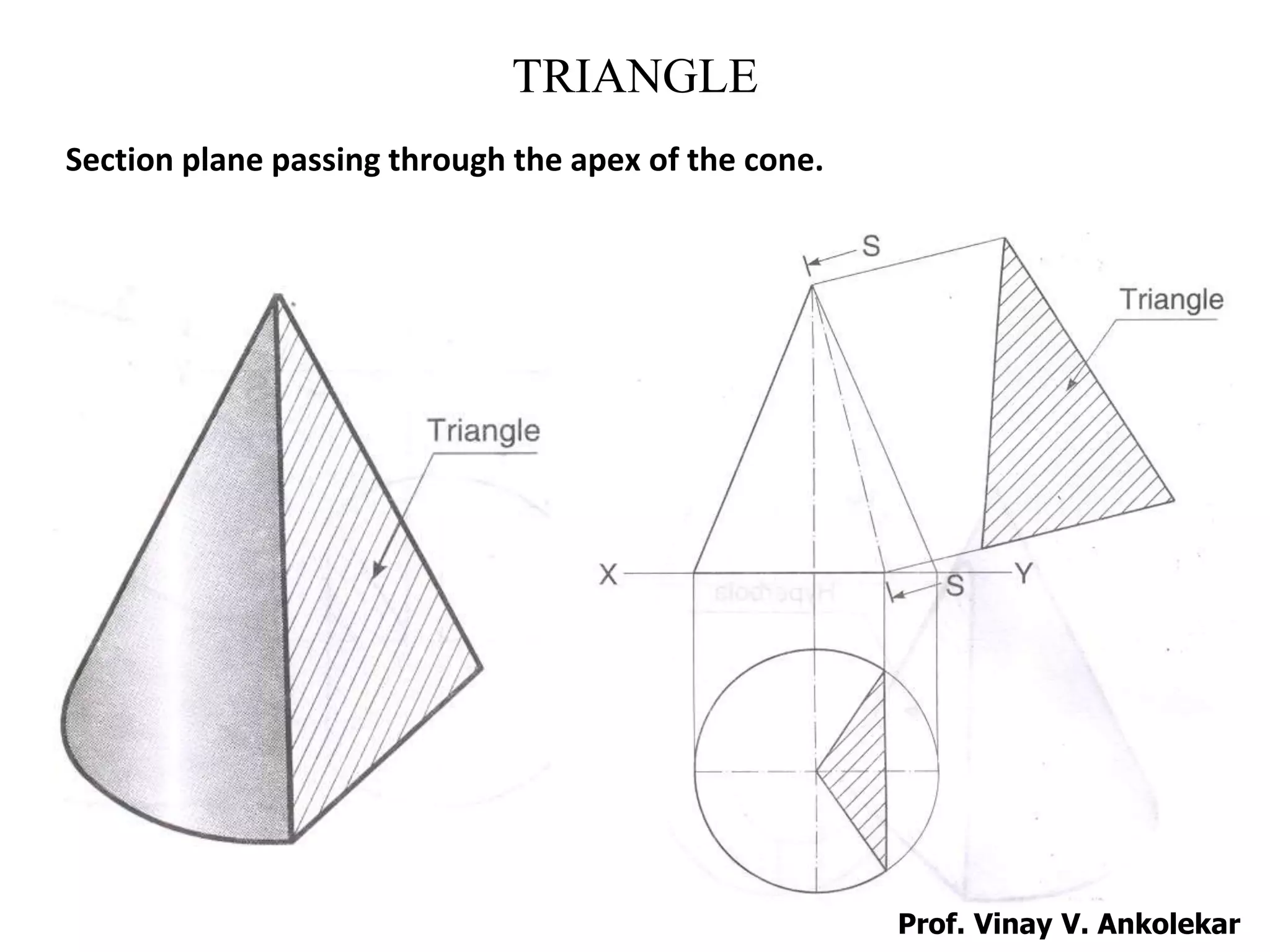
TRIANGLE
Section plane passing through the apex of the cone.
Prof. Vinay V. Ankolekar
F1
C
D
D
AXIS
A
F2Ve
VpVh
Ve
DIRECTRIX
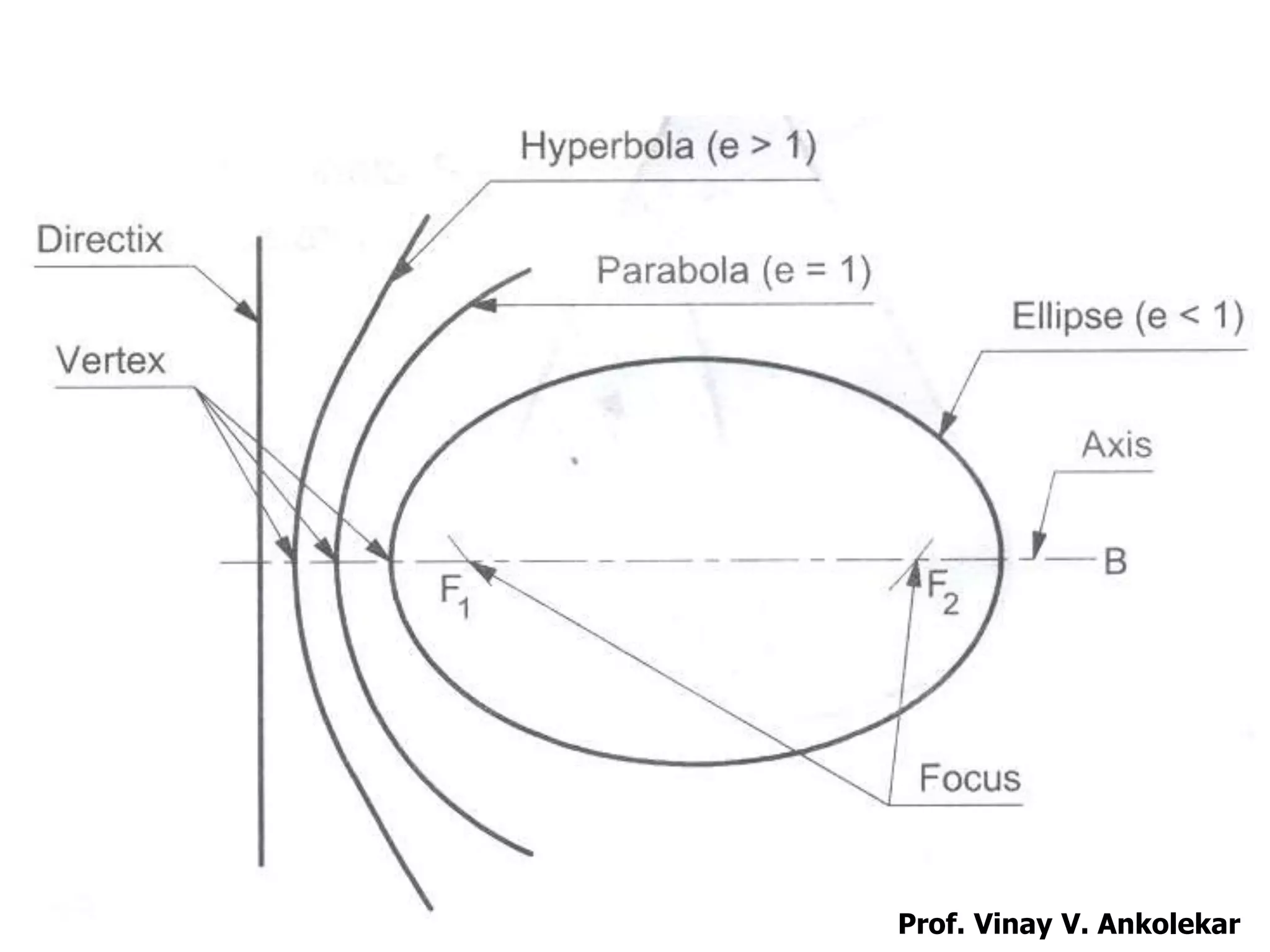
CONIC TERMINOLOGY
Focus – A fixed point [F1 AND F2]
Directrix – A fixed straight line [D-D]
Axis – A line passing through the focus and
perpendicular to the directrix [C-A]
Vertex – The point at which conics intersects the axis
[Ve Vp and Vh]
Prof. Vinay V. Ankolekar
F1
C
D
D
AXIS
A
F2Ve
VpVh
Ve
DIRECTRIX
e = VF / VC
e < 1 ---- ellipse ----- [ (VF / VC) < 1 ]
e = 1 ---- parabola ----- [ (VF / VC) = 1 ]
e > 1 ---- hyperbola ---- [ (VF / VC) > 1 ]
Prof. Vinay V. Ankolekar
ELLIPSE
Prof. Vinay V. Ankolekar
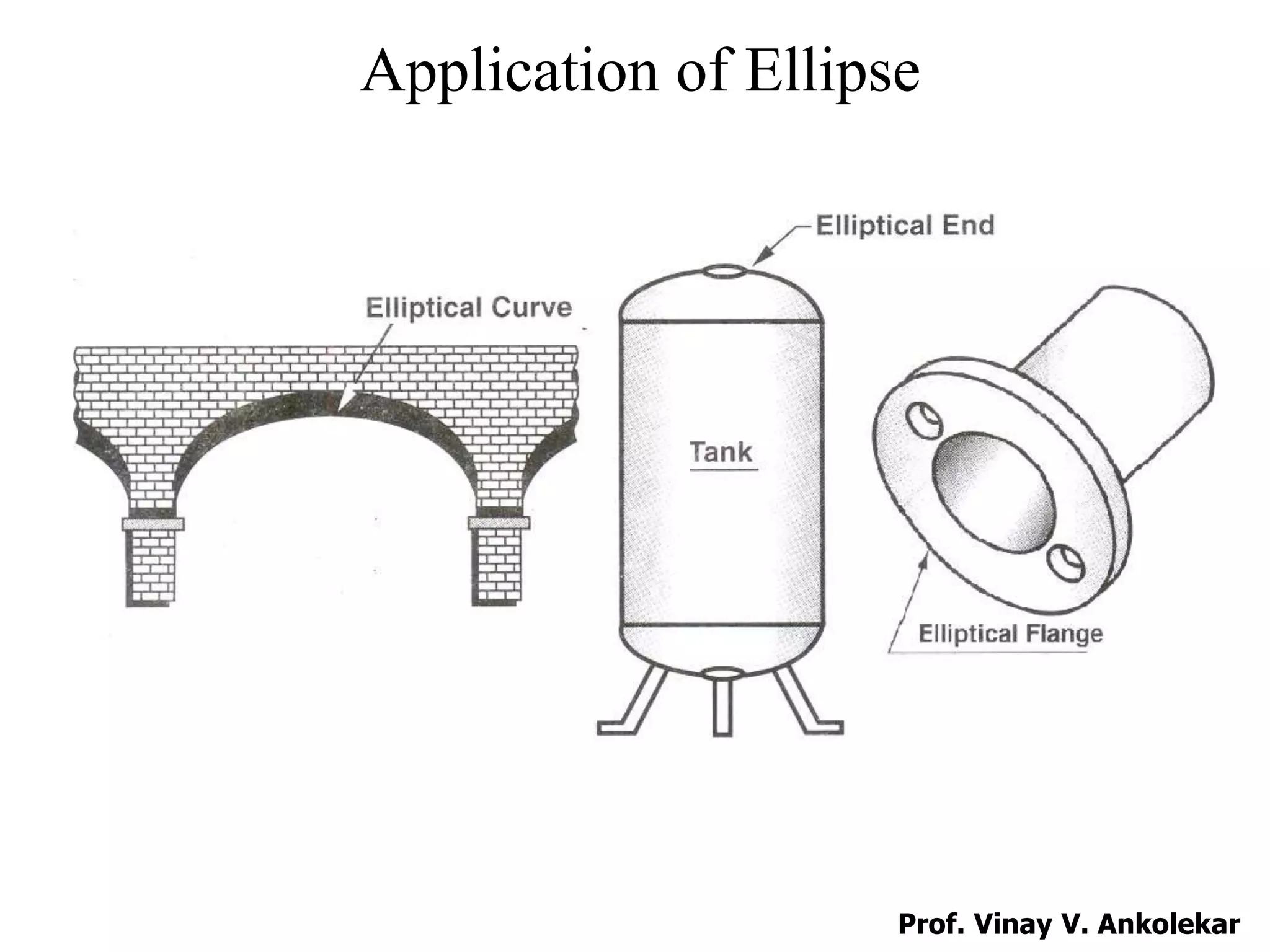
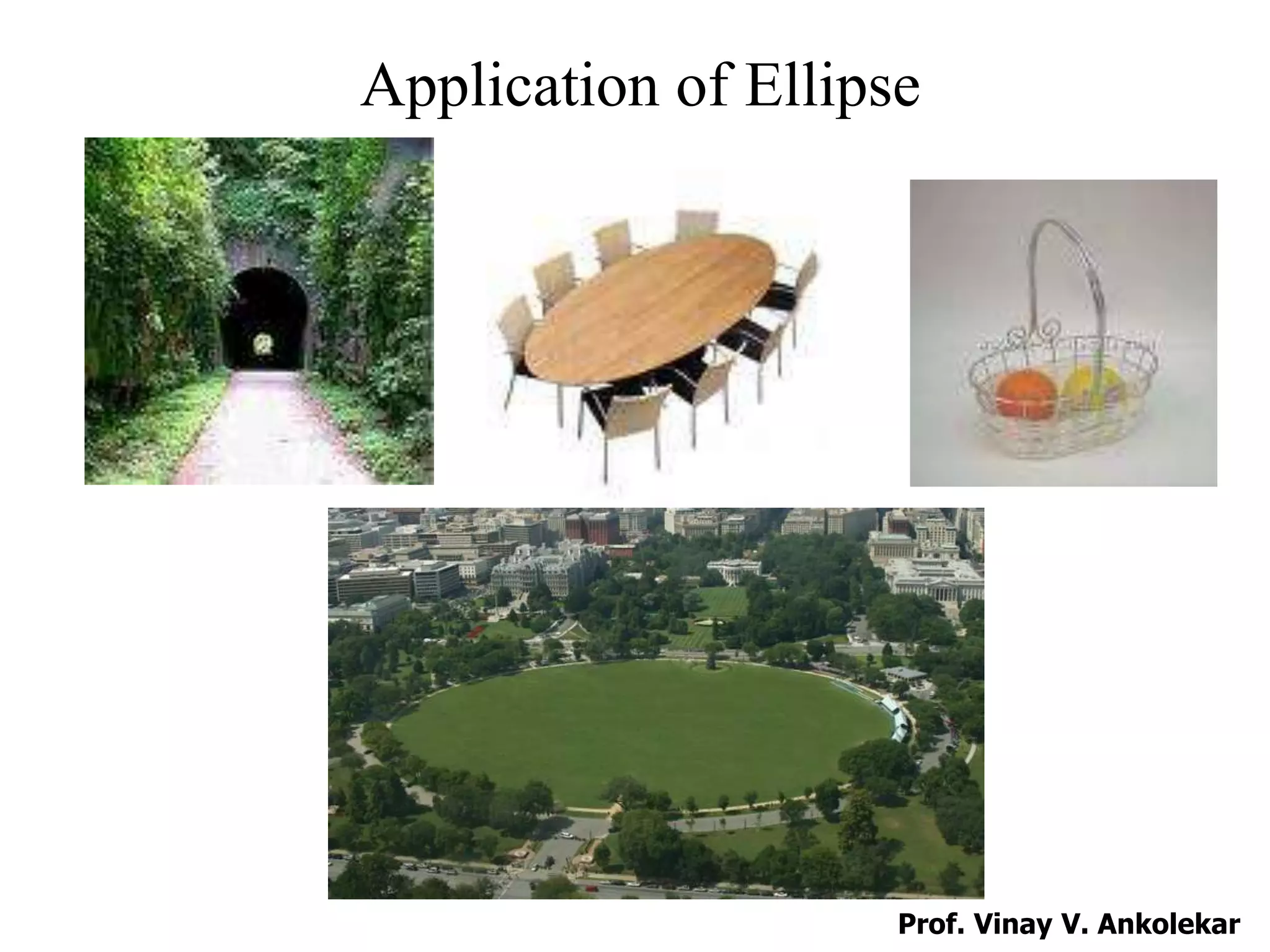
Applications of Ellipse
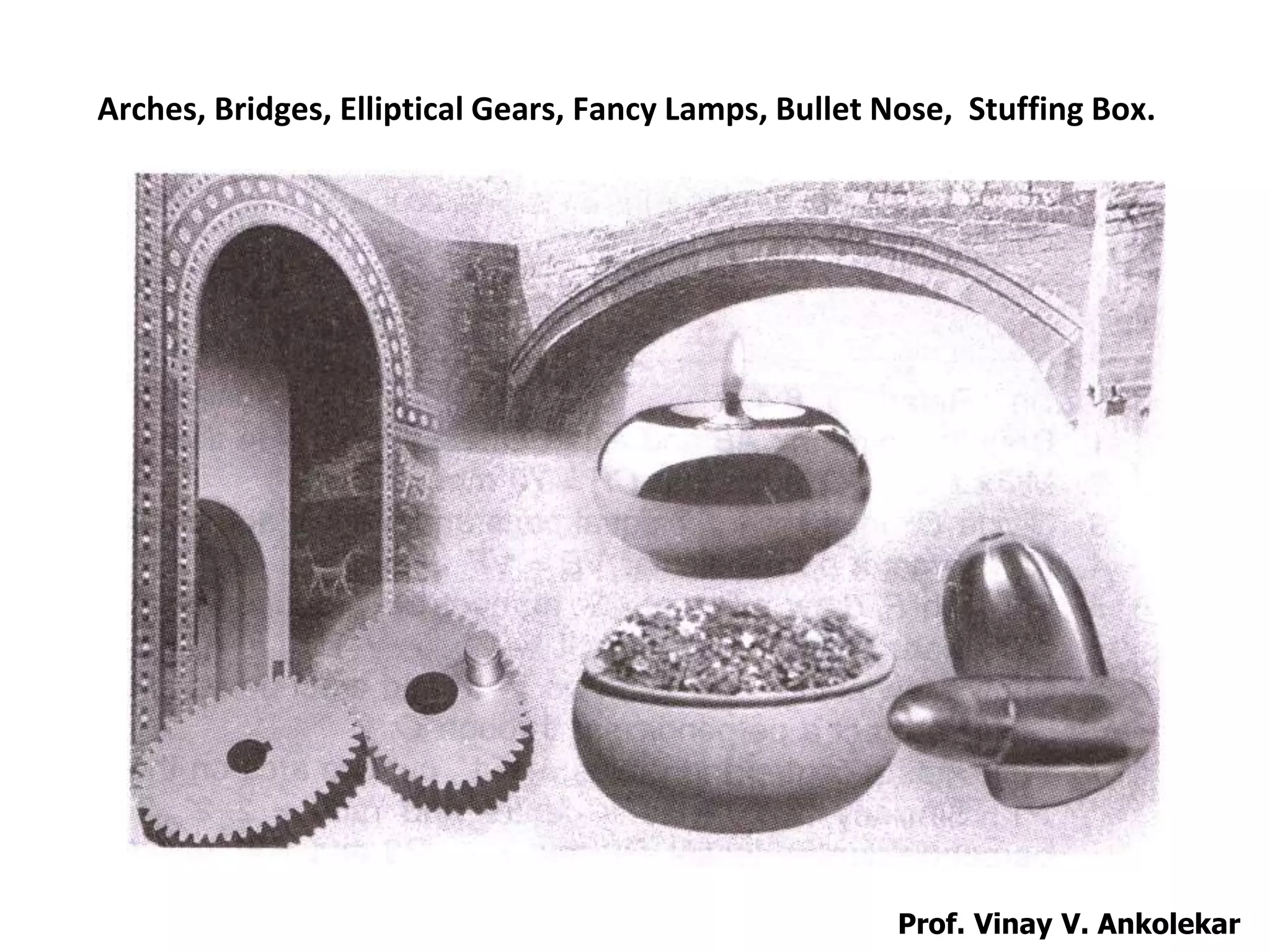
1. Arches of Bridges.
2. Pipes Bends.
3. Elliptical Gears.
4. The ends of Cylindrical Tanks are elliptical in shape.
5. Elliptical Path is followed by earth around the sun.
6. Milk Tankers.
7. Shape of Tunnels [Entry/Exit]
8. To measure the time required to cover the distance
[e.g. Missiles]
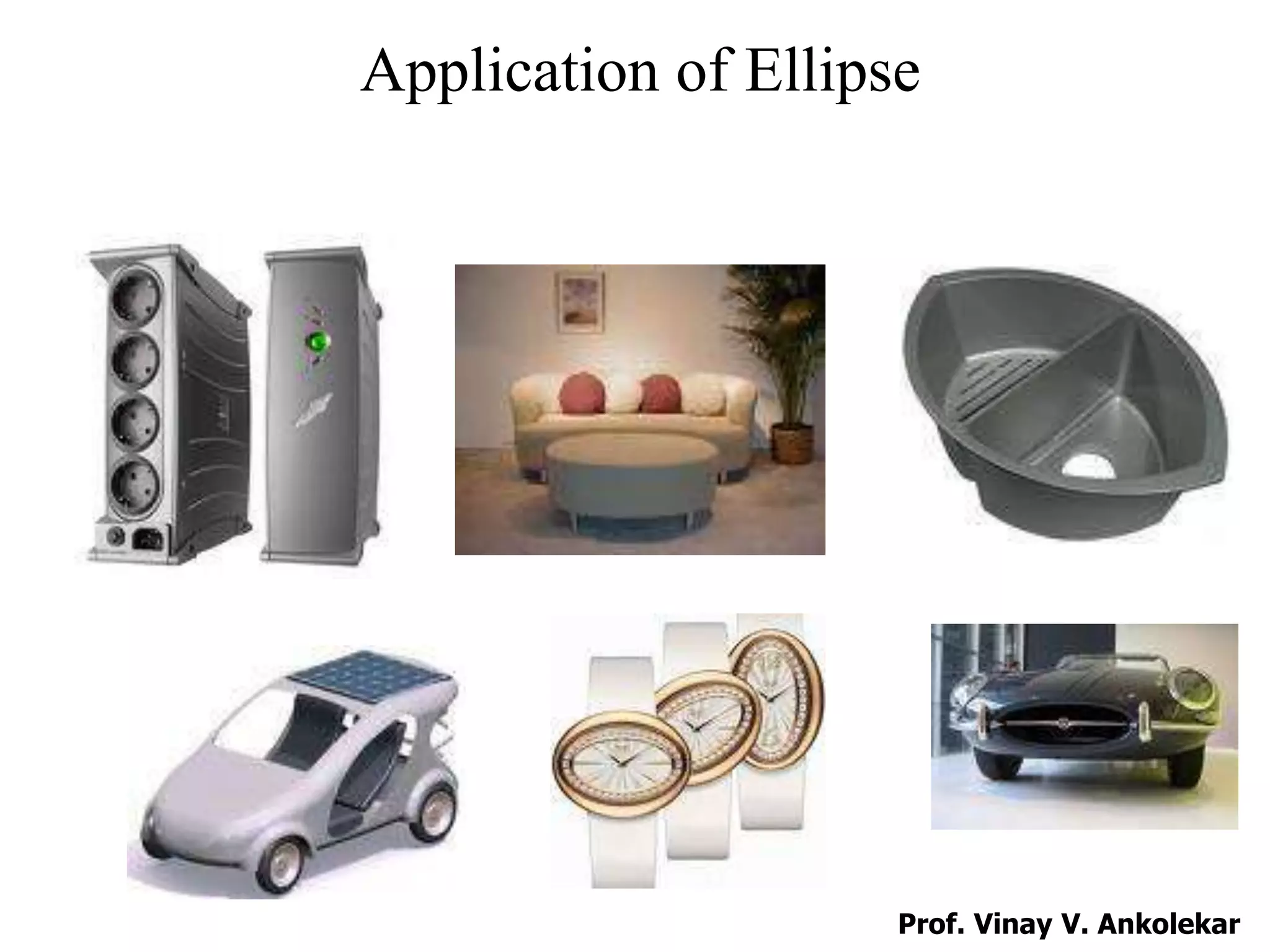
1. Designing of Kitchen Accessories [e.g. Hot Pot, Steel pots ]
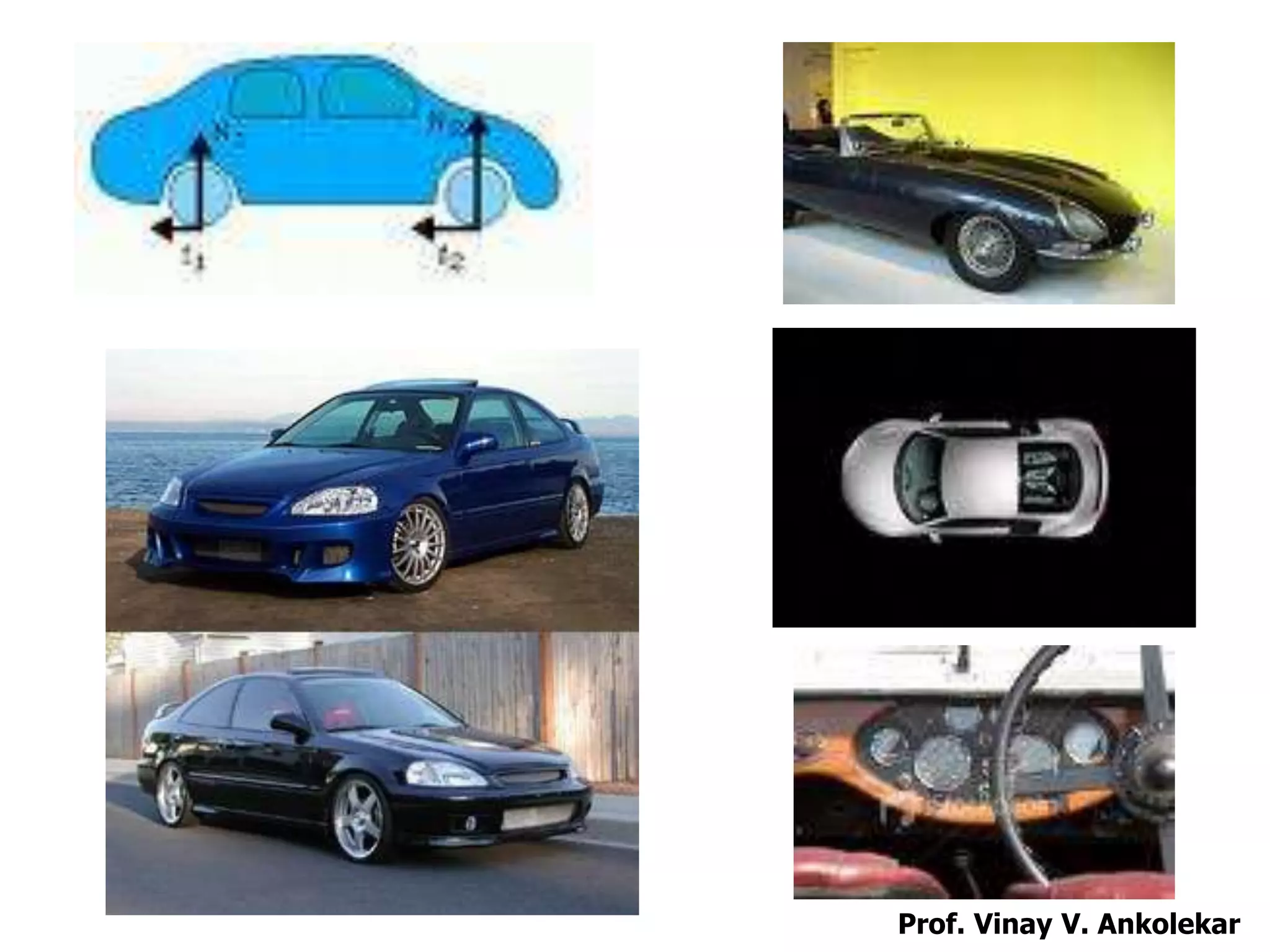
2. Automobile Parts [e.g. Petrol Tanks, Head lights]
3. Shape of Eggs.
Prof. Vinay V. Ankolekar
Application of Ellipse
Prof. Vinay V. Ankolekar
Arches, Bridges, Elliptical Gears, Fancy Lamps, Bullet Nose, Stuffing Box.
Prof. Vinay V. Ankolekar
Application of Ellipse
Prof. Vinay V. Ankolekar
Application of Ellipse
Prof. Vinay V. Ankolekar
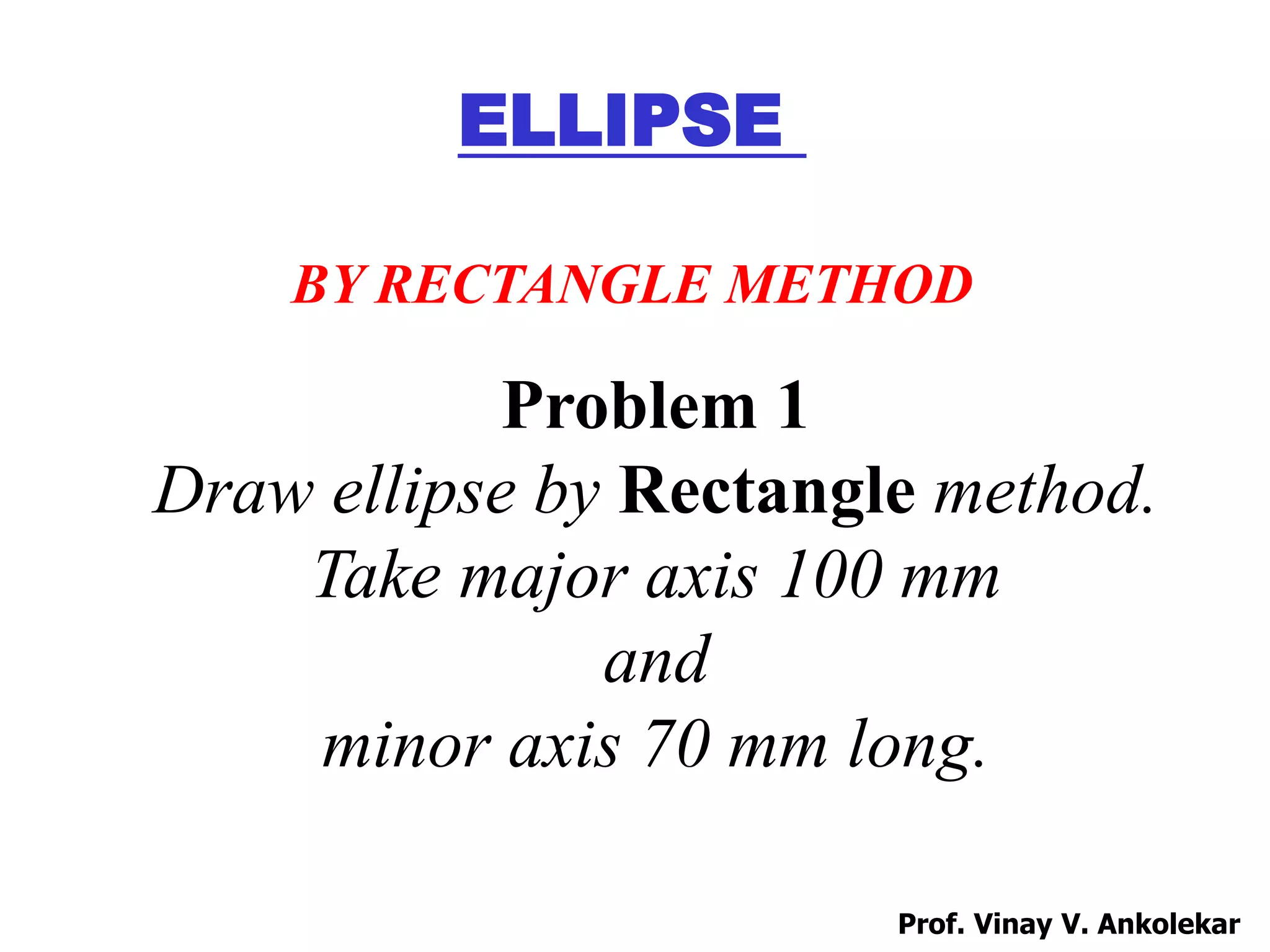
Problem 1
Draw ellipse by Rectangle method.
Take major axis 100 mm
and
minor axis 70 mm long.
ELLIPSE
BY RECTANGLE METHOD
Prof. Vinay V. Ankolekar
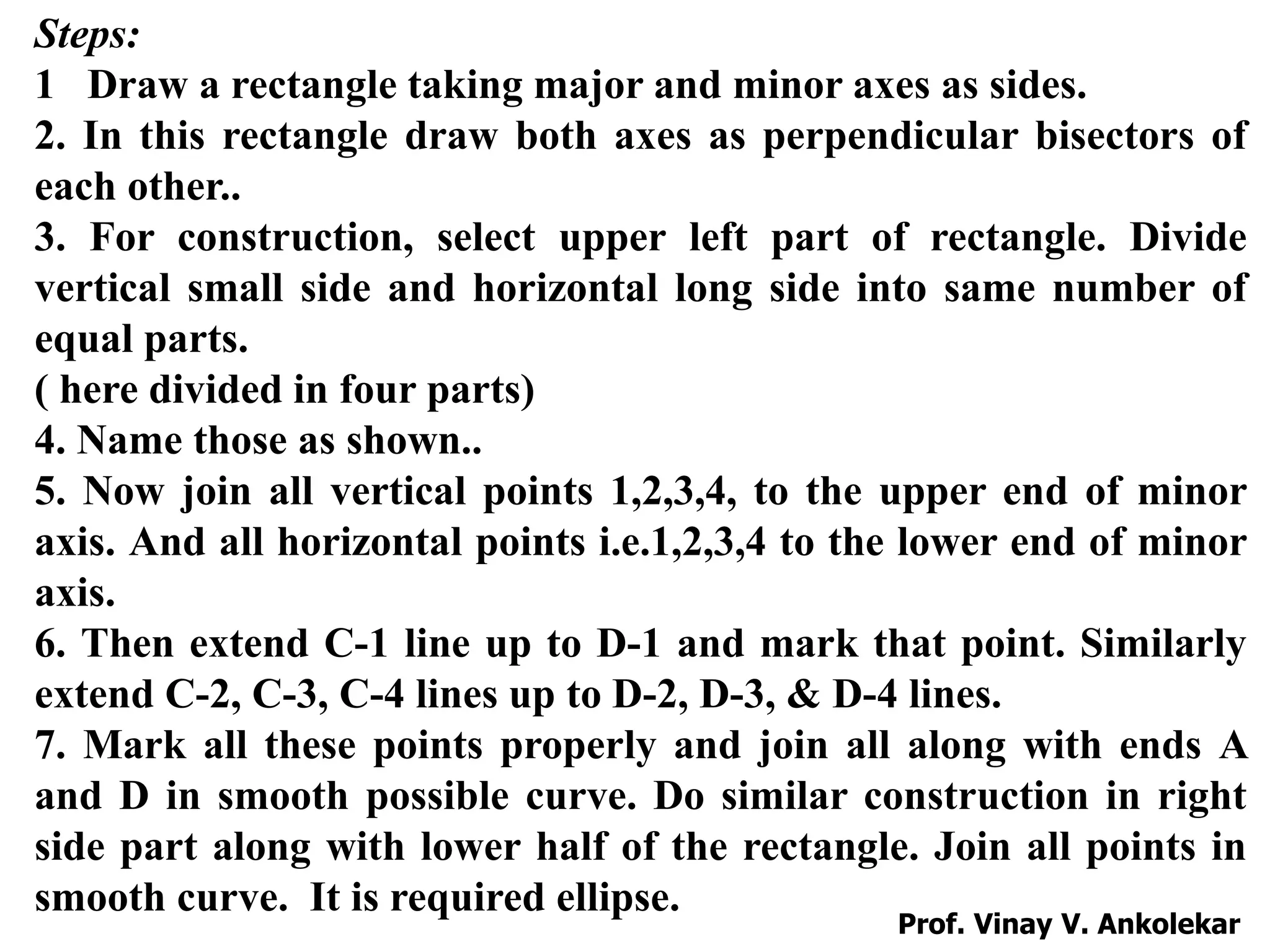
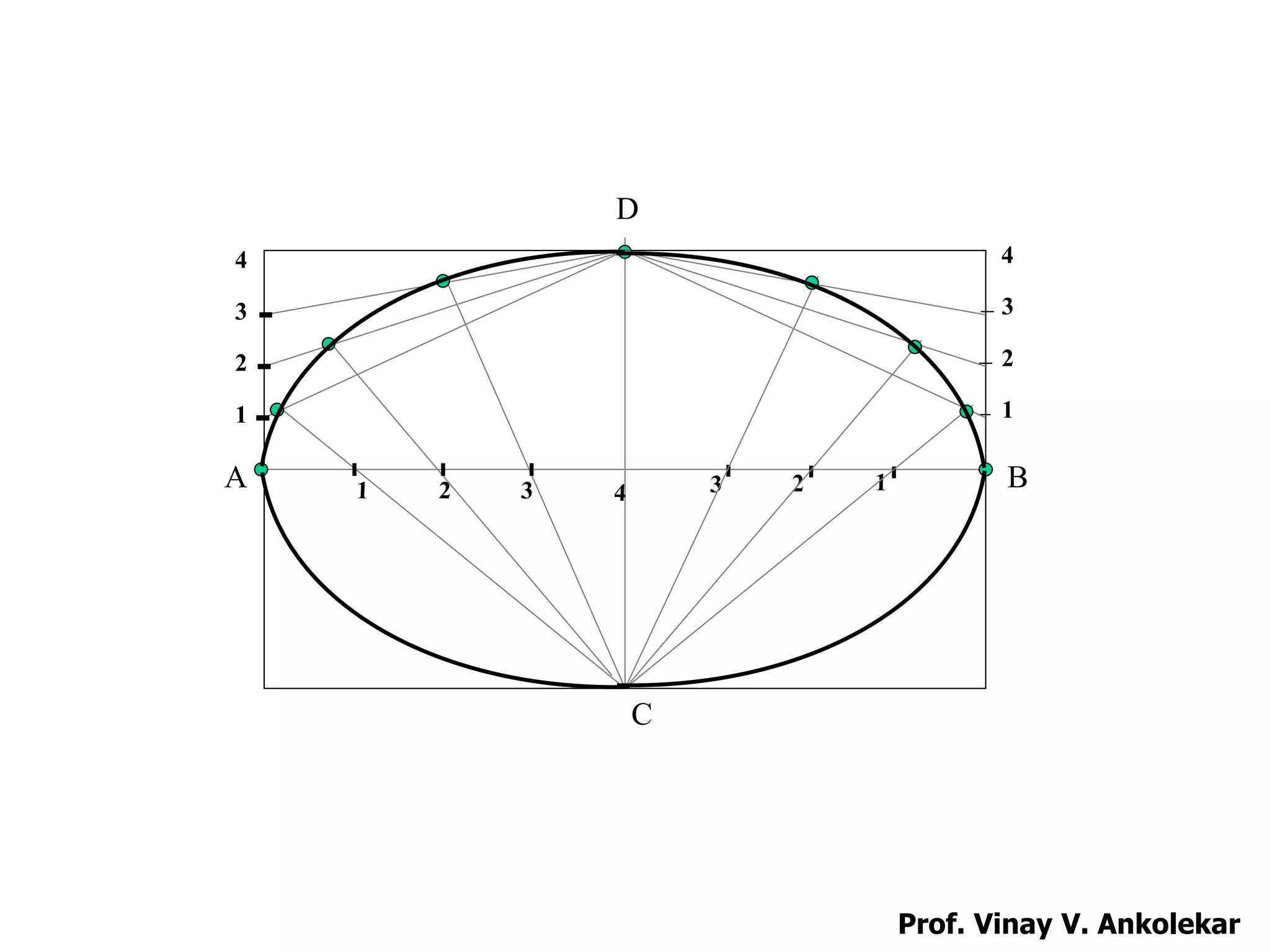
Steps:
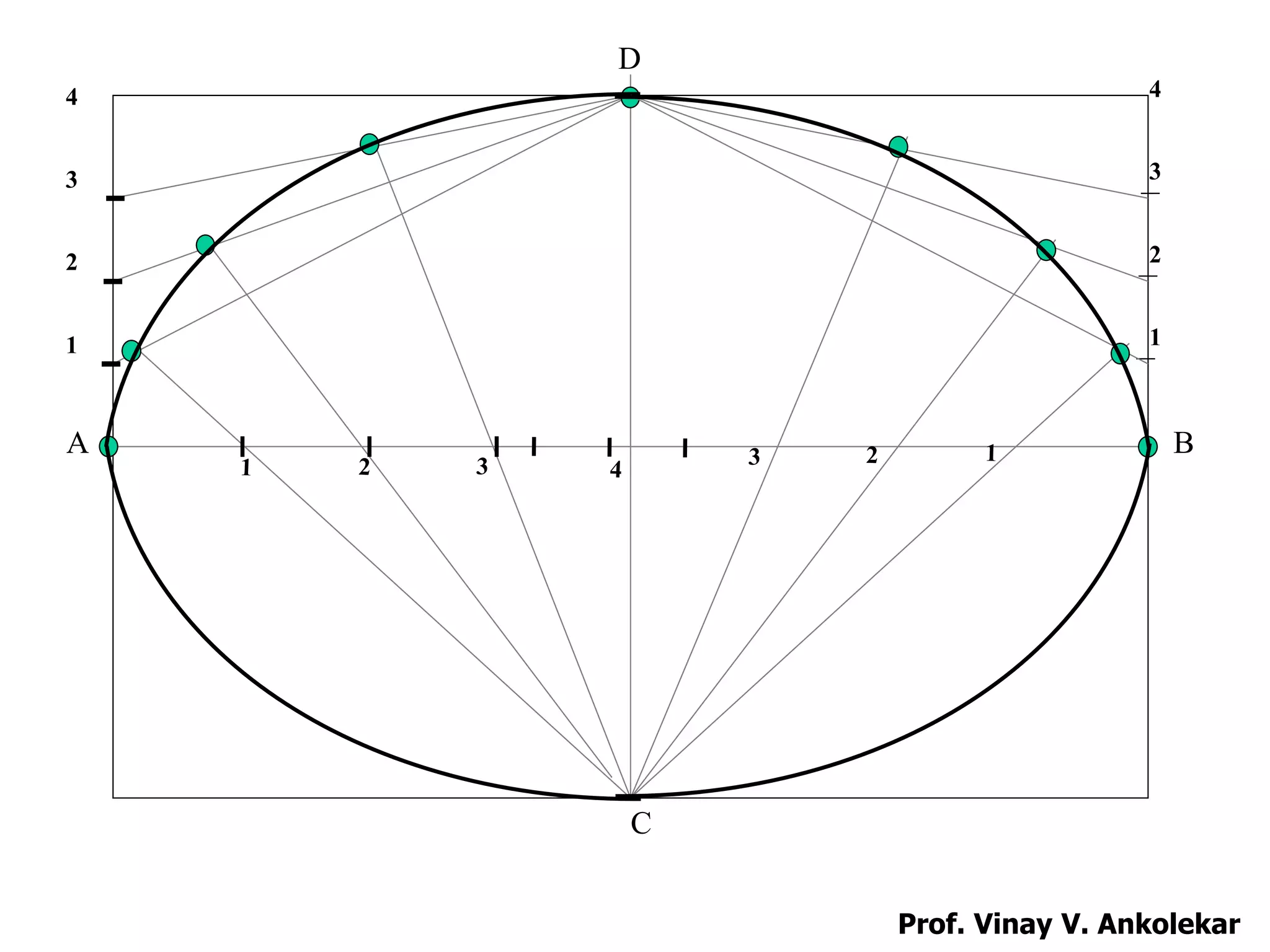
1 Draw a rectangle taking major and minor axes as sides.
2. In this rectangle draw both axes as perpendicular bisectors of
each other..
3. For construction, select upper left part of rectangle. Divide
vertical small side and horizontal long side into same number of
equal parts.
( here divided in four parts)
4. Name those as shown..
5. Now join all vertical points 1,2,3,4, to the upper end of minor
axis. And all horizontal points i.e.1,2,3,4 to the lower end of minor
axis.
6. Then extend C-1 line up to D-1 and mark that point. Similarly
extend C-2, C-3, C-4 lines up to D-2, D-3, & D-4 lines.
7. Mark all these points properly and join all along with ends A
and D in smooth possible curve. Do similar construction in right
side part along with lower half of the rectangle. Join all points in
smooth curve. It is required ellipse.
Prof. Vinay V. Ankolekar
1
2
3
4
1
2
3
4
A B
C
D
Prof. Vinay V. Ankolekar
1
2
3
4
1
2
3
4
A B
C
D
Prof. Vinay V. Ankolekar
ELLIPSE
DIRECTRIX-FOCUS METHOD
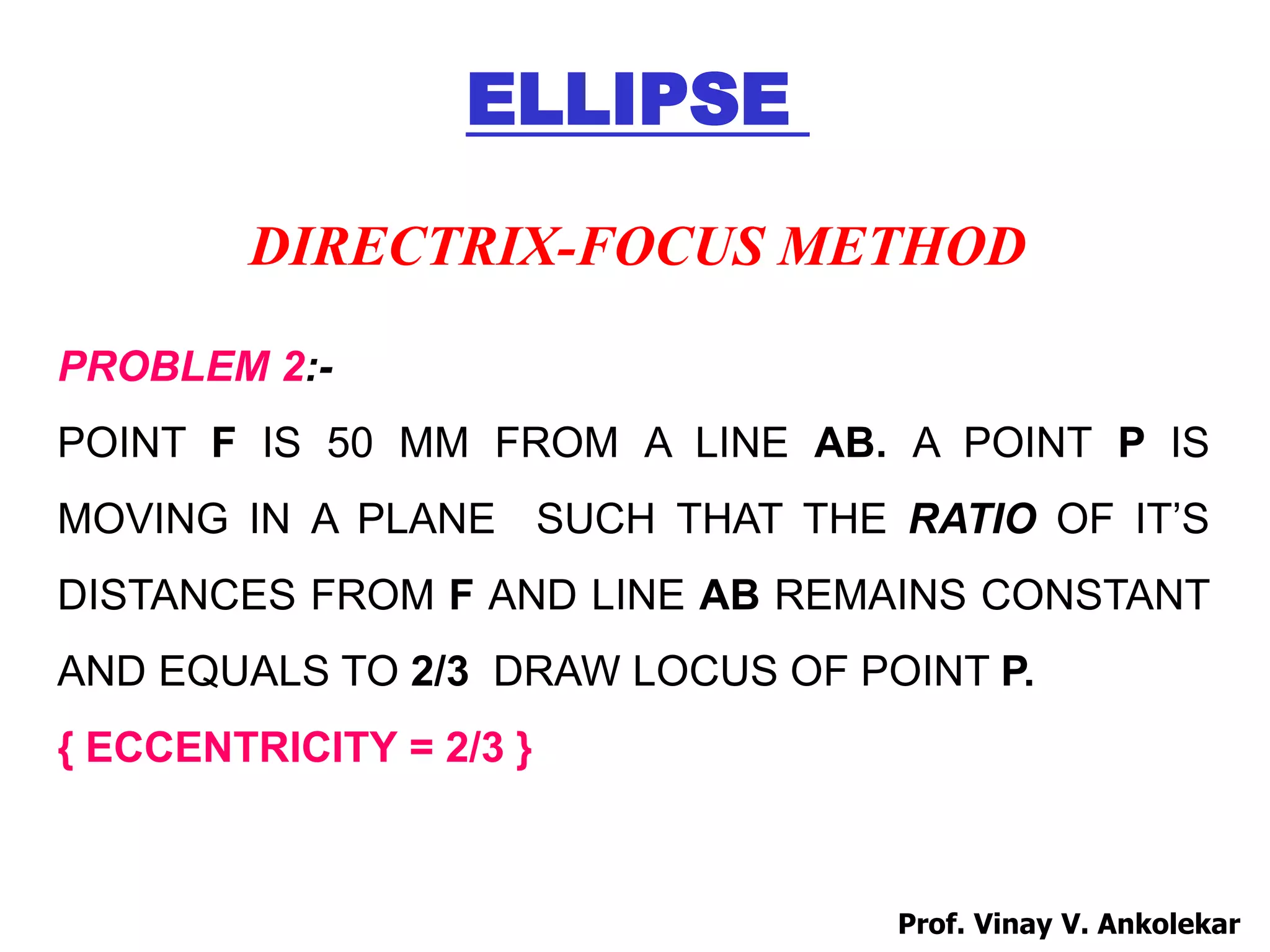
PROBLEM 2:-
POINT F IS 50 MM FROM A LINE AB. A POINT P IS
MOVING IN A PLANE SUCH THAT THE RATIO OF IT’S
DISTANCES FROM F AND LINE AB REMAINS CONSTANT
AND EQUALS TO 2/3 DRAW LOCUS OF POINT P.
{ ECCENTRICITY = 2/3 }
Prof. Vinay V. Ankolekar
50
mm
30
mm
V F1
C
D
D
450
A
1 2 3 4 5 6 7 8
B
1`
2`
3`
4`
5`
6`
7`
8`
V`
P1
P2
P3
P4 P5 P6
P7
P8
P`8
P`
7
P`1
P`2
P`3 P`4 P`5
P`
6
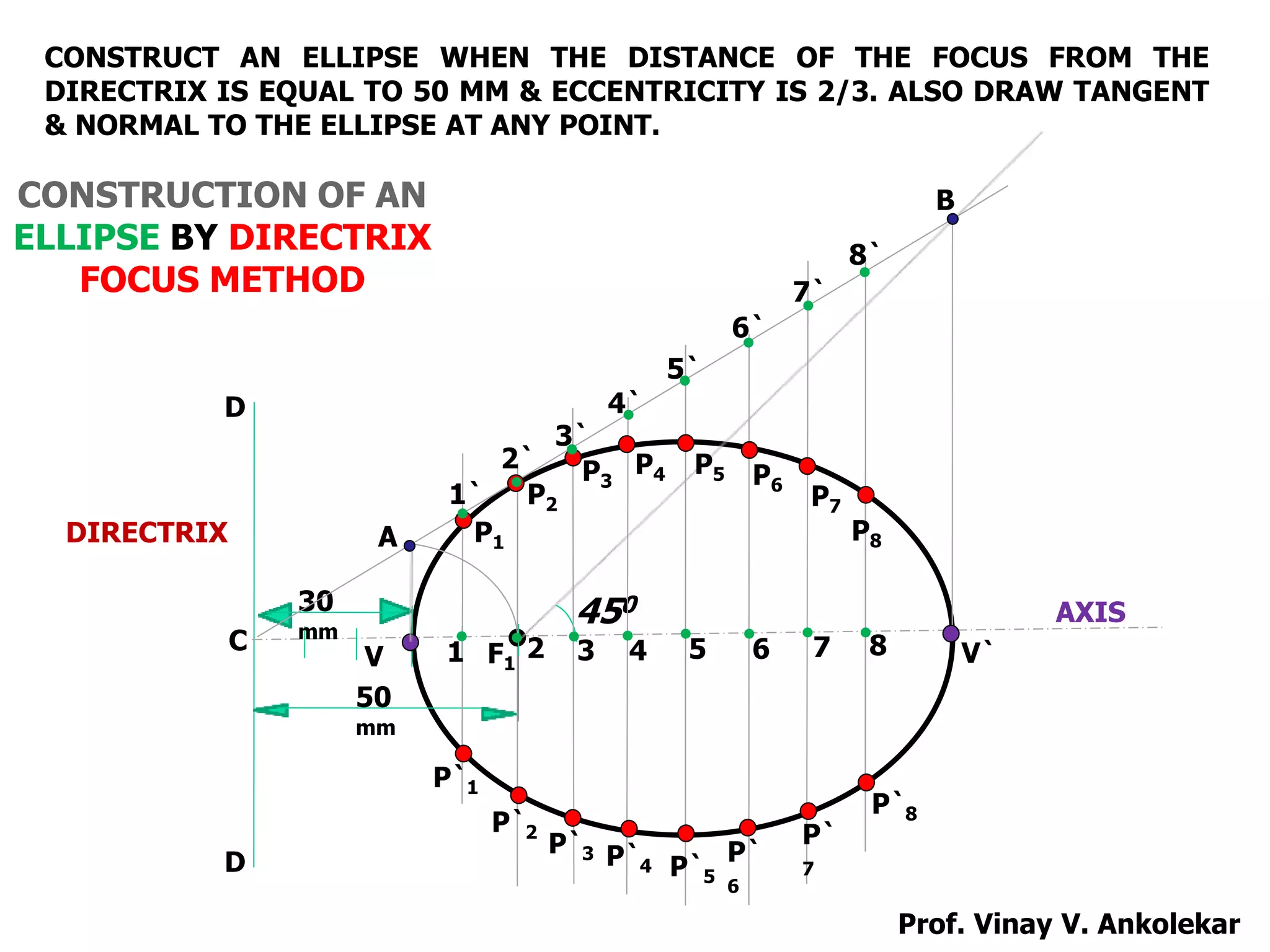
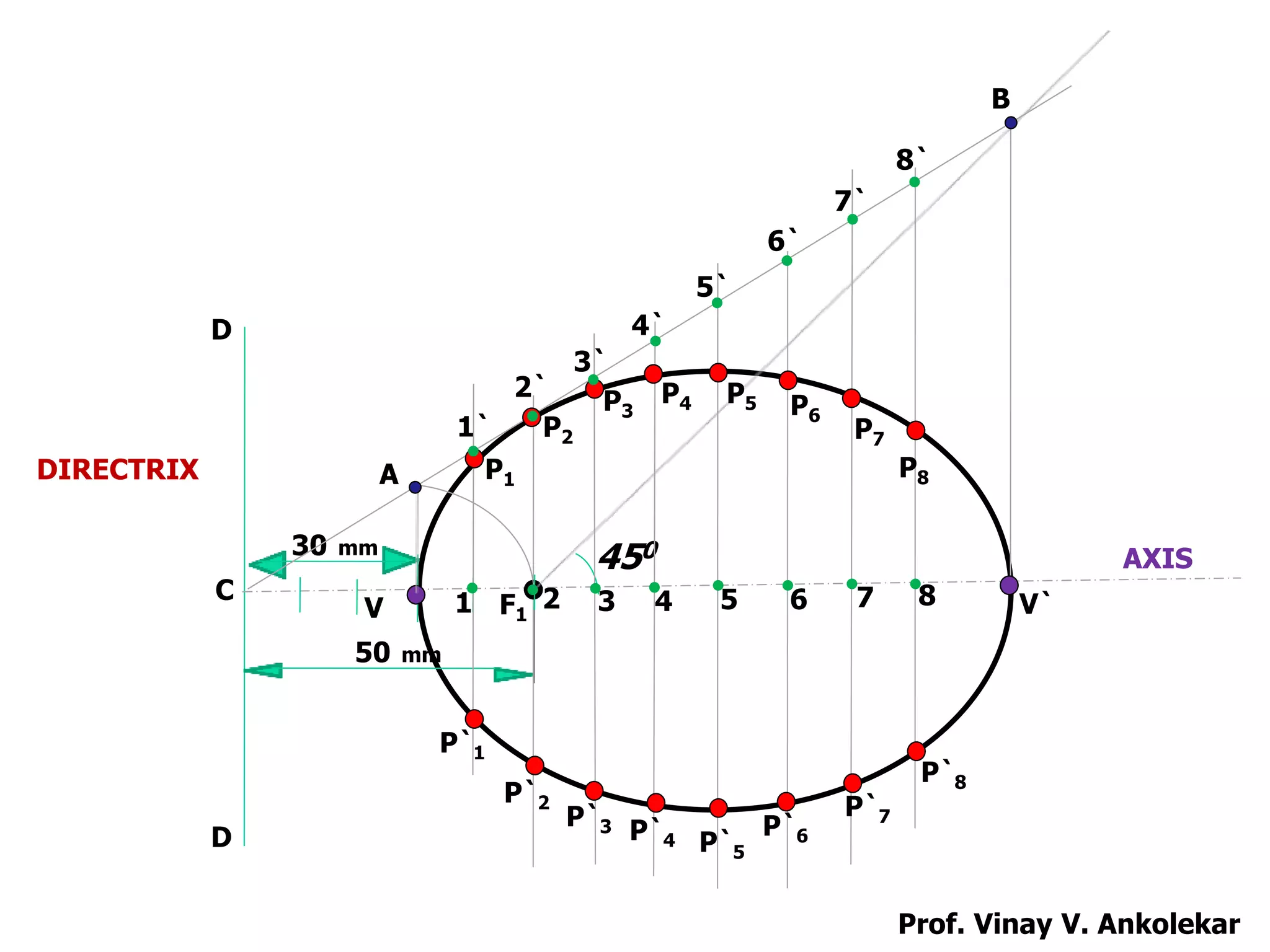
CONSTRUCT AN ELLIPSE WHEN THE DISTANCE OF THE FOCUS FROM THE
DIRECTRIX IS EQUAL TO 50 MM & ECCENTRICITY IS 2/3. ALSO DRAW TANGENT
& NORMAL TO THE ELLIPSE AT ANY POINT.
CONSTRUCTION OF AN
ELLIPSE BY DIRECTRIX
FOCUS METHOD
AXIS
DIRECTRIX
Prof. Vinay V. Ankolekar
50 mm
30 mm
V F1
C
D
D
450
A
1 2 3 4 5 6 7 8
B
1`
2`
3`
4`
5`
6`
7`
8`
V`
P1
P2
P3
P4 P5 P6
P7
P8
P`8
P`7
P`1
P`2
P`3 P`4 P`5
P`6
AXIS
DIRECTRIX
Prof. Vinay V. Ankolekar
PARABOLA
Prof. Vinay V. Ankolekar
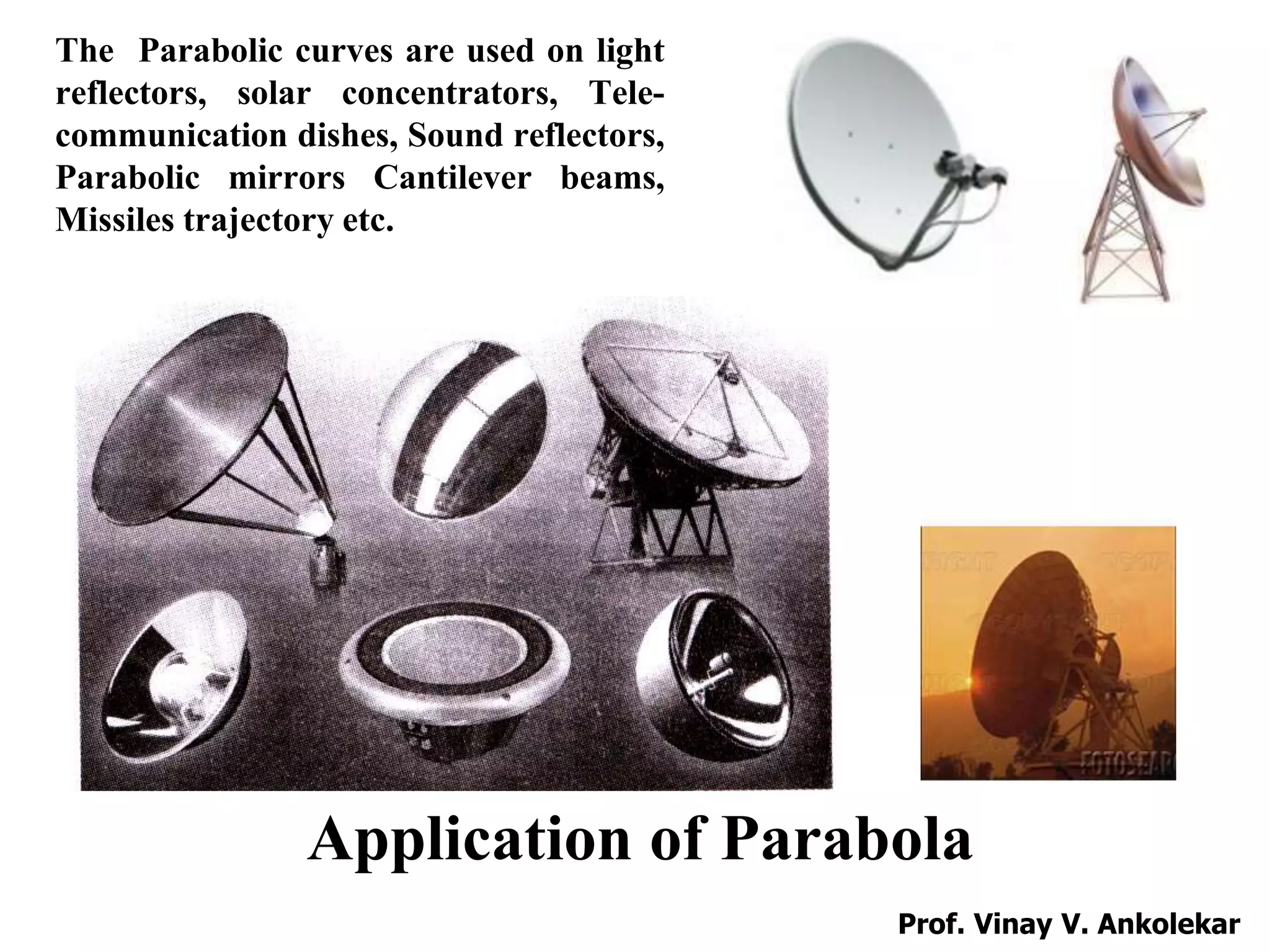
Application of Parabola
The Parabolic curves are used on light
reflectors, solar concentrators, Tele-
communication dishes, Sound reflectors,
Parabolic mirrors Cantilever beams,
Missiles trajectory etc.
Prof. Vinay V. Ankolekar
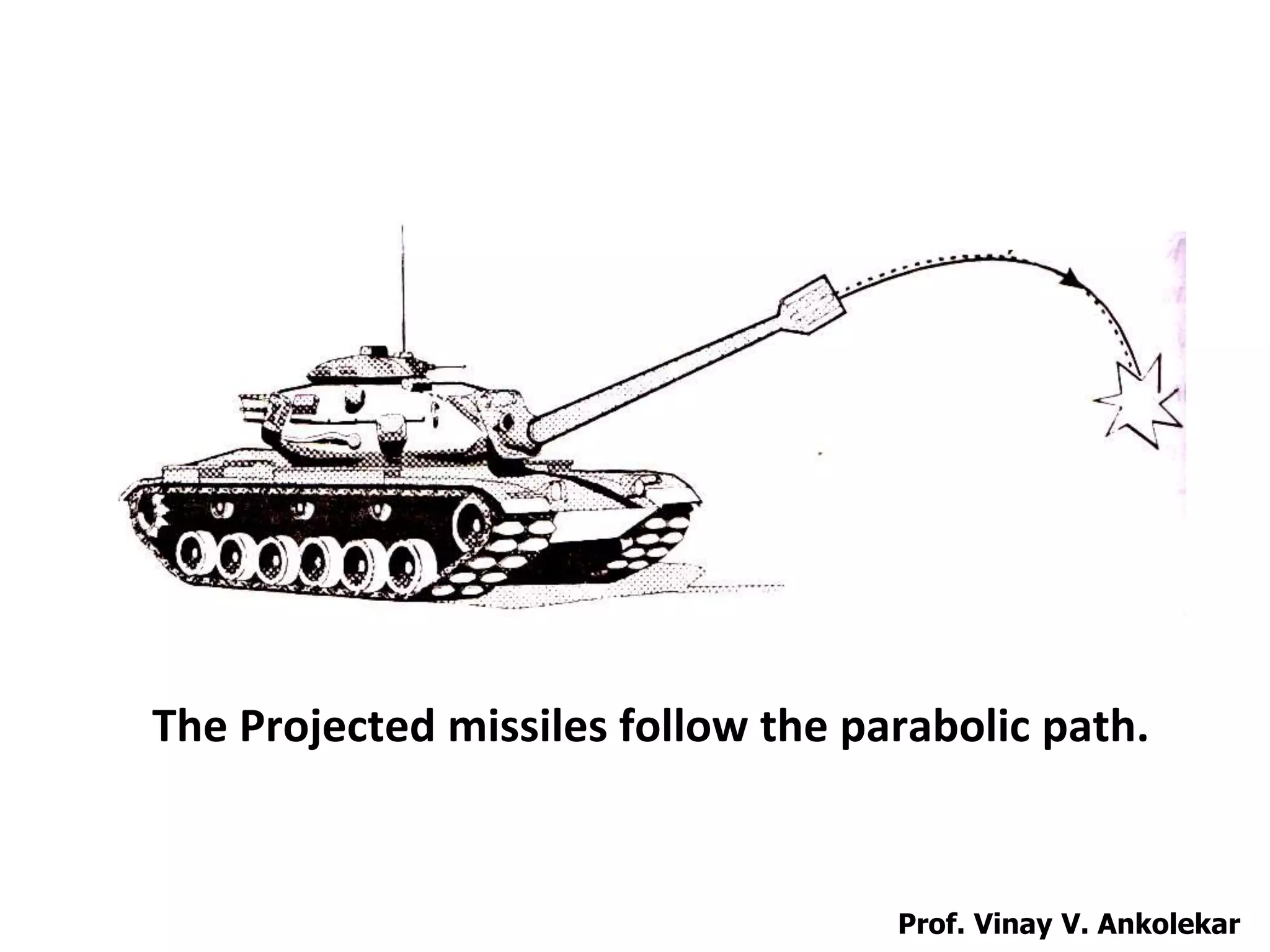
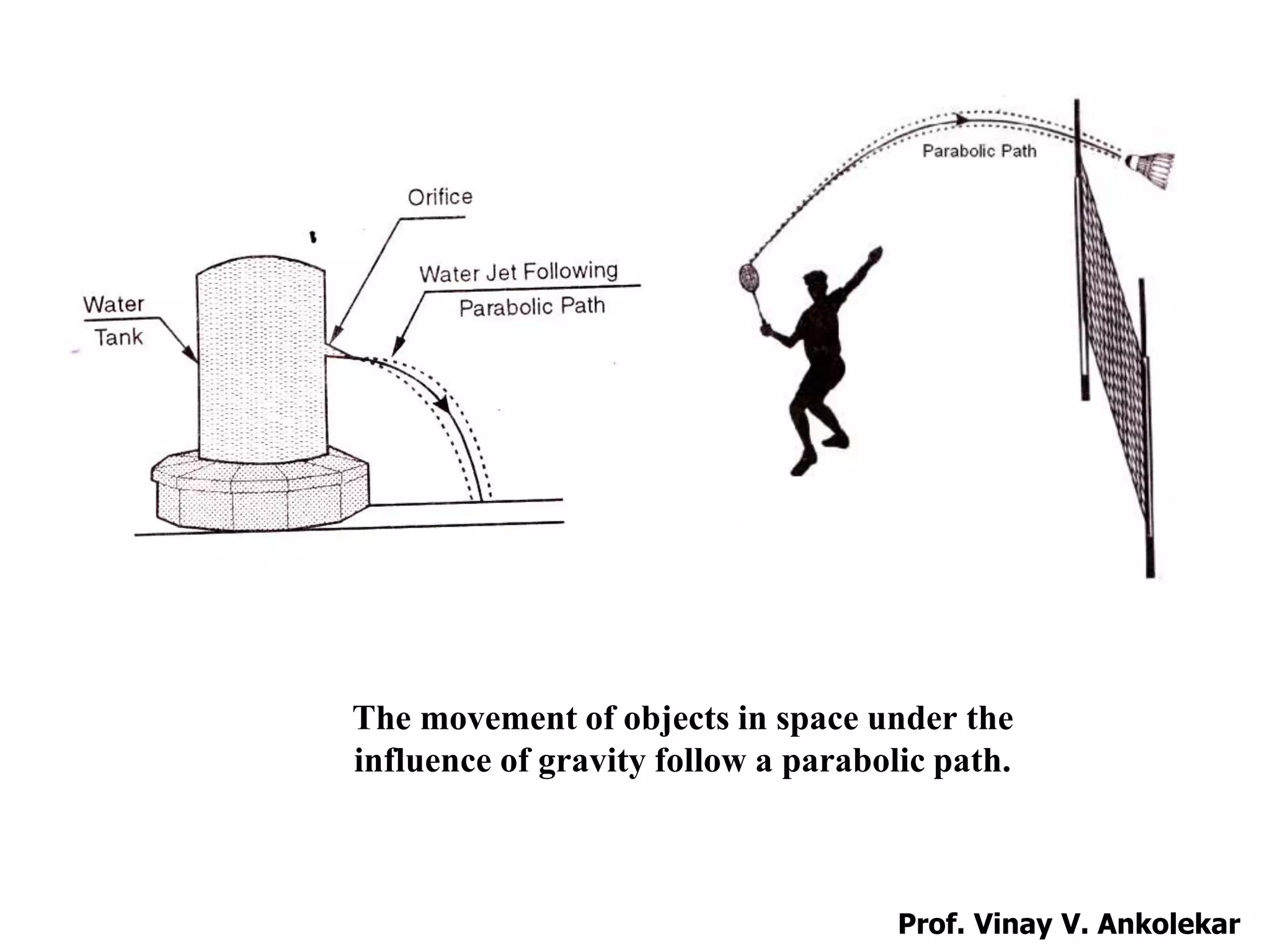
The Projected missiles follow the parabolic path.
Prof. Vinay V. Ankolekar
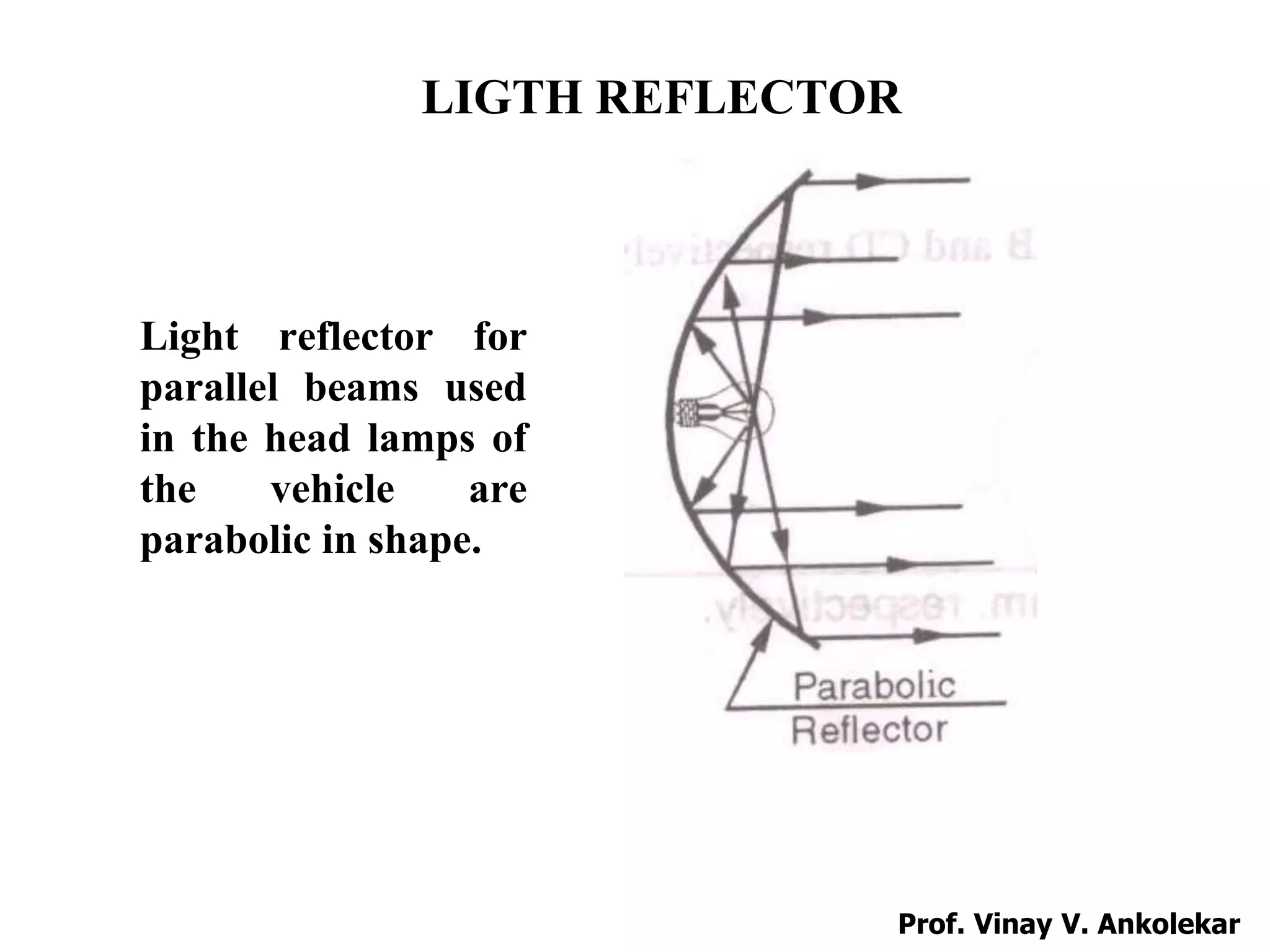
Light reflector for
parallel beams used
in the head lamps of
the vehicle are
parabolic in shape.
LIGTH REFLECTOR
Prof. Vinay V. Ankolekar
The movement of objects in space under the
influence of gravity follow a parabolic path.
Prof. Vinay V. Ankolekar
PARABOLA
RECTANGLE METHOD
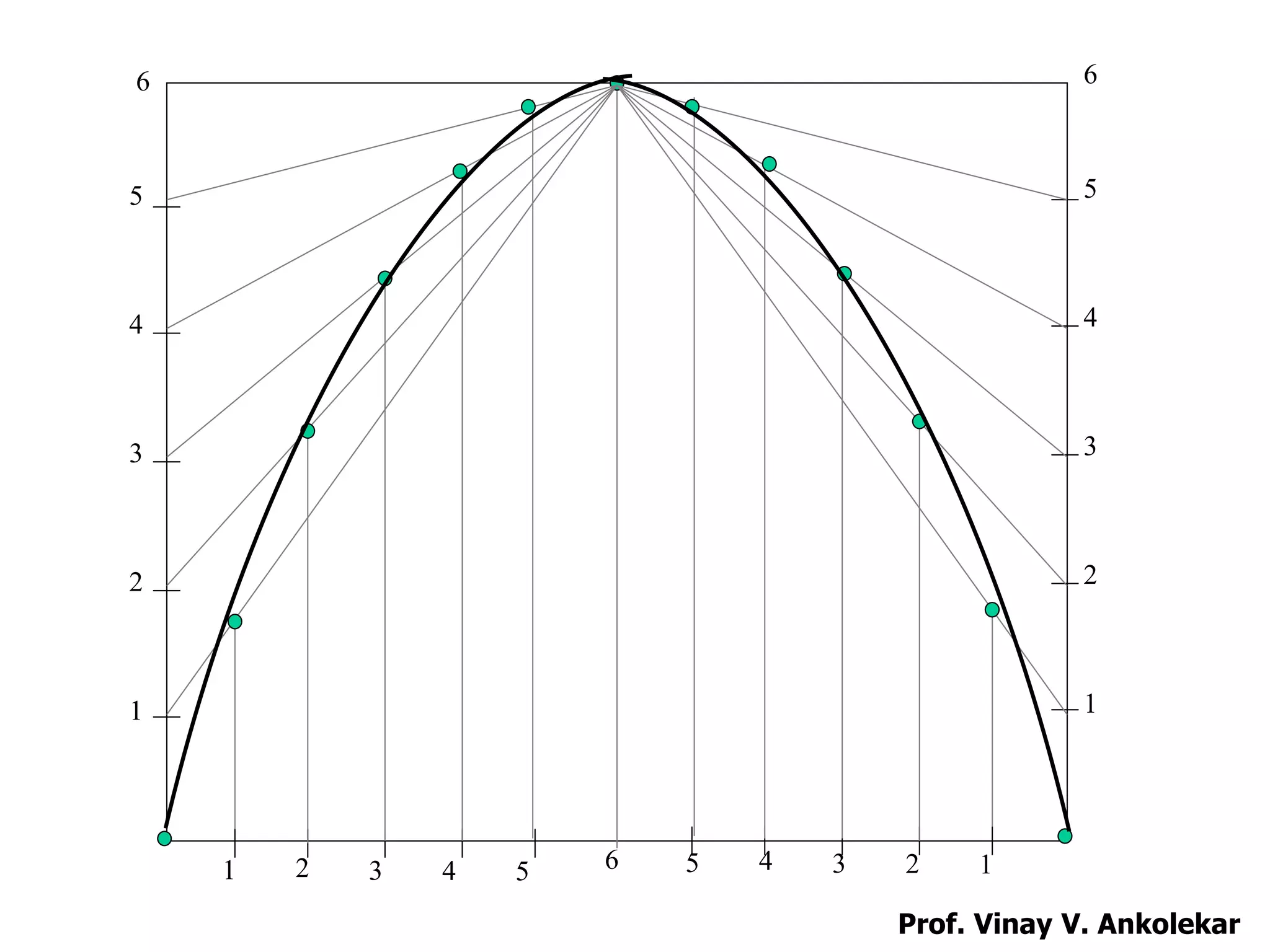
PROBLEM 3:
A BALL THROWN IN AIR ATTAINS 100 M
HEIGHT AND COVERS HORIZONTAL
DISTANCE 150 M ON GROUND.
Draw the path of the ball (projectile)
Prof. Vinay V. Ankolekar
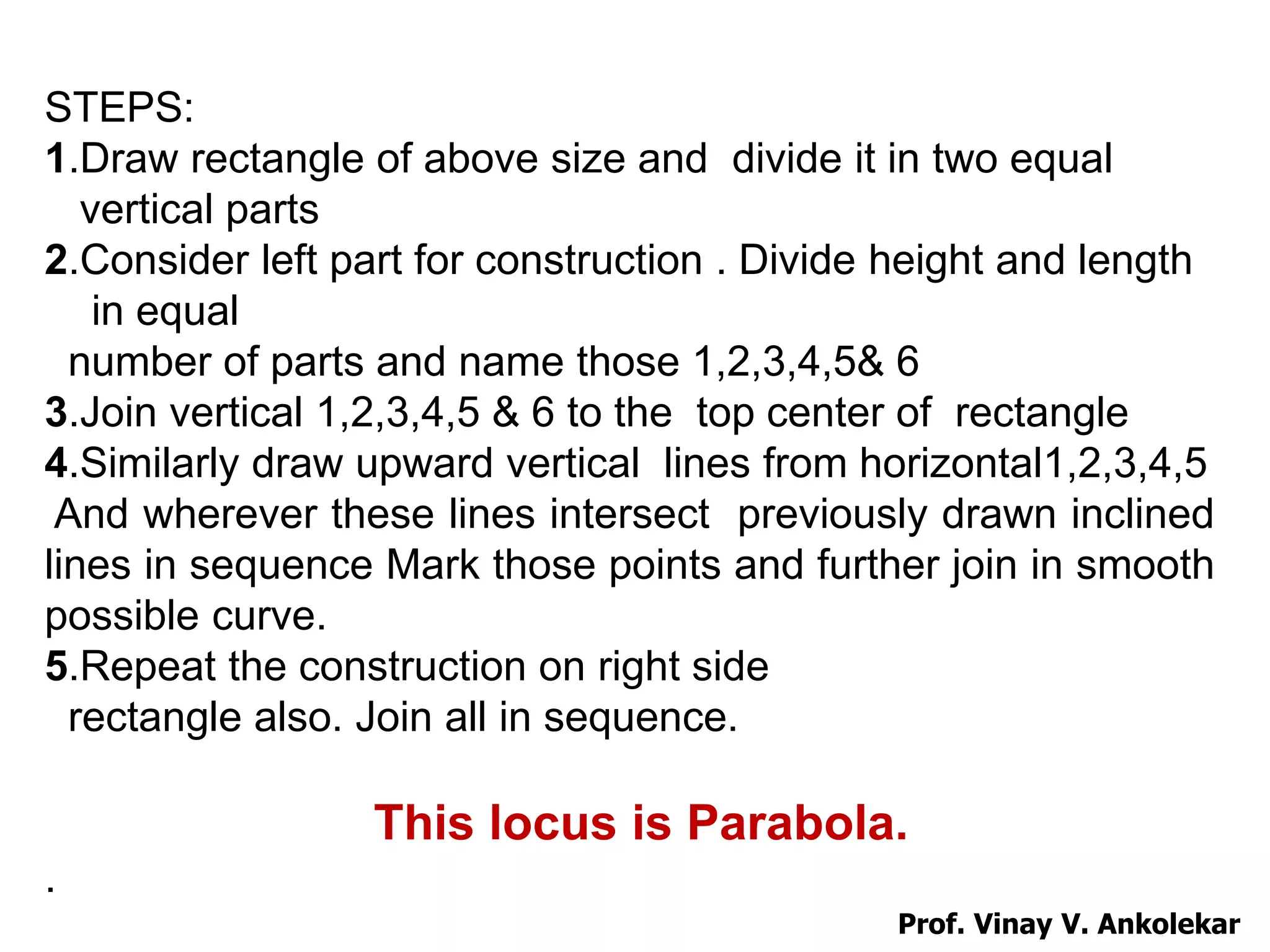
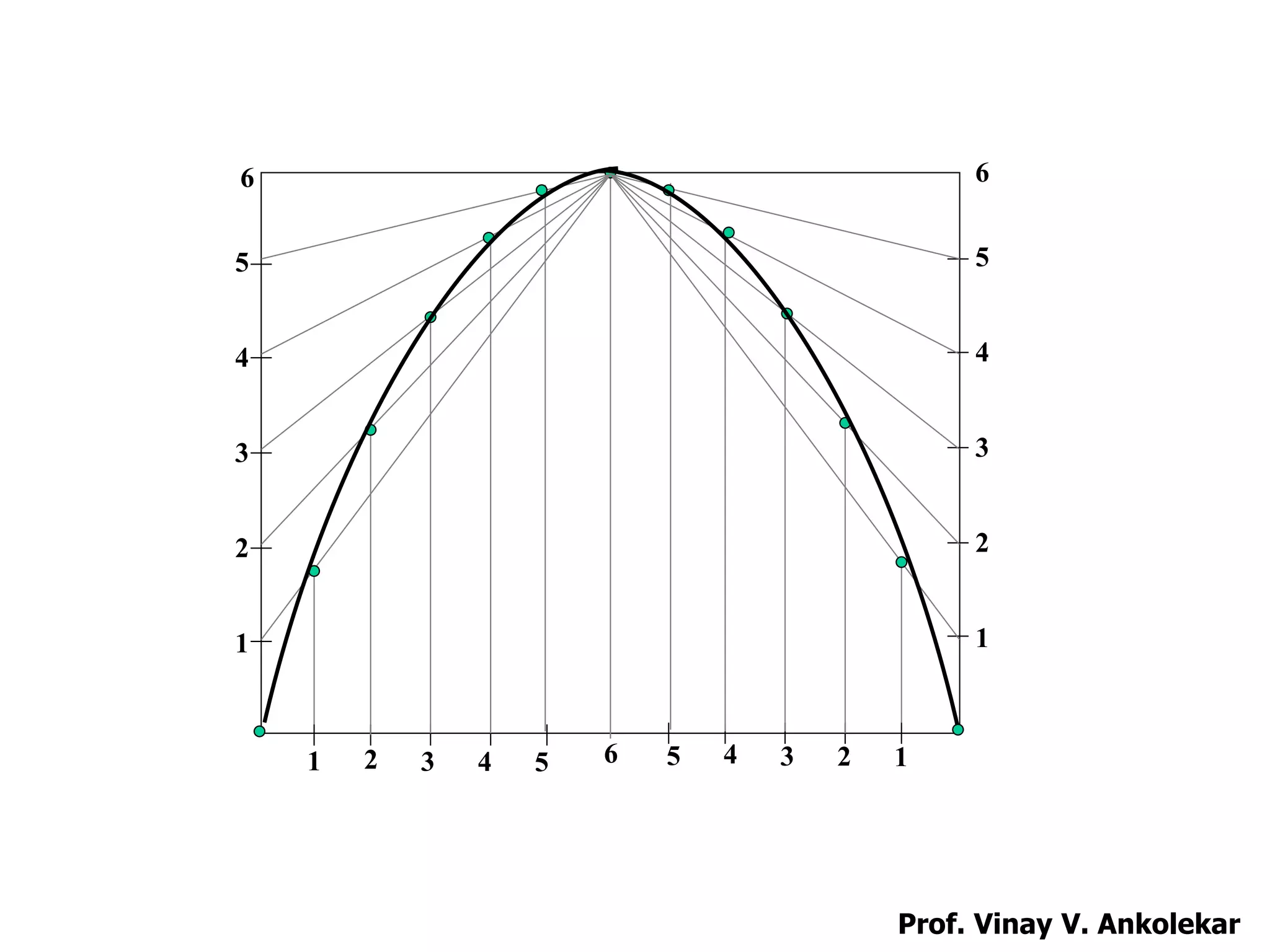
STEPS:
1.Draw rectangle of above size and divide it in two equal
vertical parts
2.Consider left part for construction . Divide height and length
in equal
number of parts and name those 1,2,3,4,5& 6
3.Join vertical 1,2,3,4,5 & 6 to the top center of rectangle
4.Similarly draw upward vertical lines from horizontal1,2,3,4,5
And wherever these lines intersect previously drawn inclined
lines in sequence Mark those points and further join in smooth
possible curve.
5.Repeat the construction on right side
rectangle also. Join all in sequence.
This locus is Parabola.
.
Prof. Vinay V. Ankolekar
1
2
3
4
5
6
1 2 3 4 5 6
1
2
3
4
5
6
5 4 3 2 1
Prof. Vinay V. Ankolekar
1
2
3
4
5
6
1 2 3 4 5 6
1
2
3
4
5
6
5 4 3 2 1
Prof. Vinay V. Ankolekar
PARABOLA
DIRECTRIX-FOCUS METHOD
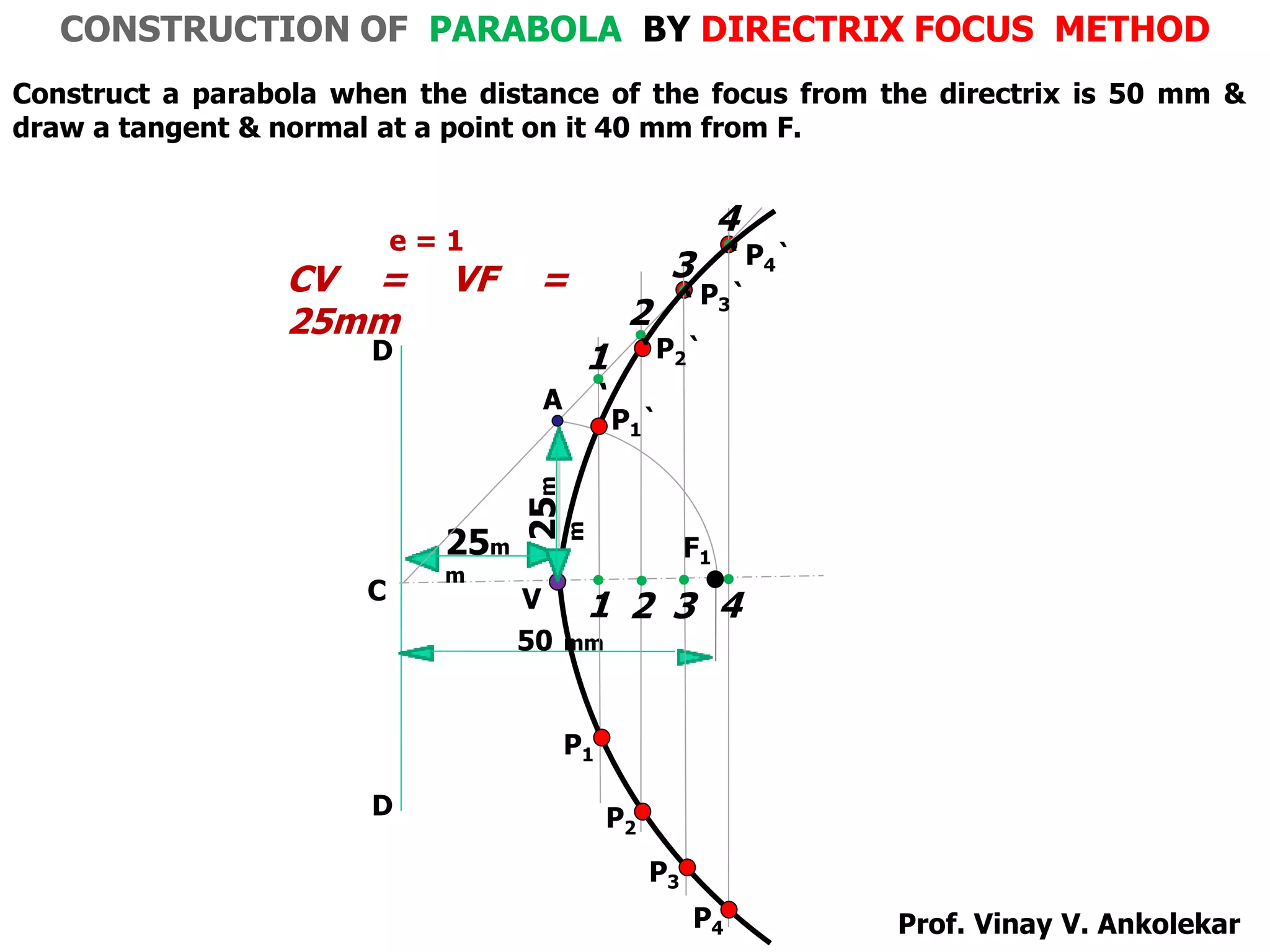
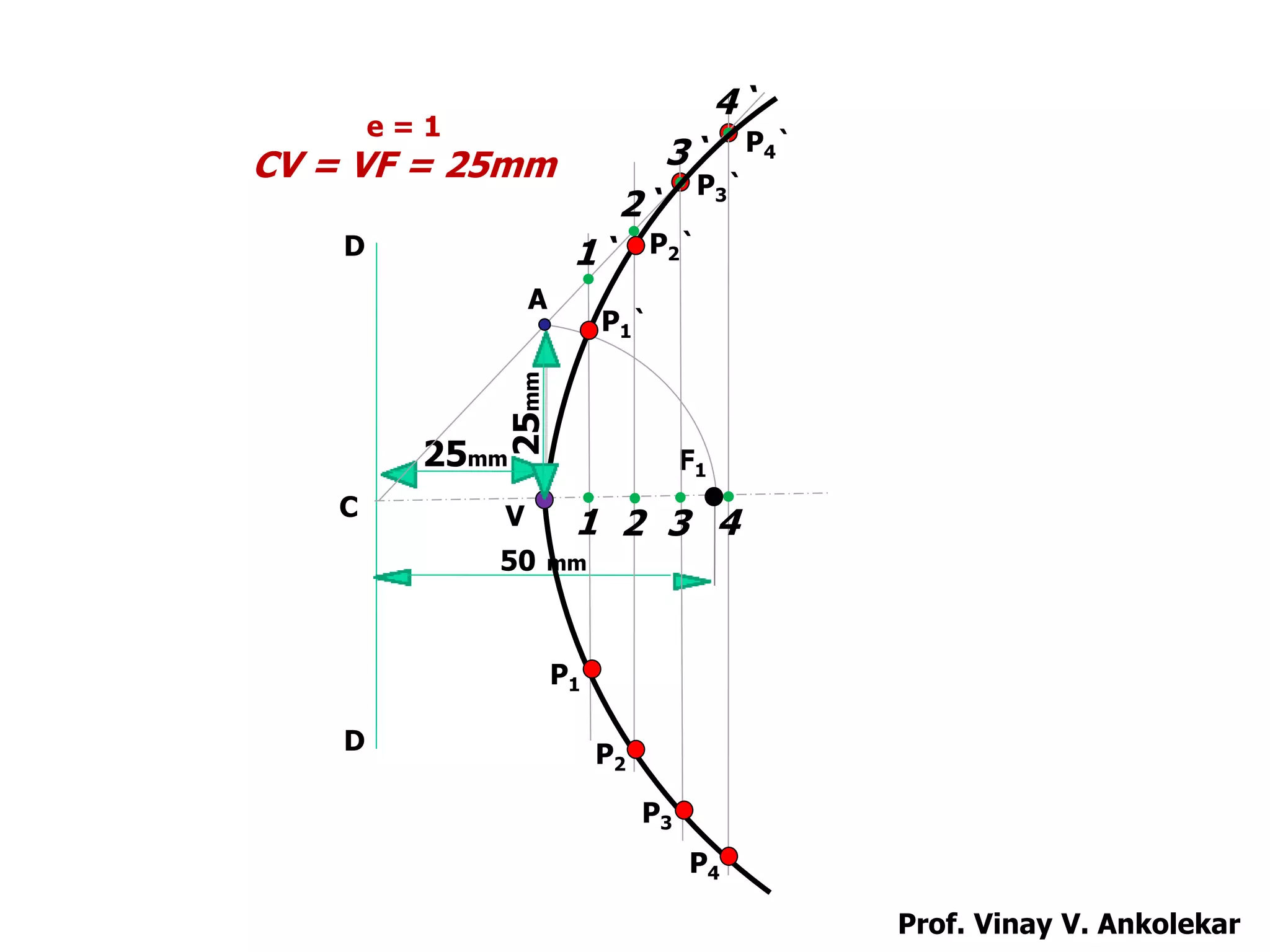
PROBLEM 9:
Point F is 50 mm from a vertical straight line AB.
Draw locus of point P, moving in a plane
such that it always remains equidistant from
point F and line AB.
Prof. Vinay V. Ankolekar
50 mm
25m
m
V
F1
C
D
D
A
P1`
1
`
2
`
3
`
4
`
4321
P1
P2`
P3`
P4`
P2
P3
P4
e = 1
CV = VF =
25mm
25m
m
CONSTRUCTION OF PARABOLA BY DIRECTRIX FOCUS METHOD
Construct a parabola when the distance of the focus from the directrix is 50 mm &
draw a tangent & normal at a point on it 40 mm from F.
Prof. Vinay V. Ankolekar
50 mm
25mm
V
F1
C
D
D
A
P1`
1`
2`
3`
4`
4321
P1
P2`
P3`
P4`
P2
P3
P4
e = 1
CV = VF = 25mm
25mm
Prof. Vinay V. Ankolekar
HYPARABOLA
Prof. Vinay V. Ankolekar
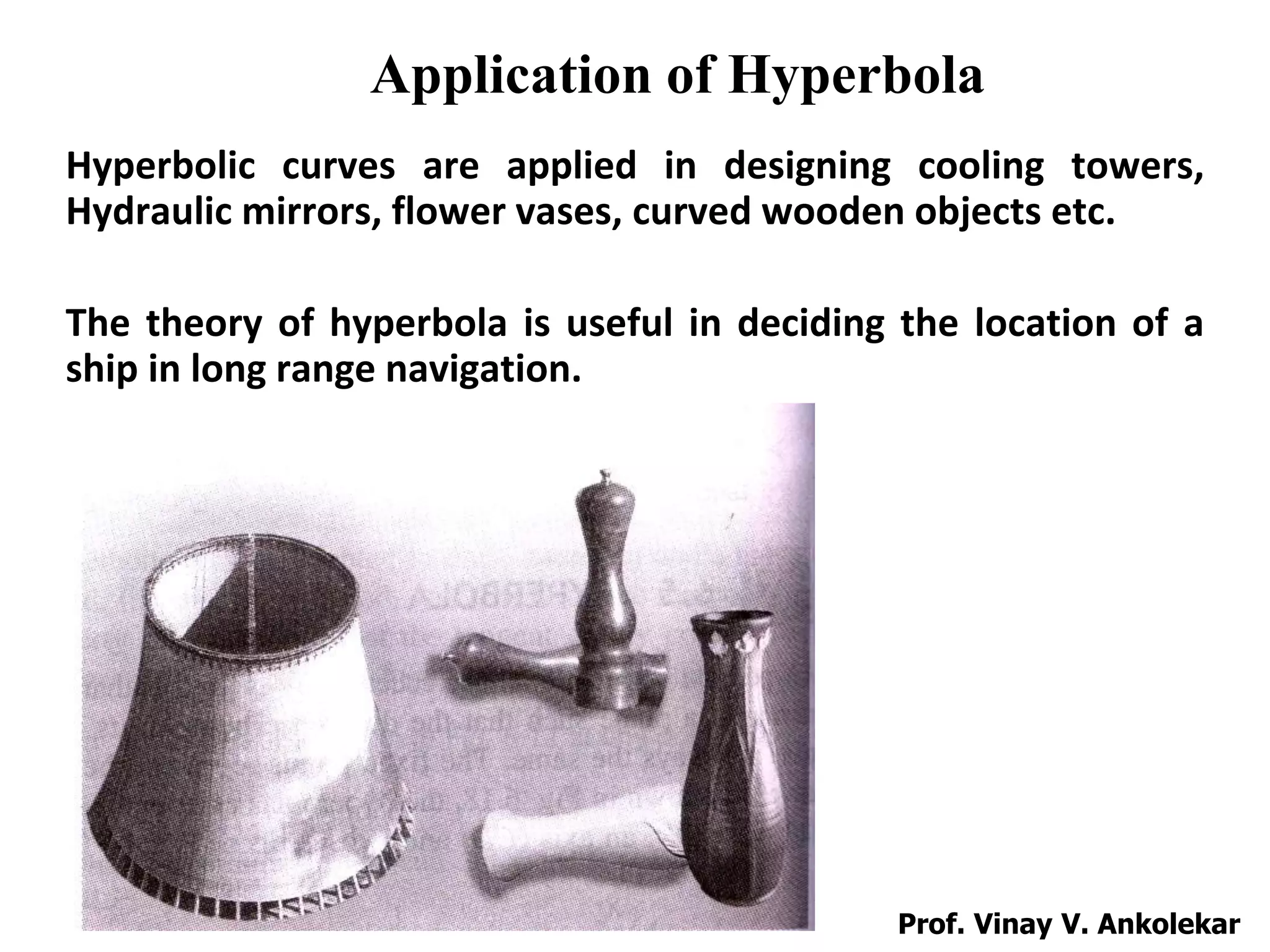
Application of Hyperbola
Hyperbolic curves are applied in designing cooling towers,
Hydraulic mirrors, flower vases, curved wooden objects etc.
The theory of hyperbola is useful in deciding the location of a
ship in long range navigation.
Prof. Vinay V. Ankolekar
HYPERBOLA
DIRECTRIX FOCUS METHOD
PROBLEM 4 :- POINT F IS 50 MM FROM A LINE AB. A
POINT P IS MOVING IN A PLANE SUCH THAT THE
RATIO OF IT’S DISTANCES FROM F AND LINE AB
REMAINS CONSTANT AND EQUALS TO 2/3 DRAW
LOCUS OF POINT P. { ECCENTRICITY = 2/3 }
Prof. Vinay V. Ankolekar
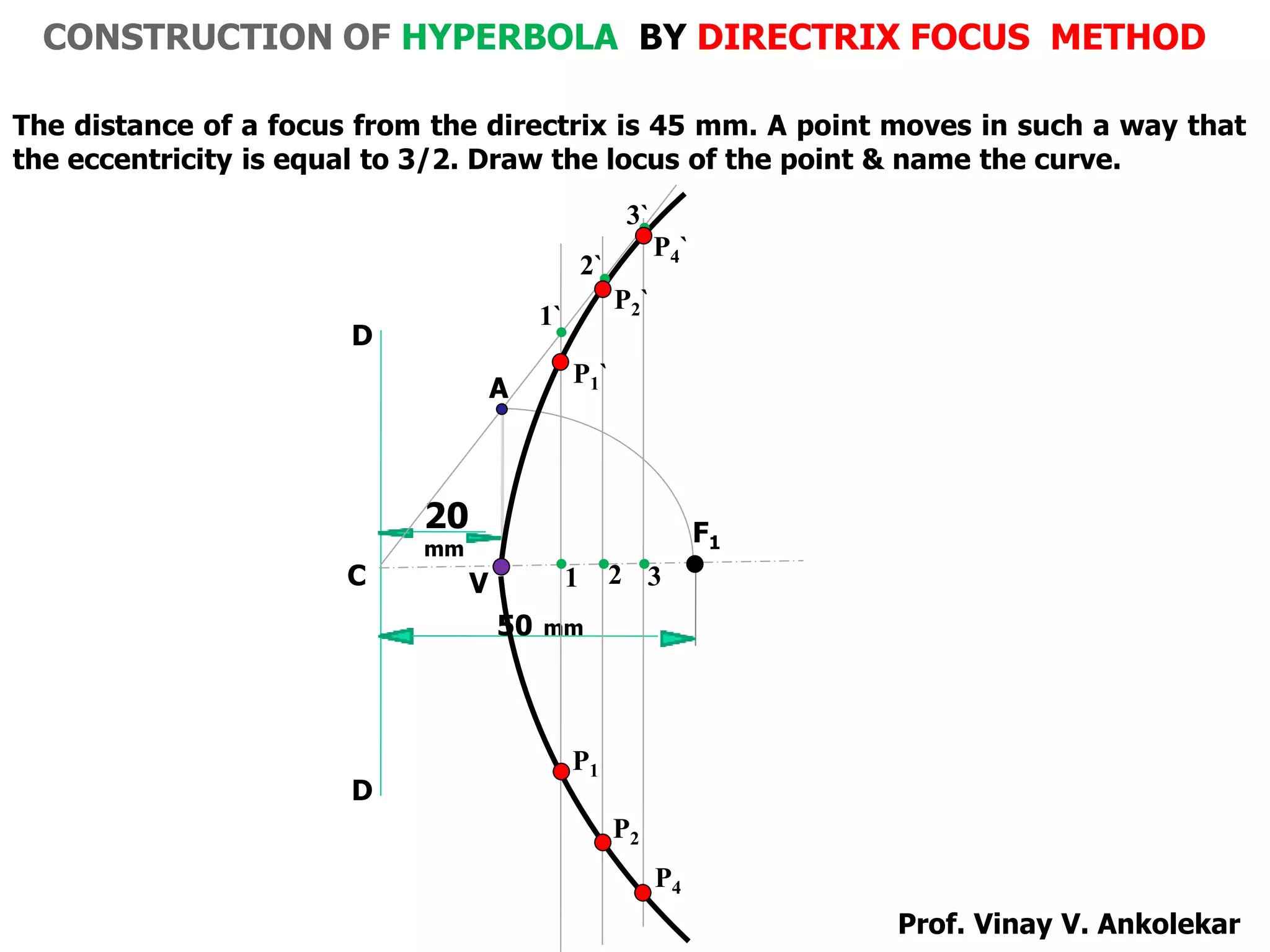
CONSTRUCTION OF HYPERBOLA BY DIRECTRIX FOCUS METHOD
The distance of a focus from the directrix is 45 mm. A point moves in such a way that
the eccentricity is equal to 3/2. Draw the locus of the point & name the curve.
50 mm
C
D
D
20
mm
V
F1
A
P1
1
1`
2 3
2`
3`
P1`
P4
P2
P2`
P4`
Prof. Vinay V. Ankolekar
THANK YOU
From:
Prof. Vinay V. Ankolekar

Final engineering curves vva

  • 1.
    Presentation By Prof. Vinay V.Ankolekar vinay.ankolekar@gmail.com 9404735591 Department of Mechanical Engineering Bhivarabai Sawant College of Engineering & Research Pune, Maharastra ENGINEERING CURVES Part- I {Conic Sections}
  • 2.
    ENGINEERING CURVES Part- I{Conic Sections} ELLIPSE 1.Concentric Circle Method 2.Rectangle Method 3.Oblong Method 4.Arcs of Circle Method 5.Rhombus Method 6.Basic Locus Method (Directrix – focus) HYPERBOLA 1.Rectangular Hyperbola (coordinates given) 2 Rectangular Hyperbola (P-V diagram - Equation given) 3.Basic Locus Method (Directrix – focus) PARABOLA 1.Rectangle Method 2 Method of Tangents ( Triangle Method) 3.Basic Locus Method (Directrix – focus) Prof. Vinay V. Ankolekar
  • 3.
    CONIC SECTIONS ELLIPSE, PARABOLAAND HYPERBOLA ARE CALLED CONIC SECTIONS BECAUSE THESE CURVES APPEAR ON THE SURFACE OF A CONE WHEN IT IS CUT BY SOME TYPICAL CUTTING PLANES. Section Plane Through Generators Ellipse Section Plane Parallel to end generator. Section Plane Parallel to Axis. Hyperbola Prof. Vinay V. Ankolekar
  • 4.
    Prof. Vinay V.Ankolekar
  • 5.
    CIRCLE Section plane isparallel to the base . or perpendicular to the axis of the cone. Prof. Vinay V. Ankolekar
  • 6.
    ELLIPSE Section plane isinclined to the axis of cone such that angle made by the section plane with the axis is greater than angle made by the generator of the cone with axis. Prof. Vinay V. Ankolekar
  • 7.
    PARABOLA Section plane isinclined to the axis & parallel to one of the generator of the cone. Prof. Vinay V. Ankolekar
  • 8.
    HYPERBOLA Section plane isinclined to the axis of cone such that angle made by the section plane with the axis is smaller than angle made by the generator of the cone with axis. Prof. Vinay V. Ankolekar
  • 9.
    RECTANGULAR HYPERBOLA Section planeis parallel to the axis of the cone and not passing through the apex. Prof. Vinay V. Ankolekar
  • 10.
    TRIANGLE Section plane passingthrough the apex of the cone. Prof. Vinay V. Ankolekar
  • 11.
    F1 C D D AXIS A F2Ve VpVh Ve DIRECTRIX CONIC TERMINOLOGY Focus –A fixed point [F1 AND F2] Directrix – A fixed straight line [D-D] Axis – A line passing through the focus and perpendicular to the directrix [C-A] Vertex – The point at which conics intersects the axis [Ve Vp and Vh] Prof. Vinay V. Ankolekar
  • 12.
    Prof. Vinay V.Ankolekar
  • 13.
    F1 C D D AXIS A F2Ve VpVh Ve DIRECTRIX e = VF/ VC e < 1 ---- ellipse ----- [ (VF / VC) < 1 ] e = 1 ---- parabola ----- [ (VF / VC) = 1 ] e > 1 ---- hyperbola ---- [ (VF / VC) > 1 ] Prof. Vinay V. Ankolekar
  • 14.
  • 15.
    Applications of Ellipse 1.Arches of Bridges. 2. Pipes Bends. 3. Elliptical Gears. 4. The ends of Cylindrical Tanks are elliptical in shape. 5. Elliptical Path is followed by earth around the sun. 6. Milk Tankers. 7. Shape of Tunnels [Entry/Exit] 8. To measure the time required to cover the distance [e.g. Missiles] 1. Designing of Kitchen Accessories [e.g. Hot Pot, Steel pots ] 2. Automobile Parts [e.g. Petrol Tanks, Head lights] 3. Shape of Eggs. Prof. Vinay V. Ankolekar
  • 16.
    Application of Ellipse Prof.Vinay V. Ankolekar
  • 17.
    Arches, Bridges, EllipticalGears, Fancy Lamps, Bullet Nose, Stuffing Box. Prof. Vinay V. Ankolekar
  • 18.
    Application of Ellipse Prof.Vinay V. Ankolekar
  • 19.
    Application of Ellipse Prof.Vinay V. Ankolekar
  • 20.
    Prof. Vinay V.Ankolekar
  • 21.
    Problem 1 Draw ellipseby Rectangle method. Take major axis 100 mm and minor axis 70 mm long. ELLIPSE BY RECTANGLE METHOD Prof. Vinay V. Ankolekar
  • 22.
    Steps: 1 Draw arectangle taking major and minor axes as sides. 2. In this rectangle draw both axes as perpendicular bisectors of each other.. 3. For construction, select upper left part of rectangle. Divide vertical small side and horizontal long side into same number of equal parts. ( here divided in four parts) 4. Name those as shown.. 5. Now join all vertical points 1,2,3,4, to the upper end of minor axis. And all horizontal points i.e.1,2,3,4 to the lower end of minor axis. 6. Then extend C-1 line up to D-1 and mark that point. Similarly extend C-2, C-3, C-4 lines up to D-2, D-3, & D-4 lines. 7. Mark all these points properly and join all along with ends A and D in smooth possible curve. Do similar construction in right side part along with lower half of the rectangle. Join all points in smooth curve. It is required ellipse. Prof. Vinay V. Ankolekar
  • 23.
  • 24.
  • 25.
    ELLIPSE DIRECTRIX-FOCUS METHOD PROBLEM 2:- POINTF IS 50 MM FROM A LINE AB. A POINT P IS MOVING IN A PLANE SUCH THAT THE RATIO OF IT’S DISTANCES FROM F AND LINE AB REMAINS CONSTANT AND EQUALS TO 2/3 DRAW LOCUS OF POINT P. { ECCENTRICITY = 2/3 } Prof. Vinay V. Ankolekar
  • 26.
    50 mm 30 mm V F1 C D D 450 A 1 23 4 5 6 7 8 B 1` 2` 3` 4` 5` 6` 7` 8` V` P1 P2 P3 P4 P5 P6 P7 P8 P`8 P` 7 P`1 P`2 P`3 P`4 P`5 P` 6 CONSTRUCT AN ELLIPSE WHEN THE DISTANCE OF THE FOCUS FROM THE DIRECTRIX IS EQUAL TO 50 MM & ECCENTRICITY IS 2/3. ALSO DRAW TANGENT & NORMAL TO THE ELLIPSE AT ANY POINT. CONSTRUCTION OF AN ELLIPSE BY DIRECTRIX FOCUS METHOD AXIS DIRECTRIX Prof. Vinay V. Ankolekar
  • 27.
    50 mm 30 mm VF1 C D D 450 A 1 2 3 4 5 6 7 8 B 1` 2` 3` 4` 5` 6` 7` 8` V` P1 P2 P3 P4 P5 P6 P7 P8 P`8 P`7 P`1 P`2 P`3 P`4 P`5 P`6 AXIS DIRECTRIX Prof. Vinay V. Ankolekar
  • 28.
  • 29.
    Application of Parabola TheParabolic curves are used on light reflectors, solar concentrators, Tele- communication dishes, Sound reflectors, Parabolic mirrors Cantilever beams, Missiles trajectory etc. Prof. Vinay V. Ankolekar
  • 30.
    The Projected missilesfollow the parabolic path. Prof. Vinay V. Ankolekar
  • 31.
    Light reflector for parallelbeams used in the head lamps of the vehicle are parabolic in shape. LIGTH REFLECTOR Prof. Vinay V. Ankolekar
  • 32.
    The movement ofobjects in space under the influence of gravity follow a parabolic path. Prof. Vinay V. Ankolekar
  • 33.
    PARABOLA RECTANGLE METHOD PROBLEM 3: ABALL THROWN IN AIR ATTAINS 100 M HEIGHT AND COVERS HORIZONTAL DISTANCE 150 M ON GROUND. Draw the path of the ball (projectile) Prof. Vinay V. Ankolekar
  • 34.
    STEPS: 1.Draw rectangle ofabove size and divide it in two equal vertical parts 2.Consider left part for construction . Divide height and length in equal number of parts and name those 1,2,3,4,5& 6 3.Join vertical 1,2,3,4,5 & 6 to the top center of rectangle 4.Similarly draw upward vertical lines from horizontal1,2,3,4,5 And wherever these lines intersect previously drawn inclined lines in sequence Mark those points and further join in smooth possible curve. 5.Repeat the construction on right side rectangle also. Join all in sequence. This locus is Parabola. . Prof. Vinay V. Ankolekar
  • 35.
    1 2 3 4 5 6 1 2 34 5 6 1 2 3 4 5 6 5 4 3 2 1 Prof. Vinay V. Ankolekar
  • 36.
    1 2 3 4 5 6 1 2 34 5 6 1 2 3 4 5 6 5 4 3 2 1 Prof. Vinay V. Ankolekar
  • 37.
    PARABOLA DIRECTRIX-FOCUS METHOD PROBLEM 9: PointF is 50 mm from a vertical straight line AB. Draw locus of point P, moving in a plane such that it always remains equidistant from point F and line AB. Prof. Vinay V. Ankolekar
  • 38.
    50 mm 25m m V F1 C D D A P1` 1 ` 2 ` 3 ` 4 ` 4321 P1 P2` P3` P4` P2 P3 P4 e =1 CV = VF = 25mm 25m m CONSTRUCTION OF PARABOLA BY DIRECTRIX FOCUS METHOD Construct a parabola when the distance of the focus from the directrix is 50 mm & draw a tangent & normal at a point on it 40 mm from F. Prof. Vinay V. Ankolekar
  • 39.
  • 40.
  • 41.
    Application of Hyperbola Hyperboliccurves are applied in designing cooling towers, Hydraulic mirrors, flower vases, curved wooden objects etc. The theory of hyperbola is useful in deciding the location of a ship in long range navigation. Prof. Vinay V. Ankolekar
  • 42.
    HYPERBOLA DIRECTRIX FOCUS METHOD PROBLEM4 :- POINT F IS 50 MM FROM A LINE AB. A POINT P IS MOVING IN A PLANE SUCH THAT THE RATIO OF IT’S DISTANCES FROM F AND LINE AB REMAINS CONSTANT AND EQUALS TO 2/3 DRAW LOCUS OF POINT P. { ECCENTRICITY = 2/3 } Prof. Vinay V. Ankolekar
  • 43.
    CONSTRUCTION OF HYPERBOLABY DIRECTRIX FOCUS METHOD The distance of a focus from the directrix is 45 mm. A point moves in such a way that the eccentricity is equal to 3/2. Draw the locus of the point & name the curve. 50 mm C D D 20 mm V F1 A P1 1 1` 2 3 2` 3` P1` P4 P2 P2` P4` Prof. Vinay V. Ankolekar
  • 44.