1
Acknowledgements
First and foremost, I would like to thank my husband Aidas for his support and
chivalrous take-over of my part of the daily burden. I would like to thank my two sons,
who were real troopers from beginning till the end of this process – their independence,
wit, wisdom and support make me one proud mamytė. Learning is a life-long process
and I hope you will understand my words and follow my footsteps when your time
comes.
Secondly, I would like to express my gratitude to Professor Dr. Wendy van den Broeck.
Her advice was my guiding star in sometimes very dark nights of going through the
writing process. Dr. van den Broeck sets high standards and meets them!
I would also like to thank all the respondents, who found and gave their precious time to
share their insights, experiences and ideas. This research would not have happened
without you!
Finally, I would like to thank my friends who were happy and proud for me, who did not
forget me during a year of absence. To my friends, who felt inspired and motivated by
my choice to get back to studying.
Ačiū! Thank you! Dank je well!
2
Index
List of tables, figures and appendices 5
Abstract 6
Introduction 8
Research question 9
Social and scientific relevance 12
Part 1: Literature Review 15
Chapter 1: Sharing Economy 16
1.1. Many faces of the sharing economy 16
1.2. Defining sharing economy 17
1.3. Categories of the sharing economy 22
Chapter 2: Motivation to participate in the sharing economy 25
2.1. Individualistic reasons for participating 27
2.1.1. Economic reasons 27
2.1.2. Status boost 27
2.1.3. Therapeutic benefit 28
2.2. Social- Environmental reasons 29
2.2.1. Sharing – natural behaviour 29
2.2.2. Sustainability 29
2.2.3. Enjoyment 30
3
Chapter 3: Uber 31
3.1. Uber – a part of the sharing economy? 35
3.2. Creating new jobs? 37
3.3. Respecting passenger safety regulations? 37
Chapter 4: Who is the Uber user? 38
Chapter 5: Conclusions 40
Part 2: Empirical framework 42
Chapter 6: Methodological research design 43
6.1. Research Design. Qualitative research 43
6.2. Single Case Study 45
6.3. Data Collection 46
6.3.1. Convenience sampling 46
6.3.2. Semi-structured Interviews 47
6.4. Overview of Interview respondents 48
6.5. Data Analysis 51
6.6. Limitations and delimitations 53
Chapter 7: Results 55
7.1. The coding tree 56
Chapter 8: Concept 57
Chapter 9: Uber –positive motivation 60
9.1. Price 61
9.2. Innovation 62
9.3. Accessibility / availability 63
9.4. Trust / ratings 64
4
9.5. Customer care 67
9.6. Application (app) 68
9.6.1. Ease of use 69
9.6.2. Travel expenses management 69
9.6.3. Time management 69
9.6.4. Route Transparency 70
9.7. Image 70
9.8. Socio-environmental impact 72
9.9. Concerns 73
Chapter 10: Uber-negative perception 76
10.1. Image 77
10.2. Socio-economic impact 79
10.3. Price 82
10.4. Customer Care 84
10.5. Trust / ratings 84
10.6. Innovation 85
10.7. Legality 86
10.8. Conclusion 87
Chapter 11: Strengths and key obstacles to success 88
11.1. Strengths 89
11.2. Weaknesses 90
11.3. Opportunities 91
11.4. Threats 92
Conclusion 93
Bibliography 98
Appendices 114
5
Tables, figures and appendices
TABLE
Table 1: Description of the interview respondents 50
FIGURES
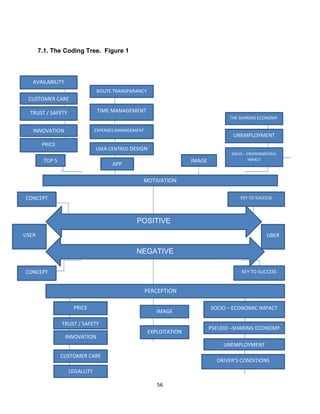
FIGURE 1: Coding tree 56
APPENDICES 114
Appendix 1 Audio files of in-depth interviews
Appendix 2 Transcriptions in-depth interviews
Appendix 3 Detailed Coding
6
Abstract
This qualitative research focuses on understanding the reasons why certain people
choose to use Uber and the reasons certain people do not, as well as what lessons can
be learned by Users, similar services and Uber itself.
Uber is not only one of the best known actors among the newly emerged online
platforms, but with 10 million downloaded apps and operations in nearly 200 cities of the
world, Uber is often considered one of the most controversial online platforms. The
study focuses on determining what are the most important characteristics of this
platform that make respondents become customers or not to become their customers,
as well as what Uber’s key success factors are and on the failures to avoid.
This study has been built on 20 qualitative in–depth interviews with Uber users and non-
users. The main findings include price, image, trust, innovation and socio-economic-
environmental factors as the determining ones in respondents’ motivation and
perception regarding Uber. The researcher also discovered that the same factor (e.g.
mutual ratings) may play a motivating and a demotivating role insofar as the users’
choice to use this platform or not is concerned. The extrapolation of opinions is
seemingly clear – even seemingly homogeneous opinions divide at one point or
another.
The research allowed identifying that opinions diverge not only about Uber per se. Uber
is regarded as a part of the sharing economy, which subsequently evoked positive
motivation to participate or negative perception.
7
Yet one more finding involves the concept of the sharing economy. The concept of the
sharing economy is so broad and multidimensional and overlapping, that it is not easy
to define it precisely. Multiple terms ( “sharing economy”, collaborative consumption”,
“pseudo sharing”, “on-demand consumption”, “access economy” etc.) are being used
to define a swarm of existing and developing activities use information technologies to
link service and good providers with service and goods seekers avoiding intermediaries.
However, what happens even more often is that all online-enabled activities of matching
supply and demand are swept under the title of the sharing economy, even though there
is no sharing collaboration involved. Having a single definition on what the sharing
economy is might contribute to a more successful regulation and administration of
platforms. Moreover, it might bring more clarity to user’s participation motivation.
Lastly, referring to the lessons that can be learned from the Uber experience, the main
finding involves the importance of customer care as well as adhering to the existing
laws and country-specific public relations when entering a new market or developing a
business activity.
Keywords: Uber, User, sharing economy, collaborative consumption, user,
user-motivation,
Number of words: 24761
8
Introduction
The previous forty years of the contemporary world witnessed information becoming
one of the paramount features of society (Webster, 2002). Predominance of information,
abundance of information technologies, manipulation and creation of information,
overall use of information technologies in the life of an individual, group, country, parts
of the world led to its name – Information Society. Dynamised by the Internet and
ubiquitous smartphones, society has experienced a series of changes. New
technologies gave a different shape and speed to information flows, everyday life, policy
making, privacy, labour market and provided countless new business patterns and
opportunities to be taken up. The rapid adoption of new technology has transformed
many aspects of our culture, commerce, education and communication (…) (Wallace,
S., Clark, M., White, J., 2012:1). The recent explosion of social media and social
networking, the notion of “[…] anywhere anytime being connected” (Webster, 2002:3)
enabled users to become creators of information. The feeling of engagement and
empowerment, technological tools and an overall access to social media networks and
platforms even led to social revolutions, like the Arab Spring in 2011 (Castells, 2012).
Emerging from the Information Society, a new mode of development, based on digital
technologies, overcoming time and space limits, allowing users to manage their
interests and activities globally in real time, was crystallized at the end of the twentieth
century. Thus, according to M. Castells, three pillars: time, space and technology, are
the basis of the new social structure -Network Society, “a social formation “where
personal micro-networks (…) project their interests in functional macro-networks
through the global set of interactions” (1996:416). Contrary to the assumption of being
a purely technological system, networks, for M. Castells, are networks of digital
technology- enabled communication, “space of flows” and “timeless time” (1996:378),
globalization processes which “evolve from multinational entities to international
networks” (1996:192). M. Castells (1996), states that globalization is a result of
9
interconnectedness of culture, power, production and experience that are constantly
affected by technological innovations, and global markets are shaped and changed by
information technologies i.e. power is no longer a top-down process coming from
corporations or governments, power lies in the network (with the ability to include or
exclude) that connects the users and enables the information flow.
The low cost of using and the wide reach of global networks increases the advantages
of e-commerce - entitling and enabling the development of new economic concepts,
business models and new customer habits.
Research Question
Sharing, which went alongside humanity through all its developmental stages, has
recently become an important player in the economy, relying fully on the power of social
networking, and information communication technologies in building their services.
Sharing economy is quite new to users and to providers. However, it is present and is
growing rapidly, making us grow and change with it.
The discourse on the sharing economy saw the light of the day in the middle of the first
decade of the 21st
century, as the rise of social technologies enabled the appearance of
a new business model. It is a new addition to the world of economy, but also to the
vocabulary of technology research and development, consumer rights, consumer
psychology, marketing and, of course, legislation (PWC, 2015).
„Sharing economy (also known as shareconomy or collaborative consumption) refers to
peer-to-peer-based sharing of access to goods and services (coordinated through
community-based online services)” state J. Hamari et al., (2015:3) and “is the response
to the legacy economy where we tend to be reliant on resources from outside of our
communities” (Orsi, 2013:1).
10
Information technology enables sharing economy to take a variety of forms – room
sharing platforms provide a possibility to access to rooms or venues (Airbnb,
Roomorama), cars and bikes (Wheelz, BlaBlaCar, Covoiturage), and taxi services
(Uber, Lyft) etc. Sharing economy differs from traditional markets because it is built on
peer-to-peer connections (Belk, 2014) and is aimed at providing individuals, enterprises,
and governments with information that enables the optimization of resources (Boyd &
Kietzmann, 2014).
Technological innovation and the development of the peer-to-peer economy has forced
more stagnant business models to look for ways to fix it in order to stay operable
(Geradin, 2015). The taxi industry is one of the best examples. Well protected by the
regulation of local authorities which limit the number of service-providing cars in nearly
any given district or a city, taxi services had barely no competition, which eventually
resulted in poor customer service, lack of vehicles, long waiting times, reluctance to
receive payment by credit card, to issue an invoice, absence of transparency in route
choice and price (Baanders and Canoy, 2010).
The author of the research, however, shares the opinion of J. Schor (2014) that
technology plays a role of a booster rather than of an initiator in the sharing economy. In
the sense, that ideas of sustainability, “utopian” (Schor, 2014:2) ideas of freedom from
corporations, communal living as well as decline of the full-time employment as a result
of the economic crisis in 2009 pushed people to diversify their income sources, look for
ways to make use of the idle assets as well as for ways to access them.
Until quite recently “it seemed that this [taxi] sector was not called to evolve and that the
users would have to put up with the service as it is” (Geradin, 2015:2). Lyft, Sidecar,
Jump, Zipcar and Uber car- or “online-enabled car transportation services” (Geradin,
2015:1), the online platforms that connect drivers and passengers, challenged the static
taxi industry.
11
One of the best known actors (10 million app installations) in the online-enabled car
sharing economy is Uber. Its sleek, black, user-friendly mobile app, catchy name,
customer-oriented service and „competitive rates“ (Silverstein, 2014:1) „without the
financial, emotional, or social burdens of ownership“ (Eckhardt & Bardhi 2015:1) have
resulted in 10 million app installations.
Interestingly, despite the company’s popularity, consumers have seemingly divided into
two groups regarding Uber: trust-and-use or disparage-and-refuse to use it. Each group
seems to have very strong arguments and opinions. Based on the qualitative research
consisting of the twenty in-depth interviews the researcher tries to understand their
motivations by asking the research question:
“What are the most important factors that determine users’ decision to use Uber
or not to use it?”
As the research question may appear too broad, sub-questions have been added in
order to narrow the focus of the study:
Sub-question 1: What does Uber represent to the User?
The first sub-question is seeking to identify the perception of Uber by the users. The
researcher is interested in what aspects constitute a very positive and a very negative
image of Uber in people’s perception.
Sub-question 2: What lessons can be learned from the Uber experience?
The second sub-question seeks to crystalize a number of key success factors as well as
a number of key failure factors of Uber from the user perspective. It will look to find out
why and how and by what the users were affected by the company’s business routine
that motivated or, on the contrary, discouraged them from using this particular online
12
platform, as the findings may potentially benefit other companies, or Uber itself as far as
business development, customer service or communication strategy go.
The researcher was asking on both sub-questions during the in-depth interviews.
However, the research itself is focussed on the first sub-question, i.e. motivations to use
Uber, aspects that prevent people from using Uber as well as aspects that influence
people’s perception of Uber, while the second sub-question which works as a support
for the first sub-question and would play a concluding role in the research.
Social and Scientific Relevance
„In traditional markets, consumers buy products and gain ownership. In recent years, a
transition from ownership towards accessibility can be observed across a wide variety of
markets. Whereas in the conventional situation consumers would buy products and
become the owners, in an accessibility-based system consumers pay for temporary
access-rights to a product” (Dervojeda et al., 2013:2).
With the economic crisis, unemployment rates have risen and the purchasing power of
consumers has dropped. Ubiquitous technology, environmentalist warnings, increasing
anti-globalist thinking, community building goals and micro-entrepreneurship ideas
(Dervojeda et al., 2013), have shifted consumers to peer-to-peer business models
which are centred on consumer needs as well as social relevance, from the perspective
of a service provider and consumer.
Sharing might be applicable to almost any consumer owned property and
skills/capabilities and, therefore, the estimated potential of the sharing economy is
significant, with potential annual growth exceeding 25 % (PWC, 2015).
„Research by companies in the sharing economy shows supporting evidence like: out of
1 billion cars in the world, 740 million are only occupied by just 1 person; an average
13
house is filled with USD 3,000 worth of unused items, and 69% of interviewed owners
would be happy to share these items for a refund; and 80% of people indicate that
sharing makes them happy” (Contreras, 2011:1).
„The sharing economy is covering many different industries, each with its own market
potential” (Dervojeda et al., 2013:7) – peer-to-peer lending, transportation, logging, skills
and task performance are among the most popular, funded and growing spheres
(Dervojeda et al., 2013).
Apart from the direct creation of new jobs through the hiring of new staff, companies
operating in the sharing economy also generate substantial amounts of indirect
employment (Dervojeda et al., 2013). Uber alone, for example, had 160,000 drivers in
2014 whereas in 2012 there were 0 drivers (Solomon, 2015).
Uber is regarded as the most controversial among the new business model
representatives. Several authors criticize Uber and Uber’s position in the sharing
economy: even though Uber would like to be called a representative of the sharing
economy, the ride or the car are not truly shared (Geradin, 2015), it is an access
economy rather than a sharing economy (Eckhardt & Bandhi, 2015) and „sharing“ for
Uber is „a gift from PR heaven“ (Teffer, 2015:2); Uber cultivates the approach “shoot
first, argue later“ in new markets and circumvents the rules protecting both employees
and customers“ (Hooker, 2015:2); lags behind on customer data security rules
(Mueffelmann,2015). Furthermore, due to lack of an accurate definition, it is unclear
whether Uber is a representative of the sharing economy or simply “taking advantage of
the positive and progressive connotation” [of the sharing economy] (Meelen & Frenken,
2015:2). Claiming to be a high-tech company, Uber claims to have a right to not follow
taxi and labour regulations. On top of that, despite being banned in several European
cities and major cities of Brazil, Uber continues being the leader of Internet-enabled
services, grows and generates profit.
14
Uber is one of the most popular among the online-enabled transportation platforms, it is
considered to be a controversial company: evokes different opinions about it and,
subsequently, attracts a lot of media attention. These reasons, in the opinion of the
researcher, make Uber an interesting case to study.
Implications of this research could help Uber and other sharing economy businesses
tailor their communication and branding as well, as it may help potential users to make
an informed decision.
In the Literature Review chapter the researcher will focus on the different definitions of
the sharing economy, on people’s possible motivation to participate in the sharing
economy. Also, the researcher will present a case study of Uber as well as the profile
of the Uber user. Next the researcher will focus on the empirical research in which the
researcher has conducted 20 in-depth interviews with people who have a strong
negative and a strong positive opinion about Uber. The following chapter is built on the
SWOT (strengths, weaknesses, opportunities and threats) analysis. Lastly, the
researcher has presented the main conclusion of the research.
15
Literature Review
16
Chapter 1: Sharing economy
1.1. Many faces of the Sharing Economy
The Internet, presented as “the Great Transformer” (Manyika & Roxbourgh, 2011:1) has
opened new ways for economic interaction, like online shopping. New technologies are
said to have made communication faster; information more accessible, reduced
transaction costs and stimulated growth of online consumption, allowed new business
concepts, markets, and activities to appear. “Boosters claim the new technologies (…)
yield utopian outcomes – empowerment of ordinary people, efficiency, and even lower
carbon footprints” (Schor, 2014:1).
The first examples of online sharing were founded on more idealistic (creating a
community, contributing to the ecology) grounds. Wikipedia, an online encyclopaedia,
was found on the grounds of communal collaboration and contribution, with the goal of
creating communal access rather than an economic access. Later on, one might notice
a shift in motivations to creating economic value. Public relation companies, individuals
might be actually paid to contribute to Wikipedia. It might be interesting to observe a
general trend of creating an economic value in the modern sharing economy
representatives.
The birth of first the peer-to-peer market-places like eBay at first seemed like an odd
idea – because “(…) people were worried about security” (Standage, 2013:3.) and there
were a lot of differences with the regular shopping idea: instead of the habitual mode of
shopping interaction (where the customer and the seller are in real time personal
contact, the immediate and physical exchange of goods for money, the physical
presence of the shopping venue), the online shopper was left to wait and expect to
receive the paid-for purchase within a certain amount of time by postal delivery.
However, good overall online buying experience – 24 hour shopping option, access to
multiple shopping sources, return (sometimes even free return e.g. Zappos. com) and
17
refund policy stimulated buyers to explore online shopping and e-commerce companies
to grow – Amazon.com, Ebay.com. The information and commerce advantages
provided by the Internet were quickly taken by a plethora of establishments (private and
governmental (http://lrv.lt/en), small (www.restaurant-centenaire.be), local
(http://efarmz.be) and global corporations (www.sony.com) worldwide offering goods
and services round the clock online.
The 2009 recession changed the buying habits of many – “renting assets became more
economically attractive and similar initiatives proliferated” (Schor, 2014:3), which gave
start to the new economy- sharing economy, with big names in the industry like Uber,
Airbnb, Lyft, Lending Club, Blablacar, etc. R. Botsman and R.Rogers suggest that the
priority of the economy shifted to having access, rather than owning (2010).
Subsequently, five sectors which, according to the Price Waterhouse Cooopers
estimate, are the main revenue generators are peer-to–peer finance, online staffing,
accommodation, car sharing and music and video streaming, with 15 billion US dollars
in revenue by year 2015 and an estimated revenue of 336 billion US dollars by 2025
(The Sharing Economy, 2015-2016). The sharing economy grew to the extent, that
every fourth respondent in the combined research in the Unites States, Canada and the
United Kingdom had used collaborative consumption products or services at least once
in 2014 (Owyang, 2014).
1.2 Defining Sharing Economy
Sharing economy, in the words of J.Hamari et al., is an “(…) umbrella concept that
encompasses several ICT developments and technologies, among others collaborative
consumption, which endorses sharing the consumption of goods and services through
online platforms” (2015:3).
18
The engine of the traditional economy, according to R.Belk, is the transfer of ownership,
which defines a person, and works as an “extension of a man”, whereas the Internet
opened new ways to self-expression that try to prove the transfer of ownership being
rudimental (1988). Paradoxically, the Internet-enabled technologies gave a “second
chance” to archaic activities like sharing, swapping and collaborative vs individual
consumption. In addition, the Internet provided access and immediacy. Given a boost
by the global trends of anti-consumerism and environmentalism, it became a global
phenomenon and an economic trend.
As mentioned earlier, the concept of sharing is not novel. As a joint use of space or
resources, one might say, sharing was at the foundation of society. R. Belk defines
sharing as “the act and process of distributing what is ours to others for their use and/or
the act and process of receiving or taking something from others for our use”
(2007:126). The reasons for sharing can range from economic to ecological as well as
it can be acts of selflessness and kindness.
Subsequently, one may conclude, that sharing may have various aspects and has
somewhat became a constituent part of the society.
The definitions diverge upon what sharing economy is and what aspects of sharing are
more important over the others. Following the terminology established by R. Belk
(2010), sharing can be divided into “sharing in” – an act which would take place among
friends and family, friends and close circle of people and would result in “the recipient
becoming a pseudo-family” (2014:1596) enriching the recipient; “sharing out” (or,
according to J.Schor, “a stranger sharing” (2014:7)) – can be outlined as a process
taking place outside the close circle of people and is “intended as a one-time act”
(2014:1598), for example holding the elevator doors, lending a pen or contributing to a
charity event.
R. Belk (2010) insists that sharing may be furthermore sub-divided into “demand
sharing” – when the request cannot be rejected, for example when a child is asking
19
his/hers parent to be fed – a sub-division of “sharing in” in this particular example; a
stranger’s request for directions –“a demand sharing” as a sub-division of a the
“sharing out”.
“Open sharing” – all supplies are at the requester’s disposal without asking, for example
“when we tell a guest “My house is your house” (2010:1596) - a sub-division of “sharing
out” which by its spirit would be more expected among the close circle of people.
In general, sharing to R.Belk (2014) may be perceived in two ways – “transfer of
ownership and reciprocal exchange (…)”.
Y.Benkler, on the other hand, insists that sharing has a more idealistic meaning, it is an
act of “non-reciprocal behaviour” (2004:278). Importantly, neither of the mentioned
activities creates debt, notices R. Belk (2014).
N.A. John observes, that “sharing is a constitutive activity on Web 2.0” (2012:113) and
adds that “sharing” is “the word that describes the mode of our participation in the social
network sites and digital communication generally” (2013:3). Hence, as the sharing
economy became a communication feature in providing information about the potential
optimization of resources – goods and services, increases the value of them, it
becomes a type of economic activity – sharing economy.
“The term “Sharing economy” was first used by Professor Lawrence Lessig at Harvard
Law School in 2008” (Kim et al., 2015:2). However businesses and consumption
patterns that were based on the concept of where access to the item became a
commodity rather than an item itself had different names.
L. Gansky (2010) uses the term “The Mesh” to describe companies that use every
possible digital social platform to extract data in order to provide people with goods or
services they need without the responsibility and burden of ownership.
20
Bardhi and Eckhard (2015:2) (2012) suggest using terms of “access economy” or
“access-based consumption” as “when sharing is market-mediated – when a company
is an intermediary between consumers who do not know each other (…).[Instead of
buying,] consumers are paying to access someone else’s goods or services for a
particular period of time”
Furthermore, “pseudo-sharing” (Belk, 2014:1597) is suggested as the name for those
activities where “they often take on a vocabulary of sharing but are more accurately
short-term rental activities”.
J.Orsi finds it “difficult to define” (2013:1) what sharing economy involves but she goes
on with “it encompasses a broad range of activities, including worker cooperatives,
neighbourhood car-sharing, food cooperatives and renewable energy cooperatives.
These activities are tied together by a common means (…) and a common end (…)
(Orsi, 2015).
J.Schor admits, that “coming up with a solid definition (…) is nearly impossible” and as
the reason for that she mentions “that there is a great diversity among activities and
baffling boundaries drawn by participants”. Interestingly, without reinventing the wheel,
the author suggests to use the definitions provided by the innovators themselves, i.e.
“self-definition of the platforms” (2014:2) and definitions provided by the press (2014).
In the case study of K. Dervojeda et al., one can find a very practical and succinct
definition of the concept, as follows : ”This type of business model is not limited to
specific industry sectors, because it can, in theory, act as a broker between consumers,
for any consumer owned product or service” (2013:3). Simply, consumers perform roles
that were a businesses’ prerogative in the traditional economy.
R. Belk sees sharing economy as “use of contemporary access non-ownership models
of utilizing consumer goods and services as well as their reliance on the Internet, and
especially Web2.0, to bring it about” (Belk, 2013:1595).
21
H.Heinrichs (2013) sees the sharing economy as inevitably built on one important
platform that is social media and information technologies, which gave start to online
networks and interaction within them.
Furthermore, R.Botsman and R. Rogers (2010) summarize the fact that participating in
sharing economy allows participants to experience the advantages of ownership without
being the owner, as well as to reduce costs, responsibility and contribute to minimizing
effects on the environment; they add the importance of peer trust and reputation as
being the core drivers in the sharing economy. In addition to that, a customer “(…)pays
for access instead of ownership” (Botsman, 2015:4) and altogether may benefit from the
sense of community, contribution, being a part of something meaningful and humane
(Botsman, 2015).
R.Botsman (2015) later on argues that it is peers who interact directly with the service
or goods providers, circumventing traditional economic institutions with the website as a
third party.
John, N.A. finds sharing in connection with the Web 2.0 vocabulary, where it is common
to share photographs, music, and video games knowledge. The author notes, that “the
rhetoric of sharing in Web 2.0 implies interpersonal relations on the basis of trust,
understanding, openness (…) (2013:117). Furthermore, he adds “Sharing economies
are those in which money, or more specifically, the ability to make it, is not a relevant
factor in motivating participation” (2013:118) and gives Wikipedia as an example.
Even though the role of the Internet as the enabler of networks and consequently of the
sharing economy is obvious, Y.Benkler argues, that “technology does not determine the
level of sharing. It does, however, set threshold constraints on the effective domain of
sharing as a modality of economic production” (Benkler, 2006:121). Y.Benkler adds,
that “In a broad sense, the Internet itself is a giant pool of shared content that can be
22
accessed by anyone with the internet connection, a browser, and a government that
allows access to most of the Web content” (2014:1595).
From the presented definitions, one may conclude that the main drivers of the sharing
economy are information technology, which enables social media and online networks
as well as access to assets like time, space, skills and items (Botsman & Rogers, 2010)
rather than ownership-oriented market transactions. In addition to that, J. Kim et al.
(2015) suggest that benevolence is an important pillar in the sharing economy
foundation, allowing transactions like peer-to-peer crowdfunding and Food Swap to
happen.
The definitions are multiple and an individualistic interpretation of what sharing economy
is and what it is not may be observed. As there is no one official definition, it is quite
difficult to determine if a certain peer-to-peer platform might be regarded as belonging to
the sharing economy. For this Master’s Thesis, the researcher takes her own stand-
point. Based on the above-mentioned definitions, the researcher personally considers
“access” and “non-ownership model” (R. Belk (2013)) and the importance of peers who
interact directly with service providers, with the help of website circumventing traditional
economic institutions (Botsman, 2015) as the main elements in defining sharing
economy of services. As Uber is in line with these aspects of the sharing economy,
Uber, in this case, might be regarded as a part of the sharing economy.
1.3 Categories of the Sharing Economy
The amount and variety of terms correspond to the amount of new business’s aspects,
i.e. the new, creative ways assets and resources are being shared and accessed.
Sharing Economy is a vast subject, containing diverse activities and aspects of these
activities. It is somewhat necessary to divide the subject into categories that may lack
accuracy and/or may seem incomplete. This is, however, understandable and even
23
expected to a certain extent, because the subject of the sharing economy is still
developing and the time will tell where it will end up.
Firstly, it is important to note that peer-to-peer activities should be divided into
monetized and non-monetized. These initiatives are aimed at community or
neighbourhood building. The example of non-monetized activity could be communal
gardens or community centres, where volunteers offer activities to neighbourhood
children. J. Schor uses the tool-library initiative as a non-monetized peer-to-peer
activity example. She states, that “these efforts are typically neighbourhood-based in
order to enhance trust and minimize (…) cost (…)” (2014:3).
J.Schor (2014): has suggested four broad categories that sharing economy may fall
into “recirculation of goods, increased utilization of durable assets, exchange of
services, and sharing of productive assets” (2014:2).
The category of recirculation of goods is best illustrated by company names like eBay
and Craigslist, providing consumer to consumer and business to consumer sales
services via internet. They have introduced (J.Schor 2014) what later on became
characteristic to the sharing economy - reputational information of a service and/or
goods provider. Popular ideas stimulated the rise of similar platforms, such as ThredUp,
Threadflip. Online free exchange websites, like Swapsyle.com and Freecycle rapidly
found their way into the online community (Schor, 2014).
A second category of platform opened the doors to using durable goods and other
assets more intensively (Schor, 2014). Spare rooms, unused cars or an almost-never-
used chain-saw or even a photo camera, etc. made more sense to be rented out rather
than just standing idle, especially in time of recession. The examples include Airbnb,
Roomorama (matchmaking between travellers and those who offer a short term
accommodation); Uber, Lyft, Jump (pairing those who need a ride with the ones
providing a ride within the city limits); Covoiturage and BlaBlaCar (providing a platform
24
for those who need and offer “an inter-city transit”) (Freiberger & Sundararajan, 2015:3),
Funding Circle and Fixura (providing short term loans).
A third category, being service exchange is, as its title suggests, pairing service
providers and service seekers – TaskRabbit and Handy are the best known platforms to
serve as an example.
Sharing assets or space in order to enable production is the fourth category of the
sharing economy. Spaces like Betacowork or The Library – a co-working space in
Brussels. Initiatives like Sharebox.com - a tool sharing service; Skilshare.com – an
educational site providing access to skills and knowledge (J. Schor, 2014) could serve
as good examples of this category.
From the market orientation perspective, sharing economy platforms could be
categorized into “for-profit” – Airbnb, and “non-profit” – Data.gov and FoodSwaps.
Another possible categorization of the sharing economy is according to the market
structure, i.e. peer-to-peer platforms – lending platforms like Upstart and Funding Circle,
crowdfunding platforms – Kickstarter; business –to–peer platforms could be illustrated
with the example of Zipcar or BMW carsharing (Schor, 2014).
The concept of collaborative consumption may be regarded as a form of the sharing
economy, where traditional market activities, like lending, sharing, trading, swapping,
bartering (Botsman &Rogers, 2010) are „being reinvented” and accelerated through the
latest technologies and peer-to-peer marketplaces(…)” (Botsman &Rogers, 2010:4;
John, 2013)”.
R.Belk emphasizes that in the definition of collaborative consumption one should always
include people “coordinating acquisition and distribution for a fee” (2014:1597).
Furthermore, R.Belk calls collaborative consumption “a middle ground “(2014:1597)
between sharing and traditional market ownership exchange and/ or “faux sharing” or
“pseudo-sharing”, because, despite the fact that there is a word “sharing” in the title
25
(e.g. ride sharing), the business model they are operating on is that of short- term
renting (2014).
As far as Uber is concerned, we see that Uber fits in to the categories II (use of durable
goods and assets) as well as category III (pairing service providers and service
seekers). On top of that, Uber is, following the above mentioned categories, a “for –
profit” peer-to-peer platform. Uber also fits into the frames of the collaborative
consumption, or, more precisely – “faux sharing”, where the platform is taking a fee for
coordinating the driver/passenger pairing. However, if we assume that collaborative
consumption is a part of the sharing economy, the researcher chooses to accept that
Uber is a part of the sharing economy despite inconsistencies in the semantics and
terminology.
The next chapter is built on description and illustration of the motivations (individualistic
and socio-environmental) people might have in order to participate in the sharing
economy.
Chapter 2: Motivation to participate in the sharing economy
The public stance towards ownership and consumption has changed over the past
decade. The societal, environmental, developmental, ethical problems and concerns
(Hamari et al., 2015) boosted users’ and service providers’ motivation to look for
alternative ways to consume. Financial restraints due to economic crisis of 2008
encouraged people to look back at communities and the opportunities they can provide
as well as to find new ways to generate income. Idle assets, spare time, skills and the
guaranteed exposure to the Internet created a new wave -- the sharing economy –
around the world. Access-driven businesses accelerated, became the “mega - trend”
(Alsever, 2012). Forbes has estimated that “revenue flowing through the sharing
26
economy directly into people’s wallets will surpass 3.5 billion US dollars, with growth
exceeding 25%” (Geron, 2013:1).
As discussed earlier, sharing has been an integral part of society on a smaller or
grander scale; sharing has been important in order to survive and in order to grow, to
progress as a society. Sharing should not only be associated with pre-modern
societies; such practices are still used in families and close networks, it is especially
common in financially disadvantaged communities, as well as minority communities
(Schor, 2014).
Introduction of Internet enabled smart technology (the Internet itself is fundamentally
based on the concept of sharing and collaborative consumption) gave a new boost to
the concept of sharing, and made sharing trendy and fun. Moreover, sharing turned into
movement, a response to overconsumption, excess, anti-capitalist, calling for pro-
environmentalist thinking (Schor, 2014).
However, J.Humari et al. notice, that “despite of the evident importance, there is a lack
of quantitative studies on motivational factors that affect consumers’ attitudes and
intentions towards the collaborative consumption” (2015:3).Nevertheless, Humari et al.
(2015), single out two main camps among the collaborative consumption communities -
one would be driven by the obligation to help people and the environment, and the other
would be economic reason, which is regarded as “individualistic reason for
participating” (2015:3).
2.1. Individualistic reasons for participating
2.1.1. Economic reasons
In times of economic difficulties, low cost becomes a priority, to which, being very
dynamic and quick to react, collaborative consumption platforms can offer.
27
Circumventing the middlemen, peer-to-peer platforms allow to keep prices lower, which
attracts customers, and provides an opportunity to earn money, which attracts service
providers (Schor, 2014). The possibility to maintain one’s lifestyle (for example,
travelling or using a taxi) at a lower cost is the primary reason why people stick to this
business model (John, 2013) -“Individuals tend to choose the relationship that
maximizes their benefit” (Kim et al., 2015).
In addition to the economic advantages, users discover benefits of time saving and
absence of owner responsibility (Seign & Bogenberger, 2012)
2.1.2. Status Boost
The desire to increase social connections is also a common motivation” (Schor,
2014:6). J. Kim et al. notice (2015), that sharing economy provides the opportunity to
interact with other users, thus may serve to start, maintain and increase belonging to
the community, network, where everybody else is, as well as meeting new people or,
possibly, to come to know your neighbour, are well marketed, hence an important
impetus to participate in the sharing economy.
Hars and Ou add one more important motivator to participating in collaborative
consumption – it is self-marketing (2001). Thus, an active participant may be driven by
self-based reasons like status and name recognition within the community.
Gaining reputation among like-minded people is an important external factor
determining participation. Anthony et al. note that reputation is often followed by a
commitment to the community (2009). These two reasons are among the main
motivations, for example for Wikipedia editors and blog-writers. Reputation has an
impact on trust (Kim et al., 2015); therefore trust is crucial in the micro-entrepreneurial
world of the sharing economy: it is a customer trust and customer base building tool. If
customers are going to trust the service provider, the skills or space he/she is offering
28
depend on the built reputation. R.Botsman (2012) says that reputation and trust is the
currency of collaborative consumption. Subsequently, getting, promoting and protecting
one’s reputation are crucial in activities built on interpersonal relations.
2.1.3. Therapeutic benefit
Lastly, an individualistic reason to participate in the sharing economy is that of
therapeutic origins. Sharing nowadays implies a “digital transfer of information (mostly
via internet)” (John, 2013:122).The reasons for explicitly sharing information may have
therapeutic origins. Therapeutic discourse is “the term [] used to refer to the spread of
the principles of psychology into personal relationships (….). (…) the idea that the way
we solve interpersonal problems is to talk about that and them repeatedly” (John,
2013:122). Therefore, one may say, that behind the ads, posts, links, updates there is
also another aspect of sharing - sharing of emotions (John, 2014). The feeling of
relatedness allows people to feel enjoyment, therefore it is also relevant as a motivating
factor, state Hamari et al. (2015).
From the Uber perspective, the therapeutic benefit might be understood from two sides:
the driver, who might feel valued for his/her skills and time that the driver shares; as well
as from the passenger perspective – a sense of belonging to a group of like–minded
people with whom the user is able to share the Uber experiences. The importance of
relatedness and the spread of information as well as emotions about it might be
illustrated with the example that it is rather common among new Uber users to share
their User discount code in the social media.
To summarize, reputation, self-marketing, desire to expand the network positively
influence attitudes and behavioural intentions to participate in the sharing economy.
Deeper emotional / psychological urges are also met via the network of the sharing
economy community.
29
Motivations to participate in the sharing economy might be also built on the basis of
social reasons. They will be discussed in the next subchapter.
2.2. Socio – Environmental Reasons
2.2.1. Sharing - Natural Behaviour
First and foremost, according to R.Botsman and R. Rogers, who see sharing as a
timeless concept that has been an integral part for each and every one of us: “based on
natural behavioural instincts around sharing and exchanging” (2010:213). R.Belk
supports the statement - “sharing is a phenomenon as old as mankind” (2014:1595).
As J.Schor research shows, “a commitment to social transformation is an important
factor” (Schor, 2014:6). This idea, less promoted by the profit-oriented companies,
works on non-monetized grounds with charity organizations or community centres with
volunteers.
2.2.2. Sustainability
Even though the actual impact of the sharing economy on the environment has
not been evaluated yet, environmental reasons are very important for
consumers. It is assumed that, in many ways, sharing is less resource-
intensive (Schor, 2014). In addition, following the same logic, participants may
believe that consuming less means creating less waste.
The development of a social network system is increasingly deployed as a
means to stimulate the progress of a certain idea or ideology (Oh et al., 2013).
Facebook, Twitter were the primary means to connect with the like-minded and
to report during the Arab spring, Occupy Wall Street and the 2008 U.S.
30
presidential campaign (Wattal et al.). However, Hamari et al. argue, that
ideology and ideas do not necessarily have to be linked to political ideas; in fact,
ideology may go in any possible direction, for example, green consumption
(Eckhard et al.. 2010), anti-consumerism or anti-globalism.
2.3.3. Enjoyment
Contrary to individualistic reasons for sharing that were mentioned earlier, similar
contribution, for example to the open–source initiatives, may be led by somewhat
altruistic reasons. In this case, enjoyment is related to the social or interest-group
experience, even-though the researcher acknowledges the possibility of personal
enjoyment. Enjoyment in the social context might be understood as “contributing to
finding a solution to a problem” (John, 2013:121) or “(…) enjoying shared access to a
commonly owned good” argues N. John (2013:119) for example, information sharing on
the Internet.
Hamari et al. give an example of free-“software developers who contribute to the open-
source projects” (2015:10), which illustrates a different aspect of enjoyment - providing
access to a commonly owned good by enjoying the activity itself
R.Botsman and R. Rogers state, that the motivation of participating in collaborative
consumption is to get the pleasure of ownership without the burden of ownership at a
lower personal and environmental cost (2010). The latter statement could be applicable
to the positive feeling of using Uber – its accessibility (as well in the economic sense)
and wide availability allows users to enjoy the benefits of having a car (or, perhaps, a
driver) without actually having one.
Having discussed the concept of the sharing economy and the motivation people find to
participate in the sharing, in the next chapter the researcher discusses Uber and how it
fits within the frames of it.
31
Chapter 3: Uber
Uber is an “online-enabled car transportation service to connect passengers with
drivers” (Geradin, 2015:1) generally, for a lower price than regular taxi services.
Acting as an intermediary between the service seekers and service providers, the
platform “owns” these relationships; it defines the rules, guarantees and regulatory
framework, and allocates liabilities and risks” (Dredge& Gyimothy, 2015:11) thereby
making a financial profit from social control and trust.
A ride–sharing platform, Uber provides taxi-like services in which drivers use their own
cars to drive customers in order to generate income. Having started in 2009, the smart-
phone application-based service with more than 50 million installations is available in
300 cities in nearly 60 countries worldwide (www.Uber.com, 2016). “Uber (and Airbnb)
is considered to be the most valuable sharing economy company in the world by
valuation” (Shead, 2015:2). The official site of the NASDAQ Stock Market states that
Uber is now a bigger company than Ford, general Motors and is valued over 50 billion
US dollars (2015).
Operating on the peer-to peer principle, which is enabled by the geo-location equipped,
dedicated smartphone app and a central-dispatcher (online platform), Uber connects
customer and the service-provider. A digital taxi spin-off (“for almost a century (…)
passengers can hire a taxis by queuing at a cab stand by hailing them in the street or by
making a telephone reservation “) (Geradin, 2015:1), Uber was founded altogether with
the wave of many “peer-to-peer rental firms in the aftermath of the global financial crisis”
(All eyes on the Sharing Economy, 2013). The platform has presented many
practicalities that were somehow omitted by the traditional taxi services: the platform
operates with the help of a sleek-looking, simple-to-use app, online network based
rating and recommendation system helped to build a feeling of trust between the two
involved parties. The online payment system allowed the monetary transaction look
32
easy and seamless. Lastly, generally lower fares made this “online-enabled car
transportation service” (Geradin, 2015:2) very attractive.
The simplistic description of Uber’s business model would be as follows: driver’s license
holders can apply to be an Uber driver. Having passed the background check, they are
entered in to the system and given an Uber iPhone, through which the driver and
passenger (having downloaded the Uber app) connect. The iPhone serves not only as a
connecting intermediary, but also as a GPS, according to which the route is set and the
fare estimated and the billing is done, which allows the cashless-transactions and
archiving the invoices. The fare is divided between the two parties - around 80 % is
taken by the driver and 20 % - by Uber. Uber drivers use their cars and are not
considered Uber employees. Acting as an intermediary between the service seekers
and service providers, the platform “owns” these relationships; it defines the rules,
guarantees and regulatory framework, and allocates liabilities and risks” (Dredge&
Gyimothy, 2015:11) thereby making a financial profit from social control and trust
While the phenomenon of Uber is still taking its first steps, it’s economic and cultural
appeal led it to where we are now, the numbers will serve as an example:
Founded in San Francisco in 2009, “The urban transportation platform Uber, which
introduced its service in New York City in 2011, is now city’s largest non-taxi car service
with over 15000 active vehicles in the city (There were about 13000 yellow cabs in New
York city at the end of 2014)” (Freiberger & Sundararajan, 2015:4). According to the
statistics, provided by uber.com (2016), Uber operates in more than 60 countries in the
world and is valued around 40 billion US dollars (Ciaccia, 2015).
Uber’s closest rival in the US market, Lyft, operates in 200 cities across the USA and is
valued 2.5 billion US dollars (Zach’s research team, 2015). The European long-
distance destination ridesharing startup, BlaBlaCar, is valued 1.2 billion US dollars
(Cook, 2015).
33
Another online giant – the lodging sharing “Airbnb had over one million listings on their
site, whereas Intercontinental Hotel group, the world’s largest hotel chain by room
count, has a little over 600,000 rooms worldwide” (Freiberger & Sundararajan, 2015:4).
While Uber fans were celebrating the new era of a cheap, friendly, innovative and
available taxi service, simultaneously a strong opposition to Uber was forming and
growing rapidly. “The arrival of Uber in Europe has triggered massive protest from taxi
drivers and companies on the ground of that Uber does not comply with taxi regulations
and therefore, in the words of Matthew Field (as cited in Geradin 2015:2), “engages in
an unfair competition” (Geradin, 2015).
Uber is probably the most famous example of the so–called “sharing economy” state
Maselli & Giuli (2015), P. Marshall (2015), Schor (2104). According to data provided by
Uber.com, they do 1 million rides a day and in 2013 they provided 140 million rides .
“Uber is a mobile app that allows booking and paying for a car ride with a few clicks on
a smartphone” (Maselli and Giuli, 2015:1), allowing peer-to-peer operations to be more
efficient and profitable (Maselli and Giuli, 2015). Depending on a country, Uber offers
different levels of service -the low cost service – UberPop, based on spontaneous and
non-professional drivers, Uber Black,the company’s original service (high-end cars and
professional drivers), Uber SUV (proving a service for a larger group of people for an
extra cost), Uber LUX (top-of-the-line option, operating in posh rides) (Pullen, 2015).
The idea of the platform is very simple, state Giuli and Maselli (2015:1), “people have
skills, customers look for affordable services, and Silicon Valley matches the two by
allowing physical assets to be disaggregated and consumed as services”. P.Marshall
(2015) adds that new technologies allow overcoming many transaction costs, thus,
according to Pullen (2015), making the rates 26 percent lower than a traditional taxi.
Smooth operation of the app and price are very important, but not the only advantages
that users find, according to Pullen (2015). It is a combination of a catchy name,
excellent social media marketing, technology and potential to do much more than to
offer rides.
34
To become an Uber driver, one needs to have a car, insurance, driver’s license and
background check. A short list of requirements and a well-advertised possibility to earn
money at your own pace attracts a lot of people of different backgrounds (Pullen, 2014).
However, it is put forward that Uber is a technology company and not a taxi company,
therefore Uber should not be subject to taxi regulation, involving a taxi licence for the
drivers. As the service and the drivers are considered to be illegal in some jurisdictions
(Robinson, 2014), Uber has been banned in several cities (Brussels and Paris are
among them). It has been banned from airports (e.g. Sydney airport), moreover, the
company is dealing with multiple law suits from its own drivers who demand to be
treated as full time employees (Teffer, 2015).
It may seem, that the company has troubles of being accepted onto the playing field –
criticism is coming from every direction: unhappy customers, who are unsure of their
safety and fairness of the price, and data protection; furious taxi drivers, whose strictly
regulated yet guaranteed business is suddenly under threat; Uber’s own contractors
(drivers) who demand to be treated as employees, and, of course, governments and
municipalities, who watch the money flow, but not into the tax coffers, who witness the
company circumventing regulation or taking advantage of lack of thereof.
3.1. Uber - A Part of the Sharing Economy?
Consumers seem to be getting more and more involved in collaborative consumption,
they seem to be benefitting from the new ways to save and make money, and they
seem to be getting used to the ease, access and speed brought out by the sharing
economy. Uber is often used as a taxi synonym in the urban context; it even gave start
to new words like “to uber” and “ubered”, “uberification”, which seem to be more and
more finding their way in our vocabulary.
35
Altogether with growing market share and profits, the sharing economy is starting to
face criticism from various directions. Uber’s belonging to the family of the sharing
economy activities is questioned and negated:
“Make no mistake about it, today’s sharing economy is a big business, involving lots and
lots of money and all kinds of players motivated powerfully by financial gain”, says
Harvard Business School professor Nancy Koehn (Walsh, 2014).
J.Orsi states, that new business model companies like Airbnb, Uber and Lyft want to be
identified as sharing economy representatives, “they should change their business
model. For now, these companies are privately owned, venture-capital funded
corporations” (2013:1). D.Baker supports J.Orsi’s statement and adds that he sees Uber
as a traditional economy model in disguise – that has market capitalization in the
billions, “employs professional operators, who outperform the amateurs – just like the
rest of the economy (…)” – which conveniently takes advantage on the lack of
regulation for Uber drivers in a strictly regulated taxi environment, which eventually
“could harm all drivers' ability to earn even minimum wage” (2014:1). This opinion is
supported by Giuli and Maselli who say “the only novelty lies in the capability to mobilize
underutilized capital and to create a new division of work by exploiting a technology”
(2015:3).
P. Teffer draws attention to Uber’s dominating position in the market and notes that
digital sectors (…) have a tendency of becoming network based monopolies, which are
close to impossible to compete with. On top of that, P.Teffer questions the term
“innovative” in the concept of Uber. He argues that the word helps them gain “sympathy,
when discrediting as outdated the laws which hinder their businesses” (2015:2).
G. Eckhardt and F.Bardhi (2012) argue, that Uber is, first and foremost, not a sharing
economy representative; the sharing economy should be built on the basis of personal
relationships and community spirit, Uber puts social interaction into the lowest position
and meanwhile promotes low cost and accessibility to the top place. To which
E.Morozov adds that Uber-like companies abuse their position of lack of regulation for
36
the new economy model and therefore they successfully avoid taxes and insurance. He
also declares that the euphoria of Uber’s success lies in the crumbling economy and
lost jobs and not innovations or the new generation business model (2014).
The researcher’s own stand-point, with the focus on access, non-ownership model,
peers who interact directly with service providers, with the help of website circumventing
traditional economic institutions may serve as the answer to the critiques mentioned
above. The researcher acknowledges the fact that Uber is becoming a “multi-million
dollar venture company”, which would indeed contradict the idealistic vision of the
sharing economy pioneers and is toying with the concept of sharing (R. Botsman (2015)
suggests calling Uber an “On–Demand Services”, i.e. the platform that instantly links
service providers and consumers in need of the service). However, Uber has not
stopped providing Internet-based access to someone else’s underutilized assets and
the service is provided from peers to peers, the cornerstones of the researcher’s own
sharing economy’s definition. “Uber turns two forms of underutilized assets (driver’s car
and time) (…) into potential profit” (Maselli & Giuli, 2015:2) but the fact that the driver
can be nearly anyone from the community, in the broader sense of the word, and be at
a service to the community (although for a fee), may be attributed to the social part of
sharing (Maselli & Giuli, 2015). Importantly, the criticism about Uber being disruptive to
the transportation system might be opposed with the example of numerous US taxi
drivers who eagerly use Uber provided access to ride-seeking passengers without
giving up their taxi licence. Lastly, the example of UberPool, where a small group of
passengers sharing the same ride, may be considered a representative of the sharing
economy might serve as an answer to the doubts if Uber is a part of the sharing
economy.
37
3.2. Creating new jobs?
As the answer to Uber’s declaration that it is creating new jobs, P.Marshall says, that
“there is a possibility that some jobs are created, however the probability is that jobs are
displaced, i.e. having lost jobs elsewhere and replaced with Uber drivers (2015).
Uber, like many sharing economy companies is blamed for disrupting the mature
transportation industry and, in addition to that, has an overall effect of bringing wages in
all jobs down (Eckhardt & Bandhi, 2015).
G.Eckhardt & F.Bandhi argue that Uber’s approach to leave drivers’ social security and
overall wellbeing in their own hands contributes to the disruption of the social security
system (Eckhardt & Bandhi, 2012). Moreover, in Uber’s own words “the partner driver is
to some extent an Uber client, who uses Uber service to get clients of his own”.
Eckhardt (2012) notes that such conditions not only prevent drivers from earning more
but also from having health insurance and sick leave.
3.3. Respecting passenger safety regulation?
In his article, P.Teffer quotes Antoine Aubert, director public policy EU strategy at Uber,
who says that “user safety and security is pretty much key”, and that “lots of regulation
(Uber) is designed to create a trust relationship and consumer protection” (20115:3),
which implies that Uber’s rules are of higher importance and therefore there is no need
for government’s safety regulation. Moreover, Uber’s own review system can replace
the independent regulatory framework” (2015:3). However, P.Marshall insists, that
”Uber driver’s background check do not involve fingerprinting and is not conducted by
law enforcement, which is undercutting public safety” (2015:5). Moreover, as long as
there is no regulatory framework requiring and defining those checks, Uber can change
the scale, frequency of them or even stop doing them completely (P. Marshall, 2015).
38
Inasmuch as Uber is criticized for its obscure position on passenger safety whilst in an
Uber car, Uber is criticized for its abuse of customers’ data protection “even if you close
your account, the company keeps your personal information” (2014:1); and invasion of
privacy using so called “God’s View”, “which allows the company to see a history of
customer’s rides and destinations” in real time (2014).
Chapter 4: Who is the Uber User?
The information about who is an Uber user is limited mainly to the user’s demographic
profile in the US. The statistics by www.globalwebindex.net used in the Felim McGrath’s
(2015) blog article show that the in the US, 3 % of online adults are using Uber at least
once a month. The provided statistics reveal that most active Uber users are urbanite
16-34 year olds in the United States, which makes 70% or „makes up almost three
quarters of Uber’s US user base, with only a small minority being from 45-64 group“
(McGrath, 2015:1). As might have been expected, Uber services are used mostly
among urbanites (56%) – a mere 5% of users live in suburban areas.
The survey issued by Price Waterhouse Cooper (The Sharing Economy, 2015) states
that 44% of US consumers are familiar with the sharing economy and 19% of the total
US population has participated in the sharing economy. Furthermore, 9% of adults who
have participated in the sharing economy participated in the entertainment and media
branch (9%), in the automotive and transportation – 8%, hospitality and dining – 6%.
An important figure to mention is that Uber users are educated people. “More than 80%
of all ridesharing passengers hold a bachelor’s degree or higher” (Bellefeuille, 2015:2).
The data shows, that 46% of users are females and 54% of users are males.
39
As Uber is considered to be a cheaper means of transportation and hypothetically
chosen primarily for its lower price, surprisingly 26% of Uber users in the US market
represent the top income quarter and 34% belong to the mid income quarter.
The statistics presented in the blog article of James Bellefeuille (2015) confirm the data
with more detail – “at least 56% of all rideshare passengers reported a household
income of $71,000 or higher (the mid income quarter), with nearly 40% of all
passengers making at least $100,000” (the top income quarter) (Bellefeuille, 2015).
In addition to the figures describing Uber passengers belonging to the top income
quarter, according to the PWC (The Sharing Economy, 2015) data, the most
enthusiastic about the sharing economy, once they have tried, are households from the
same, mid-income, range with 50,000 to 75,000 US dollars.
From the list of top ten destinations provided by J.Bellefeuille (2015), the users of a
ridesharing platform go to – 1. home, 2. workplaces, 3. tourist destinations, 4.
restaurants, 5. bars, 6. airports, 7. retail stores, 8. fitness clubs, 9. doctor’s offices, 10.
bus and transit stations.
From the statistics provided by the www.stasocial.com one can conclude that Uber
audiences are finance and tech oriented, with interests in national news, fashion,
clothing, international news and marketing, reading Forbes, Wall Street Journal,
Mashable, using Twitter and Airbnb. They have favourite ICT or business celebrities like
Mark Cuban, Marissa Mayer, Elon Musk, Richard Branson and Jack Dorsey to follow.
A clear parallel may be drawn between the statistics about the demographics of Uber
user from the US markets and the demographics of the twenty respondents in this
research – all respondents have a university degree, two-thirds of them have a master’s
degree, and nearly one-third has a PhD. The user’s age-group corresponds to the
previously mentioned age group in the US market, where the majority of Uber users
belong to the age group of 16-34 years old, in this research the majority of respondents,
who are Uber users belong to the age group of 25-35 years old. The absolute majority
40
of the research respondents are financially independent professionals with a stable
income.
Chapter 5: Conclusions
Our lives have been propelled by new technologies. The ease and speed at which
individuals connect, make networks, exchange, share information, cooperate is truly
reframing.
“Sharing Economy” became an official term in 2015 having been introduced into the
Oxford English Dictionary (Botsman, 2015). This phenomenon recently has become an
integrated part of travelling, blogging, entertainment and project funding. The concept
of the sharing economy is so broad and multidimensional and overlapping, that it is not
easy to define it precisely. Therefore multiple terms are being used to define a swarm of
existing and developing activities use information technologies to link service and good
providers with service and goods seekers avoiding intermediaries. The terms “sharing
economy”, collaborative consumption”, “pseudo sharing”, “on-demand consumption”,
“access economy” are possibly being used most often.
Governments in many countries welcomed the idea of sharing economies. The
phenomenon was advantageous economically, socially and environmentally. Uber, on
the other hand, was suspected to be “wrongly associated with the sharing economies”
(Meelan & Frenken, 2015:4) and was not allowed to provide its service in several
European countries.
Following Uber is interesting in the sense that despite the absence of a clear definition,
the absence of regulating policies, protest in the streets, criticism and state bans, Uber
has a global fan base and a valuation of 50 billion US dollars. However, there is a
possibility that, having sprung to glory with the sharing economy wave, enthusiastic
start-ups, now being defined as a sharing economy might even be detrimental to and
41
limiting to Uber and its functions. It is unclear where the sharing stops and commerce
begins. What is clear is that Uber is regarded as disrupting a stagnated mode of the
transportation business, turning reputation, free time and driving skills into a commodity,
moreover Uber empowered users rediscover the sleeping value of their assets.
42
Part 2: Empirical Framework
43
Chapter 6: Methodological Research Design
6.1. Research Design
Qualitative Research
Every study has its own purpose. D. Treadwell (2011:26-29) singles out several
purposes – exploration (“a curiosity based research”), explanation (aims at answering
the “Why?” question), prediction (“our explanations have greater credibility if they are
capable of prediction”), control (research that aims to find ways to control, e.g. attention,
habits, motivation etc.), interpretation (“seeks to understand how humans interpret or
make sense of events in their lives”) and criticism (aims at critically evaluate structures,
processes, progress etc.).
The researcher believes in following a subjective approach to social science, seeing
reality as a social construction, where a man is a social creator. Subsequently, human
communication is subjective, authentic; therefore all aspects of communication are
equally important and meaningful to the study. In addition, the researcher believes that
each person is a unique individual, rarely predictable and is acting on the basis of self-
motivation and personal choice, which makes the generalizations about his/her actions
difficult. Therefore the best understanding of human communication is based on
personal proximity to participants. Hence, in the researcher’s opinion, only interviews
allow for the closest insight into the true meaning of participants’ words. Interpretive
approach encourages the researcher to put herself “in other person’s shoes” (Treadwell,
2011:28) to put herself in the position of the interviewee in order to get a better
understanding and be able to report a fuller picture This method and approach are
chosen as the most suitable to help identify the fundamentals based on which users
make their decisions. Thus, qualitative research, in the form of interviews, is the best
tool in achieving accuracy and credibility in this study.
44
With the interest in subjective aspects of human motivation, the complexity and polarity
of it which “cannot be captured in mere numbers” (Treadwell, 2011:16), the researcher
chooses to interpret the subjective world through the respondents’ own words.
The researcher believes that personal experiences, nuances of reactions, sentiments
form a “metamessage” (Treadwell, 2011:17), which adds more value and credibility to
the research.
In this thesis, the researcher will be aiming at understanding in-depth how the new
platform of an online-enabled car transport service (Geradin, 2015) affects the
consumers’ decision – to be a part of the network or to use traditional transportation;
how the customers feel about being rated, how bad publicity about the company
impacts them, how they feel about being a part of the newly developing business model
of “ride-sharing platform”. More specifically, what Uber represents to the user and what
lessons can be learned from the experiences of using Uber. Consequently, the
research questions are the ones to answer ‘how’ and ‘what’. While quantitative research
revolves around counts and measures, qualitative research refers to the ‘what’, ’how’,
‘when’ and ‘where’ of a phenomenon, as its essence and ambience. Central to the
qualitative research is the willingness to build an understanding of the unquantifiable
(Berg, 2001). That is what the researcher will be attempting to achieve. Hence, the
methodological framework of this research is qualitative. Furthermore, according to
Maxwell (1996) it is impossible to develop a logical strategy in advance and implement it
faithfully; the researcher needs to construct the research design over and over again.
Therefore, this chapter will be aiming at illustrating the construction and deconstruction
process of the qualitative research.
The researcher acknowledges that there are a lot of advantages to the qualitative study
– the interviewee can be understood in depth. However, there are also disadvantages
of the method. Qualitative research might be considered as too subjective, is valid only
for this particular study and cannot be generalized
45
6.2. Single Case study
D. Treadwell defines a case study as an “informative narrative, history, or analysis to
help readers’ understanding or to provide them with theoretical insights” (Treadwell,
2011:206), where Yin adds that “you would use the case study method because you
deliberately wanted to cover contextual conditions - believing that they might be highly
pertinent to your phenomenon of study” (Yin, 2013:4).
Often criticized for lack of objectivity, lack of statistical data, case studies are widely
used as a scientific tool in quantitative research as well as qualitative research.
R.Yin states that „ (...) the case study has been a common research strategy in
psychology, sociology, political science, business, social work, and planning „(Yin,
2013:1). Yin believes that the case study allows the research to retain a „holistic and
meaningful characteristics of real-life events” (Yin, 2013:3) while trying to get to the
bottom of a certain „complex social phenomena” (Yin, 2013:3). According to Rowley
(2012), case studies can research a specific phenomenon in its own context and thus
provide answers to „How?” and „Why?”
Even though single case studies, unlike the multiple case studies, are not favoured for
their „confidence in the generalizability“(Rowley, 2012), they are, however, favoured for
their „unique“ cases.
The researcher has applied the method of a single case study for the following reasons:
the subject of the research is quite a new phenomenon in our society; a close focus is
necessary in crystallization of the key factors in the decision making process.
46
6.3. Data Collection
6.3.1. Convenience Sampling. Network Sampling. Snowball Sampling.
„We cannot study the entire universe of human communication in one research project,
much as we might want to. The universe is too large and the questions are too
numerous„ (Treadwell, 2011:107). In qualitative research, only a sample (that is, a small
element) of all potential respondents is selected for any given study. The researcher
chooses the size and group that best serves the goals of the study according to the
research question and objectives.
To begin the series of the interviews, a convenience sampling was chosen. At the
beginning of the process, potential respondents were addressed on VUB New Media
and Society Facebook page, which was created by the students of this programme. The
researcher, however, managed to arrange only three interviews with the students from
the previously mentioned page.
Due to little interest shown in participation, network sampling, i.e. a method of
contacting potential candidates for the interview from a list provided by the interviewees
was used. Interview arrangements went smoothly as all respondents were eagerly
suggesting new candidates. Quite early in the interview scheduling process, the
number of candidates reached twenty six.
It was important for the research that the respondents have a firm opinion on the
reasons why they choose to use or why they choose not to use Uber transportation
services. Several interviewees only had a general opinion about platform based
transportation services; other interviewees did not have a clear opinion even though
they have used the Uber service and have an Uber experience. Thus the researcher
excluded those interviewees, who did not have an opinion about Uber. Also, one
47
potential interviewee had a direct relationship to the study; therefore he was excluded
as well.
6.3.2. Semi Structured Interviews
As mentioned earlier, the researcher has chosen to conduct qualitative research.
According to Treadwell, “a qualitative research is based on the use of language rather
than numbers to interpret human behaviour “(2013:214).
The most commonly used technique to collect data in qualitative research is the in-
depth interview. This tool involves time–intensive one–on–one interviews with a small
number of interviewees to examine their points of view on a particular issue. “The
primary advantage of in-depth interviews is that they provide much more detailed
information than what is available through other data collection methods, such as
surveys” (Boyce & Neale, 2006:3). They also state that in-depth interviews arranged in
a comfortable atmosphere and broader time-frame are more pleasant to the
respondents to disclose their personal thoughts and experiences rather than a survey.
Respondent friendly atmosphere made possible by the idea of in-depth interview was
the main reason the researcher has chosen this particular method for her study.
According to D.Treadwell (2011), interviews in qualitative research can be conducted in
three ways: interviews can be fully structured, semi structured or unstructured.
Where fully structured interviews have questions prepared beforehand, a set interview
format and the interviewer - in the role of a record-maker, and the unstructured
interviews start with open-ended questions and a relaxed interview format, semi
structured interviews have both – broad questions to be asked and the interviewer’s
liberty how and which of these questions will be asked, added or dropped.
To better understand the reasons behind the user’s decisions, the researcher has
chosen to follow the semi structured interviews format. Typical to the semi-structured
48
interviews, the researcher has a specific list of open-ended questions to cover during
the interview. The structure helps the interview to stay in focus and in line with the
subject. Thus, in order to maintain a coherent flow of the interview, a list of topics was
prepared. Some more questions were added along the interview, with the aim of
eliciting full answers. Also, in the course of the interview some questions were
paraphrased or dropped to allow the participants to respond to more important
questions (the interviewer) or if the questions were already answered as a natural (to
the respondent) part of the previously asked question.
The main interview questions were developed by the researcher following the research
question, literature study and the author’s personal experience. According to the
potential answer to the question “Are you an Uber user?” the interview questions were
split into two groups: I) those for Uber users and II) those for Uber non-users.
Interviews took place in November (2015) and in December (2015), were conducted
either in person or via Skype at a private space of the interviewees choice. The
interviews lasted forty five to seventy minutes, depending on complexity of the answers
and on the availability of the respondents, and were conducted by the researcher
herself. The interviews were long enough to allow the respondents to reflect on and
develop their answers.
All interviews were recorded with prior verbal agreement to record and to use the
recorded data from the respondents. The audio files can be found in Appendix 1.
6.4. Overview of Interview Respondents
A total of 20 respondents participated in the interviews over the course of two months.
Data was collected from a heterogeneous sample: 11 male and 9 female respondents.
The academic background of the interviewees is as following: all interviewees have a
university degree, 15 have a master’s degree, 3 of which have two master’s degrees
and 1 respondent has a PhD. 3 respondents are full time students. 11 respondents are
49
employees and 5 respondents are self-employed, 3 of which are entrepreneurs and 2 –
freelancing writers.
As far as the age of the respondents is concerned, 1 respondent belongs to the 18-25
years old age group, 9 respondents belong to the 25-35 years old age group, 6
respondents belong to the 35-45 years old age group, 3 respondents belong to the 45-
55 years old age group and 1 respondent belongs to the 55-65 years old age group.
The demographics of the respondents may be generalized as young (15 respondents
are in the 25-45 years old age group), financially independent (19 out of 20 respondents
have stable income), professionals (earning money from their activity). Out of 20
interviewees 13 interviewees provided a pro-Uber motivation and 7 interviewees
provided an Uber-negative motivation.
The interview process and goal were explained to the interviewees prior to the
interview. Their consent to record the interview and to use the interviewees’ quotes in
the empirical part of the thesis was also obtained prior to the interview.
All respondents expressed their will to remain anonymous and to be quoted as
individuals and not as professionals, therefore, for confidentiality purposes; all
respondents’ names were changed.
All interviews were recorded and transcribed by the researcher; transcriptions are
stored in the CD and added with the annexes of the master thesis.
Even though all participants have a very good command of English, two interviews were
done in Lithuanian, a native language to both the interviewer and the interviewees.
The interviews were translated into the English language and so presented in the
transcriptions.
A basic description of the interviewees can be found in the Table 1 below.
50
Table 1: Description of the interview respondents
No
NAME /
Uber User (+) /
Uber non-user(-)
AGE GENDER EDUCATION OCCUPATION
1 Nelly (-) 58 F
Master’s degree
in business law
Head of unit at the EC
2 Simone (-) 50 F MBA Cultural project manager
3 Monica (+) 28 F BA in history
Catering company
employee
4 Lena (+) 36 F MBA
Environmental specialist
at the EC
5 Gerber (+) 36 M MSc, MBA
Start-up partner/
researcher
6 Andrea (+) 38 M MSc, MBA
Public Affairs company
owner
7 Marco (-) 38 M MBA Consultant at EC
8 Ian (+) 35 M MSc Desk officer at EC
9 Giorgio (+) 37 M PhD Assistant at the EC
10 Simon (-) 23 M BA Master student
11 Gerd (-)
25-
35
M MBA Business consultant
12 Pina (-)
25-
35
M
Bachelor on
Environmental
Sciences
Environmental
Consultant
51
13 Gabe (+) 35 M MBA, MA Architect
14 Barbara (+)
25-
35
F MSc EC agency officer
15 Stine
25-
35
F MA Officer at the EC
16 Larry (+) 45 M
Master of
International Law
Press officer at the EC
17 Ron (+) 45 M MSc Policy officer at the EC
18 Lee (-)
25-
35
F
Bachelor of
political sciences
Master student
19 Elaine (+)
25-
35
F
Master of
journalism
Writer/ freelancer
20 Lucia (+)
25-
35
F Bachelor of Arts
Master student/
freelancer
6.5. Data Analysis
Naturally, the data analysis would be impossible without the data, i.e. the transcriptions
of the interviews. As noticed by Keyton (2011:309) “For qualitative research designs,
the data will consist of pages and pages of notes, or written text or transcripts”. For this
research, the twenty in-depth interviews resulted in approximately 250 pages of
transcription. Every single interview was transcribed verbatim by the researcher herself
the same day the interview had been done. Moreover, the researcher considered it
52
important to signify the details of laughter, doubt, annoyance etc., which may provide a
fuller picture of the respondent’s point of view, in the transcriptions.
As stated by Thorne (2000) “qualitative data analysis is the most complex and
mysterious of all of the phases of a qualitative project, and the one that receives the
least thoughtful discussion in the literature” (as cited in Lichtman, 2013, p. 245). Due to
the lack of global standards, “agreed upon ways of analysing the data (…)” (Lichtman
2013: 245) is a process which is based on researcher’s individual data-organization,
analysis and interpretation. In the course of turning the raw data into patterns and
concepts, M. Lichtman suggests following the “three Cs of analysis: from coding to
categorizing to concepts”, where “coding means that we attach labels to segments of
data that depict what each segment is about” (Lichtman, 2013:251)
As mentioned earlier, the data analysis has been done simultaneously with collecting
the data following the constant-comparative method, which is also referred to as known
grounded theory.
„Grounded theory is a systematic methodology in the social sciences involving the
construction of theory through the analysis of data“(Allan, 2003:1). To put it simply,
codes and categories are not fixed as long as the researcher is in the process of
identifying new categories during the data analysis, thus it is quite different from a
traditional model of research, where a researcher choses a theory and then collects
data to “show how the theory does or does not apply to the phenomenon under study”
(Allan, 2003:1).
It is typical for research using grounded theory to start with the question or simply with
the collection of data.
Initially, the researcher has used an inductive approach in the data reviewing process,
which helped as repeated ideas and concepts become apparent; they were later on
tagged with codes, which have been generated from the data. „As more data are
53
collected, and as data are re-reviewed, codes can be grouped into concepts, and then
into categories. These categories may become the basis for new theory” (Martin&
Turner, 1986:144).
Furthermore, there are three types of coding related to the grounded theory: open, axial
and selective. Open coding is defined by Keyton (2011:312) as „open to all possibilities
of categories“, in other words, the researcher does not try to fit in the data into any
predetermined category. Axial coding is the process of linking identified categories in a
logical and consistent way (Keyton 2011). Selective coding, on the other hand, „works
on the principle of choosing one category to be the core category, and relating all other
categories to that category” (Borgatti, 1996:2). Subsequently, the data analysis of this
research was carried out following the three-step order: initially the data was analysed
using the open coding approach. The result produced general themes. The second
step was based on the axial coding approach, which allowed the researcher identify and
link categories within each theme. Lastly, having applied the selective coding, the
researcher selected the most important codes.
In addition to the above mentioned process, J. Keyton (2011:306) suggests including
the process of “interpretation”. Interpretation would be the last step of the analytical
process, where the researcher focuses on giving meaning to the patterns and concepts.
6.6. Limitations and Delimitations
The researcher encountered several limitations while conducting this study. The
researcher believes it necessary to clarify them in order to prevent other studies
potentially stumbling upon them and therefore becoming inaccurate. As far as data
collection, i.e. the in-depth interviews, went, the major limitation that the researcher
observed was that Uber does not operate in Brussels anymore. Absence of the
platform in Brussels limits the scope of respondents. City-visiting foreigners and newly-
54
arrived students are deprived of the possibility to see how the ride-sharing platform
Uber operates (provided they have not used it elsewhere), thus they are unable to form
their opinion about it. The researcher observed that the respondents, who use Uber
then may then be divided into two groups: 1) those who have used Uber in Brussels
(where the majority of respondents were based during the interview and where the
interviews took place) before it was banned (15 10 2015) and 2) those who have the
financial capacity to travel and therefore be exposed to the possibility to use Uber in the
cities and countries where the platform operates. Even though an academic degree,
stable income, higher than average income (in the USA) fit the Uber user profile, the
researcher referred to the subcategory “Who is the Uber User?”, the researcher
believes that conducting a study in a country/city with the operating platform could
possibly have involved respondents of more diverse academic, financial or occupational
backgrounds. This, accordingly, may have given a different result and conclusion.
One more limitation related to data collection was observed during the interviews. The
users, who have not used Uber since its ban in Brussels (15 October, 2015), (the
interviews took place between November 2015 through January 2016) started forgetting
details important to the study, which evoked certain hesitations to the questions such as
“What are the reasons for Uber’s success?” and/ or “What would you change in Uber?”
as well as “what was Uber media coverage’s effect on you as a user?”. Lack of
important details, the researcher believes, may result in only partial illustration of user’s
motives.
Lastly, no representatives of Uber Brussels or Uber Europe agreed to give an interview.
Even though the researcher repeatedly requested interviews on many hierarchical
levels (Uber communication office, CEO of Uber Brussels, Uber London head-office), no
representative agreed to be interviewed. Therefore, in the study the user motives on
why they choose to use Uber are presented only from the user point of view. However,
initially, the researcher envisioned relying on the user profile and user motifs from the
Uber point of view.
55
Additionally, this research has shown the importance of it to the respondents.
Frequently, the respondents would express their interest in receiving a copy of the
research or, at least, the copy with the empirical conclusions. Such expectations would
be met by providing each interviewee with the results via mail.
Chapter 7: Results
The empirical part of the research part is directly linked with the research question:
“What are the most important factors that determine a user’s decision to use Uber or
not to use it?” as well as to the following sub-questions:
1: What does Uber represent to the User?
2: What lessons can be learned from the Uber-using experience?
The researcher provided arguments earlier that the data analysis based on the
grounded theory approach filtered a number of categories and subcategories, which are
illustrated with the help of a coding tree (coding diagram) as represented in figure 1.
The coding tree serves as a supplementary tool aiding to visualize the categories and
therefore to understand better the polarity of respondents’ opinions.
The provided quotations will serve as empirical evidence upon which categories have
been made and, eventually, conclusions have been draw.
Two main interrelated actors, namely Uber and User, serve as the basis of the coding
tree where different categories are based on positive and negative approaches of the
respondents, are positioned. Subsequently, the same category is illustrated from the
positive and negative angles depending on the respondent. The subject of each
subdivision will be covered in the following parts of the study.
56
7.1. The Coding Tree. Figure 1
POSITIVE
NEGATIVE
UBERUSER
CONCEPT KEY TO SUCCESS
MOTIVATION
KEY TO SUCCESSCONCEPT
PERCEPTION
TOP 5
SOCIO – ENVIRONMENTAL
IMPACT
APP
IMAGE
PRICE
AVAILABILITY
INNOVATION
TRUST / SAFETY
CUSTOMER CARE
USER-CENTRED DESIGN
EXPENSES MANAGEMENT
TIME MANAGEMENT
ROUTE TRANSPARANCY
UNEMPLOYMENT
THE SHARING ECONOMY
PRICE
TRUST / SAFETY
INNOVATION
CUSTOMER CARE
LEGALLITY
IMAGE
EXPLOITATION
SOCIO – ECONOMIC IMPACT
PSEUDO –SHARING ECONOMY
UNEMPLOYMENT
DRIVER’S CONDITIONS
57
Chapter 8: Concept
“Culture is the ‘lens’ through which all phenomena are seen. It determines how these
phenomena will be apprehended and assimilated. Second, culture is the “blueprint” of
human activity. It determines the coordinates of social action and productive activity,
specifying the behaviours and objects (….). As a lens, culture determines how the world
is seen. As a blueprint, it determines how the world will be fashioned by human effort.”
(McCracken, 1988:72-73). A divergent cultural background of the respondents provides
a unique lens through which the Uber phenomenon is observed and evaluated. In
addition, culture also predetermines human, i.e. respondents’ the actions and
behaviours. Culture determines how much effort is put into sentencing or acquitting the
phenomenon, in this case – the online-enabled transportation service – Uber.
The researcher sees Uber as being somewhere between the two poles, a company with
its positive (for example, introducing new technology to traditional business activity,
empowering people to look for ways to profit from underutilized assets, changing
stagnated business activities) and negative (for example, poor market entering strategy
in Europe and poor personal data protection) features, however, during the interviews,
the researcher has observed that the respondents’ opinions diverge. The dichotomy of
Uber (is it providing the users with an attractive and innovative substitution of the
stagnant and unaffordable taxi system, empowering the budding businessmen, offering
a free choice of work-hours and/or it is replacing the values of public safety, user-
protection system and promoting self) allowed the researcher identify and name two
opinion groups: “Uber-Positive” and “Uber-Negative”. It is also important to mention that
the researcher acknowledges that there are a lot of people who have no opinion about
Uber or hold an opinion inbetween the two extremes.
Starting presenting the positive motivations and negative perceptions it is very important
to illustrate how two different camps see Uber in general.
58
The strongest negative opinion on the general concept of Uber was expressed by Nelly,
58 years old, senior executive. The respondent primarily sees Uber as the disruptor of
social structure:
“(…) the traditional system should enforce to address the concerns that users of
Uber have recognized as problems, but I am not going to dedicate medal to
Uber. I do not believe these guys are looking for the welfare and the wellbeing of
anybody. They are just making money in another way. This is it.
I hope there is no future for one who uses the side elements of one's life making
people believe that they can earn easily money when at the other end of the line
there is somebody who hopes he is going to be in charge with the same level of
guarantee and security while paying less and at the end it is all fake. Why should
we accept to build social relations upon a fake? There is a full economy behind
the price. Uber to me represents counterfeit. “
A similarly negative approach towards Uber is Company is adopted by Gerd, 36 years
old business consultant. He questions the true motives beyond Uber’s slogans about
freedom and suspecting Uber of being a hypocritical in what it declares:
”In my opinion, Uber is a very smart company. They have competitive
advantages to price, but they frame it as if you have a lot of choices. In my
opinion, that is a little bit hypocrite from the point of view of Uber. If Uber just said
"we are the cheapest because we use only (…) people who are less well-
protected" then everybody will see them in a negative light. But they only say
"we have better quality, we have a better choice and oh, by accident, the price is
also lower" but they do not advertise that. My argument against Uber is that, in
my firm opinion, they are hypocrites.”
59
Extra polarity of opinions towards the concept of Uber may be best represented by the
following responses, which sum up the general idea about Uber the majority of “Uber
positive” respondents had. Practical (economic) side and the empowerment to take
charge of one’s time and assets appeal to Andrea, 38 years old, MBA, Public Affairs
company owner says:
“There is a personal side and a high-level philosophical side to it. So the personal
side represents an opportunity that our babysitter can take out kids to a swim
class on an afternoon without me paying thirty euros for a trip. So it is an enabler
of simply managing family logistics at a reasonable price (…). With Uber (…) it is
different, it’s more like an impression of friends taking them to the swim class and
that enables and makes much more smooth our family logistics. So, that's the
personal side. The philosophical side is (…) the empowerment of
drivers. Drivers who are entrepreneurs and I myself am an entrepreneur who
used to work for the European Institutions, so in a very traditional hierarchical
structure, whereas I quit I do my own business. As I quit, I really enjoy that. (…) I
see drivers also being empowered being entrepreneurs at their own rhythm,
whether they want to work twelve hours or they want to work two hours next to
their day job, it gives them an opportunity to earn money and to do something
that they choose to do against a block of taxi drivers or a taxi establishment.”
An Internet Innovation enthusiast, Larry, 45 years old Master in Maritime Law, an
Official at the European Commission looks at Uber from two angles:
“Are we talking about somebody who is interested in Internet stuff and new things
or we are talking about things from the user perspective of taxi type services? If
we are talking about the Internet, you know Uber being a new sort of thing, you
know, out there, like AirBnb and all these other things, then what it represents to
me is a new model for being able to get transportation services., It also
represents a company that is doing something new and different and that I find
60
interesting. Just as a consumer of transport services, Uber represents a
possibility of getting the transport services that I need for a better cost.”
It is clear from this quote that Uber is attractive for its newness and for the impact it
made on the taxi service.
The motivations and perceptions indeed differ; therefore the researcher considers that it
might be crucial to look deeper in the factors that affected user’s motivation and
perception. The following chapters are built on elaboration and illustration of user’s
motivation.
Chapter 9: Uber-Positive Motivation
The researcher had 20 respondents, 13 of them were Uber-positive ones and base their
answers on their personal Uber experiences. The majority of respondents used Uber
more than once. It is difficult to establish the frequency or the regularity of their use
because they either used Uber while it was available in Brussels (until October, 2015;
Belgian Court decision) or when they are abroad where Uber is available. Thus, this
research will be based on those particular Ube experiences the Uber-positive
respondents had. Uber-positive respondents within our sample in general see Uber as
a user-centric, lower-cost transportation provider, taxi monopoly breaker and a player in
the sharing economy. Moreover, the Uber-positive respondents were not just positive
about Uber but about the sharing economy in general. Furthermore, nearly all Uber-
positive respondents mentioned that they have heard about Uber from their friends and
started using if after they have shared the Uber cab with the friends. Using friends and
their recommendations as a trustworthy source, the respondents started using Uber
themselves. Thus, individualistic reason of economic benefit as well as social reason of
enjoyment (as was discussed in the Literature Study of this research) were the main
ones among many other reasons that were mentioned as motivating factors will be
discussed more broadly in this chapter.
61
Due to the abundance of arguments in favour or against the particular transportation
platform, the researcher grouped categories that were related to each other.
Subsequently, there were three main categories identified, which contained a number of
sub-categories. The motivational categories and their relationship will be discussed in
this segment of the study.
The first motivation category in the “Uber-positive” extremity was titled “User’s TOP 5”.
Those motivations to choose Uber, included in to the abovementioned category, were
mentioned almost by each “Uber-positive” respondent: price, availability/accessibility,
innovation, trust/ efficiency, customer care.
9.1. Price
Every city has a different Uber–ride price but still, in general, Uber rides cost less than a
traditional taxi. The complex algorithm estimates and quotes the base fare in advance
which is topped-up with per-mile and per-minute charge (Pullen, 2014). However, the
price may significantly increase due to “surge” pricing, which is applied by Uber in order
to attract more drivers when the demand for rides is high. Sometimes the fare grows
even up to four time the normal prices, like during the 2014 Sydney hostage crisis
(Kedmey, 2014), which was followed by a public outrage and, later, apologies and
refund from Uber’s side.
Every ride is completed by automatic billing to the customer’s credit card and the
transaction goes directly through Uber and not through the driver.
Price was mentioned by every single respondent – Uber-positive and Uber-negative (as
a demotivating factor), in addition to that, price was mentioned as the main motivating
factor by the majority of Uber-positive respondents and as one of the main motivators
by the rest of Uber–positive respondents:
62
I have chosen this company for one reason, to compare with other taxis; this one
is the cheapest one. I do not need to use cash. It is all very convenient (Gabe,
34 years old architect)
The first reason to use it is price. Normal ride from the airport to my house will be
fifty euros by taxi. With Uber it is twenty. (…) That was the main reason.
(Giorgio, 37 years old assistant).
Having put the price into the leading motivator position, the Uber–positive users
frequently add the term “efficiency” (in this case it is time, price, route ratio) as if in an
attempt to generalize what motivates them
To me Uber represents an efficient, cost effective (…) way of moving around the
city. (Ron, 45 years old policy officer).
It is very efficient, very well designed (…)and well designed not in an aesthetic
point of view but in experience (…).It is coming from what we used to have and it
is startling "ok, what should I do now" - nothing! Put your phone back into your
pocket and the driver will arrive. (Gerber, 36 year old academic researcher/ start-
up partner).
I am basically going from point A to point B in the most efficient and the
inexpensive way possible (Larry, 45).
9.2. Innovation
As important as price, the fact of Uber being an innovative company was mentioned as
a key factor in an Uber – positive decision making. The Uber–positive respondents
expressed their enthusiasm and curiosity in experiencing innovation, seeing digital
technology in action, witnessing the shift in transportation system, “old market
63
principles” being “reinvented in ways to be relevant to the Facebook age “ (Botsman,
2012 06) and, perhaps, becoming a part of a new global movement.
(…) it represents a company that is doing something new and different
(Larry,45).
I like the use of mobile platforms. I find them very efficient (Ron, 45 years old).
(…) using current technology to get a taxi service. (Simone, 50 year old cultural
project manager).
9.3. Accessibility/ Availability
Naturally, the smartphone-based application enables wide availability and accessibility
of Uber. Availability and accessibility may differ semantically, but in the Uber context
users saw them as synonyms, which motivate the user to choose this particular form of
transportation
Geolocation function on Uber is great, because we do not always remember or
know the name of the street (Barbara, 35 years old European Commission
agency officer).
All you need is internet access and an app (Monica, 28 years old catering
company employee).
And with Uber I have the same app that I can use it anywhere in the world.
(Andrea, 38 years old).
Easy is everything about Uber. (Ron, 45 years old).
64
9.4. Trust / Ratings
R. Botsman suggests “efficiency and trust” as being the corner stones of collaborative
consumption (2012 06), subsequently the author adds that trust is achieved through
having a good reputation, which is built and illustrated with the help of ratings.
According to the data provided by Price Waterhouse Coopers, 69% of respondents in
the U.S. say that “they will not trust sharing economy companies until they are
recommended by someone they trust” (2015:16). Furthermore, PWC quotes Nielsen’s
2012 Global Trust in Advertising Survey, where it says that “92% of consumers in 56
different countries said they trusted word-of-mouth or recommendations from their
friends and family above all other forms of advertising” (2015).
Namely, efficiency and user trust is what the Uber platform is built on. Driving a stranger
seems much less frightening when the driver is able to familiarize how the passenger
was evaluated previously. At the same time, before getting into the stranger’s car it is
always reassuring to look at the ratings other customers have given to him or her.
Based on applicants/ drivers ratings the other side is free to decide to accept the
service/ customer or not. Such a system creates a norm of mutually acceptable
behavioural discipline. Fearing repercussions of bad ratings (drivers may be denied
access to customers through the Uber platform and customers may find it hard to get a
ride) both sides tend to keep their behaviour in line.
A knowledgeable use of social media marketing “including using the Uber app itself”
(Walker, 2015) and the rating system enabled Uber to achieve the leading position in
the market.
Furthermore, “Uber-positive” users emphasized the importance of safety, the feeling of
which is achieved through having trust in the reputable platform:
65
When I call a cab I have no way of knowing whether they are going on the
most appropriate route or they are not going to rip me off or that there is no some
sort of tweaking in the meter or something like that. So it is a confidence element
that is partly because of the rating system but I trust the platform to weed out the
bad drivers. So those who might cheat other customers will sooner or later be
penalized because of the algorithm shows that there is some anomaly. (…)
There is an extra layer that forces them to be reliable is because the entire
driving route is logged and can be analysed, so even if they do a detour, there is
a record of that. (Andrea, 38).
Subsequently, trust, primarily gained by the use of a mutual rating system, i.e. the driver
is rating the passenger and, simultaneously, the passenger is rating the driver, was
named as a crucial factor motivating respondents to choose Uber. A friendly and
professional driver who made your journey pleasant and quick, or, on the contrary,
made the passenger feel uncomfortable during the ride – the ratings will reflect that.
(…) when you are by yourself. That's why I think that the drivers' rating of users
is a good thing. You do not have to be afraid of other passengers getting violent
or rude or anything else. The system makes it safer for both - the passenger and
the driver, especially when you are pooling. (Lucia, 25 years old freelancer
marketing specialist)
I think it is important to trust others but I find that this rating system gives you a
good basis to make good judgement as well. So, I rate drivers and it is normal
that drivers rate me and I am not very familiar with the criteria upon which they
rate me but I assume that they have to do with my behaviour as a client, meaning
if I was polite, if I showed up on time. As it works on trust, I assume they evaluate
how trustworthy I am. (Stine, 30 years old MA, EC officer at the European
Commission).
66
I think it is a good thing that the users are being rated as well.. If you can’t trust
the person you are sharing something with, it is not going to be a good
experience for anyone. You need to have an agreement on human interaction,
which has a lot to do with how you behave towards others (Lena, 36 years old
environmental specialist, officer at the European Commission).
Trusting the platform means not only trusting the driver. Every ride and every
transaction are embedded and therefore are traceable online.
I also knew that whatever happened there was a record of this Uber driver, his
license number and the car. So if something happened to me there surely it
would be a way to tracking that car back. (Simon, 23 years old master student)
The importance of ratings in the “sharing economy“ movement as a reputation and peer
trust building technique is accentuated by R. Botsman and R.Rogers (2010), the
promotors and the “gurus” (John, 2013:119) of the movement. The authors state that
„Reputation is the measurement of how community trusts you. (...) Having a good
„reputation increases chances of winning a bid“ (...) therefore „reputation has a real
world value“ (2012 06). „Reputation is a currency that I believe will become more
powerful than our credit history in the 21st century. (...) reputation will be your most
valuable asset. Reputation will be the currency that says that you can trust me“–
continues R.Botsman (2012 06). Trusting the driver is as important as trusting the
passenger, consequently, rating the service provider became as meaningful as rating
the customer. Users believe ratings being fair representation of the quality of the service
they would get and therefore engage in the „sharing“ or „collaborating“ activity.
„The idea is if the driver gets a bad rating he will be kicked out from the Uber
drivers. The drivers try to get excellent ratings by doing their job very well“.
(Lucia, 25)
67
The possibility to monitor personal ratings online - even though only one respondent
admitted that she knows her rating:
„Ehhh, I have looked it up like six months ago. I do not check it too often. At that
point I had a really excellent rating“.) (Lucia, 25)
This option allows the customers (should there be need) to react and act in order to
improve one’s rating.
9.5. Customer Care
Good customer care – which, may be summarized in simple terms of friendly,
professional drivers and a responsive customer service – is the feature emphasized by
many respondents. Customer care provided by Uber is highly appreciated by the
respondents; the respondents feel the care they were/ are getting from Uber works as a
tool to build a reputable platform, in addition to that it helps building customer trust and
loyalty.
(…) I asked Uber to bring my brother and sister to their place from my place and
because of the misunderstanding between my brother and my sister she left her
bag in the Uber car. I have checked my app and through the app it said that I
had forgotten my bag in the Uber car. Then the driver called me directly and
asked me if he can drop it at my place and if he can at the end of his service. The
driver came to my place and left the bag at my place. Like, it was normal to do
it. With the taxi it would not have happened ever. That kind of service makes
you choose them. (Ian, 35 years old, desk officer at the EC)
Once this driver who missed a turn and to get to the point B he needed to go
around the entire quarter. I do not know if that was planned or simply absent-
minded, but that added to our bill a significant amount of money I wrote to their
68
customer service, literally a one sentence long e-mail and Uber refunded me the
difference. So what could have been a disappointment, ended in respect for their
customer service. They were really fast and responsive. I mean really fast, they
replied within hour (Gabe, 34).
I have never had a bad experience with Uber yet. So, maybe the fact that Uber
drivers know that they are not a monopoly makes them more service oriented
and more polite, and thus provide a better service and more pleasant experience
(Larry, 45).
9.6. Application (app)
As previously mentioned, in the TOP 5 cluster, the respondents emphasized, among
other factors, the important role of technology which would lead to their “Uber-positive”
decision-making. Paradoxically, even though Uber is a transportation service provider,
no one associates Uber with cars; Uber is an app. John P. Pullen (2014) singles out the
“great app” as being the key to the company popularity – “the background technology is
remarkable, connecting riders and drivers with a smooth interface that rarely reports
errors”. The smartphone application with a couple of swipes of a finger links passengers
and service providers through the geo-location equipment “removing the question of
when the ride will actually arrive” (Pullen, 2014:1). Moreover, the app “processes all
payments involved” (Pullen, 2014:1), charging the rider’s credit card, directing a
fluctuating percentage of 5 % to 20 % to the Uber account and the rest – to the driver,
thus creating a cashless and seemingly transparent riding experience.
69
9.6.1 Ease of Use
The Uber-positive respondents accentuated that the app is user-friendly and easy to
use;
And with Uber I have the same app that I can use it anywhere in the world. Also,
this stand-alone feature is very important that you can use one and only app
worldwide. (Andrea, 38).
9.6.2 Travel expenses management
The respondents also found the Uber app as a facilitator in the travel expenses
management
(...) ease of payment, especially when you are travelling. There is a subtle
element to that that I can choose between my business card and my personal
card, so I can decide if that trip is my business trip or my private trip, so to say.
So it is a very easy and very convenient way. (Andrea, 38)
9.6.3. Time Management
In addition to the ease of managing travel expenses, the respondents found themselves
benefitting from managing their time better:
(...), I think that efficiency is time. Because it is more time consuming to call a
taxi. Uber saves us time. And there is a guarantee here is that time, especially
for business people in big cities, for young people in big cities, time means
opportunity and opportunity means much more than money, maybe. What Uber
gives you is guarantee. (...) So Uber guarantees the ride in the least amount of
time and plus with that it saves our time. (Lee, 23 year old, master student)
70
9.6.4. Route Transparency
Altogether with the management of time and finances, the respondents appreciate the
ability to see the algorithm pre-calculated route.
Uber the cool thing is that in the app itself it shows the route that is being shown
to the driver and to you. So you both know what route Uber is suggesting that
you take and ostensibly the algorithm is that is calculating the best possible route
and that seems to be the case.(Andrea, 37)
Geolocation function on Uber is great, because we do not always remember or
know the name of the street. (Barbara, 35 years old)
(…) the app I must admit is very sleek looking, nice, almost fun to use it. I think it
is half of the draw of people using Uber (Simon, 23 years old)
9.7. Image
Uber-positive motivation may also be gained thanks to the image Uber that company
exudes.
According to the report of the Internet Society Global Internet Report (2015), more than
half of the internet time was used on smartphones in 2013,(...) there were more
smartphones than non-smartphones were sold worldwide in 2014“.
Armed with mobile phones, digitally savvy users embrace the empowerment they have
on their hands – with the help of Uber (also other alternative ride sharing companies like
Lyft,BlaBlaCar, Zipcar, Taxify, Sidecar etc.) bypass the earlier unavoidable expensive
taxis and crowded public transportation. Many saw Uber as a long awaited alternative to
the stagnant transportation service with high prices, unavoidable connections and time-
consuming waiting lines and similarly stagnant driver- passenger relationship, where the
driver may take liberty to choose the route, dictate the price and, lastly, not come at all.
71
Uber came in to the market with smaller prices, customer–oriented service, innovative
technologies, moreover, Uber had an image of a mover and shaker of the system:
[Uber] is shaking up the business model (Larry, 45)
Undoubtedly, the media coverage of the Uber has its impact on the formation of Uber’s
image. Interestingly, the „Uber-positive” respondents mentioned that they have picked
– up mostly on the „biases“, „Uber-negative” media coverage. The majority of
respondents repeatedly mentioned Paris taxi strikes, where French taxi drivers, in order
to protest against the unfair competition created by Uber and other ride-hailing apps,
brought Paris traffic to a standstill by blocking access to major airports, railway stations
were demonstrating violent behaviour towards Uber drivers (Slater-Robins & Tasch,
2016). Images of burning tires, rows of protest-trapped Parisians, assaulted Uber
drivers, as well as crowds of furious taxi drivers were ubiquitous in the media.
Paradoxically, instead of supporting the taxi unions, the Uber–positive respondents saw
Uber as an underdog in this conflict situation and expressed their solidarity and loyalty
to Uber.
When I read about Brussels taxi drivers beating up an Uber driver or Parisian taxi
drivers flipping over cars and burning them, it actually makes me want to use
Uber more. Again, it is sticking it to the man. If Uber is the underdog, I am going
to be sticking with the underdog. (Larry, 45)
Uber, to many respondents, had an almost Robin-Hood image - fighting the ruling
monopolies, working for the underprivileged, being one of them. The rebellious image
of Uber was appealing to many respondents:
It impacted me as a user greatly. This "all or nothing attitude" (...). (Gerber, 36)
72
In addition to that, Uber was seen as empowering “simple, regular“ people to make a
step, to take their fate in their own hands:
Uber coming in and sticking it to the man and breaking the monopoly makes me
root for it. (Larry, 45 years ).
9.8. Socio-Environmental Impact
It may be interesting to observe, that Uber–positive respondents, especially the 23-30
year olds, see Uber as being more than a mere transportation service. For them, Uber
is yet another social platform, where they use, so well familiar to them, methods of
networking, sharing and having direct access to:
Uber became a fashion, a trend. It is very popular to share discount coupons on
the social media. (...) It is also very popular to invite your friends to become Uber
users. Because, you know, you get more and more discount. It is like a mania on
a small scale (giggles). Uber became another network, like Facebook or
Instagram. Everybody is there. (Lee, 23).
Embracing the omnipresent global enthusiasm about the sharing economy, the majority
of the Uber-positive respondents mentioned Uber as being a part of the sharing
economy, the idea of which they necessarily support and are motivated by. Having
emerged to the market on the boom of the sharing economy as a aftermath of the
economic crisis of 2008, Uber indeed has several elements that may be attributed to the
sharing economy, namely R. Botsman (2010) insists on the importance of use of the
latest technologies for the old age activities, circumvention of the third parties (2015),
the utmost importance of reputation and trust (2012), having access rather than owning,
minimizing the effects on the environment (2010), more intense use of available durable
goods (Schor, 2014) and the importance of interpersonal relations (John, 2013).
Furthermore, the proponents of the sharing economy insist that “Uber drivers have an
asset lying unused, which they want to monetise with the help of the Internet” (Hern
73
2015:2). Interestingly, the respondents associate Uber with the sharing economy more
through environmental and the non-ownership aspects rather than with previously
mentioned ratings, interpersonal relations, smartphone application and direct access,
which are perceived in a narrower sense - associated only with the concept of Uber.
(...) in today's economy we have a tendency of not needing to own everything.
(...) I think that with the whole concept of sharing economy it is changing into,(...)
if you do not need something every time, you can share it with someone else
(...)(...) for me Uber(...), it serves as a car but has the time to involve others into
the transport aspect of that car and then I do not have to own a car. (Lena, 36).
I (...) favour solutions where (...) we contribute more sustainable style of
living. For me it has always been important that whenever I use a service I do
not consume or I do not produce more unnecessary, for example CO2 and here
it is obviously contributing to this trend, (...) [Uber] is a perfect example of
collaborative consumption…(Barbara, 35).
Indeed, one may find a green element in it, as sharing an item produces and wastes
less, lowers the CO2 emission, fuel consumption. Also, having dematerialized
ownership, ride-sharing, it is hoped to solve the problem of parking and the necessity of
huge parking-lots:
Uber in cities solved a parking problem to many. (Stine, 30).
9.9. Concerns
The Uber-positivism, sometimes even Uber–enthusiasm, has its limits. Uber is
appreciated for its a-couple-of-swipes-and-you-are-on-the-move application, friendly
service and availability however, despite all positivism and appreciation, all respondents
74
admit that they have certain concerns and trepidations regarding Uber operations, major
of them being data protection:
(...) I think that all passenger information sooner or later gets sold. (Lee,).
K. Muefelmann (2015) claims that Uber has developed a tool which allows „tracking of
all Uber customers’ movements in real time, known as God View“. Moreover, according
to the same source, „Forbes reported that Uber often used this function as
entertainment in parties“(2015:6). Certain journalistic investigations allegedly disclose
cases of use of unrestricted access to Uber’s customer tracking device as a tool of the
job interview process at Uber (Timberg, 2014).
If the above mentioned data breaches were taking place in Europe, Uber would be
breaking EU law, which says that the data can only be gathered under strict conditions
and for a legitimate purpose, as well as that organisations which collect the data must
protect it from misuse.
In addition to the allegations about the carelessness as far as customer data handling is
concerned, Uber seems to be having problems of protecting the data of its own drivers.
The digital technology portal www.arstechnica.com, quotes Katherine Tassi, Uber
Managing Counsel of Data Privacy, where she states that an Uber-led investigation
determined “a one-time unauthorized access to an Uber database by a third party“ „the
unauthorized access impacted approximately 50,000 drivers across multiple states“
„That database reportedly contained driver names and license numbers“ (...). (Guess,
2015).
Lack of clarity in the data protection commitment, as far as Uber is concerned, is
followed by yet another inconsistency that Uber-positive respondents have observed in
the Uber operations.
75
Uber‘s bold marketing slogan „safest ride on the road “does not seem to able to
convince all of its users. Several Uber-positive respondents mentioned safety as their
primary concern as far as Uber rides go.
Uber drivers are almost part time drivers, which raises concern in my head as
well, in the sense that I am wondering has this guy been working for ten hours
today fourteen days in row and now he is driving me tired (Ron, 45).
The vulnerability of the passenger safety is also a concern that Simone (50) has:
„How are they controlled how are they security-checked, how do we know that it
is not someone who just got out of prison for violence or... that put me off.“
The concerns are somewhat valid, because Uber does only the criminal record check
where data goes back seven years,(www.uber.com/safety), leaving out the criteria the
traditional cab companies must do when performing the driver’s background checks,
like finger-print check and face-to-face screening and the international criminal record
check. In short, virtually anyone is allowed to be an Uber driver. This loose approach
to a, seemingly fundamental aspect of the taxi industry, passenger safety and
exaggeration on being „the safest ride on the road“ was not convincing enough as Uber
failed to take driver’s fingerprints in order to run a thorough driver’s background check,
thus Uber „is facing lawsuits from several cities, including San Francisco“ (Baker,
2016:68) and Los Angeles. Subsequently, the misleading statement regarding the most
thorough background checks of Uber drivers cost Uber 10 million US dollars following
the San Francisco court decision. In addition to the monetary penalty, Uber is ordered
not to use the term of “safest drive on the road” (Statt, 2016).
The findings of the in-depth interviews with the Uber-positive respondents show that
individualistic reasons for participating (as mentioned in the Literature review chapter
“Motivations to participate in the sharing economy”) are important. The respondents
76
indeed have indicated economic benefits, i.e. lower ride price as well as therapeutic
reasons, i.e. the feeling of belonging to a group of like- minded people. Furthermore,
sustainability, which was mentioned under the society rather than individual benefit
related part, as the reason to use Uber was also mentioned the respondents.
The researcher has identified several more reasons that were not mentioned in the
literature review. Firstly, the respondents mentioned being in favour of the innovative
approach to an old idea. Using a smart phone application allows users having a direct
access and a feeling of being in centre of the decision-making process. Innovation
might be attributed to the individualistic reasons, however, bearing in mind the global
scope of Uber, smart technologies and the sharing economy, technological innovation
might also be attributed to the social-economic reasons.
Yet another additional individualist reason that can contribute to the literature and that
motivated the respondents within the sample to participate in the sharing economy was
trust. Demonstrating a user-centric approach by providing a good customer care, user-
friendly app; empowering users to be a part of it through ratings and being easily
accessible/available built the platform a positive reputation and thus gaining their trust.
Consequently, reputation and trust might be linked to a wider notion – image.
Interestingly, the positive image might be linked to the yet one more individualistic
reason to participate in the sharing economy and in the Uber platform – status boost.
The latter concept was referred to in the Literature Review part of this research.
The next chapter will seek to identify and illustrate what aspects of Uber create a
negative perception and thus prevent respondents from using this platform.
Chapter 10: Uber-Negative Perception
As mentioned earlier, a clear separation in opinions was observed by the researcher
during the interviews with the respondents. Interestingly, the same concepts like price,
trust or socio-economic impact were regarded from two different sides: positive and
77
negative, i.e. for example price may have been a motivating and a demotivating factor
depending on the interviewee. Out of 20 respondents, 6 appeared to be the Uber –
negative ones. Paradoxically, only one of the Uber-negative respondents has used
Uber, who, despite the positive experience, is building his perception on the impact
Uber has had on family. The rest of Uber-negative respondents base their opinion
mainly on their personal insight in the socio-economic structure of our society (for
example, comparing own and Uber-promoted values) and, partially, media coverage. In
general, within the sample, they perceive Uber as a company to be blamed for potential
attempts to disrupt the social system, to put the passengers in danger and the Uber
drivers to the risk of self-exploitation. Interestingly, only one respondent is strictly
against Uber as a brand ( but in favour of AirBnb and similar) the rest of the Uber-
negative respondents express their negative opinion about Uber as a brand as well as a
part of the sharing economy as it is today – unregulated, disruptive, manipulative and
hypocritical. The Uber–negative opinions form nearly identical categories, and
subcategories as the Uber-positive motivations. Uber-negative respondents’ views may
be summarized in categories of price, image, trust/safety, customer care and socio-
economic impact. Presenting the opposing opinions would paint a full picture and allow
critically assess the Uber phenomenon.
10.1. Image
While Uber–positivists were celebrating the advantages brought out to them by Uber –
fighting the traditional taxi monopolies, providing cheaper rides, empowering budding
businessmen and providing enjoyable customer care, the Uber-negative respondents
were interpreting the situation quite differently. Firstly, the Uber-negatives sensed a
threat to the legal system and potentially even to the democratic process:
Their market entering communication was denigrating: we are entering your
territory to make money and you have to change the law for us. (Gerd, 36.)
78
(...) we don't care about rules and regulations, we will just quickly take over the
market and then politicians will pull up their hands and give in. (Marco, 38 years
old, EC consultant ).
Contrasting with the Uber-positivist praised empowerment of new entrepreneurs,
enabling them to be the masters of their own time and resources, Uber, in the eyes of
Uber-negatives, has created an image of itself being the manipulator, which is taking
advantage of unemployed people in need of income by putting them in the conditions of
unsettled competition which unavoidably would lead to self-exploitation. “The arrival of
Uber in Europe has triggered massive protest from taxi drivers and companies on the
ground of that Uber does not comply with taxi regulations and therefore, in the words of
Matthew Field (as cited in Geradin 2015:2), “engages in an unfair competition” (Geradin,
2015:1).
Uber (...) represents the really ugly and painful side of disruption, of this new
economy, globalization, etc. (...) You have this unsettled competition coming
really to the people next door, to people who have to compete on their own, who
may not want to be your entrepreneurs "on their own", who would like be to
employees with all the social protections and will all the rules attached to the
employees status. (Marco, 38)
Extra money has extra cost. Those people are going to work more time, so when
do they rest? (Nelly, 58 years old, senior executive at EC).
Contrary to the image of a knight in shining armour, who came to help the ones in need,
as Uber was perceived by the Uber–positivists, Uber and its activities, in the eyes of
Uber-negativists, have an image that of a villain from old westerns – who comes into the
79
town, disregards the established framework, shoots first and takes all the money for
himself:
Uber had this villain image, coming into your country, not consulting, not thinking
of the local social systems and structures, political systems. They just came in.
(Marco, 38).
Excessive media coverage of Uber and its actions in Europe as well as in the US had a
different effect on the Uber-negatives than on the Uber-positives; Uber-negative
respondents were much less affected by the media coverage and the images presented
in the media. Their Uber-negative perception was mostly formed through the interaction
with multiple legislative bodies, regular taxi drivers and personal drama, thus media, in
this particular case, had a role of confirming rather than of forming the perception.
10.2. Socio – Economic Impact
Uber’s ride services rely on a fleet of drivers who carry the legal status of independent
contractors, rather than employees. As contractors they are not eligible for overtime pay
or unemployment insurance. Moreover, contractors have to pay their own social
security tax, whereas employees benefit from splitting the tax with the employer.
(Rugaber, 2015). The controversy lies in the fact, that according to the US Department
of Labour definition, as cited in the Washington Post, a worker is he or she who is
economically dependent on the employer while the contactor must be a part of the
business he or she is hired to do (Badger, 2014).
The fact that Uber is disregarding the regulations or taking advantage of the asymmetry
in employment regulations in the “sharing economy”, the fact that the state budget
would not collect the social security tax and the drivers will not be able to use their
social security benefits evokes interpretations that Uber is being destructive to the
established social structure:
80
Drivers want to earn a little bit of money on the side and society can wait. Just
think what will happen to the kids of a driver that wanted to earn extra money and
got into an accident? Then what? Who is going to cover all the expenses?
(...)What Uber does not understand that there is no notion of public service in
what Uber proposes. Traditionally we are socially wealthy; this is what social
welfare means. And Uber acts destructively in that regard. (Nelly, 58)
It's the fact that companies like Starbucks and Amazon they do not pay any
taxes, and Uber payed a minimal amount of taxes. (Simon, 23).
S. Cagle (2014) is calling the phenomenon of driving an Uber (or Lyft) car, in order to
“compensate an underpaid job” and working despite the fact they there is no social
security benefits or the insurance protection, as an “exploitative labour market” and
“disaster capitalism”.
Furthermore, Uber by avoiding employing the drivers and, subsequently, to pay social
security taxes, it is allegedly contributing to the shadow economy:
On the one hand, you have people who (…) are required by their employer
[Uber] to deliver certain services which are normal social welfare services, and
on the other hand there is an employer that considers that he can use the free
time of somebody to help him earn some more money, that is completely out of
the system. But any money out of the system creates gaps, shadow
economy. Shadow economy is detriment to the society (Nelly, 58).
Even though, that Uber was founded in 2008, in the after-effects of the global economic
crisis, when any available resource – be it a spare room or a lawnmower, was a
potential income generator through newly adopted sharing practices. Ownership started
providing handy extra income through peer-to peer rental systems. Following that
scheme, car ownership may potentially lead a person to becoming an Uber, Lyft,
81
SideCar, Wheelz, BlaBlacar driver and provide taxi-like services and thus generate
income. However, Uber-negative respondents were quick to notice, that this particular
scheme is not a solution for people, who do not own a car:
First you cannot become an Uber driver if you do not have a car. That is only
possible if you had some income before and you have time now. You can add on
what you have. As far as I know most Uber taxi drivers are not in such lucky
positions (Gerd, 36).
While Uber-positive respondents were betting on the phenomenon of Uber being a
representative of the sharing economy and bringing some freshness and innovation to
the traditional economy by creating more jobs and empowering the unemployed; Uber-
negative respondents are more suspicious of the belonging to the sharing economy
fact:
Ratings are considered to be a part of the sharing economy reputation building
routine. But I am not sure I could call them sharing economy re-presenters. He is
providing the transport service. To me he is not sharing anything. And if they
say, that driver is sharing his car and time that makes him a part of sharing
economy, and then I would answer them "well, the taxi driver is sharing his time,
the shop keeper is sharing his time and his premises". (Ron, 45).
Furthermore, P.Teffer adds that “it is a gift form PR heaven to be viewed as a part of the
sharing economy” (2015:2).
Acting as a commercial venture, where Uber drivers are paid to drive people to their
destination, Uber does not meet a criteria defined by John N.A. that is important to meet
to be considered as a part of the sharing economy. John N.A. theorizes that „sharing
economies are those in which money, or more specifically, the ability to make it, is not a
relevant factor in motivating participation” (2013:118). However, is there any sharing
involved, after all? A. Hern is claiming, that “sharing” became “renting” (2015:2) and in
82
Uber’s case, the driver is not sharing anything with the passenger, on the contrary it is
the passenger who is renting the car and the driver.
More likely, Uber might be attributed to „pseudo- sharing practices” defined by R. Belk
(2013) would where „practices appear to be related, but do not involve true sharing”
(2013:1596), i.e. it is a regular commercial transaction which, actually, allows earning
from ownership and uses a vocabulary of sharing. In this undoubtedly complicated
debate, Uber seems to have a position in between – the vocabulary of the sharing
economy allows it to attract customers and convinces them to stay; attracts drivers, who
see the practical benefits of covering the car ownership cost; however the cold business
strategy employed by Uber of expanding, making profit and destroying the competitor -
keeps the platform well in line with traditional business actors.
Furthermore, more sceptical respondents expressed their concern and suspicion
regarding the above mentioned phenomenon. Uber-negative and, interestingly, Uber-
positive respondents observed the threat of Uber becoming yet another “monopoly”. In
general, it would go against the entire idea of the sharing economy – the concept of
which carries an idea of a small revolution against corporations, monopolies and
globalization and would move into the definition of R.Belk of “pseudo-sharing”:
(…) there is one criticism - Uber is becoming a monopoly. (…) The dominance
itself is not a problem, but the abuse of dominance becomes a problem. With that
a threat to increase a cut will arise etc. (Andrea, 38).
I suspect that under the label, "to help people in need to make money" hides a
simple desire to make money on a much grander scale. (Nelly, 58).
83
10.3. Price
Needless to say, inasmuch as Uber–positivists are enthusiastic about Uber’s lower
prices which make taxi-like rides more accessible, the planning of travel logistics –
easier, Uber–negatives have their say on that.
Uber–negatives tend to interpret a lower ride price as a tool to manipulate the
consumer’s disadvantaged financial situation, even more –a tool to manipulate
consumers’ lower moral register – greed:
I am not trying to say that the price determines the quality, (...) I am trying to
illustrate that people are greedy. They do not want to pay for the service. They
always go for the cheapest ones. Still Uber is very smart in covering the moral
issues. (Gerd, 36).
Moreover, Uber-negative respondents suspect that Uber managed to achieve lower
prices than a traditional taxi only because they allegedly keep away from paying the
insurance costs, licensing fees, industry memberships, social security tax, drivers’
training and overtime.
(...) I am not going ever believe at a first glance that somebody that gives me a
lower price ensures me the transparency of the price. Because I know what is
exactly in the price of a traditional taxi and I do not know what is in Uber's price. I
might know what is not (...). I am just concerned about how does an economy
(...) carries on without paying for those things. It is a question of how do you say
"long-seeing". I know that the price of the taxi reflects in some way their
obligation to reimburse but when you enter into that it reflects a certain number of
elements that create their right to be ill and to be protected, insurance whenever
there is a problem, of course their kind of moral ethical charter that obliges them
84
to a certain extent to behave when they drive because they have to pay if they
create accidents and so on...(Nelly, 58).
10.4. Customer Care
Customer care provided by Uber was mentioned as one of the TOP 5 motivating
categories among the Uber-positive respondents. Friendly drivers, customer-oriented
problem solution, feeling of safety, great app – the combination of it all made Uber-
positive respondents happy, trusting and regular customers. On the other hand, Uber-
negative respondents were motivating that low ride cost automatically means that
customers should expect less, including the customer care:
With Uber we are proposed a system that offers „image publicitaire “ that touches
the users in the spot the user likes most. That is to say that you are going to pay
less but if I pay less I get less. One minus one is zero for everybody. I am not
convinced that all that I do not get via Uber is worth lower price. (Nelly, 58).
I have reservations about (…) some safety aspects, associated with passenger
safety.(…) I am not a 100 percent convinced if am properly insured if there is
professional liability involved, there are not good examples for me if it is sure that
if there is an accident Uber will cover both the driver and the passenger. (Ron,
45)
85
10.5. Trust / Ratings
Ratings – a cornerstone trust and reputation building technique, the most important
aspect of the collaborative consumption, according to R. Botsman and R. Rogers
(2010), elaborated to imply safety, security and an overall good experience to
passengers as well as drivers.
The hope and enthusiasm of R. Botsman and R. Rogers are somewhat dimmed by A.
Munar and S.Gyimóthy who advise to be cautious about trust in ratings as they may be
only the illusion of participation and crowd power (2013) by using, among other, the
tools of deceptive opinion spamming. Needless to say, the importance of ratings is met
with distrust by the Uber-negativists. The respondents found lack of clarity in the rating
criteria, especially when the passenger is being rated, and transparency:
(...) there are no clear objectives what people are rated on and in my view often
based on irrational criteria. (...) what I hear from my friends, (...) they always give
highest rates in order to get highest rates. So they create an illusion of security
and good service. (Gerd, 36)
Actually now the trending rule is "five for five"(...) I give you five stars and you
give me five stars. (...) So, as you can see it's a joke anyway (Ron, 45).
10.6. Innovation
Interestingly, to the Uber-negatives, the smart phone application enabled company
seems neither innovative nor an innovation, in addition to that, while Uber’s skimming
profit from its operations many other people experience damage cause by its
operations:
86
Uber matched new technologies with old business, but they were neither first nor
only ones doing that (Gerd, 36)
For me, Uber is wealth transfer. Innovation is when you create wealth out of
nothing, nobody gets harmed, you move further out to the curve, Uber is doing a
big time transfer, when you move in such a direction that by the amount you are
better off, there are people in a reverse position. Ideally, innovation allows us to
have positive gains. (Marco, 38).
10.7. Legality
Lastly, the question of Uber legality or more – the fact of Uber’s illegality has been
among main demotivators among the Uber-negative respondents:
(…) but if the law remains like it is now, there is no future for Uber - only an illegal
future. (Gerd, 36).
Internet and smartphone-enabled new businesses, which are quite often referred to as
the sharing economy, are frequently described by the consumers and entrepreneurs as
revolutionary. S. Shead quotes Uber’s CEO Travis Kallanick, who said that „Uber is
changing the way people travel across the world. (...) We want transportation to be as
reliable as running water everywhere for everyone“(2015:1). However, there is a
problem with their activities – they are considered illegal in many countries.
The advocates of the collaborative economy insist on its ability to self-regulate through
the systems of ratings, review, peer regulation, codes of conduct and internal rules.
Also, they claim that state regulation reduces competition and closes access to the
marketplace (Dredge & Gyimothy 2015), locks down innovation process and increases
prices, the result of which is „inhospitable hospitality“ service (Ritzer, 2007) and ride-
refusing transportation service. Moreover, proponents claim that the Internet platforms,
87
being a representative of peer–rental services are innovative business activities, should
not be subjected to the same outdated regulations that are applied for the traditional
operations (Koopman et al.., 2014).
Indeed, having found itself in the asymmetry of different governments’ different
ideological positions on the Internet platforms, Uber is the subject of multiple legal
actions around the globe. The legality of Uber seems to be questioned by everyone –
from taxi drivers, taxi companies, governments, where in the U.S. alone in 2015 Uber
was fighting 173 legal battles.
Certain taxi companies are trying to find some justice over the financial losses wrought
by Uber, which, in addition, competes unfairly by not paying taxes or licensing fees. In a
more complex debate over the fundamental question what Uber represents and what
it’s activities involve, Uber is trying „to convince people that it’s a technology company
that offers ride-sharing“ (Ryffel, 2015 :2) and not a technology savvy taxi firm;
subsequently, belonging to the former category Uber should have a different set of
regulations from a traditional taxi. Furthermore, Mitchell (2015) argues that the success
of Uber lies precisely in the fact that it is not „cartelized“ taxi company. While Uber’s
argument is accepted in many cities like London, New York or Chicago, other cities –
Paris, Brussels, Sao Paulo, or even entire countries like Germany, banned Uber
operations claiming them illegal as the drivers do not have taxi permits.
10.8. Conclusion
The research has proven the duality of opinions among the respondents. The Uber-
positive respondents were praising the platform for the effortless high-tech-enabled
service they offered. Good reputation, as mentioned by the Uber-positive respondents,
was based on generally lower service price, customer-oriented approach as far as app
design, time management, route transparency and safety. Uber-negative respondents
88
were blaming Uber for taking advantage of the helplessness of economic crisis victims
by exploiting their time and assets. Uber, in the eyes of Uber-negatives was a mere
destroyer of the socio-economic basis of our society and was yet another monopolistic
corporation with greed as a motivation.
The researcher was aiming to identify what constitutes the very positive and the very
negative images of Uber. During the process of writing, other questions arose that
could be answered in follow-up research. The interviewees indicate that technology has
enabled traditional businesses to change, new ones to appear and overall become
more and more convenient for users.
Is it just a matter of a little time when some markets and jobs of conventional economies
will be destroyed? How is it affecting the monopolies (like the moneylending platform
Fixura, which could affect the loan business in banks, or transportation services like
Uber and Lyft, which could affect taxi service)? Is it inspiring the formation of
communities (Task Rabbit, an online platform that connects neighbours in order to get
certain errands done)? Is it encouraging social responsibility on the individual level (the
Shareyourmeal non-profit approach, with the initiative to help combat food waste and
allow unemployed people to earn some income)? Are the peer-to-peer business models
becoming the new generation monopolies with a net worth of billions of Euro, like Uber -
~50 billion Euro and Airbnb -~ 40 billion Euro, according to Forbes (Geron, 2013).
Obtaining more in-depth information on one aspect of it – users’ motivations, may be
useful for further research in this field. Different backgrounds and traditions of users are
confronted with the new phenomenon – sharing economy. How do they see it? How do
they approach it? Is there a future for the peer-to-peer business model? Do the users of
today see themselves as active providers in the new playing-field?
89
Chapter 11: Key Obstacles to Success
Uber was the second highest valued venture-backed company in the world in 2015
(Kim, Rosoff, 2015). The network of global operations in more than 50 countries and the
net value of 50 billion US dollars were reached at an outstanding pace – in less than a
decade.
At the same pace Uber managed to arouse a wide array of opinions: loved and hated,
seen as a threat and an opportunity.
The researcher has built the SWOT analysis using mainly own research data with the
support of available literature.
11.1. Strengths
The first and foremost strength of Uber is, naturally, its leading position in the online –
enabled transportation market and the fact that it is a globally recognized brand, which
built its capital on becoming regular taxis’ main competitor. In addition to the brand,
another Uber strength might be considered its user-friendly app. The easy to use, fast
online-enabled app allows the customer to plan their departure and arrival time, to trace
the route, receive a fare estimate; the app enables a cashless transaction and makes
the invoices and records of spending always available. The app allows avoiding calling
a taxi by telephone. Moreover, the users use the same app worldwide.
In addition to the user-centred app design, Uber is praised for its User-centred approach
towards its customers. A high standard of services, provided by polite and friendly
drivers contrast to the often negative images of traditional taxi drivers.
Many Uber-positive respondents mentioned the enhanced user experience due to the
fact, that the service is always available. An unlimited fleet of cars and drivers, absence
of a dispatcher and personal motivation of drivers make the service fast and reliable.
90
A very important feature of Uber that is considered as strength is that, due to a low
operational cost, Uber generally offers lower prices. Being able to circumvent multiple
regulations, it finds drivers who agree with Uber’s offered “freelancer” status and pay
consisting of a certain percentage from a ride’s fare, Uber is able to offer competitive
prices.
The mutual rating system (Uber passengers rate Uber drivers and vice versa) promotes
a feeling of safety and trust in the platform. Drivers with the lower rating lose their
contract with Uber. On the other hand, the ill-behaving customer might in his own turn
be rejected by the driver.
Lastly – empowerment. As Uber drivers have the status of a freelancer rather than that
of an employee, they can choose their own working routine – hours, days, day-night
shifts. Uber might serve as good solution to those individuals who are in between the
jobs and are in need of extra income, also to those individuals with entrepreneurial
ambitions and the idea of being their own boss.
11.2. Weaknesses
The simplicity of the idea and high profits that it generates raise a high level of
competition (Lyft, Taxify, Curb, Sidecar China’s Didi Quaidi, Ola etc.), however Uber
relies only on its leading position as a main incentive (both drivers and customers) to
remain with Uber.
Uber is reluctant to follow the regulations compulsory to regular taxis - one of them
being drivers’ background check. A number of incidents involving Uber drivers made
passengers doubt Uber’s safety.
Uber’s arrogant approach to local regulations provoked a number of protests and
conflicts. Moreover, Uber was banned in cities like Paris, Brussels and Berlin.
91
Privacy and data protection are the issues that Uber has been confronted with. Abusing
access to the customers’ data, Uber worsened its image with the fact that Uber’s own
data base was violated by a third party that Uber was not prepared to prevent.
Lastly, Uber’s reluctance to commit to its drivers as an employer causes dissatisfaction
of drivers, passengers and regulators. Furthermore, in addition to the socially insecure
position, low earnings, drivers complain that the cashless transaction system does not
leave any room for tips.
11.3. Opportunities
The lower exploitation cost of electric cars motivates more and more drivers to turn to
the latter as their Uber car. In big cities where Uber car concentration is quite high,
using electric cars might serve as an air-pollution reduction mechanism due to CO2
emission. Another environmental factor, should Uber CEO vision “Turn ground
transportation into a seamless service. Basically make car ownership a thing of the
past…” (Rusli, 2014 :1) become a reality, Uber has a real opportunity to lower
consumption and, accordingly, waste, solve the parking problem in cities, change the
necessity for parking-lots and the planning thereof. As a strong competitor, Uber has a
real power to influence the modernization and optimization of city transport system, be it
privately or state owned.
Changing the role of car–ownership, Uber could potentially be providing more services
rather than a taxi, cargo delivery for example, school transportation, etc.
Furthermore, the negative image of regular taxi drivers associated with rude taxi drivers’
behaviour, long waits, shortage of cars, high ride costs and lack of reliability are failures
that Uber is building its success on.
92
11.4. Threats
The main threat to Uber’s development is its refusal to adhere to local transport rules
and regulations, which creates unfair competition with traditional taxis. Uber is dealing
with numerous liability problems, insurance issues and lawsuits. As mentioned earlier,
due to this fact Uber was already banned in several cities like Paris and Brussels and
countries like Germany (Che, 2015).
In addition to that, a threat of regulation, with which Uber has been playing more or less
successfully, may become real regulation one day with immediate effect on Uber’s
concept, profit and, potentially, existence as such.
Furthermore, the greatest threat to this technological innovation based company could
be yet another innovation. For example, Google has announced the “Google Driverless
Car Project”, Tesla has introduced an autopilot system for its cars. Autonomous cars or
driverless technologies would completely change the idea of transportation, car-
ownership, driving and drivers and many more.
A brief examination of Uber’s strengths, weaknesses, opportunities and threats
uncovered that Uber has numerous strengths. A user-centred app design and
customer-oriented approach, and lower ride costs are Uber’s principal strengths.
Paradoxically, a large part of Uber’s strengths are based on circumvention of regulation,
status of Uber drivers and a ratings-based idea of safety, are at the same time Uber’s
weaknesses and even threats. This point is really important because one unforeseen
step would be enough, for example Uber’s drivers rejecting the conditions and going on
strike, to possibly lower company’s opportunities or even more – bring it big losses.
Investing in strengths, embracing and investing in opportunities will not just allow Uber
to remain in the leading position but also to improve its image and minimize
weaknesses. On the other hand, investing in potential threats, namely driverless cars,
would keep Uber in the position of a leading high-tech start-up and thus, potentially,
eliminate the threat.
93
Conclusion
In order to narrow down the focus of the study, the research question was split into two
sub-questions:
“What does Uber represent to the User?
“What lessons can be learned from the Uber experience?”
Consequently, the first sub-question aimed to identify the role of Uber in users’ or non-
users’ perception and a personal and global level as well as Uber’s place among other
online-enabled platforms. The researcher was interested how Uber users and non-users
experience Uber. Firstly, the researcher has recruited people with a clear opinion about
Uber, so the in-depth interview analysis confirmed that the opinions about Uber split into
two groups: Uber-positive and Uber-negative. Accordingly, the Uber-positive and Uber-
negative arguments were distinguished. Uber users filtered main features associated
with Uber. For them, firstly, it is a generally cheaper transportation service, secondly,
the app and its benefits - effortlessness of use, ability to track the route, learn who the
driver is, manage travel time and travelling expenses, thirdly, the reputation and ability
to affect the reputation and through ratings. Furthermore, Uber-positive respondents
were impressed with the social and economic impact the platform has – helps fight
unemployment, potentially lowers environmental risks – CO2 emission, consumption,
waste. Uber-positive respondents also believe, that Uber is a part of the sharing
economy movement, which strengthens their feeling of belonging to a group of modern,
advanced, caring users who choose an alternative approach to the stagnated ways of
doing business and they felt they were making the change by contributing. Elements of
personal financial benefits and global change were associated with Uber.
Contrary to the above, Uber-negative respondents saw Uber as a manipulative
destructor, which, under the guise of sharing economy, is disrupting a well-functioning
94
social system, puts profits over legal issues, passenger safety and drivers’ social
security, and is becoming one more corporate monopoly.
Indisputably, so far, there is no one correct answer if Uber is a part of the sharing
economy or not. Due to lack of clarity in the policy-making domain in defining what is
sharing economy, it remains up to the users or critics to decide. Proponents argue that
Uber drivers (amateurs in a possession of a driver’s license) are just making use of an
idle asset, which became possible and easy with the start of (mobile) Internet and social
networks. Furthermore, Uber is using a mutual rating system – a reputation-building
feature generally attributed to the sharing economy. The opponents state that Uber
activities, especially Uber X/Pop are not about sharing but rather about a compensated
service, where a driver is making a special trip to provide a transportation service for
money. According to the critics, a better example of a sharing transportation would be
the BlaBlaCar platform - where the driver is sharing the car and the travel expenses with
other people who are making the same intended trip. However now, that Uber has
introduced UberPool – a service where a group of passengers share a ride, it is nearly
impossible to state that Uber is not a part of the sharing economy, at least in the sense
that passengers are sharing the available car-space.
The second sub-question wanted to filter the key success and failure factors. The in-
depth interview analysis showed that, according to the respondents, Uber’s strength is
the customer-centric approach which is enabled through a “well-oiled” app – cashless
transactions, global accessibility, route transparency and traceability, payment
transparency, time management, ratings and lower fare became a reality after a long
domination of traditional taxis.
The image of “enfant terrible” – dynamic, misbehaving, breaking rules, disrespecting
traditions, fighting monopolies and encouraging entrepreneurship attracted many and
became an indivisible part of the brand.
95
However, paradoxically, inasmuch as the previously mentioned features were attractive
to the users, the arrogant, demanding tone and conscious breaking of social rules, non-
compliance with labour law reached the point where Uber (in some countries) was even
banned. Losing two large European markets (France and Belgium) not only affected
Uber’s profit but also became a precedent to other countries.
Furthermore, Uber’s issues with passengers’ data safety as well as the safety of Uber’s
own data garnered the platform bad publicity. In other words, despite Uber’s claims to
have doubled the data security team, the damage to reputation and trust has been
done.
The research question: “What are the most important factors that determine users’
decision to use Uber or not to use it” made the researcher to look into both sides –
positive and negative of user’s motivation.
One of the findings of this research is that Uber-positive respondents are as
enthusiastic about Uber as a brand and Uber as the representative of the sharing
economy was a very important positively motivating factor on the whole, whereas the
Uber-negative respondents were more critical about the Uber brand. The sharing
economy, however, was criticized for being disruptive and unregulated.
Innovation that led to more efficiency in time and finance planning has proven to be a
key factor in User’s decision to use this platform. Moreover, the public cultivation of the
importance of customer care bore fruit – the customers were grateful for friendly drivers,
returned lost items, refunded false fares, ability to listen to one’s own music and paid
back Uber in growing number of installed apps and loyalty. Uber-negative respondents,
however, would call these arguments of secondary importance to compare with the
scale of disruption Uber has wrought. To the personal benefits, Uber users add the
idealistic vision of contributing to global economic and social change. On the other
hand, Uber-negative respondents claim to never use a platform which operates to the
96
detriment of a social and economic system that leads the drivers to self-exploitation
and, moreover, refuses to share the responsibility for the drivers’ social security.
Interestingly, both groups seem to find similar concepts as being an advantage and a
disadvantage on both a personal and global level. Hopes, trust, investments,
manifestoes and prejudices, however, are being based on subjective measure system,
personal interpretation rather on a unified legal definition of a concept, which may
eventually lead the discourse to a dead end.
Considering the principal focus of this Master’s thesis was based around filtering user’s
motivations, the researcher discovered that there is a lack of clear definition and thus a
clear understanding of certain terms among respondents. Therefore, in order to avoid
wrongful associations, opaqueness and assumptions, it would be a positive start to draft
legal definitions of certain terms, for instance the sharing economy, labour relations in
the sharing economy, as well as the contribution to the environment and sustainability.
This Master’s thesis stands for the plurality of opinions as they allow seeing a fuller
picture and make an informed decision.
Lastly, as main focal points to similar service the researcher would like to suggest
starting with the customer service. This broad notion involves not only polite and
motivated drivers, but modern payment methods as well as invoicing, traceability (be it a
route, a car, a driver or even a passenger) and, naturally, the digital age appropriate
smart phone application. The simplicity (in terms of use) of the Uber application and the
fact that it actually works (globally too) was one of the core factors that Uber became so
popular. Customer-centric approach earned people’s trust. Trusting users become a
trustworthy source of information to potential users, thus the numbers of customers
grow. Secondly, respecting and following a country’s law is as essential to the business
development as are relations with public. Uber’s example, unfortunately might serve as
a lesson that neither the first nor the second were respected, especially in Europe.
Focus on technology might open new ways business opportunities. Electric cars,
driverless cars, etc. are being innovated day by day. New technologies are changing the
97
role of ownership, employment, access, time and space. Their adoption, especially
with the combination with two previously mentioned points, might bring the company to
a leading position. Application of new technology to the archaic business might have
helped Uber stand out and become a pioneer and leader among the platforms. Namely
interest in new technologies, customer–centred approach and adherence to the country
– specific law might help Uber to stay among the leaders. Finally, as the online-enabled
transportation services diversify, for Uber to remain competitive, it might also be of
Uber’s interest to diversify its business into other segments like delivery, relocation,
school buses etc.
98
Bibliography
Books
Berg, BL. (2001). Qualitative research methods for social sciences. Boston: Allyn &
Bacon.
Botsman, R. & Rogers, R. (2010). What’s Mine is Yours: The Rise of Collaborative
Consumption. Harper Collins Publisher
Botsman, R. (2012 06). The Currency of the New Economy is Trust. Retrieved April 7,
from
https://www.ted.com/talks/rachel_botsman_the_currency_of_the_new_economy_i
s_trust/transcript?language=en#t-690526
Borgatti, S. (1996). Introduction to Grounded Theory. Retrieved from
http://www.analytictech.com/mb870/introtogt.htm 01 12 2015
Castells, M. (2012). Networks of Ourage and Hope. Polity. London
Charmaz, K. (2006).Constructing grounded Theory. A Practical Guide through
Qualitative Analysis. SAG Publications
Gansky, L. (2012). The Mesh: Why the Future of Business is Sharing. Penguin group
Glaser, B. G. & Strauss, A. L. (1995). The Discovery of Grounded Theory Strategies for
Qualitative Research. A Division of Transaction Publishers New Brunswick
(U.S.A.) and London (U.K.).
99
Lindlof,T. R., &Taylor, B.C. (2010). Qualitative Communication Research Methods (3rd
ed.). Thousand Oaks, CA: SAGE Publications.
Lichtman, M. (2013). Qualitative Research in Education. A User’s Guide (3rd
ed.).
SAGE publications, Inc.
Keyton, J. (2011). Communication research: Asking Questions, Finding Answers. (3rd
ed.) New York: Mc Graw-Hill.
Maxwell, J.A. (1996). Qualitative Research Design: an Interactive Approach. SAGE
publications, Inc.
Tuomi, I. (2006). Networks of Innovation: Change and Meaning in the Age of the
Internet. Oxford University Press
Treadwell, D. (2011). Introducing Communication Research: Paths of Inquiry. London:
SAGE Publications.
Webster, Frank. (2002). Theories of the Information Society. Cambridge: Routledge
Yin, R. (2013). Case Study Research: Design and Methods. (5th ed.) Thousand Oaks,
CA: SAGE
Articles
100
Albinson, P.A. & Yasanthi Perere, B. (2012). Alternative Marketplaces in the 21st
century: Building community Through Sharing Events. Journal of Consumer
Behaviour. Vol. 114, No 2. DOI: 10.1002/cb.1389
Allan, G. (2003). A Critique of Using Grounded Theory as a Research
method. Electronic Journal of Business Research Methods, vol. 2, no. 1 pp. 1-10
Alsever, J. (2012). The “Mega Trend” that Swallowed the Silicon Valley. Retrieved April
21, from
http://www.collaborativeconsumption.com/2012/10/03/the_mega_trend_that_swall
owed_silicon_valley/
Anthony, D., Smith, S.W., & Williamson, T. (2009). Reputation and Reliability in
Collective Goods. The Case of Online Encyclopaedia Wikipedia. Rationality and
Society, 21, 3, 283-306. Retrieved April 19, 2016 from
http://cs.dartmouth.edu/~sws/pubs/asw09.pdf
Baanders, A. & Canoy, M. (2010). Ten years of Taxi Deregulation in the Netherlands –
the Case for Re-regulation and Decentralization. Association for European
Transport and Contributors. Retrieved December 11, 2015 from
http://abstract.aetransport.org/paper/index/id3411/confid/16
Badger, E. (2014). Taxi Medallions Have Been the Best Investment in America for
Years. Washington Post. Retrieved April 6, 2016 from
https://www.washingtonpost.com/news/wonk/wp/2014/11/27/as-uber-fights-new-
battles-over-privacy-an-older-war-simmers-with-the-cab-industry/
Baker, D. (2014). Don’t buy the „Sharing Economy” Hype: Airbnb and Uber are
Facilitating Rip-Offs. The Guardian. Retrieved April 3, 2016 from
101
http://www.theguardian.com/commentisfree/2014/may/27/airbnb-uber-taxes-
regulation
Baker, P. (2016). Uber and Safety. Retrieved April 2, 2016 from
http://recode.net/2016/03/02/uber-and-safety/
Bellefeuille, J. (2015). Rideshare Passenger. Snapshot: Who They Are & Where They
Travel. Retrieved February 8, 2016 from http://www.govugo.com/rideshare-
passenger-demographics/
Belk, R. (2014). You Are What You Can Access: Sharing and Collaborative
Consumption Online. Journal of Business Research. (Vol 67, Issue 8).
Benkler, Y. (2002). Coase’s Penguin, or, Linux and The Nature of the Firm. The Yale
Law Journal 112. Retrieved 12 December, 2015 from
http://arxiv.org/ftp/cs/papers/0109/0109077.pdf
Benkler, Y. (2004). Sharing Nicely: On Shareable goods and the emergence of sharing
as a modality of economic production. The Yale Law Journal 114. Retrieved 10
December 2016 from http://provost.ucdavis.edu/local_resources/docs/Benkler-
Sharing_Nicely.pdf
Botsman, R. (2015). Defining the Sharing Economy: What Is Collaborative
Consumption and What Isn’t? Retrieved April 18, 2016 from
http://www.fastcoexist.com/3046119/defining-the-sharing-economy-what-is-
collaborative-consumption-and-what-isnt
102
Boyce, C., Neale, P. (2006) Conducting In-depth Interviews: A Guide for Designing and
Conducting In-Depth Interviews for Evaluation Input, Monitoring and Evaluation.
Retrieved December 12, 2015 from
http://www2.pathfinder.org/site/DocServer/m_e_tool_series_indepth_interviews.pdf
Cagle, S. (2014). The case against sharing. On access, scarcity and trust. Retrieved
April 16, 2016 from https://thenib.com/the-case-against-sharing-9ea5ba3d216d.
Castells, M. (2004). Informationalism, Networks, and the Network Society: A Theoretical
Blueprint. Northampton, MA: Edward Elgar, 2004
Castells, M. (1996-8). The Rise of the Network Society: The Information Age: Economy,
Society, and Culture, Volume I. Oxford: Blackwell Publishers.
Cesar, M. (2015).Uber is higher valued than GM, Ford and most of the S&P 500.
Retrieved April 7, 2016 from
http://www.nasdaq.com/article/uber-is-higher-valued-than-gm-ford-and-most-of-
the-sp-500-cm551162
Che, J. (2015). 9 Countries That Aren’t Giving Uber an Inch. Retrieved April 16, 2016
from http://www.huffingtonpost.com/entry/uber-countries-governments-taxi-
drivers_us_55bfa3a9e4b0d4f33a037a4b
Ciaccia, C. (2015). Why Uber Could Be Worth At Least $80 Billion. NASDAQ.
Retrieved April 19, 2016 from http://www.nasdaq.com/article/why-uber-could-be-
worth-at-least-80-billion-cm444246#ixzz46JJcK4K7
103
Cohen, B., Kietzman, J. (2014). Ride on! Mobility Models for the Sharing Economy.
Organization and Environment (vol.7, No.3). DOI:10.1177/1086026614546199
Contreras, J. (2011). MIT Sloan Grad on the Sharing Economy,”the Next Big Trend” in
Social Commerce. Retrieved December 1, 2015 from MIT Sloan Experts from
http://mitsloanexperts.mit.edu/mit-sloan-grad-on-the-sharing-economy-the-next-
big-trend-in-social-commerce/#sthash.tgVm9lRa.dpuf
Cook, J. (2015). We Figured out How Much Money New European Unicorn BlaBlaCar
Could be Making. Retrieved April 14, 2016 from
http://uk.businessinsider.com/how-much-money-blablacar-could-be-making-2015-
9
Dervojeda, K., Verzijl, D., Nagtegaal, F., Lengton, M. & Elco Rouwmaat, E., Monfardini,
E., & Frideres, L. (2013) The Sharing Economy Accessibility Based Business
Models for Peer-to-Peer Markets. Business Innovation Observatory Contract No
190/PP/ENT/CIP/12/C/N03C01. Retrieved December 3, 2015 from
http://ec.europa.eu/growth/industry/innovation/business-innovation-
observatory/files/case-studies/12-she-accessibility-based-business-models-for-
peer-to-peer-markets_en.pdf
Dredge, D. & Gyimothy, S. (2015). The Collaborative Economy and Tourism: Critical
Perspectives, Questionable Claims and Silenced Voices. Tourism Recreation
Research. 40 (3), 286-302. DOI10.1080/02508281.2015.1086076
Eckhardt, G. M., & Bardhi, F. (2015). The Sharing Economy Isn’t About Sharing at All.
Retrieved 1 December 2015, from https://hbr.org/2015/01/the-sharing-economy-
isnt-about-sharing-at-all
104
Fraiberger, S. & Sundarajan, A. (2015). Peer-to-Peer Rental Markets in the Sharing
Economy. NYU Stern School of Business. Retrieved April 16, 2016 from
http://papers.ssrn.com/sol3/papers.cfm?abstract_id=2574337
Geradin, D. (2015). Should Uber Be Allowed to Compete in Europe? And if so How?
Paper issued for the DG Mobility and Transport – European Commission
Geron, T. (2013). Airbnb and the Unstoppable Rise of the Share Economy. Forbes.
Retrieved January 1, 2015 from
http://www.forbes.com/sites/tomiogeron/2013/01/23/airbnb-and-the-unstoppable-
rise-of-the-share-economy/#535940836790
Google Self-Driving Car Project. Retrieved April 16, 2016 from
https://www.google.com/selfdrivingcar/how/
Guess, M. (2015). 50000 Uber Driver Names, License Plate Numbers Exposed in Data
Breach. Retrieved April 5, 2015 from
http://arstechnica.com/business/2015/02/50000-uber-driver-names-license-plate-
numbers-exposed-in-a-data-breach/
Hamari, J, Sjöklint, M, Ukkonen, A. (2015). The Sharing Economy: Why people
Participate in Collaborative Consumption. Journal of the Association for
Information Science and Technology, Forthcoming. Retrieved January 13, 2016
from http://dx.doi.org/10.2139/ssrn.2271971
Hars, A. & Ou, S. (2001). Working for Free? – Motivations of Participating in Open
Source Projects. In proceedings of the 34th Hawaii International Conference on
System Sciences. Retrieved April 20, 2016 from
http://www.tandfonline.com/doi/abs/10.1080/10864415.2002.11044241
105
Heinrichs, H. (2013). Sharing Economy: A Potential New Pathway to Sustainability.
GAIA – Ecological Perspectives for Sciences and Society
Hern, A. (2015). Why the Term „Sharing Economy“ Needs to Die. Retrieved April 4,
2016 from https://www.theguardian.com/technology/2015/oct/05/why-the-term-
sharing-economy-needs-to-die
Hooker, L. (2015). Will Boris Johnson Make Us Give Up Uber? Retrieved December 1,
2015 from http://www.bbc.com/news/business-34412478
Hugerman,A. (2014) . Uber vs Lyft. Retrieved February 9, 2015, from
http://blog.statsocial.com/uber-vs-lyft/
Jenkins, H., & Deuze, M. (2008). Convergence: The International Journal of research in
to New Media Technologies. Sage Publications. Retrieved December 12. DOI:
10.1177/1354856507084415
John, N.A. (2013). Sharing, collaborative consumption and Web 2.0. Media @ LSE
Electronic Working Papers. Retrieved March 8, 2016 from
http://www.lse.ac.uk/media@lse/research/mediaWorkingPapers/pdf/EWP26-
FINAL.pdf
Kamenetz, A. (2013 05 20). Why the Sharing Economy is Growing. Retrieved March 8,
2016 from http://www.fastcoexist.com/1682080/why-the-sharing-economy-is-
growing
Kedmey, D. (2014). This is how Uber’s „Surge Pricing“ Works. Retrieved April 4, 2016
from http://time.com/3633469/uber-surge-pricing/
Kim, J., Yoon,Y., & Zo, H. (2015). Why People Participate in the Sharing Economy: A
Social Exchange Perspective. PACIS 2015 Proceedings. Retrieved March 8, 2016
106
from
https://pacis2015.comp.nus.edu.sg/_proceedings/PACIS_2015_submission_478.p
df
Kim, E., & Rosoff, M. (2015) THE $10 BILLION CLUB: Meet the 9 most valuable start-
ups in the world. UK Business Insider. Retrieved April 16, 2016 from
http://uk.businessinsider.com/startups-valued-at-more-than-10-billion-2015-
2?r=US&IR=T
Koopman, C., Mitchell, M. & Thierer, A. (2014). The Sharing Economy and Consumer
Protection Regulation: The Case for Policy Change. Mercatus Center at George
Mason University, Arlington, VA. Retrieved April 16, 2016 from
http://mercatus.org/sites/default/files/Koopman-Sharing-Economy.pdf
Lessig, L. (2008). Remix: Making Art and Commerce Thrive in the Hybrid Economy.
Penguin, New York. Retrieved April 16, 2016 from
https://www.suffolk.edu/documents/jhtl_book_reviews/Scappatura08.pdf
Lessing, L. (2010). Sharing Economies. Retrieved April 16, 2016 from
http://www.themindfulword.org/2010/sharing-economies-lawrence-lessig/
Manyika, J. & Roxbourgh, C. (2011). The Great Transformer: The Impact of the Internet
on Economic Growth and Prosperity. McKinsey Global Institute. Retrieved April
17, 2016 from http://www.mckinsey.com/industries/high-tech/our-insights/the-
great-transformer
Martin, P. Y. & Turner, B. A. (1986). Grounded Theory and Organizational Research,
The Journal of Applied Behavioural Science, vol. 22, no. 2 141
107
Maselli, I. & Giuli, M. (2015). Uber: Innovation or déja vu? Centre for European Policy
Studies. Retrieved April 16, 2016 from https://www.ceps.eu/publications/uber-
innovation-or-d%C3%A9ja-vu
Marshall, P. (2015). The Sharing Economy. Sage Business Researcher. Retrieved
December 31, 2015 from http://businessresearcher.sagepub.com/sbr-1645-96738-
2690068/20150803/the-sharing-economy
McGrath, F. (2015). The Demographics of Uber’s US Users. Retrieved January 5, 2016
from http://globalwebindex.net/blog/uber-half-of-16-34-are interested
Meelen, T. & Frenken, K. (2015). Stop Saying Uber Is a Part of the Sharing Economy.
Retrieved April 16, 2016 from http://www.fastcoexist.com/3040863/stop-saying-
uber-is-part-of-the-sharing-economy
Mishkin,S. (2015). Uber Raises $1.6 bn from Goldman clients. Financial Times.
Retrieved 21 January, 2015 from http://www.ft.com/intl/cms/s/0/444aa822-a1b5-
11e4-b176-00144feab7de.html#axzz46UFcD99F
Mitchell, M. (2014). The Sharing Economy. Retrieved April 5, 2016, from
http://neighborhoodeffects.mercatus.org/2014/09/30/the-sharing-economy
Morozov, E. (2014). Don’t Believe the Hype, the Sharing Economy Masks a Failing
Economy. The Guardian. Retrieved December 31, 2015 from
http://www.theguardian.com/commentisfree/2014/sep/28/sharing-economy-
internet-hype-benefits-overstated-evgeny-morozov
108
Mueffelmann, K. (2015). Uber’s Privacy Violations. A Cautionary Tale for Others.
Retrieved December 10, 2015 from http://www.financierworldwide.com/ubers-
privacy-violations-a-cautionary-tale-for-others/#.Vm2010orLDc
Munar, A. M., Gyimóthy, S., & Cai, L. (2013). Tourism Social Media: A New Research
Agenda. In A. M. Munar, S. Gyimóthy, & L. Cai (Eds.), Tourism Social Media:
Transformations in Identity, Community and Culture. (pp. 1-15). Chapter 1.Bingley:
Emerald Group Publishing Limited. (Tourism Social Science Series, Vol. 18).
Retrieved April 2, 2016. DOI: 10.1108/S1571-
5043(2013)0000018003#sthash.eZMXqpeO.dpuf
Nicholas A. John (2013). The Social Logics of Sharing, The Communication Review.
16:3, 113-131. Retrieved January 2, 2016 DOI: 10.1080/10714421.2013.807119
Orsi,J. (2013). The Sharing Economy Just Got Real. Retrieved December 1, 2015
from http://www.shareable.net/blog/the-sharing-economy-just-got-real
Oh, O., Agrawasl, M., & Rao, H.R. (2013). Community Intelligence and Social Media
Services: A Rumor Theoretic Analysis of Tweets during Social Crisis. MIS
Quartely, 37, 2, 4070426. Retrieved April 13, 2016 from http://misq.org/community-
intelligence-and-social-media-services-a-rumor-theoretic-analysis-of-tweets-
during-social-crises.html
Owyang, J. (2014). Report: Sharing Is the New Buying, Winning in the Collaborative
Economy. Retrieved December 31, 2015 from http://www.web-
strategist.com/blog/2014/03/03/report-sharing-is-the-new-buying-winning-in-the-
collaborative-economy/
109
Pullen, P. John (2014 Nov 4). Everything you need to know about Uber. Retrieved 12
12 2015 from http://time.com/3556741/uber
Ritzer, G. (2007). Inhospitable hospitality. In C. Lashley, P. Lynch & A. Morrison (eds.)
Hospitality: A social lens (pp. 129-139). Elsevier, Oxford.
Robinson, F. (2014). Uber Advertises for Manager in Brussels Where It‘s Banned. Wall
Street Journal. Retrieved April 4, 2016 from
http://blogs.wsj.com/digits/2014/06/11/uber-advertises-for-manager-in-brussels-
where-its-banned/
Rowley, J. (2002). Using Case Studies in Research. Management research News, 25
(1). Pg. 16-27
Road to one Billion. Retrieved December 1, 2015
http://techcrunch.com/2012/05/29/peer-to-peer-lending-crosses-1-billion-in-loans-
issued/road-to-1-billion/
Rugaber, C.S. (2015). Labour Department Tries to Clarify the Rules for Gig Economy.
Inc. Retrieved April 6, 2016 from http://www.inc.com/associated-press/new-
guidance-labor-department-employees-contractors.html
Rusli, M.E. (2014). Uber CEO Travis Kalanick: We’re Doubling Revenue Every Six
Months. Retrieved 16 April, 2016 from
http://blogs.wsj.com/digits/2014/06/06/uber-ceo-travis-kalanick-were-doubling-
revenue-every-six-months/
110
Ryffel, P. (2015). Opinion: Don’t buy into Uber Myths. Edmonton Journal. Retrieved
April 3, 2016 from http://edmontonjournal.com/opinion/columnists/opinion-dont-
buy-into-uber-myths
Seign, R. & Bogenberger, K. (2012). Prescriptions for the Successful Diffusion of
Carsharing with Electric Vehicles. Conference on Future Automotive Technology
Focus Electromobility, 18–19. Retrieved April 12, 2016 from
https://mediatum.ub.tum.de/doc/1171405/1171405.pdf
Shead, S. (2015). Sharing Economy Firms Like Uber and Airbnb are Burning Cash at a
Phenomenal Rate – but it’s OK. Retrieved December 28, 2015 from
http://uk.businessinsider.com/sharing-economy-firms-like-uber-and-airbnb-are-
burning-an-cash-at-a-phenomenal-rate-but-its-ok-2015-12
Silverstein, S. (2014). These Animated Charts Tell You Everything About Uber Prices in
21 Cities. Business Insider. Retrieved December 1, 2015 from
www.businessinsider.com/uber-vs-taxi-prising-by-city-2014-10.
Slater-Robins, M. & Tasch, B. (2016). French Taxi Drivers Shut down Paris as Protests
over Uber Turn Violent. Retrieved February 15, 2016 from
http:// uk.businessinsider.com/uber-protests-in-Paris- 2016-1
Snyder, B. (2014). Five Good Reasons to Delete the Uber App Right Now. Retrieved
April 8, 2016 from http://www.cio.com/article/2852553/consumer-technology/five-
good-reasons-to-delete-the-uber-app-right-now.html
111
Solomon, B. (2015). The Numbers behind Uber’s exploding Driver Force”. Retrieved
December 12, 2015 from
http://www.forbes.com/sites/briansolomon/2015/05/01/the-numbers-behind-ubers-
exploding-driver-force/
Statt, N. (2016).Uber will pay $10 million to settle lawsuit over driver background
checks. Retrieved April 8, 2016 from
http://www.theverge.com/2016/4/7/11389822/uber-lawsuit-background-checks-10-
million-settlement
Standage, T. (2013). The Rise of the Sharing Economy. Retrieved December 2,
2015 from http://www.economist.com/node/21573104/print
Sundararajan, A. (2013). From Zipcar to the Sharing Economy .Harward Business
Review. Retrieved 13 December 2015 from https://hbr.org/2013/01/from-zipcar-to-
the-sharing-eco
Teffer, P. (2015). „Sharing economy“ Masks Cold Business Interest. Retrieved
December 1, 2015 from https://euobserver.com/economic/129452
Tesla Autopilot Technology. Retrieved April 16, 2016 from
https://www.teslamotors.com/models
The Sharing Economy (2015). Retrieved 03 March 2016 from
https://www.pwc.com/us/en/technology/publications/assets/pwc-consumer-
intelligence-series-the-sharing-economy.pdf
The Sharing Economy- Sizing the revenue Opportunity (2015-2016). Retrieved April 19,
2016 from
112
http://www.pwc.co.uk/issues/megatrends/collisions/sharingeconomy/the-sharing-
economy-sizing-the-revenue-opportunity.html
Teubner, T. (2014). Thoughts on the Sharing Economy. In Proceedings of the
International Conference on e-Commerce. Retrieved November 10, 2015 from
https://im.iism.kit.edu/downloads/EC_2014_Sharing.pdf.
Timberg, C. (2014). Is Uber’s Rider Database a Sitting Duck for Hackers? Retrieved
April 6, 2016 from www.washingtonpost.com/news/the-switch/wp/2014/12/01/is-
ubers-rider-database-a-sitting-duck-for-hackers/
Zach’s Research staff. (2015). Lyft Valuation Hits $2.5 Billion on Latest Funding Round
- Stocks in the News. NASDAQ. Retrieved April 19, 2016 from
http://www.nasdaq.com/article/lyft-valuation-hits-25-billion-on-latest-funding-round-
stocks-in-the-news-cm454891
Uber Safety (2016). Retrieved April 2, 2016 from https://www.uber.com/safety/
Uber vs Lyft (2015). Retrieved January 10, from
http://blog.statsocial.com/2014/11/19/uber-vs-lyft/
Walker, E.T. (2015). The Uberization of Activism. The New York Times. Retrieved April
6, 2016 from http://www.nytimes.com/2015/08/07/opinion/the-uber-ization-of-
activism.html
113
Wattal, S., Schuff, D., Mandviwalla, M., & Williams, C.B. (2010). Web 2.0 and Politics:
The 2008 US Presidential Election and E-Politics Research Agenda. MIS
Quarterly, 34, 4, 669-688. Retrieved April 13, 2016 from http://misq.org/web-2-0-
and-politics-the-2008-u-s-presidential-election-and-an-e-politics-research-
agenda.html?SID=v7e97v9vqm7n8ra21ub9n9hj53
Where is Uber Available? (2016). Retrieved April 16, 2016 from
https://www.uber.com/cities/.
Where is Lyft Available? (2016). Retrieved April 16, 2016 from
https://www.lyft.com/cities
World Internet Usage Stats (2013 August). Retrieved 2015 12 15 from
http://internetworldstats.com/stats.htm
114
Appendices

Final document

  • 1.
    1 Acknowledgements First and foremost,I would like to thank my husband Aidas for his support and chivalrous take-over of my part of the daily burden. I would like to thank my two sons, who were real troopers from beginning till the end of this process – their independence, wit, wisdom and support make me one proud mamytė. Learning is a life-long process and I hope you will understand my words and follow my footsteps when your time comes. Secondly, I would like to express my gratitude to Professor Dr. Wendy van den Broeck. Her advice was my guiding star in sometimes very dark nights of going through the writing process. Dr. van den Broeck sets high standards and meets them! I would also like to thank all the respondents, who found and gave their precious time to share their insights, experiences and ideas. This research would not have happened without you! Finally, I would like to thank my friends who were happy and proud for me, who did not forget me during a year of absence. To my friends, who felt inspired and motivated by my choice to get back to studying. Ačiū! Thank you! Dank je well!
  • 2.
    2 Index List of tables,figures and appendices 5 Abstract 6 Introduction 8 Research question 9 Social and scientific relevance 12 Part 1: Literature Review 15 Chapter 1: Sharing Economy 16 1.1. Many faces of the sharing economy 16 1.2. Defining sharing economy 17 1.3. Categories of the sharing economy 22 Chapter 2: Motivation to participate in the sharing economy 25 2.1. Individualistic reasons for participating 27 2.1.1. Economic reasons 27 2.1.2. Status boost 27 2.1.3. Therapeutic benefit 28 2.2. Social- Environmental reasons 29 2.2.1. Sharing – natural behaviour 29 2.2.2. Sustainability 29 2.2.3. Enjoyment 30
  • 3.
    3 Chapter 3: Uber31 3.1. Uber – a part of the sharing economy? 35 3.2. Creating new jobs? 37 3.3. Respecting passenger safety regulations? 37 Chapter 4: Who is the Uber user? 38 Chapter 5: Conclusions 40 Part 2: Empirical framework 42 Chapter 6: Methodological research design 43 6.1. Research Design. Qualitative research 43 6.2. Single Case Study 45 6.3. Data Collection 46 6.3.1. Convenience sampling 46 6.3.2. Semi-structured Interviews 47 6.4. Overview of Interview respondents 48 6.5. Data Analysis 51 6.6. Limitations and delimitations 53 Chapter 7: Results 55 7.1. The coding tree 56 Chapter 8: Concept 57 Chapter 9: Uber –positive motivation 60 9.1. Price 61 9.2. Innovation 62 9.3. Accessibility / availability 63 9.4. Trust / ratings 64
  • 4.
    4 9.5. Customer care67 9.6. Application (app) 68 9.6.1. Ease of use 69 9.6.2. Travel expenses management 69 9.6.3. Time management 69 9.6.4. Route Transparency 70 9.7. Image 70 9.8. Socio-environmental impact 72 9.9. Concerns 73 Chapter 10: Uber-negative perception 76 10.1. Image 77 10.2. Socio-economic impact 79 10.3. Price 82 10.4. Customer Care 84 10.5. Trust / ratings 84 10.6. Innovation 85 10.7. Legality 86 10.8. Conclusion 87 Chapter 11: Strengths and key obstacles to success 88 11.1. Strengths 89 11.2. Weaknesses 90 11.3. Opportunities 91 11.4. Threats 92 Conclusion 93 Bibliography 98 Appendices 114
  • 5.
    5 Tables, figures andappendices TABLE Table 1: Description of the interview respondents 50 FIGURES FIGURE 1: Coding tree 56 APPENDICES 114 Appendix 1 Audio files of in-depth interviews Appendix 2 Transcriptions in-depth interviews Appendix 3 Detailed Coding
  • 6.
    6 Abstract This qualitative researchfocuses on understanding the reasons why certain people choose to use Uber and the reasons certain people do not, as well as what lessons can be learned by Users, similar services and Uber itself. Uber is not only one of the best known actors among the newly emerged online platforms, but with 10 million downloaded apps and operations in nearly 200 cities of the world, Uber is often considered one of the most controversial online platforms. The study focuses on determining what are the most important characteristics of this platform that make respondents become customers or not to become their customers, as well as what Uber’s key success factors are and on the failures to avoid. This study has been built on 20 qualitative in–depth interviews with Uber users and non- users. The main findings include price, image, trust, innovation and socio-economic- environmental factors as the determining ones in respondents’ motivation and perception regarding Uber. The researcher also discovered that the same factor (e.g. mutual ratings) may play a motivating and a demotivating role insofar as the users’ choice to use this platform or not is concerned. The extrapolation of opinions is seemingly clear – even seemingly homogeneous opinions divide at one point or another. The research allowed identifying that opinions diverge not only about Uber per se. Uber is regarded as a part of the sharing economy, which subsequently evoked positive motivation to participate or negative perception.
  • 7.
    7 Yet one morefinding involves the concept of the sharing economy. The concept of the sharing economy is so broad and multidimensional and overlapping, that it is not easy to define it precisely. Multiple terms ( “sharing economy”, collaborative consumption”, “pseudo sharing”, “on-demand consumption”, “access economy” etc.) are being used to define a swarm of existing and developing activities use information technologies to link service and good providers with service and goods seekers avoiding intermediaries. However, what happens even more often is that all online-enabled activities of matching supply and demand are swept under the title of the sharing economy, even though there is no sharing collaboration involved. Having a single definition on what the sharing economy is might contribute to a more successful regulation and administration of platforms. Moreover, it might bring more clarity to user’s participation motivation. Lastly, referring to the lessons that can be learned from the Uber experience, the main finding involves the importance of customer care as well as adhering to the existing laws and country-specific public relations when entering a new market or developing a business activity. Keywords: Uber, User, sharing economy, collaborative consumption, user, user-motivation, Number of words: 24761
  • 8.
    8 Introduction The previous fortyyears of the contemporary world witnessed information becoming one of the paramount features of society (Webster, 2002). Predominance of information, abundance of information technologies, manipulation and creation of information, overall use of information technologies in the life of an individual, group, country, parts of the world led to its name – Information Society. Dynamised by the Internet and ubiquitous smartphones, society has experienced a series of changes. New technologies gave a different shape and speed to information flows, everyday life, policy making, privacy, labour market and provided countless new business patterns and opportunities to be taken up. The rapid adoption of new technology has transformed many aspects of our culture, commerce, education and communication (…) (Wallace, S., Clark, M., White, J., 2012:1). The recent explosion of social media and social networking, the notion of “[…] anywhere anytime being connected” (Webster, 2002:3) enabled users to become creators of information. The feeling of engagement and empowerment, technological tools and an overall access to social media networks and platforms even led to social revolutions, like the Arab Spring in 2011 (Castells, 2012). Emerging from the Information Society, a new mode of development, based on digital technologies, overcoming time and space limits, allowing users to manage their interests and activities globally in real time, was crystallized at the end of the twentieth century. Thus, according to M. Castells, three pillars: time, space and technology, are the basis of the new social structure -Network Society, “a social formation “where personal micro-networks (…) project their interests in functional macro-networks through the global set of interactions” (1996:416). Contrary to the assumption of being a purely technological system, networks, for M. Castells, are networks of digital technology- enabled communication, “space of flows” and “timeless time” (1996:378), globalization processes which “evolve from multinational entities to international networks” (1996:192). M. Castells (1996), states that globalization is a result of
  • 9.
    9 interconnectedness of culture,power, production and experience that are constantly affected by technological innovations, and global markets are shaped and changed by information technologies i.e. power is no longer a top-down process coming from corporations or governments, power lies in the network (with the ability to include or exclude) that connects the users and enables the information flow. The low cost of using and the wide reach of global networks increases the advantages of e-commerce - entitling and enabling the development of new economic concepts, business models and new customer habits. Research Question Sharing, which went alongside humanity through all its developmental stages, has recently become an important player in the economy, relying fully on the power of social networking, and information communication technologies in building their services. Sharing economy is quite new to users and to providers. However, it is present and is growing rapidly, making us grow and change with it. The discourse on the sharing economy saw the light of the day in the middle of the first decade of the 21st century, as the rise of social technologies enabled the appearance of a new business model. It is a new addition to the world of economy, but also to the vocabulary of technology research and development, consumer rights, consumer psychology, marketing and, of course, legislation (PWC, 2015). „Sharing economy (also known as shareconomy or collaborative consumption) refers to peer-to-peer-based sharing of access to goods and services (coordinated through community-based online services)” state J. Hamari et al., (2015:3) and “is the response to the legacy economy where we tend to be reliant on resources from outside of our communities” (Orsi, 2013:1).
  • 10.
    10 Information technology enablessharing economy to take a variety of forms – room sharing platforms provide a possibility to access to rooms or venues (Airbnb, Roomorama), cars and bikes (Wheelz, BlaBlaCar, Covoiturage), and taxi services (Uber, Lyft) etc. Sharing economy differs from traditional markets because it is built on peer-to-peer connections (Belk, 2014) and is aimed at providing individuals, enterprises, and governments with information that enables the optimization of resources (Boyd & Kietzmann, 2014). Technological innovation and the development of the peer-to-peer economy has forced more stagnant business models to look for ways to fix it in order to stay operable (Geradin, 2015). The taxi industry is one of the best examples. Well protected by the regulation of local authorities which limit the number of service-providing cars in nearly any given district or a city, taxi services had barely no competition, which eventually resulted in poor customer service, lack of vehicles, long waiting times, reluctance to receive payment by credit card, to issue an invoice, absence of transparency in route choice and price (Baanders and Canoy, 2010). The author of the research, however, shares the opinion of J. Schor (2014) that technology plays a role of a booster rather than of an initiator in the sharing economy. In the sense, that ideas of sustainability, “utopian” (Schor, 2014:2) ideas of freedom from corporations, communal living as well as decline of the full-time employment as a result of the economic crisis in 2009 pushed people to diversify their income sources, look for ways to make use of the idle assets as well as for ways to access them. Until quite recently “it seemed that this [taxi] sector was not called to evolve and that the users would have to put up with the service as it is” (Geradin, 2015:2). Lyft, Sidecar, Jump, Zipcar and Uber car- or “online-enabled car transportation services” (Geradin, 2015:1), the online platforms that connect drivers and passengers, challenged the static taxi industry.
  • 11.
    11 One of thebest known actors (10 million app installations) in the online-enabled car sharing economy is Uber. Its sleek, black, user-friendly mobile app, catchy name, customer-oriented service and „competitive rates“ (Silverstein, 2014:1) „without the financial, emotional, or social burdens of ownership“ (Eckhardt & Bardhi 2015:1) have resulted in 10 million app installations. Interestingly, despite the company’s popularity, consumers have seemingly divided into two groups regarding Uber: trust-and-use or disparage-and-refuse to use it. Each group seems to have very strong arguments and opinions. Based on the qualitative research consisting of the twenty in-depth interviews the researcher tries to understand their motivations by asking the research question: “What are the most important factors that determine users’ decision to use Uber or not to use it?” As the research question may appear too broad, sub-questions have been added in order to narrow the focus of the study: Sub-question 1: What does Uber represent to the User? The first sub-question is seeking to identify the perception of Uber by the users. The researcher is interested in what aspects constitute a very positive and a very negative image of Uber in people’s perception. Sub-question 2: What lessons can be learned from the Uber experience? The second sub-question seeks to crystalize a number of key success factors as well as a number of key failure factors of Uber from the user perspective. It will look to find out why and how and by what the users were affected by the company’s business routine that motivated or, on the contrary, discouraged them from using this particular online
  • 12.
    12 platform, as thefindings may potentially benefit other companies, or Uber itself as far as business development, customer service or communication strategy go. The researcher was asking on both sub-questions during the in-depth interviews. However, the research itself is focussed on the first sub-question, i.e. motivations to use Uber, aspects that prevent people from using Uber as well as aspects that influence people’s perception of Uber, while the second sub-question which works as a support for the first sub-question and would play a concluding role in the research. Social and Scientific Relevance „In traditional markets, consumers buy products and gain ownership. In recent years, a transition from ownership towards accessibility can be observed across a wide variety of markets. Whereas in the conventional situation consumers would buy products and become the owners, in an accessibility-based system consumers pay for temporary access-rights to a product” (Dervojeda et al., 2013:2). With the economic crisis, unemployment rates have risen and the purchasing power of consumers has dropped. Ubiquitous technology, environmentalist warnings, increasing anti-globalist thinking, community building goals and micro-entrepreneurship ideas (Dervojeda et al., 2013), have shifted consumers to peer-to-peer business models which are centred on consumer needs as well as social relevance, from the perspective of a service provider and consumer. Sharing might be applicable to almost any consumer owned property and skills/capabilities and, therefore, the estimated potential of the sharing economy is significant, with potential annual growth exceeding 25 % (PWC, 2015). „Research by companies in the sharing economy shows supporting evidence like: out of 1 billion cars in the world, 740 million are only occupied by just 1 person; an average
  • 13.
    13 house is filledwith USD 3,000 worth of unused items, and 69% of interviewed owners would be happy to share these items for a refund; and 80% of people indicate that sharing makes them happy” (Contreras, 2011:1). „The sharing economy is covering many different industries, each with its own market potential” (Dervojeda et al., 2013:7) – peer-to-peer lending, transportation, logging, skills and task performance are among the most popular, funded and growing spheres (Dervojeda et al., 2013). Apart from the direct creation of new jobs through the hiring of new staff, companies operating in the sharing economy also generate substantial amounts of indirect employment (Dervojeda et al., 2013). Uber alone, for example, had 160,000 drivers in 2014 whereas in 2012 there were 0 drivers (Solomon, 2015). Uber is regarded as the most controversial among the new business model representatives. Several authors criticize Uber and Uber’s position in the sharing economy: even though Uber would like to be called a representative of the sharing economy, the ride or the car are not truly shared (Geradin, 2015), it is an access economy rather than a sharing economy (Eckhardt & Bandhi, 2015) and „sharing“ for Uber is „a gift from PR heaven“ (Teffer, 2015:2); Uber cultivates the approach “shoot first, argue later“ in new markets and circumvents the rules protecting both employees and customers“ (Hooker, 2015:2); lags behind on customer data security rules (Mueffelmann,2015). Furthermore, due to lack of an accurate definition, it is unclear whether Uber is a representative of the sharing economy or simply “taking advantage of the positive and progressive connotation” [of the sharing economy] (Meelen & Frenken, 2015:2). Claiming to be a high-tech company, Uber claims to have a right to not follow taxi and labour regulations. On top of that, despite being banned in several European cities and major cities of Brazil, Uber continues being the leader of Internet-enabled services, grows and generates profit.
  • 14.
    14 Uber is oneof the most popular among the online-enabled transportation platforms, it is considered to be a controversial company: evokes different opinions about it and, subsequently, attracts a lot of media attention. These reasons, in the opinion of the researcher, make Uber an interesting case to study. Implications of this research could help Uber and other sharing economy businesses tailor their communication and branding as well, as it may help potential users to make an informed decision. In the Literature Review chapter the researcher will focus on the different definitions of the sharing economy, on people’s possible motivation to participate in the sharing economy. Also, the researcher will present a case study of Uber as well as the profile of the Uber user. Next the researcher will focus on the empirical research in which the researcher has conducted 20 in-depth interviews with people who have a strong negative and a strong positive opinion about Uber. The following chapter is built on the SWOT (strengths, weaknesses, opportunities and threats) analysis. Lastly, the researcher has presented the main conclusion of the research.
  • 15.
  • 16.
    16 Chapter 1: Sharingeconomy 1.1. Many faces of the Sharing Economy The Internet, presented as “the Great Transformer” (Manyika & Roxbourgh, 2011:1) has opened new ways for economic interaction, like online shopping. New technologies are said to have made communication faster; information more accessible, reduced transaction costs and stimulated growth of online consumption, allowed new business concepts, markets, and activities to appear. “Boosters claim the new technologies (…) yield utopian outcomes – empowerment of ordinary people, efficiency, and even lower carbon footprints” (Schor, 2014:1). The first examples of online sharing were founded on more idealistic (creating a community, contributing to the ecology) grounds. Wikipedia, an online encyclopaedia, was found on the grounds of communal collaboration and contribution, with the goal of creating communal access rather than an economic access. Later on, one might notice a shift in motivations to creating economic value. Public relation companies, individuals might be actually paid to contribute to Wikipedia. It might be interesting to observe a general trend of creating an economic value in the modern sharing economy representatives. The birth of first the peer-to-peer market-places like eBay at first seemed like an odd idea – because “(…) people were worried about security” (Standage, 2013:3.) and there were a lot of differences with the regular shopping idea: instead of the habitual mode of shopping interaction (where the customer and the seller are in real time personal contact, the immediate and physical exchange of goods for money, the physical presence of the shopping venue), the online shopper was left to wait and expect to receive the paid-for purchase within a certain amount of time by postal delivery. However, good overall online buying experience – 24 hour shopping option, access to multiple shopping sources, return (sometimes even free return e.g. Zappos. com) and
  • 17.
    17 refund policy stimulatedbuyers to explore online shopping and e-commerce companies to grow – Amazon.com, Ebay.com. The information and commerce advantages provided by the Internet were quickly taken by a plethora of establishments (private and governmental (http://lrv.lt/en), small (www.restaurant-centenaire.be), local (http://efarmz.be) and global corporations (www.sony.com) worldwide offering goods and services round the clock online. The 2009 recession changed the buying habits of many – “renting assets became more economically attractive and similar initiatives proliferated” (Schor, 2014:3), which gave start to the new economy- sharing economy, with big names in the industry like Uber, Airbnb, Lyft, Lending Club, Blablacar, etc. R. Botsman and R.Rogers suggest that the priority of the economy shifted to having access, rather than owning (2010). Subsequently, five sectors which, according to the Price Waterhouse Cooopers estimate, are the main revenue generators are peer-to–peer finance, online staffing, accommodation, car sharing and music and video streaming, with 15 billion US dollars in revenue by year 2015 and an estimated revenue of 336 billion US dollars by 2025 (The Sharing Economy, 2015-2016). The sharing economy grew to the extent, that every fourth respondent in the combined research in the Unites States, Canada and the United Kingdom had used collaborative consumption products or services at least once in 2014 (Owyang, 2014). 1.2 Defining Sharing Economy Sharing economy, in the words of J.Hamari et al., is an “(…) umbrella concept that encompasses several ICT developments and technologies, among others collaborative consumption, which endorses sharing the consumption of goods and services through online platforms” (2015:3).
  • 18.
    18 The engine ofthe traditional economy, according to R.Belk, is the transfer of ownership, which defines a person, and works as an “extension of a man”, whereas the Internet opened new ways to self-expression that try to prove the transfer of ownership being rudimental (1988). Paradoxically, the Internet-enabled technologies gave a “second chance” to archaic activities like sharing, swapping and collaborative vs individual consumption. In addition, the Internet provided access and immediacy. Given a boost by the global trends of anti-consumerism and environmentalism, it became a global phenomenon and an economic trend. As mentioned earlier, the concept of sharing is not novel. As a joint use of space or resources, one might say, sharing was at the foundation of society. R. Belk defines sharing as “the act and process of distributing what is ours to others for their use and/or the act and process of receiving or taking something from others for our use” (2007:126). The reasons for sharing can range from economic to ecological as well as it can be acts of selflessness and kindness. Subsequently, one may conclude, that sharing may have various aspects and has somewhat became a constituent part of the society. The definitions diverge upon what sharing economy is and what aspects of sharing are more important over the others. Following the terminology established by R. Belk (2010), sharing can be divided into “sharing in” – an act which would take place among friends and family, friends and close circle of people and would result in “the recipient becoming a pseudo-family” (2014:1596) enriching the recipient; “sharing out” (or, according to J.Schor, “a stranger sharing” (2014:7)) – can be outlined as a process taking place outside the close circle of people and is “intended as a one-time act” (2014:1598), for example holding the elevator doors, lending a pen or contributing to a charity event. R. Belk (2010) insists that sharing may be furthermore sub-divided into “demand sharing” – when the request cannot be rejected, for example when a child is asking
  • 19.
    19 his/hers parent tobe fed – a sub-division of “sharing in” in this particular example; a stranger’s request for directions –“a demand sharing” as a sub-division of a the “sharing out”. “Open sharing” – all supplies are at the requester’s disposal without asking, for example “when we tell a guest “My house is your house” (2010:1596) - a sub-division of “sharing out” which by its spirit would be more expected among the close circle of people. In general, sharing to R.Belk (2014) may be perceived in two ways – “transfer of ownership and reciprocal exchange (…)”. Y.Benkler, on the other hand, insists that sharing has a more idealistic meaning, it is an act of “non-reciprocal behaviour” (2004:278). Importantly, neither of the mentioned activities creates debt, notices R. Belk (2014). N.A. John observes, that “sharing is a constitutive activity on Web 2.0” (2012:113) and adds that “sharing” is “the word that describes the mode of our participation in the social network sites and digital communication generally” (2013:3). Hence, as the sharing economy became a communication feature in providing information about the potential optimization of resources – goods and services, increases the value of them, it becomes a type of economic activity – sharing economy. “The term “Sharing economy” was first used by Professor Lawrence Lessig at Harvard Law School in 2008” (Kim et al., 2015:2). However businesses and consumption patterns that were based on the concept of where access to the item became a commodity rather than an item itself had different names. L. Gansky (2010) uses the term “The Mesh” to describe companies that use every possible digital social platform to extract data in order to provide people with goods or services they need without the responsibility and burden of ownership.
  • 20.
    20 Bardhi and Eckhard(2015:2) (2012) suggest using terms of “access economy” or “access-based consumption” as “when sharing is market-mediated – when a company is an intermediary between consumers who do not know each other (…).[Instead of buying,] consumers are paying to access someone else’s goods or services for a particular period of time” Furthermore, “pseudo-sharing” (Belk, 2014:1597) is suggested as the name for those activities where “they often take on a vocabulary of sharing but are more accurately short-term rental activities”. J.Orsi finds it “difficult to define” (2013:1) what sharing economy involves but she goes on with “it encompasses a broad range of activities, including worker cooperatives, neighbourhood car-sharing, food cooperatives and renewable energy cooperatives. These activities are tied together by a common means (…) and a common end (…) (Orsi, 2015). J.Schor admits, that “coming up with a solid definition (…) is nearly impossible” and as the reason for that she mentions “that there is a great diversity among activities and baffling boundaries drawn by participants”. Interestingly, without reinventing the wheel, the author suggests to use the definitions provided by the innovators themselves, i.e. “self-definition of the platforms” (2014:2) and definitions provided by the press (2014). In the case study of K. Dervojeda et al., one can find a very practical and succinct definition of the concept, as follows : ”This type of business model is not limited to specific industry sectors, because it can, in theory, act as a broker between consumers, for any consumer owned product or service” (2013:3). Simply, consumers perform roles that were a businesses’ prerogative in the traditional economy. R. Belk sees sharing economy as “use of contemporary access non-ownership models of utilizing consumer goods and services as well as their reliance on the Internet, and especially Web2.0, to bring it about” (Belk, 2013:1595).
  • 21.
    21 H.Heinrichs (2013) seesthe sharing economy as inevitably built on one important platform that is social media and information technologies, which gave start to online networks and interaction within them. Furthermore, R.Botsman and R. Rogers (2010) summarize the fact that participating in sharing economy allows participants to experience the advantages of ownership without being the owner, as well as to reduce costs, responsibility and contribute to minimizing effects on the environment; they add the importance of peer trust and reputation as being the core drivers in the sharing economy. In addition to that, a customer “(…)pays for access instead of ownership” (Botsman, 2015:4) and altogether may benefit from the sense of community, contribution, being a part of something meaningful and humane (Botsman, 2015). R.Botsman (2015) later on argues that it is peers who interact directly with the service or goods providers, circumventing traditional economic institutions with the website as a third party. John, N.A. finds sharing in connection with the Web 2.0 vocabulary, where it is common to share photographs, music, and video games knowledge. The author notes, that “the rhetoric of sharing in Web 2.0 implies interpersonal relations on the basis of trust, understanding, openness (…) (2013:117). Furthermore, he adds “Sharing economies are those in which money, or more specifically, the ability to make it, is not a relevant factor in motivating participation” (2013:118) and gives Wikipedia as an example. Even though the role of the Internet as the enabler of networks and consequently of the sharing economy is obvious, Y.Benkler argues, that “technology does not determine the level of sharing. It does, however, set threshold constraints on the effective domain of sharing as a modality of economic production” (Benkler, 2006:121). Y.Benkler adds, that “In a broad sense, the Internet itself is a giant pool of shared content that can be
  • 22.
    22 accessed by anyonewith the internet connection, a browser, and a government that allows access to most of the Web content” (2014:1595). From the presented definitions, one may conclude that the main drivers of the sharing economy are information technology, which enables social media and online networks as well as access to assets like time, space, skills and items (Botsman & Rogers, 2010) rather than ownership-oriented market transactions. In addition to that, J. Kim et al. (2015) suggest that benevolence is an important pillar in the sharing economy foundation, allowing transactions like peer-to-peer crowdfunding and Food Swap to happen. The definitions are multiple and an individualistic interpretation of what sharing economy is and what it is not may be observed. As there is no one official definition, it is quite difficult to determine if a certain peer-to-peer platform might be regarded as belonging to the sharing economy. For this Master’s Thesis, the researcher takes her own stand- point. Based on the above-mentioned definitions, the researcher personally considers “access” and “non-ownership model” (R. Belk (2013)) and the importance of peers who interact directly with service providers, with the help of website circumventing traditional economic institutions (Botsman, 2015) as the main elements in defining sharing economy of services. As Uber is in line with these aspects of the sharing economy, Uber, in this case, might be regarded as a part of the sharing economy. 1.3 Categories of the Sharing Economy The amount and variety of terms correspond to the amount of new business’s aspects, i.e. the new, creative ways assets and resources are being shared and accessed. Sharing Economy is a vast subject, containing diverse activities and aspects of these activities. It is somewhat necessary to divide the subject into categories that may lack accuracy and/or may seem incomplete. This is, however, understandable and even
  • 23.
    23 expected to acertain extent, because the subject of the sharing economy is still developing and the time will tell where it will end up. Firstly, it is important to note that peer-to-peer activities should be divided into monetized and non-monetized. These initiatives are aimed at community or neighbourhood building. The example of non-monetized activity could be communal gardens or community centres, where volunteers offer activities to neighbourhood children. J. Schor uses the tool-library initiative as a non-monetized peer-to-peer activity example. She states, that “these efforts are typically neighbourhood-based in order to enhance trust and minimize (…) cost (…)” (2014:3). J.Schor (2014): has suggested four broad categories that sharing economy may fall into “recirculation of goods, increased utilization of durable assets, exchange of services, and sharing of productive assets” (2014:2). The category of recirculation of goods is best illustrated by company names like eBay and Craigslist, providing consumer to consumer and business to consumer sales services via internet. They have introduced (J.Schor 2014) what later on became characteristic to the sharing economy - reputational information of a service and/or goods provider. Popular ideas stimulated the rise of similar platforms, such as ThredUp, Threadflip. Online free exchange websites, like Swapsyle.com and Freecycle rapidly found their way into the online community (Schor, 2014). A second category of platform opened the doors to using durable goods and other assets more intensively (Schor, 2014). Spare rooms, unused cars or an almost-never- used chain-saw or even a photo camera, etc. made more sense to be rented out rather than just standing idle, especially in time of recession. The examples include Airbnb, Roomorama (matchmaking between travellers and those who offer a short term accommodation); Uber, Lyft, Jump (pairing those who need a ride with the ones providing a ride within the city limits); Covoiturage and BlaBlaCar (providing a platform
  • 24.
    24 for those whoneed and offer “an inter-city transit”) (Freiberger & Sundararajan, 2015:3), Funding Circle and Fixura (providing short term loans). A third category, being service exchange is, as its title suggests, pairing service providers and service seekers – TaskRabbit and Handy are the best known platforms to serve as an example. Sharing assets or space in order to enable production is the fourth category of the sharing economy. Spaces like Betacowork or The Library – a co-working space in Brussels. Initiatives like Sharebox.com - a tool sharing service; Skilshare.com – an educational site providing access to skills and knowledge (J. Schor, 2014) could serve as good examples of this category. From the market orientation perspective, sharing economy platforms could be categorized into “for-profit” – Airbnb, and “non-profit” – Data.gov and FoodSwaps. Another possible categorization of the sharing economy is according to the market structure, i.e. peer-to-peer platforms – lending platforms like Upstart and Funding Circle, crowdfunding platforms – Kickstarter; business –to–peer platforms could be illustrated with the example of Zipcar or BMW carsharing (Schor, 2014). The concept of collaborative consumption may be regarded as a form of the sharing economy, where traditional market activities, like lending, sharing, trading, swapping, bartering (Botsman &Rogers, 2010) are „being reinvented” and accelerated through the latest technologies and peer-to-peer marketplaces(…)” (Botsman &Rogers, 2010:4; John, 2013)”. R.Belk emphasizes that in the definition of collaborative consumption one should always include people “coordinating acquisition and distribution for a fee” (2014:1597). Furthermore, R.Belk calls collaborative consumption “a middle ground “(2014:1597) between sharing and traditional market ownership exchange and/ or “faux sharing” or “pseudo-sharing”, because, despite the fact that there is a word “sharing” in the title
  • 25.
    25 (e.g. ride sharing),the business model they are operating on is that of short- term renting (2014). As far as Uber is concerned, we see that Uber fits in to the categories II (use of durable goods and assets) as well as category III (pairing service providers and service seekers). On top of that, Uber is, following the above mentioned categories, a “for – profit” peer-to-peer platform. Uber also fits into the frames of the collaborative consumption, or, more precisely – “faux sharing”, where the platform is taking a fee for coordinating the driver/passenger pairing. However, if we assume that collaborative consumption is a part of the sharing economy, the researcher chooses to accept that Uber is a part of the sharing economy despite inconsistencies in the semantics and terminology. The next chapter is built on description and illustration of the motivations (individualistic and socio-environmental) people might have in order to participate in the sharing economy. Chapter 2: Motivation to participate in the sharing economy The public stance towards ownership and consumption has changed over the past decade. The societal, environmental, developmental, ethical problems and concerns (Hamari et al., 2015) boosted users’ and service providers’ motivation to look for alternative ways to consume. Financial restraints due to economic crisis of 2008 encouraged people to look back at communities and the opportunities they can provide as well as to find new ways to generate income. Idle assets, spare time, skills and the guaranteed exposure to the Internet created a new wave -- the sharing economy – around the world. Access-driven businesses accelerated, became the “mega - trend” (Alsever, 2012). Forbes has estimated that “revenue flowing through the sharing
  • 26.
    26 economy directly intopeople’s wallets will surpass 3.5 billion US dollars, with growth exceeding 25%” (Geron, 2013:1). As discussed earlier, sharing has been an integral part of society on a smaller or grander scale; sharing has been important in order to survive and in order to grow, to progress as a society. Sharing should not only be associated with pre-modern societies; such practices are still used in families and close networks, it is especially common in financially disadvantaged communities, as well as minority communities (Schor, 2014). Introduction of Internet enabled smart technology (the Internet itself is fundamentally based on the concept of sharing and collaborative consumption) gave a new boost to the concept of sharing, and made sharing trendy and fun. Moreover, sharing turned into movement, a response to overconsumption, excess, anti-capitalist, calling for pro- environmentalist thinking (Schor, 2014). However, J.Humari et al. notice, that “despite of the evident importance, there is a lack of quantitative studies on motivational factors that affect consumers’ attitudes and intentions towards the collaborative consumption” (2015:3).Nevertheless, Humari et al. (2015), single out two main camps among the collaborative consumption communities - one would be driven by the obligation to help people and the environment, and the other would be economic reason, which is regarded as “individualistic reason for participating” (2015:3). 2.1. Individualistic reasons for participating 2.1.1. Economic reasons In times of economic difficulties, low cost becomes a priority, to which, being very dynamic and quick to react, collaborative consumption platforms can offer.
  • 27.
    27 Circumventing the middlemen,peer-to-peer platforms allow to keep prices lower, which attracts customers, and provides an opportunity to earn money, which attracts service providers (Schor, 2014). The possibility to maintain one’s lifestyle (for example, travelling or using a taxi) at a lower cost is the primary reason why people stick to this business model (John, 2013) -“Individuals tend to choose the relationship that maximizes their benefit” (Kim et al., 2015). In addition to the economic advantages, users discover benefits of time saving and absence of owner responsibility (Seign & Bogenberger, 2012) 2.1.2. Status Boost The desire to increase social connections is also a common motivation” (Schor, 2014:6). J. Kim et al. notice (2015), that sharing economy provides the opportunity to interact with other users, thus may serve to start, maintain and increase belonging to the community, network, where everybody else is, as well as meeting new people or, possibly, to come to know your neighbour, are well marketed, hence an important impetus to participate in the sharing economy. Hars and Ou add one more important motivator to participating in collaborative consumption – it is self-marketing (2001). Thus, an active participant may be driven by self-based reasons like status and name recognition within the community. Gaining reputation among like-minded people is an important external factor determining participation. Anthony et al. note that reputation is often followed by a commitment to the community (2009). These two reasons are among the main motivations, for example for Wikipedia editors and blog-writers. Reputation has an impact on trust (Kim et al., 2015); therefore trust is crucial in the micro-entrepreneurial world of the sharing economy: it is a customer trust and customer base building tool. If customers are going to trust the service provider, the skills or space he/she is offering
  • 28.
    28 depend on thebuilt reputation. R.Botsman (2012) says that reputation and trust is the currency of collaborative consumption. Subsequently, getting, promoting and protecting one’s reputation are crucial in activities built on interpersonal relations. 2.1.3. Therapeutic benefit Lastly, an individualistic reason to participate in the sharing economy is that of therapeutic origins. Sharing nowadays implies a “digital transfer of information (mostly via internet)” (John, 2013:122).The reasons for explicitly sharing information may have therapeutic origins. Therapeutic discourse is “the term [] used to refer to the spread of the principles of psychology into personal relationships (….). (…) the idea that the way we solve interpersonal problems is to talk about that and them repeatedly” (John, 2013:122). Therefore, one may say, that behind the ads, posts, links, updates there is also another aspect of sharing - sharing of emotions (John, 2014). The feeling of relatedness allows people to feel enjoyment, therefore it is also relevant as a motivating factor, state Hamari et al. (2015). From the Uber perspective, the therapeutic benefit might be understood from two sides: the driver, who might feel valued for his/her skills and time that the driver shares; as well as from the passenger perspective – a sense of belonging to a group of like–minded people with whom the user is able to share the Uber experiences. The importance of relatedness and the spread of information as well as emotions about it might be illustrated with the example that it is rather common among new Uber users to share their User discount code in the social media. To summarize, reputation, self-marketing, desire to expand the network positively influence attitudes and behavioural intentions to participate in the sharing economy. Deeper emotional / psychological urges are also met via the network of the sharing economy community.
  • 29.
    29 Motivations to participatein the sharing economy might be also built on the basis of social reasons. They will be discussed in the next subchapter. 2.2. Socio – Environmental Reasons 2.2.1. Sharing - Natural Behaviour First and foremost, according to R.Botsman and R. Rogers, who see sharing as a timeless concept that has been an integral part for each and every one of us: “based on natural behavioural instincts around sharing and exchanging” (2010:213). R.Belk supports the statement - “sharing is a phenomenon as old as mankind” (2014:1595). As J.Schor research shows, “a commitment to social transformation is an important factor” (Schor, 2014:6). This idea, less promoted by the profit-oriented companies, works on non-monetized grounds with charity organizations or community centres with volunteers. 2.2.2. Sustainability Even though the actual impact of the sharing economy on the environment has not been evaluated yet, environmental reasons are very important for consumers. It is assumed that, in many ways, sharing is less resource- intensive (Schor, 2014). In addition, following the same logic, participants may believe that consuming less means creating less waste. The development of a social network system is increasingly deployed as a means to stimulate the progress of a certain idea or ideology (Oh et al., 2013). Facebook, Twitter were the primary means to connect with the like-minded and to report during the Arab spring, Occupy Wall Street and the 2008 U.S.
  • 30.
    30 presidential campaign (Wattalet al.). However, Hamari et al. argue, that ideology and ideas do not necessarily have to be linked to political ideas; in fact, ideology may go in any possible direction, for example, green consumption (Eckhard et al.. 2010), anti-consumerism or anti-globalism. 2.3.3. Enjoyment Contrary to individualistic reasons for sharing that were mentioned earlier, similar contribution, for example to the open–source initiatives, may be led by somewhat altruistic reasons. In this case, enjoyment is related to the social or interest-group experience, even-though the researcher acknowledges the possibility of personal enjoyment. Enjoyment in the social context might be understood as “contributing to finding a solution to a problem” (John, 2013:121) or “(…) enjoying shared access to a commonly owned good” argues N. John (2013:119) for example, information sharing on the Internet. Hamari et al. give an example of free-“software developers who contribute to the open- source projects” (2015:10), which illustrates a different aspect of enjoyment - providing access to a commonly owned good by enjoying the activity itself R.Botsman and R. Rogers state, that the motivation of participating in collaborative consumption is to get the pleasure of ownership without the burden of ownership at a lower personal and environmental cost (2010). The latter statement could be applicable to the positive feeling of using Uber – its accessibility (as well in the economic sense) and wide availability allows users to enjoy the benefits of having a car (or, perhaps, a driver) without actually having one. Having discussed the concept of the sharing economy and the motivation people find to participate in the sharing, in the next chapter the researcher discusses Uber and how it fits within the frames of it.
  • 31.
    31 Chapter 3: Uber Uberis an “online-enabled car transportation service to connect passengers with drivers” (Geradin, 2015:1) generally, for a lower price than regular taxi services. Acting as an intermediary between the service seekers and service providers, the platform “owns” these relationships; it defines the rules, guarantees and regulatory framework, and allocates liabilities and risks” (Dredge& Gyimothy, 2015:11) thereby making a financial profit from social control and trust. A ride–sharing platform, Uber provides taxi-like services in which drivers use their own cars to drive customers in order to generate income. Having started in 2009, the smart- phone application-based service with more than 50 million installations is available in 300 cities in nearly 60 countries worldwide (www.Uber.com, 2016). “Uber (and Airbnb) is considered to be the most valuable sharing economy company in the world by valuation” (Shead, 2015:2). The official site of the NASDAQ Stock Market states that Uber is now a bigger company than Ford, general Motors and is valued over 50 billion US dollars (2015). Operating on the peer-to peer principle, which is enabled by the geo-location equipped, dedicated smartphone app and a central-dispatcher (online platform), Uber connects customer and the service-provider. A digital taxi spin-off (“for almost a century (…) passengers can hire a taxis by queuing at a cab stand by hailing them in the street or by making a telephone reservation “) (Geradin, 2015:1), Uber was founded altogether with the wave of many “peer-to-peer rental firms in the aftermath of the global financial crisis” (All eyes on the Sharing Economy, 2013). The platform has presented many practicalities that were somehow omitted by the traditional taxi services: the platform operates with the help of a sleek-looking, simple-to-use app, online network based rating and recommendation system helped to build a feeling of trust between the two involved parties. The online payment system allowed the monetary transaction look
  • 32.
    32 easy and seamless.Lastly, generally lower fares made this “online-enabled car transportation service” (Geradin, 2015:2) very attractive. The simplistic description of Uber’s business model would be as follows: driver’s license holders can apply to be an Uber driver. Having passed the background check, they are entered in to the system and given an Uber iPhone, through which the driver and passenger (having downloaded the Uber app) connect. The iPhone serves not only as a connecting intermediary, but also as a GPS, according to which the route is set and the fare estimated and the billing is done, which allows the cashless-transactions and archiving the invoices. The fare is divided between the two parties - around 80 % is taken by the driver and 20 % - by Uber. Uber drivers use their cars and are not considered Uber employees. Acting as an intermediary between the service seekers and service providers, the platform “owns” these relationships; it defines the rules, guarantees and regulatory framework, and allocates liabilities and risks” (Dredge& Gyimothy, 2015:11) thereby making a financial profit from social control and trust While the phenomenon of Uber is still taking its first steps, it’s economic and cultural appeal led it to where we are now, the numbers will serve as an example: Founded in San Francisco in 2009, “The urban transportation platform Uber, which introduced its service in New York City in 2011, is now city’s largest non-taxi car service with over 15000 active vehicles in the city (There were about 13000 yellow cabs in New York city at the end of 2014)” (Freiberger & Sundararajan, 2015:4). According to the statistics, provided by uber.com (2016), Uber operates in more than 60 countries in the world and is valued around 40 billion US dollars (Ciaccia, 2015). Uber’s closest rival in the US market, Lyft, operates in 200 cities across the USA and is valued 2.5 billion US dollars (Zach’s research team, 2015). The European long- distance destination ridesharing startup, BlaBlaCar, is valued 1.2 billion US dollars (Cook, 2015).
  • 33.
    33 Another online giant– the lodging sharing “Airbnb had over one million listings on their site, whereas Intercontinental Hotel group, the world’s largest hotel chain by room count, has a little over 600,000 rooms worldwide” (Freiberger & Sundararajan, 2015:4). While Uber fans were celebrating the new era of a cheap, friendly, innovative and available taxi service, simultaneously a strong opposition to Uber was forming and growing rapidly. “The arrival of Uber in Europe has triggered massive protest from taxi drivers and companies on the ground of that Uber does not comply with taxi regulations and therefore, in the words of Matthew Field (as cited in Geradin 2015:2), “engages in an unfair competition” (Geradin, 2015). Uber is probably the most famous example of the so–called “sharing economy” state Maselli & Giuli (2015), P. Marshall (2015), Schor (2104). According to data provided by Uber.com, they do 1 million rides a day and in 2013 they provided 140 million rides . “Uber is a mobile app that allows booking and paying for a car ride with a few clicks on a smartphone” (Maselli and Giuli, 2015:1), allowing peer-to-peer operations to be more efficient and profitable (Maselli and Giuli, 2015). Depending on a country, Uber offers different levels of service -the low cost service – UberPop, based on spontaneous and non-professional drivers, Uber Black,the company’s original service (high-end cars and professional drivers), Uber SUV (proving a service for a larger group of people for an extra cost), Uber LUX (top-of-the-line option, operating in posh rides) (Pullen, 2015). The idea of the platform is very simple, state Giuli and Maselli (2015:1), “people have skills, customers look for affordable services, and Silicon Valley matches the two by allowing physical assets to be disaggregated and consumed as services”. P.Marshall (2015) adds that new technologies allow overcoming many transaction costs, thus, according to Pullen (2015), making the rates 26 percent lower than a traditional taxi. Smooth operation of the app and price are very important, but not the only advantages that users find, according to Pullen (2015). It is a combination of a catchy name, excellent social media marketing, technology and potential to do much more than to offer rides.
  • 34.
    34 To become anUber driver, one needs to have a car, insurance, driver’s license and background check. A short list of requirements and a well-advertised possibility to earn money at your own pace attracts a lot of people of different backgrounds (Pullen, 2014). However, it is put forward that Uber is a technology company and not a taxi company, therefore Uber should not be subject to taxi regulation, involving a taxi licence for the drivers. As the service and the drivers are considered to be illegal in some jurisdictions (Robinson, 2014), Uber has been banned in several cities (Brussels and Paris are among them). It has been banned from airports (e.g. Sydney airport), moreover, the company is dealing with multiple law suits from its own drivers who demand to be treated as full time employees (Teffer, 2015). It may seem, that the company has troubles of being accepted onto the playing field – criticism is coming from every direction: unhappy customers, who are unsure of their safety and fairness of the price, and data protection; furious taxi drivers, whose strictly regulated yet guaranteed business is suddenly under threat; Uber’s own contractors (drivers) who demand to be treated as employees, and, of course, governments and municipalities, who watch the money flow, but not into the tax coffers, who witness the company circumventing regulation or taking advantage of lack of thereof. 3.1. Uber - A Part of the Sharing Economy? Consumers seem to be getting more and more involved in collaborative consumption, they seem to be benefitting from the new ways to save and make money, and they seem to be getting used to the ease, access and speed brought out by the sharing economy. Uber is often used as a taxi synonym in the urban context; it even gave start to new words like “to uber” and “ubered”, “uberification”, which seem to be more and more finding their way in our vocabulary.
  • 35.
    35 Altogether with growingmarket share and profits, the sharing economy is starting to face criticism from various directions. Uber’s belonging to the family of the sharing economy activities is questioned and negated: “Make no mistake about it, today’s sharing economy is a big business, involving lots and lots of money and all kinds of players motivated powerfully by financial gain”, says Harvard Business School professor Nancy Koehn (Walsh, 2014). J.Orsi states, that new business model companies like Airbnb, Uber and Lyft want to be identified as sharing economy representatives, “they should change their business model. For now, these companies are privately owned, venture-capital funded corporations” (2013:1). D.Baker supports J.Orsi’s statement and adds that he sees Uber as a traditional economy model in disguise – that has market capitalization in the billions, “employs professional operators, who outperform the amateurs – just like the rest of the economy (…)” – which conveniently takes advantage on the lack of regulation for Uber drivers in a strictly regulated taxi environment, which eventually “could harm all drivers' ability to earn even minimum wage” (2014:1). This opinion is supported by Giuli and Maselli who say “the only novelty lies in the capability to mobilize underutilized capital and to create a new division of work by exploiting a technology” (2015:3). P. Teffer draws attention to Uber’s dominating position in the market and notes that digital sectors (…) have a tendency of becoming network based monopolies, which are close to impossible to compete with. On top of that, P.Teffer questions the term “innovative” in the concept of Uber. He argues that the word helps them gain “sympathy, when discrediting as outdated the laws which hinder their businesses” (2015:2). G. Eckhardt and F.Bardhi (2012) argue, that Uber is, first and foremost, not a sharing economy representative; the sharing economy should be built on the basis of personal relationships and community spirit, Uber puts social interaction into the lowest position and meanwhile promotes low cost and accessibility to the top place. To which E.Morozov adds that Uber-like companies abuse their position of lack of regulation for
  • 36.
    36 the new economymodel and therefore they successfully avoid taxes and insurance. He also declares that the euphoria of Uber’s success lies in the crumbling economy and lost jobs and not innovations or the new generation business model (2014). The researcher’s own stand-point, with the focus on access, non-ownership model, peers who interact directly with service providers, with the help of website circumventing traditional economic institutions may serve as the answer to the critiques mentioned above. The researcher acknowledges the fact that Uber is becoming a “multi-million dollar venture company”, which would indeed contradict the idealistic vision of the sharing economy pioneers and is toying with the concept of sharing (R. Botsman (2015) suggests calling Uber an “On–Demand Services”, i.e. the platform that instantly links service providers and consumers in need of the service). However, Uber has not stopped providing Internet-based access to someone else’s underutilized assets and the service is provided from peers to peers, the cornerstones of the researcher’s own sharing economy’s definition. “Uber turns two forms of underutilized assets (driver’s car and time) (…) into potential profit” (Maselli & Giuli, 2015:2) but the fact that the driver can be nearly anyone from the community, in the broader sense of the word, and be at a service to the community (although for a fee), may be attributed to the social part of sharing (Maselli & Giuli, 2015). Importantly, the criticism about Uber being disruptive to the transportation system might be opposed with the example of numerous US taxi drivers who eagerly use Uber provided access to ride-seeking passengers without giving up their taxi licence. Lastly, the example of UberPool, where a small group of passengers sharing the same ride, may be considered a representative of the sharing economy might serve as an answer to the doubts if Uber is a part of the sharing economy.
  • 37.
    37 3.2. Creating newjobs? As the answer to Uber’s declaration that it is creating new jobs, P.Marshall says, that “there is a possibility that some jobs are created, however the probability is that jobs are displaced, i.e. having lost jobs elsewhere and replaced with Uber drivers (2015). Uber, like many sharing economy companies is blamed for disrupting the mature transportation industry and, in addition to that, has an overall effect of bringing wages in all jobs down (Eckhardt & Bandhi, 2015). G.Eckhardt & F.Bandhi argue that Uber’s approach to leave drivers’ social security and overall wellbeing in their own hands contributes to the disruption of the social security system (Eckhardt & Bandhi, 2012). Moreover, in Uber’s own words “the partner driver is to some extent an Uber client, who uses Uber service to get clients of his own”. Eckhardt (2012) notes that such conditions not only prevent drivers from earning more but also from having health insurance and sick leave. 3.3. Respecting passenger safety regulation? In his article, P.Teffer quotes Antoine Aubert, director public policy EU strategy at Uber, who says that “user safety and security is pretty much key”, and that “lots of regulation (Uber) is designed to create a trust relationship and consumer protection” (20115:3), which implies that Uber’s rules are of higher importance and therefore there is no need for government’s safety regulation. Moreover, Uber’s own review system can replace the independent regulatory framework” (2015:3). However, P.Marshall insists, that ”Uber driver’s background check do not involve fingerprinting and is not conducted by law enforcement, which is undercutting public safety” (2015:5). Moreover, as long as there is no regulatory framework requiring and defining those checks, Uber can change the scale, frequency of them or even stop doing them completely (P. Marshall, 2015).
  • 38.
    38 Inasmuch as Uberis criticized for its obscure position on passenger safety whilst in an Uber car, Uber is criticized for its abuse of customers’ data protection “even if you close your account, the company keeps your personal information” (2014:1); and invasion of privacy using so called “God’s View”, “which allows the company to see a history of customer’s rides and destinations” in real time (2014). Chapter 4: Who is the Uber User? The information about who is an Uber user is limited mainly to the user’s demographic profile in the US. The statistics by www.globalwebindex.net used in the Felim McGrath’s (2015) blog article show that the in the US, 3 % of online adults are using Uber at least once a month. The provided statistics reveal that most active Uber users are urbanite 16-34 year olds in the United States, which makes 70% or „makes up almost three quarters of Uber’s US user base, with only a small minority being from 45-64 group“ (McGrath, 2015:1). As might have been expected, Uber services are used mostly among urbanites (56%) – a mere 5% of users live in suburban areas. The survey issued by Price Waterhouse Cooper (The Sharing Economy, 2015) states that 44% of US consumers are familiar with the sharing economy and 19% of the total US population has participated in the sharing economy. Furthermore, 9% of adults who have participated in the sharing economy participated in the entertainment and media branch (9%), in the automotive and transportation – 8%, hospitality and dining – 6%. An important figure to mention is that Uber users are educated people. “More than 80% of all ridesharing passengers hold a bachelor’s degree or higher” (Bellefeuille, 2015:2). The data shows, that 46% of users are females and 54% of users are males.
  • 39.
    39 As Uber isconsidered to be a cheaper means of transportation and hypothetically chosen primarily for its lower price, surprisingly 26% of Uber users in the US market represent the top income quarter and 34% belong to the mid income quarter. The statistics presented in the blog article of James Bellefeuille (2015) confirm the data with more detail – “at least 56% of all rideshare passengers reported a household income of $71,000 or higher (the mid income quarter), with nearly 40% of all passengers making at least $100,000” (the top income quarter) (Bellefeuille, 2015). In addition to the figures describing Uber passengers belonging to the top income quarter, according to the PWC (The Sharing Economy, 2015) data, the most enthusiastic about the sharing economy, once they have tried, are households from the same, mid-income, range with 50,000 to 75,000 US dollars. From the list of top ten destinations provided by J.Bellefeuille (2015), the users of a ridesharing platform go to – 1. home, 2. workplaces, 3. tourist destinations, 4. restaurants, 5. bars, 6. airports, 7. retail stores, 8. fitness clubs, 9. doctor’s offices, 10. bus and transit stations. From the statistics provided by the www.stasocial.com one can conclude that Uber audiences are finance and tech oriented, with interests in national news, fashion, clothing, international news and marketing, reading Forbes, Wall Street Journal, Mashable, using Twitter and Airbnb. They have favourite ICT or business celebrities like Mark Cuban, Marissa Mayer, Elon Musk, Richard Branson and Jack Dorsey to follow. A clear parallel may be drawn between the statistics about the demographics of Uber user from the US markets and the demographics of the twenty respondents in this research – all respondents have a university degree, two-thirds of them have a master’s degree, and nearly one-third has a PhD. The user’s age-group corresponds to the previously mentioned age group in the US market, where the majority of Uber users belong to the age group of 16-34 years old, in this research the majority of respondents, who are Uber users belong to the age group of 25-35 years old. The absolute majority
  • 40.
    40 of the researchrespondents are financially independent professionals with a stable income. Chapter 5: Conclusions Our lives have been propelled by new technologies. The ease and speed at which individuals connect, make networks, exchange, share information, cooperate is truly reframing. “Sharing Economy” became an official term in 2015 having been introduced into the Oxford English Dictionary (Botsman, 2015). This phenomenon recently has become an integrated part of travelling, blogging, entertainment and project funding. The concept of the sharing economy is so broad and multidimensional and overlapping, that it is not easy to define it precisely. Therefore multiple terms are being used to define a swarm of existing and developing activities use information technologies to link service and good providers with service and goods seekers avoiding intermediaries. The terms “sharing economy”, collaborative consumption”, “pseudo sharing”, “on-demand consumption”, “access economy” are possibly being used most often. Governments in many countries welcomed the idea of sharing economies. The phenomenon was advantageous economically, socially and environmentally. Uber, on the other hand, was suspected to be “wrongly associated with the sharing economies” (Meelan & Frenken, 2015:4) and was not allowed to provide its service in several European countries. Following Uber is interesting in the sense that despite the absence of a clear definition, the absence of regulating policies, protest in the streets, criticism and state bans, Uber has a global fan base and a valuation of 50 billion US dollars. However, there is a possibility that, having sprung to glory with the sharing economy wave, enthusiastic start-ups, now being defined as a sharing economy might even be detrimental to and
  • 41.
    41 limiting to Uberand its functions. It is unclear where the sharing stops and commerce begins. What is clear is that Uber is regarded as disrupting a stagnated mode of the transportation business, turning reputation, free time and driving skills into a commodity, moreover Uber empowered users rediscover the sleeping value of their assets.
  • 42.
  • 43.
    43 Chapter 6: MethodologicalResearch Design 6.1. Research Design Qualitative Research Every study has its own purpose. D. Treadwell (2011:26-29) singles out several purposes – exploration (“a curiosity based research”), explanation (aims at answering the “Why?” question), prediction (“our explanations have greater credibility if they are capable of prediction”), control (research that aims to find ways to control, e.g. attention, habits, motivation etc.), interpretation (“seeks to understand how humans interpret or make sense of events in their lives”) and criticism (aims at critically evaluate structures, processes, progress etc.). The researcher believes in following a subjective approach to social science, seeing reality as a social construction, where a man is a social creator. Subsequently, human communication is subjective, authentic; therefore all aspects of communication are equally important and meaningful to the study. In addition, the researcher believes that each person is a unique individual, rarely predictable and is acting on the basis of self- motivation and personal choice, which makes the generalizations about his/her actions difficult. Therefore the best understanding of human communication is based on personal proximity to participants. Hence, in the researcher’s opinion, only interviews allow for the closest insight into the true meaning of participants’ words. Interpretive approach encourages the researcher to put herself “in other person’s shoes” (Treadwell, 2011:28) to put herself in the position of the interviewee in order to get a better understanding and be able to report a fuller picture This method and approach are chosen as the most suitable to help identify the fundamentals based on which users make their decisions. Thus, qualitative research, in the form of interviews, is the best tool in achieving accuracy and credibility in this study.
  • 44.
    44 With the interestin subjective aspects of human motivation, the complexity and polarity of it which “cannot be captured in mere numbers” (Treadwell, 2011:16), the researcher chooses to interpret the subjective world through the respondents’ own words. The researcher believes that personal experiences, nuances of reactions, sentiments form a “metamessage” (Treadwell, 2011:17), which adds more value and credibility to the research. In this thesis, the researcher will be aiming at understanding in-depth how the new platform of an online-enabled car transport service (Geradin, 2015) affects the consumers’ decision – to be a part of the network or to use traditional transportation; how the customers feel about being rated, how bad publicity about the company impacts them, how they feel about being a part of the newly developing business model of “ride-sharing platform”. More specifically, what Uber represents to the user and what lessons can be learned from the experiences of using Uber. Consequently, the research questions are the ones to answer ‘how’ and ‘what’. While quantitative research revolves around counts and measures, qualitative research refers to the ‘what’, ’how’, ‘when’ and ‘where’ of a phenomenon, as its essence and ambience. Central to the qualitative research is the willingness to build an understanding of the unquantifiable (Berg, 2001). That is what the researcher will be attempting to achieve. Hence, the methodological framework of this research is qualitative. Furthermore, according to Maxwell (1996) it is impossible to develop a logical strategy in advance and implement it faithfully; the researcher needs to construct the research design over and over again. Therefore, this chapter will be aiming at illustrating the construction and deconstruction process of the qualitative research. The researcher acknowledges that there are a lot of advantages to the qualitative study – the interviewee can be understood in depth. However, there are also disadvantages of the method. Qualitative research might be considered as too subjective, is valid only for this particular study and cannot be generalized
  • 45.
    45 6.2. Single Casestudy D. Treadwell defines a case study as an “informative narrative, history, or analysis to help readers’ understanding or to provide them with theoretical insights” (Treadwell, 2011:206), where Yin adds that “you would use the case study method because you deliberately wanted to cover contextual conditions - believing that they might be highly pertinent to your phenomenon of study” (Yin, 2013:4). Often criticized for lack of objectivity, lack of statistical data, case studies are widely used as a scientific tool in quantitative research as well as qualitative research. R.Yin states that „ (...) the case study has been a common research strategy in psychology, sociology, political science, business, social work, and planning „(Yin, 2013:1). Yin believes that the case study allows the research to retain a „holistic and meaningful characteristics of real-life events” (Yin, 2013:3) while trying to get to the bottom of a certain „complex social phenomena” (Yin, 2013:3). According to Rowley (2012), case studies can research a specific phenomenon in its own context and thus provide answers to „How?” and „Why?” Even though single case studies, unlike the multiple case studies, are not favoured for their „confidence in the generalizability“(Rowley, 2012), they are, however, favoured for their „unique“ cases. The researcher has applied the method of a single case study for the following reasons: the subject of the research is quite a new phenomenon in our society; a close focus is necessary in crystallization of the key factors in the decision making process.
  • 46.
    46 6.3. Data Collection 6.3.1.Convenience Sampling. Network Sampling. Snowball Sampling. „We cannot study the entire universe of human communication in one research project, much as we might want to. The universe is too large and the questions are too numerous„ (Treadwell, 2011:107). In qualitative research, only a sample (that is, a small element) of all potential respondents is selected for any given study. The researcher chooses the size and group that best serves the goals of the study according to the research question and objectives. To begin the series of the interviews, a convenience sampling was chosen. At the beginning of the process, potential respondents were addressed on VUB New Media and Society Facebook page, which was created by the students of this programme. The researcher, however, managed to arrange only three interviews with the students from the previously mentioned page. Due to little interest shown in participation, network sampling, i.e. a method of contacting potential candidates for the interview from a list provided by the interviewees was used. Interview arrangements went smoothly as all respondents were eagerly suggesting new candidates. Quite early in the interview scheduling process, the number of candidates reached twenty six. It was important for the research that the respondents have a firm opinion on the reasons why they choose to use or why they choose not to use Uber transportation services. Several interviewees only had a general opinion about platform based transportation services; other interviewees did not have a clear opinion even though they have used the Uber service and have an Uber experience. Thus the researcher excluded those interviewees, who did not have an opinion about Uber. Also, one
  • 47.
    47 potential interviewee hada direct relationship to the study; therefore he was excluded as well. 6.3.2. Semi Structured Interviews As mentioned earlier, the researcher has chosen to conduct qualitative research. According to Treadwell, “a qualitative research is based on the use of language rather than numbers to interpret human behaviour “(2013:214). The most commonly used technique to collect data in qualitative research is the in- depth interview. This tool involves time–intensive one–on–one interviews with a small number of interviewees to examine their points of view on a particular issue. “The primary advantage of in-depth interviews is that they provide much more detailed information than what is available through other data collection methods, such as surveys” (Boyce & Neale, 2006:3). They also state that in-depth interviews arranged in a comfortable atmosphere and broader time-frame are more pleasant to the respondents to disclose their personal thoughts and experiences rather than a survey. Respondent friendly atmosphere made possible by the idea of in-depth interview was the main reason the researcher has chosen this particular method for her study. According to D.Treadwell (2011), interviews in qualitative research can be conducted in three ways: interviews can be fully structured, semi structured or unstructured. Where fully structured interviews have questions prepared beforehand, a set interview format and the interviewer - in the role of a record-maker, and the unstructured interviews start with open-ended questions and a relaxed interview format, semi structured interviews have both – broad questions to be asked and the interviewer’s liberty how and which of these questions will be asked, added or dropped. To better understand the reasons behind the user’s decisions, the researcher has chosen to follow the semi structured interviews format. Typical to the semi-structured
  • 48.
    48 interviews, the researcherhas a specific list of open-ended questions to cover during the interview. The structure helps the interview to stay in focus and in line with the subject. Thus, in order to maintain a coherent flow of the interview, a list of topics was prepared. Some more questions were added along the interview, with the aim of eliciting full answers. Also, in the course of the interview some questions were paraphrased or dropped to allow the participants to respond to more important questions (the interviewer) or if the questions were already answered as a natural (to the respondent) part of the previously asked question. The main interview questions were developed by the researcher following the research question, literature study and the author’s personal experience. According to the potential answer to the question “Are you an Uber user?” the interview questions were split into two groups: I) those for Uber users and II) those for Uber non-users. Interviews took place in November (2015) and in December (2015), were conducted either in person or via Skype at a private space of the interviewees choice. The interviews lasted forty five to seventy minutes, depending on complexity of the answers and on the availability of the respondents, and were conducted by the researcher herself. The interviews were long enough to allow the respondents to reflect on and develop their answers. All interviews were recorded with prior verbal agreement to record and to use the recorded data from the respondents. The audio files can be found in Appendix 1. 6.4. Overview of Interview Respondents A total of 20 respondents participated in the interviews over the course of two months. Data was collected from a heterogeneous sample: 11 male and 9 female respondents. The academic background of the interviewees is as following: all interviewees have a university degree, 15 have a master’s degree, 3 of which have two master’s degrees and 1 respondent has a PhD. 3 respondents are full time students. 11 respondents are
  • 49.
    49 employees and 5respondents are self-employed, 3 of which are entrepreneurs and 2 – freelancing writers. As far as the age of the respondents is concerned, 1 respondent belongs to the 18-25 years old age group, 9 respondents belong to the 25-35 years old age group, 6 respondents belong to the 35-45 years old age group, 3 respondents belong to the 45- 55 years old age group and 1 respondent belongs to the 55-65 years old age group. The demographics of the respondents may be generalized as young (15 respondents are in the 25-45 years old age group), financially independent (19 out of 20 respondents have stable income), professionals (earning money from their activity). Out of 20 interviewees 13 interviewees provided a pro-Uber motivation and 7 interviewees provided an Uber-negative motivation. The interview process and goal were explained to the interviewees prior to the interview. Their consent to record the interview and to use the interviewees’ quotes in the empirical part of the thesis was also obtained prior to the interview. All respondents expressed their will to remain anonymous and to be quoted as individuals and not as professionals, therefore, for confidentiality purposes; all respondents’ names were changed. All interviews were recorded and transcribed by the researcher; transcriptions are stored in the CD and added with the annexes of the master thesis. Even though all participants have a very good command of English, two interviews were done in Lithuanian, a native language to both the interviewer and the interviewees. The interviews were translated into the English language and so presented in the transcriptions. A basic description of the interviewees can be found in the Table 1 below.
  • 50.
    50 Table 1: Descriptionof the interview respondents No NAME / Uber User (+) / Uber non-user(-) AGE GENDER EDUCATION OCCUPATION 1 Nelly (-) 58 F Master’s degree in business law Head of unit at the EC 2 Simone (-) 50 F MBA Cultural project manager 3 Monica (+) 28 F BA in history Catering company employee 4 Lena (+) 36 F MBA Environmental specialist at the EC 5 Gerber (+) 36 M MSc, MBA Start-up partner/ researcher 6 Andrea (+) 38 M MSc, MBA Public Affairs company owner 7 Marco (-) 38 M MBA Consultant at EC 8 Ian (+) 35 M MSc Desk officer at EC 9 Giorgio (+) 37 M PhD Assistant at the EC 10 Simon (-) 23 M BA Master student 11 Gerd (-) 25- 35 M MBA Business consultant 12 Pina (-) 25- 35 M Bachelor on Environmental Sciences Environmental Consultant
  • 51.
    51 13 Gabe (+)35 M MBA, MA Architect 14 Barbara (+) 25- 35 F MSc EC agency officer 15 Stine 25- 35 F MA Officer at the EC 16 Larry (+) 45 M Master of International Law Press officer at the EC 17 Ron (+) 45 M MSc Policy officer at the EC 18 Lee (-) 25- 35 F Bachelor of political sciences Master student 19 Elaine (+) 25- 35 F Master of journalism Writer/ freelancer 20 Lucia (+) 25- 35 F Bachelor of Arts Master student/ freelancer 6.5. Data Analysis Naturally, the data analysis would be impossible without the data, i.e. the transcriptions of the interviews. As noticed by Keyton (2011:309) “For qualitative research designs, the data will consist of pages and pages of notes, or written text or transcripts”. For this research, the twenty in-depth interviews resulted in approximately 250 pages of transcription. Every single interview was transcribed verbatim by the researcher herself the same day the interview had been done. Moreover, the researcher considered it
  • 52.
    52 important to signifythe details of laughter, doubt, annoyance etc., which may provide a fuller picture of the respondent’s point of view, in the transcriptions. As stated by Thorne (2000) “qualitative data analysis is the most complex and mysterious of all of the phases of a qualitative project, and the one that receives the least thoughtful discussion in the literature” (as cited in Lichtman, 2013, p. 245). Due to the lack of global standards, “agreed upon ways of analysing the data (…)” (Lichtman 2013: 245) is a process which is based on researcher’s individual data-organization, analysis and interpretation. In the course of turning the raw data into patterns and concepts, M. Lichtman suggests following the “three Cs of analysis: from coding to categorizing to concepts”, where “coding means that we attach labels to segments of data that depict what each segment is about” (Lichtman, 2013:251) As mentioned earlier, the data analysis has been done simultaneously with collecting the data following the constant-comparative method, which is also referred to as known grounded theory. „Grounded theory is a systematic methodology in the social sciences involving the construction of theory through the analysis of data“(Allan, 2003:1). To put it simply, codes and categories are not fixed as long as the researcher is in the process of identifying new categories during the data analysis, thus it is quite different from a traditional model of research, where a researcher choses a theory and then collects data to “show how the theory does or does not apply to the phenomenon under study” (Allan, 2003:1). It is typical for research using grounded theory to start with the question or simply with the collection of data. Initially, the researcher has used an inductive approach in the data reviewing process, which helped as repeated ideas and concepts become apparent; they were later on tagged with codes, which have been generated from the data. „As more data are
  • 53.
    53 collected, and asdata are re-reviewed, codes can be grouped into concepts, and then into categories. These categories may become the basis for new theory” (Martin& Turner, 1986:144). Furthermore, there are three types of coding related to the grounded theory: open, axial and selective. Open coding is defined by Keyton (2011:312) as „open to all possibilities of categories“, in other words, the researcher does not try to fit in the data into any predetermined category. Axial coding is the process of linking identified categories in a logical and consistent way (Keyton 2011). Selective coding, on the other hand, „works on the principle of choosing one category to be the core category, and relating all other categories to that category” (Borgatti, 1996:2). Subsequently, the data analysis of this research was carried out following the three-step order: initially the data was analysed using the open coding approach. The result produced general themes. The second step was based on the axial coding approach, which allowed the researcher identify and link categories within each theme. Lastly, having applied the selective coding, the researcher selected the most important codes. In addition to the above mentioned process, J. Keyton (2011:306) suggests including the process of “interpretation”. Interpretation would be the last step of the analytical process, where the researcher focuses on giving meaning to the patterns and concepts. 6.6. Limitations and Delimitations The researcher encountered several limitations while conducting this study. The researcher believes it necessary to clarify them in order to prevent other studies potentially stumbling upon them and therefore becoming inaccurate. As far as data collection, i.e. the in-depth interviews, went, the major limitation that the researcher observed was that Uber does not operate in Brussels anymore. Absence of the platform in Brussels limits the scope of respondents. City-visiting foreigners and newly-
  • 54.
    54 arrived students aredeprived of the possibility to see how the ride-sharing platform Uber operates (provided they have not used it elsewhere), thus they are unable to form their opinion about it. The researcher observed that the respondents, who use Uber then may then be divided into two groups: 1) those who have used Uber in Brussels (where the majority of respondents were based during the interview and where the interviews took place) before it was banned (15 10 2015) and 2) those who have the financial capacity to travel and therefore be exposed to the possibility to use Uber in the cities and countries where the platform operates. Even though an academic degree, stable income, higher than average income (in the USA) fit the Uber user profile, the researcher referred to the subcategory “Who is the Uber User?”, the researcher believes that conducting a study in a country/city with the operating platform could possibly have involved respondents of more diverse academic, financial or occupational backgrounds. This, accordingly, may have given a different result and conclusion. One more limitation related to data collection was observed during the interviews. The users, who have not used Uber since its ban in Brussels (15 October, 2015), (the interviews took place between November 2015 through January 2016) started forgetting details important to the study, which evoked certain hesitations to the questions such as “What are the reasons for Uber’s success?” and/ or “What would you change in Uber?” as well as “what was Uber media coverage’s effect on you as a user?”. Lack of important details, the researcher believes, may result in only partial illustration of user’s motives. Lastly, no representatives of Uber Brussels or Uber Europe agreed to give an interview. Even though the researcher repeatedly requested interviews on many hierarchical levels (Uber communication office, CEO of Uber Brussels, Uber London head-office), no representative agreed to be interviewed. Therefore, in the study the user motives on why they choose to use Uber are presented only from the user point of view. However, initially, the researcher envisioned relying on the user profile and user motifs from the Uber point of view.
  • 55.
    55 Additionally, this researchhas shown the importance of it to the respondents. Frequently, the respondents would express their interest in receiving a copy of the research or, at least, the copy with the empirical conclusions. Such expectations would be met by providing each interviewee with the results via mail. Chapter 7: Results The empirical part of the research part is directly linked with the research question: “What are the most important factors that determine a user’s decision to use Uber or not to use it?” as well as to the following sub-questions: 1: What does Uber represent to the User? 2: What lessons can be learned from the Uber-using experience? The researcher provided arguments earlier that the data analysis based on the grounded theory approach filtered a number of categories and subcategories, which are illustrated with the help of a coding tree (coding diagram) as represented in figure 1. The coding tree serves as a supplementary tool aiding to visualize the categories and therefore to understand better the polarity of respondents’ opinions. The provided quotations will serve as empirical evidence upon which categories have been made and, eventually, conclusions have been draw. Two main interrelated actors, namely Uber and User, serve as the basis of the coding tree where different categories are based on positive and negative approaches of the respondents, are positioned. Subsequently, the same category is illustrated from the positive and negative angles depending on the respondent. The subject of each subdivision will be covered in the following parts of the study.
  • 56.
    56 7.1. The CodingTree. Figure 1 POSITIVE NEGATIVE UBERUSER CONCEPT KEY TO SUCCESS MOTIVATION KEY TO SUCCESSCONCEPT PERCEPTION TOP 5 SOCIO – ENVIRONMENTAL IMPACT APP IMAGE PRICE AVAILABILITY INNOVATION TRUST / SAFETY CUSTOMER CARE USER-CENTRED DESIGN EXPENSES MANAGEMENT TIME MANAGEMENT ROUTE TRANSPARANCY UNEMPLOYMENT THE SHARING ECONOMY PRICE TRUST / SAFETY INNOVATION CUSTOMER CARE LEGALLITY IMAGE EXPLOITATION SOCIO – ECONOMIC IMPACT PSEUDO –SHARING ECONOMY UNEMPLOYMENT DRIVER’S CONDITIONS
  • 57.
    57 Chapter 8: Concept “Cultureis the ‘lens’ through which all phenomena are seen. It determines how these phenomena will be apprehended and assimilated. Second, culture is the “blueprint” of human activity. It determines the coordinates of social action and productive activity, specifying the behaviours and objects (….). As a lens, culture determines how the world is seen. As a blueprint, it determines how the world will be fashioned by human effort.” (McCracken, 1988:72-73). A divergent cultural background of the respondents provides a unique lens through which the Uber phenomenon is observed and evaluated. In addition, culture also predetermines human, i.e. respondents’ the actions and behaviours. Culture determines how much effort is put into sentencing or acquitting the phenomenon, in this case – the online-enabled transportation service – Uber. The researcher sees Uber as being somewhere between the two poles, a company with its positive (for example, introducing new technology to traditional business activity, empowering people to look for ways to profit from underutilized assets, changing stagnated business activities) and negative (for example, poor market entering strategy in Europe and poor personal data protection) features, however, during the interviews, the researcher has observed that the respondents’ opinions diverge. The dichotomy of Uber (is it providing the users with an attractive and innovative substitution of the stagnant and unaffordable taxi system, empowering the budding businessmen, offering a free choice of work-hours and/or it is replacing the values of public safety, user- protection system and promoting self) allowed the researcher identify and name two opinion groups: “Uber-Positive” and “Uber-Negative”. It is also important to mention that the researcher acknowledges that there are a lot of people who have no opinion about Uber or hold an opinion inbetween the two extremes. Starting presenting the positive motivations and negative perceptions it is very important to illustrate how two different camps see Uber in general.
  • 58.
    58 The strongest negativeopinion on the general concept of Uber was expressed by Nelly, 58 years old, senior executive. The respondent primarily sees Uber as the disruptor of social structure: “(…) the traditional system should enforce to address the concerns that users of Uber have recognized as problems, but I am not going to dedicate medal to Uber. I do not believe these guys are looking for the welfare and the wellbeing of anybody. They are just making money in another way. This is it. I hope there is no future for one who uses the side elements of one's life making people believe that they can earn easily money when at the other end of the line there is somebody who hopes he is going to be in charge with the same level of guarantee and security while paying less and at the end it is all fake. Why should we accept to build social relations upon a fake? There is a full economy behind the price. Uber to me represents counterfeit. “ A similarly negative approach towards Uber is Company is adopted by Gerd, 36 years old business consultant. He questions the true motives beyond Uber’s slogans about freedom and suspecting Uber of being a hypocritical in what it declares: ”In my opinion, Uber is a very smart company. They have competitive advantages to price, but they frame it as if you have a lot of choices. In my opinion, that is a little bit hypocrite from the point of view of Uber. If Uber just said "we are the cheapest because we use only (…) people who are less well- protected" then everybody will see them in a negative light. But they only say "we have better quality, we have a better choice and oh, by accident, the price is also lower" but they do not advertise that. My argument against Uber is that, in my firm opinion, they are hypocrites.”
  • 59.
    59 Extra polarity ofopinions towards the concept of Uber may be best represented by the following responses, which sum up the general idea about Uber the majority of “Uber positive” respondents had. Practical (economic) side and the empowerment to take charge of one’s time and assets appeal to Andrea, 38 years old, MBA, Public Affairs company owner says: “There is a personal side and a high-level philosophical side to it. So the personal side represents an opportunity that our babysitter can take out kids to a swim class on an afternoon without me paying thirty euros for a trip. So it is an enabler of simply managing family logistics at a reasonable price (…). With Uber (…) it is different, it’s more like an impression of friends taking them to the swim class and that enables and makes much more smooth our family logistics. So, that's the personal side. The philosophical side is (…) the empowerment of drivers. Drivers who are entrepreneurs and I myself am an entrepreneur who used to work for the European Institutions, so in a very traditional hierarchical structure, whereas I quit I do my own business. As I quit, I really enjoy that. (…) I see drivers also being empowered being entrepreneurs at their own rhythm, whether they want to work twelve hours or they want to work two hours next to their day job, it gives them an opportunity to earn money and to do something that they choose to do against a block of taxi drivers or a taxi establishment.” An Internet Innovation enthusiast, Larry, 45 years old Master in Maritime Law, an Official at the European Commission looks at Uber from two angles: “Are we talking about somebody who is interested in Internet stuff and new things or we are talking about things from the user perspective of taxi type services? If we are talking about the Internet, you know Uber being a new sort of thing, you know, out there, like AirBnb and all these other things, then what it represents to me is a new model for being able to get transportation services., It also represents a company that is doing something new and different and that I find
  • 60.
    60 interesting. Just asa consumer of transport services, Uber represents a possibility of getting the transport services that I need for a better cost.” It is clear from this quote that Uber is attractive for its newness and for the impact it made on the taxi service. The motivations and perceptions indeed differ; therefore the researcher considers that it might be crucial to look deeper in the factors that affected user’s motivation and perception. The following chapters are built on elaboration and illustration of user’s motivation. Chapter 9: Uber-Positive Motivation The researcher had 20 respondents, 13 of them were Uber-positive ones and base their answers on their personal Uber experiences. The majority of respondents used Uber more than once. It is difficult to establish the frequency or the regularity of their use because they either used Uber while it was available in Brussels (until October, 2015; Belgian Court decision) or when they are abroad where Uber is available. Thus, this research will be based on those particular Ube experiences the Uber-positive respondents had. Uber-positive respondents within our sample in general see Uber as a user-centric, lower-cost transportation provider, taxi monopoly breaker and a player in the sharing economy. Moreover, the Uber-positive respondents were not just positive about Uber but about the sharing economy in general. Furthermore, nearly all Uber- positive respondents mentioned that they have heard about Uber from their friends and started using if after they have shared the Uber cab with the friends. Using friends and their recommendations as a trustworthy source, the respondents started using Uber themselves. Thus, individualistic reason of economic benefit as well as social reason of enjoyment (as was discussed in the Literature Study of this research) were the main ones among many other reasons that were mentioned as motivating factors will be discussed more broadly in this chapter.
  • 61.
    61 Due to theabundance of arguments in favour or against the particular transportation platform, the researcher grouped categories that were related to each other. Subsequently, there were three main categories identified, which contained a number of sub-categories. The motivational categories and their relationship will be discussed in this segment of the study. The first motivation category in the “Uber-positive” extremity was titled “User’s TOP 5”. Those motivations to choose Uber, included in to the abovementioned category, were mentioned almost by each “Uber-positive” respondent: price, availability/accessibility, innovation, trust/ efficiency, customer care. 9.1. Price Every city has a different Uber–ride price but still, in general, Uber rides cost less than a traditional taxi. The complex algorithm estimates and quotes the base fare in advance which is topped-up with per-mile and per-minute charge (Pullen, 2014). However, the price may significantly increase due to “surge” pricing, which is applied by Uber in order to attract more drivers when the demand for rides is high. Sometimes the fare grows even up to four time the normal prices, like during the 2014 Sydney hostage crisis (Kedmey, 2014), which was followed by a public outrage and, later, apologies and refund from Uber’s side. Every ride is completed by automatic billing to the customer’s credit card and the transaction goes directly through Uber and not through the driver. Price was mentioned by every single respondent – Uber-positive and Uber-negative (as a demotivating factor), in addition to that, price was mentioned as the main motivating factor by the majority of Uber-positive respondents and as one of the main motivators by the rest of Uber–positive respondents:
  • 62.
    62 I have chosenthis company for one reason, to compare with other taxis; this one is the cheapest one. I do not need to use cash. It is all very convenient (Gabe, 34 years old architect) The first reason to use it is price. Normal ride from the airport to my house will be fifty euros by taxi. With Uber it is twenty. (…) That was the main reason. (Giorgio, 37 years old assistant). Having put the price into the leading motivator position, the Uber–positive users frequently add the term “efficiency” (in this case it is time, price, route ratio) as if in an attempt to generalize what motivates them To me Uber represents an efficient, cost effective (…) way of moving around the city. (Ron, 45 years old policy officer). It is very efficient, very well designed (…)and well designed not in an aesthetic point of view but in experience (…).It is coming from what we used to have and it is startling "ok, what should I do now" - nothing! Put your phone back into your pocket and the driver will arrive. (Gerber, 36 year old academic researcher/ start- up partner). I am basically going from point A to point B in the most efficient and the inexpensive way possible (Larry, 45). 9.2. Innovation As important as price, the fact of Uber being an innovative company was mentioned as a key factor in an Uber – positive decision making. The Uber–positive respondents expressed their enthusiasm and curiosity in experiencing innovation, seeing digital technology in action, witnessing the shift in transportation system, “old market
  • 63.
    63 principles” being “reinventedin ways to be relevant to the Facebook age “ (Botsman, 2012 06) and, perhaps, becoming a part of a new global movement. (…) it represents a company that is doing something new and different (Larry,45). I like the use of mobile platforms. I find them very efficient (Ron, 45 years old). (…) using current technology to get a taxi service. (Simone, 50 year old cultural project manager). 9.3. Accessibility/ Availability Naturally, the smartphone-based application enables wide availability and accessibility of Uber. Availability and accessibility may differ semantically, but in the Uber context users saw them as synonyms, which motivate the user to choose this particular form of transportation Geolocation function on Uber is great, because we do not always remember or know the name of the street (Barbara, 35 years old European Commission agency officer). All you need is internet access and an app (Monica, 28 years old catering company employee). And with Uber I have the same app that I can use it anywhere in the world. (Andrea, 38 years old). Easy is everything about Uber. (Ron, 45 years old).
  • 64.
    64 9.4. Trust /Ratings R. Botsman suggests “efficiency and trust” as being the corner stones of collaborative consumption (2012 06), subsequently the author adds that trust is achieved through having a good reputation, which is built and illustrated with the help of ratings. According to the data provided by Price Waterhouse Coopers, 69% of respondents in the U.S. say that “they will not trust sharing economy companies until they are recommended by someone they trust” (2015:16). Furthermore, PWC quotes Nielsen’s 2012 Global Trust in Advertising Survey, where it says that “92% of consumers in 56 different countries said they trusted word-of-mouth or recommendations from their friends and family above all other forms of advertising” (2015). Namely, efficiency and user trust is what the Uber platform is built on. Driving a stranger seems much less frightening when the driver is able to familiarize how the passenger was evaluated previously. At the same time, before getting into the stranger’s car it is always reassuring to look at the ratings other customers have given to him or her. Based on applicants/ drivers ratings the other side is free to decide to accept the service/ customer or not. Such a system creates a norm of mutually acceptable behavioural discipline. Fearing repercussions of bad ratings (drivers may be denied access to customers through the Uber platform and customers may find it hard to get a ride) both sides tend to keep their behaviour in line. A knowledgeable use of social media marketing “including using the Uber app itself” (Walker, 2015) and the rating system enabled Uber to achieve the leading position in the market. Furthermore, “Uber-positive” users emphasized the importance of safety, the feeling of which is achieved through having trust in the reputable platform:
  • 65.
    65 When I calla cab I have no way of knowing whether they are going on the most appropriate route or they are not going to rip me off or that there is no some sort of tweaking in the meter or something like that. So it is a confidence element that is partly because of the rating system but I trust the platform to weed out the bad drivers. So those who might cheat other customers will sooner or later be penalized because of the algorithm shows that there is some anomaly. (…) There is an extra layer that forces them to be reliable is because the entire driving route is logged and can be analysed, so even if they do a detour, there is a record of that. (Andrea, 38). Subsequently, trust, primarily gained by the use of a mutual rating system, i.e. the driver is rating the passenger and, simultaneously, the passenger is rating the driver, was named as a crucial factor motivating respondents to choose Uber. A friendly and professional driver who made your journey pleasant and quick, or, on the contrary, made the passenger feel uncomfortable during the ride – the ratings will reflect that. (…) when you are by yourself. That's why I think that the drivers' rating of users is a good thing. You do not have to be afraid of other passengers getting violent or rude or anything else. The system makes it safer for both - the passenger and the driver, especially when you are pooling. (Lucia, 25 years old freelancer marketing specialist) I think it is important to trust others but I find that this rating system gives you a good basis to make good judgement as well. So, I rate drivers and it is normal that drivers rate me and I am not very familiar with the criteria upon which they rate me but I assume that they have to do with my behaviour as a client, meaning if I was polite, if I showed up on time. As it works on trust, I assume they evaluate how trustworthy I am. (Stine, 30 years old MA, EC officer at the European Commission).
  • 66.
    66 I think itis a good thing that the users are being rated as well.. If you can’t trust the person you are sharing something with, it is not going to be a good experience for anyone. You need to have an agreement on human interaction, which has a lot to do with how you behave towards others (Lena, 36 years old environmental specialist, officer at the European Commission). Trusting the platform means not only trusting the driver. Every ride and every transaction are embedded and therefore are traceable online. I also knew that whatever happened there was a record of this Uber driver, his license number and the car. So if something happened to me there surely it would be a way to tracking that car back. (Simon, 23 years old master student) The importance of ratings in the “sharing economy“ movement as a reputation and peer trust building technique is accentuated by R. Botsman and R.Rogers (2010), the promotors and the “gurus” (John, 2013:119) of the movement. The authors state that „Reputation is the measurement of how community trusts you. (...) Having a good „reputation increases chances of winning a bid“ (...) therefore „reputation has a real world value“ (2012 06). „Reputation is a currency that I believe will become more powerful than our credit history in the 21st century. (...) reputation will be your most valuable asset. Reputation will be the currency that says that you can trust me“– continues R.Botsman (2012 06). Trusting the driver is as important as trusting the passenger, consequently, rating the service provider became as meaningful as rating the customer. Users believe ratings being fair representation of the quality of the service they would get and therefore engage in the „sharing“ or „collaborating“ activity. „The idea is if the driver gets a bad rating he will be kicked out from the Uber drivers. The drivers try to get excellent ratings by doing their job very well“. (Lucia, 25)
  • 67.
    67 The possibility tomonitor personal ratings online - even though only one respondent admitted that she knows her rating: „Ehhh, I have looked it up like six months ago. I do not check it too often. At that point I had a really excellent rating“.) (Lucia, 25) This option allows the customers (should there be need) to react and act in order to improve one’s rating. 9.5. Customer Care Good customer care – which, may be summarized in simple terms of friendly, professional drivers and a responsive customer service – is the feature emphasized by many respondents. Customer care provided by Uber is highly appreciated by the respondents; the respondents feel the care they were/ are getting from Uber works as a tool to build a reputable platform, in addition to that it helps building customer trust and loyalty. (…) I asked Uber to bring my brother and sister to their place from my place and because of the misunderstanding between my brother and my sister she left her bag in the Uber car. I have checked my app and through the app it said that I had forgotten my bag in the Uber car. Then the driver called me directly and asked me if he can drop it at my place and if he can at the end of his service. The driver came to my place and left the bag at my place. Like, it was normal to do it. With the taxi it would not have happened ever. That kind of service makes you choose them. (Ian, 35 years old, desk officer at the EC) Once this driver who missed a turn and to get to the point B he needed to go around the entire quarter. I do not know if that was planned or simply absent- minded, but that added to our bill a significant amount of money I wrote to their
  • 68.
    68 customer service, literallya one sentence long e-mail and Uber refunded me the difference. So what could have been a disappointment, ended in respect for their customer service. They were really fast and responsive. I mean really fast, they replied within hour (Gabe, 34). I have never had a bad experience with Uber yet. So, maybe the fact that Uber drivers know that they are not a monopoly makes them more service oriented and more polite, and thus provide a better service and more pleasant experience (Larry, 45). 9.6. Application (app) As previously mentioned, in the TOP 5 cluster, the respondents emphasized, among other factors, the important role of technology which would lead to their “Uber-positive” decision-making. Paradoxically, even though Uber is a transportation service provider, no one associates Uber with cars; Uber is an app. John P. Pullen (2014) singles out the “great app” as being the key to the company popularity – “the background technology is remarkable, connecting riders and drivers with a smooth interface that rarely reports errors”. The smartphone application with a couple of swipes of a finger links passengers and service providers through the geo-location equipment “removing the question of when the ride will actually arrive” (Pullen, 2014:1). Moreover, the app “processes all payments involved” (Pullen, 2014:1), charging the rider’s credit card, directing a fluctuating percentage of 5 % to 20 % to the Uber account and the rest – to the driver, thus creating a cashless and seemingly transparent riding experience.
  • 69.
    69 9.6.1 Ease ofUse The Uber-positive respondents accentuated that the app is user-friendly and easy to use; And with Uber I have the same app that I can use it anywhere in the world. Also, this stand-alone feature is very important that you can use one and only app worldwide. (Andrea, 38). 9.6.2 Travel expenses management The respondents also found the Uber app as a facilitator in the travel expenses management (...) ease of payment, especially when you are travelling. There is a subtle element to that that I can choose between my business card and my personal card, so I can decide if that trip is my business trip or my private trip, so to say. So it is a very easy and very convenient way. (Andrea, 38) 9.6.3. Time Management In addition to the ease of managing travel expenses, the respondents found themselves benefitting from managing their time better: (...), I think that efficiency is time. Because it is more time consuming to call a taxi. Uber saves us time. And there is a guarantee here is that time, especially for business people in big cities, for young people in big cities, time means opportunity and opportunity means much more than money, maybe. What Uber gives you is guarantee. (...) So Uber guarantees the ride in the least amount of time and plus with that it saves our time. (Lee, 23 year old, master student)
  • 70.
    70 9.6.4. Route Transparency Altogetherwith the management of time and finances, the respondents appreciate the ability to see the algorithm pre-calculated route. Uber the cool thing is that in the app itself it shows the route that is being shown to the driver and to you. So you both know what route Uber is suggesting that you take and ostensibly the algorithm is that is calculating the best possible route and that seems to be the case.(Andrea, 37) Geolocation function on Uber is great, because we do not always remember or know the name of the street. (Barbara, 35 years old) (…) the app I must admit is very sleek looking, nice, almost fun to use it. I think it is half of the draw of people using Uber (Simon, 23 years old) 9.7. Image Uber-positive motivation may also be gained thanks to the image Uber that company exudes. According to the report of the Internet Society Global Internet Report (2015), more than half of the internet time was used on smartphones in 2013,(...) there were more smartphones than non-smartphones were sold worldwide in 2014“. Armed with mobile phones, digitally savvy users embrace the empowerment they have on their hands – with the help of Uber (also other alternative ride sharing companies like Lyft,BlaBlaCar, Zipcar, Taxify, Sidecar etc.) bypass the earlier unavoidable expensive taxis and crowded public transportation. Many saw Uber as a long awaited alternative to the stagnant transportation service with high prices, unavoidable connections and time- consuming waiting lines and similarly stagnant driver- passenger relationship, where the driver may take liberty to choose the route, dictate the price and, lastly, not come at all.
  • 71.
    71 Uber came into the market with smaller prices, customer–oriented service, innovative technologies, moreover, Uber had an image of a mover and shaker of the system: [Uber] is shaking up the business model (Larry, 45) Undoubtedly, the media coverage of the Uber has its impact on the formation of Uber’s image. Interestingly, the „Uber-positive” respondents mentioned that they have picked – up mostly on the „biases“, „Uber-negative” media coverage. The majority of respondents repeatedly mentioned Paris taxi strikes, where French taxi drivers, in order to protest against the unfair competition created by Uber and other ride-hailing apps, brought Paris traffic to a standstill by blocking access to major airports, railway stations were demonstrating violent behaviour towards Uber drivers (Slater-Robins & Tasch, 2016). Images of burning tires, rows of protest-trapped Parisians, assaulted Uber drivers, as well as crowds of furious taxi drivers were ubiquitous in the media. Paradoxically, instead of supporting the taxi unions, the Uber–positive respondents saw Uber as an underdog in this conflict situation and expressed their solidarity and loyalty to Uber. When I read about Brussels taxi drivers beating up an Uber driver or Parisian taxi drivers flipping over cars and burning them, it actually makes me want to use Uber more. Again, it is sticking it to the man. If Uber is the underdog, I am going to be sticking with the underdog. (Larry, 45) Uber, to many respondents, had an almost Robin-Hood image - fighting the ruling monopolies, working for the underprivileged, being one of them. The rebellious image of Uber was appealing to many respondents: It impacted me as a user greatly. This "all or nothing attitude" (...). (Gerber, 36)
  • 72.
    72 In addition tothat, Uber was seen as empowering “simple, regular“ people to make a step, to take their fate in their own hands: Uber coming in and sticking it to the man and breaking the monopoly makes me root for it. (Larry, 45 years ). 9.8. Socio-Environmental Impact It may be interesting to observe, that Uber–positive respondents, especially the 23-30 year olds, see Uber as being more than a mere transportation service. For them, Uber is yet another social platform, where they use, so well familiar to them, methods of networking, sharing and having direct access to: Uber became a fashion, a trend. It is very popular to share discount coupons on the social media. (...) It is also very popular to invite your friends to become Uber users. Because, you know, you get more and more discount. It is like a mania on a small scale (giggles). Uber became another network, like Facebook or Instagram. Everybody is there. (Lee, 23). Embracing the omnipresent global enthusiasm about the sharing economy, the majority of the Uber-positive respondents mentioned Uber as being a part of the sharing economy, the idea of which they necessarily support and are motivated by. Having emerged to the market on the boom of the sharing economy as a aftermath of the economic crisis of 2008, Uber indeed has several elements that may be attributed to the sharing economy, namely R. Botsman (2010) insists on the importance of use of the latest technologies for the old age activities, circumvention of the third parties (2015), the utmost importance of reputation and trust (2012), having access rather than owning, minimizing the effects on the environment (2010), more intense use of available durable goods (Schor, 2014) and the importance of interpersonal relations (John, 2013). Furthermore, the proponents of the sharing economy insist that “Uber drivers have an asset lying unused, which they want to monetise with the help of the Internet” (Hern
  • 73.
    73 2015:2). Interestingly, therespondents associate Uber with the sharing economy more through environmental and the non-ownership aspects rather than with previously mentioned ratings, interpersonal relations, smartphone application and direct access, which are perceived in a narrower sense - associated only with the concept of Uber. (...) in today's economy we have a tendency of not needing to own everything. (...) I think that with the whole concept of sharing economy it is changing into,(...) if you do not need something every time, you can share it with someone else (...)(...) for me Uber(...), it serves as a car but has the time to involve others into the transport aspect of that car and then I do not have to own a car. (Lena, 36). I (...) favour solutions where (...) we contribute more sustainable style of living. For me it has always been important that whenever I use a service I do not consume or I do not produce more unnecessary, for example CO2 and here it is obviously contributing to this trend, (...) [Uber] is a perfect example of collaborative consumption…(Barbara, 35). Indeed, one may find a green element in it, as sharing an item produces and wastes less, lowers the CO2 emission, fuel consumption. Also, having dematerialized ownership, ride-sharing, it is hoped to solve the problem of parking and the necessity of huge parking-lots: Uber in cities solved a parking problem to many. (Stine, 30). 9.9. Concerns The Uber-positivism, sometimes even Uber–enthusiasm, has its limits. Uber is appreciated for its a-couple-of-swipes-and-you-are-on-the-move application, friendly service and availability however, despite all positivism and appreciation, all respondents
  • 74.
    74 admit that theyhave certain concerns and trepidations regarding Uber operations, major of them being data protection: (...) I think that all passenger information sooner or later gets sold. (Lee,). K. Muefelmann (2015) claims that Uber has developed a tool which allows „tracking of all Uber customers’ movements in real time, known as God View“. Moreover, according to the same source, „Forbes reported that Uber often used this function as entertainment in parties“(2015:6). Certain journalistic investigations allegedly disclose cases of use of unrestricted access to Uber’s customer tracking device as a tool of the job interview process at Uber (Timberg, 2014). If the above mentioned data breaches were taking place in Europe, Uber would be breaking EU law, which says that the data can only be gathered under strict conditions and for a legitimate purpose, as well as that organisations which collect the data must protect it from misuse. In addition to the allegations about the carelessness as far as customer data handling is concerned, Uber seems to be having problems of protecting the data of its own drivers. The digital technology portal www.arstechnica.com, quotes Katherine Tassi, Uber Managing Counsel of Data Privacy, where she states that an Uber-led investigation determined “a one-time unauthorized access to an Uber database by a third party“ „the unauthorized access impacted approximately 50,000 drivers across multiple states“ „That database reportedly contained driver names and license numbers“ (...). (Guess, 2015). Lack of clarity in the data protection commitment, as far as Uber is concerned, is followed by yet another inconsistency that Uber-positive respondents have observed in the Uber operations.
  • 75.
    75 Uber‘s bold marketingslogan „safest ride on the road “does not seem to able to convince all of its users. Several Uber-positive respondents mentioned safety as their primary concern as far as Uber rides go. Uber drivers are almost part time drivers, which raises concern in my head as well, in the sense that I am wondering has this guy been working for ten hours today fourteen days in row and now he is driving me tired (Ron, 45). The vulnerability of the passenger safety is also a concern that Simone (50) has: „How are they controlled how are they security-checked, how do we know that it is not someone who just got out of prison for violence or... that put me off.“ The concerns are somewhat valid, because Uber does only the criminal record check where data goes back seven years,(www.uber.com/safety), leaving out the criteria the traditional cab companies must do when performing the driver’s background checks, like finger-print check and face-to-face screening and the international criminal record check. In short, virtually anyone is allowed to be an Uber driver. This loose approach to a, seemingly fundamental aspect of the taxi industry, passenger safety and exaggeration on being „the safest ride on the road“ was not convincing enough as Uber failed to take driver’s fingerprints in order to run a thorough driver’s background check, thus Uber „is facing lawsuits from several cities, including San Francisco“ (Baker, 2016:68) and Los Angeles. Subsequently, the misleading statement regarding the most thorough background checks of Uber drivers cost Uber 10 million US dollars following the San Francisco court decision. In addition to the monetary penalty, Uber is ordered not to use the term of “safest drive on the road” (Statt, 2016). The findings of the in-depth interviews with the Uber-positive respondents show that individualistic reasons for participating (as mentioned in the Literature review chapter “Motivations to participate in the sharing economy”) are important. The respondents
  • 76.
    76 indeed have indicatedeconomic benefits, i.e. lower ride price as well as therapeutic reasons, i.e. the feeling of belonging to a group of like- minded people. Furthermore, sustainability, which was mentioned under the society rather than individual benefit related part, as the reason to use Uber was also mentioned the respondents. The researcher has identified several more reasons that were not mentioned in the literature review. Firstly, the respondents mentioned being in favour of the innovative approach to an old idea. Using a smart phone application allows users having a direct access and a feeling of being in centre of the decision-making process. Innovation might be attributed to the individualistic reasons, however, bearing in mind the global scope of Uber, smart technologies and the sharing economy, technological innovation might also be attributed to the social-economic reasons. Yet another additional individualist reason that can contribute to the literature and that motivated the respondents within the sample to participate in the sharing economy was trust. Demonstrating a user-centric approach by providing a good customer care, user- friendly app; empowering users to be a part of it through ratings and being easily accessible/available built the platform a positive reputation and thus gaining their trust. Consequently, reputation and trust might be linked to a wider notion – image. Interestingly, the positive image might be linked to the yet one more individualistic reason to participate in the sharing economy and in the Uber platform – status boost. The latter concept was referred to in the Literature Review part of this research. The next chapter will seek to identify and illustrate what aspects of Uber create a negative perception and thus prevent respondents from using this platform. Chapter 10: Uber-Negative Perception As mentioned earlier, a clear separation in opinions was observed by the researcher during the interviews with the respondents. Interestingly, the same concepts like price, trust or socio-economic impact were regarded from two different sides: positive and
  • 77.
    77 negative, i.e. forexample price may have been a motivating and a demotivating factor depending on the interviewee. Out of 20 respondents, 6 appeared to be the Uber – negative ones. Paradoxically, only one of the Uber-negative respondents has used Uber, who, despite the positive experience, is building his perception on the impact Uber has had on family. The rest of Uber-negative respondents base their opinion mainly on their personal insight in the socio-economic structure of our society (for example, comparing own and Uber-promoted values) and, partially, media coverage. In general, within the sample, they perceive Uber as a company to be blamed for potential attempts to disrupt the social system, to put the passengers in danger and the Uber drivers to the risk of self-exploitation. Interestingly, only one respondent is strictly against Uber as a brand ( but in favour of AirBnb and similar) the rest of the Uber- negative respondents express their negative opinion about Uber as a brand as well as a part of the sharing economy as it is today – unregulated, disruptive, manipulative and hypocritical. The Uber–negative opinions form nearly identical categories, and subcategories as the Uber-positive motivations. Uber-negative respondents’ views may be summarized in categories of price, image, trust/safety, customer care and socio- economic impact. Presenting the opposing opinions would paint a full picture and allow critically assess the Uber phenomenon. 10.1. Image While Uber–positivists were celebrating the advantages brought out to them by Uber – fighting the traditional taxi monopolies, providing cheaper rides, empowering budding businessmen and providing enjoyable customer care, the Uber-negative respondents were interpreting the situation quite differently. Firstly, the Uber-negatives sensed a threat to the legal system and potentially even to the democratic process: Their market entering communication was denigrating: we are entering your territory to make money and you have to change the law for us. (Gerd, 36.)
  • 78.
    78 (...) we don'tcare about rules and regulations, we will just quickly take over the market and then politicians will pull up their hands and give in. (Marco, 38 years old, EC consultant ). Contrasting with the Uber-positivist praised empowerment of new entrepreneurs, enabling them to be the masters of their own time and resources, Uber, in the eyes of Uber-negatives, has created an image of itself being the manipulator, which is taking advantage of unemployed people in need of income by putting them in the conditions of unsettled competition which unavoidably would lead to self-exploitation. “The arrival of Uber in Europe has triggered massive protest from taxi drivers and companies on the ground of that Uber does not comply with taxi regulations and therefore, in the words of Matthew Field (as cited in Geradin 2015:2), “engages in an unfair competition” (Geradin, 2015:1). Uber (...) represents the really ugly and painful side of disruption, of this new economy, globalization, etc. (...) You have this unsettled competition coming really to the people next door, to people who have to compete on their own, who may not want to be your entrepreneurs "on their own", who would like be to employees with all the social protections and will all the rules attached to the employees status. (Marco, 38) Extra money has extra cost. Those people are going to work more time, so when do they rest? (Nelly, 58 years old, senior executive at EC). Contrary to the image of a knight in shining armour, who came to help the ones in need, as Uber was perceived by the Uber–positivists, Uber and its activities, in the eyes of Uber-negativists, have an image that of a villain from old westerns – who comes into the
  • 79.
    79 town, disregards theestablished framework, shoots first and takes all the money for himself: Uber had this villain image, coming into your country, not consulting, not thinking of the local social systems and structures, political systems. They just came in. (Marco, 38). Excessive media coverage of Uber and its actions in Europe as well as in the US had a different effect on the Uber-negatives than on the Uber-positives; Uber-negative respondents were much less affected by the media coverage and the images presented in the media. Their Uber-negative perception was mostly formed through the interaction with multiple legislative bodies, regular taxi drivers and personal drama, thus media, in this particular case, had a role of confirming rather than of forming the perception. 10.2. Socio – Economic Impact Uber’s ride services rely on a fleet of drivers who carry the legal status of independent contractors, rather than employees. As contractors they are not eligible for overtime pay or unemployment insurance. Moreover, contractors have to pay their own social security tax, whereas employees benefit from splitting the tax with the employer. (Rugaber, 2015). The controversy lies in the fact, that according to the US Department of Labour definition, as cited in the Washington Post, a worker is he or she who is economically dependent on the employer while the contactor must be a part of the business he or she is hired to do (Badger, 2014). The fact that Uber is disregarding the regulations or taking advantage of the asymmetry in employment regulations in the “sharing economy”, the fact that the state budget would not collect the social security tax and the drivers will not be able to use their social security benefits evokes interpretations that Uber is being destructive to the established social structure:
  • 80.
    80 Drivers want toearn a little bit of money on the side and society can wait. Just think what will happen to the kids of a driver that wanted to earn extra money and got into an accident? Then what? Who is going to cover all the expenses? (...)What Uber does not understand that there is no notion of public service in what Uber proposes. Traditionally we are socially wealthy; this is what social welfare means. And Uber acts destructively in that regard. (Nelly, 58) It's the fact that companies like Starbucks and Amazon they do not pay any taxes, and Uber payed a minimal amount of taxes. (Simon, 23). S. Cagle (2014) is calling the phenomenon of driving an Uber (or Lyft) car, in order to “compensate an underpaid job” and working despite the fact they there is no social security benefits or the insurance protection, as an “exploitative labour market” and “disaster capitalism”. Furthermore, Uber by avoiding employing the drivers and, subsequently, to pay social security taxes, it is allegedly contributing to the shadow economy: On the one hand, you have people who (…) are required by their employer [Uber] to deliver certain services which are normal social welfare services, and on the other hand there is an employer that considers that he can use the free time of somebody to help him earn some more money, that is completely out of the system. But any money out of the system creates gaps, shadow economy. Shadow economy is detriment to the society (Nelly, 58). Even though, that Uber was founded in 2008, in the after-effects of the global economic crisis, when any available resource – be it a spare room or a lawnmower, was a potential income generator through newly adopted sharing practices. Ownership started providing handy extra income through peer-to peer rental systems. Following that scheme, car ownership may potentially lead a person to becoming an Uber, Lyft,
  • 81.
    81 SideCar, Wheelz, BlaBlacardriver and provide taxi-like services and thus generate income. However, Uber-negative respondents were quick to notice, that this particular scheme is not a solution for people, who do not own a car: First you cannot become an Uber driver if you do not have a car. That is only possible if you had some income before and you have time now. You can add on what you have. As far as I know most Uber taxi drivers are not in such lucky positions (Gerd, 36). While Uber-positive respondents were betting on the phenomenon of Uber being a representative of the sharing economy and bringing some freshness and innovation to the traditional economy by creating more jobs and empowering the unemployed; Uber- negative respondents are more suspicious of the belonging to the sharing economy fact: Ratings are considered to be a part of the sharing economy reputation building routine. But I am not sure I could call them sharing economy re-presenters. He is providing the transport service. To me he is not sharing anything. And if they say, that driver is sharing his car and time that makes him a part of sharing economy, and then I would answer them "well, the taxi driver is sharing his time, the shop keeper is sharing his time and his premises". (Ron, 45). Furthermore, P.Teffer adds that “it is a gift form PR heaven to be viewed as a part of the sharing economy” (2015:2). Acting as a commercial venture, where Uber drivers are paid to drive people to their destination, Uber does not meet a criteria defined by John N.A. that is important to meet to be considered as a part of the sharing economy. John N.A. theorizes that „sharing economies are those in which money, or more specifically, the ability to make it, is not a relevant factor in motivating participation” (2013:118). However, is there any sharing involved, after all? A. Hern is claiming, that “sharing” became “renting” (2015:2) and in
  • 82.
    82 Uber’s case, thedriver is not sharing anything with the passenger, on the contrary it is the passenger who is renting the car and the driver. More likely, Uber might be attributed to „pseudo- sharing practices” defined by R. Belk (2013) would where „practices appear to be related, but do not involve true sharing” (2013:1596), i.e. it is a regular commercial transaction which, actually, allows earning from ownership and uses a vocabulary of sharing. In this undoubtedly complicated debate, Uber seems to have a position in between – the vocabulary of the sharing economy allows it to attract customers and convinces them to stay; attracts drivers, who see the practical benefits of covering the car ownership cost; however the cold business strategy employed by Uber of expanding, making profit and destroying the competitor - keeps the platform well in line with traditional business actors. Furthermore, more sceptical respondents expressed their concern and suspicion regarding the above mentioned phenomenon. Uber-negative and, interestingly, Uber- positive respondents observed the threat of Uber becoming yet another “monopoly”. In general, it would go against the entire idea of the sharing economy – the concept of which carries an idea of a small revolution against corporations, monopolies and globalization and would move into the definition of R.Belk of “pseudo-sharing”: (…) there is one criticism - Uber is becoming a monopoly. (…) The dominance itself is not a problem, but the abuse of dominance becomes a problem. With that a threat to increase a cut will arise etc. (Andrea, 38). I suspect that under the label, "to help people in need to make money" hides a simple desire to make money on a much grander scale. (Nelly, 58).
  • 83.
    83 10.3. Price Needless tosay, inasmuch as Uber–positivists are enthusiastic about Uber’s lower prices which make taxi-like rides more accessible, the planning of travel logistics – easier, Uber–negatives have their say on that. Uber–negatives tend to interpret a lower ride price as a tool to manipulate the consumer’s disadvantaged financial situation, even more –a tool to manipulate consumers’ lower moral register – greed: I am not trying to say that the price determines the quality, (...) I am trying to illustrate that people are greedy. They do not want to pay for the service. They always go for the cheapest ones. Still Uber is very smart in covering the moral issues. (Gerd, 36). Moreover, Uber-negative respondents suspect that Uber managed to achieve lower prices than a traditional taxi only because they allegedly keep away from paying the insurance costs, licensing fees, industry memberships, social security tax, drivers’ training and overtime. (...) I am not going ever believe at a first glance that somebody that gives me a lower price ensures me the transparency of the price. Because I know what is exactly in the price of a traditional taxi and I do not know what is in Uber's price. I might know what is not (...). I am just concerned about how does an economy (...) carries on without paying for those things. It is a question of how do you say "long-seeing". I know that the price of the taxi reflects in some way their obligation to reimburse but when you enter into that it reflects a certain number of elements that create their right to be ill and to be protected, insurance whenever there is a problem, of course their kind of moral ethical charter that obliges them
  • 84.
    84 to a certainextent to behave when they drive because they have to pay if they create accidents and so on...(Nelly, 58). 10.4. Customer Care Customer care provided by Uber was mentioned as one of the TOP 5 motivating categories among the Uber-positive respondents. Friendly drivers, customer-oriented problem solution, feeling of safety, great app – the combination of it all made Uber- positive respondents happy, trusting and regular customers. On the other hand, Uber- negative respondents were motivating that low ride cost automatically means that customers should expect less, including the customer care: With Uber we are proposed a system that offers „image publicitaire “ that touches the users in the spot the user likes most. That is to say that you are going to pay less but if I pay less I get less. One minus one is zero for everybody. I am not convinced that all that I do not get via Uber is worth lower price. (Nelly, 58). I have reservations about (…) some safety aspects, associated with passenger safety.(…) I am not a 100 percent convinced if am properly insured if there is professional liability involved, there are not good examples for me if it is sure that if there is an accident Uber will cover both the driver and the passenger. (Ron, 45)
  • 85.
    85 10.5. Trust /Ratings Ratings – a cornerstone trust and reputation building technique, the most important aspect of the collaborative consumption, according to R. Botsman and R. Rogers (2010), elaborated to imply safety, security and an overall good experience to passengers as well as drivers. The hope and enthusiasm of R. Botsman and R. Rogers are somewhat dimmed by A. Munar and S.Gyimóthy who advise to be cautious about trust in ratings as they may be only the illusion of participation and crowd power (2013) by using, among other, the tools of deceptive opinion spamming. Needless to say, the importance of ratings is met with distrust by the Uber-negativists. The respondents found lack of clarity in the rating criteria, especially when the passenger is being rated, and transparency: (...) there are no clear objectives what people are rated on and in my view often based on irrational criteria. (...) what I hear from my friends, (...) they always give highest rates in order to get highest rates. So they create an illusion of security and good service. (Gerd, 36) Actually now the trending rule is "five for five"(...) I give you five stars and you give me five stars. (...) So, as you can see it's a joke anyway (Ron, 45). 10.6. Innovation Interestingly, to the Uber-negatives, the smart phone application enabled company seems neither innovative nor an innovation, in addition to that, while Uber’s skimming profit from its operations many other people experience damage cause by its operations:
  • 86.
    86 Uber matched newtechnologies with old business, but they were neither first nor only ones doing that (Gerd, 36) For me, Uber is wealth transfer. Innovation is when you create wealth out of nothing, nobody gets harmed, you move further out to the curve, Uber is doing a big time transfer, when you move in such a direction that by the amount you are better off, there are people in a reverse position. Ideally, innovation allows us to have positive gains. (Marco, 38). 10.7. Legality Lastly, the question of Uber legality or more – the fact of Uber’s illegality has been among main demotivators among the Uber-negative respondents: (…) but if the law remains like it is now, there is no future for Uber - only an illegal future. (Gerd, 36). Internet and smartphone-enabled new businesses, which are quite often referred to as the sharing economy, are frequently described by the consumers and entrepreneurs as revolutionary. S. Shead quotes Uber’s CEO Travis Kallanick, who said that „Uber is changing the way people travel across the world. (...) We want transportation to be as reliable as running water everywhere for everyone“(2015:1). However, there is a problem with their activities – they are considered illegal in many countries. The advocates of the collaborative economy insist on its ability to self-regulate through the systems of ratings, review, peer regulation, codes of conduct and internal rules. Also, they claim that state regulation reduces competition and closes access to the marketplace (Dredge & Gyimothy 2015), locks down innovation process and increases prices, the result of which is „inhospitable hospitality“ service (Ritzer, 2007) and ride- refusing transportation service. Moreover, proponents claim that the Internet platforms,
  • 87.
    87 being a representativeof peer–rental services are innovative business activities, should not be subjected to the same outdated regulations that are applied for the traditional operations (Koopman et al.., 2014). Indeed, having found itself in the asymmetry of different governments’ different ideological positions on the Internet platforms, Uber is the subject of multiple legal actions around the globe. The legality of Uber seems to be questioned by everyone – from taxi drivers, taxi companies, governments, where in the U.S. alone in 2015 Uber was fighting 173 legal battles. Certain taxi companies are trying to find some justice over the financial losses wrought by Uber, which, in addition, competes unfairly by not paying taxes or licensing fees. In a more complex debate over the fundamental question what Uber represents and what it’s activities involve, Uber is trying „to convince people that it’s a technology company that offers ride-sharing“ (Ryffel, 2015 :2) and not a technology savvy taxi firm; subsequently, belonging to the former category Uber should have a different set of regulations from a traditional taxi. Furthermore, Mitchell (2015) argues that the success of Uber lies precisely in the fact that it is not „cartelized“ taxi company. While Uber’s argument is accepted in many cities like London, New York or Chicago, other cities – Paris, Brussels, Sao Paulo, or even entire countries like Germany, banned Uber operations claiming them illegal as the drivers do not have taxi permits. 10.8. Conclusion The research has proven the duality of opinions among the respondents. The Uber- positive respondents were praising the platform for the effortless high-tech-enabled service they offered. Good reputation, as mentioned by the Uber-positive respondents, was based on generally lower service price, customer-oriented approach as far as app design, time management, route transparency and safety. Uber-negative respondents
  • 88.
    88 were blaming Uberfor taking advantage of the helplessness of economic crisis victims by exploiting their time and assets. Uber, in the eyes of Uber-negatives was a mere destroyer of the socio-economic basis of our society and was yet another monopolistic corporation with greed as a motivation. The researcher was aiming to identify what constitutes the very positive and the very negative images of Uber. During the process of writing, other questions arose that could be answered in follow-up research. The interviewees indicate that technology has enabled traditional businesses to change, new ones to appear and overall become more and more convenient for users. Is it just a matter of a little time when some markets and jobs of conventional economies will be destroyed? How is it affecting the monopolies (like the moneylending platform Fixura, which could affect the loan business in banks, or transportation services like Uber and Lyft, which could affect taxi service)? Is it inspiring the formation of communities (Task Rabbit, an online platform that connects neighbours in order to get certain errands done)? Is it encouraging social responsibility on the individual level (the Shareyourmeal non-profit approach, with the initiative to help combat food waste and allow unemployed people to earn some income)? Are the peer-to-peer business models becoming the new generation monopolies with a net worth of billions of Euro, like Uber - ~50 billion Euro and Airbnb -~ 40 billion Euro, according to Forbes (Geron, 2013). Obtaining more in-depth information on one aspect of it – users’ motivations, may be useful for further research in this field. Different backgrounds and traditions of users are confronted with the new phenomenon – sharing economy. How do they see it? How do they approach it? Is there a future for the peer-to-peer business model? Do the users of today see themselves as active providers in the new playing-field?
  • 89.
    89 Chapter 11: KeyObstacles to Success Uber was the second highest valued venture-backed company in the world in 2015 (Kim, Rosoff, 2015). The network of global operations in more than 50 countries and the net value of 50 billion US dollars were reached at an outstanding pace – in less than a decade. At the same pace Uber managed to arouse a wide array of opinions: loved and hated, seen as a threat and an opportunity. The researcher has built the SWOT analysis using mainly own research data with the support of available literature. 11.1. Strengths The first and foremost strength of Uber is, naturally, its leading position in the online – enabled transportation market and the fact that it is a globally recognized brand, which built its capital on becoming regular taxis’ main competitor. In addition to the brand, another Uber strength might be considered its user-friendly app. The easy to use, fast online-enabled app allows the customer to plan their departure and arrival time, to trace the route, receive a fare estimate; the app enables a cashless transaction and makes the invoices and records of spending always available. The app allows avoiding calling a taxi by telephone. Moreover, the users use the same app worldwide. In addition to the user-centred app design, Uber is praised for its User-centred approach towards its customers. A high standard of services, provided by polite and friendly drivers contrast to the often negative images of traditional taxi drivers. Many Uber-positive respondents mentioned the enhanced user experience due to the fact, that the service is always available. An unlimited fleet of cars and drivers, absence of a dispatcher and personal motivation of drivers make the service fast and reliable.
  • 90.
    90 A very importantfeature of Uber that is considered as strength is that, due to a low operational cost, Uber generally offers lower prices. Being able to circumvent multiple regulations, it finds drivers who agree with Uber’s offered “freelancer” status and pay consisting of a certain percentage from a ride’s fare, Uber is able to offer competitive prices. The mutual rating system (Uber passengers rate Uber drivers and vice versa) promotes a feeling of safety and trust in the platform. Drivers with the lower rating lose their contract with Uber. On the other hand, the ill-behaving customer might in his own turn be rejected by the driver. Lastly – empowerment. As Uber drivers have the status of a freelancer rather than that of an employee, they can choose their own working routine – hours, days, day-night shifts. Uber might serve as good solution to those individuals who are in between the jobs and are in need of extra income, also to those individuals with entrepreneurial ambitions and the idea of being their own boss. 11.2. Weaknesses The simplicity of the idea and high profits that it generates raise a high level of competition (Lyft, Taxify, Curb, Sidecar China’s Didi Quaidi, Ola etc.), however Uber relies only on its leading position as a main incentive (both drivers and customers) to remain with Uber. Uber is reluctant to follow the regulations compulsory to regular taxis - one of them being drivers’ background check. A number of incidents involving Uber drivers made passengers doubt Uber’s safety. Uber’s arrogant approach to local regulations provoked a number of protests and conflicts. Moreover, Uber was banned in cities like Paris, Brussels and Berlin.
  • 91.
    91 Privacy and dataprotection are the issues that Uber has been confronted with. Abusing access to the customers’ data, Uber worsened its image with the fact that Uber’s own data base was violated by a third party that Uber was not prepared to prevent. Lastly, Uber’s reluctance to commit to its drivers as an employer causes dissatisfaction of drivers, passengers and regulators. Furthermore, in addition to the socially insecure position, low earnings, drivers complain that the cashless transaction system does not leave any room for tips. 11.3. Opportunities The lower exploitation cost of electric cars motivates more and more drivers to turn to the latter as their Uber car. In big cities where Uber car concentration is quite high, using electric cars might serve as an air-pollution reduction mechanism due to CO2 emission. Another environmental factor, should Uber CEO vision “Turn ground transportation into a seamless service. Basically make car ownership a thing of the past…” (Rusli, 2014 :1) become a reality, Uber has a real opportunity to lower consumption and, accordingly, waste, solve the parking problem in cities, change the necessity for parking-lots and the planning thereof. As a strong competitor, Uber has a real power to influence the modernization and optimization of city transport system, be it privately or state owned. Changing the role of car–ownership, Uber could potentially be providing more services rather than a taxi, cargo delivery for example, school transportation, etc. Furthermore, the negative image of regular taxi drivers associated with rude taxi drivers’ behaviour, long waits, shortage of cars, high ride costs and lack of reliability are failures that Uber is building its success on.
  • 92.
    92 11.4. Threats The mainthreat to Uber’s development is its refusal to adhere to local transport rules and regulations, which creates unfair competition with traditional taxis. Uber is dealing with numerous liability problems, insurance issues and lawsuits. As mentioned earlier, due to this fact Uber was already banned in several cities like Paris and Brussels and countries like Germany (Che, 2015). In addition to that, a threat of regulation, with which Uber has been playing more or less successfully, may become real regulation one day with immediate effect on Uber’s concept, profit and, potentially, existence as such. Furthermore, the greatest threat to this technological innovation based company could be yet another innovation. For example, Google has announced the “Google Driverless Car Project”, Tesla has introduced an autopilot system for its cars. Autonomous cars or driverless technologies would completely change the idea of transportation, car- ownership, driving and drivers and many more. A brief examination of Uber’s strengths, weaknesses, opportunities and threats uncovered that Uber has numerous strengths. A user-centred app design and customer-oriented approach, and lower ride costs are Uber’s principal strengths. Paradoxically, a large part of Uber’s strengths are based on circumvention of regulation, status of Uber drivers and a ratings-based idea of safety, are at the same time Uber’s weaknesses and even threats. This point is really important because one unforeseen step would be enough, for example Uber’s drivers rejecting the conditions and going on strike, to possibly lower company’s opportunities or even more – bring it big losses. Investing in strengths, embracing and investing in opportunities will not just allow Uber to remain in the leading position but also to improve its image and minimize weaknesses. On the other hand, investing in potential threats, namely driverless cars, would keep Uber in the position of a leading high-tech start-up and thus, potentially, eliminate the threat.
  • 93.
    93 Conclusion In order tonarrow down the focus of the study, the research question was split into two sub-questions: “What does Uber represent to the User? “What lessons can be learned from the Uber experience?” Consequently, the first sub-question aimed to identify the role of Uber in users’ or non- users’ perception and a personal and global level as well as Uber’s place among other online-enabled platforms. The researcher was interested how Uber users and non-users experience Uber. Firstly, the researcher has recruited people with a clear opinion about Uber, so the in-depth interview analysis confirmed that the opinions about Uber split into two groups: Uber-positive and Uber-negative. Accordingly, the Uber-positive and Uber- negative arguments were distinguished. Uber users filtered main features associated with Uber. For them, firstly, it is a generally cheaper transportation service, secondly, the app and its benefits - effortlessness of use, ability to track the route, learn who the driver is, manage travel time and travelling expenses, thirdly, the reputation and ability to affect the reputation and through ratings. Furthermore, Uber-positive respondents were impressed with the social and economic impact the platform has – helps fight unemployment, potentially lowers environmental risks – CO2 emission, consumption, waste. Uber-positive respondents also believe, that Uber is a part of the sharing economy movement, which strengthens their feeling of belonging to a group of modern, advanced, caring users who choose an alternative approach to the stagnated ways of doing business and they felt they were making the change by contributing. Elements of personal financial benefits and global change were associated with Uber. Contrary to the above, Uber-negative respondents saw Uber as a manipulative destructor, which, under the guise of sharing economy, is disrupting a well-functioning
  • 94.
    94 social system, putsprofits over legal issues, passenger safety and drivers’ social security, and is becoming one more corporate monopoly. Indisputably, so far, there is no one correct answer if Uber is a part of the sharing economy or not. Due to lack of clarity in the policy-making domain in defining what is sharing economy, it remains up to the users or critics to decide. Proponents argue that Uber drivers (amateurs in a possession of a driver’s license) are just making use of an idle asset, which became possible and easy with the start of (mobile) Internet and social networks. Furthermore, Uber is using a mutual rating system – a reputation-building feature generally attributed to the sharing economy. The opponents state that Uber activities, especially Uber X/Pop are not about sharing but rather about a compensated service, where a driver is making a special trip to provide a transportation service for money. According to the critics, a better example of a sharing transportation would be the BlaBlaCar platform - where the driver is sharing the car and the travel expenses with other people who are making the same intended trip. However now, that Uber has introduced UberPool – a service where a group of passengers share a ride, it is nearly impossible to state that Uber is not a part of the sharing economy, at least in the sense that passengers are sharing the available car-space. The second sub-question wanted to filter the key success and failure factors. The in- depth interview analysis showed that, according to the respondents, Uber’s strength is the customer-centric approach which is enabled through a “well-oiled” app – cashless transactions, global accessibility, route transparency and traceability, payment transparency, time management, ratings and lower fare became a reality after a long domination of traditional taxis. The image of “enfant terrible” – dynamic, misbehaving, breaking rules, disrespecting traditions, fighting monopolies and encouraging entrepreneurship attracted many and became an indivisible part of the brand.
  • 95.
    95 However, paradoxically, inasmuchas the previously mentioned features were attractive to the users, the arrogant, demanding tone and conscious breaking of social rules, non- compliance with labour law reached the point where Uber (in some countries) was even banned. Losing two large European markets (France and Belgium) not only affected Uber’s profit but also became a precedent to other countries. Furthermore, Uber’s issues with passengers’ data safety as well as the safety of Uber’s own data garnered the platform bad publicity. In other words, despite Uber’s claims to have doubled the data security team, the damage to reputation and trust has been done. The research question: “What are the most important factors that determine users’ decision to use Uber or not to use it” made the researcher to look into both sides – positive and negative of user’s motivation. One of the findings of this research is that Uber-positive respondents are as enthusiastic about Uber as a brand and Uber as the representative of the sharing economy was a very important positively motivating factor on the whole, whereas the Uber-negative respondents were more critical about the Uber brand. The sharing economy, however, was criticized for being disruptive and unregulated. Innovation that led to more efficiency in time and finance planning has proven to be a key factor in User’s decision to use this platform. Moreover, the public cultivation of the importance of customer care bore fruit – the customers were grateful for friendly drivers, returned lost items, refunded false fares, ability to listen to one’s own music and paid back Uber in growing number of installed apps and loyalty. Uber-negative respondents, however, would call these arguments of secondary importance to compare with the scale of disruption Uber has wrought. To the personal benefits, Uber users add the idealistic vision of contributing to global economic and social change. On the other hand, Uber-negative respondents claim to never use a platform which operates to the
  • 96.
    96 detriment of asocial and economic system that leads the drivers to self-exploitation and, moreover, refuses to share the responsibility for the drivers’ social security. Interestingly, both groups seem to find similar concepts as being an advantage and a disadvantage on both a personal and global level. Hopes, trust, investments, manifestoes and prejudices, however, are being based on subjective measure system, personal interpretation rather on a unified legal definition of a concept, which may eventually lead the discourse to a dead end. Considering the principal focus of this Master’s thesis was based around filtering user’s motivations, the researcher discovered that there is a lack of clear definition and thus a clear understanding of certain terms among respondents. Therefore, in order to avoid wrongful associations, opaqueness and assumptions, it would be a positive start to draft legal definitions of certain terms, for instance the sharing economy, labour relations in the sharing economy, as well as the contribution to the environment and sustainability. This Master’s thesis stands for the plurality of opinions as they allow seeing a fuller picture and make an informed decision. Lastly, as main focal points to similar service the researcher would like to suggest starting with the customer service. This broad notion involves not only polite and motivated drivers, but modern payment methods as well as invoicing, traceability (be it a route, a car, a driver or even a passenger) and, naturally, the digital age appropriate smart phone application. The simplicity (in terms of use) of the Uber application and the fact that it actually works (globally too) was one of the core factors that Uber became so popular. Customer-centric approach earned people’s trust. Trusting users become a trustworthy source of information to potential users, thus the numbers of customers grow. Secondly, respecting and following a country’s law is as essential to the business development as are relations with public. Uber’s example, unfortunately might serve as a lesson that neither the first nor the second were respected, especially in Europe. Focus on technology might open new ways business opportunities. Electric cars, driverless cars, etc. are being innovated day by day. New technologies are changing the
  • 97.
    97 role of ownership,employment, access, time and space. Their adoption, especially with the combination with two previously mentioned points, might bring the company to a leading position. Application of new technology to the archaic business might have helped Uber stand out and become a pioneer and leader among the platforms. Namely interest in new technologies, customer–centred approach and adherence to the country – specific law might help Uber to stay among the leaders. Finally, as the online-enabled transportation services diversify, for Uber to remain competitive, it might also be of Uber’s interest to diversify its business into other segments like delivery, relocation, school buses etc.
  • 98.
    98 Bibliography Books Berg, BL. (2001).Qualitative research methods for social sciences. Boston: Allyn & Bacon. Botsman, R. & Rogers, R. (2010). What’s Mine is Yours: The Rise of Collaborative Consumption. Harper Collins Publisher Botsman, R. (2012 06). The Currency of the New Economy is Trust. Retrieved April 7, from https://www.ted.com/talks/rachel_botsman_the_currency_of_the_new_economy_i s_trust/transcript?language=en#t-690526 Borgatti, S. (1996). Introduction to Grounded Theory. Retrieved from http://www.analytictech.com/mb870/introtogt.htm 01 12 2015 Castells, M. (2012). Networks of Ourage and Hope. Polity. London Charmaz, K. (2006).Constructing grounded Theory. A Practical Guide through Qualitative Analysis. SAG Publications Gansky, L. (2012). The Mesh: Why the Future of Business is Sharing. Penguin group Glaser, B. G. & Strauss, A. L. (1995). The Discovery of Grounded Theory Strategies for Qualitative Research. A Division of Transaction Publishers New Brunswick (U.S.A.) and London (U.K.).
  • 99.
    99 Lindlof,T. R., &Taylor,B.C. (2010). Qualitative Communication Research Methods (3rd ed.). Thousand Oaks, CA: SAGE Publications. Lichtman, M. (2013). Qualitative Research in Education. A User’s Guide (3rd ed.). SAGE publications, Inc. Keyton, J. (2011). Communication research: Asking Questions, Finding Answers. (3rd ed.) New York: Mc Graw-Hill. Maxwell, J.A. (1996). Qualitative Research Design: an Interactive Approach. SAGE publications, Inc. Tuomi, I. (2006). Networks of Innovation: Change and Meaning in the Age of the Internet. Oxford University Press Treadwell, D. (2011). Introducing Communication Research: Paths of Inquiry. London: SAGE Publications. Webster, Frank. (2002). Theories of the Information Society. Cambridge: Routledge Yin, R. (2013). Case Study Research: Design and Methods. (5th ed.) Thousand Oaks, CA: SAGE Articles
  • 100.
    100 Albinson, P.A. &Yasanthi Perere, B. (2012). Alternative Marketplaces in the 21st century: Building community Through Sharing Events. Journal of Consumer Behaviour. Vol. 114, No 2. DOI: 10.1002/cb.1389 Allan, G. (2003). A Critique of Using Grounded Theory as a Research method. Electronic Journal of Business Research Methods, vol. 2, no. 1 pp. 1-10 Alsever, J. (2012). The “Mega Trend” that Swallowed the Silicon Valley. Retrieved April 21, from http://www.collaborativeconsumption.com/2012/10/03/the_mega_trend_that_swall owed_silicon_valley/ Anthony, D., Smith, S.W., & Williamson, T. (2009). Reputation and Reliability in Collective Goods. The Case of Online Encyclopaedia Wikipedia. Rationality and Society, 21, 3, 283-306. Retrieved April 19, 2016 from http://cs.dartmouth.edu/~sws/pubs/asw09.pdf Baanders, A. & Canoy, M. (2010). Ten years of Taxi Deregulation in the Netherlands – the Case for Re-regulation and Decentralization. Association for European Transport and Contributors. Retrieved December 11, 2015 from http://abstract.aetransport.org/paper/index/id3411/confid/16 Badger, E. (2014). Taxi Medallions Have Been the Best Investment in America for Years. Washington Post. Retrieved April 6, 2016 from https://www.washingtonpost.com/news/wonk/wp/2014/11/27/as-uber-fights-new- battles-over-privacy-an-older-war-simmers-with-the-cab-industry/ Baker, D. (2014). Don’t buy the „Sharing Economy” Hype: Airbnb and Uber are Facilitating Rip-Offs. The Guardian. Retrieved April 3, 2016 from
  • 101.
    101 http://www.theguardian.com/commentisfree/2014/may/27/airbnb-uber-taxes- regulation Baker, P. (2016).Uber and Safety. Retrieved April 2, 2016 from http://recode.net/2016/03/02/uber-and-safety/ Bellefeuille, J. (2015). Rideshare Passenger. Snapshot: Who They Are & Where They Travel. Retrieved February 8, 2016 from http://www.govugo.com/rideshare- passenger-demographics/ Belk, R. (2014). You Are What You Can Access: Sharing and Collaborative Consumption Online. Journal of Business Research. (Vol 67, Issue 8). Benkler, Y. (2002). Coase’s Penguin, or, Linux and The Nature of the Firm. The Yale Law Journal 112. Retrieved 12 December, 2015 from http://arxiv.org/ftp/cs/papers/0109/0109077.pdf Benkler, Y. (2004). Sharing Nicely: On Shareable goods and the emergence of sharing as a modality of economic production. The Yale Law Journal 114. Retrieved 10 December 2016 from http://provost.ucdavis.edu/local_resources/docs/Benkler- Sharing_Nicely.pdf Botsman, R. (2015). Defining the Sharing Economy: What Is Collaborative Consumption and What Isn’t? Retrieved April 18, 2016 from http://www.fastcoexist.com/3046119/defining-the-sharing-economy-what-is- collaborative-consumption-and-what-isnt
  • 102.
    102 Boyce, C., Neale,P. (2006) Conducting In-depth Interviews: A Guide for Designing and Conducting In-Depth Interviews for Evaluation Input, Monitoring and Evaluation. Retrieved December 12, 2015 from http://www2.pathfinder.org/site/DocServer/m_e_tool_series_indepth_interviews.pdf Cagle, S. (2014). The case against sharing. On access, scarcity and trust. Retrieved April 16, 2016 from https://thenib.com/the-case-against-sharing-9ea5ba3d216d. Castells, M. (2004). Informationalism, Networks, and the Network Society: A Theoretical Blueprint. Northampton, MA: Edward Elgar, 2004 Castells, M. (1996-8). The Rise of the Network Society: The Information Age: Economy, Society, and Culture, Volume I. Oxford: Blackwell Publishers. Cesar, M. (2015).Uber is higher valued than GM, Ford and most of the S&P 500. Retrieved April 7, 2016 from http://www.nasdaq.com/article/uber-is-higher-valued-than-gm-ford-and-most-of- the-sp-500-cm551162 Che, J. (2015). 9 Countries That Aren’t Giving Uber an Inch. Retrieved April 16, 2016 from http://www.huffingtonpost.com/entry/uber-countries-governments-taxi- drivers_us_55bfa3a9e4b0d4f33a037a4b Ciaccia, C. (2015). Why Uber Could Be Worth At Least $80 Billion. NASDAQ. Retrieved April 19, 2016 from http://www.nasdaq.com/article/why-uber-could-be- worth-at-least-80-billion-cm444246#ixzz46JJcK4K7
  • 103.
    103 Cohen, B., Kietzman,J. (2014). Ride on! Mobility Models for the Sharing Economy. Organization and Environment (vol.7, No.3). DOI:10.1177/1086026614546199 Contreras, J. (2011). MIT Sloan Grad on the Sharing Economy,”the Next Big Trend” in Social Commerce. Retrieved December 1, 2015 from MIT Sloan Experts from http://mitsloanexperts.mit.edu/mit-sloan-grad-on-the-sharing-economy-the-next- big-trend-in-social-commerce/#sthash.tgVm9lRa.dpuf Cook, J. (2015). We Figured out How Much Money New European Unicorn BlaBlaCar Could be Making. Retrieved April 14, 2016 from http://uk.businessinsider.com/how-much-money-blablacar-could-be-making-2015- 9 Dervojeda, K., Verzijl, D., Nagtegaal, F., Lengton, M. & Elco Rouwmaat, E., Monfardini, E., & Frideres, L. (2013) The Sharing Economy Accessibility Based Business Models for Peer-to-Peer Markets. Business Innovation Observatory Contract No 190/PP/ENT/CIP/12/C/N03C01. Retrieved December 3, 2015 from http://ec.europa.eu/growth/industry/innovation/business-innovation- observatory/files/case-studies/12-she-accessibility-based-business-models-for- peer-to-peer-markets_en.pdf Dredge, D. & Gyimothy, S. (2015). The Collaborative Economy and Tourism: Critical Perspectives, Questionable Claims and Silenced Voices. Tourism Recreation Research. 40 (3), 286-302. DOI10.1080/02508281.2015.1086076 Eckhardt, G. M., & Bardhi, F. (2015). The Sharing Economy Isn’t About Sharing at All. Retrieved 1 December 2015, from https://hbr.org/2015/01/the-sharing-economy- isnt-about-sharing-at-all
  • 104.
    104 Fraiberger, S. &Sundarajan, A. (2015). Peer-to-Peer Rental Markets in the Sharing Economy. NYU Stern School of Business. Retrieved April 16, 2016 from http://papers.ssrn.com/sol3/papers.cfm?abstract_id=2574337 Geradin, D. (2015). Should Uber Be Allowed to Compete in Europe? And if so How? Paper issued for the DG Mobility and Transport – European Commission Geron, T. (2013). Airbnb and the Unstoppable Rise of the Share Economy. Forbes. Retrieved January 1, 2015 from http://www.forbes.com/sites/tomiogeron/2013/01/23/airbnb-and-the-unstoppable- rise-of-the-share-economy/#535940836790 Google Self-Driving Car Project. Retrieved April 16, 2016 from https://www.google.com/selfdrivingcar/how/ Guess, M. (2015). 50000 Uber Driver Names, License Plate Numbers Exposed in Data Breach. Retrieved April 5, 2015 from http://arstechnica.com/business/2015/02/50000-uber-driver-names-license-plate- numbers-exposed-in-a-data-breach/ Hamari, J, Sjöklint, M, Ukkonen, A. (2015). The Sharing Economy: Why people Participate in Collaborative Consumption. Journal of the Association for Information Science and Technology, Forthcoming. Retrieved January 13, 2016 from http://dx.doi.org/10.2139/ssrn.2271971 Hars, A. & Ou, S. (2001). Working for Free? – Motivations of Participating in Open Source Projects. In proceedings of the 34th Hawaii International Conference on System Sciences. Retrieved April 20, 2016 from http://www.tandfonline.com/doi/abs/10.1080/10864415.2002.11044241
  • 105.
    105 Heinrichs, H. (2013).Sharing Economy: A Potential New Pathway to Sustainability. GAIA – Ecological Perspectives for Sciences and Society Hern, A. (2015). Why the Term „Sharing Economy“ Needs to Die. Retrieved April 4, 2016 from https://www.theguardian.com/technology/2015/oct/05/why-the-term- sharing-economy-needs-to-die Hooker, L. (2015). Will Boris Johnson Make Us Give Up Uber? Retrieved December 1, 2015 from http://www.bbc.com/news/business-34412478 Hugerman,A. (2014) . Uber vs Lyft. Retrieved February 9, 2015, from http://blog.statsocial.com/uber-vs-lyft/ Jenkins, H., & Deuze, M. (2008). Convergence: The International Journal of research in to New Media Technologies. Sage Publications. Retrieved December 12. DOI: 10.1177/1354856507084415 John, N.A. (2013). Sharing, collaborative consumption and Web 2.0. Media @ LSE Electronic Working Papers. Retrieved March 8, 2016 from http://www.lse.ac.uk/media@lse/research/mediaWorkingPapers/pdf/EWP26- FINAL.pdf Kamenetz, A. (2013 05 20). Why the Sharing Economy is Growing. Retrieved March 8, 2016 from http://www.fastcoexist.com/1682080/why-the-sharing-economy-is- growing Kedmey, D. (2014). This is how Uber’s „Surge Pricing“ Works. Retrieved April 4, 2016 from http://time.com/3633469/uber-surge-pricing/ Kim, J., Yoon,Y., & Zo, H. (2015). Why People Participate in the Sharing Economy: A Social Exchange Perspective. PACIS 2015 Proceedings. Retrieved March 8, 2016
  • 106.
    106 from https://pacis2015.comp.nus.edu.sg/_proceedings/PACIS_2015_submission_478.p df Kim, E., &Rosoff, M. (2015) THE $10 BILLION CLUB: Meet the 9 most valuable start- ups in the world. UK Business Insider. Retrieved April 16, 2016 from http://uk.businessinsider.com/startups-valued-at-more-than-10-billion-2015- 2?r=US&IR=T Koopman, C., Mitchell, M. & Thierer, A. (2014). The Sharing Economy and Consumer Protection Regulation: The Case for Policy Change. Mercatus Center at George Mason University, Arlington, VA. Retrieved April 16, 2016 from http://mercatus.org/sites/default/files/Koopman-Sharing-Economy.pdf Lessig, L. (2008). Remix: Making Art and Commerce Thrive in the Hybrid Economy. Penguin, New York. Retrieved April 16, 2016 from https://www.suffolk.edu/documents/jhtl_book_reviews/Scappatura08.pdf Lessing, L. (2010). Sharing Economies. Retrieved April 16, 2016 from http://www.themindfulword.org/2010/sharing-economies-lawrence-lessig/ Manyika, J. & Roxbourgh, C. (2011). The Great Transformer: The Impact of the Internet on Economic Growth and Prosperity. McKinsey Global Institute. Retrieved April 17, 2016 from http://www.mckinsey.com/industries/high-tech/our-insights/the- great-transformer Martin, P. Y. & Turner, B. A. (1986). Grounded Theory and Organizational Research, The Journal of Applied Behavioural Science, vol. 22, no. 2 141
  • 107.
    107 Maselli, I. &Giuli, M. (2015). Uber: Innovation or déja vu? Centre for European Policy Studies. Retrieved April 16, 2016 from https://www.ceps.eu/publications/uber- innovation-or-d%C3%A9ja-vu Marshall, P. (2015). The Sharing Economy. Sage Business Researcher. Retrieved December 31, 2015 from http://businessresearcher.sagepub.com/sbr-1645-96738- 2690068/20150803/the-sharing-economy McGrath, F. (2015). The Demographics of Uber’s US Users. Retrieved January 5, 2016 from http://globalwebindex.net/blog/uber-half-of-16-34-are interested Meelen, T. & Frenken, K. (2015). Stop Saying Uber Is a Part of the Sharing Economy. Retrieved April 16, 2016 from http://www.fastcoexist.com/3040863/stop-saying- uber-is-part-of-the-sharing-economy Mishkin,S. (2015). Uber Raises $1.6 bn from Goldman clients. Financial Times. Retrieved 21 January, 2015 from http://www.ft.com/intl/cms/s/0/444aa822-a1b5- 11e4-b176-00144feab7de.html#axzz46UFcD99F Mitchell, M. (2014). The Sharing Economy. Retrieved April 5, 2016, from http://neighborhoodeffects.mercatus.org/2014/09/30/the-sharing-economy Morozov, E. (2014). Don’t Believe the Hype, the Sharing Economy Masks a Failing Economy. The Guardian. Retrieved December 31, 2015 from http://www.theguardian.com/commentisfree/2014/sep/28/sharing-economy- internet-hype-benefits-overstated-evgeny-morozov
  • 108.
    108 Mueffelmann, K. (2015).Uber’s Privacy Violations. A Cautionary Tale for Others. Retrieved December 10, 2015 from http://www.financierworldwide.com/ubers- privacy-violations-a-cautionary-tale-for-others/#.Vm2010orLDc Munar, A. M., Gyimóthy, S., & Cai, L. (2013). Tourism Social Media: A New Research Agenda. In A. M. Munar, S. Gyimóthy, & L. Cai (Eds.), Tourism Social Media: Transformations in Identity, Community and Culture. (pp. 1-15). Chapter 1.Bingley: Emerald Group Publishing Limited. (Tourism Social Science Series, Vol. 18). Retrieved April 2, 2016. DOI: 10.1108/S1571- 5043(2013)0000018003#sthash.eZMXqpeO.dpuf Nicholas A. John (2013). The Social Logics of Sharing, The Communication Review. 16:3, 113-131. Retrieved January 2, 2016 DOI: 10.1080/10714421.2013.807119 Orsi,J. (2013). The Sharing Economy Just Got Real. Retrieved December 1, 2015 from http://www.shareable.net/blog/the-sharing-economy-just-got-real Oh, O., Agrawasl, M., & Rao, H.R. (2013). Community Intelligence and Social Media Services: A Rumor Theoretic Analysis of Tweets during Social Crisis. MIS Quartely, 37, 2, 4070426. Retrieved April 13, 2016 from http://misq.org/community- intelligence-and-social-media-services-a-rumor-theoretic-analysis-of-tweets- during-social-crises.html Owyang, J. (2014). Report: Sharing Is the New Buying, Winning in the Collaborative Economy. Retrieved December 31, 2015 from http://www.web- strategist.com/blog/2014/03/03/report-sharing-is-the-new-buying-winning-in-the- collaborative-economy/
  • 109.
    109 Pullen, P. John(2014 Nov 4). Everything you need to know about Uber. Retrieved 12 12 2015 from http://time.com/3556741/uber Ritzer, G. (2007). Inhospitable hospitality. In C. Lashley, P. Lynch & A. Morrison (eds.) Hospitality: A social lens (pp. 129-139). Elsevier, Oxford. Robinson, F. (2014). Uber Advertises for Manager in Brussels Where It‘s Banned. Wall Street Journal. Retrieved April 4, 2016 from http://blogs.wsj.com/digits/2014/06/11/uber-advertises-for-manager-in-brussels- where-its-banned/ Rowley, J. (2002). Using Case Studies in Research. Management research News, 25 (1). Pg. 16-27 Road to one Billion. Retrieved December 1, 2015 http://techcrunch.com/2012/05/29/peer-to-peer-lending-crosses-1-billion-in-loans- issued/road-to-1-billion/ Rugaber, C.S. (2015). Labour Department Tries to Clarify the Rules for Gig Economy. Inc. Retrieved April 6, 2016 from http://www.inc.com/associated-press/new- guidance-labor-department-employees-contractors.html Rusli, M.E. (2014). Uber CEO Travis Kalanick: We’re Doubling Revenue Every Six Months. Retrieved 16 April, 2016 from http://blogs.wsj.com/digits/2014/06/06/uber-ceo-travis-kalanick-were-doubling- revenue-every-six-months/
  • 110.
    110 Ryffel, P. (2015).Opinion: Don’t buy into Uber Myths. Edmonton Journal. Retrieved April 3, 2016 from http://edmontonjournal.com/opinion/columnists/opinion-dont- buy-into-uber-myths Seign, R. & Bogenberger, K. (2012). Prescriptions for the Successful Diffusion of Carsharing with Electric Vehicles. Conference on Future Automotive Technology Focus Electromobility, 18–19. Retrieved April 12, 2016 from https://mediatum.ub.tum.de/doc/1171405/1171405.pdf Shead, S. (2015). Sharing Economy Firms Like Uber and Airbnb are Burning Cash at a Phenomenal Rate – but it’s OK. Retrieved December 28, 2015 from http://uk.businessinsider.com/sharing-economy-firms-like-uber-and-airbnb-are- burning-an-cash-at-a-phenomenal-rate-but-its-ok-2015-12 Silverstein, S. (2014). These Animated Charts Tell You Everything About Uber Prices in 21 Cities. Business Insider. Retrieved December 1, 2015 from www.businessinsider.com/uber-vs-taxi-prising-by-city-2014-10. Slater-Robins, M. & Tasch, B. (2016). French Taxi Drivers Shut down Paris as Protests over Uber Turn Violent. Retrieved February 15, 2016 from http:// uk.businessinsider.com/uber-protests-in-Paris- 2016-1 Snyder, B. (2014). Five Good Reasons to Delete the Uber App Right Now. Retrieved April 8, 2016 from http://www.cio.com/article/2852553/consumer-technology/five- good-reasons-to-delete-the-uber-app-right-now.html
  • 111.
    111 Solomon, B. (2015).The Numbers behind Uber’s exploding Driver Force”. Retrieved December 12, 2015 from http://www.forbes.com/sites/briansolomon/2015/05/01/the-numbers-behind-ubers- exploding-driver-force/ Statt, N. (2016).Uber will pay $10 million to settle lawsuit over driver background checks. Retrieved April 8, 2016 from http://www.theverge.com/2016/4/7/11389822/uber-lawsuit-background-checks-10- million-settlement Standage, T. (2013). The Rise of the Sharing Economy. Retrieved December 2, 2015 from http://www.economist.com/node/21573104/print Sundararajan, A. (2013). From Zipcar to the Sharing Economy .Harward Business Review. Retrieved 13 December 2015 from https://hbr.org/2013/01/from-zipcar-to- the-sharing-eco Teffer, P. (2015). „Sharing economy“ Masks Cold Business Interest. Retrieved December 1, 2015 from https://euobserver.com/economic/129452 Tesla Autopilot Technology. Retrieved April 16, 2016 from https://www.teslamotors.com/models The Sharing Economy (2015). Retrieved 03 March 2016 from https://www.pwc.com/us/en/technology/publications/assets/pwc-consumer- intelligence-series-the-sharing-economy.pdf The Sharing Economy- Sizing the revenue Opportunity (2015-2016). Retrieved April 19, 2016 from
  • 112.
    112 http://www.pwc.co.uk/issues/megatrends/collisions/sharingeconomy/the-sharing- economy-sizing-the-revenue-opportunity.html Teubner, T. (2014).Thoughts on the Sharing Economy. In Proceedings of the International Conference on e-Commerce. Retrieved November 10, 2015 from https://im.iism.kit.edu/downloads/EC_2014_Sharing.pdf. Timberg, C. (2014). Is Uber’s Rider Database a Sitting Duck for Hackers? Retrieved April 6, 2016 from www.washingtonpost.com/news/the-switch/wp/2014/12/01/is- ubers-rider-database-a-sitting-duck-for-hackers/ Zach’s Research staff. (2015). Lyft Valuation Hits $2.5 Billion on Latest Funding Round - Stocks in the News. NASDAQ. Retrieved April 19, 2016 from http://www.nasdaq.com/article/lyft-valuation-hits-25-billion-on-latest-funding-round- stocks-in-the-news-cm454891 Uber Safety (2016). Retrieved April 2, 2016 from https://www.uber.com/safety/ Uber vs Lyft (2015). Retrieved January 10, from http://blog.statsocial.com/2014/11/19/uber-vs-lyft/ Walker, E.T. (2015). The Uberization of Activism. The New York Times. Retrieved April 6, 2016 from http://www.nytimes.com/2015/08/07/opinion/the-uber-ization-of- activism.html
  • 113.
    113 Wattal, S., Schuff,D., Mandviwalla, M., & Williams, C.B. (2010). Web 2.0 and Politics: The 2008 US Presidential Election and E-Politics Research Agenda. MIS Quarterly, 34, 4, 669-688. Retrieved April 13, 2016 from http://misq.org/web-2-0- and-politics-the-2008-u-s-presidential-election-and-an-e-politics-research- agenda.html?SID=v7e97v9vqm7n8ra21ub9n9hj53 Where is Uber Available? (2016). Retrieved April 16, 2016 from https://www.uber.com/cities/. Where is Lyft Available? (2016). Retrieved April 16, 2016 from https://www.lyft.com/cities World Internet Usage Stats (2013 August). Retrieved 2015 12 15 from http://internetworldstats.com/stats.htm
  • 114.