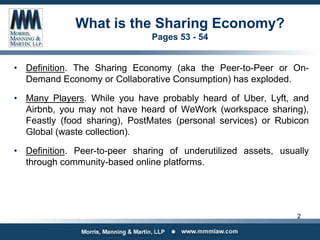
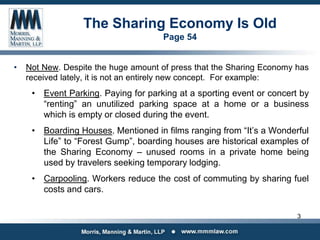
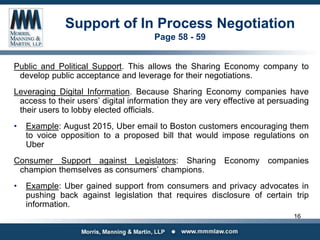
The sharing economy has grown exponentially due to enabling economic, technological, and cultural factors. What began as small-scale sharing of underutilized assets like parking spaces or rooms in homes is now a $15 billion industry expected to reach $335 billion by 2025, thanks to the internet, mobile devices, and social media lowering transaction costs. Younger generations place more value on access over ownership, while economic hardship and environmentalism have also driven growth. The sharing economy benefits businesses through asset-light, lower-cost models. Companies like Rubicon Global are disrupting outdated industries through innovative technology and customized services while pursuing sustainability goals. Sharing economy companies often start operating without resolving regulations, then negotiate from a position of strength through


![Sharing economy: Bright and Dark [2015 GIS Slides Competition]](https://cdn.slidesharecdn.com/ss_thumbnails/sharingeconomy-150531164925-lva1-app6892-thumbnail.jpg?width=640&height=640&fit=bounds)


