1
1. INTRODUCTION
All businesses, large and small, have some way of keeping track of their finances.
Businesses are constantly looking for more ways to keep expenses low. One factor that is
often overlooked, however, is the cost of employee Attrition. High employee Attrition can
cost a company more than they might realize in the long run. Employee Attrition occurs when
employees voluntarily leave their jobs and must be replaced. Attrition is expressed as an
annual percentage of the total workforce. In this world many different industries are working.
All industry run’s on different aim and different purpose. Same information technology is a
one of this industry. Now day’s IT industry is a fast growing industry in this word. There are
many country and many employees working in this industry on national and international
level. As a part of this word India also developing IT industry in their country.
India is world biggest Information Technology capitals in the world. Information
Technology is very fast growing industry in the world. IT industries are providing significant
number of employment in India. IT industries are biggest job creator in India. More than 4.5
million people are working directly or indirectly in this sector. IT business is a support of the
Indian national economy. Bangalore, Chennai, Hyderabad, Pune, Mumbai, Kochi and Gujarat
are main IT hub in India. Employees wedges is the largest component for any outsourcing
operation whether it human resource outsourcing, application maintenance, customer care or
web development. In any projects there are junior, senior, high skilled and project
management employees. In Indian Information Technology industry employees cost is
cheaper than other country. Salaries’ in IT industry is comparable. India has High Quality and
low cost services and large skilled IT manpower workforce. These feathers are magnetising
to world to do a business with Indian IT industry. Due to this fetchers world attract to do a
business and there has been steady grow in Indian IT industry and IT professionals.
Every year more and more IT professional are produced by Universities and colleges.
They full fill the man power demand of IT industry. The recent global financial crisis was
deeply affected to Indian IT industry. Due to financial crisis company reduce their staff,
decrease wages or remove benefits from their payroll structures. This situation creates high
level employees dissatisfaction and job changing scenario. Every organisation and business
aim is profit. Same like this every employees working for his profit. Business target is long
term and all organisation’s profit but employees always think about only and only his profit.
Employee want to get instant grow Or benefits in his job. So when employees got experience
start a new job searching in his field.
2
2. LITERATURE SURVEY
A research paper on “EMPLOYEE TURNOVER: PRESENT SCENARIO OF INDIAN
IT INDUSTRY” published by the author Ms.S.Janani in the Indian Journal of Applied
Research Volume: 4 | Issue: 3 | Mar 2014 | ISSN - 2249-555X. This paper examines the
factors influencing employee turnover according to statistics and how to control employee
turnover in Indian IT industry.
A research paper on “EMPLOYEE TURNOVER IN IT INDUSTRY WITH SPECIAL
REFERENCE TO CHENNAI CITY-AN EXPLORATORY STUDY” published by the
author Mrs. E. Deepa & Mrs. M. Stella in the International Journal of Multidisciplinary
Research Vol.2 Issue 7, July 2012, ISSN 2231-5780. This article is to find the level of job
satisfaction, safety measures, retaining the employees, working conditions & work load and
its reason for Employees Turnover in IT Industries. The employee turnover springs up as a
vital issue in IT businesses. Reasons and causes for employee turnover in IT businesses. It is
inferred that the IT Industry has to implement the Retention Plan by compensation Policies,
Changes in work Requirements & improvement in working conditions.
A research paper on “EMPLOYEE ATTRITION: INEVITABLE YET
MANAGEABLE” published by the author Ms.Gayatri Negi in the International Monthly
Refereed Journal of Research in Management & Technology Volume II, July’13 ISSN 320-
0073. This article finds out the causes of attrition from different dimensions. It undertakes the
effect of the same on employer and employee both. Following this some strange reasons for
attrition have been discussed in this regard. The positive side of attrition has also been
discussed upon. Role of leadership styles in controlling attrition has been undertaken in the
paper. Further, the remedial measures have been discussed herein.
A research paper on “ATTRITION IN INDIA – CAUSES & REMEDIES” published by
the author Mr.Savneet Kaur in the International Journal of Emerging Research in
Management &Technology ISSN: 2278-9359 (Volume-2, Issue-6),June 2013.This paper
aims to explain why companies in India are facing highest attrition rate and some of the
remedial steps to avoid or reduce the turnover rate. Available content from the internet has
been studied along with various newspaper articles on the topic to compile this paper. This
paper contains reasons of turnover in various companies and then some remedial steps are
given to keep the attrition in control.
3
A research paper on “INFANT ATTRITION IN INDIAN IT SECTOR: AN
INDICATION” published by the author Dr. Sneha Mankikar in the International Journal of
Scientific and Research Publications, Volume 3, Issue 9, September 2013 1 ISSN 2250-
3153. This research aims at understanding the cause and effect relationship between infant
attrition and employee satisfaction. It also evaluates relationship and impact of Job
description discrepancies, organization leadership style, and stress and employee
discrimination on infant attrition. The sample consists of employees from IT sector all over
India. A structured questionnaire and informal interviews are used to collect primary
information from the respondents. Correlation was used to use to establish relationship
between various variables and infant attrition using SPSS version 21.It was found that
attrition is higher among the entry level management which is below the age group of 40
years. To check infant attrition some measures like profile mapping tools, strong retention
policies etc.
A research paper on “A STUDY ON THE EMPLOYEE TURNOVER INTENTION IN
ITES/BPO SECTOR” published by K.R. Sree Rekha& Dr.T.J.Kamalanabhan International
Conference - Frontiers of Management – Encore Feb 2013 9th February 2013 - Chennai,
India ISBN No: 978-81-926045-0-3 In this paper, employee turnover intention is studied
from two dimensions: individual- and organization- level. Based on the gaps identified from
the literature, the study seeks to examine the influence of the intervening variables such as
organizational commitment on turnover intentions of employees.
4
3 THEORIZATION OF RESEARCH TOPIC
3.1 EMPLOYEE ATTRITION
A reduction in the number of employees through retirement, resignation or death. Employee
Attrition is an enormous problem for any company and creates negative bottom-line impacts.
The costs associated with employee Attrition show up in such areas as advertising for new
employees and the time and money necessary to screen the applicants, training new
employees, lost productivity, decreased accuracy and quality of work among the employees
left behind who are upset about their colleague’s departure, using expensive contract and
temporary employees to do the work until a permanent employee is hired, and the expenses
associated with replacing lost business.
Employee Attrition costs can amount to thousands of dollars, annually. It can also prevent
companies from pursuing their growth opportunities and acquiring new business & Attrition
rate is the rate of shrinkage in size or number.
3.2 DEFINITIONS
3.2.1 ATTRITION:
A reduction in the number of employees through retirement, resignation or death is called
Attrition .Attrition is also called total turnover or wastage rate.
3.2.2 ATTRITION RATE:
The rate of shrinkage in size or number of employees is known as Attrition rate. It is usually
expressed in percentage.
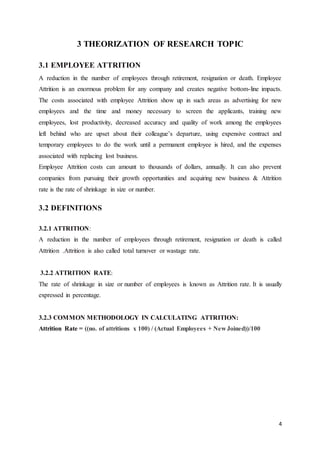
3.2.3 COMMON METHODOLOGY IN CALCULATING ATTRITION:
Attrition Rate = ((no. of attritions x 100) / (Actual Employees + New Joined))/100
5
3.3 KINDS OF ATTRITION
3.3.1 Voluntary attrition
Voluntary attrition takes place when the employee leaves the organization by their own will.
Pull factors like higher emoluments elsewhere, better opportunities of growth and promotion
etc. are responsible for this kind of attrition.
3.3.2 Involuntary attrition
Involuntary attrition takes place when the employees leave the organizations due to some
negative forces or push factors like faulty promotion policy, biased performance appraisal
etc.
3.3.3 Compulsory attrition
It takes place due to the rules and regulations of the government and that of the organization
as well. It includes attrition taking place due to attaining the age of retirement, completion of
tenure etc.
3.3.4 Natural attrition
It takes place due to the causes and factors that are beyond the control of the individual and
organization as well. These factors may include end of life, insanity etc.
6
3.4 CAUSES OF ATTRITION
3.4.1 INTERNAL CAUSES
 Salary
 Promotion
 Transfer
 Workplace Infrastructure & amenities
 Task
 Instability in leadership
 Lack of Flexibility
 Lack of job security
3.4.2 EXTERNAL CAUSES
 Better Pay
 Chances of Promotion
 Better Perks And
 More Fringe Benefits in Other Organizations
 Individual/Personal causes
7
3.5 EFFECTS OF ATTRITION
3.5.1 Effect on Employer/ Organization
 Loss of productivity
 Loss of quality
 Increase in cost: Attrition results in increase in costs. These costs may be related to
 Cost of exit interview
 Cost of staffing
 Cost of Training
 Cost of administrative proceedings
 Cost of signing bonus
3.5.2 Effect on Employee
 Stress from new job
 Monetary loss
 Effect on career
 Effect on family life
 Loss of skill- if the gap between quitting from one organization to other is long
 Emotional loss
8
4. RESEARCH METHODOLOGY
Research in common parlance refers to a search for knowledge. Research is an
endeavour to discover answers to problems (intellectual and practical) through the application
of scientific method to the knowable universe. Research methodology is a way to
systematically solve the research problem. It may be understood as a science of studying how
research is done scientifically. In it we study the various steps that are generally adopted by a
researcher in studying his research problem along with the logic behind them.
4.1 RESEARCH PROBLEM
The research problem selected is entitled as “A STUDY ON EMPLOYEES ATTRITION
IN IT INDUSTRY IN INDIA”
4.2 RESEARCH DESIGN
The nature of this report is exploratory research.
4.3 SAMPLING
4.3.1 SAMPLE SIZE: 6
4.3.2 SAMPLING TECHNIQUE: Area Sampling
4.4 DATA COLLECTION
The data is collected from secondary sources.
4.4.1 SECONDARY DATA
Secondary Data means data that is already available in various reports, diaries, letters,
books, periodicals, etc. Secondary data is that, which has been used previously for any
research and is now in use for the second time. In short, data presented in research reports
when used again in further research, is called secondary data.
9
5. DATA ANALYSIS
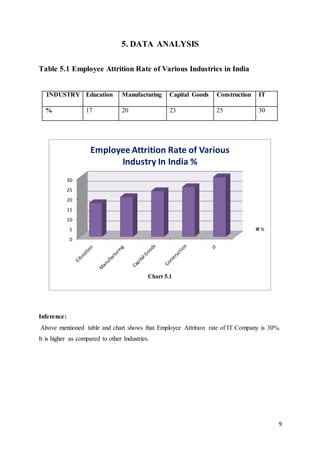
Table 5.1 Employee Attrition Rate of Various Industries in India
INDUSTRY Education Manufacturing Capital Goods Construction IT
% 17 20 23 25 30
Inference:
Above mentioned table and chart shows that Employee Attrition rate of IT Company is 30%.
It is higher as compared to other Industries.
0
5
10
15
20
25
30
Employee Attrition Rate of Various
Industry In India %
%
Chart 5.1
10
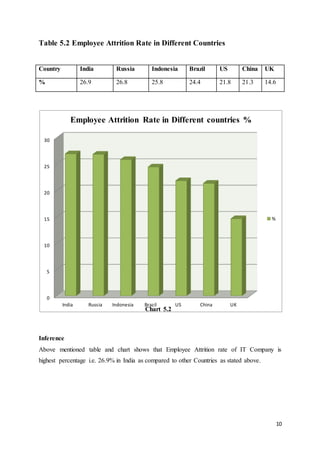
Table 5.2 Employee Attrition Rate in Different Countries
Country India Russia Indonesia Brazil US China UK
% 26.9 26.8 25.8 24.4 21.8 21.3 14.6
Inference
Above mentioned table and chart shows that Employee Attrition rate of IT Company is
highest percentage i.e. 26.9% in India as compared to other Countries as stated above.
0
5
10
15
20
25
30
India Russia Indonesia Brazil US China UK
Employee Attrition Rate in Different countries %
%
Chart 5.2
11
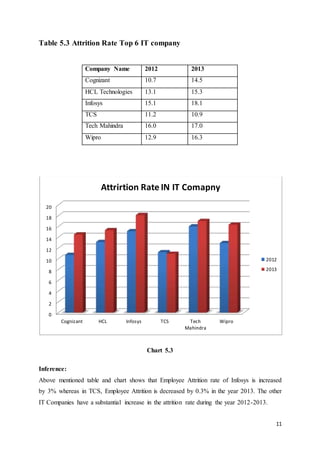
Table 5.3 Attrition Rate Top 6 IT company
Chart 5.3
Inference:
Above mentioned table and chart shows that Employee Attrition rate of Infosys is increased
by 3% whereas in TCS, Employee Attrition is decreased by 0.3% in the year 2013. The other
IT Companies have a substantial increase in the attrition rate during the year 2012-2013.
0
2
4
6
8
10
12
14
16
18
20
Cognizant HCL Infosys TCS Tech
Mahindra
Wipro
Attrirtion Rate IN IT Comapny
2012
2013
Company Name 2012 2013
Cognizant 10.7 14.5
HCL Technologies 13.1 15.3
Infosys 15.1 18.1
TCS 11.2 10.9
Tech Mahindra 16.0 17.0
Wipro 12.9 16.3
12
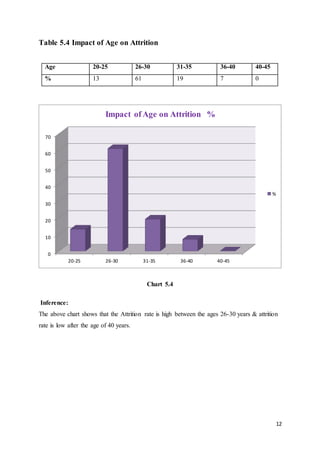
Table 5.4 Impact of Age on Attrition
Chart 5.4
Inference:
The above chart shows that the Attrition rate is high between the ages 26-30 years & attrition
rate is low after the age of 40 years.
0
10
20
30
40
50
60
70
20-25 26-30 31-35 36-40 40-45
Impact ofAge on Attrition %
%
Age 20-25 26-30 31-35 36-40 40-45
% 13 61 19 7 0
13
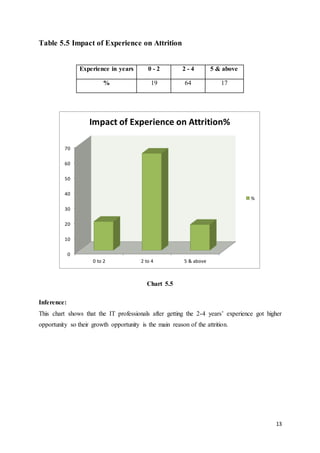
Table 5.5 Impact of Experience on Attrition
Experience in years 0 - 2 2 - 4 5 & above
% 19 64 17
Chart 5.5
Inference:
This chart shows that the IT professionals after getting the 2-4 years’ experience got higher
opportunity so their growth opportunity is the main reason of the attrition.
0
10
20
30
40
50
60
70
0 to 2 2 to 4 5 & above
Impact of Experience on Attrition%
%
14
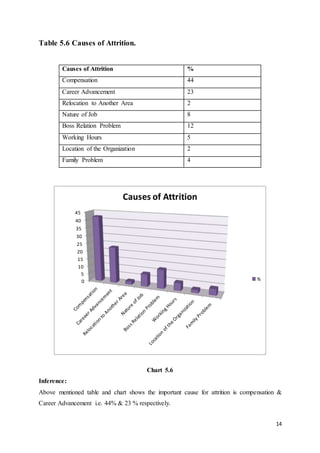
Table 5.6 Causes of Attrition.
Causes of Attrition %
Compensation 44
Career Advancement 23
Relocation to Another Area 2
Nature of Job 8
Boss Relation Problem 12
Working Hours 5
Location of the Organization 2
Family Problem 4
Chart 5.6
Inference:
Above mentioned table and chart shows the important cause for attrition is compensation &
Career Advancement i.e. 44% & 23 % respectively.
0
5
10
15
20
25
30
35
40
45
Causes of Attrition
%
15
6. OUTCOMES AND LEARNING FROM THE DISSERTATION
6.1 FINDING
 Employee Attrition rate of IT Company is high in India.
 Employee Attrition is high in between age 26-30.
 After Some year Experience Employee Resignation the job because higher
opportunity to develop the career.
 Majority of employees (44%) left the job due to dissatisfaction with pay,23%
employeesleftthe jobdue tolack of career advancement,2% employeesleft the job due to
relocation to another area,8% employees left the job due to nature of job.
 Higher education, Personal problem, Problems with management, Location of the
organization, Maternity these are the personal reasons.
 IT companies have a young & dynamic workforce because more than 93% of the
employees have not crossed 35 years.
16
6.2 SUGGESTION
 Offer fair and competitive salaries
 Developing a Good Training Program.
 Reward and Recognition of employees
 Strengthen the Recruitment Process
 Career opportunities
 Exit Interviews
 Work Life Balance.
17
6.3 CONCLUSION
 Attrition is becoming a serious problem in today’s corporate environment. As
employee attrition has been the silent killer for improving the organizational
productivity.
 Attrition cost for many organizations are very high and can significantly affect the
financial performance of an organization. From results it can be concluded that there
are various reasons behind employee attrition.
 These reasons are best offer next door, overseas opportunities, Boss relation problem,
higher package, further overseas studies, shifting of cities due to marriage, family and
personal problem, improper time schedule and parent’s health requires moving to
other cities.
 This research proposed a measure if implemented and executed properly would help
concern organization to understand their employees‟ needs with regard to their career,
job, and family and follow the above mentioned remedies and retained their talented
workforce, thereby meeting their expectations and requirements, and thus reducing
employee attrition.
18
REFERENCES
 Aswathappa, HUMAN RESOURCES AND PERSONNEL MANAGEMENT,
TATA McGraw Hill, 2003
 C.R.Kothari Research Methodology
 http://www.citehr.com/human-resource-articles.html
 http://www.naukrihub.com/retention/attrition-rates-in-different-sectors.html
 http://www.whatishumanresource.com/attrition
 http://www.ermt.net/docs/papers/Volume_2/issue_6_June2013/V2N6-130.pdf
 http://www.abhinavjournal.com/images/Management_&_Technology/Jul13/8.pdf
 http://www.theglobaljournals.com/ijar/file.php?val=March_2014_1394790379_a111e
_78.pdf
 http://www.ametjournal.com/attachment/ENCORE%20-%20ARTICLES%20-
%202013.pdf
 https://ebstudies.wordpress.com/2013/04/10/attrition-in-it-industry
 http://www.ijsrp.org/research-paper-0913/ijsrp-p21118.pdf
 http://articles.economictimes.indiatimes.com/2013-06-07/news/39815456_1_three-
employees-indian-employees-attrition
 http://www.business-standard.com/article/economy-policy/india-tops-global-attrition-
chart-one-in-four-to-switch-jobs-113060700466_1.html
 http://ibnlive.in.com/newstopics/attrition-rate.html
 http://myimpact.impactmeasurement.co.in/impact/clip.php?id=6d6614171a02fed59540c5368a
ce83e5&id2 =33e43c7f9df7dc10a92b5900245d266av.

Final dissetation report

  • 1.
    1 1. INTRODUCTION All businesses,large and small, have some way of keeping track of their finances. Businesses are constantly looking for more ways to keep expenses low. One factor that is often overlooked, however, is the cost of employee Attrition. High employee Attrition can cost a company more than they might realize in the long run. Employee Attrition occurs when employees voluntarily leave their jobs and must be replaced. Attrition is expressed as an annual percentage of the total workforce. In this world many different industries are working. All industry run’s on different aim and different purpose. Same information technology is a one of this industry. Now day’s IT industry is a fast growing industry in this word. There are many country and many employees working in this industry on national and international level. As a part of this word India also developing IT industry in their country. India is world biggest Information Technology capitals in the world. Information Technology is very fast growing industry in the world. IT industries are providing significant number of employment in India. IT industries are biggest job creator in India. More than 4.5 million people are working directly or indirectly in this sector. IT business is a support of the Indian national economy. Bangalore, Chennai, Hyderabad, Pune, Mumbai, Kochi and Gujarat are main IT hub in India. Employees wedges is the largest component for any outsourcing operation whether it human resource outsourcing, application maintenance, customer care or web development. In any projects there are junior, senior, high skilled and project management employees. In Indian Information Technology industry employees cost is cheaper than other country. Salaries’ in IT industry is comparable. India has High Quality and low cost services and large skilled IT manpower workforce. These feathers are magnetising to world to do a business with Indian IT industry. Due to this fetchers world attract to do a business and there has been steady grow in Indian IT industry and IT professionals. Every year more and more IT professional are produced by Universities and colleges. They full fill the man power demand of IT industry. The recent global financial crisis was deeply affected to Indian IT industry. Due to financial crisis company reduce their staff, decrease wages or remove benefits from their payroll structures. This situation creates high level employees dissatisfaction and job changing scenario. Every organisation and business aim is profit. Same like this every employees working for his profit. Business target is long term and all organisation’s profit but employees always think about only and only his profit. Employee want to get instant grow Or benefits in his job. So when employees got experience start a new job searching in his field.
  • 2.
    2 2. LITERATURE SURVEY Aresearch paper on “EMPLOYEE TURNOVER: PRESENT SCENARIO OF INDIAN IT INDUSTRY” published by the author Ms.S.Janani in the Indian Journal of Applied Research Volume: 4 | Issue: 3 | Mar 2014 | ISSN - 2249-555X. This paper examines the factors influencing employee turnover according to statistics and how to control employee turnover in Indian IT industry. A research paper on “EMPLOYEE TURNOVER IN IT INDUSTRY WITH SPECIAL REFERENCE TO CHENNAI CITY-AN EXPLORATORY STUDY” published by the author Mrs. E. Deepa & Mrs. M. Stella in the International Journal of Multidisciplinary Research Vol.2 Issue 7, July 2012, ISSN 2231-5780. This article is to find the level of job satisfaction, safety measures, retaining the employees, working conditions & work load and its reason for Employees Turnover in IT Industries. The employee turnover springs up as a vital issue in IT businesses. Reasons and causes for employee turnover in IT businesses. It is inferred that the IT Industry has to implement the Retention Plan by compensation Policies, Changes in work Requirements & improvement in working conditions. A research paper on “EMPLOYEE ATTRITION: INEVITABLE YET MANAGEABLE” published by the author Ms.Gayatri Negi in the International Monthly Refereed Journal of Research in Management & Technology Volume II, July’13 ISSN 320- 0073. This article finds out the causes of attrition from different dimensions. It undertakes the effect of the same on employer and employee both. Following this some strange reasons for attrition have been discussed in this regard. The positive side of attrition has also been discussed upon. Role of leadership styles in controlling attrition has been undertaken in the paper. Further, the remedial measures have been discussed herein. A research paper on “ATTRITION IN INDIA – CAUSES & REMEDIES” published by the author Mr.Savneet Kaur in the International Journal of Emerging Research in Management &Technology ISSN: 2278-9359 (Volume-2, Issue-6),June 2013.This paper aims to explain why companies in India are facing highest attrition rate and some of the remedial steps to avoid or reduce the turnover rate. Available content from the internet has been studied along with various newspaper articles on the topic to compile this paper. This paper contains reasons of turnover in various companies and then some remedial steps are given to keep the attrition in control.
  • 3.
    3 A research paperon “INFANT ATTRITION IN INDIAN IT SECTOR: AN INDICATION” published by the author Dr. Sneha Mankikar in the International Journal of Scientific and Research Publications, Volume 3, Issue 9, September 2013 1 ISSN 2250- 3153. This research aims at understanding the cause and effect relationship between infant attrition and employee satisfaction. It also evaluates relationship and impact of Job description discrepancies, organization leadership style, and stress and employee discrimination on infant attrition. The sample consists of employees from IT sector all over India. A structured questionnaire and informal interviews are used to collect primary information from the respondents. Correlation was used to use to establish relationship between various variables and infant attrition using SPSS version 21.It was found that attrition is higher among the entry level management which is below the age group of 40 years. To check infant attrition some measures like profile mapping tools, strong retention policies etc. A research paper on “A STUDY ON THE EMPLOYEE TURNOVER INTENTION IN ITES/BPO SECTOR” published by K.R. Sree Rekha& Dr.T.J.Kamalanabhan International Conference - Frontiers of Management – Encore Feb 2013 9th February 2013 - Chennai, India ISBN No: 978-81-926045-0-3 In this paper, employee turnover intention is studied from two dimensions: individual- and organization- level. Based on the gaps identified from the literature, the study seeks to examine the influence of the intervening variables such as organizational commitment on turnover intentions of employees.
  • 4.
    4 3 THEORIZATION OFRESEARCH TOPIC 3.1 EMPLOYEE ATTRITION A reduction in the number of employees through retirement, resignation or death. Employee Attrition is an enormous problem for any company and creates negative bottom-line impacts. The costs associated with employee Attrition show up in such areas as advertising for new employees and the time and money necessary to screen the applicants, training new employees, lost productivity, decreased accuracy and quality of work among the employees left behind who are upset about their colleague’s departure, using expensive contract and temporary employees to do the work until a permanent employee is hired, and the expenses associated with replacing lost business. Employee Attrition costs can amount to thousands of dollars, annually. It can also prevent companies from pursuing their growth opportunities and acquiring new business & Attrition rate is the rate of shrinkage in size or number. 3.2 DEFINITIONS 3.2.1 ATTRITION: A reduction in the number of employees through retirement, resignation or death is called Attrition .Attrition is also called total turnover or wastage rate. 3.2.2 ATTRITION RATE: The rate of shrinkage in size or number of employees is known as Attrition rate. It is usually expressed in percentage. 3.2.3 COMMON METHODOLOGY IN CALCULATING ATTRITION: Attrition Rate = ((no. of attritions x 100) / (Actual Employees + New Joined))/100
  • 5.
    5 3.3 KINDS OFATTRITION 3.3.1 Voluntary attrition Voluntary attrition takes place when the employee leaves the organization by their own will. Pull factors like higher emoluments elsewhere, better opportunities of growth and promotion etc. are responsible for this kind of attrition. 3.3.2 Involuntary attrition Involuntary attrition takes place when the employees leave the organizations due to some negative forces or push factors like faulty promotion policy, biased performance appraisal etc. 3.3.3 Compulsory attrition It takes place due to the rules and regulations of the government and that of the organization as well. It includes attrition taking place due to attaining the age of retirement, completion of tenure etc. 3.3.4 Natural attrition It takes place due to the causes and factors that are beyond the control of the individual and organization as well. These factors may include end of life, insanity etc.
  • 6.
    6 3.4 CAUSES OFATTRITION 3.4.1 INTERNAL CAUSES  Salary  Promotion  Transfer  Workplace Infrastructure & amenities  Task  Instability in leadership  Lack of Flexibility  Lack of job security 3.4.2 EXTERNAL CAUSES  Better Pay  Chances of Promotion  Better Perks And  More Fringe Benefits in Other Organizations  Individual/Personal causes
  • 7.
    7 3.5 EFFECTS OFATTRITION 3.5.1 Effect on Employer/ Organization  Loss of productivity  Loss of quality  Increase in cost: Attrition results in increase in costs. These costs may be related to  Cost of exit interview  Cost of staffing  Cost of Training  Cost of administrative proceedings  Cost of signing bonus 3.5.2 Effect on Employee  Stress from new job  Monetary loss  Effect on career  Effect on family life  Loss of skill- if the gap between quitting from one organization to other is long  Emotional loss
  • 8.
    8 4. RESEARCH METHODOLOGY Researchin common parlance refers to a search for knowledge. Research is an endeavour to discover answers to problems (intellectual and practical) through the application of scientific method to the knowable universe. Research methodology is a way to systematically solve the research problem. It may be understood as a science of studying how research is done scientifically. In it we study the various steps that are generally adopted by a researcher in studying his research problem along with the logic behind them. 4.1 RESEARCH PROBLEM The research problem selected is entitled as “A STUDY ON EMPLOYEES ATTRITION IN IT INDUSTRY IN INDIA” 4.2 RESEARCH DESIGN The nature of this report is exploratory research. 4.3 SAMPLING 4.3.1 SAMPLE SIZE: 6 4.3.2 SAMPLING TECHNIQUE: Area Sampling 4.4 DATA COLLECTION The data is collected from secondary sources. 4.4.1 SECONDARY DATA Secondary Data means data that is already available in various reports, diaries, letters, books, periodicals, etc. Secondary data is that, which has been used previously for any research and is now in use for the second time. In short, data presented in research reports when used again in further research, is called secondary data.
  • 9.
    9 5. DATA ANALYSIS Table5.1 Employee Attrition Rate of Various Industries in India INDUSTRY Education Manufacturing Capital Goods Construction IT % 17 20 23 25 30 Inference: Above mentioned table and chart shows that Employee Attrition rate of IT Company is 30%. It is higher as compared to other Industries. 0 5 10 15 20 25 30 Employee Attrition Rate of Various Industry In India % % Chart 5.1
  • 10.
    10 Table 5.2 EmployeeAttrition Rate in Different Countries Country India Russia Indonesia Brazil US China UK % 26.9 26.8 25.8 24.4 21.8 21.3 14.6 Inference Above mentioned table and chart shows that Employee Attrition rate of IT Company is highest percentage i.e. 26.9% in India as compared to other Countries as stated above. 0 5 10 15 20 25 30 India Russia Indonesia Brazil US China UK Employee Attrition Rate in Different countries % % Chart 5.2
  • 11.
    11 Table 5.3 AttritionRate Top 6 IT company Chart 5.3 Inference: Above mentioned table and chart shows that Employee Attrition rate of Infosys is increased by 3% whereas in TCS, Employee Attrition is decreased by 0.3% in the year 2013. The other IT Companies have a substantial increase in the attrition rate during the year 2012-2013. 0 2 4 6 8 10 12 14 16 18 20 Cognizant HCL Infosys TCS Tech Mahindra Wipro Attrirtion Rate IN IT Comapny 2012 2013 Company Name 2012 2013 Cognizant 10.7 14.5 HCL Technologies 13.1 15.3 Infosys 15.1 18.1 TCS 11.2 10.9 Tech Mahindra 16.0 17.0 Wipro 12.9 16.3
  • 12.
    12 Table 5.4 Impactof Age on Attrition Chart 5.4 Inference: The above chart shows that the Attrition rate is high between the ages 26-30 years & attrition rate is low after the age of 40 years. 0 10 20 30 40 50 60 70 20-25 26-30 31-35 36-40 40-45 Impact ofAge on Attrition % % Age 20-25 26-30 31-35 36-40 40-45 % 13 61 19 7 0
  • 13.
    13 Table 5.5 Impactof Experience on Attrition Experience in years 0 - 2 2 - 4 5 & above % 19 64 17 Chart 5.5 Inference: This chart shows that the IT professionals after getting the 2-4 years’ experience got higher opportunity so their growth opportunity is the main reason of the attrition. 0 10 20 30 40 50 60 70 0 to 2 2 to 4 5 & above Impact of Experience on Attrition% %
  • 14.
    14 Table 5.6 Causesof Attrition. Causes of Attrition % Compensation 44 Career Advancement 23 Relocation to Another Area 2 Nature of Job 8 Boss Relation Problem 12 Working Hours 5 Location of the Organization 2 Family Problem 4 Chart 5.6 Inference: Above mentioned table and chart shows the important cause for attrition is compensation & Career Advancement i.e. 44% & 23 % respectively. 0 5 10 15 20 25 30 35 40 45 Causes of Attrition %
  • 15.
    15 6. OUTCOMES ANDLEARNING FROM THE DISSERTATION 6.1 FINDING  Employee Attrition rate of IT Company is high in India.  Employee Attrition is high in between age 26-30.  After Some year Experience Employee Resignation the job because higher opportunity to develop the career.  Majority of employees (44%) left the job due to dissatisfaction with pay,23% employeesleftthe jobdue tolack of career advancement,2% employeesleft the job due to relocation to another area,8% employees left the job due to nature of job.  Higher education, Personal problem, Problems with management, Location of the organization, Maternity these are the personal reasons.  IT companies have a young & dynamic workforce because more than 93% of the employees have not crossed 35 years.
  • 16.
    16 6.2 SUGGESTION  Offerfair and competitive salaries  Developing a Good Training Program.  Reward and Recognition of employees  Strengthen the Recruitment Process  Career opportunities  Exit Interviews  Work Life Balance.
  • 17.
    17 6.3 CONCLUSION  Attritionis becoming a serious problem in today’s corporate environment. As employee attrition has been the silent killer for improving the organizational productivity.  Attrition cost for many organizations are very high and can significantly affect the financial performance of an organization. From results it can be concluded that there are various reasons behind employee attrition.  These reasons are best offer next door, overseas opportunities, Boss relation problem, higher package, further overseas studies, shifting of cities due to marriage, family and personal problem, improper time schedule and parent’s health requires moving to other cities.  This research proposed a measure if implemented and executed properly would help concern organization to understand their employees‟ needs with regard to their career, job, and family and follow the above mentioned remedies and retained their talented workforce, thereby meeting their expectations and requirements, and thus reducing employee attrition.
  • 18.
    18 REFERENCES  Aswathappa, HUMANRESOURCES AND PERSONNEL MANAGEMENT, TATA McGraw Hill, 2003  C.R.Kothari Research Methodology  http://www.citehr.com/human-resource-articles.html  http://www.naukrihub.com/retention/attrition-rates-in-different-sectors.html  http://www.whatishumanresource.com/attrition  http://www.ermt.net/docs/papers/Volume_2/issue_6_June2013/V2N6-130.pdf  http://www.abhinavjournal.com/images/Management_&_Technology/Jul13/8.pdf  http://www.theglobaljournals.com/ijar/file.php?val=March_2014_1394790379_a111e _78.pdf  http://www.ametjournal.com/attachment/ENCORE%20-%20ARTICLES%20- %202013.pdf  https://ebstudies.wordpress.com/2013/04/10/attrition-in-it-industry  http://www.ijsrp.org/research-paper-0913/ijsrp-p21118.pdf  http://articles.economictimes.indiatimes.com/2013-06-07/news/39815456_1_three- employees-indian-employees-attrition  http://www.business-standard.com/article/economy-policy/india-tops-global-attrition- chart-one-in-four-to-switch-jobs-113060700466_1.html  http://ibnlive.in.com/newstopics/attrition-rate.html  http://myimpact.impactmeasurement.co.in/impact/clip.php?id=6d6614171a02fed59540c5368a ce83e5&id2 =33e43c7f9df7dc10a92b5900245d266av.