European Journal of Business and Management                                                       www.iiste.org
ISSN 2222-1905 (Paper) ISSN 2222-2839 (Online)
Vol 3, No.5, 2011


                             Attrition in SMEs: The Causes


                                                  Authors:
                                               Bibhu Prasad Kar
                                    Indian School of Business, Hyderabad
                                       Gachibowli, Hyderabad – 500032
                                     E-mail: bibhuprasadkar@gmail.com


                                               Amalesh Sharma
                                    Indian School of Business, Hyderabad
                                       Gachibowli, Hyderabad – 500032
                                      Email: amaleshsharma@gmail.com


                                             Sourav Bikash Borah
                                    Indian School of Business, Hyderabad
                                       Gachibowli, Hyderabad – 500032
                                        Email: Sourav_Borah@isb.edu


Abstract

Human Resource managers are devising ways to retain talent. The average attrition in 2010 was 10% across
Indian companies, a rate that may rise to 25% in 2011-12 with improved salaries (The Economic Times, Dec
24, 2010).The SMEs sector in India has certainly been very prevalent of employment in recent years but
one of the biggest issues it is facing is the remarkable rise in attrition rate. There could be some common
attrition factors across sectors but every organization needs to know the specific reasons for attrition. Indian
economy is showing a healthy progress, but employers, enjoying the bang have an offhand side i.e.
“restless staff is seeking for a hotter career option leading to increase in attrition in Indian SMEs”. This
paper attempts at finding the probable reasons for attrition in SMEs in India. A conceptual framework has
been developed based on the results of our study to understand the relation between attrition and the factors
affecting attrition. Our findings suggest some important factors that are affecting attrition in SMEs. The
findings of our research may be of help for entrepreneurs to deal with attrition in their organizations.
Keywords: Attrition, SMEs, Entrepreneurship, Indian Economy, India


1. Introduction

Global staffing firm “Kelly Services” expects attrition levels to rise to 22% in 2011 and feels that
employees in customer management department, team management and the niche technical roles will grab
the lion's share of increments next year. These factors (attrition, salary increments, and other benefits) are
called hygiene factors by the human resource management in specific cases. The official spokesperson of
Kelly says "Sectors hiring first will face the monster (attrition) first, unless there are strong retention or job
rotation policies".
                                                        5
European Journal of Business and Management                                                    www.iiste.org
ISSN 2222-1905 (Paper) ISSN 2222-2839 (Online)
Vol 3, No.5, 2011


Mr. Goel of GlobalHunt however, views attrition as healthy. He says: "A balanced attrition is healthy for an
organization as it opens the avenue for fresh talent to come and create innovations which in turn can add
lots of value to an organization".

Low attrition will block fresh ideas and people will become too comfortable in their approach. But, high
attrition may not give an opportunity to individual and organization to understand and to optimize strength.

Broadly speaking, quick job hoppers will have difficulty to get a good job as they are not widely accepted
for long term or larger roles," Mr Goel remarked. (The Economic Times, Dec 24, 2010). The role and
importance of Small and Medium Enterprises (SMEs) in the context of India’s Industrial development can
be traced to Industrial Policy Resolution of 1956 which states: “They (SSIs) provide immediate large scale
employment; they offer a method of ensuring a more equitable distribution of the national income and they
facilitate an effective mobilization of resources of capital and skill which might otherwise remain unutilized.
Some of the problems that unplanned urbanization tends to create will be avoided by the establishment of
small samples of industrial production all over the country (Planning Commission, Second Five-Year Plan,
p. 47)”.
With relatively low capital investment, larger employment opportunities and unstinted official support, the
SME sector maintained its momentum in the pre-reform period. In the post-liberalization era, its
importance has not been undermined. Following the Ninth Five-Year Plan (1997-2002) document, it has
been understood that he SME sector has matured and is in a position to make greater contribution to the
national economy.

In their nature, scope and pattern, SMEs vary from country-to-country depending upon the economic,
political and social environment, prevailing in that country. Broadly, SMEs are based either on the ‘number
of persons employed or on the amount of investment in ‘fixed assets’ or on both. For example, in many
developed countries it is the number of employees that determines the size of an enterprise, but in a
developing country such as India, the major determinant happens to be the investment size in an enterprise.

Nonetheless, the limits in terms of ‘investment’ and ‘employment’ are directly related to the state of
economic development of a country. As such, a small scale unit in a developed country may be considered a
large or medium-scale unit in a backward or developing country. Time-to-time revisions in these limits
usually indicate performance and trends of SMEs, policies of the government and government’s orientation
toward the development of small-scale sector. For example, in European Union (EU), micro, small and
medium-sized enterprises are crucial and provide around 65 million jobs representing two-thirds of total
employment. In Japan, 81% of total employment is in SMEs, where on average one enterprise employs nine
persons as opposed to four in the EU. In one of the Latin American countries, i.e., Colombia, SMEs account
for 36% of all jobs and 63% of industrial jobs (Edit, 2005).

Today, attrition is one of the major problems faced by the various organizations across the globe. According
to a recent survey conducted by All India Management Association (AIMA) on CEOs and HR managers of
different IT organizations, it is found that attrition is the second important issue related to HR department.
The impact of attrition has received considerable attention by senior management, HR professionals and
industrial psychologists. It has proven to be one of the most costly and seemingly intractable human
resource challenges confronting organizations.

In our paper, we have discussed relevant literature at first followed by the research gap. We then put
forward data and methodology and data Analysis. Subsequently, we highlight some of the major findings of
the study. We finally offer limitation to our research and future research direction with a conclusion to our
research.
2. Theoretical Background

                                                      6
European Journal of Business and Management                                                    www.iiste.org
ISSN 2222-1905 (Paper) ISSN 2222-2839 (Online)
Vol 3, No.5, 2011

Employers need to keep the employees from leaving the organization in a short duration for the success of
the venture. Employers want their employees to build up a lifelong relationship with the organization,
contribute to the performance and success of the firm and become the force behind the growth in long term.
But modest aim generally ends with sorrow. Attrition is one of the most puzzling words in the management
literature today. It is because; the cause and effect relationship here is not absolute. Here, Cause and Effect
relationship is affected by multiple variables and it is difficult to build an empirical model/conceptual
model on the basis of experience/data. The saying, good help is hard to find, is even true these days because
the job market is becoming increasingly tight (Eskildesen 2000, Hammer 2000). Employers fight to get
skilled employees to maintain the prosperity of their organizations (Eskildsen and Nussler 2000). Employee
satisfaction and customer satisfaction varies proportionately (Mark Parrott 2000). Growing competitiveness
in the market provides pressure on the employees. These pressures generally give birth to mental agony to
the employees. Mark Parrott (2000) says that today’s employees pose a complete new set of challenges. As
a result, tapping of talent becomes more complex. Employees that are satisfied and happy with their jobs
are more dedicated and functional in customer service and business operation (Hammer 2000; Marini 2000;
Denton 2000). Also it is proved that employees who are satisfied with their jobs are more productive,
creative and more likely to be retained by the company (Eskildsen & Dahlgaad 2000, Kim 2000; Kirby;
Lee 2000; Wagner 2000). Again researches have proved that many environmental factors play significant
role in the retention of employees such as Pay and benefits, communication (Brewer 2000; Wager 2000),
motivation, justice (Kirby 2000) and leisure time (Rabbit 2000; Wilson 2000). The key organizational (HR)
issue being faced today by all the SMEs is attrition. Career growth, compensation and supervision are some
of the pronounced reasons, contributing to attrition. Due to monotonous nature of the job, employees
change their jobs frequently. The average period of job change is two years for an employee in SMEs.
Factors contributing to attrition vary from small to big SMEs. Many companies feel that exit interview is
the best way to control or manage attrition rate. No organization can survive without giving importance to
its employees. They are the first customers and their requirements should be identified and fulfilled. Like
CRM, Employee Relationship Management (ERM) is the mantra an organization should follow to retain
their employees. Fulfilling the reasonable expectations of employees should be a continuous process
(Anantharaja, A. 2009).

It is argued that theory-based empirical research on HRM in SMEs within the same industry enable us
move towards a systematic understanding and explanation of HRM in SMEs (Tsai, Chin-Ju, 2010). SMEs
align their HRM practices with their realized strategies within three configurations, namely local,
international, and world-class SMEs. Regardless of their strategic choices, these SMEs achieve comparable
levels of performance (Fabi, Bruno; Raymond, Louis, 2000). Due to their limited size, many small and
medium enterprises (SMEs) cannot justify full-time HR professionals in their organizations. Thus, the
complex and time-consuming nature of many HR activities can result in a significant drain on existing
managerial resources. Professional employer organizations (PEOs), however, offer SMEs an alternative for
handling their workforce by providing compensation programs, regulatory compliance, and other
HR-related services.

Industrial attrition literature also shows a few factors that affect the attrition which include employee
turnover, commitment, motivation, changes in work place, training and development etc. These finding are
valid for the employees who stay in the organization for long time. Unfortunately, no research has
attempted to see the causal relationship between the attrition during probation and the probable reasons.
With an objective to find out the factors leading to attrition, we have done a detailed exploratory study in
SMEs in India. Our research is specific to understand the reasons for employee attrition in SMEs during the
probation period and to find ways to control attrition.

Many Researches say that the overall culture of the organization actually causes the attrition. But here again
it is questionable whether an employee staying only for a few months in the organization get affected by the
so called “culture”. Following this puzzle, we attempted to find the probable reasons of attrition during the
probation period. We took into account different time frame, different employees who left their organization
                                                      7
European Journal of Business and Management                                                    www.iiste.org
ISSN 2222-1905 (Paper) ISSN 2222-2839 (Online)
Vol 3, No.5, 2011

during probation period for the research.

3. Gap

It is difficult to define all the possible reasons and the most promising reasons for attrition in the SMEs. We
have attempted to build the gap by developing a conceptual framework and finding the intensity with which
various factors impact attrition. This research is first of its kind in studying the SMEs from attrition
management point of view.

4. Methodology & Data Collection

This research is undertaken to assess the causes of attrition in SMEs and its remedies. The main aim of such
a design is to ensure that the required data are collected objectively, accurately and economically. Primary
Data: Data regarding the causes of attrition in SMEs and its remedies were collected directly by interacting
with the employees of different SMEs by a structured questionnaire. Secondary Data: The secondary data
was collected from the existing data, company records, and the Internet.

5. Research Tools

 The questionnaire used in this study was direct and structured. The types of questions asked in this
questionnaire were closed-ended and open-ended, and multiple choice. To test the validity and veracity of
the structure of the questionnaire and to find out whether the purpose would be fulfilled, a pilot study was
conducted where a sample of 20 questions was collected to find opinions of employees about the causes of
attrition in a company. The main objective of using these techniques was to understand the current process
of the SMEs and whether the employees were satisfied.
6. Sample Size

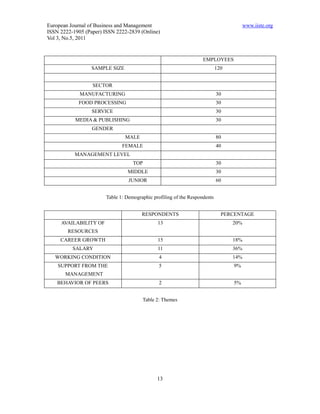
The scope of the study is limited to employees of different SMEs. The numbers of respondents are 120.
Responses were collected at Hyderabad and Ahmadabad in 25 engineering /manufacturing SMEs and 25
food processing SMEs. Employees are one of the most critical stakeholders of an organization. Thus
understanding the behavior of the employees is critical for organizational success. The contextual
implications that most researchers have ignored earlier, we have tried to incorporate in our research.
In the first step, broadly the qualitative research has been carried out. A total of 50 respondents have been
interviewed across various organizations. The type of sampling used is mostly random. Researchers have
approached a set of organizations and interviewed employees in all levels of management to ensure
representation across various layers of management. Critical incidence technique is used to understand the
perception of employees towards their employers. The interviews had dual purpose. The primary purpose is
to understand various factors that influence employees’ behaviors which might lead to attrition. Again the
researchers also wanted to see whether demographic variables play a role. Employees were asked to recall
various instances where they felt that the behavior shown by their employers was not fair. Most of the
respondents cited similar sort of incidences and believed that most of the commitments made during the
recruitment haven’t been fulfilled.

The key points have been listed immediately after the interview to maintain consistency in result with 24
hours rule by Eisenhardt and Bourgeois (1988). The Cohen Kappa co-efficient is calculated based on
coding done by two independent coders so as to identify different themes based on the responses from the
interview. High inter coder reliability (Cohen Kappa co-efficient = 0.75) has been achieved.


                                                      8
European Journal of Business and Management                                                     www.iiste.org
ISSN 2222-1905 (Paper) ISSN 2222-2839 (Online)
Vol 3, No.5, 2011

6. Data Analysis and Findings Analysis

In the second phase of the research, researchers concentrated on constructing a theoretical frame work
which will be useful for small scale entrepreneurs to understand the causes of attrition specific to their
SMEs.
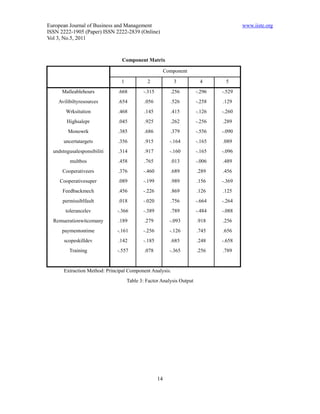
The component matrix (Refer to Table: 3) has extracted five factors. The attributes in each factor have been
mentioned below.
FACTOR1: Malleable working hours, availability of resources, working situation = WORKING
CONDITION
FACTOR2: Pressure from entrepreneur, high pressure of sales, monotonous job, vague targets,
undistinguishable responsibility, multiple bosses = NATURE OF WORK
FACTOR3: Cooperative peers, Cooperative supervisors, Feedback mechanism, Approachable supervisor,
Permissible faults, Tolerance level = ORGANIZATIONAL PHILOSOPHY
FACTOR4: Remuneration at par with other company, Payment on time = SALARY
FACTOR5: Scope for career growth, Scope for skill development = CAREER PROGRESSION
After identifying the factors, we tried to find out the most important factors that are actually leading to
attrition in SMEs. Respondents were asked to rate the factors on a five point scale. (Refer Table no: 3)

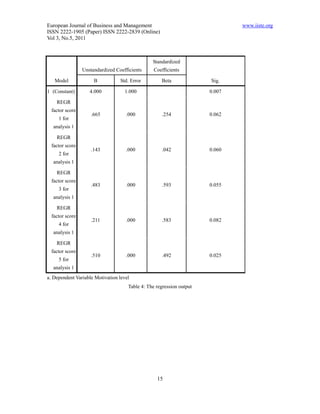
After running a regression analysis of the factors affecting attrition with the factors, obtained after factor
analysis, we got the following regression equation.

Factors affecting Attrition level= 4.00+0.665* WORKING CONDITION + 0.143* NATURE OF WORK
+0.483* ORGANIZATIONAL PHILOSOPHY +.211* SALARY + 0.510* CAREER PROGRESSION
From the above equation it can be inferred very easily that the most important factor for the respondents is
the “condition of the workplace”. We have contributed (In contrary to earlier researches) here showing that
not the culture of the SME but the working condition in the SME makes employees to move out of a SME.

The regression output has been attached (Refer to Table no: 4).
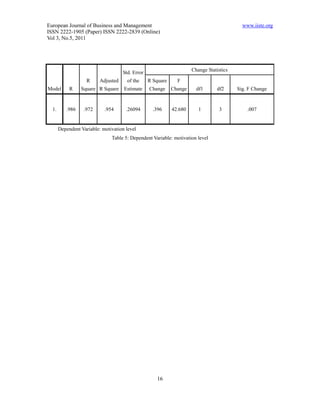
The value of the R square is 0.972 (adjusted R square is .954) which shows that the model is able to explain
97.2% of the variance in dependent variable (Refer Table No: 5).

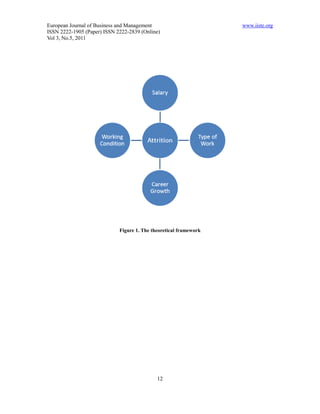
Based on the equations, the theoretical frame work has been developed (Refer Figure 1).
In SMEs, attrition is due to the Working condition, Organizational Philosophy and Career Progression.
From the regression equation it is clear that most important concern for a SME Employee is the Working
Condition. It is a very important finding in context of SMEs as employees are giving higher importance to
procedural justice. Again Organizational philosophy which is closely related to culture and interactive
justice is considered to be much more important than Salary that includes both tangible and intangible
benefits. To retain the employees and to lower attrition, employers’ primary focus should be towards
ensuring both interactive and procedural justice. Again salary and benefit which many entrepreneurs
believe to be the most important cause of attrition seems to be less important in comparison to many other
factors.
7. Limitation of the Study and Scope for Future research:

Although the research has many interesting findings, it has couple of limitations. First of all, the research is
carried out only in two major cities. Thus more data may impact the findings of the study. Again research is
lacking quantitative generalization. Thus researchers in future may concentrate on addressing these two
areas of research. We have considered only two set of SMEs. Story may be different for other set of SMEs
(such as artificial jewellery, cottage etc).
8. Conclusion

Attrition is a major problem faced by many SMEs in India. The probable reasons of attrition, although
cannot be modeled explicitly, are important to find for success of the SME sector. Healthy employee group
                                                       9
European Journal of Business and Management                                                   www.iiste.org
ISSN 2222-1905 (Paper) ISSN 2222-2839 (Online)
Vol 3, No.5, 2011

can contribute towards profitable growth of the SMEs. This research opens up new avenue for the study of
attrition in SMEs and segments “attrition study” from the case in other national and multinational
organizations. This research provides an arena for the SMEs administration to revisits the employee
retention strategies. Modifying the working condition can be one of the easiest steps for SMEs to do so that
attrition can be controlled. Step by step implementation of retention strategies can help SMEs to get full
control on attrition in near future.


References

Anantharaja, A. (2009). Causes of attrition in BPO companies: Study of a mid-size organization in
india.IUP Journal of Management Research, 8(11), 13-13-27.
Buck, J. M., & Watson, J. L. (2002). Retaining staff employees: The relationship between human resources
management strategies and organizational commitment. Innovative Higher Education, 25(3), 175-193.
Denton, Keith, (2000) “I hate this job!” Business Horizons, pp. 4
Eskildsen, J.K., & Nussler, M.L. (2000). The managerial drivers of employee satisfaction and loyalty. Total
Quality Management, 11(4), 581–588
Eskildsen, J. K., and Dahlgaard, J. J. (2000). A Casual Model for Employee Satisfaction. Total Quality
Management, 11(8), 1081-1095
Edit Lukacs (2005). The economic role of SMEs in world economy, especially in Europe. Institute of
Business Sciences, University of Miskolc Paper, 25(1), pp.7
Fabi, B., & Raymond, L. (2009). Strategic alignment of HRM practices in manufacturing SMEs: A gestalts
perspective. Journal of Small Business and Enterprise Development, 16(1), 7-7-25.
Ganesan, R., & Khan, T. F. (2010). Conceptual review on retention strategies - a practical approach. Allied
Academies International Conference.Academy of Strategic Management Proceedings 9(1), 15-15-26.
Glen, C. (2006). Key skills retention and motivation: The war for talent still rages and retention is the high
ground. Industrial and Commercial Training, 38 (1), 27-45
Griffeth, R.W. and Hom, P.W. (1995), “The employee turnover process”, Research in Personnel and Human
Resources Management, Vol. 13, pp. 245-93.
Hammer, Ray. (May 2000) “Winning program brings smiles to hotel’s employees.” Houston Business
Journal: 43A.
Harvard Business Essentials. (2002). Hiring and keeping the best people. Boston: Harvard Business School
Press
India inc in attrition mode (2006). . United States, Washington: McClatchy - Tribune Information Services.
Johnson, J. T., Griffeth, R. W. & Griffin, M. (2000). Factors discriminating functional and dysfunctional
sales-force turnover. Journal of Business and Industrial Marketing 15(6), 399-415.
Klaas, B. S., McClendon, J., & Gainey, T. W. (2000). Managing HR in the small and medium enterprise:
The impact of professional employer organizations. Entrepreneurship Theory and Practice, 25(1),
107-107-124.
Kathleen M. Eisenhardt and L. J. Bourgeois III, (Dec., 1988), The Academy of Management Journal Vol.
31, No. 4 pp. 737-770
Kirby, Susan. (June 2000) “Impact of Marketing Work-Place Diversity on Employee Job Involvement and
Organizational Commitment.” Journal of Social Psychology, pp. 367.
Kim, Jwa. (Feb 2000) “Does attitude toward money moderate the relationship between intrinsic job
satisfaction and voluntary turnover?” Human Relations pp. 213
Kransdorff, A. (1996). Succession planning in a fast changing world. Management Decisions, 4(2),
pp.30-34.
Lee, Cynthia. (Nov 1999) “The Importance of Justice Perceptions on Pay Effectiveness: A Two-Year
Study of a Skill-Based Pay Plan. Journal of Management, pp. 851.
The Wilson Quarterly,(Autumn 2000): “Loving Labor Less?” Vol. 24, pp.10.
Mobley, W., Griffeth, R., Hand, H. and Meglino, B. (1979), “Review and conceptual analysis of the
                                                     10
European Journal of Business and Management                                                www.iiste.org
ISSN 2222-1905 (Paper) ISSN 2222-2839 (Online)
Vol 3, No.5, 2011

employee turnover process”, Psychological Bulletin, Vol. 36, pp. 493-522.
Parrott, Mark. (Nov 2000) “Employee Satisfaction.” Do-It-Yourself Retailing 15(8).
Rabbit, T.W. (Sept 2000), “Surf and be happy; Web Access at Work Makes Workers Feel More Productive,
Less Stressed, Says Survey.” Network World, pp. 45.
Robinson, R. and Barron, P. (2007), “Developing a framework for understanding the impact of deskilling
and standardisation on the turnover and attrition of chefs”, International Journal of Hospitality
Management,
Vol. 26, pp. 913-26.
Smith, M., Kendall, L. and Hulin, C. (1969), The Measurement of Satisfaction in Work and in Retirement:
A Strategy for the Study of Attitudes, Rand McNally, Chicago, IL.
Tutuncu, O. and Kozak, M. (2007), “An investigation of factors affecting job satisfaction”, International
Journal of Hospitality & Tourism Administration, Vol. 8 No. 1, pp. 1-19.
Tsai, C. (2010). HRM in SMEs: Homogeneity or heterogeneity? A study of taiwanese high-tech firms. The
International Journal of Human Resource Management, 21(10), 1689.
Tahir, P. R., Mohamad, M. R., & Hasan, D. B. (2011). A short review of factors leading to success of small
medium enterprises. Interdisciplinary Journal of Contemporary Research in Business, 2(11), 519-519-529.
Wagner, Stacey. (Aug 2000): “Retention: Finders, Keepers.” Training & Development, pp. 64.


                                                   11
European Journal of Business and Management                        www.iiste.org
ISSN 2222-1905 (Paper) ISSN 2222-2839 (Online)
Vol 3, No.5, 2011


                             Figure 1. The theoretical framework


                                             12
European Journal of Business and Management                                             www.iiste.org
ISSN 2222-1905 (Paper) ISSN 2222-2839 (Online)
Vol 3, No.5, 2011


                                                                    EMPLOYEES
                  SAMPLE SIZE                                               120


                  SECTOR
             MANUFACTURING                                                  30
            FOOD PROCESSING                                                 30
                  SERVICE                                                   30
           MEDIA & PUBLISHING                                               30
                  GENDER
                                MALE                                        80
                               FEMALE                                       40
           MANAGEMENT LEVEL
                                    TOP                                     30
                                 MIDDLE                                     30
                                  JUNIOR                                    60


                        Table 1: Demographic profiling of the Respondents


                                        RESPONDENTS                           PERCENTAGE
     AVAILABILITY OF                           13                                 20%
        RESOURCES
     CAREER GROWTH                             15                                 18%
          SALARY                               11                                 36%
   WORKING CONDITION                            4                                 14%
    SUPPORT FROM THE                            5                                 9%
       MANAGEMENT
    BEHAVIOR OF PEERS                           2                                 5%


                                        Table 2: Themes


                                               13
European Journal of Business and Management                                           www.iiste.org
ISSN 2222-1905 (Paper) ISSN 2222-2839 (Online)
Vol 3, No.5, 2011


                                 Component Matrix

                                                        Component

                                1            2              3          4       5
      Malleablehours           .668        -.315          .256        -.296   -.529
    Avilibiltyresources        .654         .056          .526        -.258   .129
        Wrksitution            .468         .145          .415        -.126   -.260
        Highsalepr             .045         .925          .262        -.256   .289
         Monowrk               .385         .686          .379        -.556   -.090
       uncertatargets          .356         .915          -.164       -.165   .089
  undstngusalesponsibiliti     .314         .917          -.160       -.165   -.096
          multbos              .458         .765          .013        -.006   .489
      Cooperativeers           .376        -.460          .689        .289    .456
     Cooperativesuper          .089        -.199          .989        .156    -.369
      Feedbackmech             .456        -.226          .869        .126    .125
      permissiblfault          .018        -.020          .756        -.664   -.264
       tolerancelev           -.366        -.389          .789        -.484   -.088
  Remuerationwitcomany         .189         .279          -.093       .918    .256
      paymentontime           -.161        -.256          -.126       .745    .656
       scopeskilldev           .142        -.185          .685        .248    -.658
         Training             -.557         .078          -.365       .256    .789


       Extraction Method: Principal Component Analysis.
                                    Table 3: Factor Analysis Output


                                                   14
European Journal of Business and Management                                   www.iiste.org
ISSN 2222-1905 (Paper) ISSN 2222-2839 (Online)
Vol 3, No.5, 2011


                                                Standardized
                 Unstandardized Coefficients     Coefficients

   Model              B           Std. Error        Beta              Sig.

1 (Constant)        4.000           1.000                             0.007

    REGR
  factor score
                     .665           .000            .254              0.062
     1 for
  analysis 1

    REGR
  factor score
                     .143           .000            .042              0.060
     2 for
  analysis 1

    REGR
  factor score
                     .483           .000            .593              0.055
     3 for
  analysis 1

    REGR
  factor score
                     .211           .000            .583              0.082
     4 for
  analysis 1

    REGR
  factor score
                     .510           .000            .492              0.025
     5 for
  analysis 1
a. Dependent Variable Motivation level
                                     Table 4: The regression output


                                                  15
European Journal of Business and Management                                                 www.iiste.org
ISSN 2222-1905 (Paper) ISSN 2222-2839 (Online)
Vol 3, No.5, 2011


                                                                      Change Statistics
                                     Std. Error
                    R     Adjusted     of the     R Square     F
Model       R    Square R Square     Estimate     Change     Change     df1       df2     Sig. F Change


  1.      .986    .972      .954      .26094        .396     42.680      1         3          .007


       Dependent Variable: motivation level
                               Table 5: Dependent Variable: motivation level


                                                     16

2.bibhu prasadkar 5-16

  • 1.
    European Journal ofBusiness and Management www.iiste.org ISSN 2222-1905 (Paper) ISSN 2222-2839 (Online) Vol 3, No.5, 2011 Attrition in SMEs: The Causes Authors: Bibhu Prasad Kar Indian School of Business, Hyderabad Gachibowli, Hyderabad – 500032 E-mail: bibhuprasadkar@gmail.com Amalesh Sharma Indian School of Business, Hyderabad Gachibowli, Hyderabad – 500032 Email: amaleshsharma@gmail.com Sourav Bikash Borah Indian School of Business, Hyderabad Gachibowli, Hyderabad – 500032 Email: Sourav_Borah@isb.edu Abstract Human Resource managers are devising ways to retain talent. The average attrition in 2010 was 10% across Indian companies, a rate that may rise to 25% in 2011-12 with improved salaries (The Economic Times, Dec 24, 2010).The SMEs sector in India has certainly been very prevalent of employment in recent years but one of the biggest issues it is facing is the remarkable rise in attrition rate. There could be some common attrition factors across sectors but every organization needs to know the specific reasons for attrition. Indian economy is showing a healthy progress, but employers, enjoying the bang have an offhand side i.e. “restless staff is seeking for a hotter career option leading to increase in attrition in Indian SMEs”. This paper attempts at finding the probable reasons for attrition in SMEs in India. A conceptual framework has been developed based on the results of our study to understand the relation between attrition and the factors affecting attrition. Our findings suggest some important factors that are affecting attrition in SMEs. The findings of our research may be of help for entrepreneurs to deal with attrition in their organizations. Keywords: Attrition, SMEs, Entrepreneurship, Indian Economy, India 1. Introduction Global staffing firm “Kelly Services” expects attrition levels to rise to 22% in 2011 and feels that employees in customer management department, team management and the niche technical roles will grab the lion's share of increments next year. These factors (attrition, salary increments, and other benefits) are called hygiene factors by the human resource management in specific cases. The official spokesperson of Kelly says "Sectors hiring first will face the monster (attrition) first, unless there are strong retention or job rotation policies". 5
  • 2.
    European Journal ofBusiness and Management www.iiste.org ISSN 2222-1905 (Paper) ISSN 2222-2839 (Online) Vol 3, No.5, 2011 Mr. Goel of GlobalHunt however, views attrition as healthy. He says: "A balanced attrition is healthy for an organization as it opens the avenue for fresh talent to come and create innovations which in turn can add lots of value to an organization". Low attrition will block fresh ideas and people will become too comfortable in their approach. But, high attrition may not give an opportunity to individual and organization to understand and to optimize strength. Broadly speaking, quick job hoppers will have difficulty to get a good job as they are not widely accepted for long term or larger roles," Mr Goel remarked. (The Economic Times, Dec 24, 2010). The role and importance of Small and Medium Enterprises (SMEs) in the context of India’s Industrial development can be traced to Industrial Policy Resolution of 1956 which states: “They (SSIs) provide immediate large scale employment; they offer a method of ensuring a more equitable distribution of the national income and they facilitate an effective mobilization of resources of capital and skill which might otherwise remain unutilized. Some of the problems that unplanned urbanization tends to create will be avoided by the establishment of small samples of industrial production all over the country (Planning Commission, Second Five-Year Plan, p. 47)”. With relatively low capital investment, larger employment opportunities and unstinted official support, the SME sector maintained its momentum in the pre-reform period. In the post-liberalization era, its importance has not been undermined. Following the Ninth Five-Year Plan (1997-2002) document, it has been understood that he SME sector has matured and is in a position to make greater contribution to the national economy. In their nature, scope and pattern, SMEs vary from country-to-country depending upon the economic, political and social environment, prevailing in that country. Broadly, SMEs are based either on the ‘number of persons employed or on the amount of investment in ‘fixed assets’ or on both. For example, in many developed countries it is the number of employees that determines the size of an enterprise, but in a developing country such as India, the major determinant happens to be the investment size in an enterprise. Nonetheless, the limits in terms of ‘investment’ and ‘employment’ are directly related to the state of economic development of a country. As such, a small scale unit in a developed country may be considered a large or medium-scale unit in a backward or developing country. Time-to-time revisions in these limits usually indicate performance and trends of SMEs, policies of the government and government’s orientation toward the development of small-scale sector. For example, in European Union (EU), micro, small and medium-sized enterprises are crucial and provide around 65 million jobs representing two-thirds of total employment. In Japan, 81% of total employment is in SMEs, where on average one enterprise employs nine persons as opposed to four in the EU. In one of the Latin American countries, i.e., Colombia, SMEs account for 36% of all jobs and 63% of industrial jobs (Edit, 2005). Today, attrition is one of the major problems faced by the various organizations across the globe. According to a recent survey conducted by All India Management Association (AIMA) on CEOs and HR managers of different IT organizations, it is found that attrition is the second important issue related to HR department. The impact of attrition has received considerable attention by senior management, HR professionals and industrial psychologists. It has proven to be one of the most costly and seemingly intractable human resource challenges confronting organizations. In our paper, we have discussed relevant literature at first followed by the research gap. We then put forward data and methodology and data Analysis. Subsequently, we highlight some of the major findings of the study. We finally offer limitation to our research and future research direction with a conclusion to our research. 2. Theoretical Background 6
  • 3.
    European Journal ofBusiness and Management www.iiste.org ISSN 2222-1905 (Paper) ISSN 2222-2839 (Online) Vol 3, No.5, 2011 Employers need to keep the employees from leaving the organization in a short duration for the success of the venture. Employers want their employees to build up a lifelong relationship with the organization, contribute to the performance and success of the firm and become the force behind the growth in long term. But modest aim generally ends with sorrow. Attrition is one of the most puzzling words in the management literature today. It is because; the cause and effect relationship here is not absolute. Here, Cause and Effect relationship is affected by multiple variables and it is difficult to build an empirical model/conceptual model on the basis of experience/data. The saying, good help is hard to find, is even true these days because the job market is becoming increasingly tight (Eskildesen 2000, Hammer 2000). Employers fight to get skilled employees to maintain the prosperity of their organizations (Eskildsen and Nussler 2000). Employee satisfaction and customer satisfaction varies proportionately (Mark Parrott 2000). Growing competitiveness in the market provides pressure on the employees. These pressures generally give birth to mental agony to the employees. Mark Parrott (2000) says that today’s employees pose a complete new set of challenges. As a result, tapping of talent becomes more complex. Employees that are satisfied and happy with their jobs are more dedicated and functional in customer service and business operation (Hammer 2000; Marini 2000; Denton 2000). Also it is proved that employees who are satisfied with their jobs are more productive, creative and more likely to be retained by the company (Eskildsen & Dahlgaad 2000, Kim 2000; Kirby; Lee 2000; Wagner 2000). Again researches have proved that many environmental factors play significant role in the retention of employees such as Pay and benefits, communication (Brewer 2000; Wager 2000), motivation, justice (Kirby 2000) and leisure time (Rabbit 2000; Wilson 2000). The key organizational (HR) issue being faced today by all the SMEs is attrition. Career growth, compensation and supervision are some of the pronounced reasons, contributing to attrition. Due to monotonous nature of the job, employees change their jobs frequently. The average period of job change is two years for an employee in SMEs. Factors contributing to attrition vary from small to big SMEs. Many companies feel that exit interview is the best way to control or manage attrition rate. No organization can survive without giving importance to its employees. They are the first customers and their requirements should be identified and fulfilled. Like CRM, Employee Relationship Management (ERM) is the mantra an organization should follow to retain their employees. Fulfilling the reasonable expectations of employees should be a continuous process (Anantharaja, A. 2009). It is argued that theory-based empirical research on HRM in SMEs within the same industry enable us move towards a systematic understanding and explanation of HRM in SMEs (Tsai, Chin-Ju, 2010). SMEs align their HRM practices with their realized strategies within three configurations, namely local, international, and world-class SMEs. Regardless of their strategic choices, these SMEs achieve comparable levels of performance (Fabi, Bruno; Raymond, Louis, 2000). Due to their limited size, many small and medium enterprises (SMEs) cannot justify full-time HR professionals in their organizations. Thus, the complex and time-consuming nature of many HR activities can result in a significant drain on existing managerial resources. Professional employer organizations (PEOs), however, offer SMEs an alternative for handling their workforce by providing compensation programs, regulatory compliance, and other HR-related services. Industrial attrition literature also shows a few factors that affect the attrition which include employee turnover, commitment, motivation, changes in work place, training and development etc. These finding are valid for the employees who stay in the organization for long time. Unfortunately, no research has attempted to see the causal relationship between the attrition during probation and the probable reasons. With an objective to find out the factors leading to attrition, we have done a detailed exploratory study in SMEs in India. Our research is specific to understand the reasons for employee attrition in SMEs during the probation period and to find ways to control attrition. Many Researches say that the overall culture of the organization actually causes the attrition. But here again it is questionable whether an employee staying only for a few months in the organization get affected by the so called “culture”. Following this puzzle, we attempted to find the probable reasons of attrition during the probation period. We took into account different time frame, different employees who left their organization 7
  • 4.
    European Journal ofBusiness and Management www.iiste.org ISSN 2222-1905 (Paper) ISSN 2222-2839 (Online) Vol 3, No.5, 2011 during probation period for the research. 3. Gap It is difficult to define all the possible reasons and the most promising reasons for attrition in the SMEs. We have attempted to build the gap by developing a conceptual framework and finding the intensity with which various factors impact attrition. This research is first of its kind in studying the SMEs from attrition management point of view. 4. Methodology & Data Collection This research is undertaken to assess the causes of attrition in SMEs and its remedies. The main aim of such a design is to ensure that the required data are collected objectively, accurately and economically. Primary Data: Data regarding the causes of attrition in SMEs and its remedies were collected directly by interacting with the employees of different SMEs by a structured questionnaire. Secondary Data: The secondary data was collected from the existing data, company records, and the Internet. 5. Research Tools The questionnaire used in this study was direct and structured. The types of questions asked in this questionnaire were closed-ended and open-ended, and multiple choice. To test the validity and veracity of the structure of the questionnaire and to find out whether the purpose would be fulfilled, a pilot study was conducted where a sample of 20 questions was collected to find opinions of employees about the causes of attrition in a company. The main objective of using these techniques was to understand the current process of the SMEs and whether the employees were satisfied. 6. Sample Size The scope of the study is limited to employees of different SMEs. The numbers of respondents are 120. Responses were collected at Hyderabad and Ahmadabad in 25 engineering /manufacturing SMEs and 25 food processing SMEs. Employees are one of the most critical stakeholders of an organization. Thus understanding the behavior of the employees is critical for organizational success. The contextual implications that most researchers have ignored earlier, we have tried to incorporate in our research. In the first step, broadly the qualitative research has been carried out. A total of 50 respondents have been interviewed across various organizations. The type of sampling used is mostly random. Researchers have approached a set of organizations and interviewed employees in all levels of management to ensure representation across various layers of management. Critical incidence technique is used to understand the perception of employees towards their employers. The interviews had dual purpose. The primary purpose is to understand various factors that influence employees’ behaviors which might lead to attrition. Again the researchers also wanted to see whether demographic variables play a role. Employees were asked to recall various instances where they felt that the behavior shown by their employers was not fair. Most of the respondents cited similar sort of incidences and believed that most of the commitments made during the recruitment haven’t been fulfilled. The key points have been listed immediately after the interview to maintain consistency in result with 24 hours rule by Eisenhardt and Bourgeois (1988). The Cohen Kappa co-efficient is calculated based on coding done by two independent coders so as to identify different themes based on the responses from the interview. High inter coder reliability (Cohen Kappa co-efficient = 0.75) has been achieved. 8
  • 5.
    European Journal ofBusiness and Management www.iiste.org ISSN 2222-1905 (Paper) ISSN 2222-2839 (Online) Vol 3, No.5, 2011 6. Data Analysis and Findings Analysis In the second phase of the research, researchers concentrated on constructing a theoretical frame work which will be useful for small scale entrepreneurs to understand the causes of attrition specific to their SMEs. The component matrix (Refer to Table: 3) has extracted five factors. The attributes in each factor have been mentioned below. FACTOR1: Malleable working hours, availability of resources, working situation = WORKING CONDITION FACTOR2: Pressure from entrepreneur, high pressure of sales, monotonous job, vague targets, undistinguishable responsibility, multiple bosses = NATURE OF WORK FACTOR3: Cooperative peers, Cooperative supervisors, Feedback mechanism, Approachable supervisor, Permissible faults, Tolerance level = ORGANIZATIONAL PHILOSOPHY FACTOR4: Remuneration at par with other company, Payment on time = SALARY FACTOR5: Scope for career growth, Scope for skill development = CAREER PROGRESSION After identifying the factors, we tried to find out the most important factors that are actually leading to attrition in SMEs. Respondents were asked to rate the factors on a five point scale. (Refer Table no: 3) After running a regression analysis of the factors affecting attrition with the factors, obtained after factor analysis, we got the following regression equation. Factors affecting Attrition level= 4.00+0.665* WORKING CONDITION + 0.143* NATURE OF WORK +0.483* ORGANIZATIONAL PHILOSOPHY +.211* SALARY + 0.510* CAREER PROGRESSION From the above equation it can be inferred very easily that the most important factor for the respondents is the “condition of the workplace”. We have contributed (In contrary to earlier researches) here showing that not the culture of the SME but the working condition in the SME makes employees to move out of a SME. The regression output has been attached (Refer to Table no: 4). The value of the R square is 0.972 (adjusted R square is .954) which shows that the model is able to explain 97.2% of the variance in dependent variable (Refer Table No: 5). Based on the equations, the theoretical frame work has been developed (Refer Figure 1). In SMEs, attrition is due to the Working condition, Organizational Philosophy and Career Progression. From the regression equation it is clear that most important concern for a SME Employee is the Working Condition. It is a very important finding in context of SMEs as employees are giving higher importance to procedural justice. Again Organizational philosophy which is closely related to culture and interactive justice is considered to be much more important than Salary that includes both tangible and intangible benefits. To retain the employees and to lower attrition, employers’ primary focus should be towards ensuring both interactive and procedural justice. Again salary and benefit which many entrepreneurs believe to be the most important cause of attrition seems to be less important in comparison to many other factors. 7. Limitation of the Study and Scope for Future research: Although the research has many interesting findings, it has couple of limitations. First of all, the research is carried out only in two major cities. Thus more data may impact the findings of the study. Again research is lacking quantitative generalization. Thus researchers in future may concentrate on addressing these two areas of research. We have considered only two set of SMEs. Story may be different for other set of SMEs (such as artificial jewellery, cottage etc). 8. Conclusion Attrition is a major problem faced by many SMEs in India. The probable reasons of attrition, although cannot be modeled explicitly, are important to find for success of the SME sector. Healthy employee group 9
  • 6.
    European Journal ofBusiness and Management www.iiste.org ISSN 2222-1905 (Paper) ISSN 2222-2839 (Online) Vol 3, No.5, 2011 can contribute towards profitable growth of the SMEs. This research opens up new avenue for the study of attrition in SMEs and segments “attrition study” from the case in other national and multinational organizations. This research provides an arena for the SMEs administration to revisits the employee retention strategies. Modifying the working condition can be one of the easiest steps for SMEs to do so that attrition can be controlled. Step by step implementation of retention strategies can help SMEs to get full control on attrition in near future. References Anantharaja, A. (2009). Causes of attrition in BPO companies: Study of a mid-size organization in india.IUP Journal of Management Research, 8(11), 13-13-27. Buck, J. M., & Watson, J. L. (2002). Retaining staff employees: The relationship between human resources management strategies and organizational commitment. Innovative Higher Education, 25(3), 175-193. Denton, Keith, (2000) “I hate this job!” Business Horizons, pp. 4 Eskildsen, J.K., & Nussler, M.L. (2000). The managerial drivers of employee satisfaction and loyalty. Total Quality Management, 11(4), 581–588 Eskildsen, J. K., and Dahlgaard, J. J. (2000). A Casual Model for Employee Satisfaction. Total Quality Management, 11(8), 1081-1095 Edit Lukacs (2005). The economic role of SMEs in world economy, especially in Europe. Institute of Business Sciences, University of Miskolc Paper, 25(1), pp.7 Fabi, B., & Raymond, L. (2009). Strategic alignment of HRM practices in manufacturing SMEs: A gestalts perspective. Journal of Small Business and Enterprise Development, 16(1), 7-7-25. Ganesan, R., & Khan, T. F. (2010). Conceptual review on retention strategies - a practical approach. Allied Academies International Conference.Academy of Strategic Management Proceedings 9(1), 15-15-26. Glen, C. (2006). Key skills retention and motivation: The war for talent still rages and retention is the high ground. Industrial and Commercial Training, 38 (1), 27-45 Griffeth, R.W. and Hom, P.W. (1995), “The employee turnover process”, Research in Personnel and Human Resources Management, Vol. 13, pp. 245-93. Hammer, Ray. (May 2000) “Winning program brings smiles to hotel’s employees.” Houston Business Journal: 43A. Harvard Business Essentials. (2002). Hiring and keeping the best people. Boston: Harvard Business School Press India inc in attrition mode (2006). . United States, Washington: McClatchy - Tribune Information Services. Johnson, J. T., Griffeth, R. W. & Griffin, M. (2000). Factors discriminating functional and dysfunctional sales-force turnover. Journal of Business and Industrial Marketing 15(6), 399-415. Klaas, B. S., McClendon, J., & Gainey, T. W. (2000). Managing HR in the small and medium enterprise: The impact of professional employer organizations. Entrepreneurship Theory and Practice, 25(1), 107-107-124. Kathleen M. Eisenhardt and L. J. Bourgeois III, (Dec., 1988), The Academy of Management Journal Vol. 31, No. 4 pp. 737-770 Kirby, Susan. (June 2000) “Impact of Marketing Work-Place Diversity on Employee Job Involvement and Organizational Commitment.” Journal of Social Psychology, pp. 367. Kim, Jwa. (Feb 2000) “Does attitude toward money moderate the relationship between intrinsic job satisfaction and voluntary turnover?” Human Relations pp. 213 Kransdorff, A. (1996). Succession planning in a fast changing world. Management Decisions, 4(2), pp.30-34. Lee, Cynthia. (Nov 1999) “The Importance of Justice Perceptions on Pay Effectiveness: A Two-Year Study of a Skill-Based Pay Plan. Journal of Management, pp. 851. The Wilson Quarterly,(Autumn 2000): “Loving Labor Less?” Vol. 24, pp.10. Mobley, W., Griffeth, R., Hand, H. and Meglino, B. (1979), “Review and conceptual analysis of the 10
  • 7.
    European Journal ofBusiness and Management www.iiste.org ISSN 2222-1905 (Paper) ISSN 2222-2839 (Online) Vol 3, No.5, 2011 employee turnover process”, Psychological Bulletin, Vol. 36, pp. 493-522. Parrott, Mark. (Nov 2000) “Employee Satisfaction.” Do-It-Yourself Retailing 15(8). Rabbit, T.W. (Sept 2000), “Surf and be happy; Web Access at Work Makes Workers Feel More Productive, Less Stressed, Says Survey.” Network World, pp. 45. Robinson, R. and Barron, P. (2007), “Developing a framework for understanding the impact of deskilling and standardisation on the turnover and attrition of chefs”, International Journal of Hospitality Management, Vol. 26, pp. 913-26. Smith, M., Kendall, L. and Hulin, C. (1969), The Measurement of Satisfaction in Work and in Retirement: A Strategy for the Study of Attitudes, Rand McNally, Chicago, IL. Tutuncu, O. and Kozak, M. (2007), “An investigation of factors affecting job satisfaction”, International Journal of Hospitality & Tourism Administration, Vol. 8 No. 1, pp. 1-19. Tsai, C. (2010). HRM in SMEs: Homogeneity or heterogeneity? A study of taiwanese high-tech firms. The International Journal of Human Resource Management, 21(10), 1689. Tahir, P. R., Mohamad, M. R., & Hasan, D. B. (2011). A short review of factors leading to success of small medium enterprises. Interdisciplinary Journal of Contemporary Research in Business, 2(11), 519-519-529. Wagner, Stacey. (Aug 2000): “Retention: Finders, Keepers.” Training & Development, pp. 64. 11
  • 8.
    European Journal ofBusiness and Management www.iiste.org ISSN 2222-1905 (Paper) ISSN 2222-2839 (Online) Vol 3, No.5, 2011 Figure 1. The theoretical framework 12
  • 9.
    European Journal ofBusiness and Management www.iiste.org ISSN 2222-1905 (Paper) ISSN 2222-2839 (Online) Vol 3, No.5, 2011 EMPLOYEES SAMPLE SIZE 120 SECTOR MANUFACTURING 30 FOOD PROCESSING 30 SERVICE 30 MEDIA & PUBLISHING 30 GENDER MALE 80 FEMALE 40 MANAGEMENT LEVEL TOP 30 MIDDLE 30 JUNIOR 60 Table 1: Demographic profiling of the Respondents RESPONDENTS PERCENTAGE AVAILABILITY OF 13 20% RESOURCES CAREER GROWTH 15 18% SALARY 11 36% WORKING CONDITION 4 14% SUPPORT FROM THE 5 9% MANAGEMENT BEHAVIOR OF PEERS 2 5% Table 2: Themes 13
  • 10.
    European Journal ofBusiness and Management www.iiste.org ISSN 2222-1905 (Paper) ISSN 2222-2839 (Online) Vol 3, No.5, 2011 Component Matrix Component 1 2 3 4 5 Malleablehours .668 -.315 .256 -.296 -.529 Avilibiltyresources .654 .056 .526 -.258 .129 Wrksitution .468 .145 .415 -.126 -.260 Highsalepr .045 .925 .262 -.256 .289 Monowrk .385 .686 .379 -.556 -.090 uncertatargets .356 .915 -.164 -.165 .089 undstngusalesponsibiliti .314 .917 -.160 -.165 -.096 multbos .458 .765 .013 -.006 .489 Cooperativeers .376 -.460 .689 .289 .456 Cooperativesuper .089 -.199 .989 .156 -.369 Feedbackmech .456 -.226 .869 .126 .125 permissiblfault .018 -.020 .756 -.664 -.264 tolerancelev -.366 -.389 .789 -.484 -.088 Remuerationwitcomany .189 .279 -.093 .918 .256 paymentontime -.161 -.256 -.126 .745 .656 scopeskilldev .142 -.185 .685 .248 -.658 Training -.557 .078 -.365 .256 .789 Extraction Method: Principal Component Analysis. Table 3: Factor Analysis Output 14
  • 11.
    European Journal ofBusiness and Management www.iiste.org ISSN 2222-1905 (Paper) ISSN 2222-2839 (Online) Vol 3, No.5, 2011 Standardized Unstandardized Coefficients Coefficients Model B Std. Error Beta Sig. 1 (Constant) 4.000 1.000 0.007 REGR factor score .665 .000 .254 0.062 1 for analysis 1 REGR factor score .143 .000 .042 0.060 2 for analysis 1 REGR factor score .483 .000 .593 0.055 3 for analysis 1 REGR factor score .211 .000 .583 0.082 4 for analysis 1 REGR factor score .510 .000 .492 0.025 5 for analysis 1 a. Dependent Variable Motivation level Table 4: The regression output 15
  • 12.
    European Journal ofBusiness and Management www.iiste.org ISSN 2222-1905 (Paper) ISSN 2222-2839 (Online) Vol 3, No.5, 2011 Change Statistics Std. Error R Adjusted of the R Square F Model R Square R Square Estimate Change Change df1 df2 Sig. F Change 1. .986 .972 .954 .26094 .396 42.680 1 3 .007 Dependent Variable: motivation level Table 5: Dependent Variable: motivation level 16