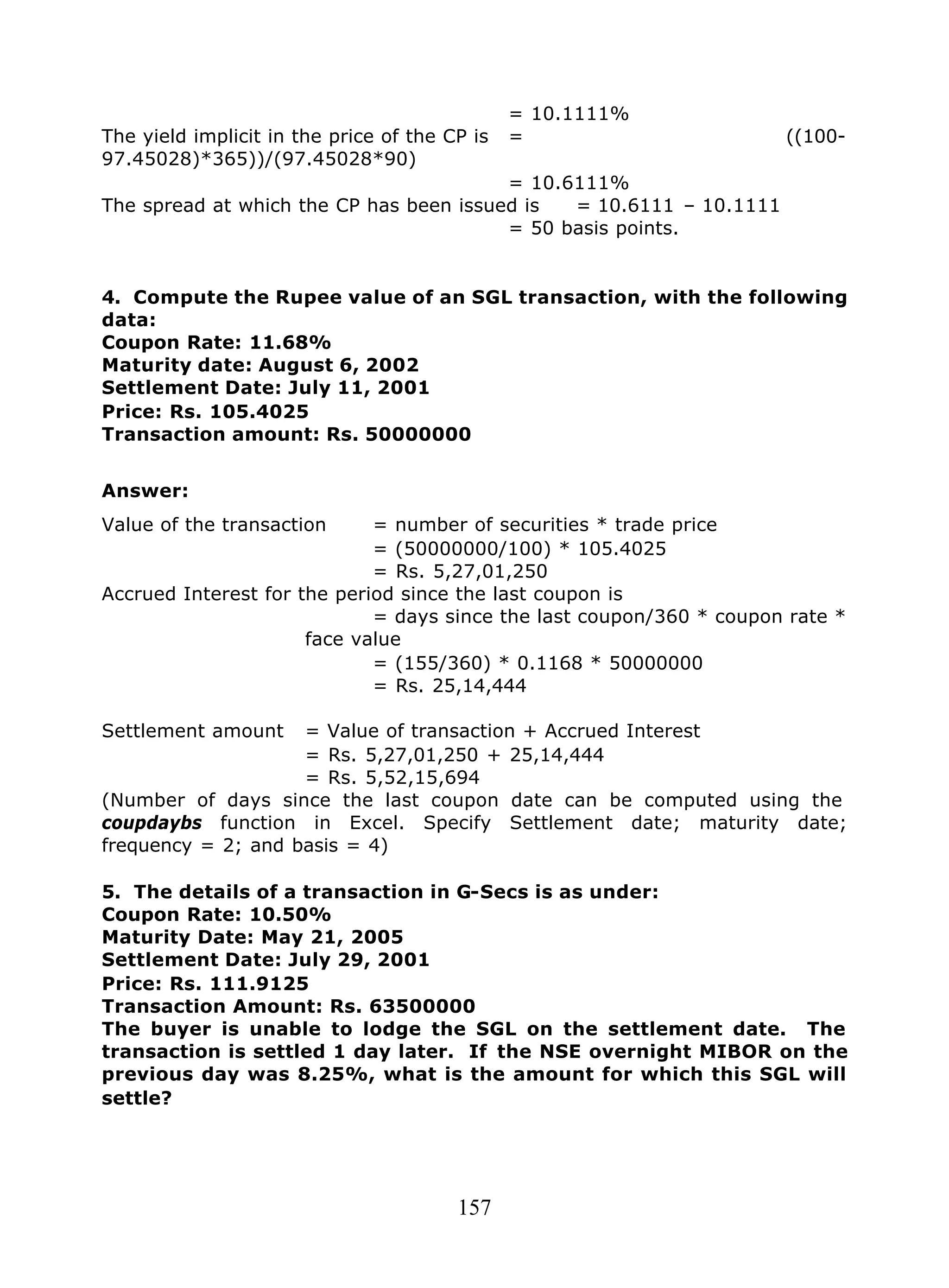
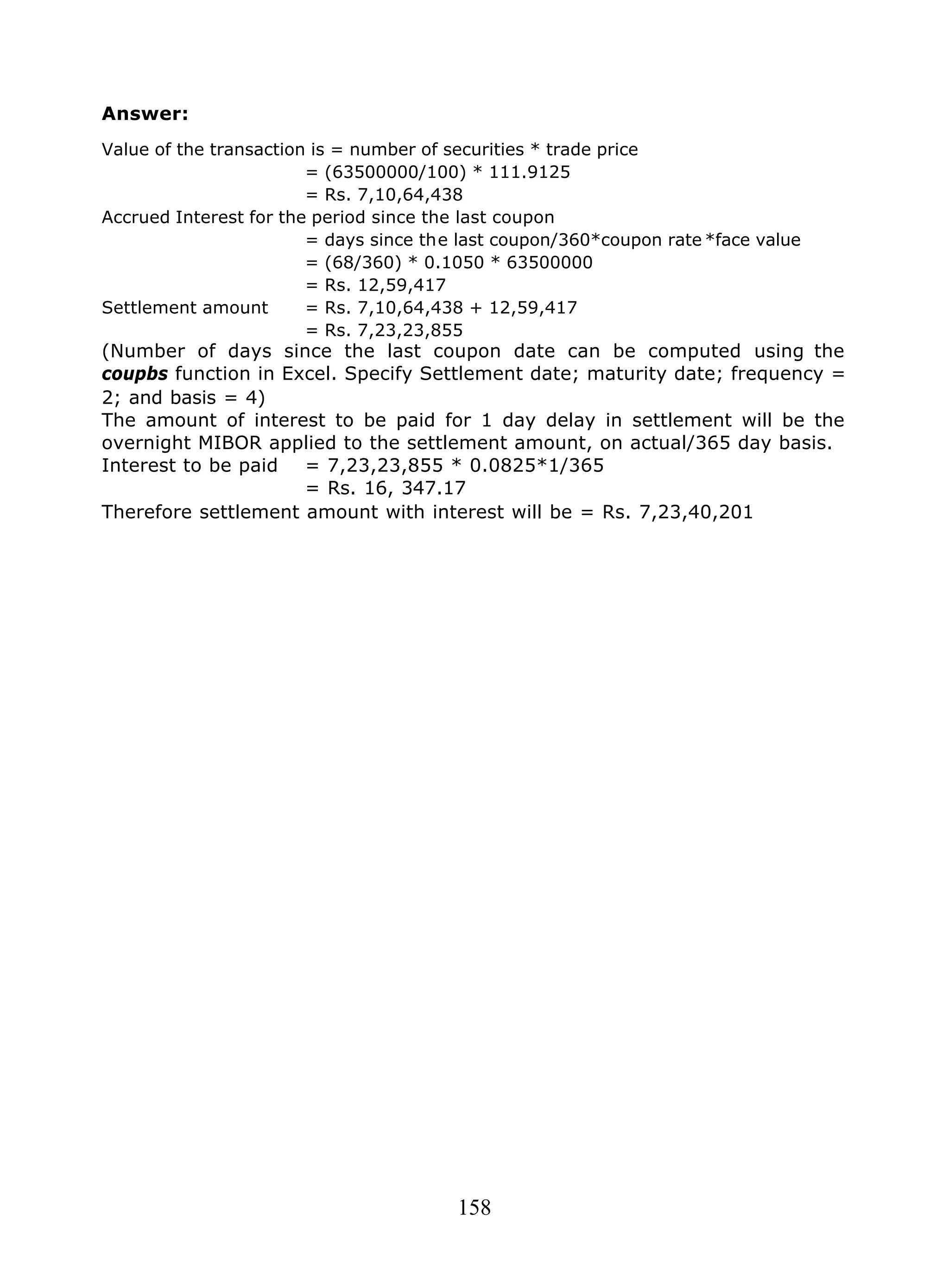
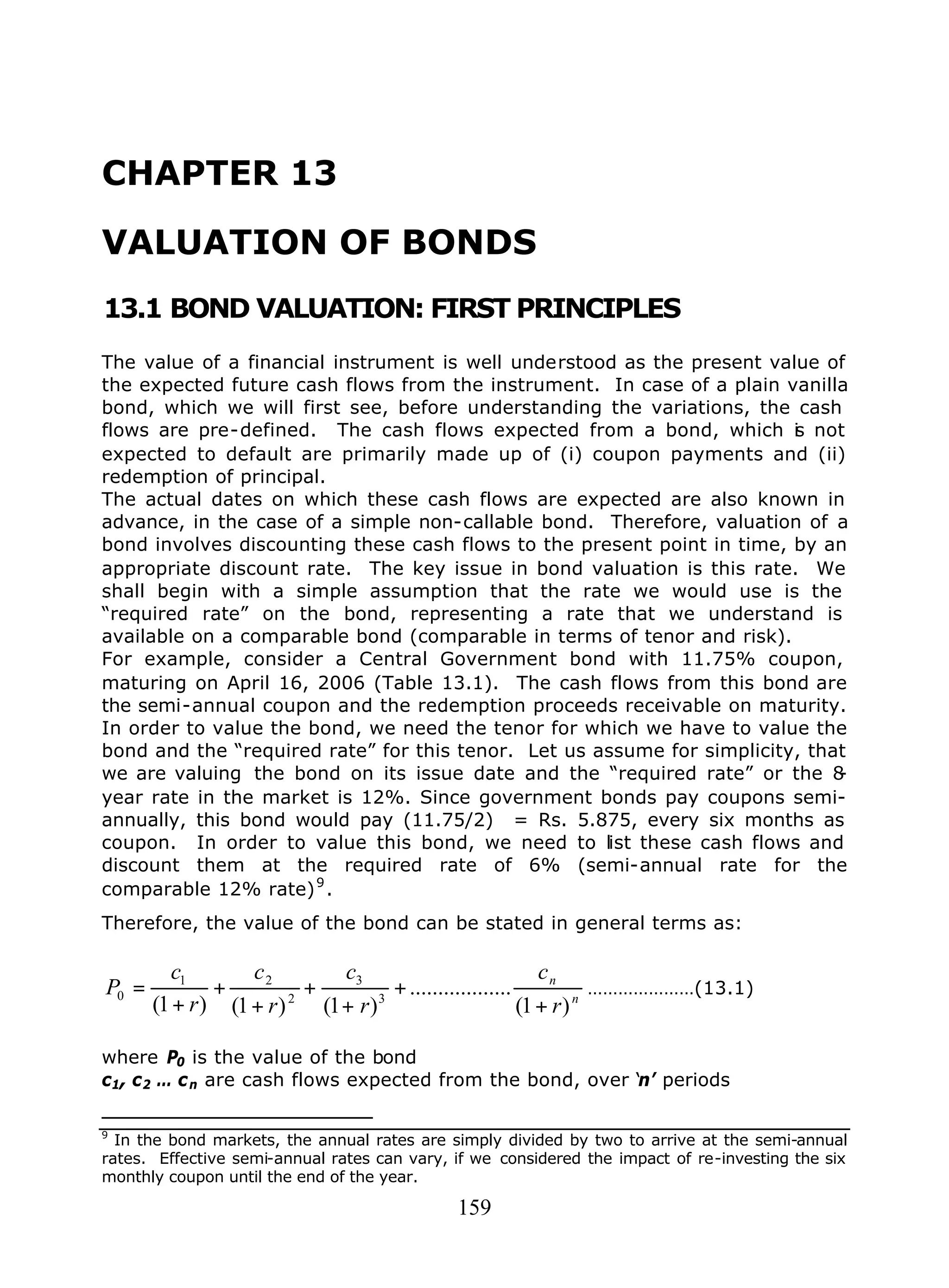
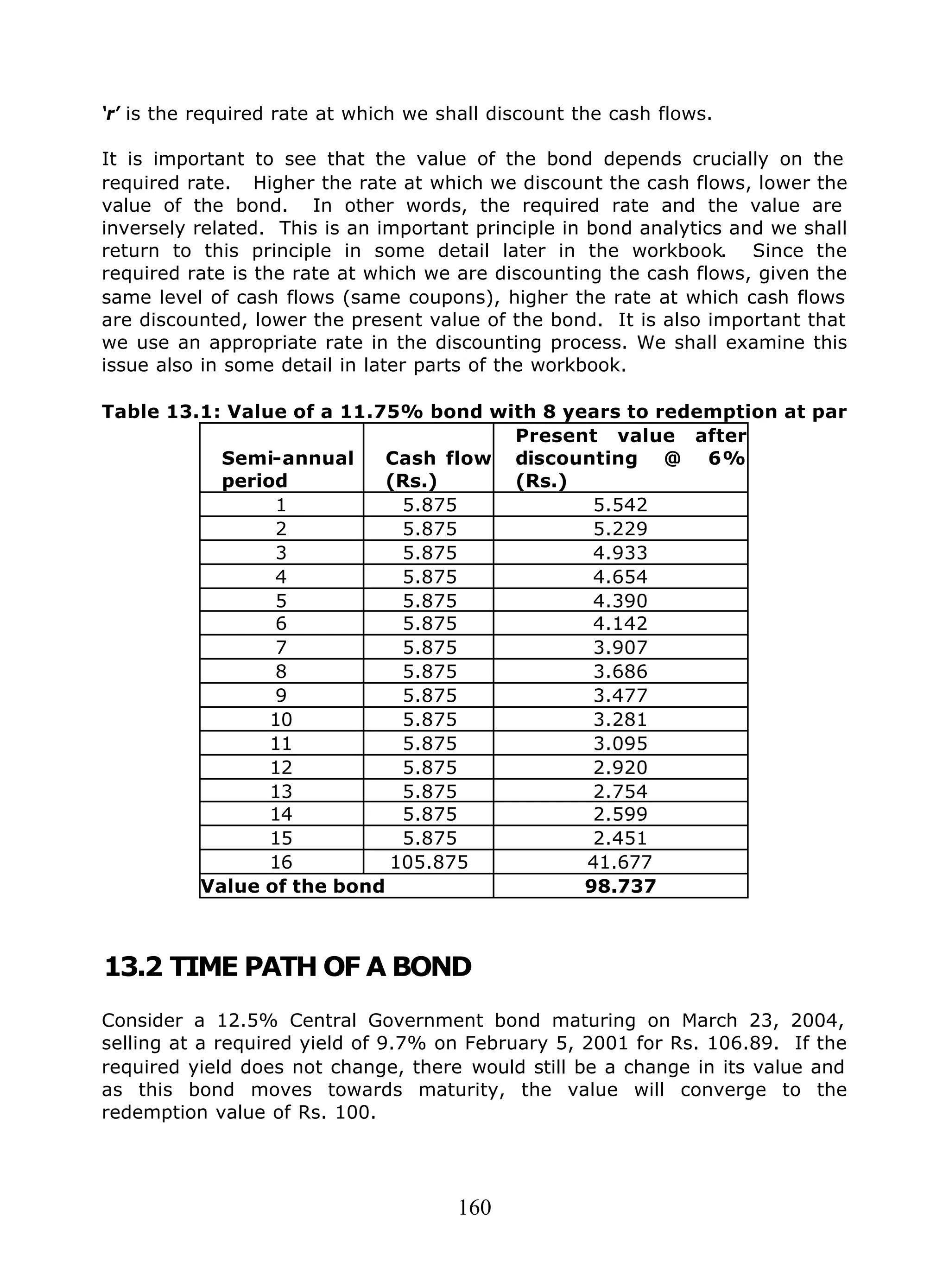
Copyright © 2009 by National Stock Exchange of India Ltd. (NSE)
Exchange Plaza, Bandra Kurla Complex,
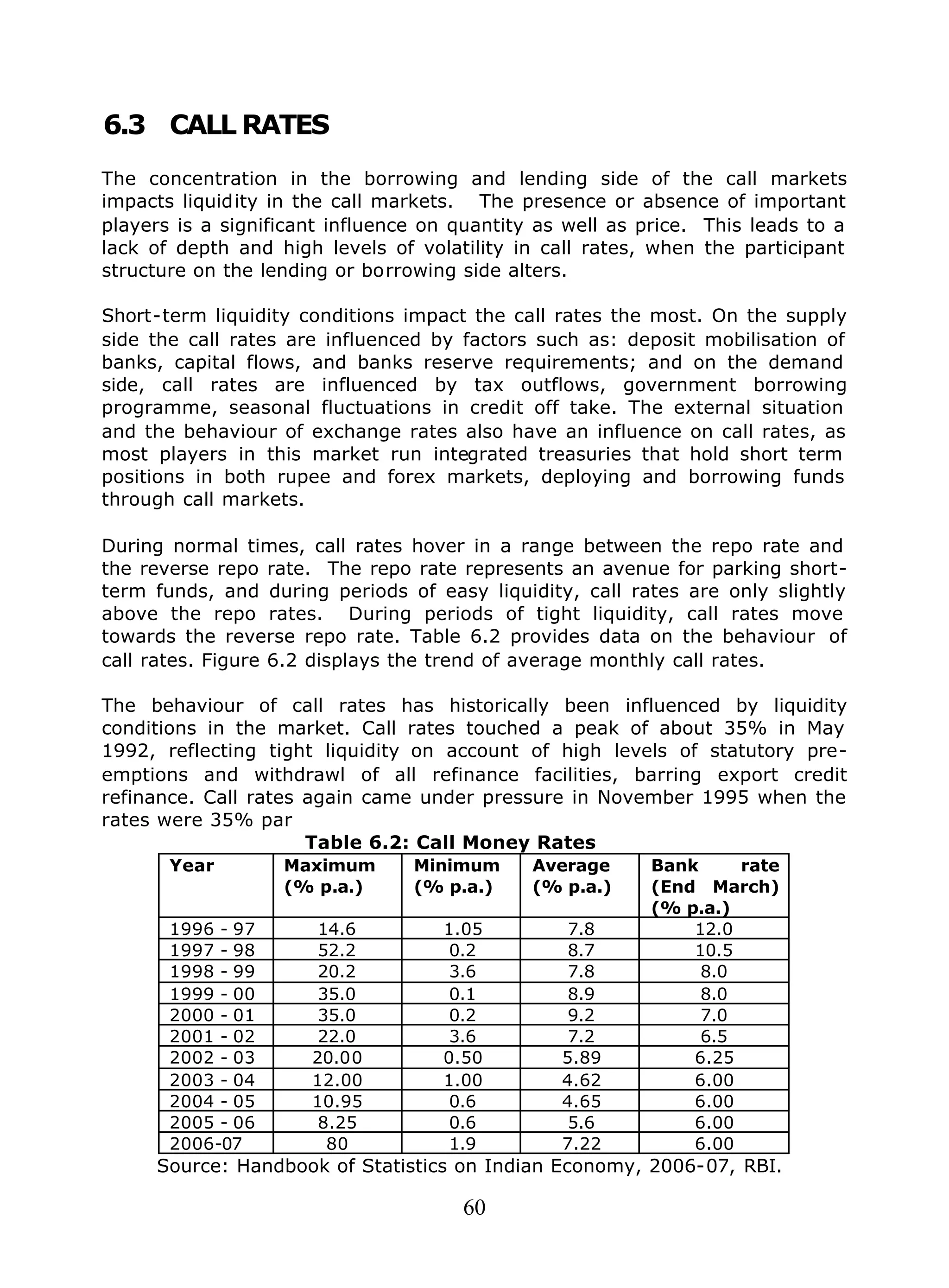
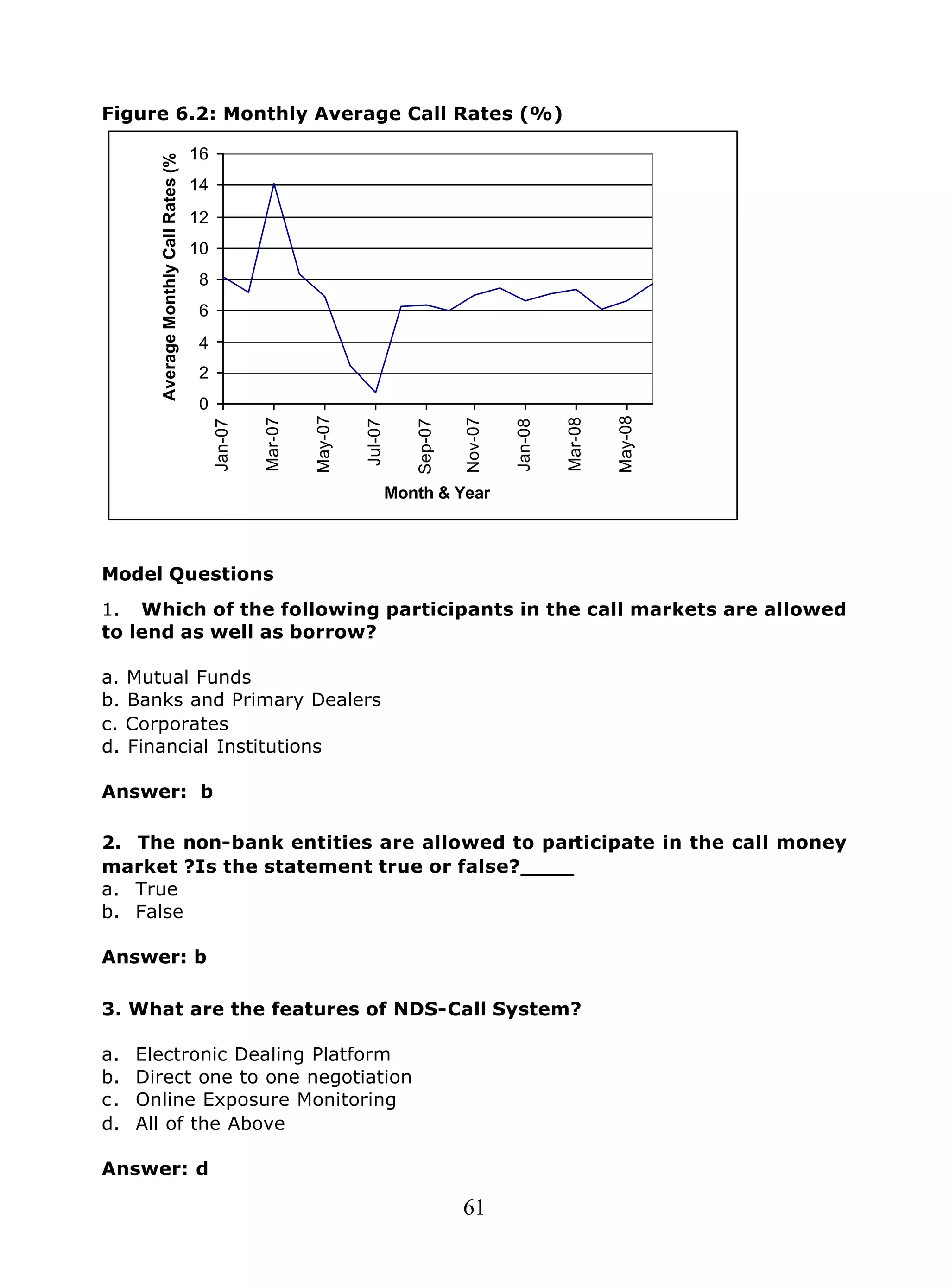
Bandra (East), Mumbai 400 051 INDIA
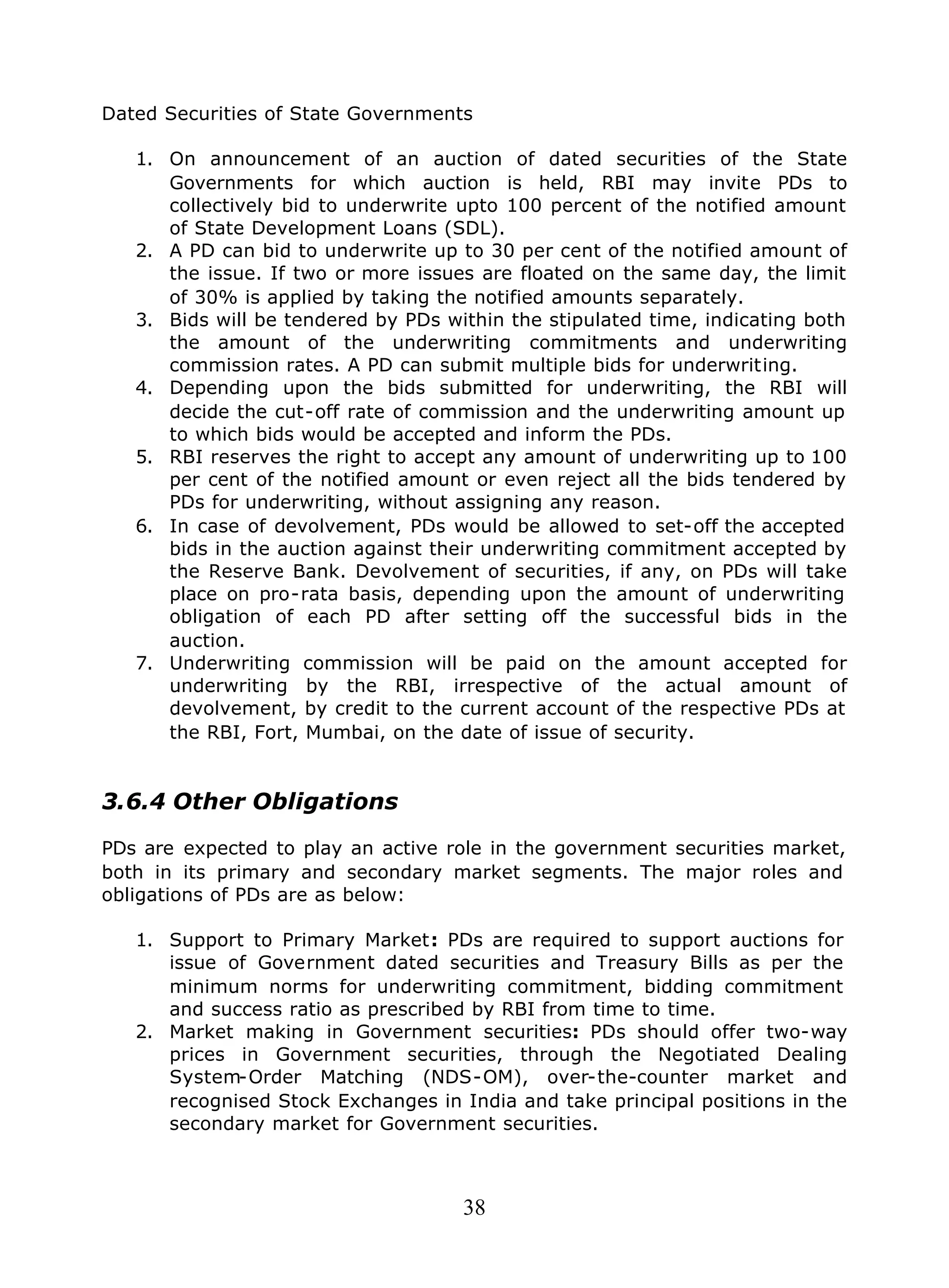
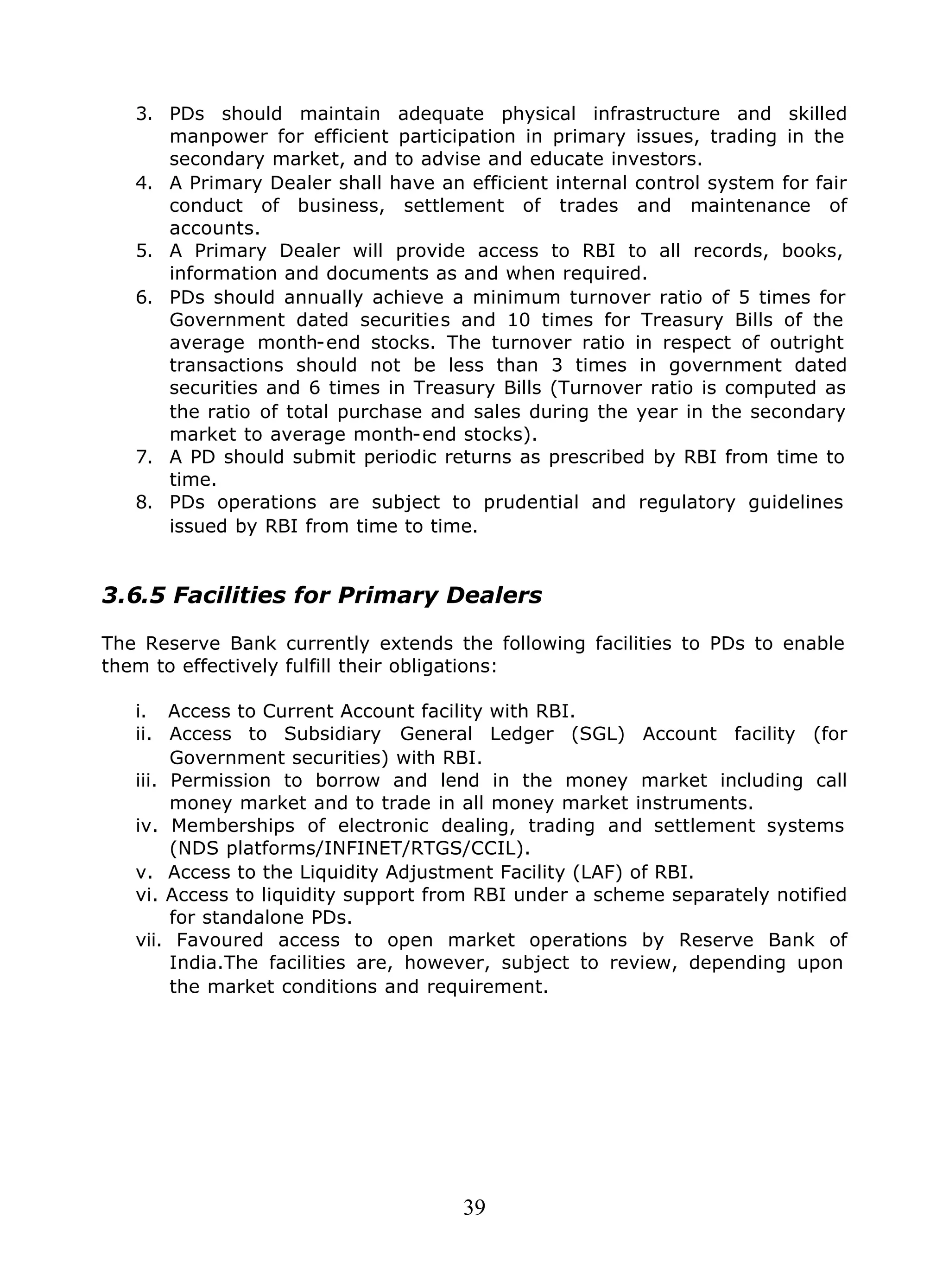
All content included in this book, such as text, graphics, logos, images, data compilation
etc. are the property of NSE. This book or any part thereof should not be copied,
reproduced, duplicated, sold, resold or exploited for any commercial purposes.
Furthermore, the book in its entirety or any part cannot be stored in a retrieval system or
transmitted in any form or by any means, electronic, mechanical, photocopying, recording
or otherwise.
1
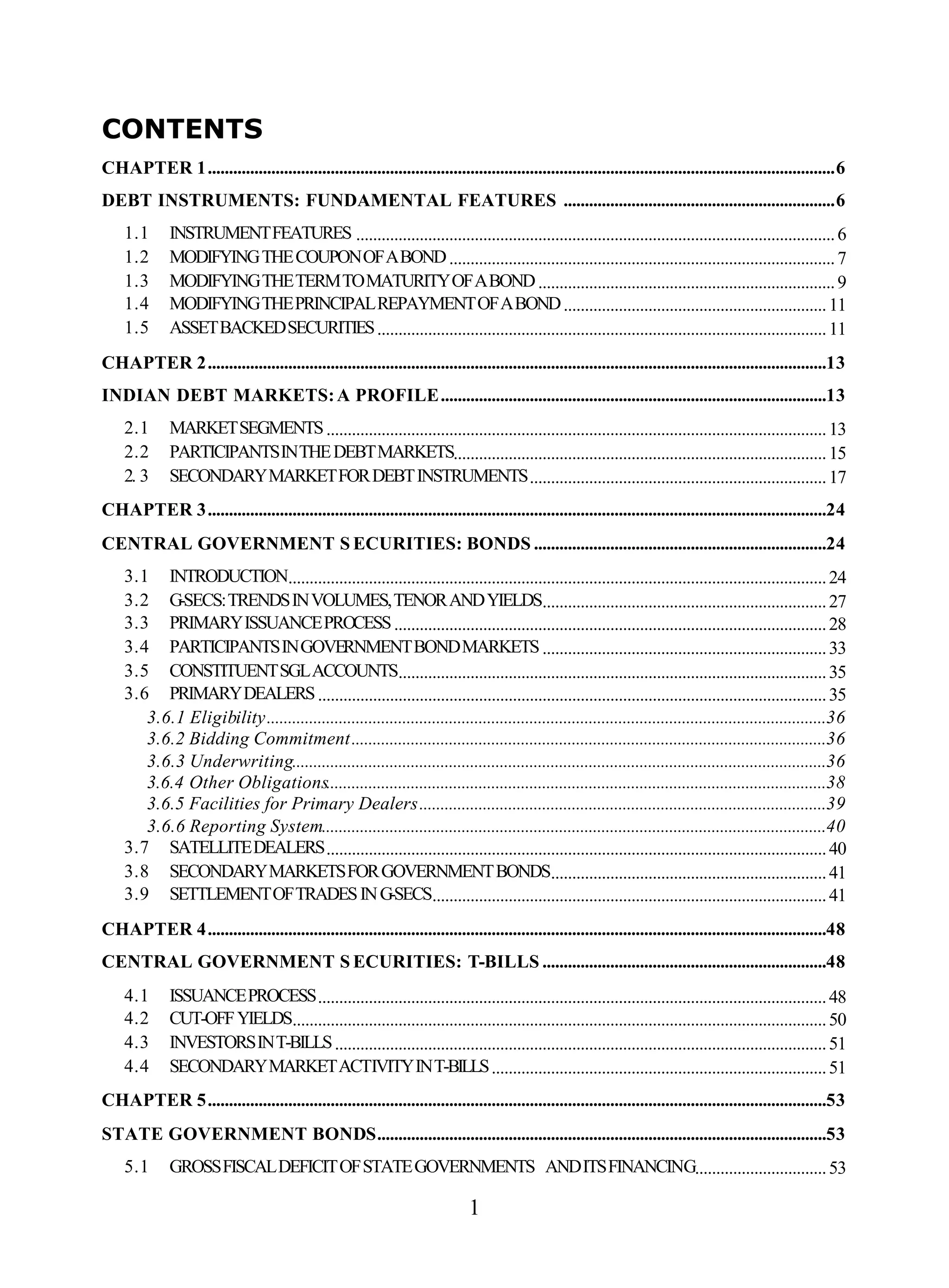
CONTENTS
CHAPTER 1....................................................................................................................................................6
DEBT INSTRUMENTS: FUNDAMENTAL FEATURES ................................................................6
1.1 INSTRUMENTFEATURES .................................................................................................................6
1.2 MODIFYINGTHECOUPONOFABOND...........................................................................................7
1.3 MODIFYINGTHETERMTOMATURITYOFABOND......................................................................9
1.4 MODIFYINGTHEPRINCIPALREPAYMENTOFABOND..............................................................11
1.5 ASSETBACKEDSECURITIES..........................................................................................................11
CHAPTER 2..................................................................................................................................................13
INDIAN DEBT MARKETS:A PROFILE...........................................................................................13
2.1 MARKETSEGMENTS......................................................................................................................13
2.2 PARTICIPANTSINTHEDEBTMARKETS........................................................................................15
2. 3 SECONDARYMARKETFORDEBTINSTRUMENTS......................................................................17
CHAPTER 3..................................................................................................................................................24
CENTRAL GOVERNMENT S ECURITIES: BONDS .....................................................................24
3.1 INTRODUCTION...............................................................................................................................24
3.2 G-SECS:TRENDSINVOLUMES,TENORANDYIELDS...................................................................27
3.3 PRIMARYISSUANCEPROCESS......................................................................................................28
3.4 PARTICIPANTSINGOVERNMENTBONDMARKETS...................................................................33
3.5 CONSTITUENTSGLACCOUNTS.....................................................................................................35
3.6 PRIMARYDEALERS........................................................................................................................35
3.6.1 Eligibility....................................................................................................................................36
3.6.2 Bidding Commitment................................................................................................................36
3.6.3 Underwriting..............................................................................................................................36
3.6.4 Other Obligations......................................................................................................................38
3.6.5 Facilities for Primary Dealers................................................................................................39
3.6.6 Reporting System.......................................................................................................................40
3.7 SATELLITEDEALERS......................................................................................................................40
3.8 SECONDARYMARKETSFORGOVERNMENTBONDS.................................................................41
3.9 SETTLEMENTOFTRADESING-SECS.............................................................................................41
CHAPTER 4..................................................................................................................................................48
CENTRAL GOVERNMENT S ECURITIES: T-BILLS ...................................................................48
4.1 ISSUANCEPROCESS........................................................................................................................48
4.2 CUT-OFFYIELDS..............................................................................................................................50
4.3 INVESTORSINT-BILLS....................................................................................................................51
4.4 SECONDARYMARKETACTIVITYINT-BILLS...............................................................................51
CHAPTER 5..................................................................................................................................................53
STATE GOVERNMENT BONDS..........................................................................................................53
5.1 GROSSFISCALDEFICITOFSTATEGOVERNMENTS ANDITSFINANCING...............................53
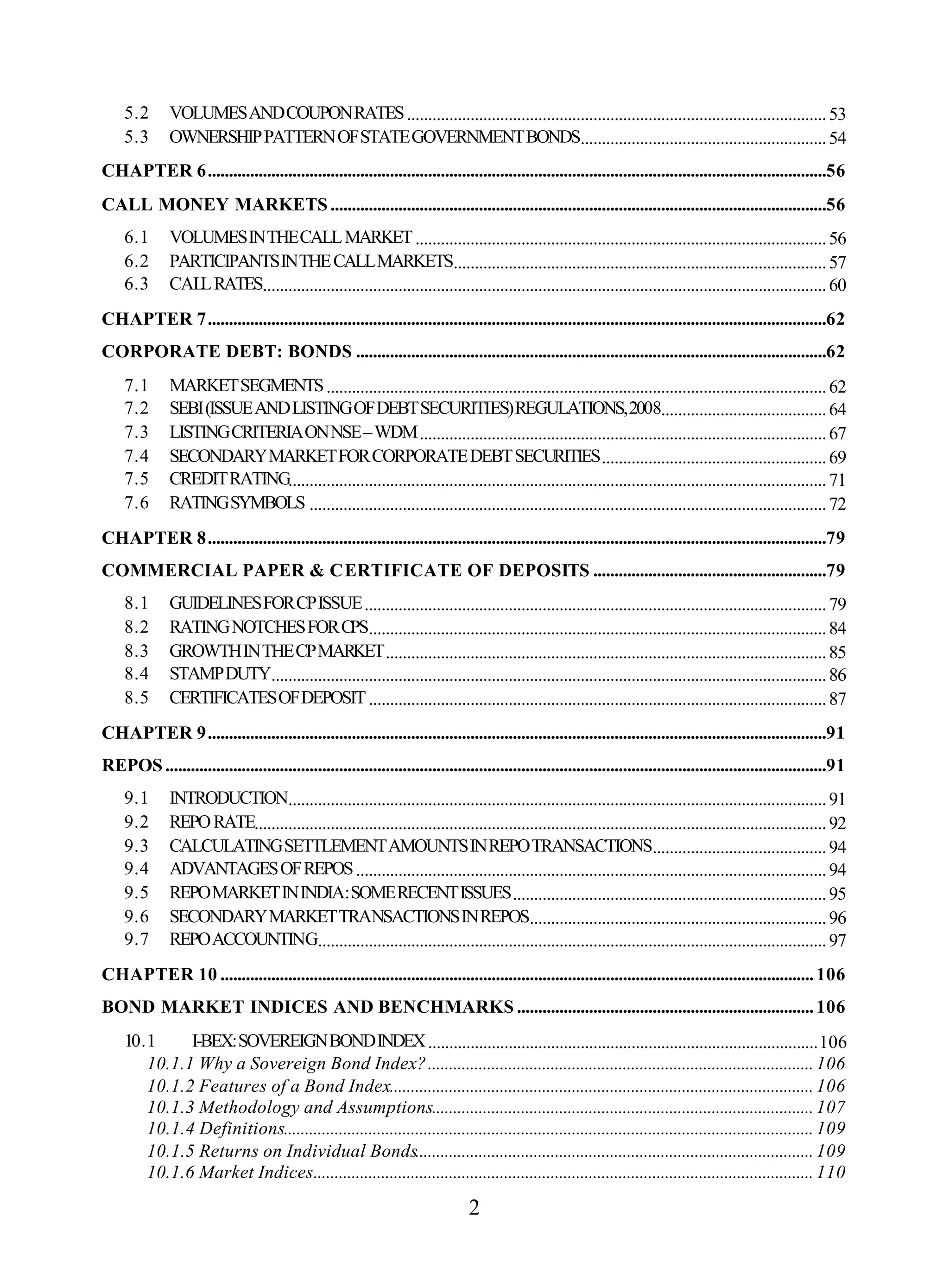
2
5.2 VOLUMESANDCOUPONRATES...................................................................................................53
5.3 OWNERSHIPPATTERNOFSTATEGOVERNMENTBONDS..........................................................54
CHAPTER 6..................................................................................................................................................56
CALL MONEY MARKETS .....................................................................................................................56
6.1 VOLUMESINTHECALLMARKET.................................................................................................56
6.2 PARTICIPANTSINTHECALLMARKETS........................................................................................57
6.3 CALLRATES.....................................................................................................................................60
CHAPTER 7..................................................................................................................................................62
CORPORATE DEBT: BONDS ...............................................................................................................62
7.1 MARKETSEGMENTS......................................................................................................................62
7.2 SEBI(ISSUEANDLISTINGOFDEBTSECURITIES)REGULATIONS,2008.......................................64
7.3 LISTINGCRITERIAONNSE–WDM................................................................................................67
7.4 SECONDARYMARKETFORCORPORATEDEBTSECURITIES.....................................................69
7.5 CREDITRATING...............................................................................................................................71
7.6 RATINGSYMBOLS ..........................................................................................................................72
CHAPTER 8..................................................................................................................................................79
COMMERCIAL PAPER & CERTIFICATE OF DEPOSITS .......................................................79
8.1 GUIDELINESFORCPISSUE.............................................................................................................79
8.2 RATINGNOTCHESFORCPS............................................................................................................84
8.3 GROWTHINTHECPMARKET........................................................................................................85
8.4 STAMPDUTY...................................................................................................................................86
8.5 CERTIFICATESOFDEPOSIT............................................................................................................87
CHAPTER 9..................................................................................................................................................91
REPOS............................................................................................................................................................91
9.1 INTRODUCTION...............................................................................................................................91
9.2 REPORATE.......................................................................................................................................92
9.3 CALCULATINGSETTLEMENTAMOUNTSINREPOTRANSACTIONS.........................................94
9.4 ADVANTAGESOFREPOS...............................................................................................................94
9.5 REPOMARKETININDIA:SOMERECENTISSUES..........................................................................95
9.6 SECONDARYMARKETTRANSACTIONSINREPOS......................................................................96
9.7 REPOACCOUNTING........................................................................................................................97
CHAPTER 10 ............................................................................................................................................106
BOND MARKET INDICES AND BENCHMARKS ......................................................................106
10.1 I-BEX:SOVEREIGNBONDINDEX............................................................................................106
10.1.1 Why a Sovereign Bond Index?...........................................................................................106
10.1.2 Features of a Bond Index....................................................................................................106
10.1.3 Methodology and Assumptions..........................................................................................107
10.1.4 Definitions.............................................................................................................................109
10.1.5 Returns on Individual Bonds..............................................................................................109
10.1.6 Market Indices......................................................................................................................110
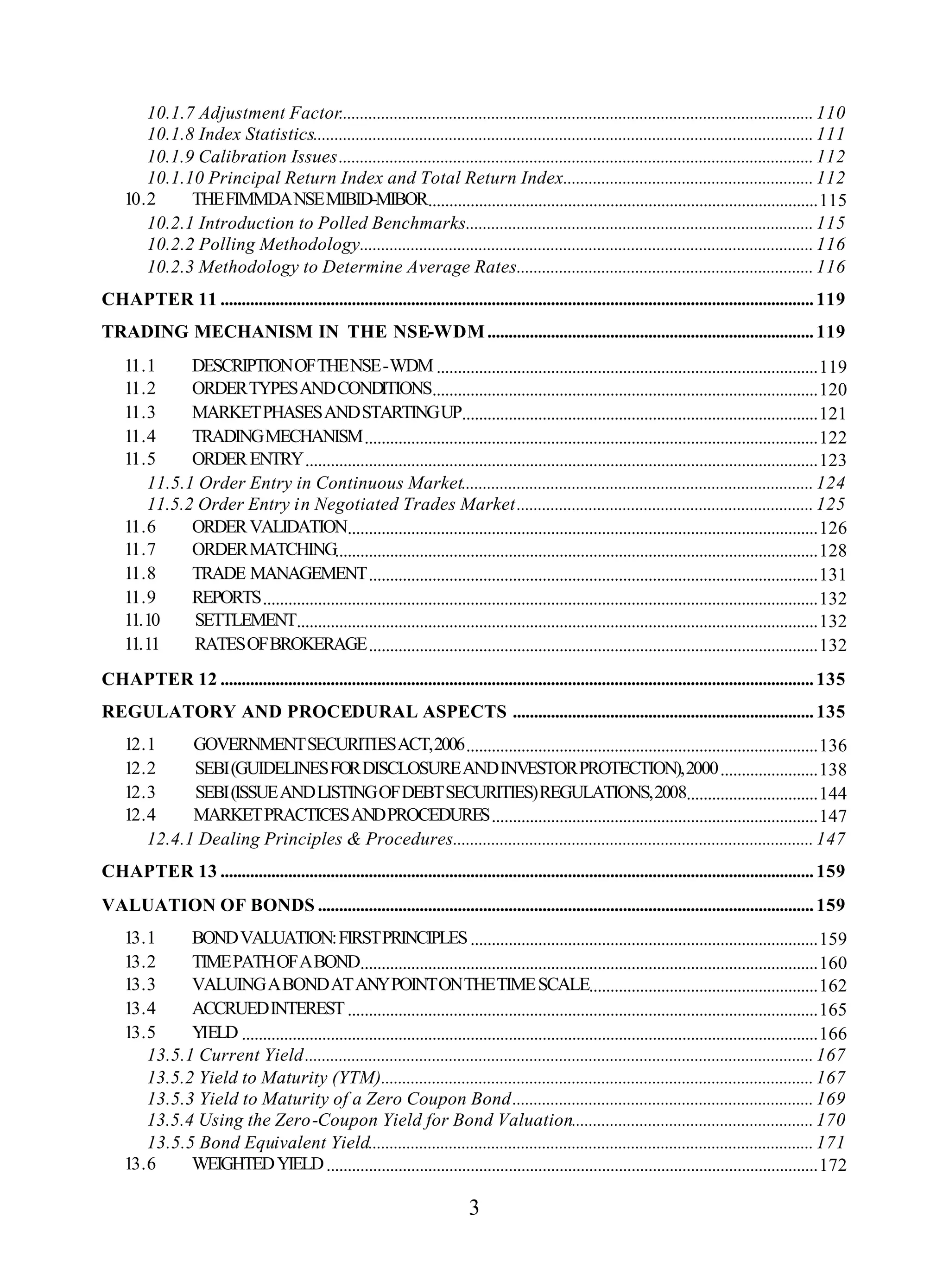
3
10.1.7 Adjustment Factor................................................................................................................110
10.1.8 Index Statistics......................................................................................................................111
10.1.9 Calibration Issues................................................................................................................112
10.1.10 Principal Return Index and Total Return Index...........................................................112
10.2 THEFIMMDANSEMIBID-MIBOR............................................................................................115
10.2.1 Introduction to Polled Benchmarks..................................................................................115
10.2.2 Polling Methodology...........................................................................................................116
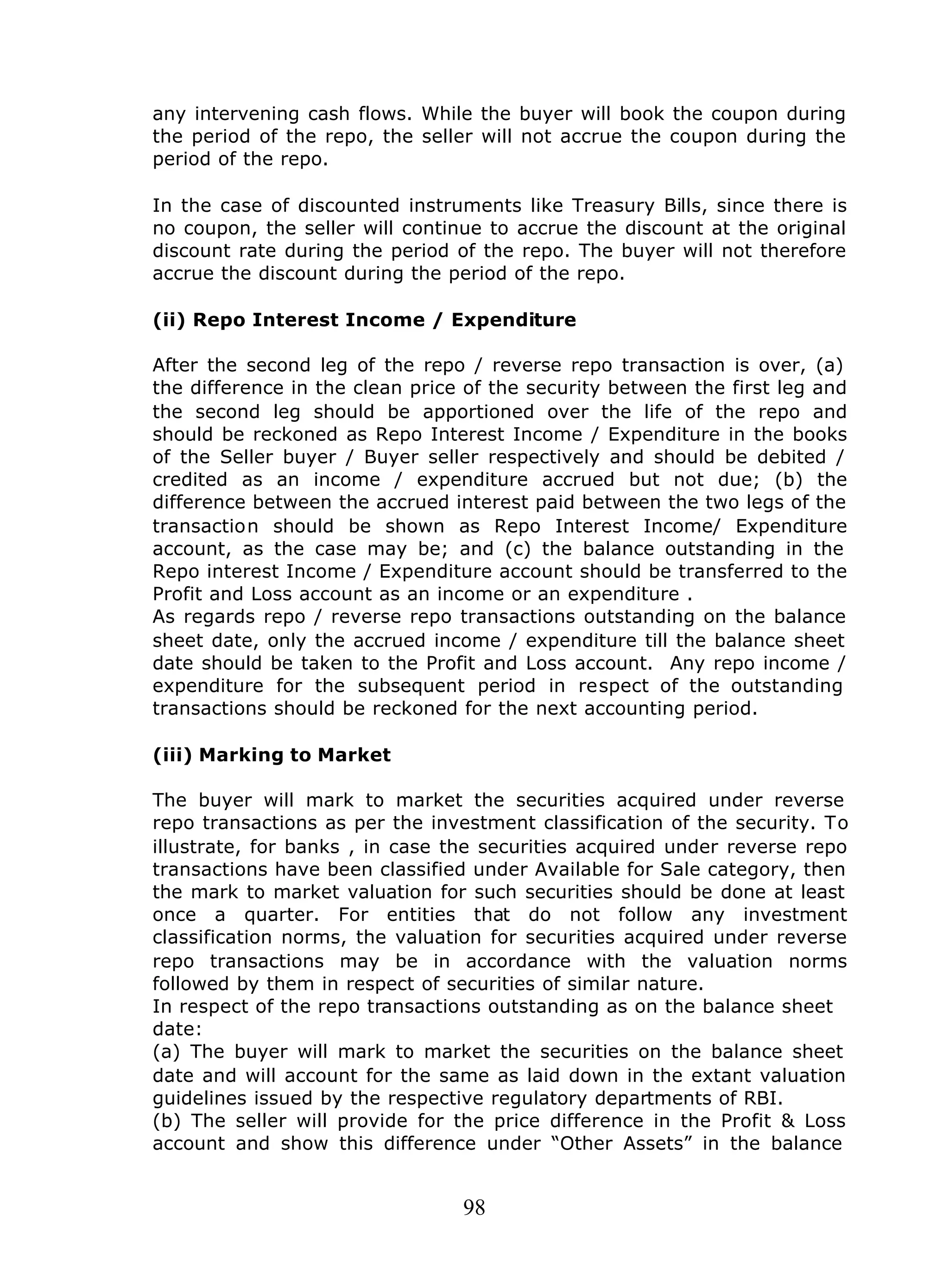
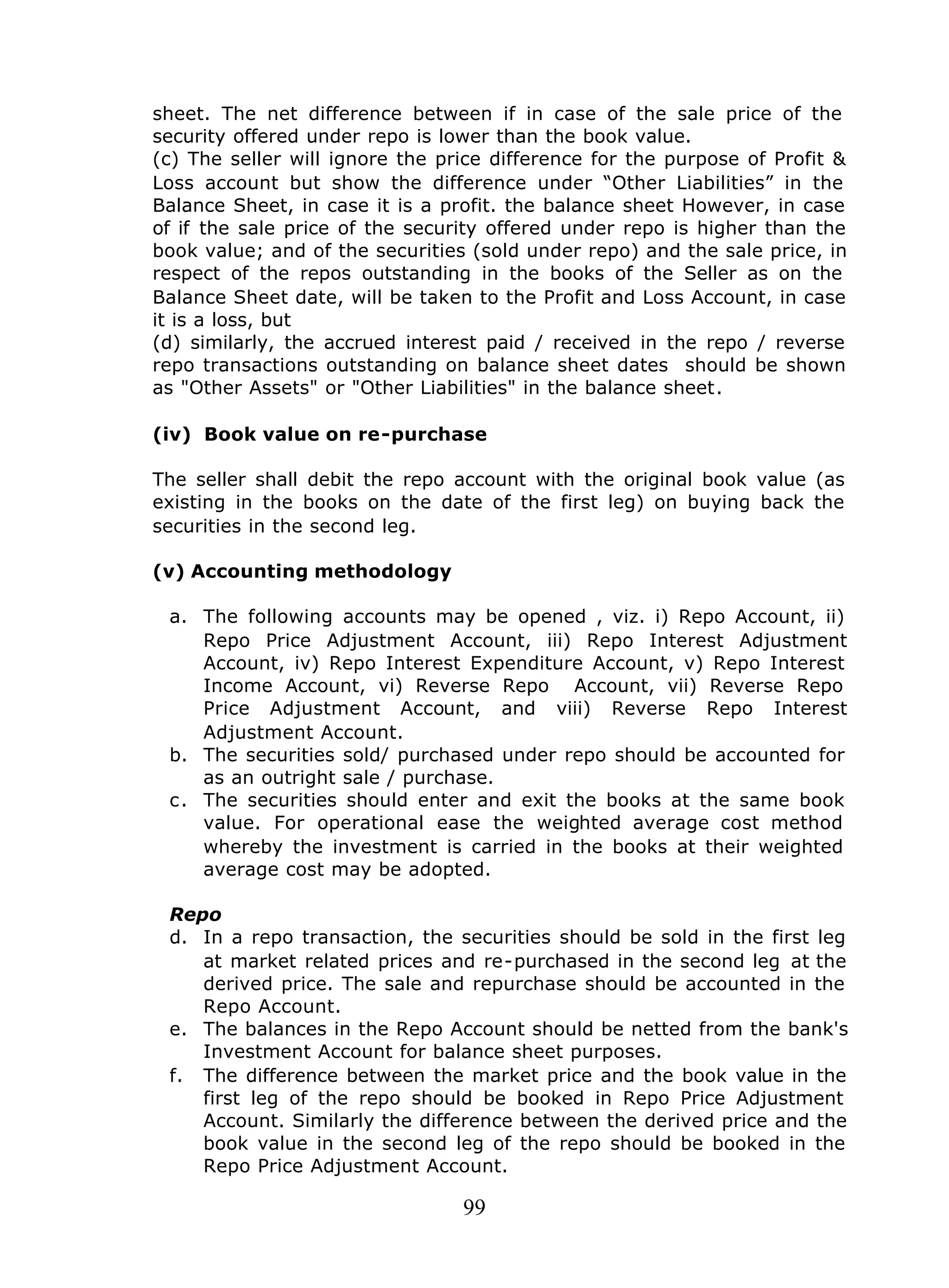
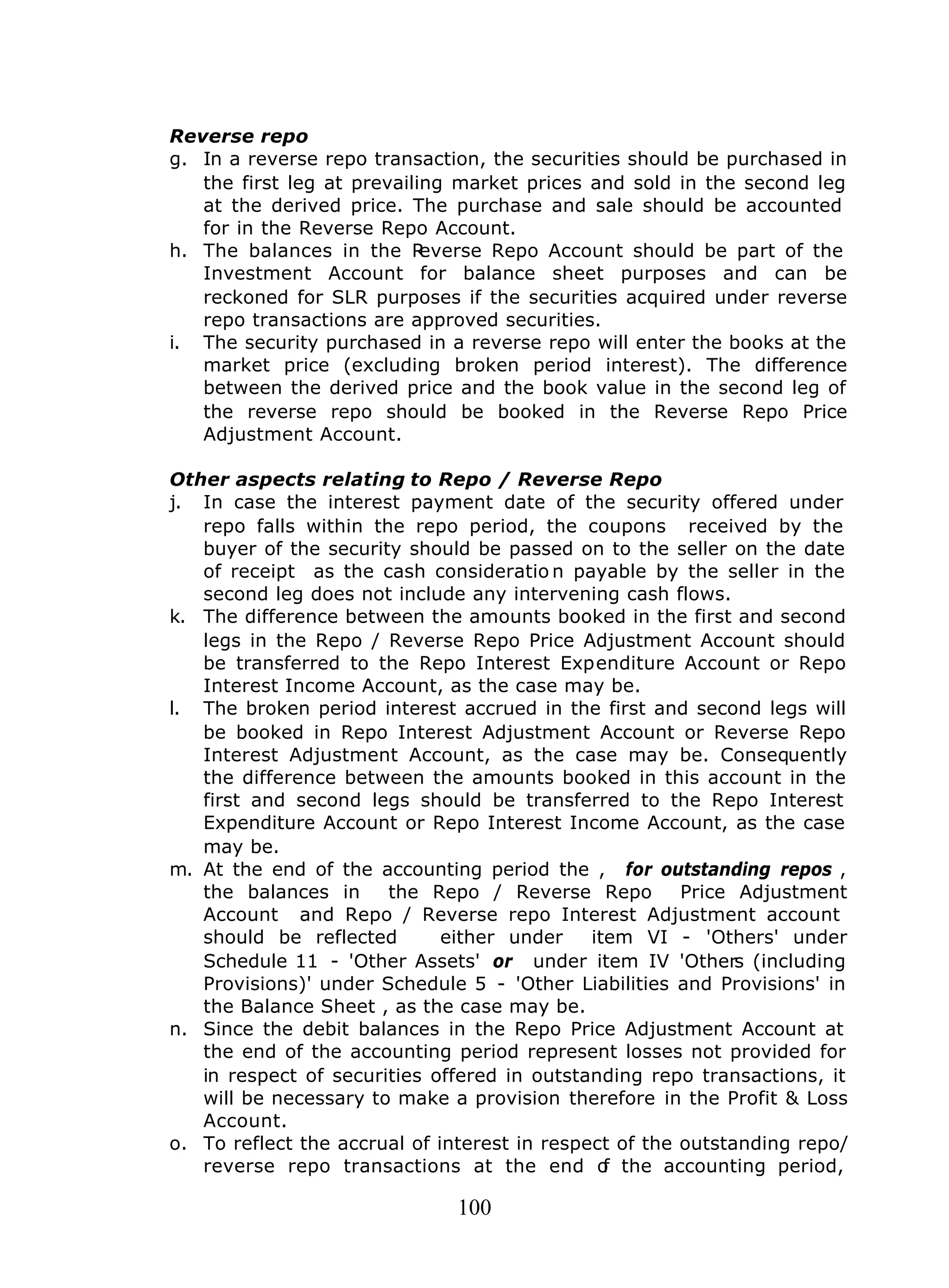
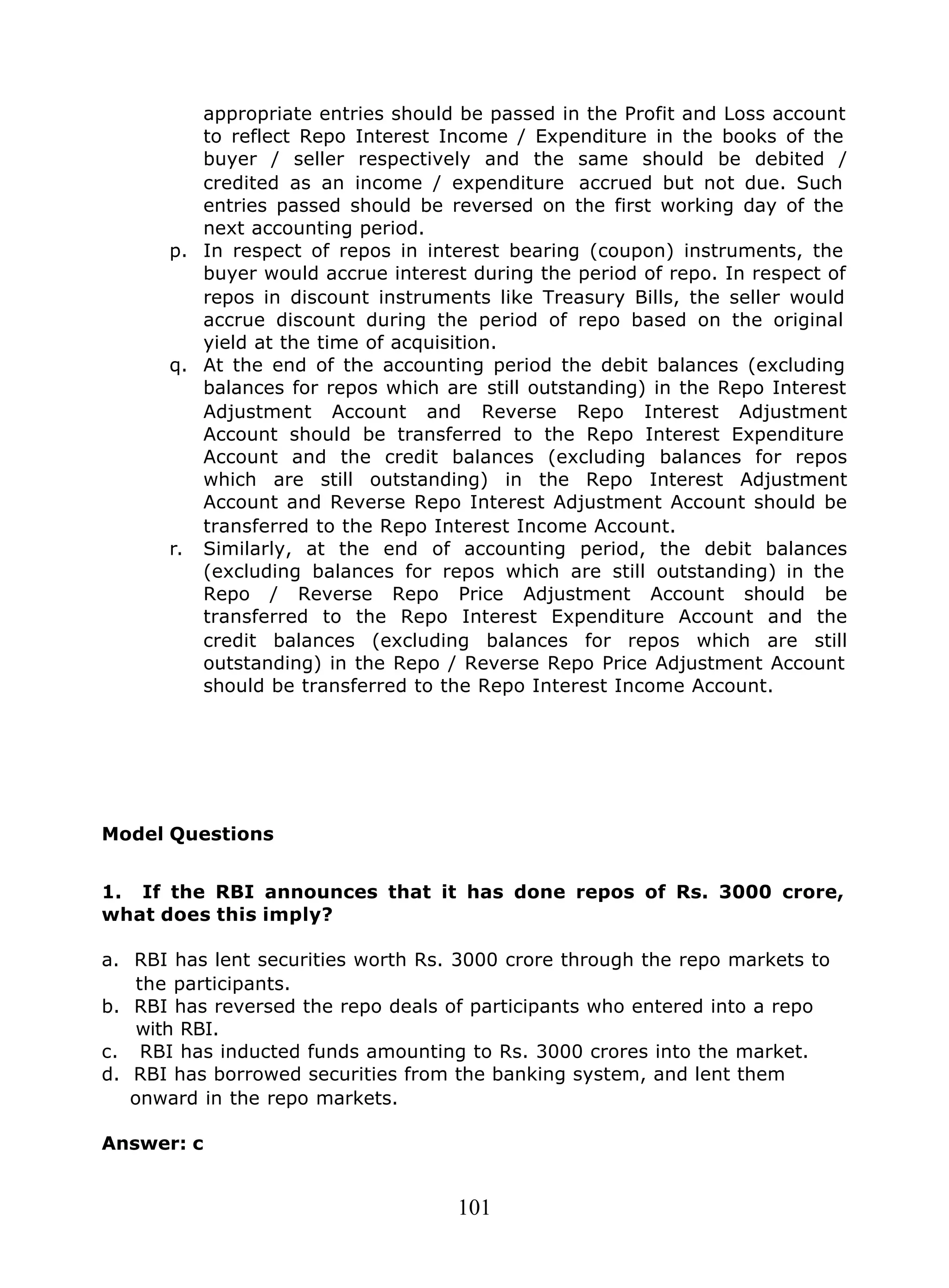
10.2.3 Methodology to Determine Average Rates......................................................................116
CHAPTER 11 ............................................................................................................................................119
TRADING MECHANISM IN THE NSE-WDM.............................................................................119
11.1 DESCRIPTIONOFTHENSE-WDM..........................................................................................119
11.2 ORDERTYPESANDCONDITIONS...........................................................................................120
11.3 MARKETPHASESANDSTARTINGUP....................................................................................121
11.4 TRADINGMECHANISM...........................................................................................................122
11.5 ORDERENTRY.........................................................................................................................123
11.5.1 Order Entry in Continuous Market...................................................................................124
11.5.2 Order Entry in Negotiated Trades Market......................................................................125
11.6 ORDERVALIDATION...............................................................................................................126
11.7 ORDERMATCHING..................................................................................................................128
11.8 TRADE MANAGEMENT..........................................................................................................131
11.9 REPORTS...................................................................................................................................132
11.10 SETTLEMENT...........................................................................................................................132
11.11 RATESOFBROKERAGE..........................................................................................................132
CHAPTER 12 ............................................................................................................................................135
REGULATORY AND PROCEDURAL ASPECTS .......................................................................135
12.1 GOVERNMENTSECURITIESACT,2006...................................................................................136
12.2 SEBI(GUIDELINESFORDISCLOSUREANDINVESTORPROTECTION),2000.......................138
12.3 SEBI(ISSUEANDLISTINGOFDEBTSECURITIES)REGULATIONS,2008...............................144
12.4 MARKETPRACTICESANDPROCEDURES.............................................................................147
12.4.1 Dealing Principles & Procedures.....................................................................................147
CHAPTER 13 ............................................................................................................................................159
VALUATION OF BONDS .....................................................................................................................159
13.1 BONDVALUATION:FIRSTPRINCIPLES..................................................................................159
13.2 TIMEPATHOFABOND............................................................................................................160
13.3 VALUINGABONDATANYPOINTONTHETIMESCALE......................................................162
13.4 ACCRUEDINTEREST...............................................................................................................165
13.5 YIELD ........................................................................................................................................166
13.5.1 Current Yield........................................................................................................................167
13.5.2 Yield to Maturity (YTM)......................................................................................................167
13.5.3 Yield to Maturity of a Zero Coupon Bond.......................................................................169
13.5.4 Using the Zero-Coupon Yield for Bond Valuation.........................................................170
13.5.5 Bond Equivalent Yield.........................................................................................................171
13.6 WEIGHTEDYIELD....................................................................................................................172
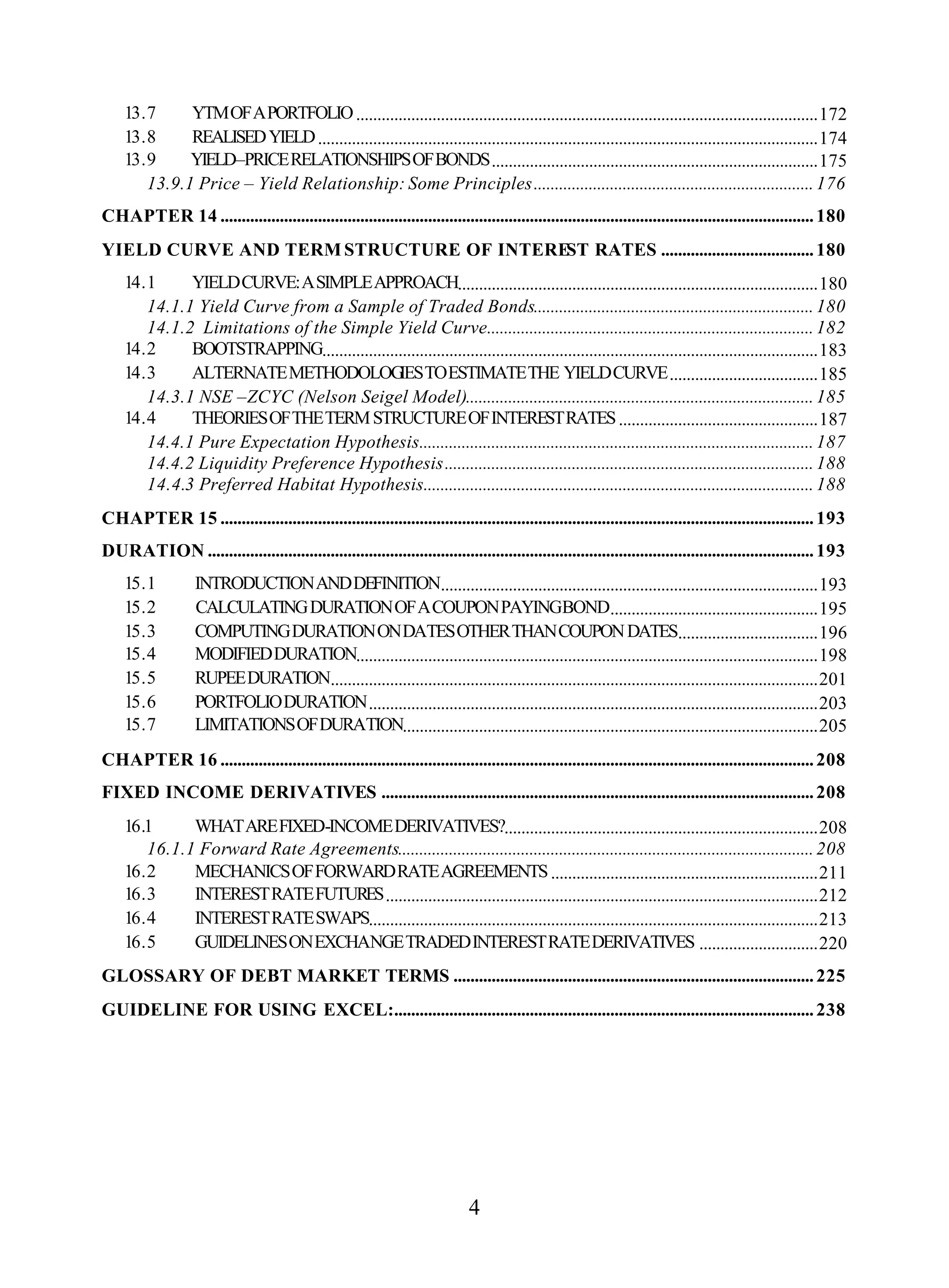
4
13.7 YTMOFAPORTFOLIO.............................................................................................................172
13.8 REALISEDYIELD......................................................................................................................174
13.9 YIELD–PRICERELATIONSHIPSOFBONDS.............................................................................175
13.9.1 Price – Yield Relationship: Some Principles..................................................................176
CHAPTER 14 ............................................................................................................................................180
YIELD CURVE AND TERM STRUCTURE OF INTEREST RATES ....................................180
14.1 YIELDCURVE:ASIMPLEAPPROACH.....................................................................................180
14.1.1 Yield Curve from a Sample of Traded Bonds..................................................................180
14.1.2 Limitations of the Simple Yield Curve.............................................................................182
14.2 BOOTSTRAPPING.....................................................................................................................183
14.3 ALTERNATEMETHODOLOGIESTOESTIMATETHE YIELDCURVE...................................185
14.3.1 NSE –ZCYC (Nelson Seigel Model)..................................................................................185
14.4 THEORIESOFTHETERMSTRUCTUREOFINTERESTRATES...............................................187
14.4.1 Pure Expectation Hypothesis.............................................................................................187
14.4.2 Liquidity Preference Hypothesis.......................................................................................188
14.4.3 Preferred Habitat Hypothesis............................................................................................188
CHAPTER 15 ............................................................................................................................................193
DURATION ...............................................................................................................................................193
15.1 INTRODUCTIONANDDEFINITION.........................................................................................193
15.2 CALCULATINGDURATIONOFACOUPONPAYINGBOND.................................................195
15.3 COMPUTINGDURATIONONDATESOTHERTHANCOUPONDATES.................................196
15.4 MODIFIEDDURATION.............................................................................................................198
15.5 RUPEEDURATION...................................................................................................................201
15.6 PORTFOLIODURATION..........................................................................................................203
15.7 LIMITATIONSOFDURATION..................................................................................................205
CHAPTER 16 ............................................................................................................................................208
FIXED INCOME DERIVATIVES ......................................................................................................208
16.1 WHATAREFIXED-INCOMEDERIVATIVES?..........................................................................208
16.1.1 Forward Rate Agreements..................................................................................................208
16.2 MECHANICSOFFORWARDRATEAGREEMENTS...............................................................211
16.3 INTERESTRATEFUTURES......................................................................................................212
16.4 INTERESTRATESWAPS..........................................................................................................213
16.5 GUIDELINESONEXCHANGETRADEDINTERESTRATEDERIVATIVES ............................220
GLOSSARY OF DEBT MARKET TERMS .....................................................................................225
GUIDELINE FOR USING EXCEL:...................................................................................................238
5
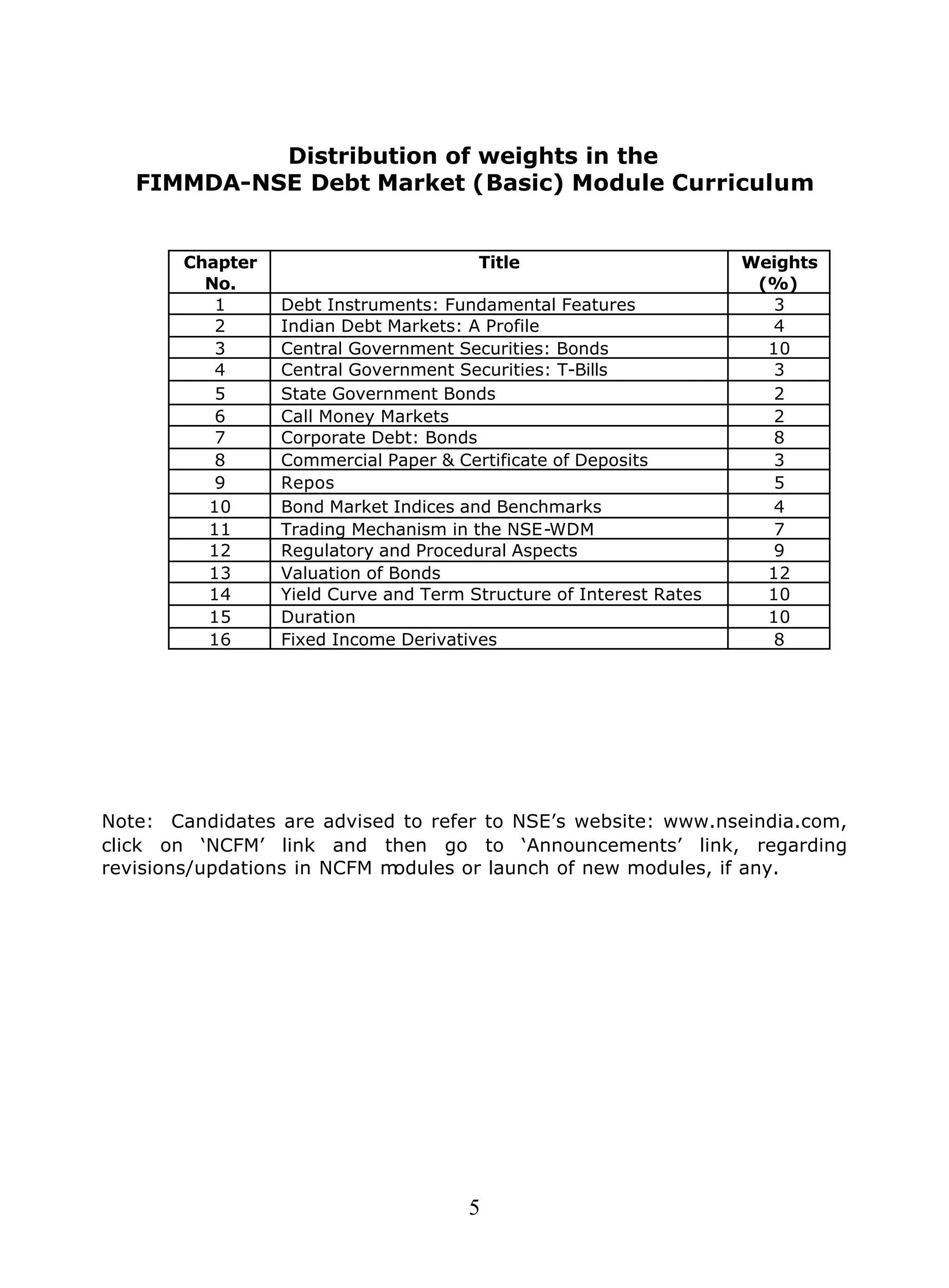
Distribution of weights in the
FIMMDA-NSE Debt Market (Basic) Module Curriculum
Chapter
No.
Title Weights
(%)
1 Debt Instruments: Fundamental Features 3
2 Indian Debt Markets: A Profile 4
3 Central Government Securities: Bonds 10
4 Central Government Securities: T-Bills 3
5 State Government Bonds 2
6 Call Money Markets 2
7 Corporate Debt: Bonds 8
8 Commercial Paper & Certificate of Deposits 3
9 Repos 5
10 Bond Market Indices and Benchmarks 4
11 Trading Mechanism in the NSE-WDM 7
12 Regulatory and Procedural Aspects 9
13 Valuation of Bonds 12
14 Yield Curve and Term Structure of Interest Rates 10
15 Duration 10
16 Fixed Income Derivatives 8
Note: Candidates are advised to refer to NSE’s website: www.nseindia.com,
click on ‘NCFM’ link and then go to ‘Announcements’ link, regarding
revisions/updations in NCFM modules or launch of new modules, if any.
6
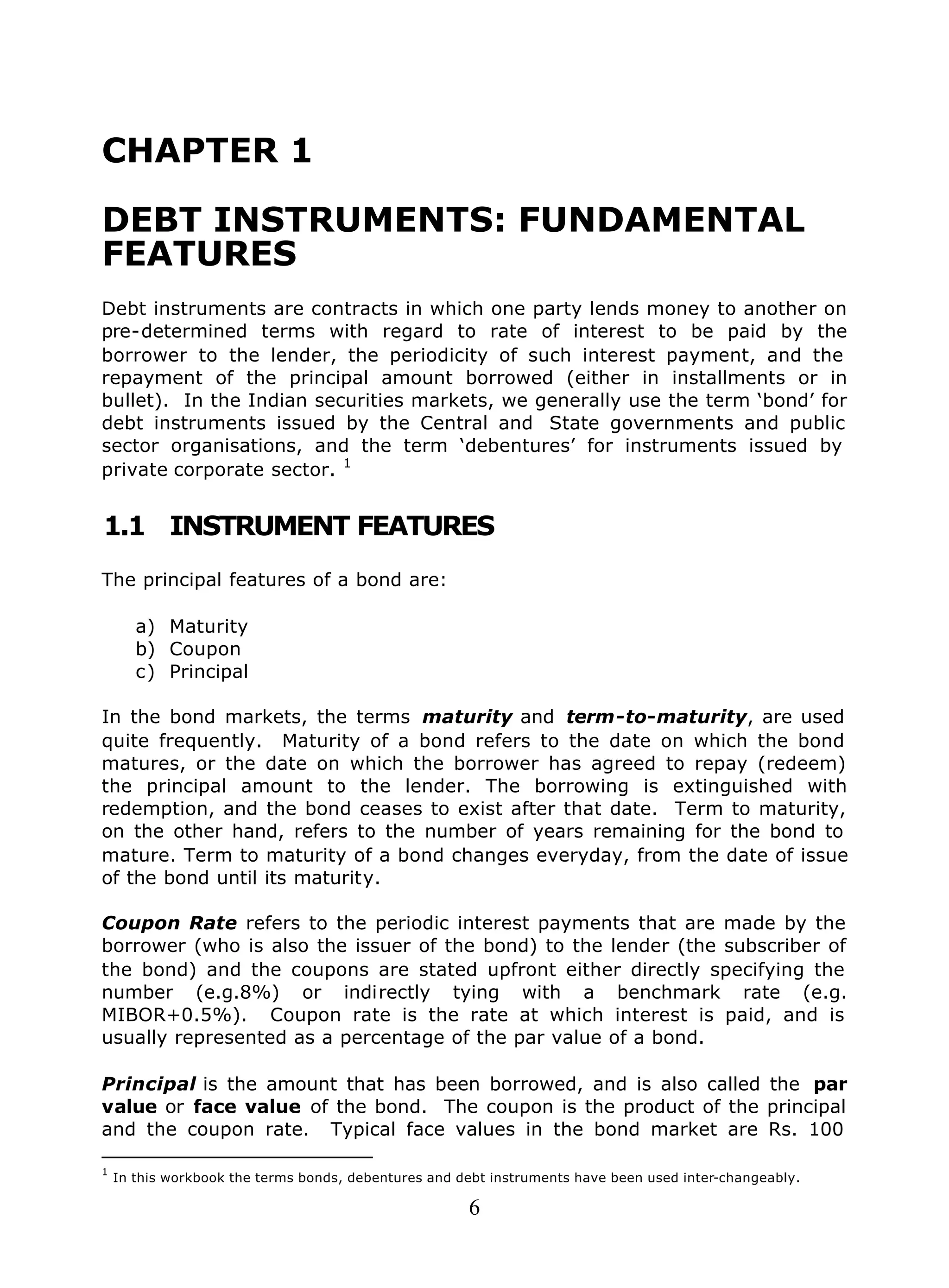
CHAPTER 1
DEBT INSTRUMENTS: FUNDAMENTAL
FEATURES
Debt instruments are contracts in which one party lends money to another on
pre-determined terms with regard to rate of interest to be paid by the
borrower to the lender, the periodicity of such interest payment, and the
repayment of the principal amount borrowed (either in installments or in
bullet). In the Indian securities markets, we generally use the term ‘bond’ for
debt instruments issued by the Central and State governments and public
sector organisations, and the term ‘debentures’ for instruments issued by
private corporate sector. 1
1.1 INSTRUMENT FEATURES
The principal features of a bond are:
a) Maturity
b) Coupon
c) Principal
In the bond markets, the terms maturity and term-to-maturity, are used
quite frequently. Maturity of a bond refers to the date on which the bond
matures, or the date on which the borrower has agreed to repay (redeem)
the principal amount to the lender. The borrowing is extinguished with
redemption, and the bond ceases to exist after that date. Term to maturity,
on the other hand, refers to the number of years remaining for the bond to
mature. Term to maturity of a bond changes everyday, from the date of issue
of the bond until its maturity.
Coupon Rate refers to the periodic interest payments that are made by the
borrower (who is also the issuer of the bond) to the lender (the subscriber of
the bond) and the coupons are stated upfront either directly specifying the
number (e.g.8%) or indirectly tying with a benchmark rate (e.g.
MIBOR+0.5%). Coupon rate is the rate at which interest is paid, and is
usually represented as a percentage of the par value of a bond.
Principal is the amount that has been borrowed, and is also called the par
value or face value of the bond. The coupon is the product of the principal
and the coupon rate. Typical face values in the bond market are Rs. 100
1
In this workbook the terms bonds, debentures and debt instruments have been used inter-changeably.
7
though there are bonds with face values of Rs. 1000 and Rs.100000 and
above. All Government bonds have the face value of Rs.100. In many cases,
the name of the bond itself conveys the key features of a bond. For example
a GS CG2008 11.40% bond refers to a Central Government bond maturing in
the year 2008, and paying a coupon of 11.40%. Since Central Government
bonds have a face value of Rs.100, and normally pay coupon semi-annually,
this bond will pay Rs. 5.70 as six- monthly coupon, until maturity, when the
bond will be redeemed.
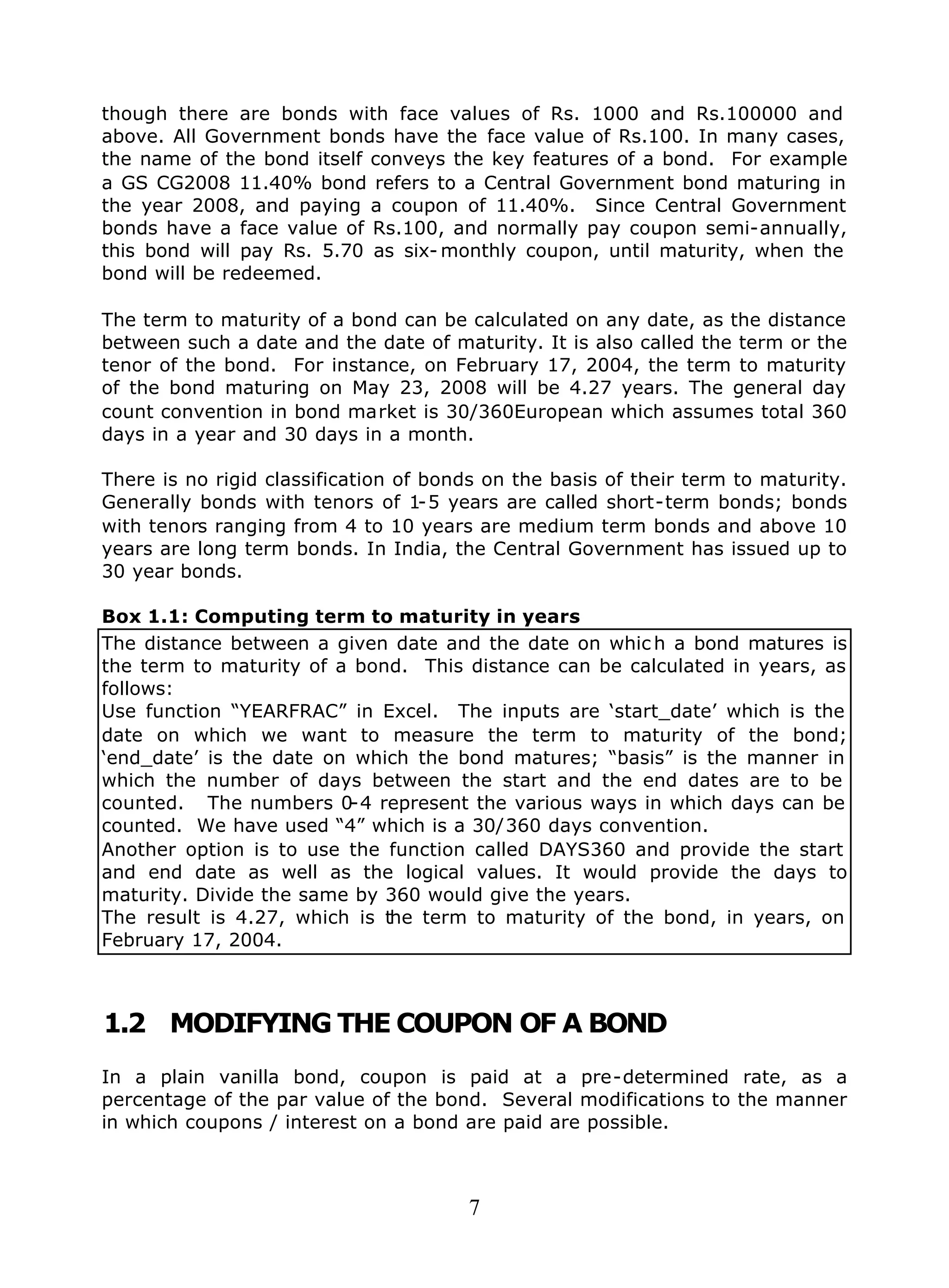
The term to maturity of a bond can be calculated on any date, as the distance
between such a date and the date of maturity. It is also called the term or the
tenor of the bond. For instance, on February 17, 2004, the term to maturity
of the bond maturing on May 23, 2008 will be 4.27 years. The general day
count convention in bond market is 30/360European which assumes total 360
days in a year and 30 days in a month.
There is no rigid classification of bonds on the basis of their term to maturity.
Generally bonds with tenors of 1-5 years are called short-term bonds; bonds
with tenors ranging from 4 to 10 years are medium term bonds and above 10
years are long term bonds. In India, the Central Government has issued up to
30 year bonds.
Box 1.1: Computing term to maturity in years
The distance between a given date and the date on whic h a bond matures is
the term to maturity of a bond. This distance can be calculated in years, as
follows:
Use function “YEARFRAC” in Excel. The inputs are ‘start_date’ which is the
date on which we want to measure the term to maturity of the bond;
‘end_date’ is the date on which the bond matures; “basis” is the manner in
which the number of days between the start and the end dates are to be
counted. The numbers 0-4 represent the various ways in which days can be
counted. We have used “4” which is a 30/360 days convention.
Another option is to use the function called DAYS360 and provide the start
and end date as well as the logical values. It would provide the days to
maturity. Divide the same by 360 would give the years.
The result is 4.27, which is the term to maturity of the bond, in years, on
February 17, 2004.
1.2 MODIFYING THE COUPON OF A BOND
In a plain vanilla bond, coupon is paid at a pre-determined rate, as a
percentage of the par value of the bond. Several modifications to the manner
in which coupons / interest on a bond are paid are possible.
8
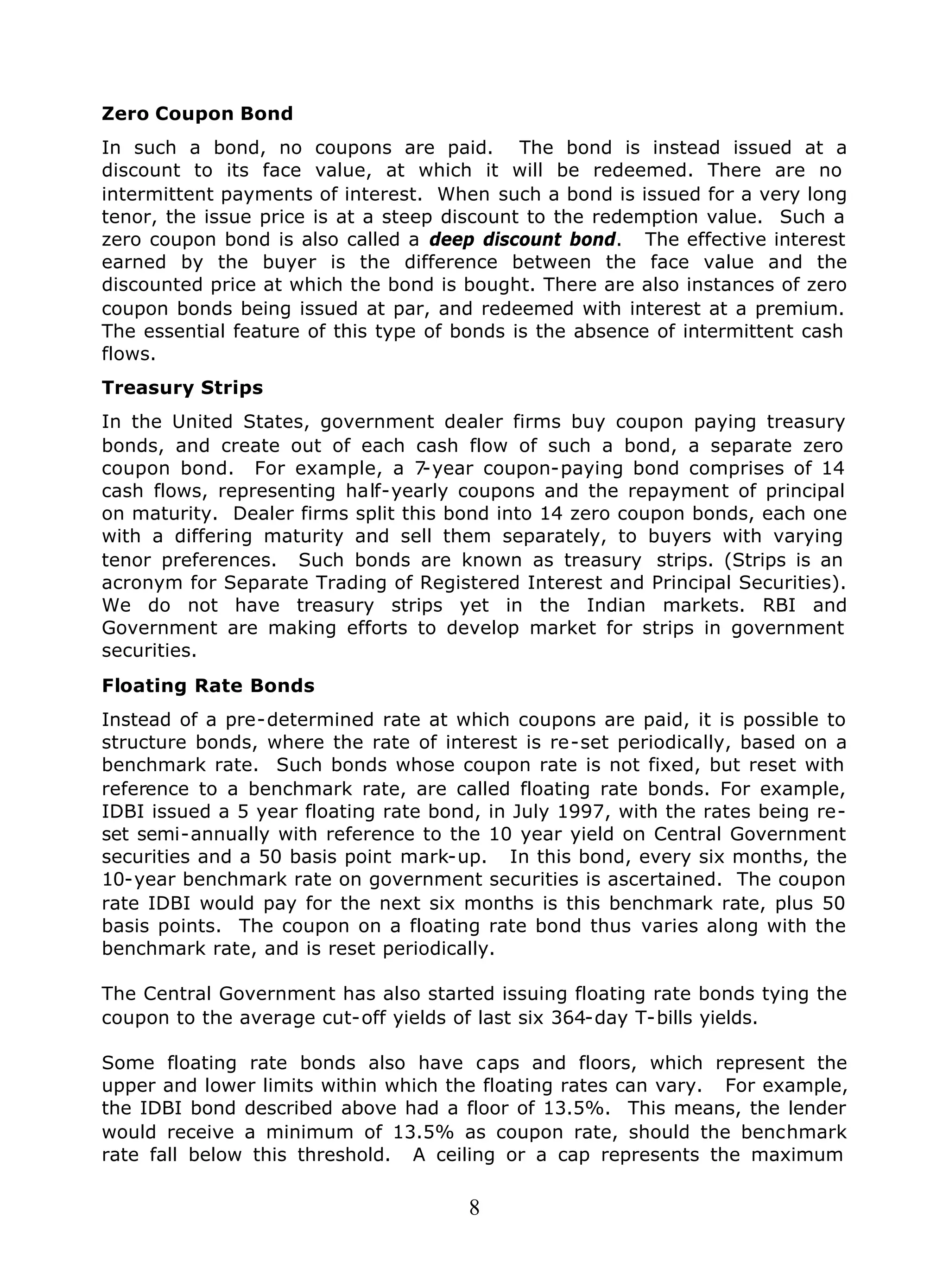
Zero Coupon Bond
In such a bond, no coupons are paid. The bond is instead issued at a
discount to its face value, at which it will be redeemed. There are no
intermittent payments of interest. When such a bond is issued for a very long
tenor, the issue price is at a steep discount to the redemption value. Such a
zero coupon bond is also called a deep discount bond. The effective interest
earned by the buyer is the difference between the face value and the
discounted price at which the bond is bought. There are also instances of zero
coupon bonds being issued at par, and redeemed with interest at a premium.
The essential feature of this type of bonds is the absence of intermittent cash
flows.
Treasury Strips
In the United States, government dealer firms buy coupon paying treasury
bonds, and create out of each cash flow of such a bond, a separate zero
coupon bond. For example, a 7-year coupon-paying bond comprises of 14
cash flows, representing half-yearly coupons and the repayment of principal
on maturity. Dealer firms split this bond into 14 zero coupon bonds, each one
with a differing maturity and sell them separately, to buyers with varying
tenor preferences. Such bonds are known as treasury strips. (Strips is an
acronym for Separate Trading of Registered Interest and Principal Securities).
We do not have treasury strips yet in the Indian markets. RBI and
Government are making efforts to develop market for strips in government
securities.
Floating Rate Bonds
Instead of a pre-determined rate at which coupons are paid, it is possible to
structure bonds, where the rate of interest is re-set periodically, based on a
benchmark rate. Such bonds whose coupon rate is not fixed, but reset with
reference to a benchmark rate, are called floating rate bonds. For example,
IDBI issued a 5 year floating rate bond, in July 1997, with the rates being re-
set semi-annually with reference to the 10 year yield on Central Government
securities and a 50 basis point mark-up. In this bond, every six months, the
10-year benchmark rate on government securities is ascertained. The coupon
rate IDBI would pay for the next six months is this benchmark rate, plus 50
basis points. The coupon on a floating rate bond thus varies along with the
benchmark rate, and is reset periodically.
The Central Government has also started issuing floating rate bonds tying the
coupon to the average cut-off yields of last six 364-day T-bills yields.
Some floating rate bonds also have caps and floors, which represent the
upper and lower limits within which the floating rates can vary. For example,
the IDBI bond described above had a floor of 13.5%. This means, the lender
would receive a minimum of 13.5% as coupon rate, should the benchmark
rate fall below this threshold. A ceiling or a cap represents the maximum
9
interest that the borrower will pay, should the benchmark rate move above
such a level. Most corporate bonds linked to the call rates, have such a
ceiling to cap the interest obligation of the borrower, in the event of the
benchmark call rates rising very steeply. Floating rate bonds, whose coupon
rates are bound by both a cap and floor, are called as range notes, because
the coupon rates vary within a certain range.
The other names, by which floating rate bonds are known, are variable rate
bonds and adjustable rate bonds. These terms are generally used in the case
of bonds whose coupon rates are reset at longer time intervals of a year and
above. These bonds are common in the housing loan markets.
In the developed markets, there are floating rate bonds, whose coupon rates
move in the direction opposite to the direction of the benchmark rates. Such
bonds are called inverse floaters.
Other Variations
In the mid-eighties, the US markets witnessed a variety of coupon structures
in the high yield bond market (junk bonds) for leveraged buy-outs. In many
of these cases, structures that enabled the borrowers to defer the payment of
coupons were created. Some of the more popular structures were: (a)
deferred interest bonds, where the borrower could defer the payment of
coupons in the initial 3 to 7 year period; (b) Step-up bonds, where the
coupon was stepped up by a few basis points periodically, so that the interest
burden in the initial years is lower, and increases over time; and (c)
extendible reset bond, in which investment bankers reset the rates, not on
the basis of a benchmark, but after re-negotiating a new rate, which in the
opinion of the lender and borrower, represented the rate for the bond after
taking into account the new circumstances at the time of reset.
1.3 MODIFYING THE TERM TO MATURITY OF A BOND
Callable Bonds
Bonds that allow the issuer to alter the tenor of a bond, by redeeming it prior
to the original maturity date, are called callable bonds. The inclusion of this
feature in the bond’s structure provides the issuer the right to fully or partially
retire the bond, and is therefore in the nature of call option on the bond.
Since these options are not separated from the original bond issue, they are
also called embedded options. A call option can be an European option,
where the issuer specifies the date on which the option could be exercised.
Alternatively, the issuer can embed an American option in the bond, providing
him the right to call the bond on or anytime before a pre-specified date.
The call option provides the issuer the option to redeem a bond, if interest
rates decline, and re-issue the bonds at a lower rate. The investor, however,
10
loses the opportunity to stay invested in a high coupon bond, when interest
rates have dropped. The call option, therefore, can effectively alter the term
of a bond, and carries an added set of risks to the investor, in the form of call
risk, and re-investment risk. As we shall see later, the prices at which these
bonds would trade in the market are also different, and depend on the
probability of the call option being exercised by the issuer. In the home loan
markets, pre-payment of housing loans represent a special case of call
options exercised by borrowers. Housing finance companies are exposed to
the risk of borrowers exercising the option to pre-pay, thus retiring a housing
loan, when interest rates fall. The Central Government has also issued an
embedded option bond that gives options to both issuer (Government) and
the holders of the bonds to exercise the option of call/put after expiry of 5
years. This embedded option would reduce the cost for the issuer in a falling
interest rate scenario and helpful for the bond holders in a rising interest rate
scenario.
Puttable Bonds
Bonds that provide the investor with the right to seek redemption from the
issuer, prior to the maturity date, are called puttable bonds. The put options
embedded in the bond provides the investor the rights to partially or fully sell
the bonds back to the issuer, either on or before pre-specified dates. The
actual terms of the put option are stipulated in the original bond indenture.
A put option provides the investor the right to sell a low coupon-paying bond
to the issuer, and invest in higher coupon paying bonds, if interest rates move
up. The issuer will have to re-issue the put bonds at higher coupons.
Puttable bonds represent a re-pricing risk to the issuer. When interest rates
increase, the value of bonds would decline. Therefore put options, which seek
redemptions at par, represent an additional loss to the issuer.
Convertible Bonds
A convertible bond provides the investor the option to convert the value of
the outstanding bond into equity of the borrowing firm, on pre-specified
terms. Exercising this option leads to redemption of the bond prior to
maturity, and its replacement with equity. At the time of the bond’s issue,
the indenture clearly specifies the conversion ratio and the conversion price.
The conversion ratio refers to the number of equity shares, which will be
issued in exchange for the bond that is being converted. The conversion price
is the resulting price when the conversion ratio is applied to the value of the
bond, at the time of conversion. Bonds can be fully converted, such that
they are fully redeemed on the date of conversion. Bonds can also be issued
as partially convertible, when a part of the bond is redeemed and equity
shares are issued in the pre-specified conversion ratio, and the non-
convertible portion continues to remain as a bond.
11
1.4 MODIFYING THE PRINCIPAL REPAYMENT OF A
BOND
Amortising Bonds
The structure of some bonds may be such that the principal is not repaid at
the end/maturity, but over the life of the bond. A bond, in which payment
made by the borrower over the life of the bond, includes both interest and
principal, is called an amortising bond. Auto loans, consumer loans and home
loans are examples of amortising bonds. The maturity of the amortising bond
refers only to the last payment in the amortising schedule, because the
principal is repaid over time.
Bonds with Sinking Fund Provisions
In certain bond indentures, there is a provision that calls upon the issuer to
retire some amount of the outstanding bonds every year. This is done either
by buying some of the outstanding bonds in the market, or as is more
common, by creating a separate fund, which calls the bonds on behalf of the
issuer. Such provisions that enable retiring bonds over their lives are called
sinking fund provisions. In many cases, the sinking fund is managed by
trustees, who regularly retire part of the outstanding bonds, usually at par.
Sinking funds also enable paying off bonds over their life, rather than at
maturity. One usual variant is applicability of the sinking fund provision after
few years of the issue of the bond, so that the funds are available to the
borrower for a minimum period, before redemption can commence.
1.5 ASSET BACKED SECURITIES
Asset backed securities represent a class of fixed income securities, created
out of pooling together assets, and creating securities that represent
participation in the cash flows from the asset pool. For example, select
housing loans of a loan originator (say, a housing finance company) can be
pooled, and securities can be created, which represent a claim on the
repayments made by home loan borrowers. Such securities are called
mortgage–backed securities. In the Indian context, these securities are
known as structured obligations (SO). Since the securities are created from a
select pool of assets of the originator, it is possible to ‘cherry-pick’ and create
a pool whose asset quality is better than that of the originator. It is also
common for structuring these instruments, with clear credit enhancements,
achieved either through guarantees, or through the creation of exclusive pre-
emptive access to cash flows through escrow accounts. Assets with regular
streams of cash flows are ideally suited for creating asset-backed securities.
In the Indian context, car loan and truck loan receivables have been
securitized. Securitized home loans represent a very large segment of the US
bond markets, next in size only to treasury borrowings. However, the market
12
for securitization has not developed appreciably because of the lack of legal
clarity and conducive regulatory environment.
The Securitization and Reconstruction of Financial Assets and Enforcement of
Security Interest Act were approved by parliament in November 2002. The
Act also provides a legal framework for securitization of financial assets and
asset reconstruction. The securitization companies or reconstruction
companies shall be regulated by RBI. The security receipts issued by these
companies will be securities within the meaning of the Securities Contract
(Regulation) Act, 1956. These companies would have powers to acquire
assets by issuing a debenture or bond or any other security in the nature of
debenture in lieu thereof. Once an asset has been acquired by the asset
reconstruction company, such company would have the same powers for
enforcement of securities as the original lender. This has given the legal
sanction to securitized debt in India.
Model Questions
1. On value date June 10, 2000, what is the term to maturity in
years, of a government security maturing on 23rd
March 2004?
Use the “yearfrac” function in Excel, with the following specifications:
Settlement date: June 10, 2000
Maturity Date: March 23, 2004
Basis: 4. (Government securities trade on 30/360 European basis. We
therefore use “4”, in the Excel function, which applies this day count
convention).
Ans: 3.786 years.
2. Which of the following about a callable bond is true?
a. Callable bonds always trade at a discount to non-callable bonds.
b. Callable bonds expose issuers to the risk of reduced re-investment
return.
c. Callable bonds are actually variable tenor bonds.
d. Callable bonds are not as liquid as non-callable bonds.
Ans: c.
3. Coupon of a floating rate bond is _______
a. modified whenever there is a change in the benchmark rate.
b. modified at pre-set intervals with reference to a benchmark rate.
c. modified for changes in benchmark rate beyond agreed levels.
d. modified within a range, for changes in the benchmark rate.
Ans: b.
13
CHAPTER 2
INDIAN DEBT MARKETS: A PROFILE
Indian debt markets, in the early nineties, were characterised by controls on
pricing of assets, segmentation of markets and barriers to entry, low levels of
liquidity, limited number of players, near lack of transparency, and high
transactions cost. Financial reforms have significantly changed the Indian
debt markets for the better. Most debt instruments are now priced freely on
the markets; trading mechanisms have been altered to provide for higher
levels of transparency, higher liquidity, and lower transactions costs; new
participants have entered the markets, broad basing the types of players in
the markets; methods of security issuance, and innovation in the structure of
instruments have taken place; and there has been a significant improvement
in the dissemination of market information.
2.1 MARKET SEGMENTS
There are three main segments in the debt markets in India, viz.,
Government Securities, Public Sector Units (PSU) bonds, and corporate
securities. The market for Government Securities comprises the Centre, State
and State-sponsored securities. In the recent past, local bodies such as
municipalities have also begun to tap the debt markets for funds. The PSU
bonds are generally treated as surrogates of sovereign paper, sometimes due
to explicit guarantee and often due to the comfort of public ownership. Some
of the PSU bonds are tax free, while most bonds including government
securities are not tax-free. The RBI also issues tax-free bonds, called the
6.5% RBI relief bonds, which is a popular category of tax-free bonds in the
market. Corporate bond markets comprise of commercial paper and bonds.
These bonds typically are structured to suit the requirements of investors and
the issuing corporate, and include a variety of tailor- made features with
respect to interest payments and redemption. The less dominant fourth
segment comprises of short term paper issued by banks, mostly in the form
of certificates of deposit.
The market for government securities is the oldest and most dominant in
terms of market capitalisation, outstanding securities, trading volume and
number of participants. It not only provides resources to the government for
meeting its short term and long term needs, but also sets benchmark for
pricing corporate paper of varying maturities and is used by RBI as an
instrument of monetary policy. The instruments in this segment are fixed
coupon bonds, commonly referred to as dated securities, treasury bills,
floating rate bonds, zero coupon bonds and inflation index bonds. Both
14
Central and State government securities comprise this segment of the debt
market.
The issues by government sponsored institutions like, Development Financial
Institutions, as well as the infrastructure-related bodies and the PSUs, who
make regular forays into the market to raise medium-term funds, constitute
the second segment of debt markets. The gradual withdrawal of budgetary
support to PSUs by the government since 1991 has compelled them to look at
the bond market for mobilising resources. The preferred mode of issue has
been private placement, barring an occasional public issue. Banks, financial
institutions and other corporates have been the major subscribers to these
issues. The tax-free bonds, which constitute over 50% of the outstanding PSU
bonds, are quite popular with institutional players.
The market for corporate debt securities has been in vogue since early 1980s.
Until 1992, interest rate on corporate bond issuance was regulated and was
uniform across credit categories. In the initial years, corporate bonds were
issued with “sweeteners” in the form of convertibility clause or equity
warrants. Most corporate bonds were plain coupon paying bonds, though a
few variations in the form of zero coupon securities, deep discount bonds and
secured promissory notes were issued.
After the de-regulation of interest rates on corporate bonds in 1992, we have
seen a variety of structures and instruments in the corporate bond markets,
including securitized products, corporate bond strips, and a variety of floating
rate instruments with floors and caps. In the recent years, there has been an
increase in issuance of corporate bonds with embedded put and call options.
The major part of the corporate debt is privately placed with tenors of 1-12
years.
Information on the size of the various segments of the debt market in India is
not readily available. This is due to the fact that many debt instruments are
privately placed and therefore not listed on markets. While the RBI regulates
the issuance of government securities, corporate debt securities fall under the
regulatory purview of SEBI. The periodic reports of issuers and investors are
therefore sent to two different regulators. Therefore, aggregated data for the
market as a whole is difficult to obtain. The NSE provides a trading platform
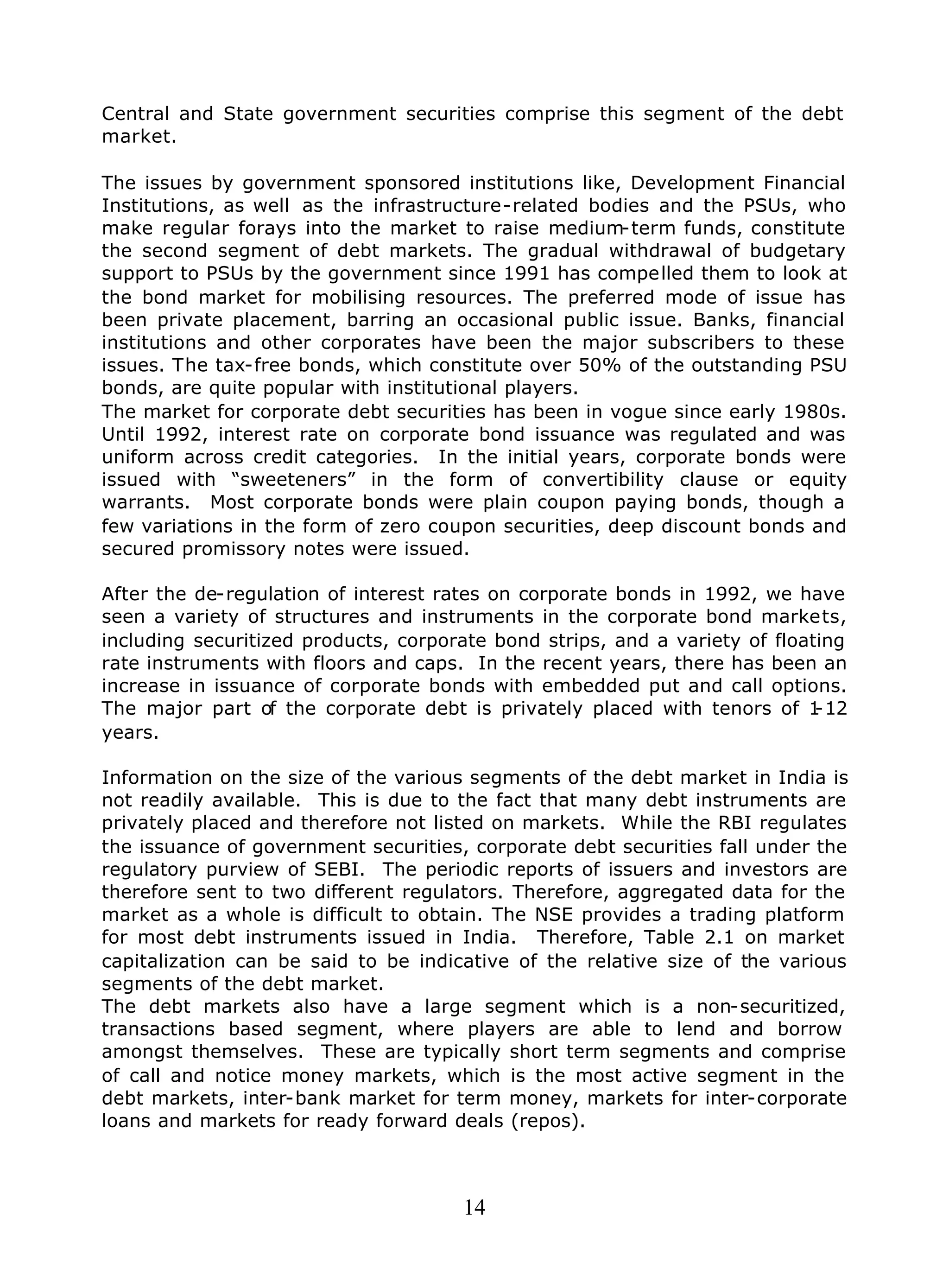
for most debt instruments issued in India. Therefore, Table 2.1 on market
capitalization can be said to be indicative of the relative size of the various
segments of the debt market.
The debt markets also have a large segment which is a non-securitized,
transactions based segment, where players are able to lend and borrow
amongst themselves. These are typically short term segments and comprise
of call and notice money markets, which is the most active segment in the
debt markets, inter-bank market for term money, markets for inter-corporate
loans and markets for ready forward deals (repos).
15
Table 2.1: Market Capitalisation - NSE-WDM Segment as on March 31,
2008.
Security Type Market
Capitalisation
(Rs.cr.)
Share in
Total(%)
Government Securities 1,392,219 65.57
PSU Bonds 96268.47 4.53
State Loans 315660.71 14.87
Treasury Bills 111562.13 5.25
Financial Institutions 32092.92 1.51
Corporate Bonds 75675.73 3.56
Others 99867.09 4.70
TOTAL 2123346.28 100.00
* Others include securitized debt and bonds of local bodies.
2.2 PARTICIPANTS IN THE DEBT MARKETS
Debt markets are pre-dominantly wholesale markets, with dominant
institutional investor participation. The investors in the debt markets
concentrate in banks, financial institutions, mutual funds, provident funds,
insurance companies and corporates. Many of these participants are also
issuers of debt instruments. The smaller number of large players has resulted
in the debt markets being fairly concentrated, and evolving into a wholesale
negotiated dealings market. Most debt issues are privately placed or
auctioned to the participants. Secondary market dealings are mostly done on
telephone, through negotiations. In some segments such as the government
securities market, market makers in the form of primary dealers have
emerged, who enable a broader holding of treasury securities. Debt funds of
the mutual fund industry, comprising of liquid funds, bond funds and gilt
funds, represent a recent mode of intermediation of retail investments into
the debt markets, apart from banks, insurance, provident funds and financial
institutions, who have traditionally been major intermediaries of retail funds
into debt market products.
The market participants in the debt market are:
1. Central Governments, raising money through bond issuances, to fund
budgetary deficits and other short and long term funding requirements.
2. Reserve Bank of India, as investment banker to the government, raises
funds for the government through bond and t-bill issues, and also
participates in the market through open- market operations, in the course
of conduct of monetary policy. The RBI regulates the bank rates and repo
rates and uses these rates as tools of its monetary policy. Changes in
these benchmark rates directly impact debt markets and all participants in
the market.
16
3. Primary dealers, who are market intermediaries appointed by the Reserve
Bank of India who underwrite and make market in government securities,
and have access to the call markets and repo markets for funds.
4. State Governments, municipalities and local bodies, which issue securities
in the debt markets to fund their developmental projects, as well as to
finance their budgetary deficits.
5. Public sector units are large issuers of debt securities, for raising funds to
meet the long term and working capital needs. These corporations are
also investors in bonds issued in the debt markets.
6. Corporate treasuries issue short and long term paper to meet the financial
requirements of the corporate sector. They are also investors in debt
securities issued in the market.
7. Public sector financial institutions regularly access debt markets with
bonds for funding their financing requirements and working capital needs.
They also invest in bonds issued by other entities in the debt markets.
8. Banks are the largest investors in the debt markets, particularly the
treasury bond and bill markets. They have a statutory requirement to
hold a certain percentage of their deposits (currently the mandatory
requirement is 25% of deposits) in approved securities (all government
bonds qualify) to satisfy the statutory liquidity requirements. Banks are
very large participants in the call money and overnight markets. They are
arrangers of commercial paper issues of corporates. They are also active
in the inter-bank term markets and repo markets for their short term
funding requirements. Banks also issue CDs and bonds in the debt
markets.
9. Mutual funds have emerged as another important player in the debt
markets, owing primarily to the growing number of bond funds that have
mobilised significant amounts from the investors. Most mutual funds also
have specialised bond funds such as gilt funds and liquid funds. Mutual
funds are not permitted to borrow funds, except for very short-term
liquidity requirements. Therefore, they participate in the debt markets
pre-dominantly as investors, and trade on their portfolios quite regularly.
10. Foreign Institutional Investors are permitted to invest in Dated
Government Securities and Treasury Bills within certain specified limits.
11. Provident funds are large investors in the bond markets, as the prudential
regulations governing the deployment of the funds they mobilise, mandate
investments pre-dominantly in treasury and PSU bonds. They are,
however, not very active traders in their portfolio, as they are not
permitted to sell their holdings, unless they have a funding requirement
that cannot be met through regular accruals and contributions.
12. Charitable Institutions, Trusts and Societies are also large investors in the
debt markets. They are, however, governed by their rules and byelaws
with respect to the kind of bonds they can buy and the manner in which
they can trade on their debt portfolios.
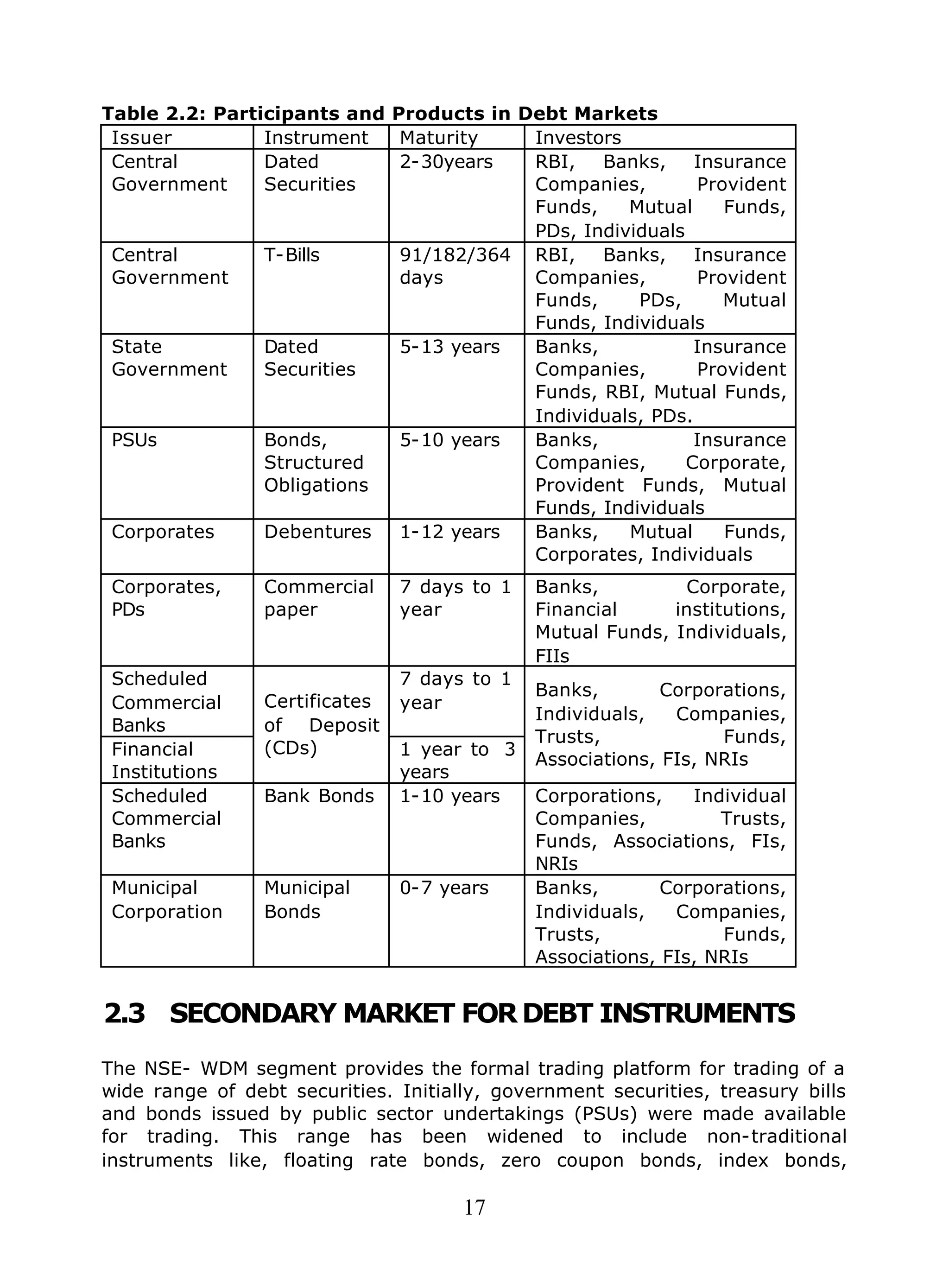
The matrix of issuers, investors, instruments in the debt market and their
maturities are presented in Table 2.2.
17
Table 2.2: Participants and Products in Debt Markets
Issuer Instrument Maturity Investors
Central
Government
Dated
Securities
2-30years RBI, Banks, Insurance
Companies, Provident
Funds, Mutual Funds,
PDs, Individuals
Central
Government
T-Bills 91/182/364
days
RBI, Banks, Insurance
Companies, Provident
Funds, PDs, Mutual
Funds, Individuals
State
Government
Dated
Securities
5-13 years Banks, Insurance
Companies, Provident
Funds, RBI, Mutual Funds,
Individuals, PDs.
PSUs Bonds,
Structured
Obligations
5-10 years Banks, Insurance
Companies, Corporate,
Provident Funds, Mutual
Funds, Individuals
Corporates Debentures 1-12 years Banks, Mutual Funds,
Corporates, Individuals
Corporates,
PDs
Commercial
paper
7 days to 1
year
Banks, Corporate,
Financial institutions,
Mutual Funds, Individuals,
FIIs
Scheduled
Commercial
Banks
7 days to 1
year
Financial
Institutions
Certificates
of Deposit
(CDs) 1 year to 3
years
Banks, Corporations,
Individuals, Companies,
Trusts, Funds,
Associations, FIs, NRIs
Scheduled
Commercial
Banks
Bank Bonds 1-10 years Corporations, Individual
Companies, Trusts,
Funds, Associations, FIs,
NRIs
Municipal
Corporation
Municipal
Bonds
0-7 years Banks, Corporations,
Individuals, Companies,
Trusts, Funds,
Associations, FIs, NRIs
2.3 SECONDARY MARKET FOR DEBT INSTRUMENTS
The NSE- WDM segment provides the formal trading platform for trading of a
wide range of debt securities. Initially, government securities, treasury bills
and bonds issued by public sector undertakings (PSUs) were made available
for trading. This range has been widened to include non-traditional
instruments like, floating rate bonds, zero coupon bonds, index bonds,
18
commercial papers, certificates of deposit, corporate debentures, state
government loans, SLR and non-SLR bonds issued by financial institutions,
units of mutual funds and securitized debt. The WDM trading system, known
as NEAT (National Exchange for Automated Trading), is a fully automated
screen based trading system that enables members across the country to
trade simultaneously with enormous ease and efficiency. The trading system
is an order driven system, which matches best buy and sell orders on a
price/time priority.
Central Government securities and treasury bills are held as dematerialised
entries in the Subsidiary General Ledger (SGL) of the RBI. In order to trade
these securities, participants are required to have an account with the SGL
and also a current account with the RBI. The settlement is on Delivery versus
Payment (DvP) basis. The Public Debt Office which oversees the settlement of
transactions through the SGL enables the transfer of securities from one
participant to another. Since 1995, settlements are on delivery-versus-
payment basis. However, after creation of Clearing Corporation of India,
most of the institutional trades are being settled through CCIL with settlement
guarantee. The settlement through CCIL is taking place on DvP-III where
funds and securities are netted for settlement.
Government debt, which constitutes about three-fourth of the total
outstanding debt, has the highest level of liquidity amongst the fixed income
instruments in the secondary market. The share of dated securities in total
turnover of government securities has been increasing over the years. Two-
way quotes are available for active gilt securities from the primary dealers.
Though many trades in gilts take place through telephone, a larger chunk of
trades gets routed through NSE brokers.
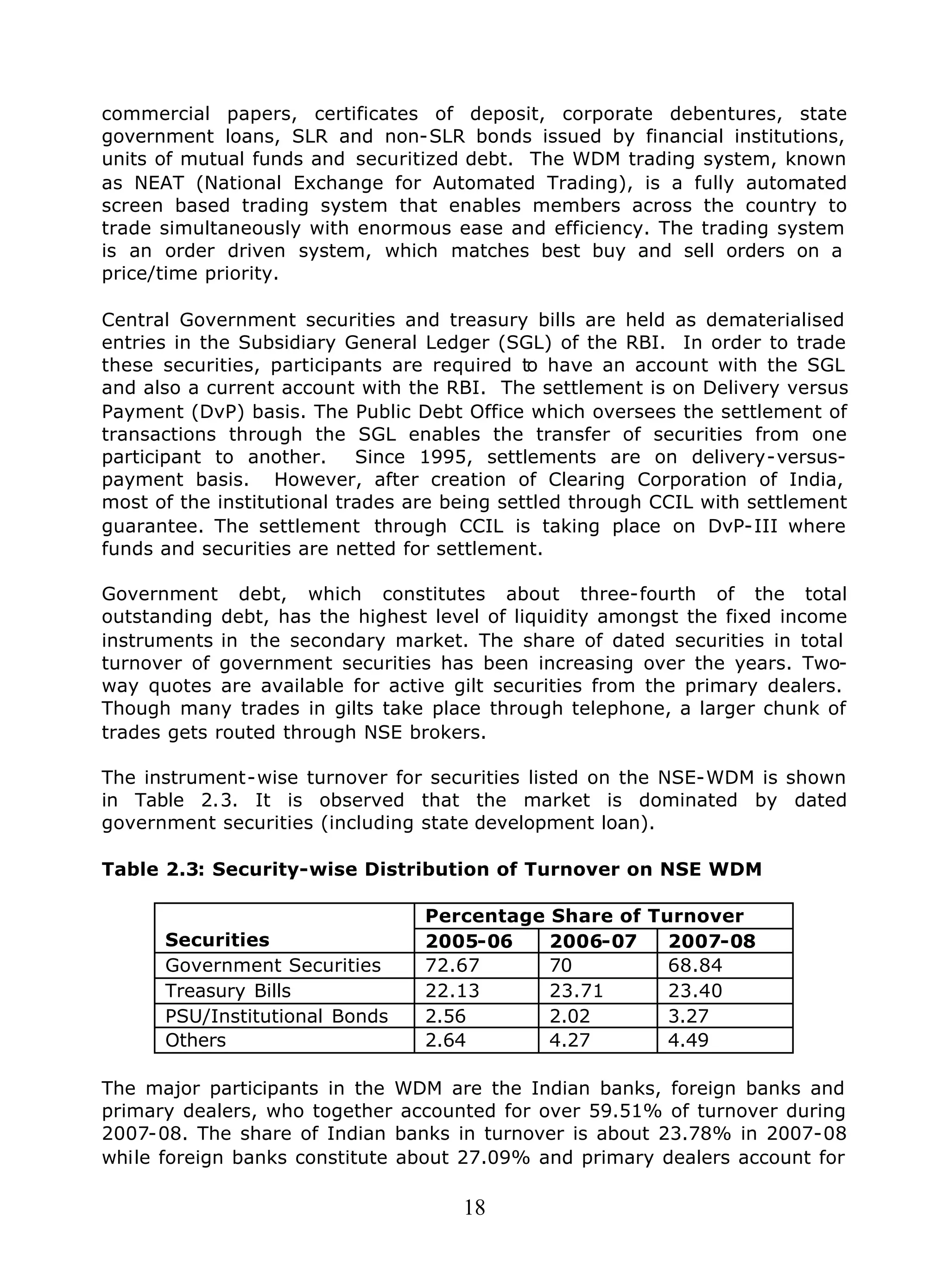
The instrument-wise turnover for securities listed on the NSE-WDM is shown
in Table 2.3. It is observed that the market is dominated by dated
government securities (including state development loan).
Table 2.3: Security-wise Distribution of Turnover on NSE WDM
Percentage Share of Turnover
Securities 2005-06 2006-07 2007-08
Government Securities 72.67 70 68.84
Treasury Bills 22.13 23.71 23.40
PSU/Institutional Bonds 2.56 2.02 3.27
Others 2.64 4.27 4.49
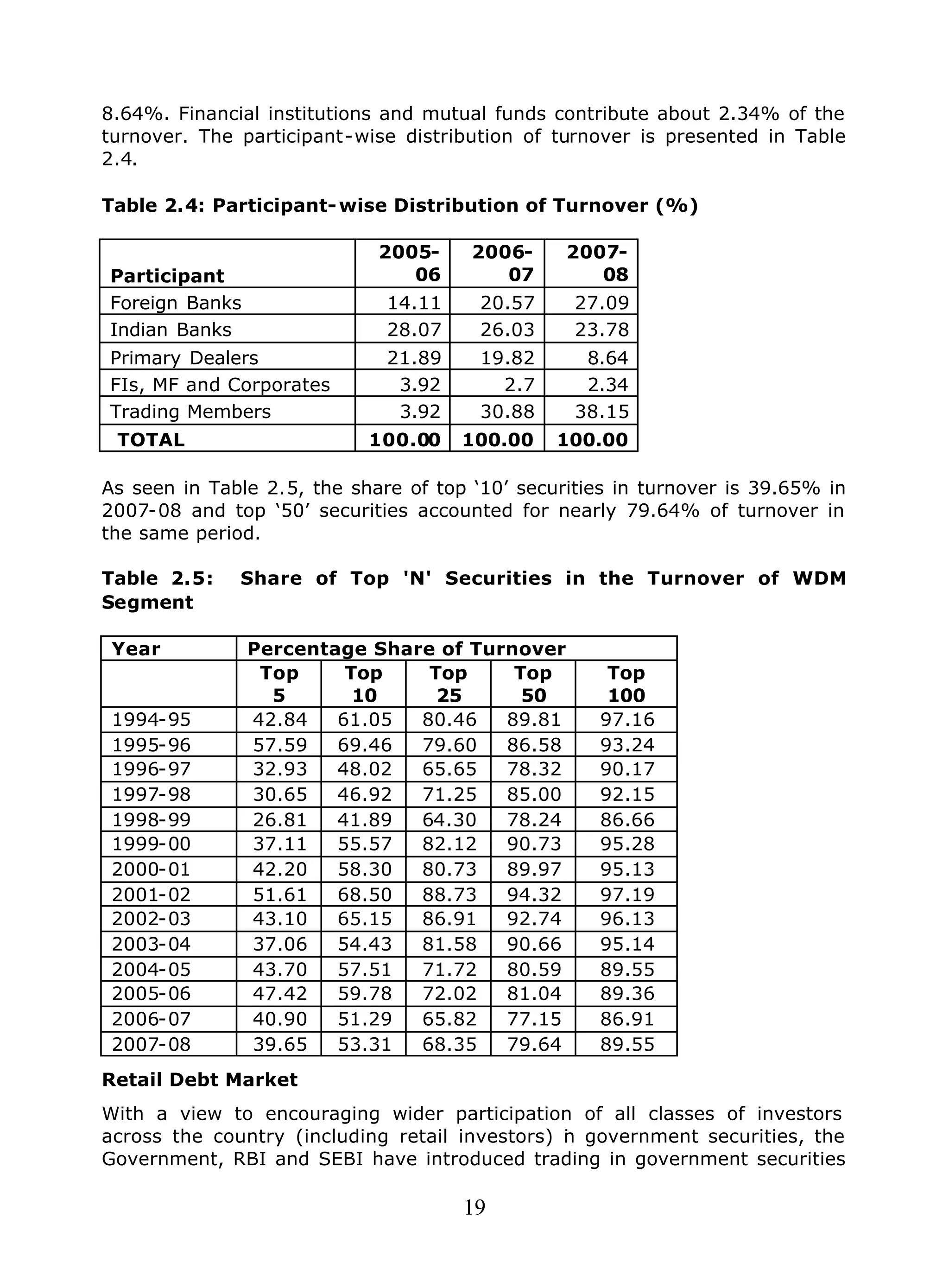
The major participants in the WDM are the Indian banks, foreign banks and
primary dealers, who together accounted for over 59.51% of turnover during
2007-08. The share of Indian banks in turnover is about 23.78% in 2007-08
while foreign banks constitute about 27.09% and primary dealers account for
19
8.64%. Financial institutions and mutual funds contribute about 2.34% of the
turnover. The participant-wise distribution of turnover is presented in Table
2.4.
Table 2.4: Participant-wise Distribution of Turnover (%)
Participant
2005-
06
2006-
07
2007-
08
Foreign Banks 14.11 20.57 27.09
Indian Banks 28.07 26.03 23.78
Primary Dealers 21.89 19.82 8.64
FIs, MF and Corporates 3.92 2.7 2.34
Trading Members 3.92 30.88 38.15
TOTAL 100.00 100.00 100.00
As seen in Table 2.5, the share of top ‘10’ securities in turnover is 39.65% in
2007-08 and top ‘50’ securities accounted for nearly 79.64% of turnover in
the same period.
Table 2.5: Share of Top 'N' Securities in the Turnover of WDM
Segment
Year Percentage Share of Turnover
Top
5
Top
10
Top
25
Top
50
Top
100
1994-95 42.84 61.05 80.46 89.81 97.16
1995-96 57.59 69.46 79.60 86.58 93.24
1996-97 32.93 48.02 65.65 78.32 90.17
1997-98 30.65 46.92 71.25 85.00 92.15
1998-99 26.81 41.89 64.30 78.24 86.66
1999-00 37.11 55.57 82.12 90.73 95.28
2000-01 42.20 58.30 80.73 89.97 95.13
2001-02 51.61 68.50 88.73 94.32 97.19
2002-03 43.10 65.15 86.91 92.74 96.13
2003-04 37.06 54.43 81.58 90.66 95.14
2004-05 43.70 57.51 71.72 80.59 89.55
2005-06 47.42 59.78 72.02 81.04 89.36
2006-07 40.90 51.29 65.82 77.15 86.91
2007-08 39.65 53.31 68.35 79.64 89.55
Retail Debt Market
With a view to encouraging wider participation of all classes of investors
across the country (including retail investors) in government securities, the
Government, RBI and SEBI have introduced trading in government securities
20
for retail investors. Trading in this retail debt market segment (RDM) on NSE
has been introduced w.e.f. January 16, 2003.
RDM Trading:
Trading takes place in the existing Capital Market segment of the Exchange
and in the same manner in which the trading takes place in the equities
(Capital Market) segment. The RETDEBT Market facility on the NEAT system
of Capital Market Segment is used for entering transactions in RDM session.
The trading holidays and market timings of the RDM segment are the same as
the Equities segment.
Trading Parameters:
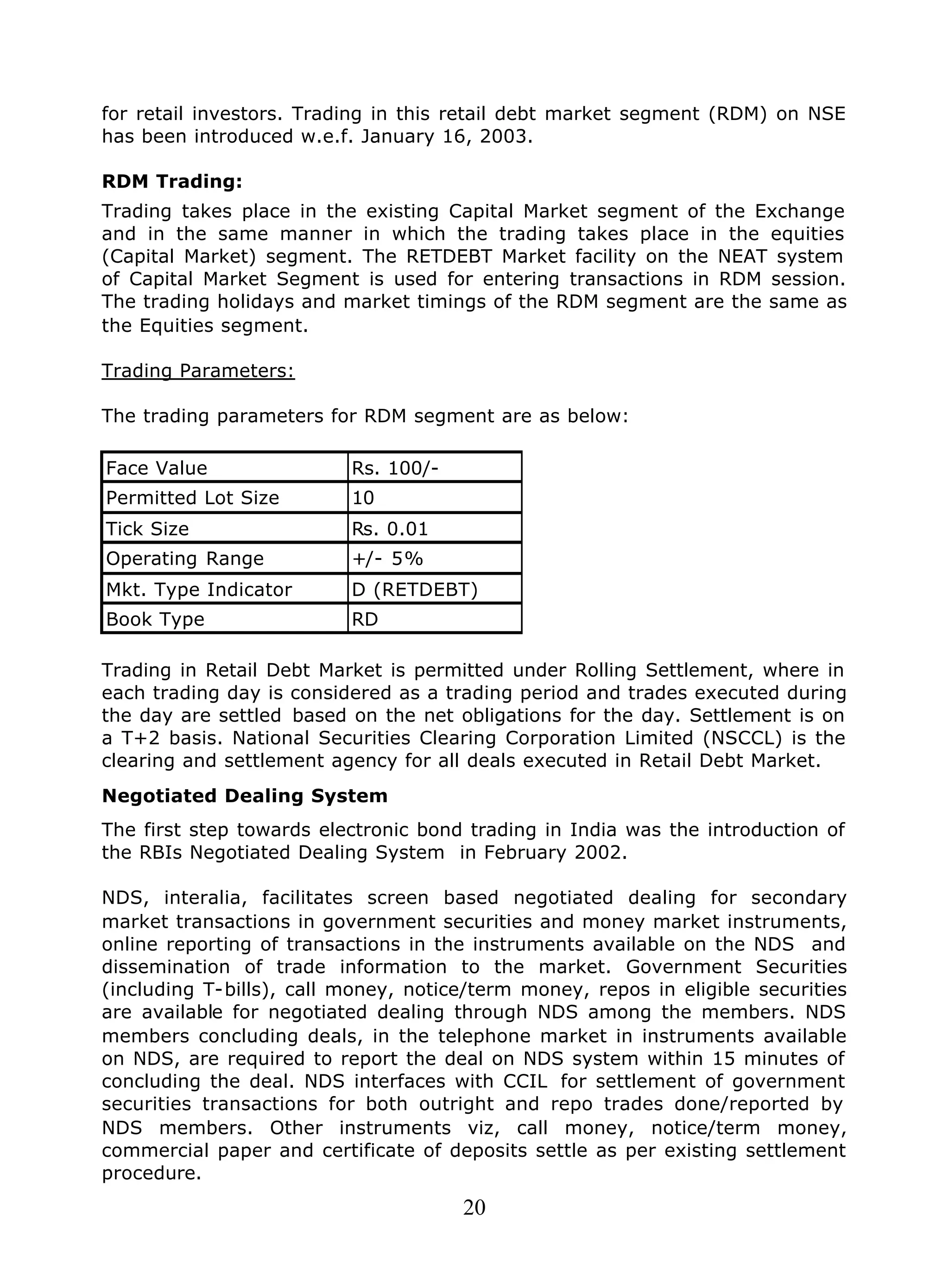
The trading parameters for RDM segment are as below:
Face Value Rs. 100/-
Permitted Lot Size 10
Tick Size Rs. 0.01
Operating Range +/- 5%
Mkt. Type Indicator D (RETDEBT)
Book Type RD
Trading in Retail Debt Market is permitted under Rolling Settlement, where in
each trading day is considered as a trading period and trades executed during
the day are settled based on the net obligations for the day. Settlement is on
a T+2 basis. National Securities Clearing Corporation Limited (NSCCL) is the
clearing and settlement agency for all deals executed in Retail Debt Market.
Negotiated Dealing System
The first step towards electronic bond trading in India was the introduction of
the RBIs Negotiated Dealing System in February 2002.
NDS, interalia, facilitates screen based negotiated dealing for secondary
market transactions in government securities and money market instruments,
online reporting of transactions in the instruments available on the NDS and
dissemination of trade information to the market. Government Securities
(including T-bills), call money, notice/term money, repos in eligible securities
are available for negotiated dealing through NDS among the members. NDS
members concluding deals, in the telephone market in instruments available
on NDS, are required to report the deal on NDS system within 15 minutes of
concluding the deal. NDS interfaces with CCIL for settlement of government
securities transactions for both outright and repo trades done/reported by
NDS members. Other instruments viz, call money, notice/term money,
commercial paper and certificate of deposits settle as per existing settlement
procedure.
21
With the objective of creating a broad-based and transparent market in
government securities and thereby enhancing liquidity in the system, the NDS
was designed to provide:
• Electronic bidding in primary market auctions (T-Bills, dated securities,
state government securities) by members,
• Electronic bidding for OMO of RBI including repo auctions under LAF,
• Screen based negotiated dealing system for secondary market
operations,
• Reporting of deals in government securities done among NDS
members outside the system (over telephone or using brokers of
exchanges) for settlement,
• Dissemination of trade information to NDS members,
• Countrywide access of NDS through INFINET,
• Electronic connectivity for settlement of trades in secondary market
both for outright and repos either through CCIL or directly through
RBI, and Creation and maintenance of basic data of instruments and
members.
The functional scope of the NDS relating to trading includes:
• giving/receiving a Quote,
• placing a call and negotiation (with or without a reference to the quote),
• entering the deals successfully negotiated,
• setting up preferred counterparty list and exposure limits to the
counterparties,
• dissemination of on-line market information such as the last traded prices
of securities, volume of transactions, yield curve and information on live
quotes,
• interface with Securities Settlement System for facilitating settlement of
deals done in government securities and treasury bills.
• facility for reporting on trades executed through the exchanges for
information dissemination and settlement in addition to deals done
through NDS.
The system is designed to maintain anonymity of buyers and sellers from the
market but only the vital information of a transaction viz., ISIN of the
security, nomenclature, amount (face value), price/rate and/ or indicative
yield, in case applicable, are disseminated to the market, through Market and
Trade Watch.
The benefits of NDS include:
• Transparency of trades in money and government securities market,
• Electronic connectivity with securities settlement systems, thus,
eliminating submission of physical SGL form,
22
• Settlement through electronic SGL transfer,
• Elimination of errors and discrepancies and delay inherent in manual
processing system, and
• Electronic audit trail for better monitoring and control.
NDS-OM
NDS was intended to be used principally for bidding in the primary auctions
of G-secs conducted by RBI, and for trading and reporting of secondary
market transactions. However, because of several technic al problems and
system inefficiencies, NDS was being used as a reporting platform for
secondary market transactions and not as a dealing system. For actual
transactions, its role was limited to placing bids in primary market auctions.
Much of secondary market in the bond market continued to be broker
intermediated.
It was therefore, decided to introduce a screen-based (i.e electronic)
anonymous order matching system, integrated with NDS. This system (NDS-
OM) has become operational with effect from August 1, 2005.
NDS-OM is an electronic, screen based, anonymous order driven trading
system introduced by RBI as part of the existing NDS system to facilitate
electronic dealing in government securities. It is accessible to members
through RBIs INFINET Network. The system facilitates price discovery,
liquidity, increased operational efficiency and transparency. The NDS-OM
System supports trading in all Central Government Dated Securities and State
Government securities in T+1 settlement type. Since August 1, 2006 the
system was enhanced to facilitate trading in Treasury Bills and When Issued
transaction in a security authorized for issuance but not as yet actually
issued. All ‘WI’ transactions are on an ‘if’ basis, to be settled if and when the
actual security is issued. Further, RBI has permitted the execution of intra-
day short sale transaction and the covering of the short position in
government securities can be done both on and outside the NDS-OM platform
i.e. through telephone market.
The order system is purely order driven with all bids/offers being matched
based on price/time priority for securities traded on price terms and
yield/time priority for securities traded on yield, ensuring transparency and
fairness to all users. This ensures a level playing field for all participants. The
trader gets the best bid/offer in the system. It then tries to match the sale
orders with the purchase orders available on the system. When a match
occurs, the trade is confirmed. The counterparties are not aware of each
others identities- hence the anonymous nature of the system.
While initially only banks and primary dealers could trade on it, NDS-OM has
been gradually expanded to cover other institutional players like insurance
23
companies, mutual funds, etc. Further, NDS-OM has been extended to cover
all entities required by law or regulation to invest in Government securities
such as deposit taking NBFCs, Provident Funds, Pension Funds, Mutual Funds,
Insurance Companies, Cooperative Banks, Regional Rural Banks, Trusts, etc.
The NDS-OM has several advantages over the erstwhile telephone based
market. It is faster, transparent, cheaper and provides benefits to its users
like straight through processing, audits trails for transactions. Straight
through processing (STP) of transactions means that, for participants using
CCILs clearing and settlement system, once a deal has been struck on NDS-
OM, no further human intervention is necessary right upto settlement, thus
eliminating possibilities human errors. The trades agreed on this system flow
directly to CCIL for settlement.
Model Questions
1. Which of the following about the market capitalisation of
corporate bonds in the NSE WDM is true?
a. Corporate bonds account for over 10% of the total market capitalisation.
b. Corporate bonds represent the second largest segment of bonds, after
Government securities.
c. Market capitalisation of corporate bonds is lower than that of listed state
loans.
d. None of the above.
Ans: c
2. The most active participants in the WDM segment of the NSE are:
a. Primary dealers
b. Scheduled banks
c. Trading members
d. Mutual Funds
Ans: b
3.Which of the following statements are true about NDS-OM ?
a. NDS-OM is a screen-based anonymous order matching system
b. NDS-OM became operational with effect from August 1, 2005
c. NDS-OM is faster, transparent and cheaper and provides benefits like
audit trail.
d. All of the above
Ans: d
24
CHAPTER 3
CENTRAL GOVERNMENT SECURITIES:
BONDS
3.1 INTRODUCTION
The government bond market, made up of the long-term market borrowings
of the government, is the largest segment of the debt market.
The government securities market has witnessed significant transformation in
the 1990s in terms of market design. The most significant developments
include introduction of auction-based price determination for government
securities, development of new instruments and mechanisms for government
borrowing as well as participation by new market participants, increase in
information dissemination on market borrowings and secondary market
transactions, screen based negotiations for trading, and the development of
the yield curve for government securities for marking-to-market portfolios of
banks. During the last one decade, RBI introduced the system of primary
dealers (PDs) and satellite dealers (since discontinued from December 2002),
introduced delivery versus payment (DvP) in securities settlement, expanded
the number of players in the market with facility for non-competitive bidding
in auctions, and allowed wider participation in constituent Subsidiary General
Ledger (SGL) accounts. The government securities market also benefited
from emergence of liquidity arrangement through the Liquidity Adjustment
Facility (LAF), expansion of the repo markets, complete stoppage of
automatic monetisation of deficits, and emergence of self regulatory bodies,
such as, the Primary Dealers Association of India (PDAI) and the Fixed
Income Money Markets and Derivatives Association (FIMMDA).Continuous
reforms in the G- Sec market are being undertaken for improving market
design and liquidity.
To enhance liquidity and efficiency, some important initiatives have been
taken such as: (i) introduction of repo/reverse repo operations in government
securities to facilitate participants of manage short term liquidity mismatches
(ii) operationalisation of Negotiated Dealing system (NDS), an automated
electronic trading platform (c) establishment of Clearing Corporation of India
Ltd. (CCIL) for providing an efficient and guaranteed settlement platform (d)
introduction of G-secs in stock exchanges (e) introduction of Real time Gross
Settlement System (RTGS) which addresses settlement risk and facilitates
liquidity management, (g) adoption of a modified Delivery-versus-Payment

mode of settlement which provides for net settlement of both funds and
securities legs and (h) announcement of an indicative auction calendar for
Treasury Bills and Dated Securities.
25
Several initiatives have been taken to widen the investor base for government
securities. To enable small and medium sized investors to participate in the
primary auction of government securities, a ‘Scheme of Non Competitive
Bidding’ was introduced in January 2002, this scheme is open to any person
including firms, companies, corporate bodies, institutions, provident funds
and any other entity prescribed by RBI.
In order to provide banks and other institutions with a more efficient trading
platform, an anonymous order matching trading platform (NDS-OM) was
made operational from August 1, 2005. Access to NDS OM was initially
allowed to commercial banks and PDs but later extended to other NDS
members such as insurance companies, mutual funds and bigger provident
funds. In addition to the direct access, indirect access through the Constituent
Subsidiary General Ledger (CSGL) route was permitted from May 2007 to
select category of participants, viz, deposit taking NBFCs, provident funds,
pension funds, mutual funds, insurance companies, cooperative banks,
regional rural banks and trusts. With effect from November 2007, the CSGL
facility was extended to the Systemically Important Non- Deposit taking
NBFCs (NBFC-ND-SI). From May 2008, access to the CSGL facility on NDS-OM
was further extended to other non-deposit taking NBFCs, corporates and FIIs.
These entities are allowed to place orders on NDS-OM through direct NDS-OM
members viz, banks and PDs, using the CSGL route. Such trades would settle
through the CSGL account and current account of the NDS-OM member.
To provide an opportunity to market participants to manage their interest rate
risk more effectively and to improve liquidity in the secondary market, short
sales was permitted in dated government securities during February 2006.
‘When Issued’ (WI) trading in Central government securities was also
introduced in May 2006. WI trades are essentially forward transactions in a
security which is still to be issued. The short sale and ‘when issued’
transactions introduced in February 2006 and May 2006 respectively were
initially permitted to be undertaken only to NDS-OM. With a view to
encouraging wider market participation, the cover transactions of short sales
and ‘when issued were permitted to be undertaken outside NDS-OM i.e.
through the telephone market or through purchases in primary issuance with
effect from January 1, 2008.
The settlement system for transactions in government securities was
standardized to T+1 cycle with a view to provide the participants with more
processing time at their disposal and therefore, to enable better management
of both funds as well as risk.
Holding a current account and SGL account with the Reserve Bank of India
was mandatory for settlement of Government security transactions by the
NDS members. However, the medium term objective of the Reserve Bank is
to allow current account facility only to banks and PDs, which necessitates
26
phasing out of current accounts held by the non-bank and non PD entities. In
this regard, to facilitate the settlement of Government security transactions
undertaken by the non-bank and non-PD NDS members, a system of ‘Multi
Modal Settlements’ (MMS) in Government Securities market was put in place.
Under this arrangement, the funds leg of the transaction is settled through
the fund accounts maintained by these entities and select commercial banks
chosen as ‘designated settlement banks’ (DSB). All Government securities
related transactions, viz secondary market, primary market and servicing of
Government securities (interest payments and repayments) for these entities
will be carried out through the current account of the ‘DSB’ with whom the
non-bank and non-PD entities open the settlement account. The system
became effective from June 16, 2008.
As a result of the gradual reform process undertaken over the years, the
Indian G-Sec market has now become increasingly broad-based,
characterised by an efficient auction process, an active secondary market and
a fairly liquid yield curve up to 30 years. An active Primary Dealer (PD)
system and electronic trading and settlement technology that ensure safe
settlement with Straight Through Processing (STP) and central counterparty
guarantee support the market now.
The Reserve Bank initiated significant measures during 2007-08 to further
broaden and deepen the Government Securities market in consultation with
market participants. The salient features of the developmental measures
undertaken during the year included:
i. Permitting short sales and ‘when issued’ transactions to be covered
outside NDS-OM platform.
ii. Extension of NDS-OM platform to certain qualified gilt account
holders and
iii. Putting in place a settlement mechanism to permit settlement of
Government securities transactions through fund accounts
maintained with commercial banks.
These reforms have resulted in a marked change in the nature of instruments
offered, a wider investor base and a progressive movement towards market-
determined interest rates. The market for government securities has,
however, remained largely captive and wholesale in nature, with banks and
institutions being the major investors in this segment. While the primary
market for government securities witnessed huge activity due to increased
borrowing needs of the government, only a small part of the outstanding
stock finds its way into the secondary market.
The number of transactions in the secondary market continues to be small
relative to the size of outstanding debt and the size of the participants. The
liquidity continues to be thin despite a shift to screen-based trading on NSE.
27
The holding of G-Secs among the financial institutions has been more
diversified, particularly, with the emergence of insurance and pension funds
as a durable investor class for the long-term securities. This became possible
due to the sustained efforts devoted to elongation of the maturity profile of
government securities.
3.2 G-SECS: TRENDS IN VOLUMES, TENOR AND YIELDS
The government raises resources in the debt markets, through market
borrowings, pre-dominantly to fund the fiscal deficit. Market borrowings,
which funded about 18% of the gross fiscal deficits in 1990-91, constituted
77.1% of the gross fiscal deficit in 2007-08, and have emerged as the
dominant source of funding of the deficit.
During 2007-08, the Central Government and state governments borrowed
Rs. 1,88,205 crore and Rs. 67,779 crore respectively through primary
issuance. The gross borrowings of the central and state governments taken
together increased by 19.3% from Rs. 2,00,198 crore in 2006-07 to
Rs.2,55,984 crore during 2007-08 while their net borrowings increased by
32.00% from Rs. 1,25,549 crore to Rs. 1,65,728 crore in 2006-07. The gross
and net market borrowings of Central Government are budgeted to increase
further to Rs. 1,75,780 crore and Rs. 99,000 crore, respectively during 2007-
08, while those of the state governments are to increase Rs. 59,062 crore and
Rs. 44,737 crore.
Government has been consciously trying to lengthen maturity profile in the
absence of call/put options associated with securities. A security with call/put
options was introduced which would help the government retire its high cost
debts. During 2007-08, there was no primary issuance of dated securities
with maturity of 5 years. Around 42.9% of Central Government borrowings
were effected through securities with maturities above 10 years. The
maximum maturity of primary issuance increased to 30 years. The weighted
average maturity of dated securities issued during the year increased
marginally to 14.9 years in 2007-08 from 14.7 years 2006-07. The maturity
profile of government borrowings has been going up steadily since 1995-96,
except in 2000-01. The weighted average maturity of outstanding stock of
dated securities increased from 9.78 years in 2006-07 to 9.84 years in 2007-
08.
The year 2007-08 witnessed an increase in the cost of borrowings. The yields
on primary issues of dated government securities eased during the year with
the cut-off yield varying between 7.55% and 8.64% during 2007-08 as
against the range of 7.06 to 8.75% during the preceding year. Table 3.1
provides a summary of average maturity and cut-off yields in primary market
borrowings of the government.
28
Table 3.1: Market Borrowings - Average Tenor and Yield
Year No. of
Issues
Total Amount
Issued (Rs. cr.)
Weighted
Tenor (Yrs)
Weighted Cut-
off
Yield (% p.a.)
1995-96 20 38634.24 5.7376 13.7496
1996-97 12 27911.06 5.5112 13.6928
1997-98 13 43390.39 6.5757 12.0100
1998-99 32 83752.82 7.7064 11.8624
1999-00 30 86629.85 12.6614 11.7661
2000-01 19 100183.00 10.60 10.95
2001-02 34 114213.00 14.30 9.44
2002-03 31 125000.00 13.80 7.34
2003-04 28 121500.00 14.94 5.71
2004-05 19 80350.00 14.13 6.11
2005-06 30 131000.00 16.90 7.34
2006-07 33 146000.00 14.72 7.89
2007-08 35 156000.00 14.90 8.12
Source: RBI Annual Reports
3.3 PRIMARY ISSUANCE PROCESS
The issuance process for G-secs has undergone significant changes in the
1990s, with the introduction of the auction mechanism, and the broad basing
of participation in the auctions through creation of the system of primary
dealers, and the introduction of non-competitive bids. RBI announces the
auction of government securities through a press notification, and invites
bids. The sealed bids are opened at an appointed time, and the allotment is
based on the cut-off price decided by the RBI. Successful bidders are those
that bid at a higher price, exhausting the accepted amount at the cut-off
price.
The design of treasury auctions is an important issue in government
borrowing. The objectives of auction design are:
1. enabling higher auction volumes that satisfy the target borrowing
requirement, without recourse to underwriting and/or devolvement;
2. broadening participation to ensure that bids are not concentrated or
skewed; and
3. ensuring efficiency through achieving the optimal (lowest possible) cost of
borrowing for the government.
The two choices in treasury auctions, which are widely known and used, are:
• Discriminatory Price Auctions (French Auction)
• Uniform Price Auctions (Dutch Auction)
29
In both these kinds of auctions, the winning bids are those that exhaust the
amount on offer, beginning at the highest quoted price (or lowest quoted
yield). However, in a uniform price auction, all successful bidders pay a
uniform price, which is usually the cut-off price (yield). In the case of the
discriminatory price auction, all successful bidders pay the actual price (yield)
they bid for.
If successful bids are decided by filling up the notified amount from the lowest
bid upwards, such an auction is called a yield-based auction. In such an
auction, the name of the security is the cut-off yield. Such auction creates a
new security, every time an auction is completed. For example, the G-sec
10.3% 2010 derives its name from the cut-off yield at the auction, which in
this case was 10.3%, which also becomes the coupon payable on the bond.
A yield-based auction thus creates a new security, with a distinct coupon rate,
at the end of every auction. The coupon payment and redemption dates are
also unique for each security depending on the deemed date of allotment for
securities auctioned.
If successful bids are filled up in terms of prices that are bid by participants
from the highest price downward, such an auction is called a price-based
auction. A price-based auction facilitates the re-issue of an existing security.
For example, in March 2001, RBI auctioned the 11.43% 2015 security. This
was a G-sec, which had been earlier issued and trading in the market. The
auction was for an additional issue of this existing security. The coupon rate
and the dates of payment of coupons and redemption are already known.
The additional issue increases the gross cash flows only on these dates. The
RBI moved from yield-based auction to price-based auction in 1998, in order
to enable consolidation of G-secs through re-issue of existing securities.
Large issues would also facilitate the creation of treasury strips, when coupon
amounts are large enough for ensuring liquidity in the secondary markets.
The RBI however, has the flexibility to resort to yield-based auctions, and
notify the same in the auction notification.
For example, assume that the bids as given in Table 3.2 are received in a
price-based auction for 12.40% 2013 paper, with a notified amount of Rs.
3000 crore. If the RBI decides that it would absorb the entire notified amount
from the bids, without any devolveme nt on itself or the PDs, it would fill up
the notified amount from the highest price (lowest yield) bid in the auction.
At a cut-off price of Rs. 111.2 (yield 10.7402), the cumulative bids amount to
Rs. 3700 crore. All the bids up to the next highest price of Rs. 111.2952 will
be declared as successful, while bidders at the cut-off price will receive
allotments on a pro-rata basis.
If all the successful bidders have to pay the cut-off price of Rs. 111.2, the
auction is called a Dutch auction, or a uniform price auction. If the successful
bidders have to pay the prices they have actually bid, the auction fills up the
notified amounts, in various prices at which each of the successful bidders
30
bid. This is called a French auction, or a discriminatory price auction. Each
successful bidder pays the actual price bid by him.
Table 3.2: Illustration of Auctions
Amount bid
(Rs. cr.)
Implied YTM at bid price
(% per annum)
Price (Rs.)
100 10.6792 111.6475
650 10.6922 111.5519
300 10.7102 111.4198
1400 10.7272 111.2952
1250 10.7402 111.2000
1000 10.7552 111.0904
750 10.7722 110.9663
400 10.7882 110.8497
300 10.8002 110.7624
A treasury auction is actually a common value auction, because the value of
the auctioned security is the secondary market price that prevails after the
auction, which is uniform for all bidders. Therefore, the loss to a successful
bidder is less in a Dutch rather than a French auction. In our earlier example,
assume that the secondary market price for the security, after the auction,
was Rs.110.65. If the auction was Dutch, the loss to all successful bidders is
uniform, at 55 paise per bond. However, if the auction was French, the
highest successful bidder will make a large loss of nearly a rupee 99 paise per
bond. The discriminatory price auction, thus creates a “winner’s curse” where
a successful bidder is one who has priced his bid higher than the cut-off, but
will immediately suffer a loss in the market, if the after-market price is closer
to cut-off, rather than his bid. There is a loss in the secondary markets, even
in a Dutch auction, if the after-market price is lower than the cut-off.
The difference, however, is that the loss is the same for all successful bidders.
In markets with discriminatory price auctions, players have an incentive to
bias their bids downward, relative to their own assessment of the bond’s
resale value, to mitigate the impact of the winner’s curse. If players resort to
such downward adjustments, the impact is on the yields for the government
in the auction, where the yields would be higher than optimal, to adjust for
players’ “winner curse” effect. In a Dutch auction, the Government is able to
get a better price, as this effect is eliminated from the bidding process.
However, Dutch auctions are known to suffer from noisy bids, and relatively
lower levels of participation, as players are aware that they would not pay
what they bid, but the cut-off price.
Discriminatory price auctions are more common across treasuries of the
world, than uniform price auctions. 90% of the 42 countries surveyed by IMF,
in a study on auctions, used discriminatory price auctions. It is observed that
participants would like to bid on the basis of their view of valuation of the
bond, rather than accept the consensus valuation of all bids, as most believe
31
that there could be noise in the bidding process. An outcome that penalizes
successful bidders to the extent of the actual distance between their
valuation, and the cut-off, rather than a uniform penalty for all is preferred.
Such auctions, therefore, attract larger competitive participation. Research
on the efficiency of the two alternate methods, is largely inconclusive.
In the Indian markets, discriminatory price auction as well as uniform price
auction is used for all bond issuances. Whether an auction will be Dutch or
French is announced in the notification of the auction.
The RBI has the discretion to reject bids when the rates at which bids are
received are higher than the rates at which RBI wants to place the debt.
Depending on the pricing objective RBI wants to achieve and the bidding
pattern of participants, bidding success and devolvement take place.
Non-competitive bids can also be submitted in treasury auctions. Allotments
to these bids will be first made from the notified amount, at the weighted
average price of all successful bids. The current regulations of RBI provide for
reservation of 5% of the notified amount in all the auctions for non-
competitive bids from retail investors, who can apply through PDs and other
market participants.
Government of India issued a revised general notification on October 08,
2008 specifying the general terms and conditions applicable to all issues of
government securities. The revised notification incorporates the following
additional features:
i. The auctions for issue of securities (on either yield basis or price basis)
would be held either on ‘Uniform price’ method or on ‘Multiple price’
method or any other method as may be decided. Under ‘Uniform
price’ method, competitive bids offered with rates up to and including
the maximum rate of yield or the prices up to and including the
minimum offer price, as determined by RBI, would be accepted at the
maximum rate of yield or minimum offer price so determined. Bids
quoted higher than the maximum rate of yield or lower than the
minimum price as determined by RBI would be rejected. Under
‘Multiple price’ method, the competitive bids offered at the maximum
rate of yield or the minimum offer price as determined by RBI would
be accepted. Other bids tendered at lower than the maximum rate of
yield or higher than the minimum offer price determined by RBI would
be accepted at the rate of yield or price as quoted in the respected bid.
ii. Individuals and institutions can participate in the auctions on ‘non-
competitive’ basis, indirectly through a scheduled bank or a primary
dealer offering such services or any other agency permitted by RBI for
this purpose. Allocation of securities to non-competitive bidders would
be at the discretion of RBI and at a price not higher than the weighted
average price arrived at on the basis of the competitive bids accepted
at the auction or any other price announced in the specific notification.
32
The nominal amount of securities allocated on such basis would be
restricted to a maximum percentage of the aggregate nominal amount
of the issue, within or outside the nominal amount, as specified by
GOI/RBI.
iii. Government securities can also be issued to the investors by credit to
their Subsidiary General Ledger Account or to the Constituents’
Subsidiary General Ledger Account of the institution as specified by
them, maintained with RBI or by credit to their Bond Ledger Account
maintained with RBI or with any institution authorised by RBI.
iv. Offer for purchase of government securities can be submitted in
electronic form. Payment for the government securities can be made
by successful participants through electronic fund transfer (EFT) in a
secured environment.
v. Government may issue securities with embedded derivatives. Such
securities may be repaid, at the option of Government of India or at
the option of the holder of the security, before the specified
redemption date, where a “call option”/“put option” is specified in the
specific notification relating to the issue of a government security.
Where neither a call option nor a put option is specified or exercised,
the government security would be repaid on the date of redemption
specified in the specific notification.
vi. RBI would have discretion to accept excess subscriptions to the extent
specified in the ‘Specific Notification’ pertaining to the issue of the
Security and make allotment of the security accordingly.
vii. RBI can participate in auction as a ‘non competitor’ and will be
allocated securities at cut-off price/yield in the auctions or at any other
price/yield decided by Government.
Valuation of Central Government Securities:
Fixed Income Money Market and Derivatives Association of India (FIMMDA)
have issued guidelines / clarifications in respect of the methodology to be
followed for valuation of Government Securities, bonds and debentures etc. at
periodical intervals based on guidelines issued by Reserve Bank of India.
Central Government Securities, which qualify for SLR
The prices as well as the yield curve for the Central Government Securities is
published by FIMMDA. The curve is termed as the Base Yield Curve for the
purpose of valuation. The Base Yield Curve starts from six month tenor. The
yield for six- month tenor would also be applicable for maturities less than six
months.
Central Government Securities, which do not qualify for SLR
The Central Government Securities, which do not qualify for SLR shall be
valued after adding 25 basis points (bps) above the corresponding yield on
Government of India Securities.
33
3.4 PARTICIPANTS IN GOVERNMENT BOND MARKETS
Traditionally, debt market has been an institutional market all over the world.
Banks and Institutions contribute more in term of trading value. In India,
banks, financial institutions (FIs), mutual funds (MFs), provident funds,
insurance companies and corporates are the main investors. Banks have been
investing in this market mainly due to statutory requirement of meeting
Statutory Liquidity Ratio (SLR). Many of these participants are also issuers of
debt instruments. The small number of large players has resulted in the debt
markets being fairly concentrated, and evolving into a wholesale negotiated
dealings market. Most debt issues are privately placed or auctioned to the
participants. Secondary market dealings are mostly undertaken through
telephonic negotiations among market participants. In some segments, such
as the government securities market, market makers in the form of primary
dealers have emerged, which enable a broader holding of treasury securities.
Debt funds of the mutual fund industry, comprising of liquid funds, bond
funds and gilt funds, represent a recent mode of intermediation of retail
investments into the debt markets.
The market participants in the debt market are described below:
i. Central Government raises money through issuance of bonds and T-bill
to fund budgetary deficits and other short and long-term funding
requirements through Reserve Bank of India (RBI).
ii. RBI participates in the market through open- market operations as well
as through Liquidity Adjustment facility (LAF) in the course of conduct of
monetary policy. RBI also regulates the bank rates and repo rates, and
uses these rates as indirect tools of its monetary policy. Changes in
these benchmark rates directly impact debt markets and all participants
in the market as other interest rates realign themselves with these
changes.
iii. Primary Dealers (PDs), who are market intermediaries appointed by
RBI, underwrite and make market in government securities by providing
two-way quotes, and have access to the call and repo markets for funds.
Their performance is assessed by RBI on the basis of their bidding
commitments and the success ratio achieved at primary auctions. They
normally hold most liquid securities in their portfolio.
iv. State governments, municipal and local bodies issue securities in the
debt markets to fund their developmental projects as well as to finance
their budgetary deficits.
v. Public Sector Undertakings (PSU) and their finance corporations are
large issuers of debt securities. They raise funds to meet the long term
and working capital needs. These corporations are also investors in
bonds issued in the debt markets.
34
vi. Corporates issue short and long-term paper to meet their financial
requirements. They are also investors in debt securities issued in the
market.
vii. DFIs regularly issue bonds for funding their financing requirements and
working capital needs. They also invest in bonds issued by other entities
in the debt markets. Most FIs hold government securities in their
investme nt and trading portfolios.
viii. Banks are the largest investors in the debt markets, particularly in the
government securities market due to SLR requirements. They are also
the main participants in the call money market. Banks arrange CP issues
of corporates and are active in the inter-bank term markets and repo
markets for their short term funding requirements. Banks also issue
CDs and bonds in the debt markets. They also issue bonds to raise funds
for their Tier-II capital requirement.
ix. The investment norms for insurance companies make them large
participants in government securities market.
x. MFs have emerged as important players in the debt market, owing to
the growing number of debt funds that have mobilised significant
amounts from the investors. Most mutual funds also have specialised
debt funds such as gilt funds and liquid funds. They participate in the
debt markets pre-dominantly as investors, and trade on their portfolios
quite regularly.
xi. Foreign Institutional Investors (FIIs) are permitted to invest in Dated
Government Securities and Treasury Bills within certain limits.
xii. Provident and pension funds are large investors in the debt markets.
The prudential regulations governing the deployment of the funds
mobilised by them mandate investments pre-dominantly in treasury and
PSU bonds. They are, however, not very active traders in their portfolio,
as they are not permitted to sell their holdings, unless they have a
funding requirement that cannot be met through regular accruals and
contributions.
xiii. Charitable institutions, trusts and societies are also large investors in the
debt markets. They are, however, governed by their rules and bye-laws
with respect to the kind of bonds they can buy and the manner in which
they can trade on their debt portfolios.
xiv. Since January 2002, retail investors have been permitted to submit non-
competitive bids at primary auction through any bank or PD. They
submit bids for amounts of Rs. 10,000 and multiples thereof, subject to
the condition that a single bid does not exceed Rs. 1 crore. The non-
competitive bids upto a maximum of 5% of the notified amount are
accepted at the weighted average cut off price/yield.
xv. NDS, CCIL and WDM segment of NSEIL are other important platforms
for the debt market which are discussed in greater detail in subsequent
sections.
35
3.5 CONSTITUENT SGL ACCOUNTS
Subsidiary General Ledger (SGL) account is a facility provided by RBI to large
banks and financial institutions to hold their investments in government
securities and treasury bills in the electronic book entry form. Such
institutions can settle their trades for securities held in SGL through a
delivery-versus-payment (DvP) mechanism, which ensures simultaneous
movement of funds and securities. As all investors in government securities
do not have access to the SGL system, RBI has permitted such investors to
open a gilt with any entity authorized by RBI for this purpose and thus avail
of the DvP settlement. RBI has permitted NSCCL, NSDL, CDSL,SHCIL, banks
and PDs to offer constituent SGL account facility to an investor who is
interested in participating in the government securities market.
The facilities offered by the constituent SGL accounts are dematerialisation,
re- materialisation, buying and selling of transactions, corporate actions, and
subscription to primary market issues. All entities regulated by RBI [including
FIs, PDs, cooperative banks, RRBs, local area banks, NBFCs] should
necessarily hold their investments in government securities in either SGL
(with RBI) or CSGL account.
3.6 PRIMARY DEALERS
Primary dealers are important intermediaries in the government securities
markets introduced in 1995. In order to broad base the Primary Dealership
System, banks were permitted to undertake Primary Dealership business
departmentally in 2006-07. There are now 19 primary dealers in the debt
markets. They act as underwriters in the primary debt markets, and as
market makers in the secondary debt markets, apart from enabling the
participation of a number of constituents in the debt markets.
The objectives of setting up the system of primary dealers are 2
:
i. To strengthen the infrastructure in the government securities market in
order to make it vibrant, liquid and broad-based;
ii. To develop underwriting and market making capabilities for government
securities outside the Reserve Bank, so that the Reserve Bank could
gradually shed these functions;
iii. To improve secondary market trading system that would contribute to
price discovery, enhance liquidity and turnover and encourage voluntary
holding of government securities among a wider investor base; and
iv. To make primary dealers an effective conduit for conducting open market
operations.
2
The following sections on primary dealers and satellite dealers have been downloaded from
www.rbi.org.in.
36
3.6.1 Eligibility
The following institutions are eligible to apply for primary dealership:
i. Subsidiaries of scheduled commercial banks and all India financial
institutions dedicated predominantly to the securities business and in
particular to the government securities market;
ii. Company incorporated under the Companies Act, 1956 and engaged
predominantly in securities business and in particular the government
securities market;
iii. Subsidiaries/joint ventures set up by entities incorporated abroad under
Foreign Investment Promotion Board (FIPB) approval; and
iv. Banks which do not have a partly or wholly owned subsidiary
undertaking PD business and fulfill the following criteria:
a. Minimum net owned funds (NOF) of Rs.1,000 crore
b. Minimum CRAR of 9 percent.
c. Net NPAs of less than 3 percent and a profit making record for
the last three years.
3.6.2 Bidding Commitment
A primary dealer has to make an annual commitment to bid for the
Government of India dated securities and auction treasury bills auctions on
annual basis. However success ratio requirement of 40% of bidding
commitment in respect of T-Bills auction which will be monitored on a half
yearly basis. The aggregate bids should not be less than a specified amount.
The agreed minimum amount of bids has to be separately indicated for dated
securities and treasury bills.
While bidding, the primary dealer has to achieve a minimum success ratio of
40 per cent for dated securities and 40 per cent for treasury bills. The
Reserve Bank holds discussions with the primary dealers in the month of
March, immediately after the announcement of the Central Government's
budget, to finalise the annual business plan of each primary dealer. The
business plan is inclusive of bidding commitment and underwriting obligation.
3.6.3 Underwriting
Concomitant with the objectives of the PD syst em, the PDs are expected to
support the primary issues of dated securities of Central Government and
State Government and Treasury Bills of Central Government, through
underwriting/bidding commitments.
Dated Securities of Central Government
1. The underwriting commitment on dated securities of Central
Government will be divided into two parts (i) Minimum Underwriting
Commitment (MUC) and ii) Additional Competitive Underwriting (ACU).
37
2. The MUC of each PD will be computed to ensure that at least 50% of
the notified amount of each issue is mandatorily underwritten equally
by all PDs. The share under MUC will be uniform for all PDs,
irrespective of their capital or balance sheet size. The remaining
portion of the notified amount will be underwritten through an
Additional Competitive Underwriting (ACU) auction.
3. RBI will announce the MUC of each PD and the balance amount which
will be underwritten under the ACU auction. In the ACU auction, each
PD would be required to bid for an amount atleast equal to its share of
MUC. A PD cannot bid for more than the 30 percent of the notified
amount in the ACU auction.
4. The auction could either be uniform price-based or multiple price-
based depending upon the market conditions and other relevant
factors which will be announced before the underwriting auction of
each issue.
5. Bids will be tendered by PDs within the stipulated time, indicating both
the amount of the underwriting commitment and underwriting
commission rates. A PD can submit multiple bids for underwriting.
Depending upon the bids submitted for underwriting, RBI will decide
the cut-off rate of commission and inform the PDs.
6. All successful bidders in the ACU auction will be paid underwriting
commission on the ACU segment as per the auction rules. Those PDs
who succeed in the ACU for 4 per cent and above of the notified
amount of the issue, will be paid commission on the MUC at the
weighted average of all the accepted bids in the ACU. Others will get
commission on the MUC at the weighted average rate of the three
lowest bids in the ACU.
7. In the GOI securities auction, a PD should bid for an amount not less
than the their total underwriting obligation. If two or more issues are
floated on the same day, the minimum bid amount will be applied to
each issue separately.
8. Underwriting commission will be paid on the amount accepted for
underwriting by the RBI irrespective of the actual amount of
devolvement, by credit to the current account of the respective PDs at
the RBI, Fort, Mumbai, on the date of issue of security.
9. In case of devolvement, PDs would be allowed to set-off the accepted
bids in the auction against their underwriting commitment accepted by
the Reserve Bank. Devolvement of securities, if any, on PDs will take
place on pro-rata basis, depending upon the amount of underwriting
obligation of each PD after setting off the successful bids in the auction.
10. RBI reserves the right to accept any amount of underwriting up to 100
percent of the notified amount or even reject all the bids tendered by
PDs for underwriting, without assigning any reason.
38
Dated Securities of State Governments
1. On announcement of an auction of dated securities of the State
Governments for which auction is held, RBI may invite PDs to
collectively bid to underwrite upto 100 percent of the notified amount
of State Development Loans (SDL).
2. A PD can bid to underwrite up to 30 per cent of the notified amount of
the issue. If two or more issues are floated on the same day, the limit
of 30% is applied by taking the notified amounts separately.
3. Bids will be tendered by PDs within the stipulated time, indicating both
the amount of the underwriting commitments and underwriting
commission rates. A PD can submit multiple bids for underwriting.
4. Depending upon the bids submitted for underwriting, the RBI will
decide the cut-off rate of commission and the underwriting amount up
to which bids would be accepted and inform the PDs.
5. RBI reserves the right to accept any amount of underwriting up to 100
per cent of the notified amount or even reject all the bids tendered by
PDs for underwriting, without assigning any reason.
6. In case of devolvement, PDs would be allowed to set-off the accepted
bids in the auction against their underwriting commitment accepted by
the Reserve Bank. Devolvement of securities, if any, on PDs will take
place on pro-rata basis, depending upon the amount of underwriting
obligation of each PD after setting off the successful bids in the
auction.
7. Underwriting commission will be paid on the amount accepted for
underwriting by the RBI, irrespective of the actual amount of
devolvement, by credit to the current account of the respective PDs at
the RBI, Fort, Mumbai, on the date of issue of security.
3.6.4 Other Obligations
PDs are expected to play an active role in the government securities market,
both in its primary and secondary market segments. The major roles and
obligations of PDs are as below:
1. Support to Primary Market: PDs are required to support auctions for
issue of Government dated securities and Treasury Bills as per the
minimum norms for underwriting commitment, bidding commitment
and success ratio as prescribed by RBI from time to time.
2. Market making in Government securities: PDs should offer two-way
prices in Government securities, through the Negotiated Dealing
System-Order Matching (NDS-OM), over-the-counter market and
recognised Stock Exchanges in India and take principal positions in the
secondary market for Government securities.
39
3. PDs should maintain adequate physical infrastructure and skilled
manpower for efficient participation in primary issues, trading in the
secondary market, and to advise and educate investors.
4. A Primary Dealer shall have an efficient internal control system for fair
conduct of business, settlement of trades and maintenance of
accounts.
5. A Primary Dealer will provide access to RBI to all records, books,
information and documents as and when required.
6. PDs should annually achieve a minimum turnover ratio of 5 times for
Government dated securities and 10 times for Treasury Bills of the
average month-end stocks. The turnover ratio in respect of outright
transactions should not be less than 3 times in government dated
securities and 6 times in Treasury Bills (Turnover ratio is computed as
the ratio of total purchase and sales during the year in the secondary
market to average month-end stocks).
7. A PD should submit periodic returns as prescribed by RBI from time to
time.
8. PDs operations are subject to prudential and regulatory guidelines
issued by RBI from time to time.
3.6.5 Facilities for Primary Dealers
The Reserve Bank currently extends the following facilities to PDs to enable
them to effectively fulfill their obligations:
i. Access to Current Account facility with RBI.
ii. Access to Subsidiary General Ledger (SGL) Account facility (for
Government securities) with RBI.
iii. Permission to borrow and lend in the money market including call
money market and to trade in all money market instruments.
iv. Memberships of electronic dealing, trading and settlement systems
(NDS platforms/INFINET/RTGS/CCIL).
v. Access to the Liquidity Adjustment Facility (LAF) of RBI.
vi. Access to liquidity support from RBI under a scheme separately notified
for standalone PDs.
vii. Favoured access to open market operations by Reserve Bank of
India.The facilities are, however, subject to review, depending upon
the market conditions and requirement.
40
3.6.6 Reporting System
Statements / Returns required to be submitted by Primary Dealers to Reserve
Bank of India
Sr.
No.
Return/Report Periodicity
1. PDR-I Fortnightly
2. PDR-II Monthly
3. PDR-III Quarterly
4. PDR-IV Quarterly
5. Returns on FRAs/IRS(to IDMD) Monthly and
Fortnightly
6. Annual Report & Annual Audited A/c s Annual
7. Auditor's Certificate on Net Owned
Funds
Yearly
8. Reconciliation of holdings of Govt.
Securities in own A/c and constituent
A/c
Yearly
9. Investments in non-Government
securities
Yearly
10. Details of dividend declared during the
accounting year
Yearly
11. Return on FRAs / IRS Fortnightly
12. Statement showing balances of Govt.
Securities held on behalf of each Gilt A/c
holder
Half-Yearly
13. Return on Call Money transactions with
Commercial Banks
Fortnightly
14. Daily Return on Call/Notice/Term Money
Transactions
Daily
15. Call and Notice Money Operations
during the Fortnight
Fortnightly
16. Total Investments and Resources
invested in short-term Instruments
Monthly
17. Information for Issue of Commercial
Paper
On each issue of
CP
3.7 SATELLITE DEALERS
RBI introduced a system of Satellite Dealers (SDs) with, the objective of
widening the scope of organized dealing and distribution arrangements in
Government securities market. However, the Satellite Dealers System has
been discontinued by RBI w.e.f May 31, 2002.
41
3.8 SECONDARY MARKETS FOR GOVERNMENT BONDS
Government bonds are deemed to be listed as soon as they are issued.
Markets for government securities are pre-dominantly wholesale markets,
with trades done on telephonic negotiation. NSE WDM provides a trading
platform for Government bonds, and reports over 65% of all secondary
market trades in government securities. Since participants have to report
their trades to the PDO, and effect settlement through the SGL, RBI’s reports
on SGL transactions provide summary data on secondary market transactions
in government bonds. SGL holders are expected to report their trades within
24 hours, due to which the time sequence of trades is not observed in the
debt markets. Since most trades done on the NSE are also in the form of
negotiated trades that are subsequently reported, the “last traded price” is
not observed in the secondary markets. The trading system at the NSE WDM
is described in Chapter 11.
Currently, transactions in government securities are required to be settled on
the trade date or next working day unless the transaction is through a broker
of a permitted stock exchange in which case settlement can be on T+2 basis.
In NDS, all trades between members of NDS have to be reported
immediately. The settlement is routed through CCIL for all NDS members.
3.9 SETTLEMENT OF TRADES IN G-SECS
All trades in government securities are reported to RBI-SGL for settlement.
The trades are settled on DvPIII basis ( net settlement of securities and funds
simultaneously). Central government securities and T-bills are held as
dematerialised entries in the SGL of RBI. The PDO, which oversees the
settlement of transactions through the SGL, enables the transfer of securities
from one participant to another. Transfer of funds is effected by
crediting/debiting the current account of the seller/buyer, maintained with the
RBI. Securities are transferred through credits/debits in the SGL account. In
order to do this, the SGL Form is filled by the seller, countersigned by the
buyer, and sent to the RBI. The buyer transfers funds towards payment. The
SGL form contains transfer instruction for funds and securities signed by both
counter-parties and has to be submitted to RBI within one working day after
the date of signing the form. The SGL form provides details of the buyer and
the seller, the security, the clean price, accrued interest and details of credit
in the current account.
Most transactions in government securities are placed through brokers.
Buyers and sellers confirm transactions through phone and fax, after the deal
is made. Brokers are usually paid a commission of 0.50 paise per market lot
(of Rs. 5 crore), for deals upto Rs. 20 crore. Larger deals attract fixed
commissions.
42
Gross settlement occasionally leads to gridlock in the DvP system due to
shortfall of funds on a gross basis in the current accounts of one or more SGL
account holders, though sufficient balance are available to settle on net basis.
To take care of such unusual occurrences, the scheme of special fund facility
provides intra-day funds to banks and primary dealers against un-drawn
collateralised lending facility and liquidity support facility from RBI.
Clearing Corporation of India Limited
CCIL promoted by the banks and financial institutions, was incorporated in
April 2001 to support and facilitate clearing and settlement of trades in
government securities (and also trades in forex and money markets). It
facilitates settlement of transactions in government securities (both outright
and repo) on Delivery versus Payment (DvP-II) basis which provides for
settlement of securities on gross basis and settlement of funds on net basis
simultaneously up to March 31, 2004.
As per notification issued by RBI dated March 29, 2004 the settlement of
government securities transaction is switched over to the DVP III mode w.e.f.
April 02, 2004. A new guideline permits sale of a government security already
contracted for purchase, provided:
• the purchase contract is confirmed prior to the sale,
• the purchase contract is guaranteed by CCIL or the security is
contracted for purchase from the Reserve Bank and,
• the sale transaction will settle either in the same settlement cycle as
the preceding purchase contract, or in a subsequent settlement cycle
so that the delivery obligation under the sale contract is met by the
securities acquired under the purchase contract(e.g. when a security is
purchased on T+0 basis, it can be sold on either T+0 or T+1 basis on
the day of the purchase; if however it is purchased on T+1 basis, it
can be sold on T+1 basis on the day of purchase or on T+0 or T+1
basis on the next day); and,
• to shift the settlement of government securities transactions carried
out through CCIL to the DVP-III mode so that each security is
deliverable/receivable on a net basis for a particular settlement cycle.
• It is clarified that so far as purchase of securities from the Reserve
Bank through Open Market Operations (OMO) is concerned, no sale
transactions should be contracted prior to receiving the confirmation of
the deal/advice of allotment from the Reserve Bank.
• As a corollary to the above changes, it is also advised that ready
forward (repo) transactions in government securities, which are settled
under the guaranteed settlement mechanism of CCIL, may be rolled
over, provided the security prices and repo interest rate are
renegotiated on roll over. It is clarified that the purchase contract
referred to in paragraph 3(a)(i) above will include the second
(repurchase) leg of a repo transaction. That is, the borrower of funds
43
(i.e., seller in the first leg) in a repo may sell the securities contracted
for repurchase, on T+0 or T+1 basis for a settlement cycle coinciding
with the second leg of the repo or for a subsequent settlement cycle.
However, the lender of funds (i.e.; the buyer in the first leg) in a repo,
should not sell the securities purchased in the repo, during the tenor of
the repo contract.
• The modifications in the existing guidelines in accordance with the
above proposals are expected to improve the liquidity in government
securities market by enabling sale of a government security on the day
of purchase, reducing the price risk on the part of the market
participants. Further, as the relaxation enables rollover of repos, it
would facilitate non-banks to move away from the call/notice money
market and also enable banks to reduce their dependence on the call
money market.
CCIL acts as a central counterparty for clearing and settlement of government
securities transactions done on NDS.CCIL receives trades reported by the
members on the Negotiated Dealing System of the Reserve Bank of India and
the NDS-OM in batches (batch I and II) with the status ‘ready for settlement’.
The trades received by CCIL in batches are subjected to initial validation and
the Risk management department checks for margin availability in respective
members SGF account. The trades which pass the exposure check are
accepted for guaranteed settlement through the process of novation in which
the CCIL becomes the Central Counter Party. All such trades received,
accepted and due for settleme nt are taken for netting on the settlement date
to arrive at memberwise securities and fund obligations. The net obligations
for each member in respect of securities and funds are arrived at as per DVP
III method of netting arrangement. Member-wise obligations for securities
and funds are then electronically transmitted to RBI-PDO/DAD for settlement.
PDO/DAD undertakes settlement of securities/funds in the respective
member’s account through CCIL’s settlement accounts and advises CCIL on
completion. CCIL has well defined process for handling any settlement
shortage either in funds or in securities. All instances of such shortages are
immediately reported to RBI for necessary action at their end.
The scheme of Securities Lending and Borrowing (SLB) in government
securities, made operational from October 25, 2004, the first in the Country
enabled CCIL to borrow government securities from a member approved by
RBI for the exclusive purpose of meeting shortages in the settlement of
transactions.
In order to participate in the clearing and settlement process, the market
participants are required to enroll as members of CCIL. All the members of
RBI-NDS are eligible for membership to the government securities segment of
CCIL. The members pay a one-time membership fee of Rs. 1 lakh.
44
It provides guaranteed settlement for transactions in government securities
through improved risk management practices viz., daily mark to market
margin and maintenance of settlement guarantee fund..
CCIL has in place a comprehensive risk management system. During the
settlement processes, CCIL assumes certain risks which may arise due to a
default by a member to honour its obligations. Settlement being on Delivery
Versus Payment basis, the risk from a default is the market risk (change in
price of the concerned security). CCIL processes are designed to cover the
market risk through its margining process.
CCIL collects Initial Margin and Mark to Market Margin from members in
respect of their outstanding trades. Initial Margin is collected to cover the
likely risk from future adverse movement of prices of the concerned securities.
Mark to Market Margin is collected to cover the notional loss (i.e. the
difference between the current market price and the contract price of the
security covered by the trade) already incurred by a member. Both the
margins are computed trade-wise and then aggregated member-wise. In
addition, CCIL may also collect Volatility Margin in case of unusual volatility in
the market.
Members are required to keep balances in Settlement Guarantee Fund (SGF)
in such a manner that the same is enough to cover the requirements for both
Initial Margin and Mark-to-Market Margin for the trades done by such
members. In case of any shortfall, CCIL makes margin call and the concerned
member is required to meet the shortfall before the specified period of the
next working day. Members’ contribution to the SGF is in the form of eligible
Govt. of India Securities/T-Bills and cash, with cash being not less than 10 %
of the total margin re quirement at any point of time.
Another important risk emanating from the process is Liquidity Risk. To
ensure uninterrupted settlement, CCIL is required to arrange for liquidity both
in terms of funds and securities. CCIL has arranged for Lines of Credit from
Banks to enable it to meet any reasonable shortfall of funds arising out of a
default by a member either in its Securities Segment or Forex Segment. In
regard to the Securities Segment, member’s contributions to SGF is mainly in
the form of securities and through the list of specified securities acceptable
for contribution to SGF, CCIL ensures that the most liquid securities in which
a significant portion of the trades are settled are likely to be available in the
SGF. For requirements of other securities, CCIL has put in place a limited
purpose security borrowing arrangement with two major market participants
45
The details of trades settled by CCIL during 2002-03 to 2007-08 are given
below:
Settlement of Trades in Government Securities
Amount Rs. Million
Year Outright Transactions Repo Transactions Total
No. of
Trades
Amount
(Face
Value)
No. of
Trades
Amount
(Face
Value)
No. of
Trades
Amount
(Face
Value)
2002-03 191,843 1,076,147 11,672 468,229 203,515 1,544,376
2003-04 243,585 1,575,133 20,927 943,189 264,512 2,518,322
2004-05 160,682 11,342,221 24,364 15,579,066 185,046 26,921,287
2005-06 125,509 8,647,514 25,673 16,945,087 151,182 25,592,601
2006-07 137,100 10,215,357 29,008 25,565,014 166,108 35,780,371
2007-08 188,843 16,538,512 26,612 39,487,508 215,455 56,026,020
Source: Rakshitra Monthly news letter of CCIL
Liquidity Adjustment Facility (LAF)
The liquidity Adjustment Facility introduced in June 2000, allows the Reserve
Bank of India to manage market liquidity on a daily basis and also transmit
interest rate signals to the market. The LAF, initially recommended by
Narsimhan Committee was introduced in stages in consonance with the level
of market development and technological advances in payment and
settlement systems. The first challenge was to combine the various sources of
liquidity available from the Reserve Bank into a single comprehensive window
with a common price. Consequently, an interim LAF was introduced in April
1999 as a mechanism for liquidity management through combination of repo
operations, export credit refinance facilities and collateralised lending
facilities, supported by open market operations of the RBI, at set rates of
interest. Banks could avail of a collateralised lending facility (CLF) supported
by open market operations at set rates of interest, was upgraded into a full-
fledged LAF. Most of the alternate provisions of primary liquidity have been
gradually phased out and now the LAF has emerged as the principal operating
instrument of monetary policy. The RBI manages its liquidity in the market
through the operation of LAF as part of its monetary policy and money supply
targets. It undertakes reverse repo transactions to mop up liquidity and repos
to supply liquidity in the market. The two rates are different and the reverse
repo rate is lower than the repo rate. The LAF transactions are currently being
conducted on overnight basis. The procedure prescribed by RBI for operation
of the LAF requires the banks to submit bids for repo/reverse repo
transactions at specified times. The bids are submitted electronically through
the NDS. These operations are conducted in the forenoon between 9.30 a.m.
and 10.30 a.m. All scheduled banks and primary dealers having current and
SGL accounts with the RBI are eligible to participate in the transactions with
bids for a minimum amount of Rs.5 crore (or multiples thereof). The
transactions are undertaken in SLR securities and/or treasury bills. A uniform
46
margin of 5% in terms of the face value of the security, is kept on accepted
bids. Thus, RBI practice is different from market repos, the latter are based
on market values and not face values of the securities.
Secondary Liquidity Adjustment Facility (SLAF)
In response to suggestions from the market participants for fine-tuning the
management of bank reserves on the last day of the maintenance period, it
has been decided to introduce a second LAF (SLAF) on reporting Fridays, with
effect from August 1, 2008. These operations are conducted between 4.00
p.m. and 4.30 p.m.
The salient features of the SLAF are same as those of LAF. However, the
settlement for LAF and SLAF will be conducted separately and on gross basis.
Model Questions
1. Which of the following is true about a uniform price auction?
a. An auction in which all successful bids are made for the same price.
b. An auction in which all bidders have bid a uniform price.
c. An auction in which all successful bidders are allotted bonds at the
same price.
d. An auction in which the cut-off price is derived as the weighted
average of all successful bids.
Answer: c
2. Which of the following is false about the devolvement of treasury
issues on the primary dealer?
a. PDs can set-off the accepted bids in an auction against the
devolvement on them.
b. Devolvement on PDs is on pro-rata basis, depending on the
underwriting obligation of each PD.
c. Underwriting fee is payable on the net amount, after accounting for
the devolvement on PDs.
d. Devolvement on pro-rata basis is done after setting off successful
bids in the auction.
Answer: c
47
3. The bids received in a treasury auction are as follows:
Number of Bonds Price quoted by
bidders (Rs.)
20,000,000 110.25
12,000,000 109.50
10,000,000 109.25
14,000,000 109.00
25,000,000 108.95
If the notified amount is Rs. 500 crore, what is the cut-off price, assuming
there are no devolvements?
Answer:
Since it is a price-based auction, the bids will be filled from the highest price
downwards. If the bids at the cut-off price exceed the notified amount, pro-
rata allotments will be made. On computing the amount (product of number
of bonds and quoted price, and cumulating the amounts so arrived, we can
reach the cut-off price). The cut-off price is Rs. 109.00.
The allotments are as follows:
Quantity Price Quoted by
bidders (Rs.)
Amount bid (Rs.) Allotment (Rs.)
20,000,000 110.25 2,205,000,000 2,205,000,000
12,000,000 109.5 1,314,000,000 1,314,000,000
10,000,000 109.25 1,092,500,000 1,092,500,000
14,000,000 109 1,526,000,000 388,500,000
25,000,000 108.95 2,723,750,000 Nil
The allotment at the cut -off price is arrived at by finding the difference
between the notified amount and the cumulative allotments up to the
previous bid.
4. Using the same data as in question 3, at what price non-
competitive bids will be allotted?
Answer: Non-competitive bids will get allotment at the weighted average
price of successful bids. The price and quantity for successful bids are as
follows:
Number of
Bonds
Price
(Rs.)
Bid Amount Weightage Weighted
Price
20,000,000.00 110.25 2,205,000,000 0.441 48.6203
12,000,000.00 109.5 1,314,000,000 0.2628 28.7766
10,000,000.00 109.25 1,092,500,000 0.2185 23.8711
3,564,220.18 109 388,500,000 0.0777 8.4693
109.7373
The weighted average price is Rs. 109.7373
48
CHAPTER 4
CENTRAL GOVERNMENT SECURITIES:
T-BILLS
Treasury bills are short-term debt instruments issued by the Central
government. There are 3 types of T-bills which are issued: 91-day, 182-day
and 364-day, representing the 4 types of tenors for which these instruments
are issued.
Until 1988, the only kind of Treasury bill that was available was the 91-day
bill, issued on tap; at a fixed rate of 4.5% (the rates on these bills remained
unchanged at 4.5% since 1974!). 182-day T-bills were introduced in 1987,
and the auction process for T-bills was started. 364 day T-bill was introduced
in April 1992, and in July 1997, the 14-day T-bill was also introduced. RBI
had suspended the issue of 182-day T- bills from April 1992, and revived their
issuance since May 1999. RBI did away with 14-day and 182-day Treasury
Bills from May 2001. It was decided in consultation with the Central
Government to re-introduce, 182 day TBs from April 2005. All T-bills are now
sold through an auction process according to a fixed auction calendar,
announced by the RBI. Ad hoc treasury bills, which enabled the automatic
monetisation of central government budget deficits, have been eliminated in
1997. All T-bill issuances now represent market borrowings of the central
government.
4.1 ISSUANCE PROCESS
Treasury bills (T-bills) are short-term debt instruments issued by the Central
government. Three types of T-bills are issued: 91-day, 182-day and 364-day,
T-bills are sold through an auction process announced by the RBI at a
discount to its face value. RBI issues a calendar of T-bill auctions (Table 4.1) .
It also announces the exact dates of auction, the amount to be auctioned and
payment dates. T-bills are available for a minimum amount of Rs. 25,000 and
in multiples of Rs. 25,000. Banks and PDs are major bidders in the T-bill
market. Both discriminatory and uniform price auction methods are used in
issuance of T-bills. Currently, the auctions of all T-bills are
multiple/discriminatory price auctions, where the successful bidders have to
pay the prices they have actually bid for. Non-competitive bids, where bidders
need not quote the rate of yield at which they desire to buy these T-bills, are
also allowed from provident funds and other investors. RBI allots bids to the
non-competitive bidders at the weighted average yield arrived at on the basis
49
of the yields quoted by accepted competitive bids at the auction. Allocations
to non-competitive bidders are outside the amount notified for sale. Non-
competitive bidders therefore do not face any uncertainty in purchasing the
desired amount of T-bills from the auctions.
Pursuant to the enactment of FRBM Act with effect from April 1, 2006, RBI is
prohibited from participating in the primary market and hence devolvement
on RBI is not allowed. Auction of all the Treasury Bills are based on multiple
price auction method at present. The notified amounts of the auction is
decided every year at the beginning of financial year ( Rs.500 crore each for
91-day and 182-day Treasury Bills and Rs.1,000 crore for 364-day Treasury
Bills for the year 2008-09) in consultation with GOI. RBI issues a Press
Release detailing the notified amount and indicative calendar in the beginning
of the financial year. The auction for MSS amount varies depending on
prevailing market condition. Based on the requirement of GOI and prevailing
market condition, the RBI has discretion to change the notified amount. Also,
it is discretion of the RBI to accept, reject or partially accept the notified
amount depending on prevailing market condition
Table 4.1: Treasury Bills - Auction Calendar (2008-09)
Type of
Treasury
bill
Periodicity Notified
Amount
(Rs. cr.)
Day of Auction Day of
Payment
91-day Weekly 500 Every Wednesday Following
Friday
182 Day Fortnightly 500 Wednesday
preceding the non-
Reporting Friday
Following
Friday
364-day Fortnightly 1000 Every alternate
Wednesday
Following
Friday
The calendar for the regular auction of TBs for 2008-09 was announced on
March 24, 2008. The notified amounts were kept unchanged at Rs.500 crore
for 91-day and 182-day TBs and Rs.1,000 crore for 364-day TBs. However,
the notified amount (excluding MSS) of 91-day and 182 TBs and Rs.1,000
crore for 364 day TBs. However, the notified amount (excluding MSS) of 91-
day TBs was increased by Rs.2,500 crore each on ten occasions and by
Rs.1,500 crore each on ten occasions and by Rs.1,500 crore on one occasion
and that of 182 day TBs was increased by Rs.500 crore on two occasions
during 2008-09 (upto August 14, 2008). Thus, an additional amount of
Rs.27,500 crore (Rs.17,500 crore, net) was raised over and above the notified
amount in the calendar to finance the expected temporary cash mismatch
arising from the expenditure on farmers’ debt waiver scheme.
50
The summary of T-bill auctions conducted during the year 2007-08 is in Table
4.2.
Table 4.2: T-bill Auctions 2007-08 - A Summary
91-day 182 -day 364-day
No of issues 54 27 26
Number of bids received (competitive &
non-competitive)
4,844 1,991 2,569
Amount of competitive bids (Rs. cr.) 301,904 115,531 170,499
Amount of non-competitive bids (Rs. cr.) 101,024 7,321 3,205
Number of bids accepted (competitive &
non-competitive)
1935 811 849
Amount of competitive bids accepted (Rs.
cr.)
109,341 39,605 54,000
Devolvements on PDs (Rs. cr.) - - -
Total Issue (Rs. cr) 210,365 46,926 57,205
Cut-off price - minimum (Rs.) 98.06 96.17 92.78
Cut-off price - maximum (Rs.) 98.90 97.18 93.84
Implicit yield at cut-off price – minimum
(%)
4.4612 5.82 6.5824
Implicit yield at cut-off price – maximum
(%)
7.9353 7.99 7.8032
Outstanding amount (end of the
year) (Rs. cr.)
39,957.06 16,785.00 57,205.30
Source: RBI Bulletin, Various Issues.
4.2 CUT-OFF YIELDS
T-bills are issued at a discount and are redeemed at par. The implicit yield in
the T-bill is the rate at which the issue price (which is the cut-off price in the
auction) has to be compounded, for the number of days to maturity, to equal
the maturity value.
Yield, given price, is computed using the formula:
= ((100-Price)*365)/ (Price * No of days to maturity)
Similarly, price can be computed, given yield, using the formula:
= 100/(1+(yield% * (No of days to maturity/365))
For example, a 182-day T-bill, auctioned on January 18, at a price of Rs.
95.510 would have an implicit yield of 9.4280% computed as follows:
= ((100-95.510)*365)/(95.510*182)
9.428% is the rate at which Rs. 95.510 will grow over 182 days, to yield Rs.
100 on maturity. Treasury bill cut-off yields in the auction represent the
default-free money market rates in the economy, and are important
benchmark rates.
51
4.3 INVESTORS IN T-BILLS
At the end of March 2008, Treasury bills were pre-dominantly held by state
governments followed by banks. Table 4.3 presents holding pattern of
outstanding T-bills.
Table 4.3: Holding Pattern of Outstanding T-bills(at the end of March)
(Rs. cr.)
Holders 2008 2007 2006 2005
Reserve Bank of India
Banks 43,800 51,770 49,187 61,724
State Governments 91,988 88,822 60,184 15,874
Others 41,195 27,991 8,146 11,628
Source: RBI, Weekly Statistical Supplement, Various Issues.
4.4 SECONDARY MARKET ACTIVITY IN T-BILLS
Treasury bills are mostly held to maturity by a majority of the buyers.
Secondary market activity is quite sparse. The average turnover in T-bills is
shown in Table 4.4. The 364-day T-bill is comparatively more actively traded,
with an average turnover of around Rs. 19,340.73 crore.
Table 4.4: Secondary Market Transactions in T-Bills
(Rs. Cr.)
91-day 182-day 364-day
2006
Average 7574.69 5011.013 19,340.73
Minimum 729.01 1,928.74 3,892.99
Maximum 23,772.56 9,379.00 39,005.96
Source: RBI, Handbook of Statistics on The Indian Economy, 2006-07.
52
Model Questions
1. A treasury bill maturing on 28-Jun-2002 is trading in the market
on 3-Jul-2001 at a price of Rs. 92.8918. What is the discount rate
inherent in this price?
Answer:
The yield is computed as:
= [(100-price)*365]/ (Price * No of days to maturity)
= [(100-92.8918)*365]/ (92.8918*360) = 7.7584%
2. What is the price at which a treasury bill maturing on 23rd March
2002 would be valued on July 13, 2001 at a yield of 6.8204%?
Answer:
The price can be computed as
= 100/ {1+ [yield% * (No of days to maturity/365)]}
= 100/ {1+ [6.8204 %*( 253/365)]} = Rs. 95.4858
3. What is the day count convention in the treasury bill markets?
a. 30/360
b. Actual/Actual
c. Actual/360
d. Actual/365
Answer: d
53
CHAPTER 5
STATE GOVERNMENT BONDS
5.1 GROSS FISCAL DEFICIT OF STATE GOVERNMENTS
AND ITS FINANCING
In the 1990s the gross fiscal deficit (GFD) of state governments has grown
from Rs. 18,787 crore to Rs.1,07,958 crore in 2007-08. The market
borrowings have emerged as a major source of financing of the GFD. Market
borrowings are currently about 58.9% of the GFD (Table 5.1). The share of
loans from Central Government as a means of financing the deficit has fallen
over the years, while the other sources, which include small savings, have
increased.
Table 5.1: Financing of the GFD of States
(As % of GFD)
Year Loans from
the Central
Government
Market
Borrowings
Others Gross
Fiscal
Deficit
Amount of
Market
Borrowings
(Rs. cr.)
1990-91 53.1 13.6 33.3 100 2,556
1995-96 45.6 19.1 35.3 100 5,888
1996-97 47.1 17.5 35.4 100 6515
1997-98 53.6 16.5 30.0 100 7280
1998-99 41.8 14.1 44.1 100 10,467
1999-00 13.6 13.8 72.60 100 12664
2000-01 9.5 14.2 76.3 100 12,519
2001-02 11.6 18.3 70.1 100 17,249
2002-03 -0.4 28.6 71.8 100 28,484
2003-04 11.6 39.2 49.2 100 47,286
2004-05 -9.1 32.1 77.0 100 34,559
2005-06 0.0 17.0 83.0 100 15,305
2006-07 P -12.2 16.8 95.4 100 13,057
2007-08 P 2.9 58.9 56.0 100 63553
P: Provisional Data
Source: RBI, Annual Report 2007-08.
5.2 VOLUMES AND COUPON RATES
The annual gross borrowings of state governments, which was less than
Rs.2,000 crore until the 1990s, has averaged over Rs.44,302 crore every
54
year, in the last two years. Market borrowings outstanding with state
governments has grown from Rs. 15,618 crore in 1991 to Rs. 2,41,982 crore
by March 2007.
The State government bond issuance is presently managed by the RBI along
with the central borrowings. States have the option to raise their money
through auction system or on tap basis. During 2002-03, the states resorted
to large volumes of market borrowings and around 90% of the borrowings
was raised through tap issuance and rest by auctions. During 2003-04,
94.3% of the total borrowings of the state was through sale of securities on a
tap basis and 5.7 percent by way of auctions. The total borrowings by States
through sale of securities on a tap basis increased to 98% and the rest was
done through auctions during 2004-05.
Following the implementation of the recommendations of the Twelfth finance
commission no provision was made in the Union Budget in respect of Central
loans for State plans during 2005-06 and States were encouraged to access
the markets to raise the required resources. During 2005-06, the State
Governments preferred to borrow through the auction route, raising as much
as 48.5% of their total borrowings through auction (only 2.3%) in 2004-05.
In fact twenty four states opted for auction route under the market borrowing
programme during 2005-06 as compared with only three states in the
previous year. In fact, for the first time ever, a State (Punjab) raised the
entire amount through auction mode. The increased recourse to auctions
indicated improved market perception of States’ fiscal situation. The State
Government raised a gross amount of Rs.20,825 crore in 2006-07 entirely
through the auction route. During 2007-08, the state government raised a
gross amount of Rs.67,779 crore through the auction route. RBI has indicated
that PDs may play a role in state government bond issuance, either as
underwriters, or in book building of a private placement of bonds.
5.3 OWNERSHIP PATTERN OFSTATE GOVERNMENT
BONDS
SBI and its associates are the single largest owners of state government
securities. The banking system as a whole is a large investor in government
securities. One of the reasons for banks to invest in state government bonds
is the relatively lower risk-weighting on these bonds, compared to the risk
weighting in case of corporate lending. The prudential investment norms of
LIC and provident funds have also enabled a sizeable holding of state
government securities by these entities. Table 5.2 provides the pattern of
ownership of state government bonds.
55
Table 5.2: Pattern of Ownership of State Government Bonds
(In percent)
Investors 1991 2000 2001 2002 2003 2004 2005 2006
SBI and
associates 22.18 18.36 17.47 17.88 20.06 21.59 17.38 16.48
Nationalised
banks 49.27 39.88 39.87 39.38 36.75 36.01 29.90 31.37
Other
Schedule
Commercial
Banks 7.11 3.63 3.4 3.03 2.17 2.16 1.70 1.78
LIC 6.91 16.15 16.57 17.62 19.47 19.79 21.34 25.19
UTI 0 0.022 0.019 0.009 0.01 0.008 0.0004 0
Employees
Provident
Fund
Schemes 2.58 4.38 4.64 6.19 5.87 5.596 5.93 7.98
Coal Mines
Provident
Fund
Scheme 1.03 0 0 3.87 3.55 1.25 1.10 1.23
Others 10.92 17.58 18.03 11.99 12.11 13.59 22.62 15.95
Total 100.00 100.00 100.00 100.00 100.00 100.00 100.00 100.00
Source:RBI, Handbook of Statistics on the Indian Economy
Model Question
1. Which of the following about state government borrowings is true?
a. State government bonds are issued by the respective Finance Department
of the States.
b. State government bonds are fully guaranteed by the central government.
c. Most state government bonds are issued by the RBI.
d. State government bonds are issued by the RBI, at the same rates, along
with central government bonds.
Answer: c
56
CHAPTER 6
CALL MONEY MARKETS
The call/notice money market forms an important segment of the Indian
Money Market. Call and notice money market refers to the market for short-
term funds ranging from overnight funds to funds for a maximum tenor of 14
days. Under Call money market, funds are transacted on overnight basis and
under notice money market, funds are transacted for the period of 2 days to
14 days. Participants in call/notice money market currently include banks
(excluding RRBs) and Primary dealers both as borrowers and lenders. Non
Bank institutions are not permitted in the call/notice money market with
effect from August 6, 2005. The regulators has prescribed limits on the
banks and primary dealers operation in the call/notice money market.
In pursuance of the announcement made in the Annual Policy Statement of
April 2006, an electronic screen-based negotiated quote-driven system for all
dealings in call/notice and term money market was operationalised with effect
from September 18, 2006. This system has been developed by Clearing
Corporation of India Ltd. on behalf of the Reserve Bank of India. The NDS-
CALL system provides an electronic dealing platform with features like Direct
one to one negotiation, real time quote and trade information, preferred
counterparty setup, online exposure limit monitoring, online regulatory limit
monitoring, dealing in call, notice and term money, dealing facilitated for T+0
settlement type for Call Money and dealing facilitated for T+0 and T+1
settlement type for Notice and Term Money. Information on previous dealt
rates, ongoing bids/offers on real time basis imparts greater transparency and
facilitates better rate discovery in the call money market. The system has also
helped to improve the ease of transactions, increased operational efficiency
and resolve problems associated with asymmetry of information. However,
participation on this platform is optional and currently both the electronic
platform and the telephonic market are co-existing. After the introduction of
NDS-CALL, market participants have increasingly started using this new
system more so during times of high volatility in call rates.
6.1 VOLUMES IN THE CALL MARKET
Call markets represent the most active segment of the debt markets. Though
the demand for funds in the call market is mainly governed by the banks'
need for resources to meet their statutory reserve requirements, it also offers
to some participants a regular funding source for building up short-term
assets. However, the demand for funds for reserve requirements dominates
57
any other demand in the market.. Figure 6.1 displays the average daily
volumes in the call markets.
Figure 6.1: Average Daily Volumes in the Call Market (Rs. cr.)
0
5000
10000
15000
20000
25000
30000
35000
Jan-07
Feb-07
Mar-07
Apr-07
May-07
Jun-07
Jul-07
Aug-07
Sep-07
Oct-07
Nov-07
Dec-07
Jan-08
Feb-08
Mar-08
Apr-08
May-08
Jun-08
Month-Year
AverageDailyTurnover
(Rs.crore)
Average Daily Turnover (Rs.cr)
6.2 PARTICIPANTS IN THE CALL MARKETS
Whether call money markets should be pure inter-bank markets, or should
other participants be encouraged, has been a matter of discussion for a
number of years. The Chakravarty Committee (1985) felt that allowing
additional non-bank participants into the call market would not dilute the
strength of monetary regulation by the RBI, as resources from non-bank
participants do not represent any additional resource for the system as a
whole, and their participation in call money market would only imply a
redistribution of existing resources from one participant to another. In view of
this, the Chakravarty Committee recommended that additional non-bank
participants may be allowed to participate in call money market.
The Vaghul Committee (1990), while recommending the introduction of a
number of money market instruments to broaden and deepen the money
market, rec ommended that the call markets should be restricted to banks.
The other participants could choose from the new money market instruments,
for their short-term requirements. One of the reasons the committee
ascribed to keeping the call markets as pure inter-bank markets was the
distortions that would arise in an environment where deposit rates were
regulated, while call rates were market determined.
58
The Narasimham Committee II (1998) also recommended that call money
market in India, like in most other developed markets, should be strictly
restricted to banks and primary dealers. Since non-bank participants are not
subject to reserve requirements, the Committee felt that such participants
should use the other money market instruments, and move out of the call
markets.
The RBI constituted a Technical Group on Phasing out of Non-banks
from Call/Notice Money Market in December 2000. The report of this
technical group was presented in March 2001. The recommendation of this
group was that complete withdrawal of non-bank participants from the
call/notice money market should be co-terminus with full fledged
operationalisation of the Clearing Corporation, and during the intermediate
period, their operations should be phased out in such a manner that their
migration to repo/reverse repo market becomes smooth and there is no
disruption in the call money market.
Following the recommendations of the Reserve Banks Internal Working Group
(1997) and the Narasimhan Committee (1998), steps were taken to reform
the call money market by transforming it into a pure inter bank market in a
phased manner.The non-banks exit was implemented in four stages beginning
May 2001 whereby limits on lending by non-banks were progressively
reduced along with the operationalisation of negotiated dealing system (NDS)
and CCIL until their complete withdrawal in August 2005. In order to create
avenues for deployment of funds by non-banks following their phased exit
from the call money market, several new instruments were created such as
market repos and CBLO.
Despite these reforms, however the behaviour of banks in the call market has
not been uniform. There are still some banks such as foreign and new private
sector banks which are chronic borrowers and public sector banks, which are
the lenders. Notwithstanding excessive dependence of some banks on the call
money market the short term money markets are characterized by high
degree of stability. The RBI has instituted a series of prudential measures and
placed limits on borrowing and lending of bank and PDs in the call/notice
market to minimize development of various market segments. In order to
improve transparency and strengthen efficiency in the money market, it was
made mandatory for all NDS members to report all their call/notice money
market transactions through NDS within 15 minutes of conclusion of the
transaction. The RBI and the market participants have access to this
information on a faster frequency and in a more classified manner, which has
improved the transparency and the price discovery process. Further, a screen
based negotiated quote-driven system for all dealings in the call/notice and
the term money market (NDS-CALL) developed by CCIL and operationalised
on September 18, 2006 facilitated transparency and better price discovery in
these segments.
59
Various reform measures have imparted stability to the call money market.
With the transformation of the call money market into a pure inter-bank
market, the turnover in the call/notice money market has declined
significantly. The activity has migrated to other overnight collateralized
market segments such as market repo and CBLO.
The participants in the call markets increased in the 1990s, with a gradual
opening up of the call markets to non-bank entities. Initially DFHI was the
only PD eligible to participate in the call market, with other PDs having to
route their transactions through DFHI, and subsequently STCI. In 1996, PDs
apart from DFHI and STCI were
allowed to lend and borrow directly in the call markets. Presently there are
18 primary dealers participating in the call markets. Then from 1991 onwards,
corporates were allowed to lend in the call markets, initially through the
DFHI, and later through any of the PDs. In order to be able to lend,
corporates had to provide proof of bulk lendable resources to the RBI and
were not suppose to have any outstanding borrowings with the banking
system. The minimum amount corporates had to lend was reduced from Rs.
20 crore, in a phased manner to Rs. 3 crore in 1998. There were 50
corporates eligible to lend in the call markets, through the primary dealers.
The corporates which were allowed to route their transactions through PDs,
were phased out by end June 2001.
Table 6.1: Number of Participants in Call/Notice Money Market
Category Bank PD FI MF Corporate Total
I. Borrower 154 19 - - - 173
II. Lender 154 19 20 35 50 277
Source:Report of the Technical Group on Phasing Out of Non-banks from
Call/Notice Money Market, March 2001.
UTI and LIC were permitted to lend in the call markets since 1971.
Subsequently, 20 other financial institutions were permitted to lend. Initially
public sector mutual funds could lend in the call markets. Since 1997, all
SEBI registered mutual funds were eligible to lend. There were 277
participants in the call markets, with 105 participants, namely mutual funds,
corporates and financial institutions, operating only on the lending side.
Banks and PDs technically can operate on both sides of the call market,
though in reality, only the PDs borrow and lend in the call markets. The bank
participants are divided into two categories: banks which are pre-dominantly
lenders (mostly the public sector banks) and banks which are pre-dominantly
borrowers (foreign and private sector banks).
Currently, the participants in the call/notice money market currently include
banks (excluding RRBs) and Primary Dealers (PDs) both as borrowers and
lenders.
60
6.3 CALL RATES
The concentration in the borrowing and lending side of the call markets
impacts liquidity in the call markets. The presence or absence of important
players is a significant influence on quantity as well as price. This leads to a
lack of depth and high levels of volatility in call rates, when the participant
structure on the lending or borrowing side alters.
Short-term liquidity conditions impact the call rates the most. On the supply
side the call rates are influenced by factors such as: deposit mobilisation of
banks, capital flows, and banks reserve requirements; and on the demand
side, call rates are influenced by tax outflows, government borrowing
programme, seasonal fluctuations in credit off take. The external situation
and the behaviour of exchange rates also have an influence on call rates, as
most players in this market run integrated treasuries that hold short term
positions in both rupee and forex markets, deploying and borrowing funds
through call markets.
During normal times, call rates hover in a range between the repo rate and
the reverse repo rate. The repo rate represents an avenue for parking short-
term funds, and during periods of easy liquidity, call rates are only slightly
above the repo rates. During periods of tight liquidity, call rates move
towards the reverse repo rate. Table 6.2 provides data on the behaviour of
call rates. Figure 6.2 displays the trend of average monthly call rates.
The behaviour of call rates has historically been influenced by liquidity
conditions in the market. Call rates touched a peak of about 35% in May
1992, reflecting tight liquidity on account of high levels of statutory pre-
emptions and withdrawl of all refinance facilities, barring export credit
refinance. Call rates again came under pressure in November 1995 when the
rates were 35% par
Table 6.2: Call Money Rates
Year Maximum
(% p.a.)
Minimum
(% p.a.)
Average
(% p.a.)
Bank rate
(End March)
(% p.a.)
1996 - 97 14.6 1.05 7.8 12.0
1997 - 98 52.2 0.2 8.7 10.5
1998 - 99 20.2 3.6 7.8 8.0
1999 - 00 35.0 0.1 8.9 8.0
2000 - 01 35.0 0.2 9.2 7.0
2001 - 02 22.0 3.6 7.2 6.5
2002 - 03 20.00 0.50 5.89 6.25
2003 - 04 12.00 1.00 4.62 6.00
2004 - 05 10.95 0.6 4.65 6.00
2005 - 06 8.25 0.6 5.6 6.00
2006-07 80 1.9 7.22 6.00
Source: Handbook of Statistics on Indian Economy, 2006-07, RBI.
61
Figure 6.2: Monthly Average Call Rates (%)
0
2
4
6
8
10
12
14
16
Jan-07
Mar-07
May-07
Jul-07
Sep-07
Nov-07
Jan-08
Mar-08
May-08
Month & Year
AverageMonthlyCallRates(%)
Model Questions
1. Which of the following participants in the call markets are allowed
to lend as well as borrow?
a. Mutual Funds
b. Banks and Primary Dealers
c. Corporates
d. Financial Institutions
Answer: b
2. The non-bank entities are allowed to participate in the call money
market ?Is the statement true or false?____
a. True
b. False
Answer: b
3. What are the features of NDS-Call System?
a. Electronic Dealing Platform
b. Direct one to one negotiation
c. Online Exposure Monitoring
d. All of the Above
Answer: d
62
CHAPTER 7
CORPORATE DEBT: BONDS
7.1 MARKET SEGMENTS
The corporate bond market has been in existence in India for a long time.
However, despite a long history, the size of the public issue segment of the
corporate bond market in India has remained quite insignificant. The lack of
market infrastructure and comprehensive regulatory framework coupled with
low issuance leading to low liquidity in the secondary market, narrow investor
base, inadequate credit assessment skills, high cost of issuance, lack of
transparency in trades and underdevelopment of securitization of products
are some of the major factors that hindered the growth of the private
corporate debt market.
The market for long term corporate debt has two large segments:
i. Bonds issued by public sector units, including public financial
institutions, and
ii. Bonds issued by the private corporate sector
In January 2007, Government discussed the relevant issues of market design
of corporate bonds and decided as under:
i. The market design for the secondary market of corporate debt market
OTC as well as exchange based transactions need to be reported to
reporting platforms(s);
ii. All the eligible and willing national stock exchanges need to be allowed
to set up and maintain reporting platforms if they approach SEBI for
the same. SEBI needs to coordinate among such reporting platforms
and assign the job of coordination to a third agency;
iii. The trades executed on or reported to an Exchange need not be
reported to a reporting platform;
iv. The participants must have a choice of platform. They may trade on
OTC or any exchange trading platform;
v. Existing exchanges could be used for trading of corporate debts. NSE
and BSE could provide trading platforms for this purpose. There is no
need to create a separate infrastructure;
vi. There would be no separate trading platforms for different kinds of
investors. Institutional and retail investors would trade on the same
platform;
vii. Only brokers would have access to trading platform of an Exchange.
Banks would have the option of becoming a broker or trading through
63
a broker. RBI, may if considered necessary restrict a bank to trade
only on proprietary account as a broker.
In order to facilitate development of a vibrant primary market for corporate
bonds in India, Securities and Exchange Board of India (SEBI) has notified
Regulations for Issue and Listing of Debt Securities to provide for simplified
regulatory framework for issuance and listing of non-convertible debt
securities (excluding bonds issued by Governments) issued by any company,
public sector undertaking or statutory corporations. These regulations apply
to public issue of debt securities and listing of debt securities issued through
public issue or on private placement basis on a recognized stock exchange.
The Regulations will not apply to issue and listing of, securitized debt
instruments and security receipts for which separate regulatory regime is in
place.
The Regulations provide for rationalized disclosure requirements for public
issues and flexibility to issuers to structure their instruments and decide on
the mode of offering, without diluting the areas of regulatory concern. In case
of public issues, while the disclosures specified under Schedule II of the
Companies Act, 1956 shall be made, the Regulations require additional
disclosures about the issuer and the instrument such as nature of
instruments, rating rationale, face value, issue size, etc.
While the requirement of filing of draft offer documents with SEBI for
observations has been done away with, emphasis has been placed on due
diligence, adequate disclosures, and credit rating as the cornerstones of
transparency. Regulations prescribe certifications to be filed by merchant
bankers in this regard. The Regulations emphasize on the role and obligations
of the debenture trustees, execution of trust deed, creation of security and
creation of debenture redemption reserve in terms of the Companies Act.
The Regulations enable electronic disclosures. The draft offer document needs
to be filed with the designated stock exchange through a SEBI registered
merchant banker who shall be responsible for due diligence exercise in the
issue process and the draft offer document shall be placed on the websites of
the stock exchanges for a period of seven working days inviting comments.
The documents shall be downloadable in PDF or HTML formats. The
requirements for advertisements have also been simplified.
While listing of securities issued to the public is mandatory, the issuers may
also list their debt securities issued on private placement basis subject to
compliance of simplified regulatory requirements as provided in the
Regulations. The Regulations provide an enabling framework for listing of
debt securities issued on a private placement basis, even in cases where the
equity of the issuer is not listed. NBFCs and PFIs are exempted from
mandatory listing. However, they may list their privately placed debt
64
securities subject to compliance with the simplified requirements and Listing
Agreement. A rationalized listing agreement for debt securities is under
preparation.
7.2 SEBI (ISSUE AND LISTING OF DEBT SECURITIES)
REGULATIONS, 2008
Issue Requirements for Public Issues
General Conditions
1. No issuer should make any public issue of debt securities if as on the
date of filing of draft offer document and final offer document as
provided in these regulations, the issuer or the person in control of the
issuer, or its promoter, has been restrained or prohibited or debarred by
the Board from accessing the securities market or dealing in securities
and such direction or order is in force.
2. The following conditions have to be satisfied by an issuer for making any
public issue of debt securities as on the date of filing of draft offer
document and final offer document.
i. If the issuer has made an application to more than one recognized
stock exchange, the issuer is required to choose one of them as
the designated stock exchange. Further, where any of such stock
exchanges have nationwide trading terminals, the issuer should
choose one of them as designated stock exchange. For any
subsequent public issue, the issuer may choose a different stock
exchange subject to the requirements of this regulation.
ii. The issuer has to obtain in-principle approval for listing of its debt
securities on the recognized stock exchanges where the application
for listing has been made.
iii. Credit rating has be obtained from at least one credit rating agency
registered with SEBI and is disclosed in the offer document. If the
credit ratings have been obtained from more than one credit rating
agency, then all ratings including the unaccepted ratings have to
be disclosed in the offer document.
iv. It has to enter into an arrangement with a depository registered
with SEBI for dematerialization of debt securities that are proposed
to be issued to the public in accordance with the Depositories Act
1996 and regulations made thereunder.
3. The issuer should appoint one or more merchant bankers registered with
SEBI at least one of whom should be a lead merchant banker.
65
4. The issuer should appoint one or more debenture trustees in accordance
with the provisions of section 117 B of the Companies Act, 1956and SEBI
(Debenture Trustee) Regulations, 1993.
5. The issuer should not issue debt securities for providing loan to or
acquisition of shares of any person who is part of the same group or who
is under the same management.
Filing of Draft Offer Document
No issuer should make a public issue of debt securities unless a draft of offer
document has been filed with the designated stock exchange through the lead
merchant banker. The draft offer document filed with the stock exchange has
to be made public by posting the same on the website of designated stock
exchange for seeking public comments for a period of seven working days
from the date of filing the draft offer document with such exchange. The draft
offer document may also be displayed on the website of the issuer, merchant
bankers. The lead merchant bankers should ensure that the draft offer
document clearly specifies the names and contact particulars of the
compliance officer of the lead merchant banker and the issuer including the
postal and email address, telephone and fax numbers. The lead merchant
banker should also ensure that all comments received on the draft offer
document are suitably addressed prior to the filing of the offer document with
the Registrar of Companies. A copy of the draft and final offer document
should be forwarded to SEBI for its records, simultaneously with filing of
these documents with the designated stock exchanges. The lead merchant
bankers should prior to filing of the offer document with the Registrar of
Companies, furnish to SEBI a due diligence certificate as per the format
provided in Schedule II of SEBI (Issue and Listing of Debt Securities)
Regulations, 2008.
Electronic Issuance
An issuer proposing to issue debt securities to the public through the on-line
system of the designated stock exchange should comply with the relevant
applicable requirements as may be specified by SEBI.
Price Discovery through Book Building
The issuer may determine the price of debt securities in consultation with the
lead merchant banker and the issue may be at fixed price or the price may be
determined through the book building process in accordance with the
procedure as may be specified by SEBI.
66
Minimum Subscription
The issuer may decide the amount of minimum subscription which it seeks to
raise by issue of debt securities and disclose the same in the offer document.
In the event of non-receipt of minimum subscription all application moneys
received in the public issue shall be refunded forthwith to the applicants.
Listing Of Debt Securities
An issuer desirous of making an offer of debt securities to the public has to
make an application for listing to one or more recognized stock exchanges in
terms of sub-section (1) of section 73 of the Companies Act, 1956 (1 of
1956). The issuer has to comply with the conditions of listing of such debt
securities as specified in the Listing Agreement with the Stock exchanges
where such debt securities are sought to be listed.
Conditions for listing of debt securities issued on private placement
basis:
An issuer may list its debt securities issued on private placement basis on a
recognized stock exchange subject to the following conditions:
i. The issuer has issued such debt securities in compliance with the
provisions of the Companies Act, 1956 rules prescribed thereunder and
other applicable laws.
ii. Credit rating has been obtained in respect of such debt securities from
at least one credit rating agency registered with SEBI.
iii. The debt securities proposed to be listed are in dematerialised form.
iv. The disclosures as prescribed under Regulation 21 of the Issue and
Listing of Debt Securities Regulations, 2008 have to be made.
Further, the issuer has to comply with the conditions of listing of such debt
securities as specified in the Listing Agreement with the stock exchange
where such debt securities are sought to be listed.
Conditions of Continuous Listing and Trading of Debt securities:
Continuous Listing Conditions
1) All the issuers making public issues of debt securities or seeking listing
of debt securities issued on private placement basis should comply
with the conditions of listing specified in the respective agreement for
debt securities.
67
2) Every rating obtained by an issuer should be periodically reviewed by
the registered credit rating agency and any revision in the rating shall
be promptly disclosed by the issuer to the stock exchange where the
debt securities are listed.
3) Any change in rating should be promptly disseminated to investors and
prospective investor in such manner as the stock exchange where such
securities are listed may determine from time to time.
4) The issuer, the respective debenture trustees and stock exchanges
should disseminate all information and reports on debt securities
including compliance reports filed by the issuers and the debenture
trustees regarding the debt securities to the investors and the general
public by placing them on their websites.
5) Debenture trustee should disclose the information to the investors and
the general public by issuing a press release in any of the following
events:(a) default by issuer to pay interest on debt securities or
redemption amount; (b) failure to create a charge on the assets;
revision of rating assigned to the debt securities.
Trading of debt securities
1) The debt securities issued to the public or on a private placement basis,
which are listed in recognized stock exchanges, shall be traded and
such trades shall be cleared and settled in recognized stock exchanges
subject to conditions specified by SEBI.
2) In case of trades of debt securities which have been made over the
counter, such trades shall be reported on a recognized stock exchange
having a nation wide trading terminal or such other platform as may
be specified by the Board.
3) SEBI may specify conditions for reporting of trades on the recognized
stock exchange or other platform..
Secondary Market for Corporate Debt Securities
Companies have been issuing debt securities on private placement basis from
time to time. In order to provide greater transparency to such issuances and
protect the interest of investors.
7.3 LISTING CRITERIA ON NSE – WDM
The security proposed for listing on the WDM segment of NSE should comply
with the requirements as indicated hereunder:
68
Eligibility Criteria for listingIssuer
Public Issue /Private Placement
• Paid-up capital of Rs.10 crores; or
• Market capitalisation of Rs.25 crores
(In case of unlisted companies Networth more
than Rs.25 crores)
Corporates (Public limited
companies and Private limited
companies)
• Credit rating
Public Sector Undertaking,
Statutory Corporation
established/ constituted under
Special Act of Parliament
/State Legislature, Local
bodies/authorities,
• Credit rating
Mutual Funds:
Units of any SEBI registered
Mutual Fund/scheme :
• Investment objective to
invest predominantly in debt
or
• Scheme is traded in
secondary market as debt
instrument
• Qualifies for listing under SEBI’s Regulations
Infrastructure companies • Qualifies for listing under the respective Acts,
Rules or Regulations under which the securities
are issued.
Tax exemption and recognition
as infrastructure company
under related
statutes/regulations
• Credit rating
Public Issue Private PlacementFinancial Institutions u/s. 4A
of Companies Act, 1956
including Industrial
Development Corporations
Qualifies for listing under
the respective Acts, Rules
or Regulations under which
the securities are issued.
Credit rating
• Scheduled banks • Scheduled
Banks
• Networth of Rs.50
crores or above
• Qualifies for listing
under the respective Acts,
Rules or Regulations under
which the securities are
issued.
• Networth of
Rs.50 crores or
above
Banks
• Credit rating
69
An Issuer shall ensure compliance with SEBI circulars/guidelines and any other law,
guidelines/directions of Central Government, other Statutory or local authority
issued on regulating the listing of debt instruments from time to time.
7.4 SECONDARY MARKET FORCORPORATE DEBT
SECURITIES
SEBI had issued a circular No.SEBI/MRD/SE/AT/36/2003/30/09 dated
September 30, 2003 stipulating the conditions to be complied in respect of
private placement of debt securities. These conditions governed three
aspects, viz., issuance, listing and trading of privately placed debt securities.
In order to provide greater transparency to such issuances and to protect the
interest of investors in such securities, it has been decided that any listed
company making issue of debt securities on a private placement basis and
listed on a stock exchange shall be required to comply with the following:
1.1 The company shall make full disclosures (initial and continuing) in
the manner prescribed in Schedule II of the Companies Act, 1956,
SEBI (Disclosure and Investor Protection) Guidelines, 2000 and the
Listing Agreement with the exchanges. However, if the privately
placed debt securities are in standard denomination of Rs.10 Lakh,
such disclosures may be made only through web sites of the stock
exchange where the debt securities are sought to be listed.
1.2 The debt securities shall carry a credit rating of not less than
investment grade from a Credit Rating Agency registered with the
Board.
1.3 The company shall appoint a debenture trustee registered with SEBI
in respect of the issue of the debt securities.
1.4 The debt securities shall be issued and traded in demat form.
1.5 The company shall sign a separate listing agreement with the
exchange in respect of debt securities and comply with the
conditions of listing.
1.6 All trades with the exception of spot transactions, in a listed debt
security, shall be executed only on the trading platform of a stock
exchange.
1.7 The trading in privately placed debts shall only take place between
Qualified Institutional Investors (QIBs) and High Networth
Individuals (HNIs), in standard denomination of Rs.10 lakh.
1.8 The requirement of Rule 19(2)(b) of the Securities Contract
(Regulation) Rules, 1957 will not be applicable to listing of privately
placed debt securities on exchanges, provided all the above
requirements are complied with.
1.9 If the intermediaries registered with SEBI associate themselves with
the issuance of private placement of unlisted debt securities, they
70
will be held accountable for such issues. They will also be required to
furnish periodical reports to SEBI in such format as may be decided
by SEBI. (SEBI also provides clarification regarding above circular
vide its circular no SEBI/MRD/SE/AT/46/2003 dated December 22,
2003 attached as Appendix-I)
Further SEBI vide its circular no. SEBI/CFD/DIL/CIR-39/2004/11/01 dated
November 01, 2004 provides Model Listing Agreement for Listing Debt
Securities. As per above circular, listing of all debt securities irrespective of
the mode of issuance i.e. whether issued on private placement basis or
through public/rights issue, shall be done through a separate Listing
Agreement.
The main features of the Model Listing Agreement are as under:
• The Agreement may be used for listing of all debt securities issued by
an issuer irrespective of mode of issuance. The debt securities have
been referred as “debentures” in the agreement and includes
debentures as defined in Section 2(12) of the Companies Act, 1956
and any other debt instruments, which are proposed to be listed on
recognized Stock Exchange. Issuer means any person making an issue
of debentures which are proposed to be listed excluding Supra
National Organizations like Asian Development Bank, World Bank etc.
• The Model Agreement has three parts. Part (I) contains clauses which
shall be complied by all issuers irrespective of mode of issuance, Part
(II) contains clauses which shall be complied with only if the
debentures are issued either through public or rights issue and part
(III) contains clauses which are required to be complied with only if
the debentures are issued on private placement basis.
• In case of issuers whose equity shares are listed and which have
already entered into a Listing Agreement for its equity shares, clauses
of Equity Listing Agreement shall have an overriding effect over the
Debenture Listing Agreement, in case of inconsistency, if any.
In the recent period, several measures have been taken to develop the debt
market. The corporate bond reporting and trading platform have been
operationalized at BSE, NSE and FIMMDA. SEBI has rationalized the
provisions of continuous disclosures made by issuers who have listed their
debt securities. It also implemented measures to streamline the activity in
corporate bonds in line with Government securities, reduced tradable lots in
corporate bonds in respect of all entities including Qualified Institutional
investors to Rs.1 lakh and standardized the day count convention. In order to
enhance the safety of investors, SEBI made it mandatory that the companies
issuing debentures and the respective debenture trustees/stock exchanges
shall disseminate all information through respective websites and press
releases. Several other reforms such as simplification of the debt issuance
process and rationalization of stamp duty are also under consideration.
71
In July 2008, the first meeting of the newly set up Corporate Bond and
Securitization Advisory Committee (CoBoSAC) was convened under the
Chairmanship of Dr. RH Patil. The Committee deliberated on streamlining
mechanisms for reporting, clearing and settlement and on developments in
the Corporate Bond Market to date. The Committee, after deliberation
recommended implementation of mandatory DvP-III clearing and settlement
on exchanges with RTGS. In the meantime, it was recommended to set up a
sub-group that would look into issues related to trade reporting.
7.5 CREDIT RATING
Credit rating is primarily intended to systematically measure credit risk arising
from transactions between lender and borrower. Credit risk is the risk of a
financial loss arising from the inability (known in credit parlance as default) of
the borrower to meet the financial obligations towards its creditor. The
ability of a borrower to meet its obligations fluctuates according to the
behaviour of risk factors, both internal and external, that impact the
performance of a business enterprise. Therefore, most lenders have to incur
costs of analysing these factors before a lending decision is made, and also
create monitoring mechanisms that enable such evaluation when the
borrowers’ obligations are outstanding. If such specialist assessment of credit
quality is done by an independent agency, it would be possible for the lender
to not incur the costs, but rely on the assessment of such agency. We then
have a system where, the borrower seeks the opinion of the specialized
agency, pays the costs of these services, and then provides the assessment
to the lender, for seeking funds.
Credit rating is one of the many ways of standardising the credit quality of
borrowers, through a formal examination of risk factors, which enables
classification of credit risk into defined categories. Such categorisation
standardises credit risk, in ways that enable measurement and management
of credit risk. Credit rating thus enables pricing of debt products, and their
valuation in a balance sheet, over the period they are outstanding.
Credit rating is a well established enterprise in most economies, including
India, where specialized agencies have evolved to create extensive methods
of analysis of information, and provide ratings to borrowers. The acceptance
of these ratings by lenders crucially hinges on the independence of the rating
agency, and the expertise it brings to bear on the process of credit rating. In
the recent years, the emphasis on internal credit risk evaluation systems has
grown. While European and Japanese lending institutions have always
emphasised an internal rating system, over external ratings, in countries
outside these regions too, there is a parallel internal rating system being
created in the recent years. While credit evaluation and monitoring have
been traditionally in the banking domain, the formal conversion of these into
rating systems is new. The impetus has been the supervisory risk
72
assessment and early warning systems, now required by the BIS, which
emphasises the need for structured risk assessment systems.
In India, it is mandatory for credit rating agencies to register themselves with
SEBI and abide by the SEBI (Credit Rating) Regulations, 1999. There are 5
SEBI registered credit rating agencies in India, namely, CRISIL, ICRA, CARE
etc, which provide a rating on various categories of debt instruments.
Credit rating agencies assess the credit quality of debt issuers, on the basis of
a number of quantitative and qualitative factors, employing specialized
analysts, who focus on industry categories in which they have specialized
knowledge. Apart from information provided by the borrower, these analysts
independently collect and assess information, about the industry and
company variables, and performance of peer group companies, and collate
such data. Most rating agencies follow a committee approach, where a rating
committee examines the information on the company, and judges the rating
that should be assigned to the instrument on offer. Rating essentially
involves the translation of information variables into a ranking, which places
the company in a slot that describes the ability and willingness of the
company to service the instrument proposed to be issued.
7.6 RATING SYMBOLS
The ranking of credit quality is usually done with the help of rating symbols,
which broadly classify instruments into investment grade, and speculative
grade. An illustrative rating list is provided below (representing CRISIL’s
rating symbols):
CRISIL assigns ratings to only rupee denominated debt instruments. CRISIL’s
rating is assigned to the issue or instrument alone and not to the issuer.
Instruments which have the same rating are of similar but not identical
investment quality. This is because the number of rating categories is limited
and hence cannot reflect small differences in the degree of risks. CRISIL’s
credit ratings fall under three categories: long term, short term and fixed
deposit ratings. Long term ratings categories range from AAA to D; CRISIL
may apply ‘+’ or ‘-’ signs as suffixes for ratings from ‘AA’ to ‘C’ to reflect
comparative standings within the category. In the case of preference shares,
the letters “pf” are prefixed to the debenture rating symbols. The fixed
deposit rating symbols commence with “F” and the short-term instruments
categories range from P1 to P5; CRISIL may apply ‘+’ or ‘-’ sign for ratting
from P1 to P3. use the letter “P” from the concept of 'prime'.
73
High Investment Grades
AAA – (Triple A) Highest Safety
Debentures rated ‘AAA’ are judged to offer highest safety of timely payment
of interest and principal. Though the circumstances providing this degree of
safety are likely to change, such changes as can be envisaged are most
unlikely to affect adversely the fundamentally strong position of such issues.
AA – (Double A) High Safety
Debentures rated ‘AA’ are judged to offer high safety of timely payment of
interest and principal. They differ in safety from ‘AAA’ issues only marginally.
Investment Grades
A – Adequate Safety
Debentures rated ‘A’ are judged to offer adequate safety of time ly payment of
interest and principal. However, changes in circumstances can adversely
affect such issues more than those in the higher rated categories.
BBB (Triple B) Moderate Safety
Debentures rated ‘BBB’ are judged to offer moderate safety of timely
payment of interest and principal for the present; however, changing
circumstances are more likely to lead to a weakened capacity to pay interest
and repay principal than for debentures in higher rated categories.
Speculative Grades
BB (Double B) Inadequate Safety
Debentures rated ‘BB’ are judged to carry inadequate safety and principal,
while they are less susceptible to default than other speculative grade
debentures in the immediate future; the uncertainties that the issuer faces
could lead to inadequate capacity to make timely interest and principal
payments.
B - High Risk
Debentures rated ‘B’ are judged to have greater susceptibility to default;
while currently interest and principal payments are met, adverse business of
economic conditions would lead to lack of ability or willingness to pay, interest
or principal.
C – Substantial Risk
Debentures rated ‘C’ are judged to have factors present that make them
vulnerable to default; timely payment of interest and principal is possible only
if favourable circumstances continue.
D – Default
Debentures rated ‘D’ are in default and in arrears of interest or principal
payments or are expected to default on maturity. Such debentures are
extremely speculative and return from these debentures may be realised only
on reorganisation or liquidation.
Rating agencies may apply ‘+’ (plus) or ‘’ (minus) signs for ratings from AA
to C to reflect comparative standing within the categories.
74
Model Questions
1. Which of the following statements is true about the offer
document?
a. An offer document has to be filed with SEBI for all debenture issues,
whether public or privately placed.
b. Offer document has to be filed for all public issues only.
c. An offer document need not be filed if the debentures are issued for
maturities below 18 months.
d. In the case of private placement, an abridged offer document is to be filed
with SEBI.
Answer: b
2. Which of the following statements is false regarding credit rating
of corporate debentures?
a. All public issues of debentures should be compulsorily credit rated.
b. Ratings have to be sought from agencies registered with SEBI.
c. Debentures with maturity less than 18 months need not be rated.
d. Mutual funds are not permitted to subscribe to unrated corporate paper.
Answer: c
3. Which of the following statement is false regarding the SEBI
‘Issue and Listing of Debt Securities Regulation, 2008’ ?
a. Provides for issuance and listing of non-convertible debt securities
(excluding bonds issued by Governments) issued by and company,
PSU or statutory corporations.
b. These regulations apply to public issue of debt securities and listing of
debt securities and listing of debt securities through public issue or on
private placement basis on a recognized stock exchange.
c. These regulations apply to issue and listing of securitized debt
instruments and security receipts for which separate regulatory regime
is in place.
d. The Regulations provide for rationalized disclosure requirements.
Answer: c
75
Appendix I
Sub: Secondary Market for Corporate Debt Securities - Clarifications
1. SEBI had issued a circular No.SEBI/MRD/SE/AT/36/2003/30/09 dated
September 30, 2003 stipulating the conditions to be complied in respect of
private placement of debt securities. These conditions governed three
aspects, viz., issuance, listing and trading of privately placed debt
securities.
2. The said circular was issued by SEBI after a consultative paper on the
subject was placed on the web site of SEBI for public comments.
Subsequent to the issuance of the circular, market participants have made
representations and suggestions and sought clarifications on the various
provisions of the circular from SEBI. A series of meetings were also held
with them. Meanwhile, SEBI has vide press release dated November 25,
2003 granted a transition period up to March 31, 2004 to those issuer
companies who had issued privately placed debt securities but did not list
those securities prior to September 30, 2003 (the date of the circular) to
enable them to comply with the provisions of the circular.
3. The clarifications sought and representations covered the following
aspects:
Applicability of the circular to
i. Type of issue r companies
ii. Prospective and existing issues
iii. Tenor of the debt instruments
Extent of disclosures and applicability of DIP Guidelines
3.3 Association of SEBI registered intermediaries, including merchant
bankers
3.4 Vetting of Offer document
3.5 Whether the requirement of 1% deposit with the stock exchange/s is
mandatory
3.6 Applicability of minimum subscription clause as per DIP guidelines
3.7 Credit rating
3.8 Listing through a separate listing agreement
3.9 Denomination for issuance and market lot for trading
3.10 Trading of securities on the stock exchanges.
4. The clarifications to the above are as follows:
4.1 Applicability of the circular
i. Type of Issuer companies
a) The SEBI circular dated September 30, 2003 would be applicable
to all listed companies which have any of their securities, either
equity or debt, offered through an offer document, i.e., through a
public issue and listed on a recognized stock exchange and also
includes Public Sector Undertakings whose securities are listed on
a recognized stock exchange.
b) Further, unlisted companies/statutory corporations/other entities,
if they so desire, may get their privately placed debt securities
76
listed in the stock exchanges, by complying with the relevant
provisions of the said circular.
ii. Prospective and existing issues
a) The SEBI circular is applicable to all debt securities that have
been and would be
issued on a private placement basis on or after the date of the
circular, i.e., September 30, 2003.
b) The circular would also apply to those issuer companies whose
outstanding debt securities were issued prior to September 30,
2003. However, such issuer companies are required to comply
with the provisions of the circular before March 31, 2004 for
which transition time was provided vide press release dated
November 25, 2003.
c) If, however, the issuer companies do not comply with the
aforesaid conditions for listing of such securities before March 31,
2004, then such securities would remain unlisted and, would,
therefore, not be permitted for trading in the Stock Exchange
trading platform from April 01, 2004.
iii. Tenor of the debt instruments: The SEBI circular would not be
applicable for private placement of debt securities having a maturity of
less than 365 days.
4.2 Extent of disclosures and applicability of DIP Guidelines
a) As already stipulated in the circular dated September 30, 2003 the
issuer companies shall make full disclosures (initial and continuing)
in the manner prescribed in schedule II of the Companies Act,
1956, Chapter VI of the SEBI (DIP) Guidelines, 2000 and the listing
agreement with the stock exchanges.
b) Such disclosures may be made through the web site of the stock
exchanges where the debt securities are sought to be listed if the
privately placed debt securities are issued in the standard
denomination of Rs. 10 lakh.
c) The issuer companies which make frequent private placements of
debt securities would be permitted to file an umbrella offer
document on the lines of a “Shelf prospectus” as applicable for a
public issue.
d) As regards financial disclosures, issuer companies which are not in
a position, for genuine reasons, to disclose audited accounts upto a
date not earlier than six months of the date of the offer document,
in terms of provisions of Clause 6.18 of SEBI (DIP) Guidelines,
2000 may disclose the audited accounts for the last financial year
and unaudited accounts for the subsequent quarters with a limited
review by a practicing Chartered Accountant.
e) It is also being clarified that the provisions other than Chapter VI of
SEBI (DIP) Guidelines, 2000 will not be applicable for privately
placed debt securities.
77
4.3 Association of SEBI registered intermediaries, including
merchant bankers
a) The appointment of intermediaries (other than debenture trustee)
for private placement of debt securities is not mandatory.
b) Since engaging the services of an intermediary (other than
debenture trustee) is not mandatory, the appointment of such an
intermediary would be left to the discretion of the issuer company,
as it deems fit.
c) There is no prohibition on SEBI registered intermediaries to be
associated with the privately placed unlisted debt securities.
However, such intermediaries would be accountable for their
activities. Further, they would be required to furnish periodical
reports to SEBI in such format as specified by SEBI from time to
time.
4.4 Vetting of offer document
There is no requirement of vetting of the offer document by SEBI.
4.5 Whether the requirement of 1% deposit with the stock
exchange(s) is mandatory
There is no requirement to deposit 1% of the issue size of the privately
placed debt securities with the stock exchanges.
4.6 Applicability of minimum subscription clause as per DIP
guidelines
This clause will not be applicable for privately placed debt securities.
4.7 Credit rating
The debt securities shall carry a credit rating from a Credit Rating
Agency registered with SEBI.
4.8 Listing through a separate listing agreement
The separate Listing Agreement for listing the privately placed debt
securities is being finalised. Till such time, the issuance process would
be allowed and the securities may be listed on the basis of disclosures
subject to the issuer company furnishing an undertaking to the Stock
Exchanges stating, inter-alia, that the issuer company shall sign the
Listing Agreement as soon as the same comes into force.
4.9 Denomination for issuance and market lot for trading
a) The privately placed debt securities need not necessarily be issued
in denomination of Rs. 10 lakh.
b) The securities shall be issued in demat form.
c) However, if an investor is allotted securities of Rs.1 lakh or less,
such securities may be issued in physical form at the option of the
investor. It shall be disclosed by the issuer companies that such
78
investors would not be able to trade in such securities through the
stock exchange mechanism.
4.10 Trading of securities on the stock exchanges
a) The trading in the privately placed debt securities would be
permitted in standard denomination of Rs. 10 lakhs in the
anonymous, order driven system of the stock exchanges in a
separate trading segment. The marketable lot would be Rs. 10
lakh.
b) All class of investors would be permitted to trade subject to the
said standard denomination/marketable lot.
c) The trades executed on spot basis shall be required to be reported
to the stock exchange/s.
5. The stock exchanges are directed to:
a) make necessary amendments to the listing agreement, bye- laws,
rules and regulations for the implementation of the above decision
immediately, as may be applicable and necessary.
b) bring the provisions of this circular to the notice of the listed
companies/member brokers/clearing members of the Exchange
and also to disseminate the same on the website for easy access to
the investors; and
c) communicate to SEBI, the status of the implementation of the
provisions of this circular in Section II, item no. 13 of the Monthly
Development Report for the month of January, 2004.
6. This circular is being issued in exercise of powers conferred by section 11
(1) of the Securities and Exchange Board of India Act, 1992, to protect
the interests of investors in securities and to promote the development of,
and to regulate the securities market.
79
CHAPTER 8
COMMERCIAL PAPER & CERTIFICATE
OF DEPOSITS
Commercial paper (CP) is a short-term instrument, introduced in 1990, to
enable non-banking companies to borrow short-term funds through liquid
money market instruments. CPs were intended to be part of the working
capital finance for corporates, and were therefore part of the working capital
limits as set by the maximum permissible bank finance (MPBF). CP issues are
regulated by RBI Guidelines issued from time to time stipulating term,
eligibility, limits and amount and method of issuance. It is mandatory for CPs
to be credit rated.
8.1 GUIDELINES FOR CP ISSUE
Guidelines for Issue of Commercial Paper (CP) as amended up to June 30,
2008
Introduction
1. Commercial Paper (CP) is an unsecured money market instrument
issued in the form of a promissory note. CP, as a privately placed instrument,
was introduced in India in 1990 with a view to enabling highly rated corporate
borrowers to diversify their sources of short-term borrowings and to provide
an additional instrument to investors. Subsequently, primary dealers, satellite
dealers 3
and all-India financial institutions were also permitted to issue CP to
enable them to meet their short-term funding requirements for their
operations. Guidelines for issue of CP are presently governed by various
directives issued by the Reserve Bank of India, as amended from time to
time.
Who can Issue Commercial Paper (CP)?
2. Corporates and primary dealers (PDs), and the all-India financial
institutions (FIs) that have been permitted to raise short-term resources
under the umbrella limit fixed by Reserve Bank of India are eligible to issue
CP.
3
The system of satellite dealers has since been discontinued with effect from
June 1, 2002.
80
3. A corporate would be eligible to issue CP provided: (a) the tangible net
worth of the company, as per the latest audited balance sheet, is not less
than Rs. 4 crore; (b) company has been sanctioned working capital limit by
bank/s or all-India financial institution/s; and (c) the borrowal account of the
company is classified as a Standard Asset by the financing bank/s/
institution/s.
Rating Requirement
4. All eligible participants shall obtain the credit rating for issuance of
Commercial Paper from either the Credit Rating Information Services of India
Ltd. (CRISIL) or the Investment Information and Credit Rating Agency of
India Ltd. (ICRA) or the Credit Analysis and Research Ltd. (CARE) or the
FITCH Ratings India Pvt. Ltd. or such other credit rating agencies as may be
specified by the Reserve Bank of India from time to time, for the purpose.
The minimum credit rating shall be P-2 of CRISIL or such equivalent rating by
other agencies. The issuers shall ensure at the time of issuance of CP that
the rating so obtained is current and has not fallen due for review.
Maturity
5. CP can be issued for maturities between a minimum of 7 days and a
maximum up to one year from the date of issue. The maturity date of the CP
should not go beyond the date up to which the credit rating of the issuer is
valid.
Denominations
6. CP can be issued in denominations of Rs.5 lakh or multiples thereof.
Amount invested by a single investor should not be less than Rs.5 lakh (face
value).
Limits and the Amount of Issue of CP
7. CP can be issued as a "stand alone" product. The aggregate amount
of CP from an issuer shall be within the limit as approved by its Board of
Directors or the quantum indicated by the Credit Rating Agency for the
specified rating, whichever is lower. Banks and FIs will, however, have the
flexibility to fix working capital limits duly taking into account the resource
pattern of c ompanies’ financing including CPs.
8. An FI can issue CP within the overall umbrella limit fixed by the RBI
i.e., issue of CP together with other instruments viz., term money borrowings,
term deposits, certificates of deposit and inter-corporate deposits should not
exceed 100 per cent of its net owned funds, as per the latest audited balance
sheet.
9. The total amount of CP proposed to be issued should be raised within a
period of two weeks from the date on which the issuer opens the issue for
subscription. CP may be issued on a single date or in parts on different dates
provided that in the latter case, each CP shall have the same maturity date.
81
10. Every issue of CP, including renewal, should be treated as a fresh
issue.
Who can Act as Issuing and Paying Agent (IPA)
11. Only a scheduled bank can act as an IPA for issuance of CP.
Investment in CP
12. CP may be issued to and held by individuals, banking companies, other
corporate bodies registered or incorporated in India and unincorporated
bodies, Non-Resident Indians (NRIs) and Foreign Institutional Investors
(FIIs). However, investment by FIIs would be within the limits set for their
investments by Securities and Exchange Board of India (SEBI).
Mode of Issuance
13. CP can be issued either in the form of a promissory note or in a
dematerialised form through any of the depositories approved by and
registered with SEBI.
14. CP will be issued at a discount to face value as may be determined by
the issuer.
15. No issuer shall have the issue of CP underwritten or co-accepted.
Preference for Dematerialisation
16. While option is available to both issuers and subscribers to issue/hold
CP in dematerialised or physical form, issuers and subscribers are encouraged
to prefer exclusive reliance on demateria lised form of issue/holding.
However, with effect from June 30, 2001, banks, FIs and PDs are directed to
make fresh investments and hold CP only in dematerialised form.
Payment of CP
17. The initial investor in CP shall pay the discounted value of the CP by
means of a crossed account payee cheque to the account of the issuer
through IPA. On maturity of CP, when the CP is held in physical form, the
holder of the CP shall present the instrument for payment to the issuer
through the IPA. However, when the CP is held in demat form, the holder of
the CP will have to get it redeemed through the depository and receive
payment from the IPA.
Stand-by Facility
18. In view of CP being a 'stand alone' product, it would not be obligatory
in any manner on the part of the banks and FIs to provide stand-by facility to
the issuers of CP. Banks and FIs have, however, the flexibility to provide for
a CP issue, credit enhancement by way of stand-by assistance/credit, back-
stop facility etc. based on their commercial judgement, subject to prudential
norms as applicable and with specific approval of their Boards.
19. Non-bank entities including corporates may also provide unconditional
and irrevocable guarantee for credit enhancement for CP issue provided:
82
(i) the issuer fulfils the eligibility criteria prescribed for issuance of CP;
(ii) the guarantor has a credit rating at least one notch higher than the
issuer given by an approved credit rating agency; and
(iii) the offer document for CP properly discloses the net worth of the
guarantor company, the names of the companies to which the
guarantor has issued similar guarantees, the extent of the
guarantees offered by the guarantor company, and the conditions
under which the guarantee will be invoked.
Procedure for Issuance
20. Every issuer must appoint an IPA for issuance of CP. The issuer
should disclose to the potential investors its financial position as per the
standard market practice. After the exchange of deal confirmation between
the investor and the issuer, issuing company shall issue physical certificates
to the investor or arrange for crediting the CP to the investor's account with a
depository. Investors shall be given a copy of IPA certificate to the effect that
the issuer has a valid agreement with the IPA and docume nts are in order.
Role and Responsibilities
21. The role and responsibilities of issuer, issuing and paying agent (IPA)
and credit rating agency (CRA) are set out below:
(a) Issuer
With the simplification in the procedures for CP issuance, issuers would
now have more flexibility. Issuers would, however, have to ensure
that the guidelines and procedures laid down for CP issuance are
strictly adhered to.
(b) Issuing and Paying Agent (IPA)
i. IPA would ensure that issuer has the minimum credit rating as
stipulated by the RBI and amount mobilised through issuance of CP
is within the quantum indicated by CRA for the specified rating or
as approved by its Board of Directors, whichever is lower.
ii. IPA has to verify all the documents submitted by the issuer viz.,
copy of board resolution, signatures of authorised executants
(when CP in physical form) and issue a certificate that documents
are in order. It should also certify that it has a valid agreement
with the issuer .
iii. Certified copies of original documents verified by the IPA should be
held in the custody of IPA.
iv. Every CP issue should be reported to the Chief General Manager,
Financial Market Department, Reserve Bank of India, Central
Office, Fort, Mumbai.
v. IPAs which are NDS member, should report the details of CP issue
on NDS platform within two days from the date of completion of
the issue.
vi. Further, all scheduled banks, acting as an IPA, will continue to
report CP issuance details hitherto within three days from the date
83
of completion of the issue, incorporating details as per Schedule II
till NDS reporting stabilizes to the satisfaction of RBI.
(c) Credit Rating Agency (CRA)
i. Code of Conduct prescribed by the SEBI for CRAs for undertaking
rating of capital market instruments shall be applicable to them
(CRAs) for rating CP.
ii. Further, the credit rating agency would henceforth have the
discretion to determine the validity period of the rating depending
upon its perception about the strength of the issuer. Accordingly,
CRA shall at the time of rating, clearly indicate the date when the
rating is due for review.
iii. While the CRAs can decide the validity period of credit rating, they
would have to closely monitor the rating assigned to issuers vis-a-
vis their track record at regular intervals and would be required to
make their revision in the ratings public through their publications
and website.
Documentation Procedure
22. Fixed Income Money Market and Derivatives Association of India
(FIMMDA) may prescribe, in consultation with the RBI, for operational
flexibility and smooth functioning of CP market, any standardised procedure
and documentation that are to be followed by the participants, in consonance
with the international best practices.
23. Violation of these guidelines will attract penalties and may also include
debarring of the entity from the CP market.
Defaults in CP market
24. In order to monitor defaults in redemption of CP, scheduled banks
which act as IPAs, are advised to immediately report, on occurrence, full
particulars of defaults in repayment of CPs to the Monetary Policy
Department, Reserve Bank of India, Central Office, Fort, Mumbai, in the
prescribed format .
Non-applicability of Certain Other Directions
25. Nothing contained in the Non-Banking Financial Companies Acceptance
of Public Deposits (Reserve Bank) Directions, 1998 shall apply to any non-
banking financial company (NBFC) insofar as it relates to acceptance of
deposit by issuance of CP, in accordance with these Guidelines.
DEFINITIONS
In these guidelines, unless the context otherwise requires:
(a) "bank” or “banking company" means a banking company as defined in
clause (c) of Section 5 of the Banking Regulation Act, 1949 (10 of
1949) or a "corresponding new bank", "State Bank of India" or
"subsidiary bank" as defined in clause (da), clause (nc) and clause
(nd) respectively thereof and includes a "co-operative bank" as defined
in clause (cci) of Section 5 read with Section 56 of that Act.
84
(b) “scheduled bank” means a bank included in the Second Schedule of
the Reserve Bank of India Act, 1934.
(c) “All-India Financial Institutions (FIs)” mean those financial institutions
which have been permitted specifically by the Reserve Bank of India to
raise resources by way of Term Money, Term Deposits, Certificates of
Deposit, Commercial Paper and Inter-Corporate Deposits, where
applicable, within umbrella limit.
(d) "Primary Dealer" means a non-banking financial company which holds
a valid letter of authorisation as a Primary Dealer issued by the
Reserve Bank, in terms of the "Guidelines for Primary Dealers in
Government Securities Market" dated March 29, 1995, as amended
from time to time.
(e) "corporate” or “company" means a company as defined in Section 45 I
(aa) of the Reserve Bank of India Act, 1934 but does not include a
company which is being wound up under any law for the time being in
force.
(f) "non-banking company" means a company other than banking
company.
(g) “non-banking financial company” means a company as defined in
Section 45 I (f) of the Reserve Bank of India Act, 1934.
(h) “working capital limit” means the aggregate limits, including those by
way of purchase/discount of bills sanctioned by one or more banks/FIs
for meeting the working capital requirements.
(i) "Tangible net worth" means the paid-up capital plus free reserves
(including balances in the share premium account, capital and
debentures redemption reserves and any other reserve not being
created for repayment of any future liability or for depreciation in
assets or for bad debts or reserve created by revaluation of assets) as
per the latest audited balance sheet of the company, as reduced by
the amount of accumulated balance of loss, balance of deferred
revenue expenditure, as also other intangible assets.
(j) Words and expressions used but not defined herein and defined in the
Reserve Bank of India Act, 1934 (2 of 1934) shall have the same
meaning as assigned to them in that Act.
8.2 RATING NOTCHES FOR CPS
Credit rating agencies rate CPs on 5-notch scale as follows:
P1: Indicates that the degree of safety regarding timely payment is strong
P2: Indicates that the degree of safety regarding timely payment is strong,
however, the relative degree of safety is lower than that of P1.
P3: Indicates that the degree of safety regarding timely payment on the
instrument adequate; however the instrument is more vulnera ble to adverse
effects of changing circumstances than an instrument rated in the two higher
categories.
85
P4: Indicates that the degree of safety regarding timely payment on the
instrument is minimal and it is likely to be adversely affected by short-term
adversity or less favourable conditions.
P5: Indicates that the instrument is expected to be in default on maturity or
is in default. These ratings can be further tuned with the addition of “+” and
“-” symbols after the rating.
8.3 GROWTH IN THE CP MARKET
CP was introduced in India in January 1990, in pursuance of the Vaghul
Committee’s recommendations, in order to enable highly rated non-bank
corporate borrowers to diversify their sources of short term borrowings and
also provide an additional instrument to investors. CP could carry on an
interest rate coupon but is generally sold at a discount. Since CP is freely
transferable, banks, financial institutions, insurance companies and others are
able to invest their short-term surplus funds in a highly liquid instrument at
attractive rates of return.
The terms and conditions relating to issuing CPs such as eligibility, maturity
periods and modes of issue have been gradually relaxed over the years by the
Reserve Bank. The minimum tenor has been brought down to seven days (by
October 2004) in stages and the minimum size of individual issue as well as
individual investment has also been reduced to Rs.5 lakh with a view to
aligning it with other money market instruments. The limit of CP issuance was
first carved out of the maximum permissible bank finance (MPBF) and
subsequently only to its cash credit. A major reform to impart a measure of
independence to the CP market took place when the ‘stand by’ facility4
of the
restoration of the cash credit limit and guaranteeing funds to the issuer on
maturity of the paper was withdrawn in October 1994. As the reduction in
cash credit portion of the MPBF impeded the development of the CP market,
the issuance of CP was delinked from the cash credit limit in October 1997. It
was converted into a stand alone product from October 2000 so as to enable
the issuers of the service sector to meet short-term working capital
requirements. Banks are allowed to fix working capital limits after taking into
account the resource pattern of the companies finances, including CPs.
Corporates, PDs and all-India financial institutions (FIs) under specified
stipulations have permitted to raise short-term resources by the Reserve
Bank through the issue of CPs. There is no lock in period for CPs.
Furthermore, guidelines were issued permitting investments in CPs which has
enabled a reduction in transaction cost. In order to rationalize the and
standardize wherever possible, various aspects of processing, settlement and
4
A stand-by facility provided by a bank enables an issuer of CPs to have its bank finance limits
restored when the CP matures, so that the CP can be redeemed. The credit quality of a CP
depended on the availability of such a facility.
86
documentation of CP issuance, several measures were undertaken with a view
to achieving the settlement on T+1 basis. For further deepening the market,
the Reserve Bank of India issued draft guidelines on securitisaiton of standard
assets on April 4, 2005. Accordingly the reporting of CP issuance by issuing
and paying agents (IPAs) on NDS platform commenced effective on April 16,
2005. Activity in the CP market reflects the state of market liquidity as its
issuances tend to rise amidst ample liquidity conditions when companies can
raise funds through CPs at an effective rate of discount lower than the lending
rate of bonds. Banks also prefer investing in CPs during credit downswing as
the CP rate works out higher than the call rate. Table 8.1 shows the trends in
CP rates and amounts outstanding.
Table 8.1: CPs - Trends in Volumes and Discount Rates
Year Amount
Outstanding at
the end of March
(Rs. cr.)
Minimum
Discount
Rate
(% p.a.)
Maximum
Discount
Rate
(% p.a.)
1993-1994 3,264 9.01 16.25
1994-1995 604 10.00 15.50
1995-1996 76 13.75 20.15
1996-1997 646 11.25 20.90
1997-1998 1,500 7.65 15.75
1998-1999 4,770 8.50 15.25
1999-2000 5,663 9.00 13.00
2000-2001 5,846 8.20 12.80
2001-2002 7,224 7.10 13.00
2002-2003 5,749 5.50 11.10
2003-2004 9,131 4.60 9.88
2004-2005 14,235 4.47 7.69
2005-2006 12,718 5.25 9.25
2006-2007 17,838 6.25 13.35
Source: RBI, Handbook of Statistics on Indian Economy, 2006-07
8.4 STAMP DUTY
The dominant investors in CPs are banks, though CPs are also held by
financial institutions and corporates. The structure of stamp duties for banks
and non-banks is presented in Table 8.2.
87
Table 8.2 Structure of Stamp Duty (in per cent)
Period Banks Non-Banks
Past Present Past Present
I. Upto 3 months 0.05 0.012 0.125 0.06
II. Above 3 months upto 6 months 0.10 0.024 0.250 0.12
III. Above 6 months upto 9 months 0.15 0.036 0.375 0.18
IV. Above 9 months upto 12 months 0.20 0.05 0.500 0.25
V. Above 12 months 0.40 0.10 1.00 0.5
Effective from March 1, 2004
Internationally, no stamp duty applicable on CP issuances in USA, UK and
France.
Source :- RBI
8.5 CERTIFICATES OF DEPOSIT
With a view to further widening the range of money market instruments and
giving investors greater flexibility in deployment of their short term surplus
funds, Certificate of Deposits (CDs) were introduced in India in 1989. They
are essentially securitized short term time deposits issued by banks and all-
India Financial Institutions during the period of tight liquidity at relatively
higher discount rates as compared to term deposits.
Certificates of Deposits (CDs) are short-term borrowings by banks. CDs differ
from term deposit because they involve the creation of paper, and hence have
the facility for transfer and multiple ownerships before maturity. CD rates are
usually higher than the term deposit rates, due to the low transactions costs.
Banks use the CDs for borrowing during a credit pick-up, to the extent of
shortage in incremental deposits. Most CDs are held until maturity, and there
is limited secondary market activity.
Certificates of Deposit (CDs) is a negotiable money market instrument and
issued in dematerialised form or as a Usance Promissory Note, for funds
deposited at a bank or other eligible financial institution for a specified time
88
period. Guidelines for issue of CDs are presently governed by various
directives issued by the Reserve Bank of India.
CDs can be issued by (i) scheduled commercial banks excluding Regional
Rural Banks (RRBs) and Local Area Banks (LABs); and (ii) select all-India
Financial Institutions that have been permitted by RBI to raise short-term
resources within the umbrella limit fixed by RBI.
Banks have the freedom to issue CDs depending on their requirements. An FI
may issue CDs within the overall umbrella limit fixed by RBI, i.e., issue of CD
together with other instruments, viz., term money, term deposits, commercial
papers and inter-corporate deposits should not exceed 100 per cent of its net
owned funds, as per the latest audited balance sheet.
Minimum amount of a CD should be Rs.1 lakh, i.e., the minimum deposit that
could be accepted from a single subscriber should not be less than Rs. 1 lakh
and in the multiples of Rs. 1 lakh thereafter. CDs can be issued to individuals,
corporations, companies, trusts, funds, associations, etc. Non-Resident
Indians (NRIs) may also subscribe to CDs, but only on non-repatriable basis
which should be clearly stated on the Certificate. Such CDs cannot be
endorsed to another NRI in the secondary market.
The maturity period of CDs issued by banks should be not less than 7 days
and not more than one year. The FIs can issue CDs for a period not less than
1 year and not exceeding 3 years from the date of issue. CDs may be issued
at a discount on face value. Banks/FIs are also allowed to issue CDs on
floating rate basis provided the methodology of compiling the floating rate is
objective, transparent and market-based. The issuing bank/FI is free to
determine the discount/coupon rate. The interest rate on floating rate CDs
would have to be reset periodically in accordance with a pre-determined
formula that indicates the spread over a transparent benchmark. Banks have
to maintain the appropriate reserve requirements, i.e., cash reserve ratio
(CRR) and statutory liquidity ratio (SLR), on the issue price of the CDs.
Physical CDs are freely transferable by endorsement and delivery. Dematted
CDs can be transferred as per the procedure applicable to other demat
securities. There is no lock-in period for the CDs. Banks/FIs cannot grant
loans against CDs. Furthermore, they cannot buy-back their own CDs before
maturity
The guidelines concerning CDs have been relaxed over time. These include
(i) Freeing of CDs from interest rate regulation in 1992.
(ii) Lowering of minimum maturity period of CDs issued by banks to 7
days (April 2005) with a view to aligning the minimum tenor for
CPs and CDs as recommended by the Narsimhan Committee
(1998).
89
(iii) Permitting select all-India financial institutions to issue CDs for a
maturity period of 1 to 3 years.
(iv) Abolishing limits to CD issuances as a certain proportion of average
fortnightly outstanding aggregate deposits effective October 16,
1993 with a view to enabling it as a market determined
instrument.
(v) Reducing the minimum issuance size from Rs.1 crore in 1989 to
Rs.1 lakh in June 2002.
(vi) Withdrawal of restriction on minimum period for transferability with
a view to providing flexibility and depth to the secondary market
activity.
(vii) Requiring banks and FIs to issue CDs only in dematerialised form
effective June 30, 2002, in order to impart more transparency and
encourage secondary market and
(viii) Permitting banks in October 2002 to issue floating rate CDs as a
coupon bearing instrument so as to promote flexible pricing in this
instrument.
Table 8.3 shows the trends in rates and volume outstanding of CDs. Banks
and financial institutions are the largest issuers of CDs, and are also
subscribers to the CDs of one another. There are limited other investors such
as mutual funds, in the CD markets. Scheduled commercial banks rely on CDs
to supplement their deposit resources to fund the credit demand. The
flexibility of timing and return that can be offered for attracting bulk deposits
has made CDs the preferred route for mobilizing resources by some banks.
Table 8.3: CDs - Volume and Rates
Year Amount Outstanding
at the end of March
(Rs. cr.)
Minimum
rate (%
p.a.)
Maximum
rate (%
p.a.)
1993-1994 5,571 7.00 18.00
1994-1995 8,017 7.00 15.00
1995-1996 16,316 9.00 23.00
1996-1997 12,134 7.00 21.00
1997-1998 14,296 5.00 37.00
1998-1999 3717 6.00 26.00
1999-2000 1,227 6.25 14.20
2000-2001 771 5.00 14.60
2001-2002 1576 5.00 11.50
2002-2003 908 3.00 10.88
2003-2004 4,461 3.57 7.40
2004-2005 12,078 1.09 7.00
2005=2006 43,568 4.10 8.94
2006-2007 93,272 4.35 11.90
Source: Handbook of Statistics on the Indian Economy 2002-03, RBI
& RBI Bulletin.
90
Model Questions
1. Which of the following is the largest investor in CPs?
a. Mutual Funds
b. Corporate Treasuries
c. Financial Institutions
d. Scheduled Banks
Ans: d
2. Which of the following entities cannot issue CPs?
a. Banks
b. Finance Companies
c. Primary Dealers
d. None of the above
Ans: d
91
CHAPTER 9
REPOS5
9.1 INTRODUCTION
Repo is a money market instrument, which enables collateralized short term
borrowing and lending through sale/purchase operations in debt instruments.
Under a repo transaction, a holder of securities sells them to an investor with
an agreement to repurchase at a predetermined date and rate. In the case of
a repo, the forward clean price of the bonds is set in advance at a level, which
is different from the spot clean price by adjusting the difference between repo
interest and coupon earned on the security.
In the money market, this transaction is nothing but collateralized lending as
the terms of the transaction are structured to compensate for the funds lent
and the cost of the transaction is the repo rate. In other words, the inflow of
cash from the transaction can be used to meet temporary liquidity
requirement in the short-term money market at c omparable cost.
In a typical repo transaction, the counter-parties agree to exchange securities
and cash, with a simultaneous agreement to reverse the transactions after a
given period. To the lender of cash, the securities lent by the borrower
serves as the collateral; to the lender of securities, the cash borrowed by the
lender serves as the collateral. Repo thus represents a collateralized short
term lending. The lender of securities (who is also the borrower of cash) is
said to be doing the repo; the same transaction is a reverse repo in the books
of lender of cash (who is also the borrower of securities).
A reverse repo is the mirror image of a repo. For, in a reverse repo, securities
are acquired with a simultaneous commitment to resell. Hence whether a
transaction is a repo or a reverse repo is determined only in terms of who
initiated the first leg of the transaction. When the reverse repurchase
transaction matures, the counter-party returns the security to the entity
concerned and receives its cash along with a profit spread. One factor which
encourages an organization to enter into reverse repo is that it earns some
extra income on its otherwise idle cash.
5
Substantial portions of this chapter have been drawn from the Report of the Sub-Group on
Ready Forward (Repo) Transactions, Technical Advisory Committee on Government Securities
Market, RBI, 1998. The summary of recommendations made by this group is in Appendix I to
this chapter.
92
A repo is also sometimes called a ready forward transaction as it is a means
of funding by selling a security held on a spot (ready) basis and repurchasing
the same on a forward basis. Though there is no restriction on the maximum
period for which repos can be undertaken, generally, repos are done for a
period not exceeding 14 days. Different instruments can be considered as
collateral security for undertaking the ready forward deals and they include
Government dated securities, treasury bills.
While banks and PDs are permitted to undertake both repos and reverse
repos, other participants such as institutions and corporates can only lend
funds in the repo markets. The recent policy changes announced in April
2001 have removed this restriction, and suggest a phased expansion in the
participation in repo markets. This would, however, require the creation of
enabling infrastructure such as the Clearing Corporation and electronic
settlement of transactions.
Repos are settled on DvP basis on the same day. It is essential for
participants in repo transactions to hold SGL accounts and current account
with RBI. Repo transactions are also reported in the WDM segment of the
NSE.
9.2 REPO RATE
Repo rate is nothing but the annualised interest rate for the funds transferred
by the lender to the borrower. Generally, the rate at which it is possible to
borrow through a repo is lower than the same offered on unsecured (or clean)
inter-bank loan for the reason that it is a collateralized transaction and the
credit worthiness of the issuer of the security is often higher than the seller.
Other factors affecting the repo rate include the credit worthiness of the
borrower, liquidity of the collateral and comparable rates of other money
market instruments.
In a repo transaction, there are two legs of transactions viz. selling of the
security and repurchasing of the same. In the first leg of the transaction
which is for a nearer date, sale price is usually based on the prevailing market
price for outright deals. In the second leg, which is for a future date, the price
is structured based on the funds flow of interest and tax elements of funds
exchanged. This is on account of two factors. First, as the ownership of
securities passes on from seller to buyer for the repo period, legally the
coupon interest accrued for the period has to be passed on to the buyer.
Thus, at the sale leg, while the buyer of security is required to pay the
accrued coupon interest for the broken period, at the repurchase leg, the
initial seller is required to pay the accrued interest for the broken period to
the initial buyer.
Transaction-wise, both the legs are booked as spot sale/purchase
transactions. Thus, after adjusting for accrued coupon interest, sale and
repurchase prices are fixed so as to yield the required repo rate. The excess
93
of the coupon at the first leg of repo would represent the coupon interest for
the repo period. Thus, the price adjustment depends directly upon the
relationship between the net coupon and the repo amount worked out on the
basis of the repo interest agreed upon the total funds transferred. When repo
rate is higher than current yield repurchase price will be adjusted upward
signifying a capital loss. If the repo rate is lower than the current yield, then
the repurchase price will be adjusted downward signifying a capital gain.
If the repo rate and coupon are equal, then the repurchase price will be equal
to the sale price of security since no price adjustment at the repurchase stage
is required. If the repo rate is greater than the coupon, then the repurchase
price is adjusted upward (with reference to sale price) to the extent of the
difference between the two. And, if the repo rate is lower than the coupon
then, the repurchase price is adjusted downward (with reference to sale
price). Specifically, in terms of repo rate, there will be no price adjustment
when the current yield on security calculated on the basis of sale value
(including accrued coupon) is equivalent to repo rate.
Although repos are collateralized transactions they are still exposed to
counter-party risk and the issuer risk associated with the collateral. As far as
the counter-party risk is concerned, the investor should be able to liquidate
the securities received as collateral, thus largely offsetting any loss. Against
this the seller /lender of bonds will hold cash or other securities as protection
against non-return of the lent securities. In both the cases it is to be ensured
that the realizable value equals or exceeds the exposure. There is also the
concentration risk resulting from illiquid issues which are used as collateral in
the transaction.
Generally, norms are laid down for accounting of repos and valuation of
collateral are concerned. While there are standard accounting norms,
generally the securities used as collateral in repo transactions are valued at
current market pric e plus accrued interest (on coupon bearing securities)
calculated to the maturity date of the agreement less "margin" or "haircut".
The haircut is to take care of market risk and it protects either the borrower
or lender depending upon how the transaction is priced. The size of the
haircut will depend on the repo period, riskiness of the securities involved and
the coupon rate of the underlying securities.
Since fluctuations in market prices of securities would be a concern for both
the lender as well as the borrower it is a common practice to reflect the
changes in market price by resorting to marking to market. Thus, if the
market value of the repo securities decline beyond a point the borrower may
be asked to provide additional collateral to cover the loan. On the other hand,
if the market value of collateral rises substantially, the lender may be
required to return the excess collateral to the borrower.
94
9.3 CALCULATING SETTLEMENT AMOUNTS IN REPO
TRANSACTIONS
Repo transactions involve 2 legs: the first one when the repo amount is
received by the borrower, and the second, which involves repayment of the
borrowing. The settlement amount for the first leg consists of:
a. Value of securities at the transaction price
b. Accrued interest from the previous coupon date to the date on which
the first leg is settled.
The settlement amount for the second leg consists of:
a. Repo interest at the agreed rate, for the period of the repo transaction
b. Return of principal amount borrowed.
Security offered under Repo 11.43% 2015
Coupon payment dates 7 August and 7 February
Market Price of the security
offered under Repo (i.e. price
of the security in the first leg)
Rs.113.00 (1)
Date of the Repo 19 January, 2003
Repo interest rate 7.75%
Tenor of the repo 3 days
Broken period interest for the
first leg*
11.43%x162/360x100=5.1435 (2)
Cash consideration for the first
leg
(1) + (2) = 118.1435 (3)
Repo interest** 118.1435x3/365x7.75%=0.0753 (4)
Broken period interest for the
second leg
11.43% x 165/360x100=5.2388 (5)
Price for the second leg (3) + (4)-(5) = 118.1435 + 0.0753
- 5.2388 = 112.98
(6)
Cash consideration for the
second leg
(5) + (6) = 112.98 + 5.2388 =
118.2188
(7)
9.4 ADVANTAGES OF REPOS
Repos can provide a variety of advantages to the financial market in general,
and debt market, in particular as under:
95
• An active repo market would lead to an increase in turnover in the money
market, thereby improving liquidity and depth of the market;
• Repos would increase the volumes in the debt market, as it is a tool for
funding transactions. It enables dealers to deal in higher volumes. Thus,
repos provide an inexpensive and most efficient way of improving liquidity
in the secondary markets for underlying instruments. Debt market also
gets a boost as repos help traders to take a position and go short or long
on security. For instance, in a bullish scenario one can acquire securities
and in a bearish environment dispose them of thus managing cash flows
taking advantage of flexibility of repos.
• For institutions and corporate entities, repos provide a source of
inexpensive finance and offer investment opportunities of borrowed
money at market rates thus earning a good spread;
• Tripartite repos offer opportunities for suitable financial institutions to
intermediate between the lender and the borrower.
• A large number of repo transactions for varying tenors will effectively
result in a term interest rate structure, especially in the inter-bank
market. It is well known that absence of term money market is one of the
major hindrances to the growth of debt markets and the development of
hedging instruments.
• Central banks can use repo as an integral part of their open market
operations with the objective of injecting/withdrawing liquidity into and
from the market and also to reduce volatility in short term in particular in
call money rates. Bank reserves and call rates are used in such instances
as the operating instruments with a view to ultimately easing /tightening
the monetary conditions.
9.5 REPO MARKET IN INDIA: SOME RECENT ISSUES
Repos being short term money market instruments are necessarily being used
for smoothening volatility in money market rates by central banks through
injection of short term liquidity into the market as well as absorbing excess
liquidity fro m the system. Regulation of the repo market thus becomes a
direct responsibility of RBI. Accordingly, RBI has been concerned with use of
repo as an instrument by banks or non-bank entities and issues relating to
type of eligible instruments for undertaking repo, eligibility of participants to
undertake such transactions etc. and it has been issuing instructions in this
regard in consultation with the Central Government.
After evidence of abuse in the repo market during the period leading to the
securities scam of 1992, RBI had banned repos from the markets. It is only
in the recent past that these restrictions have been removed, and after the
acceptance of the report of the technical sub-group’s recommendations, RBI
has initiated efforts for creating an active market for repos. It was decided to
adopt the international usage of the term ‘Repo’ and ‘Reverse Repo’ under
LAF operations. Thus, when RBI absorbs liquidity it is termed as Reverse Repo
and the RBI injecting liquidity is the repo operation. Since forward trading in
96
securities was generally prohibited in India, repos were permitted under
regulated conditions in terms of participants and instruments. Reforms in this
market has encompassed both institutions and instruments. Both banks and
non-banks were allowed in the market. All government securities and PSU
bonds were eligible for repos till April 1988. Between April 1988 and mid June
1992, only inter-bank repos were allowed in all government securities. Double
ready forward transactions were part of the repos market throughout the
period. Subsequent to the irregularities in securities transactions that
surfaced in April 1992, repos were banned in all securities, except Treasury
Bills, while double ready forward transactions were prohibited altogether.
Repos were permitted only among banks and PDs. In order to reactivate the
repos market, the Reserve Bank gradually extended repos facility to all
Central Government dated securities, Treasury Bills and State Government
securities. It is mandatory to actually hold the securities in the portfolio
before undertaking repo operations. In order to activate the repo market and
promote transparency , the Reserve Bank introduced regulatory safeguards
such as delivery versus payment system during 1995-96. The Reserve Bank
allowed all non-bank entities maintaining subsidiary general ledger (SGL)
account to participate in this money market segment. Furthermore, NBFCs,
mutual funds, housing finance companies and insurance companies not
holding SGL accounts were allowed by the Reserve Bank to undertake repo
transactions from March 2003 through their ‘gilt accounts’ maintained with
custodians. With the increasing use of repos in the wake of phased exit of
non-banks from the call money market, the Reserve Bank issued
comprehensive uniform accounting guidelines as well as documentation policy
in March 2003. Moreover, the DVP III mode of settlement in government
securities (which involves settlement of securities and funds on a net basis) in
April 2004 facilitated the introduction of rollover of repo transactions in
government securities and provided flexibility to market participants in
managing their collaterals.
The operationalisation of the Negotiated Dealing System (NDS) and the
Clearing Corporation of India Ltd. (CCIL) combined with the prudential limits
on borrowing and lending in the call/notice market for banks also helped in
the development of market repos.
9.6 SECONDARY MARKET TRANSACTIONS IN REPOS
Secondary market repo transactions are settled through the RBI SGL
accounts, and weekly data is available from the RBI on volumes, rates and
number of days. Though the NSE WDM also has the facility for reporting repo
trades, there were no repo transactions recorded during 2005-06, 2006-07
and 2007-08.
97
9.7 REPO ACCOUNTING
Guidelines for uniform accounting for Repo / Reverse repo
transactions
1. On a review of the accounting practices followed by all RBI regulated
entities for accounting repo / reverse repo transactions, it emerged that
there were divergent practices prevailing among them. In order to
ensure uniform accounting treatment in this regard and to impart an
element of transparency, RBI laid down uniform accounting principles, in
consultation with Fixed Income Money Markets and Derivatives
Association of India (FIMMDA), for repo/reverse repo transactions
undertaken by all the regulated entities. These norms are not applicable
to repo / reverse repo transactions under the Liquidity Adjustment
Facility (LAF) with RBI.
2. The uniform accounting principles were applicable from the financial
year 2003-04. Market participants were allowed to undertake repos from
any of the three categories of investments, viz., Held For Trading,
Available For Sale and Held To Maturity.
3. The legal character of repo under the current law, viz. as outright
purchase and outright sale transactions were kept intact by ensuring
that the securities sold under repo (the entity selling referred to as
“seller”) are excluded from the Investment Account of the seller of
securities and the securities bought under reverse repo (the entity
buying referred to as “buyer”) are included in the Investment Account of
the buyer of securities. Further, the buyer can reckon the approved
securities acquired under reverse repo transaction for the purpose of
Statutory Liquidity Ratio (SLR) during the period of the repo.
4. At present repo transactions are permitted in Central Government
securities including Treasury Bills and dated State Government
securities. Since the buyer of the securities will not hold it till maturity,
the securities purchased under reverse repo by banks should not be
classified under Held to Maturity category. The first leg of the repo
should be contracted at prevailing market rates. Further, the accrued
interest received / paid in a repo / reverse re po transaction and the
clean price (i.e. total cash consideration less accrued interest) should be
accounted for separately and distinctly.
5. The other accounting principles to be followed while accounting for repos
/ reverse repos are as under:
(i) Coupon
In case the interest payment date of the security offered under repo falls
within the repo period, the coupons received by the buyer of the security
should be passed on to the seller on the date of receipt as the cash
consideration payable by the seller in the second leg does not include
98
any intervening cash flows. While the buyer will book the coupon during
the period of the repo, the seller will not accrue the coupon during the
period of the repo.
In the case of discounted instruments like Treasury Bills, since there is
no coupon, the seller will continue to accrue the discount at the original
discount rate during the period of the repo. The buyer will not therefore
accrue the discount during the period of the repo.
(ii) Repo Interest Income / Expenditure
After the second leg of the repo / reverse repo transaction is over, (a)
the difference in the clean price of the security between the first leg and
the second leg should be apportioned over the life of the repo and
should be reckoned as Repo Interest Income / Expenditure in the books
of the Seller buyer / Buyer seller respectively and should be debited /
credited as an income / expenditure accrued but not due; (b) the
difference between the accrued interest paid between the two legs of the
transaction should be shown as Repo Interest Income/ Expenditure
account, as the case may be; and (c) the balance outstanding in the
Repo interest Income / Expenditure account should be transferred to the
Profit and Loss account as an income or an expenditure .
As regards repo / reverse repo transactions outstanding on the balance
sheet date, only the accrued income / expenditure till the balance sheet
date should be taken to the Profit and Loss account. Any repo income /
expenditure for the subsequent period in respect of the outstanding
transactions should be reckoned for the next accounting period.
(iii) Marking to Market
The buyer will mark to market the securities acquired under reverse
repo transactions as per the investment classification of the security. To
illustrate, for banks , in case the securities acquired under reverse repo
transactions have been classified under Available for Sale category, then
the mark to market valuation for such securities should be done at least
once a quarter. For entities that do not follow any investment
classification norms, the valuation for securities acquired under reverse
repo transactions may be in accordance with the valuation norms
followed by them in respect of securities of similar nature.
In respect of the repo transactions outstanding as on the balance sheet
date:
(a) The buyer will mark to market the securities on the balance sheet
date and will account for the same as laid down in the extant valuation
guidelines issued by the respective regulatory departments of RBI.
(b) The seller will provide for the price difference in the Profit & Loss
account and show this difference under “Other Assets” in the balance
99
sheet. The net difference between if in case of the sale price of the
security offered under repo is lower than the book value.
(c) The seller will ignore the price difference for the purpose of Profit &
Loss account but show the difference under “Other Liabilities” in the
Balance Sheet, in case it is a profit. the balance sheet However, in case
of if the sale price of the security offered under repo is higher than the
book value; and of the securities (sold under repo) and the sale price, in
respect of the repos outstanding in the books of the Seller as on the
Balance Sheet date, will be taken to the Profit and Loss Account, in case
it is a loss, but
(d) similarly, the accrued interest paid / received in the repo / reverse
repo transactions outstanding on balance sheet dates should be shown
as "Other Assets" or "Other Liabilities" in the balance sheet.
(iv) Book value on re-purchase
The seller shall debit the repo account with the original book value (as
existing in the books on the date of the first leg) on buying back the
securities in the second leg.
(v) Accounting methodology
a. The following accounts may be opened , viz. i) Repo Account, ii)
Repo Price Adjustment Account, iii) Repo Interest Adjustment
Account, iv) Repo Interest Expenditure Account, v) Repo Interest
Income Account, vi) Reverse Repo Account, vii) Reverse Repo
Price Adjustment Account, and viii) Reverse Repo Interest
Adjustment Account.
b. The securities sold/ purchased under repo should be accounted for
as an outright sale / purchase.
c. The securities should enter and exit the books at the same book
value. For operational ease the weighted average cost method
whereby the investment is carried in the books at their weighted
average cost may be adopted.
Repo
d. In a repo transaction, the securities should be sold in the first leg
at market related prices and re-purchased in the second leg at the
derived price. The sale and repurchase should be accounted in the
Repo Account.
e. The balances in the Repo Account should be netted from the bank's
Investment Account for balance sheet purposes.
f. The difference between the market price and the book value in the
first leg of the repo should be booked in Repo Price Adjustment
Account. Similarly the difference between the derived price and the
book value in the second leg of the repo should be booked in the
Repo Price Adjustment Account.
100
Reverse repo
g. In a reverse repo transaction, the securities should be purchased in
the first leg at prevailing market prices and sold in the second leg
at the derived price. The purchase and sale should be accounted
for in the Reverse Repo Account.
h. The balances in the Reverse Repo Account should be part of the
Investment Account for balance sheet purposes and can be
reckoned for SLR purposes if the securities acquired under reverse
repo transactions are approved securities.
i. The security purchased in a reverse repo will enter the books at the
market price (excluding broken period interest). The difference
between the derived price and the book value in the second leg of
the reverse repo should be booked in the Reverse Repo Price
Adjustment Account.
Other aspects relating to Repo / Reverse Repo
j. In case the interest payment date of the security offered under
repo falls within the repo period, the coupons received by the
buyer of the security should be passed on to the seller on the date
of receipt as the cash consideratio n payable by the seller in the
second leg does not include any intervening cash flows.
k. The difference between the amounts booked in the first and second
legs in the Repo / Reverse Repo Price Adjustment Account should
be transferred to the Repo Interest Expenditure Account or Repo
Interest Income Account, as the case may be.
l. The broken period interest accrued in the first and second legs will
be booked in Repo Interest Adjustment Account or Reverse Repo
Interest Adjustment Account, as the case may be. Consequently
the difference between the amounts booked in this account in the
first and second legs should be transferred to the Repo Interest
Expenditure Account or Repo Interest Income Account, as the case
may be.
m. At the end of the accounting period the , for outstanding repos ,
the balances in the Repo / Reverse Repo Price Adjustment
Account and Repo / Reverse repo Interest Adjustment account
should be reflected either under item VI - 'Others' under
Schedule 11 - 'Other Assets' or under item IV 'Others (including
Provisions)' under Schedule 5 - 'Other Liabilities and Provisions' in
the Balance Sheet , as the case may be.
n. Since the debit balances in the Repo Price Adjustment Account at
the end of the accounting period represent losses not provided for
in respect of securities offered in outstanding repo transactions, it
will be necessary to make a provision therefore in the Profit & Loss
Account.
o. To reflect the accrual of interest in respect of the outstanding repo/
reverse repo transactions at the end of the accounting period,
101
appropriate entries should be passed in the Profit and Loss account
to reflect Repo Interest Income / Expenditure in the books of the
buyer / seller respectively and the same should be debited /
credited as an income / expenditure accrued but not due. Such
entries passed should be reversed on the first working day of the
next accounting period.
p. In respect of repos in interest bearing (coupon) instruments, the
buyer would accrue interest during the period of repo. In respect of
repos in discount instruments like Treasury Bills, the seller would
accrue discount during the period of repo based on the original
yield at the time of acquisition.
q. At the end of the accounting period the debit balances (excluding
balances for repos which are still outstanding) in the Repo Interest
Adjustment Account and Reverse Repo Interest Adjustment
Account should be transferred to the Repo Interest Expenditure
Account and the credit balances (excluding balances for repos
which are still outstanding) in the Repo Interest Adjustment
Account and Reverse Repo Interest Adjustment Account should be
transferred to the Repo Interest Income Account.
r. Similarly, at the end of accounting period, the debit balances
(excluding balances for repos which are still outstanding) in the
Repo / Reverse Repo Price Adjustment Account should be
transferred to the Repo Interest Expenditure Account and the
credit balances (excluding balances for repos which are still
outstanding) in the Repo / Reverse Repo Price Adjustment Account
should be transferred to the Repo Interest Income Account.
Model Questions
1. If the RBI announces that it has done repos of Rs. 3000 crore,
what does this imply?
a. RBI has lent securities worth Rs. 3000 crore through the repo markets to
the participants.
b. RBI has reversed the repo deals of participants who entered into a repo
with RBI.
c. RBI has inducted funds amounting to Rs. 3000 crores into the market.
d. RBI has borrowed securities from the banking system, and lent them
onward in the repo markets.
Answer: c
102
2. A 3-day repo is entered into on July 10, 2001, on an 11.99% 2009
security, maturing on April 7, 2009. The face value of the transaction
is Rs. 3, 00, 00, 000. The price of the security is Rs. 116.42. If the
repo rate is 7%, what is the settlement amount on July 10, 2001?
Answer: Settlement amount on July 10, 2001 is the transaction value
for the securities plus accrued interest.
Transaction Value:
3, 00, 00, 000 * 116.42/100 = Rs. 3, 49, 26, 000
Accrued Interest:
The security’s maturity date is April 7, 2009. Using the Coupdaybs function,
we can find the number of days from last coupon date. (Settlement: 10-Jul-
2001; Maturity: 7 April 2009; Frequency: 2; Basis: 4; The number of days is
93.
Accrued interest = 3, 00, 00, 000 * 11.99%* 93/360 = Rs. 9, 29, 225.00
Therefore, the settlement amount is: Rs. 3,49,26,000 + Rs. 9, 29,
225.00 = Rs. 3, 58, 55, 225.00
3. Using the same data as in Question 2, determine the settlement
amount for the second leg of the repo transaction.
The settlement amount for the second leg involves the following:
Interest on the Amount borrowed:
= 35855225 * .07 * 3/365
= Rs. 20629.03
Amount to be settled: 35855225 + 20629.03 = Rs. 35875854.03
Appendix I
Summary of Recommendations of the Technical Sub Group on Repos:
1. Need to Withdraw the Government Notification Dated June 27,
1969
As long as the June 1969 notification is operative, RBI would have to continue
to take up with the Government to issue necessary notification exempting,
such of those entities as deemed necessary by the Bank, from the prohibition
contained in the notification. It will not be possible for most intending parties
(other than the few permitted) to legally participate in repos unless the
Notification is withdrawn by the Government. Hence, the first basic legal
requirement for developing repos is to withdraw the Government Notification
dated June 27, 1969. (Since withdrawn)
103
2. RBI Needs to Acquire Regulatory Powers under 29A of SCR Act
Repo being short-term money market instrument is being used for
smoothening volatility in money market rates by central banks through
injection of short-term liquidity into the market as well as absorbing excess
liquidity from the system. Regulation of repo market thus becomes a direct
responsibility of RBI. As expansion of the repo market with wider participation
and variety of instruments would require RBI to have enhanced regulatory
powers over the debt market there is need to amend Section 29A of SCR Act,
to enable the Government to delegate regulatory powers for of trading in
Government Securities and other debt instruments. (Since empowered)
3. Need to Replace Public Debt Act, 1944
The Group recognises the legal impediments in the way to electronic transfer
of gilt securities which is not possible under the Public Debt Act, 1944 and the
need to effect early replacement of the Public Debt Act by the proposed
Government Securities Act has assumed great expediency. The Group urges
that immediate steps should be taken to resolve the legal and procedural
difficulties in the way to achieve a modern market infrastructure It may be
worthwhile to take due cognizance of the changing face of securities
settlement systems, the world over with the use of information technology.
4. "Over The Counter" and "Tripartite" Repos to Expand the Market
The Group is of the view that keeping the needs of the market participants a
system of "over the counter" and "exchange traded" repos with adequate
checks and controls could be introduced, as under:
(a) All entities who have SGL Account and Current Account with RBI may be
allowed to undertake “over the counter” repos and reverse repos in all
Government securities (including those issued by the State Governments).
(b) For the present, such repos may be restricted to SGL Accounts at Mumbai
and in due course with successful linking of all RBI offices, it could be
extended to other RBI centres.
(c) All entities including corporates may be allowed to undertake repos and
reverse repos in all Government securities, PSU bonds, Private Corporate
Debt Securities and bonds issued by All India Financial Institutions
Provided:
(i) the debt instruments are held in dematerialised form in a depository;
and
(ii) the transactions are undertaken through approved stock exchange
with a well capitalised clearing corporation functioning as legal counter
party.
Transactions under (c) above, involving triparty could be permitted provided:
(I) the triparty agent is a well capitalised Clearing Corporation licensed
to function as a legal counterparty in all such transactions; and
(II) where such an agency would define acceptable securities from within
the specified broad categories as mentioned above, execute required
104
haircuts, do daily marking to market, ensure that all participants
maintain adequate collateral at all times, the quantity traded is in
standardised lots and the settlement is done under "novation",
maintaining anonymity of counterparties all the time.
5. Uniform Accounting Practices to be Introduced
In order that there is uniform accounting treatment and sufficient
transparency, the Group has accepted continuance of the “buy-sell back repo
concept” while has suggested its own accounting norms for repos so that
there is uniformity in approach towards accounting in general and applying
haircuts/margins, booking of capital gains/loss and separation of the interest
paid/received in the transaction, in particular.
6. Day Light Overdraft Facility for Current Account Holders Required
As regards settlement, the existing system of end of the day DVP cannot be
considered risk free due to bottlenecks in movement of securities and cash,
as explained above. A system of provision of daylight overdraft to the current
account holders by RBI may be thought of to avoid such eventuality.
7. Guidelines for Constituents' SGL Account Operations to be Issued
In the context of gradual deepening of the Government securities market and
the policy to promote the retail segment of the market, it is felt expedient to
frame a set of guidelines governing the maintenance of the Constituents' SGL
Accounts by these entities. The Working Group has, accordingly suggested
outline for the draft guidelines providing for obligations and code of conduct in
dealing with the Constituents' securities including transparency and safety.
This could be finalised after discussion with representative self-regulatory
organisations of the market participants.
8. Date of deal and settlement date to be specified
To avoid differences in practices followed it would be desirable to stipulate
deal date and settlement date. At present deals undertaken take, often more
than stipulated number of days for execution and settlement. In order that
there is no confusion deals can either be settled on the same day or the next
day of the deal and this should be clearly indicated in the contract/terms of
deal to ensure that there is no confusion/variance in settlement date of repos.
9. A Master Re-Purchase Agreement for Repos to be Introduced
There is need for, as done internationally, a comprehensive master
repurchase agreement which allows obligations under all outstanding repos to
be set off against each other upon default or insolvency of the counterparty.
Working Group has attempted a draft document, which could be modified
suitably to meet actual requirements in repo transactions. The Draft Master
Purchase Agreement has provisions for absolute transfer of title of securities
(including any securities transferred through substitution or mark to market
adjustment of collateral).
105
10. Code of Conduct for Repos Transactions to be laid down
A code of conduct would include issues participants should address before
undertaking repo transactions, legal agreements in prevalence, margins,
marking to market, exposure limits on counterparties, custody of collaterals,
right to declare a counterparty in default, confirmation of deals, matters to be
covered before trading with a new counterparty, information to be exchanged
at point of trade etc. The Group has included a draft of a code of conduct,
which has been included as a part of this report for the benefit of the market
practitioners.
11. Repo Market to be Supervised and Closely Monitored by RBI
The memories of the irregularities committed in the Government securities
market are still very fresh in the minds of the market participants and the
regulators. As more participants and instruments are made eligible for
undertaking repo transactions RBI may like to monitor the size, growth and
orderliness of the repo market .As money market on line dealing system is
installed and made operative it should become possible for RBI to monitor the
market online focusing on participants, market rates, trading patterns etc.
12. Roll Over of Repos to be Permitted
Repos being in the nature of collateralised borrowing should be allowed to be
rolled over with revaluation at the time of roll over at rates of interest/value
of securities in alignment with prevailing market rates. Further, since there is
no maximum period specified for repo by RBI, the absence of perception of
short term interest rate for longer period repo horizon inhibits the parties to
enter into repos for period longer than a fortnight. The rollovers could be for
any period and should not have any relationship with the original contract
period.
106
CHAPTER 10
BOND MARKET INDICES AND
BENCHMARKS
Market benchmarks serve a purpose of providing information to the
participants about the prices prevailing in the markets. In the bond markets,
the most important market indicator, which every participant wants to track,
is the movement in interest rates. Market indicators enable pricing, valuation
and performance evaluation. In this chapter, we shall discuss 2 widely
tracked benchmarks: the NSE-MIBOR which provides the money market
benchmark, and the I-Sec bond indices, which track returns on government
securities.
10.1 I-BEX: SOVEREIGN BOND INDEX6
A bond index is a product to accurately measure the performance of the bond
markets. It is a benchmark against which fund managers and investment
managers can measure their performance. Bond indices use additional
liquidity criteria besides just returns. This is specifically required to meet the
needs of active traders and investment managers.
10.1.1 Why a Sovereign Bond Index?
The sovereign bond market is the most liquid segment in the bond market.
There is a need to provide a benchmark against which the performance of a
government securities portfolio can be measured.
10.1.2 Features of a Bond Index
The index must be:
A. Representative: An index should span and weight the appropriate
markets, instruments and individual securities to reflect the opportunities
available to the domestic and international institutional investor.
Markets: The index should cover securities of a wide range of maturities, say
one to ten years.
Instruments: The Instruments should have fixed coupons; they must be
tradable and redeemable for cash. Thus, the index excludes most of the long
dated securities and low coupon securities (which are not traded).
6
This section draws from the publication “I-Sec Sovereign Bond Index,” ICICI Securities and
Finance Company Ltd.
107
Issues: Each issue of a qualifying instrument must meet certain liquidity
criteria to be included in the index. It should generally be traded and at
acceptable bid-offer spreads. (Which have now defined as 10 paise)
Current Yield: The principal appreciation of a low coupon bond is more than
that of a high coupon bond to compensate for the lower interest accrual. To
avoid a distortion of the principal returns index on this count, securities where
the current yield and YTM differ by more than 100bps are excluded from the
index.
B. Investible and Replicable: An index should include only securities in
which an investor can deal at short notice and for which firm prices exist.
Firm prices should ideally exist for all constituent securities.
The benchmark issues included in the index ought to be
• widely recognised market indicators
• issues with high trading volume
• recent issues with current coupon
A security is excluded from the index if it does not have a market lot (Rs. 5
crore or Rs. 10 crore) trade for three continuous trading days.
C. Accurate and Reliable: Index return calculations should accurately reflect
the actual changes in the value of a portfolio consisting of the same
securities.
D. Transparent: Investment managers should know which securities are
included in an index and how it is constructed. The fund manager must be
able to create his own benchmark index and track it.
10.1.3 Methodology and Assumptions
Securities prices
The price used is the weighted average price of SGL trades as reported by RBI
(after excluding all trades below Rs. 1 crore face value).
Weighting changes
The index measures the changing value of an index portfolio by weighting the
total return on each constituent bond by the market value on the previous
day. Each weight is equal to the amount outstanding at the beginning of each
month multiplied by the security’s gross price (net price plus accrued
interest). For principal return calculations, the weights do not reflect accrued
interest; instead, the outstanding amount is adjusted by the issue’s net price.
Reinvestment
The index assumes that coupons received during the month are immediately
reinvested into the bond index in proportion to the latest market values of the
constituents. The index is fully invested at all times which is only possible
with daily indices.
108
Transparent
Investment mangers need to know which securities are included in on index
and how it is constructed. This index will be documented with respect to the
identities of its constituent bonds and its calculation methods.
Conventions
l : List of bonds comprising the index
i : A bond in the bond list
TR : Total Return
PR : Principal Return
TRi : Total Return for a given bond i
TRi,t : Total Return for a given bond i today
TRi,t-1 : Total Return for a given bond i yesterday
TRi,o : Total Return for a given bond I on base date of the index
PRi : Principal Return for a given bond i
PRi,t : Principal Return for a given bond i today
PRi,t-1 : Principal Return for a given bond i yesterday
PRi,o : Principal Return for a given bond i on base date of the index
IRi : Interest Return for a given bond i
IRi,t : Interest Return for a given bond i today
IRi,t-1 : Interest Return for a given bond i yesterday
IRi,o : Interest Return for a given bond i on base date of the index
GP : Gross Price of a bond
GPi : Gross Price of a given bond i
GPi,t : Gross Price of a given bond i today
GPi,t-1 : Gross Price of a given bond i yesterday
GPi,o : Gross Price of a given bond i on base date of the index
NP : Net price of a bond (clean price less voucher)
NPi : Net price of a given bond i
NPi,t : Net price of a given bond i today
NPi,t-1 : Net price of a given bond i yesterday
NPi,o : Net price of a given bond i on base date of the index
C : Coupon on a bond
Ci : Coupon on a given bond i
Ci,t : Coupon on a given bond i today
Q : Number of bonds outstanding
Qi : Number of bonds outstanding of a given bond i
Qi,t : Number of bonds outstanding of a given bond i today
MC : Market capitalisation of a bond
MCi : Market capitalisation of a given bond i
MCi,t : Market capitalisation of a given bond i today
D : Duration of a bond
Di : Duration of a given bond i
Y : Yield of a bond
Yi : Yield of a given bond i
109
10.1.4 Definitions
Bond List:
The selection of bonds for the purpose of the index between two rebalancing
dates.
Market-cap of a bond:
It is the number of bonds outstanding times the market price. The market
value of the total outstanding bond issues.
Gross Price:
Gross Price of bond = Market Price + Accrued Interest
Net Price:
Net Price of a bond = Market Price
Market – Cap Weight:
Market-cap of a bond = Par amount outstanding x Gross Price
Market-cap weight =
listbondin thebondsofcaps-marketallofSum
bondaofcap-Market
Rebalancing
The index automatically adjusts or rebalances for changes in the composition
of the index portfolio so that the changes do not represent a capital gain or
loss to the index.
10.1.5 Returns on Individual Bonds
Total return (TR)
It is the absolute return that a bond offers and it includes both coupons and
capital gains / (losses). The total return index for an individual bond is
calculated each market day by increasing the previous market day’s index
value by the percentage change in bond’s gross price (GP). The gross price of
a bond is its net price plus accrued interest. The gross price must be adjusted
for loss of accrued interest on coupon payment day by adding the coupon
value (C) to the gross price.
TRi,t = TRi,t-1 * {(GPi,t + Ci,t)/GPi,t-1
Principal Return (PR)
It is simply the current net price divided by the net price on the base date.
PRi,t = NPi,t / NPi,o
110
Interest Return
The total return divided by principal return index.
IRi,t = TRi,t / PRi,t
10.1.6 Market Indices
For a portfolio of bonds the total return is calculated by multiplying the
previous day’s index value by the ratio of the market capitalisation of the
bond list on a day to its market capitalisation on the previous day. Each bond
has an individual weight which is multiplied by the price to calculate its
market capitalisation. These weights are called market caps (MC). Thus, Total
Return (TR) of the index is,
TRt = TR t-1 * Σ for all bonds i belonging to bond list l {MC i,t * TR i,t * TR i,t-1}
where market cap is,
MC i,t = Q i,t * GP i,t
The bond index must be fully invested that is coupons, changes in the bond
list and changes in principal amounts must be accounted for on a daily basis.
The bond list could change when bonds enter or leave the index. Principal
amounts could change owing to redemption or additional issue of further
bonds. The equivalent formula for the entire index would then reduce to
TR t =
∑
∑
factorAdjustment*}GP*{Qdatebaseonllistbondtobelongingibondsallfor
}GP*{Qllistbondtobelongingibondsallfor
oi,oi,
ti,ti,
10.1.7 Adjustment Factor
The adjustment factor can be decomposed into three contributing factors:
1. The partial impact of a change in the composition of the bond list between
two dates keeping amount outstanding (weights) constant at today’s
values (Adjustment Factor1)
2. The partial impact of a change in the amounts outstanding between the
two dates keeping the yesterday’s bond list intact (Adjustment Factor2).
3. The impact of coupons paid leaving both bond list and weights constant at
yesterday’s value (Adjustment Factor3).
111
Adjustment Factor 1 =
weights)Todays&lists(Yesterday
weights)Todays&list(Todays
Adjustment Factor 2 =
weights)Yesterdays&Lists(Yesterday
weights)Todays&lists(Yesterday
Adjustment Factor 3 =
coupon)Todays&weightsYesterdays&Lists(Yesterday
weights)Yesterdays&Lists(Yesterday
The product of the adjustment factors from base to date is the adjustment
factor in the denominator of the equation. Therefore the disaggregation
explains how rebalancing at the beginning of the month and coupon
reinvestment properly chain-link an index.
10.1.8 Index Statistics
The duration, yield, remaining maturity and average coupon of the bond
index are approximated by using the following relationships.
Duration
The duration of the index can be approximated by weighting the individual
duration of the bonds by their market capitalisation.
Duration of the bond index = Σ for all bonds i belonging to bond list l {MCi *
Di}
Remaining maturity
The residual time to maturity of the index is simply the market cap weighted
years to maturity of each bond in the bond list.
Remaining maturity bond index = Σ for all bonds i belonging to bond list l
{MCi * Years to Maturityi}
Yield
The index yield can be approximated by weighting each bond’s yield by its
duration. Rigorously, all the cash flows of the component bonds need to be
discounted to arrive at the accurate yield to maturity. The duration calculated
using the yield calculated thus would be the exact duration of the index. For
most practical purposes the following approximation is adequate:
Yield bond index = Σ for all bonds i belonging to bond list l {(MCi * Di /
Dbond_index) *Yi}
112
Average coupon
The average coupon is arrived at by calculating the duration weighted coupon
rates of the bonds
Average Coupon bond index =
}C*)D/D*{(MC
llistbondtobelongingibondsallfor
ibond_indexii
∑
10.1.9 Calibration Issues
Rules for bond inclusion
Bonds may enter or leave an index for a variety of reasons, such as, capital
changes and changes in liquidity.
Capital changes
• mandatory redemptions
• optional redemptions: call, put, conversion, extension
• issue price related: partly paid to fully paid
• Re-issue of existing bonds
• Change in outstanding amount due to OMO by RBI
Changes in Liquidity
A bond may be deemed illiquid if there is no market lot trade for three
consecutive trading days. A bond can enter the index when:
• a partly paid bond becomes fully paid, and
• trading volumes satisfy the above conditions of liquidity.
10.1.10 Principal Return Index and Total Return Index
The PRI tracks the price movements of bonds and is a mirror image of the
movement of market yields. The TRI tracks the returns available in the bond
market. In a falling interest rate scenario, the index gains on account of
interest accrual and capital gains, losing on reinvestment income, whereas
during rising interest rate periods, the interest accrual and reinvestment
income is offset by capital losses. Therefore the TRI typically has a positive
slope except during periods when the drop in market prices is higher than the
interest accrual. Figure 10.1 tracks the I-Bex Total Return Index. Figure 10.2
tracks the I-Bex Principal Return Index.
While there exists an array of indices for the equity market, a well-
constructed and widely accepted bond index is conspicuous by its absence.
There are a few additional difficulties in construction and maintenance of debt
indices. First, on account of the fixed maturity of bonds vis-à-vis the
perpetuity of equity, the universe of bonds changes frequently (new issues
come in while existing issues are redeemed). Secondly, while market prices
for the constituents of an equity index are normally available on all trading
days over a long period of time, market prices of constituent bonds in a bond
113
index, irrespective of the selection criteria used, may not be available daily.
This is on account of the fact that the liquidity of a security varies over its
lifetime and, in addition, can witness significant fluctuations over a short
period of time. However, market participants need an index to compare their
performance with as well as the performance of different classes of assets.
A widely tracked benchmark in this context is the ICICI Securities’ (Isec)
bond index (i-BEX), which measures the performance of the bond markets by
tracking returns on government securities NSE’s G-Sec Index and NSE’s T-
Bills Index.
Figure 10.1: I-Bex Total Return Index
500.00
1000.00
1500.00
2000.00
2500.00
3000.00
3500.00
4000.00
4500.00
5000.00
Apr-05
Jul-05
Oct-05
Jan-06
Apr-06
Jul-06
Oct-06
Jan-07
Apr-07
Jul-07
Oct-07
Jan-08
Apr-08
Jul-08
Month & Year
TotalReturns
Figure 10.2: I-Bex - Principal Return Index
1050.00
1100.00
1150.00
1200.00
1250.00
1300.00
1350.00
Apr-05
Aug-05
Dec-05
Apr-06
Aug-06
Dec-06
Apr-07
Aug-07
Dec-07
Apr-08
Aug-08
Months & Year
PrincipalReturns
These have emerged as the benchmark of choice across all classes of market
participants - banks, financial institutions, primary dealers, provident funds,
114
insurance companies, mutual funds and foreign institutional investors. It has
two variants, namely, a Principal Return Index (PRI) and Total Return Index
(TRI). The PRI tracks the price movements of bonds or capital gains/losses
since the base date. It is the movement of prices quoted in the market and
could be seen as the mirror image of yield movements.
During 2007-08, the PRI of i-BEX and NSE G-Sec Index increased by 2.03%
and 0.78% respectively. The TRI tracks the total returns available in the bond
market. It captures both interest accruals and capital gains/losses. In a
declining interest rate scenario, the index gains on account of interest accrual
and capital gains, while losing on reinvestment income. As against this,
during rising interest rate periods, the interest accrual and reinvestment
income is offset by capital losses. Therefore, the TRI typically has a positive
slope except during periods when the drop in market prices is higher than the
interest accrual. During 2007-08, the TRI registered gains of 9.23% and
6.93% for i-BEX and NSE G-Sec Index respectively.
The NSE-government Securities Index prices components off the NSE
benchmark ZCYC, so that the movements reflect returns to an investor on
account of change in interest rates. The index provides a benchmark for
portfolio management by various investment managers and gilt funds. The
movements of popular fixed income indices at monthly rates are presented in
Table 10.1.
Table 6-15: Debt Market Indices, 2007-08
I Sec I-BEX
(Base August 1 ,
1994=1000)
NSE-T-Bills
Index
NSE-G Sec
Index
At the
end of
the
month
TRI PRI TRI PRI TRI PRI
Apr-07 4069.77 1239.62 224.19 224.19 246.89 108.70
May-07 4114.76 1245.33 225.61 225.61 247.79 108.46
Jun-07 4130.32 1241.87 227.15 227.15 254.61 110.78
Jul-07 4253.34 1271.47 229.17 229.17 256.55 111.20
Aug-07 4231.31 1256.53 230.03 230.03 261.09 112.64
Sep-07 4251.29 1254.59 231.44 231.44 256.39 110.02
Oct-07 4297.44 1260.58 232.50 232.50 258.24 110.12
Nov-07 4315.46 1258.08 234.08 234.08 259.29 110.06
Dec-07 4383.47 1270.47 235.58 235.58 262.58 110.73
Jan-08 4480.57 1291.24 237.26 237.26 268.01 112.30
Feb-08 4488.96 1285.74 238.51 238.51 269.25 112.33
Mar-08 4445.35 1264.82 239.71 239.71 264.01 109.55
Source: ICICI Securities and NSE
115
10.2 THE FIMMDA NSE MIBID-MIBOR7
10.2.1 Introduction to Polled Benchmarks
The debt markets in India do not have an organizational form that supports a
transparent form of trading where, prices and rates are observable by all
participants. The debt markets are distributed dealer markets in which,
trades are struck between dealers over telephones, after negotiations. Since
such trades are not centrally reported, last traded prices are also not
observed in such markets.
One of the methodologies used to obtain market information in such
distributed dealer markets is the conduct of a poll amongst dealers, and
create an order book that comprises the prices at which these dealers are
willing to trade as principals. The design of the poll can be tuned to achieve
the objective of estimating the market rates at the instant of sampling. There
are two variations to the objective of such polling: one kind of poll occurs
either at the beginning of the market or during market hours, when
participants in the poll provide their estimate of the market rates at the time
of the poll; an alternate methodology is the polling of the last traded prices
from dealers soon after the close of the market.
The polling technique, which uses a sample of dealers, can have two
variations: dealers can be asked to quote rates at which they would trade as
principals; alternatively dealers could provide their estimate of the market
rate, at the time of polling. The results of the poll are impacted by the choice
of these alternate polling objectives.
From the results of the poll, by putting together the rates of the sample of
dealers, estimates of liquidity in the market as a whole is estimated. The
estimation techniques have to account for biases created by extending the
results obtained from the sample, for the market as a whole. The manner in
which the mean of the sample is estimated has important implications for the
reliability of the estimate, because the range of poll results could carry
elements of noise, manipulation and idiosyncratic variation, which would
impact the sample mean.
The NSE MIBOR is a polled benchmark, whose polling and sample mean
estimation techniques explicitly account for the above issues in creating a
market benchmark for debt markets.
7
The methodologies described in this chapter were developed by Dr. Ajay Shah. For a complete
discussion, refer to, “Improved Methods for Obtaining Information from Distributed Dealer
Markets,” by Ajay Shah, IGIDR, September 1998.
116
10.2.2 Polling Methodology
The polling methodology involves the following:
a. A randomly chosen sub-set of respondents from a population of 29
participants, consisting of dealers and principal investors (banks,
institutions and primary dealers) in the debt markets is chosen on every
polling day.
b. At an appointed time, they are asked to report their perception of the
bid and ask rates in the market, for a range of tenors, on a fixed trade
value of Rs. 100 million. Currently, quotes are polled and processed
daily by the NSE at 0940 hours for overnight rate and at 1130 hours for
the 14 day, 1 month and 3 month rates.
c. Participants in the poll are free to provide both bid and ask, or either
one of the rates.
d. The sampled information from poll participants is kept confidential. This
is to avoid possible cartels and manipulation in the poll process.
e. Monitoring of quotes to assess quality of poll participant rates is also
done. This is to ensure that participants, who provided noisy estimates,
are identified, and less frequently polled.
10.2.3 Methodology to Determine Average Rates
After the range of rates is obtained from the poll, an appropriate methodology
that identifies the benchmark bid and asks is applied to the data. Many
exchanges use a simple trimmed mean, where the outliers are trimmed, and
the average rates are obtained from the mean of the trimmed sample. There
is a well known trade-off between statistical efficiency and vulnerability to
manipulation, in methodologies that use a simple trimmed mean.
The NSE MIBOR uses a more sophisticated methodology for obtaining the
sample mean, such that the extent of trimming is optimized to reduce the
vulnerability of data to manipulation, while simultaneously obtaining unbiased
estimates of the sample mean. A statistical bootstrapping technique is used
to arrive at an adaptive trimmed mean, which determines the mean, after a
series of computer intensive iterations that successively trim sample data of
noise, and locate the mean and the standard deviation. The overnight rates
are disseminated daily to the market at 0955 hours and the 14 day, 1 month
and 3 month rates at 11.50 hours.
From the data obtained, NSE disseminates the average bid rate (MIBID) and
the average offer rates (MIBOR) and the standard deviation of sample quotes
from these means. This data provides a benchmark of market rates, which is
used for a variety of pricing, trading and valuation applications. Since the
data is captured and processed by an independent agency, which has no
117
direct trading interest in the markets, the NSE benchmarks are widely used
by market participants.
NSE has been computing and disseminating the NSE Mumbai Inter-bank Bid
Rate (MIBID) and NSE Mumbai Inter-bank Offer Rate (MIBOR) for the
overnight money market from June 15, 1998, the 14-day MIBID/MIBOR from
November 10, 1998 and the 1 month and 3 month MIBID/MIBOR from
December 1, 1998. Further, the exchange introduced a 3 Day FIMMDA-NSE
MIBID-MIBOR on all Fridays with effect from June 6, 2008.
The NSE MIBID/MIBOR is used as a benchmark rate for majority of deals
struck for interest rate swaps, forward rate agreements, floating rate
debentures and term deposits. Bankers, issuers and investors are using the
NSE MIBID/MIBOR extensively. Banks have been active in devising tailor-
made products to suit the customer needs and have also linked term deposit
rates to the overnight MIBID/MIBOR. Issuers use these to price instruments
on the basis of daily interest rate movement and hedge against adversities.
These provide a comfort zone against any unexpected volatile market
movements having an impact on the financial commitments of the issuer in
respect of its debt. The transparency resulting from dissemination of
MIBID/MIBOR has helped the issuers to obtain finer rates by issuing bonds
linked to MIBOR. A number of organisations are benchmarking interest rate
swaps to MIBID/MIBOR.
The Reuters also conducts a poll of sample dealers and publishes the
benchmark rates every day. Some floating rate products use the Reuters
MIBOR as benchmarks. The procedure varies from the NSE model in two
important ways:
a. The polling techniques asks for the dealer’s rates at which they are
willing to trade as principals, rather than the dealers view of the
market rates, as is the case with the NSE MIBOR.
b. The technique used for determining the average rates is the simple
trimmed mean, that trims a given percentage of outliers, and obtains
the average rates from the remaining values.
118
Figure 10.3 tracks the NSE-MIBID/MIBOR overnight rates during 2007-08.
Figure 10.3: NSE-MIBID/MIBOR - Overnight Rates
0.00
2.00
4.00
6.00
8.00
10.00
12.00
14.00
16.00
18.00
3-Apr-07
14-Apr-07
25-Apr-07
6-May-07
17-May-07
28-May-07
8-Jun-07
19-Jun-07
30-Jun-07
11-Jul-07
22-Jul-07
2-Aug-07
13-Aug-07
24-Aug-07
4-Sep-07
15-Sep-07
26-Sep-07
7-Oct-07
18-Oct-07
29-Oct-07
9-Nov-07
20-Nov-07
1-Dec-07
12-Dec-07
23-Dec-07
3-Jan-08
14-Jan-08
25-Jan-08
5-Feb-08
16-Feb-08
27-Feb-08
9-Mar-08
20-Mar-08
31-Mar-08
MIBID MIBOR
Model Questions
1. What does re-balancing of a bond index mean?
a. Changing the weightages in the index so that the market
capitalisation of bonds is kept constant
b. Adjusting the index for changes in the composition of the index
portfolio to ensure that artificial capital gains or losses are not
included in the index.
c. Adjusting the composition of the index, whenever coupons are
paid, such that the index is not impacted by changes in accrued
interest.
d. Changing the composition of the index when yield alters, such that
duration of the index is kept constant.
Answer: b
3. What is the information gathered from market participants in
the poll to determine NSE MIBOR?
4.
a. The rate at which they would be able to lend and borrow in the
markets.
b. The rate at which they are willing to lend and borrow amongst one
another.
c. Their view of the market rates for lending and borrowing.
d. Their view of the lending and borrowing rates of specific market
participants.
Answer: c
119
CHAPTER 11
TRADING MECHANISM IN THE NSE-
WDM
Secondary market activity in the NSE’s Wholesale Debt Market (WDM)
segment happens through the NEAT (National Exchange for Automated
Trading) system, which is a fully automated screen based trading system. The
WDM segment is meant primarily for banks, institutional and corporate
participants and intermediaries to enter into high value transactions in debt
securities issued by the central and state governments, public sector units,
financial institutions and corporate bodies. Both short-term instruments like
treasury bills and commercial papers, and long-term instruments such as
bonds and debentures, are available for trading in the WDM segment of the
NSE.
11.1 DESCRIPTION OF THE NSE - WDM
The trades on the WDM segment can be executed in the Continuous or
Negotiated market. In the continuous market, orders entered by the trading
members are matched by the trading system. For each order entering the
trading system, the system scans for a probable match in the order books. On
finding a match, a trade takes place. In case the order does not find a
suitable counter order in the order books, it is stored in the order books as a
passive order. This could later match with any future order entering the order
book and result into a trade. This future order, which results in matching of
an existing order, is called the active order. In the negotiated market, deals
are negotiated outside the exchange between the two counter parties and are
reported on the trading system for approval.
The WDM trading system recognizes three types of users - Trader, Privileged
and Inquiry. Trading Members can have all the three user types whereas
Participants are allowed privileged and inquiry users only. The user-id of a
trader gives access for entering orders or trades on the trading system. The
privileged user has the exclusive right to set up counter party exposure limits.
The Inquiry user can only view the market information and set up the market
watch screen but cannot enter orders or trade or set up exposure limits.
The WDM supports two kinds of trades: Repo trades (RE), which are reversed
after a specific term, allowed only in specified securities and Non-Repo (NR)
trades, which are for outright sales and purchase, allowed in all securities.
Trading in debt as outright trades or as ‘repo’ transactions can be for varying
days of settlement and repo periods. For every security it is necessary to
specify the number of settlement days (whether for same day settlement or
T+1 etc. depending on what is permitted by the Exchange), the trade type
(whether Repo or Non Repo), and in the event of a Repo trade, the Repo
120
term. Order matching is carried out only between securities which carry the
same conditions with respect to settlement days, trade type and repo period,
if any.
The security itself is represented by three fields -
• Security Type (e.g. GS for Government Securities),
• Security (e.g. CG2010 - Central Government maturing in 2010) and
• Issue (e.g. 6.25%).
All order matching is on the basis of descriptors. All inquiries also require the
selection of valid descriptors. There are 6 fields, which together form an
entity, which is called ‘Security Descriptor’ in the system:
Security
Type
Security Issue Settlement
days
Trade
Type
Repo
Term
GS CG2012 7.40% 1 Non Repo -
TB 364D 110604 1 Repo 7
All trade matching is essentially on the basis of descriptor, its price (for non-
repos)/ rate (for repos) volume and order conditions and types. All volumes,
in order entry screens and display screens, are in Rs. lakh unless informed to
the trading members otherwise. All prices are in Rupees. Repo rates are in
percentages. A maximum of two decimal places are allowed for values and
four decimal places for prices. The Exchange sets the multiples (incremental
value) in which orders can be entered for different securities. The Exchange
announces from time to time the minimum order size and increments thereof
for various securities traded on the Exchange.
11.2 ORDER TYPES AND CONDITIONS
The trading system provides tremendous fle xibility to the users in terms of
the type of orders that can be placed on the system. Several time-related,
price-related or volume-related conditions can easily be placed on an order.
The trading system also provides complete on-line market information
through various inquiry facilities. Detailed information on the total order
depth in a security, the best buys and sells available in the market, the
quantity traded in that security, the high, the low and last traded prices are
available through the various market screens at all points of time.
Order Types
The most frequently used order type is the Day order with settlement dates
varying from T+0 to T+2. The trading system also provides complete on-line
market information through various inquiry facilities. Detailed information on
the total order depth in a security, the best buys and sells available in the
market, the quantity traded in that security, the high, the low and last traded
prices are available through the various market screens at all points of time.
121
Order Matching Rules for continuous market
Orders lying unmatched are called ‘passive’ orders. Fresh orders which enter
the system and are scanning for a suitable match are called ‘active’ orders.
Orders are matched as per price-time priority. The best buy order is the one
with the highest buy price and the best sell order is the one with the lowest
sell price. Order matching is done automatically by the system. The trade
price is based on passive order price. In case of repo trades, the best buy
order is one with lowest buy rate and the best sell order is one with the
highest sell rate. The trade rate is based on passive order rate. However,
trade price for repo trades is the active order price.
11.3 MARKET PHASES AND STARTING UP
Pre-Open Phase
The pre-open period commences at 9.00 a.m. The following activities can be
carried out by the
Trading member/Participant at this stage:
• Set up counter party exposure limits
• Set up Market Watch (the securities which user would like to view on
the screen. In all a user can select 180 security descriptors in Market
watch)
• Inquiries
Market Timing
The Market remains open from 10 a.m. to 5.45 p.m. on Monday to Friday At
the start of the trading session, a message is displayed indicating that trading
would begin.
The following activities are allowed at this stage:
• Order Activity
• Inquiries
• Trade Activity
• Negotiated Trade Activity
When the market closes, trading in all securities ends and none of the above
functions except requesting trade cancellations are allowed.
Post Closing Period
SURCON
At this stage, the period of SURveillance and CONtrol (SURCON) commences.
In this stage, a Trading member has only inquiry access. However, a Trading
member can request a trade cancellation till 3.05 pm for same day trades and
5.50 p.m. for other day trades He can also modify report requests. After this
period, the trading system processes the data to make it available for the
next day. A Trading member/Participant must remain logged on to the system
122
till 5.50 p.m. as reports are generated at his workstation. The member loses
connection to the trading system at 5.50 p.m. and does not have access till
6.15 p.m. A trading member gets access to the inquiry screens from 6.45
p.m. to 7.00 p.m.
The user can also set/ modify the CP exposures set by him vis-a-vis other
Trading members or Participants during 6.15 p.m. to 7.00 p.m., to prepare
for trading on the next day.
11.4 TRADINGMECHANISM
Counter-party Limits
A Trading member/ Participant are required to set CP limits on other Trading
members/ Participants only on the first occasion. These limits are stored by
the system and used for validation of all transactions as per the definition.
(See the CP exposure screen given in Figure 11.1). The limit available is
reduced by trade consideration, each time a valid trade is executed by the
Trading member/ Participant against the particular Participant/ Trading
member. The limit becomes available only after the settlement of the trade
i.e. all SD trades reduce limit available during the day for trading and become
available for the next trading day. Where trades are executed for other day
settlement (say, T+2) the limit becomes available only for trading on T+3rd
day. The limits are overwritten only when the Trading member/ Participant
modifies the previously set limits. However CP exposure limit can not be
reduce below the outstanding current asset limits already taken.
When a Trading member/ Participant are added to the system his default limit
on others and others on him is zero. Hence the new Trading member/
Participant will not be able to transact unless others set limit on him or he
sets a limit on others.
All trades executed by trading members for their Participants (entities
registered with NSE as Participants) are not counted in the particular Trading
member’s counterparty exposure and are reckoned only in the Participant’s
counterparty exposure. Though all client trades which are done by the
Trading member on his own account are settled by the client directly, the
exposure limit available of the Trading member is reduced. In case of Repo
trades the CP limit is reduced by trade value and becomes available only after
the forward leg is executed.
Participants can set limits for buy or sell or both. Limits with respect to
assets and call, and the counter- party code are entered in the screen.
Counterparty exposure limits can be set by all Participants before market
opening, during market hours and after market closes on any day. However
CP exposure limit can not be reduce below the current day’s exposure already
taken.
Exchange notifies from time to time for which markets the CP limits are
applicable. If there is any such change, then ‘Current Limit’ is displayed
according to new change. If a trade is cancelled then system restores CP
123
limits i.e. current limit for that counter party is decreased by trade value and
same is available for future trades with that counter party.
If the limit originally set by a Trading member/ Participant is Rs. 150 lakh
against a counterparty on any day and the used up limit on the next trading
day is Rs. 120 lakh, the Trading member/ Participant can modify his
previously set limit to any new value. If the new limit is lower say Rs. 100
lakh, the system will register the new limit but continue to show the current
value or the used up limit as Rs. 120 lakh till the time these trades are
settled. The new limit is applicable for all future trades until it is modified.
Figure 11.1: NEAT Counter-party exposure screen
11.5 ORDER ENTRY
Order entry mechanism enables the Trading Member to place orders in the
market. The system accepts orders from all Trading Members and provides
equal access to all users. The order entry screen is shown in Figure 11.2.
124
Figure 11.2: Order Entry Screen on the NEAT
11.5.1 Order Entry in Continuous Market
The order entry screen is activated in the following manner:
On pressing the buy or sell key, the system automatically picks up
information from market inquiry screens and fills in the following fields:
• Security type
• Security
• Issue
• Settlement Period
• Trade type
• Repo term (in the case of a repo)
The user is required to fill in the order value and price (and repo rate in the
case of a repo). The maximum number of decimal places for the value is 2
and for the price and repo rate is 4. If the user wants to place an outright
BUY order and there are SELL orders available, then the best sell price and
the value available at that price appear by default (Same figures as appear in
the market watch for that security descriptor).
In case of repo trades the user is not required to enter the price, as the
system provides the default price. The default price is based either on traded
125
price in that security on the trading system or on traded price in that security
outside the Exchange.
For example, in the case of Dated Government Securities if there is no traded
price available on the system, the default price is based on the traded price
reported in RBI’s SGL press release. If there is no such default price, the
seller’s price is considered as the price for repo trade and the consideration is
calculated accordingly.
The order value should be equal to or greater than minimum order size and in
multiples of the increments. The Exchange notifies the members of the
minimum order size and the increments thereof for various securities that are
traded on the Exchange.
11.5.2 Order Entry in Negotiated Trades Market
In case of order entry in Negotiated trades market or Negotiated trade entries
as they are referred to, the procedure is same as in the case of continuous
market, for initiating the screen and auto fill-up of fields.
Additionally, the user is required to fill in the Counter Participant ID (the
Participant responsible for settlement with whom the trade is negotiated) in
the case of a negotiated trade entry. The Participant and counter Participant
could also be Trading members.
In the case of a negotiated trade entry, the system does not allow the user to
add attributes such as GTC, GTD, IOC, MF, AON, DV and OS.
In case of repo trades default price is displayed for both buyer and seller.
Both of them are allowed to change this price. However the trade takes place
only if both enter same price.
All negotiated trades require Exchange approval and one of the options that
the Exchange could exercise in this regard is to throw the security descriptor
open for participation period. As a result, if the negotiated trade entry is
made when there is not sufficient time before market close for participation
period and order matching at the end of the participation period, it is
cancelled automatically by the system.
Participation period time 1 minute
Participation period match time 1 minute
Market close time 5.45 p.m.
A negotiated trade entry made in last two minute of market close could result
in a negotiated trade and hence, the trade entry is cancelled as soon as it is
entered as there is not enough time for participation period. The counter
negotiated trade entry is automatically removed from the system at the end
of the day.
126
Order Number
When an order is entered by the user, the system registers the order and
confirms to the user by displaying an Order Confirmation number. This
number has the date of the order built in as the first 8 digits. Each order
number is unique. This order number is used for all subsequent amendments
and cancellations, if any. This is true in case of orders entered in the
continuous as well as the negotiated trades market.
Order Confirmation Slip
For every order accepted by the trading system, an order confirmation slip is
generated with the order number and all details of the given order at the
user’s local printer.
11.6 ORDER VALIDATION
Continuous Market
The Trading system checks and validates the details when an order is
entered. The following checks are made:
• Orders can be entered only within the trading hours for the market i.e. it
should not be during pre-open period or after market close.
• The security type, security and issues are valid values and together should
form an acceptable combination.
• Trading in this security type, security and issue should be allowed at that
time.
• The Trading member entering the order should not be under suspension
by the Exchange.
• In case of an order entered by a Trading member on behalf of a
Participant, the Trading me mber as well as the Participant should not be
under suspension.
• Order value should be in multiples of the increment and at least equal to
the minimum order value for the security type or issue.
• The specified settlement period should be available for trading for the
security type.
• The settlement days entered for that order is a permitted settlement
period. The ‘settlement days’ is counted as per the working days. e.g. - If
15th July is holiday, then all orders for T+1 settlement entered on 14th
July are accepted. T+1 trades done on 14th are settled on 16th and T+2
trades done on 14th are settled on 17th. In case of Repo transactions
ready leg settlement is counted as per working days but forward leg
settlement is counted as per calendar days. The maximum number of
days permitted for settling a trade is notified to the members by the
Exchange from time to time. Currently repo upto 14 days are allowed.
• The specified trade type should be available for trading for the security
type.
127
• The Trading member/Participant should be permitted to trade in the
security type for that settlement period (Same/ Next/ Two) for the trade
type (Repo/ Non-Repo) for the Continuous Market Type
• The Trading member/Participant should be allowed to buy (lend)/ sell
(borrow) in that security type.
• For an order, the order value should not exceed the issue value.
• The member is allowed to enter orders on behalf of only those Participants
who are registered with the Exchange for non-participant; member has to
put their own broker code.
• Extra validation checks for order attributes or conditions are performed
before an order is confirmed by the system irrespective of whether they
are buy or sell orders.
After the necessary checks and validation are completed, the system
generates a unique order number; time stamps it and sends an order
confirmation to the member with order confirmation slip to be printed at his
end.
Negotiated Trades Market
For a trade entry in the negotiated trades market, similar checks as in the
case of an order entered in the continuous market are made with a few
variations.
Following is a list of checks for entries in the negotiated trades market:
• Negotiated trade entries can be entered only within the trading hours for
the market i.e. it should not be during pre-open period or after market
close.
• The security type, security and issues are valid values and together should
form an acceptable combination.
• Trading in this security type, security and issue should be allowed at that
time.
• The Trading member entering the negotiated trade entry should not be
under suspension by the Exchange.
• In case of a negotiated trade entry by a Trading member on behalf of a
Participant, the Trading member as well as the Participant/counter
Participant should not be under suspension.
• Trade value should be in multiples of the increment and at least equal to
the minimum order value for the security type or issue.
• The specified settlement period should be available for trading for the
security type.
• The settlement days entered for that order is a permitted settlement
period. The ‘settlement days’ is counted as per the working days. In case
of Repo transactions ready leg settlement is counted as per working days
but forward leg settlement is counted as per calendar days. The maximum
number of days permitted for settling a trade will be notified to the
members by the Exchange from time to time.
• The specified trade type should be available for trading for the security
type.
128
• The Trading member/Participant should be permitted to trade in the
security type for that settlement period (Same / Next / Two) for the trade
type (repo / Non-repo) for the Negotiated trades market type.
• The Trading member/Participant should be allowed to buy (lend)/ sell
(borrow) in the security type.
• The trade value should not exceed the issue size.
• The member is allowed to enter orders only on behalf of those
Participants/ Counter Participants who are registered with the Exchange.
for non- participant, member has to put their own broker code.
After the necessary checks and validation are completed, the system
generates a unique trade entry (negotiated order) number, time stamps it
and sends a trade entry (negotiated order) confirmation to the member with
a confirmation slip to be printed at his end.
It is not possible to modify an outstanding negotiated trade entry. Currently,
in case a trading member cancels a negotiated order before neat approval of
the trade by the Exchange, the counter broker does not get any message to
this effect. Now if a trading member cancels his side of a Negotiated Trade
order, the counter party member receives a message “Negotiated trade alert
cancelled as the counter broker has cancelled its order” in the message
window at his trader workstation. The details of the order such as the security
descriptor, volume and price are also displayed after the above message.
The user can cancel his negotiated orders through single order cancellation.
The order can also be cancelled by invoking the Outstanding Order screen and
double clicking on the relevant order.
11.7 ORDER MATCHING
Continuous Market
Order Matching is the process of matching the buy and sell orders on the
basis of certain matching algorithms. As a result of matching process, a trade
is generated. If an order placed is not matched immediately, the syst em
stores the order in the order book according to price-time priority.
The orders are matched on the basis of price-time priority. The best buy order
matches with best sell order. An order may match partially with another order
resulting in multiple trades. The best buy order is the one with the highest
price and the best sell order is the one with the lowest price. In case of repo
transaction, the best buy order is the one with lowest repo rate and the best
sell order is the one with highest repo rate.
The priority followed in matching orders is:
• Best price
• Within price, time priority
Counter-party Exposure Limits
The process of order matching considers the CP exposure limit set by the
Trading members/Participants on other Trading members or Participants.
129
These limits apply for order matching in market types as notified by
Exchange. Whenever there is potential order match available the system
checks the counter party exposure limit available vis-à-vis the potential
counter party before approving the match. If the resulting trade is not
crossing the counter party exposure limit then the system concludes the trade
provided other parameters are met.
When a member transacts with another member or Participant on whom he
has set a limit, the balance limit available gets reduced by an amount equal
to the trade consideration as shown in the message window.
During trading hours, if a potential trade results in the current CP limit
crossing the warning limit set by the Exchange then the system concludes the
trade and a message appears on the workstation of the participant on whose
behalf the order entered stating that the warning limit has been exceeded.
After the warning CP limit has been crossed, if the member continues to enter
orders and if a potential trade results in crossing of CP limit set by the
member, then the system allows the trade provided it is less than or equal to
the cut off limit set by the Exchange. A message appears on the workstation
of the participant on whose behalf the order was entered stating that CP limit
has been exceeded with the respective Trading member/Participant who has
entered the counter order.
After crossing the warning limit, if the member continues to enter orders and
if resulting trade is exceeding the cut off limit set by the Exchange, then the
system does not allow the trade. It skips the passive order and go to the next
best passive order. If it does not find a suitable match in the books so that
the current value of CP limit is within the cut off limit, then such an order
remains in the respective book. Such orders may find matches with orders
from another Trading member/ Participant with whom CP exposure is not
exhausted.
Freeze
The Exchange sets lower and upper limits to the trading price for all the
issues in the market. In case a match results in the price falling outside the
trading range, the trade results in a freeze in the security descriptor. For a
frozen security descriptor, order entry is restricted by the system till the time
the freeze is resolved by the Exchange. The Trading members involved in the
trade get a message that the match has resulted in a freeze. All other users
of the system are informed that a freeze has taken place in the security
descriptor.
In case of freeze the Exchange has following options:
1. Cancel the buy order and approve the sell order
2. Cancel the sell order and approve the buy order
3. Approve both the orders which result in trade depending on the turnover
limit and counter party exposure limit.
4. Cancel both the orders
5. Start participation period
130
The system checks for a price freeze only during a trade i.e. only when there
is a potential match. If an order is entered at a price outside the set range, it
is allowed to be written to the book. There is no validation for price freeze at
order entry level.
Participation Period
With respect to a freeze, the Exchange can start a participation period for the
security descriptor. The system informs all the users that the freeze has been
resolved and the participation period is open for order entry. The orders
causing the freeze are retained in the books and are allowed to participate in
this process.
During the participation period, there is no continuous matching in that
particular security descriptor by the system. The orders entered by the
members are written directly to the Board lot book. Orders entered are by
default fully disclosed and ‘DAY’ orders. Orders with other price, time and
volume conditions are however not accepted during the participation period.
The participation period continues for a duration specified by the Exchange.
After the participation period, orders are matched by the system as per the
normal matching algorithm i.e. best buy order with the best sell order. For
this matching process, all the orders in the Book are considered. This includes
orders present in the book before the occurrence of the freeze as well as
orders entered during the participation period.
Negotiated Trades Market
All negotiated trade entries are stored in a separate book in the system. A
negotiated trade entry can match only with another counter negotiated trade
entry. All negotiated trade matching is one-to-one and there can be no partial
matches. When a negotiated trade entry is made, the system checks for the
following details:
For the given security descriptor, the Counter Participant ID of the negotiated
trade entry should match the Participant ID of the counter negotiated trade
entry. The trade value, price and repo rate in case of a repo trade should
match exactly with that of the counter trade entry.
If no match is found for the negotiated trade entry, it is written to the
negotiated trade entry book.
The Exchange has the options of approving the negotiated trade, canceling
the trade in which case both the negotiated trade entries would be cancelled
or start a participation period.
With respect to a negotiated trade, the Exchange can start a participation
period. The negotiated trade entries involved are written to the Board lot
book as normal orders retaining their original time stamp. The participation
period process and matching remains the same as explained in the case of
freezes.
131
11.8 TRADE MANAGEMENT
A Trade is a transaction that takes place when two orders match each other.
Whenever a trade takes place, the system sends trade confirmation messages
to each of the Trading members involved. The system also broadcasts the
trade confirmation to all Trading members in the market through the Ticker
screen. A trade confirmation slip also gets printed at each of the member’s
workstation with the same unique trade number.
There are some conditions that could prevent a possible match from taking
place. These conditions are as follows:
1. Suspension is in effect for the ST/ S/ I involved.
2. Suspension is in effect for any of the Participants involved.
3. Suspension is in effect for any of the Trading member involved.
4. Turnover limit for one of the members involved in the trade is
exceeded due to the trade.
5. CP limit set by the trading member / participant on the counter
party is exceeded due to the trade.
The above is true for trades in both continuous and negotiated trades
markets.
Negotiated Trade Entry Screen
Currently the user has to enter order details in the negotiated buy and
negotiated sell order screens. A new facility ‘Negotiated Trade Entry Screen’ is
provided wherein a user can enter both the buy and sell negotiated trade
order details in a single screen, in case a trading member represents both
buyer as well as seller in a negotiated trade.
Alternatively, the user can first highlight the desired security descriptor with
the highlight bar on market watch screen. On invoking the negotiated trade
entry screen the security details gets defaulted on to the screen. The user is
required to enter the desired Sell Participants code in the Counter Participant
code field (CP Field) and the Buy Participants code in the field which by
default displays the trading members code. After entering all the required
details in the respective fields the user can commit the trade and confirm the
trade.
On confirming the negotiated trade details a message “Negotiated trade
needs approval: ..... (order details of the trade).......” is displayed in the
message window screen. The system generates a buy and sell order
confirmation slips separately with distinct order numbers.
The Exchange then receives an alert to this effect. In case the Exchange
approves the negotiated trade then a message “Negotiated Trade: ..... (order
details of Buy and Sell)....Approved by Control” is displayed in the message
window screen and the trading member receives separate buy and sell trade
confirmation slips. In case the Exchange rejects the negotiated trade alert
then a message “Order .....(order details of Buy and Sell).....Negotiated Trade
not approved - order cancelled” is displayed in the message window screen
132
and the trading member receives separate buy and sell order cancellation
slips.
11.9 REPORTS
The following reports are available to the user at the end of every trade day:
1. Open Orders Today: This report details the orders that are available for
trading the next trading day.
2. Orders Placed Today: This report details all the orders placed by the
member on a given trading day.
3. Cancelled Orders Today: This report details the orders cancelled by the
member on a trading day.
4. Trades Done Today: This report details all trades executed by the member
on a trading day.
5. Activity Log Report: This report details all the activities carried out by the
member on a trading day.
11.10 SETTLEMENT
Trades on WDM segment are settled gross, on a trade for trade basis, i.e.,
each transaction is settled individually and no netting of transactions is
allowed. The Exchange monitors settlement of these trades on day to day
basis, wherein participants confirm all trades and settlement thereof and also
provide complete settlement details to the Exchange through an on-line,
interactive data communication system and faxes. Each trade has a unique
settlement date specified upfront at the time of order entry and is used as
matching parameter. It allows settlement period T+1 for Government
Securities & Treasury Bills and for Non-government Securities ranging from
same day (T+0) to a maximum of two days (T+2).
All Government securities trades settled through Clearing Corporation of India
Ltd. It facilitates settlement on Delivery versus Payment (DVP-II) basis which
provides for settlement of securities on gross basis and settlement of funds
on net basis simultaneously. For other securities, funds are settled through
exchange of physical instruments such as, pay-orders or cheques, for value
on the settlement day in exchange for Securities (Either physical certificates
or through Demat).
11.11 RATES OF BROKERAGE
NSE has specified the maximum rates of brokerage chargeable by trading
members in relation to trades done in securities available on the WDM
segment of the Exchange, as given below:
133
Order Value Brokerage
Govt. of India Securities and T-Bills
Upto Rs. 10 million 25 ps. per Rs. 100
More than 10 million upto 50 million 15 ps. per Rs. 100
More than 50 million upto 100 million 10 ps per Rs. 100
More than 100 million 5 ps per Rs. 100
State Govt. Securities ,Institutional Bonds and Supra Institutional
Bonds
Upto Rs. 2.5 million 50 ps. per Rs. 100
More than 2.5 million upto 5 million 30 ps. per Rs. 100
More than 5 million upto 10 million 25 ps per Rs. 100
More than 10 million upto 50 million 15 ps per Rs. 100
More than 50 million upto 100 million
More than 100 million
10 ps per Rs. 100
5 ps per Rs. 100
PSU & Floating Rate Bonds
Upto Rs. 10 million 50 ps. per Rs. 100
More than 10 million upto 50 million 25 ps. per Rs. 100
More than 50 million upto 100 million 15 ps per Rs. 100
More than 100 million 10 ps per Rs. 100
Commercial Papers and
Debentures
1% of the order value
Model Questions
1. Which of the following statements about negotiated trade entry is
false?
a. If a trading member represents both the buyer and the seller, negotiated
trade orders can be entered in a single screen.
b. Trading members can invoke the security descriptor, and fill up the code
and transaction details of the selling participants, and confirm the trade.
c. All negotiated trades require approval of the exchange, only after which
trading members receive confirmation slips.
d. Negotiated trade entries can be made outside of set counter-party limits,
and sent for approval within the end of the trading day.
Answer: d
134
2. A trading member on the WDM segment of NSE sets up a counter
party limit of Rs. 400 lakh against a counter party and utilise Rs. 280
lakh on a given day which is outstanding in current asset limit. The
next day, he modifies the CP limit to Rs. 150 lakh. Which of the
following will hold good?
a. The CP limits cannot be modified to al level lower than amounts in current
asset limit.
b. The counter party has to be notified about the reduction in the CP limit.
c. The new CP limit will result in the counterparty canceling or reversing that
amount of transaction that exceed the new CP limit.
d. The earlier transaction will remain in the system as utilized CP limit until
those trades are settled; the new CP limit will apply for fresh trades.
Answer: a
3. Repo trades on the NEAT are matched in terms of
a. Rates, volume and other order conditions.
b. Price, volume and other order conditions.
c. Price-time priority.
d. Rates-time priority.
Answer: a
135
CHAPTER 12
REGULATORY AND PROCEDURAL
ASPECTS
The debt markets in India are regulated by two agencies: RBI and SEBI. In a
notification issued by the Government on March 2, 2000, the areas of
responsibility between RBI and SEBI have been clearly delineated. In terms
of this notification, the contracts for sale and purchase of government
securities, gold related securities, money market securities and securities
derived from these securities and ready forward contracts in debt securities
shall be regulated by the RBI. Such contracts if executed on stock exchanges
shall however be regulated by SEBI, in a manner that is consistent with the
guidelines issued by the RBI. However, regulation of money market mutual
funds, which pre-dominantly invest in money markets, is done by the SEBI,
which is the regulatory authority for the mutual fund industry SEBI is the
regulating agency for the stock markets and the member-brokers of the stock
exchanges, and therefore regulates the listing and trading mechanism of debt
instruments. Regulation of corporate debt issuance is also under the purview
of SEBI.
The issuance of debt instruments by the government is regulated by the
Government Securities Act 2006. The issuance of corporate securities is
regulated by the SEBI Guidelines for Disclosure and Investor protection.
The Fixed Income Money Market & Derivatives Association of India (FIMMDA),
formed in 1998, is the Self Regulatory Organisation for debt markets. Its
objective is to enable market development by involving market participants in
the creation of good market practices, uniform market conventions and high
levels of integrity in the debt markets. FIMMDA has brought out the
Handbook of Market Practices, aimed at creating high standards of conduct
and professionalism amongst principals and intermediaries in the market
place.
This chapter is divided into three sections, focusing on regulation and market
practices. Section 1 discusses the salient provisions of the Government
Securities Act, which governs the issuance of government securities. Section
2 is an extract from the SEBI Regulations for issuance of debt instruments by
the corporate sector. Section 3 is an extract from the FIMMDA Handbook of
market practices.
136
12.1 GOVERNMENT SECURITIES ACT, 2006
With a view to consolidating and amending the law relating to the
Government Securities and its management by the Reserve Bank of India, the
Parliament had enacted the Government Securities Act, 2006. The Act
received the presidential assent on August 30, 2006.
The Government Securities Act also provides that RBI may make regulations
to carry out the purposes of the Act. Government Securities Regulations,
2007 have been made by the Reserve Bank of India to carry out the purposes
of the Government Securities Act, 2006.
The Government Securities Act, 2006 and Government Securities Regulations,
2007 have come into force with effect from December 1, 2007. The
Government Securities Act applies to Government securities created and
issued by the Central and the State Government.
The new Act and Regulations would facilitate widening and deepening of the
Government Securities market and its more effective regulation by the
Reserve Bank in various ways such as:
(i) Stripping or reconstitution of Government securities
(ii) Legal recognition of beneficial ownership of the investors in
Government Securities through the Constituents Subsidiary
General Ledger (CSGL).
(iii) Statutory backing for the Reserve Bank's power to debar
Subsidiary General Ledger (SGL) account holders from trading,
either temporarily or permanently, for misuse of SGL account
facility;
(iv) Facility of pledge or hypothecation or lien of Government
securities for availing of loan;
(v) Extension of nomination facility to hold the securities or receive
the amount thereof in the event of death of the holder;
(vi) Recognition of title to Government security of the deceased
holder on the basis of documents other than succession
certificate such as will executed by the deceased holder,
registered deed of family settlement, gift deed, deed of
partition, etc., as prescribed by the Reserve Bank of India.
(vii) Recognition of mother as the guardian of the minor for the
purpose of holding Government Securities;
(viii) Statutory powers to the Reserve Bank to call for information,
cause inspection and issue directions in relation to Government
securities.
Every Regulation made by the Reserve Bank of India are to be approved by
the Parliament.
137
GOVERNMENT SECURITIES ACT 2006
‘Government security’ means a security created and issued by the
Government for the purpose of raising a public loan or for any other purpose
as may be notified by the Government in the Official Gazette.
A Government security may be issued in the form of a-
(i) a Government promissory note,
(ii) a bearer bond payable to bearer,
(iii) a stock or
(iv) a bond held in a bond ledger account.
A stock means a Government security (i) registered in the books of the RBI
for which a stock certificate is issued; or (ii) held at the credit of the holder in
the subsidiary general ledger account including the constituents subsidiary
general ledger account maintained in the books of the RBI, and transferable
by registration in the books of the RBI.
A transfer of a government security shall be valid only if it purports to convey
the full title to the security. The transfer of the Government securities shall be
made in such form and in such manner as may be prescribed.
GOVERNMENT SECURITIES REGULATIONS, 2007
Government Securities Regulations, 2007 have been made by the Reserve
Bank of India to carry out the purposes of the Government Securities Act.
The Government Securities Regulations, 2007 provides for transfer of
Government securities held in different forms. Government security held in
the form of Government Promissory Notes is transferable by endorsement
and delivery. A bearer bond is transferable by delivery and the person in
possession of the bond shall be deemed to be the holder of the bond.
Government securities held in the form of Stock Certificate , Subsidiary
General Ledger account including a constituent Subsidiary General Ledger
Account ) & Bond Ledger Account are transferable, before maturity, by
execution of forms - III, IV & V respectively appended to the Government
Securities Regulations. Government securities held in subsidiary general
ledger account including a constituents’ subsidiary general ledger account or
bond ledger account, shall also be transferable by execution of a deed in an
electronic form under digital signature.
A person unable to write, execute or endorse a document, may apply to the
Executive Magistrate to execute the document or make endorsement on his
behalf after producing sufficient documentary evidence about his identity and
138
satisfying the Executive Magistrate that he has understood the implications of
such execution or endorsement.
12.2 SEBI (GUIDELINES FORDISCLOSURE AND
INVESTOR PROTECTION), 2000
SEBI Guidelines for issuance of corporate debentures is stipulated in Chapter
X of the DIP, 2000, which is reproduced hereunder.
Chapter X - Guidelines for Issue of Debt Instruments
A company offering Convertible/ Non Convertible debt instruments through an
offer document shall comply with the following provisions in addition to the
relevant provisions contained in other chapter of these guidelines.
Requirement of credit rating
1. No company shall make a public issue or rights issue of debt instruments
(whether convertible or not), unless credit rating is obtained from at least
one credit rating agency registered with the board and disclosed in the
offer document.
2. Where ratings are obtained from more than one credit rating agencies, all
the ratings including the unaccepted credit ratings, shall be disclosed in
the offer document.
3. All the credit ratings obtained during the three years (3) preceding the
public or rights issue of debt instrument (including convertible
instruments) for any listed security of the issuer company shall be
disclosed in the offer document.
Requirement in respect of Debenture Trustee
1. No company shall issue a prospectus or a letter of offer to the public for
subscription of its debentures, unless the company has appointed one or
more debenture trustees for such debentures in accordance with the
provisions of the Companies Act, 1956.
2. The names of the debenture trustees shall be stated in the Offer
Documents and also in all the subsequent periodical communications sent
to the debenture holders.
3. A trust deed shall be executed by the issuer company in favour of the
debenture trustees within three months of the closure of the issue.
4. Trustees to the debenture issue shall be vested with the requisite powers
for protecting the interest of debenture holders including a right to appoint
a nominee director on the Board of the company in consultation with
institutional debenture holders.
139
5. The merchant banker shall, along with the draft offer document, file with
the Board, certificates from the bankers of the Company that the assets
on which the security is to be created are free from any encumbrances
and the necessary permissions to mortgage the assets have been
obtained or No - objection Certificate from the Financial Institutions or
Banks for a second or pari passu charged in cases where assets are
encumbered. The merchant banker shall also ensure that the security
created is adequate to ensure 100% asset cover for the debentures.
Provided that in case of a fast tract issue of debt instruments, the
certificate specified in this clause shall not be filed with SEBI.
6. The debenture trustee shall ensure compliance of the following:
a) 100(It shall obtain reports from the lead bank, regarding monitoring
progress of the project.)
b) 101(It shall monitor utilization of funds raised in the debenture issue.)
c) Trustees shall obtain a certificate from the company's auditors:
(i) in respect of utilisation of funds during the implementation period of
projects.
(ii) in the case of debentures for working capital, certificate shall be
obtained at the end of each accounting year.
d) Debenture issues by companies belonging to the groups for financing
replenishing funds or acquiring share holding in other companies shall
not be permitted.
e) The debenture trustees shall supervise the implementation of the
conditions regarding creation of security for the debentures and
debenture redemption reserve.
Creation o f Debenture Redemption Reserves (DRR)
For the redemption of the debentures issued, the company shall create
debenture redemption reserve in accordance with the provisions of the
Companies Act, 1956.
Distribution of Dividends
a. In case of the companies which have defaulted in payment of interest on
debentures or redemption of debentures or in creation of security as per
the terms of issue of the debentures, any distribution of dividend shall
require approval of the Debenture Trustees and the Lead Institution, if
any.
b. In the case of existing companies prior permission of the lead institution
for declaring dividend exceeding 20% or as per the loan covenants is
necessary if the company does not comply with institutional condition
regarding interest and debt service coverage ratio.
c. (i) Dividends may be distributed out of profit of particular years only after
transfer of requisite amount in DRR.
140
(ii) If residual profits after transfer to DRR are inadequate to distribute
reasonable dividends, company may distribute dividend out of general
reserve.
Redemption
The issuer company shall redeem the debentures as per the offer document.
Disclosure and Creation of Charge
1. The offer document shall specifically state the assets on which security
shall be created and shall also state the ranking of the charge/s. In case
of second or residual charge or subordinated obligation, the offer
document shall clearly state the risks associated with such subsequent
charge. The relevant consent for creation of security such as pari passu
letter, consent of the lessor of the land in case of leasehold land etc. shall
be obtained and submitted to the debenture trustee before opening of
issue of debenture.
2. The offer document shall state the security / asset cover to be maintained.
The basis for computation of the security / asset cover, the valuation
methods and periodicity of such valuation shall also be disclosed. The
security / asset cover shall be arrived at after reduction of the liabilities
having a first / prior charge, in case the debentures are secured by a
second or subsequent charge.
3. The issue proceeds shall be kept in an escrow account until the documents
for creation of security as stated in the offer document, are executed.
4. The proposal to create a charge or otherwise in respect of such
debentures, may be disclosed in the offer document along with its
implications.
Requirement of letter of option
Filing of letter of option
Where the company desires to rollover the debentures issued by it, it shall file
with SEBI a copy of the notice of the resolution to be sent to the debenture-
holders for the purpose, through a merchant banker prior to dispatching the
same to the debenture-holders. The notice shall contain disclosures with
regard to credit rating, necessity for debenture-holders resolution and such
other terms which SEBI may specify. Where the company desires to convert
the debentures into equity shares in accordance with the clauses mentioned
in the guidelines (Clause10.7.2), it shall file with SEBI a copy of the letter of
option to be sent to debenture-holders with the Board, through a merchant
banker, prior to dispatching the same to the debenture-holders. The letter of
option shall contain disclosures with regard to option for conversion,
justification for conversion price and such other terms which SEBI may
specify.
141
Roll over of Non Convertible Portions of Partly Convertible
Debentures (PCDs)/ Non Convertible Debentures (NCDs), by company
not being in default.
The non-convertible portions of PCDs or the NCDs issued by a listed company,
the value of which exceeds Rs.50 lacs, can be rolled over without change in
the interest rate subject to section 121 of the Companies Act, 1956 and
subject to the following conditions, if the company is not in default:
(a) A resolution to this effect is passed by postal ballot, having the assent
from not less than 75% of the debenture-holders.
(b) The company shall redeem the debentures of all the dissenting debenture
holders, who have not assented to the resolution.
(c) Before ro ll over of any NCDs or non-convertible portion of the PCDs, at
least one rating shall be obtained from a credit rating agency registered with
the Board within a period of six months prior to the due date of redemption
and communicated to the debenture holders before the roll over.
(d) Fresh trust deed shall be executed at the time of such roll over.
(e) Fresh security shall be created in respect of such debentures to be rolled
over.
Provided that if the existing trust deed or the security documents provide for
continuance of the security till redemption of debentures, fresh trust deed or
fresh security need not be created.
Roll over of Non Convertible portions of Partly Convertible Debentures
(PCDs)/ Non Convertible Debentures (NCDs), by the company being
in default
The non-convertible portions of PCDs and the NCDs issued by a listed
company, the value of which exceeds Rs.50 lacs, can be rolled over without
change in the interest rate subject to section 121 of the Companies Act, 1956
and subject to the following conditions, where the company is in default:
(a) A resolution to this effect is passed by postal ballot, having the assent
from not less than 75% of the debenture-holders.
(b) The company shall send an Auditors’ certificate on the cash flow of the
company with comments on the liquidity position of the company to all
debenture holders, along with the notice for passing the said resolution.
142
(c) The company shall redeem the debentures of all the dissenting debenture
holders, who have not assented to the resolution.
(d) The debenture trustee shall decide on whether the company is required to
create fresh security and execute fresh trust deed in respect of such
debentures to be rolled over.
Provided that if the existing trust deed or the security documents provide for
continuance of the security till redemption of debentures, fresh security and
fresh trust deed need not be created.
In case of Conversion of Instruments (PCDs/FCDs, etc.) into equity
capital.
a. In case, the convertible portion of any instrument such as PCDs, FCDs etc.
issued by a listed company, value of which exceeds Rs.50 Lacs and whose
conversion price was not fixed at the time of issue, holders of such
instruments shall be given a compulsory option of not converting into
equity capital.
b. Conversion shall be done only in cases where instrument holders have
sent their positive consent and not on the basis of the non-receipt of their
negative reply.
Provided that where issues are made and cap price with justification
thereon, is fixed beforehand in respect of any instruments by the issuer and
disclosed to the investors before issue, it will not be necessary to give option
to the instrument holder for converting the instruments into equity capital
within the cap price.
c. In cases where an option is to be given to such instrument holders and if
any instrument holder does not exercise the option to convert the
debentures into equity at a price determined in the general meeting of the
shareholders, the company shall redeem that part of debenture at a price
which shall not be less than its face value, within one month from the last
date by which option is to be exercised.
d. The provision of sub-clause (iii) above shall not apply if such redemption
is to be made in accordance with the terms of the issue originally stated.
e. The debenture trustee shall submit a certificate of compliance (as per
clauses 10.7.1.1, 10.7.1.1A or 10.7.1.2 of DIP guidelines as the case may
be, to the merchant banker which shall be filed with the Board within 15
days of the closure of the rollover or conversion).
f. Companies may issue unsecured/subordinated debt
instruments/obligations (which are not 'public deposits' as per the
provisions of Section 58 A of the Companies Act, 1956 or such other
143
notifications, guidelines, Circ ular etc. issued by RBI, DCA or other
authorities).
Provided that such issue shall be subscribed by Qualified Institutional
Buyers or other investor who has given positive consent for subscribing to
such unsecured / sub-ordinated debt instruments / obligation.
Other requirements
a. (i) No issue of debentures by an issuer company shall be made for
acquisition of shares or providing loan to any company belonging to the
same group.
(ii) Sub-clause (a) shall not apply to the issue of fully convertible
debentures providing conversion within a period of eighteen months.
b. Premium amount and time of conversion shall be determined by the issuer
company and disclosed.
c. The interest rate for debentures can be freely determined by the issuer
company.
Additional Disclosures in respect of debentures
The offer document shall contain:
(a) Premium amount on conversion, time of conversion.
(b) In case of PCDs/NCDs, redemption amount, period of maturity, yield on
redemption of the PCDs/NCDs.
(c) Full information relating to the terms of offer or purchase including the
name(s) of the party offering to purchase the khokhas (non-convertible
portion of PCDs).
(d) The discount at which such offer is made and the effective price for the
investor as a result of such discount.
(e) The existing and future equity and long term debt ratio.
(f) Servicing behaviour on existing debentures, payment of due interest on
due dates on term loans and debentures.
(g) That the certificate from a financial institution or bankers about their no
objection for a second or pari passu charge being created in favour of the
trustees to the proposed debenture issues has been obtained.
144
12.3 SEBI (ISSUE AND LISTING OF DEBT SECURITIES)
REGULATIONS, 2008
Issue Requirements for Public Issues
General Conditions
1. No issuer should make any public issue of debt securities if as on the
date of filing of draft offer document and final offer document as
provided in these regulations, the issuer or the person in control of the
issuer, or its promoter, has been restrained or prohibited or debarred
by the Board from accessing the securities market or dealing in
securities and such direction or order is in force.
2. The following conditions have to be satisfied by an issuer for making
any public issue of debt securities as on the date of filing of draft offer
document and final offer document.
i. If the issuer has made an application to more than one recognized
stock exchange, the issuer is required to choose one of them as
the designated stock exchange. Further, where any of such stock
exchanges have nationwide trading terminals, the issuer should
choose one of them as designated stock exchange. For any
subsequent public issue, the issuer may choose a different stock
exchange subject to the requirements of this regulation.
ii. The issuer has to obtain in-principle approval for listing of its debt
securities on the recognized stock exchanges where the application
for listing has been made.
iii. Credit rating has been obtained from at least one credit rating
agency registered with SEBI and is disclosed in the offer document.
If the credit ratings have been obtained from more than one credit
rating agency, then all ratings including the unaccepted ratings
have to be disclosed in the offer document.
iv. It has to enter into an arrangement with a depository registered
with SEBI for dematerialization of debt securities that are proposed
to be issued to the public in accordance with the Depositories Act
1996 and regulations made thereunder.
3. The issuer should appoint one or more merchant bankers registered with
SEBI at least one of whom should be a lead merchant banker.
145
4. The issuer should appoint one or more debenture trustees in accordance
with the provisions of section 117 B of the Companies Act, 1956and SEBI
(Debenture Trustee) Regulations, 1993.
5. The issuer should not issue debt securities for providing loan to or
acquisition of shares of any person who is part of the same group or who
is under the same management.
Filing of Draft Offer Document
No issuer should make a public issue of debt securities unless a draft of offer
document has been filed with the designated stock exchange through the lead
merchant banker. The draft offer document filed with the stock exchange has
to be made public by posting the same on the website of designated stock
exchange for seeking public comments for a period of seven working days
from the date of filing the draft offer document with such exchange. The draft
offer document may also be displayed on the website of the issuer, merchant
bankers. The lead merchant bankers should ensure that the draft offer
document clearly specifies the names and contact particulars of the
compliance officer of the lead merchant banker and the issuer including the
postal and email address, telephone and fax numbers. The lead merchant
banker should also ensure that all comments received on the draft offer
document are suitably addressed prior to the filing of the offer document with
the Registrar of Companies. A copy of the draft and final offer document
should be forwarded to SEBI for its records, simultaneously with filing of
these documents with the designated stock exchanges. The lead merchant
bankers should prior to filing of the offer document with the Registrar of
Companies, furnish to SEBI a due diligence certificate as per the format
provided in Schedule II of SEBI (Issue and Listing of Debt Securities)
Regulations, 2008.
Electronic Issuance
An issuer proposing to issue debt securities to the public through the on-line
system of the designated stock exchange should comply with the relevant
applicable requirements as may be specified by SEBI.
Price Discovery through Book Building
The issuer may determine the price of debt securities in consultation with the
lead merchant banker and the issue may be at fixed price or the price may be
determined through the book building process in accordance with the
procedure as may be specified by SEBI.
Minimum Subscription
146
The issuer may decide the amount of minimum subscription which it seeks to
raise by issue of debt securities and disclose the same in the offer document.
In the event of non-receipt of minimum subscription all application moneys
received in the public issue shall be refunded forthwith to the applicants.
LISTING OF DEBT SECURITIES
An issuer desirous of making an offer of debt securities to the public has to
make an application for listing to one or more recognized stock exchanges in
terms of sub-section (1) of section 73 of the Companies Act, 1956 (1 of
1956). The issuer has to comply with the conditions of listing of such debt
securities as specified in the Listing Agreement with the Stock exchanges
where such debt securities are sought to be listed.
Conditions for listing of debt securities issued on private placement
basis:
An issuer may list its debt securities issued on private placement basis on a
recognized stock exchange subject to the following conditions:
i. The issuer has issued such debt securities in compliance with the
provisions of the Companies Act, 1956 rules prescribed thereunder
and other applicable laws.
ii. Credit rating has been obtained in respect of such debt securities
from at least one credit rating agency registered with SEBI.
iii. The debt securities proposed to be listed are in dematerialised
form.
iv. The disclosures as prescribed under Regulation 21 of the Issue and
Listing of Debt Securities Regulations, 2008 have to be made.
Further, the issuer has to comply with the conditions of listing of such debt
securities as specified in the Listing Agreement with the stock exchange
where such debt securities are sought to be listed.
Conditions of Continuous Listing and Trading of Debt securities:
Continuous Listing Conditions
i. All the issuers making public issues of debt securities or seeking
listing of debt securities issued on private placement basis should
comply with the conditions of listing specified in the respective
agreement for debt securities.
ii. Every rating obtained by an issuer should be periodically reviewed
by the registered credit rating agency and any revision in the
rating shall be promptly disclosed by the issuer to the stock
exchange where the debt securities are listed.
147
iii. Any change in rating should be promptly disseminated to investors
and prospective investor in such manner as the stock exchange
where such securities are listed may determine from time to time.
iv. The issuer, the respective debenture trustees and stock exchanges
should disseminate all information and reports on debt securities
including compliance reports filed by the issuers and the debenture
trustees regarding the debt securities to the investors and the
general public by placing them on their websites.
v. Debenture trustee should disclose the information to the investors
and the general public by issuing a press release in any of the
following events:(a) default by issuer to pay interest on debt
securities or redemption amount; (b) failure to create a charge on
the assets; revision of rating assigned to the debt securities.
Trading of debt securities
i. The debt securities issued to the public or on a private placement
basis, which are listed in recognized stock exchanges, shall be
traded and such trades shall be cleared and settled in recognized
stock exchanges subject to conditions specified by SEBI.
ii. In case of trades of debt securities which have been made over the
counter, such trades shall be reported on a recognized stock
exchange having a nation wide trading terminal or such other
platform as may be specified by the Board.
SEBI may specify conditions for reporting of trades on the recognized stock
exchange or other platform.
12.4 MARKET PRACTICES AND PROCEDURES
12.4.1 Dealing Principles & Procedures8
Scope
Deals done in the Indian market should be conducted on the basis of these
provisions of FIMMDA handbook.
In respect of deals done with overseas counterparties, the counterparty
should be made aware of the conventions, followed in India, in advance, to
avoid any possible confusion.
8
This section has been extracted from The Handbook of Market Practices, Fixed Income Money
Market and Derivatives Association of India, 2003.
148
Preliminary Negotiation of terms
Dealers should clearly state at the outset, prior to a transaction being
executed, any qualifying conditions to which the deal will be subject to.
Where a firm quote has been indicated on the NDS, qualifying conditions
cannot be specified after the conclusion of the deal.
Typical examples of qualifications include where a price is quoted subject to
the necessary credit approval, limits available for the counterparty, inability to
conclude a transaction because offices of the member in other centres are not
open. This should be made known to the broker and the potential
counterparty at an early stage and before names are exchanged by the
broker.
Firmness of Quotation
Dealers, whether acting as principals, agent or broker, have a duty to make
absolutely clear whether the prices they are quoting are firm or merely
indicative. Prices quoted by brokers should be taken as indicative unless
otherwise qualified.
In respect of deals on the NDS, the dealer would put the quote as a “firm”
quote or “indicative” quote on the NDS. In case the dealer is willing to do the
deal only with a certain set of counterparties, he should put the quote as
“firm” only for preferred counterparties.
In respect of other deals, a dealer quoting a firm price or rate either through
a broker or directly to a potential counterparty is committed to deal at that
price or rate in a marketable amount provided, the counterparty name is
acceptable. Generally, prices are assumed to be firm as long as the
counterparty or the broker is on line. Members should clearly and immediately
indicate when the prices are withdrawn.
In volatile markets, or when some news is expected, dealers quoting a firm
price or rate should indicate the length of time for which their quote is firm.
The price or the rate is usually for the marketable amount. If the quote is not
for a marketable quantity, the dealer / broker should qualify the same while
submitting the quote.
A significant part of the volume transacted by brokers relies on mandates
given by dealers acting on behalf of principals. The risk that the principal runs
is that such an offer could get hit after an adverse market move has taken
place.
The broker is expected to use the mandate in order to “advertise” the
principal’s interest to the entities that the broker expects will have an interest
149
in the price. Generally, the broker is free to show the price to entities he
deems fit, but members have the right to expect that if a smaller set is
defined, the broker will adhere to such a smaller set.
Mandates shall not be for a period of more than 15 minutes unless otherwise
specified. Brokers are expected to check with the principal from time to time
to ensure that the mandate is still current.
The broker shall reveal the name of the entity offering the mandate when the
counterparty is firm to deal at the mandate price. The broker will then call the
member who offered the mandate and confirm the deal. In the absence of
any significant market movement, the member who has offered the mandate
is expected to adhere to it. In case the price is not adhered to, it is the
responsibility of the member who had offered the mandate to explain why the
mandate is no longer valid. It is required of the member that the mandate
price be withdrawn before the broker reveals the counterparty name. The
only exception to this is when the counterparty name is not acceptable.
The principal should call the broker if he wishes to withdraw the mandate
before its expiry. The quote cannot be withdrawn after the broker has
concluded the deal.
Delivery of the securities/funds
The dealers should agree upon the delivery conditions before concluding the
deal.
Delivery of the securities/funds is on a Delivery-versus-Payment (DVP) basis
in respect of Government Securities and T-Bills. In respect of other securities,
which are in demat form, since there is no DVP mechanism, the dealers
should agree upon the priority of settlement of the securities and funds.
Banks and primary dealers are currently not allowed to invest in securities,
which are not in demat form. However, where physical securities are to be
delivered, the dealers should agree before conclusion of the deal as to
whether the settlement will be DvP or otherwise (in which case the priority of
settlement needs to be agreed upon).
Concluding a Deal
Dealers should regard themselves as bound to honour a deal once the price,
name acceptability, credit approval and any other key commercial terms have
been agreed. Oral agreements/contracts are considered binding on all the
parties concerned. In respect of deals done on the NDS, the deal would be
considered as final as soon as any counterparty responds to a “firm” quote.
150
Where quoted prices are qualified as being indicative or subject to negotiation
of commercial terms, members should normally treat themselves as bound to
honour the deal at the point when the terms have been agreed without
qualification.
Oral agreements are considered binding; the subsequent confirmation is
evidence of the deal but should not override terms agreed orally.
Making a transaction subject to documentation is not a good practice. In
order to minimise the likelihood of disputes arising once documentation is
prepared, dealers should make every effort to clarify all material points
quickly during the oral negotiation of terms, and should include these in the
confirmation.
Where brokers are involved, members have the right to expect that the
broker will make them aware immediately on conclusion of the deal. As a
general rule a deal should be regarded as having been ‘done’ where the
dealer positively acknowledges the broker’s confirmation. It is expected that a
broker shall not assume that a deal is done without oral confirmation from the
dealer.
Passing of names by brokers
It is a good practice for dealers not to seek the names of the counterparty
before transacting and for brokers not to divulge the names before concluding
the deal. Dealers and brokers should at all times treat the details of
transactions as absolutely confidential between the parties involved.
To save time and avoid confusion, dealers should, wherever practical, give
brokers prior indication of counterparties with whom, for whatsoever reason,
they would be unwilling to do business. In all their transactions, brokers
should aim to achieve a mutual and immediate exchange of names.
In the repo markets, it is accepted that members may vary the price (second
leg) depending on the counterparty. Hence it is acceptable for the member to
know the name of the counterparty in advance.
In the case of instruments like Certificate of Deposits and Commercial Papers,
where the seller may not be the same entity as the issuer, the broker shall
first disclose the issuer’s name to the potential buyer. The name of the buyer
shall be disclosed only after the buyer has accepted the seller’s name. The
seller has the right to refuse to transact with the buyer.
Reporting of deals on the NDS
The dealers should enter the deals, concluded on the NDS or to be reported
on the NDS, within a period of 15 minutes of the conclusion of the deal.
Deals in Government Securities and T-Bills may be conducted either on the
NDS or otherwise. However, all the deals in Government Securities and
Treasury Bills have to be reported on the NDS. Since the settlement of the
151
deals amongst members will be through CCIL, it would have to be entered in
the NDS. The dealer of the selling counterparty of the securities has to enter
the deal into NDS and the dealer of the buying counterparty have to approve
the deal. The back office of both the counterparties have to then approve the
deal.
It would be a good practice to conclude the approval of the deals within a
period of 30 minutes from the time of conclusion of the deal. In any case the
process should be completed before the time of closure of the NDS.
Oral Confirmations
No oral confirmation is essential in respect of deals, entered in the NDS. In
respect of other deals an oral confirmation of the deals by the back office is a
good practice.
Lack of response should not be construed as confirmation.
Written Confirmations
A written confirmation of each deal must be sent out at the earliest and a
confirmation should be received from the counterparty
The confirmation provides a necessary final safeguard against dealing errors.
Confirmations should be despatched and checked promptly, even when oral
deal confirmations have been undertaken.
A confirmation of each deal must be sent out at the earliest. This is
particularly essential if dealing for same day settlement. All participants of the
wholesale markets should have in place the capability to despatch
confirmations so that they are received and can be checked within a few
hours from the time of striking the deal. Where the products involved are
more complex, and so require more details to be included on the
confirmation, this may not be possible; nevertheless it is in the interest of all
concerned that such deals are confirmed as quickly as possible and in no
case later than the next working day of the date of the deal. It is
recommended that principals should inquire about confirmations not received
within the expected time.
All confirmations should include the trade date, value date, the name of the
counterparty and all other details of the deal, including, wherever
appropriate, the commission charged by the broker.
All confirmations should state “The settlement of the deals in Fixed Income,
Money Market and Rupee Derivatives are subject to FIMMDA’s market
conventions irrespective of the counterparty being a member of FIMMDA”.
152
It is an accepted practice for principals to confirm directly all the details of
transactions arranged through a broke r; who independently sends a
contract/transaction confirmation to both counterparties.
It is vital that principals upon receipt of confirmations immediately check the
confirmations carefully so that discrepancies are quickly revealed and
corrected. As a general rule, confirmations should not be issued by or sent to
and checked by dealers. Confirmation is a back- office function.
Settlement of Differences
If all the procedures outlined above are adhered to, the incidence and size of
differences should be reduced. Errors may occur, and they should be
identified and corrected promptly. Failure to observe these principles could
leave those responsible bearing the cost of any differences, which arise.
Where difference in payment arises because of errors in the payment of
funds, firms should not attempt undue enrichment by retaining the funds. In
case funds are retained then compensation terms should be negotiated
between the counterparties. The same principle is applicable in case of
delivery of securities.
Rounding off
All interest receivable/payable should be rounded off to the higher rupee if
the paise component is equal to or higher than 50 paise and should be
ignored if the paise component is less than 50 paise.
The rounding off of paise should also be done in respect of broken period
interest receivable/payable.
Bank Holidays / Market Disruption
The list of holidays will be displayed by FIMMDA on its website.
If due to unforeseen events, a particular date for which transactions have
been entered into is subsequently declared as a holiday, and then while
settling such claims, the principle of no undue enrichment should be followed.
Dealing Standards & Conventions
Call money / Notice money & Term money
Call Money is essentially a money market instrument wherein funds are
borrowed/lent for a tenure ranging from overnight to 14 days and are at call
or notice. The borrower or lender must convey his intention to repay / recall
with at least 24 hours notice. However, monies can also be borrowed / lent
with a specified maturity date i.e. repaid / recalled on the maturity.
Money lent for a fixed tenor for more than 14 days is called Term Money
• Interest to be calculated on a daily / 365 –day year basis.
• Interest to be payable on maturity and rounded-off to the nearest rupee.
• In case of Maturity of Term Money falling on a holiday the repayment will
be made on the next working day at the contracted rate.
153
The receiver of funds will collect the cheque and give the receipt. The same
procedure should be followed on the reversal of the deal.
In case of an unscheduled holiday
Roll over of call deals may happen if there is a strike, natural calamity, etc.
The strike could involve either or both the counter-parties. In case of
disruption of work, due to which funds cannot be delivered or cannot be
received, the deals are necessarily rolled over. It is recommended that the
rate be fixed as the previous working day’s FIMMDA NSE Overnight MIBOR.
Bills rediscounting scheme
• Interest to be calculated on a daily / 365-day year basis
• Interest to be calculated on a Front-end basis and rounded off to the
nearest rupee.
• Amount payable to the borrower should be the principal amount less the
interest.
• On maturity the borrower should repay the Principal Amount.
Example:
Transaction Amount : Rs. 10,00,00,000/- (Rupees Ten crore)
No. of days : 45 days
Rate of Interest : 10.25% p.a.
Transaction Amount *No. of days*Rate of Interest
Interest =
365 * 100
10,00,00,000 * 45 * 10.25
i.e. =
365 * 100
= Rs. 12,63,698.63013
= Rs. 12,63,699/- (rounded off)
Amount payable = Transaction Amount – Interest
= (10,00,00,000 – 12,63,699)
= Rs. 9,87,36,301/-
Amount to be repaid = Rs. 10,00,00,000/-
on maturity
In case of an unscheduled holiday
In case the maturity date of the transaction is a holiday, then the amount
should be repaid the previous working day.
154
Government Securities
• Interest to be calculated on a 30 month/360 day year basis
• 30th
and 31st
to be construed as the same day. If a deal is done on
the 30th
or 31s t
day of the month then interest should be calculated for
29 days for that month. (European 30/360).
• Interest payable in a Repo transaction to be calculated on a daily/365
day year basis.
• Repo reversal price to be calculated up to a maximum of eight decimal
places and the reversal amount should be adjusted accordingly.
• Prices in the secondary market to be quoted up to a maximum of four
decimal places and in multiples of Rs. 0.0025
• e.g. Rs. 100.4350 or Rs. 101.2125 but not Rs. 102.3745 or Rs.
103.5018
• Deal confirmation must exchange between the buyer and the seller.
Usually, the seller will deliver the SGL to the buyer. Delivery date and
the time of the deal should be mentioned on the deal slip.
The NSE requires that deals done through a NSE broker be reported by him to
the exchange within 20 minutes of the deal taking place. The list of
authorised signatories of the member should be made available in case the
counter-party requests
In case of an unscheduled holiday
In case of disruption of work, due to which the SGL cannot be delivered or
received, the SGL should be delivered the next day. As the bank buying the
security gets the benefit of funds for the holiday, the buyer bank should pay
at FIMMDA NSE Overnight MIBOR for the funds.
Zero Coupon Bonds
• Prices are to be quoted up to a maximum of four decimal places.
• In the secondary market, quotes should be in terms of price and not yield.
Deal confirmation must be exchanged between the buyer and the seller.
Seller will deliver the SGL to the buyer. Delivery date and the time of the
deal should be mentioned on the deal slip. The NSE requires that deals done
through a NSE broker be reported by him to the exchange within 20 minutes
of the deal taking place.
In case of an unscheduled holiday
In case of disruption of work, it may not be possible for the Buying bank to
lodge the SGL or for the selling bank to deliver the SGL to the buying bank.
Since the Rupee value of the SGL (Price + no. of days for which coupon has
to be paid to the selling bank, or in the case of a T-bill or Zero, the price as
calculated from the yield) is calculated for the day of the holiday, the buying
Bank would have the advantage of funds for one day (or if the next working
day is more than one day away, for the corresponding number of days).
155
Hence it is necessary that the selling Bank be compensated for the day(s) for
which the SGL has not been lodged. The fair rate for compensation, just as in
money deals, would the FIMMDA NSE Overnight MIBOR for the previous
working day. The Base rupee amount is the SGL amount.
Example
Purchase of Rs. 5 crore of 11.40, 29 Sept. 2000 on @ Rs. 100.85 for delivery
on Sept. 8th.
159 Days have elapsed since the previous coupon. The total
consideration to be delivered by the Buyer to the seller is: Rs. 5,04,25,000 +
Rs. 25,17,500 = Rs. 5,29,42,500.
If due to disruption, the SGL cannot be lodged by the buyer, the buyer will
lodge the SGL on the 9th
of September. The Buyer will compensate the seller
at the O/N NSE MIBOR for the day, say 10.15%. Hence a total compensation
paid by the buyer to the seller would be Rs. 14,867.41
Certificate of Deposits / Commercial Paper / Treasury Bills
• Interest to be calculated on actual number of days / 365 day year basis.
• Interest to be calculated on a rear ended basis
• Price to be calculated up to a maximum of four decimal places.
In case yield is given then:
100
Price =
1 +(Yield (%) * (No. of days to maturity)) / 365
In case price is given then:
(100 - Price) * 365
Yield =
Price * No. of Days to maturity
In the secondary market, quotes should be in terms of yield to maturity and
not price. The Price should be quoted up to 4 decimal places.
Example:
In case a bank wishes to sell a CP/CD/T-Bills say maturing on April 29, 1999
at a YTM of 9.5% and let us assume that the price at that YTM works out to
be Rs. 98.75. Then the bank should quote that it wants to sell the instrument
maturing on April 29, 1999 at a YTM of 9.5 % p.a. and not that it wants to
sell it at Rs. 98.75.
Delivery
Delivery would generally be on a DvP basis with the seller sending the
documents to the buyer. However, the practice of “delivery upon clearance of
buyer’s check” is also prevalent, and is considered acceptable.
156
In the case of Primary issuance, the stamped certificate should be delivered
within 10 days of receipt of monies by the issuer.
Corporate Bonds / Debentures
• Interest to be calculated on actual number of days and 365 day year basis
• Prices to be quoted upto a maximum of four decimal places.
Deal confirmation must be exchanged between the buyer and the seller.
Seller will deliver the bonds/debentures to the buyer. Delivery date and the
time of the deal should be mentioned on the deal slip.
The NSE requires that NSE brokers report deals done by them within 20
minutes of the deal taking place. When the deal is done after NSE hours, it
needs to be reported on the next working day.
Model Questions
1. The day count convention for corporate bonds is
a. 30/360 US NASD b. Actual/365
c. Actual/360 d. 30/360 European
Answer: b
2. A 364-day CP, maturing on 28th
June 2002, is trading on 17th
July
2001, at a price of Rs. 93.3375. What is the Yield inherent in this
price?
Answer:
Yield =
346*93.3375
365*93.3375)(100
= 7.5300% (Number of days between 17/07/2001 and 28/06/2002 is
346 days)
3. A 90 day CP is issued on July 2, 2001, when the price of a t-bill of
same tenor is Rs. 97.5675. If the CP was issued at a price of Rs.
97.45028, what is the spread at which it has been issued?
Answer:
The implicit yield for treasury bills and CPs can be found using the formula
Yield = ((100-price)*365)/(Price * no of days to maturity)
The yield implicit in the price of the T-bill is = ((100-
97.5675)*365))/(97.5675*90)
157
= 10.1111%
The yield implicit in the price of the CP is = ((100-
97.45028)*365))/(97.45028*90)
= 10.6111%
The spread at which the CP has been issued is = 10.6111 – 10.1111
= 50 basis points.
4. Compute the Rupee value of an SGL transaction, with the following
data:
Coupon Rate: 11.68%
Maturity date: August 6, 2002
Settlement Date: July 11, 2001
Price: Rs. 105.4025
Transaction amount: Rs. 50000000
Answer:
Value of the transaction = number of securities * trade price
= (50000000/100) * 105.4025
= Rs. 5,27,01,250
Accrued Interest for the period since the last coupon is
= days since the last coupon/360 * coupon rate *
face value
= (155/360) * 0.1168 * 50000000
= Rs. 25,14,444
Settlement amount = Value of transaction + Accrued Interest
= Rs. 5,27,01,250 + 25,14,444
= Rs. 5,52,15,694
(Number of days since the last coupon date can be computed using the
coupdaybs function in Excel. Specify Settlement date; maturity date;
frequency = 2; and basis = 4)
5. The details of a transaction in G-Secs is as under:
Coupon Rate: 10.50%
Maturity Date: May 21, 2005
Settlement Date: July 29, 2001
Price: Rs. 111.9125
Transaction Amount: Rs. 63500000
The buyer is unable to lodge the SGL on the settlement date. The
transaction is settled 1 day later. If the NSE overnight MIBOR on the
previous day was 8.25%, what is the amount for which this SGL will
settle?
158
Answer:
Value of the transaction is = number of securities * trade price
= (63500000/100) * 111.9125
= Rs. 7,10,64,438
Accrued Interest for the period since the last coupon
= days since the last coupon/360*coupon rate *face value
= (68/360) * 0.1050 * 63500000
= Rs. 12,59,417
Settlement amount = Rs. 7,10,64,438 + 12,59,417
= Rs. 7,23,23,855
(Number of days since the last coupon date can be computed using the
coupbs function in Excel. Specify Settlement date; maturity date; frequency =
2; and basis = 4)
The amount of interest to be paid for 1 day delay in settlement will be the
overnight MIBOR applied to the settlement amount, on actual/365 day basis.
Interest to be paid = 7,23,23,855 * 0.0825*1/365
= Rs. 16, 347.17
Therefore settlement amount with interest will be = Rs. 7,23,40,201
159
CHAPTER 13
VALUATION OF BONDS
13.1 BOND VALUATION: FIRST PRINCIPLES
The value of a financial instrument is well understood as the present value of
the expected future cash flows from the instrument. In case of a plain vanilla
bond, which we will first see, before understanding the variations, the cash
flows are pre-defined. The cash flows expected from a bond, which is not
expected to default are primarily made up of (i) coupon payments and (ii)
redemption of principal.
The actual dates on which these cash flows are expected are also known in
advance, in the case of a simple non-callable bond. Therefore, valuation of a
bond involves discounting these cash flows to the present point in time, by an
appropriate discount rate. The key issue in bond valuation is this rate. We
shall begin with a simple assumption that the rate we would use is the
“required rate” on the bond, representing a rate that we understand is
available on a comparable bond (comparable in terms of tenor and risk).
For example, consider a Central Government bond with 11.75% coupon,
maturing on April 16, 2006 (Table 13.1). The cash flows from this bond are
the semi-annual coupon and the redemption proceeds receivable on maturity.
In order to value the bond, we need the tenor for which we have to value the
bond and the “required rate” for this tenor. Let us assume for simplicity, that
we are valuing the bond on its issue date and the “required rate” or the 8-
year rate in the market is 12%. Since government bonds pay coupons semi-
annually, this bond would pay (11.75/2) = Rs. 5.875, every six months as
coupon. In order to value this bond, we need to list these cash flows and
discount them at the required rate of 6% (semi-annual rate for the
comparable 12% rate)9
.
Therefore, the value of the bond can be stated in general terms as:
n
n
r
c
r
c
r
c
r
c
P
)1(
..................
)1()1()1( 3
3
2
21
0
+
+
+
+
+
+
+
= …………………(13.1)
where P0 is the value of the bond
c1, c2 … cn are cash flows expected from the bond, over ‘n’ periods
9
In the bond markets, the annual rates are simply divided by two to arrive at the semi-annual
rates. Effective semi-annual rates can vary, if we considered the impact of re-investing the six
monthly coupon until the end of the year.
160
‘r’ is the required rate at which we shall discount the cash flows.
It is important to see that the value of the bond depends crucially on the
required rate. Higher the rate at which we discount the cash flows, lower the
value of the bond. In other words, the required rate and the value are
inversely related. This is an important principle in bond analytics and we shall
return to this principle in some detail later in the workbook. Since the
required rate is the rate at which we are discounting the cash flows, given the
same level of cash flows (same coupons), higher the rate at which cash flows
are discounted, lower the present value of the bond. It is also important that
we use an appropriate rate in the discounting process. We shall examine this
issue also in some detail in later parts of the workbook.
Table 13.1: Value of a 11.75% bond with 8 years to redemption at par
Semi-annual
period
Cash flow
(Rs.)
Present value after
discounting @ 6%
(Rs.)
1 5.875 5.542
2 5.875 5.229
3 5.875 4.933
4 5.875 4.654
5 5.875 4.390
6 5.875 4.142
7 5.875 3.907
8 5.875 3.686
9 5.875 3.477
10 5.875 3.281
11 5.875 3.095
12 5.875 2.920
13 5.875 2.754
14 5.875 2.599
15 5.875 2.451
16 105.875 41.677
Value of the bond 98.737
13.2 TIME PATH OF A BOND
Consider a 12.5% Central Government bond maturing on March 23, 2004,
selling at a required yield of 9.7% on February 5, 2001 for Rs. 106.89. If the
required yield does not change, there would still be a change in its value and
as this bond moves towards maturity, the value will converge to the
redemption value of Rs. 100.
161
Let us put forth the generalisations that we know from the bond value
equation, all of which arise from the inverse relationship between required
yield and the value of the bond:
a) If the required yield on a bond is equal to its coupon, the bond will sell
at par.
b) The price of a bond will be higher than the redemption value, if the
required yield is lower than the coupon rate. This is because coupons
earned at a higher rate are being discounted at a lower rate. We may
also understand the premium in the price of the bond, as arising from
higher demand for a bond with coupons that are higher than the
prevalent market rates. Such a bond which sells at a price higher than
the redemption value is called a premium bond.
c) The price of a bond will be lower than the redemption value, if the
required yield is higher than the coupon rate. This is because coupons
earned at a lower rate are being discounted at a higher rate. These
bonds sell at a discount because buyers have the option of seeking
higher rate bonds when required rates go up, rather than buy into a
lower coupon bond. Such a bond is called a discount bond.
We illustrate the time path of this bond at this required rate and few others
assumed required rates in Table 13.2. We have illustrated in Table 13.2, that
the value of a bond whether premium or discount, would tend to redemption
value as it nears maturity. The dates have been chosen randomly and the
required yields have been chosen to illustrate the time path of both discount
and premium bonds.
Therefore, value of a bond will change over time, even if required rates do not
change. This is an important property of bond values.
Table 13.2: Time path of 7.40% 2012 Bond
Required rate (%)Date
5 5.5 6 7
29-Jan-04 116.0689 112.4667 109.0019 102.4616
14-Sep-04 115.0706 111.7081 108.4657 102.3226
21-Nov-04 114.7716 111.4819 108.3073 102.286
6-Jun-05 113.8681 110.7912 107.8153 102.1523
21-Nov-05 113.0896 110.1962 107.3925 102.0423
6-Jun-06 112.1406 109.4671 106.8707 101.8992
29-Jan-07 110.9715 108.566 106.2235 101.7196
21-Nov-07 109.4659 107.4058 105.3924 101.5014
29-Jan-08 109.0975 107.1182 105.1823 101.4362
21-Nov-08 107.5153 105.8928 104.3001 101.2017
21-Nov-09 105.466 104.2955 103.1413 100.8807
14-Sep-10 103.7168 102.9245 102.1403 100.5957
21-Nov-10 103.3129 102.6091 101.9119 100.5369
03-May-12 100 100 100 100
162
13.3 VALUING A BOND AT ANY POINT ON THE TIME
SCALE
In the simple example where we applied the principles of discounting, we
discounted the cash flows of the bond, on the date of issue of the bond. If we
valued the bond, say on the first coupon date, we would consider all the cash
flows from that time point until maturity of the bond. Such valuation is a
simple exercise because; we need to discount cash flows for a time period
that culminates into a cash flow date. The valuation exercise can consider
rounded semi annual periods (the n in the equation).
In reality, we need to be able to value a bond on any date from the date of its
issue (this date is called the valuation date, or settlement date for the bond).
We should be able to discount the expected cash flows to the valuation date,
exactly measuring the fractional period of time on the time scale. Therefore
the ‘n’ in the bond equation should be equal to the actual distance, which is
seldom a round number. Computing this distance for the purpose of valuing
a bond depends on the day count convention in the bond markets.
In order to value a bond accurately we need to know the actual dates on
which coupons will be paid, the number of days between two coupon periods
and the distance of the actual valuation date from the previous and the next
coupon. All of this depends on the market convention used, for counting the
days on the time line, which is also called the day count convention. There
are 5 popular day count conventions:
a. 30/360: This convention considers each month, including February,
as having 30 days and the year as consisting of 360 days. There
are 2 variations to this convention: US NASD convention and the
European 30/360 convention. The 30/360 convention is used in
the treasury bond markets in many countries. Indian treasury
markets use the European 30/360 day count convention.
b. Actual/360: This convention counts the actual number of days in a
month, but uses 360 as the number of days in the year.
c. Actual/actual: This convention uses the actual number of days in
the month and the actual number of days in the year, 366, for a
leap year.
d. Actual/365: This convention uses the actual number of days in a
month and365 days as the days in the year.
For example consider the period January 2, 2001 to June 30, 2001. The
number of days in this period and the period in terms of years can vary
depending on the day count convention, as can be seen in Table 13.3.
163
Table 13.3: Days in the period Jan 2 – June 30, 2001
Day count
convention
Number of
days
in the period
Number of days
in the year
Number of
days as a year
fraction
30/360 178 360 0.494444
Actual/actual 179 365 0.490411
Actual/360 179 360 0.497222
Actual/365 179 365 0.490411
If we have to value a bond on any date other than the coupon date, we have
to use the appropriate day count convention to measure the ‘n’ in the bond
valuation equation. In the general form, we did not care about the actual
date of maturity of the bond, since we measured time periods as rounded
half-years. For real-life bond valuation, we have to know the settlement
date, as well as the actual date of maturity, so that, using the appropriate
day count convention, we can discount the cash flows for the actual time
distance that is involved.
Box 13.1: Coupons and Coupon days
In order to find the expected future cash flows from a bond, the dates on
which these cash flows are expected and the distances from the settlement
dates, we can use the coupon functions in Excel. The following are the
coupon functions that are commonly used:
a) Coupnum: number of coupons payable between the settlement date
and the maturity date.
b) Coupdays: number of days in the coupon period, containing the
settlement date
c) Coupdaybs: number of days from beginning of the coupon period to the
settlement date
d) Coupdaysnc: number of days from the settlement date to the next
coupon date
In all these cases, we need to specify the settlement date, maturity date,
frequency of coupon payments per annum and the day count convention (also
called basis). We can use the yearfrac function to convert the number of
days into fractional years. (See Box 1.1)
Table 13.4 provides the data using the coupon functions of Excel, for an
illustrative sample of 4 treasury bonds, using the 30/360 day count
convention.
164
Table 13.4: Coupon days for settlement date February 5, 2001
Name of the
Security
Maturity
Date
Number
of
coupons
until
maturity
Number of
days in the
coupon
period
Number of
days from
previous
coupon
to settlement
Number of
days from
settlement to
next coupon
CG 12.5% 2004 23-Mar-04 7 180 132 48
CG 11.68% 2006 10-Apr-06 11 180 115 65
CG 11.5% 2008 23-May-08 15 180 72 108
CG 11.3 % 2010 28-Jul-10 19 180 7 173
In order to value a bond, on a settlement date that is not a coupon date, we
have to re-cast the bond valuation equation 13.1, as follows:
)]/()1[()]/(1[
2
)/(
1
0
)1(
.........
)1()1( dicpdncn
n
dicpdncdicpdnc
r
c
r
c
r
c
P +−+
++
+
+
= …………(13.2)
Where c1, c2 .. cn are expected cash flows from the bond. Given the
redemption value, coupon rate and frequency of coupons, we can compute
these cash flows.
dnc is the number of days to the next coupon
dicp is the days in the coupon period
Since the first cash flow c1, is only dnc/dicp periods away from the settlement
date, we discount it only for that period. For the subsequent cashflows, we
can generalise the period for which discounting is to be done, as [(n-1) +
dnc/dicp]. We can use the “price” function in Excel, in order to use equation
13.2 in actual valuation of a bond. Alternatively, we can use the coupon
functions to find out the values in equation 13.2 and value the bond using the
PV function.
The value of the same bond, by merely varying the day count convention
(change the basis in Excel to 1, 2 and 3) can vary to Rs. 99.0136, Rs.
99.0143 ands. 99.0134 respectively.
Using Excel, readers can check the impact of changes in the day count
convention and the frequency of coupon payments on the value of the bond.
Are there any generalisations here?
165
Box 13.2: Price function
The price function in Excel will compute the price of a bond, given the
following:
Settlement: the date on which the bond is sought to be valued
Maturity: the date on which the bond matures
Rate: the rate at which coupon is paid
Yld: the required rate for valuation
Redemption: the redemption value of the bond
Frequency: number of coupons per year
Basis: day count convention to be used.
On providing these inputs, Excel computes the cash flows from the coupon
rate and redemption values, the time as the distance between settlement
date and each of the cash flows, given the day count convention specified in
the basis and discounts the cash flows to the settlement date, using the
specified required rate. Both settlement and maturity will have to be
formatted as date fields. Yield and coupon have to be provided as rates. The
numbers 0 – 4 are used for the various day count conventions. Use the
function as = price(settlement, maturity, rate, yld, redemption, frequency,
basis)
For example, in order to value the 11.75% 2006 bond, maturing on April 16,
2006, on February 5, 2001, using the day count convention of 30/360 and the
required yield of 12%, we shall state
= price (16/04/2006,02/02/2001,0.1175,0.12,100,2,4)
= Rs. 99.0125
13.4 ACCRUED INTEREST
The discounting of expected future cash flows to the present provides a
valuation for the bond, which denotes the price at whic h a bond can be
bought or sold, provided buyer and seller agree on the price based on such
value (whether they will do so depends on their view of the required rate
among other things). We will proceed on the assumption that the required
yield represents the “market” and that there would be buyers and sellers at
this “fair value.” If a transaction takes place at the value determined by the
bond equation, the buyer pays for all the future cash flows occurring after the
date of settlement, discounted until the settlement date, in return for
receiving all those cash flows.
However, if the settlement occurs at a date, which is not a coupon date, as
can mostly be the case, the transaction takes place on a date that falls
between two coupon dates. This would mean that the seller has held the
bond for a period beginning from the previous coupon, to the settlement date
and is eligible to receive a part of the next coupon, in proportion to his
holding period. The seller on the other hand, holds the bond only for the
period beginning the settlement date, but receives the next coupon entirely,
having bought the bond.
166
Therefore in the bond markets, interest on a bond is not accounted on the
coupon date, but is accrued on an everyday basis. On every transaction in
the markets, the buyer has to pay the seller, a part of the coupon he would
receive later, to compensate the seller for holding the bond for the fraction of
the coupon period. This cash flow that is paid to the seller is called accrued
interest ands computed as follows:






=
dicp
dflc
cAI
…………………………………………………………………………………………………………………….(13.3)
Where dflc represents days from the last coupon and dicp represents the days
in the coupon period and is the coupon payment. We know that both these
values depend on the day count convention and can be found with the help of
the coupon functions in Excel.
Let us consider the bonds in Table 13.5. We can compute the accrued
interest for these bonds using the data for coupons (provided in column 1),
given the settlement date of February 5, 2001. The accrued interest is the
amount of coupons that are due to the seller, having held the bond from the
previous coupon date until the settlement date.
If the price of the bond includes accrued interest, it is called as the dirty price
or full price of the bond. Price that excludes accrued interest is called clean
price. In most markets the convention is to quote the clean price, though the
buyers always pay the seller the clean price and the accrued interest that is
the dirty price. It is important to remember that the price function in Excel
provides the clean price of the bond.
Table 13.5: Accrued Interest on Settlement Date February 5, 2001
Security Semi-
annual
Coupon
(Rs.)
Maturity Days since
last
coupon/Days
in the
coupon
period
Accrued
Interest
(Rs.)
CG 12.5 %2004 6.25 23-Mar-04 0.7333 4.5833
CG 11.68% 2006 5.84 10-Apr-06 0.6389 3.7311
CG 11.5% 2008 5.75 23-May-08 0.4000 2.3000
CG 11.3% 2010 5.65 28-Jul-10 0.0389 0.2197
CG 11.03 % 2012 5.515 18-Jul-12 0.0944 0.5209
13.5 YIELD
The returns to an investor in bond are made up of three components: coupon,
interest from re-investment of coupons and capital gains/loss from selling or
redeeming the bond. When we are able to compare the cash inflows from
167
these sources with the investment (cash outflows) of the investor, we can
compute yield to the investor. Depending on the manner in which we treat
the time value of cash flows and re-investment of coupons, we are able to get
various interpretations of the yield on an investment in bonds.
13.5.1 Current Yield
One of the earlier measures on yield on a bond, current yield was a very
popular measure of bond returns in the Indian markets, until the early 1990s.
Current yield is measured as:
Current Yield = Annual coupon receipts/ Market price of the bond
This measure of yield does not consider the time value of money, or the
complete series of expected future cash flows. It instead compares the
coupon, as pre-specified, with the market price at a point in time, to arrive at
a measure of yield. Since it compares a pre-specified coupon with the current
market price, it is called as current yield.
For example, if a 12.5% bond sells in the market for Rs. 104.50, current yield
will be computed as
= (12.5/104. 5) * 100
= 11.96%
Current yield is no longer used as a standard yield measure, because it fails
to capture the future cash flows, re-investment income and capital
gains/losses on investment return. Current yield is considered a very
simplistic and erroneous measure of yield.
13.5.2 Yield to Maturity (YTM)
In the previous section on bond valuation, we used equation 13.1 to show
that the value of a bond is the discounted present value of the expected
future cash flows of the bond. We solved the equation to determine a value,
given an assumed required rate. If we instead solve the equation for the
required rate, given the price of the bond, we would get a yield measure,
which is knows as the YTM or yield to maturity of a bond. That is, given a
pre-specified set of cash flows and a price, the YTM of a bond is that rate
which equates the discounted value of the future cash flows to the present
price of the bond. It is the internal rate of return of the valuation equation.
For example, if we find that an 11.99% 2009 bond is being issued at a price
of Rs. 108, (for the sake of simplicity we will begin with the valuation on a
cash flow date), we can state that,
182
)1(
995.105
............
)1(
995.5
)1(
995.5
108
rrr +
+
+
+
+
=
168
This equation only states the well known bond valuation principle that the
value of a bond will have to be equal to the discounted value of the expected
future cash flows, which are the 18 semi-annual coupons of Rs. 5.995 each
and the redemption of the principal of Rs. 100, at the end of the 9th
year.
That value of r which solves this equation is the YTM of the bond. We can
find the value of r in the above equation using the IRR function in Excel10
.
The value of r that solves the above equation can be found to be 5.29%,
which is the semi-annual rate. The YTM of the bond is 10.58%.
However, as we have already noted in the section on valuation, we should be
able to compute price and yield for a bond, at any given point of time. We
therefore have to be able to compute the yield by plotting the cash flows
accurately on the time line (using the appropriate day count convention) and
calculate YTM, given the price at any point on the time line. We have to
adopt a procedure very similar to the one we used for bond valuation11
and
we can use the yield function in Excel to compute the YTM for a bond.
Yield to maturity represents the yield on the bond, provided the bond is held
to maturity and the intermittent coupons are re-invested at the same YTM
rate. In other words, when we compute YTM as the rate that discounts all the
cash flows from the bond, at the same YTM rate, what we are assuming in
effect is that each of these cash flows can be re-invested at the YTM rate for
the period until maturity.
Let us illustrate this limitation of YTM with an example.
Suppose an investor buys the 11.75% 2006 bond at Rs. 106.84. The YTM of
the bond on this date is 10.013%. Consider the information about the cash
flows of the 11.75% 2006 bond in Table 13.6. It is seen that cash flows from
coupon and redemption are Rs. 164.625, if the bond is held to maturity.
However, the actual yield on the bond depends on the rates at which the
coupons can be re-invested. The YTM of 10.02 is also the actual return on
the bond, at maturity, only if all coupons can be re-invested at 10.02%. If
the actual rates of re-investment of the bond are different, as in columns 5
and 7 in Table 13.6, as is mostly the case, the actual yield on the bond could
be different.
10
IRR can be computed by listing the cashflows in a single column, with initial outflow stated as
a negative number, say b2: b20 and using formula =IRR (b2:b20).
11
Readers who have skipped the earlier discussion are referred to section 13.3 on valuation of
bonds.
169
Box 13.3: Using the Yield Function
The yield function in Excel will compute the yield of a bond, given the
following:
Settlement: the date on which the yield is sought to be computed
Maturity: the date on which the bond matures
Rate: the rate at which coupon is paid
Price: the market price of the bond
Redemption: the redemption value of the bond
Frequency: number of coupons per year
Basis: Day count convention to be used (represented by numbers 0-4)
On providing these inputs, Excel computes the cash flows from the coupon
rate and redemption values, the time as the distance between settlement
date and each of the cash flows, given the day count convention specified in
the basis and find by trial and error, the rate that equates the future the cash
flows to the price on the settlement date.
Use the function as = yield(settlement, maturity, rate, price, redemption,
frequency, basis)
For example, in order to value the 11.75% 2006 bond, maturing on April 16,
2006, on February 2, 2001, using the day count convention of 30/360, at
price of Rs. 106.84, we shall state the following:
= yield(02/02/2001,16/04/2006,0.1175,106.84,100,2,4)
Excel will return a yield of 10.0229%, which is the YTM of the bond.
13.5.3 Yield to Maturity of a Zero Coupon Bond
In the case of a zero coupon bond, since there are no intermittent cash flows
in the form of coupon payments, the YTM is the rate that equates the present
value of the maturity or redemption value of the bond to the current market
price, over the distance in time equal to the settlement and maturity dates.
For example, if a zero coupon bond sells at Rs. 93.76 on February 5, 2001
and matures on January 1, 2002, its YTM is computed as:
)365/330(
)1(
100
76.93
ytm+
=
= 7.39%
In the case of zero coupon bond, interest is accrued on an everyday basis
until maturity, at this discounting rate.
170
Table 13.6: Why YTM is not earned even if a Bond is held to Maturity
Case-I Case-IIDays to
maturity
Cash flow
date
Cash
flow
Future
value if
re-
invested
at YTM
of
10.02%
Assum
ed
re-
invest
ment
rates
Re-
invest
ment
returns
Assumed
re-invest
ment
rates
Re-
invest
ment
returns
1800 16-Apr-01 5.875 9.5789 10.25 9.6843 9.25 9.2334
1620 16-Oct-01 5.875 9.1219 10.00 9.1141 9.00 8.7308
1440 16-Apr-02 5.875 8.6867 9.75 8.5977 8.75 8.2752
1260 16-Oct-02 5.875 8.2722 9.50 8.1299 8.50 7.8621
1080 16-Apr-03 5.875 7.8776 9.25 7.7059 8.25 7.4875
900 16-Oct-03 5.875 7.5017 9.00 7.3213 8.00 7.1478
720 16-Apr-04 5.875 7.1438 8.75 6.9726 7.75 6.8399
540 16-Oct-04 5.875 6.8030 8.50 6.6563 7.50 6.5610
360 16-Apr-05 5.875 6.4784 8.25 6.3697 7.25 6.3087
180 16-Oct-05 5.875 6.1693 8.00 6.1100 7.00 6.0806
0 16-Apr-06 105.875 105.8750 7.75 105.8750 6.75 105.8750
Alternate Values 164.625 183.5085 182.5368 180.4022
• Assumes compounding will be done semi-annually.
13.5.4 Using the Zero-Coupon Yield for Bond Valuation
If interest rates are a function of time to maturity, then valuation of a bond,
using the same YTM rate, can lead to erroneous results, as we saw in the
pervious section. In other words, the YTM of a zero coupon bond is a “pure”
interest rate for the tenor of the bond. In all the other cases, if we used a
YTM rate for valuation, we have assumed that a single rate, equivalent to the
YTM, exists for all the time periods for which coupons have to be invested.
Therefore, the appropriate rates for various tenors will have to be used to
value cash flows for that tenor. We call such a valuation as the zero coupon
yield based valuation. In the next chapter, we shall discuss the methodology
used for estimating the zero coupon yield curve (ZCYC). In this section, we
shall see how the valuation of a bond changes if we use the ZCYC for
valuation. The equation we use will be
Consider the 12.5% 2004 bond, whose cash flows are in Table 13.7.
The valuation in Table 13.7 uses a different rate for eac h of the cash flows.
In the next chapter on yield, we shall see how the appropriate ZCYC rate is
estimated. The NSE estimates the ZCYC from market prices and enables the
computation of appropriate discount rates, used in the table.
)4.13.....(....................
)1(
......
)1()1(
2
21
m
mr
RC
r
C
r
C
PV
+
+
++
+
+
+
=
171
Table 13.7: Using the ZCYC for valuation of bonds
Coupon
dates
Cash
flows
(Rs.)
Distance in
years from
settlement
date
Appropriate
ZCYC rate
Present value
of the
cash flow (Rs.)
Semi-Annual
Compounding
23-Mar-01 6.25 0.13611 9.6148 6.17062
23-Sep-01 6.25 0.64722 9.5108 5.88522
23-Mar-02 6.25 1.15000 9.4519 5.62024
23-Sep-02 6.25 1.66111 9.4272 5.36322
23-Mar-03 6.25 2.16389 9.4302 5.12017
23-Sep-03 6.25 2.67500 9.4548 4.88154
23-Mar-04 106.25 3.18056 9.4956 79.10151
Value of the bond 112.14252
13.5.5 Bond Equivalent Yield
In all the examples which we have seen so far, we have determined the semi-
annual coupon from the annual coupon, by simply dividing the annual coupon
by 2. We have computed the semi-annual yield for the purpose of
determining the price, by similarly dividing the annual yield by 2. If cash
flows are compounded multiple times during a year, the effective rates are
not the annual rate divided by the number of compounding periods. This is
because; intermittent cash flows can be re-deployed, at prevailing rates, to
arrive at an effective annual rate.
For example, if annual yield is 11.75%, the semi-annual yield is simply taken
as 11.75/2, which is 5.875%. However, if the six monthly coupon is re-
invested at 5.875%, the effective annual yield will be higher than 11.75%, at
12.095%. In other words, semi-annual yields should be annualised, by
incorporating the effect of the re-investment, as follows:
Effective Annual yield = (1+ Periodic interest rate)k
– 1
where k is the number of payments in a year. This formula can be used to
compute effective yields for any number of compounding periods in a year.
In the above example,
Effective annual yield = {(1+0.05875)2
}- 1
= 12.095%
Though it is well known that semi-annual yields are therefore not half the
annual yields, in most bond markets, the convention is to simply divide the
annual yield by 2, to get the semi-annual yield. The semi-annual yield thus
simplistically computed is called the Bond Equivalent Yield (BEY).
172
Given the formula above, bond equivalent yield is = (1+effective yield)1/k
- 1
Using the numbers from the same example,
BEY = (1+.12095)1/2
–1
= 5.875%
In the yield calculations for most fixed income securities, unless otherwise
stated, it is the bond-equivalent-yield that is used.
13.6 WEIGHTED YIELD
When bonds are traded at different prices during a day, the yield for the day
is usually reported as the weighted yields, the weights being the market value
of the trades (price times quantities traded). For example, assume that the
trades in CG11.3% 2010 are as in Table 13.8. The weighted yield is
computed using market values for each trade as the weightage.
Table 13.8: Weighted Yield
Quantity Price
(Rs.)
Market
Value
(Rs.)
YTM (%) YTM as
Proportion of
market value
10000 105.23 1052300 10.4177 1.4925
2500 105.45 263625 10.3820 0.3726
4000 105.47 421880 10.3787 0.5961
6500 105.50 685750 10.3739 0.9685
9000 105.63 950670 10.3528 1.3399
8500 105.71 898535 10.3399 1.2649
12000 105.8 1269600 10.3253 1.7847
6000 105.95 635700 10.3011 0.8915
5500 106.00 583000 10.2931 0.8170
3500 106.20 371700 10.2609 0.5192
2000 106.25 212500 10.2528 0.2966
Total
Value 7345260
Weighted
Yield 10.3435
13.7 YTM OF A PORTFOLIO
YTM of a portfolio is not computed as the average or weighted average of the
YTMs of the bonds in the portfolio. We are able to compute weighted yields
only when the cash flows of the bonds under question are the same, as was
the case in weighted yields. In a portfolio of bonds, each bond would have a
different cash flow composition and therefore, using a weighted yield would
provide erroneous results. We therefore find the YTM of the portfolio as that
rate which equates the expected cash flows of the bonds in the portfolio, with
173
the market value of the portfolio. Consider for example, a portfolio of bonds
as in Table 13.9.
Table 13.9: YTM of a portfolio: Sample Bonds
Bond Maturity
Date
Number
of Bonds
Price as
on Feb 5,
2001
(Rs.)
Market
Value
(Rs.)
CG 11.75 2001 25/08/01 20000 101.1 2022000
CG 11.68 2002 6/08/02 25000 102.915 2572875
CG 12.5 2004 23/03/04 32000 107.48 3439360
Total 8034235
Box 13.4: XIRR Function
The XIRR function computes the IRR (equivalent to YTM in our case) for a
series of cash flows, occurring at different points in time, when we provide the
dates and the cash flows. The function requires {values, dates, guess}. The
values have to be in a column, with the initial cash outflow shown as a
negative number. In the above example, the market value on February 05,
Rs. 80,34,235 is to be shown as a negative value. The dates on which the
cash inflows occur are shown in a corresponding column.
When we use the function as, for instance,
= XIRR (b2: b14, c2:c14) we get the result 0.13145, which is 13.145%. We
have to remember however, that the XIRR function supports only the
actual/365 day count convention. We use this function as an approximation,
because finding the YTM is an iterative trial and error process, which can be
complex otherwise.
The cash flows from these bonds accrue on different dates, as these bonds
have different dates to maturity. Table 13.10 shows the dates and the cash
flows for these bonds and given the quantity of bonds held, the total cash
flows from this portfolio, on the given dates. The yield to maturity of this
portfolio is that rate which equates this series of cash flows in column 3 of
table 13.9, to the market value on table 13.8, as on February 5, 2001. We
can find the YTM by using the XIRR function in Excel.
174
Table 13.10: Portfolio Cash Flows
Date
Cash flow
per bond
Total
cash flows
25-Feb-01 5.875 117500
25-Aug-01 105.875 2117500
6-Feb-01 5.84 146000
6-Aug-01 5.84 146000
6-Feb-02 5.84 146000
6-Aug-02 105.84 2646000
23-Mar-01 6.25 200000
23-Sep-01 6.25 200000
23-Mar-02 6.25 200000
23-Sep-02 6.25 200000
23-Mar-03 6.25 200000
23-Sep-03 6.25 200000
23-Mar-04 106.25 3400000
YTM 13.1586%
13.8 REALISED YIELD
The actual yield realised by the investor in a bond, over a given holding
period, is called realised yield. Realised yield represents the horizon return to
the investor, from all the three components of bond return, namely, coupon,
return from re-investment of coupon and capital gain/loss from selling the
bond at the end of the holding period. The realised yield to the investor is the
rate which equates cash flows from all these three sources, to the initial cash
outflow. Realised yield is also called total return from a bond.
Depending upon the reinvestment rates available to the investor and the
yields which prevail at the end of the holding period, the investor’s realized
yield from holding a bond can vary. For example, consider the 12.5% 2004
bond. The realized yield on a 1-year horizon based on a set of assumptions
about re-investment rates and YTM at the end of the holding period, are as
follows:
Purchase price of the bond on 23 March 2001 Rs. 107.42 (YTM 9.6%)
Coupons received: 2 Semi-annual Rs. 12.50
Reinvestment of 1st
coupon for 1 year @ 7.5% Rs. 6.7188
Reinvestment of 2nd
coupon for 6 months @ 7% Rs. 6.4688
Sale of bond at the end of 1 year @ 7.8% yield Rs. 108.55
Coupon income from the bond for 1 year Rs. 12.5
Income from coupon re-investment Re. 0.6876
Capital gain on sale Rs. 1.13
Total cash flows from the bond Rs. 14.3176
Total return for 1 year holding period 14.3176/107.42
= 13.3286%
175
The total return to the investor is attributable to all the three sources of
income and depends on the re-investment rate and the sale price. An
increase in interest rates will enhance the reinvestment income of the
investor, while reducing the capital gains; a decrease in interest rates will
generate capital gains, while reducing the re-investment income of the
investor. The investment horizon will also impact the percentage composition
of each of these components to the total return of the investor. Holding the
bond over a longer time will enhance coupon component of the return and
reinvestment, if rates are increasing. However, the capital gains will drop,
due to a fall in yield, as well as due to the time path effect, leading to the
bond tending to redemption value, as it nears maturity.
Realised yield or total return therefore provides the investor the tool to
analyse impact of interest rates and holding period, on the actual returns
earned from a bond.
13.9 YIELD–PRICE RELATIONSHIPS OF BONDS
The basic bond valuation equation shows that the yield and price are inversely
related. This relationship is however, not uniform for all bonds, nor is it
symmetrical for increases and decreases in yield, by the same quantum.
Consider Figure 13.1 which plots the price-yield relationship for a set of
bonds:
Figure 13.1 Price – Yield Relationship of Bonds
0
20
40
60
80
100
120
140
160
180
200
0 0.05 0.1 0.15 0.2 0.25
YTM (%)
Price(Rs.)
CG2001 CG2002 CG2005 CG2009 CG2013
176
13.9.1 Price – Yield Relationship: Some Principles
a. Price-yield relationship between bonds is not a straight line, but is
convex. This means that price changes for yield changes are not
symmetrical, for increase and decrease in yield.
b. The sensitivity of price to changes in yield in not uniform across bonds.
Therefore for a same change in yield, depending on the kind of bond
one holds, the changes in price will be different.
c. Higher the term to maturity of the bond, greater the price sensitivity.
We notice in Figure 13.1, that CG2013 has the steepest slope, while
2001 and 2002 are virtually flat. Price sensitivities are higher for
longer tenor bonds, while in the short-term bond, one can expect
relative price stability for a wide range of changes in yield.
d. Lower the coupon, higher the price sensitivity. Other things remaining
the same, bonds with higher coupon exhibit lower price sensitivity
than bonds with lower coupons.
In the bond markets therefore, we are interested in two key questions: What
is the yield at which reinvestment and valuation happens and how the change
in this yield impacts the value of the bonds held. These are the questions we
address in the next two chapters.
Model Questions
1. A GOI security with coupon of 11.68%, maturing on 6-Aug-2002,
is to be settled on 1-Feb-01. What are the number of days from the
previous coupon date?
a) 179
b) 176
c) 178
d) 175
Answer: d.
We use the coupdaybs function in Excel and specify the following:
Settlement date: February 1, 2001
Maturity Date: August 6, 2002
Frequency: 2
Basis: 4
The answer is: 175 days
177
2. What is the accrued interest on a 11.68% GOI security, maturing
on 6-Aug-2002, trading on 1-Jun-2001 at a YTM of 7.7395%?
a) Rs. 3.6901
b) Rs. 3.7311
c) Rs. 3.7105
d) Rs. 3.7520
Answer: b
Accrued interest is computed as
Coupon payment * (number of days from previous coupon/days in the coupon
period)
We use the coupbs and coupdays functions to ascertain days from previous
coupon and days in the coupon period.
The amount of coupon is Rs. 11.68/2.
Therefore, the accrued interest is
= 5.84 * (115/180)
= Rs. 3.7311
3. A 11.68% GOI security maturing on 6-Aug-2002, is being priced
in the market on 11-Jul-01 at Rs. 104.34. The YTM of the bond is
7.3728%
7.3814%
7.3940%
7.3628%
We use the Yield function in Excel, specifying settlement (11 July 2001) and
maturity dates (6 Aug 2002), coupon (0.1168), price of the security (104.34),
redemption (100) frequency (2), basis (4).
The answer obtained is 7.3728%
Answer: a
4. The following is the description of bonds held in a portfolio. What
is the portfolio yield, using the weighted yield method?
Coupon
(%
p.a.)
Maturity date Market price on July
11, 2001 (Rs.)
Number of
bonds
11.68 6-Aug-2002 104.34 5400
11.15 1-Sep-2002 104.03 5560
13.82 30-May-2002 105.5 5720
12.69 10-May-2002 104.9 5880
11.00 23-May-2003 105.74 6040
178
Answer:
The yield of each of the bonds can be computed using the “yield” function
(see solved example 3 above). The market value of each bond can be
computed as the product of number of bonds and market price as on July 11,
2001.
Coupon
(%
p.a.)
Maturity
date
Price
(Rs.)
Yield (%) Number
of bonds
Market
Value
(Rs.)
11.68 6-Aug-2002 104.34 7.3728% 5400 563436
11.15 1-Sep-2002 104.03 7.3770% 5560 578406.8
13.82 30-May-2002 105.5 7.2731% 5720 603460
12.69 10-May-2002 104.9 6.5056% 5880 616812
11.00 23-May-2003 105.74 7.6309% 6040 638669.6
The yield of the portfolio can be found by weighting each bond’s yield by the
market value of the bond in the portfolio. This is done as:
{(7.3728*563436)+(7.3770*578406.8)+(7.2731*603460)+
(6.5056*616812)+(7.6309*638669.6)}/
(563436+578406.8+603460+616812+638669.6)
We can do the same in Excel, using the formula
= sumproduct(yield array, market value array)/sum(market value array)
The answer in both cases is 7.2302%, which is the portfolio yield.
5. On April 12, 2001, a dealer purchases a 11.68% GOI bond
maturing on 6-Aug-2002 for Rs. 104.34. He holds the bond for 1
year, and sells it on April 11, 2002, for Rs. 100.90. If the coupons
received during the holding period are re-invested at 8.2405% (1st
coupon) and 6.7525%(2nd coupon), what is the realised yield on the
investment?
Answer:
The components of realized yield are:
Coupon income, re-investment of coupons and capital gains/losses.
Coupon income:
The number of coupons between the acquisition date and date of sale of the
bond can be found with the coupnum function. In this case there are two
coupons. Therefore the coupon received is: Rs. 11.68
Re-investment Income:
We can find the first coupon date, by using the “coupncd” function in Excel.
The first coupon is due on August 6, 2001. Since the bond will be sold on
April 11, 2002, the number of days for which the coupon will be re-invested
179
will be 248 days. The interest rate applicable to this coupon, as given in the
question, is 8.2405%. Therefore the re-investment income can be computed
as:
= (11.68/2) * (248/365)* 0.082405
= 0.3270
Similarly, the second coupon is due on 6th
Feb 2002. It will be reinvested for
65 days, at 6.7525%. The reinvestment income will be
= (11.68/2) * (64/365)* 0.067525
= 0. 0691
Capital gain/loss:
Rs. 100.90 – 104.34
= -3.44
The total rupee return from holding the bond for a year is
= 11.68 + 0.3270+ 0.0691 – 3.44
= 8.6361
The released yield therefore is:
= (8.6361/104.34)*100
= 8.2769%
180
CHAPTER 14
YIELD CURVE AND TERM STRUCTURE
OF INTEREST RATES
Interest rates are pure prices of time, and are the discounting factors used in
the valuation equation for bonds. It is crucial that we are able to derive
these discount factors from the “market” such that the valuations we do are
current and accurate. The process of determining the discount factors, (which
we know as the yields or interest rates) will have to therefore draw from the
current market prices of bonds. The broad picture of the debt market can be
discerned in terms of a functional relationship between two variables: time
and interest rates. The focus of this chapter is the understanding of this
relationship between time and interest rates. This relationship not only
provides tools for valuation of bonds, but also enables identification of
arbitrage opportunities in the market and assessment market expectations of
future interest rates.
14.1 YIELD CURVE: A SIMPLE APPROACH
The simplest approach to observing the interest rates in the market is to draw
the yield curve from the YTM of traded bonds. The YTMs of traded bonds is
used as an approximation of the interest rate for the given term to maturity
of the bond. When we obtain a plot of these relationships between YTMs and
term to maturity of a set of traded bonds, we can identify the functional
relationship between time and yield, by fitting a curve through the plot of
points. Alternatively, we can use these YTMs to estimate yields for any tenor,
by methods of interpolation.
14.1.1 Yield Curve from a Sample of Traded Bonds
Consider for example, bonds traded on March 29, 2001 (Table 14.1). From
the observed market prices in column 5, we can compute the YTM of these
bonds, using the “yield” function in Excel. The term to maturity of the bonds
is the distance in time between the maturity date of the bonds (column 3)
and the settlement date (March 29, 2001). The term to maturity is shown in
column 4. We can see that bonds with varying terms to maturity have traded
at different yields, and the general tendency is for yields to increase as the
term increases.
In order to be able to model this relationship into a function, that can be used
for valuing bonds, we need to estimate the relationship as an equation, so
that given values of tenor (x), we can estimate values of yield (y).
181
This can be done by plotting the term to maturity and the yield to maturity,
and fitting a 3rd degree polynomial to describe the functional relationship. A
third degree polynomial is specified as follows:
itititititit exbxbxbay ++++= 3
3
2
21 …………………………….. (14.1)
where b1, b2 and b3 are estimated co-efficients, given values of term to
maturity (x) and yield to maturity (y).
Table 14.1: Sample Bonds for Yield Curve
Name Coupon
(%)
Maturity
Date
Term to
Maturity
(years)
Price
(Rs.)
YTM
(%)
CG2001 11.75 25-Aug-01 0.41 101 0.090924
CG2002 11.15 9-Jan-02 0.78 102.75 0.074125
CG2003 11.1 7-Apr-03 2.02 103.515 0.091537
CG2004 12.5 23-Mar-04 2.98 108.31 0.092473
CG2005 11.19 12-Aug-05 4.37 106.19 0.094220
CG2006 11.68 10-Apr-06 5.03 107.58 0.097364
CG2007 11.9 28-May-07 6.16 109.31 0.098426
CG2008 11.4 31-Aug-08 7.42 107.6 0.099240
CG2009 11.99 7-Apr-09 8.02 109.18 0.102808
CG2010 11.3 28-Jul-10 9.33 106.6 0.101823
CG 2011 12.32 29-Jan-11 9.83 110.97 0.104987
CG2013 12.4 20-Aug-13 12.39 111.2 0.107401
Fig 14.1: Yield Curve as on March 29, 2001
y = 9E-06x
3
- 0.0003x
2
+ 0.0041x + 0.0817
0
0.02
0.04
0.06
0.08
0.1
0.12
0 2 4 6 8 10 12 14
Term To Maturity (in Years)
YieldtoMaturity(%)
182
The equation in Fig 14.1 provides the generalised relationship between term
to maturity and yield to maturity. By fitting into the equation, the term to
maturity of any given bond, (by substituting the value of x), the
corresponding YTM can be estimated. The given bond can be valued by fitting
into its cash flow features, the YTM thus derived, so that value of the bond
can be computed. For example, we can use the equation in the yield curve
above to value the 12.5% 2004 bond on March 29, 2001. The bond has 3.03
years to maturity on that date, therefore we plug into the yield curve
equation, this value in the place of x, as follows:
Y = ((-0.000009*(3.03)^3)-(0.0003*(3.03)^2)+(0.0041*3.03)+0.0817)
We obtain the value 0.09112 as the Y value. Since we know the cash flows of
this bond, we can use the “Price” function to estimate the value of this bond,
plugging in 0.09112 as the value for yield. The resulting price of the bond is
Rs.108.6754. (The last traded price of this bond on that date was Rs.
108.31). We can thus use the yield curve to mark a portfolio to market, or
value a given bond, which may not be traded.
Box 14.1: Using Excel to draw the Yield Curve
The following are the steps to drawing the yield curve using Excel:
1. Compute yield and term to maturity for a set of bonds, using the yield
function, and finding the difference in years, between settlement date
and maturity date of the bond. ((maturity date – settlement
date)/360)).
2. Draw an XY graph (XY scatter) of these points, using term for x values
and Yield for Y values.
3. Choose Chart/Add trend line/type: Choose polynomial, and order 3.
4. Choose Chart/Add trend line/options: display equation on the chart.
5. Excel plots the graph and estimates the 3rd
degree polynomial,
displaying the equation of the yield curve.
14.1.2 Limitations of the Simple Yield Curve
The yield curve which we have drawn from the market prices above, is a
summary of the YTMs for various traded bonds, on a given date. They,
however, may not truly represent the yields or interest rates for various
tenors. The YTM of a bond represents a single rate, at which all the cash
flows of a bond are discounted. This actually translates into a valuation
proposition where, cash flows accruing at varying points in time are all
discounted at the same rate, i.e. the YTM of the bond. In reality, such a
183
discounting process represents a scenario where cash flows accruing at any
point in the life of the bond, can be deployed at a single rate. This would
then translate into a situation where interest rates for all tenors for a given
bond are equal, and hence a flat yield curve.
What we see when we plot the YTMs of traded bonds is a tendency for YTMs
of bonds with varying tenors to be different. This means that rates for
varying tenors are not uniform, but different. If this were true, we can not
use the same YTM for valuing all the cash flows of a bond. The “true” interest
rates, which are implicit in the prices of traded bonds, are therefore not
observed. The YTM is a simplification, with an erroneous assumption on the
re-investment of intermittent coupons. If we know that different rates exist
across tenors, the valuation equation will have to be recast as follows:
n
n
n
r
c
r
c
r
c
P
)1(
...........
)1(1
2
2
2
1
1
0
+
+
+
+
+
= …………………………..(14.2)
Where r1, r2 …. rn represent the rates for the respective tenors. These rates
are “pure” spot rates, in that there are no assumptions on reinvestment of
coupons. In other words they are rates that would be implicit in a bond that
has a single cash flow at the end of the term, i.e. a zero coupon bond. These
rates are also called as the zero coupon rates, and the yield curve that is
drawn from these rates is called the zero coupon yield curve (ZCYC).
We can thus look upon every coupon paying bond, as a bundle of zero coupon
bonds, with each cash flow accruing at the end of a term r1 , r2 , r3 … rn, being
valued as if they were zero coupon bonds of that tenor. The estimation
problem therefore is one of identifying these unique rates, and modeling their
relationship with one another, which in turn is the basis for the valuation of
the bond.
The actual modeling of the true rates across tenor, and their relationship
across term is called the “modeling of the term structure of interest rates,”
which attempts the estimation of the theoretical spot rates, from a set of
market prices of bonds, based on a theoretical framework that expla ins the
relationship between the rates across various tenors. There are a number of
methods to do this, and we shall discuss one of them in a subsequent section
in this chapter.
14.2 BOOTSTRAPPING
The error caused by the reinvestment assumption in the yield curve derived
from the YTMs of traded bonds can be eliminated, if we are able to observe
the rates of bonds without intermittent coupons, i.e. zero coupon bonds.
However, in most markets, zero coupon bonds across varying tenors do not
exist, and even if they do, are not as actively traded as the coupon paying
bonds. However, in most markets, treasury bills which are discounted
securities, with no intermittent coupons, exist at the short end of the market.
184
Therefore, we could bootstrap from the zero coupon treasuries, and derive
the r1, r2 … rn of the coupon paying bonds.
For example, if a Treasury bill with 6 months to maturity, is traded in the
market at Rs.96.5 and matures to the par value of Rs.100, the 6 month zero
coupon rate can be computed by solving the equation:
5.0
5.0 )1(
100
5.96
r+
=
The 6 month rate that solves this equation is 7.492%. We can now look for
a coupon paying bond with 1 year to maturity, whose valuation equation, in
zero coupon terms can be stated as
1
1
2
5.0
5.0
1
0
)1()1( r
c
r
c
P
+
+
+
= ……. (14.3)
In this equation, we know the periodic coupons as well as the market price.
From the earlier equation, we can substitute the value of r0.5 . Then the only
unknown in this equation would be r1, for which we can solve. The process of
thus discovering the zero rates from prices of coupon bonds, by substituting
zero rates estimated for shorter durations is called bootstrapping. The yield
curve is then drawn from the plot of these derived zero rates, in the similar
manner as we drew the par yield curve.
Bootstrapping is a very popular method with bond market dealers, for
estimating the term structure from market prices. Some of the practical
considerations in estimating the zero curve in this manner are the following:
1. The choice of bonds for varying maturities has to reflect market
activity. Depending on the bonds chosen for estimating the rates, the
derived zero rates can vary. It is, however, possible to obtain a plot of
all implied zero rates for all traded bonds, and adopt the curve fitting
procedure, to overcome this problem.
2. It may not be possible to obtain zero rates for the first cash flow of a
bond; if a zero coupon Treasury bill with matching maturity is not
found. For example, there could be a bond, with the first coupon 42
days away. We, therefore, need the r1 for 42 days, in order to value
this bond. A treasury bill with exactly 42 days to maturity may not be
traded in the market. Dealers mostly use a linear interpolation to sort
this problem. Traded treasury bills for available maturities are picked
up. Assume for instance we have the rates for 2 bills, one with 40
days to maturity, and another with 52 days to maturity. The zero rate
for the 42-day bond is computed by linearly interpolating between
these two rates.
Example of linear interpolation:
If the rate for the 40-day bond is 6.542%, and the rate for the 52-day
bond is 6.675%, the rate for the 42-day bond can be found as
185
= 6.542 + [(6.675-6.542)] x [(42-40)/(52-40)]
= 6.56416%
3. The bootstrapping technique is sensitive to the liquidity and depth in
the market. In a market with few trades, and limited liquidity,
bootstrapping is only an approximation of the true term structure, due
to simple assumptions (like linear interpolation) made for linking up
rates for one tenor and the rates for another. It is not uncommon for
some to use more sophisticated non-linear interpolations.
14.3 ALTERNATE METHODOLOGIES TO ESTIMATE THE
YIELD CURVE
In the estimation of the yield curve from a set of observed market prices, the
following are important considerations:
a. The spot rates and the yield curve that is estimated should have a
close fit with market prices. That is, the prices estimated by the
model and the prices actually prevalent in the market should have a
close fit.
b. The mo del must apply equally well to bonds which are not part of the
sample used for estimation. That is, if a very close fit is sought to be
achieved, it may come at the cost of the model not being able to value
out-of-sample bonds. The model would have incorporated “noise” in
the estimation.
c. The estimated yield curve should be smooth, such that the spot and
forward rates derived from them do not show excessive volatility.
A number of mathematical techniques are used to generate a fitted yield
curve from a set of observed interest rate points. They involve optimality
criteria consistent with the assumptions regarding the term structure of
interest rates.
14.3.1 NSE –ZCYC (Nelson Seigel Model)
In the Indian markets, term structure estimation has been done, and is
disseminated every day by the National Stock Exchange. The Zero Coupon
Yield Curve (ZCYC) published by the NSE, uses the Nelson-Seigel
methodology. 12 The Nelson-Siegel formulation specifies a parsimonious
representation of the forward rate function given by
)]/exp()/[()/exp(),( 210 ττβτββ mmmbmf −∗+−∗+=
……………..(14.4)
12
The paper (Gangadhar Darbha, et al, 2000) that describes the methodology can be downloaded
from www.nse.co.in `products`zcyc. The following section is extracted from this paper.
186
where ‘m’ denotes maturity and b=[ β0, β1, β2 and τ] are parameters to be
estimated.
Since the model is based on the expectations hypothesis, it develops the term
structure from the no-arbitrage relationship between spot and forward rates.
The forward rate function can be mathematically manipulated (integrated) to
obtain the relevant spot rate function, the term structure:
)/exp()//()]/exp(1[)(),( 2210 τβττβββ mmmbmr −∗−−−∗++= …………………(
14.5)
In the spot rate function, the limiting value of r(m,b) as maturity gets large is
β0 which therefore depicts the long term component (which is a non-zero
constant). The limiting value as maturity tends to zero is β0 + β1, which
therefore gives the implied short-term rate of interest.
With the above specification of the spot rate function, the PV relation can now
be specified using the discount function given by





 ∗
−=
100
),(
exp),(
mbmr
bmd …………………..(14.6)
The present value arrived at is the estimated/model price (p_est) for each
bond. It is common to observe secondary market prices (pmkt) that deviate
from this value. For the purpose of empirical estimation of the unknown
parameters in term structure equation above, we postulate that the observed
market price of a bond deviates from its underlying valuation by an error
term ei, which gives us the estimable relation:
iii eestppmkt += _ ……………………(14.7)
This equation is estimated by minimising the sum of squared price errors. The
steps followed in the estimation procedure are as follows:
i. A vector of starting parameters (β0, β1, β2 and τ) is selected,
ii. The discount factor function is determined using these starting
parameters,
iii. This is used to determine the present value of the bond cash flows and
thereby to determine a vector of starting ‘model’ bond prices,
iv. Numerical optimization procedures are used to estimate a set of
parameters (under a given set of constraints viz. non-negativity of long
run and short run interest rates) that minimise the sum of squared price
errors,
v. The estimated set of parameters are used to determine the spot rate
function and therefrom the ‘model’ prices (this is the first set of results
we compute for each day),
vi. These ‘model’ prices are used to compute associated ‘model’ YTMs for
each bond (this is the second set of results).
Plots of the estimated term structure for any particular day can be obtained
by following the procedure below:
187
(I) Create a series of maturity values; for instance 1 to 25 years, with
step lengths of (say) 0.5 years
(II) For each maturity, use the estimated parameters for the required day
to derive corresponding spot rates
(III) With maturity values on the X-axis, plot the spot rates against the
maturity values,
(IV) Spot rate associated with any desired maturity (eg. 8.2 years) can be
similarly derived by substituting the estimated parameters and m=8.2
in the term structure equation.
14.4 THEORIES OF THE TERM STRUCTURE OF INTEREST
RATES
The term structure represents the different rates of market interest rates for
different periods of time. The shape of the curve therefore contains crucial
information on the functional relationship between price and time. The
normally observed shapes of the yield curve are the following:
a. upward sloping
b. downward sloping
c. humped
d. inverted
The most commonly known theories that attempt an interpretation of the
shape of the yield curve are:
• The pure expectation hypothesis
• The liquidity preference hypothesis
• The preferred habitat hypothesis
14.4.1 Pure Expectation Hypothesis
This interpretation explains the yield curve as a function of a series of
expected forward rates. Pioneered by Irving Fisher in 1896, this is the oldest
theory of the term structure, and is the easiest to quantify and apply. The
traditional form of the pure expectations theory implies that the expected
average annual return on a long term bond is the geometric mean of the
expected short term rates. For example, the one year spot rate can be
thought of as the product of the six-month spot and the six month rate six
months from now (six month forward). A risk neutral investor would therefore
be indifferent between the one year spot rate, and a one year position formed
by a combination of a six month spot and a six month forward. Therefore
shape of the yield curve is driven by the expectations about the interest rates.
Based on the expectations hypothesis, we can calculate a series of short term
rates, which over any given period will, in aggregate, reproduce the market
rates expressed in the yield curve.
188
14.4.2 Liquidity Preference Hypothesis
This hypothesis is a modification of the expectation hypothesis, incorporating
risk. Other things remaining the same, investors would prefer short term
bonds to long term bonds, because pricing of short term bonds is made easier
by the lower price risk of these bonds and the shorter term to maturity.
Therefore short term instruments will enjoy a higher liquidity than long term
instruments. If investors prefer short term rates to long term rates, interest
rates at the lower end of the yield curve would be lower, and the yield curve
would slope upwards. The liquidity preference hypothesis posits that the
long term rates are not only composed of expected short term rates, but also
contain a liquidity premium. The liquidity premium is the additional yield
demanded by investors to extend the maturity of instruments, over longer
periods of time. Therefore liquidity premium can be expected to increase with
time to maturity.
14.4.3 Preferred Habitat Hypothesis
Preferred habitat hypothesis recognizes that the market is segmented and
that expectations of investors are not uniform across various tenors. This
hypothesis posits that distinct categories of investors exist, and that each of
these categories prefers to invest at certain segments of the yield curve. For
example, corporates with short term surplus funds, would prefer to deploy the
same in short term instruments, and may be unwilling to take price risks
associated with investing in long term instruments. On the other hand,
pension and insurance companies would prefer to invest in long term bonds,
to match the liability profile of their portfolios. Since the portfolios and the
asset requirements of investors vary, they would prefer some tenors over the
other, and therefore focus on segments of the yield curve. The preferred
habitat theory therefore posits that depending on demand and supply at
varying tenors of the yield curve, investors will have to be receive (pay)
premiums (discounts) to shift away from a preferred habitat. The shape of the
yield curve therefore is a function of demand and supply, and does not have
any formal relationship to interest rate expectations.
189
We can summarise the interpretation of the alternate shapes of the yield
curve under these three hypotheses, as follows:
Shape of the yield curveTerm
structure
hypotheses
Flat Upward
sloping
Downward
sloping
Humped
Expectations
Hypothesis
Short term
interest rates
are not
expected to
change.
Short term
interest rates
are expected
to increase.
Short term
rates are
expected to
decrease.
Short term rates
are expected to
initially increase,
and then
decrease.
Liquidity
Premium
Hypothesis
There is no
liquidity
premia on
long term
rates, over
short term
rates.
Liquidity
premia are
positive with
increases in
term.
Liquidity
premia are
negative with
increases in
term.
Liquidity premia
are positive upto
a certain term,
after which they
turn negative.
Preferred
Habitat
Hypothesis
Demand and
supply are
matched at
all
maturities.
Excess of
supply over
demand in
shorter
maturities.
Excess of
supply over
demand in
longer
maturities.
Excess of supply
over demand in
the intermediate
term.
The term structure of interest rates becomes very important in a market in
which forwards and derivatives trade, as the valuation and trading of these
instruments is not possible without a dependable model of term structure.
The NSE-ZCYC is an important development in this context. In the Indian
markets, pending the development of the forward and derivative markets in
interest rate products, and limited liquidity in the spot markets, yield curve
estimations are yet to gain importance. However, the increasing focus on
valuation and marking to market of portfolios has created the need for the
market yield curve, for banks, PDs, institutions and mutual funds. The RBI
used to publish the yield curves for valuation of bank portfolios. After the RBI
discontinued this practice nearly 2 years ago, the FIMMDA has created a
standard yield curve, based on polled yields at the end of every trading day,
to enable valuation of portfolios on the basis of a standard yield curve. This
has enabled standard industry practice on valuation. SEBI has mandated a
standard valuation model for bonds in mutual fund portfolios, from December
1, 2000, based on a duration-based valuation model developed by CRISIL.
190
Model Questions
1. The NSE ZCYC estimates for July 11, 2001 are as follows:
Beta 0 = 11.4652
Beta 1 = -2.2510
Beta 2 = -10.7202
Tau = 1.4197
What is the spot rate for a term to maturity of 3.5 years?
Answer:
We use the ZCYC valuation equation (14.5)
)/exp()//()]/exp(1[)(),( 2210 τβττβββ mmmbmr −∗−−−∗++=
We can take the values provided by NSE to an Excel Spreadsheet, and key in
the formula above, substituting 3.5 for m in the equation, and substituting
the NSE estimates for B0, B1 and B2 and Tau. We then get
= 11.4652 + ((-2.2510-10.7202)*(1-exp(-3.5/1.4197))/(3.5/1.4197)-(-
10.7202*exp(-3.5/1.4197))
= 7.56185%
2. If there are 2 bonds trading in the market as follows, on July 11,
2001 as detailed below:
i. 11.98% 2004 (Maturity 8-Sep-2004): Rs. 111.8
ii. 11.19% 2005 (Maturity 12 Aug 2005): Rs. 111.83
What is the linearly interpolated rate for 3.5 years, using the above
data?
Answer:
Using the Yield function, we can find out the YTM of the above bonds as
7.6917% and 7.7524% respectively. Using the yearfrac function, we can
find the term to maturity of these bonds as 3.1583 years and 4.0861 years
respectively. To find the YTM for a 3.5 year bond, we can do a linear
interpolation, as follows:
= 7.6917 + (7.7524-7.6917)*((3.5-3.1583)/(4.0861-3.1583))
= 7.7141%
3. If the yield curve is upward sloping, which of the following is
false?
a. The market expects short term interest rates to increase.
b. The liquidity premium is increasing with increase in tenor.
c. There is an excess of demand over supply in shorter maturities.
d. The interest rates are positively related to term, along the yield
curve.
Answer: c
191
4. The NSE-ZCYC estimate of the spot rate for the term 7.2876 years
is 9.1648%. What is the discounted value of a cash flow of Rs. 100,
receivable at the end of that term?
Answer:
We can use the ZCYC estimates to arrive at the discounted value of any cash
flow, by using the formula:
}
100
*),(
exp{),(
mbmr
bmd −=
Therefore the discount factor to be applied to the cash flow of Rs. 100,
receivable at the end of 7.2876 years is (Excel recognises the term exp in the
formula)
= exp ((- 9.1684 * 7.2876)/100)
= 0.512787
Therefore, the discounted value of Rs. 100 will be
= 100*0.5128
= Rs. 51.2787
5. The following term structure of interest rates is given to you:
Tenor
(in
years)
Yield
(% p.a.)
0.30 7.0257
0.35 7.0487
0.40 7.0847
0.45 7.1589
0.50 7.1905
0.55 7.2025
0.60 7.2368
0.65 7.2604
0.70 7.2928
0.75 7.3138
0.80 7.3388
0.85 7.3704
0.90 7.3939
0.95 7.4181
1.00 7.4379
192
On 15th June 2001, you are required to value a bond with a coupon of
11.04%, maturing on 10-Apr-2002. The face value of the bond is Rs.
100. Given the yield curve information in the table above, what is the
value of the bond? (Use linear interpolation to find discounting rates
for each of the component cash flows).
Answer:
We have to first find the cash flows of the bond up to the date of maturity,
and the distance in years of each of the cash flows to the settlement date.
We use the coupncd function and find that there are 115 days to the first
coupon and 295 days to the next coupon, which translate into 0.319444 years
and 0.819444 years respectively.
The discount rate for these two tenors can be found with by interpolation
from the term structure information that is given in the table above.
The rate for the tenor of 0.319444 years can be found by linear interpolation
between the tenors 0.3 and 0.35 years, as follows:
= 7.0257+ (7.0487-7.0257)*(0.31944 – 0.3)/(0.35-0.3)
= 7.0346%
Similarly the rate for the tenor of 0.819444 can be found by interpolation
between the tenors 0.8 and 0.85 years, as follows:
= 7.3388 + (7.3704 -7.3388)*(0.81944 – 0.8)/(0.85-0.8)
= 7.3511%
We can now value the bond by discounting the cash flows using these rates,
as follows:
81944.031944.0
)073511.1(
52.105
)070346.1(
52.5
+
= Rs. 104.9627
This is the value of the bond, computed by discounting each cash flow by the
interpolated yield from the term structure of interest rates.
193
CHAPTER 15
DURATION
Duration, as the name suggests is, in a simple framework, a measure of time,
though its applications in understanding the price-yield relationship are more
intense. We shall begin with the simple definition, and later illustrate the
alternate applications, including modified duration and PV01.
15.1 INTRODUCTION AND DEFINITION
In the case of bonds with a fixed term to maturity, the tenor of the bond is a
simple measure of the time until the bond's maturity. However, if the bond is
coupon paying, the investor receives some cash flows prior to the maturity of
the bond. Therefore it may be useful to understand what the ‘average’
maturity of a bond, with intermittent cash flows is. In this case we would find
out what the contribution of each of these cash flows is, to the tenor of the
bond. If we can compute the weighted average maturity of the bond, using
the cash flows as weights, we would have a better estimate of the tenor of
the bond. Since the coupons accrue at various points in time, it would be
appropriate to use the present value of the cash flows as weights, so that
they are comparable. Therefore we can arrive at an alternate measure of the
tenor of a bond, accounting for all the intermittent cash flows, by finding out
the weighted average maturity of the bond, the present value of cash flows
being the weightage used. This technical measure of the tenor of a bond is
called duration of the bond.
Lets us attempt an intuitive understanding of duration, with the help of an
example. Suppose one had two options:
• Buy bond A selling at Rs. 100.25 with 1 year to maturity. The redemption
value of the bond is Rs. 110.275.
• Buy bond B, also selling at Rs. 100.25, and 1 year to maturity. However,
the bond pays Rs. 50.5 at the end of 6 months, and Rs. 57.5 at the end of
1 year, on maturity.
Both these bonds have the same tenor of 1 year, and are priced at the same
yield 10%. Would one therefore be indifferent between the two options? Why
not?
194
Intuitively, we seem to prefer option (b) to option (a), because we receive
some cash flows earlier, in the second case. In other words, though the two
options are for 1 year’s tenor, we intuitively understand that the second
option places some funds earlier than a year with us, and therefore must
have an average maturity of less than 1 year. If we are able to compute
what percentage of funds, in present value terms is available to us, in the
case of bond B, we can understand what the average maturity of bond B is.
We attempt doing that in Table 15.1.
The 2 cash flows accruing at the end of 6 months and 1 year have different
present values. At a discounting rate of 5% (bond equivalent yield of 10% for
half year), the cash flows’ present values are Rs.48.1 and Rs. 52.15
respectively.
This present value cash flow stream actually means that 48% of the bond’s
cash flows accrue at the end of 6 months, and 52% of cash flows accrue at
the end of 1 year. (Note that the sum of the cash flows is the current value
of the bond, i.e. Rs. 100.25; and the sum of the weights of the cash flows
adds up to 1). If we apply these weights to the period associated with the
cash flow, we know that the weighted maturity of the bond is 1.52 half years,
or 0.76 years.
This is why we seem to prefer bond B, whose average maturity is actually less
than a year. The duration of this bond is 0.76 years. In the case of bond A,
all the cash flows accrue at the end of the year. Therefore, the duration of
the bond is also 1 year.
In any bond with intermittent cash flows accruing prior to maturity, the
average maturity will be lesser, and duration is a measure of this average
maturity of a bond.
Table 15.1: Weighted Present Values and Duration
Period Cash
flow
(Rs.)
Present
value
of cash
flow (Rs.)
Weight of
the
present
value
Weighted
tenor of the
bond (Year)
1 50.5 48.10 0.48 0.48
2 57.5 52.15 0.52 1.04
Total 100.25 1.000 1.52
Duration 1.52/2=0.76 yrs
195
15.2 CALCULATING DURATIONOF A COUPON PAYING
BOND
Fredrick Macaulay, in 1938, first propounded the idea of duration, and we call
his measure as Macaulay’s duration. Macaulay duration in years
∑
= ×
×
=
n
i
t
pvtcfk
pvcft
1
………………….(15.1)
Where k = number of payments per year (in the case of semiannual coupon
paying bonds, k = 2)
n = number of periods until maturity (years to maturity x k)
t = period in which cash flow is expected to be received (t = 1, 2, …n)
pvcft = present value of the cash flow in period t discounted at the yield to
maturity
pvtcf = Total present value of the cash flows of the bond, discounted at the
bonds yield to maturity (this would actually be the price of the bond).
The above equation can also be stated as
(1xPVCF1 + 2xPVCF2 + 3xPVCF3 …. + nxPVCFn)/ (k x PVTCF) ………………(15.2)
Let us consider an example. See Table 15.2. Column 1 lists the period in
which the cash flows accrue. Column 2 is the list of cash flows, which in this
case are the coupons for all the periods, except the last one, when the
coupon and redemption amount are due. Column 3 is the present value of
each of the cash flows, discounted for the appropriate period, at the YTM rate
of 9%.(4.5% on a semi-annual basis). For example, Rs. 5.26 is the
discounted value of Rs. 5.5 receivable in six months, discounted at the rate of
4.5%.
The sum of the present values is Rs. 107.91 which is the value of the bond at
a YTM of 9%. Column 4 provides the weighted value of the present values,
by computing the product of the present values and the period in column 1.
Duration of the bond is the sum of these weighted values divided by the sum
of the present value of the cash flows. 8.039 is the duration in half-years.
Therefore duration in years is 8.039/2, which is 4.02 years.
196
Table 15.2: Duration of a 5 year 11% bond, at a YTM of 9%
Period Cash
flows
(Rs.)
Present
Value of
Cash Flows
(Rs.)
Weighted
Present
Values(a)
Weighted
Cash
Flows(b)
Duration( c)
1 5.5 5.26 5.263 0.049 0.049
2 5.5 5.04 10.073 0.047 0.093
3 5.5 4.82 14.459 0.045 0.134
4 5.5 4.61 18.448 0.043 0.171
5 5.5 4.41 22.067 0.041 0.204
6 5.5 4.22 25.341 0.039 0.235
7 5.5 4.04 28.291 0.037 0.262
8 5.5 3.87 30.940 0.036 0.287
9 5.5 3.70 33.309 0.034 0.309
10 105.5 67.93 679.344 0.630 6.295
Total 107.91 867.535 1.00 8.04
Duration = 8.04/2=
4.02 yrs
(a)
Present Value in column (3) times period in column (1).
(b)
Present Value in column (3) as fraction of Total present value.
(c)
Weighted Cash flows in column (5) times period in column (1).
We can arrive at the same result by finding out the weight of each of the
discounted cash flows to the total, and applying this weight to the periods in
which cash flows accrue. In column 5 we find the proportion of cash flows
accruing in each of the periods, to the total cash flows. Duration is the sum
product of these weights, multiplied by the period in column 1, and summed
up. We arrive at the same value of 4.02 years. We also notice what
proportion of the cash flows of the bond accrue in each of the periods, in
column 5. Only 63% of the bonds cash flows accrue in 5 years.
15.3 COMPUTING DURATION ON DATES OTHER THAN
COUPON DATES
In the example above, we had computed duration, discounting the cash flows
for whole periods, as we had assumed that the calculations are made at the
beginning of the cash flow stream. In reality, we should be able to compute
duration on any day when a bond is outstanding. In order to do this, the
197
fractional periods representing the distance of each of the cash flow from the
date of maturity will have to be calculated, and the discounting of cash flows
done for these fractional periods. As in the case of yield and price
calculations, the day count convention in the market should be known, apart
from the settlement and the maturity dates. We could then use the Excel
function “Duration.”
Box 15.1: Function “Duration”
In order to use Excel to compute the duration of a bond on any given
settlement date, we provide the following values:
Settlement date: the date on which we want to compute the duration, in date
format
Maturity date: the date on which the bond would redeem, in date format
Coupon: Coupon of the bond, as a rate
Yield: YTM of the bond, as a rate
Frequency: Frequency of payment of coupons per year, 2 for semi annual
bonds
Basis: Day count convention in the market. 4 for European 30/360
convention.
Excel will return the duration of the bond in years.
Table 15.3 Duration of Select G-Secs on March 29, 2001
Name Coupon
(%)
Maturity
Date
Term to
Maturity
(yrs)
Price
(Rs.)
Yield to
Maturity
Duration
(yrs)
CG2001 11.75 25-Aug-01 0.41 101.00 0.09092 0.406
CG2002 11.15 9-Jan-02 0.78 102.75 0.07413 0.752
CG2003 11.10 7-Apr-03 2.02 103.52 0.09154 1.779
CG2004 12.50 23-Mar-04 2.98 108.31 0.09247 2.593
CG2005 11.19 12-Aug-05 4.37 106.19 0.09422 3.554
CG2006 11.68 10-Apr-06 5.03 107.58 0.09736 3.794
CG2007 11.90 28-May-07 6.16 109.31 0.09843 4.457
CG2008 11.40 31-Aug-08 7.42 107.60 0.09924 5.239
CG2009 11.99 7-Apr-09 8.02 109.18 0.10281 5.217
CG2010 11.30 28-Jul-10 9.33 106.60 0.10182 6.006
CG2011 12.32 29-Jan-11 9.83 110.97 0.10499 6.054
CG2013 12.40 20-Aug-13 12.39 111.00 0.10740 6.849
Notice that the duration of the 2013 12.40 security is only 6.85 years, while
its term to maturity is 12.58 years.
The basic relationship between coupon, term to maturity and the yield and
duration can be intuitively understood, by viewing duration as the fulcrum
that balances the present value of cash flows of a bond. If we view the
present values of the cash flows from a bond, as weights placed on a scale,
duration represents the fulcrum which would balance these weights on the
time scale. We have diagrammatically represented this in Figure 15.3. which
198
presents the cash flows of a 11%, 5-year bond, semi annual coupons, selling
at YTM of 11%. The duration of this bond is 4.02 years. If we can imagine
that there is a fulcrum at 4.02 on the graph, we could begin to see how the
fulcrum would behave for changes in the factors influencing duration. An
increase in the term would mean more number of bars on the chart. The
fulcrum would move to the right. Higher the term, greater is the duration. If
the coupon rates were higher, the size of each of the bars would be higher.
The fulcrum would then move left. Duration and coupon are inversely
related. Higher the coupon, lower the duration. If the yield at which we
discount the cash flow increases, the size of the bars would decrease. The
fulcrum would move to the left. Yield and duration are inversely related.
Figure 15.3: Present value of Cash Flows on the Time Scale
0.00
10.00
20.00
30.00
40.00
50.00
60.00
70.00
80.00
1 2 3 4 5 6 7 8 9 10
Years
PresentValueofCashFlows
Apart from these factors, duration is also impacted by the structure of the
bond. A bond with sinking fund provisions would have a lower duration, as a
higher percentage of the cash flows of the bond would accrue before
maturity. Similarly, callable bonds have shorter duration than otherwise
comparable non-callable bonds. Call options reduce the outstanding maturity
period of a bond. Estimating the duration of a callable bond is, however,
complicated by the need to estimate the probability that the option will be
exercised.
15.4 MODIFIED DURATION
Though intuitively we have known duration as the weighted average term to
maturity of a bond, an alternate explanation which looks at duration as the
approximation of the slope of the price-yield relationship, is significant, and
has important applications. We have known that a bond’s realized yield is
impacted by coupon, term to maturity and yield. Duration is a single
measure approximation of the impact of all of these three factors, on the
199
price of a bond, for a given change in yield. Therefore, duration is an
important measure of sensitivity of a bond to changes in underlying yield, and
hence the interest rate risk of a bond.
The price of a bond is the present value of the cash flows associated with the
bond, and can be represented as
n
n
n
t
t
t
r
C
r
C
r
C
r
C
P
)1(
.........
)1()1()1( 2
21
1 ++
+
+
=
+
= ∑
=
……………..(15.3)
In order to understand how price changes for a small change in yield, we can
take the first derivative of the above equation with respect to r, to get the
following equation:






+
+
+
+
++
−
= n
n
r
nC
r
C
r
C
rdr
dP
)1(
.......
)1(
2
)1()1(
1
2
2
1
1
…………….(15.4)
This equation computes the absolute change in the price of a bond for a given
change in yield. In order to convert the same into a percentage change in
price for a percentage change in yield, we divide both sides of equation by the
bond price, as follows:
Pr
nC
r
C
r
C
rPdr
dP
n
n 1
.
)1(
.......
)1(
2
)1()1(
11
. 2
2
1
1






+
+
+
+
++
−
= ……………..(15.5)
The term on the right hand side of the above equation can be rewritten as
=
r
Duration
+
−
1
…………… (15.6)
This formula represents the percentage change in price of a bond, for small
changes in yield. This measure is known as the modified duration of a bond.
We can state this relationship in a generalized form as
% change in price of a bond = Modified duration * % change in yield
For example, for a bond with a modified duration of 7.5, a 50 basis point
change in yield will result in a 7.5 * 50/100 = 3.75% change in price, in the
opposite direction (notice the minus sign in the equation, signifying that the
change in price is in the opposite direction of the change in yield - yield and
price are inversely related). If the yield is semi-annual, we use half the yield
in the equation.
200
Modified duration is the slope of the line in the price–yield function, and for
small changes in the yield of a bond, modified duration indicates the
percentage change in price that can be expected. Modified duration is,
therefore, a direct measure of the interest rate sensitivity of a bond. Higher
the modified duration of a bond, greater the percentage change in price for a
given change in yield.
Box 15. 4: Modified Duration Function
In order to use Excel to compute the modified duration of a bond on any
given settlement date, we use the function Mduration, and provide the
following values:
Settlement date: the date on which we want to compute the modified
duration, in date format
Maturity date: the date on which the bond would redeem, in date format
Coupon: Coupon of the bond, as a rate
Yield: YTM of the bond, as a rate
Frequency: Frequency of payment of coupons per year, 2 for semi annual
bonds
Basis: Day count convention in the market. 4 for European 30/360
convention.
Excel will return the modified duration of the bond in years.
It has to be remembered that modified duration will provide close
approximation of the actual change in prices, for small changes in yield. For
large changes in yield, however, the first order derivative, which is modified
duration, is inadequate.
Table 15.4: Modified Duration of a Set of Bonds
Name Coupon
(%)
Maturity
Date
Term to
maturity
(yrs)
Price on
March 29,
2001 (Rs.)
YTM (%) Modified
Duration
(Yrs)
CG2001 11.75 25-Aug-01 0.41 101 0.09092 0.388
CG2002 11.15 9-Jan-02 0.79 102.75 0.07413 0.725
CG2003 11.1 7-Apr-03 2.05 103.52 0.09154 1.701
CG2004 12.5 23-Mar-04 3.03 108.31 0.09247 2.479
CG2005 11.19 12-Aug-05 4.44 106.19 0.09422 3.394
CG2006 11.68 10-Apr-06 5.11 107.58 0.09736 3.618
CG2007 11.9 28-May-07 6.25 109.31 0.09843 4.248
CG2008 11.4 31-Aug-08 7.53 107.6 0.09924 4.991
CG2009 11.99 7-Apr-09 8.14 109.18 0.10281 4.962
CG2010 11.3 28-Jul-10 9.47 106.6 0.10182 5.715
CG 2011 12.32 29-Jan-11 9.98 110.97 0.10499 5.752
CG2013 12.4 20-Aug-13 12.58 111.2 0.10740 6.500
Notice that modified duration is lower than duration of the same set of bonds,
computed in the beginning of this chapter. Tables 15.4 and 15.5 illustrate the
application of modified duration to measuring the interest rate sensitivity of
bonds.
201
The modified duration of these bonds will provide inputs for understanding
the interest rate sensitivity of the bonds. We change the yield of these bonds
by 10bps (as for large change in yield modified duration is inadequate, we
have considered 10 bps change instead of 50 bps, so that answer will come
correct), and re-compute the value of the bonds, in Table 15.5.
Table 15.5: Interest Rate Sensitivity of a Set of Bonds-Using Modified
Duration
Old price
of the
bond
(Rs.)
Modified
Duration
(Yrs)
New yield
(+10 bp)
(%)
New
Price
(Rs.)
Actual %
change in
price
% Change in
price
computed with
mduration
101 0.388 0.09192 100.960 0.0395 0.0388
102.75 0.725 0.07513 102.674 0.0742 0.0725
103.515 1.701 0.09251 103.335 0.1786 0.1701
108.31 2.479 0.09347 108.041 0.2480 0.2479
106.19 3.394 0.09522 105.825 0.3433 0.3394
107.58 3.618 0.09836 107.172 0.3793 0.3618
109.31 4.248 0.09943 108.830 0.4391 0.4248
107.6 4.991 0.10024 107.060 0.5020 0.4991
109.18 4.962 0.10381 108.612 0.5204 0.4962
106.6 5.715 0.10282 105.982 0.5795 0.5715
110.97 5.752 0.10599 110.322 0.5835 0.5752
111.2 6.500 0.10840 110.472 0.6547 0.6494
We can use the same set of bonds to illustrate how modified duration helps
estimate changes in the price of bonds for a given change in yield. We have
used the same set of bonds in the Table 15.3, but changed the yield by 10
basis points (column 3 in the table 15.4). The new price for the now changed
yield is computed and posted in column 4. The actual percentage change in
price, for a 10 bp change in yield is in column 5. The percentage change in
price, computed with modified duration (Mduration * basis point change in
yield/100) is in the last column. Notice that the numbers in the last 2
columns are fairly comparable.
15.5 RUPEE DURATION
Modified duration provides a measure of percentage change in price, for a
percentage change in yield. However two bonds with the same measure of
modified duration will change in value, in rupee terms, in much different
manner, depending on the price at which they are trading. Consider Table
15.5. The rupee change in value of the bond is different across the bonds,
and is a function of both modified duration and the price.
202
Therefore rupee price change can be calculated as:
Modified duration * yield change (in basis points) * rupee price of the bond.
We can standardize the expected price change in rupee terms, for a 100 basis
point change in yield as
Modified duration * 0.01(100 basis points) * rupee price of the bond.
This value is called the dollar (rupee) duration of a bond, and is comparable
across bonds selling at various prices. Table 15.6 shows the rupee duration of
a set of bonds. Rupee duration represents the change in price for a 100 basis
point change in yield. (From the data on the bonds that is available, calculate
actual change in price for a 100bp change in yield, and compare the same
with value in the last column in the table15.6).
Table 15.6: Rupee Duration of Bonds
Name Coupon
(%)
Price (Rs.) Mduration
(Yrs)
Rupee
Duration
CG2001 11.75 101 0.388 0.391799
CG2002 11.15 102.75 0.725 0.744885
CG2003 11.1 103.515 1.701 1.760554
CG2004 12.5 108.31 2.479 2.684794
CG2005 11.19 106.19 3.394 3.604203
CG2006 11.68 107.58 3.618 3.892417
CG2007 11.9 109.31 4.248 4.643677
CG2008 11.4 107.6 4.991 5.370745
CG2009 11.99 109.18 4.962 5.417223
CG2010 11.3 106.6 5.715 6.09217
CG 2011 12.32 110.97 5.752 6.383322
CG2013 12.4 111.2 6.500 7.227553
Price Value of a Basis Point (PV01)
Another important variation to the rupee duration, which is used extensively
in practice, is the price value of a basis point (known commonly as PVBP or
PV01). The PV01 of a bond is the rupee value of change in price of a bond,
for a 1 basis point change in yield.
PV01 is calculated as
Modified duration * Price of the bond*0.01/100.
PV01 is also = Rupee Duration of a bond/100.
PV01 of a bond is a number that can be applied for any anticipated change in
yield, to ascertain the change in price value. In table 15.6, the last column
has to be divided by 100, to obtain the PV01 of each of the bonds. In
203
practice, PV01 is extensively used in ascertaining the price sensitivity of a
portfolio. PV01 of a portfolio is the portfolio’s modified duration times the
market value of the portfolio, multiplied by the value 0.0001.
PV01 is a useful number in buying hedge products for a portfolio. The payoff
from a hedge has to match the PV01 of the portfolio, to enable effective
hedging.
15.6 PORTFOLIO DURATION
The duration of a portfolio of bonds can be computed in two ways:
(a) Map the cash flows of the bond into various term buckets, when they are
due, and using yield of the portfolio, discount the total cash flows of the
portfolio. Compute duration with the usual formula, treating the aggregate
cash flows as if they were a single bond.
(b)Compute the weighted duration of a portfolio, using the market value of
the bond as the weightage.
Though (a) is conceptually sound, it is a computationally intensive procedure.
Therefore in practice (b) is a more commonly used approach to determine the
duration of a portfolio.
Consider the set of bonds we have been using in this chapter. Table 15.7
shows the duration of a portfolio that holds one each of all the bonds. (The
weightages can be changed for any quantity holding in each of the bond.
What we require for computation is the market value of the portfolio’s
exposure to a given bond, as a proportion of the total market value of the
portfolio).
)(
1
i
N
i
iP WDDur ×= ∑
=
………………..(15.7)
Duration of a portfolio is the sum product of duration of each security in the
portfolio (Di) times the proportion of the security to total portfolio value (as a
decimal)(Wi).
204
Table 15.7: Duration of a Portfolio of Bonds
Name Coupon
(%)
Price (Rs.) Duration
(Yrs)
Weights Weighted
Duration
CG2001 11.75 101.00 0.4056 0.079 0.032
CG2002 11.15 102.75 0.7518 0.080 0.060
CG2003 11.10 103.52 1.7786 0.081 0.143
CG2004 12.50 108.31 2.5934 0.084 0.219
CG2005 11.19 106.19 3.5540 0.083 0.294
CG2006 11.68 107.58 3.7943 0.084 0.318
CG2007 11.90 109.31 4.4572 0.085 0.379
CG2008 11.40 107.60 5.2391 0.084 0.439
CG2009 11.99 109.18 5.2168 0.085 0.444
CG2010 11.30 106.60 6.0059 0.083 0.499
CG 2011 12.32 110.97 6.0543 0.086 0.523
CG2013 12.40 111.20 6.8486 0.087 0.593
Portfolio value 1284.205 Portfolio Duration 3.942
In the table 15.7, the proportional weight of each bond is computed as the
price of the bond divided by the value of the portfolio (in this case the sum of
the prices of all the bonds, as we assume that we hold one bond each). For
example, the value 0.079 = 101/1284.205. The last column applies these
proportions to the duration of each bond. The duration of the portfolio is the
sum of the last column, which is the weighted duration of all the bonds in the
portfolio.
We can compute modified duration also in a similar manner, using market
values of the bonds as weights. We can then estimate the interest rate
sensitivity of the portfolio. The modified duration of this portfolio of bonds can
be computed, using the mduration function, and using the value weights as in
the case of portfolio duration.
Table 15.8 shows the modified duration of this portfolio, which is 3.754. We
have also taken from our earlier illustration of price sensitivity, the new prices
of bonds, when interest rates increase by 10 basis points.
We see that the value of the portfolio has fallen to Rs. 1259.906 due to this
change in rates. In percentage terms, this change is 0.383%. Given the
portfolio’s modified duration of 3.754, we can expect for a 10 basis point
change in yield, a price change of 3.754 * 0.1 = 0.375%
Modified duration of the portfolio thus provides a close appro ximation of this
change in price.
205
Table 15.8: Modified Duration of a Portfolio
Name Coupon
(%)
Price
(Rs.)
Modified
Duration Weight
Weighted
Mduration
New Price(a)
CG2001 11.75 101.00 0.388 0.079 0.031 100.9601
CG2002 11.15 102.75 0.725 0.080 0.058 102.6738
CG2003 11.10 103.52 1.701 0.081 0.137 103.3351
CG2004 12.50 108.31 2.479 0.084 0.209 108.0414
CG2005 11.19 106.19 3.394 0.083 0.281 105.8254
CG2006 11.68 107.58 3.618 0.084 0.303 107.1719
CG2007 11.90 109.31 4.248 0.085 0.362 108.8300
CG2008 11.40 107.60 4.991 0.084 0.418 107.0598
CG2009 11.99 109.18 4.962 0.085 0.422 108.6118
CG2010 11.30 106.60 5.715 0.083 0.474 105.9823
CG 2011 12.32 110.97 5.752 0.086 0.497 110.3225
CG2013 12.40 111.20 6.500 0.087 0.563 110.4720
Total 1284.205
Portfolio Modified
Duration 3.754 1279.2861
(a)
Price assuming 10 basis point increase in yield.
15.7 LIMITATIONS OF DURATION
Duration is not a static property of a bond. Duration of a bond changes over
time, and with changes in market yields. Any strategy based on duration
values of a bond will, therefore, require dynamic tuning.
Computing duration involves the discounting of cash flows of a bond. It is
common to use the YTM of the bond, as the rate at which cash flows are
discounted. Therefore, the limitations of YTM extend to the computation of
duration.
We use duration based on the view that equal changes in interest rates occur
across various terms. In other words, when we measure “change in yield”
and use duration to estimate “c hange in price”, we assume that the given
change in yield occurs across the tenor spectrum. This actually translates into
an assumption of parallel shifts in the yield curve, which is not a very realistic
assumption to make.
Duration is the first derivative of the price-yield function. The results
obtained by using duration to measure price change are only an
approximation of the actual price yield relationship, which is not linear, but
convex.
206
Model Questions
1. The duration of a coupon paying bond is always lower than its
term to maturity, because:
a) Since duration is the measure of average maturity, it has to be lower
than the tenor.
b) Duration measures the weighted maturity, and therefore cannot be
compared to tenor of a bond.
c) As long as some cash flows are received prior to maturity, the weightage
of the terminal cash flow cannot be 1.
Answer: c
2. On July 11, 2001, the following is the market value of the bonds
in your portfolio. (Assume equal holdings in all the bonds). What is
the duration of the portfolio?
Coupon
(%)
Maturity
date
Price on
11-Jul-2001
(Rs.)
11.68 6-Aug-2002 104.34
11.00 23-May-2003 105.74
12.50 23-Mar-2004 111.63
11.98 8-Sep-2004 111.8
11.19 12-Aug-2005 111.83
11.68 10-Apr-2006 114.4
11.90 28-May-2007 116.6
Answer:
We can use the Yield function to find the YTM and the Duration Function to
compute duration, as follows:
Coupon
(%)
Maturity
date
Market Price
on 11-Jul-2001
(Rs.)
YTM
(%)
Duration
(Yrs)
11.68 6-Aug-2002 104.34 7.3728% 0.990695
11.00 23-May-2003 105.74 7.6309% 1.720562
12.50 23-Mar-2004 111.63 7.6399% 2.318881
11.98 8-Sep-2004 111.8 7.6917% 2.653983
11.19 12-Aug-2005 111.83 7.7524% 3.297774
11.68 10-Apr-2006 114.4 7.9700% 3.753991
11.90 28-May-2007 116.6 8.2733% 4.463083
Portfolio Value: 776.34
Portfolio Duration: 2.781662
207
The portfolio duration is the weighted duration of the bonds, using the
market values as weights. It is computed as
Sum product (market price, duration)/sum (market price)
= 2.7816
3. Using the same data as in Question 2, if the expectation is that
yield would increase by 50 basis points, what would be the expected
change in the value of the portfolio?
Answer: We can use the mduration function in Excel, and compute the
modified duration of all the bonds, and find the portfolio modified duration,
using a similar method as in Answer 2. We would arrive at a number 2.6763
as the portfolio’s modified duration.
A 50bp increase in yield will reduce the value of the portfolio by
2.6763*.50 = 1.3381%
In rupee terms that would be Rs. 776.34 * 1.3381%
= Rs. 10.3888
The portfolio price will reduced by Rs. 10.3888/-
208
CHAPTER 16
FIXED INCOME DERIVATIVES
16.1 WHAT ARE FIXED-INCOME DERIVATIVES?
Fixed income derivatives are securities that derive their value from some
bond price, interest rate or an underlying bond market variable. In terms of
volumes globally, they account for a major proportion of derivatives markets.
They are important because they enable banks to separate funding/liquidity
decisions from interest-rate sensitivity decisions.
16.1.1 Forward Rate Agreements
Spot Rates and Forward Rates
We already have discussed “Spot” or “Zero-Coupon” interest rates. A spot
interest rate is the interest rate on an investment starting today and ending
after some (say ‘n’) years. This is a “pure” interest rate i.e. it is assumed that
there are no coupon payments between today and n years. This is also the
yield on a zero coupon bond of the corresponding maturity. In the absence of
zero coupon bonds, the spot rates can be estimated from the yields on
coupon bearing bonds by a process called “bootstrapping”
A forward rate is the interest rate contracted today on an investment that will
be initiated after some time (n years). In other words, they are rates implied
by current spot rates for periods in the future.
Consider the following example:
Time Spot Rate
(annualized)
1 year 6%
2 year 7%
3 year 8%
This means that Rs. 100 invested today will give Rs. 106 at the end of one
year.
Rs. 100 invested today will give Rs. (100*(1+7/100) 2) that is Rs. 114.49 at
the end of two years and Rs (100*(1+8/100)3) that is Rs. 125.97 at the end
of three years.
209
The question we must ask is as follows:
What would be the amount I would receive on Rs. 100 invested after one year
at the end of two years?
Notice that the payoff from the above investment would come at the end of
two years from today.
We can re-create the above investments using present interest rates. For the
sake of simplicity, we assume that bid-ask spreads are negligible.
1. Borrow today in an amount that will give Rs. 100 after one year. This
amount is Rs. 100/(1.06) that is Rs. 94.34.
2. Invest the same amount for a period of two years. At the end of two
years, the payoff will be Rs. 94.34*(1.07) 2 that is Rs.108.
At the end of one year, Rs. 100 will have to be paid out for the first
borrowing. At the end of two years Rs. 108 will flow in. In terms of cash
flows, this is what it looks like:
Notice that at Year 0, there is an outflow and inflow of Rs. 94.34 and hence
the net flow is zero. In other words, the above series of flows is the same as:
0
Year
1
Year
2
Years
Rs.
108
Rs.
100
Rs.
94.34
Rs.
94.34
0
Year
1
Year
2
Years
Rs.
108
Rs.
100
210
In effect we have created an investment where we will lend Rs. 100 after one
year and will get back Rs. 108 after two years. This means that the interest
rate from one year to two years forward is 8%.
In the above example, the 8% interest rate is called the forward rate of
interest. In most circumstances, the forward rate of interest is the expected
spot rate for the corresponding period.
Why is the forward rate also the expected spot rate?
If the market had expected the spot rate (from 1 to 2 years) to be less than
the forward rate indicated today, they would have heavily started doing the
above transactions to lock in the greater forward rate. This would have meant
additional demand for borrowing one-year money and lending two-year
money. This would have pushed the one-year spot rate up and the two-year
spot rate down till the implied forward rate was in line with market
expectations.
We can similarly construct the 2-3 year forward rate and the 1-3 year forward
rate.
The rates would be as follows:
Year Spot rates
0-1 6%
0-2 7%
0-3 8%
Year Forward Rates
1-2 8%
2-3 10%
A point to be noted about forward rates is that they can never be negative.
This applies some restrictions on the term structure of the spot rates. For
instance, the following term structure cannot be possible
Year Spot rates
0-1 6%
0-2 7%
0-3 4%
This is because computation shows that the 2-3 year forward rate is –1.7%. If
the forward rate were negative, one can borrow three-year money and invest
it for two years and sit on cash from year 2 to year 3 to make a risk free
profit.
211
Formula for computation of the Forward Rate:
If we have the n-year spot rate as Rn and the m-year spot rate as Rm where
m>n
And we want to compute the forward rate Fmn from year n to year m, then:
(1+ Rn)n
* (1+ Fmn )m-n
= (1+ Rm)m
Using the above formula, Fmn can be computed.
16.2 MECHANICS OF FORWARD RATE AGREEMENTS
Forward Rate Agreements (FRA’s) are over the counter derivative contracts
that allow counter-parties to lock into a specified interest rate for a future
date. The buyer of an FRA locks in a borrowing rate while the seller locks into
a lending rate.
Typically these contracts are structured in such a way that the difference
between the market rate and the “locked-in” rate is settled.
Consider the following example:
A and B enter into a forward rate agreement of one year, starting one year
from today, for a notional amount of Rs. 100. Party A is the buyer i.e. it has
locked into a borrowing rate. The spot interest rates in the market are the
same as the ones mentioned in the earlier example.
Pricing
The first question to ask is: What is the most likely rate at which the Forward
Rate Agreement will be contracted?
The answer is obvious: It should be the forward rate implied by today’s
interest rates from year 1 to year 2. We have earlier calculated this at 8%. If
the contracted FRA rate is different, then one of the parties will carry out the
two transactions mentioned in the earlier example and benefit from it. This
party will have earned a “risk-free” profit. It is unlikely that the other party
will allow that to happen.
In practice, it is slightly different because of bid- ask spreads between lending
and borrowing rates.
Suppose one year has passed by. Now the one year spot interest rate is 7%.
The question now is: Who has benefited from the FRA and by how much?
The scenario now is as follows:
1. Party A had locked into a borrowing starting today and ending one
year from now at 8%.
2. Today’s rate is actually 7%.
This means that party A will lose out 1% at the end of next year.
In a typical FRA with netted out cash interest payments, the amount that A
would lose will be discounted at the prevailing rate (7%) and settled. The FRA
is then closed out. It is easy to work out that the party that is long a FRA
(Borrower) receives a payment when the rates go up and the party that has
sold an FRA (Lender) receives payment when the rates go down.
212
The advantage of netting is that the notional amounts and interest rates need
not be actually exchanged. This causes significant reduction is credit risk.
However, one will also find FRA’s that are in the nature of actual lending. In
India, there is some amount of forward lending activity between banks and
corporates.
16.3 INTEREST RATE FUTURES
Futures are standardized Forward contracts that are traded on exchanges.
The counterpart in this case will be the exchange itself. These are contracts
on either the level of interest rate of specified tenors, or on the price of bonds
of particular maturity. An example of the former are the Euro-Dollar futures
contracts traded on LIFFE. An example of the latter are the T-Bond futures
traded on CBOT. In India, interest rate futures have been introduced recently
(June 24, 2003) on NSEIL.
There are several important differences between Futures and Forward
contracts:
1. Futures are standardized and available only for certain tenors and
dates and only on certain interest rate benchmarks. In that sense,
their usage is restrictive.
2. Futures are tradable on the exchange. Hence they are highly liquid
instruments.
3. Futures are marked to market daily and the Profit and Loss on the
contract is paid out, between the participant and the exchange.
Uses of FRAs and Futures
As with any derivatives contracts, FRA’s and futures have three main uses.
1. Hedging
2. Speculation
3. Arbitrage
Hedging:
FRA’s and Futures can be used to remove uncertainty about future interest
rates and hence reduce the uncertainty of future earnings.
For instance, suppose the Financial Manager of a company knows that there is
going to be a large inflow of cash one year down the line, which will have to
be invested. He is also uncertain about interest rates one year down the line
and wants to remove this uncertainty. A very good way to do this is to sell a
forward rate agreement starting one year hence. This way, he can lock into a
forward rate today itself and remove the uncertainty.
Speculation:
Suppose a speculator feels that interest rates are going to fall drastically in
the future, to a greater extent than that implied by the forward rates. He can
enter into a forward rate agreement and receive a locked in rate. He stands to
213
benefit if the rates indeed fall. However, if the rates rise, he stands to lose. In
this case, the speculator has taken a view that the rates will fall. It is in this
sense that Forwards and Futures are just like wagers on the future levels of
interest rates.
Salient Points
1. A forward rate is the interest rate on an investment to be made at
some point in the future.
2. A Forward Rate Agreement is an over the counter Forward contract
between two parties for a specified interest rate at some point in the
future.
3. Interest Rate Futures are standardized forward contracts on interest
rates that are traded on an exchange.
4. Forward Rate Agreements and Interest Rate Futures contracts can be
used for hedging and speculation.
16.4 INTEREST RATE SWAPS
What are interest rate swaps (IRS)?
An IRS can be defined as an exchange between two parties of interest rate
obligations (payments of interest) or receipts (investment income) in the
same currency on an agreed amount of notional principal for an agreed period
of time.
The most common type of interest rate swaps are the “plain vanilla” IRS.
Currently, these are the only kind of swaps that are allowed by the RBI in
India. Dealing in ‘Exotics’ or advanced interest rate swaps have not been
permitted by the RBI.
In a plain vanilla swap, one party agrees to pay to the other party cash flows
equal to the interest at a predetermined fixed rate on a notional principal for
a number of years. In exchange, the party receiving the fixed rate agrees to
pay the other party cash flows equal to interest at a floating rate on the same
notional principal for the same period of time. Moreover, only the difference in
the interest payments is paid/received; the principal is used only to calculate
the interest amounts and is never exchanged.
An example will help understand this better:
Consider a swap agreement between two parties, A and B. The swap was
initiated on July 1, 2001. Here, A agrees to pay the 3-month FIMMDA NSE-
MIBOR rate on a notional principal of Rs. 100 million, while B pays a fixed
12.15% rate on the same principal, for tenure of 1 year.
214
We assume that payments are to be exchanged every three months and the
12.15% interest rate is to be compounded quarterly. This swap can be
depicted diagrammatically as shown below:
MIBOR (3m)
12.15%
An interest rate swap is entered to transform the nature of an existing liability
or an asset. A swap can be used to transform a floating rate loan into a fixed
rate loan, or vice versa. To understand this, consider that in the above
example;
A had borrowed a 3 yr, 1 crore loan at 12%. This means that following the
swap, it will:
(a) Pay 12% to the lender,
(b) Receive 12.15% from B
(c) Pay 3 month MIBOR
Thus, A’s 12% fixed loan is transformed into a floating rate loan of MIBOR –
0.15%. Similarly, if B had borrowed at MIBOR + 1.50%, it can transform this
loan to a fixed rate loan @ 13.65% (12.15 + 1.50). Following figure
summarizes this transaction.
12% MIBOR (3m)
MIBOR (3m)
+ 1. 50% 12.15%
An IRS can also be used to transform assets.
Example
A fixed-rate earning bond can be transformed into variable rate earning asset
and vice versa. In the above example, it could be that A had a bond earning
MIBOR+0.5% and B a bond earning 12.5% interest compounded quarterly.
The swap would then result in A receiving a fixed income of 12.65% and B
receiving a variable income of MIBOR+0.35%.
This can be shown diagrammatically as follows:
MIBOR MIBOR (3m) 12.
50%
+ 0. 50%
12.15%
Party A Party B
Party A Party B
Party A Party B
215
Sometimes, a bank or financial intermediary is involved in the swap. It
charges a commission for this. The two parties often do not even know who
the other party is. For them, the intermediary is the counter-party. For
example, if a financial institution charging 20 basis points were acting as
intermediary, the swap would look as follows:
12.17% 12. 37%
MIBOR (3m) MIBOR (3m)
Swap as a Combination of Bonds
A swap can be interpreted as a combination of bonds in such a way that the
receive fixed leg is short on a floating rate bond and long on a fixed rate bond
and vice versa for the receive floating leg.
This has significant implication on the pricing and valuation of plain vanilla
interest rate swaps because a swap can be valued as a combination of the
two:
An example will make this very clear. Consider the swap for a notional of Rs
100.
Party A pays 3 month MIBOR and receives 12.15% for a period of two years.
This is equivalent to A having a short position in a 3 month MIBOR linked
bond and a long position in a 2 year 12.15% bond with quarterly payments.
12.15% is also the going swap rate at the time of inception of the swap.
Assume that 1-month has passed since the inception of the bond. Hence
there are two months left for the interest payments to be exchanged. Let us
also assume that the swap has a look ahead configuration i.e. the MIBOR to
be paid after two months has already been set.
1. The 12.15% fixed rate bond can be valued according to conventional
methods i.e. by discounting each cash flow from the bond by the
discounting rate for the relevant period.
2. The MIBOR linked bond will reset to par. This is because on the next
reset date, the coupon that will be fixed (MIBOR) will also be equal to
the discounting rate for the relevant period. Hence we have the par
value + MIBOR to be discounted for a period of two months (time to
reset).
The value of the swap is simply the difference between the above two.
A swap as a string of FRAs or futures
A swap can also be interpreted as a strip of FRAs or futures contracts.
Consider that every time the floating index is reset an interest rate payment
goes from one counterparty to the other in just the same way that
compensation is payable/received under an FRA. In a similar way, as interest
rate changes so the value of a futures position changes.
Party A Party BBANK
216
Consider a long futures long position and a short FRA position – remember
these denote the same obligation. Each position gains if interest rates fall and
loses if interest rates rise. The risk/return profile is that of a swap-floating
rate payer.
Similarly, for a swap fixed rate payer the position is the same as that for a
short futures position and a long FRA position. Each will lose if interest rates
fall and gain if interest rates rise.
Pricing an IRS
In order to determine the fixed rate or the swap rate to be paid or received
for the desired interest rate swap, the present value of the floating rate
payments must equate the present value of fixed rates. The truth of this
statement will become clear if we reflect on the fact that the net present
value of any fixed rate or floating rate loan must be zero when that loan is
granted, provided, of course, that the loan has been priced according to
prevailing market terms. However, we have already seen that a fixed to
floating interest rate swap is nothing more than the combination of a fixed
rate loan and a floating rate loan without the initial borrowing and subsequent
repayment of a principal amount. Hence, in order to arrive at an initial fixed
rate, we find that rate for the floating leg that gives a zero present value for
the entire swap. The market maker then adds some spread so that the
present value to the market maker is slightly positive.
Why do firms enter into interest rate swaps?
Swaps for a comparative advantage
Comparative advantages between two firms arise out of differences in credit
rating, market preferences and exposure.
Example: Say, Firm A with high credit rating can borrow at a fixed
rate of 12% and at a floating rate of MIBOR + 20 bps. Another firm B
with a lower credit rating can borrow at a fixed rate of 14 % and a
floating rate of MIBOR + 150 bps.
Before the Swap
Party Fixed rate loan Floating rate loan
A 12 % MIBOR + 0.20%
B 14 % MIBOR + 1.50%
Firm A has an absolute advantage over firm B in both fixed and floating rates.
Firm B pays 200 bps more than firm A in the fixed rate borrowing and only
120 bps more than A in the floating rate borrowing. So, firm B has a
comparative advantage in borrowing floating rate funds.
217
Now, Firm A wishes to borrow at floating rates and becomes the floating rate
payer in the swap arrangement. However, A actually borrows fixed rate funds
in the cash market. It is the interest rate obligations on this fixed rate funds,
which are swapped. At the same time, B wishes to borrow at a fixed rate, and
thus will actually borrow from the market at the floating rate.
Then, both the parties will exchange their underlying interest rate exposures
with each other to gain from the swap. The calculation of the gain from the
swap is shown below:
The gain to firm A, because it borrows in the fixed rate segment is:
14% - 12% = 200 bps.
And, the loss because firm B borrows in the floating rate segment is:
(MIBOR + 20 bps) – (MIBOR + 150 bps) = 130 bps.
Thus, the net gain in the swap = 200 – 130 = 70 bps. The firms can divide
this gain equally. Firm B can pay fixed at 12.15% to firm A and receive a
floating rate of MIBOR as illustrated below:
After the Swap
MIBOR
12 . 15 %
12 % MIBOR + 150 bps
Effective cost for firm A = 12% + (MIBOR – 12.15%)
= MIBOR - 15 bps
This results into a net gain of ((MIBOR + 20) - (MIBOR - 15)) i.e., a gain of
35 bps.
Effective cost for firm B = (MIBOR + 150) + (12.15% - MIBOR)
= 13.65%
This results into a gain of (14% - 13.65%) i.e., a gain of 35 bps.
Thus, both the parties gain from entering into a swap agreement.
As we have seen, firms can use IRS to transform assets and liabilities.
But then, why don’t firms take the desired form of loan or asset (fixed
or floating) in the first place?
Party A Party B
218
Ricardo’s comparative advantage theory explains this behavior to some
extent. Continuing with the same example, let us assume that A’s credit
rating is better than B’s, and A and B can raise loans for fixed and floating
rates as given below:
Before the Swap
Firm Fixed rate loan rate Floating rate loan rate
A 12% MIBOR + 0.20%
B 14% MIBOR + 1.50%
Here, we see that though firm A can borrow cheaply compared to firm B in
both the markets, the difference in rates available is not the same. Firm B has
a comparative advantage in the floating rate market because it pays only
1.30% higher here, compared to the 2% difference in the fixed rate market.
So, firm B will borrow at a floating rate, and firm A at fixed rate.
After the swap deal, the cost of the floating rate loan to firm A will be MIBOR-
0.15%, a clean gain of 35 basis points. Similarly, firm B also gains 35 basis
points, because the cost of its loan will be 13.35% only, after the swap. Thus,
both parties gain from the swap, as shown below:
After the Swap
Firm Fixed rate loan rate Floating rate loan rate Gain
A - Mibor - 0.15 % 35 bps
B 13.65% - 35 bps
In a perfect market, however, the spread between fixed and floating rates
offered should vanish due to IRS. This is not seen in reality, and spreads
continue to persist. So, the credit ratings of the firms are not the only criteria
by which lenders judge firms, and the comparative advantage theory
continues to hold.
Swaps for Reducing the Cost of Borrowing
With the introduction of rupee derivatives, the Indian corporates can attempt
to reduce their cost of borrowing and thereby add value. A typical Indian case
would be a corporate with a high fixed rate obligation.
MIPL, an AAA rated corporate, 3 years back had raised 4-year funds at a fixed
rate of 18.5%. Assume a 364-day T-bill is yielding 10.25%, as the interest
rates have come down. The 3-month MIBOR is quoting at 10%.
Fixed to floating 1 year swaps are trading at 50 bps over the 364-day T- bill
vs. 6-month MIBOR.
The treasurer is of the view that the average MIBOR shall remain below
18.5% for the next one year. The firm can thus benefit by entering into an
interest rate fixed for floating swap, whereby it makes floating payments at
MIBOR and receives fixed payments at 50 bps over a 364-day treasury yield
i.e. 10.25 + 0.50 = 10.75 %.
219
18 .5 % 10.75% MIBOR
MIBOR (3m)
The effective cost for MIPL = 18.50 + MIBOR - 10.75
= 7.75 + MIBOR
At the present 3m MIBOR is 10%, the effective cost is = 10 + 7.75 = 17.75%
The gain for the firm is (18.5 - 17.75) = 0.75 %
The risks involved for the firm are:
• Default/credit risk of party B: Since the counterparty is a bank,
this risk is much lower than would arise in the normal case of
lending to corporates. This risk involves losses to the extent of
the interest rate differential between fixed and floating rate
payments.
• The firm is faced with the risk that the MIBOR goes beyond
10.75%. Any rise beyond 10.75% will raise the cost of funds
for the firm. Therefore it is very essential that the firm hold a
well-suggested view that MIBOR shall remain below 10.75%.
This will require continuous monitoring.
How does the bank benefit out of this transaction?
The bank either goes for another swap to offset this obligation and in the
process earn a spread. The bank may also use this swap as an opportunity to
hedge its own floating liability. The bank may also leave this position
uncovered if it is of the view that MIBOR shall rise beyond 10.75%.
Taking advantage of future views / speculation
If a bank holds a view that interest rate is likely to increase and in such a
case the return on fixed rate assets will not increase, it will prefer to swap it
with a floating rate interest. It may also swap floating rate liabilities with a
fixed rate.
Other reasons for using IRS are speculation on future interest rate
movements, management of asset-liability mismatch, altering debt structure,
off-balance sheet gains, and interest risk management. It has been observed
that FRAs are more popular for hedging against interest risks, while IRS are
more popular for speculation and transforming nature of assets and liabilities.
MIPL Party B
220
16.5 GUIDELINES ON EXCHANGE TRADED INTEREST
RATE DERIVATIVES
RBI issued detailed guidelines for Banks and Institutions allowing them to
participate in the exchange traded interest rate derivatives (IRD) market in
India to enable better risk management. Scheduled Commercial Banks
excluding RRBs & LABs, Primary Dealers and specified Financial Institutions
are allowed to deal in IRDs. To start with Banks and FIs are allowed to
transact for the limited purpose of hedging the risk in their underlying
investment portfolio while Primary Dealers are allowed to take trading
positions as well as hedging the risk in the underlying investment portfolio.
The norms that will be applicable for transacting IRDs on the F&O segment of
the stock exchanges are as follows:
i) Stock exchange regulation: SCBs and AIFIs can seek
membership of the F & O segment of the stock exchanges for the
limited purpose of undertaking proprietary transactions for hedging
interest rate risk. SCBs and AIFIs desirous of taking trading
membership on the F & O segment of the stock exchanges should
satisfy the membership criteria and also comply with the regulatory
norms laid down by SEBI and the respective stock exchanges
(BSE/NSE). Those not seeking membership of Stock Exchanges,
can transact IRDs through approved F & O members of the
exchanges.
ii) Settlement:
a) As trading members of the F&O segment, SCBs and AIFIs
should settle their derivative trades directly with the clearing
corporation/clearing house.
b) Regulated entities participating through approved F & O
members shall settle proprietary trades as a participant clearing
member or through approved professional / custodial clearing
members.
c) Broker / trading members of stock exchanges cannot be used
for settlement of IRD transactions.
iii) Eligible underlying securities: For the present, only the interest
rate risk inherent in the government securities classified under the
Available for Sale and Held for Trading categories will be allowed to
be hedged. For this purpose, the portion of the Available for Sale
and Held for Trading portfolio intended to be hedged must be
identified and carved out for monitoring purposes.
221
iv) Hedge criteria: Interest Rate Derivative transactions undertaken
on the exchanges shall be deemed as hedge transactions, if and
only if,
a) The hedge is clearly identifie d with the underlying
government securities in the Available for Sale and Held for
Trading categories.
b) The effectiveness of the hedge can be reliably measured
c) The hedge is assessed on an ongoing basis and is “highly
effective” throughout the period.
v) Hedge Effectiveness: The hedge will be deemed to be “highly
effective” if at inception and throughout the life of the hedge,
changes in the marked to market value of the hedged items with
reference to the marked to market value at the time of the hedging
are “almost fully offset” by the changes in the marked to market
value of the hedging instrument and the actual results are within a
range of 80% to 125%. If changes in the marked to market values
are outside the 80% -125% range, then the hedge would not be
deemed to be highly effective.
At present, the investments held in the (a) AFS category are to be
marked to market at quarterly or more frequent intervals (b) HFT
category are to be marked to market at monthly or more frequent
intervals. The hedged portion of the AFS/ HFT portfolio should be
notionally marked to market, at least at monthly intervals, for
evaluating the efficacy of the hedge transaction.
vi) Accounting: The Accounting Standards Board of the Institute of
Chartered Accountants of India (ICAI) is in the process of
developing a comprehensive Accounting Standard covering various
types of financial instruments including accounting for trading and
hedging. However, as the formulation of the Standard is likely to
take some time, the Institute has brought out a Guidance Note on
Accounting for Equity Index Futures as an interim measure. Till
ICAI comes out with a comprehensive Accounting Standard, SCBs
and AIFIs may follow the above guidance note mutatis mutandis
for accounting of interest rate futures also. However, since SCBs
and AIFIs are being permitted to hedge their underlying portfolio
which is subject to periodical mark to market, the following norms
will apply
a) If the hedge is “highly effective”, the gain or loss on the
hedging instruments and hedged portfolio may be set off and
net loss, if any, should be provided for and net gains if any,
ignored for the purpose of Profit & Loss Account.
222
b) If the hedge is not found to be "highly effective" no set off will
be allowed and the underlying securities will be marked to
market as per the norms applicable to their respective
investment category.
c) Trading position in futures is not allowed. However, a hedge
may be temporarily rendered as not “highly effective”. Under
such circumstances, the relevant futures position will be
deemed as a trading position. All deemed trading positions
should be marked to market as a portfolio on a daily basis and
losses should be provided for and gains, if any, should be
ignored for the purpose of Profit & Loss Account. SCBs and
AIFIs should strive to restore their hedge effectiveness at the
earliest.
d) Any gains realized from closing out / settlement of futures
contracts can not be taken to Profit & Loss account but carried
forward as "Other Liability" and utilized for meeting
depreciation provisions on the investment portfolio.
vii) Capital adequacy : The net notional principal amount in respect of
futures position with same underlying and settlement dates should
be multiplied by the conversion factor given below to arrive at the
credit equivalent:
Original Maturity Conversion Factor
Less than one year 0.5 per cent
One year and less than two years 1.0 per cent
For each additional year 1.0 per cent
The credit equivalent thus obtained shall be multiplied by the
applicable risk weight of 100%.
viii) ALM classification: Interest rate futures are treated as a
combination of a long and short position in a notional government
security. The maturity of a future will be the period until delivery or
exercise of the contract, as also the life of the underlying
instrument. For example, a short position in interest rate future for
Rs. 50 crore [delivery date after 6 months, life of the notional
underlying government security 3½ years] is to be reported as a
risk sensitive asset under the 3 to 6 month bucket and a risk
sensitive liability in four years i.e. under the 3 to 5 year bucket.
223
ix) Use of brokers: The existing norm of 5% of total transactions
during a year as the aggregate upper contract limit for each of the
approved brokers should be observed by SCBs and AIFIs who
participate through approved F & O members of the exchanges.
x) Disclosures: The regulated entities undertaking interest rate
derivatives on exchanges may disclose as a part of the notes on
accounts to balance sheets the following details:
(Rs. Crores)
Sr.
No.
Particulars Amount
1 Notional principal amount of exchange traded interest
rate derivatives undertaken during the year
(instrument-wise)
a)
b)
c)
2 Notional principal amount of exchange traded interest
rate deriva tives outstanding as on 31st
March ____
(instrument-wise)
a)
b)
c)
3 Notional principal amount of exchange traded interest
rate derivatives outstanding and not “highly effective”
(instrument-wise)
a)
b)
c)
4 Mark-to-market value of exchange traded interest rate
derivatives outstanding and not “highly effective”
(instrument-wise)
a)
b)
c)
xi) Reporting: Banks and Specified AIFIs should submit a monthly
statement to DBS or DBS (FID) respectively as per the prescribed
format .
224
Model Questions
1. An interest rate swap transforms the nature of ___________.
a) an existing liability only
b) an existing asset only
c) an notional liability or an asset
d) an existing liability or an asset
Answer: d
2. A swap can be interpreted as a strip of ___________.
a) fixed rate agreements only
b) future contracts only
c) fixed rate agreements or future contracts
d) None of the above
Answer: c
3. Forward rates cannot be ___________.
a) positive
b) negative
c) zero
d) higher than spot rate
Answer: b
225
Glossary of Debt Market Terms13
Accrued Interest
If a coupon bearing security is traded between two coupon dates, the buyer
has to compensate the seller by paying him that part of the interest which is
due to him for the period for which he has held the sec urity after the
immediately preceding coupon date. The calculation of accrued interest is
done according to the day-count convention of the security or market (See
Day Count).
Ask Price
In Financial Markets, market makers quote both bid (buy) price and ask
(offer) price. This indicates that the market maker, not knowing the intention
of the price taker is quoting him rates for both buying as well as for selling.
The bid price is generally lower than the sell price, as dictated by normal
profit motive (Sometimes a dealer would quote the same bid and ask, in
which case the price is called a "choice-price"). The difference between the
bid and the ask price is normally called the "bid-ask spread". The spread
depends on many factors like liquidity in the instrument quoted, the bias of
the dealer, his eagerness or otherwise to trade, market volatility etc. A small
difference is considered to be a very fine price as the dealer is keeping very
little by way of his profits. As example: A dealer quoting 12.50% 2004 might
quote 105.15/20. This implies that the dealer is willing to buy the paper at
105.15 while he is willing to sell it at 105.20. In actual practice the price may
be given as 15/20. It is understood that market participants are aware of the
big figure. It should be kept in mind that while quoting interest rate rates, the
bid is in fact higher than the offer. For example a USD 3x6 FRA can be quoted
as 5.75/70, implying that the dealer is willing to buy the FRA at a yield of
5.75% while he will sell the same FRA at an yield of 5.70%.
Asset Backed Security
Any security that offers to the investor an asset as the collateral is called
Asset Backed Security. The rate of return required by the investor for such
types of bonds is generally less compared to bonds that offer no collateral.
Auction
The process of issuing a security through a price-discovery mechanism
through asking for bids. This is the process followed by the RBI for all types of
issues of debt market paper by it.
Balance Tenor
The un-expired life of the security
13
This glossary has been downloaded and modified from www.debtonnet.com, the first internet
based debt market portal in India.
226
Bank Rate
Bank Rate is a direct instrument of credit control. It is that interest rate or
discount rate at which banks, financial institutions and other approved entities
in the interbank market can get financial accommodation from the central
bank of the country. By hiking the bank rate the central bank makes credit
expensive and by lowering the same central bank make credit cheaper
Basis Point
One hundredth of a percentage (i.e. 0.01). As interest rates are generally
sensitive in the second place after the decimal point, the measure has large
importance for the debt market.
Benchmark Rate
Benchmark rates are rates or the prices of instruments that are traded in the
market on which are used for pricing of other instruments. These rates or
prices are used as benchmark for floating rate instruments. Typically a
benchmark rate should satisfy the following criteria
1. The rate should be available readily and should either be directly
observable in the market or made available by a credible agency
2. The benchmark should be liquid so that counter-hedging strategies are
readily available
3. The rate should be unique and leave no scope for ambiguity
The benchmark should be representative of the market. Internationally the
most popular benchmarks are the LIBOR and the US Treasury. In India, given
the paucity of rates that satisfy the above criterion, not many benchmarks
exist, save the MIBOR announced by either the NSE or Reuters.
Bid Price
See Ask Price
Bond
A bond is a promise in which the Issuer agrees to pay a certain rate of
interest, usually as a percentage of the bond's face value to the Investor at
specific periodicity over the life of the bond. Sometimes interest is also paid in
the form of issuing the instrument at a discount to face value and
subsequently redeeming it at par. Some bonds do not pay a fixed rate of
interest but pay interest that is a mark-up on some benchmark rate.
Bootstrapping
Bootstrapping is an iterative process of generating a Zero Coupon Yield Curve
from the observed prices/yields of coupon bearing securities. The process
starts from observing the yield for the shortest-term money market discount
instrument (i.e. one that carries no coupon). This yield is used to discount the
coupon payment falling on the same maturity for a coupon-bearing bond of
the next higher maturity. The resulting equation is solved to give the zero
yield (also called spot yield) for the higher maturity period. This process is
227
continued for all securities across the time series. If represented algebraically,
the process would lead to an nth degree polynomial that is generally solved
using numerical methods. The most popular one being the Newton-Raphson
technique.
Call Money
Borrowing or lending for one day upto 14 days, in the interbank market is
known as call money. Entry into this segment of the market is restricted to
notified participants which include scheduled commercial banks, primary
dealers, development financial institutions and mutual funds
Call Option
See Option
Callable Bond
A Bond which has a Call covenant in its terms of issue, i.e. one in which the
Issuer reserves the right to buy-back the issue is called a Callable Bond.
Clean Price
A Clean Price of a bond or security is the discounted value of all its future
cash flows (using a suitable discount rate, which can be the YTM or the
relevant spot rate). However, if the bond is traded between two coupon
dates, the buyer of the bond will have to compensate the seller for that part
of the period between coupons for which the seller was owning the bond (See
Accrued Interest). The price arrived at after adjusting the Clean Price for this
factor is called the Dirty Price.
Collateralised Bond
Any fixed income instrument which has collateral as a back up to the issue is
called a Collateralised Bond. In India, related terminology is secured bonds or
unsecured bonds.
Commercial Paper (CP)
A Commercial Paper is a short term unsecured promissory note issued by the
raiser of debt to the investor. In India Corporates, Primary Dealers (PD) and
All India Financial Institutions (FI) can issue these notes. For a corporate to
be eligible it must have a tangible net worth of Rs 4 crore or more and have a
sanctioned working capital limit sanctioned by a bank/FI. It is generally
companies with very good rating which are active in the CP market, though
RBI permits a minimum credit rating of Crisil-P2. The tenure of CPs can be
anything between 15 days to one year, though the most popular duration is
90 days. These instruments are offered at a discount to the face value and
the rate of interest depends on the quantum raised, the tenure and the
general level of rates besides the credit rating of the proposed issue. While
most of the issuing entities have established working capital limits with
banks, they still prefer to use the CP route for flexibility in interest rates. The
228
credit ratings for CP are issued by leading rating agencies. Recently the
quantum raised by the issuer through the CP has been excluded from the
ambit of bank finance, but banks continue to prefer earmarking either their
own limits for the corporate or the consortium limits while subscribing to the
commercial paper.
Constituent SGL A/c
SGL account holders can have two SGL accounts with RBI - SGL account no.1
and SGL account no.2 . SGL account no. 1 is the account for the own holdings
of the bank or the PD who has the direct account. SGL account no.2 is for
their constituents .Those who are not eligible for direct SGL account with RBI
, say , for example , a Provident Fund Trust , who is not eligible for an SGL
account can hold securities in demat form by opening a constituent SGL
account with a Bank, PD .Through the SGL account no.2 of the party who has
direct account with RBI the facility will be made available to the PF
Convertible Bond
A bond that is partially or fully convertible into equity within a specified period
of time from the date of issue is known as a convertible bond. In such cases,
the bond does not pay the holder that part of the maturity value that is
earmarked for conversion to equity.
Convexity
See in conjunction with Duration, PVBP and Immunization. Convexity is
another measure of bond risk. The measure of Duration assumes a linear
relationship between changes in price and duration. However, the relationship
between change in price and change in yield is not linear and hence the
estimated price change obtained by duration will give only an approximate
value. The error is insignificant when the change in yield is small but does not
hold true for larger changes in yield, as the actual price-yield relationship is
convex. Convexity is the measure of the curvature of the price-yield
relationship. It is also the rate of change of duration with a change in yield. A
high convexity is often a desired characteristic as for a given change in yield,
positive or negative, a bond's percentage rise in price is greater than the
percentage price loss.
While modified duration is used to predict the bond's % change in price small
change in yields, modified duration and convexity together are used to
calculate a bond's % change in price for a large change in yield, as per this
relationship.
Coupon
The rate of interest paid on a security, generally a fixed percentage of the
face value, is called the coupon. The origin of the term dates back to the time
when bonds had coupons attached to them, which the investor had to detach
and present to the issuer to receive the money.
229
Credit Rating
Credit Rating is an exercise conducted by a rating organisation to explore the
credit worthiness of the issuer with respect to the instrument being issued or
a general ability to pay back debt over specified periods of time. The rating is
given as an alphanumeric code that represents a graded structure or
creditworthiness. Typically the highest credit rating is that of AAA and the
lowest being D (for default). Within the same alphabet class, the rating
agency may apply ‘+’ (plus) or ‘-‘ (minus) signs as suffixes to reflect
comparative standing within the rating category.
CRR
This is the acronym for Cash Reserve Ratio. That part of their assets which
banks in India are required to hold as Cash in balances with the Reserve Bank
of India is called the Cash Reserve Ratio.
Current Yield
Current Yield on a bond is defined as the coupon rate divided by the price of
the bond. This is a very inadequate measure of yield, as it does not take into
account the effect of future cash flows and the application of discounting
factors on them.
Day Count
The market uses quite a few conventions for calculation of the number of
days that has elapsed between two dates. It is interesting to note that these
conventions were designed prior to the emergence of sophisticated calculating
devices and the main objective was to reduce the math in complicated
formulae. The conventions are still in place even though calculating functions
are readily available even in hand-held devices. The ultimate aim of any
convention is to calculate (days in a month)/(days in a year).
The conventions used are as below:
We take the example of a bond with Face Value 100, coupon 12.50%, last
coupon paid on 15th June, 2000 and traded for value 5th October, 2000.
A/360
In this method, the actual number of days elapsed between the two dates is
divided by 360, i.e. the year is assumed to have 360 days. Using this method,
accrued interest is 3.8888
A/365
In this method, the actual number of days elapsed between the two dates is
divided by 365, i.e. the year is assumed to have 365 days. Using this method,
accrued interest is 3.8356
A/A
In this method, the actual number of days elapsed between the two dates is
divided by the actual days in the year. If the year is a leap year AND the 29th
of February is included between the two dates, then 366 is used in the
denominator, else 365 is used. Using this method, accrued interest is 3.8356
230
30/360
U.S. (NASD) method. If the starting date is the 31st of a month, it becomes
equal to the 30th of the same month. If the ending date is the 31st of a
month and the starting date is earlier than the 30th of a month, the ending
date becomes equal to the 1st of the next month; otherwise the ending date
becomes equal to the 30th of the same month.
30/360 European
European method. Starting dates and ending dates that occur on the 31st of a
month become equal to the 30th of the same month.
In Indian bond markets the 30/360 European convention is used. RBI while
calculating yield in the SGL Transactions for T-Bills uses 364 as basis. This is
probably because 364 is the longest tenure bill issued by it.
Derivatives
A Derivative is any instrument that derives its value from the price movement
of an underlying asset. The most popular derivatives include Options, Futures
and Swaps. Given the steep progress made by computing devices and the
increased importance of quantitative techniques to the financial markets, the
structure of derivatives have become severely complicated. It is not
uncommon to find a combination of several options on a swap which pay-out
depending on the occurrence of some event. The main input for pricing is
volatility in the price of the underlying asset, which has given rise to the
curious situation where the asset volatility is more heavily traded than the
derivative itself. The application of derivative pricing has found its way in
valuation of any contingent claim, floating rate notes, corporate valuation and
project finance.
Dirty Price
Dirty Price of a security is its Clean Price plus Accrued Interest. Also see Clean
Price, Accrued Interest.
Discount
The quantum by which a security is issued or is traded below its par value is
called Discount. Also see Discount Basis.
Discount Basis
Securities that do not carry a coupon are generally issued at a discount to
their face value. Examples of such securities are T-Bills and Commercial
Papers (CP).
Discriminatory Price Auction
See French Auction
Duration
Duration is a measure of a bonds' price risk. It is weighted average of all the
cash-flows associated with a bond, weighed by the proportion of value due to
231
the jth payment in the cash-flow stream, with sum of all j's equalling one.
Duration measures the sensitivity of a bond’s price to a change in yield.
Dutch Auction
This is the process of auction in which after receiving all the bids a particular
yield is determined as the cut-off rate. All bids received at yields higher than
the cut-off rate (i.e. at higher prices) are rejected. All bids received at yields
below the cut-off rate are given allotment at the cut-off rate. The process is
identical to that of the French Auction, except for the fact that there is no
concept of allotment at a premium. The Liquidity adjustment Facility (LAF) of
RBI is an example of such auction. Also see French Auction, Winner's Curse.
Floating Rate Note
A Floating Rate Note is an instrument that does not pay a fixed rate of
interest on its face value. The interest paid on such instruments is dependent
upon the value of a benchmark rate. The benchmark rate is mutually agreed
upon by the issuer and the investor and has to satisfy some criteria (See
Benchmark Rates). The interest paid is typically a mark-up on the benchmark
so agreed. An example would be a AAA rated corporate issuer who issues a
Note that pays 30 bps above the U.S. Treasury. In India a very common
instrument of late has been an issue that pays a specified markup above the
MIBOR.
French Auction
This is a process of auction in which after all the bids are received, a
particular yield is decided as the cut-off rate. All bids that have been received
at yields higher than the cut-off rate (i.e. at lower prices) are rejected. All
bids that have been received at below the cut-off rate (i.e. at higher prices)
are given full allotment but at a premium from the price at the cut-off yield
Gilts
Another name for government securities. The term reflects the superior
quality of the papers issued by the government. The papers issued by the
Bank of England used to have gilt-edged borders and the term gilts originated
from there
Gross Price
See Dirty Price
Junk Bond
Any bond which has a credit rating below Baa/BBB. These are bonds that are
below investment grade and carry very attractive rates of return,
commensurate with the high credit risk.
LAF
This is a facility by which the RBI adjusts the daily liquidity in the domestic
markets (India) either by injecting funds or by withdrawing them out. This
232
method was made effective on the 5th June 2000 and is open for Banks and
Primary Dealers. This method has replaced the traditional method of refinance
based on fixed rates.
LIBOR
Stands for London Interbank Offered rate. This is a very popular bench mark
and is issued for US Dollar, GB Pound, Euro, Swiss Franc, Canadian Dollar and
the Japanese Yen. The maturity covers overnight to 12 months. The
methodology, very briefly - the British Bankers Association (BBA) at 1100 hrs
GMT asks 16 banks to contribute the LIBOR for each maturity and for each
currency. The BBA weeds out the best four and the worst four, calculates the
average of the remaining eight and the value is published as LIBOR. The
figures are put up in Reuters on page LIBO and SWAP. The same is available
on TeleRate page 3170.
Macaulay Duration
See Duration
Mark To Market
Mark to Market or MTM is a very popular reporting and performance
measurement tools for any investment. In this technique the price at which
the investment was made is compared with the price which the asset can
realised if liquidated in the market at that moment. The difference is either
the MTM gain or MTM loss depending upon the current worth vis-à-vis the
original price. Liabilities can also be made subject to the same analysis as
assets. Periodicity of MTM depends on the liquidity of the market in which the
asset is a class. For example currency and bond investments are MTM-ed
online while other investments like real estate may be MTM-ed at higher
intervals.
MIBOR
Stands for Mumbai InterBank Offered Rate, it is closely modeled on the
LIBOR. Currently there are two calculating agents for the benchmark -
Reuters and the National Stock Exchange (NSE). The FIMMDA NSE MIBOR
benchmark is the more popular of the two, reflected by the larger number of
deals that are transacted using this benchmark.
Modified Duration
This is a slight variation to the concept of Duration. Modified Duration can be
defined as the approximate percentage change in price for a 1% change in
yield. Mathematically it is represented as Mod. Duration = Duration / (1+y/n),
where n=number of coupon payments in the year and y=yield to maturity.
Multiple Price Auction
See French Auction
233
Net Price
See Clean Price
Non Convertible Debenture (NCD)
A Non Convertible debenture, as against a convertible debenture, is not
convertible, either in part or the whole, into equity on its maturity.
Notice Money
Money borrowed or lent in the interbank market for a period beyond one day
and upto 14 days.
Open Market Operations
One of the major instruments of monetary policy by which the central bank of
a country manipulates short-term liquidity and thereby the interest rates to
desired levels. Generally open market operations involve purchase and sale of
treasury bills in the open market or conducting repos.
Options
Options are of two types: Call Option and Put Option.
Call Option gives the buyer the right but not obligation to buy a given
quantity of the underlying asset, at a given price on or before a given future
date.
Put Option gives the buyer the right but not the obligation to sell a given
quantity of the underlying asset, at a given price on or before a given future
date.
PLR
This is the acronym for Prime Lending Rate. This is the rate at which a bank in
India lends to its prime customer. The bank usually follows an internal credit
rating system and charges a spread over the PLR for non-prime customers.
Price Value of a Basis Point
See PVBP
Primary Dealer (PD)
A Primary Dealer in the securities market is an entity licensed by the RBI to
carry on the business of securities and act as market maker in securities. In
turn the Primary Dealer will enjoy certain privileges from the RBI like
refinance from RBI at concessional rates, access to the interbank call money
market etc. The PD has to give an annual undertaking to the RBI on his level
of participation in the primary issues of government securities. To qualify for
Primary Dealership the applicant company should have a networth of
Rs.50.00 crore and a few years of experience in the securities market.
234
PVBP
Also called the Price Value of a Basis Point or Dollar Value of 01. This is one
way of quantifying the sensitivity of a bond to changes in the interest rates. If
the current price of the bond is P(0) and the price after a one basis point rise
in rates is P(1) then PVBP is -[P(1)-P(0)]. This can be estimated with the help
of the modified duration of a bond, as (Price of the bond * modified duration*
.0001)
Repo
Repo or Repurchase Agreements are short-term money market instruments.
Repo is nothing but collateralized borrowing and lending. In a repurchase
agreement securities are sold in a temporary sale with a promise to buy back
the securities at a future date at specified price. In reverse repos securities
are purchased in a temporary purchase with a promise to sell it back after a
specified number of days at a pre-specified price. When one is doing a repo, it
is reverse repo for the other party
Reverse Repo
See Repo
Risk Free Rate
An interest rate given out by an investment that has a zero probability of
default. Theoretically this rate can never exist in practice but sovereign debt
is used as the nearest proxy.
SGL
Subsidiary General Ledger Account is the demat facility for government
securities offered by the Reserve Bank of India. In the case of SGL facility the
securities remain in the computers of RBI by credit to the SGL account of the
owner. RBI offers SGL facility only to banks and primary dealers.
SLR
This is the acronym for Statutory Liquidity Ratio. That part of their Net
Demand and Time liabilities (NDTL) that a bank is required by law to be kept
invested in approved securities is known as SLR. The approved securities are
typically sovereign issues. The maintenance of SLR ensures a minimum
liquidity in the bank's assets.
Spread
Spread is the difference between two rates of interests. It is often generalised
to imply the difference between either price or yield. Spreads can be between
two risk classes or can be between tenors in the same risk class. For example
130 bps between AAA and GOI means a 1.30% spread between a AAA issue
and that made by the Government of India. 5 paisa spread between bid and
ask means that in the two way price quoted the difference between the buy
and sell price is 5 paisa 60 bps spread between 3 month T Bill over 10 Year
235
means that the difference between the yield in the 3 month Treasury Bill and
that on a 10 Year paper of the same risk class is 60 basis points.
STRIPS
STRIPS is the acronym for Separate Trading of Registered Interest and
Principal of Securities. The STRIPS program lets investors hold and trade the
individual interest and principal components of eligible Treasury notes and
bonds as separate securities. When a Treasury fixed-principal or inflation-
indexed note or bond is stripped, each interest payment and the principal
payment becomes a separate zero-coupon security. Each component has its
own identifying number and can be held or traded separately. For example, a
Treasury note with 10 years remaining to maturity consists of a single
principal payment at maturity and 20 interest payments, one every six
months for 10 years. When this note is converted to STRIPS form, each of the
20 interest payments and the principal payment becomes a separate security.
STRIPS are also called zero-coupon securities because the only time an
investor receives a payment during the life of a STRIP is when it matures.
A financial institution, government securities broker, or government securities
dealer can convert an eligible Treasury security into interest and principal
components through the commercial book-entry system. Generally, an
eligible security can be stripped at any time from its issue date until its call or
maturity date. Securities are assigned a standard identification code known as
a CUSIP number. CUSIP is the acronym for Committee on Uniform Security
Identification Procedures. Just as a fully constituted security has it a unique
CUSIP number, each STRIPS component has a unique CUSIP number. All
interest STRIPS that are payable on the same day, even when stripped from
different securities, have the same generic CUSIP numbers. However, the
principal STRIPS from each note or bond have a unique CUSIP number.
STRIPS components can be reassembled or "reconstituted" into a fully
constituted security in the commercial book-entry system. To reconstitute a
security, a financial institution or government securities broker or dealer must
obtain the appropriate principal component and all unmatured interest
components for the security being reconstituted. The principal and interest
components must be in the appropriate minimum or multiple amounts for a
security to be reconstituted. The flexibility to strip and reconstitute securities
allows investors to take advantage of various holding and trading strategies
under changing financial market conditions that may tend to favour trading
and holding STRIPS or fully constituted Treasury securities.
Term Money
Money borrowed and lent for a period beyond 14 days is known as term
money
Treasury Bills
Treasury Bills are short-term obligations of the Treasury/Government. They
are instruments issued at a discount to the face value and form an integral
236
part of the money market. In India treasury bills are issued for two maturities
91 days and 364 days.
Uniform Price Auction
See Dutch Auction
WDM Segment
The National Stock Exchange of India has three trading segments, one is the
Capital Markets Segment, Future & Option Segment and the ot her is the
Wholesale Debt Market Segment. The Capital Markets Segment is meant for
equities trading whereas all the trades in debt instruments are put through
the WDM Segment. The WDM represents a formal screen-based trading and
reporting mechanism for secondary market trades in debt instruments. The
F&O segment is meant for trading in equity and interest rate derivatives.
Winners Curse
In a French auction, every successful bidder is one whose bid is equal or
higher than the cut-off price. Therefore, successful bidders have to pay a
premium on the cut-off price, on being successful in the auction. This is
called the winners curse in treasury auctions.
Yield Curve
The relationship between time and yield on a homogenous risk class of
securities is called the Yield Curve. The relationship represents the time value
of money - showing that people would demand a positive rate of return on
the money they are willing to part today for a payback into the future. It also
shows that a Rupee payable in the future is worth less today because of the
relationship between time and money. A yield curve can be positive, neutral
or flat. A positive yield curve, which is most natural, is when the slope of the
curve is positive, i.e. the yield at the longer end is higher than that at the
shorter end of the time axis. This results as people demand higher
compensation for parting their money for a longer time into the future. A
neutral yield curve is that which has a zero slope, i.e. is flat across time. This
occurs when people are willing to accept more or less the same returns across
maturities. The negative yield curve (also called an inverted yield curve) is
one of which the slope is negative, i.e. the long term yield is lower than the
short term yield. It is not often that this happens and has important economic
ramifications when it does. It generally represents an impending downturn in
the economy, where people are anticipating lower interest rates in the future.
Yield Pick-Up
Yield pick up or yield give up refers to the yield gained or lost at the time of
initiation of a trade primarily in bonds and debentures. Suppose one sold
12.50 % GOI 2004 at a yield of 10.00 per cent and moved into 11.83 % GOI
2014 at a yield of 11.25 per cent the yield pick up is to the tune of 125 basis
points. If one did exactly the reverse of this the yield give up is to the extent
of 125 bps. These concepts are ordinarily used in bond swap evaluation.
237
Yield To Maturity
Yield to Maturity (YTM) is that rate of discount that equates the discounted
value of all future cash flows of a security with its current price. In a way, it is
another way of stating the price of a security as other things remaining
constant the price is a direct function of the YTM. The deficiency of YTM is
that it assumes that all intermediate and final cash flow of the security is re-
invested at the YTM, which ignores the shape of the yield curve. This makes
YTM applicable as a measure for an individual security and to different bonds
in the same risk class. The YTM, given its instrument-specific nature does not
provide unique mapping from maturity to interest rate space. It is used
primarily for its simplicity of nature and ease of calculation. More
sophisticated traders would use the Zero Coupon Yield Curve (ZCYC) for
valuation. See Zero Coupon Yield Curve.
Zero Coupon Bond
A Zero Coupon Bond (ZCB) is one that pays no periodic interest (does not
carry a coupon). These bonds are typically issued at a discount and redeemed
at face value. The discount rate, appropriated over the life of the bond is the
effective interest paid by the issuer to the investor. In India, the spectrum of
ZCB is virtually non-existent beyond one year. Upto one year, the Treasury
Bills issued are proxies for ZCB. Also see Zero Coupon Yield Curve.
Zero Coupon Yield Curve
The Zero Coupon Yield Curve (also called the Spot Curve) is a relationship
between maturity and interest rates. It differs from a normal yield curve by
the fact that it is not the YTM of coupon bearing securities, which gets plotted.
Represented against time are the yields on zero coupon instruments across
maturities. The benefit of having zero coupon yields (or spot yields) is that
the deficiencies of the YTM approach (See Yield to Maturity) are removed.
However, zero coupon bonds are generally not available across the entire
spectrum of time and hence statistical estimation processes are used. The
NSE computes the ZCYC for treasury bonds using the Nelson-Seigel
procedure, and disseminates this information on an everyday basis. The zero
coupon yield curve is useful in valuation of even coupon bearing securities
and can be extended to other risk classes as well after adjusting for the
spreads. It is also an important input for robust measures of Value at Risk
(VaR).
238
Guideline for using Excel:
To calculate yield to maturity (YTM) or term to maturity of bonds, duration,
modified duration etc. ‘insert function’ (fx) of Microsoft Excel can be used
effectively.
1. Enable Microsoft Excel application in the PC as follows:
• Log into Excel and go to ‘Tools’
• Select ‘Add-ins’
• Choose (put tick marks on) ‘Analysis ToolPak’ and ‘Analysis
ToolPak–VBA’
• Click on OK.
• Re-login into Excel.
2. Insert the parameters relevant to a function in Excel sheet cells:
For example, to calculate YTM, ‘YIELD’ function of Excel may be used.
Insert relevant parameters like Settlement date, Maturity date,
Coupon, Price, Redemption, Frequency and Basis in separate cells in
an Excel sheet as shown in a sample screen-1 below:
Sample screen-1
239
3. Choose a new cell for output and either click on fx key or go to ‘Insert’
and select ‘Function’. A pop up window of ‘Insert Function’ would
appear.
4. Select desired function ‘YIELD’ from the list by either typing it out in
the window ‘search for a function’ or by choosing ‘All’ from the pull out
menu of ‘Or select a category’ window of ‘Insert Function’ and click on
‘OK’. A ‘Function Arguments’ window for ‘YIELD’ would be displayed as
shown in sample screen-2.
Sample Screen-2
In the ‘Function Arguments’ window, bring the cursor in the first field
‘Settlement’ pick up the input parameter from relevant cell in the Excel sheet
already created (in the above sample screen cell C3). Same procedure may
be followed for the other parameters and click on ‘OK’. Calculated output,
here ‘yield’, would appear as ‘Formula result’.

Fimmda

  • 1.
    Copyright © 2009by National Stock Exchange of India Ltd. (NSE) Exchange Plaza, Bandra Kurla Complex, Bandra (East), Mumbai 400 051 INDIA All content included in this book, such as text, graphics, logos, images, data compilation etc. are the property of NSE. This book or any part thereof should not be copied, reproduced, duplicated, sold, resold or exploited for any commercial purposes. Furthermore, the book in its entirety or any part cannot be stored in a retrieval system or transmitted in any form or by any means, electronic, mechanical, photocopying, recording or otherwise.
  • 2.
    1 CONTENTS CHAPTER 1....................................................................................................................................................6 DEBT INSTRUMENTS:FUNDAMENTAL FEATURES ................................................................6 1.1 INSTRUMENTFEATURES .................................................................................................................6 1.2 MODIFYINGTHECOUPONOFABOND...........................................................................................7 1.3 MODIFYINGTHETERMTOMATURITYOFABOND......................................................................9 1.4 MODIFYINGTHEPRINCIPALREPAYMENTOFABOND..............................................................11 1.5 ASSETBACKEDSECURITIES..........................................................................................................11 CHAPTER 2..................................................................................................................................................13 INDIAN DEBT MARKETS:A PROFILE...........................................................................................13 2.1 MARKETSEGMENTS......................................................................................................................13 2.2 PARTICIPANTSINTHEDEBTMARKETS........................................................................................15 2. 3 SECONDARYMARKETFORDEBTINSTRUMENTS......................................................................17 CHAPTER 3..................................................................................................................................................24 CENTRAL GOVERNMENT S ECURITIES: BONDS .....................................................................24 3.1 INTRODUCTION...............................................................................................................................24 3.2 G-SECS:TRENDSINVOLUMES,TENORANDYIELDS...................................................................27 3.3 PRIMARYISSUANCEPROCESS......................................................................................................28 3.4 PARTICIPANTSINGOVERNMENTBONDMARKETS...................................................................33 3.5 CONSTITUENTSGLACCOUNTS.....................................................................................................35 3.6 PRIMARYDEALERS........................................................................................................................35 3.6.1 Eligibility....................................................................................................................................36 3.6.2 Bidding Commitment................................................................................................................36 3.6.3 Underwriting..............................................................................................................................36 3.6.4 Other Obligations......................................................................................................................38 3.6.5 Facilities for Primary Dealers................................................................................................39 3.6.6 Reporting System.......................................................................................................................40 3.7 SATELLITEDEALERS......................................................................................................................40 3.8 SECONDARYMARKETSFORGOVERNMENTBONDS.................................................................41 3.9 SETTLEMENTOFTRADESING-SECS.............................................................................................41 CHAPTER 4..................................................................................................................................................48 CENTRAL GOVERNMENT S ECURITIES: T-BILLS ...................................................................48 4.1 ISSUANCEPROCESS........................................................................................................................48 4.2 CUT-OFFYIELDS..............................................................................................................................50 4.3 INVESTORSINT-BILLS....................................................................................................................51 4.4 SECONDARYMARKETACTIVITYINT-BILLS...............................................................................51 CHAPTER 5..................................................................................................................................................53 STATE GOVERNMENT BONDS..........................................................................................................53 5.1 GROSSFISCALDEFICITOFSTATEGOVERNMENTS ANDITSFINANCING...............................53
  • 3.
    2 5.2 VOLUMESANDCOUPONRATES...................................................................................................53 5.3 OWNERSHIPPATTERNOFSTATEGOVERNMENTBONDS..........................................................54 CHAPTER6..................................................................................................................................................56 CALL MONEY MARKETS .....................................................................................................................56 6.1 VOLUMESINTHECALLMARKET.................................................................................................56 6.2 PARTICIPANTSINTHECALLMARKETS........................................................................................57 6.3 CALLRATES.....................................................................................................................................60 CHAPTER 7..................................................................................................................................................62 CORPORATE DEBT: BONDS ...............................................................................................................62 7.1 MARKETSEGMENTS......................................................................................................................62 7.2 SEBI(ISSUEANDLISTINGOFDEBTSECURITIES)REGULATIONS,2008.......................................64 7.3 LISTINGCRITERIAONNSE–WDM................................................................................................67 7.4 SECONDARYMARKETFORCORPORATEDEBTSECURITIES.....................................................69 7.5 CREDITRATING...............................................................................................................................71 7.6 RATINGSYMBOLS ..........................................................................................................................72 CHAPTER 8..................................................................................................................................................79 COMMERCIAL PAPER & CERTIFICATE OF DEPOSITS .......................................................79 8.1 GUIDELINESFORCPISSUE.............................................................................................................79 8.2 RATINGNOTCHESFORCPS............................................................................................................84 8.3 GROWTHINTHECPMARKET........................................................................................................85 8.4 STAMPDUTY...................................................................................................................................86 8.5 CERTIFICATESOFDEPOSIT............................................................................................................87 CHAPTER 9..................................................................................................................................................91 REPOS............................................................................................................................................................91 9.1 INTRODUCTION...............................................................................................................................91 9.2 REPORATE.......................................................................................................................................92 9.3 CALCULATINGSETTLEMENTAMOUNTSINREPOTRANSACTIONS.........................................94 9.4 ADVANTAGESOFREPOS...............................................................................................................94 9.5 REPOMARKETININDIA:SOMERECENTISSUES..........................................................................95 9.6 SECONDARYMARKETTRANSACTIONSINREPOS......................................................................96 9.7 REPOACCOUNTING........................................................................................................................97 CHAPTER 10 ............................................................................................................................................106 BOND MARKET INDICES AND BENCHMARKS ......................................................................106 10.1 I-BEX:SOVEREIGNBONDINDEX............................................................................................106 10.1.1 Why a Sovereign Bond Index?...........................................................................................106 10.1.2 Features of a Bond Index....................................................................................................106 10.1.3 Methodology and Assumptions..........................................................................................107 10.1.4 Definitions.............................................................................................................................109 10.1.5 Returns on Individual Bonds..............................................................................................109 10.1.6 Market Indices......................................................................................................................110
  • 4.
    3 10.1.7 Adjustment Factor................................................................................................................110 10.1.8Index Statistics......................................................................................................................111 10.1.9 Calibration Issues................................................................................................................112 10.1.10 Principal Return Index and Total Return Index...........................................................112 10.2 THEFIMMDANSEMIBID-MIBOR............................................................................................115 10.2.1 Introduction to Polled Benchmarks..................................................................................115 10.2.2 Polling Methodology...........................................................................................................116 10.2.3 Methodology to Determine Average Rates......................................................................116 CHAPTER 11 ............................................................................................................................................119 TRADING MECHANISM IN THE NSE-WDM.............................................................................119 11.1 DESCRIPTIONOFTHENSE-WDM..........................................................................................119 11.2 ORDERTYPESANDCONDITIONS...........................................................................................120 11.3 MARKETPHASESANDSTARTINGUP....................................................................................121 11.4 TRADINGMECHANISM...........................................................................................................122 11.5 ORDERENTRY.........................................................................................................................123 11.5.1 Order Entry in Continuous Market...................................................................................124 11.5.2 Order Entry in Negotiated Trades Market......................................................................125 11.6 ORDERVALIDATION...............................................................................................................126 11.7 ORDERMATCHING..................................................................................................................128 11.8 TRADE MANAGEMENT..........................................................................................................131 11.9 REPORTS...................................................................................................................................132 11.10 SETTLEMENT...........................................................................................................................132 11.11 RATESOFBROKERAGE..........................................................................................................132 CHAPTER 12 ............................................................................................................................................135 REGULATORY AND PROCEDURAL ASPECTS .......................................................................135 12.1 GOVERNMENTSECURITIESACT,2006...................................................................................136 12.2 SEBI(GUIDELINESFORDISCLOSUREANDINVESTORPROTECTION),2000.......................138 12.3 SEBI(ISSUEANDLISTINGOFDEBTSECURITIES)REGULATIONS,2008...............................144 12.4 MARKETPRACTICESANDPROCEDURES.............................................................................147 12.4.1 Dealing Principles & Procedures.....................................................................................147 CHAPTER 13 ............................................................................................................................................159 VALUATION OF BONDS .....................................................................................................................159 13.1 BONDVALUATION:FIRSTPRINCIPLES..................................................................................159 13.2 TIMEPATHOFABOND............................................................................................................160 13.3 VALUINGABONDATANYPOINTONTHETIMESCALE......................................................162 13.4 ACCRUEDINTEREST...............................................................................................................165 13.5 YIELD ........................................................................................................................................166 13.5.1 Current Yield........................................................................................................................167 13.5.2 Yield to Maturity (YTM)......................................................................................................167 13.5.3 Yield to Maturity of a Zero Coupon Bond.......................................................................169 13.5.4 Using the Zero-Coupon Yield for Bond Valuation.........................................................170 13.5.5 Bond Equivalent Yield.........................................................................................................171 13.6 WEIGHTEDYIELD....................................................................................................................172
  • 5.
    4 13.7 YTMOFAPORTFOLIO.............................................................................................................172 13.8 REALISEDYIELD......................................................................................................................174 13.9YIELD–PRICERELATIONSHIPSOFBONDS.............................................................................175 13.9.1 Price – Yield Relationship: Some Principles..................................................................176 CHAPTER 14 ............................................................................................................................................180 YIELD CURVE AND TERM STRUCTURE OF INTEREST RATES ....................................180 14.1 YIELDCURVE:ASIMPLEAPPROACH.....................................................................................180 14.1.1 Yield Curve from a Sample of Traded Bonds..................................................................180 14.1.2 Limitations of the Simple Yield Curve.............................................................................182 14.2 BOOTSTRAPPING.....................................................................................................................183 14.3 ALTERNATEMETHODOLOGIESTOESTIMATETHE YIELDCURVE...................................185 14.3.1 NSE –ZCYC (Nelson Seigel Model)..................................................................................185 14.4 THEORIESOFTHETERMSTRUCTUREOFINTERESTRATES...............................................187 14.4.1 Pure Expectation Hypothesis.............................................................................................187 14.4.2 Liquidity Preference Hypothesis.......................................................................................188 14.4.3 Preferred Habitat Hypothesis............................................................................................188 CHAPTER 15 ............................................................................................................................................193 DURATION ...............................................................................................................................................193 15.1 INTRODUCTIONANDDEFINITION.........................................................................................193 15.2 CALCULATINGDURATIONOFACOUPONPAYINGBOND.................................................195 15.3 COMPUTINGDURATIONONDATESOTHERTHANCOUPONDATES.................................196 15.4 MODIFIEDDURATION.............................................................................................................198 15.5 RUPEEDURATION...................................................................................................................201 15.6 PORTFOLIODURATION..........................................................................................................203 15.7 LIMITATIONSOFDURATION..................................................................................................205 CHAPTER 16 ............................................................................................................................................208 FIXED INCOME DERIVATIVES ......................................................................................................208 16.1 WHATAREFIXED-INCOMEDERIVATIVES?..........................................................................208 16.1.1 Forward Rate Agreements..................................................................................................208 16.2 MECHANICSOFFORWARDRATEAGREEMENTS...............................................................211 16.3 INTERESTRATEFUTURES......................................................................................................212 16.4 INTERESTRATESWAPS..........................................................................................................213 16.5 GUIDELINESONEXCHANGETRADEDINTERESTRATEDERIVATIVES ............................220 GLOSSARY OF DEBT MARKET TERMS .....................................................................................225 GUIDELINE FOR USING EXCEL:...................................................................................................238
  • 6.
    5 Distribution of weightsin the FIMMDA-NSE Debt Market (Basic) Module Curriculum Chapter No. Title Weights (%) 1 Debt Instruments: Fundamental Features 3 2 Indian Debt Markets: A Profile 4 3 Central Government Securities: Bonds 10 4 Central Government Securities: T-Bills 3 5 State Government Bonds 2 6 Call Money Markets 2 7 Corporate Debt: Bonds 8 8 Commercial Paper & Certificate of Deposits 3 9 Repos 5 10 Bond Market Indices and Benchmarks 4 11 Trading Mechanism in the NSE-WDM 7 12 Regulatory and Procedural Aspects 9 13 Valuation of Bonds 12 14 Yield Curve and Term Structure of Interest Rates 10 15 Duration 10 16 Fixed Income Derivatives 8 Note: Candidates are advised to refer to NSE’s website: www.nseindia.com, click on ‘NCFM’ link and then go to ‘Announcements’ link, regarding revisions/updations in NCFM modules or launch of new modules, if any.
  • 7.
    6 CHAPTER 1 DEBT INSTRUMENTS:FUNDAMENTAL FEATURES Debt instruments are contracts in which one party lends money to another on pre-determined terms with regard to rate of interest to be paid by the borrower to the lender, the periodicity of such interest payment, and the repayment of the principal amount borrowed (either in installments or in bullet). In the Indian securities markets, we generally use the term ‘bond’ for debt instruments issued by the Central and State governments and public sector organisations, and the term ‘debentures’ for instruments issued by private corporate sector. 1 1.1 INSTRUMENT FEATURES The principal features of a bond are: a) Maturity b) Coupon c) Principal In the bond markets, the terms maturity and term-to-maturity, are used quite frequently. Maturity of a bond refers to the date on which the bond matures, or the date on which the borrower has agreed to repay (redeem) the principal amount to the lender. The borrowing is extinguished with redemption, and the bond ceases to exist after that date. Term to maturity, on the other hand, refers to the number of years remaining for the bond to mature. Term to maturity of a bond changes everyday, from the date of issue of the bond until its maturity. Coupon Rate refers to the periodic interest payments that are made by the borrower (who is also the issuer of the bond) to the lender (the subscriber of the bond) and the coupons are stated upfront either directly specifying the number (e.g.8%) or indirectly tying with a benchmark rate (e.g. MIBOR+0.5%). Coupon rate is the rate at which interest is paid, and is usually represented as a percentage of the par value of a bond. Principal is the amount that has been borrowed, and is also called the par value or face value of the bond. The coupon is the product of the principal and the coupon rate. Typical face values in the bond market are Rs. 100 1 In this workbook the terms bonds, debentures and debt instruments have been used inter-changeably.
  • 8.
    7 though there arebonds with face values of Rs. 1000 and Rs.100000 and above. All Government bonds have the face value of Rs.100. In many cases, the name of the bond itself conveys the key features of a bond. For example a GS CG2008 11.40% bond refers to a Central Government bond maturing in the year 2008, and paying a coupon of 11.40%. Since Central Government bonds have a face value of Rs.100, and normally pay coupon semi-annually, this bond will pay Rs. 5.70 as six- monthly coupon, until maturity, when the bond will be redeemed. The term to maturity of a bond can be calculated on any date, as the distance between such a date and the date of maturity. It is also called the term or the tenor of the bond. For instance, on February 17, 2004, the term to maturity of the bond maturing on May 23, 2008 will be 4.27 years. The general day count convention in bond market is 30/360European which assumes total 360 days in a year and 30 days in a month. There is no rigid classification of bonds on the basis of their term to maturity. Generally bonds with tenors of 1-5 years are called short-term bonds; bonds with tenors ranging from 4 to 10 years are medium term bonds and above 10 years are long term bonds. In India, the Central Government has issued up to 30 year bonds. Box 1.1: Computing term to maturity in years The distance between a given date and the date on whic h a bond matures is the term to maturity of a bond. This distance can be calculated in years, as follows: Use function “YEARFRAC” in Excel. The inputs are ‘start_date’ which is the date on which we want to measure the term to maturity of the bond; ‘end_date’ is the date on which the bond matures; “basis” is the manner in which the number of days between the start and the end dates are to be counted. The numbers 0-4 represent the various ways in which days can be counted. We have used “4” which is a 30/360 days convention. Another option is to use the function called DAYS360 and provide the start and end date as well as the logical values. It would provide the days to maturity. Divide the same by 360 would give the years. The result is 4.27, which is the term to maturity of the bond, in years, on February 17, 2004. 1.2 MODIFYING THE COUPON OF A BOND In a plain vanilla bond, coupon is paid at a pre-determined rate, as a percentage of the par value of the bond. Several modifications to the manner in which coupons / interest on a bond are paid are possible.
  • 9.
    8 Zero Coupon Bond Insuch a bond, no coupons are paid. The bond is instead issued at a discount to its face value, at which it will be redeemed. There are no intermittent payments of interest. When such a bond is issued for a very long tenor, the issue price is at a steep discount to the redemption value. Such a zero coupon bond is also called a deep discount bond. The effective interest earned by the buyer is the difference between the face value and the discounted price at which the bond is bought. There are also instances of zero coupon bonds being issued at par, and redeemed with interest at a premium. The essential feature of this type of bonds is the absence of intermittent cash flows. Treasury Strips In the United States, government dealer firms buy coupon paying treasury bonds, and create out of each cash flow of such a bond, a separate zero coupon bond. For example, a 7-year coupon-paying bond comprises of 14 cash flows, representing half-yearly coupons and the repayment of principal on maturity. Dealer firms split this bond into 14 zero coupon bonds, each one with a differing maturity and sell them separately, to buyers with varying tenor preferences. Such bonds are known as treasury strips. (Strips is an acronym for Separate Trading of Registered Interest and Principal Securities). We do not have treasury strips yet in the Indian markets. RBI and Government are making efforts to develop market for strips in government securities. Floating Rate Bonds Instead of a pre-determined rate at which coupons are paid, it is possible to structure bonds, where the rate of interest is re-set periodically, based on a benchmark rate. Such bonds whose coupon rate is not fixed, but reset with reference to a benchmark rate, are called floating rate bonds. For example, IDBI issued a 5 year floating rate bond, in July 1997, with the rates being re- set semi-annually with reference to the 10 year yield on Central Government securities and a 50 basis point mark-up. In this bond, every six months, the 10-year benchmark rate on government securities is ascertained. The coupon rate IDBI would pay for the next six months is this benchmark rate, plus 50 basis points. The coupon on a floating rate bond thus varies along with the benchmark rate, and is reset periodically. The Central Government has also started issuing floating rate bonds tying the coupon to the average cut-off yields of last six 364-day T-bills yields. Some floating rate bonds also have caps and floors, which represent the upper and lower limits within which the floating rates can vary. For example, the IDBI bond described above had a floor of 13.5%. This means, the lender would receive a minimum of 13.5% as coupon rate, should the benchmark rate fall below this threshold. A ceiling or a cap represents the maximum
  • 10.
    9 interest that theborrower will pay, should the benchmark rate move above such a level. Most corporate bonds linked to the call rates, have such a ceiling to cap the interest obligation of the borrower, in the event of the benchmark call rates rising very steeply. Floating rate bonds, whose coupon rates are bound by both a cap and floor, are called as range notes, because the coupon rates vary within a certain range. The other names, by which floating rate bonds are known, are variable rate bonds and adjustable rate bonds. These terms are generally used in the case of bonds whose coupon rates are reset at longer time intervals of a year and above. These bonds are common in the housing loan markets. In the developed markets, there are floating rate bonds, whose coupon rates move in the direction opposite to the direction of the benchmark rates. Such bonds are called inverse floaters. Other Variations In the mid-eighties, the US markets witnessed a variety of coupon structures in the high yield bond market (junk bonds) for leveraged buy-outs. In many of these cases, structures that enabled the borrowers to defer the payment of coupons were created. Some of the more popular structures were: (a) deferred interest bonds, where the borrower could defer the payment of coupons in the initial 3 to 7 year period; (b) Step-up bonds, where the coupon was stepped up by a few basis points periodically, so that the interest burden in the initial years is lower, and increases over time; and (c) extendible reset bond, in which investment bankers reset the rates, not on the basis of a benchmark, but after re-negotiating a new rate, which in the opinion of the lender and borrower, represented the rate for the bond after taking into account the new circumstances at the time of reset. 1.3 MODIFYING THE TERM TO MATURITY OF A BOND Callable Bonds Bonds that allow the issuer to alter the tenor of a bond, by redeeming it prior to the original maturity date, are called callable bonds. The inclusion of this feature in the bond’s structure provides the issuer the right to fully or partially retire the bond, and is therefore in the nature of call option on the bond. Since these options are not separated from the original bond issue, they are also called embedded options. A call option can be an European option, where the issuer specifies the date on which the option could be exercised. Alternatively, the issuer can embed an American option in the bond, providing him the right to call the bond on or anytime before a pre-specified date. The call option provides the issuer the option to redeem a bond, if interest rates decline, and re-issue the bonds at a lower rate. The investor, however,
  • 11.
    10 loses the opportunityto stay invested in a high coupon bond, when interest rates have dropped. The call option, therefore, can effectively alter the term of a bond, and carries an added set of risks to the investor, in the form of call risk, and re-investment risk. As we shall see later, the prices at which these bonds would trade in the market are also different, and depend on the probability of the call option being exercised by the issuer. In the home loan markets, pre-payment of housing loans represent a special case of call options exercised by borrowers. Housing finance companies are exposed to the risk of borrowers exercising the option to pre-pay, thus retiring a housing loan, when interest rates fall. The Central Government has also issued an embedded option bond that gives options to both issuer (Government) and the holders of the bonds to exercise the option of call/put after expiry of 5 years. This embedded option would reduce the cost for the issuer in a falling interest rate scenario and helpful for the bond holders in a rising interest rate scenario. Puttable Bonds Bonds that provide the investor with the right to seek redemption from the issuer, prior to the maturity date, are called puttable bonds. The put options embedded in the bond provides the investor the rights to partially or fully sell the bonds back to the issuer, either on or before pre-specified dates. The actual terms of the put option are stipulated in the original bond indenture. A put option provides the investor the right to sell a low coupon-paying bond to the issuer, and invest in higher coupon paying bonds, if interest rates move up. The issuer will have to re-issue the put bonds at higher coupons. Puttable bonds represent a re-pricing risk to the issuer. When interest rates increase, the value of bonds would decline. Therefore put options, which seek redemptions at par, represent an additional loss to the issuer. Convertible Bonds A convertible bond provides the investor the option to convert the value of the outstanding bond into equity of the borrowing firm, on pre-specified terms. Exercising this option leads to redemption of the bond prior to maturity, and its replacement with equity. At the time of the bond’s issue, the indenture clearly specifies the conversion ratio and the conversion price. The conversion ratio refers to the number of equity shares, which will be issued in exchange for the bond that is being converted. The conversion price is the resulting price when the conversion ratio is applied to the value of the bond, at the time of conversion. Bonds can be fully converted, such that they are fully redeemed on the date of conversion. Bonds can also be issued as partially convertible, when a part of the bond is redeemed and equity shares are issued in the pre-specified conversion ratio, and the non- convertible portion continues to remain as a bond.
  • 12.
    11 1.4 MODIFYING THEPRINCIPAL REPAYMENT OF A BOND Amortising Bonds The structure of some bonds may be such that the principal is not repaid at the end/maturity, but over the life of the bond. A bond, in which payment made by the borrower over the life of the bond, includes both interest and principal, is called an amortising bond. Auto loans, consumer loans and home loans are examples of amortising bonds. The maturity of the amortising bond refers only to the last payment in the amortising schedule, because the principal is repaid over time. Bonds with Sinking Fund Provisions In certain bond indentures, there is a provision that calls upon the issuer to retire some amount of the outstanding bonds every year. This is done either by buying some of the outstanding bonds in the market, or as is more common, by creating a separate fund, which calls the bonds on behalf of the issuer. Such provisions that enable retiring bonds over their lives are called sinking fund provisions. In many cases, the sinking fund is managed by trustees, who regularly retire part of the outstanding bonds, usually at par. Sinking funds also enable paying off bonds over their life, rather than at maturity. One usual variant is applicability of the sinking fund provision after few years of the issue of the bond, so that the funds are available to the borrower for a minimum period, before redemption can commence. 1.5 ASSET BACKED SECURITIES Asset backed securities represent a class of fixed income securities, created out of pooling together assets, and creating securities that represent participation in the cash flows from the asset pool. For example, select housing loans of a loan originator (say, a housing finance company) can be pooled, and securities can be created, which represent a claim on the repayments made by home loan borrowers. Such securities are called mortgage–backed securities. In the Indian context, these securities are known as structured obligations (SO). Since the securities are created from a select pool of assets of the originator, it is possible to ‘cherry-pick’ and create a pool whose asset quality is better than that of the originator. It is also common for structuring these instruments, with clear credit enhancements, achieved either through guarantees, or through the creation of exclusive pre- emptive access to cash flows through escrow accounts. Assets with regular streams of cash flows are ideally suited for creating asset-backed securities. In the Indian context, car loan and truck loan receivables have been securitized. Securitized home loans represent a very large segment of the US bond markets, next in size only to treasury borrowings. However, the market
  • 13.
    12 for securitization hasnot developed appreciably because of the lack of legal clarity and conducive regulatory environment. The Securitization and Reconstruction of Financial Assets and Enforcement of Security Interest Act were approved by parliament in November 2002. The Act also provides a legal framework for securitization of financial assets and asset reconstruction. The securitization companies or reconstruction companies shall be regulated by RBI. The security receipts issued by these companies will be securities within the meaning of the Securities Contract (Regulation) Act, 1956. These companies would have powers to acquire assets by issuing a debenture or bond or any other security in the nature of debenture in lieu thereof. Once an asset has been acquired by the asset reconstruction company, such company would have the same powers for enforcement of securities as the original lender. This has given the legal sanction to securitized debt in India. Model Questions 1. On value date June 10, 2000, what is the term to maturity in years, of a government security maturing on 23rd March 2004? Use the “yearfrac” function in Excel, with the following specifications: Settlement date: June 10, 2000 Maturity Date: March 23, 2004 Basis: 4. (Government securities trade on 30/360 European basis. We therefore use “4”, in the Excel function, which applies this day count convention). Ans: 3.786 years. 2. Which of the following about a callable bond is true? a. Callable bonds always trade at a discount to non-callable bonds. b. Callable bonds expose issuers to the risk of reduced re-investment return. c. Callable bonds are actually variable tenor bonds. d. Callable bonds are not as liquid as non-callable bonds. Ans: c. 3. Coupon of a floating rate bond is _______ a. modified whenever there is a change in the benchmark rate. b. modified at pre-set intervals with reference to a benchmark rate. c. modified for changes in benchmark rate beyond agreed levels. d. modified within a range, for changes in the benchmark rate. Ans: b.
  • 14.
    13 CHAPTER 2 INDIAN DEBTMARKETS: A PROFILE Indian debt markets, in the early nineties, were characterised by controls on pricing of assets, segmentation of markets and barriers to entry, low levels of liquidity, limited number of players, near lack of transparency, and high transactions cost. Financial reforms have significantly changed the Indian debt markets for the better. Most debt instruments are now priced freely on the markets; trading mechanisms have been altered to provide for higher levels of transparency, higher liquidity, and lower transactions costs; new participants have entered the markets, broad basing the types of players in the markets; methods of security issuance, and innovation in the structure of instruments have taken place; and there has been a significant improvement in the dissemination of market information. 2.1 MARKET SEGMENTS There are three main segments in the debt markets in India, viz., Government Securities, Public Sector Units (PSU) bonds, and corporate securities. The market for Government Securities comprises the Centre, State and State-sponsored securities. In the recent past, local bodies such as municipalities have also begun to tap the debt markets for funds. The PSU bonds are generally treated as surrogates of sovereign paper, sometimes due to explicit guarantee and often due to the comfort of public ownership. Some of the PSU bonds are tax free, while most bonds including government securities are not tax-free. The RBI also issues tax-free bonds, called the 6.5% RBI relief bonds, which is a popular category of tax-free bonds in the market. Corporate bond markets comprise of commercial paper and bonds. These bonds typically are structured to suit the requirements of investors and the issuing corporate, and include a variety of tailor- made features with respect to interest payments and redemption. The less dominant fourth segment comprises of short term paper issued by banks, mostly in the form of certificates of deposit. The market for government securities is the oldest and most dominant in terms of market capitalisation, outstanding securities, trading volume and number of participants. It not only provides resources to the government for meeting its short term and long term needs, but also sets benchmark for pricing corporate paper of varying maturities and is used by RBI as an instrument of monetary policy. The instruments in this segment are fixed coupon bonds, commonly referred to as dated securities, treasury bills, floating rate bonds, zero coupon bonds and inflation index bonds. Both
  • 15.
    14 Central and Stategovernment securities comprise this segment of the debt market. The issues by government sponsored institutions like, Development Financial Institutions, as well as the infrastructure-related bodies and the PSUs, who make regular forays into the market to raise medium-term funds, constitute the second segment of debt markets. The gradual withdrawal of budgetary support to PSUs by the government since 1991 has compelled them to look at the bond market for mobilising resources. The preferred mode of issue has been private placement, barring an occasional public issue. Banks, financial institutions and other corporates have been the major subscribers to these issues. The tax-free bonds, which constitute over 50% of the outstanding PSU bonds, are quite popular with institutional players. The market for corporate debt securities has been in vogue since early 1980s. Until 1992, interest rate on corporate bond issuance was regulated and was uniform across credit categories. In the initial years, corporate bonds were issued with “sweeteners” in the form of convertibility clause or equity warrants. Most corporate bonds were plain coupon paying bonds, though a few variations in the form of zero coupon securities, deep discount bonds and secured promissory notes were issued. After the de-regulation of interest rates on corporate bonds in 1992, we have seen a variety of structures and instruments in the corporate bond markets, including securitized products, corporate bond strips, and a variety of floating rate instruments with floors and caps. In the recent years, there has been an increase in issuance of corporate bonds with embedded put and call options. The major part of the corporate debt is privately placed with tenors of 1-12 years. Information on the size of the various segments of the debt market in India is not readily available. This is due to the fact that many debt instruments are privately placed and therefore not listed on markets. While the RBI regulates the issuance of government securities, corporate debt securities fall under the regulatory purview of SEBI. The periodic reports of issuers and investors are therefore sent to two different regulators. Therefore, aggregated data for the market as a whole is difficult to obtain. The NSE provides a trading platform for most debt instruments issued in India. Therefore, Table 2.1 on market capitalization can be said to be indicative of the relative size of the various segments of the debt market. The debt markets also have a large segment which is a non-securitized, transactions based segment, where players are able to lend and borrow amongst themselves. These are typically short term segments and comprise of call and notice money markets, which is the most active segment in the debt markets, inter-bank market for term money, markets for inter-corporate loans and markets for ready forward deals (repos).
  • 16.
    15 Table 2.1: MarketCapitalisation - NSE-WDM Segment as on March 31, 2008. Security Type Market Capitalisation (Rs.cr.) Share in Total(%) Government Securities 1,392,219 65.57 PSU Bonds 96268.47 4.53 State Loans 315660.71 14.87 Treasury Bills 111562.13 5.25 Financial Institutions 32092.92 1.51 Corporate Bonds 75675.73 3.56 Others 99867.09 4.70 TOTAL 2123346.28 100.00 * Others include securitized debt and bonds of local bodies. 2.2 PARTICIPANTS IN THE DEBT MARKETS Debt markets are pre-dominantly wholesale markets, with dominant institutional investor participation. The investors in the debt markets concentrate in banks, financial institutions, mutual funds, provident funds, insurance companies and corporates. Many of these participants are also issuers of debt instruments. The smaller number of large players has resulted in the debt markets being fairly concentrated, and evolving into a wholesale negotiated dealings market. Most debt issues are privately placed or auctioned to the participants. Secondary market dealings are mostly done on telephone, through negotiations. In some segments such as the government securities market, market makers in the form of primary dealers have emerged, who enable a broader holding of treasury securities. Debt funds of the mutual fund industry, comprising of liquid funds, bond funds and gilt funds, represent a recent mode of intermediation of retail investments into the debt markets, apart from banks, insurance, provident funds and financial institutions, who have traditionally been major intermediaries of retail funds into debt market products. The market participants in the debt market are: 1. Central Governments, raising money through bond issuances, to fund budgetary deficits and other short and long term funding requirements. 2. Reserve Bank of India, as investment banker to the government, raises funds for the government through bond and t-bill issues, and also participates in the market through open- market operations, in the course of conduct of monetary policy. The RBI regulates the bank rates and repo rates and uses these rates as tools of its monetary policy. Changes in these benchmark rates directly impact debt markets and all participants in the market.
  • 17.
    16 3. Primary dealers,who are market intermediaries appointed by the Reserve Bank of India who underwrite and make market in government securities, and have access to the call markets and repo markets for funds. 4. State Governments, municipalities and local bodies, which issue securities in the debt markets to fund their developmental projects, as well as to finance their budgetary deficits. 5. Public sector units are large issuers of debt securities, for raising funds to meet the long term and working capital needs. These corporations are also investors in bonds issued in the debt markets. 6. Corporate treasuries issue short and long term paper to meet the financial requirements of the corporate sector. They are also investors in debt securities issued in the market. 7. Public sector financial institutions regularly access debt markets with bonds for funding their financing requirements and working capital needs. They also invest in bonds issued by other entities in the debt markets. 8. Banks are the largest investors in the debt markets, particularly the treasury bond and bill markets. They have a statutory requirement to hold a certain percentage of their deposits (currently the mandatory requirement is 25% of deposits) in approved securities (all government bonds qualify) to satisfy the statutory liquidity requirements. Banks are very large participants in the call money and overnight markets. They are arrangers of commercial paper issues of corporates. They are also active in the inter-bank term markets and repo markets for their short term funding requirements. Banks also issue CDs and bonds in the debt markets. 9. Mutual funds have emerged as another important player in the debt markets, owing primarily to the growing number of bond funds that have mobilised significant amounts from the investors. Most mutual funds also have specialised bond funds such as gilt funds and liquid funds. Mutual funds are not permitted to borrow funds, except for very short-term liquidity requirements. Therefore, they participate in the debt markets pre-dominantly as investors, and trade on their portfolios quite regularly. 10. Foreign Institutional Investors are permitted to invest in Dated Government Securities and Treasury Bills within certain specified limits. 11. Provident funds are large investors in the bond markets, as the prudential regulations governing the deployment of the funds they mobilise, mandate investments pre-dominantly in treasury and PSU bonds. They are, however, not very active traders in their portfolio, as they are not permitted to sell their holdings, unless they have a funding requirement that cannot be met through regular accruals and contributions. 12. Charitable Institutions, Trusts and Societies are also large investors in the debt markets. They are, however, governed by their rules and byelaws with respect to the kind of bonds they can buy and the manner in which they can trade on their debt portfolios. The matrix of issuers, investors, instruments in the debt market and their maturities are presented in Table 2.2.
  • 18.
    17 Table 2.2: Participantsand Products in Debt Markets Issuer Instrument Maturity Investors Central Government Dated Securities 2-30years RBI, Banks, Insurance Companies, Provident Funds, Mutual Funds, PDs, Individuals Central Government T-Bills 91/182/364 days RBI, Banks, Insurance Companies, Provident Funds, PDs, Mutual Funds, Individuals State Government Dated Securities 5-13 years Banks, Insurance Companies, Provident Funds, RBI, Mutual Funds, Individuals, PDs. PSUs Bonds, Structured Obligations 5-10 years Banks, Insurance Companies, Corporate, Provident Funds, Mutual Funds, Individuals Corporates Debentures 1-12 years Banks, Mutual Funds, Corporates, Individuals Corporates, PDs Commercial paper 7 days to 1 year Banks, Corporate, Financial institutions, Mutual Funds, Individuals, FIIs Scheduled Commercial Banks 7 days to 1 year Financial Institutions Certificates of Deposit (CDs) 1 year to 3 years Banks, Corporations, Individuals, Companies, Trusts, Funds, Associations, FIs, NRIs Scheduled Commercial Banks Bank Bonds 1-10 years Corporations, Individual Companies, Trusts, Funds, Associations, FIs, NRIs Municipal Corporation Municipal Bonds 0-7 years Banks, Corporations, Individuals, Companies, Trusts, Funds, Associations, FIs, NRIs 2.3 SECONDARY MARKET FOR DEBT INSTRUMENTS The NSE- WDM segment provides the formal trading platform for trading of a wide range of debt securities. Initially, government securities, treasury bills and bonds issued by public sector undertakings (PSUs) were made available for trading. This range has been widened to include non-traditional instruments like, floating rate bonds, zero coupon bonds, index bonds,
  • 19.
    18 commercial papers, certificatesof deposit, corporate debentures, state government loans, SLR and non-SLR bonds issued by financial institutions, units of mutual funds and securitized debt. The WDM trading system, known as NEAT (National Exchange for Automated Trading), is a fully automated screen based trading system that enables members across the country to trade simultaneously with enormous ease and efficiency. The trading system is an order driven system, which matches best buy and sell orders on a price/time priority. Central Government securities and treasury bills are held as dematerialised entries in the Subsidiary General Ledger (SGL) of the RBI. In order to trade these securities, participants are required to have an account with the SGL and also a current account with the RBI. The settlement is on Delivery versus Payment (DvP) basis. The Public Debt Office which oversees the settlement of transactions through the SGL enables the transfer of securities from one participant to another. Since 1995, settlements are on delivery-versus- payment basis. However, after creation of Clearing Corporation of India, most of the institutional trades are being settled through CCIL with settlement guarantee. The settlement through CCIL is taking place on DvP-III where funds and securities are netted for settlement. Government debt, which constitutes about three-fourth of the total outstanding debt, has the highest level of liquidity amongst the fixed income instruments in the secondary market. The share of dated securities in total turnover of government securities has been increasing over the years. Two- way quotes are available for active gilt securities from the primary dealers. Though many trades in gilts take place through telephone, a larger chunk of trades gets routed through NSE brokers. The instrument-wise turnover for securities listed on the NSE-WDM is shown in Table 2.3. It is observed that the market is dominated by dated government securities (including state development loan). Table 2.3: Security-wise Distribution of Turnover on NSE WDM Percentage Share of Turnover Securities 2005-06 2006-07 2007-08 Government Securities 72.67 70 68.84 Treasury Bills 22.13 23.71 23.40 PSU/Institutional Bonds 2.56 2.02 3.27 Others 2.64 4.27 4.49 The major participants in the WDM are the Indian banks, foreign banks and primary dealers, who together accounted for over 59.51% of turnover during 2007-08. The share of Indian banks in turnover is about 23.78% in 2007-08 while foreign banks constitute about 27.09% and primary dealers account for
  • 20.
    19 8.64%. Financial institutionsand mutual funds contribute about 2.34% of the turnover. The participant-wise distribution of turnover is presented in Table 2.4. Table 2.4: Participant-wise Distribution of Turnover (%) Participant 2005- 06 2006- 07 2007- 08 Foreign Banks 14.11 20.57 27.09 Indian Banks 28.07 26.03 23.78 Primary Dealers 21.89 19.82 8.64 FIs, MF and Corporates 3.92 2.7 2.34 Trading Members 3.92 30.88 38.15 TOTAL 100.00 100.00 100.00 As seen in Table 2.5, the share of top ‘10’ securities in turnover is 39.65% in 2007-08 and top ‘50’ securities accounted for nearly 79.64% of turnover in the same period. Table 2.5: Share of Top 'N' Securities in the Turnover of WDM Segment Year Percentage Share of Turnover Top 5 Top 10 Top 25 Top 50 Top 100 1994-95 42.84 61.05 80.46 89.81 97.16 1995-96 57.59 69.46 79.60 86.58 93.24 1996-97 32.93 48.02 65.65 78.32 90.17 1997-98 30.65 46.92 71.25 85.00 92.15 1998-99 26.81 41.89 64.30 78.24 86.66 1999-00 37.11 55.57 82.12 90.73 95.28 2000-01 42.20 58.30 80.73 89.97 95.13 2001-02 51.61 68.50 88.73 94.32 97.19 2002-03 43.10 65.15 86.91 92.74 96.13 2003-04 37.06 54.43 81.58 90.66 95.14 2004-05 43.70 57.51 71.72 80.59 89.55 2005-06 47.42 59.78 72.02 81.04 89.36 2006-07 40.90 51.29 65.82 77.15 86.91 2007-08 39.65 53.31 68.35 79.64 89.55 Retail Debt Market With a view to encouraging wider participation of all classes of investors across the country (including retail investors) in government securities, the Government, RBI and SEBI have introduced trading in government securities
  • 21.
    20 for retail investors.Trading in this retail debt market segment (RDM) on NSE has been introduced w.e.f. January 16, 2003. RDM Trading: Trading takes place in the existing Capital Market segment of the Exchange and in the same manner in which the trading takes place in the equities (Capital Market) segment. The RETDEBT Market facility on the NEAT system of Capital Market Segment is used for entering transactions in RDM session. The trading holidays and market timings of the RDM segment are the same as the Equities segment. Trading Parameters: The trading parameters for RDM segment are as below: Face Value Rs. 100/- Permitted Lot Size 10 Tick Size Rs. 0.01 Operating Range +/- 5% Mkt. Type Indicator D (RETDEBT) Book Type RD Trading in Retail Debt Market is permitted under Rolling Settlement, where in each trading day is considered as a trading period and trades executed during the day are settled based on the net obligations for the day. Settlement is on a T+2 basis. National Securities Clearing Corporation Limited (NSCCL) is the clearing and settlement agency for all deals executed in Retail Debt Market. Negotiated Dealing System The first step towards electronic bond trading in India was the introduction of the RBIs Negotiated Dealing System in February 2002. NDS, interalia, facilitates screen based negotiated dealing for secondary market transactions in government securities and money market instruments, online reporting of transactions in the instruments available on the NDS and dissemination of trade information to the market. Government Securities (including T-bills), call money, notice/term money, repos in eligible securities are available for negotiated dealing through NDS among the members. NDS members concluding deals, in the telephone market in instruments available on NDS, are required to report the deal on NDS system within 15 minutes of concluding the deal. NDS interfaces with CCIL for settlement of government securities transactions for both outright and repo trades done/reported by NDS members. Other instruments viz, call money, notice/term money, commercial paper and certificate of deposits settle as per existing settlement procedure.
  • 22.
    21 With the objectiveof creating a broad-based and transparent market in government securities and thereby enhancing liquidity in the system, the NDS was designed to provide: • Electronic bidding in primary market auctions (T-Bills, dated securities, state government securities) by members, • Electronic bidding for OMO of RBI including repo auctions under LAF, • Screen based negotiated dealing system for secondary market operations, • Reporting of deals in government securities done among NDS members outside the system (over telephone or using brokers of exchanges) for settlement, • Dissemination of trade information to NDS members, • Countrywide access of NDS through INFINET, • Electronic connectivity for settlement of trades in secondary market both for outright and repos either through CCIL or directly through RBI, and Creation and maintenance of basic data of instruments and members. The functional scope of the NDS relating to trading includes: • giving/receiving a Quote, • placing a call and negotiation (with or without a reference to the quote), • entering the deals successfully negotiated, • setting up preferred counterparty list and exposure limits to the counterparties, • dissemination of on-line market information such as the last traded prices of securities, volume of transactions, yield curve and information on live quotes, • interface with Securities Settlement System for facilitating settlement of deals done in government securities and treasury bills. • facility for reporting on trades executed through the exchanges for information dissemination and settlement in addition to deals done through NDS. The system is designed to maintain anonymity of buyers and sellers from the market but only the vital information of a transaction viz., ISIN of the security, nomenclature, amount (face value), price/rate and/ or indicative yield, in case applicable, are disseminated to the market, through Market and Trade Watch. The benefits of NDS include: • Transparency of trades in money and government securities market, • Electronic connectivity with securities settlement systems, thus, eliminating submission of physical SGL form,
  • 23.
    22 • Settlement throughelectronic SGL transfer, • Elimination of errors and discrepancies and delay inherent in manual processing system, and • Electronic audit trail for better monitoring and control. NDS-OM NDS was intended to be used principally for bidding in the primary auctions of G-secs conducted by RBI, and for trading and reporting of secondary market transactions. However, because of several technic al problems and system inefficiencies, NDS was being used as a reporting platform for secondary market transactions and not as a dealing system. For actual transactions, its role was limited to placing bids in primary market auctions. Much of secondary market in the bond market continued to be broker intermediated. It was therefore, decided to introduce a screen-based (i.e electronic) anonymous order matching system, integrated with NDS. This system (NDS- OM) has become operational with effect from August 1, 2005. NDS-OM is an electronic, screen based, anonymous order driven trading system introduced by RBI as part of the existing NDS system to facilitate electronic dealing in government securities. It is accessible to members through RBIs INFINET Network. The system facilitates price discovery, liquidity, increased operational efficiency and transparency. The NDS-OM System supports trading in all Central Government Dated Securities and State Government securities in T+1 settlement type. Since August 1, 2006 the system was enhanced to facilitate trading in Treasury Bills and When Issued transaction in a security authorized for issuance but not as yet actually issued. All ‘WI’ transactions are on an ‘if’ basis, to be settled if and when the actual security is issued. Further, RBI has permitted the execution of intra- day short sale transaction and the covering of the short position in government securities can be done both on and outside the NDS-OM platform i.e. through telephone market. The order system is purely order driven with all bids/offers being matched based on price/time priority for securities traded on price terms and yield/time priority for securities traded on yield, ensuring transparency and fairness to all users. This ensures a level playing field for all participants. The trader gets the best bid/offer in the system. It then tries to match the sale orders with the purchase orders available on the system. When a match occurs, the trade is confirmed. The counterparties are not aware of each others identities- hence the anonymous nature of the system. While initially only banks and primary dealers could trade on it, NDS-OM has been gradually expanded to cover other institutional players like insurance
  • 24.
    23 companies, mutual funds,etc. Further, NDS-OM has been extended to cover all entities required by law or regulation to invest in Government securities such as deposit taking NBFCs, Provident Funds, Pension Funds, Mutual Funds, Insurance Companies, Cooperative Banks, Regional Rural Banks, Trusts, etc. The NDS-OM has several advantages over the erstwhile telephone based market. It is faster, transparent, cheaper and provides benefits to its users like straight through processing, audits trails for transactions. Straight through processing (STP) of transactions means that, for participants using CCILs clearing and settlement system, once a deal has been struck on NDS- OM, no further human intervention is necessary right upto settlement, thus eliminating possibilities human errors. The trades agreed on this system flow directly to CCIL for settlement. Model Questions 1. Which of the following about the market capitalisation of corporate bonds in the NSE WDM is true? a. Corporate bonds account for over 10% of the total market capitalisation. b. Corporate bonds represent the second largest segment of bonds, after Government securities. c. Market capitalisation of corporate bonds is lower than that of listed state loans. d. None of the above. Ans: c 2. The most active participants in the WDM segment of the NSE are: a. Primary dealers b. Scheduled banks c. Trading members d. Mutual Funds Ans: b 3.Which of the following statements are true about NDS-OM ? a. NDS-OM is a screen-based anonymous order matching system b. NDS-OM became operational with effect from August 1, 2005 c. NDS-OM is faster, transparent and cheaper and provides benefits like audit trail. d. All of the above Ans: d
  • 25.
    24 CHAPTER 3 CENTRAL GOVERNMENTSECURITIES: BONDS 3.1 INTRODUCTION The government bond market, made up of the long-term market borrowings of the government, is the largest segment of the debt market. The government securities market has witnessed significant transformation in the 1990s in terms of market design. The most significant developments include introduction of auction-based price determination for government securities, development of new instruments and mechanisms for government borrowing as well as participation by new market participants, increase in information dissemination on market borrowings and secondary market transactions, screen based negotiations for trading, and the development of the yield curve for government securities for marking-to-market portfolios of banks. During the last one decade, RBI introduced the system of primary dealers (PDs) and satellite dealers (since discontinued from December 2002), introduced delivery versus payment (DvP) in securities settlement, expanded the number of players in the market with facility for non-competitive bidding in auctions, and allowed wider participation in constituent Subsidiary General Ledger (SGL) accounts. The government securities market also benefited from emergence of liquidity arrangement through the Liquidity Adjustment Facility (LAF), expansion of the repo markets, complete stoppage of automatic monetisation of deficits, and emergence of self regulatory bodies, such as, the Primary Dealers Association of India (PDAI) and the Fixed Income Money Markets and Derivatives Association (FIMMDA).Continuous reforms in the G- Sec market are being undertaken for improving market design and liquidity. To enhance liquidity and efficiency, some important initiatives have been taken such as: (i) introduction of repo/reverse repo operations in government securities to facilitate participants of manage short term liquidity mismatches (ii) operationalisation of Negotiated Dealing system (NDS), an automated electronic trading platform (c) establishment of Clearing Corporation of India Ltd. (CCIL) for providing an efficient and guaranteed settlement platform (d) introduction of G-secs in stock exchanges (e) introduction of Real time Gross Settlement System (RTGS) which addresses settlement risk and facilitates liquidity management, (g) adoption of a modified Delivery-versus-Payment mode of settlement which provides for net settlement of both funds and securities legs and (h) announcement of an indicative auction calendar for Treasury Bills and Dated Securities.
  • 26.
    25 Several initiatives havebeen taken to widen the investor base for government securities. To enable small and medium sized investors to participate in the primary auction of government securities, a ‘Scheme of Non Competitive Bidding’ was introduced in January 2002, this scheme is open to any person including firms, companies, corporate bodies, institutions, provident funds and any other entity prescribed by RBI. In order to provide banks and other institutions with a more efficient trading platform, an anonymous order matching trading platform (NDS-OM) was made operational from August 1, 2005. Access to NDS OM was initially allowed to commercial banks and PDs but later extended to other NDS members such as insurance companies, mutual funds and bigger provident funds. In addition to the direct access, indirect access through the Constituent Subsidiary General Ledger (CSGL) route was permitted from May 2007 to select category of participants, viz, deposit taking NBFCs, provident funds, pension funds, mutual funds, insurance companies, cooperative banks, regional rural banks and trusts. With effect from November 2007, the CSGL facility was extended to the Systemically Important Non- Deposit taking NBFCs (NBFC-ND-SI). From May 2008, access to the CSGL facility on NDS-OM was further extended to other non-deposit taking NBFCs, corporates and FIIs. These entities are allowed to place orders on NDS-OM through direct NDS-OM members viz, banks and PDs, using the CSGL route. Such trades would settle through the CSGL account and current account of the NDS-OM member. To provide an opportunity to market participants to manage their interest rate risk more effectively and to improve liquidity in the secondary market, short sales was permitted in dated government securities during February 2006. ‘When Issued’ (WI) trading in Central government securities was also introduced in May 2006. WI trades are essentially forward transactions in a security which is still to be issued. The short sale and ‘when issued’ transactions introduced in February 2006 and May 2006 respectively were initially permitted to be undertaken only to NDS-OM. With a view to encouraging wider market participation, the cover transactions of short sales and ‘when issued were permitted to be undertaken outside NDS-OM i.e. through the telephone market or through purchases in primary issuance with effect from January 1, 2008. The settlement system for transactions in government securities was standardized to T+1 cycle with a view to provide the participants with more processing time at their disposal and therefore, to enable better management of both funds as well as risk. Holding a current account and SGL account with the Reserve Bank of India was mandatory for settlement of Government security transactions by the NDS members. However, the medium term objective of the Reserve Bank is to allow current account facility only to banks and PDs, which necessitates
  • 27.
    26 phasing out ofcurrent accounts held by the non-bank and non PD entities. In this regard, to facilitate the settlement of Government security transactions undertaken by the non-bank and non-PD NDS members, a system of ‘Multi Modal Settlements’ (MMS) in Government Securities market was put in place. Under this arrangement, the funds leg of the transaction is settled through the fund accounts maintained by these entities and select commercial banks chosen as ‘designated settlement banks’ (DSB). All Government securities related transactions, viz secondary market, primary market and servicing of Government securities (interest payments and repayments) for these entities will be carried out through the current account of the ‘DSB’ with whom the non-bank and non-PD entities open the settlement account. The system became effective from June 16, 2008. As a result of the gradual reform process undertaken over the years, the Indian G-Sec market has now become increasingly broad-based, characterised by an efficient auction process, an active secondary market and a fairly liquid yield curve up to 30 years. An active Primary Dealer (PD) system and electronic trading and settlement technology that ensure safe settlement with Straight Through Processing (STP) and central counterparty guarantee support the market now. The Reserve Bank initiated significant measures during 2007-08 to further broaden and deepen the Government Securities market in consultation with market participants. The salient features of the developmental measures undertaken during the year included: i. Permitting short sales and ‘when issued’ transactions to be covered outside NDS-OM platform. ii. Extension of NDS-OM platform to certain qualified gilt account holders and iii. Putting in place a settlement mechanism to permit settlement of Government securities transactions through fund accounts maintained with commercial banks. These reforms have resulted in a marked change in the nature of instruments offered, a wider investor base and a progressive movement towards market- determined interest rates. The market for government securities has, however, remained largely captive and wholesale in nature, with banks and institutions being the major investors in this segment. While the primary market for government securities witnessed huge activity due to increased borrowing needs of the government, only a small part of the outstanding stock finds its way into the secondary market. The number of transactions in the secondary market continues to be small relative to the size of outstanding debt and the size of the participants. The liquidity continues to be thin despite a shift to screen-based trading on NSE.
  • 28.
    27 The holding ofG-Secs among the financial institutions has been more diversified, particularly, with the emergence of insurance and pension funds as a durable investor class for the long-term securities. This became possible due to the sustained efforts devoted to elongation of the maturity profile of government securities. 3.2 G-SECS: TRENDS IN VOLUMES, TENOR AND YIELDS The government raises resources in the debt markets, through market borrowings, pre-dominantly to fund the fiscal deficit. Market borrowings, which funded about 18% of the gross fiscal deficits in 1990-91, constituted 77.1% of the gross fiscal deficit in 2007-08, and have emerged as the dominant source of funding of the deficit. During 2007-08, the Central Government and state governments borrowed Rs. 1,88,205 crore and Rs. 67,779 crore respectively through primary issuance. The gross borrowings of the central and state governments taken together increased by 19.3% from Rs. 2,00,198 crore in 2006-07 to Rs.2,55,984 crore during 2007-08 while their net borrowings increased by 32.00% from Rs. 1,25,549 crore to Rs. 1,65,728 crore in 2006-07. The gross and net market borrowings of Central Government are budgeted to increase further to Rs. 1,75,780 crore and Rs. 99,000 crore, respectively during 2007- 08, while those of the state governments are to increase Rs. 59,062 crore and Rs. 44,737 crore. Government has been consciously trying to lengthen maturity profile in the absence of call/put options associated with securities. A security with call/put options was introduced which would help the government retire its high cost debts. During 2007-08, there was no primary issuance of dated securities with maturity of 5 years. Around 42.9% of Central Government borrowings were effected through securities with maturities above 10 years. The maximum maturity of primary issuance increased to 30 years. The weighted average maturity of dated securities issued during the year increased marginally to 14.9 years in 2007-08 from 14.7 years 2006-07. The maturity profile of government borrowings has been going up steadily since 1995-96, except in 2000-01. The weighted average maturity of outstanding stock of dated securities increased from 9.78 years in 2006-07 to 9.84 years in 2007- 08. The year 2007-08 witnessed an increase in the cost of borrowings. The yields on primary issues of dated government securities eased during the year with the cut-off yield varying between 7.55% and 8.64% during 2007-08 as against the range of 7.06 to 8.75% during the preceding year. Table 3.1 provides a summary of average maturity and cut-off yields in primary market borrowings of the government.
  • 29.
    28 Table 3.1: MarketBorrowings - Average Tenor and Yield Year No. of Issues Total Amount Issued (Rs. cr.) Weighted Tenor (Yrs) Weighted Cut- off Yield (% p.a.) 1995-96 20 38634.24 5.7376 13.7496 1996-97 12 27911.06 5.5112 13.6928 1997-98 13 43390.39 6.5757 12.0100 1998-99 32 83752.82 7.7064 11.8624 1999-00 30 86629.85 12.6614 11.7661 2000-01 19 100183.00 10.60 10.95 2001-02 34 114213.00 14.30 9.44 2002-03 31 125000.00 13.80 7.34 2003-04 28 121500.00 14.94 5.71 2004-05 19 80350.00 14.13 6.11 2005-06 30 131000.00 16.90 7.34 2006-07 33 146000.00 14.72 7.89 2007-08 35 156000.00 14.90 8.12 Source: RBI Annual Reports 3.3 PRIMARY ISSUANCE PROCESS The issuance process for G-secs has undergone significant changes in the 1990s, with the introduction of the auction mechanism, and the broad basing of participation in the auctions through creation of the system of primary dealers, and the introduction of non-competitive bids. RBI announces the auction of government securities through a press notification, and invites bids. The sealed bids are opened at an appointed time, and the allotment is based on the cut-off price decided by the RBI. Successful bidders are those that bid at a higher price, exhausting the accepted amount at the cut-off price. The design of treasury auctions is an important issue in government borrowing. The objectives of auction design are: 1. enabling higher auction volumes that satisfy the target borrowing requirement, without recourse to underwriting and/or devolvement; 2. broadening participation to ensure that bids are not concentrated or skewed; and 3. ensuring efficiency through achieving the optimal (lowest possible) cost of borrowing for the government. The two choices in treasury auctions, which are widely known and used, are: • Discriminatory Price Auctions (French Auction) • Uniform Price Auctions (Dutch Auction)
  • 30.
    29 In both thesekinds of auctions, the winning bids are those that exhaust the amount on offer, beginning at the highest quoted price (or lowest quoted yield). However, in a uniform price auction, all successful bidders pay a uniform price, which is usually the cut-off price (yield). In the case of the discriminatory price auction, all successful bidders pay the actual price (yield) they bid for. If successful bids are decided by filling up the notified amount from the lowest bid upwards, such an auction is called a yield-based auction. In such an auction, the name of the security is the cut-off yield. Such auction creates a new security, every time an auction is completed. For example, the G-sec 10.3% 2010 derives its name from the cut-off yield at the auction, which in this case was 10.3%, which also becomes the coupon payable on the bond. A yield-based auction thus creates a new security, with a distinct coupon rate, at the end of every auction. The coupon payment and redemption dates are also unique for each security depending on the deemed date of allotment for securities auctioned. If successful bids are filled up in terms of prices that are bid by participants from the highest price downward, such an auction is called a price-based auction. A price-based auction facilitates the re-issue of an existing security. For example, in March 2001, RBI auctioned the 11.43% 2015 security. This was a G-sec, which had been earlier issued and trading in the market. The auction was for an additional issue of this existing security. The coupon rate and the dates of payment of coupons and redemption are already known. The additional issue increases the gross cash flows only on these dates. The RBI moved from yield-based auction to price-based auction in 1998, in order to enable consolidation of G-secs through re-issue of existing securities. Large issues would also facilitate the creation of treasury strips, when coupon amounts are large enough for ensuring liquidity in the secondary markets. The RBI however, has the flexibility to resort to yield-based auctions, and notify the same in the auction notification. For example, assume that the bids as given in Table 3.2 are received in a price-based auction for 12.40% 2013 paper, with a notified amount of Rs. 3000 crore. If the RBI decides that it would absorb the entire notified amount from the bids, without any devolveme nt on itself or the PDs, it would fill up the notified amount from the highest price (lowest yield) bid in the auction. At a cut-off price of Rs. 111.2 (yield 10.7402), the cumulative bids amount to Rs. 3700 crore. All the bids up to the next highest price of Rs. 111.2952 will be declared as successful, while bidders at the cut-off price will receive allotments on a pro-rata basis. If all the successful bidders have to pay the cut-off price of Rs. 111.2, the auction is called a Dutch auction, or a uniform price auction. If the successful bidders have to pay the prices they have actually bid, the auction fills up the notified amounts, in various prices at which each of the successful bidders
  • 31.
    30 bid. This iscalled a French auction, or a discriminatory price auction. Each successful bidder pays the actual price bid by him. Table 3.2: Illustration of Auctions Amount bid (Rs. cr.) Implied YTM at bid price (% per annum) Price (Rs.) 100 10.6792 111.6475 650 10.6922 111.5519 300 10.7102 111.4198 1400 10.7272 111.2952 1250 10.7402 111.2000 1000 10.7552 111.0904 750 10.7722 110.9663 400 10.7882 110.8497 300 10.8002 110.7624 A treasury auction is actually a common value auction, because the value of the auctioned security is the secondary market price that prevails after the auction, which is uniform for all bidders. Therefore, the loss to a successful bidder is less in a Dutch rather than a French auction. In our earlier example, assume that the secondary market price for the security, after the auction, was Rs.110.65. If the auction was Dutch, the loss to all successful bidders is uniform, at 55 paise per bond. However, if the auction was French, the highest successful bidder will make a large loss of nearly a rupee 99 paise per bond. The discriminatory price auction, thus creates a “winner’s curse” where a successful bidder is one who has priced his bid higher than the cut-off, but will immediately suffer a loss in the market, if the after-market price is closer to cut-off, rather than his bid. There is a loss in the secondary markets, even in a Dutch auction, if the after-market price is lower than the cut-off. The difference, however, is that the loss is the same for all successful bidders. In markets with discriminatory price auctions, players have an incentive to bias their bids downward, relative to their own assessment of the bond’s resale value, to mitigate the impact of the winner’s curse. If players resort to such downward adjustments, the impact is on the yields for the government in the auction, where the yields would be higher than optimal, to adjust for players’ “winner curse” effect. In a Dutch auction, the Government is able to get a better price, as this effect is eliminated from the bidding process. However, Dutch auctions are known to suffer from noisy bids, and relatively lower levels of participation, as players are aware that they would not pay what they bid, but the cut-off price. Discriminatory price auctions are more common across treasuries of the world, than uniform price auctions. 90% of the 42 countries surveyed by IMF, in a study on auctions, used discriminatory price auctions. It is observed that participants would like to bid on the basis of their view of valuation of the bond, rather than accept the consensus valuation of all bids, as most believe
  • 32.
    31 that there couldbe noise in the bidding process. An outcome that penalizes successful bidders to the extent of the actual distance between their valuation, and the cut-off, rather than a uniform penalty for all is preferred. Such auctions, therefore, attract larger competitive participation. Research on the efficiency of the two alternate methods, is largely inconclusive. In the Indian markets, discriminatory price auction as well as uniform price auction is used for all bond issuances. Whether an auction will be Dutch or French is announced in the notification of the auction. The RBI has the discretion to reject bids when the rates at which bids are received are higher than the rates at which RBI wants to place the debt. Depending on the pricing objective RBI wants to achieve and the bidding pattern of participants, bidding success and devolvement take place. Non-competitive bids can also be submitted in treasury auctions. Allotments to these bids will be first made from the notified amount, at the weighted average price of all successful bids. The current regulations of RBI provide for reservation of 5% of the notified amount in all the auctions for non- competitive bids from retail investors, who can apply through PDs and other market participants. Government of India issued a revised general notification on October 08, 2008 specifying the general terms and conditions applicable to all issues of government securities. The revised notification incorporates the following additional features: i. The auctions for issue of securities (on either yield basis or price basis) would be held either on ‘Uniform price’ method or on ‘Multiple price’ method or any other method as may be decided. Under ‘Uniform price’ method, competitive bids offered with rates up to and including the maximum rate of yield or the prices up to and including the minimum offer price, as determined by RBI, would be accepted at the maximum rate of yield or minimum offer price so determined. Bids quoted higher than the maximum rate of yield or lower than the minimum price as determined by RBI would be rejected. Under ‘Multiple price’ method, the competitive bids offered at the maximum rate of yield or the minimum offer price as determined by RBI would be accepted. Other bids tendered at lower than the maximum rate of yield or higher than the minimum offer price determined by RBI would be accepted at the rate of yield or price as quoted in the respected bid. ii. Individuals and institutions can participate in the auctions on ‘non- competitive’ basis, indirectly through a scheduled bank or a primary dealer offering such services or any other agency permitted by RBI for this purpose. Allocation of securities to non-competitive bidders would be at the discretion of RBI and at a price not higher than the weighted average price arrived at on the basis of the competitive bids accepted at the auction or any other price announced in the specific notification.
  • 33.
    32 The nominal amountof securities allocated on such basis would be restricted to a maximum percentage of the aggregate nominal amount of the issue, within or outside the nominal amount, as specified by GOI/RBI. iii. Government securities can also be issued to the investors by credit to their Subsidiary General Ledger Account or to the Constituents’ Subsidiary General Ledger Account of the institution as specified by them, maintained with RBI or by credit to their Bond Ledger Account maintained with RBI or with any institution authorised by RBI. iv. Offer for purchase of government securities can be submitted in electronic form. Payment for the government securities can be made by successful participants through electronic fund transfer (EFT) in a secured environment. v. Government may issue securities with embedded derivatives. Such securities may be repaid, at the option of Government of India or at the option of the holder of the security, before the specified redemption date, where a “call option”/“put option” is specified in the specific notification relating to the issue of a government security. Where neither a call option nor a put option is specified or exercised, the government security would be repaid on the date of redemption specified in the specific notification. vi. RBI would have discretion to accept excess subscriptions to the extent specified in the ‘Specific Notification’ pertaining to the issue of the Security and make allotment of the security accordingly. vii. RBI can participate in auction as a ‘non competitor’ and will be allocated securities at cut-off price/yield in the auctions or at any other price/yield decided by Government. Valuation of Central Government Securities: Fixed Income Money Market and Derivatives Association of India (FIMMDA) have issued guidelines / clarifications in respect of the methodology to be followed for valuation of Government Securities, bonds and debentures etc. at periodical intervals based on guidelines issued by Reserve Bank of India. Central Government Securities, which qualify for SLR The prices as well as the yield curve for the Central Government Securities is published by FIMMDA. The curve is termed as the Base Yield Curve for the purpose of valuation. The Base Yield Curve starts from six month tenor. The yield for six- month tenor would also be applicable for maturities less than six months. Central Government Securities, which do not qualify for SLR The Central Government Securities, which do not qualify for SLR shall be valued after adding 25 basis points (bps) above the corresponding yield on Government of India Securities.
  • 34.
    33 3.4 PARTICIPANTS INGOVERNMENT BOND MARKETS Traditionally, debt market has been an institutional market all over the world. Banks and Institutions contribute more in term of trading value. In India, banks, financial institutions (FIs), mutual funds (MFs), provident funds, insurance companies and corporates are the main investors. Banks have been investing in this market mainly due to statutory requirement of meeting Statutory Liquidity Ratio (SLR). Many of these participants are also issuers of debt instruments. The small number of large players has resulted in the debt markets being fairly concentrated, and evolving into a wholesale negotiated dealings market. Most debt issues are privately placed or auctioned to the participants. Secondary market dealings are mostly undertaken through telephonic negotiations among market participants. In some segments, such as the government securities market, market makers in the form of primary dealers have emerged, which enable a broader holding of treasury securities. Debt funds of the mutual fund industry, comprising of liquid funds, bond funds and gilt funds, represent a recent mode of intermediation of retail investments into the debt markets. The market participants in the debt market are described below: i. Central Government raises money through issuance of bonds and T-bill to fund budgetary deficits and other short and long-term funding requirements through Reserve Bank of India (RBI). ii. RBI participates in the market through open- market operations as well as through Liquidity Adjustment facility (LAF) in the course of conduct of monetary policy. RBI also regulates the bank rates and repo rates, and uses these rates as indirect tools of its monetary policy. Changes in these benchmark rates directly impact debt markets and all participants in the market as other interest rates realign themselves with these changes. iii. Primary Dealers (PDs), who are market intermediaries appointed by RBI, underwrite and make market in government securities by providing two-way quotes, and have access to the call and repo markets for funds. Their performance is assessed by RBI on the basis of their bidding commitments and the success ratio achieved at primary auctions. They normally hold most liquid securities in their portfolio. iv. State governments, municipal and local bodies issue securities in the debt markets to fund their developmental projects as well as to finance their budgetary deficits. v. Public Sector Undertakings (PSU) and their finance corporations are large issuers of debt securities. They raise funds to meet the long term and working capital needs. These corporations are also investors in bonds issued in the debt markets.
  • 35.
    34 vi. Corporates issueshort and long-term paper to meet their financial requirements. They are also investors in debt securities issued in the market. vii. DFIs regularly issue bonds for funding their financing requirements and working capital needs. They also invest in bonds issued by other entities in the debt markets. Most FIs hold government securities in their investme nt and trading portfolios. viii. Banks are the largest investors in the debt markets, particularly in the government securities market due to SLR requirements. They are also the main participants in the call money market. Banks arrange CP issues of corporates and are active in the inter-bank term markets and repo markets for their short term funding requirements. Banks also issue CDs and bonds in the debt markets. They also issue bonds to raise funds for their Tier-II capital requirement. ix. The investment norms for insurance companies make them large participants in government securities market. x. MFs have emerged as important players in the debt market, owing to the growing number of debt funds that have mobilised significant amounts from the investors. Most mutual funds also have specialised debt funds such as gilt funds and liquid funds. They participate in the debt markets pre-dominantly as investors, and trade on their portfolios quite regularly. xi. Foreign Institutional Investors (FIIs) are permitted to invest in Dated Government Securities and Treasury Bills within certain limits. xii. Provident and pension funds are large investors in the debt markets. The prudential regulations governing the deployment of the funds mobilised by them mandate investments pre-dominantly in treasury and PSU bonds. They are, however, not very active traders in their portfolio, as they are not permitted to sell their holdings, unless they have a funding requirement that cannot be met through regular accruals and contributions. xiii. Charitable institutions, trusts and societies are also large investors in the debt markets. They are, however, governed by their rules and bye-laws with respect to the kind of bonds they can buy and the manner in which they can trade on their debt portfolios. xiv. Since January 2002, retail investors have been permitted to submit non- competitive bids at primary auction through any bank or PD. They submit bids for amounts of Rs. 10,000 and multiples thereof, subject to the condition that a single bid does not exceed Rs. 1 crore. The non- competitive bids upto a maximum of 5% of the notified amount are accepted at the weighted average cut off price/yield. xv. NDS, CCIL and WDM segment of NSEIL are other important platforms for the debt market which are discussed in greater detail in subsequent sections.
  • 36.
    35 3.5 CONSTITUENT SGLACCOUNTS Subsidiary General Ledger (SGL) account is a facility provided by RBI to large banks and financial institutions to hold their investments in government securities and treasury bills in the electronic book entry form. Such institutions can settle their trades for securities held in SGL through a delivery-versus-payment (DvP) mechanism, which ensures simultaneous movement of funds and securities. As all investors in government securities do not have access to the SGL system, RBI has permitted such investors to open a gilt with any entity authorized by RBI for this purpose and thus avail of the DvP settlement. RBI has permitted NSCCL, NSDL, CDSL,SHCIL, banks and PDs to offer constituent SGL account facility to an investor who is interested in participating in the government securities market. The facilities offered by the constituent SGL accounts are dematerialisation, re- materialisation, buying and selling of transactions, corporate actions, and subscription to primary market issues. All entities regulated by RBI [including FIs, PDs, cooperative banks, RRBs, local area banks, NBFCs] should necessarily hold their investments in government securities in either SGL (with RBI) or CSGL account. 3.6 PRIMARY DEALERS Primary dealers are important intermediaries in the government securities markets introduced in 1995. In order to broad base the Primary Dealership System, banks were permitted to undertake Primary Dealership business departmentally in 2006-07. There are now 19 primary dealers in the debt markets. They act as underwriters in the primary debt markets, and as market makers in the secondary debt markets, apart from enabling the participation of a number of constituents in the debt markets. The objectives of setting up the system of primary dealers are 2 : i. To strengthen the infrastructure in the government securities market in order to make it vibrant, liquid and broad-based; ii. To develop underwriting and market making capabilities for government securities outside the Reserve Bank, so that the Reserve Bank could gradually shed these functions; iii. To improve secondary market trading system that would contribute to price discovery, enhance liquidity and turnover and encourage voluntary holding of government securities among a wider investor base; and iv. To make primary dealers an effective conduit for conducting open market operations. 2 The following sections on primary dealers and satellite dealers have been downloaded from www.rbi.org.in.
  • 37.
    36 3.6.1 Eligibility The followinginstitutions are eligible to apply for primary dealership: i. Subsidiaries of scheduled commercial banks and all India financial institutions dedicated predominantly to the securities business and in particular to the government securities market; ii. Company incorporated under the Companies Act, 1956 and engaged predominantly in securities business and in particular the government securities market; iii. Subsidiaries/joint ventures set up by entities incorporated abroad under Foreign Investment Promotion Board (FIPB) approval; and iv. Banks which do not have a partly or wholly owned subsidiary undertaking PD business and fulfill the following criteria: a. Minimum net owned funds (NOF) of Rs.1,000 crore b. Minimum CRAR of 9 percent. c. Net NPAs of less than 3 percent and a profit making record for the last three years. 3.6.2 Bidding Commitment A primary dealer has to make an annual commitment to bid for the Government of India dated securities and auction treasury bills auctions on annual basis. However success ratio requirement of 40% of bidding commitment in respect of T-Bills auction which will be monitored on a half yearly basis. The aggregate bids should not be less than a specified amount. The agreed minimum amount of bids has to be separately indicated for dated securities and treasury bills. While bidding, the primary dealer has to achieve a minimum success ratio of 40 per cent for dated securities and 40 per cent for treasury bills. The Reserve Bank holds discussions with the primary dealers in the month of March, immediately after the announcement of the Central Government's budget, to finalise the annual business plan of each primary dealer. The business plan is inclusive of bidding commitment and underwriting obligation. 3.6.3 Underwriting Concomitant with the objectives of the PD syst em, the PDs are expected to support the primary issues of dated securities of Central Government and State Government and Treasury Bills of Central Government, through underwriting/bidding commitments. Dated Securities of Central Government 1. The underwriting commitment on dated securities of Central Government will be divided into two parts (i) Minimum Underwriting Commitment (MUC) and ii) Additional Competitive Underwriting (ACU).
  • 38.
    37 2. The MUCof each PD will be computed to ensure that at least 50% of the notified amount of each issue is mandatorily underwritten equally by all PDs. The share under MUC will be uniform for all PDs, irrespective of their capital or balance sheet size. The remaining portion of the notified amount will be underwritten through an Additional Competitive Underwriting (ACU) auction. 3. RBI will announce the MUC of each PD and the balance amount which will be underwritten under the ACU auction. In the ACU auction, each PD would be required to bid for an amount atleast equal to its share of MUC. A PD cannot bid for more than the 30 percent of the notified amount in the ACU auction. 4. The auction could either be uniform price-based or multiple price- based depending upon the market conditions and other relevant factors which will be announced before the underwriting auction of each issue. 5. Bids will be tendered by PDs within the stipulated time, indicating both the amount of the underwriting commitment and underwriting commission rates. A PD can submit multiple bids for underwriting. Depending upon the bids submitted for underwriting, RBI will decide the cut-off rate of commission and inform the PDs. 6. All successful bidders in the ACU auction will be paid underwriting commission on the ACU segment as per the auction rules. Those PDs who succeed in the ACU for 4 per cent and above of the notified amount of the issue, will be paid commission on the MUC at the weighted average of all the accepted bids in the ACU. Others will get commission on the MUC at the weighted average rate of the three lowest bids in the ACU. 7. In the GOI securities auction, a PD should bid for an amount not less than the their total underwriting obligation. If two or more issues are floated on the same day, the minimum bid amount will be applied to each issue separately. 8. Underwriting commission will be paid on the amount accepted for underwriting by the RBI irrespective of the actual amount of devolvement, by credit to the current account of the respective PDs at the RBI, Fort, Mumbai, on the date of issue of security. 9. In case of devolvement, PDs would be allowed to set-off the accepted bids in the auction against their underwriting commitment accepted by the Reserve Bank. Devolvement of securities, if any, on PDs will take place on pro-rata basis, depending upon the amount of underwriting obligation of each PD after setting off the successful bids in the auction. 10. RBI reserves the right to accept any amount of underwriting up to 100 percent of the notified amount or even reject all the bids tendered by PDs for underwriting, without assigning any reason.
  • 39.
    38 Dated Securities ofState Governments 1. On announcement of an auction of dated securities of the State Governments for which auction is held, RBI may invite PDs to collectively bid to underwrite upto 100 percent of the notified amount of State Development Loans (SDL). 2. A PD can bid to underwrite up to 30 per cent of the notified amount of the issue. If two or more issues are floated on the same day, the limit of 30% is applied by taking the notified amounts separately. 3. Bids will be tendered by PDs within the stipulated time, indicating both the amount of the underwriting commitments and underwriting commission rates. A PD can submit multiple bids for underwriting. 4. Depending upon the bids submitted for underwriting, the RBI will decide the cut-off rate of commission and the underwriting amount up to which bids would be accepted and inform the PDs. 5. RBI reserves the right to accept any amount of underwriting up to 100 per cent of the notified amount or even reject all the bids tendered by PDs for underwriting, without assigning any reason. 6. In case of devolvement, PDs would be allowed to set-off the accepted bids in the auction against their underwriting commitment accepted by the Reserve Bank. Devolvement of securities, if any, on PDs will take place on pro-rata basis, depending upon the amount of underwriting obligation of each PD after setting off the successful bids in the auction. 7. Underwriting commission will be paid on the amount accepted for underwriting by the RBI, irrespective of the actual amount of devolvement, by credit to the current account of the respective PDs at the RBI, Fort, Mumbai, on the date of issue of security. 3.6.4 Other Obligations PDs are expected to play an active role in the government securities market, both in its primary and secondary market segments. The major roles and obligations of PDs are as below: 1. Support to Primary Market: PDs are required to support auctions for issue of Government dated securities and Treasury Bills as per the minimum norms for underwriting commitment, bidding commitment and success ratio as prescribed by RBI from time to time. 2. Market making in Government securities: PDs should offer two-way prices in Government securities, through the Negotiated Dealing System-Order Matching (NDS-OM), over-the-counter market and recognised Stock Exchanges in India and take principal positions in the secondary market for Government securities.
  • 40.
    39 3. PDs shouldmaintain adequate physical infrastructure and skilled manpower for efficient participation in primary issues, trading in the secondary market, and to advise and educate investors. 4. A Primary Dealer shall have an efficient internal control system for fair conduct of business, settlement of trades and maintenance of accounts. 5. A Primary Dealer will provide access to RBI to all records, books, information and documents as and when required. 6. PDs should annually achieve a minimum turnover ratio of 5 times for Government dated securities and 10 times for Treasury Bills of the average month-end stocks. The turnover ratio in respect of outright transactions should not be less than 3 times in government dated securities and 6 times in Treasury Bills (Turnover ratio is computed as the ratio of total purchase and sales during the year in the secondary market to average month-end stocks). 7. A PD should submit periodic returns as prescribed by RBI from time to time. 8. PDs operations are subject to prudential and regulatory guidelines issued by RBI from time to time. 3.6.5 Facilities for Primary Dealers The Reserve Bank currently extends the following facilities to PDs to enable them to effectively fulfill their obligations: i. Access to Current Account facility with RBI. ii. Access to Subsidiary General Ledger (SGL) Account facility (for Government securities) with RBI. iii. Permission to borrow and lend in the money market including call money market and to trade in all money market instruments. iv. Memberships of electronic dealing, trading and settlement systems (NDS platforms/INFINET/RTGS/CCIL). v. Access to the Liquidity Adjustment Facility (LAF) of RBI. vi. Access to liquidity support from RBI under a scheme separately notified for standalone PDs. vii. Favoured access to open market operations by Reserve Bank of India.The facilities are, however, subject to review, depending upon the market conditions and requirement.
  • 41.
    40 3.6.6 Reporting System Statements/ Returns required to be submitted by Primary Dealers to Reserve Bank of India Sr. No. Return/Report Periodicity 1. PDR-I Fortnightly 2. PDR-II Monthly 3. PDR-III Quarterly 4. PDR-IV Quarterly 5. Returns on FRAs/IRS(to IDMD) Monthly and Fortnightly 6. Annual Report & Annual Audited A/c s Annual 7. Auditor's Certificate on Net Owned Funds Yearly 8. Reconciliation of holdings of Govt. Securities in own A/c and constituent A/c Yearly 9. Investments in non-Government securities Yearly 10. Details of dividend declared during the accounting year Yearly 11. Return on FRAs / IRS Fortnightly 12. Statement showing balances of Govt. Securities held on behalf of each Gilt A/c holder Half-Yearly 13. Return on Call Money transactions with Commercial Banks Fortnightly 14. Daily Return on Call/Notice/Term Money Transactions Daily 15. Call and Notice Money Operations during the Fortnight Fortnightly 16. Total Investments and Resources invested in short-term Instruments Monthly 17. Information for Issue of Commercial Paper On each issue of CP 3.7 SATELLITE DEALERS RBI introduced a system of Satellite Dealers (SDs) with, the objective of widening the scope of organized dealing and distribution arrangements in Government securities market. However, the Satellite Dealers System has been discontinued by RBI w.e.f May 31, 2002.
  • 42.
    41 3.8 SECONDARY MARKETSFOR GOVERNMENT BONDS Government bonds are deemed to be listed as soon as they are issued. Markets for government securities are pre-dominantly wholesale markets, with trades done on telephonic negotiation. NSE WDM provides a trading platform for Government bonds, and reports over 65% of all secondary market trades in government securities. Since participants have to report their trades to the PDO, and effect settlement through the SGL, RBI’s reports on SGL transactions provide summary data on secondary market transactions in government bonds. SGL holders are expected to report their trades within 24 hours, due to which the time sequence of trades is not observed in the debt markets. Since most trades done on the NSE are also in the form of negotiated trades that are subsequently reported, the “last traded price” is not observed in the secondary markets. The trading system at the NSE WDM is described in Chapter 11. Currently, transactions in government securities are required to be settled on the trade date or next working day unless the transaction is through a broker of a permitted stock exchange in which case settlement can be on T+2 basis. In NDS, all trades between members of NDS have to be reported immediately. The settlement is routed through CCIL for all NDS members. 3.9 SETTLEMENT OF TRADES IN G-SECS All trades in government securities are reported to RBI-SGL for settlement. The trades are settled on DvPIII basis ( net settlement of securities and funds simultaneously). Central government securities and T-bills are held as dematerialised entries in the SGL of RBI. The PDO, which oversees the settlement of transactions through the SGL, enables the transfer of securities from one participant to another. Transfer of funds is effected by crediting/debiting the current account of the seller/buyer, maintained with the RBI. Securities are transferred through credits/debits in the SGL account. In order to do this, the SGL Form is filled by the seller, countersigned by the buyer, and sent to the RBI. The buyer transfers funds towards payment. The SGL form contains transfer instruction for funds and securities signed by both counter-parties and has to be submitted to RBI within one working day after the date of signing the form. The SGL form provides details of the buyer and the seller, the security, the clean price, accrued interest and details of credit in the current account. Most transactions in government securities are placed through brokers. Buyers and sellers confirm transactions through phone and fax, after the deal is made. Brokers are usually paid a commission of 0.50 paise per market lot (of Rs. 5 crore), for deals upto Rs. 20 crore. Larger deals attract fixed commissions.
  • 43.
    42 Gross settlement occasionallyleads to gridlock in the DvP system due to shortfall of funds on a gross basis in the current accounts of one or more SGL account holders, though sufficient balance are available to settle on net basis. To take care of such unusual occurrences, the scheme of special fund facility provides intra-day funds to banks and primary dealers against un-drawn collateralised lending facility and liquidity support facility from RBI. Clearing Corporation of India Limited CCIL promoted by the banks and financial institutions, was incorporated in April 2001 to support and facilitate clearing and settlement of trades in government securities (and also trades in forex and money markets). It facilitates settlement of transactions in government securities (both outright and repo) on Delivery versus Payment (DvP-II) basis which provides for settlement of securities on gross basis and settlement of funds on net basis simultaneously up to March 31, 2004. As per notification issued by RBI dated March 29, 2004 the settlement of government securities transaction is switched over to the DVP III mode w.e.f. April 02, 2004. A new guideline permits sale of a government security already contracted for purchase, provided: • the purchase contract is confirmed prior to the sale, • the purchase contract is guaranteed by CCIL or the security is contracted for purchase from the Reserve Bank and, • the sale transaction will settle either in the same settlement cycle as the preceding purchase contract, or in a subsequent settlement cycle so that the delivery obligation under the sale contract is met by the securities acquired under the purchase contract(e.g. when a security is purchased on T+0 basis, it can be sold on either T+0 or T+1 basis on the day of the purchase; if however it is purchased on T+1 basis, it can be sold on T+1 basis on the day of purchase or on T+0 or T+1 basis on the next day); and, • to shift the settlement of government securities transactions carried out through CCIL to the DVP-III mode so that each security is deliverable/receivable on a net basis for a particular settlement cycle. • It is clarified that so far as purchase of securities from the Reserve Bank through Open Market Operations (OMO) is concerned, no sale transactions should be contracted prior to receiving the confirmation of the deal/advice of allotment from the Reserve Bank. • As a corollary to the above changes, it is also advised that ready forward (repo) transactions in government securities, which are settled under the guaranteed settlement mechanism of CCIL, may be rolled over, provided the security prices and repo interest rate are renegotiated on roll over. It is clarified that the purchase contract referred to in paragraph 3(a)(i) above will include the second (repurchase) leg of a repo transaction. That is, the borrower of funds
  • 44.
    43 (i.e., seller inthe first leg) in a repo may sell the securities contracted for repurchase, on T+0 or T+1 basis for a settlement cycle coinciding with the second leg of the repo or for a subsequent settlement cycle. However, the lender of funds (i.e.; the buyer in the first leg) in a repo, should not sell the securities purchased in the repo, during the tenor of the repo contract. • The modifications in the existing guidelines in accordance with the above proposals are expected to improve the liquidity in government securities market by enabling sale of a government security on the day of purchase, reducing the price risk on the part of the market participants. Further, as the relaxation enables rollover of repos, it would facilitate non-banks to move away from the call/notice money market and also enable banks to reduce their dependence on the call money market. CCIL acts as a central counterparty for clearing and settlement of government securities transactions done on NDS.CCIL receives trades reported by the members on the Negotiated Dealing System of the Reserve Bank of India and the NDS-OM in batches (batch I and II) with the status ‘ready for settlement’. The trades received by CCIL in batches are subjected to initial validation and the Risk management department checks for margin availability in respective members SGF account. The trades which pass the exposure check are accepted for guaranteed settlement through the process of novation in which the CCIL becomes the Central Counter Party. All such trades received, accepted and due for settleme nt are taken for netting on the settlement date to arrive at memberwise securities and fund obligations. The net obligations for each member in respect of securities and funds are arrived at as per DVP III method of netting arrangement. Member-wise obligations for securities and funds are then electronically transmitted to RBI-PDO/DAD for settlement. PDO/DAD undertakes settlement of securities/funds in the respective member’s account through CCIL’s settlement accounts and advises CCIL on completion. CCIL has well defined process for handling any settlement shortage either in funds or in securities. All instances of such shortages are immediately reported to RBI for necessary action at their end. The scheme of Securities Lending and Borrowing (SLB) in government securities, made operational from October 25, 2004, the first in the Country enabled CCIL to borrow government securities from a member approved by RBI for the exclusive purpose of meeting shortages in the settlement of transactions. In order to participate in the clearing and settlement process, the market participants are required to enroll as members of CCIL. All the members of RBI-NDS are eligible for membership to the government securities segment of CCIL. The members pay a one-time membership fee of Rs. 1 lakh.
  • 45.
    44 It provides guaranteedsettlement for transactions in government securities through improved risk management practices viz., daily mark to market margin and maintenance of settlement guarantee fund.. CCIL has in place a comprehensive risk management system. During the settlement processes, CCIL assumes certain risks which may arise due to a default by a member to honour its obligations. Settlement being on Delivery Versus Payment basis, the risk from a default is the market risk (change in price of the concerned security). CCIL processes are designed to cover the market risk through its margining process. CCIL collects Initial Margin and Mark to Market Margin from members in respect of their outstanding trades. Initial Margin is collected to cover the likely risk from future adverse movement of prices of the concerned securities. Mark to Market Margin is collected to cover the notional loss (i.e. the difference between the current market price and the contract price of the security covered by the trade) already incurred by a member. Both the margins are computed trade-wise and then aggregated member-wise. In addition, CCIL may also collect Volatility Margin in case of unusual volatility in the market. Members are required to keep balances in Settlement Guarantee Fund (SGF) in such a manner that the same is enough to cover the requirements for both Initial Margin and Mark-to-Market Margin for the trades done by such members. In case of any shortfall, CCIL makes margin call and the concerned member is required to meet the shortfall before the specified period of the next working day. Members’ contribution to the SGF is in the form of eligible Govt. of India Securities/T-Bills and cash, with cash being not less than 10 % of the total margin re quirement at any point of time. Another important risk emanating from the process is Liquidity Risk. To ensure uninterrupted settlement, CCIL is required to arrange for liquidity both in terms of funds and securities. CCIL has arranged for Lines of Credit from Banks to enable it to meet any reasonable shortfall of funds arising out of a default by a member either in its Securities Segment or Forex Segment. In regard to the Securities Segment, member’s contributions to SGF is mainly in the form of securities and through the list of specified securities acceptable for contribution to SGF, CCIL ensures that the most liquid securities in which a significant portion of the trades are settled are likely to be available in the SGF. For requirements of other securities, CCIL has put in place a limited purpose security borrowing arrangement with two major market participants
  • 46.
    45 The details oftrades settled by CCIL during 2002-03 to 2007-08 are given below: Settlement of Trades in Government Securities Amount Rs. Million Year Outright Transactions Repo Transactions Total No. of Trades Amount (Face Value) No. of Trades Amount (Face Value) No. of Trades Amount (Face Value) 2002-03 191,843 1,076,147 11,672 468,229 203,515 1,544,376 2003-04 243,585 1,575,133 20,927 943,189 264,512 2,518,322 2004-05 160,682 11,342,221 24,364 15,579,066 185,046 26,921,287 2005-06 125,509 8,647,514 25,673 16,945,087 151,182 25,592,601 2006-07 137,100 10,215,357 29,008 25,565,014 166,108 35,780,371 2007-08 188,843 16,538,512 26,612 39,487,508 215,455 56,026,020 Source: Rakshitra Monthly news letter of CCIL Liquidity Adjustment Facility (LAF) The liquidity Adjustment Facility introduced in June 2000, allows the Reserve Bank of India to manage market liquidity on a daily basis and also transmit interest rate signals to the market. The LAF, initially recommended by Narsimhan Committee was introduced in stages in consonance with the level of market development and technological advances in payment and settlement systems. The first challenge was to combine the various sources of liquidity available from the Reserve Bank into a single comprehensive window with a common price. Consequently, an interim LAF was introduced in April 1999 as a mechanism for liquidity management through combination of repo operations, export credit refinance facilities and collateralised lending facilities, supported by open market operations of the RBI, at set rates of interest. Banks could avail of a collateralised lending facility (CLF) supported by open market operations at set rates of interest, was upgraded into a full- fledged LAF. Most of the alternate provisions of primary liquidity have been gradually phased out and now the LAF has emerged as the principal operating instrument of monetary policy. The RBI manages its liquidity in the market through the operation of LAF as part of its monetary policy and money supply targets. It undertakes reverse repo transactions to mop up liquidity and repos to supply liquidity in the market. The two rates are different and the reverse repo rate is lower than the repo rate. The LAF transactions are currently being conducted on overnight basis. The procedure prescribed by RBI for operation of the LAF requires the banks to submit bids for repo/reverse repo transactions at specified times. The bids are submitted electronically through the NDS. These operations are conducted in the forenoon between 9.30 a.m. and 10.30 a.m. All scheduled banks and primary dealers having current and SGL accounts with the RBI are eligible to participate in the transactions with bids for a minimum amount of Rs.5 crore (or multiples thereof). The transactions are undertaken in SLR securities and/or treasury bills. A uniform
  • 47.
    46 margin of 5%in terms of the face value of the security, is kept on accepted bids. Thus, RBI practice is different from market repos, the latter are based on market values and not face values of the securities. Secondary Liquidity Adjustment Facility (SLAF) In response to suggestions from the market participants for fine-tuning the management of bank reserves on the last day of the maintenance period, it has been decided to introduce a second LAF (SLAF) on reporting Fridays, with effect from August 1, 2008. These operations are conducted between 4.00 p.m. and 4.30 p.m. The salient features of the SLAF are same as those of LAF. However, the settlement for LAF and SLAF will be conducted separately and on gross basis. Model Questions 1. Which of the following is true about a uniform price auction? a. An auction in which all successful bids are made for the same price. b. An auction in which all bidders have bid a uniform price. c. An auction in which all successful bidders are allotted bonds at the same price. d. An auction in which the cut-off price is derived as the weighted average of all successful bids. Answer: c 2. Which of the following is false about the devolvement of treasury issues on the primary dealer? a. PDs can set-off the accepted bids in an auction against the devolvement on them. b. Devolvement on PDs is on pro-rata basis, depending on the underwriting obligation of each PD. c. Underwriting fee is payable on the net amount, after accounting for the devolvement on PDs. d. Devolvement on pro-rata basis is done after setting off successful bids in the auction. Answer: c
  • 48.
    47 3. The bidsreceived in a treasury auction are as follows: Number of Bonds Price quoted by bidders (Rs.) 20,000,000 110.25 12,000,000 109.50 10,000,000 109.25 14,000,000 109.00 25,000,000 108.95 If the notified amount is Rs. 500 crore, what is the cut-off price, assuming there are no devolvements? Answer: Since it is a price-based auction, the bids will be filled from the highest price downwards. If the bids at the cut-off price exceed the notified amount, pro- rata allotments will be made. On computing the amount (product of number of bonds and quoted price, and cumulating the amounts so arrived, we can reach the cut-off price). The cut-off price is Rs. 109.00. The allotments are as follows: Quantity Price Quoted by bidders (Rs.) Amount bid (Rs.) Allotment (Rs.) 20,000,000 110.25 2,205,000,000 2,205,000,000 12,000,000 109.5 1,314,000,000 1,314,000,000 10,000,000 109.25 1,092,500,000 1,092,500,000 14,000,000 109 1,526,000,000 388,500,000 25,000,000 108.95 2,723,750,000 Nil The allotment at the cut -off price is arrived at by finding the difference between the notified amount and the cumulative allotments up to the previous bid. 4. Using the same data as in question 3, at what price non- competitive bids will be allotted? Answer: Non-competitive bids will get allotment at the weighted average price of successful bids. The price and quantity for successful bids are as follows: Number of Bonds Price (Rs.) Bid Amount Weightage Weighted Price 20,000,000.00 110.25 2,205,000,000 0.441 48.6203 12,000,000.00 109.5 1,314,000,000 0.2628 28.7766 10,000,000.00 109.25 1,092,500,000 0.2185 23.8711 3,564,220.18 109 388,500,000 0.0777 8.4693 109.7373 The weighted average price is Rs. 109.7373
  • 49.
    48 CHAPTER 4 CENTRAL GOVERNMENTSECURITIES: T-BILLS Treasury bills are short-term debt instruments issued by the Central government. There are 3 types of T-bills which are issued: 91-day, 182-day and 364-day, representing the 4 types of tenors for which these instruments are issued. Until 1988, the only kind of Treasury bill that was available was the 91-day bill, issued on tap; at a fixed rate of 4.5% (the rates on these bills remained unchanged at 4.5% since 1974!). 182-day T-bills were introduced in 1987, and the auction process for T-bills was started. 364 day T-bill was introduced in April 1992, and in July 1997, the 14-day T-bill was also introduced. RBI had suspended the issue of 182-day T- bills from April 1992, and revived their issuance since May 1999. RBI did away with 14-day and 182-day Treasury Bills from May 2001. It was decided in consultation with the Central Government to re-introduce, 182 day TBs from April 2005. All T-bills are now sold through an auction process according to a fixed auction calendar, announced by the RBI. Ad hoc treasury bills, which enabled the automatic monetisation of central government budget deficits, have been eliminated in 1997. All T-bill issuances now represent market borrowings of the central government. 4.1 ISSUANCE PROCESS Treasury bills (T-bills) are short-term debt instruments issued by the Central government. Three types of T-bills are issued: 91-day, 182-day and 364-day, T-bills are sold through an auction process announced by the RBI at a discount to its face value. RBI issues a calendar of T-bill auctions (Table 4.1) . It also announces the exact dates of auction, the amount to be auctioned and payment dates. T-bills are available for a minimum amount of Rs. 25,000 and in multiples of Rs. 25,000. Banks and PDs are major bidders in the T-bill market. Both discriminatory and uniform price auction methods are used in issuance of T-bills. Currently, the auctions of all T-bills are multiple/discriminatory price auctions, where the successful bidders have to pay the prices they have actually bid for. Non-competitive bids, where bidders need not quote the rate of yield at which they desire to buy these T-bills, are also allowed from provident funds and other investors. RBI allots bids to the non-competitive bidders at the weighted average yield arrived at on the basis
  • 50.
    49 of the yieldsquoted by accepted competitive bids at the auction. Allocations to non-competitive bidders are outside the amount notified for sale. Non- competitive bidders therefore do not face any uncertainty in purchasing the desired amount of T-bills from the auctions. Pursuant to the enactment of FRBM Act with effect from April 1, 2006, RBI is prohibited from participating in the primary market and hence devolvement on RBI is not allowed. Auction of all the Treasury Bills are based on multiple price auction method at present. The notified amounts of the auction is decided every year at the beginning of financial year ( Rs.500 crore each for 91-day and 182-day Treasury Bills and Rs.1,000 crore for 364-day Treasury Bills for the year 2008-09) in consultation with GOI. RBI issues a Press Release detailing the notified amount and indicative calendar in the beginning of the financial year. The auction for MSS amount varies depending on prevailing market condition. Based on the requirement of GOI and prevailing market condition, the RBI has discretion to change the notified amount. Also, it is discretion of the RBI to accept, reject or partially accept the notified amount depending on prevailing market condition Table 4.1: Treasury Bills - Auction Calendar (2008-09) Type of Treasury bill Periodicity Notified Amount (Rs. cr.) Day of Auction Day of Payment 91-day Weekly 500 Every Wednesday Following Friday 182 Day Fortnightly 500 Wednesday preceding the non- Reporting Friday Following Friday 364-day Fortnightly 1000 Every alternate Wednesday Following Friday The calendar for the regular auction of TBs for 2008-09 was announced on March 24, 2008. The notified amounts were kept unchanged at Rs.500 crore for 91-day and 182-day TBs and Rs.1,000 crore for 364-day TBs. However, the notified amount (excluding MSS) of 91-day and 182 TBs and Rs.1,000 crore for 364 day TBs. However, the notified amount (excluding MSS) of 91- day TBs was increased by Rs.2,500 crore each on ten occasions and by Rs.1,500 crore each on ten occasions and by Rs.1,500 crore on one occasion and that of 182 day TBs was increased by Rs.500 crore on two occasions during 2008-09 (upto August 14, 2008). Thus, an additional amount of Rs.27,500 crore (Rs.17,500 crore, net) was raised over and above the notified amount in the calendar to finance the expected temporary cash mismatch arising from the expenditure on farmers’ debt waiver scheme.
  • 51.
    50 The summary ofT-bill auctions conducted during the year 2007-08 is in Table 4.2. Table 4.2: T-bill Auctions 2007-08 - A Summary 91-day 182 -day 364-day No of issues 54 27 26 Number of bids received (competitive & non-competitive) 4,844 1,991 2,569 Amount of competitive bids (Rs. cr.) 301,904 115,531 170,499 Amount of non-competitive bids (Rs. cr.) 101,024 7,321 3,205 Number of bids accepted (competitive & non-competitive) 1935 811 849 Amount of competitive bids accepted (Rs. cr.) 109,341 39,605 54,000 Devolvements on PDs (Rs. cr.) - - - Total Issue (Rs. cr) 210,365 46,926 57,205 Cut-off price - minimum (Rs.) 98.06 96.17 92.78 Cut-off price - maximum (Rs.) 98.90 97.18 93.84 Implicit yield at cut-off price – minimum (%) 4.4612 5.82 6.5824 Implicit yield at cut-off price – maximum (%) 7.9353 7.99 7.8032 Outstanding amount (end of the year) (Rs. cr.) 39,957.06 16,785.00 57,205.30 Source: RBI Bulletin, Various Issues. 4.2 CUT-OFF YIELDS T-bills are issued at a discount and are redeemed at par. The implicit yield in the T-bill is the rate at which the issue price (which is the cut-off price in the auction) has to be compounded, for the number of days to maturity, to equal the maturity value. Yield, given price, is computed using the formula: = ((100-Price)*365)/ (Price * No of days to maturity) Similarly, price can be computed, given yield, using the formula: = 100/(1+(yield% * (No of days to maturity/365)) For example, a 182-day T-bill, auctioned on January 18, at a price of Rs. 95.510 would have an implicit yield of 9.4280% computed as follows: = ((100-95.510)*365)/(95.510*182) 9.428% is the rate at which Rs. 95.510 will grow over 182 days, to yield Rs. 100 on maturity. Treasury bill cut-off yields in the auction represent the default-free money market rates in the economy, and are important benchmark rates.
  • 52.
    51 4.3 INVESTORS INT-BILLS At the end of March 2008, Treasury bills were pre-dominantly held by state governments followed by banks. Table 4.3 presents holding pattern of outstanding T-bills. Table 4.3: Holding Pattern of Outstanding T-bills(at the end of March) (Rs. cr.) Holders 2008 2007 2006 2005 Reserve Bank of India Banks 43,800 51,770 49,187 61,724 State Governments 91,988 88,822 60,184 15,874 Others 41,195 27,991 8,146 11,628 Source: RBI, Weekly Statistical Supplement, Various Issues. 4.4 SECONDARY MARKET ACTIVITY IN T-BILLS Treasury bills are mostly held to maturity by a majority of the buyers. Secondary market activity is quite sparse. The average turnover in T-bills is shown in Table 4.4. The 364-day T-bill is comparatively more actively traded, with an average turnover of around Rs. 19,340.73 crore. Table 4.4: Secondary Market Transactions in T-Bills (Rs. Cr.) 91-day 182-day 364-day 2006 Average 7574.69 5011.013 19,340.73 Minimum 729.01 1,928.74 3,892.99 Maximum 23,772.56 9,379.00 39,005.96 Source: RBI, Handbook of Statistics on The Indian Economy, 2006-07.
  • 53.
    52 Model Questions 1. Atreasury bill maturing on 28-Jun-2002 is trading in the market on 3-Jul-2001 at a price of Rs. 92.8918. What is the discount rate inherent in this price? Answer: The yield is computed as: = [(100-price)*365]/ (Price * No of days to maturity) = [(100-92.8918)*365]/ (92.8918*360) = 7.7584% 2. What is the price at which a treasury bill maturing on 23rd March 2002 would be valued on July 13, 2001 at a yield of 6.8204%? Answer: The price can be computed as = 100/ {1+ [yield% * (No of days to maturity/365)]} = 100/ {1+ [6.8204 %*( 253/365)]} = Rs. 95.4858 3. What is the day count convention in the treasury bill markets? a. 30/360 b. Actual/Actual c. Actual/360 d. Actual/365 Answer: d
  • 54.
    53 CHAPTER 5 STATE GOVERNMENTBONDS 5.1 GROSS FISCAL DEFICIT OF STATE GOVERNMENTS AND ITS FINANCING In the 1990s the gross fiscal deficit (GFD) of state governments has grown from Rs. 18,787 crore to Rs.1,07,958 crore in 2007-08. The market borrowings have emerged as a major source of financing of the GFD. Market borrowings are currently about 58.9% of the GFD (Table 5.1). The share of loans from Central Government as a means of financing the deficit has fallen over the years, while the other sources, which include small savings, have increased. Table 5.1: Financing of the GFD of States (As % of GFD) Year Loans from the Central Government Market Borrowings Others Gross Fiscal Deficit Amount of Market Borrowings (Rs. cr.) 1990-91 53.1 13.6 33.3 100 2,556 1995-96 45.6 19.1 35.3 100 5,888 1996-97 47.1 17.5 35.4 100 6515 1997-98 53.6 16.5 30.0 100 7280 1998-99 41.8 14.1 44.1 100 10,467 1999-00 13.6 13.8 72.60 100 12664 2000-01 9.5 14.2 76.3 100 12,519 2001-02 11.6 18.3 70.1 100 17,249 2002-03 -0.4 28.6 71.8 100 28,484 2003-04 11.6 39.2 49.2 100 47,286 2004-05 -9.1 32.1 77.0 100 34,559 2005-06 0.0 17.0 83.0 100 15,305 2006-07 P -12.2 16.8 95.4 100 13,057 2007-08 P 2.9 58.9 56.0 100 63553 P: Provisional Data Source: RBI, Annual Report 2007-08. 5.2 VOLUMES AND COUPON RATES The annual gross borrowings of state governments, which was less than Rs.2,000 crore until the 1990s, has averaged over Rs.44,302 crore every
  • 55.
    54 year, in thelast two years. Market borrowings outstanding with state governments has grown from Rs. 15,618 crore in 1991 to Rs. 2,41,982 crore by March 2007. The State government bond issuance is presently managed by the RBI along with the central borrowings. States have the option to raise their money through auction system or on tap basis. During 2002-03, the states resorted to large volumes of market borrowings and around 90% of the borrowings was raised through tap issuance and rest by auctions. During 2003-04, 94.3% of the total borrowings of the state was through sale of securities on a tap basis and 5.7 percent by way of auctions. The total borrowings by States through sale of securities on a tap basis increased to 98% and the rest was done through auctions during 2004-05. Following the implementation of the recommendations of the Twelfth finance commission no provision was made in the Union Budget in respect of Central loans for State plans during 2005-06 and States were encouraged to access the markets to raise the required resources. During 2005-06, the State Governments preferred to borrow through the auction route, raising as much as 48.5% of their total borrowings through auction (only 2.3%) in 2004-05. In fact twenty four states opted for auction route under the market borrowing programme during 2005-06 as compared with only three states in the previous year. In fact, for the first time ever, a State (Punjab) raised the entire amount through auction mode. The increased recourse to auctions indicated improved market perception of States’ fiscal situation. The State Government raised a gross amount of Rs.20,825 crore in 2006-07 entirely through the auction route. During 2007-08, the state government raised a gross amount of Rs.67,779 crore through the auction route. RBI has indicated that PDs may play a role in state government bond issuance, either as underwriters, or in book building of a private placement of bonds. 5.3 OWNERSHIP PATTERN OFSTATE GOVERNMENT BONDS SBI and its associates are the single largest owners of state government securities. The banking system as a whole is a large investor in government securities. One of the reasons for banks to invest in state government bonds is the relatively lower risk-weighting on these bonds, compared to the risk weighting in case of corporate lending. The prudential investment norms of LIC and provident funds have also enabled a sizeable holding of state government securities by these entities. Table 5.2 provides the pattern of ownership of state government bonds.
  • 56.
    55 Table 5.2: Patternof Ownership of State Government Bonds (In percent) Investors 1991 2000 2001 2002 2003 2004 2005 2006 SBI and associates 22.18 18.36 17.47 17.88 20.06 21.59 17.38 16.48 Nationalised banks 49.27 39.88 39.87 39.38 36.75 36.01 29.90 31.37 Other Schedule Commercial Banks 7.11 3.63 3.4 3.03 2.17 2.16 1.70 1.78 LIC 6.91 16.15 16.57 17.62 19.47 19.79 21.34 25.19 UTI 0 0.022 0.019 0.009 0.01 0.008 0.0004 0 Employees Provident Fund Schemes 2.58 4.38 4.64 6.19 5.87 5.596 5.93 7.98 Coal Mines Provident Fund Scheme 1.03 0 0 3.87 3.55 1.25 1.10 1.23 Others 10.92 17.58 18.03 11.99 12.11 13.59 22.62 15.95 Total 100.00 100.00 100.00 100.00 100.00 100.00 100.00 100.00 Source:RBI, Handbook of Statistics on the Indian Economy Model Question 1. Which of the following about state government borrowings is true? a. State government bonds are issued by the respective Finance Department of the States. b. State government bonds are fully guaranteed by the central government. c. Most state government bonds are issued by the RBI. d. State government bonds are issued by the RBI, at the same rates, along with central government bonds. Answer: c
  • 57.
    56 CHAPTER 6 CALL MONEYMARKETS The call/notice money market forms an important segment of the Indian Money Market. Call and notice money market refers to the market for short- term funds ranging from overnight funds to funds for a maximum tenor of 14 days. Under Call money market, funds are transacted on overnight basis and under notice money market, funds are transacted for the period of 2 days to 14 days. Participants in call/notice money market currently include banks (excluding RRBs) and Primary dealers both as borrowers and lenders. Non Bank institutions are not permitted in the call/notice money market with effect from August 6, 2005. The regulators has prescribed limits on the banks and primary dealers operation in the call/notice money market. In pursuance of the announcement made in the Annual Policy Statement of April 2006, an electronic screen-based negotiated quote-driven system for all dealings in call/notice and term money market was operationalised with effect from September 18, 2006. This system has been developed by Clearing Corporation of India Ltd. on behalf of the Reserve Bank of India. The NDS- CALL system provides an electronic dealing platform with features like Direct one to one negotiation, real time quote and trade information, preferred counterparty setup, online exposure limit monitoring, online regulatory limit monitoring, dealing in call, notice and term money, dealing facilitated for T+0 settlement type for Call Money and dealing facilitated for T+0 and T+1 settlement type for Notice and Term Money. Information on previous dealt rates, ongoing bids/offers on real time basis imparts greater transparency and facilitates better rate discovery in the call money market. The system has also helped to improve the ease of transactions, increased operational efficiency and resolve problems associated with asymmetry of information. However, participation on this platform is optional and currently both the electronic platform and the telephonic market are co-existing. After the introduction of NDS-CALL, market participants have increasingly started using this new system more so during times of high volatility in call rates. 6.1 VOLUMES IN THE CALL MARKET Call markets represent the most active segment of the debt markets. Though the demand for funds in the call market is mainly governed by the banks' need for resources to meet their statutory reserve requirements, it also offers to some participants a regular funding source for building up short-term assets. However, the demand for funds for reserve requirements dominates
  • 58.
    57 any other demandin the market.. Figure 6.1 displays the average daily volumes in the call markets. Figure 6.1: Average Daily Volumes in the Call Market (Rs. cr.) 0 5000 10000 15000 20000 25000 30000 35000 Jan-07 Feb-07 Mar-07 Apr-07 May-07 Jun-07 Jul-07 Aug-07 Sep-07 Oct-07 Nov-07 Dec-07 Jan-08 Feb-08 Mar-08 Apr-08 May-08 Jun-08 Month-Year AverageDailyTurnover (Rs.crore) Average Daily Turnover (Rs.cr) 6.2 PARTICIPANTS IN THE CALL MARKETS Whether call money markets should be pure inter-bank markets, or should other participants be encouraged, has been a matter of discussion for a number of years. The Chakravarty Committee (1985) felt that allowing additional non-bank participants into the call market would not dilute the strength of monetary regulation by the RBI, as resources from non-bank participants do not represent any additional resource for the system as a whole, and their participation in call money market would only imply a redistribution of existing resources from one participant to another. In view of this, the Chakravarty Committee recommended that additional non-bank participants may be allowed to participate in call money market. The Vaghul Committee (1990), while recommending the introduction of a number of money market instruments to broaden and deepen the money market, rec ommended that the call markets should be restricted to banks. The other participants could choose from the new money market instruments, for their short-term requirements. One of the reasons the committee ascribed to keeping the call markets as pure inter-bank markets was the distortions that would arise in an environment where deposit rates were regulated, while call rates were market determined.
  • 59.
    58 The Narasimham CommitteeII (1998) also recommended that call money market in India, like in most other developed markets, should be strictly restricted to banks and primary dealers. Since non-bank participants are not subject to reserve requirements, the Committee felt that such participants should use the other money market instruments, and move out of the call markets. The RBI constituted a Technical Group on Phasing out of Non-banks from Call/Notice Money Market in December 2000. The report of this technical group was presented in March 2001. The recommendation of this group was that complete withdrawal of non-bank participants from the call/notice money market should be co-terminus with full fledged operationalisation of the Clearing Corporation, and during the intermediate period, their operations should be phased out in such a manner that their migration to repo/reverse repo market becomes smooth and there is no disruption in the call money market. Following the recommendations of the Reserve Banks Internal Working Group (1997) and the Narasimhan Committee (1998), steps were taken to reform the call money market by transforming it into a pure inter bank market in a phased manner.The non-banks exit was implemented in four stages beginning May 2001 whereby limits on lending by non-banks were progressively reduced along with the operationalisation of negotiated dealing system (NDS) and CCIL until their complete withdrawal in August 2005. In order to create avenues for deployment of funds by non-banks following their phased exit from the call money market, several new instruments were created such as market repos and CBLO. Despite these reforms, however the behaviour of banks in the call market has not been uniform. There are still some banks such as foreign and new private sector banks which are chronic borrowers and public sector banks, which are the lenders. Notwithstanding excessive dependence of some banks on the call money market the short term money markets are characterized by high degree of stability. The RBI has instituted a series of prudential measures and placed limits on borrowing and lending of bank and PDs in the call/notice market to minimize development of various market segments. In order to improve transparency and strengthen efficiency in the money market, it was made mandatory for all NDS members to report all their call/notice money market transactions through NDS within 15 minutes of conclusion of the transaction. The RBI and the market participants have access to this information on a faster frequency and in a more classified manner, which has improved the transparency and the price discovery process. Further, a screen based negotiated quote-driven system for all dealings in the call/notice and the term money market (NDS-CALL) developed by CCIL and operationalised on September 18, 2006 facilitated transparency and better price discovery in these segments.
  • 60.
    59 Various reform measureshave imparted stability to the call money market. With the transformation of the call money market into a pure inter-bank market, the turnover in the call/notice money market has declined significantly. The activity has migrated to other overnight collateralized market segments such as market repo and CBLO. The participants in the call markets increased in the 1990s, with a gradual opening up of the call markets to non-bank entities. Initially DFHI was the only PD eligible to participate in the call market, with other PDs having to route their transactions through DFHI, and subsequently STCI. In 1996, PDs apart from DFHI and STCI were allowed to lend and borrow directly in the call markets. Presently there are 18 primary dealers participating in the call markets. Then from 1991 onwards, corporates were allowed to lend in the call markets, initially through the DFHI, and later through any of the PDs. In order to be able to lend, corporates had to provide proof of bulk lendable resources to the RBI and were not suppose to have any outstanding borrowings with the banking system. The minimum amount corporates had to lend was reduced from Rs. 20 crore, in a phased manner to Rs. 3 crore in 1998. There were 50 corporates eligible to lend in the call markets, through the primary dealers. The corporates which were allowed to route their transactions through PDs, were phased out by end June 2001. Table 6.1: Number of Participants in Call/Notice Money Market Category Bank PD FI MF Corporate Total I. Borrower 154 19 - - - 173 II. Lender 154 19 20 35 50 277 Source:Report of the Technical Group on Phasing Out of Non-banks from Call/Notice Money Market, March 2001. UTI and LIC were permitted to lend in the call markets since 1971. Subsequently, 20 other financial institutions were permitted to lend. Initially public sector mutual funds could lend in the call markets. Since 1997, all SEBI registered mutual funds were eligible to lend. There were 277 participants in the call markets, with 105 participants, namely mutual funds, corporates and financial institutions, operating only on the lending side. Banks and PDs technically can operate on both sides of the call market, though in reality, only the PDs borrow and lend in the call markets. The bank participants are divided into two categories: banks which are pre-dominantly lenders (mostly the public sector banks) and banks which are pre-dominantly borrowers (foreign and private sector banks). Currently, the participants in the call/notice money market currently include banks (excluding RRBs) and Primary Dealers (PDs) both as borrowers and lenders.
  • 61.
    60 6.3 CALL RATES Theconcentration in the borrowing and lending side of the call markets impacts liquidity in the call markets. The presence or absence of important players is a significant influence on quantity as well as price. This leads to a lack of depth and high levels of volatility in call rates, when the participant structure on the lending or borrowing side alters. Short-term liquidity conditions impact the call rates the most. On the supply side the call rates are influenced by factors such as: deposit mobilisation of banks, capital flows, and banks reserve requirements; and on the demand side, call rates are influenced by tax outflows, government borrowing programme, seasonal fluctuations in credit off take. The external situation and the behaviour of exchange rates also have an influence on call rates, as most players in this market run integrated treasuries that hold short term positions in both rupee and forex markets, deploying and borrowing funds through call markets. During normal times, call rates hover in a range between the repo rate and the reverse repo rate. The repo rate represents an avenue for parking short- term funds, and during periods of easy liquidity, call rates are only slightly above the repo rates. During periods of tight liquidity, call rates move towards the reverse repo rate. Table 6.2 provides data on the behaviour of call rates. Figure 6.2 displays the trend of average monthly call rates. The behaviour of call rates has historically been influenced by liquidity conditions in the market. Call rates touched a peak of about 35% in May 1992, reflecting tight liquidity on account of high levels of statutory pre- emptions and withdrawl of all refinance facilities, barring export credit refinance. Call rates again came under pressure in November 1995 when the rates were 35% par Table 6.2: Call Money Rates Year Maximum (% p.a.) Minimum (% p.a.) Average (% p.a.) Bank rate (End March) (% p.a.) 1996 - 97 14.6 1.05 7.8 12.0 1997 - 98 52.2 0.2 8.7 10.5 1998 - 99 20.2 3.6 7.8 8.0 1999 - 00 35.0 0.1 8.9 8.0 2000 - 01 35.0 0.2 9.2 7.0 2001 - 02 22.0 3.6 7.2 6.5 2002 - 03 20.00 0.50 5.89 6.25 2003 - 04 12.00 1.00 4.62 6.00 2004 - 05 10.95 0.6 4.65 6.00 2005 - 06 8.25 0.6 5.6 6.00 2006-07 80 1.9 7.22 6.00 Source: Handbook of Statistics on Indian Economy, 2006-07, RBI.
  • 62.
    61 Figure 6.2: MonthlyAverage Call Rates (%) 0 2 4 6 8 10 12 14 16 Jan-07 Mar-07 May-07 Jul-07 Sep-07 Nov-07 Jan-08 Mar-08 May-08 Month & Year AverageMonthlyCallRates(%) Model Questions 1. Which of the following participants in the call markets are allowed to lend as well as borrow? a. Mutual Funds b. Banks and Primary Dealers c. Corporates d. Financial Institutions Answer: b 2. The non-bank entities are allowed to participate in the call money market ?Is the statement true or false?____ a. True b. False Answer: b 3. What are the features of NDS-Call System? a. Electronic Dealing Platform b. Direct one to one negotiation c. Online Exposure Monitoring d. All of the Above Answer: d
  • 63.
    62 CHAPTER 7 CORPORATE DEBT:BONDS 7.1 MARKET SEGMENTS The corporate bond market has been in existence in India for a long time. However, despite a long history, the size of the public issue segment of the corporate bond market in India has remained quite insignificant. The lack of market infrastructure and comprehensive regulatory framework coupled with low issuance leading to low liquidity in the secondary market, narrow investor base, inadequate credit assessment skills, high cost of issuance, lack of transparency in trades and underdevelopment of securitization of products are some of the major factors that hindered the growth of the private corporate debt market. The market for long term corporate debt has two large segments: i. Bonds issued by public sector units, including public financial institutions, and ii. Bonds issued by the private corporate sector In January 2007, Government discussed the relevant issues of market design of corporate bonds and decided as under: i. The market design for the secondary market of corporate debt market OTC as well as exchange based transactions need to be reported to reporting platforms(s); ii. All the eligible and willing national stock exchanges need to be allowed to set up and maintain reporting platforms if they approach SEBI for the same. SEBI needs to coordinate among such reporting platforms and assign the job of coordination to a third agency; iii. The trades executed on or reported to an Exchange need not be reported to a reporting platform; iv. The participants must have a choice of platform. They may trade on OTC or any exchange trading platform; v. Existing exchanges could be used for trading of corporate debts. NSE and BSE could provide trading platforms for this purpose. There is no need to create a separate infrastructure; vi. There would be no separate trading platforms for different kinds of investors. Institutional and retail investors would trade on the same platform; vii. Only brokers would have access to trading platform of an Exchange. Banks would have the option of becoming a broker or trading through
  • 64.
    63 a broker. RBI,may if considered necessary restrict a bank to trade only on proprietary account as a broker. In order to facilitate development of a vibrant primary market for corporate bonds in India, Securities and Exchange Board of India (SEBI) has notified Regulations for Issue and Listing of Debt Securities to provide for simplified regulatory framework for issuance and listing of non-convertible debt securities (excluding bonds issued by Governments) issued by any company, public sector undertaking or statutory corporations. These regulations apply to public issue of debt securities and listing of debt securities issued through public issue or on private placement basis on a recognized stock exchange. The Regulations will not apply to issue and listing of, securitized debt instruments and security receipts for which separate regulatory regime is in place. The Regulations provide for rationalized disclosure requirements for public issues and flexibility to issuers to structure their instruments and decide on the mode of offering, without diluting the areas of regulatory concern. In case of public issues, while the disclosures specified under Schedule II of the Companies Act, 1956 shall be made, the Regulations require additional disclosures about the issuer and the instrument such as nature of instruments, rating rationale, face value, issue size, etc. While the requirement of filing of draft offer documents with SEBI for observations has been done away with, emphasis has been placed on due diligence, adequate disclosures, and credit rating as the cornerstones of transparency. Regulations prescribe certifications to be filed by merchant bankers in this regard. The Regulations emphasize on the role and obligations of the debenture trustees, execution of trust deed, creation of security and creation of debenture redemption reserve in terms of the Companies Act. The Regulations enable electronic disclosures. The draft offer document needs to be filed with the designated stock exchange through a SEBI registered merchant banker who shall be responsible for due diligence exercise in the issue process and the draft offer document shall be placed on the websites of the stock exchanges for a period of seven working days inviting comments. The documents shall be downloadable in PDF or HTML formats. The requirements for advertisements have also been simplified. While listing of securities issued to the public is mandatory, the issuers may also list their debt securities issued on private placement basis subject to compliance of simplified regulatory requirements as provided in the Regulations. The Regulations provide an enabling framework for listing of debt securities issued on a private placement basis, even in cases where the equity of the issuer is not listed. NBFCs and PFIs are exempted from mandatory listing. However, they may list their privately placed debt
  • 65.
    64 securities subject tocompliance with the simplified requirements and Listing Agreement. A rationalized listing agreement for debt securities is under preparation. 7.2 SEBI (ISSUE AND LISTING OF DEBT SECURITIES) REGULATIONS, 2008 Issue Requirements for Public Issues General Conditions 1. No issuer should make any public issue of debt securities if as on the date of filing of draft offer document and final offer document as provided in these regulations, the issuer or the person in control of the issuer, or its promoter, has been restrained or prohibited or debarred by the Board from accessing the securities market or dealing in securities and such direction or order is in force. 2. The following conditions have to be satisfied by an issuer for making any public issue of debt securities as on the date of filing of draft offer document and final offer document. i. If the issuer has made an application to more than one recognized stock exchange, the issuer is required to choose one of them as the designated stock exchange. Further, where any of such stock exchanges have nationwide trading terminals, the issuer should choose one of them as designated stock exchange. For any subsequent public issue, the issuer may choose a different stock exchange subject to the requirements of this regulation. ii. The issuer has to obtain in-principle approval for listing of its debt securities on the recognized stock exchanges where the application for listing has been made. iii. Credit rating has be obtained from at least one credit rating agency registered with SEBI and is disclosed in the offer document. If the credit ratings have been obtained from more than one credit rating agency, then all ratings including the unaccepted ratings have to be disclosed in the offer document. iv. It has to enter into an arrangement with a depository registered with SEBI for dematerialization of debt securities that are proposed to be issued to the public in accordance with the Depositories Act 1996 and regulations made thereunder. 3. The issuer should appoint one or more merchant bankers registered with SEBI at least one of whom should be a lead merchant banker.
  • 66.
    65 4. The issuershould appoint one or more debenture trustees in accordance with the provisions of section 117 B of the Companies Act, 1956and SEBI (Debenture Trustee) Regulations, 1993. 5. The issuer should not issue debt securities for providing loan to or acquisition of shares of any person who is part of the same group or who is under the same management. Filing of Draft Offer Document No issuer should make a public issue of debt securities unless a draft of offer document has been filed with the designated stock exchange through the lead merchant banker. The draft offer document filed with the stock exchange has to be made public by posting the same on the website of designated stock exchange for seeking public comments for a period of seven working days from the date of filing the draft offer document with such exchange. The draft offer document may also be displayed on the website of the issuer, merchant bankers. The lead merchant bankers should ensure that the draft offer document clearly specifies the names and contact particulars of the compliance officer of the lead merchant banker and the issuer including the postal and email address, telephone and fax numbers. The lead merchant banker should also ensure that all comments received on the draft offer document are suitably addressed prior to the filing of the offer document with the Registrar of Companies. A copy of the draft and final offer document should be forwarded to SEBI for its records, simultaneously with filing of these documents with the designated stock exchanges. The lead merchant bankers should prior to filing of the offer document with the Registrar of Companies, furnish to SEBI a due diligence certificate as per the format provided in Schedule II of SEBI (Issue and Listing of Debt Securities) Regulations, 2008. Electronic Issuance An issuer proposing to issue debt securities to the public through the on-line system of the designated stock exchange should comply with the relevant applicable requirements as may be specified by SEBI. Price Discovery through Book Building The issuer may determine the price of debt securities in consultation with the lead merchant banker and the issue may be at fixed price or the price may be determined through the book building process in accordance with the procedure as may be specified by SEBI.
  • 67.
    66 Minimum Subscription The issuermay decide the amount of minimum subscription which it seeks to raise by issue of debt securities and disclose the same in the offer document. In the event of non-receipt of minimum subscription all application moneys received in the public issue shall be refunded forthwith to the applicants. Listing Of Debt Securities An issuer desirous of making an offer of debt securities to the public has to make an application for listing to one or more recognized stock exchanges in terms of sub-section (1) of section 73 of the Companies Act, 1956 (1 of 1956). The issuer has to comply with the conditions of listing of such debt securities as specified in the Listing Agreement with the Stock exchanges where such debt securities are sought to be listed. Conditions for listing of debt securities issued on private placement basis: An issuer may list its debt securities issued on private placement basis on a recognized stock exchange subject to the following conditions: i. The issuer has issued such debt securities in compliance with the provisions of the Companies Act, 1956 rules prescribed thereunder and other applicable laws. ii. Credit rating has been obtained in respect of such debt securities from at least one credit rating agency registered with SEBI. iii. The debt securities proposed to be listed are in dematerialised form. iv. The disclosures as prescribed under Regulation 21 of the Issue and Listing of Debt Securities Regulations, 2008 have to be made. Further, the issuer has to comply with the conditions of listing of such debt securities as specified in the Listing Agreement with the stock exchange where such debt securities are sought to be listed. Conditions of Continuous Listing and Trading of Debt securities: Continuous Listing Conditions 1) All the issuers making public issues of debt securities or seeking listing of debt securities issued on private placement basis should comply with the conditions of listing specified in the respective agreement for debt securities.
  • 68.
    67 2) Every ratingobtained by an issuer should be periodically reviewed by the registered credit rating agency and any revision in the rating shall be promptly disclosed by the issuer to the stock exchange where the debt securities are listed. 3) Any change in rating should be promptly disseminated to investors and prospective investor in such manner as the stock exchange where such securities are listed may determine from time to time. 4) The issuer, the respective debenture trustees and stock exchanges should disseminate all information and reports on debt securities including compliance reports filed by the issuers and the debenture trustees regarding the debt securities to the investors and the general public by placing them on their websites. 5) Debenture trustee should disclose the information to the investors and the general public by issuing a press release in any of the following events:(a) default by issuer to pay interest on debt securities or redemption amount; (b) failure to create a charge on the assets; revision of rating assigned to the debt securities. Trading of debt securities 1) The debt securities issued to the public or on a private placement basis, which are listed in recognized stock exchanges, shall be traded and such trades shall be cleared and settled in recognized stock exchanges subject to conditions specified by SEBI. 2) In case of trades of debt securities which have been made over the counter, such trades shall be reported on a recognized stock exchange having a nation wide trading terminal or such other platform as may be specified by the Board. 3) SEBI may specify conditions for reporting of trades on the recognized stock exchange or other platform.. Secondary Market for Corporate Debt Securities Companies have been issuing debt securities on private placement basis from time to time. In order to provide greater transparency to such issuances and protect the interest of investors. 7.3 LISTING CRITERIA ON NSE – WDM The security proposed for listing on the WDM segment of NSE should comply with the requirements as indicated hereunder:
  • 69.
    68 Eligibility Criteria forlistingIssuer Public Issue /Private Placement • Paid-up capital of Rs.10 crores; or • Market capitalisation of Rs.25 crores (In case of unlisted companies Networth more than Rs.25 crores) Corporates (Public limited companies and Private limited companies) • Credit rating Public Sector Undertaking, Statutory Corporation established/ constituted under Special Act of Parliament /State Legislature, Local bodies/authorities, • Credit rating Mutual Funds: Units of any SEBI registered Mutual Fund/scheme : • Investment objective to invest predominantly in debt or • Scheme is traded in secondary market as debt instrument • Qualifies for listing under SEBI’s Regulations Infrastructure companies • Qualifies for listing under the respective Acts, Rules or Regulations under which the securities are issued. Tax exemption and recognition as infrastructure company under related statutes/regulations • Credit rating Public Issue Private PlacementFinancial Institutions u/s. 4A of Companies Act, 1956 including Industrial Development Corporations Qualifies for listing under the respective Acts, Rules or Regulations under which the securities are issued. Credit rating • Scheduled banks • Scheduled Banks • Networth of Rs.50 crores or above • Qualifies for listing under the respective Acts, Rules or Regulations under which the securities are issued. • Networth of Rs.50 crores or above Banks • Credit rating
  • 70.
    69 An Issuer shallensure compliance with SEBI circulars/guidelines and any other law, guidelines/directions of Central Government, other Statutory or local authority issued on regulating the listing of debt instruments from time to time. 7.4 SECONDARY MARKET FORCORPORATE DEBT SECURITIES SEBI had issued a circular No.SEBI/MRD/SE/AT/36/2003/30/09 dated September 30, 2003 stipulating the conditions to be complied in respect of private placement of debt securities. These conditions governed three aspects, viz., issuance, listing and trading of privately placed debt securities. In order to provide greater transparency to such issuances and to protect the interest of investors in such securities, it has been decided that any listed company making issue of debt securities on a private placement basis and listed on a stock exchange shall be required to comply with the following: 1.1 The company shall make full disclosures (initial and continuing) in the manner prescribed in Schedule II of the Companies Act, 1956, SEBI (Disclosure and Investor Protection) Guidelines, 2000 and the Listing Agreement with the exchanges. However, if the privately placed debt securities are in standard denomination of Rs.10 Lakh, such disclosures may be made only through web sites of the stock exchange where the debt securities are sought to be listed. 1.2 The debt securities shall carry a credit rating of not less than investment grade from a Credit Rating Agency registered with the Board. 1.3 The company shall appoint a debenture trustee registered with SEBI in respect of the issue of the debt securities. 1.4 The debt securities shall be issued and traded in demat form. 1.5 The company shall sign a separate listing agreement with the exchange in respect of debt securities and comply with the conditions of listing. 1.6 All trades with the exception of spot transactions, in a listed debt security, shall be executed only on the trading platform of a stock exchange. 1.7 The trading in privately placed debts shall only take place between Qualified Institutional Investors (QIBs) and High Networth Individuals (HNIs), in standard denomination of Rs.10 lakh. 1.8 The requirement of Rule 19(2)(b) of the Securities Contract (Regulation) Rules, 1957 will not be applicable to listing of privately placed debt securities on exchanges, provided all the above requirements are complied with. 1.9 If the intermediaries registered with SEBI associate themselves with the issuance of private placement of unlisted debt securities, they
  • 71.
    70 will be heldaccountable for such issues. They will also be required to furnish periodical reports to SEBI in such format as may be decided by SEBI. (SEBI also provides clarification regarding above circular vide its circular no SEBI/MRD/SE/AT/46/2003 dated December 22, 2003 attached as Appendix-I) Further SEBI vide its circular no. SEBI/CFD/DIL/CIR-39/2004/11/01 dated November 01, 2004 provides Model Listing Agreement for Listing Debt Securities. As per above circular, listing of all debt securities irrespective of the mode of issuance i.e. whether issued on private placement basis or through public/rights issue, shall be done through a separate Listing Agreement. The main features of the Model Listing Agreement are as under: • The Agreement may be used for listing of all debt securities issued by an issuer irrespective of mode of issuance. The debt securities have been referred as “debentures” in the agreement and includes debentures as defined in Section 2(12) of the Companies Act, 1956 and any other debt instruments, which are proposed to be listed on recognized Stock Exchange. Issuer means any person making an issue of debentures which are proposed to be listed excluding Supra National Organizations like Asian Development Bank, World Bank etc. • The Model Agreement has three parts. Part (I) contains clauses which shall be complied by all issuers irrespective of mode of issuance, Part (II) contains clauses which shall be complied with only if the debentures are issued either through public or rights issue and part (III) contains clauses which are required to be complied with only if the debentures are issued on private placement basis. • In case of issuers whose equity shares are listed and which have already entered into a Listing Agreement for its equity shares, clauses of Equity Listing Agreement shall have an overriding effect over the Debenture Listing Agreement, in case of inconsistency, if any. In the recent period, several measures have been taken to develop the debt market. The corporate bond reporting and trading platform have been operationalized at BSE, NSE and FIMMDA. SEBI has rationalized the provisions of continuous disclosures made by issuers who have listed their debt securities. It also implemented measures to streamline the activity in corporate bonds in line with Government securities, reduced tradable lots in corporate bonds in respect of all entities including Qualified Institutional investors to Rs.1 lakh and standardized the day count convention. In order to enhance the safety of investors, SEBI made it mandatory that the companies issuing debentures and the respective debenture trustees/stock exchanges shall disseminate all information through respective websites and press releases. Several other reforms such as simplification of the debt issuance process and rationalization of stamp duty are also under consideration.
  • 72.
    71 In July 2008,the first meeting of the newly set up Corporate Bond and Securitization Advisory Committee (CoBoSAC) was convened under the Chairmanship of Dr. RH Patil. The Committee deliberated on streamlining mechanisms for reporting, clearing and settlement and on developments in the Corporate Bond Market to date. The Committee, after deliberation recommended implementation of mandatory DvP-III clearing and settlement on exchanges with RTGS. In the meantime, it was recommended to set up a sub-group that would look into issues related to trade reporting. 7.5 CREDIT RATING Credit rating is primarily intended to systematically measure credit risk arising from transactions between lender and borrower. Credit risk is the risk of a financial loss arising from the inability (known in credit parlance as default) of the borrower to meet the financial obligations towards its creditor. The ability of a borrower to meet its obligations fluctuates according to the behaviour of risk factors, both internal and external, that impact the performance of a business enterprise. Therefore, most lenders have to incur costs of analysing these factors before a lending decision is made, and also create monitoring mechanisms that enable such evaluation when the borrowers’ obligations are outstanding. If such specialist assessment of credit quality is done by an independent agency, it would be possible for the lender to not incur the costs, but rely on the assessment of such agency. We then have a system where, the borrower seeks the opinion of the specialized agency, pays the costs of these services, and then provides the assessment to the lender, for seeking funds. Credit rating is one of the many ways of standardising the credit quality of borrowers, through a formal examination of risk factors, which enables classification of credit risk into defined categories. Such categorisation standardises credit risk, in ways that enable measurement and management of credit risk. Credit rating thus enables pricing of debt products, and their valuation in a balance sheet, over the period they are outstanding. Credit rating is a well established enterprise in most economies, including India, where specialized agencies have evolved to create extensive methods of analysis of information, and provide ratings to borrowers. The acceptance of these ratings by lenders crucially hinges on the independence of the rating agency, and the expertise it brings to bear on the process of credit rating. In the recent years, the emphasis on internal credit risk evaluation systems has grown. While European and Japanese lending institutions have always emphasised an internal rating system, over external ratings, in countries outside these regions too, there is a parallel internal rating system being created in the recent years. While credit evaluation and monitoring have been traditionally in the banking domain, the formal conversion of these into rating systems is new. The impetus has been the supervisory risk
  • 73.
    72 assessment and earlywarning systems, now required by the BIS, which emphasises the need for structured risk assessment systems. In India, it is mandatory for credit rating agencies to register themselves with SEBI and abide by the SEBI (Credit Rating) Regulations, 1999. There are 5 SEBI registered credit rating agencies in India, namely, CRISIL, ICRA, CARE etc, which provide a rating on various categories of debt instruments. Credit rating agencies assess the credit quality of debt issuers, on the basis of a number of quantitative and qualitative factors, employing specialized analysts, who focus on industry categories in which they have specialized knowledge. Apart from information provided by the borrower, these analysts independently collect and assess information, about the industry and company variables, and performance of peer group companies, and collate such data. Most rating agencies follow a committee approach, where a rating committee examines the information on the company, and judges the rating that should be assigned to the instrument on offer. Rating essentially involves the translation of information variables into a ranking, which places the company in a slot that describes the ability and willingness of the company to service the instrument proposed to be issued. 7.6 RATING SYMBOLS The ranking of credit quality is usually done with the help of rating symbols, which broadly classify instruments into investment grade, and speculative grade. An illustrative rating list is provided below (representing CRISIL’s rating symbols): CRISIL assigns ratings to only rupee denominated debt instruments. CRISIL’s rating is assigned to the issue or instrument alone and not to the issuer. Instruments which have the same rating are of similar but not identical investment quality. This is because the number of rating categories is limited and hence cannot reflect small differences in the degree of risks. CRISIL’s credit ratings fall under three categories: long term, short term and fixed deposit ratings. Long term ratings categories range from AAA to D; CRISIL may apply ‘+’ or ‘-’ signs as suffixes for ratings from ‘AA’ to ‘C’ to reflect comparative standings within the category. In the case of preference shares, the letters “pf” are prefixed to the debenture rating symbols. The fixed deposit rating symbols commence with “F” and the short-term instruments categories range from P1 to P5; CRISIL may apply ‘+’ or ‘-’ sign for ratting from P1 to P3. use the letter “P” from the concept of 'prime'.
  • 74.
    73 High Investment Grades AAA– (Triple A) Highest Safety Debentures rated ‘AAA’ are judged to offer highest safety of timely payment of interest and principal. Though the circumstances providing this degree of safety are likely to change, such changes as can be envisaged are most unlikely to affect adversely the fundamentally strong position of such issues. AA – (Double A) High Safety Debentures rated ‘AA’ are judged to offer high safety of timely payment of interest and principal. They differ in safety from ‘AAA’ issues only marginally. Investment Grades A – Adequate Safety Debentures rated ‘A’ are judged to offer adequate safety of time ly payment of interest and principal. However, changes in circumstances can adversely affect such issues more than those in the higher rated categories. BBB (Triple B) Moderate Safety Debentures rated ‘BBB’ are judged to offer moderate safety of timely payment of interest and principal for the present; however, changing circumstances are more likely to lead to a weakened capacity to pay interest and repay principal than for debentures in higher rated categories. Speculative Grades BB (Double B) Inadequate Safety Debentures rated ‘BB’ are judged to carry inadequate safety and principal, while they are less susceptible to default than other speculative grade debentures in the immediate future; the uncertainties that the issuer faces could lead to inadequate capacity to make timely interest and principal payments. B - High Risk Debentures rated ‘B’ are judged to have greater susceptibility to default; while currently interest and principal payments are met, adverse business of economic conditions would lead to lack of ability or willingness to pay, interest or principal. C – Substantial Risk Debentures rated ‘C’ are judged to have factors present that make them vulnerable to default; timely payment of interest and principal is possible only if favourable circumstances continue. D – Default Debentures rated ‘D’ are in default and in arrears of interest or principal payments or are expected to default on maturity. Such debentures are extremely speculative and return from these debentures may be realised only on reorganisation or liquidation. Rating agencies may apply ‘+’ (plus) or ‘’ (minus) signs for ratings from AA to C to reflect comparative standing within the categories.
  • 75.
    74 Model Questions 1. Whichof the following statements is true about the offer document? a. An offer document has to be filed with SEBI for all debenture issues, whether public or privately placed. b. Offer document has to be filed for all public issues only. c. An offer document need not be filed if the debentures are issued for maturities below 18 months. d. In the case of private placement, an abridged offer document is to be filed with SEBI. Answer: b 2. Which of the following statements is false regarding credit rating of corporate debentures? a. All public issues of debentures should be compulsorily credit rated. b. Ratings have to be sought from agencies registered with SEBI. c. Debentures with maturity less than 18 months need not be rated. d. Mutual funds are not permitted to subscribe to unrated corporate paper. Answer: c 3. Which of the following statement is false regarding the SEBI ‘Issue and Listing of Debt Securities Regulation, 2008’ ? a. Provides for issuance and listing of non-convertible debt securities (excluding bonds issued by Governments) issued by and company, PSU or statutory corporations. b. These regulations apply to public issue of debt securities and listing of debt securities and listing of debt securities through public issue or on private placement basis on a recognized stock exchange. c. These regulations apply to issue and listing of securitized debt instruments and security receipts for which separate regulatory regime is in place. d. The Regulations provide for rationalized disclosure requirements. Answer: c
  • 76.
    75 Appendix I Sub: SecondaryMarket for Corporate Debt Securities - Clarifications 1. SEBI had issued a circular No.SEBI/MRD/SE/AT/36/2003/30/09 dated September 30, 2003 stipulating the conditions to be complied in respect of private placement of debt securities. These conditions governed three aspects, viz., issuance, listing and trading of privately placed debt securities. 2. The said circular was issued by SEBI after a consultative paper on the subject was placed on the web site of SEBI for public comments. Subsequent to the issuance of the circular, market participants have made representations and suggestions and sought clarifications on the various provisions of the circular from SEBI. A series of meetings were also held with them. Meanwhile, SEBI has vide press release dated November 25, 2003 granted a transition period up to March 31, 2004 to those issuer companies who had issued privately placed debt securities but did not list those securities prior to September 30, 2003 (the date of the circular) to enable them to comply with the provisions of the circular. 3. The clarifications sought and representations covered the following aspects: Applicability of the circular to i. Type of issue r companies ii. Prospective and existing issues iii. Tenor of the debt instruments Extent of disclosures and applicability of DIP Guidelines 3.3 Association of SEBI registered intermediaries, including merchant bankers 3.4 Vetting of Offer document 3.5 Whether the requirement of 1% deposit with the stock exchange/s is mandatory 3.6 Applicability of minimum subscription clause as per DIP guidelines 3.7 Credit rating 3.8 Listing through a separate listing agreement 3.9 Denomination for issuance and market lot for trading 3.10 Trading of securities on the stock exchanges. 4. The clarifications to the above are as follows: 4.1 Applicability of the circular i. Type of Issuer companies a) The SEBI circular dated September 30, 2003 would be applicable to all listed companies which have any of their securities, either equity or debt, offered through an offer document, i.e., through a public issue and listed on a recognized stock exchange and also includes Public Sector Undertakings whose securities are listed on a recognized stock exchange. b) Further, unlisted companies/statutory corporations/other entities, if they so desire, may get their privately placed debt securities
  • 77.
    76 listed in thestock exchanges, by complying with the relevant provisions of the said circular. ii. Prospective and existing issues a) The SEBI circular is applicable to all debt securities that have been and would be issued on a private placement basis on or after the date of the circular, i.e., September 30, 2003. b) The circular would also apply to those issuer companies whose outstanding debt securities were issued prior to September 30, 2003. However, such issuer companies are required to comply with the provisions of the circular before March 31, 2004 for which transition time was provided vide press release dated November 25, 2003. c) If, however, the issuer companies do not comply with the aforesaid conditions for listing of such securities before March 31, 2004, then such securities would remain unlisted and, would, therefore, not be permitted for trading in the Stock Exchange trading platform from April 01, 2004. iii. Tenor of the debt instruments: The SEBI circular would not be applicable for private placement of debt securities having a maturity of less than 365 days. 4.2 Extent of disclosures and applicability of DIP Guidelines a) As already stipulated in the circular dated September 30, 2003 the issuer companies shall make full disclosures (initial and continuing) in the manner prescribed in schedule II of the Companies Act, 1956, Chapter VI of the SEBI (DIP) Guidelines, 2000 and the listing agreement with the stock exchanges. b) Such disclosures may be made through the web site of the stock exchanges where the debt securities are sought to be listed if the privately placed debt securities are issued in the standard denomination of Rs. 10 lakh. c) The issuer companies which make frequent private placements of debt securities would be permitted to file an umbrella offer document on the lines of a “Shelf prospectus” as applicable for a public issue. d) As regards financial disclosures, issuer companies which are not in a position, for genuine reasons, to disclose audited accounts upto a date not earlier than six months of the date of the offer document, in terms of provisions of Clause 6.18 of SEBI (DIP) Guidelines, 2000 may disclose the audited accounts for the last financial year and unaudited accounts for the subsequent quarters with a limited review by a practicing Chartered Accountant. e) It is also being clarified that the provisions other than Chapter VI of SEBI (DIP) Guidelines, 2000 will not be applicable for privately placed debt securities.
  • 78.
    77 4.3 Association ofSEBI registered intermediaries, including merchant bankers a) The appointment of intermediaries (other than debenture trustee) for private placement of debt securities is not mandatory. b) Since engaging the services of an intermediary (other than debenture trustee) is not mandatory, the appointment of such an intermediary would be left to the discretion of the issuer company, as it deems fit. c) There is no prohibition on SEBI registered intermediaries to be associated with the privately placed unlisted debt securities. However, such intermediaries would be accountable for their activities. Further, they would be required to furnish periodical reports to SEBI in such format as specified by SEBI from time to time. 4.4 Vetting of offer document There is no requirement of vetting of the offer document by SEBI. 4.5 Whether the requirement of 1% deposit with the stock exchange(s) is mandatory There is no requirement to deposit 1% of the issue size of the privately placed debt securities with the stock exchanges. 4.6 Applicability of minimum subscription clause as per DIP guidelines This clause will not be applicable for privately placed debt securities. 4.7 Credit rating The debt securities shall carry a credit rating from a Credit Rating Agency registered with SEBI. 4.8 Listing through a separate listing agreement The separate Listing Agreement for listing the privately placed debt securities is being finalised. Till such time, the issuance process would be allowed and the securities may be listed on the basis of disclosures subject to the issuer company furnishing an undertaking to the Stock Exchanges stating, inter-alia, that the issuer company shall sign the Listing Agreement as soon as the same comes into force. 4.9 Denomination for issuance and market lot for trading a) The privately placed debt securities need not necessarily be issued in denomination of Rs. 10 lakh. b) The securities shall be issued in demat form. c) However, if an investor is allotted securities of Rs.1 lakh or less, such securities may be issued in physical form at the option of the investor. It shall be disclosed by the issuer companies that such
  • 79.
    78 investors would notbe able to trade in such securities through the stock exchange mechanism. 4.10 Trading of securities on the stock exchanges a) The trading in the privately placed debt securities would be permitted in standard denomination of Rs. 10 lakhs in the anonymous, order driven system of the stock exchanges in a separate trading segment. The marketable lot would be Rs. 10 lakh. b) All class of investors would be permitted to trade subject to the said standard denomination/marketable lot. c) The trades executed on spot basis shall be required to be reported to the stock exchange/s. 5. The stock exchanges are directed to: a) make necessary amendments to the listing agreement, bye- laws, rules and regulations for the implementation of the above decision immediately, as may be applicable and necessary. b) bring the provisions of this circular to the notice of the listed companies/member brokers/clearing members of the Exchange and also to disseminate the same on the website for easy access to the investors; and c) communicate to SEBI, the status of the implementation of the provisions of this circular in Section II, item no. 13 of the Monthly Development Report for the month of January, 2004. 6. This circular is being issued in exercise of powers conferred by section 11 (1) of the Securities and Exchange Board of India Act, 1992, to protect the interests of investors in securities and to promote the development of, and to regulate the securities market.
  • 80.
    79 CHAPTER 8 COMMERCIAL PAPER& CERTIFICATE OF DEPOSITS Commercial paper (CP) is a short-term instrument, introduced in 1990, to enable non-banking companies to borrow short-term funds through liquid money market instruments. CPs were intended to be part of the working capital finance for corporates, and were therefore part of the working capital limits as set by the maximum permissible bank finance (MPBF). CP issues are regulated by RBI Guidelines issued from time to time stipulating term, eligibility, limits and amount and method of issuance. It is mandatory for CPs to be credit rated. 8.1 GUIDELINES FOR CP ISSUE Guidelines for Issue of Commercial Paper (CP) as amended up to June 30, 2008 Introduction 1. Commercial Paper (CP) is an unsecured money market instrument issued in the form of a promissory note. CP, as a privately placed instrument, was introduced in India in 1990 with a view to enabling highly rated corporate borrowers to diversify their sources of short-term borrowings and to provide an additional instrument to investors. Subsequently, primary dealers, satellite dealers 3 and all-India financial institutions were also permitted to issue CP to enable them to meet their short-term funding requirements for their operations. Guidelines for issue of CP are presently governed by various directives issued by the Reserve Bank of India, as amended from time to time. Who can Issue Commercial Paper (CP)? 2. Corporates and primary dealers (PDs), and the all-India financial institutions (FIs) that have been permitted to raise short-term resources under the umbrella limit fixed by Reserve Bank of India are eligible to issue CP. 3 The system of satellite dealers has since been discontinued with effect from June 1, 2002.
  • 81.
    80 3. A corporatewould be eligible to issue CP provided: (a) the tangible net worth of the company, as per the latest audited balance sheet, is not less than Rs. 4 crore; (b) company has been sanctioned working capital limit by bank/s or all-India financial institution/s; and (c) the borrowal account of the company is classified as a Standard Asset by the financing bank/s/ institution/s. Rating Requirement 4. All eligible participants shall obtain the credit rating for issuance of Commercial Paper from either the Credit Rating Information Services of India Ltd. (CRISIL) or the Investment Information and Credit Rating Agency of India Ltd. (ICRA) or the Credit Analysis and Research Ltd. (CARE) or the FITCH Ratings India Pvt. Ltd. or such other credit rating agencies as may be specified by the Reserve Bank of India from time to time, for the purpose. The minimum credit rating shall be P-2 of CRISIL or such equivalent rating by other agencies. The issuers shall ensure at the time of issuance of CP that the rating so obtained is current and has not fallen due for review. Maturity 5. CP can be issued for maturities between a minimum of 7 days and a maximum up to one year from the date of issue. The maturity date of the CP should not go beyond the date up to which the credit rating of the issuer is valid. Denominations 6. CP can be issued in denominations of Rs.5 lakh or multiples thereof. Amount invested by a single investor should not be less than Rs.5 lakh (face value). Limits and the Amount of Issue of CP 7. CP can be issued as a "stand alone" product. The aggregate amount of CP from an issuer shall be within the limit as approved by its Board of Directors or the quantum indicated by the Credit Rating Agency for the specified rating, whichever is lower. Banks and FIs will, however, have the flexibility to fix working capital limits duly taking into account the resource pattern of c ompanies’ financing including CPs. 8. An FI can issue CP within the overall umbrella limit fixed by the RBI i.e., issue of CP together with other instruments viz., term money borrowings, term deposits, certificates of deposit and inter-corporate deposits should not exceed 100 per cent of its net owned funds, as per the latest audited balance sheet. 9. The total amount of CP proposed to be issued should be raised within a period of two weeks from the date on which the issuer opens the issue for subscription. CP may be issued on a single date or in parts on different dates provided that in the latter case, each CP shall have the same maturity date.
  • 82.
    81 10. Every issueof CP, including renewal, should be treated as a fresh issue. Who can Act as Issuing and Paying Agent (IPA) 11. Only a scheduled bank can act as an IPA for issuance of CP. Investment in CP 12. CP may be issued to and held by individuals, banking companies, other corporate bodies registered or incorporated in India and unincorporated bodies, Non-Resident Indians (NRIs) and Foreign Institutional Investors (FIIs). However, investment by FIIs would be within the limits set for their investments by Securities and Exchange Board of India (SEBI). Mode of Issuance 13. CP can be issued either in the form of a promissory note or in a dematerialised form through any of the depositories approved by and registered with SEBI. 14. CP will be issued at a discount to face value as may be determined by the issuer. 15. No issuer shall have the issue of CP underwritten or co-accepted. Preference for Dematerialisation 16. While option is available to both issuers and subscribers to issue/hold CP in dematerialised or physical form, issuers and subscribers are encouraged to prefer exclusive reliance on demateria lised form of issue/holding. However, with effect from June 30, 2001, banks, FIs and PDs are directed to make fresh investments and hold CP only in dematerialised form. Payment of CP 17. The initial investor in CP shall pay the discounted value of the CP by means of a crossed account payee cheque to the account of the issuer through IPA. On maturity of CP, when the CP is held in physical form, the holder of the CP shall present the instrument for payment to the issuer through the IPA. However, when the CP is held in demat form, the holder of the CP will have to get it redeemed through the depository and receive payment from the IPA. Stand-by Facility 18. In view of CP being a 'stand alone' product, it would not be obligatory in any manner on the part of the banks and FIs to provide stand-by facility to the issuers of CP. Banks and FIs have, however, the flexibility to provide for a CP issue, credit enhancement by way of stand-by assistance/credit, back- stop facility etc. based on their commercial judgement, subject to prudential norms as applicable and with specific approval of their Boards. 19. Non-bank entities including corporates may also provide unconditional and irrevocable guarantee for credit enhancement for CP issue provided:
  • 83.
    82 (i) the issuerfulfils the eligibility criteria prescribed for issuance of CP; (ii) the guarantor has a credit rating at least one notch higher than the issuer given by an approved credit rating agency; and (iii) the offer document for CP properly discloses the net worth of the guarantor company, the names of the companies to which the guarantor has issued similar guarantees, the extent of the guarantees offered by the guarantor company, and the conditions under which the guarantee will be invoked. Procedure for Issuance 20. Every issuer must appoint an IPA for issuance of CP. The issuer should disclose to the potential investors its financial position as per the standard market practice. After the exchange of deal confirmation between the investor and the issuer, issuing company shall issue physical certificates to the investor or arrange for crediting the CP to the investor's account with a depository. Investors shall be given a copy of IPA certificate to the effect that the issuer has a valid agreement with the IPA and docume nts are in order. Role and Responsibilities 21. The role and responsibilities of issuer, issuing and paying agent (IPA) and credit rating agency (CRA) are set out below: (a) Issuer With the simplification in the procedures for CP issuance, issuers would now have more flexibility. Issuers would, however, have to ensure that the guidelines and procedures laid down for CP issuance are strictly adhered to. (b) Issuing and Paying Agent (IPA) i. IPA would ensure that issuer has the minimum credit rating as stipulated by the RBI and amount mobilised through issuance of CP is within the quantum indicated by CRA for the specified rating or as approved by its Board of Directors, whichever is lower. ii. IPA has to verify all the documents submitted by the issuer viz., copy of board resolution, signatures of authorised executants (when CP in physical form) and issue a certificate that documents are in order. It should also certify that it has a valid agreement with the issuer . iii. Certified copies of original documents verified by the IPA should be held in the custody of IPA. iv. Every CP issue should be reported to the Chief General Manager, Financial Market Department, Reserve Bank of India, Central Office, Fort, Mumbai. v. IPAs which are NDS member, should report the details of CP issue on NDS platform within two days from the date of completion of the issue. vi. Further, all scheduled banks, acting as an IPA, will continue to report CP issuance details hitherto within three days from the date
  • 84.
    83 of completion ofthe issue, incorporating details as per Schedule II till NDS reporting stabilizes to the satisfaction of RBI. (c) Credit Rating Agency (CRA) i. Code of Conduct prescribed by the SEBI for CRAs for undertaking rating of capital market instruments shall be applicable to them (CRAs) for rating CP. ii. Further, the credit rating agency would henceforth have the discretion to determine the validity period of the rating depending upon its perception about the strength of the issuer. Accordingly, CRA shall at the time of rating, clearly indicate the date when the rating is due for review. iii. While the CRAs can decide the validity period of credit rating, they would have to closely monitor the rating assigned to issuers vis-a- vis their track record at regular intervals and would be required to make their revision in the ratings public through their publications and website. Documentation Procedure 22. Fixed Income Money Market and Derivatives Association of India (FIMMDA) may prescribe, in consultation with the RBI, for operational flexibility and smooth functioning of CP market, any standardised procedure and documentation that are to be followed by the participants, in consonance with the international best practices. 23. Violation of these guidelines will attract penalties and may also include debarring of the entity from the CP market. Defaults in CP market 24. In order to monitor defaults in redemption of CP, scheduled banks which act as IPAs, are advised to immediately report, on occurrence, full particulars of defaults in repayment of CPs to the Monetary Policy Department, Reserve Bank of India, Central Office, Fort, Mumbai, in the prescribed format . Non-applicability of Certain Other Directions 25. Nothing contained in the Non-Banking Financial Companies Acceptance of Public Deposits (Reserve Bank) Directions, 1998 shall apply to any non- banking financial company (NBFC) insofar as it relates to acceptance of deposit by issuance of CP, in accordance with these Guidelines. DEFINITIONS In these guidelines, unless the context otherwise requires: (a) "bank” or “banking company" means a banking company as defined in clause (c) of Section 5 of the Banking Regulation Act, 1949 (10 of 1949) or a "corresponding new bank", "State Bank of India" or "subsidiary bank" as defined in clause (da), clause (nc) and clause (nd) respectively thereof and includes a "co-operative bank" as defined in clause (cci) of Section 5 read with Section 56 of that Act.
  • 85.
    84 (b) “scheduled bank”means a bank included in the Second Schedule of the Reserve Bank of India Act, 1934. (c) “All-India Financial Institutions (FIs)” mean those financial institutions which have been permitted specifically by the Reserve Bank of India to raise resources by way of Term Money, Term Deposits, Certificates of Deposit, Commercial Paper and Inter-Corporate Deposits, where applicable, within umbrella limit. (d) "Primary Dealer" means a non-banking financial company which holds a valid letter of authorisation as a Primary Dealer issued by the Reserve Bank, in terms of the "Guidelines for Primary Dealers in Government Securities Market" dated March 29, 1995, as amended from time to time. (e) "corporate” or “company" means a company as defined in Section 45 I (aa) of the Reserve Bank of India Act, 1934 but does not include a company which is being wound up under any law for the time being in force. (f) "non-banking company" means a company other than banking company. (g) “non-banking financial company” means a company as defined in Section 45 I (f) of the Reserve Bank of India Act, 1934. (h) “working capital limit” means the aggregate limits, including those by way of purchase/discount of bills sanctioned by one or more banks/FIs for meeting the working capital requirements. (i) "Tangible net worth" means the paid-up capital plus free reserves (including balances in the share premium account, capital and debentures redemption reserves and any other reserve not being created for repayment of any future liability or for depreciation in assets or for bad debts or reserve created by revaluation of assets) as per the latest audited balance sheet of the company, as reduced by the amount of accumulated balance of loss, balance of deferred revenue expenditure, as also other intangible assets. (j) Words and expressions used but not defined herein and defined in the Reserve Bank of India Act, 1934 (2 of 1934) shall have the same meaning as assigned to them in that Act. 8.2 RATING NOTCHES FOR CPS Credit rating agencies rate CPs on 5-notch scale as follows: P1: Indicates that the degree of safety regarding timely payment is strong P2: Indicates that the degree of safety regarding timely payment is strong, however, the relative degree of safety is lower than that of P1. P3: Indicates that the degree of safety regarding timely payment on the instrument adequate; however the instrument is more vulnera ble to adverse effects of changing circumstances than an instrument rated in the two higher categories.
  • 86.
    85 P4: Indicates thatthe degree of safety regarding timely payment on the instrument is minimal and it is likely to be adversely affected by short-term adversity or less favourable conditions. P5: Indicates that the instrument is expected to be in default on maturity or is in default. These ratings can be further tuned with the addition of “+” and “-” symbols after the rating. 8.3 GROWTH IN THE CP MARKET CP was introduced in India in January 1990, in pursuance of the Vaghul Committee’s recommendations, in order to enable highly rated non-bank corporate borrowers to diversify their sources of short term borrowings and also provide an additional instrument to investors. CP could carry on an interest rate coupon but is generally sold at a discount. Since CP is freely transferable, banks, financial institutions, insurance companies and others are able to invest their short-term surplus funds in a highly liquid instrument at attractive rates of return. The terms and conditions relating to issuing CPs such as eligibility, maturity periods and modes of issue have been gradually relaxed over the years by the Reserve Bank. The minimum tenor has been brought down to seven days (by October 2004) in stages and the minimum size of individual issue as well as individual investment has also been reduced to Rs.5 lakh with a view to aligning it with other money market instruments. The limit of CP issuance was first carved out of the maximum permissible bank finance (MPBF) and subsequently only to its cash credit. A major reform to impart a measure of independence to the CP market took place when the ‘stand by’ facility4 of the restoration of the cash credit limit and guaranteeing funds to the issuer on maturity of the paper was withdrawn in October 1994. As the reduction in cash credit portion of the MPBF impeded the development of the CP market, the issuance of CP was delinked from the cash credit limit in October 1997. It was converted into a stand alone product from October 2000 so as to enable the issuers of the service sector to meet short-term working capital requirements. Banks are allowed to fix working capital limits after taking into account the resource pattern of the companies finances, including CPs. Corporates, PDs and all-India financial institutions (FIs) under specified stipulations have permitted to raise short-term resources by the Reserve Bank through the issue of CPs. There is no lock in period for CPs. Furthermore, guidelines were issued permitting investments in CPs which has enabled a reduction in transaction cost. In order to rationalize the and standardize wherever possible, various aspects of processing, settlement and 4 A stand-by facility provided by a bank enables an issuer of CPs to have its bank finance limits restored when the CP matures, so that the CP can be redeemed. The credit quality of a CP depended on the availability of such a facility.
  • 87.
    86 documentation of CPissuance, several measures were undertaken with a view to achieving the settlement on T+1 basis. For further deepening the market, the Reserve Bank of India issued draft guidelines on securitisaiton of standard assets on April 4, 2005. Accordingly the reporting of CP issuance by issuing and paying agents (IPAs) on NDS platform commenced effective on April 16, 2005. Activity in the CP market reflects the state of market liquidity as its issuances tend to rise amidst ample liquidity conditions when companies can raise funds through CPs at an effective rate of discount lower than the lending rate of bonds. Banks also prefer investing in CPs during credit downswing as the CP rate works out higher than the call rate. Table 8.1 shows the trends in CP rates and amounts outstanding. Table 8.1: CPs - Trends in Volumes and Discount Rates Year Amount Outstanding at the end of March (Rs. cr.) Minimum Discount Rate (% p.a.) Maximum Discount Rate (% p.a.) 1993-1994 3,264 9.01 16.25 1994-1995 604 10.00 15.50 1995-1996 76 13.75 20.15 1996-1997 646 11.25 20.90 1997-1998 1,500 7.65 15.75 1998-1999 4,770 8.50 15.25 1999-2000 5,663 9.00 13.00 2000-2001 5,846 8.20 12.80 2001-2002 7,224 7.10 13.00 2002-2003 5,749 5.50 11.10 2003-2004 9,131 4.60 9.88 2004-2005 14,235 4.47 7.69 2005-2006 12,718 5.25 9.25 2006-2007 17,838 6.25 13.35 Source: RBI, Handbook of Statistics on Indian Economy, 2006-07 8.4 STAMP DUTY The dominant investors in CPs are banks, though CPs are also held by financial institutions and corporates. The structure of stamp duties for banks and non-banks is presented in Table 8.2.
  • 88.
    87 Table 8.2 Structureof Stamp Duty (in per cent) Period Banks Non-Banks Past Present Past Present I. Upto 3 months 0.05 0.012 0.125 0.06 II. Above 3 months upto 6 months 0.10 0.024 0.250 0.12 III. Above 6 months upto 9 months 0.15 0.036 0.375 0.18 IV. Above 9 months upto 12 months 0.20 0.05 0.500 0.25 V. Above 12 months 0.40 0.10 1.00 0.5 Effective from March 1, 2004 Internationally, no stamp duty applicable on CP issuances in USA, UK and France. Source :- RBI 8.5 CERTIFICATES OF DEPOSIT With a view to further widening the range of money market instruments and giving investors greater flexibility in deployment of their short term surplus funds, Certificate of Deposits (CDs) were introduced in India in 1989. They are essentially securitized short term time deposits issued by banks and all- India Financial Institutions during the period of tight liquidity at relatively higher discount rates as compared to term deposits. Certificates of Deposits (CDs) are short-term borrowings by banks. CDs differ from term deposit because they involve the creation of paper, and hence have the facility for transfer and multiple ownerships before maturity. CD rates are usually higher than the term deposit rates, due to the low transactions costs. Banks use the CDs for borrowing during a credit pick-up, to the extent of shortage in incremental deposits. Most CDs are held until maturity, and there is limited secondary market activity. Certificates of Deposit (CDs) is a negotiable money market instrument and issued in dematerialised form or as a Usance Promissory Note, for funds deposited at a bank or other eligible financial institution for a specified time
  • 89.
    88 period. Guidelines forissue of CDs are presently governed by various directives issued by the Reserve Bank of India. CDs can be issued by (i) scheduled commercial banks excluding Regional Rural Banks (RRBs) and Local Area Banks (LABs); and (ii) select all-India Financial Institutions that have been permitted by RBI to raise short-term resources within the umbrella limit fixed by RBI. Banks have the freedom to issue CDs depending on their requirements. An FI may issue CDs within the overall umbrella limit fixed by RBI, i.e., issue of CD together with other instruments, viz., term money, term deposits, commercial papers and inter-corporate deposits should not exceed 100 per cent of its net owned funds, as per the latest audited balance sheet. Minimum amount of a CD should be Rs.1 lakh, i.e., the minimum deposit that could be accepted from a single subscriber should not be less than Rs. 1 lakh and in the multiples of Rs. 1 lakh thereafter. CDs can be issued to individuals, corporations, companies, trusts, funds, associations, etc. Non-Resident Indians (NRIs) may also subscribe to CDs, but only on non-repatriable basis which should be clearly stated on the Certificate. Such CDs cannot be endorsed to another NRI in the secondary market. The maturity period of CDs issued by banks should be not less than 7 days and not more than one year. The FIs can issue CDs for a period not less than 1 year and not exceeding 3 years from the date of issue. CDs may be issued at a discount on face value. Banks/FIs are also allowed to issue CDs on floating rate basis provided the methodology of compiling the floating rate is objective, transparent and market-based. The issuing bank/FI is free to determine the discount/coupon rate. The interest rate on floating rate CDs would have to be reset periodically in accordance with a pre-determined formula that indicates the spread over a transparent benchmark. Banks have to maintain the appropriate reserve requirements, i.e., cash reserve ratio (CRR) and statutory liquidity ratio (SLR), on the issue price of the CDs. Physical CDs are freely transferable by endorsement and delivery. Dematted CDs can be transferred as per the procedure applicable to other demat securities. There is no lock-in period for the CDs. Banks/FIs cannot grant loans against CDs. Furthermore, they cannot buy-back their own CDs before maturity The guidelines concerning CDs have been relaxed over time. These include (i) Freeing of CDs from interest rate regulation in 1992. (ii) Lowering of minimum maturity period of CDs issued by banks to 7 days (April 2005) with a view to aligning the minimum tenor for CPs and CDs as recommended by the Narsimhan Committee (1998).
  • 90.
    89 (iii) Permitting selectall-India financial institutions to issue CDs for a maturity period of 1 to 3 years. (iv) Abolishing limits to CD issuances as a certain proportion of average fortnightly outstanding aggregate deposits effective October 16, 1993 with a view to enabling it as a market determined instrument. (v) Reducing the minimum issuance size from Rs.1 crore in 1989 to Rs.1 lakh in June 2002. (vi) Withdrawal of restriction on minimum period for transferability with a view to providing flexibility and depth to the secondary market activity. (vii) Requiring banks and FIs to issue CDs only in dematerialised form effective June 30, 2002, in order to impart more transparency and encourage secondary market and (viii) Permitting banks in October 2002 to issue floating rate CDs as a coupon bearing instrument so as to promote flexible pricing in this instrument. Table 8.3 shows the trends in rates and volume outstanding of CDs. Banks and financial institutions are the largest issuers of CDs, and are also subscribers to the CDs of one another. There are limited other investors such as mutual funds, in the CD markets. Scheduled commercial banks rely on CDs to supplement their deposit resources to fund the credit demand. The flexibility of timing and return that can be offered for attracting bulk deposits has made CDs the preferred route for mobilizing resources by some banks. Table 8.3: CDs - Volume and Rates Year Amount Outstanding at the end of March (Rs. cr.) Minimum rate (% p.a.) Maximum rate (% p.a.) 1993-1994 5,571 7.00 18.00 1994-1995 8,017 7.00 15.00 1995-1996 16,316 9.00 23.00 1996-1997 12,134 7.00 21.00 1997-1998 14,296 5.00 37.00 1998-1999 3717 6.00 26.00 1999-2000 1,227 6.25 14.20 2000-2001 771 5.00 14.60 2001-2002 1576 5.00 11.50 2002-2003 908 3.00 10.88 2003-2004 4,461 3.57 7.40 2004-2005 12,078 1.09 7.00 2005=2006 43,568 4.10 8.94 2006-2007 93,272 4.35 11.90 Source: Handbook of Statistics on the Indian Economy 2002-03, RBI & RBI Bulletin.
  • 91.
    90 Model Questions 1. Whichof the following is the largest investor in CPs? a. Mutual Funds b. Corporate Treasuries c. Financial Institutions d. Scheduled Banks Ans: d 2. Which of the following entities cannot issue CPs? a. Banks b. Finance Companies c. Primary Dealers d. None of the above Ans: d
  • 92.
    91 CHAPTER 9 REPOS5 9.1 INTRODUCTION Repois a money market instrument, which enables collateralized short term borrowing and lending through sale/purchase operations in debt instruments. Under a repo transaction, a holder of securities sells them to an investor with an agreement to repurchase at a predetermined date and rate. In the case of a repo, the forward clean price of the bonds is set in advance at a level, which is different from the spot clean price by adjusting the difference between repo interest and coupon earned on the security. In the money market, this transaction is nothing but collateralized lending as the terms of the transaction are structured to compensate for the funds lent and the cost of the transaction is the repo rate. In other words, the inflow of cash from the transaction can be used to meet temporary liquidity requirement in the short-term money market at c omparable cost. In a typical repo transaction, the counter-parties agree to exchange securities and cash, with a simultaneous agreement to reverse the transactions after a given period. To the lender of cash, the securities lent by the borrower serves as the collateral; to the lender of securities, the cash borrowed by the lender serves as the collateral. Repo thus represents a collateralized short term lending. The lender of securities (who is also the borrower of cash) is said to be doing the repo; the same transaction is a reverse repo in the books of lender of cash (who is also the borrower of securities). A reverse repo is the mirror image of a repo. For, in a reverse repo, securities are acquired with a simultaneous commitment to resell. Hence whether a transaction is a repo or a reverse repo is determined only in terms of who initiated the first leg of the transaction. When the reverse repurchase transaction matures, the counter-party returns the security to the entity concerned and receives its cash along with a profit spread. One factor which encourages an organization to enter into reverse repo is that it earns some extra income on its otherwise idle cash. 5 Substantial portions of this chapter have been drawn from the Report of the Sub-Group on Ready Forward (Repo) Transactions, Technical Advisory Committee on Government Securities Market, RBI, 1998. The summary of recommendations made by this group is in Appendix I to this chapter.
  • 93.
    92 A repo isalso sometimes called a ready forward transaction as it is a means of funding by selling a security held on a spot (ready) basis and repurchasing the same on a forward basis. Though there is no restriction on the maximum period for which repos can be undertaken, generally, repos are done for a period not exceeding 14 days. Different instruments can be considered as collateral security for undertaking the ready forward deals and they include Government dated securities, treasury bills. While banks and PDs are permitted to undertake both repos and reverse repos, other participants such as institutions and corporates can only lend funds in the repo markets. The recent policy changes announced in April 2001 have removed this restriction, and suggest a phased expansion in the participation in repo markets. This would, however, require the creation of enabling infrastructure such as the Clearing Corporation and electronic settlement of transactions. Repos are settled on DvP basis on the same day. It is essential for participants in repo transactions to hold SGL accounts and current account with RBI. Repo transactions are also reported in the WDM segment of the NSE. 9.2 REPO RATE Repo rate is nothing but the annualised interest rate for the funds transferred by the lender to the borrower. Generally, the rate at which it is possible to borrow through a repo is lower than the same offered on unsecured (or clean) inter-bank loan for the reason that it is a collateralized transaction and the credit worthiness of the issuer of the security is often higher than the seller. Other factors affecting the repo rate include the credit worthiness of the borrower, liquidity of the collateral and comparable rates of other money market instruments. In a repo transaction, there are two legs of transactions viz. selling of the security and repurchasing of the same. In the first leg of the transaction which is for a nearer date, sale price is usually based on the prevailing market price for outright deals. In the second leg, which is for a future date, the price is structured based on the funds flow of interest and tax elements of funds exchanged. This is on account of two factors. First, as the ownership of securities passes on from seller to buyer for the repo period, legally the coupon interest accrued for the period has to be passed on to the buyer. Thus, at the sale leg, while the buyer of security is required to pay the accrued coupon interest for the broken period, at the repurchase leg, the initial seller is required to pay the accrued interest for the broken period to the initial buyer. Transaction-wise, both the legs are booked as spot sale/purchase transactions. Thus, after adjusting for accrued coupon interest, sale and repurchase prices are fixed so as to yield the required repo rate. The excess
  • 94.
    93 of the couponat the first leg of repo would represent the coupon interest for the repo period. Thus, the price adjustment depends directly upon the relationship between the net coupon and the repo amount worked out on the basis of the repo interest agreed upon the total funds transferred. When repo rate is higher than current yield repurchase price will be adjusted upward signifying a capital loss. If the repo rate is lower than the current yield, then the repurchase price will be adjusted downward signifying a capital gain. If the repo rate and coupon are equal, then the repurchase price will be equal to the sale price of security since no price adjustment at the repurchase stage is required. If the repo rate is greater than the coupon, then the repurchase price is adjusted upward (with reference to sale price) to the extent of the difference between the two. And, if the repo rate is lower than the coupon then, the repurchase price is adjusted downward (with reference to sale price). Specifically, in terms of repo rate, there will be no price adjustment when the current yield on security calculated on the basis of sale value (including accrued coupon) is equivalent to repo rate. Although repos are collateralized transactions they are still exposed to counter-party risk and the issuer risk associated with the collateral. As far as the counter-party risk is concerned, the investor should be able to liquidate the securities received as collateral, thus largely offsetting any loss. Against this the seller /lender of bonds will hold cash or other securities as protection against non-return of the lent securities. In both the cases it is to be ensured that the realizable value equals or exceeds the exposure. There is also the concentration risk resulting from illiquid issues which are used as collateral in the transaction. Generally, norms are laid down for accounting of repos and valuation of collateral are concerned. While there are standard accounting norms, generally the securities used as collateral in repo transactions are valued at current market pric e plus accrued interest (on coupon bearing securities) calculated to the maturity date of the agreement less "margin" or "haircut". The haircut is to take care of market risk and it protects either the borrower or lender depending upon how the transaction is priced. The size of the haircut will depend on the repo period, riskiness of the securities involved and the coupon rate of the underlying securities. Since fluctuations in market prices of securities would be a concern for both the lender as well as the borrower it is a common practice to reflect the changes in market price by resorting to marking to market. Thus, if the market value of the repo securities decline beyond a point the borrower may be asked to provide additional collateral to cover the loan. On the other hand, if the market value of collateral rises substantially, the lender may be required to return the excess collateral to the borrower.
  • 95.
    94 9.3 CALCULATING SETTLEMENTAMOUNTS IN REPO TRANSACTIONS Repo transactions involve 2 legs: the first one when the repo amount is received by the borrower, and the second, which involves repayment of the borrowing. The settlement amount for the first leg consists of: a. Value of securities at the transaction price b. Accrued interest from the previous coupon date to the date on which the first leg is settled. The settlement amount for the second leg consists of: a. Repo interest at the agreed rate, for the period of the repo transaction b. Return of principal amount borrowed. Security offered under Repo 11.43% 2015 Coupon payment dates 7 August and 7 February Market Price of the security offered under Repo (i.e. price of the security in the first leg) Rs.113.00 (1) Date of the Repo 19 January, 2003 Repo interest rate 7.75% Tenor of the repo 3 days Broken period interest for the first leg* 11.43%x162/360x100=5.1435 (2) Cash consideration for the first leg (1) + (2) = 118.1435 (3) Repo interest** 118.1435x3/365x7.75%=0.0753 (4) Broken period interest for the second leg 11.43% x 165/360x100=5.2388 (5) Price for the second leg (3) + (4)-(5) = 118.1435 + 0.0753 - 5.2388 = 112.98 (6) Cash consideration for the second leg (5) + (6) = 112.98 + 5.2388 = 118.2188 (7) 9.4 ADVANTAGES OF REPOS Repos can provide a variety of advantages to the financial market in general, and debt market, in particular as under:
  • 96.
    95 • An activerepo market would lead to an increase in turnover in the money market, thereby improving liquidity and depth of the market; • Repos would increase the volumes in the debt market, as it is a tool for funding transactions. It enables dealers to deal in higher volumes. Thus, repos provide an inexpensive and most efficient way of improving liquidity in the secondary markets for underlying instruments. Debt market also gets a boost as repos help traders to take a position and go short or long on security. For instance, in a bullish scenario one can acquire securities and in a bearish environment dispose them of thus managing cash flows taking advantage of flexibility of repos. • For institutions and corporate entities, repos provide a source of inexpensive finance and offer investment opportunities of borrowed money at market rates thus earning a good spread; • Tripartite repos offer opportunities for suitable financial institutions to intermediate between the lender and the borrower. • A large number of repo transactions for varying tenors will effectively result in a term interest rate structure, especially in the inter-bank market. It is well known that absence of term money market is one of the major hindrances to the growth of debt markets and the development of hedging instruments. • Central banks can use repo as an integral part of their open market operations with the objective of injecting/withdrawing liquidity into and from the market and also to reduce volatility in short term in particular in call money rates. Bank reserves and call rates are used in such instances as the operating instruments with a view to ultimately easing /tightening the monetary conditions. 9.5 REPO MARKET IN INDIA: SOME RECENT ISSUES Repos being short term money market instruments are necessarily being used for smoothening volatility in money market rates by central banks through injection of short term liquidity into the market as well as absorbing excess liquidity fro m the system. Regulation of the repo market thus becomes a direct responsibility of RBI. Accordingly, RBI has been concerned with use of repo as an instrument by banks or non-bank entities and issues relating to type of eligible instruments for undertaking repo, eligibility of participants to undertake such transactions etc. and it has been issuing instructions in this regard in consultation with the Central Government. After evidence of abuse in the repo market during the period leading to the securities scam of 1992, RBI had banned repos from the markets. It is only in the recent past that these restrictions have been removed, and after the acceptance of the report of the technical sub-group’s recommendations, RBI has initiated efforts for creating an active market for repos. It was decided to adopt the international usage of the term ‘Repo’ and ‘Reverse Repo’ under LAF operations. Thus, when RBI absorbs liquidity it is termed as Reverse Repo and the RBI injecting liquidity is the repo operation. Since forward trading in
  • 97.
    96 securities was generallyprohibited in India, repos were permitted under regulated conditions in terms of participants and instruments. Reforms in this market has encompassed both institutions and instruments. Both banks and non-banks were allowed in the market. All government securities and PSU bonds were eligible for repos till April 1988. Between April 1988 and mid June 1992, only inter-bank repos were allowed in all government securities. Double ready forward transactions were part of the repos market throughout the period. Subsequent to the irregularities in securities transactions that surfaced in April 1992, repos were banned in all securities, except Treasury Bills, while double ready forward transactions were prohibited altogether. Repos were permitted only among banks and PDs. In order to reactivate the repos market, the Reserve Bank gradually extended repos facility to all Central Government dated securities, Treasury Bills and State Government securities. It is mandatory to actually hold the securities in the portfolio before undertaking repo operations. In order to activate the repo market and promote transparency , the Reserve Bank introduced regulatory safeguards such as delivery versus payment system during 1995-96. The Reserve Bank allowed all non-bank entities maintaining subsidiary general ledger (SGL) account to participate in this money market segment. Furthermore, NBFCs, mutual funds, housing finance companies and insurance companies not holding SGL accounts were allowed by the Reserve Bank to undertake repo transactions from March 2003 through their ‘gilt accounts’ maintained with custodians. With the increasing use of repos in the wake of phased exit of non-banks from the call money market, the Reserve Bank issued comprehensive uniform accounting guidelines as well as documentation policy in March 2003. Moreover, the DVP III mode of settlement in government securities (which involves settlement of securities and funds on a net basis) in April 2004 facilitated the introduction of rollover of repo transactions in government securities and provided flexibility to market participants in managing their collaterals. The operationalisation of the Negotiated Dealing System (NDS) and the Clearing Corporation of India Ltd. (CCIL) combined with the prudential limits on borrowing and lending in the call/notice market for banks also helped in the development of market repos. 9.6 SECONDARY MARKET TRANSACTIONS IN REPOS Secondary market repo transactions are settled through the RBI SGL accounts, and weekly data is available from the RBI on volumes, rates and number of days. Though the NSE WDM also has the facility for reporting repo trades, there were no repo transactions recorded during 2005-06, 2006-07 and 2007-08.
  • 98.
    97 9.7 REPO ACCOUNTING Guidelinesfor uniform accounting for Repo / Reverse repo transactions 1. On a review of the accounting practices followed by all RBI regulated entities for accounting repo / reverse repo transactions, it emerged that there were divergent practices prevailing among them. In order to ensure uniform accounting treatment in this regard and to impart an element of transparency, RBI laid down uniform accounting principles, in consultation with Fixed Income Money Markets and Derivatives Association of India (FIMMDA), for repo/reverse repo transactions undertaken by all the regulated entities. These norms are not applicable to repo / reverse repo transactions under the Liquidity Adjustment Facility (LAF) with RBI. 2. The uniform accounting principles were applicable from the financial year 2003-04. Market participants were allowed to undertake repos from any of the three categories of investments, viz., Held For Trading, Available For Sale and Held To Maturity. 3. The legal character of repo under the current law, viz. as outright purchase and outright sale transactions were kept intact by ensuring that the securities sold under repo (the entity selling referred to as “seller”) are excluded from the Investment Account of the seller of securities and the securities bought under reverse repo (the entity buying referred to as “buyer”) are included in the Investment Account of the buyer of securities. Further, the buyer can reckon the approved securities acquired under reverse repo transaction for the purpose of Statutory Liquidity Ratio (SLR) during the period of the repo. 4. At present repo transactions are permitted in Central Government securities including Treasury Bills and dated State Government securities. Since the buyer of the securities will not hold it till maturity, the securities purchased under reverse repo by banks should not be classified under Held to Maturity category. The first leg of the repo should be contracted at prevailing market rates. Further, the accrued interest received / paid in a repo / reverse re po transaction and the clean price (i.e. total cash consideration less accrued interest) should be accounted for separately and distinctly. 5. The other accounting principles to be followed while accounting for repos / reverse repos are as under: (i) Coupon In case the interest payment date of the security offered under repo falls within the repo period, the coupons received by the buyer of the security should be passed on to the seller on the date of receipt as the cash consideration payable by the seller in the second leg does not include
  • 99.
    98 any intervening cashflows. While the buyer will book the coupon during the period of the repo, the seller will not accrue the coupon during the period of the repo. In the case of discounted instruments like Treasury Bills, since there is no coupon, the seller will continue to accrue the discount at the original discount rate during the period of the repo. The buyer will not therefore accrue the discount during the period of the repo. (ii) Repo Interest Income / Expenditure After the second leg of the repo / reverse repo transaction is over, (a) the difference in the clean price of the security between the first leg and the second leg should be apportioned over the life of the repo and should be reckoned as Repo Interest Income / Expenditure in the books of the Seller buyer / Buyer seller respectively and should be debited / credited as an income / expenditure accrued but not due; (b) the difference between the accrued interest paid between the two legs of the transaction should be shown as Repo Interest Income/ Expenditure account, as the case may be; and (c) the balance outstanding in the Repo interest Income / Expenditure account should be transferred to the Profit and Loss account as an income or an expenditure . As regards repo / reverse repo transactions outstanding on the balance sheet date, only the accrued income / expenditure till the balance sheet date should be taken to the Profit and Loss account. Any repo income / expenditure for the subsequent period in respect of the outstanding transactions should be reckoned for the next accounting period. (iii) Marking to Market The buyer will mark to market the securities acquired under reverse repo transactions as per the investment classification of the security. To illustrate, for banks , in case the securities acquired under reverse repo transactions have been classified under Available for Sale category, then the mark to market valuation for such securities should be done at least once a quarter. For entities that do not follow any investment classification norms, the valuation for securities acquired under reverse repo transactions may be in accordance with the valuation norms followed by them in respect of securities of similar nature. In respect of the repo transactions outstanding as on the balance sheet date: (a) The buyer will mark to market the securities on the balance sheet date and will account for the same as laid down in the extant valuation guidelines issued by the respective regulatory departments of RBI. (b) The seller will provide for the price difference in the Profit & Loss account and show this difference under “Other Assets” in the balance
  • 100.
    99 sheet. The netdifference between if in case of the sale price of the security offered under repo is lower than the book value. (c) The seller will ignore the price difference for the purpose of Profit & Loss account but show the difference under “Other Liabilities” in the Balance Sheet, in case it is a profit. the balance sheet However, in case of if the sale price of the security offered under repo is higher than the book value; and of the securities (sold under repo) and the sale price, in respect of the repos outstanding in the books of the Seller as on the Balance Sheet date, will be taken to the Profit and Loss Account, in case it is a loss, but (d) similarly, the accrued interest paid / received in the repo / reverse repo transactions outstanding on balance sheet dates should be shown as "Other Assets" or "Other Liabilities" in the balance sheet. (iv) Book value on re-purchase The seller shall debit the repo account with the original book value (as existing in the books on the date of the first leg) on buying back the securities in the second leg. (v) Accounting methodology a. The following accounts may be opened , viz. i) Repo Account, ii) Repo Price Adjustment Account, iii) Repo Interest Adjustment Account, iv) Repo Interest Expenditure Account, v) Repo Interest Income Account, vi) Reverse Repo Account, vii) Reverse Repo Price Adjustment Account, and viii) Reverse Repo Interest Adjustment Account. b. The securities sold/ purchased under repo should be accounted for as an outright sale / purchase. c. The securities should enter and exit the books at the same book value. For operational ease the weighted average cost method whereby the investment is carried in the books at their weighted average cost may be adopted. Repo d. In a repo transaction, the securities should be sold in the first leg at market related prices and re-purchased in the second leg at the derived price. The sale and repurchase should be accounted in the Repo Account. e. The balances in the Repo Account should be netted from the bank's Investment Account for balance sheet purposes. f. The difference between the market price and the book value in the first leg of the repo should be booked in Repo Price Adjustment Account. Similarly the difference between the derived price and the book value in the second leg of the repo should be booked in the Repo Price Adjustment Account.
  • 101.
    100 Reverse repo g. Ina reverse repo transaction, the securities should be purchased in the first leg at prevailing market prices and sold in the second leg at the derived price. The purchase and sale should be accounted for in the Reverse Repo Account. h. The balances in the Reverse Repo Account should be part of the Investment Account for balance sheet purposes and can be reckoned for SLR purposes if the securities acquired under reverse repo transactions are approved securities. i. The security purchased in a reverse repo will enter the books at the market price (excluding broken period interest). The difference between the derived price and the book value in the second leg of the reverse repo should be booked in the Reverse Repo Price Adjustment Account. Other aspects relating to Repo / Reverse Repo j. In case the interest payment date of the security offered under repo falls within the repo period, the coupons received by the buyer of the security should be passed on to the seller on the date of receipt as the cash consideratio n payable by the seller in the second leg does not include any intervening cash flows. k. The difference between the amounts booked in the first and second legs in the Repo / Reverse Repo Price Adjustment Account should be transferred to the Repo Interest Expenditure Account or Repo Interest Income Account, as the case may be. l. The broken period interest accrued in the first and second legs will be booked in Repo Interest Adjustment Account or Reverse Repo Interest Adjustment Account, as the case may be. Consequently the difference between the amounts booked in this account in the first and second legs should be transferred to the Repo Interest Expenditure Account or Repo Interest Income Account, as the case may be. m. At the end of the accounting period the , for outstanding repos , the balances in the Repo / Reverse Repo Price Adjustment Account and Repo / Reverse repo Interest Adjustment account should be reflected either under item VI - 'Others' under Schedule 11 - 'Other Assets' or under item IV 'Others (including Provisions)' under Schedule 5 - 'Other Liabilities and Provisions' in the Balance Sheet , as the case may be. n. Since the debit balances in the Repo Price Adjustment Account at the end of the accounting period represent losses not provided for in respect of securities offered in outstanding repo transactions, it will be necessary to make a provision therefore in the Profit & Loss Account. o. To reflect the accrual of interest in respect of the outstanding repo/ reverse repo transactions at the end of the accounting period,
  • 102.
    101 appropriate entries shouldbe passed in the Profit and Loss account to reflect Repo Interest Income / Expenditure in the books of the buyer / seller respectively and the same should be debited / credited as an income / expenditure accrued but not due. Such entries passed should be reversed on the first working day of the next accounting period. p. In respect of repos in interest bearing (coupon) instruments, the buyer would accrue interest during the period of repo. In respect of repos in discount instruments like Treasury Bills, the seller would accrue discount during the period of repo based on the original yield at the time of acquisition. q. At the end of the accounting period the debit balances (excluding balances for repos which are still outstanding) in the Repo Interest Adjustment Account and Reverse Repo Interest Adjustment Account should be transferred to the Repo Interest Expenditure Account and the credit balances (excluding balances for repos which are still outstanding) in the Repo Interest Adjustment Account and Reverse Repo Interest Adjustment Account should be transferred to the Repo Interest Income Account. r. Similarly, at the end of accounting period, the debit balances (excluding balances for repos which are still outstanding) in the Repo / Reverse Repo Price Adjustment Account should be transferred to the Repo Interest Expenditure Account and the credit balances (excluding balances for repos which are still outstanding) in the Repo / Reverse Repo Price Adjustment Account should be transferred to the Repo Interest Income Account. Model Questions 1. If the RBI announces that it has done repos of Rs. 3000 crore, what does this imply? a. RBI has lent securities worth Rs. 3000 crore through the repo markets to the participants. b. RBI has reversed the repo deals of participants who entered into a repo with RBI. c. RBI has inducted funds amounting to Rs. 3000 crores into the market. d. RBI has borrowed securities from the banking system, and lent them onward in the repo markets. Answer: c
  • 103.
    102 2. A 3-dayrepo is entered into on July 10, 2001, on an 11.99% 2009 security, maturing on April 7, 2009. The face value of the transaction is Rs. 3, 00, 00, 000. The price of the security is Rs. 116.42. If the repo rate is 7%, what is the settlement amount on July 10, 2001? Answer: Settlement amount on July 10, 2001 is the transaction value for the securities plus accrued interest. Transaction Value: 3, 00, 00, 000 * 116.42/100 = Rs. 3, 49, 26, 000 Accrued Interest: The security’s maturity date is April 7, 2009. Using the Coupdaybs function, we can find the number of days from last coupon date. (Settlement: 10-Jul- 2001; Maturity: 7 April 2009; Frequency: 2; Basis: 4; The number of days is 93. Accrued interest = 3, 00, 00, 000 * 11.99%* 93/360 = Rs. 9, 29, 225.00 Therefore, the settlement amount is: Rs. 3,49,26,000 + Rs. 9, 29, 225.00 = Rs. 3, 58, 55, 225.00 3. Using the same data as in Question 2, determine the settlement amount for the second leg of the repo transaction. The settlement amount for the second leg involves the following: Interest on the Amount borrowed: = 35855225 * .07 * 3/365 = Rs. 20629.03 Amount to be settled: 35855225 + 20629.03 = Rs. 35875854.03 Appendix I Summary of Recommendations of the Technical Sub Group on Repos: 1. Need to Withdraw the Government Notification Dated June 27, 1969 As long as the June 1969 notification is operative, RBI would have to continue to take up with the Government to issue necessary notification exempting, such of those entities as deemed necessary by the Bank, from the prohibition contained in the notification. It will not be possible for most intending parties (other than the few permitted) to legally participate in repos unless the Notification is withdrawn by the Government. Hence, the first basic legal requirement for developing repos is to withdraw the Government Notification dated June 27, 1969. (Since withdrawn)
  • 104.
    103 2. RBI Needsto Acquire Regulatory Powers under 29A of SCR Act Repo being short-term money market instrument is being used for smoothening volatility in money market rates by central banks through injection of short-term liquidity into the market as well as absorbing excess liquidity from the system. Regulation of repo market thus becomes a direct responsibility of RBI. As expansion of the repo market with wider participation and variety of instruments would require RBI to have enhanced regulatory powers over the debt market there is need to amend Section 29A of SCR Act, to enable the Government to delegate regulatory powers for of trading in Government Securities and other debt instruments. (Since empowered) 3. Need to Replace Public Debt Act, 1944 The Group recognises the legal impediments in the way to electronic transfer of gilt securities which is not possible under the Public Debt Act, 1944 and the need to effect early replacement of the Public Debt Act by the proposed Government Securities Act has assumed great expediency. The Group urges that immediate steps should be taken to resolve the legal and procedural difficulties in the way to achieve a modern market infrastructure It may be worthwhile to take due cognizance of the changing face of securities settlement systems, the world over with the use of information technology. 4. "Over The Counter" and "Tripartite" Repos to Expand the Market The Group is of the view that keeping the needs of the market participants a system of "over the counter" and "exchange traded" repos with adequate checks and controls could be introduced, as under: (a) All entities who have SGL Account and Current Account with RBI may be allowed to undertake “over the counter” repos and reverse repos in all Government securities (including those issued by the State Governments). (b) For the present, such repos may be restricted to SGL Accounts at Mumbai and in due course with successful linking of all RBI offices, it could be extended to other RBI centres. (c) All entities including corporates may be allowed to undertake repos and reverse repos in all Government securities, PSU bonds, Private Corporate Debt Securities and bonds issued by All India Financial Institutions Provided: (i) the debt instruments are held in dematerialised form in a depository; and (ii) the transactions are undertaken through approved stock exchange with a well capitalised clearing corporation functioning as legal counter party. Transactions under (c) above, involving triparty could be permitted provided: (I) the triparty agent is a well capitalised Clearing Corporation licensed to function as a legal counterparty in all such transactions; and (II) where such an agency would define acceptable securities from within the specified broad categories as mentioned above, execute required
  • 105.
    104 haircuts, do dailymarking to market, ensure that all participants maintain adequate collateral at all times, the quantity traded is in standardised lots and the settlement is done under "novation", maintaining anonymity of counterparties all the time. 5. Uniform Accounting Practices to be Introduced In order that there is uniform accounting treatment and sufficient transparency, the Group has accepted continuance of the “buy-sell back repo concept” while has suggested its own accounting norms for repos so that there is uniformity in approach towards accounting in general and applying haircuts/margins, booking of capital gains/loss and separation of the interest paid/received in the transaction, in particular. 6. Day Light Overdraft Facility for Current Account Holders Required As regards settlement, the existing system of end of the day DVP cannot be considered risk free due to bottlenecks in movement of securities and cash, as explained above. A system of provision of daylight overdraft to the current account holders by RBI may be thought of to avoid such eventuality. 7. Guidelines for Constituents' SGL Account Operations to be Issued In the context of gradual deepening of the Government securities market and the policy to promote the retail segment of the market, it is felt expedient to frame a set of guidelines governing the maintenance of the Constituents' SGL Accounts by these entities. The Working Group has, accordingly suggested outline for the draft guidelines providing for obligations and code of conduct in dealing with the Constituents' securities including transparency and safety. This could be finalised after discussion with representative self-regulatory organisations of the market participants. 8. Date of deal and settlement date to be specified To avoid differences in practices followed it would be desirable to stipulate deal date and settlement date. At present deals undertaken take, often more than stipulated number of days for execution and settlement. In order that there is no confusion deals can either be settled on the same day or the next day of the deal and this should be clearly indicated in the contract/terms of deal to ensure that there is no confusion/variance in settlement date of repos. 9. A Master Re-Purchase Agreement for Repos to be Introduced There is need for, as done internationally, a comprehensive master repurchase agreement which allows obligations under all outstanding repos to be set off against each other upon default or insolvency of the counterparty. Working Group has attempted a draft document, which could be modified suitably to meet actual requirements in repo transactions. The Draft Master Purchase Agreement has provisions for absolute transfer of title of securities (including any securities transferred through substitution or mark to market adjustment of collateral).
  • 106.
    105 10. Code ofConduct for Repos Transactions to be laid down A code of conduct would include issues participants should address before undertaking repo transactions, legal agreements in prevalence, margins, marking to market, exposure limits on counterparties, custody of collaterals, right to declare a counterparty in default, confirmation of deals, matters to be covered before trading with a new counterparty, information to be exchanged at point of trade etc. The Group has included a draft of a code of conduct, which has been included as a part of this report for the benefit of the market practitioners. 11. Repo Market to be Supervised and Closely Monitored by RBI The memories of the irregularities committed in the Government securities market are still very fresh in the minds of the market participants and the regulators. As more participants and instruments are made eligible for undertaking repo transactions RBI may like to monitor the size, growth and orderliness of the repo market .As money market on line dealing system is installed and made operative it should become possible for RBI to monitor the market online focusing on participants, market rates, trading patterns etc. 12. Roll Over of Repos to be Permitted Repos being in the nature of collateralised borrowing should be allowed to be rolled over with revaluation at the time of roll over at rates of interest/value of securities in alignment with prevailing market rates. Further, since there is no maximum period specified for repo by RBI, the absence of perception of short term interest rate for longer period repo horizon inhibits the parties to enter into repos for period longer than a fortnight. The rollovers could be for any period and should not have any relationship with the original contract period.
  • 107.
    106 CHAPTER 10 BOND MARKETINDICES AND BENCHMARKS Market benchmarks serve a purpose of providing information to the participants about the prices prevailing in the markets. In the bond markets, the most important market indicator, which every participant wants to track, is the movement in interest rates. Market indicators enable pricing, valuation and performance evaluation. In this chapter, we shall discuss 2 widely tracked benchmarks: the NSE-MIBOR which provides the money market benchmark, and the I-Sec bond indices, which track returns on government securities. 10.1 I-BEX: SOVEREIGN BOND INDEX6 A bond index is a product to accurately measure the performance of the bond markets. It is a benchmark against which fund managers and investment managers can measure their performance. Bond indices use additional liquidity criteria besides just returns. This is specifically required to meet the needs of active traders and investment managers. 10.1.1 Why a Sovereign Bond Index? The sovereign bond market is the most liquid segment in the bond market. There is a need to provide a benchmark against which the performance of a government securities portfolio can be measured. 10.1.2 Features of a Bond Index The index must be: A. Representative: An index should span and weight the appropriate markets, instruments and individual securities to reflect the opportunities available to the domestic and international institutional investor. Markets: The index should cover securities of a wide range of maturities, say one to ten years. Instruments: The Instruments should have fixed coupons; they must be tradable and redeemable for cash. Thus, the index excludes most of the long dated securities and low coupon securities (which are not traded). 6 This section draws from the publication “I-Sec Sovereign Bond Index,” ICICI Securities and Finance Company Ltd.
  • 108.
    107 Issues: Each issueof a qualifying instrument must meet certain liquidity criteria to be included in the index. It should generally be traded and at acceptable bid-offer spreads. (Which have now defined as 10 paise) Current Yield: The principal appreciation of a low coupon bond is more than that of a high coupon bond to compensate for the lower interest accrual. To avoid a distortion of the principal returns index on this count, securities where the current yield and YTM differ by more than 100bps are excluded from the index. B. Investible and Replicable: An index should include only securities in which an investor can deal at short notice and for which firm prices exist. Firm prices should ideally exist for all constituent securities. The benchmark issues included in the index ought to be • widely recognised market indicators • issues with high trading volume • recent issues with current coupon A security is excluded from the index if it does not have a market lot (Rs. 5 crore or Rs. 10 crore) trade for three continuous trading days. C. Accurate and Reliable: Index return calculations should accurately reflect the actual changes in the value of a portfolio consisting of the same securities. D. Transparent: Investment managers should know which securities are included in an index and how it is constructed. The fund manager must be able to create his own benchmark index and track it. 10.1.3 Methodology and Assumptions Securities prices The price used is the weighted average price of SGL trades as reported by RBI (after excluding all trades below Rs. 1 crore face value). Weighting changes The index measures the changing value of an index portfolio by weighting the total return on each constituent bond by the market value on the previous day. Each weight is equal to the amount outstanding at the beginning of each month multiplied by the security’s gross price (net price plus accrued interest). For principal return calculations, the weights do not reflect accrued interest; instead, the outstanding amount is adjusted by the issue’s net price. Reinvestment The index assumes that coupons received during the month are immediately reinvested into the bond index in proportion to the latest market values of the constituents. The index is fully invested at all times which is only possible with daily indices.
  • 109.
    108 Transparent Investment mangers needto know which securities are included in on index and how it is constructed. This index will be documented with respect to the identities of its constituent bonds and its calculation methods. Conventions l : List of bonds comprising the index i : A bond in the bond list TR : Total Return PR : Principal Return TRi : Total Return for a given bond i TRi,t : Total Return for a given bond i today TRi,t-1 : Total Return for a given bond i yesterday TRi,o : Total Return for a given bond I on base date of the index PRi : Principal Return for a given bond i PRi,t : Principal Return for a given bond i today PRi,t-1 : Principal Return for a given bond i yesterday PRi,o : Principal Return for a given bond i on base date of the index IRi : Interest Return for a given bond i IRi,t : Interest Return for a given bond i today IRi,t-1 : Interest Return for a given bond i yesterday IRi,o : Interest Return for a given bond i on base date of the index GP : Gross Price of a bond GPi : Gross Price of a given bond i GPi,t : Gross Price of a given bond i today GPi,t-1 : Gross Price of a given bond i yesterday GPi,o : Gross Price of a given bond i on base date of the index NP : Net price of a bond (clean price less voucher) NPi : Net price of a given bond i NPi,t : Net price of a given bond i today NPi,t-1 : Net price of a given bond i yesterday NPi,o : Net price of a given bond i on base date of the index C : Coupon on a bond Ci : Coupon on a given bond i Ci,t : Coupon on a given bond i today Q : Number of bonds outstanding Qi : Number of bonds outstanding of a given bond i Qi,t : Number of bonds outstanding of a given bond i today MC : Market capitalisation of a bond MCi : Market capitalisation of a given bond i MCi,t : Market capitalisation of a given bond i today D : Duration of a bond Di : Duration of a given bond i Y : Yield of a bond Yi : Yield of a given bond i
  • 110.
    109 10.1.4 Definitions Bond List: Theselection of bonds for the purpose of the index between two rebalancing dates. Market-cap of a bond: It is the number of bonds outstanding times the market price. The market value of the total outstanding bond issues. Gross Price: Gross Price of bond = Market Price + Accrued Interest Net Price: Net Price of a bond = Market Price Market – Cap Weight: Market-cap of a bond = Par amount outstanding x Gross Price Market-cap weight = listbondin thebondsofcaps-marketallofSum bondaofcap-Market Rebalancing The index automatically adjusts or rebalances for changes in the composition of the index portfolio so that the changes do not represent a capital gain or loss to the index. 10.1.5 Returns on Individual Bonds Total return (TR) It is the absolute return that a bond offers and it includes both coupons and capital gains / (losses). The total return index for an individual bond is calculated each market day by increasing the previous market day’s index value by the percentage change in bond’s gross price (GP). The gross price of a bond is its net price plus accrued interest. The gross price must be adjusted for loss of accrued interest on coupon payment day by adding the coupon value (C) to the gross price. TRi,t = TRi,t-1 * {(GPi,t + Ci,t)/GPi,t-1 Principal Return (PR) It is simply the current net price divided by the net price on the base date. PRi,t = NPi,t / NPi,o
  • 111.
    110 Interest Return The totalreturn divided by principal return index. IRi,t = TRi,t / PRi,t 10.1.6 Market Indices For a portfolio of bonds the total return is calculated by multiplying the previous day’s index value by the ratio of the market capitalisation of the bond list on a day to its market capitalisation on the previous day. Each bond has an individual weight which is multiplied by the price to calculate its market capitalisation. These weights are called market caps (MC). Thus, Total Return (TR) of the index is, TRt = TR t-1 * Σ for all bonds i belonging to bond list l {MC i,t * TR i,t * TR i,t-1} where market cap is, MC i,t = Q i,t * GP i,t The bond index must be fully invested that is coupons, changes in the bond list and changes in principal amounts must be accounted for on a daily basis. The bond list could change when bonds enter or leave the index. Principal amounts could change owing to redemption or additional issue of further bonds. The equivalent formula for the entire index would then reduce to TR t = ∑ ∑ factorAdjustment*}GP*{Qdatebaseonllistbondtobelongingibondsallfor }GP*{Qllistbondtobelongingibondsallfor oi,oi, ti,ti, 10.1.7 Adjustment Factor The adjustment factor can be decomposed into three contributing factors: 1. The partial impact of a change in the composition of the bond list between two dates keeping amount outstanding (weights) constant at today’s values (Adjustment Factor1) 2. The partial impact of a change in the amounts outstanding between the two dates keeping the yesterday’s bond list intact (Adjustment Factor2). 3. The impact of coupons paid leaving both bond list and weights constant at yesterday’s value (Adjustment Factor3).
  • 112.
    111 Adjustment Factor 1= weights)Todays&lists(Yesterday weights)Todays&list(Todays Adjustment Factor 2 = weights)Yesterdays&Lists(Yesterday weights)Todays&lists(Yesterday Adjustment Factor 3 = coupon)Todays&weightsYesterdays&Lists(Yesterday weights)Yesterdays&Lists(Yesterday The product of the adjustment factors from base to date is the adjustment factor in the denominator of the equation. Therefore the disaggregation explains how rebalancing at the beginning of the month and coupon reinvestment properly chain-link an index. 10.1.8 Index Statistics The duration, yield, remaining maturity and average coupon of the bond index are approximated by using the following relationships. Duration The duration of the index can be approximated by weighting the individual duration of the bonds by their market capitalisation. Duration of the bond index = Σ for all bonds i belonging to bond list l {MCi * Di} Remaining maturity The residual time to maturity of the index is simply the market cap weighted years to maturity of each bond in the bond list. Remaining maturity bond index = Σ for all bonds i belonging to bond list l {MCi * Years to Maturityi} Yield The index yield can be approximated by weighting each bond’s yield by its duration. Rigorously, all the cash flows of the component bonds need to be discounted to arrive at the accurate yield to maturity. The duration calculated using the yield calculated thus would be the exact duration of the index. For most practical purposes the following approximation is adequate: Yield bond index = Σ for all bonds i belonging to bond list l {(MCi * Di / Dbond_index) *Yi}
  • 113.
    112 Average coupon The averagecoupon is arrived at by calculating the duration weighted coupon rates of the bonds Average Coupon bond index = }C*)D/D*{(MC llistbondtobelongingibondsallfor ibond_indexii ∑ 10.1.9 Calibration Issues Rules for bond inclusion Bonds may enter or leave an index for a variety of reasons, such as, capital changes and changes in liquidity. Capital changes • mandatory redemptions • optional redemptions: call, put, conversion, extension • issue price related: partly paid to fully paid • Re-issue of existing bonds • Change in outstanding amount due to OMO by RBI Changes in Liquidity A bond may be deemed illiquid if there is no market lot trade for three consecutive trading days. A bond can enter the index when: • a partly paid bond becomes fully paid, and • trading volumes satisfy the above conditions of liquidity. 10.1.10 Principal Return Index and Total Return Index The PRI tracks the price movements of bonds and is a mirror image of the movement of market yields. The TRI tracks the returns available in the bond market. In a falling interest rate scenario, the index gains on account of interest accrual and capital gains, losing on reinvestment income, whereas during rising interest rate periods, the interest accrual and reinvestment income is offset by capital losses. Therefore the TRI typically has a positive slope except during periods when the drop in market prices is higher than the interest accrual. Figure 10.1 tracks the I-Bex Total Return Index. Figure 10.2 tracks the I-Bex Principal Return Index. While there exists an array of indices for the equity market, a well- constructed and widely accepted bond index is conspicuous by its absence. There are a few additional difficulties in construction and maintenance of debt indices. First, on account of the fixed maturity of bonds vis-à-vis the perpetuity of equity, the universe of bonds changes frequently (new issues come in while existing issues are redeemed). Secondly, while market prices for the constituents of an equity index are normally available on all trading days over a long period of time, market prices of constituent bonds in a bond
  • 114.
    113 index, irrespective ofthe selection criteria used, may not be available daily. This is on account of the fact that the liquidity of a security varies over its lifetime and, in addition, can witness significant fluctuations over a short period of time. However, market participants need an index to compare their performance with as well as the performance of different classes of assets. A widely tracked benchmark in this context is the ICICI Securities’ (Isec) bond index (i-BEX), which measures the performance of the bond markets by tracking returns on government securities NSE’s G-Sec Index and NSE’s T- Bills Index. Figure 10.1: I-Bex Total Return Index 500.00 1000.00 1500.00 2000.00 2500.00 3000.00 3500.00 4000.00 4500.00 5000.00 Apr-05 Jul-05 Oct-05 Jan-06 Apr-06 Jul-06 Oct-06 Jan-07 Apr-07 Jul-07 Oct-07 Jan-08 Apr-08 Jul-08 Month & Year TotalReturns Figure 10.2: I-Bex - Principal Return Index 1050.00 1100.00 1150.00 1200.00 1250.00 1300.00 1350.00 Apr-05 Aug-05 Dec-05 Apr-06 Aug-06 Dec-06 Apr-07 Aug-07 Dec-07 Apr-08 Aug-08 Months & Year PrincipalReturns These have emerged as the benchmark of choice across all classes of market participants - banks, financial institutions, primary dealers, provident funds,
  • 115.
    114 insurance companies, mutualfunds and foreign institutional investors. It has two variants, namely, a Principal Return Index (PRI) and Total Return Index (TRI). The PRI tracks the price movements of bonds or capital gains/losses since the base date. It is the movement of prices quoted in the market and could be seen as the mirror image of yield movements. During 2007-08, the PRI of i-BEX and NSE G-Sec Index increased by 2.03% and 0.78% respectively. The TRI tracks the total returns available in the bond market. It captures both interest accruals and capital gains/losses. In a declining interest rate scenario, the index gains on account of interest accrual and capital gains, while losing on reinvestment income. As against this, during rising interest rate periods, the interest accrual and reinvestment income is offset by capital losses. Therefore, the TRI typically has a positive slope except during periods when the drop in market prices is higher than the interest accrual. During 2007-08, the TRI registered gains of 9.23% and 6.93% for i-BEX and NSE G-Sec Index respectively. The NSE-government Securities Index prices components off the NSE benchmark ZCYC, so that the movements reflect returns to an investor on account of change in interest rates. The index provides a benchmark for portfolio management by various investment managers and gilt funds. The movements of popular fixed income indices at monthly rates are presented in Table 10.1. Table 6-15: Debt Market Indices, 2007-08 I Sec I-BEX (Base August 1 , 1994=1000) NSE-T-Bills Index NSE-G Sec Index At the end of the month TRI PRI TRI PRI TRI PRI Apr-07 4069.77 1239.62 224.19 224.19 246.89 108.70 May-07 4114.76 1245.33 225.61 225.61 247.79 108.46 Jun-07 4130.32 1241.87 227.15 227.15 254.61 110.78 Jul-07 4253.34 1271.47 229.17 229.17 256.55 111.20 Aug-07 4231.31 1256.53 230.03 230.03 261.09 112.64 Sep-07 4251.29 1254.59 231.44 231.44 256.39 110.02 Oct-07 4297.44 1260.58 232.50 232.50 258.24 110.12 Nov-07 4315.46 1258.08 234.08 234.08 259.29 110.06 Dec-07 4383.47 1270.47 235.58 235.58 262.58 110.73 Jan-08 4480.57 1291.24 237.26 237.26 268.01 112.30 Feb-08 4488.96 1285.74 238.51 238.51 269.25 112.33 Mar-08 4445.35 1264.82 239.71 239.71 264.01 109.55 Source: ICICI Securities and NSE
  • 116.
    115 10.2 THE FIMMDANSE MIBID-MIBOR7 10.2.1 Introduction to Polled Benchmarks The debt markets in India do not have an organizational form that supports a transparent form of trading where, prices and rates are observable by all participants. The debt markets are distributed dealer markets in which, trades are struck between dealers over telephones, after negotiations. Since such trades are not centrally reported, last traded prices are also not observed in such markets. One of the methodologies used to obtain market information in such distributed dealer markets is the conduct of a poll amongst dealers, and create an order book that comprises the prices at which these dealers are willing to trade as principals. The design of the poll can be tuned to achieve the objective of estimating the market rates at the instant of sampling. There are two variations to the objective of such polling: one kind of poll occurs either at the beginning of the market or during market hours, when participants in the poll provide their estimate of the market rates at the time of the poll; an alternate methodology is the polling of the last traded prices from dealers soon after the close of the market. The polling technique, which uses a sample of dealers, can have two variations: dealers can be asked to quote rates at which they would trade as principals; alternatively dealers could provide their estimate of the market rate, at the time of polling. The results of the poll are impacted by the choice of these alternate polling objectives. From the results of the poll, by putting together the rates of the sample of dealers, estimates of liquidity in the market as a whole is estimated. The estimation techniques have to account for biases created by extending the results obtained from the sample, for the market as a whole. The manner in which the mean of the sample is estimated has important implications for the reliability of the estimate, because the range of poll results could carry elements of noise, manipulation and idiosyncratic variation, which would impact the sample mean. The NSE MIBOR is a polled benchmark, whose polling and sample mean estimation techniques explicitly account for the above issues in creating a market benchmark for debt markets. 7 The methodologies described in this chapter were developed by Dr. Ajay Shah. For a complete discussion, refer to, “Improved Methods for Obtaining Information from Distributed Dealer Markets,” by Ajay Shah, IGIDR, September 1998.
  • 117.
    116 10.2.2 Polling Methodology Thepolling methodology involves the following: a. A randomly chosen sub-set of respondents from a population of 29 participants, consisting of dealers and principal investors (banks, institutions and primary dealers) in the debt markets is chosen on every polling day. b. At an appointed time, they are asked to report their perception of the bid and ask rates in the market, for a range of tenors, on a fixed trade value of Rs. 100 million. Currently, quotes are polled and processed daily by the NSE at 0940 hours for overnight rate and at 1130 hours for the 14 day, 1 month and 3 month rates. c. Participants in the poll are free to provide both bid and ask, or either one of the rates. d. The sampled information from poll participants is kept confidential. This is to avoid possible cartels and manipulation in the poll process. e. Monitoring of quotes to assess quality of poll participant rates is also done. This is to ensure that participants, who provided noisy estimates, are identified, and less frequently polled. 10.2.3 Methodology to Determine Average Rates After the range of rates is obtained from the poll, an appropriate methodology that identifies the benchmark bid and asks is applied to the data. Many exchanges use a simple trimmed mean, where the outliers are trimmed, and the average rates are obtained from the mean of the trimmed sample. There is a well known trade-off between statistical efficiency and vulnerability to manipulation, in methodologies that use a simple trimmed mean. The NSE MIBOR uses a more sophisticated methodology for obtaining the sample mean, such that the extent of trimming is optimized to reduce the vulnerability of data to manipulation, while simultaneously obtaining unbiased estimates of the sample mean. A statistical bootstrapping technique is used to arrive at an adaptive trimmed mean, which determines the mean, after a series of computer intensive iterations that successively trim sample data of noise, and locate the mean and the standard deviation. The overnight rates are disseminated daily to the market at 0955 hours and the 14 day, 1 month and 3 month rates at 11.50 hours. From the data obtained, NSE disseminates the average bid rate (MIBID) and the average offer rates (MIBOR) and the standard deviation of sample quotes from these means. This data provides a benchmark of market rates, which is used for a variety of pricing, trading and valuation applications. Since the data is captured and processed by an independent agency, which has no
  • 118.
    117 direct trading interestin the markets, the NSE benchmarks are widely used by market participants. NSE has been computing and disseminating the NSE Mumbai Inter-bank Bid Rate (MIBID) and NSE Mumbai Inter-bank Offer Rate (MIBOR) for the overnight money market from June 15, 1998, the 14-day MIBID/MIBOR from November 10, 1998 and the 1 month and 3 month MIBID/MIBOR from December 1, 1998. Further, the exchange introduced a 3 Day FIMMDA-NSE MIBID-MIBOR on all Fridays with effect from June 6, 2008. The NSE MIBID/MIBOR is used as a benchmark rate for majority of deals struck for interest rate swaps, forward rate agreements, floating rate debentures and term deposits. Bankers, issuers and investors are using the NSE MIBID/MIBOR extensively. Banks have been active in devising tailor- made products to suit the customer needs and have also linked term deposit rates to the overnight MIBID/MIBOR. Issuers use these to price instruments on the basis of daily interest rate movement and hedge against adversities. These provide a comfort zone against any unexpected volatile market movements having an impact on the financial commitments of the issuer in respect of its debt. The transparency resulting from dissemination of MIBID/MIBOR has helped the issuers to obtain finer rates by issuing bonds linked to MIBOR. A number of organisations are benchmarking interest rate swaps to MIBID/MIBOR. The Reuters also conducts a poll of sample dealers and publishes the benchmark rates every day. Some floating rate products use the Reuters MIBOR as benchmarks. The procedure varies from the NSE model in two important ways: a. The polling techniques asks for the dealer’s rates at which they are willing to trade as principals, rather than the dealers view of the market rates, as is the case with the NSE MIBOR. b. The technique used for determining the average rates is the simple trimmed mean, that trims a given percentage of outliers, and obtains the average rates from the remaining values.
  • 119.
    118 Figure 10.3 tracksthe NSE-MIBID/MIBOR overnight rates during 2007-08. Figure 10.3: NSE-MIBID/MIBOR - Overnight Rates 0.00 2.00 4.00 6.00 8.00 10.00 12.00 14.00 16.00 18.00 3-Apr-07 14-Apr-07 25-Apr-07 6-May-07 17-May-07 28-May-07 8-Jun-07 19-Jun-07 30-Jun-07 11-Jul-07 22-Jul-07 2-Aug-07 13-Aug-07 24-Aug-07 4-Sep-07 15-Sep-07 26-Sep-07 7-Oct-07 18-Oct-07 29-Oct-07 9-Nov-07 20-Nov-07 1-Dec-07 12-Dec-07 23-Dec-07 3-Jan-08 14-Jan-08 25-Jan-08 5-Feb-08 16-Feb-08 27-Feb-08 9-Mar-08 20-Mar-08 31-Mar-08 MIBID MIBOR Model Questions 1. What does re-balancing of a bond index mean? a. Changing the weightages in the index so that the market capitalisation of bonds is kept constant b. Adjusting the index for changes in the composition of the index portfolio to ensure that artificial capital gains or losses are not included in the index. c. Adjusting the composition of the index, whenever coupons are paid, such that the index is not impacted by changes in accrued interest. d. Changing the composition of the index when yield alters, such that duration of the index is kept constant. Answer: b 3. What is the information gathered from market participants in the poll to determine NSE MIBOR? 4. a. The rate at which they would be able to lend and borrow in the markets. b. The rate at which they are willing to lend and borrow amongst one another. c. Their view of the market rates for lending and borrowing. d. Their view of the lending and borrowing rates of specific market participants. Answer: c
  • 120.
    119 CHAPTER 11 TRADING MECHANISMIN THE NSE- WDM Secondary market activity in the NSE’s Wholesale Debt Market (WDM) segment happens through the NEAT (National Exchange for Automated Trading) system, which is a fully automated screen based trading system. The WDM segment is meant primarily for banks, institutional and corporate participants and intermediaries to enter into high value transactions in debt securities issued by the central and state governments, public sector units, financial institutions and corporate bodies. Both short-term instruments like treasury bills and commercial papers, and long-term instruments such as bonds and debentures, are available for trading in the WDM segment of the NSE. 11.1 DESCRIPTION OF THE NSE - WDM The trades on the WDM segment can be executed in the Continuous or Negotiated market. In the continuous market, orders entered by the trading members are matched by the trading system. For each order entering the trading system, the system scans for a probable match in the order books. On finding a match, a trade takes place. In case the order does not find a suitable counter order in the order books, it is stored in the order books as a passive order. This could later match with any future order entering the order book and result into a trade. This future order, which results in matching of an existing order, is called the active order. In the negotiated market, deals are negotiated outside the exchange between the two counter parties and are reported on the trading system for approval. The WDM trading system recognizes three types of users - Trader, Privileged and Inquiry. Trading Members can have all the three user types whereas Participants are allowed privileged and inquiry users only. The user-id of a trader gives access for entering orders or trades on the trading system. The privileged user has the exclusive right to set up counter party exposure limits. The Inquiry user can only view the market information and set up the market watch screen but cannot enter orders or trade or set up exposure limits. The WDM supports two kinds of trades: Repo trades (RE), which are reversed after a specific term, allowed only in specified securities and Non-Repo (NR) trades, which are for outright sales and purchase, allowed in all securities. Trading in debt as outright trades or as ‘repo’ transactions can be for varying days of settlement and repo periods. For every security it is necessary to specify the number of settlement days (whether for same day settlement or T+1 etc. depending on what is permitted by the Exchange), the trade type (whether Repo or Non Repo), and in the event of a Repo trade, the Repo
  • 121.
    120 term. Order matchingis carried out only between securities which carry the same conditions with respect to settlement days, trade type and repo period, if any. The security itself is represented by three fields - • Security Type (e.g. GS for Government Securities), • Security (e.g. CG2010 - Central Government maturing in 2010) and • Issue (e.g. 6.25%). All order matching is on the basis of descriptors. All inquiries also require the selection of valid descriptors. There are 6 fields, which together form an entity, which is called ‘Security Descriptor’ in the system: Security Type Security Issue Settlement days Trade Type Repo Term GS CG2012 7.40% 1 Non Repo - TB 364D 110604 1 Repo 7 All trade matching is essentially on the basis of descriptor, its price (for non- repos)/ rate (for repos) volume and order conditions and types. All volumes, in order entry screens and display screens, are in Rs. lakh unless informed to the trading members otherwise. All prices are in Rupees. Repo rates are in percentages. A maximum of two decimal places are allowed for values and four decimal places for prices. The Exchange sets the multiples (incremental value) in which orders can be entered for different securities. The Exchange announces from time to time the minimum order size and increments thereof for various securities traded on the Exchange. 11.2 ORDER TYPES AND CONDITIONS The trading system provides tremendous fle xibility to the users in terms of the type of orders that can be placed on the system. Several time-related, price-related or volume-related conditions can easily be placed on an order. The trading system also provides complete on-line market information through various inquiry facilities. Detailed information on the total order depth in a security, the best buys and sells available in the market, the quantity traded in that security, the high, the low and last traded prices are available through the various market screens at all points of time. Order Types The most frequently used order type is the Day order with settlement dates varying from T+0 to T+2. The trading system also provides complete on-line market information through various inquiry facilities. Detailed information on the total order depth in a security, the best buys and sells available in the market, the quantity traded in that security, the high, the low and last traded prices are available through the various market screens at all points of time.
  • 122.
    121 Order Matching Rulesfor continuous market Orders lying unmatched are called ‘passive’ orders. Fresh orders which enter the system and are scanning for a suitable match are called ‘active’ orders. Orders are matched as per price-time priority. The best buy order is the one with the highest buy price and the best sell order is the one with the lowest sell price. Order matching is done automatically by the system. The trade price is based on passive order price. In case of repo trades, the best buy order is one with lowest buy rate and the best sell order is one with the highest sell rate. The trade rate is based on passive order rate. However, trade price for repo trades is the active order price. 11.3 MARKET PHASES AND STARTING UP Pre-Open Phase The pre-open period commences at 9.00 a.m. The following activities can be carried out by the Trading member/Participant at this stage: • Set up counter party exposure limits • Set up Market Watch (the securities which user would like to view on the screen. In all a user can select 180 security descriptors in Market watch) • Inquiries Market Timing The Market remains open from 10 a.m. to 5.45 p.m. on Monday to Friday At the start of the trading session, a message is displayed indicating that trading would begin. The following activities are allowed at this stage: • Order Activity • Inquiries • Trade Activity • Negotiated Trade Activity When the market closes, trading in all securities ends and none of the above functions except requesting trade cancellations are allowed. Post Closing Period SURCON At this stage, the period of SURveillance and CONtrol (SURCON) commences. In this stage, a Trading member has only inquiry access. However, a Trading member can request a trade cancellation till 3.05 pm for same day trades and 5.50 p.m. for other day trades He can also modify report requests. After this period, the trading system processes the data to make it available for the next day. A Trading member/Participant must remain logged on to the system
  • 123.
    122 till 5.50 p.m.as reports are generated at his workstation. The member loses connection to the trading system at 5.50 p.m. and does not have access till 6.15 p.m. A trading member gets access to the inquiry screens from 6.45 p.m. to 7.00 p.m. The user can also set/ modify the CP exposures set by him vis-a-vis other Trading members or Participants during 6.15 p.m. to 7.00 p.m., to prepare for trading on the next day. 11.4 TRADINGMECHANISM Counter-party Limits A Trading member/ Participant are required to set CP limits on other Trading members/ Participants only on the first occasion. These limits are stored by the system and used for validation of all transactions as per the definition. (See the CP exposure screen given in Figure 11.1). The limit available is reduced by trade consideration, each time a valid trade is executed by the Trading member/ Participant against the particular Participant/ Trading member. The limit becomes available only after the settlement of the trade i.e. all SD trades reduce limit available during the day for trading and become available for the next trading day. Where trades are executed for other day settlement (say, T+2) the limit becomes available only for trading on T+3rd day. The limits are overwritten only when the Trading member/ Participant modifies the previously set limits. However CP exposure limit can not be reduce below the outstanding current asset limits already taken. When a Trading member/ Participant are added to the system his default limit on others and others on him is zero. Hence the new Trading member/ Participant will not be able to transact unless others set limit on him or he sets a limit on others. All trades executed by trading members for their Participants (entities registered with NSE as Participants) are not counted in the particular Trading member’s counterparty exposure and are reckoned only in the Participant’s counterparty exposure. Though all client trades which are done by the Trading member on his own account are settled by the client directly, the exposure limit available of the Trading member is reduced. In case of Repo trades the CP limit is reduced by trade value and becomes available only after the forward leg is executed. Participants can set limits for buy or sell or both. Limits with respect to assets and call, and the counter- party code are entered in the screen. Counterparty exposure limits can be set by all Participants before market opening, during market hours and after market closes on any day. However CP exposure limit can not be reduce below the current day’s exposure already taken. Exchange notifies from time to time for which markets the CP limits are applicable. If there is any such change, then ‘Current Limit’ is displayed according to new change. If a trade is cancelled then system restores CP
  • 124.
    123 limits i.e. currentlimit for that counter party is decreased by trade value and same is available for future trades with that counter party. If the limit originally set by a Trading member/ Participant is Rs. 150 lakh against a counterparty on any day and the used up limit on the next trading day is Rs. 120 lakh, the Trading member/ Participant can modify his previously set limit to any new value. If the new limit is lower say Rs. 100 lakh, the system will register the new limit but continue to show the current value or the used up limit as Rs. 120 lakh till the time these trades are settled. The new limit is applicable for all future trades until it is modified. Figure 11.1: NEAT Counter-party exposure screen 11.5 ORDER ENTRY Order entry mechanism enables the Trading Member to place orders in the market. The system accepts orders from all Trading Members and provides equal access to all users. The order entry screen is shown in Figure 11.2.
  • 125.
    124 Figure 11.2: OrderEntry Screen on the NEAT 11.5.1 Order Entry in Continuous Market The order entry screen is activated in the following manner: On pressing the buy or sell key, the system automatically picks up information from market inquiry screens and fills in the following fields: • Security type • Security • Issue • Settlement Period • Trade type • Repo term (in the case of a repo) The user is required to fill in the order value and price (and repo rate in the case of a repo). The maximum number of decimal places for the value is 2 and for the price and repo rate is 4. If the user wants to place an outright BUY order and there are SELL orders available, then the best sell price and the value available at that price appear by default (Same figures as appear in the market watch for that security descriptor). In case of repo trades the user is not required to enter the price, as the system provides the default price. The default price is based either on traded
  • 126.
    125 price in thatsecurity on the trading system or on traded price in that security outside the Exchange. For example, in the case of Dated Government Securities if there is no traded price available on the system, the default price is based on the traded price reported in RBI’s SGL press release. If there is no such default price, the seller’s price is considered as the price for repo trade and the consideration is calculated accordingly. The order value should be equal to or greater than minimum order size and in multiples of the increments. The Exchange notifies the members of the minimum order size and the increments thereof for various securities that are traded on the Exchange. 11.5.2 Order Entry in Negotiated Trades Market In case of order entry in Negotiated trades market or Negotiated trade entries as they are referred to, the procedure is same as in the case of continuous market, for initiating the screen and auto fill-up of fields. Additionally, the user is required to fill in the Counter Participant ID (the Participant responsible for settlement with whom the trade is negotiated) in the case of a negotiated trade entry. The Participant and counter Participant could also be Trading members. In the case of a negotiated trade entry, the system does not allow the user to add attributes such as GTC, GTD, IOC, MF, AON, DV and OS. In case of repo trades default price is displayed for both buyer and seller. Both of them are allowed to change this price. However the trade takes place only if both enter same price. All negotiated trades require Exchange approval and one of the options that the Exchange could exercise in this regard is to throw the security descriptor open for participation period. As a result, if the negotiated trade entry is made when there is not sufficient time before market close for participation period and order matching at the end of the participation period, it is cancelled automatically by the system. Participation period time 1 minute Participation period match time 1 minute Market close time 5.45 p.m. A negotiated trade entry made in last two minute of market close could result in a negotiated trade and hence, the trade entry is cancelled as soon as it is entered as there is not enough time for participation period. The counter negotiated trade entry is automatically removed from the system at the end of the day.
  • 127.
    126 Order Number When anorder is entered by the user, the system registers the order and confirms to the user by displaying an Order Confirmation number. This number has the date of the order built in as the first 8 digits. Each order number is unique. This order number is used for all subsequent amendments and cancellations, if any. This is true in case of orders entered in the continuous as well as the negotiated trades market. Order Confirmation Slip For every order accepted by the trading system, an order confirmation slip is generated with the order number and all details of the given order at the user’s local printer. 11.6 ORDER VALIDATION Continuous Market The Trading system checks and validates the details when an order is entered. The following checks are made: • Orders can be entered only within the trading hours for the market i.e. it should not be during pre-open period or after market close. • The security type, security and issues are valid values and together should form an acceptable combination. • Trading in this security type, security and issue should be allowed at that time. • The Trading member entering the order should not be under suspension by the Exchange. • In case of an order entered by a Trading member on behalf of a Participant, the Trading me mber as well as the Participant should not be under suspension. • Order value should be in multiples of the increment and at least equal to the minimum order value for the security type or issue. • The specified settlement period should be available for trading for the security type. • The settlement days entered for that order is a permitted settlement period. The ‘settlement days’ is counted as per the working days. e.g. - If 15th July is holiday, then all orders for T+1 settlement entered on 14th July are accepted. T+1 trades done on 14th are settled on 16th and T+2 trades done on 14th are settled on 17th. In case of Repo transactions ready leg settlement is counted as per working days but forward leg settlement is counted as per calendar days. The maximum number of days permitted for settling a trade is notified to the members by the Exchange from time to time. Currently repo upto 14 days are allowed. • The specified trade type should be available for trading for the security type.
  • 128.
    127 • The Tradingmember/Participant should be permitted to trade in the security type for that settlement period (Same/ Next/ Two) for the trade type (Repo/ Non-Repo) for the Continuous Market Type • The Trading member/Participant should be allowed to buy (lend)/ sell (borrow) in that security type. • For an order, the order value should not exceed the issue value. • The member is allowed to enter orders on behalf of only those Participants who are registered with the Exchange for non-participant; member has to put their own broker code. • Extra validation checks for order attributes or conditions are performed before an order is confirmed by the system irrespective of whether they are buy or sell orders. After the necessary checks and validation are completed, the system generates a unique order number; time stamps it and sends an order confirmation to the member with order confirmation slip to be printed at his end. Negotiated Trades Market For a trade entry in the negotiated trades market, similar checks as in the case of an order entered in the continuous market are made with a few variations. Following is a list of checks for entries in the negotiated trades market: • Negotiated trade entries can be entered only within the trading hours for the market i.e. it should not be during pre-open period or after market close. • The security type, security and issues are valid values and together should form an acceptable combination. • Trading in this security type, security and issue should be allowed at that time. • The Trading member entering the negotiated trade entry should not be under suspension by the Exchange. • In case of a negotiated trade entry by a Trading member on behalf of a Participant, the Trading member as well as the Participant/counter Participant should not be under suspension. • Trade value should be in multiples of the increment and at least equal to the minimum order value for the security type or issue. • The specified settlement period should be available for trading for the security type. • The settlement days entered for that order is a permitted settlement period. The ‘settlement days’ is counted as per the working days. In case of Repo transactions ready leg settlement is counted as per working days but forward leg settlement is counted as per calendar days. The maximum number of days permitted for settling a trade will be notified to the members by the Exchange from time to time. • The specified trade type should be available for trading for the security type.
  • 129.
    128 • The Tradingmember/Participant should be permitted to trade in the security type for that settlement period (Same / Next / Two) for the trade type (repo / Non-repo) for the Negotiated trades market type. • The Trading member/Participant should be allowed to buy (lend)/ sell (borrow) in the security type. • The trade value should not exceed the issue size. • The member is allowed to enter orders only on behalf of those Participants/ Counter Participants who are registered with the Exchange. for non- participant, member has to put their own broker code. After the necessary checks and validation are completed, the system generates a unique trade entry (negotiated order) number, time stamps it and sends a trade entry (negotiated order) confirmation to the member with a confirmation slip to be printed at his end. It is not possible to modify an outstanding negotiated trade entry. Currently, in case a trading member cancels a negotiated order before neat approval of the trade by the Exchange, the counter broker does not get any message to this effect. Now if a trading member cancels his side of a Negotiated Trade order, the counter party member receives a message “Negotiated trade alert cancelled as the counter broker has cancelled its order” in the message window at his trader workstation. The details of the order such as the security descriptor, volume and price are also displayed after the above message. The user can cancel his negotiated orders through single order cancellation. The order can also be cancelled by invoking the Outstanding Order screen and double clicking on the relevant order. 11.7 ORDER MATCHING Continuous Market Order Matching is the process of matching the buy and sell orders on the basis of certain matching algorithms. As a result of matching process, a trade is generated. If an order placed is not matched immediately, the syst em stores the order in the order book according to price-time priority. The orders are matched on the basis of price-time priority. The best buy order matches with best sell order. An order may match partially with another order resulting in multiple trades. The best buy order is the one with the highest price and the best sell order is the one with the lowest price. In case of repo transaction, the best buy order is the one with lowest repo rate and the best sell order is the one with highest repo rate. The priority followed in matching orders is: • Best price • Within price, time priority Counter-party Exposure Limits The process of order matching considers the CP exposure limit set by the Trading members/Participants on other Trading members or Participants.
  • 130.
    129 These limits applyfor order matching in market types as notified by Exchange. Whenever there is potential order match available the system checks the counter party exposure limit available vis-à-vis the potential counter party before approving the match. If the resulting trade is not crossing the counter party exposure limit then the system concludes the trade provided other parameters are met. When a member transacts with another member or Participant on whom he has set a limit, the balance limit available gets reduced by an amount equal to the trade consideration as shown in the message window. During trading hours, if a potential trade results in the current CP limit crossing the warning limit set by the Exchange then the system concludes the trade and a message appears on the workstation of the participant on whose behalf the order entered stating that the warning limit has been exceeded. After the warning CP limit has been crossed, if the member continues to enter orders and if a potential trade results in crossing of CP limit set by the member, then the system allows the trade provided it is less than or equal to the cut off limit set by the Exchange. A message appears on the workstation of the participant on whose behalf the order was entered stating that CP limit has been exceeded with the respective Trading member/Participant who has entered the counter order. After crossing the warning limit, if the member continues to enter orders and if resulting trade is exceeding the cut off limit set by the Exchange, then the system does not allow the trade. It skips the passive order and go to the next best passive order. If it does not find a suitable match in the books so that the current value of CP limit is within the cut off limit, then such an order remains in the respective book. Such orders may find matches with orders from another Trading member/ Participant with whom CP exposure is not exhausted. Freeze The Exchange sets lower and upper limits to the trading price for all the issues in the market. In case a match results in the price falling outside the trading range, the trade results in a freeze in the security descriptor. For a frozen security descriptor, order entry is restricted by the system till the time the freeze is resolved by the Exchange. The Trading members involved in the trade get a message that the match has resulted in a freeze. All other users of the system are informed that a freeze has taken place in the security descriptor. In case of freeze the Exchange has following options: 1. Cancel the buy order and approve the sell order 2. Cancel the sell order and approve the buy order 3. Approve both the orders which result in trade depending on the turnover limit and counter party exposure limit. 4. Cancel both the orders 5. Start participation period
  • 131.
    130 The system checksfor a price freeze only during a trade i.e. only when there is a potential match. If an order is entered at a price outside the set range, it is allowed to be written to the book. There is no validation for price freeze at order entry level. Participation Period With respect to a freeze, the Exchange can start a participation period for the security descriptor. The system informs all the users that the freeze has been resolved and the participation period is open for order entry. The orders causing the freeze are retained in the books and are allowed to participate in this process. During the participation period, there is no continuous matching in that particular security descriptor by the system. The orders entered by the members are written directly to the Board lot book. Orders entered are by default fully disclosed and ‘DAY’ orders. Orders with other price, time and volume conditions are however not accepted during the participation period. The participation period continues for a duration specified by the Exchange. After the participation period, orders are matched by the system as per the normal matching algorithm i.e. best buy order with the best sell order. For this matching process, all the orders in the Book are considered. This includes orders present in the book before the occurrence of the freeze as well as orders entered during the participation period. Negotiated Trades Market All negotiated trade entries are stored in a separate book in the system. A negotiated trade entry can match only with another counter negotiated trade entry. All negotiated trade matching is one-to-one and there can be no partial matches. When a negotiated trade entry is made, the system checks for the following details: For the given security descriptor, the Counter Participant ID of the negotiated trade entry should match the Participant ID of the counter negotiated trade entry. The trade value, price and repo rate in case of a repo trade should match exactly with that of the counter trade entry. If no match is found for the negotiated trade entry, it is written to the negotiated trade entry book. The Exchange has the options of approving the negotiated trade, canceling the trade in which case both the negotiated trade entries would be cancelled or start a participation period. With respect to a negotiated trade, the Exchange can start a participation period. The negotiated trade entries involved are written to the Board lot book as normal orders retaining their original time stamp. The participation period process and matching remains the same as explained in the case of freezes.
  • 132.
    131 11.8 TRADE MANAGEMENT ATrade is a transaction that takes place when two orders match each other. Whenever a trade takes place, the system sends trade confirmation messages to each of the Trading members involved. The system also broadcasts the trade confirmation to all Trading members in the market through the Ticker screen. A trade confirmation slip also gets printed at each of the member’s workstation with the same unique trade number. There are some conditions that could prevent a possible match from taking place. These conditions are as follows: 1. Suspension is in effect for the ST/ S/ I involved. 2. Suspension is in effect for any of the Participants involved. 3. Suspension is in effect for any of the Trading member involved. 4. Turnover limit for one of the members involved in the trade is exceeded due to the trade. 5. CP limit set by the trading member / participant on the counter party is exceeded due to the trade. The above is true for trades in both continuous and negotiated trades markets. Negotiated Trade Entry Screen Currently the user has to enter order details in the negotiated buy and negotiated sell order screens. A new facility ‘Negotiated Trade Entry Screen’ is provided wherein a user can enter both the buy and sell negotiated trade order details in a single screen, in case a trading member represents both buyer as well as seller in a negotiated trade. Alternatively, the user can first highlight the desired security descriptor with the highlight bar on market watch screen. On invoking the negotiated trade entry screen the security details gets defaulted on to the screen. The user is required to enter the desired Sell Participants code in the Counter Participant code field (CP Field) and the Buy Participants code in the field which by default displays the trading members code. After entering all the required details in the respective fields the user can commit the trade and confirm the trade. On confirming the negotiated trade details a message “Negotiated trade needs approval: ..... (order details of the trade).......” is displayed in the message window screen. The system generates a buy and sell order confirmation slips separately with distinct order numbers. The Exchange then receives an alert to this effect. In case the Exchange approves the negotiated trade then a message “Negotiated Trade: ..... (order details of Buy and Sell)....Approved by Control” is displayed in the message window screen and the trading member receives separate buy and sell trade confirmation slips. In case the Exchange rejects the negotiated trade alert then a message “Order .....(order details of Buy and Sell).....Negotiated Trade not approved - order cancelled” is displayed in the message window screen
  • 133.
    132 and the tradingmember receives separate buy and sell order cancellation slips. 11.9 REPORTS The following reports are available to the user at the end of every trade day: 1. Open Orders Today: This report details the orders that are available for trading the next trading day. 2. Orders Placed Today: This report details all the orders placed by the member on a given trading day. 3. Cancelled Orders Today: This report details the orders cancelled by the member on a trading day. 4. Trades Done Today: This report details all trades executed by the member on a trading day. 5. Activity Log Report: This report details all the activities carried out by the member on a trading day. 11.10 SETTLEMENT Trades on WDM segment are settled gross, on a trade for trade basis, i.e., each transaction is settled individually and no netting of transactions is allowed. The Exchange monitors settlement of these trades on day to day basis, wherein participants confirm all trades and settlement thereof and also provide complete settlement details to the Exchange through an on-line, interactive data communication system and faxes. Each trade has a unique settlement date specified upfront at the time of order entry and is used as matching parameter. It allows settlement period T+1 for Government Securities & Treasury Bills and for Non-government Securities ranging from same day (T+0) to a maximum of two days (T+2). All Government securities trades settled through Clearing Corporation of India Ltd. It facilitates settlement on Delivery versus Payment (DVP-II) basis which provides for settlement of securities on gross basis and settlement of funds on net basis simultaneously. For other securities, funds are settled through exchange of physical instruments such as, pay-orders or cheques, for value on the settlement day in exchange for Securities (Either physical certificates or through Demat). 11.11 RATES OF BROKERAGE NSE has specified the maximum rates of brokerage chargeable by trading members in relation to trades done in securities available on the WDM segment of the Exchange, as given below:
  • 134.
    133 Order Value Brokerage Govt.of India Securities and T-Bills Upto Rs. 10 million 25 ps. per Rs. 100 More than 10 million upto 50 million 15 ps. per Rs. 100 More than 50 million upto 100 million 10 ps per Rs. 100 More than 100 million 5 ps per Rs. 100 State Govt. Securities ,Institutional Bonds and Supra Institutional Bonds Upto Rs. 2.5 million 50 ps. per Rs. 100 More than 2.5 million upto 5 million 30 ps. per Rs. 100 More than 5 million upto 10 million 25 ps per Rs. 100 More than 10 million upto 50 million 15 ps per Rs. 100 More than 50 million upto 100 million More than 100 million 10 ps per Rs. 100 5 ps per Rs. 100 PSU & Floating Rate Bonds Upto Rs. 10 million 50 ps. per Rs. 100 More than 10 million upto 50 million 25 ps. per Rs. 100 More than 50 million upto 100 million 15 ps per Rs. 100 More than 100 million 10 ps per Rs. 100 Commercial Papers and Debentures 1% of the order value Model Questions 1. Which of the following statements about negotiated trade entry is false? a. If a trading member represents both the buyer and the seller, negotiated trade orders can be entered in a single screen. b. Trading members can invoke the security descriptor, and fill up the code and transaction details of the selling participants, and confirm the trade. c. All negotiated trades require approval of the exchange, only after which trading members receive confirmation slips. d. Negotiated trade entries can be made outside of set counter-party limits, and sent for approval within the end of the trading day. Answer: d
  • 135.
    134 2. A tradingmember on the WDM segment of NSE sets up a counter party limit of Rs. 400 lakh against a counter party and utilise Rs. 280 lakh on a given day which is outstanding in current asset limit. The next day, he modifies the CP limit to Rs. 150 lakh. Which of the following will hold good? a. The CP limits cannot be modified to al level lower than amounts in current asset limit. b. The counter party has to be notified about the reduction in the CP limit. c. The new CP limit will result in the counterparty canceling or reversing that amount of transaction that exceed the new CP limit. d. The earlier transaction will remain in the system as utilized CP limit until those trades are settled; the new CP limit will apply for fresh trades. Answer: a 3. Repo trades on the NEAT are matched in terms of a. Rates, volume and other order conditions. b. Price, volume and other order conditions. c. Price-time priority. d. Rates-time priority. Answer: a
  • 136.
    135 CHAPTER 12 REGULATORY ANDPROCEDURAL ASPECTS The debt markets in India are regulated by two agencies: RBI and SEBI. In a notification issued by the Government on March 2, 2000, the areas of responsibility between RBI and SEBI have been clearly delineated. In terms of this notification, the contracts for sale and purchase of government securities, gold related securities, money market securities and securities derived from these securities and ready forward contracts in debt securities shall be regulated by the RBI. Such contracts if executed on stock exchanges shall however be regulated by SEBI, in a manner that is consistent with the guidelines issued by the RBI. However, regulation of money market mutual funds, which pre-dominantly invest in money markets, is done by the SEBI, which is the regulatory authority for the mutual fund industry SEBI is the regulating agency for the stock markets and the member-brokers of the stock exchanges, and therefore regulates the listing and trading mechanism of debt instruments. Regulation of corporate debt issuance is also under the purview of SEBI. The issuance of debt instruments by the government is regulated by the Government Securities Act 2006. The issuance of corporate securities is regulated by the SEBI Guidelines for Disclosure and Investor protection. The Fixed Income Money Market & Derivatives Association of India (FIMMDA), formed in 1998, is the Self Regulatory Organisation for debt markets. Its objective is to enable market development by involving market participants in the creation of good market practices, uniform market conventions and high levels of integrity in the debt markets. FIMMDA has brought out the Handbook of Market Practices, aimed at creating high standards of conduct and professionalism amongst principals and intermediaries in the market place. This chapter is divided into three sections, focusing on regulation and market practices. Section 1 discusses the salient provisions of the Government Securities Act, which governs the issuance of government securities. Section 2 is an extract from the SEBI Regulations for issuance of debt instruments by the corporate sector. Section 3 is an extract from the FIMMDA Handbook of market practices.
  • 137.
    136 12.1 GOVERNMENT SECURITIESACT, 2006 With a view to consolidating and amending the law relating to the Government Securities and its management by the Reserve Bank of India, the Parliament had enacted the Government Securities Act, 2006. The Act received the presidential assent on August 30, 2006. The Government Securities Act also provides that RBI may make regulations to carry out the purposes of the Act. Government Securities Regulations, 2007 have been made by the Reserve Bank of India to carry out the purposes of the Government Securities Act, 2006. The Government Securities Act, 2006 and Government Securities Regulations, 2007 have come into force with effect from December 1, 2007. The Government Securities Act applies to Government securities created and issued by the Central and the State Government. The new Act and Regulations would facilitate widening and deepening of the Government Securities market and its more effective regulation by the Reserve Bank in various ways such as: (i) Stripping or reconstitution of Government securities (ii) Legal recognition of beneficial ownership of the investors in Government Securities through the Constituents Subsidiary General Ledger (CSGL). (iii) Statutory backing for the Reserve Bank's power to debar Subsidiary General Ledger (SGL) account holders from trading, either temporarily or permanently, for misuse of SGL account facility; (iv) Facility of pledge or hypothecation or lien of Government securities for availing of loan; (v) Extension of nomination facility to hold the securities or receive the amount thereof in the event of death of the holder; (vi) Recognition of title to Government security of the deceased holder on the basis of documents other than succession certificate such as will executed by the deceased holder, registered deed of family settlement, gift deed, deed of partition, etc., as prescribed by the Reserve Bank of India. (vii) Recognition of mother as the guardian of the minor for the purpose of holding Government Securities; (viii) Statutory powers to the Reserve Bank to call for information, cause inspection and issue directions in relation to Government securities. Every Regulation made by the Reserve Bank of India are to be approved by the Parliament.
  • 138.
    137 GOVERNMENT SECURITIES ACT2006 ‘Government security’ means a security created and issued by the Government for the purpose of raising a public loan or for any other purpose as may be notified by the Government in the Official Gazette. A Government security may be issued in the form of a- (i) a Government promissory note, (ii) a bearer bond payable to bearer, (iii) a stock or (iv) a bond held in a bond ledger account. A stock means a Government security (i) registered in the books of the RBI for which a stock certificate is issued; or (ii) held at the credit of the holder in the subsidiary general ledger account including the constituents subsidiary general ledger account maintained in the books of the RBI, and transferable by registration in the books of the RBI. A transfer of a government security shall be valid only if it purports to convey the full title to the security. The transfer of the Government securities shall be made in such form and in such manner as may be prescribed. GOVERNMENT SECURITIES REGULATIONS, 2007 Government Securities Regulations, 2007 have been made by the Reserve Bank of India to carry out the purposes of the Government Securities Act. The Government Securities Regulations, 2007 provides for transfer of Government securities held in different forms. Government security held in the form of Government Promissory Notes is transferable by endorsement and delivery. A bearer bond is transferable by delivery and the person in possession of the bond shall be deemed to be the holder of the bond. Government securities held in the form of Stock Certificate , Subsidiary General Ledger account including a constituent Subsidiary General Ledger Account ) & Bond Ledger Account are transferable, before maturity, by execution of forms - III, IV & V respectively appended to the Government Securities Regulations. Government securities held in subsidiary general ledger account including a constituents’ subsidiary general ledger account or bond ledger account, shall also be transferable by execution of a deed in an electronic form under digital signature. A person unable to write, execute or endorse a document, may apply to the Executive Magistrate to execute the document or make endorsement on his behalf after producing sufficient documentary evidence about his identity and
  • 139.
    138 satisfying the ExecutiveMagistrate that he has understood the implications of such execution or endorsement. 12.2 SEBI (GUIDELINES FORDISCLOSURE AND INVESTOR PROTECTION), 2000 SEBI Guidelines for issuance of corporate debentures is stipulated in Chapter X of the DIP, 2000, which is reproduced hereunder. Chapter X - Guidelines for Issue of Debt Instruments A company offering Convertible/ Non Convertible debt instruments through an offer document shall comply with the following provisions in addition to the relevant provisions contained in other chapter of these guidelines. Requirement of credit rating 1. No company shall make a public issue or rights issue of debt instruments (whether convertible or not), unless credit rating is obtained from at least one credit rating agency registered with the board and disclosed in the offer document. 2. Where ratings are obtained from more than one credit rating agencies, all the ratings including the unaccepted credit ratings, shall be disclosed in the offer document. 3. All the credit ratings obtained during the three years (3) preceding the public or rights issue of debt instrument (including convertible instruments) for any listed security of the issuer company shall be disclosed in the offer document. Requirement in respect of Debenture Trustee 1. No company shall issue a prospectus or a letter of offer to the public for subscription of its debentures, unless the company has appointed one or more debenture trustees for such debentures in accordance with the provisions of the Companies Act, 1956. 2. The names of the debenture trustees shall be stated in the Offer Documents and also in all the subsequent periodical communications sent to the debenture holders. 3. A trust deed shall be executed by the issuer company in favour of the debenture trustees within three months of the closure of the issue. 4. Trustees to the debenture issue shall be vested with the requisite powers for protecting the interest of debenture holders including a right to appoint a nominee director on the Board of the company in consultation with institutional debenture holders.
  • 140.
    139 5. The merchantbanker shall, along with the draft offer document, file with the Board, certificates from the bankers of the Company that the assets on which the security is to be created are free from any encumbrances and the necessary permissions to mortgage the assets have been obtained or No - objection Certificate from the Financial Institutions or Banks for a second or pari passu charged in cases where assets are encumbered. The merchant banker shall also ensure that the security created is adequate to ensure 100% asset cover for the debentures. Provided that in case of a fast tract issue of debt instruments, the certificate specified in this clause shall not be filed with SEBI. 6. The debenture trustee shall ensure compliance of the following: a) 100(It shall obtain reports from the lead bank, regarding monitoring progress of the project.) b) 101(It shall monitor utilization of funds raised in the debenture issue.) c) Trustees shall obtain a certificate from the company's auditors: (i) in respect of utilisation of funds during the implementation period of projects. (ii) in the case of debentures for working capital, certificate shall be obtained at the end of each accounting year. d) Debenture issues by companies belonging to the groups for financing replenishing funds or acquiring share holding in other companies shall not be permitted. e) The debenture trustees shall supervise the implementation of the conditions regarding creation of security for the debentures and debenture redemption reserve. Creation o f Debenture Redemption Reserves (DRR) For the redemption of the debentures issued, the company shall create debenture redemption reserve in accordance with the provisions of the Companies Act, 1956. Distribution of Dividends a. In case of the companies which have defaulted in payment of interest on debentures or redemption of debentures or in creation of security as per the terms of issue of the debentures, any distribution of dividend shall require approval of the Debenture Trustees and the Lead Institution, if any. b. In the case of existing companies prior permission of the lead institution for declaring dividend exceeding 20% or as per the loan covenants is necessary if the company does not comply with institutional condition regarding interest and debt service coverage ratio. c. (i) Dividends may be distributed out of profit of particular years only after transfer of requisite amount in DRR.
  • 141.
    140 (ii) If residualprofits after transfer to DRR are inadequate to distribute reasonable dividends, company may distribute dividend out of general reserve. Redemption The issuer company shall redeem the debentures as per the offer document. Disclosure and Creation of Charge 1. The offer document shall specifically state the assets on which security shall be created and shall also state the ranking of the charge/s. In case of second or residual charge or subordinated obligation, the offer document shall clearly state the risks associated with such subsequent charge. The relevant consent for creation of security such as pari passu letter, consent of the lessor of the land in case of leasehold land etc. shall be obtained and submitted to the debenture trustee before opening of issue of debenture. 2. The offer document shall state the security / asset cover to be maintained. The basis for computation of the security / asset cover, the valuation methods and periodicity of such valuation shall also be disclosed. The security / asset cover shall be arrived at after reduction of the liabilities having a first / prior charge, in case the debentures are secured by a second or subsequent charge. 3. The issue proceeds shall be kept in an escrow account until the documents for creation of security as stated in the offer document, are executed. 4. The proposal to create a charge or otherwise in respect of such debentures, may be disclosed in the offer document along with its implications. Requirement of letter of option Filing of letter of option Where the company desires to rollover the debentures issued by it, it shall file with SEBI a copy of the notice of the resolution to be sent to the debenture- holders for the purpose, through a merchant banker prior to dispatching the same to the debenture-holders. The notice shall contain disclosures with regard to credit rating, necessity for debenture-holders resolution and such other terms which SEBI may specify. Where the company desires to convert the debentures into equity shares in accordance with the clauses mentioned in the guidelines (Clause10.7.2), it shall file with SEBI a copy of the letter of option to be sent to debenture-holders with the Board, through a merchant banker, prior to dispatching the same to the debenture-holders. The letter of option shall contain disclosures with regard to option for conversion, justification for conversion price and such other terms which SEBI may specify.
  • 142.
    141 Roll over ofNon Convertible Portions of Partly Convertible Debentures (PCDs)/ Non Convertible Debentures (NCDs), by company not being in default. The non-convertible portions of PCDs or the NCDs issued by a listed company, the value of which exceeds Rs.50 lacs, can be rolled over without change in the interest rate subject to section 121 of the Companies Act, 1956 and subject to the following conditions, if the company is not in default: (a) A resolution to this effect is passed by postal ballot, having the assent from not less than 75% of the debenture-holders. (b) The company shall redeem the debentures of all the dissenting debenture holders, who have not assented to the resolution. (c) Before ro ll over of any NCDs or non-convertible portion of the PCDs, at least one rating shall be obtained from a credit rating agency registered with the Board within a period of six months prior to the due date of redemption and communicated to the debenture holders before the roll over. (d) Fresh trust deed shall be executed at the time of such roll over. (e) Fresh security shall be created in respect of such debentures to be rolled over. Provided that if the existing trust deed or the security documents provide for continuance of the security till redemption of debentures, fresh trust deed or fresh security need not be created. Roll over of Non Convertible portions of Partly Convertible Debentures (PCDs)/ Non Convertible Debentures (NCDs), by the company being in default The non-convertible portions of PCDs and the NCDs issued by a listed company, the value of which exceeds Rs.50 lacs, can be rolled over without change in the interest rate subject to section 121 of the Companies Act, 1956 and subject to the following conditions, where the company is in default: (a) A resolution to this effect is passed by postal ballot, having the assent from not less than 75% of the debenture-holders. (b) The company shall send an Auditors’ certificate on the cash flow of the company with comments on the liquidity position of the company to all debenture holders, along with the notice for passing the said resolution.
  • 143.
    142 (c) The companyshall redeem the debentures of all the dissenting debenture holders, who have not assented to the resolution. (d) The debenture trustee shall decide on whether the company is required to create fresh security and execute fresh trust deed in respect of such debentures to be rolled over. Provided that if the existing trust deed or the security documents provide for continuance of the security till redemption of debentures, fresh security and fresh trust deed need not be created. In case of Conversion of Instruments (PCDs/FCDs, etc.) into equity capital. a. In case, the convertible portion of any instrument such as PCDs, FCDs etc. issued by a listed company, value of which exceeds Rs.50 Lacs and whose conversion price was not fixed at the time of issue, holders of such instruments shall be given a compulsory option of not converting into equity capital. b. Conversion shall be done only in cases where instrument holders have sent their positive consent and not on the basis of the non-receipt of their negative reply. Provided that where issues are made and cap price with justification thereon, is fixed beforehand in respect of any instruments by the issuer and disclosed to the investors before issue, it will not be necessary to give option to the instrument holder for converting the instruments into equity capital within the cap price. c. In cases where an option is to be given to such instrument holders and if any instrument holder does not exercise the option to convert the debentures into equity at a price determined in the general meeting of the shareholders, the company shall redeem that part of debenture at a price which shall not be less than its face value, within one month from the last date by which option is to be exercised. d. The provision of sub-clause (iii) above shall not apply if such redemption is to be made in accordance with the terms of the issue originally stated. e. The debenture trustee shall submit a certificate of compliance (as per clauses 10.7.1.1, 10.7.1.1A or 10.7.1.2 of DIP guidelines as the case may be, to the merchant banker which shall be filed with the Board within 15 days of the closure of the rollover or conversion). f. Companies may issue unsecured/subordinated debt instruments/obligations (which are not 'public deposits' as per the provisions of Section 58 A of the Companies Act, 1956 or such other
  • 144.
    143 notifications, guidelines, Circular etc. issued by RBI, DCA or other authorities). Provided that such issue shall be subscribed by Qualified Institutional Buyers or other investor who has given positive consent for subscribing to such unsecured / sub-ordinated debt instruments / obligation. Other requirements a. (i) No issue of debentures by an issuer company shall be made for acquisition of shares or providing loan to any company belonging to the same group. (ii) Sub-clause (a) shall not apply to the issue of fully convertible debentures providing conversion within a period of eighteen months. b. Premium amount and time of conversion shall be determined by the issuer company and disclosed. c. The interest rate for debentures can be freely determined by the issuer company. Additional Disclosures in respect of debentures The offer document shall contain: (a) Premium amount on conversion, time of conversion. (b) In case of PCDs/NCDs, redemption amount, period of maturity, yield on redemption of the PCDs/NCDs. (c) Full information relating to the terms of offer or purchase including the name(s) of the party offering to purchase the khokhas (non-convertible portion of PCDs). (d) The discount at which such offer is made and the effective price for the investor as a result of such discount. (e) The existing and future equity and long term debt ratio. (f) Servicing behaviour on existing debentures, payment of due interest on due dates on term loans and debentures. (g) That the certificate from a financial institution or bankers about their no objection for a second or pari passu charge being created in favour of the trustees to the proposed debenture issues has been obtained.
  • 145.
    144 12.3 SEBI (ISSUEAND LISTING OF DEBT SECURITIES) REGULATIONS, 2008 Issue Requirements for Public Issues General Conditions 1. No issuer should make any public issue of debt securities if as on the date of filing of draft offer document and final offer document as provided in these regulations, the issuer or the person in control of the issuer, or its promoter, has been restrained or prohibited or debarred by the Board from accessing the securities market or dealing in securities and such direction or order is in force. 2. The following conditions have to be satisfied by an issuer for making any public issue of debt securities as on the date of filing of draft offer document and final offer document. i. If the issuer has made an application to more than one recognized stock exchange, the issuer is required to choose one of them as the designated stock exchange. Further, where any of such stock exchanges have nationwide trading terminals, the issuer should choose one of them as designated stock exchange. For any subsequent public issue, the issuer may choose a different stock exchange subject to the requirements of this regulation. ii. The issuer has to obtain in-principle approval for listing of its debt securities on the recognized stock exchanges where the application for listing has been made. iii. Credit rating has been obtained from at least one credit rating agency registered with SEBI and is disclosed in the offer document. If the credit ratings have been obtained from more than one credit rating agency, then all ratings including the unaccepted ratings have to be disclosed in the offer document. iv. It has to enter into an arrangement with a depository registered with SEBI for dematerialization of debt securities that are proposed to be issued to the public in accordance with the Depositories Act 1996 and regulations made thereunder. 3. The issuer should appoint one or more merchant bankers registered with SEBI at least one of whom should be a lead merchant banker.
  • 146.
    145 4. The issuershould appoint one or more debenture trustees in accordance with the provisions of section 117 B of the Companies Act, 1956and SEBI (Debenture Trustee) Regulations, 1993. 5. The issuer should not issue debt securities for providing loan to or acquisition of shares of any person who is part of the same group or who is under the same management. Filing of Draft Offer Document No issuer should make a public issue of debt securities unless a draft of offer document has been filed with the designated stock exchange through the lead merchant banker. The draft offer document filed with the stock exchange has to be made public by posting the same on the website of designated stock exchange for seeking public comments for a period of seven working days from the date of filing the draft offer document with such exchange. The draft offer document may also be displayed on the website of the issuer, merchant bankers. The lead merchant bankers should ensure that the draft offer document clearly specifies the names and contact particulars of the compliance officer of the lead merchant banker and the issuer including the postal and email address, telephone and fax numbers. The lead merchant banker should also ensure that all comments received on the draft offer document are suitably addressed prior to the filing of the offer document with the Registrar of Companies. A copy of the draft and final offer document should be forwarded to SEBI for its records, simultaneously with filing of these documents with the designated stock exchanges. The lead merchant bankers should prior to filing of the offer document with the Registrar of Companies, furnish to SEBI a due diligence certificate as per the format provided in Schedule II of SEBI (Issue and Listing of Debt Securities) Regulations, 2008. Electronic Issuance An issuer proposing to issue debt securities to the public through the on-line system of the designated stock exchange should comply with the relevant applicable requirements as may be specified by SEBI. Price Discovery through Book Building The issuer may determine the price of debt securities in consultation with the lead merchant banker and the issue may be at fixed price or the price may be determined through the book building process in accordance with the procedure as may be specified by SEBI. Minimum Subscription
  • 147.
    146 The issuer maydecide the amount of minimum subscription which it seeks to raise by issue of debt securities and disclose the same in the offer document. In the event of non-receipt of minimum subscription all application moneys received in the public issue shall be refunded forthwith to the applicants. LISTING OF DEBT SECURITIES An issuer desirous of making an offer of debt securities to the public has to make an application for listing to one or more recognized stock exchanges in terms of sub-section (1) of section 73 of the Companies Act, 1956 (1 of 1956). The issuer has to comply with the conditions of listing of such debt securities as specified in the Listing Agreement with the Stock exchanges where such debt securities are sought to be listed. Conditions for listing of debt securities issued on private placement basis: An issuer may list its debt securities issued on private placement basis on a recognized stock exchange subject to the following conditions: i. The issuer has issued such debt securities in compliance with the provisions of the Companies Act, 1956 rules prescribed thereunder and other applicable laws. ii. Credit rating has been obtained in respect of such debt securities from at least one credit rating agency registered with SEBI. iii. The debt securities proposed to be listed are in dematerialised form. iv. The disclosures as prescribed under Regulation 21 of the Issue and Listing of Debt Securities Regulations, 2008 have to be made. Further, the issuer has to comply with the conditions of listing of such debt securities as specified in the Listing Agreement with the stock exchange where such debt securities are sought to be listed. Conditions of Continuous Listing and Trading of Debt securities: Continuous Listing Conditions i. All the issuers making public issues of debt securities or seeking listing of debt securities issued on private placement basis should comply with the conditions of listing specified in the respective agreement for debt securities. ii. Every rating obtained by an issuer should be periodically reviewed by the registered credit rating agency and any revision in the rating shall be promptly disclosed by the issuer to the stock exchange where the debt securities are listed.
  • 148.
    147 iii. Any changein rating should be promptly disseminated to investors and prospective investor in such manner as the stock exchange where such securities are listed may determine from time to time. iv. The issuer, the respective debenture trustees and stock exchanges should disseminate all information and reports on debt securities including compliance reports filed by the issuers and the debenture trustees regarding the debt securities to the investors and the general public by placing them on their websites. v. Debenture trustee should disclose the information to the investors and the general public by issuing a press release in any of the following events:(a) default by issuer to pay interest on debt securities or redemption amount; (b) failure to create a charge on the assets; revision of rating assigned to the debt securities. Trading of debt securities i. The debt securities issued to the public or on a private placement basis, which are listed in recognized stock exchanges, shall be traded and such trades shall be cleared and settled in recognized stock exchanges subject to conditions specified by SEBI. ii. In case of trades of debt securities which have been made over the counter, such trades shall be reported on a recognized stock exchange having a nation wide trading terminal or such other platform as may be specified by the Board. SEBI may specify conditions for reporting of trades on the recognized stock exchange or other platform. 12.4 MARKET PRACTICES AND PROCEDURES 12.4.1 Dealing Principles & Procedures8 Scope Deals done in the Indian market should be conducted on the basis of these provisions of FIMMDA handbook. In respect of deals done with overseas counterparties, the counterparty should be made aware of the conventions, followed in India, in advance, to avoid any possible confusion. 8 This section has been extracted from The Handbook of Market Practices, Fixed Income Money Market and Derivatives Association of India, 2003.
  • 149.
    148 Preliminary Negotiation ofterms Dealers should clearly state at the outset, prior to a transaction being executed, any qualifying conditions to which the deal will be subject to. Where a firm quote has been indicated on the NDS, qualifying conditions cannot be specified after the conclusion of the deal. Typical examples of qualifications include where a price is quoted subject to the necessary credit approval, limits available for the counterparty, inability to conclude a transaction because offices of the member in other centres are not open. This should be made known to the broker and the potential counterparty at an early stage and before names are exchanged by the broker. Firmness of Quotation Dealers, whether acting as principals, agent or broker, have a duty to make absolutely clear whether the prices they are quoting are firm or merely indicative. Prices quoted by brokers should be taken as indicative unless otherwise qualified. In respect of deals on the NDS, the dealer would put the quote as a “firm” quote or “indicative” quote on the NDS. In case the dealer is willing to do the deal only with a certain set of counterparties, he should put the quote as “firm” only for preferred counterparties. In respect of other deals, a dealer quoting a firm price or rate either through a broker or directly to a potential counterparty is committed to deal at that price or rate in a marketable amount provided, the counterparty name is acceptable. Generally, prices are assumed to be firm as long as the counterparty or the broker is on line. Members should clearly and immediately indicate when the prices are withdrawn. In volatile markets, or when some news is expected, dealers quoting a firm price or rate should indicate the length of time for which their quote is firm. The price or the rate is usually for the marketable amount. If the quote is not for a marketable quantity, the dealer / broker should qualify the same while submitting the quote. A significant part of the volume transacted by brokers relies on mandates given by dealers acting on behalf of principals. The risk that the principal runs is that such an offer could get hit after an adverse market move has taken place. The broker is expected to use the mandate in order to “advertise” the principal’s interest to the entities that the broker expects will have an interest
  • 150.
    149 in the price.Generally, the broker is free to show the price to entities he deems fit, but members have the right to expect that if a smaller set is defined, the broker will adhere to such a smaller set. Mandates shall not be for a period of more than 15 minutes unless otherwise specified. Brokers are expected to check with the principal from time to time to ensure that the mandate is still current. The broker shall reveal the name of the entity offering the mandate when the counterparty is firm to deal at the mandate price. The broker will then call the member who offered the mandate and confirm the deal. In the absence of any significant market movement, the member who has offered the mandate is expected to adhere to it. In case the price is not adhered to, it is the responsibility of the member who had offered the mandate to explain why the mandate is no longer valid. It is required of the member that the mandate price be withdrawn before the broker reveals the counterparty name. The only exception to this is when the counterparty name is not acceptable. The principal should call the broker if he wishes to withdraw the mandate before its expiry. The quote cannot be withdrawn after the broker has concluded the deal. Delivery of the securities/funds The dealers should agree upon the delivery conditions before concluding the deal. Delivery of the securities/funds is on a Delivery-versus-Payment (DVP) basis in respect of Government Securities and T-Bills. In respect of other securities, which are in demat form, since there is no DVP mechanism, the dealers should agree upon the priority of settlement of the securities and funds. Banks and primary dealers are currently not allowed to invest in securities, which are not in demat form. However, where physical securities are to be delivered, the dealers should agree before conclusion of the deal as to whether the settlement will be DvP or otherwise (in which case the priority of settlement needs to be agreed upon). Concluding a Deal Dealers should regard themselves as bound to honour a deal once the price, name acceptability, credit approval and any other key commercial terms have been agreed. Oral agreements/contracts are considered binding on all the parties concerned. In respect of deals done on the NDS, the deal would be considered as final as soon as any counterparty responds to a “firm” quote.
  • 151.
    150 Where quoted pricesare qualified as being indicative or subject to negotiation of commercial terms, members should normally treat themselves as bound to honour the deal at the point when the terms have been agreed without qualification. Oral agreements are considered binding; the subsequent confirmation is evidence of the deal but should not override terms agreed orally. Making a transaction subject to documentation is not a good practice. In order to minimise the likelihood of disputes arising once documentation is prepared, dealers should make every effort to clarify all material points quickly during the oral negotiation of terms, and should include these in the confirmation. Where brokers are involved, members have the right to expect that the broker will make them aware immediately on conclusion of the deal. As a general rule a deal should be regarded as having been ‘done’ where the dealer positively acknowledges the broker’s confirmation. It is expected that a broker shall not assume that a deal is done without oral confirmation from the dealer. Passing of names by brokers It is a good practice for dealers not to seek the names of the counterparty before transacting and for brokers not to divulge the names before concluding the deal. Dealers and brokers should at all times treat the details of transactions as absolutely confidential between the parties involved. To save time and avoid confusion, dealers should, wherever practical, give brokers prior indication of counterparties with whom, for whatsoever reason, they would be unwilling to do business. In all their transactions, brokers should aim to achieve a mutual and immediate exchange of names. In the repo markets, it is accepted that members may vary the price (second leg) depending on the counterparty. Hence it is acceptable for the member to know the name of the counterparty in advance. In the case of instruments like Certificate of Deposits and Commercial Papers, where the seller may not be the same entity as the issuer, the broker shall first disclose the issuer’s name to the potential buyer. The name of the buyer shall be disclosed only after the buyer has accepted the seller’s name. The seller has the right to refuse to transact with the buyer. Reporting of deals on the NDS The dealers should enter the deals, concluded on the NDS or to be reported on the NDS, within a period of 15 minutes of the conclusion of the deal. Deals in Government Securities and T-Bills may be conducted either on the NDS or otherwise. However, all the deals in Government Securities and Treasury Bills have to be reported on the NDS. Since the settlement of the
  • 152.
    151 deals amongst memberswill be through CCIL, it would have to be entered in the NDS. The dealer of the selling counterparty of the securities has to enter the deal into NDS and the dealer of the buying counterparty have to approve the deal. The back office of both the counterparties have to then approve the deal. It would be a good practice to conclude the approval of the deals within a period of 30 minutes from the time of conclusion of the deal. In any case the process should be completed before the time of closure of the NDS. Oral Confirmations No oral confirmation is essential in respect of deals, entered in the NDS. In respect of other deals an oral confirmation of the deals by the back office is a good practice. Lack of response should not be construed as confirmation. Written Confirmations A written confirmation of each deal must be sent out at the earliest and a confirmation should be received from the counterparty The confirmation provides a necessary final safeguard against dealing errors. Confirmations should be despatched and checked promptly, even when oral deal confirmations have been undertaken. A confirmation of each deal must be sent out at the earliest. This is particularly essential if dealing for same day settlement. All participants of the wholesale markets should have in place the capability to despatch confirmations so that they are received and can be checked within a few hours from the time of striking the deal. Where the products involved are more complex, and so require more details to be included on the confirmation, this may not be possible; nevertheless it is in the interest of all concerned that such deals are confirmed as quickly as possible and in no case later than the next working day of the date of the deal. It is recommended that principals should inquire about confirmations not received within the expected time. All confirmations should include the trade date, value date, the name of the counterparty and all other details of the deal, including, wherever appropriate, the commission charged by the broker. All confirmations should state “The settlement of the deals in Fixed Income, Money Market and Rupee Derivatives are subject to FIMMDA’s market conventions irrespective of the counterparty being a member of FIMMDA”.
  • 153.
    152 It is anaccepted practice for principals to confirm directly all the details of transactions arranged through a broke r; who independently sends a contract/transaction confirmation to both counterparties. It is vital that principals upon receipt of confirmations immediately check the confirmations carefully so that discrepancies are quickly revealed and corrected. As a general rule, confirmations should not be issued by or sent to and checked by dealers. Confirmation is a back- office function. Settlement of Differences If all the procedures outlined above are adhered to, the incidence and size of differences should be reduced. Errors may occur, and they should be identified and corrected promptly. Failure to observe these principles could leave those responsible bearing the cost of any differences, which arise. Where difference in payment arises because of errors in the payment of funds, firms should not attempt undue enrichment by retaining the funds. In case funds are retained then compensation terms should be negotiated between the counterparties. The same principle is applicable in case of delivery of securities. Rounding off All interest receivable/payable should be rounded off to the higher rupee if the paise component is equal to or higher than 50 paise and should be ignored if the paise component is less than 50 paise. The rounding off of paise should also be done in respect of broken period interest receivable/payable. Bank Holidays / Market Disruption The list of holidays will be displayed by FIMMDA on its website. If due to unforeseen events, a particular date for which transactions have been entered into is subsequently declared as a holiday, and then while settling such claims, the principle of no undue enrichment should be followed. Dealing Standards & Conventions Call money / Notice money & Term money Call Money is essentially a money market instrument wherein funds are borrowed/lent for a tenure ranging from overnight to 14 days and are at call or notice. The borrower or lender must convey his intention to repay / recall with at least 24 hours notice. However, monies can also be borrowed / lent with a specified maturity date i.e. repaid / recalled on the maturity. Money lent for a fixed tenor for more than 14 days is called Term Money • Interest to be calculated on a daily / 365 –day year basis. • Interest to be payable on maturity and rounded-off to the nearest rupee. • In case of Maturity of Term Money falling on a holiday the repayment will be made on the next working day at the contracted rate.
  • 154.
    153 The receiver offunds will collect the cheque and give the receipt. The same procedure should be followed on the reversal of the deal. In case of an unscheduled holiday Roll over of call deals may happen if there is a strike, natural calamity, etc. The strike could involve either or both the counter-parties. In case of disruption of work, due to which funds cannot be delivered or cannot be received, the deals are necessarily rolled over. It is recommended that the rate be fixed as the previous working day’s FIMMDA NSE Overnight MIBOR. Bills rediscounting scheme • Interest to be calculated on a daily / 365-day year basis • Interest to be calculated on a Front-end basis and rounded off to the nearest rupee. • Amount payable to the borrower should be the principal amount less the interest. • On maturity the borrower should repay the Principal Amount. Example: Transaction Amount : Rs. 10,00,00,000/- (Rupees Ten crore) No. of days : 45 days Rate of Interest : 10.25% p.a. Transaction Amount *No. of days*Rate of Interest Interest = 365 * 100 10,00,00,000 * 45 * 10.25 i.e. = 365 * 100 = Rs. 12,63,698.63013 = Rs. 12,63,699/- (rounded off) Amount payable = Transaction Amount – Interest = (10,00,00,000 – 12,63,699) = Rs. 9,87,36,301/- Amount to be repaid = Rs. 10,00,00,000/- on maturity In case of an unscheduled holiday In case the maturity date of the transaction is a holiday, then the amount should be repaid the previous working day.
  • 155.
    154 Government Securities • Interestto be calculated on a 30 month/360 day year basis • 30th and 31st to be construed as the same day. If a deal is done on the 30th or 31s t day of the month then interest should be calculated for 29 days for that month. (European 30/360). • Interest payable in a Repo transaction to be calculated on a daily/365 day year basis. • Repo reversal price to be calculated up to a maximum of eight decimal places and the reversal amount should be adjusted accordingly. • Prices in the secondary market to be quoted up to a maximum of four decimal places and in multiples of Rs. 0.0025 • e.g. Rs. 100.4350 or Rs. 101.2125 but not Rs. 102.3745 or Rs. 103.5018 • Deal confirmation must exchange between the buyer and the seller. Usually, the seller will deliver the SGL to the buyer. Delivery date and the time of the deal should be mentioned on the deal slip. The NSE requires that deals done through a NSE broker be reported by him to the exchange within 20 minutes of the deal taking place. The list of authorised signatories of the member should be made available in case the counter-party requests In case of an unscheduled holiday In case of disruption of work, due to which the SGL cannot be delivered or received, the SGL should be delivered the next day. As the bank buying the security gets the benefit of funds for the holiday, the buyer bank should pay at FIMMDA NSE Overnight MIBOR for the funds. Zero Coupon Bonds • Prices are to be quoted up to a maximum of four decimal places. • In the secondary market, quotes should be in terms of price and not yield. Deal confirmation must be exchanged between the buyer and the seller. Seller will deliver the SGL to the buyer. Delivery date and the time of the deal should be mentioned on the deal slip. The NSE requires that deals done through a NSE broker be reported by him to the exchange within 20 minutes of the deal taking place. In case of an unscheduled holiday In case of disruption of work, it may not be possible for the Buying bank to lodge the SGL or for the selling bank to deliver the SGL to the buying bank. Since the Rupee value of the SGL (Price + no. of days for which coupon has to be paid to the selling bank, or in the case of a T-bill or Zero, the price as calculated from the yield) is calculated for the day of the holiday, the buying Bank would have the advantage of funds for one day (or if the next working day is more than one day away, for the corresponding number of days).
  • 156.
    155 Hence it isnecessary that the selling Bank be compensated for the day(s) for which the SGL has not been lodged. The fair rate for compensation, just as in money deals, would the FIMMDA NSE Overnight MIBOR for the previous working day. The Base rupee amount is the SGL amount. Example Purchase of Rs. 5 crore of 11.40, 29 Sept. 2000 on @ Rs. 100.85 for delivery on Sept. 8th. 159 Days have elapsed since the previous coupon. The total consideration to be delivered by the Buyer to the seller is: Rs. 5,04,25,000 + Rs. 25,17,500 = Rs. 5,29,42,500. If due to disruption, the SGL cannot be lodged by the buyer, the buyer will lodge the SGL on the 9th of September. The Buyer will compensate the seller at the O/N NSE MIBOR for the day, say 10.15%. Hence a total compensation paid by the buyer to the seller would be Rs. 14,867.41 Certificate of Deposits / Commercial Paper / Treasury Bills • Interest to be calculated on actual number of days / 365 day year basis. • Interest to be calculated on a rear ended basis • Price to be calculated up to a maximum of four decimal places. In case yield is given then: 100 Price = 1 +(Yield (%) * (No. of days to maturity)) / 365 In case price is given then: (100 - Price) * 365 Yield = Price * No. of Days to maturity In the secondary market, quotes should be in terms of yield to maturity and not price. The Price should be quoted up to 4 decimal places. Example: In case a bank wishes to sell a CP/CD/T-Bills say maturing on April 29, 1999 at a YTM of 9.5% and let us assume that the price at that YTM works out to be Rs. 98.75. Then the bank should quote that it wants to sell the instrument maturing on April 29, 1999 at a YTM of 9.5 % p.a. and not that it wants to sell it at Rs. 98.75. Delivery Delivery would generally be on a DvP basis with the seller sending the documents to the buyer. However, the practice of “delivery upon clearance of buyer’s check” is also prevalent, and is considered acceptable.
  • 157.
    156 In the caseof Primary issuance, the stamped certificate should be delivered within 10 days of receipt of monies by the issuer. Corporate Bonds / Debentures • Interest to be calculated on actual number of days and 365 day year basis • Prices to be quoted upto a maximum of four decimal places. Deal confirmation must be exchanged between the buyer and the seller. Seller will deliver the bonds/debentures to the buyer. Delivery date and the time of the deal should be mentioned on the deal slip. The NSE requires that NSE brokers report deals done by them within 20 minutes of the deal taking place. When the deal is done after NSE hours, it needs to be reported on the next working day. Model Questions 1. The day count convention for corporate bonds is a. 30/360 US NASD b. Actual/365 c. Actual/360 d. 30/360 European Answer: b 2. A 364-day CP, maturing on 28th June 2002, is trading on 17th July 2001, at a price of Rs. 93.3375. What is the Yield inherent in this price? Answer: Yield = 346*93.3375 365*93.3375)(100 = 7.5300% (Number of days between 17/07/2001 and 28/06/2002 is 346 days) 3. A 90 day CP is issued on July 2, 2001, when the price of a t-bill of same tenor is Rs. 97.5675. If the CP was issued at a price of Rs. 97.45028, what is the spread at which it has been issued? Answer: The implicit yield for treasury bills and CPs can be found using the formula Yield = ((100-price)*365)/(Price * no of days to maturity) The yield implicit in the price of the T-bill is = ((100- 97.5675)*365))/(97.5675*90)
  • 158.
    157 = 10.1111% The yieldimplicit in the price of the CP is = ((100- 97.45028)*365))/(97.45028*90) = 10.6111% The spread at which the CP has been issued is = 10.6111 – 10.1111 = 50 basis points. 4. Compute the Rupee value of an SGL transaction, with the following data: Coupon Rate: 11.68% Maturity date: August 6, 2002 Settlement Date: July 11, 2001 Price: Rs. 105.4025 Transaction amount: Rs. 50000000 Answer: Value of the transaction = number of securities * trade price = (50000000/100) * 105.4025 = Rs. 5,27,01,250 Accrued Interest for the period since the last coupon is = days since the last coupon/360 * coupon rate * face value = (155/360) * 0.1168 * 50000000 = Rs. 25,14,444 Settlement amount = Value of transaction + Accrued Interest = Rs. 5,27,01,250 + 25,14,444 = Rs. 5,52,15,694 (Number of days since the last coupon date can be computed using the coupdaybs function in Excel. Specify Settlement date; maturity date; frequency = 2; and basis = 4) 5. The details of a transaction in G-Secs is as under: Coupon Rate: 10.50% Maturity Date: May 21, 2005 Settlement Date: July 29, 2001 Price: Rs. 111.9125 Transaction Amount: Rs. 63500000 The buyer is unable to lodge the SGL on the settlement date. The transaction is settled 1 day later. If the NSE overnight MIBOR on the previous day was 8.25%, what is the amount for which this SGL will settle?
  • 159.
    158 Answer: Value of thetransaction is = number of securities * trade price = (63500000/100) * 111.9125 = Rs. 7,10,64,438 Accrued Interest for the period since the last coupon = days since the last coupon/360*coupon rate *face value = (68/360) * 0.1050 * 63500000 = Rs. 12,59,417 Settlement amount = Rs. 7,10,64,438 + 12,59,417 = Rs. 7,23,23,855 (Number of days since the last coupon date can be computed using the coupbs function in Excel. Specify Settlement date; maturity date; frequency = 2; and basis = 4) The amount of interest to be paid for 1 day delay in settlement will be the overnight MIBOR applied to the settlement amount, on actual/365 day basis. Interest to be paid = 7,23,23,855 * 0.0825*1/365 = Rs. 16, 347.17 Therefore settlement amount with interest will be = Rs. 7,23,40,201
  • 160.
    159 CHAPTER 13 VALUATION OFBONDS 13.1 BOND VALUATION: FIRST PRINCIPLES The value of a financial instrument is well understood as the present value of the expected future cash flows from the instrument. In case of a plain vanilla bond, which we will first see, before understanding the variations, the cash flows are pre-defined. The cash flows expected from a bond, which is not expected to default are primarily made up of (i) coupon payments and (ii) redemption of principal. The actual dates on which these cash flows are expected are also known in advance, in the case of a simple non-callable bond. Therefore, valuation of a bond involves discounting these cash flows to the present point in time, by an appropriate discount rate. The key issue in bond valuation is this rate. We shall begin with a simple assumption that the rate we would use is the “required rate” on the bond, representing a rate that we understand is available on a comparable bond (comparable in terms of tenor and risk). For example, consider a Central Government bond with 11.75% coupon, maturing on April 16, 2006 (Table 13.1). The cash flows from this bond are the semi-annual coupon and the redemption proceeds receivable on maturity. In order to value the bond, we need the tenor for which we have to value the bond and the “required rate” for this tenor. Let us assume for simplicity, that we are valuing the bond on its issue date and the “required rate” or the 8- year rate in the market is 12%. Since government bonds pay coupons semi- annually, this bond would pay (11.75/2) = Rs. 5.875, every six months as coupon. In order to value this bond, we need to list these cash flows and discount them at the required rate of 6% (semi-annual rate for the comparable 12% rate)9 . Therefore, the value of the bond can be stated in general terms as: n n r c r c r c r c P )1( .................. )1()1()1( 3 3 2 21 0 + + + + + + + = …………………(13.1) where P0 is the value of the bond c1, c2 … cn are cash flows expected from the bond, over ‘n’ periods 9 In the bond markets, the annual rates are simply divided by two to arrive at the semi-annual rates. Effective semi-annual rates can vary, if we considered the impact of re-investing the six monthly coupon until the end of the year.
  • 161.
    160 ‘r’ is therequired rate at which we shall discount the cash flows. It is important to see that the value of the bond depends crucially on the required rate. Higher the rate at which we discount the cash flows, lower the value of the bond. In other words, the required rate and the value are inversely related. This is an important principle in bond analytics and we shall return to this principle in some detail later in the workbook. Since the required rate is the rate at which we are discounting the cash flows, given the same level of cash flows (same coupons), higher the rate at which cash flows are discounted, lower the present value of the bond. It is also important that we use an appropriate rate in the discounting process. We shall examine this issue also in some detail in later parts of the workbook. Table 13.1: Value of a 11.75% bond with 8 years to redemption at par Semi-annual period Cash flow (Rs.) Present value after discounting @ 6% (Rs.) 1 5.875 5.542 2 5.875 5.229 3 5.875 4.933 4 5.875 4.654 5 5.875 4.390 6 5.875 4.142 7 5.875 3.907 8 5.875 3.686 9 5.875 3.477 10 5.875 3.281 11 5.875 3.095 12 5.875 2.920 13 5.875 2.754 14 5.875 2.599 15 5.875 2.451 16 105.875 41.677 Value of the bond 98.737 13.2 TIME PATH OF A BOND Consider a 12.5% Central Government bond maturing on March 23, 2004, selling at a required yield of 9.7% on February 5, 2001 for Rs. 106.89. If the required yield does not change, there would still be a change in its value and as this bond moves towards maturity, the value will converge to the redemption value of Rs. 100.
  • 162.
    161 Let us putforth the generalisations that we know from the bond value equation, all of which arise from the inverse relationship between required yield and the value of the bond: a) If the required yield on a bond is equal to its coupon, the bond will sell at par. b) The price of a bond will be higher than the redemption value, if the required yield is lower than the coupon rate. This is because coupons earned at a higher rate are being discounted at a lower rate. We may also understand the premium in the price of the bond, as arising from higher demand for a bond with coupons that are higher than the prevalent market rates. Such a bond which sells at a price higher than the redemption value is called a premium bond. c) The price of a bond will be lower than the redemption value, if the required yield is higher than the coupon rate. This is because coupons earned at a lower rate are being discounted at a higher rate. These bonds sell at a discount because buyers have the option of seeking higher rate bonds when required rates go up, rather than buy into a lower coupon bond. Such a bond is called a discount bond. We illustrate the time path of this bond at this required rate and few others assumed required rates in Table 13.2. We have illustrated in Table 13.2, that the value of a bond whether premium or discount, would tend to redemption value as it nears maturity. The dates have been chosen randomly and the required yields have been chosen to illustrate the time path of both discount and premium bonds. Therefore, value of a bond will change over time, even if required rates do not change. This is an important property of bond values. Table 13.2: Time path of 7.40% 2012 Bond Required rate (%)Date 5 5.5 6 7 29-Jan-04 116.0689 112.4667 109.0019 102.4616 14-Sep-04 115.0706 111.7081 108.4657 102.3226 21-Nov-04 114.7716 111.4819 108.3073 102.286 6-Jun-05 113.8681 110.7912 107.8153 102.1523 21-Nov-05 113.0896 110.1962 107.3925 102.0423 6-Jun-06 112.1406 109.4671 106.8707 101.8992 29-Jan-07 110.9715 108.566 106.2235 101.7196 21-Nov-07 109.4659 107.4058 105.3924 101.5014 29-Jan-08 109.0975 107.1182 105.1823 101.4362 21-Nov-08 107.5153 105.8928 104.3001 101.2017 21-Nov-09 105.466 104.2955 103.1413 100.8807 14-Sep-10 103.7168 102.9245 102.1403 100.5957 21-Nov-10 103.3129 102.6091 101.9119 100.5369 03-May-12 100 100 100 100
  • 163.
    162 13.3 VALUING ABOND AT ANY POINT ON THE TIME SCALE In the simple example where we applied the principles of discounting, we discounted the cash flows of the bond, on the date of issue of the bond. If we valued the bond, say on the first coupon date, we would consider all the cash flows from that time point until maturity of the bond. Such valuation is a simple exercise because; we need to discount cash flows for a time period that culminates into a cash flow date. The valuation exercise can consider rounded semi annual periods (the n in the equation). In reality, we need to be able to value a bond on any date from the date of its issue (this date is called the valuation date, or settlement date for the bond). We should be able to discount the expected cash flows to the valuation date, exactly measuring the fractional period of time on the time scale. Therefore the ‘n’ in the bond equation should be equal to the actual distance, which is seldom a round number. Computing this distance for the purpose of valuing a bond depends on the day count convention in the bond markets. In order to value a bond accurately we need to know the actual dates on which coupons will be paid, the number of days between two coupon periods and the distance of the actual valuation date from the previous and the next coupon. All of this depends on the market convention used, for counting the days on the time line, which is also called the day count convention. There are 5 popular day count conventions: a. 30/360: This convention considers each month, including February, as having 30 days and the year as consisting of 360 days. There are 2 variations to this convention: US NASD convention and the European 30/360 convention. The 30/360 convention is used in the treasury bond markets in many countries. Indian treasury markets use the European 30/360 day count convention. b. Actual/360: This convention counts the actual number of days in a month, but uses 360 as the number of days in the year. c. Actual/actual: This convention uses the actual number of days in the month and the actual number of days in the year, 366, for a leap year. d. Actual/365: This convention uses the actual number of days in a month and365 days as the days in the year. For example consider the period January 2, 2001 to June 30, 2001. The number of days in this period and the period in terms of years can vary depending on the day count convention, as can be seen in Table 13.3.
  • 164.
    163 Table 13.3: Daysin the period Jan 2 – June 30, 2001 Day count convention Number of days in the period Number of days in the year Number of days as a year fraction 30/360 178 360 0.494444 Actual/actual 179 365 0.490411 Actual/360 179 360 0.497222 Actual/365 179 365 0.490411 If we have to value a bond on any date other than the coupon date, we have to use the appropriate day count convention to measure the ‘n’ in the bond valuation equation. In the general form, we did not care about the actual date of maturity of the bond, since we measured time periods as rounded half-years. For real-life bond valuation, we have to know the settlement date, as well as the actual date of maturity, so that, using the appropriate day count convention, we can discount the cash flows for the actual time distance that is involved. Box 13.1: Coupons and Coupon days In order to find the expected future cash flows from a bond, the dates on which these cash flows are expected and the distances from the settlement dates, we can use the coupon functions in Excel. The following are the coupon functions that are commonly used: a) Coupnum: number of coupons payable between the settlement date and the maturity date. b) Coupdays: number of days in the coupon period, containing the settlement date c) Coupdaybs: number of days from beginning of the coupon period to the settlement date d) Coupdaysnc: number of days from the settlement date to the next coupon date In all these cases, we need to specify the settlement date, maturity date, frequency of coupon payments per annum and the day count convention (also called basis). We can use the yearfrac function to convert the number of days into fractional years. (See Box 1.1) Table 13.4 provides the data using the coupon functions of Excel, for an illustrative sample of 4 treasury bonds, using the 30/360 day count convention.
  • 165.
    164 Table 13.4: Coupondays for settlement date February 5, 2001 Name of the Security Maturity Date Number of coupons until maturity Number of days in the coupon period Number of days from previous coupon to settlement Number of days from settlement to next coupon CG 12.5% 2004 23-Mar-04 7 180 132 48 CG 11.68% 2006 10-Apr-06 11 180 115 65 CG 11.5% 2008 23-May-08 15 180 72 108 CG 11.3 % 2010 28-Jul-10 19 180 7 173 In order to value a bond, on a settlement date that is not a coupon date, we have to re-cast the bond valuation equation 13.1, as follows: )]/()1[()]/(1[ 2 )/( 1 0 )1( ......... )1()1( dicpdncn n dicpdncdicpdnc r c r c r c P +−+ ++ + + = …………(13.2) Where c1, c2 .. cn are expected cash flows from the bond. Given the redemption value, coupon rate and frequency of coupons, we can compute these cash flows. dnc is the number of days to the next coupon dicp is the days in the coupon period Since the first cash flow c1, is only dnc/dicp periods away from the settlement date, we discount it only for that period. For the subsequent cashflows, we can generalise the period for which discounting is to be done, as [(n-1) + dnc/dicp]. We can use the “price” function in Excel, in order to use equation 13.2 in actual valuation of a bond. Alternatively, we can use the coupon functions to find out the values in equation 13.2 and value the bond using the PV function. The value of the same bond, by merely varying the day count convention (change the basis in Excel to 1, 2 and 3) can vary to Rs. 99.0136, Rs. 99.0143 ands. 99.0134 respectively. Using Excel, readers can check the impact of changes in the day count convention and the frequency of coupon payments on the value of the bond. Are there any generalisations here?
  • 166.
    165 Box 13.2: Pricefunction The price function in Excel will compute the price of a bond, given the following: Settlement: the date on which the bond is sought to be valued Maturity: the date on which the bond matures Rate: the rate at which coupon is paid Yld: the required rate for valuation Redemption: the redemption value of the bond Frequency: number of coupons per year Basis: day count convention to be used. On providing these inputs, Excel computes the cash flows from the coupon rate and redemption values, the time as the distance between settlement date and each of the cash flows, given the day count convention specified in the basis and discounts the cash flows to the settlement date, using the specified required rate. Both settlement and maturity will have to be formatted as date fields. Yield and coupon have to be provided as rates. The numbers 0 – 4 are used for the various day count conventions. Use the function as = price(settlement, maturity, rate, yld, redemption, frequency, basis) For example, in order to value the 11.75% 2006 bond, maturing on April 16, 2006, on February 5, 2001, using the day count convention of 30/360 and the required yield of 12%, we shall state = price (16/04/2006,02/02/2001,0.1175,0.12,100,2,4) = Rs. 99.0125 13.4 ACCRUED INTEREST The discounting of expected future cash flows to the present provides a valuation for the bond, which denotes the price at whic h a bond can be bought or sold, provided buyer and seller agree on the price based on such value (whether they will do so depends on their view of the required rate among other things). We will proceed on the assumption that the required yield represents the “market” and that there would be buyers and sellers at this “fair value.” If a transaction takes place at the value determined by the bond equation, the buyer pays for all the future cash flows occurring after the date of settlement, discounted until the settlement date, in return for receiving all those cash flows. However, if the settlement occurs at a date, which is not a coupon date, as can mostly be the case, the transaction takes place on a date that falls between two coupon dates. This would mean that the seller has held the bond for a period beginning from the previous coupon, to the settlement date and is eligible to receive a part of the next coupon, in proportion to his holding period. The seller on the other hand, holds the bond only for the period beginning the settlement date, but receives the next coupon entirely, having bought the bond.
  • 167.
    166 Therefore in thebond markets, interest on a bond is not accounted on the coupon date, but is accrued on an everyday basis. On every transaction in the markets, the buyer has to pay the seller, a part of the coupon he would receive later, to compensate the seller for holding the bond for the fraction of the coupon period. This cash flow that is paid to the seller is called accrued interest ands computed as follows:       = dicp dflc cAI …………………………………………………………………………………………………………………….(13.3) Where dflc represents days from the last coupon and dicp represents the days in the coupon period and is the coupon payment. We know that both these values depend on the day count convention and can be found with the help of the coupon functions in Excel. Let us consider the bonds in Table 13.5. We can compute the accrued interest for these bonds using the data for coupons (provided in column 1), given the settlement date of February 5, 2001. The accrued interest is the amount of coupons that are due to the seller, having held the bond from the previous coupon date until the settlement date. If the price of the bond includes accrued interest, it is called as the dirty price or full price of the bond. Price that excludes accrued interest is called clean price. In most markets the convention is to quote the clean price, though the buyers always pay the seller the clean price and the accrued interest that is the dirty price. It is important to remember that the price function in Excel provides the clean price of the bond. Table 13.5: Accrued Interest on Settlement Date February 5, 2001 Security Semi- annual Coupon (Rs.) Maturity Days since last coupon/Days in the coupon period Accrued Interest (Rs.) CG 12.5 %2004 6.25 23-Mar-04 0.7333 4.5833 CG 11.68% 2006 5.84 10-Apr-06 0.6389 3.7311 CG 11.5% 2008 5.75 23-May-08 0.4000 2.3000 CG 11.3% 2010 5.65 28-Jul-10 0.0389 0.2197 CG 11.03 % 2012 5.515 18-Jul-12 0.0944 0.5209 13.5 YIELD The returns to an investor in bond are made up of three components: coupon, interest from re-investment of coupons and capital gains/loss from selling or redeeming the bond. When we are able to compare the cash inflows from
  • 168.
    167 these sources withthe investment (cash outflows) of the investor, we can compute yield to the investor. Depending on the manner in which we treat the time value of cash flows and re-investment of coupons, we are able to get various interpretations of the yield on an investment in bonds. 13.5.1 Current Yield One of the earlier measures on yield on a bond, current yield was a very popular measure of bond returns in the Indian markets, until the early 1990s. Current yield is measured as: Current Yield = Annual coupon receipts/ Market price of the bond This measure of yield does not consider the time value of money, or the complete series of expected future cash flows. It instead compares the coupon, as pre-specified, with the market price at a point in time, to arrive at a measure of yield. Since it compares a pre-specified coupon with the current market price, it is called as current yield. For example, if a 12.5% bond sells in the market for Rs. 104.50, current yield will be computed as = (12.5/104. 5) * 100 = 11.96% Current yield is no longer used as a standard yield measure, because it fails to capture the future cash flows, re-investment income and capital gains/losses on investment return. Current yield is considered a very simplistic and erroneous measure of yield. 13.5.2 Yield to Maturity (YTM) In the previous section on bond valuation, we used equation 13.1 to show that the value of a bond is the discounted present value of the expected future cash flows of the bond. We solved the equation to determine a value, given an assumed required rate. If we instead solve the equation for the required rate, given the price of the bond, we would get a yield measure, which is knows as the YTM or yield to maturity of a bond. That is, given a pre-specified set of cash flows and a price, the YTM of a bond is that rate which equates the discounted value of the future cash flows to the present price of the bond. It is the internal rate of return of the valuation equation. For example, if we find that an 11.99% 2009 bond is being issued at a price of Rs. 108, (for the sake of simplicity we will begin with the valuation on a cash flow date), we can state that, 182 )1( 995.105 ............ )1( 995.5 )1( 995.5 108 rrr + + + + + =
  • 169.
    168 This equation onlystates the well known bond valuation principle that the value of a bond will have to be equal to the discounted value of the expected future cash flows, which are the 18 semi-annual coupons of Rs. 5.995 each and the redemption of the principal of Rs. 100, at the end of the 9th year. That value of r which solves this equation is the YTM of the bond. We can find the value of r in the above equation using the IRR function in Excel10 . The value of r that solves the above equation can be found to be 5.29%, which is the semi-annual rate. The YTM of the bond is 10.58%. However, as we have already noted in the section on valuation, we should be able to compute price and yield for a bond, at any given point of time. We therefore have to be able to compute the yield by plotting the cash flows accurately on the time line (using the appropriate day count convention) and calculate YTM, given the price at any point on the time line. We have to adopt a procedure very similar to the one we used for bond valuation11 and we can use the yield function in Excel to compute the YTM for a bond. Yield to maturity represents the yield on the bond, provided the bond is held to maturity and the intermittent coupons are re-invested at the same YTM rate. In other words, when we compute YTM as the rate that discounts all the cash flows from the bond, at the same YTM rate, what we are assuming in effect is that each of these cash flows can be re-invested at the YTM rate for the period until maturity. Let us illustrate this limitation of YTM with an example. Suppose an investor buys the 11.75% 2006 bond at Rs. 106.84. The YTM of the bond on this date is 10.013%. Consider the information about the cash flows of the 11.75% 2006 bond in Table 13.6. It is seen that cash flows from coupon and redemption are Rs. 164.625, if the bond is held to maturity. However, the actual yield on the bond depends on the rates at which the coupons can be re-invested. The YTM of 10.02 is also the actual return on the bond, at maturity, only if all coupons can be re-invested at 10.02%. If the actual rates of re-investment of the bond are different, as in columns 5 and 7 in Table 13.6, as is mostly the case, the actual yield on the bond could be different. 10 IRR can be computed by listing the cashflows in a single column, with initial outflow stated as a negative number, say b2: b20 and using formula =IRR (b2:b20). 11 Readers who have skipped the earlier discussion are referred to section 13.3 on valuation of bonds.
  • 170.
    169 Box 13.3: Usingthe Yield Function The yield function in Excel will compute the yield of a bond, given the following: Settlement: the date on which the yield is sought to be computed Maturity: the date on which the bond matures Rate: the rate at which coupon is paid Price: the market price of the bond Redemption: the redemption value of the bond Frequency: number of coupons per year Basis: Day count convention to be used (represented by numbers 0-4) On providing these inputs, Excel computes the cash flows from the coupon rate and redemption values, the time as the distance between settlement date and each of the cash flows, given the day count convention specified in the basis and find by trial and error, the rate that equates the future the cash flows to the price on the settlement date. Use the function as = yield(settlement, maturity, rate, price, redemption, frequency, basis) For example, in order to value the 11.75% 2006 bond, maturing on April 16, 2006, on February 2, 2001, using the day count convention of 30/360, at price of Rs. 106.84, we shall state the following: = yield(02/02/2001,16/04/2006,0.1175,106.84,100,2,4) Excel will return a yield of 10.0229%, which is the YTM of the bond. 13.5.3 Yield to Maturity of a Zero Coupon Bond In the case of a zero coupon bond, since there are no intermittent cash flows in the form of coupon payments, the YTM is the rate that equates the present value of the maturity or redemption value of the bond to the current market price, over the distance in time equal to the settlement and maturity dates. For example, if a zero coupon bond sells at Rs. 93.76 on February 5, 2001 and matures on January 1, 2002, its YTM is computed as: )365/330( )1( 100 76.93 ytm+ = = 7.39% In the case of zero coupon bond, interest is accrued on an everyday basis until maturity, at this discounting rate.
  • 171.
    170 Table 13.6: WhyYTM is not earned even if a Bond is held to Maturity Case-I Case-IIDays to maturity Cash flow date Cash flow Future value if re- invested at YTM of 10.02% Assum ed re- invest ment rates Re- invest ment returns Assumed re-invest ment rates Re- invest ment returns 1800 16-Apr-01 5.875 9.5789 10.25 9.6843 9.25 9.2334 1620 16-Oct-01 5.875 9.1219 10.00 9.1141 9.00 8.7308 1440 16-Apr-02 5.875 8.6867 9.75 8.5977 8.75 8.2752 1260 16-Oct-02 5.875 8.2722 9.50 8.1299 8.50 7.8621 1080 16-Apr-03 5.875 7.8776 9.25 7.7059 8.25 7.4875 900 16-Oct-03 5.875 7.5017 9.00 7.3213 8.00 7.1478 720 16-Apr-04 5.875 7.1438 8.75 6.9726 7.75 6.8399 540 16-Oct-04 5.875 6.8030 8.50 6.6563 7.50 6.5610 360 16-Apr-05 5.875 6.4784 8.25 6.3697 7.25 6.3087 180 16-Oct-05 5.875 6.1693 8.00 6.1100 7.00 6.0806 0 16-Apr-06 105.875 105.8750 7.75 105.8750 6.75 105.8750 Alternate Values 164.625 183.5085 182.5368 180.4022 • Assumes compounding will be done semi-annually. 13.5.4 Using the Zero-Coupon Yield for Bond Valuation If interest rates are a function of time to maturity, then valuation of a bond, using the same YTM rate, can lead to erroneous results, as we saw in the pervious section. In other words, the YTM of a zero coupon bond is a “pure” interest rate for the tenor of the bond. In all the other cases, if we used a YTM rate for valuation, we have assumed that a single rate, equivalent to the YTM, exists for all the time periods for which coupons have to be invested. Therefore, the appropriate rates for various tenors will have to be used to value cash flows for that tenor. We call such a valuation as the zero coupon yield based valuation. In the next chapter, we shall discuss the methodology used for estimating the zero coupon yield curve (ZCYC). In this section, we shall see how the valuation of a bond changes if we use the ZCYC for valuation. The equation we use will be Consider the 12.5% 2004 bond, whose cash flows are in Table 13.7. The valuation in Table 13.7 uses a different rate for eac h of the cash flows. In the next chapter on yield, we shall see how the appropriate ZCYC rate is estimated. The NSE estimates the ZCYC from market prices and enables the computation of appropriate discount rates, used in the table. )4.13.....(.................... )1( ...... )1()1( 2 21 m mr RC r C r C PV + + ++ + + + =
  • 172.
    171 Table 13.7: Usingthe ZCYC for valuation of bonds Coupon dates Cash flows (Rs.) Distance in years from settlement date Appropriate ZCYC rate Present value of the cash flow (Rs.) Semi-Annual Compounding 23-Mar-01 6.25 0.13611 9.6148 6.17062 23-Sep-01 6.25 0.64722 9.5108 5.88522 23-Mar-02 6.25 1.15000 9.4519 5.62024 23-Sep-02 6.25 1.66111 9.4272 5.36322 23-Mar-03 6.25 2.16389 9.4302 5.12017 23-Sep-03 6.25 2.67500 9.4548 4.88154 23-Mar-04 106.25 3.18056 9.4956 79.10151 Value of the bond 112.14252 13.5.5 Bond Equivalent Yield In all the examples which we have seen so far, we have determined the semi- annual coupon from the annual coupon, by simply dividing the annual coupon by 2. We have computed the semi-annual yield for the purpose of determining the price, by similarly dividing the annual yield by 2. If cash flows are compounded multiple times during a year, the effective rates are not the annual rate divided by the number of compounding periods. This is because; intermittent cash flows can be re-deployed, at prevailing rates, to arrive at an effective annual rate. For example, if annual yield is 11.75%, the semi-annual yield is simply taken as 11.75/2, which is 5.875%. However, if the six monthly coupon is re- invested at 5.875%, the effective annual yield will be higher than 11.75%, at 12.095%. In other words, semi-annual yields should be annualised, by incorporating the effect of the re-investment, as follows: Effective Annual yield = (1+ Periodic interest rate)k – 1 where k is the number of payments in a year. This formula can be used to compute effective yields for any number of compounding periods in a year. In the above example, Effective annual yield = {(1+0.05875)2 }- 1 = 12.095% Though it is well known that semi-annual yields are therefore not half the annual yields, in most bond markets, the convention is to simply divide the annual yield by 2, to get the semi-annual yield. The semi-annual yield thus simplistically computed is called the Bond Equivalent Yield (BEY).
  • 173.
    172 Given the formulaabove, bond equivalent yield is = (1+effective yield)1/k - 1 Using the numbers from the same example, BEY = (1+.12095)1/2 –1 = 5.875% In the yield calculations for most fixed income securities, unless otherwise stated, it is the bond-equivalent-yield that is used. 13.6 WEIGHTED YIELD When bonds are traded at different prices during a day, the yield for the day is usually reported as the weighted yields, the weights being the market value of the trades (price times quantities traded). For example, assume that the trades in CG11.3% 2010 are as in Table 13.8. The weighted yield is computed using market values for each trade as the weightage. Table 13.8: Weighted Yield Quantity Price (Rs.) Market Value (Rs.) YTM (%) YTM as Proportion of market value 10000 105.23 1052300 10.4177 1.4925 2500 105.45 263625 10.3820 0.3726 4000 105.47 421880 10.3787 0.5961 6500 105.50 685750 10.3739 0.9685 9000 105.63 950670 10.3528 1.3399 8500 105.71 898535 10.3399 1.2649 12000 105.8 1269600 10.3253 1.7847 6000 105.95 635700 10.3011 0.8915 5500 106.00 583000 10.2931 0.8170 3500 106.20 371700 10.2609 0.5192 2000 106.25 212500 10.2528 0.2966 Total Value 7345260 Weighted Yield 10.3435 13.7 YTM OF A PORTFOLIO YTM of a portfolio is not computed as the average or weighted average of the YTMs of the bonds in the portfolio. We are able to compute weighted yields only when the cash flows of the bonds under question are the same, as was the case in weighted yields. In a portfolio of bonds, each bond would have a different cash flow composition and therefore, using a weighted yield would provide erroneous results. We therefore find the YTM of the portfolio as that rate which equates the expected cash flows of the bonds in the portfolio, with
  • 174.
    173 the market valueof the portfolio. Consider for example, a portfolio of bonds as in Table 13.9. Table 13.9: YTM of a portfolio: Sample Bonds Bond Maturity Date Number of Bonds Price as on Feb 5, 2001 (Rs.) Market Value (Rs.) CG 11.75 2001 25/08/01 20000 101.1 2022000 CG 11.68 2002 6/08/02 25000 102.915 2572875 CG 12.5 2004 23/03/04 32000 107.48 3439360 Total 8034235 Box 13.4: XIRR Function The XIRR function computes the IRR (equivalent to YTM in our case) for a series of cash flows, occurring at different points in time, when we provide the dates and the cash flows. The function requires {values, dates, guess}. The values have to be in a column, with the initial cash outflow shown as a negative number. In the above example, the market value on February 05, Rs. 80,34,235 is to be shown as a negative value. The dates on which the cash inflows occur are shown in a corresponding column. When we use the function as, for instance, = XIRR (b2: b14, c2:c14) we get the result 0.13145, which is 13.145%. We have to remember however, that the XIRR function supports only the actual/365 day count convention. We use this function as an approximation, because finding the YTM is an iterative trial and error process, which can be complex otherwise. The cash flows from these bonds accrue on different dates, as these bonds have different dates to maturity. Table 13.10 shows the dates and the cash flows for these bonds and given the quantity of bonds held, the total cash flows from this portfolio, on the given dates. The yield to maturity of this portfolio is that rate which equates this series of cash flows in column 3 of table 13.9, to the market value on table 13.8, as on February 5, 2001. We can find the YTM by using the XIRR function in Excel.
  • 175.
    174 Table 13.10: PortfolioCash Flows Date Cash flow per bond Total cash flows 25-Feb-01 5.875 117500 25-Aug-01 105.875 2117500 6-Feb-01 5.84 146000 6-Aug-01 5.84 146000 6-Feb-02 5.84 146000 6-Aug-02 105.84 2646000 23-Mar-01 6.25 200000 23-Sep-01 6.25 200000 23-Mar-02 6.25 200000 23-Sep-02 6.25 200000 23-Mar-03 6.25 200000 23-Sep-03 6.25 200000 23-Mar-04 106.25 3400000 YTM 13.1586% 13.8 REALISED YIELD The actual yield realised by the investor in a bond, over a given holding period, is called realised yield. Realised yield represents the horizon return to the investor, from all the three components of bond return, namely, coupon, return from re-investment of coupon and capital gain/loss from selling the bond at the end of the holding period. The realised yield to the investor is the rate which equates cash flows from all these three sources, to the initial cash outflow. Realised yield is also called total return from a bond. Depending upon the reinvestment rates available to the investor and the yields which prevail at the end of the holding period, the investor’s realized yield from holding a bond can vary. For example, consider the 12.5% 2004 bond. The realized yield on a 1-year horizon based on a set of assumptions about re-investment rates and YTM at the end of the holding period, are as follows: Purchase price of the bond on 23 March 2001 Rs. 107.42 (YTM 9.6%) Coupons received: 2 Semi-annual Rs. 12.50 Reinvestment of 1st coupon for 1 year @ 7.5% Rs. 6.7188 Reinvestment of 2nd coupon for 6 months @ 7% Rs. 6.4688 Sale of bond at the end of 1 year @ 7.8% yield Rs. 108.55 Coupon income from the bond for 1 year Rs. 12.5 Income from coupon re-investment Re. 0.6876 Capital gain on sale Rs. 1.13 Total cash flows from the bond Rs. 14.3176 Total return for 1 year holding period 14.3176/107.42 = 13.3286%
  • 176.
    175 The total returnto the investor is attributable to all the three sources of income and depends on the re-investment rate and the sale price. An increase in interest rates will enhance the reinvestment income of the investor, while reducing the capital gains; a decrease in interest rates will generate capital gains, while reducing the re-investment income of the investor. The investment horizon will also impact the percentage composition of each of these components to the total return of the investor. Holding the bond over a longer time will enhance coupon component of the return and reinvestment, if rates are increasing. However, the capital gains will drop, due to a fall in yield, as well as due to the time path effect, leading to the bond tending to redemption value, as it nears maturity. Realised yield or total return therefore provides the investor the tool to analyse impact of interest rates and holding period, on the actual returns earned from a bond. 13.9 YIELD–PRICE RELATIONSHIPS OF BONDS The basic bond valuation equation shows that the yield and price are inversely related. This relationship is however, not uniform for all bonds, nor is it symmetrical for increases and decreases in yield, by the same quantum. Consider Figure 13.1 which plots the price-yield relationship for a set of bonds: Figure 13.1 Price – Yield Relationship of Bonds 0 20 40 60 80 100 120 140 160 180 200 0 0.05 0.1 0.15 0.2 0.25 YTM (%) Price(Rs.) CG2001 CG2002 CG2005 CG2009 CG2013
  • 177.
    176 13.9.1 Price –Yield Relationship: Some Principles a. Price-yield relationship between bonds is not a straight line, but is convex. This means that price changes for yield changes are not symmetrical, for increase and decrease in yield. b. The sensitivity of price to changes in yield in not uniform across bonds. Therefore for a same change in yield, depending on the kind of bond one holds, the changes in price will be different. c. Higher the term to maturity of the bond, greater the price sensitivity. We notice in Figure 13.1, that CG2013 has the steepest slope, while 2001 and 2002 are virtually flat. Price sensitivities are higher for longer tenor bonds, while in the short-term bond, one can expect relative price stability for a wide range of changes in yield. d. Lower the coupon, higher the price sensitivity. Other things remaining the same, bonds with higher coupon exhibit lower price sensitivity than bonds with lower coupons. In the bond markets therefore, we are interested in two key questions: What is the yield at which reinvestment and valuation happens and how the change in this yield impacts the value of the bonds held. These are the questions we address in the next two chapters. Model Questions 1. A GOI security with coupon of 11.68%, maturing on 6-Aug-2002, is to be settled on 1-Feb-01. What are the number of days from the previous coupon date? a) 179 b) 176 c) 178 d) 175 Answer: d. We use the coupdaybs function in Excel and specify the following: Settlement date: February 1, 2001 Maturity Date: August 6, 2002 Frequency: 2 Basis: 4 The answer is: 175 days
  • 178.
    177 2. What isthe accrued interest on a 11.68% GOI security, maturing on 6-Aug-2002, trading on 1-Jun-2001 at a YTM of 7.7395%? a) Rs. 3.6901 b) Rs. 3.7311 c) Rs. 3.7105 d) Rs. 3.7520 Answer: b Accrued interest is computed as Coupon payment * (number of days from previous coupon/days in the coupon period) We use the coupbs and coupdays functions to ascertain days from previous coupon and days in the coupon period. The amount of coupon is Rs. 11.68/2. Therefore, the accrued interest is = 5.84 * (115/180) = Rs. 3.7311 3. A 11.68% GOI security maturing on 6-Aug-2002, is being priced in the market on 11-Jul-01 at Rs. 104.34. The YTM of the bond is 7.3728% 7.3814% 7.3940% 7.3628% We use the Yield function in Excel, specifying settlement (11 July 2001) and maturity dates (6 Aug 2002), coupon (0.1168), price of the security (104.34), redemption (100) frequency (2), basis (4). The answer obtained is 7.3728% Answer: a 4. The following is the description of bonds held in a portfolio. What is the portfolio yield, using the weighted yield method? Coupon (% p.a.) Maturity date Market price on July 11, 2001 (Rs.) Number of bonds 11.68 6-Aug-2002 104.34 5400 11.15 1-Sep-2002 104.03 5560 13.82 30-May-2002 105.5 5720 12.69 10-May-2002 104.9 5880 11.00 23-May-2003 105.74 6040
  • 179.
    178 Answer: The yield ofeach of the bonds can be computed using the “yield” function (see solved example 3 above). The market value of each bond can be computed as the product of number of bonds and market price as on July 11, 2001. Coupon (% p.a.) Maturity date Price (Rs.) Yield (%) Number of bonds Market Value (Rs.) 11.68 6-Aug-2002 104.34 7.3728% 5400 563436 11.15 1-Sep-2002 104.03 7.3770% 5560 578406.8 13.82 30-May-2002 105.5 7.2731% 5720 603460 12.69 10-May-2002 104.9 6.5056% 5880 616812 11.00 23-May-2003 105.74 7.6309% 6040 638669.6 The yield of the portfolio can be found by weighting each bond’s yield by the market value of the bond in the portfolio. This is done as: {(7.3728*563436)+(7.3770*578406.8)+(7.2731*603460)+ (6.5056*616812)+(7.6309*638669.6)}/ (563436+578406.8+603460+616812+638669.6) We can do the same in Excel, using the formula = sumproduct(yield array, market value array)/sum(market value array) The answer in both cases is 7.2302%, which is the portfolio yield. 5. On April 12, 2001, a dealer purchases a 11.68% GOI bond maturing on 6-Aug-2002 for Rs. 104.34. He holds the bond for 1 year, and sells it on April 11, 2002, for Rs. 100.90. If the coupons received during the holding period are re-invested at 8.2405% (1st coupon) and 6.7525%(2nd coupon), what is the realised yield on the investment? Answer: The components of realized yield are: Coupon income, re-investment of coupons and capital gains/losses. Coupon income: The number of coupons between the acquisition date and date of sale of the bond can be found with the coupnum function. In this case there are two coupons. Therefore the coupon received is: Rs. 11.68 Re-investment Income: We can find the first coupon date, by using the “coupncd” function in Excel. The first coupon is due on August 6, 2001. Since the bond will be sold on April 11, 2002, the number of days for which the coupon will be re-invested
  • 180.
    179 will be 248days. The interest rate applicable to this coupon, as given in the question, is 8.2405%. Therefore the re-investment income can be computed as: = (11.68/2) * (248/365)* 0.082405 = 0.3270 Similarly, the second coupon is due on 6th Feb 2002. It will be reinvested for 65 days, at 6.7525%. The reinvestment income will be = (11.68/2) * (64/365)* 0.067525 = 0. 0691 Capital gain/loss: Rs. 100.90 – 104.34 = -3.44 The total rupee return from holding the bond for a year is = 11.68 + 0.3270+ 0.0691 – 3.44 = 8.6361 The released yield therefore is: = (8.6361/104.34)*100 = 8.2769%
  • 181.
    180 CHAPTER 14 YIELD CURVEAND TERM STRUCTURE OF INTEREST RATES Interest rates are pure prices of time, and are the discounting factors used in the valuation equation for bonds. It is crucial that we are able to derive these discount factors from the “market” such that the valuations we do are current and accurate. The process of determining the discount factors, (which we know as the yields or interest rates) will have to therefore draw from the current market prices of bonds. The broad picture of the debt market can be discerned in terms of a functional relationship between two variables: time and interest rates. The focus of this chapter is the understanding of this relationship between time and interest rates. This relationship not only provides tools for valuation of bonds, but also enables identification of arbitrage opportunities in the market and assessment market expectations of future interest rates. 14.1 YIELD CURVE: A SIMPLE APPROACH The simplest approach to observing the interest rates in the market is to draw the yield curve from the YTM of traded bonds. The YTMs of traded bonds is used as an approximation of the interest rate for the given term to maturity of the bond. When we obtain a plot of these relationships between YTMs and term to maturity of a set of traded bonds, we can identify the functional relationship between time and yield, by fitting a curve through the plot of points. Alternatively, we can use these YTMs to estimate yields for any tenor, by methods of interpolation. 14.1.1 Yield Curve from a Sample of Traded Bonds Consider for example, bonds traded on March 29, 2001 (Table 14.1). From the observed market prices in column 5, we can compute the YTM of these bonds, using the “yield” function in Excel. The term to maturity of the bonds is the distance in time between the maturity date of the bonds (column 3) and the settlement date (March 29, 2001). The term to maturity is shown in column 4. We can see that bonds with varying terms to maturity have traded at different yields, and the general tendency is for yields to increase as the term increases. In order to be able to model this relationship into a function, that can be used for valuing bonds, we need to estimate the relationship as an equation, so that given values of tenor (x), we can estimate values of yield (y).
  • 182.
    181 This can bedone by plotting the term to maturity and the yield to maturity, and fitting a 3rd degree polynomial to describe the functional relationship. A third degree polynomial is specified as follows: itititititit exbxbxbay ++++= 3 3 2 21 …………………………….. (14.1) where b1, b2 and b3 are estimated co-efficients, given values of term to maturity (x) and yield to maturity (y). Table 14.1: Sample Bonds for Yield Curve Name Coupon (%) Maturity Date Term to Maturity (years) Price (Rs.) YTM (%) CG2001 11.75 25-Aug-01 0.41 101 0.090924 CG2002 11.15 9-Jan-02 0.78 102.75 0.074125 CG2003 11.1 7-Apr-03 2.02 103.515 0.091537 CG2004 12.5 23-Mar-04 2.98 108.31 0.092473 CG2005 11.19 12-Aug-05 4.37 106.19 0.094220 CG2006 11.68 10-Apr-06 5.03 107.58 0.097364 CG2007 11.9 28-May-07 6.16 109.31 0.098426 CG2008 11.4 31-Aug-08 7.42 107.6 0.099240 CG2009 11.99 7-Apr-09 8.02 109.18 0.102808 CG2010 11.3 28-Jul-10 9.33 106.6 0.101823 CG 2011 12.32 29-Jan-11 9.83 110.97 0.104987 CG2013 12.4 20-Aug-13 12.39 111.2 0.107401 Fig 14.1: Yield Curve as on March 29, 2001 y = 9E-06x 3 - 0.0003x 2 + 0.0041x + 0.0817 0 0.02 0.04 0.06 0.08 0.1 0.12 0 2 4 6 8 10 12 14 Term To Maturity (in Years) YieldtoMaturity(%)
  • 183.
    182 The equation inFig 14.1 provides the generalised relationship between term to maturity and yield to maturity. By fitting into the equation, the term to maturity of any given bond, (by substituting the value of x), the corresponding YTM can be estimated. The given bond can be valued by fitting into its cash flow features, the YTM thus derived, so that value of the bond can be computed. For example, we can use the equation in the yield curve above to value the 12.5% 2004 bond on March 29, 2001. The bond has 3.03 years to maturity on that date, therefore we plug into the yield curve equation, this value in the place of x, as follows: Y = ((-0.000009*(3.03)^3)-(0.0003*(3.03)^2)+(0.0041*3.03)+0.0817) We obtain the value 0.09112 as the Y value. Since we know the cash flows of this bond, we can use the “Price” function to estimate the value of this bond, plugging in 0.09112 as the value for yield. The resulting price of the bond is Rs.108.6754. (The last traded price of this bond on that date was Rs. 108.31). We can thus use the yield curve to mark a portfolio to market, or value a given bond, which may not be traded. Box 14.1: Using Excel to draw the Yield Curve The following are the steps to drawing the yield curve using Excel: 1. Compute yield and term to maturity for a set of bonds, using the yield function, and finding the difference in years, between settlement date and maturity date of the bond. ((maturity date – settlement date)/360)). 2. Draw an XY graph (XY scatter) of these points, using term for x values and Yield for Y values. 3. Choose Chart/Add trend line/type: Choose polynomial, and order 3. 4. Choose Chart/Add trend line/options: display equation on the chart. 5. Excel plots the graph and estimates the 3rd degree polynomial, displaying the equation of the yield curve. 14.1.2 Limitations of the Simple Yield Curve The yield curve which we have drawn from the market prices above, is a summary of the YTMs for various traded bonds, on a given date. They, however, may not truly represent the yields or interest rates for various tenors. The YTM of a bond represents a single rate, at which all the cash flows of a bond are discounted. This actually translates into a valuation proposition where, cash flows accruing at varying points in time are all discounted at the same rate, i.e. the YTM of the bond. In reality, such a
  • 184.
    183 discounting process representsa scenario where cash flows accruing at any point in the life of the bond, can be deployed at a single rate. This would then translate into a situation where interest rates for all tenors for a given bond are equal, and hence a flat yield curve. What we see when we plot the YTMs of traded bonds is a tendency for YTMs of bonds with varying tenors to be different. This means that rates for varying tenors are not uniform, but different. If this were true, we can not use the same YTM for valuing all the cash flows of a bond. The “true” interest rates, which are implicit in the prices of traded bonds, are therefore not observed. The YTM is a simplification, with an erroneous assumption on the re-investment of intermittent coupons. If we know that different rates exist across tenors, the valuation equation will have to be recast as follows: n n n r c r c r c P )1( ........... )1(1 2 2 2 1 1 0 + + + + + = …………………………..(14.2) Where r1, r2 …. rn represent the rates for the respective tenors. These rates are “pure” spot rates, in that there are no assumptions on reinvestment of coupons. In other words they are rates that would be implicit in a bond that has a single cash flow at the end of the term, i.e. a zero coupon bond. These rates are also called as the zero coupon rates, and the yield curve that is drawn from these rates is called the zero coupon yield curve (ZCYC). We can thus look upon every coupon paying bond, as a bundle of zero coupon bonds, with each cash flow accruing at the end of a term r1 , r2 , r3 … rn, being valued as if they were zero coupon bonds of that tenor. The estimation problem therefore is one of identifying these unique rates, and modeling their relationship with one another, which in turn is the basis for the valuation of the bond. The actual modeling of the true rates across tenor, and their relationship across term is called the “modeling of the term structure of interest rates,” which attempts the estimation of the theoretical spot rates, from a set of market prices of bonds, based on a theoretical framework that expla ins the relationship between the rates across various tenors. There are a number of methods to do this, and we shall discuss one of them in a subsequent section in this chapter. 14.2 BOOTSTRAPPING The error caused by the reinvestment assumption in the yield curve derived from the YTMs of traded bonds can be eliminated, if we are able to observe the rates of bonds without intermittent coupons, i.e. zero coupon bonds. However, in most markets, zero coupon bonds across varying tenors do not exist, and even if they do, are not as actively traded as the coupon paying bonds. However, in most markets, treasury bills which are discounted securities, with no intermittent coupons, exist at the short end of the market.
  • 185.
    184 Therefore, we couldbootstrap from the zero coupon treasuries, and derive the r1, r2 … rn of the coupon paying bonds. For example, if a Treasury bill with 6 months to maturity, is traded in the market at Rs.96.5 and matures to the par value of Rs.100, the 6 month zero coupon rate can be computed by solving the equation: 5.0 5.0 )1( 100 5.96 r+ = The 6 month rate that solves this equation is 7.492%. We can now look for a coupon paying bond with 1 year to maturity, whose valuation equation, in zero coupon terms can be stated as 1 1 2 5.0 5.0 1 0 )1()1( r c r c P + + + = ……. (14.3) In this equation, we know the periodic coupons as well as the market price. From the earlier equation, we can substitute the value of r0.5 . Then the only unknown in this equation would be r1, for which we can solve. The process of thus discovering the zero rates from prices of coupon bonds, by substituting zero rates estimated for shorter durations is called bootstrapping. The yield curve is then drawn from the plot of these derived zero rates, in the similar manner as we drew the par yield curve. Bootstrapping is a very popular method with bond market dealers, for estimating the term structure from market prices. Some of the practical considerations in estimating the zero curve in this manner are the following: 1. The choice of bonds for varying maturities has to reflect market activity. Depending on the bonds chosen for estimating the rates, the derived zero rates can vary. It is, however, possible to obtain a plot of all implied zero rates for all traded bonds, and adopt the curve fitting procedure, to overcome this problem. 2. It may not be possible to obtain zero rates for the first cash flow of a bond; if a zero coupon Treasury bill with matching maturity is not found. For example, there could be a bond, with the first coupon 42 days away. We, therefore, need the r1 for 42 days, in order to value this bond. A treasury bill with exactly 42 days to maturity may not be traded in the market. Dealers mostly use a linear interpolation to sort this problem. Traded treasury bills for available maturities are picked up. Assume for instance we have the rates for 2 bills, one with 40 days to maturity, and another with 52 days to maturity. The zero rate for the 42-day bond is computed by linearly interpolating between these two rates. Example of linear interpolation: If the rate for the 40-day bond is 6.542%, and the rate for the 52-day bond is 6.675%, the rate for the 42-day bond can be found as
  • 186.
    185 = 6.542 +[(6.675-6.542)] x [(42-40)/(52-40)] = 6.56416% 3. The bootstrapping technique is sensitive to the liquidity and depth in the market. In a market with few trades, and limited liquidity, bootstrapping is only an approximation of the true term structure, due to simple assumptions (like linear interpolation) made for linking up rates for one tenor and the rates for another. It is not uncommon for some to use more sophisticated non-linear interpolations. 14.3 ALTERNATE METHODOLOGIES TO ESTIMATE THE YIELD CURVE In the estimation of the yield curve from a set of observed market prices, the following are important considerations: a. The spot rates and the yield curve that is estimated should have a close fit with market prices. That is, the prices estimated by the model and the prices actually prevalent in the market should have a close fit. b. The mo del must apply equally well to bonds which are not part of the sample used for estimation. That is, if a very close fit is sought to be achieved, it may come at the cost of the model not being able to value out-of-sample bonds. The model would have incorporated “noise” in the estimation. c. The estimated yield curve should be smooth, such that the spot and forward rates derived from them do not show excessive volatility. A number of mathematical techniques are used to generate a fitted yield curve from a set of observed interest rate points. They involve optimality criteria consistent with the assumptions regarding the term structure of interest rates. 14.3.1 NSE –ZCYC (Nelson Seigel Model) In the Indian markets, term structure estimation has been done, and is disseminated every day by the National Stock Exchange. The Zero Coupon Yield Curve (ZCYC) published by the NSE, uses the Nelson-Seigel methodology. 12 The Nelson-Siegel formulation specifies a parsimonious representation of the forward rate function given by )]/exp()/[()/exp(),( 210 ττβτββ mmmbmf −∗+−∗+= ……………..(14.4) 12 The paper (Gangadhar Darbha, et al, 2000) that describes the methodology can be downloaded from www.nse.co.in `products`zcyc. The following section is extracted from this paper.
  • 187.
    186 where ‘m’ denotesmaturity and b=[ β0, β1, β2 and τ] are parameters to be estimated. Since the model is based on the expectations hypothesis, it develops the term structure from the no-arbitrage relationship between spot and forward rates. The forward rate function can be mathematically manipulated (integrated) to obtain the relevant spot rate function, the term structure: )/exp()//()]/exp(1[)(),( 2210 τβττβββ mmmbmr −∗−−−∗++= …………………( 14.5) In the spot rate function, the limiting value of r(m,b) as maturity gets large is β0 which therefore depicts the long term component (which is a non-zero constant). The limiting value as maturity tends to zero is β0 + β1, which therefore gives the implied short-term rate of interest. With the above specification of the spot rate function, the PV relation can now be specified using the discount function given by       ∗ −= 100 ),( exp),( mbmr bmd …………………..(14.6) The present value arrived at is the estimated/model price (p_est) for each bond. It is common to observe secondary market prices (pmkt) that deviate from this value. For the purpose of empirical estimation of the unknown parameters in term structure equation above, we postulate that the observed market price of a bond deviates from its underlying valuation by an error term ei, which gives us the estimable relation: iii eestppmkt += _ ……………………(14.7) This equation is estimated by minimising the sum of squared price errors. The steps followed in the estimation procedure are as follows: i. A vector of starting parameters (β0, β1, β2 and τ) is selected, ii. The discount factor function is determined using these starting parameters, iii. This is used to determine the present value of the bond cash flows and thereby to determine a vector of starting ‘model’ bond prices, iv. Numerical optimization procedures are used to estimate a set of parameters (under a given set of constraints viz. non-negativity of long run and short run interest rates) that minimise the sum of squared price errors, v. The estimated set of parameters are used to determine the spot rate function and therefrom the ‘model’ prices (this is the first set of results we compute for each day), vi. These ‘model’ prices are used to compute associated ‘model’ YTMs for each bond (this is the second set of results). Plots of the estimated term structure for any particular day can be obtained by following the procedure below:
  • 188.
    187 (I) Create aseries of maturity values; for instance 1 to 25 years, with step lengths of (say) 0.5 years (II) For each maturity, use the estimated parameters for the required day to derive corresponding spot rates (III) With maturity values on the X-axis, plot the spot rates against the maturity values, (IV) Spot rate associated with any desired maturity (eg. 8.2 years) can be similarly derived by substituting the estimated parameters and m=8.2 in the term structure equation. 14.4 THEORIES OF THE TERM STRUCTURE OF INTEREST RATES The term structure represents the different rates of market interest rates for different periods of time. The shape of the curve therefore contains crucial information on the functional relationship between price and time. The normally observed shapes of the yield curve are the following: a. upward sloping b. downward sloping c. humped d. inverted The most commonly known theories that attempt an interpretation of the shape of the yield curve are: • The pure expectation hypothesis • The liquidity preference hypothesis • The preferred habitat hypothesis 14.4.1 Pure Expectation Hypothesis This interpretation explains the yield curve as a function of a series of expected forward rates. Pioneered by Irving Fisher in 1896, this is the oldest theory of the term structure, and is the easiest to quantify and apply. The traditional form of the pure expectations theory implies that the expected average annual return on a long term bond is the geometric mean of the expected short term rates. For example, the one year spot rate can be thought of as the product of the six-month spot and the six month rate six months from now (six month forward). A risk neutral investor would therefore be indifferent between the one year spot rate, and a one year position formed by a combination of a six month spot and a six month forward. Therefore shape of the yield curve is driven by the expectations about the interest rates. Based on the expectations hypothesis, we can calculate a series of short term rates, which over any given period will, in aggregate, reproduce the market rates expressed in the yield curve.
  • 189.
    188 14.4.2 Liquidity PreferenceHypothesis This hypothesis is a modification of the expectation hypothesis, incorporating risk. Other things remaining the same, investors would prefer short term bonds to long term bonds, because pricing of short term bonds is made easier by the lower price risk of these bonds and the shorter term to maturity. Therefore short term instruments will enjoy a higher liquidity than long term instruments. If investors prefer short term rates to long term rates, interest rates at the lower end of the yield curve would be lower, and the yield curve would slope upwards. The liquidity preference hypothesis posits that the long term rates are not only composed of expected short term rates, but also contain a liquidity premium. The liquidity premium is the additional yield demanded by investors to extend the maturity of instruments, over longer periods of time. Therefore liquidity premium can be expected to increase with time to maturity. 14.4.3 Preferred Habitat Hypothesis Preferred habitat hypothesis recognizes that the market is segmented and that expectations of investors are not uniform across various tenors. This hypothesis posits that distinct categories of investors exist, and that each of these categories prefers to invest at certain segments of the yield curve. For example, corporates with short term surplus funds, would prefer to deploy the same in short term instruments, and may be unwilling to take price risks associated with investing in long term instruments. On the other hand, pension and insurance companies would prefer to invest in long term bonds, to match the liability profile of their portfolios. Since the portfolios and the asset requirements of investors vary, they would prefer some tenors over the other, and therefore focus on segments of the yield curve. The preferred habitat theory therefore posits that depending on demand and supply at varying tenors of the yield curve, investors will have to be receive (pay) premiums (discounts) to shift away from a preferred habitat. The shape of the yield curve therefore is a function of demand and supply, and does not have any formal relationship to interest rate expectations.
  • 190.
    189 We can summarisethe interpretation of the alternate shapes of the yield curve under these three hypotheses, as follows: Shape of the yield curveTerm structure hypotheses Flat Upward sloping Downward sloping Humped Expectations Hypothesis Short term interest rates are not expected to change. Short term interest rates are expected to increase. Short term rates are expected to decrease. Short term rates are expected to initially increase, and then decrease. Liquidity Premium Hypothesis There is no liquidity premia on long term rates, over short term rates. Liquidity premia are positive with increases in term. Liquidity premia are negative with increases in term. Liquidity premia are positive upto a certain term, after which they turn negative. Preferred Habitat Hypothesis Demand and supply are matched at all maturities. Excess of supply over demand in shorter maturities. Excess of supply over demand in longer maturities. Excess of supply over demand in the intermediate term. The term structure of interest rates becomes very important in a market in which forwards and derivatives trade, as the valuation and trading of these instruments is not possible without a dependable model of term structure. The NSE-ZCYC is an important development in this context. In the Indian markets, pending the development of the forward and derivative markets in interest rate products, and limited liquidity in the spot markets, yield curve estimations are yet to gain importance. However, the increasing focus on valuation and marking to market of portfolios has created the need for the market yield curve, for banks, PDs, institutions and mutual funds. The RBI used to publish the yield curves for valuation of bank portfolios. After the RBI discontinued this practice nearly 2 years ago, the FIMMDA has created a standard yield curve, based on polled yields at the end of every trading day, to enable valuation of portfolios on the basis of a standard yield curve. This has enabled standard industry practice on valuation. SEBI has mandated a standard valuation model for bonds in mutual fund portfolios, from December 1, 2000, based on a duration-based valuation model developed by CRISIL.
  • 191.
    190 Model Questions 1. TheNSE ZCYC estimates for July 11, 2001 are as follows: Beta 0 = 11.4652 Beta 1 = -2.2510 Beta 2 = -10.7202 Tau = 1.4197 What is the spot rate for a term to maturity of 3.5 years? Answer: We use the ZCYC valuation equation (14.5) )/exp()//()]/exp(1[)(),( 2210 τβττβββ mmmbmr −∗−−−∗++= We can take the values provided by NSE to an Excel Spreadsheet, and key in the formula above, substituting 3.5 for m in the equation, and substituting the NSE estimates for B0, B1 and B2 and Tau. We then get = 11.4652 + ((-2.2510-10.7202)*(1-exp(-3.5/1.4197))/(3.5/1.4197)-(- 10.7202*exp(-3.5/1.4197)) = 7.56185% 2. If there are 2 bonds trading in the market as follows, on July 11, 2001 as detailed below: i. 11.98% 2004 (Maturity 8-Sep-2004): Rs. 111.8 ii. 11.19% 2005 (Maturity 12 Aug 2005): Rs. 111.83 What is the linearly interpolated rate for 3.5 years, using the above data? Answer: Using the Yield function, we can find out the YTM of the above bonds as 7.6917% and 7.7524% respectively. Using the yearfrac function, we can find the term to maturity of these bonds as 3.1583 years and 4.0861 years respectively. To find the YTM for a 3.5 year bond, we can do a linear interpolation, as follows: = 7.6917 + (7.7524-7.6917)*((3.5-3.1583)/(4.0861-3.1583)) = 7.7141% 3. If the yield curve is upward sloping, which of the following is false? a. The market expects short term interest rates to increase. b. The liquidity premium is increasing with increase in tenor. c. There is an excess of demand over supply in shorter maturities. d. The interest rates are positively related to term, along the yield curve. Answer: c
  • 192.
    191 4. The NSE-ZCYCestimate of the spot rate for the term 7.2876 years is 9.1648%. What is the discounted value of a cash flow of Rs. 100, receivable at the end of that term? Answer: We can use the ZCYC estimates to arrive at the discounted value of any cash flow, by using the formula: } 100 *),( exp{),( mbmr bmd −= Therefore the discount factor to be applied to the cash flow of Rs. 100, receivable at the end of 7.2876 years is (Excel recognises the term exp in the formula) = exp ((- 9.1684 * 7.2876)/100) = 0.512787 Therefore, the discounted value of Rs. 100 will be = 100*0.5128 = Rs. 51.2787 5. The following term structure of interest rates is given to you: Tenor (in years) Yield (% p.a.) 0.30 7.0257 0.35 7.0487 0.40 7.0847 0.45 7.1589 0.50 7.1905 0.55 7.2025 0.60 7.2368 0.65 7.2604 0.70 7.2928 0.75 7.3138 0.80 7.3388 0.85 7.3704 0.90 7.3939 0.95 7.4181 1.00 7.4379
  • 193.
    192 On 15th June2001, you are required to value a bond with a coupon of 11.04%, maturing on 10-Apr-2002. The face value of the bond is Rs. 100. Given the yield curve information in the table above, what is the value of the bond? (Use linear interpolation to find discounting rates for each of the component cash flows). Answer: We have to first find the cash flows of the bond up to the date of maturity, and the distance in years of each of the cash flows to the settlement date. We use the coupncd function and find that there are 115 days to the first coupon and 295 days to the next coupon, which translate into 0.319444 years and 0.819444 years respectively. The discount rate for these two tenors can be found with by interpolation from the term structure information that is given in the table above. The rate for the tenor of 0.319444 years can be found by linear interpolation between the tenors 0.3 and 0.35 years, as follows: = 7.0257+ (7.0487-7.0257)*(0.31944 – 0.3)/(0.35-0.3) = 7.0346% Similarly the rate for the tenor of 0.819444 can be found by interpolation between the tenors 0.8 and 0.85 years, as follows: = 7.3388 + (7.3704 -7.3388)*(0.81944 – 0.8)/(0.85-0.8) = 7.3511% We can now value the bond by discounting the cash flows using these rates, as follows: 81944.031944.0 )073511.1( 52.105 )070346.1( 52.5 + = Rs. 104.9627 This is the value of the bond, computed by discounting each cash flow by the interpolated yield from the term structure of interest rates.
  • 194.
    193 CHAPTER 15 DURATION Duration, asthe name suggests is, in a simple framework, a measure of time, though its applications in understanding the price-yield relationship are more intense. We shall begin with the simple definition, and later illustrate the alternate applications, including modified duration and PV01. 15.1 INTRODUCTION AND DEFINITION In the case of bonds with a fixed term to maturity, the tenor of the bond is a simple measure of the time until the bond's maturity. However, if the bond is coupon paying, the investor receives some cash flows prior to the maturity of the bond. Therefore it may be useful to understand what the ‘average’ maturity of a bond, with intermittent cash flows is. In this case we would find out what the contribution of each of these cash flows is, to the tenor of the bond. If we can compute the weighted average maturity of the bond, using the cash flows as weights, we would have a better estimate of the tenor of the bond. Since the coupons accrue at various points in time, it would be appropriate to use the present value of the cash flows as weights, so that they are comparable. Therefore we can arrive at an alternate measure of the tenor of a bond, accounting for all the intermittent cash flows, by finding out the weighted average maturity of the bond, the present value of cash flows being the weightage used. This technical measure of the tenor of a bond is called duration of the bond. Lets us attempt an intuitive understanding of duration, with the help of an example. Suppose one had two options: • Buy bond A selling at Rs. 100.25 with 1 year to maturity. The redemption value of the bond is Rs. 110.275. • Buy bond B, also selling at Rs. 100.25, and 1 year to maturity. However, the bond pays Rs. 50.5 at the end of 6 months, and Rs. 57.5 at the end of 1 year, on maturity. Both these bonds have the same tenor of 1 year, and are priced at the same yield 10%. Would one therefore be indifferent between the two options? Why not?
  • 195.
    194 Intuitively, we seemto prefer option (b) to option (a), because we receive some cash flows earlier, in the second case. In other words, though the two options are for 1 year’s tenor, we intuitively understand that the second option places some funds earlier than a year with us, and therefore must have an average maturity of less than 1 year. If we are able to compute what percentage of funds, in present value terms is available to us, in the case of bond B, we can understand what the average maturity of bond B is. We attempt doing that in Table 15.1. The 2 cash flows accruing at the end of 6 months and 1 year have different present values. At a discounting rate of 5% (bond equivalent yield of 10% for half year), the cash flows’ present values are Rs.48.1 and Rs. 52.15 respectively. This present value cash flow stream actually means that 48% of the bond’s cash flows accrue at the end of 6 months, and 52% of cash flows accrue at the end of 1 year. (Note that the sum of the cash flows is the current value of the bond, i.e. Rs. 100.25; and the sum of the weights of the cash flows adds up to 1). If we apply these weights to the period associated with the cash flow, we know that the weighted maturity of the bond is 1.52 half years, or 0.76 years. This is why we seem to prefer bond B, whose average maturity is actually less than a year. The duration of this bond is 0.76 years. In the case of bond A, all the cash flows accrue at the end of the year. Therefore, the duration of the bond is also 1 year. In any bond with intermittent cash flows accruing prior to maturity, the average maturity will be lesser, and duration is a measure of this average maturity of a bond. Table 15.1: Weighted Present Values and Duration Period Cash flow (Rs.) Present value of cash flow (Rs.) Weight of the present value Weighted tenor of the bond (Year) 1 50.5 48.10 0.48 0.48 2 57.5 52.15 0.52 1.04 Total 100.25 1.000 1.52 Duration 1.52/2=0.76 yrs
  • 196.
    195 15.2 CALCULATING DURATIONOFA COUPON PAYING BOND Fredrick Macaulay, in 1938, first propounded the idea of duration, and we call his measure as Macaulay’s duration. Macaulay duration in years ∑ = × × = n i t pvtcfk pvcft 1 ………………….(15.1) Where k = number of payments per year (in the case of semiannual coupon paying bonds, k = 2) n = number of periods until maturity (years to maturity x k) t = period in which cash flow is expected to be received (t = 1, 2, …n) pvcft = present value of the cash flow in period t discounted at the yield to maturity pvtcf = Total present value of the cash flows of the bond, discounted at the bonds yield to maturity (this would actually be the price of the bond). The above equation can also be stated as (1xPVCF1 + 2xPVCF2 + 3xPVCF3 …. + nxPVCFn)/ (k x PVTCF) ………………(15.2) Let us consider an example. See Table 15.2. Column 1 lists the period in which the cash flows accrue. Column 2 is the list of cash flows, which in this case are the coupons for all the periods, except the last one, when the coupon and redemption amount are due. Column 3 is the present value of each of the cash flows, discounted for the appropriate period, at the YTM rate of 9%.(4.5% on a semi-annual basis). For example, Rs. 5.26 is the discounted value of Rs. 5.5 receivable in six months, discounted at the rate of 4.5%. The sum of the present values is Rs. 107.91 which is the value of the bond at a YTM of 9%. Column 4 provides the weighted value of the present values, by computing the product of the present values and the period in column 1. Duration of the bond is the sum of these weighted values divided by the sum of the present value of the cash flows. 8.039 is the duration in half-years. Therefore duration in years is 8.039/2, which is 4.02 years.
  • 197.
    196 Table 15.2: Durationof a 5 year 11% bond, at a YTM of 9% Period Cash flows (Rs.) Present Value of Cash Flows (Rs.) Weighted Present Values(a) Weighted Cash Flows(b) Duration( c) 1 5.5 5.26 5.263 0.049 0.049 2 5.5 5.04 10.073 0.047 0.093 3 5.5 4.82 14.459 0.045 0.134 4 5.5 4.61 18.448 0.043 0.171 5 5.5 4.41 22.067 0.041 0.204 6 5.5 4.22 25.341 0.039 0.235 7 5.5 4.04 28.291 0.037 0.262 8 5.5 3.87 30.940 0.036 0.287 9 5.5 3.70 33.309 0.034 0.309 10 105.5 67.93 679.344 0.630 6.295 Total 107.91 867.535 1.00 8.04 Duration = 8.04/2= 4.02 yrs (a) Present Value in column (3) times period in column (1). (b) Present Value in column (3) as fraction of Total present value. (c) Weighted Cash flows in column (5) times period in column (1). We can arrive at the same result by finding out the weight of each of the discounted cash flows to the total, and applying this weight to the periods in which cash flows accrue. In column 5 we find the proportion of cash flows accruing in each of the periods, to the total cash flows. Duration is the sum product of these weights, multiplied by the period in column 1, and summed up. We arrive at the same value of 4.02 years. We also notice what proportion of the cash flows of the bond accrue in each of the periods, in column 5. Only 63% of the bonds cash flows accrue in 5 years. 15.3 COMPUTING DURATION ON DATES OTHER THAN COUPON DATES In the example above, we had computed duration, discounting the cash flows for whole periods, as we had assumed that the calculations are made at the beginning of the cash flow stream. In reality, we should be able to compute duration on any day when a bond is outstanding. In order to do this, the
  • 198.
    197 fractional periods representingthe distance of each of the cash flow from the date of maturity will have to be calculated, and the discounting of cash flows done for these fractional periods. As in the case of yield and price calculations, the day count convention in the market should be known, apart from the settlement and the maturity dates. We could then use the Excel function “Duration.” Box 15.1: Function “Duration” In order to use Excel to compute the duration of a bond on any given settlement date, we provide the following values: Settlement date: the date on which we want to compute the duration, in date format Maturity date: the date on which the bond would redeem, in date format Coupon: Coupon of the bond, as a rate Yield: YTM of the bond, as a rate Frequency: Frequency of payment of coupons per year, 2 for semi annual bonds Basis: Day count convention in the market. 4 for European 30/360 convention. Excel will return the duration of the bond in years. Table 15.3 Duration of Select G-Secs on March 29, 2001 Name Coupon (%) Maturity Date Term to Maturity (yrs) Price (Rs.) Yield to Maturity Duration (yrs) CG2001 11.75 25-Aug-01 0.41 101.00 0.09092 0.406 CG2002 11.15 9-Jan-02 0.78 102.75 0.07413 0.752 CG2003 11.10 7-Apr-03 2.02 103.52 0.09154 1.779 CG2004 12.50 23-Mar-04 2.98 108.31 0.09247 2.593 CG2005 11.19 12-Aug-05 4.37 106.19 0.09422 3.554 CG2006 11.68 10-Apr-06 5.03 107.58 0.09736 3.794 CG2007 11.90 28-May-07 6.16 109.31 0.09843 4.457 CG2008 11.40 31-Aug-08 7.42 107.60 0.09924 5.239 CG2009 11.99 7-Apr-09 8.02 109.18 0.10281 5.217 CG2010 11.30 28-Jul-10 9.33 106.60 0.10182 6.006 CG2011 12.32 29-Jan-11 9.83 110.97 0.10499 6.054 CG2013 12.40 20-Aug-13 12.39 111.00 0.10740 6.849 Notice that the duration of the 2013 12.40 security is only 6.85 years, while its term to maturity is 12.58 years. The basic relationship between coupon, term to maturity and the yield and duration can be intuitively understood, by viewing duration as the fulcrum that balances the present value of cash flows of a bond. If we view the present values of the cash flows from a bond, as weights placed on a scale, duration represents the fulcrum which would balance these weights on the time scale. We have diagrammatically represented this in Figure 15.3. which
  • 199.
    198 presents the cashflows of a 11%, 5-year bond, semi annual coupons, selling at YTM of 11%. The duration of this bond is 4.02 years. If we can imagine that there is a fulcrum at 4.02 on the graph, we could begin to see how the fulcrum would behave for changes in the factors influencing duration. An increase in the term would mean more number of bars on the chart. The fulcrum would move to the right. Higher the term, greater is the duration. If the coupon rates were higher, the size of each of the bars would be higher. The fulcrum would then move left. Duration and coupon are inversely related. Higher the coupon, lower the duration. If the yield at which we discount the cash flow increases, the size of the bars would decrease. The fulcrum would move to the left. Yield and duration are inversely related. Figure 15.3: Present value of Cash Flows on the Time Scale 0.00 10.00 20.00 30.00 40.00 50.00 60.00 70.00 80.00 1 2 3 4 5 6 7 8 9 10 Years PresentValueofCashFlows Apart from these factors, duration is also impacted by the structure of the bond. A bond with sinking fund provisions would have a lower duration, as a higher percentage of the cash flows of the bond would accrue before maturity. Similarly, callable bonds have shorter duration than otherwise comparable non-callable bonds. Call options reduce the outstanding maturity period of a bond. Estimating the duration of a callable bond is, however, complicated by the need to estimate the probability that the option will be exercised. 15.4 MODIFIED DURATION Though intuitively we have known duration as the weighted average term to maturity of a bond, an alternate explanation which looks at duration as the approximation of the slope of the price-yield relationship, is significant, and has important applications. We have known that a bond’s realized yield is impacted by coupon, term to maturity and yield. Duration is a single measure approximation of the impact of all of these three factors, on the
  • 200.
    199 price of abond, for a given change in yield. Therefore, duration is an important measure of sensitivity of a bond to changes in underlying yield, and hence the interest rate risk of a bond. The price of a bond is the present value of the cash flows associated with the bond, and can be represented as n n n t t t r C r C r C r C P )1( ......... )1()1()1( 2 21 1 ++ + + = + = ∑ = ……………..(15.3) In order to understand how price changes for a small change in yield, we can take the first derivative of the above equation with respect to r, to get the following equation:       + + + + ++ − = n n r nC r C r C rdr dP )1( ....... )1( 2 )1()1( 1 2 2 1 1 …………….(15.4) This equation computes the absolute change in the price of a bond for a given change in yield. In order to convert the same into a percentage change in price for a percentage change in yield, we divide both sides of equation by the bond price, as follows: Pr nC r C r C rPdr dP n n 1 . )1( ....... )1( 2 )1()1( 11 . 2 2 1 1       + + + + ++ − = ……………..(15.5) The term on the right hand side of the above equation can be rewritten as = r Duration + − 1 …………… (15.6) This formula represents the percentage change in price of a bond, for small changes in yield. This measure is known as the modified duration of a bond. We can state this relationship in a generalized form as % change in price of a bond = Modified duration * % change in yield For example, for a bond with a modified duration of 7.5, a 50 basis point change in yield will result in a 7.5 * 50/100 = 3.75% change in price, in the opposite direction (notice the minus sign in the equation, signifying that the change in price is in the opposite direction of the change in yield - yield and price are inversely related). If the yield is semi-annual, we use half the yield in the equation.
  • 201.
    200 Modified duration isthe slope of the line in the price–yield function, and for small changes in the yield of a bond, modified duration indicates the percentage change in price that can be expected. Modified duration is, therefore, a direct measure of the interest rate sensitivity of a bond. Higher the modified duration of a bond, greater the percentage change in price for a given change in yield. Box 15. 4: Modified Duration Function In order to use Excel to compute the modified duration of a bond on any given settlement date, we use the function Mduration, and provide the following values: Settlement date: the date on which we want to compute the modified duration, in date format Maturity date: the date on which the bond would redeem, in date format Coupon: Coupon of the bond, as a rate Yield: YTM of the bond, as a rate Frequency: Frequency of payment of coupons per year, 2 for semi annual bonds Basis: Day count convention in the market. 4 for European 30/360 convention. Excel will return the modified duration of the bond in years. It has to be remembered that modified duration will provide close approximation of the actual change in prices, for small changes in yield. For large changes in yield, however, the first order derivative, which is modified duration, is inadequate. Table 15.4: Modified Duration of a Set of Bonds Name Coupon (%) Maturity Date Term to maturity (yrs) Price on March 29, 2001 (Rs.) YTM (%) Modified Duration (Yrs) CG2001 11.75 25-Aug-01 0.41 101 0.09092 0.388 CG2002 11.15 9-Jan-02 0.79 102.75 0.07413 0.725 CG2003 11.1 7-Apr-03 2.05 103.52 0.09154 1.701 CG2004 12.5 23-Mar-04 3.03 108.31 0.09247 2.479 CG2005 11.19 12-Aug-05 4.44 106.19 0.09422 3.394 CG2006 11.68 10-Apr-06 5.11 107.58 0.09736 3.618 CG2007 11.9 28-May-07 6.25 109.31 0.09843 4.248 CG2008 11.4 31-Aug-08 7.53 107.6 0.09924 4.991 CG2009 11.99 7-Apr-09 8.14 109.18 0.10281 4.962 CG2010 11.3 28-Jul-10 9.47 106.6 0.10182 5.715 CG 2011 12.32 29-Jan-11 9.98 110.97 0.10499 5.752 CG2013 12.4 20-Aug-13 12.58 111.2 0.10740 6.500 Notice that modified duration is lower than duration of the same set of bonds, computed in the beginning of this chapter. Tables 15.4 and 15.5 illustrate the application of modified duration to measuring the interest rate sensitivity of bonds.
  • 202.
    201 The modified durationof these bonds will provide inputs for understanding the interest rate sensitivity of the bonds. We change the yield of these bonds by 10bps (as for large change in yield modified duration is inadequate, we have considered 10 bps change instead of 50 bps, so that answer will come correct), and re-compute the value of the bonds, in Table 15.5. Table 15.5: Interest Rate Sensitivity of a Set of Bonds-Using Modified Duration Old price of the bond (Rs.) Modified Duration (Yrs) New yield (+10 bp) (%) New Price (Rs.) Actual % change in price % Change in price computed with mduration 101 0.388 0.09192 100.960 0.0395 0.0388 102.75 0.725 0.07513 102.674 0.0742 0.0725 103.515 1.701 0.09251 103.335 0.1786 0.1701 108.31 2.479 0.09347 108.041 0.2480 0.2479 106.19 3.394 0.09522 105.825 0.3433 0.3394 107.58 3.618 0.09836 107.172 0.3793 0.3618 109.31 4.248 0.09943 108.830 0.4391 0.4248 107.6 4.991 0.10024 107.060 0.5020 0.4991 109.18 4.962 0.10381 108.612 0.5204 0.4962 106.6 5.715 0.10282 105.982 0.5795 0.5715 110.97 5.752 0.10599 110.322 0.5835 0.5752 111.2 6.500 0.10840 110.472 0.6547 0.6494 We can use the same set of bonds to illustrate how modified duration helps estimate changes in the price of bonds for a given change in yield. We have used the same set of bonds in the Table 15.3, but changed the yield by 10 basis points (column 3 in the table 15.4). The new price for the now changed yield is computed and posted in column 4. The actual percentage change in price, for a 10 bp change in yield is in column 5. The percentage change in price, computed with modified duration (Mduration * basis point change in yield/100) is in the last column. Notice that the numbers in the last 2 columns are fairly comparable. 15.5 RUPEE DURATION Modified duration provides a measure of percentage change in price, for a percentage change in yield. However two bonds with the same measure of modified duration will change in value, in rupee terms, in much different manner, depending on the price at which they are trading. Consider Table 15.5. The rupee change in value of the bond is different across the bonds, and is a function of both modified duration and the price.
  • 203.
    202 Therefore rupee pricechange can be calculated as: Modified duration * yield change (in basis points) * rupee price of the bond. We can standardize the expected price change in rupee terms, for a 100 basis point change in yield as Modified duration * 0.01(100 basis points) * rupee price of the bond. This value is called the dollar (rupee) duration of a bond, and is comparable across bonds selling at various prices. Table 15.6 shows the rupee duration of a set of bonds. Rupee duration represents the change in price for a 100 basis point change in yield. (From the data on the bonds that is available, calculate actual change in price for a 100bp change in yield, and compare the same with value in the last column in the table15.6). Table 15.6: Rupee Duration of Bonds Name Coupon (%) Price (Rs.) Mduration (Yrs) Rupee Duration CG2001 11.75 101 0.388 0.391799 CG2002 11.15 102.75 0.725 0.744885 CG2003 11.1 103.515 1.701 1.760554 CG2004 12.5 108.31 2.479 2.684794 CG2005 11.19 106.19 3.394 3.604203 CG2006 11.68 107.58 3.618 3.892417 CG2007 11.9 109.31 4.248 4.643677 CG2008 11.4 107.6 4.991 5.370745 CG2009 11.99 109.18 4.962 5.417223 CG2010 11.3 106.6 5.715 6.09217 CG 2011 12.32 110.97 5.752 6.383322 CG2013 12.4 111.2 6.500 7.227553 Price Value of a Basis Point (PV01) Another important variation to the rupee duration, which is used extensively in practice, is the price value of a basis point (known commonly as PVBP or PV01). The PV01 of a bond is the rupee value of change in price of a bond, for a 1 basis point change in yield. PV01 is calculated as Modified duration * Price of the bond*0.01/100. PV01 is also = Rupee Duration of a bond/100. PV01 of a bond is a number that can be applied for any anticipated change in yield, to ascertain the change in price value. In table 15.6, the last column has to be divided by 100, to obtain the PV01 of each of the bonds. In
  • 204.
    203 practice, PV01 isextensively used in ascertaining the price sensitivity of a portfolio. PV01 of a portfolio is the portfolio’s modified duration times the market value of the portfolio, multiplied by the value 0.0001. PV01 is a useful number in buying hedge products for a portfolio. The payoff from a hedge has to match the PV01 of the portfolio, to enable effective hedging. 15.6 PORTFOLIO DURATION The duration of a portfolio of bonds can be computed in two ways: (a) Map the cash flows of the bond into various term buckets, when they are due, and using yield of the portfolio, discount the total cash flows of the portfolio. Compute duration with the usual formula, treating the aggregate cash flows as if they were a single bond. (b)Compute the weighted duration of a portfolio, using the market value of the bond as the weightage. Though (a) is conceptually sound, it is a computationally intensive procedure. Therefore in practice (b) is a more commonly used approach to determine the duration of a portfolio. Consider the set of bonds we have been using in this chapter. Table 15.7 shows the duration of a portfolio that holds one each of all the bonds. (The weightages can be changed for any quantity holding in each of the bond. What we require for computation is the market value of the portfolio’s exposure to a given bond, as a proportion of the total market value of the portfolio). )( 1 i N i iP WDDur ×= ∑ = ………………..(15.7) Duration of a portfolio is the sum product of duration of each security in the portfolio (Di) times the proportion of the security to total portfolio value (as a decimal)(Wi).
  • 205.
    204 Table 15.7: Durationof a Portfolio of Bonds Name Coupon (%) Price (Rs.) Duration (Yrs) Weights Weighted Duration CG2001 11.75 101.00 0.4056 0.079 0.032 CG2002 11.15 102.75 0.7518 0.080 0.060 CG2003 11.10 103.52 1.7786 0.081 0.143 CG2004 12.50 108.31 2.5934 0.084 0.219 CG2005 11.19 106.19 3.5540 0.083 0.294 CG2006 11.68 107.58 3.7943 0.084 0.318 CG2007 11.90 109.31 4.4572 0.085 0.379 CG2008 11.40 107.60 5.2391 0.084 0.439 CG2009 11.99 109.18 5.2168 0.085 0.444 CG2010 11.30 106.60 6.0059 0.083 0.499 CG 2011 12.32 110.97 6.0543 0.086 0.523 CG2013 12.40 111.20 6.8486 0.087 0.593 Portfolio value 1284.205 Portfolio Duration 3.942 In the table 15.7, the proportional weight of each bond is computed as the price of the bond divided by the value of the portfolio (in this case the sum of the prices of all the bonds, as we assume that we hold one bond each). For example, the value 0.079 = 101/1284.205. The last column applies these proportions to the duration of each bond. The duration of the portfolio is the sum of the last column, which is the weighted duration of all the bonds in the portfolio. We can compute modified duration also in a similar manner, using market values of the bonds as weights. We can then estimate the interest rate sensitivity of the portfolio. The modified duration of this portfolio of bonds can be computed, using the mduration function, and using the value weights as in the case of portfolio duration. Table 15.8 shows the modified duration of this portfolio, which is 3.754. We have also taken from our earlier illustration of price sensitivity, the new prices of bonds, when interest rates increase by 10 basis points. We see that the value of the portfolio has fallen to Rs. 1259.906 due to this change in rates. In percentage terms, this change is 0.383%. Given the portfolio’s modified duration of 3.754, we can expect for a 10 basis point change in yield, a price change of 3.754 * 0.1 = 0.375% Modified duration of the portfolio thus provides a close appro ximation of this change in price.
  • 206.
    205 Table 15.8: ModifiedDuration of a Portfolio Name Coupon (%) Price (Rs.) Modified Duration Weight Weighted Mduration New Price(a) CG2001 11.75 101.00 0.388 0.079 0.031 100.9601 CG2002 11.15 102.75 0.725 0.080 0.058 102.6738 CG2003 11.10 103.52 1.701 0.081 0.137 103.3351 CG2004 12.50 108.31 2.479 0.084 0.209 108.0414 CG2005 11.19 106.19 3.394 0.083 0.281 105.8254 CG2006 11.68 107.58 3.618 0.084 0.303 107.1719 CG2007 11.90 109.31 4.248 0.085 0.362 108.8300 CG2008 11.40 107.60 4.991 0.084 0.418 107.0598 CG2009 11.99 109.18 4.962 0.085 0.422 108.6118 CG2010 11.30 106.60 5.715 0.083 0.474 105.9823 CG 2011 12.32 110.97 5.752 0.086 0.497 110.3225 CG2013 12.40 111.20 6.500 0.087 0.563 110.4720 Total 1284.205 Portfolio Modified Duration 3.754 1279.2861 (a) Price assuming 10 basis point increase in yield. 15.7 LIMITATIONS OF DURATION Duration is not a static property of a bond. Duration of a bond changes over time, and with changes in market yields. Any strategy based on duration values of a bond will, therefore, require dynamic tuning. Computing duration involves the discounting of cash flows of a bond. It is common to use the YTM of the bond, as the rate at which cash flows are discounted. Therefore, the limitations of YTM extend to the computation of duration. We use duration based on the view that equal changes in interest rates occur across various terms. In other words, when we measure “change in yield” and use duration to estimate “c hange in price”, we assume that the given change in yield occurs across the tenor spectrum. This actually translates into an assumption of parallel shifts in the yield curve, which is not a very realistic assumption to make. Duration is the first derivative of the price-yield function. The results obtained by using duration to measure price change are only an approximation of the actual price yield relationship, which is not linear, but convex.
  • 207.
    206 Model Questions 1. Theduration of a coupon paying bond is always lower than its term to maturity, because: a) Since duration is the measure of average maturity, it has to be lower than the tenor. b) Duration measures the weighted maturity, and therefore cannot be compared to tenor of a bond. c) As long as some cash flows are received prior to maturity, the weightage of the terminal cash flow cannot be 1. Answer: c 2. On July 11, 2001, the following is the market value of the bonds in your portfolio. (Assume equal holdings in all the bonds). What is the duration of the portfolio? Coupon (%) Maturity date Price on 11-Jul-2001 (Rs.) 11.68 6-Aug-2002 104.34 11.00 23-May-2003 105.74 12.50 23-Mar-2004 111.63 11.98 8-Sep-2004 111.8 11.19 12-Aug-2005 111.83 11.68 10-Apr-2006 114.4 11.90 28-May-2007 116.6 Answer: We can use the Yield function to find the YTM and the Duration Function to compute duration, as follows: Coupon (%) Maturity date Market Price on 11-Jul-2001 (Rs.) YTM (%) Duration (Yrs) 11.68 6-Aug-2002 104.34 7.3728% 0.990695 11.00 23-May-2003 105.74 7.6309% 1.720562 12.50 23-Mar-2004 111.63 7.6399% 2.318881 11.98 8-Sep-2004 111.8 7.6917% 2.653983 11.19 12-Aug-2005 111.83 7.7524% 3.297774 11.68 10-Apr-2006 114.4 7.9700% 3.753991 11.90 28-May-2007 116.6 8.2733% 4.463083 Portfolio Value: 776.34 Portfolio Duration: 2.781662
  • 208.
    207 The portfolio durationis the weighted duration of the bonds, using the market values as weights. It is computed as Sum product (market price, duration)/sum (market price) = 2.7816 3. Using the same data as in Question 2, if the expectation is that yield would increase by 50 basis points, what would be the expected change in the value of the portfolio? Answer: We can use the mduration function in Excel, and compute the modified duration of all the bonds, and find the portfolio modified duration, using a similar method as in Answer 2. We would arrive at a number 2.6763 as the portfolio’s modified duration. A 50bp increase in yield will reduce the value of the portfolio by 2.6763*.50 = 1.3381% In rupee terms that would be Rs. 776.34 * 1.3381% = Rs. 10.3888 The portfolio price will reduced by Rs. 10.3888/-
  • 209.
    208 CHAPTER 16 FIXED INCOMEDERIVATIVES 16.1 WHAT ARE FIXED-INCOME DERIVATIVES? Fixed income derivatives are securities that derive their value from some bond price, interest rate or an underlying bond market variable. In terms of volumes globally, they account for a major proportion of derivatives markets. They are important because they enable banks to separate funding/liquidity decisions from interest-rate sensitivity decisions. 16.1.1 Forward Rate Agreements Spot Rates and Forward Rates We already have discussed “Spot” or “Zero-Coupon” interest rates. A spot interest rate is the interest rate on an investment starting today and ending after some (say ‘n’) years. This is a “pure” interest rate i.e. it is assumed that there are no coupon payments between today and n years. This is also the yield on a zero coupon bond of the corresponding maturity. In the absence of zero coupon bonds, the spot rates can be estimated from the yields on coupon bearing bonds by a process called “bootstrapping” A forward rate is the interest rate contracted today on an investment that will be initiated after some time (n years). In other words, they are rates implied by current spot rates for periods in the future. Consider the following example: Time Spot Rate (annualized) 1 year 6% 2 year 7% 3 year 8% This means that Rs. 100 invested today will give Rs. 106 at the end of one year. Rs. 100 invested today will give Rs. (100*(1+7/100) 2) that is Rs. 114.49 at the end of two years and Rs (100*(1+8/100)3) that is Rs. 125.97 at the end of three years.
  • 210.
    209 The question wemust ask is as follows: What would be the amount I would receive on Rs. 100 invested after one year at the end of two years? Notice that the payoff from the above investment would come at the end of two years from today. We can re-create the above investments using present interest rates. For the sake of simplicity, we assume that bid-ask spreads are negligible. 1. Borrow today in an amount that will give Rs. 100 after one year. This amount is Rs. 100/(1.06) that is Rs. 94.34. 2. Invest the same amount for a period of two years. At the end of two years, the payoff will be Rs. 94.34*(1.07) 2 that is Rs.108. At the end of one year, Rs. 100 will have to be paid out for the first borrowing. At the end of two years Rs. 108 will flow in. In terms of cash flows, this is what it looks like: Notice that at Year 0, there is an outflow and inflow of Rs. 94.34 and hence the net flow is zero. In other words, the above series of flows is the same as: 0 Year 1 Year 2 Years Rs. 108 Rs. 100 Rs. 94.34 Rs. 94.34 0 Year 1 Year 2 Years Rs. 108 Rs. 100
  • 211.
    210 In effect wehave created an investment where we will lend Rs. 100 after one year and will get back Rs. 108 after two years. This means that the interest rate from one year to two years forward is 8%. In the above example, the 8% interest rate is called the forward rate of interest. In most circumstances, the forward rate of interest is the expected spot rate for the corresponding period. Why is the forward rate also the expected spot rate? If the market had expected the spot rate (from 1 to 2 years) to be less than the forward rate indicated today, they would have heavily started doing the above transactions to lock in the greater forward rate. This would have meant additional demand for borrowing one-year money and lending two-year money. This would have pushed the one-year spot rate up and the two-year spot rate down till the implied forward rate was in line with market expectations. We can similarly construct the 2-3 year forward rate and the 1-3 year forward rate. The rates would be as follows: Year Spot rates 0-1 6% 0-2 7% 0-3 8% Year Forward Rates 1-2 8% 2-3 10% A point to be noted about forward rates is that they can never be negative. This applies some restrictions on the term structure of the spot rates. For instance, the following term structure cannot be possible Year Spot rates 0-1 6% 0-2 7% 0-3 4% This is because computation shows that the 2-3 year forward rate is –1.7%. If the forward rate were negative, one can borrow three-year money and invest it for two years and sit on cash from year 2 to year 3 to make a risk free profit.
  • 212.
    211 Formula for computationof the Forward Rate: If we have the n-year spot rate as Rn and the m-year spot rate as Rm where m>n And we want to compute the forward rate Fmn from year n to year m, then: (1+ Rn)n * (1+ Fmn )m-n = (1+ Rm)m Using the above formula, Fmn can be computed. 16.2 MECHANICS OF FORWARD RATE AGREEMENTS Forward Rate Agreements (FRA’s) are over the counter derivative contracts that allow counter-parties to lock into a specified interest rate for a future date. The buyer of an FRA locks in a borrowing rate while the seller locks into a lending rate. Typically these contracts are structured in such a way that the difference between the market rate and the “locked-in” rate is settled. Consider the following example: A and B enter into a forward rate agreement of one year, starting one year from today, for a notional amount of Rs. 100. Party A is the buyer i.e. it has locked into a borrowing rate. The spot interest rates in the market are the same as the ones mentioned in the earlier example. Pricing The first question to ask is: What is the most likely rate at which the Forward Rate Agreement will be contracted? The answer is obvious: It should be the forward rate implied by today’s interest rates from year 1 to year 2. We have earlier calculated this at 8%. If the contracted FRA rate is different, then one of the parties will carry out the two transactions mentioned in the earlier example and benefit from it. This party will have earned a “risk-free” profit. It is unlikely that the other party will allow that to happen. In practice, it is slightly different because of bid- ask spreads between lending and borrowing rates. Suppose one year has passed by. Now the one year spot interest rate is 7%. The question now is: Who has benefited from the FRA and by how much? The scenario now is as follows: 1. Party A had locked into a borrowing starting today and ending one year from now at 8%. 2. Today’s rate is actually 7%. This means that party A will lose out 1% at the end of next year. In a typical FRA with netted out cash interest payments, the amount that A would lose will be discounted at the prevailing rate (7%) and settled. The FRA is then closed out. It is easy to work out that the party that is long a FRA (Borrower) receives a payment when the rates go up and the party that has sold an FRA (Lender) receives payment when the rates go down.
  • 213.
    212 The advantage ofnetting is that the notional amounts and interest rates need not be actually exchanged. This causes significant reduction is credit risk. However, one will also find FRA’s that are in the nature of actual lending. In India, there is some amount of forward lending activity between banks and corporates. 16.3 INTEREST RATE FUTURES Futures are standardized Forward contracts that are traded on exchanges. The counterpart in this case will be the exchange itself. These are contracts on either the level of interest rate of specified tenors, or on the price of bonds of particular maturity. An example of the former are the Euro-Dollar futures contracts traded on LIFFE. An example of the latter are the T-Bond futures traded on CBOT. In India, interest rate futures have been introduced recently (June 24, 2003) on NSEIL. There are several important differences between Futures and Forward contracts: 1. Futures are standardized and available only for certain tenors and dates and only on certain interest rate benchmarks. In that sense, their usage is restrictive. 2. Futures are tradable on the exchange. Hence they are highly liquid instruments. 3. Futures are marked to market daily and the Profit and Loss on the contract is paid out, between the participant and the exchange. Uses of FRAs and Futures As with any derivatives contracts, FRA’s and futures have three main uses. 1. Hedging 2. Speculation 3. Arbitrage Hedging: FRA’s and Futures can be used to remove uncertainty about future interest rates and hence reduce the uncertainty of future earnings. For instance, suppose the Financial Manager of a company knows that there is going to be a large inflow of cash one year down the line, which will have to be invested. He is also uncertain about interest rates one year down the line and wants to remove this uncertainty. A very good way to do this is to sell a forward rate agreement starting one year hence. This way, he can lock into a forward rate today itself and remove the uncertainty. Speculation: Suppose a speculator feels that interest rates are going to fall drastically in the future, to a greater extent than that implied by the forward rates. He can enter into a forward rate agreement and receive a locked in rate. He stands to
  • 214.
    213 benefit if therates indeed fall. However, if the rates rise, he stands to lose. In this case, the speculator has taken a view that the rates will fall. It is in this sense that Forwards and Futures are just like wagers on the future levels of interest rates. Salient Points 1. A forward rate is the interest rate on an investment to be made at some point in the future. 2. A Forward Rate Agreement is an over the counter Forward contract between two parties for a specified interest rate at some point in the future. 3. Interest Rate Futures are standardized forward contracts on interest rates that are traded on an exchange. 4. Forward Rate Agreements and Interest Rate Futures contracts can be used for hedging and speculation. 16.4 INTEREST RATE SWAPS What are interest rate swaps (IRS)? An IRS can be defined as an exchange between two parties of interest rate obligations (payments of interest) or receipts (investment income) in the same currency on an agreed amount of notional principal for an agreed period of time. The most common type of interest rate swaps are the “plain vanilla” IRS. Currently, these are the only kind of swaps that are allowed by the RBI in India. Dealing in ‘Exotics’ or advanced interest rate swaps have not been permitted by the RBI. In a plain vanilla swap, one party agrees to pay to the other party cash flows equal to the interest at a predetermined fixed rate on a notional principal for a number of years. In exchange, the party receiving the fixed rate agrees to pay the other party cash flows equal to interest at a floating rate on the same notional principal for the same period of time. Moreover, only the difference in the interest payments is paid/received; the principal is used only to calculate the interest amounts and is never exchanged. An example will help understand this better: Consider a swap agreement between two parties, A and B. The swap was initiated on July 1, 2001. Here, A agrees to pay the 3-month FIMMDA NSE- MIBOR rate on a notional principal of Rs. 100 million, while B pays a fixed 12.15% rate on the same principal, for tenure of 1 year.
  • 215.
    214 We assume thatpayments are to be exchanged every three months and the 12.15% interest rate is to be compounded quarterly. This swap can be depicted diagrammatically as shown below: MIBOR (3m) 12.15% An interest rate swap is entered to transform the nature of an existing liability or an asset. A swap can be used to transform a floating rate loan into a fixed rate loan, or vice versa. To understand this, consider that in the above example; A had borrowed a 3 yr, 1 crore loan at 12%. This means that following the swap, it will: (a) Pay 12% to the lender, (b) Receive 12.15% from B (c) Pay 3 month MIBOR Thus, A’s 12% fixed loan is transformed into a floating rate loan of MIBOR – 0.15%. Similarly, if B had borrowed at MIBOR + 1.50%, it can transform this loan to a fixed rate loan @ 13.65% (12.15 + 1.50). Following figure summarizes this transaction. 12% MIBOR (3m) MIBOR (3m) + 1. 50% 12.15% An IRS can also be used to transform assets. Example A fixed-rate earning bond can be transformed into variable rate earning asset and vice versa. In the above example, it could be that A had a bond earning MIBOR+0.5% and B a bond earning 12.5% interest compounded quarterly. The swap would then result in A receiving a fixed income of 12.65% and B receiving a variable income of MIBOR+0.35%. This can be shown diagrammatically as follows: MIBOR MIBOR (3m) 12. 50% + 0. 50% 12.15% Party A Party B Party A Party B Party A Party B
  • 216.
    215 Sometimes, a bankor financial intermediary is involved in the swap. It charges a commission for this. The two parties often do not even know who the other party is. For them, the intermediary is the counter-party. For example, if a financial institution charging 20 basis points were acting as intermediary, the swap would look as follows: 12.17% 12. 37% MIBOR (3m) MIBOR (3m) Swap as a Combination of Bonds A swap can be interpreted as a combination of bonds in such a way that the receive fixed leg is short on a floating rate bond and long on a fixed rate bond and vice versa for the receive floating leg. This has significant implication on the pricing and valuation of plain vanilla interest rate swaps because a swap can be valued as a combination of the two: An example will make this very clear. Consider the swap for a notional of Rs 100. Party A pays 3 month MIBOR and receives 12.15% for a period of two years. This is equivalent to A having a short position in a 3 month MIBOR linked bond and a long position in a 2 year 12.15% bond with quarterly payments. 12.15% is also the going swap rate at the time of inception of the swap. Assume that 1-month has passed since the inception of the bond. Hence there are two months left for the interest payments to be exchanged. Let us also assume that the swap has a look ahead configuration i.e. the MIBOR to be paid after two months has already been set. 1. The 12.15% fixed rate bond can be valued according to conventional methods i.e. by discounting each cash flow from the bond by the discounting rate for the relevant period. 2. The MIBOR linked bond will reset to par. This is because on the next reset date, the coupon that will be fixed (MIBOR) will also be equal to the discounting rate for the relevant period. Hence we have the par value + MIBOR to be discounted for a period of two months (time to reset). The value of the swap is simply the difference between the above two. A swap as a string of FRAs or futures A swap can also be interpreted as a strip of FRAs or futures contracts. Consider that every time the floating index is reset an interest rate payment goes from one counterparty to the other in just the same way that compensation is payable/received under an FRA. In a similar way, as interest rate changes so the value of a futures position changes. Party A Party BBANK
  • 217.
    216 Consider a longfutures long position and a short FRA position – remember these denote the same obligation. Each position gains if interest rates fall and loses if interest rates rise. The risk/return profile is that of a swap-floating rate payer. Similarly, for a swap fixed rate payer the position is the same as that for a short futures position and a long FRA position. Each will lose if interest rates fall and gain if interest rates rise. Pricing an IRS In order to determine the fixed rate or the swap rate to be paid or received for the desired interest rate swap, the present value of the floating rate payments must equate the present value of fixed rates. The truth of this statement will become clear if we reflect on the fact that the net present value of any fixed rate or floating rate loan must be zero when that loan is granted, provided, of course, that the loan has been priced according to prevailing market terms. However, we have already seen that a fixed to floating interest rate swap is nothing more than the combination of a fixed rate loan and a floating rate loan without the initial borrowing and subsequent repayment of a principal amount. Hence, in order to arrive at an initial fixed rate, we find that rate for the floating leg that gives a zero present value for the entire swap. The market maker then adds some spread so that the present value to the market maker is slightly positive. Why do firms enter into interest rate swaps? Swaps for a comparative advantage Comparative advantages between two firms arise out of differences in credit rating, market preferences and exposure. Example: Say, Firm A with high credit rating can borrow at a fixed rate of 12% and at a floating rate of MIBOR + 20 bps. Another firm B with a lower credit rating can borrow at a fixed rate of 14 % and a floating rate of MIBOR + 150 bps. Before the Swap Party Fixed rate loan Floating rate loan A 12 % MIBOR + 0.20% B 14 % MIBOR + 1.50% Firm A has an absolute advantage over firm B in both fixed and floating rates. Firm B pays 200 bps more than firm A in the fixed rate borrowing and only 120 bps more than A in the floating rate borrowing. So, firm B has a comparative advantage in borrowing floating rate funds.
  • 218.
    217 Now, Firm Awishes to borrow at floating rates and becomes the floating rate payer in the swap arrangement. However, A actually borrows fixed rate funds in the cash market. It is the interest rate obligations on this fixed rate funds, which are swapped. At the same time, B wishes to borrow at a fixed rate, and thus will actually borrow from the market at the floating rate. Then, both the parties will exchange their underlying interest rate exposures with each other to gain from the swap. The calculation of the gain from the swap is shown below: The gain to firm A, because it borrows in the fixed rate segment is: 14% - 12% = 200 bps. And, the loss because firm B borrows in the floating rate segment is: (MIBOR + 20 bps) – (MIBOR + 150 bps) = 130 bps. Thus, the net gain in the swap = 200 – 130 = 70 bps. The firms can divide this gain equally. Firm B can pay fixed at 12.15% to firm A and receive a floating rate of MIBOR as illustrated below: After the Swap MIBOR 12 . 15 % 12 % MIBOR + 150 bps Effective cost for firm A = 12% + (MIBOR – 12.15%) = MIBOR - 15 bps This results into a net gain of ((MIBOR + 20) - (MIBOR - 15)) i.e., a gain of 35 bps. Effective cost for firm B = (MIBOR + 150) + (12.15% - MIBOR) = 13.65% This results into a gain of (14% - 13.65%) i.e., a gain of 35 bps. Thus, both the parties gain from entering into a swap agreement. As we have seen, firms can use IRS to transform assets and liabilities. But then, why don’t firms take the desired form of loan or asset (fixed or floating) in the first place? Party A Party B
  • 219.
    218 Ricardo’s comparative advantagetheory explains this behavior to some extent. Continuing with the same example, let us assume that A’s credit rating is better than B’s, and A and B can raise loans for fixed and floating rates as given below: Before the Swap Firm Fixed rate loan rate Floating rate loan rate A 12% MIBOR + 0.20% B 14% MIBOR + 1.50% Here, we see that though firm A can borrow cheaply compared to firm B in both the markets, the difference in rates available is not the same. Firm B has a comparative advantage in the floating rate market because it pays only 1.30% higher here, compared to the 2% difference in the fixed rate market. So, firm B will borrow at a floating rate, and firm A at fixed rate. After the swap deal, the cost of the floating rate loan to firm A will be MIBOR- 0.15%, a clean gain of 35 basis points. Similarly, firm B also gains 35 basis points, because the cost of its loan will be 13.35% only, after the swap. Thus, both parties gain from the swap, as shown below: After the Swap Firm Fixed rate loan rate Floating rate loan rate Gain A - Mibor - 0.15 % 35 bps B 13.65% - 35 bps In a perfect market, however, the spread between fixed and floating rates offered should vanish due to IRS. This is not seen in reality, and spreads continue to persist. So, the credit ratings of the firms are not the only criteria by which lenders judge firms, and the comparative advantage theory continues to hold. Swaps for Reducing the Cost of Borrowing With the introduction of rupee derivatives, the Indian corporates can attempt to reduce their cost of borrowing and thereby add value. A typical Indian case would be a corporate with a high fixed rate obligation. MIPL, an AAA rated corporate, 3 years back had raised 4-year funds at a fixed rate of 18.5%. Assume a 364-day T-bill is yielding 10.25%, as the interest rates have come down. The 3-month MIBOR is quoting at 10%. Fixed to floating 1 year swaps are trading at 50 bps over the 364-day T- bill vs. 6-month MIBOR. The treasurer is of the view that the average MIBOR shall remain below 18.5% for the next one year. The firm can thus benefit by entering into an interest rate fixed for floating swap, whereby it makes floating payments at MIBOR and receives fixed payments at 50 bps over a 364-day treasury yield i.e. 10.25 + 0.50 = 10.75 %.
  • 220.
    219 18 .5 %10.75% MIBOR MIBOR (3m) The effective cost for MIPL = 18.50 + MIBOR - 10.75 = 7.75 + MIBOR At the present 3m MIBOR is 10%, the effective cost is = 10 + 7.75 = 17.75% The gain for the firm is (18.5 - 17.75) = 0.75 % The risks involved for the firm are: • Default/credit risk of party B: Since the counterparty is a bank, this risk is much lower than would arise in the normal case of lending to corporates. This risk involves losses to the extent of the interest rate differential between fixed and floating rate payments. • The firm is faced with the risk that the MIBOR goes beyond 10.75%. Any rise beyond 10.75% will raise the cost of funds for the firm. Therefore it is very essential that the firm hold a well-suggested view that MIBOR shall remain below 10.75%. This will require continuous monitoring. How does the bank benefit out of this transaction? The bank either goes for another swap to offset this obligation and in the process earn a spread. The bank may also use this swap as an opportunity to hedge its own floating liability. The bank may also leave this position uncovered if it is of the view that MIBOR shall rise beyond 10.75%. Taking advantage of future views / speculation If a bank holds a view that interest rate is likely to increase and in such a case the return on fixed rate assets will not increase, it will prefer to swap it with a floating rate interest. It may also swap floating rate liabilities with a fixed rate. Other reasons for using IRS are speculation on future interest rate movements, management of asset-liability mismatch, altering debt structure, off-balance sheet gains, and interest risk management. It has been observed that FRAs are more popular for hedging against interest risks, while IRS are more popular for speculation and transforming nature of assets and liabilities. MIPL Party B
  • 221.
    220 16.5 GUIDELINES ONEXCHANGE TRADED INTEREST RATE DERIVATIVES RBI issued detailed guidelines for Banks and Institutions allowing them to participate in the exchange traded interest rate derivatives (IRD) market in India to enable better risk management. Scheduled Commercial Banks excluding RRBs & LABs, Primary Dealers and specified Financial Institutions are allowed to deal in IRDs. To start with Banks and FIs are allowed to transact for the limited purpose of hedging the risk in their underlying investment portfolio while Primary Dealers are allowed to take trading positions as well as hedging the risk in the underlying investment portfolio. The norms that will be applicable for transacting IRDs on the F&O segment of the stock exchanges are as follows: i) Stock exchange regulation: SCBs and AIFIs can seek membership of the F & O segment of the stock exchanges for the limited purpose of undertaking proprietary transactions for hedging interest rate risk. SCBs and AIFIs desirous of taking trading membership on the F & O segment of the stock exchanges should satisfy the membership criteria and also comply with the regulatory norms laid down by SEBI and the respective stock exchanges (BSE/NSE). Those not seeking membership of Stock Exchanges, can transact IRDs through approved F & O members of the exchanges. ii) Settlement: a) As trading members of the F&O segment, SCBs and AIFIs should settle their derivative trades directly with the clearing corporation/clearing house. b) Regulated entities participating through approved F & O members shall settle proprietary trades as a participant clearing member or through approved professional / custodial clearing members. c) Broker / trading members of stock exchanges cannot be used for settlement of IRD transactions. iii) Eligible underlying securities: For the present, only the interest rate risk inherent in the government securities classified under the Available for Sale and Held for Trading categories will be allowed to be hedged. For this purpose, the portion of the Available for Sale and Held for Trading portfolio intended to be hedged must be identified and carved out for monitoring purposes.
  • 222.
    221 iv) Hedge criteria:Interest Rate Derivative transactions undertaken on the exchanges shall be deemed as hedge transactions, if and only if, a) The hedge is clearly identifie d with the underlying government securities in the Available for Sale and Held for Trading categories. b) The effectiveness of the hedge can be reliably measured c) The hedge is assessed on an ongoing basis and is “highly effective” throughout the period. v) Hedge Effectiveness: The hedge will be deemed to be “highly effective” if at inception and throughout the life of the hedge, changes in the marked to market value of the hedged items with reference to the marked to market value at the time of the hedging are “almost fully offset” by the changes in the marked to market value of the hedging instrument and the actual results are within a range of 80% to 125%. If changes in the marked to market values are outside the 80% -125% range, then the hedge would not be deemed to be highly effective. At present, the investments held in the (a) AFS category are to be marked to market at quarterly or more frequent intervals (b) HFT category are to be marked to market at monthly or more frequent intervals. The hedged portion of the AFS/ HFT portfolio should be notionally marked to market, at least at monthly intervals, for evaluating the efficacy of the hedge transaction. vi) Accounting: The Accounting Standards Board of the Institute of Chartered Accountants of India (ICAI) is in the process of developing a comprehensive Accounting Standard covering various types of financial instruments including accounting for trading and hedging. However, as the formulation of the Standard is likely to take some time, the Institute has brought out a Guidance Note on Accounting for Equity Index Futures as an interim measure. Till ICAI comes out with a comprehensive Accounting Standard, SCBs and AIFIs may follow the above guidance note mutatis mutandis for accounting of interest rate futures also. However, since SCBs and AIFIs are being permitted to hedge their underlying portfolio which is subject to periodical mark to market, the following norms will apply a) If the hedge is “highly effective”, the gain or loss on the hedging instruments and hedged portfolio may be set off and net loss, if any, should be provided for and net gains if any, ignored for the purpose of Profit & Loss Account.
  • 223.
    222 b) If thehedge is not found to be "highly effective" no set off will be allowed and the underlying securities will be marked to market as per the norms applicable to their respective investment category. c) Trading position in futures is not allowed. However, a hedge may be temporarily rendered as not “highly effective”. Under such circumstances, the relevant futures position will be deemed as a trading position. All deemed trading positions should be marked to market as a portfolio on a daily basis and losses should be provided for and gains, if any, should be ignored for the purpose of Profit & Loss Account. SCBs and AIFIs should strive to restore their hedge effectiveness at the earliest. d) Any gains realized from closing out / settlement of futures contracts can not be taken to Profit & Loss account but carried forward as "Other Liability" and utilized for meeting depreciation provisions on the investment portfolio. vii) Capital adequacy : The net notional principal amount in respect of futures position with same underlying and settlement dates should be multiplied by the conversion factor given below to arrive at the credit equivalent: Original Maturity Conversion Factor Less than one year 0.5 per cent One year and less than two years 1.0 per cent For each additional year 1.0 per cent The credit equivalent thus obtained shall be multiplied by the applicable risk weight of 100%. viii) ALM classification: Interest rate futures are treated as a combination of a long and short position in a notional government security. The maturity of a future will be the period until delivery or exercise of the contract, as also the life of the underlying instrument. For example, a short position in interest rate future for Rs. 50 crore [delivery date after 6 months, life of the notional underlying government security 3½ years] is to be reported as a risk sensitive asset under the 3 to 6 month bucket and a risk sensitive liability in four years i.e. under the 3 to 5 year bucket.
  • 224.
    223 ix) Use ofbrokers: The existing norm of 5% of total transactions during a year as the aggregate upper contract limit for each of the approved brokers should be observed by SCBs and AIFIs who participate through approved F & O members of the exchanges. x) Disclosures: The regulated entities undertaking interest rate derivatives on exchanges may disclose as a part of the notes on accounts to balance sheets the following details: (Rs. Crores) Sr. No. Particulars Amount 1 Notional principal amount of exchange traded interest rate derivatives undertaken during the year (instrument-wise) a) b) c) 2 Notional principal amount of exchange traded interest rate deriva tives outstanding as on 31st March ____ (instrument-wise) a) b) c) 3 Notional principal amount of exchange traded interest rate derivatives outstanding and not “highly effective” (instrument-wise) a) b) c) 4 Mark-to-market value of exchange traded interest rate derivatives outstanding and not “highly effective” (instrument-wise) a) b) c) xi) Reporting: Banks and Specified AIFIs should submit a monthly statement to DBS or DBS (FID) respectively as per the prescribed format .
  • 225.
    224 Model Questions 1. Aninterest rate swap transforms the nature of ___________. a) an existing liability only b) an existing asset only c) an notional liability or an asset d) an existing liability or an asset Answer: d 2. A swap can be interpreted as a strip of ___________. a) fixed rate agreements only b) future contracts only c) fixed rate agreements or future contracts d) None of the above Answer: c 3. Forward rates cannot be ___________. a) positive b) negative c) zero d) higher than spot rate Answer: b
  • 226.
    225 Glossary of DebtMarket Terms13 Accrued Interest If a coupon bearing security is traded between two coupon dates, the buyer has to compensate the seller by paying him that part of the interest which is due to him for the period for which he has held the sec urity after the immediately preceding coupon date. The calculation of accrued interest is done according to the day-count convention of the security or market (See Day Count). Ask Price In Financial Markets, market makers quote both bid (buy) price and ask (offer) price. This indicates that the market maker, not knowing the intention of the price taker is quoting him rates for both buying as well as for selling. The bid price is generally lower than the sell price, as dictated by normal profit motive (Sometimes a dealer would quote the same bid and ask, in which case the price is called a "choice-price"). The difference between the bid and the ask price is normally called the "bid-ask spread". The spread depends on many factors like liquidity in the instrument quoted, the bias of the dealer, his eagerness or otherwise to trade, market volatility etc. A small difference is considered to be a very fine price as the dealer is keeping very little by way of his profits. As example: A dealer quoting 12.50% 2004 might quote 105.15/20. This implies that the dealer is willing to buy the paper at 105.15 while he is willing to sell it at 105.20. In actual practice the price may be given as 15/20. It is understood that market participants are aware of the big figure. It should be kept in mind that while quoting interest rate rates, the bid is in fact higher than the offer. For example a USD 3x6 FRA can be quoted as 5.75/70, implying that the dealer is willing to buy the FRA at a yield of 5.75% while he will sell the same FRA at an yield of 5.70%. Asset Backed Security Any security that offers to the investor an asset as the collateral is called Asset Backed Security. The rate of return required by the investor for such types of bonds is generally less compared to bonds that offer no collateral. Auction The process of issuing a security through a price-discovery mechanism through asking for bids. This is the process followed by the RBI for all types of issues of debt market paper by it. Balance Tenor The un-expired life of the security 13 This glossary has been downloaded and modified from www.debtonnet.com, the first internet based debt market portal in India.
  • 227.
    226 Bank Rate Bank Rateis a direct instrument of credit control. It is that interest rate or discount rate at which banks, financial institutions and other approved entities in the interbank market can get financial accommodation from the central bank of the country. By hiking the bank rate the central bank makes credit expensive and by lowering the same central bank make credit cheaper Basis Point One hundredth of a percentage (i.e. 0.01). As interest rates are generally sensitive in the second place after the decimal point, the measure has large importance for the debt market. Benchmark Rate Benchmark rates are rates or the prices of instruments that are traded in the market on which are used for pricing of other instruments. These rates or prices are used as benchmark for floating rate instruments. Typically a benchmark rate should satisfy the following criteria 1. The rate should be available readily and should either be directly observable in the market or made available by a credible agency 2. The benchmark should be liquid so that counter-hedging strategies are readily available 3. The rate should be unique and leave no scope for ambiguity The benchmark should be representative of the market. Internationally the most popular benchmarks are the LIBOR and the US Treasury. In India, given the paucity of rates that satisfy the above criterion, not many benchmarks exist, save the MIBOR announced by either the NSE or Reuters. Bid Price See Ask Price Bond A bond is a promise in which the Issuer agrees to pay a certain rate of interest, usually as a percentage of the bond's face value to the Investor at specific periodicity over the life of the bond. Sometimes interest is also paid in the form of issuing the instrument at a discount to face value and subsequently redeeming it at par. Some bonds do not pay a fixed rate of interest but pay interest that is a mark-up on some benchmark rate. Bootstrapping Bootstrapping is an iterative process of generating a Zero Coupon Yield Curve from the observed prices/yields of coupon bearing securities. The process starts from observing the yield for the shortest-term money market discount instrument (i.e. one that carries no coupon). This yield is used to discount the coupon payment falling on the same maturity for a coupon-bearing bond of the next higher maturity. The resulting equation is solved to give the zero yield (also called spot yield) for the higher maturity period. This process is
  • 228.
    227 continued for allsecurities across the time series. If represented algebraically, the process would lead to an nth degree polynomial that is generally solved using numerical methods. The most popular one being the Newton-Raphson technique. Call Money Borrowing or lending for one day upto 14 days, in the interbank market is known as call money. Entry into this segment of the market is restricted to notified participants which include scheduled commercial banks, primary dealers, development financial institutions and mutual funds Call Option See Option Callable Bond A Bond which has a Call covenant in its terms of issue, i.e. one in which the Issuer reserves the right to buy-back the issue is called a Callable Bond. Clean Price A Clean Price of a bond or security is the discounted value of all its future cash flows (using a suitable discount rate, which can be the YTM or the relevant spot rate). However, if the bond is traded between two coupon dates, the buyer of the bond will have to compensate the seller for that part of the period between coupons for which the seller was owning the bond (See Accrued Interest). The price arrived at after adjusting the Clean Price for this factor is called the Dirty Price. Collateralised Bond Any fixed income instrument which has collateral as a back up to the issue is called a Collateralised Bond. In India, related terminology is secured bonds or unsecured bonds. Commercial Paper (CP) A Commercial Paper is a short term unsecured promissory note issued by the raiser of debt to the investor. In India Corporates, Primary Dealers (PD) and All India Financial Institutions (FI) can issue these notes. For a corporate to be eligible it must have a tangible net worth of Rs 4 crore or more and have a sanctioned working capital limit sanctioned by a bank/FI. It is generally companies with very good rating which are active in the CP market, though RBI permits a minimum credit rating of Crisil-P2. The tenure of CPs can be anything between 15 days to one year, though the most popular duration is 90 days. These instruments are offered at a discount to the face value and the rate of interest depends on the quantum raised, the tenure and the general level of rates besides the credit rating of the proposed issue. While most of the issuing entities have established working capital limits with banks, they still prefer to use the CP route for flexibility in interest rates. The
  • 229.
    228 credit ratings forCP are issued by leading rating agencies. Recently the quantum raised by the issuer through the CP has been excluded from the ambit of bank finance, but banks continue to prefer earmarking either their own limits for the corporate or the consortium limits while subscribing to the commercial paper. Constituent SGL A/c SGL account holders can have two SGL accounts with RBI - SGL account no.1 and SGL account no.2 . SGL account no. 1 is the account for the own holdings of the bank or the PD who has the direct account. SGL account no.2 is for their constituents .Those who are not eligible for direct SGL account with RBI , say , for example , a Provident Fund Trust , who is not eligible for an SGL account can hold securities in demat form by opening a constituent SGL account with a Bank, PD .Through the SGL account no.2 of the party who has direct account with RBI the facility will be made available to the PF Convertible Bond A bond that is partially or fully convertible into equity within a specified period of time from the date of issue is known as a convertible bond. In such cases, the bond does not pay the holder that part of the maturity value that is earmarked for conversion to equity. Convexity See in conjunction with Duration, PVBP and Immunization. Convexity is another measure of bond risk. The measure of Duration assumes a linear relationship between changes in price and duration. However, the relationship between change in price and change in yield is not linear and hence the estimated price change obtained by duration will give only an approximate value. The error is insignificant when the change in yield is small but does not hold true for larger changes in yield, as the actual price-yield relationship is convex. Convexity is the measure of the curvature of the price-yield relationship. It is also the rate of change of duration with a change in yield. A high convexity is often a desired characteristic as for a given change in yield, positive or negative, a bond's percentage rise in price is greater than the percentage price loss. While modified duration is used to predict the bond's % change in price small change in yields, modified duration and convexity together are used to calculate a bond's % change in price for a large change in yield, as per this relationship. Coupon The rate of interest paid on a security, generally a fixed percentage of the face value, is called the coupon. The origin of the term dates back to the time when bonds had coupons attached to them, which the investor had to detach and present to the issuer to receive the money.
  • 230.
    229 Credit Rating Credit Ratingis an exercise conducted by a rating organisation to explore the credit worthiness of the issuer with respect to the instrument being issued or a general ability to pay back debt over specified periods of time. The rating is given as an alphanumeric code that represents a graded structure or creditworthiness. Typically the highest credit rating is that of AAA and the lowest being D (for default). Within the same alphabet class, the rating agency may apply ‘+’ (plus) or ‘-‘ (minus) signs as suffixes to reflect comparative standing within the rating category. CRR This is the acronym for Cash Reserve Ratio. That part of their assets which banks in India are required to hold as Cash in balances with the Reserve Bank of India is called the Cash Reserve Ratio. Current Yield Current Yield on a bond is defined as the coupon rate divided by the price of the bond. This is a very inadequate measure of yield, as it does not take into account the effect of future cash flows and the application of discounting factors on them. Day Count The market uses quite a few conventions for calculation of the number of days that has elapsed between two dates. It is interesting to note that these conventions were designed prior to the emergence of sophisticated calculating devices and the main objective was to reduce the math in complicated formulae. The conventions are still in place even though calculating functions are readily available even in hand-held devices. The ultimate aim of any convention is to calculate (days in a month)/(days in a year). The conventions used are as below: We take the example of a bond with Face Value 100, coupon 12.50%, last coupon paid on 15th June, 2000 and traded for value 5th October, 2000. A/360 In this method, the actual number of days elapsed between the two dates is divided by 360, i.e. the year is assumed to have 360 days. Using this method, accrued interest is 3.8888 A/365 In this method, the actual number of days elapsed between the two dates is divided by 365, i.e. the year is assumed to have 365 days. Using this method, accrued interest is 3.8356 A/A In this method, the actual number of days elapsed between the two dates is divided by the actual days in the year. If the year is a leap year AND the 29th of February is included between the two dates, then 366 is used in the denominator, else 365 is used. Using this method, accrued interest is 3.8356
  • 231.
    230 30/360 U.S. (NASD) method.If the starting date is the 31st of a month, it becomes equal to the 30th of the same month. If the ending date is the 31st of a month and the starting date is earlier than the 30th of a month, the ending date becomes equal to the 1st of the next month; otherwise the ending date becomes equal to the 30th of the same month. 30/360 European European method. Starting dates and ending dates that occur on the 31st of a month become equal to the 30th of the same month. In Indian bond markets the 30/360 European convention is used. RBI while calculating yield in the SGL Transactions for T-Bills uses 364 as basis. This is probably because 364 is the longest tenure bill issued by it. Derivatives A Derivative is any instrument that derives its value from the price movement of an underlying asset. The most popular derivatives include Options, Futures and Swaps. Given the steep progress made by computing devices and the increased importance of quantitative techniques to the financial markets, the structure of derivatives have become severely complicated. It is not uncommon to find a combination of several options on a swap which pay-out depending on the occurrence of some event. The main input for pricing is volatility in the price of the underlying asset, which has given rise to the curious situation where the asset volatility is more heavily traded than the derivative itself. The application of derivative pricing has found its way in valuation of any contingent claim, floating rate notes, corporate valuation and project finance. Dirty Price Dirty Price of a security is its Clean Price plus Accrued Interest. Also see Clean Price, Accrued Interest. Discount The quantum by which a security is issued or is traded below its par value is called Discount. Also see Discount Basis. Discount Basis Securities that do not carry a coupon are generally issued at a discount to their face value. Examples of such securities are T-Bills and Commercial Papers (CP). Discriminatory Price Auction See French Auction Duration Duration is a measure of a bonds' price risk. It is weighted average of all the cash-flows associated with a bond, weighed by the proportion of value due to
  • 232.
    231 the jth paymentin the cash-flow stream, with sum of all j's equalling one. Duration measures the sensitivity of a bond’s price to a change in yield. Dutch Auction This is the process of auction in which after receiving all the bids a particular yield is determined as the cut-off rate. All bids received at yields higher than the cut-off rate (i.e. at higher prices) are rejected. All bids received at yields below the cut-off rate are given allotment at the cut-off rate. The process is identical to that of the French Auction, except for the fact that there is no concept of allotment at a premium. The Liquidity adjustment Facility (LAF) of RBI is an example of such auction. Also see French Auction, Winner's Curse. Floating Rate Note A Floating Rate Note is an instrument that does not pay a fixed rate of interest on its face value. The interest paid on such instruments is dependent upon the value of a benchmark rate. The benchmark rate is mutually agreed upon by the issuer and the investor and has to satisfy some criteria (See Benchmark Rates). The interest paid is typically a mark-up on the benchmark so agreed. An example would be a AAA rated corporate issuer who issues a Note that pays 30 bps above the U.S. Treasury. In India a very common instrument of late has been an issue that pays a specified markup above the MIBOR. French Auction This is a process of auction in which after all the bids are received, a particular yield is decided as the cut-off rate. All bids that have been received at yields higher than the cut-off rate (i.e. at lower prices) are rejected. All bids that have been received at below the cut-off rate (i.e. at higher prices) are given full allotment but at a premium from the price at the cut-off yield Gilts Another name for government securities. The term reflects the superior quality of the papers issued by the government. The papers issued by the Bank of England used to have gilt-edged borders and the term gilts originated from there Gross Price See Dirty Price Junk Bond Any bond which has a credit rating below Baa/BBB. These are bonds that are below investment grade and carry very attractive rates of return, commensurate with the high credit risk. LAF This is a facility by which the RBI adjusts the daily liquidity in the domestic markets (India) either by injecting funds or by withdrawing them out. This
  • 233.
    232 method was madeeffective on the 5th June 2000 and is open for Banks and Primary Dealers. This method has replaced the traditional method of refinance based on fixed rates. LIBOR Stands for London Interbank Offered rate. This is a very popular bench mark and is issued for US Dollar, GB Pound, Euro, Swiss Franc, Canadian Dollar and the Japanese Yen. The maturity covers overnight to 12 months. The methodology, very briefly - the British Bankers Association (BBA) at 1100 hrs GMT asks 16 banks to contribute the LIBOR for each maturity and for each currency. The BBA weeds out the best four and the worst four, calculates the average of the remaining eight and the value is published as LIBOR. The figures are put up in Reuters on page LIBO and SWAP. The same is available on TeleRate page 3170. Macaulay Duration See Duration Mark To Market Mark to Market or MTM is a very popular reporting and performance measurement tools for any investment. In this technique the price at which the investment was made is compared with the price which the asset can realised if liquidated in the market at that moment. The difference is either the MTM gain or MTM loss depending upon the current worth vis-à-vis the original price. Liabilities can also be made subject to the same analysis as assets. Periodicity of MTM depends on the liquidity of the market in which the asset is a class. For example currency and bond investments are MTM-ed online while other investments like real estate may be MTM-ed at higher intervals. MIBOR Stands for Mumbai InterBank Offered Rate, it is closely modeled on the LIBOR. Currently there are two calculating agents for the benchmark - Reuters and the National Stock Exchange (NSE). The FIMMDA NSE MIBOR benchmark is the more popular of the two, reflected by the larger number of deals that are transacted using this benchmark. Modified Duration This is a slight variation to the concept of Duration. Modified Duration can be defined as the approximate percentage change in price for a 1% change in yield. Mathematically it is represented as Mod. Duration = Duration / (1+y/n), where n=number of coupon payments in the year and y=yield to maturity. Multiple Price Auction See French Auction
  • 234.
    233 Net Price See CleanPrice Non Convertible Debenture (NCD) A Non Convertible debenture, as against a convertible debenture, is not convertible, either in part or the whole, into equity on its maturity. Notice Money Money borrowed or lent in the interbank market for a period beyond one day and upto 14 days. Open Market Operations One of the major instruments of monetary policy by which the central bank of a country manipulates short-term liquidity and thereby the interest rates to desired levels. Generally open market operations involve purchase and sale of treasury bills in the open market or conducting repos. Options Options are of two types: Call Option and Put Option. Call Option gives the buyer the right but not obligation to buy a given quantity of the underlying asset, at a given price on or before a given future date. Put Option gives the buyer the right but not the obligation to sell a given quantity of the underlying asset, at a given price on or before a given future date. PLR This is the acronym for Prime Lending Rate. This is the rate at which a bank in India lends to its prime customer. The bank usually follows an internal credit rating system and charges a spread over the PLR for non-prime customers. Price Value of a Basis Point See PVBP Primary Dealer (PD) A Primary Dealer in the securities market is an entity licensed by the RBI to carry on the business of securities and act as market maker in securities. In turn the Primary Dealer will enjoy certain privileges from the RBI like refinance from RBI at concessional rates, access to the interbank call money market etc. The PD has to give an annual undertaking to the RBI on his level of participation in the primary issues of government securities. To qualify for Primary Dealership the applicant company should have a networth of Rs.50.00 crore and a few years of experience in the securities market.
  • 235.
    234 PVBP Also called thePrice Value of a Basis Point or Dollar Value of 01. This is one way of quantifying the sensitivity of a bond to changes in the interest rates. If the current price of the bond is P(0) and the price after a one basis point rise in rates is P(1) then PVBP is -[P(1)-P(0)]. This can be estimated with the help of the modified duration of a bond, as (Price of the bond * modified duration* .0001) Repo Repo or Repurchase Agreements are short-term money market instruments. Repo is nothing but collateralized borrowing and lending. In a repurchase agreement securities are sold in a temporary sale with a promise to buy back the securities at a future date at specified price. In reverse repos securities are purchased in a temporary purchase with a promise to sell it back after a specified number of days at a pre-specified price. When one is doing a repo, it is reverse repo for the other party Reverse Repo See Repo Risk Free Rate An interest rate given out by an investment that has a zero probability of default. Theoretically this rate can never exist in practice but sovereign debt is used as the nearest proxy. SGL Subsidiary General Ledger Account is the demat facility for government securities offered by the Reserve Bank of India. In the case of SGL facility the securities remain in the computers of RBI by credit to the SGL account of the owner. RBI offers SGL facility only to banks and primary dealers. SLR This is the acronym for Statutory Liquidity Ratio. That part of their Net Demand and Time liabilities (NDTL) that a bank is required by law to be kept invested in approved securities is known as SLR. The approved securities are typically sovereign issues. The maintenance of SLR ensures a minimum liquidity in the bank's assets. Spread Spread is the difference between two rates of interests. It is often generalised to imply the difference between either price or yield. Spreads can be between two risk classes or can be between tenors in the same risk class. For example 130 bps between AAA and GOI means a 1.30% spread between a AAA issue and that made by the Government of India. 5 paisa spread between bid and ask means that in the two way price quoted the difference between the buy and sell price is 5 paisa 60 bps spread between 3 month T Bill over 10 Year
  • 236.
    235 means that thedifference between the yield in the 3 month Treasury Bill and that on a 10 Year paper of the same risk class is 60 basis points. STRIPS STRIPS is the acronym for Separate Trading of Registered Interest and Principal of Securities. The STRIPS program lets investors hold and trade the individual interest and principal components of eligible Treasury notes and bonds as separate securities. When a Treasury fixed-principal or inflation- indexed note or bond is stripped, each interest payment and the principal payment becomes a separate zero-coupon security. Each component has its own identifying number and can be held or traded separately. For example, a Treasury note with 10 years remaining to maturity consists of a single principal payment at maturity and 20 interest payments, one every six months for 10 years. When this note is converted to STRIPS form, each of the 20 interest payments and the principal payment becomes a separate security. STRIPS are also called zero-coupon securities because the only time an investor receives a payment during the life of a STRIP is when it matures. A financial institution, government securities broker, or government securities dealer can convert an eligible Treasury security into interest and principal components through the commercial book-entry system. Generally, an eligible security can be stripped at any time from its issue date until its call or maturity date. Securities are assigned a standard identification code known as a CUSIP number. CUSIP is the acronym for Committee on Uniform Security Identification Procedures. Just as a fully constituted security has it a unique CUSIP number, each STRIPS component has a unique CUSIP number. All interest STRIPS that are payable on the same day, even when stripped from different securities, have the same generic CUSIP numbers. However, the principal STRIPS from each note or bond have a unique CUSIP number. STRIPS components can be reassembled or "reconstituted" into a fully constituted security in the commercial book-entry system. To reconstitute a security, a financial institution or government securities broker or dealer must obtain the appropriate principal component and all unmatured interest components for the security being reconstituted. The principal and interest components must be in the appropriate minimum or multiple amounts for a security to be reconstituted. The flexibility to strip and reconstitute securities allows investors to take advantage of various holding and trading strategies under changing financial market conditions that may tend to favour trading and holding STRIPS or fully constituted Treasury securities. Term Money Money borrowed and lent for a period beyond 14 days is known as term money Treasury Bills Treasury Bills are short-term obligations of the Treasury/Government. They are instruments issued at a discount to the face value and form an integral
  • 237.
    236 part of themoney market. In India treasury bills are issued for two maturities 91 days and 364 days. Uniform Price Auction See Dutch Auction WDM Segment The National Stock Exchange of India has three trading segments, one is the Capital Markets Segment, Future & Option Segment and the ot her is the Wholesale Debt Market Segment. The Capital Markets Segment is meant for equities trading whereas all the trades in debt instruments are put through the WDM Segment. The WDM represents a formal screen-based trading and reporting mechanism for secondary market trades in debt instruments. The F&O segment is meant for trading in equity and interest rate derivatives. Winners Curse In a French auction, every successful bidder is one whose bid is equal or higher than the cut-off price. Therefore, successful bidders have to pay a premium on the cut-off price, on being successful in the auction. This is called the winners curse in treasury auctions. Yield Curve The relationship between time and yield on a homogenous risk class of securities is called the Yield Curve. The relationship represents the time value of money - showing that people would demand a positive rate of return on the money they are willing to part today for a payback into the future. It also shows that a Rupee payable in the future is worth less today because of the relationship between time and money. A yield curve can be positive, neutral or flat. A positive yield curve, which is most natural, is when the slope of the curve is positive, i.e. the yield at the longer end is higher than that at the shorter end of the time axis. This results as people demand higher compensation for parting their money for a longer time into the future. A neutral yield curve is that which has a zero slope, i.e. is flat across time. This occurs when people are willing to accept more or less the same returns across maturities. The negative yield curve (also called an inverted yield curve) is one of which the slope is negative, i.e. the long term yield is lower than the short term yield. It is not often that this happens and has important economic ramifications when it does. It generally represents an impending downturn in the economy, where people are anticipating lower interest rates in the future. Yield Pick-Up Yield pick up or yield give up refers to the yield gained or lost at the time of initiation of a trade primarily in bonds and debentures. Suppose one sold 12.50 % GOI 2004 at a yield of 10.00 per cent and moved into 11.83 % GOI 2014 at a yield of 11.25 per cent the yield pick up is to the tune of 125 basis points. If one did exactly the reverse of this the yield give up is to the extent of 125 bps. These concepts are ordinarily used in bond swap evaluation.
  • 238.
    237 Yield To Maturity Yieldto Maturity (YTM) is that rate of discount that equates the discounted value of all future cash flows of a security with its current price. In a way, it is another way of stating the price of a security as other things remaining constant the price is a direct function of the YTM. The deficiency of YTM is that it assumes that all intermediate and final cash flow of the security is re- invested at the YTM, which ignores the shape of the yield curve. This makes YTM applicable as a measure for an individual security and to different bonds in the same risk class. The YTM, given its instrument-specific nature does not provide unique mapping from maturity to interest rate space. It is used primarily for its simplicity of nature and ease of calculation. More sophisticated traders would use the Zero Coupon Yield Curve (ZCYC) for valuation. See Zero Coupon Yield Curve. Zero Coupon Bond A Zero Coupon Bond (ZCB) is one that pays no periodic interest (does not carry a coupon). These bonds are typically issued at a discount and redeemed at face value. The discount rate, appropriated over the life of the bond is the effective interest paid by the issuer to the investor. In India, the spectrum of ZCB is virtually non-existent beyond one year. Upto one year, the Treasury Bills issued are proxies for ZCB. Also see Zero Coupon Yield Curve. Zero Coupon Yield Curve The Zero Coupon Yield Curve (also called the Spot Curve) is a relationship between maturity and interest rates. It differs from a normal yield curve by the fact that it is not the YTM of coupon bearing securities, which gets plotted. Represented against time are the yields on zero coupon instruments across maturities. The benefit of having zero coupon yields (or spot yields) is that the deficiencies of the YTM approach (See Yield to Maturity) are removed. However, zero coupon bonds are generally not available across the entire spectrum of time and hence statistical estimation processes are used. The NSE computes the ZCYC for treasury bonds using the Nelson-Seigel procedure, and disseminates this information on an everyday basis. The zero coupon yield curve is useful in valuation of even coupon bearing securities and can be extended to other risk classes as well after adjusting for the spreads. It is also an important input for robust measures of Value at Risk (VaR).
  • 239.
    238 Guideline for usingExcel: To calculate yield to maturity (YTM) or term to maturity of bonds, duration, modified duration etc. ‘insert function’ (fx) of Microsoft Excel can be used effectively. 1. Enable Microsoft Excel application in the PC as follows: • Log into Excel and go to ‘Tools’ • Select ‘Add-ins’ • Choose (put tick marks on) ‘Analysis ToolPak’ and ‘Analysis ToolPak–VBA’ • Click on OK. • Re-login into Excel. 2. Insert the parameters relevant to a function in Excel sheet cells: For example, to calculate YTM, ‘YIELD’ function of Excel may be used. Insert relevant parameters like Settlement date, Maturity date, Coupon, Price, Redemption, Frequency and Basis in separate cells in an Excel sheet as shown in a sample screen-1 below: Sample screen-1
  • 240.
    239 3. Choose anew cell for output and either click on fx key or go to ‘Insert’ and select ‘Function’. A pop up window of ‘Insert Function’ would appear. 4. Select desired function ‘YIELD’ from the list by either typing it out in the window ‘search for a function’ or by choosing ‘All’ from the pull out menu of ‘Or select a category’ window of ‘Insert Function’ and click on ‘OK’. A ‘Function Arguments’ window for ‘YIELD’ would be displayed as shown in sample screen-2. Sample Screen-2 In the ‘Function Arguments’ window, bring the cursor in the first field ‘Settlement’ pick up the input parameter from relevant cell in the Excel sheet already created (in the above sample screen cell C3). Same procedure may be followed for the other parameters and click on ‘OK’. Calculated output, here ‘yield’, would appear as ‘Formula result’.