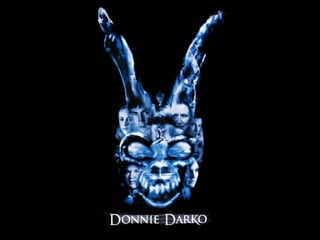
Donnie Darko (2001) Genre: Drama, Mystery, Sci-Fi, Thriller Cult film Directed by - Richard Kelly (The Box) Company  - Pandora Cinema Distributor  - Newmarket Films  Starring  - Jake Gyllenhaal  Maggie Gyllenhaal Patrick Swayze Drew Barrymore Plot (from IMDB): A troubled teenager is plagued by visions of a large bunny rabbit that manipulates him to commit a series of crimes, after narrowly escaping a bizarre accident.
Reception Budget  -$4.5 million  Gross revenue -$4.1 million Shown on only 58 screens nationwide  The film grossed $110,494 in its opening weekend.  By the time the film closed in United States cinemas on April 11, 2002, it had earned just $517,375  It was almost a straight to DVD release before being distributed by Newmarket Films.  Highly regarded by critics. Won 11 awards. Ranks ninth in FilmFour's  50 Films to See Before You Die
Analysis of Opening 40 seconds of company credits  Audio bridge of thunderstorm over the text into opening shot - signifies horror generally, possibly connoting darkness of the film. This thunder sound contrasts the opening shot where no storm is evident – connotes the strange time shifts of the film Camera pans scenery, establishing setting and with the use of lighting, again a hint at the darkness of the film. Tense slow music as we pan in to our central protagonist, connoting mystery, as does the onscreen action.  With introduction of keyboard (with echo) it signifies a sadness to this character, which is further anchored by the shots panning the scenery (possibly a POV shot) As Donnie turns to face the camera and laughs, again signifying the very strange side to this film, we have the film name on screen in a simplistic font The font “explodes” and fades to white before entering the next scene.
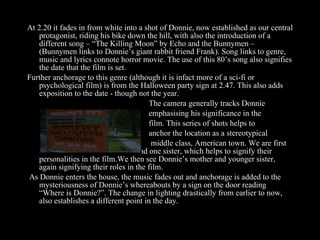
At 2.20 it fades in from white into a shot of Donnie, now established as our central protagonist, riding his bike down the hill, with also the introduction of a different song – “The Killing Moon” by Echo and the Bunnymen – (Bunnymen links to Donnie’s giant rabbit friend Frank). Song links to genre, music and lyrics connote horror movie. The use of this 80’s song also signifies the date that the film is set. Further anchorage to this genre (although it is infact more of a sci-fi or psychological film) is from the Halloween party sign at 2.47. This also adds exposition to the date - though not the year.  The camera generally tracks Donnie emphasising his significance in the  film. This series of shots helps to anchor the location as a stereotypical middle class, American town. We are first introduced to Donnie’s father and one sister, which helps to signify their personalities in the film.We then see Donnie’s mother and younger sister, again signifying their roles in the film.  As Donnie enters the house, the music fades out and anchorage is added to the mysteriousness of Donnie’s whereabouts by a sign on the door reading “Where is Donnie?”. The change in lighting drastically from earlier to now, also establishes a different point in the day.
Key Points *This is an INDIE film, and is evident throughout that it is so. Richard Kelly could here be seen an auteur, as this film focuses on many social issues as well as science-fiction themes. The cinematography used is aesthetically pleasing, with interesting shots such as when Donnie sits up and the landscape panning of the sunset. *The film is based on a scientific concept of tangent universes. It’s a strange concept, that is designed not to be commercially successful, but artistically.  *The film is a cult classic. *The success of the film lead to a huge career boost for Jake Gyllenhaal, who went on to star in The Day After Tomorrow and Brokeback Mountain. *The use of simplistic fonts (Harem) and editing means we could replicate this style of film for our project. But in order to succeed, we would need a strong concept.  *The introduction generally focuses on our central protagonist, as in most films, with only slight indications of other key characters or events.  *Donnie’s mother at the start is reading the book by Stephen King called “It”. Using devices like this you can anchor a film’s genre to the audience.
The film is complicated to watch and requires attention. It also makes a lot more sense after the second viewing. It is intended to challenge the viewer and make them think about the issues being shown.

Donnie Darko Opening Scene Analysis

  • 1.
  • 2.
    Donnie Darko (2001)Genre: Drama, Mystery, Sci-Fi, Thriller Cult film Directed by - Richard Kelly (The Box) Company - Pandora Cinema Distributor - Newmarket Films Starring - Jake Gyllenhaal Maggie Gyllenhaal Patrick Swayze Drew Barrymore Plot (from IMDB): A troubled teenager is plagued by visions of a large bunny rabbit that manipulates him to commit a series of crimes, after narrowly escaping a bizarre accident.
  • 3.
    Reception Budget -$4.5 million Gross revenue -$4.1 million Shown on only 58 screens nationwide The film grossed $110,494 in its opening weekend. By the time the film closed in United States cinemas on April 11, 2002, it had earned just $517,375 It was almost a straight to DVD release before being distributed by Newmarket Films. Highly regarded by critics. Won 11 awards. Ranks ninth in FilmFour's 50 Films to See Before You Die
  • 4.
    Analysis of Opening40 seconds of company credits Audio bridge of thunderstorm over the text into opening shot - signifies horror generally, possibly connoting darkness of the film. This thunder sound contrasts the opening shot where no storm is evident – connotes the strange time shifts of the film Camera pans scenery, establishing setting and with the use of lighting, again a hint at the darkness of the film. Tense slow music as we pan in to our central protagonist, connoting mystery, as does the onscreen action. With introduction of keyboard (with echo) it signifies a sadness to this character, which is further anchored by the shots panning the scenery (possibly a POV shot) As Donnie turns to face the camera and laughs, again signifying the very strange side to this film, we have the film name on screen in a simplistic font The font “explodes” and fades to white before entering the next scene.
  • 5.
    At 2.20 itfades in from white into a shot of Donnie, now established as our central protagonist, riding his bike down the hill, with also the introduction of a different song – “The Killing Moon” by Echo and the Bunnymen – (Bunnymen links to Donnie’s giant rabbit friend Frank). Song links to genre, music and lyrics connote horror movie. The use of this 80’s song also signifies the date that the film is set. Further anchorage to this genre (although it is infact more of a sci-fi or psychological film) is from the Halloween party sign at 2.47. This also adds exposition to the date - though not the year. The camera generally tracks Donnie emphasising his significance in the film. This series of shots helps to anchor the location as a stereotypical middle class, American town. We are first introduced to Donnie’s father and one sister, which helps to signify their personalities in the film.We then see Donnie’s mother and younger sister, again signifying their roles in the film. As Donnie enters the house, the music fades out and anchorage is added to the mysteriousness of Donnie’s whereabouts by a sign on the door reading “Where is Donnie?”. The change in lighting drastically from earlier to now, also establishes a different point in the day.
  • 6.
    Key Points *Thisis an INDIE film, and is evident throughout that it is so. Richard Kelly could here be seen an auteur, as this film focuses on many social issues as well as science-fiction themes. The cinematography used is aesthetically pleasing, with interesting shots such as when Donnie sits up and the landscape panning of the sunset. *The film is based on a scientific concept of tangent universes. It’s a strange concept, that is designed not to be commercially successful, but artistically. *The film is a cult classic. *The success of the film lead to a huge career boost for Jake Gyllenhaal, who went on to star in The Day After Tomorrow and Brokeback Mountain. *The use of simplistic fonts (Harem) and editing means we could replicate this style of film for our project. But in order to succeed, we would need a strong concept. *The introduction generally focuses on our central protagonist, as in most films, with only slight indications of other key characters or events. *Donnie’s mother at the start is reading the book by Stephen King called “It”. Using devices like this you can anchor a film’s genre to the audience.
  • 7.
    The film iscomplicated to watch and requires attention. It also makes a lot more sense after the second viewing. It is intended to challenge the viewer and make them think about the issues being shown.