Download as PDF, PPTX
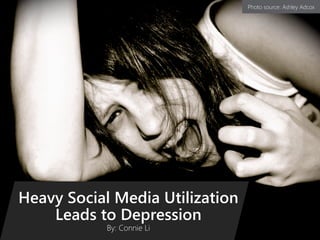
![Utilization of social media such as Facebook, Instagram, and Snapchat
has increased dramatically in recent years, especially among
adolescents and young adults [3]
Photo source: Magicatwork](https://image.slidesharecdn.com/filmassignment2-connieli-170305212413/85/Film-assignment-2-Connie-Li-2-320.jpg)
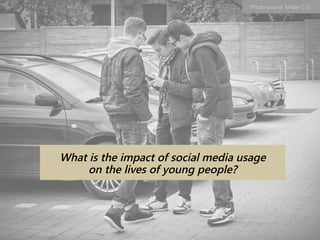
![A recent Ontario study indicates that 80% of young people use
social media on a daily basis, with almost 50% using it for over 2
hours per day [7]
Photo source: Mister C.G.](https://image.slidesharecdn.com/filmassignment2-connieli-170305212413/85/Film-assignment-2-Connie-Li-3-320.jpg)
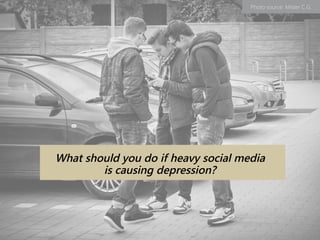
![Heavy social media
users are young
adults are 300%
more likely to be
depressed than
occasional users [7]
Facebook use
worsens “how
people feel moment to
moment and how
satisfied they are with
their lives” [7]
Photo source: Ryan Melaugh](https://image.slidesharecdn.com/filmassignment2-connieli-170305212413/85/Film-assignment-2-Connie-Li-5-320.jpg)
![1. Negatively Impacts
Physical Health
One study of adolescents indicates
that social media usage can seriously
disturb the quality and quantity of
sleep. This study shows that many
have difficultly logging-off and going
to sleep. Others may deliberately
wake up to check social media during
the night. [7]
Photo source: Jagrap](https://image.slidesharecdn.com/filmassignment2-connieli-170305212413/85/Film-assignment-2-Connie-Li-7-320.jpg)
![1. Negatively Impacts Physical Health
One study of adolescents indicates
that social media usage can seriously
disturb the quality and quantity of
sleep. This study shows that many
have difficultly logging-off and going
to sleep. Others may deliberately
wake up to check social media during
the night. [1]
Likewise, heavy users of social media often remain slumped on a chair or
in their bed, shut up in their room, and glued to the screen. This means
that they are skipping meals or staying sedentary for excessive periods
of time [6].
Photo source: Julochka](https://image.slidesharecdn.com/filmassignment2-connieli-170305212413/85/Film-assignment-2-Connie-Li-8-320.jpg)
![2. Passive Use Is Bad For Mental Health
Passive use refers to the practice of quietly observing other people’s social
media profiles and pictures – sometimes known as “Facebook stalking” [3].
Photo source: Coffeebeanworks](https://image.slidesharecdn.com/filmassignment2-connieli-170305212413/85/Film-assignment-2-Connie-Li-9-320.jpg)
![One study shows that this can
lead to envy and
resentment, while another
indicates that passive use
provokes and intensifies a
negative emotional experience
known as “FOMO” the fear
of missing out. This can lower
self-esteem and well-being. [7]
Photo source: Woxandapix](https://image.slidesharecdn.com/filmassignment2-connieli-170305212413/85/Film-assignment-2-Connie-Li-10-320.jpg)
![Study on 753 Ottawa students
between grade 7-12…
…uncovered an association between teenagers who are
heavy users of social media and poor mental health.
The study found that teens who are on social media for
more than 2 hours a day report poor self-rated mental
health, psychological distress, suicidal ideation or
unmet need for mental health support [6]](https://image.slidesharecdn.com/filmassignment2-connieli-170305212413/85/Film-assignment-2-Connie-Li-11-320.jpg)
![3. Increases
Exposure To Cyber-
bulling
University of Alberta
study revealed that
there were distinctive
associations between
exposure to
cyberbullying and
increased likelihood
of depression [2].
Photo source: Reiseblogger](https://image.slidesharecdn.com/filmassignment2-connieli-170305212413/85/Film-assignment-2-Connie-Li-12-320.jpg)
![The studies covered a variety of social sites, but Facebook
was the most common – between 89% and 97.5% of the
teens who used social media had a Facebook account [2].
23%
of teens reported
being targeted
15%
of teens reported
bullying someone
online themselves.](https://image.slidesharecdn.com/filmassignment2-connieli-170305212413/85/Film-assignment-2-Connie-Li-13-320.jpg)
![Facebook knows that its social network feed tremendously affects the
moods of its users. For example, Facebook’s data scientists conducted a
controversial human behavior experiment where 689,003 users were
manipulated by having all positive posts or negatives posts removed
to see if it would affect the moods of the users [1]
Master OSM 2011](https://image.slidesharecdn.com/filmassignment2-connieli-170305212413/85/Film-assignment-2-Connie-Li-14-320.jpg)
![The Result:
Users that saw more negative
content shared more depressing
content themselves [1].](https://image.slidesharecdn.com/filmassignment2-connieli-170305212413/85/Film-assignment-2-Connie-Li-15-320.jpg)
![“Social media could be part
of the problem or part of the
solution or both”
- Elizabeth Payne [3]](https://image.slidesharecdn.com/filmassignment2-connieli-170305212413/85/Film-assignment-2-Connie-Li-17-320.jpg)
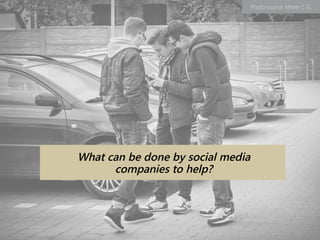
![A number of social media companies have been proactive at
helping users that appear to be depressed. For example, if a user
searches for tags on Tumblr such as “depressed” or “suicidal” then the
blog platform will show helpful resources and ask if everything is OK [1].
Photo source: Corrado](https://image.slidesharecdn.com/filmassignment2-connieli-170305212413/85/Film-assignment-2-Connie-Li-18-320.jpg)
![Works Cited:
[1] Chowdhry, A. (2016, April 30). Research Links Heavy Facebook and Social Media Usage To Depression.
Retrieved from https://www.forbes.com/sites/amitchowdhry/2016/04/30/study-links-heavy-facebook-and-
social-media-usage-to-depression/2/#3596d9e87786
[2] Durlofsky, P. (2016). Can Too Much Social Media Cause Depression? Retrieved from
http://www.mainlinetoday.com/Blogs/Thinking-Forward/February-2014/Can-Too-Much-Social-Media-Cause-
Depression/
[3] Matrix, S. (2017). Module 1, Lecture 1, Part 1, Media Convergence
[4] Matrix, S. (2017). Module 1, Lecture 2, Part 2, Media Use Research
[5] Pappas, S. (2015, June 22). Cyberbullying on Social Media Linked to Teen Depression. Retrieved from
http://www.livescience.com/51294-cyberbullying-social-media-teen-depression.html
[6] Payne, E. (2015, August 08). Student links poor teen mental health to social media use. Retrieved from
http://ottawacitizen.com/news/local-news/study-links-poor-teen-mental-health-to-social-media-use
[7] Whitley, Robert. (2016, September 14). Here’s Why Social Media Harms Your Teen’s Mental Health.
Retrieved from http://www.huffingtonpost.ca/robertwhitley/social-media-mental-health_b_11893462.html](https://image.slidesharecdn.com/filmassignment2-connieli-170305212413/85/Film-assignment-2-Connie-Li-21-320.jpg)

Heavy social media use has been linked to depression in teens and young adults. Studies have shown that heavy users, defined as using social media for more than 2 hours per day, are 300% more likely to be depressed than occasional users. There are a few reasons for this: passive social media use can lead to envy, fear of missing out, and lower self-esteem; exposure to cyberbullying increases the likelihood of depression; and excessive social media use replaces activities that are better for physical and mental health like social interaction, exercise, and quality sleep. The article recommends limiting social media use and seeking help from a mental health professional if heavy use is causing depression.


