
I/O AND FILES
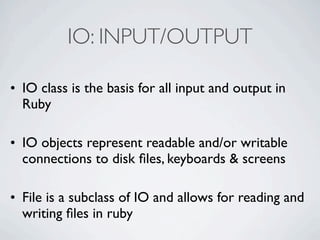
IO: INPUT/OUTPUT

• IO class is the basis for all input and output in
  Ruby

• IO objects represent readable and/or writable
  connections to disk files, keyboards & screens

• File is a subclass of IO and allows for reading and
  writing files in ruby
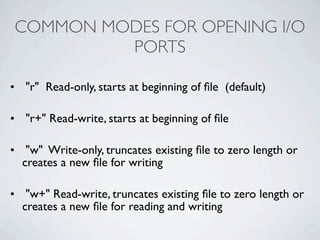
COMMON MODES FOR OPENING I/O
         PORTS

• "r" Read-only, starts at beginning of file (default)

• "r+" Read-write, starts at beginning of file

• "w" Write-only, truncates existing file to zero length or
  creates a new file for writing

• "w+" Read-write, truncates existing file to zero length or
  creates a new file for reading and writing
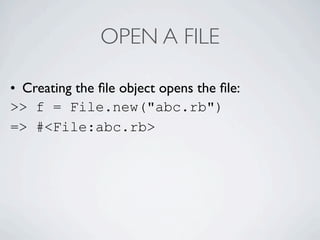
OPEN A FILE

• Creating the file object opens the file:
>> f = File.new("abc.rb")
=> #<File:abc.rb>
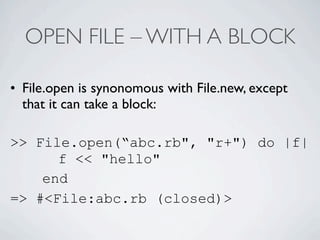
OPEN FILE – WITH A BLOCK

• File.open is synonomous with File.new, except
  that it can take a block:

>> File.open(“abc.rb", "r+") do |f|
      f << "hello"
    end
=> #<File:abc.rb (closed)>
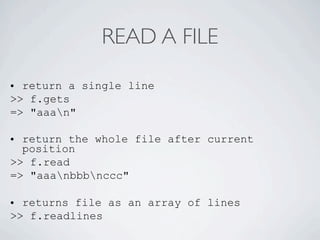
READ A FILE

• return a single line
>> f.gets
=> "aaan"

• return the whole file after current
  position
>> f.read
=> "aaanbbbnccc"

• returns file as an array of lines
>> f.readlines
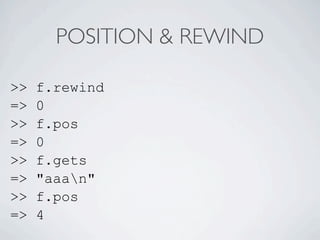
POSITION & REWIND

>>   f.rewind
=>   0
>>   f.pos
=>   0
>>   f.gets
=>   "aaan"
>>   f.pos
=>   4
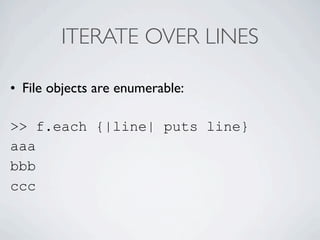
ITERATE OVER LINES

• File objects are enumerable:

>> f.each {|line| puts line}
aaa
bbb
ccc
USE ANY ENUMERABLE
             METHOD
>> f.map {|line| line.chomp + "... "}
=> [”aaa... ", ”bbb... ", ”ccc... "]

>>   f.any? {|line| line =~ /aaan/ }
=>   false
>>   f.rewind
=>   0
>>   f.any? {|line| line =~ /aaan/ }
=>   true
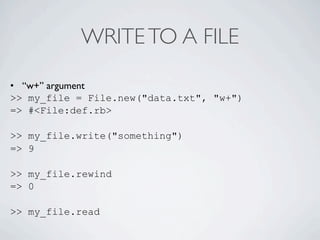
WRITE TO A FILE

• “w+” argument
>> my_file = File.new("data.txt", "w+")
=> #<File:def.rb>

>> my_file.write("something")
=> 9

>> my_file.rewind
=> 0

>> my_file.read
DIRECTORIES

>> d = Dir.new("/Users/liahhansen/s/dir")
=> #<Dir:/Users/liahhansen/s/dir>


>> d.entries
=> [".", "..", "abc.rb", "anothersubdir",
  "def.rb", "ghi.rb", "subdirectory"]
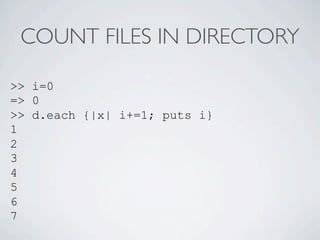
COUNT FILES IN DIRECTORY

>> i=0
=> 0
>> d.each {|x| i+=1; puts i}
1
2
3
4
5
6
7
ITERATE OVER FILES IN
         DIRECTORY
>> ruby_files = Dir["*.rb"]
=> ["abc.rb", "def.rb", "ghi.rb"]

>> ruby_files.map do |file|
      "rb_" + file
   end
=> ["rb_abc.rb", "rb_def.rb",

Files IO

  • 1.
  • 2.
    IO: INPUT/OUTPUT • IOclass is the basis for all input and output in Ruby • IO objects represent readable and/or writable connections to disk files, keyboards & screens • File is a subclass of IO and allows for reading and writing files in ruby
  • 3.
    COMMON MODES FOROPENING I/O PORTS • "r" Read-only, starts at beginning of file (default) • "r+" Read-write, starts at beginning of file • "w" Write-only, truncates existing file to zero length or creates a new file for writing • "w+" Read-write, truncates existing file to zero length or creates a new file for reading and writing
  • 4.
    OPEN A FILE •Creating the file object opens the file: >> f = File.new("abc.rb") => #<File:abc.rb>
  • 5.
    OPEN FILE –WITH A BLOCK • File.open is synonomous with File.new, except that it can take a block: >> File.open(“abc.rb", "r+") do |f| f << "hello" end => #<File:abc.rb (closed)>
  • 6.
    READ A FILE •return a single line >> f.gets => "aaan" • return the whole file after current position >> f.read => "aaanbbbnccc" • returns file as an array of lines >> f.readlines
  • 7.
    POSITION & REWIND >> f.rewind => 0 >> f.pos => 0 >> f.gets => "aaan" >> f.pos => 4
  • 8.
    ITERATE OVER LINES •File objects are enumerable: >> f.each {|line| puts line} aaa bbb ccc
  • 9.
    USE ANY ENUMERABLE METHOD >> f.map {|line| line.chomp + "... "} => [”aaa... ", ”bbb... ", ”ccc... "] >> f.any? {|line| line =~ /aaan/ } => false >> f.rewind => 0 >> f.any? {|line| line =~ /aaan/ } => true
  • 10.
    WRITE TO AFILE • “w+” argument >> my_file = File.new("data.txt", "w+") => #<File:def.rb> >> my_file.write("something") => 9 >> my_file.rewind => 0 >> my_file.read
  • 11.
    DIRECTORIES >> d =Dir.new("/Users/liahhansen/s/dir") => #<Dir:/Users/liahhansen/s/dir> >> d.entries => [".", "..", "abc.rb", "anothersubdir", "def.rb", "ghi.rb", "subdirectory"]
  • 12.
    COUNT FILES INDIRECTORY >> i=0 => 0 >> d.each {|x| i+=1; puts i} 1 2 3 4 5 6 7
  • 13.
    ITERATE OVER FILESIN DIRECTORY >> ruby_files = Dir["*.rb"] => ["abc.rb", "def.rb", "ghi.rb"] >> ruby_files.map do |file| "rb_" + file end => ["rb_abc.rb", "rb_def.rb",