36 Local hospitality: Developing local employment in India’s tourism sector
The recruitment process
2
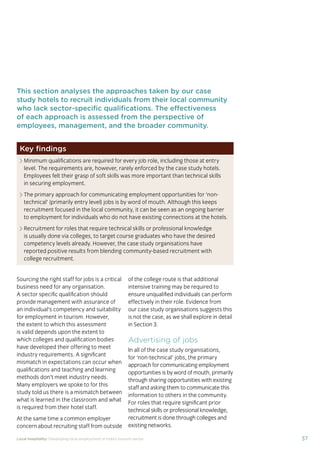
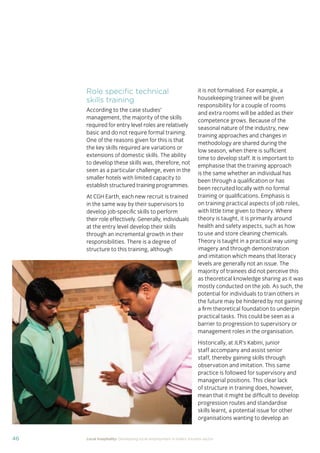
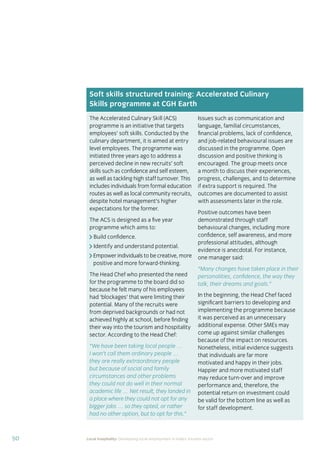
“I’mm tttthhhhheeeee ooonnnlllllyy ppppppeeeerrrrsssooonnnn iinn mmmmyyyyyy fffaaammmmmiiiiillllyyyyy
wwwwwwwho’s gooot a ppeeeeerrrrmaaannnneennttt jjooooooobbbbbbbbbbbb. Itt’’sss gggggiiivvvvvvvvveeeeeeeeeeennn
mmmmmmmeeeeeee iiiiinnnnnnnddddddeeeeeeepppppppeeeeeeennnnnddeennncceeeeeeeee bbbbbbeeeeeeeeeeecccccccaaaaaaaaaauuuuuussssssseeeeeeeee III cccaaannn
mmmmmmaaannnnnaaaaaaaggggggeeeeee mmmmmmyyyyyy fififififififififinnnnnnnaaaaaannnnnnccceeeeeeessssssss. IIIII pppppppppaaaaaaaaaaaiiiiddddddddd ffffffffffoooooorrr mmmyyyyy
sssiiisssstttttteeeeeerrr’sss  wwweeeeeeddddddddddiiinnnggg wwwwwhhhhiiiiiccccchhhhhh mmmmmmmmeeeeeeeaaaaaaannnnnntttttttttt aaaa lllooootttttt..””””
HouHouHouHouHouseksekeepeepeepeepeeperer
37Local hospitality: Developing local employment in India’s tourism sector
This section analyses the approaches taken by our case
study hotels to recruit individuals from their local community
who lack sector-specific qualifications. The effectiveness
of each approach is assessed from the perspective of
employees, management, and the broader community.
Sourcing the right staff for jobs is a critical
business need for any organisation.
A sector specific qualification should
provide management with assurance of
an individual’s competency and suitability
for employment in tourism. However,
the extent to which this assessment
is valid depends upon the extent to
which colleges and qualification bodies
have developed their offering to meet
industry requirements. A significant
mismatch in expectations can occur when
qualifications and teaching and learning
methods don’t meet industry needs.
Many employers we spoke to for this
study told us there is a mismatch between
what is learned in the classroom and what
is required from their hotel staff.
At the same time a common employer
concern about recruiting staff from outside
of the college route is that additional
intensive training may be required to
ensure unqualified individuals can perform
effectively in their role. Evidence from
our case study organisations suggests this
is not the case, as we shall explore in detail
in Section 3.
Advertising of jobs
In all of the case study organisations,
for ‘non-technical’ jobs, the primary
approach for communicating employment
opportunities is by word of mouth, primarily
through sharing opportunities with existing
staff and asking them to communicate this
information to others in the community.
For roles that require significant prior
technical skills or professional knowledge,
recruitment is done through colleges and
existing networks.
Key findings
Minimum qualifications are required for every job role, including those at entry
level. The requirements are, however, rarely enforced by the case study hotels.
Employees felt their grasp of soft skills was more important than technical skills
in securing employment.
The primary approach for communicating employment opportunities for ‘non-
technical’ (primarily entry level) jobs is by word of mouth. Although this keeps
recruitment focused in the local community, it can be seen as an ongoing barrier
to employment for individuals who do not have existing connections at the hotels.
Recruitment for roles that require technical skills or professional knowledge
is usually done via colleges, to target course graduates who have the desired
competency levels already. However, the case study organisations have
reported positive results from blending community-based recruitment with
college recruitment.
37Local hospitality: Developing local employment in India’s tourism sector
This section analyses the approaches taken by our case
study hotels to recruit individuals from their local community
who lack sector-specific qualifications. The effectiveness
of each approach is assessed from the perspective of
employees, management, and the broader community.
Sourcing the right staff for jobs is a critical
business need for any organisation.
A sector specific qualification should
provide management with assurance of
an individual’s competency and suitability
for employment in tourism. However,
the extent to which this assessment
is valid depends upon the extent to
which colleges and qualification bodies
have developed their offering to meet
industry requirements. A significant
mismatch in expectations can occur when
qualifications and teaching and learning
methods don’t meet industry needs.
Many employers we spoke to for this
study told us there is a mismatch between
what is learned in the classroom and what
is required from their hotel staff.
At the same time a common employer
concern about recruiting staff from outside
of the college route is that additional
intensive training may be required to
ensure unqualified individuals can perform
effectively in their role. Evidence from
our case study organisations suggests this
is not the case, as we shall explore in detail
in Section 3.
Advertising of jobs
In all of the case study organisations,
for ‘non-technical’ jobs, the primary
approach for communicating employment
opportunities is by word of mouth, primarily
through sharing opportunities with existing
staff and asking them to communicate this
information to others in the community.
For roles that require significant prior
technical skills or professional knowledge,
recruitment is done through colleges and
existing networks.
Key findings
Minimum qualifications are required for every job role, including those at entry
level. The requirements are, however, rarely enforced by the case study hotels.
Employees felt their grasp of soft skills was more important than technical skills
in securing employment.
The primary approach for communicating employment opportunities for ‘non-
technical’ (primarily entry level) jobs is by word of mouth. Although this keeps
recruitment focused in the local community, it can be seen as an ongoing barrier
to employment for individuals who do not have existing connections at the hotels.
Recruitment for roles that require technical skills or professional knowledge
is usually done via colleges, to target course graduates who have the desired
competency levels already. However, the case study organisations have
reported positive results from blending community-based recruitment with
college recruitment.
37Local hospitality: Developing local employment in India’s tourism sector
This section analyses the approaches taken by our case
study hotels to recruit individuals from their local community
who lack sector-specific qualifications. The effectiveness
of each approach is assessed from the perspective of
employees, management, and the broader community.
Sourcing the right staff for jobs is a critical
business need for any organisation.
A sector specific qualification should
provide management with assurance of
an individual’s competency and suitability
for employment in tourism. However,
the extent to which this assessment
is valid depends upon the extent to
which colleges and qualification bodies
have developed their offering to meet
industry requirements. A significant
mismatch in expectations can occur when
qualifications and teaching and learning
methods don’t meet industry needs.
Many employers we spoke to for this
study told us there is a mismatch between
what is learned in the classroom and what
is required from their hotel staff.
At the same time a common employer
concern about recruiting staff from outside
of the college route is that additional
intensive training may be required to
ensure unqualified individuals can perform
effectively in their role. Evidence from
our case study organisations suggests this
is not the case, as we shall explore in detail
in Section 3.
Advertising of jobs
In all of the case study organisations,
for ‘non-technical’ jobs, the primary
approach for communicating employment
opportunities is by word of mouth, primarily
through sharing opportunities with existing
staff and asking them to communicate this
information to others in the community.
For roles that require significant prior
technical skills or professional knowledge,
recruitment is done through colleges and
existing networks.
Key findings
Minimum qualifications are required for every job role, including those at entry
level. The requirements are, however, rarely enforced by the case study hotels.
Employees felt their grasp of soft skills was more important than technical skills
in securing employment.
The primary approach for communicating employment opportunities for ‘non-
technical’ (primarily entry level) jobs is by word of mouth. Although this keeps
recruitment focused in the local community, it can be seen as an ongoing barrier
to employment for individuals who do not have existing connections at the hotels.
Recruitment for roles that require technical skills or professional knowledge
is usually done via colleges, to target course graduates who have the desired
competency levels already. However, the case study organisations have
reported positive results from blending community-based recruitment with
college recruitment.
37Local hospitality: Developing local employment in India’s tourism sector
This section analyses the approaches taken by our case
study hotels to recruit individuals from their local community
who lack sector-specific qualifications. The effectiveness
of each approach is assessed from the perspective of
employees, management, and the broader community.
Sourcing the right staff for jobs is a critical
business need for any organisation.
A sector specific qualification should
provide management with assurance of
an individual’s competency and suitability
for employment in tourism. However,
the extent to which this assessment
is valid depends upon the extent to
which colleges and qualification bodies
have developed their offering to meet
industry requirements. A significant
mismatch in expectations can occur when
qualifications and teaching and learning
methods don’t meet industry needs.
Many employers we spoke to for this
study told us there is a mismatch between
what is learned in the classroom and what
is required from their hotel staff.
At the same time a common employer
concern about recruiting staff from outside
of the college route is that additional
intensive training may be required to
ensure unqualified individuals can perform
effectively in their role. Evidence from
our case study organisations suggests this
is not the case, as we shall explore in detail
in Section 3.
Advertising of jobs
In all of the case study organisations,
for ‘non-technical’ jobs, the primary
approach for communicating employment
opportunities is by word of mouth, primarily
through sharing opportunities with existing
staff and asking them to communicate this
information to others in the community.
For roles that require significant prior
technical skills or professional knowledge,
recruitment is done through colleges and
existing networks.
Key findings
Minimum qualifications are required for every job role, including those at entry
level. The requirements are, however, rarely enforced by the case study hotels.
Employees felt their grasp of soft skills was more important than technical skills
in securing employment.
The primary approach for communicating employment opportunities for ‘non-
technical’ (primarily entry level) jobs is by word of mouth. Although this keeps
recruitment focused in the local community, it can be seen as an ongoing barrier
to employment for individuals who do not have existing connections at the hotels.
Recruitment for roles that require technical skills or professional knowledge
is usually done via colleges, to target course graduates who have the desired
competency levels already. However, the case study organisations have
reported positive results from blending community-based recruitment with
college recruitment.
37Local hospitality: Developing local employment in India’s tourism sector
This section analyses the approaches taken by our case
study hotels to recruit individuals from their local community
who lack sector-specific qualifications. The effectiveness
of each approach is assessed from the perspective of
employees, management, and the broader community.
Sourcing the right staff for jobs is a critical
business need for any organisation.
A sector specific qualification should
provide management with assurance of
an individual’s competency and suitability
for employment in tourism. However,
the extent to which this assessment
is valid depends upon the extent to
which colleges and qualification bodies
have developed their offering to meet
industry requirements. A significant
mismatch in expectations can occur when
qualifications and teaching and learning
methods don’t meet industry needs.
Many employers we spoke to for this
study told us there is a mismatch between
what is learned in the classroom and what
is required from their hotel staff.
At the same time a common employer
concern about recruiting staff from outside
of the college route is that additional
intensive training may be required to
ensure unqualified individuals can perform
effectively in their role. Evidence from
our case study organisations suggests this
is not the case, as we shall explore in detail
in Section 3.
Advertising of jobs
In all of the case study organisations,
for ‘non-technical’ jobs, the primary
approach for communicating employment
opportunities is by word of mouth, primarily
through sharing opportunities with existing
staff and asking them to communicate this
information to others in the community.
For roles that require significant prior
technical skills or professional knowledge,
recruitment is done through colleges and
existing networks.
Key findings
Minimum qualifications are required for every job role, including those at entry
level. The requirements are, however, rarely enforced by the case study hotels.
Employees felt their grasp of soft skills was more important than technical skills
in securing employment.
The primary approach for communicating employment opportunities for ‘non-
technical’ (primarily entry level) jobs is by word of mouth. Although this keeps
recruitment focused in the local community, it can be seen as an ongoing barrier
to employment for individuals who do not have existing connections at the hotels.
Recruitment for roles that require technical skills or professional knowledge
is usually done via colleges, to target course graduates who have the desired
competency levels already. However, the case study organisations have
reported positive results from blending community-based recruitment with
college recruitment.
37Local hospitality: Developing local employment in India’s tourism sector
This section analyses the approaches taken by our case
study hotels to recruit individuals from their local community
who lack sector-specific qualifications. The effectiveness
of each approach is assessed from the perspective of
employees, management, and the broader community.
Sourcing the right staff for jobs is a critical
business need for any organisation.
A sector specific qualification should
provide management with assurance of
an individual’s competency and suitability
for employment in tourism. However,
the extent to which this assessment
is valid depends upon the extent to
which colleges and qualification bodies
have developed their offering to meet
industry requirements. A significant
mismatch in expectations can occur when
qualifications and teaching and learning
methods don’t meet industry needs.
Many employers we spoke to for this
study told us there is a mismatch between
what is learned in the classroom and what
is required from their hotel staff.
At the same time a common employer
concern about recruiting staff from outside
of the college route is that additional
intensive training may be required to
ensure unqualified individuals can perform
effectively in their role. Evidence from
our case study organisations suggests this
is not the case, as we shall explore in detail
in Section 3.
Advertising of jobs
In all of the case study organisations,
for ‘non-technical’ jobs, the primary
approach for communicating employment
opportunities is by word of mouth, primarily
through sharing opportunities with existing
staff and asking them to communicate this
information to others in the community.
For roles that require significant prior
technical skills or professional knowledge,
recruitment is done through colleges and
existing networks.
Key findings
Minimum qualifications are required for every job role, including those at entry
level. The requirements are, however, rarely enforced by the case study hotels.
Employees felt their grasp of soft skills was more important than technical skills
in securing employment.
The primary approach for communicating employment opportunities for ‘non-
technical’ (primarily entry level) jobs is by word of mouth. Although this keeps
recruitment focused in the local community, it can be seen as an ongoing barrier
to employment for individuals who do not have existing connections at the hotels.
Recruitment for roles that require technical skills or professional knowledge
is usually done via colleges, to target course graduates who have the desired
competency levels already. However, the case study organisations have
reported positive results from blending community-based recruitment with
college recruitment.
37Local hospitality: Developing local employment in India’s tourism sector
This section analyses the approaches taken by our case
study hotels to recruit individuals from their local community
who lack sector-specific qualifications. The effectiveness
of each approach is assessed from the perspective of
employees, management, and the broader community.
Sourcing the right staff for jobs is a critical
business need for any organisation.
A sector specific qualification should
provide management with assurance of
an individual’s competency and suitability
for employment in tourism. However,
the extent to which this assessment
is valid depends upon the extent to
which colleges and qualification bodies
have developed their offering to meet
industry requirements. A significant
mismatch in expectations can occur when
qualifications and teaching and learning
methods don’t meet industry needs.
Many employers we spoke to for this
study told us there is a mismatch between
what is learned in the classroom and what
is required from their hotel staff.
At the same time a common employer
concern about recruiting staff from outside
of the college route is that additional
intensive training may be required to
ensure unqualified individuals can perform
effectively in their role. Evidence from
our case study organisations suggests this
is not the case, as we shall explore in detail
in Section 3.
Advertising of jobs
In all of the case study organisations,
for ‘non-technical’ jobs, the primary
approach for communicating employment
opportunities is by word of mouth, primarily
through sharing opportunities with existing
staff and asking them to communicate this
information to others in the community.
For roles that require significant prior
technical skills or professional knowledge,
recruitment is done through colleges and
existing networks.
Key findings
Minimum qualifications are required for every job role, including those at entry
level. The requirements are, however, rarely enforced by the case study hotels.
Employees felt their grasp of soft skills was more important than technical skills
in securing employment.
The primary approach for communicating employment opportunities for ‘non-
technical’ (primarily entry level) jobs is by word of mouth. Although this keeps
recruitment focused in the local community, it can be seen as an ongoing barrier
to employment for individuals who do not have existing connections at the hotels.
Recruitment for roles that require technical skills or professional knowledge
is usually done via colleges, to target course graduates who have the desired
competency levels already. However, the case study organisations have
reported positive results from blending community-based recruitment with
college recruitment.
37Local hospitality: Developing local employment in India’s tourism sector
This section analyses the approaches taken by our case
study hotels to recruit individuals from their local community
who lack sector-specific qualifications. The effectiveness
of each approach is assessed from the perspective of
employees, management, and the broader community.
Sourcing the right staff for jobs is a critical
business need for any organisation.
A sector specific qualification should
provide management with assurance of
an individual’s competency and suitability
for employment in tourism. However,
the extent to which this assessment
is valid depends upon the extent to
which colleges and qualification bodies
have developed their offering to meet
industry requirements. A significant
mismatch in expectations can occur when
qualifications and teaching and learning
methods don’t meet industry needs.
Many employers we spoke to for this
study told us there is a mismatch between
what is learned in the classroom and what
is required from their hotel staff.
At the same time a common employer
concern about recruiting staff from outside
of the college route is that additional
intensive training may be required to
ensure unqualified individuals can perform
effectively in their role. Evidence from
our case study organisations suggests this
is not the case, as we shall explore in detail
in Section 3.
Advertising of jobs
In all of the case study organisations,
for ‘non-technical’ jobs, the primary
approach for communicating employment
opportunities is by word of mouth, primarily
through sharing opportunities with existing
staff and asking them to communicate this
information to others in the community.
For roles that require significant prior
technical skills or professional knowledge,
recruitment is done through colleges and
existing networks.
Key findings
Minimum qualifications are required for every job role, including those at entry
level. The requirements are, however, rarely enforced by the case study hotels.
Employees felt their grasp of soft skills was more important than technical skills
in securing employment.
The primary approach for communicating employment opportunities for ‘non-
technical’ (primarily entry level) jobs is by word of mouth. Although this keeps
recruitment focused in the local community, it can be seen as an ongoing barrier
to employment for individuals who do not have existing connections at the hotels.
Recruitment for roles that require technical skills or professional knowledge
is usually done via colleges, to target course graduates who have the desired
competency levels already. However, the case study organisations have
reported positive results from blending community-based recruitment with
college recruitment.
37Local hospitality: Developing local employment in India’s tourism sector
This section analyses the approaches taken by our case
study hotels to recruit individuals from their local community
who lack sector-specific qualifications. The effectiveness
of each approach is assessed from the perspective of
employees, management, and the broader community.
Sourcing the right staff for jobs is a critical
business need for any organisation.
A sector specific qualification should
provide management with assurance of
an individual’s competency and suitability
for employment in tourism. However,
the extent to which this assessment
is valid depends upon the extent to
which colleges and qualification bodies
have developed their offering to meet
industry requirements. A significant
mismatch in expectations can occur when
qualifications and teaching and learning
methods don’t meet industry needs.
Many employers we spoke to for this
study told us there is a mismatch between
what is learned in the classroom and what
is required from their hotel staff.
At the same time a common employer
concern about recruiting staff from outside
of the college route is that additional
intensive training may be required to
ensure unqualified individuals can perform
effectively in their role. Evidence from
our case study organisations suggests this
is not the case, as we shall explore in detail
in Section 3.
Advertising of jobs
In all of the case study organisations,
for ‘non-technical’ jobs, the primary
approach for communicating employment
opportunities is by word of mouth, primarily
through sharing opportunities with existing
staff and asking them to communicate this
information to others in the community.
For roles that require significant prior
technical skills or professional knowledge,
recruitment is done through colleges and
existing networks.
Key findings
Minimum qualifications are required for every job role, including those at entry
level. The requirements are, however, rarely enforced by the case study hotels.
Employees felt their grasp of soft skills was more important than technical skills
in securing employment.
The primary approach for communicating employment opportunities for ‘non-
technical’ (primarily entry level) jobs is by word of mouth. Although this keeps
recruitment focused in the local community, it can be seen as an ongoing barrier
to employment for individuals who do not have existing connections at the hotels.
Recruitment for roles that require technical skills or professional knowledge
is usually done via colleges, to target course graduates who have the desired
competency levels already. However, the case study organisations have
reported positive results from blending community-based recruitment with
college recruitment.
37Local hospitality: Developing local employment in India’s tourism sector
This section analyses the approaches taken by our case
study hotels to recruit individuals from their local community
who lack sector-specific qualifications. The effectiveness
of each approach is assessed from the perspective of
employees, management, and the broader community.
Sourcing the right staff for jobs is a critical
business need for any organisation.
A sector specific qualification should
provide management with assurance of
an individual’s competency and suitability
for employment in tourism. However,
the extent to which this assessment
is valid depends upon the extent to
which colleges and qualification bodies
have developed their offering to meet
industry requirements. A significant
mismatch in expectations can occur when
qualifications and teaching and learning
methods don’t meet industry needs.
Many employers we spoke to for this
study told us there is a mismatch between
what is learned in the classroom and what
is required from their hotel staff.
At the same time a common employer
concern about recruiting staff from outside
of the college route is that additional
intensive training may be required to
ensure unqualified individuals can perform
effectively in their role. Evidence from
our case study organisations suggests this
is not the case, as we shall explore in detail
in Section 3.
Advertising of jobs
In all of the case study organisations,
for ‘non-technical’ jobs, the primary
approach for communicating employment
opportunities is by word of mouth, primarily
through sharing opportunities with existing
staff and asking them to communicate this
information to others in the community.
For roles that require significant prior
technical skills or professional knowledge,
recruitment is done through colleges and
existing networks.
Key findings
Minimum qualifications are required for every job role, including those at entry
level. The requirements are, however, rarely enforced by the case study hotels.
Employees felt their grasp of soft skills was more important than technical skills
in securing employment.
The primary approach for communicating employment opportunities for ‘non-
technical’ (primarily entry level) jobs is by word of mouth. Although this keeps
recruitment focused in the local community, it can be seen as an ongoing barrier
to employment for individuals who do not have existing connections at the hotels.
Recruitment for roles that require technical skills or professional knowledge
is usually done via colleges, to target course graduates who have the desired
competency levels already. However, the case study organisations have
reported positive results from blending community-based recruitment with
college recruitment.
37Local hospitality: Developing local employment in India’s tourism sector
This section analyses the approaches taken by our case
study hotels to recruit individuals from their local community
who lack sector-specific qualifications. The effectiveness
of each approach is assessed from the perspective of
employees, management, and the broader community.
Sourcing the right staff for jobs is a critical
business need for any organisation.
A sector specific qualification should
provide management with assurance of
an individual’s competency and suitability
for employment in tourism. However,
the extent to which this assessment
is valid depends upon the extent to
which colleges and qualification bodies
have developed their offering to meet
industry requirements. A significant
mismatch in expectations can occur when
qualifications and teaching and learning
methods don’t meet industry needs.
Many employers we spoke to for this
study told us there is a mismatch between
what is learned in the classroom and what
is required from their hotel staff.
At the same time a common employer
concern about recruiting staff from outside
of the college route is that additional
intensive training may be required to
ensure unqualified individuals can perform
effectively in their role. Evidence from
our case study organisations suggests this
is not the case, as we shall explore in detail
in Section 3.
Advertising of jobs
In all of the case study organisations,
for ‘non-technical’ jobs, the primary
approach for communicating employment
opportunities is by word of mouth, primarily
through sharing opportunities with existing
staff and asking them to communicate this
information to others in the community.
For roles that require significant prior
technical skills or professional knowledge,
recruitment is done through colleges and
existing networks.
Key findings
Minimum qualifications are required for every job role, including those at entry
level. The requirements are, however, rarely enforced by the case study hotels.
Employees felt their grasp of soft skills was more important than technical skills
in securing employment.
The primary approach for communicating employment opportunities for ‘non-
technical’ (primarily entry level) jobs is by word of mouth. Although this keeps
recruitment focused in the local community, it can be seen as an ongoing barrier
to employment for individuals who do not have existing connections at the hotels.
Recruitment for roles that require technical skills or professional knowledge
is usually done via colleges, to target course graduates who have the desired
competency levels already. However, the case study organisations have
reported positive results from blending community-based recruitment with
college recruitment.
37Local hospitality: Developing local employment in India’s tourism sector
This section analyses the approaches taken by our case
study hotels to recruit individuals from their local community
who lack sector-specific qualifications. The effectiveness
of each approach is assessed from the perspective of
employees, management, and the broader community.
Sourcing the right staff for jobs is a critical
business need for any organisation.
A sector specific qualification should
provide management with assurance of
an individual’s competency and suitability
for employment in tourism. However,
the extent to which this assessment
is valid depends upon the extent to
which colleges and qualification bodies
have developed their offering to meet
industry requirements. A significant
mismatch in expectations can occur when
qualifications and teaching and learning
methods don’t meet industry needs.
Many employers we spoke to for this
study told us there is a mismatch between
what is learned in the classroom and what
is required from their hotel staff.
At the same time a common employer
concern about recruiting staff from outside
of the college route is that additional
intensive training may be required to
ensure unqualified individuals can perform
effectively in their role. Evidence from
our case study organisations suggests this
is not the case, as we shall explore in detail
in Section 3.
Advertising of jobs
In all of the case study organisations,
for ‘non-technical’ jobs, the primary
approach for communicating employment
opportunities is by word of mouth, primarily
through sharing opportunities with existing
staff and asking them to communicate this
information to others in the community.
For roles that require significant prior
technical skills or professional knowledge,
recruitment is done through colleges and
existing networks.
Key findings
Minimum qualifications are required for every job role, including those at entry
level. The requirements are, however, rarely enforced by the case study hotels.
Employees felt their grasp of soft skills was more important than technical skills
in securing employment.
The primary approach for communicating employment opportunities for ‘non-
technical’ (primarily entry level) jobs is by word of mouth. Although this keeps
recruitment focused in the local community, it can be seen as an ongoing barrier
to employment for individuals who do not have existing connections at the hotels.
Recruitment for roles that require technical skills or professional knowledge
is usually done via colleges, to target course graduates who have the desired
competency levels already. However, the case study organisations have
reported positive results from blending community-based recruitment with
college recruitment.
37Local hospitality: Developing local employment in India’s tourism sector
This section analyses the approaches taken by our case
study hotels to recruit individuals from their local community
who lack sector-specific qualifications. The effectiveness
of each approach is assessed from the perspective of
employees, management, and the broader community.
Sourcing the right staff for jobs is a critical
business need for any organisation.
A sector specific qualification should
provide management with assurance of
an individual’s competency and suitability
for employment in tourism. However,
the extent to which this assessment
is valid depends upon the extent to
which colleges and qualification bodies
have developed their offering to meet
industry requirements. A significant
mismatch in expectations can occur when
qualifications and teaching and learning
methods don’t meet industry needs.
Many employers we spoke to for this
study told us there is a mismatch between
what is learned in the classroom and what
is required from their hotel staff.
At the same time a common employer
concern about recruiting staff from outside
of the college route is that additional
intensive training may be required to
ensure unqualified individuals can perform
effectively in their role. Evidence from
our case study organisations suggests this
is not the case, as we shall explore in detail
in Section 3.
Advertising of jobs
In all of the case study organisations,
for ‘non-technical’ jobs, the primary
approach for communicating employment
opportunities is by word of mouth, primarily
through sharing opportunities with existing
staff and asking them to communicate this
information to others in the community.
For roles that require significant prior
technical skills or professional knowledge,
recruitment is done through colleges and
existing networks.
Key findings
Minimum qualifications are required for every job role, including those at entry
level. The requirements are, however, rarely enforced by the case study hotels.
Employees felt their grasp of soft skills was more important than technical skills
in securing employment.
The primary approach for communicating employment opportunities for ‘non-
technical’ (primarily entry level) jobs is by word of mouth. Although this keeps
recruitment focused in the local community, it can be seen as an ongoing barrier
to employment for individuals who do not have existing connections at the hotels.
Recruitment for roles that require technical skills or professional knowledge
is usually done via colleges, to target course graduates who have the desired
competency levels already. However, the case study organisations have
reported positive results from blending community-based recruitment with
college recruitment.
37Local hospitality: Developing local employment in India’s tourism sector
This section analyses the approaches taken by our case
study hotels to recruit individuals from their local community
who lack sector-specific qualifications. The effectiveness
of each approach is assessed from the perspective of
employees, management, and the broader community.
Sourcing the right staff for jobs is a critical
business need for any organisation.
A sector specific qualification should
provide management with assurance of
an individual’s competency and suitability
for employment in tourism. However,
the extent to which this assessment
is valid depends upon the extent to
which colleges and qualification bodies
have developed their offering to meet
industry requirements. A significant
mismatch in expectations can occur when
qualifications and teaching and learning
methods don’t meet industry needs.
Many employers we spoke to for this
study told us there is a mismatch between
what is learned in the classroom and what
is required from their hotel staff.
At the same time a common employer
concern about recruiting staff from outside
of the college route is that additional
intensive training may be required to
ensure unqualified individuals can perform
effectively in their role. Evidence from
our case study organisations suggests this
is not the case, as we shall explore in detail
in Section 3.
Advertising of jobs
In all of the case study organisations,
for ‘non-technical’ jobs, the primary
approach for communicating employment
opportunities is by word of mouth, primarily
through sharing opportunities with existing
staff and asking them to communicate this
information to others in the community.
For roles that require significant prior
technical skills or professional knowledge,
recruitment is done through colleges and
existing networks.
Key findings
Minimum qualifications are required for every job role, including those at entry
level. The requirements are, however, rarely enforced by the case study hotels.
Employees felt their grasp of soft skills was more important than technical skills
in securing employment.
The primary approach for communicating employment opportunities for ‘non-
technical’ (primarily entry level) jobs is by word of mouth. Although this keeps
recruitment focused in the local community, it can be seen as an ongoing barrier
to employment for individuals who do not have existing connections at the hotels.
Recruitment for roles that require technical skills or professional knowledge
is usually done via colleges, to target course graduates who have the desired
competency levels already. However, the case study organisations have
reported positive results from blending community-based recruitment with
college recruitment.
37Local hospitality: Developing local employment in India’s tourism sector
This section analyses the approaches taken by our case
study hotels to recruit individuals from their local community
who lack sector-specific qualifications. The effectiveness
of each approach is assessed from the perspective of
employees, management, and the broader community.
Sourcing the right staff for jobs is a critical
business need for any organisation.
A sector specific qualification should
provide management with assurance of
an individual’s competency and suitability
for employment in tourism. However,
the extent to which this assessment
is valid depends upon the extent to
which colleges and qualification bodies
have developed their offering to meet
industry requirements. A significant
mismatch in expectations can occur when
qualifications and teaching and learning
methods don’t meet industry needs.
Many employers we spoke to for this
study told us there is a mismatch between
what is learned in the classroom and what
is required from their hotel staff.
At the same time a common employer
concern about recruiting staff from outside
of the college route is that additional
intensive training may be required to
ensure unqualified individuals can perform
effectively in their role. Evidence from
our case study organisations suggests this
is not the case, as we shall explore in detail
in Section 3.
Advertising of jobs
In all of the case study organisations,
for ‘non-technical’ jobs, the primary
approach for communicating employment
opportunities is by word of mouth, primarily
through sharing opportunities with existing
staff and asking them to communicate this
information to others in the community.
For roles that require significant prior
technical skills or professional knowledge,
recruitment is done through colleges and
existing networks.
Key findings
Minimum qualifications are required for every job role, including those at entry
level. The requirements are, however, rarely enforced by the case study hotels.
Employees felt their grasp of soft skills was more important than technical skills
in securing employment.
The primary approach for communicating employment opportunities for ‘non-
technical’ (primarily entry level) jobs is by word of mouth. Although this keeps
recruitment focused in the local community, it can be seen as an ongoing barrier
to employment for individuals who do not have existing connections at the hotels.
Recruitment for roles that require technical skills or professional knowledge
is usually done via colleges, to target course graduates who have the desired
competency levels already. However, the case study organisations have
reported positive results from blending community-based recruitment with
college recruitment.
37Local hospitality: Developing local employment in India’s tourism sector
This section analyses the approaches taken by our case
study hotels to recruit individuals from their local community
who lack sector-specific qualifications. The effectiveness
of each approach is assessed from the perspective of
employees, management, and the broader community.
Sourcing the right staff for jobs is a critical
business need for any organisation.
A sector specific qualification should
provide management with assurance of
an individual’s competency and suitability
for employment in tourism. However,
the extent to which this assessment
is valid depends upon the extent to
which colleges and qualification bodies
have developed their offering to meet
industry requirements. A significant
mismatch in expectations can occur when
qualifications and teaching and learning
methods don’t meet industry needs.
Many employers we spoke to for this
study told us there is a mismatch between
what is learned in the classroom and what
is required from their hotel staff.
At the same time a common employer
concern about recruiting staff from outside
of the college route is that additional
intensive training may be required to
ensure unqualified individuals can perform
effectively in their role. Evidence from
our case study organisations suggests this
is not the case, as we shall explore in detail
in Section 3.
Advertising of jobs
In all of the case study organisations,
for ‘non-technical’ jobs, the primary
approach for communicating employment
opportunities is by word of mouth, primarily
through sharing opportunities with existing
staff and asking them to communicate this
information to others in the community.
For roles that require significant prior
technical skills or professional knowledge,
recruitment is done through colleges and
existing networks.
Key findings
Minimum qualifications are required for every job role, including those at entry
level. The requirements are, however, rarely enforced by the case study hotels.
Employees felt their grasp of soft skills was more important than technical skills
in securing employment.
The primary approach for communicating employment opportunities for ‘non-
technical’ (primarily entry level) jobs is by word of mouth. Although this keeps
recruitment focused in the local community, it can be seen as an ongoing barrier
to employment for individuals who do not have existing connections at the hotels.
Recruitment for roles that require technical skills or professional knowledge
is usually done via colleges, to target course graduates who have the desired
competency levels already. However, the case study organisations have
reported positive results from blending community-based recruitment with
college recruitment.
37Local hospitality: Developing local employment in India’s tourism sector
This section analyses the approaches taken by our case
study hotels to recruit individuals from their local community
who lack sector-specific qualifications. The effectiveness
of each approach is assessed from the perspective of
employees, management, and the broader community.
Sourcing the right staff for jobs is a critical
business need for any organisation.
A sector specific qualification should
provide management with assurance of
an individual’s competency and suitability
for employment in tourism. However,
the extent to which this assessment
is valid depends upon the extent to
which colleges and qualification bodies
have developed their offering to meet
industry requirements. A significant
mismatch in expectations can occur when
qualifications and teaching and learning
methods don’t meet industry needs.
Many employers we spoke to for this
study told us there is a mismatch between
what is learned in the classroom and what
is required from their hotel staff.
At the same time a common employer
concern about recruiting staff from outside
of the college route is that additional
intensive training may be required to
ensure unqualified individuals can perform
effectively in their role. Evidence from
our case study organisations suggests this
is not the case, as we shall explore in detail
in Section 3.
Advertising of jobs
In all of the case study organisations,
for ‘non-technical’ jobs, the primary
approach for communicating employment
opportunities is by word of mouth, primarily
through sharing opportunities with existing
staff and asking them to communicate this
information to others in the community.
For roles that require significant prior
technical skills or professional knowledge,
recruitment is done through colleges and
existing networks.
Key findings
Minimum qualifications are required for every job role, including those at entry
level. The requirements are, however, rarely enforced by the case study hotels.
Employees felt their grasp of soft skills was more important than technical skills
in securing employment.
The primary approach for communicating employment opportunities for ‘non-
technical’ (primarily entry level) jobs is by word of mouth. Although this keeps
recruitment focused in the local community, it can be seen as an ongoing barrier
to employment for individuals who do not have existing connections at the hotels.
Recruitment for roles that require technical skills or professional knowledge
is usually done via colleges, to target course graduates who have the desired
competency levels already. However, the case study organisations have
reported positive results from blending community-based recruitment with
college recruitment.
37Local hospitality: Developing local employment in India’s tourism sector
This section analyses the approaches taken by our case
study hotels to recruit individuals from their local community
who lack sector-specific qualifications. The effectiveness
of each approach is assessed from the perspective of
employees, management, and the broader community.
Sourcing the right staff for jobs is a critical
business need for any organisation.
A sector specific qualification should
provide management with assurance of
an individual’s competency and suitability
for employment in tourism. However,
the extent to which this assessment
is valid depends upon the extent to
which colleges and qualification bodies
have developed their offering to meet
industry requirements. A significant
mismatch in expectations can occur when
qualifications and teaching and learning
methods don’t meet industry needs.
Many employers we spoke to for this
study told us there is a mismatch between
what is learned in the classroom and what
is required from their hotel staff.
At the same time a common employer
concern about recruiting staff from outside
of the college route is that additional
intensive training may be required to
ensure unqualified individuals can perform
effectively in their role. Evidence from
our case study organisations suggests this
is not the case, as we shall explore in detail
in Section 3.
Advertising of jobs
In all of the case study organisations,
for ‘non-technical’ jobs, the primary
approach for communicating employment
opportunities is by word of mouth, primarily
through sharing opportunities with existing
staff and asking them to communicate this
information to others in the community.
For roles that require significant prior
technical skills or professional knowledge,
recruitment is done through colleges and
existing networks.
Key findings
Minimum qualifications are required for every job role, including those at entry
level. The requirements are, however, rarely enforced by the case study hotels.
Employees felt their grasp of soft skills was more important than technical skills
in securing employment.
The primary approach for communicating employment opportunities for ‘non-
technical’ (primarily entry level) jobs is by word of mouth. Although this keeps
recruitment focused in the local community, it can be seen as an ongoing barrier
to employment for individuals who do not have existing connections at the hotels.
Recruitment for roles that require technical skills or professional knowledge
is usually done via colleges, to target course graduates who have the desired
competency levels already. However, the case study organisations have
reported positive results from blending community-based recruitment with
college recruitment.
55Local hospitality: Developing local employment in India’s tourism sector
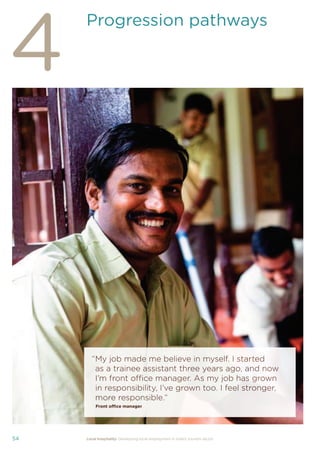
Career progression is essential to encourage people from all
backgrounds to view tourism and hospitality as a viable career
option. Organisations must integrate progression routes into
their training and employment offer to improve the sector’s
image, and to reduce recruitment and re-training costs.
Currently the tourism sector in India is
viewed as a poor employment choice due
to limited opportunities for progression,
and the seasonal approach to work. This
is partly because it is characterised by
large numbers of low skilled jobs. As
such, developing defined opportunities
for career progression is an important
factor in encouraging people to view
tourism and hospitality as a viable
career option. This includes focusing on
carving out clear career paths for staff
entering the organisation at entry level.
This is important because one of the
reasons for the high attrition rates across
the sector, including in the case study
hotels, is the fact that barriers to entry
are low. Individuals can enter into the
industry relatively easily but also often
for a specific short-term need creating
a transient workforce. It is, therefore,
important for organisations to be able
to integrate progression into training
and employment if the sector is to be
perceived more positively as a career
pathway, and if recruitment and re-
training costs can be reduced.
Encouraging progression
pathways
In all the case study hotels, staff
progression at all levels, including entry
level, is encouraged. However, there
are two main approaches: progression
dependent on length of service versus
progression based on merit. There are
examples at each case study organisation
Key findings
Despite management being supportive of career progression, at each of the
case study hotels there were limited opportunities for employees to develop
additional skills beyond the requirements of their current roles. Employees rarely
go through structured training courses that formally recognise their skills levels.
Where evidence of progression was found, vertical progression in the
same department was most common, for example being promoted from
housekeeping assistant to cleaning supervisor. Because training is usually in
the departmental context only, horizontal movement into roles in different
departments was less prevalent.
Lack of knowledge of English was considered by employees as the single most
significant barrier to progression. This is because front end roles are considered
to be higher status, and the ability to speak basic English is essential in order to
interact with guests. English language training methods such as informal labs and
peer to peer training require further investigation to determine their effectiveness.
56 Local hospitality: Developing local employment in India’s tourism sector
of individuals progressing through the
ranks to senior positions, although this is
not the norm. Where progression occurs,
it is usually in a departmental context,
meaning that vertical progression in
the same department is more common
than horizontal movement across
departments. So, for example, it is
more likely that someone will progress
from a cleaning position to a cleaning
supervisor role, rather than move into
a food and beverage role. Progression
in departments is limited, however,
by management’s belief that the skills
and abilities needed to perform in
management roles are separate to the
technical and soft skills needed for service
roles. As a result, few staff members
make the move from service roles into
management positions.
At JLR, the favoured approach to
progression is dependent on length of
service. Staff are employed on a daily
wage basis for the first two to three
years of service before they enter into
a contractual arrangement with the
company. Another six to seven years
of service is needed before the staff
member can be made permanent. The
timeframe is considered as a way of
assessing an individual’s development
and commitment to the organisation,
particularly because of the high level of
job security as a permanent public sector
employee in India, although it could be
seen as a barrier to progression and,
certainly, to rapid progression through
the ranks. However, the staff that we
interviewed didn’t appear to feel this
way. Somewhat surprisingly, the overall
message from employees was that
the approach allowed an element of
fairness and objectivity in progression
and promotion. This was the case even
for an employee we spoke to who had a
BA degree but was working as a resort
gardener. His ambition was to work as
the hotel’s naturalist but he knew he
would need to wait his turn until more
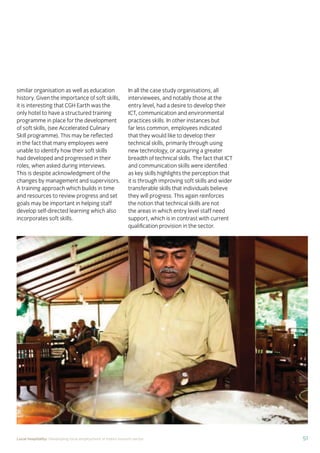
senior colleagues had their opportunity.
The employees overall seemed to have
a high level of trust in the organisation,
believing that they had equal opportunity
to progress, provided they stayed loyal to
the organisation. As one employee noted:
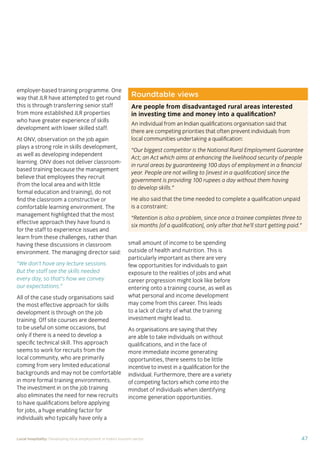
“I am a contract worker and my
colleague became a permanent worker
just two months back. I am the next
senior. I believe that I will also be made
permanent next time. We will definitely
reap the benefits of our hard work here.”
A significant reason for this attitude by
staff may be the fact that the primary
motivating factor for gaining a position
with JLR is the security of working towards
a permanent position in a government
enterprise. The prestige of working for
the government in a permanent role
seems to be more important to the
individuals than the actual nature of the
work they are assigned:
“[People from the community] give
me more respect now I’m working in
a government lodge. They ask me not
to quit and continue here only. They feel
it will be good for my future. I may be
made a permanent worker here.”
“I am a naturalist. But I have worked
as a gardener. I have also collected
garbage here.”
At Our Native Village, promotion is much
more focused on skills and potential,
rather than length of service. The
head cook gave a clear account of his
progression over 18 months, which
saw him promoted four times. Key to
57Local hospitality: Developing local employment in India’s tourism sector
his success appeared to be soft skills
including confidence, enthusiasm and
personal motivation, as well as his ability
to self-teach technical skills through
observation and imitation:
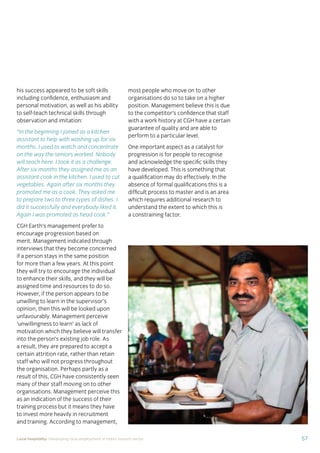
“In the beginning I joined as a kitchen
assistant to help with washing up for six
months. I used to watch and concentrate
on the way the seniors worked. Nobody
will teach here. I took it as a challenge.
After six months they assigned me as an
assistant cook in the kitchen. I used to cut
vegetables. Again after six months they
promoted me as a cook. They asked me
to prepare two to three types of dishes. I
did it successfully and everybody liked it.
Again I was promoted as head cook.”
CGH Earth’s management prefer to
encourage progression based on
merit. Management indicated through
interviews that they become concerned
if a person stays in the same position
for more than a few years. At this point
they will try to encourage the individual
to enhance their skills, and they will be
assigned time and resources to do so.
However, if the person appears to be
unwilling to learn in the supervisor’s
opinion, then this will be looked upon
unfavourably. Management perceive
‘unwillingness to learn’ as lack of
motivation which they believe will transfer
into the person’s existing job role. As
a result, they are prepared to accept a
certain attrition rate, rather than retain
staff who will not progress throughout
the organisation. Perhaps partly as a
result of this, CGH have consistently seen
many of their staff moving on to other
organisations. Management perceive this
as an indication of the success of their
training process but it means they have
to invest more heavily in recruitment
and training. According to management,
most people who move on to other
organisations do so to take on a higher
position. Management believe this is due
to the competitor’s confidence that staff
with a work history at CGH have a certain
guarantee of quality and are able to
perform to a particular level.
One important aspect as a catalyst for
progression is for people to recognise
and acknowledge the specific skills they
have developed. This is something that
a qualification may do effectively. In the
absence of formal qualifications this is a
difficult process to master and is an area
which requires additional research to
understand the extent to which this is
a constraining factor.
58 Local hospitality: Developing local employment in India’s tourism sector
Wider skills for growth
One approach to encouraging
progression is through inter-departmental
transfers, as employees can look to
broaden their industry-specific skills. In
three of the four case study organisations
(JLR’s Kabini and River Tern, and Our
Native Village) horizontal movement is
encouraged despite being less common
than vertical progression. At CGH,
horizontal progression opportunities
are limited to those who have been with
the company for a significant period of
time, or have demonstrated a high level
of personal motivation to progress. An
additional requirement is that candidates
must already have the basic skills required
for the role. However, CGH employees
had a different perspective about
horizontal progression opportunities
in the organisation. Many employees
interviewed said they believed they
would not be allowed to move roles,
and that they were actively encouraged
to stay (and potentially progress) in their
current department. If they wished to
acquire additional skills they said there
were opportunities to learn in their free
time, once their shift was over. Given
that each person works long hours, this
approach is unlikely to be effective. As
a result, CGH are planning to provide
time for individuals to sit in on training in
other departments to increase horizontal
movement. Management believe this
will provide an opportunity for staff to
properly understand the requirements
of these roles.
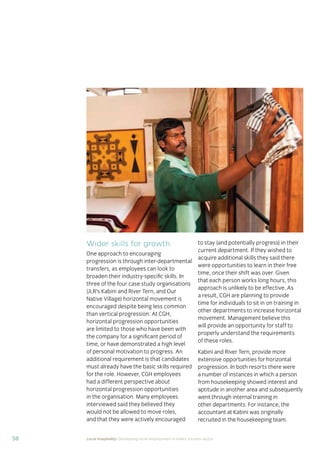
Kabini and River Tern, provide more
extensive opportunities for horizontal
progression. In both resorts there were
a number of instances in which a person
from housekeeping showed interest and
aptitude in another area and subsequently
went through internal training in
other departments. For instance, the
accountant at Kabini was originally
recruited in the housekeeping team.
59Local hospitality: Developing local employment in India’s tourism sector
ONV is exploring approaches to providing
inter-departmental training to all staff.
Management believe this approach will
allow staff to develop a wider array of
skills which will benefit them as well
as the business. However, employees
expressed reluctance to the proposal when
interviewed. In general, they said they were
willing to do the training but more through
a sense of duty to the management rather
than because of professional or personal
development opportunities, as indicated
by the interviewees below:
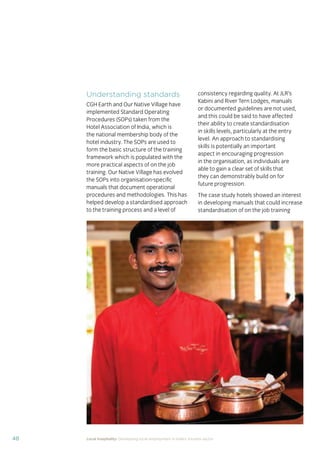
“No, I am not interested in learning
all those things. I am interested only
in cooking.”
“Actually they asked me whether I am
interested in working in the kitchen.
But I refused; I said I will continue
[in my current role] only.”
Members of the supervisory team
perceived these attitudes as a lack
of ambition and self management:
“It is always the management team who
ask them to do something … there is
nothing they take responsibility for.”
This statement could be construed as a
lack of understanding of the motivations
of staff, which is clearly an issue in
developing progression pathways and is
a factor that each organisation continues
to struggle with. The motivations of
individuals for disadvantaged rural
backgrounds differ from management’s
expectations, which has the potential to
create misunderstandings. Many of the
employees highlighted how happy they
were in their roles, and without sufficient
guidance around developing new skills it
is possible that they thought additional
changes might lead to instability in their
current role.
English language
CGH and JLR’s Kabini receive a large
number of foreign tourists and,
therefore, a basic knowledge of English
is particularly important for staff. At
JLR’s River Tern Lodge, and at Our Native
Village, visitors are primarily domestic
but staff nonetheless expressed a desire
to learn English as an aspirational skill. At
all of the case study hotels, lack of English
language was considered as the single
most significant barrier to progression
by employees. This is because contact
roles that require English, such as front
office and food and beverage, are often
considered as higher status because
they don’t involve ‘domestic skills’:
“I want to improve my English language.
I would like to go to other departments,
such as food and beverage service. I can
have better results if I could improve
my English.”
60 Local hospitality: Developing local employment in India’s tourism sector
The ability to communicate effectively in
English also gives staff more confidence
in dealing with guests, particularly when
managing expectations:
“Whatever the guest wants, we have to
be in a position to provide it. However,
sometimes, we have to say “no”. Maybe
if I could say this in a better way it would
help them understand.”
Some of the hotels have tried to support
staff with learning English. An approach
that was trialled by one of the hotels
involved setting up English ‘labs’ which
are informal learning spaces where
lessons are led by senior members of staff.
However, the labs didn’t have the desired
impact potentially because lessons were
held outside of the working day meaning
that the majority of employees were
unwilling or unable to attend. Still, the
potential for labs to make a difference
to English language skills is an area that
could be explored in greater depth,
to see if the approach can be adapted
with better results. The employees who
did attend the labs said it did have a
positive impact on their development
and progression, which suggests there
is potential to build on this to reach
a broader mix of employees.
A different initiative led by JLR’s Kabini
Lodge is a peer to peer approach to
learning English. Staff members who
have strong English language skills are
encouraged to teach English on the job to
staff who are lacking English skills. In turn,
these individuals attempt to pass the
basic language skills on to newer recruits.
This informal and peer to peer approach
to language development negates
the risk of disengagement with formal
classroom-based learning. According to
management, the approach means that
in three to five years, staff members with
no previous knowledge of English are able
to understand and speak basic English
with guests. However, the extent to which
they are able to utilise the knowledge is
restricted by role. Nonetheless, the peer
to peer approach has helped staff aspire
to improve their English which has also
had an impact on their confidence and
self esteem:
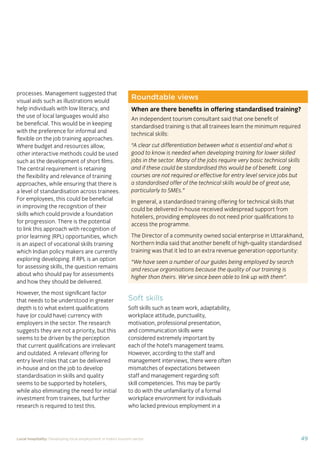
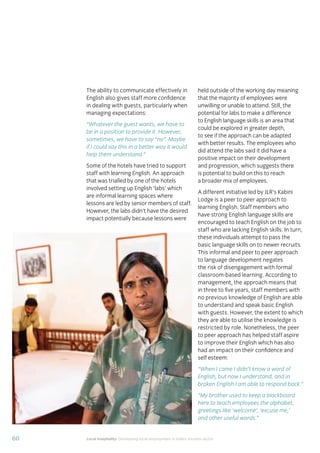
“When I came I didn’t know a word of
English, but now I understand, and in
broken English I am able to respond back.”
“My brother used to keep a blackboard
here to teach employees the alphabet,
greetings like ‘welcome’, ‘excuse me,’
and other useful words.”
61Local hospitality: Developing local employment in India’s tourism sector
At JLR and ONV, guests are informed
upon arrival that their staff are seeking to
improve their English by communicating
with guests. In general, guests have
responded positively by showing a
willingness to communicate with staff in
basic English. The approach is in contrast
to the more hands-off approach which
characterises the majority of high end
and urban hotels in India.
Nonetheless, in general, the attempt to
support staff in improving their English
has been ad hoc and sporadic across
all the case study hotels. There is a lack
of coherent and demonstrable impacts
from the English language initiatives.
This is exacerbated by the fact that
senior management have been
reluctant to invest in structured
English teaching and learning during an
employee’s working day. For an industry
which generally has long and unsociable
working hours, this is unlikely to be
a viable or sustainable option for the
majority of staff. Investing in developing
a structured programme to develop
employees’ English language skills
could potentially improve progression
pathways for those who wish to move
into contact roles.
62 Local hospitality: Developing local employment in India’s tourism sector
Additional barriers
to progression
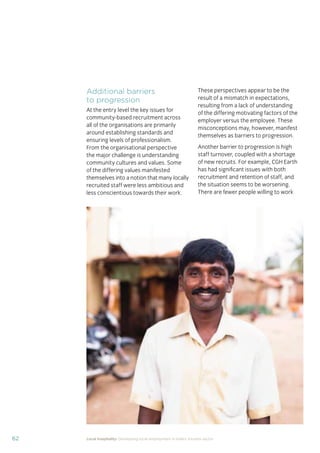
At the entry level the key issues for
community-based recruitment across
all of the organisations are primarily
around establishing standards and
ensuring levels of professionalism.
From the organisational perspective
the major challenge is understanding
community cultures and values. Some
of the differing values manifested
themselves into a notion that many locally
recruited staff were less ambitious and
less conscientious towards their work.
These perspectives appear to be the
result of a mismatch in expectations,
resulting from a lack of understanding
of the differing motivating factors of the
employer versus the employee. These
misconceptions may, however, manifest
themselves as barriers to progression.
Another barrier to progression is high
staff turnover, coupled with a shortage
of new recruits. For example, CGH Earth
has had significant issues with both
recruitment and retention of staff, and
the situation seems to be worsening.
There are fewer people willing to work
63Local hospitality: Developing local employment in India’s tourism sector
in hotels due to the stigma and poor
perceptions that surround the tourism
industry (see Section 1). At the same time,
CGH’s annual staff turnover rate, which
was at 10 per cent just a few years ago,
is now closer to 20 per cent. The reasons
for people leaving the organisation are
varied. Interviews with CGH management
suggested that some of the reasons were:
For graduates from colleges:
With starting salaries being relatively
low in the sector, people who have
taken a loan to complete their
education are often tempted to take
higher paid jobs in alternative sectors.
For all employees, recruited from local
community and through colleges:
There are a large number of hotels
emerging in Kerala and opportunities
to gain a higher salary in international
hotels are growing. These international
hotels also often provide a substantial
structured training programme
upon recruitment.
Many young people join the hotel
industry with a perception that it
will be a glamorous place to work.
Upon joining, it is apparent that
the image and the reality do not
match, and commitment to the
job often fades.
The hours are long and shifts often
run late, which reduces the appeal
of the working environment.
Some people move to daily wage
jobs as they can often earn similar
money and receive the money
in hand quickly, as compared to
working in a company that offers a
fixed amount paid on a monthly basis.
All of these factors constrain
opportunities for individuals, particularly
as most are not going through a structured
training programme which can provide
a structured foundation for progression.
With regards to retention of staff, it was
emphasised that employees from the
local community are more likely to change
jobs. This is because the hotel job may
be only one source of household income,
with additional income drawn from land
and familial micro enterprises. A manager
emphasised this noting:
“Employees work here during the day
but they also work part-time in services
like laundry and tailoring.”
Some of these issues again come back
to the contract situation, with individuals
in a permanent position feeling much
happier with regards to progression.
Issues surrounding payment on a
monthly basis also drive the need for
extra income to support households
throughout the month.
Roundtable views
Why do people drop out of the hospitality and tourism
sector after completing formal qualifications?
A number of roundtable attendees indicated that the aspirations
of young graduates are often more focused on city based careers:
“Indian youth are very attracted by office jobs that would allow
them to have an urban lifestyle.”
A manager from a national NGO said there needs to be better
guidance offered to young people about the tourism and hospitality
sector before they undertake training:
“Young people should get better guidance into the nature of the
industry before choosing their course of study.”
64 Local hospitality: Developing local employment in India’s tourism sector
Conclusions and
recommendations
5
“““““II’’vvve llleeearnnneeeedddd I ccccaaaann wwwwwooooorrkk wwweeeeeeellllll wwwwwwwwwiiiiittttthhhh ddddddiiiiffffffffffffeeeerrrrrreennnnnnnnnnnnttttttt
ppppppppeeeoppple aannnddd uuuunnnndddeerrsssstttaaannddd tthhhhhheeeeiiiirrrrr oooooooopppppiiiiinnnnnniiiooonnnnsssss. TTTTTTTTTTTTThhhhhhhheeeeeeerrrreeeeeeee’’’’’’sssss
nnnnnnnnnnnnnnno ddisscccrriimmminnaattttiooonn hhhheeeeerrree bbbeeeccccaaaaaaaaauuuuuuusssssssseeee wwee’’rrrreeeee aaaaaaaaaaalllllllllllllllllllllllllll ttttttttttttrrrrrrrrrreeeeeeeeaaaaaaaaattttttttttteeeeeeeeedddddddddddd
ttttttttttttttthhhee ssaaammmee. NNNoowww II juudddggggge sssssiitttttuuuuuuuuuuaaaaaaaaatttttiiiioonnss mmmmmmoooorreeeee fffaaaiirrlllllyyyyyyyy aannnddddd
IIIIIIII mmaakke bbeettttteeeerr ddecciissssiiooooonnss iiiiiinn mmmmyyyyyy lllliiifffeeee ggggggeennnneeeeeeeeeeeeerraallllllyy..””
MaiMaiMaiMaiMaiMaiMaiMaiMaiMaiMaiMaintententenance supsupsupervervisoisoisoisorrrr
65Local hospitality: Developing local employment in India’s tourism sector
This report has shown that opportunities exist to improve the
impact of tourism on local communities through a targeted
approach to recruitment and training. Importantly, the
approaches can be mutually beneficial for tourism organisations.
The research suggests that the case study organisations are
not ‘special cases’. Rather, they are likely to provide important
lessons for tourism expansion in India and further afield.
This section summarises key findings from the research and
provides recommendations for stakeholders seeking to establish
effective processes for local employment in the tourism sector.
We conclude with an overview of areas for further research.
Social considerations
Understanding motivations
and expectations
The research found that the motivations
and expectations of employees from
local communities can conflict with those
of their employers. For example, family
and community concerns were often
prioritised by local people above their
work responsibilities, leading to different
expectations about work behaviours such
as punctuality, attendance and time off.
The relationships established between
organisations and communities were
found to be very important in addressing
the disparities in expectations. Such
relationships allowed the organisations to
gather the information needed to better
manage expectations and adapt business
processes. Hotels entering new and
marginalised areas must commit resources
to understanding local communities.
Initial investment in such activities can
provide an invaluable foundation for future
recruitment, and for constructive long-
term community relations. This, in turn,
can strengthen business prospects, as
well as retaining the ‘localisation’ of the
touristic experience.
Social challenges
An important challenge for all the case
studies was ensuring that external
social conflicts didn’t manifest in the
organisation. Caste based discrimination
was a particularly challenging issue.
Two basic strategies were identified as
having a positive impact on mitigating
social conflicts in the workplace. Firstly,
senior staff and managers needed
to take a leading role in discouraging
discrimination by leading through
example. Secondly, managers needed
to provide opportunities for interaction
between different social groups, for
example through practices such as
encouraging eating and socialising
together, and working as a team. It is
critical for employers to invest time in
understanding and addressing significant
social challenges in the workplace. This
could lead to improvements in community
perceptions of the organisation and can
help dispel some of the misconceptions
around the tourism industry, including
some of the issues experienced by women,
as well as conflict with often conservative
societal norms in local communities.
66 Local hospitality: Developing local employment in India’s tourism sector
Women in the sector
Barriers for women entering employment
in the sector were highlighted
consistently, with the highest percentage
of female staff just 28 per cent across the
case studies. The low numbers of female
staff were attributed to social stigma
and misconceptions which surround
the tourism industry, often leading
many women to believe they may be
marginalised in their communities if they
take a hotel job. Tourism employers should
seek to address the specific barriers faced
by women inside and outside the work
place. Measures can include:
Providing women and their families with
direct access to the workplace prior to
commencing employment so they can
view the work environment, understand
the nature of job roles, understand
health and safety standards, discuss
potential career pathways, address
any questions or concerns.
Introducing and enforcing zero tolerance
policies on sexual harassment and sexual
discrimination in the workplace.
Exploring opportunities to enable
different or flexible working patterns
so women can balance work with family
and community commitments.
Recruitment practices
Communicating job opportunities
All the case studies shared employment
opportunities by word of mouth
via existing staff. This ensured that
opportunities were communicated
to potential candidates from local
communities, although the process had
limitations. For example, occasionally
the process meant that some sections of
the local population were marginalised
from employment, which in turn led to
friction. It’s important for organisations
to improve their understanding of the
local communities in which they operate.
This is particularly important when
targeting individuals from marginalised
groups, as they are often the hardest to
reach. Job roles should be communicated
through a variety of different channels
to reach different groups within the
local community. Specific strategies are
needed for marginalised groups.
Integrating employees into
organisations
One of the perceived benefits of recruiting
individuals from a training institute is
the perceived ease of integration into
employment. However, none of the case
study organisations faced significant
challenges with integrating individuals
from local communities into the workplace,
apart from establishing expectations
about work behaviours. Tourism and
67Local hospitality: Developing local employment in India’s tourism sector
hospitality organisations should consider
community-targeted recruitment and
training as a viable alternative to more
traditional recruitment pathways. The
case studies indicate several advantages
to taking this approach.
Staff turnover
High staff turnover was an issue in all
of the case studies and this seemingly
did limit organisations’ willingness
to commit significant resources to
training. Organisational commitment to
community-targeted recruitment was
found to reduce staff turnover however.
This was often because of a desire from
local employees to work in close proximity
to home villages. The commitments
made by the organisations to personal
and professional development also built
loyalty. More robust career progression
pathways could be developed as one
way of preventing high staff turnover,
(see related section below).
Skills development
Issues with the existing vocational
training system
The relevance of the existing qualification
system to the needs of the industry was
questioned consistently by management.
This was cited as a key driver for the case
study organisations’ development of their
own on the job training programmes.
Closer engagement between training
providers and employers is required to
ensure that qualifications are relevant to
the needs of the industry. In addition, there
is a need for greater understanding in the
training system of the economic situations
of potential learners. Current provision is
out of reach for the majority of potential
learners from lower income families.
Technical skills
The majority of technical skills required
for entry level roles in tourism are
relatively basic and can be developed
without formal training. Developing these
skills in-house via on the job training was
not seen as a challenge, even in smaller
hotels with limited capacity for structured
training. One benefit of learning technical
skills through on the job training is that
it eliminates the need for employees to
undertake a relevant paid-for qualification
prior to applying for jobs. This is a huge
enabling factor for individuals from many
local communities who typically have only
a small amount of disposable income.
Technical skills were generally developed
through incremental growth in staff
responsibilities. Although on the job
training was considered effective,
employers often expressed a desire for
greater standardisation of the training
68 Local hospitality: Developing local employment in India’s tourism sector
process to improve comparability of
trainees. Steps to standardise training
could include the development of
manuals and documented frameworks,
and linking training to Recognition of
Prior Learning programmes. The extent
to which training should be standardised
or flexible will vary depending on the
purpose of training. Health and safety
training, for example, may require a highly
standardised approach, potentially leading
to a qualification, while soft skills training
will require a higher degree of flexibility.
Orientation training
Internal orientation training was used in
some of the case studies to establish the
organisation’s expectations of employees.
This was essential for those employees
who had not worked previously in
formal employment. The orientation
programmes also provide exposure to
the differing functions of the hotel and
potential job roles. However, we didn’t
find evidence of a two-way exchange of
information between staff and managers
about different expectations of work
behaviours or standards which could help
to overcome mismatches. Also, tourism
employers should explore whether they
need additional processes in place to
support the orientation process for new
recruits with special needs including low
levels of literacy.
English skills
English language skills were perceived
by all interviewees to be important for
career progression. This is because
basic competency in English improved
staff confidence as well as increasing
the likelihood of gaining customer facing
jobs which were seen as higher status.
Where appropriate, work based training
programmes should consider how best
to support the development of English
language skills for staff. Doing so is likely
to raise staff confidence and commitment
to the organisation, and support career
progression. Informal peer to peer
approaches are a potentially valuable
way to support such learning, particularly
as they may combat discomfort with
classroom-based learning.
Soft skills
Insufficient grasp of soft skills was
highlighted as a significant barrier to
career progression by most of the
stakeholders interviewed throughout
this research. (By soft skills we mean
core or generic transferrable skills such
as effective communication, problem
solving, and learning to learn). Despite
the perceived importance of soft skills
by employers, training approaches
focusing on soft skill competencies
were largely overlooked by the case
study organisations. As a result, the
lack of focus on soft skills could have
restricted local employee opportunities
for progression. On the job training
programmes must factor in soft skill
69Local hospitality: Developing local employment in India’s tourism sector
development, particularly around
communication and confidence building.
Ensuring soft skills needs are addressed
early on in recruitment and training can
help improve both performance and
prospects for staff progression.
Progression pathways
Opportunities for progression
While career progression was encouraged
at every case study hotel, relatively little
progression appeared to have occurred.
The absence of structured training courses
may have been a contributing factor,
with unstructured approaches making it
more difficult for management to assess
progression potential. One important
aspect as a catalyst for progression is for
people to recognise and acknowledge the
specific skills they have developed, and
this can go a long way in increasing their
own sense of confidence and perceived
ability to progress. In order to support
staff progression, on the job training
programmes should seek to incorporate,
where possible, processes for formal
recognition of the skills of learners.
Barriers to progression
Lack of knowledge of English was
perceived as the single most significant
barrier to progression. Many interviewees
also said that they were not interested
in broadening their skillset by working
in other departments, citing a belief
that it could lead to instability in their
current role. This represents another
potential barrier to progression. Providing
opportunities for employees to explore
further learning, whether this be through
peer to peer training, or through exposure
to other departments could provide a
greater foundation for progression. These
programmes may need to be formalised
to ensure the benefits are communicated
effectively to employees and they are able
to make a personal choice as to whether
they are interested and willing to take on
the change.
Areas for future research
Recognising skills
Further research is needed in order to
understand effective approaches to
recognising skills, particularly in the
absence of qualifications. Progression
typically requires measures for recognising
skills levels of individuals and this is clearly
difficult for individuals who have not been
through formal training programmes.
Improving understanding of ways to
improve skills recognition for this group
could have a real impact on those at the
lower end of the skills spectrum.
Relevance of qualifications
The extent to which qualifications have
‘currency’ with employers in India’s
tourism sector is currently unclear.
The indication in the research was that
qualifications were not a priority for
employers, particularly because of the
basic nature of the skills required for the
majority of roles. This perspective could,
however, be driven by the current lack
of relevance to the needs of employers
of some qualifications.
Embedding standardisation
Understanding ways in which
organisations of varying sizes have
been able to standardise processes
while retaining the informal and flexible
nature of on the job training needs
further research if these approaches
are to be scaled up.
70 Local hospitality: Developing local employment in India’s tourism sector
Bibliography
Ashley, C. (2006). Participation by the poor in Luang Prabang tourism economy:
Current earnings and opportunities for expansion. Retrieved on Nov 11, 2012, from
http://www.odi.org.uk/publications/65-participation-poor-luang-prabang-tourism-
economy-current-earnings-opportunities-expansion
Ashley, C., C. Boyd & H. Goodwin (2000). Pro-poor Tourism: Putting Poverty at the
Heart of the Tourism Agenda. Overseas Development Institute Natural Resource
Perspectives 51.
Ashley, C., P. De Brine, A. Lehr & H. Wilde (2007). The Role of the Tourism Sector in
Expanding Economic Opportunity. Retrieved on Dec 12, 2012, from http://www.hks.
harvard.edu/m-rcbg/CSRI/publications/report_23_EO%20Tourism%20Final.pdf
Ashley, C., D. Roe & H. Goodwin (2001). Pro-Poor Tourism Report No. 1 Pro-Poor
Tourism Strategies: Making Tourism Work For The Poor. A review of experience.
Retrieved on Oct 24, 2012, from http://www.dfid.gov.uk/r4d/PDF/Outputs/Mis_SPC/
R7557-ppt_report.pdf
Briedenhann, J & E. Wickens (2004). Tourism routes as a tool for the economic
development of rural areas – vibrant hope or impossible dream? Tourism Management,
25, 71–79.
Burchfield, S., H. Hua, T. Suxo Iturry & V. Rocha (2002a). A Longitudinal Study of the
Effect of Integrated Literacy and Basic Education Programs on the Participation
of Women in Social and Economic Development in Bolivia. Boston, Mass: World
Education, Washington D.C., The United States Agency for International Development
Office of Women in Development.
Burchfield, S., H. Hua, D. Baral & V. Rocha (2002b). A Longitudinal Study of the Effect
of Integrated Literacy and Basic Education Programs on the Participation of Women
in Social and Economic Development in Nepal. Boston, Mass: World Education,
Washington D.C., The United States Agency for International Development Office
of Women in Development.
Department of Tourism (2011). India Tourism Statistics 2011. New Delhi: Government
of India.
EQUATIONS (2008a) Sustainability in Tourism, A Rural Tourism Model: a Review
Report. Retrieved on Jan 16, 2013, from http://equitabletourism.org/stage/files/
fileDocuments913_uid15.pdf
EQUATIONS (2008b). Not in My Backyard! How Governments and Industry
have washed their Hands off Responsibility in Tourism: Exploring Indian
Realities. Retrieved on Jan 21, 2012, from http://archive.org/details/
NotInMyBackyardHowGovernmentsAndIndustryHaveWashedTheirHandsOff
Gandhi, A., C. Kumar, P. Saha, B. Kishore Sahoo & A. Sharma (2011). India Human
Development Report 2011. Retrieved on Jan 25, 2013, from http://www.pratirodh.com/
pdf/human_development_report2011.pdf
71Local hospitality: Developing local employment in India’s tourism sector
Ghosal, R. (2012). Growth, Poverty and Inequality Paradox in India: A Panel Data
Approach. Retrieved on Jan 25, 2013, from http://www.iariw.org/papers/2012/
GhosalPosterPaper.pdf
Goel, V. P. (2009). Technical and vocational education and training (TVET) system
in India for sustainable development. Department of Higher Education. Ministry of
Human Resource Development, Government of India.
Goodwin, H. (2008a). Tourism, Local Economic Development and Poverty Reduction.
Applied Research in Economic Development, 5(3), 55–64.
Goodwin, H. (2008b). Pro-poor Tourism: a response. Third World Quarterly, 29(5), 869–871.
Haladi, A (2005). Tourism and its Impacts on Gender: A case study of Goa in EQUATIONS
(2011). Tracing the Maze: A Dossier on Women and Tourism. Retrieved on Nov 25, 2012,
from http://www.equitabletourism.org/files/fileDocuments1086_uid18.pdf
Harrison, D. (2008). Pro-Poor Tourism: a critique. Third World Quarterly, 29(5), 851–868.
ILO (2001). Human Resources Development, Employment and Globalization in the
Hotel, Catering and Tourism Sector. Geneva: International Labour Office.
Meyer, D. (2008). Pro-Poor Tourism: From Leakages to Linkages. A Conceptual
Framework for Creating Linkages between the Accommodation Sector and ‘Poor’
Neighbouring Communities. Current Issues in Tourism, 10(6), 558–583.
Ministry of Tourism (2009). Karnataka Tourism Policy 2009–14. Bangalore: Government
of Karnataka.
OECD (2012). Better Skills, Better Jobs, Better Lives: A Strategic Approach to Skills
Policies. Paris: OECD Publishing.
Ritchie, J. R. B. & G. I. Crouch (2003). The Competitive Destination: A Sustainable
Tourism Perspective. Oxon, UK: CABI Publishing.
Robinson, M. (1999). Collaboration and cultural consent: Refocusing sustainable
tourism. Journal of Sustainable Tourism, 7, 379–397. Discussed in D. Meyer (2008).
Pro-Poor Tourism: From Leakages to Linkages. A Conceptual Framework for Creating
Linkages between the Accommodation Sector and ‘Poor’ Neighbouring Communities.
Current Issues in Tourism, 10(6), 558–583.
Shah, K. & V. Gupta (2000). Tourism, the Poor and Other Stakeholders: Experience in
Asia. Retrieved on Nov 20, 2012, from http://www.odi.org.uk/sites/odi.org.uk/files/odi-
assets/publications-opinion-files/3244.pdf
Tresilian, D. (2006). Poverty alleviation and community based tourism: Experiences
from Central and South Asia. Paris: UNESCO.
UNDP (2011). Human Development Report 2011: Sustainability and Equity.
New York: UNDP.
72 Local hospitality: Developing local employment in India’s tourism sector
United Nations World Tourism Organization (UNWTO) (2002). Tourism and Poverty
Alleviation. Madrid: UNWTO.
UNWTO (2012). Tourism Highlights 2012 Edition. Madrid: United Nations World Tourism
Organization. Retrieved on Nov 17, 2013, from http://dtxtq4w60xqpw.cloudfront.net/
sites/all/files/docpdf/unwtohighlights12enhr_1.pdf
World Travel and Tourism Council (WTTC) (2012a). Travel and Tourism: Economic
Impact 2012. Retrieved on Jan 17, 2013, from http://www.wttc.org/site_media/uploads/
downloads/world2012.pdf
World Travel and Tourism Council (WTTC) (2012b). Travel & Tourism, Economic Impact
2012: India. Retrieved on Jan 17, 2013, from http://www.wttc.org/site_media/uploads/
downloads/india2012.pdf
Zampoukos, K. & D. Ioannides (2011). The tourism labour conundrum: agenda for new
research in the geography of hospitality workers. Hospitality and Society, 1(1), 25–45.
Zhao W. & J. Ritchie (2007). Tourism and Poverty Alleviation: An Integrative Research
Framework. Current Issues in Tourism, 10(2–3), 119–143.
City & Guilds Centre for Skills Development
1 Giltspur Street
London EC1A 9DD
United Kingdom
T +44 (0) 20 7294 4160
F +44 (0) 20 7294 4199
info@skillsdevelopment.org
skillsdevelopment.org
cityandguilds.com
Every effort has been made to ensure that the information
contained in this publication is true and correct at the time of
going to press. City & Guilds’ products and services are, however,
subject to continuous development and improvement. The right
is reserved to change products and services from time to time.
City & Guilds cannot accept responsibility for any loss or damage
arising from the use of information from this publication.
Copyright © 2013 The City and Guilds of London Institute.
All rights reserved. City and Guilds is a trademark of The
City & Guilds of London Institute. The City and Guilds London
Institute is a registered charity (charity number 312832)
established to promote education and training.
The City and Guilds of London Institute recognises that this
report contains some intellectual material which is the pre-
existing property of the authors.
Follow us on Twitter
@skillsdev
Follow us on LinkedIn

Tourism Employment in India - 2

  • 1.
    36 Local hospitality:Developing local employment in India’s tourism sector The recruitment process 2 “I’mm tttthhhhheeeee ooonnnlllllyy ppppppeeeerrrrsssooonnnn iinn mmmmyyyyyy fffaaammmmmiiiiillllyyyyy wwwwwwwho’s gooot a ppeeeeerrrrmaaannnneennttt jjooooooobbbbbbbbbbbb. Itt’’sss gggggiiivvvvvvvvveeeeeeeeeeennn mmmmmmmeeeeeee iiiiinnnnnnnddddddeeeeeeepppppppeeeeeeennnnnddeennncceeeeeeeee bbbbbbeeeeeeeeeeecccccccaaaaaaaaaauuuuuussssssseeeeeeeee III cccaaannn mmmmmmaaannnnnaaaaaaaggggggeeeeee mmmmmmyyyyyy fififififififififinnnnnnnaaaaaannnnnnccceeeeeeessssssss. IIIII pppppppppaaaaaaaaaaaiiiiddddddddd ffffffffffoooooorrr mmmyyyyy sssiiisssstttttteeeeeerrr’sss  wwweeeeeeddddddddddiiinnnggg wwwwwhhhhiiiiiccccchhhhhh mmmmmmmmeeeeeeeaaaaaaannnnnntttttttttt aaaa lllooootttttt..”””” HouHouHouHouHouseksekeepeepeepeepeeperer
  • 2.
    37Local hospitality: Developinglocal employment in India’s tourism sector This section analyses the approaches taken by our case study hotels to recruit individuals from their local community who lack sector-specific qualifications. The effectiveness of each approach is assessed from the perspective of employees, management, and the broader community. Sourcing the right staff for jobs is a critical business need for any organisation. A sector specific qualification should provide management with assurance of an individual’s competency and suitability for employment in tourism. However, the extent to which this assessment is valid depends upon the extent to which colleges and qualification bodies have developed their offering to meet industry requirements. A significant mismatch in expectations can occur when qualifications and teaching and learning methods don’t meet industry needs. Many employers we spoke to for this study told us there is a mismatch between what is learned in the classroom and what is required from their hotel staff. At the same time a common employer concern about recruiting staff from outside of the college route is that additional intensive training may be required to ensure unqualified individuals can perform effectively in their role. Evidence from our case study organisations suggests this is not the case, as we shall explore in detail in Section 3. Advertising of jobs In all of the case study organisations, for ‘non-technical’ jobs, the primary approach for communicating employment opportunities is by word of mouth, primarily through sharing opportunities with existing staff and asking them to communicate this information to others in the community. For roles that require significant prior technical skills or professional knowledge, recruitment is done through colleges and existing networks. Key findings Minimum qualifications are required for every job role, including those at entry level. The requirements are, however, rarely enforced by the case study hotels. Employees felt their grasp of soft skills was more important than technical skills in securing employment. The primary approach for communicating employment opportunities for ‘non- technical’ (primarily entry level) jobs is by word of mouth. Although this keeps recruitment focused in the local community, it can be seen as an ongoing barrier to employment for individuals who do not have existing connections at the hotels. Recruitment for roles that require technical skills or professional knowledge is usually done via colleges, to target course graduates who have the desired competency levels already. However, the case study organisations have reported positive results from blending community-based recruitment with college recruitment.
  • 3.
    37Local hospitality: Developinglocal employment in India’s tourism sector This section analyses the approaches taken by our case study hotels to recruit individuals from their local community who lack sector-specific qualifications. The effectiveness of each approach is assessed from the perspective of employees, management, and the broader community. Sourcing the right staff for jobs is a critical business need for any organisation. A sector specific qualification should provide management with assurance of an individual’s competency and suitability for employment in tourism. However, the extent to which this assessment is valid depends upon the extent to which colleges and qualification bodies have developed their offering to meet industry requirements. A significant mismatch in expectations can occur when qualifications and teaching and learning methods don’t meet industry needs. Many employers we spoke to for this study told us there is a mismatch between what is learned in the classroom and what is required from their hotel staff. At the same time a common employer concern about recruiting staff from outside of the college route is that additional intensive training may be required to ensure unqualified individuals can perform effectively in their role. Evidence from our case study organisations suggests this is not the case, as we shall explore in detail in Section 3. Advertising of jobs In all of the case study organisations, for ‘non-technical’ jobs, the primary approach for communicating employment opportunities is by word of mouth, primarily through sharing opportunities with existing staff and asking them to communicate this information to others in the community. For roles that require significant prior technical skills or professional knowledge, recruitment is done through colleges and existing networks. Key findings Minimum qualifications are required for every job role, including those at entry level. The requirements are, however, rarely enforced by the case study hotels. Employees felt their grasp of soft skills was more important than technical skills in securing employment. The primary approach for communicating employment opportunities for ‘non- technical’ (primarily entry level) jobs is by word of mouth. Although this keeps recruitment focused in the local community, it can be seen as an ongoing barrier to employment for individuals who do not have existing connections at the hotels. Recruitment for roles that require technical skills or professional knowledge is usually done via colleges, to target course graduates who have the desired competency levels already. However, the case study organisations have reported positive results from blending community-based recruitment with college recruitment.
  • 4.
    37Local hospitality: Developinglocal employment in India’s tourism sector This section analyses the approaches taken by our case study hotels to recruit individuals from their local community who lack sector-specific qualifications. The effectiveness of each approach is assessed from the perspective of employees, management, and the broader community. Sourcing the right staff for jobs is a critical business need for any organisation. A sector specific qualification should provide management with assurance of an individual’s competency and suitability for employment in tourism. However, the extent to which this assessment is valid depends upon the extent to which colleges and qualification bodies have developed their offering to meet industry requirements. A significant mismatch in expectations can occur when qualifications and teaching and learning methods don’t meet industry needs. Many employers we spoke to for this study told us there is a mismatch between what is learned in the classroom and what is required from their hotel staff. At the same time a common employer concern about recruiting staff from outside of the college route is that additional intensive training may be required to ensure unqualified individuals can perform effectively in their role. Evidence from our case study organisations suggests this is not the case, as we shall explore in detail in Section 3. Advertising of jobs In all of the case study organisations, for ‘non-technical’ jobs, the primary approach for communicating employment opportunities is by word of mouth, primarily through sharing opportunities with existing staff and asking them to communicate this information to others in the community. For roles that require significant prior technical skills or professional knowledge, recruitment is done through colleges and existing networks. Key findings Minimum qualifications are required for every job role, including those at entry level. The requirements are, however, rarely enforced by the case study hotels. Employees felt their grasp of soft skills was more important than technical skills in securing employment. The primary approach for communicating employment opportunities for ‘non- technical’ (primarily entry level) jobs is by word of mouth. Although this keeps recruitment focused in the local community, it can be seen as an ongoing barrier to employment for individuals who do not have existing connections at the hotels. Recruitment for roles that require technical skills or professional knowledge is usually done via colleges, to target course graduates who have the desired competency levels already. However, the case study organisations have reported positive results from blending community-based recruitment with college recruitment.
  • 5.
    37Local hospitality: Developinglocal employment in India’s tourism sector This section analyses the approaches taken by our case study hotels to recruit individuals from their local community who lack sector-specific qualifications. The effectiveness of each approach is assessed from the perspective of employees, management, and the broader community. Sourcing the right staff for jobs is a critical business need for any organisation. A sector specific qualification should provide management with assurance of an individual’s competency and suitability for employment in tourism. However, the extent to which this assessment is valid depends upon the extent to which colleges and qualification bodies have developed their offering to meet industry requirements. A significant mismatch in expectations can occur when qualifications and teaching and learning methods don’t meet industry needs. Many employers we spoke to for this study told us there is a mismatch between what is learned in the classroom and what is required from their hotel staff. At the same time a common employer concern about recruiting staff from outside of the college route is that additional intensive training may be required to ensure unqualified individuals can perform effectively in their role. Evidence from our case study organisations suggests this is not the case, as we shall explore in detail in Section 3. Advertising of jobs In all of the case study organisations, for ‘non-technical’ jobs, the primary approach for communicating employment opportunities is by word of mouth, primarily through sharing opportunities with existing staff and asking them to communicate this information to others in the community. For roles that require significant prior technical skills or professional knowledge, recruitment is done through colleges and existing networks. Key findings Minimum qualifications are required for every job role, including those at entry level. The requirements are, however, rarely enforced by the case study hotels. Employees felt their grasp of soft skills was more important than technical skills in securing employment. The primary approach for communicating employment opportunities for ‘non- technical’ (primarily entry level) jobs is by word of mouth. Although this keeps recruitment focused in the local community, it can be seen as an ongoing barrier to employment for individuals who do not have existing connections at the hotels. Recruitment for roles that require technical skills or professional knowledge is usually done via colleges, to target course graduates who have the desired competency levels already. However, the case study organisations have reported positive results from blending community-based recruitment with college recruitment.
  • 6.
    37Local hospitality: Developinglocal employment in India’s tourism sector This section analyses the approaches taken by our case study hotels to recruit individuals from their local community who lack sector-specific qualifications. The effectiveness of each approach is assessed from the perspective of employees, management, and the broader community. Sourcing the right staff for jobs is a critical business need for any organisation. A sector specific qualification should provide management with assurance of an individual’s competency and suitability for employment in tourism. However, the extent to which this assessment is valid depends upon the extent to which colleges and qualification bodies have developed their offering to meet industry requirements. A significant mismatch in expectations can occur when qualifications and teaching and learning methods don’t meet industry needs. Many employers we spoke to for this study told us there is a mismatch between what is learned in the classroom and what is required from their hotel staff. At the same time a common employer concern about recruiting staff from outside of the college route is that additional intensive training may be required to ensure unqualified individuals can perform effectively in their role. Evidence from our case study organisations suggests this is not the case, as we shall explore in detail in Section 3. Advertising of jobs In all of the case study organisations, for ‘non-technical’ jobs, the primary approach for communicating employment opportunities is by word of mouth, primarily through sharing opportunities with existing staff and asking them to communicate this information to others in the community. For roles that require significant prior technical skills or professional knowledge, recruitment is done through colleges and existing networks. Key findings Minimum qualifications are required for every job role, including those at entry level. The requirements are, however, rarely enforced by the case study hotels. Employees felt their grasp of soft skills was more important than technical skills in securing employment. The primary approach for communicating employment opportunities for ‘non- technical’ (primarily entry level) jobs is by word of mouth. Although this keeps recruitment focused in the local community, it can be seen as an ongoing barrier to employment for individuals who do not have existing connections at the hotels. Recruitment for roles that require technical skills or professional knowledge is usually done via colleges, to target course graduates who have the desired competency levels already. However, the case study organisations have reported positive results from blending community-based recruitment with college recruitment.
  • 7.
    37Local hospitality: Developinglocal employment in India’s tourism sector This section analyses the approaches taken by our case study hotels to recruit individuals from their local community who lack sector-specific qualifications. The effectiveness of each approach is assessed from the perspective of employees, management, and the broader community. Sourcing the right staff for jobs is a critical business need for any organisation. A sector specific qualification should provide management with assurance of an individual’s competency and suitability for employment in tourism. However, the extent to which this assessment is valid depends upon the extent to which colleges and qualification bodies have developed their offering to meet industry requirements. A significant mismatch in expectations can occur when qualifications and teaching and learning methods don’t meet industry needs. Many employers we spoke to for this study told us there is a mismatch between what is learned in the classroom and what is required from their hotel staff. At the same time a common employer concern about recruiting staff from outside of the college route is that additional intensive training may be required to ensure unqualified individuals can perform effectively in their role. Evidence from our case study organisations suggests this is not the case, as we shall explore in detail in Section 3. Advertising of jobs In all of the case study organisations, for ‘non-technical’ jobs, the primary approach for communicating employment opportunities is by word of mouth, primarily through sharing opportunities with existing staff and asking them to communicate this information to others in the community. For roles that require significant prior technical skills or professional knowledge, recruitment is done through colleges and existing networks. Key findings Minimum qualifications are required for every job role, including those at entry level. The requirements are, however, rarely enforced by the case study hotels. Employees felt their grasp of soft skills was more important than technical skills in securing employment. The primary approach for communicating employment opportunities for ‘non- technical’ (primarily entry level) jobs is by word of mouth. Although this keeps recruitment focused in the local community, it can be seen as an ongoing barrier to employment for individuals who do not have existing connections at the hotels. Recruitment for roles that require technical skills or professional knowledge is usually done via colleges, to target course graduates who have the desired competency levels already. However, the case study organisations have reported positive results from blending community-based recruitment with college recruitment.
  • 8.
    37Local hospitality: Developinglocal employment in India’s tourism sector This section analyses the approaches taken by our case study hotels to recruit individuals from their local community who lack sector-specific qualifications. The effectiveness of each approach is assessed from the perspective of employees, management, and the broader community. Sourcing the right staff for jobs is a critical business need for any organisation. A sector specific qualification should provide management with assurance of an individual’s competency and suitability for employment in tourism. However, the extent to which this assessment is valid depends upon the extent to which colleges and qualification bodies have developed their offering to meet industry requirements. A significant mismatch in expectations can occur when qualifications and teaching and learning methods don’t meet industry needs. Many employers we spoke to for this study told us there is a mismatch between what is learned in the classroom and what is required from their hotel staff. At the same time a common employer concern about recruiting staff from outside of the college route is that additional intensive training may be required to ensure unqualified individuals can perform effectively in their role. Evidence from our case study organisations suggests this is not the case, as we shall explore in detail in Section 3. Advertising of jobs In all of the case study organisations, for ‘non-technical’ jobs, the primary approach for communicating employment opportunities is by word of mouth, primarily through sharing opportunities with existing staff and asking them to communicate this information to others in the community. For roles that require significant prior technical skills or professional knowledge, recruitment is done through colleges and existing networks. Key findings Minimum qualifications are required for every job role, including those at entry level. The requirements are, however, rarely enforced by the case study hotels. Employees felt their grasp of soft skills was more important than technical skills in securing employment. The primary approach for communicating employment opportunities for ‘non- technical’ (primarily entry level) jobs is by word of mouth. Although this keeps recruitment focused in the local community, it can be seen as an ongoing barrier to employment for individuals who do not have existing connections at the hotels. Recruitment for roles that require technical skills or professional knowledge is usually done via colleges, to target course graduates who have the desired competency levels already. However, the case study organisations have reported positive results from blending community-based recruitment with college recruitment.
  • 9.
    37Local hospitality: Developinglocal employment in India’s tourism sector This section analyses the approaches taken by our case study hotels to recruit individuals from their local community who lack sector-specific qualifications. The effectiveness of each approach is assessed from the perspective of employees, management, and the broader community. Sourcing the right staff for jobs is a critical business need for any organisation. A sector specific qualification should provide management with assurance of an individual’s competency and suitability for employment in tourism. However, the extent to which this assessment is valid depends upon the extent to which colleges and qualification bodies have developed their offering to meet industry requirements. A significant mismatch in expectations can occur when qualifications and teaching and learning methods don’t meet industry needs. Many employers we spoke to for this study told us there is a mismatch between what is learned in the classroom and what is required from their hotel staff. At the same time a common employer concern about recruiting staff from outside of the college route is that additional intensive training may be required to ensure unqualified individuals can perform effectively in their role. Evidence from our case study organisations suggests this is not the case, as we shall explore in detail in Section 3. Advertising of jobs In all of the case study organisations, for ‘non-technical’ jobs, the primary approach for communicating employment opportunities is by word of mouth, primarily through sharing opportunities with existing staff and asking them to communicate this information to others in the community. For roles that require significant prior technical skills or professional knowledge, recruitment is done through colleges and existing networks. Key findings Minimum qualifications are required for every job role, including those at entry level. The requirements are, however, rarely enforced by the case study hotels. Employees felt their grasp of soft skills was more important than technical skills in securing employment. The primary approach for communicating employment opportunities for ‘non- technical’ (primarily entry level) jobs is by word of mouth. Although this keeps recruitment focused in the local community, it can be seen as an ongoing barrier to employment for individuals who do not have existing connections at the hotels. Recruitment for roles that require technical skills or professional knowledge is usually done via colleges, to target course graduates who have the desired competency levels already. However, the case study organisations have reported positive results from blending community-based recruitment with college recruitment.
  • 10.
    37Local hospitality: Developinglocal employment in India’s tourism sector This section analyses the approaches taken by our case study hotels to recruit individuals from their local community who lack sector-specific qualifications. The effectiveness of each approach is assessed from the perspective of employees, management, and the broader community. Sourcing the right staff for jobs is a critical business need for any organisation. A sector specific qualification should provide management with assurance of an individual’s competency and suitability for employment in tourism. However, the extent to which this assessment is valid depends upon the extent to which colleges and qualification bodies have developed their offering to meet industry requirements. A significant mismatch in expectations can occur when qualifications and teaching and learning methods don’t meet industry needs. Many employers we spoke to for this study told us there is a mismatch between what is learned in the classroom and what is required from their hotel staff. At the same time a common employer concern about recruiting staff from outside of the college route is that additional intensive training may be required to ensure unqualified individuals can perform effectively in their role. Evidence from our case study organisations suggests this is not the case, as we shall explore in detail in Section 3. Advertising of jobs In all of the case study organisations, for ‘non-technical’ jobs, the primary approach for communicating employment opportunities is by word of mouth, primarily through sharing opportunities with existing staff and asking them to communicate this information to others in the community. For roles that require significant prior technical skills or professional knowledge, recruitment is done through colleges and existing networks. Key findings Minimum qualifications are required for every job role, including those at entry level. The requirements are, however, rarely enforced by the case study hotels. Employees felt their grasp of soft skills was more important than technical skills in securing employment. The primary approach for communicating employment opportunities for ‘non- technical’ (primarily entry level) jobs is by word of mouth. Although this keeps recruitment focused in the local community, it can be seen as an ongoing barrier to employment for individuals who do not have existing connections at the hotels. Recruitment for roles that require technical skills or professional knowledge is usually done via colleges, to target course graduates who have the desired competency levels already. However, the case study organisations have reported positive results from blending community-based recruitment with college recruitment.
  • 11.
    37Local hospitality: Developinglocal employment in India’s tourism sector This section analyses the approaches taken by our case study hotels to recruit individuals from their local community who lack sector-specific qualifications. The effectiveness of each approach is assessed from the perspective of employees, management, and the broader community. Sourcing the right staff for jobs is a critical business need for any organisation. A sector specific qualification should provide management with assurance of an individual’s competency and suitability for employment in tourism. However, the extent to which this assessment is valid depends upon the extent to which colleges and qualification bodies have developed their offering to meet industry requirements. A significant mismatch in expectations can occur when qualifications and teaching and learning methods don’t meet industry needs. Many employers we spoke to for this study told us there is a mismatch between what is learned in the classroom and what is required from their hotel staff. At the same time a common employer concern about recruiting staff from outside of the college route is that additional intensive training may be required to ensure unqualified individuals can perform effectively in their role. Evidence from our case study organisations suggests this is not the case, as we shall explore in detail in Section 3. Advertising of jobs In all of the case study organisations, for ‘non-technical’ jobs, the primary approach for communicating employment opportunities is by word of mouth, primarily through sharing opportunities with existing staff and asking them to communicate this information to others in the community. For roles that require significant prior technical skills or professional knowledge, recruitment is done through colleges and existing networks. Key findings Minimum qualifications are required for every job role, including those at entry level. The requirements are, however, rarely enforced by the case study hotels. Employees felt their grasp of soft skills was more important than technical skills in securing employment. The primary approach for communicating employment opportunities for ‘non- technical’ (primarily entry level) jobs is by word of mouth. Although this keeps recruitment focused in the local community, it can be seen as an ongoing barrier to employment for individuals who do not have existing connections at the hotels. Recruitment for roles that require technical skills or professional knowledge is usually done via colleges, to target course graduates who have the desired competency levels already. However, the case study organisations have reported positive results from blending community-based recruitment with college recruitment.
  • 12.
    37Local hospitality: Developinglocal employment in India’s tourism sector This section analyses the approaches taken by our case study hotels to recruit individuals from their local community who lack sector-specific qualifications. The effectiveness of each approach is assessed from the perspective of employees, management, and the broader community. Sourcing the right staff for jobs is a critical business need for any organisation. A sector specific qualification should provide management with assurance of an individual’s competency and suitability for employment in tourism. However, the extent to which this assessment is valid depends upon the extent to which colleges and qualification bodies have developed their offering to meet industry requirements. A significant mismatch in expectations can occur when qualifications and teaching and learning methods don’t meet industry needs. Many employers we spoke to for this study told us there is a mismatch between what is learned in the classroom and what is required from their hotel staff. At the same time a common employer concern about recruiting staff from outside of the college route is that additional intensive training may be required to ensure unqualified individuals can perform effectively in their role. Evidence from our case study organisations suggests this is not the case, as we shall explore in detail in Section 3. Advertising of jobs In all of the case study organisations, for ‘non-technical’ jobs, the primary approach for communicating employment opportunities is by word of mouth, primarily through sharing opportunities with existing staff and asking them to communicate this information to others in the community. For roles that require significant prior technical skills or professional knowledge, recruitment is done through colleges and existing networks. Key findings Minimum qualifications are required for every job role, including those at entry level. The requirements are, however, rarely enforced by the case study hotels. Employees felt their grasp of soft skills was more important than technical skills in securing employment. The primary approach for communicating employment opportunities for ‘non- technical’ (primarily entry level) jobs is by word of mouth. Although this keeps recruitment focused in the local community, it can be seen as an ongoing barrier to employment for individuals who do not have existing connections at the hotels. Recruitment for roles that require technical skills or professional knowledge is usually done via colleges, to target course graduates who have the desired competency levels already. However, the case study organisations have reported positive results from blending community-based recruitment with college recruitment.
  • 13.
    37Local hospitality: Developinglocal employment in India’s tourism sector This section analyses the approaches taken by our case study hotels to recruit individuals from their local community who lack sector-specific qualifications. The effectiveness of each approach is assessed from the perspective of employees, management, and the broader community. Sourcing the right staff for jobs is a critical business need for any organisation. A sector specific qualification should provide management with assurance of an individual’s competency and suitability for employment in tourism. However, the extent to which this assessment is valid depends upon the extent to which colleges and qualification bodies have developed their offering to meet industry requirements. A significant mismatch in expectations can occur when qualifications and teaching and learning methods don’t meet industry needs. Many employers we spoke to for this study told us there is a mismatch between what is learned in the classroom and what is required from their hotel staff. At the same time a common employer concern about recruiting staff from outside of the college route is that additional intensive training may be required to ensure unqualified individuals can perform effectively in their role. Evidence from our case study organisations suggests this is not the case, as we shall explore in detail in Section 3. Advertising of jobs In all of the case study organisations, for ‘non-technical’ jobs, the primary approach for communicating employment opportunities is by word of mouth, primarily through sharing opportunities with existing staff and asking them to communicate this information to others in the community. For roles that require significant prior technical skills or professional knowledge, recruitment is done through colleges and existing networks. Key findings Minimum qualifications are required for every job role, including those at entry level. The requirements are, however, rarely enforced by the case study hotels. Employees felt their grasp of soft skills was more important than technical skills in securing employment. The primary approach for communicating employment opportunities for ‘non- technical’ (primarily entry level) jobs is by word of mouth. Although this keeps recruitment focused in the local community, it can be seen as an ongoing barrier to employment for individuals who do not have existing connections at the hotels. Recruitment for roles that require technical skills or professional knowledge is usually done via colleges, to target course graduates who have the desired competency levels already. However, the case study organisations have reported positive results from blending community-based recruitment with college recruitment.
  • 14.
    37Local hospitality: Developinglocal employment in India’s tourism sector This section analyses the approaches taken by our case study hotels to recruit individuals from their local community who lack sector-specific qualifications. The effectiveness of each approach is assessed from the perspective of employees, management, and the broader community. Sourcing the right staff for jobs is a critical business need for any organisation. A sector specific qualification should provide management with assurance of an individual’s competency and suitability for employment in tourism. However, the extent to which this assessment is valid depends upon the extent to which colleges and qualification bodies have developed their offering to meet industry requirements. A significant mismatch in expectations can occur when qualifications and teaching and learning methods don’t meet industry needs. Many employers we spoke to for this study told us there is a mismatch between what is learned in the classroom and what is required from their hotel staff. At the same time a common employer concern about recruiting staff from outside of the college route is that additional intensive training may be required to ensure unqualified individuals can perform effectively in their role. Evidence from our case study organisations suggests this is not the case, as we shall explore in detail in Section 3. Advertising of jobs In all of the case study organisations, for ‘non-technical’ jobs, the primary approach for communicating employment opportunities is by word of mouth, primarily through sharing opportunities with existing staff and asking them to communicate this information to others in the community. For roles that require significant prior technical skills or professional knowledge, recruitment is done through colleges and existing networks. Key findings Minimum qualifications are required for every job role, including those at entry level. The requirements are, however, rarely enforced by the case study hotels. Employees felt their grasp of soft skills was more important than technical skills in securing employment. The primary approach for communicating employment opportunities for ‘non- technical’ (primarily entry level) jobs is by word of mouth. Although this keeps recruitment focused in the local community, it can be seen as an ongoing barrier to employment for individuals who do not have existing connections at the hotels. Recruitment for roles that require technical skills or professional knowledge is usually done via colleges, to target course graduates who have the desired competency levels already. However, the case study organisations have reported positive results from blending community-based recruitment with college recruitment.
  • 15.
    37Local hospitality: Developinglocal employment in India’s tourism sector This section analyses the approaches taken by our case study hotels to recruit individuals from their local community who lack sector-specific qualifications. The effectiveness of each approach is assessed from the perspective of employees, management, and the broader community. Sourcing the right staff for jobs is a critical business need for any organisation. A sector specific qualification should provide management with assurance of an individual’s competency and suitability for employment in tourism. However, the extent to which this assessment is valid depends upon the extent to which colleges and qualification bodies have developed their offering to meet industry requirements. A significant mismatch in expectations can occur when qualifications and teaching and learning methods don’t meet industry needs. Many employers we spoke to for this study told us there is a mismatch between what is learned in the classroom and what is required from their hotel staff. At the same time a common employer concern about recruiting staff from outside of the college route is that additional intensive training may be required to ensure unqualified individuals can perform effectively in their role. Evidence from our case study organisations suggests this is not the case, as we shall explore in detail in Section 3. Advertising of jobs In all of the case study organisations, for ‘non-technical’ jobs, the primary approach for communicating employment opportunities is by word of mouth, primarily through sharing opportunities with existing staff and asking them to communicate this information to others in the community. For roles that require significant prior technical skills or professional knowledge, recruitment is done through colleges and existing networks. Key findings Minimum qualifications are required for every job role, including those at entry level. The requirements are, however, rarely enforced by the case study hotels. Employees felt their grasp of soft skills was more important than technical skills in securing employment. The primary approach for communicating employment opportunities for ‘non- technical’ (primarily entry level) jobs is by word of mouth. Although this keeps recruitment focused in the local community, it can be seen as an ongoing barrier to employment for individuals who do not have existing connections at the hotels. Recruitment for roles that require technical skills or professional knowledge is usually done via colleges, to target course graduates who have the desired competency levels already. However, the case study organisations have reported positive results from blending community-based recruitment with college recruitment.
  • 16.
    37Local hospitality: Developinglocal employment in India’s tourism sector This section analyses the approaches taken by our case study hotels to recruit individuals from their local community who lack sector-specific qualifications. The effectiveness of each approach is assessed from the perspective of employees, management, and the broader community. Sourcing the right staff for jobs is a critical business need for any organisation. A sector specific qualification should provide management with assurance of an individual’s competency and suitability for employment in tourism. However, the extent to which this assessment is valid depends upon the extent to which colleges and qualification bodies have developed their offering to meet industry requirements. A significant mismatch in expectations can occur when qualifications and teaching and learning methods don’t meet industry needs. Many employers we spoke to for this study told us there is a mismatch between what is learned in the classroom and what is required from their hotel staff. At the same time a common employer concern about recruiting staff from outside of the college route is that additional intensive training may be required to ensure unqualified individuals can perform effectively in their role. Evidence from our case study organisations suggests this is not the case, as we shall explore in detail in Section 3. Advertising of jobs In all of the case study organisations, for ‘non-technical’ jobs, the primary approach for communicating employment opportunities is by word of mouth, primarily through sharing opportunities with existing staff and asking them to communicate this information to others in the community. For roles that require significant prior technical skills or professional knowledge, recruitment is done through colleges and existing networks. Key findings Minimum qualifications are required for every job role, including those at entry level. The requirements are, however, rarely enforced by the case study hotels. Employees felt their grasp of soft skills was more important than technical skills in securing employment. The primary approach for communicating employment opportunities for ‘non- technical’ (primarily entry level) jobs is by word of mouth. Although this keeps recruitment focused in the local community, it can be seen as an ongoing barrier to employment for individuals who do not have existing connections at the hotels. Recruitment for roles that require technical skills or professional knowledge is usually done via colleges, to target course graduates who have the desired competency levels already. However, the case study organisations have reported positive results from blending community-based recruitment with college recruitment.
  • 17.
    37Local hospitality: Developinglocal employment in India’s tourism sector This section analyses the approaches taken by our case study hotels to recruit individuals from their local community who lack sector-specific qualifications. The effectiveness of each approach is assessed from the perspective of employees, management, and the broader community. Sourcing the right staff for jobs is a critical business need for any organisation. A sector specific qualification should provide management with assurance of an individual’s competency and suitability for employment in tourism. However, the extent to which this assessment is valid depends upon the extent to which colleges and qualification bodies have developed their offering to meet industry requirements. A significant mismatch in expectations can occur when qualifications and teaching and learning methods don’t meet industry needs. Many employers we spoke to for this study told us there is a mismatch between what is learned in the classroom and what is required from their hotel staff. At the same time a common employer concern about recruiting staff from outside of the college route is that additional intensive training may be required to ensure unqualified individuals can perform effectively in their role. Evidence from our case study organisations suggests this is not the case, as we shall explore in detail in Section 3. Advertising of jobs In all of the case study organisations, for ‘non-technical’ jobs, the primary approach for communicating employment opportunities is by word of mouth, primarily through sharing opportunities with existing staff and asking them to communicate this information to others in the community. For roles that require significant prior technical skills or professional knowledge, recruitment is done through colleges and existing networks. Key findings Minimum qualifications are required for every job role, including those at entry level. The requirements are, however, rarely enforced by the case study hotels. Employees felt their grasp of soft skills was more important than technical skills in securing employment. The primary approach for communicating employment opportunities for ‘non- technical’ (primarily entry level) jobs is by word of mouth. Although this keeps recruitment focused in the local community, it can be seen as an ongoing barrier to employment for individuals who do not have existing connections at the hotels. Recruitment for roles that require technical skills or professional knowledge is usually done via colleges, to target course graduates who have the desired competency levels already. However, the case study organisations have reported positive results from blending community-based recruitment with college recruitment.
  • 18.
    37Local hospitality: Developinglocal employment in India’s tourism sector This section analyses the approaches taken by our case study hotels to recruit individuals from their local community who lack sector-specific qualifications. The effectiveness of each approach is assessed from the perspective of employees, management, and the broader community. Sourcing the right staff for jobs is a critical business need for any organisation. A sector specific qualification should provide management with assurance of an individual’s competency and suitability for employment in tourism. However, the extent to which this assessment is valid depends upon the extent to which colleges and qualification bodies have developed their offering to meet industry requirements. A significant mismatch in expectations can occur when qualifications and teaching and learning methods don’t meet industry needs. Many employers we spoke to for this study told us there is a mismatch between what is learned in the classroom and what is required from their hotel staff. At the same time a common employer concern about recruiting staff from outside of the college route is that additional intensive training may be required to ensure unqualified individuals can perform effectively in their role. Evidence from our case study organisations suggests this is not the case, as we shall explore in detail in Section 3. Advertising of jobs In all of the case study organisations, for ‘non-technical’ jobs, the primary approach for communicating employment opportunities is by word of mouth, primarily through sharing opportunities with existing staff and asking them to communicate this information to others in the community. For roles that require significant prior technical skills or professional knowledge, recruitment is done through colleges and existing networks. Key findings Minimum qualifications are required for every job role, including those at entry level. The requirements are, however, rarely enforced by the case study hotels. Employees felt their grasp of soft skills was more important than technical skills in securing employment. The primary approach for communicating employment opportunities for ‘non- technical’ (primarily entry level) jobs is by word of mouth. Although this keeps recruitment focused in the local community, it can be seen as an ongoing barrier to employment for individuals who do not have existing connections at the hotels. Recruitment for roles that require technical skills or professional knowledge is usually done via colleges, to target course graduates who have the desired competency levels already. However, the case study organisations have reported positive results from blending community-based recruitment with college recruitment.
  • 19.
    37Local hospitality: Developinglocal employment in India’s tourism sector This section analyses the approaches taken by our case study hotels to recruit individuals from their local community who lack sector-specific qualifications. The effectiveness of each approach is assessed from the perspective of employees, management, and the broader community. Sourcing the right staff for jobs is a critical business need for any organisation. A sector specific qualification should provide management with assurance of an individual’s competency and suitability for employment in tourism. However, the extent to which this assessment is valid depends upon the extent to which colleges and qualification bodies have developed their offering to meet industry requirements. A significant mismatch in expectations can occur when qualifications and teaching and learning methods don’t meet industry needs. Many employers we spoke to for this study told us there is a mismatch between what is learned in the classroom and what is required from their hotel staff. At the same time a common employer concern about recruiting staff from outside of the college route is that additional intensive training may be required to ensure unqualified individuals can perform effectively in their role. Evidence from our case study organisations suggests this is not the case, as we shall explore in detail in Section 3. Advertising of jobs In all of the case study organisations, for ‘non-technical’ jobs, the primary approach for communicating employment opportunities is by word of mouth, primarily through sharing opportunities with existing staff and asking them to communicate this information to others in the community. For roles that require significant prior technical skills or professional knowledge, recruitment is done through colleges and existing networks. Key findings Minimum qualifications are required for every job role, including those at entry level. The requirements are, however, rarely enforced by the case study hotels. Employees felt their grasp of soft skills was more important than technical skills in securing employment. The primary approach for communicating employment opportunities for ‘non- technical’ (primarily entry level) jobs is by word of mouth. Although this keeps recruitment focused in the local community, it can be seen as an ongoing barrier to employment for individuals who do not have existing connections at the hotels. Recruitment for roles that require technical skills or professional knowledge is usually done via colleges, to target course graduates who have the desired competency levels already. However, the case study organisations have reported positive results from blending community-based recruitment with college recruitment.
  • 20.
    55Local hospitality: Developinglocal employment in India’s tourism sector Career progression is essential to encourage people from all backgrounds to view tourism and hospitality as a viable career option. Organisations must integrate progression routes into their training and employment offer to improve the sector’s image, and to reduce recruitment and re-training costs. Currently the tourism sector in India is viewed as a poor employment choice due to limited opportunities for progression, and the seasonal approach to work. This is partly because it is characterised by large numbers of low skilled jobs. As such, developing defined opportunities for career progression is an important factor in encouraging people to view tourism and hospitality as a viable career option. This includes focusing on carving out clear career paths for staff entering the organisation at entry level. This is important because one of the reasons for the high attrition rates across the sector, including in the case study hotels, is the fact that barriers to entry are low. Individuals can enter into the industry relatively easily but also often for a specific short-term need creating a transient workforce. It is, therefore, important for organisations to be able to integrate progression into training and employment if the sector is to be perceived more positively as a career pathway, and if recruitment and re- training costs can be reduced. Encouraging progression pathways In all the case study hotels, staff progression at all levels, including entry level, is encouraged. However, there are two main approaches: progression dependent on length of service versus progression based on merit. There are examples at each case study organisation Key findings Despite management being supportive of career progression, at each of the case study hotels there were limited opportunities for employees to develop additional skills beyond the requirements of their current roles. Employees rarely go through structured training courses that formally recognise their skills levels. Where evidence of progression was found, vertical progression in the same department was most common, for example being promoted from housekeeping assistant to cleaning supervisor. Because training is usually in the departmental context only, horizontal movement into roles in different departments was less prevalent. Lack of knowledge of English was considered by employees as the single most significant barrier to progression. This is because front end roles are considered to be higher status, and the ability to speak basic English is essential in order to interact with guests. English language training methods such as informal labs and peer to peer training require further investigation to determine their effectiveness.
  • 21.
    56 Local hospitality:Developing local employment in India’s tourism sector of individuals progressing through the ranks to senior positions, although this is not the norm. Where progression occurs, it is usually in a departmental context, meaning that vertical progression in the same department is more common than horizontal movement across departments. So, for example, it is more likely that someone will progress from a cleaning position to a cleaning supervisor role, rather than move into a food and beverage role. Progression in departments is limited, however, by management’s belief that the skills and abilities needed to perform in management roles are separate to the technical and soft skills needed for service roles. As a result, few staff members make the move from service roles into management positions. At JLR, the favoured approach to progression is dependent on length of service. Staff are employed on a daily wage basis for the first two to three years of service before they enter into a contractual arrangement with the company. Another six to seven years of service is needed before the staff member can be made permanent. The timeframe is considered as a way of assessing an individual’s development and commitment to the organisation, particularly because of the high level of job security as a permanent public sector employee in India, although it could be seen as a barrier to progression and, certainly, to rapid progression through the ranks. However, the staff that we interviewed didn’t appear to feel this way. Somewhat surprisingly, the overall message from employees was that the approach allowed an element of fairness and objectivity in progression and promotion. This was the case even for an employee we spoke to who had a BA degree but was working as a resort gardener. His ambition was to work as the hotel’s naturalist but he knew he would need to wait his turn until more senior colleagues had their opportunity. The employees overall seemed to have a high level of trust in the organisation, believing that they had equal opportunity to progress, provided they stayed loyal to the organisation. As one employee noted: “I am a contract worker and my colleague became a permanent worker just two months back. I am the next senior. I believe that I will also be made permanent next time. We will definitely reap the benefits of our hard work here.” A significant reason for this attitude by staff may be the fact that the primary motivating factor for gaining a position with JLR is the security of working towards a permanent position in a government enterprise. The prestige of working for the government in a permanent role seems to be more important to the individuals than the actual nature of the work they are assigned: “[People from the community] give me more respect now I’m working in a government lodge. They ask me not to quit and continue here only. They feel it will be good for my future. I may be made a permanent worker here.” “I am a naturalist. But I have worked as a gardener. I have also collected garbage here.” At Our Native Village, promotion is much more focused on skills and potential, rather than length of service. The head cook gave a clear account of his progression over 18 months, which saw him promoted four times. Key to
  • 22.
    57Local hospitality: Developinglocal employment in India’s tourism sector his success appeared to be soft skills including confidence, enthusiasm and personal motivation, as well as his ability to self-teach technical skills through observation and imitation: “In the beginning I joined as a kitchen assistant to help with washing up for six months. I used to watch and concentrate on the way the seniors worked. Nobody will teach here. I took it as a challenge. After six months they assigned me as an assistant cook in the kitchen. I used to cut vegetables. Again after six months they promoted me as a cook. They asked me to prepare two to three types of dishes. I did it successfully and everybody liked it. Again I was promoted as head cook.” CGH Earth’s management prefer to encourage progression based on merit. Management indicated through interviews that they become concerned if a person stays in the same position for more than a few years. At this point they will try to encourage the individual to enhance their skills, and they will be assigned time and resources to do so. However, if the person appears to be unwilling to learn in the supervisor’s opinion, then this will be looked upon unfavourably. Management perceive ‘unwillingness to learn’ as lack of motivation which they believe will transfer into the person’s existing job role. As a result, they are prepared to accept a certain attrition rate, rather than retain staff who will not progress throughout the organisation. Perhaps partly as a result of this, CGH have consistently seen many of their staff moving on to other organisations. Management perceive this as an indication of the success of their training process but it means they have to invest more heavily in recruitment and training. According to management, most people who move on to other organisations do so to take on a higher position. Management believe this is due to the competitor’s confidence that staff with a work history at CGH have a certain guarantee of quality and are able to perform to a particular level. One important aspect as a catalyst for progression is for people to recognise and acknowledge the specific skills they have developed. This is something that a qualification may do effectively. In the absence of formal qualifications this is a difficult process to master and is an area which requires additional research to understand the extent to which this is a constraining factor.
  • 23.
    58 Local hospitality:Developing local employment in India’s tourism sector Wider skills for growth One approach to encouraging progression is through inter-departmental transfers, as employees can look to broaden their industry-specific skills. In three of the four case study organisations (JLR’s Kabini and River Tern, and Our Native Village) horizontal movement is encouraged despite being less common than vertical progression. At CGH, horizontal progression opportunities are limited to those who have been with the company for a significant period of time, or have demonstrated a high level of personal motivation to progress. An additional requirement is that candidates must already have the basic skills required for the role. However, CGH employees had a different perspective about horizontal progression opportunities in the organisation. Many employees interviewed said they believed they would not be allowed to move roles, and that they were actively encouraged to stay (and potentially progress) in their current department. If they wished to acquire additional skills they said there were opportunities to learn in their free time, once their shift was over. Given that each person works long hours, this approach is unlikely to be effective. As a result, CGH are planning to provide time for individuals to sit in on training in other departments to increase horizontal movement. Management believe this will provide an opportunity for staff to properly understand the requirements of these roles. Kabini and River Tern, provide more extensive opportunities for horizontal progression. In both resorts there were a number of instances in which a person from housekeeping showed interest and aptitude in another area and subsequently went through internal training in other departments. For instance, the accountant at Kabini was originally recruited in the housekeeping team.
  • 24.
    59Local hospitality: Developinglocal employment in India’s tourism sector ONV is exploring approaches to providing inter-departmental training to all staff. Management believe this approach will allow staff to develop a wider array of skills which will benefit them as well as the business. However, employees expressed reluctance to the proposal when interviewed. In general, they said they were willing to do the training but more through a sense of duty to the management rather than because of professional or personal development opportunities, as indicated by the interviewees below: “No, I am not interested in learning all those things. I am interested only in cooking.” “Actually they asked me whether I am interested in working in the kitchen. But I refused; I said I will continue [in my current role] only.” Members of the supervisory team perceived these attitudes as a lack of ambition and self management: “It is always the management team who ask them to do something … there is nothing they take responsibility for.” This statement could be construed as a lack of understanding of the motivations of staff, which is clearly an issue in developing progression pathways and is a factor that each organisation continues to struggle with. The motivations of individuals for disadvantaged rural backgrounds differ from management’s expectations, which has the potential to create misunderstandings. Many of the employees highlighted how happy they were in their roles, and without sufficient guidance around developing new skills it is possible that they thought additional changes might lead to instability in their current role. English language CGH and JLR’s Kabini receive a large number of foreign tourists and, therefore, a basic knowledge of English is particularly important for staff. At JLR’s River Tern Lodge, and at Our Native Village, visitors are primarily domestic but staff nonetheless expressed a desire to learn English as an aspirational skill. At all of the case study hotels, lack of English language was considered as the single most significant barrier to progression by employees. This is because contact roles that require English, such as front office and food and beverage, are often considered as higher status because they don’t involve ‘domestic skills’: “I want to improve my English language. I would like to go to other departments, such as food and beverage service. I can have better results if I could improve my English.”
  • 25.
    60 Local hospitality:Developing local employment in India’s tourism sector The ability to communicate effectively in English also gives staff more confidence in dealing with guests, particularly when managing expectations: “Whatever the guest wants, we have to be in a position to provide it. However, sometimes, we have to say “no”. Maybe if I could say this in a better way it would help them understand.” Some of the hotels have tried to support staff with learning English. An approach that was trialled by one of the hotels involved setting up English ‘labs’ which are informal learning spaces where lessons are led by senior members of staff. However, the labs didn’t have the desired impact potentially because lessons were held outside of the working day meaning that the majority of employees were unwilling or unable to attend. Still, the potential for labs to make a difference to English language skills is an area that could be explored in greater depth, to see if the approach can be adapted with better results. The employees who did attend the labs said it did have a positive impact on their development and progression, which suggests there is potential to build on this to reach a broader mix of employees. A different initiative led by JLR’s Kabini Lodge is a peer to peer approach to learning English. Staff members who have strong English language skills are encouraged to teach English on the job to staff who are lacking English skills. In turn, these individuals attempt to pass the basic language skills on to newer recruits. This informal and peer to peer approach to language development negates the risk of disengagement with formal classroom-based learning. According to management, the approach means that in three to five years, staff members with no previous knowledge of English are able to understand and speak basic English with guests. However, the extent to which they are able to utilise the knowledge is restricted by role. Nonetheless, the peer to peer approach has helped staff aspire to improve their English which has also had an impact on their confidence and self esteem: “When I came I didn’t know a word of English, but now I understand, and in broken English I am able to respond back.” “My brother used to keep a blackboard here to teach employees the alphabet, greetings like ‘welcome’, ‘excuse me,’ and other useful words.”
  • 26.
    61Local hospitality: Developinglocal employment in India’s tourism sector At JLR and ONV, guests are informed upon arrival that their staff are seeking to improve their English by communicating with guests. In general, guests have responded positively by showing a willingness to communicate with staff in basic English. The approach is in contrast to the more hands-off approach which characterises the majority of high end and urban hotels in India. Nonetheless, in general, the attempt to support staff in improving their English has been ad hoc and sporadic across all the case study hotels. There is a lack of coherent and demonstrable impacts from the English language initiatives. This is exacerbated by the fact that senior management have been reluctant to invest in structured English teaching and learning during an employee’s working day. For an industry which generally has long and unsociable working hours, this is unlikely to be a viable or sustainable option for the majority of staff. Investing in developing a structured programme to develop employees’ English language skills could potentially improve progression pathways for those who wish to move into contact roles.
  • 27.
    62 Local hospitality:Developing local employment in India’s tourism sector Additional barriers to progression At the entry level the key issues for community-based recruitment across all of the organisations are primarily around establishing standards and ensuring levels of professionalism. From the organisational perspective the major challenge is understanding community cultures and values. Some of the differing values manifested themselves into a notion that many locally recruited staff were less ambitious and less conscientious towards their work. These perspectives appear to be the result of a mismatch in expectations, resulting from a lack of understanding of the differing motivating factors of the employer versus the employee. These misconceptions may, however, manifest themselves as barriers to progression. Another barrier to progression is high staff turnover, coupled with a shortage of new recruits. For example, CGH Earth has had significant issues with both recruitment and retention of staff, and the situation seems to be worsening. There are fewer people willing to work
  • 28.
    63Local hospitality: Developinglocal employment in India’s tourism sector in hotels due to the stigma and poor perceptions that surround the tourism industry (see Section 1). At the same time, CGH’s annual staff turnover rate, which was at 10 per cent just a few years ago, is now closer to 20 per cent. The reasons for people leaving the organisation are varied. Interviews with CGH management suggested that some of the reasons were: For graduates from colleges: With starting salaries being relatively low in the sector, people who have taken a loan to complete their education are often tempted to take higher paid jobs in alternative sectors. For all employees, recruited from local community and through colleges: There are a large number of hotels emerging in Kerala and opportunities to gain a higher salary in international hotels are growing. These international hotels also often provide a substantial structured training programme upon recruitment. Many young people join the hotel industry with a perception that it will be a glamorous place to work. Upon joining, it is apparent that the image and the reality do not match, and commitment to the job often fades. The hours are long and shifts often run late, which reduces the appeal of the working environment. Some people move to daily wage jobs as they can often earn similar money and receive the money in hand quickly, as compared to working in a company that offers a fixed amount paid on a monthly basis. All of these factors constrain opportunities for individuals, particularly as most are not going through a structured training programme which can provide a structured foundation for progression. With regards to retention of staff, it was emphasised that employees from the local community are more likely to change jobs. This is because the hotel job may be only one source of household income, with additional income drawn from land and familial micro enterprises. A manager emphasised this noting: “Employees work here during the day but they also work part-time in services like laundry and tailoring.” Some of these issues again come back to the contract situation, with individuals in a permanent position feeling much happier with regards to progression. Issues surrounding payment on a monthly basis also drive the need for extra income to support households throughout the month. Roundtable views Why do people drop out of the hospitality and tourism sector after completing formal qualifications? A number of roundtable attendees indicated that the aspirations of young graduates are often more focused on city based careers: “Indian youth are very attracted by office jobs that would allow them to have an urban lifestyle.” A manager from a national NGO said there needs to be better guidance offered to young people about the tourism and hospitality sector before they undertake training: “Young people should get better guidance into the nature of the industry before choosing their course of study.”
  • 29.
    64 Local hospitality:Developing local employment in India’s tourism sector Conclusions and recommendations 5 “““““II’’vvve llleeearnnneeeedddd I ccccaaaann wwwwwooooorrkk wwweeeeeeellllll wwwwwwwwwiiiiittttthhhh ddddddiiiiffffffffffffeeeerrrrrreennnnnnnnnnnnttttttt ppppppppeeeoppple aannnddd uuuunnnndddeerrsssstttaaannddd tthhhhhheeeeiiiirrrrr oooooooopppppiiiiinnnnnniiiooonnnnsssss. TTTTTTTTTTTTThhhhhhhheeeeeeerrrreeeeeeee’’’’’’sssss nnnnnnnnnnnnnnno ddisscccrriimmminnaattttiooonn hhhheeeeerrree bbbeeeccccaaaaaaaaauuuuuuusssssssseeee wwee’’rrrreeeee aaaaaaaaaaalllllllllllllllllllllllllll ttttttttttttrrrrrrrrrreeeeeeeeaaaaaaaaattttttttttteeeeeeeeedddddddddddd ttttttttttttttthhhee ssaaammmee. NNNoowww II juudddggggge sssssiitttttuuuuuuuuuuaaaaaaaaatttttiiiioonnss mmmmmmoooorreeeee fffaaaiirrlllllyyyyyyyy aannnddddd IIIIIIII mmaakke bbeettttteeeerr ddecciissssiiooooonnss iiiiiinn mmmmyyyyyy lllliiifffeeee ggggggeennnneeeeeeeeeeeeerraallllllyy..”” MaiMaiMaiMaiMaiMaiMaiMaiMaiMaiMaiMaintententenance supsupsupervervisoisoisoisorrrr
  • 30.
    65Local hospitality: Developinglocal employment in India’s tourism sector This report has shown that opportunities exist to improve the impact of tourism on local communities through a targeted approach to recruitment and training. Importantly, the approaches can be mutually beneficial for tourism organisations. The research suggests that the case study organisations are not ‘special cases’. Rather, they are likely to provide important lessons for tourism expansion in India and further afield. This section summarises key findings from the research and provides recommendations for stakeholders seeking to establish effective processes for local employment in the tourism sector. We conclude with an overview of areas for further research. Social considerations Understanding motivations and expectations The research found that the motivations and expectations of employees from local communities can conflict with those of their employers. For example, family and community concerns were often prioritised by local people above their work responsibilities, leading to different expectations about work behaviours such as punctuality, attendance and time off. The relationships established between organisations and communities were found to be very important in addressing the disparities in expectations. Such relationships allowed the organisations to gather the information needed to better manage expectations and adapt business processes. Hotels entering new and marginalised areas must commit resources to understanding local communities. Initial investment in such activities can provide an invaluable foundation for future recruitment, and for constructive long- term community relations. This, in turn, can strengthen business prospects, as well as retaining the ‘localisation’ of the touristic experience. Social challenges An important challenge for all the case studies was ensuring that external social conflicts didn’t manifest in the organisation. Caste based discrimination was a particularly challenging issue. Two basic strategies were identified as having a positive impact on mitigating social conflicts in the workplace. Firstly, senior staff and managers needed to take a leading role in discouraging discrimination by leading through example. Secondly, managers needed to provide opportunities for interaction between different social groups, for example through practices such as encouraging eating and socialising together, and working as a team. It is critical for employers to invest time in understanding and addressing significant social challenges in the workplace. This could lead to improvements in community perceptions of the organisation and can help dispel some of the misconceptions around the tourism industry, including some of the issues experienced by women, as well as conflict with often conservative societal norms in local communities.
  • 31.
    66 Local hospitality:Developing local employment in India’s tourism sector Women in the sector Barriers for women entering employment in the sector were highlighted consistently, with the highest percentage of female staff just 28 per cent across the case studies. The low numbers of female staff were attributed to social stigma and misconceptions which surround the tourism industry, often leading many women to believe they may be marginalised in their communities if they take a hotel job. Tourism employers should seek to address the specific barriers faced by women inside and outside the work place. Measures can include: Providing women and their families with direct access to the workplace prior to commencing employment so they can view the work environment, understand the nature of job roles, understand health and safety standards, discuss potential career pathways, address any questions or concerns. Introducing and enforcing zero tolerance policies on sexual harassment and sexual discrimination in the workplace. Exploring opportunities to enable different or flexible working patterns so women can balance work with family and community commitments. Recruitment practices Communicating job opportunities All the case studies shared employment opportunities by word of mouth via existing staff. This ensured that opportunities were communicated to potential candidates from local communities, although the process had limitations. For example, occasionally the process meant that some sections of the local population were marginalised from employment, which in turn led to friction. It’s important for organisations to improve their understanding of the local communities in which they operate. This is particularly important when targeting individuals from marginalised groups, as they are often the hardest to reach. Job roles should be communicated through a variety of different channels to reach different groups within the local community. Specific strategies are needed for marginalised groups. Integrating employees into organisations One of the perceived benefits of recruiting individuals from a training institute is the perceived ease of integration into employment. However, none of the case study organisations faced significant challenges with integrating individuals from local communities into the workplace, apart from establishing expectations about work behaviours. Tourism and
  • 32.
    67Local hospitality: Developinglocal employment in India’s tourism sector hospitality organisations should consider community-targeted recruitment and training as a viable alternative to more traditional recruitment pathways. The case studies indicate several advantages to taking this approach. Staff turnover High staff turnover was an issue in all of the case studies and this seemingly did limit organisations’ willingness to commit significant resources to training. Organisational commitment to community-targeted recruitment was found to reduce staff turnover however. This was often because of a desire from local employees to work in close proximity to home villages. The commitments made by the organisations to personal and professional development also built loyalty. More robust career progression pathways could be developed as one way of preventing high staff turnover, (see related section below). Skills development Issues with the existing vocational training system The relevance of the existing qualification system to the needs of the industry was questioned consistently by management. This was cited as a key driver for the case study organisations’ development of their own on the job training programmes. Closer engagement between training providers and employers is required to ensure that qualifications are relevant to the needs of the industry. In addition, there is a need for greater understanding in the training system of the economic situations of potential learners. Current provision is out of reach for the majority of potential learners from lower income families. Technical skills The majority of technical skills required for entry level roles in tourism are relatively basic and can be developed without formal training. Developing these skills in-house via on the job training was not seen as a challenge, even in smaller hotels with limited capacity for structured training. One benefit of learning technical skills through on the job training is that it eliminates the need for employees to undertake a relevant paid-for qualification prior to applying for jobs. This is a huge enabling factor for individuals from many local communities who typically have only a small amount of disposable income. Technical skills were generally developed through incremental growth in staff responsibilities. Although on the job training was considered effective, employers often expressed a desire for greater standardisation of the training
  • 33.
    68 Local hospitality:Developing local employment in India’s tourism sector process to improve comparability of trainees. Steps to standardise training could include the development of manuals and documented frameworks, and linking training to Recognition of Prior Learning programmes. The extent to which training should be standardised or flexible will vary depending on the purpose of training. Health and safety training, for example, may require a highly standardised approach, potentially leading to a qualification, while soft skills training will require a higher degree of flexibility. Orientation training Internal orientation training was used in some of the case studies to establish the organisation’s expectations of employees. This was essential for those employees who had not worked previously in formal employment. The orientation programmes also provide exposure to the differing functions of the hotel and potential job roles. However, we didn’t find evidence of a two-way exchange of information between staff and managers about different expectations of work behaviours or standards which could help to overcome mismatches. Also, tourism employers should explore whether they need additional processes in place to support the orientation process for new recruits with special needs including low levels of literacy. English skills English language skills were perceived by all interviewees to be important for career progression. This is because basic competency in English improved staff confidence as well as increasing the likelihood of gaining customer facing jobs which were seen as higher status. Where appropriate, work based training programmes should consider how best to support the development of English language skills for staff. Doing so is likely to raise staff confidence and commitment to the organisation, and support career progression. Informal peer to peer approaches are a potentially valuable way to support such learning, particularly as they may combat discomfort with classroom-based learning. Soft skills Insufficient grasp of soft skills was highlighted as a significant barrier to career progression by most of the stakeholders interviewed throughout this research. (By soft skills we mean core or generic transferrable skills such as effective communication, problem solving, and learning to learn). Despite the perceived importance of soft skills by employers, training approaches focusing on soft skill competencies were largely overlooked by the case study organisations. As a result, the lack of focus on soft skills could have restricted local employee opportunities for progression. On the job training programmes must factor in soft skill
  • 34.
    69Local hospitality: Developinglocal employment in India’s tourism sector development, particularly around communication and confidence building. Ensuring soft skills needs are addressed early on in recruitment and training can help improve both performance and prospects for staff progression. Progression pathways Opportunities for progression While career progression was encouraged at every case study hotel, relatively little progression appeared to have occurred. The absence of structured training courses may have been a contributing factor, with unstructured approaches making it more difficult for management to assess progression potential. One important aspect as a catalyst for progression is for people to recognise and acknowledge the specific skills they have developed, and this can go a long way in increasing their own sense of confidence and perceived ability to progress. In order to support staff progression, on the job training programmes should seek to incorporate, where possible, processes for formal recognition of the skills of learners. Barriers to progression Lack of knowledge of English was perceived as the single most significant barrier to progression. Many interviewees also said that they were not interested in broadening their skillset by working in other departments, citing a belief that it could lead to instability in their current role. This represents another potential barrier to progression. Providing opportunities for employees to explore further learning, whether this be through peer to peer training, or through exposure to other departments could provide a greater foundation for progression. These programmes may need to be formalised to ensure the benefits are communicated effectively to employees and they are able to make a personal choice as to whether they are interested and willing to take on the change. Areas for future research Recognising skills Further research is needed in order to understand effective approaches to recognising skills, particularly in the absence of qualifications. Progression typically requires measures for recognising skills levels of individuals and this is clearly difficult for individuals who have not been through formal training programmes. Improving understanding of ways to improve skills recognition for this group could have a real impact on those at the lower end of the skills spectrum. Relevance of qualifications The extent to which qualifications have ‘currency’ with employers in India’s tourism sector is currently unclear. The indication in the research was that qualifications were not a priority for employers, particularly because of the basic nature of the skills required for the majority of roles. This perspective could, however, be driven by the current lack of relevance to the needs of employers of some qualifications. Embedding standardisation Understanding ways in which organisations of varying sizes have been able to standardise processes while retaining the informal and flexible nature of on the job training needs further research if these approaches are to be scaled up.
  • 35.
    70 Local hospitality:Developing local employment in India’s tourism sector Bibliography Ashley, C. (2006). Participation by the poor in Luang Prabang tourism economy: Current earnings and opportunities for expansion. Retrieved on Nov 11, 2012, from http://www.odi.org.uk/publications/65-participation-poor-luang-prabang-tourism- economy-current-earnings-opportunities-expansion Ashley, C., C. Boyd & H. Goodwin (2000). Pro-poor Tourism: Putting Poverty at the Heart of the Tourism Agenda. Overseas Development Institute Natural Resource Perspectives 51. Ashley, C., P. De Brine, A. Lehr & H. Wilde (2007). The Role of the Tourism Sector in Expanding Economic Opportunity. Retrieved on Dec 12, 2012, from http://www.hks. harvard.edu/m-rcbg/CSRI/publications/report_23_EO%20Tourism%20Final.pdf Ashley, C., D. Roe & H. Goodwin (2001). Pro-Poor Tourism Report No. 1 Pro-Poor Tourism Strategies: Making Tourism Work For The Poor. A review of experience. Retrieved on Oct 24, 2012, from http://www.dfid.gov.uk/r4d/PDF/Outputs/Mis_SPC/ R7557-ppt_report.pdf Briedenhann, J & E. Wickens (2004). Tourism routes as a tool for the economic development of rural areas – vibrant hope or impossible dream? Tourism Management, 25, 71–79. Burchfield, S., H. Hua, T. Suxo Iturry & V. Rocha (2002a). A Longitudinal Study of the Effect of Integrated Literacy and Basic Education Programs on the Participation of Women in Social and Economic Development in Bolivia. Boston, Mass: World Education, Washington D.C., The United States Agency for International Development Office of Women in Development. Burchfield, S., H. Hua, D. Baral & V. Rocha (2002b). A Longitudinal Study of the Effect of Integrated Literacy and Basic Education Programs on the Participation of Women in Social and Economic Development in Nepal. Boston, Mass: World Education, Washington D.C., The United States Agency for International Development Office of Women in Development. Department of Tourism (2011). India Tourism Statistics 2011. New Delhi: Government of India. EQUATIONS (2008a) Sustainability in Tourism, A Rural Tourism Model: a Review Report. Retrieved on Jan 16, 2013, from http://equitabletourism.org/stage/files/ fileDocuments913_uid15.pdf EQUATIONS (2008b). Not in My Backyard! How Governments and Industry have washed their Hands off Responsibility in Tourism: Exploring Indian Realities. Retrieved on Jan 21, 2012, from http://archive.org/details/ NotInMyBackyardHowGovernmentsAndIndustryHaveWashedTheirHandsOff Gandhi, A., C. Kumar, P. Saha, B. Kishore Sahoo & A. Sharma (2011). India Human Development Report 2011. Retrieved on Jan 25, 2013, from http://www.pratirodh.com/ pdf/human_development_report2011.pdf
  • 36.
    71Local hospitality: Developinglocal employment in India’s tourism sector Ghosal, R. (2012). Growth, Poverty and Inequality Paradox in India: A Panel Data Approach. Retrieved on Jan 25, 2013, from http://www.iariw.org/papers/2012/ GhosalPosterPaper.pdf Goel, V. P. (2009). Technical and vocational education and training (TVET) system in India for sustainable development. Department of Higher Education. Ministry of Human Resource Development, Government of India. Goodwin, H. (2008a). Tourism, Local Economic Development and Poverty Reduction. Applied Research in Economic Development, 5(3), 55–64. Goodwin, H. (2008b). Pro-poor Tourism: a response. Third World Quarterly, 29(5), 869–871. Haladi, A (2005). Tourism and its Impacts on Gender: A case study of Goa in EQUATIONS (2011). Tracing the Maze: A Dossier on Women and Tourism. Retrieved on Nov 25, 2012, from http://www.equitabletourism.org/files/fileDocuments1086_uid18.pdf Harrison, D. (2008). Pro-Poor Tourism: a critique. Third World Quarterly, 29(5), 851–868. ILO (2001). Human Resources Development, Employment and Globalization in the Hotel, Catering and Tourism Sector. Geneva: International Labour Office. Meyer, D. (2008). Pro-Poor Tourism: From Leakages to Linkages. A Conceptual Framework for Creating Linkages between the Accommodation Sector and ‘Poor’ Neighbouring Communities. Current Issues in Tourism, 10(6), 558–583. Ministry of Tourism (2009). Karnataka Tourism Policy 2009–14. Bangalore: Government of Karnataka. OECD (2012). Better Skills, Better Jobs, Better Lives: A Strategic Approach to Skills Policies. Paris: OECD Publishing. Ritchie, J. R. B. & G. I. Crouch (2003). The Competitive Destination: A Sustainable Tourism Perspective. Oxon, UK: CABI Publishing. Robinson, M. (1999). Collaboration and cultural consent: Refocusing sustainable tourism. Journal of Sustainable Tourism, 7, 379–397. Discussed in D. Meyer (2008). Pro-Poor Tourism: From Leakages to Linkages. A Conceptual Framework for Creating Linkages between the Accommodation Sector and ‘Poor’ Neighbouring Communities. Current Issues in Tourism, 10(6), 558–583. Shah, K. & V. Gupta (2000). Tourism, the Poor and Other Stakeholders: Experience in Asia. Retrieved on Nov 20, 2012, from http://www.odi.org.uk/sites/odi.org.uk/files/odi- assets/publications-opinion-files/3244.pdf Tresilian, D. (2006). Poverty alleviation and community based tourism: Experiences from Central and South Asia. Paris: UNESCO. UNDP (2011). Human Development Report 2011: Sustainability and Equity. New York: UNDP.
  • 37.
    72 Local hospitality:Developing local employment in India’s tourism sector United Nations World Tourism Organization (UNWTO) (2002). Tourism and Poverty Alleviation. Madrid: UNWTO. UNWTO (2012). Tourism Highlights 2012 Edition. Madrid: United Nations World Tourism Organization. Retrieved on Nov 17, 2013, from http://dtxtq4w60xqpw.cloudfront.net/ sites/all/files/docpdf/unwtohighlights12enhr_1.pdf World Travel and Tourism Council (WTTC) (2012a). Travel and Tourism: Economic Impact 2012. Retrieved on Jan 17, 2013, from http://www.wttc.org/site_media/uploads/ downloads/world2012.pdf World Travel and Tourism Council (WTTC) (2012b). Travel & Tourism, Economic Impact 2012: India. Retrieved on Jan 17, 2013, from http://www.wttc.org/site_media/uploads/ downloads/india2012.pdf Zampoukos, K. & D. Ioannides (2011). The tourism labour conundrum: agenda for new research in the geography of hospitality workers. Hospitality and Society, 1(1), 25–45. Zhao W. & J. Ritchie (2007). Tourism and Poverty Alleviation: An Integrative Research Framework. Current Issues in Tourism, 10(2–3), 119–143.
  • 39.
    City & GuildsCentre for Skills Development 1 Giltspur Street London EC1A 9DD United Kingdom T +44 (0) 20 7294 4160 F +44 (0) 20 7294 4199 info@skillsdevelopment.org skillsdevelopment.org cityandguilds.com Every effort has been made to ensure that the information contained in this publication is true and correct at the time of going to press. City & Guilds’ products and services are, however, subject to continuous development and improvement. The right is reserved to change products and services from time to time. City & Guilds cannot accept responsibility for any loss or damage arising from the use of information from this publication. Copyright © 2013 The City and Guilds of London Institute. All rights reserved. City and Guilds is a trademark of The City & Guilds of London Institute. The City and Guilds London Institute is a registered charity (charity number 312832) established to promote education and training. The City and Guilds of London Institute recognises that this report contains some intellectual material which is the pre- existing property of the authors. Follow us on Twitter @skillsdev Follow us on LinkedIn