By: Aiman Zehra
Online Workbook
Important!!!
 Before accessing this workbook, kindly keep a notepad with you
and a writing material
 Practice the examples in your notebook
 Wish you best of luck!!!
Figurative
language
refers to a
group of words
that are
different from
their actual
meaning.
Simile Metaphor
Personification
Onomatopoeia
Hyperbole
Oxymoron
Click on the boxes to learn what are these forms of figurative language!!
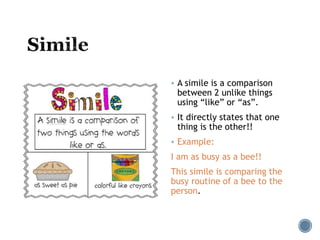
 A simile is a comparison
between 2 unlike things
using “like” or “as”.
 It directly states that one
thing is the other!!
 Example:
I am as busy as a bee!!
This simile is comparing the
busy routine of a bee to the
person.
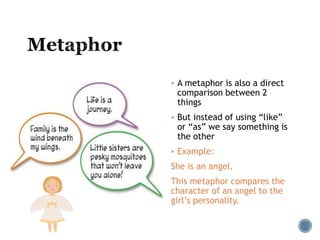
 A metaphor is also a direct
comparison between 2
things
 But instead of using “like”
or “as” we say something is
the other
 Example:
She is an angel.
This metaphor compares the
character of an angel to the
girl’s personality.
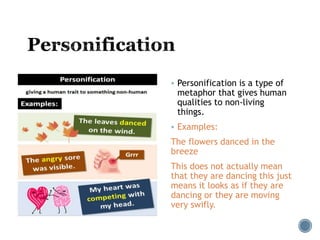
 Personification is a type of
metaphor that gives human
qualities to non-living
things.
 Examples:
The flowers danced in the
breeze
This does not actually mean
that they are dancing this just
means it looks as if they are
dancing or they are moving
very swifly.
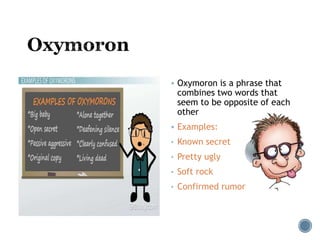
 Oxymoron is a phrase that
combines two words that
seem to be opposite of each
other
 Examples:
• Known secret
• Pretty ugly
• Soft rock
• Confirmed rumor
 Onomatopoeia is a figure of
speech that represents the
pronunciation of the word to
a sound
 In simple words,
onomatopoeia are sounds
represented by words
 Examples:
BAM!!
POW!!
BANG!!!
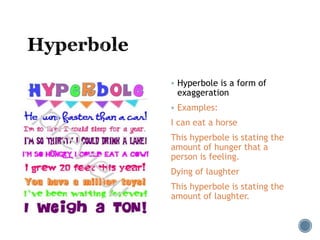
 Hyperbole is a form of
exaggeration
 Examples:
I can eat a horse
This hyperbole is stating the
amount of hunger that a
person is feeling.
Dying of laughter
This hyperbole is stating the
amount of laughter.
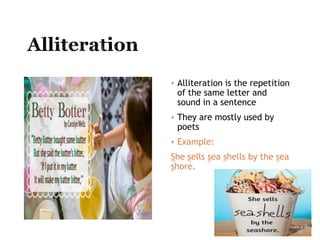
 Alliteration is the repetition
of the same letter and
sound in a sentence
 They are mostly used by
poets
 Example:
She sells sea shells by the sea
shore.
1. The hockey player lost his control when the puck ran across the
ice.
2. The snow on the ski hill was powdered sugar.
3. The coach was as upset as a lion when his team lost the game.
4. Freddy French fired five fabulous free throws.
5. The snowmobile was a rocket in the newly fallen snow.
6. The running shoes danced as the runner neared the finish line.
7. “Bang!” went the gun as the race started.
8. Steven boxes in the light-heavyweight division.
9. Spotlighting several special sports shows seems significant for
TV.
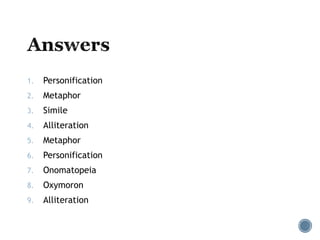
1. Personification
2. Metaphor
3. Simile
4. Alliteration
5. Metaphor
6. Personification
7. Onomatopeia
8. Oxymoron
9. Alliteration
This is a very important topic
Meaning
 Meaning is to tell what the
sentence or phrase is
directly telling
 We state the information in
the meaning
Effect
 Effect is to tell what it is
showing
 We state what we infer
from the text
Example: The sun was angry.
Meaning: The sun shining very brightly.
Effect: It had a bad mood and was causing the people a bad mood
too!
 Meaning and Effect - Writer's Craft - IGCSE - English Language
(Cambridge /Pearson Edexcel) (youtube.com)
 Meaning and Effect Questions | O Level English (1123) Paper 2
(with Examples) (youtube.com)
 In The Meaning And Effect Questions O Level 1 .pdf - In The
Meaning And Effect Questions O Level You Have To Do The
Following: 1. Give The Literal - ENGLMISC | Course Hero
Any suggestions??
Feel free to
comment!!

Figurative Language.pptx

  • 1.
  • 2.
    Important!!!  Before accessingthis workbook, kindly keep a notepad with you and a writing material  Practice the examples in your notebook  Wish you best of luck!!!
  • 3.
    Figurative language refers to a groupof words that are different from their actual meaning. Simile Metaphor Personification Onomatopoeia Hyperbole Oxymoron Click on the boxes to learn what are these forms of figurative language!!
  • 4.
     A simileis a comparison between 2 unlike things using “like” or “as”.  It directly states that one thing is the other!!  Example: I am as busy as a bee!! This simile is comparing the busy routine of a bee to the person.
  • 5.
     A metaphoris also a direct comparison between 2 things  But instead of using “like” or “as” we say something is the other  Example: She is an angel. This metaphor compares the character of an angel to the girl’s personality.
  • 6.
     Personification isa type of metaphor that gives human qualities to non-living things.  Examples: The flowers danced in the breeze This does not actually mean that they are dancing this just means it looks as if they are dancing or they are moving very swifly.
  • 7.
     Oxymoron isa phrase that combines two words that seem to be opposite of each other  Examples: • Known secret • Pretty ugly • Soft rock • Confirmed rumor
  • 8.
     Onomatopoeia isa figure of speech that represents the pronunciation of the word to a sound  In simple words, onomatopoeia are sounds represented by words  Examples: BAM!! POW!! BANG!!!
  • 9.
     Hyperbole isa form of exaggeration  Examples: I can eat a horse This hyperbole is stating the amount of hunger that a person is feeling. Dying of laughter This hyperbole is stating the amount of laughter.
  • 10.
     Alliteration isthe repetition of the same letter and sound in a sentence  They are mostly used by poets  Example: She sells sea shells by the sea shore.
  • 12.
    1. The hockeyplayer lost his control when the puck ran across the ice. 2. The snow on the ski hill was powdered sugar. 3. The coach was as upset as a lion when his team lost the game. 4. Freddy French fired five fabulous free throws. 5. The snowmobile was a rocket in the newly fallen snow. 6. The running shoes danced as the runner neared the finish line. 7. “Bang!” went the gun as the race started. 8. Steven boxes in the light-heavyweight division. 9. Spotlighting several special sports shows seems significant for TV.
  • 13.
    1. Personification 2. Metaphor 3.Simile 4. Alliteration 5. Metaphor 6. Personification 7. Onomatopeia 8. Oxymoron 9. Alliteration
  • 14.
    This is avery important topic
  • 15.
    Meaning  Meaning isto tell what the sentence or phrase is directly telling  We state the information in the meaning Effect  Effect is to tell what it is showing  We state what we infer from the text Example: The sun was angry. Meaning: The sun shining very brightly. Effect: It had a bad mood and was causing the people a bad mood too!
  • 16.
     Meaning andEffect - Writer's Craft - IGCSE - English Language (Cambridge /Pearson Edexcel) (youtube.com)  Meaning and Effect Questions | O Level English (1123) Paper 2 (with Examples) (youtube.com)  In The Meaning And Effect Questions O Level 1 .pdf - In The Meaning And Effect Questions O Level You Have To Do The Following: 1. Give The Literal - ENGLMISC | Course Hero
  • 18.