FIBER   By Morgan
        Roopnarine
WHAT IS FIBER?

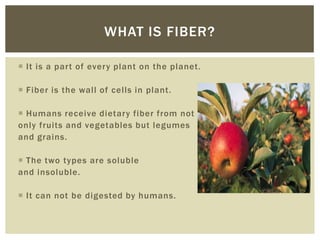
 It is a part of every plant on the planet.

 Fiber is the wall of cells in plant.

 Humans receive dietary fiber from not
only fruits and vegetables but legumes
and grains.

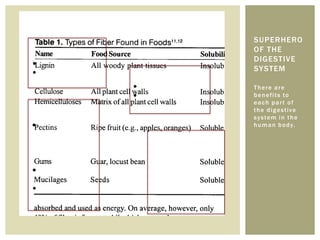
 The two types are soluble
and insoluble.

 It can not be digested by humans.
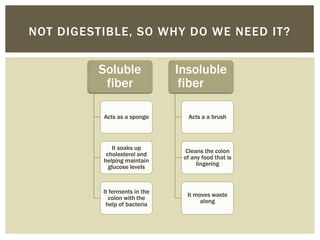
NOT DIGESTIBLE, SO WHY DO WE NEED IT?


         Soluble               Insoluble
          fiber                 fiber

          Acts as a sponge       Acts a a brush


             It soaks up
                                 Cleans the colon
           cholesterol and
                                of any food that is
          helping maintain
                                     lingering
            glucose levels


          It ferments in the
                                 It moves waste
            colon with the
                                      along
           help of bacteria
SUPERHERO
OF THE
DIGESTIVE
SYSTEM

There are
b e n e f i t s to
each part of
t h e d i g e s t iv e
s y s te m i n t h e
h u m a n b o d y.
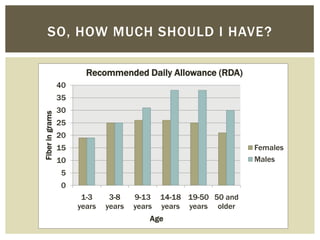
SO, HOW MUCH SHOULD I HAVE?

                        Recommended Daily Allowance (RDA)
                 40
                 35
                 30
Fiber in grams


                 25
                 20
                 15                                                Females
                 10                                                Males
                  5
                  0
                       1-3     3-8    9-13    14-18 19-50 50 and
                      years   years   years   years years older
                                          Age
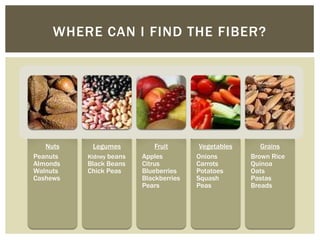
WHERE CAN I FIND THE FIBER?


   Nuts     Legumes          Fruit       Vegetables      Grains
Peanuts   Kidney beans   Apples         Onions        Brown Rice
Almonds   Black Beans    Citrus         Carrots       Quinoa
Walnuts   Chick Peas     Blueberries    Potatoes      Oats
Cashews                  Blackberries   Squash        Pastas
                         Pears          Peas          Breads
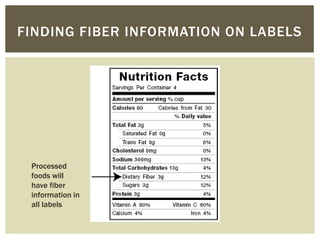
FINDING FIBER INFORMATION ON LABELS


 Processed
 foods will
 have fiber
 information in
 all labels
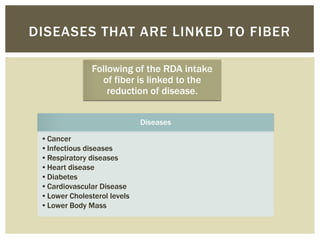
DISEASES THAT ARE LINKED TO FIBER

               Following of the RDA intake
                 of fiber is linked to the
                   reduction of disease.

                             Diseases

 •Cancer
 •Infectious diseases
 •Respiratory diseases
 •Heart disease
 •Diabetes
 •Cardiovascular Disease
 •Lower Cholesterol levels
 •Lower Body Mass
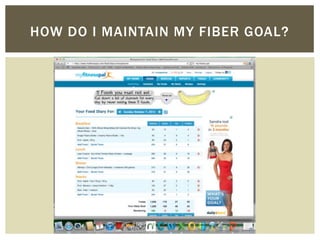
HOW DO I MAINTAIN MY FIBER GOAL?
CITATION

Whitney, Ellie, and Sharon Rady. Rolfes. Understanding Nutrition 11th Ed. N.p.: Thomson
Wadsworth, 2008. Print .

Elke Theuwissen, Ronald P. Mensink, Water-soluble dietary fibers and cardiovascular
disease, Physiology & Behavior, Volume 94, Issue 2, 23 May 2008, Pages 285 -292, ISSN 0031-
9384, 10.1016/j.physbeh.2008.01.001 .

Fiber from grains linked to living longer. (2011). Tufts University Health & Nutrition Letter, 29 (3), 1.
How much fiber is in that: Vegetables, (2007/2010). Retrieved October 7, 2012, from
http://www.fitsugar.com/How-Much-Fiber-Vegetables-214540

How much fiber is in that: Fruit , (2012). Retrieved October 7, 2012, from
http://www.fitsugar.com/Fiber -Fruits-209893
How much fiber is in that? Nuts, Beans, and Grains, ( 2007). Retrieved October 7, 2012, from
http://www.fitsugar.com/How-Much-Fiber-Nuts-Beans-Grains-214543
Dietary Reference Intakes: Macronutrients , (2002/2005). Retrieved October 7, 2012, from
http://fnic.nal.usda.gov/dietary -guidance/dietary-reference-intakes/dri-tables
Howarth, N. C., Saltzman, E., & Roberts, S. B. (2001). Dietary fiber and weight regulation. Nutrition
Reviews, 59(5), 129-139. doi: 10.1111/j.1753 -4887.2001.tb07001 .
www.flickr.com

Fiber

  • 1.
    FIBER By Morgan Roopnarine
  • 2.
    WHAT IS FIBER? It is a part of every plant on the planet.  Fiber is the wall of cells in plant.  Humans receive dietary fiber from not only fruits and vegetables but legumes and grains.  The two types are soluble and insoluble.  It can not be digested by humans.
  • 3.
    NOT DIGESTIBLE, SOWHY DO WE NEED IT? Soluble Insoluble fiber fiber Acts as a sponge Acts a a brush It soaks up Cleans the colon cholesterol and of any food that is helping maintain lingering glucose levels It ferments in the It moves waste colon with the along help of bacteria
  • 4.
    SUPERHERO OF THE DIGESTIVE SYSTEM There are be n e f i t s to each part of t h e d i g e s t iv e s y s te m i n t h e h u m a n b o d y.
  • 5.
    SO, HOW MUCHSHOULD I HAVE? Recommended Daily Allowance (RDA) 40 35 30 Fiber in grams 25 20 15 Females 10 Males 5 0 1-3 3-8 9-13 14-18 19-50 50 and years years years years years older Age
  • 6.
    WHERE CAN IFIND THE FIBER? Nuts Legumes Fruit Vegetables Grains Peanuts Kidney beans Apples Onions Brown Rice Almonds Black Beans Citrus Carrots Quinoa Walnuts Chick Peas Blueberries Potatoes Oats Cashews Blackberries Squash Pastas Pears Peas Breads
  • 7.
    FINDING FIBER INFORMATIONON LABELS Processed foods will have fiber information in all labels
  • 8.
    DISEASES THAT ARELINKED TO FIBER Following of the RDA intake of fiber is linked to the reduction of disease. Diseases •Cancer •Infectious diseases •Respiratory diseases •Heart disease •Diabetes •Cardiovascular Disease •Lower Cholesterol levels •Lower Body Mass
  • 9.
    HOW DO IMAINTAIN MY FIBER GOAL?
  • 11.
    CITATION Whitney, Ellie, andSharon Rady. Rolfes. Understanding Nutrition 11th Ed. N.p.: Thomson Wadsworth, 2008. Print . Elke Theuwissen, Ronald P. Mensink, Water-soluble dietary fibers and cardiovascular disease, Physiology & Behavior, Volume 94, Issue 2, 23 May 2008, Pages 285 -292, ISSN 0031- 9384, 10.1016/j.physbeh.2008.01.001 . Fiber from grains linked to living longer. (2011). Tufts University Health & Nutrition Letter, 29 (3), 1. How much fiber is in that: Vegetables, (2007/2010). Retrieved October 7, 2012, from http://www.fitsugar.com/How-Much-Fiber-Vegetables-214540 How much fiber is in that: Fruit , (2012). Retrieved October 7, 2012, from http://www.fitsugar.com/Fiber -Fruits-209893 How much fiber is in that? Nuts, Beans, and Grains, ( 2007). Retrieved October 7, 2012, from http://www.fitsugar.com/How-Much-Fiber-Nuts-Beans-Grains-214543 Dietary Reference Intakes: Macronutrients , (2002/2005). Retrieved October 7, 2012, from http://fnic.nal.usda.gov/dietary -guidance/dietary-reference-intakes/dri-tables Howarth, N. C., Saltzman, E., & Roberts, S. B. (2001). Dietary fiber and weight regulation. Nutrition Reviews, 59(5), 129-139. doi: 10.1111/j.1753 -4887.2001.tb07001 . www.flickr.com

Editor's Notes

  • #2 Notes: Hello all, I am Morgan Roopnarine and today I will be talking about the benefits of fiber to your diet and overall health. Also sources, recommended intake and ways to track intake.
  • #3 Notes: Read slide.
  • #4 Notes:1st animation (am-) Soluble Fiber is found in foods like oatmeal.2nd am- If you keep thinking about oatmeal you’ll see why behaves like a sponge but instead of soaking up favors like cinnamon. 3rd am- Fiber maintain glucose levels by slowing the digestive process. Allowing our body’s to keep a steady level of insulin.4th am- and this helps keep the colon healthy 5th am- Insoluble fiber is in plant like celery.6th am- The coarseness of this type of fiber is why it is brush like. 7th am- It literately sweeps the colon clean like a bottle brush. 8th am- This is the fiber that helping with constipation. Citation 2nd and 3rd slidesWhitney, Ellie, and Sharon Rady. Rolfes. Understanding Nutrition 11th Ed.N.p.: Thomson Wadsworth, 2008. Print.
  • #5 Throughout the body there is benefits to maintaining the Recommended Daily Allowance. 1st- am -For the mouth it prolongs chewing, making the brain think that you have eaten more and tricking it in to eating less. Along with the increase in chewing there is an increase in saliva. Salvia is the first step in digestion and beings to soften the food. 2nd am- Within the stomach the fiber act as filler, distenting and delaying food from reaching the intestines. The distention of the stomach create a filling of fullness also signaling the brain that we have had enough food. The delaying is important in allowing absorption of needed nutrients. 3rd am- In the small intestine, Fiber continues to delay allowing even more nutrients to be absorbed. Fiber is thought to help release hormones that regulate fullness and weight regulation. The Ileal brake is part of the hormone process and can help in weight loss. 4th am- The large intestine create a fermentation of bacteria and fiber. That reaction lower the fat that’s absorbed which also helps in weight loss. The fiber helps expel waste from the bowels which cuts down on the lingering high caloric fat that might be lingering. Citation:Howarth, N. C., Saltzman, E., & Roberts, S. B. (2001). Dietary fiber and weight regulation. Nutrition Reviews, 59(5), 129-139. doi: 10.1111/j.1753-4887.2001.tb07001.
  • #6 Fiber intake actually changes throughout life. Increasing in the formative years when the body is growing at high rates. Men because of their higher caloric intake tend to need higher amount of fiber throughout their lives. It should also be noted that women should increase their intake when they become pregnant and are breastfeeding to 28 to 29 grams because of the in additional caloric intake associated with childbirth. Information citation:Dietary Reference Intakes: Macronutrients, (2002/2005). Retrieved October 7, 2012, from http://fnic.nal.usda.gov/dietary-guidance/dietary-reference-intakes/dri-tables
  • #7 Notes:Nuts contain anywhere from Cashews that have about 1 grams per serving to Almonds with 4 grams. Though even thought nuts are a health way to get fiber then are also a very energy dense food with high fat content. Legumes or Beans contain very high amounts of fiber around 6-9 grams per serving. These are great addition to your diet whether in soups or salad. Also can be a health alternative to meat when you want a meatless meal. Fruits can range for the apple with 4 grams to watermelon with less than a gram. As a rule fruit that are more dense like the apple or pear have high amounts of fiber. But be aware that fruit also has a lot of sugar and fruit juice has none of the benefits of whole fruit. Vegetables are very varied too. But again denser vegetables like potatoes and squash have the greatest amount with around 4-5 grams per serving. Grains are probably the way most of us get our fiber but of course more whole grain version like rolled oats and quinoa have the greatest amount of fiber (in the 4 grams per serving range). Whereas processed grains like white bread only have about 1.9 grams per serving. Citation:How much fiber is in that: Vegetables, (2007/2010). Retrieved October 7, 2012, from http://www.fitsugar.com/How-Much-Fiber-Vegetables-214540How much fiber is in that: Fruit, (2012). Retrieved October 7, 2012, from http://www.fitsugar.com/Fiber-Fruits-209893How much fiber is in that? Nuts, Beans, and Grains, (2007). Retrieved October 7, 2012, from http://www.fitsugar.com/How-Much-Fiber-Nuts-Beans-Grains-214543
  • #8 Thought the best sources of fiber are whole source that have not been processed you should look at the fiber content of your packaged food. All food manufactures are required by the US government to have general nutrition info on their packages and this includes fiber content.
  • #9  Though Fiber has a lot of benefit to how we feel daily there are greater goals to eating fiber. (click 1st am)Fiber increases longevity in humans by decreasing the risk of cancer, Cancer, Infectious disease, Respiratory disease, Heart disease, Diabetes, and Cardiovascular Disease. Most of these diseases are affected by fibers ability to lower weight and cholesterol levels. Citation:Fiber from grains linked to living longer. (2011). Tufts University Health & Nutrition Letter, 29(3), 1.ElkeTheuwissen, Ronald P. Mensink, Water-soluble dietary fibers and cardiovascular disease, Physiology & Behavior, Volume 94, Issue 2, 23 May 2008, Pages 285-292, ISSN 0031-9384, 10.1016/j.physbeh.2008.01.001.
  • #10 Notes: To maintain your fiber levels in a routine way, I recommend website tracker site like my fitness pal. This and other like spark people, allow you to track calorie intake, track fitness activities, make goals for fitness and goal for weight loss. By tacking this kind of information you are better in control of what you are eating. In Addition…(Click to next slide)
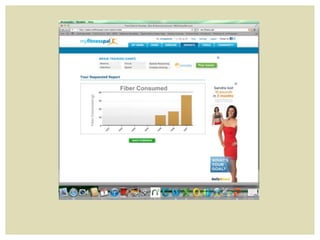
  • #11  Notes: You can track you levels for specific nutrients like fiber. My fitness pal has a great chart that allows you to see how intake of fiber alone is doing but you can track for other nutrient like calcium or levels of water. Thank you for your attention are there any question related to fiber?Citation: all additional picture where taken from flickr.com.