
Topic 1
AN INTRODUCTION TO THE
FOUNDATIONS OF FINANCIAL
MANAGEMENT
Learning Objectives
1. Definition of finance.
2. Roles of the financial manager.
3. Goals of the firm.
4. Basic principles of finance.
5. Basic forms of business
6. Financial institutions and markets.
1. What is Finance?
• Finance can be defined as the art and science of
managing money.
• Finance is concerned with the process, institutions,
markets, and instruments involved in the transfer of
money among individuals, businesses, and
governments
• Simply finance deals with matters related to money
and the markets
2. The Role of a Financial
Manager in a Firm
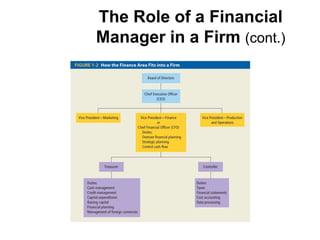
Three broad issues addressed by the financial
manger:
 Where to Invest? (Capital budgeting
decision)
 How to raise money to fund the investment?
(Capital structure decision)
 How to manage cash flows from daily
operations? (Working capital decision)
The Role of a Financial
Manager in a Firm (cont.)
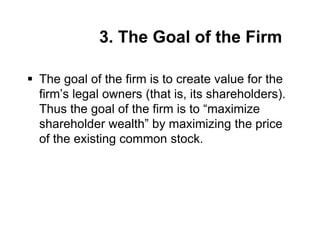
3. The Goal of the Firm
 The goal of the firm is to create value for the
firm’s legal owners (that is, its shareholders).
Thus the goal of the firm is to “maximize
shareholder wealth” by maximizing the price
of the existing common stock.
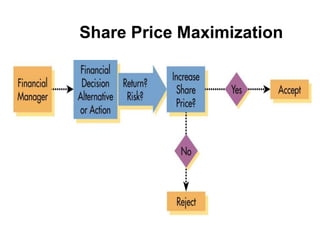
Share Price Maximization
•Why?
•Because maximizing shareholder wealth
properly considers cash flows, the timing of
these cash flows, and the risk of these cash
flows.
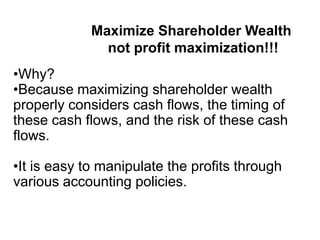
•It is easy to manipulate the profits through
various accounting policies.
Maximize Shareholder Wealth
not profit maximization!!!
4. Five Foundational
Principles of Finance
 Cash flow is what matters
 Money has a time value
 Risk requires a reward
 Market prices are generally right
 Conflicts of interest cause agency
problems
Principle 1:
Cash flow is what matters
 Accounting profits are not equal to cash flows. It is
possible for a firm to generate accounting profits but
not have cash or to generate cash flows but not
report accounting profits in the books.
 Cash flow, and not profits, drive the value of a
business.
 We must determine incremental cash flows when
making financial decisions.
 Incremental cash flow is the difference between the
projected cash flows if the project is selected, versus what
they will be, if the project is not selected.
Principle 2:
Money has a time value
 A dollar received today is worth more than a
dollar received in the future.
 Since we can earn interest on money received
today, it is better to receive money earlier rather
than later.
Principle 3:
Risk requires a Reward
 We won’t take on additional risk unless we
expect to be compensated with additional
reward or return.
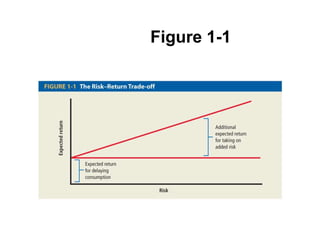
 Investors expect to be compensated for
“delaying consumption” and “taking on risk”.
 Thus investors expect a return when they put their
savings in a bank (i.e. delay consumption) and
they expect to earn a higher rate of return on
stocks relative to bank savings account (i.e. taking
on risk)
Figure 1-1
Principle 4: Market Prices
are generally Right
 In an efficient market, the prices of all traded assets
(such as stocks and bonds) at any instant in time fully
reflect all available information.
 Thus stock prices are a useful indicator of the value
of the firm. Prices changes reflect changes in
expected future cash flows. Good decisions will tend
to increase the stock prices and vice versa.
Principle 5: Conflicts of interest
cause agency problems
 The separation of management and the
ownership of the firm creates an agency
problem. Managers may make decisions that
are not consistent with the goal of maximizing
shareholder wealth.
 Agency conflict is reduced through monitoring
(ex. Annual reports), compensation schemes
(ex. stock options), and market mechanisms
(ex. Takeovers)
 Sole Proprietorship
 Partnership
 Corporation
5. Basic forms of business
organization
Sole Proprietorship
 Business owned by an individual
 Owner maintains title to assets and
profits
 Unlimited liability
 Termination occurs on owner’s death or
by owner’s choice
Sole Proprietorship (cont.)
• Advantages:
– Easy to start
– No need to consult others while making decisions
– Taxed at the personal tax rate.
– Retention of all profits.
– Few regulations
• Disadvantages:
– Personally liable for the business debts
– Ceases on the death of the propreitor
– Financing limitations
Partnership
• A partnership is an association of two or
more persons who come together as co-
owners for the purpose of operating a
business for profit.
• There is no separation between the
partnership and the owners with respect to
debts or being sued.
Partnerships (cont.)
 Two or more persons come together as co-owners
 General Partnership: All partners are fully responsible
for liabilities incurred by the partnership.
 Limited Partnerships: One or more partners can have
limited liability, restricted to the amount of capital
invested in the partnership. There must be at least one
general partner with unlimited liability. Limited partners
cannot participate in the management of the business
and their names cannot appear in the name of the firm.
Partnership (cont.)
• Advantages:
– Relatively easy to start
– Taxed at the personal tax rate
– Access to funds from multiple sources or
partners
• Disadvantages:
– Partners jointly share unlimited liability.
– Difficult to raise large amounts of capital.
– Difficult to transfer ownership.
Corporation
 Legally functions separate and apart from its owners
 Corporation can sue, be sued, purchase, sell, and own property
 Owners (shareholders) dictate direction and policies of
the corporation, oftentimes through elected board of
directors.
 Shareholder’s liability is restricted to amount of
investment in company
 Life of corporation does not depend on the owners …
corporation continues to exist through easy transfer of
ownership
 Taxed separately
Corporation (cont.)
• Advantages
– Liability of owners limited to invested funds
– Life of corporation is not tied to the owner
– Easier to transfer ownership
– Easier to raise Capital
• Disadvantages
– Greater regulation
– Double taxation of dividends.
– No secrecy of information
6. Financial Institutions &
Markets
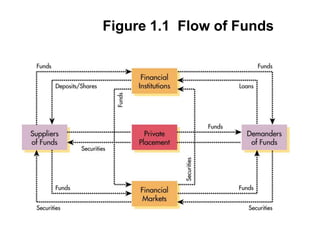
• Firms that require funds from external
sources can obtain them in three ways:
– through a bank or other financial institution
– through financial markets
– through private placements
Financial Institutions & Markets:
Financial Institutions
• Financial institutions are intermediaries that
channel the savings of individuals, businesses,
and governments into loans or investments.
• The key suppliers and demanders of funds are
individuals, businesses, and governments.
• In general, individuals are net suppliers of
funds, while businesses and governments are
net demanders of funds.
Financial Institutions & Markets:
Financial Markets (cont.)
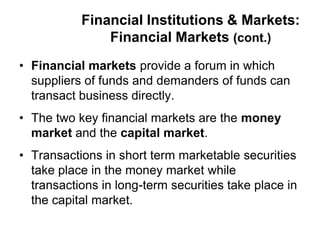
• Financial markets provide a forum in which
suppliers of funds and demanders of funds can
transact business directly.
• The two key financial markets are the money
market and the capital market.
• Transactions in short term marketable securities
take place in the money market while
transactions in long-term securities take place in
the capital market.
Financial Institutions & Markets:
Financial Markets (cont.)
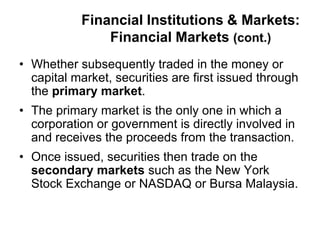
• Whether subsequently traded in the money or
capital market, securities are first issued through
the primary market.
• The primary market is the only one in which a
corporation or government is directly involved in
and receives the proceeds from the transaction.
• Once issued, securities then trade on the
secondary markets such as the New York
Stock Exchange or NASDAQ or Bursa Malaysia.
Types of offers in primary market
(cont.)
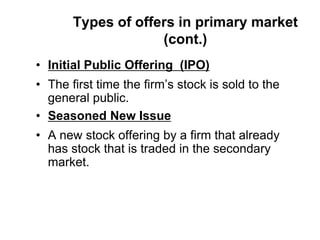
• Initial Public Offering (IPO)
• The first time the firm’s stock is sold to the
general public.
• Seasoned New Issue
• A new stock offering by a firm that already
has stock that is traded in the secondary
market.
Figure 1.1 Flow of Funds

Ff topic 1_an_introduction_to_the_foundations_of_financial_management

  • 1.
    Topic 1 AN INTRODUCTIONTO THE FOUNDATIONS OF FINANCIAL MANAGEMENT
  • 2.
    Learning Objectives 1. Definitionof finance. 2. Roles of the financial manager. 3. Goals of the firm. 4. Basic principles of finance. 5. Basic forms of business 6. Financial institutions and markets.
  • 3.
    1. What isFinance? • Finance can be defined as the art and science of managing money. • Finance is concerned with the process, institutions, markets, and instruments involved in the transfer of money among individuals, businesses, and governments • Simply finance deals with matters related to money and the markets
  • 4.
    2. The Roleof a Financial Manager in a Firm Three broad issues addressed by the financial manger:  Where to Invest? (Capital budgeting decision)  How to raise money to fund the investment? (Capital structure decision)  How to manage cash flows from daily operations? (Working capital decision)
  • 5.
    The Role ofa Financial Manager in a Firm (cont.)
  • 6.
    3. The Goalof the Firm  The goal of the firm is to create value for the firm’s legal owners (that is, its shareholders). Thus the goal of the firm is to “maximize shareholder wealth” by maximizing the price of the existing common stock.
  • 7.
  • 8.
    •Why? •Because maximizing shareholderwealth properly considers cash flows, the timing of these cash flows, and the risk of these cash flows. •It is easy to manipulate the profits through various accounting policies. Maximize Shareholder Wealth not profit maximization!!!
  • 9.
    4. Five Foundational Principlesof Finance  Cash flow is what matters  Money has a time value  Risk requires a reward  Market prices are generally right  Conflicts of interest cause agency problems
  • 10.
    Principle 1: Cash flowis what matters  Accounting profits are not equal to cash flows. It is possible for a firm to generate accounting profits but not have cash or to generate cash flows but not report accounting profits in the books.  Cash flow, and not profits, drive the value of a business.  We must determine incremental cash flows when making financial decisions.  Incremental cash flow is the difference between the projected cash flows if the project is selected, versus what they will be, if the project is not selected.
  • 11.
    Principle 2: Money hasa time value  A dollar received today is worth more than a dollar received in the future.  Since we can earn interest on money received today, it is better to receive money earlier rather than later.
  • 12.
    Principle 3: Risk requiresa Reward  We won’t take on additional risk unless we expect to be compensated with additional reward or return.  Investors expect to be compensated for “delaying consumption” and “taking on risk”.  Thus investors expect a return when they put their savings in a bank (i.e. delay consumption) and they expect to earn a higher rate of return on stocks relative to bank savings account (i.e. taking on risk)
  • 13.
  • 14.
    Principle 4: MarketPrices are generally Right  In an efficient market, the prices of all traded assets (such as stocks and bonds) at any instant in time fully reflect all available information.  Thus stock prices are a useful indicator of the value of the firm. Prices changes reflect changes in expected future cash flows. Good decisions will tend to increase the stock prices and vice versa.
  • 15.
    Principle 5: Conflictsof interest cause agency problems  The separation of management and the ownership of the firm creates an agency problem. Managers may make decisions that are not consistent with the goal of maximizing shareholder wealth.  Agency conflict is reduced through monitoring (ex. Annual reports), compensation schemes (ex. stock options), and market mechanisms (ex. Takeovers)
  • 16.
     Sole Proprietorship Partnership  Corporation 5. Basic forms of business organization
  • 17.
    Sole Proprietorship  Businessowned by an individual  Owner maintains title to assets and profits  Unlimited liability  Termination occurs on owner’s death or by owner’s choice
  • 18.
    Sole Proprietorship (cont.) •Advantages: – Easy to start – No need to consult others while making decisions – Taxed at the personal tax rate. – Retention of all profits. – Few regulations • Disadvantages: – Personally liable for the business debts – Ceases on the death of the propreitor – Financing limitations
  • 19.
    Partnership • A partnershipis an association of two or more persons who come together as co- owners for the purpose of operating a business for profit. • There is no separation between the partnership and the owners with respect to debts or being sued.
  • 20.
    Partnerships (cont.)  Twoor more persons come together as co-owners  General Partnership: All partners are fully responsible for liabilities incurred by the partnership.  Limited Partnerships: One or more partners can have limited liability, restricted to the amount of capital invested in the partnership. There must be at least one general partner with unlimited liability. Limited partners cannot participate in the management of the business and their names cannot appear in the name of the firm.
  • 21.
    Partnership (cont.) • Advantages: –Relatively easy to start – Taxed at the personal tax rate – Access to funds from multiple sources or partners • Disadvantages: – Partners jointly share unlimited liability. – Difficult to raise large amounts of capital. – Difficult to transfer ownership.
  • 22.
    Corporation  Legally functionsseparate and apart from its owners  Corporation can sue, be sued, purchase, sell, and own property  Owners (shareholders) dictate direction and policies of the corporation, oftentimes through elected board of directors.  Shareholder’s liability is restricted to amount of investment in company  Life of corporation does not depend on the owners … corporation continues to exist through easy transfer of ownership  Taxed separately
  • 23.
    Corporation (cont.) • Advantages –Liability of owners limited to invested funds – Life of corporation is not tied to the owner – Easier to transfer ownership – Easier to raise Capital • Disadvantages – Greater regulation – Double taxation of dividends. – No secrecy of information
  • 24.
    6. Financial Institutions& Markets • Firms that require funds from external sources can obtain them in three ways: – through a bank or other financial institution – through financial markets – through private placements
  • 25.
    Financial Institutions &Markets: Financial Institutions • Financial institutions are intermediaries that channel the savings of individuals, businesses, and governments into loans or investments. • The key suppliers and demanders of funds are individuals, businesses, and governments. • In general, individuals are net suppliers of funds, while businesses and governments are net demanders of funds.
  • 26.
    Financial Institutions &Markets: Financial Markets (cont.) • Financial markets provide a forum in which suppliers of funds and demanders of funds can transact business directly. • The two key financial markets are the money market and the capital market. • Transactions in short term marketable securities take place in the money market while transactions in long-term securities take place in the capital market.
  • 27.
    Financial Institutions &Markets: Financial Markets (cont.) • Whether subsequently traded in the money or capital market, securities are first issued through the primary market. • The primary market is the only one in which a corporation or government is directly involved in and receives the proceeds from the transaction. • Once issued, securities then trade on the secondary markets such as the New York Stock Exchange or NASDAQ or Bursa Malaysia.
  • 28.
    Types of offersin primary market (cont.) • Initial Public Offering (IPO) • The first time the firm’s stock is sold to the general public. • Seasoned New Issue • A new stock offering by a firm that already has stock that is traded in the secondary market.
  • 29.