See discussions, stats, and author profiles for this publication at: https://www.researchgate.net/publication/369141311
General solution for Diophantine equation of degree n, with number of variables
d
Research Proposal · March 2023
DOI: 10.13140/RG.2.2.10352.94723
CITATIONS
0
READS
345
1 author:
Nikos Mantzakouras
National and Kapodistrian University of Athens
28 PUBLICATIONS 2 CITATIONS
SEE PROFILE
All content following this page was uploaded by Nikos Mantzakouras on 23 March 2023.
The user has requested enhancement of the downloaded file.
arXiv:submit/4797119
[math.GM]
18
Mar
2023
General solution for Diophantine equation of degree n,
with number of variables d.
N.Mantzakouras
e-mail: nikmatza@gmail.com
Athens - Greece
Abstract
The Pythagorean theorem is perhaps the best known theorem in the vast world of mathematics;
a simple relation of square numbers that encapsulates the glory of mathematical science. It
is also justifiably the most popular yet sublime theorem in mathematical science. The starting
point was Diophantus’ 20th problem (Book VI of Diophantus’ Arithmetica), which for Fermat
is for n = 4 and consists in the question whether there are right triangles whose sides can be
counted as integers and whose surface can be square. The generalized method we use here is
based on elementary inequalities and gives a solution to any diophantine equation of degree n
with respect to the number of variables d. It is a method that does not exclude other equivalent
analytical methods for finding specific solutions. However, the method proposed generalizes to
any exponent n with number of variables d. An explicit proof is also given for variables in both
parts with equal or different number of variables, also of degree n. As a direct application it is
Fermat’s last theorem and of course has much broader generalization to symmetric or asymmetric
diophantine equations.
I. Theorem 1[7,8,9,10]
We consider the sequence of variables x1, x2, x3, .., xd such that they are integers that are different in general
from each other and also that the equality xn
1 + xn
2 + xn
3 + . . . + xn
d−1 = xn
d , where n ∈ N>2, and d ∈ N>2
indicating the number of variables.
Prove the two basic inequalities:
a)

xd
xd−1
n
 d − 1 

xd
x1
n
b) If xd = xd−1 + k, k ∈ N+
then k  xd−1 − (d − 1)
Proof.
a) We assume that the equation is valid, xn
1 + xn
2 + xn
3 + . . . + xn
d−1 = xn
d (T.1), where n, d ∈ N2, if
we assume in the context of generality that the inequality order x1  x2  x3  . . .  xd−1  xd ⇔ xn
1 
xn
2  xn
3  . . .  xn
d−1  xn
d, n ∈ N2 (T.2). Combining relations (T2T1) we obtain that:
xn
1 + xn
1 + xn
1 + . . . + xn
1  xn
1 + xn
2 + xn
3 + . . . + xn
d−1 = xn
d therefore we have
1
(d − 1)xn
1  xn
d ⇔ (d − 1) 

xd
x1
n
(T.3)
With the same logic it will hold that:
xn
d−1 + xn
d−1 + xn
d−1 + . . . + xn
d−1  xn
1 + xn
2 + xn
3 + . . . + xn
d−1 = xn
d therefore we have (d − 1)xn
d−1  xn
d ⇔
(d − 1) 

xd
xn
d−1
n
(T.4).
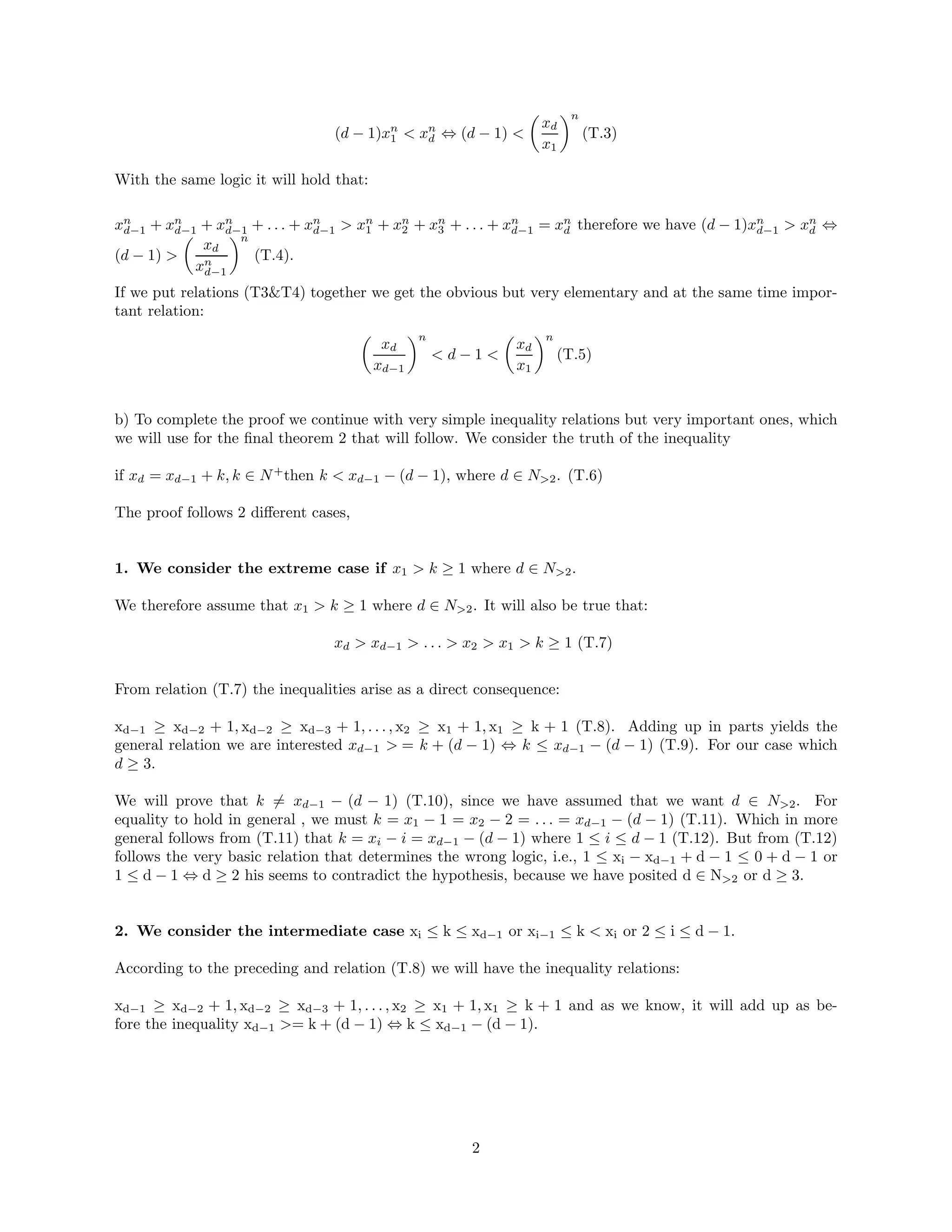
If we put relations (T3T4) together we get the obvious but very elementary and at the same time impor-
tant relation:

xd
xd−1
n
 d − 1 

xd
x1
n
(T.5)
b) To complete the proof we continue with very simple inequality relations but very important ones, which
we will use for the final theorem 2 that will follow. We consider the truth of the inequality
if xd = xd−1 + k, k ∈ N+
then k  xd−1 − (d − 1), where d ∈ N2. (T.6)
The proof follows 2 different cases,
1. We consider the extreme case if x1  k ≥ 1 where d ∈ N2.
We therefore assume that x1  k ≥ 1 where d ∈ N2. It will also be true that:
xd  xd−1  . . .  x2  x1  k ≥ 1 (T.7)
From relation (T.7) the inequalities arise as a direct consequence:
xd−1 ≥ xd−2 + 1, xd−2 ≥ xd−3 + 1, . . . , x2 ≥ x1 + 1, x1 ≥ k + 1 (T.8). Adding up in parts yields the
general relation we are interested xd−1  = k + (d − 1) ⇔ k ≤ xd−1 − (d − 1) (T.9). For our case which
d ≥ 3.
We will prove that k 6= xd−1 − (d − 1) (T.10), since we have assumed that we want d ∈ N2. For
equality to hold in general , we must k = x1 − 1 = x2 − 2 = . . . = xd−1 − (d − 1) (T.11). Which in more
general follows from (T.11) that k = xi − i = xd−1 − (d − 1) where 1 ≤ i ≤ d − 1 (T.12). But from (T.12)
follows the very basic relation that determines the wrong logic, i.e., 1 ≤ xi − xd−1 + d − 1 ≤ 0 + d − 1 or
1 ≤ d − 1 ⇔ d ≥ 2 his seems to contradict the hypothesis, because we have posited d ∈ N2 or d ≥ 3.
2. We consider the intermediate case xi ≤ k ≤ xd−1 or xi−1 ≤ k  xi or 2 ≤ i ≤ d − 1.
According to the preceding and relation (T.8) we will have the inequality relations:
xd−1 ≥ xd−2 + 1, xd−2 ≥ xd−3 + 1, . . . , x2 ≥ x1 + 1, x1 ≥ k + 1 and as we know, it will add up as be-
fore the inequality xd−1 = k + (d − 1) ⇔ k ≤ xd−1 − (d − 1).
2
If we now assume that the inequality:
xd−1 − (d − 1) ≤ k ≤ xd−1 + (d − 1) ⇔ k ≤ xd−1 − (d − i) or −(d − 1) ≤ (d − i) ⇔ 1 ≤ i. (T.13).
But the last very decisive inequality relation 1 ≤ i contradicts our hypothesis, because 2 ≤ i  d − 1 there-
fore the relation will not apply i.e k 6= xd−1 − (d − 1) (T.14), and only the relation we are interested in will
apply, i.e. k  xd−1 − (d − 1) (T.15). We have therefore proved 2 very basic inequalities which will guide
us to the final form of inequalities and indicate the minimum value of the exponent n of the generalized
diophantine equation:
xn
1 + xn
2 + xn
3 + . . . + xn
d−1 = xn
d , where d ∈ N2 for which we are asked to find the restrictive integer
limit of the exponent n, so that there are solutions to this diophantine equation. With this procedure,
which has a simple but concise logic, we can solve this very difficult problem, for which no clear answer has
yet been given, except for the case of d = 3 and n ≥ 3 by various methods, generally called the proof of
Fermat’s Last Theorem Fermat.
II. Theorem 2.
The number of existing solutions of the exponent n for the equation xn
1 + xn
2 + xn
3 + . . . + xn
d−1 = xn
d ,
where d ∈ N2
is given by relation ndown ≤ IntegerPart

log(d − 1)
log d+1
d

#
as a function of d (where IntegerPart[] is an integer
part of a number and log is the neper logarithm of a number). Therefore for values of n above the upper
bound i.e. for
nup ≥ lntegerPart

log(d − 1)
log d+1
d

#
+ 1 the diophantine equation has no solution.
Proof:
A) According to Theorem 1, two basic relations will hold
a)

xd
xd−1
n
 d − 1 

xd
x1
n
b) If xd = xd−1 + k, k ∈ N+
then k  xd−1 − (d − 1)
For the equation xn
1 + xn
2 + xn
3 + . . . + xn
d−1 = xn
d , where d, n ∈ N2. If I isolate the first part of the first
relation i.e

xd
xd−1
n
 d−1 (Θ1) and the second part k  xd−1 −(d−1) with xd = xd−1 +k, k ∈ N+
(Θ.2)
then I will two inequalities will result
(d − 1)
1
n − 1 
k
k + d − 1
(Θ.3)
(d − 1)
1
n − 1 
k
k + d − 1
(Θ.4)
3
for which, however, I will have to decide which of the two I will choose as acceptable for n. The previous
relations finally result for n in the forms associated with the integer part, which are:
n ≥ lntegerPart

 log(d − 1)
log

2k+d−1
d+k−1


 + 1 (Θ.5)
n ≤ lntegerPart

 log(d − 1)
log

2k+d−1
d+k−1


 (Θ.6)
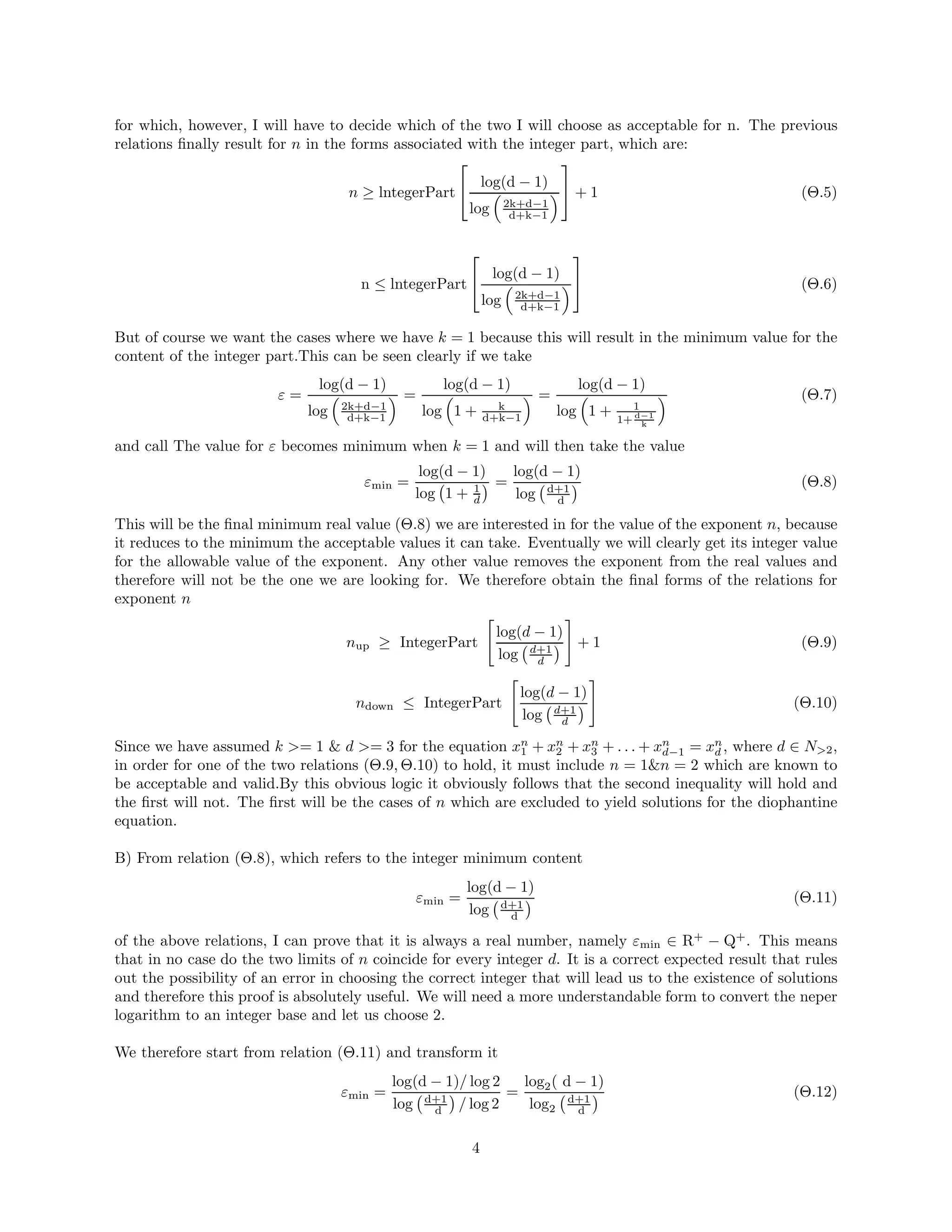
But of course we want the cases where we have k = 1 because this will result in the minimum value for the
content of the integer part.This can be seen clearly if we take
ε =
log(d − 1)
log

2k+d−1
d+k−1
 =
log(d − 1)
log

1 + k
d+k−1
 =
log(d − 1)
log

1 + 1
1+ d−1
k
 (Θ.7)
and call The value for ε becomes minimum when k = 1 and will then take the value
εmin =
log(d − 1)
log 1 + 1
d
 =
log(d − 1)
log d+1
d
 (Θ.8)
This will be the final minimum real value (Θ.8) we are interested in for the value of the exponent n, because
it reduces to the minimum the acceptable values it can take. Eventually we will clearly get its integer value
for the allowable value of the exponent. Any other value removes the exponent from the real values and
therefore will not be the one we are looking for. We therefore obtain the final forms of the relations for
exponent n
nup ≥ IntegerPart

log(d − 1)
log d+1
d

#
+ 1 (Θ.9)
ndown ≤ IntegerPart

log(d − 1)
log d+1
d

#
(Θ.10)
Since we have assumed k = 1  d = 3 for the equation xn
1 + xn
2 + xn
3 + . . . + xn
d−1 = xn
d , where d ∈ N2,
in order for one of the two relations (Θ.9, Θ.10) to hold, it must include n = 1n = 2 which are known to
be acceptable and valid.By this obvious logic it obviously follows that the second inequality will hold and
the first will not. The first will be the cases of n which are excluded to yield solutions for the diophantine
equation.
B) From relation (Θ.8), which refers to the integer minimum content
εmin =
log(d − 1)
log d+1
d
 (Θ.11)
of the above relations, I can prove that it is always a real number, namely εmin ∈ R+
− Q+
. This means
that in no case do the two limits of n coincide for every integer d. It is a correct expected result that rules
out the possibility of an error in choosing the correct integer that will lead us to the existence of solutions
and therefore this proof is absolutely useful. We will need a more understandable form to convert the neper
logarithm to an integer base and let us choose 2.
We therefore start from relation (Θ.11) and transform it
εmin =
log(d − 1)/ log 2
log d+1
d

/ log 2
=
log2( d − 1)
log2
d+1
d
 (Θ.12)
4
Assuming the replacements
d − 1 = 2m
⇔ d = 1 + 2m
and therefore log2(d − 1) = m, m ∈ Z+
.
Also log2
d+1
d

= log2 1 + 1
d

= log2

1 + 1
2m+1

.
It will follow that
εmin =
m
log2

1 + 1
2m+1
, m ∈ Z+
(Θ.13)
We have to prove that log2

1 + 1
2m+1

∈ R+
− Q+
and then obviously it will hold that εmin ∈ R+
− Q+
.
We will need two partial proofs. First, we will develop the relation log

1 + 1
2m+1

in Maclaurin series.
The expansion will be
(2 log[2] − log[3]) −
1
6
log[2](m − 1) +
1
72
log[2]2
(m − 1)2
+
1
81
log[2]3
(m − 1)3
−
11 log[2]4
(m − 1)4
5184
−
1
972
log[2]5
(m − 1)5
+ O[m − 1]6
But the final relationship we are interested in log2

1 + 1
2m+1

will be in final form
2 log[2] − log[3]
log[2]
−
m − 1
6
+
1
72
log[2](m − 1)2
+
1
81
log[2]2
(m − 1)3
−
11 log[2]3
(m − 1)4
5184
−
1
972
log[2]4
(m − 1)5
+ O[m − 1]6
We will therefore have a sum of terms that has two constant integers and the other terms will be in log 3/ log 2
form and the other terms in log 2 form. But log 2 is an Irrational number as is the ratio log 3/ log 2[A1, A2].
So the whole sum of the series will be an Irrational number and by extension the value of
εmin =
m
log2

1 + 1
2m+1
, m ∈ Z+
, εmin ∈ R+
− Q+
,
as a ratio of an integer to an irrational value of number.
Therefore it will hold ndown 6= nup, ∀d ∈ Z+
with acceptable values of the exponent n, so that there is
a solution of the generalized diophantine xn
1 + xn
2 + xn
3 + . . . + xn
d−1 = xn
d , where n ∈ N2 only for its values
of ndown , ∀d ∈ Z+
. Obviously for any arrangement with d number of variables we will follow the same pro-
cedure with the corresponding log base and come to the same conclusion, i.e. if d ∈ Z+
2, εmin ∈ R+
− Q+
.
III. Theorem 3. (F.L.T)
Proof
For any integer n  2, the equation xn
1 + xn
2 = xn
3 , where n ∈ N2 has no positive integer solutions.
According to Theorem 2(Θ.11), the acceptable values for the exponent n will be given by the relation
ndown ≤ IntegerPart

log(d − 1)
log d+1
d

#
, d = 3.
5
For this particular diophantine equation we will have
εmin =
log2(d − 1)
log2
d+1
d
 = 2.409421
and hence according to the minimum value the upper value for n will be fully defined
ndown ≤ ln tegerPart

log(d − 1)
log d+1
d

#
= IntegerPart[2.409421] = 2
The forbidden values of n will therefore be
nup ≥ lntegerPart

log(d − 1)
log d+1
d

#
= lntegerPart[2.409421] + 1 = 3, n ≥ 3
Therefore, for Fermat’s diophantine does not accept solutions. The proof with the given values is complete
and complete and understandable but also determinative for the values of n.
IV. Indicative values of the allowed values of n, in relation to the number of variables d
in the equation.
A concise procedure with logical inequalities therefore gives us a complete picture of the admissible solutions
for n, without having to analyze each case separately, with procedures that are complex and time-consuming,
especially as we go up in number of variables. The key the panelization is obviously the value of
εmin =
log2(d − 1)
log2
d+1
d
 , d ∈ Z+
2
from (Θ.11) and the 2 values nup and ndown as defined in Theorem 2.
The values of ndown , nup which determine when the Diophantine equation has a solution and when it
does not for 3 ≤ d ≤ 15
d εmin ndown nup
3 2,40942084 2 3
4 4,923343212 4 5
5 7,603568034 7 8
6 10,44067995 10 11
7 13,41826 13 14
8 16,52114108 16 17
9 19,73644044 19 20
10 23,05340921 23 24
11 26,46303475 26 27
12 29,95769812 29 30
13 33,53089523 33 34
14 37,17701992 37 38
15 40,89119619 40 41
Therefore for to 1 ≤ n ≤ ndown we always have solutions for the generalized Fermat’s Diophantine equa-
tion while for values n ≥ nup the equation cannot possibly have a solution and therefore any attempt to
find solutions is impossible for the variables xi, i ∈ N+
2 d  2 number of variables. Cases that have been
considered are d = 3 the known case of Fermat for d = 4 has been shown not to exist for n  4 is known to
(Lander et al. 1967). For d = 5 as we can see there are cases such as 27∧
5 + 84∧
5 + 110∧
5 + 133∧
5 = 144∧
5,
6
Lander and Parkin 1967, Lander et al. 1967, Ekl 1998. According to the above theory it can grow up to
n = 7.For n = 6 we know cases with d = 7, 8, 9, 10 and according to this theory it can 1 ≤ n ≤ ndown = 7
if d = 5 so it can include n = 6 it just hasn’t been found yet. The theory is therefore valid for d = 3 and
d = 4 as has been shown.
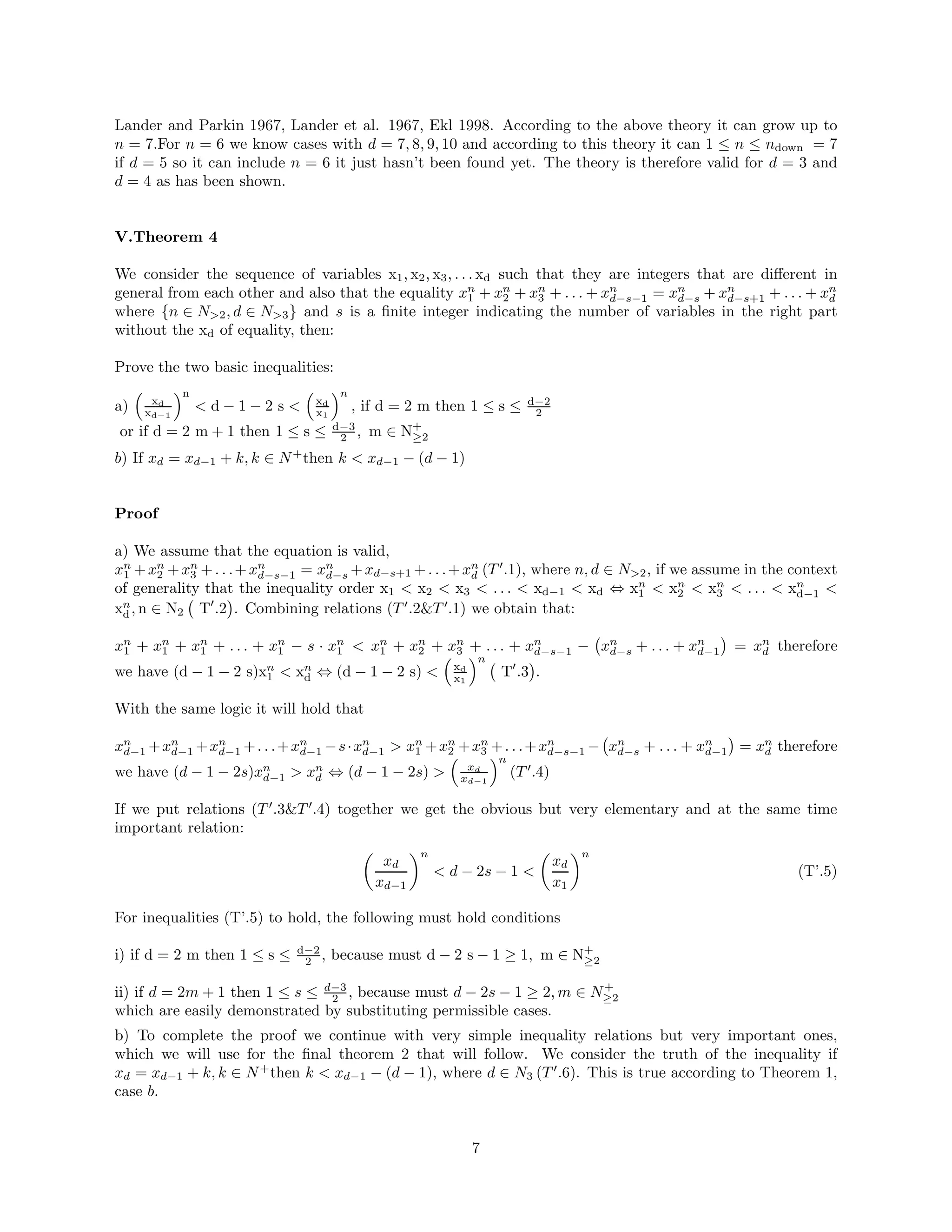
V.Theorem 4
We consider the sequence of variables x1, x2, x3, . . . xd such that they are integers that are different in
general from each other and also that the equality xn
1 + xn
2 + xn
3 + . . . + xn
d−s−1 = xn
d−s + xn
d−s+1 + . . . + xn
d
where {n ∈ N2, d ∈ N3} and s is a finite integer indicating the number of variables in the right part
without the xd of equality, then:
Prove the two basic inequalities:
a)

xd
xd−1
n
 d − 1 − 2 s 

xd
x1
n
, if d = 2 m then 1 ≤ s ≤ d−2
2
or if d = 2 m + 1 then 1 ≤ s ≤ d−3
2 , m ∈ N+
≥2
b) If xd = xd−1 + k, k ∈ N+
then k  xd−1 − (d − 1)
Proof
a) We assume that the equation is valid,
xn
1 +xn
2 +xn
3 +. . .+xn
d−s−1 = xn
d−s +xd−s+1 +. . .+xn
d (T ′
.1), where n, d ∈ N2, if we assume in the context
of generality that the inequality order x1  x2  x3  . . .  xd−1  xd ⇔ xn
1  xn
2  xn
3  . . .  xn
d−1 
xn
d, n ∈ N2 T′
.2

. Combining relations (T ′
.2T ′
.1) we obtain that:
xn
1 + xn
1 + xn
1 + . . . + xn
1 − s · xn
1  xn
1 + xn
2 + xn
3 + . . . + xn
d−s−1 − xn
d−s + . . . + xn
d−1

= xn
d therefore
we have (d − 1 − 2 s)xn
1  xn
d ⇔ (d − 1 − 2 s) 

xd
x1
n
T′
.3

.
With the same logic it will hold that
xn
d−1 +xn
d−1 +xn
d−1 +. . .+xn
d−1 −s·xn
d−1  xn
1 +xn
2 +xn
3 +. . .+xn
d−s−1 − xn
d−s + . . . + xn
d−1

= xn
d therefore
we have (d − 1 − 2s)xn
d−1  xn
d ⇔ (d − 1 − 2s) 

xd
xd−1
n
(T ′
.4)
If we put relations (T ′
.3T ′
.4) together we get the obvious but very elementary and at the same time
important relation:

xd
xd−1
n
 d − 2s − 1 

xd
x1
n
(T’.5)
For inequalities (T’.5) to hold, the following must hold conditions
i) if d = 2 m then 1 ≤ s ≤ d−2
2 , because must d − 2 s − 1 ≥ 1, m ∈ N+
≥2
ii) if d = 2m + 1 then 1 ≤ s ≤ d−3
2 , because must d − 2s − 1 ≥ 2, m ∈ N+
≥2
which are easily demonstrated by substituting permissible cases.
b) To complete the proof we continue with very simple inequality relations but very important ones,
which we will use for the final theorem 2 that will follow. We consider the truth of the inequality if
xd = xd−1 + k, k ∈ N+
then k  xd−1 − (d − 1), where d ∈ N3 (T ′
.6). This is true according to Theorem 1,
case b.
7
VI.Theorem 5.
The number of existing solutions of the exponent n for the equation xn
1 + xn
2 + xn
3 + . . . + xn
d−s−1 = xn
d−s +
xn
d−s+1+. . .+xn
d where n ≥ 3, d  3 positive integers is given by relation ndown ≤ lntegerPart

log(d−2s−1)
log(d+1
d )

as a function of d and s (where IntegerPart[] is an integer part of a number and log is the neper logarithm
of a number).
Therefore for values of n above the upper bound i.e. for nup ≥ lntegerPart

log(d−2s−1)
log(d+1
d )

+ 1 the Dio-
phantine equation has no solution.
Proof
For the equation xn
1 + xn
2 + xn
3 + . . . + xn
d−s−1 = xn
d−s + xn
d−s+1 + . . . + xn
d , where n ≥ 3, d  3 posi-
tive integers if I isolate the first part of the first relation i.e

xd
xd−1
n
 d − 2s − 1 (Θ′
.1) and the second
part k  xd−1 − (d − 1) with xd = xd−1 + k, k ∈ N+
(Θ′
.2) then I will two inequalities will result
(d − 2s − 1)
1
n − 1 
k
k + d − 1
(Θ′
.3)
(d − 2s − 1)
1
n − 1 
k
k + d − 1
(Θ′
.4)
for which, however, I will have to decide which of the two I will choose as acceptable for n. The previous
relations finally result for n in the forms associated with the integer part, which are:
n ≥ lntegerPart

log(d − 2 s − 1)
log

2k+d−1
d+k−1


 + 1 (Θ′
.5)
n ≤ lntegerPart

log(d − 2 s − 1)
log

2k+d−1
d+k−1


 (Θ′
.6)
But of course we want the cases where we have k = 1 because this will result in the minimum value for the
content of the integer part. This can be seen clearly if we take the content of the integer value and call
ε =
log(d − 2 s − 1)
log

2k+d−1
d+k−1
 =
log(d − 2 s − 1)
log

1 + k
d+k−1
 =
log(d − 2 s − 1)
log

1 + 1
1+ d−1
k
(Θ′.7)
The value for ε becomes minimum when k = 1 and will then take the value.
εmin =
log(d − 2 s − 1)
log 1 + 1
d
 =
log(d − 2 s − 1)
log d+1
d
 (Θ′
.8)
This will be the final minimum real value (Θ.8) we are interested in for the value of the exponent n, because
it reduces to the minimum the acceptable values it can take. We therefore obtain the final forms of the
relations for exponent n
8
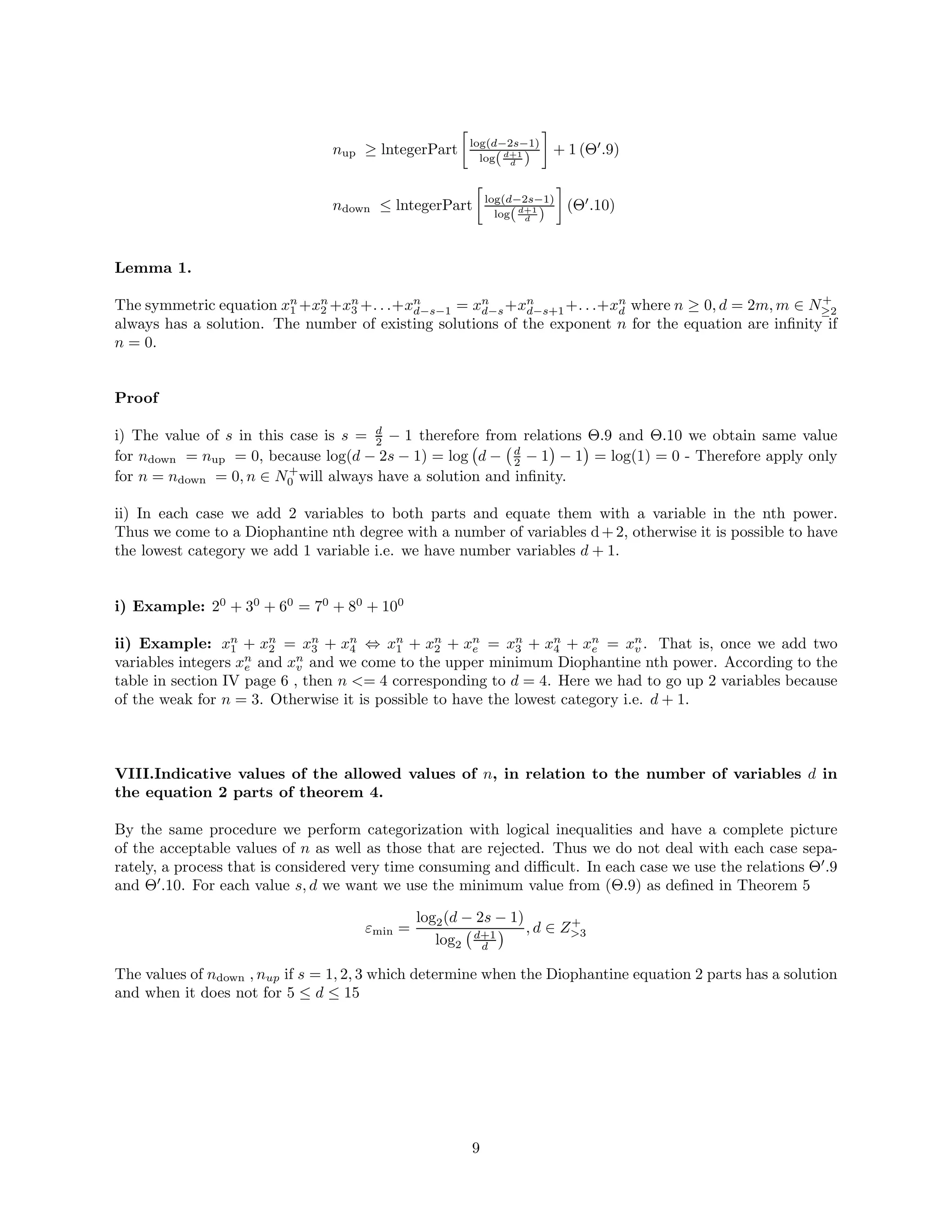
nup ≥ lntegerPart

log(d−2s−1)
log(d+1
d )

+ 1 (Θ′
.9)
ndown ≤ lntegerPart

log(d−2s−1)
log(d+1
d )

(Θ′
.10)
Lemma 1.
The symmetric equation xn
1 +xn
2 +xn
3 +. . .+xn
d−s−1 = xn
d−s+xn
d−s+1+. . .+xn
d where n ≥ 0, d = 2m, m ∈ N+
≥2
always has a solution. The number of existing solutions of the exponent n for the equation are infinity if
n = 0.
Proof
i) The value of s in this case is s = d
2 − 1 therefore from relations Θ.9 and Θ.10 we obtain same value
for ndown = nup = 0, because log(d − 2s − 1) = log d − d
2 − 1

− 1

= log(1) = 0 - Therefore apply only
for n = ndown = 0, n ∈ N+
0 will always have a solution and infinity.
ii) In each case we add 2 variables to both parts and equate them with a variable in the nth power.
Thus we come to a Diophantine nth degree with a number of variables d+ 2, otherwise it is possible to have
the lowest category we add 1 variable i.e. we have number variables d + 1.
i) Example: 20
+ 30
+ 60
= 70
+ 80
+ 100
ii) Example: xn
1 + xn
2 = xn
3 + xn
4 ⇔ xn
1 + xn
2 + xn
e = xn
3 + xn
4 + xn
e = xn
v . That is, once we add two
variables integers xn
e and xn
v and we come to the upper minimum Diophantine nth power. According to the
table in section IV page 6 , then n = 4 corresponding to d = 4. Here we had to go up 2 variables because
of the weak for n = 3. Otherwise it is possible to have the lowest category i.e. d + 1.
VIII.Indicative values of the allowed values of n, in relation to the number of variables d in
the equation 2 parts of theorem 4.
By the same procedure we perform categorization with logical inequalities and have a complete picture
of the acceptable values of n as well as those that are rejected. Thus we do not deal with each case sepa-
rately, a process that is considered very time consuming and difficult. In each case we use the relations Θ′
.9
and Θ′
.10. For each value s, d we want we use the minimum value from (Θ.9) as defined in Theorem 5
εmin =
log2(d − 2s − 1)
log2
d+1
d
 , d ∈ Z+
3
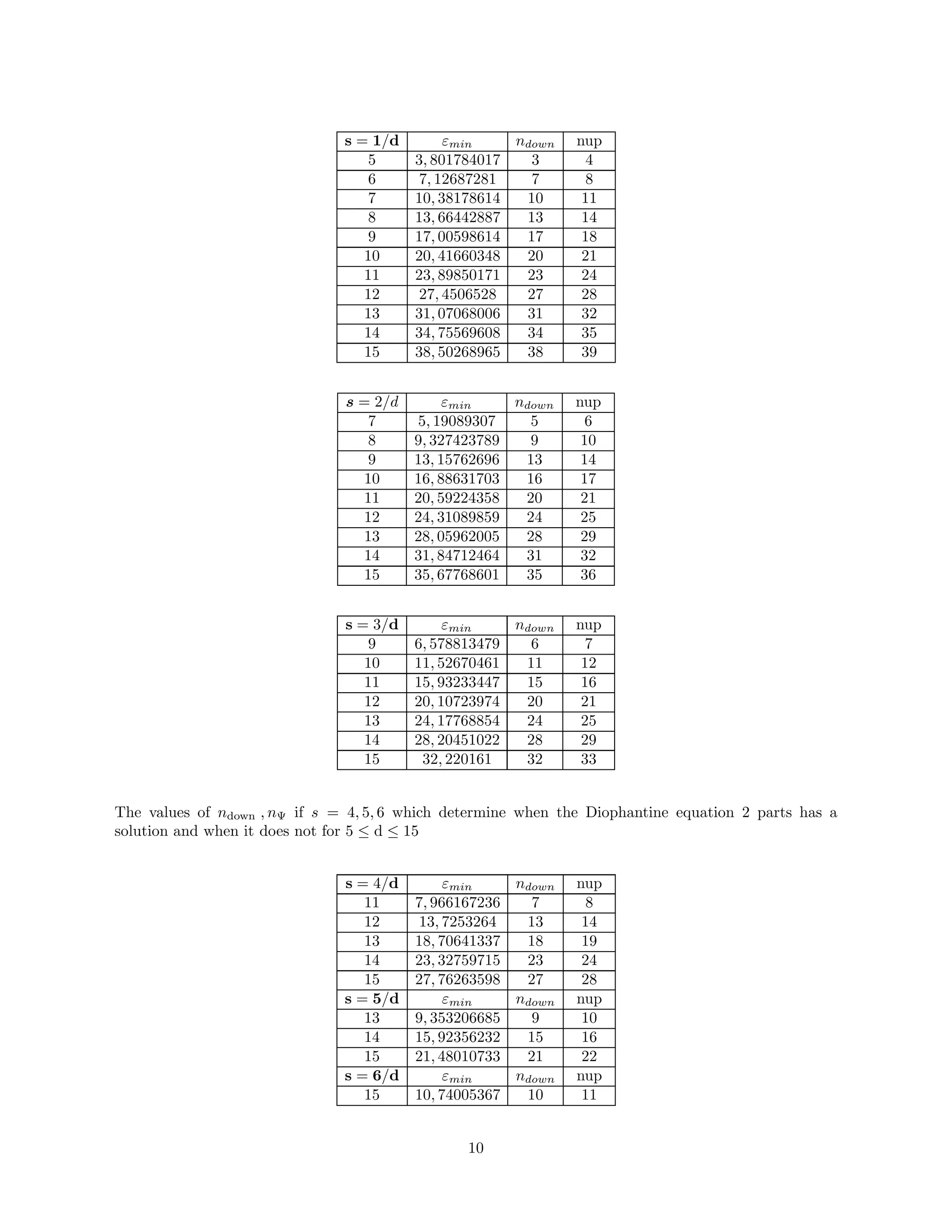
The values of ndown , nup if s = 1, 2, 3 which determine when the Diophantine equation 2 parts has a solution
and when it does not for 5 ≤ d ≤ 15
9
s = 1/d εmin ndown nup
5 3, 801784017 3 4
6 7, 12687281 7 8
7 10, 38178614 10 11
8 13, 66442887 13 14
9 17, 00598614 17 18
10 20, 41660348 20 21
11 23, 89850171 23 24
12 27, 4506528 27 28
13 31, 07068006 31 32
14 34, 75569608 34 35
15 38, 50268965 38 39
s = 2/d εmin ndown nup
7 5, 19089307 5 6
8 9, 327423789 9 10
9 13, 15762696 13 14
10 16, 88631703 16 17
11 20, 59224358 20 21
12 24, 31089859 24 25
13 28, 05962005 28 29
14 31, 84712464 31 32
15 35, 67768601 35 36
s = 3/d εmin ndown nup
9 6, 578813479 6 7
10 11, 52670461 11 12
11 15, 93233447 15 16
12 20, 10723974 20 21
13 24, 17768854 24 25
14 28, 20451022 28 29
15 32, 220161 32 33
The values of ndown , nΨ if s = 4, 5, 6 which determine when the Diophantine equation 2 parts has a
solution and when it does not for 5 ≤ d ≤ 15
s = 4/d εmin ndown nup
11 7, 966167236 7 8
12 13, 7253264 13 14
13 18, 70641337 18 19
14 23, 32759715 23 24
15 27, 76263598 27 28
s = 5/d εmin ndown nup
13 9, 353206685 9 10
14 15, 92356232 15 16
15 21, 48010733 21 22
s = 6/d εmin ndown nup
15 10, 74005367 10 11
10
Epilogue
Theorems 1 and 4 solve in general the problem of how many solutions the diophantine equations of degree
n with d variables have or do not have. Our goal is not to find such solutions, but to prove whether or not
solutions exist; therefore we use this method to find the bounds that n must agree with for a diophantine
equation to have a solution. It is, I believe, the most current and beautiful proof in terms of mathematical
logic.
References
[1] https://byjus.com/question-answer/is-log-2-rational-or-irrational-justify-your-answer/
[2] https://math.stackexchange.com/questions/656138/prove-that-log-2-3-is-irrational
[3] Proof of Beal’s conjecture, Mantzakouras Nikos, https://www.researchgate.net/publication/358229279_Proof_of_
[4] The Diophantine Equation ax
+ by
= cz
by Nobuhiro Terai.
[5] A new approach of Fermat-Catalan conjecture Jamel Ghanouchi.
[6] Lenstra, Jr., H.W. (1992) On the Inverse Fermat Equation. Discrete Mathematics, 106-107, 329-331.
https://doi.org/10.1016/0012-365X(92)90561-S
[7] Richinick, J. (2008) The Upside-Down Pythagorean Theorem. Mathematical Gazette, 92, 313- 317.
https://doi.org/10.1017/S0025557200183275
[8] Carmichael, R.D. (1913) On the Impossibility of Certain Diophantine Equations and Systems of
Equations. American Mathematical Monthly (Mathematical Association of America), 20, 213- 221.
https://doi.org/10.1080/00029890.1913.11997962
[9] Kronecker, L. (1901) Lectures on Number Theory, Vol. I. Teubner, Leipzig, 35-38.
[10] Poulkas, D. (2020) A Brief New Proof to Fermat’s Last Theorem and Its Generalization. Journal of
Applied Mathematics and Physics, 8
[11] Solutions to Beal’s Conjecture, Fermat’s last theorem and Riemann Hypothesis, A.C. Wimal Lalith De
Alwis.
[12] An Elementary Algorithm for Solving a Diophantine equation Nikolai N. Osipov, Maria I.Madvedeva
[13] An Introduction to Diophantine Equations Titu Andreescu, Dorin Andrica
11
View publication stats

fermat_last_theorem.pdf

  • 1.
    See discussions, stats,and author profiles for this publication at: https://www.researchgate.net/publication/369141311 General solution for Diophantine equation of degree n, with number of variables d Research Proposal · March 2023 DOI: 10.13140/RG.2.2.10352.94723 CITATIONS 0 READS 345 1 author: Nikos Mantzakouras National and Kapodistrian University of Athens 28 PUBLICATIONS 2 CITATIONS SEE PROFILE All content following this page was uploaded by Nikos Mantzakouras on 23 March 2023. The user has requested enhancement of the downloaded file.
  • 2.
    arXiv:submit/4797119 [math.GM] 18 Mar 2023 General solution forDiophantine equation of degree n, with number of variables d. N.Mantzakouras e-mail: nikmatza@gmail.com Athens - Greece Abstract The Pythagorean theorem is perhaps the best known theorem in the vast world of mathematics; a simple relation of square numbers that encapsulates the glory of mathematical science. It is also justifiably the most popular yet sublime theorem in mathematical science. The starting point was Diophantus’ 20th problem (Book VI of Diophantus’ Arithmetica), which for Fermat is for n = 4 and consists in the question whether there are right triangles whose sides can be counted as integers and whose surface can be square. The generalized method we use here is based on elementary inequalities and gives a solution to any diophantine equation of degree n with respect to the number of variables d. It is a method that does not exclude other equivalent analytical methods for finding specific solutions. However, the method proposed generalizes to any exponent n with number of variables d. An explicit proof is also given for variables in both parts with equal or different number of variables, also of degree n. As a direct application it is Fermat’s last theorem and of course has much broader generalization to symmetric or asymmetric diophantine equations. I. Theorem 1[7,8,9,10] We consider the sequence of variables x1, x2, x3, .., xd such that they are integers that are different in general from each other and also that the equality xn 1 + xn 2 + xn 3 + . . . + xn d−1 = xn d , where n ∈ N>2, and d ∈ N>2 indicating the number of variables. Prove the two basic inequalities: a) xd xd−1 n d − 1 xd x1 n b) If xd = xd−1 + k, k ∈ N+ then k xd−1 − (d − 1) Proof. a) We assume that the equation is valid, xn 1 + xn 2 + xn 3 + . . . + xn d−1 = xn d (T.1), where n, d ∈ N2, if we assume in the context of generality that the inequality order x1 x2 x3 . . . xd−1 xd ⇔ xn 1 xn 2 xn 3 . . . xn d−1 xn d, n ∈ N2 (T.2). Combining relations (T2T1) we obtain that: xn 1 + xn 1 + xn 1 + . . . + xn 1 xn 1 + xn 2 + xn 3 + . . . + xn d−1 = xn d therefore we have 1
  • 3.
    (d − 1)xn 1 xn d ⇔ (d − 1) xd x1 n (T.3) With the same logic it will hold that: xn d−1 + xn d−1 + xn d−1 + . . . + xn d−1 xn 1 + xn 2 + xn 3 + . . . + xn d−1 = xn d therefore we have (d − 1)xn d−1 xn d ⇔ (d − 1) xd xn d−1 n (T.4). If we put relations (T3T4) together we get the obvious but very elementary and at the same time impor- tant relation: xd xd−1 n d − 1 xd x1 n (T.5) b) To complete the proof we continue with very simple inequality relations but very important ones, which we will use for the final theorem 2 that will follow. We consider the truth of the inequality if xd = xd−1 + k, k ∈ N+ then k xd−1 − (d − 1), where d ∈ N2. (T.6) The proof follows 2 different cases, 1. We consider the extreme case if x1 k ≥ 1 where d ∈ N2. We therefore assume that x1 k ≥ 1 where d ∈ N2. It will also be true that: xd xd−1 . . . x2 x1 k ≥ 1 (T.7) From relation (T.7) the inequalities arise as a direct consequence: xd−1 ≥ xd−2 + 1, xd−2 ≥ xd−3 + 1, . . . , x2 ≥ x1 + 1, x1 ≥ k + 1 (T.8). Adding up in parts yields the general relation we are interested xd−1 = k + (d − 1) ⇔ k ≤ xd−1 − (d − 1) (T.9). For our case which d ≥ 3. We will prove that k 6= xd−1 − (d − 1) (T.10), since we have assumed that we want d ∈ N2. For equality to hold in general , we must k = x1 − 1 = x2 − 2 = . . . = xd−1 − (d − 1) (T.11). Which in more general follows from (T.11) that k = xi − i = xd−1 − (d − 1) where 1 ≤ i ≤ d − 1 (T.12). But from (T.12) follows the very basic relation that determines the wrong logic, i.e., 1 ≤ xi − xd−1 + d − 1 ≤ 0 + d − 1 or 1 ≤ d − 1 ⇔ d ≥ 2 his seems to contradict the hypothesis, because we have posited d ∈ N2 or d ≥ 3. 2. We consider the intermediate case xi ≤ k ≤ xd−1 or xi−1 ≤ k xi or 2 ≤ i ≤ d − 1. According to the preceding and relation (T.8) we will have the inequality relations: xd−1 ≥ xd−2 + 1, xd−2 ≥ xd−3 + 1, . . . , x2 ≥ x1 + 1, x1 ≥ k + 1 and as we know, it will add up as be- fore the inequality xd−1 = k + (d − 1) ⇔ k ≤ xd−1 − (d − 1). 2
  • 4.
    If we nowassume that the inequality: xd−1 − (d − 1) ≤ k ≤ xd−1 + (d − 1) ⇔ k ≤ xd−1 − (d − i) or −(d − 1) ≤ (d − i) ⇔ 1 ≤ i. (T.13). But the last very decisive inequality relation 1 ≤ i contradicts our hypothesis, because 2 ≤ i d − 1 there- fore the relation will not apply i.e k 6= xd−1 − (d − 1) (T.14), and only the relation we are interested in will apply, i.e. k xd−1 − (d − 1) (T.15). We have therefore proved 2 very basic inequalities which will guide us to the final form of inequalities and indicate the minimum value of the exponent n of the generalized diophantine equation: xn 1 + xn 2 + xn 3 + . . . + xn d−1 = xn d , where d ∈ N2 for which we are asked to find the restrictive integer limit of the exponent n, so that there are solutions to this diophantine equation. With this procedure, which has a simple but concise logic, we can solve this very difficult problem, for which no clear answer has yet been given, except for the case of d = 3 and n ≥ 3 by various methods, generally called the proof of Fermat’s Last Theorem Fermat. II. Theorem 2. The number of existing solutions of the exponent n for the equation xn 1 + xn 2 + xn 3 + . . . + xn d−1 = xn d , where d ∈ N2 is given by relation ndown ≤ IntegerPart log(d − 1) log d+1 d # as a function of d (where IntegerPart[] is an integer part of a number and log is the neper logarithm of a number). Therefore for values of n above the upper bound i.e. for nup ≥ lntegerPart log(d − 1) log d+1 d # + 1 the diophantine equation has no solution. Proof: A) According to Theorem 1, two basic relations will hold a) xd xd−1 n d − 1 xd x1 n b) If xd = xd−1 + k, k ∈ N+ then k xd−1 − (d − 1) For the equation xn 1 + xn 2 + xn 3 + . . . + xn d−1 = xn d , where d, n ∈ N2. If I isolate the first part of the first relation i.e xd xd−1 n d−1 (Θ1) and the second part k xd−1 −(d−1) with xd = xd−1 +k, k ∈ N+ (Θ.2) then I will two inequalities will result (d − 1) 1 n − 1 k k + d − 1 (Θ.3) (d − 1) 1 n − 1 k k + d − 1 (Θ.4) 3
  • 5.
    for which, however,I will have to decide which of the two I will choose as acceptable for n. The previous relations finally result for n in the forms associated with the integer part, which are: n ≥ lntegerPart   log(d − 1) log 2k+d−1 d+k−1   + 1 (Θ.5) n ≤ lntegerPart   log(d − 1) log 2k+d−1 d+k−1   (Θ.6) But of course we want the cases where we have k = 1 because this will result in the minimum value for the content of the integer part.This can be seen clearly if we take ε = log(d − 1) log 2k+d−1 d+k−1 = log(d − 1) log 1 + k d+k−1 = log(d − 1) log 1 + 1 1+ d−1 k (Θ.7) and call The value for ε becomes minimum when k = 1 and will then take the value εmin = log(d − 1) log 1 + 1 d = log(d − 1) log d+1 d (Θ.8) This will be the final minimum real value (Θ.8) we are interested in for the value of the exponent n, because it reduces to the minimum the acceptable values it can take. Eventually we will clearly get its integer value for the allowable value of the exponent. Any other value removes the exponent from the real values and therefore will not be the one we are looking for. We therefore obtain the final forms of the relations for exponent n nup ≥ IntegerPart log(d − 1) log d+1 d # + 1 (Θ.9) ndown ≤ IntegerPart log(d − 1) log d+1 d # (Θ.10) Since we have assumed k = 1 d = 3 for the equation xn 1 + xn 2 + xn 3 + . . . + xn d−1 = xn d , where d ∈ N2, in order for one of the two relations (Θ.9, Θ.10) to hold, it must include n = 1n = 2 which are known to be acceptable and valid.By this obvious logic it obviously follows that the second inequality will hold and the first will not. The first will be the cases of n which are excluded to yield solutions for the diophantine equation. B) From relation (Θ.8), which refers to the integer minimum content εmin = log(d − 1) log d+1 d (Θ.11) of the above relations, I can prove that it is always a real number, namely εmin ∈ R+ − Q+ . This means that in no case do the two limits of n coincide for every integer d. It is a correct expected result that rules out the possibility of an error in choosing the correct integer that will lead us to the existence of solutions and therefore this proof is absolutely useful. We will need a more understandable form to convert the neper logarithm to an integer base and let us choose 2. We therefore start from relation (Θ.11) and transform it εmin = log(d − 1)/ log 2 log d+1 d / log 2 = log2( d − 1) log2 d+1 d (Θ.12) 4
  • 6.
    Assuming the replacements d− 1 = 2m ⇔ d = 1 + 2m and therefore log2(d − 1) = m, m ∈ Z+ . Also log2 d+1 d = log2 1 + 1 d = log2 1 + 1 2m+1 . It will follow that εmin = m log2 1 + 1 2m+1 , m ∈ Z+ (Θ.13) We have to prove that log2 1 + 1 2m+1 ∈ R+ − Q+ and then obviously it will hold that εmin ∈ R+ − Q+ . We will need two partial proofs. First, we will develop the relation log 1 + 1 2m+1 in Maclaurin series. The expansion will be (2 log[2] − log[3]) − 1 6 log[2](m − 1) + 1 72 log[2]2 (m − 1)2 + 1 81 log[2]3 (m − 1)3 − 11 log[2]4 (m − 1)4 5184 − 1 972 log[2]5 (m − 1)5 + O[m − 1]6 But the final relationship we are interested in log2 1 + 1 2m+1 will be in final form 2 log[2] − log[3] log[2] − m − 1 6 + 1 72 log[2](m − 1)2 + 1 81 log[2]2 (m − 1)3 − 11 log[2]3 (m − 1)4 5184 − 1 972 log[2]4 (m − 1)5 + O[m − 1]6 We will therefore have a sum of terms that has two constant integers and the other terms will be in log 3/ log 2 form and the other terms in log 2 form. But log 2 is an Irrational number as is the ratio log 3/ log 2[A1, A2]. So the whole sum of the series will be an Irrational number and by extension the value of εmin = m log2 1 + 1 2m+1 , m ∈ Z+ , εmin ∈ R+ − Q+ , as a ratio of an integer to an irrational value of number. Therefore it will hold ndown 6= nup, ∀d ∈ Z+ with acceptable values of the exponent n, so that there is a solution of the generalized diophantine xn 1 + xn 2 + xn 3 + . . . + xn d−1 = xn d , where n ∈ N2 only for its values of ndown , ∀d ∈ Z+ . Obviously for any arrangement with d number of variables we will follow the same pro- cedure with the corresponding log base and come to the same conclusion, i.e. if d ∈ Z+ 2, εmin ∈ R+ − Q+ . III. Theorem 3. (F.L.T) Proof For any integer n 2, the equation xn 1 + xn 2 = xn 3 , where n ∈ N2 has no positive integer solutions. According to Theorem 2(Θ.11), the acceptable values for the exponent n will be given by the relation ndown ≤ IntegerPart log(d − 1) log d+1 d # , d = 3. 5
  • 7.
    For this particulardiophantine equation we will have εmin = log2(d − 1) log2 d+1 d = 2.409421 and hence according to the minimum value the upper value for n will be fully defined ndown ≤ ln tegerPart log(d − 1) log d+1 d # = IntegerPart[2.409421] = 2 The forbidden values of n will therefore be nup ≥ lntegerPart log(d − 1) log d+1 d # = lntegerPart[2.409421] + 1 = 3, n ≥ 3 Therefore, for Fermat’s diophantine does not accept solutions. The proof with the given values is complete and complete and understandable but also determinative for the values of n. IV. Indicative values of the allowed values of n, in relation to the number of variables d in the equation. A concise procedure with logical inequalities therefore gives us a complete picture of the admissible solutions for n, without having to analyze each case separately, with procedures that are complex and time-consuming, especially as we go up in number of variables. The key the panelization is obviously the value of εmin = log2(d − 1) log2 d+1 d , d ∈ Z+ 2 from (Θ.11) and the 2 values nup and ndown as defined in Theorem 2. The values of ndown , nup which determine when the Diophantine equation has a solution and when it does not for 3 ≤ d ≤ 15 d εmin ndown nup 3 2,40942084 2 3 4 4,923343212 4 5 5 7,603568034 7 8 6 10,44067995 10 11 7 13,41826 13 14 8 16,52114108 16 17 9 19,73644044 19 20 10 23,05340921 23 24 11 26,46303475 26 27 12 29,95769812 29 30 13 33,53089523 33 34 14 37,17701992 37 38 15 40,89119619 40 41 Therefore for to 1 ≤ n ≤ ndown we always have solutions for the generalized Fermat’s Diophantine equa- tion while for values n ≥ nup the equation cannot possibly have a solution and therefore any attempt to find solutions is impossible for the variables xi, i ∈ N+ 2 d 2 number of variables. Cases that have been considered are d = 3 the known case of Fermat for d = 4 has been shown not to exist for n 4 is known to (Lander et al. 1967). For d = 5 as we can see there are cases such as 27∧ 5 + 84∧ 5 + 110∧ 5 + 133∧ 5 = 144∧ 5, 6
  • 8.
    Lander and Parkin1967, Lander et al. 1967, Ekl 1998. According to the above theory it can grow up to n = 7.For n = 6 we know cases with d = 7, 8, 9, 10 and according to this theory it can 1 ≤ n ≤ ndown = 7 if d = 5 so it can include n = 6 it just hasn’t been found yet. The theory is therefore valid for d = 3 and d = 4 as has been shown. V.Theorem 4 We consider the sequence of variables x1, x2, x3, . . . xd such that they are integers that are different in general from each other and also that the equality xn 1 + xn 2 + xn 3 + . . . + xn d−s−1 = xn d−s + xn d−s+1 + . . . + xn d where {n ∈ N2, d ∈ N3} and s is a finite integer indicating the number of variables in the right part without the xd of equality, then: Prove the two basic inequalities: a) xd xd−1 n d − 1 − 2 s xd x1 n , if d = 2 m then 1 ≤ s ≤ d−2 2 or if d = 2 m + 1 then 1 ≤ s ≤ d−3 2 , m ∈ N+ ≥2 b) If xd = xd−1 + k, k ∈ N+ then k xd−1 − (d − 1) Proof a) We assume that the equation is valid, xn 1 +xn 2 +xn 3 +. . .+xn d−s−1 = xn d−s +xd−s+1 +. . .+xn d (T ′ .1), where n, d ∈ N2, if we assume in the context of generality that the inequality order x1 x2 x3 . . . xd−1 xd ⇔ xn 1 xn 2 xn 3 . . . xn d−1 xn d, n ∈ N2 T′ .2 . Combining relations (T ′ .2T ′ .1) we obtain that: xn 1 + xn 1 + xn 1 + . . . + xn 1 − s · xn 1 xn 1 + xn 2 + xn 3 + . . . + xn d−s−1 − xn d−s + . . . + xn d−1 = xn d therefore we have (d − 1 − 2 s)xn 1 xn d ⇔ (d − 1 − 2 s) xd x1 n T′ .3 . With the same logic it will hold that xn d−1 +xn d−1 +xn d−1 +. . .+xn d−1 −s·xn d−1 xn 1 +xn 2 +xn 3 +. . .+xn d−s−1 − xn d−s + . . . + xn d−1 = xn d therefore we have (d − 1 − 2s)xn d−1 xn d ⇔ (d − 1 − 2s) xd xd−1 n (T ′ .4) If we put relations (T ′ .3T ′ .4) together we get the obvious but very elementary and at the same time important relation: xd xd−1 n d − 2s − 1 xd x1 n (T’.5) For inequalities (T’.5) to hold, the following must hold conditions i) if d = 2 m then 1 ≤ s ≤ d−2 2 , because must d − 2 s − 1 ≥ 1, m ∈ N+ ≥2 ii) if d = 2m + 1 then 1 ≤ s ≤ d−3 2 , because must d − 2s − 1 ≥ 2, m ∈ N+ ≥2 which are easily demonstrated by substituting permissible cases. b) To complete the proof we continue with very simple inequality relations but very important ones, which we will use for the final theorem 2 that will follow. We consider the truth of the inequality if xd = xd−1 + k, k ∈ N+ then k xd−1 − (d − 1), where d ∈ N3 (T ′ .6). This is true according to Theorem 1, case b. 7
  • 9.
    VI.Theorem 5. The numberof existing solutions of the exponent n for the equation xn 1 + xn 2 + xn 3 + . . . + xn d−s−1 = xn d−s + xn d−s+1+. . .+xn d where n ≥ 3, d 3 positive integers is given by relation ndown ≤ lntegerPart log(d−2s−1) log(d+1 d ) as a function of d and s (where IntegerPart[] is an integer part of a number and log is the neper logarithm of a number). Therefore for values of n above the upper bound i.e. for nup ≥ lntegerPart log(d−2s−1) log(d+1 d ) + 1 the Dio- phantine equation has no solution. Proof For the equation xn 1 + xn 2 + xn 3 + . . . + xn d−s−1 = xn d−s + xn d−s+1 + . . . + xn d , where n ≥ 3, d 3 posi- tive integers if I isolate the first part of the first relation i.e xd xd−1 n d − 2s − 1 (Θ′ .1) and the second part k xd−1 − (d − 1) with xd = xd−1 + k, k ∈ N+ (Θ′ .2) then I will two inequalities will result (d − 2s − 1) 1 n − 1 k k + d − 1 (Θ′ .3) (d − 2s − 1) 1 n − 1 k k + d − 1 (Θ′ .4) for which, however, I will have to decide which of the two I will choose as acceptable for n. The previous relations finally result for n in the forms associated with the integer part, which are: n ≥ lntegerPart  log(d − 2 s − 1) log 2k+d−1 d+k−1   + 1 (Θ′ .5) n ≤ lntegerPart  log(d − 2 s − 1) log 2k+d−1 d+k−1   (Θ′ .6) But of course we want the cases where we have k = 1 because this will result in the minimum value for the content of the integer part. This can be seen clearly if we take the content of the integer value and call ε = log(d − 2 s − 1) log 2k+d−1 d+k−1 = log(d − 2 s − 1) log 1 + k d+k−1 = log(d − 2 s − 1) log 1 + 1 1+ d−1 k (Θ′.7) The value for ε becomes minimum when k = 1 and will then take the value. εmin = log(d − 2 s − 1) log 1 + 1 d = log(d − 2 s − 1) log d+1 d (Θ′ .8) This will be the final minimum real value (Θ.8) we are interested in for the value of the exponent n, because it reduces to the minimum the acceptable values it can take. We therefore obtain the final forms of the relations for exponent n 8
  • 10.
    nup ≥ lntegerPart log(d−2s−1) log(d+1 d) + 1 (Θ′ .9) ndown ≤ lntegerPart log(d−2s−1) log(d+1 d ) (Θ′ .10) Lemma 1. The symmetric equation xn 1 +xn 2 +xn 3 +. . .+xn d−s−1 = xn d−s+xn d−s+1+. . .+xn d where n ≥ 0, d = 2m, m ∈ N+ ≥2 always has a solution. The number of existing solutions of the exponent n for the equation are infinity if n = 0. Proof i) The value of s in this case is s = d 2 − 1 therefore from relations Θ.9 and Θ.10 we obtain same value for ndown = nup = 0, because log(d − 2s − 1) = log d − d 2 − 1 − 1 = log(1) = 0 - Therefore apply only for n = ndown = 0, n ∈ N+ 0 will always have a solution and infinity. ii) In each case we add 2 variables to both parts and equate them with a variable in the nth power. Thus we come to a Diophantine nth degree with a number of variables d+ 2, otherwise it is possible to have the lowest category we add 1 variable i.e. we have number variables d + 1. i) Example: 20 + 30 + 60 = 70 + 80 + 100 ii) Example: xn 1 + xn 2 = xn 3 + xn 4 ⇔ xn 1 + xn 2 + xn e = xn 3 + xn 4 + xn e = xn v . That is, once we add two variables integers xn e and xn v and we come to the upper minimum Diophantine nth power. According to the table in section IV page 6 , then n = 4 corresponding to d = 4. Here we had to go up 2 variables because of the weak for n = 3. Otherwise it is possible to have the lowest category i.e. d + 1. VIII.Indicative values of the allowed values of n, in relation to the number of variables d in the equation 2 parts of theorem 4. By the same procedure we perform categorization with logical inequalities and have a complete picture of the acceptable values of n as well as those that are rejected. Thus we do not deal with each case sepa- rately, a process that is considered very time consuming and difficult. In each case we use the relations Θ′ .9 and Θ′ .10. For each value s, d we want we use the minimum value from (Θ.9) as defined in Theorem 5 εmin = log2(d − 2s − 1) log2 d+1 d , d ∈ Z+ 3 The values of ndown , nup if s = 1, 2, 3 which determine when the Diophantine equation 2 parts has a solution and when it does not for 5 ≤ d ≤ 15 9
  • 11.
    s = 1/dεmin ndown nup 5 3, 801784017 3 4 6 7, 12687281 7 8 7 10, 38178614 10 11 8 13, 66442887 13 14 9 17, 00598614 17 18 10 20, 41660348 20 21 11 23, 89850171 23 24 12 27, 4506528 27 28 13 31, 07068006 31 32 14 34, 75569608 34 35 15 38, 50268965 38 39 s = 2/d εmin ndown nup 7 5, 19089307 5 6 8 9, 327423789 9 10 9 13, 15762696 13 14 10 16, 88631703 16 17 11 20, 59224358 20 21 12 24, 31089859 24 25 13 28, 05962005 28 29 14 31, 84712464 31 32 15 35, 67768601 35 36 s = 3/d εmin ndown nup 9 6, 578813479 6 7 10 11, 52670461 11 12 11 15, 93233447 15 16 12 20, 10723974 20 21 13 24, 17768854 24 25 14 28, 20451022 28 29 15 32, 220161 32 33 The values of ndown , nΨ if s = 4, 5, 6 which determine when the Diophantine equation 2 parts has a solution and when it does not for 5 ≤ d ≤ 15 s = 4/d εmin ndown nup 11 7, 966167236 7 8 12 13, 7253264 13 14 13 18, 70641337 18 19 14 23, 32759715 23 24 15 27, 76263598 27 28 s = 5/d εmin ndown nup 13 9, 353206685 9 10 14 15, 92356232 15 16 15 21, 48010733 21 22 s = 6/d εmin ndown nup 15 10, 74005367 10 11 10
  • 12.
    Epilogue Theorems 1 and4 solve in general the problem of how many solutions the diophantine equations of degree n with d variables have or do not have. Our goal is not to find such solutions, but to prove whether or not solutions exist; therefore we use this method to find the bounds that n must agree with for a diophantine equation to have a solution. It is, I believe, the most current and beautiful proof in terms of mathematical logic. References [1] https://byjus.com/question-answer/is-log-2-rational-or-irrational-justify-your-answer/ [2] https://math.stackexchange.com/questions/656138/prove-that-log-2-3-is-irrational [3] Proof of Beal’s conjecture, Mantzakouras Nikos, https://www.researchgate.net/publication/358229279_Proof_of_ [4] The Diophantine Equation ax + by = cz by Nobuhiro Terai. [5] A new approach of Fermat-Catalan conjecture Jamel Ghanouchi. [6] Lenstra, Jr., H.W. (1992) On the Inverse Fermat Equation. Discrete Mathematics, 106-107, 329-331. https://doi.org/10.1016/0012-365X(92)90561-S [7] Richinick, J. (2008) The Upside-Down Pythagorean Theorem. Mathematical Gazette, 92, 313- 317. https://doi.org/10.1017/S0025557200183275 [8] Carmichael, R.D. (1913) On the Impossibility of Certain Diophantine Equations and Systems of Equations. American Mathematical Monthly (Mathematical Association of America), 20, 213- 221. https://doi.org/10.1080/00029890.1913.11997962 [9] Kronecker, L. (1901) Lectures on Number Theory, Vol. I. Teubner, Leipzig, 35-38. [10] Poulkas, D. (2020) A Brief New Proof to Fermat’s Last Theorem and Its Generalization. Journal of Applied Mathematics and Physics, 8 [11] Solutions to Beal’s Conjecture, Fermat’s last theorem and Riemann Hypothesis, A.C. Wimal Lalith De Alwis. [12] An Elementary Algorithm for Solving a Diophantine equation Nikolai N. Osipov, Maria I.Madvedeva [13] An Introduction to Diophantine Equations Titu Andreescu, Dorin Andrica 11 View publication stats