











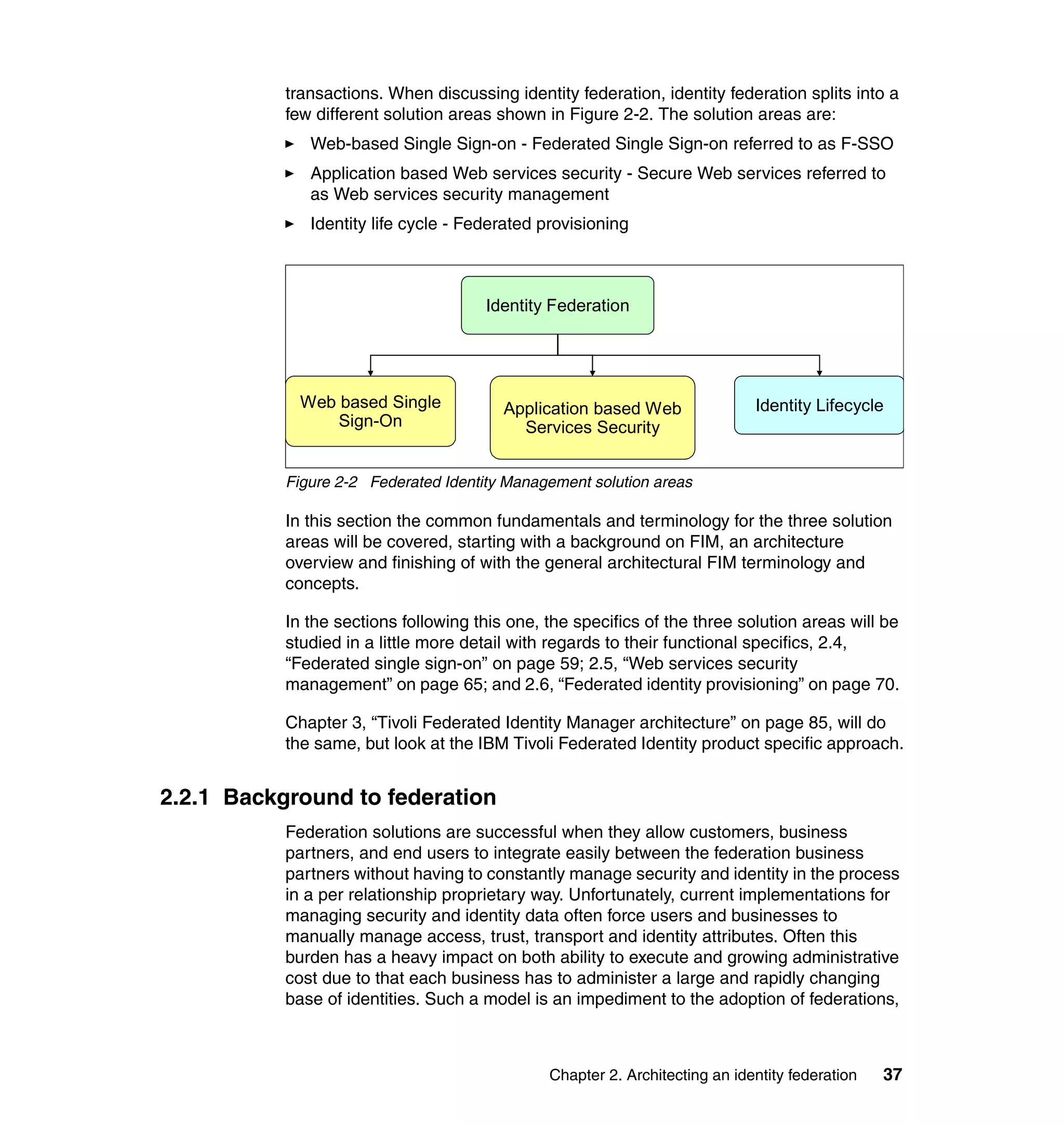





Front cover


Federated Identity
Management and
Web Services Security
with IBM Tivoli Security Solutions
Introduction to Web services security
standards

Complete product architecture
and component discussion

Extensive federation
business scenario


                                                                Axel Buecker
                                                                 Werner Filip
                                                              Heather Hinton
                                                      Heinz Peter Hippenstiel
                                                                  Mark Hollin
                                                                 Ray Neucom
                                                              Shane Weeden
                                                             Johan Westman


ibm.com/redbooks
International Technical Support Organization

Federated Identity Management and Web Services
Security with IBM Tivoli Security Solutions

October 2005


                                               SG24-6394-01
Note: Before using this information and the product it supports, read the information in
 “Notices” on page xiii.


Second Edition (October 2005)

This edition applies to Version 6 of Tivoli Federated Identity Manager (product number 5724-L73)
and to all subsequent releases and modifications until otherwise indicated in new editions. Various
other related IBM and Tivoli products are mentioned in this book.

© Copyright International Business Machines Corporation 2004, 2005. All rights reserved.
Note to U.S. Government Users Restricted Rights -- Use, duplication or disclosure restricted by GSA ADP
Schedule Contract with IBM Corp.
Contents

                     Notices . . . . . . . . . . . . . . . . . . . . . . . . . . . . . . . . . . . . . . . . . . . . . . . . . . . . . . xiii
                     Trademarks . . . . . . . . . . . . . . . . . . . . . . . . . . . . . . . . . . . . . . . . . . . . . . . . . . . xiv

                     Preface . . . . . . . . . . . . . . . . . . . . . . . . . . . . . . . . . . . . . . . . . . . . . . . . . . . . . . xv
                     The team that wrote this redbook. . . . . . . . . . . . . . . . . . . . . . . . . . . . . . . . . . . xvi
                     Become a published author . . . . . . . . . . . . . . . . . . . . . . . . . . . . . . . . . . . . . . xviii
                     Comments welcome. . . . . . . . . . . . . . . . . . . . . . . . . . . . . . . . . . . . . . . . . . . . . xix

Part 1. Architecture and design . . . . . . . . . . . . . . . . . . . . . . . . . . . . . . . . . . . . . . . . . . . . . . . . 1

                     Chapter 1. Business context for identity federation . . . . . . . . . . . . . . . . . . 3
                     1.1 Federated identity . . . . . . . . . . . . . . . . . . . . . . . . . . . . . . . . . . . . . . . . . . . . 4
                     1.2 Business environment . . . . . . . . . . . . . . . . . . . . . . . . . . . . . . . . . . . . . . . . . 5
                        1.2.1 Deconstruction of the enterprise . . . . . . . . . . . . . . . . . . . . . . . . . . . . . 5
                        1.2.2 Enterprise re-aggregation . . . . . . . . . . . . . . . . . . . . . . . . . . . . . . . . . . 6
                        1.2.3 High-level example of a re-aggregated business . . . . . . . . . . . . . . . . 7
                        1.2.4 Business models for federated identity . . . . . . . . . . . . . . . . . . . . . . . . 9
                        1.2.5 The relationship - Trust and assurance. . . . . . . . . . . . . . . . . . . . . . . 15
                     1.3 IT environment . . . . . . . . . . . . . . . . . . . . . . . . . . . . . . . . . . . . . . . . . . . . . 17
                        1.3.1 The role of identity management. . . . . . . . . . . . . . . . . . . . . . . . . . . . 17
                        1.3.2 Dealing with identities . . . . . . . . . . . . . . . . . . . . . . . . . . . . . . . . . . . . 20
                        1.3.3 User life cycle management . . . . . . . . . . . . . . . . . . . . . . . . . . . . . . . 23
                        1.3.4 Inter-enterprise application to application integration . . . . . . . . . . . . 25
                        1.3.5 Open standards. . . . . . . . . . . . . . . . . . . . . . . . . . . . . . . . . . . . . . . . . 27
                     1.4 Conclusion. . . . . . . . . . . . . . . . . . . . . . . . . . . . . . . . . . . . . . . . . . . . . . . . . 28

                     Chapter 2. Architecting an identity federation . . . . . . . . . . . . . . . . . . . . . . 31
                     2.1 Federation example. . . . . . . . . . . . . . . . . . . . . . . . . . . . . . . . . . . . . . . . . . 33
                     2.2 Federated identity management architecture . . . . . . . . . . . . . . . . . . . . . . 36
                        2.2.1 Background to federation . . . . . . . . . . . . . . . . . . . . . . . . . . . . . . . . . 37
                        2.2.2 Architecture overview . . . . . . . . . . . . . . . . . . . . . . . . . . . . . . . . . . . . 38
                        2.2.3 Roles . . . . . . . . . . . . . . . . . . . . . . . . . . . . . . . . . . . . . . . . . . . . . . . . . 41
                        2.2.4 Identity models . . . . . . . . . . . . . . . . . . . . . . . . . . . . . . . . . . . . . . . . . 42
                        2.2.5 Identity attributes. . . . . . . . . . . . . . . . . . . . . . . . . . . . . . . . . . . . . . . . 45
                        2.2.6 Trust . . . . . . . . . . . . . . . . . . . . . . . . . . . . . . . . . . . . . . . . . . . . . . . . . 49
                        2.2.7 Federation protocol . . . . . . . . . . . . . . . . . . . . . . . . . . . . . . . . . . . . . . 51
                     2.3 FIM standards and efforts . . . . . . . . . . . . . . . . . . . . . . . . . . . . . . . . . . . . . 51
                        2.3.1 SSL/TSL . . . . . . . . . . . . . . . . . . . . . . . . . . . . . . . . . . . . . . . . . . . . . . 52
                        2.3.2 Security Assertion Markup Language (SAML) . . . . . . . . . . . . . . . . . 52


© Copyright IBM Corp. 2004, 2005. All rights reserved.                                                                                    iii
2.3.3 Shibboleth . . . . . . . . . . . . . . . . . . . . . . . . . . . . . . . . . . . . . . . . . . . . . 53
                   2.3.4 Liberty . . . . . . . . . . . . . . . . . . . . . . . . . . . . . . . . . . . . . . . . . . . . . . . . 54
                   2.3.5 WS-Federation . . . . . . . . . . . . . . . . . . . . . . . . . . . . . . . . . . . . . . . . . 55
                   2.3.6 WS-Trust . . . . . . . . . . . . . . . . . . . . . . . . . . . . . . . . . . . . . . . . . . . . . . 56
                   2.3.7 WS-Security . . . . . . . . . . . . . . . . . . . . . . . . . . . . . . . . . . . . . . . . . . . 57
                   2.3.8 WS-Provisioning . . . . . . . . . . . . . . . . . . . . . . . . . . . . . . . . . . . . . . . . 57
                   2.3.9 Selecting Federation standards . . . . . . . . . . . . . . . . . . . . . . . . . . . . 58
                2.4 Federated single sign-on. . . . . . . . . . . . . . . . . . . . . . . . . . . . . . . . . . . . . . 59
                   2.4.1 Push and Pull SSO . . . . . . . . . . . . . . . . . . . . . . . . . . . . . . . . . . . . . . 60
                   2.4.2 Account linking . . . . . . . . . . . . . . . . . . . . . . . . . . . . . . . . . . . . . . . . . 61
                   2.4.3 Where are you from (WAYF). . . . . . . . . . . . . . . . . . . . . . . . . . . . . . . 62
                   2.4.4 Session management and access rights . . . . . . . . . . . . . . . . . . . . . 63
                   2.4.5 Logout . . . . . . . . . . . . . . . . . . . . . . . . . . . . . . . . . . . . . . . . . . . . . . . . 63
                   2.4.6 Credentials clean up . . . . . . . . . . . . . . . . . . . . . . . . . . . . . . . . . . . . . 64
                   2.4.7 Global good-bye . . . . . . . . . . . . . . . . . . . . . . . . . . . . . . . . . . . . . . . . 64
                   2.4.8 Account de-linking . . . . . . . . . . . . . . . . . . . . . . . . . . . . . . . . . . . . . . . 65
                2.5 Web services security management . . . . . . . . . . . . . . . . . . . . . . . . . . . . . 65
                   2.5.1 Web services. . . . . . . . . . . . . . . . . . . . . . . . . . . . . . . . . . . . . . . . . . . 66
                   2.5.2 Web services security . . . . . . . . . . . . . . . . . . . . . . . . . . . . . . . . . . . . 68
                   2.5.3 Gateways . . . . . . . . . . . . . . . . . . . . . . . . . . . . . . . . . . . . . . . . . . . . . 69
                2.6 Federated identity provisioning . . . . . . . . . . . . . . . . . . . . . . . . . . . . . . . . . 70
                2.7 On demand security reference architecture . . . . . . . . . . . . . . . . . . . . . . . 72
                   2.7.1 Policy management. . . . . . . . . . . . . . . . . . . . . . . . . . . . . . . . . . . . . . 73
                   2.7.2 Identity management. . . . . . . . . . . . . . . . . . . . . . . . . . . . . . . . . . . . . 74
                   2.7.3 Key management . . . . . . . . . . . . . . . . . . . . . . . . . . . . . . . . . . . . . . . 74
                   2.7.4 Credential exchange . . . . . . . . . . . . . . . . . . . . . . . . . . . . . . . . . . . . . 74
                   2.7.5 Identity federation . . . . . . . . . . . . . . . . . . . . . . . . . . . . . . . . . . . . . . . 75
                   2.7.6 Authorization . . . . . . . . . . . . . . . . . . . . . . . . . . . . . . . . . . . . . . . . . . . 75
                2.8 On demand integration reference architecture . . . . . . . . . . . . . . . . . . . . . 75
                   2.8.1 Connectivity services . . . . . . . . . . . . . . . . . . . . . . . . . . . . . . . . . . . . 77
                   2.8.2 User interaction services . . . . . . . . . . . . . . . . . . . . . . . . . . . . . . . . . . 77
                   2.8.3 Application and information assets . . . . . . . . . . . . . . . . . . . . . . . . . . 78
                   2.8.4 Business application services . . . . . . . . . . . . . . . . . . . . . . . . . . . . . . 78
                   2.8.5 Partner services . . . . . . . . . . . . . . . . . . . . . . . . . . . . . . . . . . . . . . . . 78
                   2.8.6 Infrastructure services . . . . . . . . . . . . . . . . . . . . . . . . . . . . . . . . . . . . 79
                2.9 Method for architecting secure solution. . . . . . . . . . . . . . . . . . . . . . . . . . . 79
                   2.9.1 Implementation flow . . . . . . . . . . . . . . . . . . . . . . . . . . . . . . . . . . . . . 80
                   2.9.2 Definition phase of a federated identity management solution . . . . . 81
                2.10 Conclusion. . . . . . . . . . . . . . . . . . . . . . . . . . . . . . . . . . . . . . . . . . . . . . . . 83

                Chapter 3. Tivoli Federated Identity Manager architecture . . . . . . . . . . . . 85
                3.1 Federated Identity Management functionality . . . . . . . . . . . . . . . . . . . . . . 86
                3.2 Federation services . . . . . . . . . . . . . . . . . . . . . . . . . . . . . . . . . . . . . . . . . . 87


iv   Federated Identity Management and Web Services Security with IBM Tivoli Security Solutions
3.2.1 Point of contact (PoC) . . . . . . . . . . . . . . . . . . . . . . . . . . . . . . . . . . . . 89
   3.2.2 Single sign-on protocol services (SPS) . . . . . . . . . . . . . . . . . . . . . . . 91
   3.2.3 Trust services . . . . . . . . . . . . . . . . . . . . . . . . . . . . . . . . . . . . . . . . . . 92
   3.2.4 Key services (KESS) . . . . . . . . . . . . . . . . . . . . . . . . . . . . . . . . . . . . . 96
   3.2.5 Identity services . . . . . . . . . . . . . . . . . . . . . . . . . . . . . . . . . . . . . . . . 97
   3.2.6 Authorization services . . . . . . . . . . . . . . . . . . . . . . . . . . . . . . . . . . . . 97
   3.2.7 Provisioning services . . . . . . . . . . . . . . . . . . . . . . . . . . . . . . . . . . . . 98
   3.2.8 Management Services . . . . . . . . . . . . . . . . . . . . . . . . . . . . . . . . . . . 98
3.3 Federated single sign-on. . . . . . . . . . . . . . . . . . . . . . . . . . . . . . . . . . . . . 100
   3.3.1 Architecture overview . . . . . . . . . . . . . . . . . . . . . . . . . . . . . . . . . . . 103
   3.3.2 Trust in F-SSO . . . . . . . . . . . . . . . . . . . . . . . . . . . . . . . . . . . . . . . . 104
   3.3.3 F-SSO protocol functionality . . . . . . . . . . . . . . . . . . . . . . . . . . . . . . 105
   3.3.4 Integrating SSO with Access Manager for e-business . . . . . . . . . . 109
   3.3.5 F-SSO approaches . . . . . . . . . . . . . . . . . . . . . . . . . . . . . . . . . . . . . 110
   3.3.6 InfoService . . . . . . . . . . . . . . . . . . . . . . . . . . . . . . . . . . . . . . . . . . . 119
   3.3.7 Specified level view of F-SSO architecture . . . . . . . . . . . . . . . . . . . 120
3.4 Web services security management . . . . . . . . . . . . . . . . . . . . . . . . . . . . 121
   3.4.1 Architecture overview . . . . . . . . . . . . . . . . . . . . . . . . . . . . . . . . . . . 123
   3.4.2 WS-Security . . . . . . . . . . . . . . . . . . . . . . . . . . . . . . . . . . . . . . . . . . 125
   3.4.3 Web services Gateway or Firewall . . . . . . . . . . . . . . . . . . . . . . . . . 126
   3.4.4 WS-Trust . . . . . . . . . . . . . . . . . . . . . . . . . . . . . . . . . . . . . . . . . . . . . 127
   3.4.5 Authorization services (AS) . . . . . . . . . . . . . . . . . . . . . . . . . . . . . . . 128
   3.4.6 Web services security management architecture approach . . . . . . 128
3.5 Provisioning services. . . . . . . . . . . . . . . . . . . . . . . . . . . . . . . . . . . . . . . . 129
   3.5.1 Architecture overview . . . . . . . . . . . . . . . . . . . . . . . . . . . . . . . . . . . 131
   3.5.2 Provisioning architecture approach . . . . . . . . . . . . . . . . . . . . . . . . . 134
3.6 Conclusion. . . . . . . . . . . . . . . . . . . . . . . . . . . . . . . . . . . . . . . . . . . . . . . . 134

Chapter 4. Deploying Tivoli Federated Identity Manager . . . . . . . . . . . . 135
4.1 Federated SSO architecture patterns . . . . . . . . . . . . . . . . . . . . . . . . . . . 136
   4.1.1 Architecture approach . . . . . . . . . . . . . . . . . . . . . . . . . . . . . . . . . . . 136
   4.1.2 Base pattern . . . . . . . . . . . . . . . . . . . . . . . . . . . . . . . . . . . . . . . . . . 139
   4.1.3 Plug-in pattern. . . . . . . . . . . . . . . . . . . . . . . . . . . . . . . . . . . . . . . . . 142
   4.1.4 Lightweight Access Manager for e-business pattern . . . . . . . . . . . 143
   4.1.5 Highly available architecture patterns . . . . . . . . . . . . . . . . . . . . . . . 147
   4.1.6 Multiple data center patterns . . . . . . . . . . . . . . . . . . . . . . . . . . . . . . 149
4.2 Federated Web services architecture patterns . . . . . . . . . . . . . . . . . . . . 151
   4.2.1 Architecture approach . . . . . . . . . . . . . . . . . . . . . . . . . . . . . . . . . . . 152
   4.2.2 Point-to-point pattern. . . . . . . . . . . . . . . . . . . . . . . . . . . . . . . . . . . . 154
   4.2.3 XML gateway pattern . . . . . . . . . . . . . . . . . . . . . . . . . . . . . . . . . . . 155
4.3 Integrating applications into an F-SSO environment. . . . . . . . . . . . . . . . 158
   4.3.1 Attribute flow between providers . . . . . . . . . . . . . . . . . . . . . . . . . . . 158
   4.3.2 User-controlled federated life cycle management . . . . . . . . . . . . . . 161


                                                                                               Contents        v
4.3.3 Customized user-managed federation management . . . . . . . . . . . 161
                     4.4 Customizing F-SSO. . . . . . . . . . . . . . . . . . . . . . . . . . . . . . . . . . . . . . . . . 163
                        4.4.1 Customizing page templates . . . . . . . . . . . . . . . . . . . . . . . . . . . . . . 163
                        4.4.2 Customizing Access Manager for e-business page templates . . . . 163
                        4.4.3 Storing aliases. . . . . . . . . . . . . . . . . . . . . . . . . . . . . . . . . . . . . . . . . 164
                     4.5 Solution design considerations . . . . . . . . . . . . . . . . . . . . . . . . . . . . . . . . 164
                        4.5.1 Exchanging metadata with your partners . . . . . . . . . . . . . . . . . . . . 164
                        4.5.2 Availability of IBM Access Manager for e-business policy server . . 165
                        4.5.3 Key management . . . . . . . . . . . . . . . . . . . . . . . . . . . . . . . . . . . . . . 166
                        4.5.4 Session timeout. . . . . . . . . . . . . . . . . . . . . . . . . . . . . . . . . . . . . . . . 166
                        4.5.5 Application logout . . . . . . . . . . . . . . . . . . . . . . . . . . . . . . . . . . . . . . 167
                     4.6 Conclusion. . . . . . . . . . . . . . . . . . . . . . . . . . . . . . . . . . . . . . . . . . . . . . . . 168

                     Chapter 5. Integrating with IBM identity management offerings . . . . . . 171
                     5.1 IBM Tivoli Access Manager for e-business . . . . . . . . . . . . . . . . . . . . . . . 172
                        5.1.1 Identity provider integration . . . . . . . . . . . . . . . . . . . . . . . . . . . . . . . 172
                        5.1.2 Service provider integration . . . . . . . . . . . . . . . . . . . . . . . . . . . . . . 173
                     5.2 IBM Tivoli Identity Manager . . . . . . . . . . . . . . . . . . . . . . . . . . . . . . . . . . 174
                        5.2.1 Identity provider integration . . . . . . . . . . . . . . . . . . . . . . . . . . . . . . . 175
                        5.2.2 Service provider integration . . . . . . . . . . . . . . . . . . . . . . . . . . . . . . 175
                     5.3 IBM Tivoli Directory Integrator. . . . . . . . . . . . . . . . . . . . . . . . . . . . . . . . . 176
                        5.3.1 Identity provider integration . . . . . . . . . . . . . . . . . . . . . . . . . . . . . . . 176
                        5.3.2 Service provider integration . . . . . . . . . . . . . . . . . . . . . . . . . . . . . . 176
                     5.4 IBM Tivoli Directory Server . . . . . . . . . . . . . . . . . . . . . . . . . . . . . . . . . . . 177
                        5.4.1 Identity provider integration . . . . . . . . . . . . . . . . . . . . . . . . . . . . . . . 177
                        5.4.2 Service provider integration . . . . . . . . . . . . . . . . . . . . . . . . . . . . . . 178
                     5.5 IBM WebSphere Application Server . . . . . . . . . . . . . . . . . . . . . . . . . . . . 178
                        5.5.1 Integrated Solutions Console (ISC). . . . . . . . . . . . . . . . . . . . . . . . . 179

Part 2. Customer environment . . . . . . . . . . . . . . . . . . . . . . . . . . . . . . . . . . . . . . . . . . . . . . . 181

                     Chapter 6. Overview . . . . . . . . . . . . . . . . . . . . . . . . . . . . . . . . . . . . . . . . . . 183
                     6.1 Use case 1 - SAML/JITP . . . . . . . . . . . . . . . . . . . . . . . . . . . . . . . . . . . . . 186
                     6.2 Use case 2 - WS-Federation . . . . . . . . . . . . . . . . . . . . . . . . . . . . . . . . . . 186
                     6.3 Use case 3 - Liberty . . . . . . . . . . . . . . . . . . . . . . . . . . . . . . . . . . . . . . . . 187
                     6.4 Use case 4 - Web services security management . . . . . . . . . . . . . . . . . 190
                     6.5 Conclusions. . . . . . . . . . . . . . . . . . . . . . . . . . . . . . . . . . . . . . . . . . . . . . . 192

                     Chapter 7. Use case 1 - SAML/JITP . . . . . . . . . . . . . . . . . . . . . . . . . . . . . . 193
                     7.1 Scenario details. . . . . . . . . . . . . . . . . . . . . . . . . . . . . . . . . . . . . . . . . . . . 194
                        7.1.1 Contract. . . . . . . . . . . . . . . . . . . . . . . . . . . . . . . . . . . . . . . . . . . . . . 194
                        7.1.2 User experience . . . . . . . . . . . . . . . . . . . . . . . . . . . . . . . . . . . . . . . 197
                     7.2 Functionality . . . . . . . . . . . . . . . . . . . . . . . . . . . . . . . . . . . . . . . . . . . . . . 201
                        7.2.1 Single sign-on - SPNEGO . . . . . . . . . . . . . . . . . . . . . . . . . . . . . . . . 201


vi     Federated Identity Management and Web Services Security with IBM Tivoli Security Solutions
7.2.2 Single sign-on - SAML/JITP . . . . . . . . . . . . . . . . . . . . . . . . . . . . . . 201
7.3 Partners involved. . . . . . . . . . . . . . . . . . . . . . . . . . . . . . . . . . . . . . . . . . . 202
   7.3.1 BigCorp . . . . . . . . . . . . . . . . . . . . . . . . . . . . . . . . . . . . . . . . . . . . . . 202
   7.3.2 RBTravel . . . . . . . . . . . . . . . . . . . . . . . . . . . . . . . . . . . . . . . . . . . . . 202
7.4 Interaction description . . . . . . . . . . . . . . . . . . . . . . . . . . . . . . . . . . . . . . . 202
   7.4.1 High-level Interaction overview . . . . . . . . . . . . . . . . . . . . . . . . . . . . 202
   7.4.2 Single sign-on from Windows workstation (SPNEGO) . . . . . . . . . . 203
   7.4.3 Single sign-on from BigCorp to RBTravel (SAML/JITP) . . . . . . . . . 204
7.5 Configuration data . . . . . . . . . . . . . . . . . . . . . . . . . . . . . . . . . . . . . . . . . . 207
   7.5.1 IdP-related configuration data . . . . . . . . . . . . . . . . . . . . . . . . . . . . . 208
   7.5.2 SP-related configuration data at RBTravel . . . . . . . . . . . . . . . . . . . 212
7.6 Assumptions/implementation notes. . . . . . . . . . . . . . . . . . . . . . . . . . . . . 215

Chapter 8. Use case 2 - WS-Federation. . . . . . . . . . . . . . . . . . . . . . . . . . . 219
8.1 Scenario details. . . . . . . . . . . . . . . . . . . . . . . . . . . . . . . . . . . . . . . . . . . . 220
8.2 Contract. . . . . . . . . . . . . . . . . . . . . . . . . . . . . . . . . . . . . . . . . . . . . . . . . . 220
8.3 User experience . . . . . . . . . . . . . . . . . . . . . . . . . . . . . . . . . . . . . . . . . . . 223
   8.3.1 Single sign-on user experience . . . . . . . . . . . . . . . . . . . . . . . . . . . . 223
   8.3.2 Sign-off user experience . . . . . . . . . . . . . . . . . . . . . . . . . . . . . . . . . 225
8.4 Functionality . . . . . . . . . . . . . . . . . . . . . . . . . . . . . . . . . . . . . . . . . . . . . . 227
   8.4.1 Single sign-on - WS-Federation . . . . . . . . . . . . . . . . . . . . . . . . . . . 227
8.5 Partners involved. . . . . . . . . . . . . . . . . . . . . . . . . . . . . . . . . . . . . . . . . . . 227
   8.5.1 BigCorp . . . . . . . . . . . . . . . . . . . . . . . . . . . . . . . . . . . . . . . . . . . . . . 228
   8.5.2 RBTelco . . . . . . . . . . . . . . . . . . . . . . . . . . . . . . . . . . . . . . . . . . . . . 228
8.6 Interaction description . . . . . . . . . . . . . . . . . . . . . . . . . . . . . . . . . . . . . . . 228
8.7 Configuration data . . . . . . . . . . . . . . . . . . . . . . . . . . . . . . . . . . . . . . . . . . 233
   8.7.1 Identity provider configuration at BigCorp . . . . . . . . . . . . . . . . . . . . 234
   8.7.2 Service provider configuration at RBTelco . . . . . . . . . . . . . . . . . . . 239
8.8 Assumptions/implementation notes. . . . . . . . . . . . . . . . . . . . . . . . . . . . . 242
   8.8.1 Understanding the many-to-one user identity mapping . . . . . . . . . 242

Chapter 9. Use case 3 - Liberty . . . . . . . . . . . . . . . . . . . . . . . . . . . . . . . . . 245
9.1 Scenario details. . . . . . . . . . . . . . . . . . . . . . . . . . . . . . . . . . . . . . . . . . . . 246
   9.1.1 Contract. . . . . . . . . . . . . . . . . . . . . . . . . . . . . . . . . . . . . . . . . . . . . . 246
   9.1.2 User experience . . . . . . . . . . . . . . . . . . . . . . . . . . . . . . . . . . . . . . . 247
9.2 Functionality . . . . . . . . . . . . . . . . . . . . . . . . . . . . . . . . . . . . . . . . . . . . . . 254
9.3 Partners involved. . . . . . . . . . . . . . . . . . . . . . . . . . . . . . . . . . . . . . . . . . . 254
   9.3.1 RBTelco . . . . . . . . . . . . . . . . . . . . . . . . . . . . . . . . . . . . . . . . . . . . . 254
   9.3.2 RBTickets . . . . . . . . . . . . . . . . . . . . . . . . . . . . . . . . . . . . . . . . . . . . 254
   9.3.3 RBBanking . . . . . . . . . . . . . . . . . . . . . . . . . . . . . . . . . . . . . . . . . . . 255
9.4 Interaction description . . . . . . . . . . . . . . . . . . . . . . . . . . . . . . . . . . . . . . . 255
   9.4.1 Liberty account federation . . . . . . . . . . . . . . . . . . . . . . . . . . . . . . . . 255
   9.4.2 Single sign-on to partners (Liberty) . . . . . . . . . . . . . . . . . . . . . . . . . 261


                                                                                               Contents         vii
9.4.3 Single sign-off . . . . . . . . . . . . . . . . . . . . . . . . . . . . . . . . . . . . . . . . . 262
                      9.5 Configuration data . . . . . . . . . . . . . . . . . . . . . . . . . . . . . . . . . . . . . . . . . . 265
                         9.5.1 Identity provider configuration at RBTelco . . . . . . . . . . . . . . . . . . . 265
                         9.5.2 RBTickets service provider configuration data . . . . . . . . . . . . . . . . 273
                         9.5.3 RBBanking service provider configuration data . . . . . . . . . . . . . . . 278
                      9.6 Assumptions/implementation notes. . . . . . . . . . . . . . . . . . . . . . . . . . . . . 284
                         9.6.1 InfoService integration . . . . . . . . . . . . . . . . . . . . . . . . . . . . . . . . . . 284
                         9.6.2 Page customizations . . . . . . . . . . . . . . . . . . . . . . . . . . . . . . . . . . . . 286

                      Chapter 10. Use case 4 - Web services security management . . . . . . . . 291
                      10.1 Scenario details. . . . . . . . . . . . . . . . . . . . . . . . . . . . . . . . . . . . . . . . . . . 293
                         10.1.1 Contract. . . . . . . . . . . . . . . . . . . . . . . . . . . . . . . . . . . . . . . . . . . . . 294
                         10.1.2 User experience . . . . . . . . . . . . . . . . . . . . . . . . . . . . . . . . . . . . . . 296
                      10.2 Functionality . . . . . . . . . . . . . . . . . . . . . . . . . . . . . . . . . . . . . . . . . . . . . 301
                         10.2.1 Web services security management at RBTelco . . . . . . . . . . . . . 302
                         10.2.2 Web services security management at RBStocks . . . . . . . . . . . . 302
                      10.3 Partners involved. . . . . . . . . . . . . . . . . . . . . . . . . . . . . . . . . . . . . . . . . . 302
                         10.3.1 RBTelco . . . . . . . . . . . . . . . . . . . . . . . . . . . . . . . . . . . . . . . . . . . . 303
                         10.3.2 RBStocks . . . . . . . . . . . . . . . . . . . . . . . . . . . . . . . . . . . . . . . . . . . 303
                      10.4 Interaction description . . . . . . . . . . . . . . . . . . . . . . . . . . . . . . . . . . . . . . 303
                         10.4.1 Web services security management Token Generator with Access
                               Manager binary security token callback handler. . . . . . . . . . . . . . . 305
                         10.4.2 Web services security management Token Consumer with Access
                               Manager Credential login module . . . . . . . . . . . . . . . . . . . . . . . . . . 307
                         10.4.3 Web services security management Token Generator with Web
                               services security management Callback handler . . . . . . . . . . . . . . 307
                         10.4.4 Web services security management Token Consumer with SAML
                               Assertion login module . . . . . . . . . . . . . . . . . . . . . . . . . . . . . . . . . . 315
                      10.5 Configuration data . . . . . . . . . . . . . . . . . . . . . . . . . . . . . . . . . . . . . . . . . 319
                         10.5.1 Overall architecture and prerequisites . . . . . . . . . . . . . . . . . . . . . 319
                         10.5.2 RBTelco configuration. . . . . . . . . . . . . . . . . . . . . . . . . . . . . . . . . . 319
                         10.5.3 Outbound Web services gateway configuration . . . . . . . . . . . . . . 336
                         10.5.4 RBStocks configuration . . . . . . . . . . . . . . . . . . . . . . . . . . . . . . . . . 348
                      10.6 Troubleshooting. . . . . . . . . . . . . . . . . . . . . . . . . . . . . . . . . . . . . . . . . . . 357
                         10.6.1 Using the logs for Web services security management . . . . . . . . 357
                         10.6.2 Using the logs for the Secure Token Service . . . . . . . . . . . . . . . . 358
                         10.6.3 Using the WebSphere logs . . . . . . . . . . . . . . . . . . . . . . . . . . . . . . 358
                         10.6.4 Using TCPMON . . . . . . . . . . . . . . . . . . . . . . . . . . . . . . . . . . . . . . 359

Part 3. Appendixes . . . . . . . . . . . . . . . . . . . . . . . . . . . . . . . . . . . . . . . . . . . . . . . . . . . . . . . . 361

                      Appendix A. Configuring Access Manager WebSEAL and Web plug-in 363
                      Introduction. . . . . . . . . . . . . . . . . . . . . . . . . . . . . . . . . . . . . . . . . . . . . . . . . . . 364
                      Identity provider integration . . . . . . . . . . . . . . . . . . . . . . . . . . . . . . . . . . . . . . 365


viii     Federated Identity Management and Web Services Security with IBM Tivoli Security Solutions
Configuring WebSEAL as an identity provider . . . . . . . . . . . . . . . . . . . . . . . . 366
   Updating WebSEAL configuration file . . . . . . . . . . . . . . . . . . . . . . . . . . . . 366
   Configuring a junction to Tivoli Federated Identity Manager . . . . . . . . . . . 367
   Configuring extended attributes for credentials in WebSEAL . . . . . . . . . . 367
Configuring Web plug-ins as an identity provider . . . . . . . . . . . . . . . . . . . . . . 368
   Updating Web plug-in configuration file . . . . . . . . . . . . . . . . . . . . . . . . . . 368
   Configuring extended attributes for credentials in Web plug-ins . . . . . . . . 369
Service provider integration . . . . . . . . . . . . . . . . . . . . . . . . . . . . . . . . . . . . . . 369
External Authentication Interface . . . . . . . . . . . . . . . . . . . . . . . . . . . . . . . . . . 370
   Trigger URIs . . . . . . . . . . . . . . . . . . . . . . . . . . . . . . . . . . . . . . . . . . . . . . . 370
   EAI headers . . . . . . . . . . . . . . . . . . . . . . . . . . . . . . . . . . . . . . . . . . . . . . . 370
   External Authentication Interface example . . . . . . . . . . . . . . . . . . . . . . . . 371
   EAI header variables reference. . . . . . . . . . . . . . . . . . . . . . . . . . . . . . . . . 373
Configuring WebSEAL as a service provider . . . . . . . . . . . . . . . . . . . . . . . . . 374
   Updating WebSEAL configuration file . . . . . . . . . . . . . . . . . . . . . . . . . . . . 375
   Configuring a junction to Tivoli Federated Identity Manager . . . . . . . . . . . 376
   Access Manager policy for trigger URLs for EAI . . . . . . . . . . . . . . . . . . . . 376
   Sending extended attributes as HTTP headers with WebSEAL . . . . . . . . 377
Configuring Web plug-ins as a service provider . . . . . . . . . . . . . . . . . . . . . . . 377
   Updating Web plug-in configuration file . . . . . . . . . . . . . . . . . . . . . . . . . . 378
   Access Manager policy for trigger URLs . . . . . . . . . . . . . . . . . . . . . . . . . . 380
   Sending extended attributes as HTTP headers with Web plug-ins . . . . . . 380

Appendix B. Identity mapping rules . . . . . . . . . . . . . . . . . . . . . . . . . . . . . 381
Authoring identity mapping rules . . . . . . . . . . . . . . . . . . . . . . . . . . . . . . . . . . 382
STSUniversalUser schema . . . . . . . . . . . . . . . . . . . . . . . . . . . . . . . . . . . . . . 383
Mapping between STSUniversalUser and native tokens . . . . . . . . . . . . . . . . 384
   Tivoli Access Manager credential . . . . . . . . . . . . . . . . . . . . . . . . . . . . . . . 385
   SAML 1.0 token. . . . . . . . . . . . . . . . . . . . . . . . . . . . . . . . . . . . . . . . . . . . . 389
   SAML 1.1 token. . . . . . . . . . . . . . . . . . . . . . . . . . . . . . . . . . . . . . . . . . . . . 392
   Liberty 1.1 token . . . . . . . . . . . . . . . . . . . . . . . . . . . . . . . . . . . . . . . . . . . . 394
   Liberty 1.2 token . . . . . . . . . . . . . . . . . . . . . . . . . . . . . . . . . . . . . . . . . . . . 395
   UsernameToken token . . . . . . . . . . . . . . . . . . . . . . . . . . . . . . . . . . . . . . . 397
Calling Java code from mapping rules . . . . . . . . . . . . . . . . . . . . . . . . . . . . . . 399
   Learning how to call Java from XSL . . . . . . . . . . . . . . . . . . . . . . . . . . . . . 400
   Distributing Java code . . . . . . . . . . . . . . . . . . . . . . . . . . . . . . . . . . . . . . . . 400
Developer tricks for mapping rules. . . . . . . . . . . . . . . . . . . . . . . . . . . . . . . . . 400
   Working with Access Manager credentials . . . . . . . . . . . . . . . . . . . . . . . . 400
   Testing XSL rules . . . . . . . . . . . . . . . . . . . . . . . . . . . . . . . . . . . . . . . . . . . 401
Scenario mapping rules . . . . . . . . . . . . . . . . . . . . . . . . . . . . . . . . . . . . . . . . . 403
Use case 1 mapping rules . . . . . . . . . . . . . . . . . . . . . . . . . . . . . . . . . . . . . . . 403
   BigCorp mapping for use case 1 . . . . . . . . . . . . . . . . . . . . . . . . . . . . . . . . 404
   RBTravel mapping for use case 1 . . . . . . . . . . . . . . . . . . . . . . . . . . . . . . . 405


                                                                                              Contents         ix
Use case 2 mapping rules . . . . . . . . . . . . . . . . . . . . . . . . . . . . . . . . . . . . . . . 410
                 BigCorp mapping for use case 2 . . . . . . . . . . . . . . . . . . . . . . . . . . . . . . . . 410
                 RBTelco mapping for use case 2 . . . . . . . . . . . . . . . . . . . . . . . . . . . . . . . 412
               Use case 3 mapping rules . . . . . . . . . . . . . . . . . . . . . . . . . . . . . . . . . . . . . . . 414
                 RBTelco mapping for use case 3 . . . . . . . . . . . . . . . . . . . . . . . . . . . . . . . 414
                 RBBanking mapping for use case 3 . . . . . . . . . . . . . . . . . . . . . . . . . . . . . 415
                 RBTickets mapping for use case 3 . . . . . . . . . . . . . . . . . . . . . . . . . . . . . . 416
               Use case 4 mapping rules . . . . . . . . . . . . . . . . . . . . . . . . . . . . . . . . . . . . . . . 418
                 RBTelco mapping for use case 4 . . . . . . . . . . . . . . . . . . . . . . . . . . . . . . . 418
                 RBStocks mapping for use case 4 . . . . . . . . . . . . . . . . . . . . . . . . . . . . . . 420

               Appendix C. Keys and certificates . . . . . . . . . . . . . . . . . . . . . . . . . . . . . . 425
               Keys and certificates . . . . . . . . . . . . . . . . . . . . . . . . . . . . . . . . . . . . . . . . . . . 426
               Required keys . . . . . . . . . . . . . . . . . . . . . . . . . . . . . . . . . . . . . . . . . . . . . . . . 426
               Keystore layout. . . . . . . . . . . . . . . . . . . . . . . . . . . . . . . . . . . . . . . . . . . . . . . . 428
                  Keystores for BigCorp . . . . . . . . . . . . . . . . . . . . . . . . . . . . . . . . . . . . . . . . 429
                  Keystores for RBTravel . . . . . . . . . . . . . . . . . . . . . . . . . . . . . . . . . . . . . . . 429
                  Keystores for RBTelco . . . . . . . . . . . . . . . . . . . . . . . . . . . . . . . . . . . . . . . 430
                  Keystores for RBBanking . . . . . . . . . . . . . . . . . . . . . . . . . . . . . . . . . . . . . 430
                  Keystores for RBTickets . . . . . . . . . . . . . . . . . . . . . . . . . . . . . . . . . . . . . . 431
                  Keystores for RBStocks . . . . . . . . . . . . . . . . . . . . . . . . . . . . . . . . . . . . . . 431
               Importing keys . . . . . . . . . . . . . . . . . . . . . . . . . . . . . . . . . . . . . . . . . . . . . . . . 432

               Appendix D. WS-Security deployment descriptors . . . . . . . . . . . . . . . . . 437
               Web services client at RBTelco . . . . . . . . . . . . . . . . . . . . . . . . . . . . . . . . . . . 438
               RBTelco client extension configuration . . . . . . . . . . . . . . . . . . . . . . . . . . . . . 438
               RBTelco client binding configuration . . . . . . . . . . . . . . . . . . . . . . . . . . . . . . . 439
               Web services gateway at RBTelco. . . . . . . . . . . . . . . . . . . . . . . . . . . . . . . . . 440
               RBTelco WSGW server configuration . . . . . . . . . . . . . . . . . . . . . . . . . . . . . . 440
                 RBTelco WSGW server extension configuration . . . . . . . . . . . . . . . . . . . 440
                 RBTelco WSGW server binding configuration . . . . . . . . . . . . . . . . . . . . . 441
               RBTelco WSGW client configuration . . . . . . . . . . . . . . . . . . . . . . . . . . . . . . . 441
                 RBTelco WSGW client extension configuration . . . . . . . . . . . . . . . . . . . . 442
                 RBTelco WSGW client binding configuration . . . . . . . . . . . . . . . . . . . . . . 443
               Web services server RBStocks . . . . . . . . . . . . . . . . . . . . . . . . . . . . . . . . . . . 448
               RBStocks server extension configuration. . . . . . . . . . . . . . . . . . . . . . . . . . . . 448
               RBStocks server binding configuration . . . . . . . . . . . . . . . . . . . . . . . . . . . . . 450

               Glossary . . . . . . . . . . . . . . . . . . . . . . . . . . . . . . . . . . . . . . . . . . . . . . . . . . . . 455

               Related publications . . . . . . . . . . . . . . . . . . . . . . . . . . . . . . . . . . . . . . . . . . 469
               IBM Federated Identity Manager manuals . . . . . . . . . . . . . . . . . . . . . . . . . . . 469
               IBM Redbooks . . . . . . . . . . . . . . . . . . . . . . . . . . . . . . . . . . . . . . . . . . . . . . . . 469
               Other publications . . . . . . . . . . . . . . . . . . . . . . . . . . . . . . . . . . . . . . . . . . . . . 469


x   Federated Identity Management and Web Services Security with IBM Tivoli Security Solutions
Online resources . . . . . . . . . . . . . . . . . . . . . . . . . . . . . . . . . . . . . . . . . . . . . . 470
How to get IBM Redbooks . . . . . . . . . . . . . . . . . . . . . . . . . . . . . . . . . . . . . . . 472
Help from IBM . . . . . . . . . . . . . . . . . . . . . . . . . . . . . . . . . . . . . . . . . . . . . . . . 472

Index . . . . . . . . . . . . . . . . . . . . . . . . . . . . . . . . . . . . . . . . . . . . . . . . . . . . . . . 473


                                                                                                   Contents         xi
xii   Federated Identity Management and Web Services Security with IBM Tivoli Security Solutions
Notices

This information was developed for products and services offered in the U.S.A.

IBM may not offer the products, services, or features discussed in this document in other countries. Consult
your local IBM representative for information on the products and services currently available in your area.
Any reference to an IBM product, program, or service is not intended to state or imply that only that IBM
product, program, or service may be used. Any functionally equivalent product, program, or service that
does not infringe any IBM intellectual property right may be used instead. However, it is the user's
responsibility to evaluate and verify the operation of any non-IBM product, program, or service.

IBM may have patents or pending patent applications covering subject matter described in this document.
The furnishing of this document does not give you any license to these patents. You can send license
inquiries, in writing, to:
IBM Director of Licensing, IBM Corporation, North Castle Drive Armonk, NY 10504-1785 U.S.A.

The following paragraph does not apply to the United Kingdom or any other country where such provisions
are inconsistent with local law: INTERNATIONAL BUSINESS MACHINES CORPORATION PROVIDES
THIS PUBLICATION "AS IS" WITHOUT WARRANTY OF ANY KIND, EITHER EXPRESS OR IMPLIED,
INCLUDING, BUT NOT LIMITED TO, THE IMPLIED WARRANTIES OF NON-INFRINGEMENT,
MERCHANTABILITY OR FITNESS FOR A PARTICULAR PURPOSE. Some states do not allow disclaimer
of express or implied warranties in certain transactions, therefore, this statement may not apply to you.

This information could include technical inaccuracies or typographical errors. Changes are periodically made
to the information herein; these changes will be incorporated in new editions of the publication. IBM may
make improvements and/or changes in the product(s) and/or the program(s) described in this publication at
any time without notice.

Any references in this information to non-IBM Web sites are provided for convenience only and do not in any
manner serve as an endorsement of those Web sites. The materials at those Web sites are not part of the
materials for this IBM product and use of those Web sites is at your own risk.

IBM may use or distribute any of the information you supply in any way it believes appropriate without
incurring any obligation to you.

Information concerning non-IBM products was obtained from the suppliers of those products, their published
announcements or other publicly available sources. IBM has not tested those products and cannot confirm
the accuracy of performance, compatibility or any other claims related to non-IBM products. Questions on
the capabilities of non-IBM products should be addressed to the suppliers of those products.

This information contains examples of data and reports used in daily business operations. To illustrate them
as completely as possible, the examples include the names of individuals, companies, brands, and products.
All of these names are fictitious and any similarity to the names and addresses used by an actual business
enterprise is entirely coincidental.

COPYRIGHT LICENSE:
This information contains sample application programs in source language, which illustrates programming
techniques on various operating platforms. You may copy, modify, and distribute these sample programs in
any form without payment to IBM, for the purposes of developing, using, marketing or distributing application
programs conforming to the application programming interface for the operating platform for which the
sample programs are written. These examples have not been thoroughly tested under all conditions. IBM,
therefore, cannot guarantee or imply reliability, serviceability, or function of these programs. You may copy,
modify, and distribute these sample programs in any form without payment to IBM for the purposes of
developing, using, marketing, or distributing application programs conforming to IBM's application
programming interfaces.


© Copyright IBM Corp. 2004, 2005. All rights reserved.                                                    xiii
Trademarks
The following terms are trademarks of the International Business Machines Corporation in the United States,
other countries, or both:

  CICS®                                IBM®                                 Redbooks™
  DB2®                                 IMS™                                 Tivoli®
  developerWorks®                      RACF®                                WebSphere®
  e-business on demand™                Rational®
  ibm.com®                             Redbooks (logo)       ™

The following terms are trademarks of other companies:

Java and all Java-based trademarks and logos are trademarks or registered trademarks of Sun
Microsystems, Inc. in the United States, other countries, or both.

Microsoft, Windows, Windows NT, and the Windows logo are trademarks of Microsoft Corporation in the
United States, other countries, or both.

Intel, Intel Inside (logos), MMX, and Pentium are trademarks of Intel Corporation in the United States, other
countries, or both.

UNIX is a registered trademark of The Open Group in the United States and other countries.

Linux is a trademark of Linus Torvalds in the United States, other countries, or both.

Other company, product, and service names may be trademarks or service marks of others.


xiv     Federated Identity Management and Web Services Security with IBM Tivoli Security Solutions
Preface

                 This IBM Redbook discusses the federated identity management (FIM)
                 architecture and the integration with Web services security standards and IBM
                 Tivoli® Security Solutions. In a federated environment, a user can log on through
                 his identity provider in order to conduct transactions or easily access resources
                 in external domains. Partners in a federated identity management environment
                 depend on each other to authenticate their respective users and vouch for their
                 access to services. Federated identity standards, like those being produced by
                 the Liberty Alliance or the Web services security specifications, form an
                 encapsulation layer over local identity and security environments of different
                 domains. This encapsulation layer provides the ingredients for interoperability
                 between disparate security systems inside and across domains, thus enabling
                 federation.

                 The IBM Tivoli Federated Identity Manager solution extends identity
                 management for both the identity provider and service provider infrastructure.
                 Tivoli Federated Identity Manager solution builds on the current Tivoli identity
                 and security offerings.

                   Note: Federated identity management (FIM) is a standard term that is widely
                   used in the IT industry. The Tivoli Federated Identity Manager is the
                   corresponding IBM product to implement a federated identity management
                   solution.

                 Part 1, “Architecture and design” on page 1, discusses architecting a federated
                 identity management solution between trusted business partners. The related
                 chapters describe the different standards in the federated identity management
                 context, and architecture options for deploying Tivoli Federated Identity
                 Manager. Additionally, approaches are shown for integrating Tivoli Federated
                 Identity Manager with other middleware and customer applications. Furthermore,
                 the high-level components and new concepts for the design of a federated
                 identity management solution are introduced.

                 Part 2, “Customer environment” on page 181, considers a scenario that involves
                 several hypothetical corporations, and it shows how they might be able to take
                 advantage of identity federation to improve customer experiences, reduce costs,
                 and improve overall security. This scenario, for example, involves two large
                 corporations with internal employee portals. The employees of these
                 corporations authenticate to their corporate portals and are offered access to
                 services provided by other companies without having to re-authenticate.


© Copyright IBM Corp. 2004, 2005. All rights reserved.                                              xv
Part 3, “Appendixes” on page 361, gives a detailed description of various
               federation configuration subjects that are common to the applications of the
               federation scenario introduced in Part 2, “Customer environment” on page 181.

               This book is a valuable resource for security officers, administrators, and
               architects who wish to understand and implement federated identity
               management solutions.


The team that wrote this redbook
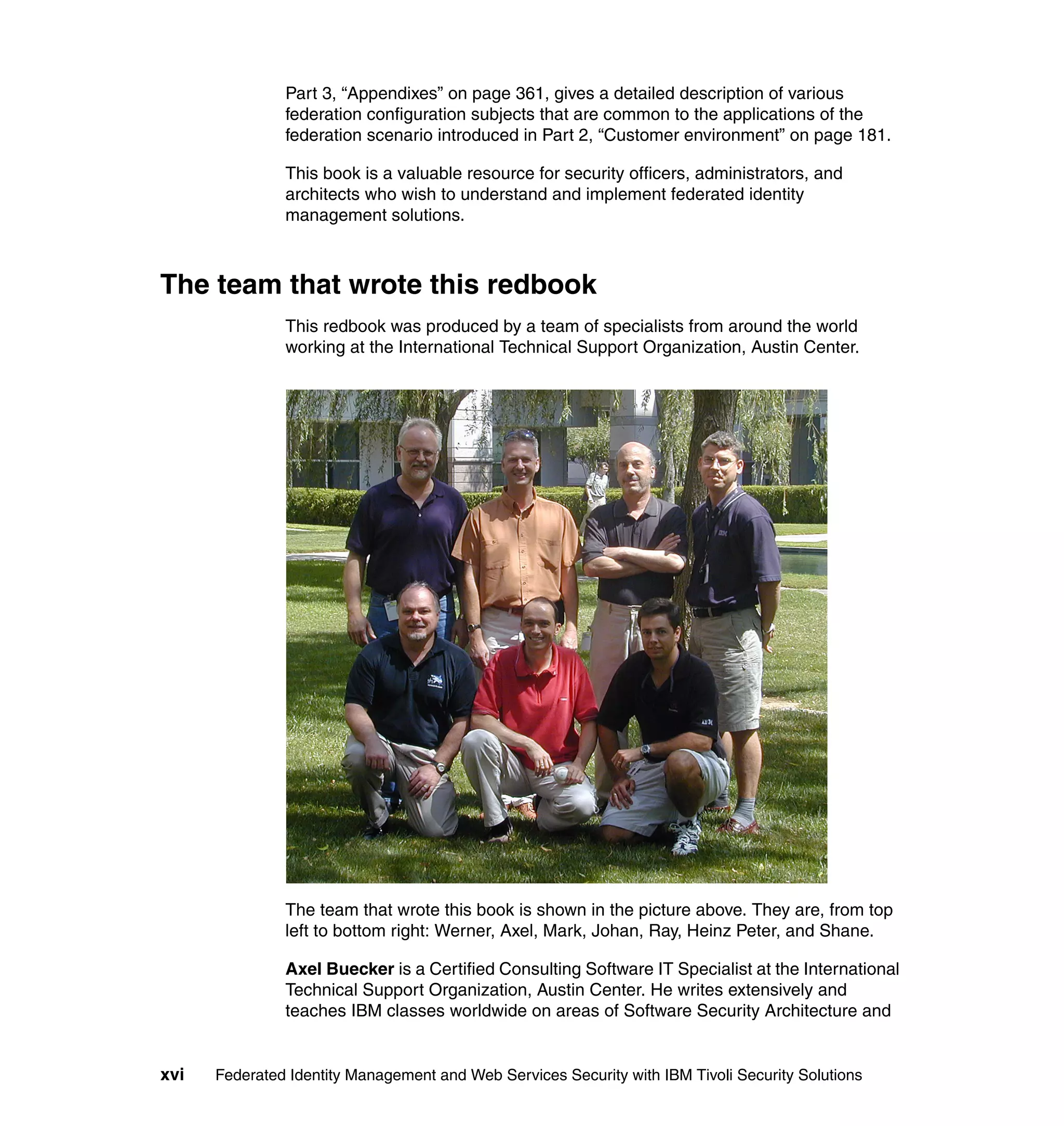
               This redbook was produced by a team of specialists from around the world
               working at the International Technical Support Organization, Austin Center.


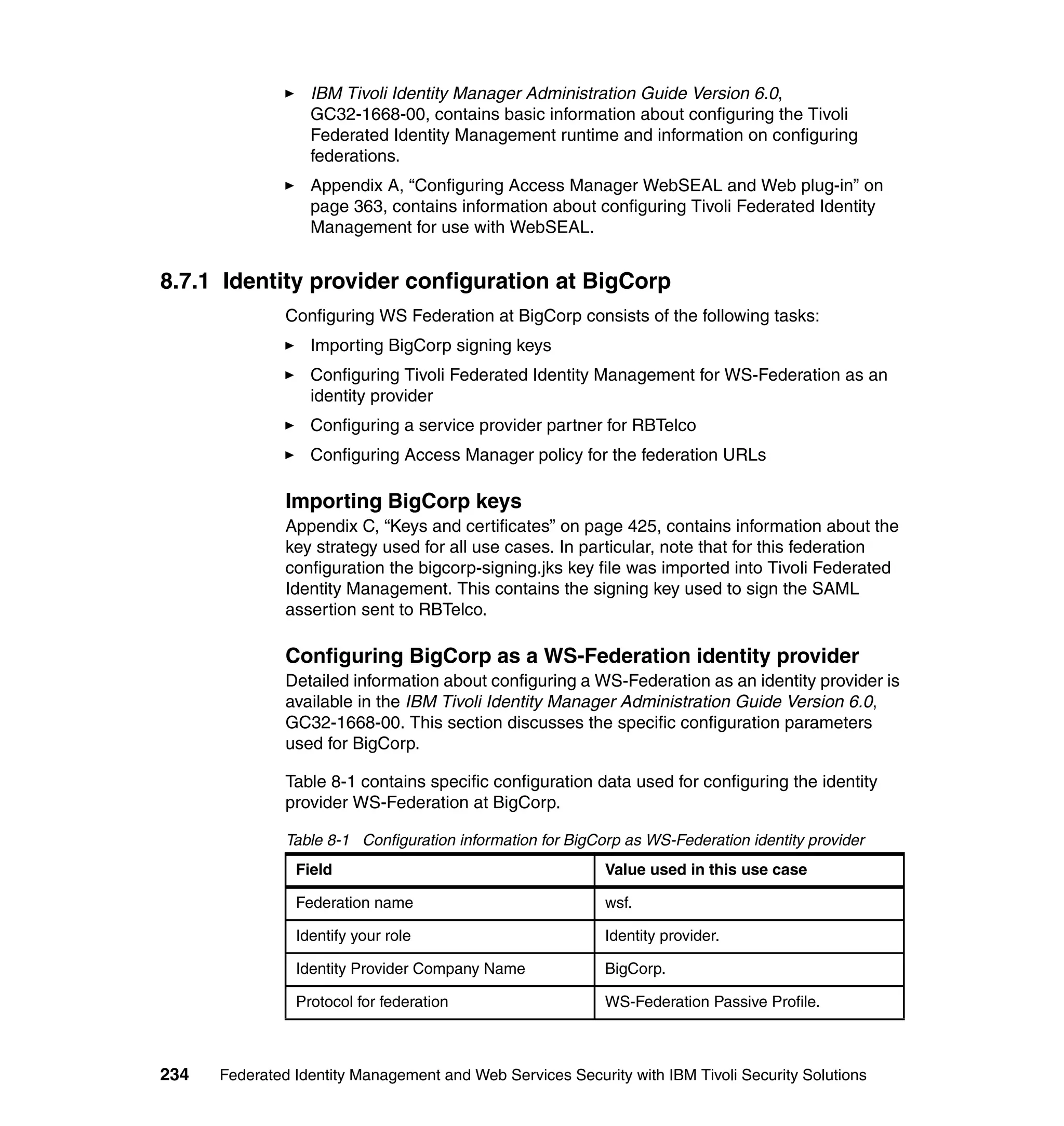
               The team that wrote this book is shown in the picture above. They are, from top
               left to bottom right: Werner, Axel, Mark, Johan, Ray, Heinz Peter, and Shane.

               Axel Buecker is a Certified Consulting Software IT Specialist at the International
               Technical Support Organization, Austin Center. He writes extensively and
               teaches IBM classes worldwide on areas of Software Security Architecture and


xvi   Federated Identity Management and Web Services Security with IBM Tivoli Security Solutions
Network Computing Technologies. He holds a degree in Computer Science from
the University of Bremen, Germany. He has 19 years of experience in a variety of
areas related to Workstation and Systems Management, Network Computing,
and e-business Solutions. Before joining the ITSO in March 2000, Axel worked
for IBM in Germany as a Senior IT Specialist in Software Security Architecture.

Werner Filip is a professor of the department for Computer Science and
Engineering at the University of Applied Sciences Frankfurt am Main, Germany
and a Consultant in IT Security. His primary research interests are Systems and
Network Management and Applied Security. Prior to joining University of Applied
Sciences Frankfurt he worked for 25 years for IBM in various positions, during
his last 10 years with IBM as a Consultant in Systems and Network Management
at former IBM’s European Networking Center, Germany. He received a Diploma
in Mathematics, and a Doctorate in Computer Science from the Technical
University Darmstadt, Germany.

Heinz Peter Hippenstiel is a Security Architect and Specialist for IBM Software
Services Tivoli in Germany. He joined IBM in 2000 and has a nine-year history in
security and systems management solutions. In 1999 he co-authored the IBM
Redbook Guarding the Gates Using the IBM eNetwork Firewall V3.3 for
Windows® NT. Heinz Peter is an IBM Tivoli Certified Deployment Professional
and an IBM Associated IT Architect. He received a certificate in information
technology from the Akademie für Datenverarbeitung in Böblingen, Germany.

Mark Hollin is a Consulting Manager in the Corporate Information Technology
division of Prudential Financial in Roseland, New Jersey. He has over 20 years
of experience in information technology. The last 12 of those years have been
focused on computer and information security. He holds a BA in Computer
Science from La Salle University in Philadelphia, Pennsylvania. His areas of
expertise include Java™ programming and security systems integration.

Ray Neucom is a Consulting IT Specialist working in the Americas Product
Introduction and Exploration group of IBM S&D. He has 25 years of IT
experience in applications development, systems integration, and Web
application security. He has been involved with IBM Tivoli Federated Identity
Federation since the beginning of the Early Support Program and has
represented IBM with Tivoli Federated Identity Manager at several conformance
testing events. He holds a Bachelors of Science, a Masters of Scientific Studies
(both majored in Computer Science), and a graduate Diploma in Business
Administration.

Shane Weeden is a Senior Software Engineer with the IBM Federated Identity
Manager development team. He has worked in IT security for 13 years, and has
spent the last seven years working with Tivoli Security products. Shane has been
with the Federated Identity Manager development team since its conception, and
now divides his time between customer-focused engagements and core product


                                                                  Preface    xvii
development activities. He holds a Bachelors of Information Technology from the
                University of Queensland in Australia.

                Johan Westman is a Client IT Architect, working in the IBM Nordic Industrial
                Sector in Sweden. He has worked for 11 years for IBM and is a Certified IT
                Specialist. He has many years of experience in working with large e-business
                infrastructures and service provider delivery environments with both telecom and
                industrial customers. In 1998 he co-authored the IBM Redbook Understanding
                LDAP - Design and Implementation, SG24-4986. He holds a Masters of Science
                degree in Engineering Physics from Uppsala University in Sweden, where he
                specialized in scientific computing.

                Heather Hinton is a Senior Security Architect in Austin, Texas. She has 12
                years of experience in computer and information security. She has a Ph.D. in
                electrical and computer engineering from the University of Toronto. Her areas of
                expertise include Federated Identity Management, access control, composition
                of policy, wireless, network, and systems security.

                Thanks to the following people for their contributions to this project:

                Julie Czubik
                International Technical Support Organization, Poughkeepsie Center

                Patrick Wardrop, Rahul Mishra, Brian Eaton, Glen Gooding, Matthew Duggan,
                Sean McDonald
                IBM US

                Gavin Bray
                IBM Australia

                 Special acknowledgements: Many portions in this book have greatly
                 benefited from material provided by the development architecture team and
                 the Product Introduction Center in the US and the UK. Special thanks go to
                 Heather Hinton, Venkat Raghavan, Jon Harry, and Avery Salmon.


Become a published author
                Join us for a two- to six-week residency program! Help write an IBM Redbook
                dealing with specific products or solutions, while getting hands-on experience
                with leading-edge technologies. You'll team with IBM technical professionals,
                Business Partners and/or customers.


xviii   Federated Identity Management and Web Services Security with IBM Tivoli Security Solutions
Your efforts will help increase product acceptance and customer satisfaction. As
       a bonus, you'll develop a network of contacts in IBM development labs, and
       increase your productivity and marketability.

       Find out more about the residency program, browse the residency index, and
       apply online at:
             ibm.com/redbooks/residencies.html


Comments welcome
       Your comments are important to us!

       We want our Redbooks™ to be as helpful as possible. Send us your comments
       about this or other Redbooks in one of the following ways:
          Use the online Contact us review redbook form found at:
             ibm.com/redbooks
          Send your comments in an email to:
             redbook@us.ibm.com
          Mail your comments to:
             IBM® Corporation, International Technical Support Organization
             Dept. JN9B Building 905
             11501 Burnet Road
             Austin, Texas 78758-3493


                                                                          Preface   xix
xx   Federated Identity Management and Web Services Security with IBM Tivoli Security Solutions
Part 1


Part       1     Architecture
                 and design
                 This part gives an overview of the capabilities of a general federated identity
                 management solution. These capabilities are treated as individual logical
                 functions that may be leveraged in a FIM solution. Additionally, the high-level
                 components and new concepts for the design of a federated identity
                 management solution using IBM software technology are introduced.

                 This part provides you with an understanding of the high-level logical services
                 architecture for IBM Tivoli Federated Identity Management, and a more detailed
                 look into federated single sign-on (F-SSO), Web services security management,
                 and provisioning solutions.

                 Finally, architecture options for deploying Tivoli Federated Identity Manager,
                 approaches for integrating Tivoli Federated Identity Manager with other
                 middleware and customer applications, and several important issues relating to
                 deploying Tivoli Federated Identity Manager in a production environment are
                 described.


© Copyright IBM Corp. 2004, 2005. All rights reserved.                                             1
2   Federated Identity Management and Web Services Security with IBM Tivoli Security Solutions
1


    Chapter 1.   Business context for identity
                 federation
                 This chapter discusses the business environment and the IT environment in the
                 context of identity federation. The business environment, driven by an increasing
                 ability to adapt, will in larger extent be highly collaborative, involving multiple
                 parties exchanging transactions as part of new horizontal business processes.
                 To support the required business flexibility IT must evolve to support these new
                 requirements.


© Copyright IBM Corp. 2004, 2005. All rights reserved.                                             3
1.1 Federated identity
               Federated identity technology is used for creating a globally interoperable online
               business identity, driving relationships or affinity driven business models
               between companies. The concept is nothing new, as we have real-world models
               for federated identities of individuals—a passport is a global identity credential
               that vouches for one's identity in a country; an ATM card is a credential that
               vouches for one's bank account; a driver's license vouches for one's ability to
               operate a motor vehicle and is also frequently used as a proof of identity in many
               business transactions.


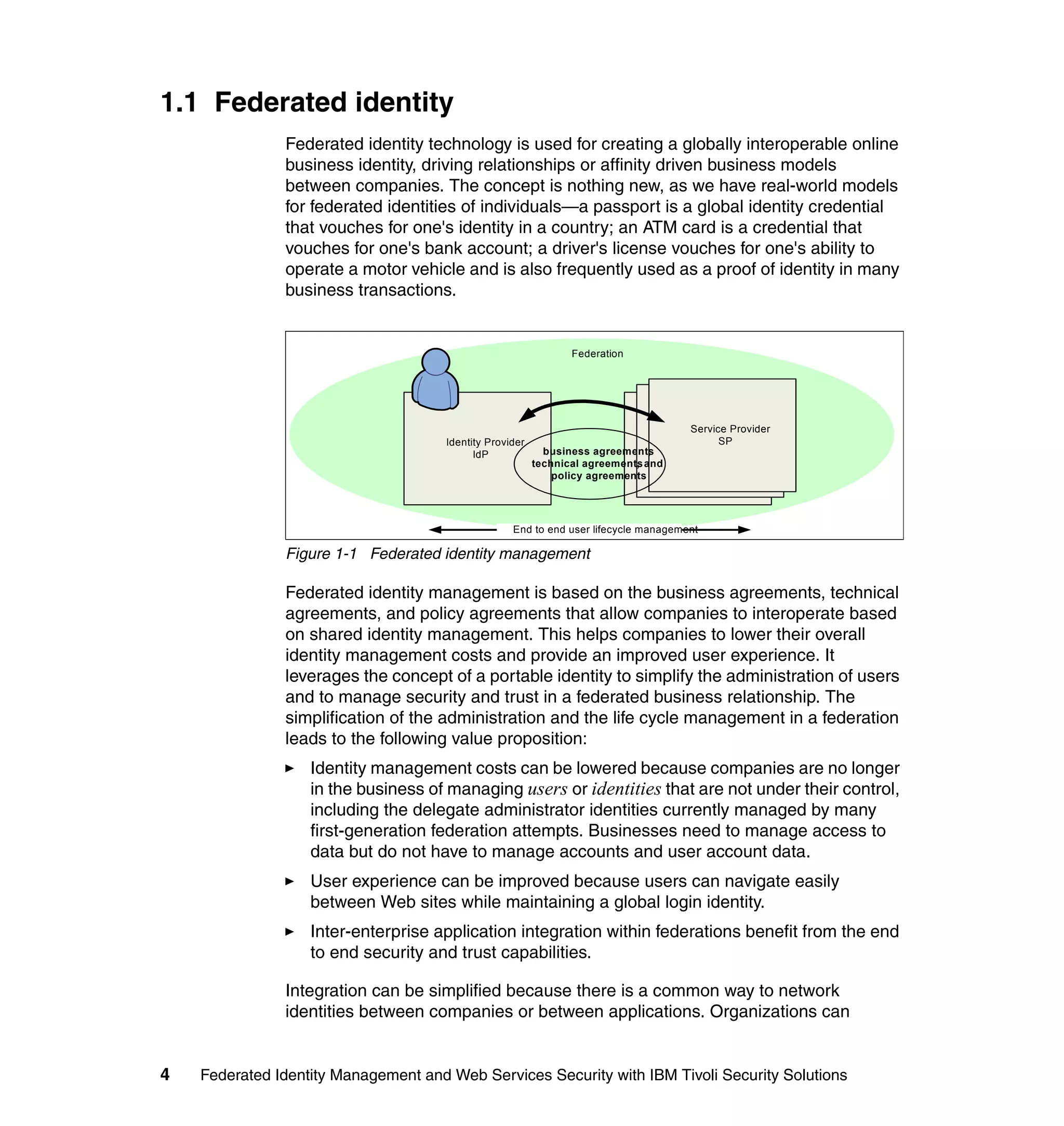
                                                                 Federation


                                                                                          Service Provider
                                                                                       Service Provider
                                      Identity Provider                                         SP
                                                                                     Service Provider
                                                            business agreements ,            SP
                                            IdP                                            SP
                                                          technical agreements and
                                                                             ,
                                                              policy agreements


                                                    End to end user lifecycle management

               Figure 1-1 Federated identity management

               Federated identity management is based on the business agreements, technical
               agreements, and policy agreements that allow companies to interoperate based
               on shared identity management. This helps companies to lower their overall
               identity management costs and provide an improved user experience. It
               leverages the concept of a portable identity to simplify the administration of users
               and to manage security and trust in a federated business relationship. The
               simplification of the administration and the life cycle management in a federation
               leads to the following value proposition:
                   Identity management costs can be lowered because companies are no longer
                   in the business of managing users or identities that are not under their control,
                   including the delegate administrator identities currently managed by many
                   first-generation federation attempts. Businesses need to manage access to
                   data but do not have to manage accounts and user account data.
                   User experience can be improved because users can navigate easily
                   between Web sites while maintaining a global login identity.
                   Inter-enterprise application integration within federations benefit from the end
                   to end security and trust capabilities.

               Integration can be simplified because there is a common way to network
               identities between companies or between applications. Organizations can


4   Federated Identity Management and Web Services Security with IBM Tivoli Security Solutions
implement business strategies that drive organic market and customer growth by
           eliminating the friction caused by incompatible identity and security management
           between companies.


1.2 Business environment
           Today, businesses are continuing the on demand evolution by developing the
           business models needed to create value and demand for their new products and
           services. In this evolution, companies are typically working toward becoming a
           company that with key business partners, suppliers, and customers that can
           respond with flexibility and speed to any customer demand, market opportunity,
           or external threat (IBM definition of an on demand business). Such businesses
           (on demand businesses) have the following four key attributes:
           Responsive Able to respond to dynamic, unpredictable changes in demand,
                      supply, pricing, labor, competition, capital markets, and the needs
                      of its customers, business partners, suppliers, and employees
           Variable     Able to adapt processes and cost structures to reduce risk while
                        maintaining high productivity and financial predictability
           Focused      Able to concentrate on its core competencies and differentiating,
                        meeting the needs of all of its constituents
           Resilient    Able to manage changes and external threats while consistently
                        meeting the needs of all its constituents

           In the process of becoming an on demand business, businesses will go through
           many changes. The path of deconstruction and re-aggregation of businesses
           open up for new possibilities and challenges.


1.2.1 Deconstruction of the enterprise
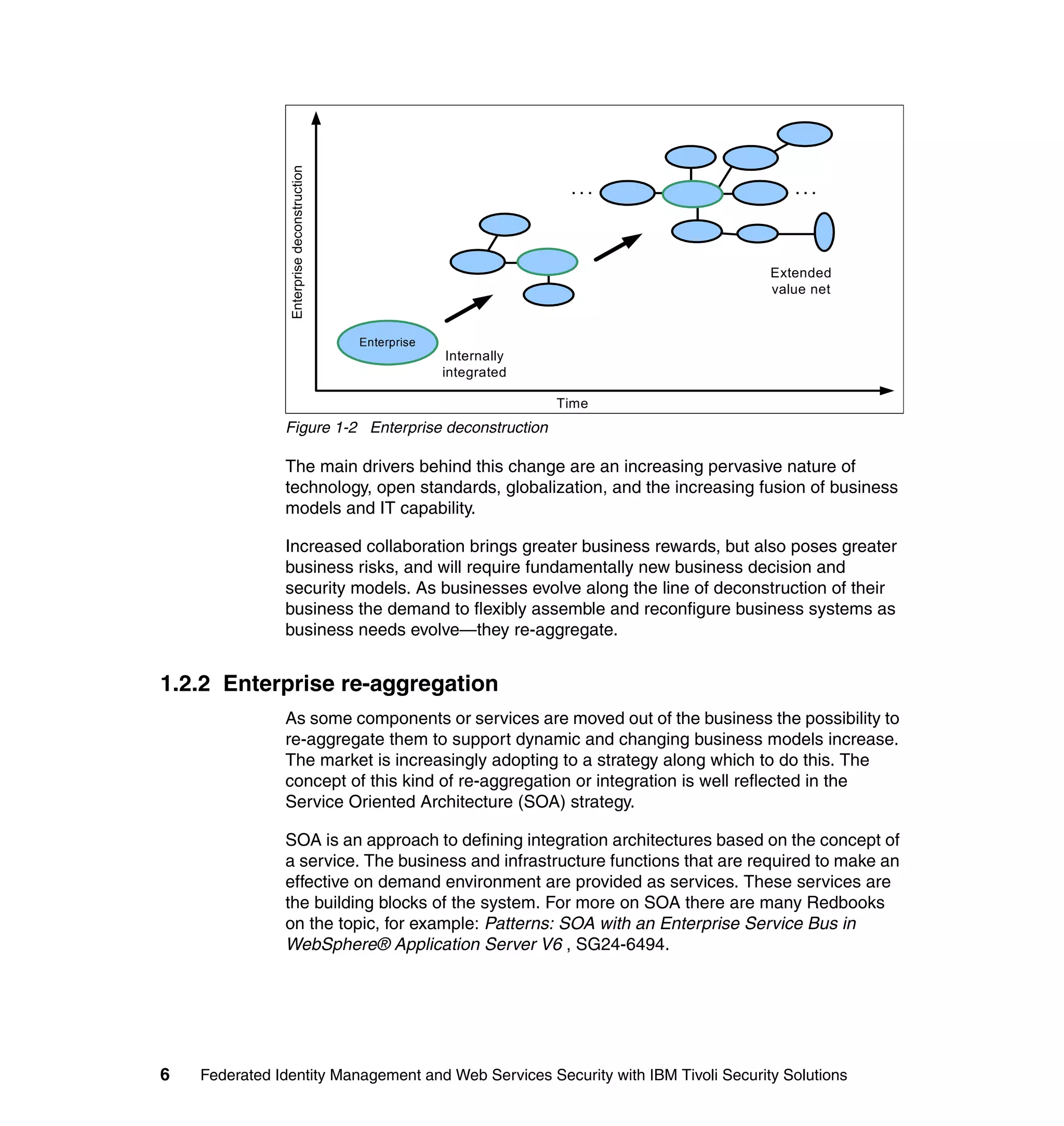
           Enterprises are de-constructing and reorganizing into extended value-nets of
           partners, suppliers, customers, and competitors to increase productivity and
           flexibility—shedding non-core processes to focus on strategic, core processes,
           see Figure 1-2 on page 6. This deconstruction is being accelerated by the
           evolution and adoption of open standards and services oriented
           architectures—the deconstruction is increasingly occurring at a more global
           scale, at an increased rate and at a more granular level.


                                         Chapter 1. Business context for identity federation   5
Enterprise deconstruction
                                                                        ...           ...


                                                                                   Extended
                                                                                   value net


                                            Enterprise
                                                          Internally
                                                         integrated

                                                                       Time
               Figure 1-2 Enterprise deconstruction

               The main drivers behind this change are an increasing pervasive nature of
               technology, open standards, globalization, and the increasing fusion of business
               models and IT capability.

               Increased collaboration brings greater business rewards, but also poses greater
               business risks, and will require fundamentally new business decision and
               security models. As businesses evolve along the line of deconstruction of their
               business the demand to flexibly assemble and reconfigure business systems as
               business needs evolve—they re-aggregate.


1.2.2 Enterprise re-aggregation
               As some components or services are moved out of the business the possibility to
               re-aggregate them to support dynamic and changing business models increase.
               The market is increasingly adopting to a strategy along which to do this. The
               concept of this kind of re-aggregation or integration is well reflected in the
               Service Oriented Architecture (SOA) strategy.

               SOA is an approach to defining integration architectures based on the concept of
               a service. The business and infrastructure functions that are required to make an
               effective on demand environment are provided as services. These services are
               the building blocks of the system. For more on SOA there are many Redbooks
               on the topic, for example: Patterns: SOA with an Enterprise Service Bus in
               WebSphere® Application Server V6 , SG24-6494.


6   Federated Identity Management and Web Services Security with IBM Tivoli Security Solutions
Services can be invoked independently by either external or internal service
           requesters to process simple functions, or can work together by choreographic
           implementations to quickly devise new functionality to existing processes.

           SOA may use Web services as a set of flexible and interoperable standards for
           distributed systems. There is a strong complimentary nature between SOA and
           Web services. Software components and Web services are well positioned to
           provide the flexibility, well-defined business-level concepts, and the mechanism
           to achieve assembly and re-configuration of the business systems required.


                                                                Software        Outsourced
                                                                Service          Function
                                                                                                              New
                                                    Service Providers                                       Function
                     Partners
                                                                                               Enterprise
                     Partners                                                     Legacy
                                                                                                              New
                     Partners Partner                                            Enterprise
                                                                                                            Function
                                 Process                                        Applications
                                                              Web service
                                                               interface

                                           Re-aggregation - Flexible solution assembly

                                                              Industry
                  Horizontal         Business-level                             Process              Flexible
                                                              Specific
                Interoperation        Functionality                           Integration            Delivery
                                                             Interfaces


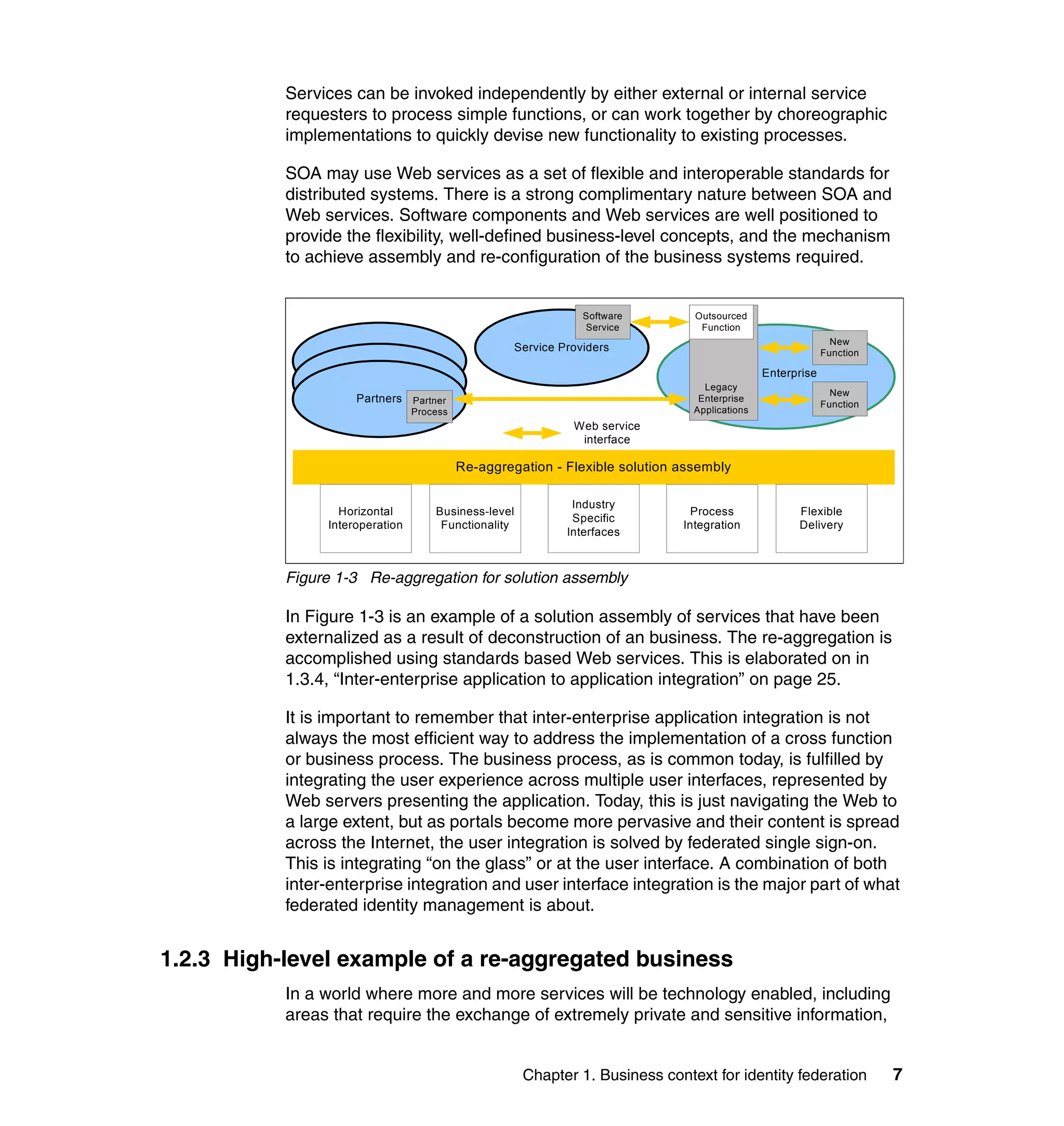
           Figure 1-3 Re-aggregation for solution assembly

           In Figure 1-3 is an example of a solution assembly of services that have been
           externalized as a result of deconstruction of an business. The re-aggregation is
           accomplished using standards based Web services. This is elaborated on in
           1.3.4, “Inter-enterprise application to application integration” on page 25.

           It is important to remember that inter-enterprise application integration is not
           always the most efficient way to address the implementation of a cross function
           or business process. The business process, as is common today, is fulfilled by
           integrating the user experience across multiple user interfaces, represented by
           Web servers presenting the application. Today, this is just navigating the Web to
           a large extent, but as portals become more pervasive and their content is spread
           across the Internet, the user integration is solved by federated single sign-on.
           This is integrating “on the glass” or at the user interface. A combination of both
           inter-enterprise integration and user interface integration is the major part of what
           federated identity management is about.


1.2.3 High-level example of a re-aggregated business
           In a world where more and more services will be technology enabled, including
           areas that require the exchange of extremely private and sensitive information,


                                                      Chapter 1. Business context for identity federation              7
the current reactive approaches to resource (service) deployment does not
               satisfy the requirements for the real-time, fluidly aggregating services to optimally
               address shifting market conditions.


                                                                                   Payroll                                      Supplier


                                                                                                                                    Service
                                              Intranet


                                                          Service
                                                         Application                                                            Supplier
                       M ain em ployee facing
                       web site


                                    Portlet                                                                                         Service


                                                                                             Service provider


                                                                                                                      Supplier

                                                                                                                       Service
                                                                                                                      Application


                       Em ployees/
                       Public users                                      O ther
                                                                       Enterprises
                                                                             O ther                             W ebbased service
                                                                          E nterprises
                                                                                 O ther
                                                                              Enterprises                       W eb Service invocation

                                                                                                                User interaction


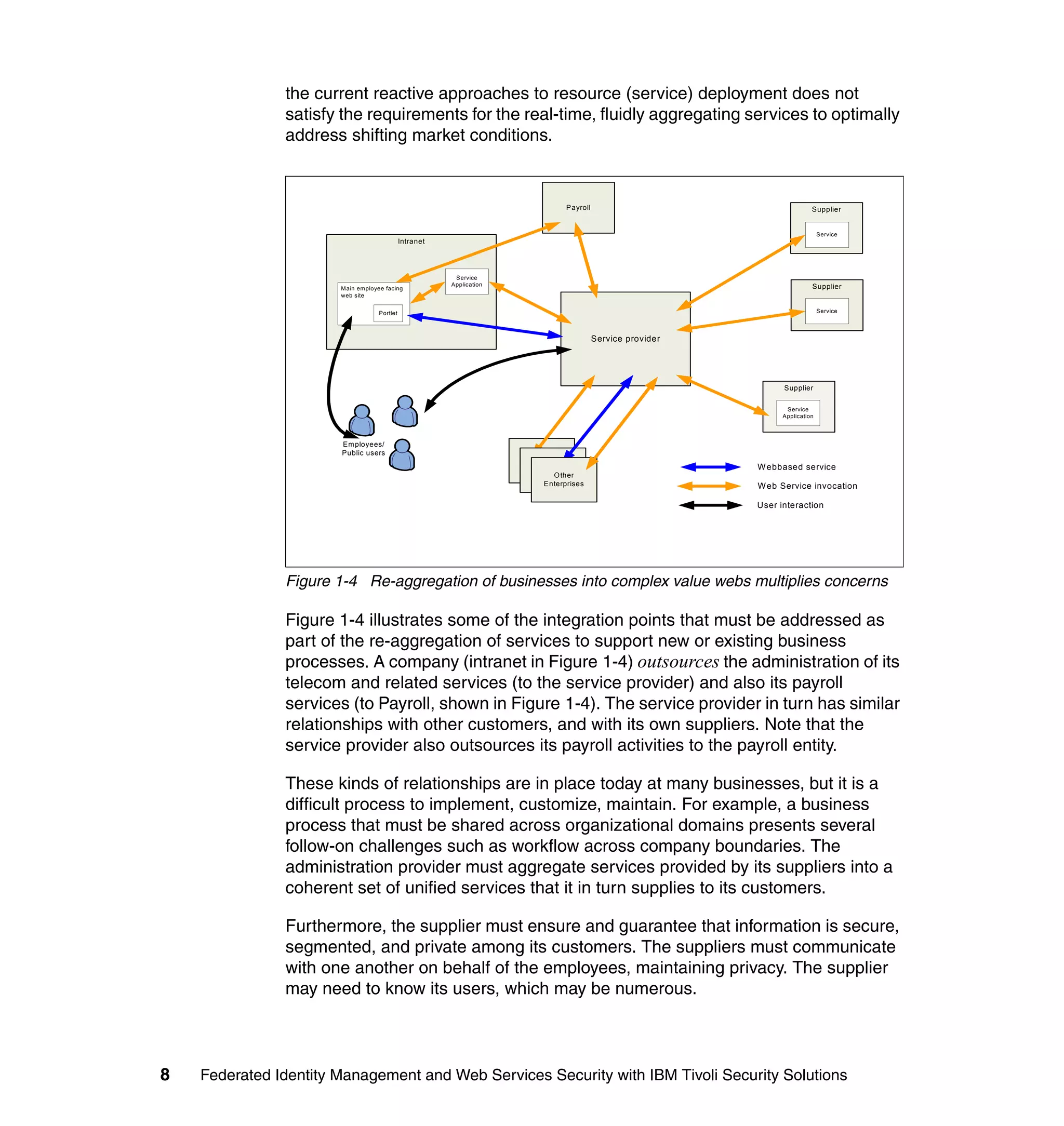
               Figure 1-4 Re-aggregation of businesses into complex value webs multiplies concerns

               Figure 1-4 illustrates some of the integration points that must be addressed as
               part of the re-aggregation of services to support new or existing business
               processes. A company (intranet in Figure 1-4) outsources the administration of its
               telecom and related services (to the service provider) and also its payroll
               services (to Payroll, shown in Figure 1-4). The service provider in turn has similar
               relationships with other customers, and with its own suppliers. Note that the
               service provider also outsources its payroll activities to the payroll entity.

               These kinds of relationships are in place today at many businesses, but it is a
               difficult process to implement, customize, maintain. For example, a business
               process that must be shared across organizational domains presents several
               follow-on challenges such as workflow across company boundaries. The
               administration provider must aggregate services provided by its suppliers into a
               coherent set of unified services that it in turn supplies to its customers.

               Furthermore, the supplier must ensure and guarantee that information is secure,
               segmented, and private among its customers. The suppliers must communicate
               with one another on behalf of the employees, maintaining privacy. The supplier
               may need to know its users, which may be numerous.


8   Federated Identity Management and Web Services Security with IBM Tivoli Security Solutions
Understanding and control of complex dynamics and collective behavior will
           become increasingly important to avoid system instability and set the stage for
           both global and local optimization. A fundamentally new approach needs to be
           implemented to provide a secure foundation for the transformation to on demand
           that includes federation and containment.

           So, the interactions required to fulfill the new business processes requirements
           will be a mix of application to application and user interactions, requiring the full
           set of federated identity management capabilities to handle the challenges of
           identity, trust and security.


1.2.4 Business models for federated identity
           In this section, some possible examples reflecting the challenges within the
           changing business and IT environment that are relevant to the federated identity
           management area will be studied in more detail.

           In an attempt to make the examples relevant for as many businesses,
           enterprises and authorities, examples are taken from five different sectors.
           Financial            The financial sector is represented by banking, financial
                                markets, and insurance.
           Communications The communications sector is represented by energy and
                          utilities, media and entertainment, and telecommunications.
           Distribution         The distribution sector is represented by consumer products,
                                retail, travel and transportation, and wholesale distribution
                                and services.
           Industrial           The industrial sector is represented by aerospace and
                                defense, automotive, chemical and petroleum, and
                                electronics.
           Public               The public sector is represented by education, government
                                and healthcare, and life sciences.

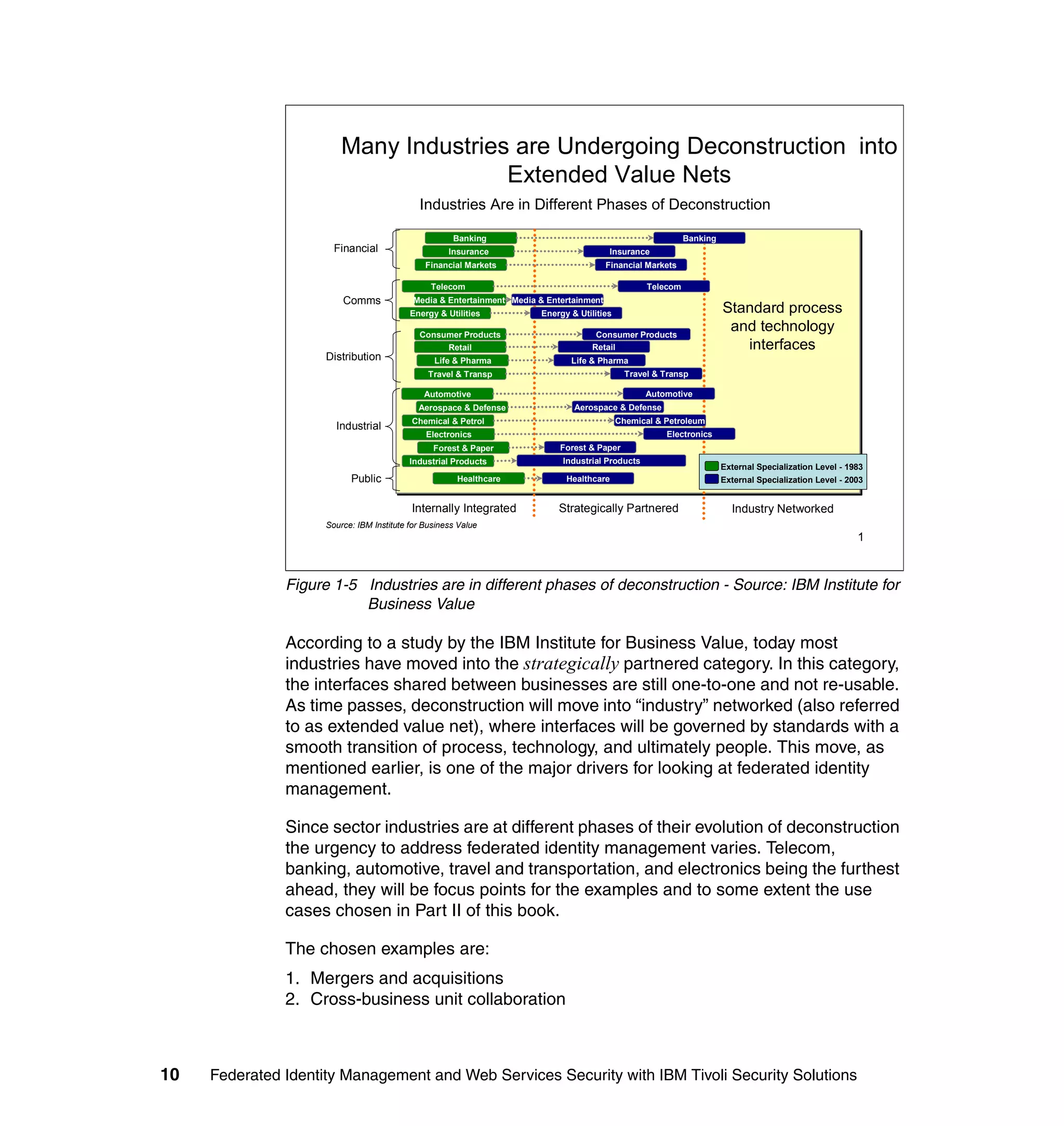
           First lets just take a look at where the different sectors are in their deconstruction
           phase.


                                            Chapter 1. Business context for identity federation   9
Many Industries are Undergoing Deconstruction into
                                        Extended Value Nets
                                             Industries Are in Different Phases of Deconstruction

                                                      Banking                                                 Banking
                       Financial                     Insurance                            Insurance
                                               Financial Markets                          Financial Markets

                                                Telecom                                             Telecom
                         Comms              Media & Entertainment Media & Entertainment
                                           Energy & Utilities           Energy & Utilities                              Standard process
                                             Consumer Products                        Consumer Products
                                                                                                                         and technology
                                                  Retail                             Retail                                interfaces
                     Distribution                Life & Pharma                 Life & Pharma
                                                Travel & Transp                                Travel & Transp

                                               Automotive                                          Automotive
                                             Aerospace & Defense                Aerospace & Defense
                                           Chemical & Petrol                                 Chemical & Petroleum
                       Industrial
                                               Electronics                                              Electronics
                                                 Forest & Paper              Forest & Paper
                                           Industrial Products               Industrial Products
                                                                                                                        External Specialization Level - 1983
                           Public                      Healthcare             Healthcare                                External Specialization Level - 2003


                                           Internally Integrated            Strategically Partnered                       Industry Networked
                     Source: IBM Institute for Business Value
                                                                                                                                                          1


               Figure 1-5 Industries are in different phases of deconstruction - Source: IBM Institute for
                          Business Value

               According to a study by the IBM Institute for Business Value, today most
               industries have moved into the strategically partnered category. In this category,
               the interfaces shared between businesses are still one-to-one and not re-usable.
               As time passes, deconstruction will move into “industry” networked (also referred
               to as extended value net), where interfaces will be governed by standards with a
               smooth transition of process, technology, and ultimately people. This move, as
               mentioned earlier, is one of the major drivers for looking at federated identity
               management.

               Since sector industries are at different phases of their evolution of deconstruction
               the urgency to address federated identity management varies. Telecom,
               banking, automotive, travel and transportation, and electronics being the furthest
               ahead, they will be focus points for the examples and to some extent the use
               cases chosen in Part II of this book.

               The chosen examples are:
               1. Mergers and acquisitions
               2. Cross-business unit collaboration


10   Federated Identity Management and Web Services Security with IBM Tivoli Security Solutions
3.   Growth of customer base
4.   Outsourced services
5.   Service provider automation
6.   Portal based integration
7.   Government collaboration
8.   Corporate governance

In Table 1-1 there is a table show high relevance of the different examples in the
different sectors. Table 1-1 shows how relevant these examples are for the
different sectors.

Table 1-1 Examples relevance to different sectors
 Sector  Example no.                        1      2   3   4    5    6    7    8

 Communications - Telecom                    X      X   X   X    X              X

 Distribution                                X      X       X                   X

 Financial - Banking                         X      X       X    X              X

 Industrial                                  X      X       X         X         X

 Public - Government                                X                      X

For a more detailed discussion of federated identity managements use in
different scenarios, look in Chapter 6, “Overview” on page 183, where there are a
few scenarios in which some of the business examples are represented.

1. Mergers and acquisitions
In this scenario a company is implementing a growth strategy using mergers and
acquisitions. The indicator of the success of the merger or the acquisition is
predicated on how quickly the companies can knit together their IT
infrastructures to target and cross-market to the new customer base. Identity
management is one of the most complex activities in such mergers. Rather than
having to forklift all of the acquired users in the various systems, an integration
strategy based on identity federation can simplify the user experience. The
combined users of the merged customers can have access to the shared assets
of the merged companies without impacting user experience, customer care, or
the quality of support. Federating the identities between the merged companies
provides a quick and seamless way to integrate the customers of the two
companies to drive merged growth scenarios.

2. Collaboration between autonomous cross-business units
Many large companies have independent business units that want to directly
maintain ownership and relationship with their users. This may be due to
organizational structure, or to political, competitive, or regulatory reasons. A


                               Chapter 1. Business context for identity federation   11
large global manufacturing company may be organized as independent
               companies with regional management consolidated in the Americas, Europe,
               Africa, Middle East and Asia. However, these business units may also need to
               have their users (employees) needing access to cross-business unit resources.
               For example, employees in Asia need access to ordering and parts information in
               other regions. Federated identity management enables business units to retain
               autonomy and control of their users, yet have a flexible way to federate data to
               cross-business unit resources.

               3. Customer acquisition strategy via partnerships
               A company whose growth strategy is based on acquiring new customers needs
               to either obtain these customers outright or have partnerships with other
               companies to target their customers. A financial services provider may form a
               partnership with a mobile wireless provider (with millions of subscribers) to
               deliver paperless e-billing to these customers. The incentive for the mobile
               wireless provider in this partnership is to reduce their non-core expenses by
               outsourcing billing functions to the financial provider. In return the mobile
               provider would offer a 5 percent discount for customers subscribing to the new
               e-billing service, thereby offering an incentive for the customers to sign up for
               e-billing. Through this partnership, the financial services company now has
               acquired a million new customers to which it can target its e-billing service.
               Federated identity management will enable the financial service company to
               access large pools of customers having a well-established identity.

               4. Employee access to outsourced provider services
               Employee self-service is a major initiative for many companies looking to reduce
               user provisioning or user care costs. Most organizations outsource non-critical
               competencies to third-party providers. The services that are being outsourced
               include human resources, employee savings plan, healthcare, payroll, travel and
               procurement services. Using the corporate intranet portal to connect the
               employees directly with these external service providers enables the
               organization only the administration of these outsourced services. Organizations
               outsource these services to reduce these service administration costs. However,
               the inability to directly connect the employee to these service providers means
               that the organization is now required to support and maintain staging systems
               (help desk) for employee enrollment to savings plans (401K or super-annuation),
               healthcare or payroll. Employers spend significant amount of plan administration
               costs in employee 401K administration, employee stock options, employee
               healthcare and travel. These services are typically outsourced to various outside
               providers. However, the company stills ends up manually administering these
               plans or having to staff customer care personnel for employee management.

               Federated identity management provides a compelling value proposition in this
               scenario by enabling employees to access and manage their data on the various


12   Federated Identity Management and Web Services Security with IBM Tivoli Security Solutions
third-party service provider Web sites by simply signing on to the employee
portal. Access through an existing portal can simplify the user experience, and
enables the user to interact with various employee provider sites without
requiring additional enrollment, registration or authentication to these business
partner sites. The employer in turn can lower their employee support and plan
administration costs by enabling employees to interact directly with the various
providers.

5. Service provider automation with B2B clients
A larger service provider managing retirement accounts for employees, pension
plans, employee stock options, or healthcare for their institutional clients may
incur tremendous cost of user life cycle management of its clients' employees.
These costs can result from having to register and provision online accounts for
client employees, manage passwords, and staff a help desk for dealing with user
access problems resulting from forgotten user names, credentials or passwords.
Assume an average password reset call costs $20, and that there exists a
service provider who manages 100 Fortune clients, each of whom on average
have 10,000 employees. Even if only a quarter of these employees forget their
password just once a year, this would represent a $5 million annual cost in
managing user accounts and passwords. The service provider is heavily
motivated to move to a federated model where the service provider leverages the
employee's corporate portal authentication to provide access to their services. In
this model, the employer (client) is responsible for managing its users and
passwords (the client does not face additional costs, because they already have
to manage these users and passwords), and the service provider offloads the
cost of user administration to its clients. This approach also benefits the
employee tremendously, as the employee does not have to register or remember
a separate sign on and password to manage their 401K or healthcare.

6. Portal-based integration of software-as-services
A new generation of Internet-based providers now delivers software-as-services
to companies or corporations. Examples of these software-as-services are
providers like WebEX, Salesforce.com, Siebel CRM On Demand,
Travelocity.com, and so on. These services enable companies and small
businesses to access Internet hosted services without having to undertake the IT
infrastructure cost of managing these services locally. Federated identity plays a
critical role in this system by enabling employees of the companies to access
various software-based services using their employee identity sign on. As more
and more non-core business services are being outsourced or offloaded with
providers, federated identity management fulfills the role of an identity integration
technology that enables the user to seamlessly access third-party services that
may be locally hosted, remote-hosted or accessed by a software-as-services
provider.


                               Chapter 1. Business context for identity federation   13
7. Government collaboration
               Governments have high demands on efficiency and ability to collaborate. Many
               processes will span multiple governments, institutions, authorities or agencies in
               many regions, who will need to share data, but due to political, organizational or
               other challenges will not be able to consolidate or internally integrate. All these
               entities may also need to have their users (employees, citizens) have access to
               cross-governmental entities resources. For example, authorities in one European
               country may need to find relevant information about a person in an other
               countries data source, but each country would not like to manage all other
               countries authorities users (to maintain traceability on citizens person data).
               Federated identity enables authorities to retain autonomy and control of their
               users, yet have a flexible way to federate data to cross-governmental entities
               resources.

               8. Improved corporate governance
               Corporate governance and complying with various regulations may be major
               initiatives at companies. Compliance with Sarbanes-Oxley (SoX), Basel II, and
               HIPAA are at the forefront of the concerns of many executives.

               One of the key impediments to passing an audit and achieving compliance is
               lack of accountability for granting user rights and permissions to access business
               systems. A primary reason for failing an audit is the inability to account for
               access rights granted to business partner users.

               Federated identity can ease some of the burden associated with the following
               compliance pain points:
                  Organizations cannot account for access rights granted in their internal
                  systems for third-party users; there is no proof of whether a third-party user
                  actually exists or even needs access.
                  No accountability on why a third-party user was granted access in the first
                  place; failure to demonstrate and document the business reason for the
                  request and which company officer approved the request.
                  No procedures in place to delete entitlements or purge user access rights
                  belonging to third parties and their users. This results in users accumulating
                  access rights far beyond what they were originally authorized.
                  No procedures in place to de-provision user accounts when users turn over.
                  This issue is magnified when dealing with third parties when the company
                  does not control the third-party user and no process typically exists by which
                  third-party companies will notify of user turnover.
                  No way to re-certify third-party user access. Does this third-party user still
                  need access beyond three months or six months? Why do they still need
                  access?


14   Federated Identity Management and Web Services Security with IBM Tivoli Security Solutions
No way to audit request for third-party access. Most companies are not able
              to audit third-party user access in a centralized fashion because there is no
              one single tool that is being used to grant third-party access.

           In today's model where the company takes on the management burden of
           third-party user administration and provisioning, these audit issues are magnified
           when these third-party users turn over and this identity is not propagated to the
           company for de-provisioning. There is no way for the company to know that a
           business partner employee is no longer employed. Federated identity improves
           compliance by offloading user administration costs to business partners. Since
           the company does not own the user account management accountability,
           approvals and re-certification are now offloaded to business partners. The
           company relies upon its business partners to authenticate and issue credentials
           that vouch for its users. The burden of proof now belongs to the business partner
           for vouching for its own access rights. Federated identity provides a strategic
           alternative for companies to simplify their administration and improve
           governance by offloading third-party user management to their clients.


1.2.5 The relationship - Trust and assurance
           A federated business model mandates a foundation of trust. In a federated
           model an organization is willing to provide access to an identity that is not vetted
           by the organization's own internal security processes. Instead the organization is
           trusting an identity asserted by a third party, a model that introduces risk and
           uncertainty in the overall confidence of the business transaction.

           An organization will not engage in a federated business model if they do not have
           the visibility into their business partners' identity and access management
           systems and processes. An organization needs to evaluate the risk of conducting
           business with business partners and needs to assess their business partner's
           processes and vetting procedures for 1) business partner identity proofing, 2)
           business partner accreditation, and 3) business partner reputation evaluation.
           These procedures provide the visibility and the qualitative assessment of how
           third-party identity can be parlayed into business decisions about access control
           and the rules of engagement around trust that the organization is willing to enter
           with the business partner company.

           Business partner identity proofing is the process of verifying the physical identity
           of a prospective federation business partner both before entering into an online
           business relationship with that business partner and when engaged in runtime
           transactions with the business partner. Part of the business partner identity
           proofing process involves verification of the physical identity of the business—but
           who is the business?
              Is there a legitimate business with the stated name?
              Is this the party making the request?


                                          Chapter 1. Business context for identity federation   15
Is the specific employee making the request authorized?

               Once the physical identity has been verified, some form of online token is issued
               to the business partner and then bound to the physical identity of the business.

               Various forms of business partner identity verification techniques and processes
               can be used, including:
                  Self-assertion
                  Leverage of an existing relationship
                  Confirmation of electronic or postal address
                  Credit agency, business bureau ratings
                  As the name suggests, identity verification

               Business partner accreditation addresses the question what do we know about
               the company? And more specifically, what do we expect of this company?
               Accreditation is based on a well-defined policy that defines the criteria that a
               company must satisfy. A company that wishes to enter into a federation may
               publish a policy that defines the criteria that prospective business partners must
               match; likewise, a business partner wishing to enter a federation may publish a
               policy that defines the criteria that IT satisfies (a policy describing its own
               features). Evaluating the fit of these two policies is an action that is undertaken
               by a trusted party specializing in business accreditation.

               Examples of the types of characteristics that are evaluated as part of the
               accreditation process include:
                  Is the company credit worthy?
                  Is the company considered to be a reputable business?
                  Is the company approved by relevant professional/trade bodies?
                  Is the company part of the federation?
                  Has the company authenticated and issued credentials in a standardized
                  trustworthy fashion?

               Reputation is an alternate means of knowing additional qualitative information
               about a business. The primary difference between a reputation service and
               accreditation is that reputation typically is measured on an ongoing basis using
               behavioral information about the business or an individual. Another difference is
               that reputation is typically measured by an independent entity and typically does
               not involve the participation of subject (business or individual being measured).
               The reputation service may develop an automated framework for measuring
               reputation based on transactional visibility. Alternatively, a more explicit
               feedback-based mechanism is used. The reputation service will usually assign a
               simple score that is derived using a well-defined procedure and is easy to
               understand.


16   Federated Identity Management and Web Services Security with IBM Tivoli Security Solutions
Organizations face critical challenges in determining the risk/return relationship
           in a federated model. Business partner identity verification, accreditation and
           reputation are basic tenets that help companies determine their level of trust and
           assurance in their business partners' identity management solution.


1.3 IT environment
           Driven by the changes in the business environment IT needs to adopt to support
           the new emerging requirements. This is to a large extent done by the concept of
           services oriented architecture and single sign-on. To enable this kind of dynamic
           integration between entities federated identity management becomes key.

           In this section IT challenges in identity management are studied. The focus areas
           are how to deal with identities, user life cycle management, user provisioning,
           account management, inter-enterprise application to application integration.


1.3.1 The role of identity management

            Note: The IBM Federated Identity Management white paper (Heather Hinton,
            et al) has been used extensively in the writing of this chapter.

           Identity management has become a hot topic these days with many
           organizations. From business unit executives to CIO’s to IT administrators, the
           focus is on improving the integrity of identity-driven transactions, improve
           efficiency, and lower IT costs. Identities pervade every aspect of e-business.
           Corporate IT accounts (e-mail, NOS, LDAP, UNIX®, Linux®, Windows, RACF®,
           Desktop), HR accounts, supply-chain accounts, healthcare, 401K, online travel,
           and VPN accounts are all essential accounts that need to be provisioned for a
           new employee or a user to do their job. Few of these identities or accounts work
           together, so they add substantial administrative and customer support costs and
           deliver poor end-user experience due to multiple sign-ons to systems and
           applications. With increased corporate governance and regulatory hurdles, the
           management of these identities and account data introduces new business
           compliance issues and security exposures. Taking on identity management
           means dealing with these privacy, compliance, legal and regulatory issues.

           The cost and complexity of identity administration in today's environment is
           primarily due to a single reason: To provide access to a user for a service or an
           application means giving the user an account within the service or
           application-specific repository. The fundamental practice of creating and
           managing user accounts leads to various administration, single sign-on, and
           compliance issues.


                                         Chapter 1. Business context for identity federation   17
User life cycle management of identities
               Federated Identity Management (FIM) addresses this problem by providing a
               standardized way of managing the end-to-end life cycle management of
               identities both within and between organizations. This end-to-end user life cycle
               management extends a company's identity management practices and
               procedures to simplify identity and access administration for third-party user
               access and simplify user access to simplify third-party resources.


                                                              Federation


                                                                                     Service Provider
                                                                                  Service Provider
                                     Identity Provider                                     SP
                                                                                Service Provider
                                                                                         SP
                                            IdP                                       SP
                                                               Trust


                                                 End to end user lifecycle management

               Figure 1-6 End-to-end user life cycle management

               This life cycle management approach builds on a foundation of trust and
               incorporates standards for user identification, authentication, access control, and
               the exchange of identity and attribute information between services providers
               and service consumers. This approach helps companies to lower identity
               management, access management, and administration costs related to
               third-party user access or third-party service access.

               Federated identity
               At a fundamental level, the term federated identity has various meanings. The
               term identity used in a federated context is composed of federated attributes that
               can be sourced across multiple federated and authoritative data sources. There
               are many attributes that can represent a particular identity. The concept of
               identity needs to be thought of as a distributed concept where multiple attributes
               of an identity are federated across multiple data repositories.

               To an individual user, federated identity means the ability to associate his
               various application and system identities with one another. To a business,
               federated identity provides a standardized means for allowing businesses to
               directly provide services for trusted third-party users or users that they do not
               directly manage. It refers to the ability of one business to associate with one or
               more others in a federation, such that the identities from one business domain
               (or identity provider) are granted access to the services of another business (or
               service provider).


18   Federated Identity Management and Web Services Security with IBM Tivoli Security Solutions
Partnership-based solutions
Federation enables businesses to deliver solutions that can be more functional
and cost-effective, and better customer acquisition strategies via federated
business models. The federated business model enables service providers to be
able to federate data to large established clients, business partners, and
customers that they normally would not have access to.

Federated identity management refers to the set of business agreements,
technical agreements, and policies that enable companies to lower their overall
identity management costs, improve user experience, and mitigate security risks
for Web services-based interactions.

IBM has recognized that federated identity management is a technology that can
help companies simplify their user administration and security administration
while improving security and corporate compliance. This life cycle management
approach enables company administrators and auditors to have the visibility,
controls, and the workflow to engage in federated administration with their
business partners.

Security characteristics
In a B2C or B2E1 environment where consumers and employees communicate
with one company as a focal point for multiple business partners, it is important
to secure access to all involved parties. In B2B environments business partners
and applications must also be used in a secure and reliable way.

Managing identities in this dynamic environment with many different
organizations interlinked becomes problematic when using today’s traditional,
static models. For this reason is it necessary to organize federations in order to
propagate identities across multiple organizations dynamically in a seamless
management infrastructure.

In such a dynamic environment, trust relationships between business partners
are essential. Traditionally, IT infrastructures have dealt almost exclusively with
their own environments—not necessarily reflecting the needs of interoperation
and integration with other parties. In an truly dynamic business environment all
parties must interact seamlessly to meet the requirements of a dynamic
business. Figure 1-7 on page 20 highlights a security triangle that these three
elements form.


1
    B2C: Business to Consumer, B2E: Business to Employee, B2B: Business to Business


                                    Chapter 1. Business context for identity federation   19
Integration

                                                  Extensible architecture
                                                     Existing services
                                                 Implementaion Agnostic


                        Interoperate                                                      Trust

                    Secure interoperability                                         Trust management
                      Protocol mapping                                              Trust establishment
                       Publishing QoP                                                 Presumed Trust
                         Federation                                                     Assertions

               Figure 1-7 Security triangle: Trust - Interoperation - Integration

               Traditional security issues, of course, still apply, but need to be expanded in
               many ways. In an on demand world closer convergence of IT and interlocked
               business require flexible architectures to reflect the needs of these virtual
               organizations.

               Perhaps the most significant change, is the move from a static security
               environment to a highly dynamic environment reflecting fast changes in this
               world. These new security challenges span multiple organizations and are no
               longer bound to persons, but extend to applications and devices, as well.

               New federated identity management specifications, that extend existing Web
               services and federation-related standards, form the basis for a solution to the
               new identity management issues that arise in an dynamic business
               environments. These solutions will be discussed in more detail throughout the
               remainder of this redbook.


1.3.2 Dealing with identities
               A typical business that deals with at least three major clusters of identities are
               shown in Figure 1-8 on page 21.


20   Federated Identity Management and Web Services Security with IBM Tivoli Security Solutions
Employee Access to
                              Employer outsourced Services


                                 Employee -Provider
                                     Identities

   Access to Customer,
   Supplier, Distributors,
                                                                  Employee Access to
     Dealers, Agents,
                                                                  Enterprise systems
   Contractors, Partners
            etc.


                                                                       Corporate
     B2B Identities                                                    Employee
     B2C Identities                                                    Identities


Figure 1-8 Dealing with identities - A corporate view

Attaining these goals using IT as a productivity lever has been both problematic
and challenging. In the IT world seemingly simple things like managing identities
or exchanging identity information within a firm's heterogeneous systems is a
challenge today, not to mention trying to deliver data transparently to users from
across a network of business partners and affiliates. Fundamental issues like
end-to-end identity propagation are lacking today and present significant
challenges to integrating identities (and identity management techniques)
seamlessly into the application and middleware.

A quick survey within a typical large organization reveals many forms of identity
accounts that are provisioned by the employer to employees (including
employee-like users such as contractors), consultants, and contractors.

Corporate identities
A corporation typically has a number of systems and applications where their
users need identities. The user needs to sign on to her workstation, possibly
again to her corporate intranet, and may need to sign on again to the back-end
systems. These sign-ins may need multiple identities, which need to be
managed as well as the user needs to remember all of them.
   Network identities (Remote Access, VPN or Wi-Fi Accounts) to enable users
   to access the network
   Desktop identities to sign on to the workstation (Windows credentials)


                                 Chapter 1. Business context for identity federation   21
Corporate e-mail and white pages accounts
                  Legacy accounts for mainframe accounts
                  HR accounts (PeopleSoft, SAP, Oracle)
                  Supply Chain/CRM accounts (SAP, Siebel, and so on)
                  Identities that are managed in middleware and database solutions (Oracle
                  accounts, WebSphere accounts, Portal accounts, and so on)

               Employee to employer-outsourced provider identities
               Many employee services (such as employee savings plans, retirement accounts,
               pension, employee stock options, healthcare, payroll, and travel services) are
               typically outsourced. However, employees need to register and enroll at these
               third-party Web sites to get a login account before they can access these
               services. Many small- and medium-sized businesses typically outsource many
               aspects of their non-core services such as customer management, payroll, and
               financial accounting, and so on.
                  Employee benefits accounts (401K, pension, stock options, healthcare, online
                  travel, and so on).
                  Employee access to Software-as-Services identities. These are identities to
                  access hosted software like WebEX, ADP, quicken.com, Salesforce.com,
                  Siebel CRM On Demand, and so on.
                  Accounts at financial service providers (IRA, 401K).
                  Online banking/bill payment accounts.
                  Accounts with credit card providers.

               Business to consumer identities
               Companies have to deal with many forms of identities to deal with suppliers,
               business partners, distributors, dealers, and so on. Customers need login
               identities to access various applications in the company portal.
                  Suppliers need login accounts to access procurement systems such as SAP,
                  and so on.
                  Business Partners need accounts in various systems.
                  Distributors and dealers need access to various line of business applications.

               The unique element about business-to-consumer is the scale of millions of these
               B2C identities and accounts that need to be maintained.


22   Federated Identity Management and Web Services Security with IBM Tivoli Security Solutions
1.3.3 User life cycle management
           One of the biggest challenges customers face today is cost and complexity of
           user life cycle management. User life cycle management is also referred to as
           the multiple identity account problem, as users in most large companies have to
           deal with fifty plus accounts. The customer pain points today can be
           characterized in these facts:
              Improve and increase confidence in business transactions.
              Identity is the basis of security; poor identity management means weak
              security.
              Lower administrative cost.
              Soaring costs with account information administration and password
              administration, user registration, and help desk support.
              Risk, compliance, security exposure.
              – Business, legal and privacy issues with user data access (for example,
                Sarbanes-Oxley, HIPAA, Graham-Leach-Bliley, CA SB1386)
              – Issues with unauthorized access from users
              – Audit failures due to inactive user account exposure
              – Identity and password theft
              Poor market reach.
              – No standard mechanism to trust identities from M&A, business partners,
                and third parties
              – High cost of integration applications that deal with identities

           The fundamental issue pervading identity management is that every time a user
           requests access to an application or a system, an IT administrator ends up
           creating an account for the user in the target system or application. A company
           takes on a significant cost of user administration and management when creating
           accounts for users.

           To a great extent, these issues all involve the subject of identity management.

           User provisioning and account management costs
           The cost of provisioning users with account data is one of the more expensive
           and manual activities that take people, time, and a significant IT budget. While
           automated user provisioning tools automate (synchronize) many aspects of user
           provisioning, the fundamental issue still remains that a company takes on user
           ownership costs when provisioning account data. While a company may need to
           take on this user ownership cost for employees, this approach may not be


                                           Chapter 1. Business context for identity federation   23
correct when dealing with external identities that are currently being provisioned
               in the internal systems.

               Let us take a look at the various provisioning activities that a company is
               undertaking when they decide to give access by creating an account.
                     Create an account in each target system for the user.
                     Enrollment or registration of user in accounts.
                     Establishment of access rights or credentials ensuring the privacy and
                     integrity of account data.
                     Establish initial password/PIN.
                     Help desk or customer care support to handle the following:
                     –   Manage forgotten user name
                     –   Forgotten passwords
                     –   Managing password resets
                     –   Requesting new access
                     Manage password synchronization.
                     Manage changes to access rights as user changes roles, and to entitlements
                     due to organizational changes.
                     Eliminating access rights.
                     De-provisioning accounts when user leaves the company.
                     Ensuring the privacy and integrity of account data.

               Every time an account is created an IT provider is buying into a set of
               management pain points. The key question for an IT provider becomes to decide
               whether he has to manage this account or is there a better way to manage
               access to this set of users?

               There exists an opportunity for the company to reduce the cost of provisioning
               suppliers, business partners, consultants, brokers and third-party users. By
               federating user access to these third-party users, companies can effectively off
               load user administration costs back to the provider who has direct responsibility
               for managing the user.

               User registration and enrollment costs
               There are costs associated with registering and enrolling a new user in the
               systems. User registration and enrollment costs accrue from the administrative
               processes that need to be deployed across the IVR2, Web, and sales channels.
               These administrative processes require evaluating of the user registration data,
               collecting approvals, and integrating customer care processes to handle user
               2
                   Interactive Voice Recognition


24   Federated Identity Management and Web Services Security with IBM Tivoli Security Solutions
access issues. Many service providers such as managed health care providers
            incur significant customer care costs (for their client employees) every year
            during plan enrollment times. These managed healthcare or financial providers
            deliver services to employees of their clients. As a result, in today's business
            model, these providers end up with the responsibility of identity management,
            password management, and customer care for their client employees. Users call
            into the service provider support desk when they cannot remember their online
            user name or ID or PIN number, or are having difficulties with registration at the
            last minute.

            This cost of user administration can be significant for most service providers and
            presents a recurring cost overhead. If a provider has 500 fortune clients (a client
            refers to a company), and each client on average has 20,000 employees whose
            healthcare need to be managed, the provider is now supporting and servicing 10
            million accounts. A federated model where the service provider trusts its clients
            to provide the user information can considerably simplify user administration
            costs because user service costs are being handled by their clients, not the
            provider. In this model when an employee cannot access the healthcare
            enrollment page (for whatever reason, such as forgotten user ID or password,
            and so on) they call their local help desk for assistance. This approach greatly
            reduces the cost of user administration, service, and ongoing customer.

            Password management costs
            A significant pain point for most companies is cost of password management.
            Each call to the help desk results, on average, between $20 to $30 per call in
            support costs (shown by various studies).

            Therefore most providers have an incentive to lower password management cost
            by either automating password resets or avoiding this password management
            problem all together. Federated identity presents an opportunity to avoid this
            problem altogether by enabling organizations to leverage their business partner
            to manage these passwords and credentials.


1.3.4 Inter-enterprise application to application integration
            As mentioned in 1.2.2, “Enterprise re-aggregation” on page 6 SOA is a key
            strategy that the market is adopting to support the businesses drive towards
            becoming on demand businesses. Here we focus on the application to
            application integration challenges within SOA. SOA as mentioned earlier spans
            the own private business into new inter-enterprise interactions.


                                          Chapter 1. Business context for identity federation   25
Important: While Web services provide the technology that is used for
                application-to-application interactions, they are not a requirement for an SOA
                or ESB environment. Federated identity management techniques can be used
                within a Web services environment, be it SOA, ESB, or based on other
                technologies.

               The SOA strategy touches on many key elements relevant for e-business on
               demand:
                  Interfaces are provided to wrap service endpoints to provide a
                  system-independent architecture to promote cross-industry communication.
                  SOA can provide dynamic service discovery and binding, which means that
                  service integration can occur on demand.
                  SOA provides a standard method of invoking Web services (business logic
                  and functionality) for disparate organizations to share across network
                  boundaries.
                  Web services use open standards to allow inter-enterprise connectivity
                  across networks and the Internet:
                   – Messaging protocols (SOAP)
                   – Transport protocols (including HTTP, HTTPS, JMS)
                   – Security can be handled at both the transport level (HTTPS) and/or at a
                     protocol level (WS-Security)
                  WSDL allows Web services to be self-describing for a loosely coupled
                  architecture.
                  A key principle of SOA is that services should be invoked by service
                  requesters that are oblivious to service implementation details, including
                  location, platform, and if appropriate to the business scenario, even the
                  identity of the service provider.
                  Standards bodies, including WS-I, W3C and OASIS exist using technologists
                  from industry leading software vendors (IBM, BEA, Oracle, Microsoft®, and
                  so forth) to accelerate and guide open standards creation and adoption.

               The Enterprise Service Bus (ESB)
               A core component of realizing an on demand infrastructure enabling support of
               the emerging on demand business models is the Enterprise Service Bus (ESB).
               The ESB is to SOA as what SOA is to e-business on demand. So how does the
               Enterprise Service Bus addresses the vision of an on demand business?


26   Federated Identity Management and Web Services Security with IBM Tivoli Security Solutions
The Enterprise Service Bus is emerging as a service-oriented infrastructure
          component that makes large-scale implementation of the SOA principles
          manageable in a heterogeneous world.

          On demand applications are business services built from services that provide a
          set of capabilities that are worth advertising for use by other services. Typically, a
          business service relies on many other services in its implementation. Services
          interact via the Enterprise Service Bus, which facilitates mediated interactions.
          The reference architecture for integration in 2.8, “On demand integration
          reference architecture” on page 75, is based around SOA and an ESB.

          When extending the ESB to support the inter-enterprise interactions driven by
          SOA, trust and security is required. If using Web services, which are assumed
          here, Web services security is a desired capability to allow businesses to
          exchange sensitive data in a secure and trusted manner. This includes secure
          communications across a multi-hop environment enabling application end to end
          security and trust.

          Web services security removes the dependency on transport-level security that
          has been an artifact of Hypertext Transfer Protocol (HTTP)-based
          communications and extends it to an end to end application interaction security
          solution.


1.3.5 Open standards
          Open standards are a key component when enabling inter-enterprise
          interactions especially if they are to be dynamic and loosely coupled. Just as the
          Web browser based user interactions have benefitted from HTLM and Java
          based technologies, federated identity management benefits from the defined
          SSO protocols and Web services standards.

          See more detailed description of open standards relating to federated identity
          management in 2.3, “FIM standards and efforts” on page 51.

          F-SSO standards
          Federated single sign-on (F-SSO) standards relate to how parties involved in a
          federation communicate with each other and how the assert identities. In the
          SSO standards there are also standards relating to single sign-out and account
          linking capabilities.

          Web services
          Web services have emerged as the most promising development to address
          cross-enterprise, cross-platform, and cross-vendor business integration issues.
          Web services is a family of emerging technologies that enable easy


                                         Chapter 1. Business context for identity federation   27
interoperability of programmed information technology (IT) services and
               integration of applications into a company’s broader business processes. Web
               services technology enables companies to describe available services and
               provide access to those services over standard Web protocols and
               communications boundaries.

               Web services security specifications
               In April of 2002, IBM and Microsoft published a Web services security roadmap.
               This roadmap describes a modular set of Web services specifications that allow
               customers to build secure Web services according to their individual needs.
               Several of these specifications have since been published and are described in
               this section. You can download the roadmap from the Web at:
               http://www.ibm.com/developerworks/library/ws-secmap

               The Web services security roadmap defines and describes a set of specifications
               designed to provide a security standard foundation. This foundation is based on
               WS-Security, WS-Trust, WS-Policy and WS-Federation specifications. These
               specifications provide a high-level view of all the pieces needed for security in a
               Web services environment. In addition, these security specifications are factored
               with the rest of the Web services architecture. This allows customers to easily
               add other critical functionalities such as reliable messaging or transactions to a
               Web service.

               Web services provisioning specification
               WS-Provisioning is a specification authored by IBM to provide a Web service
               interface to communicate provisioning requests and responses. It includes
               operations for adding, modifying, deleting, and querying provisioning data. It also
               specifies a notification interface for subscribing to provisioning events.
               Provisioning data is described using XML and other types of schema. This
               facilitates the translation of data between different provisioning systems.

               The specification is publicly available on the IBM developerWorks® Web site:
               http://www.ibm.com/developerworks/webservices/library/ws-provis/


1.4 Conclusion
               Organizations are looking to increase productivity and efficiency in both their
               intra-enterprise and inter-enterprise interactions. Keys to productivity are to
               reduce cost, reduce friction and promote reuse. Most organizations are moving
               to a services-based delivery model or service-oriented architecture where
               business services are available through the integration of loosely coupled
               application platforms.


28   Federated Identity Management and Web Services Security with IBM Tivoli Security Solutions
Federated identity management delivers clear and compelling business
productivity by reducing the friction caused by incompatible identity management
systems. Since identity is a fundamental tenet of business and since
organizations have a business need to integrate their systems and applications
together, federated identity offers a strategic opportunity for companies to
address both issues. It provides the glue that enables organizations to network
and integrate their application platforms securely using Web services. Federated
identity management enables companies to securely link, join, or extend their IT
infrastructures with those of their business partners rather than create and
manage redundant identity and security infrastructures.

IBM has recognized that federated identity management is a user life cycle
management and administration problem. This approach enables companies
simplify their user administration and security administration while improving
security and corporate compliance. This life cycle management approach
enables company administrators and auditors to have the visibility, controls, and
the workflow to engage in federated administration with their business partners.

A federated model provides the platform for companies to deliver identity-driven
transactions to deal with solution extends the user life cycle management of
organizations to include trusted business partners and members. Built on open
federated SSO and Web services standards, this integrated approach to user life
cycle management provides an optimized and cost-effective approach to
managing identities and access control rights while simplifying the user
experience.

By choosing to operate in business federations, companies:
   Reduce identity and security management costs through linkage and reuse
   between companies. Companies no longer need to separately manage users
   or identities that are not under their control, reducing identity life cycle
   management costs.
   Achieve order of magnitude increases in efficiency through reuse of security
   infrastructure and end-to-end business process integration.
   Deliver simplified and trusted user experience with single registration, single
   sign-on because users can navigate easily between Web sites with a single
   identity and explicitly control release of their personal data. Implement
   business strategies that drive organic market and customer growth by
   eliminating the friction caused by incompatible identity and security
   management between companies.

IBM's federated identity management solution delivers concurrent support for
key identity management specifications such as Liberty, WS-Federation and
SAML. IBM's federated identity is built on the trust foundation of the WS-Security
family of specifications. Integration of federated identity management capabilities


                              Chapter 1. Business context for identity federation   29
with IBM middleware solutions such as WebSphere enables application
               platforms to be integrated using industry standards.

               In this chapter we have given a view of the business context of federated identity
               management. We discussed the customer pain points of managing identities. We
               also described some possible business models where identity federation will
               bring a real benefit to particular businesses.

               The following chapters dive into more details of implementing a FIM solution
               starting from the architecture and design, followed by how the Tivoli Federated
               Identity Manager solution and other IBM offerings are responding to this
               challenge. Part 2, “Customer environment” on page 181, of this book focuses on
               a few scenarios and how they were implemented.


30   Federated Identity Management and Web Services Security with IBM Tivoli Security Solutions
2


    Chapter 2.   Architecting an identity
                 federation
                 A federation is a group of two or more trusted business partners with business
                 and legal agreements, including liability restrictions placed on the business
                 partners. Participation in a federation allows a user from one federation business
                 partner to seamlessly access resources of another business partner in a secure
                 and trustworthy manner, be it directly using a Web browser or accessing a local
                 application integrated to an other business partners application. This allows end
                 users to easily accomplish the tasks they need to complete cross-company
                 business transactions. This in turn promotes cross-company business in a
                 loosely coupled environment.

                 This chapter discusses architecting a federated identity management solution
                 between trusted business partners. It also gives some aspects of understanding
                 how the user life cycle management of identities and the provisioning of user
                 information need to be designed in the federation context.

                 Briefly, the different standards involved with federated identity management will
                 be described. The end of the chapter briefly explains the on demand Security
                 Reference Architecture and the WebSphere Integration Reference Architecture,
                 and how federated identity management relates to it.

                 This chapter finishes by taking a look at methodologies related to federated
                 identity management solutions.


© Copyright IBM Corp. 2004, 2005. All rights reserved.                                          31
The base for discussing the architecting of a solution will be an example used
               trough out this book. Based the example the federated identity architecture is
               studied, where terminology is explained and finally the specifics of federated
               identity solutions are addressed.


32   Federated Identity Management and Web Services Security with IBM Tivoli Security Solutions
2.1 Federation example
        The potential benefits of federation and federated identity management are best
        described by an example. Consider a scenario with the following entities:
           An employer, BigCorp, and an employee, Employee One
           A travel provider, RBTravel
           A service provider, RBTelco
           A bank, RBBanking
           A stock information provider, RBStocks
           A user John Public coming over the Internet

        The involved businesses interact with each other creating a value net of services
        available to end users, be they public users or employees of a business; see
        Figure 2-1.


                                                                  Travel service

                                                                                                                  Banking service
                                                                                                                     provider
                                 Intranet


                                             Service
                                            Application
           Main employee facing
           web site
                                                                                                                  Ticketing service
                                                                           Teleconf.        View Bill                 provider
                       Portlet                                            Application      Application


                                                                       Telecom service provider
                                                                        Portal

                                                                                 Portlet


                                                                                                            Stock service
                                                                                                              provider


           Employees/
           Public users                                     Other                                        Web based interaction
                                                          Enterprises
                                                                Other
                                                             Enterprises
                                                                   Other                                 Web Service invocation
                                                                Enterprises
                                                                                                         User interaction


        Figure 2-1 Federation example environment

        BigCorp                                     BigCorp is a large company with many employees. As
                                                    part of providing benefits for its employees, BigCorp
                                                    provides (subsidizes) health care, retirement savings
                                                    plans, and other employment-related services (such as
                                                    subsidized mobile phone accounts). As part of reducing
                                                    its employee costs, BigCorp has outsourced these
                                                    employee benefits to third-party benefit providers. As


                                                                   Chapter 2. Architecting an identity federation                 33
BigCorp is responsible for the management of its users,
                                       from account creation (initial hiring) to account

                                       deletion/inactivation (dismissal/retirement/other
                                       severance), it is natural for BigCorp to continue to assume
                                       this functionality but to leverage this in its relationships
                                       with third-party benefit providers.
               Employee One            Employee One is a typical BigCorp employee. He has
                                       access to the typical BigCorp-provided (brokered)

                                       services. Employe One also leverages additional services
                                       brokered by BigCorp and provided by third-party
                                       providers, including travel services, a BigCorp sponsored
                                       mobile phone plan, participation in a stock plan, and
                                       online banking.
               RBTravel                RBTravel manages travel related services for other
                                       businesses, allowing them to order and pay for flights,
                                       trains, car rental, hotels and much more. RBTravel have
                                       agreements with the businesses using there service to
                                       allow anybody from their business who are directed to
                                       their Web site to allow them to automatically get an
                                       account.
               RBTelco                 RBTelco is a telecommunications service provider that
                                       offers telephony services and also has a portal where
                                       RBTelco users or business partner users can choose
                                       among offered services to which RBTelco will act as
                                       identity provider, offering SSO to the services. RBTelco
                                       also has services in their portal connecting to external
                                       service partners Web services and presenting them in the
                                       portal. RBTelco also acts as a service provider to large
                                       enterprises, like BigCorp.
               RBBanking               RBBanking offers banking services to its own customers
                                       directly and also to RBTelco customers through their
                                       portal.
               RBStocks                RBStocks offers a stock quote service. The service offers
                                       different service levels depending on the user of the
                                       service. The stock service is a Web service. RBTelco
                                       offers this stock service on their portal.

               BigCorp is one of the identity providers in these federation relationships. It
               manages a user registry containing information about all of its employees.
               BigCorp is responsible for managing the life cycle of its employees, from account
               creation to account deletion/inactivation.


34   Federated Identity Management and Web Services Security with IBM Tivoli Security Solutions
BigCorp enters into a business federation with a travel services provider,
RBTravel. RBTravel is to manage a set of services for all of BigCorp's
employees. RBTravel is required to manage information about all of these
employees as this information is relevant to RBTravel's day-to-day management
of the employee travel specific information, like preferences, frequent flier
information and so on.

Employee One has an account at BigCorp that he uses to access the BigCorp
resources he needs to complete his job. This account is based on his
employment at BigCorp. Should Mr. One go on a leave of absence, this account
may be suspended. Should he seek employment elsewhere, this account may
be terminated.

Mr. One, by virtue of being an BigCorp employee, also has a sponsored account
with RBTravel, a travel service company that acts as a third-party service
provider to BigCorp. Mr. One's account with RBTravel is sponsored in that it is
created as a direct result of Mr. One's status as an employee of BigCorp. Mr.
One is able to access his travel information through the BigCorp employee
portal. That is, the BigCorp employee portal has a link to RBTravel’s Web portal
that redirects Mr. One from BigCorp to RBTravel in order to access his externally
available services and information.

Without federation, Mr. One has to explicitly authenticate to the RBTravel site to
access his account even though he has already authenticated to BigCorp and
has accessed the RBTravel.com services through his employee portal.

By entering into a federation relationship RBTravel can reduce its overall cost of
managing users. The bulk of this is achieved by participating in single sign-on
and no longer directly managing Mr. One's authentication credentials, which, by
many reports, is an expensive part of user life cycle management.

From Mr. One's point of view, having RBTravel and BigCorp participate in a
federation relationship with reduced sign-on allows Mr. One to authenticate once
to BigCorp and then access his travel information without having to explicitly
re-authenticate. This is achieved with federated reduced sign-on.

Federated reduced sign-on between an issuing domain (BigCorp) and a relying
domain (the federated service provider RBTravel) facilitates the secure and
trusted transfer of user identifiers and other attribute-related information (such as
authorization roles, group memberships, user entitlements, and user attributes
such as Employee ID and credit card number).

What is required is that RBTravel is able to participate in a runtime exchange of
information with BigCorp which results in some assertion from BigCorp (note that
this exchange of information requires no interaction with Mr. One). This assertion
is then trusted by RBTravel and used to uniquely identify Mr. One based on an


                                    Chapter 2. Architecting an identity federation   35
BigCorp asserted unique identifier. Using this information, RBTravel is able to
               locally identify and provide access to Mr. One's benefits account information.

               Note that both BigCorp and RBTravel need to maintain information about Mr.
               One. There will be attributes about Mr. One that are best managed by BigCorp,
               such as Mr. One's home address and telephone number. Likewise, there will be
               information about Mr. One's travel preferences that are clearly not appropriate for
               BigCorp to manage on behalf of RBTravel. Thus it is possible for RBTravel to
               personalize a user's experience based on RBTravel maintained attributes.

               The second major player in this example is RBTelco. RBTelco offers services to
               businesses and public users. When offering services to businesses it does not
               necessarily care about the individual employee at the business but will treat them
               all as one user with regards to authentication. Offering the ability to book
               teleconferences may be a service only available to businesses. Attributes that
               are forwarded from businesses would allow RBTelco to personalize the user
               experience further if necessary.

               Public users to the RBTelco portal would have an personal account. Public users
               who are customers of RBTelco would benefit from its partners service offerings
               presented by the portal. The services would allow for reduced sign-on allow the
               user only to log on to the RBTelco portal and then selecting that service by
               clicking on the link in the portal and then connecting to the offered services
               without having to log on again. One such service is the RBBanking, offering its
               customers access to their bank services through the RBTelco portal with
               reduced sign-on, in the same way as RBTravel offered its services to BigCorp
               employees.

               Some services at the telecommunications portal would be consumed Web
               services from partners to RBTelco. Web services are not accessed by the user
               being redirected to another Web site and benefitting from reduced sign-on but
               instead it is accessed by a local RBTelco application. The RBTelco application
               benefits from the end to end security offered by the Web services security
               interaction

               Information about the end user, that is necessary for the stock application to be
               able to deliver the quality of service based information relevant to the users
               credentials at RBTelco, are included in the request from RBTelco.


2.2 Federated identity management architecture
               Federated identity management (FIM) functionality enables companies and
               business partners to lower their overall identity management costs, improve user
               experience, reduce the company pain points, and mitigate security risks for


36   Federated Identity Management and Web Services Security with IBM Tivoli Security Solutions
transactions. When discussing identity federation, identity federation splits into a
           few different solution areas shown in Figure 2-2. The solution areas are:
              Web-based Single Sign-on - Federated Single Sign-on referred to as F-SSO
              Application based Web services security - Secure Web services referred to
              as Web services security management
              Identity life cycle - Federated provisioning


                                      Identity Federation


             Web based Single            Application based Web               Identity Lifecycle
                 Sign-On                   Services Security


           Figure 2-2 Federated Identity Management solution areas

           In this section the common fundamentals and terminology for the three solution
           areas will be covered, starting with a background on FIM, an architecture
           overview and finishing of with the general architectural FIM terminology and
           concepts.

           In the sections following this one, the specifics of the three solution areas will be
           studied in a little more detail with regards to their functional specifics, 2.4,
           “Federated single sign-on” on page 59; 2.5, “Web services security
           management” on page 65; and 2.6, “Federated identity provisioning” on page 70.

           Chapter 3, “Tivoli Federated Identity Manager architecture” on page 85, will do
           the same, but look at the IBM Tivoli Federated Identity product specific approach.


2.2.1 Background to federation
           Federation solutions are successful when they allow customers, business
           partners, and end users to integrate easily between the federation business
           partners without having to constantly manage security and identity in the process
           in a per relationship proprietary way. Unfortunately, current implementations for
           managing security and identity data often force users and businesses to
           manually manage access, trust, transport and identity attributes. Often this
           burden has a heavy impact on both ability to execute and growing administrative
           cost due to that each business has to administer a large and rapidly changing
           base of identities. Such a model is an impediment to the adoption of federations,


                                               Chapter 2. Architecting an identity federation   37
and is a pain point for both users and businesses, as we discussed in 1.2,
               “Business environment” on page 5; and 1.3, “IT environment” on page 17.

               Federation technology is used to:
                  Provide a simple mechanism to identify and validate users from business
                  partner organizations and provide them with seamless access to Web sites
                  within that trusted Federation.
                  Support standards based end to end trust and security for applications
                  exposed as Web services between businesses
                  Off load the expensive part of the user management—the cost of user
                  enrollment, account creation, password management and user care—to one
                  business partner (an identity provider).
                  Standardize the provisioning of users and attributes to support both user and
                  application based interactions, extending enterprise identity management to
                  inter enterprise identity management
                  Reduce business partners need to manage large sets of user data, including
                  the cost of managing authentication credentials for large numbers of users.

               The goal of federation is to support a dynamic and seamless integration of
               services and resources between businesses within a federation.

               An organization typically is willing to pursue a federation model when they can
               rationalize the benefits of such a solution against the risks of supporting a
               business model based fundamentally on third-party trust. An organization will
               find it extremely difficult to engage in a federated model when it does not have
               the same visibility of life cycle management of third-party users as they do with
               their direct users. Therefore federated identity life cycle management is an
               approach to deliver the same kind of visibility around an identity-related business
               process when organizations begin to loosely couple very disparate identity
               management systems across trust domains.

               One of the most pressing questions for an IT administrator is how to implement
               the technical policies and operational best practices; how to implement and
               enforce security and identity agreements, audit and privacy agreements, such
               that the federated relationships look like an extension of their existing identity
               management procedures.


2.2.2 Architecture overview
               Federated relationships can be based on proprietary technologies that allow
               business partners to communicate and collaborate. In general, a proprietary
               approach is not scalable or maintainable across a large set of partners. For this
               reason, standards and specification-based approaches are rapidly gaining in


38   Federated Identity Management and Web Services Security with IBM Tivoli Security Solutions
popularity. Federations facilitate an integrated approach to business.
Federations are entered in to facilitate two major types of functionality:
   Seamless and secure user interaction across federation business partners
   (aka, federated single sign-on)
   Seamless and secure business interaction across application platform
   integration (aka, Web services security management for Service Oriented
   Architectures)

Both of these functionality types leverage the same basic functionality, namely,
both require a trust infrastructure. The trust infrastructure provides the technical
representation and implementation of the business and legal agreements
between business partners, as shown in Figure 2-3. Both federated single
sign-on and Web services security solutions are built on a trust infrastructure.


          Federated single sign-on                                  Secure web services
           Secure user interaction                               Secure business interaction


                               Web Portal                            Portal
                                                                                        App
          Web Portal
                                                                  App                             App
                                                                                            ESB
                             Web Application                                      Gateway


                                     Trust infrastructure

          Business                       Transport:   Message:                     Legal
                                                                   Tokens:
         agreements                      SSL/TLS,
                                          WS-Sec
                                                        sign/
                                                       encrypt
                                                                 sign/encrypt   agreements


                                     Technical implementation

Figure 2-3 Base trust infrastructure for secure services

Federated identity management often refers to user-driven, browser-based
interaction between organizations. This space is reference to as federated single
sign-on (F-SSO) even though it has largely matured beyond just single sign-on
functionality. Standards and specifications such as the SAML specification and
WS-Federation and Liberty Alliance ID-FF specifications all now include an
aspect of session life cycle management (single sign-on and single sign-off) as
well as single sign-on enablement through account linking. This comprehensive
approach and enablement of a single sign-on environment is designed to ease
the user experience and reduce the cost of management of these users. For
example, previously a user had to establish an account, including user name and
password, at each business partner; the business partner in turn had to assume
the cost of managing this user and the user’s access to their system. Federation


                                       Chapter 2. Architecting an identity federation                   39
solutions ease this cost by reducing the amount of information that must be
               managed for each user and the overall cost of managing this information.

               As Web services evolve, currently boosted by the industries drive towards
               building service oriented architectures, the need to expose them to external
               businesses will increase rapidly. Web services security targets the secure
               inter-operability of applications or programs. Web services provide a flexible and
               easily adoptable means of integrating applications. Web services security
               defines how to do this in a secure manner. This includes securing the message
               through signatures and encryption. It also includes authenticating and
               authorizing requests based on the Web services invoker's claimed identity. This
               identity is represented with a Web services security token; this process of
               authenticating a principal's identity (be it user or application) is a form of
               reduced-sign-on.

               Unlike the federated identity management single sign-on described above,
               however, this occurs in what is often referred to as an active client environment.
               This means that the applications that are invoking Web services are able to
               assert their claimed identities in a Web services request without having to
               negotiate a separate (dedicated) single-sign-on protocol.

               IBM provides the necessary functionality to implement the trust infrastructure
               used by both of these solutions; this functionality is provided by a trust service.
               Layered over the trust service functionality are two (largely independent yet
               complementary) solutions: Federated single sign-on and Web services security
               management.

               To design a solution, the following areas need to be understood, and are covered
               in this section:
                  The roles of identity and service provider: The definition who is the
                  authoritative source of the user identity information
                  Identity/attribute mapping: The definition of the attributes to be shared and the
                  mapping of them in the business partner systems
                  User account management/provisioning: The procedures for managing user
                  identity data, agree what information can be shared, and what information is
                  independently managed by users, and will the users be provisioned
                  automatically to the new endpoint (a priori or runtime)
                  Account linking: The procedures for managing the account linking, to agree
                  on some common unique identifier for the user, which can be bounded with
                  the internal, local user identity at the service provider. This step also involves
                  the definition of the account de-linking/de-provisioning procedures
                  Trust: The process of ensuring security for connections/transport, messages
                  and tokens


40   Federated Identity Management and Web Services Security with IBM Tivoli Security Solutions
Selection of the federation protocol profile(s): The definition of the federation
                 protocol profiles to be used between the two business partners


2.2.3 Roles
              Within a federation, business partners play one of two roles: Identity provider or
              service provider or both. The identity provider (IdP) is the authoritative site
              responsible for authenticating an end user and asserting an identity for that user
              in a trusted fashion to trusted business partners. Those business partners who
              offer services but do not act as identity providers are known as service providers.
              See Figure 2-4. The identity provider takes on the bulk of the user's life cycle
              management issues. The service provider (SP) relies on the IdP to assert
              information about a user, leaving the SP to manage only those user attributes
              that are relevant to the SP.


                                                         Federation


                                                         Partnership


                                                                            Service Provider
                                                                         Service Provider
                                   Identity Provider                              SP
                                                                       Service Provider
                                                                                SP
                                          IdP                                SP


              Figure 2-4 Identity provider and service provider in the federated model

              Identity provider - IdP
              The identity provider is responsible for account creation, provisioning, password
              management, and general account management, and also acts as a collection
              point or client to trusted identity providers. Having one federation business
              partner act as a user's IdP relieves the remaining business partners of the
              burden of managing equivalent data for the user. These non-IdP business
              partners act as service providers (SPs). These service providers will leverage
              their trust relationships with an IdP to accept and trust vouch-for information
              provided by an IdP on behalf of a user, without the direct involvement of the user.
              This enables businesses (service providers) to off load identity and access
              management costs to business partners within the federation.

              In the example in 2.1, “Federation example” on page 33, both BigCorp and
              RBTelco act as an identity providers. RBTelco is also a service provider.


                                                       Chapter 2. Architecting an identity federation   41
To achieve the overall user life cycle management required for a full federated
               identity management solution, the identity provider assumes the management of
               user account creation, account provisioning, password management, and
               identity assertion. The identity provider and service provider cooperate to
               provide a rich user experience by leveraging distinct federated identity
               management profiles that together provide a seamless federation functionality
               for a user.

               Service provider - SP
               A service provider may still manage local information for a user, even within the
               context of a federation. For example, entering into a federated identity
               management relationship may allow a service provider to handle account
               management (including password management) to an IdP while the SP focuses
               on the management of its user-specific data (for example, SP-side
               service-specific attributes and personalization related information). In general, a
               service provider will off-load identity management to an identity provider to
               minimize its identity management requirements while still enabling full service
               provider functionality.


2.2.4 Identity models
               Shared and distinct identity models refer to the nature of the identity data
               management. A shared identity data management solution implies that
               information can be managed by one business partner (the identity provider).
               Distinct identity data management solutions imply that information is replicated
               across business partners and managed separately across business partners.

               Shared
               A shared identity approach to federated business interactions may be
               appropriate when one business partner is able to trust and rely on the assertion
               of a user's identity data by an identity provider. In this model, federation allows
               the user (and the federation business partners) to establish a common unique
               identifier, used to refer to the user. Based on this common identifier, an identity
               provider is able to manage a user's identity data, acting as the authoritative
               source of this information to trusted service providers.


42   Federated Identity Management and Web Services Security with IBM Tivoli Security Solutions
Shared identity model
                                            sharing                                   Private
                     Shared and                                                    transactional
                       private                                                       attributes
                      attributes


                    Identity Provider                           Service Provider
                           IdP                                        SP


Figure 2-5 Shared identity model

The fundamental question with respect to identity and attribute provisioning
between business partners is what information can they share and what are the
benefits of sharing? In an optimistic scenario an IdP and SP share every piece of
information about the user as in Figure 2-5.
   Sharing authentication credentials between the identity provider and service
   provider means that the service provider can rely upon the identity provider to
   authenticate the user. This frees up the service provider from managing the
   password and credentials for the user. If identity account data cannot be
   shared then both identity provider and service provider must manage a
   separate identity account for the user, forcing the user to remember multiple
   accounts and passwords.

    Note: Regardless of the sharing of account data, both an identity provider
    and service provider will usually maintain (at least) a set of transactional
    attributes associated with a user's identity.

   Sharing transactional attributes requires that the identity provider and service
   provider agree upon the roles and entitlements or groups that the user
   belongs to up front. This is a difficult proposition to implement, as two
   independent providers typically have different ways to group identities or
   manage role information. Rather than sharing transactional attributes, a
   provider may map their transactional attributes in a form that their business
   partner understands. In this approach identity meta-data is maintained
   separately at both identity provider and service provider.
   Sharing profile attributes between identity provider and service provider is
   usually a function of user consent. This is more dictated by user preference
   and user privacy concerns. Sharing of attributes in many cases will require
   user consent (OPT in) and the ability to prove user consent. In a pragmatic


                                          Chapter 2. Architecting an identity federation           43
sense, some attributes may be shared (such as e-mail address), whereas
                  some attributes will not be shared. If attributes cannot be shared then the
                  attributes need to be replicated between the identity provider and service
                  provider. So if, for example, a user's home address is replicated, both
                  business partners must independently manage this information. If the user
                  moves, and one of the business partners knows about the updated address,
                  in a distinct identity model, the business partner cannot notify/provision this
                  information to other business partners.

               Provisioning plays a key role in determining all three of the above scenarios
               when the identity information cannot be shared between IdP and SP. This will be
               discussed in more detail in 2.2.6, “Trust” on page 49and 2.6, “Federated identity
               provisioning” on page 70.

               Distinct
               A distinct identity approach to federated business interactions may be
               appropriate when the two organizations cannot share identity information. This
               may happen because of anti-competitive practices, separation of data,
               dis-intermediation (companies unwilling to share customer data with business
               partners for competitive reasons), political reasons, or because the user has an
               independent relationship with both providers.


                                                        Distinct identity model
                                                        1 time provisioning
                                      Full set of                                                    Full set of
                                       private                                                        private
                                      attributes                                                     attributes


                                    Identity Provider                             Service Provider
                                           IdP                                          SP


               Figure 2-6 Distinct identity model

               With a distinct identity data management model, identity data may be initially
               provisioned across business partners as part of the initial account setup,
               although it will be managed independently (outside the scope of a provisioning
               solution) after this as in Figure 2-6.


44   Federated Identity Management and Web Services Security with IBM Tivoli Security Solutions
2.2.5 Identity attributes
            In a federated model an identity provider and service provider need to agree on
            what information they can share with respect to a user identity and what
            information must be independently managed. This information is composed of
            classes of data that concern an identity:
               Authentication credentials
               Transaction attributes
               Profile attributes
               Provider-specific attributes


                                 Attributes:         Provisioning       Attributes:

                                    Authentication   shared/distinct       Authentication


                                     Transaction        shared              Transaction


                                       Profile          shared                Profile


                                      Provider                               Provider
                                      specific          distinct             specific
                  IdP Identity
                                                                                            SP Identity

            Figure 2-7 Shared and distinct identity data and attributes

            For each class of identity data, we can allow for a shared or distinct identity data
            management solution as shown in Figure 2-7. Thus when examining the
            provisioning requirements for a federated model, we evaluate the shared/distinct
            nature of each of the classes of identity data.

            Authentication credentials
            Authentication credentials are the information used to authenticate an identity.
            This information is bound to a user's identifier (such as a user name or logon
            identifier). The authentication credentials themselves are represented by data
            such as a password or a one-time-generated PIN number from a hardware token.
            These credentials are presented by a user as part of the authentication process
            and used to prove (authenticate) the user's claimed identity. This implies that to
            authenticate a user, a federation business partner must have a copy of the user's
            authentication credentials, or some other means of validating the user's
            authentication credentials. Thus current models of authentication require a
            distinct identity data model, meaning that each business partner has a copy of
            the user's authentication credentials.


                                                     Chapter 2. Architecting an identity federation       45
One goal of a federated model is to move to a shared identity data model. With
               authentication credentials, this implies that a federation business partner be able
               to trust a third party (an identity provider) to evaluate the user's authentication
               credentials and to assert some form of secure, trusted information that can be
               used to vouch for the user's successful authentication at the identity provider.
               Thus in a federated model, authentication credentials may be extended to
               include security tokens from an identity provider asserting the user's identity.

               Moving to a shared model for authentication credentials means that federation
               business partners are able to act as service providers and no longer have to
               manage the class of identity data, including authentication credentials.
               Provisioning solutions are used to tie the identity account management at an
               identity provider to that at a service provider.

               A shared identity approach to federated business interactions may be
               appropriate when one business partner is able to trust and rely on the assertion
               of a user's identity by an identity provider without having to independently
               validate the user's authentication credentials. In this model, federation allows the
               user (and the federation business partners) to establish a common unique
               identifier to use to refer to the user, where this identifier reveals no information
               about the user at either business partner. Based on this common identifier, an
               identity provider is able to issue single sign-on information to federation business
               partners.

               In a shared identity model there is no need to provision authentication
               credentials. There is, however, a need to somehow establish a user's local
               identity and the common identifier used by the two business partners. This is
               handled through a provisioning solution. In general, a distinct identity account
               data model does not involve a provisioning solution. The user in this federation
               model has distinct identity accounts at both of these business partners,
               maintained and administered independently at both the identity provider and
               service provider. With a distinct identity data management model, identity data
               may be initially provisioned across business partners as part of the initial account
               setup, although it will be managed independently (outside the scope of a
               provisioning solution) after this.

               There may be some cases where this is not true, for example, if the user does
               not already have a distinct, authenticable account at both the identity provider
               and the service provider. In this case, the identity provider may trigger a
               provisioning event at a business partner to create a local identity account and
               identity account data for a user. Part of this action may including establishing a
               common identifier used by the two business partners. As with the shared data
               approach, provisioning solutions when invoked within a distinct identity model
               may come in one of two flavors: Runtime (or just-in-time) and a priori
               provisioning, described in 2.6, “Federated identity provisioning” on page 70.


46   Federated Identity Management and Web Services Security with IBM Tivoli Security Solutions
Transactional attributes
Transactional attributes include information that describes a user and his
affiliations and entitlements. This information is bound to a user's identifier. This
may include groups that the user belongs to or roles that he can assume. This
data may also include additional identifiers (such as customer ID number, 401K
account number, frequent flier status level, health care number, supplier ID, or
billing or credit card number, and so on), specific organizational roles (such as
HR manager, stock broker, benefits administrator, primary care physician,
executive, supervisor, travel exception approver, and so on).

This information is often used as part of authorization/access control decisions at
the transactional level (for example, can this HR manager update this
employee's personnel evaluation?). This information about a user is not normally
managed by the user. In general, a user's transaction attributes are not common
across all identity and service providers;- not all of these attributes are relevant to
all identity/service providers.

Sharing of transactional attributes allows one of the parties (usually the identity
provider) to act as the authoritative source of transactional attribute information
about a user. This attribute information can then be provisioned to a service
provider in an a priori manner, meaning that whenever this information is
updated at the identity provider, an a priori provisioning request will attempt to
update this information at the service provider. This attribute information can also
be provisioned in a dynamic, or just-in-time, manner, meaning that updated/new
information is included as part of a single sign-on response to the service
provider, or in response to a direct request from the service provider.

When transactional attributes are distinctly managed within a federation, each
federation business partner is responsible for the day-to-day management of
these attributes. This means that a provisioning solution is not implemented as
part of the day-to-day management of these attributes. With a distinct identity
data management model, transactional attributes may be initially provisioned
across business partners as part of the initial account setup, although it will be
managed independently (outside the scope of a provisioning solution) after this.
Note that because transactional attributes are typically not managed by the end
user, this day-to-day management must be handled by the service provider's
administrators.

Profile attributes
Profile attributes represent auxiliary information that is not primarily tied to
authentication or authorization decisions. Profile attributes may be information
specific to the user identity such as e-mail address, home address, birth date,
and telephone number. Identity profile attributes also include preference or
personalization attributes such as a user's frequent flier number, location
information, and preferences and subscription information (for example, user


                                     Chapter 2. Architecting an identity federation   47
subscribes to a newspaper, and so on). This information may be used as part of
               secondary user identity validation (as part of a lost password recovery process).

               This information may be used as part of an access control decision in scenarios
               where access is controlled by (for example) a user's age or state of residence.
               This information about a user is normally managed by a user. In general, a user's
               profile attributes are consistent across identity and service providers.

               To put this into a familiar context, consider a the BigCorp employee, Mr. One,
               who participates in a frequent flier program with his airline of choice. Mr. One has
               an online travel account at RBTravel that he uses to book his air travel; this
               account is bound to his identity. Associated with this user name is Mr. One's
               password (authentication credentials) used to authenticate, these are not known
               by Mr. One because they were setup as part of his provisioning from BigCorp.
               Associated with Mr. One's travel account, are Mr. One's profile attributes (for
               example, his billing address, e-mail, telephone number).

               Based on Mr. One's travel account, the travel service will assign (and manage)
               Mr. One's frequent flier status (a transactional attribute). When attempting to
               book a flight Mr. Ones attributes will be used to assist him in booking the flight
               and also enable the ticket to by issued to his frequent flier card. When Mr. One
               attempts to book a trip, his travel class may be based on attributes with regards
               to his airline points or position at BigCorp. Once Mr. One has selected his
               desired travel and is about to book it, secondary evaluating of Mr. One's identity
               will be accomplished as part of the specification of Mr. One's billing address (to
               which the ticket confirmation information is to be sent).

               Provisioning solutions allow the identity provider to create or update user profile
               attribute information such as e-mail, personal information, address, membership
               or subscriber information, and service-specific attributes about a user to service
               providers. These attributes are typically managed by the end-user by managing
               their profile information at their identity provider.

               Provider-specific attributes
               Provider specific attributes include both transactional and profile attributes that
               are relevant for a given user at a given service provider; these attributes have not
               been shared with other service providers. Examples of provider-specific
               transactional attributes may include a user's buying history maintained with an
               online auction house and the bonuses (free shipping) associated with this user's
               transaction history. Examples of provider-specific profile attributes may include a
               user's preference to always search for new auction items within the “Toys less
               than $25” category.


48   Federated Identity Management and Web Services Security with IBM Tivoli Security Solutions
A user's provider-specific attributes are just that: They are distinct attributes that
              are not shared across federation business partners and are not required to be
              managed through a provisioning solution across business partners.


2.2.6 Trust
              Trust is a key capability for all three solution areas, and therefore a key area for
              FIM. Trust services are also discussed in some detail in 3.2.3, “Trust services” on
              page 92.

              A trust relationship is represented at a technical level by cryptographic keys used
              to sign and encrypt messages. These types of cryptographic techniques provide
              a trust infrastructure over which other services can be layered.

              To help ensure a desirable user experience, business partners within a
              federation need to communicate information about a user in a secure and trusted
              fashion. This is accomplished by leveraging a trust infrastructure.


                                                                                      Web based interaction

                                                                                      Web Service invocation


                                               Message:
                                  Transport:                Tokens:
                                                 sign/
                                  SSL/TLS                 sign/encrypt
                                                encrypt


                                  Transport:
                                               Message:
                                     WS-                     Tokens:
                                                 sign/
                                   Security                sign/encrypt
                                                encrypt
                                   MQ/JMS


              Figure 2-8 Layers of trust


                                                          Chapter 2. Architecting an identity federation       49
A trust infrastructure enables the protection of a message at all levels, Figure 2-8
               on page 49:
               Transport               Using SSL to protect user based FIM communications or
                                       WS-Security to protect application based FIM
                                       communications
               Message                 Using encryption and signing to provide confidentiality
                                       and integrity protection on messages within a FIM flow
               Token                   Using secure tokens to communicate information about a
                                       user as part of specific steps within a FIM flow

               The trust infrastructure provides protection against invalid or fraudulent FIM flows
               while allowing for a single point of management of the trust information.

               Transport
               The simplest form of trust infrastructure is that provided by the transport layer
               SSL protocol, used to encrypt communications at the transport layer between
               two business partners. Enterprises generally understand how to manage SSL
               certificates and how to use them to authenticate other enterprises with
               techniques such as mutually authenticated SSL. SSL-based trust infrastructures
               suffer from some limitations, notably that they are (at best) point-to-point based,
               not end-to-end.

               Web services, however, may not always run over SSL-compatible transport
               protocols; Web services may be invoked via transport layer protocols such as
               JMS or MQ. Thus a Web services trust infrastructure requires more flexibility
               than offered by SSL. This flexibility is provided by encryption and signing of Web
               services requests themselves in addition to any transport level protection that
               may be applied.

               Federated identity management requests will usually run over HTTP (and thus
               be able to take advantage of SSL). They are not point-to-point communications,
               however, meaning that an additional layer of protection is required. This is
               provided by encryption and signing of the FIM requests themselves in addition to
               any transport level protection that may be applied.

               Message
               For both Web services and federated identity management solutions, a
               non-transport based trust infrastructure is required. This is provided by the use of
               signing and encryption of requests at the message layer. The trust service
               provides the infrastructure to manage the keys and certificates used for this
               signing and encryption.


50   Federated Identity Management and Web Services Security with IBM Tivoli Security Solutions
The trust service provides a means of managing one's own keys and certificates,
           and of binding a business partner's certificates (validated by a third-party
           Certificate Authority) to the local, business-agreement validated, business
           partner identity. These keys and certificates are then used to sign/validate and
           encrypt/decrypt messages between business partners, independent of any
           transport layer security.

           Token
           In addition to message layer security, security tokens may be included in a
           message to convey security-specific information (used for authentication and/or
           authorization purposes, for example) about a requestor. This information is part
           of the trust infrastructure in the same way that keys are used for
           signing/encryption purposes: The proper use of these tokens conveys
           information about the holder of these tokens.

           The trust service provides a means of managing these security tokens. These
           tokens are common to (at least) one other business partner and contain
           pre-arranged security-relevant information. These tokens are themselves
           protected through signing and encryption, often using the same keying material
           as used at the message layer.


2.2.7 Federation protocol
           When creating a federation an agreement needs to be made on a technical level
           of what FIM standard to use within the federation. An identity provider will most
           likely support several and even service providers may do the same, but one
           needs to be defined for each federation partnership.

           The different standards and efforts in this space are discussed in 2.3, “FIM
           standards and efforts” on page 51. The different standards have different
           capabilities that will govern the choice of protocol, made. There is a table in 2.3.9,
           “Selecting Federation standards” on page 58, that may be used to help select
           SSO protocol.


2.3 FIM standards and efforts
           Reduced sign-on techniques and solutions have been in place for many years
           now. Federated identity management has its roots in reduced sign-on
           technologies. IBM Tivoli first introduced reduced sign-on support in Tivoli Access
           Manager as early as 2001.

           The first standards-based efforts in this space where by Internet (Shibboleth) and
           OASIS (SAML). Since then, federation efforts have been lead by the Liberty


                                               Chapter 2. Architecting an identity federation   51
Alliance (Liberty ID-FF) and through the Web services work of IBM and
               Microsoft and partners (WS-Federation). Each of these efforts is introduced and
               briefly discussed in the following sections. The more recent Web services
               standards including WS-Security, WS-Trust and WS-Provisioning are presented
               as well.


2.3.1 SSL/TSL
               Secure Sockets Layer (SSL, standardized as Transport Layer Security, TSL)
               provides session-level security through the use of encryption. While not often
               thought of as an identity management protocol, SSL can be used to authenticate
               senders and receivers through digital certificates, verify data integrity, and
               ensure confidentiality. As such, SSL is often the first (and only) option considered
               in securing transactions over the Internet. It can be used in both browser-to-Web
               server and server-to-server communications.

               Despite its popularity, SSL has some shortcomings in the following areas:
               Granularity             Either all the data over the session is encrypted or none
                                       is. This can impact throughput in cases where large
                                       amounts of data are exchanged but only small portions
                                       actually need to incur the overhead of
                                       encryption/decryption.
               End-to-end              SSL protection ends if intermediate components need to
                                       examine transactions. No provision is made for encrypting
                                       end-to-end across intervening components.

               Web services security (discussed elsewhere in this section), however,
               overcomes these issues.


2.3.2 Security Assertion Markup Language (SAML)
               Security Assertions Markup Language is a specification designed to provide
               cross-vendor single-sign-on interoperability. SAML was developed by a
               consortium of vendors (including IBM) under the auspices of OASIS, through the
               OASIS SSTC (Security Services Technical Council). SAML has two major
               components: It describes SAML assertions used to transfer information within a
               single sign-on protocol and SAML bindings and profiles for a single sign-on
               protocol.

               A SAML assertion is an XML-formatted token that is used to transfer user identity
               (and attribute) information from a user's identity provider to trusted service
               providers as part of the completion of a single sign-on request. A SAML assertion
               provides a vendor-neutral means of transferring information between federation


52   Federated Identity Management and Web Services Security with IBM Tivoli Security Solutions
business partners. As such, SAML assertions have a lot of traction in the overall
           federation space.

           As a protocol, SAML has three versions: SAML 1.0, 1.1, and SAML 2.0. SAML
           1.0 and SAML 1.1 (collectively, SAML 1.x) focus on single sign-on functionality.
           SAML 2.0 represents a major functional improvement over SAML 1.x. SAML 2.0
           (approved in March 2005) is based on SAML 1.x with significant input from the
           Liberty Alliance ID-FF and Shibboleth specifications.

           SAML 1.x defines protocols for implementing single sign-on. These protocols are
           HTTP-redirect based and involve the user's browser. SAML 1.x defines two
           profiles for these single sign-on protocols: HTTP-based GET and HTTP-based
           POST profiles. With the HTTP-based GET profile, the SAML assertion itself is
           not included in the HTTP-redirect response. Instead, a SAML artifact is sent from
           the IdP to the SP. The SP then uses an XML/HTTP back-channel to exchange
           this artifact for the appropriate SAML assertion.

           SAML 2.0 adds single sign-out and account linking functionality in addition to
           enhanced client/proxy support in aid of mobile device support. As part of this
           increased functionary, SAML 2.0 provides a richer set of profile bindings,
           including artifact and assertion versions of all of the requests/responses
           leveraged over HTTP-based GET and HTTP-based POST profiles.

           As the most recent release, SAML 2.0 takes as input both the Shibboleth work
           and Liberty ID-FF 1.2. SAML 2.0 takes into account more of the identity life cycle
           functionality than previous versions. Likewise, based on the Shibboleth input,
           SAML 2.0 has functionality that addresses some of the privacy concerns
           associated with a federated environment. SAML 2.0 is still largely in
           development with customer adoption/deployment expected to take off in
           mid-2006.

           More information on the SAML specification is available from:
           http://www.oasis-open.org/committees/tc_home.php?wg_abbrev=security

           There is also more information about SAML in 3.3.5, “F-SSO approaches” on
           page 110.


2.3.3 Shibboleth
           Shibboleth is related to SAML but is specific to the higher-education sector.
           Shibboleth uses some of the SAML protocols but includes additional features
           specific to the higher-education community. Shibboleth introduces the notion of
           Where are You From? processing, allowing a service provider to implement both
           push-based and pull-based SSO protocols. Shibboleth has been submitted as a
           contributor to the SAML 2.0 specification.


                                              Chapter 2. Architecting an identity federation   53
For example, within the higher-education community, there are very strict rules
               on the release of information about an institution's students, even to other
               higher-education institutions.


2.3.4 Liberty
               The Liberty Alliance Project was formed to deliver and support a federated
               network identity solution for the Internet that enables single sign-on for
               consumers and business users in an open, federated way. For more information
               about Liberty Alliance, see:
               http://www.projectliberty.org

               The Liberty Identify Framework, ID-FF, describes federation functionality that
               goes beyond single sign-on. Initially released as Liberty Alliance ID-FF 1.0 in July
               2002, the latest release of the Liberty specification is Version 1.2, released
               November 2003.

               Liberty ID-FF describes profiles for B2C-based single sign-on and additional
               functionality. Liberty ID-FF profiles include: Single sign-on (SSO), single log-out
               (SLO), Account Linking (Register Name Identifier, or RNI in ID-FF 1.1),
               Account De-Linking (Federation Termination Notification, or FTN in ID-FF
               1.1), and identity provider introduction (IPI). The Liberty-specified common
               user identifier (CUID) is referred to as a NameIdentifier. It is an opaque
               reference to a user that acts as an alias, meaning that it cannot be used to infer
               information about the user, such as her identity. A Liberty NameIdentifier is used
               to establish (and maintain) the account linking between an IdP and an SP. The
               RNI profile is used to allow a reset of a user's NameIdentifier, replacing a current
               value with a new NameIdentifier value. The FTN process is used to remove all
               references to a NameIdentifier, thus achieving account de-linking. Taken
               together, these profiles are intended to provide richer user management
               functionality within a federation than simple single-sign-on.

               In ID-FF 1.2, the RNI and FTN profiles have been collapsed into a single profile,
               the Manage Name Identifier (MNI) profile. This profile moves all of the account
               linking life cycle into a single profile.

               The Liberty approach is based on business affiliates forming circles of trust. The
               Liberty circles of trust is defined as “a group of service providers that share linked
               identities and have pertinent business agreements in place regarding how to do
               business and interact with identities.”

               This is an excerpt from:
               http://www.projectliberty.org/about/faq.php#07


54   Federated Identity Management and Web Services Security with IBM Tivoli Security Solutions
There is also more information about Liberty ID-FF in 3.3.5, “F-SSO approaches”
          on page 110.


2.3.5 WS-Federation
          WS-Federation is a specification defined by IBM, Microsoft, VeriSign, and RSA
          within the scope of the IBM-Microsoft Web services security roadmap.
          WS-Federation was published on July 8, 2003. WS-Federation interoperability
          between IBM and Microsoft has been demonstrated several times, including by
          Bill Gates and Steve Mills in New York City in September of 2003. Subsequent to
          that, a public interoperability exercise was held on March 29–30, 2004 between
          IBM, Microsoft, and other third-party vendors.

          WS-Federation describes how to use the existing Web services security building
          blocks to provide federation functionality, including trust, single sign-on (and
          single sign-off), and attribute management across a federation. WS-Federation
          is really a family of three specifications: WS-Federation, WS-Federation Passive
          Client, and WS-Federation Active Client.
          WS-Federation itself describes how to implement a federation in a Web services
          world. In particular, WS-Federation focuses on the relationships between parties,
          and the high-level architecture that supports these relationships. The two
          individual documents, WS-Federation Active and WS-Federation Passive,
          describe how to implement individual federation solutions.

          WS-Federation Active describes how to implement federation functionality in the
          active client environment. Active clients are those that are Web services enabled,
          that is, able to issue Web services requests and react to a Web services
          response. Leveraging the Web services security stack, WS-Federation Active
          describes how to implement the advantages of a federation relationship,
          including single sign-on, in an active client environment.

          WS-Federation Passive describes how to implement federation functionality in a
          passive client environment. A passive client is one that is not Web services
          enabled. The most commonly encountered example of a passive client is a
          vanilla HTTP browser. WS-Fed Passive describes how to leverage the
          advantages of a federation relationship such as single- sign-on in a passive client
          environment. Because this solution leverages the WS-Security foundation of the
          infrastructure support, the same components used to provide a passive client
          solution may be leveraged for an active client solution.

          The three specifications that make up WS-Federation are available for download
          from IBM DeveloperWorks at:
             WS-FED:
             http://www.ibm.com/developerworks/webservices/library/ws-fed/


                                             Chapter 2. Architecting an identity federation   55
WS-FEDACT:
                  http://www.ibm.com/developerworks/webservices/library/ws-fedact/
                  WS-FEDPASS:
                  http://www.ibm.com/developerworks/webservices/library/ws-fedpass/

               The logical architecture described in WS-Federation, together with the
               functionality described in the Web services security stack, supports both the
               active and passive client scenarios. The complete family of WS-Security
               specifications provides companies with a standards-based interoperable secure
               digital identity and trust platform for Web services- based architecture.
               Furthermore, these specifications promote reusability of existing IT security
               investments, enabling companies to work with multiple security token types and
               multiple scenarios including vanilla browsers, enhanced browsers, active clients,
               and application-to-application connectivity.

               There is also more information about WS-Federation in 3.3.5, “F-SSO
               approaches” on page 110.


2.3.6 WS-Trust
               The Web Services Trust Language (WS-Trust) uses the secure messaging
               mechanisms of WS-Security to define additional primitives and extensions for the
               issuance, exchange and validation of security tokens. WS-Trust also enables the
               issuance and dissemination of credentials within different trust domains.

               In order to secure a communication between two parties, the two parties must
               exchange security credentials (either directly or indirectly). However, each party
               needs to determine if they can trust the asserted credentials of the other party.
               This specification defines extensions to WS-Security for issuing and exchanging
               security tokens and ways to establish and access the presence of trust
               relationships. Using these extensions, applications can engage in secure
               communication designed to work with the general Web Services framework,
               including WSDL service descriptions, UDDI businessServices and
               bindingTemplates, and SOAP messages.

               The specification that makes up WS-Trust is available for download from IBM
               DeveloperWorks at:
               http://www.ibm.com/developerworks/webservices/library/specification/ws-trust/


56   Federated Identity Management and Web Services Security with IBM Tivoli Security Solutions
2.3.7 WS-Security
          While WS-Security itself is not a federation or single sign-on specification, it does
          define the binding of Web services security tokens. This binding is leveraged
          within the WS-Federation profile (see the next section).

          The OASIS Security Services Technical Council, together with the OASIS Web
          Services Security Technical Council, has defined a Web services security SAML
          token profile. This describes how to bind a SAML assertion in the context of
          WSS:SOAP Message Security, for securing SOAP message exchanges.
          The OASIS WSS-TC issued OASIS Web services security as a specification in
          April 2004. Included in this specification are SOAP message security, a user
          name token profile, and an X.509 token profile. More information on the OASIS
          Web services security specification is available from:
          http://www.oasis-open.org/committees/tc_home.php?wg_abbrev=wss

          There is also more information about WS-Security in 3.4.2, “WS-Security” on
          page 125.


2.3.8 WS-Provisioning
          WS-Provisioning describes the APIs and schemas necessary to facilitate
          interoperability between provisioning systems and to allow software vendors to
          provide provisioning facilities in a consistent way. The specification addresses
          many of the problems faced by provisioning vendors in their use of existing
          protocols, commonly based on directory concepts, and confronts the challenges
          involved in provisioning Web services described using WSDL and XML Schema.

          The WS-Provisioning interface is an open standard that is available to other
          companies that want to develop interoperable provisioning scenarios and
          systems. The specification is publicly available on the IBM developerWorks Web
          site:
          http://www.ibm.com/developerworks/webservices/library/ws-provis/

          WS-Provisioning has been submitted to the Organization for the Advancement of
          Structured Information Standards (OASIS) Provisioning Service Technical
          Committee.

          Tivoli Federated Identity Manager supports draft Version 0.7 of the
          WS-Provisioning specification.

          This is an excerpt from the IBM DeveloperWorks definition of WS-Provisioning.


                                              Chapter 2. Architecting an identity federation   57
There is also more information about WS-Provisioning in 3.5, “Provisioning
                  services” on page 129.


2.3.9 Selecting Federation standards
                  To help in selecting which F-SSO profile to use, see Table 2-1.

                  Table 2-1 highlights some of the characteristics of each protocol: SAML 1.0 and
                  1.1 (OASIS standards), Liberty ID-FF 1.0, 1.1and 1.2 (Liberty Alliance published
                  specifications), and WS-Federation (WS-Fed) Passive (IBM, Microsoft, RSA,
                  VeriSign published specification).

Table 2-1 Characteristics per SSO protocol
        Supported characteristic               SAML 1.0,   SAML 2.0       Liberty           WS-
                                                 1.1                     ID-FF 1.0,      Federation
                                                                          1.1, 1.2

 PUSH SSO - Identity provider (IdP)              Yesa         Yes           Nob              Yes
 initiated SSO

 PULL SSO - Service provider (SP)                 Yes         Yes           Yes              Yes
 initiated SSO

 Front channel security token exchange            Yes         Yes           Yes              Yes

 Back channel security token exchange             Yes         Yes           Yes              Noc

 Choice of security token type                    No          No            No               Yes

 Where are you from? (WAYF) support              N/A          Yes           Yes              Yes

 Accounts at IdP and SP are required to          Yesd         Yes           Yesd             No
 initiate SSO

 Accounts at IdP and SP are required to          N/A          Yes           Yes              No
 initiate account linking process

 IdP-initiated account linking (federation)       No          Yes           No               Yes
 within SSO process

 SP-initiated account linking (federation)        No          Yes           Yes              Yes
 within SSO process

 Support for Single log out (SLO) or single       No          Yes           Yes              Yes
 sign-off

 Create account on SP-side as part of             Yes         Yes           No               Yes
 IdP-initiated SSO or account linking - Just
 in time provisioning (JITP)


58     Federated Identity Management and Web Services Security with IBM Tivoli Security Solutions
Supported characteristic             SAML 1.0,       SAML 2.0        Liberty            WS-
                                              1.1                          ID-FF 1.0,       Federation
                                                                            1.1, 1.2

Account de-linking where user had               Yes            Yes             Yes              Yes
pre-existing accounts before account
linking

Account de-linking where user did not         Yese,f           Yes            Yese,f            Yesf
have pre-existing accounts before
account linking
  a. While not explicitly part of SAML, this can be implemented by a vendor. This type of implementa-
  tion will almost certainly break cross-vendor interoperability.
  b. This is not part of the Liberty ID-FF conformance profile. This can be implemented by a vendor,
  but will almost certainly break cross-vendor interoperability.
  c. The WS-Federation Passive scenario used to demonstrate interoperability employed a front-chan-
  nel token exchange. Back-channel exchange can be supported using a direct trust server to trust
  server security token request, replacing the information passed in the front channel with an arti-
  fact-type security token.
  d. The profiles for SAML and Liberty ID-FF explicitly require accounts at both the IdP and SP side as
  a prerequisite for SSO and account linking. A particular vendor implementation may not require this
  (see item 9 for more details).
  e. This is somewhat out of the scope of SAML and Liberty ID-FF implementation, as they both require
  that a user had accounts at both sides before the account linking process was initiated.
  f. Assuming that the SP side account was created in response to runtime provisioning, this account
  must have been created in a manner that allows it to be converted from an SSO account to a di-
  rect-authentication account.

                You can find more information about SAML, Liberty ID-FF, and WS-Federation in
                3.3, “Federated single sign-on” on page 100.


2.4 Federated single sign-on
                Federated single sign-on is the process by which a user authenticates to a
                federation business partner (an identity provider, IdP) and has the IdP assert a
                relevant identity (and attributes) to any/all required (and trusted business partner)
                service providers as part of the user's online federation experience. Global
                sign-on itself is provided by a federated single-sign-on protocol (see 2.3.9,
                “Selecting Federation standards” on page 58). These protocols provide standard,
                interoperable means for multiple federation business partners to negotiate the
                presentation of credentials about a user from an identity provider to a (trusted)
                federation service provider.


                                                       Chapter 2. Architecting an identity federation     59
In this section Federated single sign-on functionality is discussed, this is also
               studied more in detail, out of an IBM Tivoli Federated Identity Management
               product point of view, in 3.3, “Federated single sign-on” on page 100.


                             Web based interaction
                                                                               Enterprise B
                             User interaction

                                    Enterprise A


                                                                                Web Portal

                                      Web Portal


                                                                               Web Application
                                                                                Enterprise C

               Figure 2-9 Secure user interaction - F-SSO

               A simplified view of a user interaction is illustrated in Figure 2-9. where a user
               interacts with Enterprise A who acts as the IdP and two businesses Enterprise B
               and C who act as SP’s. The user interactions are all Web browser based and
               F-SSO is used to reduce sign-on for the user. The reduced sign-on may be
               accomplished with any of the SSO protocols, SAML, Liberty ID-FF, or
               WS-Federation; see Table 2-1 on page 58 for help with selecting SSO protocol
               suitable for the federation partnership to be set up.

               In the attempt to explain the different functionality in Federated single sign-on,
               the example in 2.1, “Federation example” on page 33 will be used in this section.

               Functionality relevant to F-SSO are; pull and push SSO protocols, account
               linking, WAYF, session management, logout, credential clean up, global
               good-bye and account de-linking.


2.4.1 Push and Pull SSO
               There are two different ways of doing SSO, push and pull. Pull SSO is available
               in SAML 1.x and 2.0, Liberty ID-FF and WS-Federation. Push is available in
               SAML 1.x (with custom coding in Liberty ID-FF) and WS-Federation; see 2.3,
               “FIM standards and efforts” on page 51, for details.

               Push SSO means that the SSO exchange is triggered by a request to the identity
               provider, which then PUSHes a security token (or an artifact that can be used to
               obtain the security token) to the service provider.


60   Federated Identity Management and Web Services Security with IBM Tivoli Security Solutions
Pull SSO means that the SSO exchange is triggered by a request to the service
           provider, which then PULL’s a security token (or an artifact that can be used to
           obtain the security token) from the identity provider.

           BigCorp uses pull SSO when its employees sign on to RBTravel.


2.4.2 Account linking
           When a user has multiple login accounts at various sites or companies,
           navigating between these Web sites can be a cumbersome activity, not to
           mention the poor user experience. The user has to remember multiple site
           identity account names and passwords to access services on these Web sites.
           Account linking provides a simple mechanism for the user to link these distinct
           identity accounts that they have with different Web sites as long as the various
           companies or Web sites agree to this concept. The purpose of account linking is
           to deliver a single sign-on user experience with these various providers who are
           part of this agreement. Once accounts are linked, the user can authenticate to
           one provider and then navigate seamlessly to various service providers with
           whom they have linked accounts without having to re-authenticate or enroll.

           At a technical level account linking is the process by which an identity provider
           and service provider agree on some common unique identifier, and then each
           bind their internal, local user identity to this common unique identifier (CUID).
           This allows the identity provider and service provider to refer to the user by their
           CUID during single sign-on without disclosing information about their local
           internal representation of the user.

           Consider RBTelco and RBBanking, where John Public has distinct
           (authenticate-able) identity accounts at each company. When the two companies
           agree to join a federation, they must somehow enable RB Telco’s users for SSO
           to RBBanking. In general, this will happen based on functionality at RBBanking.
           This happens through a two-step process, in this case initiated from the RBTelco
           site. RBTelco changes the functionality at the portal, so that instead of a simple
           redirection to RBBanking, the clicking of a link to RBBanking initiates single
           sign-on to RBBanking. RBBanking receives this single sign-on request but is not
           able to map the user to a locally known user. This will cause RBBanking to
           prompt John for his RBBanking authentication credentials. Successful
           authentication by John will now give RBBanking the RBTelco asserted CUID
           (from the SSO request) and its own local representation of the user (from John's
           direct authentication). RBBanking is now able to establish the account linking
           that will allow this user to SSO from RBTelco.

           Should users directly access RBBanking during the roll-over period, they will be
           authenticated by RBBanking as usual. After this, RBBanking will request SSO
           from RBTelco (for the already authenticated user). The corresponding SSO


                                               Chapter 2. Architecting an identity federation   61
response will contain the common user identifier (CUID) so that RBBanking has
               the RBTelco asserted CUID (from the SSO request) and its own local
               representation of the user (from John's direct authentication). RBBanking.com is
               now able to establish the account linking that will allow this user to SSO from
               RBTelco.

               RBBanking may choose to disable the user's local password, so that direct
               authentication to RBBanking is no longer possible as long as the user's account
               is linked with RBTelco. The next time this user attempts to directly access
               RBBanking, RBBanking will request an SSO from RBTelco.

               Part of the account linking process is normally the establishment of some
               long-term/persistent piece of information, such as an HTTP cookie, that identifies
               RBTelco as this user's identity provider. During the roll-over period, this is also
               used to distinguish between already linked and yet-to-be-linked users from
               RBTelco. Once the roll-over period has completed, all users without this
               persistent information must be queried to determine if RBTelco really is their
               identity provider (see the following section for more information). In use case 3
               this scenario is shown in some detail, see Chapter 9, “Use case 3 - Liberty” on
               page 245.


2.4.3 Where are you from (WAYF)
               Some service providers may have trust relationships with multiple identity
               providers. This means that a user may possibly initiate SSO from one of many
               IdP’s. For the service provider, the process of determining which IdP to request
               SSO from is referred to as Where are you from? (WAYF). This is a process by
               which a user may specify a preference for a given IdP for SSO purposes. This
               information is maintained by the SP so that it can easily determine, without user
               interaction, which IdP to request SSO from for future requests.

               In the case of RBBanking, the WAYF information is established during the
               roll-over period. During the roll-over period, RBBanking is acting as both a
               service provider (for already federated users) and an identity provider (for not yet
               federated users). That is, both RBBanking and RBTelco are acting as identity
               providers for the single service provider, RBBanking.

               If RBBanking was a SP to several IdP’s, it must rely on some form of persistent
               information associated with a user (such as an HTTP cookie) to identify to which
               identity provider an SSO request is to be directed. If this cookie is absent, then
               RBBanking must engage in some form of user-interactive WAYF processing.
               RBBanking may choose to prompt John to select such an identity provider from a
               list of known/trusted identity providers.


62   Federated Identity Management and Web Services Security with IBM Tivoli Security Solutions
In some cases, a service provider may not be willing to expose a list of trusted
          identity providers. In this case, John would be given instructions by RBBanking to
          directly access his identity provider (RBTelco) and initiate a SSO request through
          an identity provider based mechanism.

          While this does involve a level of interaction with the user, neither situation is as
          intrusive as requiring that the user remember a password for RBBanking. Ideally,
          user-interactive WAYF processing should not be required every time John
          accesses RBBanking.


2.4.4 Session management and access rights
          Once a user has single signed-on to a service provider, the SP is responsible for
          managing the user's local session at the SP. This includes authorization
          decisions on the user's requested actions and also session management itself,
          such as logoff or session time-out.

          This implies that the service provider is able to manage some level of attributes
          or credentials for a user. These attributes are used to determine a user's local
          access privileges. Access privileges may be asserted by the identity provider in
          the form of asserted attributes about a user, such as group membership. This
          information may be used by the service provider as an indication of the types of
          actions considered allowable by the identity provider (or, actions that will be
          honored by the IdP on the user's behalf). The service provider is able to honor or
          disregard these attributes as required for its local behavior.


2.4.5 Logout
          In some federation scenarios, the notion of global logout (single sign-off) is also
          required, allowing a user to invoke a logout of all sessions asserted by a given
          identity provider. Global logout can be requested by a user from either the IdP or
          an SP; the process of global logout is controlled by the identity provider. The IdP
          is responsible for maintaining a list of all SP's to which the user has been SSO:ed
          in a given session. The IdP will then send a logout request to each of these SPs
          on behalf of the user.

          It may be the case, for example, that if John logs off of RBTelco's portal, that
          RBTelco is no longer willing to honor any transactions that John may undertake
          as a result of his RBTelco vouched SSO actions. In this case, RBTelco will
          trigger a logout request to all business partners to which an SSO request has
          been issued within John's current session.

          Global logout does not imply that local logout goes away. It is possible that a
          user will wish to log out of a session at a service provider without destroying their
          session at the identity provider. Note that this requires that the user know and


                                              Chapter 2. Architecting an identity federation   63
understand the nature and workings of the federation. The more likely alternative
               to a local logout at a service provider is to provide a shorter session
               lifetime/inactivity time out than is used in a standard, directly authenticated
               session. A shorter inactivity time out for an SSO user may be acceptable, as the
               user is not forced to explicitly re-authenticate. Instead, the SP will simply
               re-request an SSO from the user's IdP.


2.4.6 Credentials clean up
               Logout, be it global or local, often implies the destruction of a session at a service
               provider. This session is often maintained at the edge of a network and may be
               independent of sessions with back-end applications. Back-end application
               sessions may be used to maintain a state between request/responses of a
               multi-step transaction. Logout, at both the identity provider, and service provider
               should ensure that not only edge sessions, but back-end application sessions
               (and session tracking artifacts), are destroyed.

               Consider what happens when John logs out of the RBTelco portal and is single
               logged-out of the RBBanking site. If John had started a transaction (to transfer
               assets, for example) and then forgotten about this, this transaction needs to be
               cleaned up (this is a form of garbage collection). If this does not happen,
               RBBanking may be left with orphaned sessions that can tie up resources at its
               back-end applications.


2.4.7 Global good-bye
               Global good-bye deals with de-provisioning of a user's access rights and
               entitlements within a federation scenario. Global good-bye is used when a
               relationship between an identity provider and a service provider is broken, all of
               the user's attributes (including transactional, profile and provider specific
               attributes) that are relevant to the destroyed relationship are also destroyed.
               Note that federation relationships may be terminated in several ways: A user
               may chose to terminate his binding of an identity provider to a service provider or
               an IdP and SP may chose to no longer do business together, breaking the
               binding for all of the IdP's users.

               For example, consider Employee One as an employee of BigCorp. If Mr. One
               changes employers (now working for SmallCo), Mr. One's access rights and
               entitlements to BigCorp’s sponsored travel rates must be cleaned up as part of
               the global good-bye between BigCorp and RBTravel. Note that global good-bye
               does not imply that Mr. One's account, including provider-specific attributes, at
               RBTravel is removed. It simply implies that all of the BigCorp attributes, including
               BigCorp-relevant transactional and profile attributes, are de-provisioned
               (deleted) from Mr. One's account at RBTravel.


64   Federated Identity Management and Web Services Security with IBM Tivoli Security Solutions
In general, global good-bye is accomplished together with account de-linking.


2.4.8 Account de-linking
           Account de-linking is the process by which the common unique identifier is
           destroyed, removing the ability of an IdP and SP to uniquely refer to a given user.
           One result of account de-linking is that a user will no longer experience SSO
           from the IdP to the SP. Note that account de-linking is independent of how a
           user's account/registry record was created at the service provider, meaning that
           account de-linking is possible whether an account was explicitly created by a
           user and then linked, or created based on provisioning from the IdP to the SP.
           After de-linking an account, a user or service provider may choose to link an
           account with a different identity provider, or the SP may choose to resume direct
           authentication of the user.

           At some point, John Public may chose to close his RBTelco account. This may
           happen because John moves or changes network provider, and so on. In this
           case, John is no longer able to SSO to RBBanking from RBTelco because he is
           no longer able to sign on to RBTelco. In this case, John's information at RBTelco
           and RBBanking should be de-linked (sometimes referred to as de-federated).
           The result of this process will be that the common, unique identifier for John will
           be destroyed, the ability of John to single sign-on from RBTelco will be lost, and
           John will be reinstated as a user who is able to directly authenticate to
           RBBanking (in turn implying some form of self-registration process by
           RBBanking to allow John to re/set a password for RBBanking).

           In use case 3 this scenario is shown in some detail, see Chapter 9, “Use case 3 -
           Liberty” on page 245.


2.5 Web services security management
           Businesses need a standard way for service requestors (suppliers, customers
           and partners) to securely find the right Web services of a given business.
           Business service providers need to be able to securely identify and expose the
           right Web service to only authorized requestors.

           Web services security management functionality allows the establishment and
           management of federation relationships for application to application
           interactions, see Figure 2-10 on page 66, enabling the required trust and
           security. In this solution an application, is able to generate a Web services
           request, acting as a Web services client. This request can then be secured
           (encrypted and signed) to provide message-level confidentiality and integrity.


                                              Chapter 2. Architecting an identity federation   65
Web services security management provides the key capability to be able to
               realize a service oriented architecture, where businesses seamlessly and
               dynamically interact with each other as part of new horizontally integrated
               process.

               Web services security management adds the ability for message-level
               authentication and authorization, in the context of a federation relationship. This
               is studied in detail, out of a IBM Tivoli Federated Identity Management product
               point of view, in Example 3.4 on page 121.


                                                                                  Enterprise B


                                        Enterprise A
                                         Portal
                                                                                  App


                                         App
                                                                                                 App

                                                                                        ESB
                            Web based interaction
                                                                        Gateway
                             Web Service invocation

                             User interaction                                       Enterprise C

               Figure 2-10 Secure business interaction - Federated Web services security

               A simplified view of a user interaction is illustrated in Figure 2-10. where a user
               interacts with the portal in Enterprise A The portal renders an application which
               uses Web services to integrate with any of the two businesses Enterprise B and
               C who have exposed an application as a Web service. The interactions are all
               application to application based and Web services security management is used
               to enable security in the end to end integration.

               While explaining the different functionality in Web services security
               management, the example in 2.1, “Federation example” on page 33, will be used
               in this section.

               Functionality relevant to Web services security management are Web services,
               WS-Security, and gateways.


2.5.1 Web services
               Web services have emerged as the most promising development to address
               cross-enterprise, platform, and vendor business integration issues. Web services
               is a family of emerging technologies that enable easy interoperability of


66   Federated Identity Management and Web Services Security with IBM Tivoli Security Solutions
programmed IT services and integration of applications into a businesses
increasingly horizontal business processes.

Web services technology enables businesses to describe available services and
provide access to those services over standard Web protocols and
communications boundaries. Web services has inherited and learned from the
way the World Wide Web revolutionized how people talk to systems. The new
customers and business models, extensions of opportunity, new transparency
and improved collaboration within enterprises and in some cases simplification in
infrastructure and sometimes reduced cost. The key to these successes was a
general server-to-client model in a highly distributed environment, and most
importantly based on simple open standards and industry support.

Web services promises to do the same thing for the way systems talk to systems:
integrating one business directly with another. This should be done in a dynamic
way without waiting for human intervention. It is about getting your own business
talking to itself or your suppliers, customers or partners, to provide integrated IT
systems, with the potential for dramatic reductions in infrastructure complexity
and costs. The key, here as well, is a general application-to-application
communication model based on simple open standards and industry support.


                                     Directory/
                                    Namespace

                                       Service
                                       Directory


                  2. Find                                   1. Publish
                                                      W
                            DI


                                                       SD
                        UD


                                                          L


                 Service                                      Service
                Requester             SOAP                    Provider

                                     3. Use
                 Client                                       Server
Figure 2-11 Basic Web services

Figure 2-11 shows the basic interaction model supported by Web services. Basic
Web services define interactions among service requesters, service providers,
and service directories as follows.


                                    Chapter 2. Architecting an identity federation   67
Service requesters find Web services in a UDDI service directory. They retrieve
               WSDL descriptions of Web services offered by service providers, who previously
               published those descriptions to the service directory. After the WSDL has been
               retrieved, the service requester binds to the service provider by invoking the
               service through SOAP.

               When a user like John Public access RBTelco to view his stock service, RBTelco
               uses a Java application to collect the stock information from RBStocks and
               present it in the portal. The application at RBTelco then acts as a Web service
               service requester making a SOAP request to the service prover RBStocks who
               based on the passed identity and attributes returns the requested data.

               The basic Web services are often described in terms of SOAP, WSDL, and
               UDDI. However, it should be noted that each of these standards can be used in
               isolation, and there are many successful implementations of SOAP alone, or
               SOAP and WSDL, in particular.

               For more information on Web services see the Redbook Using Web Services for
               Business Integration, SG24-6583-00, or Web services architecture - W3C
               Working Draft:
               http://www.w3.org/TR/ws-arch/


2.5.2 Web services security
               Web services security (WS-Security) defines a standard set of SOAP extensions
               that can be used when building secure Web services to implement integrity and
               confidentiality. This allows for sending security tokens to authenticate requests
               and signing data to ensure data integrity and verify sender. To ensure privacy of
               data, the data is encrypted. All this with the goal to accomplish end-to-end
               message content security.

               For more on the SOAP message security specification is called “Web Services
               Security: SOAP Message Security 1.0,” and it can be found at:
               http://docs.oasis-open.org/wss/2004/01/oasis-200401-wss-soap-message-security-1
               .0.pdf

               This standard defines a set of SOAP extensions, seen in Figure 2-12 on page 69,
               that provide the ability to:
                  Send security tokens as part of a message
                  Include an XML Digital Signature as part of a message
                  Encrypt all or part of the message using XML Encryption


68   Federated Identity Management and Web Services Security with IBM Tivoli Security Solutions
Envelope                                     Security Element

               Header
                                                                   Security Token
                       Security Element

                                                                      Signature
               Body
                        <application data>
                                                                  Encrypted Data


          Figure 2-12 WS-Security: SOAP message security, extensions to the header

          These elements can be used to achieve message-based security for a SOAP
          message. That is, the message in and of itself is tamper-proof and confidential.
          The origin of the message is provided by the Token Element. Any change to the
          message will cause the signature validation to fail so content integrity is
          provided. An observer of the message cannot read it if it is encrypted, providing
          message privacy.

          When RBTelco securely passes the client identity and attribute information to
          RBStocks, the request will use Web services security management on the
          outbound side. A SAML assertion is added as a security token in the Web
          services request and then signing and encrypting it.

          This allows for the request to be honored by the federated Web service hosted at
          RBStocks by having the token processed by RBStocks, including the verification,
          user ID and attribute mapping, authorization, and token transformation that is
          associated with being a security token consumer.


2.5.3 Gateways
          A Web services gateway or firewall is much the same as a HTTP Reverse proxy.
          A WS Gateway enables the company to separate internal network topology from
          the Internet allowing for flexibility and abstraction.

          A Web services Gateway addresses the de-coupling of deployment from
          invocation, process abstraction, flexibility and protocol transformation, much as
          any network gateway will in its functional area. See 3.4.3, “Web services
          Gateway or Firewall” on page 126, for more on the functionality of the gateway.


                                             Chapter 2. Architecting an identity federation   69
RBTelco has a Web services gateway which it uses when the application server
               needs to pass client identity and attribute information to an external application at
               for example RBStocks. The gateway then, on the outbound side, adds a SAML
               assertion as a security token in a Web services request allowing that request to
               be honored by the federated Web service hosted at RBStocks.

               In 4.2.3, “XML gateway pattern” on page 155, there is more on Gateways and are
               some examples of Gateways available in the market.


2.6 Federated identity provisioning
               Provisioning is about remotely having the capability of managing attributes of for
               example a user as part of an identity management process. The same
               provisioning definition is also valid for provisioning of other services or resources
               for example applications or servers. Within federated identity management the
               focus is on the user/identity. This is studied in more detail, out of a IBM Tivoli
               Federated Identity Management product point of view, in 3.5, “Provisioning
               services” on page 129.

               In the attempt to explain the different functionality in provisioning, the example in
               2.1, “Federation example” on page 33, will be used in this section.

               Federated identity provisioning extends these provisioning management
               activities beyond an internal trust domain, see Figure 2-13 on page 72.
               Federated identity provisioning makes it possible to extend local account
               provisioning at an identity provider to include federated account provisioning out
               to multiple service provider partners. A service provider, when notified of the
               federated provisioning request, can perform the local provisioning necessary to
               supply its service to the specified employee.

               When used with provisioning of account data and authentication credentials,
               provisioning solutions generally come in one of two flavors: Runtime (or
               just-in-time) and a priori provisioning. Runtime provisioning solutions are also
               referred to as enrollment solutions as a user is registered, or enrolled, for a set of
               services, as part of the fulfillment of a single sign-on request. Sometimes this is
               referred to as silent registration because the users do not see a separate
               registration/enrollment step in their user experience.

               A priori provisioning is the process by which a user account creation request can
               be sent to federation business partners outside of the scope of a single sign-on
               request. This allows both the identity provider and service provider to create local
               accounts/registry records for a user in response to some action at the IdP. A
               priori provisioning is often triggered by an account creation event at the identity
               provider. A priori provisioning may also be triggered by other events, such as a


70   Federated Identity Management and Web Services Security with IBM Tivoli Security Solutions
change in a user's status that in turn gives him access to more business partner
resources, or a subscription event by a user, signing up for services that the
identity provider in turn outsources to a third-party service provider. Note that like
runtime provisioning, a common user identifier is established for a user
automatically as part of a priori provisioning.

Runtime, or just-in-time provisioning allows a service provider to create a user
account/record in her local registry in response to a single-sign-on request from a
trusted identity provider. This may happen when an SP receives a SSO request
from a trusted identity provider but does not have any record of the user claimed
in the SSO request. Instead of rejecting the SSO request, the SP may choose to
create a user record based on the claimed common unique identifier (CUID).
The CUID-local identity mapping is therefore established at this time; in fact, the
SP is not required to ever establish its own, non-CUID local identity for this user.

In the case of BigCorp, provisioning a new employee within the BigCorp system
will cause account creation of the user's BigCorp required accounts. A federated
provisioning solution could also cause the sending of a provisioning trigger
request to RBTravel, but in this case just-in-time provisioning is used instead and
the user is provisioned at RBTravel on the fly if no user exists there. As this
account is created during the single sign-on from the user in BigCorp, the
common user identifier information will have been included with the provisioning
request and so no account linking step is required by this new user.
Provisioning solutions allow the identity provider to create or update a user's
transactional attributes, such as entitlements to service providers, as required.
These attributes are typically managed by the end user's identity provider. In the
case of BigCorp, employee Mr. Employee One may have a corporate credit card
used for travel purposes. If this credit card number changes, BigCorp may be
required to provision this transactional attribute to BigCorp's travel agency
RBTravel. Similarly, Mr. One’s salary may be considered a transactional
attribute, as it will be used by benefits providers to determine Mr. One's eligibility
for services. As such, it must be provisioned to BigCorp's benefits providers
if/when it changes.


                                    Chapter 2. Architecting an identity federation   71
FIM                 Provisioning       FIM
                                  Provisioning                           Provisioning


                                                                            Provision
                                    Provision


                                                                                        Trigger
                                                Trigger
                                   Identity                               Identity
                                  management                             management


                              Identity Provider                           Service Provider

               Figure 2-13 Federated provisioning overview

               Provisioning requests sent between identity providers and service providers
               must be secure and be based on open standards. A standard that satisfies these
               requirements is WS-Provisioning. See Figure 2-13. These requirements may be
               satisfied by an implementation of the WS-Provisioning standard.
               WS-Provisioning is a specification authored by IBM to provide a Web service
               interface to communicate provisioning requests and responses. See 2.3.8,
               “WS-Provisioning” on page 57, for more details on the WS-Provisioning
               standard.

               WS-Provisioning includes operations for adding, modifying, deleting, and
               querying provisioning data. It also specifies a notification interface for subscribing
               to provisioning events. Provisioning data is described using XML and other types
               of schema. This facilitates the translation of data between different provisioning
               systems.


2.7 On demand security reference architecture
               Some initial work has been done to define a comprehensive on demand Security
               Reference Architecture; see Figure 2-14 on page 73, which illustrates this work.


72   Federated Identity Management and Web Services Security with IBM Tivoli Security Solutions
On demand Solutions


                             On demand Infrastructure – services and components


                                                                                                           Audit&
                    Policy        Credential           Identity
                                                                       Authorization        Assurance       Non-
               Management         Exchange            Federation
                                                                                                         repudation
               (authorization
                  , privacy,
                 federation,
                     etc.)
                                 Service End-         Mapping           Virtual Org          Privacy
                                 point Policy          Rules             Policies            Policy
                 Identity
               Management
                                                                                                                                       Network
                                                                                                                                       Security


                                                                                                                      Secure Logging
                                                                                                        Trust Model
                                                                                                                                       Solutions
                  Key
               Management
                                                       Security Policy Expression                                                        (VPN,
                                                                                                                                       firewalls,
                                                                                                                                       Intrusion
                 Intrusion                      Bindings Security ad Secure Conversation
                 Defense                          (transport, protocol, message security)
                                                                                                                                       detection
                                                                                                                                       systems)
                Anti-virus
               Management
                                                          Secure Networks and Operating System


                                       On demand Security Infrastructure


             On demand Infrastructure – OS, application, network component logging and security events
                            logging; event management; archiving; business continuity


          Figure 2-14 On demand Security Architecture (logical)

          A complete discussion of this architecture is beyond the scope of this book,
          which focuses specifically on the area of federated identity management. The
          components that relate FIM are circled in the diagram in Figure 2-14. We give a
          short overview of each of them in this section. A brief description of the other
          components is included in the glossary of this document.


2.7.1 Policy management
          Policy management in the on demand Security Infrastructure is the consistent
          application of enterprise security policy to on demand infrastructure components,
          services, and applications; Network Security Solutions; and on demand Security
          Infrastructure components and services. Policy management is applied
          independent of application logic and operating system platform, and includes
          trusted identity and token life cycle management identity, access
          control/authorization life cycle management, federated identity life cycle, privacy,
          single sign-on, compliance determination and re-mediation, security event
          auditing and processing, and failure situations.


                                                                     Chapter 2. Architecting an identity federation                                 73
2.7.2 Identity management
               In accordance with document security policy, identity management includes the
               following:
                  Identity proofing, identity approval, and identity rights authorization
                  Identity token creation and token distribution to the user
                  (Dynamically) provisioning user identity, rights, and profile to relying parties
                  (operating systems and applications)
                  User profile management
                  Enabling user self-care
                  Delegating administrative responsibility for approval and authorization as
                  needed
                  Processes for token changes IAW policy, revoking, and approving reissue of
                  new/changed token
                  Performing identity management in accordance with security policy

               In the context of identity management we have to use the following definition to
               clearly distinguish between token and credentials:
               Token                   An object(s) that an entity possesses and controls
                                       (typically a key or password) used to authenticate the
                                       entity’s identity. The token is provided to the entity as a
                                       result of successfully completing the identity proofing and
                                       registration processes.
               Credentials             Objects used in authentication that bind an identity or an
                                       attribute to a subscriber’s token. Note that this document
                                       distinguishes between credentials and tokens.


2.7.3 Key management
               In accordance with document policy, key management provides life cycle
               management for public-private key pairs using a trusted Public Key Infrastructure
               (enterprise or outsourced) operating in accordance with a documented certificate
               policy. Private keys and X.509 certificates can be used to provide authentication,
               confidentiality, data integrity, and non-repudiation for transactions and other
               data.


2.7.4 Credential exchange
               The purpose of a credential subsystem in an IT solution is to generate, distribute,
               and manage the data objects that convey identity and permissions across


74   Federated Identity Management and Web Services Security with IBM Tivoli Security Solutions
networks and among the platforms, the processes, and the security subsystems
            within a computing solution. Credentials are created as a result of a successful
            authentication. Some common types of credentials are:
               X.509 public key identity certificates that bind an identity to a public key
               X.509 attribute certificates that bind an identity or a public key with some
               attribute
               Kerberos tickets that are encrypted messages binding the holder with some
               attribute or privilege
               Encrypted cookies

            Credential exchange is the process of passing a credential from one entity to
            another entity using a protocol trusted by both entities or a protocol in which both
            parties can establish mutual trust.


2.7.5 Identity federation
            Identity federation is the life cycle management of cross-enterprise identities.
            Such identities may be centrally managed or rely on trusted third parties. Trust
            federation includes:
               Trust management
               Trust brokering
               Single sign-on
               Cross-enterprise identity mapping
               Cross-enterprise identity provisioning


2.7.6 Authorization
            Authorization, also called rights and permissions, is allowing only users that are
            approved to access and receive the benefit of systems, data, applications, and
            networks (public and private). Authorization management is a life cycle process
            for authorization data.


2.8 On demand integration reference architecture
            The IBM WebSphere Integration Reference Architecture, as represented by this
            high level, logical reference architecture, is a middle ware platform that provides
            elements for function isolation. This modular middle ware platform provides the
            development and operating environments for SOA-based solutions. This chapter
            will give a brief overview of the layers involved in this reference architecture
            represented by the Figure 2-15 on page 76. and how key parts relate to
            federated identity management.


                                                Chapter 2. Architecting an identity federation   75
SOA is going to be a major driver in the Web services security management
               space since one of the aspects of SOA is the ability to expose enterprise
               services outside of the enterprise in a standardized way. To accomplish the
               inter-enterprise integration there will be a heavy requirement on having Web
               services security management in place to manage the application and-to-end
               security.

               So to understand a little better the components involved lets take a look at the
               IBM WebSphere Integration Reference Architecture.


                                                          D e velo pm e n t S e rvice s

                                           B u sine ss P erfo rm a n ce M a na g em en t S e rvice s


                                 In te ra ction                   P ro ce ss                  In fo rm a tio n
                                  S e rvices                      S e rvice s                   S ervice s


                                                          C on n ectivity S e rvice s


                                                                                               A p plica tio n
                                                                  B usine ss
                                   P a rtne r                                                        an d
                                                                 A pp lica tion
                                   S e rvice s                                                 In fo rm a tion
                                                                  S e rvices
                                                                                                   A sse ts


                                                  Infra stru ctu re M an a ge m e n t S ervice s


               Figure 2-15 IBM WebSphere Integration Reference Architecture

               A complete discussion of this architecture is beyond the scope of this book,
               which focuses specifically on the area of federated identity management. The
               components that relate to FIM are circled in the diagram in Figure 2-15. We give
               a short overview of each of them in this section.

               In the center of the architecture is a set of Connectivity Services. These services
               provide the most fundamental of functions required for any integration
               infrastructure, the ability to inter-connect multiple services spread throughout the
               enterprise in a fully distributed implementation. For an in-depth understanding of
               this core element see the IBM Redbook Patterns: Implementing an SOA using an
               Enterprise Service Bus, SG24-6346-00.


76   Federated Identity Management and Web Services Security with IBM Tivoli Security Solutions
Just below the Connectivity Services are a set of elements where business
           services run. First, existing application and information functions must be
           accessed through a set of Access Services in the Application and Information
           Assets element. New business services run in another element and leverage its
           Business Application Services. Services provided through relationships with third
           party partners and suppliers are integrated into the architecture through the
           Partner Services element.

           Just above the Connectivity Services are a set of elements that facilitate the
           integration of people, processes, and information.

           Business Performance Management Services capabilities are provided across
           all these elements facilitating business and IT level monitoring and management.
           Development Services provide the role-based, model driven development
           platform required for the efficient development of solutions.

           All the layer are built on a set of Infrastructure Management capabilities that
           allow it to be used to deliver any level of quality of service for any enterprise level
           requirements. this is where federated identity management has many of its
           capabilities.


2.8.1 Connectivity services
           At the core of the Reference Architecture is a set of Connectivity Services. This
           architectural element delivers all the inter-connectivity capabilities required to
           leverage and use services implemented across the entire architecture. Transport
           services, mediation services, and event services are all provided.


2.8.2 User interaction services
           The user interaction services elements are set of services that are oriented
           toward the integration of people, processes, and information. These services
           control the flow of interactions and data among people and automated
           application services in ways appropriate to the realization of a business process.
           User Interaction Services provide the capabilities required to deliver IT functions
           and data to end users, meeting the end-user's specific usage preferences.
           Capabilities important to the integration of specific devices such as sensors and
           actuators used on remote equipment is also supported.

           The user interaction services would be the portal where Web based services
           would be presented. The user interactions discussed in 2.4, “Federated single
           sign-on” on page 59, would be to this service. Federated single sign-on (F-SSO)
           would be leveraged if federation would be required between inter enterprise
           portals.


                                                Chapter 2. Architecting an identity federation   77
2.8.3 Application and information assets
               Existing enterprise applications and enterprise data are accessible from the
               Connectivity Services through a set of Access Services. These access services
               provide the bridging capabilities between legacy applications, pre-packaged
               applications, enterprise data stores (including relational, hierarchical and
               nontraditional, unstructured sources such as XML and Text), and so on, and the
               Connectivity Services. Using a consistent approach, these access services
               expose the data and functions of the existing enterprise applications, allowing
               them to be fully re-used and incorporated into functional flows that represent
               business processes. Existing enterprise applications and data leverage the
               functions of their operating environments such as CICS®, IMS™, DB2®, and so
               on. As these applications and data implementations evolve to become more
               flexible participants in business processes, enhanced capabilities of their
               underlying operating environments, for example support of emerging standards,
               can be fully utilized.

               User attributes, as discussed in 2.2.5, “Identity attributes” on page 45, in the
               applications and information assets that needed to be shared outside the
               enterprise, would be managed by an enterprise identity management solution
               and federated provisioning solution to integrate with customers, partners and
               suppliers who required the information.


2.8.4 Business application services
               The business application services element contains a set of services that provide
               runtime services required for new application components to be included in the
               integrated system. These application components provide new business logic
               required to adapt existing business processes to meet changing competitive and
               customer demands of the enterprise. Design and implementation of new
               business logic components for integration enables them to be fully re-usable,
               allowing them to participate in new and updated business processes over time.
               The business application services include functions important to the traditional
               programmer for building maintainable, flexible, and re-usable business logic
               components.


2.8.5 Partner services
               In many enterprise scenarios, business processes involve interactions with
               outside partners and suppliers. Integrating the systems of the partners and
               suppliers with those of the enterprise improves efficiency of the overall value
               chain. Partner Services provide the document, protocol, and partner
               management services required for efficient implementation of
               business-to-business processes and inter-actions. To support this, a set of
               services must be available in the infrastructure services element, handling end to


78   Federated Identity Management and Web Services Security with IBM Tivoli Security Solutions
end federation and security. Partner services is the consumer of FIM/Web
           services security management services, which are located in the infrastructure
           services.


2.8.6 Infrastructure services
           Underlying all these capabilities of the WebSphere Integration Reference
           Architecture is a set of infrastructure services which provide security, directory,
           IT system management, and virtualization functions. The security and directory
           services include functions involving authentication and authorizations required
           for implementing, for example, single sign-on capabilities across a distributed
           and heterogeneous system.

           IT system management and virtualization services include functions that relate to
           scale and performance, for example edge services and clustering services, and
           the virtualization capabilities allow efficient use of computing resources based on
           load patterns, and so on.

           While many infrastructure services perform functions tied directly to hardware or
           system implementations, others provide functions that interact directly with
           integration services provided in other elements of the architecture through the
           Connectivity Services. These interactions typically involve services related to
           security, directory, and I/T operational systems management.


2.9 Method for architecting secure solution
           Addressing an overall enterprise security architecture is a somewhat complex
           undertaking because it involves many areas, identity federation being one of
           them. IBM has introduced a new methodology called Method for Architecting
           Secure Solutions (MASS) that will be used by IBM Global Service employees in
           future security architecture engagements. It helps understand and categorize
           security-related problems and discussions in today’s e-business-driven
           enterprise IT infrastructures. This discussion was originally posted in a special
           edition of the IBM Systems Journal on End-to-End Security, Vol. 40, No. 31.

           The task of developing IT solutions that consistently and effectively apply
           security principles has many challenges, including the complexity of integrating
           the specified security functions within the several underlying component
           architectures found in computing systems, the difficulty in developing a
           comprehensive set of baseline requirements for security, and a lack of widely
           accepted security design methods. With the formalization of security evaluation
           criteria into an international standard known as Common Criteria1, one of the
           barriers to a common approach for developing extensible IT security
           architectures has been lowered; however, more work remains. The redbook


                                               Chapter 2. Architecting an identity federation   79
Enterprise Security Architecture using Tivoli Security Solutions, SG24-6014,
               describes a systematic approach for defining, modeling, and documenting
               security functions within a structured design process in order to facilitate greater
               trust in the operation of resulting IT solutions.

               There is also another redbook Identity Management Design Guide with IBM
               Tivoli Identity Manager, SG24-6996, which relates very closely to the topic of this
               book. It discusses the identity management of individual users within an
               enterprise and its systems. The redbook describes the aspects of the
               architecture and design of an identity management solution, and how to
               implement the user life cycle management including the provisioning of the user
               information with all the applications and systems in the enterprise. This redbook
               extends the identity management discussion to federated identity management.


2.9.1 Implementation flow
               Most projects will involve business, project management, and technical tasks.
               The steps are discussed below.


                    Initiation                 Definition                  Design                       Build


                    SoW or                     Definition                Architecture/
                    Charter                     Report                      Design


               Figure 2-16 Generic implementation phases for a project

               The steps in Figure 2-16 are described below:
               Initiation                  This is the project initiation step. It will normally involve
                                           identifying the project background and requirements at a
               1
                 This is a set of tests originally based on the US Orange book and European/Australian ITSEC
               evaluations. It is currently recognized by 14 countries. There are seven levels of tests. Evaluation
               Assurance Levels (EAL) 1–4 are usually used in the commercial areas, while the tests representing
               the higher EALs 5– 7 are reserved for the security testing of highly secure environments.


80   Federated Identity Management and Web Services Security with IBM Tivoli Security Solutions
high level. The deliverable for this step will be some sort
                                   of Statement of Work (SoW) or Project Charter. The
                                   high-level requirements will have come from a preceding
                                   project (such as an IT architecture or security architecture
                                   project) or the software purchase requirements.
           Definition              This is the project definition step, for example, where the
                                   project is defined in detail, sometimes referred to as the
                                   solution outline. This involves gathering the details: The
                                   existing systems, users, procedures, and other
                                   information, and the detailed requirements of the solution.
                                   The deliverable for this step will be one or more
                                   documents defining the project. These may include a
                                   Project Definition Report, a Requirements document, a
                                   Functional Specification, and an Existing System Analysis
                                   document.
           Design                  This is the design step. It involves designing the solution,
                                   or a macro design. The deliverables for this phase are the
                                   Architectural (at least Architecture overview, operational
                                   model and non-functional requirements) and Design (at
                                   least use cases, and component model) documents.
           Build                   This is were the solution is built and implemented. From
                                   the macro design in the previous step micro designs are
                                   the base for the build. There will be a micro design for
                                   each release. The micro designs are governed by change
                                   cases which feed back to the macro design as well.

           As mentioned, the focus of this redbook is on the design phase and production of
           the Architectural and Design documents (as highlighted in Figure 2-16 on
           page 80). However, much of the information required for the design will have
           been gathered and documented in the Definition phase. The next section looks
           at this.


2.9.2 Definition phase of a federated identity management solution
           The definition phase defines the project in detail, and involves detailing the
           current environment, the problem to be solved by the solution, and the detailed
           requirements for the solution.

           The initial project definition will be based on the documentation that triggered this
           project, such as the IT Architecture, Security Architecture, INtegration
           Architecture, RFP, or equivalent. These documents identify the business
           background; the business need for the solution; and, normally, the business and
           technical requirements for the solution.


                                               Chapter 2. Architecting an identity federation   81
For a federated identity management solution, the following areas need to be
               defined in this phase (in no particular order). This list assumes that we are
               creating a federation between two business partners. If there are several
               federation business partners most of the steps needs to be worked out per
               business partner:
                  Selection of the federation protocol profile(s): The definition of the federation
                  protocol profiles to be used between the two business partners.
                  The roles of identity and service provider: The definition who is the
                  authoritative source of the user identity information.
                  Identity/attribute mapping: The definition of the attributes to be shared and the
                  mapping of them in the business partner systems.
                  Account linking: The procedures for managing the account linking, to agree
                  on some common unique identifier for the user, which can be bounded with
                  the internal, local user identity at the service provider. This step also involves
                  the definition of the account de-linking/de-provisioning procedures.
                  User account management/provisioning: The procedures for managing user
                  identity data, agree what information can be shared, and what information is
                  independently managed by users, and will the users be provisioned
                  automatically to the new endpoint (a priori or runtime).
                  Security policy: What the corporate security policy defines for users,
                  accounts, passwords, and access control, and how they will be affected with
                  the federation.
                  Interfaces: The interfaces to the current identity management mechanisms
                  and procedures and the integration requirements of the solution.
                  Auditing and reporting procedures: The procedures for auditing and reporting,
                  who is involved in the auditing and reporting of users and their access, the
                  audit requirements for the solution, and the reporting requirements for the
                  solution.
                  Technical requirements: The other technical requirements for the solution,
                  such as availability and recovery.

               The first five bullets are federation-related items, and the sections later in this
               chapter give more detailed information on these topics. The other bullets are
               more general security-related items, which have been discussed in more detailed
               in the other redbooks referenced in the beginning of this chapter.

               Gathering this information normally involves a series of interviews and
               workshops with the relevant people from the business partner organizations
               involved in the federated identity management project. The combination of these
               interviews and workshops will develop a picture of how the system currently
               works and how it could be improved with the federation. It is important to


82   Federated Identity Management and Web Services Security with IBM Tivoli Security Solutions
evaluate the wish list from the genuine requirements. The project owners should
        drive the requirements for the proposed system, although others may contribute
        to an understanding of the need for the requirements.

        A key component of delineating the definition and design phases is that the
        existing system and solution requirements are agreed between the project owner
        and the project team prior to the commencement of the design phase.


2.10 Conclusion
        In this chapter we have discussed the architecture and design of a federated
        identity management solution between trusted business partners. In the
        beginning we stated that, in general, building a particular design is just one part
        of an overall implementation of a certain solution. The whole project consists of a
        number of steps, starting from the definition of the business context, gathering
        the requirements (both the functional and non-functional), creating the
        architectural design, and finally building the solution. This chapter focused on the
        architectural design aspect of an overall project.

        In order to help our customers to build a FIM solution, IBM has created a
        methodology for building a security solution, including the architecture and
        design, and which is used by IBM Global Services employees in security
        architecture engagements.

        We also discussed some of the architectural considerations when building a FIM
        solution. We discussed some of the FIM-specific functionality to give a better
        understanding to the reader of the federation-related features like single sign-on,
        account linking, single sign-off, protocol profiles, provisioning, and so on.

        At the end of the chapter we described the status FIM standards and
        interoperability at the time of writing this redbook, which also shows that FIM
        solutions can be implemented today.


                                            Chapter 2. Architecting an identity federation   83
84   Federated Identity Management and Web Services Security with IBM Tivoli Security Solutions
3


    Chapter 3.   Tivoli Federated Identity
                 Manager architecture
                 The previous chapter described an overview of the capabilities of a general
                 federated identity management solution. These capabilities are treated as
                 individual logical functions that may be leveraged in a FIM solution. The
                 capabilities are logical in that they are not implemented by one-to-one
                 corresponding functional components. Instead, federation functionality is
                 provided by a set of services that are composable in order to create the
                 functional capabilities described earlier.

                 In this chapter we introduce the high-level components and new concepts for the
                 design of a federated identity management solution using IBM software
                 technology.

                 This chapter provides you with an understanding of the following topics:
                     The high-level logical services architecture for IBM Tivoli Federated Identity
                     Management
                     A more detailed look into federated single sign-on (F-SSO), Web services
                     security management, and provisioning solutions

                 In this chapter we refer to various IBM offerings. More detailed descriptions of
                 them can be found in Chapter 5, “Integrating with IBM identity management
                 offerings” on page 171.


© Copyright IBM Corp. 2004, 2005. All rights reserved.                                              85
3.1 Federated Identity Management functionality
               The FIM functionality is built around a trust infrastructure implemented by the
               Tivoli Federated Identity Manager trust service. This infrastructure is the basis for
               the Tivoli Federated Identity Manager solutions provided for federated
               provisioning, federated single sign-on, and Web services security management.
               Each of these solutions may be deployed independently of the other. Likewise,
               they can all be deployed in the same environment to provide a complete
               federation solution.

               As shown in Figure 3-1, Tivoli Federated Identity Manager provides overall
               functionality for:
                  Identity federation
                  Federated provisioning
                  Web single sign-on
                  Web services security


                                                Trust
                                               Service
                                          Identity Federation


                  Identity Lifecycle                            Access Control


                     Federated                   Web Single                      Web Services
                    Provisioning                  Sign-On                          Security
                    Provisioning                SSO Protocol                    Web Services
                      Service                     Service                      Security Manager
               Figure 3-1 Tivoli Federated Identity Manager runtime services

               Federated Identity Management service components are described in 3.2,
               “Federation services” on page 87. These components represent individual
               services that may exist as distinct services or as logical services within TFIM.
               Logically, each of these functional components is represented by a logical
               service, so that:
                  Federated provisioning functionality is provided by the provisioning service
                  Web single sign-on is provided by the single sign-on protocol service
                  Web services security is provided by the trust service


86   Federated Identity Management and Web Services Security with IBM Tivoli Security Solutions
Note that the Web services security management functionality directly leverages
         the trust service. The single sign-on protocol service (SPS) in turn leverages the
         trust service as an internal SPS service. The provisioning service (PS) may or
         may not leverage the trust service, based on the requirement to security (via
         Web services security management) the provisioning requests.


3.2 Federation services
         Tivoli Federated Identity Manager services facilitates a standardized means for
         allowing businesses to:
            Engage in trust relationships that facilitate direct integration of business
            processes in the most efficient fashion. The concept of business federations
            directly provides services for customers registered at other (business partner)
            businesses or institutions by establishing business trust relationships.
            Share identity information and entitlements in a trusted fashion between
            companies. Current approaches to identity management generally rely on
            companies incurring user life cycle management costs by maintaining
            redundant identities to manage employees, business partners, and
            customers. The relationship between the business and these individuals can
            change fairly frequently. Each change requires an administrative action that
            can result in a high cost of user life cycle management.
            Exchange, in a secure and trusted manner, tokens referring to a Principal,
            their attributes, privileges, and so on. These tokens are used to communicate
            information used for the authentication and authorization of a Principal to a
            business partner.
            Maintain security in a Web services oriented architecture, allowing for secure
            standards-based application-to-application inter-enterprise communication.


                                Chapter 3. Tivoli Federated Identity Manager architecture   87
Browser                     Management
                                                                                       Console
                                                                      Client                      Services

                              Point of Contact                    FIM Runtime

                                Session
                              Management         SSO Protocol                      Key
                               Services            Services                      Services         Web Server
                                                                                                  Application
                 Browser
                  Client      Authentication
                                Services                           Trust
                                                                  Services

                                App Server

                                WS-Trust                                        Identity and
                                                                                                  Protected
                                Handler                                           Attribute
                                                                                                  resources
                                Services                                          Services


                               Application
                  WS Client    Server WS          Authorization
                                Handler             Services                    LDAP User
                                                                                 Registry
                                                                                                 Web Service
                               Provisioning                                                      Application
                                                    Identity
                                Services
                                                  Management
                                                   Services


               Figure 3-2 FIM services architecture - The full picture

               The following sections give an overview of each of the services components
               represented in Figure 3-2, which is the FIM services architecture used in Tivoli
               Federated Identity Manager. The complete set of Tivoli Federated Identity
               Manager services allows for creation of federated SSO, Web services security
               management, and provisioning solutions. The dark-grey boxes are non-core
               Tivoli Federated Identity Manager services that are used as part of different FIM
               solutions.

               A different view of the services is found in Figure 3-3 on page 89, where the
               layers PoC, SSO protocol service (SPS), and trust service are shown in their
               external communication interfaces over standardized protocols. Both user-based
               and application-based interactions are shown, since they differ in layering and
               protocols.

               In the application-based interaction to the left in Figure 3-3 on page 89 the PoC is
               represented by a WS handler interfacing with the trust service, and may be
               represented by a WS firewall/gateway. The provisioning service may be viewed
               as an application exposed as a Web service.


88   Federated Identity Management and Web Services Security with IBM Tivoli Security Solutions
F-SSO
                                                                                                 User based interaction

             Authorization
               Service           Trust                                                                              Trust
                                        Security Tokens                                       Security Tokens
                                Service                                                                            Service
                   Key


                                   WS-Trust
                                                                                                                                    Alias


                                                                                                                     WS-Trust
               Encryption
                                                                                                                                   Service


                                                               standards-based SSO Solution
             Signing Service                     Standards                                          Standards
                                                   based                                              based
                                               communication                                      communication
                                                                                                                                      Key
                                                                                                                                  Encryption


                                                                      IBM or 3rd Party
                                                                                                                                Signing Service
                                 Trust                                                                              SSO
                                 Client       WS-Security                                     SSO Messages         Protocol
                                                                                                                   Service


                                                                                                                      HTTP
                                Web                                                                HTTP            HTTP
              Protected         Services/
                                                   SOAP                                                            Point of     Protected
             Web Services       XML Point
                                of Contact                                                                         Contact      Resources
                                                                                              SOAP over HTTP

              Identity
              Manager
                               Provisioning
              Service                          WS-Provision
                                 Service


           Figure 3-3 User and application-based interaction components and their communication


3.2.1 Point of contact (PoC)
           The point of contact is used for HTTP-based user interactions. The point of
           contact service provides authentication service and the session management
           service functionality. These services are typically provided by Tivoli Access
           Manager for e-business through the Access Manager for e-business reverse
           proxy or the Access Manager for e-business Web plug-in.

           Authentication services
           Authentication services provide the functionality required to evaluate and
           validate user-provided credentials. Authentication services evaluate credentials
           such as a user name and password, secure ID token pass phrases, X.509
           certifications, and so on, directly provided by a user. Authentication services are
           able to invoke some backend data stores, such as a LDAP registry or a secure
           ID token server, to validate these credentials.

           The protocol used to collect authentication credentials from a user requires a
           simple challenge/response interaction with the user. The process of evaluating
           these credentials is typically a simple action such as an LDAP-based validation


                                              Chapter 3. Tivoli Federated Identity Manager architecture                                       89
of presented credentials. After the successful validation of authentication
               credentials, the authentication service presents the session management service
               with the information required to build a session for a user.

               In a simple direct user authentication environment, a challenge/response
               protocol to collect the user’s authentication credentials is negotiated directly
               between the end user (or a user agent such as the browser) and the
               authentication service.

               Within a federated single sign-on environment, the challenge/response protocol
               is not always negotiated with the end user but may be negotiated with a third
               party acting on behalf of the user. This third party will usually assert some form of
               security token or assertion about the user based in its own (local) authentication
               of the end user. This security token acts as the equivalent of the user-presented
               credentials. This security token must be validated, but this validation is based on
               the trust relationship between the business partners.

               Instead of incorporating support for each of these federation protocols (both the
               interaction with the business partner and the evaluation of the presented token)
               within the authentication service, an external single sign-on service is used. SSO
               services (described in 3.2.2, “Single sign-on protocol services (SPS)” on
               page 91) provide the run time for the federation protocols necessary to
               implement the challenge/response interaction with a third party.

               In response to the evaluation of user-provided or federation-provided
               authentication credentials, an authentication service will generate information
               that is used by a session management service to govern a user’s session. This
               information is typically represented as a set of user credentials, or user
               privileges. This information is used by a session management service and by
               authorization services, as described in 3.2.6, “Authorization services” on
               page 97.

               Session management services
               The purpose of a session management service is to manage a user's session life
               cycle, from session creation, to session access, to session deletion (in response
               to session logout services). These services typically sit at the edge of a network,
               where they guide a user's access requests and access experience within an
               enterprise.

               Sessions are created at a Session Management Service in response to a
               successful authentication or a successful security token validation. Current
               implementations of Session Management Services often incorporate
               authentication services, so that an authentication service exists as a logical
               service.


90   Federated Identity Management and Web Services Security with IBM Tivoli Security Solutions
3.2.2 Single sign-on protocol services (SPS)
           Within a federation environment, federated identity management protocols are
           used to communicate information about a user between federation business
           partners. For example, with federated single sign-on the result of this
           communication is some form of security token that must be validated; this token
           provides the information required to determine a user's local identity. Federation
           single sign-on protocols provide a vendor-neutral means of establishing the
           communications required to exchange this security token.


                                    SSO          SSO Messages               SSO
                                   Service                                 Service


                                       HT T P


                                                                          HT T P
            Protected                                                                              Protected
            Resource     Proprietary                                                Proprietary Resource
                        Web Security    Point       Standard SSO        Point      Web Security
                                         of            Format            of
                          Solution     Contact                         Contact
                                                                                     Solution
                         (Vendor A)                                                 (Vendor B)
              Protected                                                                          Protected
              Resource                                                                           Resource


                          Client                                                        Client


           Figure 3-4 Externalized SSO Services

           In Tivoli Federated Identity Manager, the responsibility for handling single
           sign-on protocol messages is off-loaded from the point of contact server, as
           shown in Figure 3-4. Single Sign-on protocol endpoints are instead hosted by a
           separate service, the single sign-on protocol service. The point of contact server
           still maintains control of user sessions, providing session management services.

           The point of contact server has a number of interfaces to the SSO Protocol
           Service but these do not need to be modified in order to support different (or
           new) single sign-on standards. Only the SSO Protocol Service has to be
           modified if changes to single sign-on behavior are needed.

           External Authentication Interface (EAI)
           Tivoli Federated Identity Manager provides an authentication mechanism
           through its SPS with the capability that allows clients to sign in with credentials
           generated by another party—the identity provider. By integrating Tivoli
           Federated Identity Manager with point of contact, the federated single sign-on


                                       Chapter 3. Tivoli Federated Identity Manager architecture         91
can be treated as just another point of contact authentication mechanism, thus
               having the SPS create an point of contact login session. When used with Tivoli
               Access Manager as the point of contact service, the External Authentication
               Interface (EAI) is used as the integration point with Tivoli Federated Identity
               Manager. See Appendix A, “Configuring Access Manager WebSEAL and Web
               plug-in” on page 363, for a detailed description.


3.2.3 Trust services
               Federation relationships require a trust relationship-based federation between
               business partners. A trust relationship is represented by the combination of the
               security tokens used to exchange information about a user, the cryptographic
               information used to protect these security tokens (and the communications used
               to broker token exchange), and optionally the identity mapping rules applied to
               the information contained within this token.

               The trust service provides the management of this overall trust relationship,
               including the binding of a trust relationship to a particular partner. As part of this
               trust relationship management, the trust service provides a means of managing
               one's own keys and certificates (through a Key Service), and of binding a
               business partners’ certificates (validated by a third-party Certificate Authority) to
               the local, business-agreement validated, business partner identity. These keys
               and certificates are then used to sign/validate and encrypt/decrypt messages
               between business partners, independent of any transport layer security. These
               services provide the trust infrastructure over which other federation services are
               layered.

               Trust services require more than just the management of cryptographic
               elements. This is because trust relationships are also bound to security tokens
               exchanged between business partners. Security tokens are managed by a
               security token Service (STS). Within Tivoli Federated Identity Manager, the STS
               it is implemented as a logical service contained within the trust management
               service. We call out the notion of a security token service as a separate service
               to highlight the difference in management required for cryptographic elements
               and security tokens. Below is the trust service studied in more detail.


92   Federated Identity Management and Web Services Security with IBM Tivoli Security Solutions
WS-Trust Interface                                                Trust
                                                                               Trust
      exposed as WSDL and Java API)                                           Client
                                                                               Client
               Trust Service
                                                                     Key Service
             Trust Chain Mapping
                                                         <stsuuser:Attribute name=“…"
                                                           Key Store
                                                         type=“…">

                                                           Key/Cert Pair        Public Cert
                                                                                Public Cert
        Trust Chain
         Trust Chain

            Module1   Module2     Module3
                                                             Identity/Attribute Service

                                                          Identity Mapping
        Trust Modules
         Module Definition                                (ID/Attributes <-> ID/Attributes)


                        Module Instance
                                                               Authorization Service


Figure 3-5 Trust service components and connections

Figure 3-5 shows the logical components and connections of the Tivoli
Federated Identity Manager trust service. The trust service performs security
token related functions such as token creation, validation, and exchange, and it
does authorization for Web services. The trust service is accessed by trust
clients using either SOAP requests or direct JAVA API calls.

Trust service modules
All trust service functionality is performed by chains of modules. There are
modules that can process incoming tokens, modules that create tokens, modules
that perform identity mapping, and modules that perform authorization. A module
definition points to the implementation of a module and a module instance
contains the specific configuration.

Trust service modules can make calls out to other Tivoli Federated Identity
Manager components. For example, most token modules call the Key Service for
signature creation and validation. Liberty token modules call out to the Identity
Service for alias lookup. AM Credential modules and authorization modules call
out to authorization service.

When exchanging security tokens with partners, it is not enough to simply
understand the different token standards. It is just as important to know what
information a particular partner is expecting in tokens from your site, and what
information you should expect to receive from partners.


                                Chapter 3. Tivoli Federated Identity Manager architecture     93
For example, two different partners in the same federation might format a user
               account number in two different ways, and might use a different attribute in the
               security token to exchange it. Both partners use the same token standard for
               example SAML 1.1, but the information within the token is different.

               The Tivoli Federated Identity Manager trust service has a very flexible identity
               mapping function that allows it to exchange tokens using a different identity
               mapping rule with each partner. The trust service mapping module is called to
               perform the mapping, and it looks up the configured identity mapping for the
               partner in question.

               Information from the incoming token can be manipulated and mapped into the
               outgoing token in any way required. In addition, hard-coded information can be
               added to the outgoing token. It is even possible to use javascript or Java to
               acquire information from external sources. This flexibility is achieved by using
               XSL transformations for identity mapping. XSL is a very powerful transformation
               language and the trust service mapping module takes full advantage of its
               capabilities.

               The trust service defines an abstract format for identity information. This format is
               an XML document called the STS Universal User. There are two reasons for
               having this abstract format:
                  First, to allow conversion from any supported token type to any other type.
                  The most scalable way to do this is to have each token module be able to
                  convert from its native token type into the abstract type, and to be able to
                  convert from the abstract type into its native token type. Then is possible to
                  convert from any token to any other token via the abstract format.
                  Second, to be able to perform identity mapping. This mapping is made much
                  simpler if the mapping module only has to deal with one abstract identity
                  format, rather than multiple real identity formats. Leveraging an XML
                  formatted STS Universal User allows us to leverage techniques such as
                  XSLT and the many XML editors and XSLT tools for the management of this
                  functionality.

               The STS Universal User is an XML document that contains identity information in
               a generic way. It contains three sections—one for principal information, one for
               group information, and one for attribute information. In a standard SSO trust
               chain, an incoming token is converted to this format, the identity mapping is
               performed, and then the outgoing token is created.


94   Federated Identity Management and Web Services Security with IBM Tivoli Security Solutions
Trust Chain


                                  Token Module                       Input STS
   Input Token                      (Convert to                    Universal User
                                   STSUUSER)


                                 Identity Mappng
                                     Module
                                 (Process STSUU)


         Output STS               Token Module
        Universal User             (Convert to                          Output Token
                                  Output format)


Figure 3-6 Trust service processing for federated single sign-on

Figure 3-6 shows how the trust service performs a token exchange. Trust chains
like the one shown here are used for all Federated SSO operations. These trust
chains are created automatically when you configure Federated SSO.

The input to the trust chain is the input security token. The first module in the
trust chain converts the input token to a STS Universal User (STSUUSER). This
creates an XML document with known structure. All of the attributes from the
incoming token are available in the STSUUSER document.

The STSUUSER document is now used as input to the identity mapping module.
The mapping used by the module is particular to the partner we are dealing with
and so is tailored to the particular attributes and information formats used by that
partner. The output of the mapping module is another STSUUSER document,
one that is suitable for creation of the outgoing token (or another mapping
module or other trust chain module). The output STSUUSER document can now
be converted into the output token format by the final token module.


                         Chapter 3. Tivoli Federated Identity Manager architecture   95
XSL
                      Input                          Configured                       Output
                     Token                            Mapping                         Token
                     Module                                                           Module


                      STS                                                              STS
                    Universal                     Identity Mapping                   Universal
                      User                            Module                           User

                      XML                            XSL Parser                         XML
               Figure 3-7 Trust service transformation engine

               Figure 3-7 shows how the Identity Mapping module is implemented using an XSL
               parser.

               The input STSUUSER document is generated by the input token module. This is
               an XML document. The input token module handles the token validation process
               and is responsible for correctly extracting information from the input token and
               building the contents of the STSUU. This STSUU is fed into the XSL parser along
               with the configured XSL mapping rule for the transformation.

               The output of the XSL parser is another XML document. In fact, the XSL
               mapping rule must be such that the output document is another STSUUSER
               document. This STSUUSER document is fed into the output token module in
               order to create the required output token.

               As mentioned previously, the information in the input STSUUSER document, and
               the information required in the STSUUSER document, is dependent on the token
               modules in use. The configured mapping must take both of these things into
               account. More details on these requirements are covered in Appendix B, “Identity
               mapping rules” on page 381.


3.2.4 Key services (KESS)
               Key services are leveraged to provide access to key stores used by a trust
               service and the SSO Protocol Service. This allows the trust service and SPS to
               plug in/access different key stores as required. It also provides a single point
               through which key management may be accomplished. Key services are often
               implemented as logical components within a trust service.


96   Federated Identity Management and Web Services Security with IBM Tivoli Security Solutions
In Appendix C, “Keys and certificates” on page 425, there is a detailed
           description of key and certificate generation related to Tivoli Federated Identity
           Manager and specifically the use cases in Part 2, “Customer environment” on
           page 181, of this book.


3.2.5 Identity services
           Identity services is a generic term for those services that provide the interface to
           local data stores, including user registries and databases, for identity-related
           information management. Typically an identity service is able to add, delete, and
           look up information against some backing data store.

           Identity services are leveraged by many different services within a federation
           environment. The authentication service will leverage identity service
           functionality as part of the evaluation of user-presented authentication
           credentials and to build the privilege credentials used by the session
           management service. These privileges are based on the attributes of a user
           stored within a data store (these attributes includes information such as group
           membership, roles, personal attributes such as age, and so on).

           WIthin a TFIM environment, identity service functionality is leveraged as part of
           the identity management functionality within the trust service. This refinement of
           an identity service, namely an Identity and Attribute Service (IdAS), provides the
           functionality required to manage the attributes required for a security token.

           An IdAS will normally access an enterprise directory or other shared repository;
           this will allow the attribute services to leverage existing attribute stores and
           attribute management techniques.

           Alias services
           A specialized form of identity service is an alias service. Alias services are part of
           single sign-on service functionality; they are used to provide the mapping
           between an alias and a local user identity. Aliases are often included in the
           security tokens exchanged within a single sign-on protocol. They are a
           provider-neutral means of referring to a user. An alias service may leverage an
           external data store, such as an enterprise directory, for the storage of SSO
           aliases, or it may leverage a private, internal data store.


3.2.6 Authorization services
           Authorization services are responsible for providing access decision point
           functionality within a security model. The authorization service itself may not act
           as an access enforcement function (AEF). AEF functionality is typically provided


                                   Chapter 3. Tivoli Federated Identity Manager architecture   97
by Session Management Services. Tivoli Access Manager provides AEF
               functionality with TAM WebSEAL acting as an ADP.

               At their simplest, authorization services implement an access decision
               functionality, taking in a request for access and evaluating this request based on
               a user's session privileges. The authorization service may respond with a simple
               yes/no, indicating whether an access request is allowed. Based on this
               response, session management services act as the authorization enforcement
               point by allowing/disallowing the actual request for access.


3.2.7 Provisioning services
               Provisioning services are used within a federated environment for both a priori
               and run-time provisioning solutions. Provisioning services interact with both local
               identity management systems (such as Tivoli Identity Manager) and local data
               stores (access via identity services). Provisioning services are leveraged to
               federate local identity management systems across federation business partners
               and to provide federated management of identity data, including transactional
               and profile attributes.

               Provisioning services are leveraged as part of the identity management
               functionality within an enterprise; as such, they are often integrated with a local
               identity management (IM) system. This allows a local IM to treat a federation
               business partner as a local provisioning endpoint, including this endpoint in any
               workflow-based approval processes that are in place. A local IM can then
               provision information about a user to a federation business partner, including
               provisioning changes to a user’s personal profile (for example, home address),
               status (for example, on leave of absence), or subscriptions (for example, signed
               up for corporate-sponsored cell phone service). This allows an identity provider
               to have a seamless and consistent view of managing a user across a federation
               while allowing federation business partners to benefit from the management
               functionality assumed by the identity provider.


3.2.8 Management Services
               The management services are used for Tivoli Federated Identity Manager
               runtime configuration and deployment. The interfaces to the management
               services are:
                  ISC - The new IBM Integrated Solutions Console providing a single portal
                  style administrative console for Tivoli Federated Identity Manager.
                  API - Used by, for example, the InfoService; see 3.3.6, “InfoService” on
                  page 119.


98   Federated Identity Management and Web Services Security with IBM Tivoli Security Solutions
This combination of API and (Web-based) management console provides
management flexibility and allows a customer to tailor management experience
as appropriate.

Console
Tivoli Federated Identity Manager uses a new console framework called the IBM
Integrated Solutions Console (ISC). Many IBM products are moving to use this
framework with the aim of providing a single portal style administrative console
that can be used to manage multiple IBM products from one place.

The ISC is based on cut-down versions of WebSphere Application Server 5.1
and WebSphere Portal Server. All of this is installed as part of the installation of
the ISC. Since Tivoli Federated Identity Manager components require
WebSphere Application Server 6.0, the ISC cannot share the same WebSphere
Application Server instance as Tivoli Federated Identity Manager components.
However, WebSphere 6.0 and the ISC can be installed on the same machine
without conflict.

Once the ISC is installed, console plug-ins are deployed into the ISC; see
Figure 3-8. The Tivoli Federated Identity Manager Console is one such plug-in.
The ISC is accessed over HTTP(S). This means that the Tivoli Federated Identity
Manager administration console can be accessed from any client that has
connectivity to the machine where the ISC is installed.


                                          ISC


          Users                                               Portal
                                       Security
        and Groups                                          Management


                      ITFIM Console

                                        Admin
            Admin
                                        Portlet                   Other
            Portlet
                                                                 Consoles
                             Admin
                             Portlet


Figure 3-8 Tivoli Federated Identity Manager (ITFIM) Console within the ISC


                        Chapter 3. Tivoli Federated Identity Manager architecture   99
Deployment manager
               The ISC console interface uses the deployment manager to push deployment
               and configuration to remote Tivoli Federated Identity Manager nodes, as shown
               in Figure 3-9. The deployment manger supports multiple domains and clustered
               nodes (more on clustered nodes in 4.1.5, “Highly available architecture patterns”
               on page 147). WebSphere Application Server functionality used to synchronize
               the configuration files to clusters and the Tivoli Federated Identity Manager
               Runtimes on the WebSphere Application Servers read the files locally.


                          ISC
                        ITFIM
                       Console                          Managed Node
                                                                             Cluster

                     Deployment                          ITFIM Runtime         Managed Node
                      Manager                                                   ITFIM Runtime
                                                             ITFIM Config
                        ITFIM                                                    ITFIM Config
                                               Deploy
                     Management
                       Service
                                                                              Cluster
                       Domain 1
                                                                            Managed Node
                     ITFIM Config
                                                                            ITFIM Runtime
                       Domain 2
                                                 Configure
                     ITFIM Config                                            ITFIM Config


               Figure 3-9 Tivoli Federated Identity Manager Deployment and configuration of Tivoli
                          Federated Identity Manager and Tivoli Federated Identity Manager clusters


3.3 Federated single sign-on
               Federated single sign-on is the process by which a Web-based user
               authenticates to a federation business partner, identity provider (IdP), and has
               the IdP assert a relevant identity (and attributes) to any/all required service
               providers (SP) as part of the user's online federation experience.

               Global sign-on itself is provided by a federated single-sign-on protocol that
               provides standard, interoperable means for multiple federation business partners
               to negotiate the presentation of credentials about a user from an identity provider
               to a (trusted) federation service provider. These protocols are explained in more
               detail further in this chapter.


100   Federated Identity Management and Web Services Security with IBM Tivoli Security Solutions
When considering a single sign-on solution, there are two main areas where
participants must agree on the technology choice in order to achieve
interoperability.

The first area is the format and content of the security token that will be passed
between the partners. The security token generated by the sending partner must
be understandable by the receiving partner. Also, there must be an agreement
as to what information is sent in the token and how it is interpreted. Typically the
security token format is bound to the single sign-on protocol (SAML protocols
use SAML assertions, Liberty ID-FF protocols use Liberty specializations of
SAML assertions). With Tivoli Federated Identity Manager, security token
generation and consumption is handled by the trust service as invoked internally
by the single sign-on protocol service. This is discussed in more detail in 3.2.3,
“Trust services” on page 92.

The second area is the single sign-on protocol. This defines how the parties will
communicate. A single sign-on server must know how a client will request a
security token and how the token should be packaged and returned. The server
must also know how a client will present an incoming security token in order to
initiate an authenticated session. In Tivoli Federated Identity Manager, all single
sign-on protocol messages are handled by the single sign-on protocol service.

Note that a single sign-on standard does not only deal with a profile for single
sign-on, but also profiles for single logout, federation, and alias management.
The SSO Protocol Service is also responsible for handling these messages.
These areas are discussed more later in this chapter


                      Chapter 3. Tivoli Federated Identity Manager architecture   101
Security Tokens                Trust
                                                                           Service
                                                                                                Alias


                                                                             WS-Trust
                                                                                               Service

                                                                                                Key
                       IBM or                                                               Encryption
                                                                                          Signing Service
                      3rd Party                                             SSO
                  standards-based            SSO Messages                  Protocol
                    SSO Solution                                           Service


                                                                              HTTP
                                              HTTP              HTTP
                                                                           Point of     HTTP    Protected
                                                                           Contact
                                                                                                Resources
                                           SOAP over HTTP (back-channel)
                                                                           Server


               Figure 3-10 Single sign-on components and communication

               Figure 3-10 shows the communications and exchanges that take place at each
               layer of Tivoli Federated Identity Manager when performing Web-based single
               sign-on. Note that no internal details are shown for the third-party side because
               their architecture is not known (and not important).

               At the Communication layer, HTTP messages are being handled by the point of
               contact server. In the IBM solution, this is WebSEAL. All real communication is
               via the point of contact server. It must support the HTTP standard in order to
               interoperate with the client and with the third-party solution.

               At the Protocol later, SSO messages are being exchanged between Tivoli
               Federated Identity Manager and the third-party solution. In Tivoli Federated
               Identity Manager, this layer is handled by the SSO Protocol Service. It
               exchanges SSO messages with the third-party solution via the point of contact
               Server.

               At the Trust layer, security tokens are being exchanged between Tivoli
               Federated Identity Manager and the third-party solution. In Tivoli Federated
               Identity Manager, this layer is handled by the trust service. The trust service
               exchanges security tokens with the third-party solution via the SSO Protocol
               Service.


102   Federated Identity Management and Web Services Security with IBM Tivoli Security Solutions
3.3.1 Architecture overview


                 Protected                                                             ITFIM
                 Resources                       ITFIM Runtime                      Management
                                                   TFIM Runtime
                                                                                      Service
                                                             Key Encryption
                                                             Signing Service
                                          SSO
                Point of Contact         Protocol                                      ITFIM
                                         Service              Trust Service
                                                                  Trust               Console
                                                                  STS
                                                                 Service


                                                              Alias Service


                                    Authorization Service                            LDAP User
                                                                                      Registry

           Figure 3-11 Tivoli Federated Identity Manager components for Federated SSO

           Figure 3-11 shows the Tivoli Federated Identity Manager architecture required to
           support Web-based single sign-on protocols such as Liberty, WS-Federation,
           and SAML 1.0.

           All outside communication with the environment comes via the HTTP point of
           contact server, in this case WebSEAL. WebSEAL maintains the Web session
           with the client and manages authorization. WebSEAL also triggers authentication
           (either local or SSO) when non-public resources are requested. WebSEAL
           authorization is managed by authorization service, in this case the Tivoli Access
           Manager.

           WebSEAL has a junction to the SSO Protocol Service (SPS). Incoming SSO
           messages will be directed to the junction that connects to the SPS. WebSEAL
           will simply forward these as normal. WebSEAL can also re-direct the client to the
           SPS in order to initiate single sign-on processes itself.

           The SPS communicates with the trust infrastructure components in order to build
           and consume SSO messages and uses the Access Manager Admin APIs in the
           authorization service to terminate WebSEAL sessions during Single Logout
           (SLO) operations.

           The Tivoli Federated Identity Manager environment is managed using the Tivoli
           Federated Identity Manager Console. When a federation that includes SSO


                                   Chapter 3. Tivoli Federated Identity Manager architecture    103
functionality is configured, the Tivoli Federated Identity Manager Console
               updates the SPS configuration as appropriate to support this.

               In the following chapter the different types of F-SSO protocol functionality are
               covered.


3.3.2 Trust in F-SSO


                                          Trust                   Trust                         Trust
                                         Service                                               Service
                                                   Protected                     Exchange           Locally valid
                          Issue Token for          Resource Token         presented token           token/ID
                                  use with         with Client’s           for locally valid
                                protected          authenticated ID               token/ID
                                 resource
                                              Point                                       Point
                                               of         Pass Identity                    of                        Protected
                 Client   Authenticate                                                                   Authorize
                                             Contact                                     Contact                     Resource


               Figure 3-12 Using trust service in F-SSO

               Security tokens are included in a message to pass an identity and to convey
               security-specific information (used for authentication and/or authorization
               purposes, for example) about a requestor; see Figure 3-12. These tokens are
               common to (at least) one other business partner and contain pre-arranged
               security-relevant information. These tokens are themselves protected through
               signing and encryption, often using the same keying material as used at the
               message layer. This information is part of the trust infrastructure in the same way
               that keys are used for signing/encryption purposes: The proper use of these
               tokens conveys information about the holder of these tokens. The trust service
               provides a means of managing these security tokens and the trust relationships
               bound to these security tokens.

               Token management is based on information such as the issuer of a token, the
               intended destination of the token, and the intended use of the token. This allows
               the trust service to manage a business partner's token meta-data together with
               the business partner's cryptographic material.


104   Federated Identity Management and Web Services Security with IBM Tivoli Security Solutions
3.3.3 F-SSO protocol functionality
           Tivoli Federated Identity Manager and Access Manager for e-business together
           provide support for browser-based federated single sign-on protocols (F-SSO).
           F-SSO protocols differ from earlier attempts at cross-domain single-sign-on
           protocols in their enhanced functionality, such as single sign-off. In this section
           we briefly describe the type of functionality found in single sign-on and federated
           single sign-on protocols.

           Single sign-on (SSO)
           Single sign-on is a well-understood process. This is the process of allowing a
           user, authenticated to one domain (their home domain in Access Manager terms,
           also known as their identity provider) to present an assertion or token (a vouch
           for token in Access Manager terms) to a business partner (also known as a
           service provider) as proof of authentication. This token is used to identify the
           user and build a locally valid session (including credentials) for the user without
           having to prompt the user for authentication credentials.

           In general, F-SSO protocols (as all other CD-SSO protocols) come in two flavors:
           Push and pull.
           Push protocol          In push protocol the user invokes a remote resource from
                                  within the control of their home domain (through a link on
                                  a portal page, for example), and is redirected to the
                                  remote resource, carrying their vouch-for token with their
                                  request. This means that the service provider (site of the
                                  remote resource) does not need to prompt the user for
                                  information about their home domain or prompt the user's
                                  home domain for vouch-for information. Push protocols
                                  are limited in that they must be invoked from within the
                                  control of the user's home domain; push protocol
                                  scenarios do not handle bookmarked URLs or
                                  direct-typed URLs.
           Pull protocol          In pull protocol a user invokes a (remote) resource at a
                                  site other than their home domain (the service provider
                                  domain). As the service provider is not able to
                                  authenticate the user, the service provider must
                                  determine the user's home domain and then request SSO
                                  information from the user's home domain.
                                  The process of determining the user's home domain is
                                  often referred to as WAYF, or Where Are You From. WAYF
                                  may be established based on a long-term set of
                                  information carried around by the user (for example, in the
                                  form of a domain cookie identifying the user's home


                                 Chapter 3. Tivoli Federated Identity Manager architecture   105
domain) or by an explicit user interaction, where the user
                                       is prompted to identify their home domain (for example,
                                       from a pre-configured list of service provider-trusted home
                                       domains). Pull protocols are limited in that if the service
                                       provider is not able to determine the user’s identity
                                       provider without user interaction, then a user-driven
                                       WAYF sequence is required (for example, on first access
                                       to a service provider or after a cookie-cache-flush).

               Once a user's single sign-on information has been established and validated at a
               service provider, the service provider will maintain a local session (including
               credentials) for the user. This will allow the service provider to implement local
               access control policies, for example, for the user's session.

               Single logout (SLO)
               Previous attempts at single sign-on have often neglected the corresponding
               single sign-off functionality. Logout can be of two forms: Local and global. In
               general, logout from the user's identity provider should force a global logout,
               whether the user requests a global or local logout. This is a strong
               recommendation/requirement that stems in large part from the liability normally
               assumed by an identity provider for a user within a F-SSO relationship.

               It is not always the case that logout should be an allowable service provider
               action. This follows in that if a user has single signed-on to the service provider,
               he may well have no notion that he has a separate session with this service
               provider. Rather than confuse the user by offering a logout action at the service
               provider, we expect that most scenarios will set a short session lifetime (inactivity
               time-out) at a service provider and rely on single sign-on to re-establish a
               session at a service provider, perhaps many times within the lifetime of the user’s
               identity provider session.

               If a user is presented with a global logout option at the service provider, this
               should trigger a logout notification to the user's identity provider and then a
               logout attempt from the service provider. The global logout received at the
               identity provider should then invoke global logout functionality by the identity
               provider, followed by local logout at the identity provider.

               Note that logout in general has implications for things such as session duration
               (differing durations at identity providers and service providers). In general, the
               inacitvity time-out set for an identity provider should be longer than that set for its
               service provider business partners. This will prevent a user from timing out at the
               identity provider when executing a lengthy transaction with a given service
               provider.


106   Federated Identity Management and Web Services Security with IBM Tivoli Security Solutions
Account linking
Account linking is the process of the run-time linking of a user’s accounts at
different business partners. Accounts are linked by establishing some form of
common unique identifier that is shared by different business partners, and
locally mapped at the business partner site to the user’s local identity. This
common unique identifier is usually defined to contain no information about the
user, so that it cannot be easily reproduced by outside parties (including
malicious third parties). As such, this common unique identifier is often referred
to as an alias or a pseudonym. Account linking is also known as name federation
within Liberty Alliance specifications.

Account linking is a required functionality when a user desires participation in a
federation but already has existing accounts at both federation business partners
(assuming a federation of two). In order for single sign-on to succeed, the identity
provider and service provider need to have some common way of identifying the
user. Account linkage is the process of establishing this linkage, based on an
initial user interaction at both the identity provider and service provider side. This
means that as part of the account linking process, there will be a write operation
to an identity store to allow the saving of the linking/mapping information.

It some cases, the account linking process will set a user's authentication
information at the service provider to a disabled state. This means that as a
result of the federation, the service provider will no longer directly authenticate
the user but will always refer to the linked identity provider for this information.
The service provider may choose to keep the user's pre-account linking
password so that if/when a user de-federates the accounts, she may still access
her service provider information based on direct authentication to the service
provider (or single sign-on from a new, different identity provider).

Note that account linking is sometimes referred to as provisioning, where the
linkage between existing accounts is the information being provisioned. This is
not provisioning for two important reasons: One, it requires that the user already
has pre-existing accounts at both the identity and service provider. Two, the
account linking requires that a user be actively involved in the process of
establishing the account linking at both providers.

Tivoli Federated Identity Manager does provide a Web services provisioning
solution, as described in 3.5, “Provisioning services” on page 129. This Web
services-based provisioning allows the linking of two Identity Management
systems for a complete user life cycle management solution, including the
provisioning of information (attributes, subscriptions, account status, and so on)
between federation business partners.


                       Chapter 3. Tivoli Federated Identity Manager architecture   107
Password synchronization
               Password synchronization may be a requirement for some relationships that
               entail both federated user life cycle and Web services provisioning management
               solutions. As password synchronization may require provisioning functionality, it
               is also discussed in the Web services provisioning section.

               With F-SSO, a service provider may be reluctant or unable to turn off direct
               access to their resources, meaning that they must allow a user to authenticate to
               the service provider as well as gain access as the result of federated SSO. In
               order to achieve the benefits of federation (which often revolve around the cost of
               password management and password reset), some companies will synchronize
               passwords across participants. This at least will allow the service providers to
               rely on the identity provider for password management, including Help Desk
               calls. It will also simplify password management for the user, as it has the same
               effect as a user-enforced global password. Note that password synchronization
               is not as simple of a solution to implement, as differing password management
               policies must be taken into account.

               We expect that password synchronization solutions will not be common. What is
               more likely is that a service provider will disable the password at the service
               provider side once account linkage has been accomplished (without disabling the
               user's account). This means that the user can only access the service provider
               resources from their identity provider. If/when account de-linking (see the next
               section) occurs, user self-care can be invoked to allow the user to re-establish a
               password for local access.

               Account de-linking (name de-federation)
               Just as account linking is the process of establishing a linking, or mapping,
               between a user's accounts across federations, account de-linking is the process
               of removing any reference to or knowledge of that mapping.

               Account de-linking may occur in a B2C scenario when a user changes his
               identity provider (moving from Internet service provider A to Internet service
               provider B, and therefore forcing a change of identity provider, for example), or
               when a user changes service providers (changing his bank account from bank A
               to bank B).

               Account de-linking may occur in a B2B2E scenario when an employer changes
               service providers (moving from benefits A to benefits B as medical benefits
               providers, for example), or when a user changes employers (moving from
               company A to company B but keeping his account with pension fund A for
               retirement fund purposes).

               Account de-linking may be triggered at the identity provider (for scenarios where
               the user is changing service providers or simply wishes to remove F-SSO


108   Federated Identity Management and Web Services Security with IBM Tivoli Security Solutions
functionality between the IdP and SP) or at the service provider (when the user
           wishes to establish a new IdP or wishes to remove F-SSO functionality at that
           SP).

           Note that account de-linking is a single step and does not require/force a user to
           establish a new account linking relationship.

           Where are you from (WAYF)
           Where are you from is the process of determining (by a service provider) where a
           user's home domain (or identity provider) is located. Where are you from has two
           profiles: Active and passive.
           With a passive WAYF, the service provider has already established some form of
           (long-term) information that it can access to determine a user's identity provider.
           This simplest form of WAYF information is configured into the URLs associated
           with single sign-on, so that a request for single sign-on received at
           http://www.fabrikam.com/fim/idpAsso.html is always associated with IdP A.

           A more likely form of storing WAYF information is in the form of a domain cookie
           that identifies the user's identity provider and nothing else. There is no
           security-relevant information of any form stored in this cookie. If a user attempts
           to access a service provider resource and is not carrying some form of F-SSO
           token, the service provider will look for a WAYF cookie to determine the user's
           home domain. Based on the identity provider information stored in this cookie,
           the service provider will be able to determine (based on local configuration) the
           corresponding F-SSO endpoint at the identity provider.

           If there is no WAYF cookie present, the service provider must invoke the active
           WAYF process. Just as SSO profiles allow for push and pull variants, so does
           WAYF processing. The WAYF pull variant has a service provider presenting the
           user with a list of (trusted) identity providers for the user to select from. The
           WAYF push variant has the service provider presenting the user with a notice to
           attempt to SSO from their IdP (using a push-based SSO). The WAYF push
           variant may be employed in situations where a service provider is not able to
           advertise all of their trusted identity providers (for competitive reasons, for
           example).


3.3.4 Integrating SSO with Access Manager for e-business
           Tivoli Federated Identity Manager provides the run-time implementation of
           supported SSO profiles. Access Manager for e-business provides the HTTP
           point of contact functionality. As such, Tivoli Federated Identity Manager has
           dependencies on Access Manager for e-business, and Access Manager for
           e-business has dependencies on Tivoli Federated Identity Manager. In this
           section, we briefly discuss these interdependencies.


                                 Chapter 3. Tivoli Federated Identity Manager architecture   109
Tivoli Federated Identity Manager relies on the point of contact for session
               management for all users, whether Tivoli Federated Identity Manager is acting at
               the identity provider or service provider. As part of the user’s session
               management, Access Manager for e-business will be responsible for only
               allowing authorized users to participate in SSO relationships (for example, not all
               of an identity provider’s users may be entitled to F-SSO functionality).

               When configured in an identity provider environment, Tivoli Federated Identity
               Manager expects that Access Manager for e-business will correctly authenticate
               users, and will assert the user’s identity to Tivoli Federated Identity Manager as
               part of a SSO request. This implies that from an Access Manager for e-business
               point of view, access to the Tivoli Federated Identity Manager SSO endpoints
               must be treated as protected resources.

               When configured in a service provider environment, Tivoli Federated Identity
               Manager must be able to determine a user’s local identity and create an Access
               Manager for e-business credential for this user.


3.3.5 F-SSO approaches
               F-SSO may use a variety of methods to communicate and assert identity. The
               different methods will not have support for all functionality described in 3.3.3,
               “F-SSO protocol functionality” on page 105. The standards were introduced in
               2.3, “FIM standards and efforts” on page 51, and some of the characteristics of
               each protocol are highlighted in Table 2-1 on page 58. For detailed examples this
               book describes use cases for each of these SSO solutions in Part 2, “Customer
               environment” on page 181. In general, aside from proprietary solutions, there are
               three approaches to Web-based browser single sign-on and federation:
                  SAML
                  Liberty ID-FF
                  WS-Federation

               SAML
               Security Association Markup Language (SAML) is a standard produced by the
               Security Services Technical Committee (SSTC) within the Oasis Standards
               Organization. SAML consists of two distinct pieces of functionality: The SAML
               assertion (used to transfer information about a user) and the SAML protocol (the
               means of exchanging a SAML assertion). Full details on SAML are available
               from:
               http://www.oasis-open.org/committees/security

               SAML 1.0 and 1.1 (both ratified as standards) define push-based protocols,
               meaning that the SSO request is initiated from the identity provider and pushed
               to the service provider. SAML provides for:


110   Federated Identity Management and Web Services Security with IBM Tivoli Security Solutions
Browser/POST profile
   Browser/Artifact profile

The difference between these two is how the actual security information (vouch
for token) is exchanged between an identity provider and service provider.

With a Browser/POST profile, a SAML assertion (vouch or token) is included in
the response that is sent to the service provider as part of an HTML form as in
Figure 3-13. This is a front channel exchange of the SAML assertion.


  Identity                                                                   Service
  Provider                                                                   Provider


                    SSO Trigger

                    Authentication
                 if unauthenticated


  Generate
SSO Message
               SSO Message            Scripted POST   SSO Message
                                                                              Validate
                                                                            SSO Message
                                                      Re-direct to TARGET


Figure 3-13 SAML SSO: Browser POST

With a Browser/Artifact profile, a pointer to the SAML assertion (called an
artifact) is included in the query_string of an HTTP 302 redirect to the service
provider. The service provider in turn issues a direct SOAP/HTTP request back
to the identity provider, exchanging the artifact for the actual SAML assertion.

Both SAML profiles are invoked by a user being directed to an Inter-Site
Transfer Service at the identity provider. The Inter-Site Transfer Service will be a
URL that corresponds to a FIM endpoint.


                       Chapter 3. Tivoli Federated Identity Manager architecture        111
Identity                                                                      Service
                  Provider                                                                      Provider
                                         SSO Request

                                       Authentication
                  Generate          if unauthenticated
                  Assertion
               Store Assertion
                link to Artifact
                Send Artifact      Artifact              Redirect       Artifact

                                                                                                 Validate
                                                                          Assertion Request     Response

                   Lookup                                   Mutually authenticated connection
                  Assertion        Assertion Response
                                                                                                 Validate
                                                                        Re-direct to TARGET      Assertion

               Figure 3-14 SAML SSO: Browser/Artifact

               In Figure 3-14, the Browser/Artifact profile is shown; the step wherein a direct
               SOAP/HTTP request is made from the service provider to the identity provider to
               exchange the browser-artifact for the appropriate SAML assertion is done over
               the mutually authenticated connection—the back channel.

               Liberty ID-FF
               The Liberty Alliance Identity Federation Framework (ID-FF) extends SAML
               functionality beyond the push-based single sign-on of SAML. Tivoli Federated
               Identity Manager SPS supports Liberty 1.1 and 1.2 ID-FF. Tivoli Federated
               Identity Manager trust service supports Liberty Assertions. ID-FF defines:
                  Pull-based single sign-on protocols
                  Functionality for single logout (SLO)
                  Account linking and de-linking:
                  – Liberty Register Name Identifier profile (RNI)
                  – Liberty Federation Termination Notification profile (FTN)
                  Where are you from? (WAYF)
                  – Liberty identity provider introduction profile (IPI)
                  Unsolicited authentication response


112   Federated Identity Management and Web Services Security with IBM Tivoli Security Solutions
– This allows a push SSO to take place; SSO initiated by the identity
      provider.

The ID-FF single sign-on protocols have three flavors:
    Browser/Artifact (B/A)
    Browser/POST (B/P)
    Liberty-Enabled Client/Proxy (LECP)

Details of the Liberty profiles are given in the following Liberty Alliance
specifications: [liberty-architecture-bindings-profiles-v1.1] and
[liberty-architecture-protocols-schema-v1.1], and:
http://www.projectliberty.org/

Browser/Artifact single sign-on profile
The flows of the Liberty Browser/POST single sign-on profile are shown in
Figure 3-15.


   Identity                                                                    Service
   Provider                                                                    Provider
                                                        SSO Request

                                                        Where are you from
                                                           (if required)         Identify
                                                                             Identity Provider
                      Authn Request        Redirect       Authn Request

   Generate             Authentication
   Assertion         if unauthenticated
Store Assertion
                    Authn Response                     Authn Response
 link to Artifact
                        (Artifact)         Redirect        (Artifact)
 Send Artifact                                                                   Validate
                                                      Assertion Request         Response

    Lookup
   Assertion        Assertion Response
                                                                                Validate
                                                                                Assertion
                                                                Response

Figure 3-15 Liberty: Browser POST profile

In this profile the identity provider sends the Liberty Assertion (or SAML status
message) in the Authentication Response.


                           Chapter 3. Tivoli Federated Identity Manager architecture      113
Note the Where Are You From (WAYF) functionality embedded in this SSO
               profile. This is required so that the service provider can figure out which identity
               provider it should direct the client to in order to obtain a Liberty Assertion. This
               might involve reading information from a previously stored cookie, or it might
               require interaction with the user to prompt for the appropriate identity provider.

               In order to generate a Liberty Assertion for the client, the identity provider must
               have an authenticated session. If the session is not already authenticated when
               the Auth Request arrives then the identity provider needs to authenticate the
               user at that point. Note that some options in the Auth Request may prevent the
               identity provider from authenticating the user. If this is the case then the identity
               provider will send an error in the Auth Response.

               The Auth Response in this profile is sent in an HTML form. Scripting is included
               so that the form is automatically POSTed to the service provider.

               Liberty Register Name Identifier (RNI)
               The Liberty Register Name Identifier profile is used to manage a user’s
               pseudonym (NameIdentifier). The Liberty NameIdentifier is used for account
               linking purposes. In a Liberty environment, the establishment of such a
               pseudonym is part of the process of federation; without this process, a single
               sign-on protocol cannot be completed.

               The Liberty NameIdentity is set during a specialized single sign-on request, a
               federation request. Subsequent NameIdentifier management processing may be
               initiated by an identity provider or a service provider.

               In general, an identity or service provider may automatically reset the name
               identifier values on a periodic basis (as defined within the relationship) in
               response to an end-user-initiated request, or in response to some administrator
               trigger. An example of an administrator trigger at an identity provider would be a
               request to set new (identity provider-provided) name identifiers for all users
               federated with a particular service provider.

               Liberty Federation Termination Notification (FTN)
               The Liberty Federation Termination Notification profile defines the process by
               which an account linking is removed. This is also referred to as de-federation.
               De-federation removes the account linking maintained by a NameIdentifier.

               In general, an identity or service provider will initiate a FTN request in response
               to an end-user-initiated request or in response to some administrator trigger. An
               example of an administrator trigger at an identity provider would be a request to
               terminate the account linking information for all users federated with a particular
               service provider (perhaps in response to a high-level termination of the overall
               business relationship).


114   Federated Identity Management and Web Services Security with IBM Tivoli Security Solutions
LIberty Single Sign-Out (SLO)
The Liberty Single Sign-Out profile defines the process by which a (set of) valid
session(s) for a user is destroyed. Single sign-out can be initiated in response to
a user request at an identity provider or a service provider with whom he has a
currently valid session. A SLO request received at a service provider will in turn
cause an SLO action at the identify provider, where the IdP in turn logs the user
off of all currently valid SP sessions except the SP session that initiated the IdP
logout.

Note that while sign-out is almost always an end-user-initiated process, there
may be situations in which either business partner must immediately terminate
all sessions and thus issue a logout request on behalf of the end user. This may
occur, for example, within a business environment in which an employee is fired
for misconduct; all currently valid sessions for the user must be terminated as the
employee is escorted off the employer's premises. In this case, the SOAP SLO
profile may be leveraged, as it may occur out-of-band (without waiting for a user
interaction at either side).

Identity provider introduction (IPI)
The Liberty identity provider introduction profile defines the process by which an
identity provider can set, and a service provider retrieve, a common domain
cookie (CDC). This cookie is defined for a common domain, a DNS alias shared
by identity business partners and service providers within a circle of trust. It is
used to store information accessible/required by all business partners within the
circle of trust, in particular, the user’s identity provider. Once retrieved, the
information contained in the cookie is extracted and returned to the requested
domain using techniques such as URL re-writing.

Liberty-enabled client/proxy (LECP)
The Liberty-enabled client/proxy profile is designed to address devices that are
not able to accommodate the query-string length requirements of the B/A profile
or the form post requirements of the B/P profile. These devices are generally
mobile devices, such as query-string length limited mobile devices or older
mobile devices not capable of automating a form post.

A Liberty-enabled client is a client that has, or knows how to obtain, knowledge
about the identity provider that the Principal wishes to use with the service
provider. This may be implemented as a client (for example, code downloaded to
a mobile handset) or as a proxy (for example, an HTTP proxy embedded in a
WAP gateway). In addition, a Liberty-enabled client receives and sends Liberty
messages in the body of HTTP requests and responses. Therefore,
Liberty-enabled clients have no restrictions on the size of the Liberty protocol
messages.


                      Chapter 3. Tivoli Federated Identity Manager architecture   115
Figure 3-16 shows the role of Tivoli Federated Identity Manager in a LECP
               profile, where a WAP Gateway is acting as the LECP. Note that in this scenario,
               Tivoli Federated Identity Manager need only accommodate steps 4 and 6 when
               acting as an identity provider, and steps 1, 3, 7, and 11 when acting as a service
               provider.


                 3rd Party SP
                                                                                          IdP
                                            Protected
                                            Resources                          ITFIM Runtime
                                      10                                         TFIM Runtime
                                                                                                Key Encryption
                                                              5                                 Signing Service
                                                                        SSO
                           3,11
                                           Point of Contact            Protocol
                    1,7
                                  4                                    Service                   Trust Service
                                                                                                     Trust
                                       6                                                             STS
                                                                                                    Service
                             LECP

                                                                                                 Alias Service
                          WAP GW


                                                                  Authorization Service              LDAP User
                                                                                                      Registry


               Figure 3-16 Liberty enabled client proxy (LECP) example

               Details of the LECP profile are given in the following Liberty Alliance
               specifications: [liberty-architecture-bindings-profiles-v1.1] and
               [liberty-architecture-protocols-schema-v1.1].

               Unsolicited authentication response
               This is how Liberty ID-FF 1.2 does a PUSH SSO, and, yes, we should have a
               section on this.

               Liberty 1.2 allows for an identity provider to send an unsolicited authentication
               response to a service provider. This allows a push SSO to take place—an SSO
               initiated by the identity provider. The trigger for this is not specified so it is up to
               who implements it to decide.


116   Federated Identity Management and Web Services Security with IBM Tivoli Security Solutions
WS-Federation passive client
The WS-Federation passive client specification, published by IBM and Microsoft,
available at http://www-106.ibm.com/developerworks/library/ws-fedpass/,
states that:
   The WS-Federation specification defines an integrated model for federating
   identity, authentication, and authorization across different trust realms and
   protocols. This specification defines how the WS-Federation model is applied
   to passive requestors such as Web browsers that support the HTTP protocol.

The WS-Federation allows for both pull and push for SSO.
   Pull means that the SSO is initiated at the service provider, the service
   provider determines the identity provider, then the service provider requests
   SSO from the identity provider and the identity provider responds with an
   SSO token. See Figure 3-17 on page 118.
   Push means that the SSO is initiated at the identity provider and then the
   identity provider sends the SSO token to the service provider. See
   Figure 3-18 on page 119.

Pull
In Figure 3-17 on page 118 a single sign-on is triggered at the service provider
by sending a special SSO trigger message to the service provider
WS-Federation endpoint. If the service provider has multiple identity providers
configured then it must determine which to send the client to for authentication. It
can do this either by reading a cookie set on a previous visit, checking for a
parameter in the query string of the SSO trigger, or by sending the user a list of
identity providers to choose from.

Once the service provider has determined the correct identity provider, it builds a
SSO Request message, which is send to the identity provider. The SSO
message is send in the query-string of a re-direct to the WS-Federation endpoint
of the identity provider. A cookie set in the redirect identifies the identity provider.
It is a persistent cookie that will allow the service provider to determine the
correct identity provider next time without having to prompt the user. The SSO
request shown here is being sent as a result of a redirect from the service
provider.

When the identity provider receives the SSO Request at its WS-Federation
endpoint, it will first authenticate the user (if they are currently unauthenticated).
It must have an authenticated session in order to process a single sign-on
request. The identity provider reads the SSO request from the service provider
and builds an appropriate SSO response message for that provider. This
message will include a security token that is valid for the service provider.


                       Chapter 3. Tivoli Federated Identity Manager architecture    117
The SSO response (including the security token) is returned to the service
               provider as a scripted post. The SSO message is sent to the client in the hidden
               inputs of an HTML form. Scripting in the form causes it to automatically be
               POSTed to the WS-Federation endpoint of the service provider. The service
               provider validates the received security token and uses it to build an
               authenticated session. It is then able to authorize the original request.


                  Identity                                                                    Service
                  Provider                                                                    Provider
                                                                         SSO Trigger
                                                                                             Which Identity
                                                                              List of IdPs    Provider?
                                                      Select Identity
                                                        Provider        Selected IdP
                                                                                                Initiate
                                  SSO Request            Redirect          SSO Request           SSO

                                    Authentication                              Cookie
                                 if unauthenticated

                  Generate
                SSO Message   SSO Response            Scripted POST     SSO Response
                                                                                               Validate
                                                                                Response     SSO Message

               Figure 3-17 WS-Federation: Select ID Provider and SSO (Pull)

               Push
               Figure 3-18 on page 119 shows the protocol flow for a WS-Federation PULL
               operation. The WS-Federation protocol really starts with the SSO Request
               received from the client. However, it is useful to see what causes the SSO
               request to be received, so this is also included.

               It is unlikely that a user would manually type an SSO Request message into their
               browser (although they could); it is much more likely that an identity provider will
               include a link on their site that a user can select in order to access some service
               provider resource (for example, For BigCorp you would see the message Click
               here to book a hotel with our preferred partner RBTravel). Rather than
               direct the user straight to the service provider (only for it to have to direct the user
               back to perform SSO), this “special” link generates an SSO request to the
               WS-Federation endpoint of the identity provider, which immediately triggers the
               SSO exchange.


118   Federated Identity Management and Web Services Security with IBM Tivoli Security Solutions
This SSO request generated by the link has exactly the same format as the SSO
           request that would have been received from the service provider had it
           generated the SSO message (in a PULL operation). From here, processing is the
           same as for a PULL operation. The identity provider generates the appropriate
           security token for the service provider and sends to the service provider, via the
           client, using a HTML Form.


              Identity                                                               Service
              Provider                                                               Provider

                             Authentication


                          Page with SSO Link

                                                User selects
                             SSO Request         SSO Link

              Generate
            SSO Message   SSO Response          Scripted POST   SSO Response
                                                                                      Validate
                                                                       Response     SSO Message


           Figure 3-18 WS-Federation: SSO (Push)

           WS-Federation also supports Single Sign-out at both the SP and IdP.


3.3.6 InfoService
           The InfoService is used to build a user interface reflecting the users’ defined
           federations. If a portal has many services where users have the possibility to use
           F-SSO then it is necessary to be able to present the choices in a relevant manor,
           as not to confuse the users.

           The Info Service provides an interface that can be used to determine a user’s
           federations. This then allows customized and personalized Web pages, listing
           the sites to which the user can SSO, and presenting the list of sites to which the
           user can federate (and subsequently SSO). This can also be used to control the
           presented interactions, such as when de-federation is presented as a possible
           action (so that a user is not given the option of de-federating from a provider to
           whom they have not federated in the first place).


                                  Chapter 3. Tivoli Federated Identity Manager architecture   119
InfoService                                                           ITFIM
                                                        SOAP over HTTP
                                                                                         Management
                                                                                           Service

                      Resources                      ITFIM Runtime
                                                       TFIM Runtime
                                                                                           ITFIM
                                                                    Key Encryption
                                                                    Signing Service       Console
                                              SSO
                    Point of Contact         Protocol
                                             Service                 Trust Service
                                                                         Trust
                                                                         STS
                                                                        Service


                                                                         Alias Service


                                        Authorization Service                            LDAP User
                                                                                          Registry

               Figure 3-19 Tivoli Federated Identity Manager InfoService access to the Management
                           Service

               The InfoService makes Web services calls to the Management service to get this
               information. See Figure 3-19.

               For an example of how the InfoService is used see Chapter 3, “Tivoli Federated
               Identity Manager architecture” on page 85.


3.3.7 Specified level view of F-SSO architecture
               There are many ways to deploy a F-SSO solution. This pattern gives an attempt
               to show how it could be accomplished.

               The specified view for a IBM Tivoli FIM architecture for F-SSO is shown in
               Figure 3-20 on page 121. A specified view describes the key nodes and the
               connections between them.


120   Federated Identity Management and Web Services Security with IBM Tivoli Security Solutions
DMZ                                Internal Network Zone                                      Corporate Zone


                                                                                                                                   Directory
                                                                                                                                    Node


                                                                                                                 Federated
                                                                                                                  Identity


                                                                                                                                                 Enterprise Firewall Node
                                Protocol Firewall Node


                                                                                         Domain Firewall Node
                     Internet
                                                                                                                Management
                                                                                                                   Node            Access
                                                                                                                                   Manager
                                                                                                                             .     Policy &


                                                          Edge Server Node
                                                                                                                                 Authorization
                                                                                                                                    Node
           Client                                                            WebSEAL                            Web Portal
           Node                                                               Node                                Node


                                                                                                                                                                                 Enterprise
                                                                             Network                                                                                              Systems
                                                                             Intrusion                                                                                             Node
                                                                             Detection
                                                                               Node


        Figure 3-20 Generic IBM Tivoli FIM specified level view of F-SSO

        A more detailed look at F-SSO deployment is available in 4.1, “Federated SSO
        architecture patterns” on page 136.


3.4 Web services security management
        Web services security management functionality allows the establishment and
        management of federation relationships for the active client scenario. In an
        active client scenario, an active client, such as an application, is able to generate
        a Web services request. This request can then be secured (encrypted and
        signed) to provide message-level confidentiality and integrity. Web services
        security management adds the ability for message-level authentication,
        identification, and authorization, in the context of a federation relationship. Web
        services security management also adds the benefits of the Tivoli Federated
        Identity Manager trust service, including token services, identity services, and
        key services.

        Web services security management layers over existing WS-Security
        functionality, providing a WS-Trust (standards-based) approach to the
        management of security tokens used for authentication purposes within a
        secured Web services request.


                                                         Chapter 3. Tivoli Federated Identity Manager architecture                                                                            121
Trust        Authorization
                                             Security Tokens                             Service
                                                                         Service
                                                                                             Key


                                                                            WS-Trust
                                                                                         Encryption
                                                                                       Signing Service


                       IBM or                                             Trust
                      3rd Party                WS-Security               Handler
                  standards-based
                      solution

                                                                        Application
                                                                          Server
                                                    SOAP               Web Services
                                                                         Handler
                                                                                          Identity
                                                                                          Manager
                                                                                          Service
                                                                        Provisioning
                                             WS-Provisioning              Service


               Figure 3-21 Web services security: Components and communication

               Figure 3-21 shows the communications and exchanges that take place at each
               layer of Tivoli Federated Identity Manager when performing Web services
               security management.

               Note that no internal details are shown for the third-party side because their
               architecture is not known (and not important). Integration is at a protocol level.

               At the Communication layer, SOAP messages are being handled by the
               application server, in this case WebSphere Application Server or WebSphere
               Web services Gateway. All real communication is via the Web services handlers
               in the application server. This component could just as easily be a third-party
               vendor XML firewall or gateway that has the ability to act as a trust client to the
               Tivoli Federated Identity Manager trust service.

               At the Protocol layer, the WS-Security header in the SOAP request is handled by
               the Tivoli Federated Identity Manager trust handler (or the third-party XML
               FW/GW Trust Client). It must read the WS-Security headers sent by the
               third-party solution (incoming) or include headers for the third-party solution
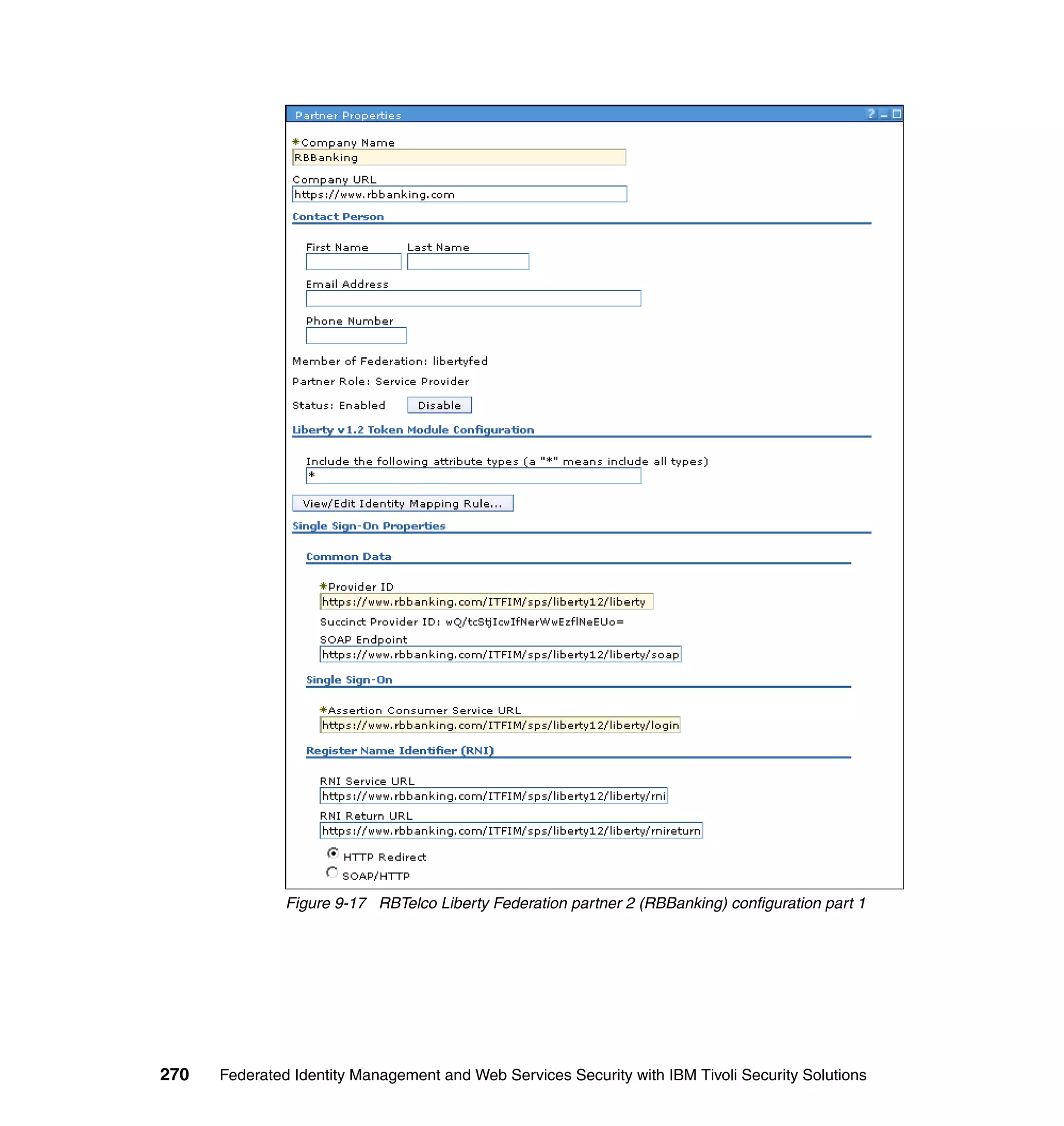
               (outgoing).

               At the Trust layer, security tokens are being exchanged between Tivoli
               Federated Identity Manager and the third-party solution. In Tivoli Federated


122   Federated Identity Management and Web Services Security with IBM Tivoli Security Solutions
Identity Manager, this layer is handled by the trust service. The trust service
           exchanges security tokens with the third-party solution in the WS-Security
           header of SOAP requests (as handled by the trust handler).


3.4.1 Architecture overview


                             App Server                     ITFIM Runtime
                                                                                     ITFIM
                                    ITFIM                    Key Encryption       Management
                                     Client                  Signing Service        Service
             Web Services
                                                              Trust Service
              Requests               Web
                                 Services/XML                     STS
                                   Point of
                                                              Auth Service
                                                                                     ITFIM
                                   Contact
                                                                                    Console
                                    Web                       Alias Service
                                   Service
                                    App
                                                                                   LDAP User
                                                                                    Registry
                                    Authorization Service


           Figure 3-22 Components for Web services security management

           Figure 3-22 shows the components required for Web services security
           management with Tivoli Federated Identity Manager.

           The Tivoli Federated Identity Manager Web services Trust Client is called by the
           application server Web services handler during processing of Web services
           requests. This is triggered by entries in the application’s deployment descriptors.
           The Trust Client builds a WS-Trust based request to the trust service based on
           the information contained in the Web services request. The trust service will
           validate existing security tokens and generate new security tokens as required.

           In addition to validating incoming security tokens, the trust service may also
           optionally invoke the authorization service. This authorization decision is used to
           determine if the identity claimed (and mapped) from the incoming token is
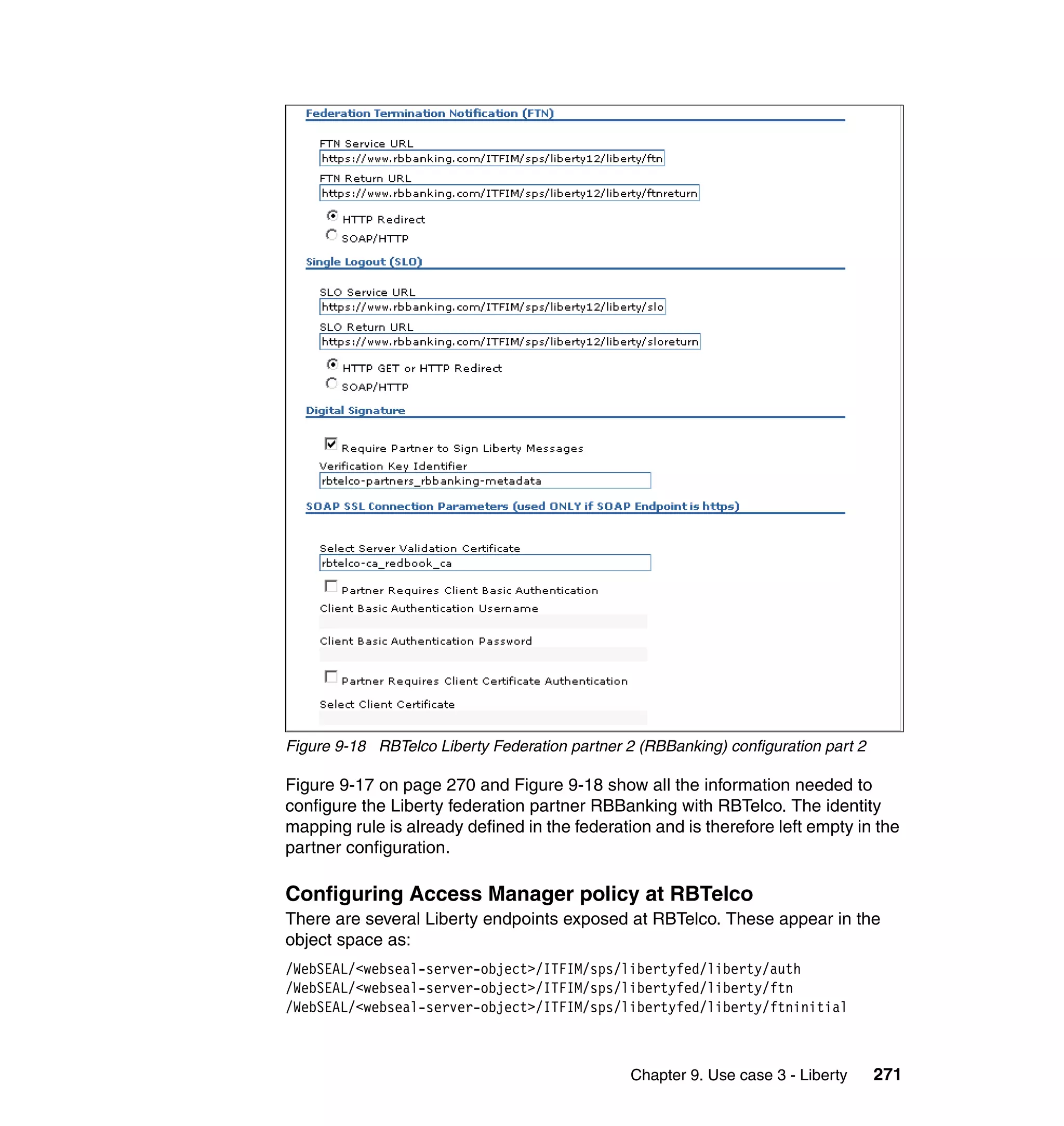
           allowed to invoke the requested Web services as defined by the WSDL abstract
           binding.

           Assuming the incoming security token is valid and the authorization is
           successful, the Tivoli Federated Identity Manager Trust Client passes control


                                 Chapter 3. Tivoli Federated Identity Manager architecture    123
back to the Web services handler. The Trust Client also passes back identity
               information that is used to populate the subject associated with the request for
               J2EE security within the application server.


                                                                                                                Web Service
                                                                                  Internet                      Application


                            Web Service
                                                                                   Internet


                            Application
                                                                                                                          local ID


                                                               Web Service
                                                               Firewall or
                                          SOAP                               SOAP


                                                    local ID
                                                                                                           Web Security


                                                                Gateway


                                                                                                   Token
                                          Request                                                            Server
                                                                             Request

                Company A   local ID
                  User


                            local ID                            Token               Token
                                                                                                                    local ID


                                   •Identity Mapping                                   •Identity Mapping
                                   •Attribute Mapping                                  •Attribute Mapping
                                   •Token Management                                   •Token Management
                                   •Authorization Control                              •Authorization Control


                                          ITFIM/WSSM                                          ITFIM/WSSM

               Figure 3-23 Web service security management (WSSM): Solution architecture

               Figure 3-23 shows a user at company A accessing a resource at company B via
               a Web service request.
               1. User at company A invokes a Web service using her local ID.
               2. The edge of company A could be an XML/WS Firewall or Gateway or similar.
                  The general requirement for this node is to standardize outbound requests
                  such that they can be processed by the receiving company B. Its functionality
                  may include:
                   – Mapping of identity claimed in incoming locally valid ID to a token
                   – Mapping of local valid attributes such as groups/roles to agreed attributes
                   – Exchange of presented local valid token for a token format agreed in the
                     relationship to company B
               3. Over the Internet a number of different technologies can be used to provide
                  message privacy and integrity (SSL, SOAP-Security, VPN tunnel, and so on)
               4. Web services functionality at company B side will do authorization and
                  identity/attribute mapping as part of creating a local ID token to be added to
                  the request. The request invokes the backend application as a Web service or
                  as a local application (for example, J2EE or .NET)


124   Federated Identity Management and Web Services Security with IBM Tivoli Security Solutions
To understand the Web services security management solution it is necessary to
          explain WS-Security, WS-Trust, and the high-level functionality of a Web
          services firewall/gateway component and the TFIM authorization service.


3.4.2 WS-Security
          WS-Security is used to accomplish end-to-end message security.
          Message-based security does not rely on secure transport because:
             The message itself is encrypted - message privacy
             The message itself is signed - message integrity
             The message contains user identity - proof of origin


                          Connection                             Connection
                       Integrity/Privacy                      Integrity/Privacy
                             HTTPS
                                                  ?                  HTTPS


                                           SOAP Message


          Figure 3-24 Message-based security: End-to-end security

          In Figure 3-24 end-to-end message security is illustrated. The lock on the SOAP
          message is meant to imply that the SOAP message is inherently secure in and of
          itself. The SOAP message can be transported in any way and its security is not
          affected. The SOAP message could be sent as an e-mail attachment, carried on
          a floppy-disk, and so on, and the properties of privacy, integrity, and proof of
          origin are not affected.

          In contrast, the security of a message that relies on transport security is exposed
          when that transport security has gaps, as would occur when multiple SSL hops
          are required to move the message from the origin to the ultimate receiver.

          The gaps in the transport security may or may not be an issue, depending on the
          trust assigned to the nodes that provide the transport compared to the trust
          required for the message.

          For more on the topic WS-Security and SOAP header extensions see 2.5.2,
          “Web services security” on page 68.


                                Chapter 3. Tivoli Federated Identity Manager architecture   125
The elements are defined in the OASIS standard “Web services Security: SOAP
               Message Security 1.0” and provide the ability to achieve “message-based
               security” for a SOAP message. That is, the message in and of itself is
               tamper-proof and confidential.


3.4.3 Web services Gateway or Firewall
               A Web services gateway or firewall is much the same as a HTTP Reverse proxy.
               A WS Gateway enables the company to separate internal network topology from
               the Internet, allowing for flexibility and abstraction.


                               HTTP          HTTP                  HTTP      HTTP
                                                       mapping
                                             Server                Client

                   end-user
                  (browser)
                                                                                        HTTP Server
                                              HTTP Reverse Proxy


                                              Web
                               SOAP                    mapping    Service    SOAP
                                            Service
                                                                 Requestor
                                            Provider

                 Web Service
                                                                                        Web Service
                  Requestor
                                          Web Services Gateway                           Provider

               Figure 3-25 Web services gateway: A reverse-proxy for Web services

               Challenges that are addressed by the Web services Gateway are:
                  Decouple deployment from invocation
                  Separate the actual implementation of a service from how another service
                  accesses it. These include:
                  – Process abstraction
                      The service invocation approach must be flexible enough to cope with
                      events such as switching frequently between external providers of a
                      similar service without requiring changes to the application.
                  – Flexibility
                      As a service provider, you need the flexibility of changing your deployment
                      infrastructure without notifying all the service requestors. Say a Web
                      service is deployed in a machine that later fails during operation. There


126   Federated Identity Management and Web Services Security with IBM Tivoli Security Solutions
needs to be a process to route the invocations to an alternate service in
                 your infrastructure.
             Protocol transformation
             An enterprise may be using a specific messaging infrastructure within their
             network to meet the business requirements. However, your partners and
             customers may be using different protocols to invoke your Web service. You
             need a mechanism to reconcile the different service invocations to match the
             needs of the internal infrastructure.

          For more details on the IBM Web Services Gateway see:

          http://www.ibm.com/developerworks/webservices/library/ws-gateway/

          The SOAP processing model assumes that messages can be relayed among
          several intermediate SOAP nodes as it travels from the initial sender to the
          ultimate receiver. The general idea is that, within an enterprise or value chain,
          intermediaries can handle common aspects of SOAP message processing,
          thereby leaving the initial sender and ultimate receiver to be concerned only with
          the behavior required for a particular application.

          The IBM Web Services Gateway is a SOAP processing engine that is focused on
          the operation of the intermediaries in the SOAP chain. Typically, it does not act
          as an ultimate receiver or as an initial sender of SOAP messages; rather, it is a
          way point for SOAP messages with the capability to:
             Alter the destination of a message (routing).
             Handle custom header tag processing.
             Apply and remove message level security (WS-Security).
             Perform protocol transformation, for example, submit incoming SOAP/HTTP
             messages to SOAP/JMS.

          For details on Web services gateway see Chapter 4, “Deploying Tivoli Federated
          Identity Manager” on page 135.


3.4.4 WS-Trust
          The WS-Trust specification defines the interface used to manage the security
          tokens defined by the WS-Security specification. The TFIM trust service interface
          is defined by WS-Trust. It may be accessed by trust clients using either SOAP
          requests or direct JAVA API calls. The trust client can be the one in Web
          services security management, SPS, or a custom client, as long as it conforms to
          the Tivoli Federated Identity Manager WS-Trust profile. This interface allows any
          conferment Trust Client to request security tokens from the Tivoli Federated
          Identity Manager trust service, where the trust service can provide the


                                Chapter 3. Tivoli Federated Identity Manager architecture   127
appropriate token translation, identity translation, and request authorization as
               part of its token functionality. For more on the trust service see 3.2.3, “Trust
               services” on page 92.


3.4.5 Authorization services (AS)
               When used within the context of Web services security management, the trust
               service can be configured with authorization services. The authorization services
               may be used to determine if a user (as validated and identified by the trust
               service) is authorized to access requested resources. This allows an
               implementation-independent decision on the access of a Web service; that is, it
               does not matter if the Web service exposes a J2EE-based resource, a CICS
               resource, or some other proprietary resource.


3.4.6 Web services security management architecture approach
               There are many ways to deploy a Web services security management solution.
               This view gives an attempt to show how it could be accomplished using Tivoli
               Federated Identity Manager based nodes, using a Web service gateway. The
               selected nodes and their connections are represented to illustrate their place
               meant in the logical network zones.


                                                                   DMZ                                 Internal Network Zone                                      Corporate Zone


                                                                                                                        Application
                                                                                                                          Server
                                                                                                                          Node


                 External                                       Web Services
                 Systems                                                                                                 Directory
                                                                 Gateway
                  Node                                                                                                    Node
                                                                   Node
                                                                                                                                                                       Database
                                                                                                       Federated                                                        Server
                                                                                                        Identity                                                        Node


                                                                                                                                       Enterprise Firewall Node
                                       Protocol Firewall Node


                                                                               Domain Firewall Node
                            Internet


                                                                                                      Management
                                                                                                         Node            Access
                                                                                                                        Manager
                                                                                                                         Policy &
                                                                                                                   .
                                                                                                                       Authorization
                                                                                                                          Node
                                                                                                                                                                      Integration
                                                                                                                                                                          Hub
                                                                                                                                                                         Node


                                                                                                                                                                       Enterprise
                                                                  Network                                                                                               Systems
                                                                  Intrusion                                                                                              Node
                                                                  Detection
                                                                    Node


               Figure 3-26 Specified level view of Web services security management

               A more detailed look at Web services security management deployment is
               available in In 4.2, “Federated Web services architecture patterns” on page 151.


128   Federated Identity Management and Web Services Security with IBM Tivoli Security Solutions
3.5 Provisioning services
         Provisioning services are used within a federated environment for both a priori
         and run-time provisioning solutions, as described in 2.6, “Federated identity
         provisioning” on page 70. Provisioning services interact with both local identity
         management systems (such as Tivoli Identity Manager) and local data stores
         (access via identity services). Provisioning services are leveraged to federate
         local identity management systems across federation business partners and to
         provide federated management of identity data, including transactional and
         profile attributes; see 2.2.5, “Identity attributes” on page 45.

         There are few widely accepted standards for provisioning. The most important
         effort to date is probably the work done by the Provisioning Service Technical
         Committee (PSTC) at OASIS. The PSTC has defined a set of use cases that
         reflect the operational requirements of a provisioning system. WS-Provisioning is
         compatible with those use cases.

         WS-Provisioning describes the APIs and schemas necessary to facilitate
         interoperability between provisioning systems and to allow software vendors to
         provide provisioning facilities in a consistent way. The specification addresses
         many of the problems faced by provisioning vendors in their use of existing
         protocols, commonly based on directory concepts, and confronts the challenges
         involved in provisioning Web services described using WSDL and XML Schema.

         The specification defines a model for the primary entities and operations
         common to provisioning systems including the provisioning and de-provisioning
         of resources, retrieval of target data and target schema information, and provides
         a mechanism to describe and control the life cycle of provisioned state.


                               Chapter 3. Tivoli Federated Identity Manager architecture   129
Trust       Authorization
                                             Security Tokens                             Service
                                                                          Service
                                                                                             Key


                                                                            WS-Trust
                                                                                         Encryption
                                                                                       Signing Service


                       IBM or                                              Trust
                      3rd Party                WS-Security                Handler
                  standards-based
                      solution

                                                                         Application
                                                                           Server
                                                    SOAP                Web Services
                                                                          Handler
                                                                                          Identity
                                                                                          Manager
                                                                                          Service
                                                                        Provisioning
                                             WS-Provisioning              Service


               Figure 3-27 Web services provisioning: Components and communication

               Figure 3-27 shows the communications and exchanges that take place at each
               layer of Tivoli Federated Identity Manager when performing Web services
               provisioning.

               Note that no internal details are shown for the third-party side because their
               architecture is not known (and not important). Integration is at a protocol level.

               At the Communication layer, SOAP messages are being handled by the
               application server, in this case WebSphere Application Server or WebSphere
               Web services Gateway. All real communication is via the Web services handlers
               in the application server.

               At the Protocol layer, the WS-Security header in the SOAP request is handled by
               the Tivoli Federated Identity Manager trust handler. It must read the WS-Security
               headers sent by the third-party solution (incoming) or include headers for the
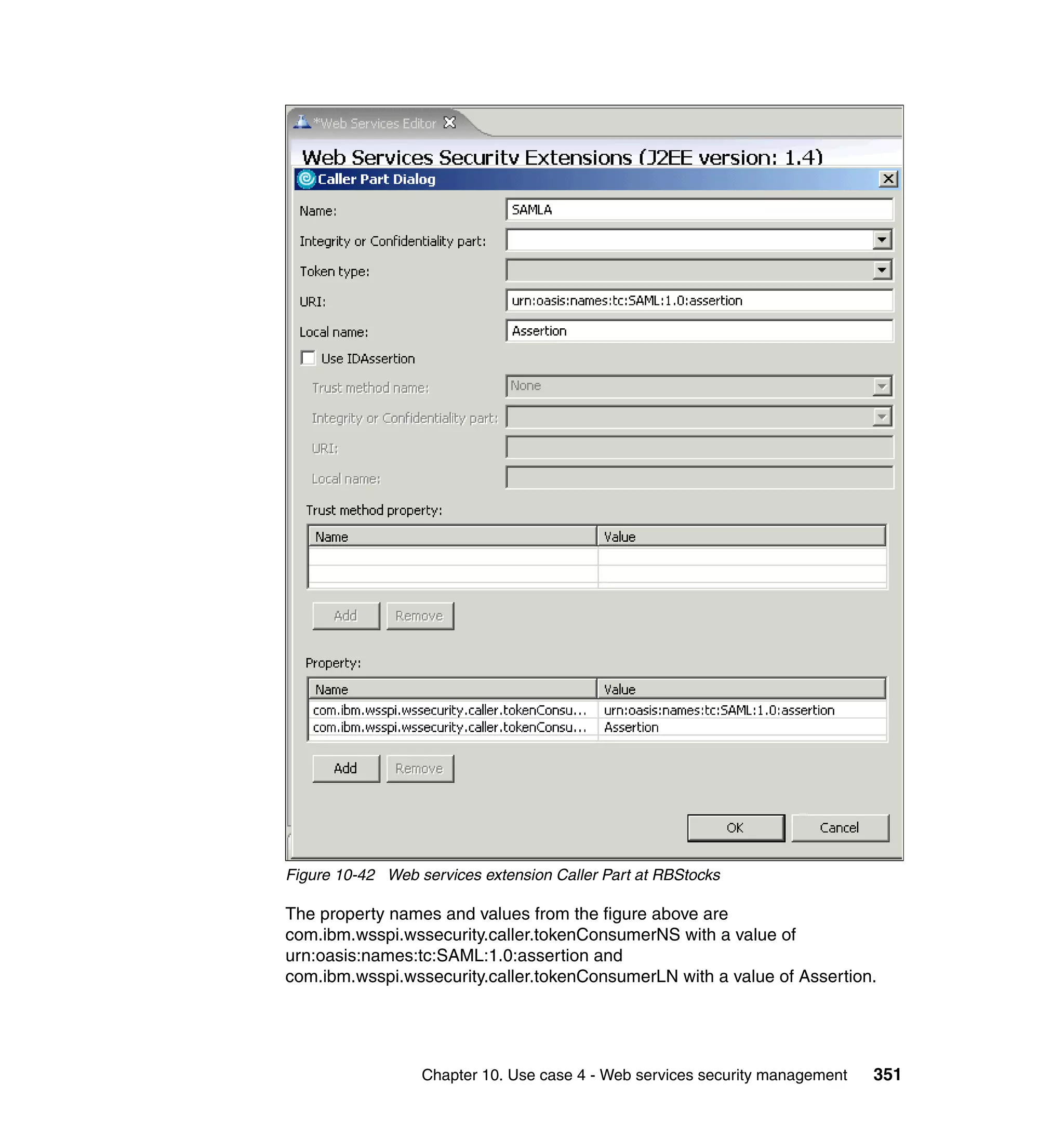
               third-party solution (outgoing).

               At the Trust layer, security tokens are being exchanged between Tivoli
               Federated Identity Manager and the third-party solution. In Tivoli Federated
               Identity Manager, this layer is handled by the trust service. The trust service
               exchanges security tokens with the third-party solution in the WS-Security
               header of SOAP requests (as handled by the trust handler).


130   Federated Identity Management and Web Services Security with IBM Tivoli Security Solutions
SOAP Security is used to protect WS-Provisioning messages, and the
           provisioning service acts as a secured Web service, accessing the IBM Tivoli
           Director Integrator in the back-end.


3.5.1 Architecture overview
           Figure 3-28 shows the components required in order to implement secure,
           cross-enterprise provisioning using Tivoli Federated Identity Manager.


                              App Server                    ITFIM Runtime
                                                                                     ITFIM
                                    ITFIM                    Key Encryption       Management
                                 Trust Client                Signing Service        Service
            WS-Provisioning
                                                              Trust Service
              Messages                Web
                                 Services/XML                     STS
                                Point of Contact              Auth Service
                                                                                     ITFIM
                                                                                    Console
                                   ITFIM                      Alias Service
                                Provisioning
                                  Service
                                                                 Identity          LDAP User
                                                               Management
                                                                                    Registry
                                                                 Service
                                    Authorization Service


           Figure 3-28 Components for federated user provisioning

           It is important to note here that many of the components shown here are the
           same as required to secure any Web service. The provisioning service is just
           another Web service in that respect.

           The only components specifically related to provisioning are the provisioning
           service itself and Identity Management Service, which is the enterprise Identity
           Management Service, in this case the IBM Tivoli Directory Integrator (ITDI), but it
           could also be a bespoke identity provisioning capability. The Tivoli Federated
           Identity Manager Alias Service and LDAP registry are also needed if provisioning
           for Liberty single sign-on with account linkage.

           WS-Provisioning messages are received by the application server Web services
           handler, in this case the WebSphere Services handler, and are authorized using
           Tivoli Federated Identity Manager and authorization service, here Tivoli Access
           Manager. If authorized, the request is passed on to the Tivoli Federated Identity


                                 Chapter 3. Tivoli Federated Identity Manager architecture    131
Manager provisioning service. The provisioning service validates the request and
               then passes it on to ITDI. An ITDI assembly line extracts the identity information
               from the provisioning request and handles as appropriate. If the request is to
               provision a local account for Liberty SSO then the Alias Service is called to
               associate the newly created user with the received Liberty alias.

               Although the diagram above shows ITDI interfacing directly to the LDAP user
               registry, this is just an example. ITDI could be configured to interface with any
               supported endpoint including IBM Tivoli Identity Manager.


                              WebSphere                                            WebSphere
                                                                         4

                                   ITFIM                         WS-Provisioning        ITFIM
                               WS-Provisioning                         SAML         WS-Provisioning


                                                                                       WS-Provisioning
                                           WS-Provisioning
                                                                   Secure SOAP                                 Enterprise
                                                             3     Message with
                                                                                                         5    Provisioning
                                                                      Token


                                                                                                                7
                 Local
                 Provision                                             ITFIM
                                    2                                  WS-P              6
                 Trigger                                              Connector

                    1           Assembly Line                                        Assembly Line
                                  Directory Integrator                                 Directory Integrator

                             Identity Provider                                         Service Provider

               Figure 3-29 Federated provisioning - Overview

               Figure 3-29 provides an overview of the WS-Provisioning support provided in
               Federated Identity Manager. The Tivoli Federated Identity Manager components
               are:
                  The Tivoli Federated Identity Manager WS-Provisioning Web service that
                  runs on WebSphere Application Server 6.0
                  The Tivoli Federated Identity Manager WS-Provisioning Connector that runs
                  on IBM Tivoli Directory Integrator

               Both of these provide a full implementation of the three interfaces defined by the
               WS-Provisioning standard.


132   Federated Identity Management and Web Services Security with IBM Tivoli Security Solutions
A provisioning event is sent from the identity provider to the service provider via
this sequence:
1. Some type of provisioning trigger at the IP initiates a Tivoli Directory
   Integrator assembly line. Tivoli Directory Integrator provides several
   mechanisms to start an assembly line. The creation of a new entry in an
   LDAP directory is detected by a monitoring agent, a DSMLv2 request from
   IBM Tivoli Identity Manager, or another enterprise provisioning service, and
   so on.
2. The Tivoli Directory Integrator assembly line collects data to form a
   WS-Provisioning message. The assembly line can use any of the standard
   Tivoli Directory Integrator facilities for this including the many standard Tivoli
   Directory Integrator connectors.
3. The Tivoli Federated Identity Manager WS-Provisioning Connector sends a
   WS-Provisioning message to the Tivoli Federated Identity Manager
   WS-Provisioning Service.
4. The Tivoli Federated Identity Manager WS-Provisioning Service uses the
   Tivoli Federated Identity Manager Trust Server to create a SAML token for a
   configured identity and uses the WebSphere SOAP Security support to
   forward the WS-Provisioning message to the target service provider.
5. The Tivoli Federated Identity Manager WS-Provisioning Service on the SP
   receives the message and forwards it to a configured WS-Provisioning
   Connector on a local Tivoli Directory Integrator. This Tivoli Federated Identity
   Manager WS-Provisioning Service may be configured to use Tivoli Federated
   Identity Manager Web services security management for identity validation
   and request authorization with Tivoli Access Manager.
6. The Tivoli Federated Identity Manager WS-Provisioning Tivoli Directory
   Integrator Connector receives the WS-Provisioning message and starts a
   configured Tivoli Directory Integrator assembly line.
7. The Tivoli Directory Integrator assembly line on the SP collects whatever
   local data is required and initiates local provisioning, using an enterprise
   provisioning system such IBM Tivoli Identity Manager if necessary.

Note that the WS-Provisioning messages sent between Tivoli Directory
Integrator and Tivoli Federated Identity Manager do not include SOAP Security
headers because they are assumed to be in a trusted environment. The
WS-Provisioning messages from Tivoli Federated Identity Manager-to-Tivoli
Federated Identity Manager do use the SOAP Security support of WebSphere.


                       Chapter 3. Tivoli Federated Identity Manager architecture   133
3.5.2 Provisioning architecture approach
               There are many ways to deploy a provisioning solution. This view gives an
               attempt to show how it could be accomplished leveraging Web services security
               management.


                                                                        DMZ                                 Internal Network Zone                                      Corporate Zone


                                                                                                                                                                            Identity
                                                                                                                             Provisioning
                                                                                                                                                                          Management
                                                                                                                                Node
                                                                                                                                                                             Node


                    External                                         Web Services
                  Provisioning                                                                                                Directory
                                                                      Gateway
                     Node                                                                                                      Node
                                                                        Node

                                                                                                            Federated
                                                                                                             Identity


                                                                                                                                            Enterprise Firewall Node
                                            Protocol Firewall Node


                                                                                    Domain Firewall Node
                                 Internet
                                                                                                           Management
                                                                                                              Node            Access
                                                                                                                             Manager
                                                                                                                        .     Policy &
                                                                                                                            Authorization
                                                                                                                               Node


                                                                       Network
                                                                       Intrusion
                                                                       Detection
                                                                         Node


               Figure 3-30 Generic IBM Tivoli FIM specified level view of provisioning


3.6 Conclusion
               At the beginning of this chapter we discussed the federated identity management
               functionality and how that functionality consists of a set of services. Then we
               described three solution area (F-SSO, Web services security management, and
               provisioning) studying functional details within each solution area.
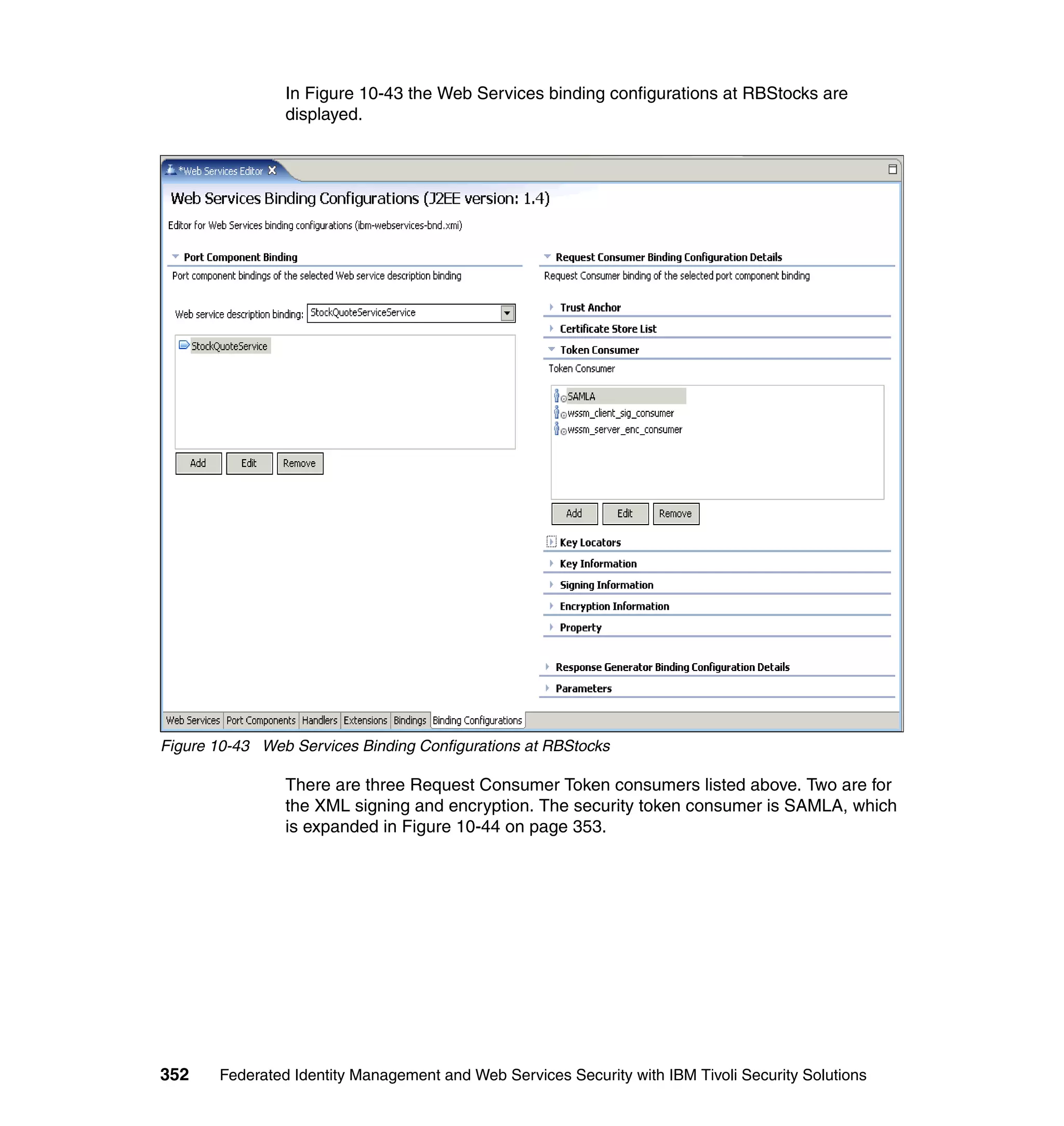
               The focus of the chapter was to give a description of how the Tivoli Federated
               Identity Manager solution is implemented to meet the overall FIM challenge. We
               discussed how the Tivoli Federated Identity Manager solution is built around the
               trust infrastructure implemented by the trust service. Single sign-on services
               provide the implementation of federation protocols, and also the interface
               between the point of contact (PoC) and the trust service.


134   Federated Identity Management and Web Services Security with IBM Tivoli Security Solutions
4


    Chapter 4.   Deploying Tivoli Federated
                 Identity Manager
                 This chapter describes architecture options for deploying Tivoli Federated
                 Identity Manager, approaches for integrating Tivoli Federated Identity Manager
                 with other middleware and customer applications, and several important issues
                 relating to deploying Tivoli Federated Identity Manager in a production
                 environment.


© Copyright IBM Corp. 2004, 2005. All rights reserved.                                      135
4.1 Federated SSO architecture patterns
               Tivoli Federated Identity Manager is a flexible product that provides a federated
               identity management solution for both browser-based single sign-on and Web
               services environments. As there are many different examples of environments
               that require a federation solution, there are many different ways that Tivoli
               Federated Identity Manager can be deployed. We can represent the deployment
               of Tivoli Federated Identity Manager with several typical deployment/architecture
               patterns. In this section, we describe the most patterns from which
               customer-specific deployments can be generated.


4.1.1 Architecture approach
               Tivoli Federated Identity Manager’s federated single sign-on (F-SSO) solution
               enables the single sign-on of a user in a cross-Enterprise, or cross-domain,
               scenario. Tivoli Federated Identity Manager’s F-SSO functionality does not
               replace an Enterprise’s existing authentication and session management
               services, nor any of the sign-on functionality they provide to the Enterprise’s
               applications. Tivoli Federated Identity Manager’s F-SSO solution handles SSO to
               an edge-based point of contact component. This is based on the underlying
               principal that because Tivoli Federated Identity Manager does not replace
               existing session management functionality, it should not directly provide single
               sign-on to individual applications within an Enterprise (Enterprise single sign-on).

               An architectural model based on a (scalable, available, performant) point of
               contact provides many security benefits, including the ability to control all access
               to an environment, closing off “back doors” that allow unauthorized users to
               access an Enterprise’s environment. Typically, an edge component, such as
               Access Manager for e-business, acts as a point of contact and is used to provide
               single sign-on from Tivoli Access Manager for e-business (where the user’s
               authentication credentials are collected and evaluated) to individual backend
               applications. This functionality remains unchanged by the addition of a Tivoli
               Federated Identity Manager solution.


136   Federated Identity Management and Web Services Security with IBM Tivoli Security Solutions
Identity      TAMeB                 TAMeB           Third-party
    Providers    SSO Domain            SSO Domain       SSO Domain


                Federated Single Sign-On Standards


     Service      Third-party          TAMeB               TAMeB
    Providers    SSO Domain          SSO Domain          SSO Domain


        TAMeB – Tivoli Access Manager for eBusiness

Figure 4-1 Linking SSO domains with Federated SSO protocols

This architectural approach to Federated SSO provides the following
advantages:
   Little or no changes are required to Enterprise applications.
   Lightweight SSO within a domain.
   Support for identity provider applications.
   Able to leverage existing Tivoli Access Manager for e-business infrastructure.

Little/no change to applications
Many toolkit-based offerings for Federated SSO require fairly intrusive
modifications to the applications to call the (proprietary) product APIs required to
implement Federated SSO. These toolkit approaches are typically marketed as
lightweight approaches; however, in terms of total project costs and maintenance
costs, they are often more expensive than middleware solutions (such as Tivoli
Federated Identity Manager), even for small-to-medium size deployments. These
so-called lightweight solutions can be even more expensive if an environment
does not have existing session management functionality; many federation
solutions assume that this type of functionality exists and can be leveraged as
part of an F-SSO solution for single sign-on and single (federated) logoff.

The Tivoli Federated Identity Manager approach leverages Access Manager for
e-business's ability to provide SSO to an application with few or no changes to
the application. For those applications that use underlying middleware
functionality to manage authentication, the middleware container can usually be
configured to accept the user identity from Access Manager for e-business
without any changes to the applications using the authentication data. For


                         Chapter 4. Deploying Tivoli Federated Identity Manager   137
example, the IBM WebSphere Application Server provides a feature called a
               Trust Association Interceptor (TAI) to accept a user ID from an HTTP header
               variable and create a login context for that user. Most other middleware products
               have similar functionality. For those applications that implement their own
               custom authentication logic, a small change to the login module to accept the
               user identity from a HTTP header variable, rather than prompting the user for a
               user ID and password, is typically fairly straightforward to code and test.

               The Tivoli Federated Identity Manager approach provides a loose coupling
               between the application and the Federated SSO functionality and avoids the use
               of proprietary APIs.

               Lightweight SSO within a domain
               The digital signing and validation of XML-based assertions, such as those used
               in the Federated SSO protocols, involve encryption and decryption using
               relatively long asymmetric keys. Such operations incur a fair degree of
               computational overhead. This computational overhead is required (and thus
               accepted) as part of the proof of a trust relationship governing federated single
               sign-on. The trust relationship between a point of contact (for example, Access
               Manager for e-business) and back-end protected applications does not normally
               require techniques that are as costly. For example, these internal trust
               relationships can be based on techniques such as mutually authenticated SSL or
               known internal IP addresses.

               By using a lightweight SSO technique between Access Manager for e-business
               and the (possibly hundreds of) protected applications within an Enterprise, this
               overhead is only incurred where it is needed—in those cases where we need to
               provide SSO from one domain/organization to another. The Tivoli Federated
               Identity Manager approach therefore provides a more efficient and scalable
               architecture and a more responsive user experience when working with multiple
               applications within a domain.

               Support for identity provider applications
               Even for pure identity provider deployments (no local services/protected
               resources are made available to the user), there are often self-care and portal
               applications associated with the identity provider’s identity management
               functionality. The use of Access Manager for e-business to provide the point of
               contact for the identity provider leverages the (lightweight) SSO facilities of
               Access Manager for e-business to access the identity provider applications
               without incurring the overhead of running and accessing a separate service
               provider site for those applications.


138   Federated Identity Management and Web Services Security with IBM Tivoli Security Solutions
Leverage existing Access Manager infrastructure
           For those customers who have already deployed a Access Manager for
           e-business SSO infrastructure, upgrading it to provide Federated SSO
           functionality is a relatively straightforward exercise. Moreover, in most cases the
           applications will not require any modification, thereby significantly reducing the
           time and costs needed to deploy the Federated SSO functionality.


4.1.2 Base pattern
           The Base architecture pattern for deploying Tivoli Federated Identity Manager for
           Federated SSO uses the reverse proxy component of Access Manager for
           e-business (WebSEAL) to provide the point of contact for Tivoli Federated
           Identity Manager, namely authentication (at the identity provider side) and
           session management (for both an identity provider and service provider
           deployment). In this Base pattern, all users who use the Federated SSO
           functionality are individually defined in the Access Manager for e-business user
           registry2.

           On the identity provider side of a federation, Access Manager for e-business
           (WebSEAL) manages the local user authentication process, using any of its
           supported authentication mechanisms. WebSEAL manages the user’s session,
           including (optionally) brokering access to the identity provider’s protected
           applications based on Access Manager for e-business managed access control
           policies. Note that these policies can be as simple as access is allowed based on
           successful authentication, to more complex, such as access is allowed (or
           disallowed) based on a user’s group membership, roles, or other attributes
           (entitlements).

           If a user requests single-sign-on (or has it requested on their behalf by a service
           provider partner), Access Manager for e-business will pass control to the Tivoli
           Federated Identity Manager server. Note that Tivoli Federated Identity Manager
           itself, and the single sign-on functionality, can be access controlled by Access
           Manager for e-business. This has the effect of allowing a customer (in a more
           advanced deployment) to provider single sign-on functionality to a subset of its
           users. Included with this request to Tivoli Federated Identity Manager will be the
           user’s local (Access Manager for e-business based) identity. The Tivoli
           Federated Identity Manager server will use this identity for the building of the
           assertion provided as part of a single sign-on response.


           2
             While this discussion focuses on the use of the Access Manager for e-business reverse proxy
           (WebSEAL), it is equally possible to provide point of contact functionality using the Access Manager
           for e-business Web server plug-in. The plug-in approach is described in the next section.


                                        Chapter 4. Deploying Tivoli Federated Identity Manager             139
Id en tity P ro vid er


                                                                                                                                                         A dm inistrator

                                                                                                                       Identity
                                                                                                                          Identity
                                                                                                                      P rovider
                                                                                                                         P rovider
                                                                                                                    A pplications
                                                                                                                       A pplications                           IB M
                                                                                                                                                           Integrated
                                                                                                                                                            S olutions
                                                                                                                                                            C onsole


                                   `
                                                                                                        u se rid
                                                                                                                                   IT FIM                     IT F IM
                   U ser’s B row se r                             T A M eB                                                        R untim e               M anagem ent
                                                                 W ebS E A L                                                      S ervice                   S ervice


                                          P rotocol                                      D om a in
                                          Firew all                                      F ire w a ll
                        S e rvice                                                                                T A M eB                     TA M eB
                       P roviders                                                                          A uthorizationS erve                P olicy
                                                                                                                     r                        S erver


                                                                                                                                    U ser
                                                                                                                                  R egistry


                                         ITFIM – IB M T ivoli Fe de rated Ide ntity M an ag er


               Figure 4-2 Base pattern for identity provider

               For a service provider configuration, Access Manager for e-business (WebSEAL)
               is configured to allow unauthenticated access to the Tivoli Federated Identity
               Manager application, namely the login endpoint associated with the federation.
               Once Tivoli Federated Identity Manager has successfully validated and
               processed the incoming SSO message, it creates an Access Manager for
               e-business credential and passes it back to the WebSEAL server via the Access
               Manager for e-business External Authentication Interface (EAI). This allows
               WebSEAL to establish and manage an authenticated session for the user. See
               Appendix A, “Configuring Access Manager WebSEAL and Web plug-in” on
               page 363, for a description of the External Authentication Interface of Access
               Manager for e-business.


140   Federated Identity Management and Web Services Security with IBM Tivoli Security Solutions
Service Provider


                                                                                                  Administrator
                                                                   Identity
                                                                     Service
                                                                  Provider
                                                                    Provider
                                                                 Applications                          IBM
                                                                  Applications                      Integrated
                                                                                                     Solutions
                                                                                                     Console

              `
                                                          EAI Hdrs
                                                                              ITFIM                   ITFIM
   User’s Browser                     TAMeB
                                                                             Runtime               Management
                                     WebSEAL
                                                                             Service                 Service


                          Protocol             Domain
                          Firewall             Firewall
     Identity                                                  TAMeB                    TAMeB
    Providers                                                Authorization               Policy
                                                                Server                  Server


                                                                              User
                                                                             Registry


Figure 4-3 Base pattern for service provider

Several Federated SSO protocols include SOAP-based profiles. These profiles
are used to retrieve information from a back-channel (directly between the
identity provider and the service provider, without redirection via the user’s
browser). This back-channel communication is (confidentiality) protected through
the use of SSL. The SOAP traffic is sent over SSL and Tivoli Federated Identity
Manager will validate the (SSL) X.509 server certificate presented by the server
hosting the SOAP endpoint.

The use of SSL does not provide authentication of the requestor (initiating the
SOAP request). Additional techniques are required for authentication purposes:
   Rely on message level authentication.
   Rely on channel level authentication.

As message level authentication provides no additional burden on the Tivoli
Federated Identity Manager servers, the Tivoli Federated Identity Manager
SOAP endpoint is configured to use the same set of replicated WebSEAL
servers as the login endpoint.

When additional channel-level authentication is required, mutually authenticated
SSL techniques are required. The service provider presents an X.509 client
certificate to the identity provider during the establishment of the SOAP
connection. This allows a mutually authenticated SSL session to provide both


                         Chapter 4. Deploying Tivoli Federated Identity Manager                                   141
authentication of the service provider and protection of communications in
               transit.

               When a mutually authenticated SSL type solution is required, a dedicated set of
               replicated WebSEAL servers is required at the identity provider. These
               WebSEAL servers listen on a different IP address and/or different port than the
               main set of WebSEAL servers yet are junctioned to the same Tivoli Federated
               Identity Manager servers as the main set of WebSEAL servers. These additional
               servers are configured to request and validate an X.509 client certificate as part
               of the HTTPS session establishment. These extra WebSEALs are then governed
               by a different trust relationship from the typical HTML/HTTP serving WebSEALs.
               In particular, these SOAP-accessible WebSEALs can provide a stronger trust
               relationship between the identity provider and service provider.


                                                                                                         Identity Provider


                                                                                                                    Administrator
                                                                                       Identity
                                                                                         Identity
                                                                                      Provider
                                                                                        Provider
                                                                                     Applications                        IBM
                                                                                      Applications                    Integrated
                                                                                                                       Solutions
                                                                                                                       Console

                             `                       TAMeB
                                                    WebSEAL                 userid
                                                                                                ITFIM                   ITFIM
                  User’s Browser                                                               Runtime               Management
                                                                                               Service                 Service
                                                      TAMeB
                                                    WebSEAL
                                         Protocol   (for SOAP)   Domain
                                         Firewall                Firewall
                    Service                                                      TAMeB                    TAMeB
                   Providers                                                   Authorization               Policy
                                                                                  Server                  Server


                                                                                                User
                                                                                               Registry


               Figure 4-4 Base pattern for identity provider with SOAP Backchannel


4.1.3 Plug-in pattern
               The Base pattern for Federated SSO can be modified to use the Access
               Manager for e-business Plug-ins rather than Access Manager for e-business
               WebSEAL as the point-of-contact server for an Tivoli Federated Identity
               Manager deployment. From a Tivoli Federated Identity Manager implementation
               perspective, there is little difference in using WebSEAL versus the plug-ins, as
               the required Access Manager for e-business functionality exists in both options.


142   Federated Identity Management and Web Services Security with IBM Tivoli Security Solutions
In this design pattern, the Access Manager for e-business Web Plug-in is
           configured into the Web server acting as a proxy for the WebSphere Application
           Server hosting the Tivoli Federated Identity Manager services. Access Manager
           for e-business-based SSO will be provided to any application running in the
           same application server as Tivoli Federated Identity Manager. With Access
           Manager for e-business 5.1, SSO to applications running on application servers
           in the same DNS domain can be implemented, but it requires use of a domain
           cookie and a Access Manager for e-business plug-in must be installed in the
           Web server associated with the other application servers.


                                                                                                             Administrator
                                                                              Identity
                                                                             Provider
                                                                             Applicaitons                         IBM
                                                                            Applications
                                                                                                               Integrated
                                                                                                                Solutions
                                                                                                                Console
                                                  Web
                        `                        Server

                                                                                         ITFIM                   ITFIM
             User’s Browser                     TAMeB
                                                                                        Runtime               Management
                                               Web Plug-in
                                                                                        Service                 Service

                                               WebSphere
                                    Protocol    Plug-in      Domain
               Identity/            Firewall                 Firewall
                                                                          TAMeB                    TAMeB
               Service                                                  Authorization               Policy
              Providers                                                    Server                  Server


                                                                                         User
                                                                                        Registry


           Figure 4-5 Plug-in pattern

           Domain cookies are not generally considered ideal from a security perspective.
           Moreover, plug-in management can soon become problematic with even a small
           number of applications. So the Base pattern is recommended in all cases where
           Tivoli Federated Identity Manager will be used with more than one application.


4.1.4 Lightweight Access Manager for e-business pattern
           In certain cases, Tivoli Federated Identity Manager can be deployed using a
           lightweight pattern for Federated SSO. In this pattern, Access Manager for
           e-business is leveraged for its session management capabilities only. Individual
           users are not stored in the Access Manager for e-business user registry and
           Access Manager for e-business related user management is largely done away
           with. Instead, the Access Manager for e-business user registry contains either a


                                    Chapter 4. Deploying Tivoli Federated Identity Manager                                  143
single guest user ID or several role-based identities, with the identity mapping
               features of Tivoli Federated Identity Manager used to map to/from real user
               identities as required.

               Since the standard Tivoli Federated Identity Manager Alias Service uses Access
               Manager for e-business UUIDs to identify which user is associated with a
               particular alias, the Lightweight Access Manager for e-business pattern cannot
               be used in cases where the standard Tivoli Federated Identity Manager Alias
               Service is being used. For example, standard Liberty account linking based
               Federated SSO cannot be used with this pattern; however, Liberty one-time use
               name identifier based Federated SSO can be deployed using this pattern.

               For purposes of our discussion, we will base the description of the Lightweight
               Access Manager for e-business pattern on the Base pattern for Federated SSO,
               where Access Manager for e-business WebSEAL provides the point of contact
               services; however, the Plug-in pattern can also be adapted to use a lightweight
               Access Manager for e-business deployment in a similar manner. We will discuss
               the Lightweight Access Manager for e-business pattern form both the identity
               provider and service provider perspectives, but there is no requirement to use
               Tivoli Federated Identity Manager on both sides of the federation as part of this
               pattern. This pattern can be deployed independently on the identity provider or
               service provider side of a federation, or both sides if desired.

               On the identity provider side, the key to the Lightweight Access Manager for
               e-business pattern is the use of the External Authentication Interface (EAI)
               feature of Access Manager for e-business; refer to Appendix A, “Configuring
               Access Manager WebSEAL and Web plug-in” on page 363, for a description of
               the interface.

               Example
               Figure 4-6 on page 145 illustrates a sample lightweight deployment of Tivoli
               Federated Identity Manager and Access Manager for e-business. In this
               lightweight deployment, a user is authenticated against an Enterprise directory
               but does not exist as an Access Manager for e-business user within the Access
               Manager for e-business registry. This is significant, because a user is (normally)
               required to exist within the Access Manager for e-business registry to allow
               Access Manager for e-business to build a local credential for the user. Recall that
               this credential is in turn used as part of the overall session management
               functionality provided by Access Manager for e-business and so this credential is
               an integral part of Access Manager for e-business functionality.

               In this lightweight deployment, authentication is implemented through a custom
               login application. The Access Manager for e-business WebSEAL login page is
               redirected to this custom login application (Access Manager for e-business
               access control policy is defined such that this custom login application, and any


144   Federated Identity Management and Web Services Security with IBM Tivoli Security Solutions
images uses, are accessible by unauthenticated users). The custom login
application displays a login page to the user and validates the user credentials
entered by the user, using whatever method is appropriate for the particular
deployment. In our example, the custom login application validates the user ID
and password entered by the user against a custom user registry. The custom
login application is also responsible for handling any errors in login credentials
entered by the user.

Once the login application has successfully authenticated the user, it sets
several EAI-specific HTTP header variables on the reply to the user (via
WebSEAL). WebSEAL intercepts the reply containing the EAI headers and uses
the values of the HTTP header fields to create an Access Manager for
e-business credential for the user. This Access Manager for e-business
credential will be created for a guest user, and will include the user-specific
information (user name, e-mail, and/or other attribute) as tag-value information.
In our example, we pass the real user ID and associated e-mail address via
HTTP headers from the custom login application.

When Tivoli Federated Identity Manager is invoked as part of the fulfillment of a
single sign-on request, the user will be identified to Tivoli Federated Identity
Manager as a guest user with these additional attributes. Tivoli Federated
Identity Manager will then use an XSL rule to map these attributes from the
(guest user based) Access Manager for e-business credential to the SAML
assertion required for single sign-on.

                                                                                                                     T A M e B C r e d e n t ia l
                                                                                                                                                               IT F IM
                                                                                                                                guest
                                                                  TAM eB
                                                                                                                                em p1                       X S L R u le
                                                                 W ebSEAL
                                                                                                                  e m p 1 @ b ig c o r p .c o m
                                                                            EAI


                                           R e d ir e c t                                                                                                                IT F I M
                                    `
                                           L o g in p a g e                                                                                                   em p1
                                                                                                      guest
                U s e r ’s B r o w s e r                                                                                                            e m p 1 @ b ig c o r p .c o m
                                                                   C u s to m                T A M e B U s e r R e g is t r y
                                                                     L o g in
                                                                 A p p lic a tio n


                                                                  em p1 |
                                                                                                                                                          S e rv ic e
                                                         e m p 1 @ b ig c o r p .c o m                                                                    P r o v id e r
                                                          C u s to m U s e r R e g is tr y


Figure 4-6 Example attribute flow for Lightweight pattern for identity provider

On the service provider side, the subject and attribute data contained in the
incoming SAML assertion are used as input to setting HTTP header variables
passed to the service provider applications, with Access Manager for e-business
WebSEAL used as the link for passing this data from Tivoli Federated Identity
Manager to the applications. The XSL rule used to map attributes from the
incoming SAML assertion to Access Manager for e-business credential attributes
is written such that it maps all users to a single guest user ID in Access Manager


                                           Chapter 4. Deploying Tivoli Federated Identity Manager                                                                                   145
for e-business. The Access Manager for e-business user registry only contains
               this guest user ID; it does not contain entries for each user identity that may be
               contained in an incoming SAML assertion.

               In our example, we map the SAML subject and attribute to extended attributes in
               the Access Manager for e-business credential (via the XSL rule executed by
               Tivoli Federated Identity Manager). Access Manager for e-business WebSEAL is
               configured to pass these extended attributes to the back-end applications via
               HTTP header variables. Note that Access Manager for e-business allows
               different variables to be set for each junction.


                                 ITFIM                                                    TAM eB Credential
                                 em p1                  ITFIM                                     guest
                                                       XSL Rule                                   em p1
                           em p1@ bigcorp.com
                                                                                        em p1@ bigcorp.com


                                                                                                      EAI

                                                                                                  TAM eB
                                                                  guest                          W ebSEAL

                           Identity                      TAM eB User R egistry
                           Provider                                                    em p1                 em p1@ bigcorp.com


                                                                                   Service                   Service
                                                                                   Provider                  Provider
                                                                                  Application               Application


                                                                                                          em p1@ bigcor
                                                                                    em p1
                                                                                                              p.com
                                                                                   C ustom                  Custom
                                                                                 User Registry            User Registry

               Figure 4-7 Example attribute flow for Lightweight pattern for service provider

               This example could be extended to use a set of role-based identities in Access
               Manager for e-business, rather than a single guest user ID for all users. Logic
               would need to be added to the XSL rule, or Java code invoked from the XSL rule,
               in Tivoli Federated Identity Manager to implement the required mapping model.
               For example, instead of mapping all users to a single guest user ID, users can be
               mapped to one of many role-based identities, such as buyer, seller, agent, or
               manager, based on the attributes included in the single sign-on provided
               assertion.

               We have described this architecture option as a separate pattern; however, it can
               co-exist with either the Base pattern or the Plug-in pattern.


146   Federated Identity Management and Web Services Security with IBM Tivoli Security Solutions
4.1.5 Highly available architecture patterns
           Any of the Federated SSO architecture patterns for Tivoli Federated Identity
           Manager described thus far can be extended for higher performance and
           availability via clustering techniques. Tivoli Federated Identity Manager fully
           supports a replicated Access Manager for e-business and Directory Server
           infrastructure. When replicated WebSEAL servers are part of a deployment
           architecture, Access Manager for e-business 5.1 requires an SSL-aware load
           balancer in front of these servers to load balance and provide fail-over for
           incoming requests. This load balancer needs to be configured to provide sticky
           sessions, such that all requests from a particular browser session will be routed
           to the same WebSEAL server instance. Multiple copies of the Tivoli Federated
           Identity Manager Management Console can be installed into an environment,
           and each console instance can manage multiple domains.

           As a WebSphere Application Server based J2EE application, Tivoli Federated
           Identity Manager high availability is provided by clustering the underlying
           WebSphere Application Servers. When Tivoli Federated Identity Manager is
           deployed into a WebSphere Application Server (Version 6) cluster, the Tivoli
           Federated Identity Manager Management Service is installed into the
           Deployment Manager node. The Tivoli Federated Identity Manager Management
           Console is then used to deploy and remotely configure the Tivoli Federated
           Identity Manager Runtime applications into the managed nodes in the cluster. A
           set of Web servers is typically deployed between WebSEAL and the clustered
           WebSphere Application Servers to manage load balancing and failover.


                                  Chapter 4. Deploying Tivoli Federated Identity Manager   147
Administrator

                                                                                           Applications
                                                                                          Applications
                                                                                                                                  IBM
                                                                                                                                 IBM
                                                                                                                              Integrated
                                                                                                                             Integrated
                                                                                                                               Solutions
                                                                                                                              Solutions
                                                                                                                               Console
                                                                                                                              Console

                            `
                                                                                  Web
                                                                                 Web
                                                                                 Server
                                                                                Server                   ITFIM
                                                                                                       ITFIM                    ITFIM
                                                          TAMeB
                                                         TAMeB
                 User’s Browser                                                                        Runtime
                                                                                                      Runtime                Management
                                                         WebSEAL
                                                        WebSEAL               WebSphere                 Service
                                                                                                      Service                  Service
                                                                               Plug-in
                                              Load
                                  Protocol   Balancer              Domain
                   Identity/      Firewall                         Firewall
                                                                                        TAMeB
                                                                                       TAMeB                       TAMeB
                                                                                                                  TAMeB
                   Service                                                            Authorization
                                                                                     Authorization                  Policy
                                                                                                                   Policy
                                                                                         Server                    Server
                  Providers                                                             Server                    Server


                                                                                                        User
                                                                                                       User
                                                                                                       Registry
                                                                                                      Registry


               Figure 4-8 Clustered Base pattern

               Tivoli Federated Identity Manager uses the shared configuration repository
               functionality of WebSphere Application Server 6 to manage its configuration data
               within a cluster. All changes made to the Tivoli Federated Identity Manager
               configuration using the Tivoli Federated Identity Manager Management Console
               are performed on the master configuration managed by the Tivoli Federated
               Identity Manager Management Service (running on the Deployment Manager
               node). Once all the changes are complete, the Tivoli Federated Identity Manager
               Management Console initiates a re-synchronization of the configuration
               repository data across all of the Tivoli Federated Identity Manager Runtime
               nodes in the cluster. Both clustered and non-clustered deployments of Tivoli
               Federated Identity Manager require the Tivoli Federated Identity Manager
               Runtime application to be stopped and restarted in order for the configuration
               changes to come into effect. In a clustered deployment, a ripple restart can be
               used to stop and restart each of the Tivoli Federated Identity Manager Runtime
               servers in turn, so as to keep the overall service available during the restart
               operation.

               All Tivoli Federated Identity Manager Runtime nodes in a cluster use a shared
               session state, which is implemented using the DynaCache feature of WebSphere
               Application Server 6. This shared session state includes the assertion table for
               Browser Artifact profiles and contains sufficient information such that any of the
               nodes in the cluster can perform any operation. There is no need to ensure that
               subsequent operations for a particular Federated SSO session are directed to


148   Federated Identity Management and Web Services Security with IBM Tivoli Security Solutions
the same instance of Tivoli Federated Identity Manager Runtime. For example,
           one Tivoli Federated Identity Manager Runtime node may perform a Federated
           SSO operation, but any of the nodes in the cluster have access to the session
           state information required to successfully perform a subsequent Single Logout
           operation for that session.


4.1.6 Multiple data center patterns
           The clustered patterns for Federated SSO with Tivoli Federated Identity Manager
           can be further extended to include multiple, geographically distributed, data
           centers. Advice from senior WebSphere technical specialists indicates that it is
           not advisable to cluster WebSphere Application Server across a Wide Area
           Network (WAN), unless the throughput and latency of the link between the data
           centers is comparable to that provided by a Local Area Network (LAN). We
           therefore need to cater to the multiple data centers at the Tivoli Federated
           Identity Manager configuration layer.

           The basic principle is that we configure each of the data centers as an
           independent identity/service provider in each federation they participate in. A
           WAN-based load balancing solution is required to handle load balancing and
           fail-over across the data centers. This WAN-based solution must be sticky in that
           it will send subsequent requests from the same browser session to the same
           data center.

           The exact Tivoli Federated Identity Manager configuration details will differ
           depending on which Federated SSO protocol and associated profiles that you
           are using and whether you are hosting an identity provider or service provider.
           The different protocol solutions will run on the same Tivoli Federated Identity
           Manager infrastructure and may co-exist with other federations. It is only the
           federation configuration details that differ for each type of federation and role
           within the federation. All configuration and customizing of Tivoli Federated
           Identity Manager will need to be done independently at each data center; there is
           no shared configuration or session state across the data centers.

           SAML 1.0
           The configuration for SAML 1.0 depends on whether or not you are using the
           Browser Artifact profile for Federated SSO.

           Browser Artifact Profile
           If you are deploying the identity provider side of the Browser Artifact profile of
           SAML 1.0, we cannot solely rely on the stickiness of the WAN-based load
           balancing solution, as the Browser Artifact profile includes SOAP-based
           communication directly from the service provider to the identity provider. We
           therefore need to define a separate identity provider for each data center. The


                                   Chapter 4. Deploying Tivoli Federated Identity Manager   149
configuration at each data center will use different provider ids and endpoint
               URLs even though they are logically performing the same role in the same
               federation. These provider id and URL endpoint values will use a logical host
               name that is unique to the data center. Service providers in the federation,
               regardless of whether they are implemented using Tivoli Federated Identity
               Manager, will define a distinct identity provider for each data center.

               Requests initiated from the browser to the identity provider (for example, via a
               SSO link from a browser page) can use the logical host name that the
               WAN-based load balancing solution has been configured to balance across the
               data centers. The stickiness of the solution will ensure that subsequent requests
               after a Federated SSO operation will return to the same data center, and
               therefore be executed within the session state shared between the nodes at that
               data center. Note that with Access Manager for e-business 5.1 a WebSEAL
               server can only contain a single X.509 server certificate (which includes the
               logical host name), using the shared logical host name in some cases and the
               unique logical host name in other cases, will require a separate set of WebSEAL
               servers (junctioned to the same set of Tivoli Federated Identity Manager servers)
               at each data center for each logical host name so as to avoid browser warnings
               relating to an incorrect host name in the server certificate presented by the
               WebSEAL server.

               With SAML 1.0, the service provider does not receive any inbound SOAP-based
               communication, so we can configure all of the data centers with the same
               configuration. The provider id and URL endpoints will use the logical host name
               that the WAN-based load balancing solution has been configured to balance
               across the data centers.

               Browser POST Profile
               If you are not using the Browser Artifact profile, you can either use the
               configuration described above for the Browser Artifact profile, or you can choose
               to use a simpler configuration.

               Since the Browser POST profile of SAML 1.0 does not include any SOAP based
               communication between the identity provider and service provider, we can use
               the stickiness of the WAN-based load balancing solution to ensure that all
               (HTTP) requests initiated from, or redirected through, a particular browser
               session will be sent to the same data centers.

               Under this scenario, the same configuration can be used at each data center for
               an identity provider or service provider. The provider id and URL endpoints will
               use the logical host name that the WAN-based load balancing solution has been
               configured to balance across the data centers. It is important here that the Tivoli
               Federated Identity Manager configuration at each data center contain the same
               provider IDs, endpoint URLs and signing keys, as the federation partners will be


150   Federated Identity Management and Web Services Security with IBM Tivoli Security Solutions
configured to treat the multiple data centers as a single instance of the Identity
         provider or service provider.

         WS-Federation
         The WS-Federation (draft) standard does not currently contain any SOAP based
         communication between the identity provider and service provider. So we can
         therefore use the same approach described earlier for the SAML Browser POST
         profile, where the same configuration is defined at each data center.

         Liberty ID-FF 1.1/1.2
         The Liberty ID-FF standards contain a set of profiles with HTTP and SOAP
         based communication options for each of the operations defined in the
         standards.

         If we restrict the profiles used to the HTTP based options, we can follow the
         same approach described earlier for SAML Browser POST profile, with the same
         configuration defined at each data center. SOAP based Liberty ID-FF profiles are
         not currently supported in the Multiple Data Center patterns with Tivoli Federated
         Identity Manager Version 6.


4.2 Federated Web services architecture patterns
         Just as there are many different use cases for a single sign-on solution, there is
         more than one way to architect a Web services environment, especially one
         where security is taken into consideration. In this section, we discuss some of the
         typical deployment issues and architectures encountered with a Web services
         based approach to federation.

         Technically, Tivoli Federated Identity Manager provides token validation,
         issuance (and exchange), identity mapping, and request authorization within a
         secure Web services environment. Tivoli Federated Identity Manager therefore
         supports scenarios such as those requiring the normalization of the security
         policy applied to a Web service. In this type of scenario, an application is
         deployed as a Web service with one security policy (the user must have the role
         of manager or the incoming request must include a SAML assertion), even
         though not all requestors will be able to satisfy this policy. Tivoli Federated
         Identity Manager can be used to provide the identity and attribute mapping
         required to determine the user’s local roles based on those asserted by the
         requestor, so that the request includes the appropriate role of manager instead of
         Partner_Manager, for example. Similarly, Tivoli Federated Identity Manager can
         be used to provide token exchange functionality, so that a trust partner coming in
         over a VPN with a UsernameToken in the <Security> header can have their


                                 Chapter 4. Deploying Tivoli Federated Identity Manager   151
request normalized to include the required SAML assertion, without requiring the
               partner to expand their capabilities to generate the required assertion.


4.2.1 Architecture approach
               In this section we provide a quick review of the Tivoli Federated Identity Manager
               functionality leveraged within a Web services environment. We then go on to
               describe how to leverage this functionality in different scenarios.

               The primary role played by Tivoli Federated Identity Manager in the architecture
               patterns for Federated Web services is to provide token validation, identity, and
               attribute mapping and/or authorization services to the XML gateways
               implementing WS-Security in the architecture. These services are invoked by the
               XML gateway using the WS-Trust interface of Tivoli Federated Identity Manager.
               The WS-Trust interface exposed by Tivoli Federated Identity Manager provides
               local access to the Tivoli Federated Identity Manager trust service, functionality
               referred to as the security token Service (STS).

               In addition to providing the trust service/security token service, Tivoli Federated
               Identity Manager Version 6 includes WebSphere Application Server specific
               components to provide the integration of WebSphere Application Server and
               Tivoli Federated Identity Manager. A WS-Trust client is provided with a
               WebSphere Application Server, to allow the WebSphere Application Server
               (through the WS-Security functionality) to invoke the Tivoli Federated Identity
               Manager Trust Service/Security Token Service. Tivoli Federated Identity
               Manager also includes a JAAS login module that allows a SAML assertion to be
               used to create a JAAS login context in a WebSphere Application Server. These
               WebSphere-specific components of Tivoli Federated Identity Manager that are
               related to Web services are collectively referred to as the Web services security
               management components of Tivoli Federated Identity Manager. In Tivoli
               Federated Identity Manager Version 6, Web services security management
               components are provided for WebSphere Application server Versions 5.1 and
               6.0.

               Token validation and exchange
               Basically, the Tivoli Federated Identity Manager Security Token Service provides
               token validation and issuance functionality. Token validation is the process by
               which a token received at the STS is validated in terms of signatures on the
               token, expected structure, and contents of the token, and decryption of the
               encrypted contents (if any) of the token. Token issuance is the process by which
               a (new) token is created and returned to the (requesting) Trust Client by the

               security token service. Together, token validation and issuance can be used to
               implement token exchange. Token exchange allows for the validation of an
               incoming token type (such as a received SAML assertion) and the issuance of a



152   Federated Identity Management and Web Services Security with IBM Tivoli Security Solutions
locally valid token (such as an Access Manager for e-business compatible
credential, as is accomplished by the STS in a single sign-on scenario).

The incoming token (the token to be validated) is configured at the granularity of
the partner making a request. This allows two different partners to request the
same resource using different security tokens. The STS will handle the exchange
of these received tokens for the token type required for application invocation.

Unlike the federated single sign-on environment, there is no one common,
accepted (or required) token type associated with a Web service. SAML
assertions are used in those situations where attributes about a requestor must
be included in the request. Requests from a Java application client typically
include a UsernameToken (an XML structure that includes a user name and a
password). In those cases where the requestor has already determined the
user’s identity (there is no need to authenticate the user as the resource side)
and no additional attributes (such as roles) are required, a simple IDAssertion (a
UsernameToken that does not include a password) is often used to identify a
requestor. A Kerberos ticket may be included as a BinarySecurityToken may be
leveraged in a Microsoft Windows based rich client environment.

Web services resources may be deployed with one particular requirement on the
expected incoming token type. Requestors may be able to include only a subset
of possible token types in a Web services request. The Tivoli Federated Identity
Manager TS/STS may be used to bridge this token type gap between requestors
and resources.

Identity mapping
Just as identity mapping is used as part of federated single sign-on, there are
requirements for identity mapping within a Web services environment. The
attributes (identifiers, groups, roles, privileges, entitlements) used to identity a
requestor in one environment may not match the attributes used within another
environment. Rather than requiring a consolidation and normalization of internal
attribute names across business partners, identity mapping functionality will
allow locally valid attributes from one partner to be mapped to locally valid
attributes at another partner, with no modifications to either partner’s internal
representation of these attributes.

Typically, a B2B or Web services environment is based on a transactional model,
meaning that the Web services provider will honor an incoming transaction
(provided it is correctly validated and trusted). This has the effect of removing the
need for a one-to-one identity mapping within this environment. A user need not
be identified as Joe at the Web services requestor. Because of the trust
relationship between the requestor and provider, a many-to-one mapping may be
used, so that Joe is mapped to PartnerXUser. Note that this does not mean that
Joe’s identifier is lost at the Web services provider side; it may still be included as


                         Chapter 4. Deploying Tivoli Federated Identity Manager    153
an attribute of the PartnerXUser, so that transactional verification allows actions
               by PartnerXUser and audit records can trace this user to Joe.

               Tivoli Federated Identity Manager provides a flexible infrastructure for
               implementing the various identity mapping schemes found in Federated Web
               services.

               Authorization
               In a Web application server deployment, coarse-grained authorization of inbound
               HTTP(S) requests is increasingly being performed at the boundary to
               significantly reduce the number of unauthenticated requests entering an
               organizations network. Access Manager for e-business WebSEAL provides both
               the authorization decision and authorization enforcement functions for this
               boundary protection of Web-based operations.

               A similar model can be applied to Federated Web services, with coarse-grained
               authorization performed at the boundary for incoming Web service requests. In
               this case, an XML gateway provides the authorization enforcement point, but
               Access Manager for e-business (via Tivoli Federated Identity Manager) can still
               be used as the authorization decision point. Tivoli Federated Identity Manager
               can optionally perform an Access Manager for e-business authorization API call
               to determine of the requesting user is authorized to access the service being
               requested. Since this is implemented in the Tivoli Federated Identity Manager
               trust service, the Access Manager for e-business call is transparent to the XML
               gateway and the requestor/provider applications. Any authorization failures result
               in the Web service request being rejected at the gateway and a SOAP fault
               returned to the requestor.


4.2.2 Point-to-point pattern
               This pattern is included here for completeness, but it is not envisaged that this
               pattern will be used in many situations with Tivoli Federated Identity Manager
               Version 6.

               Tivoli Federated Identity Manager version 6 does not include Web services
               security management support for outbound Web service requests from the
               WebSphere Application Server or WebSphere Application Client containers. So
               any token creation required at the client side of a Web services request would
               either need to be directly supported by the WebSphere Application container
               (which does not currently support SAML assertion tokens) or the Web service
               requestor would need to directly invoke the Tivoli Federated Identity Manager
               trust service to create the required token. The Tivoli Federated Identity Manager
               trust service provides a SOAP-based interface that implements the WS-Trust
               (draft) standard.


154   Federated Identity Management and Web Services Security with IBM Tivoli Security Solutions
On the Web services provider side, Web services security management provides
          a WS-Trust client to allow incoming tokens to be validated and possibly
          exchanged for different tokens. This token exchange may also involve an identity
          mapping, where the identity in the incoming token is mapped, possibly on a
          many-to-one basis, to an identity relevant to the application being invoked. An
          Access Manager for e-business authorization call can also be configured to
          ensure the caller is authorized to invoke the request service.

          If the token returned from the Tivoli Federated Identity Manager trust service is a
          SAML assertion, the Web services security management JAAS login module can
          be used to create a login context for the subject of the assertion and to make the
          assertion available to the application via the JAAS subject. The application can
          then access the JAAS subject value, parse the SAML assertion contained in the
          JAAS subject, and extract any additional attributes contained in the assertion.
          For example, the Web services provider application may use role-based
          identities from a WebSphere login perspective, but it may also require the real
          user's identity so it can be included in the audit logs. The Web services security
          management components of Tivoli Federated Identity Manager allow the
          incoming identity to be mapped to a role based identity, and for this role based
          identity to be used to create the login context in WebSphere Application Server.
          The original user's identity can be readily accessed by the application code, via
          the SAML assertion in the JAAS subject, so that it can be used in audit logging.


4.2.3 XML gateway pattern
          The most common (and beneficial) use of Tivoli Federated Identity Manager
          Version 6.0 in Federated Web services deployments involves the use of an XML
          gateway (also sometimes referred to as an XML firewall or Web services
          gateway). The XML gateway is configured to invoke the Tivoli Federated Identity
          Manager trust service to validate and exchange security tokens. At a high level,
          one way to summarize the respective roles of the XML gateway and Tivoli
          Federated Identity Manager in this pattern is that the gateway implements
          WS-Security (and related standards) and Tivoli Federated Identity Manager
          implements WS-Trust.

          Web services requestor
          On the Web services requestor side, an XML gateway can be used as an
          outgoing proxy for Web services. The use of a gateway in this role allows the
          requestor applications to use security tokens and identities relevant to the local
          domain and ignore the complexities and differences involved in exchanging
          messages with partner organizations over an un-trusted network.

          The Web services requestor side of the XML Gateway pattern for Federated
          Web services can be illustrated as follows.


                                  Chapter 4. Deploying Tivoli Federated Identity Manager   155
Web Services Requestor
                                                 Portlet
                                               Application


                                               Application
                                                 Client


                                                 .Net
                   Administrator                 Client


                        IBM                      J2EE
                     Integrated                Application                       XML             Web Service
                      Solutions                                                 Gateway
                      Console                                                                     Providers


                       ITFIM                  ITFIM
                    Management               Runtime
                      Service                Service


                                   TAMeB                  TAMeB
                                    Policy              Authorization
                                   Server                  Server


                                              User
                                             Registry


               Figure 4-9 XML Gateway pattern for Web service Requestor

               The requestor application sends a SOAP message containing a security token in
               a WS-Security header to the XML gateway. The gateway extracts the security
               token and sends a WS-Trust message to the Tivoli Federated Identity Manager
               trust service for token validation and exchange. The WS-Trust message includes
               the security token extracted from the header of the message, the identity of the
               calling application, and the identity of the target application. The Tivoli Federated
               Identity Manager server validates the token based on the configuration
               associated with the calling application, performs any specified identity mapping
               and Access Manager for e-business authorization calls, and generates a token
               applicable to the target application. The new security token is then returned to
               the gateway. The gateway replaces the security token in the message header,
               performs any other required message transformation and/or message level
               signing/encryption operations, and forwards the new message to the target
               service.

               Web services provider
               On the Web services provider side, the XML gateway fills the role of a reverse
               proxy for Web services. Again, this pattern allows the provider applications to
               use security tokens and identities relevant to the local domain and ignore the
               complexities and differences involved in exchanging messages with partner
               organizations over an un-trusted network


156   Federated Identity Management and Web Services Security with IBM Tivoli Security Solutions
As mentioned earlier, a signed SAML assertion is a commonly used security
token type for messages passing between organizations. The simplest form of
security token that can be used to pass the user's identity to the Web services
provider is an IDAssertion variant of a UsernameToken. It is envisaged that
Kerberos based tokens will become increasingly popular in Microsoft Windows
based environments in the future.

For those cases where attributes other than just the Subject from the incoming
SAML assertion need to be passed to the provider application, the gateway can
use a SAML assertion to pass both the subject and the additional attributes to the
Web service provider application. You may choose to rely on the channel level
security provided by SSL for this internal SAML assertion and leave it unsigned.
As discussed in the Point-to-Point pattern earlier, the Web services security
management JAAS login module can be used to create a login context for the
subject of a SAML assertion received by a WebSphere Application Server and to
make the assertion available to the provider application via the JAAS subject.


                                                                Web Services Provider


                                                          WebSphere
                                                          Application      JAAS
                                                                          Subject
                                                         ITFIM WSSM
                                                                                           Administrator
                                                              .Net
                                                           Application
                                                                                                IBM
                                                                                             Integrated
 Web Service                       XML                       J2EE
                                                                                              Solutions
                                  Gateway                  Application
 Requestors                                                                                   Console


                                                                       ITFIM                   ITFIM
                                                                      Runtime               Management
                                                                      Service                 Service


                                                        TAMeB                    TAMeB
                                                      Authorization               Policy
                                                         Server                  Server


                                                                       User
                                                                      Registry


Figure 4-10 XML Gateway pattern for Web service provider

This pattern can be extended to include Access Manager for e-business
WebSEAL in front of the XML gateway, with WebSEAL in the DMZ and the
gateway moved inside the domain firewall. Motivation for doing this may include
a desire to move the XML gateway from an outer DMZ to an inner DMZ or even
into the protected segment of the network. This allows point-to-point security to
Access Manager for e-business, so that Access Manager for e-business can


                        Chapter 4. Deploying Tivoli Federated Identity Manager                             157
exclude any incoming requests that do not pass simple transport layer security
               requirements. This provides an extra layer of protection for the keys used to
               encrypt/decrypt and sign/validate messages while also providing an edge-level
               security layer.

               Supported Gateways
               The supported XML gateways for this pattern include any gateway that supports
               invoking a WS-Trust server, such as the Tivoli Federated Identity Manager trust
               service, for token validation and exchange.

               Tivoli Federated Identity Manager ships with several (Web services security
               management) components that enable the IBM WebSphere Web services
               Gateway Version 6 to use the Tivoli Federated Identity Manager trust service in a
               manner consistent with this design pattern.

               The following XML gateway/firewall vendors attended a WS-Trust interoperability
               event, sponsored by IBM in Austin during early May 2005, to test interoperability
               with the Tivoli Federated Identity Manager trust service and so have had their
               Trust Client implementations validated against the Tivoli Federated Identity
               Manager TS/STS:
                  Datapower
                  Layer 7 Technologies
                  Reactivity
                  Sarvega


4.3 Integrating applications into an F-SSO environment
               Deployment of the Tivoli Federated Identity Manager functionality is not the
               same as integration of Tivoli Federated Identity Manager into an environment.
               Integration of Tivoli Federated Identity Manager requires an understanding of
               what applications are going to be exposed to federation users, what existing
               infrastructure can be reused to support this integration, and what customization
               is required to support the federation relationship.


4.3.1 Attribute flow between providers
               As discussed earlier in this chapter, Tivoli Federated Identity Manager provides
               federated SSO to Access Manager for e-business, which in turn is responsible
               for providing SSO to applications. Access Manager for e-business may provide
               direct SSO to an application (or possibly the middleware on which it runs). As
               part of this Enterprise SSO solution, Access Manager for e-business may pass
               data via HTTP headers back to an application. When Tivoli Federated Identity
               Manager is integrated with an Access Manager for e-business solution, it


158   Federated Identity Management and Web Services Security with IBM Tivoli Security Solutions
becomes possible for the two products to increase the scope of attribute flow,
from point of contact to back end, to between partners to point of contact to back
end.

As part of the integration of Tivoli Federated Identity Manager (and Access
Manager for e-business) into an identity provider’s environment, we must
determine which (if any) attributes are to be provided to a service provider as part
of an F-SSO solution. The following diagram illustrates the flow of attribute data
from an identity provider implemented using Tivoli Federated Identity Manager.


                                              Cu stom                     Cu stom
                                               Code                        Code


                                              TAMeB
                                             Credential
                                                                          XSL Rule
          TAMeB                               Extended
        User Registry                         Attributes


                                                                                Assertion
                                                                          Subject

                                                                         Attributes


                                                                         Service
                                                                         Provider


Figure 4-11 Attribute flow for identity provider

The first source of attributes to be included in a single sign-on assertion is from
the Access Manager for e-business credential provided to Tivoli Federated
Identity Manager to identify the user for single sign-on purposes. Attributes
stored in an Access Manager for e-business credential are local attributes
retrieved from the Access Manager for e-business registry during credential
creation (part of the authentication process). Additional attributes are stored as
extended attributes in the Access Manager for e-business credential for the user.
Access Manager for e-business also provides an interface that allows custom C
code to be written to provide additional extended attributes to be stored in the


                           Chapter 4. Deploying Tivoli Federated Identity Manager     159
Access Manager for e-business credential. This custom code is executed when
               the Access Manager for e-business credential is created by WebSEAL.

               Once the Access Manager for e-business credential has been created, Tivoli
               Federated Identity Manager uses an XML version of the Access Manager for
               e-business credential as input to the identity/attribute mapping step performed as
               part of the assertion generation. This mapping is defined by an XSL rule. This
               mapping may include a simple copy of the existing (credential defined) attributes,
               a mapping of attributes from one value to another, or the retrieval of additional
               attributes. Custom Java modules can be invoked from these XSL rules to obtain
               additional attribute data that is not available in the Access Manager for
               e-business credential. These XSL rules and any associated Java modules are
               invoked for every assertion generated by the identity provider and are specific to
               the identity provider-service provider relationship.

               On the service provider side, the flow of attribute data from an incoming
               assertion to a service provider application is illustrated in the following diagram.


                                                                  Cu stom
                                                                   Code


                                                   Assertion
                                              Subject                                    TAMeB
                  Identity                                                              Credential
                                             Attributes           XSL Rule
                  Provider                                                              Extended
                                                                                        Attributes


                                                                                           HTTP
                                                                                          Headers


                                                                                          Service
                                                                                          Provider
                                                                                         Application


               Figure 4-12 Attribute flow for service provider

               In this scenario, the single sign-on assertion received at the service provider may
               contain attributes about a user. These attributes (and the information contained
               in the assertion) are translated into a Tivoli Federated Identity Manager internal
               format and an XSL rule is used to map this information and then format it as an
               Access Manager for e-business credential. This mapping may include a simple


160   Federated Identity Management and Web Services Security with IBM Tivoli Security Solutions
copy of the existing (assertion defined) attributes, a mapping of attributes from
           one value to another, or the retrieval of additional attributes. Custom Java
           modules can be invoked from these XSL rules to obtain additional attribute data
           that is not available in single sign-on assertion. These XSL rules and any
           associated Java modules are invoked for every assertion received at the service
           provider and are specific to the identity provider-service provider relationship.

           Access Manager for e-business WebSEAL can then be configured to extract
           particular attributes from the Access Manager for e-business credential and send
           the attribute values to the service provider applications via HTTP header
           variables. Access Manager for e-business WebSEAL allows different attributes
           to be sent to different applications.


4.3.2 User-controlled federated life cycle management
           Application developers may choose to add Federated SSO links to their pages to
           customize a user’s federation experience. These links may provide account
           linking/delinking, single logout, SSO to other applications and/or other operations
           supported by the associated protocol.

           This can point to the specific page template customization of the next section, or
           they can be collapsed into a single section.


4.3.3 Customized user-managed federation management
           Tivoli Federated Identity Manager includes an Info Service API for querying the
           Tivoli Federated Identity Manager Management Service for federation-related
           data. The Info Service API allows an application to determine if a user's account
           is currently linked to an account at a specific partner. This feature can be used to
           dynamically build a page showing a list of links to partner sites for which the
           current user already has an account linked to their local account, and possibly
           provide a separate list of links that would allow the user to link their account to
           specific partner sites with which their local account is not currently linked.

           Thus a user can be provided with a listing of Partners you have federated with
           (single sign-on partners) and a separate listing of Partners you haven’t federated
           with. A related example is shown in Figure 4-13 on page 162.


                                   Chapter 4. Deploying Tivoli Federated Identity Manager   161
Welcome Alison, to your MyPhone Page

                      Linked Services
                   First Phone Mobility
                                                             Personal Profile Information
                   Messaging Center               View, change information about yourself,
                                                    such as your email address, mailing
                   TelcoInternet
                   First Mobile
                                                  address, contact preferences, and so on
                             ...

                    Available Services
                   Business Solutions

                   Satellite TV                          Create Service Requests

                            ...                 Moving? Need repair services? Create a
                                                        service request online!
                        Other Links
                   Do Not Call Registry

                   Yellow Pages
                             ...

                        First Phone Stock Price: $10.31 at 9:42am (20 min delayed)

               Figure 4-13 Linked services for user Alison

               The Tivoli Federated Identity Manager Info Service API can also allow an
               application program/portal to obtain the URLs for specific Federated SSO
               operations for specific partners. This allows an application developer to avoid
               placing hard-coded links to Tivoli Federated Identity Manager functionality on
               their pages.


162   Federated Identity Management and Web Services Security with IBM Tivoli Security Solutions
4.4 Customizing F-SSO
          This section describes how Tivoli Federated Identity Manager can be customized
          to provide the look and feel required for a particular deployment through the
          (HTML) page templates provided with Tivoli Federated Identity Manager.


4.4.1 Customizing page templates
          Tivoli Federated Identity Manager ships with a set of page templates for:
             Consent to Federate page
             Where Are You From page
             Automatic POST pages
             Operation success pages
             Error pages.

          These default page templates can be customized to fit the requirements of a
          particular deployment. The page templates contain various macro variables that
          Tivoli Federated Identity Manager will replace with the corresponding value as it
          builds a page.

          The Tivoli Federated Identity Manager configuration file sps.xml contains the
          mapping from logical page name to physical page. In some cases you may need
          to modify an entry in sps.xml to customize a page for a specific event, as many of
          the error events are mapped to generic error pages.

          In some cases, customizing specific Tivoli Federated Identity Manager error
          pages may provide an opportunity to provide error recovery from a user
          experience perspective. For example, the default error page that is displayed
          when a user attempts to perform a Liberty ID-FF SSO operation and their
          account has not been linked to an identity provider account contains an error
          message and a stack trace. This page can be easily customized to inform the
          user that their account is not yet linked to an identity provider account and to
          provide an option to allow the user to initiate an account linking operation.

          At the time of writing this Redbook, the error event entries in sps.xml and the
          associated page templates and macro variables had not yet been documented in
          the product manuals. This implies that any customization is likely to involve some
          careful trial and error and is not likely to be officially supported.


4.4.2 Customizing Access Manager for e-business page templates
          Access Manager for e-business also ships with a set of page templates. The
          Access Manager for e-business product documentation describes how these
          templates can be customized.


                                  Chapter 4. Deploying Tivoli Federated Identity Manager   163
Additional customization for Access Manager for e-business pages in an Tivoli
               Federated Identity Manager environment might include:
                  Adding Federated SSO links to the Access Manager for e-business login
                  page on a service provider.
                  Modifying the Access Manager for e-business login page on an Identity
                  provider to include the purpose of the authentication being requested (for
                  example, to access to a local protected resource, to SSO to another site, or to
                  identify an account to be linked to the service provider account).


4.4.3 Storing aliases
               By default, the standard Tivoli Federated Identity Manager Alias Service module
               stores aliases (also know as Name Identifiers) used in the Liberty ID-FF
               protocols under the root LDAP suffix cn=itfim. This location in the LDAP tree can
               be modified prior to creating any aliases by modifying the alias root in the Alias
               Service configuration file lids.xml.

               If you intend to run more than one instance of Tivoli Federated Identity Manager
               on a single machine, the alias root suffix values should be made to be unique for
               each instance. For example, if you are setting up a simple test system for
               Federated SSO, you may choose to store the aliases from one instance under
               cn=idp,cn=itfim and the aliases for the other instance under cn=sp,cn=itfim.

               The Tivoli Federated Identity Manager Alias Service is designed to be a
               pluggable interface. A DB2-based Alias Service is available for those customers
               who want to use Liberty ID-FF with very large numbers of users.


4.5 Solution design considerations
               This section contains a series of short discussions on topics relating to designing
               a solution for deploying Tivoli Federated Identity Manager in a real-world
               environment. This information was mostly collated during early deployments of
               Tivoli Federated Identity Manager in the Early Support Program.


4.5.1 Exchanging metadata with your partners
               Once the business and legal agreements are in place, you will define the
               attributes of your role in the federation using the Tivoli Federated Identity
               Manager Management Console and then share that metadata with your
               partner(s).

               The technical information to be shared and agreed upon with your partner(s) for
               Federated SSO includes:


164   Federated Identity Management and Web Services Security with IBM Tivoli Security Solutions
Federated SSO protocol and version to be used
              Provider ID (or Realm, depending on the protocol you are using)
              Profiles within the protocol to be supported
              Endpoint URLs for each of the profiles to be supported
              Public certificates for validating your digital signatures
              CA certificate for the server certificate in your point of contact server
              Method for client authentication of the SOAP connections (none, X.509
              certificate), plus the CA certificate and Distinguished Name (DN) of the client
              certificate if needed
              Type, value range and semantics of the Subject field in the assertion
              Name, type, value range and semantics of any attributes to be included in the
              assertion
              Session timeouts and request/assertion lifetimes.

           Some Federated SSO protocols, for example the Liberty ID-FF protocols, include
           a definition of a metadata format for exchanging some of this data. Where the
           protocol defines a metadata format, you can use the Tivoli Federated Identity
           Manager Management Console to export your metadata and import that of your
           partners.


4.5.2 Availability of IBM Access Manager for e-business policy server
           In a standard Access Manager for e-business deployment, all of the servers, with
           the exception of the Policy Server, can be replicated for load balancing and
           fail-over. The best practice for deploying the Access Manager for e-business
           Policy Server is to create a warm standby Policy Server that can be activated in
           the event that the Policy Server is unavailable for an extended period.

           In an Access Manager for e-business deployment without Tivoli Federated
           Identity Manager, all run-time operations will continue to operate if the Policy
           Server is unavailable. However, the Tivoli Federated Identity Manager servers
           use the Access Manager for e-business Administration API to terminate user
           sessions in Access Manager for e-business WebSEAL servers during Single
           Logout operations. The Access Manager for e-business Administration API relies
           on the Access Manager for e-business Policy Server to act as an intermediary for
           communication with the WebSEAL servers. So the requirement for keeping the
           Access Manager for e-business Policy Server available is stronger when Tivoli
           Federated Identity Manager is deployed.

           At the time of writing this Redbook, a developerWorks article is being written by
           Tivoli development to describe a high-availability architecture for Access


                                   Chapter 4. Deploying Tivoli Federated Identity Manager   165
Manager for e-business that includes replicated read-only Policy Servers
               suitable for use with Tivoli Federated Identity Manager.


4.5.3 Key management
               Federated SSO protocols make use of a number of digital keys to sign requests
               and validate signatures on responses. Similarly, the SAML assertions used in
               Federated Web services are typically signed. It is important to note that digital
               signing and validation operations will fail if the key being used has expired. As
               many of the keys obtained from public Certificate Authorities have a lifetime of 12
               to 24 months, it is important to establish a manual procedure to proactively
               replace keys before they expire. It is also important to monitor your partner's
               keys and advise them if their keys are nearing expiry.

               The Tivoli Federated Identity Manager Management Console provides support
               for reviewing expiry dates on signing/validation keys.


4.5.4 Session timeout
               A key issue to consider in designing a Federated SSO solution is session timeout
               (either due to session duration or session inactivity). The Federated SSO
               standards bodies have not yet addressed this issue. From a user perspective,
               the ideal solution would be to present the appropriate identity provider login page
               as required after session duration/inactivity timeout.

               Depending on the nature of the federations defined, it may be possible to add
               some JavaScript to the service provider login page to automatically initiate a
               Federated SSO operation on session timeout; otherwise the user will have to
               choose to initiate the Federated SSO operation from the links shown on the
               service provider login page.

               A related requirement that may be raised in Federated SSO environments is to
               link the inactivity timers for the identity provider and service providers, such that
               while a user is using a particular service provider resource, the associated
               identity provider session will remain active. One situation where this requirement
               is important is where a service provider site is being accessed in an iFrame
               portlet on an identity provider hosted portal. In this case, a user may find it
               disconcerting to be required to re-authenticate due to activity when they press a
               link in the surrounding portal page after having just been working inside the
               service provider portlet on the same page.

               One solution to this requirement that will work regardless of which vendor's
               products are used at the identity provider and service provider, is to have a
               (possibly hidden) image from the identity provider site on every service provider
               application page. This image may possibly be incorporated into the page design


166   Federated Identity Management and Web Services Security with IBM Tivoli Security Solutions
to highlight the source of the authentication. Alternatively, a servlet filter may be
           added to the service provider application(s) to add a hidden image to each page
           returned to the browser.


4.5.5 Application logout
           Another key issue to consider in designing a Federated SSO solution is
           application logout. Protocols such as Liberty ID-FF and WS-Federation include
           profiles for Single Logout (SLO). An SLO operation will terminate the user
           session at the identity provider as well as terminating any service provider
           sessions that used that identity provider session for authentication. The
           motivation for SLO lies in the belief that if a user is transparently logged into
           multiple sites from a single authentication, then a similar model should be used
           for logout.

           This is an amiable goal, but there are several problems with the implementation.
           Many of the SLO profiles in the standard Federated SSO protocols reply on the
           user to inspect the logout success/failure messages coming from different
           products (with different customization) to determine the overall success/failure of
           the SLO operation. Moreover, if a user is unaware of the Federated SSO being
           performed between various sites, they may have trouble understanding why they
           are being presented with a list of logout success/failure messages. At a
           minimum, it is recommended that the SLO failure messages be modified to
           advise the user to close all browser sessions to ensure the user is fully logged
           out. You may also consider adding similar advice to the SLO success pages to
           inform the user that it is safe practice to close all browser sessions to ensure
           successful logout across all sessions.

           In a Tivoli Federated Identity Manager deployment (at either the identity provider
           or service provider), termination of the current user session at the local node is
           effected using the Access Manager for e-business Administration API to
           terminate the session in the session cache of WebSEAL (or the Access Manager
           for e-business Web plug-in). Success or failure is determined by the return code
           from this API. In a standard Access Manager for e-business deployment (without
           Tivoli Federated Identity Manager), it is accepted best practice to add some
           JavaScript to the Access Manager for e-business logout success (and failure)
           pages to delete all session cookies associated with the applications protected by
           Access Manager for e-business. By default, Access Manager for e-business
           renames all cookies coming from junctioned applications to avoid accidental
           overwriting of cookies with the same name from different back-end servers. The
           following JavaScript function illustrates how the cookies from the back-end
           applications can be identified and deleted. If you call this function as your page is
           loading, it will delete all cookies from applications junctioned behind WebSEAL.
              <script language=javascript type="text/javascript">
              function deleteJunctionCookies() {


                                   Chapter 4. Deploying Tivoli Federated Identity Manager   167
varTAMPrefix = "AMWEBJCT!";
                      varcookies = "" + document.cookie;
                      varcookieArray = cookies.split ("; ");
                      for(var i = 0; i < cookieArray.length; ++ i) {
                        var firstCh = cookieArray[i].indexOf(TAMPrefix);
                        if (firstCh == 0) {
                            var length = cookieArray[i].indexOf("=");
                            var name = cookieArray[i].substr(firstCh, length);
                            document.cookie = name + "=; expires=Fri, 03-Dec-1993 04:10:00
                  CET; path=/";
                        }
                     }
                  }
                  </script>

               A similar technique can be used in an Tivoli Federated Identity Manager
               environment for HTTP-based SLO profiles. Javascript to delete cookies for
               back-end servers can be added to SLO success (and failure) page templates
               used by Tivoli Federated Identity Manager. However, the Liberty ID-FF
               standards include SOAP based profiles for SLO. With these SOAP based
               profiles, the partner nodes do not have an opportunity to run any JavaScript on
               the browser to delete the application cookies. It is therefore recommended that in
               an Tivoli Federated Identity Manager environment using SOAP-based SLO
               profiles, the Access Manager for e-business login page also be updated to
               include some JavaScript code to delete the back-end application cookies.

               This technique for deleting cookies with SOAP-based SLO profiles does not
               address all threat scenarios, so it is also recommended that applications in this
               environment verify incoming requests to ensure that the value of the HTTP
               Header variable in the request, which contains the user identity from Access
               Manager for e-business, matches the local user login context. For standard
               Access Manager for e-business SSO configurations, this HTTP Header variable
               would be iv-user; however, in an Tivoli Federated Identity Manager environment
               the real user identity may be passed to the application via a different HTTP
               Header variable.

               Of course, closing all browser sessions on logout removes all risks associated
               with unexpired application session cookies.


4.6 Conclusion
               This chapter described architecture options for deploying Tivoli Federated
               Identity Manager, and approaches for integrating this software product with other
               middleware and customer applications. Architecture pattern for Federated SSO
               and for Tivoli Federated Identity Manager Federated Web services were


168   Federated Identity Management and Web Services Security with IBM Tivoli Security Solutions
introduced. Then it was shown how to integrate applications into a Tivoli
Federated Identity Manager F-SSO environment, and how to customize Tivoli
Federated Identity Manager for F-SSO. Finally, a series of short discussions on
topics relating to designing a solution for deploying Tivoli Federated Identity
Manager in a real-world environment completed the chapter.


                       Chapter 4. Deploying Tivoli Federated Identity Manager   169
170   Federated Identity Management and Web Services Security with IBM Tivoli Security Solutions
5


    Chapter 5.   Integrating with IBM identity
                 management offerings
                 Federated identity management (FIM) is an administration concept. It enables
                 companies to extend an organization’s identity management infrastructure to
                 their business partners. As such, IBM’s Tivoli FIM solution will extend identity
                 management for both the identity provider and service provider infrastructure.
                 Tivoli Federated Identity Manager extends the current Tivoli identity and security
                 offerings: Tivoli Identity Manager, Tivoli Access Manager Family, Tivoli Directory
                 Server, and Tivoli Directory Integrator. This chapter briefly describes some of
                 these offerings.1


                 1
                   This chapter content is adapted from the IBM Federated Identity Management white paper (Heather
                 Hinton, et al).


© Copyright IBM Corp. 2004, 2005. All rights reserved.                                                       171
5.1 IBM Tivoli Access Manager for e-business
               Tivoli Access Manager provides authentication, authorization and session
               management services. Access Manager (WebSEAL) provides a centralized
               session management service for Web (HTTPS) and SOAP Web services for
               user-based and serviced-based transactions. Access Manager provides a Policy
               Decision Point (PDP) with its authorization server and policy server. Access
               Manager provides several out-of-the-box Policy Enforcement Points (PEP),
               primarily the HTTP-based WebSEAL reverse proxy and Web plug-in, and
               provides the ability to implement customized PEPs through its industry-standard
               Java and C API.

               Access Manager provides authentication services where the authentication
               process is a direct interaction with the end user (such as a traditional user
               name/password challenge response) or a proprietary Access Manager-based
               cross-domain single-sign-on solution. In a federated scenario, Access Manager
               establishes and controls a session for a user in response to a federation-based
               interaction.

               IBM’s federated identity management solutions extend Access Manager
               authentication and session management functionality by providing standards and
               public specification-based single-sign-on and federation user session life cycle
               solutions.


5.1.1 Identity provider integration
               In general, Access Manager will treat Tivoli Federated Identity Manager as a
               generic back-end application that does not have explicit integration requirements
               with FIM. When an enterprise is configured for identity provider functionality,
               Access Manager will:
                  Provide session management services for local users, including:
                  – Authentication services for local users, providing support for direct
                    authentication of users
                  – Authorization services, providing access control for local resources based
                    on local access policy
                  Provide access control to FIM functionality.
                  Provide authorization/access to FIM federated single-sign-on solutions.
                  Access Manager authorization decisions can be used to provide fine granular
                  access to FIM, so that only properly authorized users are able to participate in
                  a federated solution.


172   Federated Identity Management and Web Services Security with IBM Tivoli Security Solutions
When configured for identity provider functionality, IBM’s FIM solutions integrate
           with Access Manager and have expectations on Access Manager behavior as
           follows:
              Tivoli Federated Identity Manager will be configured as a normal back-end
              resource to provide federated single sign-on functionality, including SSO,
              single sign-off, account linking, and so on.
              Tivoli Federated Identity Manager will rely on Access Manager as an
              authorization service to ensure that only authorized users are able to invoke
              FIM solutions.
              Tivoli Federated Identity Manager will rely on Access Manager to identify
              users for purposes of federation functionality based on Access Manager
              asserted information (for example, iv_user, iv_creds).


5.1.2 Service provider integration
           When an Enterprise is configured for service provider functionality, Access
           Manager will:
              Provide session management services for (local and federation) users,
              including:
              – Authentication services for local users, providing support for direct
                authentication of these users
              – Session establishment for federation users, based on federated single
                sign-on functionality implemented by FIM
              – Authorization services, providing access control for all users to local
                resources based on local access policy
              Provide access control to FIM functionality:
              – Treat FIM single sign-on functionality as a publicly available resource
              – Treat FIM session life cycle functionality (such as session logout) as a
                protected resource accessible only to authenticated/authorized users

           When configured for service provider functionality, IBM’s FIM solutions integrate
           with Access Manager and have expectations on Access Manager behavior as
           follows:
              FIM will be configured as a “normal” back-end resource to provide federated
              single sign-on functionality, including SSO, SSOff, account linking, and so on.
              FIM will rely on Access Manager as an authorization service to ensure that
              only authorized users are able to invoke FIM solutions.
              FIM will provide Access Manager with information to build a session for a user
              in response to a successful SSO by the user.


                            Chapter 5. Integrating with IBM identity management offerings   173
FIM will rely on Access Manager to identify users for purposes of (non-SSO)
                  federation functionality based on Access Manager asserted information (for
                  example, iv_user, iv_creds).

               You can find more information about how to configure Tivoli Access Manager in
               Appendix A, “Configuring Access Manager WebSEAL and Web plug-in” on
               page 363.


5.2 IBM Tivoli Identity Manager
               Tivoli Identity Manager provides Enterprise-wide identity management and user
               provisioning functionality. It integrates with many different types of systems,
               including operating systems, databases, directories, and ERP solutions such as
               PeopleSoft and SAP. This allows Human Resources administrators to manage
               users through a dedicated system while having Identity Manager manage the
               ongoing creation, change, and deletion of user accounts. Identity Manager
               provides a workflow engine to automate the business process of user
               management as well as a set of Java APIs to simplify integration with
               homegrown applications. Tivoli Federated Identity Manager extends Identity
               Manager’s enterprise provisioning capability with federated provisioning.
               Federated provisioning extends the concept of automated user provisioning to
               trusted third-party organizations such as suppliers, business partners, and
               service providers. Federated provisioning can also help extend enterprise
               provisioning solutions to support intranet organizations such as autonomous
               regional organizations that have a need to manage user provisioning locally.
               Tivoli Federated Identity Manager can leverage Identity Manager to implement
               the local provisioning of a user in response to a federated provisioning request.
               This allows a local Enterprise to maintain locally relevant user information,
               including user life cycle functionality, for a federated user, in response to
               provisioning information from federation business partners.

               Tivoli Federated Identity Manager extends Identity Manager’s provisioning and
               workflow functionality by providing standards and public specification-based
               federated provisioning for user life cycle management. Providing this support
               through Tivoli Federated Identity Manager provides a modular solution that
               allows easy extensibility of federation and provisioning solutions with minimal
               impact on an existing Identity Manager environment.


174   Federated Identity Management and Web Services Security with IBM Tivoli Security Solutions
5.2.1 Identity provider integration
            In general, Identity Manager will treat FIM as a provisioning endpoint. When an
            Enterprise is configured for identity provider functionality, Identity Manager will
            provide local identity management, including workflow and provisioning.
               Apply workflow functionality to the overall management of users within local
               enterprise, including initiating a possible workflow/approval process (if
               required) to authorize provisioning to a FIM endpoint.
               Provide provisioning solutions to push/create user information at required
               local endpoints such as application-specific user repositories.

            When configured for identity provider functionality, IBM’s FIM solutions integrate
            with Identity Manager and have expectations on Identity Manager behavior as
            follows:
               FIM will rely on Identity Manager as the authoritative source for information
               that is to be provisioned to federation business partners.
               FIM will act as a local Identity Manager endpoint for provisioning purposes;
               FIM will initiate federated provisioning in response to a Identity Manager
               provisioning request.
               FIM will receive notifications and provisioning responses from federation
               business partners and will “proxy” this information to Identity Manager.


5.2.2 Service provider integration
            In general, Identity Manager will treat Tivoli Federated Identity Manager as a
            provisioning source. When an Enterprise is configured for service provider
            functionality, Identity Manager will provide local identity management, including
            workflow and provisioning.
               Apply workflow functionality to the overall management of users within the
               local enterprise, including initiating a possible workflow/approval process (if
               required) to authorize local provisioning based on a FIM provisioning trigger.
               Provide provisioning solutions to push/create user information at required
               local endpoints such as application-specific user repositories in response to a
               FIM provisioning trigger.

            When configured for service provider functionality, IBM’s Tivoli Federated
            Identity Manager solutions integrate with Identity Manager and have
            expectations on Identity Manager behavior as follows:
               FIM may also provision information to a local repository that is in turn
               monitored by Identity Manager to trigger a local Identity Manager provisioning
               event.


                              Chapter 5. Integrating with IBM identity management offerings   175
FIM will proxy any Identity Manager provisioning responses (such as status
                  and notification) as required.
                  FIM will appropriately respond to the identity provider federated provisioning
                  functionality with status/notification, based on the information received from
                  the local Identity Manager.

               In 3.2.7, “Provisioning services” on page 98, we discussed the Web services
               provisioning service.


5.3 IBM Tivoli Directory Integrator
               IBM Tivoli Directory Integrator provides a lightweight data synchronization
               solution. This allows a simple solution for keeping multiple data stores in
               synchronization, even when there is no one single authoritative data store.

               Tivoli Federated Identity Manager internalizes Directory Integrator functionality
               within its federated provisioning solution. As such, the integration required with
               Directory Integrator is part of the installation and configuration of Tivoli Federated
               Identity Manager itself.

               Tivoli Federated Identity Manager extends Directory Integrator’s data
               synchronization solutions to provide standards and public specification-based
               federated provisioning and single sign-on. By leveraging Directory Integrator FIM
               is able to provide a modular solution that allows easy extensibility of federation
               and provisioning solutions with minimal impact on an existing enterprise
               environment.


5.3.1 Identity provider integration
               Directory Integrator functionality synchronizes local identity provider data stores

               FIM/Directory Integrator functionality:
                  In response to events within monitored data stores, builds a
                  (WS-Provisioning) federated provisioning request
                  As part of building a federated provisioning request, implements markup
                  language translation (for example, DSMLv2 to DAML), if required
                  Acts as a client to the Tivoli Federated Identity Manager federated
                  provisioning service


5.3.2 Service provider integration
               Directory Integrator functionality synchronizes local service provider data stores.


176   Federated Identity Management and Web Services Security with IBM Tivoli Security Solutions
FIM/Directory Integrator functionality:
               Receives (WS-Provisioning) federated provisioning requests
               As part of building a local provisioning request, implements markup language
               translation (for example, DSMLv2 to DAML), if required
               Receives federated provisioning events, validates them, and triggers local
               provisioning to a local data store that is monitored by the local Identity
               Manager
               Receives federated provisioning events, validates them, and directly triggers
               a provisioning event (including workflow) at a local Identity Manager

            In 3.2.7, “Provisioning services” on page 98, we discussed the Web services
            provisioning service, and how IBM Directory Intergrator functionality is exploited
            with the Tivoli Federated Identity Manager solution.


5.4 IBM Tivoli Directory Server
            Tivoli Directory Server provides a highly available, scalable LDAP directory that
            can act as an enterprise’s main data repository. Tivoli Federated Identity
            Manager will leverage a data store (such as Directory Server) for the
            management of internal (relevant to Tivoli Federated Identity Manager only)
            information. Tivoli Federated Identity Manager may also require integration with
            a local data store as part of the fulfillment of federation functionality.

            By leveraging Directory Server, Tivoli Federated Identity Manager is able to
            provide modular, highly scalable solutions that allow extensibility of federation
            and provisioning solutions with minimal impact on an existing enterprise
            environment.


5.4.1 Identity provider integration
            Some information on identity provider integration:
               Store common identifiers that are used when communicating with a service
               provider/business partner about a given local user.
               Integrate with a local data store to retrieve information about users as part of
               building a single sign-on response (to a SSO request issued by a service
               provider).


                              Chapter 5. Integrating with IBM identity management offerings   177
5.4.2 Service provider integration
               For service provider integration:
                  Store common identifiers that are used when communicating with an identity
                  provider/business partner about a given local user.
                  Store identity information about a user that can be used to build a local
                  session in response to a single sign-on response from an identity provider.


5.5 IBM WebSphere Application Server
               The IBM middleware platform for Java and Web services is WebSphere.
               Federated identity management extends the capability and dynamism of the
               WebSphere middleware platform with support for federated business
               interactions.
                  The addition of federated identity management capability can extend the
                  reach of the middleware platform. Services deployed on the WebSphere
                  platform can now be extended to a number of third-party clients and their
                  users.
                  Federated identity management enables WebSphere platform users to
                  access various third-party services with simplified single sign-on. This
                  requires no changes to existing Web applications or Web sites.
                  Tivoli Federated Identity Manager can add significant value to WebSphere
                  Portal by securely connecting portal users with various third-party and
                  software-as-services providers. By delivering Liberty, WS-Federation, and
                  SAML identity dialtones, FIM helps organizations use the Portal to manage
                  customer-for-life scenarios by enabling the portal to transparently bring in
                  third-party resources and delivering these services to portal users without any
                  changes in user experience.
                  Tivoli Federated Identity Manager can add significant value to the
                  WebSphere Business Integration platform. The ability to broker multiple forms
                  of identity enables WebSphere business integration services to implement
                  mediation services connecting various users to various services.

               The Tivoli Federated Identity Manager solution itself relates very closely to
               WebSphere in the sense that Tivoli Federated Identity Manager is an application
               based on the J2EE specification, and runs on the WebSphere Application
               Server.


178   Federated Identity Management and Web Services Security with IBM Tivoli Security Solutions
5.5.1 Integrated Solutions Console (ISC)
           The IBM Integrated Solutions Console is a WebSphere Portal application that is
           designed to provide a common GUI for administering both IBM software and
           custom applications. Tivoli Federated Identity Manager uses ISC to manage and
           configure FIM domains, federation partners, Web services security partners,
           keystores, and the trust service.


                           Chapter 5. Integrating with IBM identity management offerings   179
180   Federated Identity Management and Web Services Security with IBM Tivoli Security Solutions
Part 2


Part       2     Customer
                 environment
                 Part 2 discusses how identity federation might be used in customer situations.

                 A scenario that involves several hypothetical corporations is introduced, and it
                 shows how they might be able to take advantage of identity federation to improve
                 customer experiences, reduce costs, and improve overall security.

                 This scenario, involves two large corporations with internal employee portals.
                 The employees of these corporations authenticate to their corporate portals and
                 are offered access to the service provided by other companies without having to
                 re-authenticate.


© Copyright IBM Corp. 2004, 2005. All rights reserved.                                       181
182   Federated Identity Management and Web Services Security with IBM Tivoli Security Solutions
6


    Chapter 6.   Overview
                 In this chapter we introduce several hypothetical corporations and show how
                 they might be able to take advantage of identity federation to improve customer
                 experiences and reduce cost and improve overall security.

                 These use cases and their configurations with Tivoli Federated Identity Manager
                 are covered in detail in subsequent chapters.


© Copyright IBM Corp. 2004, 2005. All rights reserved.                                       183
(emp1@bigcorp.com)
                          emp1

                                                                                                   SP          RBTravel
                                                                                                                                                                                    SP

       Desktop SSO                                                                         1 :1                                                                                                  RBBanking


                      SPNEGO
                                                                                    P
                                                                             J IT
                                                                    w    ith
                                                               O
                                                     L    SS
                                                  AM


                                                                                                                                                                         1
                                              S                                                                                                                              (pre-provisioned)


                                                                                                                                                                       1:
                                                                                                                                                            rty
                                                                                                                                                         be
                                                                                                                                                                                    SP


                                                                                                                                                        Li
      BigCorp                       IdP
                                                                                                                                                                                                 RBTickets
                                                                                                                                                                         1 :1
                                                                                                                                                                  ty
                                     W S-                                                         (bigcorp.user)                                         L ib e r
                                               Fed
                                                        SSO
                               (T e le                                    m an
                                         c o n fe                                   y :1
                                                    re n c e                                          Teleconf.
                                                               B o ok                                Application
                                                                           in g )
    Active
   Directory                                                                            SP                                               IdP
                                                                                                               RBTelco

                                                          L o g in
                                                                                                                               Portlet                                   SP
                                                     s
                                              / P as
                                                                                                      View Bill
                                                                                                                                                                                       RBStocks
  bpublic                           U ID                                                             Application

                                                               o   gin                                                                         Web Services (WSSM)
                                                          sL                                                                                          SAML
                                                 P   as
                                              D/
                                         UI                                                                                                                                                         Blacklist of Mail
                                                                                                                  LDAP
  jpublic
                                                                                                               User Registry


Figure 6-1 Overall scenario logical architecture

                                              The corporations involved in our scenario are:
                                                       BigCorp - A large organization with a pool of employees using Windows and
                                                       Linux workstations. They make use of Microsoft’s Active Directory for a
                                                       corporate user registry and have implemented integrated sign-on from
                                                       Windows workstations to their internal employee portal using SPNEGO1.
                                                       RBTelco - A large telecommunication company servicing both individuals
                                                       (retail customers) and corporate customers. In an effort to provide a rich user
                                                       experience, RBTelco has partnered with its corporate customers and service
                                                       providers (RBBanking, RBTickets, and RBStocks) to leverage single sign-on
                                                       and federation technologies. Through effective application of these
                                                       technologies, RBTelco is able to deliver seamless interactions for its
                                                       customers using browsers and mobile devices.
                                                       RBTravel - A service provider company offering travel booking services for
                                                       corporate customers. RBTravel maintains user profiles for individuals, but
                                                       does not support direct authentication or retail customers.

                                              1
                                                SPNEGO (Simple and Protected GSS-API Negotiation Mechanism) is the subject of rfc2478 and is
                                              a way for communicating systems to choose a security mechanism to use.


184                  Federated Identity Management and Web Services Security with IBM Tivoli Security Solutions
RBBanking - A progressive retail banking corporation looking for new ways to
   serve its customers. RBBanking has partnered with RBTelco to provide a new
   service to users who are both RBTelco retail customers and RBBanking
   customers. These customers are able to link to their account information
   pages at RBBanking from RBTelco’s customer portal. They can check their
   account information at RBBanking without having to log in to RBBanking.
   RBTickets - A ticket company selling tickets on the Internet, and is looking for
   new ways to serve its customers even better. RBTickets has partnered with
   RBTelco to provide a new service to users who are current RBTelco retail
   customers. These customers are able to link to and buy tickets from
   RBTickets through the RBTelco’s customer portal. They can do the
   transaction at RBTickets without having to log in to RBTickets.
   RBStocks - A company providing a Web services interface to obtain stock
   quotes. RBStocks accepts requests from RBTelco for two different classes of
   customers. RBStocks provides real-time stock quotes to RBTelco’s corporate
   customers, and delayed stock quotes to RBTelco’s retail customers.
   RBStocks also maintains a blacklist of users (identified by e-mail address) at
   its discretion for whom it will not issue stock quotes. For example, RBStocks
   may periodically receive a list of mail addresses from Traders Anonymous,
   which it will add to its blacklist.

Figure 6-1, “Overall scenario logical architecture” on page 184, shows the overall
configuration and lists the protocols used to establish the single sign-on or
account federation. It also describes in which role each of the corporations are,
that is, the identity provider or service provider. Each of the companies is
presented as logical components; the detailed configuration can be found in the
following chapters describing the technical aspects of the federation-related
communications between the companies.

The interaction diagrams below are logical representations of the use cases that
will be considered. In each case, the technical details are explained in the
chapters that follow by considering the messages sent from and to each of the
corporations involved.

Simple skeleton applications were generated using Rational® Application
Developer to allow us to walk through the scenario. The applications have a
minimum of context and function, and serve only to allow the users to follow the
flow. Where relevant, the application screens show attribute data about the user
that was passed between the identity provider and service provider during
federated transactions.


                                                        Chapter 6. Overview    185
6.1 Use case 1 - SAML/JITP
               Employee One, an employee at BigCorp, decides to book business travel. He
               clicks a link from the BigCorp portal (uses Windows or Linux client, SPNEGO,
               Kerberos, SAML 1.0). When logging into RBTravel, an account for Employee One
               is automatically provisioned if necessary. The interaction is shown in Figure 6-2.


                 Employee One
                                                                     BigCorp                         RBTravel
                   Browser


                         1. Employee One accesses BigCorp portal page


                                                     2. Employee One clicks link to RBTravel


                                                                                                                 3. RBTravel just-
                                                                                                                in-time provisions
                                                                                                                     the user if
                                                                                                                     necessary

                                                4. RBTravel responds with personalized portal page


               Figure 6-2 Use case 1 high-level interaction

               Figure 6-2 is explained below:
               1. Employee One accesses the BigCorp employee portal and is automatically
                  authenticated from his desktop workstation. An implicit SPNEGO exchange
                  occurs between John’s browser and the employee portal to authenticate John
                  to the portal. Having implicitly authenticated Employee One, the employee
                  portal home page is returned to John’s browser.
               2. Employee One clicks a link to the RBTravel application.
               3. RBTravel, as part of a single sign-on operation, determines whether a local
                  user account and travel profile exists for Employee One. If not, it creates one
                  in real time and authenticated Employee One based on a SAML Assertion
                  exchanged in the single sign-on.
               4. RBTravel returns a customized portal application to Employee One’s browser.


6.2 Use case 2 - WS-Federation
               Employee One, an employee at BigCorp, decides to book a telephone
               conference for an upcoming business meeting. He clicks a link from the BigCorp
               portal (using WS-Federation with a many:1 user mapping) and is automatically


186   Federated Identity Management and Web Services Security with IBM Tivoli Security Solutions
authenticated to RBTelco. RBTelco maintains only one user account shared for
         all BigCorp users; however, during the single sign-on a session credential is
         created that includes personalization and audit information about the user
         (display name, e-mail address, and so on) in extended attributes. The interaction
         is shown in Figure 6-3.


           Employee One
                                                               BigCorp                              RBTelco
             Browser


                   1. Employee One accesses BigCorp portal page


                                                2. Employee One clicks link to RBTelco


                                                                                                               3. RBTravel
                                                                                                               maps user to
                                                                                                              bigcorp_guest
                                                                                                               and include
                                                                                                              personalization
                                                                                                               attributes in
                                                                                                                 session
                                          4. RBTelco responds with personalized portal page                     credential


         Figure 6-3 Use case 2 high-level interaction


6.3 Use case 3 - Liberty
         John Public, a retail customer of RBTelco, also has user accounts at RBBanking
         and RBTickets. Through a business and technical arrangement between
         RBTelco and RBBanking, liberty alias data has already been established. There
         are two main use case flows we discuss:
            Federating accounts between RBTelco and RBTickets. The high-level user
            interaction for this flow is shown in Figure 6-4 on page 188.
            Single sign-in from RBTelco to both RBBanking and RBTickets, followed by
            single logout. The high-level user interaction for this flow is shown in
            Figure 6-5 on page 189.


                                                                                              Chapter 6. Overview       187
John Public                                            RBTelco                                 RBBanking   RBTickets


                         1. John Public authenticates to RBTelco as jpublic


                                                           2. John Public requests to federate account with RBTickets


                                                           3. John Public authenticates directly to RBTickets as johnp


                                                                  4. RBTickets prompts for consent to federate


                                                                              5. John Public gives consent


                                                                         6. RBTickets returns portal page


               Figure 6-4 Use case 3 high-level interaction for federating accounts

               Figure 6-4 is explained below:
               1. John Public, a retail customer of RBTelco, authenticates to RBTelco using the
                  user name and password as the user ID jpublic.
               2. John Public sees that RBTelco is offering the ability to federate accounts with
                  RBTickets, and he has an account there. He selects the link to federate with
                  RBTickets.
               3. Not having yet logged in to RBTickets, authentication is required. John Public
                  logs in to RBTickets with user name and password using his user ID johnp.
               4. RBTickets prompts John to ensure that he agrees to federating the accounts.
                  This can be turned off by configuration.
               5. John gives consent, and the accounts are federated.
               6. John receives the RBTickets portal page.


188   Federated Identity Management and Web Services Security with IBM Tivoli Security Solutions
John Public                                               RBTelco                                RBBanking            RBTickets


          1. John public authenticates to RBTelco as jpublic

                                    2. John Public clicks link to RBBanking


                                       3. RBBanking returns portal page


                 4. John public revisits RBTelco portal

                                                          5. John Public clicks link to RBTickets


                                                             6. RBTickets returns portal page


                 7. John public revisits RBTelco portal

                 8. John Public clicks Liberty Logout


             9. John public receives logout success page


Figure 6-5 Use case 3 high-level interaction for single login and single logout

Figure 6-5 is explained below:
1. John Public, a retail customer of RBTelco, authenticates to RBTelco using
   user name and password as the user ID jpublic.
2. John selects a link to RBBanking which automatically signs him in as his
   RBBanking user ID jp.
3. John receives the RBBanking portal application.
4. Later, during the same session, John navigates back to RBTelco.
5. John selects a link to RBTickets. Having previously federated there, he is
   automatically signed in to RBTickets with his user ID johnp.
6. Later John navigates back to RBTelco. Actually, this is not at all significant,
   since single logout can be initiated from either of the service providers or the
   identity provider. Our simple demonstration applications only happen to show
   a logout link at RBTelco.
7. John clicks logout, and is logged out of RBTelco and all partners to which he
   has signed in (RBBanking and RBTickets).
8. John receives the logout success page.


                                                                                                        Chapter 6. Overview      189
6.4 Use case 4 - Web services security management
               This use case has two primary types of actors, and three main resulting
               scenarios. The three scenarios have exactly the same number of flows, as
               depicted in Figure 6-6.


                 Employee One
                      Or                                               RBTelco                                           RBStocks
                  John Public


                                 1. User authenticates to RBTelco


                                2. User requests stock quote for IBM


                                                                             3. Secured web services request with SAML 1.1


                                                                                    4. Stock quote or error response


                                      5. Display result to user


               Figure 6-6 Use case 4 high-level interaction

               The scenario variants of the use case are described below:
                  Real-time Stock Quote
                  a. Employee One logs into his desktop at BigCorp, and from the BigCorp
                     portal clicks a link to RBTelco, where he is automatically signed on using
                     WS-Federation, as shown in 6.2, “Use case 2 - WS-Federation” on
                     page 186.
                  b. On the RBTelco portal page, there is an option to get a stock quote.
                     Employee One selects the stock quote application, and requests a quote
                     for IBM.
                  c. A secured Web services request is sent from RBTelco to RBStocks
                     containing a SAML 1.1 assertion representing Employee One. The
                     securing of the Web services request is done with a combination of Tivoli
                     Federated Identity Manager Web services security management and
                     WebSphere Web service security technology components. The SAML
                     assertion is built by Tivoli Federated Identity Manager from the Access
                     Manager session credential information at RBTelco, and includes:
                      •   Employee One’s e-mail address (emp1@bigcorp.com)
                      •   An attribute indicating this user originated from BigCorp


190   Federated Identity Management and Web Services Security with IBM Tivoli Security Solutions
d. RBStocks receives and validates the secured Web services request. Tivoli
   Federated Identity Manager Runtime and Tivoli Federated Identity
   Manager Web services security management technology is used to
   validate the SAML assertion and perform identity mapping. As the e-mail
   address in the assertion is not blacklisted, and since the user came from a
   business partner of RBTelco (that is, BigCorp), RBStocks responds with a
   real-time stock quote.
e. RBTelco returns an HTML display of the reply for Employee One.
Delayed Stock Quote
a. John Public, a retail customer of RBTelco, logs into RBTelco using his
   user name and password.
b. On the RBTelco portal page, there is an option to get a stock quote. John
   selects the stock quote application, and requests a quote for IBM.
c. A secured Web services request is sent from RBTelco to RBStocks
   containing a SAML 1.1 assertion representing John. The securing of the
   Web services request is done with a combination of Tivoli Federated
   Identity Manager Web services security management and WebSphere
   Web service security technology components. The SAML assertion is built
   by Tivoli Federated Identity Manager from the Access Manager session
   credential information at RBTelco, and includes:
   •   John Public’s e-mail address (jplubic@rbtelco.com)
   •   An attribute indicating this user originated from RBTelco
d. RBStocks receives and validates the secured Web services request. Tivoli
   Federated Identity Manager Runtime and Tivoli Federated Identity
   Manager Web services security management technology is used to
   validate the SAML assertion and perform identity mapping. As the e-mail
   address in the assertion is not blacklisted, and since the user is a retail
   customer of RBTelco, RBStocks responds with a delayed stock quote.
e. RBTelco returns an HTML display of the reply for John.
Blacklisted User
a. RBStocks has a blacklist of e-mail addresses for which it will not issue
   stock quotes. John Public’s e-mail address (it could equally be Employee
   One) is added to the blacklist. Then John logs into RBTelco using his user
   name and password.
b. On the RBTelco portal page, there is an option to get a stock quote. John
   selects the stock quote application, and requests a quote for IBM.
c. A secured Web services request is sent from RBTelco to RBStocks
   containing a SAML 1.1 assertion representing John. The securing of the
   Web services request is done with a combination of Tivoli Federated
   Identity Manager Web services security management and WebSphere


                                                    Chapter 6. Overview     191
Web service security technology components. The SAML assertion is built
                      by Tivoli Federated Identity Manager from the Access Manager session
                      credential information at RBTelco, and includes:
                      •   John Public’s e-mail address (jplubic@rbtelco.com)
                      •   An attribute indicating this user originated from RBTelco
                  d. RBStocks receives and validates the secured Web services request. Tivoli
                     Federated Identity Manager Runtime and Tivoli Federated Identity
                     Manager Web services security management technology is used to
                     validate the SAML assertion and perform identity mapping. As the e-mail
                     address in the assertion is blacklisted, authorization of the requests fails,
                     and RBStocks responds with an error.
                  e. RBTelco returns a HTML error page to the user.


6.5 Conclusions
               This concludes the overview of the business use cases considered in this book.
               The chapters that follow delve into the technical details of how these scenarios
               were configured and the key implementation and integration tasks performed.
               Each use case is presented in full in a separate chapter, showing both the
               identity provider and service provider configurations.


192   Federated Identity Management and Web Services Security with IBM Tivoli Security Solutions
7


    Chapter 7.   Use case 1 - SAML/JITP
                 In the following chapter we take a closer look at a very common real-world
                 scenario of federated identity management. Our first use case is a mixture of a
                 simple 1:1 identity mapping and just-in-time-provisioning (JITP) of the identity
                 provided by an identity provider (IdP) to a service provider (SP). The JITP allows
                 the usage of personalized information at the SP without the drawbacks that a
                 normal 1:1 solution have.

                 To spice things up we have used the Windows integrated Desktop
                 Single-Sign-On (SSO) so that the user experience is like a barrier-free solution.
                 This will raise the end users’ acceptance and satisfaction, which is of course a
                 good thing.


© Copyright IBM Corp. 2004, 2005. All rights reserved.                                         193
7.1 Scenario details

                                                                                            (emp1@bigcorp.com)
                                emp1

                                                                                       SP          RBTravel
                                                                                                                                                                      SP


              Desktop SSO
                                                                                1:1                                                                                                RBBanking


                            SPNEGO
                                                                            P
                                                                        JIT
                                                                w   ith
                                                           SO
                                                  M   LS


                                                                                                                                                           1
                                               SA                                                                                                              (pre-provisioned)


                                                                                                                                                        1:
                                                                                                                                               rty
                                                                                                                                              be
                                                                                                                                                                      SP


                                                                                                                                            Li
             BigCorp                     IdP
                                                                                                                                                                                   RBTickets
                                                                                                                                                           1:1
                                                                                                                                                    y
                                         WS-F                                         (bigcorp.user)                                         Libert
                                             ed S
                                                        SO
                                     (Tele                           man
                                             confe                   y:1
                                                     renc                                 Teleconf.
                                                         e   Book                        Application
                                                                 ing)
           Active
          Directory                                                         SP                                               IdP
                                                                                                   RBTelco

                                                                in                                                 Portlet                                 SP
                                                       s Log
                                               / Pas
                                                                                          View Bill
                                                                                                                                                                         RBStocks
                                        UID                                              Application
          bpublic
                                                           in                                                                      Web Services (WSSM)
                                                         og
                                                       sL                                                                                 SAML
                                                     as
                                               D   /P                                                                                                                                 Blacklist of Mail
                                             UI
                                                                                                      LDAP
          jpublic
                                                                                                   User Registry


Figure 7-1 Use case 1 logical architecture

                               We focus on Employee One (emp1) of BigCorp, who logs into his desktop and
                               opens a Web browser with the BigCorps intranet portal. While doing so he
                               automatically gets signed in by the integrated Desktop Single-Sign-On using
                               SPNEGO. Using the portals integrated link to the RBTravel home page he not
                               only gets single signed-on to RBTravel, but his data will be provisioned just in
                               time if they are not already present in the destination system.

                               The components and actors that are present in this use case are highlighted by
                               the grey box in the upper left corner of the diagram shown in Figure 7-1, “Use
                               case 1 logical architecture” on page 194.


7.1.1 Contract
                               The very first step in setting up a relation between an IdP and SP is clarifying the
                               technical details of how and what data will be exchanged.


194     Federated Identity Management and Web Services Security with IBM Tivoli Security Solutions
The exchange of intercompany data is a very sensitive issue and will be
influenced by many factors before a contract between an identity and a service
provider can be signed. We stick with the technical facts to ease the
understanding of this part and to have the drivers for the federation configuration.

BigCorp and RBTravel have agreed to federate identities using SAML Version
1.0 using the Browser/Artifact Profile over a HTTPS connection. The SOAP back
channel will be using mutually authenticated SSL with a client certificate.

The SAML 1.0 assertion will be signed. The SAML Subject name identifier will
contain the e-mail address of the user. There will be another attribute passed in
the attribute list of the assertion—the display name of the user for personalization
at RBTravel. Example 7-1shows a sample signed SAML assertion, including its
SOAP envelope, confirming the format and name spaces of the attributes.

Example 7-1 Sample SAML assertion passed from BigCorp to RBTravel
<soapenv:Envelope xmlns:soapenv="http://schemas.xmlsoap.org/soap/envelope/">
   <soapenv:Header></soapenv:Header>
   <soapenv:Body>
      <samlp:Response xmlns:ds="http://www.w3.org/2000/09/xmldsig#"
xmlns:saml="urn:oasis:names:tc:SAML:1.0:assertion"
xmlns:samlp="urn:oasis:names:tc:SAML:1.0:protocol"
InResponseTo="uuid2adb9caf-0105-fac1-80d7-fae33ca96775"
IssueInstant="2005-07-18T16:51:40Z" MajorVersion="1" MinorVersion="0"
ResponseID="FIMRSP_2adb9d94-0105-ec8d-afc1-8ce3efd72411">
         <samlp:Status>
            <samlp:StatusCode Value="samlp:Success"></samlp:StatusCode>
         </samlp:Status>
         <saml:Assertion
AssertionID="Assertion-uuid2adb9cee-0105-fe74-40da-8ce3efd72411"
IssueInstant="2005-07-18T16:51:39Z" Issuer="https://www.bigcorp.com"
MajorVersion="1" MinorVersion="0">
            <saml:Conditions NotBefore="2005-07-18T16:41:39Z"
NotOnOrAfter="2005-07-18T17:01:39Z">
               <saml:AudienceRestrictionCondition>

<saml:Audience>https://www.rbtravel.com/ITFIM/sps/samlfed/saml/login</saml:Audi
ence>
               </saml:AudienceRestrictionCondition>
            </saml:Conditions>
            <saml:AuthenticationStatement
AuthenticationInstant="2005-07-18T16:51:39Z"
AuthenticationMethod="urn:oasis:names:tc:SAML:1.0:am:password">
               <saml:Subject>
                  <saml:NameIdentifier
Format="urn:oasis:names:tc:SAML:1.0:assertion#emailAddress">emp1@bigcorp.com</s
aml:NameIdentifier>


                                          Chapter 7. Use case 1 - SAML/JITP     195
<saml:SubjectConfirmation>

               <saml:ConfirmationMethod>urn:oasis:names:tc:SAML:1.0:cm:artifact-01</saml:Confi
               rmationMethod>
                                 </saml:SubjectConfirmation>
                              </saml:Subject>
                           </saml:AuthenticationStatement>
                           <saml:AttributeStatement>
                              <saml:Subject>
                                 <saml:NameIdentifier
               Format="urn:oasis:names:tc:SAML:1.0:assertion#emailAddress">emp1@bigcorp.com</s
               aml:NameIdentifier>
                                 <saml:SubjectConfirmation>

               <saml:ConfirmationMethod>urn:oasis:names:tc:SAML:1.0:cm:artifact-01</saml:Confi
               rmationMethod>
                                 </saml:SubjectConfirmation>
                              </saml:Subject>
                              <saml:Attribute AttributeName="cn"
               AttributeNamespace="http://www.bigcorp.com/cn">
                                 <saml:AttributeValue>Employee One</saml:AttributeValue>
                              </saml:Attribute>
                           </saml:AttributeStatement>
                           <ds:Signature Id="uuid2adb9d23-0105-e44f-c899-8ce3efd72411">
                              <ds:SignedInfo>
                                 <ds:CanonicalizationMethod
               Algorithm="http://www.w3.org/2001/10/xml-exc-c14n#"></ds:CanonicalizationMethod
               >
                                 <ds:SignatureMethod
               Algorithm="http://www.w3.org/2000/09/xmldsig#rsa-sha1"></ds:SignatureMethod>
                                 <ds:Reference
               URI="#Assertion-uuid2adb9cee-0105-fe74-40da-8ce3efd72411">
                                    <ds:Transforms>
                                       <ds:Transform
               Algorithm="http://www.w3.org/2000/09/xmldsig#enveloped-signature"></ds:Transfor
               m>
                                       <ds:Transform
               Algorithm="http://www.w3.org/2001/10/xml-exc-c14n#">
                                          <xc14n:InclusiveNamespaces
               xmlns:xc14n="http://www.w3.org/2001/10/xml-exc-c14n#" PrefixList="saml
               ds"></xc14n:InclusiveNamespaces>
                                       </ds:Transform>
                                    </ds:Transforms>
                                    <ds:DigestMethod
               Algorithm="http://www.w3.org/2000/09/xmldsig#sha1"></ds:DigestMethod>

               <ds:DigestValue>XJieAD/CpXPPw3q6wn0u2iOLwsA=</ds:DigestValue>
                                 </ds:Reference>
                              </ds:SignedInfo>


196   Federated Identity Management and Web Services Security with IBM Tivoli Security Solutions
<ds:SignatureValue>BYV5yZ8QY3b8aKm9zaQqmrGIWFYaLwcDUEr5sp7Bgn4i2c/SEk2DErT2z0dW
           /nZR2i7uhQ1OZDfu2PrB/ruv3kyMJUVyuy2wHD2Ro4SgQ4kYbxyg6GROtzJC2Cx+EfQz4aioIbV7eKO
           LF+NZ0hBj2kpb/8TobqTzgOK9L803UkE=</ds:SignatureValue>
                          <ds:KeyInfo>
                             <ds:X509Data>

           <ds:X509Certificate>MIICqjCCAhOgAwIBAgIBAzANBgkqhkiG9w0BAQQFADA5MRwwGgYDVQQDExN
           maW0ucmVkYm9vay5pYm0uY29tMQswCQYDVQQGEwJVUzEMMAoGA1UEChMDSUJNMB4XDTA1MDYwMTIxMj
           QzOVoXDTEwMDYxNjIxMjQzOVowRjElMCMGA1UEAxQcYmlnY29ycF9yYnRyYXZlbC5iaWdjb3JwLmNvb
           TELMAkGA1UEBhMCVVMxEDAOBgNVBAoTB0JpZ0NvcnAwgZ8wDQYJKoZIhvcNAQEBBQADgY0AMIGJAoGB
           AL+up7hI0vMJB/g9ZhglKTW3x/PxTVhG5l6hJ3kNdrZeJhPg59usfWmrEJSn2UglEGSGz5kTWvYS2dn
           AMANDAoWESTMANgbyzLdp0b2iLKsLekyRcRk+u6i6Hbs8gOzoLGJyv+zZaOLSUy0j186SrGb8L575PA
           Ws5jlkwPlULohPAgMBAAGjgbQwgbEwDAYDVR0TAQH/BAIwADAdBgNVHQ4EFgQUWW6uNP9izCSYZO4Tt
           eb6Sa9bx2owYQYDVR0jBFowWIAUQNM+O+Jvv8jfpobQbQhsXg/LkTGhPaQ7MDkxHDAaBgNVBAMTE2Zp
           bS5yZWRib29rLmlibS5jb20xCzAJBgNVBAYTAlVTMQwwCgYDVQQKEwNJQk2CAQEwCwYDVR0PBAQDAgS
           MARTINGgWESTMANiBDQQFFgNocGgwDQYJKoZIhvcNAQEEBQADgYEANmvniu+bM1gS3iBSK1w/3X/rZL
           3GTPOoMlUCcGhzy1mF0xKe+Bm/lIaqG2qdx2uGjKke0ACjecNM93Je9PfYb7XP1p53C7azCOZIsOeiw
           fTRDShWtQqQoOwduIYafJSeQNn14zakIxCReVSKUXs2eQdBCLi4KVxHN8Zg6W1xwdQ=</ds:X509Cer
           tificate>
                              </ds:X509Data>
                           </ds:KeyInfo>
                        </ds:Signature>
                     </saml:Assertion>
                 </samlp:Response>
              </soapenv:Body>
           </soapenv:Envelope>


7.1.2 User experience
           Our user, Employee One, will access three systems in this use case. For
           accessing all systems, he will authenticate himself only once by logging into his
           desktop system. This could be done by providing a user and password, but also
           by any other valid authentication mechanism like token systems, secure cards,
           biometric services, and so on. The point is that after the user is validated by the
           system he is able to access all systems without any further visible authentication
           of the user.

           So the user’s first step is to log into his desktop, which can be seen in Figure 7-2
           on page 198 for Linux or Figure 7-3 on page 198 for Windows. As you see, the
           user name and password have to be entered once.


                                                     Chapter 7. Use case 1 - SAML/JITP     197
Figure 7-2 Employee One logs on to his Linux desktop


               Figure 7-3 Employee One logs on to his Windows desktop

               The second step is to open a browser and point to the BigCorps Intranet portal,
               as in Figure 7-4 on page 199. Please notice that the user name appears in the


198   Federated Identity Management and Web Services Security with IBM Tivoli Security Solutions
title and inside the body of the page. This is possible because the user has been
                 signed on using SPNEGO without any special intervention.


Figure 7-4 BigCorp Portal Intranet page

                 Most people are used to this automatic logon from using Microsoft’s Internet
                 Explorer (IE since Version 5.01) and the Internet Information Server (IIS since
                 Version 5.0). We wanted to show that it works perfectly with other browsers and
                 platforms. For more information visit:
                    http://www.mozilla.org/projects/netlib/integrated-auth.html

                 Now that our Employee One is already authenticated to the BigCorp Intranet
                 portal, he heads towards RBTravel and clicks the Personal Travelmanagement
                 @ RBTravel link.


                                                          Chapter 7. Use case 1 - SAML/JITP   199
Figure 7-5 Employee One at RBTravel’s site

                 After the user has selected the link to RBTravel, several invisible things happen,
                 and he will arrive at the screen shown in Figure 7-5.

                 Please note that the user’s full name appears inside the body of the page.
                 Without any further interaction, the user has been signed on to the destination.
                 Even more, the user’s data have been provisioned while doing this the first time.
                 This just-in-time-provisioning (JITP) is described in depth in 7.2.2, “Single
                 sign-on - SAML/JITP” on page 201.

                 You may note that the user has the option to remove his provisioned account
                 data by clicking the Remove this provisioned BigCorp user link. In our case it
                 is realized with a simple CGI script that provides this functionality. See the result
                 in Figure 7-6 on page 201.


200     Federated Identity Management and Web Services Security with IBM Tivoli Security Solutions
Figure 7-6 User is deleted from the service provider


7.2 Functionality
                 The provided functionality for this scenario includes an SPNEGO and a
                 SAML/JITP based single sign-on.


7.2.1 Single sign-on - SPNEGO
                 One functionality that this use case provides is a Desktop SSO using the Simple
                 and Protected GSSAPI Negotiation Mechanism (SPNEGO). SPNEGO is a
                 GSS-API (RFC 2478) based protocol that defines a Kerberos logon over HTTP.
                 Thus the user’s desktop logon credentials will be used to authenticate him
                 against a Web server.

                 For more information about using SPNEGO with Access Manager see:
                     http://www.ibm.com/developerworks/tivoli/library/t-sso/


7.2.2 Single sign-on - SAML/JITP
                 The second functionality we face in this use case is an intercompany SSO based
                 on SAML Version 1.0 as defined by OASIS. For more details about SAML see:
                     http://www.oasis-open.org/

                 But SAML is only the transport mechanism. The important part of this scenario is
                 processing the user’s information from the provided SAML token and polling the
                 local user registry to see if this user already exists in our domain. If yes, they are
                 logged in. If not, we just-in-time provision the user into our local registry, and then
                 log them in. This way no extra synchronization has to be established between
                 BigCorp and RBTelco.


                                                             Chapter 7. Use case 1 - SAML/JITP      201
7.3 Partners involved
               The corporations involved in this use case are BigCorp and RBTravel.


7.3.1 BigCorp
               BigCorp provides an employee portal to access its internal systems. It also
               provides an access point to services external to the company. These are typically
               either employee benefits related or services provided by their business partners.

               BigCorp has entered into agreements with their business partners to provide
               these enhanced services through their corporate portal. These agreements
               include the technical “creation” of the federation relationship between the two
               parties.


7.3.2 RBTravel
               RBTravel provides all necessary services for a successful and pleasant journey.
               They are specialized to offer there services to companies as an integrated
               service to there portals.

               BigCorp is one of RBTravels customers that gets personalized services for each
               user of BigCorp.


7.4 Interaction description
               This use case description has been split in two parts: First, where the BigCorp
               Employee One authenticates with his workstation and then accesses his
               company portal. Secondly, he is heading from the portal over to his travel
               information provider RBTravel.


7.4.1 High-level Interaction overview
               Before we deep dive into every step of the interaction we will have a look at the
               basic steps that the user is taking, as described in 7.1.2, “User experience” on
               page 197.


202   Federated Identity Management and Web Services Security with IBM Tivoli Security Solutions
BigCorp Intranet
             Client Browser                                                                RBTravel
                                                       portal


                    1. Access to portal with automatic SSO


                      2. Employee portal page returned


                                            3. Access to link to RBTravel


                              4. Personalized RBTravel page returned, no visible sign on


          Figure 7-7 High-level Interaction diagram

          The steps shown are:
          1. Employee One accesses the BigCorp one employee portal and is
             automatically authenticated from his workstation. An implicit SPNEGO
             exchange occurs between the browser and the portal to authenticate the
             user.
          2. Selected user information has been transported from BigCorps WebSEAL as
             headers to the real portal so that this information has been taken to create a
             personalized page for the user.
          3. The user clicks a link in the portal that will bring him to the RBTravel Web site.
             By doing so he gets provisioned just in time if necessary.
          4. Similar to the second step, the user receives a personalized page back.


7.4.2 Single sign-on from Windows workstation (SPNEGO)
          As described in 7.2.1, “Single sign-on - SPNEGO” on page 201, a user will have
          a desktop SSO with a Web server. This functionality is just a piece in the chain of
          a barrier free user experience, but it does not belong to this book’s theme about
          Tivoli Federated Identity Management. Hence, we only give a very rough
          overview of the involved interactions from step 1 and 2 of Figure 7-7:
          1. The steps are:
             a. The user logs into the desktop using a user and password. Note that in
                case the desktop would allow other login forms like ID cards, fingerprint
                reader, face recognition, and so on they would all be valid login methods.
             b. The user opens a browser with the BigCorp portal URL.
             c. WebSEAL requests authorization using SPNEGO.


                                                             Chapter 7. Use case 1 - SAML/JITP        203
d. The browser answers the authorization request.
                  e. WebSEAL forwards the request to the backend server.
               2. The steps are:
                  a. The backend server sends answer.
                  b. WebSEAL forwards the answer to the browser.


7.4.3 Single sign-on from BigCorp to RBTravel (SAML/JITP)
               After the user has been SSOed to the desktop and intranet, he will now face the
               BigCorp portal. The next step is to advance over to the RBTravel site. He will do
               so by clicking a prepared URL that will take care of the site transfer.

               We also depict the just-in-time-provisioning (JITP) that the user is not able to see
               because the whole process will take place in the background.

                Note: Even though the process flow in this use case starts at the IdP
                (BigCorp) portal site this does not mean it could not be started at the SP
                (RBTravel) site. In fact, the intersite transfer could be launched perfectly at the
                SP site also.


204   Federated Identity Management and Web Services Security with IBM Tivoli Security Solutions
RBTravel                RBTravel TFIM               RBTravel TFIM                         RBTravel
  Client Browser                           BigCorp IdP                                                                                              JITP.jar
                                                                      WebSEAL                     SPS                         STS                              Application


           3a. HTTP GET to BigCorp IdP
               for intersite transfer to TARGET


                                   3b. Create SAML artifact
                                       and assertion

             3c. HTTP 302 redirect request

                       3d. HTTP GET to RBTravel ACS
                           with TARGET and SAML artifact

                                                                           3e. HTTP GET to SSO URL
                                                                               with SAML artifact

                                                              3f. SOAP message with SAML
                                                                  request to BigCorp ARS


                                                      3g. SOAP message with SAML response


                                                                                                      3h. SSO/SAML Token


                                                                                                                                  3i. Callout to JITP


                                                                                        3j. Checking for existing TAM user username


                                                                                                        3k. Return 0..1


                                                                                           3l. If 0 Create username and Set to Valid


                                                                                                                                3m. Return username


                                                                                                         3n. AM Credential


                                                                        3o. HTTP Response with TARGET
                                                                            URL info (EAI – AM Cred)


                                                          3p. Create session ID for
                                                              RBTravel

                        3q. HTTP 302 redirect to TARGET


                   3r. HTTP GET to application URL TARGET


                                                              3s. Authorization check


                                                                                                          3t. HTTP GET to application URL


                                                                                                     4a. HTTP response with application content


                   4b. HTTP response with application content


Figure 7-8 SAML Browser/Artifact Profile flow with JITP


                                                                                                           Chapter 7. Use case 1 - SAML/JITP                            205
Remember that the user has already signed in to his desktop and intranet, as
               described in the previous chapter. Now we express steps 3 and 4, shown in
               Figure 7-7 on page 203, of the use case in more detail:
               3. The steps are:
                  a. By clicking an arranged URL that initiates the intersite-transfer-service, the
                     user starts the SSO from the IdP to the SP:
                      https://www.bigcorp.com/ITFIM/sps/samlfed/saml/login?TARGET=https://www.
                      rbtravel.com/apps/RBTravel/index.jsp
                  b. As we already have a session with the IdP, the SSO Protocol Service
                     (SPS) at BigCorp now creates the assertion and its corresponding artifact.
                     The assertion will be stored in memory and the artifact will be attached to
                     the URL that the browser receives back, like this example:
                      https://www.rbtravel.com/ITFIM/sps/samlfed/saml/login?SAMLart=AAFlsv0siM
                      1dXMY2%2BjJhh5NZzflYmdoWiS%2BuuTsAFEoB4%2BvxIagsd%2Btk&TARGET=https://ww
                      w.rbtravel.com/apps/RBTravel/index.jsp
                      The artifact is constructed of a version number (TypeCode), the provider’s
                      succinct ID (SourceID), and a random number (AssertionHandle). The
                      base64 encoded artifact is used as a pointer to its corresponding
                      assertion.
                  c. The user’s browser receives the above created URL with a HTTP 302
                     redirect request.
                  d. Now the browser automatically uses the redirect to the destined URL.
                  e. The SP WebSEAL forwards the request to RBTravels SPS.
                  f. Invisible to the user, the SPs Assertion Consumer Service (ACS) sends a
                     SAML SOAP message to the IdPs Assertion Resolution Service (ARS) as
                     a HTTP POST.
                  g. The ARS at the IdP now sends the SAML assertion back to the ACS.
                  h. The SPS now passes over the SSO/SAML token to the Secure Token
                     Service (STS) inside the trust service and validates the incoming request.
                  i. At this point we leave the normal SAML Browser/Artifact Profile path for a
                     few more stops to introduce the JITP. Instead of just mapping the
                     information pieces from inside the SAML token, we call out for a little Java
                     JAR that is referenced inside the XSL mapping (see “BigCorp mapping for
                     use case 1” on page 404).
                  j. The JAR tries to find an already existing Access Manager user over API
                     calls.
                  k. Either no user or one user can be located.


206   Federated Identity Management and Web Services Security with IBM Tivoli Security Solutions
l. In case no user was found, the JAR now creates and activates a user over
               the API. By doing so the user will be provisioned the first time he ever
               signs on to the SP without any intervention of external interfaces or
               synchronization.
            m. The last step of our little Java magic is to send back the Access Manager
               user name to the STS and fulfill the required user mapping.
            n. With the delivered Access Manager user name, the STS is now able to
               build a valid Access Manager credential and issues this information back
               to the SPS.
            o. After the user now has been SSOed RBTravels SPS creates a HTTP
               response to the real TARGET and sends back the credentials using the
               External Authentication Interface (see “External Authentication Interface”
               on page 370).
            p. RBTravels WebSEAL intercepts the incoming response and creates a
               user session.
            q. The next step is again visible to the user because RBTravels WebSEAL is
               sending a HTTP 302 redirect request to the browser with the TARGET
               URL as location.
            r. The browser picks up the redirect request and finally loads the TARGET
               URL as requested with the first step.
            s. RBTravels WebSEALs makes an authorization check and allows access
               to the protected destination.
            t. The WebSEAL now sends the request to the junctioned application.
         4. Step 4 is:
            a. A HTTP response is delivered back from the application server to
               RBTravels WebSEAL.
            b. Finally the requested content is delivered to the user’s browser.

         For more information about the Java Code and how to use it inside the XSLT
         mapping see “Calling Java code from mapping rules” on page 399.


7.5 Configuration data
         The following chapters describe the configuration for the federation between
         BigCorp and RBTelco.

         The assumption is that Tivoli Federated Identity Management is already installed
         and the runtime deployed and configured.


                                                  Chapter 7. Use case 1 - SAML/JITP     207
The following references assist with the installation and configuration of Tivoli
               Federated Identity Management:
                  IBM Tivoli Identity Manager Installation Guide Version 6.0, GC32-1667-00,
                  discusses the installation of Tivoli Federated Identity Management.
                  IBM Tivoli Identity Manager Administration Guide Version 6.0,
                  GC32-1668-00, contains basic information about configuring the Tivoli
                  Federated Identity Management runtime, and information on configuring
                  federations.
                  Appendix A, “Configuring Access Manager WebSEAL and Web plug-in” on
                  page 363, contains information about configuring Tivoli Federated Identity
                  Management for use with WebSEAL


7.5.1 IdP-related configuration data
               First we show the federation configuration data, and after this we have the
               partner configuration data.

               Configuring a SAML Federation at BigCorp consists of the following tasks:
                  Importing BigCorp signing keys
                  Configuring Tivoli Federated Identity Management using SAML as an identity
                  provider
                  Configuring a service provider partner for RBTravel
                  Configuring an Access Manager policy for the federation URLs

               Importing BigCorp keys
               Appendix C, “Keys and certificates” on page 425, contains information on the key
               strategy used for all use cases. In particular, note that for this federation
               configuration the bigcorp-signing.jks key file was imported into Tivoli Federated
               Identity Management. This contains the signing key used to sign the SAML
               assertion sent to RBTravel.

                Note: The format to address a key in a key file is “<keyfile>_<key>”. So in
                Figure 7-9 on page 209, “bigcorp-signing” is the above-mentioned JKS
                keystore file and the referenced key is called “bigcorp_rbtravel”, which
                assembles to “bigcorp-signing_bigcorp_rbtravel”.


               Configuring BigCorp as a SAML identity provider
               Detailed information on configuring an identity provider for using SAML is
               available in the IBM Tivoli Identity Manager Administration Guide Version 6.0,


208   Federated Identity Management and Web Services Security with IBM Tivoli Security Solutions
GC32-1668-00. This section discusses the specific configuration parameters
used for BigCorp.


Figure 7-9 IdP SAML federation configuration summary page

Figure 7-9 shows all information needed to configure the SAML federation for
BigCorp. For more information about the identity mapping including the complete
XSLT mapping see “BigCorp mapping for use case 2” on page 410.


                                         Chapter 7. Use case 1 - SAML/JITP   209
Attention: A common mistake for any configuration is to enter the Provider ID
                with a trailing slash like https://www.bigcorp.com/, which will lead to an error
                when using the configuration. Remember that this is just a configuration
                parameter and not a link. Future versions of the console may take care of this.


               Configuring a service provider partner for RBTravel
               Figure 7-10 shows all of the information needed to configure the SAML
               federation partner RBTravel with BigCorp. The identity mapping rule is already
               defined in the federation and is therefore left empty in the partner configuration.


               Figure 7-10 IdP SAML federation partner configuration summary


210   Federated Identity Management and Web Services Security with IBM Tivoli Security Solutions
Configuring Access Manager policy at BigCorp
In this case there is actually no specific requirement for an Access Manager
configuration of the SAML URL at BigCorp. This is because BigCorp’s policy is to
allow any employee to access the RBTravel-hosted traveling arrangement
application. That being the case, the default-webseal ACL, which allows access
to any authenticated user, is suitable. If only some employees were allowed to
access the application (for example, frequent travelers), then the following object
in BigCorp should be appropriately protected with an Access Manager
authorization policy:
/WebSEAL/www.bigcorp.com-default/ITFIM/sps/samlfed/saml/login

As we are using the SAML Browser/Artifact profile, we have to set up some
protective measures to deny the access to the Tivoli Federated Identity
Management SOAP endpoint at the default WebSEAL and only allow access to a
special group of users to the SOAP endpoint at the SOAP WebSEAL at port 444.
We introduced two ACLs that will take care of this.

The ACL not_allowed_acl, as shown in Example 7-2, denies access to objects
for normal unauthenticated and authenticated users and is attached to the
following two objects:
/WebSEAL/www.bigcorp.com-default/ITFIM/sps/samlfed/saml/soap
/WebSEAL/www.bigcorp.com-soap

The first object is the Tivoli Federated Identity Management SOAP endpoint at
the default WebSEAL and the second object is the complete SOAP WebSEAL.

Example 7-2 Access Manager not_allowed_acl ACL
ACL Name: not_allowed_acl
    Description: Deny access to objects for normal unauth and auth user
    Entries:
        User sec_master TcmdbsvaBRl
        Group webseal-servers Tgmdbsrxl
        Group iv-admin TcmdbsvaBRrxl
        Any-other T
        Unauthenticated T


As we denied access to the whole SOAP WebSEAL with the above measures,
we introduced the ACL soap_clients_acl, as shown in Example 7-3 on page 212,
which allows access for the group soap_clients_grp. This ACL is attached to the
SOAP endpoint of the SOAP WebSEAL:
/WebSEAL/www.bigcorp.com-soap/ITFIM/sps/samlfed/saml/soap


                                          Chapter 7. Use case 1 - SAML/JITP    211
Example 7-3 Access Manager soap_clients_acl ACL
               ACL Name: soap_clients_acl
                   Description: Allow access to objects for group soap_clients
                   Entries:
                       User sec_master TcmdbsvaBRl
                       Group iv-admin TcmdbsvaBRrxl
                       Group webseal-servers Tgmdbsrxl
                       Group soap_clients_grp Tr
                       Any-other T
                       Unauthenticated T


               The WebSEAL instance is configured to only accept client certificates as the
               login method. To simplify the mapping of the certificate to the actual user, we
               have used a very simple CDAS module, shown in Example 7-4 on page 215.
               This CDAS module is mapping every certificate to the user soapclient, which is of
               course a member of the soap_clients_grp, and so it is granted access to the
               SOAP endpoint. A real-world scenario would either use WebSEAL’s built-in
               mapping or a more complex CDAS module.


7.5.2 SP-related configuration data at RBTravel
               Configuring SAML at RBTravel consists of the following tasks:
                  Importing RBTravel partner keys
                  Configuring Tivoli Federated Identity Management for SAML as a service
                  provider
                  Configuring an identity provider partner for BigCorp
                  Configuring Access Manager policy for the federation URLs

               Importing RBTravel keys
               Appendix C, “Keys and certificates” on page 425, contains information about the
               key strategy used for all use cases. In particular, note that for this federation
               configuration the rbtravel-partners.jks, and rbtravel-partners.jks key files have
               been imported into Tivoli Federated Identity Management. These contain the
               public certificate used to verify the signature on the SAML assertion sent from
               BigCorp and the client certificate to authenticate against the BigCorp SOAP
               WebSEAL.

               Configuring RBTravel as a SAML service provider
               Detailed information on configuring a SAML service provider is available in the
               IBM Tivoli Identity Manager Administration Guide Version 6.0, GC32-1668-00.
               This section discusses the specific configuration parameters used for RBTravel.


212   Federated Identity Management and Web Services Security with IBM Tivoli Security Solutions
Figure 7-11 SP SAML federation configuration summary

Figure 7-11shows all of the information needed to configure the SAML federation
for RBTravel. For more information about the identity mapping, including the
complete XSLT mapping, see “RBTravel mapping for use case 1” on page 405.


                                         Chapter 7. Use case 1 - SAML/JITP   213
Configuring an identity provider partner for BigCorp


               Figure 7-12 SP SAML federation partner configuration summary


214   Federated Identity Management and Web Services Security with IBM Tivoli Security Solutions
Figure 7-12 shows all of the information needed to configure the SAML
                federation partner RBTravel with BigCorp. The identity mapping rule is already
                defined in the federation and therefore left empty in the partner configuration.

                Configuring Access Manager policy at RBTravel
                The SAML endpoint at RBTravel is being used to authenticate users to the
                RBTravel WebSEAL. Consequently, it is necessary to allow unauthenticated
                access to this URL. “Access Manager policy for trigger URLs for EAI” on
                page 376 discusses the need for this, and in our case the federation URL to
                which the unauthenticated-allowed ACL needs to be applied is:
                /WebSEAL/<webseal_server>/ITFIM/sps/samlfed/saml/login


7.6 Assumptions/implementation notes
                Though the JITP is very nice idea, it is yet not optimized due to the fact that it
                calls out to check for the users with every logon. Plans are to introduce a better
                way of doing so within Tivoli Federated Identity Management.

                The following part shows the CDAS source code that has been used to map
                client certificates to the soapclient user, as described in “Configuring Access
                Manager policy at BigCorp” on page 211.

Example 7-4 Simple CDAS module mapping certificates to user soapclient
static char sccsid[]="@(#)94    1.10 src/ivauthn/modules/pdxauthn/pdxauthn_adk/xauthn.c,
pdweb.authn, pdweb390, 020409a 3/26/02 16:26:07";
/*
 * FILE: xauthn.c
 *
 * PD cross domain authentication (CDAS) demo. This file implements
 *
 *     xauthn_initialize()
 *     xauthn_shutdown()
 *     xauthn_authenticate()
 *     xauthn_change_password()
 *
 * functions used by the PD WebSEAL to authenticate
 * users based on the specified authentication
 * mechanism.
 *
 * To configure, modify the iv.conf file, under the
 * [authentication-mechanisms] stanza, select the desired
 * authentication mechanism that you want this library to
 * be used, and assign this library to it.
 *


                                                          Chapter 7. Use case 1 - SAML/JITP       215
* For example, if you wish this library to process all the
 * HTTP SSL username/password LDAP authentication, specifies
 * the following:
 *
 *    passwd-ldap = libxauthn.so
 *
 * or
 *
 *    passwd-ldap = libxauthn.so&<args>
 *
 * if you have any particular arguments that you want to pass
 * to this library for initialization and shutdown.
 *
 */

#include <stdlib.h>
#include <stdio.h>
#include <string.h>
#include <ogauthzn.h>
#if !defined(WIN32) && !defined(_WIN32)
    #include <strings.h>
#endif

#include "pdxauthn.h"
#include "xattr.h"
#include "xnvlist.h"


/*
  * FUNCTION NAME
  *      xauthn_initialize
  *
  * DESCRIPTION
  *      init the authentication service
  *
  * ARGUMENTS
  *      [in] argc The count of arguments to the service.
  *      [in] argv The array of argument strings.
  *
  * RETURN VALUE
  *      XAUTHN_S_COMPLETE on success, error code on failure
  */
xauthn_status_t
xauthn_initialize(
                  int        argc,     /* in */
                  const char **argv    /* in */
                  )
{
     return XAUTHN_S_COMPLETE;


216    Federated Identity Management and Web Services Security with IBM Tivoli Security Solutions
}


/*
  * FUNCTION NAME
  *      xauthn_shutdown
  *
  * DESCRIPTION
  *      Shutdown the authentication service.
  *      The initialization parameters are passed in
  *      again.
  *
  * ARGUMENTS
  *      [in] argc      The count of arguments to the service.
  *      [in] argv      The array of argument strings.
  *
  * RETURN VALUE
  *      XAUTHN_S_COMPLETE
  */
xauthn_status_t
xauthn_shutdown(
                 int        argc,     /* in */
                 const char **argv    /* in */
                 )
{
     return XAUTHN_S_COMPLETE;
}


/*
 *   FUNCTION NAME
 *        xauthn_authenticate
 *
 *   DESCRIPTION
 *        Examine the received user authentication information, and generate a
 *        client identity. The received information will vary depending on the
 *        specified authentication mechanism.
 *
 *   ARGUMENTS - IN
 *        authInfo      List of names and set of values containing the user
 *                      authentication data. The pdxauthn.h contains all the
 *                      possible names that could be in this list. The actual
 *                      list of names received will depend on the specified
 *                      authentication mechanism.
 *
 *   ARGUMENTS - OUT
 *        identity      Pointer to the resulted client identity.
 *
 *       st             Set to XAUTHN_S_COMPLETE, or to an error status indicating


                                                          Chapter 7. Use case 1 - SAML/JITP   217
*                    the nature of the failure.
  */
xauthn_status_t
xauthn_authenticate(
                    xnvlist_t         *authnInfo,
                    xauthn_identity_t *ident
                    )
{
     char **name = 0;

      printf("===============================n");
      printf("Mapping to soapclientn");
      printf("===============================n");

      /* This is being used with Active Directory - so use uraf name */
      name = &ident->prin.data.uraf_name;
      ident->prin.prin_type = XAUTHN_PRIN_TYPE_URAF;

      /* set the username to soapclient */
      *name = (char *) strdup( "soapclient" );

      return XAUTHN_S_COMPLETE;
}


xauthn_status_t
xauthn_change_password(
                      xnvlist_t             *authnInfo
                      )
{
    return XAUTHN_S_COMPLETE;
}


218      Federated Identity Management and Web Services Security with IBM Tivoli Security Solutions
8


    Chapter 8.   Use case 2 - WS-Federation
                 This chapter presents use case 2, a many-to-one federation example utilizing the
                 WS-Federation single sign-on protocol. In this scenario BigCorp is the identity
                 provider and RBTelco is the service provider. RBTelco is providing a telephone
                 conference booking service, which is open to all employees of BigCorp.

                 The nature of the authentication to RBTelco is many-to-one in that all BigCorp
                 employees are mapped (during the single sign-on) to just one Access Manager
                 account at RBTelco, called bigcorp_guest. For audit purposes (to know who
                 actually booked the telephone conference), we carry the BigCorp e-mail address
                 of the actual BigCorp user as an extended attribute in the session credential for
                 bigcorp_guest. For personalization of the display at RBTelco, we also carry a
                 display name sent from BigCorp as an extended attribute in the bigcorp_guest
                 credential.


© Copyright IBM Corp. 2004, 2005. All rights reserved.                                        219
8.1 Scenario details

                                                                                           (emp1@bigcorp.com)
                               emp1

                                                                                      SP         RBTravel
                                                                                                                                                                    SP

              Desktop SSO
                                                                             1 :1                                                                                                RBBanking


                            SPNEGO
                                                                         P
                                                                 h   JI T
                                                             wit
                                                        SO
                                               M   LS


                                                                                                                                                         1
                                            SA                                                                                                               (pre-provisioned)


                                                                                                                                                      1:
                                                                                                                                               rty
                                                                                                                                            be
                                                                                                                                                                    SP


                                                                                                                                          Li
             BigCorp                  IdP
                                                                                                                                                                                 RBTickets
                                                                                                                                                         1:1
                                                                                                                                                 ty
                                      WS-                                           (bigcorp.user)                                         Liber
                                          Fed
                                               SSO
                                      (Tele        m an
                                            co          y:1
                                       Boo nferenc                                      Teleconf.
                                           king    e
                                                )                                      Application
           Active
          Directory                                                      SP                                                IdP
                                                                                                RBTelco

                                                             in                                                  Portlet                                 SP
                                                    s Log
                                            / Pas
                                                                                        View Bill
                                                                                                                                                                       RBStocks
                                      UID                                              Application
          bpublic
                                                        in                                                                       Web Services (WSSM)
                                                      og
                                                    sL                                                                                  SAML
                                               as
                                             /P                                                                                                                                       Blacklist of Mail
                                       UID
          jpublic                                                                                   LDAP
                                                                                                 User Registry


Figure 8-1 Use case 2 logical architecture

                               We focus on Employee One (emp1) of BigCorp, who logs into his desktop and
                               opens a Web browser with the BigCorp intranet portal. While doing so he
                               automatically gets signed in by the integrated Desktop Single-Sign-On using
                               SPNEGO. Using the portal integrated link to the RBTelco personal tools (which
                               includes the telephone conference booking application), he will be automatically
                               signed in to RBTelco as the user bigcorp_guest.

                               The components and actors that are present in this use case are highlighted by
                               the grey box in the upper left corner of the diagram shown in Figure 8-1, “Use
                               case 2 logical architecture” on page 220.


8.2 Contract
                               The very first step in setting up a relation between an IdP and SP is to clarify the
                               technical details of how and what data will be exchanged.


220     Federated Identity Management and Web Services Security with IBM Tivoli Security Solutions
The exchange of intercompany data is a very sensitive issue and will be
influenced by many factors before a contract between an identity and a service
provider can be signed. We will just stick with the technical facts to ease the
understanding of this part and to have the drivers for the federation configuration.

BigCorp and RBTelco have agreed to federate identities using the
WS-Federation passive requestor profile. The WS-Federation single sign-on
payload will carry a digitally signed SAML 1.1 assertion. The partners will not
support single sign out in this case, as this is not strictly possible at BigCorp
since the users have desktop single sign-on and will be automatically signed
back into the BigCorp portal on their next request. Instead, RBTelco will provide
a link to log out the user out from their site only.

The digitally signed SAML assertion will contain the user’s e-mail address as the
Subject’s NameIdentifier. The attribute list of the SAML assertion will contain the
display name of the user for personalization of the display at RBTelco.
Example 8-1 shows an example SAML assertion, which shows the full format,
including attribute name spaces.

Example 8-1 Sample SAML Assertion from BigCorp to RBTelco
<saml:Assertion
AssertionID="Assertion-uuid203f1557-0105-f23c-5b82-8ce3efd72411"
IssueInstant="2005-07-16T15:24:29Z"
Issuer="https://www.bigcorp.com/ITFIM/sps/wsfed/wsf" MajorVersion="1"
MinorVersion="1" xmlns:ds="http://www.w3.org/2000/09/xmldsig#"
xmlns:saml="urn:oasis:names:tc:SAML:1.0:assertion">
   <saml:Conditions NotBefore="2005-07-16T15:14:29Z"
NotOnOrAfter="2005-07-16T15:34:29Z">
      <saml:AudienceRestrictionCondition>
         <saml:Audience>
            https://www.rbtelco.com/ITFIM/sps/wsfed/wsf
         </saml:Audience>
      </saml:AudienceRestrictionCondition>
   </saml:Conditions>
   <saml:AuthenticationStatement AuthenticationInstant="2005-07-16T15:24:29Z"
AuthenticationMethod="urn:oasis:names:tc:SAML:1.0:am:password">
      <saml:Subject>
         <saml:NameIdentifier
Format="urn:oasis:names:tc:SAML:1.1:nameid-format:emailAddress">
            emp1@bigcorp.com
         </saml:NameIdentifier>
      </saml:Subject>
   </saml:AuthenticationStatement>
   <saml:AttributeStatement>
      <saml:Subject>
         <saml:NameIdentifier
Format="urn:oasis:names:tc:SAML:1.1:nameid-format:emailAddress">


                                       Chapter 8. Use case 2 - WS-Federation   221
emp1@bigcorp.com
                        </saml:NameIdentifier>
                     </saml:Subject>
                     <saml:Attribute AttributeName="cn"
               AttributeNamespace="http://www.bigcorp.com/cn">
                        <saml:AttributeValue>
                           Employee One
                        </saml:AttributeValue>
                     </saml:Attribute>
                  </saml:AttributeStatement>
                  <ds:Signature Id="uuid203f1582-0105-efbb-6039-8ce3efd72411"
               xmlns:ds="http://www.w3.org/2000/09/xmldsig#">
                     <ds:SignedInfo>
                        <ds:CanonicalizationMethod
               Algorithm="http://www.w3.org/2001/10/xml-exc-c14n#"/>
                        <ds:SignatureMethod
               Algorithm="http://www.w3.org/2000/09/xmldsig#rsa-sha1"/>
                        <ds:Reference
               URI="#Assertion-uuid203f1557-0105-f23c-5b82-8ce3efd72411">
                           <ds:Transforms>
                              <ds:Transform
               Algorithm="http://www.w3.org/2000/09/xmldsig#enveloped-signature"/>
                              <ds:Transform
               Algorithm="http://www.w3.org/2001/10/xml-exc-c14n#">
                                  <xc14n:InclusiveNamespaces PrefixList="saml ds"
               xmlns:xc14n="http://www.w3.org/2001/10/xml-exc-c14n#"/>
                              </ds:Transform>
                           </ds:Transforms>
                           <ds:DigestMethod
               Algorithm="http://www.w3.org/2000/09/xmldsig#sha1"/>
                           <ds:DigestValue>
                              sWS4qUyQXSgMRHM62ADxLHGfFD4=
                           </ds:DigestValue>
                        </ds:Reference>
                     </ds:SignedInfo>
                     <ds:SignatureValue>
               ....encoded data snipped for readability....
                     </ds:SignatureValue>
                     <ds:KeyInfo>
                        <ds:X509Data>
                           <ds:X509Certificate>
               ....encoded data snipped for readability....
                           </ds:X509Certificate>
                        </ds:X509Data>
                     </ds:KeyInfo>
                  </ds:Signature>
               </saml:Assertion>


222   Federated Identity Management and Web Services Security with IBM Tivoli Security Solutions
8.3 User experience
                 This section covers both the single sign-on user experience and the logout
                 experience from RBTelco.


8.3.1 Single sign-on user experience
                 We pick up the single sign-on user experience at BigCorp, just after a user has
                 logged into his desktop and opened his browser to the BigCorp portal page.
                 Since BigCorp employees have SPNEGO authentication to WebSEAL, no
                 explicit authentication is required beyond the desktop login to the Windows
                 domain. More information about the SPNEGO authentication is available in
                 Chapter 7, “Use case 1 - SAML/JITP” on page 193.


Figure 8-2 BigCorp Portal Intranet page

                 Figure 8-2 shows the BigCorp Portal Page, with the link to RBTelco.


                                                      Chapter 8. Use case 2 - WS-Federation   223
The user selects the Personal Tools @ RBTelco link. Figure 8-3 shows a page
                 that will briefly be seen by the user as the single sign-on data is automatically
                 posted to RBTelco.


Figure 8-3 Sign-on page from BigCorp

                 Employee One is then automatically logged into RBTelco. As with most security
                 demonstrations, the user experience is quite unspectacular and quick; but after
                 all, that is the whole point. Figure 8-4 shows the RBTelco portal page after
                 sign-on is complete.


Figure 8-4 RBTelco portal page after single sign-in from BigCorp


224     Federated Identity Management and Web Services Security with IBM Tivoli Security Solutions
The user then selects the telephone conference booking link and sees the
                 booking page shown in Figure 8-5. Notice that it is partner-branded with the
                 bigcorp partner name in the title:
                 Book your telephone conference for BigCorp here:

                 This branding is accomplished by an HTTP header that is sent to the application
                 and stored in the bigcorp_guest credential during single sign-on.


Figure 8-5 RBTelco personalized and branded (for BigCorp) teleconference booking page


8.3.2 Sign-off user experience
                 After completing booking of the telephone conference, Employee One can
                 choose to log out of the RBTelco Web site. In a typical WS-Federation scenario
                 you would provide a link for single sign-off where the user could be logged out of
                 both the identity provider and service provider simultaneously. If we try to do that
                 with BigCorp, the single sign-off will fail because the user’s browser is configured
                 for desktop single sign-on, and the user is automatically re authenticated on their
                 next request. Instead we provide only the regular Access Manager/WebSEAL


                                                        Chapter 8. Use case 2 - WS-Federation    225
logout link on RBTelco, which logs the user out from just the service provider
                 Web site.

                 Figure 8-6 shows the user at the RBTelco portal page, with a logout link.


Figure 8-6 RBTelco Page with logout link

                 After clicking the logout link, Figure 8-7 on page 227 shows the result of the
                 logout. This page is simply a template in WebSEAL that has been customized,
                 since otherwise it would show the logout for the user bigcorp_guest, which is the
                 name of the actual Access Manager user in RBTelco for this session. We do not
                 want this displayed to BigCorp employees.


226     Federated Identity Management and Web Services Security with IBM Tivoli Security Solutions
Figure 8-7 Logout from RBTelco


8.4 Functionality
                Let us take a closer look at the single sign-on technology used in this scenario.


8.4.1 Single sign-on - WS-Federation
                The single sign-on technology used between BigCorp and RBTelco is the
                WS-Federation passive requestor profile. The detailed specification of this profile
                can be found at:
                http://www-128.ibm.com/developerworks/webservices/library/ws-fedpass/

                While the specification does not put specific restrictions on the format of the
                single sign-on token being used, all inter-operability efforts to date have been
                with SAML 1.1 assertions, and that is the token type used in this use case.


8.5 Partners involved
                The corporations involved in this use case are BigCorp and RBTelco.


                                                       Chapter 8. Use case 2 - WS-Federation   227
8.5.1 BigCorp
                           BigCorp was introduced earlier in use case 1. For the purposes of this use case,
                           BigCorp outsources telephone conference scheduling and management to
                           RBTelco. BigCorp provides a single sign-on user experience for its employees
                           when they go to book teleconferences at RBTelco.


8.5.2 RBTelco
                           RBTelco is a large provider of telephone and teleconference services. For the
                           purposes of this use case, a single sign-on service is provided for logging into its
                           telephone conference booking application. RBTelco provides a branded and
                           personalized look and feel to the teleconference application for each business
                           partner. This use case only shows one business partner (BigCorp); however, the
                           concept scales to any number of customers.


8.6 Interaction description
                           The interaction for the WS-Federation single sign-on is shown in Figure 8-8. For
                           those familiar with the SAML single sign-on protocols, this is very similar to a
                           SAML browser-post. A detailed description of the interaction follows the figure.


                                                                                          BigCorp                                                           RBTelco
  Employee One                            BigCorp                                                                    RBTelco
                                                                BigCorp ITFIM            Portal and                                       RBTelco ITFIM    Portal and
    Browser                              WebSEAL                                                                     WebSEAL
                                                                                         Applicatons                                                      Applications


            1. Employee One (authenticated via SPNEGO) accesses BigCorp portal page

                 2. Employee One clicks link to service-provider initiated WSF single sign-on
                 https://www.rbtelco.com/ITFIM/sps/wsfed/wsfstart?wa=wsignin1.0&wreply=https://www.rbtelco.com/apps/RBTelco/index.jsp


                                                3. RBTelco ITFIM redirects to BigCorp for Single Signon


            4. Browser accesses BigCorp WSF single signon URL


           5. BigCorp responds with self-posting single-signon form


                                         6. Browser auto-posts the HTML form containing the single sign-on data


                                                                                                                           7. EAI login to WebSEAL


                             8. WebSEAL redirects to https://www.rbtelco.com/apps/RBTelco/index.jsp


                                                            9. Browser access RBTelco portal page and applications


                                                     10. User is authenticated, so WebSEAL gives access to the resources


Figure 8-8 Interaction diagram for WS-Federation login


228        Federated Identity Management and Web Services Security with IBM Tivoli Security Solutions
A detailed description of interaction in Figure 8-8 on page 228 follows:
1. Employee One has authenticated to BigCorp via SPNEGO desktop single
   sign-on and accesses his portal page.
2. Employee One clicks a link to the RBTelco teleconference booking
   application. This URL is:
   https://www.rbtelco.com/ITFIM/sps/wsfed/wsfstart?wa=wsignin1.0&wreply=https
   ://www.rbtelco.com/apps/RBTelco/index.jsp
   This URL will set up some session information for Tivoli Federated Identity
   Manager on the service provider, and then redirect the user back to the
   identity provider partner for login.
3. The browser is sent a redirect response to BigCorp’s single sign-on URL.
   The browser follows the redirect to initiate the WS-Federation single sign-on.
   This URL is:
   https://www.bigcorp.com/ITFIM/sps/wsfed/wsf?wa=wsignin1.0&wreply=https://ww
   w.rbtelco.com/ITFIM/sps/wsfed/wsf&wctx=https://www.rbtelco.com/apps/RBTelco
   /index.jsp&wct=2005-07-16T20:34:22Z&wtrealm=https://www.rbtelco.com/ITFIM/s
   ps/wsfed/wsf
   A detailed explanation of these command-line parameters will help with
   understanding both the configuration and the mechanics of the single sign-on
   process.


 Parameter    Value                     Explanation

 wa           wsignin1.0                Mandatory parameter to indicate this is a
                                        sign-on action

 wreply       https://www.rbtelco.com   Indicates URL that RBTelco would like the
              /ITFIM/sps/wsfed/wsf      sign-on request sent to. Tivoli Federated
                                        Identity Manager at BigCorp will actually
                                        ignore this parameter for security reasons,
                                        and always auto-post the sign-on data to a
                                        URL in its partner configuration.

 wctx         https://www.rbtelco.com   An opaque context parameter that the IdP
              /apps/RBTelco/index.js    (BigCorp) should ignore and return
              p                         unmodified. Tivoli Federated Identity
                                        Manager as a service provider actually uses
                                        it to carry the destination URL to direct the
                                        user to after sign-in.

 wct          2005-07-16T20:34:22Z      A UTC time parameter that may optionally
                                        (by configuration) be checked to be recent
                                        by the IdP.


                                        Chapter 8. Use case 2 - WS-Federation        229
Parameter     Value                     Explanation

                wtrealm       https://www.rbtelco.com   A realm identifier to indicate to the IdP from
                              /ITFIM/sps/wsfed/wsf      which SP this request is coming.

               4. BigCorp’s Tivoli Federated Identity Manager generates a self-posting HTML
                  form containing the single sign-on data. Javascript is used to automatically
                  post the form. The Tivoli Federated Identity Manager processing converts the
                  user’s Access Manager Credential (passed to Tivoli Federated Identity
                  Manager in the iv-creds header) to a SAML assertion using the Tivoli
                  Federated Identity Manager trust service. A mapping rule, as shown in
                  Example B-11 on page 410, is used to achieve the identity mapping required
                  to generate the SAML assertion in the single sign-on payload.
               5. The browser posts the form to the RBTelco’s WS-Federation endpoint. The
                  contents of a sample HTML page containing the self-posting form can be
                  seen in Example 8-2.

               Example 8-2 Example self-posting HTML form for WS-Federation single sign-on
               <?xml version="1.0" encoding="UTF-8"?>
               <!DOCTYPE html PUBLIC "-//W3C//DTD XHTML 1.1//EN"
               "http://www.w3.org/TR/xhtml11/DTD/xhtml11.dtd">
               <html xmlns="http://www.w3.org/1999/xhtml" xml:lang="en">
                   <head>
                       <title>WS-Federation POST response </title>
                   </head>
                   <body>
                       <form method="post"
               action="https://www.rbtelco.com/ITFIM/sps/wsfed/wsf">
                           <p>
                               <input type="hidden" name="wct" value="2005-07-16T21:35:34Z" />
                               <input type="hidden" name="wctx"
               value="https://www.rbtelco.com/apps/RBTelco/index.jsp" />
                               <input type="hidden" name="wresult"
               value="&lt;wst:RequestSecurityTokenResponse
               xmlns:soapenc=&quot;http://schemas.xmlsoap.org/soap/encoding/&quot;
               xmlns:soapenv=&quot;http://schemas.xmlsoap.org/soap/envelope/&quot;
               xmlns:wst=&quot;http://schemas.xmlsoap.org/ws/2005/02/trust&quot;
               xmlns:wsu=&quot;http://docs.oasis-open.org/wss/2004/01/oasis-200401-wss-wssecur
               ity-utility-1.0.xsd&quot;
               xmlns:xsd=&quot;http://www.w3.org/2001/XMLSchema&quot;
               xmlns:xsi=&quot;http://www.w3.org/2001/XMLSchema-instance&quot;
               wsu:Id=&quot;uuid2192d263-0105-ec68-dd61-8ce3efd72411&quot;&gt;&lt;wst:Renewing
               Allow=&quot;true&quot;
               OK=&quot;false&quot;&gt;&lt;/wst:Renewing&gt;&lt;wst:KeySize&gt;0&lt;/wst:KeySi
               ze&gt;&lt;wst:Forwardable&gt;true&lt;/wst:Forwardable&gt;&lt;wst:Delegatable&gt
               ;false&lt;/wst:Delegatable&gt;&lt;wst:RequestedTokenReference&gt;&lt;wss:KeyIde
               ntifier xmlns:saml=&quot;urn:oasis:names:tc:SAML:1.0:assertion&quot;


230   Federated Identity Management and Web Services Security with IBM Tivoli Security Solutions
xmlns:wss=&quot;http://docs.oasis-open.org/wss/2004/01/oasis-200401-wss-wssecur
ity-secext-1.0.xsd&quot;
ValueType=&quot;http://docs.oasis-open.org/wss/oasis-wss-saml-token-profile-1.0
#SAMLAssertionID&quot;&gt;Assertion-uuid2192d1ec-0105-f787-5716-8ce3efd72411&lt
;/wss:KeyIdentifier&gt;&lt;/wst:RequestedTokenReference&gt;&lt;wst:RequestedSec
urityToken&gt;&lt;saml:Assertion
xmlns:ds=&quot;http://www.w3.org/2000/09/xmldsig#&quot;
xmlns:saml=&quot;urn:oasis:names:tc:SAML:1.0:assertion&quot;
AssertionID=&quot;Assertion-uuid2192d1ec-0105-f787-5716-8ce3efd72411&quot;
IssueInstant=&quot;2005-07-16T21:35:34Z&quot;
Issuer=&quot;https://www.bigcorp.com/ITFIM/sps/wsfed/wsf&quot;
MajorVersion=&quot;1&quot; MinorVersion=&quot;1&quot;&gt;&lt;saml:Conditions
NotBefore=&quot;2005-07-16T21:25:34Z&quot;
NotOnOrAfter=&quot;2005-07-16T21:45:34Z&quot;&gt;&lt;saml:AudienceRestrictionCo
ndition&gt;&lt;saml:Audience&gt;https://www.rbtelco.com/ITFIM/sps/wsfed/wsf&lt;
/saml:Audience&gt;&lt;/saml:AudienceRestrictionCondition&gt;&lt;/saml:Condition
s&gt;&lt;saml:AuthenticationStatement
AuthenticationInstant=&quot;2005-07-16T21:35:34Z&quot;
AuthenticationMethod=&quot;urn:oasis:names:tc:SAML:1.0:am:password&quot;&gt;&lt
;saml:Subject&gt;&lt;saml:NameIdentifier
Format=&quot;urn:oasis:names:tc:SAML:1.1:nameid-format:emailAddress&quot;&gt;em
p1@bigcorp.com&lt;/saml:NameIdentifier&gt;&lt;/saml:Subject&gt;&lt;/saml:Authen
ticationStatement&gt;&lt;saml:AttributeStatement&gt;&lt;saml:Subject&gt;&lt;sam
l:NameIdentifier
Format=&quot;urn:oasis:names:tc:SAML:1.1:nameid-format:emailAddress&quot;&gt;em
p1@bigcorp.com&lt;/saml:NameIdentifier&gt;&lt;/saml:Subject&gt;&lt;saml:Attribu
te AttributeName=&quot;cn&quot;
AttributeNamespace=&quot;http://www.bigcorp.com/cn&quot;&gt;&lt;saml:AttributeV
alue&gt;Employee
One&lt;/saml:AttributeValue&gt;&lt;/saml:Attribute&gt;&lt;/saml:AttributeStatem
ent&gt;&lt;ds:Signature
Id=&quot;uuid2192d219-0105-fecc-a844-8ce3efd72411&quot;&gt;&lt;ds:SignedInfo&gt
;&lt;ds:CanonicalizationMethod
Algorithm=&quot;http://www.w3.org/2001/10/xml-exc-c14n#&quot;&gt;&lt;/ds:Canoni
calizationMethod&gt;&lt;ds:SignatureMethod
Algorithm=&quot;http://www.w3.org/2000/09/xmldsig#rsa-sha1&quot;&gt;&lt;/ds:Sig
natureMethod&gt;&lt;ds:Reference
URI=&quot;#Assertion-uuid2192d1ec-0105-f787-5716-8ce3efd72411&quot;&gt;&lt;ds:T
ransforms&gt;&lt;ds:Transform
Algorithm=&quot;http://www.w3.org/2000/09/xmldsig#enveloped-signature&quot;&gt;
&lt;/ds:Transform&gt;&lt;ds:Transform
Algorithm=&quot;http://www.w3.org/2001/10/xml-exc-c14n#&quot;&gt;&lt;xc14n:Incl
usiveNamespaces xmlns:xc14n=&quot;http://www.w3.org/2001/10/xml-exc-c14n#&quot;
PrefixList=&quot;saml
ds&quot;&gt;&lt;/xc14n:InclusiveNamespaces&gt;&lt;/ds:Transform&gt;&lt;/ds:Tran
sforms&gt;&lt;ds:DigestMethod
Algorithm=&quot;http://www.w3.org/2000/09/xmldsig#sha1&quot;&gt;&lt;/ds:DigestM
ethod&gt;&lt;ds:DigestValue&gt;F1dzzUWLgfWcYlODwdCNBr5eeOo=&lt;/ds:DigestValue&
gt;&lt;/ds:Reference&gt;&lt;/ds:SignedInfo&gt;&lt;ds:SignatureValue&gt;Eqb+1ihx


                                    Chapter 8. Use case 2 - WS-Federation   231
AcYr/4amPYlz1abribdanit5RhhbPKpjQKlBxwSp8VrJQrCl+8PtDecpWKrw6InLxiC4f7av4pO10rz
               ThXWypqml9Gp0deSlQJOxQt+jK48Z7txv/3s6zPQbga/VSIVcXiuKtjcmhUSlS0GMcIKOHbmrIDc2oc
               idjOM=&lt;/ds:SignatureValue&gt;&lt;ds:KeyInfo&gt;&lt;ds:X509Data&gt;&lt;ds:X50
               9Certificate&gt;MIICqTCCAhKgAwIBAgIBEDANBgkqhkiG9w0BAQQFADA5MRwwGgYDVQQDExNmaW0
               ucmVkYm9vay5pYm0uY29tMQswCQYDVQQGEwJVUzEMMAoGA1UEChMDSUJNMB4XDTA1MDYwMTIyNTAyOF
               oXDTEwMDYxNzIyNTAyOFowRTEkMCIGA1UEAxQbYmlnY29ycF9yYnRlbGNvLmJpZ2NvcnAuY29tMQswC
               QYDVQQGEwJVUzEQMA4GA1UEChMHQmlnQ29ycDCBnzANBgkqhkiG9w0BAQEFAAOBjQAwgYkCgYEAmOsB
               sKjCVCq+UoOG4YjRb3kExfMoFMXv9Y9ypLpBLqcXSy53u+JpCb1OieNzgwP42zhdrxaMSKs6ilLdMfC
               rsTd+WtNZlL1rwpU/eFIu7kCscroAW+HywXrSYQjmPSkn/tUKu+LQeP1TDbAP+55Q8GzDEDCdkTYvhI
               9TtYN+V+UCAwEAAaOBtDCBsTAMBgNVHRMBAf8EAjAAMB0GA1UdDgQWBBQb8Te2jgjloWmvwLxpqTiiZ
               IpDoDBhBgNVHSMEWjBYgBRA0z474m+/yN+mhtBtCGxeD8uRMaE9pDswOTEcMBoGA1UEAxMTZmltLnJl
               ZGJvb2suaWJtLmNvbTELMAkGA1UEBhMCVVMxDDAKBgNVBAoTA0lCTYIBATALBgNVHQ8EBAMCBLAwEgY
               JYIZIAYb4QgENBAUWA2hwaDANBgkqhkiG9w0BAQQFAAOBgQAt6QtMH29HVBkS/gaE49yRvKm7EtksM9
               +bPXIszbqg8n9Fj1ftPH80yH/AIONNqvyz4ambtlgIkikjXIzdYrnFknjESWi6i7uoT8us8D+U0e0qF
               12wAsHkGuyy1fF32MaYzNplEbftTQloTKi6KlAAtkr22A2FilSGE7uLfiXnsQ==&lt;/ds:X509Cert
               ificate&gt;&lt;/ds:X509Data&gt;&lt;/ds:KeyInfo&gt;&lt;/ds:Signature&gt;&lt;/sam
               l:Assertion&gt;&lt;/wst:RequestedSecurityToken&gt;&lt;wst:Status&gt;&lt;wst:Cod
               e&gt;http://schemas.xmlsoap.org/ws/2005/02/security/trust/status/valid&lt;/wst:
               Code&gt;&lt;/wst:Status&gt;&lt;/wst:RequestSecurityTokenResponse&gt;" />
                                <input type="hidden" name="wa" value="wsignin1.0" />
                                <noscript>
                                <button type="submit">POST</button> <!-- included for
               requestors that do not support javascript -->
                                </noscript>
                           </p>
                       </form>
                       <script type="text/javascript">
                           var signonText = 'Please wait, signing on...';
                           document.write(signonText);
                           setTimeout('document.forms[0].submit()', 0);
                       </script>

                   </body>
               <html>


               An explanation of the FORM fields in this self-posting form will help explain how
               the single sign-in is completed.


                Parameter     Value                     Explanation

                wa            wsignin1.0                Mandatory parameter to indicate this is a
                                                        sign-on action.

                wctx          https://www.rbtelco.com   The same opaque context parameter
                              /apps/RBTelco/index.js    passed from RBTelco previously.
                              p


232   Federated Identity Management and Web Services Security with IBM Tivoli Security Solutions
Parameter     Value                     Explanation

          wct           2005-07-16T21:35:34Z      A UTC time parameter that may optionally
                                                  (by configuration) be checked to be recent
                                                  by the SP.

          wresult       Request security token    This contains a trust service response
                        response (not repeated    message, which is a wrapper around the
                        in table for brevity)     signed SAML assertion for the user. Note
                                                  that the whole field is encoded so that XML
                                                  tags do not confuse the browser.

         6. Tivoli Federated Identity Manager at RBTelco validates the sign-in request
            and performs identity mapping. The mapping rule, as shown in Example B-12
            on page 412, is used to convert the SAML assertion to the Access Manager
            user bigcorp_guest while keeping the user’s home company, actual e-mail
            address, and display name in extended attributes in the credential.
            After the credential is generated, it is sent back to WebSEAL in special HTTP
            headers as part of an EAI authentication. “External Authentication Interface”
            on page 370 explains EAI authentication in more detail.
         7. WebSEAL also receives from Tivoli Federated Identity Manager the URL to
            redirect the browser to after authentication. This is the wreply parameter from
            step 2. WebSEAL sends a session cookie to the browser, along with a
            redirect to this URL.
         8. The browser is now authenticated and accesses protected resources at
            RBTelco.
         9. RBTelco honors the request for the protected resources.


8.7 Configuration data
         This section discusses the configuration information used for both the identity
         provider (BigCorp) and the service provider (RBTelco) for this federation.

         As a starting point we assume that Tivoli Federated Identity Management is
         installed, and the runtime deployed and configured. Additionally, the junction
         between WebSEAL and Tivoli Federated Identity Management is assumed to be
         configured.

         The following references will assist with the installation and configuration of Tivoli
         Federated Identity Management:
            IBM Tivoli Identity Manager Installation Guide Version 6.0, GC32-1667-00,
            discusses the installation of Tivoli Federated Identity Management.


                                                 Chapter 8. Use case 2 - WS-Federation         233
IBM Tivoli Identity Manager Administration Guide Version 6.0,
                  GC32-1668-00, contains basic information about configuring the Tivoli
                  Federated Identity Management runtime and information on configuring
                  federations.
                  Appendix A, “Configuring Access Manager WebSEAL and Web plug-in” on
                  page 363, contains information about configuring Tivoli Federated Identity
                  Management for use with WebSEAL.


8.7.1 Identity provider configuration at BigCorp
               Configuring WS Federation at BigCorp consists of the following tasks:
                  Importing BigCorp signing keys
                  Configuring Tivoli Federated Identity Management for WS-Federation as an
                  identity provider
                  Configuring a service provider partner for RBTelco
                  Configuring Access Manager policy for the federation URLs

               Importing BigCorp keys
               Appendix C, “Keys and certificates” on page 425, contains information about the
               key strategy used for all use cases. In particular, note that for this federation
               configuration the bigcorp-signing.jks key file was imported into Tivoli Federated
               Identity Management. This contains the signing key used to sign the SAML
               assertion sent to RBTelco.

               Configuring BigCorp as a WS-Federation identity provider
               Detailed information about configuring a WS-Federation as an identity provider is
               available in the IBM Tivoli Identity Manager Administration Guide Version 6.0,
               GC32-1668-00. This section discusses the specific configuration parameters
               used for BigCorp.

               Table 8-1 contains specific configuration data used for configuring the identity
               provider WS-Federation at BigCorp.

               Table 8-1 Configuration information for BigCorp as WS-Federation identity provider
                Field                                       Value used in this use case

                Federation name                             wsf.

                Identify your role                          Identity provider.

                Identity Provider Company Name              BigCorp.

                Protocol for federation                     WS-Federation Passive Profile.


234   Federated Identity Management and Web Services Security with IBM Tivoli Security Solutions
Field                                       Value used in this use case

 Point of contact server configuration       https://www.bigcorp.com/ITFIM/sps

 Token Module                                Select the default WS-Federation token
                                             type for SAML 1.1.

 Security Token Configuration                SAML Assertion validity period: 60
                                             seconds before and 60 seconds after
                                             current time. This allows for clock skew
                                             differences with the partner.

 Identity Mapping                            The mapping rule used for mapping the
                                             Access Manager credential at BigCorp to
                                             a SAML 1.1 assertion is available at
                                             Example B-11 on page 410.

Figure 8-9 on page 236 shows the summary page of the identity provider
federation configuration at BigCorp.


                                         Chapter 8. Use case 2 - WS-Federation      235
Figure 8-9 BigCorp WS-Federation identity provider summary page


                Note: This figure only shows the validity period configuration for the number of
                seconds after the current time. At the time of writing this book, the validity
                period setting for before the current time had not been added to the graphical
                console.


               Configuring a service provider partner for RBTelco
               Table 8-2 on page 237 contains specific configuration data used for configuring
               the RBTelco service provider partner at BigCorp.


236   Federated Identity Management and Web Services Security with IBM Tivoli Security Solutions
Table 8-2 Configuration information for BigCorp as WS-Federation identity provider
 Field                                       Value

 Service Provider Company Name               RBTelco

 WS-Federation Realm                         https://www.rbtelco.com/ITFIM/sps/ws
                                             fed/wsf

 WS-Federation Endpoint                      https://www.rbtelco.com/ITFIM/sps/ws
                                             fed/wsf

 Maximum Request Lifetime                    -1

 Key for signing assertions                  bigcorp-signing_bigcorp_rbtelco

 Mapping rule                                No need to provide one at the partner
                                             level, since we chose to provide one at the
                                             federation level

Figure 8-10 on page 238 shows the summary page of the service provider
partner federation configuration at BigCorp.


                                        Chapter 8. Use case 2 - WS-Federation        237
Figure 8-10 RBTelco service provider partner summary page at BigCorp

               Configuring Access Manager policy at BigCorp
               In this case there is actually no specific requirement for Access Manager
               configuration of the WS-Federation URL at BigCorp. This is because BigCorp’s
               policy is to allow any employee to access the RBTelco-hosted teleconference
               booking application. That being the case, the default-webseal ACL, which allows
               access to any authenticated user, is suitable. If only some employees were
               allowed to access the application (for example, managers), then the following
               object in BigCorp should be appropriately protected with the Access Manager
               authorization policy:
               /WebSEAL/<webseal_server>/ITFIM/sps/wsfed/wsf


238   Federated Identity Management and Web Services Security with IBM Tivoli Security Solutions
8.7.2 Service provider configuration at RBTelco
           Configuring WS Federation at RBTelco consists of the following tasks:
              Importing RBTelco partner keys
              Configuring Tivoli Federated Identity Management for WS-Federation as a
              service provider
              Configuring an identity provider partner for BigCorp
              Configuring Access Manager policy for the federation URLs

           Importing RBTelco keys
           Appendix C, “Keys and certificates” on page 425, contains information about the
           key strategy used for all use cases. In particular, note that for this federation
           configuration the rbtelco-partners.jks key file was imported into Tivoli Federated
           Identity Management. This contains the public certificate used to verify the
           signature on the SAML assertion sent from BigCorp.

           Configuring RBTelco as a WS-Federation service provider
           Detailed information about configuring a WS-Federation a a service provider is
           available in the IBM Tivoli Identity Manager Administration Guide Version 6.0,
           GC32-1668-00. This section discusses the specific configuration parameters
           used for RBTelco.

           Table 8-3 contains specific configuration data used for configuring the service
           provider WS-Federation at RBTelco.

           Table 8-3 Configuration information for RBTelco as WS-Federation service provider
            Field                                       Value Used in this use case

            Federation name                             wsf.

            Identify your role                          Service provider.

            Service Provider Company Name               RBTelco.

            Protocol for federation                     WS-Federation Passive Profile.

            Point of contact server configuration       https://www.rbtelco.com/ITFIM/sps

            Identity Mapping                            The mapping rule used for mapping the
                                                        SAML assertion from BigCorp to an
                                                        Access Manager credential at RBTelco is
                                                        available in Example B-12 on page 412.

           Figure 8-11 on page 240 shows the summary page of the service provider
           federation configuration at RBTelco.


                                                    Chapter 8. Use case 2 - WS-Federation      239
Figure 8-11 RBTelco WS-Federation service provider summary page


               Configuring an identity provider partner for BigCorp
               Table 8-4 contains specific configuration data used for configuring the BigCorp
               identity provider partner at RBTelco.

               Table 8-4 Configuration information for BigCorp as WS-Federation identity provider
                Field                                       Value

                Identity Provider Company Name              BigCorp

                WS-Federation Realm                         https://www.bigcorp.com/ITFIM/sps/ws
                                                            fed/wsf

                WS-Federation Endpoint                      https://www.bigcorp.com/ITFIM/sps/ws
                                                            fed/wsf

                Maximum Request Lifetime                    -1

                Key for validating signed assertions        rbtelco-partners_bigcorp_rbtelco


240   Federated Identity Management and Web Services Security with IBM Tivoli Security Solutions
Field                                     Value

 Mapping rule                              No need to provide one at the partner
                                           level, since we chose to provide one at the
                                           federation level

Figure 8-12 shows the summary page of the identity provider partner federation
configuration at RBTelco.


Figure 8-12 BigCorp identity provider partner summary page at RBTelco


Configuring Access Manager policy at RBTelco
The WS-Federation endpoint at RBTelco is being used to authenticate users to
the RBTelco WebSEAL. Consequently, it is necessary to allow unauthenticated


                                       Chapter 8. Use case 2 - WS-Federation       241
access to this URL. “Access Manager policy for trigger URLs for EAI” on
               page 376 discusses the need for this, and in our case the federation URL to
               which the unauthenticated-allowed ACL needs to be applied is:
               /WebSEAL/<webseal_server>/ITFIM/sps/wsfed/wsf


8.8 Assumptions/implementation notes
               This section contains use case 2 specific information that may be of interest to
               the reader.


8.8.1 Understanding the many-to-one user identity mapping
               Performing a many-to-one mapping at RBTelco is a very powerful capability that
               can dramatically reduce the overhead of managing user accounts for every
               BigCorp employee at RBTelco.

               To understand what is actually happening let us first take a look at the Access
               Manager credential the user started with at BigCorp. Figure 8-13 on page 243
               shows a screen capture of the credential at BigCorp. This display comes from the
               Access Manager epac cgi demonstration program, which displays the internal
               contents of the Access Manager credential in a browser. Notice the two
               parameters at the end, which were read from this user’s active directory entry:
                  tagvalue_activedir_cn carries the user’s display name.
                  tagvalue_activedir_mail carries the user’s e-mail address.


242   Federated Identity Management and Web Services Security with IBM Tivoli Security Solutions
Figure 8-13 Access Manager credential at BigCorp for Employee One

Now look at the credential at RBTelco, as shown in Figure 8-14 on page 244.
Note that the Access Manager user is bigcorp_guest, and that extended
attributes that originally came from BigCorp, and were carried in the SAML 1.1
assertion during single sign-on, are in this session credential and are used to
carry:
   Where this user has come from (in tagvalue_fim_partner)
   The user’s display name (in tagvalue_cn)
   The user’s e-mail address (in tagvalue_mail)


                                      Chapter 8. Use case 2 - WS-Federation   243
These attributes are downstream to the BigCorp portal and applications as HTTP
               headers using Access Manager WebSEAL’s standard tag/value support. You
               can see them used in the RBTelco portal page and the telephone conference
               booking application.


               Figure 8-14 Access Manager Credential at RBTelco after WS-Federation sign-in from
                           BigCorp


244   Federated Identity Management and Web Services Security with IBM Tivoli Security Solutions
9


    Chapter 9.   Use case 3 - Liberty
                 This chapter presents use case 3, a typical 1:1 user mapping scenario between
                 accounts at RBTelco and its partners, utilizing the Liberty single sign-on protocol.
                 In this scenario RBTelco is the identity provider and RBTickets and RBBanking
                 are the service providers. RBTickets and RBBanking provide value-add services
                 to RBTelco’s retail customers (note that these are different from the corporate
                 business partner customers presented in use case 2.)

                 The nature of the authentication between RBTelco and its partners is 1:1, in that
                 the end user has individual accounts at both RBTelco and at the service provider
                 companies. These accounts are “linked” using a process in Liberty known as
                 federation, so that once federated, the user is able to sign in to the partners by
                 providing authentication credentials only at RBTelco.

                 One of the features of the Liberty protocol is that no personal information about
                 the user from RBTelco is actually shared with the partner companies. In many
                 real-world scenarios this is enforced for privacy reasons.


© Copyright IBM Corp. 2004, 2005. All rights reserved.                                           245
9.1 Scenario details

                                                                                (emp1@bigcorp.com)
                               emp1

                                                                          SP          RBTravel
                                                                                                                                                      SP

              Desktop SSO                                          1:1                                                                                      RBBanking


                            SPNEGO
                                                            ITP
                                                          hJ
                                                       wit
                                                   O
                                                 SS
                                              ML


                                                                                                                                                1
                                            SA


                                                                                                                                             1:
                                                                                                                                       rty
                                                                                                                                    be
                                                                                                                                                      SP


                                                                                                                                  Li
             BigCorp                    IdP
                                                                                                                                                            RBTickets
                                                                                                                                                1:1
                                                                                                                                       rty
                                          WS-
                                              Fed
                                                                         (bigcorp.user)                                            Libe
                                                  SSO
                                     (Tele              man
                                          confe              y:1
                                               renc                          Teleconf.
                                                   e Bo
                                                       oking                Application
           Active                                           )
          Directory                                           SP                                                    IdP
                                                                                     RBTelco

                                                     gin                                                  Portlet                               SP
                                                 s Lo
                                            / Pas
                                                                            View Bill
                                                                                                                                                       RBStocks
                                        UID                                Application
        bpublic
                                                      in                                                                  Web Services (WSSM)
                                                    og
                                                  sL                                                                             SAML
                                                as
                                            D /P                                                                                                                  Blacklist of Mail
                                          UI
         jpublic                                                                             LDAP
                                                                                          User Registry


Figure 9-1 Use case 3 logical architecture

                                     Our focus is on John Public, who will use a Web browser with the RBTelco
                                     portal. Using the portal’s integrated links to the RBBanking and RBTickets
                                     servers he is able to link accounts and single sign on to these destinations.

                                     The components and actor that are present in this use case are highlighted by
                                     the gray box from the lower left corner up over the upper right of the diagram
                                     shown in Figure 9-1, “Use case 3 logical architecture” on page 246.


9.1.1 Contract
                                     RBTelco has a general approach to federate its identities with RBBanking and
                                     RBTickets using the Liberty 1.2 protocol. The idea is to serve the customers with
                                     a convenient account linking and single sign-on experience within its portal.


246     Federated Identity Management and Web Services Security with IBM Tivoli Security Solutions
RBBanking and RBTickets have agreed with RBTelco to use Liberty Version 1.2
           based federated identity management. No personal information will be shared
           between the companies about the user.

           In particular, the following Liberty 1.2 protocols will be supported:
              Account federation, initiated at the identity provider (RBTelco) using the
              SOAP/HTTP profile
              Single sign-on, using the browser-artifact profile
              Single sign-off using the HTTP redirect profile

           Liberty also provides the following protocols that we have chosen not to explore
           in this use case, simply to keep a more focused view on the common scenario:
              Defederation - A protocol for unlinking the accounts at the identity provider
              and service provider
              Register Name Identifier - A protocol for refreshing the unique identity key
              shared between the identity provider and service provider


9.1.2 User experience
           The following sections illustrate the user experience for the three protocols
           mentioned above.

           Account Linking
           The process of account linking requires the end user (John Public in our case) to
           manually log in to individual accounts at each of the identity provider and service
           provider partners, and choose to link these accounts. In this scenario we present
           John Public, and he has the following accounts at each of the companies.


            Company          Username

            RBTelco          jpublic

            RBBanking        jp

            RBTickets        johnp

           Figure 9-2 on page 248 shows the RBTelco portal page with John Public logged
           in using his jpublic account. For the purposes of this demonstration, he is already
           linked with his account at RBBanking, and this scenario walks through the linking
           of his account with RBTickets.


                                                          Chapter 9. Use case 3 - Liberty   247
Figure 9-2 RBTelco portal prior to linking accounts with RBTickets

                 John then clicks the Federate link for RBTickets, and is shown the login page at
                 RBTickets. This is because he had not yet authenticated to RBTickets. At
                 RBTickets, he logs in using his johnp account, as shown in Figure 9-3 on
                 page 249.


248     Federated Identity Management and Web Services Security with IBM Tivoli Security Solutions
Figure 9-3 Login page at RBTickets during account linking

                 Following login at RBTickets, and per federation configuration at RBTelco, John
                 is required to confirm his consent to federate these accounts. This step is part of
                 the Liberty process, and can be configured on or off. Figure 9-4 shows the Tivoli
                 Federated Identity Manager default page for federation consent. This can be
                 customized for a more meaningful look and feel.


Figure 9-4 Consent to federate during account linking


                                                               Chapter 9. Use case 3 - Liberty   249
After accepting the consent to federate page, John’s accounts at RBTelco and
                 RBTickets are automatically linked, and he is shown the RBTickets portal page,
                 as shown in Figure 9-5.


Figure 9-5 RBTickets portal page after account linking complete

                 Single sign-on
                 The single sign-on experience is the primary reason for using any of the
                 federation protocols, and provides the convenient service of requiring login to
                 only the identity provider site. Simply by clicking a Web link, automated login is
                 provided to each of the service provider sites. In this user experience scenario
                 we will illustrate a login to RBTelco, and then show one-click automatic logins to
                 each of RBBanking and RBTickets. This scenario can only be run after John has
                 linked accounts to both RBBanking and RBTickets.

                 Figure 9-6 on page 251 shows the RBTelco portal after John has logged in using
                 his johnp account. Note that this page looks different from the RBTelco portal
                 page shown in Figure 9-2 on page 248. The RBTelco portal page is rendered
                 with the help of Tivoli Federated Identity Manager InfoService APIs, which let you
                 determine which partners a particular user is federated with. More on this
                 capability is explained in 9.6.1, “InfoService integration” on page 284.


250     Federated Identity Management and Web Services Security with IBM Tivoli Security Solutions
Figure 9-6 RBTelco portal after jpublic login with accounts linked

                  Simply by clicking the RBBanking link, jpublic is automatically logged into
                  RBBanking as his user ID jp. Similarly, by clicking the RBTickets link from the
                  RBTelco portal, jpublic is automatically signed in to RBTickets as johnp. These
                  screens are shown in Figure 9-7 on page 252 and Figure 9-8 on page 253.


                                                                     Chapter 9. Use case 3 - Liberty   251
Figure 9-7 RBBanking portal after single sign-on from RBTelco


252     Federated Identity Management and Web Services Security with IBM Tivoli Security Solutions
Figure 9-8 RBTickets portal after single sign-on from RBTelco


                 Single sign-off
                 The single sign-off protocol (in our case initiated at the identity provider) gives all
                 authenticated parties (the identity provider and any number of service provider
                 partners) the opportunity to destroy session information for the user, thereby
                 facilitating a logout.

                 While we have only provided the logout button on the RBTelco portal page (due
                 to development time constraints), the logout can be initiated from any service
                 provider or the identity provider. When John accesses the Liberty Logout button
                 from the RBTelco portal, a series of redirects results in him being logged out from
                 each of the service providers, and the identity provider. The final logout result
                 page is show in Figure 9-9 on page 254. This can be customized for a richer look
                 and feel.


                                                                 Chapter 9. Use case 3 - Liberty    253
Figure 9-9 Logout success page after initiating http-redirect liberty logout from RBTelco


9.2 Functionality
                  All functionality described in this use case is part of the Liberty 1.2 specification.
                  We employed a subset of this functionality to implement the use case. The
                  Liberty 1.2 specification is available at:
                  http://www.projectliberty.org


9.3 Partners involved
                  The corporations involved in this use case are RBTelco and its partners
                  RBBanking and RBTickets.


9.3.1 RBTelco
                  RBTelco has already been introduced in 8.5.2, “RBTelco” on page 228, as a
                  service provider to BigCorp. In this scenario RBTelco acts as an identity provider
                  and enriches its portal with services of partners like RBTickets and RBBanking.


9.3.2 RBTickets
                  RBTickets specialized in event marketing and ticketing. RBTelco offers
                  discounted ticket deals for its retail customers, and a single sign-on experience
                  into the RBTickets site. Customers can use RBTickets to view deals and
                  purchase tickets.


254     Federated Identity Management and Web Services Security with IBM Tivoli Security Solutions
9.3.3 RBBanking
                            RBBanking provides automated bill payment services to retail customers of
                            RBTelco. RBTeclo provides a single sign-on experience into RBBanking to make
                            it more convenient for customers to pay their bills online.


9.4 Interaction description
                            The sections below show the interaction diagrams for each of the federation,
                            single sign-on, and single sign-off flows.


9.4.1 Liberty account federation
                            The interaction for federation (account linking) is shown in Figure 9-10. A detailed
                            description of the interaction follows the figure.


   John Public                                                RBTelco                               RBBanking                           RBTickets


           1. John public authenticates to RBTelco as jpublic


                                             2. John Public requests to federate account with RBTickets


                                              3. John Public authenticates directly to RBTickets as johnp


                                 4. RBTickets sends signed AuthnRequest with federate=true as redirect to Browser

                 5. Browser follows redirect to RBTelco

            6. RBTelco prompts for consent to federate.

                        7. John gives consent.


                                   8. RBTelco generates
                                  and stores alias for user

           9. RBTelco sends SAML artifact login to RBTickets


                                                   10. Browser follows redirect containing SAML artifact


                                                                         11. RBTickets generates SOAP SAMLP request to get assertion


                                                                              12. RBTelco returns assertion including name identifier


                                                                                                                                                    13. RBTickets stores
                                                                                                                                                        alias for user
                                             14. RBTickets returns session cookie and redirect to portal page


Figure 9-10 Liberty account federation


                                                                                                                Chapter 9. Use case 3 - Liberty                    255
Detailed description of interaction in Figure 9-10 on page 255:
               1. John Public authenticates to RBTelco using his jpublic user name and
                  password.
               2. John Public clicks a link to federate his jpublic account with RBTickets. This
                  URL is:
                  https://www.rbtickets.com/ITFIM/sps/liberty12/liberty/login?RelayState=http
                  s://www.rbtickets.com&Federate=true
                  Note that this URL is a protected URL on the RBTickets Web site, which will
                  force a login at RBTickets if the user does not already have a session.
               3. John Public authenticates with the johnp user name and password before
                  Tivoli Federated Identity Manager at RBTickets processes the federate
                  request.
               4. RBTickets generates a redirect to the browser to federate at RBTelco. Since
                  the browser has a session with RBTelco, RBTelco knows who the user is at
                  its site (jpublic), without knowing who the user is at RBTickets. Similarly,
                  RBTickets knows who the user is for RBTickets (johnp), but not for RBTelco.
                  Only the browser user, who has sessions with each site, knows both user IDs.
                  This redirect is signed, and looks like:
                  https://www.rbtelco.com/ITFIM/sps/libertyfed/liberty/login?RequestID=FIMREQ
                  _e2d7c8b4-0105-ef55-798f-9ab00c5a78ff&MajorVersion=1&MinorVersion=2&IssueIn
                  stant=2005-08-23T10%3A17%3A36Z&ProviderID=https%3A%2F%2Fwww.rbtickets.com%2
                  FITFIM%2Fsps%2Fliberty12%2Fliberty&IsPassive=false&NameIDPolicy=federated&P
                  rotocolProfile=http%3A%2F%2Fprojectliberty.org%2Fprofiles%2Fbrws-art&RelayS
                  tate=uuide2d1974a-0105-fbc6-edde-9ab00c5a78ff&SigAlg=http%3A%2F%2Fwww.w3.or
                  g%2F2000%2F09%2Fxmldsig%23rsa-sha1&Signature=kNpWtCpFshsEgx3UOybNt%2BJ395Bo
                  GHq%2BjoItsypw4Kzcs%2FD4kpMI1hpYVhvKNMKuhCVqKJNyWB3q%0D%0AWmYPdAinS8lEguySx
                  5VthK589Wmt1JPNxTke2b3F4AmluMb34CyZuOmvOdeurkK8JSOKagOg%2B4Xt%0D%0AT9IcuEeX
                  R%2Bnmv9Icdpc%3D
               5. The browser follows the redirect and sends the signed login request (with
                  NameIDPolicy set to federated). Note that the ProtocolProfile property is also
                  set to the browser artifact profile. This determines RBTelco’s response type in
                  step 8.
               6. By way of configuration at RBTelco, John is prompted for consent to federate.
               7. John gives his consent to federate.
               8. Tivoli Federated Identity Manager at RBTelco generates and stores a name
                  identifier (unique ID) for jpublic.


256   Federated Identity Management and Web Services Security with IBM Tivoli Security Solutions
9. RBTelco also generates a Liberty Assertion for the login, and redirects to
   RBTickets with the SAML artifact, per the browser-artifact profile. This
   redirect looks like:
   https://www.rbtickets.com/ITFIM/sps/liberty12/liberty/login?RelayState=uuid
   e2d1974a-0105-fbc6-edde-9ab00c5a78ff&SAMLart=AAO%2Fpac7rYyl3xjECRyohKvb5qdv
   O2BbrDKOs9keWMJK9RGyx9TMJWPG
10.The browser follows the redirect containing the SAML artifact.
11.RBTickets generates a SAMLP request to exchange the artifact for an
   assertion. This request is shown in Example 9-1.
12.RBTelco returns the assertion, which contains the name identifier, as shown
   in Example 9-2 on page 258. At this point RBTickets still knows who the user
   really is (from their initial manual login), and now has their unique name
   identifier.
13.RBTickets stores the name identifier as a mapping to the johnp user ID for
   future single sign-ons.
14.RBTickets creates a login session for the user, and redirects them to the
   protected portal page they were originally trying to access.

Example 9-1 SAMLP request from RBTickets to RBTelco to exchange artifact for
            assertion
<soapenv:Envelope xmlns:soapenv="http://schemas.xmlsoap.org/soap/envelope/">
   <soapenv:Header></soapenv:Header>
   <soapenv:Body>
      <samlp:Request xmlns:ds="http://www.w3.org/2000/09/xmldsig#"
xmlns:samlp="urn:oasis:names:tc:SAML:1.0:protocol"
IssueInstant="2005-08-23T10:17:51Z" MajorVersion="1" MinorVersion="1"
RequestID="FIMREQ_e2d802ac-0105-e7f6-078e-9ab00c5a78ff">
          <ds:Signature Id="uuide2d802b4-0105-ee2c-b579-9ab00c5a78ff">
             <ds:SignedInfo>
                <ds:CanonicalizationMethod
Algorithm="http://www.w3.org/2001/10/xml-exc-c14n#"></ds:CanonicalizationMethod
>
                <ds:SignatureMethod
Algorithm="http://www.w3.org/2000/09/xmldsig#rsa-sha1"></ds:SignatureMethod>
                <ds:Reference
URI="#FIMREQ_e2d802ac-0105-e7f6-078e-9ab00c5a78ff">
                    <ds:Transforms>
                       <ds:Transform
Algorithm="http://www.w3.org/2000/09/xmldsig#enveloped-signature"></ds:Transfor
m>
                       <ds:Transform
Algorithm="http://www.w3.org/2001/10/xml-exc-c14n#">


                                              Chapter 9. Use case 3 - Liberty   257
<xc14n:InclusiveNamespaces
               xmlns:xc14n="http://www.w3.org/2001/10/xml-exc-c14n#" PrefixList="samlp
               ds"></xc14n:InclusiveNamespaces>
                                     </ds:Transform>
                                  </ds:Transforms>
                                  <ds:DigestMethod
               Algorithm="http://www.w3.org/2000/09/xmldsig#sha1"></ds:DigestMethod>

               <ds:DigestValue>Qgl8H1Q8d1mA2UB/wBODTLAIXgM=</ds:DigestValue>
                               </ds:Reference>
                            </ds:SignedInfo>

               <ds:SignatureValue>F6qIsFq116aKEACkyrqVcofSFp2VposhtDazC0htNcmE8P5WB22JY9wkwR5+
               afCuHnSLECESbOcGZ+acPel/xZEgjqtQROIUgmegEGbrSCrk6IeqmkE0+1ElXR1qVtz7lxa0lalLL/w
               jersHDVjQjibq0acrDTSbF4Z0eOg4qYU=</ds:SignatureValue>
                            <ds:KeyInfo>
                               <ds:X509Data>

               <ds:X509Certificate>MIICrzCCAhigAwIBAgIBDjANBgkqhkiG9w0BAQQFADA5MRwwGgYDVQQDExN
               maW0ucmVkYm9vay5pYm0uY29tMQswCQYDVQQGEwJVUzEMMAoGA1UEChMDSUJNMB4XDTA1MDYwMTIxNT
               IzNFoXDTEwMDYxNjIxNTIzNFowSzEoMCYGA1UEAxQfcmJ0aWNrZXRzX3JidGVsY28ucmJ0aWNrZXRzL
               mNvbTELMAkGA1UEBhMCVVMxEjAQBgNVBAoTCVJCVGlja2V0czCBnzANBgkqhkiG9w0BAQEFAAOBjQAw
               gYkCgYEAreSQnHExNckehLvV/Mocq8TvAiJMgA8P+VPalIIcGCRcY7ENON7dzK+B8FV5XSd+tF6vpXJ
               kELslkYtiKUPer4q1cF6ehfvLNJuMm4m+Qx7F9eStMJN1RvtXB7jKbe8UtzuQI0eAXcKJu9uSYW95V2
               pbo6lGsgdQKjBv+bZB558CAwEAAaOBtDCBsTAMBgNVHRMBAf8EAjAAMB0GA1UdDgQWBBQVedA2vUX7I
               Eo4I/iVYY0R9ttpZjBhBgNVHSMEWjBYgBRA0z474m+/yN+mhtBtCGxeD8uRMaE9pDswOTEcMBoGA1UE
               AxMTZmltLnJlZGJvb2suaWJtLmNvbTELMAkGA1UEBhMCVVMxDDAKBgNVBAoTA0lCTYIBATALBgNVHQ8
               EBAMCBLAwEgYJYIZIAYb4QgENBAUWA2hwaDANBgkqhkiG9w0BAQQFAAOBgQAz1/a4QKeZFN39oVbm3u
               CWMXD8ZYNde4/2iWD2PFMgZW7QJPWwouLJ+VfXEi34s39skMFe1AxjBPJOXlQqZK8SrmmHilBJYgDCH
               xzqgk5S/DqHun7bJaDSgFgzqEqkg8oCNGEp0pM8ABn0GHI44utpDZ8A4w0q6odLJXvG27kgOA==</ds
               :X509Certificate>
                               </ds:X509Data>
                            </ds:KeyInfo>
                         </ds:Signature>

               <samlp:AssertionArtifact>AAO/pac7rYyl3xjECRyohKvb5qdvO2BbrDKOs9keWMJK9RGyx9TMJW
               PG</samlp:AssertionArtifact>
                     </samlp:Request>
                  </soapenv:Body>
               </soapenv:Envelope>


               Example 9-2 SAMLP response containing Liberty assertion
               <soapenv:Envelope xmlns:soapenv="http://schemas.xmlsoap.org/soap/envelope/">
                  <soapenv:Header />
                  <soapenv:Body>
                     <samlp:Response xmlns:ds="http://www.w3.org/2000/09/xmldsig#"
               xmlns:lib="urn:liberty:iff:2003-08"
               xmlns:saml="urn:oasis:names:tc:SAML:1.0:assertion"


258   Federated Identity Management and Web Services Security with IBM Tivoli Security Solutions
xmlns:samlp="urn:oasis:names:tc:SAML:1.0:protocol"
xmlns:xsi="http://www.w3.org/2001/XMLSchema-instance"
InResponseTo="FIMREQ_e2d802ac-0105-e7f6-078e-9ab00c5a78ff"
IssueInstant="2005-08-23T10:18:02Z" MajorVersion="1" MinorVersion="1"
ResponseID="FIMRSP_e2d82dcd-0105-e8ec-1663-f750dd5f48d2">
          <samlp:Status>
             <samlp:StatusCode Value="samlp:Success" />
          </samlp:Status>
          <saml:Assertion
AssertionID="Assertion-uuide2d81651-0105-f1b0-5b09-f750dd5f48d2"
IssueInstant="2005-08-23T10:17:56Z"
Issuer="https://www.rbtelco.com/ITFIM/sps/libertyfed/liberty" MajorVersion="1"
MinorVersion="2" xmlns:ds="http://www.w3.org/2000/09/xmldsig#"
xmlns:lib="urn:liberty:iff:2003-08"
xmlns:saml="urn:oasis:names:tc:SAML:1.0:assertion"
xmlns:xsi="http://www.w3.org/2001/XMLSchema-instance"
xsi:type="lib:AssertionType">
             <saml:Conditions NotBefore="2005-08-23T10:16:56Z"
NotOnOrAfter="2005-08-23T10:19:56Z">
                <saml:AudienceRestrictionCondition>

<saml:Audience>https://www.rbtickets.com/ITFIM/sps/liberty12/liberty</saml:Audi
ence>
                </saml:AudienceRestrictionCondition>
             </saml:Conditions>
             <saml:AuthenticationStatement
AuthenticationInstant="2005-08-23T10:17:56Z"
AuthenticationMethod="urn:oasis:names:tc:SAML:1.0:am:password"
SessionIndex="uuide2d7f943-0105-e597-6dc5-f750dd5f48d2"
xmlns:xsi="http://www.w3.org/2001/XMLSchema-instance"
xsi:type="lib:AuthenticationStatementType">
                <saml:Subject
xmlns:xsi="http://www.w3.org/2001/XMLSchema-instance"
xsi:type="lib:SubjectType">
                   <saml:NameIdentifier
Format="urn:liberty:iff:nameid:federated"
NameQualifier="https://www.rbtickets.com/ITFIM/sps/liberty12/liberty">uuide2d81
61f-0105-f7a8-212a-f750dd5f48d2</saml:NameIdentifier>
                   <saml:SubjectConfirmation>

<saml:ConfirmationMethod>urn:oasis:names:tc:SAML:1.0:cm:artifact</saml:Confirma
tionMethod>
                   </saml:SubjectConfirmation>
                </saml:Subject>
             </saml:AuthenticationStatement>
             <ds:Signature Id="uuide2d81654-0105-f4e9-76bb-f750dd5f48d2"
xmlns:ds="http://www.w3.org/2000/09/xmldsig#">
                <ds:SignedInfo>


                                            Chapter 9. Use case 3 - Liberty   259
<ds:CanonicalizationMethod
               Algorithm="http://www.w3.org/2001/10/xml-exc-c14n#" />
                                  <ds:SignatureMethod
               Algorithm="http://www.w3.org/2000/09/xmldsig#rsa-sha1" />
                                  <ds:Reference
               URI="#Assertion-uuide2d81651-0105-f1b0-5b09-f750dd5f48d2">
                                     <ds:Transforms>
                                         <ds:Transform
               Algorithm="http://www.w3.org/2000/09/xmldsig#enveloped-signature" />
                                         <ds:Transform
               Algorithm="http://www.w3.org/2001/10/xml-exc-c14n#">
                                            <xc14n:InclusiveNamespaces
               xmlns:xc14n="http://www.w3.org/2001/10/xml-exc-c14n#" PrefixList="saml ds xsi
               lib" />
                                         </ds:Transform>
                                     </ds:Transforms>
                                     <ds:DigestMethod
               Algorithm="http://www.w3.org/2000/09/xmldsig#sha1" />

               <ds:DigestValue>OXmpfIiJDRhNKzhMZMJhwQHnIuw=</ds:DigestValue>
                                  </ds:Reference>
                               </ds:SignedInfo>

               <ds:SignatureValue>EJdbnjQxFk6yZTquCUJ8jPZ+O7bq04nUou1cbbvQejIAxodWSUvCFSYw7swX
               9mPE5ik9aU2h9c34mfDCxKk47AhS9ST4jt5rJ1AWq4J+u9HTRkbztkJkMfAGDpfl7Sdy6nFG4uaobkB
               1jwlxDUeRFrEPmGsvZct/jazEzivyuoM=</ds:SignatureValue>
                               <ds:KeyInfo>
                                  <ds:X509Data>

               <ds:X509Certificate>MIICqzCCAhSgAwIBAgIBCTANBgkqhkiG9w0BAQQFADA5MRwwGgYDVQQDExN
               maW0ucmVkYm9vay5pYm0uY29tMQswCQYDVQQGEwJVUzEMMAoGA1UEChMDSUJNMB4XDTA1MDYwMTIxMz
               cxNloXDTEwMDYxNjIxMzcxNlowRzEmMCQGA1UEAxQdcmJ0ZWxjb19yYnRpY2tldHMucmJ0ZWxjby5jb
               20xCzAJBgNVBAYTAlVTMRAwDgYDVQQKEwdSQlRlbGNvMIGfMA0GCSqGSIb3DQEBAQUAA4GNADCBiQKB
               gQDmXXWJHs2RxFKsCE3p+QpnyHBoPCaA/phODvfuof4FsjccfLRQLJhURrY1j8u26YwsI0bcCuZft1b
               RbOunUwwVCiZPdGu1nNn/P21hy/SY7qSm/v1d6FVg5nP7ouEvjsFUT3wgoaS+wW2JJDjUGo951tf+z1
               WYKXO63R1jPlOBfQIDAQABo4G0MIGxMAwGA1UdEwEB/wQCMAAwHQYDVR0OBBYEFETwMgToY0cx7LRS3
               Tz0oojf1Gh5MGEGA1UdIwRaMFiAFEDTPjvib7/I36aG0G0IbF4Py5ExoT2kOzA5MRwwGgYDVQQDExNm
               aW0ucmVkYm9vay5pYm0uY29tMQswCQYDVQQGEwJVUzEMMAoGA1UEChMDSUJNggEBMAsGA1UdDwQEAwI
               EsDASBglghkgBhvhCAQ0EBRYDaHBoMA0GCSqGSIb3DQEBBAUAA4GBAGSpG3tCj1DQGs/RU7WkOGA1AP
               30dsap9pYGZ/6sQ6bglSIFsIJfhifwAScGMuAL33vqCkFUxH6hguwtjRgPLIFyOOqUinXdOEmPOH3q/
               7L0KXWITmLQ9h21lxKz3fI7bXW1lPirEptGdkyrPzZ4smxvslODnytK6KnHzIwG9jEF</ds:X509Cer
               tificate>
                                   </ds:X509Data>
                               </ds:KeyInfo>
                            </ds:Signature>
                         </saml:Assertion>
                     </samlp:Response>
                  </soapenv:Body>


260   Federated Identity Management and Web Services Security with IBM Tivoli Security Solutions
</soapenv:Envelope>


9.4.2 Single sign-on to partners (Liberty)
                          After the name identifier has been established, the user now has the ability to
                          perform single sign-on between RBTelco and the partners. The interaction is the
                          same between RBTelco and each of the partners, so for illustration we just show
                          the interaction with RBTickets in Figure 9-11. A detailed description of the
                          interaction follows the figure.


    John Public                                               RBTelco                                RBBanking                           RBTickets


            1. John public authenticates to RBTelco as jpublic


                                                       2. John Public initiates login at RBTickets


                                           3. RBTickets sends signed AuthnRequest as redirect to Browser


                  4. Browser follows redirect to RBTelco


            5. RBTelco sends SAML artifact login to RBTickets


                                                     6. Browser follows redirect containing SAML artifact


                                                                           7. RBTickets generates SOAP SAMLP request to get assertion


                                                                                8. RBTelco returns assertion including name identifier


                                               9. RBTickets returns session cookie and redirect to portal page


Figure 9-11 Liberty Browser/Artifact Profile single sign-on flow

                          Below is a detailed description of the interaction shown in Figure 9-11:
                          1. John Public authenticates to RBTelco.
                          2. John initiates a single sign-on. This is always initiated at the service provider,
                             and the link looks like:
                               https://www.rbtickets.com/ITFIM/sps/liberty12/liberty/login?RelayState=http
                               s://www.rbtickets.com
                          3. RBTickets sends a signed authentication request to RBTelco as a redirect to
                             the browser. This redirect looks like:
                               https://www.rbtelco.com/ITFIM/sps/libertyfed/liberty/login?RequestID=FIMREQ
                               _e333f8d7-0105-ed13-058f-9ab00c5a78ff&MajorVersion=1&MinorVersion=2&IssueIn
                               stant=2005-08-23T11%3A58%3A18Z&ProviderID=https%3A%2F%2Fwww.rbtickets.com%2


                                                                                                     Chapter 9. Use case 3 - Liberty                 261
FITFIM%2Fsps%2Fliberty12%2Fliberty&IsPassive=false&ProtocolProfile=http%3A%
                  2F%2Fprojectliberty.org%2Fprofiles%2Fbrws-art&RelayState=uuide333f889-0105-
                  fff0-3343-9ab00c5a78ff&SigAlg=http%3A%2F%2Fwww.w3.org%2F2000%2F09%2Fxmldsig
                  %23rsa-sha1&Signature=BVNHmPpoAW9mDMkZ%2B5wtn%2FlFB9oEa3bbHdMnWifzOGVygUu%2
                  Bg9lGhGN0hKJJ1EUvbmbdhqjyctgA%0D%0Aqc4YhwHWzAwHpFFCPsl5nHgT%2F1yUABTIzQyQqi
                  yZXGE3OLp4c0C9y9pK1Jjf9gBdGQltbFpCWJls%0D%0AeRx8qrepwoDlc7XfMA0%3D
               4. The browser follows redirect to RBTelco.
               5. RBTelco generates an assertion for the user, and redirects with a SAML
                  artifact to RBTickets. This redirect looks like:
                  https://www.rbtickets.com/ITFIM/sps/liberty12/liberty/login?RelayState=uuid
                  e333f889-0105-fff0-3343-9ab00c5a78ff&SAMLart=AAO%2Fpac7rYyl3xjECRyohKvb5qdv
                  O5oyZEmSoxhumqGoiiM38sSyXiBT
               6. The browser follows redirect to RBTickets.
               7. RBTickets generates a SOAP SAMLP request to RBTelco to exchange the
                  artifact for an assertion. This follows precisely the same format as that shown
                  in Example 9-1 on page 257.
               8. RBTelco responds with the assertion, as per Example 9-2 on page 258.
               9. RBTickets generates a session for the user and sends back to the browser a
                  session cookie along with a redirect to the originally requested resource
                  defined by the RelayState in step 2 (in our case the RBTickets portal page).


9.4.3 Single sign-off
               This interaction diagram picks up after John Public has authenticated to
               RBTelco, and performed single sign-on to both RBBanking and RBTickets. The
               single logout used in this scenario follows the HTTP redirect profile and is shown
               in Figure 9-12 on page 263. A detailed description of the interaction follows the
               figure. There are also two other types of logout profiles supported by liberty,
               called HTTP Get and SOAP/HTTP. Any of these could have been used for our
               scenario, and our choice was arbitrary.


262   Federated Identity Management and Web Services Security with IBM Tivoli Security Solutions
John Public                                               RBTelco                               RBBanking                 RBTickets


              1. John public selects liberty logout at RBTelco


             2. RBTelco redirects with logout to RBBanking


                             3. Browser follows redirect to logout URL at RBBanking


            4. RBBanking deletes user session (logout) and redirects to logout return URL at RBTelco


                 5. Browser follows redirect to RBTelco

            6. RBTelco redirects with logout to RBTickets

                                                  7. Browser follows redirect to logout URL at RBTickets

                                 8. RBTickets deletes user session (logout) and redirects to logout return URL at RBTelco


                 9. Browser follows redirect to RBTelco


  10. RBTelco deletes user session (logout) and displays logout page


Figure 9-12 Liberty HTTP redirect single logout flow

                         A detailed description of the interaction shown in Figure 9-12 follow:
                         1. John Public selects the Liberty logout link at RBTelco. This looks like:
                              https://www.rbtelco.com/ITFIM/sps/libertyfed/liberty/slo
                         2. RBTelco redirects with a logout URL for RBBanking. The redirect is to this
                            URL:
                              https://www.rbbanking.com/ITFIM/sps/liberty12/liberty/slo?RequestID=FIMREQ_
                              e32cbb14-0105-f86e-81d1-f750dd5f48d2&MajorVersion=1&MinorVersion=2&IssueIns
                              tant=2005-08-23T11%3A50%3A23Z&ProviderID=https%3A%2F%2Fwww.rbtelco.com%2FIT
                              FIM%2Fsps%2Flibertyfed%2Fliberty&NameQualifier=https%3A%2F%2Fwww.rbbanking.
                              com%2FITFIM%2Fsps%2Fliberty12%2Fliberty&NameFormat=urn%3Aliberty%3Aiff%3Ana
                              meid%3Afederated&NameIdentifier=uuide1a7278a-0105-f66b-b71f-f750dd5f48d2&Se
                              ssionIndex=uuide32bd21c-0105-fd1a-21a0-f750dd5f48d2&RelayState=uuide32bd21c
                              -0105-fd1a-21a0-f750dd5f48d2&SigAlg=http%3A%2F%2Fwww.w3.org%2F2000%2F09%2Fx
                              mldsig%23rsa-sha1&Signature=sgtXUexWlT%2BYhotH3KrZEdG8UggCcVpa4vgvliO9siMFl
                              Ms1RBbOQpB4w7Mjh50ImH0kOSP97CBr%0D%0AmBw8U2vNdEK2y2xKZKd%2FZL6OdRyw7qxfEq61
                              Br6ksqEGpHycSgXGFQT7xCB6A4UIEuM5W%2BIPuqo5%0D%0A7gBuEeiuOM%2F7CrbQZz8%3D
                         3. The browser follows redirect to RBBanking.
                         4. RBBanking deletes the user’s session, and redirects back to the RBTelco
                            logout return URL. This redirect looks like:
                              https://www.rbtelco.com/ITFIM/sps/libertyfed/liberty/sloreturn?ResponseID=F
                              IMRSP_e32c6f21-0105-e064-3809-93e6c6e30d05&InResponseTo=FIMREQ_e32cbb14-010


                                                                                                  Chapter 9. Use case 3 - Liberty        263
5-f86e-81d1-f750dd5f48d2&MajorVersion=1&MinorVersion=2&IssueInstant=2005-08
                  -23T11%3A50%3A04Z&Recipient=https%3A%2F%2Fwww.rbtelco.com%2FITFIM%2Fsps%2Fl
                  ibertyfed%2Fliberty&ProviderID=https%3A%2F%2Fwww.rbbanking.com%2FITFIM%2Fsp
                  s%2Fliberty12%2Fliberty&Value=samlp%3ASuccess&RelayState=uuide32bd21c-0105-
                  fd1a-21a0-f750dd5f48d2&SigAlg=http%3A%2F%2Fwww.w3.org%2F2000%2F09%2Fxmldsig
                  %23rsa-sha1&Signature=AJpISya7Qv19rS6mwAFN69wErMcqdTyHVFXOFRDDVpynU5HWsdota
                  zDmxLKMs3YnjlR9vRfX3DGD%0D%0AIjVCvzheDM22j8Tyg%2Fp3rR76EM9mXhCcW38qqaO1pv5A
                  TqGFvMogLKIVQVn2l%2FZThQ2yyUKDU%2BUi%0D%0AgMiSm9xVtowsf74iR2U%3D
               5. The browser follows the logout return URL to RBTelco.
               6. RBTelco redirects with a logout URL for RBTickets. The redirect is to this
                  URL:
                  https://www.rbtickets.com/ITFIM/sps/liberty12/liberty/slo?RequestID=FIMREQ_
                  e32cbb29-0105-f162-fc44-f750dd5f48d2&MajorVersion=1&MinorVersion=2&IssueIns
                  tant=2005-08-23T11%3A50%3A23Z&ProviderID=https%3A%2F%2Fwww.rbtelco.com%2FIT
                  FIM%2Fsps%2Flibertyfed%2Fliberty&NameQualifier=https%3A%2F%2Fwww.rbtickets.
                  com%2FITFIM%2Fsps%2Fliberty12%2Fliberty&NameFormat=urn%3Aliberty%3Aiff%3Ana
                  meid%3Afederated&NameIdentifier=uuide2d8161f-0105-f7a8-212a-f750dd5f48d2&Se
                  ssionIndex=uuide32bd21c-0105-fd1a-21a0-f750dd5f48d2&RelayState=uuide32bd21c
                  -0105-fd1a-21a0-f750dd5f48d2&SigAlg=http%3A%2F%2Fwww.w3.org%2F2000%2F09%2Fx
                  mldsig%23rsa-sha1&Signature=P20Jn6bYGXXi39fadpYebnJNuyxsk5T%2FLKOBF7NAUdKZ8
                  x1KvtZYvRTDkb%2BdIIII6XGsw5OFwBf0%0D%0AyN3ZdJeHkNLz%2BeNgYK6U%2BzW0u2PB%2Fm
                  SgLbGn87Or17r78NZ%2Bws1fTTCjyj0kfy0dN7%2FfZsDBZQBp%0D%0A97Jps4aY1H%2F1sUVw9
                  4o%3D
               7. The browser follows redirect to RBTickets.
               8. RBTickets deletes the user’s session, and redirects back to the RBTelco
                  logout return URL. This redirect looks like:
                  https://www.rbtelco.com/ITFIM/sps/libertyfed/liberty/sloreturn?ResponseID=F
                  IMRSP_e32c9617-0105-ec75-4a38-9ab00c5a78ff&InResponseTo=FIMREQ_e32cbb29-010
                  5-f162-fc44-f750dd5f48d2&MajorVersion=1&MinorVersion=2&IssueInstant=2005-08
                  -23T11%3A50%3A14Z&Recipient=https%3A%2F%2Fwww.rbtelco.com%2FITFIM%2Fsps%2Fl
                  ibertyfed%2Fliberty&ProviderID=https%3A%2F%2Fwww.rbtickets.com%2FITFIM%2Fsp
                  s%2Fliberty12%2Fliberty&Value=samlp%3ASuccess&RelayState=uuide32bd21c-0105-
                  fd1a-21a0-f750dd5f48d2&SigAlg=http%3A%2F%2Fwww.w3.org%2F2000%2F09%2Fxmldsig
                  %23rsa-sha1&Signature=JbywY2G9I4xARNi8NayWzC%2FDGfZ91gu6t%2BKTdCGluSroAc1zk
                  6h39UKEZqa5OF3EWnkyXPN4WATt%0D%0Agp6zNNxf06AEfwN0bQklce7AuVIBRB%2BCTA3KAx0t
                  YYOLgC0ySATQVcv1reSWBOQIZ2Ub%2F%2B2WM2Rs%0D%0AXjEiOVwMwwBdvJ0BY08%3D
               9. The browser follows redirect to RBTelco.
               10.RBTelco deletes user session information and sends the browser the logout
                  success page.


264   Federated Identity Management and Web Services Security with IBM Tivoli Security Solutions
9.5 Configuration data
           The following references will assist with the installation and configuration of Tivoli
           Federated Identity Manager:
              IBM Tivoli Identity Manager Installation Guide Version 6.0, GC32-1667-00,
              discusses the installation of Tivoli Federated Identity Manager.
              IBM Tivoli Identity Manager Administration Guide Version 6.0,
              GC32-1668-00, contains basic information about configuring the Tivoli
              Federated Identity Manager runtime and information on configuring
              federations.
              Appendix A, “Configuring Access Manager WebSEAL and Web plug-in” on
              page 363, contains information about configuring Tivoli Federated Identity
              Manager for use with WebSEAL.


9.5.1 Identity provider configuration at RBTelco
           Configuring Liberty federation at RBTelco consists of the following tasks:
              Importing RBTelco signing keys
              Configuring Tivoli Federated Identity Manager for Liberty as an identity
              provider
              Configuring the service provider partner for RBTickets and RBBanking
              Configuring Access Manager policy for the federation URLs

           Importing RBTelco keys
           Appendix C, “Keys and certificates” on page 425, contains information about the
           key strategy used for all use cases. In particular, note that for this federation
           configuration the rbtelco-signing.jks key file was imported into Tivoli Federated
           Identity Manager. This contains the signing key used to sign the Liberty
           Messages sent to the partners. Also, the rbtelco-partners.jks keffiyeh was
           imported and contains the partners public keys to verify their signed Liberty
           messages.

           Configuring RBTelco as a Liberty identity provider
           Detailed information about configuring an identity provider to use Liberty is
           available in the IBM Tivoli Identity Manager Administration Guide Version 6.0,
           GC32-1668-00. This section discusses the specific configuration parameters
           used for RBTelco.


                                                           Chapter 9. Use case 3 - Liberty   265
Figure 9-13 RBTelco Liberty Federation configuration part 1


266   Federated Identity Management and Web Services Security with IBM Tivoli Security Solutions
Figure 9-14 RBTelco Liberty Federation configuration part 2

Figure 9-13 on page 266 and Figure 9-14 show all the information needed to
configure the Liberty federation for RBTelco. For more information about the
identity mapping including the complete XSLT mapping see “RBTickets mapping
for use case 3” on page 416.


                                                Chapter 9. Use case 3 - Liberty   267
Configuring service provider partners for RBTelco


               Figure 9-15 RBTelco Liberty Federation partner 1 (RBTickets) configuration part 1


268   Federated Identity Management and Web Services Security with IBM Tivoli Security Solutions
Figure 9-16 RBTelco Liberty Federation partner 1 (RBTickets) configuration part 2

Figure 9-15 on page 268 and Figure 9-16 show all the information needed to
configure the Liberty federation partner RBTickets with RBTelco. The identity
mapping rule is already defined in the federation and is therefore left empty in the
partner configuration.


                                                Chapter 9. Use case 3 - Liberty     269
Figure 9-17 RBTelco Liberty Federation partner 2 (RBBanking) configuration part 1


270   Federated Identity Management and Web Services Security with IBM Tivoli Security Solutions
Figure 9-18 RBTelco Liberty Federation partner 2 (RBBanking) configuration part 2

Figure 9-17 on page 270 and Figure 9-18 show all the information needed to
configure the Liberty federation partner RBBanking with RBTelco. The identity
mapping rule is already defined in the federation and is therefore left empty in the
partner configuration.

Configuring Access Manager policy at RBTelco
There are several Liberty endpoints exposed at RBTelco. These appear in the
object space as:
/WebSEAL/<webseal-server-object>/ITFIM/sps/libertyfed/liberty/auth
/WebSEAL/<webseal-server-object>/ITFIM/sps/libertyfed/liberty/ftn
/WebSEAL/<webseal-server-object>/ITFIM/sps/libertyfed/liberty/ftninitial


                                                Chapter 9. Use case 3 - Liberty     271
/WebSEAL/<webseal-server-object>/ITFIM/sps/libertyfed/liberty/ftnreturn
               /WebSEAL/<webseal-server-object>/ITFIM/sps/libertyfed/liberty/login
               /WebSEAL/<webseal-server-object>/ITFIM/sps/libertyfed/liberty/rni
               /WebSEAL/<webseal-server-object>/ITFIM/sps/libertyfed/liberty/rniinitial
               /WebSEAL/<webseal-server-object>/ITFIM/sps/libertyfed/liberty/rnireturn
               /WebSEAL/<webseal-server-object>/ITFIM/sps/libertyfed/liberty/slo
               /WebSEAL/<webseal-server-object>/ITFIM/sps/libertyfed/liberty/sloreturn
               /WebSEAL/<webseal-server-object>/ITFIM/sps/libertyfed/liberty/soap

               The policy for Liberty at RBTelco follows these logical rules:
                     RBTelco requires all customers to use SSL. An Access Manager protected
                     object policy will be used to enforce this.
                     The Liberty URLs should be accessible to any retail customer, but not to
                     business partner users that have single signed on to RBTelco from BigCorp.
                     An Access Manager access control list will enforce this.
                     The Liberty soap URL receives signed requests without certificate
                     authentication, so unauthenticated access should be allowed to this endpoint.
                     The auth URL is used for reauthentication in the case of a special Liberty
                     sign-on flag called ForceAuthn. For that purpose, an Access Manager
                     Protected Object Policy (POP) which forces reauthentication will be attached
                     to the auth URL.

               Example 9-3 shows the pdadmin commands used to create and apply the
               aforementioned policy.

               Example 9-3 Use case 3 Access Manager policy for RBTelco
               pop create rbtelco_ssl
               pop modify rbtelco_ssl set qop privacy
               pop attach /WebSEAL/<webseal_server>/ITFIM rbtelco_ssl

               acl   create   rbtelco_retail
               acl   modify   rbtelco_retail set group iv-admin TcmdbsvaBRrxl
               acl   modify   rbtelco_retail set group webseal-servers Tgmdbsrxl
               acl   modify   rbtelco_retail set user sec_master TcmdbsvaBRrxl
               acl   modify   rbtelco_retail set any-other Trx
               acl   modify   rbtelco_retail set user bigcorp_guest T
               acl   modify   rbtelco_retail set unauthenticated T
               acl   attach   /WebSEAL/<webseal_server>/ITFIM/sps/libertyfed rbtelco_retail

               acl   create   rbtelco_unauth
               acl   modify   rbtelco_unauth   set   group iv-admin TcmdbsvaBRrxl
               acl   modify   rbtelco_unauth   set   group webseal-servers Tgmdbsrxl
               acl   modify   rbtelco_unauth   set   user sec_master TcmdbsvaBRrxl
               acl   modify   rbtelco_unauth   set   any-other Trx
               acl   modify   rbtelco_unauth   set   unauthenticated Trx


272   Federated Identity Management and Web Services Security with IBM Tivoli Security Solutions
acl attach /WebSEAL/<webseal_server>/ITFIM/sps/libertyfed/liberty/soap
           rbtelco_unauth

           pop create rbtelco_reauth
           pop modify rbtelco_reauth set attribute reauth true
           pop attach /WebSEAL/<webseal_server>/ITFIM/sps/libertyfed/liberty/auth
           rbtelco_reauth


9.5.2 RBTickets service provider configuration data
           Configuring the Liberty federation at RBTickets consists of the following tasks:
              Importing RBTickets signing keys
              Configuring Tivoli Federated Identity Manager for Liberty as a service
              provider
              Configuring the identity provider partner
              Configuring Access Manager policy for the federation URLs

           Importing RBTickets keys
           Appendix C, “Keys and certificates” on page 425, contains information about the
           key strategy used for all use cases. In particular, note that for this federation
           configuration the rbtickets-signing.jks keffiyeh was imported into Tivoli Federated
           Identity Manager. This contains the signing key used to sign the Liberty
           Messages. Also, the rbtickets-partners.jks keffiyeh was imported and contains
           the partner’s public key to verify the signed Liberty Messages.

           Configuring RBTickets as a Liberty service provider
           Detailed information about configuring a service provider to use Liberty is
           available in the IBM Tivoli Identity Manager Administration Guide Version 6.0,
           GC32-1668-00. This section discusses the specific configuration parameters
           used for RBTickets.


                                                          Chapter 9. Use case 3 - Liberty   273
Figure 9-19 RBTickets Liberty Federation configuration part 1


274   Federated Identity Management and Web Services Security with IBM Tivoli Security Solutions
Figure 9-20 RBTickets Liberty Federation configuration part 2

Figure 9-19 on page 274 and Figure 9-20 show all the information needed to
configure the Liberty federation for RBTickets. For more information about the
identity mapping including the complete XSLT mapping see “RBTickets mapping
for use case 3” on page 416.


                                                Chapter 9. Use case 3 - Liberty   275
Configuring an identity provider partner for RBTickets


               Figure 9-21 RBTickets Liberty Federation partner configuration part 1


276   Federated Identity Management and Web Services Security with IBM Tivoli Security Solutions
Figure 9-22 RBTickets Liberty Federation partner configuration part 2

Figure 9-21 on page 276 and Figure 9-22 show all the information needed to
configure the Liberty federation partner RBTelco with RBTickets. The identity
mapping rule is already defined in the federation and is therefore left empty in the
partner configuration.

Configuring Access Manager policy at RBTickets
There are several Liberty endpoints exposed at each of the Liberty partners.
These appear in the object space as:
/WebSEAL/<webseal-server-object>/ITFIM/sps/liberty12/liberty/ftn
/WebSEAL/<webseal-server-object>/ITFIM/sps/liberty12/liberty/ftninitial


                                                Chapter 9. Use case 3 - Liberty   277
/WebSEAL/<webseal-server-object>/ITFIM/sps/liberty12/liberty/ftnreturn
               /WebSEAL/<webseal-server-object>/ITFIM/sps/liberty12/liberty/login
               /WebSEAL/<webseal-server-object>/ITFIM/sps/liberty12/liberty/rni
               /WebSEAL/<webseal-server-object>/ITFIM/sps/liberty12/liberty/rniinitial
               /WebSEAL/<webseal-server-object>/ITFIM/sps/liberty12/liberty/rnireturn
               /WebSEAL/<webseal-server-object>/ITFIM/sps/liberty12/liberty/slo
               /WebSEAL/<webseal-server-object>/ITFIM/sps/liberty12/liberty/sloreturn
               /WebSEAL/<webseal-server-object>/ITFIM/sps/liberty12/liberty/soap

               The policy for Liberty at each of the Liberty partners follows these logical rules:
                  All customers are required to use SSL. An Access Manager protected object
                  policy will be used to enforce this.
                  The Liberty login URL must be configured to allow unauthenticated access so
                  that users can log in. The Liberty soap URL receives signed requests without
                  certificate authentication, so unauthenticated access should be allowed to
                  this endpoint also. An Access Manager ACL will be used for this.
                  All other Liberty URLs can be accessed by any authenticated user. We will let
                  default-webseal inherited ACL policy take care of this.

               Example 9-4 shows the pdadmin commands used to create and apply the
               aforementioned policy.

               Example 9-4 Use case 3 Access Manager policy for Liberty partners
               pop create rbpartner_ssl
               pop modify rbpartner_ssl set qop privacy
               pop attach /WebSEAL/<webseal_server>/ITFIM rbpartner_ssl

               acl create rbpartner_unauth
               acl modify rbpartner_unauth set group iv-admin TcmdbsvaBRrxl
               acl modify rbpartner_unauth set group webseal-servers Tgmdbsrxl
               acl modify rbpartner_unauth set user sec_master TcmdbsvaBRrxl
               acl modify rbpartner_unauth set any-other Trx
               acl modify rbpartner_unauth set unauthenticated Trx
               acl attach /WebSEAL/<webseal_server>/ITFIM/sps/liberty12/liberty/login
               rbpartner_unauth
               acl attach /WebSEAL/<webseal_server>/ITFIM/sps/liberty12/liberty/soap
               rbpartner_unauth


9.5.3 RBBanking service provider configuration data
               Configuring the Liberty federation at RBBanking consists of the following tasks:
                  Importing RBBanking signing keys
                  Configuring Tivoli Federated Identity Manager for Liberty as a service
                  provider


278   Federated Identity Management and Web Services Security with IBM Tivoli Security Solutions
Configuring the identity provider partner
   Configuring Access Manager policy for the federation URLs

Importing RBBanking keys
Appendix C, “Keys and certificates” on page 425, contains information about the
key strategy used for all use cases. In particular, note that for this federation
configuration the rbbanking-signing.jks keffiyeh was imported into Tivoli
Federated Identity Manager. This contains the signing key used to sign the
Liberty Messages. Also, the rbbanking-partners.jks keffiyeh was imported and
contains the partner’s public key to verify the signed Liberty messages.

Configuring RBBanking as a Liberty service provider
Detailed information about configuring a service provider to use Liberty is
available in the IBM Tivoli Identity Manager Administration Guide Version 6.0,
GC32-1668-00. This section discusses the specific configuration parameters
used for RBBanking.


                                               Chapter 9. Use case 3 - Liberty   279
Figure 9-23 RBBanking Liberty Federation configuration part 1


280   Federated Identity Management and Web Services Security with IBM Tivoli Security Solutions
Figure 9-24 RBBanking Liberty Federation configuration part 2

Figure 9-23 on page 280 and Figure 9-24 show all the information needed to
configure the Liberty federation for RBBanking. For more information about the
identity mapping including the complete XSLT mapping see “RBBanking
mapping for use case 3” on page 415.


                                               Chapter 9. Use case 3 - Liberty   281
Configuring an identity provider partner for RBBanking


               Figure 9-25 RBBanking Liberty Federation partner configuration part 1


282   Federated Identity Management and Web Services Security with IBM Tivoli Security Solutions
Figure 9-26 RBBanking Liberty Federation partner configuration part 2

Figure 9-25 on page 282 and Figure 9-26 show all the information needed to
configure the Liberty federation partner RBTelco with RBBanking. The identity
mapping rule is already defined in the federation and is therefore left empty in the
partner configuration.

Configuring Access Manager policy at RBBanking
The policy for RBBanking is identical to the policy for RBTickets. Please see
“Configuring Access Manager policy at RBTickets” on page 277 for details.


                                                Chapter 9. Use case 3 - Liberty   283
9.6 Assumptions/implementation notes
               This section contains use case 3 specific information that may be of interest to
               the reader.


9.6.1 InfoService integration
               During lab development for this use case we made use of a Tivoli Federated
               Identity Manager API called the InfoService. At the time of writing, it is Tivoli’s
               stated intention to release this API to customers in the very near future. This API
               is noteworthy because it provides a way to determine federation membership
               information for a particular user.

               The InfoService APIs allow you to query both the federation membership
               information and the URL endpoints of Liberty federations and partners. This
               allows you to dynamically build the links for:
                  Federation of accounts
                  Register name identifier
                  Federation termination
                  Single sign-on
                  Single sign-off

               Utilizing this API, we are able to generate customized, meaningful portal pages
               for individual users based on which partners they are federated with, and which
               partners they are not federated with. For example, when user jpublic was
               federated with the RBBanking partner, but not with RBTickets, his portal page at
               RBTelco looks like that shown in Figure 9-27 on page 285. Then after federating
               with RBTickets, it looks like that shown in Figure 9-28 on page 286. This was
               made possible by utilizing the InfoService APIs from the portal JSP, and querying
               for information about jpublic and the federation named liberty.

               Similarly, on the service provider (for example, RBTickets), you can utilize the
               InfoService APIs during operations like reauthentication to determine the list of
               partner identity providers that a user has federations with. This allows you to
               customize the login page at the service provider, or in the case of a single
               Identity provider partner immediately redirect to the identity provider for login.


284   Federated Identity Management and Web Services Security with IBM Tivoli Security Solutions
Figure 9-27 Portal page for jpublic federated with only RBBanking


                                                                    Chapter 9. Use case 3 - Liberty   285
Figure 9-28 Portal page for jpublic federated with both RBBanking and RBTickets


9.6.2 Page customizations
                 One of the more detailed tasks when deploying a Liberty use case is to get the
                 application look and feel working correctly both for federated partners and for
                 integration with the Access Manager point of contact server (WebSEAL in our
                 case). This section discusses the WebSEAL pages that were customized for the
                 look and feel we generated at both the identity provider and the service


286     Federated Identity Management and Web Services Security with IBM Tivoli Security Solutions
providers. We chose a couple of common look and feel scenarios, though many
more are possible.

RBTelco
The primary customization done at RBTelco was the portal page. This utilized
the Tivoli Federated Identity Manager InfoService, as discussed previously, to
generate a custom look and feel for the user based on which partners he was
federated with.

The login page at RBTelco was not modified beyond adding some graphics to
brand it as RBTelco. Although it is possible for users to single sign-on to RBTelco
from BigCorp (see use case 2), we did not consider this an option we wanted to
expose from the RBTelco login page. The only way we wished to expose this to
BigCorp employees is via the BigCorp portal page, as a push-style login.

The only other customization at RBTelco was the logout page. We added
javascript to delete all WebSphere-generated session cookies from the browser,
and we detected BigCorp users so that we did not display the bigcorp_guest user
ID during the logout. Example 9-5 shows the contents of the logout.html page
from RBTelco.

Example 9-5 logout.html at RBTelco
<!DOCTYPE HTML PUBLIC "-//IETF//DTD HTML//EN">
<!-- Copyright (C) 2000 Tivoli Systems, Inc. -->
<!-- Copyright (C) 1999 IBM Corporation -->
<!-- Copyright (C) 1998 Dascom, Inc. -->
<!-- All Rights Reserved. -->
<HTML>
<BODY>
<H1>Logout Successful</H1>
<SCRIPT TYPE="text/javascript">
    // delete WebSphere session cookies
document.cookie = 'AMWEBJCT!%2Fapps!JSESSIONID=0; expires=Fri, 13-Apr-1970
00:00:00 GMT';
    document.cookie = 'AMWEBJCT!%2Fapps!LtpaToken=0; expires=Fri, 13-Apr-1970
00:00:00 GMT';
    document.cookie = 'AMWEBJCT!%2Fapps!LtpaToken2=0; expires=Fri, 13-Apr-1970
00:00:00 GMT';
    document.cookie = 'AMWEBJCT!%2FITFIM!JSESSIONID=0; expires=Fri, 13-Apr-1970
00:00:00 GMT';
</SCRIPT>
<SCRIPT TYPE="text/javascript">
    var username = "%USERNAME%";
    if ( username == "bigcorp_guest") {
        document.write( "RBTelco thanks you for your business.<BR>" );


                                              Chapter 9. Use case 3 - Liberty   287
document.write( "<A HREF="https://www.bigcorp.com">Return to
               BigCorp</A>" );
                   }
                   else {
                       document.write( username + " has logged out.<BR>" );
                   }
               </SCRIPT>
               </BODY>
               </HTML>


               Partners (RBTickets, RBBanking)
               The main customization at the partners is that the WebSEAL login page was
               modified to be generated by a jsp. Example 9-6 shows the WebSEAL login.html.

               Example 9-6 WebSEAL login.html at partners
               <!DOCTYPE HTML PUBLIC "-//IETF//DTD HTML//EN">
               <!-- Copyright (C) 2000 Tivoli Systems, Inc. -->
               <!-- Copyright (C) 1999 IBM Corporation -->
               <!-- Copyright (C) 1998 Dascom, Inc. -->
               <!-- All Rights Reserved. -->
               <HTML>
               <FORM METHOD=POST ACTION="/apps/RBTickets/unprotected/generateLogin.jsp">
               <INPUT TYPE="HIDDEN" NAME="USERNAME" VALUE="%USERNAME%">
               <INPUT TYPE="HIDDEN" NAME="ERROR" VALUE="%ERROR%">
               <INPUT TYPE="HIDDEN" NAME="URL" VALUE="%HTTPS_BASE%%URL%">
               </FORM>
               <SCRIPT TYPE="text/javascript">
                   setTimeout('document.forms[0].submit()', 0);
               </SCRIPT>
               </BODY>
               </HTML>


               There are a couple of things you could do in the generateLogin.jsp:
                  Provide links or redirect directly to the single sign-on URL. What you do
                  depends upon the particular circumstances of your deployment and your
                  desired user experience. For example, if you only have one service provider
                  federation configured, and do not wish to support local login (this requires
                  pre-populating the Liberty name identifiers for all users), then it is quite
                  practical to redirect immediately to the single sign-on URL, which will in turn
                  complete the WAYF process (if more than one identity provider partner), and
                  then generate a sign-on request to the identity provider partner. In our lab we
                  just prompt for user name/password login, and do not expose the fact that we
                  have identity provider partners from the partner login page. This was by
                  choice of application design. We expect customers to only perform federated
                  single sign-on from the provided links in the RBTelco portal page.


288   Federated Identity Management and Web Services Security with IBM Tivoli Security Solutions
Detect if this is a reauthentication (due, for example, to WebSEAL session
                     expiry). You can tell if it is a reauthentication if the %USERNAME% macro is
                     populated with a non-empty value. In this case you can use the InfoService
                     APIs to determine whether this user has any federated identity provider
                     partners, and automatically provide him with a list of partners with which he
                     may reauthenticate, or automatically redirect if there is only one. This is the
                     scenario we tested in the lab (prompting with a list). We tuned the RBTickets
                     WebSEAL to have a short session expiry, and when reauthentication was
                     required we detected the user name and queried the InfoService to determine
                     the identity provider partners for which this user was federated. The sign-in
                     URL is also returned from the InfoService. The resulting generated login page
                     during reauthentication is shown in Figure 9-29.


Figure 9-29 RBTickets login page for johnp during reauthentication


                                                                     Chapter 9. Use case 3 - Liberty   289
290   Federated Identity Management and Web Services Security with IBM Tivoli Security Solutions
10


   Chapter 10.   Use case 4 - Web services
                 security management
                 In this use case we show several ways that the Web services security
                 management components of Tivoli Federated Identity Manager can extend the
                 WS-Security functionality available within WebSphere. We demonstrate how
                 Web services security management can be used internally within an enterprise
                 to pass client identity and attribute information between an application running on
                 WebSphere Application Server and a WebSphere Web Services Gateway. We
                 then show how Web services security management can be used on the
                 outbound side of a WebSphere Web Services Gateway to add an SAML
                 assertion as a security token in a Web services request, allowing that request to
                 be honored by a federated Web service hosted at another company. Finally, we
                 show how such a security token would be processed by the company that hosts
                 the federated Web Service including the verification, user ID, and attribute
                 mapping, authorization, and token transformation that is associated with being a
                 security token consumer. Throughout we highlight any significant differences
                 between Web services security management and the federated single sign-on
                 capabilities of Tivoli Federated Identity Manager.

                 To get the most out of this use case, the reader should be familiar with the Tivoli
                 Federated Identity Manager Web services security management Guide as well
                 as the prerequisite publications that it assumes including the Web services
                 specifications for WS-Security (“Web Services Security (WS-Security)


© Copyright IBM Corp. 2004, 2005. All rights reserved.                                          291
specification” on page 470) and WS-Trust (“Web Services Trust Language
               (WS-Trust) specification” on page 470).


292   Federated Identity Management and Web Services Security with IBM Tivoli Security Solutions
10.1 Scenario details

                                                                                  (emp1@bigcorp.com)
                          emp1

                                                                             SP         RBTravel
          Desktop SSO                                                                                                                                    SP
                        SPNEGO                                       1:1                                                                                              RBBanking
                                                               ITP
                                                             hJ
                                                         wi t
                                                     O
                                                   SS
                                         ML


                                                                                                                                              1
                                       SA                                                                                                         (pre-provisioned)


                                                                                                                                            1:
                                                                                                                                      rty
                                                                                                                                   be
                                                                                                                                                         SP


                                                                                                                                 Li
        BigCorp                  IdP
                                                                                                                                                                      RBTickets
                                                                                                                                              1:1
                                                                                                                                       ty
                                 WS-                                       (bigcorp.user)                                         Liber
                                     Fed
                                          SSO
                                 (Tele        man
                                      co          y:1
                                  Boo nferenc                                  Teleconf.
                                      king    e
                                           )                                  Application
       Active
      Directory                                                  SP                                                   IdP
                                                                                       RBTelco

                                                   gin                                                      Portlet                           SP
                                               s Lo
                                       / Pas
                                                                               View Bill
                                                                                                                                                           RBStocks
     bpublic                     UID                                          Application
                                                       in                                                               Web Services (WSSM)
                                                     og
                                                   sL                                                                          SAML
                                              as
                                         /P
                                     D
                                  UI                                                                                                                                       Blacklist of Mail
     jpublic                                                                                   LDAP
                                                                                            User Registry


Figure 10-1 Use case 4 logical architecture

                                 The components and actors that are present in this use case are highlighted by
                                 the grey box in the lower left corner of the diagram shown in Figure 10-1, “Use
                                 case 4 logical architecture” on page 293. Here we focus on how RBTelco
                                 generates a secure Web service request to RBStocks on behalf of the clients that
                                 have authenticated to their system. The diagram shows that the initial user
                                 authentication can be handled directly by RBTelco in the case where their retail
                                 customers are authenticating with user ID and password, or it can result from a
                                 federated single sign-on with one of their business partner customers such as
                                 BigCorp via WS-Federation.


                                                                             Chapter 10. Use case 4 - Web services security management                                                   293
10.1.1 Contract
               RBStocks has agreed to expose to RBTelco a Web service that provides stock
               quotes on the condition that:
                  RBTelco will employ WS-Security to ensure the integrity and confidentiality of
                  the Web services request and that the request will contain a signed SAML 1.1
                  assertion as the security token.
                  The SAML assertion itself will contain two extended attributes.
                  – A user_home attribute will identify where the client originally
                    authenticated.
                  – An email_address attribute will contain the e-mail address of the client.
                  RBStocks will provide realtime stock quotes to RBTelco’s corporate
                  customers and delayed stock quotes to RBTelco’s retail customers (those
                  identified with a user_home attribute of RBTelco). RBStocks at its discretion
                  can blacklist any client, based on the e-mail address.

               Example 10-1 shows an example of an SAML 1.1 assertion as would be used by
               a retail customer of RBTelco.

               Example 10-1 SAML 1.1 assertion for Web services request from RBTelco to RBStocks
               <saml:Assertion xmlns:ds="http://www.w3.org/2000/09/xmldsig#"
               xmlns:saml="urn:oasis:names:tc:SAML:1.0:assertion"
               AssertionID="Assertion-uuid2d3419c9-0105-ec42-9011-85f6225bfc32"
               IssueInstant="2005-07-19T03:47:33Z" Issuer="https://www.rbtelco.com/rbstocks"
               MajorVersion="1" MinorVersion="1">
                  <saml:Conditions NotBefore="2005-07-19T03:46:33Z"
               NotOnOrAfter="2005-07-19T03:57:33Z">
                     <saml:AudienceRestrictionCondition>

               <saml:Audience>urn:itfim-wssm:wsgwsoaphttp1:soaphttpengine:WSGW_BUS:StockQuoteS
               ervice:wsgw_server1_SOAPHTTPChannel1_InboundPort</saml:Audience>
                     </saml:AudienceRestrictionCondition>
                  </saml:Conditions>
                  <saml:AuthenticationStatement AuthenticationInstant="2005-07-19T03:47:33Z"
               AuthenticationMethod="urn:oasis:names:tc:SAML:1.0:am:password">
                     <saml:Subject>
                         <saml:NameIdentifier
               Format="urn:oasis:names:tc:SAML:1.1:nameid-format:emailAddress">jpublic@rbtelco
               .com</saml:NameIdentifier>
                     </saml:Subject>
                  </saml:AuthenticationStatement>
                  <saml:AttributeStatement>
                     <saml:Subject>


294   Federated Identity Management and Web Services Security with IBM Tivoli Security Solutions
<saml:NameIdentifier
Format="urn:oasis:names:tc:SAML:1.1:nameid-format:emailAddress">jpublic@rbtelco
.com</saml:NameIdentifier>
      </saml:Subject>
      <saml:Attribute AttributeName="user_home"
AttributeNamespace="http://rbtelco.com/user_home">
          <saml:AttributeValue>RBTelco</saml:AttributeValue>
      </saml:Attribute>
   </saml:AttributeStatement>
   <ds:Signature Id="uuid2d341c82-0105-fb29-b4e7-85f6225bfc32"
xmlns:ds="http://www.w3.org/2000/09/xmldsig#">
      <ds:SignedInfo>
          <ds:CanonicalizationMethod
Algorithm="http://www.w3.org/2001/10/xml-exc-c14n#" />
          <ds:SignatureMethod
Algorithm="http://www.w3.org/2000/09/xmldsig#rsa-sha1" />
          <ds:Reference
URI="#Assertion-uuid2d3419c9-0105-ec42-9011-85f6225bfc32">
             <ds:Transforms>
                <ds:Transform
Algorithm="http://www.w3.org/2000/09/xmldsig#enveloped-signature" />
                <ds:Transform
Algorithm="http://www.w3.org/2001/10/xml-exc-c14n#">
                    <xc14n:InclusiveNamespaces
xmlns:xc14n="http://www.w3.org/2001/10/xml-exc-c14n#" PrefixList="saml ds" />
                </ds:Transform>
             </ds:Transforms>
             <ds:DigestMethod
Algorithm="http://www.w3.org/2000/09/xmldsig#sha1" />
             <ds:DigestValue>5MIL7k2wS04ZqCFUzDzTgC+d/7o=</ds:DigestValue>
          </ds:Reference>
      </ds:SignedInfo>

<ds:SignatureValue>cILho2HYwtm893vypPUWbHHgq+KpocIxo+q7J30z8KOqvvKRvAjP+w819bDA
F77Ux4IpvDCCE9t6AVO0421xmh9yCjWBSR4pNx883KSBvR8MKa3zNeSALONMigURKnYBuaX4NHnNuev
ycgRQinm7/8Cx+DR1viwG3dh375VISVE=</ds:SignatureValue>
      <ds:KeyInfo>
          <ds:X509Data>

<ds:X509Certificate>MIICqjCCAhOgAwIBAgIBCjANBgkqhkiG9w0BAQQFADA5MRwwGgYDVQQDExN
maW0ucmVkYm9vay5pYm0uY29tMQswCQYDVQQGEwJVUzEMMAoGA1UEChMDSUJNMB4XDTA1MDYwMTIxMz
gyNVoXDTEwMDYxNjIxMzgyNVowRjElMCMGA1UEAxQccmJ0ZWxjb19yYnN0b2Nrcy5yYnRlbGNvLmNvb
TELMAkGA1UEBhMCVVMxEDAOBgNVBAoTB1JCVGVsY28wgZ8wDQYJKoZIhvcNAQEBBQADgY0AMIGJAoGB
AL+2oOmOriISrXrrslf1sCa/9j4a9VAnBup/pix37esCWLv7i4qJUKof6JJ+QgtJQDGZ8QObcmRm9KR
t5pR2GSANiIaBExLnThmW0Zfl8L9epKYDn/kD7Aw5P1UhJaPdG7aSi+SF+5PriQT420tloD9JD9duWB
qP5dc2pdoxG3hZAgMBAAGjgbQwgbEwDAYDVR0TAQH/BAIwADAdBgNVHQ4EFgQUDBihhccfoFuBoSAzj
8c+SLXohj4wYQYDVR0jBFowWIAUQNM+O+Jvv8jfpobQbQhsXg/LkTGhPaQ7MDkxHDAaBgNVBAMTE2Zp
bS5yZWRib29rLmlibS5jb20xCzAJBgNVBAYTAlVTMQwwCgYDVQQKEwNJQk2CAQEwCwYDVR0PBAQDAgS
wMBIGCWCGSAGG+EIBDQQFFgNocGgwDQYJKoZIhvcNAQEEBQADgYEAyBRKRlf709wcLsPbfN7962BJw1


                 Chapter 10. Use case 4 - Web services security management   295
U29txsO46oFUzPUyBRaZKOfwwMN2yZZz06nUpBmViXOmzofsv+KvmXAN1f0BQa8zX3F41tPspg8tlVo
               GEq79uUWj7s+/B5GDjgh92NU6WIOGjiOcaI31nwIckM38RcBqHPgnHbAiQ0uoxfoss=</ds:X509Cer
               tificate>
                         </ds:X509Data>
                     </ds:KeyInfo>
                  </ds:Signature>
               </saml:Assertion>


10.1.2 User experience
               Unlike the previously described use cases that were focused on Federated
               Single Sign-on, there is little new of interest here in the way of user interaction. In
               this use case we show how Tivoli Federated Identity Manager adds value to
               WS-Security, and this occurs in the context of a server-to-server interaction. The
               only true client interaction is with an RBTelco-hosted JSP that will make the Web
               services request to RBStocks on the client’s behalf. Nonetheless, below we
               show the client experience based on the three possible responses from the
               Stock Quote Web service:
                  Stock Quote Web service response to RBTelco corporate customer with
                  realtime access
                  BigCorp employees are automatically authenticated to the BigCorp portal due
                  to the SPNEGO authentication achieved via WebSEAL and Windows desktop
                  single sign-on. Figure 10-2 on page 297 shows the portal page at BigCorp
                  that Employee One is presented with.


296   Federated Identity Management and Web Services Security with IBM Tivoli Security Solutions
Figure 10-2 Employee One’s view of the BigCorp portal page

   Figure 10-3 on page 298 shows the portal page seen after clicking the link for
   Personal Tools @ RBTelco and being authenticated at RBTelco via
   WS-Federation, as described in Chapter 8, “Use case 2 - WS-Federation” on
   page 219.


                  Chapter 10. Use case 4 - Web services security management   297
Figure 10-3 Employee emp1’s view of the RBTelco portal page

                    Figure 10-4 on page 299 shows the page seen by Employee One with
                    realtime access after clicking the Get a Stock Quote and providing the symbol
                    of the company for which he wants the quote.


298    Federated Identity Management and Web Services Security with IBM Tivoli Security Solutions
Figure 10-4 Employee emp1’s view of the Stock Quote service

   Stock Quote Web service response to RBTelco retail customer with delayed
   access
   Figure 10-5 on page 300 shows the portal page that retail customer jpublic
   will see after he successfully authenticates with a user name and password to
   RBTelco.


                  Chapter 10. Use case 4 - Web services security management   299
Figure 10-5 Retail customer jpublic’s view to the RBTelco portal page

                     Figure 10-6 on page 301 shows the screen that retail customer jpublic with
                     delayed access will see when he clicks the Get a Stock Quote link and then
                     provides the symbol for which he wants the quote.


300     Federated Identity Management and Web Services Security with IBM Tivoli Security Solutions
Figure 10-6 Retail customer jpublic’s view of the Stock Quote service

            Stock Quote Web service response to a blacklisted client
            Regardless of whether the client has realtime or delayed access, if they have
            been blacklisted they will end up seeing the same screen as above, but after
            selecting a symbol will get a message indicating that a runtime exception was
            thrown by the security handler instead of seeing a numeric result. An
            administrator looking at the security token service logs on RBStocks would
            see that the blacklist had been checked and this client was contained in the
            list.


10.2 Functionality
         RBTelco and RBStocks each make use of Web Service Security Management to
         extend the functionality of WS-Security support provided by WebSphere. In this
         scenario WS-Security is employed to achieve message integrity and
         confidentiality of the Web service request that RBTelco sends to RBStocks.
         However, all of the security token processing shown in this scenario is handled
         by Web services security management. While WebSphere will natively support


                            Chapter 10. Use case 4 - Web services security management   301
several security token types such as the Username token and the X509
               Credential token, the richer token types such as the SAML security token and the
               Tivoli Access Manager binary security token that are used in this scenario are
               only available with the Web services security management component of Tivoli
               Federated Identity Manager. In addition to the richer set of security tokens, Web
               services security management provides the ability to interface with Tivoli Access
               Manager to perform authorization checking for a Web service prior to the service
               being invoked, and it provides the ability to perform identity mapping of asserted
               IDs. In this scenario all of these Web services security management functions
               are employed.


10.2.1 Web services security management at RBTelco
               RBTelco makes use of Web services security management in two ways. Web
               services security management is used internally by RBTelco to pass an
               authenticated user’s identity and extended attributes in an Access Manager
               binary security token from a WebSphere application server hosting their Web
               service clients to its Web Services Gateway. RBTelco makes further use of Web
               services security management when it transforms the Access Manager binary
               security token into an SAML assertion and adds it to the Web services request
               on the outbound side of the Web Services Gateway. The SAML assertion is used
               for authentication and authorization at RBStocks prior to invoking the Web
               service.


10.2.2 Web services security management at RBStocks
               RBStocks, unlike RBTelco, has opted not to use a WebSphere Web Services
               Gateway. RBStocks simply interfaces with Web services security management
               from their WebSphere application server hosting the Stock Quote Web service.
               They employ Web Service Security Management to validate the SAML
               assertions coming from their customers, to map the identity passed in the
               assertion into a local user, to check whether the given user is authorized to the
               service, and finally to transform the received assertion into a format acceptable
               to their WebSphere JAAS login configuration so that a security context for the
               user can be created in WebSphere.


10.3 Partners involved
               The corporations involved in this use case are RBTelco and RBStocks.


302   Federated Identity Management and Web Services Security with IBM Tivoli Security Solutions
10.3.1 RBTelco
          RBTelco, among its other customer offerings described in the previous use
          cases, provides access to the Stock Quote Web service hosted by RBStocks.


10.3.2 RBStocks
          RBStocks hosts the Stock Quote Web service, which can supply either
          15-minute delayed quotes or real-time quotes. RBStocks maintains a custom
          blacklist, which is checked during client authentication to prohibit access to
          anyone that has been barred from use of the service.


10.4 Interaction description
          Figure 10-7 on page 304 depicts the interaction between a WebSEAL server, the
          WebSphere Application Server hosting the Web service client, and the
          WebSphere Web Service Gateway, all located at RBTelco with the WebSphere
          Application Server at RBstocks, which hosts the Stock Quote Web service.


                            Chapter 10. Use case 4 - Web services security management   303
Web
                                                                                                                                                                                                        Services
                                                                                                                                                                                                        Request
                                                                                                                                                                                                       with SAML
                                                                                                                                                                                                        assertion


                                                                                                                                           WebSphere Web Services Gateway
                                                                                                    Web
                                                                                                  Services
                Trust Association Interceptor


                                                                                                                                                                                                                                                      Stock Quote Web Service
                                                                                                                    Web Services Runtime
                                                                                                  Request


                                                                           Web Services Runtime
                                                Stock Quote Client JSP


                                                                                                                                                                              Web Services Runtime


                                                                                                                                                                                                                            Web Services Runtime
                                                                                                  with TAM
                                                                                                     BST
  WebSEAL


                                                               WS-Security                                WS-Security                                                         WS-Security                         WS-Security
                                                             Client Descriptor                          Server Descriptor                                                   Client Descriptor                   Server Descriptor
                                                                 ________                               _____________                                                         __________                          __________
                                                              WSSM Token                                 WSSM Token                                                          WSSM Token                          WSSM Token
                                                                Generator                                  Consumer                                                            Generator                           Consumer

                                                                                                                                                                                                      SOAP                                          SOAP
                                                                                                                                                                                                     Request/                                      Request/
                                                                                                                                                                                                     Response                                      Response


                                                                                                                                                                                  ITFIM Trust                       ITFIM Trust
                                                                                                                                                                                    Service                           Service


                                                                                                   RBTelco                                                                                                              RBStocks


Figure 10-7 Security token processing as the Web Service request traverses the servers

                                                There are four points of particular interest in the above diagram, each of which
                                                will be discussed in turn in 10.4.1, “Web services security management Token
                                                Generator with Access Manager binary security token callback handler” on
                                                page 305, through 10.4.4, “Web services security management Token Consumer
                                                with SAML Assertion login module” on page 315. Briefly, these are:
                                                                         The use of a Web services security management Token Generator on the
                                                                         application server at RBTelco to create an Access Manager binary security


304         Federated Identity Management and Web Services Security with IBM Tivoli Security Solutions
token based on the authenticated user’s Access Manager credentials. The
             Access Manager binary security token is then inserted into the Web service
             request as it passes to the gateway.
             The use of a Web services security management Token Consumer on the
             inbound side of the gateway at RBTelco, which processes the request using a
             JAAS login configuration that understands the Access Manager binary
             security token and can create a security context for the identified user on the
             gateway.
             The use of a Web services security management Token Generator that
             interfaces with the Tivoli Federated Identity Manager trust service on the
             outbound side of the gateway at RBTelco to create a signed SAML assertion.
             The SAML assertion is inserted as the security token in the Web service
             request before the gateway forwards it to RBStocks.
             The use of a Web services security management Token Consumer that
             interfaces with the Tivoli Federated Identity Manager trust service when the
             Web service request is received at RBStocks. Its primary functions are to:
             – Validate the signature on the signed assertion.
             – Perform blacklist checking based on the e-mail address.
             – Perform identity mapping (for realtime or delayed quotes) based on the
               user_home attribute.
             – Transform the signed SAML assertion, which was received into an
               unsigned SAML assertion for which there is a JAAS login configuration to
               create a security context for the user.


10.4.1 Web services security management Token Generator with
       Access Manager binary security token callback handler
          Web services security management is employed at the WebSphere application
          server at RBTelco to generate an Access Manager binary security token that
          contains the identity of the client as derived from the client’s Access Manager
          credential. The Access Manager credential itself was created when the client
          authenticated to WebSEAL and the Trust Association Interceptor on the
          application server caused a JAAS login to occur before the client accessed the
          protected JSP. The Access Manager binary security token created by Web
          services security management is inserted as the security token in the Web
          service request as it is passed to the gateway. The specific steps required to
          configure the creation of this token type are covered in 10.5, “Configuration data”
          on page 319. For now we simply illustrate in Example 10-2 on page 306 the end
          result of the token generation in order to clarify the interaction occurring between
          the RBTelco WebSphere application server hosting the Stock Quote Web
          service client and the RBTelco WebSphere Web Services Gateway.


                            Chapter 10. Use case 4 - Web services security management     305
Example 10-2 Stock Quote client Web service request with an Access Manager binary security token in
             header
<soapenv:Envelope xmlns:soapenc="http://schemas.xmlsoap.org/soap/encoding/"
xmlns:soapenv="http://schemas.xmlsoap.org/soap/envelope/"
xmlns:xsd="http://www.w3.org/2001/XMLSchema"
xmlns:xsi="http://www.w3.org/2001/XMLSchema-instance">
   <soapenv:Header>
      <wsse:Security soapenv:mustUnderstand="1"
xmlns:wsse="http://docs.oasis-open.org/wss/2004/01/oasis-200401-wss-wssecurity-secext-1.0.xsd">
         <wss:BinarySecurityToken EncodingType="http://ibm.com/2004/01/itfim/base64encode"
ValueType="http://ibm.com/2004/01/itfim/ivcred"
wsu:Id="uuidf704b527-0104-e6f7-1043-e02ceabe9775"
xmlns:wss="http://docs.oasis-open.org/wss/2004/01/oasis-200401-wss-wssecurity-secext-1.0.xsd"
xmlns:wsu="http://docs.oasis-open.org/wss/2004/01/oasis-200401-wss-wssecurity-utility-1.0.xsd">
BAKs3DCCArcMADCCArEwggKtAgIFEDAzMC8wHgIE1Z6ytgIDAONeAgIR2QICAJ8CARgEBgAMKRJhDAwNYmlnY29ycF9ndWV
zdDAAAgEBMIICbTCCAmkwLAwSQ...RkJPVnpGdWJUUlRlQ3N5ZVZSeFRHTnpkM0pWYkVsb1RpMWhaalZPWnpOcmFHWmhkRX
BvZVhwSFp3PT0EAA==</wss:BinarySecurityToken>
      </wsse:Security>
   </soapenv:Header>
   <soapenv:Body>
      <p680:getQuote xmlns:p680="http://StockQuote">
         <symbol>IBM</symbol>
      </p680:getQuote>
   </soapenv:Body>
</soapenv:Envelope>


                  Note: There are a number of security tokens that may take the BASE64
                  encoded binary security token format. They are distinguished by value type.
                  We can tell that this is an Access Manager binary security token because in
                  the above example we see:
                  ValueType="http://ibm.com/2004/01/itfim/ivcred"


                 In Example 10-1 on page 294 it can be seen from the document that
                 WS-Security has not been employed to either sign or encrypt the Web service
                 request between the WebSphere Application Server and the gateway. This is
                 simply a decision that was made by RBTelco to rely on transport level security
                 when communicating between their internal servers. WS-Security certainly could
                 have been used as well to achieve transport-independent integrity and
                 confidentiality. We will see how WS-Security is used for signing and encryption
                 when we look at the outbound request from the RBTelco’s WebSphere Web
                 Services Gateway to RBStocks.


306     Federated Identity Management and Web Services Security with IBM Tivoli Security Solutions
10.4.2 Web services security management Token Consumer with
       Access Manager Credential login module
                When the request reaches the gateway at RBTelco, Web services security
                management is employed once again. The Token consumer is configured to
                require an Access Manager binary security token and perform a JAAS login for
                the client using the token. Once again, details of the configuration required to
                achieve this are covered in 10.5, “Configuration data” on page 319.


10.4.3 Web services security management Token Generator with
       Web services security management Callback handler
                At the outbound side of the gateway Web services security management is
                configured to interface with the Tivoli Federated Identity Manager trust service.
                Web services security management provides the Access Manager credential of
                the logged in user and requests that a signed SAML assertion be returned. An
                example of this request is shown in Example 10-3.

Example 10-3 SOAP request to the trust service to generate a signed SAML assertion from an Access
             Manager credential
<soapenv:Envelope xmlns:soapenv="http://schemas.xmlsoap.org/soap/envelope/"
xmlns:soapenc="http://schemas.xmlsoap.org/soap/encoding/"
xmlns:xsd="http://www.w3.org/2001/XMLSchema"
xmlns:xsi="http://www.w3.org/2001/XMLSchema-instance">
   <soapenv:Header/>
   <soapenv:Body>
      <wst:RequestSecurityToken xmlns:wst="http://schemas.xmlsoap.org/ws/2005/02/trust">
         <wst:Issuer xmlns:wsa="http://schemas.xmlsoap.org/ws/2004/08/addressing"
xmlns:wst="http://schemas.xmlsoap.org/ws/2005/02/trust">
            <wsa:Address>http://www.rbtelco.com/internal</wsa:Address>
         </wst:Issuer>
         <wsp:AppliesTo xmlns:wsa="http://schemas.xmlsoap.org/ws/2004/08/addressing"
xmlns:wsp="http://schemas.xmlsoap.org/ws/2004/09/policy">
            <wsa:EndpointReference>

<wsa:Address>urn:itfim-wssm:wsgwsoaphttp1:soaphttpengine:WSGW_BUS:StockQuoteService:wsgw_server
1_SOAPHTTPChannel1_InboundPort</wsa:Address>
            </wsa:EndpointReference>
         </wsp:AppliesTo>
         <wst:Base>
            <wss:BinarySecurityToken EncodingType="http://ibm.com/2004/01/iftim/base64encode"
ValueType="http://ibm.com/2004/01/itfim/ivcred"
wsu:Id="uuidf704b527-0104-e6f7-1043-e02ceabe9775"
xmlns:wss="http://docs.oasis-open.org/wss/2004/01/oasis-200401-wss-wssecurity-secext-1.0.xsd"
xmlns:wsu="http://docs.oasis-open.org/wss/2004/01/oasis-200401-wss-wssecurity-utility-1.0.xsd">
BAKs3DCCArcMADCCArEwgg...Bd0FBQUE4QTl0Q0dKQ2FtVnpTRkJPVnpGdWJUUlRlQ3N5ZVZSeFRHTnpkM0pWYkVsb1RpM
WhaalZPWnpOcmFHWmhkRXBvZVhwSFp3PT0EAA==</wss:BinarySecurityToken>


                                   Chapter 10. Use case 4 - Web services security management    307
</wst:Base>

<wst:RequestType>http://schemas.xmlsoap.org/ws/2005/02/trust/Validate</wst:RequestType>
      </wst:RequestSecurityToken>
   </soapenv:Body>
</soapenv:Envelope>


                 Example 10-4 shows how the trust service would respond to the request in
                 Example 10-3 on page 307 by providing a signed SAML assertion that can be
                 inserted as the security token of the Web service request to the Stock Quote
                 Web service.

Example 10-4 Trust service response providing a signed SAML Assertion for the given client
<soapenv:Envelope xmlns:soapenv="http://schemas.xmlsoap.org/soap/envelope/"
xmlns:soapenc="http://schemas.xmlsoap.org/soap/encoding/"
xmlns:xsd="http://www.w3.org/2001/XMLSchema"
xmlns:xsi="http://www.w3.org/2001/XMLSchema-instance">
   <soapenv:Header>
      <wsa:Action
xmlns:wsa="http://schemas.xmlsoap.org/ws/2004/08/addressing">http://schemas.xmlsoap.org/ws/2005
/02/trust/RSTR/Validate</wsa:Action>
   </soapenv:Header>
   <soapenv:Body>
      <wst:RequestSecurityTokenResponse wsu:Id="uuidf704f98f-0104-e4d2-0bd9-a0e298abb70b"
xmlns:wst="http://schemas.xmlsoap.org/ws/2005/02/trust"
xmlns:wsu="http://docs.oasis-open.org/wss/2004/01/oasis-200401-wss-wssecurity-utility-1.0.xsd">
         <wst:RequestedSecurityToken>
            <saml:Assertion AssertionID="Assertion-uuidf704f951-0104-f735-d1bb-a0e298abb70b"
IssueInstant="2005-07-08T15:16:35Z" Issuer="https://www.rbtelco.com/rbstocks" MajorVersion="1"
MinorVersion="1" xmlns:ds="http://www.w3.org/2000/09/xmldsig#"
xmlns:saml="urn:oasis:names:tc:SAML:1.0:assertion">
               <saml:Conditions NotBefore="2005-07-08T15:15:35Z"
NotOnOrAfter="2005-07-08T15:26:35Z">
                  <saml:AudienceRestrictionCondition>

<saml:Audience>urn:itfim-wssm:wsgwsoaphttp1:soaphttpengine:WSGW_BUS:StockQuoteService:wsgw_serv
er1_SOAPHTTPChannel1_InboundPort</saml:Audience>
                  </saml:AudienceRestrictionCondition>
               </saml:Conditions>
               <saml:AuthenticationStatement AuthenticationInstant="2005-07-08T15:16:35Z"
AuthenticationMethod="urn:oasis:names:tc:SAML:1.0:am:password">
                  <saml:Subject>
                     <saml:NameIdentifier
Format="urn:oasis:names:tc:SAML:1.1:nameid-format:emailAddress">emp1@bigcorp.com</saml:NameIden
tifier>
                  </saml:Subject>
               </saml:AuthenticationStatement>


308     Federated Identity Management and Web Services Security with IBM Tivoli Security Solutions
<saml:AttributeStatement>
                  <saml:Subject>
                     <saml:NameIdentifier
Format="urn:oasis:names:tc:SAML:1.1:nameid-format:emailAddress">emp1@bigcorp.com</saml:NameIden
tifier>
                  </saml:Subject>
                  <saml:Attribute AttributeName="user_home"
AttributeNamespace="http://rbtelco.com/user_home">
                     <saml:AttributeValue>BigCorp</saml:AttributeValue>
                  </saml:Attribute>
               </saml:AttributeStatement>
               <ds:Signature Id="uuidf704f958-0104-feba-c2ac-a0e298abb70b"
xmlns:ds="http://www.w3.org/2000/09/xmldsig#">
                  <ds:SignedInfo>
                     <ds:CanonicalizationMethod
Algorithm="http://www.w3.org/2001/10/xml-exc-c14n#"/>
                     <ds:SignatureMethod
Algorithm="http://www.w3.org/2000/09/xmldsig#rsa-sha1"/>
                     <ds:Reference URI="#Assertion-uuidf704f951-0104-f735-d1bb-a0e298abb70b">
                        <ds:Transforms>
                           <ds:Transform
Algorithm="http://www.w3.org/2000/09/xmldsig#enveloped-signature"/>
                           <ds:Transform Algorithm="http://www.w3.org/2001/10/xml-exc-c14n#">
                              <xc14n:InclusiveNamespaces PrefixList="saml ds"
xmlns:xc14n="http://www.w3.org/2001/10/xml-exc-c14n#"/>
                           </ds:Transform>
                        </ds:Transforms>
                        <ds:DigestMethod Algorithm="http://www.w3.org/2000/09/xmldsig#sha1"/>
                        <ds:DigestValue>gN6wzAgjvqlTdIZGdKsf0IKC/po=</ds:DigestValue>
                     </ds:Reference>
                  </ds:SignedInfo>

<ds:SignatureValue>u0Q3qU6DMiXRnv/9eecVIeIz1rfiwgHmO3kR4DWDT/nWuHXjLgmb/hnq2driSHpy8AfObLw9kHrx
y0wqPpOYh/UBHFhf47ZeKY5Wnkc0vCdwAh3RxrXBu/ssy9xveqbxCgcqplzDWmufxkNxSvBFvQifQBy1wJQvmhAh0GD8neg
=</ds:SignatureValue>
                  <ds:KeyInfo>
                      <ds:X509Data>

<ds:X509Certificate>MIICqjCCAhOgAwIBAgIBCjANBgkqhkiG9w0BAQQFADA5MRwwGgYDVQQDExNmaW0ucmVkYm9vay5
pYm0uY29tMQswCQ...Zz06nUpBmViXOmzofsv+KvmXAN1f0BQa8zX3F41tPspg8tlVoGEq79uUWj7s+/B5GDjgh92NU6WIO
GjiOcaI31nwIckM38RcBqHPgnHbAiQ0uoxfoss=</ds:X509Certificate>
                     </ds:X509Data>
                  </ds:KeyInfo>
               </ds:Signature>
            </saml:Assertion>
         </wst:RequestedSecurityToken>
         <wst:RequestedAttachedReference
xmlns:wss="http://docs.oasis-open.org/wss/2004/01/oasis-200401-wss-wssecurity-secext-1.0.xsd">
            <wss:SecurityTokenReference>


                                 Chapter 10. Use case 4 - Web services security management   309
<wss:KeyIdentifier
ValueType="http://docs.oasis-open.org/wss/oasis-wss-saml-token-profile-1.0#SAMLAssertionID"
xmlns:saml="urn:oasis:names:tc:SAML:1.0:assertion"
xmlns:wss="http://docs.oasis-open.org/wss/2004/01/oasis-200401-wss-wssecurity-secext-1.0.xsd">A
ssertion-uuidf704f951-0104-f735-d1bb-a0e298abb70b</wss:KeyIdentifier>
            </wss:SecurityTokenReference>
         </wst:RequestedAttachedReference>
         <wst:Status>
            <wst:Code>http://schemas.xmlsoap.org/ws/2005/02/trust/status/valid</wst:Code>
         </wst:Status>
      </wst:RequestSecurityTokenResponse>
   </soapenv:Body>
</soapenv:Envelope>


                Example 10-5 shows the complete Web service request including the signed
                SAML 1.1 assertion as it would be presented to the Stock Quote Web service if
                WS-Security was not being employed for signing and encryption of the SAML
                token and message body. The next example shows the same request with
                WS-Security signing and encryption in effect.

Example 10-5 Web service request to the Stock Quote Web service with signed SAML assertion
<env:Envelope xmlns:env="http://schemas.xmlsoap.org/soap/envelope/"
xmlns:ns1="http://StockQuote">
   <env:Header>
      <wsse:Security env:mustUnderstand="1"
xmlns:wsse="http://docs.oasis-open.org/wss/2004/01/oasis-200401-wss-wssecurity-secext-1.0.xsd">
         <saml:Assertion AssertionID="Assertion-uuidf704f951-0104-f735-d1bb-a0e298abb70b"
IssueInstant="2005-07-08T15:16:35Z" Issuer="https://www.rbtelco.com/rbstocks" MajorVersion="1"
MinorVersion="1" xmlns:ds="http://www.w3.org/2000/09/xmldsig#"
xmlns:saml="urn:oasis:names:tc:SAML:1.0:assertion">
            <saml:Conditions NotBefore="2005-07-08T15:15:35Z"
NotOnOrAfter="2005-07-08T15:26:35Z">
                <saml:AudienceRestrictionCondition>

<saml:Audience>urn:itfim-wssm:wsgwsoaphttp1:soaphttpengine:WSGW_BUS:StockQuoteService:wsgw_serv
er1_SOAPHTTPChannel1_InboundPort</saml:Audience>
               </saml:AudienceRestrictionCondition>
            </saml:Conditions>
            <saml:AuthenticationStatement AuthenticationInstant="2005-07-08T15:16:35Z"
AuthenticationMethod="urn:oasis:names:tc:SAML:1.0:am:password">
               <saml:Subject>
                  <saml:NameIdentifier
Format="urn:oasis:names:tc:SAML:1.1:nameid-format:emailAddress">emp1@bigcorp.com</saml:NameIden
tifier>
               </saml:Subject>
            </saml:AuthenticationStatement>
            <saml:AttributeStatement>


310    Federated Identity Management and Web Services Security with IBM Tivoli Security Solutions
<saml:Subject>
                  <saml:NameIdentifier
Format="urn:oasis:names:tc:SAML:1.1:nameid-format:emailAddress">emp1@bigcorp.com</saml:NameIden
tifier>
               </saml:Subject>
               <saml:Attribute AttributeName="user_home"
AttributeNamespace="http://rbtelco.com/user_home">
                  <saml:AttributeValue>BigCorp</saml:AttributeValue>
               </saml:Attribute>
            </saml:AttributeStatement>
            <ds:Signature Id="uuidf704f958-0104-feba-c2ac-a0e298abb70b"
xmlns:ds="http://www.w3.org/2000/09/xmldsig#">
               <ds:SignedInfo>
                  <ds:CanonicalizationMethod
Algorithm="http://www.w3.org/2001/10/xml-exc-c14n#"/>
                  <ds:SignatureMethod Algorithm="http://www.w3.org/2000/09/xmldsig#rsa-sha1"/>
                  <ds:Reference URI="#Assertion-uuidf704f951-0104-f735-d1bb-a0e298abb70b">
                     <ds:Transforms>
                        <ds:Transform
Algorithm="http://www.w3.org/2000/09/xmldsig#enveloped-signature"/>
                        <ds:Transform Algorithm="http://www.w3.org/2001/10/xml-exc-c14n#">
                           <xc14n:InclusiveNamespaces PrefixList="saml ds"
xmlns:xc14n="http://www.w3.org/2001/10/xml-exc-c14n#"/>
                        </ds:Transform>
                     </ds:Transforms>
                     <ds:DigestMethod Algorithm="http://www.w3.org/2000/09/xmldsig#sha1"/>
                     <ds:DigestValue>gN6wzAgjvqlTdIZGdKsf0IKC/po=</ds:DigestValue>
                  </ds:Reference>
               </ds:SignedInfo>

<ds:SignatureValue>u0Q3qU6DMiXRnv/9eecVIeIz1rfiwgHmO3kR4DWDT/nWuHXjLgmb/hnq2driSHpy8AfObLw9kHrx
y0wqPpOYh/UBHFhf47ZeKY5Wnkc0vCdwAh3RxrXBu/ssy9xveqbxCgcqplzDWmufxkNxSvBFvQifQBy1wJQvmhAh0GD8neg
=</ds:SignatureValue>
               <ds:KeyInfo>
                  <ds:X509Data>

<ds:X509Certificate>MIICqjCCAhOgAwIBAgIBCjANBgkqhkiG9w0BAQQFADA5MRwwGgYDVQQDExNmaW0ucmVkYm9vay5
pYm0uY29tMQ...Zz06nUpBmViXOmzofsv+KvmXAN1f0BQa8zX3F41tPspg8tlVoGEq79uUWj7s+/B5GDjgh92NU6WIOGjiO
caI31nwIckM38RcBqHPgnHbAiQ0uoxfoss=</ds:X509Certificate>
                  </ds:X509Data>
               </ds:KeyInfo>
            </ds:Signature>
         </saml:Assertion>
      </wsse:Security>
   </env:Header>
   <soapenv:Body xmlns:soapenc="http://schemas.xmlsoap.org/soap/encoding/"
xmlns:soapenv="http://schemas.xmlsoap.org/soap/envelope/"
xmlns:xsd="http://www.w3.org/2001/XMLSchema"
xmlns:xsi="http://www.w3.org/2001/XMLSchema-instance">


                                 Chapter 10. Use case 4 - Web services security management   311
<p680:getQuote xmlns:p680="http://StockQuote">
         <symbol>IBM</symbol>
      </p680:getQuote>
   </soapenv:Body>
</env:Envelope>


                Example 10-6 shows how the same request appears to RBStocks when XML
                signing and encryption is enabled. It is worth re-iterating that it is the XML
                signature over the body and security token in the message that binds the two
                together. Since the signing of the SAML assertion alone does not in any way bind
                it to the message body containing the Web service request, it is essential to
                make use of both WS-Security and Web Servers Security Management.

Example 10-6 Signed and Encrypted Web service request containing a signed SAML 1.1 assertion as the
             security token
<env:Envelope xmlns:env="http://schemas.xmlsoap.org/soap/envelope/"
xmlns:ns1="http://StockQuote">
   <env:Header>
      <wsse:Security env:mustUnderstand="1"
xmlns:wsse="http://docs.oasis-open.org/wss/2004/01/oasis-200401-wss-wssecurity-secext-1.0.xsd">
         <wsse:BinarySecurityToken
EncodingType="http://docs.oasis-open.org/wss/2004/01/oasis-200401-wss-soap-message-security-1.0
#Base64Binary"
ValueType="http://docs.oasis-open.org/wss/2004/01/oasis-200401-wss-x509-token-profile-1.0#X509"
wsu:Id="x509bst_4298581995360551010"
xmlns:wsu="http://docs.oasis-open.org/wss/2004/01/oasis-200401-wss-wssecurity-utility-1.0.xsd">
MIICqjCCAhOgAwIBAgIBCjANBgkqhkiG9w0BAQQFADA5MRwwGgYDVQQDExNmaW0ucmVkYm9vay5pYm0uY29tMQswCQYDVQQ
GEwJVUzEMMAoGA1UEChMDSUJNMB4XDTA1MDYwMTIxMzgyNVoXDTEwMDYxNjIxMzgyNVowRjElMCMGA1UEAxQccmJ0ZWxjb1
9yYnN0b2Nrcy5yYnRlbGNvLmNvbTELMAkGA1UEBhMCVVMxEDAOBgNVBAoTB1JCVGVsY28wgZ8wDQYJKoZIhvcNAQEBBQADg
Y0AMIGJAoGBAL+2oOmOriISrXrrslf1sCa/9j4a9VAnBup/pix37esCWLv7i4qJUKof6JJ+QgtJQDGZ8QObcmRm9KRt5pR2
GSANiIaBExLnThmW0Zfl8L9epKYDn/kD7Aw5P1UhJaPdG7aSi+SF+5PriQT420tloD9JD9duWBqP5dc2pdoxG3hZAgMBAAG
jgbQwgbEwDAYDVR0TAQH/BAIwADAdBgNVHQ4EFgQUDBihhccfoFuBoSAzj8c+SLXohj4wYQYDVR0jBFowWIAUQNM+O+Jvv8
jfpobQbQhsXg/LkTGhPaQ7MDkxHDAaBgNVBAMTE2ZpbS5yZWRib29rLmlibS5jb20xCzAJBgNVBAYTAlVTMQwwCgYDVQQKE
wNJQk2CAQEwCwYDVR0PBAQDAgSwMBIGCWCGSAGG+EIBDQQFFgNocGgwDQYJKoZIhvcNAQEEBQADgYEAyBRKRlf709wcLsPb
fN7962BJw1U29txsO46oFUzPUyBRaZKOfwwMN2yZZz06nUpBmViXOmzofsv+KvmXAN1f0BQa8zX3F41tPspg8tlVoGEq79u
UWj7s+/B5GDjgh92NU6WIOGjiOcaI31nwIckM38RcBqHPgnHbAiQ0uoxfoss=</wsse:BinarySecurityToken>
         <EncryptedKey xmlns="http://www.w3.org/2001/04/xmlenc#">
            <EncryptionMethod Algorithm="http://www.w3.org/2001/04/xmlenc#rsa-1_5"/>
            <ds:KeyInfo xmlns:ds="http://www.w3.org/2000/09/xmldsig#">
                <wsse:SecurityTokenReference>
                   <wsse:KeyIdentifier
ValueType="http://docs.oasis-open.org/wss/2004/01/oasis-200401-wss-x509-token-profile-1.0#X509v
3SubjectKeyIdentifier">klZEsp7JrEYUEQXysYK/ZcP+rRg=</wsse:KeyIdentifier>
                </wsse:SecurityTokenReference>
            </ds:KeyInfo>
            <CipherData>


312    Federated Identity Management and Web Services Security with IBM Tivoli Security Solutions
<CipherValue>XoQ0E7+cwnSXVJ1epFDb0IZLCzh9Hg4GHr92sLn9wLziHOzcw7aNew2iBc1jza1P1ulbZVBl/Tmlw4LwnJ
ZK0o1CwGIBfwTAGJ5VmQUUri+1O5RSwmhrxZTJ+vGTJ3l9p3rizDz/BPkPz1WuwdBME1ZOkkGvFBUrMnxi49IyvD8=</Cip
herValue>
             </CipherData>
             <ReferenceList>
                <DataReference URI="#wssecurity_encryption_id_1866730207718926501"/>
                <DataReference URI="#wssecurity_encryption_id_766821276426737109"/>
             </ReferenceList>
          </EncryptedKey>
          <ds:Signature xmlns:ds="http://www.w3.org/2000/09/xmldsig#">
             <ds:SignedInfo>
                <ds:CanonicalizationMethod Algorithm="http://www.w3.org/2001/10/xml-exc-c14n#">
                   <ec:InclusiveNamespaces PrefixList="env wsse ds ns1 "
xmlns:ec="http://www.w3.org/2001/10/xml-exc-c14n#"/>
                </ds:CanonicalizationMethod>
                <ds:SignatureMethod Algorithm="http://www.w3.org/2000/09/xmldsig#rsa-sha1"/>
                <ds:Reference URI="#wssecurity_signature_id_3469149583751836238">
                   <ds:Transforms>
                      <ds:Transform Algorithm="http://www.w3.org/2001/10/xml-exc-c14n#">
                          <ec:InclusiveNamespaces PrefixList="env ns1 xsi soapenc xsd p680 wsu
soapenv " xmlns:ec="http://www.w3.org/2001/10/xml-exc-c14n#"/>
                      </ds:Transform>
                   </ds:Transforms>
                   <ds:DigestMethod Algorithm="http://www.w3.org/2000/09/xmldsig#sha1"/>
                   <ds:DigestValue>/EJdxNyoawuufENjOPfTna8nyEE=</ds:DigestValue>
                </ds:Reference>
                <ds:Reference URI="">
                   <ds:Transforms>
                      <ds:Transform Algorithm="http://www.w3.org/2002/06/xmldsig-filter2">
                          <dsf2:XPath Filter="intersect"
xmlns:dsf2="http://www.w3.org/2002/06/xmldsig-filter2">/*[namespace-uri()=&apos;http://schemas.
xmlsoap.org/soap/envelope/&apos; and
local-name()=&apos;Envelope&apos;]/*[namespace-uri()=&apos;http://schemas.xmlsoap.org/soap/enve
lope/&apos; and
local-name()=&apos;Header&apos;]/*[namespace-uri()=&apos;http://docs.oasis-open.org/wss/2004/01
/oasis-200401-wss-wssecurity-secext-1.0.xsd&apos; and
local-name()=&apos;Security&apos;]/*[namespace-uri()=&apos;urn:oasis:names:tc:SAML:1.0:assertio
n&apos; and local-name()=&apos;Assertion&apos;]</dsf2:XPath>
                      </ds:Transform>
                      <ds:Transform Algorithm="http://www.w3.org/2001/10/xml-exc-c14n#">
                          <ec:InclusiveNamespaces PrefixList="saml wsse env ds xsi ns1 soapenc
xc14n xsd p680 wsu soapenv " xmlns:ec="http://www.w3.org/2001/10/xml-exc-c14n#"/>
                      </ds:Transform>
                   </ds:Transforms>
                   <ds:DigestMethod Algorithm="http://www.w3.org/2000/09/xmldsig#sha1"/>
                   <ds:DigestValue>0stczd3sVfs7DVufmsHUawGe8lk=</ds:DigestValue>
                </ds:Reference>
             </ds:SignedInfo>


                                 Chapter 10. Use case 4 - Web services security management   313
<ds:SignatureValue>BYbK7XuUjIfES+6x7lZT2JE/nZF0jQKczRbe9CI/nk1xmy+mIjXhYumvODCg7lO4P2ikFQ/ged1N
VCjclV5FsBdxiS37KZ2xzwFCevAbrBEdXw4H9ygqw+hxnN43WB2ikn/IJqetkGbYLkM8/des/WpG5kGz5KC0RIkPCU8jGHU
=</ds:SignatureValue>
            <ds:KeyInfo>
               <wsse:SecurityTokenReference>
                  <wsse:Reference URI="#x509bst_4298581995360551010"
ValueType="http://docs.oasis-open.org/wss/2004/01/oasis-200401-wss-x509-token-profile-1.0#X509"
/>
               </wsse:SecurityTokenReference>
            </ds:KeyInfo>
         </ds:Signature>
         <EncryptedData Id="wssecurity_encryption_id_1866730207718926501"
Type="http://www.w3.org/2001/04/xmlenc#Element" xmlns="http://www.w3.org/2001/04/xmlenc#">
            <EncryptionMethod Algorithm="http://www.w3.org/2001/04/xmlenc#tripledes-cbc"/>
            <CipherData>

<CipherValue>HWj3Di4hIFlmgJ4ONsKuahZehY9hGR7VMLf5ZEUUMxzffoVCxGzJdBmfDOQR7b1aubPAldvTo2aqMHiz+r
nKE0hyQJ/ajG+A3bpBIM0mSdLXQgpVKkqgoFlRX1SFtlNDbYuE339N/SFXotJs2m6Dr9kPPPUPyThN3dj0hWi3o7PuihwV9
jHyISzbpR8BVau7bBBtjYI9vMalQRlwCslDngiUs137whXDuIxE288HbUzMvk27jooM4THCW7WtOe5i021zLIUyp/VEiCff
wrSzdr5R184IFUxl7v/qWIXGxyJa62pW+E9k4bL7iMZ6I5NXAsR8xVFajvRW21hJDtY157ZZ7njGZtb+E/CjwQyXwFjI6X7
2EPeAQgjFw3ikBrB8ORtqkBX7cUaiLkWYovhxzAgvUf/GfkLfY1C2ekTw/DTLVpevmq4YBWlR8Z4BonHhI41V3jvUK0Llz6
BOADbEB6mJValp8VoufswxM9EeYSb6PZ1WztZePwcyoT9oa7OlRbiZAuYJ6Lk13OpbmzCVeGIkzVYp27yBnRIdwcSiFGzRV
todDt9Xiec4GaJhn/QDiexWLTcFKQBS9gfAn6oQcTNv1YQOql1wrSmGpTH1zq4NoRAAPDxOTldj4xICvg+vPEU27DftzFN8
B3Fe+IGqzIjfUbs9bfLmZz1elRXArctiDk9K6mhyTBWXtgY5plDc6tX6VPdi6vZia6Eb8jxn18/+NNhIcPBCNU1uHO298+b
oY1AATEhXHb34N24djEPiA/s9YmRmUXLrGBp1bMV3pr38HR5PwN16XVyNrGXb1tCLzKAJsqh8AhNnbPetyfsMnF03V1v2ca
9leoLNZKOed3lix0owcNTW9sPyyA4Y3HuJYZQubm2eWfxEKg5I/w2Mkoi8zpDt4OzSmho426aQwRlsBbLlCK0hTfhETCrv0
ZSUsn59XNL/JB9sBR+pCAEh6jvg1GXjDiWeKQlgKMVGZ0/3Og1NmXiXBb+n/p7WsYaTiWrR/rxs1QD9ukO6mt7EQnvzYSrp
ivl2/B8Nlt/hcG9w8pgyh8StkNeqgpAsjax9iaDHct5L3u7fZNQIJoAgH1DOtu3Dm0wQA6ScMYIj2XjyUNHRlx2O09Rm6AO
8nNwodtaD8/XtF+8DOdkJb6UEQ78PSAfz0EAYFUcVZiwMC6huFsxwCFn7LwUuyWSXwinfp88e8LS/nlV8lboc+KpgdzF+vy
txD6kOvz2cCeZE6nZ090dV4C4mRhtNpBjoi4O/yI6T2Ep7uDZzcy/Yjm5+ouZOGhE4KXGjYoUoxqKfz5aO8MD0hvKkJmdX7
FZQcR9KSL4wMcy9rKVX1OemQzc6YOunftozD/PnGJMr6YDz4GYkejHzFPk5cr4Zta7BHweHzTC4/RyRdZbHctn+mWcH8ayK
vRH5yS9ao7se++hKSR2a3LvQWw+SnBnjk+uV/erftw1GTdZ77E7zpbl7pHERb6apWsjMIhnUFMIKaeidKfWJEeloiQXjA1E
1gBpYyfJHhGTEkICJ2UbdHivA5hudXIUVSpEvZ+Z33eW2QnGvDCtd47Q0pN41uFcufrUufFRaL6P0zETofYbDGB6QyH3Zi6
6KZ4G2m7eQ4BSWJmray3la6+tQnKmMdHWKQ6nnWrUD/1pNlygsdjoA0lqbBzdIHwyHV+QS5Oh+XPJQzojaFjHhe8NAudenx
wgVLVLfCHwQZWpEUIz2XNfRSEvytXm/9jqU1cMg5xxAEQFO/nrUm6oOq9LmjKEfAAMEbGT90tYmW8SHLlUnZmEzEbR35Mw/
SCU8YlIENs/qMkvTbdJltE9Ab/pJS4w5i3rzcLbSef2Lthmu58dkfFoE+HrFKqmN1nw5B8wECf++wGw/OBI6gIV0W2GCUJ/
nKZGwS28K5E01d2i7CFTMJxcSnJMEoNMARrRg2kPCglCVyj2H822IXXvF4MuezPYRAP503lhx0HPIfDQki8oFOdoxVtiO5U
b7JhEps2hCmXWm9UVx/vncL84mxPg1NSL14GaA/cdXwPTKKFxnaNnMpGdzntIYmlC36KfZkR7v3sajfCns/fkooi9tygR5E
74RNwMCfZRUk7b5UP2vkn0ZrKg9rlhH8JSrQFDX30q5ORy1mtLPY1l64ojNjnUzpRLtreywKegmdHHjeDvgdChBRaOSsafZ
r3hSaIq1iXdWMbXP0GdDlWozNqs4yPs/SyG86l3wgmOCUG5N4doEs8wyoLniotiO96vcJDaY+y1iqLe3VvWvnPilAiDRJt8
K7MuV++c28A3vtrKlDDMtM4NXV8PTEP1VawRew8sWWVJow384EQEcbtCyc4wWL8/HVSvE1AOIcChyIZu6VHRTpPJeqVxu7X
sI7j4ClXF3NZGGuHgSujoaELjrLL4EpRH8r/pzg7g7a/0UrpaVwYlcUufdozKhxQNOWOaVFNpRMaN4l5B1UXHyAkMAU7xbo
3QeKoHwlgH5HBU/0d0kxZwpRGNdUNJXRKI+a+cIZDeYdJpJxiBjgfV3bz3+Fi8KkR8BCOxNT3sLYCzIqaGu1ws9XmN99pGc
kN5O365R1b3GXddG1TQzpqxCQ8WVRglezk8RciPAvz13CW9O44YqLygRifnJADHLXwh1lBDJz7XQSL31dZCNI7nAT8K3TRc
uYKdXJEzZR+3v/ep+3K/HMKG9juwEYn/AK/vLjfYiH3Yiga+M2ArP1jSzwn70/A3nOcVpLx4AsL4qJRys/WgAGzQFHk23D6
B1ucP6BUi3VRf5CCczvtBnK7AehTzRX+BY/163BlR9fSXF1RKLURKnCkGqQTXYZ0NZ4EzmrrkmT3VYYzDH1QmI71oXuIZ4o
x1DmLcQo/AK62bkslGZM16lvrrQigNpZMWmxE2OwcW/k1DLHTisqmbOzdYvi/usL3RA1wsF7/ToFhDqLEPeEVQWkxQSplf9
6KKQyfheQ331yO3o5cF+eQ9bIYQOgN8Ph32YRNX7es9J5RNjivn2HTUo+bTma4SH8L7ewrHTwGHqZB50YBZIovoYeNX6K/3


314    Federated Identity Management and Web Services Security with IBM Tivoli Security Solutions
HoeZF+8Kt520kRXnOIenhRKma4w6GskVaPFuLg7VFCd2wYzQX+mrKYKoJCtIm/ILNFD5Zb3xXzitHkcIPFYx3uVatMz2njb
qAF9j8niCtfc9URFQh09gJu/3Nd3dWWiSDd727m2h43FtKaXTHrpEJ6jGUZVlGLzw9NjW3bQH+muUvER+JjgfiwoDJreRIy
IJdagDPcs6wsxGjW0bhnaCC3ZT/+qQ06+5GJo2LM7smJWsbSsVsZLEFTw3Erl6pf51w2MErFs0MM+QCk1uIhDycj6le3i4X
TY1P4fRdm6Yh4qIVFLMrDyAklvhiyUUZ2yX+F1nDxDoUbyI7iO52+ZUW83ekXbAxvxAsP/fOt7UWX5sHOcW5VoNnVoxe9Gy
mGTTlHPRNe+S4811xp+d38JK2h8n0i8f9b2AA4Y5JFdv2vzHTMxCJ0scVNHJCvEWa3XvfAjM2rnR86q3Sqc1VgFOyl9eQ5A
KkY+wMFpfFNIaFg2hoxuIWGClSlokSrpZD+A+HZ4hxnWmj8cSfmVcuNLRIn8UgJudedkDhBE1dcfBqrQCmKHWngaJqqS3mM
Q3akfHcpfeQBtIuKutr7oU2jSUJO49tdQp1AtHg+sB2hJ0zad4WvvB/6LUvaCMIVJY0GgoOc+ucI0UBo/oAql+fbn8SrKQJ
d/+7/Zm8wi8D6Xld6l9Y1tr8Wcl/hTvOJL9B/ETUQ/TiMMtFNlxPH7K11pda/QBXptpPswmlTsyUuqbVwxtzyhLuk+d3kid
ArqyqRWsWhexbkXu3PtpQ+Fyq5dp7sLKQAAkqZEwD5BpS+kFN5c6VT1WFh4MRRwboryKpCtpDQSSuSNnHN4OnUzBCKt1OSa
uOGLyUclaJKDHGsp9po2I+z4nMkmURi0mUWGKFbgVWeZzuFuBNx2UbuBGGjxkdpx3JJRBVViR2FPVwT9UZJZwoowhB8vfpk
O/oI+XnwM31Ot4nGOQ6W6UjzrAConOJzdVgODIi2iFjs+xVi98UDSTdy4Aychg1aeE9edIfCzxVuXxYSa6YchE5DhQCaFVI
KXWWxcec3Q6/xMNyxyqKxlyAgsSwyLgdy59AzOxbCrirFHOodBh8o3C3mNNfxUiu0m8Bz2FMcXuCgggoITJhvDa38d4eMPm
zbFP4mi63YXEMQuXeki8FYE1Qt1mmb1JDYHH02FXF51KFB3rqGkjB9xqmbJLX4BPpD5UTOZsNUO8WAUHl0a5JnNBS5YbhYH
4HYYs7fWytcnLYSV4IZS+iT5Gvqu3FxR0+lSXjSMXkP8ZdY4xidcXg1QF+/Hzlqk9llgQ44gzIjW+DzWYagYCUx1s8ORhxp
OyV3XdGFsMHHX4Ur0gh059ZcZyJM/hVkc0qOpUrsEOF3Fz1IfeDVBTS11QsTZbmvwFh/dClzjo2qpO3aEDi9yEx+FHjyPl9
BmxMQ1Nzv88XD0+kMzb2aEsfiC3MCTIcw8mTxRzJTmLulDd7LM19im4Ml2i3UqqDxHqhly6zCqA6Q5PKrNhpYmCAs/WQL7t
np1euZjypQGhvgJXxc/vNJ3buJwlyvL/I1K5CWplBfmYUMB/ChtzHVSgiTuh1CYrs/8MDYpdfQGpkUtHo8A==</CipherVa
lue>
            </CipherData>
         </EncryptedData>
      </wsse:Security>
   </env:Header>
   <soapenv:Body wsu:Id="wssecurity_signature_id_3469149583751836238"
xmlns:soapenc="http://schemas.xmlsoap.org/soap/encoding/"
xmlns:soapenv="http://schemas.xmlsoap.org/soap/envelope/"
xmlns:wsu="http://docs.oasis-open.org/wss/2004/01/oasis-200401-wss-wssecurity-utility-1.0.xsd"
xmlns:xsd="http://www.w3.org/2001/XMLSchema"
xmlns:xsi="http://www.w3.org/2001/XMLSchema-instance">
      <EncryptedData Id="wssecurity_encryption_id_766821276426737109"
Type="http://www.w3.org/2001/04/xmlenc#Content" xmlns="http://www.w3.org/2001/04/xmlenc#">
         <EncryptionMethod Algorithm="http://www.w3.org/2001/04/xmlenc#tripledes-cbc"/>
         <CipherData>

<CipherValue>SkW+sGLzRg4dQrwpW5LGfvac/U/PEN8RDsziJLumgBM88Wt2svCkbls+lP2k07KQCVJAUo0DqOzgJaK6TR
zdX7nPYCKcuyrKEtJDKrV16SJQMuZUPdjw3urhRlynC+XP</CipherValue>
         </CipherData>
      </EncryptedData>
   </soapenv:Body>
</env:Envelope>


10.4.4 Web services security management Token Consumer with
       SAML Assertion login module
                Now we turn our attention to RBStocks and look at how it employs Web services
                security management to validate the SAML assertion that came across with the
                Web service request and exchange it for an unsigned assertion that can be used
                to do a JAAS login to WebSphere. Example 10-7 on page 316 shows a trust


                                 Chapter 10. Use case 4 - Web services security management   315
service request to exchange the signed SAML assertion for an unsigned
                assertion. Note that the trust service also performs blacklist checking,
                authorization, and identity mapping of the request (to a user called delayed or
                realtime).
Example 10-7 SOAP message to trust service providing a signed SAML assertion and requesting an
             unsigned assertion
<soapenv:Envelope xmlns:soapenv="http://schemas.xmlsoap.org/soap/envelope/"
xmlns:soapenc="http://schemas.xmlsoap.org/soap/encoding/"
xmlns:xsd="http://www.w3.org/2001/XMLSchema"
xmlns:xsi="http://www.w3.org/2001/XMLSchema-instance">
   <soapenv:Header/>
   <soapenv:Body>
      <wst:RequestSecurityToken xmlns:wst="http://schemas.xmlsoap.org/ws/2005/02/trust">
         <wst:Issuer xmlns:wsa="http://schemas.xmlsoap.org/ws/2004/08/addressing"
xmlns:wst="http://schemas.xmlsoap.org/ws/2005/02/trust">
            <wsa:Address>https://www.rbtelco.com/rbstocks</wsa:Address>
         </wst:Issuer>
         <wsp:AppliesTo xmlns:wsa="http://schemas.xmlsoap.org/ws/2004/08/addressing"
xmlns:wsp="http://schemas.xmlsoap.org/ws/2004/09/policy">
            <wsa:EndpointReference>
               <wsa:Address>urn:itfim-wssm:WebProject:services:StockQuoteService</wsa:Address>
            </wsa:EndpointReference>
         </wsp:AppliesTo>
         <wst:Base>
            <saml:Assertion AssertionID="Assertion-uuidf704f951-0104-f735-d1bb-a0e298abb70b"
IssueInstant="2005-07-08T15:16:35Z" Issuer="https://www.rbtelco.com/rbstocks" MajorVersion="1"
MinorVersion="1" xmlns:ds="http://www.w3.org/2000/09/xmldsig#"
xmlns:saml="urn:oasis:names:tc:SAML:1.0:assertion">
               <saml:Conditions NotBefore="2005-07-08T15:15:35Z"
NotOnOrAfter="2005-07-08T15:26:35Z">
                  <saml:AudienceRestrictionCondition>

<saml:Audience>urn:itfim-wssm:wsgwsoaphttp1:soaphttpengine:WSGW_BUS:StockQuoteService:wsgw_serv
er1_SOAPHTTPChannel1_InboundPort</saml:Audience>
                  </saml:AudienceRestrictionCondition>
               </saml:Conditions>
               <saml:AuthenticationStatement AuthenticationInstant="2005-07-08T15:16:35Z"
AuthenticationMethod="urn:oasis:names:tc:SAML:1.0:am:password">
                  <saml:Subject>
                     <saml:NameIdentifier
Format="urn:oasis:names:tc:SAML:1.1:nameid-format:emailAddress">emp1@bigcorp.com</saml:NameIden
tifier>
                  </saml:Subject>
               </saml:AuthenticationStatement>
               <saml:AttributeStatement>
                  <saml:Subject>


316    Federated Identity Management and Web Services Security with IBM Tivoli Security Solutions
<saml:NameIdentifier
Format="urn:oasis:names:tc:SAML:1.1:nameid-format:emailAddress">emp1@bigcorp.com</saml:NameIden
tifier>
                  </saml:Subject>
                  <saml:Attribute AttributeName="user_home"
AttributeNamespace="http://rbtelco.com/user_home">
                     <saml:AttributeValue>bigcorp</saml:AttributeValue>
                  </saml:Attribute>
               </saml:AttributeStatement>
               <ds:Signature Id="uuidf704f958-0104-feba-c2ac-a0e298abb70b"
xmlns:ds="http://www.w3.org/2000/09/xmldsig#">
                  <ds:SignedInfo>
                     <ds:CanonicalizationMethod
Algorithm="http://www.w3.org/2001/10/xml-exc-c14n#"/>
                     <ds:SignatureMethod
Algorithm="http://www.w3.org/2000/09/xmldsig#rsa-sha1"/>
                     <ds:Reference URI="#Assertion-uuidf704f951-0104-f735-d1bb-a0e298abb70b">
                        <ds:Transforms>
                           <ds:Transform
Algorithm="http://www.w3.org/2000/09/xmldsig#enveloped-signature"/>
                           <ds:Transform Algorithm="http://www.w3.org/2001/10/xml-exc-c14n#">
                              <xc14n:InclusiveNamespaces PrefixList="saml ds"
xmlns:xc14n="http://www.w3.org/2001/10/xml-exc-c14n#"/>
                           </ds:Transform>
                        </ds:Transforms>
                        <ds:DigestMethod Algorithm="http://www.w3.org/2000/09/xmldsig#sha1"/>
                        <ds:DigestValue>gN6wzAgjvqlTdIZGdKsf0IKC/po=</ds:DigestValue>
                     </ds:Reference>
                  </ds:SignedInfo>

<ds:SignatureValue>u0Q3qU6DMiXRnv/9eecVIeIz1rfiwgHmO3kR4DWDT/nWuHXjLgmb/hnq2driSHpy8AfObLw9kHrx
y0wqPpOYh/UBHFhf47ZeKY5Wnkc0vCdwAh3RxrXBu/ssy9xveqbxCgcqplzDWmufxkNxSvBFvQifQBy1wJQvmhAh0GD8neg
=</ds:SignatureValue>
                  <ds:KeyInfo>
                      <ds:X509Data>

<ds:X509Certificate>MIICqjCCAhOgAwIBAgIBCjANBgkqhkiG9w0BAQQFADA5MRwwGgYDVQQDExNmaW0ucmVkYm9vay5
pYm0uY29tMQswCQ...1tPspg8tlVoGEq79uUWj7s+/B5GDjgh92NU6WIOGjiOcaI31nwIckM38RcBqHPgnHbAiQ0uoxfoss
=</ds:X509Certificate>
                     </ds:X509Data>
                  </ds:KeyInfo>
               </ds:Signature>
            </saml:Assertion>
         </wst:Base>

<wst:RequestType>http://schemas.xmlsoap.org/ws/2005/02/trust/Validate</wst:RequestType>
      </wst:RequestSecurityToken>
   </soapenv:Body>


                                 Chapter 10. Use case 4 - Web services security management   317
</soapenv:Envelope>


                Example 10-8 shows the response from the trust service at RBStocks, which
                returns an unsigned SAML assertion mapped to either delayed or realtime. This
                assertion is used to perform a JAAS login at RBStocks.

Example 10-8 SOAP response from the RBTelco providing an unsigned SAML assertion from which a
             JAAS login can be performed
<soapenv:Envelope xmlns:soapenv="http://schemas.xmlsoap.org/soap/envelope/"
xmlns:soapenc="http://schemas.xmlsoap.org/soap/encoding/"
xmlns:xsd="http://www.w3.org/2001/XMLSchema"
xmlns:xsi="http://www.w3.org/2001/XMLSchema-instance">
   <soapenv:Header>
      <wsa:Action
xmlns:wsa="http://schemas.xmlsoap.org/ws/2004/08/addressing">http://schemas.xmlsoap.org/ws/2005
/02/trust/RSTR/Validate</wsa:Action>
   </soapenv:Header>
   <soapenv:Body>
      <wst:RequestSecurityTokenResponse wsu:Id="uuidf704fe85-0104-e413-f81c-bc0b9265e970"
xmlns:wst="http://schemas.xmlsoap.org/ws/2005/02/trust"
xmlns:wsu="http://docs.oasis-open.org/wss/2004/01/oasis-200401-wss-wssecurity-utility-1.0.xsd">
         <wst:Status>
            <wst:Code>http://schemas.xmlsoap.org/ws/2005/02/trust/status/valid</wst:Code>
         </wst:Status>
         <wst:RequestedSecurityToken>
            <saml:Assertion AssertionID="Assertion-uuidf704fe86-0104-e0d9-428d-bc0b9265e970"
IssueInstant="2005-07-08T15:16:36Z" Issuer="https://www.rbstocks.com/internal" MajorVersion="1"
MinorVersion="1" xmlns:saml="urn:oasis:names:tc:SAML:1.0:assertion">
               <saml:Conditions NotBefore="2005-07-08T15:15:36Z"
NotOnOrAfter="2005-07-08T15:21:36Z">
                  <saml:AudienceRestrictionCondition>

<saml:Audience>urn:itfim-wssm:WebProject:services:StockQuoteService</saml:Audience>
                  </saml:AudienceRestrictionCondition>
               </saml:Conditions>
               <saml:AuthenticationStatement AuthenticationInstant="2005-07-08T15:16:36Z"
AuthenticationMethod="urn:oasis:names:tc:SAML:1.0:am:password">
                  <saml:Subject>
                     <saml:NameIdentifier
Format="urn:oasis:names:tc:SAML:1.1:nameid-format:emailAddress">realtime</saml:NameIdentifier>
                  </saml:Subject>
               </saml:AuthenticationStatement>
            </saml:Assertion>
         </wst:RequestedSecurityToken>
         <wst:RequestedAttachedReference
xmlns:wss="http://docs.oasis-open.org/wss/2004/01/oasis-200401-wss-wssecurity-secext-1.0.xsd">
            <wss:SecurityTokenReference>


318    Federated Identity Management and Web Services Security with IBM Tivoli Security Solutions
<wss:KeyIdentifier ValueType="saml:Assertion"
xmlns:saml="urn:oasis:names:tc:SAML:1.0:assertion"
xmlns:wss="http://docs.oasis-open.org/wss/2004/01/oasis-200401-wss-wssecurity-secext-1.0.xsd">A
ssertion-uuidf704fe86-0104-e0d9-428d-bc0b9265e970</wss:KeyIdentifier>
            </wss:SecurityTokenReference>
         </wst:RequestedAttachedReference>
      </wst:RequestSecurityTokenResponse>
   </soapenv:Body>
</soapenv:Envelope>


10.5 Configuration data
10.5.1 Overall architecture and prerequisites
                The Interaction description shown in Figure 10-1, “Use case 4 logical
                architecture” on page 293 made use of a single WebSEAL instance and three
                WebSphere Application Server instances. The successful configuration of the
                scenario depends upon Tivoli Federated Identity Manager Web services security
                management and all of its prerequisite software having first been installed and
                configured on the WebSphere Application Servers according to the instructions
                in the Tivoli Federated Identity Manager Web services security management
                Guide.


10.5.2 RBTelco configuration
                This section presents the configuration of all Web services components at
                RBTelco, including the Web services client application, the Web services
                gateway, and the Tivoli Federated Identity Manager trust service.

                Use of the WebSphere Stock Quote sample
                In order to make the scenario as straightforward as possible for the reader, we
                base it on the WebSphere Web service Stock Quote sample, which is available
                from the Samples Gallery within Version 6 of the Rational Software Development
                Platform. The essential modifications to this sample were:
                   No registration was done to a UDDI registry, as it is not relevant to this use
                   case.
                   Web services client and server extensions and binding configurations were
                   created to fulfill the token and WS-Security signing and encryption
                   requirements of the scenario. On the client hosted at RBTelco this consisted
                   of inserting the Access Manager Binary Security token. On the server hosted
                   at RBStocks this consisted of requiring a SAML assertion token, and requiring
                   the token and message body to be signed and encrypted with standard


                                  Chapter 10. Use case 4 - Web services security management    319
WebSphere WS-Security. A key point to recognize here is that while Tivoli
                  Federated Identity Manager is the generator of the SAML assertion at
                  RBTelco and the consumer of the SAML assertion at RBStocks, it is
                  WebSphere WS-Security signing that is responsible for the binding of the
                  SAML assertion to the Web service request.
                  JKS key stores were created and Web service binding configurations were
                  updated so that the custom key stores would be used instead of the default
                  keys that ship with WebSphere. The same signing key was used by the trust
                  service to sign the SAML assertion and by WS-Security to achieve overall
                  message integrity, For details on the key stores that were used in this use
                  case see Appendix C, “Keys and certificates” on page 425.
                  The endpoint of the Stock Quote client JSP was set to the WebSphere Web
                  Services Gateway at RBTelco instead of pointing directly to RBStocks.

               Web service client configuration
               The first thing that had to be done was to modify the Web Services Client
               Security Extensions and Client Bindings to configure a Request Generator
               security token. The role of this Request Generator is to create an Access
               Manager binary security token for the client making the Web service request to
               the Stock Quote Web service. Full XML configuration information for the client
               extension and binding is available in Appendix D, “WS-Security deployment
               descriptors” on page 437.

               Figure 10-8 on page 321 shows the addition of a security token named
               AccessManagerToken to the Web Service Client Security Extensions.


320   Federated Identity Management and Web Services Security with IBM Tivoli Security Solutions
Figure 10-8 Adding Access ManagerToken to the Web Services Client Extensions

                Figure 10-9 on page 322 shows the Security Token Dialog box for Access
                ManagerToken, which displays its URI and Local name.


                                  Chapter 10. Use case 4 - Web services security management   321
Figure 10-9 Security Token Dialog for Access ManagerToken

               The next thing that had to be configured was the Web Service Client Bindings for
               the token. Figure 10-10 on page 323 shows the addition of a Token Generator
               named TAMTokenGenerator to the Security Request Generator Binding
               Configuration.


322   Federated Identity Management and Web Services Security with IBM Tivoli Security Solutions
Figure 10-10 TAMTokenGenerator added to the Security Request Generator Binding Configuration

                The Token Generator Dialog box for TAMTokenGenerator is shown in
                Figure 10-11 on page 324. It describes a WSSMTokenGenerator with a callback
                handler of com.tivoli.am.fim.wssm.callbackhandlers.TAMTAICallbackHandler. It
                also specifies a single property of trust.service.call, which in this case is set to
                false, as no call out to the trust service is required at the client for this scenario.

                The callback handler is responsible for locating the Access Manager credentials
                of the authenticated user and generating an Access Manager binary security
                token. The TAMTAICallbackHandler does this by inspecting the current JAAS
                security subject associated with the user for an Access Manager credential
                contained within a PDPrincipal. The PDPrincipal is inserted into the JAAS
                subject during the WebSphere TAI++ login via WebSEAL.


                                   Chapter 10. Use case 4 - Web services security management       323
Figure 10-11 Token Generator Dialog for TAMTokenGenerator

               Additional changes required to the Web service client
               In order to utilize the TAMTAICallbackHandler provided by Web services security
               management, it was necessary to provide the client application with Java
               security permissions, as shown in Figure 10-12.


               Figure 10-12 was.policy update granting use of getCallerSubject


               WebSphere global security settings on the gateway
               Before Web Service Security Extensions and Bindings can be configured for the
               application at the WebSphere Web Services Gateway, global security settings on
               the gateway had to be updated. It is this update that allows the WS-Security


324   Federated Identity Management and Web Services Security with IBM Tivoli Security Solutions
Bindings to reference the Access Manager binary security token login module,
                 which will log the user into the WebSphere Web Services Gateway.

                 Figure 10-13 shows the addition of itfim.wssm.tamcredential to the System login
                 configuration. In the figure you will also see an entry for itfim.wssm.samla, which
                 should generally be added to the system login configuration during Web services
                 security management deployment, but that is not used at the gateway in our
                 scenario. It will, however, be used at the RBStocks WebSphere Application
                 Server when an SAML assertion is used to authenticate to WebSphere.


Figure 10-13 System login configuration showing that itfim.wssm.tamcredential is available

                 The itfim.wssm.tamcredential entry is expanded in Figure 10-14 on page 326.


                                     Chapter 10. Use case 4 - Web services security management   325
Figure 10-14 itfim.wssm.tamcredential

               Figure 10-15 shows the JAAS login module configuration for
               itfim.wssm.tamcredential.


               Figure 10-15 JAAS login modules for itfim.wssm.tamcredential

               Figure 10-16 on page 327 shows the general properties for the configured JAAS
               login module.


326   Federated Identity Management and Web Services Security with IBM Tivoli Security Solutions
Figure 10-16 General properties for the itfim.wssm.tamcredential login module


Inbound Web services gateway configuration
Figure 10-17 shows the list of WS-Security configurations on the gateway. These
are the WebSphere Web Services Gateway equivalent to the WS-Security
Extensions that would be configured on a WebSphere Application Server. The
entry of interest here is StockQuoteServiceInboundFinal, which is configured as
Service Type Inbound. The full XML configuration file information for this
extension is available in “RBTelco WSGW server extension configuration” on
page 440.


Figure 10-17 WS-Security configurations for use case 4

Figure 10-18 on page 328 is the expansion of the
StockQuoteServiceInboundFinal entry.


                   Chapter 10. Use case 4 - Web services security management    327
Figure 10-18 WS-Security configuration for the inbound service StockQuoteServiceInboundFinal

                 Configured for the request consumer was a required security token and caller.
                 The configuration of the required security token for TAMCredential is shown in
                 Figure 10-19 on page 329.


328     Federated Identity Management and Web Services Security with IBM Tivoli Security Solutions
Figure 10-19 Required security token for TAMCredential

                 The expansion of the TAMCredential entry from Figure 10-19 is shown in
                 Figure 10-20 on page 330.


                                   Chapter 10. Use case 4 - Web services security management   329
Figure 10-20 TAMCredential specified as required security token (the complete Local name, which could
             not be shown, is http://ibm.com/2004/01/itfim/ivcred)

                 A Caller had to be configured. The expansion of the Caller entry on the
                 WS-Security configuration screen for TAMCredential is shown in Figure 10-21 on
                 page 331.


330     Federated Identity Management and Web Services Security with IBM Tivoli Security Solutions
Figure 10-21 Caller configuration for TAMCredential

                 Further expanding the TAMCredential entry above would show that Properties
                 and a Trust Method could be configured for a Caller. We do not illustrate that
                 here, as these settings are not applicable to the TAMCredential.

                 Now that we have seen the WS-Security configuration for the inbound
                 processing of the request, we need to turn to the associated WS-Security
                 bindings. StockQuote Service Request Consumer Final is the name of the
                 WS-Security binding for the Request Consumer on the inbound side of the
                 gateway. The entry is shown in Figure 10-22 on page 332. The full XML
                 configuration of the binding is available in “RBTelco WSGW server binding
                 configuration” on page 441.


                                    Chapter 10. Use case 4 - Web services security management   331
Figure 10-22 WS-Security binding for StockQuoteService Request Consumer Final

                Figure 10-23 on page 333 shows that a single WSSMTokenConsumer named
                TAMCredential has been configured.


332    Federated Identity Management and Web Services Security with IBM Tivoli Security Solutions
Figure 10-23 TAMCredential Token Consumer

Figure 10-24 on page 334 shows the General and Additional properties page for
TAMCredential.


                 Chapter 10. Use case 4 - Web services security management   333
Figure 10-24 Properties for the TAMCrednetial Token Consumer

                In Figure 10-25 on page 335 the JAAS configuration for TAMCredential is
                displayed.


334    Federated Identity Management and Web Services Security with IBM Tivoli Security Solutions
Figure 10-25 JAAS Configuration for TAMCredential Token Consumer

It is here that the relationship between the WS-Security configurations and
Bindings and the Global settings that were previously configured becomes clear.
system.itfim.wssm.tamcredential had to first be configured in the system login
configuration before it could be referenced is the WS-Security Binding.

Figure 10-26 shows the required properties for the JAAS configuration.


Figure 10-26 JAAS Configuration properties for TAMCredential

As shown above, this must point to a valid AZN API configuration file.

Figure 10-27 on page 336 shows the additional properties that were configured.


                  Chapter 10. Use case 4 - Web services security management   335
Figure 10-27 Additional properties for the TAMCredential Request Consumer

               The only additional property set is trust.service.call, and this is set to false, as
               there is no call to the trust service required on the inbound side of the gateway.
               We are going to log in directly with the token presented in the incoming message.

               This completes the description of the configuration on the inbound side of the
               WebSphere Web Services Gateway. With this configuration a client can be
               logged into the gateway with the Access Manager binary security token that is
               sent across in the security token section of the Web service request from the
               WebSphere Application Server hosting the Stock Quote Web service client.


10.5.3 Outbound Web services gateway configuration
               In the section we begin to describe the trust service configuration required to
               generate an SAML assertion, but first, as in the two previous sections, we need
               to describe how the WS-Security configurations (Extensions) and Bindings were
               set.

               Figure 10-28 on page 337 shows the relevant WS-Security configuration that has
               been named RBStocks Outbound SigEnc to reflect that this is the outbound
               request from the gateway to RBStocks and that WS-Security has been used to
               sign and encrypt the request.

               A full XML version of this configuration information can be located in “RBTelco
               WSGW client extension configuration” on page 442.


336   Federated Identity Management and Web Services Security with IBM Tivoli Security Solutions
Figure 10-28 WS-Security configuration for RBStocks Outbound SigEnc

                While the request generator above is configured for both integrity and
                confidentiality of the Web service request, we only show the configuration of the
                security token in this document. For information on how integrity and
                confidentiality are configured for a Web-Service request, please see
                “WebSphere Application Server Version 6.0 Information Center” on page 472.

                Figure 10-29 on page 338 shows the SAMLA Security token associated with
                RBStocks Outbound SigEnc. This says that the outbound request from the
                gateway will contain a SAML Assertion security token.


                                  Chapter 10. Use case 4 - Web services security management   337
Figure 10-29 SAMLA as security token type for RBStocks Outbound SigEnc

               The complete URI, which is not visible above, is
               urn:oasis:names:tc:SAML:1.0:assertion.

               Figure 10-30 on page 339 shows the related WS-Security bindings. The
               particular binding of interest is RBStocks Request Generator SigEnc.


338   Federated Identity Management and Web Services Security with IBM Tivoli Security Solutions
Figure 10-30 Binding configuration for outbound side of the gateway

                 Figure 10-31 on page 340 shows the two token generators that were associated
                 with RBStocks Request Generator SigEnc.


                                    Chapter 10. Use case 4 - Web services security management   339
Figure 10-31 Token generators for RBStocks Request Generator SigEnc

               The token generator that we need to take a closer look at is SAMLA, which
               generates the SAML assertion security token that will be inserted as the security
               token in the Web service request before it leaves the gateway. The General and
               Additional properties page for SAMLA is shown in Figure 10-32 on page 341.


340   Federated Identity Management and Web Services Security with IBM Tivoli Security Solutions
Figure 10-32 General and Additional properties for SAMLA

                The token generator class name, which is not visible above, is
                com.tivoli.am.fim.wssm.tokengenerators.WSSMTokenGenerator and the URI is
                urn:oasis:names:tc:SAML:1.0:assertion.

                Figure 10-33 on page 342 shows the properties that were configured for the
                SAMLA token.


                                   Chapter 10. Use case 4 - Web services security management   341
Figure 10-33 Properties for the SAMLA token

               The properties shown in Figure 10-33 specify how Web services security
               management will interface with the trust service.
                  trust.service.call is set to true so that the trust service will be called.
                  trust.service.url specifies the location of the trust service.
                  default.issuer.uri tells the trust service who the partner is that is making the
                  trust service call. It becomes the Issuer URL in the trust service call and it
                  must match the value that is configured for the Partner Provider ID configured
                  in the Tivoli Federated Identity Manager console. This will be further clarified
                  later.

               Figure 10-34 on page 343 shows the callback handler that was configured for the
               SAMLA token.


342   Federated Identity Management and Web Services Security with IBM Tivoli Security Solutions
Figure 10-34 Callback handler for the SAMLA token


                                   Chapter 10. Use case 4 - Web services security management   343
The truncated classname for the callback handler is
               com.tivoli.am.fim.wssm.callbackhandlers.WSSMCallbackHandler.

               There are no other properties or keys that are configured on this page. Using the
               WSSMCallbackHandler allows us to retrieve the TAM credential from the JAAS
               login context that was inserted on the inbound side of the gateway with the
               TAMTAILoginModule. This will then be exchanged for the SAML assertion at the
               trust service according to the token generators configuration.

               Trust service configuration at RBTelco
               At this point we have covered the WS-Security configurations and bindings
               required to use a SAML assertion as the security token on the outbound side of
               the gateway and now we move on to describe the trust service configuration that
               supports this. It is here that some familiarity with the Tivoli Federated Identity
               Manager Web Services Security Management Guide would be particularly
               beneficial. Below are the two wsdl2tfim commands that generated the Access
               Manager object space and trust service application module chain that were used
               in this scenario. The syntax and options for these commands can be found in the
               Web Services Security Management Guide.

               ./wsdl2tfim.sh -action config-tam -w StockQuoteWSGW <gateway WSDL file>
               was run on the server hosting the trust service to create a Tivoli Access Manager
               object space of StockQuoteWSGW. The generated object space is shown in
               Example 10-9.

               Example 10-9 Access Manager object space created by wsdl2tfim config-tam
               /itfim-wssm
                   /wssm-default
                        /StockQuoteWSGW
                            /StockQuoteService
                                 /StockQuoteService
                                       /getQuote


               RBTelco could use this object space to restrict which of its clients can access the
               service at the gateway. RBTelco opted not to do this. It is entirely up to RBStocks
               to determine who is authorized to call the service. When we look at the Access
               Manager object space generated by the wsdl2tfim config-tam command at
               RBStocks, we see that there is an Access Manager ACL policy associated with
               it.

               ./wsdl2tfim.sh -action config-fim -t SAML11Module <gateway WSDL file> was
               then run on the same server to create the application trust chain.

               The display of the trust service module chains shown in Figure 10-35 on
               page 345 shows that the command completed successfully.


344   Federated Identity Management and Web Services Security with IBM Tivoli Security Solutions
Figure 10-35 Trust service application module chain at RBTelco

                 The next thing that had to be done was to create a partner module instance. The
                 module instance was named StockQuote client, and its type was set as
                 IVCredModule, as the trust service will be receiving an Access Manager
                 credential. It is displayed in the Tivoli Federated Identity Manager Console under
                 Service Management → Trust Service → Module Instances, as shown in
                 Figure 10-36 on page 346.


                                    Chapter 10. Use case 4 - Web services security management   345
Figure 10-36 Module instances at RBTelco

               Looking at the module instance properties for Stock Quote client in Figure 10-37,
               note that it was configured with a valid Tivoli Access Manager configuration file.


               Figure 10-37 Module properties for Stock Quote client


346   Federated Identity Management and Web Services Security with IBM Tivoli Security Solutions
A partner then had to be configured. This can be seen in the Integrated Solutions
Console by expanding the partner entry name of RBTelco under Web services
security management/partners, as shown in Figure 10-38.


Figure 10-38 Partner properties for company name RBTelco

Note that the provider ID matches the value configured for the default.issuer.uri
shown in Figure 10-33 on page 342. An identity mapping rule was configured
when creating the partner. The mapping rule is not shown here, but can be found
in “RBTelco mapping for use case 4” on page 418.

The final step in configuring the trust service to support the exchange of an
Access Manager credential for an SAML assertion on the outbound side of the
gateway was to go to the properties for the module chain shown in Figure 10-35
on page 345, locate the module chain item for exchange, and then enable signing
of assertions specifying the appropriate signing key. This is shown in
Figure 10-39 on page 348.


                  Chapter 10. Use case 4 - Web services security management   347
Figure 10-39 Module chain properties for module chain item of type exchange

               Notice the key used for signing is rbtelco-signing_rbtelco_rbstocks. An
               explanation of the keys and strategy for naming them can be found in
               Appendix C, “Keys and certificates” on page 425.

               With the trust service configuration complete, the outbound side of the gateway
               can now generate a signed SAML assertion and set it as the security token in the
               Web service request to RBStocks.


10.5.4 RBStocks configuration
               This section presents the configuration of all Web services components at
               RBStocks, including the Web services server application and the Tivoli
               Federated Identity Manager trust service.

               RBStocks application configuration
               First, as in the previous section, the WS-Security extensions and bindings are
               described. The RBStocks application utilized WS-Security signing and
               encryption over the SAML assertion token and message body to ensure
               confidentiality of the message, and bind the security token to the message body.
               This section, however, concentrates on those parts of the configuration related to
               the SAML assertion token, and the callout to the trust service to validate it and
               exchange it for a mapped (unsigned) SAML assertion. Full XML reproduction of


348   Federated Identity Management and Web Services Security with IBM Tivoli Security Solutions
the actual extension and binding configurations as used at RBStocks is available
                in “Web services server RBStocks” on page 448.

                Figure 10-40 shows the required security token and caller part in the Request
                Consumer section of the Web Service Security Extensions.


Figure 10-40 Web Services Security Extensions at RBStocks

                The SAMLA security token and Caller part are each expanded below in
                Figure 10-41 on page 350 and Figure 10-42 on page 351.


                                  Chapter 10. Use case 4 - Web services security management   349
Figure 10-41 Security Token Dialog for SAMLA at RBStocks


350   Federated Identity Management and Web Services Security with IBM Tivoli Security Solutions
Figure 10-42 Web services extension Caller Part at RBStocks

The property names and values from the figure above are
com.ibm.wsspi.wssecurity.caller.tokenConsumerNS with a value of
urn:oasis:names:tc:SAML:1.0:assertion and
com.ibm.wsspi.wssecurity.caller.tokenConsumerLN with a value of Assertion.


                  Chapter 10. Use case 4 - Web services security management   351
In Figure 10-43 the Web Services binding configurations at RBStocks are
                displayed.


Figure 10-43 Web Services Binding Configurations at RBStocks

                There are three Request Consumer Token consumers listed above. Two are for
                the XML signing and encryption. The security token consumer is SAMLA, which
                is expanded in Figure 10-44 on page 353.


352    Federated Identity Management and Web Services Security with IBM Tivoli Security Solutions
Figure 10-44 SAMLA security token at RBStocks

In the properties above, trust.service.call is set to true, as a trust service call is
required to transform the signed SAML assertion that was received into an


                   Chapter 10. Use case 4 - Web services security management        353
unsigned assertion. trust.service.url is also set to specify the location of the trust
               service that will be called.

               Now that the extensions and bindings have been configured, we need to look at
               the trust service configuration that supports this. Below are the two wsdl2tfim
               commands that generated the Access Manager object space and trust service
               application module chain. The syntax and options for these commands can be
               found in the Web Services Security Management Guide.

               ./wsdl2tfim.sh -action config-tam -w StockQuoteWSDL <Stock Quote WSDL file>
               was run on the server hosting the trust service at RBStocks to create a Tivoli
               Access Manager object space of StockQuoteWSDL. The generated object space
               is shown in Example 10-10.

               Example 10-10 StockQuoteWSDL object space at RBStocks
               /itfim-wssm
                    /wssm-default
                         /StockQuoteWSDL
                              /StockQuoteServiceService
                                   /StockQuoteService
                                            /getQuote


               There are three users defined in Access Manager for this use case. The users
               realtime and delayed have been granted access to the service. The user
               blacklist does not have access to the service. When the mapping rules are
               discussed, we will see that all users accessing the Web service are mapped to
               one of these three users.

               The Access Manager policy used to protect this Web service is shown in
               Example 10-11.

               Example 10-11 Access Manager policy for Web service at RBStocks
               group create stockusers cn=stockusers,o=rbstocks,c=us
               group modify stockusers add realtime
               group modify stockusers add delayed

               acl   create   stockusers
               acl   modify   stockusers set user sec_master TcmdbsvaBRl
               acl   modify   stockusers set group stockusers T[WebService]i
               acl   attach   /itfim-wssm/wssm-default/StockQuoteWSDL stockusers


               To create the application trust chain on RBStocks, we ran:
               ./wsdl2tfim.sh -action config-fim -t SAML11Module <Stock Quote WSDL file>


354   Federated Identity Management and Web Services Security with IBM Tivoli Security Solutions
The display of the trust service module chain shown in Figure 10-45 shows that
the command completed successfully.


Figure 10-45 Trust service module chain at RBStocks

The next thing that had to be done was to create a partner module instance. The
module instance was named RBTelco SAML assertion, and its type was set as
SAML11STSModule, as the trust service will be receiving a SAML 1.1 assertion.
Its properties can be displayed in the Tivoli Federated Identity Manager Console
under Service Management → Trust Service → Module Instances, as shown in
Figure 10-46 on page 356.


                  Chapter 10. Use case 4 - Web services security management   355
Figure 10-46 Partner properties at RBStocks

               Note that in Figure 10-46 signature validation is enabled and the appropriate
               public key was selected to perform the validation. For more information on the
               keys used for our scenarios, please see Appendix C, “Keys and certificates” on
               page 425.

               A mapping rule was also used when creating the partner. Refer to “RBStocks
               mapping for use case 4” on page 420 to see the XSL mapping at RBStocks. This
               uses Java code to check a text blacklist as part of the mapping. This is a
               many-to-few mapping where every user of this service is mapped into one of the
               three users previously mentioned: realtime, delayed, or blacklisted.

               The final step in configuring the trust service to support the exchange of a signed
               SAML assertion for an unsigned SAML assertion from which a JAAS login can
               be performed was to go to the properties for the module chain shown in
               Figure 10-45 on page 355, locate the module chain item for other, and enable
               authorization checks. This causes the trust service to interface with Access
               Manager to determine a user’s access to invoke the Web service and is shown in
               Figure 10-47 on page 357.


356   Federated Identity Management and Web Services Security with IBM Tivoli Security Solutions
Figure 10-47 Module chain item properties for module chain item type of other


10.6 Troubleshooting
           This section describes the locations of log files and the logging options that are
           especially useful when attempting to debug a problem with Web services
           security management. We also describe the use of TCPMON as a tool for
           monitoring Web services requests for this scenario, included where in the
           configuration to specify endpoints for directing traffic via TCPMON.


10.6.1 Using the logs for Web services security management
           When installing the Tivoli Federated Identity Manager Web services security
           management software, and configuring a WebSphere Application Server for use
           with Web services security management, you specify the following JVM
           argument for the application server (the path may be different depending upon
           your installation directory):
           -Dcom.tivoli.am.fim.svc.config.location=/opt/IBM/FIM/etc/logcfg_wssm.xml

           The logcfg_wssm.xml file contains logging and tracing settings that can be very
           useful for debugging Web services security management related issues. When
           initially deploying and testing an application, we recommend that you edit this file
           and change the property traceLevel to the value DEBUG_MAX.

           The trace file will appear in:
           /opt/IBM/FIM/logs/tivoli-common/FBT/wssm/logs/trace.log


                              Chapter 10. Use case 4 - Web services security management    357
Again, the path may vary for your installation.


10.6.2 Using the logs for the Secure Token Service
                 After you have deployed your Tivoli Federated Identity Manager Runtime
                 containing the trust service that will be utilized by the Web services security
                 management components, you can modify the trace level using the Tivoli
                 Federated Identity Manager Console. Navigate to Service Settings → Logging
                 Settings, and you will see the logging page. Change the Trace Level to
                 Maximum to enable the most detailed trace. Figure 10-48 shows this screen.


Figure 10-48 Trace settings for Tivoli Federated Identity Manager Runtime


10.6.3 Using the WebSphere logs
                 The most common log file to inspect in WebSphere is the server’s stdout log file
                 called SystemOut.log. It can be found at:
                 /opt/IBM/WebSphere/AppServer/profiles/<profilename>/logs/server1

                 Again, this path may vary depending upon your particular installation. This file
                 will generally provide high-level information about application startup and critical
                 errors. For an extremely detailed trace, set the trace setting in the server (using
                 the WebSphere administration console) to:
                 *=info: com.ibm.ws.sib.webservices.*=all: com.ibm.wsspi.webservices.*=all:
                 com.ibm.ws.webservices.*=all: com.ibm.wsspi.wssecurity.*=all:
                 com.ibm.ws.wssecurity.*=all: com.ibm.xml.soapsec.*=all:
                 com.ibm.ISecurityUtilityImpl.*=all:
                 com.ibm.ISecurityLocalObjectTokenBaseImpl.*=all:


358     Federated Identity Management and Web Services Security with IBM Tivoli Security Solutions
com.ibm.ISecurityLocalObjectBaseL13Impl.*=all: ORBRas=all: SASRas=all:
         com.ibm.ws.security.*=all: com.ibm.wsspi.security.*=all

         To set this trace string, use the WebSphere administration console and navigate
         to Troubleshooting → Logs and Trace → server1 → Change log level
         details.

         Figure 10-49 shows a partial shot of this screen.


         Figure 10-49 Setting detailed WebSphere trace

         The resultant trace.log file can be found in the same directory as SystemOut.log.


10.6.4 Using TCPMON
         TCPMON is a simple java GUI utility that allows you to look at on-the-wire Web
         services messages by configuring it as a listener and forwarding messages to
         their intended destination. There is a lot of information available about TCPMON
         on the Web. The intent here is not to teach you about TCPMON, but rather to
         show you where you can use it in our scenario.

         There are four locations in the Web services scenario where use of TCPMON
         would be relevant to see where messages are flowing. Figure 10-1 on page 360
         presents these flows, and where to configure the endpoint to point to TCPMON.


                           Chapter 10. Use case 4 - Web services security management   359
Table 10-1 Using TCPMON in the Web services scenario
                Web services message flow                     Configuring an endpoint for TCPMON

                The Web services request originating from     Use the JSP client interface to get the
                the JSP Web services client enroute to the    original endpoint (so that you know the
                gateway.                                      port to forward TCPMON to), and to set
                                                              the endpoint to point to TCPMON. This is
                                                              a standard part of the Stock Quote client
                                                              program.

                Call to trust service from outbound side of   Modify the trust.service.url parameter in
                Web services gateway to exchange              the Token Generator configuration of the
                Access Manager credential for signed          Web services gateway outbound binding
                SAML assertion.                               configuration.

                Call from gateway to RBStocks. This is a      Modify the service URL in the WSDL file
                signed and encrypted message, so there        being read by the gateway, and re-import
                is not a lot to see.                          the WSDL into the gateway.

                Call from the RBStocks application server     Modify the trust.service.url parameter in
                to the trust service to exchange the signed   the Token Consumer configuration of the
                SAML assertion for a mapped, unsigned         Stock Quote application.
                SAML assertion.


360   Federated Identity Management and Web Services Security with IBM Tivoli Security Solutions
Part 3


Part       3     Appendixes
                 The following appendixes give a detailed description of various federation
                 configuration subjects that are common to the applications of the federation
                 scenario, introduced in Part 2, “Customer environment” on page 181.

                 In Appendix A, “Configuring Access Manager WebSEAL and Web plug-in” on
                 page 363, we describe how to configure Tivoli Access Manager WebSEAL and
                 the Web Plug-ins for Access Manger for integration with Tivoli Federated Identity
                 Manager.

                 Appendix B, “Identity mapping rules” on page 381, shows an approach to
                 authoring the XSL identity mapping rules for Tivoli Federated Identity Manager,
                 and also contains all of the identity mapping rules used in the scenarios in this
                 book.

                 Appendix C, “Keys and certificates” on page 425, describes the keys and
                 certificates that were generated for the use cases described in this book.

                 Appendix D, “WS-Security deployment descriptors” on page 437, contains the
                 WS-Security deployment descriptors used at the various WS-Security integration
                 points for Chapter 10, “Use case 4 - Web services security management” on
                 page 291.


© Copyright IBM Corp. 2004, 2005. All rights reserved.                                          361
362   Federated Identity Management and Web Services Security with IBM Tivoli Security Solutions
A


  Appendix A.    Configuring Access
                 Manager WebSEAL and Web
                 plug-in
                 In this appendix we describe how to configure Tivoli Access Manager WebSEAL
                 and the Web plug-ins for Access Manger for integration with Tivoli Federated
                 Identity Manager.


© Copyright IBM Corp. 2004, 2005. All rights reserved.                                   363
Introduction
               This appendix describes in detail the steps necessary to configure Tivoli Access
               Manager WebSEAL or the Web plug-ins to interact with Tivoli Federated Identity
               Manager. We will assume that a stock Access Manager installation is already in
               place, and so will not deal with the specifics of installing and configuring Access
               Manager.

               The Tivoli Federated Identity Manager software uses exactly the same
               on-the-wire integration interfaces with both WebSEAL and the Web plug-ins, the
               difference being that no junction is involved with Web plug-ins.

               Figure A-1 shows a logical deployment architecture with WebSEAL. Tivoli
               Federated Identity Manager runs as a junctioned application, typically in a
               separate WebSphere environment (cluster or single server) from other business
               applications.


                                      DMZ

                                                                          Other Business
                                                                          Applications


                 Browser             WebSEAL                              HTTP / WebSphere
                                     Servers                              with FIM


                                                                   TAM Servers


               Figure A-1 Using WebSEAL as a point of contact

               Figure A-2 on page 365 shows a logical deployment architecture with a Web
               plug-in. Tivoli Federated Identity Manager runs in the same WebSphere cluster
               as the business applications, and the WebSphere and Access Manager Web
               plug-in are installed against the same point of contact Web server. The important
               thing to note here is that Tivoli Federated Identity Manager shares the same
               named virtual host (and hence URL name space) as the applications.


364   Federated Identity Management and Web Services Security with IBM Tivoli Security Solutions
DMZ


                                 HTTP Server
                               (e.g. Apache, IIS)                  WebSphere (Cluster)
                                                                   with FIM and other
                               TAM Web Plugin                      applications
           Browser
                                  WAS Plugin

                                                                    TAM Servers


         Figure A-2 Web plug-in as a point of contact

         For Tivoli Federated Identity Manager’s federated user life cycle management,
         Tivoli Federated Identity Manager plays one or both of two possible roles in
         federations. These roles are that of an identity provider or service provider. Tivoli
         Federated Identity Manager’s integration requirements are quite different in each
         of these roles, and the discussion below is split into each role.


Identity provider integration
         The following sections describe the necessary steps to configure WebSEAL or
         Web plug-ins for an identity provider.

         As an identity provider, the user is required to authenticate with the point of
         contact server (WebSEAL or Web plug-in), and Tivoli Federated Identity
         Manager expects to receive information about that authenticated user when
         performing federated transactions such as single sign-on.

         The integration interfaces for Tivoli Federated Identity Manager in the role of an
         identity provider are a set of HTTP headers that Tivoli Federated Identity
         Manager expects to find in all requests. Whether these headers come from the


                    Appendix A. Configuring Access Manager WebSEAL and Web plug-in         365
WebSEAL reverse proxy or the Web plug-ins is irrelevant. The required headers
               are:
                  iv-creds contains the Access Manager credential for the user. Acting as an
                  identity provider, this is how Tivoli Federated Identity Manager determines the
                  current identity of the user.
                  iv-user contains the Access Manager user name.
                  iv_server_name contains the name of the Access Manager server managing
                  this user’s session (used for logout).
                  user_session_id contains the identifier of this users Access Manager session
                  (used for logout).

               The rest of this section discusses the configuration of these requirements for
               WebSEAL and the plug-ins.


Configuring WebSEAL as an identity provider
               Configuring WebSEAL as an identity provider with Tivoli Federated Identity
               Manager consists of the following tasks:
                  Updating the WebSEAL configuration file
                  Creating a junction from WebSEAL to Tivoli Federated Identity Manager
                  Optionally including extended attributes from LDAP in the credential
                  (tag/value)


Updating WebSEAL configuration file
               Example A-1 indicates the modifications that need to be made to the WebSEAL
               configuration file for identity provider configuration. For each stanza, locate the
               corresponding setting and make the changes shown.

               Example: A-1 WebSEAL configuration files settings for identity provider
               [ba]
               # for session termination we recommend to not use basic-authentication
               ba-auth = none

               [server]
               # unsecured http access should be disabled, particularly if you are using
               # browser-post style profiles otherwise your assertions may be visible to
               # network sniffers
               http = no

               [forms]


366   Federated Identity Management and Web Services Security with IBM Tivoli Security Solutions
# enable forms auth for https since the users have to be able to login somehow
           # this is not compulsory, you could use certificates or other authentication
           # techniques
           forms-auth=https

           [session]
           # ITFIM requires user session id’s to be available on junction
           user-session-ids = yes

           # we recommend tracking user session id’s with cookies. WebSphere cookies
           # are needed for other ITFIM capabilities anyway, so why not use them for
           # WebSEAL too.
           ssl-id-sessions = no


Configuring a junction to Tivoli Federated Identity Manager
           The junction connecting WebSEAL to Tivoli Federated Identity Manager can be
           configured via the Access Manager Web Portal Manager. In addition to creating
           the junction, we need to modify the junction object to send the user session ID as
           an HTTP header to Tivoli Federated Identity Manager. Figure A-2 shows the
           command-line pdadmin commands necessary to complete these steps. Note the
           “-c all” argument; this is equivalent to “-c iv_user,iv_user_l,iv_groups,iv_creds”.
           Use of SSL is optional, though recommended.

           Example: A-2 Configuring WebSEAL junction for identity provider
           pdadmin -a sec_master -p <sec_master password>

           pdadmin sec_master> server task <webseal-server-name> create -t ssl -c all -q
           /sps/cgi-bin/query_contents -p <TFIM SPS port> -h <TFIM SPS hostname> /ITFIM
           pdadmin sec_master> object modify /WebSEAL/<webseal-server>/ITFIM set attribute
           HTTP-Tag-Value user_session_id=user_session_id


Configuring extended attributes for credentials in WebSEAL
           In many cases (typically non-Liberty) you may wish to share attribute information
           about the user beyond just their user name in the federated single sign-on token.
           In order to make these attributes available to the Tivoli Federated Identity
           Manager mapping rules at the identity provider, it makes sense to include them
           in the original Access Manager credential by reading them from LDAP during
           user authentication. This can be done with standard extended attribute support in
           WebSEAL, also known as tag/value support.

           The IBM Tivoli Access Manager for e-business WebSEAL Administration Guide
           Version 5.1, SC32-1359, describes how to configure extended attributes in the
           credential, and downstream them to your business applications as HTTP


                     Appendix A. Configuring Access Manager WebSEAL and Web plug-in       367
headers if necessary. For Tivoli Federated Identity Manager as an identity
               provider, they need only be inserted in the credential at authentication time, since
               this will make them available to mapping rules in the Tivoli Federated Identity
               Manager configuration.


Configuring Web plug-ins as an identity provider
               Configuring Web plug-ins as an identity provider with Tivoli Federated Identity
               Manager consists of the following tasks:
                  Updating the Web plug-in configuration file
                  Optionally including extended attributes from LDAP in the credential
                  (tag/value)


Updating Web plug-in configuration file
               Example A-3 indicates the modifications that need to be made to the Web plug-in
               configuration file. For each stanza, locate the corresponding setting and make
               the changes shown.

               Example: A-3 Web plug-in configuration settings for identity provider
               [common-modules]
               # by default webpi is configured for basic authentication. We should configure
               # for forms authentication.
               pre-authzn = forms
               authentication = forms
               post-authzn = forms

               # disable basic authentication
               #authentication = BA (either remove or comment out this line)
               # post-authzn = BA (either remove or comment out this line)


               # by default, webpi does not send the required http headers to ITFIM
               post-authzn = iv-headers

               #enable tag-value support. this is needed for at least the user_session_id
               # even if you are not reading other LDAP attributes
               post-authzn = tag-value

               [iv-headers]
               # webpi must be configured to use the iv_server_name header for sending it’s
               # aznapi server name to ITFIM
               server-name-header = iv_server_name


368   Federated Identity Management and Web Services Security with IBM Tivoli Security Solutions
[pdweb-plugins]
           # WebSEAL automatically prefixes credential extended attributes in the
           # credential with “tagvalue_”, and the Web-plug-in’s don’t. To make these
           # consistent, we recommend using the same prefix tag for Web plug-ins. Also
           # you would have to do this anyway if you want to downstream both the
           # user_session_id attribute, and other attributes, since the TAM credential
           # will be built with a tagvalue_user_session_id.
           #
           tag-value-prefix = tagvalue_


Configuring extended attributes for credentials in Web plug-ins
           In many cases (typically non-Liberty) you may wish to share attribute information
           about the user beyond just their user name in the federated single sign-on token.
           In order to make these attributes available to the Tivoli Federated Identity
           Manager mapping rules at the identity provider, it makes sense to include them
           in the original Access Manager credential by reading them from LDAP during
           user authentication. This can be done with standard extended attribute support in
           the Web plug-ins, also known as tag/value support.

           The IBM Tivoli Access Manager for e-business Plug-in for Web Servers
           Integration Guide Version 5.1, SC32-1365, describes how to configure tag value
           support, and downstream credential attributes to your business applications as
           HTTP headers if necessary. For Tivoli Federated Identity Manager as an identity
           provider, they need only be inserted in the credential at authentication time, since
           this will make them available to mapping rules in the Tivoli Federated Identity
           Manager configuration.


Service provider integration
           As a service provider, Tivoli Federated Identity Manager must first be able to
           process unauthenticated transactions and determine authentication information
           about the user based on configured trust relationships, then return that
           authentication information to the point of contact server (WebSEAL or Web
           plug-in) so that an authenticated session can be established for the user.

           The primary integration interface for Tivoli Federated Identity Manager in the role
           of a service provider is the External Authentication Interface (EAI). This capability
           is shared by both WebSEAL and the Web plug-ins.

           As a service provider, Tivoli Federated Identity Manager also requires the set of
           HTTP headers described previously for identity provider integration. These are
           needed for other federated user life cycle management operations such as single


                     Appendix A. Configuring Access Manager WebSEAL and Web plug-in         369
logout. In that regard, the required configuration for a service provider is a super
               set of that for identity providers.


External Authentication Interface
               Tivoli Federated Identity Manager provides an authentication mechanism
               through its single sign-on protocol service. We are making use of this capability
               at the service provider side of our identity federations, to allow clients to sign in
               with credentials generated by another party—the identity provider. By integrating
               Tivoli Federated Identity Manager with Access Manager, we can treat federated
               single sign-on as just another Access Manager authentication mechanism. To
               accomplish this, we are utilizing the Access Manager External Authentication
               Interface; similar to a Cross-Domain Authentication Service (CDAS), this is an
               interface for integrating external (viewed from a Access Manager perspective)
               authentication services with Access Manager. Unlike CDAS, however, for which
               the integration point is a C-based shared library, EAI uses HTTP for
               communication with the authentication service. This allows the service to be
               implemented using any HTTP-capable programming language. In the case of
               WebSEAL, this can be deployed on a junctioned server (which is exactly what
               we do with Tivoli Federated Identity Manager). In the case of the Web plug-ins,
               this can be any URL served by the Web server the plug-in is installed into.

               The External Authentication Interface introduces two new concepts to the Access
               Manager authentication terminology: Trigger URIs and EAI headers. We will
               discuss these in turn.


Trigger URIs
               The External Authentication Interface is designed to co-exist peacefully with the
               WebSEAL and Web plug-in internal authentication mechanisms. Because of this,
               WebSEAL and the plug-ins never enforce or request EAI authentication. Instead,
               authentication will be triggered when an HTTP response comes from one of the
               configured Trigger URIs—patterns configured in the [eai-trigger-urls] stanza of
               the configuration file. The corresponding response is then examined for the
               presence of EAI headers; if present, a credential is built based upon these, and
               an Access Manager WebSEAL or Web plug-in session is established.


EAI headers
               When authenticating a client through EAI, WebSEAL and the plug-ins play no
               part in the actual authentication process; this is all delegated to the EAI service.
               When the EAI service has completed the authentication, it communicates the
               details of the authenticated principal back via response headers. These come in


370   Federated Identity Management and Web Services Security with IBM Tivoli Security Solutions
two flavors: One type of authentication header contains an Access Manager user
           ID, and separate discrete attributes used to built a credential; while the other set
           contains a Privilege Attribute Certificate (PAC), which is converted directly into
           a credential associated with the user’s session. The two approaches are
           mutually exclusive; if the PAC is present, the discrete attributes will be ignored.
           Additionally, there is a header common for both cases; this specifies a URL to
           redirect the client to after authentication. The names of the headers are
           configured in the [eai] stanza of the WebSEAL or plug-in configuration file; the
           configuration settings are explained in Table A-2 on page 373.


External Authentication Interface example
           This section shows an example of EAI authentication. Table A-1 contains the
           relevant parameters for an example scenario using WebSEAL.

           Table A-1 Example setup using WebSEAL
            Configuration variable                    Configuration value

            WebSEAL hostname                          www.example.com

            Requested protected page URL              https://www.example.com/secure/index.jsp

            Junction for EAI Authentication Service   /loginapp

            EAI trigger URI                           /loginapp/dologin/*

            Custom login page                         /loginapp/login.jsp

            Login form POST target                    /loginapp/dologin/auth

           Key points to keep in mind here:
              The supplied credentials in the example are a user name and a
              corresponding password in an HTML form, but this is just used as an
              example. WebSEAL silently passes on the request, so it could contain
              anything that is appropriate for the receiving application.
              When a request matches one of the configured trigger URIs, WebSEAL will
              check the response for EAI headers; if these are absent, the response is
              proxied to the client as for any other request.
              The use of trigger URIs instead of EAI-enabled junctions gives us more
              fine-grained control over where to employ this mechanism. This is desirable,
              not because the response header check is a resource-intensive operation,
              but because we can limit the URI space from which we will trust
              authentication information; this allows hosting other (non-EAI) applications on
              the same application server—essential with the Web plug-ins.


                     Appendix A. Configuring Access Manager WebSEAL and Web plug-in          371
Figure A-3 shows the interaction between WebSEAL and the EAI Authentication
                   Service. The same flows are applicable for use with the Web plug-ins. A detailed
                   description of the steps follows Figure A-3.


                                                                                                    EAI
               Client                                    WebSEAL                               Authentication
                                                                                                  Service


                          1. Requests a protected URI


                    2. WebSEAL login page; redirects to
                       custom login page


                          3. Request custom login page


                               4. Return login page


       5. Fills in credentials


                                 6. POST login form


                                                                                          7. Verify credentials

                                                                   8. Return EAI
                                                                      authentication headers


                                                  9. Build TAM credential
                                                 Create WebSEAL session


                        10. Set session cookie, redirect to
                            originally requested URI


Figure A-3 Interactions between WebSEAL and EAI Authentication Service

                   Figure A-3 is explained below.
                   1. An unauthenticated client requests the protected resource.


372    Federated Identity Management and Web Services Security with IBM Tivoli Security Solutions
https://www.example.com/secure/index.jsp
                  2. WebSEAL responds with the login page; this contains an HTTP / 302 redirect
                     to a custom login page, with the originally requested URL as a parameter:
                     https://www.example.com/login/login.jsp?url=https://www.example.com/secure/
                     index.jsp
                  3. The client requests a custom login page.
                  4. Response with login page; this contains the originally requested URL as a
                     hidden form field.
                  5. The client fills a user name and password into the login form.
                  6. The login form is posted to the EAI Authentication Service; the target URL
                     https://www.example.com/login/dologin/auth matches the configured EAI
                     trigger URI /login/dologin/*, so WebSEAL will check the response for the
                     presence of EAI headers.
                  7. The EAI Authentication Service validates the user name and password.
                  8. The EAI Authentication Service sends response. The response contains the
                     EAI headers for the user ID and redirect URL (the originally requested URL).
                  9. WebSEAL builds a credential based on contents in the EAI headers, and
                     creates a WebSEAL session for the client.
                  10.WebSEAL sends a response containing the session cookie and an HTTP /
                     302 redirect to the originally requested URL:
                     https://www.example.com/secure/index.jsp


EAI header variables reference
                  Table A-2 describes the configuration file settings used to name EAI headers in
                  WebSEAL, and lists the values used by Tivoli Federated Identity Manager (that
                  is, Tivoli Federated Identity Manager returns headers with these names, so
                  WebSEAL must be configured as shown to recognize them). The values used in
                  this table will be referenced later in this section when we discuss WebSEAL and
                  Web plug-in configuration for EAI. The Web plug-ins use configuration settings
                  that have the same name as WebSEAL, but without the eai- prefix. For brevity
                  they are not included in the table.

Table A-2 EAI header names
 Config setting         Value used for Tivoli   Description of corresponding header
                        Federated Identity
                        Manager

 eai-pac-header         am-fim-eai-pac          Contains a PAC; this takes precedence over user ID.


                            Appendix A. Configuring Access Manager WebSEAL and Web plug-in            373
Config setting            Value used for Tivoli   Description of corresponding header
                           Federated Identity
                           Manager

 eai-pac-svc-header        am-fim-eai-pac-svc      Names the service WebSEAL should use to convert the
                                                   PAC. Optional. The default service is used if not
                                                   specified.

 eai-user-id-header        am-fim-eai-user-id      Specifies the Access Manager user ID of the
                                                   authenticated user.

 eai-auth-level-heade      am-fim-eai-auth-level   The authentication level assigned to the client. Optional.
 r                                                 Defaults to 1. Corresponds to the Access Manager
                                                   credential attribute AZN_C_AUTHN_LEVEL.

 eai-qop-header            am-fim-eai-qop          The quality of protection. Optional. Corresponds to the
                                                   Access Manager credential attribute
                                                   AZN_C_AUTHN_QUALITY and the CDAS input
                                                   attribute XAUTHN_QOP.

 eai-xattrs-header         am-fim-eai-xattrs       A comma-separated list of headers whose contents are
                                                   added to the Access Manager credential as extended
                                                   attributes. Optional.

 eai-redir-url-header      am-fim-eai-redir-url    URL to redirect the client to after successful
                                                   authentication.


Configuring WebSEAL as a service provider
                  The following sections outline the configuration requirements for WebSEAL
                  acting as a service provider. This includes EAI configuration, and the
                  requirements for HTTP headers from WebSEAL as for an identity provider.

                  Configuring WebSEAL as a service provider with Tivoli Federated Identity
                  Manager consists of the following tasks:
                        Updating the WebSEAL configuration file
                        Creating a junction from WebSEAL to Tivoli Federated Identity Manager
                        Applying an Access Manager policy to trigger URLs for EAI
                        Optionally sending credential extended attributes as HTTP headers to
                        business applications (tag/value)


374     Federated Identity Management and Web Services Security with IBM Tivoli Security Solutions
Updating WebSEAL configuration file
          Example A-4 indicates the modifications that need to be made to the WebSEAL
          configuration file. For each stanza, locate the corresponding setting and make
          the changes shown.

          Example: A-4 WebSEAL configuration file settings service provider
          [ba]
          # EAI is incompatible with basic authentication, so this must be disabled:
          ba-auth = none

          [server]
          # unsecured http access should be disabled, particularly if you are using
          # browser-post style profiles otherwise your assertions may be visible to
          # network sniffers
          http = no

          [forms]
          # enable forms auth for https, particularly for liberty where you are going
          # to be doing account linking. The users need to be able to login here locally!
          forms-auth=https

          [session]
          # we recommend tracking user session id’s with cookies. WebSphere cookies
          # are needed for other ITFIM capabilities anyway, so why not use them for
          # WebSEAL too.
          ssl-id-sessions = no

          # Tivoli Federated Identity Manager SPS needs access to user session ID’s:
          user-session-ids = yes

          [authentication-mechanisms]
          # Load the shared library implementing EAI (note - this is for linux platform)
          # Similar path and library names exist for other platforms:
          ext-auth-interface = /opt/pdwebrte/lib/libeaiauthn.so

          [acnt-mgt]
          # needed for any errors encountered during EAI authentication
          eai-auth-error = eaiautherror.html

          [eai]
          # allow eai authentication via https only (we are not using http)
          eai-auth=https
          # settings for eai headers - these are the values used by ITFIM SPS
          eai-pac-header = am-fim-eai-pac
          eai-pac-svc-header = am-fim-eai-pac-svc
          eai-user-id-header = am-fim-eai-user-id
          eai-auth-level-header = am-fim-eai-auth-level


                    Appendix A. Configuring Access Manager WebSEAL and Web plug-in     375
eai-qop-header = am-fim-eai-qop
               eai-xattrs-header = am-fim-eai-xattrs
               eai-redir-url-header = am-fim-eai-redir-url

               [eai-trigger-urls]
               # NOTE - these entries will vary, and there should be one entry for each
               # federation you have acting as a service provider. The entry should point
               # to the login URL for the federation, since this is the URL that will have
               # EAI headers returned from it to WebSEAL.
               trigger = /ITFIM/sps/samlfed/saml/login
               trigger = /ITFIM/sps/myfed2/login/url


Configuring a junction to Tivoli Federated Identity Manager
               The junction connecting WebSEAL to Tivoli Federated Identity Manager can be
               configured via the Access Manager Web Portal Manager. In addition to creating
               the junction, we need to modify the junction object to send the user session ID as
               an HTTP header to Tivoli Federated Identity Manager. Example A-5 shows the
               command-line pdadmin commands necessary to complete these steps. Note the
               “-c all” argument; this is equivalent to “-c iv_user,iv_user_l,iv_groups,iv_creds”.
               Use of SSL is optional, though recommended.

               Example: A-5 Configuring WebSEAL junction for service provider
               pdadmin -a sec_master -p <sec_master password>

               pdadmin sec_master> server task <webseal-server-name> create -t ssl -c all -q
               /sps/cgi-bin/query_contents -p <TFIM SPS port> -h <TFIM SPS hostname> /ITFIM

               pdadmin sec_master> object modify /WebSEAL/<webseal-server>/ITFIM set attribute
               HTTP-Tag-Value user_session_id=user_session_id


               The junction connecting WebSEAL to Tivoli Federated Identity Manager can be
               configured either via the Access Manager Web Portal Manager or, as shown
               here, with the pdadmin command-line tool. Note the “-c all” argument; this is
               equivalent to “-c iv_user,iv_user_l,iv_groups,iv_creds”. Use of SSL is optional,
               though recommended.
               pdadmin -a sec_master -p <sec_master password>
               pdadmin sec_master> server task <webseal-server-name> create -t ssl -c all -p
               <TFIM SPS port> -h <TFIM SPS hostname> /ITFIM


Access Manager policy for trigger URLs for EAI
               The trigger URLs configured for EAI authentication are to permit a user to
               authenticate to WebSEAL. As such, an unauthenticated user must be able to


376   Federated Identity Management and Web Services Security with IBM Tivoli Security Solutions
access these URLs. Example A-6 shows example pdadmin commands for
          creating an ACL that allows unauthenticated access and attaching it to the URLs
          shown in the example configuration from Example A-6.

          Example: A-6 Attaching unauthenticated ACL to WebSEAL EAI trigger URLs
          pdadmin -a sec_master -p <sec_master password>
          pdadmin sec_master> acl create unauth_ACL
          pdadmin sec_master> acl modify unauth_ACL set group iv-admin TcmdbsvaBRrxl
          pdadmin sec_master> acl modify unauth_ACL set group webseal-servers Tgmdbsrxl
          pdadmin sec_master> acl modify unauth_ACL set user sec_master TcmdbsvaBRrxl
          pdadmin sec_master> acl modify unauth_ACL set any-other Trx
          pdadmin sec_master> acl modify unauth_ACL set unauthenticated Trx
          pdadmin sec_master> acl attach
          /WebSEAL/<webseal_server>/ITFIM/sps/samlfed/saml/login unauth_ACL
          pdadmin sec_master> acl attach
          /WebSEAL/<webseal_server>/ITFIM/sps/myfed2/login/url unauth_ACL


Sending extended attributes as HTTP headers with WebSEAL
          After performing a federated single sign-on and establishing a session with
          WebSEAL, it is quite likely that the Access Manager credential built for the user
          will contain extended attributes that you want to downstream to backend
          applications. These must be prefixed with tagvalue_ if they are to be sent as
          HTTP headers with WebSEAL. This can be done with standard extended
          attribute support in WebSEAL, also known as tag/value support. This allows you
          to send the extended attributes in the credential as HTTP headers to junctioned
          applications.

          The IBM Tivoli Access Manager for e-business WebSEAL Administration Guide
          Version 5.1, SC32-1359, describes how to configure WebSEAL and junctions for
          handling extended attributes as HTTP headers.


Configuring Web plug-ins as a service provider
          When using Tivoli Federated Identity Manager with the Access Manager Web
          plug-ins, both the Access Manager Web plug-in and the WebSphere Web plug-in
          are configured on the same point of contact Web server. Care must be taken to
          ensure that you are using versions of each plug-in that are supported for the Web
          server you are configuring them against.

           Note: These instructions are only valid for Access Manager 6.0 Web plug-ins
           and later.


                    Appendix A. Configuring Access Manager WebSEAL and Web plug-in     377
Configuring the Access Manager Web plug-ins as a service provider with Tivoli
               Federated Identity Manager consists of the following tasks:
                  Updating the plug-in configuration file
                  Applying the Access Manager policy to trigger URLs for EAI
                  Optionally sending credential extended attributes as HTTP headers to
                  business applications (tag/value)


Updating Web plug-in configuration file
               Example A-7 indicates the modifications that need to be made to the Web plug-in
               configuration file. For each stanza, locate the corresponding setting and make
               the changes shown.

               Example: A-7 Web plug-in configuration settings for service provider
               [common-modules]
               # by default webpi is configured for basic authentication. We should configure
               # for forms authentication.
               pre-authzn = forms
               authentication = forms
               post-authzn = forms


               #include EAI authentication
               pre-authzn = ext-auth-int
               response = ext-auth-int
               authentication = ext-auth-int
               post-authzn = ext-auth-int

               # disable basic authentication
               #authentication = BA (either remove or comment out this line)
               #post-authzn = BA (either remove or comment out this line)

               # by default, webpi does not send the required http headers to ITFIM
               post-authzn = iv-headers

               #enable tag-value support. this is needed for at least the user_session_id
               post-authzn = tag-value

               [iv-headers]
               # webpi must be configured to use the iv_server_name header for sending it’s
               # aznapi server name to ITFIM
               server-name-header = iv_server_name

               #
               # Settings for EAI.
               #


378   Federated Identity Management and Web Services Security with IBM Tivoli Security Solutions
[modules]
ext-auth-int = pdwpi-ext-auth-int-module


[authentication-mechanisms]
# this is shown for linux, similar paths exist for other platforms
ext-auth-interface = /opt/pdwebrte/lib/libeaiauthn.so

[ext-auth-int]
# actually for this configuration the auth-url doesn’t matter because
# we will prompt for forms login first. If EAI was the only authentication
# mechanism enabled then this is the page you would be redirected to when
# accessing a protected resource
auth-url = /some/login/url
trigger-url = /sps/samlfed/saml/login
trigger-url = /sps/myfed2/login/url

redirect-url-hdr-name = am-fim-eai-redir-url
pac-hdr-name = am-fi-eai-pac
pac-svc-id-hdr-name = am-fim-eai-pac-svc
user-id-hdr-name = am-fim-eai-user-id
user-auth-level-hdr-name = am-fim-eai-auth-level
user-qop-hdr-name = am-fim-eai-qop
user-ext-attr-list-hdr-name = am-fim-eai-xattrs


#
# Finally, webpi’s default configuration for the size of the buffers used to
# transfer data between the web server and the authorization server is too
# small for EAI to function properly. It is usually necessary to increase this
# parameter from 10000 to 50000 bytes.
[proxy-if]
worker-size = 50000

[pdweb-plugins]
# WebSEAL automatically prefixes credential extended attributes in the
# credential with “tagvalue_”, and the Web-plug-in’s don’t. To make these
# consistent, we recommend using the same prefix tag for Web plug-ins. Also
# you would have to do this anyway if you want to downstream both the
# user_session_id attribute, and other attributes, since the TAM credential
# will be built with a tagvalue_user_session_id.
#
tag-value-prefix = tagvalue_


          Appendix A. Configuring Access Manager WebSEAL and Web plug-in      379
Access Manager policy for trigger URLs
               The trigger URLs configured for EAI authentication are to permit a user to
               authenticate to Web plug-ins. As such, an unauthenticated user must be able to
               access these URLs. Example A-8 shows example pdadmin commands for
               creating an ACL, which allows unauthenticated access and attaching it to the
               URLs shown in the example configuration from Example A-8.

               Example: A-8 Attaching unauthenticated ACL to WebSEAL EAI trigger URLs
               pdadmin -a sec_master -p <sec_master password>
               pdadmin sec_master> acl create unauth_webpi
               pdadmin sec_master> acl modify unauth_webpi set group iv-admin TcmdbsvaBRrxl
               pdadmin sec_master> acl modify unauth_webpi set group webseal-servers Tgmdbsrxl
               pdadmin sec_master> acl modify unauth_webpi set user sec_master
               TcmdbsvaBRrxl[PDWebPI]r
               pdadmin sec_master> acl modify unauth_webpi set unauthenticated Trxr
               pdadmin sec_master> acl modify unauth_webpi set any-other Trx[PDWebPI]r
               pdadmin sec_master> acl attach
               /PDWebPI/<virtual_hostname>/sps/samlfed/saml/login unauth_webpi
               pdadmin sec_master> acl attach /PDWebPI/<virtual_hostname>/sps/myfed2/login/url
               unauth_webpi


Sending extended attributes as HTTP headers with Web plug-ins
               After performing a federated single sign-on and establishing a session with Web
               plug-ins, it is quite likely that the Access Manager credential built for the user will
               contain extended attributes that you want to downstream to backend
               applications. This can be done with standard tag/value support in the Web
               plug-ins. This allows you to send the extended attributes in the credential as
               HTTP headers to junctioned applications.

               The IBM Tivoli Access Manager for e-business Plug-in for Web Servers
               Integration Guide Version 5.1, SC32-1365, describes how to configure tag value
               support.


380   Federated Identity Management and Web Services Security with IBM Tivoli Security Solutions
B


  Appendix B.    Identity mapping rules
                 This appendix describes an approach to authoring the XSL identity mapping
                 rules for Tivoli Federated Identity Manager, and also contains all of the identity
                 mapping rules used in the scenarios in this book.

                 Some of the identity mapping rules used in these scenarios call out to Java code,
                 and the sample Java code is also presented in this appendix.


© Copyright IBM Corp. 2004, 2005. All rights reserved.                                           381
Authoring identity mapping rules
               One of the most powerful and differentiating features of Tivoli Federated Identity
               Manager is the ability to implement rich identity mapping capabilities between
               different token formats using the XML Stylesheet Language (XSL). XSL is a
               transformation language that allows you to use templates to transform XML
               documents from one format to another. For a good introduction to XSL, try the
               tutorial at:
               http://www.w3schools.com/xsl/default.asp

               The IBM Tivoli Federated Identity Manager Administration Guide Version 6.0,
               GC32-1668-00, contains useful base information on mapping rules, and points to
               the example mapping rules shipped with Tivoli Federated Identity Manager. This
               appendix expands upon this documentation with some techniques for authoring
               your own rules. We also describe what is required for calling your own Java code
               from the mapping rules. This is a common requirement in real-world use cases,
               and was used in two of the scenarios described in this book.

               XSL mapping rules are required whenever tokens are processed at the Tivoli
               Federated Identity Manager trust service, and provide you with the opportunity to
               modify or completely change the user name, groups (if applicable to the token
               type), and extended attributes associated with the resulting token.

               Consider, for example, a SAML single sign-on scenario:
                  At the identity provider the source token type will be a Tivoli Access Manager
                  credential (originally provided to the Tivoli Federated Identity Manager single
                  sign-on protocol service by WebSEAL in the iv-creds HTTP header), and the
                  destination token type is the SAML assertion that is used in the SAML
                  protocol to sign-on to the service provider.
                  At the service provider the source token type will be the SAML assertion and
                  the destination token will be an Access Manager credential used to perform
                  an EAI login to WebSEAL.

               The Tivoli Federated Identity Manager trust service includes token modules for
               different token types. These modules validate and transform the source token
               type into an internal XML representation of a credential called an
               STSUniversalUser. They also have the ability to take an STSUniversalUser and
               transform it into a token of their own type. Understanding the format of an
               STSUniversalUser, and how different Tivoli Federated Identity
               Manager-supported token types are mapped to and from the STSUniversalUser,
               is the key to authoring mapping rules.

               The rest of this section describes:
                  The STSUniversalUser schema


382   Federated Identity Management and Web Services Security with IBM Tivoli Security Solutions
How token types are mapped between their native format and the
             STSUniversalUser format
             Calling Java code from XSL mapping rules
             Developer tricks for authoring and testing mapping rules


STSUniversalUser schema
        Example B-1 shows the XML Schema for the STSUniversalUser. This
        information, when combined with the description in the IBM Tivoli Federated
        Identity Manager Administration Guide Version 6.0, GC32-1668-00, will help
        provide a complete understanding of what an STSUniversalUser looks like.

        At a minimum, be aware that the STSUniversalUser is divided into three groups
        of attributes: Principal, Groups, and AttributeList, and each of these contains
        name/value pairs of information about the user.

        Example: B-1 STSUniversalUser XML Schema
        <?xml version="1.0" encoding="UTF-8"?>
        <xsd:schema xmlns:xsd="http://www.w3.org/2001/XMLSchema"
           targetNamespace="urn:ibm:names:ITFIM:1.0:stsuuser"
           xmlns:stsuuser="urn:ibm:names:ITFIM:1.0:stsuuser"
           elementFormDefault="qualified">

             <xsd:element name="STSUniversalUser">
                <xsd:complexType>
                   <xsd:sequence>
                       <xsd:element name="Principal"
                          type="stsuuser:PrincipalType" minOccurs="1" maxOccurs="1" />
                       <xsd:element name="GroupList"
                          type="stsuuser:GroupListType" minOccurs="0" maxOccurs="1" />
                       <xsd:element name="AttributeList"
                          type="stsuuser:AttributeListType" minOccurs="0" maxOccurs="1"
        />
                   </xsd:sequence>
                   <xsd:attribute name="version" type="xsd:string"
                       use="required" />
                </xsd:complexType>
             </xsd:element>

             <xsd:complexType name="PrincipalType">
                <xsd:sequence>
                   <xsd:element name="Attribute" type="stsuuser:AttributeType"
                       minOccurs="0" maxOccurs="unbounded" />
                </xsd:sequence>
             </xsd:complexType>


                                                   Appendix B. Identity mapping rules   383
<xsd:complexType name="AttributeType">
                     <xsd:sequence>
                        <xsd:element name="Value" type="xsd:string" minOccurs="0"
                            maxOccurs="unbounded" />
                     </xsd:sequence>
                     <xsd:attribute name="name" type="xsd:string" use="required" />
                     <xsd:attribute name="type" type="xsd:string" use="optional" />
                  </xsd:complexType>

                  <xsd:complexType name="AttributeListType">
                     <xsd:sequence>
                        <xsd:element name="Attribute" type="stsuuser:AttributeType"
                            minOccurs="0" maxOccurs="unbounded" />
                     </xsd:sequence>
                  </xsd:complexType>

                  <xsd:complexType name="GroupListType">
                     <xsd:sequence>
                        <xsd:element name="Group" type="stsuuser:GroupType"
                            minOccurs="0" maxOccurs="unbounded" />
                     </xsd:sequence>
                  </xsd:complexType>

                  <xsd:complexType name="GroupType">
                     <xsd:sequence>
                        <xsd:element name="Attribute" type="stsuuser:AttributeType"
                            minOccurs="0" maxOccurs="unbounded" />
                     </xsd:sequence>
                     <xsd:attribute name="name" type="xsd:string" use="required" />
                     <xsd:attribute name="type" type="xsd:string" use="optional" />
                  </xsd:complexType>

               </xsd:schema>


Mapping between STSUniversalUser and native tokens
               Before writing XSL mapping rules you must understand how the token type you
               are transforming from will look as an STSUniversalUser. You must also
               understand the requirements on the resulting STSUniversalUser so that the
               token module in the Tivoli Federated Identity Manager trust service will
               successfully issue the resulting token.

               For each of the following token types, many of which are used in the scenarios in
               this book, we will show an example STSUniversalUser (useful if this is your
               starting token type), and describe the requirements and options on the


384   Federated Identity Management and Web Services Security with IBM Tivoli Security Solutions
STSUniversalUser for issuing a token (useful if this is your destination token
           type):
              Tivoli Access Manager credential
              SAML 1.0 token
              SAML 1.1 token
              Liberty 1.1 token
              Liberty 1.2 token
              UsernameToken

           In addition to the above token types, Tivoli Federated Identity Manager offers an
           API to implement your own token type. It is also likely that Tivoli Federated
           Identity Manager will support additional token types in future releases. In any
           case, the pattern remains the same—what is required is an understanding of the
           STSUniversalUser format of the starting token, and the requirements on the
           STSUniversalUser for issuing a token of the destination token type.


Tivoli Access Manager credential
           This section details:
              The STSUniversalUser format generated by the Tivoli Federated Identity
              Manager trust service after validating an Access Manager credential
              Requirements for the STSUniversalUser so that the Tivoli Federated Identity
              Manager trust service will issue an Access Manager credential

           STSUniversalUser for Access Manager credential
           Example B-2 shows an example STSUniversalUser as generated by the Tivoli
           Federated Identity Manager trust service when validating an Access Manager
           credential. This scenario typically occurs at an identity provider during a
           federated single sign-on operation, and also occurs in Chapter 10, “Use case 4 -
           Web services security management” on page 291, when our Access Manager
           credential is exchanged at the client-side Web services gateway for a SAML
           assertion.

           Example: B-2 Sample STSUniversalUser for Access Manager credential
           <stsuuser:STSUniversalUser xmlns:stsuuser="urn:ibm:names:ITFIM:1.0:stsuuser">
              <stsuuser:Principal>
                 <stsuuser:Attribute name="uuid"
           type="urn:ibm:names:ITFIM:5.1:accessmanager">
                     <stsuuser:Value>9d5f1ea8-df36-11d9-872b-000c29a951ea</stsuuser:Value>
                 </stsuuser:Attribute>
                 <stsuuser:Attribute name="domain"
           type="urn:ibm:names:ITFIM:5.1:accessmanager">
                     <stsuuser:Value>Default</stsuuser:Value>
                 </stsuuser:Attribute>


                                                      Appendix B. Identity mapping rules    385
<stsuuser:Attribute name="name"
               type="urn:ibm:names:ITFIM:5.1:accessmanager">
                         <stsuuser:Value>emp1</stsuuser:Value>
                     </stsuuser:Attribute>
                     <stsuuser:Attribute name="registryid"
               type="urn:ibm:names:ITFIM:5.1:accessmanager">
                         <stsuuser:Value>CN=Employee
               One,CN=Users,DC=bigcorp,DC=com</stsuuser:Value>
                     </stsuuser:Attribute>
                  </stsuuser:Principal>
                  <GroupList xmlns="urn:ibm:names:ITFIM:1.0:stsuuser">
                     <stsuuser:Group name="employees"
               type="urn:ibm:names:ITFIM:5.1:accessmanager">
                         <stsuuser:Attribute name="uuid"
               type="urn:ibm:names:ITFIM:5.1:accessmanager">

               <stsuuser:Value>6f0f791c-ea49-11d9-a4eb-000c29d2099e</stsuuser:Value>
                         </stsuuser:Attribute>
                         <stsuuser:Attribute name="registryid"
               type="urn:ibm:names:ITFIM:5.1:accessmanager">

               <stsuuser:Value>CN=employees,CN=Users,DC=bigcorp,DC=com</stsuuser:Value>
                         </stsuuser:Attribute>
                     </stsuuser:Group>
                  </GroupList>
                  <stsuuser:AttributeList>
                     <stsuuser:Attribute name="AZN_CRED_AUTH_METHOD"
               type="urn:ibm:names:ITFIM:5.1:accessmanager">
                         <stsuuser:Value>kerberosv5</stsuuser:Value>
                     </stsuuser:Attribute>
                     <stsuuser:Attribute name="AZN_CRED_BROWSER_INFO"
               type="urn:ibm:names:ITFIM:5.1:accessmanager">
                         <stsuuser:Value>Mozilla/4.0 (compatible; MSIE 6.0; Windows NT 5.1;
               SV1)</stsuuser:Value>
                     </stsuuser:Attribute>
                     <stsuuser:Attribute name="AZN_CRED_PRINCIPAL_NAME"
               type="urn:ibm:names:ITFIM:5.1:accessmanager">
                         <stsuuser:Value>emp1</stsuuser:Value>
                     </stsuuser:Attribute>
                     <stsuuser:Attribute name="tagvalue_activedir_cn"
               type="urn:ibm:names:ITFIM:5.1:accessmanager">
                         <stsuuser:Value>Employee One</stsuuser:Value>
                     </stsuuser:Attribute>
                     <stsuuser:Attribute name="AUTHENTICATION_LEVEL"
               type="urn:ibm:names:ITFIM:5.1:accessmanager">
                         <stsuuser:Value>0</stsuuser:Value>
                     </stsuuser:Attribute>
                     <stsuuser:Attribute name="AZN_CRED_PRINCIPAL_UUID"
               type="urn:ibm:names:ITFIM:5.1:accessmanager">


386   Federated Identity Management and Web Services Security with IBM Tivoli Security Solutions
<stsuuser:Value>9d5f1ea8-df36-11d9-872b-000c29a951ea</stsuuser:Value>
      </stsuuser:Attribute>
      <stsuuser:Attribute name="AZN_CRED_GROUPS"
type="urn:ibm:names:ITFIM:5.1:accessmanager">
          <stsuuser:Value>employees</stsuuser:Value>
      </stsuuser:Attribute>
      <stsuuser:Attribute name="AZN_CRED_PRINCIPAL_DOMAIN"
type="urn:ibm:names:ITFIM:5.1:accessmanager">
          <stsuuser:Value>Default</stsuuser:Value>
      </stsuuser:Attribute>
      <stsuuser:Attribute name="AZN_CRED_AUTHZN_ID"
type="urn:ibm:names:ITFIM:5.1:accessmanager">
          <stsuuser:Value>emp1</stsuuser:Value>
      </stsuuser:Attribute>
      <stsuuser:Attribute name="AZN_CRED_QOP_INFO"
type="urn:ibm:names:ITFIM:5.1:accessmanager">
          <stsuuser:Value>None</stsuuser:Value>
      </stsuuser:Attribute>
      <stsuuser:Attribute name="AZN_CRED_IP_ADDRESS"
type="urn:ibm:names:ITFIM:5.1:accessmanager">
          <stsuuser:Value>0x03050309</stsuuser:Value>
      </stsuuser:Attribute>
      <stsuuser:Attribute name="AZN_CRED_GROUP_REGISTRY_IDS"
type="urn:ibm:names:ITFIM:5.1:accessmanager">

<stsuuser:Value>CN=employees,CN=Users,DC=bigcorp,DC=com</stsuuser:Value>
      </stsuuser:Attribute>
      <stsuuser:Attribute name="AZN_CRED_VERSION"
type="urn:ibm:names:ITFIM:5.1:accessmanager">
          <stsuuser:Value>0x00000510</stsuuser:Value>
      </stsuuser:Attribute>
      <stsuuser:Attribute name="AZN_CRED_GROUP_UUIDS"
type="urn:ibm:names:ITFIM:5.1:accessmanager">
          <stsuuser:Value>6f0f791c-ea49-11d9-a4eb-000c29d2099e</stsuuser:Value>
      </stsuuser:Attribute>
      <stsuuser:Attribute name="AZN_CRED_MECH_ID"
type="urn:ibm:names:ITFIM:5.1:accessmanager">
          <stsuuser:Value>IV_URAF_V3.0</stsuuser:Value>
      </stsuuser:Attribute>
      <stsuuser:Attribute name="AZN_CRED_REGISTRY_ID"
type="urn:ibm:names:ITFIM:5.1:accessmanager">
          <stsuuser:Value>CN=Employee
One,CN=Users,DC=bigcorp,DC=com</stsuuser:Value>
      </stsuuser:Attribute>
      <stsuuser:Attribute name="tagvalue_activedir_mail"
type="urn:ibm:names:ITFIM:5.1:accessmanager">
          <stsuuser:Value>emp1@bigcorp.com</stsuuser:Value>
      </stsuuser:Attribute>


                                         Appendix B. Identity mapping rules   387
<stsuuser:Attribute name="AZN_CRED_AUTHNMECH_INFO"
               type="urn:ibm:names:ITFIM:5.1:accessmanager">
                         <stsuuser:Value>GSS Authentication</stsuuser:Value>
                     </stsuuser:Attribute>
                  </stsuuser:AttributeList>
               </stsuuser:STSUniversalUser>


               Issuing an Access Manager credential
               This section details the requirements for an STSUniversalUser for issuing an
               Access Manager credential. If the STSUniversalUser resulting from your XSL
               mapping rule does not meet these requirements, the Tivoli Federated Identity
               Manager trust service will fail to issue an Access Manager credential.

               The STSUniversalUser must have a Principal attribute called name with type
               urn:ibm:names:ITFIM:5.1:accessmanager. All other Principal attributes will be
               ignored.

               The STSUniversalUser should contain an extended attribute for the
               AUTHENTICATION_LEVEL parameter, with type
               urn:ibm:names:ITFIM:5.1:accessmanager. Its value must be a number
               representing a valid Access Manager authentication level. This parameter is
               necessary for reauthentication to work at the service provider.

               The STSUniversalUser should contain an extended attribute for
               AZN_CRED_AUTH_METHOD with type
               urn:ibm:names:ITFIM:5.1:accessmanager. This is not absolutely required, and is
               not used in our use case examples, but should be included for consistency since
               it is carried as an attribute in Access Manager failover cookies, and it is desirable
               for credentials built during failover to carry the same attributes as was on the
               originating server.

               The STSUniversalUser may contain the following standard Access Manager
               attributes, though at the time of writing their use will generally not affect the
               operation of Access Manager unless you have Access Manager authorization
               rules or POPs acting on their values:
                  AZN_CRED_AUTHNMECH_INFO
                  AZN_CRED_BROWSER_INFO
                  AZN_CRED_IP_ADDRESS
                  AZN_CRED_QOP_INFO
                  AZN_CRED_USER_INFO (this is included in audit log, if present)

               The STSUniversalUser may also contain other extra Group and AttributeList
               attributes.


388   Federated Identity Management and Web Services Security with IBM Tivoli Security Solutions
The token module can be configured to permit groups to be added to the base
          Access Manager credential. If enabled, and group names are being included,
          you must use the type attribute urn:ibm:names:ITFIM:5.1:accessmanager.

          All other AttributeList attributes are typically just appended to the built Access
          Manager credential; however, the module can be configured to filter these based
          on type. By default, the type filter is *, which will include all attribute types.


SAML 1.0 token
          This section details:
             The STSUniversalUser format generated by the Tivoli Federated Identity
             Manager trust service after validating a SAML 1.0 token
             Requirements on the STSUniversalUser so that the Tivoli Federated Identity
             Manager trust service will issue a SAML 1.0 token

          STSUniversalUser for SAML 1.0 tokens
          Example B-3 shows an example STSUniversalUser as generated by the Tivoli
          Federated Identity Manager trust service after validating a SAML 1.0 assertion.
          This scenario typically occurs at a service provider during a federated single
          sign-on operation, and also occurs in our sample use case 4 at RBStocks when
          the signed SAML assertion sent from RBTelco is exchanged for a “local” SAML
          assertion.

          Example: B-3 Sample STSUniversalUser for SAML 1.0 assertion
          <?xml version="1.0" encoding="UTF-8"?>
          <stsuuser:STSUniversalUser
             xmlns:stsuuser="urn:ibm:names:ITFIM:1.0:stsuuser">
             <stsuuser:Principal>
                <stsuuser:Attribute name="name"
                    type="urn:oasis:names:tc:SAML:1.0:assertion#emailAddress">
                    <stsuuser:Value>emp1@bigcorp.com</stsuuser:Value>
                </stsuuser:Attribute>
             </stsuuser:Principal>
             <stsuuser:AttributeList>
                <stsuuser:Attribute name="IssueInstant"
                    type="urn:oasis:names:tc:SAML:1.0:assertion">
                    <stsuuser:Value>2005-07-05T19:12:35Z</stsuuser:Value>
                </stsuuser:Attribute>
                <stsuuser:Attribute name="AuthenticationMethod"
                    type="urn:oasis:names:tc:SAML:1.0:assertion">
                    <stsuuser:Value>
                       urn:oasis:names:tc:SAML:1.0:am:password
                    </stsuuser:Value>
                </stsuuser:Attribute>


                                                    Appendix B. Identity mapping rules   389
<stsuuser:Attribute name="NotBefore"
                         type="urn:oasis:names:tc:SAML:1.0:assertion">
                         <stsuuser:Value>2005-07-05T19:02:35Z</stsuuser:Value>
                     </stsuuser:Attribute>
                     <stsuuser:Attribute name="MinorVersion"
                         type="urn:oasis:names:tc:SAML:1.0:assertion">
                         <stsuuser:Value>0</stsuuser:Value>
                     </stsuuser:Attribute>
                     <stsuuser:Attribute name="MajorVersion"
                         type="urn:oasis:names:tc:SAML:1.0:assertion">
                         <stsuuser:Value>1</stsuuser:Value>
                     </stsuuser:Attribute>
                     <stsuuser:Attribute name="Issuer"
                         type="urn:oasis:names:tc:SAML:1.0:assertion">
                         <stsuuser:Value>https://www.bigcorp.com</stsuuser:Value>
                     </stsuuser:Attribute>
                     <stsuuser:Attribute name="cn"
                         type="http://www.bigcorp.com/cn">
                         <stsuuser:Value>Employee One</stsuuser:Value>
                     </stsuuser:Attribute>
                     <stsuuser:Attribute name="AuthenticationInstant"
                         type="urn:oasis:names:tc:SAML:1.0:assertion">
                         <stsuuser:Value>2005-07-05T19:12:35Z</stsuuser:Value>
                     </stsuuser:Attribute>
                     <stsuuser:Attribute name="NotOnOrAfter"
                         type="urn:oasis:names:tc:SAML:1.0:assertion">
                         <stsuuser:Value>2005-07-05T19:22:35Z</stsuuser:Value>
                     </stsuuser:Attribute>
                     <stsuuser:Attribute name="AssertionID"
                         type="urn:oasis:names:tc:SAML:1.0:assertion">
                         <stsuuser:Value>
                            Assertion-uuide869f5f7-0104-e43d-cff3-8753ba4ddf37
                         </stsuuser:Value>
                     </stsuuser:Attribute>
                  </stsuuser:AttributeList>
               </stsuuser:STSUniversalUser>


               Issuing a SAML 1.0 assertion
               This section details the requirements on an STSUniversalUser for issuing a
               SAML 1.0 assertion. If the STSUniversalUser resulting from your XSL mapping
               rule does not meet these requirements, the Tivoli Federated Identity Manager
               trust service will fail to issue the assertion.

               The Principal must contain a name attribute, and its type must be one of the
               following supported SAML 1.0 subject types:
                  #emailAddress


390   Federated Identity Management and Web Services Security with IBM Tivoli Security Solutions
#X509SubjectName
   #WindowsDomainQualifiedName
   urn:oasis:names:tc:SAML:1.0:assertion#emailAddress
   urn:oasis:names:tc:SAML:1.0:assertion#X509SubjectName
   urn:oasis:names:tc:SAML:1.0:assertion#WindowsDomainQualifiedName

The actual value of the name can be any string value.

An AuthenticationMethod must be provided as an extended attribute in the
AttributeList with a name of AuthenticationMethod and a type of
urn:oasis:names:tc:SAML:1.0:assertion. The value of the AuthenticationMethod
should be one of the following supported methods, for example,
urn:oasis:names:tc:SAML:1.0:am:password.

For a full list of the recommended authentication method URIs, see section 7.1 of
the Assertions and Protocol for the OASIS Security Assertion Markup Language.
This document is available for download from:
http://www.oasis-open.org/specs/index.php#samlv1.0

The issuer of the SAML assertion typically comes from the provider ID you
configured when you created the federation or partner in the first place. You can,
however, override the issuer by including an attribute in the Principal section
called issuer with a type of urn:oasis:names:tc:SAML:1.0:assertion.

A SAML NameQualifier used in the Subject can optionally be provided as an
extended attribute in the AttributeList with a name of NameQualifier and type of
urn:oasis:names:tc:SAML:1.0:assertion.

Other structured elements of the SAML assertion are either optional and not
supported or only ever filled in by the Tivoli Federated Identity Manager runtime,
possibly influenced by your federation configuration. A good example of this is
the SubjectConfirmationMethod, which is always set by Tivoli Federated Identity
Manager depending on whether a browser artifact or browser post profile is
being used. Similarly, NotBefore and NotOnOrAfter conditions are influenced by
federation configuration of the validity period of the assertion.

All other AttributeList attributes are added to a SAML AttributeStatement within
the assertion. The module can be configured to filter these based on type. By
default the type filter is *, which will include all attribute types.


                                          Appendix B. Identity mapping rules   391
SAML 1.1 token
               This section details:
                  The STSUniversalUser format generated by the Tivoli Federated Identity
                  Manager trust service after validating a SAML 1.1 token
                  Requirements on the STSUniversalUser so that the Tivoli Federated Identity
                  Manager trust service will issue a SAML 1.1 token

               STSUniversalUser for SAML 1.1 tokens
               Example B-4 shows an example STSUniversalUser as generated by the Tivoli
               Federated Identity Manager trust service after validating a SAML 1.1 assertion.
               This scenario typically occurs at a service provider during a federated single
               sign-on operation for the WS-Federation passive requester profile. The mapping
               rule at RBTelco in use case 2 processes this type of token.

               Example: B-4 Sample STSUniversalUser for SAML 1.1 assertion
               <stsuuser:STSUniversalUser
                  xmlns:stsuuser="urn:ibm:names:ITFIM:1.0:stsuuser">
                  <stsuuser:Principal>
                     <stsuuser:Attribute name="name"
                         type="urn:oasis:names:tc:SAML:1.1:nameid-format:emailAddress">
                         <stsuuser:Value>emp1@bigcorp.com</stsuuser:Value>
                     </stsuuser:Attribute>
                  </stsuuser:Principal>
                  <stsuuser:AttributeList>
                     <stsuuser:Attribute name="IssueInstant"
                         type="urn:oasis:names:tc:SAML:1.0:assertion">
                         <stsuuser:Value>2005-07-05T19:32:44Z</stsuuser:Value>
                     </stsuuser:Attribute>
                     <stsuuser:Attribute name="AuthenticationMethod"
                         type="urn:oasis:names:tc:SAML:1.0:assertion">
                         <stsuuser:Value>
                            urn:oasis:names:tc:SAML:1.0:am:password
                         </stsuuser:Value>
                     </stsuuser:Attribute>
                     <stsuuser:Attribute name="NotBefore"
                         type="urn:oasis:names:tc:SAML:1.0:assertion">
                         <stsuuser:Value>2005-07-05T19:22:44Z</stsuuser:Value>
                     </stsuuser:Attribute>
                     <stsuuser:Attribute name="MinorVersion"
                         type="urn:oasis:names:tc:SAML:1.0:assertion">
                         <stsuuser:Value>1</stsuuser:Value>
                     </stsuuser:Attribute>
                     <stsuuser:Attribute name="MajorVersion"
                         type="urn:oasis:names:tc:SAML:1.0:assertion">
                         <stsuuser:Value>1</stsuuser:Value>


392   Federated Identity Management and Web Services Security with IBM Tivoli Security Solutions
</stsuuser:Attribute>
      <stsuuser:Attribute name="Issuer"
          type="urn:oasis:names:tc:SAML:1.0:assertion">
          <stsuuser:Value>
             https://www.bigcorp.com/ITFIM/sps/wsfed/wsf
          </stsuuser:Value>
      </stsuuser:Attribute>
      <stsuuser:Attribute name="cn"
          type="http://www.bigcorp.com/cn">
          <stsuuser:Value>Employee One</stsuuser:Value>
      </stsuuser:Attribute>
      <stsuuser:Attribute name="AuthenticationInstant"
          type="urn:oasis:names:tc:SAML:1.0:assertion">
          <stsuuser:Value>2005-07-05T19:32:44Z</stsuuser:Value>
      </stsuuser:Attribute>
      <stsuuser:Attribute name="NotOnOrAfter"
          type="urn:oasis:names:tc:SAML:1.0:assertion">
          <stsuuser:Value>2005-07-05T19:42:44Z</stsuuser:Value>
      </stsuuser:Attribute>
      <stsuuser:Attribute name="AssertionID"
          type="urn:oasis:names:tc:SAML:1.0:assertion">
          <stsuuser:Value>
             Assertion-uuide87c677a-0104-e2b5-7623-8753ba4ddf37
          </stsuuser:Value>
      </stsuuser:Attribute>
   </stsuuser:AttributeList>
</stsuuser:STSUniversalUser>


Issuing a SAML 1.1 assertion
This section details the requirements for an STSUniversalUser for issuing a
SAML 1.1 assertion. If the STSUniversalUser resulting from your XSL mapping
rule does not meet these requirements, the Tivoli Federated Identity Manager
trust service will fail to issue the assertion.

The Principal must contain a name attribute, and its type must be one of the
following supported SAML 1.1 subject types:
   urn:oasis:names:tc:SAML:1.1:nameid-format:emailAddress
   urn:oasis:names:tc:SAML:1.1:nameid-format:X509SubjectName
   urn:oasis:names:tc:SAML:1.1:nameid-format:WindowsDomainQualifiedName

The actual value of the name can be any string value.

An AuthenticationMethod must be provided as an extended attribute in the
AttributeList with a name of AuthenticationMethod and a type of
urn:oasis:names:tc:SAML:1.0:assertion. The value of the AuthenticationMethod
should be one of the supported methods such as


                                         Appendix B. Identity mapping rules    393
urn:oasis:names:tc:SAML:1.0:am:password. For a full list of the recommended
               authentication method URIs, consult the SAML 1.1 specifications.

               The issuer of the SAML assertion typically comes from the provider ID you
               configured when you created the federation or partner in the first place. You can,
               however, override the issuer by including an attribute in the Principal section
               called issuer with a type of urn:oasis:names:tc:SAML:1.0:assertion.

               A SAML NameQualifier used in the Subject can optionally be provided as an
               extended attribute in the AttributeList with a name of NameQualifier and type of
               urn:oasis:names:tc:SAML:1.0:assertion.

               Other structured elements of the SAML assertion are either optional and not
               supported or only ever filled in by the Tivoli Federated Identity Manager Runtime,
               possibly influenced by your federation configuration. A good example of this is
               the SubjectConfirmationMethod, which is always set by Tivoli Federated Identity
               Manager depending on whether a browser artifact or browser post profile is
               being used. Similarly, NotBefore and NotOnOrAfter conditions are influenced by
               federation configuration of the validity period of the assertion.

               All other AttributeList attributes are added to a SAML AttributeStatement within
               the assertion. The module can be configured to filter these based on type. By
               default the type filter is *, which will include all attribute types.


Liberty 1.1 token
               This section details:
                  The STSUniversalUser format generated by the Tivoli Federated Identity
                  Manager trust service after validating a Liberty 1.1 token
                  Requirements for the STSUniversalUser so that the Tivoli Federated Identity
                  Manager trust service will issue a Liberty 1.1 token

               STSUniversalUser for Liberty 1.1 tokens
               This scenario typically occurs at a service provider during a Liberty 1.1 federated
               single sign-on operation. The Liberty 1.1 STSUniversalUser looks exactly the
               same as a Liberty 1.2 universal user, so a separate example is not provided.

               B-5 shows an example STSUniversalUser as generated by the Tivoli Federated
               Identity Manager trust service after validating a Liberty 1.2 assertion.

               Issuing a Liberty 1.1 assertion
               This section details the requirements on an STSUniversalUser for issuing a
               Liberty 1.1 assertion. If the STSUniversalUser resulting from your XSL mapping


394   Federated Identity Management and Web Services Security with IBM Tivoli Security Solutions
rule does not meet these requirements, the Tivoli Federated Identity Manager
           trust service will fail to issue the assertion.

           The Principal must contain a name attribute, and its type must be one of the
           following supported SAML 1.1 subject types:
              urn:oasis:names:tc:SAML:1.1:nameid-format:emailAddress
              urn:oasis:names:tc:SAML:1.1:nameid-format:X509SubjectName
              urn:oasis:names:tc:SAML:1.1:nameid-format:WindowsDomainQualifiedName

           The actual value of the name can be any string value.

           An AuthenticationMethod must be provided as an extended attribute in the
           AttributeList with a name of AuthenticationMethod and a type of
           urn:oasis:names:tc:SAML:1.0:assertion. The value of the AuthenticationMethod
           should be a supported SAML 1.0 authentication method such as
           urn:oasis:names:tc:SAML:1.0:am:password. Please see the SAML and Liberty
           specifications for details of the recommended authentication URIs.

           Other structured elements of the assertion are either optional and not supported
           or only ever filled in by the Tivoli Federated Identity Manager Runtime, possibly
           influenced by your federation configuration. A good example of this is the
           SubjectConfirmationMethod, which is always set by Tivoli Federated Identity
           Manager depending on whether a browser artifact or browser post profile is
           being used. Similarly, NotBefore and NotOnOrAfter conditions are influenced by
           federation configuration.

           All other AttributeList attributes are added to a SAML AttributeStatement within
           the assertion. The module can be configured to filter these based on type. By
           default the type filter is *, which will include all attribute types. Care should be
           taken when doing this with Liberty assertions since field experience has shown
           the some other vendors products do not interoperate with Liberty assertions that
           contain an AttributeStatement.


Liberty 1.2 token
           This section details:
              The STSUniversalUser format generated by the Tivoli Federated Identity
              Manager trust service after validating a Liberty 1.2 token
              Requirements for the STSUniversalUser so that the Tivoli Federated Identity
              Manager trust service will issue a Liberty 1.2 token

           STSUniversalUser for Liberty 1.2 tokens
           B-5 shows an example STSUniversalUser as generated by the Tivoli Federated
           Identity Manager trust service after validating a Liberty 1.2 assertion. This


                                                      Appendix B. Identity mapping rules   395
scenario typically occurs at a service provider during a Liberty 1.2 federated
               single sign-on operation.

               Example: B-5 Sample STSUniversalUser for Liberty 1.2 assertion
               <stsuuser:STSUniversalUser
                  xmlns:stsuuser="urn:ibm:names:ITFIM:1.0:stsuuser">
                  <stsuuser:Principal>
                     <stsuuser:Attribute name="name"
                         type="urn:liberty:iff:nameid:federated">
                         <stsuuser:Value>rbtickets1</stsuuser:Value>
                     </stsuuser:Attribute>
                  </stsuuser:Principal>
                  <stsuuser:AttributeList>
                     <stsuuser:Attribute name="IssueInstant"
                         type="urn:oasis:names:tc:SAML:1.0:assertion">
                         <stsuuser:Value>2005-07-05T20:07:44Z</stsuuser:Value>
                     </stsuuser:Attribute>
                     <stsuuser:Attribute name="AuthenticationMethod"
                         type="urn:oasis:names:tc:SAML:1.0:assertion">
                         <stsuuser:Value>
                            urn:oasis:names:tc:SAML:1.0:am:password
                         </stsuuser:Value>
                     </stsuuser:Attribute>
                     <stsuuser:Attribute name="NotBefore"
                         type="urn:oasis:names:tc:SAML:1.0:assertion">
                         <stsuuser:Value>2005-07-05T20:06:44Z</stsuuser:Value>
                     </stsuuser:Attribute>
                     <stsuuser:Attribute name="AudienceRestrictionCondition.Audience"
                         type="urn:oasis:names:tc:SAML:1.0:assertion">
                         <stsuuser:Value>
                            https://www.rbtickets.com/ITFIM/sps/liberty12/liberty
                         </stsuuser:Value>
                     </stsuuser:Attribute>
                     <stsuuser:Attribute name="issuer"
                         type="urn:oasis:names:tc:SAML:1.0:assertion">
                         <stsuuser:Value>
                            https://www.rbtelco.com/ITFIM/sps/libertyfed/liberty
                         </stsuuser:Value>
                     </stsuuser:Attribute>
                     <stsuuser:Attribute name="AuthenticationInstant"
                         type="urn:oasis:names:tc:SAML:1.0:assertion">
                         <stsuuser:Value>2005-07-05T20:07:44Z</stsuuser:Value>
                     </stsuuser:Attribute>
                     <stsuuser:Attribute name="NotOnOrAfter"
                         type="urn:oasis:names:tc:SAML:1.0:assertion">
                         <stsuuser:Value>2005-07-05T20:09:44Z</stsuuser:Value>
                     </stsuuser:Attribute>
                  </stsuuser:AttributeList>


396   Federated Identity Management and Web Services Security with IBM Tivoli Security Solutions
</stsuuser:STSUniversalUser>


         Issuing a Liberty 1.2 assertion
         This section details the requirements on an STSUniversalUser for issuing a
         Liberty 1.2 assertion. If the STSUniversalUser resulting from your XSL mapping
         rule does not meet these requirements, the Tivoli Federated Identity Manager
         trust service will fail to issue the assertion.

         The Principal must contain a name attribute, and its type must be one of the
         following supported SAML 1.1 subject types:
            urn:oasis:names:tc:SAML:1.1:nameid-format:emailAddress
            urn:oasis:names:tc:SAML:1.1:nameid-format:X509SubjectName
            urn:oasis:names:tc:SAML:1.1:nameid-format:WindowsDomainQualifiedName

         The actual value of the name can be any string value.

         An AuthenticationMethod must be provided as an extended attribute in the
         AttributeList with a name of AuthenticationMethod and a type of
         urn:oasis:names:tc:SAML:1.0:assertion. The value of the AuthenticationMethod
         should be a supported SAML 1.0 authentication method such as
         urn:oasis:names:tc:SAML:1.0:am:password. Please see the SAML and Liberty
         specifications for details of the recommended authentication URIs.

         Other structured elements of the assertion are either optional and not supported
         or only ever filled in by the Tivoli Federated Identity Manager runtime, possibly
         influenced by your federation configuration. A good example of this is the
         SubjectConfirmationMethod, which is always set by Tivoli Federated Identity
         Manager depending on whether a browser artifact or browser post profile is
         being used. Similarly, NotBefore and NotOnOrAfter conditions are influenced by
         federation configuration.

         All other AttributeList attributes are added to a SAML AttributeStatement within
         the assertion. The module can be configured to filter these based on type. By
         default the type filter is *, which will include all attribute types. Care should be
         taken when doing this with Liberty assertions since field experience has shown
         that some other vendors’ products do not interoperate with Liberty assertions
         that contain an AttributeStatement.


UsernameToken token
         This section details:
            The STSUniversalUser format generated by the Tivoli Federated Identity
            Manager trust service after validating a UsernameToken


                                                     Appendix B. Identity mapping rules   397
Requirements for the STSUniversalUser so that the Tivoli Federated Identity
                  Manager trust service will issue a UsernameToken

               The UsernameToken format supported by Tivoli Federated Identity Manager is
               the wss:UsernameToken profile described in the document at:
               http://docs.oasis-open.org/wss/2004/01/oasis-200401-wss-username-token-profile-
               1.0.pdf


               STSUniversalUser for UsernameToken
               Example B-6 shows an example STSUniversalUser as generated by the Tivoli
               Federated Identity Manager trust service after validating a UsernameToken. This
               scenario typically occurs as part of a Web Service Security Management
               operation, such as the EchoApplcation shipped as an example with Tivoli
               Federated Identity Manager.

               Example: B-6 Sample STSUniversalUser for UsernameToken
               <stsuuser:STSUniversalUser
                  xmlns:stsuuser="urn:ibm:names:ITFIM:1.0:stsuuser">
                  <stsuuser:Principal>
                     <stsuuser:Attribute name="Username"

               type="http://docs.oasis-open.org/wss/2004/01/oasis-200401-wss-wssecurity-secext
               -1.0.xsd">
                         <stsuuser:Value>wasadmin</stsuuser:Value>
                     </stsuuser:Attribute>
                     <stsuuser:Attribute name="name"

               type="http://docs.oasis-open.org/wss/2004/01/oasis-200401-wss-wssecurity-secext
               -1.0.xsd">
                         <stsuuser:Value>wasadmin</stsuuser:Value>
                     </stsuuser:Attribute>
                     <stsuuser:Attribute name="Password"

               type="http://docs.oasis-open.org/wss/2004/01/oasis-200401-wss-username-token-pr
               ofile-1.0#PasswordText">
                         <stsuuser:Value>********</stsuuser:Value>
                     </stsuuser:Attribute>
                  </stsuuser:Principal>
               </stsuuser:STSUniversalUser>


               Issuing a UsernameToken
               This section details the requirements on an STSUniversalUser for issuing a
               UsernameToken. If the STSUniversalUser resulting from your XSL mapping rule
               does not meet these requirements, the Tivoli Federated Identity Manager trust
               service will fail to issue the token.


398   Federated Identity Management and Web Services Security with IBM Tivoli Security Solutions
The Principal must contain an attribute carrying the user name, and it must be
         called either Username or name with a type of
         http://docs.oasis-open.org/wss/2004/01/oasis-200401-wss-wssecurity-secext-1.
         0.xsd.

         The value of this attribute is just the user’s name.

         The Principal can optionally contain a Password attribute. If a type is supplied for
         the Password, that type will be included in the constructed token; otherwise, the
         default value of
         http://docs.oasis-open.org/wss/2004/01/oasis-200401-wss-username-token-profi
         le-1.0#PasswordText will be used, and the password will be treated as a
         cleartext password. Cleartext passwords can be handled one of two ways,
         depending on how the token module is configured. Either the cleartext password
         is included without modification, or the token module can be configured to
         compute a password digest for you and include that in the resulting token.

         You can also pre-set the type attribute of your password to
         http://docs.oasis-open.org/wss/2004/01/oasis-200401-wss-username-token-profi
         le-1.0#PasswordDigest for a password digest you have computed yourself.
         Password digests presented in this fashion are included without modification in
         the resulting token.

         The AttributeList of the STSUniversalUser can optionally contain an attribute
         called Created with a type of
         http://docs.oasis-open.org/wss/2004/01/oasis-200401-wss-wssecurity-utility-1.0.
         xsd, which should contain a preformatted time value, which is the time the user
         name token is created. If this attribute is found, and the token module is
         configured to include a created timestamp, it is added as-is to the resulting token.
         If this attribute is not found and the module is configured to add a timestamp, the
         token module will add one based on the current time.

         By way of configuration, the UsernameToken module can also add Nonce and
         Timestamp elements to the token. No attributes are required in the
         STSUniversalUser for these elements.


Calling Java code from mapping rules
         The Tivoli Federated Identity Manager XSLT processor is based in Java, and it is
         a simple matter to write your own Java code and call it from your XSL mapping
         rule. Two of the scenarios in this book have examples of this. The first is in use
         case 1 at RBTravel where Java code is used to poll for the existence of, and
         create if necessary, the user who is trying to single sign-on via SAML 1.0. The


                                                     Appendix B. Identity mapping rules   399
second example is use case 4 at RBStocks where Java code is used to check
               the inbound user’s e-mail address against a text file blacklist.


Learning how to call Java from XSL
               The simplest way to become familiar with calling Java from XSL is to take one of
               the examples from this book and modify it to suit your own purposes. One of the
               more useful online references for learning about calling other languages from
               XSL is:
               http://xml.apache.org/xalan-j/extensions.html#format-date-stylesheet


Distributing Java code
               Once you have written and compiled your Java code and configured your XSL
               rule to call it, you need to make the compiled classes or jar file available to the
               classpath of the JVM executing the XSL. This can be done several ways. The
               quick and dirty way, particularly useful during development, is to drop your jar file
               into the WebSphere/AppServer/classes directory. A more distributable approach
               (from a cluster point of view) is to distribute your jar to all nodes in the same
               location and then use a WebSphere shared library to include it in the classpath.


Developer tricks for mapping rules
               This section outlines a few techniques for developers that may be useful in the
               development of mapping rules.


Working with Access Manager credentials
               When developing mapping rules that map to or from Access Manager
               credentials, one of the most valuable resources for understanding what is in the
               original or final Access Manager credential is the WebSEAL epac demo program
               that ships with the WebSEAL pdwebrte. There is a readme included that
               demonstrates how to set it up. When successfully authenticated to WebSEAL,
               accessing this epac CGI program with a browser will show you a screen similar
               to that in Figure B-1 on page 401.

               The epac CGI essentially unpacks the Access Manager credential and shows all
               of the attributes it contains. These map directly to elements you will find in the
               STSUniversalUser. This is particularly useful when working with tag-value
               extended attributes, or other non-obvious attributes in the credential.


400   Federated Identity Management and Web Services Security with IBM Tivoli Security Solutions
Figure B-1 Sample epac from BigCorp


Testing XSL rules
               There are a couple of very useful techniques for testing your XSL mapping rules
               prior to deploying them to Tivoli Federated Identity Manager.

               First either write or acquire from an Tivoli Federated Identity Manager
               DEBUG_MAX trace log an example XML file of an STSUniversalUser that your
               XSL will operate on. The examples shown for each token type in “Mapping


                                                        Appendix B. Identity mapping rules   401
between STSUniversalUser and native tokens” on page 384 should be a good
               starting point.

               There is a command-line XSLT program available to run your XSL over the XML
               file. Starting with the XML of a sample Access Manager credential STSUU from
               B-2, and the mapping rule from use case 1 located in B-8, the command line
               execution is depicted at Example B-7. While the output is not all that pretty since
               the XML is not formatted, you can easily save it to a text file and view it in a better
               XML viewer. If you include your Java code in the classpath when executing the
               command-line tool, you can even test call Java from XSL on the command line.
               For more information on running XSLT from the command line, see:

               http://xml.apache.org/xalan-j/commandline.html

               Example: B-7 Testing XSLT from a command line
               C:temp>Progra~1websphereappserverjavabinjava
               org.apache.xalan.xslt.Process -in emp1.xml -xsl bigcorp_mapping_1.xsl

               <?xml version="1.0" encoding="utf-8"?>
               <stsuuser:STSUniversalUser xmlns:stsuuser="urn:ibm:names:ITFIM:1.0:stsuuser">
               <stsuuser:Principal>
               <stsuuser:Attribute type="urn:oasis:names:tc:SAML:1.0:assertion#emailAddress"
               name="name">
               <stsuuser:Value>emp1@bigcorp.com</stsuuser:Value>
               </stsuuser:Attribute>
               </stsuuser:Principal>
               <GroupList xmlns="urn:ibm:names:ITFIM:1.0:stsuuser">
               <stsuuser:Group name="employees" type="urn:ibm:names:ITFIM:5.1:accessmanager">
               <stsuuser:Attribute name="uuid" type="urn:ibm:names:ITFIM:5.1:accessmanager">
               <stsuuser:Value>6f0f791c-ea49-11d9-a4eb-000c29d2099e</stsuuser:Value>
               </stsuuser:Attribute>
               <stsuuser:Attribute name="registryid"
               type="urn:ibm:names:ITFIM:5.1:accessmanager">
               <stsuuser:Value>CN=employees,CN=Users,DC=bigcorp,DC=com</stsuuser:Value>
               </stsuuser:Attribute>
               </stsuuser:Group>
               </GroupList>
               <stsuuser:AttributeList>
               <stsuuser:Attribute type="urn:oasis:names:tc:SAML:1.0:assertion"
               name="Authentic
               ationMethod">
               <stsuuser:Value>urn:oasis:names:tc:SAML:1.0:am:password</stsuuser:Value>
               </stsuuser:Attribute>
               <stsuuser:Attribute type="http://www.bigcorp.com/cn" name="cn">
               <stsuuser:Value>Employee One</stsuuser:Value>
               </stsuuser:Attribute>
               </stsuuser:AttributeList>


402   Federated Identity Management and Web Services Security with IBM Tivoli Security Solutions
</stsuuser:STSUniversalUser>


                Even more sophisticated is the Eclipse programming platform plug-ins for
                developing and executing XSLT rules. These plug-ins also appear in WebSphere
                Studio Application Developer, presently called Rational Software Developer and
                Rational Software Architect. This will allow you to step through your XSL
                command-by-command, and is an excellent way to debug XSL logic. Figure B-2
                shows a screen from WebSphere Studio Application Developer while stepping
                though an XSL command for the same example shown on the command line.


Figure B-2 Debugging XSLT with WebSphere Studio Application Developer (Eclipse Platform)


Scenario mapping rules
                This section contains all the mapping rules and Java code used for the scenarios
                in this book.


Use case 1 mapping rules
                This section contains the mapping rules used at BigCorp and RBTravel for
                Chapter 7, “Use case 1 - SAML/JITP” on page 193.


                                                            Appendix B. Identity mapping rules   403
BigCorp mapping for use case 1
               Example B-8 shows the mapping rule at BigCorp used to transform an Access
               Manager Credential into a SAML 1.0 Assertion.

               Example: B-8 BigCorp mapping for use case 1
               <?xml version="1.0" encoding="UTF-8"?>
               <xsl:stylesheet xmlns:xsl="http://www.w3.org/1999/XSL/Transform"
                  xmlns:stsuuser="urn:ibm:names:ITFIM:1.0:stsuuser" version="1.0">

                  <xsl:strip-space elements="*" />
                  <xsl:output method="xml" version="1.0" encoding="utf-8"
                     indent="yes" />

                  <!--
                      Initially we start with a copy of the document.
                  -->
                  <xsl:template match="@* | node()">
                      <xsl:copy>
                         <xsl:apply-templates select="@* | node()" />
                      </xsl:copy>
                  </xsl:template>

                  <!--
                      This template replaces the entire Principal element with one that
               contains
                      just the email address (from the ivcred tagvalue_activedir_mail) and the
               data type
                      appropriate for SAML.
                  -->
                  <xsl:template match="//stsuuser:Principal">
                      <stsuuser:Principal>
                         <stsuuser:Attribute name="name"
                            type="urn:oasis:names:tc:SAML:1.0:assertion#emailAddress">
                            <stsuuser:Value>
                                <xsl:value-of

               select="//stsuuser:AttributeList/stsuuser:Attribute[@name='tagvalue_activedir_m
               ail'][@type='urn:ibm:names:ITFIM:5.1:accessmanager']/stsuuser:Value" />
                            </stsuuser:Value>
                         </stsuuser:Attribute>
                     </stsuuser:Principal>
                  </xsl:template>

                  <!--
                     This template builds a new AttributeList. This involves:
                     a) Adding an AuthenticationMethod attribute to meet SAML requirements.
               We assume


404   Federated Identity Management and Web Services Security with IBM Tivoli Security Solutions
this is always the "password" mechanism, regardless of what the TAM
          credential
                 actually says.
                 b) Map the tagvalue_cn to commonName
             -->
             <xsl:template match="//stsuuser:AttributeList">
                 <stsuuser:AttributeList>

                    <!-- First the authentcation method attribute -->
                    <stsuuser:Attribute name="AuthenticationMethod"
                       type="urn:oasis:names:tc:SAML:1.0:assertion">
                       <stsuuser:Value>
                          urn:oasis:names:tc:SAML:1.0:am:password
                       </stsuuser:Value>
                    </stsuuser:Attribute>

                    <!-- Now the cn attribute -->
                    <stsuuser:Attribute name="cn"
                       type="http://www.bigcorp.com/cn">
                       <stsuuser:Value>
                          <xsl:value-of

          select="//stsuuser:AttributeList/stsuuser:Attribute[@name='tagvalue_activedir_c
          n'][@type='urn:ibm:names:ITFIM:5.1:accessmanager']/stsuuser:Value" />
                       </stsuuser:Value>
                    </stsuuser:Attribute>

                </stsuuser:AttributeList>
             </xsl:template>

          </xsl:stylesheet>


RBTravel mapping for use case 1
          Example B-9 shows the mapping rule at RBTravel used to transform a SAML 1.0
          assertion into an Access Manager credential. Note that this rule also calls out to
          Java code to just-in-time provisioning the user if necessary. B-10 shows the Java
          code that implemented this provisioning.

          Example: B-9 RBTravel mapping for use case 1
          <?xml version="1.0" encoding="UTF-8"?>
          <xsl:stylesheet xmlns:xsl="http://www.w3.org/1999/XSL/Transform"
             version="1.0" xmlns:stsuuser="urn:ibm:names:ITFIM:1.0:stsuuser"
             xmlns:xalan="http://xml.apache.org/xalan"
             xmlns:fromjava="JITProvisioning">

             <xalan:component prefix="fromjava" functions="doJITP">


                                                    Appendix B. Identity mapping rules   405
<xalan:script lang="javaclass"
                        src="xalan://com.tivoli.am.fim.redbook.JITProvisioning" />
                  </xalan:component>

                  <xsl:strip-space elements="*" />
                  <xsl:output method="xml" version="1.0" encoding="utf-8"
                     indent="yes" />

                  <!--
                      Initially we start with a copy of the document.
                  -->
                  <xsl:template match="@* | node()">
                      <xsl:copy>
                         <xsl:apply-templates select="@* | node()" />
                      </xsl:copy>
                  </xsl:template>

                   <!--
                       This template replaces the AttributeList with one containing only the
               subset
                       of attributes we are interested in (whilst modifying their data type)
               and
                       adds a tagvalue_mail attribute which is the current principal name value
                       (from the SAML assertion). When copying attributes that we are
               interested
                       in we also map their names as follows:
                       cn->tagvalue_cn
                       We also include an AUTHENTICATION_LEVEL attribute, with value 1.
                   -->
                   <xsl:template match="//stsuuser:AttributeList">
                       <stsuuser:AttributeList>

                         <!-- The tagvalue_cn attribute -->
                         <stsuuser:Attribute name="tagvalue_cn"
                            type="urn:ibm:names:ITFIM:5.1:accessmanager">
                            <stsuuser:Value>
                               <xsl:value-of

               select="//stsuuser:AttributeList/stsuuser:Attribute[@name='cn'][@type='http://w
               ww.bigcorp.com/cn']/stsuuser:Value" />
                            </stsuuser:Value>
                         </stsuuser:Attribute>

                         <!-- The tagvalue_mail attribute -->
                         <stsuuser:Attribute name="tagvalue_mail"
                            type="urn:ibm:names:ITFIM:5.1:accessmanager">
                            <stsuuser:Value>
                               <xsl:value-of


406   Federated Identity Management and Web Services Security with IBM Tivoli Security Solutions
select="//stsuuser:Principal/stsuuser:Attribute[@name='name'][@type='urn:oasis:
names:tc:SAML:1.0:assertion#emailAddress']/stsuuser:Value" />
             </stsuuser:Value>
          </stsuuser:Attribute>

         <!-- The AUTHENTICATION_LEVEL attribute -->
         <stsuuser:Attribute name="AUTHENTICATION_LEVEL"
            type="urn:ibm:names:ITFIM:5.1:accessmanager">
            <stsuuser:Value>1</stsuuser:Value>
         </stsuuser:Attribute>

      </stsuuser:AttributeList>
   </xsl:template>

   <!--
       This will just-in-time provision the user if necessary, and update the
principal name to the correct type.
       We still use the email address for the username.
   -->
   <xsl:template
       match="//stsuuser:Principal/stsuuser:Attribute[@name='name']">

      <xsl:variable name="username">
         <xsl:value-of

select="//stsuuser:Principal/stsuuser:Attribute[@name='name'][@type='urn:oasis:
names:tc:SAML:1.0:assertion#emailAddress']/stsuuser:Value" />
      </xsl:variable>

      <xsl:variable name="tamConfigURL">

file:///opt/IBM/WebSphere/AppServer/profiles/rbtravel/config/itfim/rbtravel/nod
es/fimNode03Cell/rbtravel/server1/amconfig.conf
      </xsl:variable>

      <stsuuser:Attribute name="name"
         type="urn:ibm:names:ITFIM:5.1:accessmanager">
         <stsuuser:Value>
            <xsl:value-of
                select="fromjava:doJITP($username,$tamConfigURL)" />
         </stsuuser:Value>
      </stsuuser:Attribute>

   </xsl:template>
</xsl:stylesheet>


                                           Appendix B. Identity mapping rules   407
Example: B-10 Java code for just-in-time provisioning
               package com.tivoli.am.fim.redbook;

               import   com.tivoli.pd.jutil.PDContext;
               import   com.tivoli.pd.jadmin.PDUser;
               import   com.tivoli.pd.jutil.PDRgyUserName;
               import   com.tivoli.pd.jutil.PDMessages;
               import   com.tivoli.pd.jutil.PDException;

               import com.tivoli.mts.PDPrincipal;

               import java.net.URL;
               import java.net.MalformedURLException;

               /**
                * @author Shane Weeden
                *
                */
               public class JITProvisioning {

                  static PDContext m_context = null;

                  static final String NEWUSER_PREFIX = "cn=";

                  static final String NEWUSER_SUFFIX = ",o=rbtravel,c=us";

                  static final String NEWUSER_DUMMY_PWD = "passw0rd_never_used";

                  String _tamConfigURL = null;

                  public String doJITP(String username, String tamConfigURL) {
                     _tamConfigURL = tamConfigURL;

                        // protect the PDJRTE context
                        synchronized (this.getClass()) {
                           try {
                              System.out.println("Checking for existing TAM user: "
                                     + username);

                              if (userExists(username)) {
                                 System.out.println("Tam user found: " + username);
                              } else {
                                 createUser(username);
                              }
                           } catch (Exception e) {
                              System.out
                                     .println("Unexpected exception in JITProvisioning.doJITP( "
                                           + username + "): " + e.getMessage());


408   Federated Identity Management and Web Services Security with IBM Tivoli Security Solutions
}
    }
    return username;
}

private boolean userExists(String username) throws NullPointerException,
      IllegalArgumentException, SecurityException, MalformedURLException {
   boolean result = false;

    // use azn api rather than pdadmin api here for performance /
    // scalability reasons
    try {
       PDPrincipal principal = new PDPrincipal(username, getConfigURL());

       // no exception here, so use must exist
       result = true;

    } catch (IllegalStateException ise) {
       // this is the "normal case" when the user does not exist
       System.out.println("Tam user not found: " + username + " Details: "
              + ise.getMessage());
       result = false;
    }
    return result;
}

private void createUser(String username) throws PDException,
      MalformedURLException {
   // use pdadmin api to create the user
   initContext();
   try {
      PDMessages msgs = new PDMessages();
      PDUser.createUser(m_context, username, new PDRgyUserName(
             NEWUSER_PREFIX + username + NEWUSER_SUFFIX, username,
             username), null, (new String(NEWUSER_DUMMY_PWD))
             .toCharArray(), null, false, true, msgs);

       System.out.println("User created: " + username + " with messages: "
             + msgs.toString());
       msgs.clear();

       // don't forget to set the account-valid to yes
       PDUser.setAccountValid(m_context, username, true, msgs);
       System.out.println("User account set to valid: " + username
              + " with messages: " + msgs.toString());
       msgs.clear();
    } catch (PDException pde) {
       System.out.println("PDException caught while adding user: "
              + pde.toString());


                                      Appendix B. Identity mapping rules   409
}
                   }

                   private void initContext() throws PDException, MalformedURLException {
                      if (m_context != null) {
                         return;
                      }
                      m_context = new PDContext(getConfigURL());
                   }

                   private URL getConfigURL() throws MalformedURLException {
                      return new URL(_tamConfigURL);
                   }

               }


Use case 2 mapping rules
               This section contains the mapping rules used at BigCorp and RBTelco for use
               case 2.


BigCorp mapping for use case 2
               Example B-11 shows the mapping rule at BigCorp used to transform an Access
               Manager credential into a SAML 1.1 assertion used for WS-Federation login.

               Example: B-11 BigCorp mapping for use case 2
               <?xml version="1.0" encoding="UTF-8"?>
               <xsl:stylesheet xmlns:xsl="http://www.w3.org/1999/XSL/Transform"
                  xmlns:stsuuser="urn:ibm:names:ITFIM:1.0:stsuuser" version="1.0">

                   <xsl:strip-space elements="*" />
                   <xsl:output method="xml" version="1.0" encoding="utf-8"
                      indent="yes" />

                   <!--
                       Initially we start with a copy of the document.
                   -->
                   <xsl:template match="@* | node()">
                       <xsl:copy>
                          <xsl:apply-templates select="@* | node()" />
                       </xsl:copy>
                   </xsl:template>

                   <!--


410   Federated Identity Management and Web Services Security with IBM Tivoli Security Solutions
This template replaces the entire Principal element with one that
contains
       just the email address (from the ivcred tagvalue_activedir_mail) and the
data type
       appropriate for SAML.
   -->
   <xsl:template match="//stsuuser:Principal">
       <stsuuser:Principal>
          <stsuuser:Attribute name="name"
             type="urn:oasis:names:tc:SAML:1.1:nameid-format:emailAddress">
             <stsuuser:Value>
                 <xsl:value-of

select="//stsuuser:AttributeList/stsuuser:Attribute[@name='tagvalue_activedir_m
ail'][@type='urn:ibm:names:ITFIM:5.1:accessmanager']/stsuuser:Value" />
             </stsuuser:Value>
          </stsuuser:Attribute>
      </stsuuser:Principal>
   </xsl:template>

   <!--
       This template builds a new AttributeList. This involves:
       a) Adding an AuthenticationMethod attribute to meet SAML requirements.
We assume
       this is always the "password" mechanism, regardless of what the TAM
credential
       actually says.
       b) Map the tagvalue_cn to cn
   -->
   <xsl:template match="//stsuuser:AttributeList">
       <stsuuser:AttributeList>

         <!-- First the authentcation method attribute -->
         <stsuuser:Attribute name="AuthenticationMethod"
            type="urn:oasis:names:tc:SAML:1.0:assertion">
            <stsuuser:Value>
               urn:oasis:names:tc:SAML:1.0:am:password
            </stsuuser:Value>
         </stsuuser:Attribute>

         <!-- Now the cn attribute -->
         <stsuuser:Attribute name="cn"
            type="http://www.bigcorp.com/cn">
            <stsuuser:Value>
               <xsl:value-of

select="//stsuuser:AttributeList/stsuuser:Attribute[@name='tagvalue_activedir_c
n'][@type='urn:ibm:names:ITFIM:5.1:accessmanager']/stsuuser:Value" />
             </stsuuser:Value>


                                         Appendix B. Identity mapping rules   411
</stsuuser:Attribute>
                     </stsuuser:AttributeList>
                  </xsl:template>

               </xsl:stylesheet>


RBTelco mapping for use case 2
               Example B-12 shows the mapping rule at RBTelco used to transform a SAML 1.1
               assertion into an Access Manager credential.

               Example: B-12 RBTelco mapping for use case 2
               <?xml version="1.0" encoding="UTF-8"?>
               <xsl:stylesheet xmlns:xsl="http://www.w3.org/1999/XSL/Transform"
                  version="1.0" xmlns:stsuuser="urn:ibm:names:ITFIM:1.0:stsuuser">

                  <xsl:strip-space elements="*" />
                  <xsl:output method="xml" version="1.0" encoding="utf-8"
                     indent="yes" />

                  <!--
                      Initially we start with a copy of the document.
                  -->
                  <xsl:template match="@* | node()">
                      <xsl:copy>
                         <xsl:apply-templates select="@* | node()" />
                      </xsl:copy>
                  </xsl:template>

                   <!--
                      This template replaces the AttributeList with one containing only the
               subset
                      of attributes we are interested in (whilst modifying their data type)
               and
                      adds a tagvalue_mail attribute which is the current principal name value
                      (from the SAML assertion). When copying attributes that we are
               interested
                      in we also map their names as follows:
                      cn->tagvalue_cn

                     We also add a static attribute which records the fact that this user is
               from bigcorp.
                     This is used later in the stock quote application to determine that the
               user should
                     get a realtime stock quote.

                      We also include an AUTHENTICATION_LEVEL attribute, with value 1.


412   Federated Identity Management and Web Services Security with IBM Tivoli Security Solutions
-->
   <xsl:template match="//stsuuser:AttributeList">
       <stsuuser:AttributeList>

         <!-- The tagvalue_name attribute -->
         <stsuuser:Attribute name="tagvalue_cn"
            type="urn:ibm:names:ITFIM:5.1:accessmanager">
            <stsuuser:Value>
               <xsl:value-of

select="//stsuuser:AttributeList/stsuuser:Attribute[@name='cn'][@type='http://w
ww.bigcorp.com/cn']/stsuuser:Value" />
             </stsuuser:Value>
          </stsuuser:Attribute>

         <!-- The tagvalue_mail attribute -->
         <stsuuser:Attribute name="tagvalue_mail"
            type="urn:ibm:names:ITFIM:5.1:accessmanager">
            <stsuuser:Value>
               <xsl:value-of

select="//stsuuser:Principal/stsuuser:Attribute[@name='name'][@type='urn:oasis:
names:tc:SAML:1.1:nameid-format:emailAddress']/stsuuser:Value" />
             </stsuuser:Value>
          </stsuuser:Attribute>

         <!-- The tagvalue_fim_partner attribute -->
         <stsuuser:Attribute name="tagvalue_fim_partner"
            type="urn:ibm:names:ITFIM:5.1:accessmanager">
            <stsuuser:Value>BigCorp</stsuuser:Value>
         </stsuuser:Attribute>

         <!-- The AUTHENTICATION_LEVEL attribute -->
         <stsuuser:Attribute name="AUTHENTICATION_LEVEL"
            type="urn:ibm:names:ITFIM:5.1:accessmanager">
            <stsuuser:Value>1</stsuuser:Value>
         </stsuuser:Attribute>

      </stsuuser:AttributeList>
   </xsl:template>

   <!--
       This will replace the principal name (which was the email address in
       the SAML assertion) with the user "me_mary".
   -->
   <xsl:template
       match="//stsuuser:Principal/stsuuser:Attribute[@name='name']">
       <stsuuser:Attribute name="name"
          type="urn:ibm:names:ITFIM:5.1:accessmanager">


                                         Appendix B. Identity mapping rules   413
<stsuuser:Value>bigcorp_guest</stsuuser:Value>
                     </stsuuser:Attribute>
                  </xsl:template>
               </xsl:stylesheet>


Use case 3 mapping rules
               This section contains the mapping rules used at RBTelco, RBBanking, and
               RBTickets for use case 3.


RBTelco mapping for use case 3
               Example B-13 shows the mapping rule at RBTelco used to transform an Access
               Manager credential into a Liberty 1.2 used for sign-on to either RBBanking or
               RBTickets.

               Example: B-13 RBTelco mapping for use case 3
               <?xml version="1.0" encoding="UTF-8"?>
               <xsl:stylesheet xmlns:xsl="http://www.w3.org/1999/XSL/Transform"
                  xmlns:stsuuser="urn:ibm:names:ITFIM:1.0:stsuuser" version="1.0">
                  <xsl:strip-space elements="*" />
                  <xsl:output method="xml" version="1.0" encoding="utf-8"
                     indent="yes" />

                  <!-- Initially we start with a copy of the document. -->
                  <xsl:template match="@* | node()">
                     <xsl:copy>
                        <xsl:apply-templates select="@* | node()" />
                     </xsl:copy>
                  </xsl:template>

                  <!--
                      This template updates the name type in the Principal element
                      with a type appropriate for Liberty 1.2 Assertion.
                  -->
                  <xsl:template match="//stsuuser:Principal">
                      <stsuuser:Principal>
                         <stsuuser:Attribute name="name"
                            type="urn:oasis:names:tc:SAML:1.1:nameid-format:emailAddress">
                            <stsuuser:Value>
                                <xsl:value-of select="stsuuser:Value" />
                            </stsuuser:Value>
                         </stsuuser:Attribute>
                      </stsuuser:Principal>
                  </xsl:template>


414   Federated Identity Management and Web Services Security with IBM Tivoli Security Solutions
<!--
                This template builds a new AttributeList.
                This involves adding an AuthenticationMethod attribute to meet SAML
          requirements.
                We assume this is always the "password" mechanism, regardless of what
          the TAM credential actually says.

                 Note that in this rule, we don't send any extended attributes to the
          partner. This is typical of
                 real-world liberty partnerships. Some commercial products cannot handle
          extended attributes in
                 the SAML assertion.
             -->
             <xsl:template match="//stsuuser:AttributeList">
                 <stsuuser:AttributeList>

                    <!-- The authentcation method attribute -->
                    <stsuuser:Attribute name="AuthenticationMethod"
                       type="urn:oasis:names:tc:SAML:1.0:assertion">
                       <stsuuser:Value>
                          urn:oasis:names:tc:SAML:1.0:am:password
                       </stsuuser:Value>
                    </stsuuser:Attribute>
                </stsuuser:AttributeList>
             </xsl:template>
          </xsl:stylesheet>


RBBanking mapping for use case 3
          Example B-14 shows the mapping rule at RBBanking used to transform a Liberty
          1.2 assertion into an Access Manager credential.

          Example: B-14 RBBanking mapping for use case 3
          <xsl:stylesheet xmlns:xsl="http://www.w3.org/1999/XSL/Transform"
             version="1.0" xmlns:stsuuser="urn:ibm:names:ITFIM:1.0:stsuuser">
             <xsl:strip-space elements="*" />
             <xsl:output method="xml" version="1.0" encoding="utf-8"
                indent="yes" />
             <!-- Initially we start with a copy of the document. -->
             <xsl:template match="@* | node()">
                <xsl:copy>
                    <xsl:apply-templates select="@* | node()" />
                </xsl:copy>
             </xsl:template>

             <!-- This will update the principal name type for TAM. -->


                                                   Appendix B. Identity mapping rules   415
<xsl:template
                     match="//stsuuser:Principal/stsuuser:Attribute[@name='name']">
                     <stsuuser:Attribute name="name"
                        type="urn:ibm:names:ITFIM:5.1:accessmanager">
                        <stsuuser:Value>
                            <xsl:value-of select="stsuuser:Value" />
                        </stsuuser:Value>
                     </stsuuser:Attribute>
                  </xsl:template>

                  <!--
                     This template replaces the AttributeList with one containing an
               identifier to let us know
                     this was a liberty login. This is not really needed, but shows adding
               extended attributes
                     to the TAM credential.

                      We also include an AUTHENTICATION_LEVEL attribute, with value 1.
                  -->
                  <xsl:template match="//stsuuser:AttributeList">
                      <stsuuser:AttributeList>

                         <!-- The tagvalue_fim_login attribute -->
                         <stsuuser:Attribute name="tagvalue_fim_login"
                            type="urn:ibm:names:ITFIM:5.1:accessmanager">
                            <stsuuser:Value>Liberty12</stsuuser:Value>
                         </stsuuser:Attribute>

                         <!-- The AUTHENTICATION_LEVEL attribute -->
                         <stsuuser:Attribute name="AUTHENTICATION_LEVEL"
                            type="urn:ibm:names:ITFIM:5.1:accessmanager">
                            <stsuuser:Value>1</stsuuser:Value>
                         </stsuuser:Attribute>

                     </stsuuser:AttributeList>
                  </xsl:template>

               </xsl:stylesheet>


RBTickets mapping for use case 3
               Example B-15 shows the mapping rule at RBTickets used to transform a Liberty
               1.2 assertion into an Access Manager credential.

               Example: B-15 RBTickets mapping for use case 3
               <xsl:stylesheet xmlns:xsl="http://www.w3.org/1999/XSL/Transform"
                  version="1.0" xmlns:stsuuser="urn:ibm:names:ITFIM:1.0:stsuuser">


416   Federated Identity Management and Web Services Security with IBM Tivoli Security Solutions
<xsl:strip-space elements="*" />
   <xsl:output method="xml" version="1.0" encoding="utf-8"
      indent="yes" />
   <!-- Initially we start with a copy of the document. -->
   <xsl:template match="@* | node()">
      <xsl:copy>
         <xsl:apply-templates select="@* | node()" />
      </xsl:copy>
   </xsl:template>

   <!-- This will update the principal name type for TAM. -->
   <xsl:template
      match="//stsuuser:Principal/stsuuser:Attribute[@name='name']">
      <stsuuser:Attribute name="name"
         type="urn:ibm:names:ITFIM:5.1:accessmanager">
         <stsuuser:Value>
             <xsl:value-of select="stsuuser:Value" />
         </stsuuser:Value>
      </stsuuser:Attribute>
   </xsl:template>

   <!--
      This template replaces the AttributeList with one containing an
identifier to let us know
      this was a liberty login. This is not really needed, but shows adding
extended attributes
      to the TAM credential.

       We also include an AUTHENTICATION_LEVEL attribute, with value 1.
   -->
   <xsl:template match="//stsuuser:AttributeList">
       <stsuuser:AttributeList>

         <!-- The tagvalue_fim_login attribute -->
         <stsuuser:Attribute name="tagvalue_fim_login"
            type="urn:ibm:names:ITFIM:5.1:accessmanager">
            <stsuuser:Value>Liberty12</stsuuser:Value>
         </stsuuser:Attribute>

         <!-- The AUTHENTICATION_LEVEL attribute -->
         <stsuuser:Attribute name="AUTHENTICATION_LEVEL"
            type="urn:ibm:names:ITFIM:5.1:accessmanager">
            <stsuuser:Value>1</stsuuser:Value>
         </stsuuser:Attribute>


      </stsuuser:AttributeList>
   </xsl:template>


                                         Appendix B. Identity mapping rules   417
</xsl:stylesheet>


Use case 4 mapping rules
               This section contains the mapping rules used at RBTelco and RBStocks for use
               case 4, described in Chapter 10, “Use case 4 - Web services security
               management” on page 291.


RBTelco mapping for use case 4
               Example B-16 shows the mapping rule at RBTelco used to transform an Access
               Manager credential into a SAML 1.0 assertion used for the WS-Security token
               representing the caller of the stock quote Web service.

               Example: B-16 RBTelco mapping for use case 4
               <?xml version="1.0" encoding="UTF-8"?>
               <xsl:stylesheet xmlns:xsl="http://www.w3.org/1999/XSL/Transform"
                  xmlns:stsuuser="urn:ibm:names:ITFIM:1.0:stsuuser" version="1.0">

                  <xsl:strip-space elements="*" />
                  <xsl:output method="xml" version="1.0" encoding="utf-8"
                     indent="yes" />

                  <!--
                      Initially we start with a copy of the document.
                  -->
                  <xsl:template match="@* | node()">
                      <xsl:copy>
                         <xsl:apply-templates select="@* | node()" />
                      </xsl:copy>
                  </xsl:template>

                  <!--
                      This template replaces the entire Principal element with one that
               contains
                      the email address of the user.
                  -->
                  <xsl:template match="//stsuuser:Principal">
                      <stsuuser:Principal>
                         <stsuuser:Attribute name="name"
                            type="urn:oasis:names:tc:SAML:1.1:nameid-format:emailAddress">
                            <stsuuser:Value>
                                <xsl:value-of


418   Federated Identity Management and Web Services Security with IBM Tivoli Security Solutions
select="//stsuuser:AttributeList/stsuuser:Attribute[@name='tagvalue_mail'][@typ
e='urn:ibm:names:ITFIM:5.1:accessmanager']/stsuuser:Value" />
             </stsuuser:Value>
          </stsuuser:Attribute>
      </stsuuser:Principal>
   </xsl:template>

   <!--
       This template builds a new AttributeList. This involves:
       a) Adding an AuthenticationMethod attribute to meet SAML requirements.
We assume
       this is always the "password" mechanism, regardless of what the TAM
credential
       actually says.
       b) Create a user_home attribute which indicates where this user's home
registry is.
       The way we determine the user's home registry is from the TAM attribute
tagvalue_fim_partner.
       If this attribute exists in the TAM credential, it's value represents
the company the user has
       performed a federated SSO from. If it doesn't exist, we assume the user
logged in locally to
       rbtelco, and set the value to that.
   -->
   <xsl:template match="//stsuuser:AttributeList">
       <stsuuser:AttributeList>

         <!-- First the authentcation method attribute -->
         <stsuuser:Attribute name="AuthenticationMethod"
            type="urn:oasis:names:tc:SAML:1.0:assertion">

<stsuuser:Value>urn:oasis:names:tc:SAML:1.0:am:password</stsuuser:Value>
          </stsuuser:Attribute>

         <!-- Now the user_home attribute -->
         <stsuuser:Attribute name="user_home"
            type="http://rbtelco.com/user_home">
            <xsl:choose>
               <xsl:when

test="//stsuuser:AttributeList/stsuuser:Attribute[@name='tagvalue_fim_partner']
[@type='urn:ibm:names:ITFIM:5.1:accessmanager']/stsuuser:Value">
                   <stsuuser:Value>
                      <xsl:value-of

select="//stsuuser:AttributeList/stsuuser:Attribute[@name='tagvalue_fim_partner
'][@type='urn:ibm:names:ITFIM:5.1:accessmanager']/stsuuser:Value" />
                   </stsuuser:Value>


                                         Appendix B. Identity mapping rules   419
</xsl:when>
                               <xsl:otherwise>
                                   <stsuuser:Value>RBTelco</stsuuser:Value>
                               </xsl:otherwise>
                            </xsl:choose>
                         </stsuuser:Attribute>

                     </stsuuser:AttributeList>
                  </xsl:template>

               </xsl:stylesheet>


RBStocks mapping for use case 4
               Example B-17 shows the mapping rule at RBStocks used to transform a SAML
               1.0 assertion into another SAML 1.0 assertion. Note that this rule performs a
               many-to-few user identity mapping, and also calls out to Java code to check the
               e-mail address of the user against a simple flat-file blacklist. B-18 shows the Java
               code that implemented this blacklist checking.

               Example: B-17 RBStocks mapping for use case 4
               <?xml version="1.0" encoding="UTF-8"?>
               <xsl:stylesheet xmlns:xsl="http://www.w3.org/1999/XSL/Transform"
                  xmlns:stsuuser="urn:ibm:names:ITFIM:1.0:stsuuser"
                  xmlns:xalan="http://xml.apache.org/xalan"
                  xmlns:blacklist="http://www.rbstocks.com/blacklist" version="1.0">

                  <xalan:component prefix="blacklist" functions="isBlacklisted">
                     <xalan:script lang="javaclass"
                        src="xalan://com.tivoli.am.fim.redbook.Blacklist" />
                  </xalan:component>

                  <xsl:strip-space elements="*" />
                  <xsl:output method="xml" version="1.0" encoding="utf-8"
                     indent="yes" />

                  <!--
                      Initially we start with a copy of the document.
                  -->
                  <xsl:template match="@* | node()">
                      <xsl:copy>
                         <xsl:apply-templates select="@* | node()" />
                      </xsl:copy>
                  </xsl:template>

                  <!--


420   Federated Identity Management and Web Services Security with IBM Tivoli Security Solutions
This template replaces the entire Principal element with one that
contains
       either "realtime", "delayed" or "blacklisted" according to the following
psuedo-code:
       if ( isBlacklisted( email, filename ) )
       {
       username = "blacklisted";
       }
       else if ( user_home == "RBTelco" )
       {
       username = "delayed";
       }
       else
       {
       username = "realtime";
       }
   -->
   <xsl:template match="//stsuuser:Principal">

      <xsl:variable name="email">
         <xsl:value-of

select="//stsuuser:Principal/stsuuser:Attribute[@name='name'][@type='urn:oasis:
names:tc:SAML:1.1:nameid-format:emailAddress']/stsuuser:Value" />
      </xsl:variable>

      <xsl:variable name="user_home">
         <xsl:value-of

select="//stsuuser:AttributeList/stsuuser:Attribute[@name='user_home'][@type='h
ttp://www.rbtelco.com/user_home']/stsuuser:Value" />
      </xsl:variable>

      <xsl:variable name="blacklistfile">
         /opt/IBM/FIM/apps/wssm/stockquote/blacklist.txt
      </xsl:variable>

      <xsl:variable name="isBlacklisted">
         <xsl:value-of
            select="blacklist:isBlacklisted($email,$blacklistfile)" />
      </xsl:variable>

      <stsuuser:Principal>
         <stsuuser:Attribute name="name"
            type="urn:oasis:names:tc:SAML:1.1:nameid-format:emailAddress">
            <stsuuser:Value>
                <xsl:choose>
                   <xsl:when test="$isBlacklisted = 'true'">
                      blacklisted


                                         Appendix B. Identity mapping rules   421
</xsl:when>
                                  <xsl:when test="$user_home = 'RBTelco'">
                                      delayed
                                  </xsl:when>
                                  <xsl:otherwise>realtime</xsl:otherwise>
                               </xsl:choose>
                            </stsuuser:Value>
                        </stsuuser:Attribute>
                     </stsuuser:Principal>
                  </xsl:template>

                  <!--
                      This template builds a new AttributeList containing just an
               AuthenticationMethod
                      attribute to meet SAML requirements.
                  -->
                  <xsl:template match="//stsuuser:AttributeList">
                      <stsuuser:AttributeList>

                           <!-- The authentcation method attribute -->
                           <stsuuser:Attribute name="AuthenticationMethod"
                              type="urn:oasis:names:tc:SAML:1.0:assertion">

               <stsuuser:Value>urn:oasis:names:tc:SAML:1.0:am:password</stsuuser:Value>
                         </stsuuser:Attribute>
                     </stsuuser:AttributeList>
                  </xsl:template>

               </xsl:stylesheet>


               Example: B-18 Java code for blacklist checking at RBStocks
               package com.tivoli.am.fim.redbook;

               import   java.io.BufferedReader;
               import   java.io.FileInputStream;
               import   java.io.InputStreamReader;
               import   java.util.HashSet;

               /**
                * @author Shane Weeden
                */
               public class Blacklist {
                   public String isBlacklisted(String email, String fileName) {
                      Boolean result = null;
                      HashSet blacklist = new HashSet();

                        System.out.println("Checking blacklist file: " + fileName
                              + " for email: " + email);


422   Federated Identity Management and Web Services Security with IBM Tivoli Security Solutions
if (email == null || fileName == null) {
           return Boolean.TRUE.toString();
        } else {
           try {
              FileInputStream fis = new FileInputStream(fileName);
              InputStreamReader isr = new InputStreamReader(fis);
              BufferedReader br = new BufferedReader(isr);

                String line = br.readLine();
                while (line != null) {
                   blacklist.add(line);
                   line = br.readLine();
                }
                br.close();
                isr.close();
                fis.close();

               result = Boolean.valueOf(blacklist.contains(email));
            } catch (Exception e) {
               System.out.println("Exception caught checking blacklist: "
                      + e.getMessage());

                // err on the safe side and blacklist this user
                result = Boolean.TRUE;
            }
        }

        System.out.println("Email: " + email + " Blacklist: " + fileName
              + " Result: " + result.toString());
        return result.toString();
    }
}


                                               Appendix B. Identity mapping rules   423
424   Federated Identity Management and Web Services Security with IBM Tivoli Security Solutions
C


  Appendix C.    Keys and certificates
                 This appendix describes the keys and certificates that were generated for the
                 use cases described in this book. Screen images of importing keys into Tivoli
                 Federated Identity Manager are included for one of the companies in the use
                 cases.


© Copyright IBM Corp. 2004, 2005. All rights reserved.                                       425
Keys and certificates
               When designing the use cases for this book, one of the primary considerations
               was the various public/private key paris that would be used to establish trust
               between the partners, and the keyfiles needed by each company. This section
               describes the key strategy for the book scenarios.


Required keys
               Having established a certificate authority for the lab, keys were generated
               according to the various signing and encryption requirements for the use cases.
               These keys and their uses are summarized in Table C-1.

               Table C-1 Keys for book use cases
                Company name          Key alias            Key name              Uses

                ALL                   redbook_ca           cn=fim.redbook.ib     Overall signing CA
                                                           m.com,o=ibm,c=us      for all other
                                                                                 certificates.

                BigCorp               bigcorp_www          cn=www.bigcorp.c      Web Server server
                                                           om,o=bigcorp,c=us     certificate -
                                                                                 installed on both
                                                                                 www and soap
                                                                                 instances of
                                                                                 WebSEAL.

                                      bigcorp_rbtravel     cn=bigcorp_rbtrav     Used by BigCorp
                                                           el.bigcorp.com,o=b    for signing SAML
                                                           igcorp,c=us           1.0 assertions and
                                                                                 sample responses
                                                                                 to RBTravel.

                                      bigcorp_rbtelco      cn=bigcorp_rbtrav     Used by BigCorp
                                                           el.bigcorp.com,o=b    for signing SAML
                                                           igcorp,c=us           1.1 assertion for
                                                                                 ws-federation to
                                                                                 RBTelco.


426   Federated Identity Management and Web Services Security with IBM Tivoli Security Solutions
Company name   Key alias          Key name               Uses

RBTravel       rbtravel_www       cn=www.rbtravel.c      Web Server server
                                  om,o=rbtravel,c=u      certificate for
                                  s                      www.rbtravel.com.

               rbtravel_bigcorp   cn=rbtravel_bigcor     Used by RBTravel
                                  p.rbtravel.com,o=r     as a client
                                  btravel,c=us           certificate to
                                                         connect to
                                                         SAML/SOAP
                                                         WebSEAL on
                                                         BigCorp.

RBTelco        rbtelco_www        cn=www.rbtelco.co      Web Server server
                                  m,o=rbtelco,c=us       certificate for
                                                         www.rbtravel.com.

               rbtelco_liberty    cn=rbtelco_liberty.r   Used by RBTelco
                                  btelco.com,o=rbtel     for signing liberty
                                  co,c=us                assertions and
                                                         messages to
                                                         RBBanking and
                                                         RBTickets. Note
                                                         that for a single
                                                         liberty federation
                                                         only one signing
                                                         key can be
                                                         specified, not a
                                                         separate key for
                                                         each partner.

               rbtelco_rbstocks   cn=rbtelco_rbstock     Used by RBTelco
                                  s.rbtelco.com,o=rbt    for signing
                                  elco,c=us              ws-security
                                                         messages (and the
                                                         saml assertion
                                                         contained within it)
                                                         to RBStocks. Note
                                                         that for doing XML
                                                         Encryption we will
                                                         use RBStocks'
                                                         public key.


                                   Appendix C. Keys and certificates       427
Company name          Key alias            Key name              Uses

                RBBanking             rbbanking_www        cn=www.rbbanking      Web Server server
                                                           .com,o=rbbanking,     certificate for
                                                           c=us                  www.rbbanking.
                                                                                 com.

                                      rbbanking_rbtelco    cn=rbbanking_rbtel    Used by
                                                           co.rbbanking.com,     RBBanking for
                                                           o=rbbanking,c=us      signing liberty
                                                                                 messages to
                                                                                 RBTelco.

                RBTickets             rbtickets_www        cn=www.rbtickets.     Web Server server
                                                           com,o=rbtickets,c=    certificate for
                                                           us                    www.rbtickets.
                                                                                 com.

                                      rbtickets_rbtelco    cn=rbtickets_rbtelc   Used by RBTickets
                                                           o.rbtickets.com,o=r   for signing liberty
                                                           btickets,c=us         messages to
                                                                                 RBTelco.

                RBStocks              rbstocks_rbtelco     cn=rbstocks_rbtelc    Used by RBStocks
                                                           o.rbstocks.com,o=r    for signing
                                                           bstocks,c=us          ws-security
                                                                                 response
                                                                                 messages to
                                                                                 RBTelco.


Keystore layout
               The next job was to gather these keys into keystores that would be useful for the
               various companies in the scenario. Developing a pattern for storing the keys
               provides a consistent, predictable way to determine which keys should go in
               which keystores.

               For the scenarios in this book, each company will potentially have five keystore
               files that can contain the above keys. Not all companies need every type of
               keystore.

               The first is the pdsrv.kdb used by the WebSEAL server. This contains the Web
               server certificate and private key, and for those Web servers receiving
               authentication from SSL clients with client certificates, it will also contain the
               certificate authority certificate for the signer of those client certificates.


428   Federated Identity Management and Web Services Security with IBM Tivoli Security Solutions
The other four keystores follow this pattern, and are all used by the Federated
           Identity Manager software:
              companyname-signing.jks contains private keys used for signing objects sent
              to partners. This includes signing assertions, SAML, or Liberty
              requests/responses, and Web services requests and responses.
              companyname-partners.jks contains public certificates of partner signing
              keys for signed objects received from partners. These are used to verify
              signatures on things like Liberty/SAML assertions and Liberty/SAML requests
              and responses and Web services requests and responses. The are also used
              to do XML Encryption for WS-security messages. That is, with XML
              Encryption, you encrypt a message for your partner using their public key.
              companyname-ca.jks contains the CA certificates of Web servers of partners.
              This is primarily used by the SOAP client portions of the FIM configuration to
              validate that they are talking to the correct server when sending SOAP
              requests.
              companyname-clients.jks contains the SSL client certificates used by those
              SOAP client portions of the FIM configuration that need to communicate via
              mutually authenticated SSL to a partner.


Keystores for BigCorp
           Table C-2 shows the keystore files needed for BigCorp.

           Table C-2 Keystores for BigCorp
            Keystore name               Keys and certificates           Public certificate or
                                        (alias)                         private key

            pdsrv.kdb (Used for both    bigcorp_www                     Private
            WebSEAL’s which run on
            BigCorp)                    redbook_ca                      Public

            bigcorp-signing.jks         bigcorp_rbtravel                Private

                                        bigcorp_rbtelco                 Private

            bigcorp-partners.jks        NOT NEEDED

            bigcorp-ca.jks             NOT NEEDED

            bigcorp-clients.jks         NOT NEEDED


Keystores for RBTravel
           Table C-3 on page 430 shows the keystore files needed for RBTravel.


                                                           Appendix C. Keys and certificates    429
Table C-3 Keystores for RBTravel
                Keystore name                Keys and certificates       Public certificate or
                                             (alias)                     private key

                pdsrv.kdb                    rbtravel_www                Private

                                             redbook_ca                  Public

                rbtravel-signing.jks         NOT NEEDED

                rbtravel-partners.jks        NOT NEEDED

                rbtravel-ca.jks              redbook_ca                  Public

                rbtravel-clients.jks         rbtravel_bigcorp            Private


Keystores for RBTelco
               Table C-4 shows the keystore files needed for RBTelco.

               Table C-4 Keystores for RBTelco
                Keystore name                Keys and certificates       Public certificate or
                                             (alias)                     private key

                pdsrv.kdb                    rbtelco_www                 Private

                                             redbook_ca                  Public

                rbtelco-signing.jks          rbtelco_liberty             Private

                                             rbtelco_rbstocks            Private

                rbteclo-partners.jks         bigcorp_rbtelco             Public

                                             rbbanking_rbtelco           Public

                                             rbtickets_rbtelco           Public

                                             rbstocks_rbtelco            Public

                rbtelco-ca.jks               redbook_ca

                rbtelco-clients.jks          NOT NEEDED


Keystores for RBBanking
               Table C-5 on page 431 shows the keystore files needed for RBBanking.


430   Federated Identity Management and Web Services Security with IBM Tivoli Security Solutions
Table C-5 Keystores for RBBanking
            Keystore name               Keys and certificates          Public certificate or
                                        (alias)                        private key

            pdsrv.kdb                   rbbanking_www                  Private

                                        redbook_ca                     Public

            rbbanking-signing.jks       rbbanking_rbtelco              Private

            rbbanking-partners.jks      rbtelco_liberty                Public

            rbbanking-ca.jks            redbook_ca                     Public

            rbbanking-clients.jks       NOT NEEDED


Keystores for RBTickets
           Table C-6 shows the keystore files needed for RBTickets.

           Table C-6 Keystores for RBTickets
            Keystore name               Keys and certificates          Public certificate or
                                        (alias)                        private Key

            pdsrv.kdb                   rbtickets_www                  Private

                                        redbook_ca                     Public

            rbtickets-signing.jks       rbtickets_rbtelco              Private

            rbtickets-partners.jks      rbteclo_liberty                Public

            rbtickets-ca.jks            redbook_ca                     Public

            rbtickets-clients.jks       NOT NEEDED


Keystores for RBStocks
           Table C-7 shows the keystore files needed for RBStocks.

           Table C-7 Keystores for RBStocks
            Keystore name               Keys and certificates          Public certificate or
                                        (alias)                        private key

            pdsrv.kdb                   NOT NEEDED

            rbstocks-signing.jks        rbstocks_rbtelco               Private

            rbstocks-partners.jks       rbtelco_rbstocks               Public


                                                          Appendix C. Keys and certificates    431
Keystore name                Keys and certificates       Public certificate or
                                             (alias)                     private key

                rbstocks-ca.jks              NOT NEEDED

                rbstocka-clients.jks         NOT NEEDED


Importing keys
               This section demonstrates the use of the Tivoli Federated Identity Manager
               Console for importing keys into Tivoli Federated Identity Manager. Since the
               pattern is very repetitive, we only show the importing of the BigCorp signing
               keys.

               Before importing the keys into the Tivoli Federated Identity Manager runtime,
               create the bigcorp-signing.jks file mentioned above containing the
               bigcorp_rbtravel ad bigcorp_rbtelco private keys.

               Log in to the Tivoli Federated Identity Manager Console, and navigate to Tivoli
               Federated Identity Manager → Service Management → Key Service. Figure C-1
               on page 433 shows the screen you will see, with the default keystores.


432   Federated Identity Management and Web Services Security with IBM Tivoli Security Solutions
Figure C-1 Key Service Interface

                 Browse to the path of your bigcorp-signing.jks file, and enter your keystore
                 password and the name of the file you want (without an extension) to save these
                 keys into. Figure C-2 on page 434 shows what your screen should look like. Note
                 that if you were importing a keystore that only contained public certificates (such
                 as companyname_partners in our pattern), then you would select CA
                 Certificates as the type. The difference with a CA Certificates keystore is that
                 when selecting these certificates later during federation configurations, no
                 keystore password is required.


                                                             Appendix C. Keys and certificates   433
Figure C-2 Importing a keystore

                 Click Finish when complete, and the keys should be imported. Figure C-3 on
                 page 435 shows the Key Service management screen again with your newly
                 created key store, reminding you that a WebSphere restart is required to
                 propagate changes to all nodes in the cluster.


434     Federated Identity Management and Web Services Security with IBM Tivoli Security Solutions
Figure C-3 Keystore import completed


                                       Appendix C. Keys and certificates   435
436   Federated Identity Management and Web Services Security with IBM Tivoli Security Solutions
D


  Appendix D.    WS-Security deployment
                 descriptors
                 This appendix contains the WS-Security deployment descriptors used at the
                 various WS-Security integration points in Chapter 10, “Use case 4 - Web
                 services security management” on page 291.

                 IBM does not support the format of these deployment descriptors, or guarantee
                 that they or their method of configuration via Rational Application Developer,
                 WebSphere Application Server Toolkit, and the WebSphere Administration
                 Console will remain the same from release to release; however, by perusing
                 these deployment descriptors you can decipher precisely how the WS-Security
                 configuration was achieved for the use case in this book’s development lab. This
                 is very valuable information if you are trying to recreate this or a similar scenario
                 in your own environment.


© Copyright IBM Corp. 2004, 2005. All rights reserved.                                            437
Web services client at RBTelco
               The Web services client at RBTelco is invoked from a JAAS-protected JSP.
               WebSphere is configured with TAI++ for authentication via WebSEAL. More
               information on this configuration is in Chapter 10, “Use case 4 - Web services
               security management” on page 291.

               This section shows the WS-Security extension and binding configuration for the
               jsp client. The requirement here is to use WS-Security with Tivoli Federated
               Identity Manager Web services security management components to retrieve the
               Access Manager credential from the current JAAS subject, and insert it as a
               security token in the request to the client-side Web services gateway.


RBTelco client extension configuration
               Example D-1 shows the WS-Security client extension configuration for the stock
               quote Web service client invoked from RBTelco.

               Example: D-1 RBTelco WS-Security client extension
               <com.ibm.etools.webservice.wscext:WsClientExtension xmi:version="2.0"
                  xmlns:xmi="http://www.omg.org/XMI"

               xmlns:com.ibm.etools.webservice.wscext="http://www.ibm.com/websphere/appserver/
               schemas/5.0.2/wscext.xmi"
                  xmi:id="WsClientExtension_1119298337875">
                  <serviceRefs xmi:id="ServiceRef_1119451733515"
                     serviceRefLink="service/StockQuoteServiceService">
                     <portQnameBindings xmi:id="PortQnameBinding_1119451733515"
                         portQnameNamespaceLink="http://StockQuote"
                         portQnameLocalNameLink="StockQuoteService">
                         <clientServiceConfig
                            xmi:id="ClientServiceConfig_1119451733515">
                            <securityRequestGeneratorServiceConfig
                               xmi:id="SecurityRequestGeneratorServiceConfig_1119451733515">
                               <securityToken xmi:id="SecurityToken_1119460896890"
                                   name="TAMToken"

               uri="http://docs.oasis-open.org/wss/2004/01/oasis-200401-wss-wssecurity-secext-
               1.0.xsd"
                                   localName="BinarySecurityToken" />
                            </securityRequestGeneratorServiceConfig>
                            <securityResponseConsumerServiceConfig
                               xmi:id="SecurityResponseConsumerServiceConfig_1119457591437" />
                         </clientServiceConfig>
                     </portQnameBindings>


438   Federated Identity Management and Web Services Security with IBM Tivoli Security Solutions
</serviceRefs>
         </com.ibm.etools.webservice.wscext:WsClientExtension>


RBTelco client binding configuration
         Example D-2 shows the WS-Security client binding configuration for the stock
         quote Web service client invoked from RBTelco.

         Example: D-2 RBTelco WS-Security client binding
         <com.ibm.etools.webservice.wscbnd:ClientBinding xmi:version="2.0"
         xmlns:xmi="http://www.omg.org/XMI"
         xmlns:com.ibm.etools.webservice.wscbnd="http://www.ibm.com/websphere/appserver/
         schemas/5.0.2/wscbnd.xmi" xmi:id="ClientBinding_1119298337828">
           <serviceRefs xmi:id="ServiceRef_1119451733484"
         serviceRefLink="service/StockQuoteServiceService">
             <portQnameBindings xmi:id="PortQnameBinding_1119451733484"
         portQnameNamespaceLink="http://StockQuote"
         portQnameLocalNameLink="StockQuoteService">
               <securityRequestGeneratorBindingConfig
         xmi:id="SecurityRequestGeneratorBindingConfig_1119451733484">
                 <tokenGenerator xmi:id="TokenGenerator_1120748320734"
         name="TAMTokenGenerator"
         classname="com.tivoli.am.fim.wssm.tokengenerators.WSSMTokenGenerator">
                   <valueType xmi:id="ValueType_1120748320734"
         localName="BinarySecurityToken"
         uri="http://docs.oasis-open.org/wss/2004/01/oasis-200401-wss-wssecurity-secext-
         1.0.xsd" name=""/>
                   <callbackHandler xmi:id="CallbackHandler_1120748320734"
         classname="com.tivoli.am.fim.wssm.callbackhandlers.TAMTAICallbackHandler">
                     <properties xmi:id="Property_1120748320734"
         name="pdjrte.config.file" value="/opt/IBM/FIM/apps/wssm/wssm_pdjrte.config"/>
                     <basicAuth xmi:id="BasicAuth_1120748320734"/>
                   </callbackHandler>
                  <properties xmi:id="Property_1120748320735" name="trust.service.call"
         value="false"/>
                  <properties xmi:id="Property_1120748320736" name="default.issuer.uri"
         value="http://www.rbtelco.com/tamtai"/>
                   <partReference xmi:id="PartReference_1120748320734" part="TAMToken"/>
                 </tokenGenerator>
               </securityRequestGeneratorBindingConfig>
             </portQnameBindings>
           </serviceRefs>
         </com.ibm.etools.webservice.wscbnd:ClientBinding>


                                      Appendix D. WS-Security deployment descriptors   439
Web services gateway at RBTelco
               The Web services gateway (WSGW) at RBTelco receives the WS-Security
               message containing an Access Manager credential from the jsp-client. On the
               receiving (server) side, it performs a JAAS login using the Access Manager
               credential received in the security header. On the sending (client) side, it
               exchanges the Access Manager credential for a signed SAML assertion, then
               signs and encrypts the token and message body in the outbound message. More
               information on this configuration is contained in Chapter 10, “Use case 4 - Web
               services security management” on page 291.

               This section shows the WS-Security configuration from the Web services
               gateway use to meet the server and client requirements described above. The
               Web services gateway uses a different format of deployment descriptor from
               standalone Web services client and server applications. The gateway has just
               one file that contains all of the client and server extension and binding
               configurations. Rather than just show the one large file here, we split it up and
               show those pieces within it that correspond to the logical server and client
               components of the gateway.


RBTelco WSGW server configuration
               This section shows the WS-Security extension and binding components used for
               processing an inbound message at the RBTelco Web services gateway. The
               message originates from the jsp client and should contain an Access Manager
               credential as a security token in the header.


RBTelco WSGW server extension configuration
               Example D-3 shows the WS-Security server extension configuration for the
               inbound side of the Web services gateway at RBTelco. Notice that both the
               required security token and caller part indicate an Access Manager credential.

               Example: D-3 RBTelco Web services gateway inbound server extension
               <sibwssecurity:SIBWSSecurityInboundConfig
                  xmi:id="SIBWSSecurityInboundConfig_1120601734621"
                  name="StockQuoteServiceInboundFinal">
                  <serverServiceConfig xmi:id="ServerServiceConfig_1120601734621">
                     <securityRequestConsumerServiceConfig
                         xmi:id="SecurityRequestConsumerServiceConfig_1120601734621">
                         <caller xmi:id="Caller_1120601896710" name="TAMCredential"
                            localName="http://ibm.com/2004/01/itfim/ivcred" />
                         <requiredSecurityToken
                            xmi:id="RequiredSecurityToken_1120601850771" name="TAMCredential"


440   Federated Identity Management and Web Services Security with IBM Tivoli Security Solutions
localName="http://ibm.com/2004/01/itfim/ivcred" usage="Required"
          />
                </securityRequestConsumerServiceConfig>
                <securityResponseGeneratorServiceConfig
                    xmi:id="SecurityResponseGeneratorServiceConfig_1120601734621" />
             </serverServiceConfig>
          </sibwssecurity:SIBWSSecurityInboundConfig>


RBTelco WSGW server binding configuration
          Example D-4 shows the WS-Security server binding configuration for the
          inbound side of the Web services gateway at RBTelco.

          Example: D-4 RBTelco Web services gateway inbound server binding
          <securityRequestConsumerBindingConfig
          xmi:id="SecurityRequestConsumerBindingConfig_1120761749718">
                <tokenConsumer xmi:id="TokenConsumer_1120761845347"
          classname="com.tivoli.am.fim.wssm.tokenconsumers.WSSMTokenConsumer"
          name="TAMCredential">
                  <valueType xmi:id="ValueType_1120761845347"
          localName="http://ibm.com/2004/01/itfim/ivcred" uri="" name=""/>
                  <jAASConfig xmi:id="JAASConfig_1120762111306"
          configName="system.itfim.wssm.tamcredential">
                   <properties xmi:id="Property_1120793343454" name="pdjrte.config.file"
          value="/opt/IBM/FIM/wsgw/wssm/wssm_pdjrte.config"/>
                  </jAASConfig>
                  <properties xmi:id="Property_1120761889274" name="trust.service.call"
          value="false"/>
                  <partReference xmi:id="PartReference_1120761845347"
          part="TAMCredential" name=""/>
                </tokenConsumer>
              </securityRequestConsumerBindingConfig>
          </sibwssecurity:SIBWSSecurityRequestConsumerBindingConfig>


RBTelco WSGW client configuration
          This section shows the WS-Security extension and binding components used for
          processing an outbound message at the RBTelco Web services gateway. The
          message is being prepared for sending to RBStocks, and must exchange the
          Access Manager credential for a signed SAML assertion, then use WS-Security
          signing and encryption to sign and encrypt the combination of the SAML
          assertion and message body. This “binds” the token to the message body. On
          the response from RBStocks, we require the message body to be signed and
          encrypted.


                                      Appendix D. WS-Security deployment descriptors   441
RBTelco WSGW client extension configuration
               Example D-5 shows the WS-Security client extension configuration for the
               outbound side of the Web services gateway at RBTelco. Both the request and
               response requirements are shown, though the request is the piece of primary
               interest to us.

               Example: D-5 RBTelco Web services gateway outbound client extension
               <clientServiceConfig xmi:id="ClientServiceConfig_1119712855294">
                     <securityRequestGeneratorServiceConfig
               xmi:id="SecurityRequestGeneratorServiceConfig_1119712855294">
                       <integrity xmi:id="Integrity_1119713061835" name="BODY" order="1">
                         <messageParts xmi:id="MessageParts_1119713079023"
               Dialect="http://www.ibm.com/websphere/webservices/wssecurity/dialect-was"
               name="body" keyword="body"/>
                       </integrity>
                       <integrity xmi:id="Integrity_1120069694880" name="TOKEN" order="2">
                         <messageParts xmi:id="MessageParts_1120069771940"
               Dialect="http://www.w3.org/TR/1999/REC-xpath-19991116" name="SAMLA"
               keyword=""/>
                       </integrity>
                       <confidentiality xmi:id="Confidentiality_1119714405086"
               name="BODY_AND_TOKEN" order="3">
                         <messageParts xmi:id="MessageParts_1119714456729"
               Dialect="http://www.ibm.com/websphere/webservices/wssecurity/dialect-was"
               name="bodycontent" keyword="bodycontent"/>
                         <messageParts xmi:id="MessageParts_1121304044138"
               Dialect="http://www.w3.org/TR/1999/REC-xpath-19991116" name="token"
               keyword="/*[namespace-uri()='http://schemas.xmlsoap.org/soap/envelope/' and
               local-name()='Envelope']/*[namespace-uri()='http://schemas.xmlsoap.org/soap/env
               elope/' and
               local-name()='Header']/*[namespace-uri()='http://docs.oasis-open.org/wss/2004/0
               1/oasis-200401-wss-wssecurity-secext-1.0.xsd' and
               local-name()='Security']/*[namespace-uri()='urn:oasis:names:tc:SAML:1.0:asserti
               on' and local-name()='Assertion']"/>
                       </confidentiality>
                       <securityToken xmi:id="SecurityToken_1119712891121" name="SAMLA"
               uri="urn:oasis:names:tc:SAML:1.0:assertion" localName="Assertion"/>
                     </securityRequestGeneratorServiceConfig>
                     <securityResponseConsumerServiceConfig
               xmi:id="SecurityResponseConsumerServiceConfig_1119712855295">
                       <requiredIntegrity xmi:id="RequiredIntegrity_1119716404637"
               name="required_integrity" usage="Required">
                         <messageParts xmi:id="MessageParts_1119716418295"
               Dialect="http://www.ibm.com/websphere/webservices/wssecurity/dialect-was"
               name="body" keyword="body"/>
                       </requiredIntegrity>


442   Federated Identity Management and Web Services Security with IBM Tivoli Security Solutions
<requiredConfidentiality xmi:id="RequiredConfidentiality_1119716473735"
          name="required_confidentiality" usage="Required">
                    <messageParts xmi:id="MessageParts_1119716487035"
          Dialect="http://www.ibm.com/websphere/webservices/wssecurity/dialect-was"
          name="bodycontent" keyword="bodycontent"/>
                  </requiredConfidentiality>
                </securityResponseConsumerServiceConfig>
          </clientServiceConfig>


RBTelco WSGW client binding configuration
          Example D-6 shows the WS-Security client binding configuration for the
          outbound side of the Web services gateway at RBTelco. Of particular interest in
          this section is the SigningInfo transform used on the SAML assertion. Use of the
          default transform causes a wsu:Id attribute to be inserted into the XML element
          being signed (in our case the SAML assertion). This actually invalidates the
          SAML assertion, since it now
Federated identity management and web services security with ibm tivoli security solutions sg246394

Federated identity management and web services security with ibm tivoli security solutions sg246394

  • 1.
    Front cover Federated Identity Managementand Web Services Security with IBM Tivoli Security Solutions Introduction to Web services security standards Complete product architecture and component discussion Extensive federation business scenario Axel Buecker Werner Filip Heather Hinton Heinz Peter Hippenstiel Mark Hollin Ray Neucom Shane Weeden Johan Westman ibm.com/redbooks
  • 3.
    International Technical SupportOrganization Federated Identity Management and Web Services Security with IBM Tivoli Security Solutions October 2005 SG24-6394-01
  • 4.
    Note: Before usingthis information and the product it supports, read the information in “Notices” on page xiii. Second Edition (October 2005) This edition applies to Version 6 of Tivoli Federated Identity Manager (product number 5724-L73) and to all subsequent releases and modifications until otherwise indicated in new editions. Various other related IBM and Tivoli products are mentioned in this book. © Copyright International Business Machines Corporation 2004, 2005. All rights reserved. Note to U.S. Government Users Restricted Rights -- Use, duplication or disclosure restricted by GSA ADP Schedule Contract with IBM Corp.
  • 5.
    Contents Notices . . . . . . . . . . . . . . . . . . . . . . . . . . . . . . . . . . . . . . . . . . . . . . . . . . . . . . xiii Trademarks . . . . . . . . . . . . . . . . . . . . . . . . . . . . . . . . . . . . . . . . . . . . . . . . . . . xiv Preface . . . . . . . . . . . . . . . . . . . . . . . . . . . . . . . . . . . . . . . . . . . . . . . . . . . . . . xv The team that wrote this redbook. . . . . . . . . . . . . . . . . . . . . . . . . . . . . . . . . . . xvi Become a published author . . . . . . . . . . . . . . . . . . . . . . . . . . . . . . . . . . . . . . xviii Comments welcome. . . . . . . . . . . . . . . . . . . . . . . . . . . . . . . . . . . . . . . . . . . . . xix Part 1. Architecture and design . . . . . . . . . . . . . . . . . . . . . . . . . . . . . . . . . . . . . . . . . . . . . . . . 1 Chapter 1. Business context for identity federation . . . . . . . . . . . . . . . . . . 3 1.1 Federated identity . . . . . . . . . . . . . . . . . . . . . . . . . . . . . . . . . . . . . . . . . . . . 4 1.2 Business environment . . . . . . . . . . . . . . . . . . . . . . . . . . . . . . . . . . . . . . . . . 5 1.2.1 Deconstruction of the enterprise . . . . . . . . . . . . . . . . . . . . . . . . . . . . . 5 1.2.2 Enterprise re-aggregation . . . . . . . . . . . . . . . . . . . . . . . . . . . . . . . . . . 6 1.2.3 High-level example of a re-aggregated business . . . . . . . . . . . . . . . . 7 1.2.4 Business models for federated identity . . . . . . . . . . . . . . . . . . . . . . . . 9 1.2.5 The relationship - Trust and assurance. . . . . . . . . . . . . . . . . . . . . . . 15 1.3 IT environment . . . . . . . . . . . . . . . . . . . . . . . . . . . . . . . . . . . . . . . . . . . . . 17 1.3.1 The role of identity management. . . . . . . . . . . . . . . . . . . . . . . . . . . . 17 1.3.2 Dealing with identities . . . . . . . . . . . . . . . . . . . . . . . . . . . . . . . . . . . . 20 1.3.3 User life cycle management . . . . . . . . . . . . . . . . . . . . . . . . . . . . . . . 23 1.3.4 Inter-enterprise application to application integration . . . . . . . . . . . . 25 1.3.5 Open standards. . . . . . . . . . . . . . . . . . . . . . . . . . . . . . . . . . . . . . . . . 27 1.4 Conclusion. . . . . . . . . . . . . . . . . . . . . . . . . . . . . . . . . . . . . . . . . . . . . . . . . 28 Chapter 2. Architecting an identity federation . . . . . . . . . . . . . . . . . . . . . . 31 2.1 Federation example. . . . . . . . . . . . . . . . . . . . . . . . . . . . . . . . . . . . . . . . . . 33 2.2 Federated identity management architecture . . . . . . . . . . . . . . . . . . . . . . 36 2.2.1 Background to federation . . . . . . . . . . . . . . . . . . . . . . . . . . . . . . . . . 37 2.2.2 Architecture overview . . . . . . . . . . . . . . . . . . . . . . . . . . . . . . . . . . . . 38 2.2.3 Roles . . . . . . . . . . . . . . . . . . . . . . . . . . . . . . . . . . . . . . . . . . . . . . . . . 41 2.2.4 Identity models . . . . . . . . . . . . . . . . . . . . . . . . . . . . . . . . . . . . . . . . . 42 2.2.5 Identity attributes. . . . . . . . . . . . . . . . . . . . . . . . . . . . . . . . . . . . . . . . 45 2.2.6 Trust . . . . . . . . . . . . . . . . . . . . . . . . . . . . . . . . . . . . . . . . . . . . . . . . . 49 2.2.7 Federation protocol . . . . . . . . . . . . . . . . . . . . . . . . . . . . . . . . . . . . . . 51 2.3 FIM standards and efforts . . . . . . . . . . . . . . . . . . . . . . . . . . . . . . . . . . . . . 51 2.3.1 SSL/TSL . . . . . . . . . . . . . . . . . . . . . . . . . . . . . . . . . . . . . . . . . . . . . . 52 2.3.2 Security Assertion Markup Language (SAML) . . . . . . . . . . . . . . . . . 52 © Copyright IBM Corp. 2004, 2005. All rights reserved. iii
  • 6.
    2.3.3 Shibboleth .. . . . . . . . . . . . . . . . . . . . . . . . . . . . . . . . . . . . . . . . . . . . 53 2.3.4 Liberty . . . . . . . . . . . . . . . . . . . . . . . . . . . . . . . . . . . . . . . . . . . . . . . . 54 2.3.5 WS-Federation . . . . . . . . . . . . . . . . . . . . . . . . . . . . . . . . . . . . . . . . . 55 2.3.6 WS-Trust . . . . . . . . . . . . . . . . . . . . . . . . . . . . . . . . . . . . . . . . . . . . . . 56 2.3.7 WS-Security . . . . . . . . . . . . . . . . . . . . . . . . . . . . . . . . . . . . . . . . . . . 57 2.3.8 WS-Provisioning . . . . . . . . . . . . . . . . . . . . . . . . . . . . . . . . . . . . . . . . 57 2.3.9 Selecting Federation standards . . . . . . . . . . . . . . . . . . . . . . . . . . . . 58 2.4 Federated single sign-on. . . . . . . . . . . . . . . . . . . . . . . . . . . . . . . . . . . . . . 59 2.4.1 Push and Pull SSO . . . . . . . . . . . . . . . . . . . . . . . . . . . . . . . . . . . . . . 60 2.4.2 Account linking . . . . . . . . . . . . . . . . . . . . . . . . . . . . . . . . . . . . . . . . . 61 2.4.3 Where are you from (WAYF). . . . . . . . . . . . . . . . . . . . . . . . . . . . . . . 62 2.4.4 Session management and access rights . . . . . . . . . . . . . . . . . . . . . 63 2.4.5 Logout . . . . . . . . . . . . . . . . . . . . . . . . . . . . . . . . . . . . . . . . . . . . . . . . 63 2.4.6 Credentials clean up . . . . . . . . . . . . . . . . . . . . . . . . . . . . . . . . . . . . . 64 2.4.7 Global good-bye . . . . . . . . . . . . . . . . . . . . . . . . . . . . . . . . . . . . . . . . 64 2.4.8 Account de-linking . . . . . . . . . . . . . . . . . . . . . . . . . . . . . . . . . . . . . . . 65 2.5 Web services security management . . . . . . . . . . . . . . . . . . . . . . . . . . . . . 65 2.5.1 Web services. . . . . . . . . . . . . . . . . . . . . . . . . . . . . . . . . . . . . . . . . . . 66 2.5.2 Web services security . . . . . . . . . . . . . . . . . . . . . . . . . . . . . . . . . . . . 68 2.5.3 Gateways . . . . . . . . . . . . . . . . . . . . . . . . . . . . . . . . . . . . . . . . . . . . . 69 2.6 Federated identity provisioning . . . . . . . . . . . . . . . . . . . . . . . . . . . . . . . . . 70 2.7 On demand security reference architecture . . . . . . . . . . . . . . . . . . . . . . . 72 2.7.1 Policy management. . . . . . . . . . . . . . . . . . . . . . . . . . . . . . . . . . . . . . 73 2.7.2 Identity management. . . . . . . . . . . . . . . . . . . . . . . . . . . . . . . . . . . . . 74 2.7.3 Key management . . . . . . . . . . . . . . . . . . . . . . . . . . . . . . . . . . . . . . . 74 2.7.4 Credential exchange . . . . . . . . . . . . . . . . . . . . . . . . . . . . . . . . . . . . . 74 2.7.5 Identity federation . . . . . . . . . . . . . . . . . . . . . . . . . . . . . . . . . . . . . . . 75 2.7.6 Authorization . . . . . . . . . . . . . . . . . . . . . . . . . . . . . . . . . . . . . . . . . . . 75 2.8 On demand integration reference architecture . . . . . . . . . . . . . . . . . . . . . 75 2.8.1 Connectivity services . . . . . . . . . . . . . . . . . . . . . . . . . . . . . . . . . . . . 77 2.8.2 User interaction services . . . . . . . . . . . . . . . . . . . . . . . . . . . . . . . . . . 77 2.8.3 Application and information assets . . . . . . . . . . . . . . . . . . . . . . . . . . 78 2.8.4 Business application services . . . . . . . . . . . . . . . . . . . . . . . . . . . . . . 78 2.8.5 Partner services . . . . . . . . . . . . . . . . . . . . . . . . . . . . . . . . . . . . . . . . 78 2.8.6 Infrastructure services . . . . . . . . . . . . . . . . . . . . . . . . . . . . . . . . . . . . 79 2.9 Method for architecting secure solution. . . . . . . . . . . . . . . . . . . . . . . . . . . 79 2.9.1 Implementation flow . . . . . . . . . . . . . . . . . . . . . . . . . . . . . . . . . . . . . 80 2.9.2 Definition phase of a federated identity management solution . . . . . 81 2.10 Conclusion. . . . . . . . . . . . . . . . . . . . . . . . . . . . . . . . . . . . . . . . . . . . . . . . 83 Chapter 3. Tivoli Federated Identity Manager architecture . . . . . . . . . . . . 85 3.1 Federated Identity Management functionality . . . . . . . . . . . . . . . . . . . . . . 86 3.2 Federation services . . . . . . . . . . . . . . . . . . . . . . . . . . . . . . . . . . . . . . . . . . 87 iv Federated Identity Management and Web Services Security with IBM Tivoli Security Solutions
  • 7.
    3.2.1 Point ofcontact (PoC) . . . . . . . . . . . . . . . . . . . . . . . . . . . . . . . . . . . . 89 3.2.2 Single sign-on protocol services (SPS) . . . . . . . . . . . . . . . . . . . . . . . 91 3.2.3 Trust services . . . . . . . . . . . . . . . . . . . . . . . . . . . . . . . . . . . . . . . . . . 92 3.2.4 Key services (KESS) . . . . . . . . . . . . . . . . . . . . . . . . . . . . . . . . . . . . . 96 3.2.5 Identity services . . . . . . . . . . . . . . . . . . . . . . . . . . . . . . . . . . . . . . . . 97 3.2.6 Authorization services . . . . . . . . . . . . . . . . . . . . . . . . . . . . . . . . . . . . 97 3.2.7 Provisioning services . . . . . . . . . . . . . . . . . . . . . . . . . . . . . . . . . . . . 98 3.2.8 Management Services . . . . . . . . . . . . . . . . . . . . . . . . . . . . . . . . . . . 98 3.3 Federated single sign-on. . . . . . . . . . . . . . . . . . . . . . . . . . . . . . . . . . . . . 100 3.3.1 Architecture overview . . . . . . . . . . . . . . . . . . . . . . . . . . . . . . . . . . . 103 3.3.2 Trust in F-SSO . . . . . . . . . . . . . . . . . . . . . . . . . . . . . . . . . . . . . . . . 104 3.3.3 F-SSO protocol functionality . . . . . . . . . . . . . . . . . . . . . . . . . . . . . . 105 3.3.4 Integrating SSO with Access Manager for e-business . . . . . . . . . . 109 3.3.5 F-SSO approaches . . . . . . . . . . . . . . . . . . . . . . . . . . . . . . . . . . . . . 110 3.3.6 InfoService . . . . . . . . . . . . . . . . . . . . . . . . . . . . . . . . . . . . . . . . . . . 119 3.3.7 Specified level view of F-SSO architecture . . . . . . . . . . . . . . . . . . . 120 3.4 Web services security management . . . . . . . . . . . . . . . . . . . . . . . . . . . . 121 3.4.1 Architecture overview . . . . . . . . . . . . . . . . . . . . . . . . . . . . . . . . . . . 123 3.4.2 WS-Security . . . . . . . . . . . . . . . . . . . . . . . . . . . . . . . . . . . . . . . . . . 125 3.4.3 Web services Gateway or Firewall . . . . . . . . . . . . . . . . . . . . . . . . . 126 3.4.4 WS-Trust . . . . . . . . . . . . . . . . . . . . . . . . . . . . . . . . . . . . . . . . . . . . . 127 3.4.5 Authorization services (AS) . . . . . . . . . . . . . . . . . . . . . . . . . . . . . . . 128 3.4.6 Web services security management architecture approach . . . . . . 128 3.5 Provisioning services. . . . . . . . . . . . . . . . . . . . . . . . . . . . . . . . . . . . . . . . 129 3.5.1 Architecture overview . . . . . . . . . . . . . . . . . . . . . . . . . . . . . . . . . . . 131 3.5.2 Provisioning architecture approach . . . . . . . . . . . . . . . . . . . . . . . . . 134 3.6 Conclusion. . . . . . . . . . . . . . . . . . . . . . . . . . . . . . . . . . . . . . . . . . . . . . . . 134 Chapter 4. Deploying Tivoli Federated Identity Manager . . . . . . . . . . . . 135 4.1 Federated SSO architecture patterns . . . . . . . . . . . . . . . . . . . . . . . . . . . 136 4.1.1 Architecture approach . . . . . . . . . . . . . . . . . . . . . . . . . . . . . . . . . . . 136 4.1.2 Base pattern . . . . . . . . . . . . . . . . . . . . . . . . . . . . . . . . . . . . . . . . . . 139 4.1.3 Plug-in pattern. . . . . . . . . . . . . . . . . . . . . . . . . . . . . . . . . . . . . . . . . 142 4.1.4 Lightweight Access Manager for e-business pattern . . . . . . . . . . . 143 4.1.5 Highly available architecture patterns . . . . . . . . . . . . . . . . . . . . . . . 147 4.1.6 Multiple data center patterns . . . . . . . . . . . . . . . . . . . . . . . . . . . . . . 149 4.2 Federated Web services architecture patterns . . . . . . . . . . . . . . . . . . . . 151 4.2.1 Architecture approach . . . . . . . . . . . . . . . . . . . . . . . . . . . . . . . . . . . 152 4.2.2 Point-to-point pattern. . . . . . . . . . . . . . . . . . . . . . . . . . . . . . . . . . . . 154 4.2.3 XML gateway pattern . . . . . . . . . . . . . . . . . . . . . . . . . . . . . . . . . . . 155 4.3 Integrating applications into an F-SSO environment. . . . . . . . . . . . . . . . 158 4.3.1 Attribute flow between providers . . . . . . . . . . . . . . . . . . . . . . . . . . . 158 4.3.2 User-controlled federated life cycle management . . . . . . . . . . . . . . 161 Contents v
  • 8.
    4.3.3 Customized user-managedfederation management . . . . . . . . . . . 161 4.4 Customizing F-SSO. . . . . . . . . . . . . . . . . . . . . . . . . . . . . . . . . . . . . . . . . 163 4.4.1 Customizing page templates . . . . . . . . . . . . . . . . . . . . . . . . . . . . . . 163 4.4.2 Customizing Access Manager for e-business page templates . . . . 163 4.4.3 Storing aliases. . . . . . . . . . . . . . . . . . . . . . . . . . . . . . . . . . . . . . . . . 164 4.5 Solution design considerations . . . . . . . . . . . . . . . . . . . . . . . . . . . . . . . . 164 4.5.1 Exchanging metadata with your partners . . . . . . . . . . . . . . . . . . . . 164 4.5.2 Availability of IBM Access Manager for e-business policy server . . 165 4.5.3 Key management . . . . . . . . . . . . . . . . . . . . . . . . . . . . . . . . . . . . . . 166 4.5.4 Session timeout. . . . . . . . . . . . . . . . . . . . . . . . . . . . . . . . . . . . . . . . 166 4.5.5 Application logout . . . . . . . . . . . . . . . . . . . . . . . . . . . . . . . . . . . . . . 167 4.6 Conclusion. . . . . . . . . . . . . . . . . . . . . . . . . . . . . . . . . . . . . . . . . . . . . . . . 168 Chapter 5. Integrating with IBM identity management offerings . . . . . . 171 5.1 IBM Tivoli Access Manager for e-business . . . . . . . . . . . . . . . . . . . . . . . 172 5.1.1 Identity provider integration . . . . . . . . . . . . . . . . . . . . . . . . . . . . . . . 172 5.1.2 Service provider integration . . . . . . . . . . . . . . . . . . . . . . . . . . . . . . 173 5.2 IBM Tivoli Identity Manager . . . . . . . . . . . . . . . . . . . . . . . . . . . . . . . . . . 174 5.2.1 Identity provider integration . . . . . . . . . . . . . . . . . . . . . . . . . . . . . . . 175 5.2.2 Service provider integration . . . . . . . . . . . . . . . . . . . . . . . . . . . . . . 175 5.3 IBM Tivoli Directory Integrator. . . . . . . . . . . . . . . . . . . . . . . . . . . . . . . . . 176 5.3.1 Identity provider integration . . . . . . . . . . . . . . . . . . . . . . . . . . . . . . . 176 5.3.2 Service provider integration . . . . . . . . . . . . . . . . . . . . . . . . . . . . . . 176 5.4 IBM Tivoli Directory Server . . . . . . . . . . . . . . . . . . . . . . . . . . . . . . . . . . . 177 5.4.1 Identity provider integration . . . . . . . . . . . . . . . . . . . . . . . . . . . . . . . 177 5.4.2 Service provider integration . . . . . . . . . . . . . . . . . . . . . . . . . . . . . . 178 5.5 IBM WebSphere Application Server . . . . . . . . . . . . . . . . . . . . . . . . . . . . 178 5.5.1 Integrated Solutions Console (ISC). . . . . . . . . . . . . . . . . . . . . . . . . 179 Part 2. Customer environment . . . . . . . . . . . . . . . . . . . . . . . . . . . . . . . . . . . . . . . . . . . . . . . 181 Chapter 6. Overview . . . . . . . . . . . . . . . . . . . . . . . . . . . . . . . . . . . . . . . . . . 183 6.1 Use case 1 - SAML/JITP . . . . . . . . . . . . . . . . . . . . . . . . . . . . . . . . . . . . . 186 6.2 Use case 2 - WS-Federation . . . . . . . . . . . . . . . . . . . . . . . . . . . . . . . . . . 186 6.3 Use case 3 - Liberty . . . . . . . . . . . . . . . . . . . . . . . . . . . . . . . . . . . . . . . . 187 6.4 Use case 4 - Web services security management . . . . . . . . . . . . . . . . . 190 6.5 Conclusions. . . . . . . . . . . . . . . . . . . . . . . . . . . . . . . . . . . . . . . . . . . . . . . 192 Chapter 7. Use case 1 - SAML/JITP . . . . . . . . . . . . . . . . . . . . . . . . . . . . . . 193 7.1 Scenario details. . . . . . . . . . . . . . . . . . . . . . . . . . . . . . . . . . . . . . . . . . . . 194 7.1.1 Contract. . . . . . . . . . . . . . . . . . . . . . . . . . . . . . . . . . . . . . . . . . . . . . 194 7.1.2 User experience . . . . . . . . . . . . . . . . . . . . . . . . . . . . . . . . . . . . . . . 197 7.2 Functionality . . . . . . . . . . . . . . . . . . . . . . . . . . . . . . . . . . . . . . . . . . . . . . 201 7.2.1 Single sign-on - SPNEGO . . . . . . . . . . . . . . . . . . . . . . . . . . . . . . . . 201 vi Federated Identity Management and Web Services Security with IBM Tivoli Security Solutions
  • 9.
    7.2.2 Single sign-on- SAML/JITP . . . . . . . . . . . . . . . . . . . . . . . . . . . . . . 201 7.3 Partners involved. . . . . . . . . . . . . . . . . . . . . . . . . . . . . . . . . . . . . . . . . . . 202 7.3.1 BigCorp . . . . . . . . . . . . . . . . . . . . . . . . . . . . . . . . . . . . . . . . . . . . . . 202 7.3.2 RBTravel . . . . . . . . . . . . . . . . . . . . . . . . . . . . . . . . . . . . . . . . . . . . . 202 7.4 Interaction description . . . . . . . . . . . . . . . . . . . . . . . . . . . . . . . . . . . . . . . 202 7.4.1 High-level Interaction overview . . . . . . . . . . . . . . . . . . . . . . . . . . . . 202 7.4.2 Single sign-on from Windows workstation (SPNEGO) . . . . . . . . . . 203 7.4.3 Single sign-on from BigCorp to RBTravel (SAML/JITP) . . . . . . . . . 204 7.5 Configuration data . . . . . . . . . . . . . . . . . . . . . . . . . . . . . . . . . . . . . . . . . . 207 7.5.1 IdP-related configuration data . . . . . . . . . . . . . . . . . . . . . . . . . . . . . 208 7.5.2 SP-related configuration data at RBTravel . . . . . . . . . . . . . . . . . . . 212 7.6 Assumptions/implementation notes. . . . . . . . . . . . . . . . . . . . . . . . . . . . . 215 Chapter 8. Use case 2 - WS-Federation. . . . . . . . . . . . . . . . . . . . . . . . . . . 219 8.1 Scenario details. . . . . . . . . . . . . . . . . . . . . . . . . . . . . . . . . . . . . . . . . . . . 220 8.2 Contract. . . . . . . . . . . . . . . . . . . . . . . . . . . . . . . . . . . . . . . . . . . . . . . . . . 220 8.3 User experience . . . . . . . . . . . . . . . . . . . . . . . . . . . . . . . . . . . . . . . . . . . 223 8.3.1 Single sign-on user experience . . . . . . . . . . . . . . . . . . . . . . . . . . . . 223 8.3.2 Sign-off user experience . . . . . . . . . . . . . . . . . . . . . . . . . . . . . . . . . 225 8.4 Functionality . . . . . . . . . . . . . . . . . . . . . . . . . . . . . . . . . . . . . . . . . . . . . . 227 8.4.1 Single sign-on - WS-Federation . . . . . . . . . . . . . . . . . . . . . . . . . . . 227 8.5 Partners involved. . . . . . . . . . . . . . . . . . . . . . . . . . . . . . . . . . . . . . . . . . . 227 8.5.1 BigCorp . . . . . . . . . . . . . . . . . . . . . . . . . . . . . . . . . . . . . . . . . . . . . . 228 8.5.2 RBTelco . . . . . . . . . . . . . . . . . . . . . . . . . . . . . . . . . . . . . . . . . . . . . 228 8.6 Interaction description . . . . . . . . . . . . . . . . . . . . . . . . . . . . . . . . . . . . . . . 228 8.7 Configuration data . . . . . . . . . . . . . . . . . . . . . . . . . . . . . . . . . . . . . . . . . . 233 8.7.1 Identity provider configuration at BigCorp . . . . . . . . . . . . . . . . . . . . 234 8.7.2 Service provider configuration at RBTelco . . . . . . . . . . . . . . . . . . . 239 8.8 Assumptions/implementation notes. . . . . . . . . . . . . . . . . . . . . . . . . . . . . 242 8.8.1 Understanding the many-to-one user identity mapping . . . . . . . . . 242 Chapter 9. Use case 3 - Liberty . . . . . . . . . . . . . . . . . . . . . . . . . . . . . . . . . 245 9.1 Scenario details. . . . . . . . . . . . . . . . . . . . . . . . . . . . . . . . . . . . . . . . . . . . 246 9.1.1 Contract. . . . . . . . . . . . . . . . . . . . . . . . . . . . . . . . . . . . . . . . . . . . . . 246 9.1.2 User experience . . . . . . . . . . . . . . . . . . . . . . . . . . . . . . . . . . . . . . . 247 9.2 Functionality . . . . . . . . . . . . . . . . . . . . . . . . . . . . . . . . . . . . . . . . . . . . . . 254 9.3 Partners involved. . . . . . . . . . . . . . . . . . . . . . . . . . . . . . . . . . . . . . . . . . . 254 9.3.1 RBTelco . . . . . . . . . . . . . . . . . . . . . . . . . . . . . . . . . . . . . . . . . . . . . 254 9.3.2 RBTickets . . . . . . . . . . . . . . . . . . . . . . . . . . . . . . . . . . . . . . . . . . . . 254 9.3.3 RBBanking . . . . . . . . . . . . . . . . . . . . . . . . . . . . . . . . . . . . . . . . . . . 255 9.4 Interaction description . . . . . . . . . . . . . . . . . . . . . . . . . . . . . . . . . . . . . . . 255 9.4.1 Liberty account federation . . . . . . . . . . . . . . . . . . . . . . . . . . . . . . . . 255 9.4.2 Single sign-on to partners (Liberty) . . . . . . . . . . . . . . . . . . . . . . . . . 261 Contents vii
  • 10.
    9.4.3 Single sign-off. . . . . . . . . . . . . . . . . . . . . . . . . . . . . . . . . . . . . . . . . 262 9.5 Configuration data . . . . . . . . . . . . . . . . . . . . . . . . . . . . . . . . . . . . . . . . . . 265 9.5.1 Identity provider configuration at RBTelco . . . . . . . . . . . . . . . . . . . 265 9.5.2 RBTickets service provider configuration data . . . . . . . . . . . . . . . . 273 9.5.3 RBBanking service provider configuration data . . . . . . . . . . . . . . . 278 9.6 Assumptions/implementation notes. . . . . . . . . . . . . . . . . . . . . . . . . . . . . 284 9.6.1 InfoService integration . . . . . . . . . . . . . . . . . . . . . . . . . . . . . . . . . . 284 9.6.2 Page customizations . . . . . . . . . . . . . . . . . . . . . . . . . . . . . . . . . . . . 286 Chapter 10. Use case 4 - Web services security management . . . . . . . . 291 10.1 Scenario details. . . . . . . . . . . . . . . . . . . . . . . . . . . . . . . . . . . . . . . . . . . 293 10.1.1 Contract. . . . . . . . . . . . . . . . . . . . . . . . . . . . . . . . . . . . . . . . . . . . . 294 10.1.2 User experience . . . . . . . . . . . . . . . . . . . . . . . . . . . . . . . . . . . . . . 296 10.2 Functionality . . . . . . . . . . . . . . . . . . . . . . . . . . . . . . . . . . . . . . . . . . . . . 301 10.2.1 Web services security management at RBTelco . . . . . . . . . . . . . 302 10.2.2 Web services security management at RBStocks . . . . . . . . . . . . 302 10.3 Partners involved. . . . . . . . . . . . . . . . . . . . . . . . . . . . . . . . . . . . . . . . . . 302 10.3.1 RBTelco . . . . . . . . . . . . . . . . . . . . . . . . . . . . . . . . . . . . . . . . . . . . 303 10.3.2 RBStocks . . . . . . . . . . . . . . . . . . . . . . . . . . . . . . . . . . . . . . . . . . . 303 10.4 Interaction description . . . . . . . . . . . . . . . . . . . . . . . . . . . . . . . . . . . . . . 303 10.4.1 Web services security management Token Generator with Access Manager binary security token callback handler. . . . . . . . . . . . . . . 305 10.4.2 Web services security management Token Consumer with Access Manager Credential login module . . . . . . . . . . . . . . . . . . . . . . . . . . 307 10.4.3 Web services security management Token Generator with Web services security management Callback handler . . . . . . . . . . . . . . 307 10.4.4 Web services security management Token Consumer with SAML Assertion login module . . . . . . . . . . . . . . . . . . . . . . . . . . . . . . . . . . 315 10.5 Configuration data . . . . . . . . . . . . . . . . . . . . . . . . . . . . . . . . . . . . . . . . . 319 10.5.1 Overall architecture and prerequisites . . . . . . . . . . . . . . . . . . . . . 319 10.5.2 RBTelco configuration. . . . . . . . . . . . . . . . . . . . . . . . . . . . . . . . . . 319 10.5.3 Outbound Web services gateway configuration . . . . . . . . . . . . . . 336 10.5.4 RBStocks configuration . . . . . . . . . . . . . . . . . . . . . . . . . . . . . . . . . 348 10.6 Troubleshooting. . . . . . . . . . . . . . . . . . . . . . . . . . . . . . . . . . . . . . . . . . . 357 10.6.1 Using the logs for Web services security management . . . . . . . . 357 10.6.2 Using the logs for the Secure Token Service . . . . . . . . . . . . . . . . 358 10.6.3 Using the WebSphere logs . . . . . . . . . . . . . . . . . . . . . . . . . . . . . . 358 10.6.4 Using TCPMON . . . . . . . . . . . . . . . . . . . . . . . . . . . . . . . . . . . . . . 359 Part 3. Appendixes . . . . . . . . . . . . . . . . . . . . . . . . . . . . . . . . . . . . . . . . . . . . . . . . . . . . . . . . 361 Appendix A. Configuring Access Manager WebSEAL and Web plug-in 363 Introduction. . . . . . . . . . . . . . . . . . . . . . . . . . . . . . . . . . . . . . . . . . . . . . . . . . . 364 Identity provider integration . . . . . . . . . . . . . . . . . . . . . . . . . . . . . . . . . . . . . . 365 viii Federated Identity Management and Web Services Security with IBM Tivoli Security Solutions
  • 11.
    Configuring WebSEAL asan identity provider . . . . . . . . . . . . . . . . . . . . . . . . 366 Updating WebSEAL configuration file . . . . . . . . . . . . . . . . . . . . . . . . . . . . 366 Configuring a junction to Tivoli Federated Identity Manager . . . . . . . . . . . 367 Configuring extended attributes for credentials in WebSEAL . . . . . . . . . . 367 Configuring Web plug-ins as an identity provider . . . . . . . . . . . . . . . . . . . . . . 368 Updating Web plug-in configuration file . . . . . . . . . . . . . . . . . . . . . . . . . . 368 Configuring extended attributes for credentials in Web plug-ins . . . . . . . . 369 Service provider integration . . . . . . . . . . . . . . . . . . . . . . . . . . . . . . . . . . . . . . 369 External Authentication Interface . . . . . . . . . . . . . . . . . . . . . . . . . . . . . . . . . . 370 Trigger URIs . . . . . . . . . . . . . . . . . . . . . . . . . . . . . . . . . . . . . . . . . . . . . . . 370 EAI headers . . . . . . . . . . . . . . . . . . . . . . . . . . . . . . . . . . . . . . . . . . . . . . . 370 External Authentication Interface example . . . . . . . . . . . . . . . . . . . . . . . . 371 EAI header variables reference. . . . . . . . . . . . . . . . . . . . . . . . . . . . . . . . . 373 Configuring WebSEAL as a service provider . . . . . . . . . . . . . . . . . . . . . . . . . 374 Updating WebSEAL configuration file . . . . . . . . . . . . . . . . . . . . . . . . . . . . 375 Configuring a junction to Tivoli Federated Identity Manager . . . . . . . . . . . 376 Access Manager policy for trigger URLs for EAI . . . . . . . . . . . . . . . . . . . . 376 Sending extended attributes as HTTP headers with WebSEAL . . . . . . . . 377 Configuring Web plug-ins as a service provider . . . . . . . . . . . . . . . . . . . . . . . 377 Updating Web plug-in configuration file . . . . . . . . . . . . . . . . . . . . . . . . . . 378 Access Manager policy for trigger URLs . . . . . . . . . . . . . . . . . . . . . . . . . . 380 Sending extended attributes as HTTP headers with Web plug-ins . . . . . . 380 Appendix B. Identity mapping rules . . . . . . . . . . . . . . . . . . . . . . . . . . . . . 381 Authoring identity mapping rules . . . . . . . . . . . . . . . . . . . . . . . . . . . . . . . . . . 382 STSUniversalUser schema . . . . . . . . . . . . . . . . . . . . . . . . . . . . . . . . . . . . . . 383 Mapping between STSUniversalUser and native tokens . . . . . . . . . . . . . . . . 384 Tivoli Access Manager credential . . . . . . . . . . . . . . . . . . . . . . . . . . . . . . . 385 SAML 1.0 token. . . . . . . . . . . . . . . . . . . . . . . . . . . . . . . . . . . . . . . . . . . . . 389 SAML 1.1 token. . . . . . . . . . . . . . . . . . . . . . . . . . . . . . . . . . . . . . . . . . . . . 392 Liberty 1.1 token . . . . . . . . . . . . . . . . . . . . . . . . . . . . . . . . . . . . . . . . . . . . 394 Liberty 1.2 token . . . . . . . . . . . . . . . . . . . . . . . . . . . . . . . . . . . . . . . . . . . . 395 UsernameToken token . . . . . . . . . . . . . . . . . . . . . . . . . . . . . . . . . . . . . . . 397 Calling Java code from mapping rules . . . . . . . . . . . . . . . . . . . . . . . . . . . . . . 399 Learning how to call Java from XSL . . . . . . . . . . . . . . . . . . . . . . . . . . . . . 400 Distributing Java code . . . . . . . . . . . . . . . . . . . . . . . . . . . . . . . . . . . . . . . . 400 Developer tricks for mapping rules. . . . . . . . . . . . . . . . . . . . . . . . . . . . . . . . . 400 Working with Access Manager credentials . . . . . . . . . . . . . . . . . . . . . . . . 400 Testing XSL rules . . . . . . . . . . . . . . . . . . . . . . . . . . . . . . . . . . . . . . . . . . . 401 Scenario mapping rules . . . . . . . . . . . . . . . . . . . . . . . . . . . . . . . . . . . . . . . . . 403 Use case 1 mapping rules . . . . . . . . . . . . . . . . . . . . . . . . . . . . . . . . . . . . . . . 403 BigCorp mapping for use case 1 . . . . . . . . . . . . . . . . . . . . . . . . . . . . . . . . 404 RBTravel mapping for use case 1 . . . . . . . . . . . . . . . . . . . . . . . . . . . . . . . 405 Contents ix
  • 12.
    Use case 2mapping rules . . . . . . . . . . . . . . . . . . . . . . . . . . . . . . . . . . . . . . . 410 BigCorp mapping for use case 2 . . . . . . . . . . . . . . . . . . . . . . . . . . . . . . . . 410 RBTelco mapping for use case 2 . . . . . . . . . . . . . . . . . . . . . . . . . . . . . . . 412 Use case 3 mapping rules . . . . . . . . . . . . . . . . . . . . . . . . . . . . . . . . . . . . . . . 414 RBTelco mapping for use case 3 . . . . . . . . . . . . . . . . . . . . . . . . . . . . . . . 414 RBBanking mapping for use case 3 . . . . . . . . . . . . . . . . . . . . . . . . . . . . . 415 RBTickets mapping for use case 3 . . . . . . . . . . . . . . . . . . . . . . . . . . . . . . 416 Use case 4 mapping rules . . . . . . . . . . . . . . . . . . . . . . . . . . . . . . . . . . . . . . . 418 RBTelco mapping for use case 4 . . . . . . . . . . . . . . . . . . . . . . . . . . . . . . . 418 RBStocks mapping for use case 4 . . . . . . . . . . . . . . . . . . . . . . . . . . . . . . 420 Appendix C. Keys and certificates . . . . . . . . . . . . . . . . . . . . . . . . . . . . . . 425 Keys and certificates . . . . . . . . . . . . . . . . . . . . . . . . . . . . . . . . . . . . . . . . . . . 426 Required keys . . . . . . . . . . . . . . . . . . . . . . . . . . . . . . . . . . . . . . . . . . . . . . . . 426 Keystore layout. . . . . . . . . . . . . . . . . . . . . . . . . . . . . . . . . . . . . . . . . . . . . . . . 428 Keystores for BigCorp . . . . . . . . . . . . . . . . . . . . . . . . . . . . . . . . . . . . . . . . 429 Keystores for RBTravel . . . . . . . . . . . . . . . . . . . . . . . . . . . . . . . . . . . . . . . 429 Keystores for RBTelco . . . . . . . . . . . . . . . . . . . . . . . . . . . . . . . . . . . . . . . 430 Keystores for RBBanking . . . . . . . . . . . . . . . . . . . . . . . . . . . . . . . . . . . . . 430 Keystores for RBTickets . . . . . . . . . . . . . . . . . . . . . . . . . . . . . . . . . . . . . . 431 Keystores for RBStocks . . . . . . . . . . . . . . . . . . . . . . . . . . . . . . . . . . . . . . 431 Importing keys . . . . . . . . . . . . . . . . . . . . . . . . . . . . . . . . . . . . . . . . . . . . . . . . 432 Appendix D. WS-Security deployment descriptors . . . . . . . . . . . . . . . . . 437 Web services client at RBTelco . . . . . . . . . . . . . . . . . . . . . . . . . . . . . . . . . . . 438 RBTelco client extension configuration . . . . . . . . . . . . . . . . . . . . . . . . . . . . . 438 RBTelco client binding configuration . . . . . . . . . . . . . . . . . . . . . . . . . . . . . . . 439 Web services gateway at RBTelco. . . . . . . . . . . . . . . . . . . . . . . . . . . . . . . . . 440 RBTelco WSGW server configuration . . . . . . . . . . . . . . . . . . . . . . . . . . . . . . 440 RBTelco WSGW server extension configuration . . . . . . . . . . . . . . . . . . . 440 RBTelco WSGW server binding configuration . . . . . . . . . . . . . . . . . . . . . 441 RBTelco WSGW client configuration . . . . . . . . . . . . . . . . . . . . . . . . . . . . . . . 441 RBTelco WSGW client extension configuration . . . . . . . . . . . . . . . . . . . . 442 RBTelco WSGW client binding configuration . . . . . . . . . . . . . . . . . . . . . . 443 Web services server RBStocks . . . . . . . . . . . . . . . . . . . . . . . . . . . . . . . . . . . 448 RBStocks server extension configuration. . . . . . . . . . . . . . . . . . . . . . . . . . . . 448 RBStocks server binding configuration . . . . . . . . . . . . . . . . . . . . . . . . . . . . . 450 Glossary . . . . . . . . . . . . . . . . . . . . . . . . . . . . . . . . . . . . . . . . . . . . . . . . . . . . 455 Related publications . . . . . . . . . . . . . . . . . . . . . . . . . . . . . . . . . . . . . . . . . . 469 IBM Federated Identity Manager manuals . . . . . . . . . . . . . . . . . . . . . . . . . . . 469 IBM Redbooks . . . . . . . . . . . . . . . . . . . . . . . . . . . . . . . . . . . . . . . . . . . . . . . . 469 Other publications . . . . . . . . . . . . . . . . . . . . . . . . . . . . . . . . . . . . . . . . . . . . . 469 x Federated Identity Management and Web Services Security with IBM Tivoli Security Solutions
  • 13.
    Online resources .. . . . . . . . . . . . . . . . . . . . . . . . . . . . . . . . . . . . . . . . . . . . . 470 How to get IBM Redbooks . . . . . . . . . . . . . . . . . . . . . . . . . . . . . . . . . . . . . . . 472 Help from IBM . . . . . . . . . . . . . . . . . . . . . . . . . . . . . . . . . . . . . . . . . . . . . . . . 472 Index . . . . . . . . . . . . . . . . . . . . . . . . . . . . . . . . . . . . . . . . . . . . . . . . . . . . . . . 473 Contents xi
  • 14.
    xii Federated Identity Management and Web Services Security with IBM Tivoli Security Solutions
  • 15.
    Notices This information wasdeveloped for products and services offered in the U.S.A. IBM may not offer the products, services, or features discussed in this document in other countries. Consult your local IBM representative for information on the products and services currently available in your area. Any reference to an IBM product, program, or service is not intended to state or imply that only that IBM product, program, or service may be used. Any functionally equivalent product, program, or service that does not infringe any IBM intellectual property right may be used instead. However, it is the user's responsibility to evaluate and verify the operation of any non-IBM product, program, or service. IBM may have patents or pending patent applications covering subject matter described in this document. The furnishing of this document does not give you any license to these patents. You can send license inquiries, in writing, to: IBM Director of Licensing, IBM Corporation, North Castle Drive Armonk, NY 10504-1785 U.S.A. The following paragraph does not apply to the United Kingdom or any other country where such provisions are inconsistent with local law: INTERNATIONAL BUSINESS MACHINES CORPORATION PROVIDES THIS PUBLICATION "AS IS" WITHOUT WARRANTY OF ANY KIND, EITHER EXPRESS OR IMPLIED, INCLUDING, BUT NOT LIMITED TO, THE IMPLIED WARRANTIES OF NON-INFRINGEMENT, MERCHANTABILITY OR FITNESS FOR A PARTICULAR PURPOSE. Some states do not allow disclaimer of express or implied warranties in certain transactions, therefore, this statement may not apply to you. This information could include technical inaccuracies or typographical errors. Changes are periodically made to the information herein; these changes will be incorporated in new editions of the publication. IBM may make improvements and/or changes in the product(s) and/or the program(s) described in this publication at any time without notice. Any references in this information to non-IBM Web sites are provided for convenience only and do not in any manner serve as an endorsement of those Web sites. The materials at those Web sites are not part of the materials for this IBM product and use of those Web sites is at your own risk. IBM may use or distribute any of the information you supply in any way it believes appropriate without incurring any obligation to you. Information concerning non-IBM products was obtained from the suppliers of those products, their published announcements or other publicly available sources. IBM has not tested those products and cannot confirm the accuracy of performance, compatibility or any other claims related to non-IBM products. Questions on the capabilities of non-IBM products should be addressed to the suppliers of those products. This information contains examples of data and reports used in daily business operations. To illustrate them as completely as possible, the examples include the names of individuals, companies, brands, and products. All of these names are fictitious and any similarity to the names and addresses used by an actual business enterprise is entirely coincidental. COPYRIGHT LICENSE: This information contains sample application programs in source language, which illustrates programming techniques on various operating platforms. You may copy, modify, and distribute these sample programs in any form without payment to IBM, for the purposes of developing, using, marketing or distributing application programs conforming to the application programming interface for the operating platform for which the sample programs are written. These examples have not been thoroughly tested under all conditions. IBM, therefore, cannot guarantee or imply reliability, serviceability, or function of these programs. You may copy, modify, and distribute these sample programs in any form without payment to IBM for the purposes of developing, using, marketing, or distributing application programs conforming to IBM's application programming interfaces. © Copyright IBM Corp. 2004, 2005. All rights reserved. xiii
  • 16.
    Trademarks The following termsare trademarks of the International Business Machines Corporation in the United States, other countries, or both: CICS® IBM® Redbooks™ DB2® IMS™ Tivoli® developerWorks® RACF® WebSphere® e-business on demand™ Rational® ibm.com® Redbooks (logo) ™ The following terms are trademarks of other companies: Java and all Java-based trademarks and logos are trademarks or registered trademarks of Sun Microsystems, Inc. in the United States, other countries, or both. Microsoft, Windows, Windows NT, and the Windows logo are trademarks of Microsoft Corporation in the United States, other countries, or both. Intel, Intel Inside (logos), MMX, and Pentium are trademarks of Intel Corporation in the United States, other countries, or both. UNIX is a registered trademark of The Open Group in the United States and other countries. Linux is a trademark of Linus Torvalds in the United States, other countries, or both. Other company, product, and service names may be trademarks or service marks of others. xiv Federated Identity Management and Web Services Security with IBM Tivoli Security Solutions
  • 17.
    Preface This IBM Redbook discusses the federated identity management (FIM) architecture and the integration with Web services security standards and IBM Tivoli® Security Solutions. In a federated environment, a user can log on through his identity provider in order to conduct transactions or easily access resources in external domains. Partners in a federated identity management environment depend on each other to authenticate their respective users and vouch for their access to services. Federated identity standards, like those being produced by the Liberty Alliance or the Web services security specifications, form an encapsulation layer over local identity and security environments of different domains. This encapsulation layer provides the ingredients for interoperability between disparate security systems inside and across domains, thus enabling federation. The IBM Tivoli Federated Identity Manager solution extends identity management for both the identity provider and service provider infrastructure. Tivoli Federated Identity Manager solution builds on the current Tivoli identity and security offerings. Note: Federated identity management (FIM) is a standard term that is widely used in the IT industry. The Tivoli Federated Identity Manager is the corresponding IBM product to implement a federated identity management solution. Part 1, “Architecture and design” on page 1, discusses architecting a federated identity management solution between trusted business partners. The related chapters describe the different standards in the federated identity management context, and architecture options for deploying Tivoli Federated Identity Manager. Additionally, approaches are shown for integrating Tivoli Federated Identity Manager with other middleware and customer applications. Furthermore, the high-level components and new concepts for the design of a federated identity management solution are introduced. Part 2, “Customer environment” on page 181, considers a scenario that involves several hypothetical corporations, and it shows how they might be able to take advantage of identity federation to improve customer experiences, reduce costs, and improve overall security. This scenario, for example, involves two large corporations with internal employee portals. The employees of these corporations authenticate to their corporate portals and are offered access to services provided by other companies without having to re-authenticate. © Copyright IBM Corp. 2004, 2005. All rights reserved. xv
  • 18.
    Part 3, “Appendixes”on page 361, gives a detailed description of various federation configuration subjects that are common to the applications of the federation scenario introduced in Part 2, “Customer environment” on page 181. This book is a valuable resource for security officers, administrators, and architects who wish to understand and implement federated identity management solutions. The team that wrote this redbook This redbook was produced by a team of specialists from around the world working at the International Technical Support Organization, Austin Center. The team that wrote this book is shown in the picture above. They are, from top left to bottom right: Werner, Axel, Mark, Johan, Ray, Heinz Peter, and Shane. Axel Buecker is a Certified Consulting Software IT Specialist at the International Technical Support Organization, Austin Center. He writes extensively and teaches IBM classes worldwide on areas of Software Security Architecture and xvi Federated Identity Management and Web Services Security with IBM Tivoli Security Solutions
  • 19.
    Network Computing Technologies.He holds a degree in Computer Science from the University of Bremen, Germany. He has 19 years of experience in a variety of areas related to Workstation and Systems Management, Network Computing, and e-business Solutions. Before joining the ITSO in March 2000, Axel worked for IBM in Germany as a Senior IT Specialist in Software Security Architecture. Werner Filip is a professor of the department for Computer Science and Engineering at the University of Applied Sciences Frankfurt am Main, Germany and a Consultant in IT Security. His primary research interests are Systems and Network Management and Applied Security. Prior to joining University of Applied Sciences Frankfurt he worked for 25 years for IBM in various positions, during his last 10 years with IBM as a Consultant in Systems and Network Management at former IBM’s European Networking Center, Germany. He received a Diploma in Mathematics, and a Doctorate in Computer Science from the Technical University Darmstadt, Germany. Heinz Peter Hippenstiel is a Security Architect and Specialist for IBM Software Services Tivoli in Germany. He joined IBM in 2000 and has a nine-year history in security and systems management solutions. In 1999 he co-authored the IBM Redbook Guarding the Gates Using the IBM eNetwork Firewall V3.3 for Windows® NT. Heinz Peter is an IBM Tivoli Certified Deployment Professional and an IBM Associated IT Architect. He received a certificate in information technology from the Akademie für Datenverarbeitung in Böblingen, Germany. Mark Hollin is a Consulting Manager in the Corporate Information Technology division of Prudential Financial in Roseland, New Jersey. He has over 20 years of experience in information technology. The last 12 of those years have been focused on computer and information security. He holds a BA in Computer Science from La Salle University in Philadelphia, Pennsylvania. His areas of expertise include Java™ programming and security systems integration. Ray Neucom is a Consulting IT Specialist working in the Americas Product Introduction and Exploration group of IBM S&D. He has 25 years of IT experience in applications development, systems integration, and Web application security. He has been involved with IBM Tivoli Federated Identity Federation since the beginning of the Early Support Program and has represented IBM with Tivoli Federated Identity Manager at several conformance testing events. He holds a Bachelors of Science, a Masters of Scientific Studies (both majored in Computer Science), and a graduate Diploma in Business Administration. Shane Weeden is a Senior Software Engineer with the IBM Federated Identity Manager development team. He has worked in IT security for 13 years, and has spent the last seven years working with Tivoli Security products. Shane has been with the Federated Identity Manager development team since its conception, and now divides his time between customer-focused engagements and core product Preface xvii
  • 20.
    development activities. Heholds a Bachelors of Information Technology from the University of Queensland in Australia. Johan Westman is a Client IT Architect, working in the IBM Nordic Industrial Sector in Sweden. He has worked for 11 years for IBM and is a Certified IT Specialist. He has many years of experience in working with large e-business infrastructures and service provider delivery environments with both telecom and industrial customers. In 1998 he co-authored the IBM Redbook Understanding LDAP - Design and Implementation, SG24-4986. He holds a Masters of Science degree in Engineering Physics from Uppsala University in Sweden, where he specialized in scientific computing. Heather Hinton is a Senior Security Architect in Austin, Texas. She has 12 years of experience in computer and information security. She has a Ph.D. in electrical and computer engineering from the University of Toronto. Her areas of expertise include Federated Identity Management, access control, composition of policy, wireless, network, and systems security. Thanks to the following people for their contributions to this project: Julie Czubik International Technical Support Organization, Poughkeepsie Center Patrick Wardrop, Rahul Mishra, Brian Eaton, Glen Gooding, Matthew Duggan, Sean McDonald IBM US Gavin Bray IBM Australia Special acknowledgements: Many portions in this book have greatly benefited from material provided by the development architecture team and the Product Introduction Center in the US and the UK. Special thanks go to Heather Hinton, Venkat Raghavan, Jon Harry, and Avery Salmon. Become a published author Join us for a two- to six-week residency program! Help write an IBM Redbook dealing with specific products or solutions, while getting hands-on experience with leading-edge technologies. You'll team with IBM technical professionals, Business Partners and/or customers. xviii Federated Identity Management and Web Services Security with IBM Tivoli Security Solutions
  • 21.
    Your efforts willhelp increase product acceptance and customer satisfaction. As a bonus, you'll develop a network of contacts in IBM development labs, and increase your productivity and marketability. Find out more about the residency program, browse the residency index, and apply online at: ibm.com/redbooks/residencies.html Comments welcome Your comments are important to us! We want our Redbooks™ to be as helpful as possible. Send us your comments about this or other Redbooks in one of the following ways: Use the online Contact us review redbook form found at: ibm.com/redbooks Send your comments in an email to: redbook@us.ibm.com Mail your comments to: IBM® Corporation, International Technical Support Organization Dept. JN9B Building 905 11501 Burnet Road Austin, Texas 78758-3493 Preface xix
  • 22.
    xx Federated Identity Management and Web Services Security with IBM Tivoli Security Solutions
  • 23.
    Part 1 Part 1 Architecture and design This part gives an overview of the capabilities of a general federated identity management solution. These capabilities are treated as individual logical functions that may be leveraged in a FIM solution. Additionally, the high-level components and new concepts for the design of a federated identity management solution using IBM software technology are introduced. This part provides you with an understanding of the high-level logical services architecture for IBM Tivoli Federated Identity Management, and a more detailed look into federated single sign-on (F-SSO), Web services security management, and provisioning solutions. Finally, architecture options for deploying Tivoli Federated Identity Manager, approaches for integrating Tivoli Federated Identity Manager with other middleware and customer applications, and several important issues relating to deploying Tivoli Federated Identity Manager in a production environment are described. © Copyright IBM Corp. 2004, 2005. All rights reserved. 1
  • 24.
    2 Federated Identity Management and Web Services Security with IBM Tivoli Security Solutions
  • 25.
    1 Chapter 1. Business context for identity federation This chapter discusses the business environment and the IT environment in the context of identity federation. The business environment, driven by an increasing ability to adapt, will in larger extent be highly collaborative, involving multiple parties exchanging transactions as part of new horizontal business processes. To support the required business flexibility IT must evolve to support these new requirements. © Copyright IBM Corp. 2004, 2005. All rights reserved. 3
  • 26.
    1.1 Federated identity Federated identity technology is used for creating a globally interoperable online business identity, driving relationships or affinity driven business models between companies. The concept is nothing new, as we have real-world models for federated identities of individuals—a passport is a global identity credential that vouches for one's identity in a country; an ATM card is a credential that vouches for one's bank account; a driver's license vouches for one's ability to operate a motor vehicle and is also frequently used as a proof of identity in many business transactions. Federation Service Provider Service Provider Identity Provider SP Service Provider business agreements , SP IdP SP technical agreements and , policy agreements End to end user lifecycle management Figure 1-1 Federated identity management Federated identity management is based on the business agreements, technical agreements, and policy agreements that allow companies to interoperate based on shared identity management. This helps companies to lower their overall identity management costs and provide an improved user experience. It leverages the concept of a portable identity to simplify the administration of users and to manage security and trust in a federated business relationship. The simplification of the administration and the life cycle management in a federation leads to the following value proposition: Identity management costs can be lowered because companies are no longer in the business of managing users or identities that are not under their control, including the delegate administrator identities currently managed by many first-generation federation attempts. Businesses need to manage access to data but do not have to manage accounts and user account data. User experience can be improved because users can navigate easily between Web sites while maintaining a global login identity. Inter-enterprise application integration within federations benefit from the end to end security and trust capabilities. Integration can be simplified because there is a common way to network identities between companies or between applications. Organizations can 4 Federated Identity Management and Web Services Security with IBM Tivoli Security Solutions
  • 27.
    implement business strategiesthat drive organic market and customer growth by eliminating the friction caused by incompatible identity and security management between companies. 1.2 Business environment Today, businesses are continuing the on demand evolution by developing the business models needed to create value and demand for their new products and services. In this evolution, companies are typically working toward becoming a company that with key business partners, suppliers, and customers that can respond with flexibility and speed to any customer demand, market opportunity, or external threat (IBM definition of an on demand business). Such businesses (on demand businesses) have the following four key attributes: Responsive Able to respond to dynamic, unpredictable changes in demand, supply, pricing, labor, competition, capital markets, and the needs of its customers, business partners, suppliers, and employees Variable Able to adapt processes and cost structures to reduce risk while maintaining high productivity and financial predictability Focused Able to concentrate on its core competencies and differentiating, meeting the needs of all of its constituents Resilient Able to manage changes and external threats while consistently meeting the needs of all its constituents In the process of becoming an on demand business, businesses will go through many changes. The path of deconstruction and re-aggregation of businesses open up for new possibilities and challenges. 1.2.1 Deconstruction of the enterprise Enterprises are de-constructing and reorganizing into extended value-nets of partners, suppliers, customers, and competitors to increase productivity and flexibility—shedding non-core processes to focus on strategic, core processes, see Figure 1-2 on page 6. This deconstruction is being accelerated by the evolution and adoption of open standards and services oriented architectures—the deconstruction is increasingly occurring at a more global scale, at an increased rate and at a more granular level. Chapter 1. Business context for identity federation 5
  • 28.
    Enterprise deconstruction ... ... Extended value net Enterprise Internally integrated Time Figure 1-2 Enterprise deconstruction The main drivers behind this change are an increasing pervasive nature of technology, open standards, globalization, and the increasing fusion of business models and IT capability. Increased collaboration brings greater business rewards, but also poses greater business risks, and will require fundamentally new business decision and security models. As businesses evolve along the line of deconstruction of their business the demand to flexibly assemble and reconfigure business systems as business needs evolve—they re-aggregate. 1.2.2 Enterprise re-aggregation As some components or services are moved out of the business the possibility to re-aggregate them to support dynamic and changing business models increase. The market is increasingly adopting to a strategy along which to do this. The concept of this kind of re-aggregation or integration is well reflected in the Service Oriented Architecture (SOA) strategy. SOA is an approach to defining integration architectures based on the concept of a service. The business and infrastructure functions that are required to make an effective on demand environment are provided as services. These services are the building blocks of the system. For more on SOA there are many Redbooks on the topic, for example: Patterns: SOA with an Enterprise Service Bus in WebSphere® Application Server V6 , SG24-6494. 6 Federated Identity Management and Web Services Security with IBM Tivoli Security Solutions
  • 29.
    Services can beinvoked independently by either external or internal service requesters to process simple functions, or can work together by choreographic implementations to quickly devise new functionality to existing processes. SOA may use Web services as a set of flexible and interoperable standards for distributed systems. There is a strong complimentary nature between SOA and Web services. Software components and Web services are well positioned to provide the flexibility, well-defined business-level concepts, and the mechanism to achieve assembly and re-configuration of the business systems required. Software Outsourced Service Function New Service Providers Function Partners Enterprise Partners Legacy New Partners Partner Enterprise Function Process Applications Web service interface Re-aggregation - Flexible solution assembly Industry Horizontal Business-level Process Flexible Specific Interoperation Functionality Integration Delivery Interfaces Figure 1-3 Re-aggregation for solution assembly In Figure 1-3 is an example of a solution assembly of services that have been externalized as a result of deconstruction of an business. The re-aggregation is accomplished using standards based Web services. This is elaborated on in 1.3.4, “Inter-enterprise application to application integration” on page 25. It is important to remember that inter-enterprise application integration is not always the most efficient way to address the implementation of a cross function or business process. The business process, as is common today, is fulfilled by integrating the user experience across multiple user interfaces, represented by Web servers presenting the application. Today, this is just navigating the Web to a large extent, but as portals become more pervasive and their content is spread across the Internet, the user integration is solved by federated single sign-on. This is integrating “on the glass” or at the user interface. A combination of both inter-enterprise integration and user interface integration is the major part of what federated identity management is about. 1.2.3 High-level example of a re-aggregated business In a world where more and more services will be technology enabled, including areas that require the exchange of extremely private and sensitive information, Chapter 1. Business context for identity federation 7
  • 30.
    the current reactiveapproaches to resource (service) deployment does not satisfy the requirements for the real-time, fluidly aggregating services to optimally address shifting market conditions. Payroll Supplier Service Intranet Service Application Supplier M ain em ployee facing web site Portlet Service Service provider Supplier Service Application Em ployees/ Public users O ther Enterprises O ther W ebbased service E nterprises O ther Enterprises W eb Service invocation User interaction Figure 1-4 Re-aggregation of businesses into complex value webs multiplies concerns Figure 1-4 illustrates some of the integration points that must be addressed as part of the re-aggregation of services to support new or existing business processes. A company (intranet in Figure 1-4) outsources the administration of its telecom and related services (to the service provider) and also its payroll services (to Payroll, shown in Figure 1-4). The service provider in turn has similar relationships with other customers, and with its own suppliers. Note that the service provider also outsources its payroll activities to the payroll entity. These kinds of relationships are in place today at many businesses, but it is a difficult process to implement, customize, maintain. For example, a business process that must be shared across organizational domains presents several follow-on challenges such as workflow across company boundaries. The administration provider must aggregate services provided by its suppliers into a coherent set of unified services that it in turn supplies to its customers. Furthermore, the supplier must ensure and guarantee that information is secure, segmented, and private among its customers. The suppliers must communicate with one another on behalf of the employees, maintaining privacy. The supplier may need to know its users, which may be numerous. 8 Federated Identity Management and Web Services Security with IBM Tivoli Security Solutions
  • 31.
    Understanding and controlof complex dynamics and collective behavior will become increasingly important to avoid system instability and set the stage for both global and local optimization. A fundamentally new approach needs to be implemented to provide a secure foundation for the transformation to on demand that includes federation and containment. So, the interactions required to fulfill the new business processes requirements will be a mix of application to application and user interactions, requiring the full set of federated identity management capabilities to handle the challenges of identity, trust and security. 1.2.4 Business models for federated identity In this section, some possible examples reflecting the challenges within the changing business and IT environment that are relevant to the federated identity management area will be studied in more detail. In an attempt to make the examples relevant for as many businesses, enterprises and authorities, examples are taken from five different sectors. Financial The financial sector is represented by banking, financial markets, and insurance. Communications The communications sector is represented by energy and utilities, media and entertainment, and telecommunications. Distribution The distribution sector is represented by consumer products, retail, travel and transportation, and wholesale distribution and services. Industrial The industrial sector is represented by aerospace and defense, automotive, chemical and petroleum, and electronics. Public The public sector is represented by education, government and healthcare, and life sciences. First lets just take a look at where the different sectors are in their deconstruction phase. Chapter 1. Business context for identity federation 9
  • 32.
    Many Industries areUndergoing Deconstruction into Extended Value Nets Industries Are in Different Phases of Deconstruction Banking Banking Financial Insurance Insurance Financial Markets Financial Markets Telecom Telecom Comms Media & Entertainment Media & Entertainment Energy & Utilities Energy & Utilities Standard process Consumer Products Consumer Products and technology Retail Retail interfaces Distribution Life & Pharma Life & Pharma Travel & Transp Travel & Transp Automotive Automotive Aerospace & Defense Aerospace & Defense Chemical & Petrol Chemical & Petroleum Industrial Electronics Electronics Forest & Paper Forest & Paper Industrial Products Industrial Products External Specialization Level - 1983 Public Healthcare Healthcare External Specialization Level - 2003 Internally Integrated Strategically Partnered Industry Networked Source: IBM Institute for Business Value 1 Figure 1-5 Industries are in different phases of deconstruction - Source: IBM Institute for Business Value According to a study by the IBM Institute for Business Value, today most industries have moved into the strategically partnered category. In this category, the interfaces shared between businesses are still one-to-one and not re-usable. As time passes, deconstruction will move into “industry” networked (also referred to as extended value net), where interfaces will be governed by standards with a smooth transition of process, technology, and ultimately people. This move, as mentioned earlier, is one of the major drivers for looking at federated identity management. Since sector industries are at different phases of their evolution of deconstruction the urgency to address federated identity management varies. Telecom, banking, automotive, travel and transportation, and electronics being the furthest ahead, they will be focus points for the examples and to some extent the use cases chosen in Part II of this book. The chosen examples are: 1. Mergers and acquisitions 2. Cross-business unit collaboration 10 Federated Identity Management and Web Services Security with IBM Tivoli Security Solutions
  • 33.
    3. Growth of customer base 4. Outsourced services 5. Service provider automation 6. Portal based integration 7. Government collaboration 8. Corporate governance In Table 1-1 there is a table show high relevance of the different examples in the different sectors. Table 1-1 shows how relevant these examples are for the different sectors. Table 1-1 Examples relevance to different sectors Sector Example no. 1 2 3 4 5 6 7 8 Communications - Telecom X X X X X X Distribution X X X X Financial - Banking X X X X X Industrial X X X X X Public - Government X X For a more detailed discussion of federated identity managements use in different scenarios, look in Chapter 6, “Overview” on page 183, where there are a few scenarios in which some of the business examples are represented. 1. Mergers and acquisitions In this scenario a company is implementing a growth strategy using mergers and acquisitions. The indicator of the success of the merger or the acquisition is predicated on how quickly the companies can knit together their IT infrastructures to target and cross-market to the new customer base. Identity management is one of the most complex activities in such mergers. Rather than having to forklift all of the acquired users in the various systems, an integration strategy based on identity federation can simplify the user experience. The combined users of the merged customers can have access to the shared assets of the merged companies without impacting user experience, customer care, or the quality of support. Federating the identities between the merged companies provides a quick and seamless way to integrate the customers of the two companies to drive merged growth scenarios. 2. Collaboration between autonomous cross-business units Many large companies have independent business units that want to directly maintain ownership and relationship with their users. This may be due to organizational structure, or to political, competitive, or regulatory reasons. A Chapter 1. Business context for identity federation 11
  • 34.
    large global manufacturingcompany may be organized as independent companies with regional management consolidated in the Americas, Europe, Africa, Middle East and Asia. However, these business units may also need to have their users (employees) needing access to cross-business unit resources. For example, employees in Asia need access to ordering and parts information in other regions. Federated identity management enables business units to retain autonomy and control of their users, yet have a flexible way to federate data to cross-business unit resources. 3. Customer acquisition strategy via partnerships A company whose growth strategy is based on acquiring new customers needs to either obtain these customers outright or have partnerships with other companies to target their customers. A financial services provider may form a partnership with a mobile wireless provider (with millions of subscribers) to deliver paperless e-billing to these customers. The incentive for the mobile wireless provider in this partnership is to reduce their non-core expenses by outsourcing billing functions to the financial provider. In return the mobile provider would offer a 5 percent discount for customers subscribing to the new e-billing service, thereby offering an incentive for the customers to sign up for e-billing. Through this partnership, the financial services company now has acquired a million new customers to which it can target its e-billing service. Federated identity management will enable the financial service company to access large pools of customers having a well-established identity. 4. Employee access to outsourced provider services Employee self-service is a major initiative for many companies looking to reduce user provisioning or user care costs. Most organizations outsource non-critical competencies to third-party providers. The services that are being outsourced include human resources, employee savings plan, healthcare, payroll, travel and procurement services. Using the corporate intranet portal to connect the employees directly with these external service providers enables the organization only the administration of these outsourced services. Organizations outsource these services to reduce these service administration costs. However, the inability to directly connect the employee to these service providers means that the organization is now required to support and maintain staging systems (help desk) for employee enrollment to savings plans (401K or super-annuation), healthcare or payroll. Employers spend significant amount of plan administration costs in employee 401K administration, employee stock options, employee healthcare and travel. These services are typically outsourced to various outside providers. However, the company stills ends up manually administering these plans or having to staff customer care personnel for employee management. Federated identity management provides a compelling value proposition in this scenario by enabling employees to access and manage their data on the various 12 Federated Identity Management and Web Services Security with IBM Tivoli Security Solutions
  • 35.
    third-party service providerWeb sites by simply signing on to the employee portal. Access through an existing portal can simplify the user experience, and enables the user to interact with various employee provider sites without requiring additional enrollment, registration or authentication to these business partner sites. The employer in turn can lower their employee support and plan administration costs by enabling employees to interact directly with the various providers. 5. Service provider automation with B2B clients A larger service provider managing retirement accounts for employees, pension plans, employee stock options, or healthcare for their institutional clients may incur tremendous cost of user life cycle management of its clients' employees. These costs can result from having to register and provision online accounts for client employees, manage passwords, and staff a help desk for dealing with user access problems resulting from forgotten user names, credentials or passwords. Assume an average password reset call costs $20, and that there exists a service provider who manages 100 Fortune clients, each of whom on average have 10,000 employees. Even if only a quarter of these employees forget their password just once a year, this would represent a $5 million annual cost in managing user accounts and passwords. The service provider is heavily motivated to move to a federated model where the service provider leverages the employee's corporate portal authentication to provide access to their services. In this model, the employer (client) is responsible for managing its users and passwords (the client does not face additional costs, because they already have to manage these users and passwords), and the service provider offloads the cost of user administration to its clients. This approach also benefits the employee tremendously, as the employee does not have to register or remember a separate sign on and password to manage their 401K or healthcare. 6. Portal-based integration of software-as-services A new generation of Internet-based providers now delivers software-as-services to companies or corporations. Examples of these software-as-services are providers like WebEX, Salesforce.com, Siebel CRM On Demand, Travelocity.com, and so on. These services enable companies and small businesses to access Internet hosted services without having to undertake the IT infrastructure cost of managing these services locally. Federated identity plays a critical role in this system by enabling employees of the companies to access various software-based services using their employee identity sign on. As more and more non-core business services are being outsourced or offloaded with providers, federated identity management fulfills the role of an identity integration technology that enables the user to seamlessly access third-party services that may be locally hosted, remote-hosted or accessed by a software-as-services provider. Chapter 1. Business context for identity federation 13
  • 36.
    7. Government collaboration Governments have high demands on efficiency and ability to collaborate. Many processes will span multiple governments, institutions, authorities or agencies in many regions, who will need to share data, but due to political, organizational or other challenges will not be able to consolidate or internally integrate. All these entities may also need to have their users (employees, citizens) have access to cross-governmental entities resources. For example, authorities in one European country may need to find relevant information about a person in an other countries data source, but each country would not like to manage all other countries authorities users (to maintain traceability on citizens person data). Federated identity enables authorities to retain autonomy and control of their users, yet have a flexible way to federate data to cross-governmental entities resources. 8. Improved corporate governance Corporate governance and complying with various regulations may be major initiatives at companies. Compliance with Sarbanes-Oxley (SoX), Basel II, and HIPAA are at the forefront of the concerns of many executives. One of the key impediments to passing an audit and achieving compliance is lack of accountability for granting user rights and permissions to access business systems. A primary reason for failing an audit is the inability to account for access rights granted to business partner users. Federated identity can ease some of the burden associated with the following compliance pain points: Organizations cannot account for access rights granted in their internal systems for third-party users; there is no proof of whether a third-party user actually exists or even needs access. No accountability on why a third-party user was granted access in the first place; failure to demonstrate and document the business reason for the request and which company officer approved the request. No procedures in place to delete entitlements or purge user access rights belonging to third parties and their users. This results in users accumulating access rights far beyond what they were originally authorized. No procedures in place to de-provision user accounts when users turn over. This issue is magnified when dealing with third parties when the company does not control the third-party user and no process typically exists by which third-party companies will notify of user turnover. No way to re-certify third-party user access. Does this third-party user still need access beyond three months or six months? Why do they still need access? 14 Federated Identity Management and Web Services Security with IBM Tivoli Security Solutions
  • 37.
    No way toaudit request for third-party access. Most companies are not able to audit third-party user access in a centralized fashion because there is no one single tool that is being used to grant third-party access. In today's model where the company takes on the management burden of third-party user administration and provisioning, these audit issues are magnified when these third-party users turn over and this identity is not propagated to the company for de-provisioning. There is no way for the company to know that a business partner employee is no longer employed. Federated identity improves compliance by offloading user administration costs to business partners. Since the company does not own the user account management accountability, approvals and re-certification are now offloaded to business partners. The company relies upon its business partners to authenticate and issue credentials that vouch for its users. The burden of proof now belongs to the business partner for vouching for its own access rights. Federated identity provides a strategic alternative for companies to simplify their administration and improve governance by offloading third-party user management to their clients. 1.2.5 The relationship - Trust and assurance A federated business model mandates a foundation of trust. In a federated model an organization is willing to provide access to an identity that is not vetted by the organization's own internal security processes. Instead the organization is trusting an identity asserted by a third party, a model that introduces risk and uncertainty in the overall confidence of the business transaction. An organization will not engage in a federated business model if they do not have the visibility into their business partners' identity and access management systems and processes. An organization needs to evaluate the risk of conducting business with business partners and needs to assess their business partner's processes and vetting procedures for 1) business partner identity proofing, 2) business partner accreditation, and 3) business partner reputation evaluation. These procedures provide the visibility and the qualitative assessment of how third-party identity can be parlayed into business decisions about access control and the rules of engagement around trust that the organization is willing to enter with the business partner company. Business partner identity proofing is the process of verifying the physical identity of a prospective federation business partner both before entering into an online business relationship with that business partner and when engaged in runtime transactions with the business partner. Part of the business partner identity proofing process involves verification of the physical identity of the business—but who is the business? Is there a legitimate business with the stated name? Is this the party making the request? Chapter 1. Business context for identity federation 15
  • 38.
    Is the specificemployee making the request authorized? Once the physical identity has been verified, some form of online token is issued to the business partner and then bound to the physical identity of the business. Various forms of business partner identity verification techniques and processes can be used, including: Self-assertion Leverage of an existing relationship Confirmation of electronic or postal address Credit agency, business bureau ratings As the name suggests, identity verification Business partner accreditation addresses the question what do we know about the company? And more specifically, what do we expect of this company? Accreditation is based on a well-defined policy that defines the criteria that a company must satisfy. A company that wishes to enter into a federation may publish a policy that defines the criteria that prospective business partners must match; likewise, a business partner wishing to enter a federation may publish a policy that defines the criteria that IT satisfies (a policy describing its own features). Evaluating the fit of these two policies is an action that is undertaken by a trusted party specializing in business accreditation. Examples of the types of characteristics that are evaluated as part of the accreditation process include: Is the company credit worthy? Is the company considered to be a reputable business? Is the company approved by relevant professional/trade bodies? Is the company part of the federation? Has the company authenticated and issued credentials in a standardized trustworthy fashion? Reputation is an alternate means of knowing additional qualitative information about a business. The primary difference between a reputation service and accreditation is that reputation typically is measured on an ongoing basis using behavioral information about the business or an individual. Another difference is that reputation is typically measured by an independent entity and typically does not involve the participation of subject (business or individual being measured). The reputation service may develop an automated framework for measuring reputation based on transactional visibility. Alternatively, a more explicit feedback-based mechanism is used. The reputation service will usually assign a simple score that is derived using a well-defined procedure and is easy to understand. 16 Federated Identity Management and Web Services Security with IBM Tivoli Security Solutions
  • 39.
    Organizations face criticalchallenges in determining the risk/return relationship in a federated model. Business partner identity verification, accreditation and reputation are basic tenets that help companies determine their level of trust and assurance in their business partners' identity management solution. 1.3 IT environment Driven by the changes in the business environment IT needs to adopt to support the new emerging requirements. This is to a large extent done by the concept of services oriented architecture and single sign-on. To enable this kind of dynamic integration between entities federated identity management becomes key. In this section IT challenges in identity management are studied. The focus areas are how to deal with identities, user life cycle management, user provisioning, account management, inter-enterprise application to application integration. 1.3.1 The role of identity management Note: The IBM Federated Identity Management white paper (Heather Hinton, et al) has been used extensively in the writing of this chapter. Identity management has become a hot topic these days with many organizations. From business unit executives to CIO’s to IT administrators, the focus is on improving the integrity of identity-driven transactions, improve efficiency, and lower IT costs. Identities pervade every aspect of e-business. Corporate IT accounts (e-mail, NOS, LDAP, UNIX®, Linux®, Windows, RACF®, Desktop), HR accounts, supply-chain accounts, healthcare, 401K, online travel, and VPN accounts are all essential accounts that need to be provisioned for a new employee or a user to do their job. Few of these identities or accounts work together, so they add substantial administrative and customer support costs and deliver poor end-user experience due to multiple sign-ons to systems and applications. With increased corporate governance and regulatory hurdles, the management of these identities and account data introduces new business compliance issues and security exposures. Taking on identity management means dealing with these privacy, compliance, legal and regulatory issues. The cost and complexity of identity administration in today's environment is primarily due to a single reason: To provide access to a user for a service or an application means giving the user an account within the service or application-specific repository. The fundamental practice of creating and managing user accounts leads to various administration, single sign-on, and compliance issues. Chapter 1. Business context for identity federation 17
  • 40.
    User life cyclemanagement of identities Federated Identity Management (FIM) addresses this problem by providing a standardized way of managing the end-to-end life cycle management of identities both within and between organizations. This end-to-end user life cycle management extends a company's identity management practices and procedures to simplify identity and access administration for third-party user access and simplify user access to simplify third-party resources. Federation Service Provider Service Provider Identity Provider SP Service Provider SP IdP SP Trust End to end user lifecycle management Figure 1-6 End-to-end user life cycle management This life cycle management approach builds on a foundation of trust and incorporates standards for user identification, authentication, access control, and the exchange of identity and attribute information between services providers and service consumers. This approach helps companies to lower identity management, access management, and administration costs related to third-party user access or third-party service access. Federated identity At a fundamental level, the term federated identity has various meanings. The term identity used in a federated context is composed of federated attributes that can be sourced across multiple federated and authoritative data sources. There are many attributes that can represent a particular identity. The concept of identity needs to be thought of as a distributed concept where multiple attributes of an identity are federated across multiple data repositories. To an individual user, federated identity means the ability to associate his various application and system identities with one another. To a business, federated identity provides a standardized means for allowing businesses to directly provide services for trusted third-party users or users that they do not directly manage. It refers to the ability of one business to associate with one or more others in a federation, such that the identities from one business domain (or identity provider) are granted access to the services of another business (or service provider). 18 Federated Identity Management and Web Services Security with IBM Tivoli Security Solutions
  • 41.
    Partnership-based solutions Federation enablesbusinesses to deliver solutions that can be more functional and cost-effective, and better customer acquisition strategies via federated business models. The federated business model enables service providers to be able to federate data to large established clients, business partners, and customers that they normally would not have access to. Federated identity management refers to the set of business agreements, technical agreements, and policies that enable companies to lower their overall identity management costs, improve user experience, and mitigate security risks for Web services-based interactions. IBM has recognized that federated identity management is a technology that can help companies simplify their user administration and security administration while improving security and corporate compliance. This life cycle management approach enables company administrators and auditors to have the visibility, controls, and the workflow to engage in federated administration with their business partners. Security characteristics In a B2C or B2E1 environment where consumers and employees communicate with one company as a focal point for multiple business partners, it is important to secure access to all involved parties. In B2B environments business partners and applications must also be used in a secure and reliable way. Managing identities in this dynamic environment with many different organizations interlinked becomes problematic when using today’s traditional, static models. For this reason is it necessary to organize federations in order to propagate identities across multiple organizations dynamically in a seamless management infrastructure. In such a dynamic environment, trust relationships between business partners are essential. Traditionally, IT infrastructures have dealt almost exclusively with their own environments—not necessarily reflecting the needs of interoperation and integration with other parties. In an truly dynamic business environment all parties must interact seamlessly to meet the requirements of a dynamic business. Figure 1-7 on page 20 highlights a security triangle that these three elements form. 1 B2C: Business to Consumer, B2E: Business to Employee, B2B: Business to Business Chapter 1. Business context for identity federation 19
  • 42.
    Integration Extensible architecture Existing services Implementaion Agnostic Interoperate Trust Secure interoperability Trust management Protocol mapping Trust establishment Publishing QoP Presumed Trust Federation Assertions Figure 1-7 Security triangle: Trust - Interoperation - Integration Traditional security issues, of course, still apply, but need to be expanded in many ways. In an on demand world closer convergence of IT and interlocked business require flexible architectures to reflect the needs of these virtual organizations. Perhaps the most significant change, is the move from a static security environment to a highly dynamic environment reflecting fast changes in this world. These new security challenges span multiple organizations and are no longer bound to persons, but extend to applications and devices, as well. New federated identity management specifications, that extend existing Web services and federation-related standards, form the basis for a solution to the new identity management issues that arise in an dynamic business environments. These solutions will be discussed in more detail throughout the remainder of this redbook. 1.3.2 Dealing with identities A typical business that deals with at least three major clusters of identities are shown in Figure 1-8 on page 21. 20 Federated Identity Management and Web Services Security with IBM Tivoli Security Solutions
  • 43.
    Employee Access to Employer outsourced Services Employee -Provider Identities Access to Customer, Supplier, Distributors, Employee Access to Dealers, Agents, Enterprise systems Contractors, Partners etc. Corporate B2B Identities Employee B2C Identities Identities Figure 1-8 Dealing with identities - A corporate view Attaining these goals using IT as a productivity lever has been both problematic and challenging. In the IT world seemingly simple things like managing identities or exchanging identity information within a firm's heterogeneous systems is a challenge today, not to mention trying to deliver data transparently to users from across a network of business partners and affiliates. Fundamental issues like end-to-end identity propagation are lacking today and present significant challenges to integrating identities (and identity management techniques) seamlessly into the application and middleware. A quick survey within a typical large organization reveals many forms of identity accounts that are provisioned by the employer to employees (including employee-like users such as contractors), consultants, and contractors. Corporate identities A corporation typically has a number of systems and applications where their users need identities. The user needs to sign on to her workstation, possibly again to her corporate intranet, and may need to sign on again to the back-end systems. These sign-ins may need multiple identities, which need to be managed as well as the user needs to remember all of them. Network identities (Remote Access, VPN or Wi-Fi Accounts) to enable users to access the network Desktop identities to sign on to the workstation (Windows credentials) Chapter 1. Business context for identity federation 21
  • 44.
    Corporate e-mail andwhite pages accounts Legacy accounts for mainframe accounts HR accounts (PeopleSoft, SAP, Oracle) Supply Chain/CRM accounts (SAP, Siebel, and so on) Identities that are managed in middleware and database solutions (Oracle accounts, WebSphere accounts, Portal accounts, and so on) Employee to employer-outsourced provider identities Many employee services (such as employee savings plans, retirement accounts, pension, employee stock options, healthcare, payroll, and travel services) are typically outsourced. However, employees need to register and enroll at these third-party Web sites to get a login account before they can access these services. Many small- and medium-sized businesses typically outsource many aspects of their non-core services such as customer management, payroll, and financial accounting, and so on. Employee benefits accounts (401K, pension, stock options, healthcare, online travel, and so on). Employee access to Software-as-Services identities. These are identities to access hosted software like WebEX, ADP, quicken.com, Salesforce.com, Siebel CRM On Demand, and so on. Accounts at financial service providers (IRA, 401K). Online banking/bill payment accounts. Accounts with credit card providers. Business to consumer identities Companies have to deal with many forms of identities to deal with suppliers, business partners, distributors, dealers, and so on. Customers need login identities to access various applications in the company portal. Suppliers need login accounts to access procurement systems such as SAP, and so on. Business Partners need accounts in various systems. Distributors and dealers need access to various line of business applications. The unique element about business-to-consumer is the scale of millions of these B2C identities and accounts that need to be maintained. 22 Federated Identity Management and Web Services Security with IBM Tivoli Security Solutions
  • 45.
    1.3.3 User lifecycle management One of the biggest challenges customers face today is cost and complexity of user life cycle management. User life cycle management is also referred to as the multiple identity account problem, as users in most large companies have to deal with fifty plus accounts. The customer pain points today can be characterized in these facts: Improve and increase confidence in business transactions. Identity is the basis of security; poor identity management means weak security. Lower administrative cost. Soaring costs with account information administration and password administration, user registration, and help desk support. Risk, compliance, security exposure. – Business, legal and privacy issues with user data access (for example, Sarbanes-Oxley, HIPAA, Graham-Leach-Bliley, CA SB1386) – Issues with unauthorized access from users – Audit failures due to inactive user account exposure – Identity and password theft Poor market reach. – No standard mechanism to trust identities from M&A, business partners, and third parties – High cost of integration applications that deal with identities The fundamental issue pervading identity management is that every time a user requests access to an application or a system, an IT administrator ends up creating an account for the user in the target system or application. A company takes on a significant cost of user administration and management when creating accounts for users. To a great extent, these issues all involve the subject of identity management. User provisioning and account management costs The cost of provisioning users with account data is one of the more expensive and manual activities that take people, time, and a significant IT budget. While automated user provisioning tools automate (synchronize) many aspects of user provisioning, the fundamental issue still remains that a company takes on user ownership costs when provisioning account data. While a company may need to take on this user ownership cost for employees, this approach may not be Chapter 1. Business context for identity federation 23
  • 46.
    correct when dealingwith external identities that are currently being provisioned in the internal systems. Let us take a look at the various provisioning activities that a company is undertaking when they decide to give access by creating an account. Create an account in each target system for the user. Enrollment or registration of user in accounts. Establishment of access rights or credentials ensuring the privacy and integrity of account data. Establish initial password/PIN. Help desk or customer care support to handle the following: – Manage forgotten user name – Forgotten passwords – Managing password resets – Requesting new access Manage password synchronization. Manage changes to access rights as user changes roles, and to entitlements due to organizational changes. Eliminating access rights. De-provisioning accounts when user leaves the company. Ensuring the privacy and integrity of account data. Every time an account is created an IT provider is buying into a set of management pain points. The key question for an IT provider becomes to decide whether he has to manage this account or is there a better way to manage access to this set of users? There exists an opportunity for the company to reduce the cost of provisioning suppliers, business partners, consultants, brokers and third-party users. By federating user access to these third-party users, companies can effectively off load user administration costs back to the provider who has direct responsibility for managing the user. User registration and enrollment costs There are costs associated with registering and enrolling a new user in the systems. User registration and enrollment costs accrue from the administrative processes that need to be deployed across the IVR2, Web, and sales channels. These administrative processes require evaluating of the user registration data, collecting approvals, and integrating customer care processes to handle user 2 Interactive Voice Recognition 24 Federated Identity Management and Web Services Security with IBM Tivoli Security Solutions
  • 47.
    access issues. Manyservice providers such as managed health care providers incur significant customer care costs (for their client employees) every year during plan enrollment times. These managed healthcare or financial providers deliver services to employees of their clients. As a result, in today's business model, these providers end up with the responsibility of identity management, password management, and customer care for their client employees. Users call into the service provider support desk when they cannot remember their online user name or ID or PIN number, or are having difficulties with registration at the last minute. This cost of user administration can be significant for most service providers and presents a recurring cost overhead. If a provider has 500 fortune clients (a client refers to a company), and each client on average has 20,000 employees whose healthcare need to be managed, the provider is now supporting and servicing 10 million accounts. A federated model where the service provider trusts its clients to provide the user information can considerably simplify user administration costs because user service costs are being handled by their clients, not the provider. In this model when an employee cannot access the healthcare enrollment page (for whatever reason, such as forgotten user ID or password, and so on) they call their local help desk for assistance. This approach greatly reduces the cost of user administration, service, and ongoing customer. Password management costs A significant pain point for most companies is cost of password management. Each call to the help desk results, on average, between $20 to $30 per call in support costs (shown by various studies). Therefore most providers have an incentive to lower password management cost by either automating password resets or avoiding this password management problem all together. Federated identity presents an opportunity to avoid this problem altogether by enabling organizations to leverage their business partner to manage these passwords and credentials. 1.3.4 Inter-enterprise application to application integration As mentioned in 1.2.2, “Enterprise re-aggregation” on page 6 SOA is a key strategy that the market is adopting to support the businesses drive towards becoming on demand businesses. Here we focus on the application to application integration challenges within SOA. SOA as mentioned earlier spans the own private business into new inter-enterprise interactions. Chapter 1. Business context for identity federation 25
  • 48.
    Important: While Webservices provide the technology that is used for application-to-application interactions, they are not a requirement for an SOA or ESB environment. Federated identity management techniques can be used within a Web services environment, be it SOA, ESB, or based on other technologies. The SOA strategy touches on many key elements relevant for e-business on demand: Interfaces are provided to wrap service endpoints to provide a system-independent architecture to promote cross-industry communication. SOA can provide dynamic service discovery and binding, which means that service integration can occur on demand. SOA provides a standard method of invoking Web services (business logic and functionality) for disparate organizations to share across network boundaries. Web services use open standards to allow inter-enterprise connectivity across networks and the Internet: – Messaging protocols (SOAP) – Transport protocols (including HTTP, HTTPS, JMS) – Security can be handled at both the transport level (HTTPS) and/or at a protocol level (WS-Security) WSDL allows Web services to be self-describing for a loosely coupled architecture. A key principle of SOA is that services should be invoked by service requesters that are oblivious to service implementation details, including location, platform, and if appropriate to the business scenario, even the identity of the service provider. Standards bodies, including WS-I, W3C and OASIS exist using technologists from industry leading software vendors (IBM, BEA, Oracle, Microsoft®, and so forth) to accelerate and guide open standards creation and adoption. The Enterprise Service Bus (ESB) A core component of realizing an on demand infrastructure enabling support of the emerging on demand business models is the Enterprise Service Bus (ESB). The ESB is to SOA as what SOA is to e-business on demand. So how does the Enterprise Service Bus addresses the vision of an on demand business? 26 Federated Identity Management and Web Services Security with IBM Tivoli Security Solutions
  • 49.
    The Enterprise ServiceBus is emerging as a service-oriented infrastructure component that makes large-scale implementation of the SOA principles manageable in a heterogeneous world. On demand applications are business services built from services that provide a set of capabilities that are worth advertising for use by other services. Typically, a business service relies on many other services in its implementation. Services interact via the Enterprise Service Bus, which facilitates mediated interactions. The reference architecture for integration in 2.8, “On demand integration reference architecture” on page 75, is based around SOA and an ESB. When extending the ESB to support the inter-enterprise interactions driven by SOA, trust and security is required. If using Web services, which are assumed here, Web services security is a desired capability to allow businesses to exchange sensitive data in a secure and trusted manner. This includes secure communications across a multi-hop environment enabling application end to end security and trust. Web services security removes the dependency on transport-level security that has been an artifact of Hypertext Transfer Protocol (HTTP)-based communications and extends it to an end to end application interaction security solution. 1.3.5 Open standards Open standards are a key component when enabling inter-enterprise interactions especially if they are to be dynamic and loosely coupled. Just as the Web browser based user interactions have benefitted from HTLM and Java based technologies, federated identity management benefits from the defined SSO protocols and Web services standards. See more detailed description of open standards relating to federated identity management in 2.3, “FIM standards and efforts” on page 51. F-SSO standards Federated single sign-on (F-SSO) standards relate to how parties involved in a federation communicate with each other and how the assert identities. In the SSO standards there are also standards relating to single sign-out and account linking capabilities. Web services Web services have emerged as the most promising development to address cross-enterprise, cross-platform, and cross-vendor business integration issues. Web services is a family of emerging technologies that enable easy Chapter 1. Business context for identity federation 27
  • 50.
    interoperability of programmedinformation technology (IT) services and integration of applications into a company’s broader business processes. Web services technology enables companies to describe available services and provide access to those services over standard Web protocols and communications boundaries. Web services security specifications In April of 2002, IBM and Microsoft published a Web services security roadmap. This roadmap describes a modular set of Web services specifications that allow customers to build secure Web services according to their individual needs. Several of these specifications have since been published and are described in this section. You can download the roadmap from the Web at: http://www.ibm.com/developerworks/library/ws-secmap The Web services security roadmap defines and describes a set of specifications designed to provide a security standard foundation. This foundation is based on WS-Security, WS-Trust, WS-Policy and WS-Federation specifications. These specifications provide a high-level view of all the pieces needed for security in a Web services environment. In addition, these security specifications are factored with the rest of the Web services architecture. This allows customers to easily add other critical functionalities such as reliable messaging or transactions to a Web service. Web services provisioning specification WS-Provisioning is a specification authored by IBM to provide a Web service interface to communicate provisioning requests and responses. It includes operations for adding, modifying, deleting, and querying provisioning data. It also specifies a notification interface for subscribing to provisioning events. Provisioning data is described using XML and other types of schema. This facilitates the translation of data between different provisioning systems. The specification is publicly available on the IBM developerWorks® Web site: http://www.ibm.com/developerworks/webservices/library/ws-provis/ 1.4 Conclusion Organizations are looking to increase productivity and efficiency in both their intra-enterprise and inter-enterprise interactions. Keys to productivity are to reduce cost, reduce friction and promote reuse. Most organizations are moving to a services-based delivery model or service-oriented architecture where business services are available through the integration of loosely coupled application platforms. 28 Federated Identity Management and Web Services Security with IBM Tivoli Security Solutions
  • 51.
    Federated identity managementdelivers clear and compelling business productivity by reducing the friction caused by incompatible identity management systems. Since identity is a fundamental tenet of business and since organizations have a business need to integrate their systems and applications together, federated identity offers a strategic opportunity for companies to address both issues. It provides the glue that enables organizations to network and integrate their application platforms securely using Web services. Federated identity management enables companies to securely link, join, or extend their IT infrastructures with those of their business partners rather than create and manage redundant identity and security infrastructures. IBM has recognized that federated identity management is a user life cycle management and administration problem. This approach enables companies simplify their user administration and security administration while improving security and corporate compliance. This life cycle management approach enables company administrators and auditors to have the visibility, controls, and the workflow to engage in federated administration with their business partners. A federated model provides the platform for companies to deliver identity-driven transactions to deal with solution extends the user life cycle management of organizations to include trusted business partners and members. Built on open federated SSO and Web services standards, this integrated approach to user life cycle management provides an optimized and cost-effective approach to managing identities and access control rights while simplifying the user experience. By choosing to operate in business federations, companies: Reduce identity and security management costs through linkage and reuse between companies. Companies no longer need to separately manage users or identities that are not under their control, reducing identity life cycle management costs. Achieve order of magnitude increases in efficiency through reuse of security infrastructure and end-to-end business process integration. Deliver simplified and trusted user experience with single registration, single sign-on because users can navigate easily between Web sites with a single identity and explicitly control release of their personal data. Implement business strategies that drive organic market and customer growth by eliminating the friction caused by incompatible identity and security management between companies. IBM's federated identity management solution delivers concurrent support for key identity management specifications such as Liberty, WS-Federation and SAML. IBM's federated identity is built on the trust foundation of the WS-Security family of specifications. Integration of federated identity management capabilities Chapter 1. Business context for identity federation 29
  • 52.
    with IBM middlewaresolutions such as WebSphere enables application platforms to be integrated using industry standards. In this chapter we have given a view of the business context of federated identity management. We discussed the customer pain points of managing identities. We also described some possible business models where identity federation will bring a real benefit to particular businesses. The following chapters dive into more details of implementing a FIM solution starting from the architecture and design, followed by how the Tivoli Federated Identity Manager solution and other IBM offerings are responding to this challenge. Part 2, “Customer environment” on page 181, of this book focuses on a few scenarios and how they were implemented. 30 Federated Identity Management and Web Services Security with IBM Tivoli Security Solutions
  • 53.
    2 Chapter 2. Architecting an identity federation A federation is a group of two or more trusted business partners with business and legal agreements, including liability restrictions placed on the business partners. Participation in a federation allows a user from one federation business partner to seamlessly access resources of another business partner in a secure and trustworthy manner, be it directly using a Web browser or accessing a local application integrated to an other business partners application. This allows end users to easily accomplish the tasks they need to complete cross-company business transactions. This in turn promotes cross-company business in a loosely coupled environment. This chapter discusses architecting a federated identity management solution between trusted business partners. It also gives some aspects of understanding how the user life cycle management of identities and the provisioning of user information need to be designed in the federation context. Briefly, the different standards involved with federated identity management will be described. The end of the chapter briefly explains the on demand Security Reference Architecture and the WebSphere Integration Reference Architecture, and how federated identity management relates to it. This chapter finishes by taking a look at methodologies related to federated identity management solutions. © Copyright IBM Corp. 2004, 2005. All rights reserved. 31
  • 54.
    The base fordiscussing the architecting of a solution will be an example used trough out this book. Based the example the federated identity architecture is studied, where terminology is explained and finally the specifics of federated identity solutions are addressed. 32 Federated Identity Management and Web Services Security with IBM Tivoli Security Solutions
  • 55.
    2.1 Federation example The potential benefits of federation and federated identity management are best described by an example. Consider a scenario with the following entities: An employer, BigCorp, and an employee, Employee One A travel provider, RBTravel A service provider, RBTelco A bank, RBBanking A stock information provider, RBStocks A user John Public coming over the Internet The involved businesses interact with each other creating a value net of services available to end users, be they public users or employees of a business; see Figure 2-1. Travel service Banking service provider Intranet Service Application Main employee facing web site Ticketing service Teleconf. View Bill provider Portlet Application Application Telecom service provider Portal Portlet Stock service provider Employees/ Public users Other Web based interaction Enterprises Other Enterprises Other Web Service invocation Enterprises User interaction Figure 2-1 Federation example environment BigCorp BigCorp is a large company with many employees. As part of providing benefits for its employees, BigCorp provides (subsidizes) health care, retirement savings plans, and other employment-related services (such as subsidized mobile phone accounts). As part of reducing its employee costs, BigCorp has outsourced these employee benefits to third-party benefit providers. As Chapter 2. Architecting an identity federation 33
  • 56.
    BigCorp is responsiblefor the management of its users, from account creation (initial hiring) to account deletion/inactivation (dismissal/retirement/other severance), it is natural for BigCorp to continue to assume this functionality but to leverage this in its relationships with third-party benefit providers. Employee One Employee One is a typical BigCorp employee. He has access to the typical BigCorp-provided (brokered) services. Employe One also leverages additional services brokered by BigCorp and provided by third-party providers, including travel services, a BigCorp sponsored mobile phone plan, participation in a stock plan, and online banking. RBTravel RBTravel manages travel related services for other businesses, allowing them to order and pay for flights, trains, car rental, hotels and much more. RBTravel have agreements with the businesses using there service to allow anybody from their business who are directed to their Web site to allow them to automatically get an account. RBTelco RBTelco is a telecommunications service provider that offers telephony services and also has a portal where RBTelco users or business partner users can choose among offered services to which RBTelco will act as identity provider, offering SSO to the services. RBTelco also has services in their portal connecting to external service partners Web services and presenting them in the portal. RBTelco also acts as a service provider to large enterprises, like BigCorp. RBBanking RBBanking offers banking services to its own customers directly and also to RBTelco customers through their portal. RBStocks RBStocks offers a stock quote service. The service offers different service levels depending on the user of the service. The stock service is a Web service. RBTelco offers this stock service on their portal. BigCorp is one of the identity providers in these federation relationships. It manages a user registry containing information about all of its employees. BigCorp is responsible for managing the life cycle of its employees, from account creation to account deletion/inactivation. 34 Federated Identity Management and Web Services Security with IBM Tivoli Security Solutions
  • 57.
    BigCorp enters intoa business federation with a travel services provider, RBTravel. RBTravel is to manage a set of services for all of BigCorp's employees. RBTravel is required to manage information about all of these employees as this information is relevant to RBTravel's day-to-day management of the employee travel specific information, like preferences, frequent flier information and so on. Employee One has an account at BigCorp that he uses to access the BigCorp resources he needs to complete his job. This account is based on his employment at BigCorp. Should Mr. One go on a leave of absence, this account may be suspended. Should he seek employment elsewhere, this account may be terminated. Mr. One, by virtue of being an BigCorp employee, also has a sponsored account with RBTravel, a travel service company that acts as a third-party service provider to BigCorp. Mr. One's account with RBTravel is sponsored in that it is created as a direct result of Mr. One's status as an employee of BigCorp. Mr. One is able to access his travel information through the BigCorp employee portal. That is, the BigCorp employee portal has a link to RBTravel’s Web portal that redirects Mr. One from BigCorp to RBTravel in order to access his externally available services and information. Without federation, Mr. One has to explicitly authenticate to the RBTravel site to access his account even though he has already authenticated to BigCorp and has accessed the RBTravel.com services through his employee portal. By entering into a federation relationship RBTravel can reduce its overall cost of managing users. The bulk of this is achieved by participating in single sign-on and no longer directly managing Mr. One's authentication credentials, which, by many reports, is an expensive part of user life cycle management. From Mr. One's point of view, having RBTravel and BigCorp participate in a federation relationship with reduced sign-on allows Mr. One to authenticate once to BigCorp and then access his travel information without having to explicitly re-authenticate. This is achieved with federated reduced sign-on. Federated reduced sign-on between an issuing domain (BigCorp) and a relying domain (the federated service provider RBTravel) facilitates the secure and trusted transfer of user identifiers and other attribute-related information (such as authorization roles, group memberships, user entitlements, and user attributes such as Employee ID and credit card number). What is required is that RBTravel is able to participate in a runtime exchange of information with BigCorp which results in some assertion from BigCorp (note that this exchange of information requires no interaction with Mr. One). This assertion is then trusted by RBTravel and used to uniquely identify Mr. One based on an Chapter 2. Architecting an identity federation 35
  • 58.
    BigCorp asserted uniqueidentifier. Using this information, RBTravel is able to locally identify and provide access to Mr. One's benefits account information. Note that both BigCorp and RBTravel need to maintain information about Mr. One. There will be attributes about Mr. One that are best managed by BigCorp, such as Mr. One's home address and telephone number. Likewise, there will be information about Mr. One's travel preferences that are clearly not appropriate for BigCorp to manage on behalf of RBTravel. Thus it is possible for RBTravel to personalize a user's experience based on RBTravel maintained attributes. The second major player in this example is RBTelco. RBTelco offers services to businesses and public users. When offering services to businesses it does not necessarily care about the individual employee at the business but will treat them all as one user with regards to authentication. Offering the ability to book teleconferences may be a service only available to businesses. Attributes that are forwarded from businesses would allow RBTelco to personalize the user experience further if necessary. Public users to the RBTelco portal would have an personal account. Public users who are customers of RBTelco would benefit from its partners service offerings presented by the portal. The services would allow for reduced sign-on allow the user only to log on to the RBTelco portal and then selecting that service by clicking on the link in the portal and then connecting to the offered services without having to log on again. One such service is the RBBanking, offering its customers access to their bank services through the RBTelco portal with reduced sign-on, in the same way as RBTravel offered its services to BigCorp employees. Some services at the telecommunications portal would be consumed Web services from partners to RBTelco. Web services are not accessed by the user being redirected to another Web site and benefitting from reduced sign-on but instead it is accessed by a local RBTelco application. The RBTelco application benefits from the end to end security offered by the Web services security interaction Information about the end user, that is necessary for the stock application to be able to deliver the quality of service based information relevant to the users credentials at RBTelco, are included in the request from RBTelco. 2.2 Federated identity management architecture Federated identity management (FIM) functionality enables companies and business partners to lower their overall identity management costs, improve user experience, reduce the company pain points, and mitigate security risks for 36 Federated Identity Management and Web Services Security with IBM Tivoli Security Solutions
  • 59.
    transactions. When discussingidentity federation, identity federation splits into a few different solution areas shown in Figure 2-2. The solution areas are: Web-based Single Sign-on - Federated Single Sign-on referred to as F-SSO Application based Web services security - Secure Web services referred to as Web services security management Identity life cycle - Federated provisioning Identity Federation Web based Single Application based Web Identity Lifecycle Sign-On Services Security Figure 2-2 Federated Identity Management solution areas In this section the common fundamentals and terminology for the three solution areas will be covered, starting with a background on FIM, an architecture overview and finishing of with the general architectural FIM terminology and concepts. In the sections following this one, the specifics of the three solution areas will be studied in a little more detail with regards to their functional specifics, 2.4, “Federated single sign-on” on page 59; 2.5, “Web services security management” on page 65; and 2.6, “Federated identity provisioning” on page 70. Chapter 3, “Tivoli Federated Identity Manager architecture” on page 85, will do the same, but look at the IBM Tivoli Federated Identity product specific approach. 2.2.1 Background to federation Federation solutions are successful when they allow customers, business partners, and end users to integrate easily between the federation business partners without having to constantly manage security and identity in the process in a per relationship proprietary way. Unfortunately, current implementations for managing security and identity data often force users and businesses to manually manage access, trust, transport and identity attributes. Often this burden has a heavy impact on both ability to execute and growing administrative cost due to that each business has to administer a large and rapidly changing base of identities. Such a model is an impediment to the adoption of federations, Chapter 2. Architecting an identity federation 37
  • 60.
    and is apain point for both users and businesses, as we discussed in 1.2, “Business environment” on page 5; and 1.3, “IT environment” on page 17. Federation technology is used to: Provide a simple mechanism to identify and validate users from business partner organizations and provide them with seamless access to Web sites within that trusted Federation. Support standards based end to end trust and security for applications exposed as Web services between businesses Off load the expensive part of the user management—the cost of user enrollment, account creation, password management and user care—to one business partner (an identity provider). Standardize the provisioning of users and attributes to support both user and application based interactions, extending enterprise identity management to inter enterprise identity management Reduce business partners need to manage large sets of user data, including the cost of managing authentication credentials for large numbers of users. The goal of federation is to support a dynamic and seamless integration of services and resources between businesses within a federation. An organization typically is willing to pursue a federation model when they can rationalize the benefits of such a solution against the risks of supporting a business model based fundamentally on third-party trust. An organization will find it extremely difficult to engage in a federated model when it does not have the same visibility of life cycle management of third-party users as they do with their direct users. Therefore federated identity life cycle management is an approach to deliver the same kind of visibility around an identity-related business process when organizations begin to loosely couple very disparate identity management systems across trust domains. One of the most pressing questions for an IT administrator is how to implement the technical policies and operational best practices; how to implement and enforce security and identity agreements, audit and privacy agreements, such that the federated relationships look like an extension of their existing identity management procedures. 2.2.2 Architecture overview Federated relationships can be based on proprietary technologies that allow business partners to communicate and collaborate. In general, a proprietary approach is not scalable or maintainable across a large set of partners. For this reason, standards and specification-based approaches are rapidly gaining in 38 Federated Identity Management and Web Services Security with IBM Tivoli Security Solutions
  • 61.
    popularity. Federations facilitatean integrated approach to business. Federations are entered in to facilitate two major types of functionality: Seamless and secure user interaction across federation business partners (aka, federated single sign-on) Seamless and secure business interaction across application platform integration (aka, Web services security management for Service Oriented Architectures) Both of these functionality types leverage the same basic functionality, namely, both require a trust infrastructure. The trust infrastructure provides the technical representation and implementation of the business and legal agreements between business partners, as shown in Figure 2-3. Both federated single sign-on and Web services security solutions are built on a trust infrastructure. Federated single sign-on Secure web services Secure user interaction Secure business interaction Web Portal Portal App Web Portal App App ESB Web Application Gateway Trust infrastructure Business Transport: Message: Legal Tokens: agreements SSL/TLS, WS-Sec sign/ encrypt sign/encrypt agreements Technical implementation Figure 2-3 Base trust infrastructure for secure services Federated identity management often refers to user-driven, browser-based interaction between organizations. This space is reference to as federated single sign-on (F-SSO) even though it has largely matured beyond just single sign-on functionality. Standards and specifications such as the SAML specification and WS-Federation and Liberty Alliance ID-FF specifications all now include an aspect of session life cycle management (single sign-on and single sign-off) as well as single sign-on enablement through account linking. This comprehensive approach and enablement of a single sign-on environment is designed to ease the user experience and reduce the cost of management of these users. For example, previously a user had to establish an account, including user name and password, at each business partner; the business partner in turn had to assume the cost of managing this user and the user’s access to their system. Federation Chapter 2. Architecting an identity federation 39
  • 62.
    solutions ease thiscost by reducing the amount of information that must be managed for each user and the overall cost of managing this information. As Web services evolve, currently boosted by the industries drive towards building service oriented architectures, the need to expose them to external businesses will increase rapidly. Web services security targets the secure inter-operability of applications or programs. Web services provide a flexible and easily adoptable means of integrating applications. Web services security defines how to do this in a secure manner. This includes securing the message through signatures and encryption. It also includes authenticating and authorizing requests based on the Web services invoker's claimed identity. This identity is represented with a Web services security token; this process of authenticating a principal's identity (be it user or application) is a form of reduced-sign-on. Unlike the federated identity management single sign-on described above, however, this occurs in what is often referred to as an active client environment. This means that the applications that are invoking Web services are able to assert their claimed identities in a Web services request without having to negotiate a separate (dedicated) single-sign-on protocol. IBM provides the necessary functionality to implement the trust infrastructure used by both of these solutions; this functionality is provided by a trust service. Layered over the trust service functionality are two (largely independent yet complementary) solutions: Federated single sign-on and Web services security management. To design a solution, the following areas need to be understood, and are covered in this section: The roles of identity and service provider: The definition who is the authoritative source of the user identity information Identity/attribute mapping: The definition of the attributes to be shared and the mapping of them in the business partner systems User account management/provisioning: The procedures for managing user identity data, agree what information can be shared, and what information is independently managed by users, and will the users be provisioned automatically to the new endpoint (a priori or runtime) Account linking: The procedures for managing the account linking, to agree on some common unique identifier for the user, which can be bounded with the internal, local user identity at the service provider. This step also involves the definition of the account de-linking/de-provisioning procedures Trust: The process of ensuring security for connections/transport, messages and tokens 40 Federated Identity Management and Web Services Security with IBM Tivoli Security Solutions
  • 63.
    Selection of thefederation protocol profile(s): The definition of the federation protocol profiles to be used between the two business partners 2.2.3 Roles Within a federation, business partners play one of two roles: Identity provider or service provider or both. The identity provider (IdP) is the authoritative site responsible for authenticating an end user and asserting an identity for that user in a trusted fashion to trusted business partners. Those business partners who offer services but do not act as identity providers are known as service providers. See Figure 2-4. The identity provider takes on the bulk of the user's life cycle management issues. The service provider (SP) relies on the IdP to assert information about a user, leaving the SP to manage only those user attributes that are relevant to the SP. Federation Partnership Service Provider Service Provider Identity Provider SP Service Provider SP IdP SP Figure 2-4 Identity provider and service provider in the federated model Identity provider - IdP The identity provider is responsible for account creation, provisioning, password management, and general account management, and also acts as a collection point or client to trusted identity providers. Having one federation business partner act as a user's IdP relieves the remaining business partners of the burden of managing equivalent data for the user. These non-IdP business partners act as service providers (SPs). These service providers will leverage their trust relationships with an IdP to accept and trust vouch-for information provided by an IdP on behalf of a user, without the direct involvement of the user. This enables businesses (service providers) to off load identity and access management costs to business partners within the federation. In the example in 2.1, “Federation example” on page 33, both BigCorp and RBTelco act as an identity providers. RBTelco is also a service provider. Chapter 2. Architecting an identity federation 41
  • 64.
    To achieve theoverall user life cycle management required for a full federated identity management solution, the identity provider assumes the management of user account creation, account provisioning, password management, and identity assertion. The identity provider and service provider cooperate to provide a rich user experience by leveraging distinct federated identity management profiles that together provide a seamless federation functionality for a user. Service provider - SP A service provider may still manage local information for a user, even within the context of a federation. For example, entering into a federated identity management relationship may allow a service provider to handle account management (including password management) to an IdP while the SP focuses on the management of its user-specific data (for example, SP-side service-specific attributes and personalization related information). In general, a service provider will off-load identity management to an identity provider to minimize its identity management requirements while still enabling full service provider functionality. 2.2.4 Identity models Shared and distinct identity models refer to the nature of the identity data management. A shared identity data management solution implies that information can be managed by one business partner (the identity provider). Distinct identity data management solutions imply that information is replicated across business partners and managed separately across business partners. Shared A shared identity approach to federated business interactions may be appropriate when one business partner is able to trust and rely on the assertion of a user's identity data by an identity provider. In this model, federation allows the user (and the federation business partners) to establish a common unique identifier, used to refer to the user. Based on this common identifier, an identity provider is able to manage a user's identity data, acting as the authoritative source of this information to trusted service providers. 42 Federated Identity Management and Web Services Security with IBM Tivoli Security Solutions
  • 65.
    Shared identity model sharing Private Shared and transactional private attributes attributes Identity Provider Service Provider IdP SP Figure 2-5 Shared identity model The fundamental question with respect to identity and attribute provisioning between business partners is what information can they share and what are the benefits of sharing? In an optimistic scenario an IdP and SP share every piece of information about the user as in Figure 2-5. Sharing authentication credentials between the identity provider and service provider means that the service provider can rely upon the identity provider to authenticate the user. This frees up the service provider from managing the password and credentials for the user. If identity account data cannot be shared then both identity provider and service provider must manage a separate identity account for the user, forcing the user to remember multiple accounts and passwords. Note: Regardless of the sharing of account data, both an identity provider and service provider will usually maintain (at least) a set of transactional attributes associated with a user's identity. Sharing transactional attributes requires that the identity provider and service provider agree upon the roles and entitlements or groups that the user belongs to up front. This is a difficult proposition to implement, as two independent providers typically have different ways to group identities or manage role information. Rather than sharing transactional attributes, a provider may map their transactional attributes in a form that their business partner understands. In this approach identity meta-data is maintained separately at both identity provider and service provider. Sharing profile attributes between identity provider and service provider is usually a function of user consent. This is more dictated by user preference and user privacy concerns. Sharing of attributes in many cases will require user consent (OPT in) and the ability to prove user consent. In a pragmatic Chapter 2. Architecting an identity federation 43
  • 66.
    sense, some attributesmay be shared (such as e-mail address), whereas some attributes will not be shared. If attributes cannot be shared then the attributes need to be replicated between the identity provider and service provider. So if, for example, a user's home address is replicated, both business partners must independently manage this information. If the user moves, and one of the business partners knows about the updated address, in a distinct identity model, the business partner cannot notify/provision this information to other business partners. Provisioning plays a key role in determining all three of the above scenarios when the identity information cannot be shared between IdP and SP. This will be discussed in more detail in 2.2.6, “Trust” on page 49and 2.6, “Federated identity provisioning” on page 70. Distinct A distinct identity approach to federated business interactions may be appropriate when the two organizations cannot share identity information. This may happen because of anti-competitive practices, separation of data, dis-intermediation (companies unwilling to share customer data with business partners for competitive reasons), political reasons, or because the user has an independent relationship with both providers. Distinct identity model 1 time provisioning Full set of Full set of private private attributes attributes Identity Provider Service Provider IdP SP Figure 2-6 Distinct identity model With a distinct identity data management model, identity data may be initially provisioned across business partners as part of the initial account setup, although it will be managed independently (outside the scope of a provisioning solution) after this as in Figure 2-6. 44 Federated Identity Management and Web Services Security with IBM Tivoli Security Solutions
  • 67.
    2.2.5 Identity attributes In a federated model an identity provider and service provider need to agree on what information they can share with respect to a user identity and what information must be independently managed. This information is composed of classes of data that concern an identity: Authentication credentials Transaction attributes Profile attributes Provider-specific attributes Attributes: Provisioning Attributes: Authentication shared/distinct Authentication Transaction shared Transaction Profile shared Profile Provider Provider specific distinct specific IdP Identity SP Identity Figure 2-7 Shared and distinct identity data and attributes For each class of identity data, we can allow for a shared or distinct identity data management solution as shown in Figure 2-7. Thus when examining the provisioning requirements for a federated model, we evaluate the shared/distinct nature of each of the classes of identity data. Authentication credentials Authentication credentials are the information used to authenticate an identity. This information is bound to a user's identifier (such as a user name or logon identifier). The authentication credentials themselves are represented by data such as a password or a one-time-generated PIN number from a hardware token. These credentials are presented by a user as part of the authentication process and used to prove (authenticate) the user's claimed identity. This implies that to authenticate a user, a federation business partner must have a copy of the user's authentication credentials, or some other means of validating the user's authentication credentials. Thus current models of authentication require a distinct identity data model, meaning that each business partner has a copy of the user's authentication credentials. Chapter 2. Architecting an identity federation 45
  • 68.
    One goal ofa federated model is to move to a shared identity data model. With authentication credentials, this implies that a federation business partner be able to trust a third party (an identity provider) to evaluate the user's authentication credentials and to assert some form of secure, trusted information that can be used to vouch for the user's successful authentication at the identity provider. Thus in a federated model, authentication credentials may be extended to include security tokens from an identity provider asserting the user's identity. Moving to a shared model for authentication credentials means that federation business partners are able to act as service providers and no longer have to manage the class of identity data, including authentication credentials. Provisioning solutions are used to tie the identity account management at an identity provider to that at a service provider. A shared identity approach to federated business interactions may be appropriate when one business partner is able to trust and rely on the assertion of a user's identity by an identity provider without having to independently validate the user's authentication credentials. In this model, federation allows the user (and the federation business partners) to establish a common unique identifier to use to refer to the user, where this identifier reveals no information about the user at either business partner. Based on this common identifier, an identity provider is able to issue single sign-on information to federation business partners. In a shared identity model there is no need to provision authentication credentials. There is, however, a need to somehow establish a user's local identity and the common identifier used by the two business partners. This is handled through a provisioning solution. In general, a distinct identity account data model does not involve a provisioning solution. The user in this federation model has distinct identity accounts at both of these business partners, maintained and administered independently at both the identity provider and service provider. With a distinct identity data management model, identity data may be initially provisioned across business partners as part of the initial account setup, although it will be managed independently (outside the scope of a provisioning solution) after this. There may be some cases where this is not true, for example, if the user does not already have a distinct, authenticable account at both the identity provider and the service provider. In this case, the identity provider may trigger a provisioning event at a business partner to create a local identity account and identity account data for a user. Part of this action may including establishing a common identifier used by the two business partners. As with the shared data approach, provisioning solutions when invoked within a distinct identity model may come in one of two flavors: Runtime (or just-in-time) and a priori provisioning, described in 2.6, “Federated identity provisioning” on page 70. 46 Federated Identity Management and Web Services Security with IBM Tivoli Security Solutions
  • 69.
    Transactional attributes Transactional attributesinclude information that describes a user and his affiliations and entitlements. This information is bound to a user's identifier. This may include groups that the user belongs to or roles that he can assume. This data may also include additional identifiers (such as customer ID number, 401K account number, frequent flier status level, health care number, supplier ID, or billing or credit card number, and so on), specific organizational roles (such as HR manager, stock broker, benefits administrator, primary care physician, executive, supervisor, travel exception approver, and so on). This information is often used as part of authorization/access control decisions at the transactional level (for example, can this HR manager update this employee's personnel evaluation?). This information about a user is not normally managed by the user. In general, a user's transaction attributes are not common across all identity and service providers;- not all of these attributes are relevant to all identity/service providers. Sharing of transactional attributes allows one of the parties (usually the identity provider) to act as the authoritative source of transactional attribute information about a user. This attribute information can then be provisioned to a service provider in an a priori manner, meaning that whenever this information is updated at the identity provider, an a priori provisioning request will attempt to update this information at the service provider. This attribute information can also be provisioned in a dynamic, or just-in-time, manner, meaning that updated/new information is included as part of a single sign-on response to the service provider, or in response to a direct request from the service provider. When transactional attributes are distinctly managed within a federation, each federation business partner is responsible for the day-to-day management of these attributes. This means that a provisioning solution is not implemented as part of the day-to-day management of these attributes. With a distinct identity data management model, transactional attributes may be initially provisioned across business partners as part of the initial account setup, although it will be managed independently (outside the scope of a provisioning solution) after this. Note that because transactional attributes are typically not managed by the end user, this day-to-day management must be handled by the service provider's administrators. Profile attributes Profile attributes represent auxiliary information that is not primarily tied to authentication or authorization decisions. Profile attributes may be information specific to the user identity such as e-mail address, home address, birth date, and telephone number. Identity profile attributes also include preference or personalization attributes such as a user's frequent flier number, location information, and preferences and subscription information (for example, user Chapter 2. Architecting an identity federation 47
  • 70.
    subscribes to anewspaper, and so on). This information may be used as part of secondary user identity validation (as part of a lost password recovery process). This information may be used as part of an access control decision in scenarios where access is controlled by (for example) a user's age or state of residence. This information about a user is normally managed by a user. In general, a user's profile attributes are consistent across identity and service providers. To put this into a familiar context, consider a the BigCorp employee, Mr. One, who participates in a frequent flier program with his airline of choice. Mr. One has an online travel account at RBTravel that he uses to book his air travel; this account is bound to his identity. Associated with this user name is Mr. One's password (authentication credentials) used to authenticate, these are not known by Mr. One because they were setup as part of his provisioning from BigCorp. Associated with Mr. One's travel account, are Mr. One's profile attributes (for example, his billing address, e-mail, telephone number). Based on Mr. One's travel account, the travel service will assign (and manage) Mr. One's frequent flier status (a transactional attribute). When attempting to book a flight Mr. Ones attributes will be used to assist him in booking the flight and also enable the ticket to by issued to his frequent flier card. When Mr. One attempts to book a trip, his travel class may be based on attributes with regards to his airline points or position at BigCorp. Once Mr. One has selected his desired travel and is about to book it, secondary evaluating of Mr. One's identity will be accomplished as part of the specification of Mr. One's billing address (to which the ticket confirmation information is to be sent). Provisioning solutions allow the identity provider to create or update user profile attribute information such as e-mail, personal information, address, membership or subscriber information, and service-specific attributes about a user to service providers. These attributes are typically managed by the end-user by managing their profile information at their identity provider. Provider-specific attributes Provider specific attributes include both transactional and profile attributes that are relevant for a given user at a given service provider; these attributes have not been shared with other service providers. Examples of provider-specific transactional attributes may include a user's buying history maintained with an online auction house and the bonuses (free shipping) associated with this user's transaction history. Examples of provider-specific profile attributes may include a user's preference to always search for new auction items within the “Toys less than $25” category. 48 Federated Identity Management and Web Services Security with IBM Tivoli Security Solutions
  • 71.
    A user's provider-specificattributes are just that: They are distinct attributes that are not shared across federation business partners and are not required to be managed through a provisioning solution across business partners. 2.2.6 Trust Trust is a key capability for all three solution areas, and therefore a key area for FIM. Trust services are also discussed in some detail in 3.2.3, “Trust services” on page 92. A trust relationship is represented at a technical level by cryptographic keys used to sign and encrypt messages. These types of cryptographic techniques provide a trust infrastructure over which other services can be layered. To help ensure a desirable user experience, business partners within a federation need to communicate information about a user in a secure and trusted fashion. This is accomplished by leveraging a trust infrastructure. Web based interaction Web Service invocation Message: Transport: Tokens: sign/ SSL/TLS sign/encrypt encrypt Transport: Message: WS- Tokens: sign/ Security sign/encrypt encrypt MQ/JMS Figure 2-8 Layers of trust Chapter 2. Architecting an identity federation 49
  • 72.
    A trust infrastructureenables the protection of a message at all levels, Figure 2-8 on page 49: Transport Using SSL to protect user based FIM communications or WS-Security to protect application based FIM communications Message Using encryption and signing to provide confidentiality and integrity protection on messages within a FIM flow Token Using secure tokens to communicate information about a user as part of specific steps within a FIM flow The trust infrastructure provides protection against invalid or fraudulent FIM flows while allowing for a single point of management of the trust information. Transport The simplest form of trust infrastructure is that provided by the transport layer SSL protocol, used to encrypt communications at the transport layer between two business partners. Enterprises generally understand how to manage SSL certificates and how to use them to authenticate other enterprises with techniques such as mutually authenticated SSL. SSL-based trust infrastructures suffer from some limitations, notably that they are (at best) point-to-point based, not end-to-end. Web services, however, may not always run over SSL-compatible transport protocols; Web services may be invoked via transport layer protocols such as JMS or MQ. Thus a Web services trust infrastructure requires more flexibility than offered by SSL. This flexibility is provided by encryption and signing of Web services requests themselves in addition to any transport level protection that may be applied. Federated identity management requests will usually run over HTTP (and thus be able to take advantage of SSL). They are not point-to-point communications, however, meaning that an additional layer of protection is required. This is provided by encryption and signing of the FIM requests themselves in addition to any transport level protection that may be applied. Message For both Web services and federated identity management solutions, a non-transport based trust infrastructure is required. This is provided by the use of signing and encryption of requests at the message layer. The trust service provides the infrastructure to manage the keys and certificates used for this signing and encryption. 50 Federated Identity Management and Web Services Security with IBM Tivoli Security Solutions
  • 73.
    The trust serviceprovides a means of managing one's own keys and certificates, and of binding a business partner's certificates (validated by a third-party Certificate Authority) to the local, business-agreement validated, business partner identity. These keys and certificates are then used to sign/validate and encrypt/decrypt messages between business partners, independent of any transport layer security. Token In addition to message layer security, security tokens may be included in a message to convey security-specific information (used for authentication and/or authorization purposes, for example) about a requestor. This information is part of the trust infrastructure in the same way that keys are used for signing/encryption purposes: The proper use of these tokens conveys information about the holder of these tokens. The trust service provides a means of managing these security tokens. These tokens are common to (at least) one other business partner and contain pre-arranged security-relevant information. These tokens are themselves protected through signing and encryption, often using the same keying material as used at the message layer. 2.2.7 Federation protocol When creating a federation an agreement needs to be made on a technical level of what FIM standard to use within the federation. An identity provider will most likely support several and even service providers may do the same, but one needs to be defined for each federation partnership. The different standards and efforts in this space are discussed in 2.3, “FIM standards and efforts” on page 51. The different standards have different capabilities that will govern the choice of protocol, made. There is a table in 2.3.9, “Selecting Federation standards” on page 58, that may be used to help select SSO protocol. 2.3 FIM standards and efforts Reduced sign-on techniques and solutions have been in place for many years now. Federated identity management has its roots in reduced sign-on technologies. IBM Tivoli first introduced reduced sign-on support in Tivoli Access Manager as early as 2001. The first standards-based efforts in this space where by Internet (Shibboleth) and OASIS (SAML). Since then, federation efforts have been lead by the Liberty Chapter 2. Architecting an identity federation 51
  • 74.
    Alliance (Liberty ID-FF)and through the Web services work of IBM and Microsoft and partners (WS-Federation). Each of these efforts is introduced and briefly discussed in the following sections. The more recent Web services standards including WS-Security, WS-Trust and WS-Provisioning are presented as well. 2.3.1 SSL/TSL Secure Sockets Layer (SSL, standardized as Transport Layer Security, TSL) provides session-level security through the use of encryption. While not often thought of as an identity management protocol, SSL can be used to authenticate senders and receivers through digital certificates, verify data integrity, and ensure confidentiality. As such, SSL is often the first (and only) option considered in securing transactions over the Internet. It can be used in both browser-to-Web server and server-to-server communications. Despite its popularity, SSL has some shortcomings in the following areas: Granularity Either all the data over the session is encrypted or none is. This can impact throughput in cases where large amounts of data are exchanged but only small portions actually need to incur the overhead of encryption/decryption. End-to-end SSL protection ends if intermediate components need to examine transactions. No provision is made for encrypting end-to-end across intervening components. Web services security (discussed elsewhere in this section), however, overcomes these issues. 2.3.2 Security Assertion Markup Language (SAML) Security Assertions Markup Language is a specification designed to provide cross-vendor single-sign-on interoperability. SAML was developed by a consortium of vendors (including IBM) under the auspices of OASIS, through the OASIS SSTC (Security Services Technical Council). SAML has two major components: It describes SAML assertions used to transfer information within a single sign-on protocol and SAML bindings and profiles for a single sign-on protocol. A SAML assertion is an XML-formatted token that is used to transfer user identity (and attribute) information from a user's identity provider to trusted service providers as part of the completion of a single sign-on request. A SAML assertion provides a vendor-neutral means of transferring information between federation 52 Federated Identity Management and Web Services Security with IBM Tivoli Security Solutions
  • 75.
    business partners. Assuch, SAML assertions have a lot of traction in the overall federation space. As a protocol, SAML has three versions: SAML 1.0, 1.1, and SAML 2.0. SAML 1.0 and SAML 1.1 (collectively, SAML 1.x) focus on single sign-on functionality. SAML 2.0 represents a major functional improvement over SAML 1.x. SAML 2.0 (approved in March 2005) is based on SAML 1.x with significant input from the Liberty Alliance ID-FF and Shibboleth specifications. SAML 1.x defines protocols for implementing single sign-on. These protocols are HTTP-redirect based and involve the user's browser. SAML 1.x defines two profiles for these single sign-on protocols: HTTP-based GET and HTTP-based POST profiles. With the HTTP-based GET profile, the SAML assertion itself is not included in the HTTP-redirect response. Instead, a SAML artifact is sent from the IdP to the SP. The SP then uses an XML/HTTP back-channel to exchange this artifact for the appropriate SAML assertion. SAML 2.0 adds single sign-out and account linking functionality in addition to enhanced client/proxy support in aid of mobile device support. As part of this increased functionary, SAML 2.0 provides a richer set of profile bindings, including artifact and assertion versions of all of the requests/responses leveraged over HTTP-based GET and HTTP-based POST profiles. As the most recent release, SAML 2.0 takes as input both the Shibboleth work and Liberty ID-FF 1.2. SAML 2.0 takes into account more of the identity life cycle functionality than previous versions. Likewise, based on the Shibboleth input, SAML 2.0 has functionality that addresses some of the privacy concerns associated with a federated environment. SAML 2.0 is still largely in development with customer adoption/deployment expected to take off in mid-2006. More information on the SAML specification is available from: http://www.oasis-open.org/committees/tc_home.php?wg_abbrev=security There is also more information about SAML in 3.3.5, “F-SSO approaches” on page 110. 2.3.3 Shibboleth Shibboleth is related to SAML but is specific to the higher-education sector. Shibboleth uses some of the SAML protocols but includes additional features specific to the higher-education community. Shibboleth introduces the notion of Where are You From? processing, allowing a service provider to implement both push-based and pull-based SSO protocols. Shibboleth has been submitted as a contributor to the SAML 2.0 specification. Chapter 2. Architecting an identity federation 53
  • 76.
    For example, withinthe higher-education community, there are very strict rules on the release of information about an institution's students, even to other higher-education institutions. 2.3.4 Liberty The Liberty Alliance Project was formed to deliver and support a federated network identity solution for the Internet that enables single sign-on for consumers and business users in an open, federated way. For more information about Liberty Alliance, see: http://www.projectliberty.org The Liberty Identify Framework, ID-FF, describes federation functionality that goes beyond single sign-on. Initially released as Liberty Alliance ID-FF 1.0 in July 2002, the latest release of the Liberty specification is Version 1.2, released November 2003. Liberty ID-FF describes profiles for B2C-based single sign-on and additional functionality. Liberty ID-FF profiles include: Single sign-on (SSO), single log-out (SLO), Account Linking (Register Name Identifier, or RNI in ID-FF 1.1), Account De-Linking (Federation Termination Notification, or FTN in ID-FF 1.1), and identity provider introduction (IPI). The Liberty-specified common user identifier (CUID) is referred to as a NameIdentifier. It is an opaque reference to a user that acts as an alias, meaning that it cannot be used to infer information about the user, such as her identity. A Liberty NameIdentifier is used to establish (and maintain) the account linking between an IdP and an SP. The RNI profile is used to allow a reset of a user's NameIdentifier, replacing a current value with a new NameIdentifier value. The FTN process is used to remove all references to a NameIdentifier, thus achieving account de-linking. Taken together, these profiles are intended to provide richer user management functionality within a federation than simple single-sign-on. In ID-FF 1.2, the RNI and FTN profiles have been collapsed into a single profile, the Manage Name Identifier (MNI) profile. This profile moves all of the account linking life cycle into a single profile. The Liberty approach is based on business affiliates forming circles of trust. The Liberty circles of trust is defined as “a group of service providers that share linked identities and have pertinent business agreements in place regarding how to do business and interact with identities.” This is an excerpt from: http://www.projectliberty.org/about/faq.php#07 54 Federated Identity Management and Web Services Security with IBM Tivoli Security Solutions
  • 77.
    There is alsomore information about Liberty ID-FF in 3.3.5, “F-SSO approaches” on page 110. 2.3.5 WS-Federation WS-Federation is a specification defined by IBM, Microsoft, VeriSign, and RSA within the scope of the IBM-Microsoft Web services security roadmap. WS-Federation was published on July 8, 2003. WS-Federation interoperability between IBM and Microsoft has been demonstrated several times, including by Bill Gates and Steve Mills in New York City in September of 2003. Subsequent to that, a public interoperability exercise was held on March 29–30, 2004 between IBM, Microsoft, and other third-party vendors. WS-Federation describes how to use the existing Web services security building blocks to provide federation functionality, including trust, single sign-on (and single sign-off), and attribute management across a federation. WS-Federation is really a family of three specifications: WS-Federation, WS-Federation Passive Client, and WS-Federation Active Client. WS-Federation itself describes how to implement a federation in a Web services world. In particular, WS-Federation focuses on the relationships between parties, and the high-level architecture that supports these relationships. The two individual documents, WS-Federation Active and WS-Federation Passive, describe how to implement individual federation solutions. WS-Federation Active describes how to implement federation functionality in the active client environment. Active clients are those that are Web services enabled, that is, able to issue Web services requests and react to a Web services response. Leveraging the Web services security stack, WS-Federation Active describes how to implement the advantages of a federation relationship, including single sign-on, in an active client environment. WS-Federation Passive describes how to implement federation functionality in a passive client environment. A passive client is one that is not Web services enabled. The most commonly encountered example of a passive client is a vanilla HTTP browser. WS-Fed Passive describes how to leverage the advantages of a federation relationship such as single- sign-on in a passive client environment. Because this solution leverages the WS-Security foundation of the infrastructure support, the same components used to provide a passive client solution may be leveraged for an active client solution. The three specifications that make up WS-Federation are available for download from IBM DeveloperWorks at: WS-FED: http://www.ibm.com/developerworks/webservices/library/ws-fed/ Chapter 2. Architecting an identity federation 55
  • 78.
    WS-FEDACT: http://www.ibm.com/developerworks/webservices/library/ws-fedact/ WS-FEDPASS: http://www.ibm.com/developerworks/webservices/library/ws-fedpass/ The logical architecture described in WS-Federation, together with the functionality described in the Web services security stack, supports both the active and passive client scenarios. The complete family of WS-Security specifications provides companies with a standards-based interoperable secure digital identity and trust platform for Web services- based architecture. Furthermore, these specifications promote reusability of existing IT security investments, enabling companies to work with multiple security token types and multiple scenarios including vanilla browsers, enhanced browsers, active clients, and application-to-application connectivity. There is also more information about WS-Federation in 3.3.5, “F-SSO approaches” on page 110. 2.3.6 WS-Trust The Web Services Trust Language (WS-Trust) uses the secure messaging mechanisms of WS-Security to define additional primitives and extensions for the issuance, exchange and validation of security tokens. WS-Trust also enables the issuance and dissemination of credentials within different trust domains. In order to secure a communication between two parties, the two parties must exchange security credentials (either directly or indirectly). However, each party needs to determine if they can trust the asserted credentials of the other party. This specification defines extensions to WS-Security for issuing and exchanging security tokens and ways to establish and access the presence of trust relationships. Using these extensions, applications can engage in secure communication designed to work with the general Web Services framework, including WSDL service descriptions, UDDI businessServices and bindingTemplates, and SOAP messages. The specification that makes up WS-Trust is available for download from IBM DeveloperWorks at: http://www.ibm.com/developerworks/webservices/library/specification/ws-trust/ 56 Federated Identity Management and Web Services Security with IBM Tivoli Security Solutions
  • 79.
    2.3.7 WS-Security While WS-Security itself is not a federation or single sign-on specification, it does define the binding of Web services security tokens. This binding is leveraged within the WS-Federation profile (see the next section). The OASIS Security Services Technical Council, together with the OASIS Web Services Security Technical Council, has defined a Web services security SAML token profile. This describes how to bind a SAML assertion in the context of WSS:SOAP Message Security, for securing SOAP message exchanges. The OASIS WSS-TC issued OASIS Web services security as a specification in April 2004. Included in this specification are SOAP message security, a user name token profile, and an X.509 token profile. More information on the OASIS Web services security specification is available from: http://www.oasis-open.org/committees/tc_home.php?wg_abbrev=wss There is also more information about WS-Security in 3.4.2, “WS-Security” on page 125. 2.3.8 WS-Provisioning WS-Provisioning describes the APIs and schemas necessary to facilitate interoperability between provisioning systems and to allow software vendors to provide provisioning facilities in a consistent way. The specification addresses many of the problems faced by provisioning vendors in their use of existing protocols, commonly based on directory concepts, and confronts the challenges involved in provisioning Web services described using WSDL and XML Schema. The WS-Provisioning interface is an open standard that is available to other companies that want to develop interoperable provisioning scenarios and systems. The specification is publicly available on the IBM developerWorks Web site: http://www.ibm.com/developerworks/webservices/library/ws-provis/ WS-Provisioning has been submitted to the Organization for the Advancement of Structured Information Standards (OASIS) Provisioning Service Technical Committee. Tivoli Federated Identity Manager supports draft Version 0.7 of the WS-Provisioning specification. This is an excerpt from the IBM DeveloperWorks definition of WS-Provisioning. Chapter 2. Architecting an identity federation 57
  • 80.
    There is alsomore information about WS-Provisioning in 3.5, “Provisioning services” on page 129. 2.3.9 Selecting Federation standards To help in selecting which F-SSO profile to use, see Table 2-1. Table 2-1 highlights some of the characteristics of each protocol: SAML 1.0 and 1.1 (OASIS standards), Liberty ID-FF 1.0, 1.1and 1.2 (Liberty Alliance published specifications), and WS-Federation (WS-Fed) Passive (IBM, Microsoft, RSA, VeriSign published specification). Table 2-1 Characteristics per SSO protocol Supported characteristic SAML 1.0, SAML 2.0 Liberty WS- 1.1 ID-FF 1.0, Federation 1.1, 1.2 PUSH SSO - Identity provider (IdP) Yesa Yes Nob Yes initiated SSO PULL SSO - Service provider (SP) Yes Yes Yes Yes initiated SSO Front channel security token exchange Yes Yes Yes Yes Back channel security token exchange Yes Yes Yes Noc Choice of security token type No No No Yes Where are you from? (WAYF) support N/A Yes Yes Yes Accounts at IdP and SP are required to Yesd Yes Yesd No initiate SSO Accounts at IdP and SP are required to N/A Yes Yes No initiate account linking process IdP-initiated account linking (federation) No Yes No Yes within SSO process SP-initiated account linking (federation) No Yes Yes Yes within SSO process Support for Single log out (SLO) or single No Yes Yes Yes sign-off Create account on SP-side as part of Yes Yes No Yes IdP-initiated SSO or account linking - Just in time provisioning (JITP) 58 Federated Identity Management and Web Services Security with IBM Tivoli Security Solutions
  • 81.
    Supported characteristic SAML 1.0, SAML 2.0 Liberty WS- 1.1 ID-FF 1.0, Federation 1.1, 1.2 Account de-linking where user had Yes Yes Yes Yes pre-existing accounts before account linking Account de-linking where user did not Yese,f Yes Yese,f Yesf have pre-existing accounts before account linking a. While not explicitly part of SAML, this can be implemented by a vendor. This type of implementa- tion will almost certainly break cross-vendor interoperability. b. This is not part of the Liberty ID-FF conformance profile. This can be implemented by a vendor, but will almost certainly break cross-vendor interoperability. c. The WS-Federation Passive scenario used to demonstrate interoperability employed a front-chan- nel token exchange. Back-channel exchange can be supported using a direct trust server to trust server security token request, replacing the information passed in the front channel with an arti- fact-type security token. d. The profiles for SAML and Liberty ID-FF explicitly require accounts at both the IdP and SP side as a prerequisite for SSO and account linking. A particular vendor implementation may not require this (see item 9 for more details). e. This is somewhat out of the scope of SAML and Liberty ID-FF implementation, as they both require that a user had accounts at both sides before the account linking process was initiated. f. Assuming that the SP side account was created in response to runtime provisioning, this account must have been created in a manner that allows it to be converted from an SSO account to a di- rect-authentication account. You can find more information about SAML, Liberty ID-FF, and WS-Federation in 3.3, “Federated single sign-on” on page 100. 2.4 Federated single sign-on Federated single sign-on is the process by which a user authenticates to a federation business partner (an identity provider, IdP) and has the IdP assert a relevant identity (and attributes) to any/all required (and trusted business partner) service providers as part of the user's online federation experience. Global sign-on itself is provided by a federated single-sign-on protocol (see 2.3.9, “Selecting Federation standards” on page 58). These protocols provide standard, interoperable means for multiple federation business partners to negotiate the presentation of credentials about a user from an identity provider to a (trusted) federation service provider. Chapter 2. Architecting an identity federation 59
  • 82.
    In this sectionFederated single sign-on functionality is discussed, this is also studied more in detail, out of an IBM Tivoli Federated Identity Management product point of view, in 3.3, “Federated single sign-on” on page 100. Web based interaction Enterprise B User interaction Enterprise A Web Portal Web Portal Web Application Enterprise C Figure 2-9 Secure user interaction - F-SSO A simplified view of a user interaction is illustrated in Figure 2-9. where a user interacts with Enterprise A who acts as the IdP and two businesses Enterprise B and C who act as SP’s. The user interactions are all Web browser based and F-SSO is used to reduce sign-on for the user. The reduced sign-on may be accomplished with any of the SSO protocols, SAML, Liberty ID-FF, or WS-Federation; see Table 2-1 on page 58 for help with selecting SSO protocol suitable for the federation partnership to be set up. In the attempt to explain the different functionality in Federated single sign-on, the example in 2.1, “Federation example” on page 33 will be used in this section. Functionality relevant to F-SSO are; pull and push SSO protocols, account linking, WAYF, session management, logout, credential clean up, global good-bye and account de-linking. 2.4.1 Push and Pull SSO There are two different ways of doing SSO, push and pull. Pull SSO is available in SAML 1.x and 2.0, Liberty ID-FF and WS-Federation. Push is available in SAML 1.x (with custom coding in Liberty ID-FF) and WS-Federation; see 2.3, “FIM standards and efforts” on page 51, for details. Push SSO means that the SSO exchange is triggered by a request to the identity provider, which then PUSHes a security token (or an artifact that can be used to obtain the security token) to the service provider. 60 Federated Identity Management and Web Services Security with IBM Tivoli Security Solutions
  • 83.
    Pull SSO meansthat the SSO exchange is triggered by a request to the service provider, which then PULL’s a security token (or an artifact that can be used to obtain the security token) from the identity provider. BigCorp uses pull SSO when its employees sign on to RBTravel. 2.4.2 Account linking When a user has multiple login accounts at various sites or companies, navigating between these Web sites can be a cumbersome activity, not to mention the poor user experience. The user has to remember multiple site identity account names and passwords to access services on these Web sites. Account linking provides a simple mechanism for the user to link these distinct identity accounts that they have with different Web sites as long as the various companies or Web sites agree to this concept. The purpose of account linking is to deliver a single sign-on user experience with these various providers who are part of this agreement. Once accounts are linked, the user can authenticate to one provider and then navigate seamlessly to various service providers with whom they have linked accounts without having to re-authenticate or enroll. At a technical level account linking is the process by which an identity provider and service provider agree on some common unique identifier, and then each bind their internal, local user identity to this common unique identifier (CUID). This allows the identity provider and service provider to refer to the user by their CUID during single sign-on without disclosing information about their local internal representation of the user. Consider RBTelco and RBBanking, where John Public has distinct (authenticate-able) identity accounts at each company. When the two companies agree to join a federation, they must somehow enable RB Telco’s users for SSO to RBBanking. In general, this will happen based on functionality at RBBanking. This happens through a two-step process, in this case initiated from the RBTelco site. RBTelco changes the functionality at the portal, so that instead of a simple redirection to RBBanking, the clicking of a link to RBBanking initiates single sign-on to RBBanking. RBBanking receives this single sign-on request but is not able to map the user to a locally known user. This will cause RBBanking to prompt John for his RBBanking authentication credentials. Successful authentication by John will now give RBBanking the RBTelco asserted CUID (from the SSO request) and its own local representation of the user (from John's direct authentication). RBBanking is now able to establish the account linking that will allow this user to SSO from RBTelco. Should users directly access RBBanking during the roll-over period, they will be authenticated by RBBanking as usual. After this, RBBanking will request SSO from RBTelco (for the already authenticated user). The corresponding SSO Chapter 2. Architecting an identity federation 61
  • 84.
    response will containthe common user identifier (CUID) so that RBBanking has the RBTelco asserted CUID (from the SSO request) and its own local representation of the user (from John's direct authentication). RBBanking.com is now able to establish the account linking that will allow this user to SSO from RBTelco. RBBanking may choose to disable the user's local password, so that direct authentication to RBBanking is no longer possible as long as the user's account is linked with RBTelco. The next time this user attempts to directly access RBBanking, RBBanking will request an SSO from RBTelco. Part of the account linking process is normally the establishment of some long-term/persistent piece of information, such as an HTTP cookie, that identifies RBTelco as this user's identity provider. During the roll-over period, this is also used to distinguish between already linked and yet-to-be-linked users from RBTelco. Once the roll-over period has completed, all users without this persistent information must be queried to determine if RBTelco really is their identity provider (see the following section for more information). In use case 3 this scenario is shown in some detail, see Chapter 9, “Use case 3 - Liberty” on page 245. 2.4.3 Where are you from (WAYF) Some service providers may have trust relationships with multiple identity providers. This means that a user may possibly initiate SSO from one of many IdP’s. For the service provider, the process of determining which IdP to request SSO from is referred to as Where are you from? (WAYF). This is a process by which a user may specify a preference for a given IdP for SSO purposes. This information is maintained by the SP so that it can easily determine, without user interaction, which IdP to request SSO from for future requests. In the case of RBBanking, the WAYF information is established during the roll-over period. During the roll-over period, RBBanking is acting as both a service provider (for already federated users) and an identity provider (for not yet federated users). That is, both RBBanking and RBTelco are acting as identity providers for the single service provider, RBBanking. If RBBanking was a SP to several IdP’s, it must rely on some form of persistent information associated with a user (such as an HTTP cookie) to identify to which identity provider an SSO request is to be directed. If this cookie is absent, then RBBanking must engage in some form of user-interactive WAYF processing. RBBanking may choose to prompt John to select such an identity provider from a list of known/trusted identity providers. 62 Federated Identity Management and Web Services Security with IBM Tivoli Security Solutions
  • 85.
    In some cases,a service provider may not be willing to expose a list of trusted identity providers. In this case, John would be given instructions by RBBanking to directly access his identity provider (RBTelco) and initiate a SSO request through an identity provider based mechanism. While this does involve a level of interaction with the user, neither situation is as intrusive as requiring that the user remember a password for RBBanking. Ideally, user-interactive WAYF processing should not be required every time John accesses RBBanking. 2.4.4 Session management and access rights Once a user has single signed-on to a service provider, the SP is responsible for managing the user's local session at the SP. This includes authorization decisions on the user's requested actions and also session management itself, such as logoff or session time-out. This implies that the service provider is able to manage some level of attributes or credentials for a user. These attributes are used to determine a user's local access privileges. Access privileges may be asserted by the identity provider in the form of asserted attributes about a user, such as group membership. This information may be used by the service provider as an indication of the types of actions considered allowable by the identity provider (or, actions that will be honored by the IdP on the user's behalf). The service provider is able to honor or disregard these attributes as required for its local behavior. 2.4.5 Logout In some federation scenarios, the notion of global logout (single sign-off) is also required, allowing a user to invoke a logout of all sessions asserted by a given identity provider. Global logout can be requested by a user from either the IdP or an SP; the process of global logout is controlled by the identity provider. The IdP is responsible for maintaining a list of all SP's to which the user has been SSO:ed in a given session. The IdP will then send a logout request to each of these SPs on behalf of the user. It may be the case, for example, that if John logs off of RBTelco's portal, that RBTelco is no longer willing to honor any transactions that John may undertake as a result of his RBTelco vouched SSO actions. In this case, RBTelco will trigger a logout request to all business partners to which an SSO request has been issued within John's current session. Global logout does not imply that local logout goes away. It is possible that a user will wish to log out of a session at a service provider without destroying their session at the identity provider. Note that this requires that the user know and Chapter 2. Architecting an identity federation 63
  • 86.
    understand the natureand workings of the federation. The more likely alternative to a local logout at a service provider is to provide a shorter session lifetime/inactivity time out than is used in a standard, directly authenticated session. A shorter inactivity time out for an SSO user may be acceptable, as the user is not forced to explicitly re-authenticate. Instead, the SP will simply re-request an SSO from the user's IdP. 2.4.6 Credentials clean up Logout, be it global or local, often implies the destruction of a session at a service provider. This session is often maintained at the edge of a network and may be independent of sessions with back-end applications. Back-end application sessions may be used to maintain a state between request/responses of a multi-step transaction. Logout, at both the identity provider, and service provider should ensure that not only edge sessions, but back-end application sessions (and session tracking artifacts), are destroyed. Consider what happens when John logs out of the RBTelco portal and is single logged-out of the RBBanking site. If John had started a transaction (to transfer assets, for example) and then forgotten about this, this transaction needs to be cleaned up (this is a form of garbage collection). If this does not happen, RBBanking may be left with orphaned sessions that can tie up resources at its back-end applications. 2.4.7 Global good-bye Global good-bye deals with de-provisioning of a user's access rights and entitlements within a federation scenario. Global good-bye is used when a relationship between an identity provider and a service provider is broken, all of the user's attributes (including transactional, profile and provider specific attributes) that are relevant to the destroyed relationship are also destroyed. Note that federation relationships may be terminated in several ways: A user may chose to terminate his binding of an identity provider to a service provider or an IdP and SP may chose to no longer do business together, breaking the binding for all of the IdP's users. For example, consider Employee One as an employee of BigCorp. If Mr. One changes employers (now working for SmallCo), Mr. One's access rights and entitlements to BigCorp’s sponsored travel rates must be cleaned up as part of the global good-bye between BigCorp and RBTravel. Note that global good-bye does not imply that Mr. One's account, including provider-specific attributes, at RBTravel is removed. It simply implies that all of the BigCorp attributes, including BigCorp-relevant transactional and profile attributes, are de-provisioned (deleted) from Mr. One's account at RBTravel. 64 Federated Identity Management and Web Services Security with IBM Tivoli Security Solutions
  • 87.
    In general, globalgood-bye is accomplished together with account de-linking. 2.4.8 Account de-linking Account de-linking is the process by which the common unique identifier is destroyed, removing the ability of an IdP and SP to uniquely refer to a given user. One result of account de-linking is that a user will no longer experience SSO from the IdP to the SP. Note that account de-linking is independent of how a user's account/registry record was created at the service provider, meaning that account de-linking is possible whether an account was explicitly created by a user and then linked, or created based on provisioning from the IdP to the SP. After de-linking an account, a user or service provider may choose to link an account with a different identity provider, or the SP may choose to resume direct authentication of the user. At some point, John Public may chose to close his RBTelco account. This may happen because John moves or changes network provider, and so on. In this case, John is no longer able to SSO to RBBanking from RBTelco because he is no longer able to sign on to RBTelco. In this case, John's information at RBTelco and RBBanking should be de-linked (sometimes referred to as de-federated). The result of this process will be that the common, unique identifier for John will be destroyed, the ability of John to single sign-on from RBTelco will be lost, and John will be reinstated as a user who is able to directly authenticate to RBBanking (in turn implying some form of self-registration process by RBBanking to allow John to re/set a password for RBBanking). In use case 3 this scenario is shown in some detail, see Chapter 9, “Use case 3 - Liberty” on page 245. 2.5 Web services security management Businesses need a standard way for service requestors (suppliers, customers and partners) to securely find the right Web services of a given business. Business service providers need to be able to securely identify and expose the right Web service to only authorized requestors. Web services security management functionality allows the establishment and management of federation relationships for application to application interactions, see Figure 2-10 on page 66, enabling the required trust and security. In this solution an application, is able to generate a Web services request, acting as a Web services client. This request can then be secured (encrypted and signed) to provide message-level confidentiality and integrity. Chapter 2. Architecting an identity federation 65
  • 88.
    Web services securitymanagement provides the key capability to be able to realize a service oriented architecture, where businesses seamlessly and dynamically interact with each other as part of new horizontally integrated process. Web services security management adds the ability for message-level authentication and authorization, in the context of a federation relationship. This is studied in detail, out of a IBM Tivoli Federated Identity Management product point of view, in Example 3.4 on page 121. Enterprise B Enterprise A Portal App App App ESB Web based interaction Gateway Web Service invocation User interaction Enterprise C Figure 2-10 Secure business interaction - Federated Web services security A simplified view of a user interaction is illustrated in Figure 2-10. where a user interacts with the portal in Enterprise A The portal renders an application which uses Web services to integrate with any of the two businesses Enterprise B and C who have exposed an application as a Web service. The interactions are all application to application based and Web services security management is used to enable security in the end to end integration. While explaining the different functionality in Web services security management, the example in 2.1, “Federation example” on page 33, will be used in this section. Functionality relevant to Web services security management are Web services, WS-Security, and gateways. 2.5.1 Web services Web services have emerged as the most promising development to address cross-enterprise, platform, and vendor business integration issues. Web services is a family of emerging technologies that enable easy interoperability of 66 Federated Identity Management and Web Services Security with IBM Tivoli Security Solutions
  • 89.
    programmed IT servicesand integration of applications into a businesses increasingly horizontal business processes. Web services technology enables businesses to describe available services and provide access to those services over standard Web protocols and communications boundaries. Web services has inherited and learned from the way the World Wide Web revolutionized how people talk to systems. The new customers and business models, extensions of opportunity, new transparency and improved collaboration within enterprises and in some cases simplification in infrastructure and sometimes reduced cost. The key to these successes was a general server-to-client model in a highly distributed environment, and most importantly based on simple open standards and industry support. Web services promises to do the same thing for the way systems talk to systems: integrating one business directly with another. This should be done in a dynamic way without waiting for human intervention. It is about getting your own business talking to itself or your suppliers, customers or partners, to provide integrated IT systems, with the potential for dramatic reductions in infrastructure complexity and costs. The key, here as well, is a general application-to-application communication model based on simple open standards and industry support. Directory/ Namespace Service Directory 2. Find 1. Publish W DI SD UD L Service Service Requester SOAP Provider 3. Use Client Server Figure 2-11 Basic Web services Figure 2-11 shows the basic interaction model supported by Web services. Basic Web services define interactions among service requesters, service providers, and service directories as follows. Chapter 2. Architecting an identity federation 67
  • 90.
    Service requesters findWeb services in a UDDI service directory. They retrieve WSDL descriptions of Web services offered by service providers, who previously published those descriptions to the service directory. After the WSDL has been retrieved, the service requester binds to the service provider by invoking the service through SOAP. When a user like John Public access RBTelco to view his stock service, RBTelco uses a Java application to collect the stock information from RBStocks and present it in the portal. The application at RBTelco then acts as a Web service service requester making a SOAP request to the service prover RBStocks who based on the passed identity and attributes returns the requested data. The basic Web services are often described in terms of SOAP, WSDL, and UDDI. However, it should be noted that each of these standards can be used in isolation, and there are many successful implementations of SOAP alone, or SOAP and WSDL, in particular. For more information on Web services see the Redbook Using Web Services for Business Integration, SG24-6583-00, or Web services architecture - W3C Working Draft: http://www.w3.org/TR/ws-arch/ 2.5.2 Web services security Web services security (WS-Security) defines a standard set of SOAP extensions that can be used when building secure Web services to implement integrity and confidentiality. This allows for sending security tokens to authenticate requests and signing data to ensure data integrity and verify sender. To ensure privacy of data, the data is encrypted. All this with the goal to accomplish end-to-end message content security. For more on the SOAP message security specification is called “Web Services Security: SOAP Message Security 1.0,” and it can be found at: http://docs.oasis-open.org/wss/2004/01/oasis-200401-wss-soap-message-security-1 .0.pdf This standard defines a set of SOAP extensions, seen in Figure 2-12 on page 69, that provide the ability to: Send security tokens as part of a message Include an XML Digital Signature as part of a message Encrypt all or part of the message using XML Encryption 68 Federated Identity Management and Web Services Security with IBM Tivoli Security Solutions
  • 91.
    Envelope Security Element Header Security Token Security Element Signature Body <application data> Encrypted Data Figure 2-12 WS-Security: SOAP message security, extensions to the header These elements can be used to achieve message-based security for a SOAP message. That is, the message in and of itself is tamper-proof and confidential. The origin of the message is provided by the Token Element. Any change to the message will cause the signature validation to fail so content integrity is provided. An observer of the message cannot read it if it is encrypted, providing message privacy. When RBTelco securely passes the client identity and attribute information to RBStocks, the request will use Web services security management on the outbound side. A SAML assertion is added as a security token in the Web services request and then signing and encrypting it. This allows for the request to be honored by the federated Web service hosted at RBStocks by having the token processed by RBStocks, including the verification, user ID and attribute mapping, authorization, and token transformation that is associated with being a security token consumer. 2.5.3 Gateways A Web services gateway or firewall is much the same as a HTTP Reverse proxy. A WS Gateway enables the company to separate internal network topology from the Internet allowing for flexibility and abstraction. A Web services Gateway addresses the de-coupling of deployment from invocation, process abstraction, flexibility and protocol transformation, much as any network gateway will in its functional area. See 3.4.3, “Web services Gateway or Firewall” on page 126, for more on the functionality of the gateway. Chapter 2. Architecting an identity federation 69
  • 92.
    RBTelco has aWeb services gateway which it uses when the application server needs to pass client identity and attribute information to an external application at for example RBStocks. The gateway then, on the outbound side, adds a SAML assertion as a security token in a Web services request allowing that request to be honored by the federated Web service hosted at RBStocks. In 4.2.3, “XML gateway pattern” on page 155, there is more on Gateways and are some examples of Gateways available in the market. 2.6 Federated identity provisioning Provisioning is about remotely having the capability of managing attributes of for example a user as part of an identity management process. The same provisioning definition is also valid for provisioning of other services or resources for example applications or servers. Within federated identity management the focus is on the user/identity. This is studied in more detail, out of a IBM Tivoli Federated Identity Management product point of view, in 3.5, “Provisioning services” on page 129. In the attempt to explain the different functionality in provisioning, the example in 2.1, “Federation example” on page 33, will be used in this section. Federated identity provisioning extends these provisioning management activities beyond an internal trust domain, see Figure 2-13 on page 72. Federated identity provisioning makes it possible to extend local account provisioning at an identity provider to include federated account provisioning out to multiple service provider partners. A service provider, when notified of the federated provisioning request, can perform the local provisioning necessary to supply its service to the specified employee. When used with provisioning of account data and authentication credentials, provisioning solutions generally come in one of two flavors: Runtime (or just-in-time) and a priori provisioning. Runtime provisioning solutions are also referred to as enrollment solutions as a user is registered, or enrolled, for a set of services, as part of the fulfillment of a single sign-on request. Sometimes this is referred to as silent registration because the users do not see a separate registration/enrollment step in their user experience. A priori provisioning is the process by which a user account creation request can be sent to federation business partners outside of the scope of a single sign-on request. This allows both the identity provider and service provider to create local accounts/registry records for a user in response to some action at the IdP. A priori provisioning is often triggered by an account creation event at the identity provider. A priori provisioning may also be triggered by other events, such as a 70 Federated Identity Management and Web Services Security with IBM Tivoli Security Solutions
  • 93.
    change in auser's status that in turn gives him access to more business partner resources, or a subscription event by a user, signing up for services that the identity provider in turn outsources to a third-party service provider. Note that like runtime provisioning, a common user identifier is established for a user automatically as part of a priori provisioning. Runtime, or just-in-time provisioning allows a service provider to create a user account/record in her local registry in response to a single-sign-on request from a trusted identity provider. This may happen when an SP receives a SSO request from a trusted identity provider but does not have any record of the user claimed in the SSO request. Instead of rejecting the SSO request, the SP may choose to create a user record based on the claimed common unique identifier (CUID). The CUID-local identity mapping is therefore established at this time; in fact, the SP is not required to ever establish its own, non-CUID local identity for this user. In the case of BigCorp, provisioning a new employee within the BigCorp system will cause account creation of the user's BigCorp required accounts. A federated provisioning solution could also cause the sending of a provisioning trigger request to RBTravel, but in this case just-in-time provisioning is used instead and the user is provisioned at RBTravel on the fly if no user exists there. As this account is created during the single sign-on from the user in BigCorp, the common user identifier information will have been included with the provisioning request and so no account linking step is required by this new user. Provisioning solutions allow the identity provider to create or update a user's transactional attributes, such as entitlements to service providers, as required. These attributes are typically managed by the end user's identity provider. In the case of BigCorp, employee Mr. Employee One may have a corporate credit card used for travel purposes. If this credit card number changes, BigCorp may be required to provision this transactional attribute to BigCorp's travel agency RBTravel. Similarly, Mr. One’s salary may be considered a transactional attribute, as it will be used by benefits providers to determine Mr. One's eligibility for services. As such, it must be provisioned to BigCorp's benefits providers if/when it changes. Chapter 2. Architecting an identity federation 71
  • 94.
    FIM Provisioning FIM Provisioning Provisioning Provision Provision Trigger Trigger Identity Identity management management Identity Provider Service Provider Figure 2-13 Federated provisioning overview Provisioning requests sent between identity providers and service providers must be secure and be based on open standards. A standard that satisfies these requirements is WS-Provisioning. See Figure 2-13. These requirements may be satisfied by an implementation of the WS-Provisioning standard. WS-Provisioning is a specification authored by IBM to provide a Web service interface to communicate provisioning requests and responses. See 2.3.8, “WS-Provisioning” on page 57, for more details on the WS-Provisioning standard. WS-Provisioning includes operations for adding, modifying, deleting, and querying provisioning data. It also specifies a notification interface for subscribing to provisioning events. Provisioning data is described using XML and other types of schema. This facilitates the translation of data between different provisioning systems. 2.7 On demand security reference architecture Some initial work has been done to define a comprehensive on demand Security Reference Architecture; see Figure 2-14 on page 73, which illustrates this work. 72 Federated Identity Management and Web Services Security with IBM Tivoli Security Solutions
  • 95.
    On demand Solutions On demand Infrastructure – services and components Audit& Policy Credential Identity Authorization Assurance Non- Management Exchange Federation repudation (authorization , privacy, federation, etc.) Service End- Mapping Virtual Org Privacy point Policy Rules Policies Policy Identity Management Network Security Secure Logging Trust Model Solutions Key Management Security Policy Expression (VPN, firewalls, Intrusion Intrusion Bindings Security ad Secure Conversation Defense (transport, protocol, message security) detection systems) Anti-virus Management Secure Networks and Operating System On demand Security Infrastructure On demand Infrastructure – OS, application, network component logging and security events logging; event management; archiving; business continuity Figure 2-14 On demand Security Architecture (logical) A complete discussion of this architecture is beyond the scope of this book, which focuses specifically on the area of federated identity management. The components that relate FIM are circled in the diagram in Figure 2-14. We give a short overview of each of them in this section. A brief description of the other components is included in the glossary of this document. 2.7.1 Policy management Policy management in the on demand Security Infrastructure is the consistent application of enterprise security policy to on demand infrastructure components, services, and applications; Network Security Solutions; and on demand Security Infrastructure components and services. Policy management is applied independent of application logic and operating system platform, and includes trusted identity and token life cycle management identity, access control/authorization life cycle management, federated identity life cycle, privacy, single sign-on, compliance determination and re-mediation, security event auditing and processing, and failure situations. Chapter 2. Architecting an identity federation 73
  • 96.
    2.7.2 Identity management In accordance with document security policy, identity management includes the following: Identity proofing, identity approval, and identity rights authorization Identity token creation and token distribution to the user (Dynamically) provisioning user identity, rights, and profile to relying parties (operating systems and applications) User profile management Enabling user self-care Delegating administrative responsibility for approval and authorization as needed Processes for token changes IAW policy, revoking, and approving reissue of new/changed token Performing identity management in accordance with security policy In the context of identity management we have to use the following definition to clearly distinguish between token and credentials: Token An object(s) that an entity possesses and controls (typically a key or password) used to authenticate the entity’s identity. The token is provided to the entity as a result of successfully completing the identity proofing and registration processes. Credentials Objects used in authentication that bind an identity or an attribute to a subscriber’s token. Note that this document distinguishes between credentials and tokens. 2.7.3 Key management In accordance with document policy, key management provides life cycle management for public-private key pairs using a trusted Public Key Infrastructure (enterprise or outsourced) operating in accordance with a documented certificate policy. Private keys and X.509 certificates can be used to provide authentication, confidentiality, data integrity, and non-repudiation for transactions and other data. 2.7.4 Credential exchange The purpose of a credential subsystem in an IT solution is to generate, distribute, and manage the data objects that convey identity and permissions across 74 Federated Identity Management and Web Services Security with IBM Tivoli Security Solutions
  • 97.
    networks and amongthe platforms, the processes, and the security subsystems within a computing solution. Credentials are created as a result of a successful authentication. Some common types of credentials are: X.509 public key identity certificates that bind an identity to a public key X.509 attribute certificates that bind an identity or a public key with some attribute Kerberos tickets that are encrypted messages binding the holder with some attribute or privilege Encrypted cookies Credential exchange is the process of passing a credential from one entity to another entity using a protocol trusted by both entities or a protocol in which both parties can establish mutual trust. 2.7.5 Identity federation Identity federation is the life cycle management of cross-enterprise identities. Such identities may be centrally managed or rely on trusted third parties. Trust federation includes: Trust management Trust brokering Single sign-on Cross-enterprise identity mapping Cross-enterprise identity provisioning 2.7.6 Authorization Authorization, also called rights and permissions, is allowing only users that are approved to access and receive the benefit of systems, data, applications, and networks (public and private). Authorization management is a life cycle process for authorization data. 2.8 On demand integration reference architecture The IBM WebSphere Integration Reference Architecture, as represented by this high level, logical reference architecture, is a middle ware platform that provides elements for function isolation. This modular middle ware platform provides the development and operating environments for SOA-based solutions. This chapter will give a brief overview of the layers involved in this reference architecture represented by the Figure 2-15 on page 76. and how key parts relate to federated identity management. Chapter 2. Architecting an identity federation 75
  • 98.
    SOA is goingto be a major driver in the Web services security management space since one of the aspects of SOA is the ability to expose enterprise services outside of the enterprise in a standardized way. To accomplish the inter-enterprise integration there will be a heavy requirement on having Web services security management in place to manage the application and-to-end security. So to understand a little better the components involved lets take a look at the IBM WebSphere Integration Reference Architecture. D e velo pm e n t S e rvice s B u sine ss P erfo rm a n ce M a na g em en t S e rvice s In te ra ction P ro ce ss In fo rm a tio n S e rvices S e rvice s S ervice s C on n ectivity S e rvice s A p plica tio n B usine ss P a rtne r an d A pp lica tion S e rvice s In fo rm a tion S e rvices A sse ts Infra stru ctu re M an a ge m e n t S ervice s Figure 2-15 IBM WebSphere Integration Reference Architecture A complete discussion of this architecture is beyond the scope of this book, which focuses specifically on the area of federated identity management. The components that relate to FIM are circled in the diagram in Figure 2-15. We give a short overview of each of them in this section. In the center of the architecture is a set of Connectivity Services. These services provide the most fundamental of functions required for any integration infrastructure, the ability to inter-connect multiple services spread throughout the enterprise in a fully distributed implementation. For an in-depth understanding of this core element see the IBM Redbook Patterns: Implementing an SOA using an Enterprise Service Bus, SG24-6346-00. 76 Federated Identity Management and Web Services Security with IBM Tivoli Security Solutions
  • 99.
    Just below theConnectivity Services are a set of elements where business services run. First, existing application and information functions must be accessed through a set of Access Services in the Application and Information Assets element. New business services run in another element and leverage its Business Application Services. Services provided through relationships with third party partners and suppliers are integrated into the architecture through the Partner Services element. Just above the Connectivity Services are a set of elements that facilitate the integration of people, processes, and information. Business Performance Management Services capabilities are provided across all these elements facilitating business and IT level monitoring and management. Development Services provide the role-based, model driven development platform required for the efficient development of solutions. All the layer are built on a set of Infrastructure Management capabilities that allow it to be used to deliver any level of quality of service for any enterprise level requirements. this is where federated identity management has many of its capabilities. 2.8.1 Connectivity services At the core of the Reference Architecture is a set of Connectivity Services. This architectural element delivers all the inter-connectivity capabilities required to leverage and use services implemented across the entire architecture. Transport services, mediation services, and event services are all provided. 2.8.2 User interaction services The user interaction services elements are set of services that are oriented toward the integration of people, processes, and information. These services control the flow of interactions and data among people and automated application services in ways appropriate to the realization of a business process. User Interaction Services provide the capabilities required to deliver IT functions and data to end users, meeting the end-user's specific usage preferences. Capabilities important to the integration of specific devices such as sensors and actuators used on remote equipment is also supported. The user interaction services would be the portal where Web based services would be presented. The user interactions discussed in 2.4, “Federated single sign-on” on page 59, would be to this service. Federated single sign-on (F-SSO) would be leveraged if federation would be required between inter enterprise portals. Chapter 2. Architecting an identity federation 77
  • 100.
    2.8.3 Application andinformation assets Existing enterprise applications and enterprise data are accessible from the Connectivity Services through a set of Access Services. These access services provide the bridging capabilities between legacy applications, pre-packaged applications, enterprise data stores (including relational, hierarchical and nontraditional, unstructured sources such as XML and Text), and so on, and the Connectivity Services. Using a consistent approach, these access services expose the data and functions of the existing enterprise applications, allowing them to be fully re-used and incorporated into functional flows that represent business processes. Existing enterprise applications and data leverage the functions of their operating environments such as CICS®, IMS™, DB2®, and so on. As these applications and data implementations evolve to become more flexible participants in business processes, enhanced capabilities of their underlying operating environments, for example support of emerging standards, can be fully utilized. User attributes, as discussed in 2.2.5, “Identity attributes” on page 45, in the applications and information assets that needed to be shared outside the enterprise, would be managed by an enterprise identity management solution and federated provisioning solution to integrate with customers, partners and suppliers who required the information. 2.8.4 Business application services The business application services element contains a set of services that provide runtime services required for new application components to be included in the integrated system. These application components provide new business logic required to adapt existing business processes to meet changing competitive and customer demands of the enterprise. Design and implementation of new business logic components for integration enables them to be fully re-usable, allowing them to participate in new and updated business processes over time. The business application services include functions important to the traditional programmer for building maintainable, flexible, and re-usable business logic components. 2.8.5 Partner services In many enterprise scenarios, business processes involve interactions with outside partners and suppliers. Integrating the systems of the partners and suppliers with those of the enterprise improves efficiency of the overall value chain. Partner Services provide the document, protocol, and partner management services required for efficient implementation of business-to-business processes and inter-actions. To support this, a set of services must be available in the infrastructure services element, handling end to 78 Federated Identity Management and Web Services Security with IBM Tivoli Security Solutions
  • 101.
    end federation andsecurity. Partner services is the consumer of FIM/Web services security management services, which are located in the infrastructure services. 2.8.6 Infrastructure services Underlying all these capabilities of the WebSphere Integration Reference Architecture is a set of infrastructure services which provide security, directory, IT system management, and virtualization functions. The security and directory services include functions involving authentication and authorizations required for implementing, for example, single sign-on capabilities across a distributed and heterogeneous system. IT system management and virtualization services include functions that relate to scale and performance, for example edge services and clustering services, and the virtualization capabilities allow efficient use of computing resources based on load patterns, and so on. While many infrastructure services perform functions tied directly to hardware or system implementations, others provide functions that interact directly with integration services provided in other elements of the architecture through the Connectivity Services. These interactions typically involve services related to security, directory, and I/T operational systems management. 2.9 Method for architecting secure solution Addressing an overall enterprise security architecture is a somewhat complex undertaking because it involves many areas, identity federation being one of them. IBM has introduced a new methodology called Method for Architecting Secure Solutions (MASS) that will be used by IBM Global Service employees in future security architecture engagements. It helps understand and categorize security-related problems and discussions in today’s e-business-driven enterprise IT infrastructures. This discussion was originally posted in a special edition of the IBM Systems Journal on End-to-End Security, Vol. 40, No. 31. The task of developing IT solutions that consistently and effectively apply security principles has many challenges, including the complexity of integrating the specified security functions within the several underlying component architectures found in computing systems, the difficulty in developing a comprehensive set of baseline requirements for security, and a lack of widely accepted security design methods. With the formalization of security evaluation criteria into an international standard known as Common Criteria1, one of the barriers to a common approach for developing extensible IT security architectures has been lowered; however, more work remains. The redbook Chapter 2. Architecting an identity federation 79
  • 102.
    Enterprise Security Architectureusing Tivoli Security Solutions, SG24-6014, describes a systematic approach for defining, modeling, and documenting security functions within a structured design process in order to facilitate greater trust in the operation of resulting IT solutions. There is also another redbook Identity Management Design Guide with IBM Tivoli Identity Manager, SG24-6996, which relates very closely to the topic of this book. It discusses the identity management of individual users within an enterprise and its systems. The redbook describes the aspects of the architecture and design of an identity management solution, and how to implement the user life cycle management including the provisioning of the user information with all the applications and systems in the enterprise. This redbook extends the identity management discussion to federated identity management. 2.9.1 Implementation flow Most projects will involve business, project management, and technical tasks. The steps are discussed below. Initiation Definition Design Build SoW or Definition Architecture/ Charter Report Design Figure 2-16 Generic implementation phases for a project The steps in Figure 2-16 are described below: Initiation This is the project initiation step. It will normally involve identifying the project background and requirements at a 1 This is a set of tests originally based on the US Orange book and European/Australian ITSEC evaluations. It is currently recognized by 14 countries. There are seven levels of tests. Evaluation Assurance Levels (EAL) 1–4 are usually used in the commercial areas, while the tests representing the higher EALs 5– 7 are reserved for the security testing of highly secure environments. 80 Federated Identity Management and Web Services Security with IBM Tivoli Security Solutions
  • 103.
    high level. Thedeliverable for this step will be some sort of Statement of Work (SoW) or Project Charter. The high-level requirements will have come from a preceding project (such as an IT architecture or security architecture project) or the software purchase requirements. Definition This is the project definition step, for example, where the project is defined in detail, sometimes referred to as the solution outline. This involves gathering the details: The existing systems, users, procedures, and other information, and the detailed requirements of the solution. The deliverable for this step will be one or more documents defining the project. These may include a Project Definition Report, a Requirements document, a Functional Specification, and an Existing System Analysis document. Design This is the design step. It involves designing the solution, or a macro design. The deliverables for this phase are the Architectural (at least Architecture overview, operational model and non-functional requirements) and Design (at least use cases, and component model) documents. Build This is were the solution is built and implemented. From the macro design in the previous step micro designs are the base for the build. There will be a micro design for each release. The micro designs are governed by change cases which feed back to the macro design as well. As mentioned, the focus of this redbook is on the design phase and production of the Architectural and Design documents (as highlighted in Figure 2-16 on page 80). However, much of the information required for the design will have been gathered and documented in the Definition phase. The next section looks at this. 2.9.2 Definition phase of a federated identity management solution The definition phase defines the project in detail, and involves detailing the current environment, the problem to be solved by the solution, and the detailed requirements for the solution. The initial project definition will be based on the documentation that triggered this project, such as the IT Architecture, Security Architecture, INtegration Architecture, RFP, or equivalent. These documents identify the business background; the business need for the solution; and, normally, the business and technical requirements for the solution. Chapter 2. Architecting an identity federation 81
  • 104.
    For a federatedidentity management solution, the following areas need to be defined in this phase (in no particular order). This list assumes that we are creating a federation between two business partners. If there are several federation business partners most of the steps needs to be worked out per business partner: Selection of the federation protocol profile(s): The definition of the federation protocol profiles to be used between the two business partners. The roles of identity and service provider: The definition who is the authoritative source of the user identity information. Identity/attribute mapping: The definition of the attributes to be shared and the mapping of them in the business partner systems. Account linking: The procedures for managing the account linking, to agree on some common unique identifier for the user, which can be bounded with the internal, local user identity at the service provider. This step also involves the definition of the account de-linking/de-provisioning procedures. User account management/provisioning: The procedures for managing user identity data, agree what information can be shared, and what information is independently managed by users, and will the users be provisioned automatically to the new endpoint (a priori or runtime). Security policy: What the corporate security policy defines for users, accounts, passwords, and access control, and how they will be affected with the federation. Interfaces: The interfaces to the current identity management mechanisms and procedures and the integration requirements of the solution. Auditing and reporting procedures: The procedures for auditing and reporting, who is involved in the auditing and reporting of users and their access, the audit requirements for the solution, and the reporting requirements for the solution. Technical requirements: The other technical requirements for the solution, such as availability and recovery. The first five bullets are federation-related items, and the sections later in this chapter give more detailed information on these topics. The other bullets are more general security-related items, which have been discussed in more detailed in the other redbooks referenced in the beginning of this chapter. Gathering this information normally involves a series of interviews and workshops with the relevant people from the business partner organizations involved in the federated identity management project. The combination of these interviews and workshops will develop a picture of how the system currently works and how it could be improved with the federation. It is important to 82 Federated Identity Management and Web Services Security with IBM Tivoli Security Solutions
  • 105.
    evaluate the wishlist from the genuine requirements. The project owners should drive the requirements for the proposed system, although others may contribute to an understanding of the need for the requirements. A key component of delineating the definition and design phases is that the existing system and solution requirements are agreed between the project owner and the project team prior to the commencement of the design phase. 2.10 Conclusion In this chapter we have discussed the architecture and design of a federated identity management solution between trusted business partners. In the beginning we stated that, in general, building a particular design is just one part of an overall implementation of a certain solution. The whole project consists of a number of steps, starting from the definition of the business context, gathering the requirements (both the functional and non-functional), creating the architectural design, and finally building the solution. This chapter focused on the architectural design aspect of an overall project. In order to help our customers to build a FIM solution, IBM has created a methodology for building a security solution, including the architecture and design, and which is used by IBM Global Services employees in security architecture engagements. We also discussed some of the architectural considerations when building a FIM solution. We discussed some of the FIM-specific functionality to give a better understanding to the reader of the federation-related features like single sign-on, account linking, single sign-off, protocol profiles, provisioning, and so on. At the end of the chapter we described the status FIM standards and interoperability at the time of writing this redbook, which also shows that FIM solutions can be implemented today. Chapter 2. Architecting an identity federation 83
  • 106.
    84 Federated Identity Management and Web Services Security with IBM Tivoli Security Solutions
  • 107.
    3 Chapter 3. Tivoli Federated Identity Manager architecture The previous chapter described an overview of the capabilities of a general federated identity management solution. These capabilities are treated as individual logical functions that may be leveraged in a FIM solution. The capabilities are logical in that they are not implemented by one-to-one corresponding functional components. Instead, federation functionality is provided by a set of services that are composable in order to create the functional capabilities described earlier. In this chapter we introduce the high-level components and new concepts for the design of a federated identity management solution using IBM software technology. This chapter provides you with an understanding of the following topics: The high-level logical services architecture for IBM Tivoli Federated Identity Management A more detailed look into federated single sign-on (F-SSO), Web services security management, and provisioning solutions In this chapter we refer to various IBM offerings. More detailed descriptions of them can be found in Chapter 5, “Integrating with IBM identity management offerings” on page 171. © Copyright IBM Corp. 2004, 2005. All rights reserved. 85
  • 108.
    3.1 Federated IdentityManagement functionality The FIM functionality is built around a trust infrastructure implemented by the Tivoli Federated Identity Manager trust service. This infrastructure is the basis for the Tivoli Federated Identity Manager solutions provided for federated provisioning, federated single sign-on, and Web services security management. Each of these solutions may be deployed independently of the other. Likewise, they can all be deployed in the same environment to provide a complete federation solution. As shown in Figure 3-1, Tivoli Federated Identity Manager provides overall functionality for: Identity federation Federated provisioning Web single sign-on Web services security Trust Service Identity Federation Identity Lifecycle Access Control Federated Web Single Web Services Provisioning Sign-On Security Provisioning SSO Protocol Web Services Service Service Security Manager Figure 3-1 Tivoli Federated Identity Manager runtime services Federated Identity Management service components are described in 3.2, “Federation services” on page 87. These components represent individual services that may exist as distinct services or as logical services within TFIM. Logically, each of these functional components is represented by a logical service, so that: Federated provisioning functionality is provided by the provisioning service Web single sign-on is provided by the single sign-on protocol service Web services security is provided by the trust service 86 Federated Identity Management and Web Services Security with IBM Tivoli Security Solutions
  • 109.
    Note that theWeb services security management functionality directly leverages the trust service. The single sign-on protocol service (SPS) in turn leverages the trust service as an internal SPS service. The provisioning service (PS) may or may not leverage the trust service, based on the requirement to security (via Web services security management) the provisioning requests. 3.2 Federation services Tivoli Federated Identity Manager services facilitates a standardized means for allowing businesses to: Engage in trust relationships that facilitate direct integration of business processes in the most efficient fashion. The concept of business federations directly provides services for customers registered at other (business partner) businesses or institutions by establishing business trust relationships. Share identity information and entitlements in a trusted fashion between companies. Current approaches to identity management generally rely on companies incurring user life cycle management costs by maintaining redundant identities to manage employees, business partners, and customers. The relationship between the business and these individuals can change fairly frequently. Each change requires an administrative action that can result in a high cost of user life cycle management. Exchange, in a secure and trusted manner, tokens referring to a Principal, their attributes, privileges, and so on. These tokens are used to communicate information used for the authentication and authorization of a Principal to a business partner. Maintain security in a Web services oriented architecture, allowing for secure standards-based application-to-application inter-enterprise communication. Chapter 3. Tivoli Federated Identity Manager architecture 87
  • 110.
    Browser Management Console Client Services Point of Contact FIM Runtime Session Management SSO Protocol Key Services Services Services Web Server Application Browser Client Authentication Services Trust Services App Server WS-Trust Identity and Protected Handler Attribute resources Services Services Application WS Client Server WS Authorization Handler Services LDAP User Registry Web Service Provisioning Application Identity Services Management Services Figure 3-2 FIM services architecture - The full picture The following sections give an overview of each of the services components represented in Figure 3-2, which is the FIM services architecture used in Tivoli Federated Identity Manager. The complete set of Tivoli Federated Identity Manager services allows for creation of federated SSO, Web services security management, and provisioning solutions. The dark-grey boxes are non-core Tivoli Federated Identity Manager services that are used as part of different FIM solutions. A different view of the services is found in Figure 3-3 on page 89, where the layers PoC, SSO protocol service (SPS), and trust service are shown in their external communication interfaces over standardized protocols. Both user-based and application-based interactions are shown, since they differ in layering and protocols. In the application-based interaction to the left in Figure 3-3 on page 89 the PoC is represented by a WS handler interfacing with the trust service, and may be represented by a WS firewall/gateway. The provisioning service may be viewed as an application exposed as a Web service. 88 Federated Identity Management and Web Services Security with IBM Tivoli Security Solutions
  • 111.
    F-SSO User based interaction Authorization Service Trust Trust Security Tokens Security Tokens Service Service Key WS-Trust Alias WS-Trust Encryption Service standards-based SSO Solution Signing Service Standards Standards based based communication communication Key Encryption IBM or 3rd Party Signing Service Trust SSO Client WS-Security SSO Messages Protocol Service HTTP Web HTTP HTTP Protected Services/ SOAP Point of Protected Web Services XML Point of Contact Contact Resources SOAP over HTTP Identity Manager Provisioning Service WS-Provision Service Figure 3-3 User and application-based interaction components and their communication 3.2.1 Point of contact (PoC) The point of contact is used for HTTP-based user interactions. The point of contact service provides authentication service and the session management service functionality. These services are typically provided by Tivoli Access Manager for e-business through the Access Manager for e-business reverse proxy or the Access Manager for e-business Web plug-in. Authentication services Authentication services provide the functionality required to evaluate and validate user-provided credentials. Authentication services evaluate credentials such as a user name and password, secure ID token pass phrases, X.509 certifications, and so on, directly provided by a user. Authentication services are able to invoke some backend data stores, such as a LDAP registry or a secure ID token server, to validate these credentials. The protocol used to collect authentication credentials from a user requires a simple challenge/response interaction with the user. The process of evaluating these credentials is typically a simple action such as an LDAP-based validation Chapter 3. Tivoli Federated Identity Manager architecture 89
  • 112.
    of presented credentials.After the successful validation of authentication credentials, the authentication service presents the session management service with the information required to build a session for a user. In a simple direct user authentication environment, a challenge/response protocol to collect the user’s authentication credentials is negotiated directly between the end user (or a user agent such as the browser) and the authentication service. Within a federated single sign-on environment, the challenge/response protocol is not always negotiated with the end user but may be negotiated with a third party acting on behalf of the user. This third party will usually assert some form of security token or assertion about the user based in its own (local) authentication of the end user. This security token acts as the equivalent of the user-presented credentials. This security token must be validated, but this validation is based on the trust relationship between the business partners. Instead of incorporating support for each of these federation protocols (both the interaction with the business partner and the evaluation of the presented token) within the authentication service, an external single sign-on service is used. SSO services (described in 3.2.2, “Single sign-on protocol services (SPS)” on page 91) provide the run time for the federation protocols necessary to implement the challenge/response interaction with a third party. In response to the evaluation of user-provided or federation-provided authentication credentials, an authentication service will generate information that is used by a session management service to govern a user’s session. This information is typically represented as a set of user credentials, or user privileges. This information is used by a session management service and by authorization services, as described in 3.2.6, “Authorization services” on page 97. Session management services The purpose of a session management service is to manage a user's session life cycle, from session creation, to session access, to session deletion (in response to session logout services). These services typically sit at the edge of a network, where they guide a user's access requests and access experience within an enterprise. Sessions are created at a Session Management Service in response to a successful authentication or a successful security token validation. Current implementations of Session Management Services often incorporate authentication services, so that an authentication service exists as a logical service. 90 Federated Identity Management and Web Services Security with IBM Tivoli Security Solutions
  • 113.
    3.2.2 Single sign-onprotocol services (SPS) Within a federation environment, federated identity management protocols are used to communicate information about a user between federation business partners. For example, with federated single sign-on the result of this communication is some form of security token that must be validated; this token provides the information required to determine a user's local identity. Federation single sign-on protocols provide a vendor-neutral means of establishing the communications required to exchange this security token. SSO SSO Messages SSO Service Service HT T P HT T P Protected Protected Resource Proprietary Proprietary Resource Web Security Point Standard SSO Point Web Security of Format of Solution Contact Contact Solution (Vendor A) (Vendor B) Protected Protected Resource Resource Client Client Figure 3-4 Externalized SSO Services In Tivoli Federated Identity Manager, the responsibility for handling single sign-on protocol messages is off-loaded from the point of contact server, as shown in Figure 3-4. Single Sign-on protocol endpoints are instead hosted by a separate service, the single sign-on protocol service. The point of contact server still maintains control of user sessions, providing session management services. The point of contact server has a number of interfaces to the SSO Protocol Service but these do not need to be modified in order to support different (or new) single sign-on standards. Only the SSO Protocol Service has to be modified if changes to single sign-on behavior are needed. External Authentication Interface (EAI) Tivoli Federated Identity Manager provides an authentication mechanism through its SPS with the capability that allows clients to sign in with credentials generated by another party—the identity provider. By integrating Tivoli Federated Identity Manager with point of contact, the federated single sign-on Chapter 3. Tivoli Federated Identity Manager architecture 91
  • 114.
    can be treatedas just another point of contact authentication mechanism, thus having the SPS create an point of contact login session. When used with Tivoli Access Manager as the point of contact service, the External Authentication Interface (EAI) is used as the integration point with Tivoli Federated Identity Manager. See Appendix A, “Configuring Access Manager WebSEAL and Web plug-in” on page 363, for a detailed description. 3.2.3 Trust services Federation relationships require a trust relationship-based federation between business partners. A trust relationship is represented by the combination of the security tokens used to exchange information about a user, the cryptographic information used to protect these security tokens (and the communications used to broker token exchange), and optionally the identity mapping rules applied to the information contained within this token. The trust service provides the management of this overall trust relationship, including the binding of a trust relationship to a particular partner. As part of this trust relationship management, the trust service provides a means of managing one's own keys and certificates (through a Key Service), and of binding a business partners’ certificates (validated by a third-party Certificate Authority) to the local, business-agreement validated, business partner identity. These keys and certificates are then used to sign/validate and encrypt/decrypt messages between business partners, independent of any transport layer security. These services provide the trust infrastructure over which other federation services are layered. Trust services require more than just the management of cryptographic elements. This is because trust relationships are also bound to security tokens exchanged between business partners. Security tokens are managed by a security token Service (STS). Within Tivoli Federated Identity Manager, the STS it is implemented as a logical service contained within the trust management service. We call out the notion of a security token service as a separate service to highlight the difference in management required for cryptographic elements and security tokens. Below is the trust service studied in more detail. 92 Federated Identity Management and Web Services Security with IBM Tivoli Security Solutions
  • 115.
    WS-Trust Interface Trust Trust exposed as WSDL and Java API) Client Client Trust Service Key Service Trust Chain Mapping <stsuuser:Attribute name=“…" Key Store type=“…"> Key/Cert Pair Public Cert Public Cert Trust Chain Trust Chain Module1 Module2 Module3 Identity/Attribute Service Identity Mapping Trust Modules Module Definition (ID/Attributes <-> ID/Attributes) Module Instance Authorization Service Figure 3-5 Trust service components and connections Figure 3-5 shows the logical components and connections of the Tivoli Federated Identity Manager trust service. The trust service performs security token related functions such as token creation, validation, and exchange, and it does authorization for Web services. The trust service is accessed by trust clients using either SOAP requests or direct JAVA API calls. Trust service modules All trust service functionality is performed by chains of modules. There are modules that can process incoming tokens, modules that create tokens, modules that perform identity mapping, and modules that perform authorization. A module definition points to the implementation of a module and a module instance contains the specific configuration. Trust service modules can make calls out to other Tivoli Federated Identity Manager components. For example, most token modules call the Key Service for signature creation and validation. Liberty token modules call out to the Identity Service for alias lookup. AM Credential modules and authorization modules call out to authorization service. When exchanging security tokens with partners, it is not enough to simply understand the different token standards. It is just as important to know what information a particular partner is expecting in tokens from your site, and what information you should expect to receive from partners. Chapter 3. Tivoli Federated Identity Manager architecture 93
  • 116.
    For example, twodifferent partners in the same federation might format a user account number in two different ways, and might use a different attribute in the security token to exchange it. Both partners use the same token standard for example SAML 1.1, but the information within the token is different. The Tivoli Federated Identity Manager trust service has a very flexible identity mapping function that allows it to exchange tokens using a different identity mapping rule with each partner. The trust service mapping module is called to perform the mapping, and it looks up the configured identity mapping for the partner in question. Information from the incoming token can be manipulated and mapped into the outgoing token in any way required. In addition, hard-coded information can be added to the outgoing token. It is even possible to use javascript or Java to acquire information from external sources. This flexibility is achieved by using XSL transformations for identity mapping. XSL is a very powerful transformation language and the trust service mapping module takes full advantage of its capabilities. The trust service defines an abstract format for identity information. This format is an XML document called the STS Universal User. There are two reasons for having this abstract format: First, to allow conversion from any supported token type to any other type. The most scalable way to do this is to have each token module be able to convert from its native token type into the abstract type, and to be able to convert from the abstract type into its native token type. Then is possible to convert from any token to any other token via the abstract format. Second, to be able to perform identity mapping. This mapping is made much simpler if the mapping module only has to deal with one abstract identity format, rather than multiple real identity formats. Leveraging an XML formatted STS Universal User allows us to leverage techniques such as XSLT and the many XML editors and XSLT tools for the management of this functionality. The STS Universal User is an XML document that contains identity information in a generic way. It contains three sections—one for principal information, one for group information, and one for attribute information. In a standard SSO trust chain, an incoming token is converted to this format, the identity mapping is performed, and then the outgoing token is created. 94 Federated Identity Management and Web Services Security with IBM Tivoli Security Solutions
  • 117.
    Trust Chain Token Module Input STS Input Token (Convert to Universal User STSUUSER) Identity Mappng Module (Process STSUU) Output STS Token Module Universal User (Convert to Output Token Output format) Figure 3-6 Trust service processing for federated single sign-on Figure 3-6 shows how the trust service performs a token exchange. Trust chains like the one shown here are used for all Federated SSO operations. These trust chains are created automatically when you configure Federated SSO. The input to the trust chain is the input security token. The first module in the trust chain converts the input token to a STS Universal User (STSUUSER). This creates an XML document with known structure. All of the attributes from the incoming token are available in the STSUUSER document. The STSUUSER document is now used as input to the identity mapping module. The mapping used by the module is particular to the partner we are dealing with and so is tailored to the particular attributes and information formats used by that partner. The output of the mapping module is another STSUUSER document, one that is suitable for creation of the outgoing token (or another mapping module or other trust chain module). The output STSUUSER document can now be converted into the output token format by the final token module. Chapter 3. Tivoli Federated Identity Manager architecture 95
  • 118.
    XSL Input Configured Output Token Mapping Token Module Module STS STS Universal Identity Mapping Universal User Module User XML XSL Parser XML Figure 3-7 Trust service transformation engine Figure 3-7 shows how the Identity Mapping module is implemented using an XSL parser. The input STSUUSER document is generated by the input token module. This is an XML document. The input token module handles the token validation process and is responsible for correctly extracting information from the input token and building the contents of the STSUU. This STSUU is fed into the XSL parser along with the configured XSL mapping rule for the transformation. The output of the XSL parser is another XML document. In fact, the XSL mapping rule must be such that the output document is another STSUUSER document. This STSUUSER document is fed into the output token module in order to create the required output token. As mentioned previously, the information in the input STSUUSER document, and the information required in the STSUUSER document, is dependent on the token modules in use. The configured mapping must take both of these things into account. More details on these requirements are covered in Appendix B, “Identity mapping rules” on page 381. 3.2.4 Key services (KESS) Key services are leveraged to provide access to key stores used by a trust service and the SSO Protocol Service. This allows the trust service and SPS to plug in/access different key stores as required. It also provides a single point through which key management may be accomplished. Key services are often implemented as logical components within a trust service. 96 Federated Identity Management and Web Services Security with IBM Tivoli Security Solutions
  • 119.
    In Appendix C,“Keys and certificates” on page 425, there is a detailed description of key and certificate generation related to Tivoli Federated Identity Manager and specifically the use cases in Part 2, “Customer environment” on page 181, of this book. 3.2.5 Identity services Identity services is a generic term for those services that provide the interface to local data stores, including user registries and databases, for identity-related information management. Typically an identity service is able to add, delete, and look up information against some backing data store. Identity services are leveraged by many different services within a federation environment. The authentication service will leverage identity service functionality as part of the evaluation of user-presented authentication credentials and to build the privilege credentials used by the session management service. These privileges are based on the attributes of a user stored within a data store (these attributes includes information such as group membership, roles, personal attributes such as age, and so on). WIthin a TFIM environment, identity service functionality is leveraged as part of the identity management functionality within the trust service. This refinement of an identity service, namely an Identity and Attribute Service (IdAS), provides the functionality required to manage the attributes required for a security token. An IdAS will normally access an enterprise directory or other shared repository; this will allow the attribute services to leverage existing attribute stores and attribute management techniques. Alias services A specialized form of identity service is an alias service. Alias services are part of single sign-on service functionality; they are used to provide the mapping between an alias and a local user identity. Aliases are often included in the security tokens exchanged within a single sign-on protocol. They are a provider-neutral means of referring to a user. An alias service may leverage an external data store, such as an enterprise directory, for the storage of SSO aliases, or it may leverage a private, internal data store. 3.2.6 Authorization services Authorization services are responsible for providing access decision point functionality within a security model. The authorization service itself may not act as an access enforcement function (AEF). AEF functionality is typically provided Chapter 3. Tivoli Federated Identity Manager architecture 97
  • 120.
    by Session ManagementServices. Tivoli Access Manager provides AEF functionality with TAM WebSEAL acting as an ADP. At their simplest, authorization services implement an access decision functionality, taking in a request for access and evaluating this request based on a user's session privileges. The authorization service may respond with a simple yes/no, indicating whether an access request is allowed. Based on this response, session management services act as the authorization enforcement point by allowing/disallowing the actual request for access. 3.2.7 Provisioning services Provisioning services are used within a federated environment for both a priori and run-time provisioning solutions. Provisioning services interact with both local identity management systems (such as Tivoli Identity Manager) and local data stores (access via identity services). Provisioning services are leveraged to federate local identity management systems across federation business partners and to provide federated management of identity data, including transactional and profile attributes. Provisioning services are leveraged as part of the identity management functionality within an enterprise; as such, they are often integrated with a local identity management (IM) system. This allows a local IM to treat a federation business partner as a local provisioning endpoint, including this endpoint in any workflow-based approval processes that are in place. A local IM can then provision information about a user to a federation business partner, including provisioning changes to a user’s personal profile (for example, home address), status (for example, on leave of absence), or subscriptions (for example, signed up for corporate-sponsored cell phone service). This allows an identity provider to have a seamless and consistent view of managing a user across a federation while allowing federation business partners to benefit from the management functionality assumed by the identity provider. 3.2.8 Management Services The management services are used for Tivoli Federated Identity Manager runtime configuration and deployment. The interfaces to the management services are: ISC - The new IBM Integrated Solutions Console providing a single portal style administrative console for Tivoli Federated Identity Manager. API - Used by, for example, the InfoService; see 3.3.6, “InfoService” on page 119. 98 Federated Identity Management and Web Services Security with IBM Tivoli Security Solutions
  • 121.
    This combination ofAPI and (Web-based) management console provides management flexibility and allows a customer to tailor management experience as appropriate. Console Tivoli Federated Identity Manager uses a new console framework called the IBM Integrated Solutions Console (ISC). Many IBM products are moving to use this framework with the aim of providing a single portal style administrative console that can be used to manage multiple IBM products from one place. The ISC is based on cut-down versions of WebSphere Application Server 5.1 and WebSphere Portal Server. All of this is installed as part of the installation of the ISC. Since Tivoli Federated Identity Manager components require WebSphere Application Server 6.0, the ISC cannot share the same WebSphere Application Server instance as Tivoli Federated Identity Manager components. However, WebSphere 6.0 and the ISC can be installed on the same machine without conflict. Once the ISC is installed, console plug-ins are deployed into the ISC; see Figure 3-8. The Tivoli Federated Identity Manager Console is one such plug-in. The ISC is accessed over HTTP(S). This means that the Tivoli Federated Identity Manager administration console can be accessed from any client that has connectivity to the machine where the ISC is installed. ISC Users Portal Security and Groups Management ITFIM Console Admin Admin Portlet Other Portlet Consoles Admin Portlet Figure 3-8 Tivoli Federated Identity Manager (ITFIM) Console within the ISC Chapter 3. Tivoli Federated Identity Manager architecture 99
  • 122.
    Deployment manager The ISC console interface uses the deployment manager to push deployment and configuration to remote Tivoli Federated Identity Manager nodes, as shown in Figure 3-9. The deployment manger supports multiple domains and clustered nodes (more on clustered nodes in 4.1.5, “Highly available architecture patterns” on page 147). WebSphere Application Server functionality used to synchronize the configuration files to clusters and the Tivoli Federated Identity Manager Runtimes on the WebSphere Application Servers read the files locally. ISC ITFIM Console Managed Node Cluster Deployment ITFIM Runtime Managed Node Manager ITFIM Runtime ITFIM Config ITFIM ITFIM Config Deploy Management Service Cluster Domain 1 Managed Node ITFIM Config ITFIM Runtime Domain 2 Configure ITFIM Config ITFIM Config Figure 3-9 Tivoli Federated Identity Manager Deployment and configuration of Tivoli Federated Identity Manager and Tivoli Federated Identity Manager clusters 3.3 Federated single sign-on Federated single sign-on is the process by which a Web-based user authenticates to a federation business partner, identity provider (IdP), and has the IdP assert a relevant identity (and attributes) to any/all required service providers (SP) as part of the user's online federation experience. Global sign-on itself is provided by a federated single-sign-on protocol that provides standard, interoperable means for multiple federation business partners to negotiate the presentation of credentials about a user from an identity provider to a (trusted) federation service provider. These protocols are explained in more detail further in this chapter. 100 Federated Identity Management and Web Services Security with IBM Tivoli Security Solutions
  • 123.
    When considering asingle sign-on solution, there are two main areas where participants must agree on the technology choice in order to achieve interoperability. The first area is the format and content of the security token that will be passed between the partners. The security token generated by the sending partner must be understandable by the receiving partner. Also, there must be an agreement as to what information is sent in the token and how it is interpreted. Typically the security token format is bound to the single sign-on protocol (SAML protocols use SAML assertions, Liberty ID-FF protocols use Liberty specializations of SAML assertions). With Tivoli Federated Identity Manager, security token generation and consumption is handled by the trust service as invoked internally by the single sign-on protocol service. This is discussed in more detail in 3.2.3, “Trust services” on page 92. The second area is the single sign-on protocol. This defines how the parties will communicate. A single sign-on server must know how a client will request a security token and how the token should be packaged and returned. The server must also know how a client will present an incoming security token in order to initiate an authenticated session. In Tivoli Federated Identity Manager, all single sign-on protocol messages are handled by the single sign-on protocol service. Note that a single sign-on standard does not only deal with a profile for single sign-on, but also profiles for single logout, federation, and alias management. The SSO Protocol Service is also responsible for handling these messages. These areas are discussed more later in this chapter Chapter 3. Tivoli Federated Identity Manager architecture 101
  • 124.
    Security Tokens Trust Service Alias WS-Trust Service Key IBM or Encryption Signing Service 3rd Party SSO standards-based SSO Messages Protocol SSO Solution Service HTTP HTTP HTTP Point of HTTP Protected Contact Resources SOAP over HTTP (back-channel) Server Figure 3-10 Single sign-on components and communication Figure 3-10 shows the communications and exchanges that take place at each layer of Tivoli Federated Identity Manager when performing Web-based single sign-on. Note that no internal details are shown for the third-party side because their architecture is not known (and not important). At the Communication layer, HTTP messages are being handled by the point of contact server. In the IBM solution, this is WebSEAL. All real communication is via the point of contact server. It must support the HTTP standard in order to interoperate with the client and with the third-party solution. At the Protocol later, SSO messages are being exchanged between Tivoli Federated Identity Manager and the third-party solution. In Tivoli Federated Identity Manager, this layer is handled by the SSO Protocol Service. It exchanges SSO messages with the third-party solution via the point of contact Server. At the Trust layer, security tokens are being exchanged between Tivoli Federated Identity Manager and the third-party solution. In Tivoli Federated Identity Manager, this layer is handled by the trust service. The trust service exchanges security tokens with the third-party solution via the SSO Protocol Service. 102 Federated Identity Management and Web Services Security with IBM Tivoli Security Solutions
  • 125.
    3.3.1 Architecture overview Protected ITFIM Resources ITFIM Runtime Management TFIM Runtime Service Key Encryption Signing Service SSO Point of Contact Protocol ITFIM Service Trust Service Trust Console STS Service Alias Service Authorization Service LDAP User Registry Figure 3-11 Tivoli Federated Identity Manager components for Federated SSO Figure 3-11 shows the Tivoli Federated Identity Manager architecture required to support Web-based single sign-on protocols such as Liberty, WS-Federation, and SAML 1.0. All outside communication with the environment comes via the HTTP point of contact server, in this case WebSEAL. WebSEAL maintains the Web session with the client and manages authorization. WebSEAL also triggers authentication (either local or SSO) when non-public resources are requested. WebSEAL authorization is managed by authorization service, in this case the Tivoli Access Manager. WebSEAL has a junction to the SSO Protocol Service (SPS). Incoming SSO messages will be directed to the junction that connects to the SPS. WebSEAL will simply forward these as normal. WebSEAL can also re-direct the client to the SPS in order to initiate single sign-on processes itself. The SPS communicates with the trust infrastructure components in order to build and consume SSO messages and uses the Access Manager Admin APIs in the authorization service to terminate WebSEAL sessions during Single Logout (SLO) operations. The Tivoli Federated Identity Manager environment is managed using the Tivoli Federated Identity Manager Console. When a federation that includes SSO Chapter 3. Tivoli Federated Identity Manager architecture 103
  • 126.
    functionality is configured,the Tivoli Federated Identity Manager Console updates the SPS configuration as appropriate to support this. In the following chapter the different types of F-SSO protocol functionality are covered. 3.3.2 Trust in F-SSO Trust Trust Trust Service Service Protected Exchange Locally valid Issue Token for Resource Token presented token token/ID use with with Client’s for locally valid protected authenticated ID token/ID resource Point Point of Pass Identity of Protected Client Authenticate Authorize Contact Contact Resource Figure 3-12 Using trust service in F-SSO Security tokens are included in a message to pass an identity and to convey security-specific information (used for authentication and/or authorization purposes, for example) about a requestor; see Figure 3-12. These tokens are common to (at least) one other business partner and contain pre-arranged security-relevant information. These tokens are themselves protected through signing and encryption, often using the same keying material as used at the message layer. This information is part of the trust infrastructure in the same way that keys are used for signing/encryption purposes: The proper use of these tokens conveys information about the holder of these tokens. The trust service provides a means of managing these security tokens and the trust relationships bound to these security tokens. Token management is based on information such as the issuer of a token, the intended destination of the token, and the intended use of the token. This allows the trust service to manage a business partner's token meta-data together with the business partner's cryptographic material. 104 Federated Identity Management and Web Services Security with IBM Tivoli Security Solutions
  • 127.
    3.3.3 F-SSO protocolfunctionality Tivoli Federated Identity Manager and Access Manager for e-business together provide support for browser-based federated single sign-on protocols (F-SSO). F-SSO protocols differ from earlier attempts at cross-domain single-sign-on protocols in their enhanced functionality, such as single sign-off. In this section we briefly describe the type of functionality found in single sign-on and federated single sign-on protocols. Single sign-on (SSO) Single sign-on is a well-understood process. This is the process of allowing a user, authenticated to one domain (their home domain in Access Manager terms, also known as their identity provider) to present an assertion or token (a vouch for token in Access Manager terms) to a business partner (also known as a service provider) as proof of authentication. This token is used to identify the user and build a locally valid session (including credentials) for the user without having to prompt the user for authentication credentials. In general, F-SSO protocols (as all other CD-SSO protocols) come in two flavors: Push and pull. Push protocol In push protocol the user invokes a remote resource from within the control of their home domain (through a link on a portal page, for example), and is redirected to the remote resource, carrying their vouch-for token with their request. This means that the service provider (site of the remote resource) does not need to prompt the user for information about their home domain or prompt the user's home domain for vouch-for information. Push protocols are limited in that they must be invoked from within the control of the user's home domain; push protocol scenarios do not handle bookmarked URLs or direct-typed URLs. Pull protocol In pull protocol a user invokes a (remote) resource at a site other than their home domain (the service provider domain). As the service provider is not able to authenticate the user, the service provider must determine the user's home domain and then request SSO information from the user's home domain. The process of determining the user's home domain is often referred to as WAYF, or Where Are You From. WAYF may be established based on a long-term set of information carried around by the user (for example, in the form of a domain cookie identifying the user's home Chapter 3. Tivoli Federated Identity Manager architecture 105
  • 128.
    domain) or byan explicit user interaction, where the user is prompted to identify their home domain (for example, from a pre-configured list of service provider-trusted home domains). Pull protocols are limited in that if the service provider is not able to determine the user’s identity provider without user interaction, then a user-driven WAYF sequence is required (for example, on first access to a service provider or after a cookie-cache-flush). Once a user's single sign-on information has been established and validated at a service provider, the service provider will maintain a local session (including credentials) for the user. This will allow the service provider to implement local access control policies, for example, for the user's session. Single logout (SLO) Previous attempts at single sign-on have often neglected the corresponding single sign-off functionality. Logout can be of two forms: Local and global. In general, logout from the user's identity provider should force a global logout, whether the user requests a global or local logout. This is a strong recommendation/requirement that stems in large part from the liability normally assumed by an identity provider for a user within a F-SSO relationship. It is not always the case that logout should be an allowable service provider action. This follows in that if a user has single signed-on to the service provider, he may well have no notion that he has a separate session with this service provider. Rather than confuse the user by offering a logout action at the service provider, we expect that most scenarios will set a short session lifetime (inactivity time-out) at a service provider and rely on single sign-on to re-establish a session at a service provider, perhaps many times within the lifetime of the user’s identity provider session. If a user is presented with a global logout option at the service provider, this should trigger a logout notification to the user's identity provider and then a logout attempt from the service provider. The global logout received at the identity provider should then invoke global logout functionality by the identity provider, followed by local logout at the identity provider. Note that logout in general has implications for things such as session duration (differing durations at identity providers and service providers). In general, the inacitvity time-out set for an identity provider should be longer than that set for its service provider business partners. This will prevent a user from timing out at the identity provider when executing a lengthy transaction with a given service provider. 106 Federated Identity Management and Web Services Security with IBM Tivoli Security Solutions
  • 129.
    Account linking Account linkingis the process of the run-time linking of a user’s accounts at different business partners. Accounts are linked by establishing some form of common unique identifier that is shared by different business partners, and locally mapped at the business partner site to the user’s local identity. This common unique identifier is usually defined to contain no information about the user, so that it cannot be easily reproduced by outside parties (including malicious third parties). As such, this common unique identifier is often referred to as an alias or a pseudonym. Account linking is also known as name federation within Liberty Alliance specifications. Account linking is a required functionality when a user desires participation in a federation but already has existing accounts at both federation business partners (assuming a federation of two). In order for single sign-on to succeed, the identity provider and service provider need to have some common way of identifying the user. Account linkage is the process of establishing this linkage, based on an initial user interaction at both the identity provider and service provider side. This means that as part of the account linking process, there will be a write operation to an identity store to allow the saving of the linking/mapping information. It some cases, the account linking process will set a user's authentication information at the service provider to a disabled state. This means that as a result of the federation, the service provider will no longer directly authenticate the user but will always refer to the linked identity provider for this information. The service provider may choose to keep the user's pre-account linking password so that if/when a user de-federates the accounts, she may still access her service provider information based on direct authentication to the service provider (or single sign-on from a new, different identity provider). Note that account linking is sometimes referred to as provisioning, where the linkage between existing accounts is the information being provisioned. This is not provisioning for two important reasons: One, it requires that the user already has pre-existing accounts at both the identity and service provider. Two, the account linking requires that a user be actively involved in the process of establishing the account linking at both providers. Tivoli Federated Identity Manager does provide a Web services provisioning solution, as described in 3.5, “Provisioning services” on page 129. This Web services-based provisioning allows the linking of two Identity Management systems for a complete user life cycle management solution, including the provisioning of information (attributes, subscriptions, account status, and so on) between federation business partners. Chapter 3. Tivoli Federated Identity Manager architecture 107
  • 130.
    Password synchronization Password synchronization may be a requirement for some relationships that entail both federated user life cycle and Web services provisioning management solutions. As password synchronization may require provisioning functionality, it is also discussed in the Web services provisioning section. With F-SSO, a service provider may be reluctant or unable to turn off direct access to their resources, meaning that they must allow a user to authenticate to the service provider as well as gain access as the result of federated SSO. In order to achieve the benefits of federation (which often revolve around the cost of password management and password reset), some companies will synchronize passwords across participants. This at least will allow the service providers to rely on the identity provider for password management, including Help Desk calls. It will also simplify password management for the user, as it has the same effect as a user-enforced global password. Note that password synchronization is not as simple of a solution to implement, as differing password management policies must be taken into account. We expect that password synchronization solutions will not be common. What is more likely is that a service provider will disable the password at the service provider side once account linkage has been accomplished (without disabling the user's account). This means that the user can only access the service provider resources from their identity provider. If/when account de-linking (see the next section) occurs, user self-care can be invoked to allow the user to re-establish a password for local access. Account de-linking (name de-federation) Just as account linking is the process of establishing a linking, or mapping, between a user's accounts across federations, account de-linking is the process of removing any reference to or knowledge of that mapping. Account de-linking may occur in a B2C scenario when a user changes his identity provider (moving from Internet service provider A to Internet service provider B, and therefore forcing a change of identity provider, for example), or when a user changes service providers (changing his bank account from bank A to bank B). Account de-linking may occur in a B2B2E scenario when an employer changes service providers (moving from benefits A to benefits B as medical benefits providers, for example), or when a user changes employers (moving from company A to company B but keeping his account with pension fund A for retirement fund purposes). Account de-linking may be triggered at the identity provider (for scenarios where the user is changing service providers or simply wishes to remove F-SSO 108 Federated Identity Management and Web Services Security with IBM Tivoli Security Solutions
  • 131.
    functionality between theIdP and SP) or at the service provider (when the user wishes to establish a new IdP or wishes to remove F-SSO functionality at that SP). Note that account de-linking is a single step and does not require/force a user to establish a new account linking relationship. Where are you from (WAYF) Where are you from is the process of determining (by a service provider) where a user's home domain (or identity provider) is located. Where are you from has two profiles: Active and passive. With a passive WAYF, the service provider has already established some form of (long-term) information that it can access to determine a user's identity provider. This simplest form of WAYF information is configured into the URLs associated with single sign-on, so that a request for single sign-on received at http://www.fabrikam.com/fim/idpAsso.html is always associated with IdP A. A more likely form of storing WAYF information is in the form of a domain cookie that identifies the user's identity provider and nothing else. There is no security-relevant information of any form stored in this cookie. If a user attempts to access a service provider resource and is not carrying some form of F-SSO token, the service provider will look for a WAYF cookie to determine the user's home domain. Based on the identity provider information stored in this cookie, the service provider will be able to determine (based on local configuration) the corresponding F-SSO endpoint at the identity provider. If there is no WAYF cookie present, the service provider must invoke the active WAYF process. Just as SSO profiles allow for push and pull variants, so does WAYF processing. The WAYF pull variant has a service provider presenting the user with a list of (trusted) identity providers for the user to select from. The WAYF push variant has the service provider presenting the user with a notice to attempt to SSO from their IdP (using a push-based SSO). The WAYF push variant may be employed in situations where a service provider is not able to advertise all of their trusted identity providers (for competitive reasons, for example). 3.3.4 Integrating SSO with Access Manager for e-business Tivoli Federated Identity Manager provides the run-time implementation of supported SSO profiles. Access Manager for e-business provides the HTTP point of contact functionality. As such, Tivoli Federated Identity Manager has dependencies on Access Manager for e-business, and Access Manager for e-business has dependencies on Tivoli Federated Identity Manager. In this section, we briefly discuss these interdependencies. Chapter 3. Tivoli Federated Identity Manager architecture 109
  • 132.
    Tivoli Federated IdentityManager relies on the point of contact for session management for all users, whether Tivoli Federated Identity Manager is acting at the identity provider or service provider. As part of the user’s session management, Access Manager for e-business will be responsible for only allowing authorized users to participate in SSO relationships (for example, not all of an identity provider’s users may be entitled to F-SSO functionality). When configured in an identity provider environment, Tivoli Federated Identity Manager expects that Access Manager for e-business will correctly authenticate users, and will assert the user’s identity to Tivoli Federated Identity Manager as part of a SSO request. This implies that from an Access Manager for e-business point of view, access to the Tivoli Federated Identity Manager SSO endpoints must be treated as protected resources. When configured in a service provider environment, Tivoli Federated Identity Manager must be able to determine a user’s local identity and create an Access Manager for e-business credential for this user. 3.3.5 F-SSO approaches F-SSO may use a variety of methods to communicate and assert identity. The different methods will not have support for all functionality described in 3.3.3, “F-SSO protocol functionality” on page 105. The standards were introduced in 2.3, “FIM standards and efforts” on page 51, and some of the characteristics of each protocol are highlighted in Table 2-1 on page 58. For detailed examples this book describes use cases for each of these SSO solutions in Part 2, “Customer environment” on page 181. In general, aside from proprietary solutions, there are three approaches to Web-based browser single sign-on and federation: SAML Liberty ID-FF WS-Federation SAML Security Association Markup Language (SAML) is a standard produced by the Security Services Technical Committee (SSTC) within the Oasis Standards Organization. SAML consists of two distinct pieces of functionality: The SAML assertion (used to transfer information about a user) and the SAML protocol (the means of exchanging a SAML assertion). Full details on SAML are available from: http://www.oasis-open.org/committees/security SAML 1.0 and 1.1 (both ratified as standards) define push-based protocols, meaning that the SSO request is initiated from the identity provider and pushed to the service provider. SAML provides for: 110 Federated Identity Management and Web Services Security with IBM Tivoli Security Solutions
  • 133.
    Browser/POST profile Browser/Artifact profile The difference between these two is how the actual security information (vouch for token) is exchanged between an identity provider and service provider. With a Browser/POST profile, a SAML assertion (vouch or token) is included in the response that is sent to the service provider as part of an HTML form as in Figure 3-13. This is a front channel exchange of the SAML assertion. Identity Service Provider Provider SSO Trigger Authentication if unauthenticated Generate SSO Message SSO Message Scripted POST SSO Message Validate SSO Message Re-direct to TARGET Figure 3-13 SAML SSO: Browser POST With a Browser/Artifact profile, a pointer to the SAML assertion (called an artifact) is included in the query_string of an HTTP 302 redirect to the service provider. The service provider in turn issues a direct SOAP/HTTP request back to the identity provider, exchanging the artifact for the actual SAML assertion. Both SAML profiles are invoked by a user being directed to an Inter-Site Transfer Service at the identity provider. The Inter-Site Transfer Service will be a URL that corresponds to a FIM endpoint. Chapter 3. Tivoli Federated Identity Manager architecture 111
  • 134.
    Identity Service Provider Provider SSO Request Authentication Generate if unauthenticated Assertion Store Assertion link to Artifact Send Artifact Artifact Redirect Artifact Validate Assertion Request Response Lookup Mutually authenticated connection Assertion Assertion Response Validate Re-direct to TARGET Assertion Figure 3-14 SAML SSO: Browser/Artifact In Figure 3-14, the Browser/Artifact profile is shown; the step wherein a direct SOAP/HTTP request is made from the service provider to the identity provider to exchange the browser-artifact for the appropriate SAML assertion is done over the mutually authenticated connection—the back channel. Liberty ID-FF The Liberty Alliance Identity Federation Framework (ID-FF) extends SAML functionality beyond the push-based single sign-on of SAML. Tivoli Federated Identity Manager SPS supports Liberty 1.1 and 1.2 ID-FF. Tivoli Federated Identity Manager trust service supports Liberty Assertions. ID-FF defines: Pull-based single sign-on protocols Functionality for single logout (SLO) Account linking and de-linking: – Liberty Register Name Identifier profile (RNI) – Liberty Federation Termination Notification profile (FTN) Where are you from? (WAYF) – Liberty identity provider introduction profile (IPI) Unsolicited authentication response 112 Federated Identity Management and Web Services Security with IBM Tivoli Security Solutions
  • 135.
    – This allowsa push SSO to take place; SSO initiated by the identity provider. The ID-FF single sign-on protocols have three flavors: Browser/Artifact (B/A) Browser/POST (B/P) Liberty-Enabled Client/Proxy (LECP) Details of the Liberty profiles are given in the following Liberty Alliance specifications: [liberty-architecture-bindings-profiles-v1.1] and [liberty-architecture-protocols-schema-v1.1], and: http://www.projectliberty.org/ Browser/Artifact single sign-on profile The flows of the Liberty Browser/POST single sign-on profile are shown in Figure 3-15. Identity Service Provider Provider SSO Request Where are you from (if required) Identify Identity Provider Authn Request Redirect Authn Request Generate Authentication Assertion if unauthenticated Store Assertion Authn Response Authn Response link to Artifact (Artifact) Redirect (Artifact) Send Artifact Validate Assertion Request Response Lookup Assertion Assertion Response Validate Assertion Response Figure 3-15 Liberty: Browser POST profile In this profile the identity provider sends the Liberty Assertion (or SAML status message) in the Authentication Response. Chapter 3. Tivoli Federated Identity Manager architecture 113
  • 136.
    Note the WhereAre You From (WAYF) functionality embedded in this SSO profile. This is required so that the service provider can figure out which identity provider it should direct the client to in order to obtain a Liberty Assertion. This might involve reading information from a previously stored cookie, or it might require interaction with the user to prompt for the appropriate identity provider. In order to generate a Liberty Assertion for the client, the identity provider must have an authenticated session. If the session is not already authenticated when the Auth Request arrives then the identity provider needs to authenticate the user at that point. Note that some options in the Auth Request may prevent the identity provider from authenticating the user. If this is the case then the identity provider will send an error in the Auth Response. The Auth Response in this profile is sent in an HTML form. Scripting is included so that the form is automatically POSTed to the service provider. Liberty Register Name Identifier (RNI) The Liberty Register Name Identifier profile is used to manage a user’s pseudonym (NameIdentifier). The Liberty NameIdentifier is used for account linking purposes. In a Liberty environment, the establishment of such a pseudonym is part of the process of federation; without this process, a single sign-on protocol cannot be completed. The Liberty NameIdentity is set during a specialized single sign-on request, a federation request. Subsequent NameIdentifier management processing may be initiated by an identity provider or a service provider. In general, an identity or service provider may automatically reset the name identifier values on a periodic basis (as defined within the relationship) in response to an end-user-initiated request, or in response to some administrator trigger. An example of an administrator trigger at an identity provider would be a request to set new (identity provider-provided) name identifiers for all users federated with a particular service provider. Liberty Federation Termination Notification (FTN) The Liberty Federation Termination Notification profile defines the process by which an account linking is removed. This is also referred to as de-federation. De-federation removes the account linking maintained by a NameIdentifier. In general, an identity or service provider will initiate a FTN request in response to an end-user-initiated request or in response to some administrator trigger. An example of an administrator trigger at an identity provider would be a request to terminate the account linking information for all users federated with a particular service provider (perhaps in response to a high-level termination of the overall business relationship). 114 Federated Identity Management and Web Services Security with IBM Tivoli Security Solutions
  • 137.
    LIberty Single Sign-Out(SLO) The Liberty Single Sign-Out profile defines the process by which a (set of) valid session(s) for a user is destroyed. Single sign-out can be initiated in response to a user request at an identity provider or a service provider with whom he has a currently valid session. A SLO request received at a service provider will in turn cause an SLO action at the identify provider, where the IdP in turn logs the user off of all currently valid SP sessions except the SP session that initiated the IdP logout. Note that while sign-out is almost always an end-user-initiated process, there may be situations in which either business partner must immediately terminate all sessions and thus issue a logout request on behalf of the end user. This may occur, for example, within a business environment in which an employee is fired for misconduct; all currently valid sessions for the user must be terminated as the employee is escorted off the employer's premises. In this case, the SOAP SLO profile may be leveraged, as it may occur out-of-band (without waiting for a user interaction at either side). Identity provider introduction (IPI) The Liberty identity provider introduction profile defines the process by which an identity provider can set, and a service provider retrieve, a common domain cookie (CDC). This cookie is defined for a common domain, a DNS alias shared by identity business partners and service providers within a circle of trust. It is used to store information accessible/required by all business partners within the circle of trust, in particular, the user’s identity provider. Once retrieved, the information contained in the cookie is extracted and returned to the requested domain using techniques such as URL re-writing. Liberty-enabled client/proxy (LECP) The Liberty-enabled client/proxy profile is designed to address devices that are not able to accommodate the query-string length requirements of the B/A profile or the form post requirements of the B/P profile. These devices are generally mobile devices, such as query-string length limited mobile devices or older mobile devices not capable of automating a form post. A Liberty-enabled client is a client that has, or knows how to obtain, knowledge about the identity provider that the Principal wishes to use with the service provider. This may be implemented as a client (for example, code downloaded to a mobile handset) or as a proxy (for example, an HTTP proxy embedded in a WAP gateway). In addition, a Liberty-enabled client receives and sends Liberty messages in the body of HTTP requests and responses. Therefore, Liberty-enabled clients have no restrictions on the size of the Liberty protocol messages. Chapter 3. Tivoli Federated Identity Manager architecture 115
  • 138.
    Figure 3-16 showsthe role of Tivoli Federated Identity Manager in a LECP profile, where a WAP Gateway is acting as the LECP. Note that in this scenario, Tivoli Federated Identity Manager need only accommodate steps 4 and 6 when acting as an identity provider, and steps 1, 3, 7, and 11 when acting as a service provider. 3rd Party SP IdP Protected Resources ITFIM Runtime 10 TFIM Runtime Key Encryption 5 Signing Service SSO 3,11 Point of Contact Protocol 1,7 4 Service Trust Service Trust 6 STS Service LECP Alias Service WAP GW Authorization Service LDAP User Registry Figure 3-16 Liberty enabled client proxy (LECP) example Details of the LECP profile are given in the following Liberty Alliance specifications: [liberty-architecture-bindings-profiles-v1.1] and [liberty-architecture-protocols-schema-v1.1]. Unsolicited authentication response This is how Liberty ID-FF 1.2 does a PUSH SSO, and, yes, we should have a section on this. Liberty 1.2 allows for an identity provider to send an unsolicited authentication response to a service provider. This allows a push SSO to take place—an SSO initiated by the identity provider. The trigger for this is not specified so it is up to who implements it to decide. 116 Federated Identity Management and Web Services Security with IBM Tivoli Security Solutions
  • 139.
    WS-Federation passive client TheWS-Federation passive client specification, published by IBM and Microsoft, available at http://www-106.ibm.com/developerworks/library/ws-fedpass/, states that: The WS-Federation specification defines an integrated model for federating identity, authentication, and authorization across different trust realms and protocols. This specification defines how the WS-Federation model is applied to passive requestors such as Web browsers that support the HTTP protocol. The WS-Federation allows for both pull and push for SSO. Pull means that the SSO is initiated at the service provider, the service provider determines the identity provider, then the service provider requests SSO from the identity provider and the identity provider responds with an SSO token. See Figure 3-17 on page 118. Push means that the SSO is initiated at the identity provider and then the identity provider sends the SSO token to the service provider. See Figure 3-18 on page 119. Pull In Figure 3-17 on page 118 a single sign-on is triggered at the service provider by sending a special SSO trigger message to the service provider WS-Federation endpoint. If the service provider has multiple identity providers configured then it must determine which to send the client to for authentication. It can do this either by reading a cookie set on a previous visit, checking for a parameter in the query string of the SSO trigger, or by sending the user a list of identity providers to choose from. Once the service provider has determined the correct identity provider, it builds a SSO Request message, which is send to the identity provider. The SSO message is send in the query-string of a re-direct to the WS-Federation endpoint of the identity provider. A cookie set in the redirect identifies the identity provider. It is a persistent cookie that will allow the service provider to determine the correct identity provider next time without having to prompt the user. The SSO request shown here is being sent as a result of a redirect from the service provider. When the identity provider receives the SSO Request at its WS-Federation endpoint, it will first authenticate the user (if they are currently unauthenticated). It must have an authenticated session in order to process a single sign-on request. The identity provider reads the SSO request from the service provider and builds an appropriate SSO response message for that provider. This message will include a security token that is valid for the service provider. Chapter 3. Tivoli Federated Identity Manager architecture 117
  • 140.
    The SSO response(including the security token) is returned to the service provider as a scripted post. The SSO message is sent to the client in the hidden inputs of an HTML form. Scripting in the form causes it to automatically be POSTed to the WS-Federation endpoint of the service provider. The service provider validates the received security token and uses it to build an authenticated session. It is then able to authorize the original request. Identity Service Provider Provider SSO Trigger Which Identity List of IdPs Provider? Select Identity Provider Selected IdP Initiate SSO Request Redirect SSO Request SSO Authentication Cookie if unauthenticated Generate SSO Message SSO Response Scripted POST SSO Response Validate Response SSO Message Figure 3-17 WS-Federation: Select ID Provider and SSO (Pull) Push Figure 3-18 on page 119 shows the protocol flow for a WS-Federation PULL operation. The WS-Federation protocol really starts with the SSO Request received from the client. However, it is useful to see what causes the SSO request to be received, so this is also included. It is unlikely that a user would manually type an SSO Request message into their browser (although they could); it is much more likely that an identity provider will include a link on their site that a user can select in order to access some service provider resource (for example, For BigCorp you would see the message Click here to book a hotel with our preferred partner RBTravel). Rather than direct the user straight to the service provider (only for it to have to direct the user back to perform SSO), this “special” link generates an SSO request to the WS-Federation endpoint of the identity provider, which immediately triggers the SSO exchange. 118 Federated Identity Management and Web Services Security with IBM Tivoli Security Solutions
  • 141.
    This SSO requestgenerated by the link has exactly the same format as the SSO request that would have been received from the service provider had it generated the SSO message (in a PULL operation). From here, processing is the same as for a PULL operation. The identity provider generates the appropriate security token for the service provider and sends to the service provider, via the client, using a HTML Form. Identity Service Provider Provider Authentication Page with SSO Link User selects SSO Request SSO Link Generate SSO Message SSO Response Scripted POST SSO Response Validate Response SSO Message Figure 3-18 WS-Federation: SSO (Push) WS-Federation also supports Single Sign-out at both the SP and IdP. 3.3.6 InfoService The InfoService is used to build a user interface reflecting the users’ defined federations. If a portal has many services where users have the possibility to use F-SSO then it is necessary to be able to present the choices in a relevant manor, as not to confuse the users. The Info Service provides an interface that can be used to determine a user’s federations. This then allows customized and personalized Web pages, listing the sites to which the user can SSO, and presenting the list of sites to which the user can federate (and subsequently SSO). This can also be used to control the presented interactions, such as when de-federation is presented as a possible action (so that a user is not given the option of de-federating from a provider to whom they have not federated in the first place). Chapter 3. Tivoli Federated Identity Manager architecture 119
  • 142.
    InfoService ITFIM SOAP over HTTP Management Service Resources ITFIM Runtime TFIM Runtime ITFIM Key Encryption Signing Service Console SSO Point of Contact Protocol Service Trust Service Trust STS Service Alias Service Authorization Service LDAP User Registry Figure 3-19 Tivoli Federated Identity Manager InfoService access to the Management Service The InfoService makes Web services calls to the Management service to get this information. See Figure 3-19. For an example of how the InfoService is used see Chapter 3, “Tivoli Federated Identity Manager architecture” on page 85. 3.3.7 Specified level view of F-SSO architecture There are many ways to deploy a F-SSO solution. This pattern gives an attempt to show how it could be accomplished. The specified view for a IBM Tivoli FIM architecture for F-SSO is shown in Figure 3-20 on page 121. A specified view describes the key nodes and the connections between them. 120 Federated Identity Management and Web Services Security with IBM Tivoli Security Solutions
  • 143.
    DMZ Internal Network Zone Corporate Zone Directory Node Federated Identity Enterprise Firewall Node Protocol Firewall Node Domain Firewall Node Internet Management Node Access Manager . Policy & Edge Server Node Authorization Node Client WebSEAL Web Portal Node Node Node Enterprise Network Systems Intrusion Node Detection Node Figure 3-20 Generic IBM Tivoli FIM specified level view of F-SSO A more detailed look at F-SSO deployment is available in 4.1, “Federated SSO architecture patterns” on page 136. 3.4 Web services security management Web services security management functionality allows the establishment and management of federation relationships for the active client scenario. In an active client scenario, an active client, such as an application, is able to generate a Web services request. This request can then be secured (encrypted and signed) to provide message-level confidentiality and integrity. Web services security management adds the ability for message-level authentication, identification, and authorization, in the context of a federation relationship. Web services security management also adds the benefits of the Tivoli Federated Identity Manager trust service, including token services, identity services, and key services. Web services security management layers over existing WS-Security functionality, providing a WS-Trust (standards-based) approach to the management of security tokens used for authentication purposes within a secured Web services request. Chapter 3. Tivoli Federated Identity Manager architecture 121
  • 144.
    Trust Authorization Security Tokens Service Service Key WS-Trust Encryption Signing Service IBM or Trust 3rd Party WS-Security Handler standards-based solution Application Server SOAP Web Services Handler Identity Manager Service Provisioning WS-Provisioning Service Figure 3-21 Web services security: Components and communication Figure 3-21 shows the communications and exchanges that take place at each layer of Tivoli Federated Identity Manager when performing Web services security management. Note that no internal details are shown for the third-party side because their architecture is not known (and not important). Integration is at a protocol level. At the Communication layer, SOAP messages are being handled by the application server, in this case WebSphere Application Server or WebSphere Web services Gateway. All real communication is via the Web services handlers in the application server. This component could just as easily be a third-party vendor XML firewall or gateway that has the ability to act as a trust client to the Tivoli Federated Identity Manager trust service. At the Protocol layer, the WS-Security header in the SOAP request is handled by the Tivoli Federated Identity Manager trust handler (or the third-party XML FW/GW Trust Client). It must read the WS-Security headers sent by the third-party solution (incoming) or include headers for the third-party solution (outgoing). At the Trust layer, security tokens are being exchanged between Tivoli Federated Identity Manager and the third-party solution. In Tivoli Federated 122 Federated Identity Management and Web Services Security with IBM Tivoli Security Solutions
  • 145.
    Identity Manager, thislayer is handled by the trust service. The trust service exchanges security tokens with the third-party solution in the WS-Security header of SOAP requests (as handled by the trust handler). 3.4.1 Architecture overview App Server ITFIM Runtime ITFIM ITFIM Key Encryption Management Client Signing Service Service Web Services Trust Service Requests Web Services/XML STS Point of Auth Service ITFIM Contact Console Web Alias Service Service App LDAP User Registry Authorization Service Figure 3-22 Components for Web services security management Figure 3-22 shows the components required for Web services security management with Tivoli Federated Identity Manager. The Tivoli Federated Identity Manager Web services Trust Client is called by the application server Web services handler during processing of Web services requests. This is triggered by entries in the application’s deployment descriptors. The Trust Client builds a WS-Trust based request to the trust service based on the information contained in the Web services request. The trust service will validate existing security tokens and generate new security tokens as required. In addition to validating incoming security tokens, the trust service may also optionally invoke the authorization service. This authorization decision is used to determine if the identity claimed (and mapped) from the incoming token is allowed to invoke the requested Web services as defined by the WSDL abstract binding. Assuming the incoming security token is valid and the authorization is successful, the Tivoli Federated Identity Manager Trust Client passes control Chapter 3. Tivoli Federated Identity Manager architecture 123
  • 146.
    back to theWeb services handler. The Trust Client also passes back identity information that is used to populate the subject associated with the request for J2EE security within the application server. Web Service Internet Application Web Service Internet Application local ID Web Service Firewall or SOAP SOAP local ID Web Security Gateway Token Request Server Request Company A local ID User local ID Token Token local ID •Identity Mapping •Identity Mapping •Attribute Mapping •Attribute Mapping •Token Management •Token Management •Authorization Control •Authorization Control ITFIM/WSSM ITFIM/WSSM Figure 3-23 Web service security management (WSSM): Solution architecture Figure 3-23 shows a user at company A accessing a resource at company B via a Web service request. 1. User at company A invokes a Web service using her local ID. 2. The edge of company A could be an XML/WS Firewall or Gateway or similar. The general requirement for this node is to standardize outbound requests such that they can be processed by the receiving company B. Its functionality may include: – Mapping of identity claimed in incoming locally valid ID to a token – Mapping of local valid attributes such as groups/roles to agreed attributes – Exchange of presented local valid token for a token format agreed in the relationship to company B 3. Over the Internet a number of different technologies can be used to provide message privacy and integrity (SSL, SOAP-Security, VPN tunnel, and so on) 4. Web services functionality at company B side will do authorization and identity/attribute mapping as part of creating a local ID token to be added to the request. The request invokes the backend application as a Web service or as a local application (for example, J2EE or .NET) 124 Federated Identity Management and Web Services Security with IBM Tivoli Security Solutions
  • 147.
    To understand theWeb services security management solution it is necessary to explain WS-Security, WS-Trust, and the high-level functionality of a Web services firewall/gateway component and the TFIM authorization service. 3.4.2 WS-Security WS-Security is used to accomplish end-to-end message security. Message-based security does not rely on secure transport because: The message itself is encrypted - message privacy The message itself is signed - message integrity The message contains user identity - proof of origin Connection Connection Integrity/Privacy Integrity/Privacy HTTPS ? HTTPS SOAP Message Figure 3-24 Message-based security: End-to-end security In Figure 3-24 end-to-end message security is illustrated. The lock on the SOAP message is meant to imply that the SOAP message is inherently secure in and of itself. The SOAP message can be transported in any way and its security is not affected. The SOAP message could be sent as an e-mail attachment, carried on a floppy-disk, and so on, and the properties of privacy, integrity, and proof of origin are not affected. In contrast, the security of a message that relies on transport security is exposed when that transport security has gaps, as would occur when multiple SSL hops are required to move the message from the origin to the ultimate receiver. The gaps in the transport security may or may not be an issue, depending on the trust assigned to the nodes that provide the transport compared to the trust required for the message. For more on the topic WS-Security and SOAP header extensions see 2.5.2, “Web services security” on page 68. Chapter 3. Tivoli Federated Identity Manager architecture 125
  • 148.
    The elements aredefined in the OASIS standard “Web services Security: SOAP Message Security 1.0” and provide the ability to achieve “message-based security” for a SOAP message. That is, the message in and of itself is tamper-proof and confidential. 3.4.3 Web services Gateway or Firewall A Web services gateway or firewall is much the same as a HTTP Reverse proxy. A WS Gateway enables the company to separate internal network topology from the Internet, allowing for flexibility and abstraction. HTTP HTTP HTTP HTTP mapping Server Client end-user (browser) HTTP Server HTTP Reverse Proxy Web SOAP mapping Service SOAP Service Requestor Provider Web Service Web Service Requestor Web Services Gateway Provider Figure 3-25 Web services gateway: A reverse-proxy for Web services Challenges that are addressed by the Web services Gateway are: Decouple deployment from invocation Separate the actual implementation of a service from how another service accesses it. These include: – Process abstraction The service invocation approach must be flexible enough to cope with events such as switching frequently between external providers of a similar service without requiring changes to the application. – Flexibility As a service provider, you need the flexibility of changing your deployment infrastructure without notifying all the service requestors. Say a Web service is deployed in a machine that later fails during operation. There 126 Federated Identity Management and Web Services Security with IBM Tivoli Security Solutions
  • 149.
    needs to bea process to route the invocations to an alternate service in your infrastructure. Protocol transformation An enterprise may be using a specific messaging infrastructure within their network to meet the business requirements. However, your partners and customers may be using different protocols to invoke your Web service. You need a mechanism to reconcile the different service invocations to match the needs of the internal infrastructure. For more details on the IBM Web Services Gateway see: http://www.ibm.com/developerworks/webservices/library/ws-gateway/ The SOAP processing model assumes that messages can be relayed among several intermediate SOAP nodes as it travels from the initial sender to the ultimate receiver. The general idea is that, within an enterprise or value chain, intermediaries can handle common aspects of SOAP message processing, thereby leaving the initial sender and ultimate receiver to be concerned only with the behavior required for a particular application. The IBM Web Services Gateway is a SOAP processing engine that is focused on the operation of the intermediaries in the SOAP chain. Typically, it does not act as an ultimate receiver or as an initial sender of SOAP messages; rather, it is a way point for SOAP messages with the capability to: Alter the destination of a message (routing). Handle custom header tag processing. Apply and remove message level security (WS-Security). Perform protocol transformation, for example, submit incoming SOAP/HTTP messages to SOAP/JMS. For details on Web services gateway see Chapter 4, “Deploying Tivoli Federated Identity Manager” on page 135. 3.4.4 WS-Trust The WS-Trust specification defines the interface used to manage the security tokens defined by the WS-Security specification. The TFIM trust service interface is defined by WS-Trust. It may be accessed by trust clients using either SOAP requests or direct JAVA API calls. The trust client can be the one in Web services security management, SPS, or a custom client, as long as it conforms to the Tivoli Federated Identity Manager WS-Trust profile. This interface allows any conferment Trust Client to request security tokens from the Tivoli Federated Identity Manager trust service, where the trust service can provide the Chapter 3. Tivoli Federated Identity Manager architecture 127
  • 150.
    appropriate token translation,identity translation, and request authorization as part of its token functionality. For more on the trust service see 3.2.3, “Trust services” on page 92. 3.4.5 Authorization services (AS) When used within the context of Web services security management, the trust service can be configured with authorization services. The authorization services may be used to determine if a user (as validated and identified by the trust service) is authorized to access requested resources. This allows an implementation-independent decision on the access of a Web service; that is, it does not matter if the Web service exposes a J2EE-based resource, a CICS resource, or some other proprietary resource. 3.4.6 Web services security management architecture approach There are many ways to deploy a Web services security management solution. This view gives an attempt to show how it could be accomplished using Tivoli Federated Identity Manager based nodes, using a Web service gateway. The selected nodes and their connections are represented to illustrate their place meant in the logical network zones. DMZ Internal Network Zone Corporate Zone Application Server Node External Web Services Systems Directory Gateway Node Node Node Database Federated Server Identity Node Enterprise Firewall Node Protocol Firewall Node Domain Firewall Node Internet Management Node Access Manager Policy & . Authorization Node Integration Hub Node Enterprise Network Systems Intrusion Node Detection Node Figure 3-26 Specified level view of Web services security management A more detailed look at Web services security management deployment is available in In 4.2, “Federated Web services architecture patterns” on page 151. 128 Federated Identity Management and Web Services Security with IBM Tivoli Security Solutions
  • 151.
    3.5 Provisioning services Provisioning services are used within a federated environment for both a priori and run-time provisioning solutions, as described in 2.6, “Federated identity provisioning” on page 70. Provisioning services interact with both local identity management systems (such as Tivoli Identity Manager) and local data stores (access via identity services). Provisioning services are leveraged to federate local identity management systems across federation business partners and to provide federated management of identity data, including transactional and profile attributes; see 2.2.5, “Identity attributes” on page 45. There are few widely accepted standards for provisioning. The most important effort to date is probably the work done by the Provisioning Service Technical Committee (PSTC) at OASIS. The PSTC has defined a set of use cases that reflect the operational requirements of a provisioning system. WS-Provisioning is compatible with those use cases. WS-Provisioning describes the APIs and schemas necessary to facilitate interoperability between provisioning systems and to allow software vendors to provide provisioning facilities in a consistent way. The specification addresses many of the problems faced by provisioning vendors in their use of existing protocols, commonly based on directory concepts, and confronts the challenges involved in provisioning Web services described using WSDL and XML Schema. The specification defines a model for the primary entities and operations common to provisioning systems including the provisioning and de-provisioning of resources, retrieval of target data and target schema information, and provides a mechanism to describe and control the life cycle of provisioned state. Chapter 3. Tivoli Federated Identity Manager architecture 129
  • 152.
    Trust Authorization Security Tokens Service Service Key WS-Trust Encryption Signing Service IBM or Trust 3rd Party WS-Security Handler standards-based solution Application Server SOAP Web Services Handler Identity Manager Service Provisioning WS-Provisioning Service Figure 3-27 Web services provisioning: Components and communication Figure 3-27 shows the communications and exchanges that take place at each layer of Tivoli Federated Identity Manager when performing Web services provisioning. Note that no internal details are shown for the third-party side because their architecture is not known (and not important). Integration is at a protocol level. At the Communication layer, SOAP messages are being handled by the application server, in this case WebSphere Application Server or WebSphere Web services Gateway. All real communication is via the Web services handlers in the application server. At the Protocol layer, the WS-Security header in the SOAP request is handled by the Tivoli Federated Identity Manager trust handler. It must read the WS-Security headers sent by the third-party solution (incoming) or include headers for the third-party solution (outgoing). At the Trust layer, security tokens are being exchanged between Tivoli Federated Identity Manager and the third-party solution. In Tivoli Federated Identity Manager, this layer is handled by the trust service. The trust service exchanges security tokens with the third-party solution in the WS-Security header of SOAP requests (as handled by the trust handler). 130 Federated Identity Management and Web Services Security with IBM Tivoli Security Solutions
  • 153.
    SOAP Security isused to protect WS-Provisioning messages, and the provisioning service acts as a secured Web service, accessing the IBM Tivoli Director Integrator in the back-end. 3.5.1 Architecture overview Figure 3-28 shows the components required in order to implement secure, cross-enterprise provisioning using Tivoli Federated Identity Manager. App Server ITFIM Runtime ITFIM ITFIM Key Encryption Management Trust Client Signing Service Service WS-Provisioning Trust Service Messages Web Services/XML STS Point of Contact Auth Service ITFIM Console ITFIM Alias Service Provisioning Service Identity LDAP User Management Registry Service Authorization Service Figure 3-28 Components for federated user provisioning It is important to note here that many of the components shown here are the same as required to secure any Web service. The provisioning service is just another Web service in that respect. The only components specifically related to provisioning are the provisioning service itself and Identity Management Service, which is the enterprise Identity Management Service, in this case the IBM Tivoli Directory Integrator (ITDI), but it could also be a bespoke identity provisioning capability. The Tivoli Federated Identity Manager Alias Service and LDAP registry are also needed if provisioning for Liberty single sign-on with account linkage. WS-Provisioning messages are received by the application server Web services handler, in this case the WebSphere Services handler, and are authorized using Tivoli Federated Identity Manager and authorization service, here Tivoli Access Manager. If authorized, the request is passed on to the Tivoli Federated Identity Chapter 3. Tivoli Federated Identity Manager architecture 131
  • 154.
    Manager provisioning service.The provisioning service validates the request and then passes it on to ITDI. An ITDI assembly line extracts the identity information from the provisioning request and handles as appropriate. If the request is to provision a local account for Liberty SSO then the Alias Service is called to associate the newly created user with the received Liberty alias. Although the diagram above shows ITDI interfacing directly to the LDAP user registry, this is just an example. ITDI could be configured to interface with any supported endpoint including IBM Tivoli Identity Manager. WebSphere WebSphere 4 ITFIM WS-Provisioning ITFIM WS-Provisioning SAML WS-Provisioning WS-Provisioning WS-Provisioning Secure SOAP Enterprise 3 Message with 5 Provisioning Token 7 Local Provision ITFIM 2 WS-P 6 Trigger Connector 1 Assembly Line Assembly Line Directory Integrator Directory Integrator Identity Provider Service Provider Figure 3-29 Federated provisioning - Overview Figure 3-29 provides an overview of the WS-Provisioning support provided in Federated Identity Manager. The Tivoli Federated Identity Manager components are: The Tivoli Federated Identity Manager WS-Provisioning Web service that runs on WebSphere Application Server 6.0 The Tivoli Federated Identity Manager WS-Provisioning Connector that runs on IBM Tivoli Directory Integrator Both of these provide a full implementation of the three interfaces defined by the WS-Provisioning standard. 132 Federated Identity Management and Web Services Security with IBM Tivoli Security Solutions
  • 155.
    A provisioning eventis sent from the identity provider to the service provider via this sequence: 1. Some type of provisioning trigger at the IP initiates a Tivoli Directory Integrator assembly line. Tivoli Directory Integrator provides several mechanisms to start an assembly line. The creation of a new entry in an LDAP directory is detected by a monitoring agent, a DSMLv2 request from IBM Tivoli Identity Manager, or another enterprise provisioning service, and so on. 2. The Tivoli Directory Integrator assembly line collects data to form a WS-Provisioning message. The assembly line can use any of the standard Tivoli Directory Integrator facilities for this including the many standard Tivoli Directory Integrator connectors. 3. The Tivoli Federated Identity Manager WS-Provisioning Connector sends a WS-Provisioning message to the Tivoli Federated Identity Manager WS-Provisioning Service. 4. The Tivoli Federated Identity Manager WS-Provisioning Service uses the Tivoli Federated Identity Manager Trust Server to create a SAML token for a configured identity and uses the WebSphere SOAP Security support to forward the WS-Provisioning message to the target service provider. 5. The Tivoli Federated Identity Manager WS-Provisioning Service on the SP receives the message and forwards it to a configured WS-Provisioning Connector on a local Tivoli Directory Integrator. This Tivoli Federated Identity Manager WS-Provisioning Service may be configured to use Tivoli Federated Identity Manager Web services security management for identity validation and request authorization with Tivoli Access Manager. 6. The Tivoli Federated Identity Manager WS-Provisioning Tivoli Directory Integrator Connector receives the WS-Provisioning message and starts a configured Tivoli Directory Integrator assembly line. 7. The Tivoli Directory Integrator assembly line on the SP collects whatever local data is required and initiates local provisioning, using an enterprise provisioning system such IBM Tivoli Identity Manager if necessary. Note that the WS-Provisioning messages sent between Tivoli Directory Integrator and Tivoli Federated Identity Manager do not include SOAP Security headers because they are assumed to be in a trusted environment. The WS-Provisioning messages from Tivoli Federated Identity Manager-to-Tivoli Federated Identity Manager do use the SOAP Security support of WebSphere. Chapter 3. Tivoli Federated Identity Manager architecture 133
  • 156.
    3.5.2 Provisioning architectureapproach There are many ways to deploy a provisioning solution. This view gives an attempt to show how it could be accomplished leveraging Web services security management. DMZ Internal Network Zone Corporate Zone Identity Provisioning Management Node Node External Web Services Provisioning Directory Gateway Node Node Node Federated Identity Enterprise Firewall Node Protocol Firewall Node Domain Firewall Node Internet Management Node Access Manager . Policy & Authorization Node Network Intrusion Detection Node Figure 3-30 Generic IBM Tivoli FIM specified level view of provisioning 3.6 Conclusion At the beginning of this chapter we discussed the federated identity management functionality and how that functionality consists of a set of services. Then we described three solution area (F-SSO, Web services security management, and provisioning) studying functional details within each solution area. The focus of the chapter was to give a description of how the Tivoli Federated Identity Manager solution is implemented to meet the overall FIM challenge. We discussed how the Tivoli Federated Identity Manager solution is built around the trust infrastructure implemented by the trust service. Single sign-on services provide the implementation of federation protocols, and also the interface between the point of contact (PoC) and the trust service. 134 Federated Identity Management and Web Services Security with IBM Tivoli Security Solutions
  • 157.
    4 Chapter 4. Deploying Tivoli Federated Identity Manager This chapter describes architecture options for deploying Tivoli Federated Identity Manager, approaches for integrating Tivoli Federated Identity Manager with other middleware and customer applications, and several important issues relating to deploying Tivoli Federated Identity Manager in a production environment. © Copyright IBM Corp. 2004, 2005. All rights reserved. 135
  • 158.
    4.1 Federated SSOarchitecture patterns Tivoli Federated Identity Manager is a flexible product that provides a federated identity management solution for both browser-based single sign-on and Web services environments. As there are many different examples of environments that require a federation solution, there are many different ways that Tivoli Federated Identity Manager can be deployed. We can represent the deployment of Tivoli Federated Identity Manager with several typical deployment/architecture patterns. In this section, we describe the most patterns from which customer-specific deployments can be generated. 4.1.1 Architecture approach Tivoli Federated Identity Manager’s federated single sign-on (F-SSO) solution enables the single sign-on of a user in a cross-Enterprise, or cross-domain, scenario. Tivoli Federated Identity Manager’s F-SSO functionality does not replace an Enterprise’s existing authentication and session management services, nor any of the sign-on functionality they provide to the Enterprise’s applications. Tivoli Federated Identity Manager’s F-SSO solution handles SSO to an edge-based point of contact component. This is based on the underlying principal that because Tivoli Federated Identity Manager does not replace existing session management functionality, it should not directly provide single sign-on to individual applications within an Enterprise (Enterprise single sign-on). An architectural model based on a (scalable, available, performant) point of contact provides many security benefits, including the ability to control all access to an environment, closing off “back doors” that allow unauthorized users to access an Enterprise’s environment. Typically, an edge component, such as Access Manager for e-business, acts as a point of contact and is used to provide single sign-on from Tivoli Access Manager for e-business (where the user’s authentication credentials are collected and evaluated) to individual backend applications. This functionality remains unchanged by the addition of a Tivoli Federated Identity Manager solution. 136 Federated Identity Management and Web Services Security with IBM Tivoli Security Solutions
  • 159.
    Identity TAMeB TAMeB Third-party Providers SSO Domain SSO Domain SSO Domain Federated Single Sign-On Standards Service Third-party TAMeB TAMeB Providers SSO Domain SSO Domain SSO Domain TAMeB – Tivoli Access Manager for eBusiness Figure 4-1 Linking SSO domains with Federated SSO protocols This architectural approach to Federated SSO provides the following advantages: Little or no changes are required to Enterprise applications. Lightweight SSO within a domain. Support for identity provider applications. Able to leverage existing Tivoli Access Manager for e-business infrastructure. Little/no change to applications Many toolkit-based offerings for Federated SSO require fairly intrusive modifications to the applications to call the (proprietary) product APIs required to implement Federated SSO. These toolkit approaches are typically marketed as lightweight approaches; however, in terms of total project costs and maintenance costs, they are often more expensive than middleware solutions (such as Tivoli Federated Identity Manager), even for small-to-medium size deployments. These so-called lightweight solutions can be even more expensive if an environment does not have existing session management functionality; many federation solutions assume that this type of functionality exists and can be leveraged as part of an F-SSO solution for single sign-on and single (federated) logoff. The Tivoli Federated Identity Manager approach leverages Access Manager for e-business's ability to provide SSO to an application with few or no changes to the application. For those applications that use underlying middleware functionality to manage authentication, the middleware container can usually be configured to accept the user identity from Access Manager for e-business without any changes to the applications using the authentication data. For Chapter 4. Deploying Tivoli Federated Identity Manager 137
  • 160.
    example, the IBMWebSphere Application Server provides a feature called a Trust Association Interceptor (TAI) to accept a user ID from an HTTP header variable and create a login context for that user. Most other middleware products have similar functionality. For those applications that implement their own custom authentication logic, a small change to the login module to accept the user identity from a HTTP header variable, rather than prompting the user for a user ID and password, is typically fairly straightforward to code and test. The Tivoli Federated Identity Manager approach provides a loose coupling between the application and the Federated SSO functionality and avoids the use of proprietary APIs. Lightweight SSO within a domain The digital signing and validation of XML-based assertions, such as those used in the Federated SSO protocols, involve encryption and decryption using relatively long asymmetric keys. Such operations incur a fair degree of computational overhead. This computational overhead is required (and thus accepted) as part of the proof of a trust relationship governing federated single sign-on. The trust relationship between a point of contact (for example, Access Manager for e-business) and back-end protected applications does not normally require techniques that are as costly. For example, these internal trust relationships can be based on techniques such as mutually authenticated SSL or known internal IP addresses. By using a lightweight SSO technique between Access Manager for e-business and the (possibly hundreds of) protected applications within an Enterprise, this overhead is only incurred where it is needed—in those cases where we need to provide SSO from one domain/organization to another. The Tivoli Federated Identity Manager approach therefore provides a more efficient and scalable architecture and a more responsive user experience when working with multiple applications within a domain. Support for identity provider applications Even for pure identity provider deployments (no local services/protected resources are made available to the user), there are often self-care and portal applications associated with the identity provider’s identity management functionality. The use of Access Manager for e-business to provide the point of contact for the identity provider leverages the (lightweight) SSO facilities of Access Manager for e-business to access the identity provider applications without incurring the overhead of running and accessing a separate service provider site for those applications. 138 Federated Identity Management and Web Services Security with IBM Tivoli Security Solutions
  • 161.
    Leverage existing AccessManager infrastructure For those customers who have already deployed a Access Manager for e-business SSO infrastructure, upgrading it to provide Federated SSO functionality is a relatively straightforward exercise. Moreover, in most cases the applications will not require any modification, thereby significantly reducing the time and costs needed to deploy the Federated SSO functionality. 4.1.2 Base pattern The Base architecture pattern for deploying Tivoli Federated Identity Manager for Federated SSO uses the reverse proxy component of Access Manager for e-business (WebSEAL) to provide the point of contact for Tivoli Federated Identity Manager, namely authentication (at the identity provider side) and session management (for both an identity provider and service provider deployment). In this Base pattern, all users who use the Federated SSO functionality are individually defined in the Access Manager for e-business user registry2. On the identity provider side of a federation, Access Manager for e-business (WebSEAL) manages the local user authentication process, using any of its supported authentication mechanisms. WebSEAL manages the user’s session, including (optionally) brokering access to the identity provider’s protected applications based on Access Manager for e-business managed access control policies. Note that these policies can be as simple as access is allowed based on successful authentication, to more complex, such as access is allowed (or disallowed) based on a user’s group membership, roles, or other attributes (entitlements). If a user requests single-sign-on (or has it requested on their behalf by a service provider partner), Access Manager for e-business will pass control to the Tivoli Federated Identity Manager server. Note that Tivoli Federated Identity Manager itself, and the single sign-on functionality, can be access controlled by Access Manager for e-business. This has the effect of allowing a customer (in a more advanced deployment) to provider single sign-on functionality to a subset of its users. Included with this request to Tivoli Federated Identity Manager will be the user’s local (Access Manager for e-business based) identity. The Tivoli Federated Identity Manager server will use this identity for the building of the assertion provided as part of a single sign-on response. 2 While this discussion focuses on the use of the Access Manager for e-business reverse proxy (WebSEAL), it is equally possible to provide point of contact functionality using the Access Manager for e-business Web server plug-in. The plug-in approach is described in the next section. Chapter 4. Deploying Tivoli Federated Identity Manager 139
  • 162.
    Id en tityP ro vid er A dm inistrator Identity Identity P rovider P rovider A pplications A pplications IB M Integrated S olutions C onsole ` u se rid IT FIM IT F IM U ser’s B row se r T A M eB R untim e M anagem ent W ebS E A L S ervice S ervice P rotocol D om a in Firew all F ire w a ll S e rvice T A M eB TA M eB P roviders A uthorizationS erve P olicy r S erver U ser R egistry ITFIM – IB M T ivoli Fe de rated Ide ntity M an ag er Figure 4-2 Base pattern for identity provider For a service provider configuration, Access Manager for e-business (WebSEAL) is configured to allow unauthenticated access to the Tivoli Federated Identity Manager application, namely the login endpoint associated with the federation. Once Tivoli Federated Identity Manager has successfully validated and processed the incoming SSO message, it creates an Access Manager for e-business credential and passes it back to the WebSEAL server via the Access Manager for e-business External Authentication Interface (EAI). This allows WebSEAL to establish and manage an authenticated session for the user. See Appendix A, “Configuring Access Manager WebSEAL and Web plug-in” on page 363, for a description of the External Authentication Interface of Access Manager for e-business. 140 Federated Identity Management and Web Services Security with IBM Tivoli Security Solutions
  • 163.
    Service Provider Administrator Identity Service Provider Provider Applications IBM Applications Integrated Solutions Console ` EAI Hdrs ITFIM ITFIM User’s Browser TAMeB Runtime Management WebSEAL Service Service Protocol Domain Firewall Firewall Identity TAMeB TAMeB Providers Authorization Policy Server Server User Registry Figure 4-3 Base pattern for service provider Several Federated SSO protocols include SOAP-based profiles. These profiles are used to retrieve information from a back-channel (directly between the identity provider and the service provider, without redirection via the user’s browser). This back-channel communication is (confidentiality) protected through the use of SSL. The SOAP traffic is sent over SSL and Tivoli Federated Identity Manager will validate the (SSL) X.509 server certificate presented by the server hosting the SOAP endpoint. The use of SSL does not provide authentication of the requestor (initiating the SOAP request). Additional techniques are required for authentication purposes: Rely on message level authentication. Rely on channel level authentication. As message level authentication provides no additional burden on the Tivoli Federated Identity Manager servers, the Tivoli Federated Identity Manager SOAP endpoint is configured to use the same set of replicated WebSEAL servers as the login endpoint. When additional channel-level authentication is required, mutually authenticated SSL techniques are required. The service provider presents an X.509 client certificate to the identity provider during the establishment of the SOAP connection. This allows a mutually authenticated SSL session to provide both Chapter 4. Deploying Tivoli Federated Identity Manager 141
  • 164.
    authentication of theservice provider and protection of communications in transit. When a mutually authenticated SSL type solution is required, a dedicated set of replicated WebSEAL servers is required at the identity provider. These WebSEAL servers listen on a different IP address and/or different port than the main set of WebSEAL servers yet are junctioned to the same Tivoli Federated Identity Manager servers as the main set of WebSEAL servers. These additional servers are configured to request and validate an X.509 client certificate as part of the HTTPS session establishment. These extra WebSEALs are then governed by a different trust relationship from the typical HTML/HTTP serving WebSEALs. In particular, these SOAP-accessible WebSEALs can provide a stronger trust relationship between the identity provider and service provider. Identity Provider Administrator Identity Identity Provider Provider Applications IBM Applications Integrated Solutions Console ` TAMeB WebSEAL userid ITFIM ITFIM User’s Browser Runtime Management Service Service TAMeB WebSEAL Protocol (for SOAP) Domain Firewall Firewall Service TAMeB TAMeB Providers Authorization Policy Server Server User Registry Figure 4-4 Base pattern for identity provider with SOAP Backchannel 4.1.3 Plug-in pattern The Base pattern for Federated SSO can be modified to use the Access Manager for e-business Plug-ins rather than Access Manager for e-business WebSEAL as the point-of-contact server for an Tivoli Federated Identity Manager deployment. From a Tivoli Federated Identity Manager implementation perspective, there is little difference in using WebSEAL versus the plug-ins, as the required Access Manager for e-business functionality exists in both options. 142 Federated Identity Management and Web Services Security with IBM Tivoli Security Solutions
  • 165.
    In this designpattern, the Access Manager for e-business Web Plug-in is configured into the Web server acting as a proxy for the WebSphere Application Server hosting the Tivoli Federated Identity Manager services. Access Manager for e-business-based SSO will be provided to any application running in the same application server as Tivoli Federated Identity Manager. With Access Manager for e-business 5.1, SSO to applications running on application servers in the same DNS domain can be implemented, but it requires use of a domain cookie and a Access Manager for e-business plug-in must be installed in the Web server associated with the other application servers. Administrator Identity Provider Applicaitons IBM Applications Integrated Solutions Console Web ` Server ITFIM ITFIM User’s Browser TAMeB Runtime Management Web Plug-in Service Service WebSphere Protocol Plug-in Domain Identity/ Firewall Firewall TAMeB TAMeB Service Authorization Policy Providers Server Server User Registry Figure 4-5 Plug-in pattern Domain cookies are not generally considered ideal from a security perspective. Moreover, plug-in management can soon become problematic with even a small number of applications. So the Base pattern is recommended in all cases where Tivoli Federated Identity Manager will be used with more than one application. 4.1.4 Lightweight Access Manager for e-business pattern In certain cases, Tivoli Federated Identity Manager can be deployed using a lightweight pattern for Federated SSO. In this pattern, Access Manager for e-business is leveraged for its session management capabilities only. Individual users are not stored in the Access Manager for e-business user registry and Access Manager for e-business related user management is largely done away with. Instead, the Access Manager for e-business user registry contains either a Chapter 4. Deploying Tivoli Federated Identity Manager 143
  • 166.
    single guest userID or several role-based identities, with the identity mapping features of Tivoli Federated Identity Manager used to map to/from real user identities as required. Since the standard Tivoli Federated Identity Manager Alias Service uses Access Manager for e-business UUIDs to identify which user is associated with a particular alias, the Lightweight Access Manager for e-business pattern cannot be used in cases where the standard Tivoli Federated Identity Manager Alias Service is being used. For example, standard Liberty account linking based Federated SSO cannot be used with this pattern; however, Liberty one-time use name identifier based Federated SSO can be deployed using this pattern. For purposes of our discussion, we will base the description of the Lightweight Access Manager for e-business pattern on the Base pattern for Federated SSO, where Access Manager for e-business WebSEAL provides the point of contact services; however, the Plug-in pattern can also be adapted to use a lightweight Access Manager for e-business deployment in a similar manner. We will discuss the Lightweight Access Manager for e-business pattern form both the identity provider and service provider perspectives, but there is no requirement to use Tivoli Federated Identity Manager on both sides of the federation as part of this pattern. This pattern can be deployed independently on the identity provider or service provider side of a federation, or both sides if desired. On the identity provider side, the key to the Lightweight Access Manager for e-business pattern is the use of the External Authentication Interface (EAI) feature of Access Manager for e-business; refer to Appendix A, “Configuring Access Manager WebSEAL and Web plug-in” on page 363, for a description of the interface. Example Figure 4-6 on page 145 illustrates a sample lightweight deployment of Tivoli Federated Identity Manager and Access Manager for e-business. In this lightweight deployment, a user is authenticated against an Enterprise directory but does not exist as an Access Manager for e-business user within the Access Manager for e-business registry. This is significant, because a user is (normally) required to exist within the Access Manager for e-business registry to allow Access Manager for e-business to build a local credential for the user. Recall that this credential is in turn used as part of the overall session management functionality provided by Access Manager for e-business and so this credential is an integral part of Access Manager for e-business functionality. In this lightweight deployment, authentication is implemented through a custom login application. The Access Manager for e-business WebSEAL login page is redirected to this custom login application (Access Manager for e-business access control policy is defined such that this custom login application, and any 144 Federated Identity Management and Web Services Security with IBM Tivoli Security Solutions
  • 167.
    images uses, areaccessible by unauthenticated users). The custom login application displays a login page to the user and validates the user credentials entered by the user, using whatever method is appropriate for the particular deployment. In our example, the custom login application validates the user ID and password entered by the user against a custom user registry. The custom login application is also responsible for handling any errors in login credentials entered by the user. Once the login application has successfully authenticated the user, it sets several EAI-specific HTTP header variables on the reply to the user (via WebSEAL). WebSEAL intercepts the reply containing the EAI headers and uses the values of the HTTP header fields to create an Access Manager for e-business credential for the user. This Access Manager for e-business credential will be created for a guest user, and will include the user-specific information (user name, e-mail, and/or other attribute) as tag-value information. In our example, we pass the real user ID and associated e-mail address via HTTP headers from the custom login application. When Tivoli Federated Identity Manager is invoked as part of the fulfillment of a single sign-on request, the user will be identified to Tivoli Federated Identity Manager as a guest user with these additional attributes. Tivoli Federated Identity Manager will then use an XSL rule to map these attributes from the (guest user based) Access Manager for e-business credential to the SAML assertion required for single sign-on. T A M e B C r e d e n t ia l IT F IM guest TAM eB em p1 X S L R u le W ebSEAL e m p 1 @ b ig c o r p .c o m EAI R e d ir e c t IT F I M ` L o g in p a g e em p1 guest U s e r ’s B r o w s e r e m p 1 @ b ig c o r p .c o m C u s to m T A M e B U s e r R e g is t r y L o g in A p p lic a tio n em p1 | S e rv ic e e m p 1 @ b ig c o r p .c o m P r o v id e r C u s to m U s e r R e g is tr y Figure 4-6 Example attribute flow for Lightweight pattern for identity provider On the service provider side, the subject and attribute data contained in the incoming SAML assertion are used as input to setting HTTP header variables passed to the service provider applications, with Access Manager for e-business WebSEAL used as the link for passing this data from Tivoli Federated Identity Manager to the applications. The XSL rule used to map attributes from the incoming SAML assertion to Access Manager for e-business credential attributes is written such that it maps all users to a single guest user ID in Access Manager Chapter 4. Deploying Tivoli Federated Identity Manager 145
  • 168.
    for e-business. TheAccess Manager for e-business user registry only contains this guest user ID; it does not contain entries for each user identity that may be contained in an incoming SAML assertion. In our example, we map the SAML subject and attribute to extended attributes in the Access Manager for e-business credential (via the XSL rule executed by Tivoli Federated Identity Manager). Access Manager for e-business WebSEAL is configured to pass these extended attributes to the back-end applications via HTTP header variables. Note that Access Manager for e-business allows different variables to be set for each junction. ITFIM TAM eB Credential em p1 ITFIM guest XSL Rule em p1 em p1@ bigcorp.com em p1@ bigcorp.com EAI TAM eB guest W ebSEAL Identity TAM eB User R egistry Provider em p1 em p1@ bigcorp.com Service Service Provider Provider Application Application em p1@ bigcor em p1 p.com C ustom Custom User Registry User Registry Figure 4-7 Example attribute flow for Lightweight pattern for service provider This example could be extended to use a set of role-based identities in Access Manager for e-business, rather than a single guest user ID for all users. Logic would need to be added to the XSL rule, or Java code invoked from the XSL rule, in Tivoli Federated Identity Manager to implement the required mapping model. For example, instead of mapping all users to a single guest user ID, users can be mapped to one of many role-based identities, such as buyer, seller, agent, or manager, based on the attributes included in the single sign-on provided assertion. We have described this architecture option as a separate pattern; however, it can co-exist with either the Base pattern or the Plug-in pattern. 146 Federated Identity Management and Web Services Security with IBM Tivoli Security Solutions
  • 169.
    4.1.5 Highly availablearchitecture patterns Any of the Federated SSO architecture patterns for Tivoli Federated Identity Manager described thus far can be extended for higher performance and availability via clustering techniques. Tivoli Federated Identity Manager fully supports a replicated Access Manager for e-business and Directory Server infrastructure. When replicated WebSEAL servers are part of a deployment architecture, Access Manager for e-business 5.1 requires an SSL-aware load balancer in front of these servers to load balance and provide fail-over for incoming requests. This load balancer needs to be configured to provide sticky sessions, such that all requests from a particular browser session will be routed to the same WebSEAL server instance. Multiple copies of the Tivoli Federated Identity Manager Management Console can be installed into an environment, and each console instance can manage multiple domains. As a WebSphere Application Server based J2EE application, Tivoli Federated Identity Manager high availability is provided by clustering the underlying WebSphere Application Servers. When Tivoli Federated Identity Manager is deployed into a WebSphere Application Server (Version 6) cluster, the Tivoli Federated Identity Manager Management Service is installed into the Deployment Manager node. The Tivoli Federated Identity Manager Management Console is then used to deploy and remotely configure the Tivoli Federated Identity Manager Runtime applications into the managed nodes in the cluster. A set of Web servers is typically deployed between WebSEAL and the clustered WebSphere Application Servers to manage load balancing and failover. Chapter 4. Deploying Tivoli Federated Identity Manager 147
  • 170.
    Administrator Applications Applications IBM IBM Integrated Integrated Solutions Solutions Console Console ` Web Web Server Server ITFIM ITFIM ITFIM TAMeB TAMeB User’s Browser Runtime Runtime Management WebSEAL WebSEAL WebSphere Service Service Service Plug-in Load Protocol Balancer Domain Identity/ Firewall Firewall TAMeB TAMeB TAMeB TAMeB Service Authorization Authorization Policy Policy Server Server Providers Server Server User User Registry Registry Figure 4-8 Clustered Base pattern Tivoli Federated Identity Manager uses the shared configuration repository functionality of WebSphere Application Server 6 to manage its configuration data within a cluster. All changes made to the Tivoli Federated Identity Manager configuration using the Tivoli Federated Identity Manager Management Console are performed on the master configuration managed by the Tivoli Federated Identity Manager Management Service (running on the Deployment Manager node). Once all the changes are complete, the Tivoli Federated Identity Manager Management Console initiates a re-synchronization of the configuration repository data across all of the Tivoli Federated Identity Manager Runtime nodes in the cluster. Both clustered and non-clustered deployments of Tivoli Federated Identity Manager require the Tivoli Federated Identity Manager Runtime application to be stopped and restarted in order for the configuration changes to come into effect. In a clustered deployment, a ripple restart can be used to stop and restart each of the Tivoli Federated Identity Manager Runtime servers in turn, so as to keep the overall service available during the restart operation. All Tivoli Federated Identity Manager Runtime nodes in a cluster use a shared session state, which is implemented using the DynaCache feature of WebSphere Application Server 6. This shared session state includes the assertion table for Browser Artifact profiles and contains sufficient information such that any of the nodes in the cluster can perform any operation. There is no need to ensure that subsequent operations for a particular Federated SSO session are directed to 148 Federated Identity Management and Web Services Security with IBM Tivoli Security Solutions
  • 171.
    the same instanceof Tivoli Federated Identity Manager Runtime. For example, one Tivoli Federated Identity Manager Runtime node may perform a Federated SSO operation, but any of the nodes in the cluster have access to the session state information required to successfully perform a subsequent Single Logout operation for that session. 4.1.6 Multiple data center patterns The clustered patterns for Federated SSO with Tivoli Federated Identity Manager can be further extended to include multiple, geographically distributed, data centers. Advice from senior WebSphere technical specialists indicates that it is not advisable to cluster WebSphere Application Server across a Wide Area Network (WAN), unless the throughput and latency of the link between the data centers is comparable to that provided by a Local Area Network (LAN). We therefore need to cater to the multiple data centers at the Tivoli Federated Identity Manager configuration layer. The basic principle is that we configure each of the data centers as an independent identity/service provider in each federation they participate in. A WAN-based load balancing solution is required to handle load balancing and fail-over across the data centers. This WAN-based solution must be sticky in that it will send subsequent requests from the same browser session to the same data center. The exact Tivoli Federated Identity Manager configuration details will differ depending on which Federated SSO protocol and associated profiles that you are using and whether you are hosting an identity provider or service provider. The different protocol solutions will run on the same Tivoli Federated Identity Manager infrastructure and may co-exist with other federations. It is only the federation configuration details that differ for each type of federation and role within the federation. All configuration and customizing of Tivoli Federated Identity Manager will need to be done independently at each data center; there is no shared configuration or session state across the data centers. SAML 1.0 The configuration for SAML 1.0 depends on whether or not you are using the Browser Artifact profile for Federated SSO. Browser Artifact Profile If you are deploying the identity provider side of the Browser Artifact profile of SAML 1.0, we cannot solely rely on the stickiness of the WAN-based load balancing solution, as the Browser Artifact profile includes SOAP-based communication directly from the service provider to the identity provider. We therefore need to define a separate identity provider for each data center. The Chapter 4. Deploying Tivoli Federated Identity Manager 149
  • 172.
    configuration at eachdata center will use different provider ids and endpoint URLs even though they are logically performing the same role in the same federation. These provider id and URL endpoint values will use a logical host name that is unique to the data center. Service providers in the federation, regardless of whether they are implemented using Tivoli Federated Identity Manager, will define a distinct identity provider for each data center. Requests initiated from the browser to the identity provider (for example, via a SSO link from a browser page) can use the logical host name that the WAN-based load balancing solution has been configured to balance across the data centers. The stickiness of the solution will ensure that subsequent requests after a Federated SSO operation will return to the same data center, and therefore be executed within the session state shared between the nodes at that data center. Note that with Access Manager for e-business 5.1 a WebSEAL server can only contain a single X.509 server certificate (which includes the logical host name), using the shared logical host name in some cases and the unique logical host name in other cases, will require a separate set of WebSEAL servers (junctioned to the same set of Tivoli Federated Identity Manager servers) at each data center for each logical host name so as to avoid browser warnings relating to an incorrect host name in the server certificate presented by the WebSEAL server. With SAML 1.0, the service provider does not receive any inbound SOAP-based communication, so we can configure all of the data centers with the same configuration. The provider id and URL endpoints will use the logical host name that the WAN-based load balancing solution has been configured to balance across the data centers. Browser POST Profile If you are not using the Browser Artifact profile, you can either use the configuration described above for the Browser Artifact profile, or you can choose to use a simpler configuration. Since the Browser POST profile of SAML 1.0 does not include any SOAP based communication between the identity provider and service provider, we can use the stickiness of the WAN-based load balancing solution to ensure that all (HTTP) requests initiated from, or redirected through, a particular browser session will be sent to the same data centers. Under this scenario, the same configuration can be used at each data center for an identity provider or service provider. The provider id and URL endpoints will use the logical host name that the WAN-based load balancing solution has been configured to balance across the data centers. It is important here that the Tivoli Federated Identity Manager configuration at each data center contain the same provider IDs, endpoint URLs and signing keys, as the federation partners will be 150 Federated Identity Management and Web Services Security with IBM Tivoli Security Solutions
  • 173.
    configured to treatthe multiple data centers as a single instance of the Identity provider or service provider. WS-Federation The WS-Federation (draft) standard does not currently contain any SOAP based communication between the identity provider and service provider. So we can therefore use the same approach described earlier for the SAML Browser POST profile, where the same configuration is defined at each data center. Liberty ID-FF 1.1/1.2 The Liberty ID-FF standards contain a set of profiles with HTTP and SOAP based communication options for each of the operations defined in the standards. If we restrict the profiles used to the HTTP based options, we can follow the same approach described earlier for SAML Browser POST profile, with the same configuration defined at each data center. SOAP based Liberty ID-FF profiles are not currently supported in the Multiple Data Center patterns with Tivoli Federated Identity Manager Version 6. 4.2 Federated Web services architecture patterns Just as there are many different use cases for a single sign-on solution, there is more than one way to architect a Web services environment, especially one where security is taken into consideration. In this section, we discuss some of the typical deployment issues and architectures encountered with a Web services based approach to federation. Technically, Tivoli Federated Identity Manager provides token validation, issuance (and exchange), identity mapping, and request authorization within a secure Web services environment. Tivoli Federated Identity Manager therefore supports scenarios such as those requiring the normalization of the security policy applied to a Web service. In this type of scenario, an application is deployed as a Web service with one security policy (the user must have the role of manager or the incoming request must include a SAML assertion), even though not all requestors will be able to satisfy this policy. Tivoli Federated Identity Manager can be used to provide the identity and attribute mapping required to determine the user’s local roles based on those asserted by the requestor, so that the request includes the appropriate role of manager instead of Partner_Manager, for example. Similarly, Tivoli Federated Identity Manager can be used to provide token exchange functionality, so that a trust partner coming in over a VPN with a UsernameToken in the <Security> header can have their Chapter 4. Deploying Tivoli Federated Identity Manager 151
  • 174.
    request normalized toinclude the required SAML assertion, without requiring the partner to expand their capabilities to generate the required assertion. 4.2.1 Architecture approach In this section we provide a quick review of the Tivoli Federated Identity Manager functionality leveraged within a Web services environment. We then go on to describe how to leverage this functionality in different scenarios. The primary role played by Tivoli Federated Identity Manager in the architecture patterns for Federated Web services is to provide token validation, identity, and attribute mapping and/or authorization services to the XML gateways implementing WS-Security in the architecture. These services are invoked by the XML gateway using the WS-Trust interface of Tivoli Federated Identity Manager. The WS-Trust interface exposed by Tivoli Federated Identity Manager provides local access to the Tivoli Federated Identity Manager trust service, functionality referred to as the security token Service (STS). In addition to providing the trust service/security token service, Tivoli Federated Identity Manager Version 6 includes WebSphere Application Server specific components to provide the integration of WebSphere Application Server and Tivoli Federated Identity Manager. A WS-Trust client is provided with a WebSphere Application Server, to allow the WebSphere Application Server (through the WS-Security functionality) to invoke the Tivoli Federated Identity Manager Trust Service/Security Token Service. Tivoli Federated Identity Manager also includes a JAAS login module that allows a SAML assertion to be used to create a JAAS login context in a WebSphere Application Server. These WebSphere-specific components of Tivoli Federated Identity Manager that are related to Web services are collectively referred to as the Web services security management components of Tivoli Federated Identity Manager. In Tivoli Federated Identity Manager Version 6, Web services security management components are provided for WebSphere Application server Versions 5.1 and 6.0. Token validation and exchange Basically, the Tivoli Federated Identity Manager Security Token Service provides token validation and issuance functionality. Token validation is the process by which a token received at the STS is validated in terms of signatures on the token, expected structure, and contents of the token, and decryption of the encrypted contents (if any) of the token. Token issuance is the process by which a (new) token is created and returned to the (requesting) Trust Client by the security token service. Together, token validation and issuance can be used to implement token exchange. Token exchange allows for the validation of an incoming token type (such as a received SAML assertion) and the issuance of a 152 Federated Identity Management and Web Services Security with IBM Tivoli Security Solutions
  • 175.
    locally valid token(such as an Access Manager for e-business compatible credential, as is accomplished by the STS in a single sign-on scenario). The incoming token (the token to be validated) is configured at the granularity of the partner making a request. This allows two different partners to request the same resource using different security tokens. The STS will handle the exchange of these received tokens for the token type required for application invocation. Unlike the federated single sign-on environment, there is no one common, accepted (or required) token type associated with a Web service. SAML assertions are used in those situations where attributes about a requestor must be included in the request. Requests from a Java application client typically include a UsernameToken (an XML structure that includes a user name and a password). In those cases where the requestor has already determined the user’s identity (there is no need to authenticate the user as the resource side) and no additional attributes (such as roles) are required, a simple IDAssertion (a UsernameToken that does not include a password) is often used to identify a requestor. A Kerberos ticket may be included as a BinarySecurityToken may be leveraged in a Microsoft Windows based rich client environment. Web services resources may be deployed with one particular requirement on the expected incoming token type. Requestors may be able to include only a subset of possible token types in a Web services request. The Tivoli Federated Identity Manager TS/STS may be used to bridge this token type gap between requestors and resources. Identity mapping Just as identity mapping is used as part of federated single sign-on, there are requirements for identity mapping within a Web services environment. The attributes (identifiers, groups, roles, privileges, entitlements) used to identity a requestor in one environment may not match the attributes used within another environment. Rather than requiring a consolidation and normalization of internal attribute names across business partners, identity mapping functionality will allow locally valid attributes from one partner to be mapped to locally valid attributes at another partner, with no modifications to either partner’s internal representation of these attributes. Typically, a B2B or Web services environment is based on a transactional model, meaning that the Web services provider will honor an incoming transaction (provided it is correctly validated and trusted). This has the effect of removing the need for a one-to-one identity mapping within this environment. A user need not be identified as Joe at the Web services requestor. Because of the trust relationship between the requestor and provider, a many-to-one mapping may be used, so that Joe is mapped to PartnerXUser. Note that this does not mean that Joe’s identifier is lost at the Web services provider side; it may still be included as Chapter 4. Deploying Tivoli Federated Identity Manager 153
  • 176.
    an attribute ofthe PartnerXUser, so that transactional verification allows actions by PartnerXUser and audit records can trace this user to Joe. Tivoli Federated Identity Manager provides a flexible infrastructure for implementing the various identity mapping schemes found in Federated Web services. Authorization In a Web application server deployment, coarse-grained authorization of inbound HTTP(S) requests is increasingly being performed at the boundary to significantly reduce the number of unauthenticated requests entering an organizations network. Access Manager for e-business WebSEAL provides both the authorization decision and authorization enforcement functions for this boundary protection of Web-based operations. A similar model can be applied to Federated Web services, with coarse-grained authorization performed at the boundary for incoming Web service requests. In this case, an XML gateway provides the authorization enforcement point, but Access Manager for e-business (via Tivoli Federated Identity Manager) can still be used as the authorization decision point. Tivoli Federated Identity Manager can optionally perform an Access Manager for e-business authorization API call to determine of the requesting user is authorized to access the service being requested. Since this is implemented in the Tivoli Federated Identity Manager trust service, the Access Manager for e-business call is transparent to the XML gateway and the requestor/provider applications. Any authorization failures result in the Web service request being rejected at the gateway and a SOAP fault returned to the requestor. 4.2.2 Point-to-point pattern This pattern is included here for completeness, but it is not envisaged that this pattern will be used in many situations with Tivoli Federated Identity Manager Version 6. Tivoli Federated Identity Manager version 6 does not include Web services security management support for outbound Web service requests from the WebSphere Application Server or WebSphere Application Client containers. So any token creation required at the client side of a Web services request would either need to be directly supported by the WebSphere Application container (which does not currently support SAML assertion tokens) or the Web service requestor would need to directly invoke the Tivoli Federated Identity Manager trust service to create the required token. The Tivoli Federated Identity Manager trust service provides a SOAP-based interface that implements the WS-Trust (draft) standard. 154 Federated Identity Management and Web Services Security with IBM Tivoli Security Solutions
  • 177.
    On the Webservices provider side, Web services security management provides a WS-Trust client to allow incoming tokens to be validated and possibly exchanged for different tokens. This token exchange may also involve an identity mapping, where the identity in the incoming token is mapped, possibly on a many-to-one basis, to an identity relevant to the application being invoked. An Access Manager for e-business authorization call can also be configured to ensure the caller is authorized to invoke the request service. If the token returned from the Tivoli Federated Identity Manager trust service is a SAML assertion, the Web services security management JAAS login module can be used to create a login context for the subject of the assertion and to make the assertion available to the application via the JAAS subject. The application can then access the JAAS subject value, parse the SAML assertion contained in the JAAS subject, and extract any additional attributes contained in the assertion. For example, the Web services provider application may use role-based identities from a WebSphere login perspective, but it may also require the real user's identity so it can be included in the audit logs. The Web services security management components of Tivoli Federated Identity Manager allow the incoming identity to be mapped to a role based identity, and for this role based identity to be used to create the login context in WebSphere Application Server. The original user's identity can be readily accessed by the application code, via the SAML assertion in the JAAS subject, so that it can be used in audit logging. 4.2.3 XML gateway pattern The most common (and beneficial) use of Tivoli Federated Identity Manager Version 6.0 in Federated Web services deployments involves the use of an XML gateway (also sometimes referred to as an XML firewall or Web services gateway). The XML gateway is configured to invoke the Tivoli Federated Identity Manager trust service to validate and exchange security tokens. At a high level, one way to summarize the respective roles of the XML gateway and Tivoli Federated Identity Manager in this pattern is that the gateway implements WS-Security (and related standards) and Tivoli Federated Identity Manager implements WS-Trust. Web services requestor On the Web services requestor side, an XML gateway can be used as an outgoing proxy for Web services. The use of a gateway in this role allows the requestor applications to use security tokens and identities relevant to the local domain and ignore the complexities and differences involved in exchanging messages with partner organizations over an un-trusted network. The Web services requestor side of the XML Gateway pattern for Federated Web services can be illustrated as follows. Chapter 4. Deploying Tivoli Federated Identity Manager 155
  • 178.
    Web Services Requestor Portlet Application Application Client .Net Administrator Client IBM J2EE Integrated Application XML Web Service Solutions Gateway Console Providers ITFIM ITFIM Management Runtime Service Service TAMeB TAMeB Policy Authorization Server Server User Registry Figure 4-9 XML Gateway pattern for Web service Requestor The requestor application sends a SOAP message containing a security token in a WS-Security header to the XML gateway. The gateway extracts the security token and sends a WS-Trust message to the Tivoli Federated Identity Manager trust service for token validation and exchange. The WS-Trust message includes the security token extracted from the header of the message, the identity of the calling application, and the identity of the target application. The Tivoli Federated Identity Manager server validates the token based on the configuration associated with the calling application, performs any specified identity mapping and Access Manager for e-business authorization calls, and generates a token applicable to the target application. The new security token is then returned to the gateway. The gateway replaces the security token in the message header, performs any other required message transformation and/or message level signing/encryption operations, and forwards the new message to the target service. Web services provider On the Web services provider side, the XML gateway fills the role of a reverse proxy for Web services. Again, this pattern allows the provider applications to use security tokens and identities relevant to the local domain and ignore the complexities and differences involved in exchanging messages with partner organizations over an un-trusted network 156 Federated Identity Management and Web Services Security with IBM Tivoli Security Solutions
  • 179.
    As mentioned earlier,a signed SAML assertion is a commonly used security token type for messages passing between organizations. The simplest form of security token that can be used to pass the user's identity to the Web services provider is an IDAssertion variant of a UsernameToken. It is envisaged that Kerberos based tokens will become increasingly popular in Microsoft Windows based environments in the future. For those cases where attributes other than just the Subject from the incoming SAML assertion need to be passed to the provider application, the gateway can use a SAML assertion to pass both the subject and the additional attributes to the Web service provider application. You may choose to rely on the channel level security provided by SSL for this internal SAML assertion and leave it unsigned. As discussed in the Point-to-Point pattern earlier, the Web services security management JAAS login module can be used to create a login context for the subject of a SAML assertion received by a WebSphere Application Server and to make the assertion available to the provider application via the JAAS subject. Web Services Provider WebSphere Application JAAS Subject ITFIM WSSM Administrator .Net Application IBM Integrated Web Service XML J2EE Solutions Gateway Application Requestors Console ITFIM ITFIM Runtime Management Service Service TAMeB TAMeB Authorization Policy Server Server User Registry Figure 4-10 XML Gateway pattern for Web service provider This pattern can be extended to include Access Manager for e-business WebSEAL in front of the XML gateway, with WebSEAL in the DMZ and the gateway moved inside the domain firewall. Motivation for doing this may include a desire to move the XML gateway from an outer DMZ to an inner DMZ or even into the protected segment of the network. This allows point-to-point security to Access Manager for e-business, so that Access Manager for e-business can Chapter 4. Deploying Tivoli Federated Identity Manager 157
  • 180.
    exclude any incomingrequests that do not pass simple transport layer security requirements. This provides an extra layer of protection for the keys used to encrypt/decrypt and sign/validate messages while also providing an edge-level security layer. Supported Gateways The supported XML gateways for this pattern include any gateway that supports invoking a WS-Trust server, such as the Tivoli Federated Identity Manager trust service, for token validation and exchange. Tivoli Federated Identity Manager ships with several (Web services security management) components that enable the IBM WebSphere Web services Gateway Version 6 to use the Tivoli Federated Identity Manager trust service in a manner consistent with this design pattern. The following XML gateway/firewall vendors attended a WS-Trust interoperability event, sponsored by IBM in Austin during early May 2005, to test interoperability with the Tivoli Federated Identity Manager trust service and so have had their Trust Client implementations validated against the Tivoli Federated Identity Manager TS/STS: Datapower Layer 7 Technologies Reactivity Sarvega 4.3 Integrating applications into an F-SSO environment Deployment of the Tivoli Federated Identity Manager functionality is not the same as integration of Tivoli Federated Identity Manager into an environment. Integration of Tivoli Federated Identity Manager requires an understanding of what applications are going to be exposed to federation users, what existing infrastructure can be reused to support this integration, and what customization is required to support the federation relationship. 4.3.1 Attribute flow between providers As discussed earlier in this chapter, Tivoli Federated Identity Manager provides federated SSO to Access Manager for e-business, which in turn is responsible for providing SSO to applications. Access Manager for e-business may provide direct SSO to an application (or possibly the middleware on which it runs). As part of this Enterprise SSO solution, Access Manager for e-business may pass data via HTTP headers back to an application. When Tivoli Federated Identity Manager is integrated with an Access Manager for e-business solution, it 158 Federated Identity Management and Web Services Security with IBM Tivoli Security Solutions
  • 181.
    becomes possible forthe two products to increase the scope of attribute flow, from point of contact to back end, to between partners to point of contact to back end. As part of the integration of Tivoli Federated Identity Manager (and Access Manager for e-business) into an identity provider’s environment, we must determine which (if any) attributes are to be provided to a service provider as part of an F-SSO solution. The following diagram illustrates the flow of attribute data from an identity provider implemented using Tivoli Federated Identity Manager. Cu stom Cu stom Code Code TAMeB Credential XSL Rule TAMeB Extended User Registry Attributes Assertion Subject Attributes Service Provider Figure 4-11 Attribute flow for identity provider The first source of attributes to be included in a single sign-on assertion is from the Access Manager for e-business credential provided to Tivoli Federated Identity Manager to identify the user for single sign-on purposes. Attributes stored in an Access Manager for e-business credential are local attributes retrieved from the Access Manager for e-business registry during credential creation (part of the authentication process). Additional attributes are stored as extended attributes in the Access Manager for e-business credential for the user. Access Manager for e-business also provides an interface that allows custom C code to be written to provide additional extended attributes to be stored in the Chapter 4. Deploying Tivoli Federated Identity Manager 159
  • 182.
    Access Manager fore-business credential. This custom code is executed when the Access Manager for e-business credential is created by WebSEAL. Once the Access Manager for e-business credential has been created, Tivoli Federated Identity Manager uses an XML version of the Access Manager for e-business credential as input to the identity/attribute mapping step performed as part of the assertion generation. This mapping is defined by an XSL rule. This mapping may include a simple copy of the existing (credential defined) attributes, a mapping of attributes from one value to another, or the retrieval of additional attributes. Custom Java modules can be invoked from these XSL rules to obtain additional attribute data that is not available in the Access Manager for e-business credential. These XSL rules and any associated Java modules are invoked for every assertion generated by the identity provider and are specific to the identity provider-service provider relationship. On the service provider side, the flow of attribute data from an incoming assertion to a service provider application is illustrated in the following diagram. Cu stom Code Assertion Subject TAMeB Identity Credential Attributes XSL Rule Provider Extended Attributes HTTP Headers Service Provider Application Figure 4-12 Attribute flow for service provider In this scenario, the single sign-on assertion received at the service provider may contain attributes about a user. These attributes (and the information contained in the assertion) are translated into a Tivoli Federated Identity Manager internal format and an XSL rule is used to map this information and then format it as an Access Manager for e-business credential. This mapping may include a simple 160 Federated Identity Management and Web Services Security with IBM Tivoli Security Solutions
  • 183.
    copy of theexisting (assertion defined) attributes, a mapping of attributes from one value to another, or the retrieval of additional attributes. Custom Java modules can be invoked from these XSL rules to obtain additional attribute data that is not available in single sign-on assertion. These XSL rules and any associated Java modules are invoked for every assertion received at the service provider and are specific to the identity provider-service provider relationship. Access Manager for e-business WebSEAL can then be configured to extract particular attributes from the Access Manager for e-business credential and send the attribute values to the service provider applications via HTTP header variables. Access Manager for e-business WebSEAL allows different attributes to be sent to different applications. 4.3.2 User-controlled federated life cycle management Application developers may choose to add Federated SSO links to their pages to customize a user’s federation experience. These links may provide account linking/delinking, single logout, SSO to other applications and/or other operations supported by the associated protocol. This can point to the specific page template customization of the next section, or they can be collapsed into a single section. 4.3.3 Customized user-managed federation management Tivoli Federated Identity Manager includes an Info Service API for querying the Tivoli Federated Identity Manager Management Service for federation-related data. The Info Service API allows an application to determine if a user's account is currently linked to an account at a specific partner. This feature can be used to dynamically build a page showing a list of links to partner sites for which the current user already has an account linked to their local account, and possibly provide a separate list of links that would allow the user to link their account to specific partner sites with which their local account is not currently linked. Thus a user can be provided with a listing of Partners you have federated with (single sign-on partners) and a separate listing of Partners you haven’t federated with. A related example is shown in Figure 4-13 on page 162. Chapter 4. Deploying Tivoli Federated Identity Manager 161
  • 184.
    Welcome Alison, toyour MyPhone Page Linked Services First Phone Mobility Personal Profile Information Messaging Center View, change information about yourself, such as your email address, mailing TelcoInternet First Mobile address, contact preferences, and so on ... Available Services Business Solutions Satellite TV Create Service Requests ... Moving? Need repair services? Create a service request online! Other Links Do Not Call Registry Yellow Pages ... First Phone Stock Price: $10.31 at 9:42am (20 min delayed) Figure 4-13 Linked services for user Alison The Tivoli Federated Identity Manager Info Service API can also allow an application program/portal to obtain the URLs for specific Federated SSO operations for specific partners. This allows an application developer to avoid placing hard-coded links to Tivoli Federated Identity Manager functionality on their pages. 162 Federated Identity Management and Web Services Security with IBM Tivoli Security Solutions
  • 185.
    4.4 Customizing F-SSO This section describes how Tivoli Federated Identity Manager can be customized to provide the look and feel required for a particular deployment through the (HTML) page templates provided with Tivoli Federated Identity Manager. 4.4.1 Customizing page templates Tivoli Federated Identity Manager ships with a set of page templates for: Consent to Federate page Where Are You From page Automatic POST pages Operation success pages Error pages. These default page templates can be customized to fit the requirements of a particular deployment. The page templates contain various macro variables that Tivoli Federated Identity Manager will replace with the corresponding value as it builds a page. The Tivoli Federated Identity Manager configuration file sps.xml contains the mapping from logical page name to physical page. In some cases you may need to modify an entry in sps.xml to customize a page for a specific event, as many of the error events are mapped to generic error pages. In some cases, customizing specific Tivoli Federated Identity Manager error pages may provide an opportunity to provide error recovery from a user experience perspective. For example, the default error page that is displayed when a user attempts to perform a Liberty ID-FF SSO operation and their account has not been linked to an identity provider account contains an error message and a stack trace. This page can be easily customized to inform the user that their account is not yet linked to an identity provider account and to provide an option to allow the user to initiate an account linking operation. At the time of writing this Redbook, the error event entries in sps.xml and the associated page templates and macro variables had not yet been documented in the product manuals. This implies that any customization is likely to involve some careful trial and error and is not likely to be officially supported. 4.4.2 Customizing Access Manager for e-business page templates Access Manager for e-business also ships with a set of page templates. The Access Manager for e-business product documentation describes how these templates can be customized. Chapter 4. Deploying Tivoli Federated Identity Manager 163
  • 186.
    Additional customization forAccess Manager for e-business pages in an Tivoli Federated Identity Manager environment might include: Adding Federated SSO links to the Access Manager for e-business login page on a service provider. Modifying the Access Manager for e-business login page on an Identity provider to include the purpose of the authentication being requested (for example, to access to a local protected resource, to SSO to another site, or to identify an account to be linked to the service provider account). 4.4.3 Storing aliases By default, the standard Tivoli Federated Identity Manager Alias Service module stores aliases (also know as Name Identifiers) used in the Liberty ID-FF protocols under the root LDAP suffix cn=itfim. This location in the LDAP tree can be modified prior to creating any aliases by modifying the alias root in the Alias Service configuration file lids.xml. If you intend to run more than one instance of Tivoli Federated Identity Manager on a single machine, the alias root suffix values should be made to be unique for each instance. For example, if you are setting up a simple test system for Federated SSO, you may choose to store the aliases from one instance under cn=idp,cn=itfim and the aliases for the other instance under cn=sp,cn=itfim. The Tivoli Federated Identity Manager Alias Service is designed to be a pluggable interface. A DB2-based Alias Service is available for those customers who want to use Liberty ID-FF with very large numbers of users. 4.5 Solution design considerations This section contains a series of short discussions on topics relating to designing a solution for deploying Tivoli Federated Identity Manager in a real-world environment. This information was mostly collated during early deployments of Tivoli Federated Identity Manager in the Early Support Program. 4.5.1 Exchanging metadata with your partners Once the business and legal agreements are in place, you will define the attributes of your role in the federation using the Tivoli Federated Identity Manager Management Console and then share that metadata with your partner(s). The technical information to be shared and agreed upon with your partner(s) for Federated SSO includes: 164 Federated Identity Management and Web Services Security with IBM Tivoli Security Solutions
  • 187.
    Federated SSO protocoland version to be used Provider ID (or Realm, depending on the protocol you are using) Profiles within the protocol to be supported Endpoint URLs for each of the profiles to be supported Public certificates for validating your digital signatures CA certificate for the server certificate in your point of contact server Method for client authentication of the SOAP connections (none, X.509 certificate), plus the CA certificate and Distinguished Name (DN) of the client certificate if needed Type, value range and semantics of the Subject field in the assertion Name, type, value range and semantics of any attributes to be included in the assertion Session timeouts and request/assertion lifetimes. Some Federated SSO protocols, for example the Liberty ID-FF protocols, include a definition of a metadata format for exchanging some of this data. Where the protocol defines a metadata format, you can use the Tivoli Federated Identity Manager Management Console to export your metadata and import that of your partners. 4.5.2 Availability of IBM Access Manager for e-business policy server In a standard Access Manager for e-business deployment, all of the servers, with the exception of the Policy Server, can be replicated for load balancing and fail-over. The best practice for deploying the Access Manager for e-business Policy Server is to create a warm standby Policy Server that can be activated in the event that the Policy Server is unavailable for an extended period. In an Access Manager for e-business deployment without Tivoli Federated Identity Manager, all run-time operations will continue to operate if the Policy Server is unavailable. However, the Tivoli Federated Identity Manager servers use the Access Manager for e-business Administration API to terminate user sessions in Access Manager for e-business WebSEAL servers during Single Logout operations. The Access Manager for e-business Administration API relies on the Access Manager for e-business Policy Server to act as an intermediary for communication with the WebSEAL servers. So the requirement for keeping the Access Manager for e-business Policy Server available is stronger when Tivoli Federated Identity Manager is deployed. At the time of writing this Redbook, a developerWorks article is being written by Tivoli development to describe a high-availability architecture for Access Chapter 4. Deploying Tivoli Federated Identity Manager 165
  • 188.
    Manager for e-businessthat includes replicated read-only Policy Servers suitable for use with Tivoli Federated Identity Manager. 4.5.3 Key management Federated SSO protocols make use of a number of digital keys to sign requests and validate signatures on responses. Similarly, the SAML assertions used in Federated Web services are typically signed. It is important to note that digital signing and validation operations will fail if the key being used has expired. As many of the keys obtained from public Certificate Authorities have a lifetime of 12 to 24 months, it is important to establish a manual procedure to proactively replace keys before they expire. It is also important to monitor your partner's keys and advise them if their keys are nearing expiry. The Tivoli Federated Identity Manager Management Console provides support for reviewing expiry dates on signing/validation keys. 4.5.4 Session timeout A key issue to consider in designing a Federated SSO solution is session timeout (either due to session duration or session inactivity). The Federated SSO standards bodies have not yet addressed this issue. From a user perspective, the ideal solution would be to present the appropriate identity provider login page as required after session duration/inactivity timeout. Depending on the nature of the federations defined, it may be possible to add some JavaScript to the service provider login page to automatically initiate a Federated SSO operation on session timeout; otherwise the user will have to choose to initiate the Federated SSO operation from the links shown on the service provider login page. A related requirement that may be raised in Federated SSO environments is to link the inactivity timers for the identity provider and service providers, such that while a user is using a particular service provider resource, the associated identity provider session will remain active. One situation where this requirement is important is where a service provider site is being accessed in an iFrame portlet on an identity provider hosted portal. In this case, a user may find it disconcerting to be required to re-authenticate due to activity when they press a link in the surrounding portal page after having just been working inside the service provider portlet on the same page. One solution to this requirement that will work regardless of which vendor's products are used at the identity provider and service provider, is to have a (possibly hidden) image from the identity provider site on every service provider application page. This image may possibly be incorporated into the page design 166 Federated Identity Management and Web Services Security with IBM Tivoli Security Solutions
  • 189.
    to highlight thesource of the authentication. Alternatively, a servlet filter may be added to the service provider application(s) to add a hidden image to each page returned to the browser. 4.5.5 Application logout Another key issue to consider in designing a Federated SSO solution is application logout. Protocols such as Liberty ID-FF and WS-Federation include profiles for Single Logout (SLO). An SLO operation will terminate the user session at the identity provider as well as terminating any service provider sessions that used that identity provider session for authentication. The motivation for SLO lies in the belief that if a user is transparently logged into multiple sites from a single authentication, then a similar model should be used for logout. This is an amiable goal, but there are several problems with the implementation. Many of the SLO profiles in the standard Federated SSO protocols reply on the user to inspect the logout success/failure messages coming from different products (with different customization) to determine the overall success/failure of the SLO operation. Moreover, if a user is unaware of the Federated SSO being performed between various sites, they may have trouble understanding why they are being presented with a list of logout success/failure messages. At a minimum, it is recommended that the SLO failure messages be modified to advise the user to close all browser sessions to ensure the user is fully logged out. You may also consider adding similar advice to the SLO success pages to inform the user that it is safe practice to close all browser sessions to ensure successful logout across all sessions. In a Tivoli Federated Identity Manager deployment (at either the identity provider or service provider), termination of the current user session at the local node is effected using the Access Manager for e-business Administration API to terminate the session in the session cache of WebSEAL (or the Access Manager for e-business Web plug-in). Success or failure is determined by the return code from this API. In a standard Access Manager for e-business deployment (without Tivoli Federated Identity Manager), it is accepted best practice to add some JavaScript to the Access Manager for e-business logout success (and failure) pages to delete all session cookies associated with the applications protected by Access Manager for e-business. By default, Access Manager for e-business renames all cookies coming from junctioned applications to avoid accidental overwriting of cookies with the same name from different back-end servers. The following JavaScript function illustrates how the cookies from the back-end applications can be identified and deleted. If you call this function as your page is loading, it will delete all cookies from applications junctioned behind WebSEAL. <script language=javascript type="text/javascript"> function deleteJunctionCookies() { Chapter 4. Deploying Tivoli Federated Identity Manager 167
  • 190.
    varTAMPrefix = "AMWEBJCT!"; varcookies = "" + document.cookie; varcookieArray = cookies.split ("; "); for(var i = 0; i < cookieArray.length; ++ i) { var firstCh = cookieArray[i].indexOf(TAMPrefix); if (firstCh == 0) { var length = cookieArray[i].indexOf("="); var name = cookieArray[i].substr(firstCh, length); document.cookie = name + "=; expires=Fri, 03-Dec-1993 04:10:00 CET; path=/"; } } } </script> A similar technique can be used in an Tivoli Federated Identity Manager environment for HTTP-based SLO profiles. Javascript to delete cookies for back-end servers can be added to SLO success (and failure) page templates used by Tivoli Federated Identity Manager. However, the Liberty ID-FF standards include SOAP based profiles for SLO. With these SOAP based profiles, the partner nodes do not have an opportunity to run any JavaScript on the browser to delete the application cookies. It is therefore recommended that in an Tivoli Federated Identity Manager environment using SOAP-based SLO profiles, the Access Manager for e-business login page also be updated to include some JavaScript code to delete the back-end application cookies. This technique for deleting cookies with SOAP-based SLO profiles does not address all threat scenarios, so it is also recommended that applications in this environment verify incoming requests to ensure that the value of the HTTP Header variable in the request, which contains the user identity from Access Manager for e-business, matches the local user login context. For standard Access Manager for e-business SSO configurations, this HTTP Header variable would be iv-user; however, in an Tivoli Federated Identity Manager environment the real user identity may be passed to the application via a different HTTP Header variable. Of course, closing all browser sessions on logout removes all risks associated with unexpired application session cookies. 4.6 Conclusion This chapter described architecture options for deploying Tivoli Federated Identity Manager, and approaches for integrating this software product with other middleware and customer applications. Architecture pattern for Federated SSO and for Tivoli Federated Identity Manager Federated Web services were 168 Federated Identity Management and Web Services Security with IBM Tivoli Security Solutions
  • 191.
    introduced. Then itwas shown how to integrate applications into a Tivoli Federated Identity Manager F-SSO environment, and how to customize Tivoli Federated Identity Manager for F-SSO. Finally, a series of short discussions on topics relating to designing a solution for deploying Tivoli Federated Identity Manager in a real-world environment completed the chapter. Chapter 4. Deploying Tivoli Federated Identity Manager 169
  • 192.
    170 Federated Identity Management and Web Services Security with IBM Tivoli Security Solutions
  • 193.
    5 Chapter 5. Integrating with IBM identity management offerings Federated identity management (FIM) is an administration concept. It enables companies to extend an organization’s identity management infrastructure to their business partners. As such, IBM’s Tivoli FIM solution will extend identity management for both the identity provider and service provider infrastructure. Tivoli Federated Identity Manager extends the current Tivoli identity and security offerings: Tivoli Identity Manager, Tivoli Access Manager Family, Tivoli Directory Server, and Tivoli Directory Integrator. This chapter briefly describes some of these offerings.1 1 This chapter content is adapted from the IBM Federated Identity Management white paper (Heather Hinton, et al). © Copyright IBM Corp. 2004, 2005. All rights reserved. 171
  • 194.
    5.1 IBM TivoliAccess Manager for e-business Tivoli Access Manager provides authentication, authorization and session management services. Access Manager (WebSEAL) provides a centralized session management service for Web (HTTPS) and SOAP Web services for user-based and serviced-based transactions. Access Manager provides a Policy Decision Point (PDP) with its authorization server and policy server. Access Manager provides several out-of-the-box Policy Enforcement Points (PEP), primarily the HTTP-based WebSEAL reverse proxy and Web plug-in, and provides the ability to implement customized PEPs through its industry-standard Java and C API. Access Manager provides authentication services where the authentication process is a direct interaction with the end user (such as a traditional user name/password challenge response) or a proprietary Access Manager-based cross-domain single-sign-on solution. In a federated scenario, Access Manager establishes and controls a session for a user in response to a federation-based interaction. IBM’s federated identity management solutions extend Access Manager authentication and session management functionality by providing standards and public specification-based single-sign-on and federation user session life cycle solutions. 5.1.1 Identity provider integration In general, Access Manager will treat Tivoli Federated Identity Manager as a generic back-end application that does not have explicit integration requirements with FIM. When an enterprise is configured for identity provider functionality, Access Manager will: Provide session management services for local users, including: – Authentication services for local users, providing support for direct authentication of users – Authorization services, providing access control for local resources based on local access policy Provide access control to FIM functionality. Provide authorization/access to FIM federated single-sign-on solutions. Access Manager authorization decisions can be used to provide fine granular access to FIM, so that only properly authorized users are able to participate in a federated solution. 172 Federated Identity Management and Web Services Security with IBM Tivoli Security Solutions
  • 195.
    When configured foridentity provider functionality, IBM’s FIM solutions integrate with Access Manager and have expectations on Access Manager behavior as follows: Tivoli Federated Identity Manager will be configured as a normal back-end resource to provide federated single sign-on functionality, including SSO, single sign-off, account linking, and so on. Tivoli Federated Identity Manager will rely on Access Manager as an authorization service to ensure that only authorized users are able to invoke FIM solutions. Tivoli Federated Identity Manager will rely on Access Manager to identify users for purposes of federation functionality based on Access Manager asserted information (for example, iv_user, iv_creds). 5.1.2 Service provider integration When an Enterprise is configured for service provider functionality, Access Manager will: Provide session management services for (local and federation) users, including: – Authentication services for local users, providing support for direct authentication of these users – Session establishment for federation users, based on federated single sign-on functionality implemented by FIM – Authorization services, providing access control for all users to local resources based on local access policy Provide access control to FIM functionality: – Treat FIM single sign-on functionality as a publicly available resource – Treat FIM session life cycle functionality (such as session logout) as a protected resource accessible only to authenticated/authorized users When configured for service provider functionality, IBM’s FIM solutions integrate with Access Manager and have expectations on Access Manager behavior as follows: FIM will be configured as a “normal” back-end resource to provide federated single sign-on functionality, including SSO, SSOff, account linking, and so on. FIM will rely on Access Manager as an authorization service to ensure that only authorized users are able to invoke FIM solutions. FIM will provide Access Manager with information to build a session for a user in response to a successful SSO by the user. Chapter 5. Integrating with IBM identity management offerings 173
  • 196.
    FIM will relyon Access Manager to identify users for purposes of (non-SSO) federation functionality based on Access Manager asserted information (for example, iv_user, iv_creds). You can find more information about how to configure Tivoli Access Manager in Appendix A, “Configuring Access Manager WebSEAL and Web plug-in” on page 363. 5.2 IBM Tivoli Identity Manager Tivoli Identity Manager provides Enterprise-wide identity management and user provisioning functionality. It integrates with many different types of systems, including operating systems, databases, directories, and ERP solutions such as PeopleSoft and SAP. This allows Human Resources administrators to manage users through a dedicated system while having Identity Manager manage the ongoing creation, change, and deletion of user accounts. Identity Manager provides a workflow engine to automate the business process of user management as well as a set of Java APIs to simplify integration with homegrown applications. Tivoli Federated Identity Manager extends Identity Manager’s enterprise provisioning capability with federated provisioning. Federated provisioning extends the concept of automated user provisioning to trusted third-party organizations such as suppliers, business partners, and service providers. Federated provisioning can also help extend enterprise provisioning solutions to support intranet organizations such as autonomous regional organizations that have a need to manage user provisioning locally. Tivoli Federated Identity Manager can leverage Identity Manager to implement the local provisioning of a user in response to a federated provisioning request. This allows a local Enterprise to maintain locally relevant user information, including user life cycle functionality, for a federated user, in response to provisioning information from federation business partners. Tivoli Federated Identity Manager extends Identity Manager’s provisioning and workflow functionality by providing standards and public specification-based federated provisioning for user life cycle management. Providing this support through Tivoli Federated Identity Manager provides a modular solution that allows easy extensibility of federation and provisioning solutions with minimal impact on an existing Identity Manager environment. 174 Federated Identity Management and Web Services Security with IBM Tivoli Security Solutions
  • 197.
    5.2.1 Identity providerintegration In general, Identity Manager will treat FIM as a provisioning endpoint. When an Enterprise is configured for identity provider functionality, Identity Manager will provide local identity management, including workflow and provisioning. Apply workflow functionality to the overall management of users within local enterprise, including initiating a possible workflow/approval process (if required) to authorize provisioning to a FIM endpoint. Provide provisioning solutions to push/create user information at required local endpoints such as application-specific user repositories. When configured for identity provider functionality, IBM’s FIM solutions integrate with Identity Manager and have expectations on Identity Manager behavior as follows: FIM will rely on Identity Manager as the authoritative source for information that is to be provisioned to federation business partners. FIM will act as a local Identity Manager endpoint for provisioning purposes; FIM will initiate federated provisioning in response to a Identity Manager provisioning request. FIM will receive notifications and provisioning responses from federation business partners and will “proxy” this information to Identity Manager. 5.2.2 Service provider integration In general, Identity Manager will treat Tivoli Federated Identity Manager as a provisioning source. When an Enterprise is configured for service provider functionality, Identity Manager will provide local identity management, including workflow and provisioning. Apply workflow functionality to the overall management of users within the local enterprise, including initiating a possible workflow/approval process (if required) to authorize local provisioning based on a FIM provisioning trigger. Provide provisioning solutions to push/create user information at required local endpoints such as application-specific user repositories in response to a FIM provisioning trigger. When configured for service provider functionality, IBM’s Tivoli Federated Identity Manager solutions integrate with Identity Manager and have expectations on Identity Manager behavior as follows: FIM may also provision information to a local repository that is in turn monitored by Identity Manager to trigger a local Identity Manager provisioning event. Chapter 5. Integrating with IBM identity management offerings 175
  • 198.
    FIM will proxyany Identity Manager provisioning responses (such as status and notification) as required. FIM will appropriately respond to the identity provider federated provisioning functionality with status/notification, based on the information received from the local Identity Manager. In 3.2.7, “Provisioning services” on page 98, we discussed the Web services provisioning service. 5.3 IBM Tivoli Directory Integrator IBM Tivoli Directory Integrator provides a lightweight data synchronization solution. This allows a simple solution for keeping multiple data stores in synchronization, even when there is no one single authoritative data store. Tivoli Federated Identity Manager internalizes Directory Integrator functionality within its federated provisioning solution. As such, the integration required with Directory Integrator is part of the installation and configuration of Tivoli Federated Identity Manager itself. Tivoli Federated Identity Manager extends Directory Integrator’s data synchronization solutions to provide standards and public specification-based federated provisioning and single sign-on. By leveraging Directory Integrator FIM is able to provide a modular solution that allows easy extensibility of federation and provisioning solutions with minimal impact on an existing enterprise environment. 5.3.1 Identity provider integration Directory Integrator functionality synchronizes local identity provider data stores FIM/Directory Integrator functionality: In response to events within monitored data stores, builds a (WS-Provisioning) federated provisioning request As part of building a federated provisioning request, implements markup language translation (for example, DSMLv2 to DAML), if required Acts as a client to the Tivoli Federated Identity Manager federated provisioning service 5.3.2 Service provider integration Directory Integrator functionality synchronizes local service provider data stores. 176 Federated Identity Management and Web Services Security with IBM Tivoli Security Solutions
  • 199.
    FIM/Directory Integrator functionality: Receives (WS-Provisioning) federated provisioning requests As part of building a local provisioning request, implements markup language translation (for example, DSMLv2 to DAML), if required Receives federated provisioning events, validates them, and triggers local provisioning to a local data store that is monitored by the local Identity Manager Receives federated provisioning events, validates them, and directly triggers a provisioning event (including workflow) at a local Identity Manager In 3.2.7, “Provisioning services” on page 98, we discussed the Web services provisioning service, and how IBM Directory Intergrator functionality is exploited with the Tivoli Federated Identity Manager solution. 5.4 IBM Tivoli Directory Server Tivoli Directory Server provides a highly available, scalable LDAP directory that can act as an enterprise’s main data repository. Tivoli Federated Identity Manager will leverage a data store (such as Directory Server) for the management of internal (relevant to Tivoli Federated Identity Manager only) information. Tivoli Federated Identity Manager may also require integration with a local data store as part of the fulfillment of federation functionality. By leveraging Directory Server, Tivoli Federated Identity Manager is able to provide modular, highly scalable solutions that allow extensibility of federation and provisioning solutions with minimal impact on an existing enterprise environment. 5.4.1 Identity provider integration Some information on identity provider integration: Store common identifiers that are used when communicating with a service provider/business partner about a given local user. Integrate with a local data store to retrieve information about users as part of building a single sign-on response (to a SSO request issued by a service provider). Chapter 5. Integrating with IBM identity management offerings 177
  • 200.
    5.4.2 Service providerintegration For service provider integration: Store common identifiers that are used when communicating with an identity provider/business partner about a given local user. Store identity information about a user that can be used to build a local session in response to a single sign-on response from an identity provider. 5.5 IBM WebSphere Application Server The IBM middleware platform for Java and Web services is WebSphere. Federated identity management extends the capability and dynamism of the WebSphere middleware platform with support for federated business interactions. The addition of federated identity management capability can extend the reach of the middleware platform. Services deployed on the WebSphere platform can now be extended to a number of third-party clients and their users. Federated identity management enables WebSphere platform users to access various third-party services with simplified single sign-on. This requires no changes to existing Web applications or Web sites. Tivoli Federated Identity Manager can add significant value to WebSphere Portal by securely connecting portal users with various third-party and software-as-services providers. By delivering Liberty, WS-Federation, and SAML identity dialtones, FIM helps organizations use the Portal to manage customer-for-life scenarios by enabling the portal to transparently bring in third-party resources and delivering these services to portal users without any changes in user experience. Tivoli Federated Identity Manager can add significant value to the WebSphere Business Integration platform. The ability to broker multiple forms of identity enables WebSphere business integration services to implement mediation services connecting various users to various services. The Tivoli Federated Identity Manager solution itself relates very closely to WebSphere in the sense that Tivoli Federated Identity Manager is an application based on the J2EE specification, and runs on the WebSphere Application Server. 178 Federated Identity Management and Web Services Security with IBM Tivoli Security Solutions
  • 201.
    5.5.1 Integrated SolutionsConsole (ISC) The IBM Integrated Solutions Console is a WebSphere Portal application that is designed to provide a common GUI for administering both IBM software and custom applications. Tivoli Federated Identity Manager uses ISC to manage and configure FIM domains, federation partners, Web services security partners, keystores, and the trust service. Chapter 5. Integrating with IBM identity management offerings 179
  • 202.
    180 Federated Identity Management and Web Services Security with IBM Tivoli Security Solutions
  • 203.
    Part 2 Part 2 Customer environment Part 2 discusses how identity federation might be used in customer situations. A scenario that involves several hypothetical corporations is introduced, and it shows how they might be able to take advantage of identity federation to improve customer experiences, reduce costs, and improve overall security. This scenario, involves two large corporations with internal employee portals. The employees of these corporations authenticate to their corporate portals and are offered access to the service provided by other companies without having to re-authenticate. © Copyright IBM Corp. 2004, 2005. All rights reserved. 181
  • 204.
    182 Federated Identity Management and Web Services Security with IBM Tivoli Security Solutions
  • 205.
    6 Chapter 6. Overview In this chapter we introduce several hypothetical corporations and show how they might be able to take advantage of identity federation to improve customer experiences and reduce cost and improve overall security. These use cases and their configurations with Tivoli Federated Identity Manager are covered in detail in subsequent chapters. © Copyright IBM Corp. 2004, 2005. All rights reserved. 183
  • 206.
    (emp1@bigcorp.com) emp1 SP RBTravel SP Desktop SSO 1 :1 RBBanking SPNEGO P J IT w ith O L SS AM 1 S (pre-provisioned) 1: rty be SP Li BigCorp IdP RBTickets 1 :1 ty W S- (bigcorp.user) L ib e r Fed SSO (T e le m an c o n fe y :1 re n c e Teleconf. B o ok Application in g ) Active Directory SP IdP RBTelco L o g in Portlet SP s / P as View Bill RBStocks bpublic U ID Application o gin Web Services (WSSM) sL SAML P as D/ UI Blacklist of Mail LDAP jpublic User Registry Figure 6-1 Overall scenario logical architecture The corporations involved in our scenario are: BigCorp - A large organization with a pool of employees using Windows and Linux workstations. They make use of Microsoft’s Active Directory for a corporate user registry and have implemented integrated sign-on from Windows workstations to their internal employee portal using SPNEGO1. RBTelco - A large telecommunication company servicing both individuals (retail customers) and corporate customers. In an effort to provide a rich user experience, RBTelco has partnered with its corporate customers and service providers (RBBanking, RBTickets, and RBStocks) to leverage single sign-on and federation technologies. Through effective application of these technologies, RBTelco is able to deliver seamless interactions for its customers using browsers and mobile devices. RBTravel - A service provider company offering travel booking services for corporate customers. RBTravel maintains user profiles for individuals, but does not support direct authentication or retail customers. 1 SPNEGO (Simple and Protected GSS-API Negotiation Mechanism) is the subject of rfc2478 and is a way for communicating systems to choose a security mechanism to use. 184 Federated Identity Management and Web Services Security with IBM Tivoli Security Solutions
  • 207.
    RBBanking - Aprogressive retail banking corporation looking for new ways to serve its customers. RBBanking has partnered with RBTelco to provide a new service to users who are both RBTelco retail customers and RBBanking customers. These customers are able to link to their account information pages at RBBanking from RBTelco’s customer portal. They can check their account information at RBBanking without having to log in to RBBanking. RBTickets - A ticket company selling tickets on the Internet, and is looking for new ways to serve its customers even better. RBTickets has partnered with RBTelco to provide a new service to users who are current RBTelco retail customers. These customers are able to link to and buy tickets from RBTickets through the RBTelco’s customer portal. They can do the transaction at RBTickets without having to log in to RBTickets. RBStocks - A company providing a Web services interface to obtain stock quotes. RBStocks accepts requests from RBTelco for two different classes of customers. RBStocks provides real-time stock quotes to RBTelco’s corporate customers, and delayed stock quotes to RBTelco’s retail customers. RBStocks also maintains a blacklist of users (identified by e-mail address) at its discretion for whom it will not issue stock quotes. For example, RBStocks may periodically receive a list of mail addresses from Traders Anonymous, which it will add to its blacklist. Figure 6-1, “Overall scenario logical architecture” on page 184, shows the overall configuration and lists the protocols used to establish the single sign-on or account federation. It also describes in which role each of the corporations are, that is, the identity provider or service provider. Each of the companies is presented as logical components; the detailed configuration can be found in the following chapters describing the technical aspects of the federation-related communications between the companies. The interaction diagrams below are logical representations of the use cases that will be considered. In each case, the technical details are explained in the chapters that follow by considering the messages sent from and to each of the corporations involved. Simple skeleton applications were generated using Rational® Application Developer to allow us to walk through the scenario. The applications have a minimum of context and function, and serve only to allow the users to follow the flow. Where relevant, the application screens show attribute data about the user that was passed between the identity provider and service provider during federated transactions. Chapter 6. Overview 185
  • 208.
    6.1 Use case1 - SAML/JITP Employee One, an employee at BigCorp, decides to book business travel. He clicks a link from the BigCorp portal (uses Windows or Linux client, SPNEGO, Kerberos, SAML 1.0). When logging into RBTravel, an account for Employee One is automatically provisioned if necessary. The interaction is shown in Figure 6-2. Employee One BigCorp RBTravel Browser 1. Employee One accesses BigCorp portal page 2. Employee One clicks link to RBTravel 3. RBTravel just- in-time provisions the user if necessary 4. RBTravel responds with personalized portal page Figure 6-2 Use case 1 high-level interaction Figure 6-2 is explained below: 1. Employee One accesses the BigCorp employee portal and is automatically authenticated from his desktop workstation. An implicit SPNEGO exchange occurs between John’s browser and the employee portal to authenticate John to the portal. Having implicitly authenticated Employee One, the employee portal home page is returned to John’s browser. 2. Employee One clicks a link to the RBTravel application. 3. RBTravel, as part of a single sign-on operation, determines whether a local user account and travel profile exists for Employee One. If not, it creates one in real time and authenticated Employee One based on a SAML Assertion exchanged in the single sign-on. 4. RBTravel returns a customized portal application to Employee One’s browser. 6.2 Use case 2 - WS-Federation Employee One, an employee at BigCorp, decides to book a telephone conference for an upcoming business meeting. He clicks a link from the BigCorp portal (using WS-Federation with a many:1 user mapping) and is automatically 186 Federated Identity Management and Web Services Security with IBM Tivoli Security Solutions
  • 209.
    authenticated to RBTelco.RBTelco maintains only one user account shared for all BigCorp users; however, during the single sign-on a session credential is created that includes personalization and audit information about the user (display name, e-mail address, and so on) in extended attributes. The interaction is shown in Figure 6-3. Employee One BigCorp RBTelco Browser 1. Employee One accesses BigCorp portal page 2. Employee One clicks link to RBTelco 3. RBTravel maps user to bigcorp_guest and include personalization attributes in session 4. RBTelco responds with personalized portal page credential Figure 6-3 Use case 2 high-level interaction 6.3 Use case 3 - Liberty John Public, a retail customer of RBTelco, also has user accounts at RBBanking and RBTickets. Through a business and technical arrangement between RBTelco and RBBanking, liberty alias data has already been established. There are two main use case flows we discuss: Federating accounts between RBTelco and RBTickets. The high-level user interaction for this flow is shown in Figure 6-4 on page 188. Single sign-in from RBTelco to both RBBanking and RBTickets, followed by single logout. The high-level user interaction for this flow is shown in Figure 6-5 on page 189. Chapter 6. Overview 187
  • 210.
    John Public RBTelco RBBanking RBTickets 1. John Public authenticates to RBTelco as jpublic 2. John Public requests to federate account with RBTickets 3. John Public authenticates directly to RBTickets as johnp 4. RBTickets prompts for consent to federate 5. John Public gives consent 6. RBTickets returns portal page Figure 6-4 Use case 3 high-level interaction for federating accounts Figure 6-4 is explained below: 1. John Public, a retail customer of RBTelco, authenticates to RBTelco using the user name and password as the user ID jpublic. 2. John Public sees that RBTelco is offering the ability to federate accounts with RBTickets, and he has an account there. He selects the link to federate with RBTickets. 3. Not having yet logged in to RBTickets, authentication is required. John Public logs in to RBTickets with user name and password using his user ID johnp. 4. RBTickets prompts John to ensure that he agrees to federating the accounts. This can be turned off by configuration. 5. John gives consent, and the accounts are federated. 6. John receives the RBTickets portal page. 188 Federated Identity Management and Web Services Security with IBM Tivoli Security Solutions
  • 211.
    John Public RBTelco RBBanking RBTickets 1. John public authenticates to RBTelco as jpublic 2. John Public clicks link to RBBanking 3. RBBanking returns portal page 4. John public revisits RBTelco portal 5. John Public clicks link to RBTickets 6. RBTickets returns portal page 7. John public revisits RBTelco portal 8. John Public clicks Liberty Logout 9. John public receives logout success page Figure 6-5 Use case 3 high-level interaction for single login and single logout Figure 6-5 is explained below: 1. John Public, a retail customer of RBTelco, authenticates to RBTelco using user name and password as the user ID jpublic. 2. John selects a link to RBBanking which automatically signs him in as his RBBanking user ID jp. 3. John receives the RBBanking portal application. 4. Later, during the same session, John navigates back to RBTelco. 5. John selects a link to RBTickets. Having previously federated there, he is automatically signed in to RBTickets with his user ID johnp. 6. Later John navigates back to RBTelco. Actually, this is not at all significant, since single logout can be initiated from either of the service providers or the identity provider. Our simple demonstration applications only happen to show a logout link at RBTelco. 7. John clicks logout, and is logged out of RBTelco and all partners to which he has signed in (RBBanking and RBTickets). 8. John receives the logout success page. Chapter 6. Overview 189
  • 212.
    6.4 Use case4 - Web services security management This use case has two primary types of actors, and three main resulting scenarios. The three scenarios have exactly the same number of flows, as depicted in Figure 6-6. Employee One Or RBTelco RBStocks John Public 1. User authenticates to RBTelco 2. User requests stock quote for IBM 3. Secured web services request with SAML 1.1 4. Stock quote or error response 5. Display result to user Figure 6-6 Use case 4 high-level interaction The scenario variants of the use case are described below: Real-time Stock Quote a. Employee One logs into his desktop at BigCorp, and from the BigCorp portal clicks a link to RBTelco, where he is automatically signed on using WS-Federation, as shown in 6.2, “Use case 2 - WS-Federation” on page 186. b. On the RBTelco portal page, there is an option to get a stock quote. Employee One selects the stock quote application, and requests a quote for IBM. c. A secured Web services request is sent from RBTelco to RBStocks containing a SAML 1.1 assertion representing Employee One. The securing of the Web services request is done with a combination of Tivoli Federated Identity Manager Web services security management and WebSphere Web service security technology components. The SAML assertion is built by Tivoli Federated Identity Manager from the Access Manager session credential information at RBTelco, and includes: • Employee One’s e-mail address (emp1@bigcorp.com) • An attribute indicating this user originated from BigCorp 190 Federated Identity Management and Web Services Security with IBM Tivoli Security Solutions
  • 213.
    d. RBStocks receivesand validates the secured Web services request. Tivoli Federated Identity Manager Runtime and Tivoli Federated Identity Manager Web services security management technology is used to validate the SAML assertion and perform identity mapping. As the e-mail address in the assertion is not blacklisted, and since the user came from a business partner of RBTelco (that is, BigCorp), RBStocks responds with a real-time stock quote. e. RBTelco returns an HTML display of the reply for Employee One. Delayed Stock Quote a. John Public, a retail customer of RBTelco, logs into RBTelco using his user name and password. b. On the RBTelco portal page, there is an option to get a stock quote. John selects the stock quote application, and requests a quote for IBM. c. A secured Web services request is sent from RBTelco to RBStocks containing a SAML 1.1 assertion representing John. The securing of the Web services request is done with a combination of Tivoli Federated Identity Manager Web services security management and WebSphere Web service security technology components. The SAML assertion is built by Tivoli Federated Identity Manager from the Access Manager session credential information at RBTelco, and includes: • John Public’s e-mail address (jplubic@rbtelco.com) • An attribute indicating this user originated from RBTelco d. RBStocks receives and validates the secured Web services request. Tivoli Federated Identity Manager Runtime and Tivoli Federated Identity Manager Web services security management technology is used to validate the SAML assertion and perform identity mapping. As the e-mail address in the assertion is not blacklisted, and since the user is a retail customer of RBTelco, RBStocks responds with a delayed stock quote. e. RBTelco returns an HTML display of the reply for John. Blacklisted User a. RBStocks has a blacklist of e-mail addresses for which it will not issue stock quotes. John Public’s e-mail address (it could equally be Employee One) is added to the blacklist. Then John logs into RBTelco using his user name and password. b. On the RBTelco portal page, there is an option to get a stock quote. John selects the stock quote application, and requests a quote for IBM. c. A secured Web services request is sent from RBTelco to RBStocks containing a SAML 1.1 assertion representing John. The securing of the Web services request is done with a combination of Tivoli Federated Identity Manager Web services security management and WebSphere Chapter 6. Overview 191
  • 214.
    Web service securitytechnology components. The SAML assertion is built by Tivoli Federated Identity Manager from the Access Manager session credential information at RBTelco, and includes: • John Public’s e-mail address (jplubic@rbtelco.com) • An attribute indicating this user originated from RBTelco d. RBStocks receives and validates the secured Web services request. Tivoli Federated Identity Manager Runtime and Tivoli Federated Identity Manager Web services security management technology is used to validate the SAML assertion and perform identity mapping. As the e-mail address in the assertion is blacklisted, authorization of the requests fails, and RBStocks responds with an error. e. RBTelco returns a HTML error page to the user. 6.5 Conclusions This concludes the overview of the business use cases considered in this book. The chapters that follow delve into the technical details of how these scenarios were configured and the key implementation and integration tasks performed. Each use case is presented in full in a separate chapter, showing both the identity provider and service provider configurations. 192 Federated Identity Management and Web Services Security with IBM Tivoli Security Solutions
  • 215.
    7 Chapter 7. Use case 1 - SAML/JITP In the following chapter we take a closer look at a very common real-world scenario of federated identity management. Our first use case is a mixture of a simple 1:1 identity mapping and just-in-time-provisioning (JITP) of the identity provided by an identity provider (IdP) to a service provider (SP). The JITP allows the usage of personalized information at the SP without the drawbacks that a normal 1:1 solution have. To spice things up we have used the Windows integrated Desktop Single-Sign-On (SSO) so that the user experience is like a barrier-free solution. This will raise the end users’ acceptance and satisfaction, which is of course a good thing. © Copyright IBM Corp. 2004, 2005. All rights reserved. 193
  • 216.
    7.1 Scenario details (emp1@bigcorp.com) emp1 SP RBTravel SP Desktop SSO 1:1 RBBanking SPNEGO P JIT w ith SO M LS 1 SA (pre-provisioned) 1: rty be SP Li BigCorp IdP RBTickets 1:1 y WS-F (bigcorp.user) Libert ed S SO (Tele man confe y:1 renc Teleconf. e Book Application ing) Active Directory SP IdP RBTelco in Portlet SP s Log / Pas View Bill RBStocks UID Application bpublic in Web Services (WSSM) og sL SAML as D /P Blacklist of Mail UI LDAP jpublic User Registry Figure 7-1 Use case 1 logical architecture We focus on Employee One (emp1) of BigCorp, who logs into his desktop and opens a Web browser with the BigCorps intranet portal. While doing so he automatically gets signed in by the integrated Desktop Single-Sign-On using SPNEGO. Using the portals integrated link to the RBTravel home page he not only gets single signed-on to RBTravel, but his data will be provisioned just in time if they are not already present in the destination system. The components and actors that are present in this use case are highlighted by the grey box in the upper left corner of the diagram shown in Figure 7-1, “Use case 1 logical architecture” on page 194. 7.1.1 Contract The very first step in setting up a relation between an IdP and SP is clarifying the technical details of how and what data will be exchanged. 194 Federated Identity Management and Web Services Security with IBM Tivoli Security Solutions
  • 217.
    The exchange ofintercompany data is a very sensitive issue and will be influenced by many factors before a contract between an identity and a service provider can be signed. We stick with the technical facts to ease the understanding of this part and to have the drivers for the federation configuration. BigCorp and RBTravel have agreed to federate identities using SAML Version 1.0 using the Browser/Artifact Profile over a HTTPS connection. The SOAP back channel will be using mutually authenticated SSL with a client certificate. The SAML 1.0 assertion will be signed. The SAML Subject name identifier will contain the e-mail address of the user. There will be another attribute passed in the attribute list of the assertion—the display name of the user for personalization at RBTravel. Example 7-1shows a sample signed SAML assertion, including its SOAP envelope, confirming the format and name spaces of the attributes. Example 7-1 Sample SAML assertion passed from BigCorp to RBTravel <soapenv:Envelope xmlns:soapenv="http://schemas.xmlsoap.org/soap/envelope/"> <soapenv:Header></soapenv:Header> <soapenv:Body> <samlp:Response xmlns:ds="http://www.w3.org/2000/09/xmldsig#" xmlns:saml="urn:oasis:names:tc:SAML:1.0:assertion" xmlns:samlp="urn:oasis:names:tc:SAML:1.0:protocol" InResponseTo="uuid2adb9caf-0105-fac1-80d7-fae33ca96775" IssueInstant="2005-07-18T16:51:40Z" MajorVersion="1" MinorVersion="0" ResponseID="FIMRSP_2adb9d94-0105-ec8d-afc1-8ce3efd72411"> <samlp:Status> <samlp:StatusCode Value="samlp:Success"></samlp:StatusCode> </samlp:Status> <saml:Assertion AssertionID="Assertion-uuid2adb9cee-0105-fe74-40da-8ce3efd72411" IssueInstant="2005-07-18T16:51:39Z" Issuer="https://www.bigcorp.com" MajorVersion="1" MinorVersion="0"> <saml:Conditions NotBefore="2005-07-18T16:41:39Z" NotOnOrAfter="2005-07-18T17:01:39Z"> <saml:AudienceRestrictionCondition> <saml:Audience>https://www.rbtravel.com/ITFIM/sps/samlfed/saml/login</saml:Audi ence> </saml:AudienceRestrictionCondition> </saml:Conditions> <saml:AuthenticationStatement AuthenticationInstant="2005-07-18T16:51:39Z" AuthenticationMethod="urn:oasis:names:tc:SAML:1.0:am:password"> <saml:Subject> <saml:NameIdentifier Format="urn:oasis:names:tc:SAML:1.0:assertion#emailAddress">emp1@bigcorp.com</s aml:NameIdentifier> Chapter 7. Use case 1 - SAML/JITP 195
  • 218.
    <saml:SubjectConfirmation> <saml:ConfirmationMethod>urn:oasis:names:tc:SAML:1.0:cm:artifact-01</saml:Confi rmationMethod> </saml:SubjectConfirmation> </saml:Subject> </saml:AuthenticationStatement> <saml:AttributeStatement> <saml:Subject> <saml:NameIdentifier Format="urn:oasis:names:tc:SAML:1.0:assertion#emailAddress">emp1@bigcorp.com</s aml:NameIdentifier> <saml:SubjectConfirmation> <saml:ConfirmationMethod>urn:oasis:names:tc:SAML:1.0:cm:artifact-01</saml:Confi rmationMethod> </saml:SubjectConfirmation> </saml:Subject> <saml:Attribute AttributeName="cn" AttributeNamespace="http://www.bigcorp.com/cn"> <saml:AttributeValue>Employee One</saml:AttributeValue> </saml:Attribute> </saml:AttributeStatement> <ds:Signature Id="uuid2adb9d23-0105-e44f-c899-8ce3efd72411"> <ds:SignedInfo> <ds:CanonicalizationMethod Algorithm="http://www.w3.org/2001/10/xml-exc-c14n#"></ds:CanonicalizationMethod > <ds:SignatureMethod Algorithm="http://www.w3.org/2000/09/xmldsig#rsa-sha1"></ds:SignatureMethod> <ds:Reference URI="#Assertion-uuid2adb9cee-0105-fe74-40da-8ce3efd72411"> <ds:Transforms> <ds:Transform Algorithm="http://www.w3.org/2000/09/xmldsig#enveloped-signature"></ds:Transfor m> <ds:Transform Algorithm="http://www.w3.org/2001/10/xml-exc-c14n#"> <xc14n:InclusiveNamespaces xmlns:xc14n="http://www.w3.org/2001/10/xml-exc-c14n#" PrefixList="saml ds"></xc14n:InclusiveNamespaces> </ds:Transform> </ds:Transforms> <ds:DigestMethod Algorithm="http://www.w3.org/2000/09/xmldsig#sha1"></ds:DigestMethod> <ds:DigestValue>XJieAD/CpXPPw3q6wn0u2iOLwsA=</ds:DigestValue> </ds:Reference> </ds:SignedInfo> 196 Federated Identity Management and Web Services Security with IBM Tivoli Security Solutions
  • 219.
    <ds:SignatureValue>BYV5yZ8QY3b8aKm9zaQqmrGIWFYaLwcDUEr5sp7Bgn4i2c/SEk2DErT2z0dW /nZR2i7uhQ1OZDfu2PrB/ruv3kyMJUVyuy2wHD2Ro4SgQ4kYbxyg6GROtzJC2Cx+EfQz4aioIbV7eKO LF+NZ0hBj2kpb/8TobqTzgOK9L803UkE=</ds:SignatureValue> <ds:KeyInfo> <ds:X509Data> <ds:X509Certificate>MIICqjCCAhOgAwIBAgIBAzANBgkqhkiG9w0BAQQFADA5MRwwGgYDVQQDExN maW0ucmVkYm9vay5pYm0uY29tMQswCQYDVQQGEwJVUzEMMAoGA1UEChMDSUJNMB4XDTA1MDYwMTIxMj QzOVoXDTEwMDYxNjIxMjQzOVowRjElMCMGA1UEAxQcYmlnY29ycF9yYnRyYXZlbC5iaWdjb3JwLmNvb TELMAkGA1UEBhMCVVMxEDAOBgNVBAoTB0JpZ0NvcnAwgZ8wDQYJKoZIhvcNAQEBBQADgY0AMIGJAoGB AL+up7hI0vMJB/g9ZhglKTW3x/PxTVhG5l6hJ3kNdrZeJhPg59usfWmrEJSn2UglEGSGz5kTWvYS2dn AMANDAoWESTMANgbyzLdp0b2iLKsLekyRcRk+u6i6Hbs8gOzoLGJyv+zZaOLSUy0j186SrGb8L575PA Ws5jlkwPlULohPAgMBAAGjgbQwgbEwDAYDVR0TAQH/BAIwADAdBgNVHQ4EFgQUWW6uNP9izCSYZO4Tt eb6Sa9bx2owYQYDVR0jBFowWIAUQNM+O+Jvv8jfpobQbQhsXg/LkTGhPaQ7MDkxHDAaBgNVBAMTE2Zp bS5yZWRib29rLmlibS5jb20xCzAJBgNVBAYTAlVTMQwwCgYDVQQKEwNJQk2CAQEwCwYDVR0PBAQDAgS MARTINGgWESTMANiBDQQFFgNocGgwDQYJKoZIhvcNAQEEBQADgYEANmvniu+bM1gS3iBSK1w/3X/rZL 3GTPOoMlUCcGhzy1mF0xKe+Bm/lIaqG2qdx2uGjKke0ACjecNM93Je9PfYb7XP1p53C7azCOZIsOeiw fTRDShWtQqQoOwduIYafJSeQNn14zakIxCReVSKUXs2eQdBCLi4KVxHN8Zg6W1xwdQ=</ds:X509Cer tificate> </ds:X509Data> </ds:KeyInfo> </ds:Signature> </saml:Assertion> </samlp:Response> </soapenv:Body> </soapenv:Envelope> 7.1.2 User experience Our user, Employee One, will access three systems in this use case. For accessing all systems, he will authenticate himself only once by logging into his desktop system. This could be done by providing a user and password, but also by any other valid authentication mechanism like token systems, secure cards, biometric services, and so on. The point is that after the user is validated by the system he is able to access all systems without any further visible authentication of the user. So the user’s first step is to log into his desktop, which can be seen in Figure 7-2 on page 198 for Linux or Figure 7-3 on page 198 for Windows. As you see, the user name and password have to be entered once. Chapter 7. Use case 1 - SAML/JITP 197
  • 220.
    Figure 7-2 EmployeeOne logs on to his Linux desktop Figure 7-3 Employee One logs on to his Windows desktop The second step is to open a browser and point to the BigCorps Intranet portal, as in Figure 7-4 on page 199. Please notice that the user name appears in the 198 Federated Identity Management and Web Services Security with IBM Tivoli Security Solutions
  • 221.
    title and insidethe body of the page. This is possible because the user has been signed on using SPNEGO without any special intervention. Figure 7-4 BigCorp Portal Intranet page Most people are used to this automatic logon from using Microsoft’s Internet Explorer (IE since Version 5.01) and the Internet Information Server (IIS since Version 5.0). We wanted to show that it works perfectly with other browsers and platforms. For more information visit: http://www.mozilla.org/projects/netlib/integrated-auth.html Now that our Employee One is already authenticated to the BigCorp Intranet portal, he heads towards RBTravel and clicks the Personal Travelmanagement @ RBTravel link. Chapter 7. Use case 1 - SAML/JITP 199
  • 222.
    Figure 7-5 EmployeeOne at RBTravel’s site After the user has selected the link to RBTravel, several invisible things happen, and he will arrive at the screen shown in Figure 7-5. Please note that the user’s full name appears inside the body of the page. Without any further interaction, the user has been signed on to the destination. Even more, the user’s data have been provisioned while doing this the first time. This just-in-time-provisioning (JITP) is described in depth in 7.2.2, “Single sign-on - SAML/JITP” on page 201. You may note that the user has the option to remove his provisioned account data by clicking the Remove this provisioned BigCorp user link. In our case it is realized with a simple CGI script that provides this functionality. See the result in Figure 7-6 on page 201. 200 Federated Identity Management and Web Services Security with IBM Tivoli Security Solutions
  • 223.
    Figure 7-6 Useris deleted from the service provider 7.2 Functionality The provided functionality for this scenario includes an SPNEGO and a SAML/JITP based single sign-on. 7.2.1 Single sign-on - SPNEGO One functionality that this use case provides is a Desktop SSO using the Simple and Protected GSSAPI Negotiation Mechanism (SPNEGO). SPNEGO is a GSS-API (RFC 2478) based protocol that defines a Kerberos logon over HTTP. Thus the user’s desktop logon credentials will be used to authenticate him against a Web server. For more information about using SPNEGO with Access Manager see: http://www.ibm.com/developerworks/tivoli/library/t-sso/ 7.2.2 Single sign-on - SAML/JITP The second functionality we face in this use case is an intercompany SSO based on SAML Version 1.0 as defined by OASIS. For more details about SAML see: http://www.oasis-open.org/ But SAML is only the transport mechanism. The important part of this scenario is processing the user’s information from the provided SAML token and polling the local user registry to see if this user already exists in our domain. If yes, they are logged in. If not, we just-in-time provision the user into our local registry, and then log them in. This way no extra synchronization has to be established between BigCorp and RBTelco. Chapter 7. Use case 1 - SAML/JITP 201
  • 224.
    7.3 Partners involved The corporations involved in this use case are BigCorp and RBTravel. 7.3.1 BigCorp BigCorp provides an employee portal to access its internal systems. It also provides an access point to services external to the company. These are typically either employee benefits related or services provided by their business partners. BigCorp has entered into agreements with their business partners to provide these enhanced services through their corporate portal. These agreements include the technical “creation” of the federation relationship between the two parties. 7.3.2 RBTravel RBTravel provides all necessary services for a successful and pleasant journey. They are specialized to offer there services to companies as an integrated service to there portals. BigCorp is one of RBTravels customers that gets personalized services for each user of BigCorp. 7.4 Interaction description This use case description has been split in two parts: First, where the BigCorp Employee One authenticates with his workstation and then accesses his company portal. Secondly, he is heading from the portal over to his travel information provider RBTravel. 7.4.1 High-level Interaction overview Before we deep dive into every step of the interaction we will have a look at the basic steps that the user is taking, as described in 7.1.2, “User experience” on page 197. 202 Federated Identity Management and Web Services Security with IBM Tivoli Security Solutions
  • 225.
    BigCorp Intranet Client Browser RBTravel portal 1. Access to portal with automatic SSO 2. Employee portal page returned 3. Access to link to RBTravel 4. Personalized RBTravel page returned, no visible sign on Figure 7-7 High-level Interaction diagram The steps shown are: 1. Employee One accesses the BigCorp one employee portal and is automatically authenticated from his workstation. An implicit SPNEGO exchange occurs between the browser and the portal to authenticate the user. 2. Selected user information has been transported from BigCorps WebSEAL as headers to the real portal so that this information has been taken to create a personalized page for the user. 3. The user clicks a link in the portal that will bring him to the RBTravel Web site. By doing so he gets provisioned just in time if necessary. 4. Similar to the second step, the user receives a personalized page back. 7.4.2 Single sign-on from Windows workstation (SPNEGO) As described in 7.2.1, “Single sign-on - SPNEGO” on page 201, a user will have a desktop SSO with a Web server. This functionality is just a piece in the chain of a barrier free user experience, but it does not belong to this book’s theme about Tivoli Federated Identity Management. Hence, we only give a very rough overview of the involved interactions from step 1 and 2 of Figure 7-7: 1. The steps are: a. The user logs into the desktop using a user and password. Note that in case the desktop would allow other login forms like ID cards, fingerprint reader, face recognition, and so on they would all be valid login methods. b. The user opens a browser with the BigCorp portal URL. c. WebSEAL requests authorization using SPNEGO. Chapter 7. Use case 1 - SAML/JITP 203
  • 226.
    d. The browseranswers the authorization request. e. WebSEAL forwards the request to the backend server. 2. The steps are: a. The backend server sends answer. b. WebSEAL forwards the answer to the browser. 7.4.3 Single sign-on from BigCorp to RBTravel (SAML/JITP) After the user has been SSOed to the desktop and intranet, he will now face the BigCorp portal. The next step is to advance over to the RBTravel site. He will do so by clicking a prepared URL that will take care of the site transfer. We also depict the just-in-time-provisioning (JITP) that the user is not able to see because the whole process will take place in the background. Note: Even though the process flow in this use case starts at the IdP (BigCorp) portal site this does not mean it could not be started at the SP (RBTravel) site. In fact, the intersite transfer could be launched perfectly at the SP site also. 204 Federated Identity Management and Web Services Security with IBM Tivoli Security Solutions
  • 227.
    RBTravel RBTravel TFIM RBTravel TFIM RBTravel Client Browser BigCorp IdP JITP.jar WebSEAL SPS STS Application 3a. HTTP GET to BigCorp IdP for intersite transfer to TARGET 3b. Create SAML artifact and assertion 3c. HTTP 302 redirect request 3d. HTTP GET to RBTravel ACS with TARGET and SAML artifact 3e. HTTP GET to SSO URL with SAML artifact 3f. SOAP message with SAML request to BigCorp ARS 3g. SOAP message with SAML response 3h. SSO/SAML Token 3i. Callout to JITP 3j. Checking for existing TAM user username 3k. Return 0..1 3l. If 0 Create username and Set to Valid 3m. Return username 3n. AM Credential 3o. HTTP Response with TARGET URL info (EAI – AM Cred) 3p. Create session ID for RBTravel 3q. HTTP 302 redirect to TARGET 3r. HTTP GET to application URL TARGET 3s. Authorization check 3t. HTTP GET to application URL 4a. HTTP response with application content 4b. HTTP response with application content Figure 7-8 SAML Browser/Artifact Profile flow with JITP Chapter 7. Use case 1 - SAML/JITP 205
  • 228.
    Remember that theuser has already signed in to his desktop and intranet, as described in the previous chapter. Now we express steps 3 and 4, shown in Figure 7-7 on page 203, of the use case in more detail: 3. The steps are: a. By clicking an arranged URL that initiates the intersite-transfer-service, the user starts the SSO from the IdP to the SP: https://www.bigcorp.com/ITFIM/sps/samlfed/saml/login?TARGET=https://www. rbtravel.com/apps/RBTravel/index.jsp b. As we already have a session with the IdP, the SSO Protocol Service (SPS) at BigCorp now creates the assertion and its corresponding artifact. The assertion will be stored in memory and the artifact will be attached to the URL that the browser receives back, like this example: https://www.rbtravel.com/ITFIM/sps/samlfed/saml/login?SAMLart=AAFlsv0siM 1dXMY2%2BjJhh5NZzflYmdoWiS%2BuuTsAFEoB4%2BvxIagsd%2Btk&TARGET=https://ww w.rbtravel.com/apps/RBTravel/index.jsp The artifact is constructed of a version number (TypeCode), the provider’s succinct ID (SourceID), and a random number (AssertionHandle). The base64 encoded artifact is used as a pointer to its corresponding assertion. c. The user’s browser receives the above created URL with a HTTP 302 redirect request. d. Now the browser automatically uses the redirect to the destined URL. e. The SP WebSEAL forwards the request to RBTravels SPS. f. Invisible to the user, the SPs Assertion Consumer Service (ACS) sends a SAML SOAP message to the IdPs Assertion Resolution Service (ARS) as a HTTP POST. g. The ARS at the IdP now sends the SAML assertion back to the ACS. h. The SPS now passes over the SSO/SAML token to the Secure Token Service (STS) inside the trust service and validates the incoming request. i. At this point we leave the normal SAML Browser/Artifact Profile path for a few more stops to introduce the JITP. Instead of just mapping the information pieces from inside the SAML token, we call out for a little Java JAR that is referenced inside the XSL mapping (see “BigCorp mapping for use case 1” on page 404). j. The JAR tries to find an already existing Access Manager user over API calls. k. Either no user or one user can be located. 206 Federated Identity Management and Web Services Security with IBM Tivoli Security Solutions
  • 229.
    l. In caseno user was found, the JAR now creates and activates a user over the API. By doing so the user will be provisioned the first time he ever signs on to the SP without any intervention of external interfaces or synchronization. m. The last step of our little Java magic is to send back the Access Manager user name to the STS and fulfill the required user mapping. n. With the delivered Access Manager user name, the STS is now able to build a valid Access Manager credential and issues this information back to the SPS. o. After the user now has been SSOed RBTravels SPS creates a HTTP response to the real TARGET and sends back the credentials using the External Authentication Interface (see “External Authentication Interface” on page 370). p. RBTravels WebSEAL intercepts the incoming response and creates a user session. q. The next step is again visible to the user because RBTravels WebSEAL is sending a HTTP 302 redirect request to the browser with the TARGET URL as location. r. The browser picks up the redirect request and finally loads the TARGET URL as requested with the first step. s. RBTravels WebSEALs makes an authorization check and allows access to the protected destination. t. The WebSEAL now sends the request to the junctioned application. 4. Step 4 is: a. A HTTP response is delivered back from the application server to RBTravels WebSEAL. b. Finally the requested content is delivered to the user’s browser. For more information about the Java Code and how to use it inside the XSLT mapping see “Calling Java code from mapping rules” on page 399. 7.5 Configuration data The following chapters describe the configuration for the federation between BigCorp and RBTelco. The assumption is that Tivoli Federated Identity Management is already installed and the runtime deployed and configured. Chapter 7. Use case 1 - SAML/JITP 207
  • 230.
    The following referencesassist with the installation and configuration of Tivoli Federated Identity Management: IBM Tivoli Identity Manager Installation Guide Version 6.0, GC32-1667-00, discusses the installation of Tivoli Federated Identity Management. IBM Tivoli Identity Manager Administration Guide Version 6.0, GC32-1668-00, contains basic information about configuring the Tivoli Federated Identity Management runtime, and information on configuring federations. Appendix A, “Configuring Access Manager WebSEAL and Web plug-in” on page 363, contains information about configuring Tivoli Federated Identity Management for use with WebSEAL 7.5.1 IdP-related configuration data First we show the federation configuration data, and after this we have the partner configuration data. Configuring a SAML Federation at BigCorp consists of the following tasks: Importing BigCorp signing keys Configuring Tivoli Federated Identity Management using SAML as an identity provider Configuring a service provider partner for RBTravel Configuring an Access Manager policy for the federation URLs Importing BigCorp keys Appendix C, “Keys and certificates” on page 425, contains information on the key strategy used for all use cases. In particular, note that for this federation configuration the bigcorp-signing.jks key file was imported into Tivoli Federated Identity Management. This contains the signing key used to sign the SAML assertion sent to RBTravel. Note: The format to address a key in a key file is “<keyfile>_<key>”. So in Figure 7-9 on page 209, “bigcorp-signing” is the above-mentioned JKS keystore file and the referenced key is called “bigcorp_rbtravel”, which assembles to “bigcorp-signing_bigcorp_rbtravel”. Configuring BigCorp as a SAML identity provider Detailed information on configuring an identity provider for using SAML is available in the IBM Tivoli Identity Manager Administration Guide Version 6.0, 208 Federated Identity Management and Web Services Security with IBM Tivoli Security Solutions
  • 231.
    GC32-1668-00. This sectiondiscusses the specific configuration parameters used for BigCorp. Figure 7-9 IdP SAML federation configuration summary page Figure 7-9 shows all information needed to configure the SAML federation for BigCorp. For more information about the identity mapping including the complete XSLT mapping see “BigCorp mapping for use case 2” on page 410. Chapter 7. Use case 1 - SAML/JITP 209
  • 232.
    Attention: A commonmistake for any configuration is to enter the Provider ID with a trailing slash like https://www.bigcorp.com/, which will lead to an error when using the configuration. Remember that this is just a configuration parameter and not a link. Future versions of the console may take care of this. Configuring a service provider partner for RBTravel Figure 7-10 shows all of the information needed to configure the SAML federation partner RBTravel with BigCorp. The identity mapping rule is already defined in the federation and is therefore left empty in the partner configuration. Figure 7-10 IdP SAML federation partner configuration summary 210 Federated Identity Management and Web Services Security with IBM Tivoli Security Solutions
  • 233.
    Configuring Access Managerpolicy at BigCorp In this case there is actually no specific requirement for an Access Manager configuration of the SAML URL at BigCorp. This is because BigCorp’s policy is to allow any employee to access the RBTravel-hosted traveling arrangement application. That being the case, the default-webseal ACL, which allows access to any authenticated user, is suitable. If only some employees were allowed to access the application (for example, frequent travelers), then the following object in BigCorp should be appropriately protected with an Access Manager authorization policy: /WebSEAL/www.bigcorp.com-default/ITFIM/sps/samlfed/saml/login As we are using the SAML Browser/Artifact profile, we have to set up some protective measures to deny the access to the Tivoli Federated Identity Management SOAP endpoint at the default WebSEAL and only allow access to a special group of users to the SOAP endpoint at the SOAP WebSEAL at port 444. We introduced two ACLs that will take care of this. The ACL not_allowed_acl, as shown in Example 7-2, denies access to objects for normal unauthenticated and authenticated users and is attached to the following two objects: /WebSEAL/www.bigcorp.com-default/ITFIM/sps/samlfed/saml/soap /WebSEAL/www.bigcorp.com-soap The first object is the Tivoli Federated Identity Management SOAP endpoint at the default WebSEAL and the second object is the complete SOAP WebSEAL. Example 7-2 Access Manager not_allowed_acl ACL ACL Name: not_allowed_acl Description: Deny access to objects for normal unauth and auth user Entries: User sec_master TcmdbsvaBRl Group webseal-servers Tgmdbsrxl Group iv-admin TcmdbsvaBRrxl Any-other T Unauthenticated T As we denied access to the whole SOAP WebSEAL with the above measures, we introduced the ACL soap_clients_acl, as shown in Example 7-3 on page 212, which allows access for the group soap_clients_grp. This ACL is attached to the SOAP endpoint of the SOAP WebSEAL: /WebSEAL/www.bigcorp.com-soap/ITFIM/sps/samlfed/saml/soap Chapter 7. Use case 1 - SAML/JITP 211
  • 234.
    Example 7-3 AccessManager soap_clients_acl ACL ACL Name: soap_clients_acl Description: Allow access to objects for group soap_clients Entries: User sec_master TcmdbsvaBRl Group iv-admin TcmdbsvaBRrxl Group webseal-servers Tgmdbsrxl Group soap_clients_grp Tr Any-other T Unauthenticated T The WebSEAL instance is configured to only accept client certificates as the login method. To simplify the mapping of the certificate to the actual user, we have used a very simple CDAS module, shown in Example 7-4 on page 215. This CDAS module is mapping every certificate to the user soapclient, which is of course a member of the soap_clients_grp, and so it is granted access to the SOAP endpoint. A real-world scenario would either use WebSEAL’s built-in mapping or a more complex CDAS module. 7.5.2 SP-related configuration data at RBTravel Configuring SAML at RBTravel consists of the following tasks: Importing RBTravel partner keys Configuring Tivoli Federated Identity Management for SAML as a service provider Configuring an identity provider partner for BigCorp Configuring Access Manager policy for the federation URLs Importing RBTravel keys Appendix C, “Keys and certificates” on page 425, contains information about the key strategy used for all use cases. In particular, note that for this federation configuration the rbtravel-partners.jks, and rbtravel-partners.jks key files have been imported into Tivoli Federated Identity Management. These contain the public certificate used to verify the signature on the SAML assertion sent from BigCorp and the client certificate to authenticate against the BigCorp SOAP WebSEAL. Configuring RBTravel as a SAML service provider Detailed information on configuring a SAML service provider is available in the IBM Tivoli Identity Manager Administration Guide Version 6.0, GC32-1668-00. This section discusses the specific configuration parameters used for RBTravel. 212 Federated Identity Management and Web Services Security with IBM Tivoli Security Solutions
  • 235.
    Figure 7-11 SPSAML federation configuration summary Figure 7-11shows all of the information needed to configure the SAML federation for RBTravel. For more information about the identity mapping, including the complete XSLT mapping, see “RBTravel mapping for use case 1” on page 405. Chapter 7. Use case 1 - SAML/JITP 213
  • 236.
    Configuring an identityprovider partner for BigCorp Figure 7-12 SP SAML federation partner configuration summary 214 Federated Identity Management and Web Services Security with IBM Tivoli Security Solutions
  • 237.
    Figure 7-12 showsall of the information needed to configure the SAML federation partner RBTravel with BigCorp. The identity mapping rule is already defined in the federation and therefore left empty in the partner configuration. Configuring Access Manager policy at RBTravel The SAML endpoint at RBTravel is being used to authenticate users to the RBTravel WebSEAL. Consequently, it is necessary to allow unauthenticated access to this URL. “Access Manager policy for trigger URLs for EAI” on page 376 discusses the need for this, and in our case the federation URL to which the unauthenticated-allowed ACL needs to be applied is: /WebSEAL/<webseal_server>/ITFIM/sps/samlfed/saml/login 7.6 Assumptions/implementation notes Though the JITP is very nice idea, it is yet not optimized due to the fact that it calls out to check for the users with every logon. Plans are to introduce a better way of doing so within Tivoli Federated Identity Management. The following part shows the CDAS source code that has been used to map client certificates to the soapclient user, as described in “Configuring Access Manager policy at BigCorp” on page 211. Example 7-4 Simple CDAS module mapping certificates to user soapclient static char sccsid[]="@(#)94 1.10 src/ivauthn/modules/pdxauthn/pdxauthn_adk/xauthn.c, pdweb.authn, pdweb390, 020409a 3/26/02 16:26:07"; /* * FILE: xauthn.c * * PD cross domain authentication (CDAS) demo. This file implements * * xauthn_initialize() * xauthn_shutdown() * xauthn_authenticate() * xauthn_change_password() * * functions used by the PD WebSEAL to authenticate * users based on the specified authentication * mechanism. * * To configure, modify the iv.conf file, under the * [authentication-mechanisms] stanza, select the desired * authentication mechanism that you want this library to * be used, and assign this library to it. * Chapter 7. Use case 1 - SAML/JITP 215
  • 238.
    * For example,if you wish this library to process all the * HTTP SSL username/password LDAP authentication, specifies * the following: * * passwd-ldap = libxauthn.so * * or * * passwd-ldap = libxauthn.so&<args> * * if you have any particular arguments that you want to pass * to this library for initialization and shutdown. * */ #include <stdlib.h> #include <stdio.h> #include <string.h> #include <ogauthzn.h> #if !defined(WIN32) && !defined(_WIN32) #include <strings.h> #endif #include "pdxauthn.h" #include "xattr.h" #include "xnvlist.h" /* * FUNCTION NAME * xauthn_initialize * * DESCRIPTION * init the authentication service * * ARGUMENTS * [in] argc The count of arguments to the service. * [in] argv The array of argument strings. * * RETURN VALUE * XAUTHN_S_COMPLETE on success, error code on failure */ xauthn_status_t xauthn_initialize( int argc, /* in */ const char **argv /* in */ ) { return XAUTHN_S_COMPLETE; 216 Federated Identity Management and Web Services Security with IBM Tivoli Security Solutions
  • 239.
    } /* *FUNCTION NAME * xauthn_shutdown * * DESCRIPTION * Shutdown the authentication service. * The initialization parameters are passed in * again. * * ARGUMENTS * [in] argc The count of arguments to the service. * [in] argv The array of argument strings. * * RETURN VALUE * XAUTHN_S_COMPLETE */ xauthn_status_t xauthn_shutdown( int argc, /* in */ const char **argv /* in */ ) { return XAUTHN_S_COMPLETE; } /* * FUNCTION NAME * xauthn_authenticate * * DESCRIPTION * Examine the received user authentication information, and generate a * client identity. The received information will vary depending on the * specified authentication mechanism. * * ARGUMENTS - IN * authInfo List of names and set of values containing the user * authentication data. The pdxauthn.h contains all the * possible names that could be in this list. The actual * list of names received will depend on the specified * authentication mechanism. * * ARGUMENTS - OUT * identity Pointer to the resulted client identity. * * st Set to XAUTHN_S_COMPLETE, or to an error status indicating Chapter 7. Use case 1 - SAML/JITP 217
  • 240.
    * the nature of the failure. */ xauthn_status_t xauthn_authenticate( xnvlist_t *authnInfo, xauthn_identity_t *ident ) { char **name = 0; printf("===============================n"); printf("Mapping to soapclientn"); printf("===============================n"); /* This is being used with Active Directory - so use uraf name */ name = &ident->prin.data.uraf_name; ident->prin.prin_type = XAUTHN_PRIN_TYPE_URAF; /* set the username to soapclient */ *name = (char *) strdup( "soapclient" ); return XAUTHN_S_COMPLETE; } xauthn_status_t xauthn_change_password( xnvlist_t *authnInfo ) { return XAUTHN_S_COMPLETE; } 218 Federated Identity Management and Web Services Security with IBM Tivoli Security Solutions
  • 241.
    8 Chapter 8. Use case 2 - WS-Federation This chapter presents use case 2, a many-to-one federation example utilizing the WS-Federation single sign-on protocol. In this scenario BigCorp is the identity provider and RBTelco is the service provider. RBTelco is providing a telephone conference booking service, which is open to all employees of BigCorp. The nature of the authentication to RBTelco is many-to-one in that all BigCorp employees are mapped (during the single sign-on) to just one Access Manager account at RBTelco, called bigcorp_guest. For audit purposes (to know who actually booked the telephone conference), we carry the BigCorp e-mail address of the actual BigCorp user as an extended attribute in the session credential for bigcorp_guest. For personalization of the display at RBTelco, we also carry a display name sent from BigCorp as an extended attribute in the bigcorp_guest credential. © Copyright IBM Corp. 2004, 2005. All rights reserved. 219
  • 242.
    8.1 Scenario details (emp1@bigcorp.com) emp1 SP RBTravel SP Desktop SSO 1 :1 RBBanking SPNEGO P h JI T wit SO M LS 1 SA (pre-provisioned) 1: rty be SP Li BigCorp IdP RBTickets 1:1 ty WS- (bigcorp.user) Liber Fed SSO (Tele m an co y:1 Boo nferenc Teleconf. king e ) Application Active Directory SP IdP RBTelco in Portlet SP s Log / Pas View Bill RBStocks UID Application bpublic in Web Services (WSSM) og sL SAML as /P Blacklist of Mail UID jpublic LDAP User Registry Figure 8-1 Use case 2 logical architecture We focus on Employee One (emp1) of BigCorp, who logs into his desktop and opens a Web browser with the BigCorp intranet portal. While doing so he automatically gets signed in by the integrated Desktop Single-Sign-On using SPNEGO. Using the portal integrated link to the RBTelco personal tools (which includes the telephone conference booking application), he will be automatically signed in to RBTelco as the user bigcorp_guest. The components and actors that are present in this use case are highlighted by the grey box in the upper left corner of the diagram shown in Figure 8-1, “Use case 2 logical architecture” on page 220. 8.2 Contract The very first step in setting up a relation between an IdP and SP is to clarify the technical details of how and what data will be exchanged. 220 Federated Identity Management and Web Services Security with IBM Tivoli Security Solutions
  • 243.
    The exchange ofintercompany data is a very sensitive issue and will be influenced by many factors before a contract between an identity and a service provider can be signed. We will just stick with the technical facts to ease the understanding of this part and to have the drivers for the federation configuration. BigCorp and RBTelco have agreed to federate identities using the WS-Federation passive requestor profile. The WS-Federation single sign-on payload will carry a digitally signed SAML 1.1 assertion. The partners will not support single sign out in this case, as this is not strictly possible at BigCorp since the users have desktop single sign-on and will be automatically signed back into the BigCorp portal on their next request. Instead, RBTelco will provide a link to log out the user out from their site only. The digitally signed SAML assertion will contain the user’s e-mail address as the Subject’s NameIdentifier. The attribute list of the SAML assertion will contain the display name of the user for personalization of the display at RBTelco. Example 8-1 shows an example SAML assertion, which shows the full format, including attribute name spaces. Example 8-1 Sample SAML Assertion from BigCorp to RBTelco <saml:Assertion AssertionID="Assertion-uuid203f1557-0105-f23c-5b82-8ce3efd72411" IssueInstant="2005-07-16T15:24:29Z" Issuer="https://www.bigcorp.com/ITFIM/sps/wsfed/wsf" MajorVersion="1" MinorVersion="1" xmlns:ds="http://www.w3.org/2000/09/xmldsig#" xmlns:saml="urn:oasis:names:tc:SAML:1.0:assertion"> <saml:Conditions NotBefore="2005-07-16T15:14:29Z" NotOnOrAfter="2005-07-16T15:34:29Z"> <saml:AudienceRestrictionCondition> <saml:Audience> https://www.rbtelco.com/ITFIM/sps/wsfed/wsf </saml:Audience> </saml:AudienceRestrictionCondition> </saml:Conditions> <saml:AuthenticationStatement AuthenticationInstant="2005-07-16T15:24:29Z" AuthenticationMethod="urn:oasis:names:tc:SAML:1.0:am:password"> <saml:Subject> <saml:NameIdentifier Format="urn:oasis:names:tc:SAML:1.1:nameid-format:emailAddress"> emp1@bigcorp.com </saml:NameIdentifier> </saml:Subject> </saml:AuthenticationStatement> <saml:AttributeStatement> <saml:Subject> <saml:NameIdentifier Format="urn:oasis:names:tc:SAML:1.1:nameid-format:emailAddress"> Chapter 8. Use case 2 - WS-Federation 221
  • 244.
    emp1@bigcorp.com </saml:NameIdentifier> </saml:Subject> <saml:Attribute AttributeName="cn" AttributeNamespace="http://www.bigcorp.com/cn"> <saml:AttributeValue> Employee One </saml:AttributeValue> </saml:Attribute> </saml:AttributeStatement> <ds:Signature Id="uuid203f1582-0105-efbb-6039-8ce3efd72411" xmlns:ds="http://www.w3.org/2000/09/xmldsig#"> <ds:SignedInfo> <ds:CanonicalizationMethod Algorithm="http://www.w3.org/2001/10/xml-exc-c14n#"/> <ds:SignatureMethod Algorithm="http://www.w3.org/2000/09/xmldsig#rsa-sha1"/> <ds:Reference URI="#Assertion-uuid203f1557-0105-f23c-5b82-8ce3efd72411"> <ds:Transforms> <ds:Transform Algorithm="http://www.w3.org/2000/09/xmldsig#enveloped-signature"/> <ds:Transform Algorithm="http://www.w3.org/2001/10/xml-exc-c14n#"> <xc14n:InclusiveNamespaces PrefixList="saml ds" xmlns:xc14n="http://www.w3.org/2001/10/xml-exc-c14n#"/> </ds:Transform> </ds:Transforms> <ds:DigestMethod Algorithm="http://www.w3.org/2000/09/xmldsig#sha1"/> <ds:DigestValue> sWS4qUyQXSgMRHM62ADxLHGfFD4= </ds:DigestValue> </ds:Reference> </ds:SignedInfo> <ds:SignatureValue> ....encoded data snipped for readability.... </ds:SignatureValue> <ds:KeyInfo> <ds:X509Data> <ds:X509Certificate> ....encoded data snipped for readability.... </ds:X509Certificate> </ds:X509Data> </ds:KeyInfo> </ds:Signature> </saml:Assertion> 222 Federated Identity Management and Web Services Security with IBM Tivoli Security Solutions
  • 245.
    8.3 User experience This section covers both the single sign-on user experience and the logout experience from RBTelco. 8.3.1 Single sign-on user experience We pick up the single sign-on user experience at BigCorp, just after a user has logged into his desktop and opened his browser to the BigCorp portal page. Since BigCorp employees have SPNEGO authentication to WebSEAL, no explicit authentication is required beyond the desktop login to the Windows domain. More information about the SPNEGO authentication is available in Chapter 7, “Use case 1 - SAML/JITP” on page 193. Figure 8-2 BigCorp Portal Intranet page Figure 8-2 shows the BigCorp Portal Page, with the link to RBTelco. Chapter 8. Use case 2 - WS-Federation 223
  • 246.
    The user selectsthe Personal Tools @ RBTelco link. Figure 8-3 shows a page that will briefly be seen by the user as the single sign-on data is automatically posted to RBTelco. Figure 8-3 Sign-on page from BigCorp Employee One is then automatically logged into RBTelco. As with most security demonstrations, the user experience is quite unspectacular and quick; but after all, that is the whole point. Figure 8-4 shows the RBTelco portal page after sign-on is complete. Figure 8-4 RBTelco portal page after single sign-in from BigCorp 224 Federated Identity Management and Web Services Security with IBM Tivoli Security Solutions
  • 247.
    The user thenselects the telephone conference booking link and sees the booking page shown in Figure 8-5. Notice that it is partner-branded with the bigcorp partner name in the title: Book your telephone conference for BigCorp here: This branding is accomplished by an HTTP header that is sent to the application and stored in the bigcorp_guest credential during single sign-on. Figure 8-5 RBTelco personalized and branded (for BigCorp) teleconference booking page 8.3.2 Sign-off user experience After completing booking of the telephone conference, Employee One can choose to log out of the RBTelco Web site. In a typical WS-Federation scenario you would provide a link for single sign-off where the user could be logged out of both the identity provider and service provider simultaneously. If we try to do that with BigCorp, the single sign-off will fail because the user’s browser is configured for desktop single sign-on, and the user is automatically re authenticated on their next request. Instead we provide only the regular Access Manager/WebSEAL Chapter 8. Use case 2 - WS-Federation 225
  • 248.
    logout link onRBTelco, which logs the user out from just the service provider Web site. Figure 8-6 shows the user at the RBTelco portal page, with a logout link. Figure 8-6 RBTelco Page with logout link After clicking the logout link, Figure 8-7 on page 227 shows the result of the logout. This page is simply a template in WebSEAL that has been customized, since otherwise it would show the logout for the user bigcorp_guest, which is the name of the actual Access Manager user in RBTelco for this session. We do not want this displayed to BigCorp employees. 226 Federated Identity Management and Web Services Security with IBM Tivoli Security Solutions
  • 249.
    Figure 8-7 Logoutfrom RBTelco 8.4 Functionality Let us take a closer look at the single sign-on technology used in this scenario. 8.4.1 Single sign-on - WS-Federation The single sign-on technology used between BigCorp and RBTelco is the WS-Federation passive requestor profile. The detailed specification of this profile can be found at: http://www-128.ibm.com/developerworks/webservices/library/ws-fedpass/ While the specification does not put specific restrictions on the format of the single sign-on token being used, all inter-operability efforts to date have been with SAML 1.1 assertions, and that is the token type used in this use case. 8.5 Partners involved The corporations involved in this use case are BigCorp and RBTelco. Chapter 8. Use case 2 - WS-Federation 227
  • 250.
    8.5.1 BigCorp BigCorp was introduced earlier in use case 1. For the purposes of this use case, BigCorp outsources telephone conference scheduling and management to RBTelco. BigCorp provides a single sign-on user experience for its employees when they go to book teleconferences at RBTelco. 8.5.2 RBTelco RBTelco is a large provider of telephone and teleconference services. For the purposes of this use case, a single sign-on service is provided for logging into its telephone conference booking application. RBTelco provides a branded and personalized look and feel to the teleconference application for each business partner. This use case only shows one business partner (BigCorp); however, the concept scales to any number of customers. 8.6 Interaction description The interaction for the WS-Federation single sign-on is shown in Figure 8-8. For those familiar with the SAML single sign-on protocols, this is very similar to a SAML browser-post. A detailed description of the interaction follows the figure. BigCorp RBTelco Employee One BigCorp RBTelco BigCorp ITFIM Portal and RBTelco ITFIM Portal and Browser WebSEAL WebSEAL Applicatons Applications 1. Employee One (authenticated via SPNEGO) accesses BigCorp portal page 2. Employee One clicks link to service-provider initiated WSF single sign-on https://www.rbtelco.com/ITFIM/sps/wsfed/wsfstart?wa=wsignin1.0&wreply=https://www.rbtelco.com/apps/RBTelco/index.jsp 3. RBTelco ITFIM redirects to BigCorp for Single Signon 4. Browser accesses BigCorp WSF single signon URL 5. BigCorp responds with self-posting single-signon form 6. Browser auto-posts the HTML form containing the single sign-on data 7. EAI login to WebSEAL 8. WebSEAL redirects to https://www.rbtelco.com/apps/RBTelco/index.jsp 9. Browser access RBTelco portal page and applications 10. User is authenticated, so WebSEAL gives access to the resources Figure 8-8 Interaction diagram for WS-Federation login 228 Federated Identity Management and Web Services Security with IBM Tivoli Security Solutions
  • 251.
    A detailed descriptionof interaction in Figure 8-8 on page 228 follows: 1. Employee One has authenticated to BigCorp via SPNEGO desktop single sign-on and accesses his portal page. 2. Employee One clicks a link to the RBTelco teleconference booking application. This URL is: https://www.rbtelco.com/ITFIM/sps/wsfed/wsfstart?wa=wsignin1.0&wreply=https ://www.rbtelco.com/apps/RBTelco/index.jsp This URL will set up some session information for Tivoli Federated Identity Manager on the service provider, and then redirect the user back to the identity provider partner for login. 3. The browser is sent a redirect response to BigCorp’s single sign-on URL. The browser follows the redirect to initiate the WS-Federation single sign-on. This URL is: https://www.bigcorp.com/ITFIM/sps/wsfed/wsf?wa=wsignin1.0&wreply=https://ww w.rbtelco.com/ITFIM/sps/wsfed/wsf&wctx=https://www.rbtelco.com/apps/RBTelco /index.jsp&wct=2005-07-16T20:34:22Z&wtrealm=https://www.rbtelco.com/ITFIM/s ps/wsfed/wsf A detailed explanation of these command-line parameters will help with understanding both the configuration and the mechanics of the single sign-on process. Parameter Value Explanation wa wsignin1.0 Mandatory parameter to indicate this is a sign-on action wreply https://www.rbtelco.com Indicates URL that RBTelco would like the /ITFIM/sps/wsfed/wsf sign-on request sent to. Tivoli Federated Identity Manager at BigCorp will actually ignore this parameter for security reasons, and always auto-post the sign-on data to a URL in its partner configuration. wctx https://www.rbtelco.com An opaque context parameter that the IdP /apps/RBTelco/index.js (BigCorp) should ignore and return p unmodified. Tivoli Federated Identity Manager as a service provider actually uses it to carry the destination URL to direct the user to after sign-in. wct 2005-07-16T20:34:22Z A UTC time parameter that may optionally (by configuration) be checked to be recent by the IdP. Chapter 8. Use case 2 - WS-Federation 229
  • 252.
    Parameter Value Explanation wtrealm https://www.rbtelco.com A realm identifier to indicate to the IdP from /ITFIM/sps/wsfed/wsf which SP this request is coming. 4. BigCorp’s Tivoli Federated Identity Manager generates a self-posting HTML form containing the single sign-on data. Javascript is used to automatically post the form. The Tivoli Federated Identity Manager processing converts the user’s Access Manager Credential (passed to Tivoli Federated Identity Manager in the iv-creds header) to a SAML assertion using the Tivoli Federated Identity Manager trust service. A mapping rule, as shown in Example B-11 on page 410, is used to achieve the identity mapping required to generate the SAML assertion in the single sign-on payload. 5. The browser posts the form to the RBTelco’s WS-Federation endpoint. The contents of a sample HTML page containing the self-posting form can be seen in Example 8-2. Example 8-2 Example self-posting HTML form for WS-Federation single sign-on <?xml version="1.0" encoding="UTF-8"?> <!DOCTYPE html PUBLIC "-//W3C//DTD XHTML 1.1//EN" "http://www.w3.org/TR/xhtml11/DTD/xhtml11.dtd"> <html xmlns="http://www.w3.org/1999/xhtml" xml:lang="en"> <head> <title>WS-Federation POST response </title> </head> <body> <form method="post" action="https://www.rbtelco.com/ITFIM/sps/wsfed/wsf"> <p> <input type="hidden" name="wct" value="2005-07-16T21:35:34Z" /> <input type="hidden" name="wctx" value="https://www.rbtelco.com/apps/RBTelco/index.jsp" /> <input type="hidden" name="wresult" value="&lt;wst:RequestSecurityTokenResponse xmlns:soapenc=&quot;http://schemas.xmlsoap.org/soap/encoding/&quot; xmlns:soapenv=&quot;http://schemas.xmlsoap.org/soap/envelope/&quot; xmlns:wst=&quot;http://schemas.xmlsoap.org/ws/2005/02/trust&quot; xmlns:wsu=&quot;http://docs.oasis-open.org/wss/2004/01/oasis-200401-wss-wssecur ity-utility-1.0.xsd&quot; xmlns:xsd=&quot;http://www.w3.org/2001/XMLSchema&quot; xmlns:xsi=&quot;http://www.w3.org/2001/XMLSchema-instance&quot; wsu:Id=&quot;uuid2192d263-0105-ec68-dd61-8ce3efd72411&quot;&gt;&lt;wst:Renewing Allow=&quot;true&quot; OK=&quot;false&quot;&gt;&lt;/wst:Renewing&gt;&lt;wst:KeySize&gt;0&lt;/wst:KeySi ze&gt;&lt;wst:Forwardable&gt;true&lt;/wst:Forwardable&gt;&lt;wst:Delegatable&gt ;false&lt;/wst:Delegatable&gt;&lt;wst:RequestedTokenReference&gt;&lt;wss:KeyIde ntifier xmlns:saml=&quot;urn:oasis:names:tc:SAML:1.0:assertion&quot; 230 Federated Identity Management and Web Services Security with IBM Tivoli Security Solutions
  • 253.
    xmlns:wss=&quot;http://docs.oasis-open.org/wss/2004/01/oasis-200401-wss-wssecur ity-secext-1.0.xsd&quot; ValueType=&quot;http://docs.oasis-open.org/wss/oasis-wss-saml-token-profile-1.0 #SAMLAssertionID&quot;&gt;Assertion-uuid2192d1ec-0105-f787-5716-8ce3efd72411&lt ;/wss:KeyIdentifier&gt;&lt;/wst:RequestedTokenReference&gt;&lt;wst:RequestedSec urityToken&gt;&lt;saml:Assertion xmlns:ds=&quot;http://www.w3.org/2000/09/xmldsig#&quot; xmlns:saml=&quot;urn:oasis:names:tc:SAML:1.0:assertion&quot; AssertionID=&quot;Assertion-uuid2192d1ec-0105-f787-5716-8ce3efd72411&quot; IssueInstant=&quot;2005-07-16T21:35:34Z&quot; Issuer=&quot;https://www.bigcorp.com/ITFIM/sps/wsfed/wsf&quot; MajorVersion=&quot;1&quot; MinorVersion=&quot;1&quot;&gt;&lt;saml:Conditions NotBefore=&quot;2005-07-16T21:25:34Z&quot; NotOnOrAfter=&quot;2005-07-16T21:45:34Z&quot;&gt;&lt;saml:AudienceRestrictionCo ndition&gt;&lt;saml:Audience&gt;https://www.rbtelco.com/ITFIM/sps/wsfed/wsf&lt; /saml:Audience&gt;&lt;/saml:AudienceRestrictionCondition&gt;&lt;/saml:Condition s&gt;&lt;saml:AuthenticationStatement AuthenticationInstant=&quot;2005-07-16T21:35:34Z&quot; AuthenticationMethod=&quot;urn:oasis:names:tc:SAML:1.0:am:password&quot;&gt;&lt ;saml:Subject&gt;&lt;saml:NameIdentifier Format=&quot;urn:oasis:names:tc:SAML:1.1:nameid-format:emailAddress&quot;&gt;em p1@bigcorp.com&lt;/saml:NameIdentifier&gt;&lt;/saml:Subject&gt;&lt;/saml:Authen ticationStatement&gt;&lt;saml:AttributeStatement&gt;&lt;saml:Subject&gt;&lt;sam l:NameIdentifier Format=&quot;urn:oasis:names:tc:SAML:1.1:nameid-format:emailAddress&quot;&gt;em p1@bigcorp.com&lt;/saml:NameIdentifier&gt;&lt;/saml:Subject&gt;&lt;saml:Attribu te AttributeName=&quot;cn&quot; AttributeNamespace=&quot;http://www.bigcorp.com/cn&quot;&gt;&lt;saml:AttributeV alue&gt;Employee One&lt;/saml:AttributeValue&gt;&lt;/saml:Attribute&gt;&lt;/saml:AttributeStatem ent&gt;&lt;ds:Signature Id=&quot;uuid2192d219-0105-fecc-a844-8ce3efd72411&quot;&gt;&lt;ds:SignedInfo&gt ;&lt;ds:CanonicalizationMethod Algorithm=&quot;http://www.w3.org/2001/10/xml-exc-c14n#&quot;&gt;&lt;/ds:Canoni calizationMethod&gt;&lt;ds:SignatureMethod Algorithm=&quot;http://www.w3.org/2000/09/xmldsig#rsa-sha1&quot;&gt;&lt;/ds:Sig natureMethod&gt;&lt;ds:Reference URI=&quot;#Assertion-uuid2192d1ec-0105-f787-5716-8ce3efd72411&quot;&gt;&lt;ds:T ransforms&gt;&lt;ds:Transform Algorithm=&quot;http://www.w3.org/2000/09/xmldsig#enveloped-signature&quot;&gt; &lt;/ds:Transform&gt;&lt;ds:Transform Algorithm=&quot;http://www.w3.org/2001/10/xml-exc-c14n#&quot;&gt;&lt;xc14n:Incl usiveNamespacesxmlns:xc14n=&quot;http://www.w3.org/2001/10/xml-exc-c14n#&quot; PrefixList=&quot;saml ds&quot;&gt;&lt;/xc14n:InclusiveNamespaces&gt;&lt;/ds:Transform&gt;&lt;/ds:Tran sforms&gt;&lt;ds:DigestMethod Algorithm=&quot;http://www.w3.org/2000/09/xmldsig#sha1&quot;&gt;&lt;/ds:DigestM ethod&gt;&lt;ds:DigestValue&gt;F1dzzUWLgfWcYlODwdCNBr5eeOo=&lt;/ds:DigestValue& gt;&lt;/ds:Reference&gt;&lt;/ds:SignedInfo&gt;&lt;ds:SignatureValue&gt;Eqb+1ihx Chapter 8. Use case 2 - WS-Federation 231
  • 254.
    AcYr/4amPYlz1abribdanit5RhhbPKpjQKlBxwSp8VrJQrCl+8PtDecpWKrw6InLxiC4f7av4pO10rz ThXWypqml9Gp0deSlQJOxQt+jK48Z7txv/3s6zPQbga/VSIVcXiuKtjcmhUSlS0GMcIKOHbmrIDc2oc idjOM=&lt;/ds:SignatureValue&gt;&lt;ds:KeyInfo&gt;&lt;ds:X509Data&gt;&lt;ds:X50 9Certificate&gt;MIICqTCCAhKgAwIBAgIBEDANBgkqhkiG9w0BAQQFADA5MRwwGgYDVQQDExNmaW0 ucmVkYm9vay5pYm0uY29tMQswCQYDVQQGEwJVUzEMMAoGA1UEChMDSUJNMB4XDTA1MDYwMTIyNTAyOF oXDTEwMDYxNzIyNTAyOFowRTEkMCIGA1UEAxQbYmlnY29ycF9yYnRlbGNvLmJpZ2NvcnAuY29tMQswC QYDVQQGEwJVUzEQMA4GA1UEChMHQmlnQ29ycDCBnzANBgkqhkiG9w0BAQEFAAOBjQAwgYkCgYEAmOsB sKjCVCq+UoOG4YjRb3kExfMoFMXv9Y9ypLpBLqcXSy53u+JpCb1OieNzgwP42zhdrxaMSKs6ilLdMfC rsTd+WtNZlL1rwpU/eFIu7kCscroAW+HywXrSYQjmPSkn/tUKu+LQeP1TDbAP+55Q8GzDEDCdkTYvhI 9TtYN+V+UCAwEAAaOBtDCBsTAMBgNVHRMBAf8EAjAAMB0GA1UdDgQWBBQb8Te2jgjloWmvwLxpqTiiZ IpDoDBhBgNVHSMEWjBYgBRA0z474m+/yN+mhtBtCGxeD8uRMaE9pDswOTEcMBoGA1UEAxMTZmltLnJl ZGJvb2suaWJtLmNvbTELMAkGA1UEBhMCVVMxDDAKBgNVBAoTA0lCTYIBATALBgNVHQ8EBAMCBLAwEgY JYIZIAYb4QgENBAUWA2hwaDANBgkqhkiG9w0BAQQFAAOBgQAt6QtMH29HVBkS/gaE49yRvKm7EtksM9 +bPXIszbqg8n9Fj1ftPH80yH/AIONNqvyz4ambtlgIkikjXIzdYrnFknjESWi6i7uoT8us8D+U0e0qF 12wAsHkGuyy1fF32MaYzNplEbftTQloTKi6KlAAtkr22A2FilSGE7uLfiXnsQ==&lt;/ds:X509Cert ificate&gt;&lt;/ds:X509Data&gt;&lt;/ds:KeyInfo&gt;&lt;/ds:Signature&gt;&lt;/sam l:Assertion&gt;&lt;/wst:RequestedSecurityToken&gt;&lt;wst:Status&gt;&lt;wst:Cod e&gt;http://schemas.xmlsoap.org/ws/2005/02/security/trust/status/valid&lt;/wst: Code&gt;&lt;/wst:Status&gt;&lt;/wst:RequestSecurityTokenResponse&gt;" /> <input type="hidden" name="wa" value="wsignin1.0" /> <noscript> <button type="submit">POST</button> <!-- included for requestors that do not support javascript --> </noscript> </p> </form> <script type="text/javascript"> var signonText = 'Please wait, signing on...'; document.write(signonText); setTimeout('document.forms[0].submit()', 0); </script> </body> <html> An explanation of the FORM fields in this self-posting form will help explain how the single sign-in is completed. Parameter Value Explanation wa wsignin1.0 Mandatory parameter to indicate this is a sign-on action. wctx https://www.rbtelco.com The same opaque context parameter /apps/RBTelco/index.js passed from RBTelco previously. p 232 Federated Identity Management and Web Services Security with IBM Tivoli Security Solutions
  • 255.
    Parameter Value Explanation wct 2005-07-16T21:35:34Z A UTC time parameter that may optionally (by configuration) be checked to be recent by the SP. wresult Request security token This contains a trust service response response (not repeated message, which is a wrapper around the in table for brevity) signed SAML assertion for the user. Note that the whole field is encoded so that XML tags do not confuse the browser. 6. Tivoli Federated Identity Manager at RBTelco validates the sign-in request and performs identity mapping. The mapping rule, as shown in Example B-12 on page 412, is used to convert the SAML assertion to the Access Manager user bigcorp_guest while keeping the user’s home company, actual e-mail address, and display name in extended attributes in the credential. After the credential is generated, it is sent back to WebSEAL in special HTTP headers as part of an EAI authentication. “External Authentication Interface” on page 370 explains EAI authentication in more detail. 7. WebSEAL also receives from Tivoli Federated Identity Manager the URL to redirect the browser to after authentication. This is the wreply parameter from step 2. WebSEAL sends a session cookie to the browser, along with a redirect to this URL. 8. The browser is now authenticated and accesses protected resources at RBTelco. 9. RBTelco honors the request for the protected resources. 8.7 Configuration data This section discusses the configuration information used for both the identity provider (BigCorp) and the service provider (RBTelco) for this federation. As a starting point we assume that Tivoli Federated Identity Management is installed, and the runtime deployed and configured. Additionally, the junction between WebSEAL and Tivoli Federated Identity Management is assumed to be configured. The following references will assist with the installation and configuration of Tivoli Federated Identity Management: IBM Tivoli Identity Manager Installation Guide Version 6.0, GC32-1667-00, discusses the installation of Tivoli Federated Identity Management. Chapter 8. Use case 2 - WS-Federation 233
  • 256.
    IBM Tivoli IdentityManager Administration Guide Version 6.0, GC32-1668-00, contains basic information about configuring the Tivoli Federated Identity Management runtime and information on configuring federations. Appendix A, “Configuring Access Manager WebSEAL and Web plug-in” on page 363, contains information about configuring Tivoli Federated Identity Management for use with WebSEAL. 8.7.1 Identity provider configuration at BigCorp Configuring WS Federation at BigCorp consists of the following tasks: Importing BigCorp signing keys Configuring Tivoli Federated Identity Management for WS-Federation as an identity provider Configuring a service provider partner for RBTelco Configuring Access Manager policy for the federation URLs Importing BigCorp keys Appendix C, “Keys and certificates” on page 425, contains information about the key strategy used for all use cases. In particular, note that for this federation configuration the bigcorp-signing.jks key file was imported into Tivoli Federated Identity Management. This contains the signing key used to sign the SAML assertion sent to RBTelco. Configuring BigCorp as a WS-Federation identity provider Detailed information about configuring a WS-Federation as an identity provider is available in the IBM Tivoli Identity Manager Administration Guide Version 6.0, GC32-1668-00. This section discusses the specific configuration parameters used for BigCorp. Table 8-1 contains specific configuration data used for configuring the identity provider WS-Federation at BigCorp. Table 8-1 Configuration information for BigCorp as WS-Federation identity provider Field Value used in this use case Federation name wsf. Identify your role Identity provider. Identity Provider Company Name BigCorp. Protocol for federation WS-Federation Passive Profile. 234 Federated Identity Management and Web Services Security with IBM Tivoli Security Solutions
  • 257.
    Field Value used in this use case Point of contact server configuration https://www.bigcorp.com/ITFIM/sps Token Module Select the default WS-Federation token type for SAML 1.1. Security Token Configuration SAML Assertion validity period: 60 seconds before and 60 seconds after current time. This allows for clock skew differences with the partner. Identity Mapping The mapping rule used for mapping the Access Manager credential at BigCorp to a SAML 1.1 assertion is available at Example B-11 on page 410. Figure 8-9 on page 236 shows the summary page of the identity provider federation configuration at BigCorp. Chapter 8. Use case 2 - WS-Federation 235
  • 258.
    Figure 8-9 BigCorpWS-Federation identity provider summary page Note: This figure only shows the validity period configuration for the number of seconds after the current time. At the time of writing this book, the validity period setting for before the current time had not been added to the graphical console. Configuring a service provider partner for RBTelco Table 8-2 on page 237 contains specific configuration data used for configuring the RBTelco service provider partner at BigCorp. 236 Federated Identity Management and Web Services Security with IBM Tivoli Security Solutions
  • 259.
    Table 8-2 Configurationinformation for BigCorp as WS-Federation identity provider Field Value Service Provider Company Name RBTelco WS-Federation Realm https://www.rbtelco.com/ITFIM/sps/ws fed/wsf WS-Federation Endpoint https://www.rbtelco.com/ITFIM/sps/ws fed/wsf Maximum Request Lifetime -1 Key for signing assertions bigcorp-signing_bigcorp_rbtelco Mapping rule No need to provide one at the partner level, since we chose to provide one at the federation level Figure 8-10 on page 238 shows the summary page of the service provider partner federation configuration at BigCorp. Chapter 8. Use case 2 - WS-Federation 237
  • 260.
    Figure 8-10 RBTelcoservice provider partner summary page at BigCorp Configuring Access Manager policy at BigCorp In this case there is actually no specific requirement for Access Manager configuration of the WS-Federation URL at BigCorp. This is because BigCorp’s policy is to allow any employee to access the RBTelco-hosted teleconference booking application. That being the case, the default-webseal ACL, which allows access to any authenticated user, is suitable. If only some employees were allowed to access the application (for example, managers), then the following object in BigCorp should be appropriately protected with the Access Manager authorization policy: /WebSEAL/<webseal_server>/ITFIM/sps/wsfed/wsf 238 Federated Identity Management and Web Services Security with IBM Tivoli Security Solutions
  • 261.
    8.7.2 Service providerconfiguration at RBTelco Configuring WS Federation at RBTelco consists of the following tasks: Importing RBTelco partner keys Configuring Tivoli Federated Identity Management for WS-Federation as a service provider Configuring an identity provider partner for BigCorp Configuring Access Manager policy for the federation URLs Importing RBTelco keys Appendix C, “Keys and certificates” on page 425, contains information about the key strategy used for all use cases. In particular, note that for this federation configuration the rbtelco-partners.jks key file was imported into Tivoli Federated Identity Management. This contains the public certificate used to verify the signature on the SAML assertion sent from BigCorp. Configuring RBTelco as a WS-Federation service provider Detailed information about configuring a WS-Federation a a service provider is available in the IBM Tivoli Identity Manager Administration Guide Version 6.0, GC32-1668-00. This section discusses the specific configuration parameters used for RBTelco. Table 8-3 contains specific configuration data used for configuring the service provider WS-Federation at RBTelco. Table 8-3 Configuration information for RBTelco as WS-Federation service provider Field Value Used in this use case Federation name wsf. Identify your role Service provider. Service Provider Company Name RBTelco. Protocol for federation WS-Federation Passive Profile. Point of contact server configuration https://www.rbtelco.com/ITFIM/sps Identity Mapping The mapping rule used for mapping the SAML assertion from BigCorp to an Access Manager credential at RBTelco is available in Example B-12 on page 412. Figure 8-11 on page 240 shows the summary page of the service provider federation configuration at RBTelco. Chapter 8. Use case 2 - WS-Federation 239
  • 262.
    Figure 8-11 RBTelcoWS-Federation service provider summary page Configuring an identity provider partner for BigCorp Table 8-4 contains specific configuration data used for configuring the BigCorp identity provider partner at RBTelco. Table 8-4 Configuration information for BigCorp as WS-Federation identity provider Field Value Identity Provider Company Name BigCorp WS-Federation Realm https://www.bigcorp.com/ITFIM/sps/ws fed/wsf WS-Federation Endpoint https://www.bigcorp.com/ITFIM/sps/ws fed/wsf Maximum Request Lifetime -1 Key for validating signed assertions rbtelco-partners_bigcorp_rbtelco 240 Federated Identity Management and Web Services Security with IBM Tivoli Security Solutions
  • 263.
    Field Value Mapping rule No need to provide one at the partner level, since we chose to provide one at the federation level Figure 8-12 shows the summary page of the identity provider partner federation configuration at RBTelco. Figure 8-12 BigCorp identity provider partner summary page at RBTelco Configuring Access Manager policy at RBTelco The WS-Federation endpoint at RBTelco is being used to authenticate users to the RBTelco WebSEAL. Consequently, it is necessary to allow unauthenticated Chapter 8. Use case 2 - WS-Federation 241
  • 264.
    access to thisURL. “Access Manager policy for trigger URLs for EAI” on page 376 discusses the need for this, and in our case the federation URL to which the unauthenticated-allowed ACL needs to be applied is: /WebSEAL/<webseal_server>/ITFIM/sps/wsfed/wsf 8.8 Assumptions/implementation notes This section contains use case 2 specific information that may be of interest to the reader. 8.8.1 Understanding the many-to-one user identity mapping Performing a many-to-one mapping at RBTelco is a very powerful capability that can dramatically reduce the overhead of managing user accounts for every BigCorp employee at RBTelco. To understand what is actually happening let us first take a look at the Access Manager credential the user started with at BigCorp. Figure 8-13 on page 243 shows a screen capture of the credential at BigCorp. This display comes from the Access Manager epac cgi demonstration program, which displays the internal contents of the Access Manager credential in a browser. Notice the two parameters at the end, which were read from this user’s active directory entry: tagvalue_activedir_cn carries the user’s display name. tagvalue_activedir_mail carries the user’s e-mail address. 242 Federated Identity Management and Web Services Security with IBM Tivoli Security Solutions
  • 265.
    Figure 8-13 AccessManager credential at BigCorp for Employee One Now look at the credential at RBTelco, as shown in Figure 8-14 on page 244. Note that the Access Manager user is bigcorp_guest, and that extended attributes that originally came from BigCorp, and were carried in the SAML 1.1 assertion during single sign-on, are in this session credential and are used to carry: Where this user has come from (in tagvalue_fim_partner) The user’s display name (in tagvalue_cn) The user’s e-mail address (in tagvalue_mail) Chapter 8. Use case 2 - WS-Federation 243
  • 266.
    These attributes aredownstream to the BigCorp portal and applications as HTTP headers using Access Manager WebSEAL’s standard tag/value support. You can see them used in the RBTelco portal page and the telephone conference booking application. Figure 8-14 Access Manager Credential at RBTelco after WS-Federation sign-in from BigCorp 244 Federated Identity Management and Web Services Security with IBM Tivoli Security Solutions
  • 267.
    9 Chapter 9. Use case 3 - Liberty This chapter presents use case 3, a typical 1:1 user mapping scenario between accounts at RBTelco and its partners, utilizing the Liberty single sign-on protocol. In this scenario RBTelco is the identity provider and RBTickets and RBBanking are the service providers. RBTickets and RBBanking provide value-add services to RBTelco’s retail customers (note that these are different from the corporate business partner customers presented in use case 2.) The nature of the authentication between RBTelco and its partners is 1:1, in that the end user has individual accounts at both RBTelco and at the service provider companies. These accounts are “linked” using a process in Liberty known as federation, so that once federated, the user is able to sign in to the partners by providing authentication credentials only at RBTelco. One of the features of the Liberty protocol is that no personal information about the user from RBTelco is actually shared with the partner companies. In many real-world scenarios this is enforced for privacy reasons. © Copyright IBM Corp. 2004, 2005. All rights reserved. 245
  • 268.
    9.1 Scenario details (emp1@bigcorp.com) emp1 SP RBTravel SP Desktop SSO 1:1 RBBanking SPNEGO ITP hJ wit O SS ML 1 SA 1: rty be SP Li BigCorp IdP RBTickets 1:1 rty WS- Fed (bigcorp.user) Libe SSO (Tele man confe y:1 renc Teleconf. e Bo oking Application Active ) Directory SP IdP RBTelco gin Portlet SP s Lo / Pas View Bill RBStocks UID Application bpublic in Web Services (WSSM) og sL SAML as D /P Blacklist of Mail UI jpublic LDAP User Registry Figure 9-1 Use case 3 logical architecture Our focus is on John Public, who will use a Web browser with the RBTelco portal. Using the portal’s integrated links to the RBBanking and RBTickets servers he is able to link accounts and single sign on to these destinations. The components and actor that are present in this use case are highlighted by the gray box from the lower left corner up over the upper right of the diagram shown in Figure 9-1, “Use case 3 logical architecture” on page 246. 9.1.1 Contract RBTelco has a general approach to federate its identities with RBBanking and RBTickets using the Liberty 1.2 protocol. The idea is to serve the customers with a convenient account linking and single sign-on experience within its portal. 246 Federated Identity Management and Web Services Security with IBM Tivoli Security Solutions
  • 269.
    RBBanking and RBTicketshave agreed with RBTelco to use Liberty Version 1.2 based federated identity management. No personal information will be shared between the companies about the user. In particular, the following Liberty 1.2 protocols will be supported: Account federation, initiated at the identity provider (RBTelco) using the SOAP/HTTP profile Single sign-on, using the browser-artifact profile Single sign-off using the HTTP redirect profile Liberty also provides the following protocols that we have chosen not to explore in this use case, simply to keep a more focused view on the common scenario: Defederation - A protocol for unlinking the accounts at the identity provider and service provider Register Name Identifier - A protocol for refreshing the unique identity key shared between the identity provider and service provider 9.1.2 User experience The following sections illustrate the user experience for the three protocols mentioned above. Account Linking The process of account linking requires the end user (John Public in our case) to manually log in to individual accounts at each of the identity provider and service provider partners, and choose to link these accounts. In this scenario we present John Public, and he has the following accounts at each of the companies. Company Username RBTelco jpublic RBBanking jp RBTickets johnp Figure 9-2 on page 248 shows the RBTelco portal page with John Public logged in using his jpublic account. For the purposes of this demonstration, he is already linked with his account at RBBanking, and this scenario walks through the linking of his account with RBTickets. Chapter 9. Use case 3 - Liberty 247
  • 270.
    Figure 9-2 RBTelcoportal prior to linking accounts with RBTickets John then clicks the Federate link for RBTickets, and is shown the login page at RBTickets. This is because he had not yet authenticated to RBTickets. At RBTickets, he logs in using his johnp account, as shown in Figure 9-3 on page 249. 248 Federated Identity Management and Web Services Security with IBM Tivoli Security Solutions
  • 271.
    Figure 9-3 Loginpage at RBTickets during account linking Following login at RBTickets, and per federation configuration at RBTelco, John is required to confirm his consent to federate these accounts. This step is part of the Liberty process, and can be configured on or off. Figure 9-4 shows the Tivoli Federated Identity Manager default page for federation consent. This can be customized for a more meaningful look and feel. Figure 9-4 Consent to federate during account linking Chapter 9. Use case 3 - Liberty 249
  • 272.
    After accepting theconsent to federate page, John’s accounts at RBTelco and RBTickets are automatically linked, and he is shown the RBTickets portal page, as shown in Figure 9-5. Figure 9-5 RBTickets portal page after account linking complete Single sign-on The single sign-on experience is the primary reason for using any of the federation protocols, and provides the convenient service of requiring login to only the identity provider site. Simply by clicking a Web link, automated login is provided to each of the service provider sites. In this user experience scenario we will illustrate a login to RBTelco, and then show one-click automatic logins to each of RBBanking and RBTickets. This scenario can only be run after John has linked accounts to both RBBanking and RBTickets. Figure 9-6 on page 251 shows the RBTelco portal after John has logged in using his johnp account. Note that this page looks different from the RBTelco portal page shown in Figure 9-2 on page 248. The RBTelco portal page is rendered with the help of Tivoli Federated Identity Manager InfoService APIs, which let you determine which partners a particular user is federated with. More on this capability is explained in 9.6.1, “InfoService integration” on page 284. 250 Federated Identity Management and Web Services Security with IBM Tivoli Security Solutions
  • 273.
    Figure 9-6 RBTelcoportal after jpublic login with accounts linked Simply by clicking the RBBanking link, jpublic is automatically logged into RBBanking as his user ID jp. Similarly, by clicking the RBTickets link from the RBTelco portal, jpublic is automatically signed in to RBTickets as johnp. These screens are shown in Figure 9-7 on page 252 and Figure 9-8 on page 253. Chapter 9. Use case 3 - Liberty 251
  • 274.
    Figure 9-7 RBBankingportal after single sign-on from RBTelco 252 Federated Identity Management and Web Services Security with IBM Tivoli Security Solutions
  • 275.
    Figure 9-8 RBTicketsportal after single sign-on from RBTelco Single sign-off The single sign-off protocol (in our case initiated at the identity provider) gives all authenticated parties (the identity provider and any number of service provider partners) the opportunity to destroy session information for the user, thereby facilitating a logout. While we have only provided the logout button on the RBTelco portal page (due to development time constraints), the logout can be initiated from any service provider or the identity provider. When John accesses the Liberty Logout button from the RBTelco portal, a series of redirects results in him being logged out from each of the service providers, and the identity provider. The final logout result page is show in Figure 9-9 on page 254. This can be customized for a richer look and feel. Chapter 9. Use case 3 - Liberty 253
  • 276.
    Figure 9-9 Logoutsuccess page after initiating http-redirect liberty logout from RBTelco 9.2 Functionality All functionality described in this use case is part of the Liberty 1.2 specification. We employed a subset of this functionality to implement the use case. The Liberty 1.2 specification is available at: http://www.projectliberty.org 9.3 Partners involved The corporations involved in this use case are RBTelco and its partners RBBanking and RBTickets. 9.3.1 RBTelco RBTelco has already been introduced in 8.5.2, “RBTelco” on page 228, as a service provider to BigCorp. In this scenario RBTelco acts as an identity provider and enriches its portal with services of partners like RBTickets and RBBanking. 9.3.2 RBTickets RBTickets specialized in event marketing and ticketing. RBTelco offers discounted ticket deals for its retail customers, and a single sign-on experience into the RBTickets site. Customers can use RBTickets to view deals and purchase tickets. 254 Federated Identity Management and Web Services Security with IBM Tivoli Security Solutions
  • 277.
    9.3.3 RBBanking RBBanking provides automated bill payment services to retail customers of RBTelco. RBTeclo provides a single sign-on experience into RBBanking to make it more convenient for customers to pay their bills online. 9.4 Interaction description The sections below show the interaction diagrams for each of the federation, single sign-on, and single sign-off flows. 9.4.1 Liberty account federation The interaction for federation (account linking) is shown in Figure 9-10. A detailed description of the interaction follows the figure. John Public RBTelco RBBanking RBTickets 1. John public authenticates to RBTelco as jpublic 2. John Public requests to federate account with RBTickets 3. John Public authenticates directly to RBTickets as johnp 4. RBTickets sends signed AuthnRequest with federate=true as redirect to Browser 5. Browser follows redirect to RBTelco 6. RBTelco prompts for consent to federate. 7. John gives consent. 8. RBTelco generates and stores alias for user 9. RBTelco sends SAML artifact login to RBTickets 10. Browser follows redirect containing SAML artifact 11. RBTickets generates SOAP SAMLP request to get assertion 12. RBTelco returns assertion including name identifier 13. RBTickets stores alias for user 14. RBTickets returns session cookie and redirect to portal page Figure 9-10 Liberty account federation Chapter 9. Use case 3 - Liberty 255
  • 278.
    Detailed description ofinteraction in Figure 9-10 on page 255: 1. John Public authenticates to RBTelco using his jpublic user name and password. 2. John Public clicks a link to federate his jpublic account with RBTickets. This URL is: https://www.rbtickets.com/ITFIM/sps/liberty12/liberty/login?RelayState=http s://www.rbtickets.com&Federate=true Note that this URL is a protected URL on the RBTickets Web site, which will force a login at RBTickets if the user does not already have a session. 3. John Public authenticates with the johnp user name and password before Tivoli Federated Identity Manager at RBTickets processes the federate request. 4. RBTickets generates a redirect to the browser to federate at RBTelco. Since the browser has a session with RBTelco, RBTelco knows who the user is at its site (jpublic), without knowing who the user is at RBTickets. Similarly, RBTickets knows who the user is for RBTickets (johnp), but not for RBTelco. Only the browser user, who has sessions with each site, knows both user IDs. This redirect is signed, and looks like: https://www.rbtelco.com/ITFIM/sps/libertyfed/liberty/login?RequestID=FIMREQ _e2d7c8b4-0105-ef55-798f-9ab00c5a78ff&MajorVersion=1&MinorVersion=2&IssueIn stant=2005-08-23T10%3A17%3A36Z&ProviderID=https%3A%2F%2Fwww.rbtickets.com%2 FITFIM%2Fsps%2Fliberty12%2Fliberty&IsPassive=false&NameIDPolicy=federated&P rotocolProfile=http%3A%2F%2Fprojectliberty.org%2Fprofiles%2Fbrws-art&RelayS tate=uuide2d1974a-0105-fbc6-edde-9ab00c5a78ff&SigAlg=http%3A%2F%2Fwww.w3.or g%2F2000%2F09%2Fxmldsig%23rsa-sha1&Signature=kNpWtCpFshsEgx3UOybNt%2BJ395Bo GHq%2BjoItsypw4Kzcs%2FD4kpMI1hpYVhvKNMKuhCVqKJNyWB3q%0D%0AWmYPdAinS8lEguySx 5VthK589Wmt1JPNxTke2b3F4AmluMb34CyZuOmvOdeurkK8JSOKagOg%2B4Xt%0D%0AT9IcuEeX R%2Bnmv9Icdpc%3D 5. The browser follows the redirect and sends the signed login request (with NameIDPolicy set to federated). Note that the ProtocolProfile property is also set to the browser artifact profile. This determines RBTelco’s response type in step 8. 6. By way of configuration at RBTelco, John is prompted for consent to federate. 7. John gives his consent to federate. 8. Tivoli Federated Identity Manager at RBTelco generates and stores a name identifier (unique ID) for jpublic. 256 Federated Identity Management and Web Services Security with IBM Tivoli Security Solutions
  • 279.
    9. RBTelco alsogenerates a Liberty Assertion for the login, and redirects to RBTickets with the SAML artifact, per the browser-artifact profile. This redirect looks like: https://www.rbtickets.com/ITFIM/sps/liberty12/liberty/login?RelayState=uuid e2d1974a-0105-fbc6-edde-9ab00c5a78ff&SAMLart=AAO%2Fpac7rYyl3xjECRyohKvb5qdv O2BbrDKOs9keWMJK9RGyx9TMJWPG 10.The browser follows the redirect containing the SAML artifact. 11.RBTickets generates a SAMLP request to exchange the artifact for an assertion. This request is shown in Example 9-1. 12.RBTelco returns the assertion, which contains the name identifier, as shown in Example 9-2 on page 258. At this point RBTickets still knows who the user really is (from their initial manual login), and now has their unique name identifier. 13.RBTickets stores the name identifier as a mapping to the johnp user ID for future single sign-ons. 14.RBTickets creates a login session for the user, and redirects them to the protected portal page they were originally trying to access. Example 9-1 SAMLP request from RBTickets to RBTelco to exchange artifact for assertion <soapenv:Envelope xmlns:soapenv="http://schemas.xmlsoap.org/soap/envelope/"> <soapenv:Header></soapenv:Header> <soapenv:Body> <samlp:Request xmlns:ds="http://www.w3.org/2000/09/xmldsig#" xmlns:samlp="urn:oasis:names:tc:SAML:1.0:protocol" IssueInstant="2005-08-23T10:17:51Z" MajorVersion="1" MinorVersion="1" RequestID="FIMREQ_e2d802ac-0105-e7f6-078e-9ab00c5a78ff"> <ds:Signature Id="uuide2d802b4-0105-ee2c-b579-9ab00c5a78ff"> <ds:SignedInfo> <ds:CanonicalizationMethod Algorithm="http://www.w3.org/2001/10/xml-exc-c14n#"></ds:CanonicalizationMethod > <ds:SignatureMethod Algorithm="http://www.w3.org/2000/09/xmldsig#rsa-sha1"></ds:SignatureMethod> <ds:Reference URI="#FIMREQ_e2d802ac-0105-e7f6-078e-9ab00c5a78ff"> <ds:Transforms> <ds:Transform Algorithm="http://www.w3.org/2000/09/xmldsig#enveloped-signature"></ds:Transfor m> <ds:Transform Algorithm="http://www.w3.org/2001/10/xml-exc-c14n#"> Chapter 9. Use case 3 - Liberty 257
  • 280.
    <xc14n:InclusiveNamespaces xmlns:xc14n="http://www.w3.org/2001/10/xml-exc-c14n#" PrefixList="samlp ds"></xc14n:InclusiveNamespaces> </ds:Transform> </ds:Transforms> <ds:DigestMethod Algorithm="http://www.w3.org/2000/09/xmldsig#sha1"></ds:DigestMethod> <ds:DigestValue>Qgl8H1Q8d1mA2UB/wBODTLAIXgM=</ds:DigestValue> </ds:Reference> </ds:SignedInfo> <ds:SignatureValue>F6qIsFq116aKEACkyrqVcofSFp2VposhtDazC0htNcmE8P5WB22JY9wkwR5+ afCuHnSLECESbOcGZ+acPel/xZEgjqtQROIUgmegEGbrSCrk6IeqmkE0+1ElXR1qVtz7lxa0lalLL/w jersHDVjQjibq0acrDTSbF4Z0eOg4qYU=</ds:SignatureValue> <ds:KeyInfo> <ds:X509Data> <ds:X509Certificate>MIICrzCCAhigAwIBAgIBDjANBgkqhkiG9w0BAQQFADA5MRwwGgYDVQQDExN maW0ucmVkYm9vay5pYm0uY29tMQswCQYDVQQGEwJVUzEMMAoGA1UEChMDSUJNMB4XDTA1MDYwMTIxNT IzNFoXDTEwMDYxNjIxNTIzNFowSzEoMCYGA1UEAxQfcmJ0aWNrZXRzX3JidGVsY28ucmJ0aWNrZXRzL mNvbTELMAkGA1UEBhMCVVMxEjAQBgNVBAoTCVJCVGlja2V0czCBnzANBgkqhkiG9w0BAQEFAAOBjQAw gYkCgYEAreSQnHExNckehLvV/Mocq8TvAiJMgA8P+VPalIIcGCRcY7ENON7dzK+B8FV5XSd+tF6vpXJ kELslkYtiKUPer4q1cF6ehfvLNJuMm4m+Qx7F9eStMJN1RvtXB7jKbe8UtzuQI0eAXcKJu9uSYW95V2 pbo6lGsgdQKjBv+bZB558CAwEAAaOBtDCBsTAMBgNVHRMBAf8EAjAAMB0GA1UdDgQWBBQVedA2vUX7I Eo4I/iVYY0R9ttpZjBhBgNVHSMEWjBYgBRA0z474m+/yN+mhtBtCGxeD8uRMaE9pDswOTEcMBoGA1UE AxMTZmltLnJlZGJvb2suaWJtLmNvbTELMAkGA1UEBhMCVVMxDDAKBgNVBAoTA0lCTYIBATALBgNVHQ8 EBAMCBLAwEgYJYIZIAYb4QgENBAUWA2hwaDANBgkqhkiG9w0BAQQFAAOBgQAz1/a4QKeZFN39oVbm3u CWMXD8ZYNde4/2iWD2PFMgZW7QJPWwouLJ+VfXEi34s39skMFe1AxjBPJOXlQqZK8SrmmHilBJYgDCH xzqgk5S/DqHun7bJaDSgFgzqEqkg8oCNGEp0pM8ABn0GHI44utpDZ8A4w0q6odLJXvG27kgOA==</ds :X509Certificate> </ds:X509Data> </ds:KeyInfo> </ds:Signature> <samlp:AssertionArtifact>AAO/pac7rYyl3xjECRyohKvb5qdvO2BbrDKOs9keWMJK9RGyx9TMJW PG</samlp:AssertionArtifact> </samlp:Request> </soapenv:Body> </soapenv:Envelope> Example 9-2 SAMLP response containing Liberty assertion <soapenv:Envelope xmlns:soapenv="http://schemas.xmlsoap.org/soap/envelope/"> <soapenv:Header /> <soapenv:Body> <samlp:Response xmlns:ds="http://www.w3.org/2000/09/xmldsig#" xmlns:lib="urn:liberty:iff:2003-08" xmlns:saml="urn:oasis:names:tc:SAML:1.0:assertion" 258 Federated Identity Management and Web Services Security with IBM Tivoli Security Solutions
  • 281.
    xmlns:samlp="urn:oasis:names:tc:SAML:1.0:protocol" xmlns:xsi="http://www.w3.org/2001/XMLSchema-instance" InResponseTo="FIMREQ_e2d802ac-0105-e7f6-078e-9ab00c5a78ff" IssueInstant="2005-08-23T10:18:02Z" MajorVersion="1" MinorVersion="1" ResponseID="FIMRSP_e2d82dcd-0105-e8ec-1663-f750dd5f48d2"> <samlp:Status> <samlp:StatusCode Value="samlp:Success" /> </samlp:Status> <saml:Assertion AssertionID="Assertion-uuide2d81651-0105-f1b0-5b09-f750dd5f48d2" IssueInstant="2005-08-23T10:17:56Z" Issuer="https://www.rbtelco.com/ITFIM/sps/libertyfed/liberty" MajorVersion="1" MinorVersion="2" xmlns:ds="http://www.w3.org/2000/09/xmldsig#" xmlns:lib="urn:liberty:iff:2003-08" xmlns:saml="urn:oasis:names:tc:SAML:1.0:assertion" xmlns:xsi="http://www.w3.org/2001/XMLSchema-instance" xsi:type="lib:AssertionType"> <saml:Conditions NotBefore="2005-08-23T10:16:56Z" NotOnOrAfter="2005-08-23T10:19:56Z"> <saml:AudienceRestrictionCondition> <saml:Audience>https://www.rbtickets.com/ITFIM/sps/liberty12/liberty</saml:Audi ence> </saml:AudienceRestrictionCondition> </saml:Conditions> <saml:AuthenticationStatement AuthenticationInstant="2005-08-23T10:17:56Z" AuthenticationMethod="urn:oasis:names:tc:SAML:1.0:am:password" SessionIndex="uuide2d7f943-0105-e597-6dc5-f750dd5f48d2" xmlns:xsi="http://www.w3.org/2001/XMLSchema-instance" xsi:type="lib:AuthenticationStatementType"> <saml:Subject xmlns:xsi="http://www.w3.org/2001/XMLSchema-instance" xsi:type="lib:SubjectType"> <saml:NameIdentifier Format="urn:liberty:iff:nameid:federated" NameQualifier="https://www.rbtickets.com/ITFIM/sps/liberty12/liberty">uuide2d81 61f-0105-f7a8-212a-f750dd5f48d2</saml:NameIdentifier> <saml:SubjectConfirmation> <saml:ConfirmationMethod>urn:oasis:names:tc:SAML:1.0:cm:artifact</saml:Confirma tionMethod> </saml:SubjectConfirmation> </saml:Subject> </saml:AuthenticationStatement> <ds:Signature Id="uuide2d81654-0105-f4e9-76bb-f750dd5f48d2" xmlns:ds="http://www.w3.org/2000/09/xmldsig#"> <ds:SignedInfo> Chapter 9. Use case 3 - Liberty 259
  • 282.
    <ds:CanonicalizationMethod Algorithm="http://www.w3.org/2001/10/xml-exc-c14n#" /> <ds:SignatureMethod Algorithm="http://www.w3.org/2000/09/xmldsig#rsa-sha1" /> <ds:Reference URI="#Assertion-uuide2d81651-0105-f1b0-5b09-f750dd5f48d2"> <ds:Transforms> <ds:Transform Algorithm="http://www.w3.org/2000/09/xmldsig#enveloped-signature" /> <ds:Transform Algorithm="http://www.w3.org/2001/10/xml-exc-c14n#"> <xc14n:InclusiveNamespaces xmlns:xc14n="http://www.w3.org/2001/10/xml-exc-c14n#" PrefixList="saml ds xsi lib" /> </ds:Transform> </ds:Transforms> <ds:DigestMethod Algorithm="http://www.w3.org/2000/09/xmldsig#sha1" /> <ds:DigestValue>OXmpfIiJDRhNKzhMZMJhwQHnIuw=</ds:DigestValue> </ds:Reference> </ds:SignedInfo> <ds:SignatureValue>EJdbnjQxFk6yZTquCUJ8jPZ+O7bq04nUou1cbbvQejIAxodWSUvCFSYw7swX 9mPE5ik9aU2h9c34mfDCxKk47AhS9ST4jt5rJ1AWq4J+u9HTRkbztkJkMfAGDpfl7Sdy6nFG4uaobkB 1jwlxDUeRFrEPmGsvZct/jazEzivyuoM=</ds:SignatureValue> <ds:KeyInfo> <ds:X509Data> <ds:X509Certificate>MIICqzCCAhSgAwIBAgIBCTANBgkqhkiG9w0BAQQFADA5MRwwGgYDVQQDExN maW0ucmVkYm9vay5pYm0uY29tMQswCQYDVQQGEwJVUzEMMAoGA1UEChMDSUJNMB4XDTA1MDYwMTIxMz cxNloXDTEwMDYxNjIxMzcxNlowRzEmMCQGA1UEAxQdcmJ0ZWxjb19yYnRpY2tldHMucmJ0ZWxjby5jb 20xCzAJBgNVBAYTAlVTMRAwDgYDVQQKEwdSQlRlbGNvMIGfMA0GCSqGSIb3DQEBAQUAA4GNADCBiQKB gQDmXXWJHs2RxFKsCE3p+QpnyHBoPCaA/phODvfuof4FsjccfLRQLJhURrY1j8u26YwsI0bcCuZft1b RbOunUwwVCiZPdGu1nNn/P21hy/SY7qSm/v1d6FVg5nP7ouEvjsFUT3wgoaS+wW2JJDjUGo951tf+z1 WYKXO63R1jPlOBfQIDAQABo4G0MIGxMAwGA1UdEwEB/wQCMAAwHQYDVR0OBBYEFETwMgToY0cx7LRS3 Tz0oojf1Gh5MGEGA1UdIwRaMFiAFEDTPjvib7/I36aG0G0IbF4Py5ExoT2kOzA5MRwwGgYDVQQDExNm aW0ucmVkYm9vay5pYm0uY29tMQswCQYDVQQGEwJVUzEMMAoGA1UEChMDSUJNggEBMAsGA1UdDwQEAwI EsDASBglghkgBhvhCAQ0EBRYDaHBoMA0GCSqGSIb3DQEBBAUAA4GBAGSpG3tCj1DQGs/RU7WkOGA1AP 30dsap9pYGZ/6sQ6bglSIFsIJfhifwAScGMuAL33vqCkFUxH6hguwtjRgPLIFyOOqUinXdOEmPOH3q/ 7L0KXWITmLQ9h21lxKz3fI7bXW1lPirEptGdkyrPzZ4smxvslODnytK6KnHzIwG9jEF</ds:X509Cer tificate> </ds:X509Data> </ds:KeyInfo> </ds:Signature> </saml:Assertion> </samlp:Response> </soapenv:Body> 260 Federated Identity Management and Web Services Security with IBM Tivoli Security Solutions
  • 283.
    </soapenv:Envelope> 9.4.2 Single sign-onto partners (Liberty) After the name identifier has been established, the user now has the ability to perform single sign-on between RBTelco and the partners. The interaction is the same between RBTelco and each of the partners, so for illustration we just show the interaction with RBTickets in Figure 9-11. A detailed description of the interaction follows the figure. John Public RBTelco RBBanking RBTickets 1. John public authenticates to RBTelco as jpublic 2. John Public initiates login at RBTickets 3. RBTickets sends signed AuthnRequest as redirect to Browser 4. Browser follows redirect to RBTelco 5. RBTelco sends SAML artifact login to RBTickets 6. Browser follows redirect containing SAML artifact 7. RBTickets generates SOAP SAMLP request to get assertion 8. RBTelco returns assertion including name identifier 9. RBTickets returns session cookie and redirect to portal page Figure 9-11 Liberty Browser/Artifact Profile single sign-on flow Below is a detailed description of the interaction shown in Figure 9-11: 1. John Public authenticates to RBTelco. 2. John initiates a single sign-on. This is always initiated at the service provider, and the link looks like: https://www.rbtickets.com/ITFIM/sps/liberty12/liberty/login?RelayState=http s://www.rbtickets.com 3. RBTickets sends a signed authentication request to RBTelco as a redirect to the browser. This redirect looks like: https://www.rbtelco.com/ITFIM/sps/libertyfed/liberty/login?RequestID=FIMREQ _e333f8d7-0105-ed13-058f-9ab00c5a78ff&MajorVersion=1&MinorVersion=2&IssueIn stant=2005-08-23T11%3A58%3A18Z&ProviderID=https%3A%2F%2Fwww.rbtickets.com%2 Chapter 9. Use case 3 - Liberty 261
  • 284.
    FITFIM%2Fsps%2Fliberty12%2Fliberty&IsPassive=false&ProtocolProfile=http%3A% 2F%2Fprojectliberty.org%2Fprofiles%2Fbrws-art&RelayState=uuide333f889-0105- fff0-3343-9ab00c5a78ff&SigAlg=http%3A%2F%2Fwww.w3.org%2F2000%2F09%2Fxmldsig %23rsa-sha1&Signature=BVNHmPpoAW9mDMkZ%2B5wtn%2FlFB9oEa3bbHdMnWifzOGVygUu%2 Bg9lGhGN0hKJJ1EUvbmbdhqjyctgA%0D%0Aqc4YhwHWzAwHpFFCPsl5nHgT%2F1yUABTIzQyQqi yZXGE3OLp4c0C9y9pK1Jjf9gBdGQltbFpCWJls%0D%0AeRx8qrepwoDlc7XfMA0%3D 4. The browser follows redirect to RBTelco. 5. RBTelco generates an assertion for the user, and redirects with a SAML artifact to RBTickets. This redirect looks like: https://www.rbtickets.com/ITFIM/sps/liberty12/liberty/login?RelayState=uuid e333f889-0105-fff0-3343-9ab00c5a78ff&SAMLart=AAO%2Fpac7rYyl3xjECRyohKvb5qdv O5oyZEmSoxhumqGoiiM38sSyXiBT 6. The browser follows redirect to RBTickets. 7. RBTickets generates a SOAP SAMLP request to RBTelco to exchange the artifact for an assertion. This follows precisely the same format as that shown in Example 9-1 on page 257. 8. RBTelco responds with the assertion, as per Example 9-2 on page 258. 9. RBTickets generates a session for the user and sends back to the browser a session cookie along with a redirect to the originally requested resource defined by the RelayState in step 2 (in our case the RBTickets portal page). 9.4.3 Single sign-off This interaction diagram picks up after John Public has authenticated to RBTelco, and performed single sign-on to both RBBanking and RBTickets. The single logout used in this scenario follows the HTTP redirect profile and is shown in Figure 9-12 on page 263. A detailed description of the interaction follows the figure. There are also two other types of logout profiles supported by liberty, called HTTP Get and SOAP/HTTP. Any of these could have been used for our scenario, and our choice was arbitrary. 262 Federated Identity Management and Web Services Security with IBM Tivoli Security Solutions
  • 285.
    John Public RBTelco RBBanking RBTickets 1. John public selects liberty logout at RBTelco 2. RBTelco redirects with logout to RBBanking 3. Browser follows redirect to logout URL at RBBanking 4. RBBanking deletes user session (logout) and redirects to logout return URL at RBTelco 5. Browser follows redirect to RBTelco 6. RBTelco redirects with logout to RBTickets 7. Browser follows redirect to logout URL at RBTickets 8. RBTickets deletes user session (logout) and redirects to logout return URL at RBTelco 9. Browser follows redirect to RBTelco 10. RBTelco deletes user session (logout) and displays logout page Figure 9-12 Liberty HTTP redirect single logout flow A detailed description of the interaction shown in Figure 9-12 follow: 1. John Public selects the Liberty logout link at RBTelco. This looks like: https://www.rbtelco.com/ITFIM/sps/libertyfed/liberty/slo 2. RBTelco redirects with a logout URL for RBBanking. The redirect is to this URL: https://www.rbbanking.com/ITFIM/sps/liberty12/liberty/slo?RequestID=FIMREQ_ e32cbb14-0105-f86e-81d1-f750dd5f48d2&MajorVersion=1&MinorVersion=2&IssueIns tant=2005-08-23T11%3A50%3A23Z&ProviderID=https%3A%2F%2Fwww.rbtelco.com%2FIT FIM%2Fsps%2Flibertyfed%2Fliberty&NameQualifier=https%3A%2F%2Fwww.rbbanking. com%2FITFIM%2Fsps%2Fliberty12%2Fliberty&NameFormat=urn%3Aliberty%3Aiff%3Ana meid%3Afederated&NameIdentifier=uuide1a7278a-0105-f66b-b71f-f750dd5f48d2&Se ssionIndex=uuide32bd21c-0105-fd1a-21a0-f750dd5f48d2&RelayState=uuide32bd21c -0105-fd1a-21a0-f750dd5f48d2&SigAlg=http%3A%2F%2Fwww.w3.org%2F2000%2F09%2Fx mldsig%23rsa-sha1&Signature=sgtXUexWlT%2BYhotH3KrZEdG8UggCcVpa4vgvliO9siMFl Ms1RBbOQpB4w7Mjh50ImH0kOSP97CBr%0D%0AmBw8U2vNdEK2y2xKZKd%2FZL6OdRyw7qxfEq61 Br6ksqEGpHycSgXGFQT7xCB6A4UIEuM5W%2BIPuqo5%0D%0A7gBuEeiuOM%2F7CrbQZz8%3D 3. The browser follows redirect to RBBanking. 4. RBBanking deletes the user’s session, and redirects back to the RBTelco logout return URL. This redirect looks like: https://www.rbtelco.com/ITFIM/sps/libertyfed/liberty/sloreturn?ResponseID=F IMRSP_e32c6f21-0105-e064-3809-93e6c6e30d05&InResponseTo=FIMREQ_e32cbb14-010 Chapter 9. Use case 3 - Liberty 263
  • 286.
    5-f86e-81d1-f750dd5f48d2&MajorVersion=1&MinorVersion=2&IssueInstant=2005-08 -23T11%3A50%3A04Z&Recipient=https%3A%2F%2Fwww.rbtelco.com%2FITFIM%2Fsps%2Fl ibertyfed%2Fliberty&ProviderID=https%3A%2F%2Fwww.rbbanking.com%2FITFIM%2Fsp s%2Fliberty12%2Fliberty&Value=samlp%3ASuccess&RelayState=uuide32bd21c-0105- fd1a-21a0-f750dd5f48d2&SigAlg=http%3A%2F%2Fwww.w3.org%2F2000%2F09%2Fxmldsig %23rsa-sha1&Signature=AJpISya7Qv19rS6mwAFN69wErMcqdTyHVFXOFRDDVpynU5HWsdota zDmxLKMs3YnjlR9vRfX3DGD%0D%0AIjVCvzheDM22j8Tyg%2Fp3rR76EM9mXhCcW38qqaO1pv5A TqGFvMogLKIVQVn2l%2FZThQ2yyUKDU%2BUi%0D%0AgMiSm9xVtowsf74iR2U%3D 5. The browser follows the logout return URL to RBTelco. 6. RBTelco redirects with a logout URL for RBTickets. The redirect is to this URL: https://www.rbtickets.com/ITFIM/sps/liberty12/liberty/slo?RequestID=FIMREQ_ e32cbb29-0105-f162-fc44-f750dd5f48d2&MajorVersion=1&MinorVersion=2&IssueIns tant=2005-08-23T11%3A50%3A23Z&ProviderID=https%3A%2F%2Fwww.rbtelco.com%2FIT FIM%2Fsps%2Flibertyfed%2Fliberty&NameQualifier=https%3A%2F%2Fwww.rbtickets. com%2FITFIM%2Fsps%2Fliberty12%2Fliberty&NameFormat=urn%3Aliberty%3Aiff%3Ana meid%3Afederated&NameIdentifier=uuide2d8161f-0105-f7a8-212a-f750dd5f48d2&Se ssionIndex=uuide32bd21c-0105-fd1a-21a0-f750dd5f48d2&RelayState=uuide32bd21c -0105-fd1a-21a0-f750dd5f48d2&SigAlg=http%3A%2F%2Fwww.w3.org%2F2000%2F09%2Fx mldsig%23rsa-sha1&Signature=P20Jn6bYGXXi39fadpYebnJNuyxsk5T%2FLKOBF7NAUdKZ8 x1KvtZYvRTDkb%2BdIIII6XGsw5OFwBf0%0D%0AyN3ZdJeHkNLz%2BeNgYK6U%2BzW0u2PB%2Fm SgLbGn87Or17r78NZ%2Bws1fTTCjyj0kfy0dN7%2FfZsDBZQBp%0D%0A97Jps4aY1H%2F1sUVw9 4o%3D 7. The browser follows redirect to RBTickets. 8. RBTickets deletes the user’s session, and redirects back to the RBTelco logout return URL. This redirect looks like: https://www.rbtelco.com/ITFIM/sps/libertyfed/liberty/sloreturn?ResponseID=F IMRSP_e32c9617-0105-ec75-4a38-9ab00c5a78ff&InResponseTo=FIMREQ_e32cbb29-010 5-f162-fc44-f750dd5f48d2&MajorVersion=1&MinorVersion=2&IssueInstant=2005-08 -23T11%3A50%3A14Z&Recipient=https%3A%2F%2Fwww.rbtelco.com%2FITFIM%2Fsps%2Fl ibertyfed%2Fliberty&ProviderID=https%3A%2F%2Fwww.rbtickets.com%2FITFIM%2Fsp s%2Fliberty12%2Fliberty&Value=samlp%3ASuccess&RelayState=uuide32bd21c-0105- fd1a-21a0-f750dd5f48d2&SigAlg=http%3A%2F%2Fwww.w3.org%2F2000%2F09%2Fxmldsig %23rsa-sha1&Signature=JbywY2G9I4xARNi8NayWzC%2FDGfZ91gu6t%2BKTdCGluSroAc1zk 6h39UKEZqa5OF3EWnkyXPN4WATt%0D%0Agp6zNNxf06AEfwN0bQklce7AuVIBRB%2BCTA3KAx0t YYOLgC0ySATQVcv1reSWBOQIZ2Ub%2F%2B2WM2Rs%0D%0AXjEiOVwMwwBdvJ0BY08%3D 9. The browser follows redirect to RBTelco. 10.RBTelco deletes user session information and sends the browser the logout success page. 264 Federated Identity Management and Web Services Security with IBM Tivoli Security Solutions
  • 287.
    9.5 Configuration data The following references will assist with the installation and configuration of Tivoli Federated Identity Manager: IBM Tivoli Identity Manager Installation Guide Version 6.0, GC32-1667-00, discusses the installation of Tivoli Federated Identity Manager. IBM Tivoli Identity Manager Administration Guide Version 6.0, GC32-1668-00, contains basic information about configuring the Tivoli Federated Identity Manager runtime and information on configuring federations. Appendix A, “Configuring Access Manager WebSEAL and Web plug-in” on page 363, contains information about configuring Tivoli Federated Identity Manager for use with WebSEAL. 9.5.1 Identity provider configuration at RBTelco Configuring Liberty federation at RBTelco consists of the following tasks: Importing RBTelco signing keys Configuring Tivoli Federated Identity Manager for Liberty as an identity provider Configuring the service provider partner for RBTickets and RBBanking Configuring Access Manager policy for the federation URLs Importing RBTelco keys Appendix C, “Keys and certificates” on page 425, contains information about the key strategy used for all use cases. In particular, note that for this federation configuration the rbtelco-signing.jks key file was imported into Tivoli Federated Identity Manager. This contains the signing key used to sign the Liberty Messages sent to the partners. Also, the rbtelco-partners.jks keffiyeh was imported and contains the partners public keys to verify their signed Liberty messages. Configuring RBTelco as a Liberty identity provider Detailed information about configuring an identity provider to use Liberty is available in the IBM Tivoli Identity Manager Administration Guide Version 6.0, GC32-1668-00. This section discusses the specific configuration parameters used for RBTelco. Chapter 9. Use case 3 - Liberty 265
  • 288.
    Figure 9-13 RBTelcoLiberty Federation configuration part 1 266 Federated Identity Management and Web Services Security with IBM Tivoli Security Solutions
  • 289.
    Figure 9-14 RBTelcoLiberty Federation configuration part 2 Figure 9-13 on page 266 and Figure 9-14 show all the information needed to configure the Liberty federation for RBTelco. For more information about the identity mapping including the complete XSLT mapping see “RBTickets mapping for use case 3” on page 416. Chapter 9. Use case 3 - Liberty 267
  • 290.
    Configuring service providerpartners for RBTelco Figure 9-15 RBTelco Liberty Federation partner 1 (RBTickets) configuration part 1 268 Federated Identity Management and Web Services Security with IBM Tivoli Security Solutions
  • 291.
    Figure 9-16 RBTelcoLiberty Federation partner 1 (RBTickets) configuration part 2 Figure 9-15 on page 268 and Figure 9-16 show all the information needed to configure the Liberty federation partner RBTickets with RBTelco. The identity mapping rule is already defined in the federation and is therefore left empty in the partner configuration. Chapter 9. Use case 3 - Liberty 269
  • 292.
    Figure 9-17 RBTelcoLiberty Federation partner 2 (RBBanking) configuration part 1 270 Federated Identity Management and Web Services Security with IBM Tivoli Security Solutions
  • 293.
    Figure 9-18 RBTelcoLiberty Federation partner 2 (RBBanking) configuration part 2 Figure 9-17 on page 270 and Figure 9-18 show all the information needed to configure the Liberty federation partner RBBanking with RBTelco. The identity mapping rule is already defined in the federation and is therefore left empty in the partner configuration. Configuring Access Manager policy at RBTelco There are several Liberty endpoints exposed at RBTelco. These appear in the object space as: /WebSEAL/<webseal-server-object>/ITFIM/sps/libertyfed/liberty/auth /WebSEAL/<webseal-server-object>/ITFIM/sps/libertyfed/liberty/ftn /WebSEAL/<webseal-server-object>/ITFIM/sps/libertyfed/liberty/ftninitial Chapter 9. Use case 3 - Liberty 271
  • 294.
    /WebSEAL/<webseal-server-object>/ITFIM/sps/libertyfed/liberty/ftnreturn /WebSEAL/<webseal-server-object>/ITFIM/sps/libertyfed/liberty/login /WebSEAL/<webseal-server-object>/ITFIM/sps/libertyfed/liberty/rni /WebSEAL/<webseal-server-object>/ITFIM/sps/libertyfed/liberty/rniinitial /WebSEAL/<webseal-server-object>/ITFIM/sps/libertyfed/liberty/rnireturn /WebSEAL/<webseal-server-object>/ITFIM/sps/libertyfed/liberty/slo /WebSEAL/<webseal-server-object>/ITFIM/sps/libertyfed/liberty/sloreturn /WebSEAL/<webseal-server-object>/ITFIM/sps/libertyfed/liberty/soap The policy for Liberty at RBTelco follows these logical rules: RBTelco requires all customers to use SSL. An Access Manager protected object policy will be used to enforce this. The Liberty URLs should be accessible to any retail customer, but not to business partner users that have single signed on to RBTelco from BigCorp. An Access Manager access control list will enforce this. The Liberty soap URL receives signed requests without certificate authentication, so unauthenticated access should be allowed to this endpoint. The auth URL is used for reauthentication in the case of a special Liberty sign-on flag called ForceAuthn. For that purpose, an Access Manager Protected Object Policy (POP) which forces reauthentication will be attached to the auth URL. Example 9-3 shows the pdadmin commands used to create and apply the aforementioned policy. Example 9-3 Use case 3 Access Manager policy for RBTelco pop create rbtelco_ssl pop modify rbtelco_ssl set qop privacy pop attach /WebSEAL/<webseal_server>/ITFIM rbtelco_ssl acl create rbtelco_retail acl modify rbtelco_retail set group iv-admin TcmdbsvaBRrxl acl modify rbtelco_retail set group webseal-servers Tgmdbsrxl acl modify rbtelco_retail set user sec_master TcmdbsvaBRrxl acl modify rbtelco_retail set any-other Trx acl modify rbtelco_retail set user bigcorp_guest T acl modify rbtelco_retail set unauthenticated T acl attach /WebSEAL/<webseal_server>/ITFIM/sps/libertyfed rbtelco_retail acl create rbtelco_unauth acl modify rbtelco_unauth set group iv-admin TcmdbsvaBRrxl acl modify rbtelco_unauth set group webseal-servers Tgmdbsrxl acl modify rbtelco_unauth set user sec_master TcmdbsvaBRrxl acl modify rbtelco_unauth set any-other Trx acl modify rbtelco_unauth set unauthenticated Trx 272 Federated Identity Management and Web Services Security with IBM Tivoli Security Solutions
  • 295.
    acl attach /WebSEAL/<webseal_server>/ITFIM/sps/libertyfed/liberty/soap rbtelco_unauth pop create rbtelco_reauth pop modify rbtelco_reauth set attribute reauth true pop attach /WebSEAL/<webseal_server>/ITFIM/sps/libertyfed/liberty/auth rbtelco_reauth 9.5.2 RBTickets service provider configuration data Configuring the Liberty federation at RBTickets consists of the following tasks: Importing RBTickets signing keys Configuring Tivoli Federated Identity Manager for Liberty as a service provider Configuring the identity provider partner Configuring Access Manager policy for the federation URLs Importing RBTickets keys Appendix C, “Keys and certificates” on page 425, contains information about the key strategy used for all use cases. In particular, note that for this federation configuration the rbtickets-signing.jks keffiyeh was imported into Tivoli Federated Identity Manager. This contains the signing key used to sign the Liberty Messages. Also, the rbtickets-partners.jks keffiyeh was imported and contains the partner’s public key to verify the signed Liberty Messages. Configuring RBTickets as a Liberty service provider Detailed information about configuring a service provider to use Liberty is available in the IBM Tivoli Identity Manager Administration Guide Version 6.0, GC32-1668-00. This section discusses the specific configuration parameters used for RBTickets. Chapter 9. Use case 3 - Liberty 273
  • 296.
    Figure 9-19 RBTicketsLiberty Federation configuration part 1 274 Federated Identity Management and Web Services Security with IBM Tivoli Security Solutions
  • 297.
    Figure 9-20 RBTicketsLiberty Federation configuration part 2 Figure 9-19 on page 274 and Figure 9-20 show all the information needed to configure the Liberty federation for RBTickets. For more information about the identity mapping including the complete XSLT mapping see “RBTickets mapping for use case 3” on page 416. Chapter 9. Use case 3 - Liberty 275
  • 298.
    Configuring an identityprovider partner for RBTickets Figure 9-21 RBTickets Liberty Federation partner configuration part 1 276 Federated Identity Management and Web Services Security with IBM Tivoli Security Solutions
  • 299.
    Figure 9-22 RBTicketsLiberty Federation partner configuration part 2 Figure 9-21 on page 276 and Figure 9-22 show all the information needed to configure the Liberty federation partner RBTelco with RBTickets. The identity mapping rule is already defined in the federation and is therefore left empty in the partner configuration. Configuring Access Manager policy at RBTickets There are several Liberty endpoints exposed at each of the Liberty partners. These appear in the object space as: /WebSEAL/<webseal-server-object>/ITFIM/sps/liberty12/liberty/ftn /WebSEAL/<webseal-server-object>/ITFIM/sps/liberty12/liberty/ftninitial Chapter 9. Use case 3 - Liberty 277
  • 300.
    /WebSEAL/<webseal-server-object>/ITFIM/sps/liberty12/liberty/ftnreturn /WebSEAL/<webseal-server-object>/ITFIM/sps/liberty12/liberty/login /WebSEAL/<webseal-server-object>/ITFIM/sps/liberty12/liberty/rni /WebSEAL/<webseal-server-object>/ITFIM/sps/liberty12/liberty/rniinitial /WebSEAL/<webseal-server-object>/ITFIM/sps/liberty12/liberty/rnireturn /WebSEAL/<webseal-server-object>/ITFIM/sps/liberty12/liberty/slo /WebSEAL/<webseal-server-object>/ITFIM/sps/liberty12/liberty/sloreturn /WebSEAL/<webseal-server-object>/ITFIM/sps/liberty12/liberty/soap The policy for Liberty at each of the Liberty partners follows these logical rules: All customers are required to use SSL. An Access Manager protected object policy will be used to enforce this. The Liberty login URL must be configured to allow unauthenticated access so that users can log in. The Liberty soap URL receives signed requests without certificate authentication, so unauthenticated access should be allowed to this endpoint also. An Access Manager ACL will be used for this. All other Liberty URLs can be accessed by any authenticated user. We will let default-webseal inherited ACL policy take care of this. Example 9-4 shows the pdadmin commands used to create and apply the aforementioned policy. Example 9-4 Use case 3 Access Manager policy for Liberty partners pop create rbpartner_ssl pop modify rbpartner_ssl set qop privacy pop attach /WebSEAL/<webseal_server>/ITFIM rbpartner_ssl acl create rbpartner_unauth acl modify rbpartner_unauth set group iv-admin TcmdbsvaBRrxl acl modify rbpartner_unauth set group webseal-servers Tgmdbsrxl acl modify rbpartner_unauth set user sec_master TcmdbsvaBRrxl acl modify rbpartner_unauth set any-other Trx acl modify rbpartner_unauth set unauthenticated Trx acl attach /WebSEAL/<webseal_server>/ITFIM/sps/liberty12/liberty/login rbpartner_unauth acl attach /WebSEAL/<webseal_server>/ITFIM/sps/liberty12/liberty/soap rbpartner_unauth 9.5.3 RBBanking service provider configuration data Configuring the Liberty federation at RBBanking consists of the following tasks: Importing RBBanking signing keys Configuring Tivoli Federated Identity Manager for Liberty as a service provider 278 Federated Identity Management and Web Services Security with IBM Tivoli Security Solutions
  • 301.
    Configuring the identityprovider partner Configuring Access Manager policy for the federation URLs Importing RBBanking keys Appendix C, “Keys and certificates” on page 425, contains information about the key strategy used for all use cases. In particular, note that for this federation configuration the rbbanking-signing.jks keffiyeh was imported into Tivoli Federated Identity Manager. This contains the signing key used to sign the Liberty Messages. Also, the rbbanking-partners.jks keffiyeh was imported and contains the partner’s public key to verify the signed Liberty messages. Configuring RBBanking as a Liberty service provider Detailed information about configuring a service provider to use Liberty is available in the IBM Tivoli Identity Manager Administration Guide Version 6.0, GC32-1668-00. This section discusses the specific configuration parameters used for RBBanking. Chapter 9. Use case 3 - Liberty 279
  • 302.
    Figure 9-23 RBBankingLiberty Federation configuration part 1 280 Federated Identity Management and Web Services Security with IBM Tivoli Security Solutions
  • 303.
    Figure 9-24 RBBankingLiberty Federation configuration part 2 Figure 9-23 on page 280 and Figure 9-24 show all the information needed to configure the Liberty federation for RBBanking. For more information about the identity mapping including the complete XSLT mapping see “RBBanking mapping for use case 3” on page 415. Chapter 9. Use case 3 - Liberty 281
  • 304.
    Configuring an identityprovider partner for RBBanking Figure 9-25 RBBanking Liberty Federation partner configuration part 1 282 Federated Identity Management and Web Services Security with IBM Tivoli Security Solutions
  • 305.
    Figure 9-26 RBBankingLiberty Federation partner configuration part 2 Figure 9-25 on page 282 and Figure 9-26 show all the information needed to configure the Liberty federation partner RBTelco with RBBanking. The identity mapping rule is already defined in the federation and is therefore left empty in the partner configuration. Configuring Access Manager policy at RBBanking The policy for RBBanking is identical to the policy for RBTickets. Please see “Configuring Access Manager policy at RBTickets” on page 277 for details. Chapter 9. Use case 3 - Liberty 283
  • 306.
    9.6 Assumptions/implementation notes This section contains use case 3 specific information that may be of interest to the reader. 9.6.1 InfoService integration During lab development for this use case we made use of a Tivoli Federated Identity Manager API called the InfoService. At the time of writing, it is Tivoli’s stated intention to release this API to customers in the very near future. This API is noteworthy because it provides a way to determine federation membership information for a particular user. The InfoService APIs allow you to query both the federation membership information and the URL endpoints of Liberty federations and partners. This allows you to dynamically build the links for: Federation of accounts Register name identifier Federation termination Single sign-on Single sign-off Utilizing this API, we are able to generate customized, meaningful portal pages for individual users based on which partners they are federated with, and which partners they are not federated with. For example, when user jpublic was federated with the RBBanking partner, but not with RBTickets, his portal page at RBTelco looks like that shown in Figure 9-27 on page 285. Then after federating with RBTickets, it looks like that shown in Figure 9-28 on page 286. This was made possible by utilizing the InfoService APIs from the portal JSP, and querying for information about jpublic and the federation named liberty. Similarly, on the service provider (for example, RBTickets), you can utilize the InfoService APIs during operations like reauthentication to determine the list of partner identity providers that a user has federations with. This allows you to customize the login page at the service provider, or in the case of a single Identity provider partner immediately redirect to the identity provider for login. 284 Federated Identity Management and Web Services Security with IBM Tivoli Security Solutions
  • 307.
    Figure 9-27 Portalpage for jpublic federated with only RBBanking Chapter 9. Use case 3 - Liberty 285
  • 308.
    Figure 9-28 Portalpage for jpublic federated with both RBBanking and RBTickets 9.6.2 Page customizations One of the more detailed tasks when deploying a Liberty use case is to get the application look and feel working correctly both for federated partners and for integration with the Access Manager point of contact server (WebSEAL in our case). This section discusses the WebSEAL pages that were customized for the look and feel we generated at both the identity provider and the service 286 Federated Identity Management and Web Services Security with IBM Tivoli Security Solutions
  • 309.
    providers. We chosea couple of common look and feel scenarios, though many more are possible. RBTelco The primary customization done at RBTelco was the portal page. This utilized the Tivoli Federated Identity Manager InfoService, as discussed previously, to generate a custom look and feel for the user based on which partners he was federated with. The login page at RBTelco was not modified beyond adding some graphics to brand it as RBTelco. Although it is possible for users to single sign-on to RBTelco from BigCorp (see use case 2), we did not consider this an option we wanted to expose from the RBTelco login page. The only way we wished to expose this to BigCorp employees is via the BigCorp portal page, as a push-style login. The only other customization at RBTelco was the logout page. We added javascript to delete all WebSphere-generated session cookies from the browser, and we detected BigCorp users so that we did not display the bigcorp_guest user ID during the logout. Example 9-5 shows the contents of the logout.html page from RBTelco. Example 9-5 logout.html at RBTelco <!DOCTYPE HTML PUBLIC "-//IETF//DTD HTML//EN"> <!-- Copyright (C) 2000 Tivoli Systems, Inc. --> <!-- Copyright (C) 1999 IBM Corporation --> <!-- Copyright (C) 1998 Dascom, Inc. --> <!-- All Rights Reserved. --> <HTML> <BODY> <H1>Logout Successful</H1> <SCRIPT TYPE="text/javascript"> // delete WebSphere session cookies document.cookie = 'AMWEBJCT!%2Fapps!JSESSIONID=0; expires=Fri, 13-Apr-1970 00:00:00 GMT'; document.cookie = 'AMWEBJCT!%2Fapps!LtpaToken=0; expires=Fri, 13-Apr-1970 00:00:00 GMT'; document.cookie = 'AMWEBJCT!%2Fapps!LtpaToken2=0; expires=Fri, 13-Apr-1970 00:00:00 GMT'; document.cookie = 'AMWEBJCT!%2FITFIM!JSESSIONID=0; expires=Fri, 13-Apr-1970 00:00:00 GMT'; </SCRIPT> <SCRIPT TYPE="text/javascript"> var username = "%USERNAME%"; if ( username == "bigcorp_guest") { document.write( "RBTelco thanks you for your business.<BR>" ); Chapter 9. Use case 3 - Liberty 287
  • 310.
    document.write( "<A HREF="https://www.bigcorp.com">Returnto BigCorp</A>" ); } else { document.write( username + " has logged out.<BR>" ); } </SCRIPT> </BODY> </HTML> Partners (RBTickets, RBBanking) The main customization at the partners is that the WebSEAL login page was modified to be generated by a jsp. Example 9-6 shows the WebSEAL login.html. Example 9-6 WebSEAL login.html at partners <!DOCTYPE HTML PUBLIC "-//IETF//DTD HTML//EN"> <!-- Copyright (C) 2000 Tivoli Systems, Inc. --> <!-- Copyright (C) 1999 IBM Corporation --> <!-- Copyright (C) 1998 Dascom, Inc. --> <!-- All Rights Reserved. --> <HTML> <FORM METHOD=POST ACTION="/apps/RBTickets/unprotected/generateLogin.jsp"> <INPUT TYPE="HIDDEN" NAME="USERNAME" VALUE="%USERNAME%"> <INPUT TYPE="HIDDEN" NAME="ERROR" VALUE="%ERROR%"> <INPUT TYPE="HIDDEN" NAME="URL" VALUE="%HTTPS_BASE%%URL%"> </FORM> <SCRIPT TYPE="text/javascript"> setTimeout('document.forms[0].submit()', 0); </SCRIPT> </BODY> </HTML> There are a couple of things you could do in the generateLogin.jsp: Provide links or redirect directly to the single sign-on URL. What you do depends upon the particular circumstances of your deployment and your desired user experience. For example, if you only have one service provider federation configured, and do not wish to support local login (this requires pre-populating the Liberty name identifiers for all users), then it is quite practical to redirect immediately to the single sign-on URL, which will in turn complete the WAYF process (if more than one identity provider partner), and then generate a sign-on request to the identity provider partner. In our lab we just prompt for user name/password login, and do not expose the fact that we have identity provider partners from the partner login page. This was by choice of application design. We expect customers to only perform federated single sign-on from the provided links in the RBTelco portal page. 288 Federated Identity Management and Web Services Security with IBM Tivoli Security Solutions
  • 311.
    Detect if thisis a reauthentication (due, for example, to WebSEAL session expiry). You can tell if it is a reauthentication if the %USERNAME% macro is populated with a non-empty value. In this case you can use the InfoService APIs to determine whether this user has any federated identity provider partners, and automatically provide him with a list of partners with which he may reauthenticate, or automatically redirect if there is only one. This is the scenario we tested in the lab (prompting with a list). We tuned the RBTickets WebSEAL to have a short session expiry, and when reauthentication was required we detected the user name and queried the InfoService to determine the identity provider partners for which this user was federated. The sign-in URL is also returned from the InfoService. The resulting generated login page during reauthentication is shown in Figure 9-29. Figure 9-29 RBTickets login page for johnp during reauthentication Chapter 9. Use case 3 - Liberty 289
  • 312.
    290 Federated Identity Management and Web Services Security with IBM Tivoli Security Solutions
  • 313.
    10 Chapter 10. Use case 4 - Web services security management In this use case we show several ways that the Web services security management components of Tivoli Federated Identity Manager can extend the WS-Security functionality available within WebSphere. We demonstrate how Web services security management can be used internally within an enterprise to pass client identity and attribute information between an application running on WebSphere Application Server and a WebSphere Web Services Gateway. We then show how Web services security management can be used on the outbound side of a WebSphere Web Services Gateway to add an SAML assertion as a security token in a Web services request, allowing that request to be honored by a federated Web service hosted at another company. Finally, we show how such a security token would be processed by the company that hosts the federated Web Service including the verification, user ID, and attribute mapping, authorization, and token transformation that is associated with being a security token consumer. Throughout we highlight any significant differences between Web services security management and the federated single sign-on capabilities of Tivoli Federated Identity Manager. To get the most out of this use case, the reader should be familiar with the Tivoli Federated Identity Manager Web services security management Guide as well as the prerequisite publications that it assumes including the Web services specifications for WS-Security (“Web Services Security (WS-Security) © Copyright IBM Corp. 2004, 2005. All rights reserved. 291
  • 314.
    specification” on page470) and WS-Trust (“Web Services Trust Language (WS-Trust) specification” on page 470). 292 Federated Identity Management and Web Services Security with IBM Tivoli Security Solutions
  • 315.
    10.1 Scenario details (emp1@bigcorp.com) emp1 SP RBTravel Desktop SSO SP SPNEGO 1:1 RBBanking ITP hJ wi t O SS ML 1 SA (pre-provisioned) 1: rty be SP Li BigCorp IdP RBTickets 1:1 ty WS- (bigcorp.user) Liber Fed SSO (Tele man co y:1 Boo nferenc Teleconf. king e ) Application Active Directory SP IdP RBTelco gin Portlet SP s Lo / Pas View Bill RBStocks bpublic UID Application in Web Services (WSSM) og sL SAML as /P D UI Blacklist of Mail jpublic LDAP User Registry Figure 10-1 Use case 4 logical architecture The components and actors that are present in this use case are highlighted by the grey box in the lower left corner of the diagram shown in Figure 10-1, “Use case 4 logical architecture” on page 293. Here we focus on how RBTelco generates a secure Web service request to RBStocks on behalf of the clients that have authenticated to their system. The diagram shows that the initial user authentication can be handled directly by RBTelco in the case where their retail customers are authenticating with user ID and password, or it can result from a federated single sign-on with one of their business partner customers such as BigCorp via WS-Federation. Chapter 10. Use case 4 - Web services security management 293
  • 316.
    10.1.1 Contract RBStocks has agreed to expose to RBTelco a Web service that provides stock quotes on the condition that: RBTelco will employ WS-Security to ensure the integrity and confidentiality of the Web services request and that the request will contain a signed SAML 1.1 assertion as the security token. The SAML assertion itself will contain two extended attributes. – A user_home attribute will identify where the client originally authenticated. – An email_address attribute will contain the e-mail address of the client. RBStocks will provide realtime stock quotes to RBTelco’s corporate customers and delayed stock quotes to RBTelco’s retail customers (those identified with a user_home attribute of RBTelco). RBStocks at its discretion can blacklist any client, based on the e-mail address. Example 10-1 shows an example of an SAML 1.1 assertion as would be used by a retail customer of RBTelco. Example 10-1 SAML 1.1 assertion for Web services request from RBTelco to RBStocks <saml:Assertion xmlns:ds="http://www.w3.org/2000/09/xmldsig#" xmlns:saml="urn:oasis:names:tc:SAML:1.0:assertion" AssertionID="Assertion-uuid2d3419c9-0105-ec42-9011-85f6225bfc32" IssueInstant="2005-07-19T03:47:33Z" Issuer="https://www.rbtelco.com/rbstocks" MajorVersion="1" MinorVersion="1"> <saml:Conditions NotBefore="2005-07-19T03:46:33Z" NotOnOrAfter="2005-07-19T03:57:33Z"> <saml:AudienceRestrictionCondition> <saml:Audience>urn:itfim-wssm:wsgwsoaphttp1:soaphttpengine:WSGW_BUS:StockQuoteS ervice:wsgw_server1_SOAPHTTPChannel1_InboundPort</saml:Audience> </saml:AudienceRestrictionCondition> </saml:Conditions> <saml:AuthenticationStatement AuthenticationInstant="2005-07-19T03:47:33Z" AuthenticationMethod="urn:oasis:names:tc:SAML:1.0:am:password"> <saml:Subject> <saml:NameIdentifier Format="urn:oasis:names:tc:SAML:1.1:nameid-format:emailAddress">jpublic@rbtelco .com</saml:NameIdentifier> </saml:Subject> </saml:AuthenticationStatement> <saml:AttributeStatement> <saml:Subject> 294 Federated Identity Management and Web Services Security with IBM Tivoli Security Solutions
  • 317.
    <saml:NameIdentifier Format="urn:oasis:names:tc:SAML:1.1:nameid-format:emailAddress">jpublic@rbtelco .com</saml:NameIdentifier> </saml:Subject> <saml:Attribute AttributeName="user_home" AttributeNamespace="http://rbtelco.com/user_home"> <saml:AttributeValue>RBTelco</saml:AttributeValue> </saml:Attribute> </saml:AttributeStatement> <ds:Signature Id="uuid2d341c82-0105-fb29-b4e7-85f6225bfc32" xmlns:ds="http://www.w3.org/2000/09/xmldsig#"> <ds:SignedInfo> <ds:CanonicalizationMethod Algorithm="http://www.w3.org/2001/10/xml-exc-c14n#" /> <ds:SignatureMethod Algorithm="http://www.w3.org/2000/09/xmldsig#rsa-sha1" /> <ds:Reference URI="#Assertion-uuid2d3419c9-0105-ec42-9011-85f6225bfc32"> <ds:Transforms> <ds:Transform Algorithm="http://www.w3.org/2000/09/xmldsig#enveloped-signature" /> <ds:Transform Algorithm="http://www.w3.org/2001/10/xml-exc-c14n#"> <xc14n:InclusiveNamespaces xmlns:xc14n="http://www.w3.org/2001/10/xml-exc-c14n#" PrefixList="saml ds" /> </ds:Transform> </ds:Transforms> <ds:DigestMethod Algorithm="http://www.w3.org/2000/09/xmldsig#sha1" /> <ds:DigestValue>5MIL7k2wS04ZqCFUzDzTgC+d/7o=</ds:DigestValue> </ds:Reference> </ds:SignedInfo> <ds:SignatureValue>cILho2HYwtm893vypPUWbHHgq+KpocIxo+q7J30z8KOqvvKRvAjP+w819bDA F77Ux4IpvDCCE9t6AVO0421xmh9yCjWBSR4pNx883KSBvR8MKa3zNeSALONMigURKnYBuaX4NHnNuev ycgRQinm7/8Cx+DR1viwG3dh375VISVE=</ds:SignatureValue> <ds:KeyInfo> <ds:X509Data> <ds:X509Certificate>MIICqjCCAhOgAwIBAgIBCjANBgkqhkiG9w0BAQQFADA5MRwwGgYDVQQDExN maW0ucmVkYm9vay5pYm0uY29tMQswCQYDVQQGEwJVUzEMMAoGA1UEChMDSUJNMB4XDTA1MDYwMTIxMz gyNVoXDTEwMDYxNjIxMzgyNVowRjElMCMGA1UEAxQccmJ0ZWxjb19yYnN0b2Nrcy5yYnRlbGNvLmNvb TELMAkGA1UEBhMCVVMxEDAOBgNVBAoTB1JCVGVsY28wgZ8wDQYJKoZIhvcNAQEBBQADgY0AMIGJAoGB AL+2oOmOriISrXrrslf1sCa/9j4a9VAnBup/pix37esCWLv7i4qJUKof6JJ+QgtJQDGZ8QObcmRm9KR t5pR2GSANiIaBExLnThmW0Zfl8L9epKYDn/kD7Aw5P1UhJaPdG7aSi+SF+5PriQT420tloD9JD9duWB qP5dc2pdoxG3hZAgMBAAGjgbQwgbEwDAYDVR0TAQH/BAIwADAdBgNVHQ4EFgQUDBihhccfoFuBoSAzj 8c+SLXohj4wYQYDVR0jBFowWIAUQNM+O+Jvv8jfpobQbQhsXg/LkTGhPaQ7MDkxHDAaBgNVBAMTE2Zp bS5yZWRib29rLmlibS5jb20xCzAJBgNVBAYTAlVTMQwwCgYDVQQKEwNJQk2CAQEwCwYDVR0PBAQDAgS wMBIGCWCGSAGG+EIBDQQFFgNocGgwDQYJKoZIhvcNAQEEBQADgYEAyBRKRlf709wcLsPbfN7962BJw1 Chapter 10. Use case 4 - Web services security management 295
  • 318.
    U29txsO46oFUzPUyBRaZKOfwwMN2yZZz06nUpBmViXOmzofsv+KvmXAN1f0BQa8zX3F41tPspg8tlVo GEq79uUWj7s+/B5GDjgh92NU6WIOGjiOcaI31nwIckM38RcBqHPgnHbAiQ0uoxfoss=</ds:X509Cer tificate> </ds:X509Data> </ds:KeyInfo> </ds:Signature> </saml:Assertion> 10.1.2 User experience Unlike the previously described use cases that were focused on Federated Single Sign-on, there is little new of interest here in the way of user interaction. In this use case we show how Tivoli Federated Identity Manager adds value to WS-Security, and this occurs in the context of a server-to-server interaction. The only true client interaction is with an RBTelco-hosted JSP that will make the Web services request to RBStocks on the client’s behalf. Nonetheless, below we show the client experience based on the three possible responses from the Stock Quote Web service: Stock Quote Web service response to RBTelco corporate customer with realtime access BigCorp employees are automatically authenticated to the BigCorp portal due to the SPNEGO authentication achieved via WebSEAL and Windows desktop single sign-on. Figure 10-2 on page 297 shows the portal page at BigCorp that Employee One is presented with. 296 Federated Identity Management and Web Services Security with IBM Tivoli Security Solutions
  • 319.
    Figure 10-2 EmployeeOne’s view of the BigCorp portal page Figure 10-3 on page 298 shows the portal page seen after clicking the link for Personal Tools @ RBTelco and being authenticated at RBTelco via WS-Federation, as described in Chapter 8, “Use case 2 - WS-Federation” on page 219. Chapter 10. Use case 4 - Web services security management 297
  • 320.
    Figure 10-3 Employeeemp1’s view of the RBTelco portal page Figure 10-4 on page 299 shows the page seen by Employee One with realtime access after clicking the Get a Stock Quote and providing the symbol of the company for which he wants the quote. 298 Federated Identity Management and Web Services Security with IBM Tivoli Security Solutions
  • 321.
    Figure 10-4 Employeeemp1’s view of the Stock Quote service Stock Quote Web service response to RBTelco retail customer with delayed access Figure 10-5 on page 300 shows the portal page that retail customer jpublic will see after he successfully authenticates with a user name and password to RBTelco. Chapter 10. Use case 4 - Web services security management 299
  • 322.
    Figure 10-5 Retailcustomer jpublic’s view to the RBTelco portal page Figure 10-6 on page 301 shows the screen that retail customer jpublic with delayed access will see when he clicks the Get a Stock Quote link and then provides the symbol for which he wants the quote. 300 Federated Identity Management and Web Services Security with IBM Tivoli Security Solutions
  • 323.
    Figure 10-6 Retailcustomer jpublic’s view of the Stock Quote service Stock Quote Web service response to a blacklisted client Regardless of whether the client has realtime or delayed access, if they have been blacklisted they will end up seeing the same screen as above, but after selecting a symbol will get a message indicating that a runtime exception was thrown by the security handler instead of seeing a numeric result. An administrator looking at the security token service logs on RBStocks would see that the blacklist had been checked and this client was contained in the list. 10.2 Functionality RBTelco and RBStocks each make use of Web Service Security Management to extend the functionality of WS-Security support provided by WebSphere. In this scenario WS-Security is employed to achieve message integrity and confidentiality of the Web service request that RBTelco sends to RBStocks. However, all of the security token processing shown in this scenario is handled by Web services security management. While WebSphere will natively support Chapter 10. Use case 4 - Web services security management 301
  • 324.
    several security tokentypes such as the Username token and the X509 Credential token, the richer token types such as the SAML security token and the Tivoli Access Manager binary security token that are used in this scenario are only available with the Web services security management component of Tivoli Federated Identity Manager. In addition to the richer set of security tokens, Web services security management provides the ability to interface with Tivoli Access Manager to perform authorization checking for a Web service prior to the service being invoked, and it provides the ability to perform identity mapping of asserted IDs. In this scenario all of these Web services security management functions are employed. 10.2.1 Web services security management at RBTelco RBTelco makes use of Web services security management in two ways. Web services security management is used internally by RBTelco to pass an authenticated user’s identity and extended attributes in an Access Manager binary security token from a WebSphere application server hosting their Web service clients to its Web Services Gateway. RBTelco makes further use of Web services security management when it transforms the Access Manager binary security token into an SAML assertion and adds it to the Web services request on the outbound side of the Web Services Gateway. The SAML assertion is used for authentication and authorization at RBStocks prior to invoking the Web service. 10.2.2 Web services security management at RBStocks RBStocks, unlike RBTelco, has opted not to use a WebSphere Web Services Gateway. RBStocks simply interfaces with Web services security management from their WebSphere application server hosting the Stock Quote Web service. They employ Web Service Security Management to validate the SAML assertions coming from their customers, to map the identity passed in the assertion into a local user, to check whether the given user is authorized to the service, and finally to transform the received assertion into a format acceptable to their WebSphere JAAS login configuration so that a security context for the user can be created in WebSphere. 10.3 Partners involved The corporations involved in this use case are RBTelco and RBStocks. 302 Federated Identity Management and Web Services Security with IBM Tivoli Security Solutions
  • 325.
    10.3.1 RBTelco RBTelco, among its other customer offerings described in the previous use cases, provides access to the Stock Quote Web service hosted by RBStocks. 10.3.2 RBStocks RBStocks hosts the Stock Quote Web service, which can supply either 15-minute delayed quotes or real-time quotes. RBStocks maintains a custom blacklist, which is checked during client authentication to prohibit access to anyone that has been barred from use of the service. 10.4 Interaction description Figure 10-7 on page 304 depicts the interaction between a WebSEAL server, the WebSphere Application Server hosting the Web service client, and the WebSphere Web Service Gateway, all located at RBTelco with the WebSphere Application Server at RBstocks, which hosts the Stock Quote Web service. Chapter 10. Use case 4 - Web services security management 303
  • 326.
    Web Services Request with SAML assertion WebSphere Web Services Gateway Web Services Trust Association Interceptor Stock Quote Web Service Web Services Runtime Request Web Services Runtime Stock Quote Client JSP Web Services Runtime Web Services Runtime with TAM BST WebSEAL WS-Security WS-Security WS-Security WS-Security Client Descriptor Server Descriptor Client Descriptor Server Descriptor ________ _____________ __________ __________ WSSM Token WSSM Token WSSM Token WSSM Token Generator Consumer Generator Consumer SOAP SOAP Request/ Request/ Response Response ITFIM Trust ITFIM Trust Service Service RBTelco RBStocks Figure 10-7 Security token processing as the Web Service request traverses the servers There are four points of particular interest in the above diagram, each of which will be discussed in turn in 10.4.1, “Web services security management Token Generator with Access Manager binary security token callback handler” on page 305, through 10.4.4, “Web services security management Token Consumer with SAML Assertion login module” on page 315. Briefly, these are: The use of a Web services security management Token Generator on the application server at RBTelco to create an Access Manager binary security 304 Federated Identity Management and Web Services Security with IBM Tivoli Security Solutions
  • 327.
    token based onthe authenticated user’s Access Manager credentials. The Access Manager binary security token is then inserted into the Web service request as it passes to the gateway. The use of a Web services security management Token Consumer on the inbound side of the gateway at RBTelco, which processes the request using a JAAS login configuration that understands the Access Manager binary security token and can create a security context for the identified user on the gateway. The use of a Web services security management Token Generator that interfaces with the Tivoli Federated Identity Manager trust service on the outbound side of the gateway at RBTelco to create a signed SAML assertion. The SAML assertion is inserted as the security token in the Web service request before the gateway forwards it to RBStocks. The use of a Web services security management Token Consumer that interfaces with the Tivoli Federated Identity Manager trust service when the Web service request is received at RBStocks. Its primary functions are to: – Validate the signature on the signed assertion. – Perform blacklist checking based on the e-mail address. – Perform identity mapping (for realtime or delayed quotes) based on the user_home attribute. – Transform the signed SAML assertion, which was received into an unsigned SAML assertion for which there is a JAAS login configuration to create a security context for the user. 10.4.1 Web services security management Token Generator with Access Manager binary security token callback handler Web services security management is employed at the WebSphere application server at RBTelco to generate an Access Manager binary security token that contains the identity of the client as derived from the client’s Access Manager credential. The Access Manager credential itself was created when the client authenticated to WebSEAL and the Trust Association Interceptor on the application server caused a JAAS login to occur before the client accessed the protected JSP. The Access Manager binary security token created by Web services security management is inserted as the security token in the Web service request as it is passed to the gateway. The specific steps required to configure the creation of this token type are covered in 10.5, “Configuration data” on page 319. For now we simply illustrate in Example 10-2 on page 306 the end result of the token generation in order to clarify the interaction occurring between the RBTelco WebSphere application server hosting the Stock Quote Web service client and the RBTelco WebSphere Web Services Gateway. Chapter 10. Use case 4 - Web services security management 305
  • 328.
    Example 10-2 StockQuote client Web service request with an Access Manager binary security token in header <soapenv:Envelope xmlns:soapenc="http://schemas.xmlsoap.org/soap/encoding/" xmlns:soapenv="http://schemas.xmlsoap.org/soap/envelope/" xmlns:xsd="http://www.w3.org/2001/XMLSchema" xmlns:xsi="http://www.w3.org/2001/XMLSchema-instance"> <soapenv:Header> <wsse:Security soapenv:mustUnderstand="1" xmlns:wsse="http://docs.oasis-open.org/wss/2004/01/oasis-200401-wss-wssecurity-secext-1.0.xsd"> <wss:BinarySecurityToken EncodingType="http://ibm.com/2004/01/itfim/base64encode" ValueType="http://ibm.com/2004/01/itfim/ivcred" wsu:Id="uuidf704b527-0104-e6f7-1043-e02ceabe9775" xmlns:wss="http://docs.oasis-open.org/wss/2004/01/oasis-200401-wss-wssecurity-secext-1.0.xsd" xmlns:wsu="http://docs.oasis-open.org/wss/2004/01/oasis-200401-wss-wssecurity-utility-1.0.xsd"> BAKs3DCCArcMADCCArEwggKtAgIFEDAzMC8wHgIE1Z6ytgIDAONeAgIR2QICAJ8CARgEBgAMKRJhDAwNYmlnY29ycF9ndWV zdDAAAgEBMIICbTCCAmkwLAwSQ...RkJPVnpGdWJUUlRlQ3N5ZVZSeFRHTnpkM0pWYkVsb1RpMWhaalZPWnpOcmFHWmhkRX BvZVhwSFp3PT0EAA==</wss:BinarySecurityToken> </wsse:Security> </soapenv:Header> <soapenv:Body> <p680:getQuote xmlns:p680="http://StockQuote"> <symbol>IBM</symbol> </p680:getQuote> </soapenv:Body> </soapenv:Envelope> Note: There are a number of security tokens that may take the BASE64 encoded binary security token format. They are distinguished by value type. We can tell that this is an Access Manager binary security token because in the above example we see: ValueType="http://ibm.com/2004/01/itfim/ivcred" In Example 10-1 on page 294 it can be seen from the document that WS-Security has not been employed to either sign or encrypt the Web service request between the WebSphere Application Server and the gateway. This is simply a decision that was made by RBTelco to rely on transport level security when communicating between their internal servers. WS-Security certainly could have been used as well to achieve transport-independent integrity and confidentiality. We will see how WS-Security is used for signing and encryption when we look at the outbound request from the RBTelco’s WebSphere Web Services Gateway to RBStocks. 306 Federated Identity Management and Web Services Security with IBM Tivoli Security Solutions
  • 329.
    10.4.2 Web servicessecurity management Token Consumer with Access Manager Credential login module When the request reaches the gateway at RBTelco, Web services security management is employed once again. The Token consumer is configured to require an Access Manager binary security token and perform a JAAS login for the client using the token. Once again, details of the configuration required to achieve this are covered in 10.5, “Configuration data” on page 319. 10.4.3 Web services security management Token Generator with Web services security management Callback handler At the outbound side of the gateway Web services security management is configured to interface with the Tivoli Federated Identity Manager trust service. Web services security management provides the Access Manager credential of the logged in user and requests that a signed SAML assertion be returned. An example of this request is shown in Example 10-3. Example 10-3 SOAP request to the trust service to generate a signed SAML assertion from an Access Manager credential <soapenv:Envelope xmlns:soapenv="http://schemas.xmlsoap.org/soap/envelope/" xmlns:soapenc="http://schemas.xmlsoap.org/soap/encoding/" xmlns:xsd="http://www.w3.org/2001/XMLSchema" xmlns:xsi="http://www.w3.org/2001/XMLSchema-instance"> <soapenv:Header/> <soapenv:Body> <wst:RequestSecurityToken xmlns:wst="http://schemas.xmlsoap.org/ws/2005/02/trust"> <wst:Issuer xmlns:wsa="http://schemas.xmlsoap.org/ws/2004/08/addressing" xmlns:wst="http://schemas.xmlsoap.org/ws/2005/02/trust"> <wsa:Address>http://www.rbtelco.com/internal</wsa:Address> </wst:Issuer> <wsp:AppliesTo xmlns:wsa="http://schemas.xmlsoap.org/ws/2004/08/addressing" xmlns:wsp="http://schemas.xmlsoap.org/ws/2004/09/policy"> <wsa:EndpointReference> <wsa:Address>urn:itfim-wssm:wsgwsoaphttp1:soaphttpengine:WSGW_BUS:StockQuoteService:wsgw_server 1_SOAPHTTPChannel1_InboundPort</wsa:Address> </wsa:EndpointReference> </wsp:AppliesTo> <wst:Base> <wss:BinarySecurityToken EncodingType="http://ibm.com/2004/01/iftim/base64encode" ValueType="http://ibm.com/2004/01/itfim/ivcred" wsu:Id="uuidf704b527-0104-e6f7-1043-e02ceabe9775" xmlns:wss="http://docs.oasis-open.org/wss/2004/01/oasis-200401-wss-wssecurity-secext-1.0.xsd" xmlns:wsu="http://docs.oasis-open.org/wss/2004/01/oasis-200401-wss-wssecurity-utility-1.0.xsd"> BAKs3DCCArcMADCCArEwgg...Bd0FBQUE4QTl0Q0dKQ2FtVnpTRkJPVnpGdWJUUlRlQ3N5ZVZSeFRHTnpkM0pWYkVsb1RpM WhaalZPWnpOcmFHWmhkRXBvZVhwSFp3PT0EAA==</wss:BinarySecurityToken> Chapter 10. Use case 4 - Web services security management 307
  • 330.
    </wst:Base> <wst:RequestType>http://schemas.xmlsoap.org/ws/2005/02/trust/Validate</wst:RequestType> </wst:RequestSecurityToken> </soapenv:Body> </soapenv:Envelope> Example 10-4 shows how the trust service would respond to the request in Example 10-3 on page 307 by providing a signed SAML assertion that can be inserted as the security token of the Web service request to the Stock Quote Web service. Example 10-4 Trust service response providing a signed SAML Assertion for the given client <soapenv:Envelope xmlns:soapenv="http://schemas.xmlsoap.org/soap/envelope/" xmlns:soapenc="http://schemas.xmlsoap.org/soap/encoding/" xmlns:xsd="http://www.w3.org/2001/XMLSchema" xmlns:xsi="http://www.w3.org/2001/XMLSchema-instance"> <soapenv:Header> <wsa:Action xmlns:wsa="http://schemas.xmlsoap.org/ws/2004/08/addressing">http://schemas.xmlsoap.org/ws/2005 /02/trust/RSTR/Validate</wsa:Action> </soapenv:Header> <soapenv:Body> <wst:RequestSecurityTokenResponse wsu:Id="uuidf704f98f-0104-e4d2-0bd9-a0e298abb70b" xmlns:wst="http://schemas.xmlsoap.org/ws/2005/02/trust" xmlns:wsu="http://docs.oasis-open.org/wss/2004/01/oasis-200401-wss-wssecurity-utility-1.0.xsd"> <wst:RequestedSecurityToken> <saml:Assertion AssertionID="Assertion-uuidf704f951-0104-f735-d1bb-a0e298abb70b" IssueInstant="2005-07-08T15:16:35Z" Issuer="https://www.rbtelco.com/rbstocks" MajorVersion="1" MinorVersion="1" xmlns:ds="http://www.w3.org/2000/09/xmldsig#" xmlns:saml="urn:oasis:names:tc:SAML:1.0:assertion"> <saml:Conditions NotBefore="2005-07-08T15:15:35Z" NotOnOrAfter="2005-07-08T15:26:35Z"> <saml:AudienceRestrictionCondition> <saml:Audience>urn:itfim-wssm:wsgwsoaphttp1:soaphttpengine:WSGW_BUS:StockQuoteService:wsgw_serv er1_SOAPHTTPChannel1_InboundPort</saml:Audience> </saml:AudienceRestrictionCondition> </saml:Conditions> <saml:AuthenticationStatement AuthenticationInstant="2005-07-08T15:16:35Z" AuthenticationMethod="urn:oasis:names:tc:SAML:1.0:am:password"> <saml:Subject> <saml:NameIdentifier Format="urn:oasis:names:tc:SAML:1.1:nameid-format:emailAddress">emp1@bigcorp.com</saml:NameIden tifier> </saml:Subject> </saml:AuthenticationStatement> 308 Federated Identity Management and Web Services Security with IBM Tivoli Security Solutions
  • 331.
    <saml:AttributeStatement> <saml:Subject> <saml:NameIdentifier Format="urn:oasis:names:tc:SAML:1.1:nameid-format:emailAddress">emp1@bigcorp.com</saml:NameIden tifier> </saml:Subject> <saml:Attribute AttributeName="user_home" AttributeNamespace="http://rbtelco.com/user_home"> <saml:AttributeValue>BigCorp</saml:AttributeValue> </saml:Attribute> </saml:AttributeStatement> <ds:Signature Id="uuidf704f958-0104-feba-c2ac-a0e298abb70b" xmlns:ds="http://www.w3.org/2000/09/xmldsig#"> <ds:SignedInfo> <ds:CanonicalizationMethod Algorithm="http://www.w3.org/2001/10/xml-exc-c14n#"/> <ds:SignatureMethod Algorithm="http://www.w3.org/2000/09/xmldsig#rsa-sha1"/> <ds:Reference URI="#Assertion-uuidf704f951-0104-f735-d1bb-a0e298abb70b"> <ds:Transforms> <ds:Transform Algorithm="http://www.w3.org/2000/09/xmldsig#enveloped-signature"/> <ds:Transform Algorithm="http://www.w3.org/2001/10/xml-exc-c14n#"> <xc14n:InclusiveNamespaces PrefixList="saml ds" xmlns:xc14n="http://www.w3.org/2001/10/xml-exc-c14n#"/> </ds:Transform> </ds:Transforms> <ds:DigestMethod Algorithm="http://www.w3.org/2000/09/xmldsig#sha1"/> <ds:DigestValue>gN6wzAgjvqlTdIZGdKsf0IKC/po=</ds:DigestValue> </ds:Reference> </ds:SignedInfo> <ds:SignatureValue>u0Q3qU6DMiXRnv/9eecVIeIz1rfiwgHmO3kR4DWDT/nWuHXjLgmb/hnq2driSHpy8AfObLw9kHrx y0wqPpOYh/UBHFhf47ZeKY5Wnkc0vCdwAh3RxrXBu/ssy9xveqbxCgcqplzDWmufxkNxSvBFvQifQBy1wJQvmhAh0GD8neg =</ds:SignatureValue> <ds:KeyInfo> <ds:X509Data> <ds:X509Certificate>MIICqjCCAhOgAwIBAgIBCjANBgkqhkiG9w0BAQQFADA5MRwwGgYDVQQDExNmaW0ucmVkYm9vay5 pYm0uY29tMQswCQ...Zz06nUpBmViXOmzofsv+KvmXAN1f0BQa8zX3F41tPspg8tlVoGEq79uUWj7s+/B5GDjgh92NU6WIO GjiOcaI31nwIckM38RcBqHPgnHbAiQ0uoxfoss=</ds:X509Certificate> </ds:X509Data> </ds:KeyInfo> </ds:Signature> </saml:Assertion> </wst:RequestedSecurityToken> <wst:RequestedAttachedReference xmlns:wss="http://docs.oasis-open.org/wss/2004/01/oasis-200401-wss-wssecurity-secext-1.0.xsd"> <wss:SecurityTokenReference> Chapter 10. Use case 4 - Web services security management 309
  • 332.
    <wss:KeyIdentifier ValueType="http://docs.oasis-open.org/wss/oasis-wss-saml-token-profile-1.0#SAMLAssertionID" xmlns:saml="urn:oasis:names:tc:SAML:1.0:assertion" xmlns:wss="http://docs.oasis-open.org/wss/2004/01/oasis-200401-wss-wssecurity-secext-1.0.xsd">A ssertion-uuidf704f951-0104-f735-d1bb-a0e298abb70b</wss:KeyIdentifier> </wss:SecurityTokenReference> </wst:RequestedAttachedReference> <wst:Status> <wst:Code>http://schemas.xmlsoap.org/ws/2005/02/trust/status/valid</wst:Code> </wst:Status> </wst:RequestSecurityTokenResponse> </soapenv:Body> </soapenv:Envelope> Example 10-5 shows the complete Web service request including the signed SAML 1.1 assertion as it would be presented to the Stock Quote Web service if WS-Security was not being employed for signing and encryption of the SAML token and message body. The next example shows the same request with WS-Security signing and encryption in effect. Example 10-5 Web service request to the Stock Quote Web service with signed SAML assertion <env:Envelope xmlns:env="http://schemas.xmlsoap.org/soap/envelope/" xmlns:ns1="http://StockQuote"> <env:Header> <wsse:Security env:mustUnderstand="1" xmlns:wsse="http://docs.oasis-open.org/wss/2004/01/oasis-200401-wss-wssecurity-secext-1.0.xsd"> <saml:Assertion AssertionID="Assertion-uuidf704f951-0104-f735-d1bb-a0e298abb70b" IssueInstant="2005-07-08T15:16:35Z" Issuer="https://www.rbtelco.com/rbstocks" MajorVersion="1" MinorVersion="1" xmlns:ds="http://www.w3.org/2000/09/xmldsig#" xmlns:saml="urn:oasis:names:tc:SAML:1.0:assertion"> <saml:Conditions NotBefore="2005-07-08T15:15:35Z" NotOnOrAfter="2005-07-08T15:26:35Z"> <saml:AudienceRestrictionCondition> <saml:Audience>urn:itfim-wssm:wsgwsoaphttp1:soaphttpengine:WSGW_BUS:StockQuoteService:wsgw_serv er1_SOAPHTTPChannel1_InboundPort</saml:Audience> </saml:AudienceRestrictionCondition> </saml:Conditions> <saml:AuthenticationStatement AuthenticationInstant="2005-07-08T15:16:35Z" AuthenticationMethod="urn:oasis:names:tc:SAML:1.0:am:password"> <saml:Subject> <saml:NameIdentifier Format="urn:oasis:names:tc:SAML:1.1:nameid-format:emailAddress">emp1@bigcorp.com</saml:NameIden tifier> </saml:Subject> </saml:AuthenticationStatement> <saml:AttributeStatement> 310 Federated Identity Management and Web Services Security with IBM Tivoli Security Solutions
  • 333.
    <saml:Subject> <saml:NameIdentifier Format="urn:oasis:names:tc:SAML:1.1:nameid-format:emailAddress">emp1@bigcorp.com</saml:NameIden tifier> </saml:Subject> <saml:Attribute AttributeName="user_home" AttributeNamespace="http://rbtelco.com/user_home"> <saml:AttributeValue>BigCorp</saml:AttributeValue> </saml:Attribute> </saml:AttributeStatement> <ds:Signature Id="uuidf704f958-0104-feba-c2ac-a0e298abb70b" xmlns:ds="http://www.w3.org/2000/09/xmldsig#"> <ds:SignedInfo> <ds:CanonicalizationMethod Algorithm="http://www.w3.org/2001/10/xml-exc-c14n#"/> <ds:SignatureMethod Algorithm="http://www.w3.org/2000/09/xmldsig#rsa-sha1"/> <ds:Reference URI="#Assertion-uuidf704f951-0104-f735-d1bb-a0e298abb70b"> <ds:Transforms> <ds:Transform Algorithm="http://www.w3.org/2000/09/xmldsig#enveloped-signature"/> <ds:Transform Algorithm="http://www.w3.org/2001/10/xml-exc-c14n#"> <xc14n:InclusiveNamespaces PrefixList="saml ds" xmlns:xc14n="http://www.w3.org/2001/10/xml-exc-c14n#"/> </ds:Transform> </ds:Transforms> <ds:DigestMethod Algorithm="http://www.w3.org/2000/09/xmldsig#sha1"/> <ds:DigestValue>gN6wzAgjvqlTdIZGdKsf0IKC/po=</ds:DigestValue> </ds:Reference> </ds:SignedInfo> <ds:SignatureValue>u0Q3qU6DMiXRnv/9eecVIeIz1rfiwgHmO3kR4DWDT/nWuHXjLgmb/hnq2driSHpy8AfObLw9kHrx y0wqPpOYh/UBHFhf47ZeKY5Wnkc0vCdwAh3RxrXBu/ssy9xveqbxCgcqplzDWmufxkNxSvBFvQifQBy1wJQvmhAh0GD8neg =</ds:SignatureValue> <ds:KeyInfo> <ds:X509Data> <ds:X509Certificate>MIICqjCCAhOgAwIBAgIBCjANBgkqhkiG9w0BAQQFADA5MRwwGgYDVQQDExNmaW0ucmVkYm9vay5 pYm0uY29tMQ...Zz06nUpBmViXOmzofsv+KvmXAN1f0BQa8zX3F41tPspg8tlVoGEq79uUWj7s+/B5GDjgh92NU6WIOGjiO caI31nwIckM38RcBqHPgnHbAiQ0uoxfoss=</ds:X509Certificate> </ds:X509Data> </ds:KeyInfo> </ds:Signature> </saml:Assertion> </wsse:Security> </env:Header> <soapenv:Body xmlns:soapenc="http://schemas.xmlsoap.org/soap/encoding/" xmlns:soapenv="http://schemas.xmlsoap.org/soap/envelope/" xmlns:xsd="http://www.w3.org/2001/XMLSchema" xmlns:xsi="http://www.w3.org/2001/XMLSchema-instance"> Chapter 10. Use case 4 - Web services security management 311
  • 334.
    <p680:getQuote xmlns:p680="http://StockQuote"> <symbol>IBM</symbol> </p680:getQuote> </soapenv:Body> </env:Envelope> Example 10-6 shows how the same request appears to RBStocks when XML signing and encryption is enabled. It is worth re-iterating that it is the XML signature over the body and security token in the message that binds the two together. Since the signing of the SAML assertion alone does not in any way bind it to the message body containing the Web service request, it is essential to make use of both WS-Security and Web Servers Security Management. Example 10-6 Signed and Encrypted Web service request containing a signed SAML 1.1 assertion as the security token <env:Envelope xmlns:env="http://schemas.xmlsoap.org/soap/envelope/" xmlns:ns1="http://StockQuote"> <env:Header> <wsse:Security env:mustUnderstand="1" xmlns:wsse="http://docs.oasis-open.org/wss/2004/01/oasis-200401-wss-wssecurity-secext-1.0.xsd"> <wsse:BinarySecurityToken EncodingType="http://docs.oasis-open.org/wss/2004/01/oasis-200401-wss-soap-message-security-1.0 #Base64Binary" ValueType="http://docs.oasis-open.org/wss/2004/01/oasis-200401-wss-x509-token-profile-1.0#X509" wsu:Id="x509bst_4298581995360551010" xmlns:wsu="http://docs.oasis-open.org/wss/2004/01/oasis-200401-wss-wssecurity-utility-1.0.xsd"> MIICqjCCAhOgAwIBAgIBCjANBgkqhkiG9w0BAQQFADA5MRwwGgYDVQQDExNmaW0ucmVkYm9vay5pYm0uY29tMQswCQYDVQQ GEwJVUzEMMAoGA1UEChMDSUJNMB4XDTA1MDYwMTIxMzgyNVoXDTEwMDYxNjIxMzgyNVowRjElMCMGA1UEAxQccmJ0ZWxjb1 9yYnN0b2Nrcy5yYnRlbGNvLmNvbTELMAkGA1UEBhMCVVMxEDAOBgNVBAoTB1JCVGVsY28wgZ8wDQYJKoZIhvcNAQEBBQADg Y0AMIGJAoGBAL+2oOmOriISrXrrslf1sCa/9j4a9VAnBup/pix37esCWLv7i4qJUKof6JJ+QgtJQDGZ8QObcmRm9KRt5pR2 GSANiIaBExLnThmW0Zfl8L9epKYDn/kD7Aw5P1UhJaPdG7aSi+SF+5PriQT420tloD9JD9duWBqP5dc2pdoxG3hZAgMBAAG jgbQwgbEwDAYDVR0TAQH/BAIwADAdBgNVHQ4EFgQUDBihhccfoFuBoSAzj8c+SLXohj4wYQYDVR0jBFowWIAUQNM+O+Jvv8 jfpobQbQhsXg/LkTGhPaQ7MDkxHDAaBgNVBAMTE2ZpbS5yZWRib29rLmlibS5jb20xCzAJBgNVBAYTAlVTMQwwCgYDVQQKE wNJQk2CAQEwCwYDVR0PBAQDAgSwMBIGCWCGSAGG+EIBDQQFFgNocGgwDQYJKoZIhvcNAQEEBQADgYEAyBRKRlf709wcLsPb fN7962BJw1U29txsO46oFUzPUyBRaZKOfwwMN2yZZz06nUpBmViXOmzofsv+KvmXAN1f0BQa8zX3F41tPspg8tlVoGEq79u UWj7s+/B5GDjgh92NU6WIOGjiOcaI31nwIckM38RcBqHPgnHbAiQ0uoxfoss=</wsse:BinarySecurityToken> <EncryptedKey xmlns="http://www.w3.org/2001/04/xmlenc#"> <EncryptionMethod Algorithm="http://www.w3.org/2001/04/xmlenc#rsa-1_5"/> <ds:KeyInfo xmlns:ds="http://www.w3.org/2000/09/xmldsig#"> <wsse:SecurityTokenReference> <wsse:KeyIdentifier ValueType="http://docs.oasis-open.org/wss/2004/01/oasis-200401-wss-x509-token-profile-1.0#X509v 3SubjectKeyIdentifier">klZEsp7JrEYUEQXysYK/ZcP+rRg=</wsse:KeyIdentifier> </wsse:SecurityTokenReference> </ds:KeyInfo> <CipherData> 312 Federated Identity Management and Web Services Security with IBM Tivoli Security Solutions
  • 335.
    <CipherValue>XoQ0E7+cwnSXVJ1epFDb0IZLCzh9Hg4GHr92sLn9wLziHOzcw7aNew2iBc1jza1P1ulbZVBl/Tmlw4LwnJ ZK0o1CwGIBfwTAGJ5VmQUUri+1O5RSwmhrxZTJ+vGTJ3l9p3rizDz/BPkPz1WuwdBME1ZOkkGvFBUrMnxi49IyvD8=</Cip herValue> </CipherData> <ReferenceList> <DataReference URI="#wssecurity_encryption_id_1866730207718926501"/> <DataReference URI="#wssecurity_encryption_id_766821276426737109"/> </ReferenceList> </EncryptedKey> <ds:Signature xmlns:ds="http://www.w3.org/2000/09/xmldsig#"> <ds:SignedInfo> <ds:CanonicalizationMethod Algorithm="http://www.w3.org/2001/10/xml-exc-c14n#"> <ec:InclusiveNamespaces PrefixList="env wsse ds ns1 " xmlns:ec="http://www.w3.org/2001/10/xml-exc-c14n#"/> </ds:CanonicalizationMethod> <ds:SignatureMethod Algorithm="http://www.w3.org/2000/09/xmldsig#rsa-sha1"/> <ds:Reference URI="#wssecurity_signature_id_3469149583751836238"> <ds:Transforms> <ds:Transform Algorithm="http://www.w3.org/2001/10/xml-exc-c14n#"> <ec:InclusiveNamespaces PrefixList="env ns1 xsi soapenc xsd p680 wsu soapenv " xmlns:ec="http://www.w3.org/2001/10/xml-exc-c14n#"/> </ds:Transform> </ds:Transforms> <ds:DigestMethod Algorithm="http://www.w3.org/2000/09/xmldsig#sha1"/> <ds:DigestValue>/EJdxNyoawuufENjOPfTna8nyEE=</ds:DigestValue> </ds:Reference> <ds:Reference URI=""> <ds:Transforms> <ds:Transform Algorithm="http://www.w3.org/2002/06/xmldsig-filter2"> <dsf2:XPath Filter="intersect" xmlns:dsf2="http://www.w3.org/2002/06/xmldsig-filter2">/*[namespace-uri()=&apos;http://schemas. xmlsoap.org/soap/envelope/&apos; and local-name()=&apos;Envelope&apos;]/*[namespace-uri()=&apos;http://schemas.xmlsoap.org/soap/enve lope/&apos; and local-name()=&apos;Header&apos;]/*[namespace-uri()=&apos;http://docs.oasis-open.org/wss/2004/01 /oasis-200401-wss-wssecurity-secext-1.0.xsd&apos; and local-name()=&apos;Security&apos;]/*[namespace-uri()=&apos;urn:oasis:names:tc:SAML:1.0:assertio n&apos; and local-name()=&apos;Assertion&apos;]</dsf2:XPath> </ds:Transform> <ds:Transform Algorithm="http://www.w3.org/2001/10/xml-exc-c14n#"> <ec:InclusiveNamespaces PrefixList="saml wsse env ds xsi ns1 soapenc xc14n xsd p680 wsu soapenv " xmlns:ec="http://www.w3.org/2001/10/xml-exc-c14n#"/> </ds:Transform> </ds:Transforms> <ds:DigestMethod Algorithm="http://www.w3.org/2000/09/xmldsig#sha1"/> <ds:DigestValue>0stczd3sVfs7DVufmsHUawGe8lk=</ds:DigestValue> </ds:Reference> </ds:SignedInfo> Chapter 10. Use case 4 - Web services security management 313
  • 336.
    <ds:SignatureValue>BYbK7XuUjIfES+6x7lZT2JE/nZF0jQKczRbe9CI/nk1xmy+mIjXhYumvODCg7lO4P2ikFQ/ged1N VCjclV5FsBdxiS37KZ2xzwFCevAbrBEdXw4H9ygqw+hxnN43WB2ikn/IJqetkGbYLkM8/des/WpG5kGz5KC0RIkPCU8jGHU =</ds:SignatureValue> <ds:KeyInfo> <wsse:SecurityTokenReference> <wsse:Reference URI="#x509bst_4298581995360551010" ValueType="http://docs.oasis-open.org/wss/2004/01/oasis-200401-wss-x509-token-profile-1.0#X509" /> </wsse:SecurityTokenReference> </ds:KeyInfo> </ds:Signature> <EncryptedData Id="wssecurity_encryption_id_1866730207718926501" Type="http://www.w3.org/2001/04/xmlenc#Element" xmlns="http://www.w3.org/2001/04/xmlenc#"> <EncryptionMethod Algorithm="http://www.w3.org/2001/04/xmlenc#tripledes-cbc"/> <CipherData> <CipherValue>HWj3Di4hIFlmgJ4ONsKuahZehY9hGR7VMLf5ZEUUMxzffoVCxGzJdBmfDOQR7b1aubPAldvTo2aqMHiz+r nKE0hyQJ/ajG+A3bpBIM0mSdLXQgpVKkqgoFlRX1SFtlNDbYuE339N/SFXotJs2m6Dr9kPPPUPyThN3dj0hWi3o7PuihwV9 jHyISzbpR8BVau7bBBtjYI9vMalQRlwCslDngiUs137whXDuIxE288HbUzMvk27jooM4THCW7WtOe5i021zLIUyp/VEiCff wrSzdr5R184IFUxl7v/qWIXGxyJa62pW+E9k4bL7iMZ6I5NXAsR8xVFajvRW21hJDtY157ZZ7njGZtb+E/CjwQyXwFjI6X7 2EPeAQgjFw3ikBrB8ORtqkBX7cUaiLkWYovhxzAgvUf/GfkLfY1C2ekTw/DTLVpevmq4YBWlR8Z4BonHhI41V3jvUK0Llz6 BOADbEB6mJValp8VoufswxM9EeYSb6PZ1WztZePwcyoT9oa7OlRbiZAuYJ6Lk13OpbmzCVeGIkzVYp27yBnRIdwcSiFGzRV todDt9Xiec4GaJhn/QDiexWLTcFKQBS9gfAn6oQcTNv1YQOql1wrSmGpTH1zq4NoRAAPDxOTldj4xICvg+vPEU27DftzFN8 B3Fe+IGqzIjfUbs9bfLmZz1elRXArctiDk9K6mhyTBWXtgY5plDc6tX6VPdi6vZia6Eb8jxn18/+NNhIcPBCNU1uHO298+b oY1AATEhXHb34N24djEPiA/s9YmRmUXLrGBp1bMV3pr38HR5PwN16XVyNrGXb1tCLzKAJsqh8AhNnbPetyfsMnF03V1v2ca 9leoLNZKOed3lix0owcNTW9sPyyA4Y3HuJYZQubm2eWfxEKg5I/w2Mkoi8zpDt4OzSmho426aQwRlsBbLlCK0hTfhETCrv0 ZSUsn59XNL/JB9sBR+pCAEh6jvg1GXjDiWeKQlgKMVGZ0/3Og1NmXiXBb+n/p7WsYaTiWrR/rxs1QD9ukO6mt7EQnvzYSrp ivl2/B8Nlt/hcG9w8pgyh8StkNeqgpAsjax9iaDHct5L3u7fZNQIJoAgH1DOtu3Dm0wQA6ScMYIj2XjyUNHRlx2O09Rm6AO 8nNwodtaD8/XtF+8DOdkJb6UEQ78PSAfz0EAYFUcVZiwMC6huFsxwCFn7LwUuyWSXwinfp88e8LS/nlV8lboc+KpgdzF+vy txD6kOvz2cCeZE6nZ090dV4C4mRhtNpBjoi4O/yI6T2Ep7uDZzcy/Yjm5+ouZOGhE4KXGjYoUoxqKfz5aO8MD0hvKkJmdX7 FZQcR9KSL4wMcy9rKVX1OemQzc6YOunftozD/PnGJMr6YDz4GYkejHzFPk5cr4Zta7BHweHzTC4/RyRdZbHctn+mWcH8ayK vRH5yS9ao7se++hKSR2a3LvQWw+SnBnjk+uV/erftw1GTdZ77E7zpbl7pHERb6apWsjMIhnUFMIKaeidKfWJEeloiQXjA1E 1gBpYyfJHhGTEkICJ2UbdHivA5hudXIUVSpEvZ+Z33eW2QnGvDCtd47Q0pN41uFcufrUufFRaL6P0zETofYbDGB6QyH3Zi6 6KZ4G2m7eQ4BSWJmray3la6+tQnKmMdHWKQ6nnWrUD/1pNlygsdjoA0lqbBzdIHwyHV+QS5Oh+XPJQzojaFjHhe8NAudenx wgVLVLfCHwQZWpEUIz2XNfRSEvytXm/9jqU1cMg5xxAEQFO/nrUm6oOq9LmjKEfAAMEbGT90tYmW8SHLlUnZmEzEbR35Mw/ SCU8YlIENs/qMkvTbdJltE9Ab/pJS4w5i3rzcLbSef2Lthmu58dkfFoE+HrFKqmN1nw5B8wECf++wGw/OBI6gIV0W2GCUJ/ nKZGwS28K5E01d2i7CFTMJxcSnJMEoNMARrRg2kPCglCVyj2H822IXXvF4MuezPYRAP503lhx0HPIfDQki8oFOdoxVtiO5U b7JhEps2hCmXWm9UVx/vncL84mxPg1NSL14GaA/cdXwPTKKFxnaNnMpGdzntIYmlC36KfZkR7v3sajfCns/fkooi9tygR5E 74RNwMCfZRUk7b5UP2vkn0ZrKg9rlhH8JSrQFDX30q5ORy1mtLPY1l64ojNjnUzpRLtreywKegmdHHjeDvgdChBRaOSsafZ r3hSaIq1iXdWMbXP0GdDlWozNqs4yPs/SyG86l3wgmOCUG5N4doEs8wyoLniotiO96vcJDaY+y1iqLe3VvWvnPilAiDRJt8 K7MuV++c28A3vtrKlDDMtM4NXV8PTEP1VawRew8sWWVJow384EQEcbtCyc4wWL8/HVSvE1AOIcChyIZu6VHRTpPJeqVxu7X sI7j4ClXF3NZGGuHgSujoaELjrLL4EpRH8r/pzg7g7a/0UrpaVwYlcUufdozKhxQNOWOaVFNpRMaN4l5B1UXHyAkMAU7xbo 3QeKoHwlgH5HBU/0d0kxZwpRGNdUNJXRKI+a+cIZDeYdJpJxiBjgfV3bz3+Fi8KkR8BCOxNT3sLYCzIqaGu1ws9XmN99pGc kN5O365R1b3GXddG1TQzpqxCQ8WVRglezk8RciPAvz13CW9O44YqLygRifnJADHLXwh1lBDJz7XQSL31dZCNI7nAT8K3TRc uYKdXJEzZR+3v/ep+3K/HMKG9juwEYn/AK/vLjfYiH3Yiga+M2ArP1jSzwn70/A3nOcVpLx4AsL4qJRys/WgAGzQFHk23D6 B1ucP6BUi3VRf5CCczvtBnK7AehTzRX+BY/163BlR9fSXF1RKLURKnCkGqQTXYZ0NZ4EzmrrkmT3VYYzDH1QmI71oXuIZ4o x1DmLcQo/AK62bkslGZM16lvrrQigNpZMWmxE2OwcW/k1DLHTisqmbOzdYvi/usL3RA1wsF7/ToFhDqLEPeEVQWkxQSplf9 6KKQyfheQ331yO3o5cF+eQ9bIYQOgN8Ph32YRNX7es9J5RNjivn2HTUo+bTma4SH8L7ewrHTwGHqZB50YBZIovoYeNX6K/3 314 Federated Identity Management and Web Services Security with IBM Tivoli Security Solutions
  • 337.
    HoeZF+8Kt520kRXnOIenhRKma4w6GskVaPFuLg7VFCd2wYzQX+mrKYKoJCtIm/ILNFD5Zb3xXzitHkcIPFYx3uVatMz2njb qAF9j8niCtfc9URFQh09gJu/3Nd3dWWiSDd727m2h43FtKaXTHrpEJ6jGUZVlGLzw9NjW3bQH+muUvER+JjgfiwoDJreRIy IJdagDPcs6wsxGjW0bhnaCC3ZT/+qQ06+5GJo2LM7smJWsbSsVsZLEFTw3Erl6pf51w2MErFs0MM+QCk1uIhDycj6le3i4X TY1P4fRdm6Yh4qIVFLMrDyAklvhiyUUZ2yX+F1nDxDoUbyI7iO52+ZUW83ekXbAxvxAsP/fOt7UWX5sHOcW5VoNnVoxe9Gy mGTTlHPRNe+S4811xp+d38JK2h8n0i8f9b2AA4Y5JFdv2vzHTMxCJ0scVNHJCvEWa3XvfAjM2rnR86q3Sqc1VgFOyl9eQ5A KkY+wMFpfFNIaFg2hoxuIWGClSlokSrpZD+A+HZ4hxnWmj8cSfmVcuNLRIn8UgJudedkDhBE1dcfBqrQCmKHWngaJqqS3mM Q3akfHcpfeQBtIuKutr7oU2jSUJO49tdQp1AtHg+sB2hJ0zad4WvvB/6LUvaCMIVJY0GgoOc+ucI0UBo/oAql+fbn8SrKQJ d/+7/Zm8wi8D6Xld6l9Y1tr8Wcl/hTvOJL9B/ETUQ/TiMMtFNlxPH7K11pda/QBXptpPswmlTsyUuqbVwxtzyhLuk+d3kid ArqyqRWsWhexbkXu3PtpQ+Fyq5dp7sLKQAAkqZEwD5BpS+kFN5c6VT1WFh4MRRwboryKpCtpDQSSuSNnHN4OnUzBCKt1OSa uOGLyUclaJKDHGsp9po2I+z4nMkmURi0mUWGKFbgVWeZzuFuBNx2UbuBGGjxkdpx3JJRBVViR2FPVwT9UZJZwoowhB8vfpk O/oI+XnwM31Ot4nGOQ6W6UjzrAConOJzdVgODIi2iFjs+xVi98UDSTdy4Aychg1aeE9edIfCzxVuXxYSa6YchE5DhQCaFVI KXWWxcec3Q6/xMNyxyqKxlyAgsSwyLgdy59AzOxbCrirFHOodBh8o3C3mNNfxUiu0m8Bz2FMcXuCgggoITJhvDa38d4eMPm zbFP4mi63YXEMQuXeki8FYE1Qt1mmb1JDYHH02FXF51KFB3rqGkjB9xqmbJLX4BPpD5UTOZsNUO8WAUHl0a5JnNBS5YbhYH 4HYYs7fWytcnLYSV4IZS+iT5Gvqu3FxR0+lSXjSMXkP8ZdY4xidcXg1QF+/Hzlqk9llgQ44gzIjW+DzWYagYCUx1s8ORhxp OyV3XdGFsMHHX4Ur0gh059ZcZyJM/hVkc0qOpUrsEOF3Fz1IfeDVBTS11QsTZbmvwFh/dClzjo2qpO3aEDi9yEx+FHjyPl9 BmxMQ1Nzv88XD0+kMzb2aEsfiC3MCTIcw8mTxRzJTmLulDd7LM19im4Ml2i3UqqDxHqhly6zCqA6Q5PKrNhpYmCAs/WQL7t np1euZjypQGhvgJXxc/vNJ3buJwlyvL/I1K5CWplBfmYUMB/ChtzHVSgiTuh1CYrs/8MDYpdfQGpkUtHo8A==</CipherVa lue> </CipherData> </EncryptedData> </wsse:Security> </env:Header> <soapenv:Body wsu:Id="wssecurity_signature_id_3469149583751836238" xmlns:soapenc="http://schemas.xmlsoap.org/soap/encoding/" xmlns:soapenv="http://schemas.xmlsoap.org/soap/envelope/" xmlns:wsu="http://docs.oasis-open.org/wss/2004/01/oasis-200401-wss-wssecurity-utility-1.0.xsd" xmlns:xsd="http://www.w3.org/2001/XMLSchema" xmlns:xsi="http://www.w3.org/2001/XMLSchema-instance"> <EncryptedData Id="wssecurity_encryption_id_766821276426737109" Type="http://www.w3.org/2001/04/xmlenc#Content" xmlns="http://www.w3.org/2001/04/xmlenc#"> <EncryptionMethod Algorithm="http://www.w3.org/2001/04/xmlenc#tripledes-cbc"/> <CipherData> <CipherValue>SkW+sGLzRg4dQrwpW5LGfvac/U/PEN8RDsziJLumgBM88Wt2svCkbls+lP2k07KQCVJAUo0DqOzgJaK6TR zdX7nPYCKcuyrKEtJDKrV16SJQMuZUPdjw3urhRlynC+XP</CipherValue> </CipherData> </EncryptedData> </soapenv:Body> </env:Envelope> 10.4.4 Web services security management Token Consumer with SAML Assertion login module Now we turn our attention to RBStocks and look at how it employs Web services security management to validate the SAML assertion that came across with the Web service request and exchange it for an unsigned assertion that can be used to do a JAAS login to WebSphere. Example 10-7 on page 316 shows a trust Chapter 10. Use case 4 - Web services security management 315
  • 338.
    service request toexchange the signed SAML assertion for an unsigned assertion. Note that the trust service also performs blacklist checking, authorization, and identity mapping of the request (to a user called delayed or realtime). Example 10-7 SOAP message to trust service providing a signed SAML assertion and requesting an unsigned assertion <soapenv:Envelope xmlns:soapenv="http://schemas.xmlsoap.org/soap/envelope/" xmlns:soapenc="http://schemas.xmlsoap.org/soap/encoding/" xmlns:xsd="http://www.w3.org/2001/XMLSchema" xmlns:xsi="http://www.w3.org/2001/XMLSchema-instance"> <soapenv:Header/> <soapenv:Body> <wst:RequestSecurityToken xmlns:wst="http://schemas.xmlsoap.org/ws/2005/02/trust"> <wst:Issuer xmlns:wsa="http://schemas.xmlsoap.org/ws/2004/08/addressing" xmlns:wst="http://schemas.xmlsoap.org/ws/2005/02/trust"> <wsa:Address>https://www.rbtelco.com/rbstocks</wsa:Address> </wst:Issuer> <wsp:AppliesTo xmlns:wsa="http://schemas.xmlsoap.org/ws/2004/08/addressing" xmlns:wsp="http://schemas.xmlsoap.org/ws/2004/09/policy"> <wsa:EndpointReference> <wsa:Address>urn:itfim-wssm:WebProject:services:StockQuoteService</wsa:Address> </wsa:EndpointReference> </wsp:AppliesTo> <wst:Base> <saml:Assertion AssertionID="Assertion-uuidf704f951-0104-f735-d1bb-a0e298abb70b" IssueInstant="2005-07-08T15:16:35Z" Issuer="https://www.rbtelco.com/rbstocks" MajorVersion="1" MinorVersion="1" xmlns:ds="http://www.w3.org/2000/09/xmldsig#" xmlns:saml="urn:oasis:names:tc:SAML:1.0:assertion"> <saml:Conditions NotBefore="2005-07-08T15:15:35Z" NotOnOrAfter="2005-07-08T15:26:35Z"> <saml:AudienceRestrictionCondition> <saml:Audience>urn:itfim-wssm:wsgwsoaphttp1:soaphttpengine:WSGW_BUS:StockQuoteService:wsgw_serv er1_SOAPHTTPChannel1_InboundPort</saml:Audience> </saml:AudienceRestrictionCondition> </saml:Conditions> <saml:AuthenticationStatement AuthenticationInstant="2005-07-08T15:16:35Z" AuthenticationMethod="urn:oasis:names:tc:SAML:1.0:am:password"> <saml:Subject> <saml:NameIdentifier Format="urn:oasis:names:tc:SAML:1.1:nameid-format:emailAddress">emp1@bigcorp.com</saml:NameIden tifier> </saml:Subject> </saml:AuthenticationStatement> <saml:AttributeStatement> <saml:Subject> 316 Federated Identity Management and Web Services Security with IBM Tivoli Security Solutions
  • 339.
    <saml:NameIdentifier Format="urn:oasis:names:tc:SAML:1.1:nameid-format:emailAddress">emp1@bigcorp.com</saml:NameIden tifier> </saml:Subject> <saml:Attribute AttributeName="user_home" AttributeNamespace="http://rbtelco.com/user_home"> <saml:AttributeValue>bigcorp</saml:AttributeValue> </saml:Attribute> </saml:AttributeStatement> <ds:Signature Id="uuidf704f958-0104-feba-c2ac-a0e298abb70b" xmlns:ds="http://www.w3.org/2000/09/xmldsig#"> <ds:SignedInfo> <ds:CanonicalizationMethod Algorithm="http://www.w3.org/2001/10/xml-exc-c14n#"/> <ds:SignatureMethod Algorithm="http://www.w3.org/2000/09/xmldsig#rsa-sha1"/> <ds:Reference URI="#Assertion-uuidf704f951-0104-f735-d1bb-a0e298abb70b"> <ds:Transforms> <ds:Transform Algorithm="http://www.w3.org/2000/09/xmldsig#enveloped-signature"/> <ds:Transform Algorithm="http://www.w3.org/2001/10/xml-exc-c14n#"> <xc14n:InclusiveNamespaces PrefixList="saml ds" xmlns:xc14n="http://www.w3.org/2001/10/xml-exc-c14n#"/> </ds:Transform> </ds:Transforms> <ds:DigestMethod Algorithm="http://www.w3.org/2000/09/xmldsig#sha1"/> <ds:DigestValue>gN6wzAgjvqlTdIZGdKsf0IKC/po=</ds:DigestValue> </ds:Reference> </ds:SignedInfo> <ds:SignatureValue>u0Q3qU6DMiXRnv/9eecVIeIz1rfiwgHmO3kR4DWDT/nWuHXjLgmb/hnq2driSHpy8AfObLw9kHrx y0wqPpOYh/UBHFhf47ZeKY5Wnkc0vCdwAh3RxrXBu/ssy9xveqbxCgcqplzDWmufxkNxSvBFvQifQBy1wJQvmhAh0GD8neg =</ds:SignatureValue> <ds:KeyInfo> <ds:X509Data> <ds:X509Certificate>MIICqjCCAhOgAwIBAgIBCjANBgkqhkiG9w0BAQQFADA5MRwwGgYDVQQDExNmaW0ucmVkYm9vay5 pYm0uY29tMQswCQ...1tPspg8tlVoGEq79uUWj7s+/B5GDjgh92NU6WIOGjiOcaI31nwIckM38RcBqHPgnHbAiQ0uoxfoss =</ds:X509Certificate> </ds:X509Data> </ds:KeyInfo> </ds:Signature> </saml:Assertion> </wst:Base> <wst:RequestType>http://schemas.xmlsoap.org/ws/2005/02/trust/Validate</wst:RequestType> </wst:RequestSecurityToken> </soapenv:Body> Chapter 10. Use case 4 - Web services security management 317
  • 340.
    </soapenv:Envelope> Example 10-8 shows the response from the trust service at RBStocks, which returns an unsigned SAML assertion mapped to either delayed or realtime. This assertion is used to perform a JAAS login at RBStocks. Example 10-8 SOAP response from the RBTelco providing an unsigned SAML assertion from which a JAAS login can be performed <soapenv:Envelope xmlns:soapenv="http://schemas.xmlsoap.org/soap/envelope/" xmlns:soapenc="http://schemas.xmlsoap.org/soap/encoding/" xmlns:xsd="http://www.w3.org/2001/XMLSchema" xmlns:xsi="http://www.w3.org/2001/XMLSchema-instance"> <soapenv:Header> <wsa:Action xmlns:wsa="http://schemas.xmlsoap.org/ws/2004/08/addressing">http://schemas.xmlsoap.org/ws/2005 /02/trust/RSTR/Validate</wsa:Action> </soapenv:Header> <soapenv:Body> <wst:RequestSecurityTokenResponse wsu:Id="uuidf704fe85-0104-e413-f81c-bc0b9265e970" xmlns:wst="http://schemas.xmlsoap.org/ws/2005/02/trust" xmlns:wsu="http://docs.oasis-open.org/wss/2004/01/oasis-200401-wss-wssecurity-utility-1.0.xsd"> <wst:Status> <wst:Code>http://schemas.xmlsoap.org/ws/2005/02/trust/status/valid</wst:Code> </wst:Status> <wst:RequestedSecurityToken> <saml:Assertion AssertionID="Assertion-uuidf704fe86-0104-e0d9-428d-bc0b9265e970" IssueInstant="2005-07-08T15:16:36Z" Issuer="https://www.rbstocks.com/internal" MajorVersion="1" MinorVersion="1" xmlns:saml="urn:oasis:names:tc:SAML:1.0:assertion"> <saml:Conditions NotBefore="2005-07-08T15:15:36Z" NotOnOrAfter="2005-07-08T15:21:36Z"> <saml:AudienceRestrictionCondition> <saml:Audience>urn:itfim-wssm:WebProject:services:StockQuoteService</saml:Audience> </saml:AudienceRestrictionCondition> </saml:Conditions> <saml:AuthenticationStatement AuthenticationInstant="2005-07-08T15:16:36Z" AuthenticationMethod="urn:oasis:names:tc:SAML:1.0:am:password"> <saml:Subject> <saml:NameIdentifier Format="urn:oasis:names:tc:SAML:1.1:nameid-format:emailAddress">realtime</saml:NameIdentifier> </saml:Subject> </saml:AuthenticationStatement> </saml:Assertion> </wst:RequestedSecurityToken> <wst:RequestedAttachedReference xmlns:wss="http://docs.oasis-open.org/wss/2004/01/oasis-200401-wss-wssecurity-secext-1.0.xsd"> <wss:SecurityTokenReference> 318 Federated Identity Management and Web Services Security with IBM Tivoli Security Solutions
  • 341.
    <wss:KeyIdentifier ValueType="saml:Assertion" xmlns:saml="urn:oasis:names:tc:SAML:1.0:assertion" xmlns:wss="http://docs.oasis-open.org/wss/2004/01/oasis-200401-wss-wssecurity-secext-1.0.xsd">A ssertion-uuidf704fe86-0104-e0d9-428d-bc0b9265e970</wss:KeyIdentifier> </wss:SecurityTokenReference> </wst:RequestedAttachedReference> </wst:RequestSecurityTokenResponse> </soapenv:Body> </soapenv:Envelope> 10.5 Configuration data 10.5.1 Overall architecture and prerequisites The Interaction description shown in Figure 10-1, “Use case 4 logical architecture” on page 293 made use of a single WebSEAL instance and three WebSphere Application Server instances. The successful configuration of the scenario depends upon Tivoli Federated Identity Manager Web services security management and all of its prerequisite software having first been installed and configured on the WebSphere Application Servers according to the instructions in the Tivoli Federated Identity Manager Web services security management Guide. 10.5.2 RBTelco configuration This section presents the configuration of all Web services components at RBTelco, including the Web services client application, the Web services gateway, and the Tivoli Federated Identity Manager trust service. Use of the WebSphere Stock Quote sample In order to make the scenario as straightforward as possible for the reader, we base it on the WebSphere Web service Stock Quote sample, which is available from the Samples Gallery within Version 6 of the Rational Software Development Platform. The essential modifications to this sample were: No registration was done to a UDDI registry, as it is not relevant to this use case. Web services client and server extensions and binding configurations were created to fulfill the token and WS-Security signing and encryption requirements of the scenario. On the client hosted at RBTelco this consisted of inserting the Access Manager Binary Security token. On the server hosted at RBStocks this consisted of requiring a SAML assertion token, and requiring the token and message body to be signed and encrypted with standard Chapter 10. Use case 4 - Web services security management 319
  • 342.
    WebSphere WS-Security. Akey point to recognize here is that while Tivoli Federated Identity Manager is the generator of the SAML assertion at RBTelco and the consumer of the SAML assertion at RBStocks, it is WebSphere WS-Security signing that is responsible for the binding of the SAML assertion to the Web service request. JKS key stores were created and Web service binding configurations were updated so that the custom key stores would be used instead of the default keys that ship with WebSphere. The same signing key was used by the trust service to sign the SAML assertion and by WS-Security to achieve overall message integrity, For details on the key stores that were used in this use case see Appendix C, “Keys and certificates” on page 425. The endpoint of the Stock Quote client JSP was set to the WebSphere Web Services Gateway at RBTelco instead of pointing directly to RBStocks. Web service client configuration The first thing that had to be done was to modify the Web Services Client Security Extensions and Client Bindings to configure a Request Generator security token. The role of this Request Generator is to create an Access Manager binary security token for the client making the Web service request to the Stock Quote Web service. Full XML configuration information for the client extension and binding is available in Appendix D, “WS-Security deployment descriptors” on page 437. Figure 10-8 on page 321 shows the addition of a security token named AccessManagerToken to the Web Service Client Security Extensions. 320 Federated Identity Management and Web Services Security with IBM Tivoli Security Solutions
  • 343.
    Figure 10-8 AddingAccess ManagerToken to the Web Services Client Extensions Figure 10-9 on page 322 shows the Security Token Dialog box for Access ManagerToken, which displays its URI and Local name. Chapter 10. Use case 4 - Web services security management 321
  • 344.
    Figure 10-9 SecurityToken Dialog for Access ManagerToken The next thing that had to be configured was the Web Service Client Bindings for the token. Figure 10-10 on page 323 shows the addition of a Token Generator named TAMTokenGenerator to the Security Request Generator Binding Configuration. 322 Federated Identity Management and Web Services Security with IBM Tivoli Security Solutions
  • 345.
    Figure 10-10 TAMTokenGeneratoradded to the Security Request Generator Binding Configuration The Token Generator Dialog box for TAMTokenGenerator is shown in Figure 10-11 on page 324. It describes a WSSMTokenGenerator with a callback handler of com.tivoli.am.fim.wssm.callbackhandlers.TAMTAICallbackHandler. It also specifies a single property of trust.service.call, which in this case is set to false, as no call out to the trust service is required at the client for this scenario. The callback handler is responsible for locating the Access Manager credentials of the authenticated user and generating an Access Manager binary security token. The TAMTAICallbackHandler does this by inspecting the current JAAS security subject associated with the user for an Access Manager credential contained within a PDPrincipal. The PDPrincipal is inserted into the JAAS subject during the WebSphere TAI++ login via WebSEAL. Chapter 10. Use case 4 - Web services security management 323
  • 346.
    Figure 10-11 TokenGenerator Dialog for TAMTokenGenerator Additional changes required to the Web service client In order to utilize the TAMTAICallbackHandler provided by Web services security management, it was necessary to provide the client application with Java security permissions, as shown in Figure 10-12. Figure 10-12 was.policy update granting use of getCallerSubject WebSphere global security settings on the gateway Before Web Service Security Extensions and Bindings can be configured for the application at the WebSphere Web Services Gateway, global security settings on the gateway had to be updated. It is this update that allows the WS-Security 324 Federated Identity Management and Web Services Security with IBM Tivoli Security Solutions
  • 347.
    Bindings to referencethe Access Manager binary security token login module, which will log the user into the WebSphere Web Services Gateway. Figure 10-13 shows the addition of itfim.wssm.tamcredential to the System login configuration. In the figure you will also see an entry for itfim.wssm.samla, which should generally be added to the system login configuration during Web services security management deployment, but that is not used at the gateway in our scenario. It will, however, be used at the RBStocks WebSphere Application Server when an SAML assertion is used to authenticate to WebSphere. Figure 10-13 System login configuration showing that itfim.wssm.tamcredential is available The itfim.wssm.tamcredential entry is expanded in Figure 10-14 on page 326. Chapter 10. Use case 4 - Web services security management 325
  • 348.
    Figure 10-14 itfim.wssm.tamcredential Figure 10-15 shows the JAAS login module configuration for itfim.wssm.tamcredential. Figure 10-15 JAAS login modules for itfim.wssm.tamcredential Figure 10-16 on page 327 shows the general properties for the configured JAAS login module. 326 Federated Identity Management and Web Services Security with IBM Tivoli Security Solutions
  • 349.
    Figure 10-16 Generalproperties for the itfim.wssm.tamcredential login module Inbound Web services gateway configuration Figure 10-17 shows the list of WS-Security configurations on the gateway. These are the WebSphere Web Services Gateway equivalent to the WS-Security Extensions that would be configured on a WebSphere Application Server. The entry of interest here is StockQuoteServiceInboundFinal, which is configured as Service Type Inbound. The full XML configuration file information for this extension is available in “RBTelco WSGW server extension configuration” on page 440. Figure 10-17 WS-Security configurations for use case 4 Figure 10-18 on page 328 is the expansion of the StockQuoteServiceInboundFinal entry. Chapter 10. Use case 4 - Web services security management 327
  • 350.
    Figure 10-18 WS-Securityconfiguration for the inbound service StockQuoteServiceInboundFinal Configured for the request consumer was a required security token and caller. The configuration of the required security token for TAMCredential is shown in Figure 10-19 on page 329. 328 Federated Identity Management and Web Services Security with IBM Tivoli Security Solutions
  • 351.
    Figure 10-19 Requiredsecurity token for TAMCredential The expansion of the TAMCredential entry from Figure 10-19 is shown in Figure 10-20 on page 330. Chapter 10. Use case 4 - Web services security management 329
  • 352.
    Figure 10-20 TAMCredentialspecified as required security token (the complete Local name, which could not be shown, is http://ibm.com/2004/01/itfim/ivcred) A Caller had to be configured. The expansion of the Caller entry on the WS-Security configuration screen for TAMCredential is shown in Figure 10-21 on page 331. 330 Federated Identity Management and Web Services Security with IBM Tivoli Security Solutions
  • 353.
    Figure 10-21 Callerconfiguration for TAMCredential Further expanding the TAMCredential entry above would show that Properties and a Trust Method could be configured for a Caller. We do not illustrate that here, as these settings are not applicable to the TAMCredential. Now that we have seen the WS-Security configuration for the inbound processing of the request, we need to turn to the associated WS-Security bindings. StockQuote Service Request Consumer Final is the name of the WS-Security binding for the Request Consumer on the inbound side of the gateway. The entry is shown in Figure 10-22 on page 332. The full XML configuration of the binding is available in “RBTelco WSGW server binding configuration” on page 441. Chapter 10. Use case 4 - Web services security management 331
  • 354.
    Figure 10-22 WS-Securitybinding for StockQuoteService Request Consumer Final Figure 10-23 on page 333 shows that a single WSSMTokenConsumer named TAMCredential has been configured. 332 Federated Identity Management and Web Services Security with IBM Tivoli Security Solutions
  • 355.
    Figure 10-23 TAMCredentialToken Consumer Figure 10-24 on page 334 shows the General and Additional properties page for TAMCredential. Chapter 10. Use case 4 - Web services security management 333
  • 356.
    Figure 10-24 Propertiesfor the TAMCrednetial Token Consumer In Figure 10-25 on page 335 the JAAS configuration for TAMCredential is displayed. 334 Federated Identity Management and Web Services Security with IBM Tivoli Security Solutions
  • 357.
    Figure 10-25 JAASConfiguration for TAMCredential Token Consumer It is here that the relationship between the WS-Security configurations and Bindings and the Global settings that were previously configured becomes clear. system.itfim.wssm.tamcredential had to first be configured in the system login configuration before it could be referenced is the WS-Security Binding. Figure 10-26 shows the required properties for the JAAS configuration. Figure 10-26 JAAS Configuration properties for TAMCredential As shown above, this must point to a valid AZN API configuration file. Figure 10-27 on page 336 shows the additional properties that were configured. Chapter 10. Use case 4 - Web services security management 335
  • 358.
    Figure 10-27 Additionalproperties for the TAMCredential Request Consumer The only additional property set is trust.service.call, and this is set to false, as there is no call to the trust service required on the inbound side of the gateway. We are going to log in directly with the token presented in the incoming message. This completes the description of the configuration on the inbound side of the WebSphere Web Services Gateway. With this configuration a client can be logged into the gateway with the Access Manager binary security token that is sent across in the security token section of the Web service request from the WebSphere Application Server hosting the Stock Quote Web service client. 10.5.3 Outbound Web services gateway configuration In the section we begin to describe the trust service configuration required to generate an SAML assertion, but first, as in the two previous sections, we need to describe how the WS-Security configurations (Extensions) and Bindings were set. Figure 10-28 on page 337 shows the relevant WS-Security configuration that has been named RBStocks Outbound SigEnc to reflect that this is the outbound request from the gateway to RBStocks and that WS-Security has been used to sign and encrypt the request. A full XML version of this configuration information can be located in “RBTelco WSGW client extension configuration” on page 442. 336 Federated Identity Management and Web Services Security with IBM Tivoli Security Solutions
  • 359.
    Figure 10-28 WS-Securityconfiguration for RBStocks Outbound SigEnc While the request generator above is configured for both integrity and confidentiality of the Web service request, we only show the configuration of the security token in this document. For information on how integrity and confidentiality are configured for a Web-Service request, please see “WebSphere Application Server Version 6.0 Information Center” on page 472. Figure 10-29 on page 338 shows the SAMLA Security token associated with RBStocks Outbound SigEnc. This says that the outbound request from the gateway will contain a SAML Assertion security token. Chapter 10. Use case 4 - Web services security management 337
  • 360.
    Figure 10-29 SAMLAas security token type for RBStocks Outbound SigEnc The complete URI, which is not visible above, is urn:oasis:names:tc:SAML:1.0:assertion. Figure 10-30 on page 339 shows the related WS-Security bindings. The particular binding of interest is RBStocks Request Generator SigEnc. 338 Federated Identity Management and Web Services Security with IBM Tivoli Security Solutions
  • 361.
    Figure 10-30 Bindingconfiguration for outbound side of the gateway Figure 10-31 on page 340 shows the two token generators that were associated with RBStocks Request Generator SigEnc. Chapter 10. Use case 4 - Web services security management 339
  • 362.
    Figure 10-31 Tokengenerators for RBStocks Request Generator SigEnc The token generator that we need to take a closer look at is SAMLA, which generates the SAML assertion security token that will be inserted as the security token in the Web service request before it leaves the gateway. The General and Additional properties page for SAMLA is shown in Figure 10-32 on page 341. 340 Federated Identity Management and Web Services Security with IBM Tivoli Security Solutions
  • 363.
    Figure 10-32 Generaland Additional properties for SAMLA The token generator class name, which is not visible above, is com.tivoli.am.fim.wssm.tokengenerators.WSSMTokenGenerator and the URI is urn:oasis:names:tc:SAML:1.0:assertion. Figure 10-33 on page 342 shows the properties that were configured for the SAMLA token. Chapter 10. Use case 4 - Web services security management 341
  • 364.
    Figure 10-33 Propertiesfor the SAMLA token The properties shown in Figure 10-33 specify how Web services security management will interface with the trust service. trust.service.call is set to true so that the trust service will be called. trust.service.url specifies the location of the trust service. default.issuer.uri tells the trust service who the partner is that is making the trust service call. It becomes the Issuer URL in the trust service call and it must match the value that is configured for the Partner Provider ID configured in the Tivoli Federated Identity Manager console. This will be further clarified later. Figure 10-34 on page 343 shows the callback handler that was configured for the SAMLA token. 342 Federated Identity Management and Web Services Security with IBM Tivoli Security Solutions
  • 365.
    Figure 10-34 Callbackhandler for the SAMLA token Chapter 10. Use case 4 - Web services security management 343
  • 366.
    The truncated classnamefor the callback handler is com.tivoli.am.fim.wssm.callbackhandlers.WSSMCallbackHandler. There are no other properties or keys that are configured on this page. Using the WSSMCallbackHandler allows us to retrieve the TAM credential from the JAAS login context that was inserted on the inbound side of the gateway with the TAMTAILoginModule. This will then be exchanged for the SAML assertion at the trust service according to the token generators configuration. Trust service configuration at RBTelco At this point we have covered the WS-Security configurations and bindings required to use a SAML assertion as the security token on the outbound side of the gateway and now we move on to describe the trust service configuration that supports this. It is here that some familiarity with the Tivoli Federated Identity Manager Web Services Security Management Guide would be particularly beneficial. Below are the two wsdl2tfim commands that generated the Access Manager object space and trust service application module chain that were used in this scenario. The syntax and options for these commands can be found in the Web Services Security Management Guide. ./wsdl2tfim.sh -action config-tam -w StockQuoteWSGW <gateway WSDL file> was run on the server hosting the trust service to create a Tivoli Access Manager object space of StockQuoteWSGW. The generated object space is shown in Example 10-9. Example 10-9 Access Manager object space created by wsdl2tfim config-tam /itfim-wssm /wssm-default /StockQuoteWSGW /StockQuoteService /StockQuoteService /getQuote RBTelco could use this object space to restrict which of its clients can access the service at the gateway. RBTelco opted not to do this. It is entirely up to RBStocks to determine who is authorized to call the service. When we look at the Access Manager object space generated by the wsdl2tfim config-tam command at RBStocks, we see that there is an Access Manager ACL policy associated with it. ./wsdl2tfim.sh -action config-fim -t SAML11Module <gateway WSDL file> was then run on the same server to create the application trust chain. The display of the trust service module chains shown in Figure 10-35 on page 345 shows that the command completed successfully. 344 Federated Identity Management and Web Services Security with IBM Tivoli Security Solutions
  • 367.
    Figure 10-35 Trustservice application module chain at RBTelco The next thing that had to be done was to create a partner module instance. The module instance was named StockQuote client, and its type was set as IVCredModule, as the trust service will be receiving an Access Manager credential. It is displayed in the Tivoli Federated Identity Manager Console under Service Management → Trust Service → Module Instances, as shown in Figure 10-36 on page 346. Chapter 10. Use case 4 - Web services security management 345
  • 368.
    Figure 10-36 Moduleinstances at RBTelco Looking at the module instance properties for Stock Quote client in Figure 10-37, note that it was configured with a valid Tivoli Access Manager configuration file. Figure 10-37 Module properties for Stock Quote client 346 Federated Identity Management and Web Services Security with IBM Tivoli Security Solutions
  • 369.
    A partner thenhad to be configured. This can be seen in the Integrated Solutions Console by expanding the partner entry name of RBTelco under Web services security management/partners, as shown in Figure 10-38. Figure 10-38 Partner properties for company name RBTelco Note that the provider ID matches the value configured for the default.issuer.uri shown in Figure 10-33 on page 342. An identity mapping rule was configured when creating the partner. The mapping rule is not shown here, but can be found in “RBTelco mapping for use case 4” on page 418. The final step in configuring the trust service to support the exchange of an Access Manager credential for an SAML assertion on the outbound side of the gateway was to go to the properties for the module chain shown in Figure 10-35 on page 345, locate the module chain item for exchange, and then enable signing of assertions specifying the appropriate signing key. This is shown in Figure 10-39 on page 348. Chapter 10. Use case 4 - Web services security management 347
  • 370.
    Figure 10-39 Modulechain properties for module chain item of type exchange Notice the key used for signing is rbtelco-signing_rbtelco_rbstocks. An explanation of the keys and strategy for naming them can be found in Appendix C, “Keys and certificates” on page 425. With the trust service configuration complete, the outbound side of the gateway can now generate a signed SAML assertion and set it as the security token in the Web service request to RBStocks. 10.5.4 RBStocks configuration This section presents the configuration of all Web services components at RBStocks, including the Web services server application and the Tivoli Federated Identity Manager trust service. RBStocks application configuration First, as in the previous section, the WS-Security extensions and bindings are described. The RBStocks application utilized WS-Security signing and encryption over the SAML assertion token and message body to ensure confidentiality of the message, and bind the security token to the message body. This section, however, concentrates on those parts of the configuration related to the SAML assertion token, and the callout to the trust service to validate it and exchange it for a mapped (unsigned) SAML assertion. Full XML reproduction of 348 Federated Identity Management and Web Services Security with IBM Tivoli Security Solutions
  • 371.
    the actual extensionand binding configurations as used at RBStocks is available in “Web services server RBStocks” on page 448. Figure 10-40 shows the required security token and caller part in the Request Consumer section of the Web Service Security Extensions. Figure 10-40 Web Services Security Extensions at RBStocks The SAMLA security token and Caller part are each expanded below in Figure 10-41 on page 350 and Figure 10-42 on page 351. Chapter 10. Use case 4 - Web services security management 349
  • 372.
    Figure 10-41 SecurityToken Dialog for SAMLA at RBStocks 350 Federated Identity Management and Web Services Security with IBM Tivoli Security Solutions
  • 373.
    Figure 10-42 Webservices extension Caller Part at RBStocks The property names and values from the figure above are com.ibm.wsspi.wssecurity.caller.tokenConsumerNS with a value of urn:oasis:names:tc:SAML:1.0:assertion and com.ibm.wsspi.wssecurity.caller.tokenConsumerLN with a value of Assertion. Chapter 10. Use case 4 - Web services security management 351
  • 374.
    In Figure 10-43the Web Services binding configurations at RBStocks are displayed. Figure 10-43 Web Services Binding Configurations at RBStocks There are three Request Consumer Token consumers listed above. Two are for the XML signing and encryption. The security token consumer is SAMLA, which is expanded in Figure 10-44 on page 353. 352 Federated Identity Management and Web Services Security with IBM Tivoli Security Solutions
  • 375.
    Figure 10-44 SAMLAsecurity token at RBStocks In the properties above, trust.service.call is set to true, as a trust service call is required to transform the signed SAML assertion that was received into an Chapter 10. Use case 4 - Web services security management 353
  • 376.
    unsigned assertion. trust.service.urlis also set to specify the location of the trust service that will be called. Now that the extensions and bindings have been configured, we need to look at the trust service configuration that supports this. Below are the two wsdl2tfim commands that generated the Access Manager object space and trust service application module chain. The syntax and options for these commands can be found in the Web Services Security Management Guide. ./wsdl2tfim.sh -action config-tam -w StockQuoteWSDL <Stock Quote WSDL file> was run on the server hosting the trust service at RBStocks to create a Tivoli Access Manager object space of StockQuoteWSDL. The generated object space is shown in Example 10-10. Example 10-10 StockQuoteWSDL object space at RBStocks /itfim-wssm /wssm-default /StockQuoteWSDL /StockQuoteServiceService /StockQuoteService /getQuote There are three users defined in Access Manager for this use case. The users realtime and delayed have been granted access to the service. The user blacklist does not have access to the service. When the mapping rules are discussed, we will see that all users accessing the Web service are mapped to one of these three users. The Access Manager policy used to protect this Web service is shown in Example 10-11. Example 10-11 Access Manager policy for Web service at RBStocks group create stockusers cn=stockusers,o=rbstocks,c=us group modify stockusers add realtime group modify stockusers add delayed acl create stockusers acl modify stockusers set user sec_master TcmdbsvaBRl acl modify stockusers set group stockusers T[WebService]i acl attach /itfim-wssm/wssm-default/StockQuoteWSDL stockusers To create the application trust chain on RBStocks, we ran: ./wsdl2tfim.sh -action config-fim -t SAML11Module <Stock Quote WSDL file> 354 Federated Identity Management and Web Services Security with IBM Tivoli Security Solutions
  • 377.
    The display ofthe trust service module chain shown in Figure 10-45 shows that the command completed successfully. Figure 10-45 Trust service module chain at RBStocks The next thing that had to be done was to create a partner module instance. The module instance was named RBTelco SAML assertion, and its type was set as SAML11STSModule, as the trust service will be receiving a SAML 1.1 assertion. Its properties can be displayed in the Tivoli Federated Identity Manager Console under Service Management → Trust Service → Module Instances, as shown in Figure 10-46 on page 356. Chapter 10. Use case 4 - Web services security management 355
  • 378.
    Figure 10-46 Partnerproperties at RBStocks Note that in Figure 10-46 signature validation is enabled and the appropriate public key was selected to perform the validation. For more information on the keys used for our scenarios, please see Appendix C, “Keys and certificates” on page 425. A mapping rule was also used when creating the partner. Refer to “RBStocks mapping for use case 4” on page 420 to see the XSL mapping at RBStocks. This uses Java code to check a text blacklist as part of the mapping. This is a many-to-few mapping where every user of this service is mapped into one of the three users previously mentioned: realtime, delayed, or blacklisted. The final step in configuring the trust service to support the exchange of a signed SAML assertion for an unsigned SAML assertion from which a JAAS login can be performed was to go to the properties for the module chain shown in Figure 10-45 on page 355, locate the module chain item for other, and enable authorization checks. This causes the trust service to interface with Access Manager to determine a user’s access to invoke the Web service and is shown in Figure 10-47 on page 357. 356 Federated Identity Management and Web Services Security with IBM Tivoli Security Solutions
  • 379.
    Figure 10-47 Modulechain item properties for module chain item type of other 10.6 Troubleshooting This section describes the locations of log files and the logging options that are especially useful when attempting to debug a problem with Web services security management. We also describe the use of TCPMON as a tool for monitoring Web services requests for this scenario, included where in the configuration to specify endpoints for directing traffic via TCPMON. 10.6.1 Using the logs for Web services security management When installing the Tivoli Federated Identity Manager Web services security management software, and configuring a WebSphere Application Server for use with Web services security management, you specify the following JVM argument for the application server (the path may be different depending upon your installation directory): -Dcom.tivoli.am.fim.svc.config.location=/opt/IBM/FIM/etc/logcfg_wssm.xml The logcfg_wssm.xml file contains logging and tracing settings that can be very useful for debugging Web services security management related issues. When initially deploying and testing an application, we recommend that you edit this file and change the property traceLevel to the value DEBUG_MAX. The trace file will appear in: /opt/IBM/FIM/logs/tivoli-common/FBT/wssm/logs/trace.log Chapter 10. Use case 4 - Web services security management 357
  • 380.
    Again, the pathmay vary for your installation. 10.6.2 Using the logs for the Secure Token Service After you have deployed your Tivoli Federated Identity Manager Runtime containing the trust service that will be utilized by the Web services security management components, you can modify the trace level using the Tivoli Federated Identity Manager Console. Navigate to Service Settings → Logging Settings, and you will see the logging page. Change the Trace Level to Maximum to enable the most detailed trace. Figure 10-48 shows this screen. Figure 10-48 Trace settings for Tivoli Federated Identity Manager Runtime 10.6.3 Using the WebSphere logs The most common log file to inspect in WebSphere is the server’s stdout log file called SystemOut.log. It can be found at: /opt/IBM/WebSphere/AppServer/profiles/<profilename>/logs/server1 Again, this path may vary depending upon your particular installation. This file will generally provide high-level information about application startup and critical errors. For an extremely detailed trace, set the trace setting in the server (using the WebSphere administration console) to: *=info: com.ibm.ws.sib.webservices.*=all: com.ibm.wsspi.webservices.*=all: com.ibm.ws.webservices.*=all: com.ibm.wsspi.wssecurity.*=all: com.ibm.ws.wssecurity.*=all: com.ibm.xml.soapsec.*=all: com.ibm.ISecurityUtilityImpl.*=all: com.ibm.ISecurityLocalObjectTokenBaseImpl.*=all: 358 Federated Identity Management and Web Services Security with IBM Tivoli Security Solutions
  • 381.
    com.ibm.ISecurityLocalObjectBaseL13Impl.*=all: ORBRas=all: SASRas=all: com.ibm.ws.security.*=all: com.ibm.wsspi.security.*=all To set this trace string, use the WebSphere administration console and navigate to Troubleshooting → Logs and Trace → server1 → Change log level details. Figure 10-49 shows a partial shot of this screen. Figure 10-49 Setting detailed WebSphere trace The resultant trace.log file can be found in the same directory as SystemOut.log. 10.6.4 Using TCPMON TCPMON is a simple java GUI utility that allows you to look at on-the-wire Web services messages by configuring it as a listener and forwarding messages to their intended destination. There is a lot of information available about TCPMON on the Web. The intent here is not to teach you about TCPMON, but rather to show you where you can use it in our scenario. There are four locations in the Web services scenario where use of TCPMON would be relevant to see where messages are flowing. Figure 10-1 on page 360 presents these flows, and where to configure the endpoint to point to TCPMON. Chapter 10. Use case 4 - Web services security management 359
  • 382.
    Table 10-1 UsingTCPMON in the Web services scenario Web services message flow Configuring an endpoint for TCPMON The Web services request originating from Use the JSP client interface to get the the JSP Web services client enroute to the original endpoint (so that you know the gateway. port to forward TCPMON to), and to set the endpoint to point to TCPMON. This is a standard part of the Stock Quote client program. Call to trust service from outbound side of Modify the trust.service.url parameter in Web services gateway to exchange the Token Generator configuration of the Access Manager credential for signed Web services gateway outbound binding SAML assertion. configuration. Call from gateway to RBStocks. This is a Modify the service URL in the WSDL file signed and encrypted message, so there being read by the gateway, and re-import is not a lot to see. the WSDL into the gateway. Call from the RBStocks application server Modify the trust.service.url parameter in to the trust service to exchange the signed the Token Consumer configuration of the SAML assertion for a mapped, unsigned Stock Quote application. SAML assertion. 360 Federated Identity Management and Web Services Security with IBM Tivoli Security Solutions
  • 383.
    Part 3 Part 3 Appendixes The following appendixes give a detailed description of various federation configuration subjects that are common to the applications of the federation scenario, introduced in Part 2, “Customer environment” on page 181. In Appendix A, “Configuring Access Manager WebSEAL and Web plug-in” on page 363, we describe how to configure Tivoli Access Manager WebSEAL and the Web Plug-ins for Access Manger for integration with Tivoli Federated Identity Manager. Appendix B, “Identity mapping rules” on page 381, shows an approach to authoring the XSL identity mapping rules for Tivoli Federated Identity Manager, and also contains all of the identity mapping rules used in the scenarios in this book. Appendix C, “Keys and certificates” on page 425, describes the keys and certificates that were generated for the use cases described in this book. Appendix D, “WS-Security deployment descriptors” on page 437, contains the WS-Security deployment descriptors used at the various WS-Security integration points for Chapter 10, “Use case 4 - Web services security management” on page 291. © Copyright IBM Corp. 2004, 2005. All rights reserved. 361
  • 384.
    362 Federated Identity Management and Web Services Security with IBM Tivoli Security Solutions
  • 385.
    A AppendixA. Configuring Access Manager WebSEAL and Web plug-in In this appendix we describe how to configure Tivoli Access Manager WebSEAL and the Web plug-ins for Access Manger for integration with Tivoli Federated Identity Manager. © Copyright IBM Corp. 2004, 2005. All rights reserved. 363
  • 386.
    Introduction This appendix describes in detail the steps necessary to configure Tivoli Access Manager WebSEAL or the Web plug-ins to interact with Tivoli Federated Identity Manager. We will assume that a stock Access Manager installation is already in place, and so will not deal with the specifics of installing and configuring Access Manager. The Tivoli Federated Identity Manager software uses exactly the same on-the-wire integration interfaces with both WebSEAL and the Web plug-ins, the difference being that no junction is involved with Web plug-ins. Figure A-1 shows a logical deployment architecture with WebSEAL. Tivoli Federated Identity Manager runs as a junctioned application, typically in a separate WebSphere environment (cluster or single server) from other business applications. DMZ Other Business Applications Browser WebSEAL HTTP / WebSphere Servers with FIM TAM Servers Figure A-1 Using WebSEAL as a point of contact Figure A-2 on page 365 shows a logical deployment architecture with a Web plug-in. Tivoli Federated Identity Manager runs in the same WebSphere cluster as the business applications, and the WebSphere and Access Manager Web plug-in are installed against the same point of contact Web server. The important thing to note here is that Tivoli Federated Identity Manager shares the same named virtual host (and hence URL name space) as the applications. 364 Federated Identity Management and Web Services Security with IBM Tivoli Security Solutions
  • 387.
    DMZ HTTP Server (e.g. Apache, IIS) WebSphere (Cluster) with FIM and other TAM Web Plugin applications Browser WAS Plugin TAM Servers Figure A-2 Web plug-in as a point of contact For Tivoli Federated Identity Manager’s federated user life cycle management, Tivoli Federated Identity Manager plays one or both of two possible roles in federations. These roles are that of an identity provider or service provider. Tivoli Federated Identity Manager’s integration requirements are quite different in each of these roles, and the discussion below is split into each role. Identity provider integration The following sections describe the necessary steps to configure WebSEAL or Web plug-ins for an identity provider. As an identity provider, the user is required to authenticate with the point of contact server (WebSEAL or Web plug-in), and Tivoli Federated Identity Manager expects to receive information about that authenticated user when performing federated transactions such as single sign-on. The integration interfaces for Tivoli Federated Identity Manager in the role of an identity provider are a set of HTTP headers that Tivoli Federated Identity Manager expects to find in all requests. Whether these headers come from the Appendix A. Configuring Access Manager WebSEAL and Web plug-in 365
  • 388.
    WebSEAL reverse proxyor the Web plug-ins is irrelevant. The required headers are: iv-creds contains the Access Manager credential for the user. Acting as an identity provider, this is how Tivoli Federated Identity Manager determines the current identity of the user. iv-user contains the Access Manager user name. iv_server_name contains the name of the Access Manager server managing this user’s session (used for logout). user_session_id contains the identifier of this users Access Manager session (used for logout). The rest of this section discusses the configuration of these requirements for WebSEAL and the plug-ins. Configuring WebSEAL as an identity provider Configuring WebSEAL as an identity provider with Tivoli Federated Identity Manager consists of the following tasks: Updating the WebSEAL configuration file Creating a junction from WebSEAL to Tivoli Federated Identity Manager Optionally including extended attributes from LDAP in the credential (tag/value) Updating WebSEAL configuration file Example A-1 indicates the modifications that need to be made to the WebSEAL configuration file for identity provider configuration. For each stanza, locate the corresponding setting and make the changes shown. Example: A-1 WebSEAL configuration files settings for identity provider [ba] # for session termination we recommend to not use basic-authentication ba-auth = none [server] # unsecured http access should be disabled, particularly if you are using # browser-post style profiles otherwise your assertions may be visible to # network sniffers http = no [forms] 366 Federated Identity Management and Web Services Security with IBM Tivoli Security Solutions
  • 389.
    # enable formsauth for https since the users have to be able to login somehow # this is not compulsory, you could use certificates or other authentication # techniques forms-auth=https [session] # ITFIM requires user session id’s to be available on junction user-session-ids = yes # we recommend tracking user session id’s with cookies. WebSphere cookies # are needed for other ITFIM capabilities anyway, so why not use them for # WebSEAL too. ssl-id-sessions = no Configuring a junction to Tivoli Federated Identity Manager The junction connecting WebSEAL to Tivoli Federated Identity Manager can be configured via the Access Manager Web Portal Manager. In addition to creating the junction, we need to modify the junction object to send the user session ID as an HTTP header to Tivoli Federated Identity Manager. Figure A-2 shows the command-line pdadmin commands necessary to complete these steps. Note the “-c all” argument; this is equivalent to “-c iv_user,iv_user_l,iv_groups,iv_creds”. Use of SSL is optional, though recommended. Example: A-2 Configuring WebSEAL junction for identity provider pdadmin -a sec_master -p <sec_master password> pdadmin sec_master> server task <webseal-server-name> create -t ssl -c all -q /sps/cgi-bin/query_contents -p <TFIM SPS port> -h <TFIM SPS hostname> /ITFIM pdadmin sec_master> object modify /WebSEAL/<webseal-server>/ITFIM set attribute HTTP-Tag-Value user_session_id=user_session_id Configuring extended attributes for credentials in WebSEAL In many cases (typically non-Liberty) you may wish to share attribute information about the user beyond just their user name in the federated single sign-on token. In order to make these attributes available to the Tivoli Federated Identity Manager mapping rules at the identity provider, it makes sense to include them in the original Access Manager credential by reading them from LDAP during user authentication. This can be done with standard extended attribute support in WebSEAL, also known as tag/value support. The IBM Tivoli Access Manager for e-business WebSEAL Administration Guide Version 5.1, SC32-1359, describes how to configure extended attributes in the credential, and downstream them to your business applications as HTTP Appendix A. Configuring Access Manager WebSEAL and Web plug-in 367
  • 390.
    headers if necessary.For Tivoli Federated Identity Manager as an identity provider, they need only be inserted in the credential at authentication time, since this will make them available to mapping rules in the Tivoli Federated Identity Manager configuration. Configuring Web plug-ins as an identity provider Configuring Web plug-ins as an identity provider with Tivoli Federated Identity Manager consists of the following tasks: Updating the Web plug-in configuration file Optionally including extended attributes from LDAP in the credential (tag/value) Updating Web plug-in configuration file Example A-3 indicates the modifications that need to be made to the Web plug-in configuration file. For each stanza, locate the corresponding setting and make the changes shown. Example: A-3 Web plug-in configuration settings for identity provider [common-modules] # by default webpi is configured for basic authentication. We should configure # for forms authentication. pre-authzn = forms authentication = forms post-authzn = forms # disable basic authentication #authentication = BA (either remove or comment out this line) # post-authzn = BA (either remove or comment out this line) # by default, webpi does not send the required http headers to ITFIM post-authzn = iv-headers #enable tag-value support. this is needed for at least the user_session_id # even if you are not reading other LDAP attributes post-authzn = tag-value [iv-headers] # webpi must be configured to use the iv_server_name header for sending it’s # aznapi server name to ITFIM server-name-header = iv_server_name 368 Federated Identity Management and Web Services Security with IBM Tivoli Security Solutions
  • 391.
    [pdweb-plugins] # WebSEAL automatically prefixes credential extended attributes in the # credential with “tagvalue_”, and the Web-plug-in’s don’t. To make these # consistent, we recommend using the same prefix tag for Web plug-ins. Also # you would have to do this anyway if you want to downstream both the # user_session_id attribute, and other attributes, since the TAM credential # will be built with a tagvalue_user_session_id. # tag-value-prefix = tagvalue_ Configuring extended attributes for credentials in Web plug-ins In many cases (typically non-Liberty) you may wish to share attribute information about the user beyond just their user name in the federated single sign-on token. In order to make these attributes available to the Tivoli Federated Identity Manager mapping rules at the identity provider, it makes sense to include them in the original Access Manager credential by reading them from LDAP during user authentication. This can be done with standard extended attribute support in the Web plug-ins, also known as tag/value support. The IBM Tivoli Access Manager for e-business Plug-in for Web Servers Integration Guide Version 5.1, SC32-1365, describes how to configure tag value support, and downstream credential attributes to your business applications as HTTP headers if necessary. For Tivoli Federated Identity Manager as an identity provider, they need only be inserted in the credential at authentication time, since this will make them available to mapping rules in the Tivoli Federated Identity Manager configuration. Service provider integration As a service provider, Tivoli Federated Identity Manager must first be able to process unauthenticated transactions and determine authentication information about the user based on configured trust relationships, then return that authentication information to the point of contact server (WebSEAL or Web plug-in) so that an authenticated session can be established for the user. The primary integration interface for Tivoli Federated Identity Manager in the role of a service provider is the External Authentication Interface (EAI). This capability is shared by both WebSEAL and the Web plug-ins. As a service provider, Tivoli Federated Identity Manager also requires the set of HTTP headers described previously for identity provider integration. These are needed for other federated user life cycle management operations such as single Appendix A. Configuring Access Manager WebSEAL and Web plug-in 369
  • 392.
    logout. In thatregard, the required configuration for a service provider is a super set of that for identity providers. External Authentication Interface Tivoli Federated Identity Manager provides an authentication mechanism through its single sign-on protocol service. We are making use of this capability at the service provider side of our identity federations, to allow clients to sign in with credentials generated by another party—the identity provider. By integrating Tivoli Federated Identity Manager with Access Manager, we can treat federated single sign-on as just another Access Manager authentication mechanism. To accomplish this, we are utilizing the Access Manager External Authentication Interface; similar to a Cross-Domain Authentication Service (CDAS), this is an interface for integrating external (viewed from a Access Manager perspective) authentication services with Access Manager. Unlike CDAS, however, for which the integration point is a C-based shared library, EAI uses HTTP for communication with the authentication service. This allows the service to be implemented using any HTTP-capable programming language. In the case of WebSEAL, this can be deployed on a junctioned server (which is exactly what we do with Tivoli Federated Identity Manager). In the case of the Web plug-ins, this can be any URL served by the Web server the plug-in is installed into. The External Authentication Interface introduces two new concepts to the Access Manager authentication terminology: Trigger URIs and EAI headers. We will discuss these in turn. Trigger URIs The External Authentication Interface is designed to co-exist peacefully with the WebSEAL and Web plug-in internal authentication mechanisms. Because of this, WebSEAL and the plug-ins never enforce or request EAI authentication. Instead, authentication will be triggered when an HTTP response comes from one of the configured Trigger URIs—patterns configured in the [eai-trigger-urls] stanza of the configuration file. The corresponding response is then examined for the presence of EAI headers; if present, a credential is built based upon these, and an Access Manager WebSEAL or Web plug-in session is established. EAI headers When authenticating a client through EAI, WebSEAL and the plug-ins play no part in the actual authentication process; this is all delegated to the EAI service. When the EAI service has completed the authentication, it communicates the details of the authenticated principal back via response headers. These come in 370 Federated Identity Management and Web Services Security with IBM Tivoli Security Solutions
  • 393.
    two flavors: Onetype of authentication header contains an Access Manager user ID, and separate discrete attributes used to built a credential; while the other set contains a Privilege Attribute Certificate (PAC), which is converted directly into a credential associated with the user’s session. The two approaches are mutually exclusive; if the PAC is present, the discrete attributes will be ignored. Additionally, there is a header common for both cases; this specifies a URL to redirect the client to after authentication. The names of the headers are configured in the [eai] stanza of the WebSEAL or plug-in configuration file; the configuration settings are explained in Table A-2 on page 373. External Authentication Interface example This section shows an example of EAI authentication. Table A-1 contains the relevant parameters for an example scenario using WebSEAL. Table A-1 Example setup using WebSEAL Configuration variable Configuration value WebSEAL hostname www.example.com Requested protected page URL https://www.example.com/secure/index.jsp Junction for EAI Authentication Service /loginapp EAI trigger URI /loginapp/dologin/* Custom login page /loginapp/login.jsp Login form POST target /loginapp/dologin/auth Key points to keep in mind here: The supplied credentials in the example are a user name and a corresponding password in an HTML form, but this is just used as an example. WebSEAL silently passes on the request, so it could contain anything that is appropriate for the receiving application. When a request matches one of the configured trigger URIs, WebSEAL will check the response for EAI headers; if these are absent, the response is proxied to the client as for any other request. The use of trigger URIs instead of EAI-enabled junctions gives us more fine-grained control over where to employ this mechanism. This is desirable, not because the response header check is a resource-intensive operation, but because we can limit the URI space from which we will trust authentication information; this allows hosting other (non-EAI) applications on the same application server—essential with the Web plug-ins. Appendix A. Configuring Access Manager WebSEAL and Web plug-in 371
  • 394.
    Figure A-3 showsthe interaction between WebSEAL and the EAI Authentication Service. The same flows are applicable for use with the Web plug-ins. A detailed description of the steps follows Figure A-3. EAI Client WebSEAL Authentication Service 1. Requests a protected URI 2. WebSEAL login page; redirects to custom login page 3. Request custom login page 4. Return login page 5. Fills in credentials 6. POST login form 7. Verify credentials 8. Return EAI authentication headers 9. Build TAM credential Create WebSEAL session 10. Set session cookie, redirect to originally requested URI Figure A-3 Interactions between WebSEAL and EAI Authentication Service Figure A-3 is explained below. 1. An unauthenticated client requests the protected resource. 372 Federated Identity Management and Web Services Security with IBM Tivoli Security Solutions
  • 395.
    https://www.example.com/secure/index.jsp 2. WebSEAL responds with the login page; this contains an HTTP / 302 redirect to a custom login page, with the originally requested URL as a parameter: https://www.example.com/login/login.jsp?url=https://www.example.com/secure/ index.jsp 3. The client requests a custom login page. 4. Response with login page; this contains the originally requested URL as a hidden form field. 5. The client fills a user name and password into the login form. 6. The login form is posted to the EAI Authentication Service; the target URL https://www.example.com/login/dologin/auth matches the configured EAI trigger URI /login/dologin/*, so WebSEAL will check the response for the presence of EAI headers. 7. The EAI Authentication Service validates the user name and password. 8. The EAI Authentication Service sends response. The response contains the EAI headers for the user ID and redirect URL (the originally requested URL). 9. WebSEAL builds a credential based on contents in the EAI headers, and creates a WebSEAL session for the client. 10.WebSEAL sends a response containing the session cookie and an HTTP / 302 redirect to the originally requested URL: https://www.example.com/secure/index.jsp EAI header variables reference Table A-2 describes the configuration file settings used to name EAI headers in WebSEAL, and lists the values used by Tivoli Federated Identity Manager (that is, Tivoli Federated Identity Manager returns headers with these names, so WebSEAL must be configured as shown to recognize them). The values used in this table will be referenced later in this section when we discuss WebSEAL and Web plug-in configuration for EAI. The Web plug-ins use configuration settings that have the same name as WebSEAL, but without the eai- prefix. For brevity they are not included in the table. Table A-2 EAI header names Config setting Value used for Tivoli Description of corresponding header Federated Identity Manager eai-pac-header am-fim-eai-pac Contains a PAC; this takes precedence over user ID. Appendix A. Configuring Access Manager WebSEAL and Web plug-in 373
  • 396.
    Config setting Value used for Tivoli Description of corresponding header Federated Identity Manager eai-pac-svc-header am-fim-eai-pac-svc Names the service WebSEAL should use to convert the PAC. Optional. The default service is used if not specified. eai-user-id-header am-fim-eai-user-id Specifies the Access Manager user ID of the authenticated user. eai-auth-level-heade am-fim-eai-auth-level The authentication level assigned to the client. Optional. r Defaults to 1. Corresponds to the Access Manager credential attribute AZN_C_AUTHN_LEVEL. eai-qop-header am-fim-eai-qop The quality of protection. Optional. Corresponds to the Access Manager credential attribute AZN_C_AUTHN_QUALITY and the CDAS input attribute XAUTHN_QOP. eai-xattrs-header am-fim-eai-xattrs A comma-separated list of headers whose contents are added to the Access Manager credential as extended attributes. Optional. eai-redir-url-header am-fim-eai-redir-url URL to redirect the client to after successful authentication. Configuring WebSEAL as a service provider The following sections outline the configuration requirements for WebSEAL acting as a service provider. This includes EAI configuration, and the requirements for HTTP headers from WebSEAL as for an identity provider. Configuring WebSEAL as a service provider with Tivoli Federated Identity Manager consists of the following tasks: Updating the WebSEAL configuration file Creating a junction from WebSEAL to Tivoli Federated Identity Manager Applying an Access Manager policy to trigger URLs for EAI Optionally sending credential extended attributes as HTTP headers to business applications (tag/value) 374 Federated Identity Management and Web Services Security with IBM Tivoli Security Solutions
  • 397.
    Updating WebSEAL configurationfile Example A-4 indicates the modifications that need to be made to the WebSEAL configuration file. For each stanza, locate the corresponding setting and make the changes shown. Example: A-4 WebSEAL configuration file settings service provider [ba] # EAI is incompatible with basic authentication, so this must be disabled: ba-auth = none [server] # unsecured http access should be disabled, particularly if you are using # browser-post style profiles otherwise your assertions may be visible to # network sniffers http = no [forms] # enable forms auth for https, particularly for liberty where you are going # to be doing account linking. The users need to be able to login here locally! forms-auth=https [session] # we recommend tracking user session id’s with cookies. WebSphere cookies # are needed for other ITFIM capabilities anyway, so why not use them for # WebSEAL too. ssl-id-sessions = no # Tivoli Federated Identity Manager SPS needs access to user session ID’s: user-session-ids = yes [authentication-mechanisms] # Load the shared library implementing EAI (note - this is for linux platform) # Similar path and library names exist for other platforms: ext-auth-interface = /opt/pdwebrte/lib/libeaiauthn.so [acnt-mgt] # needed for any errors encountered during EAI authentication eai-auth-error = eaiautherror.html [eai] # allow eai authentication via https only (we are not using http) eai-auth=https # settings for eai headers - these are the values used by ITFIM SPS eai-pac-header = am-fim-eai-pac eai-pac-svc-header = am-fim-eai-pac-svc eai-user-id-header = am-fim-eai-user-id eai-auth-level-header = am-fim-eai-auth-level Appendix A. Configuring Access Manager WebSEAL and Web plug-in 375
  • 398.
    eai-qop-header = am-fim-eai-qop eai-xattrs-header = am-fim-eai-xattrs eai-redir-url-header = am-fim-eai-redir-url [eai-trigger-urls] # NOTE - these entries will vary, and there should be one entry for each # federation you have acting as a service provider. The entry should point # to the login URL for the federation, since this is the URL that will have # EAI headers returned from it to WebSEAL. trigger = /ITFIM/sps/samlfed/saml/login trigger = /ITFIM/sps/myfed2/login/url Configuring a junction to Tivoli Federated Identity Manager The junction connecting WebSEAL to Tivoli Federated Identity Manager can be configured via the Access Manager Web Portal Manager. In addition to creating the junction, we need to modify the junction object to send the user session ID as an HTTP header to Tivoli Federated Identity Manager. Example A-5 shows the command-line pdadmin commands necessary to complete these steps. Note the “-c all” argument; this is equivalent to “-c iv_user,iv_user_l,iv_groups,iv_creds”. Use of SSL is optional, though recommended. Example: A-5 Configuring WebSEAL junction for service provider pdadmin -a sec_master -p <sec_master password> pdadmin sec_master> server task <webseal-server-name> create -t ssl -c all -q /sps/cgi-bin/query_contents -p <TFIM SPS port> -h <TFIM SPS hostname> /ITFIM pdadmin sec_master> object modify /WebSEAL/<webseal-server>/ITFIM set attribute HTTP-Tag-Value user_session_id=user_session_id The junction connecting WebSEAL to Tivoli Federated Identity Manager can be configured either via the Access Manager Web Portal Manager or, as shown here, with the pdadmin command-line tool. Note the “-c all” argument; this is equivalent to “-c iv_user,iv_user_l,iv_groups,iv_creds”. Use of SSL is optional, though recommended. pdadmin -a sec_master -p <sec_master password> pdadmin sec_master> server task <webseal-server-name> create -t ssl -c all -p <TFIM SPS port> -h <TFIM SPS hostname> /ITFIM Access Manager policy for trigger URLs for EAI The trigger URLs configured for EAI authentication are to permit a user to authenticate to WebSEAL. As such, an unauthenticated user must be able to 376 Federated Identity Management and Web Services Security with IBM Tivoli Security Solutions
  • 399.
    access these URLs.Example A-6 shows example pdadmin commands for creating an ACL that allows unauthenticated access and attaching it to the URLs shown in the example configuration from Example A-6. Example: A-6 Attaching unauthenticated ACL to WebSEAL EAI trigger URLs pdadmin -a sec_master -p <sec_master password> pdadmin sec_master> acl create unauth_ACL pdadmin sec_master> acl modify unauth_ACL set group iv-admin TcmdbsvaBRrxl pdadmin sec_master> acl modify unauth_ACL set group webseal-servers Tgmdbsrxl pdadmin sec_master> acl modify unauth_ACL set user sec_master TcmdbsvaBRrxl pdadmin sec_master> acl modify unauth_ACL set any-other Trx pdadmin sec_master> acl modify unauth_ACL set unauthenticated Trx pdadmin sec_master> acl attach /WebSEAL/<webseal_server>/ITFIM/sps/samlfed/saml/login unauth_ACL pdadmin sec_master> acl attach /WebSEAL/<webseal_server>/ITFIM/sps/myfed2/login/url unauth_ACL Sending extended attributes as HTTP headers with WebSEAL After performing a federated single sign-on and establishing a session with WebSEAL, it is quite likely that the Access Manager credential built for the user will contain extended attributes that you want to downstream to backend applications. These must be prefixed with tagvalue_ if they are to be sent as HTTP headers with WebSEAL. This can be done with standard extended attribute support in WebSEAL, also known as tag/value support. This allows you to send the extended attributes in the credential as HTTP headers to junctioned applications. The IBM Tivoli Access Manager for e-business WebSEAL Administration Guide Version 5.1, SC32-1359, describes how to configure WebSEAL and junctions for handling extended attributes as HTTP headers. Configuring Web plug-ins as a service provider When using Tivoli Federated Identity Manager with the Access Manager Web plug-ins, both the Access Manager Web plug-in and the WebSphere Web plug-in are configured on the same point of contact Web server. Care must be taken to ensure that you are using versions of each plug-in that are supported for the Web server you are configuring them against. Note: These instructions are only valid for Access Manager 6.0 Web plug-ins and later. Appendix A. Configuring Access Manager WebSEAL and Web plug-in 377
  • 400.
    Configuring the AccessManager Web plug-ins as a service provider with Tivoli Federated Identity Manager consists of the following tasks: Updating the plug-in configuration file Applying the Access Manager policy to trigger URLs for EAI Optionally sending credential extended attributes as HTTP headers to business applications (tag/value) Updating Web plug-in configuration file Example A-7 indicates the modifications that need to be made to the Web plug-in configuration file. For each stanza, locate the corresponding setting and make the changes shown. Example: A-7 Web plug-in configuration settings for service provider [common-modules] # by default webpi is configured for basic authentication. We should configure # for forms authentication. pre-authzn = forms authentication = forms post-authzn = forms #include EAI authentication pre-authzn = ext-auth-int response = ext-auth-int authentication = ext-auth-int post-authzn = ext-auth-int # disable basic authentication #authentication = BA (either remove or comment out this line) #post-authzn = BA (either remove or comment out this line) # by default, webpi does not send the required http headers to ITFIM post-authzn = iv-headers #enable tag-value support. this is needed for at least the user_session_id post-authzn = tag-value [iv-headers] # webpi must be configured to use the iv_server_name header for sending it’s # aznapi server name to ITFIM server-name-header = iv_server_name # # Settings for EAI. # 378 Federated Identity Management and Web Services Security with IBM Tivoli Security Solutions
  • 401.
    [modules] ext-auth-int = pdwpi-ext-auth-int-module [authentication-mechanisms] #this is shown for linux, similar paths exist for other platforms ext-auth-interface = /opt/pdwebrte/lib/libeaiauthn.so [ext-auth-int] # actually for this configuration the auth-url doesn’t matter because # we will prompt for forms login first. If EAI was the only authentication # mechanism enabled then this is the page you would be redirected to when # accessing a protected resource auth-url = /some/login/url trigger-url = /sps/samlfed/saml/login trigger-url = /sps/myfed2/login/url redirect-url-hdr-name = am-fim-eai-redir-url pac-hdr-name = am-fi-eai-pac pac-svc-id-hdr-name = am-fim-eai-pac-svc user-id-hdr-name = am-fim-eai-user-id user-auth-level-hdr-name = am-fim-eai-auth-level user-qop-hdr-name = am-fim-eai-qop user-ext-attr-list-hdr-name = am-fim-eai-xattrs # # Finally, webpi’s default configuration for the size of the buffers used to # transfer data between the web server and the authorization server is too # small for EAI to function properly. It is usually necessary to increase this # parameter from 10000 to 50000 bytes. [proxy-if] worker-size = 50000 [pdweb-plugins] # WebSEAL automatically prefixes credential extended attributes in the # credential with “tagvalue_”, and the Web-plug-in’s don’t. To make these # consistent, we recommend using the same prefix tag for Web plug-ins. Also # you would have to do this anyway if you want to downstream both the # user_session_id attribute, and other attributes, since the TAM credential # will be built with a tagvalue_user_session_id. # tag-value-prefix = tagvalue_ Appendix A. Configuring Access Manager WebSEAL and Web plug-in 379
  • 402.
    Access Manager policyfor trigger URLs The trigger URLs configured for EAI authentication are to permit a user to authenticate to Web plug-ins. As such, an unauthenticated user must be able to access these URLs. Example A-8 shows example pdadmin commands for creating an ACL, which allows unauthenticated access and attaching it to the URLs shown in the example configuration from Example A-8. Example: A-8 Attaching unauthenticated ACL to WebSEAL EAI trigger URLs pdadmin -a sec_master -p <sec_master password> pdadmin sec_master> acl create unauth_webpi pdadmin sec_master> acl modify unauth_webpi set group iv-admin TcmdbsvaBRrxl pdadmin sec_master> acl modify unauth_webpi set group webseal-servers Tgmdbsrxl pdadmin sec_master> acl modify unauth_webpi set user sec_master TcmdbsvaBRrxl[PDWebPI]r pdadmin sec_master> acl modify unauth_webpi set unauthenticated Trxr pdadmin sec_master> acl modify unauth_webpi set any-other Trx[PDWebPI]r pdadmin sec_master> acl attach /PDWebPI/<virtual_hostname>/sps/samlfed/saml/login unauth_webpi pdadmin sec_master> acl attach /PDWebPI/<virtual_hostname>/sps/myfed2/login/url unauth_webpi Sending extended attributes as HTTP headers with Web plug-ins After performing a federated single sign-on and establishing a session with Web plug-ins, it is quite likely that the Access Manager credential built for the user will contain extended attributes that you want to downstream to backend applications. This can be done with standard tag/value support in the Web plug-ins. This allows you to send the extended attributes in the credential as HTTP headers to junctioned applications. The IBM Tivoli Access Manager for e-business Plug-in for Web Servers Integration Guide Version 5.1, SC32-1365, describes how to configure tag value support. 380 Federated Identity Management and Web Services Security with IBM Tivoli Security Solutions
  • 403.
    B AppendixB. Identity mapping rules This appendix describes an approach to authoring the XSL identity mapping rules for Tivoli Federated Identity Manager, and also contains all of the identity mapping rules used in the scenarios in this book. Some of the identity mapping rules used in these scenarios call out to Java code, and the sample Java code is also presented in this appendix. © Copyright IBM Corp. 2004, 2005. All rights reserved. 381
  • 404.
    Authoring identity mappingrules One of the most powerful and differentiating features of Tivoli Federated Identity Manager is the ability to implement rich identity mapping capabilities between different token formats using the XML Stylesheet Language (XSL). XSL is a transformation language that allows you to use templates to transform XML documents from one format to another. For a good introduction to XSL, try the tutorial at: http://www.w3schools.com/xsl/default.asp The IBM Tivoli Federated Identity Manager Administration Guide Version 6.0, GC32-1668-00, contains useful base information on mapping rules, and points to the example mapping rules shipped with Tivoli Federated Identity Manager. This appendix expands upon this documentation with some techniques for authoring your own rules. We also describe what is required for calling your own Java code from the mapping rules. This is a common requirement in real-world use cases, and was used in two of the scenarios described in this book. XSL mapping rules are required whenever tokens are processed at the Tivoli Federated Identity Manager trust service, and provide you with the opportunity to modify or completely change the user name, groups (if applicable to the token type), and extended attributes associated with the resulting token. Consider, for example, a SAML single sign-on scenario: At the identity provider the source token type will be a Tivoli Access Manager credential (originally provided to the Tivoli Federated Identity Manager single sign-on protocol service by WebSEAL in the iv-creds HTTP header), and the destination token type is the SAML assertion that is used in the SAML protocol to sign-on to the service provider. At the service provider the source token type will be the SAML assertion and the destination token will be an Access Manager credential used to perform an EAI login to WebSEAL. The Tivoli Federated Identity Manager trust service includes token modules for different token types. These modules validate and transform the source token type into an internal XML representation of a credential called an STSUniversalUser. They also have the ability to take an STSUniversalUser and transform it into a token of their own type. Understanding the format of an STSUniversalUser, and how different Tivoli Federated Identity Manager-supported token types are mapped to and from the STSUniversalUser, is the key to authoring mapping rules. The rest of this section describes: The STSUniversalUser schema 382 Federated Identity Management and Web Services Security with IBM Tivoli Security Solutions
  • 405.
    How token typesare mapped between their native format and the STSUniversalUser format Calling Java code from XSL mapping rules Developer tricks for authoring and testing mapping rules STSUniversalUser schema Example B-1 shows the XML Schema for the STSUniversalUser. This information, when combined with the description in the IBM Tivoli Federated Identity Manager Administration Guide Version 6.0, GC32-1668-00, will help provide a complete understanding of what an STSUniversalUser looks like. At a minimum, be aware that the STSUniversalUser is divided into three groups of attributes: Principal, Groups, and AttributeList, and each of these contains name/value pairs of information about the user. Example: B-1 STSUniversalUser XML Schema <?xml version="1.0" encoding="UTF-8"?> <xsd:schema xmlns:xsd="http://www.w3.org/2001/XMLSchema" targetNamespace="urn:ibm:names:ITFIM:1.0:stsuuser" xmlns:stsuuser="urn:ibm:names:ITFIM:1.0:stsuuser" elementFormDefault="qualified"> <xsd:element name="STSUniversalUser"> <xsd:complexType> <xsd:sequence> <xsd:element name="Principal" type="stsuuser:PrincipalType" minOccurs="1" maxOccurs="1" /> <xsd:element name="GroupList" type="stsuuser:GroupListType" minOccurs="0" maxOccurs="1" /> <xsd:element name="AttributeList" type="stsuuser:AttributeListType" minOccurs="0" maxOccurs="1" /> </xsd:sequence> <xsd:attribute name="version" type="xsd:string" use="required" /> </xsd:complexType> </xsd:element> <xsd:complexType name="PrincipalType"> <xsd:sequence> <xsd:element name="Attribute" type="stsuuser:AttributeType" minOccurs="0" maxOccurs="unbounded" /> </xsd:sequence> </xsd:complexType> Appendix B. Identity mapping rules 383
  • 406.
    <xsd:complexType name="AttributeType"> <xsd:sequence> <xsd:element name="Value" type="xsd:string" minOccurs="0" maxOccurs="unbounded" /> </xsd:sequence> <xsd:attribute name="name" type="xsd:string" use="required" /> <xsd:attribute name="type" type="xsd:string" use="optional" /> </xsd:complexType> <xsd:complexType name="AttributeListType"> <xsd:sequence> <xsd:element name="Attribute" type="stsuuser:AttributeType" minOccurs="0" maxOccurs="unbounded" /> </xsd:sequence> </xsd:complexType> <xsd:complexType name="GroupListType"> <xsd:sequence> <xsd:element name="Group" type="stsuuser:GroupType" minOccurs="0" maxOccurs="unbounded" /> </xsd:sequence> </xsd:complexType> <xsd:complexType name="GroupType"> <xsd:sequence> <xsd:element name="Attribute" type="stsuuser:AttributeType" minOccurs="0" maxOccurs="unbounded" /> </xsd:sequence> <xsd:attribute name="name" type="xsd:string" use="required" /> <xsd:attribute name="type" type="xsd:string" use="optional" /> </xsd:complexType> </xsd:schema> Mapping between STSUniversalUser and native tokens Before writing XSL mapping rules you must understand how the token type you are transforming from will look as an STSUniversalUser. You must also understand the requirements on the resulting STSUniversalUser so that the token module in the Tivoli Federated Identity Manager trust service will successfully issue the resulting token. For each of the following token types, many of which are used in the scenarios in this book, we will show an example STSUniversalUser (useful if this is your starting token type), and describe the requirements and options on the 384 Federated Identity Management and Web Services Security with IBM Tivoli Security Solutions
  • 407.
    STSUniversalUser for issuinga token (useful if this is your destination token type): Tivoli Access Manager credential SAML 1.0 token SAML 1.1 token Liberty 1.1 token Liberty 1.2 token UsernameToken In addition to the above token types, Tivoli Federated Identity Manager offers an API to implement your own token type. It is also likely that Tivoli Federated Identity Manager will support additional token types in future releases. In any case, the pattern remains the same—what is required is an understanding of the STSUniversalUser format of the starting token, and the requirements on the STSUniversalUser for issuing a token of the destination token type. Tivoli Access Manager credential This section details: The STSUniversalUser format generated by the Tivoli Federated Identity Manager trust service after validating an Access Manager credential Requirements for the STSUniversalUser so that the Tivoli Federated Identity Manager trust service will issue an Access Manager credential STSUniversalUser for Access Manager credential Example B-2 shows an example STSUniversalUser as generated by the Tivoli Federated Identity Manager trust service when validating an Access Manager credential. This scenario typically occurs at an identity provider during a federated single sign-on operation, and also occurs in Chapter 10, “Use case 4 - Web services security management” on page 291, when our Access Manager credential is exchanged at the client-side Web services gateway for a SAML assertion. Example: B-2 Sample STSUniversalUser for Access Manager credential <stsuuser:STSUniversalUser xmlns:stsuuser="urn:ibm:names:ITFIM:1.0:stsuuser"> <stsuuser:Principal> <stsuuser:Attribute name="uuid" type="urn:ibm:names:ITFIM:5.1:accessmanager"> <stsuuser:Value>9d5f1ea8-df36-11d9-872b-000c29a951ea</stsuuser:Value> </stsuuser:Attribute> <stsuuser:Attribute name="domain" type="urn:ibm:names:ITFIM:5.1:accessmanager"> <stsuuser:Value>Default</stsuuser:Value> </stsuuser:Attribute> Appendix B. Identity mapping rules 385
  • 408.
    <stsuuser:Attribute name="name" type="urn:ibm:names:ITFIM:5.1:accessmanager"> <stsuuser:Value>emp1</stsuuser:Value> </stsuuser:Attribute> <stsuuser:Attribute name="registryid" type="urn:ibm:names:ITFIM:5.1:accessmanager"> <stsuuser:Value>CN=Employee One,CN=Users,DC=bigcorp,DC=com</stsuuser:Value> </stsuuser:Attribute> </stsuuser:Principal> <GroupList xmlns="urn:ibm:names:ITFIM:1.0:stsuuser"> <stsuuser:Group name="employees" type="urn:ibm:names:ITFIM:5.1:accessmanager"> <stsuuser:Attribute name="uuid" type="urn:ibm:names:ITFIM:5.1:accessmanager"> <stsuuser:Value>6f0f791c-ea49-11d9-a4eb-000c29d2099e</stsuuser:Value> </stsuuser:Attribute> <stsuuser:Attribute name="registryid" type="urn:ibm:names:ITFIM:5.1:accessmanager"> <stsuuser:Value>CN=employees,CN=Users,DC=bigcorp,DC=com</stsuuser:Value> </stsuuser:Attribute> </stsuuser:Group> </GroupList> <stsuuser:AttributeList> <stsuuser:Attribute name="AZN_CRED_AUTH_METHOD" type="urn:ibm:names:ITFIM:5.1:accessmanager"> <stsuuser:Value>kerberosv5</stsuuser:Value> </stsuuser:Attribute> <stsuuser:Attribute name="AZN_CRED_BROWSER_INFO" type="urn:ibm:names:ITFIM:5.1:accessmanager"> <stsuuser:Value>Mozilla/4.0 (compatible; MSIE 6.0; Windows NT 5.1; SV1)</stsuuser:Value> </stsuuser:Attribute> <stsuuser:Attribute name="AZN_CRED_PRINCIPAL_NAME" type="urn:ibm:names:ITFIM:5.1:accessmanager"> <stsuuser:Value>emp1</stsuuser:Value> </stsuuser:Attribute> <stsuuser:Attribute name="tagvalue_activedir_cn" type="urn:ibm:names:ITFIM:5.1:accessmanager"> <stsuuser:Value>Employee One</stsuuser:Value> </stsuuser:Attribute> <stsuuser:Attribute name="AUTHENTICATION_LEVEL" type="urn:ibm:names:ITFIM:5.1:accessmanager"> <stsuuser:Value>0</stsuuser:Value> </stsuuser:Attribute> <stsuuser:Attribute name="AZN_CRED_PRINCIPAL_UUID" type="urn:ibm:names:ITFIM:5.1:accessmanager"> 386 Federated Identity Management and Web Services Security with IBM Tivoli Security Solutions
  • 409.
    <stsuuser:Value>9d5f1ea8-df36-11d9-872b-000c29a951ea</stsuuser:Value> </stsuuser:Attribute> <stsuuser:Attribute name="AZN_CRED_GROUPS" type="urn:ibm:names:ITFIM:5.1:accessmanager"> <stsuuser:Value>employees</stsuuser:Value> </stsuuser:Attribute> <stsuuser:Attribute name="AZN_CRED_PRINCIPAL_DOMAIN" type="urn:ibm:names:ITFIM:5.1:accessmanager"> <stsuuser:Value>Default</stsuuser:Value> </stsuuser:Attribute> <stsuuser:Attribute name="AZN_CRED_AUTHZN_ID" type="urn:ibm:names:ITFIM:5.1:accessmanager"> <stsuuser:Value>emp1</stsuuser:Value> </stsuuser:Attribute> <stsuuser:Attribute name="AZN_CRED_QOP_INFO" type="urn:ibm:names:ITFIM:5.1:accessmanager"> <stsuuser:Value>None</stsuuser:Value> </stsuuser:Attribute> <stsuuser:Attribute name="AZN_CRED_IP_ADDRESS" type="urn:ibm:names:ITFIM:5.1:accessmanager"> <stsuuser:Value>0x03050309</stsuuser:Value> </stsuuser:Attribute> <stsuuser:Attribute name="AZN_CRED_GROUP_REGISTRY_IDS" type="urn:ibm:names:ITFIM:5.1:accessmanager"> <stsuuser:Value>CN=employees,CN=Users,DC=bigcorp,DC=com</stsuuser:Value> </stsuuser:Attribute> <stsuuser:Attribute name="AZN_CRED_VERSION" type="urn:ibm:names:ITFIM:5.1:accessmanager"> <stsuuser:Value>0x00000510</stsuuser:Value> </stsuuser:Attribute> <stsuuser:Attribute name="AZN_CRED_GROUP_UUIDS" type="urn:ibm:names:ITFIM:5.1:accessmanager"> <stsuuser:Value>6f0f791c-ea49-11d9-a4eb-000c29d2099e</stsuuser:Value> </stsuuser:Attribute> <stsuuser:Attribute name="AZN_CRED_MECH_ID" type="urn:ibm:names:ITFIM:5.1:accessmanager"> <stsuuser:Value>IV_URAF_V3.0</stsuuser:Value> </stsuuser:Attribute> <stsuuser:Attribute name="AZN_CRED_REGISTRY_ID" type="urn:ibm:names:ITFIM:5.1:accessmanager"> <stsuuser:Value>CN=Employee One,CN=Users,DC=bigcorp,DC=com</stsuuser:Value> </stsuuser:Attribute> <stsuuser:Attribute name="tagvalue_activedir_mail" type="urn:ibm:names:ITFIM:5.1:accessmanager"> <stsuuser:Value>emp1@bigcorp.com</stsuuser:Value> </stsuuser:Attribute> Appendix B. Identity mapping rules 387
  • 410.
    <stsuuser:Attribute name="AZN_CRED_AUTHNMECH_INFO" type="urn:ibm:names:ITFIM:5.1:accessmanager"> <stsuuser:Value>GSS Authentication</stsuuser:Value> </stsuuser:Attribute> </stsuuser:AttributeList> </stsuuser:STSUniversalUser> Issuing an Access Manager credential This section details the requirements for an STSUniversalUser for issuing an Access Manager credential. If the STSUniversalUser resulting from your XSL mapping rule does not meet these requirements, the Tivoli Federated Identity Manager trust service will fail to issue an Access Manager credential. The STSUniversalUser must have a Principal attribute called name with type urn:ibm:names:ITFIM:5.1:accessmanager. All other Principal attributes will be ignored. The STSUniversalUser should contain an extended attribute for the AUTHENTICATION_LEVEL parameter, with type urn:ibm:names:ITFIM:5.1:accessmanager. Its value must be a number representing a valid Access Manager authentication level. This parameter is necessary for reauthentication to work at the service provider. The STSUniversalUser should contain an extended attribute for AZN_CRED_AUTH_METHOD with type urn:ibm:names:ITFIM:5.1:accessmanager. This is not absolutely required, and is not used in our use case examples, but should be included for consistency since it is carried as an attribute in Access Manager failover cookies, and it is desirable for credentials built during failover to carry the same attributes as was on the originating server. The STSUniversalUser may contain the following standard Access Manager attributes, though at the time of writing their use will generally not affect the operation of Access Manager unless you have Access Manager authorization rules or POPs acting on their values: AZN_CRED_AUTHNMECH_INFO AZN_CRED_BROWSER_INFO AZN_CRED_IP_ADDRESS AZN_CRED_QOP_INFO AZN_CRED_USER_INFO (this is included in audit log, if present) The STSUniversalUser may also contain other extra Group and AttributeList attributes. 388 Federated Identity Management and Web Services Security with IBM Tivoli Security Solutions
  • 411.
    The token modulecan be configured to permit groups to be added to the base Access Manager credential. If enabled, and group names are being included, you must use the type attribute urn:ibm:names:ITFIM:5.1:accessmanager. All other AttributeList attributes are typically just appended to the built Access Manager credential; however, the module can be configured to filter these based on type. By default, the type filter is *, which will include all attribute types. SAML 1.0 token This section details: The STSUniversalUser format generated by the Tivoli Federated Identity Manager trust service after validating a SAML 1.0 token Requirements on the STSUniversalUser so that the Tivoli Federated Identity Manager trust service will issue a SAML 1.0 token STSUniversalUser for SAML 1.0 tokens Example B-3 shows an example STSUniversalUser as generated by the Tivoli Federated Identity Manager trust service after validating a SAML 1.0 assertion. This scenario typically occurs at a service provider during a federated single sign-on operation, and also occurs in our sample use case 4 at RBStocks when the signed SAML assertion sent from RBTelco is exchanged for a “local” SAML assertion. Example: B-3 Sample STSUniversalUser for SAML 1.0 assertion <?xml version="1.0" encoding="UTF-8"?> <stsuuser:STSUniversalUser xmlns:stsuuser="urn:ibm:names:ITFIM:1.0:stsuuser"> <stsuuser:Principal> <stsuuser:Attribute name="name" type="urn:oasis:names:tc:SAML:1.0:assertion#emailAddress"> <stsuuser:Value>emp1@bigcorp.com</stsuuser:Value> </stsuuser:Attribute> </stsuuser:Principal> <stsuuser:AttributeList> <stsuuser:Attribute name="IssueInstant" type="urn:oasis:names:tc:SAML:1.0:assertion"> <stsuuser:Value>2005-07-05T19:12:35Z</stsuuser:Value> </stsuuser:Attribute> <stsuuser:Attribute name="AuthenticationMethod" type="urn:oasis:names:tc:SAML:1.0:assertion"> <stsuuser:Value> urn:oasis:names:tc:SAML:1.0:am:password </stsuuser:Value> </stsuuser:Attribute> Appendix B. Identity mapping rules 389
  • 412.
    <stsuuser:Attribute name="NotBefore" type="urn:oasis:names:tc:SAML:1.0:assertion"> <stsuuser:Value>2005-07-05T19:02:35Z</stsuuser:Value> </stsuuser:Attribute> <stsuuser:Attribute name="MinorVersion" type="urn:oasis:names:tc:SAML:1.0:assertion"> <stsuuser:Value>0</stsuuser:Value> </stsuuser:Attribute> <stsuuser:Attribute name="MajorVersion" type="urn:oasis:names:tc:SAML:1.0:assertion"> <stsuuser:Value>1</stsuuser:Value> </stsuuser:Attribute> <stsuuser:Attribute name="Issuer" type="urn:oasis:names:tc:SAML:1.0:assertion"> <stsuuser:Value>https://www.bigcorp.com</stsuuser:Value> </stsuuser:Attribute> <stsuuser:Attribute name="cn" type="http://www.bigcorp.com/cn"> <stsuuser:Value>Employee One</stsuuser:Value> </stsuuser:Attribute> <stsuuser:Attribute name="AuthenticationInstant" type="urn:oasis:names:tc:SAML:1.0:assertion"> <stsuuser:Value>2005-07-05T19:12:35Z</stsuuser:Value> </stsuuser:Attribute> <stsuuser:Attribute name="NotOnOrAfter" type="urn:oasis:names:tc:SAML:1.0:assertion"> <stsuuser:Value>2005-07-05T19:22:35Z</stsuuser:Value> </stsuuser:Attribute> <stsuuser:Attribute name="AssertionID" type="urn:oasis:names:tc:SAML:1.0:assertion"> <stsuuser:Value> Assertion-uuide869f5f7-0104-e43d-cff3-8753ba4ddf37 </stsuuser:Value> </stsuuser:Attribute> </stsuuser:AttributeList> </stsuuser:STSUniversalUser> Issuing a SAML 1.0 assertion This section details the requirements on an STSUniversalUser for issuing a SAML 1.0 assertion. If the STSUniversalUser resulting from your XSL mapping rule does not meet these requirements, the Tivoli Federated Identity Manager trust service will fail to issue the assertion. The Principal must contain a name attribute, and its type must be one of the following supported SAML 1.0 subject types: #emailAddress 390 Federated Identity Management and Web Services Security with IBM Tivoli Security Solutions
  • 413.
    #X509SubjectName #WindowsDomainQualifiedName urn:oasis:names:tc:SAML:1.0:assertion#emailAddress urn:oasis:names:tc:SAML:1.0:assertion#X509SubjectName urn:oasis:names:tc:SAML:1.0:assertion#WindowsDomainQualifiedName The actual value of the name can be any string value. An AuthenticationMethod must be provided as an extended attribute in the AttributeList with a name of AuthenticationMethod and a type of urn:oasis:names:tc:SAML:1.0:assertion. The value of the AuthenticationMethod should be one of the following supported methods, for example, urn:oasis:names:tc:SAML:1.0:am:password. For a full list of the recommended authentication method URIs, see section 7.1 of the Assertions and Protocol for the OASIS Security Assertion Markup Language. This document is available for download from: http://www.oasis-open.org/specs/index.php#samlv1.0 The issuer of the SAML assertion typically comes from the provider ID you configured when you created the federation or partner in the first place. You can, however, override the issuer by including an attribute in the Principal section called issuer with a type of urn:oasis:names:tc:SAML:1.0:assertion. A SAML NameQualifier used in the Subject can optionally be provided as an extended attribute in the AttributeList with a name of NameQualifier and type of urn:oasis:names:tc:SAML:1.0:assertion. Other structured elements of the SAML assertion are either optional and not supported or only ever filled in by the Tivoli Federated Identity Manager runtime, possibly influenced by your federation configuration. A good example of this is the SubjectConfirmationMethod, which is always set by Tivoli Federated Identity Manager depending on whether a browser artifact or browser post profile is being used. Similarly, NotBefore and NotOnOrAfter conditions are influenced by federation configuration of the validity period of the assertion. All other AttributeList attributes are added to a SAML AttributeStatement within the assertion. The module can be configured to filter these based on type. By default the type filter is *, which will include all attribute types. Appendix B. Identity mapping rules 391
  • 414.
    SAML 1.1 token This section details: The STSUniversalUser format generated by the Tivoli Federated Identity Manager trust service after validating a SAML 1.1 token Requirements on the STSUniversalUser so that the Tivoli Federated Identity Manager trust service will issue a SAML 1.1 token STSUniversalUser for SAML 1.1 tokens Example B-4 shows an example STSUniversalUser as generated by the Tivoli Federated Identity Manager trust service after validating a SAML 1.1 assertion. This scenario typically occurs at a service provider during a federated single sign-on operation for the WS-Federation passive requester profile. The mapping rule at RBTelco in use case 2 processes this type of token. Example: B-4 Sample STSUniversalUser for SAML 1.1 assertion <stsuuser:STSUniversalUser xmlns:stsuuser="urn:ibm:names:ITFIM:1.0:stsuuser"> <stsuuser:Principal> <stsuuser:Attribute name="name" type="urn:oasis:names:tc:SAML:1.1:nameid-format:emailAddress"> <stsuuser:Value>emp1@bigcorp.com</stsuuser:Value> </stsuuser:Attribute> </stsuuser:Principal> <stsuuser:AttributeList> <stsuuser:Attribute name="IssueInstant" type="urn:oasis:names:tc:SAML:1.0:assertion"> <stsuuser:Value>2005-07-05T19:32:44Z</stsuuser:Value> </stsuuser:Attribute> <stsuuser:Attribute name="AuthenticationMethod" type="urn:oasis:names:tc:SAML:1.0:assertion"> <stsuuser:Value> urn:oasis:names:tc:SAML:1.0:am:password </stsuuser:Value> </stsuuser:Attribute> <stsuuser:Attribute name="NotBefore" type="urn:oasis:names:tc:SAML:1.0:assertion"> <stsuuser:Value>2005-07-05T19:22:44Z</stsuuser:Value> </stsuuser:Attribute> <stsuuser:Attribute name="MinorVersion" type="urn:oasis:names:tc:SAML:1.0:assertion"> <stsuuser:Value>1</stsuuser:Value> </stsuuser:Attribute> <stsuuser:Attribute name="MajorVersion" type="urn:oasis:names:tc:SAML:1.0:assertion"> <stsuuser:Value>1</stsuuser:Value> 392 Federated Identity Management and Web Services Security with IBM Tivoli Security Solutions
  • 415.
    </stsuuser:Attribute> <stsuuser:Attribute name="Issuer" type="urn:oasis:names:tc:SAML:1.0:assertion"> <stsuuser:Value> https://www.bigcorp.com/ITFIM/sps/wsfed/wsf </stsuuser:Value> </stsuuser:Attribute> <stsuuser:Attribute name="cn" type="http://www.bigcorp.com/cn"> <stsuuser:Value>Employee One</stsuuser:Value> </stsuuser:Attribute> <stsuuser:Attribute name="AuthenticationInstant" type="urn:oasis:names:tc:SAML:1.0:assertion"> <stsuuser:Value>2005-07-05T19:32:44Z</stsuuser:Value> </stsuuser:Attribute> <stsuuser:Attribute name="NotOnOrAfter" type="urn:oasis:names:tc:SAML:1.0:assertion"> <stsuuser:Value>2005-07-05T19:42:44Z</stsuuser:Value> </stsuuser:Attribute> <stsuuser:Attribute name="AssertionID" type="urn:oasis:names:tc:SAML:1.0:assertion"> <stsuuser:Value> Assertion-uuide87c677a-0104-e2b5-7623-8753ba4ddf37 </stsuuser:Value> </stsuuser:Attribute> </stsuuser:AttributeList> </stsuuser:STSUniversalUser> Issuing a SAML 1.1 assertion This section details the requirements for an STSUniversalUser for issuing a SAML 1.1 assertion. If the STSUniversalUser resulting from your XSL mapping rule does not meet these requirements, the Tivoli Federated Identity Manager trust service will fail to issue the assertion. The Principal must contain a name attribute, and its type must be one of the following supported SAML 1.1 subject types: urn:oasis:names:tc:SAML:1.1:nameid-format:emailAddress urn:oasis:names:tc:SAML:1.1:nameid-format:X509SubjectName urn:oasis:names:tc:SAML:1.1:nameid-format:WindowsDomainQualifiedName The actual value of the name can be any string value. An AuthenticationMethod must be provided as an extended attribute in the AttributeList with a name of AuthenticationMethod and a type of urn:oasis:names:tc:SAML:1.0:assertion. The value of the AuthenticationMethod should be one of the supported methods such as Appendix B. Identity mapping rules 393
  • 416.
    urn:oasis:names:tc:SAML:1.0:am:password. For afull list of the recommended authentication method URIs, consult the SAML 1.1 specifications. The issuer of the SAML assertion typically comes from the provider ID you configured when you created the federation or partner in the first place. You can, however, override the issuer by including an attribute in the Principal section called issuer with a type of urn:oasis:names:tc:SAML:1.0:assertion. A SAML NameQualifier used in the Subject can optionally be provided as an extended attribute in the AttributeList with a name of NameQualifier and type of urn:oasis:names:tc:SAML:1.0:assertion. Other structured elements of the SAML assertion are either optional and not supported or only ever filled in by the Tivoli Federated Identity Manager Runtime, possibly influenced by your federation configuration. A good example of this is the SubjectConfirmationMethod, which is always set by Tivoli Federated Identity Manager depending on whether a browser artifact or browser post profile is being used. Similarly, NotBefore and NotOnOrAfter conditions are influenced by federation configuration of the validity period of the assertion. All other AttributeList attributes are added to a SAML AttributeStatement within the assertion. The module can be configured to filter these based on type. By default the type filter is *, which will include all attribute types. Liberty 1.1 token This section details: The STSUniversalUser format generated by the Tivoli Federated Identity Manager trust service after validating a Liberty 1.1 token Requirements for the STSUniversalUser so that the Tivoli Federated Identity Manager trust service will issue a Liberty 1.1 token STSUniversalUser for Liberty 1.1 tokens This scenario typically occurs at a service provider during a Liberty 1.1 federated single sign-on operation. The Liberty 1.1 STSUniversalUser looks exactly the same as a Liberty 1.2 universal user, so a separate example is not provided. B-5 shows an example STSUniversalUser as generated by the Tivoli Federated Identity Manager trust service after validating a Liberty 1.2 assertion. Issuing a Liberty 1.1 assertion This section details the requirements on an STSUniversalUser for issuing a Liberty 1.1 assertion. If the STSUniversalUser resulting from your XSL mapping 394 Federated Identity Management and Web Services Security with IBM Tivoli Security Solutions
  • 417.
    rule does notmeet these requirements, the Tivoli Federated Identity Manager trust service will fail to issue the assertion. The Principal must contain a name attribute, and its type must be one of the following supported SAML 1.1 subject types: urn:oasis:names:tc:SAML:1.1:nameid-format:emailAddress urn:oasis:names:tc:SAML:1.1:nameid-format:X509SubjectName urn:oasis:names:tc:SAML:1.1:nameid-format:WindowsDomainQualifiedName The actual value of the name can be any string value. An AuthenticationMethod must be provided as an extended attribute in the AttributeList with a name of AuthenticationMethod and a type of urn:oasis:names:tc:SAML:1.0:assertion. The value of the AuthenticationMethod should be a supported SAML 1.0 authentication method such as urn:oasis:names:tc:SAML:1.0:am:password. Please see the SAML and Liberty specifications for details of the recommended authentication URIs. Other structured elements of the assertion are either optional and not supported or only ever filled in by the Tivoli Federated Identity Manager Runtime, possibly influenced by your federation configuration. A good example of this is the SubjectConfirmationMethod, which is always set by Tivoli Federated Identity Manager depending on whether a browser artifact or browser post profile is being used. Similarly, NotBefore and NotOnOrAfter conditions are influenced by federation configuration. All other AttributeList attributes are added to a SAML AttributeStatement within the assertion. The module can be configured to filter these based on type. By default the type filter is *, which will include all attribute types. Care should be taken when doing this with Liberty assertions since field experience has shown the some other vendors products do not interoperate with Liberty assertions that contain an AttributeStatement. Liberty 1.2 token This section details: The STSUniversalUser format generated by the Tivoli Federated Identity Manager trust service after validating a Liberty 1.2 token Requirements for the STSUniversalUser so that the Tivoli Federated Identity Manager trust service will issue a Liberty 1.2 token STSUniversalUser for Liberty 1.2 tokens B-5 shows an example STSUniversalUser as generated by the Tivoli Federated Identity Manager trust service after validating a Liberty 1.2 assertion. This Appendix B. Identity mapping rules 395
  • 418.
    scenario typically occursat a service provider during a Liberty 1.2 federated single sign-on operation. Example: B-5 Sample STSUniversalUser for Liberty 1.2 assertion <stsuuser:STSUniversalUser xmlns:stsuuser="urn:ibm:names:ITFIM:1.0:stsuuser"> <stsuuser:Principal> <stsuuser:Attribute name="name" type="urn:liberty:iff:nameid:federated"> <stsuuser:Value>rbtickets1</stsuuser:Value> </stsuuser:Attribute> </stsuuser:Principal> <stsuuser:AttributeList> <stsuuser:Attribute name="IssueInstant" type="urn:oasis:names:tc:SAML:1.0:assertion"> <stsuuser:Value>2005-07-05T20:07:44Z</stsuuser:Value> </stsuuser:Attribute> <stsuuser:Attribute name="AuthenticationMethod" type="urn:oasis:names:tc:SAML:1.0:assertion"> <stsuuser:Value> urn:oasis:names:tc:SAML:1.0:am:password </stsuuser:Value> </stsuuser:Attribute> <stsuuser:Attribute name="NotBefore" type="urn:oasis:names:tc:SAML:1.0:assertion"> <stsuuser:Value>2005-07-05T20:06:44Z</stsuuser:Value> </stsuuser:Attribute> <stsuuser:Attribute name="AudienceRestrictionCondition.Audience" type="urn:oasis:names:tc:SAML:1.0:assertion"> <stsuuser:Value> https://www.rbtickets.com/ITFIM/sps/liberty12/liberty </stsuuser:Value> </stsuuser:Attribute> <stsuuser:Attribute name="issuer" type="urn:oasis:names:tc:SAML:1.0:assertion"> <stsuuser:Value> https://www.rbtelco.com/ITFIM/sps/libertyfed/liberty </stsuuser:Value> </stsuuser:Attribute> <stsuuser:Attribute name="AuthenticationInstant" type="urn:oasis:names:tc:SAML:1.0:assertion"> <stsuuser:Value>2005-07-05T20:07:44Z</stsuuser:Value> </stsuuser:Attribute> <stsuuser:Attribute name="NotOnOrAfter" type="urn:oasis:names:tc:SAML:1.0:assertion"> <stsuuser:Value>2005-07-05T20:09:44Z</stsuuser:Value> </stsuuser:Attribute> </stsuuser:AttributeList> 396 Federated Identity Management and Web Services Security with IBM Tivoli Security Solutions
  • 419.
    </stsuuser:STSUniversalUser> Issuing a Liberty 1.2 assertion This section details the requirements on an STSUniversalUser for issuing a Liberty 1.2 assertion. If the STSUniversalUser resulting from your XSL mapping rule does not meet these requirements, the Tivoli Federated Identity Manager trust service will fail to issue the assertion. The Principal must contain a name attribute, and its type must be one of the following supported SAML 1.1 subject types: urn:oasis:names:tc:SAML:1.1:nameid-format:emailAddress urn:oasis:names:tc:SAML:1.1:nameid-format:X509SubjectName urn:oasis:names:tc:SAML:1.1:nameid-format:WindowsDomainQualifiedName The actual value of the name can be any string value. An AuthenticationMethod must be provided as an extended attribute in the AttributeList with a name of AuthenticationMethod and a type of urn:oasis:names:tc:SAML:1.0:assertion. The value of the AuthenticationMethod should be a supported SAML 1.0 authentication method such as urn:oasis:names:tc:SAML:1.0:am:password. Please see the SAML and Liberty specifications for details of the recommended authentication URIs. Other structured elements of the assertion are either optional and not supported or only ever filled in by the Tivoli Federated Identity Manager runtime, possibly influenced by your federation configuration. A good example of this is the SubjectConfirmationMethod, which is always set by Tivoli Federated Identity Manager depending on whether a browser artifact or browser post profile is being used. Similarly, NotBefore and NotOnOrAfter conditions are influenced by federation configuration. All other AttributeList attributes are added to a SAML AttributeStatement within the assertion. The module can be configured to filter these based on type. By default the type filter is *, which will include all attribute types. Care should be taken when doing this with Liberty assertions since field experience has shown that some other vendors’ products do not interoperate with Liberty assertions that contain an AttributeStatement. UsernameToken token This section details: The STSUniversalUser format generated by the Tivoli Federated Identity Manager trust service after validating a UsernameToken Appendix B. Identity mapping rules 397
  • 420.
    Requirements for theSTSUniversalUser so that the Tivoli Federated Identity Manager trust service will issue a UsernameToken The UsernameToken format supported by Tivoli Federated Identity Manager is the wss:UsernameToken profile described in the document at: http://docs.oasis-open.org/wss/2004/01/oasis-200401-wss-username-token-profile- 1.0.pdf STSUniversalUser for UsernameToken Example B-6 shows an example STSUniversalUser as generated by the Tivoli Federated Identity Manager trust service after validating a UsernameToken. This scenario typically occurs as part of a Web Service Security Management operation, such as the EchoApplcation shipped as an example with Tivoli Federated Identity Manager. Example: B-6 Sample STSUniversalUser for UsernameToken <stsuuser:STSUniversalUser xmlns:stsuuser="urn:ibm:names:ITFIM:1.0:stsuuser"> <stsuuser:Principal> <stsuuser:Attribute name="Username" type="http://docs.oasis-open.org/wss/2004/01/oasis-200401-wss-wssecurity-secext -1.0.xsd"> <stsuuser:Value>wasadmin</stsuuser:Value> </stsuuser:Attribute> <stsuuser:Attribute name="name" type="http://docs.oasis-open.org/wss/2004/01/oasis-200401-wss-wssecurity-secext -1.0.xsd"> <stsuuser:Value>wasadmin</stsuuser:Value> </stsuuser:Attribute> <stsuuser:Attribute name="Password" type="http://docs.oasis-open.org/wss/2004/01/oasis-200401-wss-username-token-pr ofile-1.0#PasswordText"> <stsuuser:Value>********</stsuuser:Value> </stsuuser:Attribute> </stsuuser:Principal> </stsuuser:STSUniversalUser> Issuing a UsernameToken This section details the requirements on an STSUniversalUser for issuing a UsernameToken. If the STSUniversalUser resulting from your XSL mapping rule does not meet these requirements, the Tivoli Federated Identity Manager trust service will fail to issue the token. 398 Federated Identity Management and Web Services Security with IBM Tivoli Security Solutions
  • 421.
    The Principal mustcontain an attribute carrying the user name, and it must be called either Username or name with a type of http://docs.oasis-open.org/wss/2004/01/oasis-200401-wss-wssecurity-secext-1. 0.xsd. The value of this attribute is just the user’s name. The Principal can optionally contain a Password attribute. If a type is supplied for the Password, that type will be included in the constructed token; otherwise, the default value of http://docs.oasis-open.org/wss/2004/01/oasis-200401-wss-username-token-profi le-1.0#PasswordText will be used, and the password will be treated as a cleartext password. Cleartext passwords can be handled one of two ways, depending on how the token module is configured. Either the cleartext password is included without modification, or the token module can be configured to compute a password digest for you and include that in the resulting token. You can also pre-set the type attribute of your password to http://docs.oasis-open.org/wss/2004/01/oasis-200401-wss-username-token-profi le-1.0#PasswordDigest for a password digest you have computed yourself. Password digests presented in this fashion are included without modification in the resulting token. The AttributeList of the STSUniversalUser can optionally contain an attribute called Created with a type of http://docs.oasis-open.org/wss/2004/01/oasis-200401-wss-wssecurity-utility-1.0. xsd, which should contain a preformatted time value, which is the time the user name token is created. If this attribute is found, and the token module is configured to include a created timestamp, it is added as-is to the resulting token. If this attribute is not found and the module is configured to add a timestamp, the token module will add one based on the current time. By way of configuration, the UsernameToken module can also add Nonce and Timestamp elements to the token. No attributes are required in the STSUniversalUser for these elements. Calling Java code from mapping rules The Tivoli Federated Identity Manager XSLT processor is based in Java, and it is a simple matter to write your own Java code and call it from your XSL mapping rule. Two of the scenarios in this book have examples of this. The first is in use case 1 at RBTravel where Java code is used to poll for the existence of, and create if necessary, the user who is trying to single sign-on via SAML 1.0. The Appendix B. Identity mapping rules 399
  • 422.
    second example isuse case 4 at RBStocks where Java code is used to check the inbound user’s e-mail address against a text file blacklist. Learning how to call Java from XSL The simplest way to become familiar with calling Java from XSL is to take one of the examples from this book and modify it to suit your own purposes. One of the more useful online references for learning about calling other languages from XSL is: http://xml.apache.org/xalan-j/extensions.html#format-date-stylesheet Distributing Java code Once you have written and compiled your Java code and configured your XSL rule to call it, you need to make the compiled classes or jar file available to the classpath of the JVM executing the XSL. This can be done several ways. The quick and dirty way, particularly useful during development, is to drop your jar file into the WebSphere/AppServer/classes directory. A more distributable approach (from a cluster point of view) is to distribute your jar to all nodes in the same location and then use a WebSphere shared library to include it in the classpath. Developer tricks for mapping rules This section outlines a few techniques for developers that may be useful in the development of mapping rules. Working with Access Manager credentials When developing mapping rules that map to or from Access Manager credentials, one of the most valuable resources for understanding what is in the original or final Access Manager credential is the WebSEAL epac demo program that ships with the WebSEAL pdwebrte. There is a readme included that demonstrates how to set it up. When successfully authenticated to WebSEAL, accessing this epac CGI program with a browser will show you a screen similar to that in Figure B-1 on page 401. The epac CGI essentially unpacks the Access Manager credential and shows all of the attributes it contains. These map directly to elements you will find in the STSUniversalUser. This is particularly useful when working with tag-value extended attributes, or other non-obvious attributes in the credential. 400 Federated Identity Management and Web Services Security with IBM Tivoli Security Solutions
  • 423.
    Figure B-1 Sampleepac from BigCorp Testing XSL rules There are a couple of very useful techniques for testing your XSL mapping rules prior to deploying them to Tivoli Federated Identity Manager. First either write or acquire from an Tivoli Federated Identity Manager DEBUG_MAX trace log an example XML file of an STSUniversalUser that your XSL will operate on. The examples shown for each token type in “Mapping Appendix B. Identity mapping rules 401
  • 424.
    between STSUniversalUser andnative tokens” on page 384 should be a good starting point. There is a command-line XSLT program available to run your XSL over the XML file. Starting with the XML of a sample Access Manager credential STSUU from B-2, and the mapping rule from use case 1 located in B-8, the command line execution is depicted at Example B-7. While the output is not all that pretty since the XML is not formatted, you can easily save it to a text file and view it in a better XML viewer. If you include your Java code in the classpath when executing the command-line tool, you can even test call Java from XSL on the command line. For more information on running XSLT from the command line, see: http://xml.apache.org/xalan-j/commandline.html Example: B-7 Testing XSLT from a command line C:temp>Progra~1websphereappserverjavabinjava org.apache.xalan.xslt.Process -in emp1.xml -xsl bigcorp_mapping_1.xsl <?xml version="1.0" encoding="utf-8"?> <stsuuser:STSUniversalUser xmlns:stsuuser="urn:ibm:names:ITFIM:1.0:stsuuser"> <stsuuser:Principal> <stsuuser:Attribute type="urn:oasis:names:tc:SAML:1.0:assertion#emailAddress" name="name"> <stsuuser:Value>emp1@bigcorp.com</stsuuser:Value> </stsuuser:Attribute> </stsuuser:Principal> <GroupList xmlns="urn:ibm:names:ITFIM:1.0:stsuuser"> <stsuuser:Group name="employees" type="urn:ibm:names:ITFIM:5.1:accessmanager"> <stsuuser:Attribute name="uuid" type="urn:ibm:names:ITFIM:5.1:accessmanager"> <stsuuser:Value>6f0f791c-ea49-11d9-a4eb-000c29d2099e</stsuuser:Value> </stsuuser:Attribute> <stsuuser:Attribute name="registryid" type="urn:ibm:names:ITFIM:5.1:accessmanager"> <stsuuser:Value>CN=employees,CN=Users,DC=bigcorp,DC=com</stsuuser:Value> </stsuuser:Attribute> </stsuuser:Group> </GroupList> <stsuuser:AttributeList> <stsuuser:Attribute type="urn:oasis:names:tc:SAML:1.0:assertion" name="Authentic ationMethod"> <stsuuser:Value>urn:oasis:names:tc:SAML:1.0:am:password</stsuuser:Value> </stsuuser:Attribute> <stsuuser:Attribute type="http://www.bigcorp.com/cn" name="cn"> <stsuuser:Value>Employee One</stsuuser:Value> </stsuuser:Attribute> </stsuuser:AttributeList> 402 Federated Identity Management and Web Services Security with IBM Tivoli Security Solutions
  • 425.
    </stsuuser:STSUniversalUser> Even more sophisticated is the Eclipse programming platform plug-ins for developing and executing XSLT rules. These plug-ins also appear in WebSphere Studio Application Developer, presently called Rational Software Developer and Rational Software Architect. This will allow you to step through your XSL command-by-command, and is an excellent way to debug XSL logic. Figure B-2 shows a screen from WebSphere Studio Application Developer while stepping though an XSL command for the same example shown on the command line. Figure B-2 Debugging XSLT with WebSphere Studio Application Developer (Eclipse Platform) Scenario mapping rules This section contains all the mapping rules and Java code used for the scenarios in this book. Use case 1 mapping rules This section contains the mapping rules used at BigCorp and RBTravel for Chapter 7, “Use case 1 - SAML/JITP” on page 193. Appendix B. Identity mapping rules 403
  • 426.
    BigCorp mapping foruse case 1 Example B-8 shows the mapping rule at BigCorp used to transform an Access Manager Credential into a SAML 1.0 Assertion. Example: B-8 BigCorp mapping for use case 1 <?xml version="1.0" encoding="UTF-8"?> <xsl:stylesheet xmlns:xsl="http://www.w3.org/1999/XSL/Transform" xmlns:stsuuser="urn:ibm:names:ITFIM:1.0:stsuuser" version="1.0"> <xsl:strip-space elements="*" /> <xsl:output method="xml" version="1.0" encoding="utf-8" indent="yes" /> <!-- Initially we start with a copy of the document. --> <xsl:template match="@* | node()"> <xsl:copy> <xsl:apply-templates select="@* | node()" /> </xsl:copy> </xsl:template> <!-- This template replaces the entire Principal element with one that contains just the email address (from the ivcred tagvalue_activedir_mail) and the data type appropriate for SAML. --> <xsl:template match="//stsuuser:Principal"> <stsuuser:Principal> <stsuuser:Attribute name="name" type="urn:oasis:names:tc:SAML:1.0:assertion#emailAddress"> <stsuuser:Value> <xsl:value-of select="//stsuuser:AttributeList/stsuuser:Attribute[@name='tagvalue_activedir_m ail'][@type='urn:ibm:names:ITFIM:5.1:accessmanager']/stsuuser:Value" /> </stsuuser:Value> </stsuuser:Attribute> </stsuuser:Principal> </xsl:template> <!-- This template builds a new AttributeList. This involves: a) Adding an AuthenticationMethod attribute to meet SAML requirements. We assume 404 Federated Identity Management and Web Services Security with IBM Tivoli Security Solutions
  • 427.
    this is alwaysthe "password" mechanism, regardless of what the TAM credential actually says. b) Map the tagvalue_cn to commonName --> <xsl:template match="//stsuuser:AttributeList"> <stsuuser:AttributeList> <!-- First the authentcation method attribute --> <stsuuser:Attribute name="AuthenticationMethod" type="urn:oasis:names:tc:SAML:1.0:assertion"> <stsuuser:Value> urn:oasis:names:tc:SAML:1.0:am:password </stsuuser:Value> </stsuuser:Attribute> <!-- Now the cn attribute --> <stsuuser:Attribute name="cn" type="http://www.bigcorp.com/cn"> <stsuuser:Value> <xsl:value-of select="//stsuuser:AttributeList/stsuuser:Attribute[@name='tagvalue_activedir_c n'][@type='urn:ibm:names:ITFIM:5.1:accessmanager']/stsuuser:Value" /> </stsuuser:Value> </stsuuser:Attribute> </stsuuser:AttributeList> </xsl:template> </xsl:stylesheet> RBTravel mapping for use case 1 Example B-9 shows the mapping rule at RBTravel used to transform a SAML 1.0 assertion into an Access Manager credential. Note that this rule also calls out to Java code to just-in-time provisioning the user if necessary. B-10 shows the Java code that implemented this provisioning. Example: B-9 RBTravel mapping for use case 1 <?xml version="1.0" encoding="UTF-8"?> <xsl:stylesheet xmlns:xsl="http://www.w3.org/1999/XSL/Transform" version="1.0" xmlns:stsuuser="urn:ibm:names:ITFIM:1.0:stsuuser" xmlns:xalan="http://xml.apache.org/xalan" xmlns:fromjava="JITProvisioning"> <xalan:component prefix="fromjava" functions="doJITP"> Appendix B. Identity mapping rules 405
  • 428.
    <xalan:script lang="javaclass" src="xalan://com.tivoli.am.fim.redbook.JITProvisioning" /> </xalan:component> <xsl:strip-space elements="*" /> <xsl:output method="xml" version="1.0" encoding="utf-8" indent="yes" /> <!-- Initially we start with a copy of the document. --> <xsl:template match="@* | node()"> <xsl:copy> <xsl:apply-templates select="@* | node()" /> </xsl:copy> </xsl:template> <!-- This template replaces the AttributeList with one containing only the subset of attributes we are interested in (whilst modifying their data type) and adds a tagvalue_mail attribute which is the current principal name value (from the SAML assertion). When copying attributes that we are interested in we also map their names as follows: cn->tagvalue_cn We also include an AUTHENTICATION_LEVEL attribute, with value 1. --> <xsl:template match="//stsuuser:AttributeList"> <stsuuser:AttributeList> <!-- The tagvalue_cn attribute --> <stsuuser:Attribute name="tagvalue_cn" type="urn:ibm:names:ITFIM:5.1:accessmanager"> <stsuuser:Value> <xsl:value-of select="//stsuuser:AttributeList/stsuuser:Attribute[@name='cn'][@type='http://w ww.bigcorp.com/cn']/stsuuser:Value" /> </stsuuser:Value> </stsuuser:Attribute> <!-- The tagvalue_mail attribute --> <stsuuser:Attribute name="tagvalue_mail" type="urn:ibm:names:ITFIM:5.1:accessmanager"> <stsuuser:Value> <xsl:value-of 406 Federated Identity Management and Web Services Security with IBM Tivoli Security Solutions
  • 429.
    select="//stsuuser:Principal/stsuuser:Attribute[@name='name'][@type='urn:oasis: names:tc:SAML:1.0:assertion#emailAddress']/stsuuser:Value" /> </stsuuser:Value> </stsuuser:Attribute> <!-- The AUTHENTICATION_LEVEL attribute --> <stsuuser:Attribute name="AUTHENTICATION_LEVEL" type="urn:ibm:names:ITFIM:5.1:accessmanager"> <stsuuser:Value>1</stsuuser:Value> </stsuuser:Attribute> </stsuuser:AttributeList> </xsl:template> <!-- This will just-in-time provision the user if necessary, and update the principal name to the correct type. We still use the email address for the username. --> <xsl:template match="//stsuuser:Principal/stsuuser:Attribute[@name='name']"> <xsl:variable name="username"> <xsl:value-of select="//stsuuser:Principal/stsuuser:Attribute[@name='name'][@type='urn:oasis: names:tc:SAML:1.0:assertion#emailAddress']/stsuuser:Value" /> </xsl:variable> <xsl:variable name="tamConfigURL"> file:///opt/IBM/WebSphere/AppServer/profiles/rbtravel/config/itfim/rbtravel/nod es/fimNode03Cell/rbtravel/server1/amconfig.conf </xsl:variable> <stsuuser:Attribute name="name" type="urn:ibm:names:ITFIM:5.1:accessmanager"> <stsuuser:Value> <xsl:value-of select="fromjava:doJITP($username,$tamConfigURL)" /> </stsuuser:Value> </stsuuser:Attribute> </xsl:template> </xsl:stylesheet> Appendix B. Identity mapping rules 407
  • 430.
    Example: B-10 Javacode for just-in-time provisioning package com.tivoli.am.fim.redbook; import com.tivoli.pd.jutil.PDContext; import com.tivoli.pd.jadmin.PDUser; import com.tivoli.pd.jutil.PDRgyUserName; import com.tivoli.pd.jutil.PDMessages; import com.tivoli.pd.jutil.PDException; import com.tivoli.mts.PDPrincipal; import java.net.URL; import java.net.MalformedURLException; /** * @author Shane Weeden * */ public class JITProvisioning { static PDContext m_context = null; static final String NEWUSER_PREFIX = "cn="; static final String NEWUSER_SUFFIX = ",o=rbtravel,c=us"; static final String NEWUSER_DUMMY_PWD = "passw0rd_never_used"; String _tamConfigURL = null; public String doJITP(String username, String tamConfigURL) { _tamConfigURL = tamConfigURL; // protect the PDJRTE context synchronized (this.getClass()) { try { System.out.println("Checking for existing TAM user: " + username); if (userExists(username)) { System.out.println("Tam user found: " + username); } else { createUser(username); } } catch (Exception e) { System.out .println("Unexpected exception in JITProvisioning.doJITP( " + username + "): " + e.getMessage()); 408 Federated Identity Management and Web Services Security with IBM Tivoli Security Solutions
  • 431.
    } } return username; } private boolean userExists(String username) throws NullPointerException, IllegalArgumentException, SecurityException, MalformedURLException { boolean result = false; // use azn api rather than pdadmin api here for performance / // scalability reasons try { PDPrincipal principal = new PDPrincipal(username, getConfigURL()); // no exception here, so use must exist result = true; } catch (IllegalStateException ise) { // this is the "normal case" when the user does not exist System.out.println("Tam user not found: " + username + " Details: " + ise.getMessage()); result = false; } return result; } private void createUser(String username) throws PDException, MalformedURLException { // use pdadmin api to create the user initContext(); try { PDMessages msgs = new PDMessages(); PDUser.createUser(m_context, username, new PDRgyUserName( NEWUSER_PREFIX + username + NEWUSER_SUFFIX, username, username), null, (new String(NEWUSER_DUMMY_PWD)) .toCharArray(), null, false, true, msgs); System.out.println("User created: " + username + " with messages: " + msgs.toString()); msgs.clear(); // don't forget to set the account-valid to yes PDUser.setAccountValid(m_context, username, true, msgs); System.out.println("User account set to valid: " + username + " with messages: " + msgs.toString()); msgs.clear(); } catch (PDException pde) { System.out.println("PDException caught while adding user: " + pde.toString()); Appendix B. Identity mapping rules 409
  • 432.
    } } private void initContext() throws PDException, MalformedURLException { if (m_context != null) { return; } m_context = new PDContext(getConfigURL()); } private URL getConfigURL() throws MalformedURLException { return new URL(_tamConfigURL); } } Use case 2 mapping rules This section contains the mapping rules used at BigCorp and RBTelco for use case 2. BigCorp mapping for use case 2 Example B-11 shows the mapping rule at BigCorp used to transform an Access Manager credential into a SAML 1.1 assertion used for WS-Federation login. Example: B-11 BigCorp mapping for use case 2 <?xml version="1.0" encoding="UTF-8"?> <xsl:stylesheet xmlns:xsl="http://www.w3.org/1999/XSL/Transform" xmlns:stsuuser="urn:ibm:names:ITFIM:1.0:stsuuser" version="1.0"> <xsl:strip-space elements="*" /> <xsl:output method="xml" version="1.0" encoding="utf-8" indent="yes" /> <!-- Initially we start with a copy of the document. --> <xsl:template match="@* | node()"> <xsl:copy> <xsl:apply-templates select="@* | node()" /> </xsl:copy> </xsl:template> <!-- 410 Federated Identity Management and Web Services Security with IBM Tivoli Security Solutions
  • 433.
    This template replacesthe entire Principal element with one that contains just the email address (from the ivcred tagvalue_activedir_mail) and the data type appropriate for SAML. --> <xsl:template match="//stsuuser:Principal"> <stsuuser:Principal> <stsuuser:Attribute name="name" type="urn:oasis:names:tc:SAML:1.1:nameid-format:emailAddress"> <stsuuser:Value> <xsl:value-of select="//stsuuser:AttributeList/stsuuser:Attribute[@name='tagvalue_activedir_m ail'][@type='urn:ibm:names:ITFIM:5.1:accessmanager']/stsuuser:Value" /> </stsuuser:Value> </stsuuser:Attribute> </stsuuser:Principal> </xsl:template> <!-- This template builds a new AttributeList. This involves: a) Adding an AuthenticationMethod attribute to meet SAML requirements. We assume this is always the "password" mechanism, regardless of what the TAM credential actually says. b) Map the tagvalue_cn to cn --> <xsl:template match="//stsuuser:AttributeList"> <stsuuser:AttributeList> <!-- First the authentcation method attribute --> <stsuuser:Attribute name="AuthenticationMethod" type="urn:oasis:names:tc:SAML:1.0:assertion"> <stsuuser:Value> urn:oasis:names:tc:SAML:1.0:am:password </stsuuser:Value> </stsuuser:Attribute> <!-- Now the cn attribute --> <stsuuser:Attribute name="cn" type="http://www.bigcorp.com/cn"> <stsuuser:Value> <xsl:value-of select="//stsuuser:AttributeList/stsuuser:Attribute[@name='tagvalue_activedir_c n'][@type='urn:ibm:names:ITFIM:5.1:accessmanager']/stsuuser:Value" /> </stsuuser:Value> Appendix B. Identity mapping rules 411
  • 434.
    </stsuuser:Attribute> </stsuuser:AttributeList> </xsl:template> </xsl:stylesheet> RBTelco mapping for use case 2 Example B-12 shows the mapping rule at RBTelco used to transform a SAML 1.1 assertion into an Access Manager credential. Example: B-12 RBTelco mapping for use case 2 <?xml version="1.0" encoding="UTF-8"?> <xsl:stylesheet xmlns:xsl="http://www.w3.org/1999/XSL/Transform" version="1.0" xmlns:stsuuser="urn:ibm:names:ITFIM:1.0:stsuuser"> <xsl:strip-space elements="*" /> <xsl:output method="xml" version="1.0" encoding="utf-8" indent="yes" /> <!-- Initially we start with a copy of the document. --> <xsl:template match="@* | node()"> <xsl:copy> <xsl:apply-templates select="@* | node()" /> </xsl:copy> </xsl:template> <!-- This template replaces the AttributeList with one containing only the subset of attributes we are interested in (whilst modifying their data type) and adds a tagvalue_mail attribute which is the current principal name value (from the SAML assertion). When copying attributes that we are interested in we also map their names as follows: cn->tagvalue_cn We also add a static attribute which records the fact that this user is from bigcorp. This is used later in the stock quote application to determine that the user should get a realtime stock quote. We also include an AUTHENTICATION_LEVEL attribute, with value 1. 412 Federated Identity Management and Web Services Security with IBM Tivoli Security Solutions
  • 435.
    --> <xsl:template match="//stsuuser:AttributeList"> <stsuuser:AttributeList> <!-- The tagvalue_name attribute --> <stsuuser:Attribute name="tagvalue_cn" type="urn:ibm:names:ITFIM:5.1:accessmanager"> <stsuuser:Value> <xsl:value-of select="//stsuuser:AttributeList/stsuuser:Attribute[@name='cn'][@type='http://w ww.bigcorp.com/cn']/stsuuser:Value" /> </stsuuser:Value> </stsuuser:Attribute> <!-- The tagvalue_mail attribute --> <stsuuser:Attribute name="tagvalue_mail" type="urn:ibm:names:ITFIM:5.1:accessmanager"> <stsuuser:Value> <xsl:value-of select="//stsuuser:Principal/stsuuser:Attribute[@name='name'][@type='urn:oasis: names:tc:SAML:1.1:nameid-format:emailAddress']/stsuuser:Value" /> </stsuuser:Value> </stsuuser:Attribute> <!-- The tagvalue_fim_partner attribute --> <stsuuser:Attribute name="tagvalue_fim_partner" type="urn:ibm:names:ITFIM:5.1:accessmanager"> <stsuuser:Value>BigCorp</stsuuser:Value> </stsuuser:Attribute> <!-- The AUTHENTICATION_LEVEL attribute --> <stsuuser:Attribute name="AUTHENTICATION_LEVEL" type="urn:ibm:names:ITFIM:5.1:accessmanager"> <stsuuser:Value>1</stsuuser:Value> </stsuuser:Attribute> </stsuuser:AttributeList> </xsl:template> <!-- This will replace the principal name (which was the email address in the SAML assertion) with the user "me_mary". --> <xsl:template match="//stsuuser:Principal/stsuuser:Attribute[@name='name']"> <stsuuser:Attribute name="name" type="urn:ibm:names:ITFIM:5.1:accessmanager"> Appendix B. Identity mapping rules 413
  • 436.
    <stsuuser:Value>bigcorp_guest</stsuuser:Value> </stsuuser:Attribute> </xsl:template> </xsl:stylesheet> Use case 3 mapping rules This section contains the mapping rules used at RBTelco, RBBanking, and RBTickets for use case 3. RBTelco mapping for use case 3 Example B-13 shows the mapping rule at RBTelco used to transform an Access Manager credential into a Liberty 1.2 used for sign-on to either RBBanking or RBTickets. Example: B-13 RBTelco mapping for use case 3 <?xml version="1.0" encoding="UTF-8"?> <xsl:stylesheet xmlns:xsl="http://www.w3.org/1999/XSL/Transform" xmlns:stsuuser="urn:ibm:names:ITFIM:1.0:stsuuser" version="1.0"> <xsl:strip-space elements="*" /> <xsl:output method="xml" version="1.0" encoding="utf-8" indent="yes" /> <!-- Initially we start with a copy of the document. --> <xsl:template match="@* | node()"> <xsl:copy> <xsl:apply-templates select="@* | node()" /> </xsl:copy> </xsl:template> <!-- This template updates the name type in the Principal element with a type appropriate for Liberty 1.2 Assertion. --> <xsl:template match="//stsuuser:Principal"> <stsuuser:Principal> <stsuuser:Attribute name="name" type="urn:oasis:names:tc:SAML:1.1:nameid-format:emailAddress"> <stsuuser:Value> <xsl:value-of select="stsuuser:Value" /> </stsuuser:Value> </stsuuser:Attribute> </stsuuser:Principal> </xsl:template> 414 Federated Identity Management and Web Services Security with IBM Tivoli Security Solutions
  • 437.
    <!-- This template builds a new AttributeList. This involves adding an AuthenticationMethod attribute to meet SAML requirements. We assume this is always the "password" mechanism, regardless of what the TAM credential actually says. Note that in this rule, we don't send any extended attributes to the partner. This is typical of real-world liberty partnerships. Some commercial products cannot handle extended attributes in the SAML assertion. --> <xsl:template match="//stsuuser:AttributeList"> <stsuuser:AttributeList> <!-- The authentcation method attribute --> <stsuuser:Attribute name="AuthenticationMethod" type="urn:oasis:names:tc:SAML:1.0:assertion"> <stsuuser:Value> urn:oasis:names:tc:SAML:1.0:am:password </stsuuser:Value> </stsuuser:Attribute> </stsuuser:AttributeList> </xsl:template> </xsl:stylesheet> RBBanking mapping for use case 3 Example B-14 shows the mapping rule at RBBanking used to transform a Liberty 1.2 assertion into an Access Manager credential. Example: B-14 RBBanking mapping for use case 3 <xsl:stylesheet xmlns:xsl="http://www.w3.org/1999/XSL/Transform" version="1.0" xmlns:stsuuser="urn:ibm:names:ITFIM:1.0:stsuuser"> <xsl:strip-space elements="*" /> <xsl:output method="xml" version="1.0" encoding="utf-8" indent="yes" /> <!-- Initially we start with a copy of the document. --> <xsl:template match="@* | node()"> <xsl:copy> <xsl:apply-templates select="@* | node()" /> </xsl:copy> </xsl:template> <!-- This will update the principal name type for TAM. --> Appendix B. Identity mapping rules 415
  • 438.
    <xsl:template match="//stsuuser:Principal/stsuuser:Attribute[@name='name']"> <stsuuser:Attribute name="name" type="urn:ibm:names:ITFIM:5.1:accessmanager"> <stsuuser:Value> <xsl:value-of select="stsuuser:Value" /> </stsuuser:Value> </stsuuser:Attribute> </xsl:template> <!-- This template replaces the AttributeList with one containing an identifier to let us know this was a liberty login. This is not really needed, but shows adding extended attributes to the TAM credential. We also include an AUTHENTICATION_LEVEL attribute, with value 1. --> <xsl:template match="//stsuuser:AttributeList"> <stsuuser:AttributeList> <!-- The tagvalue_fim_login attribute --> <stsuuser:Attribute name="tagvalue_fim_login" type="urn:ibm:names:ITFIM:5.1:accessmanager"> <stsuuser:Value>Liberty12</stsuuser:Value> </stsuuser:Attribute> <!-- The AUTHENTICATION_LEVEL attribute --> <stsuuser:Attribute name="AUTHENTICATION_LEVEL" type="urn:ibm:names:ITFIM:5.1:accessmanager"> <stsuuser:Value>1</stsuuser:Value> </stsuuser:Attribute> </stsuuser:AttributeList> </xsl:template> </xsl:stylesheet> RBTickets mapping for use case 3 Example B-15 shows the mapping rule at RBTickets used to transform a Liberty 1.2 assertion into an Access Manager credential. Example: B-15 RBTickets mapping for use case 3 <xsl:stylesheet xmlns:xsl="http://www.w3.org/1999/XSL/Transform" version="1.0" xmlns:stsuuser="urn:ibm:names:ITFIM:1.0:stsuuser"> 416 Federated Identity Management and Web Services Security with IBM Tivoli Security Solutions
  • 439.
    <xsl:strip-space elements="*" /> <xsl:output method="xml" version="1.0" encoding="utf-8" indent="yes" /> <!-- Initially we start with a copy of the document. --> <xsl:template match="@* | node()"> <xsl:copy> <xsl:apply-templates select="@* | node()" /> </xsl:copy> </xsl:template> <!-- This will update the principal name type for TAM. --> <xsl:template match="//stsuuser:Principal/stsuuser:Attribute[@name='name']"> <stsuuser:Attribute name="name" type="urn:ibm:names:ITFIM:5.1:accessmanager"> <stsuuser:Value> <xsl:value-of select="stsuuser:Value" /> </stsuuser:Value> </stsuuser:Attribute> </xsl:template> <!-- This template replaces the AttributeList with one containing an identifier to let us know this was a liberty login. This is not really needed, but shows adding extended attributes to the TAM credential. We also include an AUTHENTICATION_LEVEL attribute, with value 1. --> <xsl:template match="//stsuuser:AttributeList"> <stsuuser:AttributeList> <!-- The tagvalue_fim_login attribute --> <stsuuser:Attribute name="tagvalue_fim_login" type="urn:ibm:names:ITFIM:5.1:accessmanager"> <stsuuser:Value>Liberty12</stsuuser:Value> </stsuuser:Attribute> <!-- The AUTHENTICATION_LEVEL attribute --> <stsuuser:Attribute name="AUTHENTICATION_LEVEL" type="urn:ibm:names:ITFIM:5.1:accessmanager"> <stsuuser:Value>1</stsuuser:Value> </stsuuser:Attribute> </stsuuser:AttributeList> </xsl:template> Appendix B. Identity mapping rules 417
  • 440.
    </xsl:stylesheet> Use case 4mapping rules This section contains the mapping rules used at RBTelco and RBStocks for use case 4, described in Chapter 10, “Use case 4 - Web services security management” on page 291. RBTelco mapping for use case 4 Example B-16 shows the mapping rule at RBTelco used to transform an Access Manager credential into a SAML 1.0 assertion used for the WS-Security token representing the caller of the stock quote Web service. Example: B-16 RBTelco mapping for use case 4 <?xml version="1.0" encoding="UTF-8"?> <xsl:stylesheet xmlns:xsl="http://www.w3.org/1999/XSL/Transform" xmlns:stsuuser="urn:ibm:names:ITFIM:1.0:stsuuser" version="1.0"> <xsl:strip-space elements="*" /> <xsl:output method="xml" version="1.0" encoding="utf-8" indent="yes" /> <!-- Initially we start with a copy of the document. --> <xsl:template match="@* | node()"> <xsl:copy> <xsl:apply-templates select="@* | node()" /> </xsl:copy> </xsl:template> <!-- This template replaces the entire Principal element with one that contains the email address of the user. --> <xsl:template match="//stsuuser:Principal"> <stsuuser:Principal> <stsuuser:Attribute name="name" type="urn:oasis:names:tc:SAML:1.1:nameid-format:emailAddress"> <stsuuser:Value> <xsl:value-of 418 Federated Identity Management and Web Services Security with IBM Tivoli Security Solutions
  • 441.
    select="//stsuuser:AttributeList/stsuuser:Attribute[@name='tagvalue_mail'][@typ e='urn:ibm:names:ITFIM:5.1:accessmanager']/stsuuser:Value" /> </stsuuser:Value> </stsuuser:Attribute> </stsuuser:Principal> </xsl:template> <!-- This template builds a new AttributeList. This involves: a) Adding an AuthenticationMethod attribute to meet SAML requirements. We assume this is always the "password" mechanism, regardless of what the TAM credential actually says. b) Create a user_home attribute which indicates where this user's home registry is. The way we determine the user's home registry is from the TAM attribute tagvalue_fim_partner. If this attribute exists in the TAM credential, it's value represents the company the user has performed a federated SSO from. If it doesn't exist, we assume the user logged in locally to rbtelco, and set the value to that. --> <xsl:template match="//stsuuser:AttributeList"> <stsuuser:AttributeList> <!-- First the authentcation method attribute --> <stsuuser:Attribute name="AuthenticationMethod" type="urn:oasis:names:tc:SAML:1.0:assertion"> <stsuuser:Value>urn:oasis:names:tc:SAML:1.0:am:password</stsuuser:Value> </stsuuser:Attribute> <!-- Now the user_home attribute --> <stsuuser:Attribute name="user_home" type="http://rbtelco.com/user_home"> <xsl:choose> <xsl:when test="//stsuuser:AttributeList/stsuuser:Attribute[@name='tagvalue_fim_partner'] [@type='urn:ibm:names:ITFIM:5.1:accessmanager']/stsuuser:Value"> <stsuuser:Value> <xsl:value-of select="//stsuuser:AttributeList/stsuuser:Attribute[@name='tagvalue_fim_partner '][@type='urn:ibm:names:ITFIM:5.1:accessmanager']/stsuuser:Value" /> </stsuuser:Value> Appendix B. Identity mapping rules 419
  • 442.
    </xsl:when> <xsl:otherwise> <stsuuser:Value>RBTelco</stsuuser:Value> </xsl:otherwise> </xsl:choose> </stsuuser:Attribute> </stsuuser:AttributeList> </xsl:template> </xsl:stylesheet> RBStocks mapping for use case 4 Example B-17 shows the mapping rule at RBStocks used to transform a SAML 1.0 assertion into another SAML 1.0 assertion. Note that this rule performs a many-to-few user identity mapping, and also calls out to Java code to check the e-mail address of the user against a simple flat-file blacklist. B-18 shows the Java code that implemented this blacklist checking. Example: B-17 RBStocks mapping for use case 4 <?xml version="1.0" encoding="UTF-8"?> <xsl:stylesheet xmlns:xsl="http://www.w3.org/1999/XSL/Transform" xmlns:stsuuser="urn:ibm:names:ITFIM:1.0:stsuuser" xmlns:xalan="http://xml.apache.org/xalan" xmlns:blacklist="http://www.rbstocks.com/blacklist" version="1.0"> <xalan:component prefix="blacklist" functions="isBlacklisted"> <xalan:script lang="javaclass" src="xalan://com.tivoli.am.fim.redbook.Blacklist" /> </xalan:component> <xsl:strip-space elements="*" /> <xsl:output method="xml" version="1.0" encoding="utf-8" indent="yes" /> <!-- Initially we start with a copy of the document. --> <xsl:template match="@* | node()"> <xsl:copy> <xsl:apply-templates select="@* | node()" /> </xsl:copy> </xsl:template> <!-- 420 Federated Identity Management and Web Services Security with IBM Tivoli Security Solutions
  • 443.
    This template replacesthe entire Principal element with one that contains either "realtime", "delayed" or "blacklisted" according to the following psuedo-code: if ( isBlacklisted( email, filename ) ) { username = "blacklisted"; } else if ( user_home == "RBTelco" ) { username = "delayed"; } else { username = "realtime"; } --> <xsl:template match="//stsuuser:Principal"> <xsl:variable name="email"> <xsl:value-of select="//stsuuser:Principal/stsuuser:Attribute[@name='name'][@type='urn:oasis: names:tc:SAML:1.1:nameid-format:emailAddress']/stsuuser:Value" /> </xsl:variable> <xsl:variable name="user_home"> <xsl:value-of select="//stsuuser:AttributeList/stsuuser:Attribute[@name='user_home'][@type='h ttp://www.rbtelco.com/user_home']/stsuuser:Value" /> </xsl:variable> <xsl:variable name="blacklistfile"> /opt/IBM/FIM/apps/wssm/stockquote/blacklist.txt </xsl:variable> <xsl:variable name="isBlacklisted"> <xsl:value-of select="blacklist:isBlacklisted($email,$blacklistfile)" /> </xsl:variable> <stsuuser:Principal> <stsuuser:Attribute name="name" type="urn:oasis:names:tc:SAML:1.1:nameid-format:emailAddress"> <stsuuser:Value> <xsl:choose> <xsl:when test="$isBlacklisted = 'true'"> blacklisted Appendix B. Identity mapping rules 421
  • 444.
    </xsl:when> <xsl:when test="$user_home = 'RBTelco'"> delayed </xsl:when> <xsl:otherwise>realtime</xsl:otherwise> </xsl:choose> </stsuuser:Value> </stsuuser:Attribute> </stsuuser:Principal> </xsl:template> <!-- This template builds a new AttributeList containing just an AuthenticationMethod attribute to meet SAML requirements. --> <xsl:template match="//stsuuser:AttributeList"> <stsuuser:AttributeList> <!-- The authentcation method attribute --> <stsuuser:Attribute name="AuthenticationMethod" type="urn:oasis:names:tc:SAML:1.0:assertion"> <stsuuser:Value>urn:oasis:names:tc:SAML:1.0:am:password</stsuuser:Value> </stsuuser:Attribute> </stsuuser:AttributeList> </xsl:template> </xsl:stylesheet> Example: B-18 Java code for blacklist checking at RBStocks package com.tivoli.am.fim.redbook; import java.io.BufferedReader; import java.io.FileInputStream; import java.io.InputStreamReader; import java.util.HashSet; /** * @author Shane Weeden */ public class Blacklist { public String isBlacklisted(String email, String fileName) { Boolean result = null; HashSet blacklist = new HashSet(); System.out.println("Checking blacklist file: " + fileName + " for email: " + email); 422 Federated Identity Management and Web Services Security with IBM Tivoli Security Solutions
  • 445.
    if (email ==null || fileName == null) { return Boolean.TRUE.toString(); } else { try { FileInputStream fis = new FileInputStream(fileName); InputStreamReader isr = new InputStreamReader(fis); BufferedReader br = new BufferedReader(isr); String line = br.readLine(); while (line != null) { blacklist.add(line); line = br.readLine(); } br.close(); isr.close(); fis.close(); result = Boolean.valueOf(blacklist.contains(email)); } catch (Exception e) { System.out.println("Exception caught checking blacklist: " + e.getMessage()); // err on the safe side and blacklist this user result = Boolean.TRUE; } } System.out.println("Email: " + email + " Blacklist: " + fileName + " Result: " + result.toString()); return result.toString(); } } Appendix B. Identity mapping rules 423
  • 446.
    424 Federated Identity Management and Web Services Security with IBM Tivoli Security Solutions
  • 447.
    C AppendixC. Keys and certificates This appendix describes the keys and certificates that were generated for the use cases described in this book. Screen images of importing keys into Tivoli Federated Identity Manager are included for one of the companies in the use cases. © Copyright IBM Corp. 2004, 2005. All rights reserved. 425
  • 448.
    Keys and certificates When designing the use cases for this book, one of the primary considerations was the various public/private key paris that would be used to establish trust between the partners, and the keyfiles needed by each company. This section describes the key strategy for the book scenarios. Required keys Having established a certificate authority for the lab, keys were generated according to the various signing and encryption requirements for the use cases. These keys and their uses are summarized in Table C-1. Table C-1 Keys for book use cases Company name Key alias Key name Uses ALL redbook_ca cn=fim.redbook.ib Overall signing CA m.com,o=ibm,c=us for all other certificates. BigCorp bigcorp_www cn=www.bigcorp.c Web Server server om,o=bigcorp,c=us certificate - installed on both www and soap instances of WebSEAL. bigcorp_rbtravel cn=bigcorp_rbtrav Used by BigCorp el.bigcorp.com,o=b for signing SAML igcorp,c=us 1.0 assertions and sample responses to RBTravel. bigcorp_rbtelco cn=bigcorp_rbtrav Used by BigCorp el.bigcorp.com,o=b for signing SAML igcorp,c=us 1.1 assertion for ws-federation to RBTelco. 426 Federated Identity Management and Web Services Security with IBM Tivoli Security Solutions
  • 449.
    Company name Key alias Key name Uses RBTravel rbtravel_www cn=www.rbtravel.c Web Server server om,o=rbtravel,c=u certificate for s www.rbtravel.com. rbtravel_bigcorp cn=rbtravel_bigcor Used by RBTravel p.rbtravel.com,o=r as a client btravel,c=us certificate to connect to SAML/SOAP WebSEAL on BigCorp. RBTelco rbtelco_www cn=www.rbtelco.co Web Server server m,o=rbtelco,c=us certificate for www.rbtravel.com. rbtelco_liberty cn=rbtelco_liberty.r Used by RBTelco btelco.com,o=rbtel for signing liberty co,c=us assertions and messages to RBBanking and RBTickets. Note that for a single liberty federation only one signing key can be specified, not a separate key for each partner. rbtelco_rbstocks cn=rbtelco_rbstock Used by RBTelco s.rbtelco.com,o=rbt for signing elco,c=us ws-security messages (and the saml assertion contained within it) to RBStocks. Note that for doing XML Encryption we will use RBStocks' public key. Appendix C. Keys and certificates 427
  • 450.
    Company name Key alias Key name Uses RBBanking rbbanking_www cn=www.rbbanking Web Server server .com,o=rbbanking, certificate for c=us www.rbbanking. com. rbbanking_rbtelco cn=rbbanking_rbtel Used by co.rbbanking.com, RBBanking for o=rbbanking,c=us signing liberty messages to RBTelco. RBTickets rbtickets_www cn=www.rbtickets. Web Server server com,o=rbtickets,c= certificate for us www.rbtickets. com. rbtickets_rbtelco cn=rbtickets_rbtelc Used by RBTickets o.rbtickets.com,o=r for signing liberty btickets,c=us messages to RBTelco. RBStocks rbstocks_rbtelco cn=rbstocks_rbtelc Used by RBStocks o.rbstocks.com,o=r for signing bstocks,c=us ws-security response messages to RBTelco. Keystore layout The next job was to gather these keys into keystores that would be useful for the various companies in the scenario. Developing a pattern for storing the keys provides a consistent, predictable way to determine which keys should go in which keystores. For the scenarios in this book, each company will potentially have five keystore files that can contain the above keys. Not all companies need every type of keystore. The first is the pdsrv.kdb used by the WebSEAL server. This contains the Web server certificate and private key, and for those Web servers receiving authentication from SSL clients with client certificates, it will also contain the certificate authority certificate for the signer of those client certificates. 428 Federated Identity Management and Web Services Security with IBM Tivoli Security Solutions
  • 451.
    The other fourkeystores follow this pattern, and are all used by the Federated Identity Manager software: companyname-signing.jks contains private keys used for signing objects sent to partners. This includes signing assertions, SAML, or Liberty requests/responses, and Web services requests and responses. companyname-partners.jks contains public certificates of partner signing keys for signed objects received from partners. These are used to verify signatures on things like Liberty/SAML assertions and Liberty/SAML requests and responses and Web services requests and responses. The are also used to do XML Encryption for WS-security messages. That is, with XML Encryption, you encrypt a message for your partner using their public key. companyname-ca.jks contains the CA certificates of Web servers of partners. This is primarily used by the SOAP client portions of the FIM configuration to validate that they are talking to the correct server when sending SOAP requests. companyname-clients.jks contains the SSL client certificates used by those SOAP client portions of the FIM configuration that need to communicate via mutually authenticated SSL to a partner. Keystores for BigCorp Table C-2 shows the keystore files needed for BigCorp. Table C-2 Keystores for BigCorp Keystore name Keys and certificates Public certificate or (alias) private key pdsrv.kdb (Used for both bigcorp_www Private WebSEAL’s which run on BigCorp) redbook_ca Public bigcorp-signing.jks bigcorp_rbtravel Private bigcorp_rbtelco Private bigcorp-partners.jks NOT NEEDED bigcorp-ca.jks NOT NEEDED bigcorp-clients.jks NOT NEEDED Keystores for RBTravel Table C-3 on page 430 shows the keystore files needed for RBTravel. Appendix C. Keys and certificates 429
  • 452.
    Table C-3 Keystoresfor RBTravel Keystore name Keys and certificates Public certificate or (alias) private key pdsrv.kdb rbtravel_www Private redbook_ca Public rbtravel-signing.jks NOT NEEDED rbtravel-partners.jks NOT NEEDED rbtravel-ca.jks redbook_ca Public rbtravel-clients.jks rbtravel_bigcorp Private Keystores for RBTelco Table C-4 shows the keystore files needed for RBTelco. Table C-4 Keystores for RBTelco Keystore name Keys and certificates Public certificate or (alias) private key pdsrv.kdb rbtelco_www Private redbook_ca Public rbtelco-signing.jks rbtelco_liberty Private rbtelco_rbstocks Private rbteclo-partners.jks bigcorp_rbtelco Public rbbanking_rbtelco Public rbtickets_rbtelco Public rbstocks_rbtelco Public rbtelco-ca.jks redbook_ca rbtelco-clients.jks NOT NEEDED Keystores for RBBanking Table C-5 on page 431 shows the keystore files needed for RBBanking. 430 Federated Identity Management and Web Services Security with IBM Tivoli Security Solutions
  • 453.
    Table C-5 Keystoresfor RBBanking Keystore name Keys and certificates Public certificate or (alias) private key pdsrv.kdb rbbanking_www Private redbook_ca Public rbbanking-signing.jks rbbanking_rbtelco Private rbbanking-partners.jks rbtelco_liberty Public rbbanking-ca.jks redbook_ca Public rbbanking-clients.jks NOT NEEDED Keystores for RBTickets Table C-6 shows the keystore files needed for RBTickets. Table C-6 Keystores for RBTickets Keystore name Keys and certificates Public certificate or (alias) private Key pdsrv.kdb rbtickets_www Private redbook_ca Public rbtickets-signing.jks rbtickets_rbtelco Private rbtickets-partners.jks rbteclo_liberty Public rbtickets-ca.jks redbook_ca Public rbtickets-clients.jks NOT NEEDED Keystores for RBStocks Table C-7 shows the keystore files needed for RBStocks. Table C-7 Keystores for RBStocks Keystore name Keys and certificates Public certificate or (alias) private key pdsrv.kdb NOT NEEDED rbstocks-signing.jks rbstocks_rbtelco Private rbstocks-partners.jks rbtelco_rbstocks Public Appendix C. Keys and certificates 431
  • 454.
    Keystore name Keys and certificates Public certificate or (alias) private key rbstocks-ca.jks NOT NEEDED rbstocka-clients.jks NOT NEEDED Importing keys This section demonstrates the use of the Tivoli Federated Identity Manager Console for importing keys into Tivoli Federated Identity Manager. Since the pattern is very repetitive, we only show the importing of the BigCorp signing keys. Before importing the keys into the Tivoli Federated Identity Manager runtime, create the bigcorp-signing.jks file mentioned above containing the bigcorp_rbtravel ad bigcorp_rbtelco private keys. Log in to the Tivoli Federated Identity Manager Console, and navigate to Tivoli Federated Identity Manager → Service Management → Key Service. Figure C-1 on page 433 shows the screen you will see, with the default keystores. 432 Federated Identity Management and Web Services Security with IBM Tivoli Security Solutions
  • 455.
    Figure C-1 KeyService Interface Browse to the path of your bigcorp-signing.jks file, and enter your keystore password and the name of the file you want (without an extension) to save these keys into. Figure C-2 on page 434 shows what your screen should look like. Note that if you were importing a keystore that only contained public certificates (such as companyname_partners in our pattern), then you would select CA Certificates as the type. The difference with a CA Certificates keystore is that when selecting these certificates later during federation configurations, no keystore password is required. Appendix C. Keys and certificates 433
  • 456.
    Figure C-2 Importinga keystore Click Finish when complete, and the keys should be imported. Figure C-3 on page 435 shows the Key Service management screen again with your newly created key store, reminding you that a WebSphere restart is required to propagate changes to all nodes in the cluster. 434 Federated Identity Management and Web Services Security with IBM Tivoli Security Solutions
  • 457.
    Figure C-3 Keystoreimport completed Appendix C. Keys and certificates 435
  • 458.
    436 Federated Identity Management and Web Services Security with IBM Tivoli Security Solutions
  • 459.
    D AppendixD. WS-Security deployment descriptors This appendix contains the WS-Security deployment descriptors used at the various WS-Security integration points in Chapter 10, “Use case 4 - Web services security management” on page 291. IBM does not support the format of these deployment descriptors, or guarantee that they or their method of configuration via Rational Application Developer, WebSphere Application Server Toolkit, and the WebSphere Administration Console will remain the same from release to release; however, by perusing these deployment descriptors you can decipher precisely how the WS-Security configuration was achieved for the use case in this book’s development lab. This is very valuable information if you are trying to recreate this or a similar scenario in your own environment. © Copyright IBM Corp. 2004, 2005. All rights reserved. 437
  • 460.
    Web services clientat RBTelco The Web services client at RBTelco is invoked from a JAAS-protected JSP. WebSphere is configured with TAI++ for authentication via WebSEAL. More information on this configuration is in Chapter 10, “Use case 4 - Web services security management” on page 291. This section shows the WS-Security extension and binding configuration for the jsp client. The requirement here is to use WS-Security with Tivoli Federated Identity Manager Web services security management components to retrieve the Access Manager credential from the current JAAS subject, and insert it as a security token in the request to the client-side Web services gateway. RBTelco client extension configuration Example D-1 shows the WS-Security client extension configuration for the stock quote Web service client invoked from RBTelco. Example: D-1 RBTelco WS-Security client extension <com.ibm.etools.webservice.wscext:WsClientExtension xmi:version="2.0" xmlns:xmi="http://www.omg.org/XMI" xmlns:com.ibm.etools.webservice.wscext="http://www.ibm.com/websphere/appserver/ schemas/5.0.2/wscext.xmi" xmi:id="WsClientExtension_1119298337875"> <serviceRefs xmi:id="ServiceRef_1119451733515" serviceRefLink="service/StockQuoteServiceService"> <portQnameBindings xmi:id="PortQnameBinding_1119451733515" portQnameNamespaceLink="http://StockQuote" portQnameLocalNameLink="StockQuoteService"> <clientServiceConfig xmi:id="ClientServiceConfig_1119451733515"> <securityRequestGeneratorServiceConfig xmi:id="SecurityRequestGeneratorServiceConfig_1119451733515"> <securityToken xmi:id="SecurityToken_1119460896890" name="TAMToken" uri="http://docs.oasis-open.org/wss/2004/01/oasis-200401-wss-wssecurity-secext- 1.0.xsd" localName="BinarySecurityToken" /> </securityRequestGeneratorServiceConfig> <securityResponseConsumerServiceConfig xmi:id="SecurityResponseConsumerServiceConfig_1119457591437" /> </clientServiceConfig> </portQnameBindings> 438 Federated Identity Management and Web Services Security with IBM Tivoli Security Solutions
  • 461.
    </serviceRefs> </com.ibm.etools.webservice.wscext:WsClientExtension> RBTelco client binding configuration Example D-2 shows the WS-Security client binding configuration for the stock quote Web service client invoked from RBTelco. Example: D-2 RBTelco WS-Security client binding <com.ibm.etools.webservice.wscbnd:ClientBinding xmi:version="2.0" xmlns:xmi="http://www.omg.org/XMI" xmlns:com.ibm.etools.webservice.wscbnd="http://www.ibm.com/websphere/appserver/ schemas/5.0.2/wscbnd.xmi" xmi:id="ClientBinding_1119298337828"> <serviceRefs xmi:id="ServiceRef_1119451733484" serviceRefLink="service/StockQuoteServiceService"> <portQnameBindings xmi:id="PortQnameBinding_1119451733484" portQnameNamespaceLink="http://StockQuote" portQnameLocalNameLink="StockQuoteService"> <securityRequestGeneratorBindingConfig xmi:id="SecurityRequestGeneratorBindingConfig_1119451733484"> <tokenGenerator xmi:id="TokenGenerator_1120748320734" name="TAMTokenGenerator" classname="com.tivoli.am.fim.wssm.tokengenerators.WSSMTokenGenerator"> <valueType xmi:id="ValueType_1120748320734" localName="BinarySecurityToken" uri="http://docs.oasis-open.org/wss/2004/01/oasis-200401-wss-wssecurity-secext- 1.0.xsd" name=""/> <callbackHandler xmi:id="CallbackHandler_1120748320734" classname="com.tivoli.am.fim.wssm.callbackhandlers.TAMTAICallbackHandler"> <properties xmi:id="Property_1120748320734" name="pdjrte.config.file" value="/opt/IBM/FIM/apps/wssm/wssm_pdjrte.config"/> <basicAuth xmi:id="BasicAuth_1120748320734"/> </callbackHandler> <properties xmi:id="Property_1120748320735" name="trust.service.call" value="false"/> <properties xmi:id="Property_1120748320736" name="default.issuer.uri" value="http://www.rbtelco.com/tamtai"/> <partReference xmi:id="PartReference_1120748320734" part="TAMToken"/> </tokenGenerator> </securityRequestGeneratorBindingConfig> </portQnameBindings> </serviceRefs> </com.ibm.etools.webservice.wscbnd:ClientBinding> Appendix D. WS-Security deployment descriptors 439
  • 462.
    Web services gatewayat RBTelco The Web services gateway (WSGW) at RBTelco receives the WS-Security message containing an Access Manager credential from the jsp-client. On the receiving (server) side, it performs a JAAS login using the Access Manager credential received in the security header. On the sending (client) side, it exchanges the Access Manager credential for a signed SAML assertion, then signs and encrypts the token and message body in the outbound message. More information on this configuration is contained in Chapter 10, “Use case 4 - Web services security management” on page 291. This section shows the WS-Security configuration from the Web services gateway use to meet the server and client requirements described above. The Web services gateway uses a different format of deployment descriptor from standalone Web services client and server applications. The gateway has just one file that contains all of the client and server extension and binding configurations. Rather than just show the one large file here, we split it up and show those pieces within it that correspond to the logical server and client components of the gateway. RBTelco WSGW server configuration This section shows the WS-Security extension and binding components used for processing an inbound message at the RBTelco Web services gateway. The message originates from the jsp client and should contain an Access Manager credential as a security token in the header. RBTelco WSGW server extension configuration Example D-3 shows the WS-Security server extension configuration for the inbound side of the Web services gateway at RBTelco. Notice that both the required security token and caller part indicate an Access Manager credential. Example: D-3 RBTelco Web services gateway inbound server extension <sibwssecurity:SIBWSSecurityInboundConfig xmi:id="SIBWSSecurityInboundConfig_1120601734621" name="StockQuoteServiceInboundFinal"> <serverServiceConfig xmi:id="ServerServiceConfig_1120601734621"> <securityRequestConsumerServiceConfig xmi:id="SecurityRequestConsumerServiceConfig_1120601734621"> <caller xmi:id="Caller_1120601896710" name="TAMCredential" localName="http://ibm.com/2004/01/itfim/ivcred" /> <requiredSecurityToken xmi:id="RequiredSecurityToken_1120601850771" name="TAMCredential" 440 Federated Identity Management and Web Services Security with IBM Tivoli Security Solutions
  • 463.
    localName="http://ibm.com/2004/01/itfim/ivcred" usage="Required" /> </securityRequestConsumerServiceConfig> <securityResponseGeneratorServiceConfig xmi:id="SecurityResponseGeneratorServiceConfig_1120601734621" /> </serverServiceConfig> </sibwssecurity:SIBWSSecurityInboundConfig> RBTelco WSGW server binding configuration Example D-4 shows the WS-Security server binding configuration for the inbound side of the Web services gateway at RBTelco. Example: D-4 RBTelco Web services gateway inbound server binding <securityRequestConsumerBindingConfig xmi:id="SecurityRequestConsumerBindingConfig_1120761749718"> <tokenConsumer xmi:id="TokenConsumer_1120761845347" classname="com.tivoli.am.fim.wssm.tokenconsumers.WSSMTokenConsumer" name="TAMCredential"> <valueType xmi:id="ValueType_1120761845347" localName="http://ibm.com/2004/01/itfim/ivcred" uri="" name=""/> <jAASConfig xmi:id="JAASConfig_1120762111306" configName="system.itfim.wssm.tamcredential"> <properties xmi:id="Property_1120793343454" name="pdjrte.config.file" value="/opt/IBM/FIM/wsgw/wssm/wssm_pdjrte.config"/> </jAASConfig> <properties xmi:id="Property_1120761889274" name="trust.service.call" value="false"/> <partReference xmi:id="PartReference_1120761845347" part="TAMCredential" name=""/> </tokenConsumer> </securityRequestConsumerBindingConfig> </sibwssecurity:SIBWSSecurityRequestConsumerBindingConfig> RBTelco WSGW client configuration This section shows the WS-Security extension and binding components used for processing an outbound message at the RBTelco Web services gateway. The message is being prepared for sending to RBStocks, and must exchange the Access Manager credential for a signed SAML assertion, then use WS-Security signing and encryption to sign and encrypt the combination of the SAML assertion and message body. This “binds” the token to the message body. On the response from RBStocks, we require the message body to be signed and encrypted. Appendix D. WS-Security deployment descriptors 441
  • 464.
    RBTelco WSGW clientextension configuration Example D-5 shows the WS-Security client extension configuration for the outbound side of the Web services gateway at RBTelco. Both the request and response requirements are shown, though the request is the piece of primary interest to us. Example: D-5 RBTelco Web services gateway outbound client extension <clientServiceConfig xmi:id="ClientServiceConfig_1119712855294"> <securityRequestGeneratorServiceConfig xmi:id="SecurityRequestGeneratorServiceConfig_1119712855294"> <integrity xmi:id="Integrity_1119713061835" name="BODY" order="1"> <messageParts xmi:id="MessageParts_1119713079023" Dialect="http://www.ibm.com/websphere/webservices/wssecurity/dialect-was" name="body" keyword="body"/> </integrity> <integrity xmi:id="Integrity_1120069694880" name="TOKEN" order="2"> <messageParts xmi:id="MessageParts_1120069771940" Dialect="http://www.w3.org/TR/1999/REC-xpath-19991116" name="SAMLA" keyword=""/> </integrity> <confidentiality xmi:id="Confidentiality_1119714405086" name="BODY_AND_TOKEN" order="3"> <messageParts xmi:id="MessageParts_1119714456729" Dialect="http://www.ibm.com/websphere/webservices/wssecurity/dialect-was" name="bodycontent" keyword="bodycontent"/> <messageParts xmi:id="MessageParts_1121304044138" Dialect="http://www.w3.org/TR/1999/REC-xpath-19991116" name="token" keyword="/*[namespace-uri()='http://schemas.xmlsoap.org/soap/envelope/' and local-name()='Envelope']/*[namespace-uri()='http://schemas.xmlsoap.org/soap/env elope/' and local-name()='Header']/*[namespace-uri()='http://docs.oasis-open.org/wss/2004/0 1/oasis-200401-wss-wssecurity-secext-1.0.xsd' and local-name()='Security']/*[namespace-uri()='urn:oasis:names:tc:SAML:1.0:asserti on' and local-name()='Assertion']"/> </confidentiality> <securityToken xmi:id="SecurityToken_1119712891121" name="SAMLA" uri="urn:oasis:names:tc:SAML:1.0:assertion" localName="Assertion"/> </securityRequestGeneratorServiceConfig> <securityResponseConsumerServiceConfig xmi:id="SecurityResponseConsumerServiceConfig_1119712855295"> <requiredIntegrity xmi:id="RequiredIntegrity_1119716404637" name="required_integrity" usage="Required"> <messageParts xmi:id="MessageParts_1119716418295" Dialect="http://www.ibm.com/websphere/webservices/wssecurity/dialect-was" name="body" keyword="body"/> </requiredIntegrity> 442 Federated Identity Management and Web Services Security with IBM Tivoli Security Solutions
  • 465.
    <requiredConfidentiality xmi:id="RequiredConfidentiality_1119716473735" name="required_confidentiality" usage="Required"> <messageParts xmi:id="MessageParts_1119716487035" Dialect="http://www.ibm.com/websphere/webservices/wssecurity/dialect-was" name="bodycontent" keyword="bodycontent"/> </requiredConfidentiality> </securityResponseConsumerServiceConfig> </clientServiceConfig> RBTelco WSGW client binding configuration Example D-6 shows the WS-Security client binding configuration for the outbound side of the Web services gateway at RBTelco. Of particular interest in this section is the SigningInfo transform used on the SAML assertion. Use of the default transform causes a wsu:Id attribute to be inserted into the XML element being signed (in our case the SAML assertion). This actually invalidates the SAML assertion, since it now