
Gigya’s Information Security and
Data Privacy Practices
2
Table of Contents
Introduction.  .  .  .  .  .  .  .  .  .  .  .  .  .  .  .  .  .  .  .  .  .  .  .  .  .  .  .  .  .  .  .  .  .  .  .  .  .  .  .  .  .  .  .  .  .  .  .  .  .  .  .  .  .  .  .  .  .  .  .  .  .  .  .  .  .  .  .  . 3
Infrastructure.  .  .  .  .  .  .  .  .  .  .  .  .  .  .  .  .  .  .  .  .  .  .  .  .  .  .  .  .  .  .  .  .  .  .  .  .  .  .  .  .  .  .  .  .  .  .  .  .  .  .  .  .  .  .  .  .  .  .  .  .  .  .  .  .  .  .  . 4
	 State-of-the-Art Hosting and Physical Security.  .  .  .  .  .  .  .  .  .  .  .  .  .  .  .  .  .  .  .  .  .  .  .  .  .  .  .  .  .  .  .  .  .  .  . 4
	Redundancy.  .  .  .  .  .  .  .  .  .  .  .  .  .  .  .  .  .  .  .  .  .  .  .  .  .  .  .  .  .  .  .  .  .  .  .  .  .  .  .  .  .  .  .  .  .  .  .  .  .  .  .  .  .  .  .  .  .  .  .  .  .  .  .  .  . 4
	Performance.  .  .  .  .  .  .  .  .  .  .  .  .  .  .  .  .  .  .  .  .  .  .  .  .  .  .  .  .  .  .  .  .  .  .  .  .  .  .  .  .  .  .  .  .  .  .  .  .  .  .  .  .  .  .  .  .  .  .  .  .  .  .  .  .  . 5
Data Security.  .  .  .  .  .  .  .  .  .  .  .  .  .  .  .  .  .  .  .  .  .  .  .  .  .  .  .  .  .  .  .  .  .  .  .  .  .  .  .  .  .  .  .  .  .  .  .  .  .  .  .  .  .  .  .  .  .  .  .  .  .  .  .  .  .  .  . 5
	 Application Development Security. .  .  .  .  .  .  .  .  .  .  .  .  .  .  .  .  .  .  .  .  .  .  .  .  .  .  .  .  .  .  .  .  .  .  .  .  .  .  .  .  .  .  .  .  .  . 5
	 Security At Rest.  .  .  .  .  .  .  .  .  .  .  .  .  .  .  .  .  .  .  .  .  .  .  .  .  .  .  .  .  .  .  .  .  .  .  .  .  .  .  .  .  .  .  .  .  .  .  .  .  .  .  .  .  .  .  .  .  .  .  .  .  .  . 5
	 Security In Motion.  .  .  .  .  .  .  .  .  .  .  .  .  .  .  .  .  .  .  .  .  .  .  .  .  .  .  .  .  .  .  .  .  .  .  .  .  .  .  .  .  .  .  .  .  .  .  .  .  .  .  .  .  .  .  .  .  .  .  .  . 6
Compliance .  .  .  .  .  .  .  .  .  .  .  .  .  .  .  .  .  .  .  .  .  .  .  .  .  .  .  .  .  .  .  .  .  .  .  .  .  .  .  .  .  .  .  .  .  .  .  .  .  .  .  .  .  .  .  .  .  .  .  .  .  .  .  .  .  .  .  .  . 6
	 Regional Privacy Regulations. . . . . . . . . . . . . . . . . . . . . . . . . . . . . . . . . . . . . . . . . . . . . . . . . . . 6
	 PCI DSS.  .  .  .  .  .  .  .  .  .  .  .  .  .  .  .  .  .  .  .  .  .  .  .  .  .  .  .  .  .  .  .  .  .  .  .  .  .  .  .  .  .  .  .  .  .  .  .  .  .  .  .  .  .  .  .  .  .  .  .  .  .  .  .  .  .  .  .  .  . 6
	COPPA.  .  .  .  .  .  .  .  .  .  .  .  .  .  .  .  .  .  .  .  .  .  .  .  .  .  .  .  .  .  .  .  .  .  .  .  .  .  .  .  .  .  .  .  .  .  .  .  .  .  .  .  .  .  .  .  .  .  .  .  .  .  .  .  .  .  .  .  .  .  . 6
	 Social Network Policies. .  .  .  .  .  .  .  .  .  .  .  .  .  .  .  .  .  .  .  .  .  .  .  .  .  .  .  .  .  .  .  .  .  .  .  .  .  .  .  .  .  .  .  .  .  .  .  .  .  .  .  .  .  .  .  . 6
	 Security Tests and Audits. .  .  .  .  .  .  .  .  .  .  .  .  .  .  .  .  .  .  .  .  .  .  .  .  .  .  .  .  .  .  .  .  .  .  .  .  .  .  .  .  .  .  .  .  .  .  .  .  .  .  .  .  .  . 7
	 Penetration Tests.  .  .  .  .  .  .  .  .  .  .  .  .  .  .  .  .  .  .  .  .  .  .  .  .  .  .  .  .  .  .  .  .  .  .  .  .  .  .  .  .  .  .  .  .  .  .  .  .  .  .  .  .  .  .  .  .  .  .  .  .  . 7
Privacy .  .  .  .  .  .  .  .  .  .  .  .  .  .  .  .  .  .  .  .  .  .  .  .  .  .  .  .  .  .  .  .  .  .  .  .  .  .  .  .  .  .  .  .  .  .  .  .  .  .  .  .  .  .  .  .  .  .  .  .  .  .  .  .  .  .  .  .  .  .  .  .  . 8
	 Permission-based Social Login.  .  .  .  .  .  .  .  .  .  .  .  .  .  .  .  .  .  .  .  .  .  .  .  .  .  .  .  .  .  .  .  .  .  .  .  .  .  .  .  .  .  .  .  .  .  .  .  .  . 8
	 User Data Controls. . . . . . . . . . . . . . . . . . . . . . . . . . . . . . . . . . . . . . . . . . . . . . . . . . . . . . . . . . . . 8
	 Customizable UIs.  .  .  .  .  .  .  .  .  .  .  .  .  .  .  .  .  .  .  .  .  .  .  .  .  .  .  .  .  .  .  .  .  .  .  .  .  .  .  .  .  .  .  .  .  .  .  .  .  .  .  .  .  .  .  .  .  .  .  .  .  . 8
	 Administrator Roles and Permissions. .  .  .  .  .  .  .  .  .  .  .  .  .  .  .  .  .  .  .  .  .  .  .  .  .  .  .  .  .  .  .  .  .  .  .  .  .  .  .  .  .  .  .  . 8
Additional Security Practices and Controls.  .  .  .  .  .  .  .  .  .  .  .  .  .  .  .  .  .  .  .  .  .  .  .  .  .  .  .  .  .  .  .  .  .  .  .  .  .  .  .  . 9
	 System Security Practices.  .  .  .  .  .  .  .  .  .  .  .  .  .  .  .  .  .  .  .  .  .  .  .  .  .  .  .  .  .  .  .  .  .  .  .  .  .  .  .  .  .  .  .  .  .  .  .  .  .  .  .  .  . 9
	 Network Security Practices.  .  .  .  .  .  .  .  .  .  .  .  .  .  .  .  .  .  .  .  .  .  .  .  .  .  .  .  .  .  .  .  .  .  .  .  .  .  .  .  .  .  .  .  .  .  .  .  .  .  .  .  . 9
	 Distributed Denial of Service (DDoS) Mitigation. .  .  .  .  .  .  .  .  .  .  .  .  .  .  .  .  .  .  .  .  .  .  .  .  .  .  .  .  .  .  .  .  .  .  . 9
	 Change Management. .  .  .  .  .  .  .  .  .  .  .  .  .  .  .  .  .  .  .  .  .  .  .  .  .  .  .  .  .  .  .  .  .  .  .  .  .  .  .  .  .  .  .  .  .  .  .  .  .  .  .  .  .  .  .  .  . 9
	 Vulnerability Management.  .  .  .  .  .  .  .  .  .  .  .  .  .  .  .  .  .  .  .  .  .  .  .  .  .  .  .  .  .  .  .  .  .  .  .  .  .  .  .  .  .  .  .  .  .  .  .  .  .  .  .  .  . 9
	Monitoring.  .  .  .  .  .  .  .  .  .  .  .  .  .  .  .  .  .  .  .  .  .  .  .  .  .  .  .  .  .  .  .  .  .  .  .  .  .  .  .  .  .  .  .  .  .  .  .  .  .  .  .  .  .  .  .  .  .  .  .  .  .  .  .  .  .  . 10
	 Backup and Recovery. .  .  .  .  .  .  .  .  .  .  .  .  .  .  .  .  .  .  .  .  .  .  .  .  .  .  .  .  .  .  .  .  .  .  .  .  .  .  .  .  .  .  .  .  .  .  .  .  .  .  .  .  .  .  .  . 10
	 Business Continuity Plan / Disaster Recovery Plan .  .  .  .  .  .  .  .  .  .  .  .  .  .  .  .  .  .  .  .  .  .  .  .  .  .  .  .  .  .  . 10
	 Incident Management .  .  .  .  .  .  .  .  .  .  .  .  .  .  .  .  .  .  .  .  .  .  .  .  .  .  .  .  .  .  .  .  .  .  .  .  .  .  .  .  .  .  .  .  .  .  .  .  .  .  .  .  .  .  .  . 10
3
Introduction
As the leading SaaS Customer Identity and Access
Management provider for enterprises, Gigya is
committed to maintaining a high level of performance
and security. Our platform is optimized for maximum
efficiency and scalability while protecting our clients’
data by adhering to strict security and compliance
standards. This document provides an overview of
Gigya’s standards for the following four categories:
•	 Infrastructure: Our five state-of-the-art regional
data centers provide optimized performance
and scalability.
•	 Data Security: ISO 27001 certification, a
successful SOC2 Type 2 audit and multiple
levels of security protect client data through
both physical and virtual safeguards.
•	 Compliance: Compliance with regional data
protection and privacy regulations and
automatic updates to keep pace with social
network terms of service ensure responsible
data management.
•	 Privacy Policies: ISO 27018 certification and
increased transparency in data practices fosters
consumer trust and more valued customer
relationships.
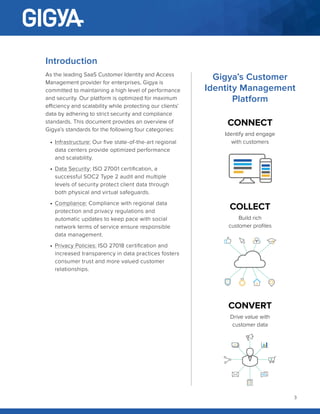
CONNECT
Identify and engage
with customers
COLLECT
Build rich
customer profiles
CONVERT
Drive value with
customer data
Gigya’s Customer
Identity Management
Platform
4
Infrastructure
Gigya’s robust infrastructure provides robust performance and scalability with continuous
data backup and constant protection against failure from human or environmental causes.
State-of-the-Art Hosting and Physical Security
Gigya owns and operates its main U.S. server farm, which is hosted by Equinix, one of the
top data center providers in the world. The Equinix data center is SSAE16 and SOC2 Type
2-certified and equipped with generator-backed UPS and redundant HVAC systems, as well
as fire suppression, flood control and seismic bracing solutions to protect data in the event
of a power outage or natural disaster. The data center also enforces strict security protocols,
including 24x7 armed guards, multiple biometric checkpoints and full CCTV surveillance.
For more information about Equinix’ security and infrastructure, please visit:
http://www.equinix.com/platform-equinix/platform-advantages/ibx-data-centers/
Gigya also hosts multiple AWS (Amazon Web Services) virtual data centers in Ireland for
European companies that prefer to store their data within the EU, and virtual data centers
in Sydney, Australia, are available for the APAC market. A full disaster recovery (DR)
environment for the U.S. server farm is also maintained.
For more information about AWS security and infrastructure, please visit:
https://d0.awsstatic.com/whitepapers/aws-security-whitepaper.pdf
Gigya owns and operates its Russian server farm, which is hosted by Selectel, Russia’s top data
center provider. Selectel data centers are Tier 3 facilities equipped with generator-backed UPS
and redundant HVAC systems, as well as fire suppression and flood control. These data centers
also enforce strict security protocols, including 24x7 armed guards and full CCTV surveillance.
Gigya hosts two Aliyun (Alibaba Cloud) virtual data centers in Shanghai, China for
companies that need to store their data within China.
For more information about Aliyun’s multiple certifications, security and infrastructure, please visit:
https://intl.aliyun.com/trust-center
Redundancy
Gigya supports full disaster recovery in the rare case of a data center outage. This includes
real-time data replication to a separate physical location and transfer of critical data
on-premise to provide continuous service and transparent recovery, with no data loss, in the
case of hardware failure.
In the U.S., data centers are located in disparate geographical locations. The DR site has the
same components and functionality as the production site and is updated upon any change
in production. Gigya runs automated hourly sanity checks on the DR site in order to verify its
functionality and readiness.
5
Gigya utilizes AWS in the EU and AU and Aliyun in China with two active availability zones
for all offered services to ensure all clients in the regions are served consistently.
In Russia, Gigya utilizes two Selectel data centers located in disparate geographical
locations, which are both active and serving clients.
Performance
Gigya’s platform is designed to scale horizontally on commodity hardware. Servers never
exceed 20% utilization under normal circumstances, providing 5x capacity reserves in order
to accommodate unforeseen spikes in traffic. Our performance is demonstrated both by our
regular handling of large bursts of traffic during some clients’ live and breaking news events
and by the many enterprise companies leveraging our platform to manage more than one
billion customer identities.
Data Security
Gigya is ISO 27001-certified and is registered with IQNet. Gigya invests considerable
resources to safeguard all assets entrusted to us by our clients at all times. We consistently
employ industry best practices and keep our information security management system and
security practices up-to-date with the latest and most stringent policies and regulations.
Gigya’s SOC2 Type 2 audit resulted in a report demonstrating this holistic information
security practice over time which can be obtained under a signed NDA.
Gigya regularly publishes a very detailed Self-Assessment Report to the Cloud Security
Alliance STAR program in order to allow our clients to review our compliance with current
cloud security and privacy best practices.
Application Development Security
Security considerations play an integral role in every step of the product development
process. During product specification, technical design, development and testing, security
measures are continually tested, optimized and implemented. Gigya uses the OWASP top 10
list as a high-level security guideline during development.
OWASP guidelines can be found here: https://www.owasp.org/index.php/Main_Page
Security At Rest
By default, Gigya encrypts all PII and other sensitive data at rest using the AES-256
algorithm, and hashes passwords with the NIST-approved PBKDF2 algorithm. In addition,
to further protect access to the data, Gigya uses HMAC-SHA1 to digitally sign its requests
and requires clients using the APIs to sign their requests to Gigya servers with the same
algorithm. Alternatively, Gigya offers API access that is fully OAuth 2.0-compliant.
6
Access to information via Gigya’s Administration Console is also protected through a
two-factor authentication process and strong roles and permissions architecture, providing
site administrators granular control over what individual Console users can see and use.
Security In Motion
Gigya uses a secure channel (TLS) when transferring sensitive data to and from its servers.
In addition, REST API calls that perform critical operations, such as deleting users, are only
permitted as server-to-server signed requests.
Compliance
Gigya maintains compliance with trusted organizations and social networks to ensure
responsible data management.
Regional Privacy Regulations
Gigya offers multiple data centers (U.S., EU, AU, China and Russia), helping our multinational
clients meet regional data localization requirements. As a global company, Gigya is
committed to safeguarding the privacy of its customers’ PII (Personally Identifiable
Information) according to local and international privacy laws. Gigya tracks relevant privacy
regulations, including any ongoing changes, to evaluate and address any impact they may
have on Gigya’s platform or clients.
PCI DSS
Gigya does not collect, store, manage or transfer any credit card data on behalf of our
customers, and is therefore not subject to the Payment Card Industry Data Security Standard.
COPPA
Though responsibility for complying with the Children’s Online Privacy Protection Act
(COPPA) falls to Gigya’s clients, Gigya helps facilitate COPPA compliance by enabling
age-gating for site access and preventing the storage of PII for users under 13 via our
Registration-as-a-Service (RaaS) product. In addition, Gigya’s clients need not be concerned
about COPPA compliance as a result of loading Gigya’s JavaScript library, since Gigya never
amasses user profiles across websites and only cookies users to the extent necessary for
internal reporting and service support.
Social Network Policies
Gigya offers several tools to help our customers maintain compliance with social network
policies. These include:
Automatic Account Deletion: If a customer revokes permission for data access for a site’s
Facebook app, then all of that user’s non-public profile information will be automatically
deleted from the site’s database.
7
Automatic Account Updates: If a customer logs into a site using Facebook and later
updates his Facebook profile, that user’s profile information will also be updated in the site’s
database to ensure the data is always fresh and up-to-date.
Security Tests and Audits
In order to test the security of Gigya’s platform on a regular basis, Gigya has implemented
the following methodologies and practices to tighten the security of its offerings:
•	 Annual ISO 27001 internal and external audits as part of the certification process
•	 Annual SOC2 Type 2 audit and report completed by one of the “Big Four” accounting firms
•	 An automated vulnerability scan performed once a month using a PCI Approved
Scanning Vendor
•	 Extensive black-box penetration tests on Gigya’s infrastructure conducted once per-year
by third-party security experts
•	 An ongoing international Bug Bounty program that enables and encourages security
researchers to test for and responsibly disclose potential vulnerabilities in Gigya’s platform
•	 Onsite, state-of-the-art Automatic Static Code Analysis software continuously checks for
security weaknesses and vulnerabilities in Gigya’s code base
Penetration Tests
Special focus is directed toward extensive application-level penetration tests. These are
conducted once a year by third-party security experts as white-box penetration tests on the
Gigya platform, based on the widely accepted OWASP methodologies.
To identify security elements (potential and actual security flaws) that may enable various
attacks by external attackers or malicious system users, annual penetration tests include
assessment for, at minimum:
•	 Unauthorized access to sensitive information
•	 Unauthorized modification of information
•	 Unauthorized deletion of information
•	 Unauthorized handling of audit information
•	 Performing unauthorized operations or transactions
•	 Illegal impersonation of different users or entities
•	 Performing unauthorized operations that will cause a Denial of Service (DoS) attack
•	 Exploitation of existing security controls to perform fraudulent activity
Gigya also invites its clients to perform their own penetration tests with prior coordination
and scoping with us. Gigya will strive to fix any real security exposures found and properly
disclosed to us in mutually agreed upon time tables.
8
Privacy
Gigya operates according to strict “privacy by design” principles and is dedicated to building
trust between our clients and their customers. To that end, Gigya is certified for ISO 27018: a
code of practice for protection of personally identifiable information in public clouds acting
as PII processors. We provide several tools to increase transparency in the collection of data
and to inform customers of how their data is being used.
Permission-based Social Login
When choosing to log into sites using their existing social profiles, customers are shown
a dialogue asking permission to access specific data points, such as their birthdays or
locations, giving them total control over the information they share.
User Data Controls
When leveraging Gigya’s Registration-as-a-Service forms for customer registration and
login, sites can easily expose functionality to customers, allowing them to:
•	 Download any information stored by the site in order to edit or delete that data as needed
•	 Delete their site account if they so choose
Customizable UIs
All self-service forms are 100% customizable, enabling clients to include privacy notices, terms
and conditions, marketing opt-ins, account preference fields and other notices in the UI.
Administrator Roles and Permissions
Gigya provides robust Roles and Permissions functionality that enables administrators
to control the features and data that can be accessed by internal users. An administrator
can create user groups and assign access on a granular level, including by site or app ID,
specific service, and even API, ensuring that customers’ PII is protected.
9
Additional Security Practices and Controls
Internal Access Control
Gigya has implemented access control and authorization mechanisms that are enforced at
all levels of the information systems (application source code, operating system, database
and network level). Gigya employees are granted specific permissions based on their roles
according to the ‘least privilege’ principle.
System Security Practices
Gigya’s system security practices include: server and workstation OS hardening, patch
management, auditing and event logging, and malware protection. Gigya also uses a
provisioning system that automatically enforces the secure configuration and state of critical
system settings and services. All management operations are executed over VPNs using
two-factor authentication for administrators.
Network Security Practices
Gigya’s network security practices include:
•	 Opening minimum necessary ports
•	 Segregating networks for production, development, and testing environments
•	 Out-of-band secure network device management interfaces
•	 Network device hardening
Distributed Denial of Service (DDoS) Mitigation
Gigya uses an on-premise, state-of-the-art anti-DDoS solution for its U.S. data center
combined with a cloud based DDoS mitigation service provider in the unlikely case there is
a need to handle an extreme volume of traffic. For its AWS and Aliyun data centers Gigya
relies on Amazon’s and Aliyun’s ability to scale up in order to handle the increase in traffic.
Change Management
Gigya has a well documented and organized change management approval and
implementation process, ensuring an efficiently managed and secure service delivery.
Vulnerability Management
Since new security vulnerabilities are discovered on a daily basis, Gigya has adopted an
information gathering process that includes the constant monitoring of relevant vendor
security publications, security forums, communities and security alerts — such as US-CERT
and BugTraq — issued by key industry players to announce newly published vulnerabilities.
10
Monitoring
Gigya provides both automatic and manual monitoring 24x7x365. Gigya’s Network
Operations Center team monitors every aspect of its services, down to the individual API
level on every provider.
Routine manual tests on key aspects of Gigya’s services occur every 15 minutes. Gigya sets
predefined thresholds and events and adjusts capacity accordingly. This is also relevant in
case a client notifies Gigya in advance of certain upcoming events that will require more
resources for a specific point in time, such as live events.
Backup and Recovery
Gigya employs a multi-layer data loss protection architecture with special emphasis on short
MTTR (Mean Time to Recovery) in case of failure. All data is replicated in real time to standby
servers in a secondary data center, providing at least n+1 redundancy in two geographic
regions. Critical data is also replicated on-premise to provide n+2 redundancy and allow
for immediate and transparent recovery, with no data loss, in case of hardware failure.
In addition to these measures, disk snapshots and offline backups are also performed
regularly. Gigya conducts extensive restore tests twice per-year.
Business Continuity Plan / Disaster Recovery Plan
Gigya has a BCP with a Recovery Time Objective (RTO) of 15 minutes and Recovery Point
Objective (RPO) of a few seconds, since data is replicated to standby systems in real time.
Gigya performs extensive DRP tests twice per-year.
Incident Management
Gigya acknowledges that each security incident may require different treatment, depending
on its nature, source, and potential impact. However, the general process of responding to a
security incident will consist of the following steps:
•	 Immediate Response
•	 Information Gathering
•	 Root Cause Analysis
•	 Categorization
•	 Establishing a Response Plan
•	 Action (implementation steps)
•	 Conclusion and Learning
•	 Implementation of Corrective and Preventive Measures
•	 If an incident affects our clients data or services, Gigya will immediately notify the client
of the incident, providing all relevant details. After the initial notification, Gigya will
provide periodic updates until the incident is resolved.
© 2017 Gigya, Inc.  |  2513 Charleston Road #200, Mountain View, CA 94043  |  T : (650) 353.7230  |  www.gigya.com
Gigya, the Gigya logo, and Customer Identity Management Platform are either registered trademarks or trademarks of Gigya Incorporated in the United States and/or other countries. All other
trademarks are the property of their respective owners. Gigya does not own any end user data or maintain any other rights to this data, other than utilizing it to make Gigya’s services available
to our clients and their end users. Gigya acts as an agent or back-end vendor of its client’s website or mobile application, to which the end user of our client granted permissions (if applicable).
Gigya facilitates the collection, transfer and storage of end user data solely on behalf of its clients and at its clients’ direction. For more information, please see Gigya’s Privacy Policy, available at
http://www.gigya.com/privacy-policy/.
Gigya_White_Paper_Infomation_Security_and_Data_Privacy_Practices_201706
The Leader in Customer
Identity Management
About Gigya
Gigya’s Customer Identity Management Platform helps companies
build better customer relationships by turning unknown site visitors
into known, loyal and engaged customers. With Gigya’s technology,
businesses increase registrations and identify customers across
devices, consolidate data into rich customer profiles, and provide
better service, products and experiences by integrating data into
marketing and service applications.
Gigya’s platform was designed from the ground up for social
identities, mobile devices, consumer privacy and modern marketing.
Gigya provides developers with the APIs they need to easily build
and maintain secure and scalable registration, authentication, profile
management, data analytics and third-party integrations.
More than 700 of the world’s leading businesses such as Fox, Forbes,
and ASOS rely on Gigya to build identity-driven relationships and to
provide scalable, secure Customer Identity Management.
To learn how Gigya can help your business manage customer
identities, visit gigya.com, or call us at 650.353.7230.

White Paper: Gigya's Information Security and Data Privacy Practices

  • 1.
    Gigya’s Information Securityand Data Privacy Practices
  • 2.
    2 Table of Contents Introduction. . . . . . . . . . . . . . . . . . . . . . . . . . . . . . . . . . . . . . . . . . . . . . . . . . . . . . . . . . . . . . . . . . . . . 3 Infrastructure. . . . . . . . . . . . . . . . . . . . . . . . . . . . . . . . . . . . . . . . . . . . . . . . . . . . . . . . . . . . . . . . . . . . 4 State-of-the-Art Hosting and Physical Security. . . . . . . . . . . . . . . . . . . . . . . . . . . . . . . . . . . . 4 Redundancy. . . . . . . . . . . . . . . . . . . . . . . . . . . . . . . . . . . . . . . . . . . . . . . . . . . . . . . . . . . . . . . . . . 4 Performance. . . . . . . . . . . . . . . . . . . . . . . . . . . . . . . . . . . . . . . . . . . . . . . . . . . . . . . . . . . . . . . . . . 5 Data Security. . . . . . . . . . . . . . . . . . . . . . . . . . . . . . . . . . . . . . . . . . . . . . . . . . . . . . . . . . . . . . . . . . . . 5 Application Development Security. . . . . . . . . . . . . . . . . . . . . . . . . . . . . . . . . . . . . . . . . . . . . . . 5 Security At Rest. . . . . . . . . . . . . . . . . . . . . . . . . . . . . . . . . . . . . . . . . . . . . . . . . . . . . . . . . . . . . . . 5 Security In Motion. . . . . . . . . . . . . . . . . . . . . . . . . . . . . . . . . . . . . . . . . . . . . . . . . . . . . . . . . . . . . 6 Compliance . . . . . . . . . . . . . . . . . . . . . . . . . . . . . . . . . . . . . . . . . . . . . . . . . . . . . . . . . . . . . . . . . . . . . 6 Regional Privacy Regulations. . . . . . . . . . . . . . . . . . . . . . . . . . . . . . . . . . . . . . . . . . . . . . . . . . . 6 PCI DSS. . . . . . . . . . . . . . . . . . . . . . . . . . . . . . . . . . . . . . . . . . . . . . . . . . . . . . . . . . . . . . . . . . . . . . 6 COPPA. . . . . . . . . . . . . . . . . . . . . . . . . . . . . . . . . . . . . . . . . . . . . . . . . . . . . . . . . . . . . . . . . . . . . . . 6 Social Network Policies. . . . . . . . . . . . . . . . . . . . . . . . . . . . . . . . . . . . . . . . . . . . . . . . . . . . . . . . . 6 Security Tests and Audits. . . . . . . . . . . . . . . . . . . . . . . . . . . . . . . . . . . . . . . . . . . . . . . . . . . . . . . 7 Penetration Tests. . . . . . . . . . . . . . . . . . . . . . . . . . . . . . . . . . . . . . . . . . . . . . . . . . . . . . . . . . . . . . 7 Privacy . . . . . . . . . . . . . . . . . . . . . . . . . . . . . . . . . . . . . . . . . . . . . . . . . . . . . . . . . . . . . . . . . . . . . . . . . 8 Permission-based Social Login. . . . . . . . . . . . . . . . . . . . . . . . . . . . . . . . . . . . . . . . . . . . . . . . . . 8 User Data Controls. . . . . . . . . . . . . . . . . . . . . . . . . . . . . . . . . . . . . . . . . . . . . . . . . . . . . . . . . . . . 8 Customizable UIs. . . . . . . . . . . . . . . . . . . . . . . . . . . . . . . . . . . . . . . . . . . . . . . . . . . . . . . . . . . . . . 8 Administrator Roles and Permissions. . . . . . . . . . . . . . . . . . . . . . . . . . . . . . . . . . . . . . . . . . . . . 8 Additional Security Practices and Controls. . . . . . . . . . . . . . . . . . . . . . . . . . . . . . . . . . . . . . . . . 9 System Security Practices. . . . . . . . . . . . . . . . . . . . . . . . . . . . . . . . . . . . . . . . . . . . . . . . . . . . . . 9 Network Security Practices. . . . . . . . . . . . . . . . . . . . . . . . . . . . . . . . . . . . . . . . . . . . . . . . . . . . . 9 Distributed Denial of Service (DDoS) Mitigation. . . . . . . . . . . . . . . . . . . . . . . . . . . . . . . . . . . . 9 Change Management. . . . . . . . . . . . . . . . . . . . . . . . . . . . . . . . . . . . . . . . . . . . . . . . . . . . . . . . . . 9 Vulnerability Management. . . . . . . . . . . . . . . . . . . . . . . . . . . . . . . . . . . . . . . . . . . . . . . . . . . . . . 9 Monitoring. . . . . . . . . . . . . . . . . . . . . . . . . . . . . . . . . . . . . . . . . . . . . . . . . . . . . . . . . . . . . . . . . . . 10 Backup and Recovery. . . . . . . . . . . . . . . . . . . . . . . . . . . . . . . . . . . . . . . . . . . . . . . . . . . . . . . . . 10 Business Continuity Plan / Disaster Recovery Plan . . . . . . . . . . . . . . . . . . . . . . . . . . . . . . . 10 Incident Management . . . . . . . . . . . . . . . . . . . . . . . . . . . . . . . . . . . . . . . . . . . . . . . . . . . . . . . . 10
  • 3.
    3 Introduction As the leadingSaaS Customer Identity and Access Management provider for enterprises, Gigya is committed to maintaining a high level of performance and security. Our platform is optimized for maximum efficiency and scalability while protecting our clients’ data by adhering to strict security and compliance standards. This document provides an overview of Gigya’s standards for the following four categories: • Infrastructure: Our five state-of-the-art regional data centers provide optimized performance and scalability. • Data Security: ISO 27001 certification, a successful SOC2 Type 2 audit and multiple levels of security protect client data through both physical and virtual safeguards. • Compliance: Compliance with regional data protection and privacy regulations and automatic updates to keep pace with social network terms of service ensure responsible data management. • Privacy Policies: ISO 27018 certification and increased transparency in data practices fosters consumer trust and more valued customer relationships. CONNECT Identify and engage with customers COLLECT Build rich customer profiles CONVERT Drive value with customer data Gigya’s Customer Identity Management Platform
  • 4.
    4 Infrastructure Gigya’s robust infrastructureprovides robust performance and scalability with continuous data backup and constant protection against failure from human or environmental causes. State-of-the-Art Hosting and Physical Security Gigya owns and operates its main U.S. server farm, which is hosted by Equinix, one of the top data center providers in the world. The Equinix data center is SSAE16 and SOC2 Type 2-certified and equipped with generator-backed UPS and redundant HVAC systems, as well as fire suppression, flood control and seismic bracing solutions to protect data in the event of a power outage or natural disaster. The data center also enforces strict security protocols, including 24x7 armed guards, multiple biometric checkpoints and full CCTV surveillance. For more information about Equinix’ security and infrastructure, please visit: http://www.equinix.com/platform-equinix/platform-advantages/ibx-data-centers/ Gigya also hosts multiple AWS (Amazon Web Services) virtual data centers in Ireland for European companies that prefer to store their data within the EU, and virtual data centers in Sydney, Australia, are available for the APAC market. A full disaster recovery (DR) environment for the U.S. server farm is also maintained. For more information about AWS security and infrastructure, please visit: https://d0.awsstatic.com/whitepapers/aws-security-whitepaper.pdf Gigya owns and operates its Russian server farm, which is hosted by Selectel, Russia’s top data center provider. Selectel data centers are Tier 3 facilities equipped with generator-backed UPS and redundant HVAC systems, as well as fire suppression and flood control. These data centers also enforce strict security protocols, including 24x7 armed guards and full CCTV surveillance. Gigya hosts two Aliyun (Alibaba Cloud) virtual data centers in Shanghai, China for companies that need to store their data within China. For more information about Aliyun’s multiple certifications, security and infrastructure, please visit: https://intl.aliyun.com/trust-center Redundancy Gigya supports full disaster recovery in the rare case of a data center outage. This includes real-time data replication to a separate physical location and transfer of critical data on-premise to provide continuous service and transparent recovery, with no data loss, in the case of hardware failure. In the U.S., data centers are located in disparate geographical locations. The DR site has the same components and functionality as the production site and is updated upon any change in production. Gigya runs automated hourly sanity checks on the DR site in order to verify its functionality and readiness.
  • 5.
    5 Gigya utilizes AWSin the EU and AU and Aliyun in China with two active availability zones for all offered services to ensure all clients in the regions are served consistently. In Russia, Gigya utilizes two Selectel data centers located in disparate geographical locations, which are both active and serving clients. Performance Gigya’s platform is designed to scale horizontally on commodity hardware. Servers never exceed 20% utilization under normal circumstances, providing 5x capacity reserves in order to accommodate unforeseen spikes in traffic. Our performance is demonstrated both by our regular handling of large bursts of traffic during some clients’ live and breaking news events and by the many enterprise companies leveraging our platform to manage more than one billion customer identities. Data Security Gigya is ISO 27001-certified and is registered with IQNet. Gigya invests considerable resources to safeguard all assets entrusted to us by our clients at all times. We consistently employ industry best practices and keep our information security management system and security practices up-to-date with the latest and most stringent policies and regulations. Gigya’s SOC2 Type 2 audit resulted in a report demonstrating this holistic information security practice over time which can be obtained under a signed NDA. Gigya regularly publishes a very detailed Self-Assessment Report to the Cloud Security Alliance STAR program in order to allow our clients to review our compliance with current cloud security and privacy best practices. Application Development Security Security considerations play an integral role in every step of the product development process. During product specification, technical design, development and testing, security measures are continually tested, optimized and implemented. Gigya uses the OWASP top 10 list as a high-level security guideline during development. OWASP guidelines can be found here: https://www.owasp.org/index.php/Main_Page Security At Rest By default, Gigya encrypts all PII and other sensitive data at rest using the AES-256 algorithm, and hashes passwords with the NIST-approved PBKDF2 algorithm. In addition, to further protect access to the data, Gigya uses HMAC-SHA1 to digitally sign its requests and requires clients using the APIs to sign their requests to Gigya servers with the same algorithm. Alternatively, Gigya offers API access that is fully OAuth 2.0-compliant.
  • 6.
    6 Access to informationvia Gigya’s Administration Console is also protected through a two-factor authentication process and strong roles and permissions architecture, providing site administrators granular control over what individual Console users can see and use. Security In Motion Gigya uses a secure channel (TLS) when transferring sensitive data to and from its servers. In addition, REST API calls that perform critical operations, such as deleting users, are only permitted as server-to-server signed requests. Compliance Gigya maintains compliance with trusted organizations and social networks to ensure responsible data management. Regional Privacy Regulations Gigya offers multiple data centers (U.S., EU, AU, China and Russia), helping our multinational clients meet regional data localization requirements. As a global company, Gigya is committed to safeguarding the privacy of its customers’ PII (Personally Identifiable Information) according to local and international privacy laws. Gigya tracks relevant privacy regulations, including any ongoing changes, to evaluate and address any impact they may have on Gigya’s platform or clients. PCI DSS Gigya does not collect, store, manage or transfer any credit card data on behalf of our customers, and is therefore not subject to the Payment Card Industry Data Security Standard. COPPA Though responsibility for complying with the Children’s Online Privacy Protection Act (COPPA) falls to Gigya’s clients, Gigya helps facilitate COPPA compliance by enabling age-gating for site access and preventing the storage of PII for users under 13 via our Registration-as-a-Service (RaaS) product. In addition, Gigya’s clients need not be concerned about COPPA compliance as a result of loading Gigya’s JavaScript library, since Gigya never amasses user profiles across websites and only cookies users to the extent necessary for internal reporting and service support. Social Network Policies Gigya offers several tools to help our customers maintain compliance with social network policies. These include: Automatic Account Deletion: If a customer revokes permission for data access for a site’s Facebook app, then all of that user’s non-public profile information will be automatically deleted from the site’s database.
  • 7.
    7 Automatic Account Updates:If a customer logs into a site using Facebook and later updates his Facebook profile, that user’s profile information will also be updated in the site’s database to ensure the data is always fresh and up-to-date. Security Tests and Audits In order to test the security of Gigya’s platform on a regular basis, Gigya has implemented the following methodologies and practices to tighten the security of its offerings: • Annual ISO 27001 internal and external audits as part of the certification process • Annual SOC2 Type 2 audit and report completed by one of the “Big Four” accounting firms • An automated vulnerability scan performed once a month using a PCI Approved Scanning Vendor • Extensive black-box penetration tests on Gigya’s infrastructure conducted once per-year by third-party security experts • An ongoing international Bug Bounty program that enables and encourages security researchers to test for and responsibly disclose potential vulnerabilities in Gigya’s platform • Onsite, state-of-the-art Automatic Static Code Analysis software continuously checks for security weaknesses and vulnerabilities in Gigya’s code base Penetration Tests Special focus is directed toward extensive application-level penetration tests. These are conducted once a year by third-party security experts as white-box penetration tests on the Gigya platform, based on the widely accepted OWASP methodologies. To identify security elements (potential and actual security flaws) that may enable various attacks by external attackers or malicious system users, annual penetration tests include assessment for, at minimum: • Unauthorized access to sensitive information • Unauthorized modification of information • Unauthorized deletion of information • Unauthorized handling of audit information • Performing unauthorized operations or transactions • Illegal impersonation of different users or entities • Performing unauthorized operations that will cause a Denial of Service (DoS) attack • Exploitation of existing security controls to perform fraudulent activity Gigya also invites its clients to perform their own penetration tests with prior coordination and scoping with us. Gigya will strive to fix any real security exposures found and properly disclosed to us in mutually agreed upon time tables.
  • 8.
    8 Privacy Gigya operates accordingto strict “privacy by design” principles and is dedicated to building trust between our clients and their customers. To that end, Gigya is certified for ISO 27018: a code of practice for protection of personally identifiable information in public clouds acting as PII processors. We provide several tools to increase transparency in the collection of data and to inform customers of how their data is being used. Permission-based Social Login When choosing to log into sites using their existing social profiles, customers are shown a dialogue asking permission to access specific data points, such as their birthdays or locations, giving them total control over the information they share. User Data Controls When leveraging Gigya’s Registration-as-a-Service forms for customer registration and login, sites can easily expose functionality to customers, allowing them to: • Download any information stored by the site in order to edit or delete that data as needed • Delete their site account if they so choose Customizable UIs All self-service forms are 100% customizable, enabling clients to include privacy notices, terms and conditions, marketing opt-ins, account preference fields and other notices in the UI. Administrator Roles and Permissions Gigya provides robust Roles and Permissions functionality that enables administrators to control the features and data that can be accessed by internal users. An administrator can create user groups and assign access on a granular level, including by site or app ID, specific service, and even API, ensuring that customers’ PII is protected.
  • 9.
    9 Additional Security Practicesand Controls Internal Access Control Gigya has implemented access control and authorization mechanisms that are enforced at all levels of the information systems (application source code, operating system, database and network level). Gigya employees are granted specific permissions based on their roles according to the ‘least privilege’ principle. System Security Practices Gigya’s system security practices include: server and workstation OS hardening, patch management, auditing and event logging, and malware protection. Gigya also uses a provisioning system that automatically enforces the secure configuration and state of critical system settings and services. All management operations are executed over VPNs using two-factor authentication for administrators. Network Security Practices Gigya’s network security practices include: • Opening minimum necessary ports • Segregating networks for production, development, and testing environments • Out-of-band secure network device management interfaces • Network device hardening Distributed Denial of Service (DDoS) Mitigation Gigya uses an on-premise, state-of-the-art anti-DDoS solution for its U.S. data center combined with a cloud based DDoS mitigation service provider in the unlikely case there is a need to handle an extreme volume of traffic. For its AWS and Aliyun data centers Gigya relies on Amazon’s and Aliyun’s ability to scale up in order to handle the increase in traffic. Change Management Gigya has a well documented and organized change management approval and implementation process, ensuring an efficiently managed and secure service delivery. Vulnerability Management Since new security vulnerabilities are discovered on a daily basis, Gigya has adopted an information gathering process that includes the constant monitoring of relevant vendor security publications, security forums, communities and security alerts — such as US-CERT and BugTraq — issued by key industry players to announce newly published vulnerabilities.
  • 10.
    10 Monitoring Gigya provides bothautomatic and manual monitoring 24x7x365. Gigya’s Network Operations Center team monitors every aspect of its services, down to the individual API level on every provider. Routine manual tests on key aspects of Gigya’s services occur every 15 minutes. Gigya sets predefined thresholds and events and adjusts capacity accordingly. This is also relevant in case a client notifies Gigya in advance of certain upcoming events that will require more resources for a specific point in time, such as live events. Backup and Recovery Gigya employs a multi-layer data loss protection architecture with special emphasis on short MTTR (Mean Time to Recovery) in case of failure. All data is replicated in real time to standby servers in a secondary data center, providing at least n+1 redundancy in two geographic regions. Critical data is also replicated on-premise to provide n+2 redundancy and allow for immediate and transparent recovery, with no data loss, in case of hardware failure. In addition to these measures, disk snapshots and offline backups are also performed regularly. Gigya conducts extensive restore tests twice per-year. Business Continuity Plan / Disaster Recovery Plan Gigya has a BCP with a Recovery Time Objective (RTO) of 15 minutes and Recovery Point Objective (RPO) of a few seconds, since data is replicated to standby systems in real time. Gigya performs extensive DRP tests twice per-year. Incident Management Gigya acknowledges that each security incident may require different treatment, depending on its nature, source, and potential impact. However, the general process of responding to a security incident will consist of the following steps: • Immediate Response • Information Gathering • Root Cause Analysis • Categorization • Establishing a Response Plan • Action (implementation steps) • Conclusion and Learning • Implementation of Corrective and Preventive Measures • If an incident affects our clients data or services, Gigya will immediately notify the client of the incident, providing all relevant details. After the initial notification, Gigya will provide periodic updates until the incident is resolved.
  • 11.
    © 2017 Gigya,Inc.  |  2513 Charleston Road #200, Mountain View, CA 94043  |  T : (650) 353.7230  |  www.gigya.com Gigya, the Gigya logo, and Customer Identity Management Platform are either registered trademarks or trademarks of Gigya Incorporated in the United States and/or other countries. All other trademarks are the property of their respective owners. Gigya does not own any end user data or maintain any other rights to this data, other than utilizing it to make Gigya’s services available to our clients and their end users. Gigya acts as an agent or back-end vendor of its client’s website or mobile application, to which the end user of our client granted permissions (if applicable). Gigya facilitates the collection, transfer and storage of end user data solely on behalf of its clients and at its clients’ direction. For more information, please see Gigya’s Privacy Policy, available at http://www.gigya.com/privacy-policy/. Gigya_White_Paper_Infomation_Security_and_Data_Privacy_Practices_201706 The Leader in Customer Identity Management About Gigya Gigya’s Customer Identity Management Platform helps companies build better customer relationships by turning unknown site visitors into known, loyal and engaged customers. With Gigya’s technology, businesses increase registrations and identify customers across devices, consolidate data into rich customer profiles, and provide better service, products and experiences by integrating data into marketing and service applications. Gigya’s platform was designed from the ground up for social identities, mobile devices, consumer privacy and modern marketing. Gigya provides developers with the APIs they need to easily build and maintain secure and scalable registration, authentication, profile management, data analytics and third-party integrations. More than 700 of the world’s leading businesses such as Fox, Forbes, and ASOS rely on Gigya to build identity-driven relationships and to provide scalable, secure Customer Identity Management. To learn how Gigya can help your business manage customer identities, visit gigya.com, or call us at 650.353.7230.