Federated Access Management 102 key concepts you need to become your institution’s local expert   John Paschoud InfoSystems Engineer, LSE Library London School of Economics  & Political Science, UK [email_address] Copyright John Paschoud 2007. This work is the intellectual property of the author. Permission is granted for this material to be shared for non-commercial, educational purposes, provided that this copyright statement appears on the reproduced materials and notice is given that the copying is by permission of the author. To disseminate otherwise or to republish requires written permission from the author.  The intellectual property of others in all contributed and referenced material is acknowledged.
Animation: even 2-dimensional people need Access Management
What do our  Users  want from Access Management? Nothing!  - they just want to get stuff.  Now! Single Sign-On (as far as possible) to our own services,  and  to all the resources we subscribe on their behalf no need to remember so many passwords for different services Access from Anywhere from home, travelling, or working at other institutions or libraries Improved Privacy of personal information, and of research being pursued
What do  We  want from Access Management? (“We” being the people whose job is to provide institutional information services) Improved security for licensed resources, so publishers we deal with are happy (and generous!) Good privacy-protection for users, to meet our legal obligations Low-hassle support for our on-campus and mobile users Opportunity for ‘fine-grain’ authorization control, so we can know  (and manage)  Who-Has-Access-to-What Access for visiting users to whatever they are entitled by their home institutions …which we don’t need to know about!
Objectives of Federated Access Management Effective  Single Sign-On  to non-public online resources… … across many domains Distribution  of Authentication, Authorisation and Accounting functions in the AM process to  appropriate parties Improved security  for resources that are non-public due to: Licensing restrictions / Commercial intellectual property Confidentiality Improved privacy  of end-user personal information Reduced duplicated administration  of user identities & passwords (Cite Clifford Lynch and the Coalition for Networked Information, 1998,  for where these principles were seminally defined)
Appropriate Division of Labour (Labor) With Federated Access Management, functions are carried out by appropriate parties: Identity Provider  (typically a university/college/library) does  Authentication   (of it’s own registered users) “ IdP”   -- “AuthN” Service Provider  (typically a publisher) does  Authorization   ideally based on a common role (“student”) and affiliation (“lse.ac.uk”) “ SP”   -- “AuthZ” (the “z” shows how you frequently have to discuss this with Americans, who can’t spell properly) A  Federation  provides a trust framework between parties, operates ‘Where Are You From’ ( “WAYF” ) service Needed where users from many IdPs are accessing many SPs (Athens, and some other people, may call this a ‘Home Domain Discovery Service’)  Athens  isn’t  a federation
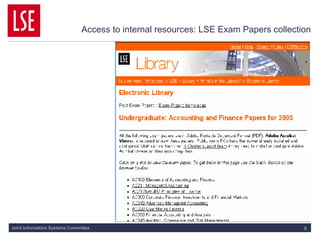
The Institution as Service Provider (too) We can share resources in collaborations within the academic community providing controlled access to users from other institutions, without needing to administer usernames/passwords for them as LSE and Columbia (NY) did for a collaborative Anthropology teaching project (DART) We can set up our repository, e-learning or any other service as a Service Provider as LSE has done for Exam Papers and other ‘members only’ collections
Access to internal resources: LSE Exam Papers collection
Costs and Benefits of adopting Federated Access Management? Costs (for an institution): Institution’s directory must be in good shape and set up to support an Identity Provider (IdP) service (just as it does for “AthensDA”) IdP middleware needs installing and maintaining (or subscribed-to from an external provider) Benefits (for an institution): Reduced overheads in password support No difference in on-campus and off-campus access More flexible access control – e.g. different categories of users to different levels of access (or none) to a resource Access control maintenance for different internal services  (most with role-based access) is  eliminated !
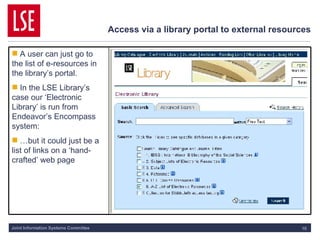
Access via a library portal to external resources A user can just go to the list of e-resources in the library’s portal. In the LSE Library’s case our ‘Electronic Library’ is run from Endeavor’s Encompass system: … but it could just be a list of links on a ‘hand-crafted’ web page
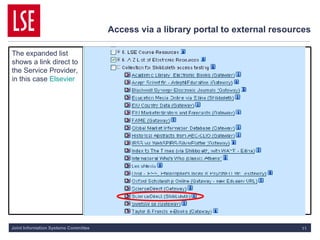
Access via a library portal to external resources The expanded list shows a link direct to the Service Provider, in this case  Elsevier
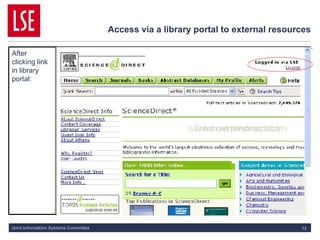
Access via a library portal to external resources After clicking link in library portal:
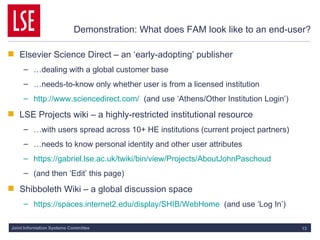
Demonstration: What does FAM look like to an end-user? Elsevier Science Direct – an ‘early-adopting’ publisher … dealing with a global customer base … needs-to-know only whether user is from a licensed institution http://www.sciencedirect.com/   (and use ‘Athens/Other Institution Login’) LSE Projects wiki – a highly-restricted institutional resource … with users spread across 10+ HE institutions (current project partners) … needs to know personal identity and other user attributes https://gabriel.lse.ac.uk/twiki/bin/view/Projects/AboutJohnPaschoud (and then ‘Edit’ this page) Shibboleth Wiki – a global discussion space https://spaces.internet2.edu/display/SHIB/WebHome   (and use ‘Log In’)
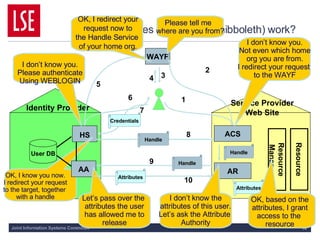
How does FAM (using Shibboleth) work? Resource WAYF Identity Provider Service Provider Web Site 1 ACS I don’t know you. Not even which home org you are from. I redirect your request  to the WAYF 3 2 Please tell me  where are you from? HS 5 6 I don’t know you. Please authenticate Using WEBLOGIN 7 User DB Credentials OK, I know you now. I redirect your request to the target, together  with a handle 4 OK, I redirect your request now to the Handle Service  of your home org. AR Handle Handle 8 I don’t know the attributes of this user. Let’s ask the Attribute  Authority Handle 9 AA Let’s pass over the  attributes the user has allowed me to release Attributes 10 Resource Manager Attributes OK, based on the attributes, I grant access to the  resource
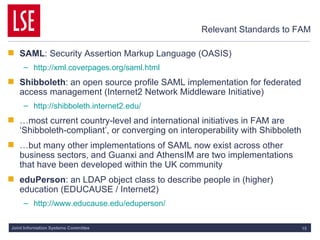
Relevant Standards to FAM SAML : Security Assertion Markup Language (OASIS) http://xml.coverpages.org/saml.html Shibboleth : an open source profile SAML implementation for federated access management (Internet2 Network Middleware Initiative) http://shibboleth.internet2.edu/ … most current country-level and international initiatives in FAM are ‘Shibboleth-compliant’, or converging on interoperability with Shibboleth … but many other implementations of SAML now exist across other business sectors, and Guanxi and AthensIM are two implementations that have been developed within the UK community eduPerson : an LDAP object class to describe people in (higher) education (EDUCAUSE / Internet2) http:// www.educause.edu/eduperson /
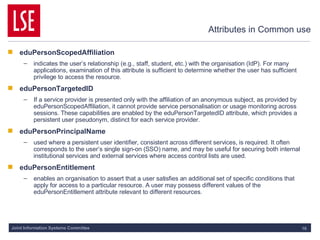
Attributes in Common use eduPersonScopedAffiliation indicates the user’s relationship (e.g., staff, student, etc.) with the organisation (IdP). For many applications, examination of this attribute is sufficient to determine whether the user has sufficient privilege to access the resource. eduPersonTargetedID If a service provider is presented only with the affiliation of an anonymous subject, as provided by eduPersonScopedAffiliation, it cannot provide service personalisation or usage monitoring across sessions. These capabilities are enabled by the eduPersonTargetedID attribute, which provides a persistent user pseudonym, distinct for each service provider. eduPersonPrincipalName used where a persistent user identifier, consistent across different services, is required. It often corresponds to the user’s single sign-on (SSO) name, and may be useful for securing both internal institutional services and external services where access control lists are used. eduPersonEntitlement enables an organisation to assert that a user satisfies an additional set of specific conditions that apply for access to a particular resource. A user may possess different values of the eduPersonEntitlement attribute relevant to different resources.
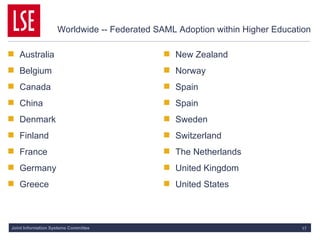
Worldwide -- Federated SAML Adoption within Higher Education Australia Belgium Canada China  Denmark Finland France  Germany  Greece  New Zealand Norway Spain  Spain  Sweden Switzerland  The Netherlands United Kingdom United States
The job’s not over! Recognising gaps in support for institutions, as experience is gained Better presentation of practical guides Identity Management by institutions Levels of Assurance for different resources The Identity Project  Undertaking a national survey of (all 641) institutions Producing a model for institutional IdM audits Reporting on issues for Health, National Grid Service and others (Make sure  your  institution has completed the Identity Management survey at  www.identity-project.info  !) The ES-LoA Project Analysing levels of AuthN and AuthZ required for different services Recommending how these can be expressed in Federation-approved attributes
www.ukfederation.org.uk www.jisc.ac.uk/federation.html http:// www.angel.ac.uk/ShibbolethAtLSE www.identity-project.info [email_address] [email_address]

Federated Access Management 102

  • 1.
    Federated Access Management102 key concepts you need to become your institution’s local expert John Paschoud InfoSystems Engineer, LSE Library London School of Economics & Political Science, UK [email_address] Copyright John Paschoud 2007. This work is the intellectual property of the author. Permission is granted for this material to be shared for non-commercial, educational purposes, provided that this copyright statement appears on the reproduced materials and notice is given that the copying is by permission of the author. To disseminate otherwise or to republish requires written permission from the author. The intellectual property of others in all contributed and referenced material is acknowledged.
  • 2.
    Animation: even 2-dimensionalpeople need Access Management
  • 3.
    What do our Users want from Access Management? Nothing! - they just want to get stuff. Now! Single Sign-On (as far as possible) to our own services, and to all the resources we subscribe on their behalf no need to remember so many passwords for different services Access from Anywhere from home, travelling, or working at other institutions or libraries Improved Privacy of personal information, and of research being pursued
  • 4.
    What do We want from Access Management? (“We” being the people whose job is to provide institutional information services) Improved security for licensed resources, so publishers we deal with are happy (and generous!) Good privacy-protection for users, to meet our legal obligations Low-hassle support for our on-campus and mobile users Opportunity for ‘fine-grain’ authorization control, so we can know (and manage) Who-Has-Access-to-What Access for visiting users to whatever they are entitled by their home institutions …which we don’t need to know about!
  • 5.
    Objectives of FederatedAccess Management Effective Single Sign-On to non-public online resources… … across many domains Distribution of Authentication, Authorisation and Accounting functions in the AM process to appropriate parties Improved security for resources that are non-public due to: Licensing restrictions / Commercial intellectual property Confidentiality Improved privacy of end-user personal information Reduced duplicated administration of user identities & passwords (Cite Clifford Lynch and the Coalition for Networked Information, 1998, for where these principles were seminally defined)
  • 6.
    Appropriate Division ofLabour (Labor) With Federated Access Management, functions are carried out by appropriate parties: Identity Provider (typically a university/college/library) does Authentication (of it’s own registered users) “ IdP” -- “AuthN” Service Provider (typically a publisher) does Authorization ideally based on a common role (“student”) and affiliation (“lse.ac.uk”) “ SP” -- “AuthZ” (the “z” shows how you frequently have to discuss this with Americans, who can’t spell properly) A Federation provides a trust framework between parties, operates ‘Where Are You From’ ( “WAYF” ) service Needed where users from many IdPs are accessing many SPs (Athens, and some other people, may call this a ‘Home Domain Discovery Service’) Athens isn’t a federation
  • 7.
    The Institution asService Provider (too) We can share resources in collaborations within the academic community providing controlled access to users from other institutions, without needing to administer usernames/passwords for them as LSE and Columbia (NY) did for a collaborative Anthropology teaching project (DART) We can set up our repository, e-learning or any other service as a Service Provider as LSE has done for Exam Papers and other ‘members only’ collections
  • 8.
    Access to internalresources: LSE Exam Papers collection
  • 9.
    Costs and Benefitsof adopting Federated Access Management? Costs (for an institution): Institution’s directory must be in good shape and set up to support an Identity Provider (IdP) service (just as it does for “AthensDA”) IdP middleware needs installing and maintaining (or subscribed-to from an external provider) Benefits (for an institution): Reduced overheads in password support No difference in on-campus and off-campus access More flexible access control – e.g. different categories of users to different levels of access (or none) to a resource Access control maintenance for different internal services (most with role-based access) is eliminated !
  • 10.
    Access via alibrary portal to external resources A user can just go to the list of e-resources in the library’s portal. In the LSE Library’s case our ‘Electronic Library’ is run from Endeavor’s Encompass system: … but it could just be a list of links on a ‘hand-crafted’ web page
  • 11.
    Access via alibrary portal to external resources The expanded list shows a link direct to the Service Provider, in this case Elsevier
  • 12.
    Access via alibrary portal to external resources After clicking link in library portal:
  • 13.
    Demonstration: What doesFAM look like to an end-user? Elsevier Science Direct – an ‘early-adopting’ publisher … dealing with a global customer base … needs-to-know only whether user is from a licensed institution http://www.sciencedirect.com/ (and use ‘Athens/Other Institution Login’) LSE Projects wiki – a highly-restricted institutional resource … with users spread across 10+ HE institutions (current project partners) … needs to know personal identity and other user attributes https://gabriel.lse.ac.uk/twiki/bin/view/Projects/AboutJohnPaschoud (and then ‘Edit’ this page) Shibboleth Wiki – a global discussion space https://spaces.internet2.edu/display/SHIB/WebHome (and use ‘Log In’)
  • 14.
    How does FAM(using Shibboleth) work? Resource WAYF Identity Provider Service Provider Web Site 1 ACS I don’t know you. Not even which home org you are from. I redirect your request to the WAYF 3 2 Please tell me where are you from? HS 5 6 I don’t know you. Please authenticate Using WEBLOGIN 7 User DB Credentials OK, I know you now. I redirect your request to the target, together with a handle 4 OK, I redirect your request now to the Handle Service of your home org. AR Handle Handle 8 I don’t know the attributes of this user. Let’s ask the Attribute Authority Handle 9 AA Let’s pass over the attributes the user has allowed me to release Attributes 10 Resource Manager Attributes OK, based on the attributes, I grant access to the resource
  • 15.
    Relevant Standards toFAM SAML : Security Assertion Markup Language (OASIS) http://xml.coverpages.org/saml.html Shibboleth : an open source profile SAML implementation for federated access management (Internet2 Network Middleware Initiative) http://shibboleth.internet2.edu/ … most current country-level and international initiatives in FAM are ‘Shibboleth-compliant’, or converging on interoperability with Shibboleth … but many other implementations of SAML now exist across other business sectors, and Guanxi and AthensIM are two implementations that have been developed within the UK community eduPerson : an LDAP object class to describe people in (higher) education (EDUCAUSE / Internet2) http:// www.educause.edu/eduperson /
  • 16.
    Attributes in Commonuse eduPersonScopedAffiliation indicates the user’s relationship (e.g., staff, student, etc.) with the organisation (IdP). For many applications, examination of this attribute is sufficient to determine whether the user has sufficient privilege to access the resource. eduPersonTargetedID If a service provider is presented only with the affiliation of an anonymous subject, as provided by eduPersonScopedAffiliation, it cannot provide service personalisation or usage monitoring across sessions. These capabilities are enabled by the eduPersonTargetedID attribute, which provides a persistent user pseudonym, distinct for each service provider. eduPersonPrincipalName used where a persistent user identifier, consistent across different services, is required. It often corresponds to the user’s single sign-on (SSO) name, and may be useful for securing both internal institutional services and external services where access control lists are used. eduPersonEntitlement enables an organisation to assert that a user satisfies an additional set of specific conditions that apply for access to a particular resource. A user may possess different values of the eduPersonEntitlement attribute relevant to different resources.
  • 17.
    Worldwide -- FederatedSAML Adoption within Higher Education Australia Belgium Canada China Denmark Finland France Germany Greece New Zealand Norway Spain Spain Sweden Switzerland The Netherlands United Kingdom United States
  • 18.
    The job’s notover! Recognising gaps in support for institutions, as experience is gained Better presentation of practical guides Identity Management by institutions Levels of Assurance for different resources The Identity Project Undertaking a national survey of (all 641) institutions Producing a model for institutional IdM audits Reporting on issues for Health, National Grid Service and others (Make sure your institution has completed the Identity Management survey at www.identity-project.info !) The ES-LoA Project Analysing levels of AuthN and AuthZ required for different services Recommending how these can be expressed in Federation-approved attributes
  • 19.
    www.ukfederation.org.uk www.jisc.ac.uk/federation.html http://www.angel.ac.uk/ShibbolethAtLSE www.identity-project.info [email_address] [email_address]