










Planning & Funding Len Tildsley DIRECTOR OF CURRICULUM & INFORMATION Len Tildsley • November 2007
Len Tildsley • November 2007
Planning & Funding The Planning Context The 08/09 Funding Mechanism Business & Provision Planning Len Tildsley • November 2007
The Planning Context Len Tildsley • November 2007
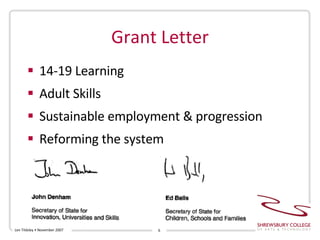
Grant Letter 14-19 Learning Adult Skills Sustainable employment & progression Reforming the system Len Tildsley • November 2007
LSC Statement of Priorities National Statement accompanying the government grant letter “ Better Skills, Better Jobs, Better Lives” Covers 08/09 to 10/11 Published 16 th  November 2007 Len Tildsley • November 2007
Targets & Priorities Priority 1 : Creating Demand for Skills Priority 2 : Transforming FE Priority 3 : Better Skills, Better Jobs, Better Lives Len Tildsley • November 2007
Creating Demand for Skills … more people to demand more learning because they are clear about the social and economic benefits that it brings. Len Tildsley • November 2007
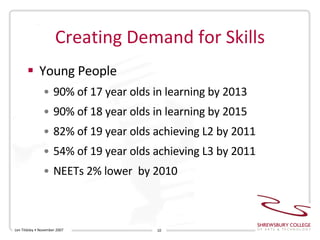
Creating Demand for Skills Young People 90% of 17 year olds in learning by 2013 90% of 18 year olds in learning by 2015 82% of 19 year olds achieving L2 by 2011 54% of 19 year olds achieving L3 by 2011 NEETs 2% lower  by 2010 Len Tildsley • November 2007
Creating Demand for Skills Young People LSC to work with Connexions and LEA to ensure that the supply of provision matches demand The ‘September Guarantee’ Greater flexibility – able to start in January More Apprenticeship places - matching National entitlement to diploma places Clear L1 and pre-vocational offer Clear progression routes to HE and employment Len Tildsley • November 2007
Creating Demand for Skills Adults Bias funding towards those without skills and qualifications Link funding to ‘skills accounts’ Adult careers service Personal learning – time and location Increased full-cost work Open College buildings for community use Len Tildsley • November 2007
Creating Demand for Skills Employers Use ESF funding to extend TtG service Numeracy, Literacy and ESOL available as stand-alone options through TtG Adult Apprenticeships merged with TtG Part-funded 2 nd  L3 pilot through TtG Full-funded 2 nd  L2 to retrain unemployed Progress towards funding only SQS qualifications Fund more employers to provide their own apprenticeship programmes Len Tildsley • November 2007
Targets & Priorities Priority 1 : Creating Demand for Skills Priority 2 : Transforming FE Priority 3 : Better Skills, Better Jobs, Better Lives Len Tildsley • November 2007
Transforming FE Align fees policies across all publicly funded provision Increase income through fees and full-cost work Focus on income targets Fully integrate ESF funding Fairer funding methodology Establish Framework for Excellence Develop The Qualifications & Credit Framework Len Tildsley • November 2007
Transforming FE £2.3bn of capital investment Allow non-FE providers to bid for LSC capital funding Embed and Extend ILT Drive CPD Work with leading colleges to ‘blueprint’ future business models  Increase the number of national skills academies Increased commissioning and tendering to fill skills gaps Len Tildsley • November 2007
Targets & Priorities Priority 1 : Creating Demand for Skills Priority 2 : Transforming FE Priority 3 : Better Skills, Better Jobs, Better Lives Len Tildsley • November 2007
Better Skills, Better Jobs, Better Lives Len Tildsley • November 2007 “ We want to increase the sector’s focus on integrating skills with employment so that more people get the training and qualifications they need to come off benefits, enter work and progress - more of the learning we fund to result in job outcomes.”
Better Skills, Better Jobs, Better Lives Protect opportunities for students with learning difficulties and/or disabilities Protect funding for PCDL and neighbourhood learning in deprived communities Protect funding for ESOL and learning below L2 that forms the FLT. Len Tildsley • November 2007
Better Skills, Better Jobs, Better Lives Focus funding on FLT, Skills for Life and Level 2  People and communities most excluded from the labour market and those in ‘vulnerable’ employment Numeracy skills  Offender learning Len Tildsley • November 2007
Better Skills, Better Jobs, Better Lives All young people to take part in work experience Employers encouraged to recruit untrained or low-skilled staff to access supported training (inc. Pre-employment) through TtG. Employability skills programmes for the unemployed Higher skills programmes in conjunction with HEFCE Len Tildsley • November 2007
Becoming Demand Led Common funding mechanism for all 16-19 year olds Common approach to funding ‘New Diplomas’ for all 14-19 year olds All vocational skill funding to move towards skills accounts and Train2Gain £500m in skills accounts by 2011 £1.5bn in skills accounts by 2015 50:50 balance between funding and fees  Len Tildsley • November 2007
Demand Led – First Steps More sophisticated commissioning of provision – focussed on social inclusion New funding models – learner and employer choice Qualification reform Increase MLP acceptable rates FE self regulation by 2012 Len Tildsley • November 2007
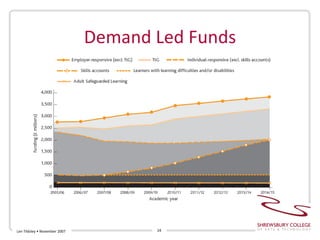
Demand Led Funds Len Tildsley • November 2007
Commissioning 1 Sector Skills Council priority qualifications 14-19 Partnerships Colleges Schools WBL Providers LEA to run ‘competitions’ to fulfil perceived gaps in provision > 200 places Len Tildsley • November 2007
Commissioning 2 Adult Learners LLDD, PCDL, FLT, S4L Full Level 2, Full Level 3 Whole qualifications at Level 4 Negotiated volumes with existing providers Further negotiation or tendering to fill gaps Len Tildsley • November 2007
Commissioning 3 Provision for employers Accelerate the expansion of TtG Reward excellence New providers linked to employer choice New providers from competitive tendering Multi-year contracts Contract values varied in-year Len Tildsley • November 2007
Qualification Reform 1 Qualifications ‘fit for purpose’ Smaller ‘chunks’ Sector qualification strategies (End of Nov) Funding discontinued for a large number of qualifications – progressive Employer and Provider developed training eligible for full QCF approval by 2010 Len Tildsley • November 2007
Qualification Reform 2 Foundation Learning Tier (FLT) Intended to improve progression to L2 Enhance ‘employability’ Majority of sub L2 provision will be units and qualifications in FLT Will replace E2E and LLDD provision Len Tildsley • November 2007
Raising and Assuring Quality Eliminate inadequate provision in FE Minimum levels of performance More areas of provision Increased rates for 08/09 TtG Providers expected to move towards success rates >80% Len Tildsley • November 2007
Minimum Levels of Performance Len Tildsley • November 2007
Self Regulation A new relationship between the LSC and the FE system LSC to discuss, in detail, what we offer How we respond to learner, employer and community needs Support the integration of employment and skills  Demand Led funding = financial planning challenge Transitional arrangements and support Len Tildsley • November 2007
Funding Allocations 1 16-18 New funding system Average rate increase of 2.1% No funding for transferred qualifications Keys skills removed from entitlement funding Reduce funding for L3 learning 40,000 ‘new diploma’ places funded by LSC  Len Tildsley • November 2007
Funding Allocations 2 Adult Learners Funding targeted – those excluded from the labour market Total number of funded learners expected to reduce Longer or more substantial programmes In-year and end-year reconciliation No viament to other categories Average funding rate increase of 1.5% At least 15% to deliver Full L2 At least 10% to deliver Full L3 Len Tildsley • November 2007
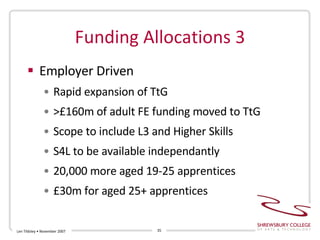
Funding Allocations 3 Employer Driven Rapid expansion of TtG >£160m of adult FE funding moved to TtG Scope to include L3 and Higher Skills S4L to be available independantly 20,000 more aged 19-25 apprentices £30m for aged 25+ apprentices Len Tildsley • November 2007
Exercise 1 Len Tildsley • November 2007 In your table groups compare the college today with the college we need to become if we are to respond to the priorities and changes outlined for the sector over the next three years. Agree your top THREE priority changes and text them along with your name to... 07703 ?????? One text per table !
Len Tildsley • November 2007
Planning & Funding The Planning Context The 08/09 Funding Mechanism Business & Provision Planning Len Tildsley • November 2007
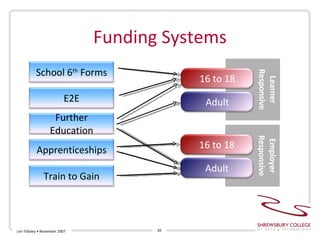
Funding Systems Len Tildsley • November 2007 Learner Responsive Employer Responsive School 6 th  Forms E2E Further Education Apprenticeships Train to Gain 16 to 18 Adult 16 to 18 Adult
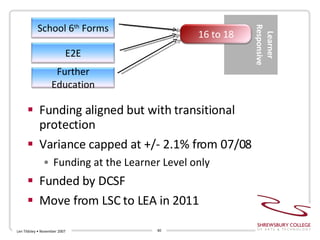
Funding aligned but with transitional protection Variance capped at +/- 2.1% from 07/08 Funding at the Learner Level only Funded by DCSF  Move from LSC to LEA in 2011 Len Tildsley • November 2007 School 6 th  Forms E2E Further Education 16 to 18 Learner Responsive
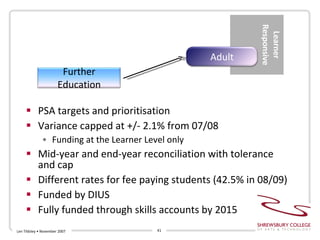
PSA targets and prioritisation Variance capped at +/- 2.1% from 07/08 Funding at the Learner Level only Mid-year and end-year reconciliation with tolerance and cap Different rates for fee paying students (42.5% in 08/09) Funded by DIUS Fully funded through skills accounts by 2015 Len Tildsley • November 2007 Further Education Adult Learner Responsive
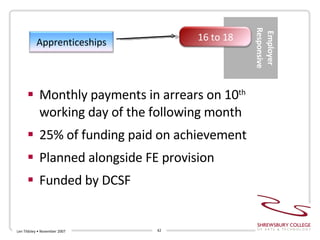
Monthly payments in arrears on 10 th  working day of the following month 25% of funding paid on achievement Planned alongside FE provision Funded by DCSF Len Tildsley • November 2007 Apprenticeships 16 to 18 Employer Responsive
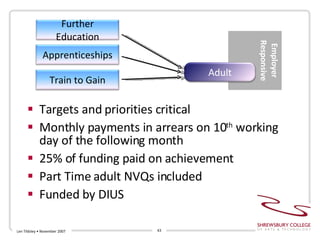
Targets and priorities critical Monthly payments in arrears on 10 th  working day of the following month 25% of funding paid on achievement Part Time adult NVQs included Funded by DIUS Len Tildsley • November 2007 Further Education Apprenticeships Train to Gain Adult Employer Responsive
Demand Led Funding Taken 2 ½ years to develop Single mechanism – use wholly or partly Standard Learner Numbers (SLN) National funding Rate per SLN Modified by the Provider Factor New census points New calculation to determine ALS Len Tildsley • November 2007
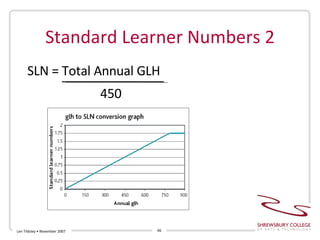
Standard Learner Numbers 1 Similar to FTEs Use GLH to Calculate GLH determined by Awarding Body / QCA / LSC and published in LAD Some qualification have ‘variable’ GLH  16-18 entitlement = 114 GLH Capped at 1.75 Len Tildsley • November 2007
Standard Learner Numbers 2 SLN = Total Annual GLH   450 Len Tildsley • November 2007
National Funding Rate One rate for each category Co-funded rate for those paying fees (-42.5%) 16-18 Learner Responsive Adult Learner Responsive Co-Funded Adult Learner Responsive 16-18 Employer Responsive Adult Employer Responsive Co-funded Adult Employer Responsive Len Tildsley • November 2007
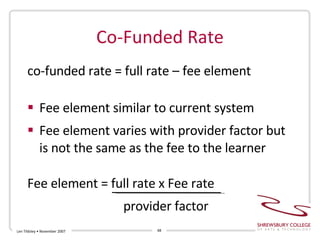
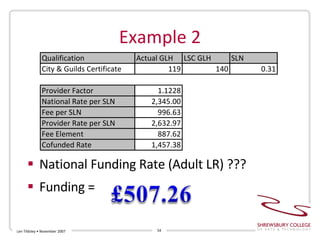
Co-Funded Rate co-funded rate = full rate – fee element Fee element similar to current system Fee element varies with provider factor but is not the same as the fee to the learner Fee element = full rate x Fee rate provider factor Len Tildsley • November 2007
Provider Factor Replaces  Programme Weighting Disadvantage uplift Area costs Funding amount variation on withdrawal (by using the overall GLH weighted success rate) ONE factor for the whole college each year No variation by team or subject Len Tildsley • November 2007
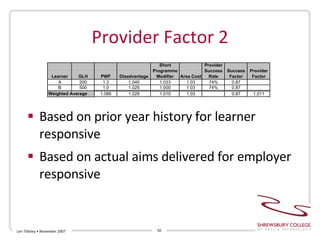
Provider Factor 2 Based on prior year history for learner responsive Based on actual aims delivered for employer responsive Len Tildsley • November 2007
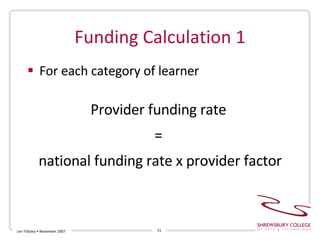
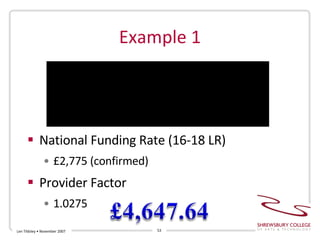
Funding Calculation 1 For each category of learner Provider funding rate  =  national funding rate x provider factor Len Tildsley • November 2007
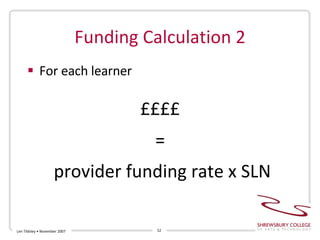
Funding Calculation 2 For each learner ££££  = provider funding rate x SLN Len Tildsley • November 2007
Example 1 National Funding Rate (16-18 LR) £2,775 (confirmed) Provider Factor  1.0275 Len Tildsley • November 2007
Example 2 National Funding Rate (Adult LR) ??? Funding = Len Tildsley • November 2007
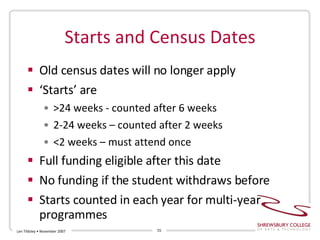
Starts and Census Dates Old census dates will no longer apply ‘ Starts’ are  >24 weeks - counted after 6 weeks 2-24 weeks – counted after 2 weeks <2 weeks – must attend once Full funding eligible after this date No funding if the student withdraws before Starts counted in each year for multi-year programmes Len Tildsley • November 2007
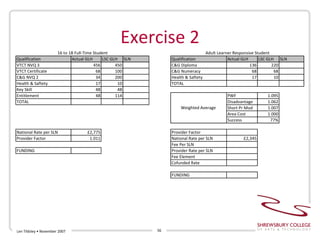
Exercise 2 Len Tildsley • November 2007
Exercise 2 Answer Len Tildsley • November 2007
Planning & Funding The Planning Context The 08/09 Funding Mechanism Business & Provision Planning Len Tildsley • November 2007
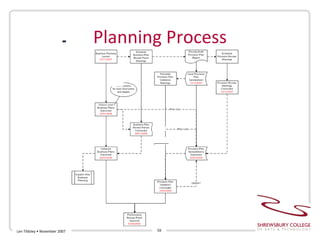
Planning Process Len Tildsley • November 2007
Planning Software Len Tildsley • November 2007
Business Plan Updated for 08/09 Coordinated by schools Planned at Programme Team level Designed to address priorities May be reviewed by LSC for the 1 st  time Tries to avoid SAR/QUIP overlap Len Tildsley • November 2007
Structure Directed Actions Demand Addressing Priorities Learning Pathways Provision Changes Strategic Themes Agreed Targets Revenue Plan Capital Bids Len Tildsley • November 2007
Directed Actions Specific changes requested by senior management How they will be fulfilled Who will be responsible Improving efficiency Len Tildsley • November 2007
Demand Market analysis Historical trends Successes and Failures Competition Opportunities Marketing Len Tildsley • November 2007
Addressing Priorities Young People 14-19 Work Placements Adult Skills Skills for Life Full Level 2 and 3 Higher Skills Employment skills Income Generation Len Tildsley • November 2007
Learning Pathways Progression Routes & Entry Criteria Full Time Part Time Employment Job Skills Apprenticeship Len Tildsley • November 2007
Provision Changes New Provision Changed Provision Discontinued Provision Len Tildsley • November 2007
Strategic Themes Employer Engagement VLE (Moodle) Implementation ILT in the classroom Curriculum Learning Centres Functional Skills & Embedding eILP Every Child Matters Len Tildsley • November 2007
Agreed Targets Learner Numbers SLNs Retention Achievement Attendance Budget Surplus Len Tildsley • November 2007
Revenue Plan Expenditure Staffing Agency Non Pay Income Funding Allocations Fees Len Tildsley • November 2007
Capital Bids Link to business plan Justification Impact if not agreed Len Tildsley • November 2007
Len Tildsley • November 2007

FE Planning And Funding 2008/09

  • 1.
    Planning & FundingLen Tildsley DIRECTOR OF CURRICULUM & INFORMATION Len Tildsley • November 2007
  • 2.
    Len Tildsley •November 2007
  • 3.
    Planning & FundingThe Planning Context The 08/09 Funding Mechanism Business & Provision Planning Len Tildsley • November 2007
  • 4.
    Planning & FundingThe Planning Context The 08/09 Funding Mechanism Business & Provision Planning Len Tildsley • November 2007
  • 5.
    The Planning ContextLen Tildsley • November 2007
  • 6.
    Grant Letter 14-19Learning Adult Skills Sustainable employment & progression Reforming the system Len Tildsley • November 2007
  • 7.
    LSC Statement ofPriorities National Statement accompanying the government grant letter “ Better Skills, Better Jobs, Better Lives” Covers 08/09 to 10/11 Published 16 th November 2007 Len Tildsley • November 2007
  • 8.
    Targets & PrioritiesPriority 1 : Creating Demand for Skills Priority 2 : Transforming FE Priority 3 : Better Skills, Better Jobs, Better Lives Len Tildsley • November 2007
  • 9.
    Creating Demand forSkills … more people to demand more learning because they are clear about the social and economic benefits that it brings. Len Tildsley • November 2007
  • 10.
    Creating Demand forSkills Young People 90% of 17 year olds in learning by 2013 90% of 18 year olds in learning by 2015 82% of 19 year olds achieving L2 by 2011 54% of 19 year olds achieving L3 by 2011 NEETs 2% lower by 2010 Len Tildsley • November 2007
  • 11.
    Creating Demand forSkills Young People LSC to work with Connexions and LEA to ensure that the supply of provision matches demand The ‘September Guarantee’ Greater flexibility – able to start in January More Apprenticeship places - matching National entitlement to diploma places Clear L1 and pre-vocational offer Clear progression routes to HE and employment Len Tildsley • November 2007
  • 12.
    Creating Demand forSkills Adults Bias funding towards those without skills and qualifications Link funding to ‘skills accounts’ Adult careers service Personal learning – time and location Increased full-cost work Open College buildings for community use Len Tildsley • November 2007
  • 13.
    Creating Demand forSkills Employers Use ESF funding to extend TtG service Numeracy, Literacy and ESOL available as stand-alone options through TtG Adult Apprenticeships merged with TtG Part-funded 2 nd L3 pilot through TtG Full-funded 2 nd L2 to retrain unemployed Progress towards funding only SQS qualifications Fund more employers to provide their own apprenticeship programmes Len Tildsley • November 2007
  • 14.
    Targets & PrioritiesPriority 1 : Creating Demand for Skills Priority 2 : Transforming FE Priority 3 : Better Skills, Better Jobs, Better Lives Len Tildsley • November 2007
  • 15.
    Transforming FE Alignfees policies across all publicly funded provision Increase income through fees and full-cost work Focus on income targets Fully integrate ESF funding Fairer funding methodology Establish Framework for Excellence Develop The Qualifications & Credit Framework Len Tildsley • November 2007
  • 16.
    Transforming FE £2.3bnof capital investment Allow non-FE providers to bid for LSC capital funding Embed and Extend ILT Drive CPD Work with leading colleges to ‘blueprint’ future business models Increase the number of national skills academies Increased commissioning and tendering to fill skills gaps Len Tildsley • November 2007
  • 17.
    Targets & PrioritiesPriority 1 : Creating Demand for Skills Priority 2 : Transforming FE Priority 3 : Better Skills, Better Jobs, Better Lives Len Tildsley • November 2007
  • 18.
    Better Skills, BetterJobs, Better Lives Len Tildsley • November 2007 “ We want to increase the sector’s focus on integrating skills with employment so that more people get the training and qualifications they need to come off benefits, enter work and progress - more of the learning we fund to result in job outcomes.”
  • 19.
    Better Skills, BetterJobs, Better Lives Protect opportunities for students with learning difficulties and/or disabilities Protect funding for PCDL and neighbourhood learning in deprived communities Protect funding for ESOL and learning below L2 that forms the FLT. Len Tildsley • November 2007
  • 20.
    Better Skills, BetterJobs, Better Lives Focus funding on FLT, Skills for Life and Level 2 People and communities most excluded from the labour market and those in ‘vulnerable’ employment Numeracy skills Offender learning Len Tildsley • November 2007
  • 21.
    Better Skills, BetterJobs, Better Lives All young people to take part in work experience Employers encouraged to recruit untrained or low-skilled staff to access supported training (inc. Pre-employment) through TtG. Employability skills programmes for the unemployed Higher skills programmes in conjunction with HEFCE Len Tildsley • November 2007
  • 22.
    Becoming Demand LedCommon funding mechanism for all 16-19 year olds Common approach to funding ‘New Diplomas’ for all 14-19 year olds All vocational skill funding to move towards skills accounts and Train2Gain £500m in skills accounts by 2011 £1.5bn in skills accounts by 2015 50:50 balance between funding and fees Len Tildsley • November 2007
  • 23.
    Demand Led –First Steps More sophisticated commissioning of provision – focussed on social inclusion New funding models – learner and employer choice Qualification reform Increase MLP acceptable rates FE self regulation by 2012 Len Tildsley • November 2007
  • 24.
    Demand Led FundsLen Tildsley • November 2007
  • 25.
    Commissioning 1 SectorSkills Council priority qualifications 14-19 Partnerships Colleges Schools WBL Providers LEA to run ‘competitions’ to fulfil perceived gaps in provision > 200 places Len Tildsley • November 2007
  • 26.
    Commissioning 2 AdultLearners LLDD, PCDL, FLT, S4L Full Level 2, Full Level 3 Whole qualifications at Level 4 Negotiated volumes with existing providers Further negotiation or tendering to fill gaps Len Tildsley • November 2007
  • 27.
    Commissioning 3 Provisionfor employers Accelerate the expansion of TtG Reward excellence New providers linked to employer choice New providers from competitive tendering Multi-year contracts Contract values varied in-year Len Tildsley • November 2007
  • 28.
    Qualification Reform 1Qualifications ‘fit for purpose’ Smaller ‘chunks’ Sector qualification strategies (End of Nov) Funding discontinued for a large number of qualifications – progressive Employer and Provider developed training eligible for full QCF approval by 2010 Len Tildsley • November 2007
  • 29.
    Qualification Reform 2Foundation Learning Tier (FLT) Intended to improve progression to L2 Enhance ‘employability’ Majority of sub L2 provision will be units and qualifications in FLT Will replace E2E and LLDD provision Len Tildsley • November 2007
  • 30.
    Raising and AssuringQuality Eliminate inadequate provision in FE Minimum levels of performance More areas of provision Increased rates for 08/09 TtG Providers expected to move towards success rates >80% Len Tildsley • November 2007
  • 31.
    Minimum Levels ofPerformance Len Tildsley • November 2007
  • 32.
    Self Regulation Anew relationship between the LSC and the FE system LSC to discuss, in detail, what we offer How we respond to learner, employer and community needs Support the integration of employment and skills Demand Led funding = financial planning challenge Transitional arrangements and support Len Tildsley • November 2007
  • 33.
    Funding Allocations 116-18 New funding system Average rate increase of 2.1% No funding for transferred qualifications Keys skills removed from entitlement funding Reduce funding for L3 learning 40,000 ‘new diploma’ places funded by LSC Len Tildsley • November 2007
  • 34.
    Funding Allocations 2Adult Learners Funding targeted – those excluded from the labour market Total number of funded learners expected to reduce Longer or more substantial programmes In-year and end-year reconciliation No viament to other categories Average funding rate increase of 1.5% At least 15% to deliver Full L2 At least 10% to deliver Full L3 Len Tildsley • November 2007
  • 35.
    Funding Allocations 3Employer Driven Rapid expansion of TtG >£160m of adult FE funding moved to TtG Scope to include L3 and Higher Skills S4L to be available independantly 20,000 more aged 19-25 apprentices £30m for aged 25+ apprentices Len Tildsley • November 2007
  • 36.
    Exercise 1 LenTildsley • November 2007 In your table groups compare the college today with the college we need to become if we are to respond to the priorities and changes outlined for the sector over the next three years. Agree your top THREE priority changes and text them along with your name to... 07703 ?????? One text per table !
  • 37.
    Len Tildsley •November 2007
  • 38.
    Planning & FundingThe Planning Context The 08/09 Funding Mechanism Business & Provision Planning Len Tildsley • November 2007
  • 39.
    Funding Systems LenTildsley • November 2007 Learner Responsive Employer Responsive School 6 th Forms E2E Further Education Apprenticeships Train to Gain 16 to 18 Adult 16 to 18 Adult
  • 40.
    Funding aligned butwith transitional protection Variance capped at +/- 2.1% from 07/08 Funding at the Learner Level only Funded by DCSF Move from LSC to LEA in 2011 Len Tildsley • November 2007 School 6 th Forms E2E Further Education 16 to 18 Learner Responsive
  • 41.
    PSA targets andprioritisation Variance capped at +/- 2.1% from 07/08 Funding at the Learner Level only Mid-year and end-year reconciliation with tolerance and cap Different rates for fee paying students (42.5% in 08/09) Funded by DIUS Fully funded through skills accounts by 2015 Len Tildsley • November 2007 Further Education Adult Learner Responsive
  • 42.
    Monthly payments inarrears on 10 th working day of the following month 25% of funding paid on achievement Planned alongside FE provision Funded by DCSF Len Tildsley • November 2007 Apprenticeships 16 to 18 Employer Responsive
  • 43.
    Targets and prioritiescritical Monthly payments in arrears on 10 th working day of the following month 25% of funding paid on achievement Part Time adult NVQs included Funded by DIUS Len Tildsley • November 2007 Further Education Apprenticeships Train to Gain Adult Employer Responsive
  • 44.
    Demand Led FundingTaken 2 ½ years to develop Single mechanism – use wholly or partly Standard Learner Numbers (SLN) National funding Rate per SLN Modified by the Provider Factor New census points New calculation to determine ALS Len Tildsley • November 2007
  • 45.
    Standard Learner Numbers1 Similar to FTEs Use GLH to Calculate GLH determined by Awarding Body / QCA / LSC and published in LAD Some qualification have ‘variable’ GLH 16-18 entitlement = 114 GLH Capped at 1.75 Len Tildsley • November 2007
  • 46.
    Standard Learner Numbers2 SLN = Total Annual GLH 450 Len Tildsley • November 2007
  • 47.
    National Funding RateOne rate for each category Co-funded rate for those paying fees (-42.5%) 16-18 Learner Responsive Adult Learner Responsive Co-Funded Adult Learner Responsive 16-18 Employer Responsive Adult Employer Responsive Co-funded Adult Employer Responsive Len Tildsley • November 2007
  • 48.
    Co-Funded Rate co-fundedrate = full rate – fee element Fee element similar to current system Fee element varies with provider factor but is not the same as the fee to the learner Fee element = full rate x Fee rate provider factor Len Tildsley • November 2007
  • 49.
    Provider Factor Replaces Programme Weighting Disadvantage uplift Area costs Funding amount variation on withdrawal (by using the overall GLH weighted success rate) ONE factor for the whole college each year No variation by team or subject Len Tildsley • November 2007
  • 50.
    Provider Factor 2Based on prior year history for learner responsive Based on actual aims delivered for employer responsive Len Tildsley • November 2007
  • 51.
    Funding Calculation 1For each category of learner Provider funding rate = national funding rate x provider factor Len Tildsley • November 2007
  • 52.
    Funding Calculation 2For each learner ££££ = provider funding rate x SLN Len Tildsley • November 2007
  • 53.
    Example 1 NationalFunding Rate (16-18 LR) £2,775 (confirmed) Provider Factor 1.0275 Len Tildsley • November 2007
  • 54.
    Example 2 NationalFunding Rate (Adult LR) ??? Funding = Len Tildsley • November 2007
  • 55.
    Starts and CensusDates Old census dates will no longer apply ‘ Starts’ are >24 weeks - counted after 6 weeks 2-24 weeks – counted after 2 weeks <2 weeks – must attend once Full funding eligible after this date No funding if the student withdraws before Starts counted in each year for multi-year programmes Len Tildsley • November 2007
  • 56.
    Exercise 2 LenTildsley • November 2007
  • 57.
    Exercise 2 AnswerLen Tildsley • November 2007
  • 58.
    Planning & FundingThe Planning Context The 08/09 Funding Mechanism Business & Provision Planning Len Tildsley • November 2007
  • 59.
    Planning Process LenTildsley • November 2007
  • 60.
    Planning Software LenTildsley • November 2007
  • 61.
    Business Plan Updatedfor 08/09 Coordinated by schools Planned at Programme Team level Designed to address priorities May be reviewed by LSC for the 1 st time Tries to avoid SAR/QUIP overlap Len Tildsley • November 2007
  • 62.
    Structure Directed ActionsDemand Addressing Priorities Learning Pathways Provision Changes Strategic Themes Agreed Targets Revenue Plan Capital Bids Len Tildsley • November 2007
  • 63.
    Directed Actions Specificchanges requested by senior management How they will be fulfilled Who will be responsible Improving efficiency Len Tildsley • November 2007
  • 64.
    Demand Market analysisHistorical trends Successes and Failures Competition Opportunities Marketing Len Tildsley • November 2007
  • 65.
    Addressing Priorities YoungPeople 14-19 Work Placements Adult Skills Skills for Life Full Level 2 and 3 Higher Skills Employment skills Income Generation Len Tildsley • November 2007
  • 66.
    Learning Pathways ProgressionRoutes & Entry Criteria Full Time Part Time Employment Job Skills Apprenticeship Len Tildsley • November 2007
  • 67.
    Provision Changes NewProvision Changed Provision Discontinued Provision Len Tildsley • November 2007
  • 68.
    Strategic Themes EmployerEngagement VLE (Moodle) Implementation ILT in the classroom Curriculum Learning Centres Functional Skills & Embedding eILP Every Child Matters Len Tildsley • November 2007
  • 69.
    Agreed Targets LearnerNumbers SLNs Retention Achievement Attendance Budget Surplus Len Tildsley • November 2007
  • 70.
    Revenue Plan ExpenditureStaffing Agency Non Pay Income Funding Allocations Fees Len Tildsley • November 2007
  • 71.
    Capital Bids Linkto business plan Justification Impact if not agreed Len Tildsley • November 2007
  • 72.
    Len Tildsley •November 2007