Impact of
             Organized
        Retailing on the
     Unorganized Sector
                               Mathew Joseph
                       Nirupama Soundararajan
                               Manisha Gupta
                             Sanghamitra Sahu


                                     May 2008


INDIAN COUNCIL FOR RESEARCH ON INTERNATIONAL ECONOMIC RELATIONS
Foreword


The retail sector is expanding and modernizing rapidly in line with India’s economic
growth. It offers significant employment opportunities in all urban areas. This study,
the second undertaken by ICRIER on the retail industry, attempts to rigorously
analyse the impact of organized retailing on different segments of the economy. No
distinction has been made between foreign and domestic players, in analyzing the
impact of the increasing trend of large corporates entering the retail trade in the
country. The findings of this study are based on the largest ever survey of
unorganized retailers (the so-called “mom and pop stores”), consumers, farmers,
intermediaries, manufacturers, and organized retailers. In addition, an extensive
review of international experience, particularly of emerging countries of relevance to
India, has also been carried out as part of the study.

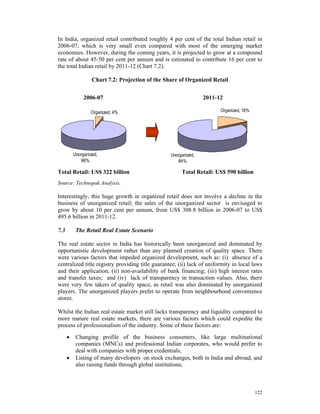
The study estimates that the total retail business in India will grow at 13 per cent
annually from US$ 322 billion in 2006-07 to US$ 590 billion in 2011-12. The
unorganized retail sector is expected to grow at approximately 10 per cent per annum
with sales rising from US$ 309 billion in 2006-07 to US$ 496 billion. Organized
retail, which constituted a low four per cent of total retail in 2006-07, is estimated to
grow at 45-50 per cent per annum and attain a 16 per cent share of total retail by
2011-12. In short, both unorganized and organized retail are bound not only to coexist
but also achieve rapid and sustained growth in the coming years. This is clearly not a
case of a zero sum game as both organized and unorganized retail will see a massive
scaling up of their activities. In fact, the retail sector, left entirely in the unorganized
and informal segment of the economy, could well emerge as a major bottleneck to
raising productivity in both agriculture and industry.

One of the rather suprising findings of the study is that low-income consumers save
more than others through shopping at organized retail outlets. This is a result of
targeted discount shopping. It is also seen that farmers gain considerably from direct
sales to organized retailers, with significant price and profit advantages as compared
with selling either to intermediaries or to government regulated markets. Large
manufacturers have also started feeling the competitive impact of organized retail
through both price and payment pressures. Yet, they see the advantages from a more
efficient supply chain and logistics that accompany the growth of organized retail.

The extensive empirical evidence marshalled and analysed by ICRIER researchers
will hopefully provide a solid basis for policy in this sector. Based on the empirical
evidence and analysis that have been extensively peer reviewed, the study makes a
number of policy recommendations that have a bearing on both the unorganized and
organized segments of the retail sector. The two most important recommendations in
my view are: first, for the government to facilitate the emergence of a “private code of
conduct” for organized retailers in their transaction with small suppliers; and, second,
a simplification of the licensing and permit regime to promote the expansion of
organized retail.


                                                                                           i
I would like to express my appreciation to the Department of Industrial Promotion
and Policy (DIPP), Ministry of Commerce & Industry, Government of India, for
giving ICRIER the opportunity to undertake this important study. I trust the effort of
the research team led by Mathew Joseph and comprising of Nirupama Soundararajan,
Manisha Gupta and Sanghamitra Sahu will receive due recognition. I would also like
to thank our collaborators, Dr. Thomas Reardon, Dr. Ashok Gulati of IFPRI,
Technopak Advisors Pvt. Ltd. and Development & Research Services for their
significant contribution to this effort. Finally, I hope that the study’s findings will
help policymakers in their task of promoting modernization of the retail sector while
maximizing its employment potential.


                                                                     (Rajiv Kumar)
                                                          Director & Chief Executive
                                                                            ICRIER

May 2nd 2008


                                                                                     ii
Acknowledgements


ICRIER has received considerable help from a number of organizations and
individuals for completing this study.

We would like to thank our various partners of the study: Mr. Narasimha Rao and his
team at Development & Research Services Private Limited (DRS) for conducting the
all-India surveys; Dr. Thomas Reardon and Dr. Ashok Gulati, Co-Directors of the
International Food Policy Research Institute (IFPRI)-Michigan State University
(MSU) Joint Programme on Markets in Asia, for the chapter on international retail
experience and their help with the survey and analysis of the impact of organized
retail on farmers; and Mr. Arvind Singhal, Ms. Preeti Reddy, Mr. Akshay Chaturvedi
and their team at Technopak Advisers Private Limited, for their valuable inputs.

Besides the partners of the study, we would like to thank the different organized retail
companies, Metro Cash & Carry India, PricewaterhouseCoopers Private Limited,
New Delhi, and Retailers Association of India.

We would also like to thank Mr. Ashish Sanyal, Amp Retail Services; and Mr. Jayant
Kochar, Go Fish Retail Solutions for their valuable help.

Finally we also thank Ms. Sheela Bajaj for editing the report and Mr. Anil Kumar for
formatting the report.


                                                                                      iii
Abbreviations


Rs.         Indian rupees. The conversion to US dollars is roughly Rs 40.00 to
            US US$1.00
US$         Unless otherwise designated, this symbol refers to US Dollar


APMC        Agricultural Produce Marketing Committee
APPSI       The Association of Traditional Traders
B2B         business-to-business
C&C         cash-and-carry
C&F Agent   carrying and forwarding agent
CA          commission agent
CDIT        consumer durables and information technology
CII         Confideration of Indian Industry
CRISIL      Credit Rating Information Services of India Limited
CSO         Central Statistical Organization
CST         central sales tax
CWS         Co-operative Wholesale Society (UK)
DC          distribution centre
DFI         Dairy Farm International
DRS         Development & Research Services Private Limited
EBO         exclusive brand outlet
EMI         equated monthly installment
EMS         Environment Management System
ERP         enterprise resource planning
ESIC        Employees State Insurance Corporation
FICCI       Federation of Indian Chamber of Commerce and Industry
F&V         fruit and vegetables
FAMA        Federal Agricultural Marketing Authority (Malaysia)
FDI         foreign direct investment
FIPB        Foreign Investment Promotion Board
FMCG        fast moving consumer goods
GDP         gross domestic product
GOI         Government of India
GRDI        Global Retail Development Index
HACCP       Hazard Analysis Critical Control Points
HSBC        Hongkong and Shanghai Banking Corporation
HUL         Hindustan Unilever Limited


                                                                          iv
ICRIER     Indian Council For Research On International Economic Relations
ICT        information and communication technology
IFPRI      International Food Policy Research Institute
IGA        Independent Grocers Alliance
IPO        initial public offering
ISO        International Organization For Standardization
IT         information technology
ITC        Indian Tobacco Company
JV         joint venture
LILPL      Littlewoods International Private Limited, UK
MBO        multi-brand outlet
MDFPL      Mother Dairy Foods Processing Limited
MDFVL      Mother Dairy Fruit and Vegetable Limited
MDIL       Mother Dairy India Limited
MERCOSUR   Mercado Comun del Sur
MISH       Market Information Survey Of Households
MNC        multinational corporation
NABL       National Accreditation Board for Testing and Calibration
           Laboratory
NAFTA      North American Free Trade Agreement
NCAER      National Council Of Applied Economic Research
NCR        national capital region
NDDB       National Dairy Development Board
NOC        no objection certificate
NSSO       National Sample Survey Organization
PACA       Perishable Agricultural Commodities Act (US)
PFA        Prevention of Food Adulteration Act
PPP        Public-Private Partnership
PRIL       Pantaloon India Retail Limited
RFID       radio frequency identification device
SABRAE     Brazilian Department of Support for Small Enterprises
SKU        stock keeping unit
SMI        small and medium industry
SPRING     Standards, Productivity, and Innovation Board (Singapore)
TOMCO      Tata Mills Oils Company Limited
VAT        value added tax
VSAT       very small aperture terminals
WM         weights and measures
WTO        World Trade Organization


                                                                       v
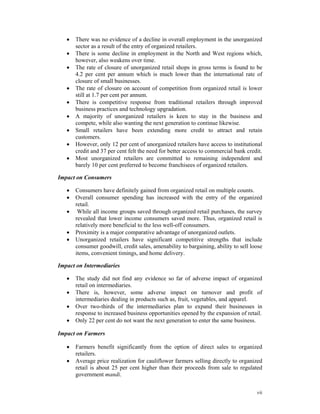
Executive Summary

The real GDP is expected to grow at 8-10 per cent per annum in the next five years.
As a result, the consuming class with annual household incomes above Rs. 90,000 is
expected to rise from about 370 million in 2006-07 to 620 million in 2011-12.
Consequently, the retail business in India is estimated to grow at 13 per cent annually
from US$ 322 billion in 2006-07 to US$ 590 billion in 2011-12. The study shows:

   •   The unorganized retail sector is expected to grow at about 10 per cent per
       annum with sales rising from US$ 309 billion in 2006-07 to US$ 496 billion in
       2011-12.
   •   Given the relatively weak financial state of unorganized retailers, and the
       physical space constraints on their expansion prospects, this sector alone will
       not be able to meet the growing demand for retail.
   •   Hence, organized retail which now constitutes a small four per cent of total
       retail sector is likely to grow at a much faster pace of 45-50 per cent per
       annum and quadruple its share in total retail trade to 16 per cent by 2011-12.
   •   This represents a positive sum game in which both unorganized and organized
       retail not only coexist but also grow substantially in size.
   •   The majority of unorganized retailers surveyed in this study, indicated their
       preference to continue in the business and compete rather than exit.

The Empirical Basis

The study comprises the largest ever survey of all segments of the economy that could
be affected by the entry of large corporates in the retail business. The findings are
based on a survey of 2020 unorganized small retailers across 10 major cities; 1318
consumers shopping at both organized and unorganized retail outlets; 100
intermediaries; and 197 farmers. In addition, a “control sample” survey was done of
805 unorganized retailers who are not in the vicinity of organized retail outlets in four
metro cities.

Detailed interviews were also carried out for 12 large manufacturers, 20 small
manufacturers and six established modern retailers.

The study contains an extensive review of international retail experience, particularly
from the major emerging market economies.


Main Findings

Impact on Unorganized Retailers

   •   Unorganized retailers in the vicinity of organized retailers experienced a
       decline in their volume of business and profit in the initial years after the entry
       of large organized retailers.
   •   The adverse impact on sales and profit weakens over time.


                                                                                        vi
•   There was no evidence of a decline in overall employment in the unorganized
       sector as a result of the entry of organized retailers.
   •   There is some decline in employment in the North and West regions which,
       however, also weakens over time.
   •   The rate of closure of unorganized retail shops in gross terms is found to be
       4.2 per cent per annum which is much lower than the international rate of
       closure of small businesses.
   •   The rate of closure on account of competition from organized retail is lower
       still at 1.7 per cent per annum.
   •   There is competitive response from traditional retailers through improved
       business practices and technology upgradation.
   •   A majority of unorganized retailers is keen to stay in the business and
       compete, while also wanting the next generation to continue likewise.
   •   Small retailers have been extending more credit to attract and retain
       customers.
   •   However, only 12 per cent of unorganized retailers have access to institutional
       credit and 37 per cent felt the need for better access to commercial bank credit.
   •   Most unorganized retailers are committed to remaining independent and
       barely 10 per cent preferred to become franchisees of organized retailers.

Impact on Consumers

   •   Consumers have definitely gained from organized retail on multiple counts.
   •   Overall consumer spending has increased with the entry of the organized
       retail.
   •    While all income groups saved through organized retail purchases, the survey
       revealed that lower income consumers saved more. Thus, organized retail is
       relatively more beneficial to the less well-off consumers.
   •   Proximity is a major comparative advantage of unorganized outlets.
   •   Unorganized retailers have significant competitive strengths that include
       consumer goodwill, credit sales, amenability to bargaining, ability to sell loose
       items, convenient timings, and home delivery.

Impact on Intermediaries

   •   The study did not find any evidence so far of adverse impact of organized
       retail on intermediaries.
   •   There is, however, some adverse impact on turnover and profit of
       intermediaries dealing in products such as, fruit, vegetables, and apparel.
   •   Over two-thirds of the intermediaries plan to expand their businesses in
       response to increased business opportunities opened by the expansion of retail.
   •   Only 22 per cent do not want the next generation to enter the same business.

Impact on Farmers

   •   Farmers benefit significantly from the option of direct sales to organized
       retailers.
   •   Average price realization for cauliflower farmers selling directly to organized
       retail is about 25 per cent higher than their proceeds from sale to regulated
       government mandi.


                                                                                     vii
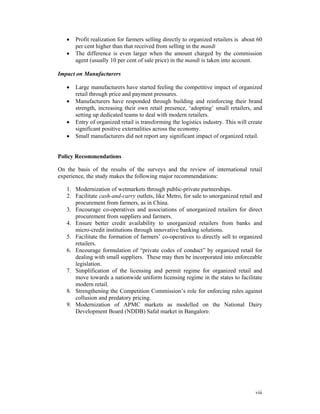
•   Profit realization for farmers selling directly to organized retailers is about 60
       per cent higher than that received from selling in the mandi
   •   The difference is even larger when the amount charged by the commission
       agent (usually 10 per cent of sale price) in the mandi is taken into account.

Impact on Manufacturers

   •   Large manufacturers have started feeling the competitive impact of organized
       retail through price and payment pressures.
   •   Manufacturers have responded through building and reinforcing their brand
       strength, increasing their own retail presence, ‘adopting’ small retailers, and
       setting up dedicated teams to deal with modern retailers.
   •   Entry of organized retail is transforming the logistics industry. This will create
       significant positive externalities across the economy.
   •   Small manufacturers did not report any significant impact of organized retail.


Policy Recommendations

On the basis of the results of the surveys and the review of international retail
experience, the study makes the following major recommendations:

   1. Modernization of wetmarkets through public-private partnerships.
   2. Facilitate cash-and-carry outlets, like Metro, for sale to unorganized retail and
      procurement from farmers, as in China.
   3. Encourage co-operatives and associations of unorganized retailers for direct
      procurement from suppliers and farmers.
   4. Ensure better credit availability to unorganized retailers from banks and
      micro-credit institutions through innovative banking solutions.
   5. Facilitate the formation of farmers’ co-operatives to directly sell to organized
      retailers.
   6. Encourage formulation of “private codes of conduct” by organized retail for
      dealing with small suppliers. These may then be incorporated into enforceable
      legislation.
   7. Simplification of the licensing and permit regime for organized retail and
      move towards a nationwide uniform licensing regime in the states to facilitate
      modern retail.
   8. Strengthening the Competition Commission’s role for enforcing rules against
      collusion and predatory pricing.
   9. Modernization of APMC markets as modelled on the National Dairy
      Development Board (NDDB) Safal market in Bangalore.


                                                                                      viii
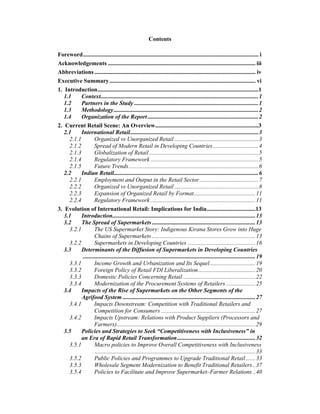
Contents

Foreword....................................................................................................................... i
Acknowledgements .................................................................................................... iii
Abbreviations ............................................................................................................. iv
Executive Summary ................................................................................................... vi
1. Introduction.............................................................................................................1
   1.1     Context...........................................................................................................1
   1.2     Partners in the Study ....................................................................................1
   1.3     Methodology..................................................................................................2
   1.4     Organization of the Report ...........................................................................2
2. Current Retail Scene: An Overview......................................................................3
   2.1     International Retail.......................................................................................3
     2.1.1          Organized vs Unorganized Retail .........................................................3
     2.1.2          Spread of Modern Retail in Developing Countries...............................4
     2.1.3          Globalization of Retail ..........................................................................5
     2.1.4          Regulatory Framework .........................................................................5
     2.1.5          Future Trends........................................................................................6
   2.2     Indian Retail..................................................................................................6
     2.2.1          Employment and Output in the Retail Sector........................................7
     2.2.2          Organized vs Unorganized Retail .........................................................8
     2.2.3          Expansion of Organized Retail by Format..........................................11
     2.2.4          Regulatory Framework .......................................................................11
3. Evolution of International Retail: Implications for India.................................13
   3.1     Introduction.................................................................................................13
   3.2     The Spread of Supermarkets ......................................................................13
     3.2.1          The US Supermarket Story: Indigenous Kirana Stores Grow into Huge
                    Chains of Supermarkets ......................................................................13
     3.2.2          Supermarkets in Developing Countries ..............................................16
   3.3     Determinants of the Diffusion of Supermarkets in Developing Countries
            .....................................................................................................................19
     3.3.1          Income Growth and Urbanization and Its Sequel...............................19
     3.3.2          Foreign Policy of Retail FDI Liberalization.......................................20
     3.3.3          Domestic Policies Concerning Retail .................................................22
     3.3.4          Modernization of the Procurement Systems of Retailers ....................25
   3.4     Impacts of the Rise of Supermarkets on the Other Segments of the
           Agrifood System ..........................................................................................27
     3.4.1          Impacts Downstream: Competition with Traditional Retailers and
                    Competition for Consumers ................................................................27
     3.4.2          Impacts Upstream: Relations with Product Suppliers (Processors and
                    Farmers)..............................................................................................29
   3.5     Policies and Strategies to Seek “Competitiveness with Inclusiveness” in
           an Era of Rapid Retail Transformation .....................................................32
     3.5.1          Macro policies to Improve Overall Competitiveness with Inclusiveness
                    .............................................................................................................33
     3.5.2          Public Policies and Programmes to Upgrade Traditional Retail.......33
     3.5.3          Wholesale Segment Modernization to Benefit Traditional Retailers ..37
     3.5.4          Policies to Facilitate and Improve Supermarket–Farmer Relations ..40
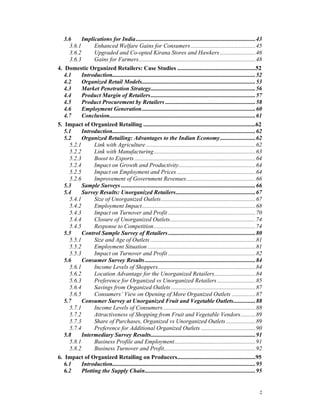
3.6     Implications for India .................................................................................43
     3.6.1       Enhanced Welfare Gains for Consumers ............................................45
     3.6.2       Upgraded and Co-opted Kirana Stores and Hawkers ........................46
     3.6.3       Gains for Farmers...............................................................................48
4. Domestic Organized Retailers: Case Studies .....................................................52
   4.1     Introduction.................................................................................................52
   4.2     Organized Retail Models.............................................................................53
   4.3     Market Penetration Strategy.......................................................................56
   4.4     Product Margin of Retailers.......................................................................57
   4.5     Product Procurement by Retailers .............................................................58
   4.6     Employment Generation.............................................................................60
   4.7     Conclusion...................................................................................................61
5. Impact of Organized Retailing ............................................................................62
   5.1     Introduction.................................................................................................62
   5.2     Organized Retailing: Advantages to the Indian Economy........................62
     5.2.1       Link with Agriculture ..........................................................................62
     5.2.2       Link with Manufacturing.....................................................................63
     5.2.3       Boost to Exports ..................................................................................64
     5.2.4       Impact on Growth and Productivity....................................................64
     5.2.5       Impact on Employment and Prices .....................................................64
     5.2.6       Improvement of Government Revenues...............................................66
   5.3     Sample Surveys ...........................................................................................66
   5.4     Survey Results: Unorganized Retailers......................................................67
     5.4.1       Size of Unorganized Outlets................................................................67
     5.4.2       Employment Impact.............................................................................68
     5.4.3       Impact on Turnover and Profit ...........................................................70
     5.4.4       Closure of Unorganized Outlets..........................................................74
     5.4.5       Response to Competition.....................................................................74
   5.5     Control Sample Survey of Retailers ...........................................................80
     5.5.1       Size and Age of Outlets .......................................................................81
     5.5.2       Employment Situation .........................................................................81
     5.5.3       Impact on Turnover and Profit ...........................................................82
   5.6     Consumer Survey Results ...........................................................................84
     5.6.1       Income Levels of Shoppers..................................................................84
     5.6.2       Location Advantage for the Unorganized Retailers............................84
     5.6.3       Preference for Organized vs Unorganized Retailers ..........................85
     5.6.4       Savings from Organized Outlets .........................................................87
     5.6.5       Consumers’ View on Opening of More Organized Outlets ................87
   5.7     Consumer Survey at Unorganized Fruit and Vegetable Outlets...............88
     5.7.1       Income Levels of Consumers...............................................................88
     5.7.2       Attractiveness of Shopping from Fruit and Vegetable Vendors..........89
     5.7.3       Share of Purchases, Organized vs Unorganized Outlets ....................89
     5.7.4       Preference for Additional Organized Outlets .....................................90
   5.8     Intermediary Survey Results.......................................................................91
     5.8.1       Business Profile and Employment.......................................................91
     5.8.2       Business Turnover and Profit..............................................................92
6. Impact of Organized Retailing on Producers.....................................................95
   6.1     Introduction.................................................................................................95
   6.2     Plotting the Supply Chain...........................................................................95


                                                                                                                        2
6.2.1      Cost of Cultivation ..............................................................................96
     6.2.2      Farmer’s Profit ...................................................................................98
     6.2.3      Profit Margin for Each Player in the Supply Chain .........................100
   6.3     Farmer Survey Results .............................................................................100
     6.3.1      Farmer Grouping ..............................................................................101
     6.3.2      Farmer Profiling ...............................................................................102
     6.3.3      Quantitative Advantages ...................................................................105
     6.3.4      Qualitative Advantages .....................................................................107
     6.3.5      Conclusion.........................................................................................110
   6.4     Manufacturers: Interview Report.............................................................111
     6.4.1      Methodology......................................................................................111
     6.4.2      Key Findings .....................................................................................112
     6.4.3      Conclusion.........................................................................................117
   6.5     Small Manufacturers: Interview Report ..................................................118
     6.5.1      Respondent Profile ............................................................................118
     6.5.2      Interview Results ...............................................................................118
7. Future Scenario in Retailing ..............................................................................121
   7.1     Introduction...............................................................................................121
   7.2     Growth of Retail and its Distribution.......................................................121
   7.3     The Retail Real Estate Scenario...............................................................122
   7.4     Organized Retail Investment ....................................................................123
   7.5     Share of Investments by City ....................................................................124
   7.6     Expected Share of Top Players in Indian Retail .....................................125
   7.7     Retail Space Break-up by Category..........................................................125
   7.8     Employment Growth .................................................................................126
     7.8.1      New Retail Stores ..............................................................................127
8. Policy Recommendations....................................................................................128
   8.1     Main Findings of the Study......................................................................128
   8.2     A Balanced Approach to Retail ................................................................129
   8.3     Modernization of Unorganized Retail......................................................129
   8.4     Regulation of Organized Retail ................................................................130
Annex 1: Unorganized Retail Universe 2006.........................................................131
Annex 2: Modern Retail Formats in India ............................................................133
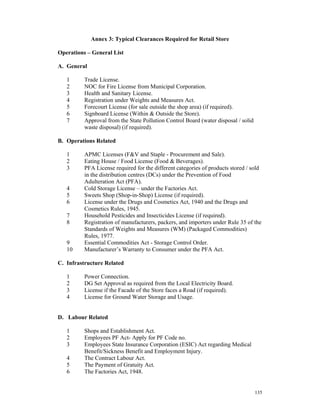
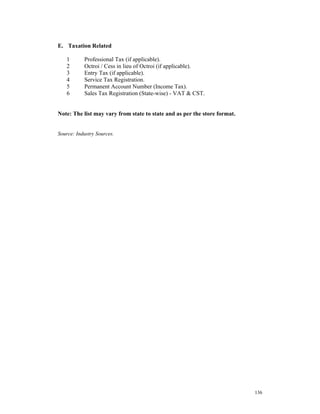
Annex 3: Typical Clearances Required for Retail Store......................................135
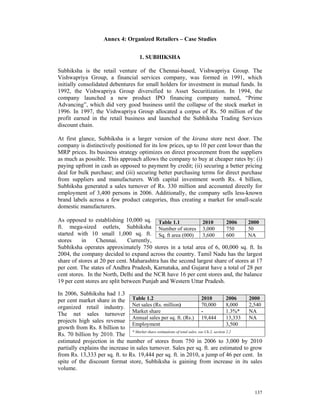
Annex 4: Organized Retailers – Case Studies .......................................................137
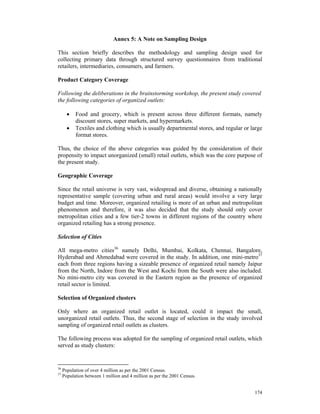
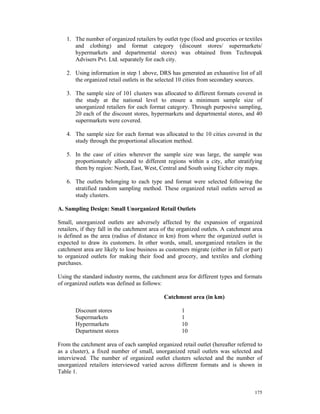
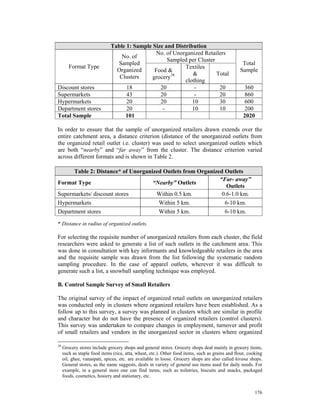
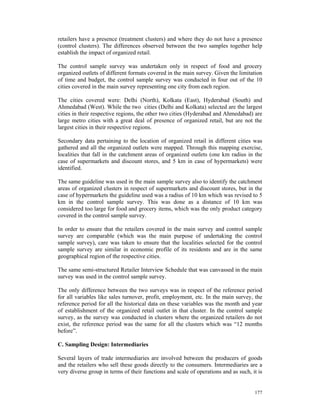
Annex 5: A Note on Sampling Design ....................................................................174
Annex 6: Syndicate Bank’s Small Credit Scheme Linked to Pigmy Deposits
       (“SyndSmallCredit”)......................................................................................181
Appendix 1: Alternative Farm Supply Chains......................................................182
Appendix 2: Small Manufacturers’ Interview List...............................................187
Appendix 3: Checklist for Interview of Small Manufacturers ............................188
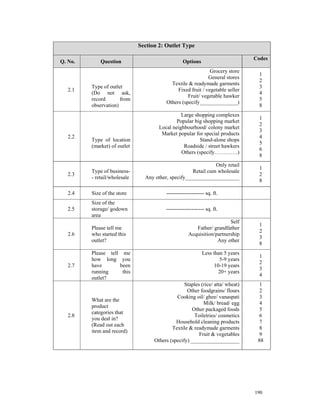
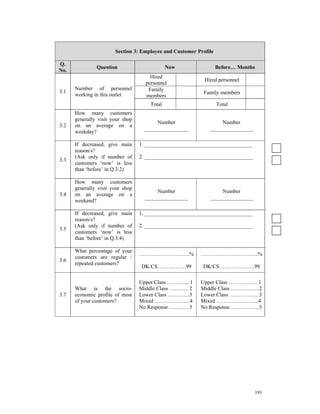
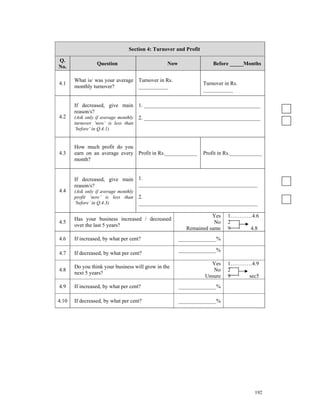
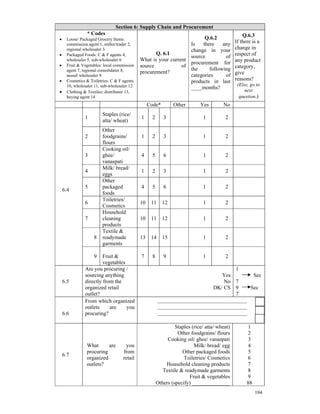
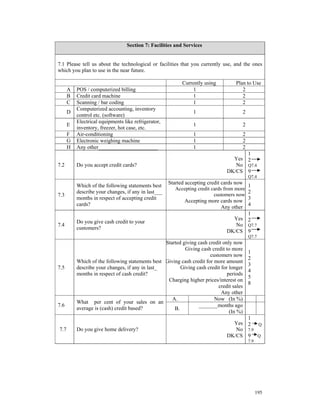
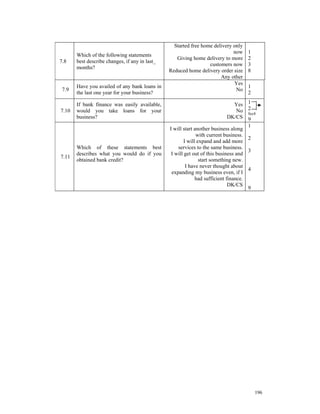
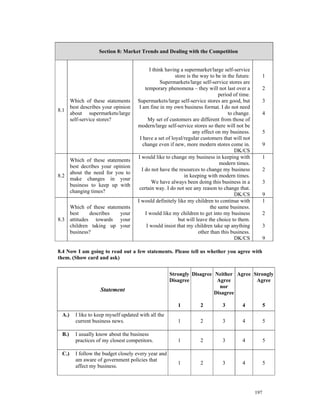
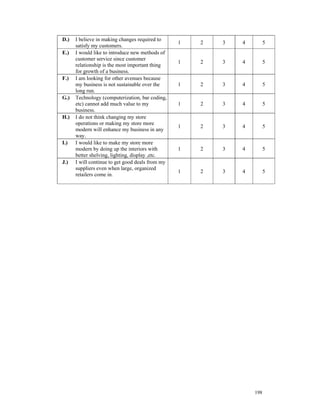
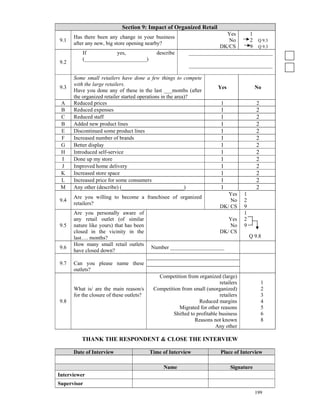
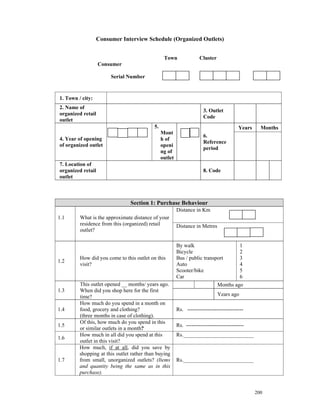
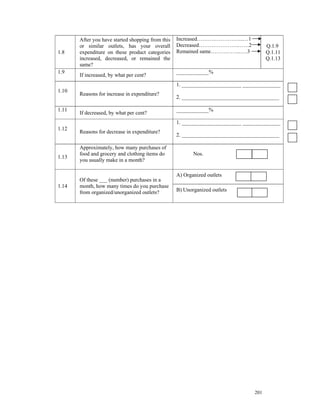
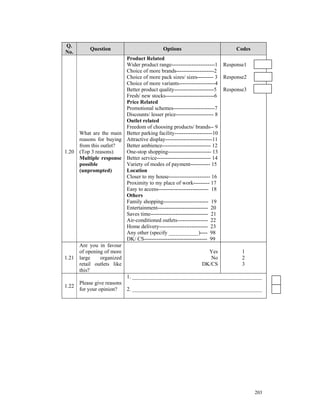
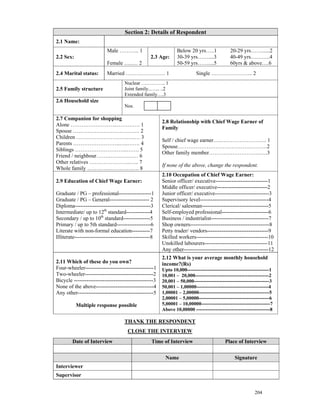
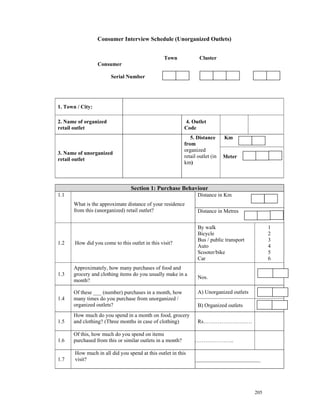
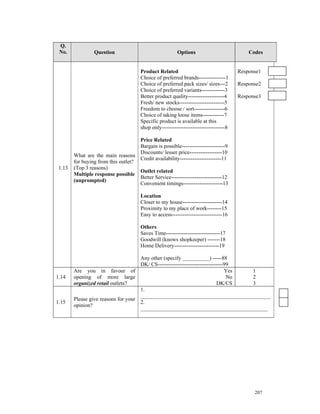
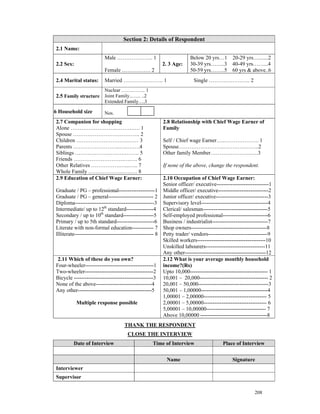
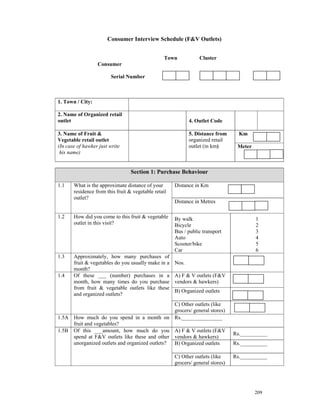
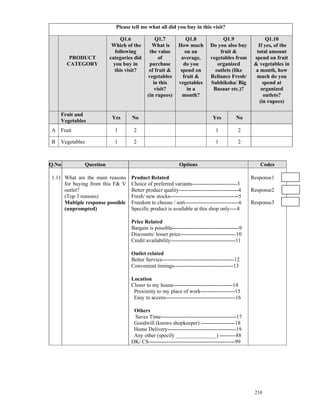
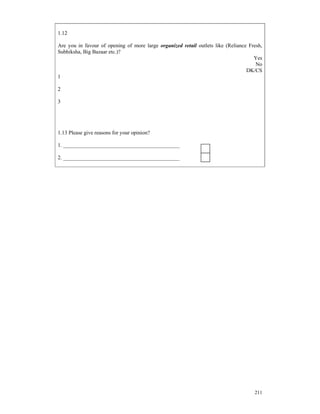
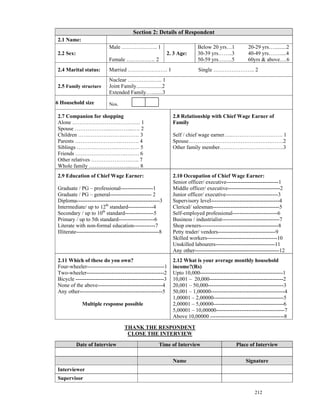
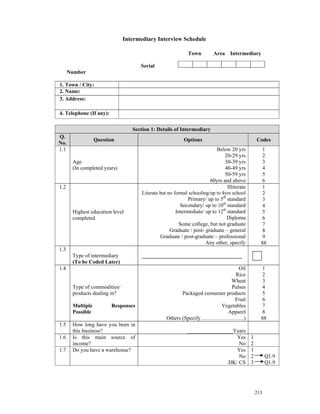
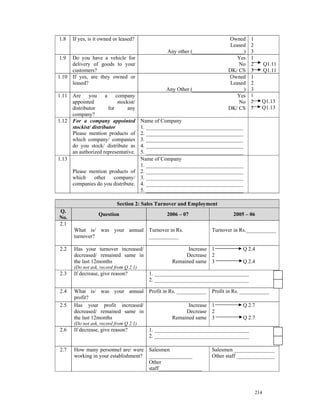
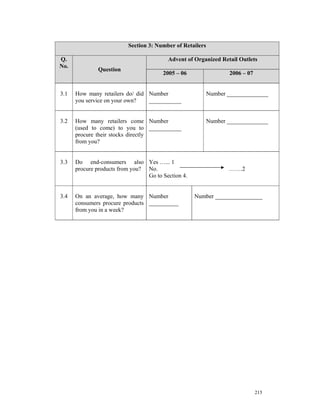
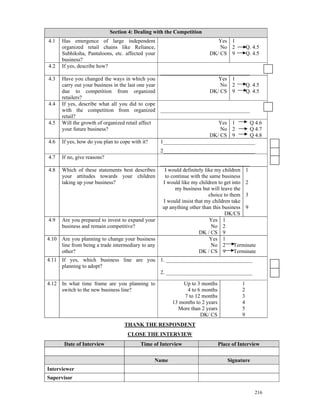
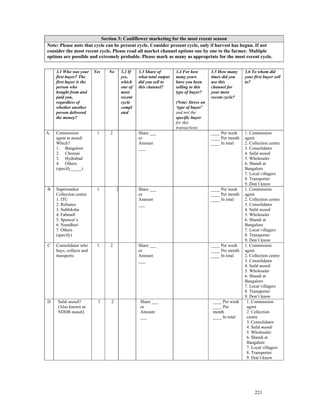
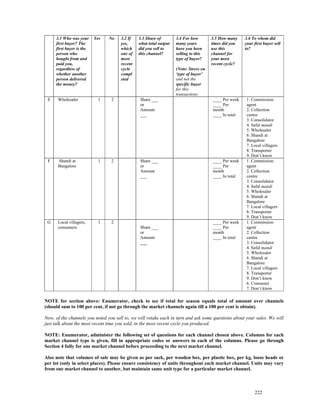
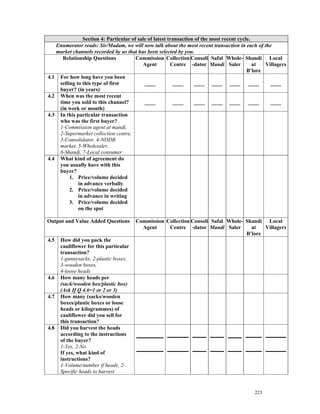
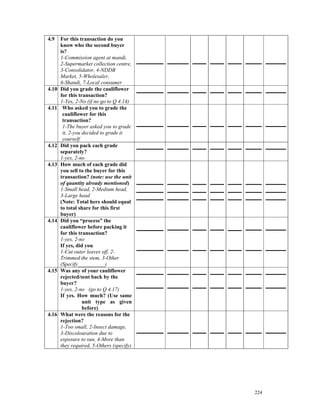
Appendix 4: Questionnaires....................................................................................189
References.................................................................................................................229


                                                                                                                            3
List of Tables

Table 2.1: World Retail..................................................................................................3
Table 2.2: Share of Organized Retail in Selected Countries, 2006 ...............................4
Table 2.3: GDP, Private Final Consumption Expenditure and Retail Sales Growth,
       1994-07 (Compound Annual Growth Rate) ......................................................7
Table 2.4: Growth India Retail - Total vs Organized ....................................................9
Table 2.5: India Retail - Share of Categories (per cent) .............................................10
Table 2.6: Share of Organized Sector in Total Retail by Category (%) .....................10
Table 2.7: Organized Retail Expansion by Format......................................................11

Table 4.1: Organized Retail Models ............................................................................54
Table 4.2: Organized Retailers Sales’ Turnover in 2006-07 .......................................56
Table 4.3 : Organized Retailers’ Gross Margin (per cent)...........................................58
Table 4.4: Organized Retail Employment, 2006-07 ....................................................61

Table 5.1: Growth of Selected Industries (Compound Annual Growth Rate in %) ....63
Table 5.2: Share in GDP and Employment of Selected Sectors, 1993-94 to 2004-0565
Table 5.3: Store Area of Unorganized Retail...............................................................67
Table 5.4: Employment Impact on Unorganized Retail by Age of Organized Retail
       (Compound Annual Growth) ...........................................................................69
Table 5.5: Annual Growth in Turnover and Profit of Unorganized Retail Outlets .....70
Table 5.6: Annual Growth in Monthly Turnover and Profit of Unorganized Retail by
       Age of Organized Retail ..................................................................................71
Table 5.7: Retailers Showing Fall in Turnover (% of Sampled Retailers) ..................73
Table 5.8: Response to Competition from Organized Retail Outlets (% of Sampled
       Retailers) ..........................................................................................................75
Table 5.9: Cash Credit Sales........................................................................................76
Table 5.10: Technological Facilities in Use by Unorganized Retailers (As % of
       Sampled Unorganized Retailers) .....................................................................77
Table 5.11: Bank Finance Situation for Unorganized Retailers (As % of Sampled
       Unorganized Retailers) ....................................................................................78
Table 5.12: Dealing with Competition by Unorganized Retailers (In % of Sampled
       Unorganized Retailers) ....................................................................................79
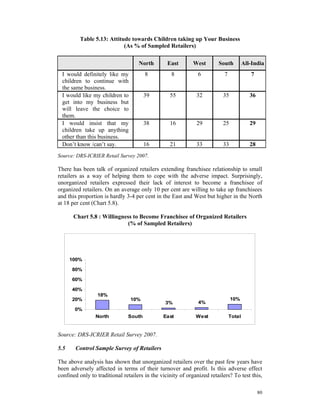
Table 5.13: Attitude towards Children taking up Your Business (As % of Sampled
       Retailers) ..........................................................................................................80
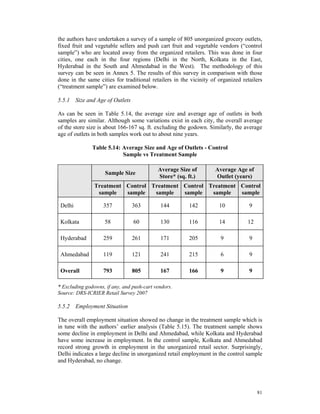
Table 5.14: Average Size and Age of Outlets - Control Sample vs Treatment Sample
       ..........................................................................................................................81
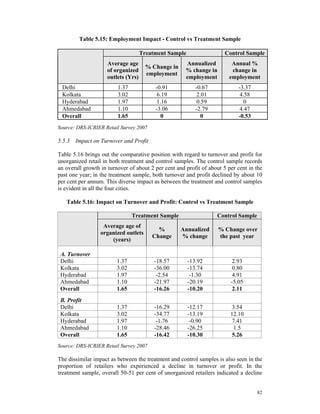
Table 5.15: Employment Impact - Control vs Treatment Sample ...............................82
Table 5.16: Impact on Turnover and Profit: Control vs Treatment Sample ................82
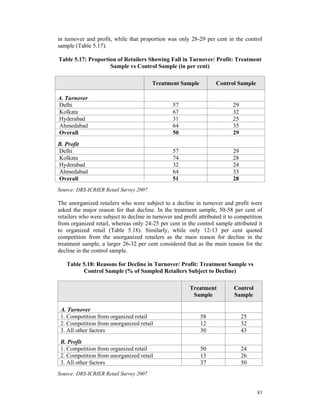
Table 5.17: Proportion of Retailers Showing Fall in Turnover/ Profit: Treatment
       Sample vs Control Sample (in per cent) ..........................................................83
Table 5.18: Reasons for Decline in Turnover/ Profit: Treatment Sample vs Control
       Sample (% of Sampled Retailers Subject to Decline) .....................................83
Table 5.19: Average Monthly Household Income of Shoppers (% Share) .................84
Table 5.20: Share of Average Monthly Spending by Product Category of Consumers
       at Organized/ Unorganized Outlets (% Share).................................................86
Table 5.21: Savings from Buying at Organized Outlets by Format (as % of Spending)
       ..........................................................................................................................87
Table 5.22: Savings from Buying at Organized Outlets by Format (as % of Spending)
       ..........................................................................................................................87
Table 5.23: Average Monthly Household Income of Consumers at Unorganized Fruit
       & Vegetable Outlets (% Share)........................................................................88
Table 5.24: Share of Purchases of Consumers at Unorganized Fruit & Vegetable
       Outlets (% Share).............................................................................................90
Table 5.25: Profile of Sampled Intermediaries by Type and Commodity/ Product
       Group (in numbers)..........................................................................................91
Table 5.26: Turnover and Profit by Product Category ................................................92
Table 5.27: Change in Turnover and Profit by Product Category ...............................93
Table 5.28: Adverse Impact of Organized Retail on Intermediaries ...........................93

Table 6.1: Sowing Patterns of Farmers........................................................................97
Table 6.2 Cost of Cultivation of Cauliflower per Acre ...............................................98
Table 6.3: Farmer’s Profit for Cauliflower ..................................................................99
Table 6.4: Farmer Grouping ......................................................................................101
Table 6.5: Level of Education of Head of Farmer Households (%) ..........................102
Table 6.6: Land Ownership (Owned and Leased) .....................................................103
Table 6.7: Sources of Finance for Cultivation ...........................................................104
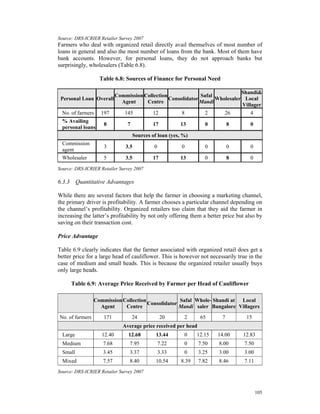
Table 6.8: Sources of Finance for Personal Need......................................................105
Table 6.9: Average Price Received by Farmer per Head of Cauliflower ..................105
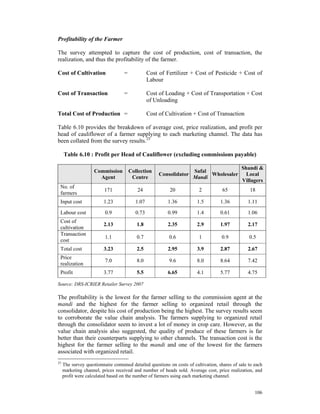
Table 6.10 : Profit per Head of Cauliflower (excluding commissions payable) .......106
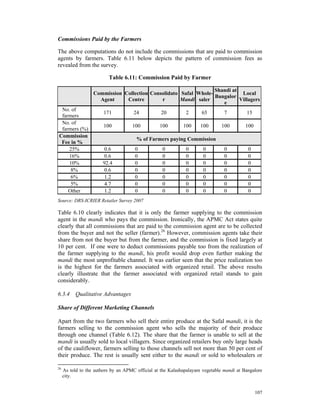
Table 6.11: Commission Paid by Farmer ..................................................................107
Table 6.12: Share of Produce Sold to Different Marketing Channels .......................108
Table 6.13: Share of Rejection...................................................................................108
Table 6.14: Special Cultivation Practices ..................................................................109
Table 6.15 : Grading of Cauliflower..........................................................................110
Table 6.16 : Participating Companies for Interview..................................................112

Table 7.1: Investment Plans of Major Retailers in the Next 5-7 Years .....................123
Table 7.2: Retail Market for 150 Cities in 2011-12...................................................125
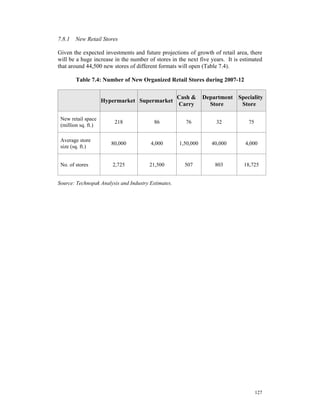
Table 7.3: Employment Generation by Organized Retail during 2007-12................126
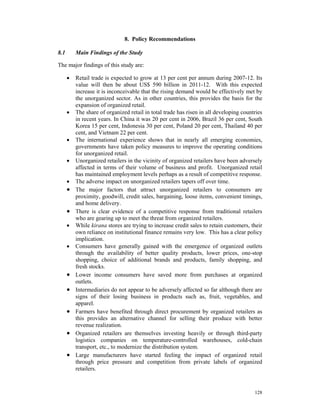
Table 7.4: Number of New Organized Retail Stores during 2007-12 .......................127


                                                        List of Charts

Chart 5.1 a: Family Labour (Per 100 Retailers)...........................................................68
Chart 5.1 b: Hired Labour (Per 100 Retailers).............................................................68
Chart 5.1 c: Temporal Impact on Unorganized Retail Employment ...........................69

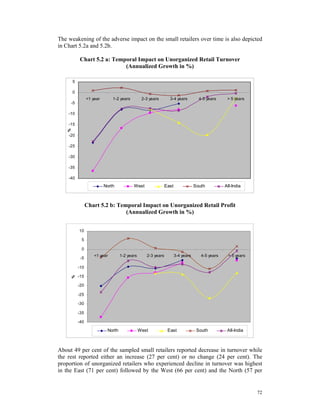
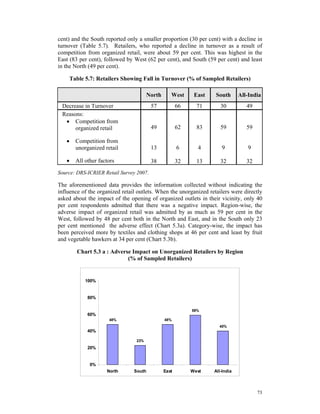
Chart 5.2 a: Temporal Impact on Unorganized Retail Turnover .................................72
Chart 5.2 b: Temporal Impact on Unorganized Retail Profit.......................................72

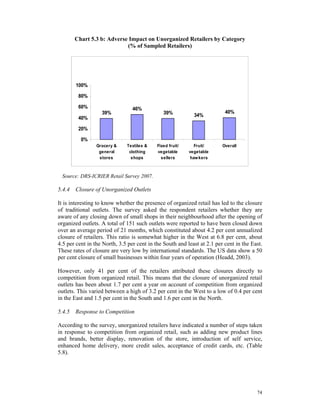
Chart 5.3 a : Adverse Impact on Unorganized Retailers by Region............................73
Chart 5.3 b: Adverse Impact on Unorganized Retailers by Category..........................74

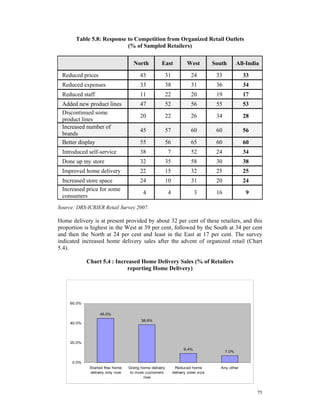
Chart 5.4 : Increased Home Delivery Sales (% of Retailers reporting Home Delivery)
......................................................................................................................................75
Chart 5.5 : Bank Finance Situation (% of Sampled Unorganized Retailers)...............77


                                                                                                                                      2
Chart 5.6 : Dealing with Competition – All-India .......................................................78
Chart 5.7 : Attitude Towards Children Taking up Your Business – All-India ............79
Chart 5.8 : Willingness to Become Franchisee of Organized Retailers.......................80
Chart 5.9 a: Distance of Retail Outlets ........................................................................85
Chart 5.9 b: Mode of Transport ...................................................................................85
Chart 5.10 : Attitude towards Opening of More Organized Outlets............................88
Chart 5.11 : Distance and Mode of Transport to Unorganized Retail Vendors...........89
Chart 5.12 : Preference for Additional Organized Outlets for Fruit & Vegetables .....91
Chart 5.13 : Adverse Impact on Future Business ........................................................94
Chart 5.14 : Succession Plans…… ..............................................................................94

Chart 6.1: The Cauliflower Supply Chain ...................................................................96
Chart 6.2: Share of Profit for Farmer, Intermediary and Retailer in the Consumer
       Price of Cauliflower.......................................................................................100
Chart 6.3 : Asset Ownership (in %) ...........................................................................103
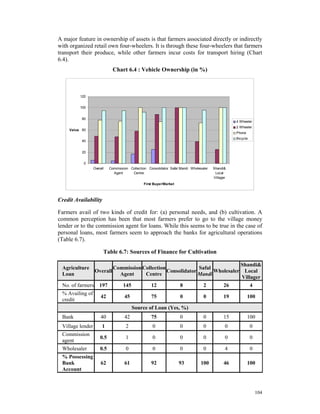
Chart 6.4 : Vehicle Ownership (in %) .......................................................................104
Chart 6.5 : Illustrative Supply Chain for Shampoos/Detergents................................114
Chart 6.6 : Illustrative Supply Chain for Apparel......................................................115

Chart 7.1 : Size of Indian Retail (in US$ bn).............................................................121
Chart 7.2: Projection of the Share of Organized Retail .............................................122
Chart 7.3: Investment Estimates by City Category (%).............................................124
Chart 7.4: Investment Estimates by Format (%)........................................................124

Chart 7.5 a: Retail Space Estimates by Format (%)...................................................125
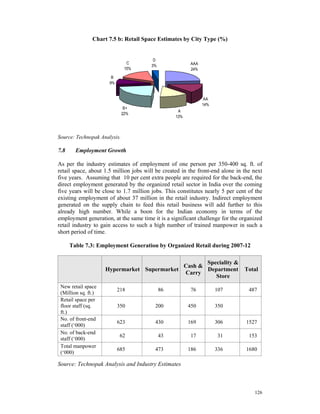
Chart 7.5 b: Retail Space Estimates by City Type (%)..............................................126


                                                                                                                   3
1. Introduction

1.1       Context

An important aspect of the current economic scenario in India is the emergence of
organized retail. There has been considerable growth in organized retailing business
in recent years and it is poised for much faster growth in the future. Major industrial
houses have entered this area and have announced very ambitious future expansion
plans. Transnational corporations are also seeking to come to India and set up retail
chains in collabouration with big Indian companies. However, opinions are divided on
the impact of the growth of organized retail in the country. Concerns have been
raised that the growth of organized retailing may have an adverse impact on retailers
in the unorganized sector. It has also been argued that growth of organized retailing
will yield efficiencies in the supply chain, enabling better access to markets to
producers (including farmers and small producers) and enabling higher prices, on the
one hand and, lower prices to consumers, on the other. In the context of divergent
views on the impact of organized retail, it is essential that an in-depth analytical study
on the possible effects of organized retailing in India is conducted.

In order to assess the impact of growing organized retail on different aspects of the
economy, the Indian Council for Research on International Economic Relations
(ICRIER) was appointed by the Ministry of Commerce and Industry, Government of
India to carry out a study on organized retail focusing on the following issues:

      •    Effect on small retailers and vendors in the unorganized sector keeping in
           mind the likely growth in the overall market.
      •    Effect on employment.
      •    Impact on consumers.
      •    Impact on farmers and manufacturers.
      •    Impact on prices.
      •    Overall impact on economic growth.

ICRIER has been asked by the Ministry to analyze the above issues in the context of a
growth scenario of 7-10 per cent per annum in the next five years and in the light of
practice in other fast- growing emerging market economies.

1.2       Partners in the Study

In this study, ICRIER sought and received assistance from three important groups: (a)
Development & Research Services Private Limited (DRS) for conducting all-India
surveys; (b) Technopak Advisers Pvt. Ltd., a leading management consultancy firm
on retailing; and (c) Dr. Thomas Reardon and Dr. Ashok Gulati as Co-Directors of the
International Food Policy Research Institute (IFPRI)-Michigan State University
(MSU) Joint Programme of Markets in Asia. After a study framework was prepared,
it was discussed in a brainstorming session organized by ICRIER on April 9, 2007 in
which industry representatives, government officials, and senior academics
participated.


                                                                                        1
1.3       Methodology

The following methods were used in the study:

      •    A survey of international experience particularly the recent developments in
           emerging market economies;
      •    Interviews of major players in organized retailing, large manufacturers, and
           small manufacturers;
      •    Questionnaire-based survey of unorganized retailers including fixed fruit
           and vegetable vendors and push-cart hawkers;
      •    Questionnaire-based exit survey of consumers’ shopping at organized retail
           outlets and also consumers’ shopping at unorganized outlets; and
      •    Questionnaire-based survey of farmers who are selling their produce directly
           to organized retailers and also farmers who are selling through the traditional
           mandi route.

1.4       Organization of the Report

The report has been organized into eight chapters as follows:

      1. Introduction
      2. Current Retail Scene: An Overview
                International Retail
                Indian Retail
      3. Evolution of International Retail: Implications for India
      4. Indian Organized Retailers: Case Studies
                Subhiksha
                Trent Limited
                Pantaloon Retail
                ITC Choupal Sagar and Choupal Fresh
                RPG Spencer’s
                Mother Dairy
      5. Impact of Organized Retailing
                Advantages to the Indian Economy
                Unorganized Retail Sector: Survey Results
                Consumers: Survey Results
                Intermediaries: Survey Results
      6. Impact of Organized Retailing on Producers
                Farmers : Value Chain and Survey Results
                Manufacturers : Interview Report
      7. Future Scenario in Retailing
                Growth of Retail: Organized vs. Unorganized
                Investment and Employment Projections
      8. Policy Recommendations


                                                                                        2
2. Current Retail Scene: An Overview

2.1        International Retail

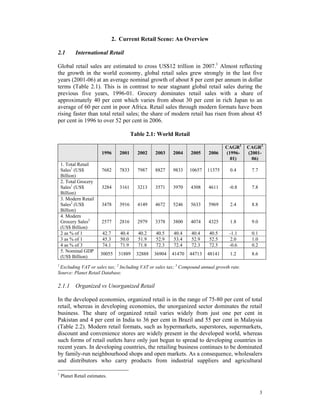
Global retail sales are estimated to cross US$12 trillion in 2007.1 Almost reflecting
the growth in the world economy, global retail sales grew strongly in the last five
years (2001-06) at an average nominal growth of about 8 per cent per annum in dollar
terms (Table 2.1). This is in contrast to near stagnant global retail sales during the
previous five years, 1996-01. Grocery dominates retail sales with a share of
approximately 40 per cent which varies from about 30 per cent in rich Japan to an
average of 60 per cent in poor Africa. Retail sales through modern formats have been
rising faster than total retail sales; the share of modern retail has risen from about 45
per cent in 1996 to over 52 per cent in 2006.

                                          Table 2.1: World Retail

                                                                                    CAGR3    CAGR3
                         1996      2001     2002    2003    2004    2005    2006    (1996-   (2001-
                                                                                      01)      06)
    1. Total Retail
    Sales1 (US$          7682      7833     7987    8827    9833    10657   11375    0.4      7.7
    Billion)
    2. Total Grocery
    Sales1 (US$          3284      3161     3213    3571    3970    4308    4611     -0.8     7.8
    Billion)
    3. Modern Retail
    Sales2 (US$          3478      3916     4149    4672    5246    5633    5969     2.4      8.8
    Billion)
    4. Modern
    Grocery Sales2       2577      2816     2979    3378    3800    4074    4325     1.8      9.0
    (US$ Billion)
    2 as % of 1          42.7      40.4      40.2   40.5    40.4    40.4    40.5     -1.1     0.1
    3 as % of 1          45.3      50.0      51.9   52.9    53.4    52.9    52.5      2.0     1.0
    4 as % of 3          74.1      71.9      71.8   72.3    72.4    72.3    72.5     -0.6     0.2
    5. Nominal GDP
                        30055     31889     32888   36904   41470   44713   48141    1.2      8.6
    (US$ Billion)
1
 Excluding VAT or sales tax; 2 Including VAT or sales tax; 3 Compound annual growth rate.
Source: Planet Retail Database.

2.1.1 Organized vs Unorganized Retail

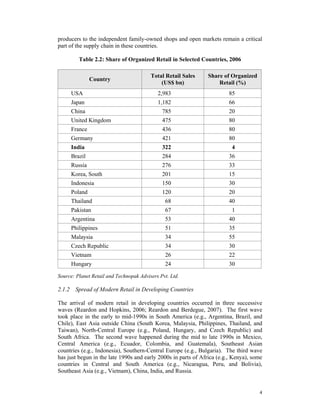
In the developed economies, organized retail is in the range of 75-80 per cent of total
retail, whereas in developing economies, the unorganized sector dominates the retail
business. The share of organized retail varies widely from just one per cent in
Pakistan and 4 per cent in India to 36 per cent in Brazil and 55 per cent in Malaysia
(Table 2.2). Modern retail formats, such as hypermarkets, superstores, supermarkets,
discount and convenience stores are widely present in the developed world, whereas
such forms of retail outlets have only just begun to spread to developing countries in
recent years. In developing countries, the retailing business continues to be dominated
by family-run neighbourhood shops and open markets. As a consequence, wholesalers
and distributors who carry products from industrial suppliers and agricultural

1
    Planet Retail estimates.


                                                                                                    3
producers to the independent family-owned shops and open markets remain a critical
part of the supply chain in these countries.

         Table 2.2: Share of Organized Retail in Selected Countries, 2006

                                         Total Retail Sales    Share of Organized
              Country
                                             (US$ bn)              Retail (%)
     USA                                    2,983                       85
     Japan                                  1,182                       66
     China                                    785                       20
     United Kingdom                           475                       80
     France                                   436                       80
     Germany                                  421                       80
     India                                    322                         4
     Brazil                                   284                       36
     Russia                                   276                       33
     Korea, South                             201                       15
     Indonesia                                150                       30
     Poland                                   120                       20
     Thailand                                  68                       40
     Pakistan                                  67                         1
     Argentina                                 53                       40
     Philippines                               51                       35
     Malaysia                                  34                       55
     Czech Republic                            34                       30
     Vietnam                                   26                       22
     Hungary                                   24                       30

Source: Planet Retail and Technopak Advisers Pvt. Ltd.

2.1.2 Spread of Modern Retail in Developing Countries

The arrival of modern retail in developing countries occurred in three successive
waves (Reardon and Hopkins, 2006; Reardon and Berdegue, 2007). The first wave
took place in the early to mid-1990s in South America (e.g., Argentina, Brazil, and
Chile), East Asia outside China (South Korea, Malaysia, Philippines, Thailand, and
Taiwan), North-Central Europe (e.g., Poland, Hungary, and Czech Republic) and
South Africa. The second wave happened during the mid to late 1990s in Mexico,
Central America (e.g., Ecuador, Colombia, and Guatemala), Southeast Asian
countries (e.g., Indonesia), Southern-Central Europe (e.g., Bulgaria). The third wave
has just begun in the late 1990s and early 2000s in parts of Africa (e.g., Kenya), some
countries in Central and South America (e.g., Nicaragua, Peru, and Bolivia),
Southeast Asia (e.g., Vietnam), China, India, and Russia.


                                                                                     4
Thus, the third wave countries which include China, India and Russia are late comers
in the diffusion of modern retail. According to the authors, the main reason why they
lagged behind was the severe restrictions on foreign direct investment (FDI) in
retailing in these countries. The demand side features of these countries, such as
income, size of the middle class, urbanization, and the share of women in workforce,
etc., have been similar to countries in the second wave. In China and Russia these
restrictions were progressively relaxed in the 1990s and in India partially in the 2000s.
In January 2006, India allowed foreign companies to own up to 51 per cent in single-
brand retail joint ventures (JVs), but multiple-brand foreign firms are still barred in
retail although they can set up wholesale operations.

2.1.3 Globalization of Retail

There has been a creeping internationalization of retailing over the recent period. As
home markets have become crowded and with opportunities in emerging markets
rising, modern retailers from developed countries have been turning to new markets.
On an average each of the top 250 retailers in the world have operated on an average
in 5.9 countries in 2005-06 (July-June) against five countries in 2000-01 (Deloitte-
Stores Report, 2007). Foreign business accounted for 14.4 per cent of retail sales of
these companies in 2005-06 up from 12.6 per cent in 2000-01. The retail sales growth
of companies which have ventured into foreign markets has been faster than those that
have confined themselves to home markets.

As far as the international expansion is concerned, West European and South African
retail companies are the most outward looking. The West European firms, among the
top 250 retailers, expanded into an average of 9.9 countries in 2005-06 and generated
28.1 per cent of their sales from foreign operations, largely in Central and Eastern
Europe. The five South African retailers in the top 250 list conducted business in an
average of 8.8 countries particularly in the African continent in 2005-06, generating
on an average 13 per cent of these companies’ sales. The US retailers are mostly
home-market based operating just in an average of 3.7 countries outside US in 2005-
06 up from three countries in 2000-01 and two countries in 1996-97. The US retailer
Wal-Mart, the world’s biggest retailer, is a notable exception operating in 14 countries
in 2007. Most of the Japanese retailers are insular operating only domestically.

2.1.4 Regulatory Framework

It is interesting to note that regulatory restrictions on the growth in modern retail is
more stringent in developed rather than in developing countries. For example, in most
West European countries, setting up of hypermarkets has become very difficult since
the late 1990s and early 2000s as governments became alive to the demands of
traditional small retailers and non-mobile consumers in these countries. Merger and
acquisition plans are now looked at more critically by the national and European
competition authorities. While in most countries opening hours are liberalized
including holiday trading, the very small number of countries where opening on
Sundays are prohibited include developed countries such as Germany and Austria
(Planet Retail).


                                                                                       5
As noted by Reardon and Hopkins (2006), there are four types of policy regulations
that can be seen in countries which have experienced advanced retail expansion. They
are:

      •      Competition policy that limits concentration and collusion.
      •      Zoning and hours regulations to limit the diffusion, market penetration, and
             convenience of organized retail.
      •      Pricing regulations that prevent modern retail companies from pricing below
             cost and prompt-payment regulations to secure speedy payment to suppliers.
      •      Policies to strengthen traditional retailers and suppliers through technology
             and practice upgrading, enhancing organizational capacity, and financial
             access.

The above regulations were put in place in different countries basically with a view to
balance the conflicts of interests between modern retail, on the one hand and the
traditional retailers and suppliers to the modern retail, on the other. Recently,
countries in Southeast Asia (Malaysia, Indonesia, and Thailand) imposed a number of
restrictions on the growth of large retail companies particularly the transnational
companies in contrast to a fairly liberal approach to the retail sector followed until the
late 1990s. These restrictions involve the use of a combination of competition laws,
FDI regulation, land use restrictions (zoning laws), and limits on operating hours
(Mutebi, 2007).

2.1.5 Future Trends

The Deloitte-Stores (2007) study held that the retail business would slow down
definitely over the next decade in developed countries, while it would grow strongly
in developing countries. This is based on a projection of three significant changes
that will occur. First, the population in the age-group 50-70 years and above in the
developed world will explode, shifting the share of consumer spending further away
from goods towards services, such as travel, healthcare and maintenance of the
elderly. Second, the population growth in the age-group 20-35 years in these
countries will be relatively modest making the hiring of entry-level workers difficult,
while the population in the age-group 35-50 years will decline leading to acute
shortage of middle and upper management positions. Third, in developing countries,
there will be plentiful supply of workforce and consumers in the younger age groups.
Besides, this demographic shift will make the developing countries more dynamic and
risk-taking enabling them to grow much faster than the developed world. Driven by
these trends, it is expected that retailers in developed countries will increasingly move
to the markets of developing countries for growth.

2.2        Indian Retail2

The growth of the retail trade in India is associated with the growth in the Indian
economy. Gross domestic product (GDP) grew by an annual rate of 6.6 per cent

2
    The data on Indian retail is sketchy. There is no official machinery which regularly releases retail
    statistics. There have been a few private sources which give information on various aspects of Indian
    retailing. In this report, the authors have relied on the data generated by Technopak Advisers Pvt.
    Ltd. which in turn has used the data from official sources, such as the Central Statistical Organization
    (CSO) and the National Sample Survey Organization (NSSO) for the purpose.


                                                                                                          6
during 1994-00 but the growth slackened to 4.7 per cent per annum during the next
three years before the growth remarkably rose to 8.7 per cent per annum in the last
four years (Table 2.3). This meant a substantial rise in disposable income of Indian
households since the mid-1990s. Based on the Market Information Survey of
Households (MISH) of the National Council of Applied Economic Research
(NCAER), the number of people in the income groups of “aspirers” and the middle
class with annual income ranging from Rs. 90,000 to one million, more than doubled
from 157 million to 327 million during the last decade 1995-96 to 2005-06.3 The data
from the Central Statistical Organization (CSO) indicate that the growth of real
private final consumption expenditure, which dipped from an average of 5.7 per cent
per annum during 1994-00 to 4 per cent per annum during 2000-03, shot up to 6.7 per
cent per annum during 2003-07. Retail sales (in nominal terms) in the country also
followed a similar pattern: a high annual growth of 13.6 per cent during 1994-00, a
low growth of 4.8 per cent during 2000-03 and a smart pick up in the last four years,
2003-07 at around 11 per cent.

       Table 2.3: GDP, Private Final Consumption Expenditure and Retail Sales
                  Growth, 1994-07 (Compound Annual Growth Rate)


                                                  1994-95 to     2000-01 to       2003-04 to
                                                   1999-00        2002-03          2006-07

    Real GDP                                           6.6           4.7               8.7
    Real private final consumption
                                                       5.7           4.0               6.7
    expenditure
    Retail sales                                     13.6            4.8             10.9

Source: CSO, NSSO, and Technopak Advisers Pvt. Ltd.

The international consulting firm, A.T. Kearney, annually ranks emerging market
economies based on more than 25 macroeconomic and retail-specific variables
through their Global Retail Development Index (GRDI). For the last three years
(2005, 2006, and 2007) India has been ranked as number one indicating that the
country is the most attractive market for global retailers to enter. The high economic
growth during the last few years raising disposable incomes rapidly, favourable
demographics placing incomes on younger population with less dependency, and
urbanization are some of the major factors fueling the Indian retail market.

2.2.1 Employment and Output in the Retail Sector

Retail is a labour-intensive economic activity. According to the Economic Census
carried out by the CSO in 1998, the country had a total of 10.69 million enterprises
engaged in retail trade, of which 5.23 million were in the rural areas and 5.46 million

3
    The NCAER gives data in terms of the number of households and they have been converted into
    number of people by using the average household size of 4.7 persons derived from the NSSO
    surveys.


                                                                                             7
in the urban areas. The total employment in these enterprises in 1998 was 18.54
million of which 7.88 million was in the rural sector and 10.65 million in the urban
sector. Economic Census has been carried out for 2005 but its detailed results are yet
to be released. However, according to NSSO’s Employment and Unemployment
Survey for 2004-05, employment in the retail trade has been 35.06 million, divided
between rural (16.08 million) and urban (18.98 million) sectors.4 This constituted
about 7.3 per cent of the workforce in the country (459 million). Wholesale trade, on
the other hand, contributed to an employment of 5.48 million, of which only 1.71
million was in the rural sector and 3.77 million in the urban sector.

The NSSO data also indicated that retail employment was about 30.62 million in
1999-00 with 12.15 million in rural areas and much higher at 18.47 million in the
urban areas. This means that an additional employment of 4.44 million was added in
this sector during the five-year period, 2000-05, showing an annual employment
growth of 2.7 per cent per annum. However, it is interesting to note that the retail
employment growth has been quite large in the rural sector – there has been a massive
rise in employment in rural retailing of 3.93 million during 2000-05 – and the urban
sector has also shown an employment growth, but only of 0.51 million during this
period.

According to CSO estimates, total domestic trade, both wholesale and retail included,
constituted about 15.1 per cent of India’s GDP in 2006-07, a successive increase in
share from 13 per cent of GDP in 1999-00. Taking into account the fact that retail
trade is more labour intensive than wholesale trade, the contribution of retail trade
alone to GDP can be estimated to be around 11-12 per cent in 2006-07.

2.2.2 Organized vs Unorganized Retail

Indian retail is dominated by a large number of small retailers consisting of the local
kirana shops, owner-manned general stores, chemists, footwear shops, apparel shops,
paan and beedi shops, hand-cart hawkers, pavement vendors, etc. which together
make up the so-called “unorganized retail” or traditional retail.5 The last 3-4 years
have witnessed the entry of a number of organized retailers6 opening stores in various
modern formats in metros and other important cities. Still, the overall share of
organized retailing in total retail business has remained low.

Table 2.4 gives the category-wise growth of Indian retail, total as well as the
organized sector, in recent years. While total retail sales have grown from Rs. 10,591
billion (US$ 230 billion) in 2003-04 to Rs. 14,574 billion (US$ 322 billion) in 2006-
07, which is at an annual compound growth rate of about 11 per cent, the organized
retail sales grew much more at about 20 per cent per annum from Rs. 350 billion


4
  This is based on the “usual status” definition. Employment based on the “current daily status” is not
   available for retail trade from the NSSO data.
5
  See Annex 1for a classification of the unorganized retail universe.
6
  Organized retail or modern retail is usually chain stores, all owned or franchised by a central entity, or
   a single store that is larger than some cut-off point. The relative uniformity and standardization of
   retailing is the key attribute of modern retail. The size of each unit can be small so that a chain of
   convenience stores is modern retail. A single large department store is also modern retail.


                                                                                                          8
Table 2.4: Growth India Retail - Total vs Organized

                                                                                CAGR
                                          2003-    2004-      2005-   2006-
                                                                                2004-07
                                           04       05         06      07
                                                                                  (%)
                                  India Retail (Rs. bn)
 1. Food & grocery                         7,028      7,064   7,418    8,680         7.3
 2. Beverages                                212        309     373      518        34.7
 3. Clothing & footwear                      777        993   1,036    1,356        20.4
 4. Furniture, furnishing, appliances
                                             512       656      746      986        24.4
     and services
 5. Non-institutional healthcare             950       972    1,022    1,159         6.9
 6. Sports goods, entertainment,
                                             212       272      308      395        23.0
     equipment & books
 7. Personal care                           371    433    465    617                18.5
 8. Jewellery, watches, etc.                530    610    655    863                17.7
 Total Retail                            10,591 11,308 12,023 14,574                11.2
                               Organized Retail ( Rs. bn)
 1. Food & grocery                            39        44       50       61        16.5
 2. Beverages                                 11        12       13       16        14.7
 3. Clothing & footwear                      168       189      212      251        14.3
 4. Furniture, furnishing, appliances
                                              67        75       85      101        14.8
   & services
 5. Non-institutional healthcare              14        16       19       24        20.0
 6. Sports goods, entertainment,
                                              25        33       44       63        37.0
   equipment & books
 7. Personal care                             11        15       22       33        46.9
 8. Jewellery, watches, etc.                  18        24       33       49        40.5
 Total Organized Retail                      350       408      479      598        19.5
 Share of Organized Retail in Total
                                             3.3        3.6     4.0       4.1
               Retail (%)
Source: CSO, NSSO, and Technopak Advisers Pvt. Ltd.

(US$ 7.6 billion) in 2003-04 to Rs. 598 billion (US$ 13.2 billion) in 2006-07. As a
result, the share of organized retail in total retail grew, although slowly, from 3.3 per
cent in 2003-04 to 4.1 per cent in 2006-07.

Food and grocery constitutes the bulk of Indian retailing and its share was about two-
thirds in 2003-04 gradually falling to about 60 per cent in 2006-07 (Table 2.5). The
next in importance is clothing and footwear, the share of which has been about 7 per
cent in 2003-04 and rose to 9 per cent in 2006-07. The third biggest category is non-
institutional healthcare whose share has slowly reduced from 9 per cent in 2003-04 to
8 per cent in 2006-07. The next is furniture, furnishing, appliances and services,
whose share rose from about 5 per cent in 2003-04 to 7 per cent in 2006-07. The
category of jewellery, watches, etc. constituted about 6 per cent of total Indian
retailing in 2006-07, rising from 5 per cent in 2003-04.


                                                                                       9
Table 2.5: India Retail - Share of Categories (per cent)


                                           2003-04      2004-05     2005-06     2006-07
1. Food & grocery                            66.4           62.5      61.7        59.6
2. Beverages                                   2.0           2.7       3.1         3.6
3. Clothing & footwear                         7.3           8.8       8.6         9.3
4. Furniture, furnishing, appliances &
                                               4.8           5.8       6.2         6.8
  services
5. Non-institutional healthcare                9.0           8.6       8.5         8.0
6. Sports goods, entertainment,
                                               2.0           2.4       2.6         2.7
  equipment & books
7. Personal care                               3.5           3.8       3.9         4.2
8. Jewellery, watches, etc.                    5.0           5.4       5.4         5.9
               Total Retail                 100.0          100.0     100.0      100.0

Source: Computed from Technopak Advisers Pvt. Ltd. data.

While the overall share of organized retailing remains low, its share in certain
categories is relatively high and in certain other categories quite low. Thus, for
clothing and footwear, the share is already in the range of 19-22 per cent, for the
category of sports goods, entertainment, equipment and books the share is 12-16 per
cent, and for furniture, furnishing, appliances and services, the share is 10-13 per cent
(Table 2.6). In contrast, the share of organized sector in the largest category of food
and grocery retailing, although growing, remains just below one per cent.

      Table 2.6: Share of Organized Sector in Total Retail by Category (%)


                                           2003-04      2004-05     2005-06     2006-07

 1. Food & grocery                            0.5            0.6       0.7         0.7
 2. Beverages                                 5.0            3.8       3.6         3.1
 3. Clothing & footwear                      21.6           19.0      20.4        18.5
 4. Furniture, furnishing, appliances &
                                             13.0           11.4      11.3        10.2
    services
 5. Non-institutional healthcare              1.5            1.7       1.9         2.1
 6. Sports goods, entertainment,
                                             11.6           12.1      14.4        16.0
    equipment & books
 7. Personal care                             2.8            3.5       4.7         5.4
 8. Jewellery, watches, etc.                  3.3            4.0       5.1         5.6
      Total Retail                            3.3            3.6       4.0         4.1

Source: Computed from Technopak Advisers Pvt. Ltd. data.


                                                                                         10
The growth in organized retailing in recent years can also be gauged by the rise of
shopping malls as well as the rising number of modern retail formats. In 1999, India
had just three shopping malls measuring less than one million sq. ft. By the end of
2006, the country had 137 shopping malls equivalent to 28 million sq. ft. The pace of
construction of shopping malls is progressing rapidly and the number of malls is
expected to be about 479 by the end of 2008 with a capacity of 126 million sq. ft.
(ICICI Property Services-Technopak Advisers Pvt. Ltd., 2007).

2.2.3 Expansion of Organized Retail by Format

Table 2.7 provides an analysis of the expansion of organized retail in terms of the
different modern retail formats (see Annex 2 for definitions of Indian modern retail
formats). The total number of organized retail outlets rose from 3,125 covering an
area of 3.3 million sq. ft. in 2001 to 27,076 with an area of 31 million sq. ft. in 2006.
Small-sized single-category speciality stores dominated the organized retail in the
beginning with almost two-thirds of total space in 2001. Departmental stores came
next with nearly a quarter of total space and supermarkets accounting for the balance
of about 12 per cent of organized retail space. There were no hypermarkets in India in
2001. Speciality stores are still the most common modern retail format with over a
half of total modern retail space in 2006. Supermarkets and department stores
occupied nearly an equal space of 15-16 per cent each in 2006. In 2006, India had
about 75 large-sized hypermarkets carrying a tenth of the total modern retail space in
the country. This format is expected to gain more prominence in the future.

                 Table 2.7: Organized Retail Expansion by Format


                                               2001                     2006

                       Average                                                   Share
                                                       Share
       Format          Size (sq.               Area                                in
                                    No.                  in     No.    Area
                          ft.)                 ('000                             Total
                                     of                Total     of    ('000
                                                sq.                              Space
                                   Stores              Space   Stores sq. ft.)
                                                ft.)                              (%)
                                                        (%)
 Supermarkets /
                           1,000        400      400    11.9    4,751    4,751     15.5
 convenience stores
 Hypermarkets            40,000            0       0     0.0     75 3,000           9.8
 Discount stores          1,000           48      48     1.4 1,472 1,472            4.8
 Speciality stores          800        2,651   2,121    63.3 20,612 16,490         53.7
 Department stores       30,000           26     780    23.3    166 4,980          16.2
 Total                                 3,125   3,349   100.0 27,076 30,693        100.0
Source: Technopak Advisers Pvt. Ltd.

2.2.4 Regulatory Framework

There had been no specific restrictions on the entry of foreign retailers into the Indian
market till 1996. A few foreign players were granted permission for retailing under
this earlier regime. However, in 1997 it was decided to prohibit FDI in retailing into


                                                                                      11
the country. In January 2006, however, a partial liberalization took place in policy in
which foreign companies are allowed to own up to 51 per cent in single-brand retail
JVs as approved by the Foreign Investment Promotion Board (FIPB). Besides this,
foreign companies are allowed in wholesale cash-and-carry business and export
trading with 100 per cent equity through the automatic route. Foreign companies with
100 per cent equity can also carry out trading of items sourced from the small-scale
sector and do test marketing of products for which the company has a manufacturing
approval under the FIPB route.

With regard to domestic regulation, the organized retailer has to secure a number of
licenses and clearances from various central, state, and local authorities before it starts
its operations. They are related to operations, infrastructure, labour, taxation and
other general matters. The number of licenses varies from state to state and it also
depends on the type of store format. First, a retailer has to obtain a trade license from
the local authority (municipal corporation, municipality, or panchayat) which grants
permission to carry on the retail business. It has also to obtain licenses from the
Agricultural Produce Marketing Committees (APMCs) of each state for procurement
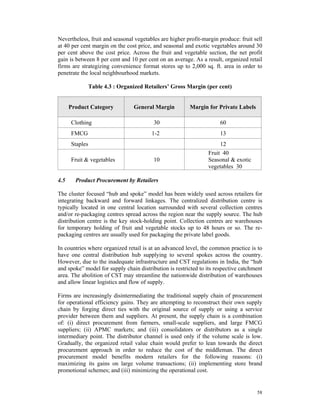
and sale of fruit, vegetables, and staples within the respective market areas (mandis)
of each APMC. A detailed general list of required clearances is given in Annex 3.

In addition, in case a new building or mall is to be constructed for use in retailing, the
organized retailer has to obtain “no objection certificates” (NOCs) from the different
state authorities in charge of traffic, electricity, water, fire and pollution control.
Zoning restrictions are also applicable to the organized retail outlets which can be set
up only on land earmarked for the local authority for commercial establishments.


                                                                                        12
3. Evolution of International Retail: Implications for India7

3.1     Introduction

The focus of this chapter is the retail dimension of the profound and rapid
transformation of the food industry in developing countries—a key element of
globalization—and its relevance to India.8 A “supermarket revolution” has indeed
occurred in developing countries since the early-to-mid-1990s. In many countries,
supermarkets have gone well beyond the initial middle-class clientele to penetrate the
food markets of the poor. This “shock” downstream in the food system has made an
impact on traditional retailers; has set off ripple effects upstream in the food system,
on the wholesale, processing, and farm sectors; and has incipient effects on trade.

This chapter reports on the experiences of developing countries mainly elsewhere in
Asia and in Latin America and Eastern Europe with respect to the supermarket
revolution and strategic policy approaches taken in developing countries. We also
touch on the most relevant experiences of developed countries. Section 3.2 discusses
trends in the spread of supermarkets, with a brief comparative look at the US
experience (interestingly, in many ways the most relevant of the developed-country
experiences for India) and then in developing countries. Section 3.3 analyzes the
determinants of the diffusion of supermarkets in developing countries. Section 3.4
examines emerging evidence of the impacts on consumers and traditional retailers
(downstream in the agrifood system) and on processors, wholesalers, and farmers
(upstream in the system). Section 3.5 discusses policy and programme measures taken
by government and non-government entities to promote “competitiveness with
inclusiveness” among the various actors in the food system confronting the
opportunities and challenges of the supermarket revolution. Section 3.6 concludes
with lessons for India.

Throughout the chapter, the authors use the term supermarkets as shorthand for the
various segments of modern retail, and we distinguish the segments (hypermarkets
and superstores, supermarkets and neighbourhood stores, convenience and forecourt
stores, and discount and club stores) only when necessary.

3.2     The Spread of Supermarkets

3.2.1 The US Supermarket Story: Indigenous Kirana Stores Grow into Huge Chains
of Supermarkets

Supermarkets started in the United States in the 1920s and 1930s and became
dominant in the late 1950s. The traditional food retail system that dominated the
country before supermarkets looked in essence the same as India’s traditional retail
system. It consisted of (a) wetmarkets (similar to those in Asia, with many small
stalls) for fresh produce, fish, and meats; (b) tiny “mom and pop” stores (man at the
till taking orders, wife pulling down products from little shelves and measuring out

7
  This chapter is authoured by Dr. Thomas Reardon and Dr. Ashok Gulati, the co-directors of
  IFPRI/MSU joint programme on “Markets in Asia” who were invited by ICRIER to be partners in
  this study.
8
  While presenting substantial new material, this paper also draws selectively on Reardon and Berdegué
  (2007), Reardon et al. (2003), and Reardon and Timmer (2007).


                                                                                                   13
and packing orders) with no self-service by customers; (c) street hawkers with push-
carts or shoulder or head burdens; and (d) home delivery of milk and mobile (cart)
delivery of dry goods—for example, by the famous Jewel Tea Company horse carts.9
Today, however, supermarkets have about 80 per cent of food retail in the United
States.

The advent of modern retail (i.e., chain stores) started in the late 1870s, long before
the supermarket format emerged as large self-service stores in the 1930s. Several
important trends in the development of modern retail over the past 130 years might
interest Indian readers.

Three key demand-side socio-economic changes occurred over a century. First, the
United States was mainly rural in 1900 (the urban share was 40 per cent) and mainly
urban by 1990 (urban share, 75 per cent). Second, few American women worked
outside the home in 1900, and even by 1970 only 15 per cent of married women were
counted among the national workforce. A massive societal change occurred in just a
few decades, and by 2000 the share of working women was 75 per cent. Third,
incomes per capita increased substantially over the century. All three changes are
taking place in India today, except they are happening much faster than they did in the
United States.

Modern retail started with chains of stores that were about the size of kirana stores.
Called “five and dime” or “five and ten cent” stores, they bought nonfood goods in
volume and sold at discount. They further cut costs by moving to self-service. These
chain stores were an innovation of the tiny shop owners. As a major format, they
lasted into the 1950s. The most famous example was Woolworths, started in the
1870s in big cities in the boom zones. From one tiny store in 1878, a chain was born
that built to the first global retail multinational of medium-sized nonfood shops, with
2,866 stores in five countries (including the United Kingdom) 50 years later.

The nonfood five-and-dime stores acted as an “idea spark” model for chain-store
formation by food stores that were formerly just small stand-alone grocery shops. The
owner of a little tea shop (selling the ingredients for the main beverage of the day) got
an idea in 1878 to build a chain of stores in big cities in boom zones and buy tea
directly from Chinese plantations to cut the cost and beat the competition. That chain
was A&P. From selling just tea in the 1870s, it grew to a grocery store format (dry
foods) that opened as the first A&P Economy Store, the same size as a
“neighbourhood store” format in India today, and focused on oils, packaged foods,
soap, and so on. A&P proccured in large volumes, drove down costs, and
standardized store layouts. By 1915 the chain comprised 1,600 stores, and by 1925 it
had 13,961 stores; in the early 1930s, A&P was operating approximately 16,000
stores with a combined revenue of US$1 billion (equivalent to US$10 billion in 2000
dollars).

In 1936, A&P opened its first “supermarket” (just a few times larger than a
neighbourhood store). By 1950, A&P ranked second in sales in the world (after
General Motors). In the mid-1950s, A&P was by far the number one food retailer and

9
    We are grateful to Tom Reardon, father of Thomas Reardon, for augmenting this section with his
    memories of New York in the 1930s.


                                                                                               14
had moved from small-to-medium-sized supermarkets. However, by 2000, A&P had
become a minor chain because its retailing and procurement strategic positioning had
not kept up with chains that arose in the 1970s and 1980s, like Wal-Mart.

Sam Walton is an important example of a kirana man who used entrepreneurial spirit
in a situation of opportunity. He started in 1950 with a tiny five-and-dime store in a
rural Arkansas village with a population of 3,000. It was one of the most
underdeveloped regions of the United States, bypassed by the boom development of
the past 100 years. Walton started by building a chain of kirana stores in the
surrounding towns and then states, and by 1962 he had decided to open a small
supermarket called Wal-Mart. He hit on an idea to buy directly from suppliers and cut
costs by building a distribution centre network. While other chains had started in big
cities in boom zones, Walton focused his effort on villages and small towns,
considered an impossible strategy at the time. Walton opened large-format discount
stores (big supermarkets with cheap nonfood items and dry foods) in the 1970s. In the
late 1990s, he added small-format neighbourhood stores. Wal-Mart grew from two
kirana employees in 1950 to 1,500 in 1970, 21,000 in 1980, 200,000 in 1987, and
1,140,000 in 1999. By 2002, Wal-Mart had become the largest private employer in
the world, with 2 million employees. The company’s annual revenue totalled US$350
billion in 2006.

Several trends characterized the development of chain stores over the past century in
the United States, with similar trends seen in the United Kingdom and France. The
salient features were the following:
    1. The trend was from nonfood chains to dry-food chains to full-line chains
        offering fresh foods. Supermarkets did not sell much fresh produce until the
        1960s because it was considered impossible to move beyond the American
        tradition of buying in wetmarkets and tiny fruit shops.
    2. The trend was from clerk service to self-service.
    3. The format trend was from the traditional system described earlier to chain
        nonfood shops, to chain grocery shops, to small supermarkets and food
        sections in department stores, to medium and large supermarkets in towns, to
        hypermarkets in the suburbs, to convenience stores and neighbourhood stores
        in dense inner-city areas and small towns.
    4. The trend was from large cities and economic boom areas to second- and
        third-tier cities and second-tier areas and to suburban areas when those
        developed in the 1950s. Wal-Mart’s development in the opposite direction was
        a clear exception.
    5. Individual chains and the overall supermarket sector underwent massive
        growth over seven decades, and that growth cycle eclipsed an earlier cycle of
        growth in self-service chain grocery stores.
    6. Chain stores mimicking and then improving on the credit system that the small
        traditional shops had used for customers by developing credit cards, loyalty
        cards, and banking services. They also took on other services, such as health
        clinics and banks for poor consumers.
    7. Chain stores modernized their procurement systems. Woolworths and A&P
        had historically focused on cutting costs through bulk buying, self-service, and
        efficiencies in inventory handling. As competition increased, the importance
        of modern logistics and cost cutting intensified, and from the 1990s onwards,
        those strategies took centre stage.


                                                                                     15
The remaining traditional retail sector (now about 20 per cent of food retail) was in
reality mainly a modernized small-shop sector. In remote areas, some small traditional
groceries survive, but the mainstream is speciality shops (defendable niches) that are
far more modern and upgraded than the general-line mom and pop store of years gone
by. Also, many small stores themselves started chains (as previously noted) or became
franchisees of larger chains.

Apart from a few cases, such as A&P into the 1960s and then Krogers and Wal-Mart
today, most supermarket chains were regional rather than national. The trend,
however, is toward establishing national-level chains and catching up with Europe on
consolidation. It is important to keep in mind that the United States has a history of
the strongest and longest anti-supermarket regulatory history of any country in the
world. Wrigley and Lowe (2002) concluded that the body of stiff regulations and
competition laws enacted in the United States resulted in a significantly slower spread
of supermarkets and national-level concentration from the 1930s to the 1980s than the
United Kingdom experienced. This reversed first in the 1950s and then again in the
1980s. However, the result over the decades is similar to what happened in the United
Kingdom (which had far laxer regulation of supermarkets). This suggests that
underlying economic and social forces moved the modern retail sector toward
dominance and concentration over time, whereas regulations mainly affected the
transitional path.

As will become apparent later in the chapter, in many of their broad lines, the trends
in the spread of supermarkets in developing countries and the evolution of their
procurement systems bear many similarities to the recent experience of the United
States; Western Europe and Japan had broadly similar experiences in the rise of
supermarkets. This suggests that the economic logic of the retail transformation is
shared across regions, starting from a surprisingly similar shared tradition of
traditional retail systems. The main difference between the retail transformations in
developing countries and in the United States and Western European is the extreme
speed with which it is occurring in developing countries.

3.2.2 Supermarkets in Developing Countries

Supermarkets have been around for half a century in several developing countries, but
the phenomenon was limited mainly to large cities, upper-middle-class or rich
consumer segments, and domestic capital chains. In contrast, a supermarket
revolution in developing countries took off in the early-to-mid-1990s. The patterns
and determinants of that revolution are detailed in the following subsection.

Diffusion of Modern Retail over Regions and Countries

The spread of supermarkets has taken place in three established waves and continues
in a fourth emerging wave.

The first-wave countries experienced supermarket sector take-off in the early-to-mid-
1990s. Included in that group are much of South America and East Asia (outside
China and Japan), north-central Europe and the Baltic countries, and South Africa. In
those countries, the average share of supermarkets in food retail went up from roughly


                                                                                    16
10–20 per cent in 1990 to 50–60 per cent on average by the early 2000s (Reardon and
Berdegué 2007). Comparing that to the roughly 75–80 per cent share that
supermarkets had in food retail by 2005 in the United States and Western Europe, it
appears a process of convergence was taking place. The first-wave countries saw
supermarket diffusion in a single decade that took some five decades in the United
States and the United Kingdom.

The second-wave countries are Mexico and much of Southeast Asia, Central America,
and South-Central Europe. In those areas, the share went from about 5–10 per cent in
1990 to 30–50 per cent by the early 2000s, with the take-off occurring in the mid-to-
late 1990s.

In the third-wave countries, the supermarket revolution started in the late 1990s or
early 2000s, reaching about 5–20 per cent of national food retail today. These areas
include parts of Eastern and Southern Africa, some countries in Central and South
America, “transition” East Asia (China and Vietnam), Russia, and India. It is
somewhat anomalous that they are late comers in the third wave, because their
demand-side characteristics (income, absolute size of the middle-class population,
urbanization rate, and share of women in the workforce) make them similar to many
countries in the second wave, which had supermarket take-off some five to seven
years earlier. The main reasons for the lag were policies imposing severe constraints
on retail FDI that were progressively relaxed in China and Russia in the 1990s. It is
worth noting that the growth rates of supermarket food sales and retail FDI are
inversely correlated with the waves. Thus, the fastest growth occurred in the
supermarket sector in China (about 40 per cent a year), whereas the more mature,
relatively saturated supermarket sectors in Brazil and Taiwan saw growth of only 5–
10 per cent.

Example: China. China ranked fourth, fifth, and third in the AT Kearney Global
Retail Development Index in 2005, 2006, and 2007, respectively, and is a fascinating
case of extremely rapid supermarket diffusion. Modern retail in China comprises
roughly 10 per cent of the national retail and 30 per cent of urban food markets (Hu et
al. 2004). China had no supermarkets in 1989, and food retail was nearly completely
controlled by the government. From its beginning in 1990, the supermarket sector
climbed meteorically to about 15 per cent of food retail nationally (some 35 per cent
in the big cities) by 2003, and today its annual sales are roughly US$100 billion.
Many of the driving forces for supermarketization were in place (e.g., rising incomes,
urbanization), and all it needed to become a reality was the progressive privatization
of the retail market and, even more importantly, the progressive liberalization of retail
FDI that started in 1992 and culminated in 2004, as a provision of World Trade
Organization (WTO) accession. FDI drove intense competition in investment among
foreign chains and between foreign chains and domestic chains that even accelerated
before WTO accession and thereafter with full liberalization of FDI.

Diffusion Trends within a Country over Space, Socio-economic Strata, and Product
Markets

Waves of supermarket diffusion also occur within a country over space, over
consumer segments, and over product categories.


                                                                                      17
Diffusion over space within a country: Supermarkets tend to start in large cities, then
spread to intermediate cities and towns, and then enter small towns. The business
strategy is the same as for chains, spreading in waves over countries: the richest and
largest market is entered first because it offers the highest profit per capital invested;
competition and saturation of the initial base drives investment by a given chain into
the series of subsequent markets. While the gross return declines, cost savings result
from economies of scale and the procurement system change discussed later in the
chapter. Often the multinational chain acquires or enters into joint ventures with the
large domestic chain and both acquire smaller local chains operating in various
regions of a country. Competition from larger chains in turn pushes intermediate-city-
based chains to extend into the hinterland towns, seeking refuge from the increasing
competition in its base market; this process accelerates the diffusion of supermarkets
over space.

Diffusion over consumer segments and socio-economic strata: As with the pattern
of spatial diffusion, similar waves of diffusion occur over socio-economic groups and
consumer segments. Following the same business logic as in spatial diffusion,
supermarkets focus first on upper-income consumer segments (national and
expatriate), move into the middle class, and finally enter the markets of the urban
poor.

Format diversification with diffusion over space and strata: As modern retail
spreads, format diversification tends to occur to facilitate spatial and consumer
segment differentiation. For example, to penetrate the markets of inner cities and
small towns where space is limited and product assortment can be narrow, chains use
discount stores, convenience and neighbourhood stores, and small supermarkets.

Diffusion over product categories: The penetration by supermarkets of food retailing
has occurred in the following waves of food categories:

     The first wave of product penetration is in processed foods (canned, dry, and
     packaged items, such as rice, noodles, and edible oils). This is a result of the
     economies of scale in procurement as well as direct relations with processed-
     food manufacturers.

     The second wave is in semi-processed foods (with extensive or minimal
     processing, such as dairy products) and minimal processing and packing
     (chicken, pork, beef, and fruit).

     The third wave, by far the slowest and the longest in starting in developing
     countries, is in the vegetable market (particularly for leafy vegetables and
     bulk vegetables).

Example: China compared with Hong Kong. In a study of a random sample of
1,200 consumers in the six largest cities in China, Goldman and Vanhonacker (2006)
found that modern retailers already have a retail market share of 94 per cent in
nonfood goods, 79 per cent in packaged and processed goods, 55 per cent in baked
goods, 46 per cent in meat, 37 per cent in fruit, 35 per cent in poultry, 33 per cent in
fish, and 22 per cent in vegetables. Compare that to the more advanced case of Hong
Kong, which likely represents the average Asian consumer sometime in the medium-


                                                                                        18
term future. Hong Kong supermarkets have a 59 per cent share in fruit retail and a 55
per cent share in vegetables (thus, a share similar to supermarket penetration of
produce retail in Brazil), 52 per cent in meat, 39 per cent in poultry, and 33 per cent in
fish (Coca-Cola Retailing Research Council Asia 2005). Evidence emerging from a
large AC Nielsen consumer survey in Asia suggests that younger consumers are
“forsaking wetmarkets” and that in less than a generation the average produce buyer
may well be substantially more supermarket oriented, which will accelerate the effects
of the retail transformation on the horticulture sector (Planet Retail Daily News 2005).

Example: Indonesia. AC Nielsen (2007) undertook a survey of 1,300 consumers in
the capital of Jakarta (capital) and in the second-tier cities of Bandung and Cirebon,
focusing on consumers’ buying habits in supermarkets versus traditional markets. The
survey revealed that penetration of grocery retailing has occurred much more rapidly
in processed, dry, and packaged foods and in household and personal care products,
for which supermarkets gain a cost advantage as a result of economies of scale from
centralized procurement and distribution. Savings are passed on to consumers,
drawing them to the channel. The supermarkets’ progress in gaining control of fresh-
food markets has been slower because of procurement challenges, price, cultural
habits, and perspectives regarding freshness; moreover, shoppers still purchase fresh
produce mainly at wetmarkets and small vegetable stalls, where they get low prices,
credit, and personal service.

3.3    Determinants of the Diffusion of Supermarkets in Developing Countries

Before the take-off of 1990, models of the diffusion of supermarkets in developing
countries focused on the demand-side factors determining the emergence of
supermarkets. For example, Goldman's groundbreaking work in the 1970s and 1980s
emphasized factors, such as incomes, urbanization, the opportunity cost of women's
time, and other enabling conditions (Goldman 1974). Models developed after the
take-off, such as by Reardon et al. (2003), reiterate the demand-side factors as
necessary but not sufficient and emphasize policy factors and retail supply-side
factors—in particular, procurement system modernization (driving down prices) and
massive retail FDI, as well as massive competitive (and anticipatory) domestic retail
investment that emerged mainly in the 1990s.

3.3.1 Income Growth and Urbanization and Its Sequel

Two sets of demand-side factors influence the demand for supermarket services in
developing countries. They are similar to the factors driving the rise of supermarkets
in the United States and Western Europe.

First, urbanization since the 1960s, with the entry of women into the workforce,
increased the opportunity cost of women’s time and their incentive to seek shopping
convenience and processed foods to save home preparation time. This was reinforced
by the rapid growth in the 1990s in ownership of refrigerators, which meant an
increased ability to shift from daily shopping in traditional retail shops to weekly or
monthly shopping. Growing access to cars and public transport in the 1980s and
1990s further supported this trend.


                                                                                       19
Second, real per capita income growth in many countries during the 1980s and 1990s,
along with the rapid rise of the middle class, increased the demand for processed
foods. The latter is the entry point for supermarkets, which could offer these products
in greater variety and at lower cost than could traditional retailers because of
economies of scale in procurement and concomitant actions of large processors.

3.3.2 Foreign Policy of Retail FDI Liberalization

Starting in the early 1990s and continuing into the 2000s, a series of partial or full
liberalizations of retail FDI took place. Often FDI liberalization was included to some
degree in structural adjustment programmes and bilateral or multilateral trade
agreements and then extended and deepened. That was what transpired in Mexico,
Brazil, and Argentina, where FDI liberalization was part of NAFTA and
MERCOSUR in the mid-1990s. Sometimes, however, liberalization of retail FDI
occurred well after trade liberalization, as in Indonesia, the Philippines, and Thailand,
where it was resisted as local retailers “geared up” for the opening that then occurred
in 1998 for Indonesia and in 2000 for the Philippines and Thailand (Cabochan 2005;
Manalili 2005). In China, FDI liberalization started as partial liberalization in 1992
and culminated in full liberalization in 2004 as part of accession to the WTO.

Several types of retail FDI patterns have emerged. The dominant pattern is FDI from
Western European and US global multinationals. A secondary but important pattern is
FDI from regional multinationals (such as Dairy Farm, based in Hong Kong, entering
other Asian markets). Moreover, retailers enter solely as a green-field investment or
by acquiring a local chain, or enter as joint ventures.

The reasons for retailers to undertake FDI include: (i) the saturated and contested
home markets that multinationals face, and (ii) the higher profit rates that the new
markets offer. Following are two examples of countries where FDI had a large impact
on the retail sector.10

Example: Brazil. Of the top-seven chains with sales of US$24 billion in 2006—
including Casino (the leader), Carrefour, Wal-Mart, and Makro—all are foreign
owned. The take-off of the retail sector occurred in the late 1980s and early 1990s,
with an intense period in the mid-to-late 1990s of mergers and acquisitions. A typical
trajectory was that of CBD. Formerly a domestic chain, CBD became the lead chain
in the 1990s and then entered a joint venture with Casino (France), which recently
acquired it fully.

Example: Mexico. The Mexican case of supermarket development is similar to that
of Brazil, but with a lag resulting from a later take-off. In the early 1990s, nearly all
the supermarket sales were by domestic chains. By 2002, 48 per cent of the US$24
billion dollars in sales by the top-seven chains in 2002 were by foreign chains
(primarily Wal-Mart). By 2006, the sales of those chains had substantially increased
to US$38 billion, and now 53 per cent are by foreigners (again, primarily Wal-Mart).

In many cases, however, domestic investment is the main driver, which is particularly
relevant to India. Several examples follow. It is instructive that, except in Brazil

10
     Data for the chains’ sales come from http://www.planetretail.net/.


                                                                                      20
(where rapid multinationalization occurred), the supermarket revolution in the famous
“fastest growers” quartet of Brazil, Russia, India, and China was led by domestic
capital generated by the growth industries that have placed these countries in the
fastest-grower category.

Example: China. In the 1990s, the bulk of investment in the leading chains was made
by the Chinese government itself. The government used stock market financing at the
end of the 1990s for its primary chains—Lianhua, Hualian, and Nonggongshan—with
combined sales today of US$10 billion. Although the lead chain in the country is
Chinese and some 80 per cent of total supermarket sales in China are by domestic
chains, foreign chains made headway in the late 1990s. Sales of the top-10 chains in
2002 totalled US$11.5 billion, of which 18 per cent was by two European chains and
28 per cent by three chains from Hong Kong and Taiwan. By 2006, the sales of the
top 10 (with some one-quarter to one-third of total supermarket sales) had reached
US$32 billion, of which similar shares were made by the foreign chains. Part of the
domestic chain response to foreign competition has been first-tier domestic chain
mergers and acquisitions of local chains.

Example: Russia. The Russian supermarket revolution has occurred only in the
2000s. It is still a fragmented sector in a country with a population of 140 million. The
growth rates are stunning. In 2002, sales by the top-15 chains totalled US$2.7 billion;
by 2006, sales by those chains had soared to US$19.2 billion. The share of the top-3
chains was 40 per cent in 2002 and 54 per cent in 2006, with the lead domestic chains
acquiring many small regional and local chains. The foreign share of sales was 33 per
cent in 2002 and 35 per cent in 2006—only inching up and spreading over 8 foreign
chains among the top 15. The two largest companies are Russian, but the origin of the
capital, even of the Russian companies, is usually a mix of domestic and foreign. The
Russian banking sector is awash in cash from oil, construction, and financial services.

Example: Chile. The Chilean supermarket sector is a fascinating case of a take-off
driven by domestic capital, followed by nascent multinationalization, followed by
abrupt “demultinationalization.” The supermarket sector in Chile was launched in the
1990s with the backing of domestic capital. Late in the 1990s, the number two and
number three global chains entered: Carrefour and Ahold. By 2002, those two
companies had 13 per cent of the US$4.6 billion in total sales of the top-eight chains.
However, by 2006 their share had plummeted to zero per cent of the US$12.6 billion
in total sales of the top eight (growing at a pace similar to China’s); the Chilean
subsidiaries of two foreign chains had been bought by the top-two Chilean chains in
2003. Today those top-two chains have 65 per cent of the market. The three market
leaders, all domestic, are expanding rapidly into other Latin American countries in
mergers and acquisitions, becoming regional multinationals. The domestic capital was
based in a combination of domestic bank credit and real estate, commercial, and
financial services. These were the tertiary sector ripple effects of the fundamental
boom in copper and wood products, and the fruit and fish boom.

Example: Indonesia. The take-off of modern retail in Indonesia in the 1990s
primarily involved domestic chains. The current leading chain, Matahari, is indicative.
Matahari started as a small shop in 1958, grew into a chain of department stores, and
then was purchased by a giant banking and real estate conglomerate, Lippo Group, in
1997, just before the crisis. The crisis created a sharp dip in modern retail sales, which


                                                                                       21
began recovering in the 2000s. Matahari doubled its sales between 2002 and 2006,
becoming a billion-dollar chain by 2006. The share of foreign chains (one European
and one Hong Kong) in the top-seven chains is now 40 per cent. However, because
the sector is still fragmented, foreign chains do not have more than a 20 per cent
share, similar to the situation in China.

FDI combined with financing from either the competitive or leading local investors
led to the rapid consolidation and multinationalization of the supermarket sectors in
developing countries over the past decade, with the trend again correlated with the
waves. The rapid consolidation of the sector in those regions mirrors what is
occurring in the United States and Europe. For example, in Latin America the top-five
chains per country have 65 per cent of the supermarket sector compared with 50 per
cent in the United States (although Kinsey [2004] reports that is rapidly increasing)
and 72 per cent in France.

3.3.3 Domestic Policies Concerning Retail

Domestic regulations of the commerce sector can either promote supermarket
diffusion or hinder it. The overall body of regulations can push and pull both ways,
with promotion or hindrance winning out in different phases of supermarket diffusion.
The authors’ perception is that the regulatory balance appears to favour supermarket
diffusion in most developing countries today.

Modern Retail Diffusion Encouraged by Domestic Policies

Several sets of policies are promoting supermarkets and hindering traditional retail in
developing countries today.

Developing countries have a tradition of establishing policies promoting the
development of supermarkets. In the 1960s and 1970s in Latin America, Malaysia,
and Hong Kong, among other countries, governments were keen to promote the tiny
supermarket sectors in the name of food sector modernization. Promotion
programmes were based on the previously described perception of the traditional
retail sector as weak and inefficient, a drag on increasing overall competitiveness and
efficiency. Most of these promotion programmes were artificial and not yet consonant
with overall economic transformation nor fed by private sector investment; thus, few
succeeded.

In the 1990s and 2000s, many governments directly supported supermarket
development as part of modernization policies, although at the same time those
governments had policies limiting or regulating supermarkets and supporting
traditional retailers (Goldman et al. 1999). An example is tax exoneration to
supermarkets setting up in municipalities in Russia (Dries and Reardon 2005) or
South Korea (Lee and Reardon 2005). Some governments have even directly invested
in modern retail explicitly to modernize the food distribution sector as well as
generate revenue for government. For example, in China the semi-public chains
operate as profit-oriented enterprises and compete with private firms. State-sponsored
companies get easy access to credit, cheap real estate, and other benefits (Hu et al.
2004).


                                                                                    22
Many governments have imposed regulations on wetmarkets that directly or indirectly
constrain their development. The usual reasons for regulating wetmarkets are that they
are part of the informal sector and do not pay taxes, can cause street congestion, can
be unhygienic, and sometimes are considered drags on modernization of the
commerce sector. Many governments impose strict zoning limits and hygiene
regulations on wetmarkets. China has gone a step further with a programme of
converting wetmarkets to supermarkets (as discussed in Section 3.5).

The general commercial regulations of some developing countries in effect encourage
supermarkets and discourage traditional retail, despite the regulations being formally
neutral with respect to retail scale. These commercial regulations generically regulate
retailers and are applied to any formal sector business category; examples are laws
related to commercial zoning, labour, and taxes). Likewise, competition (antitrust)
laws are applied to retailers just as they would be applied to any business sector.
These commercial regulations are typically geared to developing the formal business
sector. However, by failing to target small retailers, it is likely that these commercial
regulations discourage the informal sector in general through tax payment
requirements and commercial zoning laws, and by making commercial development
incentives (such as subsidies, technical assistance, and so on) accessible mainly to
firms in the formal sector. Examples of this “intermediate” approach are found in
Mexico and Brazil, two countries in which supermarkets took off in the 1990s and
now dominate food retail. Both countries provide little or no protection or support to
traditional retailers, and modern retailers are only limited by local regulations; thus,
these countries have effectively created “liberalized” contexts for modern retail
diffusion.

Example: Brazil. Brazil does not have national policies regulating the spread of
supermarkets, or protecting or supporting traditional retailers. Retail regulation is
decentralized to the municipal level, at which foreign and national chains “bargain”
with local governments about the terms and conditions of entry. Sometimes the terms
and conditions are difficult, sometimes quite easy. Of course, more than 5,000
municipalities in Brazil have established widely varying regulations, making it
difficult to generalize about what those regulations are and what effects they have on
competition among hypermarkets, local small supermarkets, and traditional retailers.
Moreover, the Brazilian government applies a special tax regulation to small
enterprises that essentially reduces their tax burden while reducing the administrative
cost to the government of collecting taxes. Additionally, the government provides
some subsidies to small enterprises via SEBRAE (the Brazilian Department of
Support for Small Enterprises). Supermarket chains in Brazil feel that this makes the
tax and subsidy systems biased in favour of small retailers and somewhat levels the
playing field. Finally, the Federal Competition Commission regulates competition
among formal sector firms but not between formal and small, informal firms. In that
sense, no “protection” regulations apply specifically to traditional retailers attempting
to compete with supermarkets (large chains or small independents and small chains)
who are free (depending only on municipal rules) to choose the locations and
operation hours they desire (E. Farina and R. Nunes, pers. comm., January 2008).

Example: Mexico. Like Brazil, Mexico has no national regulations controlling the
locations and hours of modern retailers or protecting small retailers. Instead, the states
regulate these areas. Moreover, the Federal Competition Commission regulates


                                                                                       23
competition among formal sector retailers but not between formal (modern) and
informal (traditional) retailers. When conflicts arise (e.g., when local retailers accuse
incoming modern retailers of local zoning infractions), they are handled at the
municipal or state level. Finally, local regulatory agencies impose significant pressure
on informal retail; for example, over the past five years, street vendors and hawkers
have been barred from the central districts of Mexico City and Morelia. Traditional
retailers have not formed any significant organization to influence regulations, except
for sporadic efforts based on particular events, such as a large retailer entering a
particular zone in a city (A. Martinez, pers. comm., January 2008).

Promotion Partially Counterbalanced by Regulations on Modern Retail

Developing countries also have a tradition of imposing policies controlling the
development of supermarkets. However, the regulation and constraint on modern
retail in developing countries today appears to be far less than was historically the
case in, for example, the United States.

Governments in developing countries may limit to some degree the power of modern
retailers by restricting the locations (through zoning regulations) and hours (and thus
convenience for consumers) of supermarkets. These limitations may be imposed to
protect traditional retailers or to level the playing field between domestic and foreign
modern retailers. Historically, such regulations were common in Western Europe and
the United States. The regulations are also a response to traditional retailers’ concern
that modern retailers have advantages in competition that need to be counterbalanced
by regulation. Hypermarkets are often associated in the popular view with foreign
chains, low prices, and competition with small stores. Thailand and Malaysia have
regulations targeting hypermarkets.

The intensity of the policies in these “strong regulator” countries has varied
considerably over the past five years (the emergent-regulation period). For example,
in Thailand, such regulation first arose in 2003, relaxed in 2004–2005, and re-
emerged in 2006. Malaysia also experienced fluctuation in its regulation of
supermarkets, first seeing a rise and then a relaxation (CIES Food Business Forum
2006a, 2006b, 2006c). This mirrors a similar regulatory fluctuation in the United
States, although there it was a slow up and down motion lasting 80 years, while in
Southeast Asia it has been a wildly dipping and rising roller coaster over less than a
decade.

The evidence is mixed as to the impacts of regulations on modern retail diffusion. The
key reason is that modern retail chains are very flexible and malleable in terms of
company structure and store format. For example, if a regulation is imposed on
hypermarkets, a chain can easily continue expansion with small-format stores, as
Carrefour and Tesco are doing in Thailand today. In the popular imagination,
“modern retail” means “big box,” but in fact a modern retail chain can be a chain of
kiosks, convenience stores, neighbourhood markets, supermarkets, hypermarkets, and
even a mail order outlets. Moreover, regulations are often debated for months or even
years before becoming effective, and chains usually accelerate their expansion before
the regulations are implemented. That rush of new stores often changes the “policy
mood” in municipalities and provinces that receive new stores and watch suppliers
sign up and consumers queue up.


                                                                                      24
3.3.4 Modernization of the Procurement Systems of Retailers

As retail competition soared in developing countries over the past decade, success has
demanded reducing costs to penetrate the mass market and raising quality to hold onto
and deepen the market among middle-class clientele. A crucial instrument of reducing
costs and raising quality is modernization of procurement systems to achieve
efficiency gains, economies of scale, and coordination cost reductions.

A caveat to this discussion is that although procurement system modernization is
steadily marching forward, its progress has been sharply uneven. Modernization
started much earlier for processed and semi-processed foods than for fresh fruit and
vegetables, and for the latter it has occurred at very different rates for different
products. The process of modernization also varied across countries and regions,
closely mirroring the waves of diffusion of supermarkets. Moreover, the leading
chains (foreign and domestic) undertook modernization earlier and faster than did
second- and third-tier chains.

The following subsections describe the four key trends in retail procurement system
change.

Extension and Integration of the Procurement Catchment Area into National,
Regional, and Global Networks

As the number of stores in a given supermarket chain grows, the chain typically shifts
from a fragmented, per-store procurement system to a distribution centre serving
several stores in a given zone or district and eventually across the whole country. The
catchment area of one or a group of distribution centres usually starts as the zone of a
country (such as Northeast China) and then broadens to several distribution centres
representing a centralized system for procurement over all zones in a country (such as
Soriana’s five distribution centres in Mexico). This defragments, or integrates and
centralizes, the procurement system over the country. Defragmentation is
accompanied by decreased use of procurement officers and increased use of
centralized warehouses. Additionally, increased levels of centralization may also
occur in the procurement decision-making process and in the physical produce
distribution processes.

Centralization increases the efficiency of procurement by reducing coordination and
other transaction costs, although it could increase transportation costs by requiring
extra movement of the actual products. China Resources Enterprise (2002), for
example, notes that it is saving 40 per cent in distribution costs by combining modern
logistics with centralized distribution in its two large new distribution centres in
Southern China. Similar figures appear in the few available studies from other
countries (e.g., Costa Rica and Brazil).

The next, and economically logical, step is regionalization (internationally). Setting
up a regional system of distribution centres allows coordinated procurement over a set
of countries. In a sense, this means intra-firm trade coordinated over several countries.
A logical extension is insertion into global procurement networks. This trend would
mirror the trend seen over the past several decades in world trade toward increasing


                                                                                      25
intra-firm trade over countries (see Reardon et al. 2007 for an exploration of the trade
effects among developing countries that the new retailer networks encourage).

Shift from Exclusive Reliance on Traditional Wholesale Sector to Use of Non-
traditional, Specialized, and Dedicated Wholesalers and Logistics Firms

Non-traditional players specialize in a product category and are dedicated to the
supermarket sector as a primary client. These specialized and dedicated wholesalers
cut transaction, coordination, and search costs and enforce private standards and
contracts with suppliers on behalf of the supermarkets. An example from Central
America is Hortifruti (in the same holding company as the Costa Rica–based chain
CSU, which became part of Wal-Mart in 2006). Hortifruti undertakes contract
farming and spot-market purchases to source produce for the CSU stores in Costa
Rica, Nicaragua, and Honduras, following the private standards of that chain
(Berdegué et al. 2005).

Moreover, specialized and dedicated wholesalers are expanding their operations
beyond their points of origin to follow the expansion of supermarket chains they
supply; this foments market integration. Examples include (a) Hortifruti, which
multinationalized along with CSU as the latter moved from its Costa Rica base into
Nicaragua and Honduras; and (b) Putri Segar, a specialized and dedicated wholesaler
working closely with Carrefour that has been expanding from its base in west Java
into other parts of Indonesia following Carrefour (Natawidjaja et al. 2007).

Finally, retail chains increasingly outsource logistics and wholesale distribution
functions, entering into joint ventures with other firms or outsourcing to a company in
the same holding company as the supermarket chain. An example is Wu-Mei of
China, which announced in March 2002 that it will build a large distribution centre to
be operated jointly with Tibbett and Britten Logistics, a British global multinational
firm (CIES Food Business Forum 2002). Ahold’s distribution centre for fruit and
vegetables in Thailand is operated in partnership with TNT Logistics of the
Netherlands (Boselie 2002). These are important cases of “follow sourcing,” where a
foreign logistics company or other supplier follows their retailer client into a
developing country market (see Reardon et al. 2007).

Incipient Shift from Spot Market to Implicit Contracts or Preferred Supplier Lists

There is mounting evidence of chains and their specialized wholesalers (acting as
“channel captains”) entering into preferred-supplier relationships, informal contracts
usually in the form of memos of understanding (verbal or written) with processors and
farmers. Chains and their specialized wholesalers tend to move from spot markets to
preferred-supplier lists when the need for quality and consistency is high and when
farmers or processors are associated or are individually large (thus lowering
transaction costs). Examples of the use of preferred-supplier lists are the Ahold chain
in Thailand (Boselie 2002), Big R in the Philippines and Tesco in Chiang Mai
(Manalili 2005), processed mangoes for chains in the Philippines (Digal and
Concepcion 2004), fresh cuts (cut-up vegetables and fruit sold in packs) from
Xincheng for the Lianhua chain in Shanghai (Hu et al. 2004), and Metro for dairy
products in Russia (Dries and Reardon 2005).


                                                                                     26
These contracts with retailers sometimes include direct or indirect assistance for
farmers to make investments in human capital, management, input quality, and basic
equipment. Evidence is emerging that for many small farms, these assistance
programmes are the only source of such inputs and assistance, especially when public
systems have been dismantled or coverage is inadequate.

Rise of Private Standards and Private Enforcement of Public Standards

These standards pertain to the quality and safety of food products (Reardon et al.
2001). In general, the standards function to coordinate supply chains by standardizing
product requirements across suppliers that may cover many regions or countries.
Standards specify and harmonize the product and delivery attributes, thereby
enhancing efficiency and lowering transaction costs. The private standards of a
particular chain may also be designed to ensure (at a minimum) that the public
standards are met in all the markets in which the retail chain operates.

3.4    Impacts of the Rise of Supermarkets on the Other Segments of the Agrifood
System

3.4.1 Impacts Downstream:         Competition    with    Traditional   Retailers   and
Competition for Consumers

Goldman et al. (1999) summarize five decades of literature on the traditional food
retailing system:

Stores typically are small, are family operated, and employ marginal labour. Retailers
are passive and weak. They use simple methods and technologies, and they lack
financial, management, and marketing skills. Stores are cluttered, dirty, and
disorganized…. Many modernization researchers concluded that traditional retailing
suffers from major economic disadvantages (e.g., high costs, shrinkage, inefficiencies,
lack of scale economies), provide low output levels to consumers (e.g., low product
quality, limited variety, frequent stock-outs, high prices, unpleasant shopping
environment), and lack the abilities (e.g., financial, managerial, entrepreneurial)
needed to change and develop.

However, as the research the authors summarize attests, the rates of decline are
widely varied, and the persistence of traditional retail, mainly differentiated by
product category, is evident. (Contrary to popular belief, including in the research
community, the patterns in this variation are similar across regions of the world and
are not specific to Asia.) The fastest decline in the traditional sector is seen among
small general stores selling broad lines, processed foods, and dairy products, while
fresh produce shops and wetmarkets hold out longer (for instance, in the United States
they continued to be dominant for the first 40 years, or half the history, of
supermarkets). Sometimes these holdouts linger for long periods, depending on how
they are able to adapt and modernize. Their modernization efforts are often supported
by public and private sector programmes, as described in Section 3.5.

Example: Indonesia. A survey of the effects of supermarkets on wetmarkets was
undertaken recently in Java (Suryadarma et al. 2007). Five traditional markets were
chosen as the treatment group (near supermarkets), and two traditional markets were


                                                                                    27
chosen as the control group (far from supermarkets). On average, traders in both
treatment and control markets have experienced a decline in their business over the
past three years. Respondents revealed that the main causes for the decline were the
weakened purchasing power of their customers resulting from fuel price increases and
the increased competition with street vendors who occupy the parking spaces and
other areas surrounding the markets, even blocking the market entrance. The survey
revealed that the third cause of the decline in business for traditional market traders
was supermarkets. This was especially true for traders in the treatment group (near
supermarkets).

The researchers found mixed statistical results for various performance indicators of
traditional markets, such as profits, earnings, and employee numbers. Out of these
performance indicators, supermarkets only statistically impacted traditional markets
by the number of employees hired by the traditional traders. The data indicated that
traditional traders were willing to hire more employees the further they were located
from the supermarkets, and vice versa. Traditional traders were competing in “an
almost perfect competition,” and their strategies to increase profits included adding to
the amount and variety of products sold and reducing expenses, such as the cost of
hiring employees.

The results of the survey were confirmed by the qualitative analysis findings that
supermarkets were not the main cause of the decline among traditional markets.
Traders, market managers, and representatives of the association of traditional traders
(APPSI) all stated that the main steps to ensure their survival are the improvement of
traditional market infrastructures, organization of the street vendors, and the
implementation of better market management practices. The traders explicitly stated
their confidence that supermarkets would not drive them out of business if those
conditions were met.

Despite evidence that Indonesian traders have gone out of business during the past
three years, the reasons are more complex than the entry of supermarkets alone. Most
business closures are associated with the internal market and personal problems. In
addition, traders who mainly sell to non-households and have maintained a good
relationship with their customers over a long period are more likely to stay in
business. In their report, Suryadarma et al. (2007) cite several success stories of
wetmarkets competing with supermarkets; these wetmarkets are clean and safe and
have ample parking space and sufficient amenities. This proves that a competitive
traditional market is able to successfully compete with and exist near supermarkets.

Example: Chile and Argentina. In urban Chile between 1991 and 1995, 15,777
small shops went out of business, mainly in Santiago, a city of 4 million. This
represented a decline of 21–22 per cent in small general food, meat, and fish shops;
25 per cent in deli and meat shops and dairy product shops; and 17 per cent in fruit
and vegetable shops (Faiguenbaum et al. 2002). Gutman (1997) notes that in urban
Argentina from 1984 to 1993, during the most intense period of take-off of
supermarkets, the number of small food shops declined from 209,000 to 145,000,
meaning that roughly 64,000 shops went out of business. She estimated that during
the 1990s, 4 of 10 neighbourhood shops turned into self-service stores, another four
survived but with drastic drops in sales, and two closed. Rodríguez et al. (2002) note
that while general-line small shops folded quickly, those in specialized niches—in


                                                                                     28
particular, bakeries, fresh fish and meat, and fruit and vegetable shops—disappeared
less quickly. These experiences in Argentina and Chile are coincident with the take-
off phase of supermarkets; of course, there are other confounding factors affecting
small stores, as noted in the Indonesian case.

Example: Hong Kong. During the 1970s, supermarkets outcompeted (based on price,
quality, and variety) traditional outlets in the packaged- and processed-food markets.
For example, supermarkets quickly displaced rice stores (after the 1974 deregulation
of rice sales by supermarkets, which addressed pubic concern about the profiteering
of the traditional rice stores; Ho 2005) and other general-line grocery stores. Between
1974 and 1985, the number of small grocery shops selling general provisions dropped
by 30 per cent. In 1986, the supermarkets’ share of staple and dry foods (noodles,
rice, oil, and packaged goods) was 68 per cent, and by 1995 their share was 90 per
cent (Goldman et al. 1999; Ho 2005). By contrast, only 11 per cent and 6 per cent of
vegetables and fruit, respectively, were bought in supermarkets in Hong Kong in 1995
(Goldman et al. 1999). Starting in 1996, the supermarket sector (then in a mature
phase) began to challenge the wetmarkets. The sector saw a diversification into
superstores with large fresh-food sections that mimicked wetmarkets, and so a
“supermarket-cum-wetmarket” format emerged (Ho 2005). In 2000, the government
changed the zoning laws to favour supermarkets, allowing supermarkets, not just
hypermarkets, to operate in-store wetmarkets and to locate in public rental or
subsidized government estate buildings (for lower-income consumers). As a result,
many supermarkets in the poorer areas were converted to superstores. By 2004,
supermarkets in Hong Kong had a 59 per cent share in fruit retail and a 55 per cent
share in vegetables (Coca-Cola Retailing Research Council Asia 2005). Although that
left a substantial share still in the hands of the wetmarkets, it meant that a substantial
challenge to and displacement of wetmarkets occurred over a decade, which spurred
the wetmarket modernization programmes described in Section 3.5.

3.4.2 Impacts Upstream: Relations with Product Suppliers (Processors and
Farmers)

The modernization of procurement systems by supermarkets (which traditional
retailers generally do not undertake because they continue to source only from the
spot wholesale market), combined with the demands of the formal sector, such as
formal registration and invoicing from suppliers, translates into increasingly
demanding requirements from suppliers with respect to volumes, consistency, quality,
costs, and commercial practices. These represent threshold investments and relation
maintenance costs for supermarket suppliers.

Supermarkets tend to source from a combination of wholesale markets, specialized
and dedicated wholesalers, and farmers and processors. Most supermarket sourcing is
from processors (directly or indirectly) because roughly 65 per cent of what
supermarkets sell is processed and packaged, another 20 per cent is semi-processed
(dairy and meat products), and only 10–15 per cent is raw or fresh (mainly fresh
produce). Thus, farmers are mainly affected by supermarkets’ sourcing of processors
and processors, which in turn imposes cost and quality demands on farmers.

Several patterns are emerging empirically (in recent studies) regarding the kinds of
suppliers from which supermarkets source. First, supermarket chains tend to source


                                                                                       29
from medium-sized and large suppliers when they are available; this typically means a
tendency towards sourcing from larger meat and dairy producers and other processed
food companies. Second, when possible, supermarket chains tend to source fresh
products from medium-sized and large farmers; however, this is rarely possible in
most developing countries, except for a few products (which vary by country) and
other export sectors where medium-sized and large farms have developed in produce.
Third, supermarket chains usually source from small farmers only indirectly, through
wholesalers and processors. These small farmers tend to be in the upper stratum in
terms of capital assets (organization, equipment, and training), infrastructure access,
and size (Reardon and Timmer 2007). Fourth, when small farmers are bereft of the
needed assets but the channel still relies on them, sometimes the proximate
intermediary or even the retailer assists with training, credit, and so on (for an
example from dairy farmers in Poland, see Dries and Swinnen 2004; for an example
from produce farmers in Central America, see Berdegué et al. 2005).

Several summary points are important with respect to the impact of supermarkets on
farmers, particularly those marketing fresh products.11

First, in all regions, small farmers are not excluded from being supermarket sources
on the basis of the size of their landholdings or land tenure, except when those factors
affect the farmers' capacity to implement certain technologies that in turn have an
impact on quality, productivity, costs, or the ability to plant or harvest at the necessary
times during the year.

Second, farmers’ other assets appear to play a much bigger role in their participation
as sources than does land. In particular, those included have more education, more
access to transport and roads, greater prior holdings of irrigation infrastructure, and
other physical assets, depending on the product, such as wells, cold chains,
greenhouses, and good-quality irrigation water (free of contaminants).

Third, in the rare instances when small farmers sell direct to the supermarket, they
have a very good rural producers’ organization. Most excluded farmers, such as most
of the traditional tomato farmers in West Java (Natawidjaja et al. 2007), lack those
assets.

Fourth, we find exceptions to the “exclusion of the asset poor” rule. The first occurs
when procurement modernization is not yet significant, farm size is capped, and/or
asset distribution is relatively even. In their set of eight studies, the authors found that

11
   The authors summarize the key points of seven recent farm household surveys (drawing on Reardon
and Berdegué 2007) comparing horticultural product producers participating in modern domestic
market channels (in which supermarkets are key downstream actors) versus traditional market
channels. The nine surveys were conducted in Guatemala (tomatoes), Indonesia (tomatoes and
potatoes), and Nicaragua (tomatoes); Kenya (kale); Guatemala (lettuce); Mexico (guava and
strawberries); and China (tomatoes and cucumbers). While the evidence is still limited and very recent,
the papers summarized are the bulk of extant research on this issue and have surprisingly similar
findings. The findings presented here focus on horticulture (about 10–15 per cent of the sales of a
typical supermarket) because in the case of other farm categories (dairy, grain, and so on), the farmers
sell to processors who on-sell to retailers. Thus, the issue for those farmers becomes whether the
medium-sized-to-large processors, from whom supermarkets usually source, exclude or include small
farmers; that issue is beyond the scope of this chapter.


                                                                                                     30
set of circumstances for example in China (Wang et al. 2006) and in Indonesian
potato sector (Natawidjaja et al. 2007b). The second exception is when
nongovernmental organizations have assisted (i.e., implicitly or explicitly subsidized)
the participation of the asset-poor small farmers (in fact by alleviating that asset
poverty).

Finally, farmers in the supermarket channel tend to earn substantially more (10–200
per cent) in net terms, so the payoff to making the "threshold investments" is
substantial.

In sum, those who sell to the supermarkets tend (often, but not always) to be the asset
elite among small farmers. However, in the early stages of supermarket penetration,
the impact of excluding asset-poor small farmers should be assessed in the context of
typically only 10–30 per cent of all the farmers selling through modern channels. That
number will continue to grow (from being nearly zero only a decade ago), thus
increasing the market challenge for the asset poor.

Further, once the supermarket–supplier relation is established, several tensions tend to
emerge over time based on the behaviour of retailers and suppliers. On the one hand,
suppliers complain about the supermarket chains the authors encountered in many
developing countries: Supermarkets often pay with a substantial lag, unlike traditional
wholesalers who pay “on the spot.” Supermarkets impose a series of regular fees on
suppliers, such as slotting allowances and promotion fees, as well as fees and
discounts for special events such as store openings. Supermarkets require a range of
post-harvest services from suppliers (e.g., special packaging, product delivery).
Supermarkets require suppliers to meet stringent quality and sometimes safety
standards which can demand a high degree of asset specificity. Suppliers also
occasionally accuse supermarkets of changing the standards when it suits them
commercially. Supermarkets in developing countries usually use only implicit
(unwritten) contractual relations (called listing) in most of the produce categories,
although large companies occasionally enter into formal contracts with suppliers. In
these implicit contracts and relations, suppliers complain about the scope for
ambiguity that acts to transfer risk to the supplier.

On the other hand, supermarket chains in developing countries complain about their
suppliers’ practices. Chief among the complaints are the following: Suppliers often do
not comply with contracts, selling to brokers who visit the farms at harvest and offer
better prices or immediate payment or both; quality and volumes are inconsistent; and
counterpart investment in supply chain logistics, such as cold chains and vehicle and
package design that can efficiently interface with the distribution system of the
retailer, is lacking.

The tensions, charges, and countercharges between suppliers and supermarkets have
cost the system. As competition among chains heats up, typically a contradiction
occurs, with supermarket chains trying to cut costs in their supply chains to lower
consumer prices, create a “war chest” for competition with other retailers, lengthen
the delay in payment, and increase fees but at the same time expecting more from
suppliers in terms of quality, packaging, and services. Suppliers begin to see less
profitability in selling to the modern market channel, and though the set of buyers is
shrinking (because of retail consolidation), suppliers are expected to make more


                                                                                     31
investments. This can be considered a crisis point for both suppliers and retailers.
Brom (2002) describes a situation in Argentina in which many suppliers began to go
bankrupt, and supply chains to retailers began to fail. It is at that crisis point that
governments and retail and supplier associations turn to regulations and codes of
conflict to address the issues.

3.5    Policies and Strategies to Seek “Competitiveness with Inclusiveness” in an
Era of Rapid Retail Transformation

Policymakers, civil society, and the private sector in developing countries have an
interest in identifying policies and programmes that can both address the challenges to
retailers and grasp the opportunities for suppliers emerging from the trends discussed
in Section 3.4. This section discusses policy and programme options primarily
suggested by the experiences of developing countries but also taking the experiences
of developed countries into consideration.

The two basic sources of conflict between the supermarkets on one side and the
traditional retailers and supermarket suppliers on the other are (a) inequality of power
based on supermarkets’ greater concentration and scale and greater access to
technologies and commercial practices because of that scale; and (b) the practices and
strategies through which supermarkets wield their power, magnifying their initial
advantages through pricing, quality, location, payment, and contracting.

The conflicts have assumed various manifestations based on the perception of
inequality of power among segments or sub-segments of retail in developing
countries. As noted in previous examples from Indonesia, the Philippines, and
Thailand in the 1990s, significant conflict existed within the modern segment itself,
with domestic supermarket chains lobbying against retail FDI liberalization in the late
1990s. Between the modern retail segment and the traditional retail segment, conflict
and tension has emerged regardless of whether the modern retail is foreign or
domestic, as in Indonesia today. Some countries, like Thailand, have experienced
tension between foreign hypermarket chains and traditional retailers. Perceiving that
foreign hypermarkets are the most extreme example of inequality of power between
retail segments, the traditional retailers have focused their lobbying on them.

The basic source of conflict—unequal power or assets exploited by one group of
actors to dominate another group—translate into a mission statement for policies and
programmes: to alter the power or the uses of power of one group either directly by
limiting some action or providing some asset, or indirectly by seeking another
objective. For example, when a government institutes hygiene regulations meant to
help consumers, it also indirectly (as an intended or unintended action) limits or
reduces wetmarkets.

Setting aside for a moment unintended consequences (usually related to indirect
effects), it is important to note that it is definitely not a foregone conclusion that
developing-country governments (and much less market actor collectives or
individual actors) want a “pro-traditional” or “pro-small” retail and supply chain
system. In fact, as previously discussed, many developing countries are rushing to
embrace supermarkets and modern wholesale systems; well-known examples include
China and Russia at present and South Korea a decade ago. The situation becomes


                                                                                     32
more complex, however, when we consider indirect measures, like food-labelling or
hygiene laws, that are not enacted to affect market structure but end up making a
massive impact. One example is the US Food Law of 1908. Although its focus was
promoting safe food for consumers, it resulted in putting many thousands of small
processing firms and retailers out of business and quickly consolidating sectors like
dairy processing and retail. Many US cities saw a massive drop in the population of
the dairy hawkers that were ubiquitous before the 1920s (Levenstein 1988).

Thus, we cannot assess policies and programmes by looking only at those directly
related to retail or supply chain relations. At any given moment, the total of forces
pushing toward modernization or maintaining the traditional system can be
ascertained only by “adding up” the measures at four levels, or axes: (1) macro-level
policies that affect all businesses (without specifying “retailers” or other types of
businesses) versus policies specific to retailers and their suppliers; (2) meso-level
(industry or sector) public policies and programmes; these include retail pricing
regulations and programmes to upgrade farms and firms that are specific to the retail–
retail, retail–consumer, and retail–supplier relations; (3) meso-level private sector
collective measures, such as codes of conduct and competitiveness programmes for
retailers or wholesalers; and (4) micro-level private sector actions (performed by
large-scale private actors and thus often leading to quite important results), such as a
cash-and-carry chain with a business measure of helping to upgrade the small shops
that compose its main clientele. In turn, the authors’ analysis focuses on three
categories of supply chain actors: retailers, wholesalers, and producers (processors
and farmers).

3.5.1 Macro policies to Improve Overall Competitiveness with Inclusiveness

Generic business practices and policies regarding contracts, business registration,
competition, interstate commerce, labour and land market regulations, and the trade
regime, among others, affect the development of formal sector businesses operating at
every level (retail, wholesale, product-producers). Additionally, the overall FDI
regulations previously discussed affect the ability of these businesses to create market
relations, such as interstate sourcing networks formed by chains of retailers and
wholesalers, or supply networks formed by processors. Lack of contract regulations
and “red tape” in business registration can affect whether retailers contract directly
with suppliers or work through traditional brokers, for example. Examples of
“umbrella” regulations covering businesses in various sectors of the United States are
the Federal Trade Commission Act of 1914, the Clayton Antitrust Act of 1914, and
the Robinson-Patman Act (or Anti–Price Discrimination Act) of 1936. Another
example is the competition commissions established in most large developing
countries (e.g., Brazil, Indonesia, and Mexico).

3.5.2 Public Policies and Programmes to Upgrade Traditional Retail

Of the many good examples of programmes designed to upgrade traditional retail,
those presented here are particularly relevant for India. Taiwan, Singapore and Hong
Kong, China, and the Philippines employ similar approaches and have done so in
historical sequence, with Taiwan first (in the 1970s and 1980s), Singapore and Hong
Kong second (in the 1990s and 2000s), China third (in the 2000s), and the Philippines
(beginning in 2004). These examples have three elements in common: (a) They allow


                                                                                     33
supermarket development; (b) they accept the social and market role of wetmarkets
and hawkers and small traditional shops but encourage them to locate in uncongested
areas and improve their physical infrastructure, sedentarize them (for hygiene and tax
payment) into fixed sites, and train the operators in business skills and food safety and
hygiene; and (c) some countries (such as Hong Kong and China) experiment with
privatizing wetmarket management.

The following examples deal mainly with municipal policies (with the exception of
the Philippines, which has a national programme), because they are typically used to
regulate wetmarket and small-store competitiveness and upgrading programmes
internationally. Note that the Hong Kong and Singapore cases are relevant (because of
city scale) as examples of “municipal programmes”; indeed the two are similar to
several first-tier Indian cities.

Example: Taiwan’s Nanmen Wetmarket Modernization Programme. In 1979, the
Taipei city government modernized its 105-year-old Nanmen wetmarket and turned it
into a clean “shopping emporium” with standardized signboards, refrigeration, and
other amenities. In 1998, the national government launched a five-year programme to
upgrade traditional food and vegetable markets (and solve the problem of illegal
markets) throughout Taiwan, using the Nanmen programme as a model.

Example: Singapore’s Hawker Centres Upgrading Programme and SPRING
Programme to upgrade hawkers and small shops. In the 1970s the centre of
Singapore was experiencing massive congestion and dilapidation, and the streets were
clogged by traditional retailers. Thus, in the 1970s and 1980s, the government
instituted a major land use policy that provided incentives, mixed with zoning rules,
for hawkers, small shops, and wetmarkets to move to the suburban areas and
supermarkets to grow in the central areas. They provided cash grants for traditional
retailers who were not profitable to transition to other employment (Ooi 1991).

Today the Singapore government views small shops and hawkers as integral parts—
along with supermarkets and wetmarkets—of the Singapore food economy. The
essence of the government’s strategy is “cherish but upgrade and modernize.” In
2001, the government launched its 10-year Hawker Centres Upgrading Programme.
By 2005, 71 hawker centres had been selected for upgrading: 35 had been upgraded
and 36 were in progress. Temporary markets are built to maintain the hawkers while
the original hawker areas are razed and rebuilt into areas with better comfort and
ambience: new tables and chairs, wider passageways, drier and cleaner floors,
improved ventilation, refurbished toilets, better lighting, and improved layouts.
Consumers responded strongly to the upgrading.

The Singapore government also has a programme called SPRING Singapore; the
acronym stands for the Standards, Productivity, and Innovation Board, and the
programme is designed to promote modernization among clusters of small retail
shops. The government sees the retail sector as a breeding ground for entrepreneurs
that can extend into other business lines. However, most of Singapore’s 17,000
retailers are tiny shops, operating on tiny margins and without capital to invest in
marketing and management. They found the value added per worker was less than 30
per cent of that of a worker in manufacturing because of rising costs, lack of training,
lack of “differentiated strategies,” and poor alignment of strategies among actors


                                                                                      34
within retail clusters. The Singapore view is that poor retail reduces the
competitiveness of non-retail businesses and of the overall economy.

In 1992, the Singapore government launched a programme to upgrade small retailers
by offering financial assistance and training programmes and encouraging small
retailers to form shop-owner associations (buying co-operatives) and to purchase
products in bulk to lower costs. In March 2001, the government launched a 10-year
strategic plan aimed at transforming the retail sector in Singapore. Called Retail 21
and managed by SPRING Singapore with a consultative group of retail association
members, the programme offers logistics and other support services considered part of
a competitive cluster: product design, advertising, transportation (including home
delivery), real estate, financial services, information technology, supply chain,
suppliers, tourism, and manufacturing. The programme pursued three strategies: (a)
improve operational efficiencies by forming collabourative business alliances among
the key players in the value chain (e.g., better aligning retailers and suppliers); (b)
foster differentiated strategies to move beyond traditional retailing and price
competition towards product innovations and marketing; and (c) minimize rules and
regulations to reduce business costs. To pursue these strategies, the government set up
the Retail Academy of Singapore that focuses on encouraging retailers to be
innovative, to raise their standards of professionalism, and to develop a cluster-
development approach.

Despite having these programmes in place, the Singapore government has not found
upgrading small-to-medium-sized retail enterprises an easy task. The government
took a further step in March 2007 when it opened the Singapore Institute of Retail
Studies, which offers small retailers a large training and certification programme to
foster true strategic positioning and professionalism. In a speech at the official
opening of one campus of the institute, Dr. Ng Eng Hen (2007), minister for
manpower and second minister for defense, stated that Singapore is highly motivated
to modernize and upgrade its smallest retailers because it wants to be competitive
with the future New Delhi.

Example: Hong Kong’s Wetmarket Modernization Programme. Hong Kong’s
wetmarkets continue to be an important part of the fresh food retail system, but their
share has trended down gradually over time, from nearly 100 per cent of fresh food
retail in the 1960s to around 50 per cent by 2006. The policy of the government has
been “retain but modernize,” allowing supermarkets and wetmarkets to compete
freely, leading both to reduce costs and improve service to consumers, and prompting
wetmarkets to improve their standards. Like Singapore, Hong Kong had a policy in
the 1970s and 1980s of moving the ubiquitous hawkers off the streets and into
covered wetmarkets (to relieve traffic congestion and raise health, and hygiene
standards). The second part of that policy was to modernize the covered wetmarkets.
Starting in the 1990s and continuing into the 2000s, the Hong Kong government has
established policies to upgrade the physical infrastructure of the wetmarkets,
outsource management of selected wetmarkets (in experimental fashion) to private
companies, and offer training in food safety (Goldman et al. 1999; Ho 2005).
Although the policies led to some improvement of infrastructure, the impact on sales
was modest. Moreover, some upgrades, like air-conditioning (to compete with
supermarkets) were costly, and vendors agreed to pay only the recurrent costs, not the
capital costs. Thus, financing modernization became a policy issue by the mid-2000s


                                                                                    35
(Ho 2005). The Consumer Council recommended that, rather than leaving the
wetmarkets to merely flounder and collapse, the government should manage and
facilitate change, a process that should involve re-engineering the wetmarket sector
and retraining the workforce. The Consumer Council’s recommendations are similar
to the approaches taken in Hong Kong, Singapore, and China in the past decade.

Example: China’s Wetmarket Modernization Programme. The Chinese government
is taking four approaches to wetmarkets. The first two are similar to the general
approaches taken by Taiwan, Singapore, and Hong Kong. The third and fourth
approaches, which are in the experimental and rollout (or in some cases, rollback)
stages, are unique to China.

     Zoning restrictions on wetmarket development in inner cities: In 2002, the
     central government decreed that new wetmarkets could not be developed
     inside cities but had to be located in the periphery areas (similar mandates
     were made by the governments of Hong Kong and Singapore). Moreover, in
     the past five years, municipal governments in several large and medium-
     sized cities have banned “morning street wetmarkets” (zao shi) to reduce
     severe congestion.

     From outdoor wetmarkets to indoor clean markets: Various cities in China
     have launched wetmarket-upgrading programmes similar to those
     established over the past several decades in Taiwan, Singapore, and Hong
     Kong. For example, in Hangzhou, Zhejiang Province, the city started in
     2006 to bulldoze or move the 54 informal (small) wetmarkets and to upgrade
     the 103 formal wetmarkets. A wide range of soft and hard infrastructure
     improvements were initiated which included better lighting and ventilation;
     fire-fighting equipment and security; clearly marked exits; paved ground and
     tiled walls; improved bathrooms; rest areas, information booths, weights and
     measures offices, and a pesticide residuals inspection office; a number and
     name on each stall and maps of the market; standardized meat and fish
     tables, tap water, electrical systems, and cold chambers; a garbage cleanup
     system; standard market signage; and separation of cooked and uncooked
     foods for hygiene.

     From markets to supermarkets: Although Hong Kong has been
     experimenting with having private companies manage public wetmarkets,
     few countries have gone as far as China in experimenting with fully
     privatizing wetmarkets either by auctioning them off to supermarket chains
     or other agrifood companies to run, or by providing private managers to
     public markets. The experiment, under way since 2002 in several large
     cities, perceives the modernization of food markets as a way to give a
     “modern face” to a city and attract domestic and foreign investment, to
     expand domestic supermarket chains into the fresh category to be more
     competitive, and to raise hygiene and municipal tax revenues (Hu et al.
     2004). The programme varies in its application. Sometimes it is similar to
     the Hong Kong model of having a private company manage an existing
     wetmarket. Sometimes it is more “complete,” as it was in Hangzhou and
     Fuzhou in 2003, where the wetmarkets were sold to supermarket chains (in


                                                                                    36
Hangzhou, to a national chain, and in Fuzhou, to a local chain) and turned
     into produce supermarkets.

     Rural supermarket or village market programme: The Ministry of
     Commerce launched a programme for 2005–2008 to establish 250,000 rural
     “supermarkets,” which are actually chains of small (about 100 square
     metres) dry-good stores in neighbourhood store format. The objective is to
     reduce the prices of basic nonfood goods for farmers, encouraging them to
     begin spending more and thereby “unlocking” consumption spending.

Example: The Philippines’ Wetmarket Modernization Programme. In the past five
years, the Philippines has innovated with two programmes. In 2006, the Department
of Agriculture started the Neighbourhood Food Terminals programme by opening 40
terminals in Metro Manila at which farmers can sell directly to consumers, thus
raising margins to farmers and reducing prices to consumers. The terminals are only
in the experimental phase and have not been systematically evaluated. However,
farmers in the vegetable areas of northern Luzon told the authors that it is difficult to
use the terminals because it requires significant time and assets (e.g., a truck).
Likewise, consumers do not appear to be making substantial use of the terminals. In
2004, the Department of Agriculture started the Model Wetmarket National
Competition. Each year, wetmarkets are judged on consumer protection, prices, and
hygiene and infrastructure. The five winning wetmarkets win programme funds. This
appears to be an attractive approach and has generated competitive enthusiasm among
wetmarkets (PIA 2006).

3.5.3 Wholesale Segment Modernization to Benefit Traditional Retailers

Small shops and wetmarket stall operators typically source food products from
wholesale markets as well as alternatives offered by the private sector. These product
sources are discussed in this section in terms of the various ways that traditional
retailers can reduce their costs of products and transactions to be more competitive.

Wholesale Market Modernization to Support Traditional Retailer Competitiveness

Improvements in wholesale markets as well as other commercial infrastructure are
important to (a) increase market alternatives to small farmers and make them more
competitive; (b) improve the efficiency of the main source of fresh products for
traditional retailers and thus control costs for traditional retailers; (c) help the
traditional wholesale markets compete with the emerging specialized wholesalers
used by supermarkets; and (d) help the wholesale markets continue, for as long as
possible, to be a viable and competitive sourcing base for supermarkets.

The need for upgrading the performance of wholesale markets was emphasized even
before the “take-off” of supermarkets, primarily to reduce food prices for urban
consumers and to improve the markets that farmers faced. These points were made in
the literature on food markets during the 1960s and 1970s, such as Abbott (1967,
370), who called for “public provision of market information and advice, credit
institutions, and local warehousing facilities, or by reducing barriers to the entry of
new trading enterprises and fostering the growth of alternative marketing channels, as
through co-operatives.”


                                                                                      37
The call for investment in upgrading wholesale markets has been revived in the era of
supermarkets by researchers like Reardon and Berdegué (2007). We consider this
extremely important, because many supermarket chains and nearly all traditional
retailers still source the majority of their produce from wholesale markets. Thus, in
most cases, the wholesaler is still the interface between the farmer and the market.

Although it is beyond the scope of this paper to analyze wholesale market upgrading
programmes in themselves, it is germane here to acknowledge that several new and
important wholesale market-upgrading programmes engage modern retailers as
partners. For example, the 200 Markets Upgrading Programme launched in 2006 by
the Ministry of Commerce in China targets the 100 leading wholesale markets and
couples them with 100 leading food firms (including foreign firms like Metro) to act
as “modernization anchors” in the wholesale market by improving the physical
premises and the logistics of the wholesale markets to make them more efficient for
the retail sector and more accessible to farmers.

Private Sector Alternatives to Public Wholesale Markets to Support Upgrading of
Traditional Retailers

The private sector (wholesale and retail) uses several business models that potentially
affect the competitiveness of traditional retailers.

Cash-and-carry chains are alternatives to wholesale markets for traditional retailers.
These chains typically sell food and non-food products at wholesale prices to small
shops; independent supermarkets; and hotels, restaurants, and caterers. To be an
attractive alternative to traditional suppliers and wholesale markets, the cash-and-
carry chains must have one or more competitive advantages: (a) lower costs, achieved
by buying in bulk from suppliers; (b) quality, attained through supply chain
management and sorting/grading; (c) variety (in breadth and depth) from large stores
and many stock-keeping units (SKUs); and (d) added services, such as assembling
and delivering packs or sets of products to small stores, and training and advising
small shops on product selection and merchandising to enable small shops to
strategically position themselves.

One example of a cash-and-carry is the global chain Metro. In Poland, the Metro
Cash-and-carry has an Aro brand programme (Aro is one of Metro’s private labels).
Metro and a small shop sign an agreement with a minimum of sales and SKU
requirements. The shop gets a discount on promoted Aro brand products and agrees to
stock the brand. In return, the shop receives merchandising consultation and support
(advice on assortment, merchandizing, equipment, and layout) from Metro small-
retail advisors, outside decoration (signage), loyalty programme discounts, Aro
mailings, and various marketing tools. The shop gains visibility, quality standard
branding, a mass marketing programme, product price discounts, and special
procurement deals with suppliers (Metro Group 2007). Similar operations are being
run in India by ITC, Carrefour, and Wal-Mart (with Bharti).

A close relative of the cash-and-carry chain is the wholesale company with
franchisees or a network of small shops as clients. For example, SPAR started in the
Netherlands in 1932 and has become a global chain, with operations in China, Africa,


                                                                                    38
and Eastern Europe, among others. It functions essentially as a
wholesaler/manufacturer (with private-label products) with franchisees (which can be
member stores or member chains) in its network. In that sense, it is similar to the co-
operative model except that the sourcing hub is the parent company and the retail
units (of a variety of formats from small to large) are franchise units owned by
franchisees, with broad similarities to the other approaches previously discussed in
terms of support services to members.

Retail or consumer co-ops are alternatives for organizing sourcing either directly from
suppliers or from wholesalers. In the United States and Western Europe, this is a
minor part of modern retail (e.g., co-ops have only 5 per cent of retail in the United
Kingdom), but co-ops have an important history in the formation of modern retail. An
example is the Co-operative Group established in 1863 in the United Kingdom.
Legislation enacted the previous year gave co-ops corporate status. The Co-operative
Wholesale Society (CWS), established in 1863, became involved in tea plantations,
insurance, manufacturing, and banking, as well as retail. In 1942, CWS opened its
first self-service shop. By the 1950s, the golden days of co-operative retail, CWS had
about 30 per cent of UK retail. The co-operative retail functions as a co-operative of
retail stores (of various formats) that source together (thus gaining economies of
scale) from suppliers and own manufacturing facilities to produce private-label
products. Starting in the 1970s, co-operative retail lost competitiveness large
supermarket and hypermarket chains emerged and rapidly took over most of the co-
ops’ market share.

Self-managed procurement groups are variants on the theme of retail co-ops. This
organizational approach is similar to the co-operative, but procurement groups tend to
be more selective in product coverage, have fewer or no shared private labels, and
lack shared manufacturing capacity. However, most groups include independent small
stores, independent supermarkets, or chains that buy together to attain economies of
scale. For example, in Mexico, three large domestic chains—Soriana, Gigante, and
Comercial Mexicana—formed a procurement group called Sinergia in 2004 to better
compete with their main rival, Wal-Mart/Mexico.

A close relative of the procurement group is the association of independent retailers or
the supplier group with associated retailers. An example is the Independent Grocers
Alliance (IGA) in the United States. A food wholesaler started the IGA in 1926 as a
three-way network of; (a) wholesalers; (b) manufacturers, vendors, and suppliers of
equipment and grocery items, including some of the largest food manufacturers in the
United State, such as Anheuser-Busch, Campbell Soup Company, Coca-Cola,
Conagra Foods, Kraft Foods, Nabisco, Nestlé, and Unilever; and (c) independent
retailers and small-to-medium-sized chains. (In 1986, small stores were no longer
allowed to be members of the IGA.) The original intention was to help independent
retailers source in bulk from large manufacturers and wholesalers; that provided a
win-win solution for manufacturers and wholesalers who wanted viable alternatives to
the strong bargaining power of the giant chains that were forming at that time (in
particular, A&P). Retailers who were struggling to survive against the extremely rapid
growth of A&P also benefited from the IGA.


                                                                                     39
3.5.4 Policies to Facilitate and Improve Supermarket–Farmer Relations

Regulation of Retail Procurement Practices and Retailer–Supplier Relations

Most developing countries undergoing rapid retail transformations do not have
regulations for buyer–seller relations, such as the Perishable Agricultural
Commodities Act (PACA) in the United States. The relatively sudden and rapid rise
of supermarkets has tested the commercial law system and found it wanting. That has
exacerbated the tensions between retailers and suppliers. However, a combination of
legal-regulatory and self-regulatory approaches is emerging in the first- and second-
wave countries, especially in Latin America. We predict that these approaches will
diffuse to Asia in the coming years.

In both Argentina (in 2000–2001) and Mexico (in 2005), a crisis emerged in terms of
relations between supermarkets and their suppliers, essentially because of the various
tensions and conflicts discussed earlier in this paper. In Argentina, the Competition
Commission (calling on the legal foundation comprising three laws: the Truth in
Trading Act of 1983, the Consumer Protection Act of 1993, and the Competition Law
of 1999) said that it would promulgate a national law to closely regulate supermarkets
and their relations with suppliers—if the retail, wholesale, processing, and farming
sectors did not formulate and self-implement a private code of commercial conduct.
This is similar to the private sector code “encouraged” by the Competition
Commission in the United Kingdom in 2002 (which later became mandatory).
Retailers and suppliers in Argentina responded to this “potential stick” policy and in
July 2001 signed the Code of Good Commercial Practices, the first of its kind in Latin
America and probably the first in developing countries (Brom 2002). The code was
strengthened by complementary public regulation. The promulgation of Decree
1/2002 in March 2002 limited the period for paying suppliers of perishable goods to
30 days (which in many cases was much faster than the previous payment periods).
This was similar to the payment period established by the PACA, a US law passed in
the 1930s in the face of similar emerging retailer–supplier conflicts.

The Code of Good Commercial Practices had four basic provisions: (a) compliance
with contracts by both retailers and suppliers; (b) equal treatment among suppliers; (c)
prompt payment; and (d) cooperation in logistics development. There is evidence that
the conflict resolution mechanism accompanying the code has been effective (Brom
2006). Apart from the last provision, the private code is in essence similar to the
public regulations in the United States, such as the PACA and its amendments, but
formulated and implemented by the private sector (Reardon and Hopkins 2006). Brom
(2006) argues that in many developing countries a private code may well be the most
practical and useful approach in the short-to-medium run because it harnesses private
sector interest, will, and resources and can be implemented when commercial laws
and institutions are still in the development stage. Variants of the Argentine code
proved attractive in Latin America, rapidly spreading to Colombia (signed in 2005),
Costa Rica (under discussion), and Mexico (signed in June 2006).


                                                                                     40
Meso-programmes to Upgrade Suppliers and Create an Enabling Environment

Governments have the option of providing market intelligence capital for suppliers at
the same time they facilitate business links between suppliers and supermarkets. This
includes: (a) providing market information focused on detailed trends in the food
industry and facilitating face-to-face meetings (bilateral and multilateral, business
round tables, conventions) between retailers and suppliers; and (b) follow-up
investments by the government to help suppliers meet the requirements of
supermarket chains and thus enter that market.

For example, the government of Malaysia has the Federal Agricultural Marketing
Authority (FAMA) under the Ministry of Agriculture and Agro-based Industry. After
six years in existence, FAMA covers about 8,000 farmers with 6,000 hectares. It
facilitates links between producers and hypermarkets and invests in training for the
contract farmers, technology and infrastructure support, logistics and collection
centres, and perhaps most importantly, risk management and financial facilitation
much like a factoring service (Shamsudin and Selamat 2005). Under FAMA, farmers
receive payments in 3-7 days, while FAMA receives its payment from the
supermarkets in 60–90 days (S. Shetty, pers. comm.).

Governments also have the option of facilitating the building of organizational capital
among suppliers. Supermarket chains usually do not work with individual small
farmers, and if they do, they interact with associations or groups of farmers to cut
transaction costs. Moreover, traditional co-operatives are usually not viable for these
relationships because of free-rider problems. Governments thus need to think hard
about the role of new-generation co-operatives and other farmers’ associations and
how to design programmes to assist them in new markets, such as supermarkets. In
Chile, however, Berdegué (2001) found that forming small-farmer organizations (for
export and for modern markets locally) is “necessary but not sufficient.” Groups and
clusters are often needed to attain critical mass of volume and economies of
agglomeration to enter a market; but to stay in the market and prosper, groups need a
series of key management and organizational investments and a continuous and
flexible upgrading and adaptation to the needs of specific clientele.

Another option available to governments is building standards capital. To match the
public standards with the private standards of processors and supermarkets and thus
induce a diffusion of practices that would meet those norms, governments have begun
adapting public standards to private standards.

Governments can also build financial services access capital for suppliers. Reducing
the market risk faced by retailers coupled with increasing access to financial capital
(as working capital and for investments in equipment and other physical capital
upgrades) are crucial final elements of competitiveness with inclusiveness for
suppliers.

Micro (Retailer-Led) Programmes to Source Directly from Farmers and Upgrade
Suppliers

While supermarket chains often buy directly from companies making processed
products (e.g., edible oils, flour, and biscuits) or semi-processed products (e.g., dairy


                                                                                      41
products), it is uncommon for retail chains to have programmes to help upgrade those
companies. Rather, retailers simply lay out the private standards and other transaction
requirements to the processors.

By contrast, it is still relatively uncommon for supermarket chains in developing
countries to buy fresh produce directly from farmers; when they do, it is either from a
medium-sized-to-large agribusiness or from co-operatives of small-to-medium
farmers (and only extremely seldom from individual small farmers). However, it is
usually the co-operatives of small produce growers that most need help in upgrading
skills and equipment to meet the demanding standards of modern markets. Although
not yet common, cases are emerging of retailers setting up direct sourcing
programmes from co-ops of small farmers that include upgrading activities, in many
cases supported by governments, donors, or non-governmental organizations.

Example: Metro Cash-and-carry in China. In 2007 Metro Cash-and-carry initiated a
project in collabouration with several levels of the Chinese government. The project
combines direct sourcing from farmers around Hefei in Anhui Province (located a
day’s drive from Shanghai and an area that supplies various agricultural products to
that municipality) and marketing the products through the Metro Cash-and-carry
stores (to consumers and food service and small food retailers) and eventually through
the distribution platform that Metro is planning to develop in a wholesale market in
Shanghai. Metro’s initiatives are linked to the 200 Markets Upgrading Programme
launched in 2006 by the Chinese Ministry of Commerce The ministry seeks to
upgrade wholesale markets by associating 100 dynamic anchor firms (food retailers,
logistic firms, co-operatives, and so on) with 100 wholesale markets to upgrade
operations and sow the seeds of best practices through business links and by example.
The 200 Markets Upgrading Programme also wants to improve the link between
farmers and dynamic urban markets by improving farmers’ access to wholesale
markets. At the same time, the goal of the ministry and of Metro is to increase
farmers’ capacity to implement good practices for quality and food safety and to
increase urban consumers’ access to safe food that is traceable through origin
labelling.


The focus here is on the Metro programme of sourcing from farmers in Hefei. The
programme is designed to source fruit and vegetables, pork, poultry and eggs, and fish
and other freshwater products. The supplying side is the area around Hefei in Anhui
Province. Metro buys from half a dozen leading co-operatives and farming companies
that are composed of many small producers. Several actors participate: First, Metro
has a cross-docking distribution centre to receive products, providing product safety
and quality monitoring; training and communication; local interface with third-party
auditing and service providers (such as certified slaughterhouses), local governments,
producer associations, and university partners; and, of course, the logistics and
processing activities of collection and on-distribution to Shanghai. Second, the
government of Hefei provides investment in logistics infrastructure as well as
inspection and certification services (the latter through the food inspection division).
This is supplemented by provincial and national government investments in local
infrastructure. Third, farmers’ associations or co-operatives bulk the product from
member farmers and deliver to the cross-dock operation, and they monitor members
for good practices in production and handling. Fourth, the Hefei Agricultural


                                                                                     42
University supplements normal extension services by providing specialized training
and applied research—for example, in packing and processing methods. Fifth, third-
party auditors monitor the operations for product quality and safety and
environmental effects.

This innovative combination has several advantages for various actors. Metro gains a
quality-assured and traceable sourcing operation that cuts several components of cost
by shortening the supply chain. Metro also benefits from government investment in
logistics on the supply side and from university extension to its own suppliers.
Governments at various levels enlist the action of a powerful marketing agent (Metro)
to create incentives for programmes to improve the food supply chain; these
programmes form part of Metro’s long-term objectives but need innovative measures
to address certain issues, such as traceability and food safety for which regulation and
training alone are usually insufficient. The Agricultural University gains long-term
capacity building in the province because they have high-end (quality differentiated)
practicum and research/extension opportunities. The farmers gain because they can
have fixed prices with stable client relations that diminish risk, and can increase their
marketing of quality-differentiated product, which appears to be limited in traditional
market situations. They also gain from increased extension and infrastructural
investment which the university and the government provide.

The receiving side is in Shanghai, arguably the fastest-growing urban food market in
the world and a city where a rapidly growing middle class seeks quality food (and
apparently is willing to pay for it) and where the government and consumers are
increasingly concerned about food safety and so may be responsive to origin and
safety labels. The Metro operation in Shanghai provides required market information
(prices, volumes, packaging, and product types) and receives the product in its
distribution centre there, as well as at its planned platform at a wholesale market.

Owing to the fact that the Metro Cash-and-carry programme is new, its impacts have
neither fully developed nor been evaluated. We have hypothesized benefits, but do not
know what benefits (or costs) will arise when it has been for some time under
implementation. However, as an innovative programme that combines numerous
players in private–public partnerships (PPPs) and fits into the larger development
plans of the Chinese government, it appears to hold promise and should be observed
by governments and private sectors in China and elsewhere who want to promote
market linkage opportunities for small farmers.

3.6        Implications for India

The organized retail in food and grocery segment in India is growing fast, although
the exact numbers on its growth differ widely (16–50 per cent) depending on the
source and definition being used. The growth rates projected by Planet Retail for the
next five years indicate that the growth in organized food retail is likely to be
accelerating,12 and it may turn out to be akin to the information technology revolution
but so far has been well rooted in domestic demand and domestic capital.

12
     The sales of the top-five grocery retailers, for example, are projected to grow from US$1 billion in
     2007 to US$15 billion in 2012, a 15-fold increase in five years (Planet Retail website; Gulati and
     Ganguly 2007).


                                                                                                      43
The current and projected growth rates in organized food retail are quite high, albeit
from a very small base. Organized retail in all commodities constitutes about 4 per
cent of total retail, while in the food and grocery segment the ratio is less than one per
cent. Notwithstanding this small share, if these high growth rates continue, or
accelerate further, it might not be long—say, by 2015—before the share of organized
retail in food and grocery segment accounts for at least 15–20 per cent; by then it
would start having some noticeable impact not only on unorganized retail in food but
all along the food supply chain. As the share of organized retail increases, the sector is
likely to experience major consolidation, with large retailers and processors taking
over smaller players or joining hands with other large retailers to exploit greater
economies of scale. In 2007, Reliance took over Adani Retail in Gujarat; and
Trinethra stores were bought by the retail segment of the AV Birla group under the
banner More. Also, Mumbai-based Spinach retail stores took over Delhi’s Sabka
Bazaar and Home Store. Recently, media reported Bharti is likely to take over Big
Apple, which started in 2005 and now has 65 stores covering an area of more than
100,000 sq. ft. (Chakravarty and Kurian 2007).

Since the story is just unfolding in India, it would be useful to draw some lessons
from the experience of other countries that are way ahead on this path and then
manage this change to the best advantage of most of the stakeholders in the supply
chain. There are several key stakeholders in the supply chain, if we look at it from
“plate to plough” in a demand-driven, consumer-dominated transformation: the
consumers, retailers, processors, wholesalers, commission agents, logistics people,
and primary producers (farmers). Extending this supply chain brings in input dealers,
bankers, insurance companies, and others that support the supply chain in numerous
ways. As organized retail grows and occupies a larger space, almost all the
stakeholders in the supply chain are likely to be affected, some less and some more,
some favourably and some adversely. This happens in any major structural
transformation. Normally, stakeholders who experience gains quietly support the
change, while those who lose try to either stop the change or adapt their own situation
in such a way that they can minimize the losses. For the policymaker, this is often a
complex and difficult situation. But then the art of successful policymaking is
minimizing the negative impact and, if possible, compensating the losers, while
maximizing the gains for majority of stakeholders and even taxing them marginally to
generate resources to compensate the losers or assist them in acquiring other jobs or
opening other businesses.

The following discussion concentrates primarily on three major stakeholders: the
consumers, traditional retailers, and farmers. The reason for this focus is that the
numbers of these three stakeholders in society are very large, and in a democratic
society like India, these numbers exert influence through the ballot box. Thus,
policymakers cannot ignore it while managing change.

However, before one looks at the likely impact on these three major stakeholders, it
might be worth looking at their basic structural characteristics and how they are likely
to change.


                                                                                       44
3.6.1 Enhanced Welfare Gains for Consumers

On average in 2004, Indian consumers spent about 51 per cent of their total
expenditure on food; in rural areas, that figure was about 55 per cent and in urban
areas it was 42 per cent according to the National Sample Survey (Planning
Commission 2004). Although India has a large rising middle class, its income levels
are much lower than those in developed countries. Most Indians are very price
sensitive. Any pressure on prices, especially for food, gets the immediate attention of
policymakers. For example, the onion crisis in the summer of 1998 paved the way for
the exit of the ruling government at that time (Desai 1999). In 2007, inflation crossed
the 6 per cent mark, triggering a series of inflation-controlling policy changes
spearheaded by food price controls. The lesson seems clear: any relief in food prices
makes consumers happy. However, policymakers need to remember that policies to
rein in inflation should not conflict with the interests of other major stakeholders in
the economy, especially producers (farmers). If falling prices for food are achieved by
making transportation, logistics, and procurement more efficient (e.g., by better
planning), then both producers and consumers benefit. However, reducing consumer
prices by suppressing prices for producers could lead to a conflict, and policymakers
would have to make difficult policy choices.

The emergence of organized retail undoubtedly gives consumers a wider choice of
goods, more convenience, and a better shopping environment, among other benefits.
This is feasible because organized retail can take several formats, from small
neighbourhood stores in densely populated cities with high real estate prices to large
air-conditioned malls in the periphery where real estate is cheaper. Organized retail
can appear small but spread in all local markets, providing the convenience of a
neighbourhood kirana store but with procurement on a mass scale that keeps prices
low and provides greater variety. With a reasonably long history of organized retail,
the United States has shown that many organized retailers have been able to hold
retail prices down, especially for mass-consumption goods. Fishman (2006) shows
that retailers like Wal-Mart have held the US inflation rate down by at least one
percentage point (normal inflation hovers around 2–4 per cent). The success of such
retailers to hold the price line comes largely from their efficient national and global
sourcing and scale economies. In India, given a very large price-sensitive population,
holding the price line for a large mass of consumers could be a great boon to
consumer welfare.

However, that boon is not likely to happen overnight. Organized retailers tend to start
off from first-tier cities with high purchasing power and then go to second- and third-
tier cities with more price-sensitive populations. Several chains in India have started
in cities like Hyderabad and Bangalore, which are prospering from the information
technology boom, to the metropolitan cities of Delhi, Mumbai, Chennai, and Kolkata,
and then very quickly moving to smaller cities like Jaipur and Chandigarh. Some
chains have announced plans to start business hubs in rural areas. DSCL's Haryali
Kisan Bazaars, Mahindra and Mahindra's Shubh Labh Stores, Tata/Rallis’s Kisan
Kendras, Escort’s rural stores, and ITC-led Choupal Sagars are similar business hubs
that provide value-added services, such as credit services, soil-testing facilities,
education services, and agri-input supply to village farmers. In many countries, it
takes decades for retail to extend into rural areas. In India, however, it appears that


                                                                                    45
organized retailers are moving very fast in all cities and in all product segments
(except meat and meat products). The expected benefits of that expansion are lower
consumer prices for the same quality, wider variety, and a better shopping experience.
These benefits should soon percolate to the mass of Indian consumers, assuming that
organized retailers have free access to global- and pan-Indian sourcing directly
through producers, processors, and specialized agents.

Another interesting point to note in this connection is that several surveys such as the
Indonesian consumer study noted above on consumer behaviour with respect to
modern retailing show that consumers prefer organized retailers for their better
hygienic environment, indicating a concern for food safety. Although it is difficult to
implement any food safety standards in the traditional retailing environment, modern
organized retailers could be thought of as an entry point to ensure food safety, not
only at the retail end but also all along the supply chain. Large retailers could be
encouraged to guard their supply lines and provide extension and support to ensure
traceability in production and that food moves from farm to plate in a hygienic
environment. This would be an additional gain to consumers, enhancing their welfare.

Almost all the convenience and neighbourhood stores launched by modern retailers
cater not to high-end consumers primarily but to middle- and lower-income groups.
These consumers are attracted to low, discounted price offers. The “Everyday low
prices” and “Saving is my right” slogans of the Subhiksha chain have been
instrumental in wooing customers and thus escalating the growth of daily footfalls. In
2007, Safal, the largest organized retail network of fruit and vegetables in India under
Mother Dairy, reduced the prices of 13 selected winter vegetables to Rs 5 per
kilogramme. That price was lower than the prices offered by Reliance Fresh for many
of the items and 50 per cent cheaper than those offered by local vendors (Chakravarty
2007). The underlying idea was to give better prices to both farmers and consumers
and reduce the gap between the two prices. This shows that the entry of more players
will induce sufficient competition and price wars that will eventually help consumers
at the front end and possibly farmers at the back end.

3.6.2 Upgraded and Co-opted Kirana Stores and Hawkers

What about the kirana stores? The political debate in India today is hung up precisely
on this point. Traditional retailers (kirana stores, street hawkers, and wetmarket stall
operators) occupy an overwhelmingly large space in Indian food retail; almost 99 per
cent of food and grocery being sold in this country is through traditional retailers.
Therefore, what happens to their livelihood as modern retail expands is a legitimate
concern that every policymaker must recognize.

Experience in China and Indonesia shows that traditional and modern retail can
coexist and grow, albeit at different rates, for many years, usually decades. While the
kirana stores may be growing at about 2–5 per cent or so, organized retail may be
growing at 20–40 per cent plus. In Indonesia, even after several years of the
emergence of supermarkets, 90 per cent of fresh food and 70 per cent of all food is
still controlled by traditional retailers. In China, the overall story is not very different,
although supermarkets have moved faster into cities. Organized retail starts capturing
an increasing share of the total retail in food and grocery, although in absolute terms
both organized and traditional retail may be growing. However, structural changes in


                                                                                          46
retail will surely start affecting large numbers of small retailers at some stage, be it
after one or two decades, especially when the overall share of organized retail in food
reaches about 25–30 per cent. It may be such that the kirana traders operating at the
periphery of the organized sector are the first ones to bear the brunt of its rapid
expansion. These traders might lose their businesses to the organized sector relatively
early, while the small and marginal traders farther away from the supermarkets
continue to survive and flourish. India is likely to reach this stage in the next 10 years
or so, provided the growth rates in organized retail remain as they are today or even
accelerate under a more benign policy environment. Thus, India has a lead time in
which to innovate for greater inclusiveness and train the small players to be a part of
the retail revolution.

India can also learn from neighbouring countries of Southeast Asia in this regard. As
discussed in Section 3.5, Singapore, Taiwan, and Hong Kong had programmes to
upgrade traditional retailers to compete with organized retailers, and those who could
not be brought up to that level were given grants to find new jobs.

India has several options with which it can experiment. It is important to remember
that organized retail is not just about big-box malls but is also about neighbourhood
stores (as shown by Subhiksha and Reliance) and even push-carts. Many dairy and ice
cream companies (e.g., Mother Dairy, HUL-owned Kwality Walls, Vadilall, etc.) are
organizing push-carts, and ITC has been considering using push-carts organized
through a nongovernmental organization or push-cart vendor association that can
organize them and infuse some capital through microfinancing. In early 2007, ITC
went ahead to launch as many as 300 push-carts in Hyderabad and Secunderabad in
Andhra Pradesh and were in talks with the Municipal Corporation of Hyderabad
(Business Line 2007). This could help small roadside vendors develop a brand image
and charge better prices for quality products. Another retail format that has gained
popularity are exclusive booths and dairy parlours. For instance, Mother Dairy
conducts its retail sales of milk and milk products through exclusive milk booths.
Amul, the retail brand of GCMMF, has already launched about 200 outlets, mostly in
Gujarat, selling all products under the brand GCMMF, including milk and ice cream.
It proposed to expand the pilot project and set up 10,000 outlets across the country
(Bose 2005).

Organized retailers can: (i) co-opt several kirana stores and hawkers drawn from the
pool of traditional retailers; (ii) upgrade them with adequate infusions of capital,
design, and training to enable them to better meet the demands of customers; and (iii)
organize them under their respective banners through franchises, partnerships, or even
employees. That is being done in Japan, where big retailers are co-opting convenience
stores and upgrading them under their franchise models. In the fast-food industry,
McDonald’s now runs more than 30,000 restaurants worldwide (although the
company has not yet offered franchises in India). In India, Nirula’s followed a similar
pattern, though on a much smaller scale. The franchise model can also be successful
in organized retail, with some outlets directly under company ownership and others
under franchise. This can make the chain competitive as well as inclusive. In India,
the government as well as industry associations like the Federation of Indian
Chambers of Commerce and Industry (FICCI) and the Confederation of Indian
Industry (CII) are confronting the challenge of incorporating traditional retailers in the
modern retail movement. Even civil society could join this revolution to ensure that it


                                                                                       47
benefits most stakeholders in the economy. This would require not only innovative
ideas but also significant resources. Interestingly, as the share of organized retail
grows, the Indian government is likely to realize a major gain in terms of tax
revenues, because it would be much easier to collect sales taxes from organized
retailers than from traditional retailers. Tax revenues can be ploughed back into the
system to upgrade traditional retailers and improve the wholesale wetmarkets, as
China is doing under the 2006-launched 200 Markets Upgrading Programme.

3.6.3 Gains for Farmers

The experiences of other countries with longer histories of organized retail reveal that
processed food generally occupies the largest share of retail (roughly 65 per cent),
followed by semi-processed food (about 20 per cent), and fresh food (about 15 per
cent). Although direct links between organized retailers and farmers are possible only
for fresh food, many farmers are likely to gain from links to processors, because
processors work closely with modern retailers. A study commissioned by the World
Bank reveals that the export non-competitiveness of India’s horticulture produce is a
result of its weak supply chain (Mattoo et al. 2007). The study shows that the average
price that the farmer receives for a typical horticulture product is only 12–15 per cent
of the price the consumer pays at a retail outlet. Over time, processors and retailers
will become interdependent and even compete for their margins. However, processors
will be the first to absorb the consumer preferences emanating from organized
retailers, and those preferences need to be communicated to the primary producers
(farmers). It would therefore be interesting to see how links emerge between
processors and farmers for processed food, and between retailers and farmers for fresh
food, through several institutional frameworks ranging from co-operatives to contract
farming to corporate farming. Each link will have a different impact on farmers.
Unlike in the past, when most of the firms entering retail restricted themselves to
marketing contracts (direct buying and selling at a contracted price), the recent trend
is to forge both forward and backward links with the farmers. In India, private
retailers and processors have linked with farmers directly. One notable example is
Nestle, a major multinational operating in the dairy sector that started its operations in
1961 with just 180 farmers and by 2006 had linked with more than 98,000 farmers
(Nestle India Limited 2006). India has a history of dairy co-operatives tying up with a
large number of small and marginal farmers and thereby linking farmers with the
markets. These trends are emerging in contract farming arrangements in fresh fruit
and vegetables and in the poultry sector.

Understanding how organized retail can affect production on the farm requires
imagining the process from plate to plough, or from retail to tail (farming). In the
emerging Indian economy, consumers will be the focus as supply bottlenecks are
removed and competition builds up in each sector. Organized retailers are the first to
interface with consumers buying in the organized channels, and they can effectively
communicate consumers’ preferences back to the producers (processors and farmers)
in terms of quantity, quality (including food safety), and other specific traits of
various commodities. By contrast, traditional retail, working facelessly through the
wholesale market, is not in direct communication and interface with the farmers in the
fresh domain or with the processors in the processed domain. This market information
itself is critical for producers to mitigate their market risk and encourage investments.


                                                                                       48
Moreover, quality-differentiating investments are not rewarded without an organized
retail end.

To a certain extent, the gains to the farmers are weighed in terms of the profits they
earn. Most IFPRI studies in India confirm that contract farmers earn higher profits
than non-contract farmers, and this is primarily achieved by lowering marketing and
transaction costs and, in some cases, offering better prices. An IFPRI study of Mother
Dairy, Nestle, and Venkateshwara Hatcheries showed that contracting is beneficial
because it helps farmers cut the cost of cultivation and earn higher profits compared
with non-contract farmers (Birthal et al. 2006). The summary results from the study
show that the net profit for the contract dairy farmers was more than double that of
non-contract farmers, 78 per cent higher for vegetable farmers, and 13 per cent higher
for poultry farmers. Production costs for contract farmers were less than those for
non-contract farmers by approximately 21 per cent for milk and 21 per cent for
vegetables. This can be attributed to the lower share of transaction and marketing
costs. Another IFPRI study of dairy co-operatives shows that contract farmers earn
higher profits compared with non-contract farmers (Gupta et al. 2006). In the case of
Milkfed, contract farmers earned 33 per cent higher net profits per ton of milk sold
than did non-Milkfed farmers. Similarly, an IFPRI study of Mahagrapes showed that
the annual profits earned per acre by the contract growers were nearly 38 per cent
higher than those of the non-contract growers (Bakshi et al. 2006). Because
Mahagrapes caters to global markets, the price farmers received was almost three
times higher than what they could have received in the local markets. The farmer
members also received better-quality and cheaper inputs and extension services.

This process of backward integration can be strengthened and expedited if retailers or
their specialized procurement agencies not only connect with producers (farmer
organizations and processing companies) for their output but also help them,
especially farmers, by providing critical inputs, such as technical expertise, extension,
finance, and insurance, which are scarce or nonexistent in the public support systems
accessed by most farmers. Given the scale on which organized retailers operate, they
can bring in banking, insurance, and other services through specialized agencies. In
Section 5, we presented several examples of this being done in many countries
encouraged by their respective governments through better policy environments and
more resources pumped in from the government kitty. Access to government funds
would release credit constraints and also cover production risks as farmers move from
low to high value agriculture. A surge in access to inputs would empower farmers to
modernize and become more competitive both in national and international markets.
Supplying to supermarkets can thus be a springboard for exports even by small-to-
medium-sized farmers. China, Mexico, and many other countries are already doing
this and provide India with valuable examples from which to learn.

Given the size of the demand among organized retailers, or among processors
supplying to organized retailers, it is very difficult for farmers, especially those small
holdings, to enter into agreements or contracts with retailers or processors. By
clustering in groups of viable size, farmers can match their supplies with the type and
size of demand among organized retailers and large processors. But who can handle
this organizational challenge?


                                                                                       49
In many countries, the key to meeting the challenge has been government support (see
Section 3.5). One example from India is Mother Dairy in the 1970s. Although the
chain was under a sort of co-operative network, duly supported by the National Dairy
Development Board (NDDB) in terms of “cheap” capital and preferential allocation
of land for its booths in Delhi, the key to Mother Dairy’s success was that it rolled out
the front end (neighbourhood milk booths) in Delhi, Bangalore, and other cities and
formed several co-operatives of producers, thereby linking the two through processing
units. The processing units proccured milk from co-operatives of farmers from remote
areas, chilled and homogenized the milk, and by next day put it in the booths all over
Delhi and other cities. This helped farmers by giving them an assured market (while
the traditional market was risky and fluctuating) and induced more investments in the
milk sector. Today India is the largest producer of milk, in part because of the
productivity increases resulting from the NDDB scheme. However, much potential is
yet to be realized because less than 20 per cent of that productivity passes through the
organized sector.

Similar things can happen under private ownership of retail and for various
commodity chains (e.g., tomatoes, mangoes, and poultry). This has happened in
several developing countries, including Chile, Brazil, China, and Indonesia. The
backward integration of large retailers can take several forms: directly through
farmers’ organizations, through “lead” farmers, through specialized agencies, or
through processors. However, the front end of organized retail must be big enough to
necessitate large procurements and thus able to pay for the price premiums that
reward consistency and quality differentiation. Once organized retail reaches a critical
level of about 20–30 per cent of total retail, its impact on modernizing the wholesale
markets and logistics and on providing necessary inputs to farmers would become
visible.

Thus, overall, it appears that society as a whole is likely to gain from the emerging
structural transformation in retail trade. The gains will accrue early to consumers and
a little later to farmers. However, to ensure that traditional retailers do not become
losers in this revolution, innovation is needed to co-opt those who can be competitive
and help others to make a transition to other jobs, as several Southeast and East Asian
countries have done (see Section 3.5 for details). This innovation will help modernize
the entire agricultural system, promote its efficiency, and make it more competitive
for growth and income augmentation all along the value chain. The time for such
innovation in India is now, with consumer and investor confidence high and foreign
exchange funds sufficient to modernize its economy within a short period.

Each country has done this in its own way. Section 3.5 presents examples from
Singapore, Taiwan, China, and other countries that have tried to attain
competitiveness with inclusiveness. India will have to find its own version of
successful innovation in retail trade.

As it stands today, the policy environment is not very conducive to the promotion of
organized retailing and processing led by private players in India. The agri-retail
venture Reliance Fresh, led by Reliance, suffered a major setback in Uttar Pradesh
when the government asked it to pull out of the state in August 2007. Reliance was
thus forced to rethink major investment plans and expansion of retail stores in the
state. However, according to recent media reports, the Uttar Pradesh government has


                                                                                      50
turned around and expressed its willingness to allow private retailers in the state. The
government is keen to ensure that these agribusiness ventures create employment
opportunities and also take care of the people displaced in the process (Financial
Express 2007). Reliance, which had initially earmarked Rs 250 billion (more than
US$6 billion) for its retail venture, has slowed down its pace in states like West
Bengal to avoid a similar backlash. Apprehensions about large retailers displacing
small retailers have resulted in farmer’s coming together to establish farmers’ malls.
According to media reports, farmers in Pune are planning to take on big retailers and
sell their produce directly to the consumers (Jadhav 2008). It will be interesting to
observe how the government responds to these initiatives and helps organized retail
spread its roots.

Organized retail is in its infancy in India but developing fast. The next 5 to 10 years
are critical for its scaling up to have a visible impact on the backend operations of
retailers. Government and business need to work together to ensure that this
opportunity is not lost but is used in a manner that benefits most stakeholders in the
chain from retail to tail. This can be done when the government establishes and
follows policies for the continued growth of modern retail, and uses tax revenues
collected from organized retailers to build infrastructure in commodity chains that
helps farmers, wholesalers, and traditional retailers, as well as the procurement
activities of modern retail itself. Each commodity chain is unique and needs careful
assessment by both business and government. The transition to organized retail can be
made more inclusive by bringing farmers and traditional retailers into the mainstream
of this structural change, without sacrificing the efficiency of the value chains.

The failure to achieve this transition, however, will keep the value chains trapped in
low levels of efficiency. They will continue to give lower prices to farmers and charge
higher prices to consumers, not reward quality, not meet food safety standards, and so
on. The only winners in such a system may be a handful of commission agents.
However, as India liberalizes its trade, domestic unorganized value chains face global
competition and will not be able to sustain their existence for long in the face of it.
The total collapse of numerous value chains would create much greater pains than
would the gradual transition to modernized and efficient retail chains. For example,
when India introduced computers in banks, railways, and other businesses during the
mid-1980s, employees went on strike for days to stop it, fearing computers would
lead to massive unemployment. Twenty years later, one can only smile at the naiveté
of those opposing computerization; in 2006–2007, export earnings from software and
information technology alone exceeded US$30 billion (Gulati 2007). Organized retail
is likely to have a similar experience.


                                                                                     51
4. Domestic Organized Retailers: Case Studies

4.1    Introduction

The Indian retail sector is highly fragmented, consisting predominantly of small,
independent, owner-managed shops. The domestic organized retail industry is at a
nascent stage. At the macro level factors such as rising disposable income, dominance
of the younger population in spending, urbanization, shift of the traditional family
structure towards the nuclear family are buttressing the organized retail growth in
India. Being considered as a sunrise sector of the economy, several large business
houses are entering the retail industry under multiple modern retail formats. On the
one hand, the advancement of information technology is improving end-to-end
business processing by integrating the entire value chain, backward and forward, for
operational efficiencies. On the other hand, rising real estate prices, infrastructure
constraints, and expensive technology are making the retail industry capital intensive.

The current regulatory environment is not very conducive to the growth of modern
retail in India. The Government of India (GOI) prohibits FDI in retail except for
single-brand JVs with up to 51 per cent equity share. The recent growth of the retail
industry is already impacting the commercial real estate sector. As a result of shortage
of land and rising property prices, finding property in commercial markets is
becoming difficult. Further, the land conversion process is complex. The licensing
process for organized retail is cumbersome requiring as many as 33 licensing
protocols. Taxes differ from state to state on the movement of goods: for instance,
some states levy entry tax; a few levy exit taxes; in some states, the local municipal
government also levies octroi. Presently, there is the central sales tax (CST) of 3 per
cent on inter-state sales and value added tax (VAT) of 4-12.5 per cent on different
products. Besides, the lobby against modern retail is mounting in recent months from
traditional retailers.

Nevertheless, the macroeconomic landscape indicates that the domestic retail industry
has immense scope for the modern as well as traditional retailers to co-exist. Through
a balanced regulatory framework and competition policy, both the traditional format
and the modern format can continue to grow, eventually closing the gap between the
organized and unorganized sectors. Organized retailing will: (i) promote quality
employment; (ii) improve business process practices; (iii) spur investments in support
industries; and (iv) enable the modernization of the fragmented traditional retail
industry.

Modern retail business focuses on maximizing customer footfalls and capturing rising
volume and share of the customer wallet. While the competition strategy is largely
price focused, the model works by: (i) improving sourcing efficiencies; (ii) expanding
product assortment; (iii) differentiating service; and (iv) enhancing the store
ambience. Thus, there are four drivers of modern retail’s “one-stop shopping model”:
price, product, service, and ambience.

This chapter attempts to summarize the business models of key six established
organized retail players in the country. These are: (a) Subhiksha; (b) Trent Limited;
(c) Future Group: Pantaloon India Retail Limited (PRIL); (d) Spencer’s Retail; (e)
ITC: Choupal Sagar and Choupal Fresh; and (f) Mother Dairy. The sixth case study is


                                                                                     52
the first co-operative retail model in India. The main objective of these case studies is
to understand how these firms are: (i) penetrating markets; (ii) introducing formats
and product categories; (iii) operating the end-to-end value chain; (iv) pricing
different products; and (v) capturing customer footfalls.

The selection of the case studies was based on the following criteria: (i) product mix
(of both private and external brands); (ii) retail formats (across all formats); (iii)
geographical penetration (nationwide and also rural and urban presence); (iv)
ownership (public and private); (v) product category (offering food & grocery,
clothing, and household durables); and (vi) consumer category (catering to mass
market and high-end consumer segments). The source of information in preparing
these case studies include: (i) in-depth interviews with the firm’s management; (ii)
annual reports; and (iii) web-site information.

The detailed case studies are given in Annex 4.

4.2      Organized Retail Models

High population density in the metropolitan cities and surrounding tier-1 towns is
driving the geographic penetration of modern retail. Nationwide, the retail penetration
has been the highest in the South in Tamil Nadu, Kerala, Karnataka, and Andhra
Pradesh, moving towards the West along Maharashtra and Gujarat and now
penetrating the North, in Delhi’s National Capital Region (NCR), Punjab, and
Western Uttar Pradesh. The fresh crop of modern retail in the late 1990s started in the
southern region as South India has clusters of metro cities and tier-1 towns. In
addition, less complicated licensing regulations by the state and local authorities have
played an important role in the spatial penetration along the regions. In Andhra
Pradesh, the licensing process is now online, thereby reducing the time lag.

Broadly, retail firms are following three routes for their market entry: (a) the
acquisition route which gives a jump-start to take advantage of the already
experienced manpower, infrastructure, front-end property of the acquired firm; (b) the
JV partnerships, a preferred route for firms seeking foreign collabouration for
technical know-how and assistance in the back-end operations as well as future export
opportunities; and (c) the green-field investment route for market entry. A few firms
are also following a mixture of acquisition and JV routes for quick market access.
Additionally, firms are strategically expanding verticals by forming subsidiaries or
holding firms that act as catalysts to their retail business.

Typically, firms are positioning themselves in one or both of the segments: lifestyle13
and value retailing14 under multiple retail formats. Retail firms are adopting a
combination of formats including, mega (hyper and/or super), medium (department
and/or speciality), and small size (convenience and/or discount) for expansion. This

13
   Lifestyle retailing is category-specific retail of lifestyle-oriented products, such as fashion apparel,
   high-end consumer durables, home décor, etc. In the Indian scenario, lifestyle retailing is more
   focused on apparel brands, but changing lifestyle aspirations of Indians have also seen a sizeable
   increase in demand for branded furniture and furnishings.
14
   Value retail is related to the pricing strategy, i.e. discount and value-for-money formats and hence it
   can be present across all product categories. Discount stores, a form of value retail, deal in a variety
   of goods ranging from food articles, household durables, electrical appliances, to apparel.


                                                                                                        53
strategy benefits firms in several ways. It helps to: (i) attain critical mass; (ii)
economies of scope in sourcing by accruing costs across stores; and (iii) reach out to
consumers in the local neighbourhood locations.

Regardless of the route followed, the domestic retail industry is witnessing an
increase in domestic investment, technical know-how expertise, improvements in
supply chain and logistics, and demand for store brand private labels.

Table 4.1 summarizes the business models of the key organized retailers.

                        Table 4.1: Organized Retail Models


 Retailer             Segment                       Business Strategy

                                     Low-price high-volume strategy: by keeping no
                                     fancy frills front-end and by becoming an
 Subhiksha            Value          intermediary at the back end, Subhiksha
                                     leverages on discounted prices on bulk
                                     purchases and cash payments.
                                     Single- brand strategy: leverages on high
                      Lifestyle &
 Trent Limited                       margins in private labels, and targets consumers
                      Value
                                     in socio-economic class B and C.
                                     Strategic JVs and subsidiaries around retail has
                                     enabled PRIL to develop retailing across age-
 Future Group:        Lifestyle &
                                     groups, all product categories, the entire
 PRIL                 Value
                                     customer segments under multiple retail
                                     formats.
                                     Backward integration through IT-based
 ITC Choupal                         business model: leverages by building direct
 Sagar & Choupal      Value          relationship with the supply source, the farmers,
 Fresh                               to sell as well as purchase products and
                                     services.
                                     The “duck and the duckling” model: by having
                                     two- or three- value segment stores, backed by
 Spencer’s Retail     Value          a cluster of small-sized Fresh, Daily, and
                                     Express stores, to leverage on economies of
                                     scale at back-end value chain.
                                     Operates on a co-operative model with the
                                     objective of increasing farmers’ welfare. Has a
 NDDB: Mother                        strong presence in Delhi’s NCR region.
                      Value
 Dairy                               Strategically located in residential areas and
                                     follows a low-price strategy for fruit and
                                     vegetables.

In the organized retail one-stop shopping model, Subhiksha distinguishes itself as the
“no fancy frills” store working on mass consumers’ daily needs. The company’s
business model focuses on high volume and low margin by: (i) keeping small-sized
functional stores within the range of 1,000-1,500 sq. ft. area; (ii) clustering in close
proximity to each other; and (iii) locating in high population density residential area.


                                                                                     54
The company concentrates on daily-need essentials and repeat buying nature of its
product categories in fruit and vegetables, fast moving consumer goods (FMCG), and
medicines. In a typical store in Delhi, the average footfall is around 600- 700 walk-
ins of which approximately 78 per cent turn into bills.

Trent differentiates itself by building its own-label route. This strategy allows Trent a
better control over the product range, design (value-added portion of the supply
chain), and merchandize pricing. The company’s business proposition in building
customer relationship through membership programmes and liberal exchange policy
has helped Trent in strengthening the Westside brand. The Star India Bazaar caters to
the mass-market segments in meeting their regular needs. Although, the footfalls
differ from store to store, the average customer footfalls range between 800 and 3,000
a day at a given store. However, Trent claims that their conversion rates are higher by
10-15 per cent per day than other stores.

Pantaloon India Retail Limited is the pioneer of India’s modern retail in the
hypermarket format and is recognized as an organized multi-format retailer across
value and lifestyle segments. The firm’s business strategy is to capture a greater share
of the consumer wallet by covering all customer segments in all age-groups, in all
product categories through multiple retail formats nationwide. The company’s Big
Bazaar (hypermarket chain) cuts across entire customer segments. In a lifestyle store,
the average customer footfalls are around 1,000 of which 350 convert into sales
transactions. In the value segment, the company attracts an average of approximately
3,000 customer footfalls, of which the sales conversion is between 220 and 250.

India Tobacco Company (ITC), leveraged on information-technology, enabled a
unique business platform to directly integrate backwards with the source of supply,
the farmers. The company not only optimized efficiencies in the procurement chain
for export markets but also created a market place for rural retailing in the domestic
market. Choupal Fresh is a fresh produce wholesale C&C format catering to
organized retailers, push-cart vendors, and traditional retailers. These are in operation
now only in three cities, namely Hyderabad, Pune, and Chandigarh. They have
parallel retail outlets for regular customers. ITC leverages in backward linkages
through its expertise in agricultural extension services and strategic partnerships for
handling temperature-control technologies and logistics support. By extending
agricultural services at the farm level, ITC is managing the quality of the produce and
building an ITC brand in fresh fruit and vegetables.

Spencer’s differentiates itself on product quality, assortment of imported food
products, and shopping experience. Leveraging on the perception of high-quality
imported goods that was attached to the old Spencer’s & Co. brand name, Spencer’s
business strategy focuses on an array of food-related products and activities spanning
across intercontinental and domestic culinary, and chef demonstrations. Spencer’s
follows the “duck and duckling” (pyramidal) strategy for its retail expansion and cost-
benefits in back-end procurement; it has a small set of destination stores (Spencer’s
hyper), followed by the supermarket format (Spencer’s Daily), and a larger set of
convenient store format (Spencer’s Express and Fresh) located close to the local
neighbourhood.


                                                                                      55
Mother Dairy in Delhi was set up by the National Dairy Development Board (NDDB)
under the first phase of Operation Flood Programme in 1974 with the objective of
making available liquid milk to city consumers. Following the success of its dairy
industry, NDDB established the Mother Dairy Fruit and Vegetable Project in Delhi in
1988. In addition, Mother Dairy also markets dairy products, such as ice creams,
flavoured milk, dahi, lassi, mishti doi, ghee, butter, cheese, dairy whitener, Dhara
range of edible oils and the Safal range of fresh fruit and vegetables, frozen
vegetables and fruit juices at a national level. Mother Dairy sources its entire
requirement of liquid milk from dairy co-operatives and sources almost 75-80 per cent
of fruit and vegetables from farmers and growers’ associations at the village level. For
distributing milk, and fruit and vegetables, Mother Dairy has opened its booths and
shops mainly near residential areas of the Delhi NCR region.

In 2006-07, the retail firms mentioned above generated a total sales’ turnover of Rs.
64.72 billion with an average sales per sq. ft. at Rs. 8,298. In addition, these firms’
array of private labels across several product categories has supported sourcing tie-
ups with more than 4,124 large and small manufacturers and concessionaires.

                 Table 4.2: Organized Retailers Sales’ Turnover in 2006-07

                                                                                 Mother
                     Subhiksha      Trent       PRIL       ITC Spencer’s                      Total
                                                                                 Dairy
 Sales turnover
                        8,000       4,979      19,336       NA       5,400       27,000       64,715
 (Rs million)
 Sales per sq. ft.
                       13,333       6,036       6,108       NA       7,714         NA         8,298
 (Rs)
 Total sq. ft.
                       600,000     825,000 3,165,000        NA      700,000        NA       5,290,000
 area

In 2006, the firms covered in the case studies (excluding Mother Dairy) consisted of a
total of 1,070 stores encompassing nearly 5.3 million sq. ft. area across formats.
These firms have projected a cumulative increase to over 6,600 stores by 2010.

4.3      Market Penetration Strategy

The modern retailers follow either a spiral15 or a cluster16 approach for retail
expansion, and in India typically the cluster approach is more popular. In the cluster
approach, the firm initially launches in an urban city and then expands towards
surrounding tier-1 towns belonging to the same cluster catchment area. Each cluster
covers its own region for direct sourcing, distribution, and logistics like a separate
business unit. This approach is favourable for retailers because they can build a more
efficient logistics network and take advantage of cultural similarities among
consumers in the same region in order to develop their product offerings.


15
   In the spiral approach, a firm starts in a large city and expands further and further, but maintains
   synergies in buying, logistics, and relationships.
16
   In the cluster approach, a firm expands around the major urban centres like a separate business unit,
   each covering its own region. Subsequent expansions in other regions tend to follow the stepwise
   cluster pattern.


                                                                                                      56
The real estate constraint however is restricting the retailers’ expansion plans in large
formats. The new crop of retailers across the country are acquiring or leasing mega
sized store spaces in newly constructed malls in an approved market space.
Paradoxically, modern retail is diverting the shoppers’ traffic and noise congestion
away from residential localities and minimizing the possibility of land encroachment
beyond the store area as it is currently being done in the case of traditional retail
outlets. However, in recent years, large retailers are heading for a pyramidal approach
by launching several small-sized neighbourhood convenience stores in tandem with a
few large hypermarket or department store formats. This strategy is beneficial to large
retail firms because they can absorb supply-chain costs across formats. Further, bulk
purchases enable them to squeeze profit margin from suppliers. However, the local
traditional retailers in the nearby locations feel more intense competition.

The hypermarket format is predominantly the backbone and primary driver of the
modern retailers’ market access strategy. The product mix in the hypermarket format
is typically 60 per cent food and 40 per cent non-food. The format incorporates a
larger share of apparel, grocery products in staples, and FMCG goods, of which the
share of apparel merchandize is 30 per cent. Fruit and vegetables, mobile phones,
alcohol-based beverages and pharmaceutical electronics and household durable
product categories encompass a much smaller share. Although, the supermarket
format has been in India for a while, the new crop of modern retailers expanded the
product mix incorporating FMCG goods, packaged food products, and private labels
in staples and general merchandize. Another dominant format used by modern
retailers includes the department and speciality stores focusing primarily in clothing,
cosmetics, artificial jewelry and watches, and household durables. The discount and
convenience formats largely concentrate on fruit and vegetables and grocery products.

4.4    Product Margin of Retailers

Clearly, the share of product category in modern retail formats is driven by the level
of profit margin retailers make and the consumer adoption rate. Modern retail
penetration and consumer adoption in the apparel and clothing category is the highest.
The firms’ competition strategy is differentiated in the lifestyle segment and cost
focused in the value segment. An organized retailer gets an average of 30 per cent
gross margin or above on MRP across women’s wear, gents’ wear, and kids’ wear on
branded labels. In the case of private labels of store brands, clothing margins are
higher than 60 per cent typically.

In the food and grocery section across hypermarket, supermarket, and discount store
formats, grocery covers around 45 per cent of store space in FMCG and staple food
products. The profit margin in FMCG products is tight because large suppliers control
the brand power and store shelf space at local neighbourhood stores. In staples and
lesser- known FMCG products, however, retailers gain 13 per cent profit margin on
the cost price (Table 4.3). In the absence of national brands in staple food products,
store branded private labels are becoming popular and fetch up to 12 per cent average
margin. As regards fresh fruit and vegetables, however the store level penetration is
low compared to other categories for various reasons: (i) high wastage; (ii) lack of
temperature-controlled isles; and (iii) low profit margins in bulk produce (potatoes,
tomatoes, and onions). In addition, the customer adoption rate is also low in fresh fruit
and vegetables because of its daily need-based requirement and the distance factor.


                                                                                      57
Nevertheless, fruit and seasonal vegetables are higher profit-margin produce: fruit sell
at 40 per cent margin on the cost price, and seasonal and exotic vegetables around 30
per cent above the cost price. Across the fruit and vegetable section, the net profit
gain is between 8 per cent and 10 per cent on an average. As a result, organized retail
firms are strategizing convenience format stores up to 2,000 sq. ft. area in order to
penetrate the local neighbourhood markets.

                Table 4.3 : Organized Retailers’ Gross Margin (per cent)


      Product Category           General Margin         Margin for Private Labels

      Clothing                           30                          60
      FMCG                              1-2                          13
      Staples                                                        12
                                                                Fruit 40
      Fruit & vegetables                 10                     Seasonal & exotic
                                                                vegetables 30

4.5     Product Procurement by Retailers

The cluster focused “hub and spoke” model has been widely used across retailers for
integrating backward and forward linkages. The centralized distribution centre is
typically located in one central location surrounded with several collection centres
and/or re-packaging centres spread across the region near the supply source. The hub
distribution centre is the key stock-holding point. Collection centres are warehouses
for temporary holding of fruit and vegetable stocks up to 48 hours or so. The re-
packaging centres are usually used for packaging the private label goods.

In countries where organized retail is at an advanced level, the common practice is to
have one central distribution hub supplying to several spokes across the country.
However, due to the inadequate infrastructure and CST regulations in India, the “hub
and spoke” model for supply chain distribution is restricted to its respective catchment
area. The abolition of CST may streamline the nationwide distribution of warehouses
and allow linear logistics and flow of supply.

Firms are increasingly disintermediating the traditional supply chain of procurement
for operational efficiency gains. They are attempting to reconstruct their own supply
chain by forging direct ties with the original source of supply or using a service
provider between them and suppliers. At present, the supply chain is a combination
of: (i) direct procurement from farmers, small-scale suppliers, and large FMCG
suppliers; (ii) APMC markets; and (iii) consolidators or distributors as a single
intermediary point. The distributor channel is used only if the volume scale is low.
Gradually, the organized retail value chain would prefer to lean towards the direct
procurement approach in order to reduce the cost of the middleman. The direct
procurement model benefits modern retailers for the following reasons: (i)
maximizing its gains on large volume transactions; (ii) implementing store brand
promotional schemes; and (iii) minimizing the operational cost.


                                                                                     58
In the case of FMCG and staple products, the firms procure primarily from large
suppliers for branded products and small suppliers for store brand private labels. As
regards apparel, a mix of large and small suppliers supply directly for private labels.
As for fresh fruit and vegetables, to a large extent, firms procure from APMC
markets. At the same time, for bulk purchases firms contact farmers and fruit growers
directly. A large share of household durables and furniture goods are being imported
from Southeast Asian countries and proccured through a consolidator. In the case of
household durables and electronic goods, firms directly forge ties with foreign
manufacturers and subsidiaries of multinational firms in India.

With regard to the relations between organized retailers and suppliers, the following
trends are emerging: (a) organized retailers have direct contract terms with large
suppliers, millers, and clothing manufacturers; (b) in the case of small-scale farmers
in fruit and vegetables, and clothing manufacturers, the organized retailers use a
consolidator (clothing and imported products) or an aggregator (fruit and vegetables)
as a single intermediary point. The latter trend is particularly used for procuring
private labels for the retailers.

Additionally, the modern retailers have created a market channel for small-scale
industries. There has been an upward surge of private labels in staples, consumer
durables, household and plastic goods, and clothing categories. The private label
model works well for small-scale manufacturers or suppliers because they get stability
in receiving payments and business orders. Most importantly, the business process of
small-scale suppliers is improving by receiving direct market feedback and technical
know-how. As a result, the quality standards of products are improving. Many small-
scale manufacturers doing private label business have expanded from one
manufacturing unit to two or three units. On the other hand, the private label business
proposition offers the modern retailer better profit margin and control over price and
shelf space.

At the same time, however, the branded suppliers are losing their bargaining power
with the influx of store brand private labels. Currently, the modern retailers work on a
commission-based margin with branded suppliers as opposed to the slotting-fee
position where a manufacturer or supplier gets shelf space by paying a certain fee
structure. By having commission-based direct contract terms with branded suppliers,
retailers are able to arrange various promotional schemes in order to attract customer
footfalls to their stores and secure discounted price on bulk purchase. This business
tactic is particularly disadvantageous to the traditional retailers because their volume
demand is very small and is primarily on credit payments.

The new intermediary, in the role of a “consolidator” or a “collector”, is evolving as a
value-added service provider between all small suppliers and organized retailers. The
consolidator consolidates goods from small suppliers, undertakes bar coding,
labelling, documentation, packaging, and accounting requirements and then brings
goods to the consolidation or collection centre. A collector in fruit and vegetables
category sorts, grades, and arranges them in crates before supplying to the collection
centre. A typical consolidator or an aggregator owns warehouses and vehicles, keeps
inventories, and stock based on projections provided by the retail firm’s sourcing
division. He understands the company’s business requirements and enables small and


                                                                                     59
fragmented manufacturers or farmers to scale up to meet the organized retailer’s
volume needs.

In the case of fruit and vegetables, meat, and poultry, the direct procurement at the
farm level is benefiting farmers in receiving market feedback, getting technical know-
how, and reducing wastage. Farmers supplying directly to large retailers are receiving
timely agricultural extension services: international level benchmark practices in
sorting, grading, and efficient packaging at the source level to improve the produce
quality and yields. Certainly, direct procurement is improving the business processing
in fruit and vegetables. As a result, there is less wastage and increase in farm income.
Yet, the horticultural field in India requires a great deal of learning and
experimentation on post-harvest processing. There are no hard and fast rules on
meeting the quality and hygiene standards, and modern retail firms are bringing in
standard international practices.

As regards consumer durables, household, and plastic goods, the domestic suppliers
are facing tough competition from goods being imported from Southeast Asia. In
electronics, there already exist multinational and domestic collabourations. However,
new brands may roll in through JVs and store brand private labels.

Modern retail firms are heavily investing in information technology software
applications for streamlining the spokes (outlets) and the hub (distribution centres).
“IT SAP” Retail implementation is widespread across all format retailing. Besides,
point of sale, bar code based billing (automates the billing system), web-based vendor
management system, such as Retail Pro software applications, and auto-replenishment
have become necessary tools for better inventory control and competitive pricing.
Further, the increase in private labels may trigger the need for streamlining the
distribution of warehouses and manufacturing units to improve the logistics flow,
strengthen the supply chain, and push the demand for IT hardware.

At present, modern retailers are making third-party contracts with logistics providers
for managing the movement of goods between the warehouses, collection centres, and
outlets across the nation. The distinctive trend here is to have a dedicated fleet of
trucks through third-party logistic providers but managed by organized retailers
themselves. So far, many firms do not have third-party contract with cold chain
logistics primarily because organized retailing in fresh fruit and vegetables as well as
consumer adoption rate under the modern formats is quite low at around one per cent.
Nevertheless, as modern retail in India overcomes the learning curve in reducing
wastage, know-how in temperature-controlled isles in the front-end store, and direct
procurement from farmers, the requirement for cold chain infrastructure will increase.
Already, ITC has partnered with Ingersoll Rand and Snowman; Ingersoll Rand offers
material handling and temperature-control technologies and Snowman provides the
logistics support in the form of warehouse and cold chain transport. The growth of the
organized retail in India will attract cold chain investments in infrastructure and
logistics infrastructure services from global supply chain companies.

4.6    Employment Generation

Finally, but most importantly, the employment generated by organized retail is
building a quality labour class that is gaining vocational training in skilled and


                                                                                     60
unskilled jobs at the graduate and tenth class level. To meet the growing demand of
trained professionals in the retail industry, several management and training institutes
conforming to the international standards of certification have been launched across
the country. Foreseeing the demand for trained staff, leading organized retailers are
creating their captive human resources pool through internal training and programmes
and tie-ups with retail management schools.

The case studies represented here directly accounted for employment of nearly 28,320
people in 2006-07 (Table 4.4). The induced impact of the payroll spending of the
organized retail employment is also hard to ignore.

                  Table 4.4: Organized Retail Employment, 2006-07


            Retailer                                     Employment

            Subhiksha                                         3,500
            Trent Limited                                     2,600
            PRIL                                             14,500
            ITC                                                 NA
            Spencer’s Retail                                  7,700
            Mother Dairy                                        NA
            Total                                            28,300

4.7    Conclusion

The growth of organized retail will have a positive multiplier effect on the Indian
economy. Retail industry is attracting inward investment both at the domestic and
global level in several support industries: IT industries, cold chain infrastructure, and
logistics and warehouse distribution services in order to strengthen the supply chain.
The surge of private labels have generated demand and sourcing tie-ups with
manufacturers across product categories. In the case of fruit and vegetables, the direct
procurement is bringing quantitative benefits from higher price realization and
qualitative benefits in improvements of agro-processing services. Finally, organized
retail is creating quality labour class that is gaining vocational training in skilled and
unskilled jobs at graduate and tenth plus levels. Nevertheless, there is a timely need
for a fresh regulatory framework and competition policy so that both traditional retail
and modern retail can continue to grow in harmony eventually closing the gap
between the organized and unorganized sector.


                                                                                       61
5. Impact of Organized Retailing

5.1    Introduction

There has been a huge growth in organized retail in India since 2002-03 and this is
associated with the growth in the economy and the attendant rise in consumption
spending. Organized retailing has begun to tap the enormous market but its share
indeed is small. A number of large business houses have entered the retail business
with very ambitious expansion plans. Big foreign retailers are also keen to invest in
India but their entry depends on changes in the government’s FDI policy regarding
retailing. Organized retailing played a significant role in the present-day developed
countries during their period of high growth. Since the early 1990s, it is also
contributing substantially to the growth of developing countries. In India, organized
retail is poised to make a mark in the near future. This chapter deals with some of the
major implications of modern retailing for the country. It also presents the results of
the all-India survey of unorganized retailers, consumers, and intermediaries on the
impact of modern retailing.

5.2    Organized Retailing: Advantages to the Indian Economy

India’s Planning Commission, in its Approach Paper for the Eleventh Five Year Plan,
(2006, pp. 27-8) has noted:

 “Organized retailing brings many advantages to producers and also to urban
consumers, while also providing employment of a higher quality. Organized retailing
in agricultural produce can set up supply chains, give better prices to farmers for their
produce and facilitate agro-processing industries. Modern retailing can bring in new
technology and reduce consumer prices, thus stimulating demand and thereby
providing more employment in production.”

5.2.1 Link with Agriculture

Indian agriculture is in the midst of a grave crisis with its growth rate steadily falling
to just 2.5 per cent per annum during 2000-07, as against an annual growth rate of 4.2
per cent during the 1980s and 3.2 per cent during the 1990s. Among the reasons for
the secular downtrend of this sector are: (a) low level of investment in the sector of
just below 2 per cent of GDP (Economic Survey 2006-07, p. 176) for the past decade
and a half; (b) inability to bring a larger share of land under irrigation in the past ; (c)
lack of any significant breakthrough in yields for the last few decades; and (d) the
dismal state of rural infrastructure, such as power, roads, transport, marketing, etc.
While the industrial and services sectors are largely free from the controls of the
license raj, agriculture remains constrained by a series of restrictions from input
supply and production to marketing and distribution.

The problem in agriculture is reflected to a certain extent in the operation of the
APMC Acts in various states and union territories. The APMC Acts were originally
intended to protect farmers from exploitation by intermediaries and traders by
ensuring that they receive reasonable prices and timely payment. Over a period of
time, the government regulated markets failed to function the way they were intended
to and farmers felt exploited with a lack of transparency in the pricing, weighing,
bagging and payments for their produce. The various intermediaries in the system


                                                                                         62
from the village trader, who acts as a consolidator, commission agent, wholesaler,
sub-wholesaler, etc have been appropriating a large part of the final price in the form
of margins and commissions. The transactions at various stages involved huge
wastages estimated at 5-7 per cent for foodgrains and 25-30 per cent for fruit and
vegetables (Annual Report 2006-07, Ministry of Agriculture, Department of
Agriculture and Cooperation). These factors inflate the final price to the consumer by
nearly three times what the farmer receives, and the farmer’s realization of one-third
of the final price compares poorly with two-thirds in most other countries.

A number of states and union territories have taken steps to amend their respective
APMC Acts based on the model law on agricultural marketing prepared by the
Department of Agriculture and Co-operation under the central government. These
amendments, among other things, provide for the setting up of private markets and
yards, direct purchase centres, promotion of public-private partnership (PPP) in the
management and development of agricultural markets in the country.

Organized retail will result in a complete revamp of the agricultural supply chain in
the country. A recent study by CRISIL has estimated a current annual total loss of
about Rs. 1,000 billion in the agricultural supply chain, 57 per cent of which is due to
avoidable wastage and the rest due to avoidable costs of storage and commissions
(CRISIL Research, June 2007). Organized retailers have already started procuring
fruit and vegetables from farmers directly bypassing the various intermediaries who
add more costs than value to the food chain. They are investing heavily on logistics in
the form of centralized warehousing and distribution centres, transport and cold
storage, either directly or through engaging third party logistics companies. They are
also employing a large number of unskilled workers for sorting, grading, packaging
and labelling. All these will enhance farmer’s realizations, improve quality of
products at the shop and reduce the ultimate consumer price.

5.2.2 Link with Manufacturing

The Planning Commission has identified four sectors as the major employment
generating sectors for the Eleventh Plan period, 2007-12. They are: (i) food-
processing industry; (ii) textiles and clothing; (iii) tourism; and (iv) construction. Of
these sectors, all except tourism are getting a fillip with the growth of organized retail.
Currently, both the food-processing and textile industries are lagging behind (Table
5.1). It is particularly the small and medium industry (SMI) sector which will gain
advantages with the emergence of organized retailers by becoming their suppliers.
Modern retail will catalyze the development of the SMI sector in the country.

Table 5.1: Growth of Selected Industries (Compound Annual Growth Rate in %)

                                                      1994-95 to           2000-01 to
                                                       1999-00              2006-07
   General Index                                          7.6                 6.9
   Manufacturing                                          8.1                 7.4
   Food products                                          5.8                 4.0
   Cotton textiles                                        3.6                 3.5
   Wool, silk, and man-made fibre textiles               12.0                 4.5
   Textile products and apparel                           7.7                 9.0
Source: CSO


                                                                                        63
5.2.3 Boost to Exports

Organized retail’s link with exports comes through foreign players. International
retailers look for sources around the world and a country in which they operate
becomes a source for their global sales. Some of the international retailers that have
plans for India in the future have already developed suppliers in the country and have
started exporting from India. For example, Wal-Mart exported an equivalent of US$
600 million, and IKEA about 380 million euros from India in 2006-07.

5.2.4 Impact on Growth and Productivity

Organized retail has the potential to lift the Indian economy to higher levels of
productivity and growth. In the context of the United States, a McKinsey Global
Institute study17 indicated a contribution by the retail sector of nearly one-fourth of
the rise in productivity growth from 1987-95 to 1995-99. In India, organized retail
will raise productivity and growth by pulling up the current lagging sectors, such as
agriculture, food-processing industry, and textiles. Besides, in order to meet the
rapidly growing demand for retail space, construction of real estate is taking place at a
fast pace. It is interesting to note that construction has been one of the fastest-growing
segments of India’s GDP in recent years, recording an average annual real growth of
about 13 per cent during 2003-07.18

With regard to agriculture, organized retailing will work with farmers to: (i) improve
yields by enabling them to obtain quality input supplies; (ii) adopt superior farm
technology and practices; and (iii) access timely credit at reasonable rates. Organized
retailing will offer the farmer an alternative market which is more transparent, and
less time consuming. It will provide prompt payment, avoid margins for unproductive
intermediaries, and ensure remunerative prices.

As regards manufacturing, SMIs particularly in food-processing, textiles and clothing
will get a tremendous boost by producing for the big organized retail companies and
will grow along with the organized retail business. The tie-up with organized retail
will drive these industries to become more efficient in order to meet the stringent
delivery conditions of the retail market. Private labelling is the creation of brands in
the name of modern retailers. It has already begun in India in the food and grocery,
and apparel segments and is expected to expand rapidly. Small-scale manufacturers
will be the major beneficiaries of private labels.

In short, organized retailing will remove various inefficiencies that characterize the
present Indian distribution system, which in turn will provide better price for the
farmers and suppliers on the one hand, and lower prices for consumers, on the other.

5.2.5 Impact on Employment and Prices

Employment in India is distributed in a skewed manner towards agriculture. Though
the share of agriculture (including forestry and fishing) in GDP came down from 28.9
per cent in 1993-94 to 18.8 per cent in 2004-05, its share in employment remained

17
     Quoted in Morgan Stanley Research (2006).
18
     National Income Accounts, CSO.


                                                                                       64
huge, coming down gradually from 61 per cent to 52.1 per cent during the same
period (Table 5.2). The strength of workforce engaged in agriculture had been about
201 million in 2004-05. This is, in fact, a reflection of the lack of employment
opportunities in the non-agricultural sectors. The industry’s share in employment
went up from 15.9 per cent in 2003-04 to 19.4 per cent in 2004-05 which is somewhat
better than the rise in its share in GDP from 25.9 to 27.5 per cent during the same
period. The share of services in GDP rose sharply from 45.2 per cent in 1993-94 to
53.7 per cent in 2004-05 but its share in employment grew somewhat slowly from
23.1 per cent to 28.5 per cent during the same period. Within the services sector, the
share of trade (both retail and wholesale included) in GDP rose from 11.9 per cent in
1993-94 to 14.9 per cent in 2004-05, but its share in employment grew marginally
from 7.7 per cent to 8.4 per cent during the same period. The trade sector, particularly
retail, is predominantly the unorganized “mom-and-pop” shops.

          Table 5.2: Share in GDP and Employment of Selected Sectors,
                               1993-94 to 2004-05

                                         Share in GDP             Share in Employment
                                             (%)                           (%)
                                    1993-     1999-     2004-     1993-     1999-     2004-
                                     94        00        05        94        00        05
 1. Agriculture, forestry, and
                                      28.9      25.0      18.8      61.0      56.6     52.1
    fishing
 2. Industry                          25.9      25.3      27.5      15.9      17.6     19.4
     Of which: Manufacturing          15.8      14.8      15.9      11.1      12.1     12.6
 3. Services                          45.2      49.7      53.7      23.1      25.8     28.5
     Of which: Trade                  11.9      13.0      14.9       7.7       8.2      8.4
       Of which: Retail                n.a       n.a       n.a       n.a       7.4      7.3
                 Wholesale             n.a       n.a       n.a       n.a       0.8      1.1
 Total                               100.0     100.0     100.0     100.0     100.0    100.0
n.a = not available.
Note: Employment is based on “current daily status” except for trade (retail and wholesale)
where only “usual status” data is available.
Source: CSO and NSSO and Planning Commission.

The growth of organized retail will enhance the employment potential of the Indian
economy. While providing direct employment in retail, it will drive the growth of a
number of activities in the economy which in turn will open up employment
opportunities to several people. This includes the small manufacturing sector
especially food-processing, textiles and apparel, construction, packing, IT, transport,
cold chain, and other infrastructure. It may adversely affect employment in
unorganized retail and the trade intermediaries associated with the traditional supply
channels but the additional jobs created will be much higher than those that are lost.
An important point to be noted is that while the jobs that organized retail displaces are
the low-end, low-quality, underproductive ones, the new jobs created are the high-
quality, productive ones. It also generates a number of jobs for unskilled labour for
the tasks of sorting, grading, labelling, etc.


                                                                                          65
Organized retail’s direct purchase from farmers and other suppliers compresses the
supply chain and eliminates a large number of intermediaries and hence can offer
consumers a lower price than the traditional channels. This has a subduing effect on
inflation in the economy. Besides inflation, high volatility of prices of certain
essential commodities, such as onions, sugar, tomatoes is an essential feature of the
Indian economy. The spread of retail can mitigate price volatility of essential
commodities by making them available throughout the year.

5.2.6 Improvement of Government Revenues

Another significant advantage of organized retailing is its contribution to government
revenues. Unorganized retailers normally do not pay taxes and most of them are not
even registered for sales tax, VAT, or income tax. Organized retailers, by contrast, are
corporate entities and hence file tax returns regularly. The growth of organized retail
business will be associated with a steady rise in tax receipts for the central, state, and
local governments.

5.3       Sample Surveys

In order to understand the actual impact of the growing organized retail, the study
carried out all-India surveys of following five entities:

      •    Unorganized retailers
      •    Consumers
      •    Intermediaries
      •    Farmers
      •    Manufacturers

Annex 5 gives the coverage and sampling design for these surveys. These surveys
were carried out during the four months, May-August 2007.

These surveys are confined to two major categories of product groups namely: (a)
food and grocery; and (b) textiles and clothing. These two categories cover nearly 70
per cent of retail in the country in recent years. In order to conduct an impact study for
this Report, it was felt appropriate to focus attention on these two categories. The
unorganized retailers in the survey included the grocery and general stores, textile and
readymade garment shops, fixed fruit and vegetable sellers, and push-cart fruit and
vegetable hawkers.

For the survey of traditional retailers, consumers and intermediaries, the study
covered all seven mega-metro cities of population above 40 lakhs as per 2001 Census
(Delhi, Mumbai, Kolkata, Chennai, Bangalore, Hyderabad, and Ahmedabad) and in
addition, one mini-metro (of population between 10 lakhs and 40 lakhs) with strong
organized retail presence from the North (Jaipur), West (Indore), and South (Kochi).

For the survey of traditional retailers, the study interviewed 2,020 shops, of which 55
per cent belonged to grocery and general stores, 20 per cent textiles and clothing, 7
per cent fixed fruit and vegetable sellers and 8 per cent fruit and vegetable hawkers.
They were selected, 20 each in the vicinity of each of the 101 chosen organized
outlets of four different formats (hypermarket, supermarket, discount store, and
department store). In analyzing the survey results, the retailers are classified into four


                                                                                       66
regions: (a) North (consisting of surveyed retailers from Delhi and Jaipur); (b) West
(surveyed retailers from Mumbai, Ahmedabad and Indore); (c) East (retailers from
Kolkata); and (d) South (Chennai, Hyderabad, Bangalore and Kochi). After
eliminating the outliers, there are 1,999 traditional retailers in the final sample.

A consumer survey was conducted through exit interviews of 1,010 consumers,
equally divided between 505 persons each who shopped at 101 organized outlets and
another 505 persons who shopped at the same number of traditional retail outlets. The
same 10 cities for the retailer survey were also covered in the consumer survey. After
eliminating the outliers, there are 470 consumers shopping at organized outlets and
462 consumers shopping at unorganized outlets.

One hundred intermediaries of various categories dealing in different commodities
were interviewed from the 10 cities. Ninety seven intermediaries have remained in the
sample after discarding outlier cases. Given the very diverse categories of
intermediaries and the variety of products they deal in, a sample of 97 intermediaries
may not represent this heterogeneous group and hence the results from this survey
may be treated as more indicative than conclusive.

For the farmers’ survey, 197 cauliflower cultivators belonging to Hoskote taluka near
Bangalore have been chosen where many organized retailers have set up their
collection centres. These farmers were interviewed for their transactions with one or
other of organized retailers, local mandi,19 Bangalore mandi, and mandis of other
states.

Finally, in the case of manufacturers, executives for 12 large manufacturers and 20
small manufacturers were interviewed on their experience with organized retailing.

5.4        Survey Results: Unorganized Retailers

5.4.1 Size of Unorganized Outlets

The sampled traditional retail outlets had an average size of 217 sq. ft. including the
storage area, with textiles and clothing shops having a higher average size of 256 sq.
ft. and fixed fruit and vegetable shops an average size of 129 sq. ft. The grocery and
general stores have an average size of 216 sq. ft. including the storage area (Table
5.3).

                        Table 5.3: Store Area of Unorganized Retail

                                                    Average      Storage/       Total
                                        Sample
                 Category                          Store Size    Godown       Average
                                         Size
                                                    (sq. ft.)    (sq. ft.)   Store Area
 Grocery and general store                1,299       200           16           216
 Textiles and clothing shop                 394       231           25           256
 Fixed fruit and vegetable seller           151       119           10           129
 Total                                   1844*        200           17           217
* Excludes 155 push-cart hawkers from the total sample of 1,999 cases.
Source: DRS-ICRIER Retail Survey 2007.

19
     Mandi means market in Hindi.


                                                                                     67
5.4.2 Employment Impact

The sampled unorganized retail outlets employ more family labour than hired labour;
on an average they employ 1.5 persons per shop from the family, and hired employees
of 1.1 persons. The survey finds a marginal increase in overall employment for these
outlets over the period of existence of the sampled organized retail outlets which
averaged 21 months. However, there has been a general increase in employment in
the South and East but a decline in the West and virtually no employment change in
the North (Chart 5.1a and Chart 5b).

                  Chart 5.1 a: Family Labour (Per 100 Retailers)

                Chart 5.1a: Family Labour (Per 100 Retailers)

        180
                                                                       158 154            153 152                   95%
        160     149 151             148              149 152
                                          136
        140
                                                                                                                    75%
        120
        100                                                                                                         55%
         80
         60                                                                                                         35%
         40
         20                                                                                                         15%
          0                                   8.4%
                                                                                   2.7%                      0.8%
                           -1.3%                               -1.6%
        -20                                                                                                         -5%
                                      East
                  North


                                                                         South


                                                                                                  India
                                                       West


                                                                                          All-
                                      Now            Before            % Change


                      Chart 5.1 b: Hired Labour (Per 100 Retailers)


                 Chart 5.1b: Hired Labour (Per 100 Retailers)


                                    144 146
        150                                                   134                                                   23%
                                                     124                128
        130                                                                      117       113 111
        110                                                                                                         18%

          90     73 72                                                                                              13%
          70
          50                                                                                                        8%
                                                                         9.2%
          30
          10
               2.4%                                                                                                 3%

         -10                                                                                 2.2%
                                   -1.4%                                                                            -2%
                   North


                                                                                                 All-India
                                                                           South
                                       East


                                                         est


         -30
                                                        W


         -50                                                                                                        -7%
                                                      -7.3%

                                     Now             Before             % Change


Source: DRS-ICRIER Retail Survey 2007.


                                                                                                                          68
There appears to be a relation between the employment effect on unorganized retail
and the period of existence of organized outlets; the adverse effect, if at all there is
any, wears off with time. Interestingly, in the South and East, where the sampled
organized retailers have been in operation for some time, there has been an increase in
employment (Table 5.4 and Chart 5.1c).

   Table 5.4: Employment Impact on Unorganized Retail by Age of Organized
                     Retail (Compound Annual Growth)

                                                                                          All-India
                      North (Average          West (Average           East (Average     South (Average
                                                                                          (Average
                       age=19 mos.)           age=15 mos.)            Age=41 mos.)       Age=24 mos.)
   Age of                                                                               age=21 mos.)
  Organized                     Employ-        Employ-        Employ-        Employ-           Employ-
                  Sample                Sample         Sample         Sample         Sample
   Outlets                      ment           ment           ment           ment              ment
                  size                  size           size           size           size
                                growth         growth         growth         growth            growth
                  (Nos.)                (Nos.)         (Nos.)         (Nos.)         (Nos.)
                                (%)            (%)            (%)            (%)               (%)
 Up to 1 year          235        -1.2     290   -7.4      0    n.a      388   6.6      913      -0.5
 Above 1 year
                       171          -0.5       148      -1.9           0        n.a      232          5.6         551     1.8
 up to 2 years
 Above 2 years
                       70             0.6      59       -2.0           27      3.0        40          2.4         196     0.5
 up to 3 years
 Above 3 years
                       40           -0.7       20       -2.7           50      1.4        20          -1.3        130     -0.6
 up to 4 years
 Above 4 years
                        0             n.a       0       n.a            10      -1.5       29          -0.7         39     -0.9
 up to 5 years
 Above 5 years         10           4.1         8       -0.4            9      0.9       143          1.6         170     1.6
 Total                 526          -0.1       525      -3.4           96      1.0       852          2.7        1999     0.8
n.a = not applicable; mos. = months; Nos. = Numbers.
Source: DRS-ICRIER Retail Survey 2007.


         Chart 5.1 c: Temporal Impact on Unorganized Retail Employment
                           (Annualized Growth in %)

                  8

                  6

                  4

                  2

                  0

                 -2

                 -4

                 -6

                 -8

              -10
                            <1 year         1-2 years    2-3 years          3-4 years     4-5 years           > 5 years
          North              -1.2             -0.5             0.6            -0.7                               4.1
          West               -7.4             -1.9             -2             -2.7                               -0.4
          East                                                 3               1.4             -1.5              0.9
          South               6.6              5.6             2.4            -1.3             -0.7              1.6
          All-India          -0.5              1.8             0.5            -0.6             -0.9              1.6

                         North                 West                  East             South                 All-India


                                                                                                                           69
5.4.3 Impact on Turnover and Profit

The survey has brought out that there has been an adverse impact on turnover and
profit of the unorganized retail sector after the opening of organized outlets. The
overall impact has been a decline in turnover of about 14 per cent and in profit of
about 15 per cent over the period, which is an average of 21 months. Therefore, the
annual decline in turnover and profit is in the range of 8-9 per cent. The negative
impact has been felt most in the West with an annual fall in turnover and profit of 19
per cent followed by the North and East in the range of 10-16 per cent whereas the
effect has been virtually insignificant in South (Table 5.5).

Table 5.5: Annual Growth in Turnover and Profit of Unorganized Retail Outlets


                                                    Average Age
                                                    of Organized       Annual
                    Sample         Turnover
                                                       Outlets        Growth in
                     Size         Growth (%)
                                                      (Months)       Turnover (%)

 North                526             -15.9               19              -10.2
 West                 525             -23.7               15              -19.0
 East                  96             -33.0               41              -11.1
 South                852                2.4              24               1.2
 All-India            1999            -13.7               21               -8.0

                                                    Average Age
                                                    of Organized        Annual
                    Sample       Profit Growth
                                                       Outlets         Growth in
                     Size             (%)
                                                      (Months)         Profit (%)

 North                526             -17.1               19              -11.1
 West                 525             -24.1               15              -19.4
 East                  96             -44.8               41              -16.1
 South                852                -1.0             24               -0.5
 All-India            1999            -15.3               21               -8.9

Source: DRS-ICRIER Retail Survey 2007.

Here again, it is interesting to see that the adverse impact has been in the first 4-5
years of opening of organized outlets after which the negative effects peter out (Table
5.6).


                                                                                    70
Table 5.6: Annual Growth in Monthly Turnover and Profit of Unorganized Retail by Age of Organized Retail

                                   North
                                                               West                      East                       South                   All-India
                            (Avr. age=19 mos.)
                                                        (Avr. age=15 mos.)        (Avr. Age=41 mos.)         (Avr. Age=24 mos.)         (Avr.age=21 mos.)
 Age of Organized
      Outlets                                                       Turnover
                        Sample size       Turnover    Sample size              Sample size    Turnover    Sample size    Turnover    Sample size    Turnover
                                                                     growth
                          (Nos.)         growth (%)     (Nos.)                   (Nos.)      growth (%)     (Nos.)      growth (%)     (Nos.)      growth (%)
                                                                       (%)
Up to 1 year                235            -23.3         290          -36.4        0            n.a          388           1.0          913          -22.8
Above 1 year up to 2
                            171             -7.9         148          -16.6        0            n.a          232           2.2          551           -7.5
years
Above 2 years up to
                             70             -8.2          59          -9.4         27           -7.7          40           -0.7         196           -7.4
3 years
Above 3 years up to
                             40             -5.2          20          -7.8         50          -14.0          20           -1.2         130           -8.3
4 years
Above 4 years up to
                             0              n.a           0            n.a         10          -19.6          29           0.9           39           -1.9
5 years
Above 5 years               10              -2.5          8            -6.1        9            -2.6         143           1.2          170           -0.3
Total                       526            -10.2         525          -19.0        96          -11.1         852           1.2          1999          -8.0
                                                                      Profit
                        Sample size         Profit    Sample size    growth    Sample size      Profit    Sample size      Profit    Sample size      Profit
                          (Nos.)         growth (%)     (Nos.)         (%)       (Nos.)      growth (%)     (Nos.)      growth (%)     (Nos.)      growth (%)

Up to 1 year                235            -20.2         290          -37.1        0            n.a          388           -4.4         913          -23.5
Above 1 year up to 2
                            171             -9.5         148          -15.6        0            n.a          232           6.1          551           -6.3
years
Above 2 years up to
                             70            -10.5          59          -12.8        27          -13.2          40           0.8          196           -9.9
3 years
Above 3 years up to
                             40             -6.0          20          -7.3         50          -13.6          20           -1.3         130           -8.1
4 years
Above 4 years up to
                             0              n.a           0            n.a         10          -26.8          29          -10.7          39          -12.6
5 years
Above 5 years               10              -4.9          8            -6.1        9           -13.0         143           1.6          170           -0.8
Total                       526            -11.1         525          -19.4        96          -16.1         852           -0.5         1999          -8.9
 n.a = not applicable: Nos. = Numbers.
Source: DRS-ICRIER Retail Survey 2007


                                                                                                                                                             71
The weakening of the adverse impact on the small retailers over time is also depicted
in Chart 5.2a and 5.2b.

           Chart 5.2 a: Temporal Impact on Unorganized Retail Turnover
                            (Annualized Growth in %)

       5

       0
                 <1 year       1-2 years         2-3 years       3-4 years          4-5 years     > 5 years
     -5

    -10

    -15
   %


    -20

    -25

    -30

    -35

    -40
                           North           West                East               South          All-India


                 Chart 5.2 b: Temporal Impact on Unorganized Retail Profit
                                 (Annualized Growth in %)


           10

            5

            0
                     <1 year        1-2 years      2-3 years          3-4 years      4-5 years     > 5 years
            -5

           -10

           -15
     %


           -20

           -25

           -30

           -35

           -40

                            North               West            East               South          All-India


About 49 per cent of the sampled small retailers reported decrease in turnover while
the rest reported either an increase (27 per cent) or no change (24 per cent). The
proportion of unorganized retailers who experienced decline in turnover was highest
in the East (71 per cent) followed by the West (66 per cent) and the North (57 per


                                                                                                               72
cent) and the South reported only a smaller proportion (30 per cent) with a decline in
turnover (Table 5.7). Retailers, who reported a decline in turnover as a result of
competition from organized retail, were about 59 per cent. This was highest in the
East (83 per cent), followed by West (62 per cent), and South (59 per cent) and least
in the North (49 per cent).

    Table 5.7: Retailers Showing Fall in Turnover (% of Sampled Retailers)

                                        North      West      East     South       All-India
 Decrease in Turnover                    57            66     71           30        49
 Reasons:
  • Competition from
      organized retail                   49            62     83           59        59

   •   Competition from
       unorganized retail                13            6      4            9         9

   •   All other factors                 38            32     13           32        32
Source: DRS-ICRIER Retail Survey 2007.

The aforementioned data provides the information collected without indicating the
influence of the organized retail outlets. When the unorganized retailers were directly
asked about the impact of the opening of organized outlets in their vicinity, only 40
per cent respondents admitted that there was a negative impact. Region-wise, the
adverse impact of organized retail was admitted by as much as 59 per cent in the
West, followed by 48 per cent both in the North and East, and in the South only 23
per cent mentioned the adverse effect (Chart 5.3a). Category-wise, the impact has
been perceived more by textiles and clothing shops at 46 per cent and least by fruit
and vegetable hawkers at 34 per cent (Chart 5.3b).

        Chart 5.3 a : Adverse Impact on Unorganized Retailers by Region
                            (% of Sampled Retailers)

                  Chart 5.3a: Adverse Impact on Unorganized Retailers by
           100%               Region (% of Sampled Retailers)


            80%

                                                            59%
            60%
                     48%                        48%
                                                                           40%
            40%

                                  23%
            20%


             0%
                    North        South          East        West      All-India


                                                                                          73
Chart 5.3 b: Adverse Impact on Unorganized Retailers by Category
                           (% of Sampled Retailers)

                Chart 5.3b: Adverse Impact on Unorganized Retailers by
                           Category (% of Sampled Retailers)

        100%

         80%

         60%                     46%
                   39%                         39%                        40%
                                                             34%
         40%

         20%

          0%
                 Grocery &    Textiles &    Fixed fruit/      Fruit/     Overall
                  general      clothing     vegetable      vegetable
                  stores        shops         sellers       haw kers


 Source: DRS-ICRIER Retail Survey 2007.

5.4.4 Closure of Unorganized Outlets

It is interesting to know whether the presence of organized retail has led to the closure
of traditional outlets. The survey asked the respondent retailers whether they are
aware of any closing down of small shops in their neighbourhood after the opening of
organized outlets. A total of 151 such outlets were reported to have been closed down
over an average period of 21 months, which constituted about 4.2 per cent annualized
closure of retailers. This ratio is somewhat higher in the West at 6.8 per cent, about
4.5 per cent in the North, 3.5 per cent in the South and least at 2.1 per cent in the East.
These rates of closure are very low by international standards. The US data show a 50
per cent closure of small businesses within four years of operation (Headd, 2003).

However, only 41 per cent of the retailers attributed these closures directly to
competition from organized retail. This means that the closure of unorganized retail
outlets has been about 1.7 per cent a year on account of competition from organized
outlets. This varied between a high of 3.2 per cent in the West to a low of 0.4 per cent
in the East and 1.5 per cent in the South and 1.6 per cent in the North.

5.4.5 Response to Competition

According to the survey, unorganized retailers have indicated a number of steps taken
in response to competition from organized retail, such as adding new product lines
and brands, better display, renovation of the store, introduction of self service,
enhanced home delivery, more credit sales, acceptance of credit cards, etc. (Table
5.8).


                                                                                        74
Table 5.8: Response to Competition from Organized Retail Outlets
                           (% of Sampled Retailers)

                                    North           East              West          South        All-India

 Reduced prices                         43               31              24          33            33
 Reduced expenses                       33               38              31          36            34
 Reduced staff                          11               22              20          19            17
 Added new product lines                47               52              56          55            53
 Discontinued some
                                        20               22              26          34            28
 product lines
 Increased number of
                                        45               57              60          60            56
 brands
 Better display                         55               56              65          60            60
 Introduced self-service                38                7              52          24            34
 Done up my store                       32               35              58          30            38
 Improved home delivery                 22               15              32          25            25
 Increased store space                  24               10              31          20            24
 Increased price for some
                                          4               4                3         16             9
 consumers
Source: DRS-ICRIER Retail Survey 2007.

Home delivery is at present provided by about 32 per cent of these retailers, and this
proportion is highest in the West at 39 per cent, followed by the South at 34 per cent
and then the North at 24 per cent and least in the East at 17 per cent. The survey
indicated increased home delivery sales after the advent of organized retail (Chart
5.4).

             Chart 5.4 : Increased Home Delivery Sales (% of Retailers
                             reporting Home Delivery)

                           Chart 5.4: Increased Home Delivery Sales
                           (% of Retailers reporting Home Delivery)

     60.0%


                   45.0%
                                        38.6%
     40.0%


     20.0%
                                                                    9.4%
                                                                                          7.0%


      0.0%
              Started free home   Giving home delivery         Reduced home            Any other
              delivery only now    to more customers          delivery order size
                                          now


                                                                                                         75
The results of the survey suggest that over a third of the retailers (35 per cent)
currently provide cash credit to their customers and the proportion is highest at 44 per
cent in the East and least in the South at 32 per cent and in between at 36-37 per cent
in the West and North. The average share of credit sales to total sales has been 21 per
cent, up from 13 per cent before the opening of organized outlets (Table 5.9).

                             Table 5.9: Cash Credit Sales

                                            North     East    West South All-India

 % of Retailers giving Cash Credit            37       44       36      32         35

 Change in cash credit sales:

 Started giving cash credit only now          24       29       49      26         32
 Giving cash credit to more customers
                                              43       63       26      38         38
 now
 Giving cash credit for more amount            8        5       14      17         13

 Giving cash credit for longer periods         1        -        9      13         8
 Charging higher prices/interest on
                                               5        -        2       3         3
 credit sales
 No change                                    20        3        -       4         7
 Mean per cent of cash credit sales
                                              20       23       23      19         21
 (now)
 Mean per cent of cash credit sales
                                              15       11       17      14         13
 (before)
Source: DRS-ICRIER Retail Survey 2007.

Another interesting finding is that a section of traditional retailers are currently using
a number of modern technological facilities and this section is going to widen in the
future (Table 5.10). For example, acceptance of credit cards by small retailers is a
new phenomenon resulting from the presence of organized retailers. Currently 7 per
cent of the sampled unorganized retailers have installed credit card machines and the
survey showed that a huge additional 24 per cent plan to use a credit card machine in
the future. Computerized billing is done by 10 per cent of these retailers and an
additional 27 per cent is planning to use it in the future. Scanning and bar coding is
done currently by 4 per cent and an additional 17 per cent plan to use it in the future.
Computerized accounting and inventory control is practised by 5 per cent now and 19
per cent more want to do it in the future. Refrigerant, freezer, and hot case facilities
are already being used by 36 per cent and in addition 14 per cent wish to utilize it in
the future. About 10 per cent of the traditional outlets are air-conditioned and another
21 per cent will opt for it in the future. Surprisingly, about 45 per cent of these
retailers have an electronic weighing machine, and an additional 15 per cent want to
set up this machine in the future.


                                                                                        76
Table 5.10: Technological Facilities in Use by Unorganized Retailers
                   (As % of Sampled Unorganized Retailers)

                                                                              Plan to Use in
                                                          Currently
                                                                                 Future
                                                          Available
                                                                               (Additional)

 Computerized billing                                           10                      27
 Credit card machine                                                6                   24
 Scanning / bar coding                                              4                   17
 Computerized accounting / inventory control                        5                   19
 Refrigerant/ freezer / hot case                                36                      14
 Air-conditioning                                               10                      21
 Electronic weighing machine                                    45                      15

Source: DRS-ICRIER Retail Survey 2007

Access to bank credit is low among the surveyed unorganized retailers; only 12 per
cent of the respondents had availed themselves of bank credit during the last year.
This is much below the proportion of those who wish to secure bank credit at about 37
per cent (Chart 5.5).

   Chart 5.5 : Bank Finance Situation (% of Sampled Unorganized Retailers)

                           Chart 5.5: Bank Finance Situation
                         (% of Sampled Unorganized Retailers)

      100%                   No, 88%

       80%
                                                                    No, 54%
       60%
                                                         Yes, 37%           Do'nt
       40%                                                               know /cannot
       20%        Yes, 12%                                                 say, 9%

        0%
             Proportion of retailers availing bank     Willingness to avail bank credit
                 loans during the last 1-year        (including those who have already
                                                              taken bank loan)


Source: DRS-ICRIER Retail Survey 2007.

A majority of those who are willing to receive bank finance want it for expanding and
adding additional services to the same business (Table 5.11).


                                                                                             77
Table 5.11: Bank Finance Situation for Unorganized Retailers
                    (As % of Sampled Unorganized Retailers)

                                            North    East    West     South All-India
 Proportion of Retailers availing bank
                                             11        4       8        15        12
 finance during last year (%)
 Willingness to avail of bank credit:
     Yes                                     33       48       25       45        37
      No                                     61       41       72       40        54
      Don’t know/ can’t say                   5       11        2       15         9
 If willing, what would you do with
 bank credit?
 Will start another business along with
                                             12       21       29       18        19
 current business.
 Will expand and add more services to
                                             69       54       59       53        58
 the same business.
 Will get out of this business and start
                                              4        4       6         6        5
 something new.
 Never thought about expanding my
 business even, if I had sufficient           2        2       1         6        4
 finance.
 Don’t know/ can’t say.                      13       17       5        17        14

Source: DRS-ICRIER Retail Survey 2007.

Despite the adverse impact so far, a large majority of unorganized retailers showed
their determination to continue in business. This is indicated by their response to the
need for making changes to keep up with the changing times (Chart 5.6).

                  Chart 5.6 : Dealing with Competition – All-India


                  Chart 5.6: Dealing with Competition - All-India

                                                            I would like to
                           Don't                              change my
                       know/Can't say                         business in
                                                             keeping with
                             (17%)
                                                            modern times
                                                                (30%)
         We have always
         been doing this                                      I do not have the
          business in a                                          resources to
         certain way. I do                                        change my
           not see any                                            business in
            reason to                                            keeping with
           change that                                          modern times
              (29%)                                                 (24%)


                                                                                       78
The region-wise attitude of the sampled small retailers in dealing with competition is
shown in Table 5.11.

         Table 5.12: Dealing with Competition by Unorganized Retailers
                    (In % of Sampled Unorganized Retailers)


                                 North       East      West       South     All-India

 Would like to change
 business in keeping with          23         50         39         28            30
 modern times.
 Do not have resources to
                                   25          6         22         25            24
 change my business.
 Doing this business in a
 certain way; I do not see any     32         17         36         23            29
 reason to change.

 Don’t know /can’t say.            20         27          2         24            17

Source: DRS-ICRIER Retail Survey 2007

Even for the next generation, unorganized retailers want to continue the same
business. Only 29 per cent of the respondents want their children to do something
other than retail (Chart 5.7).

  Chart 5.7 : Attitude Towards Children Taking up Your Business – All-India

           Chart 5.7: Attitude Towards Children Taking up Your
                             Business - All-India
                                                                    I would definitely
                                                                     like my children
              Don't know/Can't
                                                                     to continue with
                     say
                                                                         the same
                    (28%)                                                business
                                                                           (7%)

                                                                   I would like my
                                                                   children to get
               I would insist                                    into my business
             that my children                                    but will leave the
             take up anything                                     choice to them
              other than this                                          (36%)
                 business
                   (29%)


This ratio is higher in the North at 38 per cent and least in the East at 16 per cent
(Table 5.13).


                                                                                       79
Table 5.13: Attitude towards Children taking up Your Business
                           (As % of Sampled Retailers)

                                    North        East       West        South          All-India
 I would definitely like my            8           8           6           7              7
 children to continue with
 the same business.
 I would like my children to           39         55          32          35              36
 get into my business but
 will leave the choice to
 them.
 I would insist that my                38         16          29          25              29
 children take up anything
 other than this business.
 Don’t know /can’t say.                16         21          33          33              28
Source: DRS-ICRIER Retail Survey 2007.

There has been talk of organized retailers extending franchisee relationship to small
retailers as a way of helping them to cope with the adverse impact. Surprisingly,
unorganized retailers expressed their lack of interest to become a franchisee of
organized retailers. On an average only 10 per cent are willing to take up franchisees
and this proportion is hardly 3-4 per cent in the East and West but higher in the North
at 18 per cent (Chart 5.8).

       Chart 5.8 : Willingness to Become Franchisee of Organized Retailers
                             (% of Sampled Retailers)

             Chart 5.8: Willingness to Become Franchisee of Organized
                         Retailers (% of Sampled Retailers)

      100%

      80%

      60%

      40%
                 18%
      20%                       10%                                            10%
                                                3%             4%
       0%
                North          South           East           West             Total


Source: DRS-ICRIER Retail Survey 2007.

5.5    Control Sample Survey of Retailers

The above analysis has shown that unorganized retailers over the past few years have
been adversely affected in terms of their turnover and profit. Is this adverse effect
confined only to traditional retailers in the vicinity of organized retailers? To test this,

                                                                                               80
the authors have undertaken a survey of a sample of 805 unorganized grocery outlets,
fixed fruit and vegetable sellers and push cart fruit and vegetable vendors (“control
sample”) who are located away from the organized retailers. This was done in four
cities, one each in the four regions (Delhi in the North, Kolkata in the East,
Hyderabad in the South and Ahmedabad in the West). The methodology of this
survey can be seen in Annex 5. The results of this survey in comparison with those
done in the same cities for traditional retailers in the vicinity of organized retailers
(“treatment sample”) are examined below.

5.5.1 Size and Age of Outlets

As can be seen in Table 5.14, the average size and average age of outlets in both
samples are similar. Although some variations exist in each city, the overall average
of the store size is about 166-167 sq. ft. excluding the godown. Similarly, the average
age of outlets in both samples work out to about nine years.

               Table 5.14: Average Size and Age of Outlets - Control
                           Sample vs Treatment Sample

                                            Average Size of        Average Age of
                     Sample Size
                                            Store* (sq. ft.)       Outlet (years)
                Treatment Control Treatment Control Treatment Control
                 sample   sample   sample   sample   sample   sample

 Delhi              357          363         144        142          10           9

 Kolkata            58           60          130        116          14          12

 Hyderabad          259          261         171        205           9           9

 Ahmedabad          119          121         241        215           6           9

 Overall            793          805         167        166           9           9

* Excluding godowns, if any, and push-cart vendors.
Source: DRS-ICRIER Retail Survey 2007

5.5.2 Employment Situation

The overall employment situation showed no change in the treatment sample which is
in tune with the authors’ earlier analysis (Table 5.15). The treatment sample shows
some decline in employment in Delhi and Ahmedabad, while Kolkata and Hyderabad
have some increase in employment. In the control sample, Kolkata and Ahmedabad
record strong growth in employment in the unorganized retail sector. Surprisingly,
Delhi indicates a large decline in unorganized retail employment in the control sample
and Hyderabad, no change.


                                                                                      81
Table 5.15: Employment Impact - Control vs Treatment Sample

                                     Treatment Sample                  Control Sample
                     Average age                      Annualized         Annual %
                                       % Change in
                     of organized                     % change in        change in
                                       employment
                     outlets (Yrs)                    employment        employment
 Delhi                   1.37             -0.91            -0.67            -3.37
 Kolkata                 3.02              6.19             2.01            4.58
 Hyderabad               1.97              1.16             0.59              0
 Ahmedabad               1.10             -3.06            -2.79            4.47
 Overall                 1.65                0                0             -0.53
Source: DRS-ICRIER Retail Survey 2007

5.5.3 Impact on Turnover and Profit

Table 5.16 brings out the comparative position with regard to turnover and profit for
unorganized retail in both treatment and control samples. The control sample records
an overall growth in turnover of about 2 per cent and profit of about 5 per cent in the
past one year; in the treatment sample, both turnover and profit declined by about 10
per cent per annum. This diverse impact as between the treatment and control samples
is evident in all the four cities.

   Table 5.16: Impact on Turnover and Profit: Control vs Treatment Sample

                                Treatment Sample                   Control Sample
                   Average age of
                                           %         Annualized     % Change over
                  organized outlets
                                         Change      % change       the past year
                      (years)

 A. Turnover
 Delhi                   1.37             -18.57        -13.92            2.93
 Kolkata                 3.02             -36.00        -13.74            0.80
 Hyderabad               1.97              -2.54         -1.30            4.91
 Ahmedabad               1.10             -21.97        -20.19           -5.05
 Overall                 1.65             -16.26        -10.20            2.11
 B. Profit
 Delhi                   1.37             -16.29        -12.17            3.54
 Kolkata                 3.02             -34.77        -13.19           12.10
 Hyderabad               1.97              -1.76         -0.90            7.41
 Ahmedabad               1.10             -28.46        -26.25             1.5
 Overall                 1.65             -16.42        -10.30            5.26
Source: DRS-ICRIER Retail Survey 2007

The dissimilar impact as between the treatment and control samples is also seen in the
proportion of retailers who experienced a decline in turnover or profit. In the
treatment sample, overall 50-51 per cent of unorganized retailers indicated a decline


                                                                                    82
in turnover and profit, while that proportion was only 28-29 per cent in the control
sample (Table 5.17).

Table 5.17: Proportion of Retailers Showing Fall in Turnover/ Profit: Treatment
                    Sample vs Control Sample (in per cent)

                                         Treatment Sample           Control Sample

A. Turnover
Delhi                                             57                        29
Kolkata                                           67                        32
Hyderabad                                         31                        25
Ahmedabad                                         64                        35
Overall                                           50                        29
B. Profit
Delhi                                             57                        29
Kolkata                                           74                        28
Hyderabad                                         32                        24
Ahmedabad                                         64                        33
Overall                                           51                        28
Source: DRS-ICRIER Retail Survey 2007

The unorganized retailers who were subject to a decline in turnover and profit were
asked the major reason for that decline. In the treatment sample, 50-58 per cent of
retailers who were subject to decline in turnover and profit attributed it to competition
from organized retail, whereas only 24-25 per cent in the control sample attributed it
to organized retail (Table 5.18). Similarly, while only 12-13 per cent quoted
competition from the unorganized retailers as the main reason for decline in the
treatment sample, a larger 26-32 per cent considered that as the main reason for the
decline in the control sample.

   Table 5.18: Reasons for Decline in Turnover/ Profit: Treatment Sample vs
         Control Sample (% of Sampled Retailers Subject to Decline)

                                                         Treatment          Control
                                                          Sample            Sample

 A. Turnover
 1. Competition from organized retail                         58                 25
 2. Competition from unorganized retail                       12                 32
 3. All other factors                                         30                 43
 B. Profit
 1. Competition from organized retail                         50                 24
 2. Competition from unorganized retail                       13                 26
 3. All other factors                                         37                 50
Source: DRS-ICRIER Retail Survey 2007


                                                                                      83
5.6      Consumer Survey Results

The purpose of the survey of consumers is to understand the behaviour of and benefits
to consumers in shopping at organized vs. unorganized retail outlets. Exit interviews
were conducted with 505 consumers who shopped at 101 organized outlets in the
selected 10 cities and an equal number of consumers who shopped at 101 unorganized
outlets in the same cities. After dropping the outliers, the sample has 470 customers at
organized outlets and 462 at unorganized outlets.

5.6.1 Income Levels of Shoppers

As expected, consumers shopping at organized outlets have higher income levels than
consumers shopping at unorganized outlets. However, the middle class including the
aspirers (covering monthly household income between Rs.10,000 to Rs. 1,00,000)
which is the mainstay for retail, shop at both organized and unorganized outlets
(Table 5.19).

       Table 5.19: Average Monthly Household Income of Shoppers (% Share)

                                                                     Shoppers at
                                            Shoppers at
        Income Group (Rupees)                                        Unorganized
                                          Organized Outlets
                                                                       Outlets
      Up to 10,000                                  6                      27

      10,001 – 20,000                              36                      54

      20,001 – 50,000                              45                      16

      50,001 – 1,00,000                            11                       2

      1,00,000 -10,00,000                           2                       1

Source: DRS-ICRIER Retail Survey 2007

5.6.2 Location Advantage for the Unorganized Retailers

Location is a comparative advantage for unorganized retailers as the mean distance to
the residence for consumers at unorganized outlets is 1.1 km compared to 2.6 km for
consumers at organized outlets (Chart 5.9a). As expected, a majority of consumers
walk to traditional retailers, while most of the consumers use own vehicle to reach
organized outlets (Chart 5.9b).


                                                                                     84
Chart 5.9 a: Distance of Retail Outlets


    70           Organized                                                Unorganized
                                                        70
    60
                 (N = 470)                                                 (N = 462)
                                                        60
                                                                  64
    50                                                  50

    40                                                  40
%                                                   %
           26      24                                   30
    30
                                               19                         19
                            16       15                 20
    20
                                                                                     7                  6
                                                        10                                      4
    10
                                                        0
     0                                                         Upto 0.6 to 1     1 to 2     2 to 4   Above 4
          Upto 0.6 to 1   1 to 2   2 to 4 Above 4             0.5 Km  Km          Km         Km        Km
         0.5 km  Km        Km       Km      Km

          Mean Distance = 2.6 Km                                  Mean Distance = 1.1 Km


                                   Chart 5.9 b: Mode of Transport


                   Organized                                                         Unorganized
                   (N = 470)                                                          (N = 462)
    60
                                                             60

    50
                                                             50
                                                                    55
    40
                                                             40
%   30                                                  %    30
                    33        33
    20
                                          22                 20

    10
                                                                                           23         18
                                                             10                 4
           12
     0
                                                              0
          Walk     Car     Scooter/ Other
                                                                   Walk        Car       Scooter/    Other
                            Bike
                                                                                          Bike

Source: DRS-ICRIER Retail Survey 2007.


5.6.3 Preference for Organized vs Unorganized Retailers

Those who shopped at organized outlets reported the main reasons as better product
quality, lower price, one-stop shopping, choice of more brands and products, family
shopping, fresh stocks, etc. Those who shopped at unorganized outlets attributed it to
proximity to residence, goodwill, credit availability, possibility of bargaining, choice
of loose items, convenient timings, home delivery, etc.


                                                                                                             85
The survey also throws light on the fact that shoppers do not shop exclusively at the
organized or the unorganized outlets. They shop at both outlets and the share of
spending varies from product to product. Even those who were interviewed at
organized outlets, declared that 43-46 per cent of their spending on vegetables, fruit,
non-staple food items, cooking oil and other packaged food items was from
unorganized outlets (Table 5.20). On the whole, the sample shoppers at organized
outlets make a 30 per cent of their spending on food and grocery, and textiles and
clothing at unorganized outlets.

Similarly, consumers interviewed at unorganized outlets also spend at organized
outlets; on an average, 39 per cent of their monthly shopping is done at organized
outlets. This is relatively higher for toiletries (59 per cent), household cleaning
products (45 per cent), readymade garments (45 per cent), and cooking oil (41 per
cent).

    Table 5.20: Share of Average Monthly Spending by Product Category of
           Consumers at Organized/ Unorganized Outlets (% Share)

                               Consumers at Organized     Consumers at
                                      Outlets          Unorganized Outlets
                                                      Spending
                              Spending at Spending at           Spending at
                                                         at
                               organized unorganized            unorganized
                                                      organized
                                outlets     outlets               outlets
                                                       outlets
 Staples                          66          34         31         69
 Other food items                   59             41            34            66
 Cooking oil                        54             46            41            59
 Other packaged foods               55             45            38            62
 Toiletries                         63             37            59            41
 Household cleaning
                                    54             46            45            55
 products
 Fruit                              56             44            36            64
 Vegetables                         57             43            35            65
 Readymade garments                 62             38            45            55
 Total                              70             30            39            61
Source: DRS-ICRIER Retail Survey 2007

The consumers at organized outlets were asked whether their overall spending on
food and grocery, and textiles and clothing has increased, decreased, or remained the
same after they started shopping from organized outlets. While 32 per cent of sampled
consumers declared an increase in spending, 21 per cent indicated a decrease and the
balance no change. Thus the arrival of organized retail has enhanced spending in
general. The reasons indicated for higher spending have been mainly the purchase of
larger quantities due to wider range of products, availability of attractive offers like


                                                                                     86
discounts and promotional schemes, and access to better quality products with higher
prices.
5.6.4 Savings from Organized Outlets

Do the shoppers who buy at organized outlets save money? Yes, they save but the
degree of saving depends upon the type of modern formats. The sampled consumers
at organized outlets reported an overall saving of 4 per cent, and the saving is higher
at 8 per cent at discount stores and supermarkets, and a low of 2 per cent at
hypermarkets and hardly one per cent at departmental stores (textiles and clothing
outlets). Interestingly, the survey has shown that small spenders save more from
shopping at organized outlets (Table 5.21).
        Table 5.21: Savings from Buying at Organized Outlets by Format
                               (as % of Spending)
                                                         Depart-
  Spending at Sampled Visit       Discount Super- Hyper-
                                                         mental              Overall
          (Rupees)                 Store market market
                                                          Store
         Up to 250                   12      10     6       0                   10
         251 - 500                    9      6      6       2                    6
         501 - 1000                   7      9      6       4                    7
         1001 – 2000                  7      10     3       2                    6
         2001 – 5000                  5       4     0       1                    1
         Above 5000                   0      0      2       0                   0.4
         Overall                      8      8      2       1                    4
Source: DRS-ICRIER Retail Survey 2007

Is it that the small spenders who save more at organized outlets are into cherry
picking on discounted items irrespective of income levels or are they from the low-
income brackets?

Table 5.22 shows that it is really the low-income households who save more at
organized outlets.

        Table 5.22: Savings from Buying at Organized Outlets by Format
                               (as % of Spending)
                                                         Depart-
 Monthly Household Income         Discount Super- Hyper-
                                                         mental              Overall
         (Rupees)                  Store market market
                                                          Store
       Up to 10,000                  17      10     6       0                   10
       10,001 – 20,000                7      10     4       4                   7
       20,001 – 50,000                7       6     2       1                   3
       50,001 – 1,00,000              7       3     1       1                   2
       1,00,000 -10,00,000            0      7      0       0                   1
       Overall                        8       8     2       1                    4

Source: DRS-ICRIER Retail Survey 2007
5.6.5 Consumers’ View on Opening of More Organized Outlets


                                                                                      87
Finally, consumers were asked about their opinion about opening of more organized
outlets. Among the shoppers at organized outlets, 73 per cent wanted more organized
outlets whereas only 34 per cent of shoppers at unorganized outlets preferred to have
more organized outlets. Among both shoppers, a quarter did not want any more
organized outlets (Chart 5.10).

        Chart 5.10 : Attitude towards Opening of More Organized Outlets

       Organized                                     Unorganized
       (N = 470)                                      (N = 462)


                                                        No                 Yes
       No                        No                   Opinion
                               Opinion                                    34%
      22%                                              40%
                                5%


                                                                 No
                        Yes                                     26%
                       73%

Source: DRS-ICRIER Retail Survey 2007

5.7    Consumer Survey at Unorganized Fruit and Vegetable Outlets

The above consumer survey did not include consumers who are shopping at pure fruit
and vegetable shops located in fixed market areas or the push-cart hawkers selling
fruit and vegetables. Separate exit interviews were conducted of a total of 308
consumers shopping at these outlets in nine major cities (all ten cities included earlier
minus Kochi). The findings of this survey are given below.

5.7.1 Income Levels of Consumers

About 52 per cent of the sampled shoppers at fixed and push-cart fruit and vegetable
vendors are the low-income households (monthly income up to Rs. 10,000). Within
the sample, it is observed that about 37 per cent (114 numbers) of consumers shop
also from organized retail outlets and the majority (63 per cent) shop exclusively from
unorganized outlets. If we consider the part of shoppers who exclusively shop from
these outlets, 66 per cent of them belong to the low-income group (Table 5.23).
Among those who also shop from organized outlets for fruit and vegetables, the
majority (71 per cent) belongs to the middle-income category (monthly household
income from Rs. 10,000 to Rs. 1,00,000).


 Table 5.23: Average Monthly Household Income of Consumers at Unorganized
                     Fruit & Vegetable Outlets (% Share)


                                                                                      88
Consumers Buying Consumers Buying only
            Income Group                   Total
                                                          also from Organized from Unorganized
               (Rupees)                  (N = 308)
                                                            Outlets (N = 114)  Outlets (N = 194)
         Up to 10,000                           52                      28                         66

         10,001 – 20,000                        32                      43                         25

         20,001 – 50,000                        14                      24                         8

         50,001 – 1,00,000                      1                       4                          1

         1,00,000 -10,00,000                    1                       1                          0

     Source: DRS-ICRIER Retail Survey 2007

     5.7.2 Attractiveness of Shopping from Fruit and Vegetable Vendors

     Proximity comes out clearly as the major advantage of the traditional fruit and
     vegetable shops and hawkers with their mean distance for consumers at just one km
     (Chart 5.11). A majority of consumers walk to these outlets (62 per cent), some travel
     by scooter or motor cycle (19 per cent). These results are similar to what was evident
     in the case of consumers shopping at neighbourhood kirana shops.

         Chart 5.11 : Distance and Mode of Transport to Unorganized Retail Vendors

           Distance to Vendors                                               Mode of Transport
    70
                                                                  70
             62                                                         62
    60
                                                                  60

    50                                                            50

    40                                                            40
%                                                             %
    30
                           28
                                                                  30

                                                                                19
    20                                                            20

                                        8                                             8
    10                                                            10                           7
                                                      2                                                 3
                                                                                                              1
     0                                                             0
          Upto 0.5      0.6 to 1   1 to 2 Kms    2 to 4 Kms             By  Scooter/ Auto   Bicycle By Car   Bus
           Kms           Kms                                           Walk  Bike

     Mean Distance = 1.04 km

     Besides closeness to residence, the survey has highlighted the other attractive features
     of shopping from these retail outlets as: possibility of bargaining, freshness of
     products, better quality, lower price, choice of varieties, credit availability, convenient
     timings, etc.

     5.7.3 Share of Purchases, Organized vs Unorganized Outlets


                                                                                                              89
As indicated earlier, some of the consumers who shop at unorganized fruit and
vegetable outlets also shop from organized outlets. On an average, these shoppers
make 11 purchases in a month of which two are made from organized outlets. In the
case of the shoppers who also shop from organized outlets (which constitute 37 per
cent of the sample); they make 13 purchases a month of which four are from
organized outlets. If we consider all those who shop exclusively from unorganized
outlets, they shop 10 times a month (Table 5.24).

As regards the level of spending in these outlets, the consumers on an average spend
approximately Rs. 1,085 in a month on fruit and vegetables of which nearly one-fifth
is spent at organized outlets. If one takes into account only those who shop also from
organized outlets, they make over two-fifths of their fruit and vegetable purchases
from organized outlets.

          Table 5.24: Share of Purchases of Consumers at Unorganized
                      Fruit & Vegetable Outlets (% Share)

                                                                      Consumers
                                                  Consumers           Buying only
                                     Total     Buying also from          from
                                   (N = 308)   Organized Outlets      Unorganized
                                                   (N = 114)            Outlets
                                                                       (N = 194)

 A. Frequency of monthly
   purchases
  1. Average number of
                                        11             13                  10
      purchases
  2. Purchases from organized
                                         2              4                  0
      outlets
  3. Purchases from
                                         9              9                  10
      unorganized outlets
 B. Monthly expenditure
  1. Average monthly
                                     1085             1307                955
     expenditure (Rs.)
  2. % Spending at organized
                                        18.7          41.8                 0
     outlets
  3. % Spending at unorganized
                                        81.3          58.2               100.0
     outlets
Source: DRS-ICRIER Retail Survey 2007

5.7.4 Preference for Additional Organized Outlets

These consumers were also asked whether they would like the opening of additional
organized outlets for fruit and vegetables, a third answered in the positive. About 29
per cent did not want any additional organized outlets and 38 per cent did not have
any opinion (Chart 5.12).


                                                                                    90
Chart 5.12 : Preference for Additional Organized Outlets for Fruit & Vegetables


      No Opinion                                                     Yes
         38%                                                        33%


                                                               No
                                                              29%

Source: DRS-ICRIER Retail Survey 2007.

5.8      Intermediary Survey Results

The profile of the sampled 97 intermediaries by type and by commodity and product
group is given in Table 5.25.

      Table 5.25: Profile of Sampled Intermediaries by Type and Commodity/
                             Product Group (in numbers)

                                             Packaged
                   Cooking                                  Veget Appare
                           Rice Wheat Pulses Consumer Fruit              Total*
                     Oil                                    -ables  l
                                             Products
 Commission
                      0     1     0       1         0        3      3       0        8
 agent
 Miller/trader        1     1     2       4         3        0      0       2        9
 Regional
                      0     1     1       0         2        0      1       1        5
 wholesaler
 C & F agent          0     0     0       0        0         0      0       1        1
 Wholesaler           5     4     7       6        8         5      5       5       41
 Local comm-
                      0     0     0       0         1        0      1       0        2
 ission agent
 Company
                      4     2     3       3        10        0      0       2       19
 stockist
 Distributor          1     2     2       2        1         1      0       0        7
 Authorized
                      0     2     0       2         1        0      0       0        3
 dealer
 Others               2     0     0       0        0         0      0       0        2
* In some cases, the same intermediary is engaged in more than one product category and
hence the row total may add more than the last column total.
Source: DRS-ICRIER Retail Survey 2007

5.8.1 Business Profile and Employment

Intermediation is the core business for 96 per cent of the sampled intermediaries. A
majority of them have been in business for a very long period: 36 per cent are in


                                                                                    91
business for more than 20 years and only 29 per cent are for less than 10 years.
Thirty-two per cent of the intermediaries interviewed are company-appointed
stockists or distributors. A bulk of the sampled intermediaries has good infrastructural
backing: 71 per cent have warehouses and 80 per cent of them own those warehouses;
50 per cent of the intermediaries have their own transport and 77 per cent of them
own them. 97 intermediaries employed 586 persons under them in 2006-07, almost
the same number of 587 employees in 2005-06.

5.8.2 Business Turnover and Profit

The sampled intermediaries reported an increase of turnover by 7.5 per cent in 2006-
07 over 2005-06 and an increase in profit by 15 per cent also over the same period.
However, the sample indicated that there was: (i) some decline in turnover in fruit,
vegetables and apparel; (ii) a decline in profit in vegetables and apparel; and (iii)
stagnation in profit in pulses, packaged consumer products and fruit (Table 5.26).

               Table 5.26: Turnover and Profit by Product Category

                             Average Turnover                  Average Profit
 Product/                      (Rs. million)                    (Rs. million)
 Commodity
                           2005-06        2006-07         2005-06          2006-07

 Cooking oil                 21.3           22.0             1.4             1.5
 Rice                        15.0           16.6             2.7             3.4
 Wheat                       11.8           12.6             2.0             2.7
 Pulses                      11.6           12.7             1.0             1.0
 Packaged consumer
                              8.1           11.2             0.7             0.7
 products
 Fruit                        8.1            7.9             0.5             0.5
 Vegetables                   4.1            3.6             0.3             0.2
 Apparel                      7.9            7.8             0.6             0.5
 Total average               10.6           11.4             1.0             1.15

Source: DRS-ICRIER Retail Survey 2007

The sampled intermediaries were asked whether they have experienced an increase,
decrease or constant turnover and profit in the past year compared to the previous
year. In both turnover and profit, the number who reported increase had been 23-24
per cent which is lower than those who reported decrease (33 per cent for turnover
and 38 per cent for profit). With both overall turnover and profit showing an increase,
it implies that the smaller intermediaries have been affected. Interestingly, product-
wise response indicated that a greater number of intermediaries had decreases than
increases except in product categories of rice and wheat for both turnover and profit,
and pulses for turnover (Table 5.27).


                                                                                     92
Table 5.27: Change in Turnover and Profit by Product Category

                           Turnover in 2006-07          Profit in 2006-07
 Product/                     over 2005-06                over 2005-06
 Commodity                        Decreas
                        Increase             Same Increase Decrease Same
                                     e
 Edible Oil                23        54      23      23          54       23
 Rice                      31        23      46      38          31       31
 Wheat                     27          7     67      27            7      66
 Pulses                    28        17      56      28          28       44
 Packaged
 consumer                    31          31       38         31           34        35
  products
 Fruit                       33          44       23         33           56        11
 Vegetables                   0          50       50          0           50        50
 Apparel                      9          27       64          0           27        73
 Overall                     24          33       43         23           38        39
Note: The figures are in terms of percentage of respondents who are 97 in number
Source: DRS-ICRIER Retail Survey 2007

Intermediaries were asked whether the emergence of organized retail had any adverse
impact on them. Thirty seven per cent have admitted an adverse impact, while 59 per
cent indicated no adverse impact. However a larger proportion of intermediaries
dealing in commodities, such as rice (54 per cent), fruit (56 per cent), vegetables (50
per cent) and packaged consumer products (42 per cent) have indicated negative
impact (Table 5.28).

        Table 5.28: Adverse Impact of Organized Retail on Intermediaries

                                                                            Don't Know/
           Product/ Commodity                          Yes         No
                                                                             Can't Say
   Cooking oil                                         31           62           8
   Rice                                                54           46           0
   Wheat                                               20           80           0
   Pulses                                              22           67          11
   Packaged consumer products                          42           58           0
   Fruit                                               56           44           0
   Vegetables                                          50           50           0
   Apparel                                             18           73           9
   Overall                                             37           59           4
Note: The figures are in terms of percentage of respondents who are 97 in number.
Source: DRS-ICRIER Retail Survey 2007

The intermediaries were also asked whether they adopted changes in their business
strategy to meet the threat from organized retail. Only 19 per cent had admitted
changes in business strategy during 2006-07. The measures included improved


                                                                                         93
services to customers, reduction in margins, dealing in better quality products,
reduction of expenditure, reduced staff, new product lines, and increased credit sales.
While 37 per cent had indicated adverse impact of organized retail, a lower proportion
of 31 per cent intermediaries reported possible adverse impact of organized retail in
their future business (Chart 5.13). Even this 31 per cent plan different strategies to
remain competitive to cope with the adverse effect of organized retailing, such as
offering discounts, reducing margins, putting pressure on the government, shifting to
better quality and branded products, increasing the variety of products, enhancing
credit facility, etc.

                    Chart 5.13 : Adverse Impact on Future Business

              Don't Know/ Can't Say, 20%


                                                               Yes, 31%


                                       No, 49%


Source: DRS-ICRIER Retail Survey 2007.

With regard to future plans, 66 per cent are prepared to invest and expand business
and remain competitive. About 89 per cent want to remain in the same business, while
only 3 per cent are thinking of changing the business line. An overwhelming
proportion – almost two-thirds want their children to get into intermediary business
and only 22 per cent did not want their children to be in the same business (Chart
5.14).

                                Chart 5.14 : Succession Plans

                    13

  14


       22                                                                                51

            I w ould like m y children to get into m y business but w ill leave choice on them
            I w ould insist that m y children take up anything other than this business
            Don’t' Know /Can't Say
            I w ould definitely like m y children to continue w ith the sam e business

                                                                                                 94
6. Impact of Organized Retailing on Producers

6.1      Introduction

This chapter analyses the impact of organized retail on farmers and manufacturers.
The study of the impact of organized retail on farmers is undertaken in two parts. The
first part explores the supply chain of agricultural produce. This has been done for
cauliflower farmers in Hoskote, Bangalore.20 The second part is an exhaustive survey
of 197 cauliflower farmers in the same area. These farmers rely on multiple channels
to sell their produce and the results of this survey have been analysed to find out the
comparative advantages for the farmer.

The chapter also reports the findings from interviews of manufacturers. To understand
the impact on manufacturers, interviews of the management were conducted for 12
important FMCG and apparel producers. In addition, 20 small producers were also
interviewed separately to learn about how the small sector is impacted and is coping
with the emergence of organized retail.

6.2      Plotting the Supply Chain

Subsequent to the investigation in and around Bangalore (Hoskote), where interviews
were conducted with all market players in the supply chain, seven unique supply
chains were mapped (Chart 6.1). These chains trace the various paths adopted by the
farmer to sell his produce. The only logistic service providers are the transporters.
Most of the services required, such as loading, unloading, grading, sorting and
packing, are undertaken either by the farmer or the intermediary or the retailer. These
services are value additions for either the farmer or the retailer. The selling price of
the cauliflower is given in rupees in the arrow box below each player’s name. All
prices are applicable for one head of cauliflower. The cauliflower is graded by size
and weight.21 Not all players buy all the grades of cauliflower. Hence prices of only
those grades that the respective player sells to the buyer are given.

The presence of those intermediaries (wholesalers) within the dotted arrow boxes is
optional. On most occasions, these wholesalers are absent from the chain. These
wholesalers are typically responsible for the produce reaching the small retailers such
as the small stationery vegetable shops and the many push-cart vendors and hawkers.

With the exception of the last two chains, (f) and (g)), which pertain only to organized
retailers, in all the other chains, the retailer may be an organized or a traditional
retailer. Most farmers utilize a mix of the chains listed above. A brief description of
each chain is provided in Appendix 1.


20
    The climate in Bangalore is suited to growing cauliflower throughout the year. The vegetable is
   transported from Bangalore to other states in India all through the year. Hoskote is one of the largest
   cauliflower producing areas in the country.
21
    A cauliflower weighing over 750g is considered as “large” (L), while a “medium” (M) weighs
   between 400-750g and a head that weighs less than 400g is “small” (S).


                                                                                                       95
Chart 6.1: The Cauliflower Supply Chain


       Farmer              Transporters       CA*               Wholesaler          Retailer
       L: 8-9                (Service         L: 8-9            L: 10-10.50         L: 15-16
 a)    M: 4-4.50                                                                    M: 11-12
                           provider)          M: 4-4.50         M: 6-6.50
       S: 2                                   S: 2              S: 3-4              S: 8-9

       Farmer                 Wholesaler        Retailer
 b)    L: 7-7.50              L: 8.50-9.50
       M: 5                   M: 6-7


        Farmer             Wholesaler         CA*               Wholesaler          Retailer
        L: 8-9              L: 10.50-11       L: 10.50-11       L: 12.50-13.50      L: 17-19
 c)     M: 4-4.50           M: 6.50-7                           M: 8-8.50           M: 13-14
                                              M: 6.50-7
        S: 2                S: 3              S: 3               S: 6-7             S: 9-10.50

          Farmer              Shandi             Consumer
 d)       L: 9-10
          M: 6-7
          S: 5

          Farmer             Safal Market         Wholesaler          Retailer
 e)       L: 9.50-10.50       (NDDB)              L: 11.50-12         L: 15.50-16
          M: 7.50-8           L: 9.50-10.50       M: 9.50-10          M: 12-13
                              M: 7.50-8

        Farmer             Group Leader/         Collection        Supermarket
  f)                         Consolidator        Centre
        L: 9-9.50             L: 10-10.50                            L: 14-15


        Farmer                 Collection      Supermarket
  g)                           Centre
        L: 10-10.50                               L: 14-15

                                                                         *Commission Agent


6.2.1 Cost of Cultivation

Investigation at the field level indicated that cultivation practices of farmers supplying
to organized retailers and farmers not doing so were different. Therefore, interviews
were held with both categories of farmers to understand farming practices and
differences in the costs, if any, of cultivation.

Table 6.1 provides the number of cauliflowers planted and harvested by the farmer
differentiated as between the various channels to which he sells his produce.


                                                                                                 96
Table 6.1: Sowing Patterns of Farmers

                         Cauliflowers Planted and Harvested per Acre

                                            First Buyer or Market of the Farmer
        Number of
        Cauliflowers
                              Mandi    Wholesaler Shandi NDDB Consolidator Retailer

 I           Total planted    18000       18000         18000     18000        15000         12000
             Numbers
 II
             harvested
       (a)       Large         6000         6000         6000      6000         10000          7000

       (b)      Medium         4000         4000         4000      4000          3000          2500

       (c)       Small         2000         2000         2000      2000          1000          1500

                 Total         12000       12000        12000      12000        14000         11000

 III         Wastage22         6000         6000         6000      6000          1000          1000

Source: Compiled from interviews conducted by ICRIER

A farmer who does not supply to an organized retailer, directly or through a
consolidator, seems to sow as many as 18,000 heads per acre of land. Farmers who do
supply to organized retailers stated that sowing fewer heads ensures better quality
produce. The farmers also stated that retailers too recommend the sowing of not more
than 15,000 heads on an acre of land. Farmers who do not supply to organized
retailers are aware that the crop yields bigger and better quality heads when fewer
numbers are sown. However, they stated that greater numbers meant more flowers to
sell. Interestingly, as per information collected and tabulated above, wastage is the
highest among the farmers who are not associated with organized retailers. Farmers
associated with organized retailers seem to not only have low wastage but also better
quality yields.

Table 6.2 puts down the costs of cultivation per acre of different farmers categorized
by the first buyer or market that they sell to. The costs of cultivation for farmers
supplying to the mandi, wholesaler, shandi or the NDDB market are the same. The
differences arise in commissions payable and charges payable for transport and
loading and/or offloading. All costs, except commission, are expressed in rupees.
Commission is expressed in terms of percentage of the selling price.

From Table 6.2 it is evident that the farmer, who supplies to the consolidator23 (who
in turn supplies to the organized retailer), incurs the highest cost for crop care.
However, that farmer also has a fair number of “large” cauliflowers and low wastage.
The same is true of a farmer supplying to an organized retailer directly. The farmers

22
   Wastage here refers to the number of cauliflower heads that are not fit to be sold or consumed. Some
   farmers however do choose to feed the same to cattle.
23
   The consolidator is sometimes also referred to as the group leader.


                                                                                                    97
who are not associated with organized retailers spend only half of what their
counterparts do on crop care. It is perhaps because of this that the quality of the yield
varies substantially.

                Table 6.2 Cost of Cultivation of Cauliflower per Acre

 Stages of the                    First Buyer or Market of the Farmer
 Supply Chain
                    Mandi Wholesaler         Shandi NDDB Consolidator Retailer

 Cost of Cultivation
 Land
                    10,600      10,600       10,600     10,600       10,100       13,400
 preparation
 Crop care          7,100        7,100        7,100     7,100        20,750       12,325

 Labour             2,800        2,800        2,800     2,800        9,000         4,600

 Total              20,500      20,500       20,500     20,500       39,850       30,325

 Logistics
 Loading/
                     300           0            0          0            0            0
 Offloading
 Transport           1000          0           200       500            0            0

 Total              1,300          0           200       500            0            0

 Commission          10%           0            0          0            0            0
 Total Cost
 (excluding         21,800      20,500       20,700     21,000       39,850       30,325
  commission)
Source: Compiled from interviews conducted by ICRIER

6.2.2 Farmer’s Profit

Table 6.3 computes farmer’s profit. Costs of production in column two of the table is
inclusive of the 10 per cent commission that is payable by the farmer to the
commission agent. A 10 per cent commission has been computed on the sale proceeds
received by the farmer for a large, medium, and small head of cauliflower and the
total of the three has been added to the cost of cultivation value given in Table 6.2.
The costs of production of those farmers selling either directly or through the
consolidator to the organized retailer in the value chain (f) and (g) also show an
increase in the cost of production. These farmers typically sell their large heads to the
organized retailer and use value chain (a) to sell the rest of their produce at the mandi.
The cost of production of the farmers using value chains (f) and (g) is also inclusive
of costs incurred for selling a part of their produce at the mandi.


                                                                                         98
Table 6.3: Farmer’s Profit for Cauliflower

                Cost of
                                    Prices Received (in Rs.)           Sales Proceed (in Rs.)
             Production per                                                                           Total Sales    Total     Profit Per
  Value
                  Acre                                                                                Proceed (in    Profit      Head
  Chain
                (in Rs.)         Large      Medium       Small     Large     Medium           Small      Rs.)       (in Rs.)    (in Rs.)

    (a)          29,400               9        4.5             2   54,000     18,000          4,000     76,000      46,600       3.88

    (b)          20,500             9.5          7        1.5      57,000     28,000          3,000     88,000      67,500       5.62

    (c)          20,500             11           7             3   66,000     28,000          6,000   1,00,000      79,500       6.62

    (d)          20,700             10           7             5   60,000     28,000      10,000        98,000      77,300       6.44

    (e)          21,000           10.5           8        1.5      63,000     32,000          3,000     98,000      77,000       6.41

    (f)          40,350             9.5          8        1.5      95,000     24,000          1,500   1,20,500      80,150       5.72

    (g)          30,825           10.5           8        1.5      73,500     20,000          2,250     95,750      64,925       5.90

Note: See Chart 6.1 for Supply Chains (a) to (g).
Source: Compiled from interviews conducted by ICRIER


                                                                                                                                        99
It is evident from the above table that the farmer using value chain (a) makes far less
profit per flower than a farmer using any of the other chains. This is despite the fact
that the costs of production of the farmer using the mandi is significantly lower than a
farmer who produces cauliflower to supply to an organized retailer. The reason why a
farmer using chain (c) is better off than all others is because the final price paid by the
consumer in that chain is significantly higher than all other chains. The farmer is able
to absorb some of this added margin. With the exception of this particular value chain,
it is justified to infer from all other supply chains that the profit per flower decreases
with the increase in the number of intermediaries in the supply chain.

6.2.3 Profit Margin for Each Player in the Supply Chain

Chart 6.2 depicts the share of margin of each player. Shares have been computed as a
proportion of the selling price to the consumer in each respective chain, for one large
cauliflower.

        Chart 6.2: Share of Profit for Farmer, Intermediary and Retailer in the
                            Consumer Price of Cauliflower


         g           19%                      51%                       30%

         f           19%                 44%                7%          30%

                   11%                  55%                  9%          25%           C os t of P roduction
         e
                    17%                               83%                              F armer
         d
                   9%            38%                  24%               29%
         c                                                                             Intermediary
                    18%                         61%                       21%
         b                                                                             R etailer
                    15%                41%             9%          34%
         a
              0%           20%          40%           60%         80%           100%


While here it is true that the farmer does receive a reasonable share of the selling price
in all the chains, it is also true that he could receive more if there is less number of
intermediaries. The value chains (b) and (e) are used scarcely,24 and value chain (d)
has the farmer selling directly to the consumer. In value chain (f) and (g), where the
farmer is linked to the organized retailer, he receives a relatively higher share of the
selling price, compared to value chain (a) which is the traditional mandi channel.

6.3          Farmer Survey Results

The details of the methodology for the farmer survey are provided in Annex 5.


24
     Refer to Appendix 1 detailing the descriptions of each value chain for reasons as to why these chains
     are used scarcely.


                                                                                                               100
The analysis of the survey results has been organized as follows:

      1. Farmer profiling
            a. Education
            b. Land ownership and irrigation facility
            c. Asset ownership
            d. Vehicle ownership
            e. Availing of credit
      2. Quantitative advantages (profitability of the farmer)
      3. Qualitative advantages

6.3.1 Farmer Grouping

A two-way grouping of farmers was adopted. Group one was used for profiling the
farmers and computing the costs of cultivation. Group two was used to compute the
costs of transaction.

Group one is a mutually exclusive grouping of farmers based on where the farmer
sells the majority of his produce. Of the 197 farmers surveyed, 145 supply the
majority of their produce to the mandi, 12 to the retailers’ collection centre, 8 through
the consolidator to organized retail, two to the Safal mandi, 26 to the wholesaler, and
the remaining four to local villagers, and the shandi at Bangalore city.

Group two is a non-mutually exclusive grouping of farmers based on the choice of the
marketing channels adopted by the farmer for the sale of their produce. Each group
contained the number of farmers opting to sell their produce, irrespective of the share
of the sale of produce, through the respective channel. Of the farmers that were
surveyed 171 farmers sell some part of their produce to the commission agent at the
mandi, 24 farmers sell some part to the organized retailer directly, 20 farmers sell a
part of the share to the organized retailer through a consolidator, 65 farmers sell some
share of their produce to the wholesaler, and 22 sell a part of their produce to local
villagers and at the shandi. Interestingly, there were only two farmers amongst those
surveyed that used the Safal mandi as a marketing channel to sell their produce.

                              Table 6.4: Farmer Grouping

                                                                        Shandi
                    Commission Collection              Safal
                                          Consolidator       Wholesaler & Local Total
                      Agent     Centre                 Mandi
                                                                        Villager
  For Profiling/
  Cultivation
  Cost                  145         12         8         2          26       4      197
  calculation
  (Group One)
  For Calculation
  of Costs of
  Sales                 171         24        20         2          65       22     304
  transactions
  (Group Two)
Source: DRS-ICRIER Retailer Survey 2007


                                                                                     101
6.3.2 Farmer Profiling

Education Level

Table 6.5 shows the education level of the farmers opting for any marketing channel.
The farmers selling to the collection centre directly or through a consolidator seem to
have a relatively larger proportion with an education equivalent to the secondary or
intermediate level.

          Table 6.5: Level of Education of Head of Farmer Households (%)

                                                                              Shandi
  Education              Commission Collection               Safal            & Local
                 Overall                       Consolidator        Wholesaler
    level                Agent       Centre                 Mandi             Villager

 No. of
                  197        145           12          8          2        26        4
 Farmers
 No. of
                  100        100          100       100         100      100       100
 Farmers (%)

 Illiterate        12          15          0           0          0         4        0
 Literate but
 no formal         24          22          42         38         50        15       50
 schooling
 Primary/ up
 to 5th            29          29          33         13         50        31       25
 standard
 Secondary/
 up to 10th        28          30          17         25          0        31       25
 standard
 Intermediate/
 up to 12th         6           3          8          25          0        12        0
 standard
 Diploma            1           1           0          0          0         4        0
 Some
 college, but       1           0          0           0          0         4        0
 not graduate
Source: DRS-ICRIER Retailer Survey 2007

Land Ownership and Irrigation

It was found from the survey that farmers supplying to the organized outlets through a
consolidator and farmers opting to sell to the Safal mandi own larger land holdings
than those selling to other outlets (Table 6.6). Also, in the case of farmers supplying
either directly or through the consolidator to the organized outlets, their land is well
irrigated.


                                                                                    102
Table 6.6: Land Ownership (Owned and Leased)

                                                                     Shandi&
  Land            Commission Collection              Safal
          Overall                       Consolidator       Wholesaler Local
Ownership           Agent     Centre                 Mandi           Villager
No. of
                  197      145               12               8               2     26              4
Farmers
Size of
operated
                 4.43     4.49            4.42             9.38              9.5   2.33          3.75
total land
(in acres)
Operated
Land
                 0.07      0.1                 0              0               0      0              0
leased-out
(in acres)
Operated
Owned
                 4.36     4.39            4.42             9.38              9.5   2.31          3.75
Land (In
acres)
Operated
Lease-In         0.07      0.1                 0              0               0    0.02             0
Land
% Area
under              51       60               77               61             42     80            60
irrigation
Source: DRS-ICRIER Retailer Survey 2007

Asset Ownership and Vehicle Ownership

The farmers associated directly with organized retail also seem to be better endowed
with assets. The most common form of irrigation in the area seems to be through
borewell and a large part of the surveyed farmers own a tractor too (Chart 6.3).

                           Chart 6.3 : Asset Ownership (in %)

                            Chart 6.3: Asset Ownership (in % )

           120

           100
                                                                                          Tractor
           80
                                                                                          Pump set
   Value


           60                                                                             Bore well
                                                                                          Cart
           40
                                                                                          Sprayer
           20

            0
                                                                            er
                              tre
                               nt


                                              or


                                                         di


                                                                            r
                               ll


                                                                          le


                                                                         ag
                             ra


                             ge


                                                       an
                                            at
                            en


                                                                      sa
                          ve


                                                                      ill
                                         lid
                           A


                                                      M
                          C


                                                                   lV
                                                                    le
                         O


                       on


                                       so


                                                                  ho
                        n


                                                      al


                                                                 ca
                      io


                                     on


                                                    af
                     si


                                                                W
                    ct


                                                               Lo
                   is


                                                   S
                                    C
                 le
                m


                                                                        i&
               ol
              om


              C


                                                                      nd
             C


                                                                    ha
                                                                   S


                                     First Buyer/Market


                                                                                                      103
A major feature in ownership of assets is that farmers associated directly or indirectly
with organized retail own four-wheelers. It is through these four-wheelers that farmers
transport their produce, while other farmers incur costs for transport hiring (Chart
6.4).
                              Chart 6.4 : Vehicle Ownership (in %)

                                    Chart 6.4: Vehicle Ownership (in % )

         120


         100


          80
                                                                                                   4 Wheeler
                                                                                                   2 Wheeler
    Value 60
                                                                                                   Phone
                                                                                                   Bicycle
          40


          20


           0
                  Overall   Commission Collection Consolidator Safal Mandi Wholesaler   Shandi&
                              Agent     Centre                                           Local
                                                                                        Villager
                                                First Buyer/Market


Credit Availability

Farmers avail of two kinds of credit for: (a) personal needs, and (b) cultivation. A
common perception has been that most farmers prefer to go to the village money
lender or to the commission agent for loans. While this seems to be true in the case of
personal loans, most farmers seem to approach the banks for agricultural operations
(Table 6.7).

                        Table 6.7: Sources of Finance for Cultivation

                                                                                 Shandi&
 Agriculture                  Commission Collection              Safal
                  Overall                           Consolidator       Wholesaler Local
 Loan                           Agent     Centre                 Mandi
                                                                                 Villager
 No. of farmers       197           145             12               8            2           26             4
 % Availing of
                       42           45              75               0            0           19           100
 credit
                                          Source of Loan (Yes, %)
 Bank                  40           42              75               0            0           15           100
 Village lender         1            2               0               0            0            0             0
 Commission
                      0.5            1               0               0            0            0             0
 agent
 Wholesaler           0.5            0               0               0            0            4             0
 % Possessing
 Bank                  62           61              92               93         100           46           100
 Account


                                                                                                                 104
Source: DRS-ICRIER Retailer Survey 2007
Farmers who deal with organized retail directly avail themselves of most number of
loans in general and also the most number of loans from the bank. Most of them have
bank accounts. However, for personal loans, they do not approach banks but
surprisingly, wholesalers (Table 6.8).

                   Table 6.8: Sources of Finance for Personal Need

                                                                               Shandi&
                            Commission Collection              Safal
 Personal Loan Overall                            Consolidator       Wholesaler Local
                              Agent     Centre                 Mandi
                                                                               Villager
  No. of farmers   197         145         12          8         2      26         4
  % Availing
                     8           7           17          13         0         8     0
  personal loans
                                     Sources of loan (yes, %)
  Commission
                     3          3.5           0           0         0         0     0
  agent
  Wholesaler         5          3.5          17          13         0         8     0
Source: DRS-ICRIER Retailer Survey 2007

6.3.3 Quantitative Advantages

While there are several factors that help the farmer in choosing a marketing channel,
the primary driver is profitability. A farmer chooses a particular channel depending on
the channel’s profitability. Organized retailers too claim that they aid the farmer in
increasing the latter’s profitability by not only offering them a better price but also by
saving on their transaction cost.

Price Advantage

Table 6.9 clearly indicates that the farmer associated with organized retail does get a
better price for a large head of cauliflower. This is however not necessarily true in the
case of medium and small heads. This is because the organized retailer usually buys
only large heads.

      Table 6.9: Average Price Received by Farmer per Head of Cauliflower

                 Commission Collection              Safal Whole- Shandi at Local
                                       Consolidator
                   Agent     Centre                 Mandi saler Bangalore Villagers
No. of farmers       171             24           20       2      65      7        15
                               Average price received per head
  Large             12.40        12.68         13.44       0     12.15   14.00    12.83
  Medium            7.68          7.95            7.22     0     7.50    8.00     7.50
  Small             3.45          3.37            3.33     0     3.25    3.00     3.00
  Mixed             7.57          8.40         10.54      8.39   7.82    8.46     7.11
Source: DRS-ICRIER Retailer Survey 2007


                                                                                         105
Profitability of the Farmer

The survey attempted to capture the cost of production, cost of transaction, the
realization, and thus the profitability of the farmer.

Cost of Cultivation                 =             Cost of Fertilizer + Cost of Pesticide + Cost of
                                                  Labour

Cost of Transaction                 =             Cost of Loading + Cost of Transportation + Cost
                                                  of Unloading

Total Cost of Production =                        Cost of Cultivation + Cost of Transaction

Table 6.10 provides the breakdown of average cost, price realization, and profit per
head of cauliflower of a farmer supplying to each marketing channel. The data has
been collated from the survey results.25

     Table 6.10 : Profit per Head of Cauliflower (excluding commissions payable)

                                                                                               Shandi &
                     Commission         Collection                     Safal
                                                       Consolidator          Wholesaler          Local
                       Agent             Centre                        Mandi
                                                                                               Villagers
 No. of
                          171              24              20             2          65            18
 farmers
 Input cost              1.23              1.07           1.36           1.5        1.36          1.11

 Labour cost              0.9              0.73           0.99           1.4        0.61          1.06
 Cost of
                         2.13              1.8            2.35           2.9        1.97          2.17
 cultivation
 Transaction
                          1.1              0.7             0.6            1          0.9           0.5
 cost
 Total cost              3.23              2.5            2.95           3.9        2.87          2.67
 Price
                          7.0              8.0             9.6           8.0        8.64          7.42
 realization
 Profit                  3.77              5.5            6.65           4.1        5.77          4.75

Source: DRS-ICRIER Retailer Survey 2007

The profitability is the lowest for the farmer selling to the commission agent at the
mandi and the highest for the farmer selling to organized retail through the
consolidator, despite his cost of production being the highest. The survey results seem
to corroborate the value chain analysis. The farmers supplying to organized retail
through the consolidator seem to invest a lot of money in crop care. However, as the
value chain analysis also suggested, the quality of produce of these farmers is far
better than their counterparts supplying to other channels. The transaction cost is the
highest for the farmer selling to the mandi and one of the lowest for the farmers
associated with organized retail.
25
     The survey questionnaire contained detailed questions on costs of cultivation, shares of sale to each
     marketing channel, prices received and number of heads sold. Average cost, price realization, and
     profit were calculated based on the number of farmers using each marketing channel.


                                                                                                      106
Commissions Paid by the Farmers

The above computations do not include the commissions that are paid to commission
agents by farmers. Table 6.11 below depicts the pattern of commission fees as
revealed from the survey.

                          Table 6.11: Commission Paid by Farmer

                                                                  Shandi at
                   Commission Collection Consolidato Safal Whole-            Local
                                                                  Bangalor
                     Agent     Centre        r       Mandi saler            Villagers
                                                                     e
 No. of
                        171           24          20          2      65         7         15
 farmers
 No. of
                        100          100          100        100     100       100        100
 farmers (%)
Commission
                                       % of Farmers paying Commission
 Fee in %
    25%                 0.6           0            0          0       0         0          0
    16%                 0.6           0            0          0       0         0          0
    10%                92.4           0            0          0       0         0          0
     8%                 0.6           0            0          0       0         0          0
     6%                 1.2           0            0          0       0         0          0
     5%                 4.7           0            0          0       0         0          0
    Other               1.2           0            0          0       0         0          0
Source: DRS-ICRIER Retailer Survey 2007

Table 6.10 clearly indicates that it is only the farmer supplying to the commission
agent in the mandi who pays the commission. Ironically, the APMC Act states quite
clearly that all commissions that are paid to the commission agent are to be collected
from the buyer and not the seller (farmer).26 However, commission agents take their
share from not the buyer but from the farmer, and the commission is fixed largely at
10 per cent. If one were to deduct commissions payable too from the realization of
the farmer supplying to the mandi, his profit would drop even further making the
mandi the most unprofitable channel. It was earlier seen that the price realization too
is the highest for the farmers associated with organized retail. The above results
clearly illustrate that the farmer associated with organized retail stands to gain
considerably.

6.3.4 Qualitative Advantages

Share of Different Marketing Channels

Apart from the two farmers who sell their entire produce at the Safal mandi, it is the
farmers selling to the commission agent who sells the majority of their produce
through one channel (Table 6.12). The share that the farmer is unable to sell at the
mandi is usually sold to local villagers. Since organized retailers buy only large heads
of the cauliflower, farmers selling to those channels sell not more than 50 per cent of
their produce. The rest is usually sent either to the mandi or sold to wholesalers or

26
     As told to the authors by an APMC official at the Kalashapalayam vegetable mandi at Bangalore
     city.


                                                                                                107
local villagers. One major advantage that a farmer who sells to the mandi has over
the farmer who sells to the organized retailer appears to be that the former’s entire
produce, irrespective of the grade, can be sold in the mandi.

       Table 6.12: Share of Produce Sold to Different Marketing Channels

                   Commission Collection              Safal Whole- Shandi at Local
                                         Consolidator
                     Agent     Centre                 Mandi saler Bangalore Villagers

  No. of
                       171             24           20          2         65       7         15
  farmers
  Average %
  share of
  output sold          83              50           34         100        42       26        26
  to that
  channel
Source: DRS-ICRIER Retailer Survey 2007

Rejection

A related point that should be analysed is the rejection rate of produce. The
percentage of farmers reporting rejection is lower for the mandi channel in
comparison with the channel of the consolidator supplying to the organized retailer or
the wholesaler (Table 6.13). Surprisingly, no farmer reported any rejection at the
collection centre. In the case of farmers subject to rejection, the portion of rejection of
the produce is insignificantly low for all channels.

                                  Table 6.13: Share of Rejection

                     Commission Collection              Safal Whole Shandi at Local
                                           Consolidator
                       Agent     Centre                 Mandi saler Bangalore Villagers

  No. of farmers         171            24          20         2     65        7        15
  % Reporting
                            2.3          0           5         0      8        0        0
  rejection
  Rejection rate
                         0.09            0         0.04        0     0.02      0        0
  (%)
                                   If yes, Reasons for Rejection?

  Too small                 25           0           0         0      0        0        0
  More than they
                            75           0           0         0      0        0        0
  required
  Discolouration
  due to exposure            0           0         100         0     20        0        0
  to the sun
  Insect damage              0           0           0         0     80        0        0

Source: DRS-ICRIER Retailer Survey 2007


                                                                                             108
The reason for rejection varies; while in other marketing channels, the rejection is due
to low quality, the primary reason for rejection at the mandi is that the supply was
greater than the demand.

Special Cultivation Practices

As stated already, cauliflower is very sensitive to climate. Excess exposure to sunlight
causes discolouration in the cauliflower. In order to prevent discolouration, farmers
either tie up leaves or cover the heads of the cauliflower with newspaper to prevent
exposure to sunlight. Most farmers adopt this practice. Table 6.14 shows that farmers
selling to the mandi follow this practice more than the farmers supplying to organized
retailers.

                        Table 6.14: Special Cultivation Practices

                                                                                 Shandi &
                           Commission Collection              Safal
                 Overall                         Consolidator       Wholesaler     Local
                             Agent     Centre                 Mandi
                                                                                  Villager
  No. of
                  197          145        12          8        2       26           4
  farmers
  Cover head
  of
                   53          55         42         38       100      46           50
  Cauliflower
  (%)
                             At instruction from Whom? (Yes %)
  Commission
                   40          48         20          0        0       17           50
  Agent
  Wholesaler       15          13         40         67        0        8           50
  Supermarket
                   4            5          0          0        0        0           0
  Agent
  Consolidator     2            2          0          0        0        0           0
  Yourself         36          29         40         33       100      75           0
  Other            3            4          0          0        0        0           0
Source: DRS-ICRIER Retailer Survey 2007

Interviews with farmers revealed that those associated with organized retail are not
forced to adopt this practice as they are able to afford hybrid seeds which produce
good quality heads. However, some of them do cover the cauliflower heads in order to
protect the quality of those heads that are sold through alternate channels.

Grading

Contrary to popular belief, this survey reveals that commission agents at the mandi do
offer a premium price for better quality produce. Most farmers supplying to the
mandi, at their own initiative, grade their cauliflowers before sending them to the
mandi (Table 6.15).


                                                                                         109
Table 6.15 : Grading of Cauliflower

                     Commission Collection              Safal Whole Shandi at Local
                                           Consolidator
                       Agent     Centre                 Mandi saler Bangalore Villagers
  No. of farmers         171           24          20         2        65    7       15
  No. of farmers
                         100          100         100        100       100   100    100
  (%)
  % Grading
                         63            79          30         0        48    43      60
  cauliflower
                               If yes, whose decision was it? (in %)
  Buyer asked for
                         46            68         83         0         52    0       0
  it
  It was farmers’
                         54            32         17         0         48    100    100
  initiative
  % of farmers
  packing each           61            95        100         0         74    42      40
  grade separately
Source: DRS-ICRIER Retailer Survey 2007

Farmers selling to organized retail too grade their produce, but this is done at the
request of the retailer or consolidator. The first level of sorting of cauliflowers occurs
at the farm at the hands of the farmer.

6.3.5 Conclusion

Direct procurement of produce from the farmer by organized retail is a recent
phenomenon. Organized retailers maintain that this helps in being able to procure
quality produce and offer fresher produce to the consumer. They also state that by
procuring directly from the farmer, they are able to bypass intermediaries, thereby
decreasing transaction costs. This results in not only reducing prices for the consumer
considerably but also increasing the farmers’ profitability.

While whatever has been mentioned above does hold true for the farmer, the biggest
advantage that the farmer has is the option of another marketing channel for his
produce. For many years, the farmer’s only choice of marketing channel has been the
mandi, which lacks transparency. The farmer also does not have any bargaining
power. Business is based only on trust and the farmer is under constant threat of being
deceived by the commission agent. While the survey results showed that price and
volume of sale is usually decided in advance through a verbal contract, it also showed
that there are a number of farmers who receive a price lower than what was promised.
Even though the APMC Act clearly states that commissions are not to be taken from
the farmer, in actual fact this does not seem to be the case. The farmers cannot risk
exposing the commission agents as he does not have an alternative channel through
which he could sell his produce.

The Safal mandi was expected to be an alternative channel through which the farmer
could sell his produce. Unfortunately the Safal mandi is boycotted by most farmers
and wholesalers, which leaves the farmer with the city mandi once again as the only
option. Hence the entry of organized retail provides the farmer the option to sell his


                                                                                      110
produce through another channel. With many organized retailers beginning to procure
produce directly, the farmer’s selling options also increases. When the farmer has the
option of selling through any of the channels, it increases his bargaining power.

While it is important for farmers to have multiple channels to choose from, it is
equally important to have both private and government players. The survey results
also indicated that there are some farmers, who sold to organized retail, also reported
having received a price lower than what was promised. The mode of business with
organized retailers is through verbal contracts and is again based on trust. The
solution therefore does not lie in doing away with the mandi completely. It lies in
making the mandi more efficient and in enforcing laws that are already in place to
protect the farmer’s interests. The NDDB Safal mandi facility in Bangalore has
excellent infrastructure but is underutilized. The Safal mandi model can be adopted
for all APMC mandis. This Report recommends the modernization of the APMC
mandis by providing better infrastructure in terms of closed spaces for trading, better
access roads and in also devising a suitable and effective waste disposal mechanism to
improve the hygiene in and around the mandi. Allowing only private players to exist
is at the risk of collusion between all organized retailers. Such a situation again leaves
the farmer with no alternative choice or bargaining power. However, if private players
and the mandi were to co-exist, the farmer stands no risk of deceit. This will ensure
transparency and efficiency. And most importantly, the farmer will get an enhanced
profit.

6.4    Manufacturers: Interview Report

One of the key stakeholders likely to be impacted by the growth in the size and
strength of organized retail are manufacturers and brand owners in the sectors under
study – FMCG and apparel. It is recognized that, while, organized retail will offer
many opportunities to brand owners and manufacturers, it will also pose several
challenges that these companies will need to gear up for. This study is an attempt to
understand how these companies view the advent of organized retail and its likely
impact on their businesses.

This section attempts to assess: (i) how large manufacturers or brand owners view the
likely impact – either positive or negative - of modern retail on their business; (ii)
how they are gearing up to leverage the opportunities that organized retail will throw
up; and (iii) efforts they are making to retain countervailing power as organized retail
becomes a more significant force in India.

6.4.1 Methodology

This survey was conducted by Technopak Advisers Pvt. Ltd. through one-to-one in-
depth interviews of large manufacturers using a semi-structured open-ended
questionnaire. A total of 12 companies operating in the FMCG and apparel categories
participated (Table 6.16). The companies interviewed were selected deliberately to
represent the leading companies with a significant presence in the FMCG and apparel
categories in India.


                                                                                      111
Table 6.16 : Participating Companies for Interview

          FMCG                                      Apparel (Textile & Clothing)
          HUL                                       Raymond
          ITC Foods                                 Madura Garments
          Pepsi Foods                               Levi’s
          Cargill India                             United Colors of Benetton
          Glaxo Smith Kline                         FabIndia
          United Spirits
          Henkel

In each company, the interview was done with the CEO, the Category/Business Head
or the Head of Modern Trade/Retail.

6.4.2 Key Findings

 1.       At a macro level, manufacturers felt that the impact of modern retail will be
          positive. According to them, the advent of organized retail in India was both
          welcome and inevitable for the Indian economy. In their opinion, the benefits
          that organized retail would bring by far outweigh the negative effects of
          inadequate retail services in a country like India.

 Some of the reasons cited for this positive impact were:

      •   Benefits for consumers: Organized retail will offer consumers several
          benefits, such as wider product choice more in line with consumer needs,
          lower prices, better shopping experience because of improved store ambience
          and increased browseability, enhanced service, and quality levels.

      •   Greater job creation: Organized retail will create employment at several
          levels. The most significant increase will be in front-end jobs for retail staff,
          where the contribution of organized retail will be not only in the greater
          number of the people employed but also in making jobs that were otherwise
          considered “menial”, more dignified, thereby, giving even those without
          higher educational qualifications a decent livelihood.

      •   Efficient supply chain: The robust sourcing and distribution network likely to
          be set in place by modern trade would result in a more efficient supply chain
          management -- reduced lead times, fewer stock outs, reduced wastage, and
          consistent product quality.

      •   Survival of traditional retail: Manufacturers believe that both small and
          large retailers would continue to co-exist in India. Small retailers account for
          the bulk of retail sales today and will remain a significant force in the future
          since growing consumption will itself warrant the growth of both organized


                                                                                       112
and traditional retail. Traditional retailers will also innovate, upgrade their
         stores and enhance value-added services to retain and strengthen relationships
         with their customers.

2.       The likely direct impact on the business of manufacturers, however, will not
         be entirely positive. The response of manufacturers interviewed to the likely
         impact of growth of organized retail on their own businesses was, on the
         whole, more guarded and less positive. The benefits that organized retail
         would bring in terms of creating higher demand for their brands and greater
         efficiency in the distribution system would need to be weighed against the
         pressures on prices, margins, and the threat of competition from private label
         brands.

3.       Manufacturers anticipate several benefits.

     •   Organized retail will fuel growth and build efficiencies. Manufacturers felt
         that the advent of modern retail will stimulate their growth as well. Initially,
         this will be because of increased demand created by organized retailers in
         order to fill retail shelf space, and, subsequently, because of increased
         consumption created by the consumers’ exposures to categories and brands at
         modern retail formats. They also felt that the need to service large buyers
         demanding lower prices and greater efficiencies will force large manufacturers
         to invest in people, processes, and technology to streamline their own
         production and distribution operations.

     •   Organized retail will aid development of new FMCG categories.
         Manufacturers anticipate that organized retail will help in the development of
         new product categories – particularly higher priced categories, categories that
         have a high degree of consumer involvement and those which benefit from
         consumer touch and feel – like personal care products and eatables. Further,
         since modern retail facilitates faster customer feedback, they will be able to
         effect improvements in products and brands and “go to market” faster.

     •   Organized retail’s sourcing and distribution network will benefit
         manufacturers. Manufacturers felt that, currently, most of organized retail is
         operating through the traditional supply chain with its multiplicity of
         intermediaries. As organized retail grows and large retailers have their
         distribution centres (DC) and IT infrastructure in place, manufacturers will be
         able to supply directly to these retailers. This would help reduce transaction
         costs on logistics, packaging, credit, commissions, etc. Elimination of
         intermediaries would also bring in more transparency in the flow of
         operations.

         Chart 6.5 and Chart 6.6 illustrate the traditional (current) supply chain and the
         new supply chain that could emerge in the FMCG and apparel categories.


                                                                                      113
Chart 6.5 : Illustrative Supply Chain for Shampoos/Detergents

     A. Current Supply Chain with more Intermediaries


                                    0.5-2%
                                Commission for
                                   the C&F
    Company           C&F                          Distributor

                                3-4 % Margin
                                   for the
    Back-end                    Distributors
                                                            5-7 % Margin
                                                               for the
                                                             Distributor
                             Wholesaler


                                 2-3 % Margin
                              for the wholesaler


    Front-end               Consumer                       Retailer
                                            10-15%
                                            Margin
                                        For the Retailer


                 B. Emerging Supply Chain


      Manufacturer                         C&F
                                           Agent


                                                        0.5-2%
                                                      Commission
   Back-end                                             for the
                                                       C&F agent


                                            15-20%
                                            Margin
                                        For the Retailer
                        Consumers                           Retailer
   Front-end


                                                                           114
Chart 6.6 : Illustrative Supply Chain for Apparel

                  A. Current Supply Chain with more Intermediaries


              Company /
             Manufacturer                                                       Distributor


                                                     Buying                          5% Margin for
                                                                                      Distributors
          Back-end                                   Agent
                                                                  5% commission
                                                                 for Buying agent
                                             Franchisees

              Company owned                     -
                                                            30% Margin              Multi brand
           outlets/ large organized                        for Franchisees
                   retailers                                                         outlets

                                         30-32% Margin
                                       for company owned                       35% Margin for
                                      outlets/large retailers    Consumer     Multi brand outlets
          Front-end                                                                retailers


                                  B. Emerging Supply Chain


                   Company/
                  Manufacturer


                                                                    Back-end


                                                 38-40%
                    Retailers                    Margin
                                               -
                                               For Retailers


                                                                      Consumers
            Front-end


         Manufacturers felt that, in the future, modern retailers might have to be given
         higher margins than traditional retailers but this would be compensated by the
         larger volumes, and the more efficient, shorter supply chain. However, they do
         not foresee that the traditional supply chain will ever die out or be completely
         replaced for a long time to come. Since traditional retail will co-exist with
         modern retail, so will traditional and modern supply chains.
4.       But manufacturers anticipate several threats.
     •   The price pressure threat. Manufacturers anticipate that the growth of
         organized retail will put pressure on their prices as large retailers are already
         demanding lower prices in return for larger volumes. Manufacturers also face


                                                                                                     115
the additional issue of delayed payments vis-à-vis large retailers that impacts
         their profitability. Manufacturers felt that some of these price/payment
         pressures arise from the underlying cost structure of large retailers who are
         facing increase in costs in the entire value chain because of high real estate
         prices and increased employee cost.

     •   The private label threat. Manufacturers anticipate that large retailers will
         expend efforts on building their own store brands and will favour those brands
         in building in-store visibility and allocation of shelf space. This will become
         more of a threat as the point of consumer decision-making shifts from the
         home to the shop floor as consumers build a preference for self-service
         formats. The threat is somewhat mitigated in the short term by their belief that
         modern retailers will tend to launch private labels more in the staples category,
         where the presence of brands is currently low. Manufacturers also felt that
         they have constantly battled strong regional/local brands successfully and that
         private labels are another form of such competition. Also, modern retailers
         will first face the arduous task of building strong, differentiated store brands
         before developing and building their private label brands. The multiplicity of
         categories in which private labels will need to be built also makes this task
         harder for the retailers.

5.       Manufacturers are gearing up to counter these threats in various ways.

     •   Reinforcing/building brand strength to help maintain countervailing
         power. Manufacturers recognize that their most powerful counter to price and
         private label threats is a strong brand. Therefore they felt that their brands
         have strong consumer preference which would help them counter competition
         from private label brands and give them more bargaining power since these
         brands also generate footfalls for modern retailers. They, therefore, will
         continue to focus on building strong brands (which they see as their area of
         competence), allowing them to negotiate terms that are mutually beneficial,
         collabourative, and lead to a “win-win” situation for both parties concerned.

     •   Increasing manufacturer’s own retail presence. Manufacturers are also
         moving towards increasing their own retail presence in order to compete with
         modern retailers. Apparel manufacturers, for example, are opening exclusive
         showrooms to give their brands more visibility and to strengthen their position
         in this competitive scenario.

     •   Helping small retailers. Most of the FMCG companies interviewed stated
         that their companies were ready to assist small retailers by “adopting” them
         and helping them upgrade service levels, systems, and operations. They
         anticipate that, in the next few years, the number of such “adopted” stores
         would almost double.

         They believe that if small retailers also come forward and unite, they can more
         effectively counter the competition posed by modern retail. Manufacturers
         stated that they are encouraging kiranas to consolidate buying of products
         from manufacturing companies as it would help small retailers build
         economies and efficiencies in their scale of operations. Many retailers are
         already coming forward to form these associations.


                                                                                      116
They think that kiranas need to learn several aspects of retailing – like store
       promotions - from organized retailers and that they are ready to support
       kiranas by developing promotional offers customized to their set of customers.

   •   Constituting dedicated teams internally to deal with modern retailers.
       Manufacturers are creating dedicated teams of accounts and category
       managers to deal with modern retailers. At the central/regional level they are
       recruiting teams to manage relationships with modern retailers as well as plan
       for new accounts. At the front end, dedicated teams are being constituted to
       work on developing store promotions through modern retailers.

   •   Challenging times ahead for modern retailers too. Large manufacturers felt
       that high rentals arising out of a shortage of real estate will be a challenge for
       modern retailers and will affect their competitiveness vis-à-vis small retailers.

       Manufacturers were of the opinion that, while modern retail is an exciting
       phenomenon for small town consumers, in larger cities consumers want
       convenience and so being present in the right location are even more critical in
       these cities.

       Finally, manufacturers strongly believe that retailing is a local business and
       the large retailers will have to understand the local consumer’s tastes and
       preferences and conduct extensive research to build their knowledge of local
       markets and consumers.

6.4.3 Conclusion

At a macro level, the overall picture that emerges from interviews with large
manufacturers is largely positive regarding the likely impact of organized retail in
India. Manufacturers believe that organized retail would benefit society at large, more
so the end consumers -- in terms of better product choices and price – and farmers
because of higher and more stable price realization for their produce. More
employment opportunities will be generated. Present systems, IT and processes will
improve because of investments in infrastructure that are likely to be made by
organized retailers. The robust sourcing and distribution network of large retailers
would certainly help make the supply chain more efficient.

Manufacturers, however, are more guarded in their assessment of the likely impact of
organized retail on their own businesses. They anticipate that they will be subject to
price and competitive pressures as organized retail grows in importance. They are
gearing up to counter these pressures by strengthening their own brands, enhancing
their retail presence and collabourating with traditional retailers.

They believe, however, that both modern and traditional retailers will co-exist in India
for some time to come, as both of them have their own competitive advantages. The
kirana has a low- cost structure, convenient location, and customer intimacy. Modern
retail offers product width and depth and a better shopping experience.

With the Indian economy currently growing at 8-9 per cent annually, rising
consumption and the low per capita availability of retail space in India, manufacturers


                                                                                     117
believe that there is room for both modern and traditional retail in India for several
generations to come.

6.5      Small Manufacturers: Interview Report

In order to understand the impact of large organized retail on small manufacturers, a
survey was carried out among small-scale manufacturers in New Delhi. For this, small
manufacturers of FMCG, (packaged food products, toiletries, cosmetics, etc.) and
apparel were contacted and interviews held with the owners, directors, or senior
managers of those companies. ICRIER engaged Development and Research Services
(DRS) for carrying out these interviews. In total 20 manufacturers were interviewed
of which 19 were FMCG producers and one apparel manufacturer.

The list of small manufacturers and the checklist of questions asked are given in
Appendices 2 and 3, respectively.

6.5.1 Respondent Profile

Of the 20 respondents, 14 called themselves small-scale manufacturers, while six
referred to themselves as medium-scale manufacturers. Only three of them have all-
India coverage, while the remaining companies have regional operations. A few of
them were exporting their products to some countries. While most of these
manufacturers have been operating for 10 - 20 years, there was one who has been
operating for as long as 36 years.

The annual turnover of these participants varied from Rs. one million to as high as Rs.
100 million. Of these, six participants have an annual turnover between Rs. 10 - 20
million who were involved in manufacturing food products (cereals, pulses, spices,
flour, etc.), cosmetics, toothpaste, shampoo, etc. Three have an annual turnover of
Rs.1 - 1.5 million, while two have between Rs. 4-6 million. There has been one
participant who did not specify his turnover.

6.5.2 Interview Results

When asked about the size of the business that the manufacturers are planning to have
in the next five years, 18 responded that they will surely expand and grow in the next
five years. Most of them have plans to double their turnover. For this, they are
planning to increase their production and supply by increasing manpower and
machinery. In addition, they are willing to improve the product quality. Some of the
participants are also considering export options for which they have already begun
taking necessary action. Two participants, one dealing in food products and the other
in health products (soya milk, soya food, soya meal, etc.) even had plans to supply
their products to big organized outlets. One of them commented:

      “My size of business will increase by two or three times, as I have planned to
      supply to big organized outlets. Our main focus is now on big organized outlets.”

However, there were two respondents who felt that in the next five years their
business would go down drastically. This would be due to the advent of more MNCs
and organized retail outlets on one hand, and their lack of capability in advertising
their products for increasing sale, on the other hand. A comment made by a
participant has been:

                                                                                     118
“I cannot think of supplying my products to organized outlets and my product
   demand and my turnover is going down. My sale has reduced a lot, so I do not
   think that my business is going to survive after five years.”

Participants were asked to give their opinion with respect to large players entering
modern retail and whether they foresee any changes in their business with respect to
large players entering modern retail. It was found that 12 participants were not in
favour of large players entering into modern retail and said that the organized retailers
are their competitors as they may carry products of large brands / manufacturers or
their own private labels and this may affect their business prospects. The remaining
eight respondents however felt that the advent of organized retail was good as this
would help them increase their sales. These participants were ready to work with
them. According to one:

   “They are good players in the market and we are also planning to do business
   with them.”

Eight out of the 20 participants did not foresee any changes in their business
operations due to large players entering modern retail. But there were 12 participants
who did foresee changes in their business. Out of these 12, two thought that there
would be a huge reduction in their business and they may even have to shut down
their operations very soon. Ten participants felt that though organized retailers are
their competitors, their business would increase, as already they had started taking
actions like providing better quality service to their clients. They are focusing on
improving the brand name, quality, variety along with making products available at
reasonable and affordable prices. A few were even thinking of new marketing
strategies to advertise their products and get a better hold over the market.

On enquiring whether there was any change in their bargaining power, 17 participants
said that till now they have not experienced any change. One participant commented:

   “There has been no change in the bargaining power as we have good customers
   and suppliers and have a healthy relation with them.”

When asked about the present payment terms and conditions, it was found that
presently all except one participant had both cash and credit based transactions. But in
case of credit-based transaction, the manufacturers provide the retailers with 30 days
payment time, while some extended credit up to 60 days. Some even charged an
interest of 2-3.5 per cent per month after the expiry of 10-20 days of grace period
from their clients which mostly include small unorganized retailers. None of the
participants reported any change in the payment terms in the last couple of years.

Ten participants had more of credit-based clients while only eight had cash-based
clients. There were two who said that they had provided both cash and credit services
but did not say which one was more. In the words of a respondent:

   “The credit sale right now is 60 per cent where the time provided is 20-30 days
   and cash sale is 40 per cent. There has been no change in these terms and
   conditions.”


                                                                                     119
Nine out of 20 participants said that there is a competition threat to them due to the
private label brands of large organized retailers, but till so far, a very small effect of it
has been noticed. One of the manufacturers commented:

    “Competition threat is very much there, not just from organized retailers but also
    from large manufacturers and MNCs. Earlier my products were famous with
    children whereas now children ask for brands like Lays, Kurkure, etc. This is a
    threat and it’s killing my business.”

However 11 participants responded that they did not consider entry of private label
brands of large organized retailers a threat as they had their own set of customers who
are mostly unorganized retailers. Moreover, as a result of their focus on quality,
people trusted their products. Quality was something they would never compromise
with, and so they would never face any problem in the future. A respondent
commented:

    “Though there is competition, our prompt service and dealing enables us to
    maintain the trust of our customers.”

Sixteen out of 20 respondents are thinking of future expansion of their business to
meet the growing demands of large retailers. For doing this, they are planning to
increase their production with new and improved machines, more manpower and
spread their customer base beyond their region. They are also working upon
improving their service and quality. Two participants are also planning to sell their
products to big organized outlets in the near future. A participant commented:

    “Right now our plan is to supply our products to all the big organized outlets. We
    have started in Delhi with Big Bazaar, and will surely increase this to all over
    India.”

When asked if their company was facing any price pressure from large retailers, 13
out of 20 participants said that they did not face it while the remaining seven said that
they faced some pressure.

Eighteen participants said that their company was facing no problems in terms of
sourcing and distribution with the advent of large players in modern retail.

Among the surveyed participants, 13 had around 10-50 employees in their
manufacturing units in back end and production. All except two were planning to
increase the number of their employees and some even planned to double considering
the increase in demand because of growth of organized retail.

There were two respondents who said that they would have to reduce their manpower
employment to a large extent as the demands of their products were going down. In
fact, they even said that they would have to shut down their business very soon.


                                                                                         120
7. Future Scenario in Retailing

7.1    Introduction

The emergence of organized retail has been a recent phenomenon in the country,
starting in the late 1990s. Its growth till 2006-07 was reasonably fast, at nearly 20 per
cent per annum during the past three years. Unorganized retail also grew but at a
slower pace of nearly 11 per cent per annum. There are signs that the growth of
organized retail has accelerated in 2007-08 and is expected to gather further
momentum during the coming years. This chapter highlights the following issues: (a)
industrial estimate of future growth in total retail during the next five years; (b)
relative share of organized vs. unorganized sectors; (c) the amount of additional
investments that are envisaged in retail in the medium term; (d) estimates of
employment generation; (e) geographical penetration of organized retail; (f)
projection of real estate availability; and (h) the concentration in retail industry.

7.2    Growth of Retail and its Distribution

The NCAER, based on its Market Information Survey of Households (MISH), has
projected that the consuming class consisting of the “aspirers”, the middle class and
the rich with annual household income of above Rs. 90,000 will rise from about 336
million in 2005-06 to 505 million in 2009-10. This implies a huge growth potential of
retail in the country. The sales of the Indian retail industry have been about US$ 322
billion (Rs. 14,574 billion) in 2006-07, amounting to about 35 per cent of India’s
GDP. It is the seventh largest retail market in the world. Indian retail industry is
projected to grow to about US$ 590 billion by 2011-12 and further to over US$ 1
trillion by 2016-17 (Chart 7.1).

                    Chart 7.1 : Size of Indian Retail (in US$ bn)

                            Char t 7.1: Size of Indian Re tail


           1 00
            2


                                                                    1 1
                                                                     0 1
           1 00
            0


            800


                                               59 0
            600


            400
                          322


            200


              0
                        2 0 0 6 -0 7          2 0 1 -1
                                                   1 2             2 0 1 -1
                                                                        6 7


Source: Technopak Analysis, CSO and other sources.

This works out to an annual compound growth rate of about 13 per cent during 2007-
12 and a slower 11 per cent during 2012-17.

                                                                                     121
In India, organized retail contributed roughly 4 per cent of the total Indian retail in
2006-07, which is very small even compared with most of the emerging market
economies. However, during the coming years, it is projected to grow at a compound
rate of about 45-50 per cent per annum and is estimated to contribute 16 per cent to
the total Indian retail by 2011-12 (Chart 7.2).

                   Chart 7.2: Projection of the Share of Organized Retail


               2006-07                                           2011-12

                  Organized, 4%                                         Organized, 16%


          Unorganized,                            Unorganized,
             96%                                     84%

Total Retail: US$ 322 billion                          Total Retail: US$ 590 billion
Source: Technopak Analysis.

Interestingly, this huge growth in organized retail does not involve a decline in the
business of unorganized retail; the sales of the unorganized sector is envisaged to
grow by about 10 per cent per annum, from US$ 308.8 billion in 2006-07 to US$
495.6 billion in 2011-12.

7.3        The Retail Real Estate Scenario

The real estate sector in India has historically been unorganized and dominated by
opportunistic development rather than any planned creation of quality space. There
were various factors that impeded organized development, such as: (i) absence of a
centralized title registry providing title guarantee; (ii) lack of uniformity in local laws
and their application; (ii) non-availability of bank financing; (iii) high interest rates
and transfer taxes; and (iv) lack of transparency in transaction values. Also, there
were very few takers of quality space, as retail was also dominated by unorganized
players. The unorganized players prefer to operate from neighbourhood convenience
stores.

Whilst the Indian real estate market still lacks transparency and liquidity compared to
more mature real estate markets, there are various factors which could expedite the
process of professionalism of the industry. Some of these factors are:
      •    Changing profile of the business consumers, like large multinational
           companies (MNCs) and professional Indian corporates, who would prefer to
           deal with companies with proper credentials;
      •    Listing of many developers on stock exchanges, both in India and abroad, and
           also raising funds through global institutions;


                                                                                         122
•   Increasing transactions facilitated through professional banks, who would
          once again verify all the records before releasing any funds.

The nature of demand is also changing with the entry of large corporates into
organized retailing. These large corporates cater to higher consumer aspirations
resulting from larger disposable incomes, increased globalization, and greater
awareness levels.

The organized retail real estate sector has grown from a miniscule 0.9 million sq. ft. in
1999 to 28 million sq. ft. in 2006. The growth till now has been at a scorching pace of
over 60 per cent per annum for the last seven years (though on a smaller base) and is
expected to grow at least at 50 per cent per annum in the next 4-5 years. The last
financial year witnessed a number of retail centric projects.

7.4       Organized Retail Investment

Until a couple of years ago, the Indian organized retail market was either dominated
by the apparel brands or regional retail chains. However, the scenario has changed
dramatically. The sector has attracted not only the large Indian corporates but also
received the attention of large global players.

As per Technopak Advisers Pvt. Ltd. estimates, investments amounting to
approximately US$ 35 billion are being planned for the next five years or so (Table
7.1). Of this, about 70 per cent is expected to come from top seven players including
Reliance Industries, Aditya Birla Group, Bharti-Wal-Mart, Future Group and others.
Also, it is estimated that about 40 per cent of the total investments will be contributed
by foreign players including Wal-Mart, Metro, Auchan, Tesco and many others,
signifying the importance that the international community is attaching to the Indian
retail opportunity.

In short, India is attempting to do in 10 years what took 25–30 years in other major
markets in the world and shall bypass many stages of “evolution” of modern retail.
India is likely to see the emergence of several “innovative” India-specific retail
business models and retail formats during the coming years.

          Table 7.1: Investment Plans of Major Retailers in the Next 5-7 Years

             Retailer                       Estimated Investment (US$ billion)
             R1                                           6.0+
             R2                                           4.0+
             R3                                           2.5+
             R4                                           2.0+
             R5                                           2.0+
             R6                                           2.0+
             R7                                           2.0+
             R8                                           1.5+
             R9 – R50                                    13.0+
             Total                                        35+
Note: Retailers’ identities are not revealed for maintaining anonymity.
Source: Technopak Analysis


                                                                                     123
7.5    Share of Investments by City

Of the US$ 35 billion investment being planned over next 5-7 years, almost all the
investment (i.e. 93 per cent) is slated for the urban market. Though the investment is
expected to be across the spectrum of all types of cities, a large proportion (more than
60 per cent) is slated for the top 25 cities falling in category A-type or above .

AAA cities will include the markets of NCR Delhi, Mumbai, and Kolkata, while AA
cities will include the metros including Bangalore, Chennai, Hyderabad, Pune, and
Ahmedabad. A typical A-class city will include cities like Surat, Nagpur, Indore,
Vadodara, etc., while B+ cities will be represented by Nashik, Rajkot, Agra,
Jallandhar, etc. Kota, Bhubaneswar, Bilaspur will be a B-class cities, while Sonepat,
Alwar, Tumkur, etc will categorized as C-type and D- type cities.

              Chart 7.3: Investment Estimates by City Category (%)

                                         C     D
                             B                2%
                                        7%                     AAA
                            6%
                                                               30%


                    B+
                   23%

                                                            AA
                                         A
                                                           17%
                                        15%
Source: Technopak Analysis.

Urban investments are slated to be across all modern formats although the majority
share will be taken by supermarkets and hypermarkets. The share of hypermarkets is
expected to increase in the lower-tier cities, as a single hypermarket would be able to
cater to a significant proportion of the demand in smaller cities.

                  Chart 7.4: Investment Estimates by Format (%)

                     Other Formats*
                   (includes apparel,
                  footwear, watches,
                        furniture &
                     furnishing, toys
                        etc.), 23%
                                                              Supermarket, 34%
             Warehouse , 9%


            Department Store ,
                   2%


                            Hypermarket, 32%

Source: Technopak Analysis.


                                                                                    124
7.6    Expected Share of Top Players in Indian Retail

The top 50 players are geared to take about 39 per cent share of total retail in the top
150 cities. These top players will dominate the market in Indian retail. This high
concentration in the retail market is in tune with international trends. For example, in
the US, the top five retailers, such as Wal-Mart, Kroger, Albertsons, Safeway, and
Ahold, account for about 40 per cent of the US grocery market.

                   Table 7.2: Retail Market for 150 Cities in 2011-12

                                                                    Market Share
Total market (Top 150 cities)                                            100%
Share of top 7 players                                                    31%
Share of next 43                                                           8%
Share of top 50 players                                                   39%

Source: Technopak Analysis

7.7    Retail Space Break-up by Category

The total new retail space required to facilitate the proposed investment will be of
around 487 million sq. ft. across all retail formats. Technopak Advisers Pvt. Ltd.
estimate that 50 per cent of the space would need to be catered by the shopping malls
and rest by stand-alone locations in formats like supermarkets. Technopak Advisers
Pvt. Ltd. also estimate that with 143 million sq. ft. of mall space being planned over
the next five years, it still leaves the retail industry with a shortage of more than 40
per cent in mall space. Most of the large format retailers will find it difficult in getting
adequate real estate and it is expected that they may end up creating space for retail on
their own. The required retail space for organized retail is expected to be around 7-8
times the current space available for organized retail. Hypermarkets and supermarkets
will take approximately 62 per cent of the retail space (Chart 7.5a). About 51 per cent
of new retail space is expected to come up in A-class and above type cities which are
already crowded (Chart 7.5b).

                 Chart 7.5 a: Retail Space Estimates by Format (%)

                            Speciality,
                           Department &
                              Others
                               22%
                                                                    Hypermarket
                                                                       44%


                 Cash and Carry
                     16%

                                          Supermarket
                                             18%


                                                                                        125
Chart 7.5 b: Retail Space Estimates by City Type (%)


                                        D
                                C                         AAA
                                       3%
                               15%                        24%
                       B
                      9%


                                                                 AA
                                                                14%
                               B+
                                                   A
                              22%
                                                  13%


Source: Technopak Analysis.

7.8     Employment Growth

As per the industry estimates of employment of one person per 350-400 sq. ft. of
retail space, about 1.5 million jobs will be created in the front-end alone in the next
five years. Assuming that 10 per cent extra people are required for the back-end, the
direct employment generated by the organized retail sector in India over the coming
five years will be close to 1.7 million jobs. This constitutes nearly 5 per cent of the
existing employment of about 37 million in the retail industry. Indirect employment
generated on the supply chain to feed this retail business will add further to this
already high number. While a boon for the Indian economy in terms of the
employment generation, at the same time it is a significant challenge for the organized
retail industry to gain access to such a high number of trained manpower in such a
short period of time.

      Table 7.3: Employment Generation by Organized Retail during 2007-12

                                                               Speciality &
                                                        Cash &
                     Hypermarket Supermarket                   Department      Total
                                                        Carry
                                                                  Store
 New retail space
                           218              86            76          107        487
 (Million sq. ft.)
 Retail space per
 floor staff (sq.          350           200             450          350
 ft.)
 No. of front-end
                           623           430             169          306       1527
 staff (‘000)
 No. of back-end
                           62               43            17          31         153
 staff (‘000)
 Total manpower
                           685           473             186          336       1680
 (‘000)

Source: Technopak Analysis and Industry Estimates


                                                                                   126
7.8.1 New Retail Stores

Given the expected investments and future projections of growth of retail area, there
will be a huge increase in the number of stores in the next five years. It is estimated
that around 44,500 new stores of different formats will open (Table 7.4).

        Table 7.4: Number of New Organized Retail Stores during 2007-12

                                                     Cash &     Department Speciality
                     Hypermarket Supermarket
                                                     Carry        Store     Store

 New retail space
                         218              86           76           32           75
 (million sq. ft.)

 Average store
                        80,000          4,000        1,50,000      40,000      4,000
 size (sq. ft.)


 No. of stores          2,725           21,500         507          803        18,725


Source: Technopak Analysis and Industry Estimates.


                                                                                      127
8. Policy Recommendations

8.1       Main Findings of the Study

The major findings of this study are:

      •   Retail trade is expected to grow at 13 per cent per annum during 2007-12. Its
          value will then be about US$ 590 billion in 2011-12. With this expected
          increase it is inconceivable that the rising demand would be effectively met by
          the unorganized sector. As in other countries, this provides the basis for the
          expansion of organized retail.
      •   The share of organized retail in total trade has risen in all developing countries
          in recent years. In China it was 20 per cent in 2006, Brazil 36 per cent, South
          Korea 15 per cent, Indonesia 30 per cent, Poland 20 per cent, Thailand 40 per
          cent, and Vietnam 22 per cent.
      •   The international experience shows that in nearly all emerging economies,
          governments have taken policy measures to improve the operating conditions
          for unorganized retail.
      •   Unorganized retailers in the vicinity of organized retailers have been adversely
          affected in terms of their volume of business and profit. Unorganized retail
          has maintained employment levels perhaps as a result of competitive response.
      •   The adverse impact on unorganized retailers tapers off over time.
      •   The major factors that attract unorganized retailers to consumers are
          proximity, goodwill, credit sales, bargaining, loose items, convenient timings,
          and home delivery.
      •   There is clear evidence of a competitive response from traditional retailers
          who are gearing up to meet the threat from organized retailers.
      •   While kirana stores are trying to increase credit sales to retain customers, their
          own reliance on institutional finance remains very low. This has a clear policy
          implication.
      •   Consumers have generally gained with the emergence of organized outlets
          through the availability of better quality products, lower prices, one-stop
          shopping, choice of additional brands and products, family shopping, and
          fresh stocks.
      •   Lower income consumers have saved more from purchases at organized
          outlets.
      •   Intermediaries do not appear to be adversely affected so far although there are
          signs of their losing business in products such as, fruit, vegetables, and
          apparel.
      •   Farmers have benefited through direct procurement by organized retailers as
          this provides an alternative channel for selling their produce with better
          revenue realization.
      •   Organized retailers are themselves investing heavily or through third-party
          logistics companies on temperature-controlled warehouses, cold-chain
          transport, etc., to modernize the distribution system.
      •   Large manufacturers have started feeling the impact of organized retail
          through price pressure and competition from private labels of organized
          retailers.


                                                                                        128
• Small manufacturers, in general, are yet to feel any major impact of organized
         retail as a large number of unorganized retailers continue to constitute their
         clientele. They are however, optimistic of future expansion of business with
         the spread of organized retail.

These results are not indicative of the countrywide scenario, but only of mega-and
mini-metro cities around a limited number of organized retail outlets. The results of
the control-sample survey conducted for the study indicate that traditional retailers are
not affected adversely even in these cities, away from organized outlets. For the
country as a whole, unorganized retail is growing at a reasonable rate and will
continue to do so for many years to come. Yet it is clear that the growth in demand
for retail business is likely to substantially exceed any possible supply response
coming exclusively from the unorganized retailers.

8.2      A Balanced Approach to Retail

India is at the crossroads with regard to the retail sector. Several emerging market
economies have gone ahead and reaped the benefits of modern retail. India is however
a latecomer to organized retail expansion and the picture still remains unclear as to its
future direction. The study advocates a balanced approach to retail and suggests that
the government plays a major role in shaping its future course.

There is no doubt that traditional retail has been performing a vital function in the
economy and is a significant source of employment. However, it suffers from huge
inefficiencies as a result of which consumers do not get what they want, and farmers
often get prices for their produce much below what is considered fair. In contrast,
organized retail provides consumers with a wider choice of products, lower prices,
and a pleasant shopping environment. It gives farmers a better alternative channel for
selling their products at a better price. The competition from organized retail has
affected the business of traditional retailers but they are making efforts to stay on. In
their struggle to face this competition, they are handicapped by a lack of access to
formal credit from commercial banks. As in other countries, government policy can
and should play an important role in modernizing the unorganized sector and improve
its competitiveness. On the other hand, a policy of protection of traditional retailers
by restricting organized retail will harm the growth prospects of the country by
foregoing the enormous benefits that are generated by organized retail.

8.3      Modernization of Unorganized Retail

The government should launch a time-bound “national kirana and wetmarket reform”
programme. The key elements of this programme should be the following:

      1. Assist the formation of co-operatives or associations of kirana stores, which in
         turn can undertake direct procurement of products from manufacturers and
         farmers. By eliminating intermediaries, kirana stores can obtain their supplies
         at lower prices, while farmers get better prices for their produce. The
         European and US experience of co-operative retailing needs to be studied in
         greater detail.
      2. Encourage setting up of modern large cash-and-carry outlets, which could
         supply not only to kirana stores but also to licensed hawkers at wholesale


                                                                                     129
rates. The case in China where the central government is using Metro Cash &
         Carry to modernize the entire supply chain and source directly from farmers is
         a case in point.
      3. Make available credit at reasonable rates from banks and micro-credit
         institutions for expansion and modernization of traditional retailers. While a
         liberal branch expansion for Indian and foreign banks would help, the study
         recommends the promotion of innovative banking solutions for unorganized
         retail like Syndicate Bank’s lending for small business linked with the
         collection of daily or weekly pigmy deposits (Annex 6).
      4. Convert all uncovered wetmarkets to covered ones and modernize those
         markets in a time-bound manner with emphasis on hygiene, convenience to
         shoppers, proper approach roads, entry, exits, etc. Chapter 3 provides
         interesting examples of wetmarket modernization in Taiwan, Singapore, Hong
         Kong, China and the Philippines. In India, the route of public-private
         partnerships (PPPs) is advocated for this purpose. PPPs should be formed
         between the government and existing small shops on the pattern of the
         “Industrial Infrastructure Upgradation Scheme” being successfully undertaken
         to improve infrastructure in existing industrial clusters.
      5. Facilitate the formation of farmers’ co-operatives to directly sell to organized
         retailers. In this case, while the government could provide tax incentives and
         capital subsidies, equity support should be avoided.

8.4      Regulation of Organized Retail

New restrictions on organized retailers are not advocated as this will dampen the
modernization efforts of traditional retail. However, the study stress the need for
organized retailers formulating certain “private codes of conduct” governing their
relationships with suppliers including manufacturers, wholesalers, and farmers. The
experience in Argentina, Mexico and Colombia could be studied in this regard. These
steps could be complemented by the Competition Commission enforcing rules against
collusion and predatory pricing as in the US, UK and France. The government may
also consider enacting legislation if that ensures the implementation of a code of
conduct by large organized retailers.

Organized retail is subject to a number of licensing requirements at the central, state,
and local levels that are cumbersome. A fresh look at the gamut of regulations is
called for with a view to simplifying and compressing the time taken for the issue of
permits. A move towards a nationwide uniform licensing regime for organized retail
in all states and union territories is suggested.

8.5      Modernization of APMC mandis

Modernization of government regulated markets in the states is suggested on the lines
on the NDDB Safal mandi model in Bangalore. The infrastructure of these markets
needs to be improved by providing closed places for trading, better access roads, and
also better hygiene with an effective waste disposal system.


                                                                                     130
Annex 1: Unorganized Retail Universe 2006


The total number of traditional retailers is estimated to be 13 million by Technopak
Advisers Pvt. Ltd. The classification of the unorganized retail universe by category is
shown below.

                                                             Jewelry
                                                                     Fruit & Vegetables
                                                               0.4%
                                               Chemists                     Sellers
                                                 3%     Furniture            4%
                                                                                    Food Stores
                                                          1%                            1%
                                               Cosmetics
                                                  2%
                                    Hawkers                                                Non Veg Stores
                                      8%                                                        1%


                                                                                                            Kirana I
                                                                                                             20%


        Paan n Bidi Stores
              14%


  General Merchandise
          2%


        Hardware
          2%

         Furnishing
                             Footwear
            1% CDIT
                               2%
                   2%
                                 Apparel
                                   6%
                                                                                          Kirana II
                             Modern Independent Stores                                      32%
                                       0.2%


                                              Source: Technopak Analysis.

Categories of traditional retailers

         •    Fruit and Vegetable Sellers - Sells fruit and vegetables.

         •    Food Store - Reseller of bakery products. Also sells dairy and processed
              food and beverages.

         •    Non -Vegetable Store - Sells chicken and mutton (supplemented by fish),
              or predominantly fish.

         •    Kirana I - Sells bakery products, dairy and processed food, home and
              personal care, and beverages.

         •    Kirana II - Sells categories available at a Kirana I store plus cereals,
              pulses, spices, and edible oils.


                                                                                                                       131
•   Modern Independent Stores - Sells categories available at a Kirana II store
    and has self- service. Operates single or several stores (but not an
    organized chain of stores).

•   Apparel – Sells men’s wear, women’s wear, innerwear, kids’ and infant
    wear.

•   Footwear – Sells men’s wear, women’s wear, and kid’s wear.

•   CDIT (Consumer Durables & IT) – Sells electronics, small appliances,
    durables, telecom, and IT products.

•   Furnishing – Sells home linen and upholstery.

•   Hardware - Sells sanitary-ware, taps and faucets, door fittings, and tiles.

•   General Merchandize – Includes lightning, stationery, toys, gifts, utensils,
    and crockery stores.


                                                                                  132
Annex 2: Modern Retail Formats in India

Hypermarket

Typically varying between 50,000 sq. ft. and 1, 00,000 sq. ft., hypermarkets offer a
large basket of products, ranging from grocery, fresh and processed food, beauty and
household products, clothing and appliances, etc. The key players in the segment are:
the RPG Group's Giant (Spencer’s) hypermarkets, and Pantaloon Retail's Big Bazaars.

Cash-and-carry

These are large B2B focused retail formats, buying and selling in bulk for various
commodities. At present, due to legal constraints, in most states they are not able to
sell fresh produce or liquor. Cash-and-carry (C&C) stores are large (more than
75,000 sq. ft.), carry several thousand stock-keeping units (SKUs) and generally have
bulk buying requirements. In India an example of this is Metro, the Germany-based
C&C, which has outlets in Bangalore and Hyderabad.

Department Store

Department stores generally have a large layout with a wide range of merchandise
mix, usually in cohesive categories, such as fashion accessories, gifts and home
furnishings, but skewed towards garments. These stores are focused towards a wider
consumer audience catchment, with in-store services as a primary differentiator. The
department stores usually have 10,000 - 60,000 sq. ft. of retail space. Various
examples include: (i) Shoppers' Stop, controlled by the K. Raheja Group, a pioneering
chain in the country's organized retail; (ii) Pantaloons, a family chain store, which is
another major player in the segment; (iii) Westside, the department store chain from
Tata Group's Trent Ltd; (iv) Ebony, a department store chain from another real-
estate developer, the DS Group; (v) Lifestyle, part of the Dubai-based retail chain,
Landmark Group; and (vi) the Globus department and superstore chain.

Supermarket

Supermarkets, generally large in size and typical in layouts, offer not only household
products but also food as an integral part of their services. The family is their target
customer and typical examples of this retailing format in India are Apna Bazaar,
Sabka Bazaar, Haiko, Nilgiri's, Spencer’s from the RPG Group, Food Bazaar from
Pantaloon Retail, etc.

Shop-in-Shop

There is a proliferation of large shopping malls across major cities. Since they are
becoming a major shopping destination for customers, more and more retail brands
are devising strategies to scale their store size in order to gain presence within the
large format, department or supermarket, within these malls. For example, Infinity, a
retail brand selling international jewellery and crystal ware from Kolkata's Magma
Group, has already established presence in over 36 department chains and exclusive
brand stores in less than five years. Shop-in-shops have to rely heavily on a very


                                                                                    133
efficiently managed supply chain system so as to ensure that stock replenishment is
done fast, as there is limited space for buffer stocks.

Speciality Store

Speciality stores are single-category, focusing on individuals and group clusters of the
same class, with high product loyalty. Typical examples of such retail format are:
footwear stores, music stores, electronic and household stores, gift stores, food and
beverages retailers, and even focused apparel chain or brand stores. Besides all these
formats, the Indian market is flooded with formats labelled as multi-brand outlets
(MBOs), exclusive brand outlets (EBOs), kiosks and corners, and shop-in-shops.

Category Killers – Large Speciality Retailers

Category killers focus on a particular segment and are able to provide a wide range of
choice to the consumer, usually at affordable prices due to the scale they achieve.
Examples of category killers in the West include Office Mart in the US. In the Indian
context, the experiment in the sector has been led by “The Loft”, a footwear store in
Powai, Mumbai measuring 18,000 sq. ft.

Discount Store

A discount store is a retail store offering a wide range of products, mostly branded, at
discounted prices. The average size of such stores is 1,000 sq.ft. Typical examples of
such stores in India are: food and grocery stores offering discounts, like Subhiksha,
Margin Free, etc. and the factory outlets of apparel and footwear brands, namely,
Levi’s factory outlet, Nike’s factory outlet, Koutons, etc.

Convenience Store

A convenience store is a relatively small retail store located near a residential area
(closer to the consumer), open long hours, seven days a week, and carrying a limited
range of staples and groceries. Some Indian examples of convenience stores include:
In & Out, Safal, amongst others. The average size of a convenience store is around
800 sq.ft.


Source: Technopak Advisors Pvt. Ltd.


                                                                                    134
Annex 3: Typical Clearances Required for Retail Store

Operations – General List

A. General

   1      Trade License.
   2      NOC for Fire License from Municipal Corporation.
   3      Health and Sanitary License.
   4      Registration under Weights and Measures Act.
   5      Forecourt License (for sale outside the shop area) (if required).
   6      Signboard License (Within & Outside the Store).
   7      Approval from the State Pollution Control Board (water disposal / solid
          waste disposal) (if required).

B. Operations Related

   1      APMC Licenses (F&V and Staple - Procurement and Sale).
   2      Eating House / Food License (Food & Beverages).
   3      PFA License required for the different categories of products stored / sold
          in the distribution centres (DCs) under the Prevention of Food
          Adulteration Act (PFA).
   4      Cold Storage License – under the Factories Act.
   5      Sweets Shop (Shop-in-Shop) License (if required).
   6      License under the Drugs and Cosmetics Act, 1940 and the Drugs and
          Cosmetics Rules, 1945.
   7      Household Pesticides and Insecticides License (if required).
   8      Registration of manufacturers, packers, and importers under Rule 35 of the
          Standards of Weights and Measures (WM) (Packaged Commodities)
          Rules, 1977.
   9      Essential Commodities Act - Storage Control Order.
   10     Manufacturer’s Warranty to Consumer under the PFA Act.

C. Infrastructure Related

   1      Power Connection.
   2      DG Set Approval as required from the Local Electricity Board.
   3      License if the Facade of the Store faces a Road (if required).
   4      License for Ground Water Storage and Usage.


D. Labour Related

   1      Shops and Establishment Act.
   2      Employees PF Act- Apply for PF Code no.
   3      Employees State Insurance Corporation (ESIC) Act regarding Medical
          Benefit/Sickness Benefit and Employment Injury.
   4      The Contract Labour Act.
   5      The Payment of Gratuity Act.
   6      The Factories Act, 1948.


                                                                                    135
E. Taxation Related

   1       Professional Tax (if applicable).
   2       Octroi / Cess in lieu of Octroi (if applicable).
   3       Entry Tax (if applicable).
   4       Service Tax Registration.
   5       Permanent Account Number (Income Tax).
   6       Sales Tax Registration (State-wise) - VAT & CST.


Note: The list may vary from state to state and as per the store format.


Source: Industry Sources.


                                                                           136
Annex 4: Organized Retailers – Case Studies


                                          1. SUBHIKSHA

Subhiksha is the retail venture of the Chennai-based, Vishwapriya Group. The
Vishwapriya Group, a financial services company, was formed in 1991, which
initially consolidated debentures for small holders for investment in mutual funds. In
1992, the Vishwapriya Group diversified to Asset Securitization. In 1994, the
company launched a new product IPO financing company named, “Prime
Advancing”, which did very good business until the collapse of the stock market in
1996. In 1997, the Vishwapriya Group allocated a corpus of Rs. 50 million of the
profit earned in the retail business and launched the Subhiksha Trading Services
discount chain.

At first glance, Subhiksha is a larger version of the kirana store next door. The
company is distinctively positioned for its low prices, up to 10 per cent lower than the
MRP prices. Its business strategy optimizes on direct procurement from the suppliers
as much as possible. This approach allows the company to buy at cheaper rates by: (i)
paying upfront in cash as opposed to payment by credit; (ii) securing a better pricing
deal for bulk purchase; and (iii) securing better purchasing terms for direct purchase
from suppliers and manufacturers. With capital investment worth Rs. 4 billion,
Subhiksha generated a sales turnover of Rs. 330 million and accounted directly for
employment of 3,400 persons in 2006. Additionally, the company sells less-known
brand labels across a few product categories, thus creating a market for small-scale
domestic manufacturers.

As opposed to establishing 10,000 sq. Table 1.1               2010      2006      2000
ft. mega-sized outlets, Subhiksha Number of stores 3,000                750       50
started with 10 small 1,000 sq. ft. Sq. ft area (000) 3,600             600       NA
stores     in    Chennai.      Currently,
Subhiksha operates approximately 750 stores in a total area of 6, 00,000 sq. ft. In
2004, the company decided to expand across the country. Tamil Nadu has the largest
share of stores at 20 per cent. Maharashtra has the second largest share of stores at 17
per cent. The states of Andhra Pradesh, Karnataka, and Gujarat have a total of 28 per
cent stores. In the North, Delhi and the NCR have 16 per cent stores and, the balance
19 per cent stores are split between Punjab and Western Uttar Pradesh.

In 2006, Subhiksha had 1.3
per cent market share in the Table 1.2                                        2010            2006   2000
organized retail industry.       Net sales (Rs. million)                      70,000          8,000  2,540
                                 Market share                                 -               1.3%*  NA
The net sales turnover
                                 Annual sales per sq. ft. (Rs.) 19,444                        13,333 NA
projects high sales revenue
                                 Employment                                                   3,500
growth from Rs. 8 billion to
                                 * Market share estimations of total sales, see Ch.2, section 2.2
Rs. 70 billion by 2010. The
estimated projection in the number of stores from 750 in 2006 to 3,000 by 2010
partially explains the increase in sales turnover. Sales per sq. ft. are estimated to grow
from Rs. 13,333 per sq. ft. to Rs. 19,444 per sq. ft. in 2010, a jump of 46 per cent. In
spite of the discount format store, Subhiksha is gaining from increase in its sales
volume.


                                                                                                      137
In the organized retail one-stop shopping model, Subhiksha distinguishes itself as the
“no fancy frills” store working on consumer’s daily needs. The company’s business
model focuses on high volume and low margin by: (i) keeping small-sized functional
stores within the range of 1,000-1,500 sq. ft. area; (ii) clustering in close proximity to
each other; and (iii) locating in a high-population density residential area. The
company concentrates on daily need essentials and repeat buying nature of its product
categories in fruit and vegetables, FMCG, and medicines. In a typical store in Delhi,
the average footfall is around 600-700 walk-ins of which approximately 78 per cent
turn into bills. Company sources claim that each store generates a billing of Rs. 35
million, on an average, per annum.
              Figure 1.1 Subhiksha Trading Services Business Evolution
                                             VISWAPRIYA
                                                (1991)


                                           VISWAPRIYA
                                       FINANCIAL SERVICES


                      1991                                                        1992
                                 Financial Services          Asset
                                     Company              Securitization


                                                                                         1994
                                                           IPO Financing:
                                                          Prime Advancing


                       1997          SUBHIKSHA TRADING
                                          SERVICES
                                                                           Rs 50 million corpus


                                               1997          10 Subhiksha store
                                                               (Tamil Nadu)                       Supreme-court gave a
                                                                                                  ruling to sell medicine
                                              1999                                                at discount
                                                             14 Subhiksha store
                                                                (Tamil Nadu)

                                              2000
                                                             50 Subhiksha store
                                                               (Tamil Nadu)
                                                                                                      After meeting
                                                                                                    breakeven, ICICI
                                              2002                                                venture invested 24%
                                                            120 Subhiksha store                           share
                                                               (Tamil Nadu)


                                              2007        750 Subhiksha store
                                                       (Tamil Nadu, Gujarat, Delhi,                   Planning IPO
                                                         Mumbai, AP, Karnataka)


The company’s business model focuses on high volume and low margin by keeping small-sized
functional stores within the range of 1,000-1,500 sq. ft. area across the nation’s end- to- end value
chain.


                                                                                                                   138
The company currently operates on a cluster approach by incorporating a central
distribution centre as the hub for supplying to all the outlets in the cluster region. Each
regional hub acts as a separate business unit and is the stock-holding point for goods.
In order to optimize on its operational costs, the Subhiksha store is close to a
neighbourhood kirana store with no fancy frills (no air-conditioning and no
ambience). At the back end, Subhiksha strives to maintain low operational cost by
making bulk purchase directly from the source of the supply on cash payments as
much as possible, thereby becoming a part of the value chain in an intermediary role,
similar to a consolidator. Recently, the company ramped up its supply chain by
implementing IT infrastructure for better inventory control.
Penetration in key markets
Subhiksha caters to the mass market. It operates its outlets only in commercial areas
around densely populated residential areas. Since the focus is on daily need products
for which people are unlikely to travel long distances, by rule of thumb each
Subhiksha store is located within half a kilometre or a kilometre radius having
coverage of 10,000 household units. The firm has gained the first-mover advantage
similar to its competitor Pantaloon Retail India Limited by locking in lease for a 10-
year period for the front-end stores in commercial areas.
Within the discount store retail format, Subhiksha operates nearly 150 outlets in
Chennai alone, Delhi and NCR consists of another 122 stores, and Mumbai has 89
stores. Considering the high localization content in the retail model success, the
regional team selects locations by analysing the population density of an area.
In addition to its 1,000 sq. ft. brick and mortar stores, Subhiksha has also launched an
online store, based on a click and mortar model, Subhiksha.biz. The online store is so
far live only in Chennai as the company has a network of 150 stores across Chennai.
Product mix
Subhiksha focuses on daily need products. The company’s retail products include
FMCG, staples, fruit and vegetables, pharmaceuticals, and mobile phones. Each
Subhiksha store operates more or less four separate business units: fresh fruit and
vegetables, grocery, pharmacy, and mobile phones. Owing to real estate constraints in
the commercial markets in large cities, in certain locations there may be only two of
the business units, such as fruit and vegetables, and grocery, the company’s core
product line.
Fruit and vegetables consist of 60 per cent of the product mix and the rest 40 per cent
split into FMCG products, pharmaceutical products, and mobile phones. The FMCG
category consists of a mix of branded and unbranded product labels. The
pharmaceutical stock consists of continuous therapy drugs (hypertension, cardio,
arthritis). There is also a stock of certain life-saving and cancer drugs. Subhiksha
keeps a minimum base quantity and then builds its inventory over a period of time
based on the demand pattern. Subhiksha also keeps private labels in certain grocery
product categories.
Product Procurement
Subhiksha has 12 distribution centre hubs for its clusters in nine states: Tamil Nadu
(2), Andhra Pradesh (2), Karnataka (1), Gujarat (1), Maharashtra (3), NCR Delhi (1)


                                                                                       139
Western UP (1), and Punjab (1). The large suppliers’ Clearing & Forwarding (C&F)
agents directly deliver to the company’s nearest distribution centre in the state.
Subhiksha maintains a collection centre around every major city which consists of
weighing machines, crates, and support staff to take care of cleaning, weighing, and
packaging. Collection centres do not hold transit stocks. The regional management
team coordinates with the collection centre as to how much is needed which in turn
give information to the farmers or a farmers’ group about the quantity and quality
required daily. Payments are done the next day following the procurement.
In the case of FMCG products, the company makes bulk purchases from the large
suppliers on upfront cash payments, thus saving around 6-7 per cent as opposed to
buying at the distributor level. However, in the mobile category, Subhiksha procures
from the company’s national level distributors, and in pharmaceuticals, it is typically
proccured through the distribution chain. In these categories, the company leverages
by making cash payments on bulk purchase.
Subhiksha follows a three-tier model of procurement in the food and grocery
category: (a) direct procurement from the supply source when volume requirements
are large; (b)) through consolidators for small volumes in locations where the number
of stores does not justify bulk purchase; and (c) through mandis, predominantly via
APMC licensing and commission agents.
Staple food items, such as rice and wheat, pulses, dry fruit are purchased directly from
the mill processor. Subhiksha attempts direct procurement in spices: chilli, coriander
powder, tamarind, if the volumes are large. As for fruit, mangoes are directly
proccured from the orchard growers. The company has its collection centres at
specific mango growing clusters. The company directly procures fresh produce such
as greens, coriander leaves, cabbage, bhindi, and spinach from nearly 120 farmers
through a consolidator or aggregator.
                          Figure 1.2 Typical Supply Chain: Hub and Spoke

    Pharmaceutical                       National                                                    SUBHIKSHA
       Products                         Distributor/                                    D             OUTLET
                                        Wholesaler                                      I
                                                                                        S                   SUBHIKSHA
       Mobile                                                                           T                    OUTLET
     Manufacturers                       National                                       R
                                        Distributor                                     I
   FMCG Suppliers                                                                       B                         SUBHIKSHA
  (Branded Products)                                                                    U                          OUTLET
                                                                                        T
 Staff at collection centre takes care of quality inspection, sorting, & packaging      I
  Small FMCG                                                                            O                           SUBHIKSHA
                            Direct                                                      N
   Suppliers                                                                                                         OUTLET
                            Proc.
                                                       COLLECTION                       C
     Fruit &
                            Direct                        CENTRE                        E
      Staple                                                                                                  SUBHIKSHA
     Products               Proc.                      (Temporary centre)               N                      OUTLET
                                                                                        T
                                                                                        R
     APMC                   Direct                                                      E
     Mandi                  Proc.                                                                       SUBHIKSHA
                                                                                                         OUTLET
                                      CONSOLIDATOR/
      FARMERS                         AGGREGRATOR                         Staff at regional DC manages inward and outward
                                                                          logistics flow, labelling, and bar coding.


                                                                                                                        140
In addition to branded FMCG products, Subhiksha also offers store space to domestic
small manufacturers to sell their brands in certain FMCG products (processed food,
detergents, toiletries, and consumer durables) under exclusive supply and quality level
arrangements. The manufacturers do their own labelling, packaging, and bar coding.
Small manufacturers also deliver goods to the Subhiksha collection centre located in
the state.

Movement of goods is managed through third-party contracts (having flexibility of 30
days termination period) with various transport fleet firms. The management team at
Subhiksha controls the administration plan for outbound (from distribution centre to
outlets) and in-bound (from collection centres to distribution centres) truck movement
across the nation. Nearly 750 trucks run outbound and another 500 trucks run inbound
supporting the total employment for around 4,500 people.

The company leverages on information technology (IT) for automating certain tasks,
cutting its internal cost and gaining market efficiencies. Subhiksha has begun the
implementation of SAP Retail (software application provided by SAP for the retail
industry) for integrating the back end and front end for controlling inventories. It is
already using certain micro-level applications such as point of sale; and bar code
based billing (automates the billing system). So far, the company has invested nearly
Rs. 100 million in IT. Between the hardware vendors and software vendors,
Subhiksha IT activities support the employment of nearly 80 IT people annually.

In order to keep the operative costs low at the retail front, Subhiksha maintains
flexible staffing through contract agencies. The contract agencies manage front-end
staffing needs for home delivery and during peak hours at the stores. In total, on an
average approximately 14,000 persons support the regular staff annually.

Thus, the multiplier effect of the economic activities at Subhiksha Trading Services
discount chain further adds employment of around 18,580 people indirectly across the
country.

Pricing strategy

Subhiksha works on discount pricing within the range of 10 per cent lower than the
MRP prices which the company manages through direct procurement and on spot
cash payment. While passing on a part of its margin share to the mass market, the
company maximizes its gains by selling high volumes.

Pricing of fresh produce is negotiated everyday based on prevailing mandi prices. By
directly going to the farmers, the company saves around 15-20 per cent of which a
portion is passed on to consumers in the form of a discount. Wastage is around 8-10
per cent every day which is then sold to hawkers. In the case of FMCG, unbranded
private labels are priced lower than the branded products. However, the company
gains higher margins on unbranded products. In the mobile phone category, where
typically 90 per cent of walk-ins are only for price comparison and information
gathering, there are about 150-200 footfalls on weekends and 100-110 footfalls on
weekdays. The conversion rates are 50 per cent and 35 per cent on weekends and
weekdays, respectively.


                                                                                   141
Since healthcare retailing is a growing market, pharmaceutical products certainly
carry higher margins between 16 per cent and 18 per cent. After discounting,
Subhiksha gains around 10 per cent margin. However, Subhiksha is facing challenges
in procurement of medicines because of cartelization of the entire supply chain.

Subhiksha is also among the few organized retailers that provides home delivery to its
customers. The company’s promotion schemes, “Subhiksha” card membership and
cash back, and home delivery facility also contribute to selling in high volumes.

Future Plans

Subhiksha plans to have 3,000 stores by 2010 at a capital investment of Rs. 6 billion.
The company was planning an IPO by the end of 2007 which is now postponed.

Challenges

Having to comply with multiple taxes (CST, VAT) has been one of the challenges in
keeping operational costs low because it forces the company to keep warehouses and
buying points in each state as opposed to having a centralized distribution centre.
Rising real estate prices and non-availability of land in commercial places is another
critical challenge the company is facing in its low-cost business model. Also, the
APMC laws and the regulatory environment in the retail industry pose hurdles to the
Subhiksha business model.

Key Takeaways

Subhiksha leverages on a low-price, high-volume strategy by: (i) developing kirana
like stores at the front end; and (ii) procuring bulk purchases on cash payments
directly from the source of supply as much as feasible.


                                                                                  142
2. TRENT LIMITED

Tata Group’s Trent Limited was originally incorporated in 1952 as a wholly-owned
subsidiary of Tata Mills Oils Company Limited (TOMCO), called Lakme Limited in
the cosmetics business. In 1993, Hindustan Unilever Limited (HUL) acquired
TOMCO; subsequently, Lakme Limited was acquired by Tata Sons Limited. In 1996,
in a 50:50 joint venture between Lakme and HUL, Lakme Limited became Lakme
Lever Limited. Eventually, in 1998 Lakme decided to divest from its cosmetics
venture by selling its share to HUL and acquired 100 per cent equity shares of
Littlewoods International Private Limited (LILPL) in India from Littlewoods
International Private Limited, UK. LILPL focused on retailing of readymade garments
for men, ladies, and children. Subsequently, LIIPL was named Trent Limited in 1998.

Trent Limited was the first company in India to position itself as an in-house single-
brand store in garments and household accessories. The firm’s business model follows
the acquisition route with a strategy to get a jump start and take advantage of the
already experienced manpower, infrastructure, front-end property, and gained
knowledge. In 2006, Trent Limited generated direct sales of Rs. 3,956 million and
accounted for direct employment of nearly 2,600 people.

Trent Limited began its retail Table 2.1                             2010  2006 2002
operation in 1998 in the apparel
                                        Number of stores             78    33    7
category with one store and a
                                        Westside                     38    26    7
single label, Westside. At present,
Westside operates 26 stores across      Trent Star India Bazaar 30         1     NA
an array of Trent brands covering a Trent Landmark                   10    6     NA
total area of 5, 50, 000 sq. ft. In Sq. ft area (000)                1,525 825 87
2004, Trent Limited entered the Westside                             1,000 550 87
hypermarket retail format with Star Star India Bazaar                200   50    NA
India Bazaar in a 50,000 sq. ft. Landmark                            325   225 NA
area. In 2006, Trent forayed into
the books and music business by acquiring 79 per cent share in Landmark. By 2010,
Trent Limited expects to have 78 stores nationwide in both the lifestyle and the value
categories of retail formats covering an area of 1.5 million sq. ft.

Trent Limited generated net sales
                                      Table 2.2                   2010 2006* 2002
of Rs. 4,979 million in the
                                      Net sales (Rs million)      NA      4,979 739
calendar year 2006, of which
Westside and Star India Bazaar Westside and Star NA                       3,848 739
contributed approximately Rs. Bazaar
3,848 million. The acquisition of Landmark                        NA      1,131 _
Landmark added a net of Rs. Total market share                    _       1%    _
1,131 million in 2006. Trent          Total employment            7,900 2,600
Limited’s market share of the Annual sales per sq. ft. _                  6,036 8,497
total organized retail pie in 2006 *11 months figures until Jan 2007;
is around one per cent and sales Market share estimations of total sales, see Ch.2,
worth Rs. 6,036 per sq. ft. section 2.2.
Although, the company’s net sales increased between 2002 and 2006, however, per
sq. ft. sales declined from Rs. 8,497 to Rs. 6,036, indicating an expansion in total
sq.ft. area and the number of stores under value and lifestyle retailing.


                                                                                  143
In the one-stop shopping model, Trent differentiates itself by building its own-label
route. This strategy allows Trent to have a better control over the product range,
design (value-added portion of supply chain), and merchandize pricing. The
company’s business proposition in building customer relationship through
membership programmes and liberal exchange policy has helped Trent in
strengthening the Westside brand. The Star India Bazaar caters to the mass-market
segments in meeting their regular needs. Although, the footfalls differ from store to
store, the average customer footfalls range between 800 and 3,000 a day at a given
store. However, Trent claims that their conversion rates are higher by 10-15 per cent
per day than other stores. In 2006-2007, 2.4 million people visited Star Bazaar, of
which 30 per cent converted into sales having an average basket size of Rs. 500.

                       Table 2.3 Trent Limited Business Evolution
 TRENT LIMITED incorporates four subsidiaries:
                                                          Satnam Developer &          Nahar Theater
 Trent Brands
                    Fiora Services Ltd.                   Finance Pvt. Ltd.           Pvt. Ltd.
 Ltd.
 Formerly,                                                                            Trent acquired
                    Trent acquired 100% capital           Trent acquired 100%
 Lakme Brand                                                                          100% capital share
                    share in 2002.                        capital share in 2004.
 Ltd.                                                                                 in 2005.
 Engaged in the
                                                                                      Engaged in
 business of        Engaged in the business of            Engaged in the business
                                                                                      development of
 trademarks,        sourcing, warehousing, clearing       of development of
                                                                                      commercial
 technologies,      and forwarding services for Trent     commercial property for
                                                                                      properties for
 research and       Ltd.                                  Trent Ltd.
                                                                                      Westside stores.
 development

                                                          STAR INDIA
                    WESTSIDE                                                          LANDMARK
                                                          BAZAAR
 RETAIL
                                                                                      Acquired 79%
 FORMATS            Formed in 1998 after acquiring
                                                          Launched in 2004.           equity share in
                    Littlewoods Int. India Pvt. Ltd.
                                                                                      2006.
 Format                                                                               Speciality store
                    Single-brand dept. store              Hypermarket
                    Clothing line: Westside, Trent,
                    Sassy, SRC, Richmond, Street                                      Books &
                    Blues, Gia, Ascot, Street Blues;      Food & Vegetables;          stationery;
                    Kids wear: Too fast 4 U               Consumer Electronics        Greeting Cards;
 Assortment         Footwear, Cosmetics, Perfumes         & Household Durables;       Music CDs;
                    & Handbags: Westport;                 FMCG Goods;                 Toys and
                    Household accessories: Urban          Clothing.                   Furnishing
                    Angels;
                    Lingerie, and Gifts

                    Lifestyle segment of middle and                                   Books and music
 Customer                                                 Mass-market segment
                    upper middle class                                                retail market
 Segment
                                                                                      segment
                                                          Regent Management           Lamdmark E-
                    Westland Books Pvt. Ltd.
                                                          Pvt. Ltd.                   Tail Pvt. Ltd.
 LANDMARK
                    Engaged in acquisition and            Consultancy and             Online business on
 incorporates
                    business in proprietors, editors,     management services to      retailing of books,
 three
                    printers, publishers, copyright       operate retail operations   magazines, games,
 subsidiaries
                    holders, & distribution of books.     of Landmark.                and stationery.

Single- brand route strategy through acquisition route.


                                                                                                     144
End-to-End Value Chain
Neither Trent, Westside nor Star India Bazaar own manufacturing units for its store
brand labels. Both retail formats source their goods from a mix of large and small
suppliers, under preferred or contractual relationship. Since the Trent business model
is positioned in building its unique own label brands, the company’s competitive
strategy incorporates developing aggressive advertisement and promotion campaigns
at the front end and controlling all aspects of the value chain: right from the time a
product is conceptualized to the time the product gets created and comes to the shelf
of the store at the back end.
Penetration in key markets
Trent Limited is largely known for its brand, Westside under the department store
retail format. Being an own-label retailer, Westside is preferred by mall owners as an
anchor tenant. By keeping Westside as the anchor tenant, mall owners are able to
attract other competing brand owners to rent mall space. A typical anchor tenant
commands around 30-45 per cent discount on lease rentals. Although, Westside has
its presence in 18 cities including metros and mini- metros (Nagpur, Indore, Jaipur,
Surat, and Mysore), the firm is also looking at expanding into towns with 5-10 lakh
population in a franchising format.
Being an anchor tenant benefits Trent Westside’s aggressive expansion plan into A-
level27 city markets. Between 2000 and 2006, the company opened stores at the
annualized rate of 32 per cent in order to leverage the economies of scope. In 2004,
the company ventured into the hypermarket retail format, Star Bazaar, at present
limited to Mumbai and Ahmedabad in the West and plans to penetrate class-A (27)
cities.
Product mix
Trent Westside consists of predominantly three categories: apparels, home furnishing
and household durables having 90 per cent of the product mix under the Westside
brand name. The other 10 per cent of external brands comprise lingerie, toys, and
cosmetics. The Westside stores consist of a wide array of 21 product categories with
about 60,000 SKUs.
Star India Bazaar, the hypermarket format, encompasses a product mix of fruit and
vegetables with 35 per cent and 65 per cent split respectively, and apparel
approximately 30 per cent. There is a mix of private labels and branded labels in the
FMCG, and staples’ categories, though the thrust is on private labels. The apparel
department and household durables consist of all private labels only. In total about
25,000 product SKUs are available under one roof in the hypermarket format.
The solo private label route gives Trent the flexibility to gain control in positioning
the store brand’s uniqueness which is critical for the class-conscious upper middle

27
     The R K Swamy BBDO Guide to Urban Markets takes the town (urban agglomerations as per Census
     2001) as the unit. The Guide provides, in the order of ranking, the purchasing power potential of 784
     towns with a population of over 50,000 spread across 21 states and three union territories, accounting
     for 77 per cent of the urban population in India. MPV, an index reflecting the aggregate purchasing
     power, the per capita market potential is adjusted to the respective town population to arrive at the
     total market potential value for the town. Towns with population above one million are classified as
     A-category cities.


                                                                                                       145
class segment of people and to capture higher margins. However, Westside also keeps
a few external brands in order to complement the store brand and attract customer
footfalls. Household consumer durables are largely imported from Southeast Asia. In
2006, Trent imported nearly Rs. 36 million (C.I.F.) worth of goods.
Product procurement
The Trent Westside supply chain is based on the “hub and spoke” model having a
central distribution centre in Pune (which is close to south, north, and west India
where most of the retailing is concentrated) and pick-up points, which are spread in
key sourcing areas across the nation. The suppliers supply goods to various pick-up
points and the third-party logistics is responsible for the movement of goods. The
entire supply chain for Westside is integrated backwards directly or indirectly,
including value-added designing, launching new products, and pricing.
The pick-up points are mainly located wherever there is a supplier base, in Thirupur,
Delhi, Kolkata, Mumbai, and Bangalore. The main distribution centre and regional
sourcing offices are managed by Trent subsidiary, Fiora Services Limited. The
company employs another 60 people.
The company has a dedicated relationship with the logistics providers who are
responsible for collecting goods from pick-up points to the central warehouse, and
then distributed from the hub warehouse to several stores across the nation. The
logistics contractors also run the pick-up point warehouses for Trent. Westside’s
business spending on logistics supports three logistics firms having a dedicated fleet
of 20 trucks and 40 - 60 people.
In order to keep a tight control on the overhead cost, the company manages its own
sourcing department at the corporate office; the department sources vendors,
purchases fabrics, specifies technical standards of garments, quality auditing pre- and
post-production, bar coding, and documentation. Five regional sourcing offices,
including the corporate sourcing office in Mumbai, are also located near the pick-up
locations. In order to facilitate a smooth working relationship with small suppliers,
Trent practises the bill discounting facility (hundi) as a mode of payment. Typically,
suppliers are paid on a credit basis. However, if they want early payment, they can do
so by getting the bill discounted from the bank (pre-payment).
      Figure 2.1 Typical Supply Chain for Trent Westside: Hub and Spoke

         Cluster Knit                              Regional sourcing
         Garments                                       office
                                                                          Cluster woven              Regional
                                                  PICK UP POINT                                      sourcing
        MUMBAI                                        DELHI               garments
     CENTRAL OFFICE                                                                                    office
                                                                                           PICK UP
                                                                                            POINT           Cluster
     S                                                                                    KOLKATA
     O                                                                                                      kids wear
     U                  OUTLET
                                             CENTRAL
     R                                     DISTRIBUTION
     C                                         HUB
     I           OUTLET                         AT                            Reg. sourcing
     N                                         PUNE                           office
     G                                                                                               Cluster ladies
                                                                                                     garments
     D                                                                 PICK UP POINT
     I            OUTLET                                                BANGALORE
     V
     I
     S                                                                                        Regional
                             OUTLET
     I                                 O                                                      sourcing office
     O                                 U
     N                                 T                                  PICK UP POINT
                                       L                                     TRIPUR                  Cluster woven
                                       E                                                             garment
              Customer research flow   T


                                                                                                                        146
The company evaluates supplier selection for sourcing its basic and high-fashion
clothing line. Westside has a set of preferred suppliers who operate on large-scale
basic volumes; their manufacturing units are capital and technology intensive.
However, in the fashion retailing business, the relationship with suppliers is driven by
fashion demand, hence the focus is on suppliers having flexible manufacturing
facilities. All suppliers deliver the goods to the closest pick-up points.

For design, style, and product inventory, the sourcing division is constantly in touch
with the customer through various mechanisms: (i) robust customer research; (ii)
customer feedback at stores; (iii) constant interaction and feedback from store staff to
the buyers in the sourcing division; and (iv) following fashion trends at the national
and international level. Westside has an active base of 300 suppliers, both small-scale
to large suppliers, who are capable of churning hundred thousand garments a month.

The supply chain for Star India Bazaar also follows a similar pattern in FMCG,
clothing, and household durables (Fig. 2.2). All goods are directed to the central
distribution centre at Aslali, where they are stocked until documentation, quality, and
MRP checks are complete.

However, in the food and grocery categories, the procurement is hybrid: either
directly from the farmer or through a combination of APMC market wholesaler and
an organized retailer (ITC largely) within the surrounding region. The bulk of the
produce comes from Ahmedabad and Nashik markets and a bit from Nagpur markets
via consolidators. There is also some level of direct procurement from farmers.

Every day the Star Bazaar management gives orders to the consolidator on types of
purchase, amount, and delivery time. Consolidators undertake sorting and grading;
own warehouses for storage; and deliver food products directly to the outlet.
Procurement is direct from farmers; the latter do the sorting and grading and brings
the produce to the outlet as most of them are located in the surrounding region in
Anand. Procurement order decisions are made on the best price available in the local
market. General merchandizing from large suppliers is primarily through their C&F
agents. These agents are responsible for handling and supplying of goods to the
distribution centre in Aslali. The purchase contracts however are made directly with
the supplier.

Unlike its sister concern, in the case of private label in apparel, Star Bazaar directly
deals with suppliers. The suppliers handle inputs on design, trends, and fabrics and
deliver to the distribution centre in Aslali. All household durables, such as luggage,
plastics, melamine, glassware, and candles are imported from China.

Trent Limited implemented SAP IS Retail for Star India Market with a capital
investment of Rs. 25 million. It is the first company to have fully implemented SAP
Retail. The third-party contractor employed 16 persons on this initiative. The
company has also implemented: (i) web-based vendor management systems to
enhance communication with suppliers; and (ii) Point of Sale and Retail Pro software
applications in either or both of the retail formats at Trent.

In total, the company generates business activities for 300 suppliers and supports the
employment of 66 persons through the multiplier effect of its business spending on
economic activities.


                                                                                    147
Pricing strategy

The Westside clothing line is generally conceived to be slightly expensive compared
to other brands.

Considering that margins in private labels are generally higher, Trent controls the
entire chain of merchandize and pricing which makes its margin considerably higher
over other organized retailers at 50 per cent, predominantly in ladies’ and children’s
wear. In men’s wear, Trent private labels are priced lower than the national brands
because of strong national brand presence. Typically, a national complementary brand
at the store fetches a margin of 30-35 per cent across all products. In cosmetics, where
the margins vary from brand to brand, the average margin ranges between 18 per cent
and 30 per cent.

Trent Westside aggressively spends on advertising and promotional campaign,
customer loyalty programmes for building its brand. Copying the large retailers in the
West and way ahead of other domestic retailers, the company has built excellent
customer loyalty and trust by implementing return and exchange policy and loyalty
programme. Given the large number of stores, Westside offers exclusive designer
wear at competitive price. This strategy allows Westside to break even the designer
cost and entices customer footfalls. In 2006, promotions and discounts accounted for
around 41 per cent of the total sales turnover.

In the case of fresh produce, margins are extremely tight and perhaps negative,
predominantly in the bulk products (potatoes, onions, and tomatoes); however, higher
in fresh produce (cabbage and lettuce) between 12 per cent and 8 per cent. In the
grocery segment, because large suppliers control the FMCG segment with their
existing brand power, the bargaining power is tight. Star Bazaar prices large supplier
items at about 1- 2 per cent below the MRP prices but tries to marginalize backwards
through rebates, incentives, and product display. With small suppliers, however, Star
Bazaar gets a comfortable margin of 5- 6 per cent on product sales.

Star Bazaar propositioned customer building through its private label credit card
(managed by HSBC) in penetrating the mindset of local traders and housewives for
using credit facilities for their daily shopping needs.

Future Plans

Trent Limited is planning to open 30 Star Bazaar hypermarkets across the nation at an
estimated investment of Rs. 900 million.

Challenges

One of the biggest challenges the company faces across the retail formats is lack of
trained and knowledgeable manpower and continuous attrition rate at the entry level.
Star India Bazaar is also concerned about high potentials for exploitation of farmers
and producers if companies do not act responsibly. It fears that unfair market forces
may force predatory pricing in direct procurement from farmers and producers.

Key Takeaways

By building its own brand labels, Trent leverages on its bargaining power of a
preferred anchor tenant; and higher margins in its store brand private labels.


                                                                                    148
Infiniti’s Croma

Infiniti Retail, a 100 per cent subsidiary of Tata Sons, launched Croma retail chain as
India’s first countrywide chain of multi-brand consumer electronics and household
durables in 2006. The Tata Infiniti retail business model incorporates strategic
alliance with an international organized retailer, Woolworth for back-end operations.
Tata Infiniti’s Croma entered the market at an estimated capital investment of Rs. 35
million and directly provides employment to approximately 120 persons.

 Table 2.4            2008     2006     2000       The first Croma store was opened
                                                   in October 2006 in a 20,000 sq. ft.
 Number of stores       40        1     -
                                                   area and by 2010 the number of
 Sq. ft. area (000)    800       20     -          stores is expected to be 40. Since
Croma has been operational for less than a year, the sales figures are not available as
yet. However, the company is hoping to generate nearly Rs. 80 billion turnover by
2008. Croma distinguishes itself by providing one-stop shopping with customized
consultation to the middle- and upper-middle class customer segment.

Operations

In the Croma-Woolworth partnership, Woolworth acts as a wholesaler to Croma.
Woolworth Limited provides buying, wholesale, supply chain, and general consulting
and Croma works on the front-end operations. Croma intends to leverage on
Woolworth’s back-end supply and warehousing expertise in global retailing of
electronics, thus expanding in a spiral form.

Penetration in key markets

Croma currently owns two stores in Mumbai and Ahmedabad. Croma’s penetration in
key markets is conditional to primarily two drivers: (i) location of its partner company
Woolworth’s distribution centres; and (ii) a consumer profile with a background of
brand conscious, quality conscious, and price conscious professionals. At present
Woolworth has a distribution centre in Gandhinagar, Gujarat which has the capability
to cater to nearly 17 stores in the Gujarat region. Therefore, Croma plans to roll out 17
stores in the surrounding region, Surat, Vadodara, Vapi, Mehsana, and Anand this
year. Unlike its sister concern, Croma will stick to company owned stores as opposed
to the franchising route.

Product mix

Tata Infiniti Croma consists of nearly 6,000 product SKUs from 180 brands including
multinational brands like, Samsung, LG International, Videocon, and Hewlett
Packard. The product span across eight categories, including home entertainment,
white goods and electronics, computers, software packages, music and imaging.

Product procurement

Infiniti Retail’s Croma has entered an entire sourcing partnership with Woolworth on
a C&C model at the wholesale rate. The physical flow of goods between Woolworth


                                                                                     149
warehouses and Croma stores is based on a spiral approach where Woolworth’s
distribution centre works as a hub for several Croma stores surrounding it.

Woolworth Limited has one distribution centre in Gandhinagar, Gujarat. Recently,
Woolworth opened a buying office in Hong Kong to cut out the intermediary in
sourcing foreign produced items. Since the opening of the first Croma store,
Woolworth India reported wholesale sales worth US$13 million.

Croma arranges the pick up from Woolworth’s warehouses from Monday through
Sunday on weekly check payment. Croma is responsible for bringing goods to its
stores from Woolworth’s distribution centres. Both Croma’s and Woolworth’s
strategy is to penetrate across the nation simultaneously in order to minimize and
overcome high logistic and distribution cost arising from state and central level tax
implications and poor road network. In addition to handling inventory of goods, The
Woolworth staff plays an advisory role in store planning, category and product layout
to entice customer attention, and training sales staff.

The Croma model intends to sharpen its selling tool by providing customized
customer service and after sales support through well-trained and professional sales
staff. In collabouration with Woolworth, the sales staff is provided over a month’s
training. Since Croma products are bulky, delivery of products to the customer
requires trained staff to install goods, and give demonstrations at the customer end.
The company also plans to recruit qualified staff from training institutes with
technical degrees. Additionally, technical staff from MNCs also provides technical
training to Croma’s sales staff. Woolworth warehouses support employment for 37
people; however their operations, managed by a third-party distributor, provide
employment for another 50-60 people.

Pricing strategy

At its store, Croma encourages its customers to try comparable products before
buying: mobile phones are pre-activated, and multiple brand laptops and computers
are displayed with Wi-Fi connections, etc. to attract customer footfalls. After sales
support, financing facility by Tata Motors, insurance coverage through Tata AIG
Insurance provider are some of the differentiating selling pitch in serving the one-stop
shopping experience, and higher conversion rate of customers’ footfalls.

Future Plans

Croma plans to launch around 40 stores in the multi-brand durables retail format at an
investment of Rs. 1.2 billion. Croma is also thinking of launching its own private
label in the near future like its partner company Woolworth, which sells Dick Smith
electronics in Australia.

Challenges

The concerns that Croma faces include: (i) infrastructure bottlenecks; (ii) multiple
taxes in different states; (iii) rising real estate prices and (iv) lack of talent in
consumer durable retailing.


                                                                                    150
3. PANTALOON RETAIL INDIA LIMITED (PRIL)

Pantaloons Retail India Limited (PRIL) began its operations in 1996 in Kolkata in
solo men’s-wear, Pantaloon brand trousers, in a single-store format. Later, the firm
sold its trouser brand through franchising to traditional retailers. In 2001, the company
changed its focus to family retailing in the large mega-store format. Today, PRIL has
expanded its business incorporating joint ventures and subsidiaries across six verticals
under the Future Group umbrella: real estate, asset management, logistics, brand
management, home solutions, and retail which is the nucleus.

PRIL is the pioneer of the India’s first modern retail in the hypermarket format and is
recognized as an organized multi-format retailer. The firm’s business strategy is to
capture a greater share of the consumer wallet by covering all customer segments in
all age-groups, in all product categories through multiple retail formats nationwide.
The Pantaloon Retail business model also incorporates strategic tie-ups and joint
ventures with some of the leading foreign brands. In 2006, the company generated Rs.
19.3 million in business sales and is directly accountable for employment of 14,500
people. Additionally, the company’s array of private labels across several product
categories, indirectly create supply demand for small-scale domestic suppliers.

At present, the company operates nearly Table 3.1              2010       2006      2000
13428 stores in over 25 cities across the Number           of
nation and occupies an aggregate area of Stores                2,422      134       5
3.2 million sq. ft. PRIL is penetrating the Lifestyle
                                                               1,101      39        5
market through aggressive store roll-out retailing
plan and projects nearly 2,422 stores Value retailing 1,321               92        0
occupying 30 million sq. ft. by 2010.          Sq. ft area
                                                               30,000     3,165     90,5
One of PRIL’s vertical, “Future Capital (000)
Holding Limited”, with a corpus of nearly US$ 850 million, manages the company’s
real estate needs by investing in real estate properties. The real estate vertical of PRIL
supplements the company’s strategy to acquire front-end retail stores in tier-two
towns like Jaipur, Indore, Vishakhapatnam, and Pune.

In 2006, the company generated Rs. 19,336 million in business sales, of which value
retailing is nearly 67 per cent and Table 3.2            2010*   2006*         2000
lifestyle retailing around 30 per cent. Net        sales
Although, the net sales increased from (Rs Million) 320,000      19,336        1,764
Rs. 1,764 million in 2000 to Rs. Market
                                                         _       3%**          _
19,336 million in 2006, sales per sq. ft. share
in 2006 accounted for only Rs. 6,108 Ann. sales
                                                         10,667  6,108         19,496
as opposed to Rs. 19,496 in 2000. The per sq. ft.
increase in the number of new stores Employment 30,000           14,500        778
under multiple formats caused a * Covers 2005-06 financial year;
decline in sales per sq. ft. between **Market share estimation of total sales, see Ch.2,
                                          section 2.2;
2000 and 2006. The company’s
current market share is at 3 per cent.
28
     This case study covers PRIL’s economic activities as on financial year ending March 2006. Having
     said this, we have not covered PRIL Home Town stores launched during 2007. However, the authors
     are aware that 80 per cent of the furniture in Home Town stores is imported from East Asia,
     predominantly China and Malaysia. Additionally, this case study does not cover a few new ventures
     which are in progress.


                                                                                                  151
With a surge of interest in the one-stop shopping model, PRIL differentiates itself by
keeping a vast range of merchandize with over 2,50,000 SKUs across durables and
non- durables under one roof. The company’s six verticals formed through strategic
partnerships, joint ventures, and wholly-owned subsidiaries act as catalysts to the
retail business in rolling out front-end retail stores, managing the supply chain,
offering shelf space to exclusive branded suppliers, and developing in-house private
labels. The company’s Big Bazaar (hypermarket chain) cuts across entire customer
segments.

                 Figure 3.1 Pantaloon Retail India Limited Business Evolution


                                            PANTALOON RETAIL INDIA LIMITED


             Future Brands                                            Future Capital Holding Limited                              Home Solutions Retail
           (Joint venture-ships)                                          (PRIL stake is 79.14%)                              (100% PRIL subsidiary)

    Planet Retail Holding Limited (51%) and                  Manages financial services business on retail              Caters retailing of furniture and furnishing,
    PRIL (49%) partnership: the company is                   and commercial real estate through the                     electronic and consumer goods to value and
    an exclusive franchisee for Marks and                    following subsidiaries:                                    lifestyle retail formats through:
    Spencer brand in India;                                  KSHITIJ Investment Advisory: is a Rs. 3,500                Home Town: launched during 2007, will
    Footmart, a joint venture with Liberty                   million Venture Capital Fund on retail &                   comprise of home textiles, furnishing, home
    shoes (49%) and PRIL (51%) caters to                     commercial real estate;                                    furniture, home building material and
    Shoe Factory store;                                      Ambit Investment Advisory: US$350 million                  accessories, home appliances, electronics
    Ginny and Jonny Apparels in kids wear                    to invest into real estate;                                under one roof;
    category is a 50:50 partnership;                         Indivison Investment Advisors: is a domestic               E-Zone: electronic durable;
    Levi’s Strauss & Co for “signature” brand                advisor to Mauritius based private equity fund             Electronic Bazaar: caters to the value
    denim wear in Big Bazaar stores;                         having US$425 million;                                     segment;
    Etam (Italian Lingerie)                                  Myra Mall Management company: formed to                    Collection I: home décor, home furnishing,
                                                             acquire premises at Parel, Mumbai;                         home, home improvement to the lifestyle
                                                                                                                        segment;
                                                                                                                        Furniture Bazaar caters affordable furniture
                                                                                                                        needs


                                           Future Logistics                                            Future Capital Limited
                                        (100% PRIL subsidiary)                                    (50:50 Joint venture Capital Land)


                               Supply chain management to                                      Retail management services to retail
                               Future Retail and its subsidiaries                              malls in metro, mini-metro, tier 2 towns;


                                                                        FUTURE RETAIL


                                          Life Style Retail                                                      Value Retail
                                (Speciality stores & seamless mall)                                      (Hypermarkets &Discount stores)


                   Pantaloon: consists of private labels: Pantaloon trousers,
                   Bare jeans, John Miller, Shristi, Scotsville, Annabelle,                   Food Bazaar & Big Bazaar: caters a range of products:
                   Ajile, RIG, Euforia, JM Sport, Akkriti etc.                                fresh food & vegetables, groceries, consumer durables,
                   Central: is a seamless mall with multiple national and                     clothing;
                   international brands;                                                      Shoe Factory: stand alone stores catering footwear;
                   aLL: caters plus size women ready to wear fashion clothes                  MBazaar: located with Big Bazaar is a mobile retail
                   and accessories;                                                           Furniture Bazaar: home furniture and furnishings
                   Blue Sky: branded & private label accessories like,
                   watches, sunglasses;
                   Fashion station: fashion products to mass market;
                   Gen M is mobile retail and M ports offers IT based
                   applications;
                   Depot: retailing books, toys, gift items;
                   Health Village offers services in fitness, beauty, & health;


The six verticals act as catalysts to the retail business in rolling out front-end retail stores, managing
supply chain, offering shelf space to exclusive branded suppliers, and developing in- house private
labels.


                                                                                                                                                                   152
In a lifestyle store, the average customer footfalls are around 1,000 of which 350
convert into sales transactions. In the value segment, the company attracts an average
of approximately 3,000 customer footfalls, of which the sales conversion is between
220 and 250.
End-to-End Value Chain
PRIL has tried to incorporate the true pan India model in its expansion strategy
beginning from offering products for the entire family, laying out multiple small
kirana -like shops inside its value retail format, to directly reaching and contracting
the source of supply. PRIL was the early retailer who started to sell foodgrains loose
inside its outlet and lease store space to speciality food makers, thus attempting to
replicate the traditional shopping experience as close as possible.
Penetration in key markets
The company largely owes its success to being a multi-format retailer under two
business segments: lifestyle and value retailing. Lifestyle includes speciality stores
and multiple external brands. The multiple external brands could be stand-alone
speciality stores or within the lifestyle segment of stores and centre mall. The value
retailing consists of two retail formats, hypermarkets and discount stores, and other
wallet concepts like home solution retail which also act as a subsidiary company to
PRIL.
By gaining the first-mover advantage, PRIL has already made its presence in the
urban markets in key cities like Mumbai, Bangalore, Kolkata, Hyderabad, Chennai,
Ahmedabad, Pune, and Delhi NCR. The company plans to open more stores within
these cities in every locality in order to achieve scalability and to leverage the
common back-end resources at the optimum level. Also, the company is moving to
the tier-II and tier-III cities. At present, the company is spending around Rs. one
billion annually in leasing property.
Product mix
Within the two business segments of lifestyle and value, PRIL retails a wide range of
product categories: branded and private label apparel, footwear, personal care
products, leather products, books, music, and toys, consumer durables and home
furnishings, and food and grocery products. Food Bazaar stores are laid out in a series
of small shops where the customer can shop from one shop to another. This offering is
further complemented by cafes, food stalls, entertainment, and health and beauty
related services. The wide spread of product categories incorporates both private
labels as well as well known external brands. In the case of food products, PRIL has
private labels in 25 food categories, such as butter, cheese, ghee, edible oils, tea, and
namkeens; fashion clothing incorporates around 18 private labels; household and
consumer durables consists of Sensei air-conditioners and steam irons and Koryo
brand microwave ovens, air-conditioners, and multimedia speaker systems.
Product Procurement
PRIL’s supply chain and logistics model involves vendor and warehousing
management, and relies on IT tools. Future Logistics, one of the vertical ventures of
PRIL, is primarily in charge of supply chain management for the value and lifestyle
segments. The division’s major set of activities involves end-to-end delivery from


                                                                                     153
vendor to warehouses to front-end stores. Further, the company optimizes by getting
closer to the source of supply across all product categories.
PRIL’s sourcing works on a hybrid approach between large and small manufacturer
suppliers. With large manufacturers and food processors, the company works on
direct contract terms with manufacturers. A consolidator works between PRIL and
very small- scale manufacturers. As regards food and groceries, PRIL also procures
from APMC markets, and other organized rural retailers (ITC, DCM Hariyali, and
Adani’s), while in the case of fresh food, however, a farmer’s group also may be
directly supplying to the outlet. Sourcing decisions are primarily centralized at the
corporate office in Mumbai. The distribution and the logistics centres are networked
and on line with the category management division and the merchandize sourcing
division.
                      Figure 3.2 Typical Supply Chain: Hybrid Approach
    Purchase order information flow to suppliers

                               Fresh produce & fruit flow directly to the outlet
         Large
         Processor,                      Dairy foods products directly to the outlet             Forecasting & Planning info.
         Mandis,
         Rural org.                     Distributor
         retailers                                                                                                               S
                                                                                           OUTLET               C                O
                           C               C             REGIONAL                                               A                U
         Farmers/          O               O           DISTRIBUTION                          Food               T                R
         Orchard           N               L              CENTRE                            produce             E                C
         growers                           L
                           S               E
                                                                                                                G                I
                           O               C                                       Goods                        O                N
                                                                                           OUTLET               R
                           L               T                                       Flow                                          G
         Large Mfg         I               I                                                General             Y
                           D               O                                               Merchandize                           D
                           A               N            CENTRAL                                                 M                I
                           T                              HUB                                                   A                V
           Small                           C           WAREHOUSE                           OUTLET               N                I
                           O               E
           Mfg.                                                                                                 A                S
                           R               N
                                                                                            Clothing
                                                                                                                G                I
                                           T                                                                    E                O
                                           R                                                                    R                N
                                           E

     Purchase order information flow to suppliers


At the consumer’s end, each store manager figures out the trends in daily sales based
on the consumer’s daily buying pattern, and informs the respective product category
manager, a specialist in a product category in the central office. The category manager
in coordination with the store managers analyzes inventory stock and gives stock
orders to the sourcing division at the central office. Next, the sourcing division
releases the product requirement which goes to the warehouse and the respective
supplier in the form of stock transfer order. The central warehouse at Tarapur stands
as a hub to 21 regional warehouses across north, west, east, and south zones.
Inspections take place at the vendor level and at the regional warehouse level. Apart
from the inspection, certain amount of testing is carried out on the bags and feeds at
the external laboratories.
A consolidator plays a value-added intermediary role between all small-scale
suppliers and PRIL. The consolidator consolidates goods from small suppliers, fulfills
bar coding, labelling, documentation, packaging, and accounting requirements and
then supplies back to the firm on a commission basis. A typical consolidator owns
warehouses, keeps inventories and stocks based on projections provided by PRIL’s


                                                                                                                                154
sourcing division. PRIL is also thinking of hooking its consolidators to its IT system.
The consolidator understands the company’s business requirements and enables small
and fragmented manufacturers to scale up to PRIL’s demands. PRIL has an active
base of approximately 2,500-3,000 suppliers, including consolidators across the
country.
In the case of food products, fresh produce are sourced daily. Produces from a
farmer’s group in the surrounding region where the produce is grown, is picked,
graded, sorted, and delivered directly to the stores through a consolidator. In case of
bulk produce like potatoes and onions, it may be from APMC markets, rural
organized retailer (ITC, DCM Hariyali, and Adani’s), or distributors. In certain cases,
for example, a speciality pickle has a concessionaire contract to sell pickles at stores.
In the case of staples, PRIL maintains a short-term contract of 3-6 months at a price
which is marked to the commodity market. Additionally, PRIL has signed a non-
binding letter of intent with Ruchi Soya Industries to develop co-branded products
and Ruchi will also pack edible oils, soya food, and dairy products for PRIL private
labels.
The Future Logistics Group provides warehousing, infrastructure, transport, and IT
networking to the retail vertical working on a hybrid model. Most of the goods are
consumed at the various locations where they are produced. In certain cases, when the
goods are brought from other regions, they move directly to the regional warehouses,
and then from warehouses to stores. Certain products, such as furniture and
electronics move directly from warehouses to customers. In the case of food and
grocery, products directly move from surrounding consolidators or farmers to the
stores in order to avoid handling and freshness damages. For its private labels in the
clothing line, PRIL has its own design studio in Mumbai consisting of 38 designers
who not only conceptualize clothing design, but also develop logos, labels, and tags.
The company has invested between Rs. 600-Rs.700 million in IT infrastructures in
order to gain efficiencies in the supply chain as well as reduce inventory cost.
Pantaloon is in the early stage of implementing radio frequency identification (RFID)
for storing and remotely retrieving data using RFID tags on the cartons – from
vendors to the warehouse. The auto replenishment inventory application works on real
time demand and forecasted projections and enables automatic ordering and purchase
system. The distribution and logistics set-up are networked with regional managers
and merchandize managers to receive real time information in order to deliver
merchandize to the store within 24 hours of receipt of the auto replenishment order.
The supply chain division has tie-ups with 12 national-level transportation companies
for long distance transportation from warehouse to warehouse, or warehouse to stores.
For certain products like furniture and e-Bazaar products; there is a dedicated fleet tie-
up with six local transport companies for home deliveries. These tie-ups provide
employment for approximately 1,100 people in the third-party transportation fleets.
Further, the contractual employment at several warehouses hires another 1,800 people
in areas, such as material handling, picking, housekeeping, and security. Thus, PRIL
indirectly supports 2,500 suppliers and 2,900 contractual jobs in supporting industries.
Pricing strategy
Maximizing on the gross margins is the key strategy to enhancing PRIL’s profits. At
present, the company is working on a commission based margin with large suppliers


                                                                                      155
as opposed to the slotting-fees position where a manufacturer gets shelf space by
paying certain fees structure. Further, the company also optimizes by cutting down the
intermediary chain and reaching the source through the consolidator. Finally, by
buying in bulk it also maximizes its gain in economies of scale.

So far, the company is getting maximum gains in private labels, particularly in the
fashion clothing line of lifestyle segment. In the hypermarket retail format also, the
firm leverages high profit margin by selling its own private labels clothing. The
average margins range between 48-50 per cent for women’s wear and 50-55 per cent
for men’s. Pantaloon’s private labels contributed 75 per cent of the total apparel
revenues in 2006. General merchandize, plastics products, and household care goods
procure higher margins. In the case of general merchandizing from large
manufacturers, the company is able to get better margins on products from a large
manufacturer ranging between 14-15 per cent. This is almost 3-4 per cent higher than
what the small retailer of the unorganized retail may gain because PRIL buys in bulk
and is able to cut the logistics cost.

The margins are low in food produce, and staples at around 13 per cent margin. And,
in fresh produce, the pricing is decided by benchmarking with the local market in the
catchment area. In the grocery food section, the company sells the external brands and
private labels at the same prices. However, the private label contains 20 per cent more
in quantity which enables higher sales conversions of private labels. Unbranded
products are also marked up on purchase price. In the packaged food section, the
company has a special contract with its large suppliers and sells all products below
MRP prices.

Promotions and events are an integral part of the value addition to the consumer in
creating a unique shopping experience and attracting customer footfalls. Pantaloon’s
promotional strategy called the “loyalty programme” consists of nearly 2,50,000
customer members and accounted more than 50 per cent of sales at the Pantaloon
stores nationwide for the fiscal year ended 2006.

Future Plans

PRIL plans to generate a business output of Rs. 320 million by 2010 with an
investment between Rs. 50 and Rs 60 billion.

Challenges

The company faces industry-specific challenges: (i) inter-state taxes and octroi taxes;
(ii) MRP law; (iii) rising real estate prices; and (iv) unavailability of land

Key Takeaways

By gaining first-mover advantage and building strategic partnerships and subsidiaries
around its retail vertical division, PRIL is able to develop multiple retail formats
covering all product categories across customer segments in all age groups.


                                                                                   156
4. ITC CHOUPAL SAGAR AND CHOUPAL FRESH

ITC Limited, the flagship company of ITC Group, comprises businesses in diverse
areas: cigarettes, hotels, paperboards and speciality papers, packaging, agri-business,
branded apparel, packaged foods and confectionery, greeting cards and other FMCG
products. In 1990, the ITC International Business Division was formed to export high-
value agri-commodities. Soon after, ITC was among India’s top agricultural
exporters. However, ITC started facing intense competition in the global markets as a
result of the liberalization of the global agricultural markets under the WTO regime.
Existing gross inefficiencies29 in India’s agriculture market triggered high
procurement costs which in turn pushed ITC to launch the ICT-based e-Choupal
business model. In 2004, ITC entered into rural retailing through the Choupal Sagar
retail format. Later in 2006-07, ITC launched retailing in urban areas through its
Choupal Fresh stores.

ITC’s e-Choupal is the largest initiative among all internet-based interventions in
rural India. It began its operation in 2000 in the state of Madhya Pradesh. Today there
are nearly 6,500 e-Choupal kiosks connected with 36,000 surrounding villages in the
nine states of Uttar Pradesh, Madhya Pradesh, Andhra Pradesh, Maharashtra,
Haryana, Karnataka, Uttarakhand, Kerala, and Rajasthan. Choupal Sagar, the rural
retail chain, was formed to capture the rural markets by providing a retail outlet for
reverse flow of goods and services from markets to farmers. The e-Choupal-Choupal
Sagar rural retail outlet has contributed a sales turnover of Rs. 1,000 million in 2006.
According to the ITC’s Annual Report, the Agri Business Division30 reported a sales
turnover of Rs. 17 billion31 in the financial year ending March 2006 (also includes
sales turnover earned from leaf tobacco).

ITC retailed its first Choupal Sagar
store near Sehore in Madhya Pradesh.             Table 4.1              2010       2006         2000
At present, there are 24 such                    Number of
hypermarkets in Madhya Pradesh,                                         90         27           -
                                                 outlets
Maharashtra and Uttar Pradesh. ITC’s
recent initiative, “Choupal Fresh” is            Choupal Sagar          40         24           -
presently operating in Hyderabad,                Choupal Fresh          50*        3            -
Pune, and Chandigarh covering a total
area of 27,000 sq. ft. ITC plans to roll         Sq. ft. area           NA         1,95,000
out 50 new Choupal Fresh in the near
                                                 Choupal Sagar          NA         1,68,000
future in these cities. Currently, ITC
procures soybeans, wheat, pulses,                Choupal Fresh          NA         27,000
aqua products (Andhra Pradesh), and
coffee beans (Karnataka and Kerala)              * By the end of year 2008
through its e-Choupal business
platform.


29
    Fragmented small-sized land holdings, low yield, wastage in production and distribution system
   attributed to high procurement cost.
30
    ITC Agri Business Division includes agri-commodities, such as rice, soya, wheat, and leaf tobacco.
31
    Sales turnover excluding revenue from leaf tobacco are not available. Also, we were unable to get
   any information on revenue earned through direct procurement from the e-Choupal business platform
   through company sources.


                                                                                                    157
Re-engineering of the Supply Chain

ITC’s International Business Division developed a business model on IT based
infrastructure in order to build a direct relationship with the source of supply, that is
the farmers. The company’s strategy involved: (a) leveraging on IT enabled business
processing; (b) lowering its procurement cost by bypassing the middlemen and local
APMC markets; and (c) improving the commodity market efficiencies by providing
direct market feedback to the farmers.

Typically, regardless of the type of product, the procurement outflow from farmers to
the processors’ supply chain in the traditional format involved the following:


                             Commission agent at Mandi:               Farmer is responsible for:
         Travels 20-
                                1) Performs visual
              25 km                                               Bagging
                                inspection;
     Farmer       Mandi         2) Makes purchase
                                                                  Weighing          Processors
                                through auction;
                                3) Aggregates purchased
                                produce from multiple             Loading
                                farmers
                                                            Farmer receives payments in installment


The above supply chain32 had several drawbacks for both, ITC as the end consumer
processor and farmers as the end producer. These drawbacks are:

                      FARMER                                                 ITC

 Absence of scientific-level quality                   Dependent on the price offered by the
 assessment of his produce.                            commission agent.
 Handling loss during weighing,                        No direct connection with the farmers
 transporting, and bagging.                            for market demand feedback.
 Vulnerable to malpractices in weighing                Poor quality of produce.
 scales.
 Significant delays in selling the crop in             High procurement cost.
 peak seasons.
 No immediate payment.


In the reinvented e-Choupal network value chain of direct procurement, not only do
the farmers get an additional channel to sell their produce, but also ITC procures
quality produce at a better price bringing operational cost efficiencies33 for both the
partners:

32
    The farmers’ supply chain has been elabourated in detail in Chapter 5 “Impact on Farmers”, section
   5 Value Chain Analysis.
33
    In soybean, an average transaction cost in rupees per metric ton for a farmer through the mandi costs
   Rs. 270, and for ITC it is Rs. 505. Whereas, in the new value chain through the e-Choupal network,
   the average transaction cost for the farmer costs Rs. 0 and for ITC, it is Rs. 235. Both the farmer and
   ITC save nearly Rs. 270, farmer on bagging, weighing, labour, handling loss, and the transport to the


                                                                                                      158
e-Choupal Sanchalak

                     Price
                     dissemination        Mandi                ITC-Samyojak at Choupal Sagar

              If                                          Scientific
   Farmer accepted                                                              Farmer receives on the
                     Quality                              inspection;           spot payment
                                          Choupal
                     segregation &                        Electronic-
                                          Sagar
                     invoice                              weighing;
                                          Procurement                           Produce is emptied
                                                          Documentation,
                     making               - hub
                                                          Cash payments         into ITC silo


In this proposition, ITC does a trade-off by incurring the capital cost of installing the
internet kiosk for outreach and exchange of information at the farmers’ level.
Currently, each of the 6,500 e-Choupals has a catchment area of 5-6 villages; next,
each hub covers nearly 40 e-Choupal villages and there are 250 such hubs.

The e-Choupal network is set up at an average cost of Rs. 1, 86,000 with Very Small
Aperture Terminals (VSAT) connectivity and Rs. 80,000 without the connectivity.
Between 2001and 2002, there were 996 e-Choupals without VSAT connectivity and
100 with VSAT connections. Additionally, 140 e-Choupals were taking modem
connectivity through the Rural Automatic Exchange in Madhya Pradesh at the cost of
Rs. 7,500 per e-Choupal. Another Rs. one million was expended on content
development in the local language for the web-site. The annual operating cost is
nearly Rs. 5, 00,000 annually per e-Choupal, which is incurred by ITC. ITC heavily
invested in building a solid IT platform to capture the basic transaction and
information integration by implementing an Enterprise Resource Planning (ERP)
system.

ITC e-Choupal-Sagar Model

              ITC’s e-Choupal platform is a three- by- three infrastructure:

                                                                              CHOUPAL
                                     E-CHOUPAL                   HUB
                                                                           SAGAR RETAIL
                                                                           B2B (farmers to
                                                                           ITC) and B2C
                                                        Brick & mortar hub (providers       of
 INFRASTRUCTURE ICT Kiosk
                                                        warehouse          product         and
                                                                           services         to
                                                                           farmers) outlet
                                                        Samyojak (formerly
                                     Sanchalak          a commission agent
 ENTITY                                                                    ITC employee
                                     (local farmer)     in the traditional
                                                        format)
                                                        40 e-Choupals (25-
 COVERAGE                            5-6 villages
                                                        30 km)


 mandi (in case, the farmer is incurring the transport cost, it is reimbursed by ITC). And, ITC reduces
 its cost on commission, bagging, unloading, transit loss, and transporting (Richa Kumar, 2005, pp
 45-73).


                                                                                                         159
E-Choupal is the ICT platform for farmers to directly access: (i) real time information
on the farm produce prices in the surrounding markets; (ii) local weather forecast,
video streamed soil-testing services, best-farm practices, information on agri-inputs,
agricultural implements, and consumer durables. In order to maximize on operational
efficiencies, e-Choupal works on a two-tier level:

First tier: At the village level, sanchalak or the local village man is the physical entity
selected by ITC. The e-Choupal kiosk is located at the sanchalak’s house which
eliminates the rental cost for ITC. He is responsible for coordinating information on
farmers’ queries, aggregating farmers’ purchase requirements, and making transaction
slips. These transactions are then undertaken at the hub, the procurement centres for
agricultural produces in the e-Choupal network value chain for ITC. The hub also acts
as the distribution centres for flow of goods and financial services to farmers. Each
hub is managed by a samyojak, the erstwhile commission agent from the APMC
markets, now working for ITC. He is in charge of the distribution of goods, payment
to farmers, managing large cash flows, transportation arrangement, and management
of the hub facility. In return, the samyojak receives one per cent commission on every
transaction taking place at his hub facility.

Second tier: At the village level, the sanchalak is also a delivery point for villagers’
on-demand goods as well as a stock supplier to the local village shopkeeper. The
sanchalak conveys indicated demands to the hub where a samyojak arranges delivery
to the village. The sanchalak then collects cash payments for the goods sold and
remits them to ITC. In return, the sanchalak is paid a commission of 0.5 per cent on
every rupee of produce sold.

The e-Choupal model, benefits all three entities: (i) ITC by penetration at the farmer
level; (ii) farmers with an additional channel to sell produce;              and (iii)
sanchalak/samyojak gets paid in proportion to the transaction and earns additional
income.

The Choupal Sagar retail centre is an expansion of hub operations into retail outlet. It
is a two-way flow of goods and produce like a hub as well as a retail shop for farmers.
It has a physical infrastructure for farmers to sell their goods and purchase their farm
input and consumer products. Each Choupal Sagar retail outlet covers a shopping area
of 7,000 sq. ft. At the back of the outlet is a storage fitted with weighbridge which can
store nearly 10,000 tons of grain. Besides, a Choupal Sagar has a motor training
centre, cafeteria, fuel station, soil testing laboratories, medical facility, pharmacy, and
even tele-medical facility.

This kind of spread enables ITC to streamline the supply chain of surrounding e-
Choupal for distribution of goods and services in both the formats: (i) business to
business; and (ii) business to rural consumers. ITC aggregates demand across several
villages for bulk purchase from the producers in order to economize its distribution
and logistics cost.

On the e-Choupal business platform, revenue is generated in the form of trading
profits of products and services sold through the system. Distribution and promotion
charges are imposed on generated revenue per choupal basis. In 2006, ITC rural retail
earned Rs. 1,000 million of revenue, incorporating commission earned from selling


                                                                                       160
insurance policy, credit loans, agri-inputs, vehicles, and distribution of products of 45
companies. Further, the company is building a data warehouse of the soil properties
from the queries received across villages.

ITC Choupal Fresh

Choupal Fresh is a retail outlet for fresh fruit and vegetables which also has a parallel
wholesale C&C. In this venture, ITC has partnered with Ingersoll Rand and
Snowman. Ingersoll Rand offers material handling and temperature control
technologies and Snowman provides the logistics support in the form of warehouse
and transport. In this collabouration, ITC leverages its expertise in backward linkages
through collection centres and agricultural extension services expertise gained from
the e-Choupal initiative. Through its extension services, ITC is managing the quality
of the produce and building an ITC brand in fresh fruit and vegetables.

Penetration into key markets

Choupal Fresh is a retail (B2C) and wholesale (B2B) outlet located in close proximity
to each other. Each Choupal Fresh consists of 2,200 sq. ft. of retail outlet and a
wholesale outlet including a cold storage area of 7,000 sq. ft. Launched in August
2006, ITC Choupal Fresh so far has three such outlets in Hyderabad (Andhra
Pradesh), Pune (Maharashtra), and Chandigarh (Haryana).

The wholesale outlet not only supplies to its Choupal Fresh retail but also sells to
organized retail companies, push-cart vendors, and other traditional retailers who
purchase their procurement at the wholesale price. In some cases, ITC has been
instrumental in extending credit facilities to the push-cart vendors through another
company “Basix” which specializes in micro-credit financing through the Citi Bank.
So far, around 25 push-cart vendors have secured a loan of the amount of Rs. 10,000
to be repaid in 12 installments of Rs. 950.

Product mix

Choupal Fresh primarily focuses on fresh fruit and vegetables. The product mix
incorporates fresh vegetables, bulk produce like tomatoes, potatoes, and onions and
fruit like oranges, mangoes, and grapes. Currently, the Choupal Fresh product mix
consists of 260 SKUs all sorted and graded in different basket sizes.

Product procurement

The bulk of the produce for the Choupal Fresh stores are proccured directly at the
farm level. ITC tries to get the best price and quality by: (a) assigning farmers for
sorting, grading at the farm level; (b) streamlining the product procurement process
through a hub and spoke model directly from farmers; and (c) providing timely
agricultural extension services to farmers for improving the crop quality and yield.

The ITC staff provides free inputs on agricultural practices, and latest trends in crop
preparation to the farmers. Thus, adapting best practices at an early stage ensures
increase in the yield for farmers and also enables ITC to meet quality parametres in a
time efficient manner. Again, the farmer is free to sell his produce either to ITC or the
APMC markets.


                                                                                     161
For Hyderabad’s twin outlets (retail and wholesale) there are collection centres
located in and around Andhra Pradesh wherein the farmers, with the help of the lead
farmer, bring their produce. Since the focus is more on the small and marginal
farmers, the collection centres are typically located very close to the farms of small
and marginal farmers. From the collection centre, produce is transported in cold chain
logistics to the distribution centres. The lead farmer is one of the regular farmers,
selected by the ITC extension staff, who plays the role of an aggregator. At present
the lead farmer is analogous to the sanchalak in the e-Choupal format, but his role
will evolve with time. The ITC extension team demonstrates several benchmark
practices at the lead farmer’s farm. Nearly 70 per cent of the procurement is directly
through farmers within the local area of Hyderabad, Pune, and Chandigarh. The
balance 30 per cent of the non-localized food is supplemented through the APMC
market route.

     Figure 4.1: Supply Chain for Choupal Fresh at Hyderabad: Cluster Approach

                                                          ITC-IBD: CHOUPAL FRESH


                                           Snowman bring the distribution expertise                  ITC brings Consumer
     ITC brings expertise                                                                            expertise at the retail
     at the farmer level       Apple, Mangoes,
                                   Grapes
                                                 Collection
                                                 Centres                                                CHOUPAL FRESH
                                Hathras Mandi
   How to grow;                   (Potatoes)                                                                 (B2C)
   What to grow in which                                                                                  2,200 sq. ft.
   location;                                     Nasik Mandi             Ingersoll brings the cold
                                                   (onion)
   Agri inputs: seeds;                                                 temperature mgt. expertise
                               Demonstration

 150 Local &         Sorting          Lead Farmer              Collection           Distribution         CHOUPAL FRESH
 Kolapur and           &              Aggregator                Centre                Centre                  (B2B)
 Chikkaballap        Grading                                                             at                 7000 sq. ft.
  ur Farmers                                                                         Hakimpet


      Each farmer maintains a log book: practices, fertilizers, chemicals      Sorting and grading by ITC staff


In total, including the local farmers and the APMC market agents, ITC procures from
nearly 1,000 suppliers for its supply to all the three locations at present. There are
three collections centres around three outlets. All types of fruit have their own
collection centres in the speciality cluster of that region. Further, some of the
collection centres which also operate for the ITC export business are used during the
season for Choupal Fresh outlets. Certain collections centres are of makeshift nature
during the harvesting season, for example the potato collection centre in Hatharas.

ITC procures national produce through the traditional route via the APMC markets.
The procurement for fruit and bulk produce to all the three outlets are sourced from
product-specific clusters, such as mangoes from Ratnagiri and Vijaywada, apples
from Himachal Pradesh, potatoes from Hatharas in Uttar Pradesh, oranges from
Amravati in Nagpur, and, onions from Nashik. In this case, ITC makes a purchase like
any other wholesaler at the APMC market through the agent at a given commission
rate. In the APMC markets, fruit is sold through the auction system, whereas
vegetables are sold through negotiations. Fresh and seasonal produce, such as
tomatoes, brinjal, gourds, and fruit, such as papaya and palm are proccured from the
farmers in the local region around Hyderabad, Pune, and Chandigarh. There are


                                                                                                                         162
around 150 farmers who directly supply to Choupal Fresh through a lead farmer
aggregator. Through direct procurement, farmers save 10 per cent commission for the
services34 formerly undertaken by the commission agent. In return, farmers are
required to do sorting, grading, and maintaining a logbook of crop management
practices followed by the farmers.

Pricing strategy

ITC leverages its market prices on a 10 per cent commission that it saves by directly
procuring from farmers. Besides, the company also benefits by offering quality
product and building its brand in the long term. The wholesale retail prices are around
15-20 per cent lower than the twin retail outlet so far. In addition to competitive
prices, fruit and vegetable baskets are sorted for quality. Margins are generally low in
bulk products, such as potatoes, onions, and tomatoes at approximately 5 per cent.
Fruit yield around 40 per cent margin excluding long distance transportation cost, and
fresh greens secure the highest margin at 30 per cent. The average sale in a retail
outlet is about 5-6 tonnes a day amounting to about Rs. 1,20,000 per day.35 ITC
undertakes additional grading and sorting by size, variety, number of SKU
distribution based on requirement for each location. ITC’s strategy to facilitate the
push-cart vendors in securing credit at competitive rates pushes their daily
requirement volumes for fruit and vegetables.

Challenges

There is a fair amount of learning and experimentation needed on the horticultural
front, namely: (i) at what temperature must food be preserved; (ii) should there be
pre-cooling immediately, post-harvest, or after some ripening; (iii) should there be
natural ripening, and which fruit or vegetables require what kind of management.
Lastly, the APMC Act is a big hurdle, particularly in the direct procurement format.

Future Plans

ITC plans to open 140 Choupal Fresh across 54 cities at an investment of Rs. 8
billion.

Key Takeaways

Leveraged on IT, ITC enabled a unique business platform to directly integrate
backwards with the source of supply, that is the farmers. The company not only
optimized efficiencies in the procurement chain for export markets but also created a
market place for rural retailing in the domestic market. Choupal Fresh is a fresh
produce cash-and-carry format catering to organized retailers, push-cart vendors,
traditional retailers and regular customers in the domestic markets. ITC leverages in
backward linkages through agricultural extension services and strategic partnerships
for handling temperature control technologies and logistics support.


34
   The commission agent charges 10 per cent on the actual price for the following services (also called
   the “hamali” charges): loading, unloading, and weighing. For example, for potatoes quoted at Rs. 10
   a kg., the farmer receives Rs. 9, on which 30 paise is the cost of transportation that a farmer incurs.
   So, he gets about 8.70 paise, thus losing 13 per cent on the actual price.
35
   Company sources claim sales of Rs 1, 20,000 per day.


                                                                                                      163
5. SPENCER’S RETAIL


RPG Enterprise was established in 1979 by Mr. R P Goenka. The company’s business
interests span seven business sectors: auto-tyre, power, telecommunication,
technology, entertainment, construction and maintenance, and retail. In 1989, RPG
ventured into retailing by acquiring Spencer’s & Co, a speciality store chain offering
high-priced imported items, predominantly to the expatriate community in India since
1863. In 1996, RPG’s Spencer’s & Co launched the FoodWorld division. Later, in
1999 the FoodWorld division spun off as FoodWorld Supermarkets Ltd. under 49 per
cent joint venture share from Dairy Farm International (DFI) of the Jardine Matheson
Group. Eventually, in 2005, RPG Spencer’s and DFI decided to go separate ways.
Spencer’s inherited 49 of the 93 FoodWorld stores. Additionally, in 2001, RPG
independently forayed into the retail business by floating the “Great Wholesale
Company” and launched the Giant hypermarket. Today, RPG Retail consists of Music
World, RPG Cellucom, Books and Beyond, and Spencer’s as its subsidiaries.

Initially, Spencer’s business model followed the acquisition route to take advantage of
Spencer’s & Co’s elite brand name and front-end property in Chennai and Bangalore.
Later, it went in for international joint venture to leverage on the technical know-how
of retail operations. Now, the company is independently building a pyramidal retail
chain for cost benefits in back-end procurement. With a capital investment of Rs.
3,000 million across multiple formats in 2006, RPG Spencer’s generated direct sales
turnover of Rs. 5,400 million and accounted for direct employment of nearly 7,700
people. Additionally, the company indirectly creates employment through 24
manufacturers producing its private label and around 300 concessionaire unit tie-ups
working on a contractual basis.

 Table 5.1           2010   2006    2005     In 1996, Spencer’s Retail reopened its
 Total No. of Stores 1000  126     54
                                             first store in Chennai consisting of an
                                             area of 20,000 sq. ft, offering a
 Spencer’s Hyper     NA    8       2
                                             complete gamut of food products and
 Spencer’s Daily     NA    110     52
                                             household durables. By 2000, RPG
 Spencer’s
 express/fresh
                     NA    8       -         Spencer’s and DFI joint venture
 Total sq. ft. area        700,000 270,000   consisted of 93 FoodWorld stores and 9
 Spencer’s Hyper     NA    200,000 50,000    Spencer’s & Co retail chain in Chennai
 Spencer’s Daily     NA    440,000 208,000   and Bangalore and one hyper store.
 Spencer’s                                   Later in 2005, the 49 FoodWorld stores
                     NA    8000    -
 Express/Fresh                               where rechristened as Spencer’s Daily
and Giant was renamed as Spencer’s Hyper. Today, the company consists of 125
stores covering a total area of 700,000 sq. ft. spreading across 25 cities, including
Hyderabad, Vishakapatanam, Bangalore, Mumbai, Aurangabad, Pune, Ghaziabad,
Delhi, Faridabad, Kochi, and Thiruvananthapuram.

In 2006-07, Spencer’s retail division reported a sales turnover of Rs. 5,400 million.
Although, the company’s net sales increased between 2005 and 2006, however, the
per sq. ft. sales declined from Rs. 10,370 to Rs 7,714 indicating an expansion in total
sq. ft. area and number of stores. Spencer’s represented 0.9 per cent of market share
of the total organized retail in 2006.


                                                                                   164
In the one-stop shopping model, Table 5.2                          2010         2006**      2005
Spencer’s differentiates itself on: Net Sales (Rs                               Rs           Rs
quality, assortment of imported food Million)                      -
                                                                                5,400       2,800
products, and shopping experience. Market Share* -                              0.91%       -
Leveraging on the high- quality Annual Sales
                                                                   -            Rs7,714 Rs10,370
imported goods perception that was per sq. ft.
attached to the old Spencer’s & Co. Employment                     -            7700        859
                                              *Market share estimation of Total Sales, see Ch.2, section
brand name, Spencer’s business 2.2;**Represents fiscal year ending 2006-07
strategy focuses on an array of food
products and activities spanning intercontinental and domestic culinary, beverages,
and chef demonstrations on speciality food. To meet the different time-bound needs
of its customers, Spencer’s follows the “duck and duckling” (pyramidal) strategy for
its retail expansion: a small set of destination stores, Spencer’s Hyper, followed by the
supermarket format, Spencer’s Daily, and a larger set of convenience store format,
Spencer’s Express and Fresh, are located close to residential neighbourhoods. The
convenient store format also caters for home delivery services to its customers.
             Figure 5.1: RPG Spencer’s Retail Division Business Evolution


                                                 RPG GROUP
                                              (Established in 1976)

                                              Spencer’s & Company
                                               (Acquired in 1989)


                       Food World Division
                        (Launched in 1996)

                                                                     Great Wholesale Club
                 Food World Supermarket Ltd                           (Launched in 2001)
               (Joint Venture with DFI in 1999)

                                                                                   Giant Hypermarket
            Acquired 49 Foodworld                                                  (Launched in 2001)
         (Joint venture closed in 2005)

                                              SPENCER’S’S RETAIL
                                                (Launched in 2005)


            Spencer’s Daily                  Spencer’s Express                     Spencer’s Hyper
           (4000-7000 sq. ft                   (1000 sq. ft.)                      (+ 25,000 sq. ft)


The company’s business model started with the acquisition route, then followed international joint venture route
to gain insights, later spun off to build its own pyramidal retail chain, while focusing on diverse food needs (64
per cent of the consumer wallet share) of the socio-economic class A & B

End-to-End Value Chain
The company incorporates the cluster approach in its “hub-and-spoke” business
model to gain economies of scale in sourcing, logistics, and promotional activities
around its multiple retail formats. Each state is more or less regarded as a cluster

                                                                                                                165
consisting of a small set of hyper, in between supermarket format stores, and a larger
set of express stores. The spread of stores serves as spokes to a single distribution
centre, the hub. Each hub also functions as a central point to a number of re-
packaging centres, and collection centres in the cluster region.
Penetration in key markets
Spencer’s expansion model is based on the pyramid approach, where Spencer’s Hyper
is the backbone store. At the next stage is Spencer’s Daily, which is a mix of the
supermarket and convenience store format. And, finally at the bottom are the
Spencer’s Express and Fresh stores of the convenience format, located in the
residential neighbourhood. The hypermarkets are a few destination stores located in
the suburban areas of cities. Next, the Spencer’s Daily stores are spread in different
catchment areas, and finally between the Dailies and Hyper, there are several
Spencer’s Express stores of the convenience store format. Ideally, Spencer’s plans to
map all major cities having a combination of hyper, super, and convenience store
formats.
Product Mix
Based on the perception of high-quality imported goods that was attached to the old
Spencer’s & Co brand name, Spencer’s differentiates on high-quality food assortment.
Overall, across all formats, 30 per cent of the food is speciality food, other 30 per cent
is imported food products, and the rest is regular domestic food. In the hypermarket
segment, 45 per cent of the merchandize is equally distributed across garments,
electronic goods, and other white goods. The rest 55 per cent consist of FMCG,
staples, and fruit and vegetables. On the other hand, an average Spencer’s Daily store
contains a higher share of FMCG products, staples, fruit and vegetables, and some
general merchandize. An Express store consists of fruit and vegetables, bakery and
chilled and dairy products. However, the Spencer’s Express product mix differentiates
from the regular kirana stores because it is a mixture of imported, intercontinental,
and domestic food products.
In order to expand on the assortment of food products under the Spencer’s banner in
hyper and superstore formats, the Spencer’s strategy includes concessionaire contracts
with food chains known in their respective region, such as Flurys (the Swiss
Confectionary) and Ganguram sweets in Kolkata, Nirula’s in Delhi, Rajasthani chat
concessionaire in Mumbai, and meat and fish and coffee concessionaires in Kerala.
On an average, a hypermarket would consist of around 10- 15 concessionaires, while
a super or daily consist of two concessionaires.
Spencer’s has also tied up with “Life Skill” to roll out pharmaceutical products across
Spencer’s hyper stores in the south. Although Spencer’s has a separate subsidiary
Cellucom for mobile phone retailing, however, the hypermarket format contains
around 5 per cent mobile phones. Spencer’s keeps a mix of private and branded labels
in the FMCG, staples, and clothing in its hypermarket.
Product Procurement
Spencer’s works on a “hub-and-spoke” model for its procurement and distribution of
goods in its respective cluster. There are around 13 hub distribution centres across
states and nearly an equal number of collection centres across the country. The
repackaging centres are around 5-6 considering that Spencer’s does not carry a large


                                                                                      166
number of private labels. The suppliers deliver the goods to either the collection
centre/ consolidation centre or distribution centre depending upon the product
category. The procurement of goods is directly from the manufacturers if the volume
is large; however, if the volume is not big in a given cluster, the distributor’s channel
is used.
For fruit and vegetables, it is generally a mix of direct procurement from farmers and
the APMC markets. Fruit and vegetables are supplied to the collection centre in the
region where they are sorted, cleaned, and graded. The following day by early
morning at 6.00 am, fruit and vegetables are transported to the stores from the
collection centre. Fruit-specific collection centres may feed into multiple clusters. For
example, the Hoskote consolidation centre distributes to Kerala, Tamil Nadu,
Bangalore, Vishakapatanam and Hyderabad. All bakery, chilled and frozen food
products are supplied directly by suppliers to the respective outlets in the region.
FMCG products are proccured from branded large suppliers in direct contract terms.
Large suppliers supply the goods from there depots directly to the hub distribution
centre in the respective cluster. However, for small volume orders in certain clusters,
it is the local distributor who provides branded goods. In the case of staple food,
Spencer’s primarily keeps private label products, thereby the miller or food processor
directly supplies the goods to the re-packaging centre in gunny bags. At the re-
packaging centre, it is re-packed in Spencer’s packing and sent to the distribution
centre in the region. In branded packaged food products, Spencer’s has a direct
procurement contract with the large manufacturers or suppliers.
All imported food products are proccured in bulk from the consolidators, who in
return take the responsibility of procuring directly from manufacturers abroad,
customs handling, and, delivering to the distribution centre. Mobiles are generally
proccured via distributors.
    Figure 5.2: Supply Chain Strategy for Food Products: Cluster Approach

            Dairy &                             Direct Proc.
          Chilled Food
                                                                                                                   SPENCER’S
                                                                                                 D                  EXPRESS
           Imported Food
             products
                                                   Consolidator                                  I
                                                                                                 S
           FMCG & Staples                                                                        T                    SPENCER’S
                                                Distributor                                                            EXPRESS
              (Branded                                                                           R
             Products)                          Direct Proc.                                     I
                                                                                                 B                       SPENCER’S
         General         Staff re-packages into Spencer’s package food bought in gunny bags      U                         HYPER
       merchandize                                                                               T
        Suppliers                                                                                I
                                      Direct Proc.                 Re-packaging
                                                                      Centre                     O                       SPENCER’S
      Millers/Process                                                                            N                         SUPER

        Staff at collection centre takes care of quality inspection, sorting, & packaging
                                                                                                 C
        Fruit & bulk                                                                                                  SPENCER’S
                                      Direct                                                     E                      DAILY
       Veg. Producers                 Proc.                                                      N
                                                               Collection Centre
                                                                                                 T
      APMC Mandi                      Wholesaler                                                 R                 SPENCER’S
       Wholesaler                                                                                E                 EXPRESS

               FARMERS                             Consolidator/
                                                   Aggregator
                                                                                  Staff at regional DC manages inventory stocks and makes
                                                                                  purchase order.


The procurement office at the hub distribution centre manages the inventory through
auto-replenishment tools. Based on the sales pattern at the store level, stock depletion


                                                                                                                                            167
occurs at the store and the distribution hub automatically generates the stock order.
The corporate office controls vendor selection, rates, and contracts. However, day-to-
day purchase orders are made at the regional hub level.

Spencer’s is half way through in implementation of SAP retail for integrating the back
end and front end for inventory control. It is already using certain micro-level
applications, such as point of sale, and bar code based billing (automates the billing
system). So far, the company has invested nearly Rs. 300 million in IT. For operation
and maintenance of its IT systems, Spencer’s employs approximately 5-6 IT
engineers.

Spencer’s manages its own logistics across all the stores through 19 dedicated third-
party contracts. All proccured fruit and vegetables reach the collection centres in
trucks and from there they are transported to the stores by tempos.

Pricing Strategy

Considering its focus on food products, where margins are low, Spencer’s pricing
across multiple food products is similar to the price available in the market. But,
Spencer’s attempts to capitalize on the purchase of the balance 10 per cent of
differentiated imported and speciality food products of its customer basket.
Additionally, the company is also building its positioning to maximize its margin on
differentiated general merchandize products in the electronics, plastic goods, and
ceramic product categories.

In the case of fresh food and vegetables, pricing is standardized daily based on the
APMC market pricing.

Spencer’s gains around 10-15 per cent margin on fruit and vegetables. In FMCG
products, the gain is generally between 18 per cent and 20 per cent. In the
hypermarket format, branded FMCG products are sold at 15-18 per cent margin
because FMCG products are discounted nearly 2-3 per cent lower than the MRP price.
In staples, private labels are priced between 5 per cent and 10 per cent cheaper than
the branded labels. In the case of private label clothing, the maximum gain is around
50-60 per cent, but private labels are priced around 20-30 per cent lower than the
branded labels which have an overall 30 per cent margin.

Separate spaces are sold to external brands and products are placed on shelves by
keeping their popularity and publicity in mind. Competing brands are kept side by
side. SKUs that are bought on a regular basis are kept on the right hand side, the
reason being that most people are right handed and the eye movement goes from right
to left. Fruit and vegetables are kept in the first part of the store because of its volume
and to attract customers.

Spencer’s retail has tied up with TAG Media Network Inc. for in-store advertisement
on its products and sales promotions across all Spencer’s stores. Globally, in-store
television is believed to have contributed to a 10-20 per cent lift in sales. Additionally,
the company leverages on commission based revenue and customer footfalls by
leasing the store space to concessionaires.


                                                                                       168
Future Plans

RPG Group plans to invest around Rs. 25 billion in its retail venture between now and
2011 in two phases. In the first phase of its expansion up to 2009, the company plans
to expand nearly 1,000 stores across formats with an investment of Rs. 11 billion.
Also, RPG Spencer’s is planning a public issue in the next 12 months and expects to
create around 10,000 jobs.

Challenges

The transport infrastructure, interstate movement of goods, real estate, and central
sales taxation are the hurdles in creating a centralized distribution structure for
maximum operational efficiencies. Octroi duty payments further delay timely
movement of goods from one city to another city.

Key Takeaways

The company differentiates itself through its speciality food assortment across
domestic and imported food products, thus targeting the socio-economic class A and
B customers’ needs. Positioned as a high-end retail chain in food, Spencer’s follows a
pyramidal retail chain expansion across hyper, super, and convenience retail formats
in different catchment areas in order to reach out to its customers.


                                                                                  169
6. MOTHER DAIRY

Background

Mother Dairy, Delhi was set up by the National Dairy Development Board (NDDB)
under the first phase of Operation Flood Programme in 1974 with the objective of
making available liquid milk to city consumers. It is a subsidiary company of the
National Dairy Development Board (NDDB). Mother Dairy is the single largest brand
of milk in India as well as in Asia, marketing about 2.2 million litres of milk every
day. Mother Dairy, Patparganj, Delhi, is presently manufacturing and selling around
8.5 lakh litres per day of milk through bulk vending shops. Additionally, Mother
Dairy markets around 13.5 lakh litres of milk per day in polypacks. It commands 40
per cent market share in the organized sector in and around Delhi, primarily because
of the consistent quality and service irrespective of any exigencies, such as flood,
transport strike, curfew, etc. In addition, Mother Dairy also markets dairy products,
such as ice creams, flavoured milk, dahi, lassi, mishti doi, ghee, butter, cheese, dairy
whitener, Dhara range of edible oils and the Safal range of fresh fruit and vegetables,
frozen vegetables and fruit juices at a national level

Mother Dairy, Delhi is an IS/ISO-9001: 2000 and Hazard Analysis Critical Control
Points (HACCP) and IS-14001: 1996 Environment Management System (EMS)
Certified organization. It was the first dairy in the country to implement ISO-14031
(Environment Performance Evaluation) project. The company’s Quality Assurance
Laboratory is ISO/IEC-17025: 1999 certified by NABL (National Accreditation
Board for Testing and Calibration Laboratory), Department of Science and
Technology, India. This provides assurance to the consumer in respect of quality and
safety of products manufactured and marketed by Mother Dairy.

Considering the success of the dairy industry, NDDB established the Mother Dairy
Fruit and Vegetable Project in Delhi in 1988. The processed products of Mother Dairy
are marketed as "SAFAL" as its umbrella brand. With a view to separate the
commercial activities from developmental activities, the NDDB merged Mother Dairy
and the Fruit and Vegetable project into a wholly-owned subsidiary, Mother Dairy
Fruit and Vegetable Ltd (MDFVL) in April 2000. This becomes the holding company
of Mother Dairy India Ltd (MDIL) - a marketing company and Mother Dairy Foods
Processing Ltd (MDFPL) - a processing company.

Business Model

The Mother Dairy follows the tested Anand Model, which is basically a co-operative
framework. The milk producers form a village-level society and the village-level co-
operative societies coming together form a district-level union. The board members at
the district union are selected from village co-operative societies. The union has a
chairman and governing body members. The governing body decides the formation of
different committees, such as programmeming, product mix, price, etc. All the unions
in the state then form a state federation whose prime responsibility is the marketing of
milk and milk products outside the state.

However, given the availability of the potential markets for liquid milk in the city,
entities like Mother Dairy were encouraged by NDDB. In the beginning, city dairies


                                                                                    170
were set up in the four metros Mumbai, Kolkata, Chennai and Delhi. Subsequently the
dairies were formed in all headquarters at each state. In the operational spectrum,
there are 170 milk producers unions and 15 state federations for milk marketing.
Mother Dairy is the brand name for distributing milk in the Delhi NCR region.

Mother Dairy sources its entire requirement of liquid milk from dairy co-operatives. It
buys the liquid milk from state federations. Since it runs on the principle that the
landed price of milk at Delhi should be the same, only state federations near Delhi are
able to supply milk to Mother Dairy. The procurement is done more or less at the
market price, as profitability is not the core motive. The proccured milk comes to the
Mother Dairy processing unit at Delhi for bulk vending milk. In addition, it has 12
packaging stations for polypack preparation, which are outsourced, and the
infrastructure is provided by the state federations. The logistic costs to the processing
unit are borne by the federations whereas those to the distribution centres are borne by
Mother Dairy.

                  Figure 6.1: Supply Chain of Mother Dairy Milk


Similarly, Mother Dairy sources almost 75-80 per cent of fruit and vegetables from
farmers’ and growers’ associations in the villages. Currently there are 116 farmers’
association in Delhi and the NCR region. There are also some more in Maharashtra
and Gujarat. Taking the country as a whole, there are around 10,000 farmers as
members of these associations. Even the non-member farmers can supply their
produce to Mother Dairy through the members. These associations are advised to
grow particular fruit and vegetables with specific quality requirements. This
association system does not require a consolidator. The produce is brought by the
association to the Mother Dairy-loading centre after undergoing quality check at the
field. Fruit and vegetables are transported the same day to the processing unit at
Mangolpuri, Delhi. Though logistics is provided by Mother Dairy, the cost is
recovered from farmers. Another round of sorting and grading is done at the
processing unit in Delhi. The rejected produce at the processing unit is sold at the
mandi by Mother Dairy on behalf of the farmers, who are paid accordingly.

Coming to the pricing strategy, Mother Dairy pays almost 70 per cent of the market
price to the milk suppliers. The rest of the 30 per cent is distributed among Mother
Dairy, state federation, district union, and the village-level society. In case of the fruit
and vegetables, farmers receive the prices at par with the prevailing mandi price. The


                                                                                        171
payment is made through cheques and the farmers and milk suppliers receive the
payment within 10 days. For the procurement of fruit and vegetables, the association
is paid a commission of 1.75 per cent to meet the expenses of running the association
like paying the salary to the secretary, electricity and water bills, etc.

Infrastructure

For distributing milk and fruit and vegetables, Mother Dairy has opened its booths or
shops mainly near residential areas of the Delhi NCR region. The land is taken on
lease from the government at a subsidized rate on which Mother Dairy builds the
infrastructure. Mother Dairy has got insulated containers for distributing milk along
with a cold storage facility. The Mangolpuri processing unit also has controlled
atmosphere storage for fruit and vegetables. The milk booths have also got cold
storage. The size of the milk booth is 4×4 metres and the size of fruit and vegetable
shop is 6×8 metres. The booths are given to concessionaires who receive a
commission from Mother Dairy according to the amount sold by them. In case of
milk, the concessionaire gets 20 paise per litre and the fruit and vegetables
concessionaire gets 9 per cent as commission. In addition Mother Dairy also supplies
polypacked milk to other retailers.

           Table 6.1: Mother Dairy Infrastructure as on June 19, 2007


   S. No            Description                                        Number
    1               Milk shops                                           695
    2               Combined shops                                        24
    3               Mini milk shops                                       38
    4               Franchise shops                                       87
    5               Total shops                                          844
    6               Container on wheels                                  519
    7               Insulated containers                               1,080
    8               Hubs                                                   3
    9               Polypack retailers                                12,711
    10              Fruit and vegetable outlets                          350
Source: Mother Dairy.

Impact Assessment

Mother Dairy’s aim has always been to ensure that the farmers get the market price by
offering quality produce and also to provide the produce to the consumers at
reasonable prices through minimizing costs. The growth of Mother Dairy has been
greatly contributed by milk distribution. The annual turnover of milk distribution is
around Rs.1200-1300 crore of the total turnover of Mother Dairy at Rs. 2700 crore. In
bulk vending milk it has been growing at 3-4 per cent per annum for the last three
years, whereas there has been a phenomenal growth in polypack milk, which has
shown a growth of 12-13 per cent during the same period of time. However the
growth in the category of fruit and vegetables has remained stagnant at 300 tonnes per
annum.


                                                                                  172
Table 6.2: Mother Dairy Daily Milk Sale as on July 18, 2007 (in litres)


 Variant                           Milk Shop             Retail            Total

 Bulk vending milk                  6,46,854          1,89,849          8,36,703
 Polypack milk                      3,33,781        10,75,149         14,08,930
 Total                              9,80,635        12,64,998         22,45,633

Source: Mother Dairy.

The overall growth of the Mother Dairy has ensured substantial benefits to the
farmers. Milk producers and farmers have received access to information on animal
husbandry practices, veterinary care, crop plan, information on seeds, etc. However,
Mother Dairy does not provide any loans or other inputs to them. This co-operative
system provides a participatory and inclusive approach encompassing every one. It
helps in the empowerment of the farmers enabling them to select their leaders on their
own. The economic and social empowerment of the farmers or milk producers has
been realized in the form of a steady and secure flow of income and they are no
longer exploited by the middlemen. The most important factor in the empowerment of
farmers is that the structure of the co-operative system helps the illiterate, poor, and
vulnerable farmers to get organized.

Issues

In recent times, Mother Dairy has started facing competition from other organized
retailers as well as from increased imports. The higher price for powdered milk gives
the incentive for lowering the quantity of liquid milk. The quality of milk, low yields,
falling cattle health are some of the key challenges faced by Mother Dairy. The
SAFAL market in Bangalore, which is an auction market for fruit and vegetables, has
not been successful as the traders are not open to the idea of Mother Dairy facilitating
the process. In the exchange system, since the transactions become transparent, the
traders are afraid of exposing themselves to the tax net and thus do not want to use the
system.

In order to meet the growing challenges of competition, Mother Dairy plans to open
more booths in Delhi and the NCR region. In the case of fruit and vegetables, they
have now started replenishing the stock twice during the day in contrast to the existing
system of single replenishment in the morning at the booths so as to provide
consumers with fresh products. Also to expand its consumer base, it plans to
encourage the hawkers’ access to its stores. In doing so, Mother Dairy plans to deliver
the produce at consumer’ door step just as the hawkers generally do and thereby
increase the customer base.


                                                                                    173
Annex 5: A Note on Sampling Design

This section briefly describes the methodology and sampling design used for
collecting primary data through structured survey questionnaires from traditional
retailers, intermediaries, consumers, and farmers.

Product Category Coverage

Following the deliberations in the brainstorming workshop, the present study covered
the following categories of organized outlets:

       •   Food and grocery, which is present across three different formats, namely
           discount stores, super markets, and hypermarkets.
       •   Textiles and clothing which is usually departmental stores, and regular or large
           format stores.

Thus, the choice of the above categories was guided by the consideration of their
propensity to impact unorganized (small) retail outlets, which was the core purpose of
the present study.

Geographic Coverage

Since the retail universe is very vast, widespread and diverse, obtaining a nationally
representative sample (covering urban and rural areas) would involve a very large
budget and time. Moreover, organized retailing is more of an urban and metropolitan
phenomenon and therefore, it was also decided that the study should only cover
metropolitan cities and a few tier-2 towns in different regions of the country where
organized retailing has a strong presence.

Selection of Cities

All mega-metro cities36 namely Delhi, Mumbai, Kolkata, Chennai, Bangalore,
Hyderabad and Ahmedabad were covered in the study. In addition, one mini-metro37
each from three regions having a sizeable presence of organized retail namely Jaipur
from the North, Indore from the West and Kochi from the South were also included.
No mini-metro city was covered in the Eastern region as the presence of organized
retail sector is limited.

Selection of Organized clusters

Only where an organized retail outlet is located, could it impact the small,
unorganized retail outlets. Thus, the second stage of selection in the study involved
sampling of organized retail outlets as clusters.

The following process was adopted for the sampling of organized retail outlets, which
served as study clusters:


36
     Population of over 4 million as per the 2001 Census.
37
     Population between 1 million and 4 million as per the 2001 Census.


                                                                                       174
1. The number of organized retailers by outlet type (food and groceries or textiles
      and clothing) and format category (discount stores/ supermarkets/
      hypermarkets and departmental stores) was obtained from Technopak
      Advisers Pvt. Ltd. separately for each city.

   2. Using information in step 1 above, DRS has generated an exhaustive list of all
      the organized retail outlets in the selected 10 cities from secondary sources.

   3. The sample size of 101 clusters was allocated to different formats covered in
      the study at the national level to ensure a minimum sample size of
      unorganized retailers for each format category. Through purposive sampling,
      20 each of the discount stores, hypermarkets and departmental stores, and 40
      supermarkets were covered.

   4. The sample size for each format was allocated to the 10 cities covered in the
      study through the proportional allocation method.

   5. In the case of cities wherever the sample size was large, the sample was
      proportionately allocated to different regions within a city, after stratifying
      them by region: North, East, West, Central and South using Eicher city maps.

   6. The outlets belonging to each type and format were selected following the
      stratified random sampling method. These organized retail outlets served as
      study clusters.

A. Sampling Design: Small Unorganized Retail Outlets

Small, unorganized outlets are adversely affected by the expansion of organized
retailers, if they fall in the catchment area of the organized outlets. A catchment area
is defined as the area (radius of distance in km) from where the organized outlet is
expected to draw its customers. In other words, small, unorganized retailers in the
catchment area are likely to lose business as customers migrate (either in full or part)
to organized outlets for making their food and grocery, and textiles and clothing
purchases.

Using the standard industry norms, the catchment area for different types and formats
of organized outlets was defined as follows:

                                             Catchment area (in km)

       Discount stores                               1
       Supermarkets                                  1
       Hypermarkets                                  10
       Department stores                             10

From the catchment area of each sampled organized retail outlet (hereafter referred to
as a cluster), a fixed number of small, unorganized retail outlets was selected and
interviewed. The number of organized outlet clusters selected and the number of
unorganized retailers interviewed varied across different formats and is shown in
Table 1.


                                                                                    175
Table 1: Sample Size and Distribution
                                                No. of Unorganized Retailers
                                  No. of
                                                    Sampled per Cluster
                                Sampled                                                           Total
        Format Type                                        Textiles
                                Organized      Food &                                            Sample
                                                              &         Total
                                 Clusters     grocery38
                                                           clothing
Discount stores                     18           20            -         20                        360
Supermarkets                        43           20            -         20                        860
Hypermarkets                        20           20           10         30                        600
Department stores                   20            -           10         10                        200
Total Sample                       101                                                             2020

In order to ensure that the sample of unorganized retailers drawn extends over the
entire catchment area, a distance criterion (distance of the unorganized outlets from
the organized retail outlet i.e. cluster) was used to select unorganized outlets which
are both “nearby” and “far away” from the cluster. The distance criterion varied
across different formats and is shown in Table 2.

      Table 2: Distance* of Unorganized Outlets from Organized Outlets
                                                             “Far- away”
Format Type                         “Nearby” Outlets
                                                                Outlets
Supermarkets/ discount stores        Within 0.5 km.           0.6-1.0 km.
Hypermarkets                          Within 5 km.             6-10 km.
Department stores                     Within 5 km.             6-10 km.

* Distance in radius of organized outlets.

For selecting the requisite number of unorganized retailers from each cluster, the field
researchers were asked to generate a list of such outlets in the catchment area. This
was done in consultation with key informants and knowledgeable retailers in the area
and the requisite sample was drawn from the list following the systematic random
sampling procedure. In the case of apparel outlets, wherever it was difficult to
generate such a list, a snowball sampling technique was employed.

B. Control Sample Survey of Small Retailers

The original survey of the impact of organized retail outlets on unorganized retailers
was conducted only in clusters where organized retailers have been established. As a
follow up to this survey, a survey was planned in clusters which are similar in profile
and character but do not have the presence of organized retailers (control clusters).
This survey was undertaken to compare changes in employment, turnover and profit
of small retailers and vendors in the unorganized sector in clusters where organized

38
     Grocery stores include grocery shops and general stores. Grocery shops deal mainly in grocery items,
     such as staple food items (rice, atta, wheat, etc.). Other food items, such as grains and flour, cooking
     oil, ghee, vanaspati, spices, etc. are available in loose. Grocery shops are also called kirana shops.
     General stores, as the name suggests, deals in variety of general use items used for daily needs. For
     example, in a general store one can find items, such as toiletries, biscuits and snacks, packaged
     foods, cosmetics, hosiery and stationary, etc.


                                                                                                         176
retailers have a presence (treatment clusters) and where they do not have a presence
(control clusters). The differences observed between the two samples together help
establish the impact of organized retail.

The control sample survey was undertaken only in respect of food and grocery
organized outlets of different formats covered in the main survey. Given the limitation
of time and budget, the control sample survey was conducted in four out of the 10
cities covered in the main survey representing one city from each region.

The cities covered were: Delhi (North), Kolkata (East), Hyderabad (South) and
Ahmedabad (West). While the two cities (Delhi and Kolkata) selected are the largest
cities in their respective regions, the other two cities (Hyderabad and Ahmedabad) are
large metro cities with a great deal of presence of organized retail, but are not the
largest cities in their respective regions.

Secondary data pertaining to the location of organized retail in different cities was
gathered and all the organized outlets were mapped. Through this mapping exercise,
localities that fall in the catchment areas of organized outlets (one km radius in the
case of supermarkets and discount stores, and 5 km in case of hypermarkets) were
identified.

The same guideline was used in the main sample survey also to identify the catchment
areas of organized clusters in respect of supermarkets and discount stores, but in the
case of hypermarkets the guideline used was a radius of 10 km which was revised to 5
km in the control sample survey. This was done as a distance of 10 km was
considered too large for food and grocery items, which was the only product category
covered in the control sample survey.

In order to ensure that the retailers covered in the main survey and control sample
survey are comparable (which was the main purpose of undertaking the control
sample survey), care was taken to ensure that the localities selected for the control
sample survey are similar in economic profile of its residents and are in the same
geographical region of the respective cities.

The same semi-structured Retailer Interview Schedule that was canvassed in the main
survey was used in the control sample survey.

The only difference between the two surveys was in respect of the reference period
for all variables like sales turnover, profit, employment, etc. In the main survey, the
reference period for all the historical data on these variables was the month and year
of establishment of the organized retail outlet in that cluster. In the control sample
survey, as the survey was conducted in clusters where the organized retailers do not
exist, the reference period was the same for all the clusters which was “12 months
before”.

C. Sampling Design: Intermediaries

Several layers of trade intermediaries are involved between the producers of goods
and the retailers who sell these goods directly to the consumers. Intermediaries are a
very diverse group in terms of their functions and scale of operations and as such, it is


                                                                                     177
difficult for a small sample survey to statistically represent these heterogeneous
groups.

Given this challenge, it was decided to represent different types of intermediaries
dealing with different commodities or products in different geographical zones by
adopting a quota sampling design. Accordingly, a quota of 10 intermediaries was
interviewed from each commodity or product group and a total of 100 intermediaries
were interviewed from 10 cities covered under the study. The break-up of this sample
is as follows:

                 Table 3: Intermediary Sample by Product Group
     Commodity/ Product Group                             Targeted Sample Size
     Cooking oil                                                      10
     Rice                                                             10
     Wheat                                                            10
     Pulses                                                           10
     Fruit                                                            10
     Vegetables                                                       10
     Package consumers products                                       30
     Apparels                                                         10
     Total                                                           100

However, the actual sample of 100 intermediaries comprises more than 10
respondents in respect of many categories as some of the intermediaries were engaged
in trading of more than one commodity or product category. Broadly, the following
categories of trade intermediaries were covered in the survey: (i) commission agents;
(ii) miller/traders; (iii) regional wholesalers; (iv) C & F agents; (v) wholesalers; (vi)
local commission agents; (vii) stockists; (viii) distributors; and (ix) authorized dealers.

The results based on the survey ought to be treated only as indicative and not as
conclusive evidence, given the limitations cited above. It must be stated that the quota
sampling is widely practised in survey research. The quota sampling method has been
used, given the limitation of time, resources, and lack of adequate and reliable
knowledge on the number of intermediaries.

D. Sampling Design: Consumers at Organized and Unorganized Outlets

As consumers are a major stakeholder category in the expansion of organized retail, a
consumer survey was planned as an integral part of the present impact assessment
study. To assess the impact of organized retail network on consumers, exit interviews
were conducted with the consumers at the sampled 100 organized outlets across 10
study cities. A separate survey was also conducted at one or two of the sampled
unorganized outlets in each cluster.

Exit interviews were preferred over household surveys as it is difficult to locate
households who have made purchases from the sampled organized clusters (as the
catchment’s area extends over a large area). Moreover, there could be a poor or
inaccurate recall if the actual incidence of purchase occured long before the date of


                                                                                       178
the interview. Exit interviews are reliable, easy to implement, and are widely used in
surveys of this nature.

In order to capture adequate information about the products purchased and savings
made if any from purchasing at organized outlets, only consumers who have spent at
least Rs. 100/- at the organized outlet in the present visit were included in the sample.
Five consumers were interviewed from each sampled organized outlet adopting the
systematic random sampling procedure. Every fifth consumer exiting from the shop
was interviewed provided he or she has made a purchase of Rs. 100/- and above.
Wherever the selected respondent was found to be ineligible on this criterion, he or
she was replaced with the next eligible respondent. Unlike in the case of consumers at
organized outlets, no minimum purchase value was stipulated for eligibility in the
case of consumers interviewed at the unorganized outlets. As the number of
consumers visiting unorganized outlets is not large, every alternate consumer visiting
the shop for making a purchase was interviewed (visitors who did not make any
purchase, however, were not included in the sample).

In total 1,010 consumers were interviewed, of which 505 consumers were interviewed
at the unorganized outlets, and 505 consumers were interviewed at the organized
retail outlets.

Survey of Consumers at Fruit and Vegetable Vendors

The above consumer survey did not cover consumers shopping at unorganized fruit
and vegetable outlets. An additional survey of consumers through exit interviews was
done for 308 consumers shopping at food and vegetable shops and hawkers in nine
cities (all 10 cities covered in the earlier surveys minus Kochi.)

E. Farmer Survey: Sampling Design

Improved crop value realization for farmers is often cited as the major benefit of
direct procurement of produce from farmers by organized retailers. The present study
seeks to examine this phenomenon. Subsequent to the value-chain assessment
undertaken in Bangalore, Karnataka for cauliflower, it was decided that this would be
studied in detail.

The universe of farmers in India is quite large and extensive. Identifying a statistically
significant sample is almost impossible. Therefore it was thought appropriate to
identify just one area and look at only one product and undertake a case study.

Cauliflower is a commonly consumed vegetable across all parts of India. An average
cauliflower cultivation cycle, from land preparation before sowing to harvest, is 120
days. Cauliflower is not a seasonal vegetable, but is sensitive to climate. Cool weather
is most suited for the cultivation of cauliflower. Good irrigation facilities are also
required, since the vegetable requires moist soil. Owing to these precise specifications
required for the cultivation of the vegetable, there are bound to be obvious quality
differentiations. While cauliflower is grown in many parts of India, Bangalore’s
climatic conditions are conducive for the crop to be raised all through the year.


                                                                                      179
An extensive reconnaissance was conducted over two field trips39 in Bangalore and
Hoskote. Hoskote is situated 25 km from Bangalore and is one of the main vegetable,
and specifically cauliflower, growing areas. A couple of years ago, Hoskote was
considered to be the outskirts of the city. But, with the city growing as a result of the
IT boom and escalating property prices, Hoskote is now part of the city.40

Many organized retailers, Spencer’s, Reliance and Fabmall,41 to name a few, have
their collection centres at Hoskote, all within 2-3 km of each other. Even though the
Hoskote Taluk42 includes a little over 200 villages, the catchment area for the study
was intentionally restricted to villages within a 20 km radius of the collection centres,
in order to dispense with any geographical bias.

The study was implemented in two stages. Over the two field trips an attempt was
made to collate information on the following fronts:

     •   Contact all organized retailers within our catchment area and collate
         information on their procurement practice.
     •   Put together a list of farmers from whom, or the list of villages from where
         cauliflower is proccured.
     •   Find out the various marketing channels available for cauliflower.
     •   Interview each person in the respective marketing channels to understand their
         role and the value additions that they bring to the chain.
     •   Interview farmers selling to organized retailers either directly or through a
         consolidator and farmers selling through other channels to capture in detail
         their costs of cultivation and transaction.

Once this was completed, a value-chain analysis was carried out and a detailed
questionnaire was prepared for the survey to be conducted, and thus ended the first
stage of analysis.

The second stage of the study involved an extensive survey executed in the same area.
The survey was to be conducted in Hoskote under similar conditions as that of those
chosen for the value-chain analysis. The survey began by first interviewing those
farmers who were selling to organized retailers either directly or through a
consolidator. Subsequently, farmers using other channels were also identified in the
same villages as where farmers selling to organized retailers lived, and were
interviewed. A total of 197 farmers were interviewed within the 20 km stipulated
radius to obtain a reasonable representation of all marketing channels.

While the emphasis of the value-chain analysis was to capture in detail the costs of
production of the farmer and the value additions brought in by each player, the aim of
the survey was to capture in detail the profile of the farmer, the cultivation practices
and the costs of transaction incurred in each marketing channel. The survey also tried
to capture any qualitative advantages that the farmer might benefit from.


39
   May 23, 2007 to May 27, 2007 & June 12, 2007 to June 16, 2007.
40
    The new airport for Bangalore is constructed in the vicinity. As a result, property prices at Hoskote
   have multiplied over the last year or two.
41
   Soon to be renamed “More” post after its acquisition by the Aditya Birla Group.
42
   A sub-division of a district.


                                                                                                     180
Annex 6: Syndicate Bank’s Small Credit Scheme Linked to Pigmy Deposits
                               (“SyndSmallCredit”)


(A new scheme for providing financial assistance to entrepreneurs of small means
contributing to the deposit scheme “PigmyPlus2007”- Doorstep Banking.)

Highlights of the Scheme:

  •     The scheme aims at entrepreneurs of small means, such as manufacturers, retail
        traders, professional and self-employed persons, artisans and those engaged in
        making handicrafts, village/ cottage industries, and other non-farm income-
        generating activities.
  •     The facility is available at all the branches where “PigmyPlus2007” scheme is in
        operation, in clusters of not less than 50 accounts in an area.
  •     Need based credit of above Rs. 25000/-, subject to a maximum of Rs. 1.50 lakh
        per borrower. A component up to 30 per cent of the total limit is included for
        necessities, such as consumption/ contingencies and repayment of high-cost
        private debt.
  •     No collateral security: only hypothecation of assets created out of a bank loan,
        lien on “PigmyPlus2007” account and a creditworthy third-party guarantee.
  •     Easy repayment at the convenience of the borrowers: the repayment is linked to
        day-to-day contributions towards “PigmyPlus2007” account, at the doorstep of
        the customer.
  •     Contributions towards Pigmy can be at the convenience of the customer. It is not
        fixed.
  •     Ballooning of equated monthly installments (EMIs) facilitating the customer to
        repay smaller installments in the beginning when the income level is low and
        gradually higher installments by the time the income level gets improved.
        Repayment period spread over 60 months. The first three months is the
        repayment holiday.
  •     Except for execution of documents at the branch level, the doorstep banking
        facility is extended to the customer through Pigmy agents.
  •     The rate of interest is at PLR-0.50 per cent i.e. presently 12.5 per cent per
        annum.
  •     1.0 per cent rebate in interest for prompt repayment is provided at the closure of
        the account.
  •     The Bank collects nominal out-of-pocket expenses @ 3 per cent of the amount
        set for transferring from “PigmyPlus2007” to the loan account, which includes
        payment of 2 per cent commission to Pigmy agents.
  •     A step towards comprehensive and wholesome financial inclusion.


Source: Syndicate Bank.


                                                                                      181
Appendix 1: Alternative Farm Supply Chains


Value Chain (a): Farmer – Transporter – Commission Agent – (Wholesaler) -
Retailer

This is the most commonly used chain for the supply and marketing of cauliflower.
Any farmer who wishes to sell through the mandi43 employs this chain. The farmer
produces the cauliflower and grades it based on his judgment rather than through the
use of weighing scales. On the evening prior to the harvest, the farmer contacts the
transporter to inform him of his harvest. Sometimes the transporter may also speak to
the farmer to enquire if his services are required. The transporter’s fee depends on the
distance to the mandi from the field and the number of “lots”44 that are being sent.
Payment is collected either fully or partially from the farmer at the time of loading. If
collected partially, the remaining is collected from the commission agent at the mandi.
Sometimes the entire payment is collected from the commission agent. Any amount
paid by the commission agent is later deducted from the payment that is due to the
farmer.

Once the produce reaches the mandi, the commission agent’s men unload a couple of
cauliflower heads. An auction is held.45 The buyer may be either a wholesaler or
retailer. Organized retailers have their own men at the mandi, who participate in the
auction. At times some organized retailers may use the services of a wholesaler. The
study suggested that this was not a common practice. After the sale,46 the cauliflowers
are packed and transported to the distribution centre. This is done either by employing
the services of the transporter or in the retailer’s own vehicle.

The services of a wholesaler vary depending on the buyer. Mostly, these are small
retailers and the push-cart vendors who buy from the wholesaler. If the wholesaler
also caters to an organized retailer or to hotels, then he re-grades the cauliflower.
Wholesalers who cater to organized retailers or hotels were found to have their own
transport and even a warehouse. The margin the wholesaler retains is for services
rendered for the re-grading, cleaning, and transporting the cauliflowers to the retailers.

Value Chain (b): Farmer – Wholesaler - Retailer

The reason why most farmers prefer this chain is because the only costs incurred by
the farmer are the costs of production. Since the wholesaler approaches the farmer on
his field, he saves the farmer the effort of grading and the cost of transportation. Since
the produce is bought at the farmer’s door step no commission is paid. A higher price
is paid for different grades. The wholesaler very rarely buys the entire produce. Only

43
   A traditional wholesale market established by the state government under the Agricultural Produce
   Marketing Committee (APMC) Act.
44
   A ten-ton truck typically carries 3-4 lots.
45
   Each grade is auctioned separately.
46
   Once the sale is made, the buyer informs the commission agent if the leaves of the cauliflower need
   to be removed. If they do, the commission agent ensures that it is done. The leaves removed from
   the head of the cauliflower are retained by the commission agent’s men who later pack them into jute
   bags to be sold as cattle feed or for manure. The cauliflower is then packed into gunny sacks. Each
   sack may contain as many as 20 large heads without leaves.


                                                                                                   182
those grades are bought that suit his buyer, who are typically organized retailers or
hotels.47

The cauliflowers are transported, loose and with leaves to prevent damage, in the
wholesaler’s own vehicle to the buyer. In some cases the wholesaler takes the produce
to his own warehouse where the produce is sorted and graded again.

Organized retailers and hotels that buy directly from the wholesaler without going
through the mandi system are scarce in number. This is one of the reasons that makes
this chain unpopular. Another reason is that most farmers prefer to sell their good
quality produce along with the rest of their produce to obtain a better overall price,
rather than sell the good quality produce to the wholesaler and the rest to the mandi.

Value Chain (c): Farmer – Wholesaler – Commission Agent – (Wholesaler) -
Retailer

This chain is used by farmers who wish to sell to any mandi that is outside of their
state or city. The wholesaler again approaches the farmer at the farm. In this case, the
wholesaler buys the entire produce from the farmer and then transports it to the mandi
of his choice. The wholesaler may also play the role of a consolidator.

The choice of the mandi depends on the price that is received for the produce at the
mandi. The price of any commodity traded at the mandi varies on a day-to-day basis
depending on the demand and supply of the same on each day. Since the wholesalers
are well networked, they have a fair knowledge of prevailing prices at different
mandis. The study suggested that the Hoskote farmers’ first choice of mandi was the
mandi at Bangalore city. However, these farmers (through the wholesalers who opt to
supply to mandis outside of Bangalore also supplied to the mandis in Chennai (Tamil
Nadu) and Hyderabad (Andhra Pradesh) throughout the year and, during summer, to
the mandi in Mumbai (Maharashtra). This channel is however used only scarcely. The
percentage of wholesalers opting to take the produce to a mandi outside of Bangalore
is very small. This is because of the costs incurred in transportation is relatively
higher than those incurred to transport the produce to the mandi at Bangalore city.

Value Chain (d): Farmer - Shandi – Consumer

Shandi is a farmer’s market.48 This market is a popular destination for both farmers
and consumers. The farmer is allowed to transact in this market without having to pay
any fee or commission and consumers are allowed to buy directly.

Sometimes the farmer brings all his produce, but mostly only a part of his produce is
brought to the shandi.49 The farmer transports his produce either in his own vehicle or
47
   The farmer uses alternate chains to sell the remaining produce.
48
    The farmer is allowed to bring his produce directly to this market and sell to consumers. The
   Agricultural Produce Marketing Committee (APMC) states clearly that retailers are not allowed to
   buy from this market. This is another APMC initiative to provide farmers an alternate market to sell
   their produce. The farmer’s market in Bangalore is very recent happening. The APMC is planning to
   introduce more of these markets to aid the farmer.
49
   There are approximately 200-300 farmers transacting in the shandi during weekdays and as many as
   800-1000 over weekends, as told to us by the APMC official at the Yeshwantpura APMC yard.


                                                                                                   183
uses the public transport system. The buyers too come to the shandi in their vehicles
to transact business.

Farmers and consumers both prefer this marketing channel because this dispenses
with all intermediary agents. The farmer decides the price and the entire amount
payable in the transaction is passed on to the farmer.

Value Chain (e): Farmer – Safal Market (NDDB) – (Wholesaler) – Retailer

The supply chain is simple and direct. The farmer opts to either send his produce
directly to the Safal Auction Market through his own or hired transport, or he takes
the produce to the closest Safal Growers’ Association. The produce is graded at the
farm by the farmer and the cauliflower is again transported with leaves. If the produce
is taken to the Association, another round of grading takes place and then the produce
is sent to the market in the Association’s own transport. If the produce arrives at the
market directly from the farmer, then the grading takes place again before the auction.
The produce usually arrives in the evening before the day of auction. Sometimes
farmers come along with their produce to view the auction. Buyers are required to pay
a deposit before participating in the auction. After the auction, the produce is
transported from the facility by the buyer.

But some wholesalers, who use this facility, procure and transport it to mandis in
other states. Some organized retailers prefer the Safal Market to the mandi for reasons
of better hygiene, while others state that lack of product choice and sometimes even
the non-availability of the preferred quality of produce still makes the mandi the
alternative place of procurement.

                             Box 1: The NDDB Safal Auction Market

 The Safal Market in Bangalore was set up in 2003. The Karnataka state government passed a special
 amendment to the APMC Act to enable the National Dairy Development Board (NDDB) to set up
 its own private auction market outside of the APMC governed yards. The Rs. 150 crore worth
 auction market is spread over 60 acres of land in the outskirts of Bangalore. A visit to the market
 revealed the use of state- of- the- art infrastructure with storage places for farmers and buyers, cold
 chains, and ripening chambers. There is a separate auction room for fruit and for vegetables, with
 electronic display boards and auction equipment. The facility also has a viewing gallery for farmers
 witnessing the auction. The auction is conducted by the staff at the market and therefore no
 commission is required to be paid by the farmer although a service charge is levied on him.

 Despite these world-class facilities that exude efficiency and hygiene, the Safal Auction Market,
 even after five years, is operating only at 15-20 per cent of its efficiency. Officials expect the market
 to operate at full efficiency only after five years or so. The main reason they cite is the boycott of
 the facilities by the wholesalers. The market bypasses the commission agent completely. Officials
 also stated that the dependence of the farmer on the commission agent for credit discourages them
 from coming to this facility. Officials suggested that it is only through education and sustained
 interaction with farmers that this mindset can be changed.

 Some farmers and retailers had a different viewpoint. Most said one of the main drawbacks with the
 facility is the lack of product choice. Some of them even maintain that there exist shortcomings on
 the back-end supply side. But despite these problems, some farmers and consolidators make use of
 the cold storage and ripening chambers present at the facility even if they do not use the same to sell
 their produce.


                                                                                                       184
This is one of the more commonly used supply chains by supermarkets when they
procure from the farmers. The consolidator system is used by many supermarkets in
the area. Most organized retailers state that this format ensures better coordination
with farmers and helps them to meet their demand for cauliflowers throughout the
year.

It was found that some group leaders were already consolidators before the entry of
organized retail, or were farmers who were better known among the farmer
community in the region. Typically a group leader50 has a given number of farmers
from whom he buys the product.

Value Chain (f): Farmer – Group Leader/Consolidator – Collection Centre -
Supermarket

The retailer informs the group leaders a day in advance about their requirement for
cauliflowers. The group leader then contacts those farmers who have the flowers
ready for harvest. Ideally, the group leader should visit the fields of his farmers to
keep track of their sowing pattern, quality of produce and also decide when the crop is
ready for harvest.

If the harvest has not taken place or if the farmer is new, the group leader advises the
farmer which flowers to harvest. The farmers, from whom the group leader procures,
are also aware of the quality specifications of the retailer and therefore the
consolidator. Hence if the flowers have already been harvested, then on most
occasions the farmer grades the produce on the farm before the group leader arrives.
The group leader usually re-grades the produce as it is being loaded into his vehicle.
Sometimes the group leader buys all the produce from the farmer.51 The group leader
goes to all the farmers from whom he needs to procure and loads the produce into his
vehicle.52

The vehicle is then brought into the collection area. As the offloading takes place, the
cauliflowers are put into crates. The flowers are then sent either to the retail stores or
distribution centre directly after segregating them according to the requirement.

Most retailers have tied up with a logistics company to aid them in transferring their
procurement from the collection centre to the stores or the distribution centre. Some
retailers hire the trucks of the farmers to transport the produce, thereby creating an
additional source of income for the farmer.

Value Chain (g): Farmer – Collection Centre – Retailer

This chain is very similar to the previous one. This chain bypasses the use of
consolidators. In this chain, the responsibilities of the group leader are passed on to
each farmer. The organized retailer is in touch with many farmers to ensure that at any


50
    A group leader supplies only to one organized retailer, while a farmer may supply to multiple
   organized retailers.
51
   This practice, however, is very rare. Usually only those flowers that suit the quality requirement of
   retailer are bought. The farmer then uses any of the other supply chains to sell the rest of his produce.
52
   Most consolidators were found to have their own trucks or tempos.


                                                                                                        185
given point, their demand for cauliflower is met. Most farmers have their own
transport, by which they bring the produce to the collection centre.


                         Box 2: The Setting up of a Collection Centre

Organized retailers initially survey the region in question and familiarize themselves with the
crops being grown in the area and the number of farmers, before deciding on the location of
the collection centre. The Karnataka government has not yet amended the APMC Act to
allow retailers to procure directly from the farmers. However, along the lines of the special
amendment made to allow the functioning of the Safal Auction Market, the collection centres
too have been declared as an approved APMC yard where farmers can bring their produce to
sell. A collection centre is typically spread around 1500-2000 sq ft. The collection centre has a
collection area and a despatch area. A common practice is for the retailers, after their initial
ground work is completed, to identify as many group leaders as is required by them. A group
leader is required to commit verbally to delivering the produce all through the year. Part of the
supply of the produce, is from the group leader’s own farm, but most of it is bought from
other farmers in the vicinity. Hence the group leader also takes on the role of a consolidator.
The retailer allows its group leaders to judge from whom they would like to procure.


Each farmer is aware of the quality requirement and, therefore, only brings those
cauliflowers that suit the need of the retailer. The farmer uses other channels to sell
the remaining flowers. If the farmer has more than what is demanded, he sells the rest
to other organized retailers.


                                                                                             186
Appendix 2: Small Manufacturers’ Interview List

                           Interview of Small Manufacturers
Sr. No.        Name and Address of Manufacturer                    Product Category
        Modern Namkeen Udyog
  1.    BE-60B, Hari Nagar, New Delhi.                          Packaged namkeen

        SC Soaps
  2.                                                            Soaps
        A-34, Phase-III, Okhla Industrial Area, New Delhi.
                                                                Health products, such as
        Abhijaat Food Products
  3.                                                            soya milk, soya food, and
        114-D-Blk, Nr Khosla Hospital, Shalimar Bagh, Delhi.
                                                                soya meal.
        Hindustan Creations
  4.    X-121, Tagore Gali, Ram Nagar, Gandhi Nagar, New        Readymade garments
        Delhi.
        Jai Karan Ltd.
  5.    E-14, Prashant Vihar, BH Nimantran Banquet, Rohini,     Toothpaste, shampoo, etc.
        Delhi.
        Chocolate Country
  6.                                                            Chocolates
        U-25/14, Dlf City –3, Nr Shriram School, Gurgaon.
        Madhusudhan Ghee
  7.    E-13/29, Harshan Bhawan, 2nd Floor, Middle Circle CP,   Ghee and vanaspati
        New Delhi.
                                                                Sauce, jelly, etc.
        Comet Impex Pvt. Ltd.
  8.
        C-41, Sec-6, Nr Noida Authority, Noida.
        Mancha Bakery
  9.                                                            Biscuits and namkeen
        DBIK, Hari Nagar, Govind Market, New Delhi.
        Rup International                                       Rice, fruit, vegetable, and
  10.
        J-1/43, DDA Flat. Kalkaji, New Delhi.                   spices
                                                                Food products, such as
        SS India Food Pvt. Ltd.
  11.                                                           flour, rice, pulses, spices,
        B-44, Lawrence Road Industrial Area, New Delhi.
                                                                and pickles
        Capital Foods                                           Packaged        foodgrains,
  12.
        F-1734, DSIDC Industrial Area Narela, Delhi.            besan, etc.
        Garg Dal & Besan Mills                                  Packaged food products
  13.
        C-37, Lawrence Road, Industrial Area, Delhi.            (dal, besan) etc.
        Meer Qoric & Agro Products Ltd.                         Cereals,     spices,    and
  14.
        M-11, Meer Vihar, Madanpur Dobas, New Delhi.            pulses
        G C Product Private Ltd.
                                                                Indian spices and other
  15.   46, Nun Katra, Ishwar Bhawan, Khari Baoli, Chandni
                                                                food products
        Chowk, New Delhi.
        JTC Group of Companies                                  Aromatic tea
  16.
        2323, Hinga Beg Street, Tilak Bazar, New Delhi.
        Gupta Namkeen
  17.                                                           Namkeen and biscuits
        G-21/1A, Main Market Rajouri Garden, Delhi.
        Rupa Soap Workers
  18.                                                           Toilet soaps
        B-2445, D Side Naraina Industrial Estate, Delhi.
        Frank India Cosmetics
  19.   5072, Rui Mandi, Sadar Bazaar, opposite OBC Bank,       Cosmetics
        Delhi.
        Shammi Namkeen
  20.                                                           Namkeen
        Bahadur Qarg, Delhi.


                                                                                        187
Appendix 3: Checklist for Interview of Small Manufacturers

 Name of organization :
 Name of respondent :
 Address:
 Phone no.
 City/ Town
 Interviewer’s name:
 Date
 Respondent no.


1.    What kind of business or product category(s) does your company deal in?

2.    What scale of business does your company operate on?

3.    What is the size of business that you are planning to have in the next five years?

4.    What are yours views with respect to large players entering modern retail?

5.    Do you foresee any changes in your business with respect to large players
      entering modern retail?

6.    How has the bargaining power of small manufacturers changed with the advent
      of large players in modern retail?

7.    What are the present payment terms and conditions and have there been any
      changes due to the advent of large players in modern retail?

8.    Is there any threat to the small manufacturers from competition by private label
      brands of large organized retailers?

9.    What are the future expansions plans of your company to meet the growing
      demand of large retailers?

10.   Is your company facing any price pressure from large retailers?

11.   What are the issues your company is facing in terms of sourcing and distribution
      with the advent of large players in modern retail?

12.   What is the employment in your manufacturing unit in back-end and production
      and do you see an increase in it due to increase in demand because of growth of
      organized retail?


                                                                                     188
Appendix 4: Questionnaires

                                 Retailer Interview Schedule

                                           Serial Number                    Town
                                 Cluster      Retailer


A. Town / City:
B. Name of                                                      C. Distance from
organized retail                                                organized      retail
outlet                                                          outlet (in km)
                                                                                          Years   Months
                                            E. Month of                     F.
D. Year of opening
                                            opening of                      Reference
of organized outlet
                                            outlet                          period

G. Location                                                                 H.
particulars of                                                              Organize
organized retail                                                            d outlet
outlet                                                                      code

                 I. Sample Outlet (unorganized) Identification Particulars
J. Name of the retailer shop:
    K. Address:
    L. Telephone (if any):
    M. Respondent
    name:
    N. Respondent                       Owner of shop...1 Relative of owner… 2
    category:                           Employee in shop…3

                                       Section 1: Owner Profile
             Please tell us about the age and education particulars of owner of the shop.
    Q.no.             Question                                 Options                            Codes
                                                                        Below 20 yrs                1
                                                                            20-29 yrs               2
            Age                                                             30-39 yrs               3
   1.1
            (in completed years)                                            40-49 yrs               4
                                                                            50-59 yrs               5
                                                                    60 yrs and above                6
                                                                             Illiterate
                                                                                                    1
                                             Literate but no formal schooling / up to
                                                                                                    2
                                                                         4 yrs school
                                                                                                    3
                                                          Primary/ up to 5th standard
                                                                                                    4
                                                      Secondary/ up to 10th standard
            Highest education level                                                                 5
   1.2                                              Intermediate/ up to 12th standard
            completed                                                                               6
                                                                             Diploma
                                                                                                    7
                                                      Some college, but not graduate
                                                                                                    8
                                                 Graduate / post- graduate – general
                                                                                                    9
                                             Graduate / post- graduate – professional
                                                                                                   88
                                                                  Any other, specify


                                                                                            189
Section 2: Outlet Type

                                                                                 Codes
Q. No.       Question                             Options
                                                              Grocery store
                                                                                   1
                                                             General stores
                                                                                   2
                                           Textile & readymade garments
         Type of outlet                                                            3
   2.1                                        Fixed fruit / vegetable seller
         (Do not ask,                                                              4
                                                   Fruit/ vegetable hawker
         record       from                                                         5
                                         Others (specify______________)
         observation)                                                              8
                                                Large shopping complexes
                                                                                   1
                                              Popular big shopping market
                                                                                   2
                                      Local neighbourhood/ colony market
                                                                                   3
                                       Market popular for special products
   2.2                                                                             4
         Type of location                               Stand-alone shops
                                                                                   5
         (market) of outlet                      Roadside / street hawkers
                                                                                   6
                                                Others (specify………….)
                                                                                   8
                                                               Only retail
                                                                                   1
         Type of business-                           Retail cum wholesale
   2.3                                                                             2
         - retail/wholesale     Any other, specify____________________
                                                                                   8

   2.4   Size of the store               --------------------- sq. ft.
         Size of the
   2.5   storage/ godown                 --------------------- sq. ft.
         area
                                                                        Self
                                                                                   1
         Please tell me                                 Father/ grandfather
                                                                                   2
   2.6   who started this                            Acquisition/partnership
                                                                                   3
         outlet?                                                  Any other
                                                                                   8
         Please tell me                                      Less than 5 years
                                                                                   1
         how long you                                                5-9 years
                                                                                   2
   2.7   have       been                                          10-19 years
                                                                                   3
         running     this                                           20+ years
                                                                                   4
         outlet?
                                                  Staples (rice/ atta/ wheat)      1
                                                   Other foodgrains/ flours        2
                                              Cooking oil/ ghee/ vanaspati         3
         What are the
                                                           Milk/ bread/ egg        4
         product
                                                     Other packaged foods          5
         categories that
   2.8                                                Toiletries/ cosmetics        6
         you deal in?
                                              Household cleaning products          7
         (Read out each
                                            Textile & readymade garments           8
         item and record)
                                                         Fruit & vegetables        9
                                    Others (specify) __________________           88


                                                                                 190
Section 3: Employee and Customer Profile

Q.
               Question                       Now                 Before… Months
No.
                                      Hired
                                                           Hired personnel
                                    personnel
      Number of personnel            Family
3.1                                                        Family members
      working in this outlet        members
                                      Total                       Total
      How many customers
      generally visit your shop
                                         Number                   Number
3.2   on an average on a
                                    ________________         ________________
      weekday?

      If decreased, give main     1. ________________________________________
      reason/s?
      (Ask only if number of      2. ________________________________________
3.3
      customers ‘now’ is less
      than ‘before’ in Q.3.2)

      How many customers
      generally visit your shop
                                         Number                   Number
3.4   on an average on a
                                    ________________         ________________
      weekend?

      If decreased, give main     1. ________________________________________
      reason/s?
      (Ask only if number of      2. ________________________________________
3.5
      customers ‘now’ is less
      than ‘before’ in Q.3.4)

      What percentage of your
                                  ……………………….%             …………………………..%
      customers are regular /
3.6
      repeated customers?
                                  DK/CS…………….99           DK/CS………………..99

                                  Upper Class ……….... 1   Upper Class ……………. 1
      What is the socio-          Middle Class ……….. 2    Middle Class …………….2
3.7   economic profile of most    Lower Class …….…...3    Lower Class ………….….3
      of your customers?          Mixed ………………..4         Mixed …………………...4
                                  No Response .……..…5     No Response. ……………5


                                                                                191
Section 4: Turnover and Profit

Q.
                 Question                       Now                  Before _____Months
No.

       What is/ was your average Turnover in Rs.
4.1                                                              Turnover in Rs.
       monthly turnover?         ___________
                                                                 ___________

       If decreased, give main 1. ___________________________________________
       reason/s?
4.2    (Ask only if average monthly 2. ___________________________________________
       turnover ‘now’ is less than
       ‘before’ in Q.4.1)


       How much profit do you
4.3    earn on an average every Profit in Rs.____________        Profit in Rs.____________
       month?


       If decreased, give main 1.
       reason/s?               ____________________________________________
4.4    (Ask only if average monthly
       profit ‘now’ is less than      2.
       ‘before’ in Q.4.3)             ____________________________________________

                                                                  Yes      1…………4.6
       Has your business increased / decreased
4.5                                                                No      2
       over the last 5 years?
                                                        Remained same      9    4.8
4.6    If increased, by what per cent?                ______________%

                                                      ______________%
4.7    If decreased, by what per cent?
                                                                   Yes     1…………4.9
       Do you think your business will grow in the
4.8                                                                 No     2
       next 5 years?
                                                                 Unsure    9    sec5
4.9    If increased, by what per cent?                ______________%

4.10   If decreased, by what per cent?                ______________%


                                                                                      192
Section 5: Sales Composition
                                             Do you deal                                  Sales Trend
                                                in this
                  PRODUCT                                           In the last ___months, has the
                                               product               sale of this product category
                 CATEGORY                                                                                If decreased,
                                              category?                  increased/ decreased/
                                                                                                        reasons for the
                                                                            remained same?
                                                                                                             same.
                                                                      Increased -1, Decreased---2
                    Food Items              Yes           No            Remained the same—3
                                                                                                          (Use codes)


            Staples (rice/ atta/
 A                                            1           2
            wheat)
            Other foodgrains /
            flours / food items
            [maida/ rava/ suji/
 B                                            1           2
            pulses/ dals/ spices/
            masalas/ sugar/ salt/
            eggs / bread/ milk]
            Cooking oil/ ghee/
 C                                            1           2
            vanaspati
 D          Other packaged foods              1           2
            Toiletries
            [soap/ shampoo/ talcum
            powder/ hair oil/
 E                                            1           2
            toothpaste/ shaving
            products/ sanitary
            napkins]
            Cosmetics
 F          [creams/ lotions/ skin            1           2
            care products]
            Household cleaning
            products
            [washing
 G                                            1           2
            soap/detergents/ toilet
            cleaners/ utensil
            cleaners]
            Fruit & Vegetables
       H    Fruit                             1           2
       I    Vegetables                        1           2
            Textile &
            Readymade
            Garments
       J    Readymade                         1           2
       K    Fabric                            1           2
            Hosiery
       L                                      1           2
             (undergarments)
* 1.       Competition from organized (large) retailers        2.          Competition from small (unorganized) retailers
  3.       Seasonality factors
  4.       Reduced household incomes                           5           .High prices        6.        Any other

     (Specify)______________________________________


                                                                                                                     193
Section 6: Supply Chain and Procurement
               * Codes                                                                            Q.6.3
•    Loose/ Packaged Grocery Items:                                    Q.6.2
     commission agent 1, miller/trader 2,                        Is   there    any            If there is a
     regional wholesaler 3                                       change in your               change in
•    Packaged Foods: C & F agents 4,               Q. 6.1                                     respect of
                                                                 source         of
     wholesaler 5, sub-wholesaler 6         What is your current                              any product
•
                                                                 procurement for
     Fruit & Vegetables: local commission   source            of                              category,
     agent 7, regional consolidator 8,                           the     following
                                            procurement?                                      give
     mandi wholesaler 9                                          categories     of
•    Cosmetics & Toiletries: C & F agents                        products in last             reasons?
     10, wholesaler 11, sub-wholesaler 12                                                      (Else, go to
                                                                 ____months?                       next
•    Clothing & Textiles: distributor 13,
     buying agent 14                                                                            question.)
                                                 Code*         Other        Yes        No
                        Staples (rice/
              1                             1      2      3                   1         2
                        atta/ wheat)
                        Other
              2         foodgrains/         1      2      3                   1         2
                        flours
                        Cooking oil/
              3         ghee/               4      5      6                   1         2
                        vanaspati
                        Milk/ bread/
              4                             1      2      3                   1         2
                        eggs
                        Other
              5         packaged            4      5      6                   1         2
    6.4
                        foods
                        Toiletries/
              6                             10    11      12                  1         2
                        Cosmetics
                        Household
              7         cleaning            10    11      12                  1         2
                        products
                        Textile &
                   8    readymade           13    14      15                  1         2
                        garments

                   9   Fruit &              7      8      9                   1         2
                       vegetables
              Are you procuring /                                                   1
              sourcing anything                                                Yes        Sec
    6.5       directly from the                                                 No 7
              organized retail                                              DK/ CS 9     Sec
              outlet?                                                               7
              From which organized                     _________________________________
              outlets     are     you                  _________________________________
    6.6       procuring?                               _________________________________

                                                                Staples (rice/ atta/ wheat)          1
                                                                 Other foodgrains/ flours            2
                                                            Cooking oil/ ghee/ vanaspati             3
               What      are        you                                  Milk/ bread/ egg            4
               procuring           from                            Other packaged foods              5
    6.7
               organized           retail                           Toiletries/ Cosmetics            6
               outlets?                                    Household cleaning products               7
                                                          Textile & readymade garments               8
                                                                       Fruit & vegetables            9
                                                       Others (specify) ______________              88
                                                                                                         194
Section 7: Facilities and Services


7.1 Please tell us about the technological or facilities that you currently use, and the ones
which you plan to use in the near future.

                                                           Currently using         Plan to Use
      A   POS / computerized billing                            1                     2
      B   Credit card machine                                  1                      2
      C   Scanning / bar coding                                 1                     2
          Computerized accounting, inventory
      D                                                         1                     2
          control etc. (software)
          Electrical equipments like refrigerator,
      E                                                         1                     2
          inventory, freezer, hot case, etc.
      F   Air-conditioning                                      1                     2
      G   Electronic weighing machine                           1                     2
      H   Any other______________________                       1                     2
                                                                                     1
                                                                                 Yes 2
7.2       Do you accept credit cards?                                             No Q7.4
                                                                               DK/CS 9
                                                                                           Q7.4
                                                     Started accepting credit cards now
          Which of the following statements best                                           1
                                                        Accepting credit cards from more
          describe your changes, if any in last___                                         2
7.3                                                                       customers now
          months in respect of accepting credit                                            3
                                                             Accepting more cards now
          cards?                                                                           4
                                                                              Any other
                                                                                     1
                                                                                 Yes 2
          Do you give cash credit to your
7.4                                                                               No Q7.7
          customers?
                                                                               DK/CS 9
                                                                                           Q7.7
                                                 Started giving cash credit only now
                                                          Giving cash credit to more
                                                                                           1
                                                                      customers now
                                                                                           2
          Which of the following statements best Giving cash credit for more amount
                                                                                           3
7.5       describe your changes, if any in last_        Giving cash credit for longer
                                                                                           4
          months in respect of cash credit?                                   periods
                                                                                           5
                                                  Charging higher prices/interest on
                                                                                           8
                                                                          credit sales
                                                                           Any other
                                                    A.                  Now (In %)
          What per cent of your sales on an
7.6                                                             _______months ago
          average is (cash) credit based?            B.
                                                                               (In %)
                                                                                     1
                                                                                 Yes 2 Q
7.7       Do you give home delivery?                                              No 7.9
                                                                               DK/CS 9 Q
                                                                                           7.9


                                                                                                 195
Started free home delivery only
                                                                             now      1
       Which of the following statements
                                                   Giving home delivery to more       2
7.8    best describe changes, if any in last_
                                                                  customers now       3
       months?
                                                Reduced home delivery order size      8
                                                                       Any other
                                                                             Yes
       Have you availed of any bank loans in                                          1
 7.9                                                                          No
       the last one year for your business?                                           2

       If bank finance was easily available,                                     Yes 1
7.10   would you take loans for your                                              No 2Sec8
       business?                                                              DK/CS 9
                                                                                      1
                                                I will start another business along
                                                              with current business.
                                                                                      2
                                                        I will expand and add more
       Which of these statements best               services to the same business.
                                                                                      3
       describes what you would do if you        I will get out of this business and
7.11
       obtained bank credit?                                    start something new.
                                                         I have never thought about
                                                                                      4
                                                 expanding my business even, if I
                                                              had sufficient finance.
                                                                              DK/CS
                                                                                      9


                                                                                          196
Section 8: Market Trends and Dealing with the Competition


                                           I think having a supermarket/large self-service
                                                       store is the way to be in the future.         1
                                                 Supermarkets/large self-service stores are
                                        temporary phenomena – they will not last over a              2
                                                                             period of time.
    Which of these statements       Supermarkets/large self-service stores are good, but             3
    best describes your opinion      I am fine in my own business format. I do not need
8.1
    about supermarkets/large                                                      to change.         4
    self-service stores?                  My set of customers are different from those of
                                    modern/large self-service stores so there will not be
                                                                any effect on my business.           5
                                     I have a set of loyal/regular customers that will not
                                       change even if new, more modern stores come in.               9
                                                                                     DK/CS
                                    I would like to change my business in keeping with               1
    Which of these statements
                                                                              modern times.
    best decribes your opinion
                                      I do not have the resources to change my business              2
    about the need for you to
8.2                                                         in keeping with modern times.
    make changes in your
                                            We have always been doing this business in a             3
    business to keep up with
                                     certain way. I do not see any reason to change that.
    changing times?
                                                                                     DK/CS           9
                                    I would definitely like my children to continue with             1
    Which of these statements                                            the same business.
    best     describes   your           I would like my children to get into my business             2
8.3 attitudes towards your                               but will leave the choice to them.
    children taking up your              I would insist that my children take up anything            3
    business?                                                      other than this business.
                                                                                     DK/CS           9

8.4 Now I am going to read out a few statements. Please tell us whether you agree with
them. (Show card and ask)


                                                    Strongly Disagree Neither Agree Strongly
                                                    Disagree           Agree         Agree
                                                                        nor
                  Statement                                           Disagree

                                                        1          2          3         4            5
 A.)   I like to keep myself updated with all the
       current business news.                           1          2          3         4            5

 B.)   I usually know about the business
       practices of my closest competitors.             1          2          3         4            5

 C.)   I follow the budget closely every year and
       am aware of government policies that
                                                        1          2          3         4            5
       affect my business.


                                                                                               197
D.)   I believe in making changes required to
                                                  1   2   3   4         5
      satisfy my customers.
E.)   I would like to introduce new methods of
      customer service since customer
                                                  1   2   3   4         5
      relationship is the most important thing
      for growth of a business.
F.)   I am looking for other avenues because
      my business is not sustainable over the     1   2   3   4         5
      long run.
G.)   Technology (computerization, bar coding,
      etc) cannot add much value to my            1   2   3   4         5
      business.
H.)   I do not think changing my store
      operations or making my store more
                                                  1   2   3   4         5
      modern will enhance my business in any
      way.
I.)   I would like to make my store more
      modern by doing up the interiors with       1   2   3   4         5
      better shelving, lighting, display ,etc.
J.)   I will continue to get good deals from my
      suppliers even when large, organized
                                                  1   2   3   4         5
      retailers come in.


                                                                  198
Section 9: Impact of Organized Retail
                                                                         Yes      1
      Has there been any change in your business
9.1                                                                       No      2 Q 9.3
      after any new, big store opening nearby?
                                                                      DK/CS       9 Q 9.3
          If           yes,                 describe       _______________________________
          (_______________________)
9.2
                                                           _______________________________

      Some small retailers have done a few things to compete
      with the large retailers.
9.3                                                                      Yes               No
      Have you done any of these in the last ___months (after
      the organized retailer started operations in the area)?
 A    Reduced prices                                                      1                 2
 B    Reduced expenses                                                    1                 2
 C    Reduced staff                                                       1                 2
 B    Added new product lines                                             1                 2
 E    Discontinued some product lines                                     1                 2
 F    Increased number of brands                                          1                 2
 G    Better display                                                      1                 2
 H    Introduced self-service                                             1                 2
 I    Done up my store                                                    1                 2
 J    Improved home delivery                                              1                 2
 K    Increased store space                                               1                 2
 L    Increased price for some consumers                                  1                 2
 M    Any other (describe) (_______________________)                      1                 2
                                                                            Yes      1
      Are you willing to become a franchisee of organized
9.4                                                                          No      2
      retailers?
                                                                         DK/ CS      9
      Are you personally aware of                                                    1
      any retail outlet (of similar                                         Yes      2
9.5   nature like yours) that has been                                       No      9
      closed in the vicinity in the                                      DK/ CS
      last…. months?                                                                     Q 9.8
      How many small retail outlets
9.6                                       Number ____________________
      have closed down?

9.7   Can you please name these
      outlets?
                                             Competition from organized (large)
                                                                         retailers              1
      What is/ are the main reason/s       Competition from small (unorganized)                 2
      for the closure of these outlets?                                  retailers              3
9.8                                                            Reduced margins                  4
                                                      Migrated for other reasons                5
                                                   Shifted to profitable business               6
                                                             Reasons not known                  8
                                                                       Any other

         THANK THE RESPONDENT & CLOSE THE INTERVIEW

      Date of Interview                   Time of Interview               Place of Interview

                                               Name                            Signature
Interviewer
Supervisor
                                                                                           199
Consumer Interview Schedule (Organized Outlets)


                                                 Town                Cluster
                   Consumer

                       Serial Number


1. Town / city:
2. Name of
                                                                       3. Outlet
organized retail
                                                                       Code
outlet
                                           5.                                             Years     Months
                                                Mont
                                                                       6.
4. Year of opening                              h of
                                                                       Reference
of organized outlet                             openi
                                                                       period
                                                ng of
                                                outlet
7. Location of
organized retail                                                       8. Code
outlet


                                Section 1: Purchase Behaviour
                                                         Distance in Km
1.1      What is the approximate distance of your
         residence from this (organized) retail          Distance in Metres
         outlet?

                                                         By walk                           1
                                                         Bicycle                           2
         How did you come to this outlet on this         Bus / public transport            3
1.2
         visit?                                          Auto                              4
                                                         Scooter/bike                      5
                                                         Car                               6
         This outlet opened __ months/ years ago.                              Months ago
1.3      When did you shop here for the first
         time?                                                                 Years ago
         How much do you spend in a month on
1.4      food, grocery and clothing?                     Rs. -------------------------------
         (three months in case of clothing).
         Of this, how much do you spend in this
1.5                                                      Rs. --------------------------------
         or similar outlets in a month?
         How much in all did you spend at this           Rs.__________________________
1.6
         outlet in this visit?
         How much, if at all, did you save by
         shopping at this outlet rather than buying
1.7      from small, unorganized outlets? (Items         Rs.__________________________
         and quantity being the same as in this
         purchase).


                                                                                                  200
After you have started shopping from this   Increased……………………..…1
       or similar outlets, has your overall        Decreased………………….……2                Q.1.9
1.8    expenditure on these product categories     Remained same……………..….3             Q.1.11
       increased, decreased, or remained the                                           Q.1.13
       same?
1.9                                                ____________%
       If increased, by what per cent?
                                                   1. ______________________ ______________
1.10
       Reasons for increase in expenditure?
                                                   2. ____________________________________

1.11                                               ____________%
       If decreased, by what per cent?
                                                   1. ______________________ ______________
1.12
       Reasons for decrease in expenditure?
                                                   2. ____________________________________

       Approximately, how many purchases of
       food and grocery and clothing items do             Nos.
1.13
       you usually make in a month?

                                                   A) Organized outlets
       Of these ___ (number) purchases in a
1.14   month, how many times do you purchase
       from organized/unorganized outlets?         B) Unorganized outlets


                                                                                 201
Please tell me what all did you buy in this visit?

                                                               Q1.17                          Q1.19
                                                 Q1.16      How much                      If yes, of the
                                                What is        on an          Q1.18      total amount
                                   Q1.15       the value    average do     Do you also   spent on this
                                  Which of          of      you spend        buy this    category in a
                                     the       purchase       on this        product      month, how
                                 following       of this      product        category    much do you
                                 categories     product    category in a       from          spend at
         PRODUCT
                                  did you      category       month?       unorganized   unorganized
        CATEGORY
                                   buy in        in this       Three         outlets /       outlets?
                                 this visit?      visit?     months in      hawkers?       (in rupees)
                                                   (in        case of                    (3 months in
                                                rupees)      garments                         case of
                                                            (in rupees)                     clothing)
     Food & Grocery              Yes   No                                  Yes   No
A Staples wheat).
  (rice/ atta/
                                  1      2                                  1      2
  Other foodgrains/
  flours / items
B [maida/ rava/ suji/ pulses/     1      2                                  1      2
    dals/ spices/ masalas/
    sugar/ salt/ eggs / bread/
    milk].
  Cooking oil/ ghee/
C                                 1      2                                  1      2
  vanaspati.
  Other packaged
D                                 1      2                                  1      2
  foods.
  Toiletries
    [soap/ shampoo/ talcum
E   powder/ hair oil/ tooth       1      2
    paste/ shaving products/                                                1      2
    sanitary napkins].
    Cosmetics
F   [creams/ lotions/ skin        1      2
    care products].
    Household cleaning
    products
G [washing                        1      2                                  1      2
    soap/detergents/ toilet
    cleaners/ utensil
    cleaners].
    Fruit and
                                 Yes    No                                 Yes    No
    Vegetables
H Fruit                           1      2                                  1      2
I Vegetables                      1      2                                  1      2
  Clothing, Textile &
  Fashion                        Yes    No                                 Yes    No
  Accessories
J Readymade                       1      2
K Fabric                          1      2
                                                                            1      2
  Hosiery
L                                 1      2
  (undergarments)


                                                                                              202
Q.
          Question                     Options                       Codes
No.
                         Product Related
                         Wider product range------------------------1 Response1
                         Choice of more brands---------------------2
                         Choice of more pack sizes/ sizes--------- 3 Response2
                         Choice of more variants--------------------4
                         Better product quality----------------------5 Response3
                         Fresh/ new stocks---------------------------6
                         Price Related
                         Promotional schemes-----------------------7
                         Discounts/ lesser price--------------------- 8
                         Outlet related
                         Freedom of choosing products/ brands-- 9
     What are the main Better parking facility---------------------10
     reasons for buying Attractive display--------------------------11
     from this outlet?   Better ambience--------------------------- 12
1.20 (Top 3 reasons)     One-stop shopping------------------------ 13
     Multiple response Better service------------------------------ 14
     possible            Variety of modes of payment----------- 15
     (unprompted)        Location
                         Closer to my house----------------------- 16
                         Proximity to my place of work--------- 17
                         Easy to access---------------------------- 18
                         Others
                         Family shopping------------------------- 19
                         Entertainment---------------------------- 20
                         Saves time-------------------------------- 21
                         Air-conditioned outlets----------------- 22
                         Home delivery--------------------------- 23
                         Any other (specify ___________)---- 98
                         DK/ CS----------------------------------- 99
     Are you in favour
     of opening of more                                             Yes       1
1.21 large     organized                                            No        2
     retail outlets like                                        DK/CS         3
     this?
                         1. ________________________________________________
     Please give reasons
1.22
     for your opinion?   2. ________________________________________________


                                                                             203
Section 2: Details of Respondent
2.1 Name:
                           Male ……….. 1                         Below 20 yrs…..1              20-29 yrs……......2
2.2 Sex:                                           2.3 Age:     30-39 yrs……....3              40-49 yrs………..4
                           Female …..… 2                        50-59 yrs……....5              60yrs & above….6
2.4 Marital status:        Married …………………. 1                              Single ………………….. 2
                                     Nuclear …….…….. 1
2.5 Family structure                 Joint family..…... ..2
                                     Extended family….3
2.6 Household size
                                     Nos.

2.7 Companion for shopping
                                                        2.8 Relationship with Chief Wage Earner of
Alone ……………………..…………. 1
                                                        Family
Spouse ………………………………. 2
Children ……………………….…..… 3
                                                        Self / chief wage earner…..……………………. 1
Parents ……………………..…..……. 4
                                                        Spouse……………………………………….….2
Siblings ………………………..……. 5
                                                        Other family member………………………..….3
Friend / neighbour…….…….….…… 6
Other relatives …………………..….. 7
                                                        If none of the above, change the respondent.
Whole family …………………….…. 8
                                                        2.10 Occupation of Chief Wage Earner:
2.9 Education of Chief Wage Earner:                     Senior officer/ executive-----------------------------1
                                                        Middle officer/ executive----------------------------2
Graduate / PG – professional------------------1         Junior officer/ executive------------------------------3
Graduate / PG – General---------------------- 2         Supervisory level--------------------------------------4
Diploma------------------------------------------3      Clerical/ salesman-------------------------------------5
Intermediate/ up to 12th standard-------------4         Self-employed professional--------------------------6
Secondary / up to 10th standard---------------5         Business / industrialist--------------------------------7
Primary / up to 5th standard-------------------6        Shop owners--------------------------------------------8
Literate with non-formal education----------7           Petty trader/ vendors----------------------------------9
Illiterate------------------------------------------8   Skilled workers----------------------------------------10
                                                        Unskilled labourers-----------------------------------11
                                                        Any other-----------------------------------------------12
                                                        2.12 What is your average monthly household
2.11 Which of these do you own?                         income?(Rs)
Four-wheeler--------------------------------------1     Upto 10,000--------------------------------------------------1
Two-wheeler--------------------------------------2      10,001 – 20,000---------------------------------------------2
Bicycle --------------------------------------------3   20,001 – 50,000----------------------------------------------3
None of the above--------------------------------4      50,001 – 1,00000--------------------------------------------4
Any other------------------------------------------5    1,00001 – 2,00000-------------------------------------------5
                                                        2,00001 – 5,00000-------------------------------------------6
           Multiple response possible                   5,00001 – 10,00000------------------------------------------7
                                                        Above 10,00000 ---------------------------------------------8

                                     THANK THE RESPONDENT
                                      CLOSE THE INTERVIEW
        Date of Interview                          Time of Interview                       Place of Interview


                                                         Name                                   Signature
Interviewer
Supervisor


                                                                                                           204
Consumer Interview Schedule (Unorganized Outlets)


                                                 Town              Cluster
                  Consumer

                       Serial Number


1. Town / City:

2. Name of organized                                       4. Outlet
retail outlet                                              Code
                                                              5. Distance      Km
                                                           from
                                                           organized
3. Name of unorganized
                                                           retail outlet (in   Meter
retail outlet
                                                           km)


                                 Section 1: Purchase Behaviour
1.1                                                               Distance in Km
      What is the approximate distance of your residence
      from this (unorganized) retail outlet?                      Distance in Metres


                                                                  By walk                        1
                                                                  Bicycle                        2
                                                                  Bus / public transport         3
1.2    How did you come to this outlet in this visit?
                                                                  Auto                           4
                                                                  Scooter/bike                   5
                                                                  Car                            6
      Approximately, how many purchases of food and
1.3   grocery and clothing items do you usually make in a
                                                                  Nos.
      month?

      Of these ___ (number) purchases in a month, how             A) Unorganized outlets
1.4   many times do you purchase from unorganized /
      organized outlets?                                          B) Organized outlets
      How much do you spend in a month on food, grocery
1.5   and clothing? (Three months in case of clothing)            Rs………………………

      Of this, how much do you spend on items
1.6   purchased from this or similar outlets in a month?       …………………..

       How much in all did you spend at this outlet in this
1.7    visit?                                                   ________________________


                                                                                           205
Please tell me what all did you buy in this visit?
                                                                                              Q1.12
                                                     Q1.9
                                                                 Q1.10                      If yes, of
                                                     What
                                                              How much                      the total
                                                     is the
                                                                  on an       Q1.11         amount
                                                     value
                                                                average,      Do you       spend on
                                         Q1.8           of
                                                                 do you      also buy          this
                                       Which of     purcha
                                                               spend on         this      category in
                                           the        se of
                                                                   this      product       a month,
                                       following      this
                                                                product      category     how much
                                      categories    produc
            PRODUCT                                           category in      from          do you
                                        did you          t
           CATEGORY                                            a month?     organized       spend at
                                      buy in this   categor
                                                                 Three       outlets /     organized
                                         visit?       y in
                                                               months in    hawkers?        outlets?
                                                      this
                                                                 case of                  (in rupees)
                                                     visit?
                                                               garments                  (3 Months in
                                                       (in
                                                              (in rupees)                    case of
                                                    rupees)
                                                                                            clothing)
        Food & Grocery                Yes    No                             Yes   No
A    Staples                           1      2                              1      2
     (Rice/ Atta/ Wheat)
     Other food grains /
     flours / items
B    [maida/ rava/ suji/ pulses/       1      2                              1      2
     dals/ spices/ masalas/ sugar/
     salt/ eggs / bread/ milk]
     Cooking oil/ ghee/
C                                      1      2                              1      2
     vanaspati
D    Other packaged foods              1      2                              1      2
     Toiletries
     [soap/ shampoo/ talcum
E    powder/ hair oil/ tooth paste/    1      2
     shaving products/ sanitary                                              1      2
     napkins]
     Cosmetics
F    [creams/ lotions/ skin care       1      2
     products]
     Household cleaning
     products
G    [washing soap/detergents/         1      2                              1      2
     toilet cleaners/ utensil
     cleaners]
     Fruit and Vegetables             Yes    No                             Yes    No

H    Fruit                             1      2                              1      2

I    Vegetables                        1      2                              1      2
     Clothing, Textile &
                                      Yes    No                             Yes    No
     Fashion Accessories
J    Readymade                         1      2

K    Fabric                            1      2                              1      2
     Hosiery
L                                      1      2
     (undergarments)

                                                                                              206
Q.
 No.             Question                                Options                           Codes


                                       Product Related                                 Response1
                                       Choice of preferred brands---------------1
                                       Choice of preferred pack sizes/ sizes---2       Response2
                                       Choice of preferred variants-------------3
                                       Better product quality--------------------4     Response3
                                       Fresh/ new stocks-------------------------5
                                       Freedom to choose / sort-----------------6
                                       Choice of taking loose items------------7
                                       Specific product is available at this
                                       shop only-----------------------------------8

                                     Price Related
                                     Bargain is possible------------------------9
                                     Discounts/ lesser price------------------10
        What are the main reasons
                                     Credit availability-----------------------11
        for buying from this outlet?
 1.13   (Top 3 reasons)
                                     Outlet related
        Multiple response possible
                                     Better Service----------------------------12
        (unprompted)
                                     Convenient timings----------------------13

                                       Location
                                       Closer to my house----------------------14
                                       Proximity to my place of work--------15
                                       Easy to access----------------------------16

                                       Others
                                       Saves Time------------------------------17
                                       Goodwill (knows shopkeeper) -------18
                                       Home Delivery-------------------------19

                                     Any other (specify __________) -----88
                                     DK/ CS------------------------------------99
        Are you in favour of                                                   Yes 1
1.14    opening of more large                                                   No 2
        organized retail outlets?                                          DK/CS   3
                                     1.
                                     ________________________________________________
        Please give reasons for your
1.15                                 2.
        opinion?
                                     _______________________________________________


                                                                                             207
Section 2: Details of Respondent
 2.1 Name:
                          Male ……………….. 1                              Below 20 yrs…1 20-29 yrs….......2
 2.2 Sex:                                               2. 3 Age:      30-39 yrs……..3 40-49 yrs……...4
                          Female ……………. 2                              50-59 yrs……..5 60 yrs & above..6
 2.4 Marital status:      Married …………………. 1                             Single ………………….. 2
                          Nuclear …….…….. 1
 2.5 Family structure Joint Family..…... ..2
                          Extended Family….3

.6 Household size         Nos.
 2.7 Companion for shopping                             2.8 Relationship with Chief Wage Earner of
 Alone …………………….……….…. 1                                Family
 Spouse ………………………………. 2
 Children ………………………..…… 3                               Self / Chief wage Earner…..………………. 1
 Parents ……………………..…..…….4                              Spouse…………………….………….…….2
 Siblings ……………….……….……. 5                              Other family Member…………………..….3
 Friends ……………………….….…. 6
 Other Relatives …………….…...….. 7                        If none of the above, change the respondent.
 Whole Family ………………..….…. 8
 2.9 Education of Chief Wage Earner:                      2.10 Occupation of Chief Wage Earner:
                                                          Senior officer/ executive-----------------------------1
 Graduate / PG – professional--------------------1 Middle officer/ executive----------------------------2
 Graduate / PG – general------------------------- 2 Junior officer/ executive-----------------------------3
 Diploma--------------------------------------------3 Supervisory level-------------------------------------4
 Intermediate/ up to 12th standard---------------4 Clerical/ salesman------------------------------------5
 Secondary / up to 10th standard-----------------5 Self-employed professional-------------------------6
 Primary / up to 5th standard---------------------6 Business / industrialist-------------------------------7
 Literate with non-formal education------------ 7 Shop owners------------------------------------------8
 Illiterate-------------------------------------------- 8 Petty trader/ vendors---------------------------------9
                                                          Skilled workers--------------------------------------10
                                                          Unskilled labourers---------------------------------11
                                                          Any other---------------------------------------------12
  2.11 Which of these do you own?                         2.12 What is your average monthly household
 Four-wheeler--------------------------------------1 income?(Rs)
 Two-wheeler--------------------------------------2 Upto 10,000------------------------------------------- 1
 Bicycle --------------------------------------------3 10,001 – 20,000-------------------------------------- 2
 None of the above-------------------------------4        20,001 – 50,000---------------------------------------3
 Any other-----------------------------------------5      50,001 – 1,00000-------------------------------------4
                                                          1,00001 – 2,00000----------------------------------- 5
            Multiple response possible                    2,00001 – 5,00000----------------------------------- 6
                                                          5,00001 – 10,00000--------------------------------- 7
                                                          Above 10,00000 -------------------------------------8
                                    THANK THE RESPONDENT
                                      CLOSE THE INTERVIEW
          Date of Interview                        Time of Interview                    Place of Interview


                                                          Name                               Signature
 Interviewer
 Supervisor

                                                                                                        208
Consumer Interview Schedule (F&V Outlets)


                                                  Town           Cluster
                  Consumer

                        Serial Number


1. Town / City:

2. Name of Organized retail
outlet                                                       4. Outlet Code

3. Name of Fruit &                                           5. Distance from      Km
Vegetable retail outlet                                      organized retail
(In case of hawker just write                                outlet (in km)       Meter
 his name)


                                  Section 1: Purchase Behaviour

1.1    What is the approximate distance of your       Distance in Km
       residence from this fruit & vegetable retail
       outlet?
                                                      Distance in Metres

1.2    How did you come to this fruit & vegetable     By walk                             1
       outlet in this visit?                          Bicycle                             2
                                                      Bus / public transport              3
                                                      Auto                                4
                                                      Scooter/bike                        5
                                                      Car                                 6
1.3    Approximately, how many purchases of
       fruit & vegetables do you usually make in a    Nos.
       month?
1.4    Of these ___ (number) purchases in a           A) F & V outlets (F&V
       month, how many times do you purchase          vendors & hawkers)
       from fruit & vegetable outlets like these
                                                      B) Organized outlets
       and organized outlets?
                                                C) Other outlets (like
                                                grocers/ general stores)
1.5A How much do you spend in a month on Rs._______________
     fruit and vegetables?
1.5B Of this ___amount, how much do you A) F & V outlets (F&V
                                                                                 Rs.__________
     spend at F&V outlets like these and other vendors & hawkers)
     unorganized outlets and organized outlets? B) Organized outlets             Rs.__________

                                                      C) Other outlets (like     Rs.__________
                                                      grocers/ general stores)


                                                                                          209
Please tell me what all did you buy in this visit?

                                 Q1.6            Q1.7           Q1.8              Q1.9                  Q1.10
                             Which of the      What is       How much        Do you also buy        If yes, of the
                               following      the value         on an            fruit &           total amount
        PRODUCT             categories did         of         average,       vegetables from      spend on fruit
       CATEGORY               you buy in      purchase         do you           organized         & vegetables in
                              this visit?     of fruit &      spend on         outlets (like      a month, how
                                             vegetables        fruit &       Reliance Fresh/       much do you
                                                in this      vegetables      Subhiksha/ Big            spend at
                                                 visit?          in a         Bazaar etc.)?           organized
                                             (in rupees)       month?                                  outlets?
                                                                                                     (in rupees)

    Fruit and
                             Yes     No                                        Yes         No
    Vegetables
A Fruit                       1       2                                         1           2

B   Vegetables                1       2                                         1           2


Q.No             Question                                    Options                                Codes

1.11 What are the main reasons       Product Related                                             Response1
     for buying from this F& V       Choice of preferred variants-------------------------3
     outlet?                         Better product quality---------------------------------4    Response2
     (Top 3 reasons)                 Fresh/ new stocks--------------------------------------5
     Multiple response possible      Freedom to choose / sort------------------------------6     Response3
     (unprompted)                    Specific product is available at this shop only----8

                                     Price Related
                                     Bargain is possible-------------------------------------9
                                     Discounts/ lesser price-------------------------------10
                                     Credit availability------------------------------------11

                                     Outlet related
                                     Better Service----------------------------------------12
                                     Convenient timings---------------------------------13

                                     Location
                                     Closer to my house---------------------------------14
                                      Proximity to my place of work-------------------15
                                      Easy to access---------------------------------------16

                                      Others
                                      Saves Time------------------------------------------17
                                      Goodwill (knows shopkeeper) -------------------18
                                      Home Delivery--------------------------------------19
                                      Any other (specify _______________) ---------88
                                     DK/ CS------------------------------------------------99


                                                                                                  210
1.12

Are you in favour of opening of more large organized retail outlets like (Reliance Fresh,
Subhiksha, Big Bazaar etc.)?
                                                                                     Yes
                                                                                      No
                                                                                  DK/CS
1

2

3


1.13 Please give reasons for your opinion?

1. ___________________________________________

2. ___________________________________________


                                                                                     211
Section 2: Details of Respondent
 2.1 Name:
                            Male ……………….. 1                                  Below 20 yrs…1            20-29 yrs….........2
 2.2 Sex:                                                      2. 3 Age:     30-39 yrs……..3            40-49 yrs…….....4
                            Female ……………. 2                                  50-59 yrs……..5            60yrs & above….6
 2.4 Marital status:        Married …………………. 1                                Single ………………….. 2
                            Nuclear …….……..….. 1
 2.5 Family structure       Joint Family...................2
                            Extended Family…........3
.6 Household size           Nos.

 2.7 Companion for shopping                                      2.8 Relationship with Chief Wage Earner of
 Alone …………………….…………. 1                                          Family
 Spouse ………………...….……...…. 2
 Children …………………….……… 3                                         Self / chief wage earner…..………………………. 1
 Parents ……………………..………. 4                                        Spouse……………………………………….…….2
 Siblings ………………….…………. 5                                        Other family member………….…………….…….3
 Friends ……………………….….…. 6
 Other relatives ………………….….. 7
 Whole family …………………....…. 8
 2.9 Education of Chief Wage Earner:                             2.10 Occupation of Chief Wage Earner:
                                                                 Senior officer/ executive-----------------------------1
 Graduate / PG – professional------------------1                 Middle officer/ executive-----------------------------2
 Graduate / PG – general----------------------- 2                Junior officer/ executive-----------------------------3
 Diploma----------------------------------------------3          Supervisory level--------------------------------------4
 Intermediate/ up to 12th standard--------------4                Clerical/ salesman-------------------------------------5
 Secondary / up to 10th standard----------------5                Self-employed professional-------------------------6
 Primary / up to 5th standard--------------------6               Business / industrialist--------------------------------7
 Literate with non-formal education------------7                 Shop owners-------------------------------------------8
 Illiterate----------------------------------------------8       Petty trader/ vendors--------------------------------9
                                                                 Skilled workers---------------------------------------10
                                                                 Unskilled labourers---------------------------------11
                                                                 Any other-----------------------------------------------12
 2.11 Which of these do you own?                                 2.12 What is your average monthly household
 Four-wheeler-------------------------------------------1        income?(Rs)
 Two-wheeler-------------------------------------------2         Upto 10,000----------------------------------------------1
 Bicycle -------------------------------------------------3      10,001 – 20,000-----------------------------------------2
 None of the above------------------------------------4          20,001 – 50,000------------------------------------------3
 Any other----------------------------------------------5        50,001 – 1,00000-----------------------------------------4
                                                                 1,00001 – 2,00000---------------------------------------5
              Multiple response possible                         2,00001 – 5,00000---------------------------------------6
                                                                 5,00001 – 10,00000--------------------------------------7
                                                                 Above 10,00000 -----------------------------------------8

                                     THANK THE RESPONDENT
                                      CLOSE THE INTERVIEW

            Date of Interview                           Time of Interview                        Place of Interview


                                                                 Name                                 Signature
 Interviewer
 Supervisor

                                                                                                           212
Intermediary Interview Schedule

                                                            Town        Area Intermediary

                                     Serial
      Number

1. Town / City:
2. Name:
3. Address:

4. Telephone (If any):

                                 Section 1: Details of Intermediary
Q.
                  Question                                Options                               Codes
No.
1.1                                                                      Below 20 yrs             1
                                                                             20-29 yrs            2
       Age                                                                   30-39 yrs            3
       (In completed years)                                                  40-49 yrs            4
                                                                             50-59 yrs            5
                                                                      60yrs and above             6
1.2                                                                            Illiterate         1
                                     Literate but no formal schooling/up to 4yrs school           2
                                                            Primary/ up to 5th standard           3
                                                        Secondary/ up to 10th standard            4
       Highest education level                        Intermediate/ up to 12th standard           5
       completed                                                               Diploma            6
                                                       Some college, but not graduate             7
                                                   Graduate / post- graduate – general            8
                                              Graduate / post-graduate – professional             9
                                                                    Any other, specify            88
1.3
       Type of intermediary          _____________________________________
       (To be Coded Later)
1.4                                                                            Oil                1
                                                                              Rice                2
                                                                            Wheat                 3
       Type of commodities/                                                 Pulses                4
       products dealing in?                             Packaged consumer products                5
                                                                             Fruit                6
       Multiple          Responses                                     Vegetables                 7
       Possible                                                           Apparel                 8
                                                 Others (Specify……………………)                         88
1.5    How long have you been in
       this business?                                      _________________Years
1.6    Is this main source of                                                Yes            1
       income?                                                                No            2
1.7    Do you have a warehouse?                                              Yes            1
                                                                              No            2         Q1.9
                                                                          DK/ CS            3         Q1.9


                                                                                                213
1.8   If yes, is it owned or leased?                                    Owned     1
                                                                        Leased    2
                                               Any other (___________________)    3
1.9  Do you have a vehicle for                                             Yes    1
     delivery of goods to your                                             No     2         Q1.11
     customers?                                                        DK/ CS     3         Q1.11
1.10 If yes, are they owned or                                          Owned     1
     leased?                                                            Leased    2
                                               Any Other (___________________)    3
1.11 Are you a company                                                     Yes    1
     appointed             stockist/                                       No     2     Q1.13
     distributor       for      any                                    DK/ CS     3     Q1.13
     company?
1.12 For a company appointed       Name of Company
     stockist/ distributor         1. ____________________________________
     Please mention products of    2. ____________________________________
     which company/ companies      3. ____________________________________
     do you stock/ distribute as   4. ____________________________________
     an authorized representative. 5. ____________________________________
1.13                               Name of Company
                                   1. ____________________________________
      Please mention products of 2. ____________________________________
      which   other    company/ 3. ____________________________________
      companies do you distribute. 4. ____________________________________
                                   5. ____________________________________

                            Section 2: Sales Turnover and Employment
Q.
                   Question                    2006 – 07                  2005 – 06
No.
2.1
       What is/ was your annual Turnover in Rs.                  Turnover in Rs.___________
       turnover?                ___________

2.2    Has your turnover increased/                     Increase 1            Q 2.4
       decreased/ remained same in                     Decrease 2
       the last 12months                          Remained same 3             Q 2.4
       (Do not ask, record from Q 2.1)
2.3    If decrease, give reason?         1. ___________________________________
                                         2. ___________________________________

2.4    What is/ was your annual Profit in Rs. ___________        Profit in Rs. ___________
       profit?
2.5    Has your profit increased/                 Increase       1            Q 2.7
       decreased/ remained same in                Decrease       2
       the last 12months                   Remained same         3            Q 2.7
       (Do not ask, record from Q 2.1)
2.6    If decrease, give reason?         1. ___________________________________
                                         2. ___________________________________

2.7    How many personnel are/ were Salesmen                     Salesmen _______________
       working in your establishment? ________________           Other staff ______________
                                      Other
                                      staff________________


                                                                                      214
Section 3: Number of Retailers

Q.                                       Advent of Organized Retail Outlets
No.
              Question
                                       2005 – 06                  2006 – 07


3.1   How many retailers do/ did Number                    Number ______________
      you service on your own?   ___________


3.2   How many retailers come Number                       Number ______________
      (used to come) to you to ___________
      procure their stocks directly
      from you?


3.3   Do end-consumers also Yes …... 1
      procure products from you? No.                              …….2
                                 Go to Section 4.


3.4   On an average, how many Number                Number ________________
      consumers procure products __________
      from you in a week?


                                                                              215
Section 4: Dealing with the Competition
4.1   Has emergence of large independent                                    Yes 1
      organized retail chains like Reliance,                                 No 2            Q. 4.5
      Subhiksha, Pantaloons, etc. affected your                          DK/ CS 9            Q. 4.5
      business?
4.2   If yes, describe how?
                                                   _________________________________
4.3   Have you changed the ways in which you                            Yes 1
      carry out your business in the last one year                       No 2      Q. 4.5
      due to competition from organized                              DK/ CS 9      Q. 4.5
      retailers?
4.4   If yes, describe what all you did to cope
      with the competition from organized _________________________________
      retail?
4.5   Will the growth of organized retail affect                        Yes 1        Q 4.6
      your future business?                                              No 2        Q 4.7
                                                                     DK/ CS 9        Q 4.8
4.6   If yes, how do you plan to cope with it?     1__________________________________
                                                   2__________________________________
4.7   If no, give reasons?
                                                   _________________________________
4.8   Which of these statements best describes       I would definitely like my children 1
      your attitudes towards your children           to continue with the same business
      taking up your business?                      I would like my children to get into 2
                                                          my business but will leave the
                                                                          choice to them 3
                                                    I would insist that my children take
                                                    up anything other than this business 9
                                                                                 DK/CS
4.9   Are you prepared to invest to expand your                           Yes 1
      business and remain competitive?                                     No 2
                                                                     DK / CS 9
4.10 Are you planning to change your business                             Yes 1
     line from being a trade intermediary to any                           No 2       Terminate
     other?                                                          DK / CS 9        Terminate
4.11 If yes, which business line are you 1. ________________________________
     planning to adopt?
                                         2. ________________________________

4.12 In what time frame are you planning to                 Up to 3 months               1
     switch to the new business line?                         4 to 6 months              2
                                                             7 to 12 months              3
                                                        13 months to 2 years             4
                                                          More than 2 years              5
                                                                    DK/ CS               9
                                   THANK THE RESPONDENT
                                    CLOSE THE INTERVIEW
       Date of Interview                  Time of Interview                    Place of Interview


                                               Name                                Signature
Interviewer
Supervisor

                                                                                                 216
Cauliflower Farmer Interview Schedule

ENUMERATOR: PLEASE READ WORD FOR WORD.
This survey is conducted by ICRIER for study purposes only. The study is about how farmers
near Bangalore produce and market their cauliflower. Your name will not appear in any way
in the study and your individual information will remain strictly anonymous: no one will be
able to get information by name on you or your farm from this study. Your name is asked only
for survey logistics purposes. Your name was selected randomly as a cauliflower producer.
We start by asking you general things about your farm, then focus on cauliflower production,
and then how you market the cauliflower.
Do you agree to begin interview? 1.) Yes            2) No

1 Did you grow cauliflower anytime in the last 12 months?                      Yes         No
  (if no, change respondent)                                                     1          2
2 For how many years have you been growing cauliflower                         _________Years
3 Respondent’s name                     ____________________________________________
4 Village name                          ____________________________________________
 NOTE: Wherever options are available, please read the same out to the farmer and mark single
                             or multiple options as applicable.
                Section 1: Overview of farm holding and farmer’s household
       What is the size of the farm (including all crops) you operate
1.1                                                                    _______acres
       now?
       Apart from operated farm, how much land do you lease-out to
1.2                                                                    _______acres
       other people?
1.3a   How much of the farmland you operate is your own land?          _______acres
1.3b   How much of the farmland you operate is leased-in?                    _______acres
       Apart from that operated farm 5 years ago, how much did you
1.4                                                                          _______acres
       lease-out to other people?
       What was the size of your farm (including all crops) you
1.5                                                                          _______acres
       operated 5 years ago?
1.6    How many acres of all crops are under irrigation?                     _______acres
                                                                                     Yes    No
       What kind of irrigation                     A) Furrows fed from canal      1     2
1.7
       used:
                                                           B) Drip irrigation     1     2
                                       C) Other, specify_________________         1     2
     How many acres of all crops are without
1.8                                                              _______acres
     irrigation?
     How many acres under fallow (not cropped
1.9                                                              _______acres
     this past year)
                                           Ye                        If yes, its
                                                No
                                             s             Owned                 Rented
1.10 Do you use a tractor?
                                            1     2           1                     2
1.11 Do you use a plow?                       1     2            1                     2
1.12                                                     If yes how many?        ____________
     Do you have cattle?                      1     2
                                                         Do you lease-in cattle to plow land___
1.13 Do you own a pump set?                   1     2    If yes, how many?           Nos._____


                                                                                           217
1.14 Do you own a bore well?                  1       2    If yes, how deep?              _______ft.
1.15                                                                         Bicycle      ______nos.
                                                                                Cart      ______nos.
                                                               Two-wheeler/motor          ______nos.
                                                                                bike
         Which of these do you own?           1       2
                                                                       Four-wheeler       ______nos.
                                                                             Tempo        ______nos.
                                                                            Pick-up       ______nos.
                                                                        10-ton truck      ______nos.
1.16 Do you have a bank account?              1       2    For how many years?            _____Years
1.17 Did you get any loan to buy tractor                             Village lender            1
     or irrigation or plow or vehicle or                         Commission agent              2
     sprayer?                                                            Wholesaler            3
                                              1       2
                                                                               Bank            4
                                                                               Other
                                                                  (specify)_______             8
1.18 you have a phone?
    o                                                                        Mobile       _______nos
                                              1       2
                                                                          Land-line       _______nos
1.19                                                           If yes, how many of
                                                                       Hand sprayer       ______nos.
       o you own a sprayer                    1       2                 Foot sprayer      ______nos.
                                                                             Manual       ______nos.
                                                                          Motorized       ______nos.
1.20 How far is your farm from an
     unpaved-but-truck-using road? _______________Metres                                  ______ KM

1.21 How far is your farm from paved
     secondary road?                 _______________Metres                                _______KM

                                                          Adults                  Children
                  Details of Family
                                                   Male            Female      Male     Female
1.22 How many people are staying
     currently in your household?

1.23 How many help with cauliflower
     cultivation, packing, grading,
     loading?

1.24                                                                         Illiterate
                                                    Literate but no formal schooling       1
                                                         Primary/ up to 5th standard       2
                                                     Secondary/ up to 10th standard        3
         What is the education level of the        Intermediate/ up to 12th standard       4
         head of the household (completed)?                                 Diploma        5
                                                     Some college, but not graduate        6
                                                  Graduate / post- graduate – general      7
                                                           Graduate/post- graduate–        8
                                                                         professional      9
                                                    Any other, Specify (_________)
1.25     How many adults also have off-farm
         job (in non-farm job or farm         _________________nos.
         worker)?


                                                                                               218
Section 2: Cauliflower output over seasons for the last year up till the current season

2.1   How many cycles (from planting to harvesting) of cauliflower did you
      plant since the beginning of the last monsoon up to now?
      (Enumerator note: there are from 1 to at most 4 cycles per 365 day-  _____ Nos.
      year of cauliflower planting)

Note:        2.2 A                                           2.3B
                                      2.3 A
*(Set of     Which                                      What share     2.4
                      2.2 B Which     How      many
cycles can   month                                      (or amount     What was the total
                      month           acres        of
include      seeds                                      in acres) of   output of heads of
                      harvested?      cauliflower
the          sown?                                      that land      cauliflower from that
                      (Name of        did       you
present      (Name                                      was under      land?
                      month)          plant?      (in
cycle)       of                                         irrigation?
                                      acres)
             month)                                     (in acres)
Cycle 1                                                                ____ Heads or ____ kg
             ______      ______          ______           ______
                                                                       or ___ boxes of __ kg
Cycle 2                                                                ____ Heads or ____ kg
             ______      ______          ______           ______
                                                                       or ___ boxes of __ kg
Cycle 3                                                                ____ Heads or ____ kg
             ______      ______          ______           ______
                                                                       or ___ boxes of __ kg
Cycle 4                                                                ____ Heads or ____ kg
             ______      ______          ______           ______
                                                                       or ___ boxes of __ kg

    For the above most recent cycle completed or the one in progress if harvest has begun
                                                      Nursery    Planting to         Land
                                                                   harvest       preparation
2.5 Approximately                                   ___ Rs. or   ___ Rs. or       ___ Rs. or
                              Chemical fertilizer
      what was your                                   ___ kg       ___ kg           ___ kg
      use over the                                  ___ Rs. or   ___ Rs. or       ___ Rs. or
                               Organic fertilizer
      cycle of the                                    ___ kg       ___ kg           ___ kg
      following for       Pesticides/insecticides ___ Rs. or     ___ Rs. or       ___ Rs. or
      the cauliflower                                 ___ kg       ___ kg           ___ kg
      fields:
2.6                                             Number of         For how
                Labour Usage:                                                    Pay per day
                                                 labourers       many days
 A    Field preparation & nursery           _______nos          _______Days _____Rs.
 B    Planting till harvest                 _______nos          _______Days _____Rs.
 C    Harvest period                        _______nos          _______Days _____Rs.
 D    Packing and loading                   _______nos          _______Days _____Rs.
2.7a Do you get any advance payment on              Yes No If yes, From whom?          Code
      your sale or a loan to buy inputs
                                                                   Commission agent       1
      (Note: Multiple options possible, please
                                                                          Wholesaler      2
      read out all to farmer and mark as
                                                               Supermarket collection     3
      appropriate)
                                                    1      2                   centre
                                                                         Transporter      4
                                                                               Other      8
                                                                 (specify_________)


                                                                                        219
2.7b                                                              Commission agent           1
       Was this then deducted from your sale
                                                                         Wholesaler          2
       price?
                                                              Supermarket collection         3
       If no, then how?
                                                                               centre
                paid separately
                                                1         2              Transporter         5
                other (specify)
                                                               Village money lender          6
       (Note: Consolidator is a local collector
                                                                                Bank         7
       (not passive transporter) who can take
                                                                        Consolidator         8
       broker commission from eventual buyer)
                                                                      other (specify)        9
2.8    Do you get an advance or loan for                          Commission agent           1
       personal need e.g., Marriage, education,                          Wholesaler          2
       and medical?                                           Supermarket collection         3
       (Note: Multiple options possible, please   1       2                    centre
       read out all to farmer and mark as                                Transporter         4
       appropriate)                                                            Other         8
                                                                (specify_________)
 2.9 Did any of the following visit the farm                     Commission Agent            1
     before or during harvest?                                           Wholesaler          2
     (multiple coding possible)                               Supermarket collection         3
                                                                               centre
                                                  1       2
                                                                         Transporter         4
                                                                        Consolidator         5
                                                                              Others         8
                                                                (specify_________)
2.10 Who made the decisions on
                                                              First Buyer      Other (specify
             the following?                 You Decided
                                                               Decided            below)
         (Tick as appropriate)
     What seeds to use
     How many heads to plant
     What chemicals to use
     How and when to irrigate
     How much to cut
     Which heads to cut
     When to cut
2.11 Did you cover the heads of the     Yes       No                        By whom?
     cauliflower with newspaper or                                  Commission agent     1
     pin up leaves to keep it from      1             2                   Wholesaler     2
     yellowing?                                                     Supermarket agent    3
                                                                          Transporter    4
                                                                         Consolidator    5
                                                                             Yourself    6
                                                                      Others (specify)   8


                                                                                         220
Section 3: Cauliflower marketing for the most recent season
Note: Please note that cycle can be present cycle. Consider present cycle, only if harvest has begun. If not
consider the most recent cycle. Please read all market channel options one by one to the farmer. Multiple
options are possible and extremely probable. Please mark as many as appropriate for the most recent cycle.


     3.1 Who was your     Yes   No       3.2 If   3.3 Share of        3.4 For how        3.5 How many     3.6 To whom did
     first buyer? The                    yes,     what total output   many years         times did you    your first buyer sell
     first buyer is the                  which    did you sell to     have you been      use this         to?
     person who                          one of   this channel?       selling to this    channel for
     bought from and                     most                         type of buyer?     your most
     paid you,                           recent                                          recent cycle?
     regardless of                       cycle                        (Note: Stress on
     whether another                     compl                        ‘type of buyer’
     person delivered                    eted                         and not the
     the money?                                                       specific buyer
                                                                      for this
                                                                      transaction)
A.   Commission            1    2                 Share ___                              ____ Per week    1. Commission
     agent at mandi                               or                                     ____ Per month   agent
     Which?                                       Amount                                 ____ In total    2. Collection centre
     1. Bangalore                                 ___                                                     3. Consolidator
     2. Chennai                                                                                           4. Safal mandi
     3. Hydrabad                                                                                          5. Wholesaler
     4. Others                                                                                            6. Shandi at
     (specify_____)                                                                                       Bangalore
                                                                                                          7. Local villagers
                                                                                                          8. Transporter
                                                                                                          9. Don’t know
B    Supermarket           1         2            Share ___                              ____ Per week    1. Commission
     Collection centre                            or                                     ____ Per month   agent
     1. ITC                                       Amount                                 ____ In total    2. Collection centre
     2. Reliance                                  ___                                                     3. Consolidator
     3. Subhiksha                                                                                         4. Safal mandi
     4. Fabmall                                                                                           5. Wholesaler
     5. Spencer’s                                                                                         6. Shandi at
     6. Namdhari                                                                                          Bangalore
     7. Others                                                                                            7. Local villagers
     (specify)                                                                                            8. Transporter
                                                                                                          9. Don’t know
C    Consolidator who      1    2                 Share ___                              ____ Per week    1. Commission
     buys, collects and                           or                                     ____ Per month   agent
     transports                                   Amount                                 ____ In total    2. Collection centre
                                                  ___                                                     3. Consolidator
                                                                                                          4. Safal mandi
                                                                                                          5. Wholesaler
                                                                                                          6. Shandi at
                                                                                                          Bangalore
                                                                                                          7. Local villagers
                                                                                                          8. Transporter
                                                                                                          9. Don’t know
D     Safal mandi?          1   2                 Share ___                              ____ Per week     1. Commission
      (Also known as                              or                                     ____ Per          agent
      NDDB mandi)                                 Amount                                 month             2. Collection
                                                  ___                                    ____ In total     centre
                                                                                                           3. Consolidator
                                                                                                           4. Safal mandi
                                                                                                           5. Wholesaler
                                                                                                           6. Shandi at
                                                                                                           Bangalore
                                                                                                           7. Local villagers
                                                                                                           8. Transporter
                                                                                                           9. Don’t know


                                                                                                               221
3.1 Who was your     Yes   No    3.2 If   3.3 Share of        3.4 For how        3.5 How many    3.6 To whom did
     first buyer? The                 yes,     what total output   many years         times did you   your first buyer sell
     first buyer is the               which    did you sell to     have you been      use this        to?
     person who                       one of   this channel?       selling to this    channel for
     bought from and                  most                         type of buyer?     your most
     paid you,                        recent                                          recent cycle?
     regardless of                    cycle                        (Note: Stress on
     whether another                  compl                        ‘type of buyer’
     person delivered                 eted                         and not the
     the money?                                                    specific buyer
                                                                   for this
                                                                   transaction)
 E    Wholesaler            1    2              Share ___                             ____ Per week    1. Commission
                                                or                                    ____ Per         agent
                                                Amount                                month            2. Collection
                                                ___                                   ____ In total    centre
                                                                                                       3. Consolidator
                                                                                                       4. Safal mandi
                                                                                                       5. Wholesaler
                                                                                                       6. Shandi at
                                                                                                       Bangalore
                                                                                                       7. Local villagers
                                                                                                       8. Transporter
                                                                                                       9. Don’t know
 F    Shandi at             1    2              Share ___                             ____ Per week    1. Commission
      Bangalore                                 or                                    ____ Per         agent
                                                Amount                                month            2. Collection
                                                ___                                   ____ In total    centre
                                                                                                       3. Consolidator
                                                                                                       4. Safal mandi
                                                                                                       5. Wholesaler
                                                                                                       6. Shandi at
                                                                                                       Bangalore
                                                                                                       7. Local villagers
                                                                                                       8. Transporter
                                                                                                       9. Don’t know
 G    Local villagers,      1    2                                                    ____ Per week    1. Commission
      consumers                                 Share ___                             ____ Per         agent
                                                or                                    month            2. Collection
                                                Amount                                ____ In total    centre
                                                ___                                                    3. Consolidator
                                                                                                       4. Safal mandi
                                                                                                       5. Wholesaler
                                                                                                       6. Shandi at
                                                                                                       Bangalore
                                                                                                       7. Local villagers
                                                                                                       8. Transporter
                                                                                                       9. Don’t know
                                                                                                       6. Consumer
                                                                                                       7. Don’t know

NOTE for section above: Enumerator, check to see if total for season equals total of amount over channels
(should sum to 100 per cent, if not go through the market channels again till a 100 per cent is obtain).

Now, of the channels you noted you sell to, we will retake each in turn and ask some questions about your sales. We will
just talk about the most recent time you sold, in the most recent cycle you produced.

NOTE: Enumerator, administer the following set of questions for each channel chosen above. Columns for each
market channel type is given, fill in appropriate codes or answers in each of the columns. Please go through
Section 4 fully for one market channel before proceeding to the next market channel.

Also note that volumes of sale may be given as per sack, per wooden box, per plastic box, per kg, loose heads or
per lot (only in select places). Please ensure consistency of units throughout each market channel. Units may vary
from one market channel to another, but maintain same unit type for a particular market channel.


                                                                                                           222
Section 4: Particular of sale of latest transaction of the most recent cycle.
   Enumerator reads: Sir/Madam, we will now talk about the most recent transaction in each of the
   market channels recorded by us that has been selected by you.
     Relationship Questions            Commission Collection Consoli Safal Whole- Shandi Local
                                          Agent         Centre -dator Mandi Saler            at  Villagers
                                                                                          B’lore
4.1 For how long have you been
    selling to this type of first          ____          ____      ____ ____ ____ ____             ____
    buyer? (in years)
4.2 When was the most recent
    time you sold to this channel?         ____          ____      ____ ____ ____ ____             ____
    (in week or month)
4.3 In this particular transaction
    who was the first buyer?
    1-Commission agent at mandi,
    2-Supermarket collection centre,
    3-Consolidator, 4-NDDB
    market, 5-Wholesaler,
    6-Shandi, 7-Local consumer
4.4 What kind of agreement do
    you usually have with this
    buyer?
         1. Price/volume decided
             in advance verbally
         2. Price/volume decided
             in advance in writing
         3. Price/volume decided
             on the spot

Output and Value Added Questions        Commission Collection Consoli Safal Whole- Shandi Local
                                          Agent     Centre -dator Mandi Saler        at   Villagers
                                                                                   B’lore
4.5   How did you pack the
      cauliflower for this particular
      transaction?
      1-gunnysacks, 2-plastic boxes,
      3-wooden boxes,
      4-loose heads
4.6   How many heads per
      (sack/wooden box/plastic box)
      (Ask If Q 4.6=1 or 2 or 3)
4.7   How many (sacks/wooden
      boxes/plastic boxes or loose
      heads or kilogrammes) of
      cauliflower did you sell for
      this transaction?
4.8   Did you harvest the heads
      according to the instructions
      of the buyer?
      1-Yes, 2-No
      If yes, what kind of
      instructions?
      1-Volume/number if heads, 2-
      Specific heads to harvest


                                                                                            223
4.9    For this transaction do you
       know who the second buyer
       is?
       1-Commission agent at mandi,
       2-Supermarket collection centre,
       3-Consolidator, 4-NDDB
       Market, 5-Wholesaler,
       6-Shandi, 7-Local consumer
4.10   Did you grade the cauliflower
       for this transaction?
       1-Yes, 2-No (if no go to Q 4.14)
4.11    Who asked you to grade the
        cauliflower for this
        transaction?
        1-The buyer asked you to grade
        it, 2-you decided to grade it
        yourself
4.12   Did you pack each grade
       separately?
       1-yes, 2-no
4.13   How much of each grade did
       you sell to the buyer for this
       transaction? (note: use the unit
       of quantity already mentioned)
       1-Small head, 2-Medium head,
       3-Large head
       (Note: Total here should equal
       to total share for this first
       buyer)
4.14   Did you “process” the
       cauliflower before packing it
       for this transaction?
       1-yes, 2-no
       If yes, did you
       1-Cut outer leaves off, 2-
       Trimmed the stem, 3-Other
       (Specify__________)
4.15   Was any of your cauliflower
       rejected/sent back by the
       buyer?
       1-yes, 2-no (go to Q 4.17)
       If yes. How much? (Use same
                  unit type as given
                  before)
4.16   What were the reasons for the
       rejection?
       1-Too small, 2-Insect damage,
       3-Discolouration due to
       exposure to sun, 4-More than
       they required, 5-Others (specify)


                                           224
Produce Delivery                 Commission Collection Consoli- Safal Whole Shandi Local
                                            Agent     Centre     dator Mandi -Saler    at Villagers
                                                                                     B’lore
4.17 How did you get the
     cauliflower to the first buyer
     and how much did it cost
     you?
     (Note: Please fill out the option
     and the cost in the market
     channel column as
     appropriate. Only single
     coding per market channel
     possible)
       1. You gave it to a
           transporter who took it
           to buyer
           • fee        given        to
             transporter deducted
             from price (in Rs)
           • toll cost one way if any
             (in Rs)
       2. You gave it directly to
           the buyer at your
           gate/field
       3. You took it to buyer in
           your own vehicle
           • time spent in vehicle
             (in hrs)
           • fuel cost (in Rs)
           • toll cost one way if any
             (in Rs)
       4. You took it to buyer in a
           rented vehicle
           • rent amount (in Rs)
           • toll cost one way if any
             (in Rs)
       5. you took it by bus
           • bus fare one way (in
             Rs)
           • time taken for travel
             (in hrs)
           • toll cost one way if any
             (in Rs)
4.18 Who loaded the cauliflower
     into the transport and how
     much did it cost you?
         1. You loaded it into the
              vehicle
                  • time taken for
                      loading (in hrs)


                                                                                      225
2. Transporter’s labour do
             the loading
             • number of people
                  hired for loading
             • wages paid per
                  person
          3. You hired labour to do
             it
             • number of people
                  hired for loading
             • wages paid person
                                         Commission Collection Consoli- Safal Whole- Shandi Local
   Gross Price and Deductions              Agent     Centre     dator Mandi Saler      at Villagers
                                                                                     B’lore
4.19 When were you paid for the
     cauliflowers for this
     transaction?
     1-At the time of sale, 2-Within a
     week,
     3-A week later, 4- 10 days later,
     5-Within a month,
     6-Longer period (specify_____)
4.20 Who gave you the actual
     payment for the cauliflower
     for this transaction?
     1-Commission agent at mandi,
     2-Supermarket collection centre,
     3-Consolidator, 4-NDDB
     Market, 5-Wholesaler,
     6-Shandi, 7-Local consumer
4.21 How were you paid?
     1- In cash, 2-By draft, 3-By
     cheque,
     4- By deposit to your account
4.22 Were you paid a separate
     price for each grade?
     1-Yes (go to Q 4.24), 2-No
4.23 Were you paid the same price
     for all your grades?
     1-Yes(Go to Q 4.25), 2-No
4.24 How much were you paid for
     each grade?
     1-Large (Rs per wooden or
     plastic box/sack/head/kg/)
     2-Medium (Rs per wooden or
     plastic box/sack/head/kg)
     3-Small (Rs per wooden or
     plastic box/sack/head/kg)
     Go to Q-4.26


                                                                                      226
4.25 If you were paid same price
     for all grades, how much were
     you paid?
     1-per sack
     2-per wooden box
     3-per plastic box
     4-per head
4.26 When did you know the price
     for this particular
     transaction?
     1-Before the sale, 2-During the
     sale, 3-After the sale
4.27 How did you know the price
     the cauliflower was sold at?
     A. After sale has taken place

   Called, 2- You called, 3-Buyer
    visited you
    4-You went to buyer
    B. Before sale took place

    Called, 2- You called, 3-Buyer
     visited you
     4-You went to buyer
     C. While sale was taking
     place
     1-You called, 2-Buyer called,
     3-You were present in person
4.28 ASK FOR MANDI
 (a) TRANSACTION ONLY
     Did you know the prices in
     any other channel before or at
     the time of sale?
          1. yes
          2. no
          If yes which one?
          1-Collection centre, 2-
          Consolidator, 3-Safal
          mandi, 4-Wholesaler,
          5-Shandi at Bangalore, 6-
          Local villagers, 7-
          Transporter

4.28 ASK FOR NON- MANDI
 (b) TRANSACTION ONLY
     Did you know the price at the
     mandi before or at the time of
     sale?
     1-yes, 2-no


                                       227
4.29 How did you know?
     1-you went in person and found
     out
     2-your friend/relative told you
     3-you called somebody there
     and found out
     4-you found out through the
     newspaper
     5-the buyer told you
     6-other (specify_______)
4.30 When you were paid did you
     get a price?
     1-more that what you were
     informed
     2-the same as what you were
     informed
     3-less than what you were
     informed
4.31 Was transporter fee,
     commission fee and input
     advance issued deducted from
     the final price you received?
     1-yes, 2-no
4.32 How much did you pay for
     transport of cauliflower?
     1-per sack
     2-per wooden box
     3-per plastic box
     4-per head
     5-per lot
4.33 Who offloaded the cauliflower
     from the transport and how
     much did it cost you?
         1. Transporter’s labour
              do the offloading
         2. You hired labour to do
              it
         3. Buyer’s labour do the
              offloading
         4. You offloaded it from
              the vehicle
4.34 What amount was deducted
     from your final price as
     commission fee? (in per cent
     or in Rs)
4.35 Did you have to pay a tax/cess
     for this sale?
         1. yes, How much?
              _____(Rs)
         2. no
4.36 1. Was it deducted from the
     final price?
     2. Did you have to pay it?


                                       228
References

Abbott, J.C. (1967). The Development of Marketing Institutions. In H.M. Southworth
       and B.F. Johnston (eds.) Agricultural Development and Economic Growth (pp.
       364-399). Ithaca: Cornell University Press.

AC Nielsen. 2007. Survey of Consumer's Shopping Behaviour and Perceptions
     toward Modern & Traditional Trade Channels in Indonesia. Report to the
     World Bank/Indonesia.

Annual Report 2006-07. Ministry of Agriculture, Department of Agriculture & Co-
      operation, Government of India.

Anupindi, R. and S. Ravikumar 2005. ITC’s e-Choupal: A Platform Strategy for Rural
      Transformation, presented at Business Solutions for Alleviating Poverty (BSAP)
      Conference, Social Enterprise Initiative, Harvard Business School, December 1-
      3.

Bakshi, K., D. Roy, and A. Thorat. 2006. Small they may be and Indian farmers they
       are but export they can: The case of mahagrapes farmers in India. In From
       plate to plough: Agricultural diversification and its implications for the
       smallholders in India. Submitted to Ford Foundation, New Delhi, by
       International Food Policy Research Institute, Washington, DC.

Berdegué, J.A. 2001. Cooperating to Compete. Peasant Associative Business Firms in
      Chile. Published doctoral dissertation, Wageningen University and Research
      Centre, Department of Social Sciences, Communication and Innovation Group.
      Wageningen, The Netherlands.

Berdegué, J.A. F. Balsevich, L. Flores, T. Reardon. 2005. “Central American
      supermarkets' private standards of quality and safety in procurement of fresh
      fruit and vegetables,” Food Policy, Vol 30 Issue 3, June: 254-269.

Birthal, P.S., P.K. Joshi, and A. Gulati. 2006. Vertical coordination in high value
        commodities. In From plate to plough: Agricultural diversification and its
        implications for the smallholders in India. Submitted to Ford Foundation, New
        Delhi, by International Food Policy Research Institute, Washington DC.


Bose, P.R. 2005. Amul mulls setting up 10,000 parlours: May sell fresh, frozen
       vegetables. Business Line Internet Edition.
       http://www.thehindubusinessline.com/2005/06/22/stories/2005062201480900.
       htm 21 (accessed February 4, 2008).

Boselie, D. 2002. “Business Case Description: TOPS Supply Chain Project,
       Thailand”.   KLICT International Agri Supply Chain Development
       Programme. Agrichain Competence Centre, Den Bosch.


                                                                                 229
Brom, J.F. 2002. ‘Experiencia Argentina: Relación entre los proveedores y los
      Supermercados’. Speech at the 7th Biennial Congress of the Costa Rican Food
      Industry Chamber of Commerce, Costa Rica, June.

Brom, J.F. 2006. Autoregulación Privada vs. Regulación Estatal, Experiencia
      Argentina e Internacional: Los Códigos De Buenas Prácticas como
      Metodología Efectiva para Resolver Controversias y Prevenir Conflictos
      Originados en Asimetrías de Poder. Masters Thesis in International Relations,
      Universidad de Belgrano, Argentina. September.

Business Line. 2007. ITC to take retail biz to doorsteps of customers. February 7.

Cabochan, C.V. 2005. “Philippines: Modern Retail Trade and Policy Implications”.
      Paper presented at the Pacific Economic Cooperation Council’s (PECC)
      Pacific food System Outlook Annual Meeting, held 11-13 May 2005 in
      Kunming, China.

Chakravarty, C. 2007. A hit? Safal’s sarson sag: Retailer cuts prices of 13 vegetables
      to Rs 5/kg. Economic Times. November 20.


Chakravarty, C., and B. Kurian. 2007. Bharti eyes Big Apple as starter for retail feast.
      Economic Times. December 24.

China Resources Enterprise. 2002. “Retailing Strategies and Execution Plan, July
      2002”, posted on website of China Resources Enterprise, Limited, Hong
      Kong.

CIES Food Business Forum. 2002. “Wu-mart,” CIES Food Business Forum, no
      paging.

CIES Food Business Forum. 2006a, June. “Foreign retailers pursue small-format
      investment in Thailand,” CIES Food Business News, June.

CIES Food Business Forum. 2006b, July 17. “Freeze on hypermarket licenses in
      Malaysia may be lifted,” CIES News of the Day, no paging.


CIES Food Business Forum. 2006c, October 4. “Retailers faced with prison/fines in
      Thailand,” CIES News of the Day, no paging.

Coca-Cola Retailing Research Council Asia. 2005. The Fresh Imperative: Creating
      Excellence in Asian Fresh Food Retailing.          Study by Accenture,
      commissioned by Coca-Cola Retailing Research Council.

Commerce and Industry Ministry. 2007. India Retail Report 2007. Delhi: Commerce
     and Industry Ministry, January.


                                                                                     230
CRISIL Research, 2007. Organized food retailing can increase rural income, cut
      inflation – Resultant increase in rural spending can boost GDP, Insight in
      Industry, June.

Deloitte-Stores 2007. 2007 Global Powers of Retailing, Deloitte Touche Tohmatsu
        and Stores Magazine.

Desai, A. 1999. The Price of Onions, Penguin Books, India.

Digal, L.N. and S.B. Concepcion. 2004. “The Case of the Philippines – Regoverning
       Markets: Securing Small Producer Participation in Restructured National and
       Regional Agrifood Systems”. <www.regoverningmarkets.org> (accessed 10
       June 2004)

Dries, L. and T. Reardon. 2005. Central and Eastern Europe: Impact of Food Retail
       Investments on the Food Chain, London: FAO Investment Centre – EBRD
       Cooperation Programme, Report Series no. 6, February.

Dries, L. and J. Swinnen. 2004. Foreign Direct Investment, Vertical Integration and
       Local Suppliers: Evidence from the Polish Dairy Sector. World Development
       32(9), 1525-1544.

Economic Survey 2006-07. Government of India.

Faiguenbaum, S., J.A. Berdegué and T. Reardon. 2002. “The Rapid Rise of
       Supermarkets in Chile: Effects on Dairy, Vegetable, and Beef Chains,”
       Development Policy Review, 20 (4), September: 459-471

Financial Express. 2007. Mayawati: Retail to open to RIL. December 25.


Fishman, C. 2006. The Wal-mart Effect. Penguin.

Goldman, A. 1974. “Outreach of Consumers and the Modernization of Urban Food
      Retailing in Developing Countries,” Journal of Marketing, 38 (4), October: 8-
      16.

Goldman, A. and W. Vanhonacker. 2006. The Food Retail System in China: Strategic
      Dilemmas and Lessons for Retail Internationalization/Modernization,” paper
      presented at the “Globalizing Retail” Conference, July 17-18, University of
      Surrey.

Goldman, A., R. Krider, and S. Ramaswami. 1999. “The persistent competitive
      advantage of traditional food retailers in Asia: Wetmarkets’ continued
      dominance in Hong Kong,” Journal of Macromarketing, 19(2): 126-139.

Gulati, A. 2007. Organized retail must be competitive and inclusive. Economic Times.
        September 28.


                                                                                 231
Gulati, A. and K. Kanguly. 2007. “Competition among retail giants good,” Economic
        Times of India, 3 August
        http://economictimes.indiatimes.com/Opinion/Guest_Writer/Competition_amo
        ng_retail_giants_good/articleshow/2251975.cms


Gupta, K., D. Roy, and H. Vivek. 2006. Do small farmers gain from participation in
       producers’ organizations? The case of Milkfed Dairy Cooperative in Indian
       Punjab. In From plate to plough: Agricultural diversification and its
       implications for the smallholders in India. Submitted to Ford Foundation, New
       Delhi, by International Food Policy Research Institute, Washington DC.

Gutman, G. 1997. Transformaciones recientes en la distribución de alimentos en
      Argentina, Buenos Aires: Secretaría de Agricultura, Ganadería, Pesca y
      Alimentación (SAGPyA) and Instituto Interamericano de Cooperación
      Agrícola (IICA).

Headd, Brian 2003. “Redefining Business Success: Distinguish Between Closure and
      Failure,” Small Business Economics, 21: 51-61, Kluwer Academic Publishers.

Hen, N.E. 2007. Speech at the Official Opening of the Singapore Institute of Retail
      Studies, March 20, Toa Payoh HDB Hub.
      http://www.mom.gov.sg/publish/momportal/en/press_room/mom_speeches/20
      07/20070320-speech_by0.html.

Ho, S-C. 2005. “Evolution versus tradition in marketing systems: The Hong Kong
      Food-Retailing Experience,” Journal of Public Policy and Marketing (24(1),
      Spring: 90-99.

Hu, D., T. Reardon, S. Rozelle, P. Timmer, H. Wang. 2004. “The Emergence of
      Supermarkets with Chinese Characteristics: Challenges and Opportunities for
      China’s Agricultural Development,” Development Policy Review, vol. 22, no.
      4, Sept.: 557-86.

ICICI Property Services-Technopak, 2007. India Retail Real Estate: The Read Ahead,
       An ICICI Property Services – Technopak White Paper, 2007-08.

Khanna T., et al. 2006. METRO Cash & Carry, Harvard Business School, Case Study
      No. N1-707-505, December 15.

Kinsey, J. 2004. “Supply Chain Innovations in the US Retail Sector,” Presentation at
       the International Conference “Supermarkets and Agricultural Development in
       China: Opportunities and Challenges,” Shanghai, May 24-25.

Jadhav, R. 2008. “Maharashtra government not averse to idea of direct marketing”.
       Times of India. January 1.TNN

Lee, J-H. and T. Reardon. 2005. Forward Integration of an Agricultural Co-operative
       into the Supermarket Sector: The Case of Hanaro Club in Korea. Joint
       Working Paper, Department of Industrial Economics, Chung-Ang University,

                                                                                    232
Seoul, Korea, and Department of Agricultural Economics, Michigan State
       University, East Lansing, Michigan, March.

Levenstein, H.A. 1988. Revolution at the Table: The Transformation of the American
      Diet, New York: Oxford University Press.

Manalili, N.M. 2005. The Changing Map of the Philippine Retail Food Sector: The
       Impact on Trade and the Structure of Agriculture and The Policy Response.
       Presentation at the Pacific Economic Cooperation Council’s Pacific Food
       System Outlook 2005-6, Annual Meeting in Kun Ming, China, May 11-13.

Mattoo, A., D. Mishra, and A. Narain. 2007. From competition at home to competing
      abroad: A case study of India’s horticulture. New Delhi: Oxford University
      Press.

Metro Group. 2007. Existing Trader Approaches. Powerpoint.

Ministry of Commerce (China). 2006. The 200 Markets Upgrading Programme.
       Memorandum 2006-42, Beijing.

Morgan Stanley Research. 2006. The Retail Revolution – Part I: The Macro Story,
      India Economics, November 22.

Mutebi, Alex M. 2007. Regulatory Responses to Large-format Transnational Retail in
      South-east Asian Cities, Urban Studies, vol. 44, No. 2, 357-379, February.

Natawidjaja, R., T. Reardon., and S. Shetty, with T.I. Noor, T. Perdana, E.
      Rasmikayati, S. Bachri, and R. Hernandez. 2007. Horticultural Producers
      and Supermarket Development in Indonesia. UNPAD/MSU Report published
      by the World Bank/Indonesia, June.

Natawidjaja, R.S., E. Rasmikayati, Kusnandar, D. Purwanto, T. Reardon, and H. Zhi.
      2007b. Impact of Agrifood Market Restructuring in Indonesia: Case of Potato
      Farmers in West Java. Report to Regoverning Markets Program. Padjadjaran
      University, Bandung.


Nestle India Limited. 2006. Annual report 2006. New Delhi.

Ooi, G.L. 1991. “Urban policies and retail trends in Singapore,” Urban Studies 28(4):
       585-96.

Philippines Information Agency (PIA). 2006. Cebu market joins DA "Huwarang
       Palengke" national winners. Press release. August 31.
       http://www.pia.gov.ph/Default.asp?m=12&sec=reader&rp=6&fi=p060831.ht
       m&no=51&date= (accessed February 4, 2008).

Planet Retail. 2005. “Consumers Forsake Wetmarkets in Asia,” Daily News by M+M
       Planet Retail, 7 June.


                                                                                 233
Planning Commission. 2004. National Sample Survey. Delhi: Planning Commission.

Planning Commission, Government of India, 2006. Towards Faster and More
       Inclusive Growth: An Approach to the 11th Five Year Plan, June 14.

Reardon, T. and J.A. Berdegué. 2007. The Retail-Led Transformation of Agrifood
      Systems and its Implications for Development Policies – A Background Paper
      Prepared for the World Bank’s World Development Report 2008: Agriculture
      for Development. Rimisp and MSU: January.

Reardon, T., J-M. Codron, L. Busch, J. Bingen, and C. Harris. 2001. Global Change
      in Agrifood Grades and Standards: Agribusiness Strategic Responses in
      Developing Countries. International Food and Agribusiness Management
      Review 2 (3), 195-205.

Reardon, T., S. Henson, and J. Berdegué. 2007. “Proactive Fast-Tracking’ Diffusion
      of Supermarkets in Developing Countries: Implications for Market Institutions
      and Trade,” Journal of Economic Geography 7(4): 1-33.

Reardon, T. and R. Hopkins 2006. The Supermarket Revolution in Developing
      Countries: Policies to Address Emerging Tensions among Supermarkets,
      Suppliers and Traditional Retailers. The European Journal of Development
      Research, vol. 18, No. 4, December 2006, pp. 522-545, December,

Reardon, T. and C.P. Timmer. 2007. “Transformation of Markets for Agricultural
      Output in Developing Countries Since 1950: How Has Thinking Changed?”
      chapter 55 in R.E. Evenson, and P. Pingali. Handbook of Agricultural
      Economics, 3: Agricultural Development: Farmers, Farm Production and
      Farm Markets. Amsterdam: Elsevier Press: 2808-2855.

Reardon, T., C.P. Timmer, C.B. Barrett, and J. Berdegué. 2003. The Rise of
      Supermarkets in Africa, Asia, and Latin America. American Journal of
      Agricultural Economics 85 (5), December, 1140-1146.

Rodríguez, E., M. Berges, K. Casellas, R. Di Paola, B. Lupín, L. Garrido, and N.
      Gentile. 2002. “Consumer Behaviour and Supermarkets in Argentina,”
      Development Policy Review, 20(4), September: 429-439.

Shamsudin, M.N. and J. Selamat. 2005. “Changing Retail Food Sector in Malaysia”.
      Paper presented at PECC Pacific food System Outlook Annual Meeting, held
      11-13 May 2005, Kunming, China.

Suryadarma, D., A. Poesoro, S. Budiyati, Akhmadi, and M. Rosfadhila. 2007. Impact
      of Supermarkets on Traditional Markets and Retailers in Indonesia's Urban
      Centres, WBDTF-Trade Policy Programme TF056307/TFS54314, Report
      submitted to The World Bank Office Jakarta, Indonesia. SMERU Research
      Institute. March.


                                                                               234
Wang, H., X. Dong, S. Rozelle, J. Huang, T. Reardon. 2006. Producing and Procuring
      Horticultural Crops with Chinese Characteristics: A Case Study in the Greater
      Beijing Area. Staff Paper 2006-05, Dept. of Agricultural Economics,
      Michigan State University.

Wrigley, N. and M. Lowe. 2002. Reading Retail: A Geographical Perspective on
      Retailing and Consumption Spaces. London: Arnold.


                                                                               235

Unorganized retail in india

  • 1.
    Impact of Organized Retailing on the Unorganized Sector Mathew Joseph Nirupama Soundararajan Manisha Gupta Sanghamitra Sahu May 2008 INDIAN COUNCIL FOR RESEARCH ON INTERNATIONAL ECONOMIC RELATIONS
  • 2.
    Foreword The retail sectoris expanding and modernizing rapidly in line with India’s economic growth. It offers significant employment opportunities in all urban areas. This study, the second undertaken by ICRIER on the retail industry, attempts to rigorously analyse the impact of organized retailing on different segments of the economy. No distinction has been made between foreign and domestic players, in analyzing the impact of the increasing trend of large corporates entering the retail trade in the country. The findings of this study are based on the largest ever survey of unorganized retailers (the so-called “mom and pop stores”), consumers, farmers, intermediaries, manufacturers, and organized retailers. In addition, an extensive review of international experience, particularly of emerging countries of relevance to India, has also been carried out as part of the study. The study estimates that the total retail business in India will grow at 13 per cent annually from US$ 322 billion in 2006-07 to US$ 590 billion in 2011-12. The unorganized retail sector is expected to grow at approximately 10 per cent per annum with sales rising from US$ 309 billion in 2006-07 to US$ 496 billion. Organized retail, which constituted a low four per cent of total retail in 2006-07, is estimated to grow at 45-50 per cent per annum and attain a 16 per cent share of total retail by 2011-12. In short, both unorganized and organized retail are bound not only to coexist but also achieve rapid and sustained growth in the coming years. This is clearly not a case of a zero sum game as both organized and unorganized retail will see a massive scaling up of their activities. In fact, the retail sector, left entirely in the unorganized and informal segment of the economy, could well emerge as a major bottleneck to raising productivity in both agriculture and industry. One of the rather suprising findings of the study is that low-income consumers save more than others through shopping at organized retail outlets. This is a result of targeted discount shopping. It is also seen that farmers gain considerably from direct sales to organized retailers, with significant price and profit advantages as compared with selling either to intermediaries or to government regulated markets. Large manufacturers have also started feeling the competitive impact of organized retail through both price and payment pressures. Yet, they see the advantages from a more efficient supply chain and logistics that accompany the growth of organized retail. The extensive empirical evidence marshalled and analysed by ICRIER researchers will hopefully provide a solid basis for policy in this sector. Based on the empirical evidence and analysis that have been extensively peer reviewed, the study makes a number of policy recommendations that have a bearing on both the unorganized and organized segments of the retail sector. The two most important recommendations in my view are: first, for the government to facilitate the emergence of a “private code of conduct” for organized retailers in their transaction with small suppliers; and, second, a simplification of the licensing and permit regime to promote the expansion of organized retail. i
  • 3.
    I would liketo express my appreciation to the Department of Industrial Promotion and Policy (DIPP), Ministry of Commerce & Industry, Government of India, for giving ICRIER the opportunity to undertake this important study. I trust the effort of the research team led by Mathew Joseph and comprising of Nirupama Soundararajan, Manisha Gupta and Sanghamitra Sahu will receive due recognition. I would also like to thank our collaborators, Dr. Thomas Reardon, Dr. Ashok Gulati of IFPRI, Technopak Advisors Pvt. Ltd. and Development & Research Services for their significant contribution to this effort. Finally, I hope that the study’s findings will help policymakers in their task of promoting modernization of the retail sector while maximizing its employment potential. (Rajiv Kumar) Director & Chief Executive ICRIER May 2nd 2008 ii
  • 4.
    Acknowledgements ICRIER has receivedconsiderable help from a number of organizations and individuals for completing this study. We would like to thank our various partners of the study: Mr. Narasimha Rao and his team at Development & Research Services Private Limited (DRS) for conducting the all-India surveys; Dr. Thomas Reardon and Dr. Ashok Gulati, Co-Directors of the International Food Policy Research Institute (IFPRI)-Michigan State University (MSU) Joint Programme on Markets in Asia, for the chapter on international retail experience and their help with the survey and analysis of the impact of organized retail on farmers; and Mr. Arvind Singhal, Ms. Preeti Reddy, Mr. Akshay Chaturvedi and their team at Technopak Advisers Private Limited, for their valuable inputs. Besides the partners of the study, we would like to thank the different organized retail companies, Metro Cash & Carry India, PricewaterhouseCoopers Private Limited, New Delhi, and Retailers Association of India. We would also like to thank Mr. Ashish Sanyal, Amp Retail Services; and Mr. Jayant Kochar, Go Fish Retail Solutions for their valuable help. Finally we also thank Ms. Sheela Bajaj for editing the report and Mr. Anil Kumar for formatting the report. iii
  • 5.
    Abbreviations Rs. Indian rupees. The conversion to US dollars is roughly Rs 40.00 to US US$1.00 US$ Unless otherwise designated, this symbol refers to US Dollar APMC Agricultural Produce Marketing Committee APPSI The Association of Traditional Traders B2B business-to-business C&C cash-and-carry C&F Agent carrying and forwarding agent CA commission agent CDIT consumer durables and information technology CII Confideration of Indian Industry CRISIL Credit Rating Information Services of India Limited CSO Central Statistical Organization CST central sales tax CWS Co-operative Wholesale Society (UK) DC distribution centre DFI Dairy Farm International DRS Development & Research Services Private Limited EBO exclusive brand outlet EMI equated monthly installment EMS Environment Management System ERP enterprise resource planning ESIC Employees State Insurance Corporation FICCI Federation of Indian Chamber of Commerce and Industry F&V fruit and vegetables FAMA Federal Agricultural Marketing Authority (Malaysia) FDI foreign direct investment FIPB Foreign Investment Promotion Board FMCG fast moving consumer goods GDP gross domestic product GOI Government of India GRDI Global Retail Development Index HACCP Hazard Analysis Critical Control Points HSBC Hongkong and Shanghai Banking Corporation HUL Hindustan Unilever Limited iv
  • 6.
    ICRIER Indian Council For Research On International Economic Relations ICT information and communication technology IFPRI International Food Policy Research Institute IGA Independent Grocers Alliance IPO initial public offering ISO International Organization For Standardization IT information technology ITC Indian Tobacco Company JV joint venture LILPL Littlewoods International Private Limited, UK MBO multi-brand outlet MDFPL Mother Dairy Foods Processing Limited MDFVL Mother Dairy Fruit and Vegetable Limited MDIL Mother Dairy India Limited MERCOSUR Mercado Comun del Sur MISH Market Information Survey Of Households MNC multinational corporation NABL National Accreditation Board for Testing and Calibration Laboratory NAFTA North American Free Trade Agreement NCAER National Council Of Applied Economic Research NCR national capital region NDDB National Dairy Development Board NOC no objection certificate NSSO National Sample Survey Organization PACA Perishable Agricultural Commodities Act (US) PFA Prevention of Food Adulteration Act PPP Public-Private Partnership PRIL Pantaloon India Retail Limited RFID radio frequency identification device SABRAE Brazilian Department of Support for Small Enterprises SKU stock keeping unit SMI small and medium industry SPRING Standards, Productivity, and Innovation Board (Singapore) TOMCO Tata Mills Oils Company Limited VAT value added tax VSAT very small aperture terminals WM weights and measures WTO World Trade Organization v
  • 7.
    Executive Summary The realGDP is expected to grow at 8-10 per cent per annum in the next five years. As a result, the consuming class with annual household incomes above Rs. 90,000 is expected to rise from about 370 million in 2006-07 to 620 million in 2011-12. Consequently, the retail business in India is estimated to grow at 13 per cent annually from US$ 322 billion in 2006-07 to US$ 590 billion in 2011-12. The study shows: • The unorganized retail sector is expected to grow at about 10 per cent per annum with sales rising from US$ 309 billion in 2006-07 to US$ 496 billion in 2011-12. • Given the relatively weak financial state of unorganized retailers, and the physical space constraints on their expansion prospects, this sector alone will not be able to meet the growing demand for retail. • Hence, organized retail which now constitutes a small four per cent of total retail sector is likely to grow at a much faster pace of 45-50 per cent per annum and quadruple its share in total retail trade to 16 per cent by 2011-12. • This represents a positive sum game in which both unorganized and organized retail not only coexist but also grow substantially in size. • The majority of unorganized retailers surveyed in this study, indicated their preference to continue in the business and compete rather than exit. The Empirical Basis The study comprises the largest ever survey of all segments of the economy that could be affected by the entry of large corporates in the retail business. The findings are based on a survey of 2020 unorganized small retailers across 10 major cities; 1318 consumers shopping at both organized and unorganized retail outlets; 100 intermediaries; and 197 farmers. In addition, a “control sample” survey was done of 805 unorganized retailers who are not in the vicinity of organized retail outlets in four metro cities. Detailed interviews were also carried out for 12 large manufacturers, 20 small manufacturers and six established modern retailers. The study contains an extensive review of international retail experience, particularly from the major emerging market economies. Main Findings Impact on Unorganized Retailers • Unorganized retailers in the vicinity of organized retailers experienced a decline in their volume of business and profit in the initial years after the entry of large organized retailers. • The adverse impact on sales and profit weakens over time. vi
  • 8.
    There was no evidence of a decline in overall employment in the unorganized sector as a result of the entry of organized retailers. • There is some decline in employment in the North and West regions which, however, also weakens over time. • The rate of closure of unorganized retail shops in gross terms is found to be 4.2 per cent per annum which is much lower than the international rate of closure of small businesses. • The rate of closure on account of competition from organized retail is lower still at 1.7 per cent per annum. • There is competitive response from traditional retailers through improved business practices and technology upgradation. • A majority of unorganized retailers is keen to stay in the business and compete, while also wanting the next generation to continue likewise. • Small retailers have been extending more credit to attract and retain customers. • However, only 12 per cent of unorganized retailers have access to institutional credit and 37 per cent felt the need for better access to commercial bank credit. • Most unorganized retailers are committed to remaining independent and barely 10 per cent preferred to become franchisees of organized retailers. Impact on Consumers • Consumers have definitely gained from organized retail on multiple counts. • Overall consumer spending has increased with the entry of the organized retail. • While all income groups saved through organized retail purchases, the survey revealed that lower income consumers saved more. Thus, organized retail is relatively more beneficial to the less well-off consumers. • Proximity is a major comparative advantage of unorganized outlets. • Unorganized retailers have significant competitive strengths that include consumer goodwill, credit sales, amenability to bargaining, ability to sell loose items, convenient timings, and home delivery. Impact on Intermediaries • The study did not find any evidence so far of adverse impact of organized retail on intermediaries. • There is, however, some adverse impact on turnover and profit of intermediaries dealing in products such as, fruit, vegetables, and apparel. • Over two-thirds of the intermediaries plan to expand their businesses in response to increased business opportunities opened by the expansion of retail. • Only 22 per cent do not want the next generation to enter the same business. Impact on Farmers • Farmers benefit significantly from the option of direct sales to organized retailers. • Average price realization for cauliflower farmers selling directly to organized retail is about 25 per cent higher than their proceeds from sale to regulated government mandi. vii
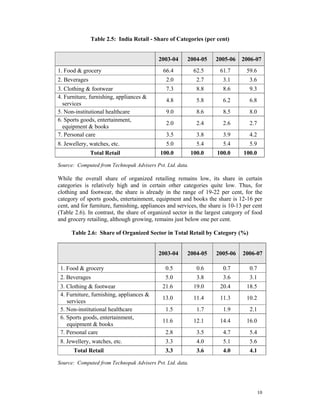
  • 9.
    Profit realization for farmers selling directly to organized retailers is about 60 per cent higher than that received from selling in the mandi • The difference is even larger when the amount charged by the commission agent (usually 10 per cent of sale price) in the mandi is taken into account. Impact on Manufacturers • Large manufacturers have started feeling the competitive impact of organized retail through price and payment pressures. • Manufacturers have responded through building and reinforcing their brand strength, increasing their own retail presence, ‘adopting’ small retailers, and setting up dedicated teams to deal with modern retailers. • Entry of organized retail is transforming the logistics industry. This will create significant positive externalities across the economy. • Small manufacturers did not report any significant impact of organized retail. Policy Recommendations On the basis of the results of the surveys and the review of international retail experience, the study makes the following major recommendations: 1. Modernization of wetmarkets through public-private partnerships. 2. Facilitate cash-and-carry outlets, like Metro, for sale to unorganized retail and procurement from farmers, as in China. 3. Encourage co-operatives and associations of unorganized retailers for direct procurement from suppliers and farmers. 4. Ensure better credit availability to unorganized retailers from banks and micro-credit institutions through innovative banking solutions. 5. Facilitate the formation of farmers’ co-operatives to directly sell to organized retailers. 6. Encourage formulation of “private codes of conduct” by organized retail for dealing with small suppliers. These may then be incorporated into enforceable legislation. 7. Simplification of the licensing and permit regime for organized retail and move towards a nationwide uniform licensing regime in the states to facilitate modern retail. 8. Strengthening the Competition Commission’s role for enforcing rules against collusion and predatory pricing. 9. Modernization of APMC markets as modelled on the National Dairy Development Board (NDDB) Safal market in Bangalore. viii
  • 10.
    Contents Foreword....................................................................................................................... i Acknowledgements ....................................................................................................iii Abbreviations ............................................................................................................. iv Executive Summary ................................................................................................... vi 1. Introduction.............................................................................................................1 1.1 Context...........................................................................................................1 1.2 Partners in the Study ....................................................................................1 1.3 Methodology..................................................................................................2 1.4 Organization of the Report ...........................................................................2 2. Current Retail Scene: An Overview......................................................................3 2.1 International Retail.......................................................................................3 2.1.1 Organized vs Unorganized Retail .........................................................3 2.1.2 Spread of Modern Retail in Developing Countries...............................4 2.1.3 Globalization of Retail ..........................................................................5 2.1.4 Regulatory Framework .........................................................................5 2.1.5 Future Trends........................................................................................6 2.2 Indian Retail..................................................................................................6 2.2.1 Employment and Output in the Retail Sector........................................7 2.2.2 Organized vs Unorganized Retail .........................................................8 2.2.3 Expansion of Organized Retail by Format..........................................11 2.2.4 Regulatory Framework .......................................................................11 3. Evolution of International Retail: Implications for India.................................13 3.1 Introduction.................................................................................................13 3.2 The Spread of Supermarkets ......................................................................13 3.2.1 The US Supermarket Story: Indigenous Kirana Stores Grow into Huge Chains of Supermarkets ......................................................................13 3.2.2 Supermarkets in Developing Countries ..............................................16 3.3 Determinants of the Diffusion of Supermarkets in Developing Countries .....................................................................................................................19 3.3.1 Income Growth and Urbanization and Its Sequel...............................19 3.3.2 Foreign Policy of Retail FDI Liberalization.......................................20 3.3.3 Domestic Policies Concerning Retail .................................................22 3.3.4 Modernization of the Procurement Systems of Retailers ....................25 3.4 Impacts of the Rise of Supermarkets on the Other Segments of the Agrifood System ..........................................................................................27 3.4.1 Impacts Downstream: Competition with Traditional Retailers and Competition for Consumers ................................................................27 3.4.2 Impacts Upstream: Relations with Product Suppliers (Processors and Farmers)..............................................................................................29 3.5 Policies and Strategies to Seek “Competitiveness with Inclusiveness” in an Era of Rapid Retail Transformation .....................................................32 3.5.1 Macro policies to Improve Overall Competitiveness with Inclusiveness .............................................................................................................33 3.5.2 Public Policies and Programmes to Upgrade Traditional Retail.......33 3.5.3 Wholesale Segment Modernization to Benefit Traditional Retailers ..37 3.5.4 Policies to Facilitate and Improve Supermarket–Farmer Relations ..40
  • 11.
    3.6 Implications for India .................................................................................43 3.6.1 Enhanced Welfare Gains for Consumers ............................................45 3.6.2 Upgraded and Co-opted Kirana Stores and Hawkers ........................46 3.6.3 Gains for Farmers...............................................................................48 4. Domestic Organized Retailers: Case Studies .....................................................52 4.1 Introduction.................................................................................................52 4.2 Organized Retail Models.............................................................................53 4.3 Market Penetration Strategy.......................................................................56 4.4 Product Margin of Retailers.......................................................................57 4.5 Product Procurement by Retailers .............................................................58 4.6 Employment Generation.............................................................................60 4.7 Conclusion...................................................................................................61 5. Impact of Organized Retailing ............................................................................62 5.1 Introduction.................................................................................................62 5.2 Organized Retailing: Advantages to the Indian Economy........................62 5.2.1 Link with Agriculture ..........................................................................62 5.2.2 Link with Manufacturing.....................................................................63 5.2.3 Boost to Exports ..................................................................................64 5.2.4 Impact on Growth and Productivity....................................................64 5.2.5 Impact on Employment and Prices .....................................................64 5.2.6 Improvement of Government Revenues...............................................66 5.3 Sample Surveys ...........................................................................................66 5.4 Survey Results: Unorganized Retailers......................................................67 5.4.1 Size of Unorganized Outlets................................................................67 5.4.2 Employment Impact.............................................................................68 5.4.3 Impact on Turnover and Profit ...........................................................70 5.4.4 Closure of Unorganized Outlets..........................................................74 5.4.5 Response to Competition.....................................................................74 5.5 Control Sample Survey of Retailers ...........................................................80 5.5.1 Size and Age of Outlets .......................................................................81 5.5.2 Employment Situation .........................................................................81 5.5.3 Impact on Turnover and Profit ...........................................................82 5.6 Consumer Survey Results ...........................................................................84 5.6.1 Income Levels of Shoppers..................................................................84 5.6.2 Location Advantage for the Unorganized Retailers............................84 5.6.3 Preference for Organized vs Unorganized Retailers ..........................85 5.6.4 Savings from Organized Outlets .........................................................87 5.6.5 Consumers’ View on Opening of More Organized Outlets ................87 5.7 Consumer Survey at Unorganized Fruit and Vegetable Outlets...............88 5.7.1 Income Levels of Consumers...............................................................88 5.7.2 Attractiveness of Shopping from Fruit and Vegetable Vendors..........89 5.7.3 Share of Purchases, Organized vs Unorganized Outlets ....................89 5.7.4 Preference for Additional Organized Outlets .....................................90 5.8 Intermediary Survey Results.......................................................................91 5.8.1 Business Profile and Employment.......................................................91 5.8.2 Business Turnover and Profit..............................................................92 6. Impact of Organized Retailing on Producers.....................................................95 6.1 Introduction.................................................................................................95 6.2 Plotting the Supply Chain...........................................................................95 2
  • 12.
    6.2.1 Cost of Cultivation ..............................................................................96 6.2.2 Farmer’s Profit ...................................................................................98 6.2.3 Profit Margin for Each Player in the Supply Chain .........................100 6.3 Farmer Survey Results .............................................................................100 6.3.1 Farmer Grouping ..............................................................................101 6.3.2 Farmer Profiling ...............................................................................102 6.3.3 Quantitative Advantages ...................................................................105 6.3.4 Qualitative Advantages .....................................................................107 6.3.5 Conclusion.........................................................................................110 6.4 Manufacturers: Interview Report.............................................................111 6.4.1 Methodology......................................................................................111 6.4.2 Key Findings .....................................................................................112 6.4.3 Conclusion.........................................................................................117 6.5 Small Manufacturers: Interview Report ..................................................118 6.5.1 Respondent Profile ............................................................................118 6.5.2 Interview Results ...............................................................................118 7. Future Scenario in Retailing ..............................................................................121 7.1 Introduction...............................................................................................121 7.2 Growth of Retail and its Distribution.......................................................121 7.3 The Retail Real Estate Scenario...............................................................122 7.4 Organized Retail Investment ....................................................................123 7.5 Share of Investments by City ....................................................................124 7.6 Expected Share of Top Players in Indian Retail .....................................125 7.7 Retail Space Break-up by Category..........................................................125 7.8 Employment Growth .................................................................................126 7.8.1 New Retail Stores ..............................................................................127 8. Policy Recommendations....................................................................................128 8.1 Main Findings of the Study......................................................................128 8.2 A Balanced Approach to Retail ................................................................129 8.3 Modernization of Unorganized Retail......................................................129 8.4 Regulation of Organized Retail ................................................................130 Annex 1: Unorganized Retail Universe 2006.........................................................131 Annex 2: Modern Retail Formats in India ............................................................133 Annex 3: Typical Clearances Required for Retail Store......................................135 Annex 4: Organized Retailers – Case Studies .......................................................137 Annex 5: A Note on Sampling Design ....................................................................174 Annex 6: Syndicate Bank’s Small Credit Scheme Linked to Pigmy Deposits (“SyndSmallCredit”)......................................................................................181 Appendix 1: Alternative Farm Supply Chains......................................................182 Appendix 2: Small Manufacturers’ Interview List...............................................187 Appendix 3: Checklist for Interview of Small Manufacturers ............................188 Appendix 4: Questionnaires....................................................................................189 References.................................................................................................................229 3
  • 13.
    List of Tables Table2.1: World Retail..................................................................................................3 Table 2.2: Share of Organized Retail in Selected Countries, 2006 ...............................4 Table 2.3: GDP, Private Final Consumption Expenditure and Retail Sales Growth, 1994-07 (Compound Annual Growth Rate) ......................................................7 Table 2.4: Growth India Retail - Total vs Organized ....................................................9 Table 2.5: India Retail - Share of Categories (per cent) .............................................10 Table 2.6: Share of Organized Sector in Total Retail by Category (%) .....................10 Table 2.7: Organized Retail Expansion by Format......................................................11 Table 4.1: Organized Retail Models ............................................................................54 Table 4.2: Organized Retailers Sales’ Turnover in 2006-07 .......................................56 Table 4.3 : Organized Retailers’ Gross Margin (per cent)...........................................58 Table 4.4: Organized Retail Employment, 2006-07 ....................................................61 Table 5.1: Growth of Selected Industries (Compound Annual Growth Rate in %) ....63 Table 5.2: Share in GDP and Employment of Selected Sectors, 1993-94 to 2004-0565 Table 5.3: Store Area of Unorganized Retail...............................................................67 Table 5.4: Employment Impact on Unorganized Retail by Age of Organized Retail (Compound Annual Growth) ...........................................................................69 Table 5.5: Annual Growth in Turnover and Profit of Unorganized Retail Outlets .....70 Table 5.6: Annual Growth in Monthly Turnover and Profit of Unorganized Retail by Age of Organized Retail ..................................................................................71 Table 5.7: Retailers Showing Fall in Turnover (% of Sampled Retailers) ..................73 Table 5.8: Response to Competition from Organized Retail Outlets (% of Sampled Retailers) ..........................................................................................................75 Table 5.9: Cash Credit Sales........................................................................................76 Table 5.10: Technological Facilities in Use by Unorganized Retailers (As % of Sampled Unorganized Retailers) .....................................................................77 Table 5.11: Bank Finance Situation for Unorganized Retailers (As % of Sampled Unorganized Retailers) ....................................................................................78 Table 5.12: Dealing with Competition by Unorganized Retailers (In % of Sampled Unorganized Retailers) ....................................................................................79 Table 5.13: Attitude towards Children taking up Your Business (As % of Sampled Retailers) ..........................................................................................................80 Table 5.14: Average Size and Age of Outlets - Control Sample vs Treatment Sample ..........................................................................................................................81 Table 5.15: Employment Impact - Control vs Treatment Sample ...............................82 Table 5.16: Impact on Turnover and Profit: Control vs Treatment Sample ................82 Table 5.17: Proportion of Retailers Showing Fall in Turnover/ Profit: Treatment Sample vs Control Sample (in per cent) ..........................................................83 Table 5.18: Reasons for Decline in Turnover/ Profit: Treatment Sample vs Control Sample (% of Sampled Retailers Subject to Decline) .....................................83 Table 5.19: Average Monthly Household Income of Shoppers (% Share) .................84 Table 5.20: Share of Average Monthly Spending by Product Category of Consumers at Organized/ Unorganized Outlets (% Share).................................................86 Table 5.21: Savings from Buying at Organized Outlets by Format (as % of Spending) ..........................................................................................................................87
  • 14.
    Table 5.22: Savingsfrom Buying at Organized Outlets by Format (as % of Spending) ..........................................................................................................................87 Table 5.23: Average Monthly Household Income of Consumers at Unorganized Fruit & Vegetable Outlets (% Share)........................................................................88 Table 5.24: Share of Purchases of Consumers at Unorganized Fruit & Vegetable Outlets (% Share).............................................................................................90 Table 5.25: Profile of Sampled Intermediaries by Type and Commodity/ Product Group (in numbers)..........................................................................................91 Table 5.26: Turnover and Profit by Product Category ................................................92 Table 5.27: Change in Turnover and Profit by Product Category ...............................93 Table 5.28: Adverse Impact of Organized Retail on Intermediaries ...........................93 Table 6.1: Sowing Patterns of Farmers........................................................................97 Table 6.2 Cost of Cultivation of Cauliflower per Acre ...............................................98 Table 6.3: Farmer’s Profit for Cauliflower ..................................................................99 Table 6.4: Farmer Grouping ......................................................................................101 Table 6.5: Level of Education of Head of Farmer Households (%) ..........................102 Table 6.6: Land Ownership (Owned and Leased) .....................................................103 Table 6.7: Sources of Finance for Cultivation ...........................................................104 Table 6.8: Sources of Finance for Personal Need......................................................105 Table 6.9: Average Price Received by Farmer per Head of Cauliflower ..................105 Table 6.10 : Profit per Head of Cauliflower (excluding commissions payable) .......106 Table 6.11: Commission Paid by Farmer ..................................................................107 Table 6.12: Share of Produce Sold to Different Marketing Channels .......................108 Table 6.13: Share of Rejection...................................................................................108 Table 6.14: Special Cultivation Practices ..................................................................109 Table 6.15 : Grading of Cauliflower..........................................................................110 Table 6.16 : Participating Companies for Interview..................................................112 Table 7.1: Investment Plans of Major Retailers in the Next 5-7 Years .....................123 Table 7.2: Retail Market for 150 Cities in 2011-12...................................................125 Table 7.3: Employment Generation by Organized Retail during 2007-12................126 Table 7.4: Number of New Organized Retail Stores during 2007-12 .......................127 List of Charts Chart 5.1 a: Family Labour (Per 100 Retailers)...........................................................68 Chart 5.1 b: Hired Labour (Per 100 Retailers).............................................................68 Chart 5.1 c: Temporal Impact on Unorganized Retail Employment ...........................69 Chart 5.2 a: Temporal Impact on Unorganized Retail Turnover .................................72 Chart 5.2 b: Temporal Impact on Unorganized Retail Profit.......................................72 Chart 5.3 a : Adverse Impact on Unorganized Retailers by Region............................73 Chart 5.3 b: Adverse Impact on Unorganized Retailers by Category..........................74 Chart 5.4 : Increased Home Delivery Sales (% of Retailers reporting Home Delivery) ......................................................................................................................................75 Chart 5.5 : Bank Finance Situation (% of Sampled Unorganized Retailers)...............77 2
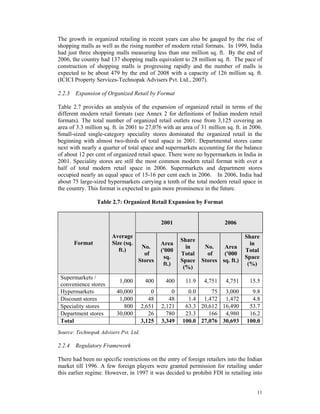
  • 15.
    Chart 5.6 :Dealing with Competition – All-India .......................................................78 Chart 5.7 : Attitude Towards Children Taking up Your Business – All-India ............79 Chart 5.8 : Willingness to Become Franchisee of Organized Retailers.......................80 Chart 5.9 a: Distance of Retail Outlets ........................................................................85 Chart 5.9 b: Mode of Transport ...................................................................................85 Chart 5.10 : Attitude towards Opening of More Organized Outlets............................88 Chart 5.11 : Distance and Mode of Transport to Unorganized Retail Vendors...........89 Chart 5.12 : Preference for Additional Organized Outlets for Fruit & Vegetables .....91 Chart 5.13 : Adverse Impact on Future Business ........................................................94 Chart 5.14 : Succession Plans…… ..............................................................................94 Chart 6.1: The Cauliflower Supply Chain ...................................................................96 Chart 6.2: Share of Profit for Farmer, Intermediary and Retailer in the Consumer Price of Cauliflower.......................................................................................100 Chart 6.3 : Asset Ownership (in %) ...........................................................................103 Chart 6.4 : Vehicle Ownership (in %) .......................................................................104 Chart 6.5 : Illustrative Supply Chain for Shampoos/Detergents................................114 Chart 6.6 : Illustrative Supply Chain for Apparel......................................................115 Chart 7.1 : Size of Indian Retail (in US$ bn).............................................................121 Chart 7.2: Projection of the Share of Organized Retail .............................................122 Chart 7.3: Investment Estimates by City Category (%).............................................124 Chart 7.4: Investment Estimates by Format (%)........................................................124 Chart 7.5 a: Retail Space Estimates by Format (%)...................................................125 Chart 7.5 b: Retail Space Estimates by City Type (%)..............................................126 3
  • 16.
    1. Introduction 1.1 Context An important aspect of the current economic scenario in India is the emergence of organized retail. There has been considerable growth in organized retailing business in recent years and it is poised for much faster growth in the future. Major industrial houses have entered this area and have announced very ambitious future expansion plans. Transnational corporations are also seeking to come to India and set up retail chains in collabouration with big Indian companies. However, opinions are divided on the impact of the growth of organized retail in the country. Concerns have been raised that the growth of organized retailing may have an adverse impact on retailers in the unorganized sector. It has also been argued that growth of organized retailing will yield efficiencies in the supply chain, enabling better access to markets to producers (including farmers and small producers) and enabling higher prices, on the one hand and, lower prices to consumers, on the other. In the context of divergent views on the impact of organized retail, it is essential that an in-depth analytical study on the possible effects of organized retailing in India is conducted. In order to assess the impact of growing organized retail on different aspects of the economy, the Indian Council for Research on International Economic Relations (ICRIER) was appointed by the Ministry of Commerce and Industry, Government of India to carry out a study on organized retail focusing on the following issues: • Effect on small retailers and vendors in the unorganized sector keeping in mind the likely growth in the overall market. • Effect on employment. • Impact on consumers. • Impact on farmers and manufacturers. • Impact on prices. • Overall impact on economic growth. ICRIER has been asked by the Ministry to analyze the above issues in the context of a growth scenario of 7-10 per cent per annum in the next five years and in the light of practice in other fast- growing emerging market economies. 1.2 Partners in the Study In this study, ICRIER sought and received assistance from three important groups: (a) Development & Research Services Private Limited (DRS) for conducting all-India surveys; (b) Technopak Advisers Pvt. Ltd., a leading management consultancy firm on retailing; and (c) Dr. Thomas Reardon and Dr. Ashok Gulati as Co-Directors of the International Food Policy Research Institute (IFPRI)-Michigan State University (MSU) Joint Programme of Markets in Asia. After a study framework was prepared, it was discussed in a brainstorming session organized by ICRIER on April 9, 2007 in which industry representatives, government officials, and senior academics participated. 1
  • 17.
    1.3 Methodology The following methods were used in the study: • A survey of international experience particularly the recent developments in emerging market economies; • Interviews of major players in organized retailing, large manufacturers, and small manufacturers; • Questionnaire-based survey of unorganized retailers including fixed fruit and vegetable vendors and push-cart hawkers; • Questionnaire-based exit survey of consumers’ shopping at organized retail outlets and also consumers’ shopping at unorganized outlets; and • Questionnaire-based survey of farmers who are selling their produce directly to organized retailers and also farmers who are selling through the traditional mandi route. 1.4 Organization of the Report The report has been organized into eight chapters as follows: 1. Introduction 2. Current Retail Scene: An Overview International Retail Indian Retail 3. Evolution of International Retail: Implications for India 4. Indian Organized Retailers: Case Studies Subhiksha Trent Limited Pantaloon Retail ITC Choupal Sagar and Choupal Fresh RPG Spencer’s Mother Dairy 5. Impact of Organized Retailing Advantages to the Indian Economy Unorganized Retail Sector: Survey Results Consumers: Survey Results Intermediaries: Survey Results 6. Impact of Organized Retailing on Producers Farmers : Value Chain and Survey Results Manufacturers : Interview Report 7. Future Scenario in Retailing Growth of Retail: Organized vs. Unorganized Investment and Employment Projections 8. Policy Recommendations 2
  • 18.
    2. Current RetailScene: An Overview 2.1 International Retail Global retail sales are estimated to cross US$12 trillion in 2007.1 Almost reflecting the growth in the world economy, global retail sales grew strongly in the last five years (2001-06) at an average nominal growth of about 8 per cent per annum in dollar terms (Table 2.1). This is in contrast to near stagnant global retail sales during the previous five years, 1996-01. Grocery dominates retail sales with a share of approximately 40 per cent which varies from about 30 per cent in rich Japan to an average of 60 per cent in poor Africa. Retail sales through modern formats have been rising faster than total retail sales; the share of modern retail has risen from about 45 per cent in 1996 to over 52 per cent in 2006. Table 2.1: World Retail CAGR3 CAGR3 1996 2001 2002 2003 2004 2005 2006 (1996- (2001- 01) 06) 1. Total Retail Sales1 (US$ 7682 7833 7987 8827 9833 10657 11375 0.4 7.7 Billion) 2. Total Grocery Sales1 (US$ 3284 3161 3213 3571 3970 4308 4611 -0.8 7.8 Billion) 3. Modern Retail Sales2 (US$ 3478 3916 4149 4672 5246 5633 5969 2.4 8.8 Billion) 4. Modern Grocery Sales2 2577 2816 2979 3378 3800 4074 4325 1.8 9.0 (US$ Billion) 2 as % of 1 42.7 40.4 40.2 40.5 40.4 40.4 40.5 -1.1 0.1 3 as % of 1 45.3 50.0 51.9 52.9 53.4 52.9 52.5 2.0 1.0 4 as % of 3 74.1 71.9 71.8 72.3 72.4 72.3 72.5 -0.6 0.2 5. Nominal GDP 30055 31889 32888 36904 41470 44713 48141 1.2 8.6 (US$ Billion) 1 Excluding VAT or sales tax; 2 Including VAT or sales tax; 3 Compound annual growth rate. Source: Planet Retail Database. 2.1.1 Organized vs Unorganized Retail In the developed economies, organized retail is in the range of 75-80 per cent of total retail, whereas in developing economies, the unorganized sector dominates the retail business. The share of organized retail varies widely from just one per cent in Pakistan and 4 per cent in India to 36 per cent in Brazil and 55 per cent in Malaysia (Table 2.2). Modern retail formats, such as hypermarkets, superstores, supermarkets, discount and convenience stores are widely present in the developed world, whereas such forms of retail outlets have only just begun to spread to developing countries in recent years. In developing countries, the retailing business continues to be dominated by family-run neighbourhood shops and open markets. As a consequence, wholesalers and distributors who carry products from industrial suppliers and agricultural 1 Planet Retail estimates. 3
  • 19.
    producers to theindependent family-owned shops and open markets remain a critical part of the supply chain in these countries. Table 2.2: Share of Organized Retail in Selected Countries, 2006 Total Retail Sales Share of Organized Country (US$ bn) Retail (%) USA 2,983 85 Japan 1,182 66 China 785 20 United Kingdom 475 80 France 436 80 Germany 421 80 India 322 4 Brazil 284 36 Russia 276 33 Korea, South 201 15 Indonesia 150 30 Poland 120 20 Thailand 68 40 Pakistan 67 1 Argentina 53 40 Philippines 51 35 Malaysia 34 55 Czech Republic 34 30 Vietnam 26 22 Hungary 24 30 Source: Planet Retail and Technopak Advisers Pvt. Ltd. 2.1.2 Spread of Modern Retail in Developing Countries The arrival of modern retail in developing countries occurred in three successive waves (Reardon and Hopkins, 2006; Reardon and Berdegue, 2007). The first wave took place in the early to mid-1990s in South America (e.g., Argentina, Brazil, and Chile), East Asia outside China (South Korea, Malaysia, Philippines, Thailand, and Taiwan), North-Central Europe (e.g., Poland, Hungary, and Czech Republic) and South Africa. The second wave happened during the mid to late 1990s in Mexico, Central America (e.g., Ecuador, Colombia, and Guatemala), Southeast Asian countries (e.g., Indonesia), Southern-Central Europe (e.g., Bulgaria). The third wave has just begun in the late 1990s and early 2000s in parts of Africa (e.g., Kenya), some countries in Central and South America (e.g., Nicaragua, Peru, and Bolivia), Southeast Asia (e.g., Vietnam), China, India, and Russia. 4
  • 20.
    Thus, the thirdwave countries which include China, India and Russia are late comers in the diffusion of modern retail. According to the authors, the main reason why they lagged behind was the severe restrictions on foreign direct investment (FDI) in retailing in these countries. The demand side features of these countries, such as income, size of the middle class, urbanization, and the share of women in workforce, etc., have been similar to countries in the second wave. In China and Russia these restrictions were progressively relaxed in the 1990s and in India partially in the 2000s. In January 2006, India allowed foreign companies to own up to 51 per cent in single- brand retail joint ventures (JVs), but multiple-brand foreign firms are still barred in retail although they can set up wholesale operations. 2.1.3 Globalization of Retail There has been a creeping internationalization of retailing over the recent period. As home markets have become crowded and with opportunities in emerging markets rising, modern retailers from developed countries have been turning to new markets. On an average each of the top 250 retailers in the world have operated on an average in 5.9 countries in 2005-06 (July-June) against five countries in 2000-01 (Deloitte- Stores Report, 2007). Foreign business accounted for 14.4 per cent of retail sales of these companies in 2005-06 up from 12.6 per cent in 2000-01. The retail sales growth of companies which have ventured into foreign markets has been faster than those that have confined themselves to home markets. As far as the international expansion is concerned, West European and South African retail companies are the most outward looking. The West European firms, among the top 250 retailers, expanded into an average of 9.9 countries in 2005-06 and generated 28.1 per cent of their sales from foreign operations, largely in Central and Eastern Europe. The five South African retailers in the top 250 list conducted business in an average of 8.8 countries particularly in the African continent in 2005-06, generating on an average 13 per cent of these companies’ sales. The US retailers are mostly home-market based operating just in an average of 3.7 countries outside US in 2005- 06 up from three countries in 2000-01 and two countries in 1996-97. The US retailer Wal-Mart, the world’s biggest retailer, is a notable exception operating in 14 countries in 2007. Most of the Japanese retailers are insular operating only domestically. 2.1.4 Regulatory Framework It is interesting to note that regulatory restrictions on the growth in modern retail is more stringent in developed rather than in developing countries. For example, in most West European countries, setting up of hypermarkets has become very difficult since the late 1990s and early 2000s as governments became alive to the demands of traditional small retailers and non-mobile consumers in these countries. Merger and acquisition plans are now looked at more critically by the national and European competition authorities. While in most countries opening hours are liberalized including holiday trading, the very small number of countries where opening on Sundays are prohibited include developed countries such as Germany and Austria (Planet Retail). 5
  • 21.
    As noted byReardon and Hopkins (2006), there are four types of policy regulations that can be seen in countries which have experienced advanced retail expansion. They are: • Competition policy that limits concentration and collusion. • Zoning and hours regulations to limit the diffusion, market penetration, and convenience of organized retail. • Pricing regulations that prevent modern retail companies from pricing below cost and prompt-payment regulations to secure speedy payment to suppliers. • Policies to strengthen traditional retailers and suppliers through technology and practice upgrading, enhancing organizational capacity, and financial access. The above regulations were put in place in different countries basically with a view to balance the conflicts of interests between modern retail, on the one hand and the traditional retailers and suppliers to the modern retail, on the other. Recently, countries in Southeast Asia (Malaysia, Indonesia, and Thailand) imposed a number of restrictions on the growth of large retail companies particularly the transnational companies in contrast to a fairly liberal approach to the retail sector followed until the late 1990s. These restrictions involve the use of a combination of competition laws, FDI regulation, land use restrictions (zoning laws), and limits on operating hours (Mutebi, 2007). 2.1.5 Future Trends The Deloitte-Stores (2007) study held that the retail business would slow down definitely over the next decade in developed countries, while it would grow strongly in developing countries. This is based on a projection of three significant changes that will occur. First, the population in the age-group 50-70 years and above in the developed world will explode, shifting the share of consumer spending further away from goods towards services, such as travel, healthcare and maintenance of the elderly. Second, the population growth in the age-group 20-35 years in these countries will be relatively modest making the hiring of entry-level workers difficult, while the population in the age-group 35-50 years will decline leading to acute shortage of middle and upper management positions. Third, in developing countries, there will be plentiful supply of workforce and consumers in the younger age groups. Besides, this demographic shift will make the developing countries more dynamic and risk-taking enabling them to grow much faster than the developed world. Driven by these trends, it is expected that retailers in developed countries will increasingly move to the markets of developing countries for growth. 2.2 Indian Retail2 The growth of the retail trade in India is associated with the growth in the Indian economy. Gross domestic product (GDP) grew by an annual rate of 6.6 per cent 2 The data on Indian retail is sketchy. There is no official machinery which regularly releases retail statistics. There have been a few private sources which give information on various aspects of Indian retailing. In this report, the authors have relied on the data generated by Technopak Advisers Pvt. Ltd. which in turn has used the data from official sources, such as the Central Statistical Organization (CSO) and the National Sample Survey Organization (NSSO) for the purpose. 6
  • 22.
    during 1994-00 butthe growth slackened to 4.7 per cent per annum during the next three years before the growth remarkably rose to 8.7 per cent per annum in the last four years (Table 2.3). This meant a substantial rise in disposable income of Indian households since the mid-1990s. Based on the Market Information Survey of Households (MISH) of the National Council of Applied Economic Research (NCAER), the number of people in the income groups of “aspirers” and the middle class with annual income ranging from Rs. 90,000 to one million, more than doubled from 157 million to 327 million during the last decade 1995-96 to 2005-06.3 The data from the Central Statistical Organization (CSO) indicate that the growth of real private final consumption expenditure, which dipped from an average of 5.7 per cent per annum during 1994-00 to 4 per cent per annum during 2000-03, shot up to 6.7 per cent per annum during 2003-07. Retail sales (in nominal terms) in the country also followed a similar pattern: a high annual growth of 13.6 per cent during 1994-00, a low growth of 4.8 per cent during 2000-03 and a smart pick up in the last four years, 2003-07 at around 11 per cent. Table 2.3: GDP, Private Final Consumption Expenditure and Retail Sales Growth, 1994-07 (Compound Annual Growth Rate) 1994-95 to 2000-01 to 2003-04 to 1999-00 2002-03 2006-07 Real GDP 6.6 4.7 8.7 Real private final consumption 5.7 4.0 6.7 expenditure Retail sales 13.6 4.8 10.9 Source: CSO, NSSO, and Technopak Advisers Pvt. Ltd. The international consulting firm, A.T. Kearney, annually ranks emerging market economies based on more than 25 macroeconomic and retail-specific variables through their Global Retail Development Index (GRDI). For the last three years (2005, 2006, and 2007) India has been ranked as number one indicating that the country is the most attractive market for global retailers to enter. The high economic growth during the last few years raising disposable incomes rapidly, favourable demographics placing incomes on younger population with less dependency, and urbanization are some of the major factors fueling the Indian retail market. 2.2.1 Employment and Output in the Retail Sector Retail is a labour-intensive economic activity. According to the Economic Census carried out by the CSO in 1998, the country had a total of 10.69 million enterprises engaged in retail trade, of which 5.23 million were in the rural areas and 5.46 million 3 The NCAER gives data in terms of the number of households and they have been converted into number of people by using the average household size of 4.7 persons derived from the NSSO surveys. 7
  • 23.
    in the urbanareas. The total employment in these enterprises in 1998 was 18.54 million of which 7.88 million was in the rural sector and 10.65 million in the urban sector. Economic Census has been carried out for 2005 but its detailed results are yet to be released. However, according to NSSO’s Employment and Unemployment Survey for 2004-05, employment in the retail trade has been 35.06 million, divided between rural (16.08 million) and urban (18.98 million) sectors.4 This constituted about 7.3 per cent of the workforce in the country (459 million). Wholesale trade, on the other hand, contributed to an employment of 5.48 million, of which only 1.71 million was in the rural sector and 3.77 million in the urban sector. The NSSO data also indicated that retail employment was about 30.62 million in 1999-00 with 12.15 million in rural areas and much higher at 18.47 million in the urban areas. This means that an additional employment of 4.44 million was added in this sector during the five-year period, 2000-05, showing an annual employment growth of 2.7 per cent per annum. However, it is interesting to note that the retail employment growth has been quite large in the rural sector – there has been a massive rise in employment in rural retailing of 3.93 million during 2000-05 – and the urban sector has also shown an employment growth, but only of 0.51 million during this period. According to CSO estimates, total domestic trade, both wholesale and retail included, constituted about 15.1 per cent of India’s GDP in 2006-07, a successive increase in share from 13 per cent of GDP in 1999-00. Taking into account the fact that retail trade is more labour intensive than wholesale trade, the contribution of retail trade alone to GDP can be estimated to be around 11-12 per cent in 2006-07. 2.2.2 Organized vs Unorganized Retail Indian retail is dominated by a large number of small retailers consisting of the local kirana shops, owner-manned general stores, chemists, footwear shops, apparel shops, paan and beedi shops, hand-cart hawkers, pavement vendors, etc. which together make up the so-called “unorganized retail” or traditional retail.5 The last 3-4 years have witnessed the entry of a number of organized retailers6 opening stores in various modern formats in metros and other important cities. Still, the overall share of organized retailing in total retail business has remained low. Table 2.4 gives the category-wise growth of Indian retail, total as well as the organized sector, in recent years. While total retail sales have grown from Rs. 10,591 billion (US$ 230 billion) in 2003-04 to Rs. 14,574 billion (US$ 322 billion) in 2006- 07, which is at an annual compound growth rate of about 11 per cent, the organized retail sales grew much more at about 20 per cent per annum from Rs. 350 billion 4 This is based on the “usual status” definition. Employment based on the “current daily status” is not available for retail trade from the NSSO data. 5 See Annex 1for a classification of the unorganized retail universe. 6 Organized retail or modern retail is usually chain stores, all owned or franchised by a central entity, or a single store that is larger than some cut-off point. The relative uniformity and standardization of retailing is the key attribute of modern retail. The size of each unit can be small so that a chain of convenience stores is modern retail. A single large department store is also modern retail. 8
  • 24.
    Table 2.4: GrowthIndia Retail - Total vs Organized CAGR 2003- 2004- 2005- 2006- 2004-07 04 05 06 07 (%) India Retail (Rs. bn) 1. Food & grocery 7,028 7,064 7,418 8,680 7.3 2. Beverages 212 309 373 518 34.7 3. Clothing & footwear 777 993 1,036 1,356 20.4 4. Furniture, furnishing, appliances 512 656 746 986 24.4 and services 5. Non-institutional healthcare 950 972 1,022 1,159 6.9 6. Sports goods, entertainment, 212 272 308 395 23.0 equipment & books 7. Personal care 371 433 465 617 18.5 8. Jewellery, watches, etc. 530 610 655 863 17.7 Total Retail 10,591 11,308 12,023 14,574 11.2 Organized Retail ( Rs. bn) 1. Food & grocery 39 44 50 61 16.5 2. Beverages 11 12 13 16 14.7 3. Clothing & footwear 168 189 212 251 14.3 4. Furniture, furnishing, appliances 67 75 85 101 14.8 & services 5. Non-institutional healthcare 14 16 19 24 20.0 6. Sports goods, entertainment, 25 33 44 63 37.0 equipment & books 7. Personal care 11 15 22 33 46.9 8. Jewellery, watches, etc. 18 24 33 49 40.5 Total Organized Retail 350 408 479 598 19.5 Share of Organized Retail in Total 3.3 3.6 4.0 4.1 Retail (%) Source: CSO, NSSO, and Technopak Advisers Pvt. Ltd. (US$ 7.6 billion) in 2003-04 to Rs. 598 billion (US$ 13.2 billion) in 2006-07. As a result, the share of organized retail in total retail grew, although slowly, from 3.3 per cent in 2003-04 to 4.1 per cent in 2006-07. Food and grocery constitutes the bulk of Indian retailing and its share was about two- thirds in 2003-04 gradually falling to about 60 per cent in 2006-07 (Table 2.5). The next in importance is clothing and footwear, the share of which has been about 7 per cent in 2003-04 and rose to 9 per cent in 2006-07. The third biggest category is non- institutional healthcare whose share has slowly reduced from 9 per cent in 2003-04 to 8 per cent in 2006-07. The next is furniture, furnishing, appliances and services, whose share rose from about 5 per cent in 2003-04 to 7 per cent in 2006-07. The category of jewellery, watches, etc. constituted about 6 per cent of total Indian retailing in 2006-07, rising from 5 per cent in 2003-04. 9
  • 25.
    Table 2.5: IndiaRetail - Share of Categories (per cent) 2003-04 2004-05 2005-06 2006-07 1. Food & grocery 66.4 62.5 61.7 59.6 2. Beverages 2.0 2.7 3.1 3.6 3. Clothing & footwear 7.3 8.8 8.6 9.3 4. Furniture, furnishing, appliances & 4.8 5.8 6.2 6.8 services 5. Non-institutional healthcare 9.0 8.6 8.5 8.0 6. Sports goods, entertainment, 2.0 2.4 2.6 2.7 equipment & books 7. Personal care 3.5 3.8 3.9 4.2 8. Jewellery, watches, etc. 5.0 5.4 5.4 5.9 Total Retail 100.0 100.0 100.0 100.0 Source: Computed from Technopak Advisers Pvt. Ltd. data. While the overall share of organized retailing remains low, its share in certain categories is relatively high and in certain other categories quite low. Thus, for clothing and footwear, the share is already in the range of 19-22 per cent, for the category of sports goods, entertainment, equipment and books the share is 12-16 per cent, and for furniture, furnishing, appliances and services, the share is 10-13 per cent (Table 2.6). In contrast, the share of organized sector in the largest category of food and grocery retailing, although growing, remains just below one per cent. Table 2.6: Share of Organized Sector in Total Retail by Category (%) 2003-04 2004-05 2005-06 2006-07 1. Food & grocery 0.5 0.6 0.7 0.7 2. Beverages 5.0 3.8 3.6 3.1 3. Clothing & footwear 21.6 19.0 20.4 18.5 4. Furniture, furnishing, appliances & 13.0 11.4 11.3 10.2 services 5. Non-institutional healthcare 1.5 1.7 1.9 2.1 6. Sports goods, entertainment, 11.6 12.1 14.4 16.0 equipment & books 7. Personal care 2.8 3.5 4.7 5.4 8. Jewellery, watches, etc. 3.3 4.0 5.1 5.6 Total Retail 3.3 3.6 4.0 4.1 Source: Computed from Technopak Advisers Pvt. Ltd. data. 10
  • 26.
    The growth inorganized retailing in recent years can also be gauged by the rise of shopping malls as well as the rising number of modern retail formats. In 1999, India had just three shopping malls measuring less than one million sq. ft. By the end of 2006, the country had 137 shopping malls equivalent to 28 million sq. ft. The pace of construction of shopping malls is progressing rapidly and the number of malls is expected to be about 479 by the end of 2008 with a capacity of 126 million sq. ft. (ICICI Property Services-Technopak Advisers Pvt. Ltd., 2007). 2.2.3 Expansion of Organized Retail by Format Table 2.7 provides an analysis of the expansion of organized retail in terms of the different modern retail formats (see Annex 2 for definitions of Indian modern retail formats). The total number of organized retail outlets rose from 3,125 covering an area of 3.3 million sq. ft. in 2001 to 27,076 with an area of 31 million sq. ft. in 2006. Small-sized single-category speciality stores dominated the organized retail in the beginning with almost two-thirds of total space in 2001. Departmental stores came next with nearly a quarter of total space and supermarkets accounting for the balance of about 12 per cent of organized retail space. There were no hypermarkets in India in 2001. Speciality stores are still the most common modern retail format with over a half of total modern retail space in 2006. Supermarkets and department stores occupied nearly an equal space of 15-16 per cent each in 2006. In 2006, India had about 75 large-sized hypermarkets carrying a tenth of the total modern retail space in the country. This format is expected to gain more prominence in the future. Table 2.7: Organized Retail Expansion by Format 2001 2006 Average Share Share Format Size (sq. Area in No. in No. Area ft.) ('000 Total of Total of ('000 sq. Space Stores Space Stores sq. ft.) ft.) (%) (%) Supermarkets / 1,000 400 400 11.9 4,751 4,751 15.5 convenience stores Hypermarkets 40,000 0 0 0.0 75 3,000 9.8 Discount stores 1,000 48 48 1.4 1,472 1,472 4.8 Speciality stores 800 2,651 2,121 63.3 20,612 16,490 53.7 Department stores 30,000 26 780 23.3 166 4,980 16.2 Total 3,125 3,349 100.0 27,076 30,693 100.0 Source: Technopak Advisers Pvt. Ltd. 2.2.4 Regulatory Framework There had been no specific restrictions on the entry of foreign retailers into the Indian market till 1996. A few foreign players were granted permission for retailing under this earlier regime. However, in 1997 it was decided to prohibit FDI in retailing into 11
  • 27.
    the country. InJanuary 2006, however, a partial liberalization took place in policy in which foreign companies are allowed to own up to 51 per cent in single-brand retail JVs as approved by the Foreign Investment Promotion Board (FIPB). Besides this, foreign companies are allowed in wholesale cash-and-carry business and export trading with 100 per cent equity through the automatic route. Foreign companies with 100 per cent equity can also carry out trading of items sourced from the small-scale sector and do test marketing of products for which the company has a manufacturing approval under the FIPB route. With regard to domestic regulation, the organized retailer has to secure a number of licenses and clearances from various central, state, and local authorities before it starts its operations. They are related to operations, infrastructure, labour, taxation and other general matters. The number of licenses varies from state to state and it also depends on the type of store format. First, a retailer has to obtain a trade license from the local authority (municipal corporation, municipality, or panchayat) which grants permission to carry on the retail business. It has also to obtain licenses from the Agricultural Produce Marketing Committees (APMCs) of each state for procurement and sale of fruit, vegetables, and staples within the respective market areas (mandis) of each APMC. A detailed general list of required clearances is given in Annex 3. In addition, in case a new building or mall is to be constructed for use in retailing, the organized retailer has to obtain “no objection certificates” (NOCs) from the different state authorities in charge of traffic, electricity, water, fire and pollution control. Zoning restrictions are also applicable to the organized retail outlets which can be set up only on land earmarked for the local authority for commercial establishments. 12
  • 28.
    3. Evolution ofInternational Retail: Implications for India7 3.1 Introduction The focus of this chapter is the retail dimension of the profound and rapid transformation of the food industry in developing countries—a key element of globalization—and its relevance to India.8 A “supermarket revolution” has indeed occurred in developing countries since the early-to-mid-1990s. In many countries, supermarkets have gone well beyond the initial middle-class clientele to penetrate the food markets of the poor. This “shock” downstream in the food system has made an impact on traditional retailers; has set off ripple effects upstream in the food system, on the wholesale, processing, and farm sectors; and has incipient effects on trade. This chapter reports on the experiences of developing countries mainly elsewhere in Asia and in Latin America and Eastern Europe with respect to the supermarket revolution and strategic policy approaches taken in developing countries. We also touch on the most relevant experiences of developed countries. Section 3.2 discusses trends in the spread of supermarkets, with a brief comparative look at the US experience (interestingly, in many ways the most relevant of the developed-country experiences for India) and then in developing countries. Section 3.3 analyzes the determinants of the diffusion of supermarkets in developing countries. Section 3.4 examines emerging evidence of the impacts on consumers and traditional retailers (downstream in the agrifood system) and on processors, wholesalers, and farmers (upstream in the system). Section 3.5 discusses policy and programme measures taken by government and non-government entities to promote “competitiveness with inclusiveness” among the various actors in the food system confronting the opportunities and challenges of the supermarket revolution. Section 3.6 concludes with lessons for India. Throughout the chapter, the authors use the term supermarkets as shorthand for the various segments of modern retail, and we distinguish the segments (hypermarkets and superstores, supermarkets and neighbourhood stores, convenience and forecourt stores, and discount and club stores) only when necessary. 3.2 The Spread of Supermarkets 3.2.1 The US Supermarket Story: Indigenous Kirana Stores Grow into Huge Chains of Supermarkets Supermarkets started in the United States in the 1920s and 1930s and became dominant in the late 1950s. The traditional food retail system that dominated the country before supermarkets looked in essence the same as India’s traditional retail system. It consisted of (a) wetmarkets (similar to those in Asia, with many small stalls) for fresh produce, fish, and meats; (b) tiny “mom and pop” stores (man at the till taking orders, wife pulling down products from little shelves and measuring out 7 This chapter is authoured by Dr. Thomas Reardon and Dr. Ashok Gulati, the co-directors of IFPRI/MSU joint programme on “Markets in Asia” who were invited by ICRIER to be partners in this study. 8 While presenting substantial new material, this paper also draws selectively on Reardon and Berdegué (2007), Reardon et al. (2003), and Reardon and Timmer (2007). 13
  • 29.
    and packing orders)with no self-service by customers; (c) street hawkers with push- carts or shoulder or head burdens; and (d) home delivery of milk and mobile (cart) delivery of dry goods—for example, by the famous Jewel Tea Company horse carts.9 Today, however, supermarkets have about 80 per cent of food retail in the United States. The advent of modern retail (i.e., chain stores) started in the late 1870s, long before the supermarket format emerged as large self-service stores in the 1930s. Several important trends in the development of modern retail over the past 130 years might interest Indian readers. Three key demand-side socio-economic changes occurred over a century. First, the United States was mainly rural in 1900 (the urban share was 40 per cent) and mainly urban by 1990 (urban share, 75 per cent). Second, few American women worked outside the home in 1900, and even by 1970 only 15 per cent of married women were counted among the national workforce. A massive societal change occurred in just a few decades, and by 2000 the share of working women was 75 per cent. Third, incomes per capita increased substantially over the century. All three changes are taking place in India today, except they are happening much faster than they did in the United States. Modern retail started with chains of stores that were about the size of kirana stores. Called “five and dime” or “five and ten cent” stores, they bought nonfood goods in volume and sold at discount. They further cut costs by moving to self-service. These chain stores were an innovation of the tiny shop owners. As a major format, they lasted into the 1950s. The most famous example was Woolworths, started in the 1870s in big cities in the boom zones. From one tiny store in 1878, a chain was born that built to the first global retail multinational of medium-sized nonfood shops, with 2,866 stores in five countries (including the United Kingdom) 50 years later. The nonfood five-and-dime stores acted as an “idea spark” model for chain-store formation by food stores that were formerly just small stand-alone grocery shops. The owner of a little tea shop (selling the ingredients for the main beverage of the day) got an idea in 1878 to build a chain of stores in big cities in boom zones and buy tea directly from Chinese plantations to cut the cost and beat the competition. That chain was A&P. From selling just tea in the 1870s, it grew to a grocery store format (dry foods) that opened as the first A&P Economy Store, the same size as a “neighbourhood store” format in India today, and focused on oils, packaged foods, soap, and so on. A&P proccured in large volumes, drove down costs, and standardized store layouts. By 1915 the chain comprised 1,600 stores, and by 1925 it had 13,961 stores; in the early 1930s, A&P was operating approximately 16,000 stores with a combined revenue of US$1 billion (equivalent to US$10 billion in 2000 dollars). In 1936, A&P opened its first “supermarket” (just a few times larger than a neighbourhood store). By 1950, A&P ranked second in sales in the world (after General Motors). In the mid-1950s, A&P was by far the number one food retailer and 9 We are grateful to Tom Reardon, father of Thomas Reardon, for augmenting this section with his memories of New York in the 1930s. 14
  • 30.
    had moved fromsmall-to-medium-sized supermarkets. However, by 2000, A&P had become a minor chain because its retailing and procurement strategic positioning had not kept up with chains that arose in the 1970s and 1980s, like Wal-Mart. Sam Walton is an important example of a kirana man who used entrepreneurial spirit in a situation of opportunity. He started in 1950 with a tiny five-and-dime store in a rural Arkansas village with a population of 3,000. It was one of the most underdeveloped regions of the United States, bypassed by the boom development of the past 100 years. Walton started by building a chain of kirana stores in the surrounding towns and then states, and by 1962 he had decided to open a small supermarket called Wal-Mart. He hit on an idea to buy directly from suppliers and cut costs by building a distribution centre network. While other chains had started in big cities in boom zones, Walton focused his effort on villages and small towns, considered an impossible strategy at the time. Walton opened large-format discount stores (big supermarkets with cheap nonfood items and dry foods) in the 1970s. In the late 1990s, he added small-format neighbourhood stores. Wal-Mart grew from two kirana employees in 1950 to 1,500 in 1970, 21,000 in 1980, 200,000 in 1987, and 1,140,000 in 1999. By 2002, Wal-Mart had become the largest private employer in the world, with 2 million employees. The company’s annual revenue totalled US$350 billion in 2006. Several trends characterized the development of chain stores over the past century in the United States, with similar trends seen in the United Kingdom and France. The salient features were the following: 1. The trend was from nonfood chains to dry-food chains to full-line chains offering fresh foods. Supermarkets did not sell much fresh produce until the 1960s because it was considered impossible to move beyond the American tradition of buying in wetmarkets and tiny fruit shops. 2. The trend was from clerk service to self-service. 3. The format trend was from the traditional system described earlier to chain nonfood shops, to chain grocery shops, to small supermarkets and food sections in department stores, to medium and large supermarkets in towns, to hypermarkets in the suburbs, to convenience stores and neighbourhood stores in dense inner-city areas and small towns. 4. The trend was from large cities and economic boom areas to second- and third-tier cities and second-tier areas and to suburban areas when those developed in the 1950s. Wal-Mart’s development in the opposite direction was a clear exception. 5. Individual chains and the overall supermarket sector underwent massive growth over seven decades, and that growth cycle eclipsed an earlier cycle of growth in self-service chain grocery stores. 6. Chain stores mimicking and then improving on the credit system that the small traditional shops had used for customers by developing credit cards, loyalty cards, and banking services. They also took on other services, such as health clinics and banks for poor consumers. 7. Chain stores modernized their procurement systems. Woolworths and A&P had historically focused on cutting costs through bulk buying, self-service, and efficiencies in inventory handling. As competition increased, the importance of modern logistics and cost cutting intensified, and from the 1990s onwards, those strategies took centre stage. 15
  • 31.
    The remaining traditionalretail sector (now about 20 per cent of food retail) was in reality mainly a modernized small-shop sector. In remote areas, some small traditional groceries survive, but the mainstream is speciality shops (defendable niches) that are far more modern and upgraded than the general-line mom and pop store of years gone by. Also, many small stores themselves started chains (as previously noted) or became franchisees of larger chains. Apart from a few cases, such as A&P into the 1960s and then Krogers and Wal-Mart today, most supermarket chains were regional rather than national. The trend, however, is toward establishing national-level chains and catching up with Europe on consolidation. It is important to keep in mind that the United States has a history of the strongest and longest anti-supermarket regulatory history of any country in the world. Wrigley and Lowe (2002) concluded that the body of stiff regulations and competition laws enacted in the United States resulted in a significantly slower spread of supermarkets and national-level concentration from the 1930s to the 1980s than the United Kingdom experienced. This reversed first in the 1950s and then again in the 1980s. However, the result over the decades is similar to what happened in the United Kingdom (which had far laxer regulation of supermarkets). This suggests that underlying economic and social forces moved the modern retail sector toward dominance and concentration over time, whereas regulations mainly affected the transitional path. As will become apparent later in the chapter, in many of their broad lines, the trends in the spread of supermarkets in developing countries and the evolution of their procurement systems bear many similarities to the recent experience of the United States; Western Europe and Japan had broadly similar experiences in the rise of supermarkets. This suggests that the economic logic of the retail transformation is shared across regions, starting from a surprisingly similar shared tradition of traditional retail systems. The main difference between the retail transformations in developing countries and in the United States and Western European is the extreme speed with which it is occurring in developing countries. 3.2.2 Supermarkets in Developing Countries Supermarkets have been around for half a century in several developing countries, but the phenomenon was limited mainly to large cities, upper-middle-class or rich consumer segments, and domestic capital chains. In contrast, a supermarket revolution in developing countries took off in the early-to-mid-1990s. The patterns and determinants of that revolution are detailed in the following subsection. Diffusion of Modern Retail over Regions and Countries The spread of supermarkets has taken place in three established waves and continues in a fourth emerging wave. The first-wave countries experienced supermarket sector take-off in the early-to-mid- 1990s. Included in that group are much of South America and East Asia (outside China and Japan), north-central Europe and the Baltic countries, and South Africa. In those countries, the average share of supermarkets in food retail went up from roughly 16
  • 32.
    10–20 per centin 1990 to 50–60 per cent on average by the early 2000s (Reardon and Berdegué 2007). Comparing that to the roughly 75–80 per cent share that supermarkets had in food retail by 2005 in the United States and Western Europe, it appears a process of convergence was taking place. The first-wave countries saw supermarket diffusion in a single decade that took some five decades in the United States and the United Kingdom. The second-wave countries are Mexico and much of Southeast Asia, Central America, and South-Central Europe. In those areas, the share went from about 5–10 per cent in 1990 to 30–50 per cent by the early 2000s, with the take-off occurring in the mid-to- late 1990s. In the third-wave countries, the supermarket revolution started in the late 1990s or early 2000s, reaching about 5–20 per cent of national food retail today. These areas include parts of Eastern and Southern Africa, some countries in Central and South America, “transition” East Asia (China and Vietnam), Russia, and India. It is somewhat anomalous that they are late comers in the third wave, because their demand-side characteristics (income, absolute size of the middle-class population, urbanization rate, and share of women in the workforce) make them similar to many countries in the second wave, which had supermarket take-off some five to seven years earlier. The main reasons for the lag were policies imposing severe constraints on retail FDI that were progressively relaxed in China and Russia in the 1990s. It is worth noting that the growth rates of supermarket food sales and retail FDI are inversely correlated with the waves. Thus, the fastest growth occurred in the supermarket sector in China (about 40 per cent a year), whereas the more mature, relatively saturated supermarket sectors in Brazil and Taiwan saw growth of only 5– 10 per cent. Example: China. China ranked fourth, fifth, and third in the AT Kearney Global Retail Development Index in 2005, 2006, and 2007, respectively, and is a fascinating case of extremely rapid supermarket diffusion. Modern retail in China comprises roughly 10 per cent of the national retail and 30 per cent of urban food markets (Hu et al. 2004). China had no supermarkets in 1989, and food retail was nearly completely controlled by the government. From its beginning in 1990, the supermarket sector climbed meteorically to about 15 per cent of food retail nationally (some 35 per cent in the big cities) by 2003, and today its annual sales are roughly US$100 billion. Many of the driving forces for supermarketization were in place (e.g., rising incomes, urbanization), and all it needed to become a reality was the progressive privatization of the retail market and, even more importantly, the progressive liberalization of retail FDI that started in 1992 and culminated in 2004, as a provision of World Trade Organization (WTO) accession. FDI drove intense competition in investment among foreign chains and between foreign chains and domestic chains that even accelerated before WTO accession and thereafter with full liberalization of FDI. Diffusion Trends within a Country over Space, Socio-economic Strata, and Product Markets Waves of supermarket diffusion also occur within a country over space, over consumer segments, and over product categories. 17
  • 33.
    Diffusion over spacewithin a country: Supermarkets tend to start in large cities, then spread to intermediate cities and towns, and then enter small towns. The business strategy is the same as for chains, spreading in waves over countries: the richest and largest market is entered first because it offers the highest profit per capital invested; competition and saturation of the initial base drives investment by a given chain into the series of subsequent markets. While the gross return declines, cost savings result from economies of scale and the procurement system change discussed later in the chapter. Often the multinational chain acquires or enters into joint ventures with the large domestic chain and both acquire smaller local chains operating in various regions of a country. Competition from larger chains in turn pushes intermediate-city- based chains to extend into the hinterland towns, seeking refuge from the increasing competition in its base market; this process accelerates the diffusion of supermarkets over space. Diffusion over consumer segments and socio-economic strata: As with the pattern of spatial diffusion, similar waves of diffusion occur over socio-economic groups and consumer segments. Following the same business logic as in spatial diffusion, supermarkets focus first on upper-income consumer segments (national and expatriate), move into the middle class, and finally enter the markets of the urban poor. Format diversification with diffusion over space and strata: As modern retail spreads, format diversification tends to occur to facilitate spatial and consumer segment differentiation. For example, to penetrate the markets of inner cities and small towns where space is limited and product assortment can be narrow, chains use discount stores, convenience and neighbourhood stores, and small supermarkets. Diffusion over product categories: The penetration by supermarkets of food retailing has occurred in the following waves of food categories: The first wave of product penetration is in processed foods (canned, dry, and packaged items, such as rice, noodles, and edible oils). This is a result of the economies of scale in procurement as well as direct relations with processed- food manufacturers. The second wave is in semi-processed foods (with extensive or minimal processing, such as dairy products) and minimal processing and packing (chicken, pork, beef, and fruit). The third wave, by far the slowest and the longest in starting in developing countries, is in the vegetable market (particularly for leafy vegetables and bulk vegetables). Example: China compared with Hong Kong. In a study of a random sample of 1,200 consumers in the six largest cities in China, Goldman and Vanhonacker (2006) found that modern retailers already have a retail market share of 94 per cent in nonfood goods, 79 per cent in packaged and processed goods, 55 per cent in baked goods, 46 per cent in meat, 37 per cent in fruit, 35 per cent in poultry, 33 per cent in fish, and 22 per cent in vegetables. Compare that to the more advanced case of Hong Kong, which likely represents the average Asian consumer sometime in the medium- 18
  • 34.
    term future. HongKong supermarkets have a 59 per cent share in fruit retail and a 55 per cent share in vegetables (thus, a share similar to supermarket penetration of produce retail in Brazil), 52 per cent in meat, 39 per cent in poultry, and 33 per cent in fish (Coca-Cola Retailing Research Council Asia 2005). Evidence emerging from a large AC Nielsen consumer survey in Asia suggests that younger consumers are “forsaking wetmarkets” and that in less than a generation the average produce buyer may well be substantially more supermarket oriented, which will accelerate the effects of the retail transformation on the horticulture sector (Planet Retail Daily News 2005). Example: Indonesia. AC Nielsen (2007) undertook a survey of 1,300 consumers in the capital of Jakarta (capital) and in the second-tier cities of Bandung and Cirebon, focusing on consumers’ buying habits in supermarkets versus traditional markets. The survey revealed that penetration of grocery retailing has occurred much more rapidly in processed, dry, and packaged foods and in household and personal care products, for which supermarkets gain a cost advantage as a result of economies of scale from centralized procurement and distribution. Savings are passed on to consumers, drawing them to the channel. The supermarkets’ progress in gaining control of fresh- food markets has been slower because of procurement challenges, price, cultural habits, and perspectives regarding freshness; moreover, shoppers still purchase fresh produce mainly at wetmarkets and small vegetable stalls, where they get low prices, credit, and personal service. 3.3 Determinants of the Diffusion of Supermarkets in Developing Countries Before the take-off of 1990, models of the diffusion of supermarkets in developing countries focused on the demand-side factors determining the emergence of supermarkets. For example, Goldman's groundbreaking work in the 1970s and 1980s emphasized factors, such as incomes, urbanization, the opportunity cost of women's time, and other enabling conditions (Goldman 1974). Models developed after the take-off, such as by Reardon et al. (2003), reiterate the demand-side factors as necessary but not sufficient and emphasize policy factors and retail supply-side factors—in particular, procurement system modernization (driving down prices) and massive retail FDI, as well as massive competitive (and anticipatory) domestic retail investment that emerged mainly in the 1990s. 3.3.1 Income Growth and Urbanization and Its Sequel Two sets of demand-side factors influence the demand for supermarket services in developing countries. They are similar to the factors driving the rise of supermarkets in the United States and Western Europe. First, urbanization since the 1960s, with the entry of women into the workforce, increased the opportunity cost of women’s time and their incentive to seek shopping convenience and processed foods to save home preparation time. This was reinforced by the rapid growth in the 1990s in ownership of refrigerators, which meant an increased ability to shift from daily shopping in traditional retail shops to weekly or monthly shopping. Growing access to cars and public transport in the 1980s and 1990s further supported this trend. 19
  • 35.
    Second, real percapita income growth in many countries during the 1980s and 1990s, along with the rapid rise of the middle class, increased the demand for processed foods. The latter is the entry point for supermarkets, which could offer these products in greater variety and at lower cost than could traditional retailers because of economies of scale in procurement and concomitant actions of large processors. 3.3.2 Foreign Policy of Retail FDI Liberalization Starting in the early 1990s and continuing into the 2000s, a series of partial or full liberalizations of retail FDI took place. Often FDI liberalization was included to some degree in structural adjustment programmes and bilateral or multilateral trade agreements and then extended and deepened. That was what transpired in Mexico, Brazil, and Argentina, where FDI liberalization was part of NAFTA and MERCOSUR in the mid-1990s. Sometimes, however, liberalization of retail FDI occurred well after trade liberalization, as in Indonesia, the Philippines, and Thailand, where it was resisted as local retailers “geared up” for the opening that then occurred in 1998 for Indonesia and in 2000 for the Philippines and Thailand (Cabochan 2005; Manalili 2005). In China, FDI liberalization started as partial liberalization in 1992 and culminated in full liberalization in 2004 as part of accession to the WTO. Several types of retail FDI patterns have emerged. The dominant pattern is FDI from Western European and US global multinationals. A secondary but important pattern is FDI from regional multinationals (such as Dairy Farm, based in Hong Kong, entering other Asian markets). Moreover, retailers enter solely as a green-field investment or by acquiring a local chain, or enter as joint ventures. The reasons for retailers to undertake FDI include: (i) the saturated and contested home markets that multinationals face, and (ii) the higher profit rates that the new markets offer. Following are two examples of countries where FDI had a large impact on the retail sector.10 Example: Brazil. Of the top-seven chains with sales of US$24 billion in 2006— including Casino (the leader), Carrefour, Wal-Mart, and Makro—all are foreign owned. The take-off of the retail sector occurred in the late 1980s and early 1990s, with an intense period in the mid-to-late 1990s of mergers and acquisitions. A typical trajectory was that of CBD. Formerly a domestic chain, CBD became the lead chain in the 1990s and then entered a joint venture with Casino (France), which recently acquired it fully. Example: Mexico. The Mexican case of supermarket development is similar to that of Brazil, but with a lag resulting from a later take-off. In the early 1990s, nearly all the supermarket sales were by domestic chains. By 2002, 48 per cent of the US$24 billion dollars in sales by the top-seven chains in 2002 were by foreign chains (primarily Wal-Mart). By 2006, the sales of those chains had substantially increased to US$38 billion, and now 53 per cent are by foreigners (again, primarily Wal-Mart). In many cases, however, domestic investment is the main driver, which is particularly relevant to India. Several examples follow. It is instructive that, except in Brazil 10 Data for the chains’ sales come from http://www.planetretail.net/. 20
  • 36.
    (where rapid multinationalizationoccurred), the supermarket revolution in the famous “fastest growers” quartet of Brazil, Russia, India, and China was led by domestic capital generated by the growth industries that have placed these countries in the fastest-grower category. Example: China. In the 1990s, the bulk of investment in the leading chains was made by the Chinese government itself. The government used stock market financing at the end of the 1990s for its primary chains—Lianhua, Hualian, and Nonggongshan—with combined sales today of US$10 billion. Although the lead chain in the country is Chinese and some 80 per cent of total supermarket sales in China are by domestic chains, foreign chains made headway in the late 1990s. Sales of the top-10 chains in 2002 totalled US$11.5 billion, of which 18 per cent was by two European chains and 28 per cent by three chains from Hong Kong and Taiwan. By 2006, the sales of the top 10 (with some one-quarter to one-third of total supermarket sales) had reached US$32 billion, of which similar shares were made by the foreign chains. Part of the domestic chain response to foreign competition has been first-tier domestic chain mergers and acquisitions of local chains. Example: Russia. The Russian supermarket revolution has occurred only in the 2000s. It is still a fragmented sector in a country with a population of 140 million. The growth rates are stunning. In 2002, sales by the top-15 chains totalled US$2.7 billion; by 2006, sales by those chains had soared to US$19.2 billion. The share of the top-3 chains was 40 per cent in 2002 and 54 per cent in 2006, with the lead domestic chains acquiring many small regional and local chains. The foreign share of sales was 33 per cent in 2002 and 35 per cent in 2006—only inching up and spreading over 8 foreign chains among the top 15. The two largest companies are Russian, but the origin of the capital, even of the Russian companies, is usually a mix of domestic and foreign. The Russian banking sector is awash in cash from oil, construction, and financial services. Example: Chile. The Chilean supermarket sector is a fascinating case of a take-off driven by domestic capital, followed by nascent multinationalization, followed by abrupt “demultinationalization.” The supermarket sector in Chile was launched in the 1990s with the backing of domestic capital. Late in the 1990s, the number two and number three global chains entered: Carrefour and Ahold. By 2002, those two companies had 13 per cent of the US$4.6 billion in total sales of the top-eight chains. However, by 2006 their share had plummeted to zero per cent of the US$12.6 billion in total sales of the top eight (growing at a pace similar to China’s); the Chilean subsidiaries of two foreign chains had been bought by the top-two Chilean chains in 2003. Today those top-two chains have 65 per cent of the market. The three market leaders, all domestic, are expanding rapidly into other Latin American countries in mergers and acquisitions, becoming regional multinationals. The domestic capital was based in a combination of domestic bank credit and real estate, commercial, and financial services. These were the tertiary sector ripple effects of the fundamental boom in copper and wood products, and the fruit and fish boom. Example: Indonesia. The take-off of modern retail in Indonesia in the 1990s primarily involved domestic chains. The current leading chain, Matahari, is indicative. Matahari started as a small shop in 1958, grew into a chain of department stores, and then was purchased by a giant banking and real estate conglomerate, Lippo Group, in 1997, just before the crisis. The crisis created a sharp dip in modern retail sales, which 21
  • 37.
    began recovering inthe 2000s. Matahari doubled its sales between 2002 and 2006, becoming a billion-dollar chain by 2006. The share of foreign chains (one European and one Hong Kong) in the top-seven chains is now 40 per cent. However, because the sector is still fragmented, foreign chains do not have more than a 20 per cent share, similar to the situation in China. FDI combined with financing from either the competitive or leading local investors led to the rapid consolidation and multinationalization of the supermarket sectors in developing countries over the past decade, with the trend again correlated with the waves. The rapid consolidation of the sector in those regions mirrors what is occurring in the United States and Europe. For example, in Latin America the top-five chains per country have 65 per cent of the supermarket sector compared with 50 per cent in the United States (although Kinsey [2004] reports that is rapidly increasing) and 72 per cent in France. 3.3.3 Domestic Policies Concerning Retail Domestic regulations of the commerce sector can either promote supermarket diffusion or hinder it. The overall body of regulations can push and pull both ways, with promotion or hindrance winning out in different phases of supermarket diffusion. The authors’ perception is that the regulatory balance appears to favour supermarket diffusion in most developing countries today. Modern Retail Diffusion Encouraged by Domestic Policies Several sets of policies are promoting supermarkets and hindering traditional retail in developing countries today. Developing countries have a tradition of establishing policies promoting the development of supermarkets. In the 1960s and 1970s in Latin America, Malaysia, and Hong Kong, among other countries, governments were keen to promote the tiny supermarket sectors in the name of food sector modernization. Promotion programmes were based on the previously described perception of the traditional retail sector as weak and inefficient, a drag on increasing overall competitiveness and efficiency. Most of these promotion programmes were artificial and not yet consonant with overall economic transformation nor fed by private sector investment; thus, few succeeded. In the 1990s and 2000s, many governments directly supported supermarket development as part of modernization policies, although at the same time those governments had policies limiting or regulating supermarkets and supporting traditional retailers (Goldman et al. 1999). An example is tax exoneration to supermarkets setting up in municipalities in Russia (Dries and Reardon 2005) or South Korea (Lee and Reardon 2005). Some governments have even directly invested in modern retail explicitly to modernize the food distribution sector as well as generate revenue for government. For example, in China the semi-public chains operate as profit-oriented enterprises and compete with private firms. State-sponsored companies get easy access to credit, cheap real estate, and other benefits (Hu et al. 2004). 22
  • 38.
    Many governments haveimposed regulations on wetmarkets that directly or indirectly constrain their development. The usual reasons for regulating wetmarkets are that they are part of the informal sector and do not pay taxes, can cause street congestion, can be unhygienic, and sometimes are considered drags on modernization of the commerce sector. Many governments impose strict zoning limits and hygiene regulations on wetmarkets. China has gone a step further with a programme of converting wetmarkets to supermarkets (as discussed in Section 3.5). The general commercial regulations of some developing countries in effect encourage supermarkets and discourage traditional retail, despite the regulations being formally neutral with respect to retail scale. These commercial regulations generically regulate retailers and are applied to any formal sector business category; examples are laws related to commercial zoning, labour, and taxes). Likewise, competition (antitrust) laws are applied to retailers just as they would be applied to any business sector. These commercial regulations are typically geared to developing the formal business sector. However, by failing to target small retailers, it is likely that these commercial regulations discourage the informal sector in general through tax payment requirements and commercial zoning laws, and by making commercial development incentives (such as subsidies, technical assistance, and so on) accessible mainly to firms in the formal sector. Examples of this “intermediate” approach are found in Mexico and Brazil, two countries in which supermarkets took off in the 1990s and now dominate food retail. Both countries provide little or no protection or support to traditional retailers, and modern retailers are only limited by local regulations; thus, these countries have effectively created “liberalized” contexts for modern retail diffusion. Example: Brazil. Brazil does not have national policies regulating the spread of supermarkets, or protecting or supporting traditional retailers. Retail regulation is decentralized to the municipal level, at which foreign and national chains “bargain” with local governments about the terms and conditions of entry. Sometimes the terms and conditions are difficult, sometimes quite easy. Of course, more than 5,000 municipalities in Brazil have established widely varying regulations, making it difficult to generalize about what those regulations are and what effects they have on competition among hypermarkets, local small supermarkets, and traditional retailers. Moreover, the Brazilian government applies a special tax regulation to small enterprises that essentially reduces their tax burden while reducing the administrative cost to the government of collecting taxes. Additionally, the government provides some subsidies to small enterprises via SEBRAE (the Brazilian Department of Support for Small Enterprises). Supermarket chains in Brazil feel that this makes the tax and subsidy systems biased in favour of small retailers and somewhat levels the playing field. Finally, the Federal Competition Commission regulates competition among formal sector firms but not between formal and small, informal firms. In that sense, no “protection” regulations apply specifically to traditional retailers attempting to compete with supermarkets (large chains or small independents and small chains) who are free (depending only on municipal rules) to choose the locations and operation hours they desire (E. Farina and R. Nunes, pers. comm., January 2008). Example: Mexico. Like Brazil, Mexico has no national regulations controlling the locations and hours of modern retailers or protecting small retailers. Instead, the states regulate these areas. Moreover, the Federal Competition Commission regulates 23
  • 39.
    competition among formalsector retailers but not between formal (modern) and informal (traditional) retailers. When conflicts arise (e.g., when local retailers accuse incoming modern retailers of local zoning infractions), they are handled at the municipal or state level. Finally, local regulatory agencies impose significant pressure on informal retail; for example, over the past five years, street vendors and hawkers have been barred from the central districts of Mexico City and Morelia. Traditional retailers have not formed any significant organization to influence regulations, except for sporadic efforts based on particular events, such as a large retailer entering a particular zone in a city (A. Martinez, pers. comm., January 2008). Promotion Partially Counterbalanced by Regulations on Modern Retail Developing countries also have a tradition of imposing policies controlling the development of supermarkets. However, the regulation and constraint on modern retail in developing countries today appears to be far less than was historically the case in, for example, the United States. Governments in developing countries may limit to some degree the power of modern retailers by restricting the locations (through zoning regulations) and hours (and thus convenience for consumers) of supermarkets. These limitations may be imposed to protect traditional retailers or to level the playing field between domestic and foreign modern retailers. Historically, such regulations were common in Western Europe and the United States. The regulations are also a response to traditional retailers’ concern that modern retailers have advantages in competition that need to be counterbalanced by regulation. Hypermarkets are often associated in the popular view with foreign chains, low prices, and competition with small stores. Thailand and Malaysia have regulations targeting hypermarkets. The intensity of the policies in these “strong regulator” countries has varied considerably over the past five years (the emergent-regulation period). For example, in Thailand, such regulation first arose in 2003, relaxed in 2004–2005, and re- emerged in 2006. Malaysia also experienced fluctuation in its regulation of supermarkets, first seeing a rise and then a relaxation (CIES Food Business Forum 2006a, 2006b, 2006c). This mirrors a similar regulatory fluctuation in the United States, although there it was a slow up and down motion lasting 80 years, while in Southeast Asia it has been a wildly dipping and rising roller coaster over less than a decade. The evidence is mixed as to the impacts of regulations on modern retail diffusion. The key reason is that modern retail chains are very flexible and malleable in terms of company structure and store format. For example, if a regulation is imposed on hypermarkets, a chain can easily continue expansion with small-format stores, as Carrefour and Tesco are doing in Thailand today. In the popular imagination, “modern retail” means “big box,” but in fact a modern retail chain can be a chain of kiosks, convenience stores, neighbourhood markets, supermarkets, hypermarkets, and even a mail order outlets. Moreover, regulations are often debated for months or even years before becoming effective, and chains usually accelerate their expansion before the regulations are implemented. That rush of new stores often changes the “policy mood” in municipalities and provinces that receive new stores and watch suppliers sign up and consumers queue up. 24
  • 40.
    3.3.4 Modernization ofthe Procurement Systems of Retailers As retail competition soared in developing countries over the past decade, success has demanded reducing costs to penetrate the mass market and raising quality to hold onto and deepen the market among middle-class clientele. A crucial instrument of reducing costs and raising quality is modernization of procurement systems to achieve efficiency gains, economies of scale, and coordination cost reductions. A caveat to this discussion is that although procurement system modernization is steadily marching forward, its progress has been sharply uneven. Modernization started much earlier for processed and semi-processed foods than for fresh fruit and vegetables, and for the latter it has occurred at very different rates for different products. The process of modernization also varied across countries and regions, closely mirroring the waves of diffusion of supermarkets. Moreover, the leading chains (foreign and domestic) undertook modernization earlier and faster than did second- and third-tier chains. The following subsections describe the four key trends in retail procurement system change. Extension and Integration of the Procurement Catchment Area into National, Regional, and Global Networks As the number of stores in a given supermarket chain grows, the chain typically shifts from a fragmented, per-store procurement system to a distribution centre serving several stores in a given zone or district and eventually across the whole country. The catchment area of one or a group of distribution centres usually starts as the zone of a country (such as Northeast China) and then broadens to several distribution centres representing a centralized system for procurement over all zones in a country (such as Soriana’s five distribution centres in Mexico). This defragments, or integrates and centralizes, the procurement system over the country. Defragmentation is accompanied by decreased use of procurement officers and increased use of centralized warehouses. Additionally, increased levels of centralization may also occur in the procurement decision-making process and in the physical produce distribution processes. Centralization increases the efficiency of procurement by reducing coordination and other transaction costs, although it could increase transportation costs by requiring extra movement of the actual products. China Resources Enterprise (2002), for example, notes that it is saving 40 per cent in distribution costs by combining modern logistics with centralized distribution in its two large new distribution centres in Southern China. Similar figures appear in the few available studies from other countries (e.g., Costa Rica and Brazil). The next, and economically logical, step is regionalization (internationally). Setting up a regional system of distribution centres allows coordinated procurement over a set of countries. In a sense, this means intra-firm trade coordinated over several countries. A logical extension is insertion into global procurement networks. This trend would mirror the trend seen over the past several decades in world trade toward increasing 25
  • 41.
    intra-firm trade overcountries (see Reardon et al. 2007 for an exploration of the trade effects among developing countries that the new retailer networks encourage). Shift from Exclusive Reliance on Traditional Wholesale Sector to Use of Non- traditional, Specialized, and Dedicated Wholesalers and Logistics Firms Non-traditional players specialize in a product category and are dedicated to the supermarket sector as a primary client. These specialized and dedicated wholesalers cut transaction, coordination, and search costs and enforce private standards and contracts with suppliers on behalf of the supermarkets. An example from Central America is Hortifruti (in the same holding company as the Costa Rica–based chain CSU, which became part of Wal-Mart in 2006). Hortifruti undertakes contract farming and spot-market purchases to source produce for the CSU stores in Costa Rica, Nicaragua, and Honduras, following the private standards of that chain (Berdegué et al. 2005). Moreover, specialized and dedicated wholesalers are expanding their operations beyond their points of origin to follow the expansion of supermarket chains they supply; this foments market integration. Examples include (a) Hortifruti, which multinationalized along with CSU as the latter moved from its Costa Rica base into Nicaragua and Honduras; and (b) Putri Segar, a specialized and dedicated wholesaler working closely with Carrefour that has been expanding from its base in west Java into other parts of Indonesia following Carrefour (Natawidjaja et al. 2007). Finally, retail chains increasingly outsource logistics and wholesale distribution functions, entering into joint ventures with other firms or outsourcing to a company in the same holding company as the supermarket chain. An example is Wu-Mei of China, which announced in March 2002 that it will build a large distribution centre to be operated jointly with Tibbett and Britten Logistics, a British global multinational firm (CIES Food Business Forum 2002). Ahold’s distribution centre for fruit and vegetables in Thailand is operated in partnership with TNT Logistics of the Netherlands (Boselie 2002). These are important cases of “follow sourcing,” where a foreign logistics company or other supplier follows their retailer client into a developing country market (see Reardon et al. 2007). Incipient Shift from Spot Market to Implicit Contracts or Preferred Supplier Lists There is mounting evidence of chains and their specialized wholesalers (acting as “channel captains”) entering into preferred-supplier relationships, informal contracts usually in the form of memos of understanding (verbal or written) with processors and farmers. Chains and their specialized wholesalers tend to move from spot markets to preferred-supplier lists when the need for quality and consistency is high and when farmers or processors are associated or are individually large (thus lowering transaction costs). Examples of the use of preferred-supplier lists are the Ahold chain in Thailand (Boselie 2002), Big R in the Philippines and Tesco in Chiang Mai (Manalili 2005), processed mangoes for chains in the Philippines (Digal and Concepcion 2004), fresh cuts (cut-up vegetables and fruit sold in packs) from Xincheng for the Lianhua chain in Shanghai (Hu et al. 2004), and Metro for dairy products in Russia (Dries and Reardon 2005). 26
  • 42.
    These contracts withretailers sometimes include direct or indirect assistance for farmers to make investments in human capital, management, input quality, and basic equipment. Evidence is emerging that for many small farms, these assistance programmes are the only source of such inputs and assistance, especially when public systems have been dismantled or coverage is inadequate. Rise of Private Standards and Private Enforcement of Public Standards These standards pertain to the quality and safety of food products (Reardon et al. 2001). In general, the standards function to coordinate supply chains by standardizing product requirements across suppliers that may cover many regions or countries. Standards specify and harmonize the product and delivery attributes, thereby enhancing efficiency and lowering transaction costs. The private standards of a particular chain may also be designed to ensure (at a minimum) that the public standards are met in all the markets in which the retail chain operates. 3.4 Impacts of the Rise of Supermarkets on the Other Segments of the Agrifood System 3.4.1 Impacts Downstream: Competition with Traditional Retailers and Competition for Consumers Goldman et al. (1999) summarize five decades of literature on the traditional food retailing system: Stores typically are small, are family operated, and employ marginal labour. Retailers are passive and weak. They use simple methods and technologies, and they lack financial, management, and marketing skills. Stores are cluttered, dirty, and disorganized…. Many modernization researchers concluded that traditional retailing suffers from major economic disadvantages (e.g., high costs, shrinkage, inefficiencies, lack of scale economies), provide low output levels to consumers (e.g., low product quality, limited variety, frequent stock-outs, high prices, unpleasant shopping environment), and lack the abilities (e.g., financial, managerial, entrepreneurial) needed to change and develop. However, as the research the authors summarize attests, the rates of decline are widely varied, and the persistence of traditional retail, mainly differentiated by product category, is evident. (Contrary to popular belief, including in the research community, the patterns in this variation are similar across regions of the world and are not specific to Asia.) The fastest decline in the traditional sector is seen among small general stores selling broad lines, processed foods, and dairy products, while fresh produce shops and wetmarkets hold out longer (for instance, in the United States they continued to be dominant for the first 40 years, or half the history, of supermarkets). Sometimes these holdouts linger for long periods, depending on how they are able to adapt and modernize. Their modernization efforts are often supported by public and private sector programmes, as described in Section 3.5. Example: Indonesia. A survey of the effects of supermarkets on wetmarkets was undertaken recently in Java (Suryadarma et al. 2007). Five traditional markets were chosen as the treatment group (near supermarkets), and two traditional markets were 27
  • 43.
    chosen as thecontrol group (far from supermarkets). On average, traders in both treatment and control markets have experienced a decline in their business over the past three years. Respondents revealed that the main causes for the decline were the weakened purchasing power of their customers resulting from fuel price increases and the increased competition with street vendors who occupy the parking spaces and other areas surrounding the markets, even blocking the market entrance. The survey revealed that the third cause of the decline in business for traditional market traders was supermarkets. This was especially true for traders in the treatment group (near supermarkets). The researchers found mixed statistical results for various performance indicators of traditional markets, such as profits, earnings, and employee numbers. Out of these performance indicators, supermarkets only statistically impacted traditional markets by the number of employees hired by the traditional traders. The data indicated that traditional traders were willing to hire more employees the further they were located from the supermarkets, and vice versa. Traditional traders were competing in “an almost perfect competition,” and their strategies to increase profits included adding to the amount and variety of products sold and reducing expenses, such as the cost of hiring employees. The results of the survey were confirmed by the qualitative analysis findings that supermarkets were not the main cause of the decline among traditional markets. Traders, market managers, and representatives of the association of traditional traders (APPSI) all stated that the main steps to ensure their survival are the improvement of traditional market infrastructures, organization of the street vendors, and the implementation of better market management practices. The traders explicitly stated their confidence that supermarkets would not drive them out of business if those conditions were met. Despite evidence that Indonesian traders have gone out of business during the past three years, the reasons are more complex than the entry of supermarkets alone. Most business closures are associated with the internal market and personal problems. In addition, traders who mainly sell to non-households and have maintained a good relationship with their customers over a long period are more likely to stay in business. In their report, Suryadarma et al. (2007) cite several success stories of wetmarkets competing with supermarkets; these wetmarkets are clean and safe and have ample parking space and sufficient amenities. This proves that a competitive traditional market is able to successfully compete with and exist near supermarkets. Example: Chile and Argentina. In urban Chile between 1991 and 1995, 15,777 small shops went out of business, mainly in Santiago, a city of 4 million. This represented a decline of 21–22 per cent in small general food, meat, and fish shops; 25 per cent in deli and meat shops and dairy product shops; and 17 per cent in fruit and vegetable shops (Faiguenbaum et al. 2002). Gutman (1997) notes that in urban Argentina from 1984 to 1993, during the most intense period of take-off of supermarkets, the number of small food shops declined from 209,000 to 145,000, meaning that roughly 64,000 shops went out of business. She estimated that during the 1990s, 4 of 10 neighbourhood shops turned into self-service stores, another four survived but with drastic drops in sales, and two closed. Rodríguez et al. (2002) note that while general-line small shops folded quickly, those in specialized niches—in 28
  • 44.
    particular, bakeries, freshfish and meat, and fruit and vegetable shops—disappeared less quickly. These experiences in Argentina and Chile are coincident with the take- off phase of supermarkets; of course, there are other confounding factors affecting small stores, as noted in the Indonesian case. Example: Hong Kong. During the 1970s, supermarkets outcompeted (based on price, quality, and variety) traditional outlets in the packaged- and processed-food markets. For example, supermarkets quickly displaced rice stores (after the 1974 deregulation of rice sales by supermarkets, which addressed pubic concern about the profiteering of the traditional rice stores; Ho 2005) and other general-line grocery stores. Between 1974 and 1985, the number of small grocery shops selling general provisions dropped by 30 per cent. In 1986, the supermarkets’ share of staple and dry foods (noodles, rice, oil, and packaged goods) was 68 per cent, and by 1995 their share was 90 per cent (Goldman et al. 1999; Ho 2005). By contrast, only 11 per cent and 6 per cent of vegetables and fruit, respectively, were bought in supermarkets in Hong Kong in 1995 (Goldman et al. 1999). Starting in 1996, the supermarket sector (then in a mature phase) began to challenge the wetmarkets. The sector saw a diversification into superstores with large fresh-food sections that mimicked wetmarkets, and so a “supermarket-cum-wetmarket” format emerged (Ho 2005). In 2000, the government changed the zoning laws to favour supermarkets, allowing supermarkets, not just hypermarkets, to operate in-store wetmarkets and to locate in public rental or subsidized government estate buildings (for lower-income consumers). As a result, many supermarkets in the poorer areas were converted to superstores. By 2004, supermarkets in Hong Kong had a 59 per cent share in fruit retail and a 55 per cent share in vegetables (Coca-Cola Retailing Research Council Asia 2005). Although that left a substantial share still in the hands of the wetmarkets, it meant that a substantial challenge to and displacement of wetmarkets occurred over a decade, which spurred the wetmarket modernization programmes described in Section 3.5. 3.4.2 Impacts Upstream: Relations with Product Suppliers (Processors and Farmers) The modernization of procurement systems by supermarkets (which traditional retailers generally do not undertake because they continue to source only from the spot wholesale market), combined with the demands of the formal sector, such as formal registration and invoicing from suppliers, translates into increasingly demanding requirements from suppliers with respect to volumes, consistency, quality, costs, and commercial practices. These represent threshold investments and relation maintenance costs for supermarket suppliers. Supermarkets tend to source from a combination of wholesale markets, specialized and dedicated wholesalers, and farmers and processors. Most supermarket sourcing is from processors (directly or indirectly) because roughly 65 per cent of what supermarkets sell is processed and packaged, another 20 per cent is semi-processed (dairy and meat products), and only 10–15 per cent is raw or fresh (mainly fresh produce). Thus, farmers are mainly affected by supermarkets’ sourcing of processors and processors, which in turn imposes cost and quality demands on farmers. Several patterns are emerging empirically (in recent studies) regarding the kinds of suppliers from which supermarkets source. First, supermarket chains tend to source 29
  • 45.
    from medium-sized andlarge suppliers when they are available; this typically means a tendency towards sourcing from larger meat and dairy producers and other processed food companies. Second, when possible, supermarket chains tend to source fresh products from medium-sized and large farmers; however, this is rarely possible in most developing countries, except for a few products (which vary by country) and other export sectors where medium-sized and large farms have developed in produce. Third, supermarket chains usually source from small farmers only indirectly, through wholesalers and processors. These small farmers tend to be in the upper stratum in terms of capital assets (organization, equipment, and training), infrastructure access, and size (Reardon and Timmer 2007). Fourth, when small farmers are bereft of the needed assets but the channel still relies on them, sometimes the proximate intermediary or even the retailer assists with training, credit, and so on (for an example from dairy farmers in Poland, see Dries and Swinnen 2004; for an example from produce farmers in Central America, see Berdegué et al. 2005). Several summary points are important with respect to the impact of supermarkets on farmers, particularly those marketing fresh products.11 First, in all regions, small farmers are not excluded from being supermarket sources on the basis of the size of their landholdings or land tenure, except when those factors affect the farmers' capacity to implement certain technologies that in turn have an impact on quality, productivity, costs, or the ability to plant or harvest at the necessary times during the year. Second, farmers’ other assets appear to play a much bigger role in their participation as sources than does land. In particular, those included have more education, more access to transport and roads, greater prior holdings of irrigation infrastructure, and other physical assets, depending on the product, such as wells, cold chains, greenhouses, and good-quality irrigation water (free of contaminants). Third, in the rare instances when small farmers sell direct to the supermarket, they have a very good rural producers’ organization. Most excluded farmers, such as most of the traditional tomato farmers in West Java (Natawidjaja et al. 2007), lack those assets. Fourth, we find exceptions to the “exclusion of the asset poor” rule. The first occurs when procurement modernization is not yet significant, farm size is capped, and/or asset distribution is relatively even. In their set of eight studies, the authors found that 11 The authors summarize the key points of seven recent farm household surveys (drawing on Reardon and Berdegué 2007) comparing horticultural product producers participating in modern domestic market channels (in which supermarkets are key downstream actors) versus traditional market channels. The nine surveys were conducted in Guatemala (tomatoes), Indonesia (tomatoes and potatoes), and Nicaragua (tomatoes); Kenya (kale); Guatemala (lettuce); Mexico (guava and strawberries); and China (tomatoes and cucumbers). While the evidence is still limited and very recent, the papers summarized are the bulk of extant research on this issue and have surprisingly similar findings. The findings presented here focus on horticulture (about 10–15 per cent of the sales of a typical supermarket) because in the case of other farm categories (dairy, grain, and so on), the farmers sell to processors who on-sell to retailers. Thus, the issue for those farmers becomes whether the medium-sized-to-large processors, from whom supermarkets usually source, exclude or include small farmers; that issue is beyond the scope of this chapter. 30
  • 46.
    set of circumstancesfor example in China (Wang et al. 2006) and in Indonesian potato sector (Natawidjaja et al. 2007b). The second exception is when nongovernmental organizations have assisted (i.e., implicitly or explicitly subsidized) the participation of the asset-poor small farmers (in fact by alleviating that asset poverty). Finally, farmers in the supermarket channel tend to earn substantially more (10–200 per cent) in net terms, so the payoff to making the "threshold investments" is substantial. In sum, those who sell to the supermarkets tend (often, but not always) to be the asset elite among small farmers. However, in the early stages of supermarket penetration, the impact of excluding asset-poor small farmers should be assessed in the context of typically only 10–30 per cent of all the farmers selling through modern channels. That number will continue to grow (from being nearly zero only a decade ago), thus increasing the market challenge for the asset poor. Further, once the supermarket–supplier relation is established, several tensions tend to emerge over time based on the behaviour of retailers and suppliers. On the one hand, suppliers complain about the supermarket chains the authors encountered in many developing countries: Supermarkets often pay with a substantial lag, unlike traditional wholesalers who pay “on the spot.” Supermarkets impose a series of regular fees on suppliers, such as slotting allowances and promotion fees, as well as fees and discounts for special events such as store openings. Supermarkets require a range of post-harvest services from suppliers (e.g., special packaging, product delivery). Supermarkets require suppliers to meet stringent quality and sometimes safety standards which can demand a high degree of asset specificity. Suppliers also occasionally accuse supermarkets of changing the standards when it suits them commercially. Supermarkets in developing countries usually use only implicit (unwritten) contractual relations (called listing) in most of the produce categories, although large companies occasionally enter into formal contracts with suppliers. In these implicit contracts and relations, suppliers complain about the scope for ambiguity that acts to transfer risk to the supplier. On the other hand, supermarket chains in developing countries complain about their suppliers’ practices. Chief among the complaints are the following: Suppliers often do not comply with contracts, selling to brokers who visit the farms at harvest and offer better prices or immediate payment or both; quality and volumes are inconsistent; and counterpart investment in supply chain logistics, such as cold chains and vehicle and package design that can efficiently interface with the distribution system of the retailer, is lacking. The tensions, charges, and countercharges between suppliers and supermarkets have cost the system. As competition among chains heats up, typically a contradiction occurs, with supermarket chains trying to cut costs in their supply chains to lower consumer prices, create a “war chest” for competition with other retailers, lengthen the delay in payment, and increase fees but at the same time expecting more from suppliers in terms of quality, packaging, and services. Suppliers begin to see less profitability in selling to the modern market channel, and though the set of buyers is shrinking (because of retail consolidation), suppliers are expected to make more 31
  • 47.
    investments. This canbe considered a crisis point for both suppliers and retailers. Brom (2002) describes a situation in Argentina in which many suppliers began to go bankrupt, and supply chains to retailers began to fail. It is at that crisis point that governments and retail and supplier associations turn to regulations and codes of conflict to address the issues. 3.5 Policies and Strategies to Seek “Competitiveness with Inclusiveness” in an Era of Rapid Retail Transformation Policymakers, civil society, and the private sector in developing countries have an interest in identifying policies and programmes that can both address the challenges to retailers and grasp the opportunities for suppliers emerging from the trends discussed in Section 3.4. This section discusses policy and programme options primarily suggested by the experiences of developing countries but also taking the experiences of developed countries into consideration. The two basic sources of conflict between the supermarkets on one side and the traditional retailers and supermarket suppliers on the other are (a) inequality of power based on supermarkets’ greater concentration and scale and greater access to technologies and commercial practices because of that scale; and (b) the practices and strategies through which supermarkets wield their power, magnifying their initial advantages through pricing, quality, location, payment, and contracting. The conflicts have assumed various manifestations based on the perception of inequality of power among segments or sub-segments of retail in developing countries. As noted in previous examples from Indonesia, the Philippines, and Thailand in the 1990s, significant conflict existed within the modern segment itself, with domestic supermarket chains lobbying against retail FDI liberalization in the late 1990s. Between the modern retail segment and the traditional retail segment, conflict and tension has emerged regardless of whether the modern retail is foreign or domestic, as in Indonesia today. Some countries, like Thailand, have experienced tension between foreign hypermarket chains and traditional retailers. Perceiving that foreign hypermarkets are the most extreme example of inequality of power between retail segments, the traditional retailers have focused their lobbying on them. The basic source of conflict—unequal power or assets exploited by one group of actors to dominate another group—translate into a mission statement for policies and programmes: to alter the power or the uses of power of one group either directly by limiting some action or providing some asset, or indirectly by seeking another objective. For example, when a government institutes hygiene regulations meant to help consumers, it also indirectly (as an intended or unintended action) limits or reduces wetmarkets. Setting aside for a moment unintended consequences (usually related to indirect effects), it is important to note that it is definitely not a foregone conclusion that developing-country governments (and much less market actor collectives or individual actors) want a “pro-traditional” or “pro-small” retail and supply chain system. In fact, as previously discussed, many developing countries are rushing to embrace supermarkets and modern wholesale systems; well-known examples include China and Russia at present and South Korea a decade ago. The situation becomes 32
  • 48.
    more complex, however,when we consider indirect measures, like food-labelling or hygiene laws, that are not enacted to affect market structure but end up making a massive impact. One example is the US Food Law of 1908. Although its focus was promoting safe food for consumers, it resulted in putting many thousands of small processing firms and retailers out of business and quickly consolidating sectors like dairy processing and retail. Many US cities saw a massive drop in the population of the dairy hawkers that were ubiquitous before the 1920s (Levenstein 1988). Thus, we cannot assess policies and programmes by looking only at those directly related to retail or supply chain relations. At any given moment, the total of forces pushing toward modernization or maintaining the traditional system can be ascertained only by “adding up” the measures at four levels, or axes: (1) macro-level policies that affect all businesses (without specifying “retailers” or other types of businesses) versus policies specific to retailers and their suppliers; (2) meso-level (industry or sector) public policies and programmes; these include retail pricing regulations and programmes to upgrade farms and firms that are specific to the retail– retail, retail–consumer, and retail–supplier relations; (3) meso-level private sector collective measures, such as codes of conduct and competitiveness programmes for retailers or wholesalers; and (4) micro-level private sector actions (performed by large-scale private actors and thus often leading to quite important results), such as a cash-and-carry chain with a business measure of helping to upgrade the small shops that compose its main clientele. In turn, the authors’ analysis focuses on three categories of supply chain actors: retailers, wholesalers, and producers (processors and farmers). 3.5.1 Macro policies to Improve Overall Competitiveness with Inclusiveness Generic business practices and policies regarding contracts, business registration, competition, interstate commerce, labour and land market regulations, and the trade regime, among others, affect the development of formal sector businesses operating at every level (retail, wholesale, product-producers). Additionally, the overall FDI regulations previously discussed affect the ability of these businesses to create market relations, such as interstate sourcing networks formed by chains of retailers and wholesalers, or supply networks formed by processors. Lack of contract regulations and “red tape” in business registration can affect whether retailers contract directly with suppliers or work through traditional brokers, for example. Examples of “umbrella” regulations covering businesses in various sectors of the United States are the Federal Trade Commission Act of 1914, the Clayton Antitrust Act of 1914, and the Robinson-Patman Act (or Anti–Price Discrimination Act) of 1936. Another example is the competition commissions established in most large developing countries (e.g., Brazil, Indonesia, and Mexico). 3.5.2 Public Policies and Programmes to Upgrade Traditional Retail Of the many good examples of programmes designed to upgrade traditional retail, those presented here are particularly relevant for India. Taiwan, Singapore and Hong Kong, China, and the Philippines employ similar approaches and have done so in historical sequence, with Taiwan first (in the 1970s and 1980s), Singapore and Hong Kong second (in the 1990s and 2000s), China third (in the 2000s), and the Philippines (beginning in 2004). These examples have three elements in common: (a) They allow 33
  • 49.
    supermarket development; (b)they accept the social and market role of wetmarkets and hawkers and small traditional shops but encourage them to locate in uncongested areas and improve their physical infrastructure, sedentarize them (for hygiene and tax payment) into fixed sites, and train the operators in business skills and food safety and hygiene; and (c) some countries (such as Hong Kong and China) experiment with privatizing wetmarket management. The following examples deal mainly with municipal policies (with the exception of the Philippines, which has a national programme), because they are typically used to regulate wetmarket and small-store competitiveness and upgrading programmes internationally. Note that the Hong Kong and Singapore cases are relevant (because of city scale) as examples of “municipal programmes”; indeed the two are similar to several first-tier Indian cities. Example: Taiwan’s Nanmen Wetmarket Modernization Programme. In 1979, the Taipei city government modernized its 105-year-old Nanmen wetmarket and turned it into a clean “shopping emporium” with standardized signboards, refrigeration, and other amenities. In 1998, the national government launched a five-year programme to upgrade traditional food and vegetable markets (and solve the problem of illegal markets) throughout Taiwan, using the Nanmen programme as a model. Example: Singapore’s Hawker Centres Upgrading Programme and SPRING Programme to upgrade hawkers and small shops. In the 1970s the centre of Singapore was experiencing massive congestion and dilapidation, and the streets were clogged by traditional retailers. Thus, in the 1970s and 1980s, the government instituted a major land use policy that provided incentives, mixed with zoning rules, for hawkers, small shops, and wetmarkets to move to the suburban areas and supermarkets to grow in the central areas. They provided cash grants for traditional retailers who were not profitable to transition to other employment (Ooi 1991). Today the Singapore government views small shops and hawkers as integral parts— along with supermarkets and wetmarkets—of the Singapore food economy. The essence of the government’s strategy is “cherish but upgrade and modernize.” In 2001, the government launched its 10-year Hawker Centres Upgrading Programme. By 2005, 71 hawker centres had been selected for upgrading: 35 had been upgraded and 36 were in progress. Temporary markets are built to maintain the hawkers while the original hawker areas are razed and rebuilt into areas with better comfort and ambience: new tables and chairs, wider passageways, drier and cleaner floors, improved ventilation, refurbished toilets, better lighting, and improved layouts. Consumers responded strongly to the upgrading. The Singapore government also has a programme called SPRING Singapore; the acronym stands for the Standards, Productivity, and Innovation Board, and the programme is designed to promote modernization among clusters of small retail shops. The government sees the retail sector as a breeding ground for entrepreneurs that can extend into other business lines. However, most of Singapore’s 17,000 retailers are tiny shops, operating on tiny margins and without capital to invest in marketing and management. They found the value added per worker was less than 30 per cent of that of a worker in manufacturing because of rising costs, lack of training, lack of “differentiated strategies,” and poor alignment of strategies among actors 34
  • 50.
    within retail clusters.The Singapore view is that poor retail reduces the competitiveness of non-retail businesses and of the overall economy. In 1992, the Singapore government launched a programme to upgrade small retailers by offering financial assistance and training programmes and encouraging small retailers to form shop-owner associations (buying co-operatives) and to purchase products in bulk to lower costs. In March 2001, the government launched a 10-year strategic plan aimed at transforming the retail sector in Singapore. Called Retail 21 and managed by SPRING Singapore with a consultative group of retail association members, the programme offers logistics and other support services considered part of a competitive cluster: product design, advertising, transportation (including home delivery), real estate, financial services, information technology, supply chain, suppliers, tourism, and manufacturing. The programme pursued three strategies: (a) improve operational efficiencies by forming collabourative business alliances among the key players in the value chain (e.g., better aligning retailers and suppliers); (b) foster differentiated strategies to move beyond traditional retailing and price competition towards product innovations and marketing; and (c) minimize rules and regulations to reduce business costs. To pursue these strategies, the government set up the Retail Academy of Singapore that focuses on encouraging retailers to be innovative, to raise their standards of professionalism, and to develop a cluster- development approach. Despite having these programmes in place, the Singapore government has not found upgrading small-to-medium-sized retail enterprises an easy task. The government took a further step in March 2007 when it opened the Singapore Institute of Retail Studies, which offers small retailers a large training and certification programme to foster true strategic positioning and professionalism. In a speech at the official opening of one campus of the institute, Dr. Ng Eng Hen (2007), minister for manpower and second minister for defense, stated that Singapore is highly motivated to modernize and upgrade its smallest retailers because it wants to be competitive with the future New Delhi. Example: Hong Kong’s Wetmarket Modernization Programme. Hong Kong’s wetmarkets continue to be an important part of the fresh food retail system, but their share has trended down gradually over time, from nearly 100 per cent of fresh food retail in the 1960s to around 50 per cent by 2006. The policy of the government has been “retain but modernize,” allowing supermarkets and wetmarkets to compete freely, leading both to reduce costs and improve service to consumers, and prompting wetmarkets to improve their standards. Like Singapore, Hong Kong had a policy in the 1970s and 1980s of moving the ubiquitous hawkers off the streets and into covered wetmarkets (to relieve traffic congestion and raise health, and hygiene standards). The second part of that policy was to modernize the covered wetmarkets. Starting in the 1990s and continuing into the 2000s, the Hong Kong government has established policies to upgrade the physical infrastructure of the wetmarkets, outsource management of selected wetmarkets (in experimental fashion) to private companies, and offer training in food safety (Goldman et al. 1999; Ho 2005). Although the policies led to some improvement of infrastructure, the impact on sales was modest. Moreover, some upgrades, like air-conditioning (to compete with supermarkets) were costly, and vendors agreed to pay only the recurrent costs, not the capital costs. Thus, financing modernization became a policy issue by the mid-2000s 35
  • 51.
    (Ho 2005). TheConsumer Council recommended that, rather than leaving the wetmarkets to merely flounder and collapse, the government should manage and facilitate change, a process that should involve re-engineering the wetmarket sector and retraining the workforce. The Consumer Council’s recommendations are similar to the approaches taken in Hong Kong, Singapore, and China in the past decade. Example: China’s Wetmarket Modernization Programme. The Chinese government is taking four approaches to wetmarkets. The first two are similar to the general approaches taken by Taiwan, Singapore, and Hong Kong. The third and fourth approaches, which are in the experimental and rollout (or in some cases, rollback) stages, are unique to China. Zoning restrictions on wetmarket development in inner cities: In 2002, the central government decreed that new wetmarkets could not be developed inside cities but had to be located in the periphery areas (similar mandates were made by the governments of Hong Kong and Singapore). Moreover, in the past five years, municipal governments in several large and medium- sized cities have banned “morning street wetmarkets” (zao shi) to reduce severe congestion. From outdoor wetmarkets to indoor clean markets: Various cities in China have launched wetmarket-upgrading programmes similar to those established over the past several decades in Taiwan, Singapore, and Hong Kong. For example, in Hangzhou, Zhejiang Province, the city started in 2006 to bulldoze or move the 54 informal (small) wetmarkets and to upgrade the 103 formal wetmarkets. A wide range of soft and hard infrastructure improvements were initiated which included better lighting and ventilation; fire-fighting equipment and security; clearly marked exits; paved ground and tiled walls; improved bathrooms; rest areas, information booths, weights and measures offices, and a pesticide residuals inspection office; a number and name on each stall and maps of the market; standardized meat and fish tables, tap water, electrical systems, and cold chambers; a garbage cleanup system; standard market signage; and separation of cooked and uncooked foods for hygiene. From markets to supermarkets: Although Hong Kong has been experimenting with having private companies manage public wetmarkets, few countries have gone as far as China in experimenting with fully privatizing wetmarkets either by auctioning them off to supermarket chains or other agrifood companies to run, or by providing private managers to public markets. The experiment, under way since 2002 in several large cities, perceives the modernization of food markets as a way to give a “modern face” to a city and attract domestic and foreign investment, to expand domestic supermarket chains into the fresh category to be more competitive, and to raise hygiene and municipal tax revenues (Hu et al. 2004). The programme varies in its application. Sometimes it is similar to the Hong Kong model of having a private company manage an existing wetmarket. Sometimes it is more “complete,” as it was in Hangzhou and Fuzhou in 2003, where the wetmarkets were sold to supermarket chains (in 36
  • 52.
    Hangzhou, to anational chain, and in Fuzhou, to a local chain) and turned into produce supermarkets. Rural supermarket or village market programme: The Ministry of Commerce launched a programme for 2005–2008 to establish 250,000 rural “supermarkets,” which are actually chains of small (about 100 square metres) dry-good stores in neighbourhood store format. The objective is to reduce the prices of basic nonfood goods for farmers, encouraging them to begin spending more and thereby “unlocking” consumption spending. Example: The Philippines’ Wetmarket Modernization Programme. In the past five years, the Philippines has innovated with two programmes. In 2006, the Department of Agriculture started the Neighbourhood Food Terminals programme by opening 40 terminals in Metro Manila at which farmers can sell directly to consumers, thus raising margins to farmers and reducing prices to consumers. The terminals are only in the experimental phase and have not been systematically evaluated. However, farmers in the vegetable areas of northern Luzon told the authors that it is difficult to use the terminals because it requires significant time and assets (e.g., a truck). Likewise, consumers do not appear to be making substantial use of the terminals. In 2004, the Department of Agriculture started the Model Wetmarket National Competition. Each year, wetmarkets are judged on consumer protection, prices, and hygiene and infrastructure. The five winning wetmarkets win programme funds. This appears to be an attractive approach and has generated competitive enthusiasm among wetmarkets (PIA 2006). 3.5.3 Wholesale Segment Modernization to Benefit Traditional Retailers Small shops and wetmarket stall operators typically source food products from wholesale markets as well as alternatives offered by the private sector. These product sources are discussed in this section in terms of the various ways that traditional retailers can reduce their costs of products and transactions to be more competitive. Wholesale Market Modernization to Support Traditional Retailer Competitiveness Improvements in wholesale markets as well as other commercial infrastructure are important to (a) increase market alternatives to small farmers and make them more competitive; (b) improve the efficiency of the main source of fresh products for traditional retailers and thus control costs for traditional retailers; (c) help the traditional wholesale markets compete with the emerging specialized wholesalers used by supermarkets; and (d) help the wholesale markets continue, for as long as possible, to be a viable and competitive sourcing base for supermarkets. The need for upgrading the performance of wholesale markets was emphasized even before the “take-off” of supermarkets, primarily to reduce food prices for urban consumers and to improve the markets that farmers faced. These points were made in the literature on food markets during the 1960s and 1970s, such as Abbott (1967, 370), who called for “public provision of market information and advice, credit institutions, and local warehousing facilities, or by reducing barriers to the entry of new trading enterprises and fostering the growth of alternative marketing channels, as through co-operatives.” 37
  • 53.
    The call forinvestment in upgrading wholesale markets has been revived in the era of supermarkets by researchers like Reardon and Berdegué (2007). We consider this extremely important, because many supermarket chains and nearly all traditional retailers still source the majority of their produce from wholesale markets. Thus, in most cases, the wholesaler is still the interface between the farmer and the market. Although it is beyond the scope of this paper to analyze wholesale market upgrading programmes in themselves, it is germane here to acknowledge that several new and important wholesale market-upgrading programmes engage modern retailers as partners. For example, the 200 Markets Upgrading Programme launched in 2006 by the Ministry of Commerce in China targets the 100 leading wholesale markets and couples them with 100 leading food firms (including foreign firms like Metro) to act as “modernization anchors” in the wholesale market by improving the physical premises and the logistics of the wholesale markets to make them more efficient for the retail sector and more accessible to farmers. Private Sector Alternatives to Public Wholesale Markets to Support Upgrading of Traditional Retailers The private sector (wholesale and retail) uses several business models that potentially affect the competitiveness of traditional retailers. Cash-and-carry chains are alternatives to wholesale markets for traditional retailers. These chains typically sell food and non-food products at wholesale prices to small shops; independent supermarkets; and hotels, restaurants, and caterers. To be an attractive alternative to traditional suppliers and wholesale markets, the cash-and- carry chains must have one or more competitive advantages: (a) lower costs, achieved by buying in bulk from suppliers; (b) quality, attained through supply chain management and sorting/grading; (c) variety (in breadth and depth) from large stores and many stock-keeping units (SKUs); and (d) added services, such as assembling and delivering packs or sets of products to small stores, and training and advising small shops on product selection and merchandising to enable small shops to strategically position themselves. One example of a cash-and-carry is the global chain Metro. In Poland, the Metro Cash-and-carry has an Aro brand programme (Aro is one of Metro’s private labels). Metro and a small shop sign an agreement with a minimum of sales and SKU requirements. The shop gets a discount on promoted Aro brand products and agrees to stock the brand. In return, the shop receives merchandising consultation and support (advice on assortment, merchandizing, equipment, and layout) from Metro small- retail advisors, outside decoration (signage), loyalty programme discounts, Aro mailings, and various marketing tools. The shop gains visibility, quality standard branding, a mass marketing programme, product price discounts, and special procurement deals with suppliers (Metro Group 2007). Similar operations are being run in India by ITC, Carrefour, and Wal-Mart (with Bharti). A close relative of the cash-and-carry chain is the wholesale company with franchisees or a network of small shops as clients. For example, SPAR started in the Netherlands in 1932 and has become a global chain, with operations in China, Africa, 38
  • 54.
    and Eastern Europe,among others. It functions essentially as a wholesaler/manufacturer (with private-label products) with franchisees (which can be member stores or member chains) in its network. In that sense, it is similar to the co- operative model except that the sourcing hub is the parent company and the retail units (of a variety of formats from small to large) are franchise units owned by franchisees, with broad similarities to the other approaches previously discussed in terms of support services to members. Retail or consumer co-ops are alternatives for organizing sourcing either directly from suppliers or from wholesalers. In the United States and Western Europe, this is a minor part of modern retail (e.g., co-ops have only 5 per cent of retail in the United Kingdom), but co-ops have an important history in the formation of modern retail. An example is the Co-operative Group established in 1863 in the United Kingdom. Legislation enacted the previous year gave co-ops corporate status. The Co-operative Wholesale Society (CWS), established in 1863, became involved in tea plantations, insurance, manufacturing, and banking, as well as retail. In 1942, CWS opened its first self-service shop. By the 1950s, the golden days of co-operative retail, CWS had about 30 per cent of UK retail. The co-operative retail functions as a co-operative of retail stores (of various formats) that source together (thus gaining economies of scale) from suppliers and own manufacturing facilities to produce private-label products. Starting in the 1970s, co-operative retail lost competitiveness large supermarket and hypermarket chains emerged and rapidly took over most of the co- ops’ market share. Self-managed procurement groups are variants on the theme of retail co-ops. This organizational approach is similar to the co-operative, but procurement groups tend to be more selective in product coverage, have fewer or no shared private labels, and lack shared manufacturing capacity. However, most groups include independent small stores, independent supermarkets, or chains that buy together to attain economies of scale. For example, in Mexico, three large domestic chains—Soriana, Gigante, and Comercial Mexicana—formed a procurement group called Sinergia in 2004 to better compete with their main rival, Wal-Mart/Mexico. A close relative of the procurement group is the association of independent retailers or the supplier group with associated retailers. An example is the Independent Grocers Alliance (IGA) in the United States. A food wholesaler started the IGA in 1926 as a three-way network of; (a) wholesalers; (b) manufacturers, vendors, and suppliers of equipment and grocery items, including some of the largest food manufacturers in the United State, such as Anheuser-Busch, Campbell Soup Company, Coca-Cola, Conagra Foods, Kraft Foods, Nabisco, Nestlé, and Unilever; and (c) independent retailers and small-to-medium-sized chains. (In 1986, small stores were no longer allowed to be members of the IGA.) The original intention was to help independent retailers source in bulk from large manufacturers and wholesalers; that provided a win-win solution for manufacturers and wholesalers who wanted viable alternatives to the strong bargaining power of the giant chains that were forming at that time (in particular, A&P). Retailers who were struggling to survive against the extremely rapid growth of A&P also benefited from the IGA. 39
  • 55.
    3.5.4 Policies toFacilitate and Improve Supermarket–Farmer Relations Regulation of Retail Procurement Practices and Retailer–Supplier Relations Most developing countries undergoing rapid retail transformations do not have regulations for buyer–seller relations, such as the Perishable Agricultural Commodities Act (PACA) in the United States. The relatively sudden and rapid rise of supermarkets has tested the commercial law system and found it wanting. That has exacerbated the tensions between retailers and suppliers. However, a combination of legal-regulatory and self-regulatory approaches is emerging in the first- and second- wave countries, especially in Latin America. We predict that these approaches will diffuse to Asia in the coming years. In both Argentina (in 2000–2001) and Mexico (in 2005), a crisis emerged in terms of relations between supermarkets and their suppliers, essentially because of the various tensions and conflicts discussed earlier in this paper. In Argentina, the Competition Commission (calling on the legal foundation comprising three laws: the Truth in Trading Act of 1983, the Consumer Protection Act of 1993, and the Competition Law of 1999) said that it would promulgate a national law to closely regulate supermarkets and their relations with suppliers—if the retail, wholesale, processing, and farming sectors did not formulate and self-implement a private code of commercial conduct. This is similar to the private sector code “encouraged” by the Competition Commission in the United Kingdom in 2002 (which later became mandatory). Retailers and suppliers in Argentina responded to this “potential stick” policy and in July 2001 signed the Code of Good Commercial Practices, the first of its kind in Latin America and probably the first in developing countries (Brom 2002). The code was strengthened by complementary public regulation. The promulgation of Decree 1/2002 in March 2002 limited the period for paying suppliers of perishable goods to 30 days (which in many cases was much faster than the previous payment periods). This was similar to the payment period established by the PACA, a US law passed in the 1930s in the face of similar emerging retailer–supplier conflicts. The Code of Good Commercial Practices had four basic provisions: (a) compliance with contracts by both retailers and suppliers; (b) equal treatment among suppliers; (c) prompt payment; and (d) cooperation in logistics development. There is evidence that the conflict resolution mechanism accompanying the code has been effective (Brom 2006). Apart from the last provision, the private code is in essence similar to the public regulations in the United States, such as the PACA and its amendments, but formulated and implemented by the private sector (Reardon and Hopkins 2006). Brom (2006) argues that in many developing countries a private code may well be the most practical and useful approach in the short-to-medium run because it harnesses private sector interest, will, and resources and can be implemented when commercial laws and institutions are still in the development stage. Variants of the Argentine code proved attractive in Latin America, rapidly spreading to Colombia (signed in 2005), Costa Rica (under discussion), and Mexico (signed in June 2006). 40
  • 56.
    Meso-programmes to UpgradeSuppliers and Create an Enabling Environment Governments have the option of providing market intelligence capital for suppliers at the same time they facilitate business links between suppliers and supermarkets. This includes: (a) providing market information focused on detailed trends in the food industry and facilitating face-to-face meetings (bilateral and multilateral, business round tables, conventions) between retailers and suppliers; and (b) follow-up investments by the government to help suppliers meet the requirements of supermarket chains and thus enter that market. For example, the government of Malaysia has the Federal Agricultural Marketing Authority (FAMA) under the Ministry of Agriculture and Agro-based Industry. After six years in existence, FAMA covers about 8,000 farmers with 6,000 hectares. It facilitates links between producers and hypermarkets and invests in training for the contract farmers, technology and infrastructure support, logistics and collection centres, and perhaps most importantly, risk management and financial facilitation much like a factoring service (Shamsudin and Selamat 2005). Under FAMA, farmers receive payments in 3-7 days, while FAMA receives its payment from the supermarkets in 60–90 days (S. Shetty, pers. comm.). Governments also have the option of facilitating the building of organizational capital among suppliers. Supermarket chains usually do not work with individual small farmers, and if they do, they interact with associations or groups of farmers to cut transaction costs. Moreover, traditional co-operatives are usually not viable for these relationships because of free-rider problems. Governments thus need to think hard about the role of new-generation co-operatives and other farmers’ associations and how to design programmes to assist them in new markets, such as supermarkets. In Chile, however, Berdegué (2001) found that forming small-farmer organizations (for export and for modern markets locally) is “necessary but not sufficient.” Groups and clusters are often needed to attain critical mass of volume and economies of agglomeration to enter a market; but to stay in the market and prosper, groups need a series of key management and organizational investments and a continuous and flexible upgrading and adaptation to the needs of specific clientele. Another option available to governments is building standards capital. To match the public standards with the private standards of processors and supermarkets and thus induce a diffusion of practices that would meet those norms, governments have begun adapting public standards to private standards. Governments can also build financial services access capital for suppliers. Reducing the market risk faced by retailers coupled with increasing access to financial capital (as working capital and for investments in equipment and other physical capital upgrades) are crucial final elements of competitiveness with inclusiveness for suppliers. Micro (Retailer-Led) Programmes to Source Directly from Farmers and Upgrade Suppliers While supermarket chains often buy directly from companies making processed products (e.g., edible oils, flour, and biscuits) or semi-processed products (e.g., dairy 41
  • 57.
    products), it isuncommon for retail chains to have programmes to help upgrade those companies. Rather, retailers simply lay out the private standards and other transaction requirements to the processors. By contrast, it is still relatively uncommon for supermarket chains in developing countries to buy fresh produce directly from farmers; when they do, it is either from a medium-sized-to-large agribusiness or from co-operatives of small-to-medium farmers (and only extremely seldom from individual small farmers). However, it is usually the co-operatives of small produce growers that most need help in upgrading skills and equipment to meet the demanding standards of modern markets. Although not yet common, cases are emerging of retailers setting up direct sourcing programmes from co-ops of small farmers that include upgrading activities, in many cases supported by governments, donors, or non-governmental organizations. Example: Metro Cash-and-carry in China. In 2007 Metro Cash-and-carry initiated a project in collabouration with several levels of the Chinese government. The project combines direct sourcing from farmers around Hefei in Anhui Province (located a day’s drive from Shanghai and an area that supplies various agricultural products to that municipality) and marketing the products through the Metro Cash-and-carry stores (to consumers and food service and small food retailers) and eventually through the distribution platform that Metro is planning to develop in a wholesale market in Shanghai. Metro’s initiatives are linked to the 200 Markets Upgrading Programme launched in 2006 by the Chinese Ministry of Commerce The ministry seeks to upgrade wholesale markets by associating 100 dynamic anchor firms (food retailers, logistic firms, co-operatives, and so on) with 100 wholesale markets to upgrade operations and sow the seeds of best practices through business links and by example. The 200 Markets Upgrading Programme also wants to improve the link between farmers and dynamic urban markets by improving farmers’ access to wholesale markets. At the same time, the goal of the ministry and of Metro is to increase farmers’ capacity to implement good practices for quality and food safety and to increase urban consumers’ access to safe food that is traceable through origin labelling. The focus here is on the Metro programme of sourcing from farmers in Hefei. The programme is designed to source fruit and vegetables, pork, poultry and eggs, and fish and other freshwater products. The supplying side is the area around Hefei in Anhui Province. Metro buys from half a dozen leading co-operatives and farming companies that are composed of many small producers. Several actors participate: First, Metro has a cross-docking distribution centre to receive products, providing product safety and quality monitoring; training and communication; local interface with third-party auditing and service providers (such as certified slaughterhouses), local governments, producer associations, and university partners; and, of course, the logistics and processing activities of collection and on-distribution to Shanghai. Second, the government of Hefei provides investment in logistics infrastructure as well as inspection and certification services (the latter through the food inspection division). This is supplemented by provincial and national government investments in local infrastructure. Third, farmers’ associations or co-operatives bulk the product from member farmers and deliver to the cross-dock operation, and they monitor members for good practices in production and handling. Fourth, the Hefei Agricultural 42
  • 58.
    University supplements normalextension services by providing specialized training and applied research—for example, in packing and processing methods. Fifth, third- party auditors monitor the operations for product quality and safety and environmental effects. This innovative combination has several advantages for various actors. Metro gains a quality-assured and traceable sourcing operation that cuts several components of cost by shortening the supply chain. Metro also benefits from government investment in logistics on the supply side and from university extension to its own suppliers. Governments at various levels enlist the action of a powerful marketing agent (Metro) to create incentives for programmes to improve the food supply chain; these programmes form part of Metro’s long-term objectives but need innovative measures to address certain issues, such as traceability and food safety for which regulation and training alone are usually insufficient. The Agricultural University gains long-term capacity building in the province because they have high-end (quality differentiated) practicum and research/extension opportunities. The farmers gain because they can have fixed prices with stable client relations that diminish risk, and can increase their marketing of quality-differentiated product, which appears to be limited in traditional market situations. They also gain from increased extension and infrastructural investment which the university and the government provide. The receiving side is in Shanghai, arguably the fastest-growing urban food market in the world and a city where a rapidly growing middle class seeks quality food (and apparently is willing to pay for it) and where the government and consumers are increasingly concerned about food safety and so may be responsive to origin and safety labels. The Metro operation in Shanghai provides required market information (prices, volumes, packaging, and product types) and receives the product in its distribution centre there, as well as at its planned platform at a wholesale market. Owing to the fact that the Metro Cash-and-carry programme is new, its impacts have neither fully developed nor been evaluated. We have hypothesized benefits, but do not know what benefits (or costs) will arise when it has been for some time under implementation. However, as an innovative programme that combines numerous players in private–public partnerships (PPPs) and fits into the larger development plans of the Chinese government, it appears to hold promise and should be observed by governments and private sectors in China and elsewhere who want to promote market linkage opportunities for small farmers. 3.6 Implications for India The organized retail in food and grocery segment in India is growing fast, although the exact numbers on its growth differ widely (16–50 per cent) depending on the source and definition being used. The growth rates projected by Planet Retail for the next five years indicate that the growth in organized food retail is likely to be accelerating,12 and it may turn out to be akin to the information technology revolution but so far has been well rooted in domestic demand and domestic capital. 12 The sales of the top-five grocery retailers, for example, are projected to grow from US$1 billion in 2007 to US$15 billion in 2012, a 15-fold increase in five years (Planet Retail website; Gulati and Ganguly 2007). 43
  • 59.
    The current andprojected growth rates in organized food retail are quite high, albeit from a very small base. Organized retail in all commodities constitutes about 4 per cent of total retail, while in the food and grocery segment the ratio is less than one per cent. Notwithstanding this small share, if these high growth rates continue, or accelerate further, it might not be long—say, by 2015—before the share of organized retail in food and grocery segment accounts for at least 15–20 per cent; by then it would start having some noticeable impact not only on unorganized retail in food but all along the food supply chain. As the share of organized retail increases, the sector is likely to experience major consolidation, with large retailers and processors taking over smaller players or joining hands with other large retailers to exploit greater economies of scale. In 2007, Reliance took over Adani Retail in Gujarat; and Trinethra stores were bought by the retail segment of the AV Birla group under the banner More. Also, Mumbai-based Spinach retail stores took over Delhi’s Sabka Bazaar and Home Store. Recently, media reported Bharti is likely to take over Big Apple, which started in 2005 and now has 65 stores covering an area of more than 100,000 sq. ft. (Chakravarty and Kurian 2007). Since the story is just unfolding in India, it would be useful to draw some lessons from the experience of other countries that are way ahead on this path and then manage this change to the best advantage of most of the stakeholders in the supply chain. There are several key stakeholders in the supply chain, if we look at it from “plate to plough” in a demand-driven, consumer-dominated transformation: the consumers, retailers, processors, wholesalers, commission agents, logistics people, and primary producers (farmers). Extending this supply chain brings in input dealers, bankers, insurance companies, and others that support the supply chain in numerous ways. As organized retail grows and occupies a larger space, almost all the stakeholders in the supply chain are likely to be affected, some less and some more, some favourably and some adversely. This happens in any major structural transformation. Normally, stakeholders who experience gains quietly support the change, while those who lose try to either stop the change or adapt their own situation in such a way that they can minimize the losses. For the policymaker, this is often a complex and difficult situation. But then the art of successful policymaking is minimizing the negative impact and, if possible, compensating the losers, while maximizing the gains for majority of stakeholders and even taxing them marginally to generate resources to compensate the losers or assist them in acquiring other jobs or opening other businesses. The following discussion concentrates primarily on three major stakeholders: the consumers, traditional retailers, and farmers. The reason for this focus is that the numbers of these three stakeholders in society are very large, and in a democratic society like India, these numbers exert influence through the ballot box. Thus, policymakers cannot ignore it while managing change. However, before one looks at the likely impact on these three major stakeholders, it might be worth looking at their basic structural characteristics and how they are likely to change. 44
  • 60.
    3.6.1 Enhanced WelfareGains for Consumers On average in 2004, Indian consumers spent about 51 per cent of their total expenditure on food; in rural areas, that figure was about 55 per cent and in urban areas it was 42 per cent according to the National Sample Survey (Planning Commission 2004). Although India has a large rising middle class, its income levels are much lower than those in developed countries. Most Indians are very price sensitive. Any pressure on prices, especially for food, gets the immediate attention of policymakers. For example, the onion crisis in the summer of 1998 paved the way for the exit of the ruling government at that time (Desai 1999). In 2007, inflation crossed the 6 per cent mark, triggering a series of inflation-controlling policy changes spearheaded by food price controls. The lesson seems clear: any relief in food prices makes consumers happy. However, policymakers need to remember that policies to rein in inflation should not conflict with the interests of other major stakeholders in the economy, especially producers (farmers). If falling prices for food are achieved by making transportation, logistics, and procurement more efficient (e.g., by better planning), then both producers and consumers benefit. However, reducing consumer prices by suppressing prices for producers could lead to a conflict, and policymakers would have to make difficult policy choices. The emergence of organized retail undoubtedly gives consumers a wider choice of goods, more convenience, and a better shopping environment, among other benefits. This is feasible because organized retail can take several formats, from small neighbourhood stores in densely populated cities with high real estate prices to large air-conditioned malls in the periphery where real estate is cheaper. Organized retail can appear small but spread in all local markets, providing the convenience of a neighbourhood kirana store but with procurement on a mass scale that keeps prices low and provides greater variety. With a reasonably long history of organized retail, the United States has shown that many organized retailers have been able to hold retail prices down, especially for mass-consumption goods. Fishman (2006) shows that retailers like Wal-Mart have held the US inflation rate down by at least one percentage point (normal inflation hovers around 2–4 per cent). The success of such retailers to hold the price line comes largely from their efficient national and global sourcing and scale economies. In India, given a very large price-sensitive population, holding the price line for a large mass of consumers could be a great boon to consumer welfare. However, that boon is not likely to happen overnight. Organized retailers tend to start off from first-tier cities with high purchasing power and then go to second- and third- tier cities with more price-sensitive populations. Several chains in India have started in cities like Hyderabad and Bangalore, which are prospering from the information technology boom, to the metropolitan cities of Delhi, Mumbai, Chennai, and Kolkata, and then very quickly moving to smaller cities like Jaipur and Chandigarh. Some chains have announced plans to start business hubs in rural areas. DSCL's Haryali Kisan Bazaars, Mahindra and Mahindra's Shubh Labh Stores, Tata/Rallis’s Kisan Kendras, Escort’s rural stores, and ITC-led Choupal Sagars are similar business hubs that provide value-added services, such as credit services, soil-testing facilities, education services, and agri-input supply to village farmers. In many countries, it takes decades for retail to extend into rural areas. In India, however, it appears that 45
  • 61.
    organized retailers aremoving very fast in all cities and in all product segments (except meat and meat products). The expected benefits of that expansion are lower consumer prices for the same quality, wider variety, and a better shopping experience. These benefits should soon percolate to the mass of Indian consumers, assuming that organized retailers have free access to global- and pan-Indian sourcing directly through producers, processors, and specialized agents. Another interesting point to note in this connection is that several surveys such as the Indonesian consumer study noted above on consumer behaviour with respect to modern retailing show that consumers prefer organized retailers for their better hygienic environment, indicating a concern for food safety. Although it is difficult to implement any food safety standards in the traditional retailing environment, modern organized retailers could be thought of as an entry point to ensure food safety, not only at the retail end but also all along the supply chain. Large retailers could be encouraged to guard their supply lines and provide extension and support to ensure traceability in production and that food moves from farm to plate in a hygienic environment. This would be an additional gain to consumers, enhancing their welfare. Almost all the convenience and neighbourhood stores launched by modern retailers cater not to high-end consumers primarily but to middle- and lower-income groups. These consumers are attracted to low, discounted price offers. The “Everyday low prices” and “Saving is my right” slogans of the Subhiksha chain have been instrumental in wooing customers and thus escalating the growth of daily footfalls. In 2007, Safal, the largest organized retail network of fruit and vegetables in India under Mother Dairy, reduced the prices of 13 selected winter vegetables to Rs 5 per kilogramme. That price was lower than the prices offered by Reliance Fresh for many of the items and 50 per cent cheaper than those offered by local vendors (Chakravarty 2007). The underlying idea was to give better prices to both farmers and consumers and reduce the gap between the two prices. This shows that the entry of more players will induce sufficient competition and price wars that will eventually help consumers at the front end and possibly farmers at the back end. 3.6.2 Upgraded and Co-opted Kirana Stores and Hawkers What about the kirana stores? The political debate in India today is hung up precisely on this point. Traditional retailers (kirana stores, street hawkers, and wetmarket stall operators) occupy an overwhelmingly large space in Indian food retail; almost 99 per cent of food and grocery being sold in this country is through traditional retailers. Therefore, what happens to their livelihood as modern retail expands is a legitimate concern that every policymaker must recognize. Experience in China and Indonesia shows that traditional and modern retail can coexist and grow, albeit at different rates, for many years, usually decades. While the kirana stores may be growing at about 2–5 per cent or so, organized retail may be growing at 20–40 per cent plus. In Indonesia, even after several years of the emergence of supermarkets, 90 per cent of fresh food and 70 per cent of all food is still controlled by traditional retailers. In China, the overall story is not very different, although supermarkets have moved faster into cities. Organized retail starts capturing an increasing share of the total retail in food and grocery, although in absolute terms both organized and traditional retail may be growing. However, structural changes in 46
  • 62.
    retail will surelystart affecting large numbers of small retailers at some stage, be it after one or two decades, especially when the overall share of organized retail in food reaches about 25–30 per cent. It may be such that the kirana traders operating at the periphery of the organized sector are the first ones to bear the brunt of its rapid expansion. These traders might lose their businesses to the organized sector relatively early, while the small and marginal traders farther away from the supermarkets continue to survive and flourish. India is likely to reach this stage in the next 10 years or so, provided the growth rates in organized retail remain as they are today or even accelerate under a more benign policy environment. Thus, India has a lead time in which to innovate for greater inclusiveness and train the small players to be a part of the retail revolution. India can also learn from neighbouring countries of Southeast Asia in this regard. As discussed in Section 3.5, Singapore, Taiwan, and Hong Kong had programmes to upgrade traditional retailers to compete with organized retailers, and those who could not be brought up to that level were given grants to find new jobs. India has several options with which it can experiment. It is important to remember that organized retail is not just about big-box malls but is also about neighbourhood stores (as shown by Subhiksha and Reliance) and even push-carts. Many dairy and ice cream companies (e.g., Mother Dairy, HUL-owned Kwality Walls, Vadilall, etc.) are organizing push-carts, and ITC has been considering using push-carts organized through a nongovernmental organization or push-cart vendor association that can organize them and infuse some capital through microfinancing. In early 2007, ITC went ahead to launch as many as 300 push-carts in Hyderabad and Secunderabad in Andhra Pradesh and were in talks with the Municipal Corporation of Hyderabad (Business Line 2007). This could help small roadside vendors develop a brand image and charge better prices for quality products. Another retail format that has gained popularity are exclusive booths and dairy parlours. For instance, Mother Dairy conducts its retail sales of milk and milk products through exclusive milk booths. Amul, the retail brand of GCMMF, has already launched about 200 outlets, mostly in Gujarat, selling all products under the brand GCMMF, including milk and ice cream. It proposed to expand the pilot project and set up 10,000 outlets across the country (Bose 2005). Organized retailers can: (i) co-opt several kirana stores and hawkers drawn from the pool of traditional retailers; (ii) upgrade them with adequate infusions of capital, design, and training to enable them to better meet the demands of customers; and (iii) organize them under their respective banners through franchises, partnerships, or even employees. That is being done in Japan, where big retailers are co-opting convenience stores and upgrading them under their franchise models. In the fast-food industry, McDonald’s now runs more than 30,000 restaurants worldwide (although the company has not yet offered franchises in India). In India, Nirula’s followed a similar pattern, though on a much smaller scale. The franchise model can also be successful in organized retail, with some outlets directly under company ownership and others under franchise. This can make the chain competitive as well as inclusive. In India, the government as well as industry associations like the Federation of Indian Chambers of Commerce and Industry (FICCI) and the Confederation of Indian Industry (CII) are confronting the challenge of incorporating traditional retailers in the modern retail movement. Even civil society could join this revolution to ensure that it 47
  • 63.
    benefits most stakeholdersin the economy. This would require not only innovative ideas but also significant resources. Interestingly, as the share of organized retail grows, the Indian government is likely to realize a major gain in terms of tax revenues, because it would be much easier to collect sales taxes from organized retailers than from traditional retailers. Tax revenues can be ploughed back into the system to upgrade traditional retailers and improve the wholesale wetmarkets, as China is doing under the 2006-launched 200 Markets Upgrading Programme. 3.6.3 Gains for Farmers The experiences of other countries with longer histories of organized retail reveal that processed food generally occupies the largest share of retail (roughly 65 per cent), followed by semi-processed food (about 20 per cent), and fresh food (about 15 per cent). Although direct links between organized retailers and farmers are possible only for fresh food, many farmers are likely to gain from links to processors, because processors work closely with modern retailers. A study commissioned by the World Bank reveals that the export non-competitiveness of India’s horticulture produce is a result of its weak supply chain (Mattoo et al. 2007). The study shows that the average price that the farmer receives for a typical horticulture product is only 12–15 per cent of the price the consumer pays at a retail outlet. Over time, processors and retailers will become interdependent and even compete for their margins. However, processors will be the first to absorb the consumer preferences emanating from organized retailers, and those preferences need to be communicated to the primary producers (farmers). It would therefore be interesting to see how links emerge between processors and farmers for processed food, and between retailers and farmers for fresh food, through several institutional frameworks ranging from co-operatives to contract farming to corporate farming. Each link will have a different impact on farmers. Unlike in the past, when most of the firms entering retail restricted themselves to marketing contracts (direct buying and selling at a contracted price), the recent trend is to forge both forward and backward links with the farmers. In India, private retailers and processors have linked with farmers directly. One notable example is Nestle, a major multinational operating in the dairy sector that started its operations in 1961 with just 180 farmers and by 2006 had linked with more than 98,000 farmers (Nestle India Limited 2006). India has a history of dairy co-operatives tying up with a large number of small and marginal farmers and thereby linking farmers with the markets. These trends are emerging in contract farming arrangements in fresh fruit and vegetables and in the poultry sector. Understanding how organized retail can affect production on the farm requires imagining the process from plate to plough, or from retail to tail (farming). In the emerging Indian economy, consumers will be the focus as supply bottlenecks are removed and competition builds up in each sector. Organized retailers are the first to interface with consumers buying in the organized channels, and they can effectively communicate consumers’ preferences back to the producers (processors and farmers) in terms of quantity, quality (including food safety), and other specific traits of various commodities. By contrast, traditional retail, working facelessly through the wholesale market, is not in direct communication and interface with the farmers in the fresh domain or with the processors in the processed domain. This market information itself is critical for producers to mitigate their market risk and encourage investments. 48
  • 64.
    Moreover, quality-differentiating investmentsare not rewarded without an organized retail end. To a certain extent, the gains to the farmers are weighed in terms of the profits they earn. Most IFPRI studies in India confirm that contract farmers earn higher profits than non-contract farmers, and this is primarily achieved by lowering marketing and transaction costs and, in some cases, offering better prices. An IFPRI study of Mother Dairy, Nestle, and Venkateshwara Hatcheries showed that contracting is beneficial because it helps farmers cut the cost of cultivation and earn higher profits compared with non-contract farmers (Birthal et al. 2006). The summary results from the study show that the net profit for the contract dairy farmers was more than double that of non-contract farmers, 78 per cent higher for vegetable farmers, and 13 per cent higher for poultry farmers. Production costs for contract farmers were less than those for non-contract farmers by approximately 21 per cent for milk and 21 per cent for vegetables. This can be attributed to the lower share of transaction and marketing costs. Another IFPRI study of dairy co-operatives shows that contract farmers earn higher profits compared with non-contract farmers (Gupta et al. 2006). In the case of Milkfed, contract farmers earned 33 per cent higher net profits per ton of milk sold than did non-Milkfed farmers. Similarly, an IFPRI study of Mahagrapes showed that the annual profits earned per acre by the contract growers were nearly 38 per cent higher than those of the non-contract growers (Bakshi et al. 2006). Because Mahagrapes caters to global markets, the price farmers received was almost three times higher than what they could have received in the local markets. The farmer members also received better-quality and cheaper inputs and extension services. This process of backward integration can be strengthened and expedited if retailers or their specialized procurement agencies not only connect with producers (farmer organizations and processing companies) for their output but also help them, especially farmers, by providing critical inputs, such as technical expertise, extension, finance, and insurance, which are scarce or nonexistent in the public support systems accessed by most farmers. Given the scale on which organized retailers operate, they can bring in banking, insurance, and other services through specialized agencies. In Section 5, we presented several examples of this being done in many countries encouraged by their respective governments through better policy environments and more resources pumped in from the government kitty. Access to government funds would release credit constraints and also cover production risks as farmers move from low to high value agriculture. A surge in access to inputs would empower farmers to modernize and become more competitive both in national and international markets. Supplying to supermarkets can thus be a springboard for exports even by small-to- medium-sized farmers. China, Mexico, and many other countries are already doing this and provide India with valuable examples from which to learn. Given the size of the demand among organized retailers, or among processors supplying to organized retailers, it is very difficult for farmers, especially those small holdings, to enter into agreements or contracts with retailers or processors. By clustering in groups of viable size, farmers can match their supplies with the type and size of demand among organized retailers and large processors. But who can handle this organizational challenge? 49
  • 65.
    In many countries,the key to meeting the challenge has been government support (see Section 3.5). One example from India is Mother Dairy in the 1970s. Although the chain was under a sort of co-operative network, duly supported by the National Dairy Development Board (NDDB) in terms of “cheap” capital and preferential allocation of land for its booths in Delhi, the key to Mother Dairy’s success was that it rolled out the front end (neighbourhood milk booths) in Delhi, Bangalore, and other cities and formed several co-operatives of producers, thereby linking the two through processing units. The processing units proccured milk from co-operatives of farmers from remote areas, chilled and homogenized the milk, and by next day put it in the booths all over Delhi and other cities. This helped farmers by giving them an assured market (while the traditional market was risky and fluctuating) and induced more investments in the milk sector. Today India is the largest producer of milk, in part because of the productivity increases resulting from the NDDB scheme. However, much potential is yet to be realized because less than 20 per cent of that productivity passes through the organized sector. Similar things can happen under private ownership of retail and for various commodity chains (e.g., tomatoes, mangoes, and poultry). This has happened in several developing countries, including Chile, Brazil, China, and Indonesia. The backward integration of large retailers can take several forms: directly through farmers’ organizations, through “lead” farmers, through specialized agencies, or through processors. However, the front end of organized retail must be big enough to necessitate large procurements and thus able to pay for the price premiums that reward consistency and quality differentiation. Once organized retail reaches a critical level of about 20–30 per cent of total retail, its impact on modernizing the wholesale markets and logistics and on providing necessary inputs to farmers would become visible. Thus, overall, it appears that society as a whole is likely to gain from the emerging structural transformation in retail trade. The gains will accrue early to consumers and a little later to farmers. However, to ensure that traditional retailers do not become losers in this revolution, innovation is needed to co-opt those who can be competitive and help others to make a transition to other jobs, as several Southeast and East Asian countries have done (see Section 3.5 for details). This innovation will help modernize the entire agricultural system, promote its efficiency, and make it more competitive for growth and income augmentation all along the value chain. The time for such innovation in India is now, with consumer and investor confidence high and foreign exchange funds sufficient to modernize its economy within a short period. Each country has done this in its own way. Section 3.5 presents examples from Singapore, Taiwan, China, and other countries that have tried to attain competitiveness with inclusiveness. India will have to find its own version of successful innovation in retail trade. As it stands today, the policy environment is not very conducive to the promotion of organized retailing and processing led by private players in India. The agri-retail venture Reliance Fresh, led by Reliance, suffered a major setback in Uttar Pradesh when the government asked it to pull out of the state in August 2007. Reliance was thus forced to rethink major investment plans and expansion of retail stores in the state. However, according to recent media reports, the Uttar Pradesh government has 50
  • 66.
    turned around andexpressed its willingness to allow private retailers in the state. The government is keen to ensure that these agribusiness ventures create employment opportunities and also take care of the people displaced in the process (Financial Express 2007). Reliance, which had initially earmarked Rs 250 billion (more than US$6 billion) for its retail venture, has slowed down its pace in states like West Bengal to avoid a similar backlash. Apprehensions about large retailers displacing small retailers have resulted in farmer’s coming together to establish farmers’ malls. According to media reports, farmers in Pune are planning to take on big retailers and sell their produce directly to the consumers (Jadhav 2008). It will be interesting to observe how the government responds to these initiatives and helps organized retail spread its roots. Organized retail is in its infancy in India but developing fast. The next 5 to 10 years are critical for its scaling up to have a visible impact on the backend operations of retailers. Government and business need to work together to ensure that this opportunity is not lost but is used in a manner that benefits most stakeholders in the chain from retail to tail. This can be done when the government establishes and follows policies for the continued growth of modern retail, and uses tax revenues collected from organized retailers to build infrastructure in commodity chains that helps farmers, wholesalers, and traditional retailers, as well as the procurement activities of modern retail itself. Each commodity chain is unique and needs careful assessment by both business and government. The transition to organized retail can be made more inclusive by bringing farmers and traditional retailers into the mainstream of this structural change, without sacrificing the efficiency of the value chains. The failure to achieve this transition, however, will keep the value chains trapped in low levels of efficiency. They will continue to give lower prices to farmers and charge higher prices to consumers, not reward quality, not meet food safety standards, and so on. The only winners in such a system may be a handful of commission agents. However, as India liberalizes its trade, domestic unorganized value chains face global competition and will not be able to sustain their existence for long in the face of it. The total collapse of numerous value chains would create much greater pains than would the gradual transition to modernized and efficient retail chains. For example, when India introduced computers in banks, railways, and other businesses during the mid-1980s, employees went on strike for days to stop it, fearing computers would lead to massive unemployment. Twenty years later, one can only smile at the naiveté of those opposing computerization; in 2006–2007, export earnings from software and information technology alone exceeded US$30 billion (Gulati 2007). Organized retail is likely to have a similar experience. 51
  • 67.
    4. Domestic OrganizedRetailers: Case Studies 4.1 Introduction The Indian retail sector is highly fragmented, consisting predominantly of small, independent, owner-managed shops. The domestic organized retail industry is at a nascent stage. At the macro level factors such as rising disposable income, dominance of the younger population in spending, urbanization, shift of the traditional family structure towards the nuclear family are buttressing the organized retail growth in India. Being considered as a sunrise sector of the economy, several large business houses are entering the retail industry under multiple modern retail formats. On the one hand, the advancement of information technology is improving end-to-end business processing by integrating the entire value chain, backward and forward, for operational efficiencies. On the other hand, rising real estate prices, infrastructure constraints, and expensive technology are making the retail industry capital intensive. The current regulatory environment is not very conducive to the growth of modern retail in India. The Government of India (GOI) prohibits FDI in retail except for single-brand JVs with up to 51 per cent equity share. The recent growth of the retail industry is already impacting the commercial real estate sector. As a result of shortage of land and rising property prices, finding property in commercial markets is becoming difficult. Further, the land conversion process is complex. The licensing process for organized retail is cumbersome requiring as many as 33 licensing protocols. Taxes differ from state to state on the movement of goods: for instance, some states levy entry tax; a few levy exit taxes; in some states, the local municipal government also levies octroi. Presently, there is the central sales tax (CST) of 3 per cent on inter-state sales and value added tax (VAT) of 4-12.5 per cent on different products. Besides, the lobby against modern retail is mounting in recent months from traditional retailers. Nevertheless, the macroeconomic landscape indicates that the domestic retail industry has immense scope for the modern as well as traditional retailers to co-exist. Through a balanced regulatory framework and competition policy, both the traditional format and the modern format can continue to grow, eventually closing the gap between the organized and unorganized sectors. Organized retailing will: (i) promote quality employment; (ii) improve business process practices; (iii) spur investments in support industries; and (iv) enable the modernization of the fragmented traditional retail industry. Modern retail business focuses on maximizing customer footfalls and capturing rising volume and share of the customer wallet. While the competition strategy is largely price focused, the model works by: (i) improving sourcing efficiencies; (ii) expanding product assortment; (iii) differentiating service; and (iv) enhancing the store ambience. Thus, there are four drivers of modern retail’s “one-stop shopping model”: price, product, service, and ambience. This chapter attempts to summarize the business models of key six established organized retail players in the country. These are: (a) Subhiksha; (b) Trent Limited; (c) Future Group: Pantaloon India Retail Limited (PRIL); (d) Spencer’s Retail; (e) ITC: Choupal Sagar and Choupal Fresh; and (f) Mother Dairy. The sixth case study is 52
  • 68.
    the first co-operativeretail model in India. The main objective of these case studies is to understand how these firms are: (i) penetrating markets; (ii) introducing formats and product categories; (iii) operating the end-to-end value chain; (iv) pricing different products; and (v) capturing customer footfalls. The selection of the case studies was based on the following criteria: (i) product mix (of both private and external brands); (ii) retail formats (across all formats); (iii) geographical penetration (nationwide and also rural and urban presence); (iv) ownership (public and private); (v) product category (offering food & grocery, clothing, and household durables); and (vi) consumer category (catering to mass market and high-end consumer segments). The source of information in preparing these case studies include: (i) in-depth interviews with the firm’s management; (ii) annual reports; and (iii) web-site information. The detailed case studies are given in Annex 4. 4.2 Organized Retail Models High population density in the metropolitan cities and surrounding tier-1 towns is driving the geographic penetration of modern retail. Nationwide, the retail penetration has been the highest in the South in Tamil Nadu, Kerala, Karnataka, and Andhra Pradesh, moving towards the West along Maharashtra and Gujarat and now penetrating the North, in Delhi’s National Capital Region (NCR), Punjab, and Western Uttar Pradesh. The fresh crop of modern retail in the late 1990s started in the southern region as South India has clusters of metro cities and tier-1 towns. In addition, less complicated licensing regulations by the state and local authorities have played an important role in the spatial penetration along the regions. In Andhra Pradesh, the licensing process is now online, thereby reducing the time lag. Broadly, retail firms are following three routes for their market entry: (a) the acquisition route which gives a jump-start to take advantage of the already experienced manpower, infrastructure, front-end property of the acquired firm; (b) the JV partnerships, a preferred route for firms seeking foreign collabouration for technical know-how and assistance in the back-end operations as well as future export opportunities; and (c) the green-field investment route for market entry. A few firms are also following a mixture of acquisition and JV routes for quick market access. Additionally, firms are strategically expanding verticals by forming subsidiaries or holding firms that act as catalysts to their retail business. Typically, firms are positioning themselves in one or both of the segments: lifestyle13 and value retailing14 under multiple retail formats. Retail firms are adopting a combination of formats including, mega (hyper and/or super), medium (department and/or speciality), and small size (convenience and/or discount) for expansion. This 13 Lifestyle retailing is category-specific retail of lifestyle-oriented products, such as fashion apparel, high-end consumer durables, home décor, etc. In the Indian scenario, lifestyle retailing is more focused on apparel brands, but changing lifestyle aspirations of Indians have also seen a sizeable increase in demand for branded furniture and furnishings. 14 Value retail is related to the pricing strategy, i.e. discount and value-for-money formats and hence it can be present across all product categories. Discount stores, a form of value retail, deal in a variety of goods ranging from food articles, household durables, electrical appliances, to apparel. 53
  • 69.
    strategy benefits firmsin several ways. It helps to: (i) attain critical mass; (ii) economies of scope in sourcing by accruing costs across stores; and (iii) reach out to consumers in the local neighbourhood locations. Regardless of the route followed, the domestic retail industry is witnessing an increase in domestic investment, technical know-how expertise, improvements in supply chain and logistics, and demand for store brand private labels. Table 4.1 summarizes the business models of the key organized retailers. Table 4.1: Organized Retail Models Retailer Segment Business Strategy Low-price high-volume strategy: by keeping no fancy frills front-end and by becoming an Subhiksha Value intermediary at the back end, Subhiksha leverages on discounted prices on bulk purchases and cash payments. Single- brand strategy: leverages on high Lifestyle & Trent Limited margins in private labels, and targets consumers Value in socio-economic class B and C. Strategic JVs and subsidiaries around retail has enabled PRIL to develop retailing across age- Future Group: Lifestyle & groups, all product categories, the entire PRIL Value customer segments under multiple retail formats. Backward integration through IT-based ITC Choupal business model: leverages by building direct Sagar & Choupal Value relationship with the supply source, the farmers, Fresh to sell as well as purchase products and services. The “duck and the duckling” model: by having two- or three- value segment stores, backed by Spencer’s Retail Value a cluster of small-sized Fresh, Daily, and Express stores, to leverage on economies of scale at back-end value chain. Operates on a co-operative model with the objective of increasing farmers’ welfare. Has a NDDB: Mother strong presence in Delhi’s NCR region. Value Dairy Strategically located in residential areas and follows a low-price strategy for fruit and vegetables. In the organized retail one-stop shopping model, Subhiksha distinguishes itself as the “no fancy frills” store working on mass consumers’ daily needs. The company’s business model focuses on high volume and low margin by: (i) keeping small-sized functional stores within the range of 1,000-1,500 sq. ft. area; (ii) clustering in close proximity to each other; and (iii) locating in high population density residential area. 54
  • 70.
    The company concentrateson daily-need essentials and repeat buying nature of its product categories in fruit and vegetables, fast moving consumer goods (FMCG), and medicines. In a typical store in Delhi, the average footfall is around 600- 700 walk- ins of which approximately 78 per cent turn into bills. Trent differentiates itself by building its own-label route. This strategy allows Trent a better control over the product range, design (value-added portion of the supply chain), and merchandize pricing. The company’s business proposition in building customer relationship through membership programmes and liberal exchange policy has helped Trent in strengthening the Westside brand. The Star India Bazaar caters to the mass-market segments in meeting their regular needs. Although, the footfalls differ from store to store, the average customer footfalls range between 800 and 3,000 a day at a given store. However, Trent claims that their conversion rates are higher by 10-15 per cent per day than other stores. Pantaloon India Retail Limited is the pioneer of India’s modern retail in the hypermarket format and is recognized as an organized multi-format retailer across value and lifestyle segments. The firm’s business strategy is to capture a greater share of the consumer wallet by covering all customer segments in all age-groups, in all product categories through multiple retail formats nationwide. The company’s Big Bazaar (hypermarket chain) cuts across entire customer segments. In a lifestyle store, the average customer footfalls are around 1,000 of which 350 convert into sales transactions. In the value segment, the company attracts an average of approximately 3,000 customer footfalls, of which the sales conversion is between 220 and 250. India Tobacco Company (ITC), leveraged on information-technology, enabled a unique business platform to directly integrate backwards with the source of supply, the farmers. The company not only optimized efficiencies in the procurement chain for export markets but also created a market place for rural retailing in the domestic market. Choupal Fresh is a fresh produce wholesale C&C format catering to organized retailers, push-cart vendors, and traditional retailers. These are in operation now only in three cities, namely Hyderabad, Pune, and Chandigarh. They have parallel retail outlets for regular customers. ITC leverages in backward linkages through its expertise in agricultural extension services and strategic partnerships for handling temperature-control technologies and logistics support. By extending agricultural services at the farm level, ITC is managing the quality of the produce and building an ITC brand in fresh fruit and vegetables. Spencer’s differentiates itself on product quality, assortment of imported food products, and shopping experience. Leveraging on the perception of high-quality imported goods that was attached to the old Spencer’s & Co. brand name, Spencer’s business strategy focuses on an array of food-related products and activities spanning across intercontinental and domestic culinary, and chef demonstrations. Spencer’s follows the “duck and duckling” (pyramidal) strategy for its retail expansion and cost- benefits in back-end procurement; it has a small set of destination stores (Spencer’s hyper), followed by the supermarket format (Spencer’s Daily), and a larger set of convenient store format (Spencer’s Express and Fresh) located close to the local neighbourhood. 55
  • 71.
    Mother Dairy inDelhi was set up by the National Dairy Development Board (NDDB) under the first phase of Operation Flood Programme in 1974 with the objective of making available liquid milk to city consumers. Following the success of its dairy industry, NDDB established the Mother Dairy Fruit and Vegetable Project in Delhi in 1988. In addition, Mother Dairy also markets dairy products, such as ice creams, flavoured milk, dahi, lassi, mishti doi, ghee, butter, cheese, dairy whitener, Dhara range of edible oils and the Safal range of fresh fruit and vegetables, frozen vegetables and fruit juices at a national level. Mother Dairy sources its entire requirement of liquid milk from dairy co-operatives and sources almost 75-80 per cent of fruit and vegetables from farmers and growers’ associations at the village level. For distributing milk, and fruit and vegetables, Mother Dairy has opened its booths and shops mainly near residential areas of the Delhi NCR region. In 2006-07, the retail firms mentioned above generated a total sales’ turnover of Rs. 64.72 billion with an average sales per sq. ft. at Rs. 8,298. In addition, these firms’ array of private labels across several product categories has supported sourcing tie- ups with more than 4,124 large and small manufacturers and concessionaires. Table 4.2: Organized Retailers Sales’ Turnover in 2006-07 Mother Subhiksha Trent PRIL ITC Spencer’s Total Dairy Sales turnover 8,000 4,979 19,336 NA 5,400 27,000 64,715 (Rs million) Sales per sq. ft. 13,333 6,036 6,108 NA 7,714 NA 8,298 (Rs) Total sq. ft. 600,000 825,000 3,165,000 NA 700,000 NA 5,290,000 area In 2006, the firms covered in the case studies (excluding Mother Dairy) consisted of a total of 1,070 stores encompassing nearly 5.3 million sq. ft. area across formats. These firms have projected a cumulative increase to over 6,600 stores by 2010. 4.3 Market Penetration Strategy The modern retailers follow either a spiral15 or a cluster16 approach for retail expansion, and in India typically the cluster approach is more popular. In the cluster approach, the firm initially launches in an urban city and then expands towards surrounding tier-1 towns belonging to the same cluster catchment area. Each cluster covers its own region for direct sourcing, distribution, and logistics like a separate business unit. This approach is favourable for retailers because they can build a more efficient logistics network and take advantage of cultural similarities among consumers in the same region in order to develop their product offerings. 15 In the spiral approach, a firm starts in a large city and expands further and further, but maintains synergies in buying, logistics, and relationships. 16 In the cluster approach, a firm expands around the major urban centres like a separate business unit, each covering its own region. Subsequent expansions in other regions tend to follow the stepwise cluster pattern. 56
  • 72.
    The real estateconstraint however is restricting the retailers’ expansion plans in large formats. The new crop of retailers across the country are acquiring or leasing mega sized store spaces in newly constructed malls in an approved market space. Paradoxically, modern retail is diverting the shoppers’ traffic and noise congestion away from residential localities and minimizing the possibility of land encroachment beyond the store area as it is currently being done in the case of traditional retail outlets. However, in recent years, large retailers are heading for a pyramidal approach by launching several small-sized neighbourhood convenience stores in tandem with a few large hypermarket or department store formats. This strategy is beneficial to large retail firms because they can absorb supply-chain costs across formats. Further, bulk purchases enable them to squeeze profit margin from suppliers. However, the local traditional retailers in the nearby locations feel more intense competition. The hypermarket format is predominantly the backbone and primary driver of the modern retailers’ market access strategy. The product mix in the hypermarket format is typically 60 per cent food and 40 per cent non-food. The format incorporates a larger share of apparel, grocery products in staples, and FMCG goods, of which the share of apparel merchandize is 30 per cent. Fruit and vegetables, mobile phones, alcohol-based beverages and pharmaceutical electronics and household durable product categories encompass a much smaller share. Although, the supermarket format has been in India for a while, the new crop of modern retailers expanded the product mix incorporating FMCG goods, packaged food products, and private labels in staples and general merchandize. Another dominant format used by modern retailers includes the department and speciality stores focusing primarily in clothing, cosmetics, artificial jewelry and watches, and household durables. The discount and convenience formats largely concentrate on fruit and vegetables and grocery products. 4.4 Product Margin of Retailers Clearly, the share of product category in modern retail formats is driven by the level of profit margin retailers make and the consumer adoption rate. Modern retail penetration and consumer adoption in the apparel and clothing category is the highest. The firms’ competition strategy is differentiated in the lifestyle segment and cost focused in the value segment. An organized retailer gets an average of 30 per cent gross margin or above on MRP across women’s wear, gents’ wear, and kids’ wear on branded labels. In the case of private labels of store brands, clothing margins are higher than 60 per cent typically. In the food and grocery section across hypermarket, supermarket, and discount store formats, grocery covers around 45 per cent of store space in FMCG and staple food products. The profit margin in FMCG products is tight because large suppliers control the brand power and store shelf space at local neighbourhood stores. In staples and lesser- known FMCG products, however, retailers gain 13 per cent profit margin on the cost price (Table 4.3). In the absence of national brands in staple food products, store branded private labels are becoming popular and fetch up to 12 per cent average margin. As regards fresh fruit and vegetables, however the store level penetration is low compared to other categories for various reasons: (i) high wastage; (ii) lack of temperature-controlled isles; and (iii) low profit margins in bulk produce (potatoes, tomatoes, and onions). In addition, the customer adoption rate is also low in fresh fruit and vegetables because of its daily need-based requirement and the distance factor. 57
  • 73.
    Nevertheless, fruit andseasonal vegetables are higher profit-margin produce: fruit sell at 40 per cent margin on the cost price, and seasonal and exotic vegetables around 30 per cent above the cost price. Across the fruit and vegetable section, the net profit gain is between 8 per cent and 10 per cent on an average. As a result, organized retail firms are strategizing convenience format stores up to 2,000 sq. ft. area in order to penetrate the local neighbourhood markets. Table 4.3 : Organized Retailers’ Gross Margin (per cent) Product Category General Margin Margin for Private Labels Clothing 30 60 FMCG 1-2 13 Staples 12 Fruit 40 Fruit & vegetables 10 Seasonal & exotic vegetables 30 4.5 Product Procurement by Retailers The cluster focused “hub and spoke” model has been widely used across retailers for integrating backward and forward linkages. The centralized distribution centre is typically located in one central location surrounded with several collection centres and/or re-packaging centres spread across the region near the supply source. The hub distribution centre is the key stock-holding point. Collection centres are warehouses for temporary holding of fruit and vegetable stocks up to 48 hours or so. The re- packaging centres are usually used for packaging the private label goods. In countries where organized retail is at an advanced level, the common practice is to have one central distribution hub supplying to several spokes across the country. However, due to the inadequate infrastructure and CST regulations in India, the “hub and spoke” model for supply chain distribution is restricted to its respective catchment area. The abolition of CST may streamline the nationwide distribution of warehouses and allow linear logistics and flow of supply. Firms are increasingly disintermediating the traditional supply chain of procurement for operational efficiency gains. They are attempting to reconstruct their own supply chain by forging direct ties with the original source of supply or using a service provider between them and suppliers. At present, the supply chain is a combination of: (i) direct procurement from farmers, small-scale suppliers, and large FMCG suppliers; (ii) APMC markets; and (iii) consolidators or distributors as a single intermediary point. The distributor channel is used only if the volume scale is low. Gradually, the organized retail value chain would prefer to lean towards the direct procurement approach in order to reduce the cost of the middleman. The direct procurement model benefits modern retailers for the following reasons: (i) maximizing its gains on large volume transactions; (ii) implementing store brand promotional schemes; and (iii) minimizing the operational cost. 58
  • 74.
    In the caseof FMCG and staple products, the firms procure primarily from large suppliers for branded products and small suppliers for store brand private labels. As regards apparel, a mix of large and small suppliers supply directly for private labels. As for fresh fruit and vegetables, to a large extent, firms procure from APMC markets. At the same time, for bulk purchases firms contact farmers and fruit growers directly. A large share of household durables and furniture goods are being imported from Southeast Asian countries and proccured through a consolidator. In the case of household durables and electronic goods, firms directly forge ties with foreign manufacturers and subsidiaries of multinational firms in India. With regard to the relations between organized retailers and suppliers, the following trends are emerging: (a) organized retailers have direct contract terms with large suppliers, millers, and clothing manufacturers; (b) in the case of small-scale farmers in fruit and vegetables, and clothing manufacturers, the organized retailers use a consolidator (clothing and imported products) or an aggregator (fruit and vegetables) as a single intermediary point. The latter trend is particularly used for procuring private labels for the retailers. Additionally, the modern retailers have created a market channel for small-scale industries. There has been an upward surge of private labels in staples, consumer durables, household and plastic goods, and clothing categories. The private label model works well for small-scale manufacturers or suppliers because they get stability in receiving payments and business orders. Most importantly, the business process of small-scale suppliers is improving by receiving direct market feedback and technical know-how. As a result, the quality standards of products are improving. Many small- scale manufacturers doing private label business have expanded from one manufacturing unit to two or three units. On the other hand, the private label business proposition offers the modern retailer better profit margin and control over price and shelf space. At the same time, however, the branded suppliers are losing their bargaining power with the influx of store brand private labels. Currently, the modern retailers work on a commission-based margin with branded suppliers as opposed to the slotting-fee position where a manufacturer or supplier gets shelf space by paying a certain fee structure. By having commission-based direct contract terms with branded suppliers, retailers are able to arrange various promotional schemes in order to attract customer footfalls to their stores and secure discounted price on bulk purchase. This business tactic is particularly disadvantageous to the traditional retailers because their volume demand is very small and is primarily on credit payments. The new intermediary, in the role of a “consolidator” or a “collector”, is evolving as a value-added service provider between all small suppliers and organized retailers. The consolidator consolidates goods from small suppliers, undertakes bar coding, labelling, documentation, packaging, and accounting requirements and then brings goods to the consolidation or collection centre. A collector in fruit and vegetables category sorts, grades, and arranges them in crates before supplying to the collection centre. A typical consolidator or an aggregator owns warehouses and vehicles, keeps inventories, and stock based on projections provided by the retail firm’s sourcing division. He understands the company’s business requirements and enables small and 59
  • 75.
    fragmented manufacturers orfarmers to scale up to meet the organized retailer’s volume needs. In the case of fruit and vegetables, meat, and poultry, the direct procurement at the farm level is benefiting farmers in receiving market feedback, getting technical know- how, and reducing wastage. Farmers supplying directly to large retailers are receiving timely agricultural extension services: international level benchmark practices in sorting, grading, and efficient packaging at the source level to improve the produce quality and yields. Certainly, direct procurement is improving the business processing in fruit and vegetables. As a result, there is less wastage and increase in farm income. Yet, the horticultural field in India requires a great deal of learning and experimentation on post-harvest processing. There are no hard and fast rules on meeting the quality and hygiene standards, and modern retail firms are bringing in standard international practices. As regards consumer durables, household, and plastic goods, the domestic suppliers are facing tough competition from goods being imported from Southeast Asia. In electronics, there already exist multinational and domestic collabourations. However, new brands may roll in through JVs and store brand private labels. Modern retail firms are heavily investing in information technology software applications for streamlining the spokes (outlets) and the hub (distribution centres). “IT SAP” Retail implementation is widespread across all format retailing. Besides, point of sale, bar code based billing (automates the billing system), web-based vendor management system, such as Retail Pro software applications, and auto-replenishment have become necessary tools for better inventory control and competitive pricing. Further, the increase in private labels may trigger the need for streamlining the distribution of warehouses and manufacturing units to improve the logistics flow, strengthen the supply chain, and push the demand for IT hardware. At present, modern retailers are making third-party contracts with logistics providers for managing the movement of goods between the warehouses, collection centres, and outlets across the nation. The distinctive trend here is to have a dedicated fleet of trucks through third-party logistic providers but managed by organized retailers themselves. So far, many firms do not have third-party contract with cold chain logistics primarily because organized retailing in fresh fruit and vegetables as well as consumer adoption rate under the modern formats is quite low at around one per cent. Nevertheless, as modern retail in India overcomes the learning curve in reducing wastage, know-how in temperature-controlled isles in the front-end store, and direct procurement from farmers, the requirement for cold chain infrastructure will increase. Already, ITC has partnered with Ingersoll Rand and Snowman; Ingersoll Rand offers material handling and temperature-control technologies and Snowman provides the logistics support in the form of warehouse and cold chain transport. The growth of the organized retail in India will attract cold chain investments in infrastructure and logistics infrastructure services from global supply chain companies. 4.6 Employment Generation Finally, but most importantly, the employment generated by organized retail is building a quality labour class that is gaining vocational training in skilled and 60
  • 76.
    unskilled jobs atthe graduate and tenth class level. To meet the growing demand of trained professionals in the retail industry, several management and training institutes conforming to the international standards of certification have been launched across the country. Foreseeing the demand for trained staff, leading organized retailers are creating their captive human resources pool through internal training and programmes and tie-ups with retail management schools. The case studies represented here directly accounted for employment of nearly 28,320 people in 2006-07 (Table 4.4). The induced impact of the payroll spending of the organized retail employment is also hard to ignore. Table 4.4: Organized Retail Employment, 2006-07 Retailer Employment Subhiksha 3,500 Trent Limited 2,600 PRIL 14,500 ITC NA Spencer’s Retail 7,700 Mother Dairy NA Total 28,300 4.7 Conclusion The growth of organized retail will have a positive multiplier effect on the Indian economy. Retail industry is attracting inward investment both at the domestic and global level in several support industries: IT industries, cold chain infrastructure, and logistics and warehouse distribution services in order to strengthen the supply chain. The surge of private labels have generated demand and sourcing tie-ups with manufacturers across product categories. In the case of fruit and vegetables, the direct procurement is bringing quantitative benefits from higher price realization and qualitative benefits in improvements of agro-processing services. Finally, organized retail is creating quality labour class that is gaining vocational training in skilled and unskilled jobs at graduate and tenth plus levels. Nevertheless, there is a timely need for a fresh regulatory framework and competition policy so that both traditional retail and modern retail can continue to grow in harmony eventually closing the gap between the organized and unorganized sector. 61
  • 77.
    5. Impact ofOrganized Retailing 5.1 Introduction There has been a huge growth in organized retail in India since 2002-03 and this is associated with the growth in the economy and the attendant rise in consumption spending. Organized retailing has begun to tap the enormous market but its share indeed is small. A number of large business houses have entered the retail business with very ambitious expansion plans. Big foreign retailers are also keen to invest in India but their entry depends on changes in the government’s FDI policy regarding retailing. Organized retailing played a significant role in the present-day developed countries during their period of high growth. Since the early 1990s, it is also contributing substantially to the growth of developing countries. In India, organized retail is poised to make a mark in the near future. This chapter deals with some of the major implications of modern retailing for the country. It also presents the results of the all-India survey of unorganized retailers, consumers, and intermediaries on the impact of modern retailing. 5.2 Organized Retailing: Advantages to the Indian Economy India’s Planning Commission, in its Approach Paper for the Eleventh Five Year Plan, (2006, pp. 27-8) has noted: “Organized retailing brings many advantages to producers and also to urban consumers, while also providing employment of a higher quality. Organized retailing in agricultural produce can set up supply chains, give better prices to farmers for their produce and facilitate agro-processing industries. Modern retailing can bring in new technology and reduce consumer prices, thus stimulating demand and thereby providing more employment in production.” 5.2.1 Link with Agriculture Indian agriculture is in the midst of a grave crisis with its growth rate steadily falling to just 2.5 per cent per annum during 2000-07, as against an annual growth rate of 4.2 per cent during the 1980s and 3.2 per cent during the 1990s. Among the reasons for the secular downtrend of this sector are: (a) low level of investment in the sector of just below 2 per cent of GDP (Economic Survey 2006-07, p. 176) for the past decade and a half; (b) inability to bring a larger share of land under irrigation in the past ; (c) lack of any significant breakthrough in yields for the last few decades; and (d) the dismal state of rural infrastructure, such as power, roads, transport, marketing, etc. While the industrial and services sectors are largely free from the controls of the license raj, agriculture remains constrained by a series of restrictions from input supply and production to marketing and distribution. The problem in agriculture is reflected to a certain extent in the operation of the APMC Acts in various states and union territories. The APMC Acts were originally intended to protect farmers from exploitation by intermediaries and traders by ensuring that they receive reasonable prices and timely payment. Over a period of time, the government regulated markets failed to function the way they were intended to and farmers felt exploited with a lack of transparency in the pricing, weighing, bagging and payments for their produce. The various intermediaries in the system 62
  • 78.
    from the villagetrader, who acts as a consolidator, commission agent, wholesaler, sub-wholesaler, etc have been appropriating a large part of the final price in the form of margins and commissions. The transactions at various stages involved huge wastages estimated at 5-7 per cent for foodgrains and 25-30 per cent for fruit and vegetables (Annual Report 2006-07, Ministry of Agriculture, Department of Agriculture and Cooperation). These factors inflate the final price to the consumer by nearly three times what the farmer receives, and the farmer’s realization of one-third of the final price compares poorly with two-thirds in most other countries. A number of states and union territories have taken steps to amend their respective APMC Acts based on the model law on agricultural marketing prepared by the Department of Agriculture and Co-operation under the central government. These amendments, among other things, provide for the setting up of private markets and yards, direct purchase centres, promotion of public-private partnership (PPP) in the management and development of agricultural markets in the country. Organized retail will result in a complete revamp of the agricultural supply chain in the country. A recent study by CRISIL has estimated a current annual total loss of about Rs. 1,000 billion in the agricultural supply chain, 57 per cent of which is due to avoidable wastage and the rest due to avoidable costs of storage and commissions (CRISIL Research, June 2007). Organized retailers have already started procuring fruit and vegetables from farmers directly bypassing the various intermediaries who add more costs than value to the food chain. They are investing heavily on logistics in the form of centralized warehousing and distribution centres, transport and cold storage, either directly or through engaging third party logistics companies. They are also employing a large number of unskilled workers for sorting, grading, packaging and labelling. All these will enhance farmer’s realizations, improve quality of products at the shop and reduce the ultimate consumer price. 5.2.2 Link with Manufacturing The Planning Commission has identified four sectors as the major employment generating sectors for the Eleventh Plan period, 2007-12. They are: (i) food- processing industry; (ii) textiles and clothing; (iii) tourism; and (iv) construction. Of these sectors, all except tourism are getting a fillip with the growth of organized retail. Currently, both the food-processing and textile industries are lagging behind (Table 5.1). It is particularly the small and medium industry (SMI) sector which will gain advantages with the emergence of organized retailers by becoming their suppliers. Modern retail will catalyze the development of the SMI sector in the country. Table 5.1: Growth of Selected Industries (Compound Annual Growth Rate in %) 1994-95 to 2000-01 to 1999-00 2006-07 General Index 7.6 6.9 Manufacturing 8.1 7.4 Food products 5.8 4.0 Cotton textiles 3.6 3.5 Wool, silk, and man-made fibre textiles 12.0 4.5 Textile products and apparel 7.7 9.0 Source: CSO 63
  • 79.
    5.2.3 Boost toExports Organized retail’s link with exports comes through foreign players. International retailers look for sources around the world and a country in which they operate becomes a source for their global sales. Some of the international retailers that have plans for India in the future have already developed suppliers in the country and have started exporting from India. For example, Wal-Mart exported an equivalent of US$ 600 million, and IKEA about 380 million euros from India in 2006-07. 5.2.4 Impact on Growth and Productivity Organized retail has the potential to lift the Indian economy to higher levels of productivity and growth. In the context of the United States, a McKinsey Global Institute study17 indicated a contribution by the retail sector of nearly one-fourth of the rise in productivity growth from 1987-95 to 1995-99. In India, organized retail will raise productivity and growth by pulling up the current lagging sectors, such as agriculture, food-processing industry, and textiles. Besides, in order to meet the rapidly growing demand for retail space, construction of real estate is taking place at a fast pace. It is interesting to note that construction has been one of the fastest-growing segments of India’s GDP in recent years, recording an average annual real growth of about 13 per cent during 2003-07.18 With regard to agriculture, organized retailing will work with farmers to: (i) improve yields by enabling them to obtain quality input supplies; (ii) adopt superior farm technology and practices; and (iii) access timely credit at reasonable rates. Organized retailing will offer the farmer an alternative market which is more transparent, and less time consuming. It will provide prompt payment, avoid margins for unproductive intermediaries, and ensure remunerative prices. As regards manufacturing, SMIs particularly in food-processing, textiles and clothing will get a tremendous boost by producing for the big organized retail companies and will grow along with the organized retail business. The tie-up with organized retail will drive these industries to become more efficient in order to meet the stringent delivery conditions of the retail market. Private labelling is the creation of brands in the name of modern retailers. It has already begun in India in the food and grocery, and apparel segments and is expected to expand rapidly. Small-scale manufacturers will be the major beneficiaries of private labels. In short, organized retailing will remove various inefficiencies that characterize the present Indian distribution system, which in turn will provide better price for the farmers and suppliers on the one hand, and lower prices for consumers, on the other. 5.2.5 Impact on Employment and Prices Employment in India is distributed in a skewed manner towards agriculture. Though the share of agriculture (including forestry and fishing) in GDP came down from 28.9 per cent in 1993-94 to 18.8 per cent in 2004-05, its share in employment remained 17 Quoted in Morgan Stanley Research (2006). 18 National Income Accounts, CSO. 64
  • 80.
    huge, coming downgradually from 61 per cent to 52.1 per cent during the same period (Table 5.2). The strength of workforce engaged in agriculture had been about 201 million in 2004-05. This is, in fact, a reflection of the lack of employment opportunities in the non-agricultural sectors. The industry’s share in employment went up from 15.9 per cent in 2003-04 to 19.4 per cent in 2004-05 which is somewhat better than the rise in its share in GDP from 25.9 to 27.5 per cent during the same period. The share of services in GDP rose sharply from 45.2 per cent in 1993-94 to 53.7 per cent in 2004-05 but its share in employment grew somewhat slowly from 23.1 per cent to 28.5 per cent during the same period. Within the services sector, the share of trade (both retail and wholesale included) in GDP rose from 11.9 per cent in 1993-94 to 14.9 per cent in 2004-05, but its share in employment grew marginally from 7.7 per cent to 8.4 per cent during the same period. The trade sector, particularly retail, is predominantly the unorganized “mom-and-pop” shops. Table 5.2: Share in GDP and Employment of Selected Sectors, 1993-94 to 2004-05 Share in GDP Share in Employment (%) (%) 1993- 1999- 2004- 1993- 1999- 2004- 94 00 05 94 00 05 1. Agriculture, forestry, and 28.9 25.0 18.8 61.0 56.6 52.1 fishing 2. Industry 25.9 25.3 27.5 15.9 17.6 19.4 Of which: Manufacturing 15.8 14.8 15.9 11.1 12.1 12.6 3. Services 45.2 49.7 53.7 23.1 25.8 28.5 Of which: Trade 11.9 13.0 14.9 7.7 8.2 8.4 Of which: Retail n.a n.a n.a n.a 7.4 7.3 Wholesale n.a n.a n.a n.a 0.8 1.1 Total 100.0 100.0 100.0 100.0 100.0 100.0 n.a = not available. Note: Employment is based on “current daily status” except for trade (retail and wholesale) where only “usual status” data is available. Source: CSO and NSSO and Planning Commission. The growth of organized retail will enhance the employment potential of the Indian economy. While providing direct employment in retail, it will drive the growth of a number of activities in the economy which in turn will open up employment opportunities to several people. This includes the small manufacturing sector especially food-processing, textiles and apparel, construction, packing, IT, transport, cold chain, and other infrastructure. It may adversely affect employment in unorganized retail and the trade intermediaries associated with the traditional supply channels but the additional jobs created will be much higher than those that are lost. An important point to be noted is that while the jobs that organized retail displaces are the low-end, low-quality, underproductive ones, the new jobs created are the high- quality, productive ones. It also generates a number of jobs for unskilled labour for the tasks of sorting, grading, labelling, etc. 65
  • 81.
    Organized retail’s directpurchase from farmers and other suppliers compresses the supply chain and eliminates a large number of intermediaries and hence can offer consumers a lower price than the traditional channels. This has a subduing effect on inflation in the economy. Besides inflation, high volatility of prices of certain essential commodities, such as onions, sugar, tomatoes is an essential feature of the Indian economy. The spread of retail can mitigate price volatility of essential commodities by making them available throughout the year. 5.2.6 Improvement of Government Revenues Another significant advantage of organized retailing is its contribution to government revenues. Unorganized retailers normally do not pay taxes and most of them are not even registered for sales tax, VAT, or income tax. Organized retailers, by contrast, are corporate entities and hence file tax returns regularly. The growth of organized retail business will be associated with a steady rise in tax receipts for the central, state, and local governments. 5.3 Sample Surveys In order to understand the actual impact of the growing organized retail, the study carried out all-India surveys of following five entities: • Unorganized retailers • Consumers • Intermediaries • Farmers • Manufacturers Annex 5 gives the coverage and sampling design for these surveys. These surveys were carried out during the four months, May-August 2007. These surveys are confined to two major categories of product groups namely: (a) food and grocery; and (b) textiles and clothing. These two categories cover nearly 70 per cent of retail in the country in recent years. In order to conduct an impact study for this Report, it was felt appropriate to focus attention on these two categories. The unorganized retailers in the survey included the grocery and general stores, textile and readymade garment shops, fixed fruit and vegetable sellers, and push-cart fruit and vegetable hawkers. For the survey of traditional retailers, consumers and intermediaries, the study covered all seven mega-metro cities of population above 40 lakhs as per 2001 Census (Delhi, Mumbai, Kolkata, Chennai, Bangalore, Hyderabad, and Ahmedabad) and in addition, one mini-metro (of population between 10 lakhs and 40 lakhs) with strong organized retail presence from the North (Jaipur), West (Indore), and South (Kochi). For the survey of traditional retailers, the study interviewed 2,020 shops, of which 55 per cent belonged to grocery and general stores, 20 per cent textiles and clothing, 7 per cent fixed fruit and vegetable sellers and 8 per cent fruit and vegetable hawkers. They were selected, 20 each in the vicinity of each of the 101 chosen organized outlets of four different formats (hypermarket, supermarket, discount store, and department store). In analyzing the survey results, the retailers are classified into four 66
  • 82.
    regions: (a) North(consisting of surveyed retailers from Delhi and Jaipur); (b) West (surveyed retailers from Mumbai, Ahmedabad and Indore); (c) East (retailers from Kolkata); and (d) South (Chennai, Hyderabad, Bangalore and Kochi). After eliminating the outliers, there are 1,999 traditional retailers in the final sample. A consumer survey was conducted through exit interviews of 1,010 consumers, equally divided between 505 persons each who shopped at 101 organized outlets and another 505 persons who shopped at the same number of traditional retail outlets. The same 10 cities for the retailer survey were also covered in the consumer survey. After eliminating the outliers, there are 470 consumers shopping at organized outlets and 462 consumers shopping at unorganized outlets. One hundred intermediaries of various categories dealing in different commodities were interviewed from the 10 cities. Ninety seven intermediaries have remained in the sample after discarding outlier cases. Given the very diverse categories of intermediaries and the variety of products they deal in, a sample of 97 intermediaries may not represent this heterogeneous group and hence the results from this survey may be treated as more indicative than conclusive. For the farmers’ survey, 197 cauliflower cultivators belonging to Hoskote taluka near Bangalore have been chosen where many organized retailers have set up their collection centres. These farmers were interviewed for their transactions with one or other of organized retailers, local mandi,19 Bangalore mandi, and mandis of other states. Finally, in the case of manufacturers, executives for 12 large manufacturers and 20 small manufacturers were interviewed on their experience with organized retailing. 5.4 Survey Results: Unorganized Retailers 5.4.1 Size of Unorganized Outlets The sampled traditional retail outlets had an average size of 217 sq. ft. including the storage area, with textiles and clothing shops having a higher average size of 256 sq. ft. and fixed fruit and vegetable shops an average size of 129 sq. ft. The grocery and general stores have an average size of 216 sq. ft. including the storage area (Table 5.3). Table 5.3: Store Area of Unorganized Retail Average Storage/ Total Sample Category Store Size Godown Average Size (sq. ft.) (sq. ft.) Store Area Grocery and general store 1,299 200 16 216 Textiles and clothing shop 394 231 25 256 Fixed fruit and vegetable seller 151 119 10 129 Total 1844* 200 17 217 * Excludes 155 push-cart hawkers from the total sample of 1,999 cases. Source: DRS-ICRIER Retail Survey 2007. 19 Mandi means market in Hindi. 67
  • 83.
    5.4.2 Employment Impact Thesampled unorganized retail outlets employ more family labour than hired labour; on an average they employ 1.5 persons per shop from the family, and hired employees of 1.1 persons. The survey finds a marginal increase in overall employment for these outlets over the period of existence of the sampled organized retail outlets which averaged 21 months. However, there has been a general increase in employment in the South and East but a decline in the West and virtually no employment change in the North (Chart 5.1a and Chart 5b). Chart 5.1 a: Family Labour (Per 100 Retailers) Chart 5.1a: Family Labour (Per 100 Retailers) 180 158 154 153 152 95% 160 149 151 148 149 152 136 140 75% 120 100 55% 80 60 35% 40 20 15% 0 8.4% 2.7% 0.8% -1.3% -1.6% -20 -5% East North South India West All- Now Before % Change Chart 5.1 b: Hired Labour (Per 100 Retailers) Chart 5.1b: Hired Labour (Per 100 Retailers) 144 146 150 134 23% 124 128 130 117 113 111 110 18% 90 73 72 13% 70 50 8% 9.2% 30 10 2.4% 3% -10 2.2% -1.4% -2% North All-India South East est -30 W -50 -7% -7.3% Now Before % Change Source: DRS-ICRIER Retail Survey 2007. 68
  • 84.
    There appears tobe a relation between the employment effect on unorganized retail and the period of existence of organized outlets; the adverse effect, if at all there is any, wears off with time. Interestingly, in the South and East, where the sampled organized retailers have been in operation for some time, there has been an increase in employment (Table 5.4 and Chart 5.1c). Table 5.4: Employment Impact on Unorganized Retail by Age of Organized Retail (Compound Annual Growth) All-India North (Average West (Average East (Average South (Average (Average age=19 mos.) age=15 mos.) Age=41 mos.) Age=24 mos.) Age of age=21 mos.) Organized Employ- Employ- Employ- Employ- Employ- Sample Sample Sample Sample Sample Outlets ment ment ment ment ment size size size size size growth growth growth growth growth (Nos.) (Nos.) (Nos.) (Nos.) (Nos.) (%) (%) (%) (%) (%) Up to 1 year 235 -1.2 290 -7.4 0 n.a 388 6.6 913 -0.5 Above 1 year 171 -0.5 148 -1.9 0 n.a 232 5.6 551 1.8 up to 2 years Above 2 years 70 0.6 59 -2.0 27 3.0 40 2.4 196 0.5 up to 3 years Above 3 years 40 -0.7 20 -2.7 50 1.4 20 -1.3 130 -0.6 up to 4 years Above 4 years 0 n.a 0 n.a 10 -1.5 29 -0.7 39 -0.9 up to 5 years Above 5 years 10 4.1 8 -0.4 9 0.9 143 1.6 170 1.6 Total 526 -0.1 525 -3.4 96 1.0 852 2.7 1999 0.8 n.a = not applicable; mos. = months; Nos. = Numbers. Source: DRS-ICRIER Retail Survey 2007. Chart 5.1 c: Temporal Impact on Unorganized Retail Employment (Annualized Growth in %) 8 6 4 2 0 -2 -4 -6 -8 -10 <1 year 1-2 years 2-3 years 3-4 years 4-5 years > 5 years North -1.2 -0.5 0.6 -0.7 4.1 West -7.4 -1.9 -2 -2.7 -0.4 East 3 1.4 -1.5 0.9 South 6.6 5.6 2.4 -1.3 -0.7 1.6 All-India -0.5 1.8 0.5 -0.6 -0.9 1.6 North West East South All-India 69
  • 85.
    5.4.3 Impact onTurnover and Profit The survey has brought out that there has been an adverse impact on turnover and profit of the unorganized retail sector after the opening of organized outlets. The overall impact has been a decline in turnover of about 14 per cent and in profit of about 15 per cent over the period, which is an average of 21 months. Therefore, the annual decline in turnover and profit is in the range of 8-9 per cent. The negative impact has been felt most in the West with an annual fall in turnover and profit of 19 per cent followed by the North and East in the range of 10-16 per cent whereas the effect has been virtually insignificant in South (Table 5.5). Table 5.5: Annual Growth in Turnover and Profit of Unorganized Retail Outlets Average Age of Organized Annual Sample Turnover Outlets Growth in Size Growth (%) (Months) Turnover (%) North 526 -15.9 19 -10.2 West 525 -23.7 15 -19.0 East 96 -33.0 41 -11.1 South 852 2.4 24 1.2 All-India 1999 -13.7 21 -8.0 Average Age of Organized Annual Sample Profit Growth Outlets Growth in Size (%) (Months) Profit (%) North 526 -17.1 19 -11.1 West 525 -24.1 15 -19.4 East 96 -44.8 41 -16.1 South 852 -1.0 24 -0.5 All-India 1999 -15.3 21 -8.9 Source: DRS-ICRIER Retail Survey 2007. Here again, it is interesting to see that the adverse impact has been in the first 4-5 years of opening of organized outlets after which the negative effects peter out (Table 5.6). 70
  • 86.
    Table 5.6: AnnualGrowth in Monthly Turnover and Profit of Unorganized Retail by Age of Organized Retail North West East South All-India (Avr. age=19 mos.) (Avr. age=15 mos.) (Avr. Age=41 mos.) (Avr. Age=24 mos.) (Avr.age=21 mos.) Age of Organized Outlets Turnover Sample size Turnover Sample size Sample size Turnover Sample size Turnover Sample size Turnover growth (Nos.) growth (%) (Nos.) (Nos.) growth (%) (Nos.) growth (%) (Nos.) growth (%) (%) Up to 1 year 235 -23.3 290 -36.4 0 n.a 388 1.0 913 -22.8 Above 1 year up to 2 171 -7.9 148 -16.6 0 n.a 232 2.2 551 -7.5 years Above 2 years up to 70 -8.2 59 -9.4 27 -7.7 40 -0.7 196 -7.4 3 years Above 3 years up to 40 -5.2 20 -7.8 50 -14.0 20 -1.2 130 -8.3 4 years Above 4 years up to 0 n.a 0 n.a 10 -19.6 29 0.9 39 -1.9 5 years Above 5 years 10 -2.5 8 -6.1 9 -2.6 143 1.2 170 -0.3 Total 526 -10.2 525 -19.0 96 -11.1 852 1.2 1999 -8.0 Profit Sample size Profit Sample size growth Sample size Profit Sample size Profit Sample size Profit (Nos.) growth (%) (Nos.) (%) (Nos.) growth (%) (Nos.) growth (%) (Nos.) growth (%) Up to 1 year 235 -20.2 290 -37.1 0 n.a 388 -4.4 913 -23.5 Above 1 year up to 2 171 -9.5 148 -15.6 0 n.a 232 6.1 551 -6.3 years Above 2 years up to 70 -10.5 59 -12.8 27 -13.2 40 0.8 196 -9.9 3 years Above 3 years up to 40 -6.0 20 -7.3 50 -13.6 20 -1.3 130 -8.1 4 years Above 4 years up to 0 n.a 0 n.a 10 -26.8 29 -10.7 39 -12.6 5 years Above 5 years 10 -4.9 8 -6.1 9 -13.0 143 1.6 170 -0.8 Total 526 -11.1 525 -19.4 96 -16.1 852 -0.5 1999 -8.9 n.a = not applicable: Nos. = Numbers. Source: DRS-ICRIER Retail Survey 2007 71
  • 87.
    The weakening ofthe adverse impact on the small retailers over time is also depicted in Chart 5.2a and 5.2b. Chart 5.2 a: Temporal Impact on Unorganized Retail Turnover (Annualized Growth in %) 5 0 <1 year 1-2 years 2-3 years 3-4 years 4-5 years > 5 years -5 -10 -15 % -20 -25 -30 -35 -40 North West East South All-India Chart 5.2 b: Temporal Impact on Unorganized Retail Profit (Annualized Growth in %) 10 5 0 <1 year 1-2 years 2-3 years 3-4 years 4-5 years > 5 years -5 -10 -15 % -20 -25 -30 -35 -40 North West East South All-India About 49 per cent of the sampled small retailers reported decrease in turnover while the rest reported either an increase (27 per cent) or no change (24 per cent). The proportion of unorganized retailers who experienced decline in turnover was highest in the East (71 per cent) followed by the West (66 per cent) and the North (57 per 72
  • 88.
    cent) and theSouth reported only a smaller proportion (30 per cent) with a decline in turnover (Table 5.7). Retailers, who reported a decline in turnover as a result of competition from organized retail, were about 59 per cent. This was highest in the East (83 per cent), followed by West (62 per cent), and South (59 per cent) and least in the North (49 per cent). Table 5.7: Retailers Showing Fall in Turnover (% of Sampled Retailers) North West East South All-India Decrease in Turnover 57 66 71 30 49 Reasons: • Competition from organized retail 49 62 83 59 59 • Competition from unorganized retail 13 6 4 9 9 • All other factors 38 32 13 32 32 Source: DRS-ICRIER Retail Survey 2007. The aforementioned data provides the information collected without indicating the influence of the organized retail outlets. When the unorganized retailers were directly asked about the impact of the opening of organized outlets in their vicinity, only 40 per cent respondents admitted that there was a negative impact. Region-wise, the adverse impact of organized retail was admitted by as much as 59 per cent in the West, followed by 48 per cent both in the North and East, and in the South only 23 per cent mentioned the adverse effect (Chart 5.3a). Category-wise, the impact has been perceived more by textiles and clothing shops at 46 per cent and least by fruit and vegetable hawkers at 34 per cent (Chart 5.3b). Chart 5.3 a : Adverse Impact on Unorganized Retailers by Region (% of Sampled Retailers) Chart 5.3a: Adverse Impact on Unorganized Retailers by 100% Region (% of Sampled Retailers) 80% 59% 60% 48% 48% 40% 40% 23% 20% 0% North South East West All-India 73
  • 89.
    Chart 5.3 b:Adverse Impact on Unorganized Retailers by Category (% of Sampled Retailers) Chart 5.3b: Adverse Impact on Unorganized Retailers by Category (% of Sampled Retailers) 100% 80% 60% 46% 39% 39% 40% 34% 40% 20% 0% Grocery & Textiles & Fixed fruit/ Fruit/ Overall general clothing vegetable vegetable stores shops sellers haw kers Source: DRS-ICRIER Retail Survey 2007. 5.4.4 Closure of Unorganized Outlets It is interesting to know whether the presence of organized retail has led to the closure of traditional outlets. The survey asked the respondent retailers whether they are aware of any closing down of small shops in their neighbourhood after the opening of organized outlets. A total of 151 such outlets were reported to have been closed down over an average period of 21 months, which constituted about 4.2 per cent annualized closure of retailers. This ratio is somewhat higher in the West at 6.8 per cent, about 4.5 per cent in the North, 3.5 per cent in the South and least at 2.1 per cent in the East. These rates of closure are very low by international standards. The US data show a 50 per cent closure of small businesses within four years of operation (Headd, 2003). However, only 41 per cent of the retailers attributed these closures directly to competition from organized retail. This means that the closure of unorganized retail outlets has been about 1.7 per cent a year on account of competition from organized outlets. This varied between a high of 3.2 per cent in the West to a low of 0.4 per cent in the East and 1.5 per cent in the South and 1.6 per cent in the North. 5.4.5 Response to Competition According to the survey, unorganized retailers have indicated a number of steps taken in response to competition from organized retail, such as adding new product lines and brands, better display, renovation of the store, introduction of self service, enhanced home delivery, more credit sales, acceptance of credit cards, etc. (Table 5.8). 74
  • 90.
    Table 5.8: Responseto Competition from Organized Retail Outlets (% of Sampled Retailers) North East West South All-India Reduced prices 43 31 24 33 33 Reduced expenses 33 38 31 36 34 Reduced staff 11 22 20 19 17 Added new product lines 47 52 56 55 53 Discontinued some 20 22 26 34 28 product lines Increased number of 45 57 60 60 56 brands Better display 55 56 65 60 60 Introduced self-service 38 7 52 24 34 Done up my store 32 35 58 30 38 Improved home delivery 22 15 32 25 25 Increased store space 24 10 31 20 24 Increased price for some 4 4 3 16 9 consumers Source: DRS-ICRIER Retail Survey 2007. Home delivery is at present provided by about 32 per cent of these retailers, and this proportion is highest in the West at 39 per cent, followed by the South at 34 per cent and then the North at 24 per cent and least in the East at 17 per cent. The survey indicated increased home delivery sales after the advent of organized retail (Chart 5.4). Chart 5.4 : Increased Home Delivery Sales (% of Retailers reporting Home Delivery) Chart 5.4: Increased Home Delivery Sales (% of Retailers reporting Home Delivery) 60.0% 45.0% 38.6% 40.0% 20.0% 9.4% 7.0% 0.0% Started free home Giving home delivery Reduced home Any other delivery only now to more customers delivery order size now 75
  • 91.
    The results ofthe survey suggest that over a third of the retailers (35 per cent) currently provide cash credit to their customers and the proportion is highest at 44 per cent in the East and least in the South at 32 per cent and in between at 36-37 per cent in the West and North. The average share of credit sales to total sales has been 21 per cent, up from 13 per cent before the opening of organized outlets (Table 5.9). Table 5.9: Cash Credit Sales North East West South All-India % of Retailers giving Cash Credit 37 44 36 32 35 Change in cash credit sales: Started giving cash credit only now 24 29 49 26 32 Giving cash credit to more customers 43 63 26 38 38 now Giving cash credit for more amount 8 5 14 17 13 Giving cash credit for longer periods 1 - 9 13 8 Charging higher prices/interest on 5 - 2 3 3 credit sales No change 20 3 - 4 7 Mean per cent of cash credit sales 20 23 23 19 21 (now) Mean per cent of cash credit sales 15 11 17 14 13 (before) Source: DRS-ICRIER Retail Survey 2007. Another interesting finding is that a section of traditional retailers are currently using a number of modern technological facilities and this section is going to widen in the future (Table 5.10). For example, acceptance of credit cards by small retailers is a new phenomenon resulting from the presence of organized retailers. Currently 7 per cent of the sampled unorganized retailers have installed credit card machines and the survey showed that a huge additional 24 per cent plan to use a credit card machine in the future. Computerized billing is done by 10 per cent of these retailers and an additional 27 per cent is planning to use it in the future. Scanning and bar coding is done currently by 4 per cent and an additional 17 per cent plan to use it in the future. Computerized accounting and inventory control is practised by 5 per cent now and 19 per cent more want to do it in the future. Refrigerant, freezer, and hot case facilities are already being used by 36 per cent and in addition 14 per cent wish to utilize it in the future. About 10 per cent of the traditional outlets are air-conditioned and another 21 per cent will opt for it in the future. Surprisingly, about 45 per cent of these retailers have an electronic weighing machine, and an additional 15 per cent want to set up this machine in the future. 76
  • 92.
    Table 5.10: TechnologicalFacilities in Use by Unorganized Retailers (As % of Sampled Unorganized Retailers) Plan to Use in Currently Future Available (Additional) Computerized billing 10 27 Credit card machine 6 24 Scanning / bar coding 4 17 Computerized accounting / inventory control 5 19 Refrigerant/ freezer / hot case 36 14 Air-conditioning 10 21 Electronic weighing machine 45 15 Source: DRS-ICRIER Retail Survey 2007 Access to bank credit is low among the surveyed unorganized retailers; only 12 per cent of the respondents had availed themselves of bank credit during the last year. This is much below the proportion of those who wish to secure bank credit at about 37 per cent (Chart 5.5). Chart 5.5 : Bank Finance Situation (% of Sampled Unorganized Retailers) Chart 5.5: Bank Finance Situation (% of Sampled Unorganized Retailers) 100% No, 88% 80% No, 54% 60% Yes, 37% Do'nt 40% know /cannot 20% Yes, 12% say, 9% 0% Proportion of retailers availing bank Willingness to avail bank credit loans during the last 1-year (including those who have already taken bank loan) Source: DRS-ICRIER Retail Survey 2007. A majority of those who are willing to receive bank finance want it for expanding and adding additional services to the same business (Table 5.11). 77
  • 93.
    Table 5.11: BankFinance Situation for Unorganized Retailers (As % of Sampled Unorganized Retailers) North East West South All-India Proportion of Retailers availing bank 11 4 8 15 12 finance during last year (%) Willingness to avail of bank credit: Yes 33 48 25 45 37 No 61 41 72 40 54 Don’t know/ can’t say 5 11 2 15 9 If willing, what would you do with bank credit? Will start another business along with 12 21 29 18 19 current business. Will expand and add more services to 69 54 59 53 58 the same business. Will get out of this business and start 4 4 6 6 5 something new. Never thought about expanding my business even, if I had sufficient 2 2 1 6 4 finance. Don’t know/ can’t say. 13 17 5 17 14 Source: DRS-ICRIER Retail Survey 2007. Despite the adverse impact so far, a large majority of unorganized retailers showed their determination to continue in business. This is indicated by their response to the need for making changes to keep up with the changing times (Chart 5.6). Chart 5.6 : Dealing with Competition – All-India Chart 5.6: Dealing with Competition - All-India I would like to Don't change my know/Can't say business in keeping with (17%) modern times (30%) We have always been doing this I do not have the business in a resources to certain way. I do change my not see any business in reason to keeping with change that modern times (29%) (24%) 78
  • 94.
    The region-wise attitudeof the sampled small retailers in dealing with competition is shown in Table 5.11. Table 5.12: Dealing with Competition by Unorganized Retailers (In % of Sampled Unorganized Retailers) North East West South All-India Would like to change business in keeping with 23 50 39 28 30 modern times. Do not have resources to 25 6 22 25 24 change my business. Doing this business in a certain way; I do not see any 32 17 36 23 29 reason to change. Don’t know /can’t say. 20 27 2 24 17 Source: DRS-ICRIER Retail Survey 2007 Even for the next generation, unorganized retailers want to continue the same business. Only 29 per cent of the respondents want their children to do something other than retail (Chart 5.7). Chart 5.7 : Attitude Towards Children Taking up Your Business – All-India Chart 5.7: Attitude Towards Children Taking up Your Business - All-India I would definitely like my children Don't know/Can't to continue with say the same (28%) business (7%) I would like my children to get I would insist into my business that my children but will leave the take up anything choice to them other than this (36%) business (29%) This ratio is higher in the North at 38 per cent and least in the East at 16 per cent (Table 5.13). 79
  • 95.
    Table 5.13: Attitudetowards Children taking up Your Business (As % of Sampled Retailers) North East West South All-India I would definitely like my 8 8 6 7 7 children to continue with the same business. I would like my children to 39 55 32 35 36 get into my business but will leave the choice to them. I would insist that my 38 16 29 25 29 children take up anything other than this business. Don’t know /can’t say. 16 21 33 33 28 Source: DRS-ICRIER Retail Survey 2007. There has been talk of organized retailers extending franchisee relationship to small retailers as a way of helping them to cope with the adverse impact. Surprisingly, unorganized retailers expressed their lack of interest to become a franchisee of organized retailers. On an average only 10 per cent are willing to take up franchisees and this proportion is hardly 3-4 per cent in the East and West but higher in the North at 18 per cent (Chart 5.8). Chart 5.8 : Willingness to Become Franchisee of Organized Retailers (% of Sampled Retailers) Chart 5.8: Willingness to Become Franchisee of Organized Retailers (% of Sampled Retailers) 100% 80% 60% 40% 18% 20% 10% 10% 3% 4% 0% North South East West Total Source: DRS-ICRIER Retail Survey 2007. 5.5 Control Sample Survey of Retailers The above analysis has shown that unorganized retailers over the past few years have been adversely affected in terms of their turnover and profit. Is this adverse effect confined only to traditional retailers in the vicinity of organized retailers? To test this, 80
  • 96.
    the authors haveundertaken a survey of a sample of 805 unorganized grocery outlets, fixed fruit and vegetable sellers and push cart fruit and vegetable vendors (“control sample”) who are located away from the organized retailers. This was done in four cities, one each in the four regions (Delhi in the North, Kolkata in the East, Hyderabad in the South and Ahmedabad in the West). The methodology of this survey can be seen in Annex 5. The results of this survey in comparison with those done in the same cities for traditional retailers in the vicinity of organized retailers (“treatment sample”) are examined below. 5.5.1 Size and Age of Outlets As can be seen in Table 5.14, the average size and average age of outlets in both samples are similar. Although some variations exist in each city, the overall average of the store size is about 166-167 sq. ft. excluding the godown. Similarly, the average age of outlets in both samples work out to about nine years. Table 5.14: Average Size and Age of Outlets - Control Sample vs Treatment Sample Average Size of Average Age of Sample Size Store* (sq. ft.) Outlet (years) Treatment Control Treatment Control Treatment Control sample sample sample sample sample sample Delhi 357 363 144 142 10 9 Kolkata 58 60 130 116 14 12 Hyderabad 259 261 171 205 9 9 Ahmedabad 119 121 241 215 6 9 Overall 793 805 167 166 9 9 * Excluding godowns, if any, and push-cart vendors. Source: DRS-ICRIER Retail Survey 2007 5.5.2 Employment Situation The overall employment situation showed no change in the treatment sample which is in tune with the authors’ earlier analysis (Table 5.15). The treatment sample shows some decline in employment in Delhi and Ahmedabad, while Kolkata and Hyderabad have some increase in employment. In the control sample, Kolkata and Ahmedabad record strong growth in employment in the unorganized retail sector. Surprisingly, Delhi indicates a large decline in unorganized retail employment in the control sample and Hyderabad, no change. 81
  • 97.
    Table 5.15: EmploymentImpact - Control vs Treatment Sample Treatment Sample Control Sample Average age Annualized Annual % % Change in of organized % change in change in employment outlets (Yrs) employment employment Delhi 1.37 -0.91 -0.67 -3.37 Kolkata 3.02 6.19 2.01 4.58 Hyderabad 1.97 1.16 0.59 0 Ahmedabad 1.10 -3.06 -2.79 4.47 Overall 1.65 0 0 -0.53 Source: DRS-ICRIER Retail Survey 2007 5.5.3 Impact on Turnover and Profit Table 5.16 brings out the comparative position with regard to turnover and profit for unorganized retail in both treatment and control samples. The control sample records an overall growth in turnover of about 2 per cent and profit of about 5 per cent in the past one year; in the treatment sample, both turnover and profit declined by about 10 per cent per annum. This diverse impact as between the treatment and control samples is evident in all the four cities. Table 5.16: Impact on Turnover and Profit: Control vs Treatment Sample Treatment Sample Control Sample Average age of % Annualized % Change over organized outlets Change % change the past year (years) A. Turnover Delhi 1.37 -18.57 -13.92 2.93 Kolkata 3.02 -36.00 -13.74 0.80 Hyderabad 1.97 -2.54 -1.30 4.91 Ahmedabad 1.10 -21.97 -20.19 -5.05 Overall 1.65 -16.26 -10.20 2.11 B. Profit Delhi 1.37 -16.29 -12.17 3.54 Kolkata 3.02 -34.77 -13.19 12.10 Hyderabad 1.97 -1.76 -0.90 7.41 Ahmedabad 1.10 -28.46 -26.25 1.5 Overall 1.65 -16.42 -10.30 5.26 Source: DRS-ICRIER Retail Survey 2007 The dissimilar impact as between the treatment and control samples is also seen in the proportion of retailers who experienced a decline in turnover or profit. In the treatment sample, overall 50-51 per cent of unorganized retailers indicated a decline 82
  • 98.
    in turnover andprofit, while that proportion was only 28-29 per cent in the control sample (Table 5.17). Table 5.17: Proportion of Retailers Showing Fall in Turnover/ Profit: Treatment Sample vs Control Sample (in per cent) Treatment Sample Control Sample A. Turnover Delhi 57 29 Kolkata 67 32 Hyderabad 31 25 Ahmedabad 64 35 Overall 50 29 B. Profit Delhi 57 29 Kolkata 74 28 Hyderabad 32 24 Ahmedabad 64 33 Overall 51 28 Source: DRS-ICRIER Retail Survey 2007 The unorganized retailers who were subject to a decline in turnover and profit were asked the major reason for that decline. In the treatment sample, 50-58 per cent of retailers who were subject to decline in turnover and profit attributed it to competition from organized retail, whereas only 24-25 per cent in the control sample attributed it to organized retail (Table 5.18). Similarly, while only 12-13 per cent quoted competition from the unorganized retailers as the main reason for decline in the treatment sample, a larger 26-32 per cent considered that as the main reason for the decline in the control sample. Table 5.18: Reasons for Decline in Turnover/ Profit: Treatment Sample vs Control Sample (% of Sampled Retailers Subject to Decline) Treatment Control Sample Sample A. Turnover 1. Competition from organized retail 58 25 2. Competition from unorganized retail 12 32 3. All other factors 30 43 B. Profit 1. Competition from organized retail 50 24 2. Competition from unorganized retail 13 26 3. All other factors 37 50 Source: DRS-ICRIER Retail Survey 2007 83
  • 99.
    5.6 Consumer Survey Results The purpose of the survey of consumers is to understand the behaviour of and benefits to consumers in shopping at organized vs. unorganized retail outlets. Exit interviews were conducted with 505 consumers who shopped at 101 organized outlets in the selected 10 cities and an equal number of consumers who shopped at 101 unorganized outlets in the same cities. After dropping the outliers, the sample has 470 customers at organized outlets and 462 at unorganized outlets. 5.6.1 Income Levels of Shoppers As expected, consumers shopping at organized outlets have higher income levels than consumers shopping at unorganized outlets. However, the middle class including the aspirers (covering monthly household income between Rs.10,000 to Rs. 1,00,000) which is the mainstay for retail, shop at both organized and unorganized outlets (Table 5.19). Table 5.19: Average Monthly Household Income of Shoppers (% Share) Shoppers at Shoppers at Income Group (Rupees) Unorganized Organized Outlets Outlets Up to 10,000 6 27 10,001 – 20,000 36 54 20,001 – 50,000 45 16 50,001 – 1,00,000 11 2 1,00,000 -10,00,000 2 1 Source: DRS-ICRIER Retail Survey 2007 5.6.2 Location Advantage for the Unorganized Retailers Location is a comparative advantage for unorganized retailers as the mean distance to the residence for consumers at unorganized outlets is 1.1 km compared to 2.6 km for consumers at organized outlets (Chart 5.9a). As expected, a majority of consumers walk to traditional retailers, while most of the consumers use own vehicle to reach organized outlets (Chart 5.9b). 84
  • 100.
    Chart 5.9 a:Distance of Retail Outlets 70 Organized Unorganized 70 60 (N = 470) (N = 462) 60 64 50 50 40 40 % % 26 24 30 30 19 19 16 15 20 20 7 6 10 4 10 0 0 Upto 0.6 to 1 1 to 2 2 to 4 Above 4 Upto 0.6 to 1 1 to 2 2 to 4 Above 4 0.5 Km Km Km Km Km 0.5 km Km Km Km Km Mean Distance = 2.6 Km Mean Distance = 1.1 Km Chart 5.9 b: Mode of Transport Organized Unorganized (N = 470) (N = 462) 60 60 50 50 55 40 40 % 30 % 30 33 33 20 22 20 10 23 18 10 4 12 0 0 Walk Car Scooter/ Other Walk Car Scooter/ Other Bike Bike Source: DRS-ICRIER Retail Survey 2007. 5.6.3 Preference for Organized vs Unorganized Retailers Those who shopped at organized outlets reported the main reasons as better product quality, lower price, one-stop shopping, choice of more brands and products, family shopping, fresh stocks, etc. Those who shopped at unorganized outlets attributed it to proximity to residence, goodwill, credit availability, possibility of bargaining, choice of loose items, convenient timings, home delivery, etc. 85
  • 101.
    The survey alsothrows light on the fact that shoppers do not shop exclusively at the organized or the unorganized outlets. They shop at both outlets and the share of spending varies from product to product. Even those who were interviewed at organized outlets, declared that 43-46 per cent of their spending on vegetables, fruit, non-staple food items, cooking oil and other packaged food items was from unorganized outlets (Table 5.20). On the whole, the sample shoppers at organized outlets make a 30 per cent of their spending on food and grocery, and textiles and clothing at unorganized outlets. Similarly, consumers interviewed at unorganized outlets also spend at organized outlets; on an average, 39 per cent of their monthly shopping is done at organized outlets. This is relatively higher for toiletries (59 per cent), household cleaning products (45 per cent), readymade garments (45 per cent), and cooking oil (41 per cent). Table 5.20: Share of Average Monthly Spending by Product Category of Consumers at Organized/ Unorganized Outlets (% Share) Consumers at Organized Consumers at Outlets Unorganized Outlets Spending Spending at Spending at Spending at at organized unorganized unorganized organized outlets outlets outlets outlets Staples 66 34 31 69 Other food items 59 41 34 66 Cooking oil 54 46 41 59 Other packaged foods 55 45 38 62 Toiletries 63 37 59 41 Household cleaning 54 46 45 55 products Fruit 56 44 36 64 Vegetables 57 43 35 65 Readymade garments 62 38 45 55 Total 70 30 39 61 Source: DRS-ICRIER Retail Survey 2007 The consumers at organized outlets were asked whether their overall spending on food and grocery, and textiles and clothing has increased, decreased, or remained the same after they started shopping from organized outlets. While 32 per cent of sampled consumers declared an increase in spending, 21 per cent indicated a decrease and the balance no change. Thus the arrival of organized retail has enhanced spending in general. The reasons indicated for higher spending have been mainly the purchase of larger quantities due to wider range of products, availability of attractive offers like 86
  • 102.
    discounts and promotionalschemes, and access to better quality products with higher prices. 5.6.4 Savings from Organized Outlets Do the shoppers who buy at organized outlets save money? Yes, they save but the degree of saving depends upon the type of modern formats. The sampled consumers at organized outlets reported an overall saving of 4 per cent, and the saving is higher at 8 per cent at discount stores and supermarkets, and a low of 2 per cent at hypermarkets and hardly one per cent at departmental stores (textiles and clothing outlets). Interestingly, the survey has shown that small spenders save more from shopping at organized outlets (Table 5.21). Table 5.21: Savings from Buying at Organized Outlets by Format (as % of Spending) Depart- Spending at Sampled Visit Discount Super- Hyper- mental Overall (Rupees) Store market market Store Up to 250 12 10 6 0 10 251 - 500 9 6 6 2 6 501 - 1000 7 9 6 4 7 1001 – 2000 7 10 3 2 6 2001 – 5000 5 4 0 1 1 Above 5000 0 0 2 0 0.4 Overall 8 8 2 1 4 Source: DRS-ICRIER Retail Survey 2007 Is it that the small spenders who save more at organized outlets are into cherry picking on discounted items irrespective of income levels or are they from the low- income brackets? Table 5.22 shows that it is really the low-income households who save more at organized outlets. Table 5.22: Savings from Buying at Organized Outlets by Format (as % of Spending) Depart- Monthly Household Income Discount Super- Hyper- mental Overall (Rupees) Store market market Store Up to 10,000 17 10 6 0 10 10,001 – 20,000 7 10 4 4 7 20,001 – 50,000 7 6 2 1 3 50,001 – 1,00,000 7 3 1 1 2 1,00,000 -10,00,000 0 7 0 0 1 Overall 8 8 2 1 4 Source: DRS-ICRIER Retail Survey 2007 5.6.5 Consumers’ View on Opening of More Organized Outlets 87
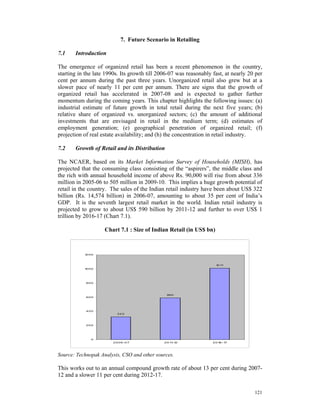
  • 103.
    Finally, consumers wereasked about their opinion about opening of more organized outlets. Among the shoppers at organized outlets, 73 per cent wanted more organized outlets whereas only 34 per cent of shoppers at unorganized outlets preferred to have more organized outlets. Among both shoppers, a quarter did not want any more organized outlets (Chart 5.10). Chart 5.10 : Attitude towards Opening of More Organized Outlets Organized Unorganized (N = 470) (N = 462) No Yes No No Opinion Opinion 34% 22% 40% 5% No Yes 26% 73% Source: DRS-ICRIER Retail Survey 2007 5.7 Consumer Survey at Unorganized Fruit and Vegetable Outlets The above consumer survey did not include consumers who are shopping at pure fruit and vegetable shops located in fixed market areas or the push-cart hawkers selling fruit and vegetables. Separate exit interviews were conducted of a total of 308 consumers shopping at these outlets in nine major cities (all ten cities included earlier minus Kochi). The findings of this survey are given below. 5.7.1 Income Levels of Consumers About 52 per cent of the sampled shoppers at fixed and push-cart fruit and vegetable vendors are the low-income households (monthly income up to Rs. 10,000). Within the sample, it is observed that about 37 per cent (114 numbers) of consumers shop also from organized retail outlets and the majority (63 per cent) shop exclusively from unorganized outlets. If we consider the part of shoppers who exclusively shop from these outlets, 66 per cent of them belong to the low-income group (Table 5.23). Among those who also shop from organized outlets for fruit and vegetables, the majority (71 per cent) belongs to the middle-income category (monthly household income from Rs. 10,000 to Rs. 1,00,000). Table 5.23: Average Monthly Household Income of Consumers at Unorganized Fruit & Vegetable Outlets (% Share) 88
  • 104.
    Consumers Buying ConsumersBuying only Income Group Total also from Organized from Unorganized (Rupees) (N = 308) Outlets (N = 114) Outlets (N = 194) Up to 10,000 52 28 66 10,001 – 20,000 32 43 25 20,001 – 50,000 14 24 8 50,001 – 1,00,000 1 4 1 1,00,000 -10,00,000 1 1 0 Source: DRS-ICRIER Retail Survey 2007 5.7.2 Attractiveness of Shopping from Fruit and Vegetable Vendors Proximity comes out clearly as the major advantage of the traditional fruit and vegetable shops and hawkers with their mean distance for consumers at just one km (Chart 5.11). A majority of consumers walk to these outlets (62 per cent), some travel by scooter or motor cycle (19 per cent). These results are similar to what was evident in the case of consumers shopping at neighbourhood kirana shops. Chart 5.11 : Distance and Mode of Transport to Unorganized Retail Vendors Distance to Vendors Mode of Transport 70 70 62 62 60 60 50 50 40 40 % % 30 28 30 19 20 20 8 8 10 10 7 2 3 1 0 0 Upto 0.5 0.6 to 1 1 to 2 Kms 2 to 4 Kms By Scooter/ Auto Bicycle By Car Bus Kms Kms Walk Bike Mean Distance = 1.04 km Besides closeness to residence, the survey has highlighted the other attractive features of shopping from these retail outlets as: possibility of bargaining, freshness of products, better quality, lower price, choice of varieties, credit availability, convenient timings, etc. 5.7.3 Share of Purchases, Organized vs Unorganized Outlets 89
  • 105.
    As indicated earlier,some of the consumers who shop at unorganized fruit and vegetable outlets also shop from organized outlets. On an average, these shoppers make 11 purchases in a month of which two are made from organized outlets. In the case of the shoppers who also shop from organized outlets (which constitute 37 per cent of the sample); they make 13 purchases a month of which four are from organized outlets. If we consider all those who shop exclusively from unorganized outlets, they shop 10 times a month (Table 5.24). As regards the level of spending in these outlets, the consumers on an average spend approximately Rs. 1,085 in a month on fruit and vegetables of which nearly one-fifth is spent at organized outlets. If one takes into account only those who shop also from organized outlets, they make over two-fifths of their fruit and vegetable purchases from organized outlets. Table 5.24: Share of Purchases of Consumers at Unorganized Fruit & Vegetable Outlets (% Share) Consumers Consumers Buying only Total Buying also from from (N = 308) Organized Outlets Unorganized (N = 114) Outlets (N = 194) A. Frequency of monthly purchases 1. Average number of 11 13 10 purchases 2. Purchases from organized 2 4 0 outlets 3. Purchases from 9 9 10 unorganized outlets B. Monthly expenditure 1. Average monthly 1085 1307 955 expenditure (Rs.) 2. % Spending at organized 18.7 41.8 0 outlets 3. % Spending at unorganized 81.3 58.2 100.0 outlets Source: DRS-ICRIER Retail Survey 2007 5.7.4 Preference for Additional Organized Outlets These consumers were also asked whether they would like the opening of additional organized outlets for fruit and vegetables, a third answered in the positive. About 29 per cent did not want any additional organized outlets and 38 per cent did not have any opinion (Chart 5.12). 90
  • 106.
    Chart 5.12 :Preference for Additional Organized Outlets for Fruit & Vegetables No Opinion Yes 38% 33% No 29% Source: DRS-ICRIER Retail Survey 2007. 5.8 Intermediary Survey Results The profile of the sampled 97 intermediaries by type and by commodity and product group is given in Table 5.25. Table 5.25: Profile of Sampled Intermediaries by Type and Commodity/ Product Group (in numbers) Packaged Cooking Veget Appare Rice Wheat Pulses Consumer Fruit Total* Oil -ables l Products Commission 0 1 0 1 0 3 3 0 8 agent Miller/trader 1 1 2 4 3 0 0 2 9 Regional 0 1 1 0 2 0 1 1 5 wholesaler C & F agent 0 0 0 0 0 0 0 1 1 Wholesaler 5 4 7 6 8 5 5 5 41 Local comm- 0 0 0 0 1 0 1 0 2 ission agent Company 4 2 3 3 10 0 0 2 19 stockist Distributor 1 2 2 2 1 1 0 0 7 Authorized 0 2 0 2 1 0 0 0 3 dealer Others 2 0 0 0 0 0 0 0 2 * In some cases, the same intermediary is engaged in more than one product category and hence the row total may add more than the last column total. Source: DRS-ICRIER Retail Survey 2007 5.8.1 Business Profile and Employment Intermediation is the core business for 96 per cent of the sampled intermediaries. A majority of them have been in business for a very long period: 36 per cent are in 91
  • 107.
    business for morethan 20 years and only 29 per cent are for less than 10 years. Thirty-two per cent of the intermediaries interviewed are company-appointed stockists or distributors. A bulk of the sampled intermediaries has good infrastructural backing: 71 per cent have warehouses and 80 per cent of them own those warehouses; 50 per cent of the intermediaries have their own transport and 77 per cent of them own them. 97 intermediaries employed 586 persons under them in 2006-07, almost the same number of 587 employees in 2005-06. 5.8.2 Business Turnover and Profit The sampled intermediaries reported an increase of turnover by 7.5 per cent in 2006- 07 over 2005-06 and an increase in profit by 15 per cent also over the same period. However, the sample indicated that there was: (i) some decline in turnover in fruit, vegetables and apparel; (ii) a decline in profit in vegetables and apparel; and (iii) stagnation in profit in pulses, packaged consumer products and fruit (Table 5.26). Table 5.26: Turnover and Profit by Product Category Average Turnover Average Profit Product/ (Rs. million) (Rs. million) Commodity 2005-06 2006-07 2005-06 2006-07 Cooking oil 21.3 22.0 1.4 1.5 Rice 15.0 16.6 2.7 3.4 Wheat 11.8 12.6 2.0 2.7 Pulses 11.6 12.7 1.0 1.0 Packaged consumer 8.1 11.2 0.7 0.7 products Fruit 8.1 7.9 0.5 0.5 Vegetables 4.1 3.6 0.3 0.2 Apparel 7.9 7.8 0.6 0.5 Total average 10.6 11.4 1.0 1.15 Source: DRS-ICRIER Retail Survey 2007 The sampled intermediaries were asked whether they have experienced an increase, decrease or constant turnover and profit in the past year compared to the previous year. In both turnover and profit, the number who reported increase had been 23-24 per cent which is lower than those who reported decrease (33 per cent for turnover and 38 per cent for profit). With both overall turnover and profit showing an increase, it implies that the smaller intermediaries have been affected. Interestingly, product- wise response indicated that a greater number of intermediaries had decreases than increases except in product categories of rice and wheat for both turnover and profit, and pulses for turnover (Table 5.27). 92
  • 108.
    Table 5.27: Changein Turnover and Profit by Product Category Turnover in 2006-07 Profit in 2006-07 Product/ over 2005-06 over 2005-06 Commodity Decreas Increase Same Increase Decrease Same e Edible Oil 23 54 23 23 54 23 Rice 31 23 46 38 31 31 Wheat 27 7 67 27 7 66 Pulses 28 17 56 28 28 44 Packaged consumer 31 31 38 31 34 35 products Fruit 33 44 23 33 56 11 Vegetables 0 50 50 0 50 50 Apparel 9 27 64 0 27 73 Overall 24 33 43 23 38 39 Note: The figures are in terms of percentage of respondents who are 97 in number Source: DRS-ICRIER Retail Survey 2007 Intermediaries were asked whether the emergence of organized retail had any adverse impact on them. Thirty seven per cent have admitted an adverse impact, while 59 per cent indicated no adverse impact. However a larger proportion of intermediaries dealing in commodities, such as rice (54 per cent), fruit (56 per cent), vegetables (50 per cent) and packaged consumer products (42 per cent) have indicated negative impact (Table 5.28). Table 5.28: Adverse Impact of Organized Retail on Intermediaries Don't Know/ Product/ Commodity Yes No Can't Say Cooking oil 31 62 8 Rice 54 46 0 Wheat 20 80 0 Pulses 22 67 11 Packaged consumer products 42 58 0 Fruit 56 44 0 Vegetables 50 50 0 Apparel 18 73 9 Overall 37 59 4 Note: The figures are in terms of percentage of respondents who are 97 in number. Source: DRS-ICRIER Retail Survey 2007 The intermediaries were also asked whether they adopted changes in their business strategy to meet the threat from organized retail. Only 19 per cent had admitted changes in business strategy during 2006-07. The measures included improved 93
  • 109.
    services to customers,reduction in margins, dealing in better quality products, reduction of expenditure, reduced staff, new product lines, and increased credit sales. While 37 per cent had indicated adverse impact of organized retail, a lower proportion of 31 per cent intermediaries reported possible adverse impact of organized retail in their future business (Chart 5.13). Even this 31 per cent plan different strategies to remain competitive to cope with the adverse effect of organized retailing, such as offering discounts, reducing margins, putting pressure on the government, shifting to better quality and branded products, increasing the variety of products, enhancing credit facility, etc. Chart 5.13 : Adverse Impact on Future Business Don't Know/ Can't Say, 20% Yes, 31% No, 49% Source: DRS-ICRIER Retail Survey 2007. With regard to future plans, 66 per cent are prepared to invest and expand business and remain competitive. About 89 per cent want to remain in the same business, while only 3 per cent are thinking of changing the business line. An overwhelming proportion – almost two-thirds want their children to get into intermediary business and only 22 per cent did not want their children to be in the same business (Chart 5.14). Chart 5.14 : Succession Plans 13 14 22 51 I w ould like m y children to get into m y business but w ill leave choice on them I w ould insist that m y children take up anything other than this business Don’t' Know /Can't Say I w ould definitely like m y children to continue w ith the sam e business 94
  • 110.
    6. Impact ofOrganized Retailing on Producers 6.1 Introduction This chapter analyses the impact of organized retail on farmers and manufacturers. The study of the impact of organized retail on farmers is undertaken in two parts. The first part explores the supply chain of agricultural produce. This has been done for cauliflower farmers in Hoskote, Bangalore.20 The second part is an exhaustive survey of 197 cauliflower farmers in the same area. These farmers rely on multiple channels to sell their produce and the results of this survey have been analysed to find out the comparative advantages for the farmer. The chapter also reports the findings from interviews of manufacturers. To understand the impact on manufacturers, interviews of the management were conducted for 12 important FMCG and apparel producers. In addition, 20 small producers were also interviewed separately to learn about how the small sector is impacted and is coping with the emergence of organized retail. 6.2 Plotting the Supply Chain Subsequent to the investigation in and around Bangalore (Hoskote), where interviews were conducted with all market players in the supply chain, seven unique supply chains were mapped (Chart 6.1). These chains trace the various paths adopted by the farmer to sell his produce. The only logistic service providers are the transporters. Most of the services required, such as loading, unloading, grading, sorting and packing, are undertaken either by the farmer or the intermediary or the retailer. These services are value additions for either the farmer or the retailer. The selling price of the cauliflower is given in rupees in the arrow box below each player’s name. All prices are applicable for one head of cauliflower. The cauliflower is graded by size and weight.21 Not all players buy all the grades of cauliflower. Hence prices of only those grades that the respective player sells to the buyer are given. The presence of those intermediaries (wholesalers) within the dotted arrow boxes is optional. On most occasions, these wholesalers are absent from the chain. These wholesalers are typically responsible for the produce reaching the small retailers such as the small stationery vegetable shops and the many push-cart vendors and hawkers. With the exception of the last two chains, (f) and (g)), which pertain only to organized retailers, in all the other chains, the retailer may be an organized or a traditional retailer. Most farmers utilize a mix of the chains listed above. A brief description of each chain is provided in Appendix 1. 20 The climate in Bangalore is suited to growing cauliflower throughout the year. The vegetable is transported from Bangalore to other states in India all through the year. Hoskote is one of the largest cauliflower producing areas in the country. 21 A cauliflower weighing over 750g is considered as “large” (L), while a “medium” (M) weighs between 400-750g and a head that weighs less than 400g is “small” (S). 95
  • 111.
    Chart 6.1: TheCauliflower Supply Chain Farmer Transporters CA* Wholesaler Retailer L: 8-9 (Service L: 8-9 L: 10-10.50 L: 15-16 a) M: 4-4.50 M: 11-12 provider) M: 4-4.50 M: 6-6.50 S: 2 S: 2 S: 3-4 S: 8-9 Farmer Wholesaler Retailer b) L: 7-7.50 L: 8.50-9.50 M: 5 M: 6-7 Farmer Wholesaler CA* Wholesaler Retailer L: 8-9 L: 10.50-11 L: 10.50-11 L: 12.50-13.50 L: 17-19 c) M: 4-4.50 M: 6.50-7 M: 8-8.50 M: 13-14 M: 6.50-7 S: 2 S: 3 S: 3 S: 6-7 S: 9-10.50 Farmer Shandi Consumer d) L: 9-10 M: 6-7 S: 5 Farmer Safal Market Wholesaler Retailer e) L: 9.50-10.50 (NDDB) L: 11.50-12 L: 15.50-16 M: 7.50-8 L: 9.50-10.50 M: 9.50-10 M: 12-13 M: 7.50-8 Farmer Group Leader/ Collection Supermarket f) Consolidator Centre L: 9-9.50 L: 10-10.50 L: 14-15 Farmer Collection Supermarket g) Centre L: 10-10.50 L: 14-15 *Commission Agent 6.2.1 Cost of Cultivation Investigation at the field level indicated that cultivation practices of farmers supplying to organized retailers and farmers not doing so were different. Therefore, interviews were held with both categories of farmers to understand farming practices and differences in the costs, if any, of cultivation. Table 6.1 provides the number of cauliflowers planted and harvested by the farmer differentiated as between the various channels to which he sells his produce. 96
  • 112.
    Table 6.1: SowingPatterns of Farmers Cauliflowers Planted and Harvested per Acre First Buyer or Market of the Farmer Number of Cauliflowers Mandi Wholesaler Shandi NDDB Consolidator Retailer I Total planted 18000 18000 18000 18000 15000 12000 Numbers II harvested (a) Large 6000 6000 6000 6000 10000 7000 (b) Medium 4000 4000 4000 4000 3000 2500 (c) Small 2000 2000 2000 2000 1000 1500 Total 12000 12000 12000 12000 14000 11000 III Wastage22 6000 6000 6000 6000 1000 1000 Source: Compiled from interviews conducted by ICRIER A farmer who does not supply to an organized retailer, directly or through a consolidator, seems to sow as many as 18,000 heads per acre of land. Farmers who do supply to organized retailers stated that sowing fewer heads ensures better quality produce. The farmers also stated that retailers too recommend the sowing of not more than 15,000 heads on an acre of land. Farmers who do not supply to organized retailers are aware that the crop yields bigger and better quality heads when fewer numbers are sown. However, they stated that greater numbers meant more flowers to sell. Interestingly, as per information collected and tabulated above, wastage is the highest among the farmers who are not associated with organized retailers. Farmers associated with organized retailers seem to not only have low wastage but also better quality yields. Table 6.2 puts down the costs of cultivation per acre of different farmers categorized by the first buyer or market that they sell to. The costs of cultivation for farmers supplying to the mandi, wholesaler, shandi or the NDDB market are the same. The differences arise in commissions payable and charges payable for transport and loading and/or offloading. All costs, except commission, are expressed in rupees. Commission is expressed in terms of percentage of the selling price. From Table 6.2 it is evident that the farmer, who supplies to the consolidator23 (who in turn supplies to the organized retailer), incurs the highest cost for crop care. However, that farmer also has a fair number of “large” cauliflowers and low wastage. The same is true of a farmer supplying to an organized retailer directly. The farmers 22 Wastage here refers to the number of cauliflower heads that are not fit to be sold or consumed. Some farmers however do choose to feed the same to cattle. 23 The consolidator is sometimes also referred to as the group leader. 97
  • 113.
    who are notassociated with organized retailers spend only half of what their counterparts do on crop care. It is perhaps because of this that the quality of the yield varies substantially. Table 6.2 Cost of Cultivation of Cauliflower per Acre Stages of the First Buyer or Market of the Farmer Supply Chain Mandi Wholesaler Shandi NDDB Consolidator Retailer Cost of Cultivation Land 10,600 10,600 10,600 10,600 10,100 13,400 preparation Crop care 7,100 7,100 7,100 7,100 20,750 12,325 Labour 2,800 2,800 2,800 2,800 9,000 4,600 Total 20,500 20,500 20,500 20,500 39,850 30,325 Logistics Loading/ 300 0 0 0 0 0 Offloading Transport 1000 0 200 500 0 0 Total 1,300 0 200 500 0 0 Commission 10% 0 0 0 0 0 Total Cost (excluding 21,800 20,500 20,700 21,000 39,850 30,325 commission) Source: Compiled from interviews conducted by ICRIER 6.2.2 Farmer’s Profit Table 6.3 computes farmer’s profit. Costs of production in column two of the table is inclusive of the 10 per cent commission that is payable by the farmer to the commission agent. A 10 per cent commission has been computed on the sale proceeds received by the farmer for a large, medium, and small head of cauliflower and the total of the three has been added to the cost of cultivation value given in Table 6.2. The costs of production of those farmers selling either directly or through the consolidator to the organized retailer in the value chain (f) and (g) also show an increase in the cost of production. These farmers typically sell their large heads to the organized retailer and use value chain (a) to sell the rest of their produce at the mandi. The cost of production of the farmers using value chains (f) and (g) is also inclusive of costs incurred for selling a part of their produce at the mandi. 98
  • 114.
    Table 6.3: Farmer’sProfit for Cauliflower Cost of Prices Received (in Rs.) Sales Proceed (in Rs.) Production per Total Sales Total Profit Per Value Acre Proceed (in Profit Head Chain (in Rs.) Large Medium Small Large Medium Small Rs.) (in Rs.) (in Rs.) (a) 29,400 9 4.5 2 54,000 18,000 4,000 76,000 46,600 3.88 (b) 20,500 9.5 7 1.5 57,000 28,000 3,000 88,000 67,500 5.62 (c) 20,500 11 7 3 66,000 28,000 6,000 1,00,000 79,500 6.62 (d) 20,700 10 7 5 60,000 28,000 10,000 98,000 77,300 6.44 (e) 21,000 10.5 8 1.5 63,000 32,000 3,000 98,000 77,000 6.41 (f) 40,350 9.5 8 1.5 95,000 24,000 1,500 1,20,500 80,150 5.72 (g) 30,825 10.5 8 1.5 73,500 20,000 2,250 95,750 64,925 5.90 Note: See Chart 6.1 for Supply Chains (a) to (g). Source: Compiled from interviews conducted by ICRIER 99
  • 115.
    It is evidentfrom the above table that the farmer using value chain (a) makes far less profit per flower than a farmer using any of the other chains. This is despite the fact that the costs of production of the farmer using the mandi is significantly lower than a farmer who produces cauliflower to supply to an organized retailer. The reason why a farmer using chain (c) is better off than all others is because the final price paid by the consumer in that chain is significantly higher than all other chains. The farmer is able to absorb some of this added margin. With the exception of this particular value chain, it is justified to infer from all other supply chains that the profit per flower decreases with the increase in the number of intermediaries in the supply chain. 6.2.3 Profit Margin for Each Player in the Supply Chain Chart 6.2 depicts the share of margin of each player. Shares have been computed as a proportion of the selling price to the consumer in each respective chain, for one large cauliflower. Chart 6.2: Share of Profit for Farmer, Intermediary and Retailer in the Consumer Price of Cauliflower g 19% 51% 30% f 19% 44% 7% 30% 11% 55% 9% 25% C os t of P roduction e 17% 83% F armer d 9% 38% 24% 29% c Intermediary 18% 61% 21% b R etailer 15% 41% 9% 34% a 0% 20% 40% 60% 80% 100% While here it is true that the farmer does receive a reasonable share of the selling price in all the chains, it is also true that he could receive more if there is less number of intermediaries. The value chains (b) and (e) are used scarcely,24 and value chain (d) has the farmer selling directly to the consumer. In value chain (f) and (g), where the farmer is linked to the organized retailer, he receives a relatively higher share of the selling price, compared to value chain (a) which is the traditional mandi channel. 6.3 Farmer Survey Results The details of the methodology for the farmer survey are provided in Annex 5. 24 Refer to Appendix 1 detailing the descriptions of each value chain for reasons as to why these chains are used scarcely. 100
  • 116.
    The analysis ofthe survey results has been organized as follows: 1. Farmer profiling a. Education b. Land ownership and irrigation facility c. Asset ownership d. Vehicle ownership e. Availing of credit 2. Quantitative advantages (profitability of the farmer) 3. Qualitative advantages 6.3.1 Farmer Grouping A two-way grouping of farmers was adopted. Group one was used for profiling the farmers and computing the costs of cultivation. Group two was used to compute the costs of transaction. Group one is a mutually exclusive grouping of farmers based on where the farmer sells the majority of his produce. Of the 197 farmers surveyed, 145 supply the majority of their produce to the mandi, 12 to the retailers’ collection centre, 8 through the consolidator to organized retail, two to the Safal mandi, 26 to the wholesaler, and the remaining four to local villagers, and the shandi at Bangalore city. Group two is a non-mutually exclusive grouping of farmers based on the choice of the marketing channels adopted by the farmer for the sale of their produce. Each group contained the number of farmers opting to sell their produce, irrespective of the share of the sale of produce, through the respective channel. Of the farmers that were surveyed 171 farmers sell some part of their produce to the commission agent at the mandi, 24 farmers sell some part to the organized retailer directly, 20 farmers sell a part of the share to the organized retailer through a consolidator, 65 farmers sell some share of their produce to the wholesaler, and 22 sell a part of their produce to local villagers and at the shandi. Interestingly, there were only two farmers amongst those surveyed that used the Safal mandi as a marketing channel to sell their produce. Table 6.4: Farmer Grouping Shandi Commission Collection Safal Consolidator Wholesaler & Local Total Agent Centre Mandi Villager For Profiling/ Cultivation Cost 145 12 8 2 26 4 197 calculation (Group One) For Calculation of Costs of Sales 171 24 20 2 65 22 304 transactions (Group Two) Source: DRS-ICRIER Retailer Survey 2007 101
  • 117.
    6.3.2 Farmer Profiling EducationLevel Table 6.5 shows the education level of the farmers opting for any marketing channel. The farmers selling to the collection centre directly or through a consolidator seem to have a relatively larger proportion with an education equivalent to the secondary or intermediate level. Table 6.5: Level of Education of Head of Farmer Households (%) Shandi Education Commission Collection Safal & Local Overall Consolidator Wholesaler level Agent Centre Mandi Villager No. of 197 145 12 8 2 26 4 Farmers No. of 100 100 100 100 100 100 100 Farmers (%) Illiterate 12 15 0 0 0 4 0 Literate but no formal 24 22 42 38 50 15 50 schooling Primary/ up to 5th 29 29 33 13 50 31 25 standard Secondary/ up to 10th 28 30 17 25 0 31 25 standard Intermediate/ up to 12th 6 3 8 25 0 12 0 standard Diploma 1 1 0 0 0 4 0 Some college, but 1 0 0 0 0 4 0 not graduate Source: DRS-ICRIER Retailer Survey 2007 Land Ownership and Irrigation It was found from the survey that farmers supplying to the organized outlets through a consolidator and farmers opting to sell to the Safal mandi own larger land holdings than those selling to other outlets (Table 6.6). Also, in the case of farmers supplying either directly or through the consolidator to the organized outlets, their land is well irrigated. 102
  • 118.
    Table 6.6: LandOwnership (Owned and Leased) Shandi& Land Commission Collection Safal Overall Consolidator Wholesaler Local Ownership Agent Centre Mandi Villager No. of 197 145 12 8 2 26 4 Farmers Size of operated 4.43 4.49 4.42 9.38 9.5 2.33 3.75 total land (in acres) Operated Land 0.07 0.1 0 0 0 0 0 leased-out (in acres) Operated Owned 4.36 4.39 4.42 9.38 9.5 2.31 3.75 Land (In acres) Operated Lease-In 0.07 0.1 0 0 0 0.02 0 Land % Area under 51 60 77 61 42 80 60 irrigation Source: DRS-ICRIER Retailer Survey 2007 Asset Ownership and Vehicle Ownership The farmers associated directly with organized retail also seem to be better endowed with assets. The most common form of irrigation in the area seems to be through borewell and a large part of the surveyed farmers own a tractor too (Chart 6.3). Chart 6.3 : Asset Ownership (in %) Chart 6.3: Asset Ownership (in % ) 120 100 Tractor 80 Pump set Value 60 Bore well Cart 40 Sprayer 20 0 er tre nt or di r ll le ag ra ge an at en sa ve ill lid A M C lV le O on so ho n al ca io on af si W ct Lo is S C le m i& ol om C nd C ha S First Buyer/Market 103
  • 119.
    A major featurein ownership of assets is that farmers associated directly or indirectly with organized retail own four-wheelers. It is through these four-wheelers that farmers transport their produce, while other farmers incur costs for transport hiring (Chart 6.4). Chart 6.4 : Vehicle Ownership (in %) Chart 6.4: Vehicle Ownership (in % ) 120 100 80 4 Wheeler 2 Wheeler Value 60 Phone Bicycle 40 20 0 Overall Commission Collection Consolidator Safal Mandi Wholesaler Shandi& Agent Centre Local Villager First Buyer/Market Credit Availability Farmers avail of two kinds of credit for: (a) personal needs, and (b) cultivation. A common perception has been that most farmers prefer to go to the village money lender or to the commission agent for loans. While this seems to be true in the case of personal loans, most farmers seem to approach the banks for agricultural operations (Table 6.7). Table 6.7: Sources of Finance for Cultivation Shandi& Agriculture Commission Collection Safal Overall Consolidator Wholesaler Local Loan Agent Centre Mandi Villager No. of farmers 197 145 12 8 2 26 4 % Availing of 42 45 75 0 0 19 100 credit Source of Loan (Yes, %) Bank 40 42 75 0 0 15 100 Village lender 1 2 0 0 0 0 0 Commission 0.5 1 0 0 0 0 0 agent Wholesaler 0.5 0 0 0 0 4 0 % Possessing Bank 62 61 92 93 100 46 100 Account 104
  • 120.
    Source: DRS-ICRIER RetailerSurvey 2007 Farmers who deal with organized retail directly avail themselves of most number of loans in general and also the most number of loans from the bank. Most of them have bank accounts. However, for personal loans, they do not approach banks but surprisingly, wholesalers (Table 6.8). Table 6.8: Sources of Finance for Personal Need Shandi& Commission Collection Safal Personal Loan Overall Consolidator Wholesaler Local Agent Centre Mandi Villager No. of farmers 197 145 12 8 2 26 4 % Availing 8 7 17 13 0 8 0 personal loans Sources of loan (yes, %) Commission 3 3.5 0 0 0 0 0 agent Wholesaler 5 3.5 17 13 0 8 0 Source: DRS-ICRIER Retailer Survey 2007 6.3.3 Quantitative Advantages While there are several factors that help the farmer in choosing a marketing channel, the primary driver is profitability. A farmer chooses a particular channel depending on the channel’s profitability. Organized retailers too claim that they aid the farmer in increasing the latter’s profitability by not only offering them a better price but also by saving on their transaction cost. Price Advantage Table 6.9 clearly indicates that the farmer associated with organized retail does get a better price for a large head of cauliflower. This is however not necessarily true in the case of medium and small heads. This is because the organized retailer usually buys only large heads. Table 6.9: Average Price Received by Farmer per Head of Cauliflower Commission Collection Safal Whole- Shandi at Local Consolidator Agent Centre Mandi saler Bangalore Villagers No. of farmers 171 24 20 2 65 7 15 Average price received per head Large 12.40 12.68 13.44 0 12.15 14.00 12.83 Medium 7.68 7.95 7.22 0 7.50 8.00 7.50 Small 3.45 3.37 3.33 0 3.25 3.00 3.00 Mixed 7.57 8.40 10.54 8.39 7.82 8.46 7.11 Source: DRS-ICRIER Retailer Survey 2007 105
  • 121.
    Profitability of theFarmer The survey attempted to capture the cost of production, cost of transaction, the realization, and thus the profitability of the farmer. Cost of Cultivation = Cost of Fertilizer + Cost of Pesticide + Cost of Labour Cost of Transaction = Cost of Loading + Cost of Transportation + Cost of Unloading Total Cost of Production = Cost of Cultivation + Cost of Transaction Table 6.10 provides the breakdown of average cost, price realization, and profit per head of cauliflower of a farmer supplying to each marketing channel. The data has been collated from the survey results.25 Table 6.10 : Profit per Head of Cauliflower (excluding commissions payable) Shandi & Commission Collection Safal Consolidator Wholesaler Local Agent Centre Mandi Villagers No. of 171 24 20 2 65 18 farmers Input cost 1.23 1.07 1.36 1.5 1.36 1.11 Labour cost 0.9 0.73 0.99 1.4 0.61 1.06 Cost of 2.13 1.8 2.35 2.9 1.97 2.17 cultivation Transaction 1.1 0.7 0.6 1 0.9 0.5 cost Total cost 3.23 2.5 2.95 3.9 2.87 2.67 Price 7.0 8.0 9.6 8.0 8.64 7.42 realization Profit 3.77 5.5 6.65 4.1 5.77 4.75 Source: DRS-ICRIER Retailer Survey 2007 The profitability is the lowest for the farmer selling to the commission agent at the mandi and the highest for the farmer selling to organized retail through the consolidator, despite his cost of production being the highest. The survey results seem to corroborate the value chain analysis. The farmers supplying to organized retail through the consolidator seem to invest a lot of money in crop care. However, as the value chain analysis also suggested, the quality of produce of these farmers is far better than their counterparts supplying to other channels. The transaction cost is the highest for the farmer selling to the mandi and one of the lowest for the farmers associated with organized retail. 25 The survey questionnaire contained detailed questions on costs of cultivation, shares of sale to each marketing channel, prices received and number of heads sold. Average cost, price realization, and profit were calculated based on the number of farmers using each marketing channel. 106
  • 122.
    Commissions Paid bythe Farmers The above computations do not include the commissions that are paid to commission agents by farmers. Table 6.11 below depicts the pattern of commission fees as revealed from the survey. Table 6.11: Commission Paid by Farmer Shandi at Commission Collection Consolidato Safal Whole- Local Bangalor Agent Centre r Mandi saler Villagers e No. of 171 24 20 2 65 7 15 farmers No. of 100 100 100 100 100 100 100 farmers (%) Commission % of Farmers paying Commission Fee in % 25% 0.6 0 0 0 0 0 0 16% 0.6 0 0 0 0 0 0 10% 92.4 0 0 0 0 0 0 8% 0.6 0 0 0 0 0 0 6% 1.2 0 0 0 0 0 0 5% 4.7 0 0 0 0 0 0 Other 1.2 0 0 0 0 0 0 Source: DRS-ICRIER Retailer Survey 2007 Table 6.10 clearly indicates that it is only the farmer supplying to the commission agent in the mandi who pays the commission. Ironically, the APMC Act states quite clearly that all commissions that are paid to the commission agent are to be collected from the buyer and not the seller (farmer).26 However, commission agents take their share from not the buyer but from the farmer, and the commission is fixed largely at 10 per cent. If one were to deduct commissions payable too from the realization of the farmer supplying to the mandi, his profit would drop even further making the mandi the most unprofitable channel. It was earlier seen that the price realization too is the highest for the farmers associated with organized retail. The above results clearly illustrate that the farmer associated with organized retail stands to gain considerably. 6.3.4 Qualitative Advantages Share of Different Marketing Channels Apart from the two farmers who sell their entire produce at the Safal mandi, it is the farmers selling to the commission agent who sells the majority of their produce through one channel (Table 6.12). The share that the farmer is unable to sell at the mandi is usually sold to local villagers. Since organized retailers buy only large heads of the cauliflower, farmers selling to those channels sell not more than 50 per cent of their produce. The rest is usually sent either to the mandi or sold to wholesalers or 26 As told to the authors by an APMC official at the Kalashapalayam vegetable mandi at Bangalore city. 107
  • 123.
    local villagers. Onemajor advantage that a farmer who sells to the mandi has over the farmer who sells to the organized retailer appears to be that the former’s entire produce, irrespective of the grade, can be sold in the mandi. Table 6.12: Share of Produce Sold to Different Marketing Channels Commission Collection Safal Whole- Shandi at Local Consolidator Agent Centre Mandi saler Bangalore Villagers No. of 171 24 20 2 65 7 15 farmers Average % share of output sold 83 50 34 100 42 26 26 to that channel Source: DRS-ICRIER Retailer Survey 2007 Rejection A related point that should be analysed is the rejection rate of produce. The percentage of farmers reporting rejection is lower for the mandi channel in comparison with the channel of the consolidator supplying to the organized retailer or the wholesaler (Table 6.13). Surprisingly, no farmer reported any rejection at the collection centre. In the case of farmers subject to rejection, the portion of rejection of the produce is insignificantly low for all channels. Table 6.13: Share of Rejection Commission Collection Safal Whole Shandi at Local Consolidator Agent Centre Mandi saler Bangalore Villagers No. of farmers 171 24 20 2 65 7 15 % Reporting 2.3 0 5 0 8 0 0 rejection Rejection rate 0.09 0 0.04 0 0.02 0 0 (%) If yes, Reasons for Rejection? Too small 25 0 0 0 0 0 0 More than they 75 0 0 0 0 0 0 required Discolouration due to exposure 0 0 100 0 20 0 0 to the sun Insect damage 0 0 0 0 80 0 0 Source: DRS-ICRIER Retailer Survey 2007 108
  • 124.
    The reason forrejection varies; while in other marketing channels, the rejection is due to low quality, the primary reason for rejection at the mandi is that the supply was greater than the demand. Special Cultivation Practices As stated already, cauliflower is very sensitive to climate. Excess exposure to sunlight causes discolouration in the cauliflower. In order to prevent discolouration, farmers either tie up leaves or cover the heads of the cauliflower with newspaper to prevent exposure to sunlight. Most farmers adopt this practice. Table 6.14 shows that farmers selling to the mandi follow this practice more than the farmers supplying to organized retailers. Table 6.14: Special Cultivation Practices Shandi & Commission Collection Safal Overall Consolidator Wholesaler Local Agent Centre Mandi Villager No. of 197 145 12 8 2 26 4 farmers Cover head of 53 55 42 38 100 46 50 Cauliflower (%) At instruction from Whom? (Yes %) Commission 40 48 20 0 0 17 50 Agent Wholesaler 15 13 40 67 0 8 50 Supermarket 4 5 0 0 0 0 0 Agent Consolidator 2 2 0 0 0 0 0 Yourself 36 29 40 33 100 75 0 Other 3 4 0 0 0 0 0 Source: DRS-ICRIER Retailer Survey 2007 Interviews with farmers revealed that those associated with organized retail are not forced to adopt this practice as they are able to afford hybrid seeds which produce good quality heads. However, some of them do cover the cauliflower heads in order to protect the quality of those heads that are sold through alternate channels. Grading Contrary to popular belief, this survey reveals that commission agents at the mandi do offer a premium price for better quality produce. Most farmers supplying to the mandi, at their own initiative, grade their cauliflowers before sending them to the mandi (Table 6.15). 109
  • 125.
    Table 6.15 :Grading of Cauliflower Commission Collection Safal Whole Shandi at Local Consolidator Agent Centre Mandi saler Bangalore Villagers No. of farmers 171 24 20 2 65 7 15 No. of farmers 100 100 100 100 100 100 100 (%) % Grading 63 79 30 0 48 43 60 cauliflower If yes, whose decision was it? (in %) Buyer asked for 46 68 83 0 52 0 0 it It was farmers’ 54 32 17 0 48 100 100 initiative % of farmers packing each 61 95 100 0 74 42 40 grade separately Source: DRS-ICRIER Retailer Survey 2007 Farmers selling to organized retail too grade their produce, but this is done at the request of the retailer or consolidator. The first level of sorting of cauliflowers occurs at the farm at the hands of the farmer. 6.3.5 Conclusion Direct procurement of produce from the farmer by organized retail is a recent phenomenon. Organized retailers maintain that this helps in being able to procure quality produce and offer fresher produce to the consumer. They also state that by procuring directly from the farmer, they are able to bypass intermediaries, thereby decreasing transaction costs. This results in not only reducing prices for the consumer considerably but also increasing the farmers’ profitability. While whatever has been mentioned above does hold true for the farmer, the biggest advantage that the farmer has is the option of another marketing channel for his produce. For many years, the farmer’s only choice of marketing channel has been the mandi, which lacks transparency. The farmer also does not have any bargaining power. Business is based only on trust and the farmer is under constant threat of being deceived by the commission agent. While the survey results showed that price and volume of sale is usually decided in advance through a verbal contract, it also showed that there are a number of farmers who receive a price lower than what was promised. Even though the APMC Act clearly states that commissions are not to be taken from the farmer, in actual fact this does not seem to be the case. The farmers cannot risk exposing the commission agents as he does not have an alternative channel through which he could sell his produce. The Safal mandi was expected to be an alternative channel through which the farmer could sell his produce. Unfortunately the Safal mandi is boycotted by most farmers and wholesalers, which leaves the farmer with the city mandi once again as the only option. Hence the entry of organized retail provides the farmer the option to sell his 110
  • 126.
    produce through anotherchannel. With many organized retailers beginning to procure produce directly, the farmer’s selling options also increases. When the farmer has the option of selling through any of the channels, it increases his bargaining power. While it is important for farmers to have multiple channels to choose from, it is equally important to have both private and government players. The survey results also indicated that there are some farmers, who sold to organized retail, also reported having received a price lower than what was promised. The mode of business with organized retailers is through verbal contracts and is again based on trust. The solution therefore does not lie in doing away with the mandi completely. It lies in making the mandi more efficient and in enforcing laws that are already in place to protect the farmer’s interests. The NDDB Safal mandi facility in Bangalore has excellent infrastructure but is underutilized. The Safal mandi model can be adopted for all APMC mandis. This Report recommends the modernization of the APMC mandis by providing better infrastructure in terms of closed spaces for trading, better access roads and in also devising a suitable and effective waste disposal mechanism to improve the hygiene in and around the mandi. Allowing only private players to exist is at the risk of collusion between all organized retailers. Such a situation again leaves the farmer with no alternative choice or bargaining power. However, if private players and the mandi were to co-exist, the farmer stands no risk of deceit. This will ensure transparency and efficiency. And most importantly, the farmer will get an enhanced profit. 6.4 Manufacturers: Interview Report One of the key stakeholders likely to be impacted by the growth in the size and strength of organized retail are manufacturers and brand owners in the sectors under study – FMCG and apparel. It is recognized that, while, organized retail will offer many opportunities to brand owners and manufacturers, it will also pose several challenges that these companies will need to gear up for. This study is an attempt to understand how these companies view the advent of organized retail and its likely impact on their businesses. This section attempts to assess: (i) how large manufacturers or brand owners view the likely impact – either positive or negative - of modern retail on their business; (ii) how they are gearing up to leverage the opportunities that organized retail will throw up; and (iii) efforts they are making to retain countervailing power as organized retail becomes a more significant force in India. 6.4.1 Methodology This survey was conducted by Technopak Advisers Pvt. Ltd. through one-to-one in- depth interviews of large manufacturers using a semi-structured open-ended questionnaire. A total of 12 companies operating in the FMCG and apparel categories participated (Table 6.16). The companies interviewed were selected deliberately to represent the leading companies with a significant presence in the FMCG and apparel categories in India. 111
  • 127.
    Table 6.16 :Participating Companies for Interview FMCG Apparel (Textile & Clothing) HUL Raymond ITC Foods Madura Garments Pepsi Foods Levi’s Cargill India United Colors of Benetton Glaxo Smith Kline FabIndia United Spirits Henkel In each company, the interview was done with the CEO, the Category/Business Head or the Head of Modern Trade/Retail. 6.4.2 Key Findings 1. At a macro level, manufacturers felt that the impact of modern retail will be positive. According to them, the advent of organized retail in India was both welcome and inevitable for the Indian economy. In their opinion, the benefits that organized retail would bring by far outweigh the negative effects of inadequate retail services in a country like India. Some of the reasons cited for this positive impact were: • Benefits for consumers: Organized retail will offer consumers several benefits, such as wider product choice more in line with consumer needs, lower prices, better shopping experience because of improved store ambience and increased browseability, enhanced service, and quality levels. • Greater job creation: Organized retail will create employment at several levels. The most significant increase will be in front-end jobs for retail staff, where the contribution of organized retail will be not only in the greater number of the people employed but also in making jobs that were otherwise considered “menial”, more dignified, thereby, giving even those without higher educational qualifications a decent livelihood. • Efficient supply chain: The robust sourcing and distribution network likely to be set in place by modern trade would result in a more efficient supply chain management -- reduced lead times, fewer stock outs, reduced wastage, and consistent product quality. • Survival of traditional retail: Manufacturers believe that both small and large retailers would continue to co-exist in India. Small retailers account for the bulk of retail sales today and will remain a significant force in the future since growing consumption will itself warrant the growth of both organized 112
  • 128.
    and traditional retail.Traditional retailers will also innovate, upgrade their stores and enhance value-added services to retain and strengthen relationships with their customers. 2. The likely direct impact on the business of manufacturers, however, will not be entirely positive. The response of manufacturers interviewed to the likely impact of growth of organized retail on their own businesses was, on the whole, more guarded and less positive. The benefits that organized retail would bring in terms of creating higher demand for their brands and greater efficiency in the distribution system would need to be weighed against the pressures on prices, margins, and the threat of competition from private label brands. 3. Manufacturers anticipate several benefits. • Organized retail will fuel growth and build efficiencies. Manufacturers felt that the advent of modern retail will stimulate their growth as well. Initially, this will be because of increased demand created by organized retailers in order to fill retail shelf space, and, subsequently, because of increased consumption created by the consumers’ exposures to categories and brands at modern retail formats. They also felt that the need to service large buyers demanding lower prices and greater efficiencies will force large manufacturers to invest in people, processes, and technology to streamline their own production and distribution operations. • Organized retail will aid development of new FMCG categories. Manufacturers anticipate that organized retail will help in the development of new product categories – particularly higher priced categories, categories that have a high degree of consumer involvement and those which benefit from consumer touch and feel – like personal care products and eatables. Further, since modern retail facilitates faster customer feedback, they will be able to effect improvements in products and brands and “go to market” faster. • Organized retail’s sourcing and distribution network will benefit manufacturers. Manufacturers felt that, currently, most of organized retail is operating through the traditional supply chain with its multiplicity of intermediaries. As organized retail grows and large retailers have their distribution centres (DC) and IT infrastructure in place, manufacturers will be able to supply directly to these retailers. This would help reduce transaction costs on logistics, packaging, credit, commissions, etc. Elimination of intermediaries would also bring in more transparency in the flow of operations. Chart 6.5 and Chart 6.6 illustrate the traditional (current) supply chain and the new supply chain that could emerge in the FMCG and apparel categories. 113
  • 129.
    Chart 6.5 :Illustrative Supply Chain for Shampoos/Detergents A. Current Supply Chain with more Intermediaries 0.5-2% Commission for the C&F Company C&F Distributor 3-4 % Margin for the Back-end Distributors 5-7 % Margin for the Distributor Wholesaler 2-3 % Margin for the wholesaler Front-end Consumer Retailer 10-15% Margin For the Retailer B. Emerging Supply Chain Manufacturer C&F Agent 0.5-2% Commission Back-end for the C&F agent 15-20% Margin For the Retailer Consumers Retailer Front-end 114
  • 130.
    Chart 6.6 :Illustrative Supply Chain for Apparel A. Current Supply Chain with more Intermediaries Company / Manufacturer Distributor Buying 5% Margin for Distributors Back-end Agent 5% commission for Buying agent Franchisees Company owned - 30% Margin Multi brand outlets/ large organized for Franchisees retailers outlets 30-32% Margin for company owned 35% Margin for outlets/large retailers Consumer Multi brand outlets Front-end retailers B. Emerging Supply Chain Company/ Manufacturer Back-end 38-40% Retailers Margin - For Retailers Consumers Front-end Manufacturers felt that, in the future, modern retailers might have to be given higher margins than traditional retailers but this would be compensated by the larger volumes, and the more efficient, shorter supply chain. However, they do not foresee that the traditional supply chain will ever die out or be completely replaced for a long time to come. Since traditional retail will co-exist with modern retail, so will traditional and modern supply chains. 4. But manufacturers anticipate several threats. • The price pressure threat. Manufacturers anticipate that the growth of organized retail will put pressure on their prices as large retailers are already demanding lower prices in return for larger volumes. Manufacturers also face 115
  • 131.
    the additional issueof delayed payments vis-à-vis large retailers that impacts their profitability. Manufacturers felt that some of these price/payment pressures arise from the underlying cost structure of large retailers who are facing increase in costs in the entire value chain because of high real estate prices and increased employee cost. • The private label threat. Manufacturers anticipate that large retailers will expend efforts on building their own store brands and will favour those brands in building in-store visibility and allocation of shelf space. This will become more of a threat as the point of consumer decision-making shifts from the home to the shop floor as consumers build a preference for self-service formats. The threat is somewhat mitigated in the short term by their belief that modern retailers will tend to launch private labels more in the staples category, where the presence of brands is currently low. Manufacturers also felt that they have constantly battled strong regional/local brands successfully and that private labels are another form of such competition. Also, modern retailers will first face the arduous task of building strong, differentiated store brands before developing and building their private label brands. The multiplicity of categories in which private labels will need to be built also makes this task harder for the retailers. 5. Manufacturers are gearing up to counter these threats in various ways. • Reinforcing/building brand strength to help maintain countervailing power. Manufacturers recognize that their most powerful counter to price and private label threats is a strong brand. Therefore they felt that their brands have strong consumer preference which would help them counter competition from private label brands and give them more bargaining power since these brands also generate footfalls for modern retailers. They, therefore, will continue to focus on building strong brands (which they see as their area of competence), allowing them to negotiate terms that are mutually beneficial, collabourative, and lead to a “win-win” situation for both parties concerned. • Increasing manufacturer’s own retail presence. Manufacturers are also moving towards increasing their own retail presence in order to compete with modern retailers. Apparel manufacturers, for example, are opening exclusive showrooms to give their brands more visibility and to strengthen their position in this competitive scenario. • Helping small retailers. Most of the FMCG companies interviewed stated that their companies were ready to assist small retailers by “adopting” them and helping them upgrade service levels, systems, and operations. They anticipate that, in the next few years, the number of such “adopted” stores would almost double. They believe that if small retailers also come forward and unite, they can more effectively counter the competition posed by modern retail. Manufacturers stated that they are encouraging kiranas to consolidate buying of products from manufacturing companies as it would help small retailers build economies and efficiencies in their scale of operations. Many retailers are already coming forward to form these associations. 116
  • 132.
    They think thatkiranas need to learn several aspects of retailing – like store promotions - from organized retailers and that they are ready to support kiranas by developing promotional offers customized to their set of customers. • Constituting dedicated teams internally to deal with modern retailers. Manufacturers are creating dedicated teams of accounts and category managers to deal with modern retailers. At the central/regional level they are recruiting teams to manage relationships with modern retailers as well as plan for new accounts. At the front end, dedicated teams are being constituted to work on developing store promotions through modern retailers. • Challenging times ahead for modern retailers too. Large manufacturers felt that high rentals arising out of a shortage of real estate will be a challenge for modern retailers and will affect their competitiveness vis-à-vis small retailers. Manufacturers were of the opinion that, while modern retail is an exciting phenomenon for small town consumers, in larger cities consumers want convenience and so being present in the right location are even more critical in these cities. Finally, manufacturers strongly believe that retailing is a local business and the large retailers will have to understand the local consumer’s tastes and preferences and conduct extensive research to build their knowledge of local markets and consumers. 6.4.3 Conclusion At a macro level, the overall picture that emerges from interviews with large manufacturers is largely positive regarding the likely impact of organized retail in India. Manufacturers believe that organized retail would benefit society at large, more so the end consumers -- in terms of better product choices and price – and farmers because of higher and more stable price realization for their produce. More employment opportunities will be generated. Present systems, IT and processes will improve because of investments in infrastructure that are likely to be made by organized retailers. The robust sourcing and distribution network of large retailers would certainly help make the supply chain more efficient. Manufacturers, however, are more guarded in their assessment of the likely impact of organized retail on their own businesses. They anticipate that they will be subject to price and competitive pressures as organized retail grows in importance. They are gearing up to counter these pressures by strengthening their own brands, enhancing their retail presence and collabourating with traditional retailers. They believe, however, that both modern and traditional retailers will co-exist in India for some time to come, as both of them have their own competitive advantages. The kirana has a low- cost structure, convenient location, and customer intimacy. Modern retail offers product width and depth and a better shopping experience. With the Indian economy currently growing at 8-9 per cent annually, rising consumption and the low per capita availability of retail space in India, manufacturers 117
  • 133.
    believe that thereis room for both modern and traditional retail in India for several generations to come. 6.5 Small Manufacturers: Interview Report In order to understand the impact of large organized retail on small manufacturers, a survey was carried out among small-scale manufacturers in New Delhi. For this, small manufacturers of FMCG, (packaged food products, toiletries, cosmetics, etc.) and apparel were contacted and interviews held with the owners, directors, or senior managers of those companies. ICRIER engaged Development and Research Services (DRS) for carrying out these interviews. In total 20 manufacturers were interviewed of which 19 were FMCG producers and one apparel manufacturer. The list of small manufacturers and the checklist of questions asked are given in Appendices 2 and 3, respectively. 6.5.1 Respondent Profile Of the 20 respondents, 14 called themselves small-scale manufacturers, while six referred to themselves as medium-scale manufacturers. Only three of them have all- India coverage, while the remaining companies have regional operations. A few of them were exporting their products to some countries. While most of these manufacturers have been operating for 10 - 20 years, there was one who has been operating for as long as 36 years. The annual turnover of these participants varied from Rs. one million to as high as Rs. 100 million. Of these, six participants have an annual turnover between Rs. 10 - 20 million who were involved in manufacturing food products (cereals, pulses, spices, flour, etc.), cosmetics, toothpaste, shampoo, etc. Three have an annual turnover of Rs.1 - 1.5 million, while two have between Rs. 4-6 million. There has been one participant who did not specify his turnover. 6.5.2 Interview Results When asked about the size of the business that the manufacturers are planning to have in the next five years, 18 responded that they will surely expand and grow in the next five years. Most of them have plans to double their turnover. For this, they are planning to increase their production and supply by increasing manpower and machinery. In addition, they are willing to improve the product quality. Some of the participants are also considering export options for which they have already begun taking necessary action. Two participants, one dealing in food products and the other in health products (soya milk, soya food, soya meal, etc.) even had plans to supply their products to big organized outlets. One of them commented: “My size of business will increase by two or three times, as I have planned to supply to big organized outlets. Our main focus is now on big organized outlets.” However, there were two respondents who felt that in the next five years their business would go down drastically. This would be due to the advent of more MNCs and organized retail outlets on one hand, and their lack of capability in advertising their products for increasing sale, on the other hand. A comment made by a participant has been: 118
  • 134.
    “I cannot thinkof supplying my products to organized outlets and my product demand and my turnover is going down. My sale has reduced a lot, so I do not think that my business is going to survive after five years.” Participants were asked to give their opinion with respect to large players entering modern retail and whether they foresee any changes in their business with respect to large players entering modern retail. It was found that 12 participants were not in favour of large players entering into modern retail and said that the organized retailers are their competitors as they may carry products of large brands / manufacturers or their own private labels and this may affect their business prospects. The remaining eight respondents however felt that the advent of organized retail was good as this would help them increase their sales. These participants were ready to work with them. According to one: “They are good players in the market and we are also planning to do business with them.” Eight out of the 20 participants did not foresee any changes in their business operations due to large players entering modern retail. But there were 12 participants who did foresee changes in their business. Out of these 12, two thought that there would be a huge reduction in their business and they may even have to shut down their operations very soon. Ten participants felt that though organized retailers are their competitors, their business would increase, as already they had started taking actions like providing better quality service to their clients. They are focusing on improving the brand name, quality, variety along with making products available at reasonable and affordable prices. A few were even thinking of new marketing strategies to advertise their products and get a better hold over the market. On enquiring whether there was any change in their bargaining power, 17 participants said that till now they have not experienced any change. One participant commented: “There has been no change in the bargaining power as we have good customers and suppliers and have a healthy relation with them.” When asked about the present payment terms and conditions, it was found that presently all except one participant had both cash and credit based transactions. But in case of credit-based transaction, the manufacturers provide the retailers with 30 days payment time, while some extended credit up to 60 days. Some even charged an interest of 2-3.5 per cent per month after the expiry of 10-20 days of grace period from their clients which mostly include small unorganized retailers. None of the participants reported any change in the payment terms in the last couple of years. Ten participants had more of credit-based clients while only eight had cash-based clients. There were two who said that they had provided both cash and credit services but did not say which one was more. In the words of a respondent: “The credit sale right now is 60 per cent where the time provided is 20-30 days and cash sale is 40 per cent. There has been no change in these terms and conditions.” 119
  • 135.
    Nine out of20 participants said that there is a competition threat to them due to the private label brands of large organized retailers, but till so far, a very small effect of it has been noticed. One of the manufacturers commented: “Competition threat is very much there, not just from organized retailers but also from large manufacturers and MNCs. Earlier my products were famous with children whereas now children ask for brands like Lays, Kurkure, etc. This is a threat and it’s killing my business.” However 11 participants responded that they did not consider entry of private label brands of large organized retailers a threat as they had their own set of customers who are mostly unorganized retailers. Moreover, as a result of their focus on quality, people trusted their products. Quality was something they would never compromise with, and so they would never face any problem in the future. A respondent commented: “Though there is competition, our prompt service and dealing enables us to maintain the trust of our customers.” Sixteen out of 20 respondents are thinking of future expansion of their business to meet the growing demands of large retailers. For doing this, they are planning to increase their production with new and improved machines, more manpower and spread their customer base beyond their region. They are also working upon improving their service and quality. Two participants are also planning to sell their products to big organized outlets in the near future. A participant commented: “Right now our plan is to supply our products to all the big organized outlets. We have started in Delhi with Big Bazaar, and will surely increase this to all over India.” When asked if their company was facing any price pressure from large retailers, 13 out of 20 participants said that they did not face it while the remaining seven said that they faced some pressure. Eighteen participants said that their company was facing no problems in terms of sourcing and distribution with the advent of large players in modern retail. Among the surveyed participants, 13 had around 10-50 employees in their manufacturing units in back end and production. All except two were planning to increase the number of their employees and some even planned to double considering the increase in demand because of growth of organized retail. There were two respondents who said that they would have to reduce their manpower employment to a large extent as the demands of their products were going down. In fact, they even said that they would have to shut down their business very soon. 120
  • 136.
    7. Future Scenarioin Retailing 7.1 Introduction The emergence of organized retail has been a recent phenomenon in the country, starting in the late 1990s. Its growth till 2006-07 was reasonably fast, at nearly 20 per cent per annum during the past three years. Unorganized retail also grew but at a slower pace of nearly 11 per cent per annum. There are signs that the growth of organized retail has accelerated in 2007-08 and is expected to gather further momentum during the coming years. This chapter highlights the following issues: (a) industrial estimate of future growth in total retail during the next five years; (b) relative share of organized vs. unorganized sectors; (c) the amount of additional investments that are envisaged in retail in the medium term; (d) estimates of employment generation; (e) geographical penetration of organized retail; (f) projection of real estate availability; and (h) the concentration in retail industry. 7.2 Growth of Retail and its Distribution The NCAER, based on its Market Information Survey of Households (MISH), has projected that the consuming class consisting of the “aspirers”, the middle class and the rich with annual household income of above Rs. 90,000 will rise from about 336 million in 2005-06 to 505 million in 2009-10. This implies a huge growth potential of retail in the country. The sales of the Indian retail industry have been about US$ 322 billion (Rs. 14,574 billion) in 2006-07, amounting to about 35 per cent of India’s GDP. It is the seventh largest retail market in the world. Indian retail industry is projected to grow to about US$ 590 billion by 2011-12 and further to over US$ 1 trillion by 2016-17 (Chart 7.1). Chart 7.1 : Size of Indian Retail (in US$ bn) Char t 7.1: Size of Indian Re tail 1 00 2 1 1 0 1 1 00 0 800 59 0 600 400 322 200 0 2 0 0 6 -0 7 2 0 1 -1 1 2 2 0 1 -1 6 7 Source: Technopak Analysis, CSO and other sources. This works out to an annual compound growth rate of about 13 per cent during 2007- 12 and a slower 11 per cent during 2012-17. 121
  • 137.
    In India, organizedretail contributed roughly 4 per cent of the total Indian retail in 2006-07, which is very small even compared with most of the emerging market economies. However, during the coming years, it is projected to grow at a compound rate of about 45-50 per cent per annum and is estimated to contribute 16 per cent to the total Indian retail by 2011-12 (Chart 7.2). Chart 7.2: Projection of the Share of Organized Retail 2006-07 2011-12 Organized, 4% Organized, 16% Unorganized, Unorganized, 96% 84% Total Retail: US$ 322 billion Total Retail: US$ 590 billion Source: Technopak Analysis. Interestingly, this huge growth in organized retail does not involve a decline in the business of unorganized retail; the sales of the unorganized sector is envisaged to grow by about 10 per cent per annum, from US$ 308.8 billion in 2006-07 to US$ 495.6 billion in 2011-12. 7.3 The Retail Real Estate Scenario The real estate sector in India has historically been unorganized and dominated by opportunistic development rather than any planned creation of quality space. There were various factors that impeded organized development, such as: (i) absence of a centralized title registry providing title guarantee; (ii) lack of uniformity in local laws and their application; (ii) non-availability of bank financing; (iii) high interest rates and transfer taxes; and (iv) lack of transparency in transaction values. Also, there were very few takers of quality space, as retail was also dominated by unorganized players. The unorganized players prefer to operate from neighbourhood convenience stores. Whilst the Indian real estate market still lacks transparency and liquidity compared to more mature real estate markets, there are various factors which could expedite the process of professionalism of the industry. Some of these factors are: • Changing profile of the business consumers, like large multinational companies (MNCs) and professional Indian corporates, who would prefer to deal with companies with proper credentials; • Listing of many developers on stock exchanges, both in India and abroad, and also raising funds through global institutions; 122
  • 138.
    Increasing transactions facilitated through professional banks, who would once again verify all the records before releasing any funds. The nature of demand is also changing with the entry of large corporates into organized retailing. These large corporates cater to higher consumer aspirations resulting from larger disposable incomes, increased globalization, and greater awareness levels. The organized retail real estate sector has grown from a miniscule 0.9 million sq. ft. in 1999 to 28 million sq. ft. in 2006. The growth till now has been at a scorching pace of over 60 per cent per annum for the last seven years (though on a smaller base) and is expected to grow at least at 50 per cent per annum in the next 4-5 years. The last financial year witnessed a number of retail centric projects. 7.4 Organized Retail Investment Until a couple of years ago, the Indian organized retail market was either dominated by the apparel brands or regional retail chains. However, the scenario has changed dramatically. The sector has attracted not only the large Indian corporates but also received the attention of large global players. As per Technopak Advisers Pvt. Ltd. estimates, investments amounting to approximately US$ 35 billion are being planned for the next five years or so (Table 7.1). Of this, about 70 per cent is expected to come from top seven players including Reliance Industries, Aditya Birla Group, Bharti-Wal-Mart, Future Group and others. Also, it is estimated that about 40 per cent of the total investments will be contributed by foreign players including Wal-Mart, Metro, Auchan, Tesco and many others, signifying the importance that the international community is attaching to the Indian retail opportunity. In short, India is attempting to do in 10 years what took 25–30 years in other major markets in the world and shall bypass many stages of “evolution” of modern retail. India is likely to see the emergence of several “innovative” India-specific retail business models and retail formats during the coming years. Table 7.1: Investment Plans of Major Retailers in the Next 5-7 Years Retailer Estimated Investment (US$ billion) R1 6.0+ R2 4.0+ R3 2.5+ R4 2.0+ R5 2.0+ R6 2.0+ R7 2.0+ R8 1.5+ R9 – R50 13.0+ Total 35+ Note: Retailers’ identities are not revealed for maintaining anonymity. Source: Technopak Analysis 123
  • 139.
    7.5 Share of Investments by City Of the US$ 35 billion investment being planned over next 5-7 years, almost all the investment (i.e. 93 per cent) is slated for the urban market. Though the investment is expected to be across the spectrum of all types of cities, a large proportion (more than 60 per cent) is slated for the top 25 cities falling in category A-type or above . AAA cities will include the markets of NCR Delhi, Mumbai, and Kolkata, while AA cities will include the metros including Bangalore, Chennai, Hyderabad, Pune, and Ahmedabad. A typical A-class city will include cities like Surat, Nagpur, Indore, Vadodara, etc., while B+ cities will be represented by Nashik, Rajkot, Agra, Jallandhar, etc. Kota, Bhubaneswar, Bilaspur will be a B-class cities, while Sonepat, Alwar, Tumkur, etc will categorized as C-type and D- type cities. Chart 7.3: Investment Estimates by City Category (%) C D B 2% 7% AAA 6% 30% B+ 23% AA A 17% 15% Source: Technopak Analysis. Urban investments are slated to be across all modern formats although the majority share will be taken by supermarkets and hypermarkets. The share of hypermarkets is expected to increase in the lower-tier cities, as a single hypermarket would be able to cater to a significant proportion of the demand in smaller cities. Chart 7.4: Investment Estimates by Format (%) Other Formats* (includes apparel, footwear, watches, furniture & furnishing, toys etc.), 23% Supermarket, 34% Warehouse , 9% Department Store , 2% Hypermarket, 32% Source: Technopak Analysis. 124
  • 140.
    7.6 Expected Share of Top Players in Indian Retail The top 50 players are geared to take about 39 per cent share of total retail in the top 150 cities. These top players will dominate the market in Indian retail. This high concentration in the retail market is in tune with international trends. For example, in the US, the top five retailers, such as Wal-Mart, Kroger, Albertsons, Safeway, and Ahold, account for about 40 per cent of the US grocery market. Table 7.2: Retail Market for 150 Cities in 2011-12 Market Share Total market (Top 150 cities) 100% Share of top 7 players 31% Share of next 43 8% Share of top 50 players 39% Source: Technopak Analysis 7.7 Retail Space Break-up by Category The total new retail space required to facilitate the proposed investment will be of around 487 million sq. ft. across all retail formats. Technopak Advisers Pvt. Ltd. estimate that 50 per cent of the space would need to be catered by the shopping malls and rest by stand-alone locations in formats like supermarkets. Technopak Advisers Pvt. Ltd. also estimate that with 143 million sq. ft. of mall space being planned over the next five years, it still leaves the retail industry with a shortage of more than 40 per cent in mall space. Most of the large format retailers will find it difficult in getting adequate real estate and it is expected that they may end up creating space for retail on their own. The required retail space for organized retail is expected to be around 7-8 times the current space available for organized retail. Hypermarkets and supermarkets will take approximately 62 per cent of the retail space (Chart 7.5a). About 51 per cent of new retail space is expected to come up in A-class and above type cities which are already crowded (Chart 7.5b). Chart 7.5 a: Retail Space Estimates by Format (%) Speciality, Department & Others 22% Hypermarket 44% Cash and Carry 16% Supermarket 18% 125
  • 141.
    Chart 7.5 b:Retail Space Estimates by City Type (%) D C AAA 3% 15% 24% B 9% AA 14% B+ A 22% 13% Source: Technopak Analysis. 7.8 Employment Growth As per the industry estimates of employment of one person per 350-400 sq. ft. of retail space, about 1.5 million jobs will be created in the front-end alone in the next five years. Assuming that 10 per cent extra people are required for the back-end, the direct employment generated by the organized retail sector in India over the coming five years will be close to 1.7 million jobs. This constitutes nearly 5 per cent of the existing employment of about 37 million in the retail industry. Indirect employment generated on the supply chain to feed this retail business will add further to this already high number. While a boon for the Indian economy in terms of the employment generation, at the same time it is a significant challenge for the organized retail industry to gain access to such a high number of trained manpower in such a short period of time. Table 7.3: Employment Generation by Organized Retail during 2007-12 Speciality & Cash & Hypermarket Supermarket Department Total Carry Store New retail space 218 86 76 107 487 (Million sq. ft.) Retail space per floor staff (sq. 350 200 450 350 ft.) No. of front-end 623 430 169 306 1527 staff (‘000) No. of back-end 62 43 17 31 153 staff (‘000) Total manpower 685 473 186 336 1680 (‘000) Source: Technopak Analysis and Industry Estimates 126
  • 142.
    7.8.1 New RetailStores Given the expected investments and future projections of growth of retail area, there will be a huge increase in the number of stores in the next five years. It is estimated that around 44,500 new stores of different formats will open (Table 7.4). Table 7.4: Number of New Organized Retail Stores during 2007-12 Cash & Department Speciality Hypermarket Supermarket Carry Store Store New retail space 218 86 76 32 75 (million sq. ft.) Average store 80,000 4,000 1,50,000 40,000 4,000 size (sq. ft.) No. of stores 2,725 21,500 507 803 18,725 Source: Technopak Analysis and Industry Estimates. 127
  • 143.
    8. Policy Recommendations 8.1 Main Findings of the Study The major findings of this study are: • Retail trade is expected to grow at 13 per cent per annum during 2007-12. Its value will then be about US$ 590 billion in 2011-12. With this expected increase it is inconceivable that the rising demand would be effectively met by the unorganized sector. As in other countries, this provides the basis for the expansion of organized retail. • The share of organized retail in total trade has risen in all developing countries in recent years. In China it was 20 per cent in 2006, Brazil 36 per cent, South Korea 15 per cent, Indonesia 30 per cent, Poland 20 per cent, Thailand 40 per cent, and Vietnam 22 per cent. • The international experience shows that in nearly all emerging economies, governments have taken policy measures to improve the operating conditions for unorganized retail. • Unorganized retailers in the vicinity of organized retailers have been adversely affected in terms of their volume of business and profit. Unorganized retail has maintained employment levels perhaps as a result of competitive response. • The adverse impact on unorganized retailers tapers off over time. • The major factors that attract unorganized retailers to consumers are proximity, goodwill, credit sales, bargaining, loose items, convenient timings, and home delivery. • There is clear evidence of a competitive response from traditional retailers who are gearing up to meet the threat from organized retailers. • While kirana stores are trying to increase credit sales to retain customers, their own reliance on institutional finance remains very low. This has a clear policy implication. • Consumers have generally gained with the emergence of organized outlets through the availability of better quality products, lower prices, one-stop shopping, choice of additional brands and products, family shopping, and fresh stocks. • Lower income consumers have saved more from purchases at organized outlets. • Intermediaries do not appear to be adversely affected so far although there are signs of their losing business in products such as, fruit, vegetables, and apparel. • Farmers have benefited through direct procurement by organized retailers as this provides an alternative channel for selling their produce with better revenue realization. • Organized retailers are themselves investing heavily or through third-party logistics companies on temperature-controlled warehouses, cold-chain transport, etc., to modernize the distribution system. • Large manufacturers have started feeling the impact of organized retail through price pressure and competition from private labels of organized retailers. 128
  • 144.
    • Small manufacturers,in general, are yet to feel any major impact of organized retail as a large number of unorganized retailers continue to constitute their clientele. They are however, optimistic of future expansion of business with the spread of organized retail. These results are not indicative of the countrywide scenario, but only of mega-and mini-metro cities around a limited number of organized retail outlets. The results of the control-sample survey conducted for the study indicate that traditional retailers are not affected adversely even in these cities, away from organized outlets. For the country as a whole, unorganized retail is growing at a reasonable rate and will continue to do so for many years to come. Yet it is clear that the growth in demand for retail business is likely to substantially exceed any possible supply response coming exclusively from the unorganized retailers. 8.2 A Balanced Approach to Retail India is at the crossroads with regard to the retail sector. Several emerging market economies have gone ahead and reaped the benefits of modern retail. India is however a latecomer to organized retail expansion and the picture still remains unclear as to its future direction. The study advocates a balanced approach to retail and suggests that the government plays a major role in shaping its future course. There is no doubt that traditional retail has been performing a vital function in the economy and is a significant source of employment. However, it suffers from huge inefficiencies as a result of which consumers do not get what they want, and farmers often get prices for their produce much below what is considered fair. In contrast, organized retail provides consumers with a wider choice of products, lower prices, and a pleasant shopping environment. It gives farmers a better alternative channel for selling their products at a better price. The competition from organized retail has affected the business of traditional retailers but they are making efforts to stay on. In their struggle to face this competition, they are handicapped by a lack of access to formal credit from commercial banks. As in other countries, government policy can and should play an important role in modernizing the unorganized sector and improve its competitiveness. On the other hand, a policy of protection of traditional retailers by restricting organized retail will harm the growth prospects of the country by foregoing the enormous benefits that are generated by organized retail. 8.3 Modernization of Unorganized Retail The government should launch a time-bound “national kirana and wetmarket reform” programme. The key elements of this programme should be the following: 1. Assist the formation of co-operatives or associations of kirana stores, which in turn can undertake direct procurement of products from manufacturers and farmers. By eliminating intermediaries, kirana stores can obtain their supplies at lower prices, while farmers get better prices for their produce. The European and US experience of co-operative retailing needs to be studied in greater detail. 2. Encourage setting up of modern large cash-and-carry outlets, which could supply not only to kirana stores but also to licensed hawkers at wholesale 129
  • 145.
    rates. The casein China where the central government is using Metro Cash & Carry to modernize the entire supply chain and source directly from farmers is a case in point. 3. Make available credit at reasonable rates from banks and micro-credit institutions for expansion and modernization of traditional retailers. While a liberal branch expansion for Indian and foreign banks would help, the study recommends the promotion of innovative banking solutions for unorganized retail like Syndicate Bank’s lending for small business linked with the collection of daily or weekly pigmy deposits (Annex 6). 4. Convert all uncovered wetmarkets to covered ones and modernize those markets in a time-bound manner with emphasis on hygiene, convenience to shoppers, proper approach roads, entry, exits, etc. Chapter 3 provides interesting examples of wetmarket modernization in Taiwan, Singapore, Hong Kong, China and the Philippines. In India, the route of public-private partnerships (PPPs) is advocated for this purpose. PPPs should be formed between the government and existing small shops on the pattern of the “Industrial Infrastructure Upgradation Scheme” being successfully undertaken to improve infrastructure in existing industrial clusters. 5. Facilitate the formation of farmers’ co-operatives to directly sell to organized retailers. In this case, while the government could provide tax incentives and capital subsidies, equity support should be avoided. 8.4 Regulation of Organized Retail New restrictions on organized retailers are not advocated as this will dampen the modernization efforts of traditional retail. However, the study stress the need for organized retailers formulating certain “private codes of conduct” governing their relationships with suppliers including manufacturers, wholesalers, and farmers. The experience in Argentina, Mexico and Colombia could be studied in this regard. These steps could be complemented by the Competition Commission enforcing rules against collusion and predatory pricing as in the US, UK and France. The government may also consider enacting legislation if that ensures the implementation of a code of conduct by large organized retailers. Organized retail is subject to a number of licensing requirements at the central, state, and local levels that are cumbersome. A fresh look at the gamut of regulations is called for with a view to simplifying and compressing the time taken for the issue of permits. A move towards a nationwide uniform licensing regime for organized retail in all states and union territories is suggested. 8.5 Modernization of APMC mandis Modernization of government regulated markets in the states is suggested on the lines on the NDDB Safal mandi model in Bangalore. The infrastructure of these markets needs to be improved by providing closed places for trading, better access roads, and also better hygiene with an effective waste disposal system. 130
  • 146.
    Annex 1: UnorganizedRetail Universe 2006 The total number of traditional retailers is estimated to be 13 million by Technopak Advisers Pvt. Ltd. The classification of the unorganized retail universe by category is shown below. Jewelry Fruit & Vegetables 0.4% Chemists Sellers 3% Furniture 4% Food Stores 1% 1% Cosmetics 2% Hawkers Non Veg Stores 8% 1% Kirana I 20% Paan n Bidi Stores 14% General Merchandise 2% Hardware 2% Furnishing Footwear 1% CDIT 2% 2% Apparel 6% Kirana II Modern Independent Stores 32% 0.2% Source: Technopak Analysis. Categories of traditional retailers • Fruit and Vegetable Sellers - Sells fruit and vegetables. • Food Store - Reseller of bakery products. Also sells dairy and processed food and beverages. • Non -Vegetable Store - Sells chicken and mutton (supplemented by fish), or predominantly fish. • Kirana I - Sells bakery products, dairy and processed food, home and personal care, and beverages. • Kirana II - Sells categories available at a Kirana I store plus cereals, pulses, spices, and edible oils. 131
  • 147.
    Modern Independent Stores - Sells categories available at a Kirana II store and has self- service. Operates single or several stores (but not an organized chain of stores). • Apparel – Sells men’s wear, women’s wear, innerwear, kids’ and infant wear. • Footwear – Sells men’s wear, women’s wear, and kid’s wear. • CDIT (Consumer Durables & IT) – Sells electronics, small appliances, durables, telecom, and IT products. • Furnishing – Sells home linen and upholstery. • Hardware - Sells sanitary-ware, taps and faucets, door fittings, and tiles. • General Merchandize – Includes lightning, stationery, toys, gifts, utensils, and crockery stores. 132
  • 148.
    Annex 2: ModernRetail Formats in India Hypermarket Typically varying between 50,000 sq. ft. and 1, 00,000 sq. ft., hypermarkets offer a large basket of products, ranging from grocery, fresh and processed food, beauty and household products, clothing and appliances, etc. The key players in the segment are: the RPG Group's Giant (Spencer’s) hypermarkets, and Pantaloon Retail's Big Bazaars. Cash-and-carry These are large B2B focused retail formats, buying and selling in bulk for various commodities. At present, due to legal constraints, in most states they are not able to sell fresh produce or liquor. Cash-and-carry (C&C) stores are large (more than 75,000 sq. ft.), carry several thousand stock-keeping units (SKUs) and generally have bulk buying requirements. In India an example of this is Metro, the Germany-based C&C, which has outlets in Bangalore and Hyderabad. Department Store Department stores generally have a large layout with a wide range of merchandise mix, usually in cohesive categories, such as fashion accessories, gifts and home furnishings, but skewed towards garments. These stores are focused towards a wider consumer audience catchment, with in-store services as a primary differentiator. The department stores usually have 10,000 - 60,000 sq. ft. of retail space. Various examples include: (i) Shoppers' Stop, controlled by the K. Raheja Group, a pioneering chain in the country's organized retail; (ii) Pantaloons, a family chain store, which is another major player in the segment; (iii) Westside, the department store chain from Tata Group's Trent Ltd; (iv) Ebony, a department store chain from another real- estate developer, the DS Group; (v) Lifestyle, part of the Dubai-based retail chain, Landmark Group; and (vi) the Globus department and superstore chain. Supermarket Supermarkets, generally large in size and typical in layouts, offer not only household products but also food as an integral part of their services. The family is their target customer and typical examples of this retailing format in India are Apna Bazaar, Sabka Bazaar, Haiko, Nilgiri's, Spencer’s from the RPG Group, Food Bazaar from Pantaloon Retail, etc. Shop-in-Shop There is a proliferation of large shopping malls across major cities. Since they are becoming a major shopping destination for customers, more and more retail brands are devising strategies to scale their store size in order to gain presence within the large format, department or supermarket, within these malls. For example, Infinity, a retail brand selling international jewellery and crystal ware from Kolkata's Magma Group, has already established presence in over 36 department chains and exclusive brand stores in less than five years. Shop-in-shops have to rely heavily on a very 133
  • 149.
    efficiently managed supplychain system so as to ensure that stock replenishment is done fast, as there is limited space for buffer stocks. Speciality Store Speciality stores are single-category, focusing on individuals and group clusters of the same class, with high product loyalty. Typical examples of such retail format are: footwear stores, music stores, electronic and household stores, gift stores, food and beverages retailers, and even focused apparel chain or brand stores. Besides all these formats, the Indian market is flooded with formats labelled as multi-brand outlets (MBOs), exclusive brand outlets (EBOs), kiosks and corners, and shop-in-shops. Category Killers – Large Speciality Retailers Category killers focus on a particular segment and are able to provide a wide range of choice to the consumer, usually at affordable prices due to the scale they achieve. Examples of category killers in the West include Office Mart in the US. In the Indian context, the experiment in the sector has been led by “The Loft”, a footwear store in Powai, Mumbai measuring 18,000 sq. ft. Discount Store A discount store is a retail store offering a wide range of products, mostly branded, at discounted prices. The average size of such stores is 1,000 sq.ft. Typical examples of such stores in India are: food and grocery stores offering discounts, like Subhiksha, Margin Free, etc. and the factory outlets of apparel and footwear brands, namely, Levi’s factory outlet, Nike’s factory outlet, Koutons, etc. Convenience Store A convenience store is a relatively small retail store located near a residential area (closer to the consumer), open long hours, seven days a week, and carrying a limited range of staples and groceries. Some Indian examples of convenience stores include: In & Out, Safal, amongst others. The average size of a convenience store is around 800 sq.ft. Source: Technopak Advisors Pvt. Ltd. 134
  • 150.
    Annex 3: TypicalClearances Required for Retail Store Operations – General List A. General 1 Trade License. 2 NOC for Fire License from Municipal Corporation. 3 Health and Sanitary License. 4 Registration under Weights and Measures Act. 5 Forecourt License (for sale outside the shop area) (if required). 6 Signboard License (Within & Outside the Store). 7 Approval from the State Pollution Control Board (water disposal / solid waste disposal) (if required). B. Operations Related 1 APMC Licenses (F&V and Staple - Procurement and Sale). 2 Eating House / Food License (Food & Beverages). 3 PFA License required for the different categories of products stored / sold in the distribution centres (DCs) under the Prevention of Food Adulteration Act (PFA). 4 Cold Storage License – under the Factories Act. 5 Sweets Shop (Shop-in-Shop) License (if required). 6 License under the Drugs and Cosmetics Act, 1940 and the Drugs and Cosmetics Rules, 1945. 7 Household Pesticides and Insecticides License (if required). 8 Registration of manufacturers, packers, and importers under Rule 35 of the Standards of Weights and Measures (WM) (Packaged Commodities) Rules, 1977. 9 Essential Commodities Act - Storage Control Order. 10 Manufacturer’s Warranty to Consumer under the PFA Act. C. Infrastructure Related 1 Power Connection. 2 DG Set Approval as required from the Local Electricity Board. 3 License if the Facade of the Store faces a Road (if required). 4 License for Ground Water Storage and Usage. D. Labour Related 1 Shops and Establishment Act. 2 Employees PF Act- Apply for PF Code no. 3 Employees State Insurance Corporation (ESIC) Act regarding Medical Benefit/Sickness Benefit and Employment Injury. 4 The Contract Labour Act. 5 The Payment of Gratuity Act. 6 The Factories Act, 1948. 135
  • 151.
    E. Taxation Related 1 Professional Tax (if applicable). 2 Octroi / Cess in lieu of Octroi (if applicable). 3 Entry Tax (if applicable). 4 Service Tax Registration. 5 Permanent Account Number (Income Tax). 6 Sales Tax Registration (State-wise) - VAT & CST. Note: The list may vary from state to state and as per the store format. Source: Industry Sources. 136
  • 152.
    Annex 4: OrganizedRetailers – Case Studies 1. SUBHIKSHA Subhiksha is the retail venture of the Chennai-based, Vishwapriya Group. The Vishwapriya Group, a financial services company, was formed in 1991, which initially consolidated debentures for small holders for investment in mutual funds. In 1992, the Vishwapriya Group diversified to Asset Securitization. In 1994, the company launched a new product IPO financing company named, “Prime Advancing”, which did very good business until the collapse of the stock market in 1996. In 1997, the Vishwapriya Group allocated a corpus of Rs. 50 million of the profit earned in the retail business and launched the Subhiksha Trading Services discount chain. At first glance, Subhiksha is a larger version of the kirana store next door. The company is distinctively positioned for its low prices, up to 10 per cent lower than the MRP prices. Its business strategy optimizes on direct procurement from the suppliers as much as possible. This approach allows the company to buy at cheaper rates by: (i) paying upfront in cash as opposed to payment by credit; (ii) securing a better pricing deal for bulk purchase; and (iii) securing better purchasing terms for direct purchase from suppliers and manufacturers. With capital investment worth Rs. 4 billion, Subhiksha generated a sales turnover of Rs. 330 million and accounted directly for employment of 3,400 persons in 2006. Additionally, the company sells less-known brand labels across a few product categories, thus creating a market for small-scale domestic manufacturers. As opposed to establishing 10,000 sq. Table 1.1 2010 2006 2000 ft. mega-sized outlets, Subhiksha Number of stores 3,000 750 50 started with 10 small 1,000 sq. ft. Sq. ft area (000) 3,600 600 NA stores in Chennai. Currently, Subhiksha operates approximately 750 stores in a total area of 6, 00,000 sq. ft. In 2004, the company decided to expand across the country. Tamil Nadu has the largest share of stores at 20 per cent. Maharashtra has the second largest share of stores at 17 per cent. The states of Andhra Pradesh, Karnataka, and Gujarat have a total of 28 per cent stores. In the North, Delhi and the NCR have 16 per cent stores and, the balance 19 per cent stores are split between Punjab and Western Uttar Pradesh. In 2006, Subhiksha had 1.3 per cent market share in the Table 1.2 2010 2006 2000 organized retail industry. Net sales (Rs. million) 70,000 8,000 2,540 Market share - 1.3%* NA The net sales turnover Annual sales per sq. ft. (Rs.) 19,444 13,333 NA projects high sales revenue Employment 3,500 growth from Rs. 8 billion to * Market share estimations of total sales, see Ch.2, section 2.2 Rs. 70 billion by 2010. The estimated projection in the number of stores from 750 in 2006 to 3,000 by 2010 partially explains the increase in sales turnover. Sales per sq. ft. are estimated to grow from Rs. 13,333 per sq. ft. to Rs. 19,444 per sq. ft. in 2010, a jump of 46 per cent. In spite of the discount format store, Subhiksha is gaining from increase in its sales volume. 137
  • 153.
    In the organizedretail one-stop shopping model, Subhiksha distinguishes itself as the “no fancy frills” store working on consumer’s daily needs. The company’s business model focuses on high volume and low margin by: (i) keeping small-sized functional stores within the range of 1,000-1,500 sq. ft. area; (ii) clustering in close proximity to each other; and (iii) locating in a high-population density residential area. The company concentrates on daily need essentials and repeat buying nature of its product categories in fruit and vegetables, FMCG, and medicines. In a typical store in Delhi, the average footfall is around 600-700 walk-ins of which approximately 78 per cent turn into bills. Company sources claim that each store generates a billing of Rs. 35 million, on an average, per annum. Figure 1.1 Subhiksha Trading Services Business Evolution VISWAPRIYA (1991) VISWAPRIYA FINANCIAL SERVICES 1991 1992 Financial Services Asset Company Securitization 1994 IPO Financing: Prime Advancing 1997 SUBHIKSHA TRADING SERVICES Rs 50 million corpus 1997 10 Subhiksha store (Tamil Nadu) Supreme-court gave a ruling to sell medicine 1999 at discount 14 Subhiksha store (Tamil Nadu) 2000 50 Subhiksha store (Tamil Nadu) After meeting breakeven, ICICI 2002 venture invested 24% 120 Subhiksha store share (Tamil Nadu) 2007 750 Subhiksha store (Tamil Nadu, Gujarat, Delhi, Planning IPO Mumbai, AP, Karnataka) The company’s business model focuses on high volume and low margin by keeping small-sized functional stores within the range of 1,000-1,500 sq. ft. area across the nation’s end- to- end value chain. 138
  • 154.
    The company currentlyoperates on a cluster approach by incorporating a central distribution centre as the hub for supplying to all the outlets in the cluster region. Each regional hub acts as a separate business unit and is the stock-holding point for goods. In order to optimize on its operational costs, the Subhiksha store is close to a neighbourhood kirana store with no fancy frills (no air-conditioning and no ambience). At the back end, Subhiksha strives to maintain low operational cost by making bulk purchase directly from the source of the supply on cash payments as much as possible, thereby becoming a part of the value chain in an intermediary role, similar to a consolidator. Recently, the company ramped up its supply chain by implementing IT infrastructure for better inventory control. Penetration in key markets Subhiksha caters to the mass market. It operates its outlets only in commercial areas around densely populated residential areas. Since the focus is on daily need products for which people are unlikely to travel long distances, by rule of thumb each Subhiksha store is located within half a kilometre or a kilometre radius having coverage of 10,000 household units. The firm has gained the first-mover advantage similar to its competitor Pantaloon Retail India Limited by locking in lease for a 10- year period for the front-end stores in commercial areas. Within the discount store retail format, Subhiksha operates nearly 150 outlets in Chennai alone, Delhi and NCR consists of another 122 stores, and Mumbai has 89 stores. Considering the high localization content in the retail model success, the regional team selects locations by analysing the population density of an area. In addition to its 1,000 sq. ft. brick and mortar stores, Subhiksha has also launched an online store, based on a click and mortar model, Subhiksha.biz. The online store is so far live only in Chennai as the company has a network of 150 stores across Chennai. Product mix Subhiksha focuses on daily need products. The company’s retail products include FMCG, staples, fruit and vegetables, pharmaceuticals, and mobile phones. Each Subhiksha store operates more or less four separate business units: fresh fruit and vegetables, grocery, pharmacy, and mobile phones. Owing to real estate constraints in the commercial markets in large cities, in certain locations there may be only two of the business units, such as fruit and vegetables, and grocery, the company’s core product line. Fruit and vegetables consist of 60 per cent of the product mix and the rest 40 per cent split into FMCG products, pharmaceutical products, and mobile phones. The FMCG category consists of a mix of branded and unbranded product labels. The pharmaceutical stock consists of continuous therapy drugs (hypertension, cardio, arthritis). There is also a stock of certain life-saving and cancer drugs. Subhiksha keeps a minimum base quantity and then builds its inventory over a period of time based on the demand pattern. Subhiksha also keeps private labels in certain grocery product categories. Product Procurement Subhiksha has 12 distribution centre hubs for its clusters in nine states: Tamil Nadu (2), Andhra Pradesh (2), Karnataka (1), Gujarat (1), Maharashtra (3), NCR Delhi (1) 139
  • 155.
    Western UP (1),and Punjab (1). The large suppliers’ Clearing & Forwarding (C&F) agents directly deliver to the company’s nearest distribution centre in the state. Subhiksha maintains a collection centre around every major city which consists of weighing machines, crates, and support staff to take care of cleaning, weighing, and packaging. Collection centres do not hold transit stocks. The regional management team coordinates with the collection centre as to how much is needed which in turn give information to the farmers or a farmers’ group about the quantity and quality required daily. Payments are done the next day following the procurement. In the case of FMCG products, the company makes bulk purchases from the large suppliers on upfront cash payments, thus saving around 6-7 per cent as opposed to buying at the distributor level. However, in the mobile category, Subhiksha procures from the company’s national level distributors, and in pharmaceuticals, it is typically proccured through the distribution chain. In these categories, the company leverages by making cash payments on bulk purchase. Subhiksha follows a three-tier model of procurement in the food and grocery category: (a) direct procurement from the supply source when volume requirements are large; (b)) through consolidators for small volumes in locations where the number of stores does not justify bulk purchase; and (c) through mandis, predominantly via APMC licensing and commission agents. Staple food items, such as rice and wheat, pulses, dry fruit are purchased directly from the mill processor. Subhiksha attempts direct procurement in spices: chilli, coriander powder, tamarind, if the volumes are large. As for fruit, mangoes are directly proccured from the orchard growers. The company has its collection centres at specific mango growing clusters. The company directly procures fresh produce such as greens, coriander leaves, cabbage, bhindi, and spinach from nearly 120 farmers through a consolidator or aggregator. Figure 1.2 Typical Supply Chain: Hub and Spoke Pharmaceutical National SUBHIKSHA Products Distributor/ D OUTLET Wholesaler I S SUBHIKSHA Mobile T OUTLET Manufacturers National R Distributor I FMCG Suppliers B SUBHIKSHA (Branded Products) U OUTLET T Staff at collection centre takes care of quality inspection, sorting, & packaging I Small FMCG O SUBHIKSHA Direct N Suppliers OUTLET Proc. COLLECTION C Fruit & Direct CENTRE E Staple SUBHIKSHA Products Proc. (Temporary centre) N OUTLET T R APMC Direct E Mandi Proc. SUBHIKSHA OUTLET CONSOLIDATOR/ FARMERS AGGREGRATOR Staff at regional DC manages inward and outward logistics flow, labelling, and bar coding. 140
  • 156.
    In addition tobranded FMCG products, Subhiksha also offers store space to domestic small manufacturers to sell their brands in certain FMCG products (processed food, detergents, toiletries, and consumer durables) under exclusive supply and quality level arrangements. The manufacturers do their own labelling, packaging, and bar coding. Small manufacturers also deliver goods to the Subhiksha collection centre located in the state. Movement of goods is managed through third-party contracts (having flexibility of 30 days termination period) with various transport fleet firms. The management team at Subhiksha controls the administration plan for outbound (from distribution centre to outlets) and in-bound (from collection centres to distribution centres) truck movement across the nation. Nearly 750 trucks run outbound and another 500 trucks run inbound supporting the total employment for around 4,500 people. The company leverages on information technology (IT) for automating certain tasks, cutting its internal cost and gaining market efficiencies. Subhiksha has begun the implementation of SAP Retail (software application provided by SAP for the retail industry) for integrating the back end and front end for controlling inventories. It is already using certain micro-level applications such as point of sale; and bar code based billing (automates the billing system). So far, the company has invested nearly Rs. 100 million in IT. Between the hardware vendors and software vendors, Subhiksha IT activities support the employment of nearly 80 IT people annually. In order to keep the operative costs low at the retail front, Subhiksha maintains flexible staffing through contract agencies. The contract agencies manage front-end staffing needs for home delivery and during peak hours at the stores. In total, on an average approximately 14,000 persons support the regular staff annually. Thus, the multiplier effect of the economic activities at Subhiksha Trading Services discount chain further adds employment of around 18,580 people indirectly across the country. Pricing strategy Subhiksha works on discount pricing within the range of 10 per cent lower than the MRP prices which the company manages through direct procurement and on spot cash payment. While passing on a part of its margin share to the mass market, the company maximizes its gains by selling high volumes. Pricing of fresh produce is negotiated everyday based on prevailing mandi prices. By directly going to the farmers, the company saves around 15-20 per cent of which a portion is passed on to consumers in the form of a discount. Wastage is around 8-10 per cent every day which is then sold to hawkers. In the case of FMCG, unbranded private labels are priced lower than the branded products. However, the company gains higher margins on unbranded products. In the mobile phone category, where typically 90 per cent of walk-ins are only for price comparison and information gathering, there are about 150-200 footfalls on weekends and 100-110 footfalls on weekdays. The conversion rates are 50 per cent and 35 per cent on weekends and weekdays, respectively. 141
  • 157.
    Since healthcare retailingis a growing market, pharmaceutical products certainly carry higher margins between 16 per cent and 18 per cent. After discounting, Subhiksha gains around 10 per cent margin. However, Subhiksha is facing challenges in procurement of medicines because of cartelization of the entire supply chain. Subhiksha is also among the few organized retailers that provides home delivery to its customers. The company’s promotion schemes, “Subhiksha” card membership and cash back, and home delivery facility also contribute to selling in high volumes. Future Plans Subhiksha plans to have 3,000 stores by 2010 at a capital investment of Rs. 6 billion. The company was planning an IPO by the end of 2007 which is now postponed. Challenges Having to comply with multiple taxes (CST, VAT) has been one of the challenges in keeping operational costs low because it forces the company to keep warehouses and buying points in each state as opposed to having a centralized distribution centre. Rising real estate prices and non-availability of land in commercial places is another critical challenge the company is facing in its low-cost business model. Also, the APMC laws and the regulatory environment in the retail industry pose hurdles to the Subhiksha business model. Key Takeaways Subhiksha leverages on a low-price, high-volume strategy by: (i) developing kirana like stores at the front end; and (ii) procuring bulk purchases on cash payments directly from the source of supply as much as feasible. 142
  • 158.
    2. TRENT LIMITED TataGroup’s Trent Limited was originally incorporated in 1952 as a wholly-owned subsidiary of Tata Mills Oils Company Limited (TOMCO), called Lakme Limited in the cosmetics business. In 1993, Hindustan Unilever Limited (HUL) acquired TOMCO; subsequently, Lakme Limited was acquired by Tata Sons Limited. In 1996, in a 50:50 joint venture between Lakme and HUL, Lakme Limited became Lakme Lever Limited. Eventually, in 1998 Lakme decided to divest from its cosmetics venture by selling its share to HUL and acquired 100 per cent equity shares of Littlewoods International Private Limited (LILPL) in India from Littlewoods International Private Limited, UK. LILPL focused on retailing of readymade garments for men, ladies, and children. Subsequently, LIIPL was named Trent Limited in 1998. Trent Limited was the first company in India to position itself as an in-house single- brand store in garments and household accessories. The firm’s business model follows the acquisition route with a strategy to get a jump start and take advantage of the already experienced manpower, infrastructure, front-end property, and gained knowledge. In 2006, Trent Limited generated direct sales of Rs. 3,956 million and accounted for direct employment of nearly 2,600 people. Trent Limited began its retail Table 2.1 2010 2006 2002 operation in 1998 in the apparel Number of stores 78 33 7 category with one store and a Westside 38 26 7 single label, Westside. At present, Westside operates 26 stores across Trent Star India Bazaar 30 1 NA an array of Trent brands covering a Trent Landmark 10 6 NA total area of 5, 50, 000 sq. ft. In Sq. ft area (000) 1,525 825 87 2004, Trent Limited entered the Westside 1,000 550 87 hypermarket retail format with Star Star India Bazaar 200 50 NA India Bazaar in a 50,000 sq. ft. Landmark 325 225 NA area. In 2006, Trent forayed into the books and music business by acquiring 79 per cent share in Landmark. By 2010, Trent Limited expects to have 78 stores nationwide in both the lifestyle and the value categories of retail formats covering an area of 1.5 million sq. ft. Trent Limited generated net sales Table 2.2 2010 2006* 2002 of Rs. 4,979 million in the Net sales (Rs million) NA 4,979 739 calendar year 2006, of which Westside and Star India Bazaar Westside and Star NA 3,848 739 contributed approximately Rs. Bazaar 3,848 million. The acquisition of Landmark NA 1,131 _ Landmark added a net of Rs. Total market share _ 1% _ 1,131 million in 2006. Trent Total employment 7,900 2,600 Limited’s market share of the Annual sales per sq. ft. _ 6,036 8,497 total organized retail pie in 2006 *11 months figures until Jan 2007; is around one per cent and sales Market share estimations of total sales, see Ch.2, worth Rs. 6,036 per sq. ft. section 2.2. Although, the company’s net sales increased between 2002 and 2006, however, per sq. ft. sales declined from Rs. 8,497 to Rs. 6,036, indicating an expansion in total sq.ft. area and the number of stores under value and lifestyle retailing. 143
  • 159.
    In the one-stopshopping model, Trent differentiates itself by building its own-label route. This strategy allows Trent to have a better control over the product range, design (value-added portion of supply chain), and merchandize pricing. The company’s business proposition in building customer relationship through membership programmes and liberal exchange policy has helped Trent in strengthening the Westside brand. The Star India Bazaar caters to the mass-market segments in meeting their regular needs. Although, the footfalls differ from store to store, the average customer footfalls range between 800 and 3,000 a day at a given store. However, Trent claims that their conversion rates are higher by 10-15 per cent per day than other stores. In 2006-2007, 2.4 million people visited Star Bazaar, of which 30 per cent converted into sales having an average basket size of Rs. 500. Table 2.3 Trent Limited Business Evolution TRENT LIMITED incorporates four subsidiaries: Satnam Developer & Nahar Theater Trent Brands Fiora Services Ltd. Finance Pvt. Ltd. Pvt. Ltd. Ltd. Formerly, Trent acquired Trent acquired 100% capital Trent acquired 100% Lakme Brand 100% capital share share in 2002. capital share in 2004. Ltd. in 2005. Engaged in the Engaged in business of Engaged in the business of Engaged in the business development of trademarks, sourcing, warehousing, clearing of development of commercial technologies, and forwarding services for Trent commercial property for properties for research and Ltd. Trent Ltd. Westside stores. development STAR INDIA WESTSIDE LANDMARK BAZAAR RETAIL Acquired 79% FORMATS Formed in 1998 after acquiring Launched in 2004. equity share in Littlewoods Int. India Pvt. Ltd. 2006. Format Speciality store Single-brand dept. store Hypermarket Clothing line: Westside, Trent, Sassy, SRC, Richmond, Street Books & Blues, Gia, Ascot, Street Blues; Food & Vegetables; stationery; Kids wear: Too fast 4 U Consumer Electronics Greeting Cards; Assortment Footwear, Cosmetics, Perfumes & Household Durables; Music CDs; & Handbags: Westport; FMCG Goods; Toys and Household accessories: Urban Clothing. Furnishing Angels; Lingerie, and Gifts Lifestyle segment of middle and Books and music Customer Mass-market segment upper middle class retail market Segment segment Regent Management Lamdmark E- Westland Books Pvt. Ltd. Pvt. Ltd. Tail Pvt. Ltd. LANDMARK Engaged in acquisition and Consultancy and Online business on incorporates business in proprietors, editors, management services to retailing of books, three printers, publishers, copyright operate retail operations magazines, games, subsidiaries holders, & distribution of books. of Landmark. and stationery. Single- brand route strategy through acquisition route. 144
  • 160.
    End-to-End Value Chain NeitherTrent, Westside nor Star India Bazaar own manufacturing units for its store brand labels. Both retail formats source their goods from a mix of large and small suppliers, under preferred or contractual relationship. Since the Trent business model is positioned in building its unique own label brands, the company’s competitive strategy incorporates developing aggressive advertisement and promotion campaigns at the front end and controlling all aspects of the value chain: right from the time a product is conceptualized to the time the product gets created and comes to the shelf of the store at the back end. Penetration in key markets Trent Limited is largely known for its brand, Westside under the department store retail format. Being an own-label retailer, Westside is preferred by mall owners as an anchor tenant. By keeping Westside as the anchor tenant, mall owners are able to attract other competing brand owners to rent mall space. A typical anchor tenant commands around 30-45 per cent discount on lease rentals. Although, Westside has its presence in 18 cities including metros and mini- metros (Nagpur, Indore, Jaipur, Surat, and Mysore), the firm is also looking at expanding into towns with 5-10 lakh population in a franchising format. Being an anchor tenant benefits Trent Westside’s aggressive expansion plan into A- level27 city markets. Between 2000 and 2006, the company opened stores at the annualized rate of 32 per cent in order to leverage the economies of scope. In 2004, the company ventured into the hypermarket retail format, Star Bazaar, at present limited to Mumbai and Ahmedabad in the West and plans to penetrate class-A (27) cities. Product mix Trent Westside consists of predominantly three categories: apparels, home furnishing and household durables having 90 per cent of the product mix under the Westside brand name. The other 10 per cent of external brands comprise lingerie, toys, and cosmetics. The Westside stores consist of a wide array of 21 product categories with about 60,000 SKUs. Star India Bazaar, the hypermarket format, encompasses a product mix of fruit and vegetables with 35 per cent and 65 per cent split respectively, and apparel approximately 30 per cent. There is a mix of private labels and branded labels in the FMCG, and staples’ categories, though the thrust is on private labels. The apparel department and household durables consist of all private labels only. In total about 25,000 product SKUs are available under one roof in the hypermarket format. The solo private label route gives Trent the flexibility to gain control in positioning the store brand’s uniqueness which is critical for the class-conscious upper middle 27 The R K Swamy BBDO Guide to Urban Markets takes the town (urban agglomerations as per Census 2001) as the unit. The Guide provides, in the order of ranking, the purchasing power potential of 784 towns with a population of over 50,000 spread across 21 states and three union territories, accounting for 77 per cent of the urban population in India. MPV, an index reflecting the aggregate purchasing power, the per capita market potential is adjusted to the respective town population to arrive at the total market potential value for the town. Towns with population above one million are classified as A-category cities. 145
  • 161.
    class segment ofpeople and to capture higher margins. However, Westside also keeps a few external brands in order to complement the store brand and attract customer footfalls. Household consumer durables are largely imported from Southeast Asia. In 2006, Trent imported nearly Rs. 36 million (C.I.F.) worth of goods. Product procurement The Trent Westside supply chain is based on the “hub and spoke” model having a central distribution centre in Pune (which is close to south, north, and west India where most of the retailing is concentrated) and pick-up points, which are spread in key sourcing areas across the nation. The suppliers supply goods to various pick-up points and the third-party logistics is responsible for the movement of goods. The entire supply chain for Westside is integrated backwards directly or indirectly, including value-added designing, launching new products, and pricing. The pick-up points are mainly located wherever there is a supplier base, in Thirupur, Delhi, Kolkata, Mumbai, and Bangalore. The main distribution centre and regional sourcing offices are managed by Trent subsidiary, Fiora Services Limited. The company employs another 60 people. The company has a dedicated relationship with the logistics providers who are responsible for collecting goods from pick-up points to the central warehouse, and then distributed from the hub warehouse to several stores across the nation. The logistics contractors also run the pick-up point warehouses for Trent. Westside’s business spending on logistics supports three logistics firms having a dedicated fleet of 20 trucks and 40 - 60 people. In order to keep a tight control on the overhead cost, the company manages its own sourcing department at the corporate office; the department sources vendors, purchases fabrics, specifies technical standards of garments, quality auditing pre- and post-production, bar coding, and documentation. Five regional sourcing offices, including the corporate sourcing office in Mumbai, are also located near the pick-up locations. In order to facilitate a smooth working relationship with small suppliers, Trent practises the bill discounting facility (hundi) as a mode of payment. Typically, suppliers are paid on a credit basis. However, if they want early payment, they can do so by getting the bill discounted from the bank (pre-payment). Figure 2.1 Typical Supply Chain for Trent Westside: Hub and Spoke Cluster Knit Regional sourcing Garments office Cluster woven Regional PICK UP POINT sourcing MUMBAI DELHI garments CENTRAL OFFICE office PICK UP POINT Cluster S KOLKATA O kids wear U OUTLET CENTRAL R DISTRIBUTION C HUB I OUTLET AT Reg. sourcing N PUNE office G Cluster ladies garments D PICK UP POINT I OUTLET BANGALORE V I S Regional OUTLET I O sourcing office O U N T PICK UP POINT L TRIPUR Cluster woven E garment Customer research flow T 146
  • 162.
    The company evaluatessupplier selection for sourcing its basic and high-fashion clothing line. Westside has a set of preferred suppliers who operate on large-scale basic volumes; their manufacturing units are capital and technology intensive. However, in the fashion retailing business, the relationship with suppliers is driven by fashion demand, hence the focus is on suppliers having flexible manufacturing facilities. All suppliers deliver the goods to the closest pick-up points. For design, style, and product inventory, the sourcing division is constantly in touch with the customer through various mechanisms: (i) robust customer research; (ii) customer feedback at stores; (iii) constant interaction and feedback from store staff to the buyers in the sourcing division; and (iv) following fashion trends at the national and international level. Westside has an active base of 300 suppliers, both small-scale to large suppliers, who are capable of churning hundred thousand garments a month. The supply chain for Star India Bazaar also follows a similar pattern in FMCG, clothing, and household durables (Fig. 2.2). All goods are directed to the central distribution centre at Aslali, where they are stocked until documentation, quality, and MRP checks are complete. However, in the food and grocery categories, the procurement is hybrid: either directly from the farmer or through a combination of APMC market wholesaler and an organized retailer (ITC largely) within the surrounding region. The bulk of the produce comes from Ahmedabad and Nashik markets and a bit from Nagpur markets via consolidators. There is also some level of direct procurement from farmers. Every day the Star Bazaar management gives orders to the consolidator on types of purchase, amount, and delivery time. Consolidators undertake sorting and grading; own warehouses for storage; and deliver food products directly to the outlet. Procurement is direct from farmers; the latter do the sorting and grading and brings the produce to the outlet as most of them are located in the surrounding region in Anand. Procurement order decisions are made on the best price available in the local market. General merchandizing from large suppliers is primarily through their C&F agents. These agents are responsible for handling and supplying of goods to the distribution centre in Aslali. The purchase contracts however are made directly with the supplier. Unlike its sister concern, in the case of private label in apparel, Star Bazaar directly deals with suppliers. The suppliers handle inputs on design, trends, and fabrics and deliver to the distribution centre in Aslali. All household durables, such as luggage, plastics, melamine, glassware, and candles are imported from China. Trent Limited implemented SAP IS Retail for Star India Market with a capital investment of Rs. 25 million. It is the first company to have fully implemented SAP Retail. The third-party contractor employed 16 persons on this initiative. The company has also implemented: (i) web-based vendor management systems to enhance communication with suppliers; and (ii) Point of Sale and Retail Pro software applications in either or both of the retail formats at Trent. In total, the company generates business activities for 300 suppliers and supports the employment of 66 persons through the multiplier effect of its business spending on economic activities. 147
  • 163.
    Pricing strategy The Westsideclothing line is generally conceived to be slightly expensive compared to other brands. Considering that margins in private labels are generally higher, Trent controls the entire chain of merchandize and pricing which makes its margin considerably higher over other organized retailers at 50 per cent, predominantly in ladies’ and children’s wear. In men’s wear, Trent private labels are priced lower than the national brands because of strong national brand presence. Typically, a national complementary brand at the store fetches a margin of 30-35 per cent across all products. In cosmetics, where the margins vary from brand to brand, the average margin ranges between 18 per cent and 30 per cent. Trent Westside aggressively spends on advertising and promotional campaign, customer loyalty programmes for building its brand. Copying the large retailers in the West and way ahead of other domestic retailers, the company has built excellent customer loyalty and trust by implementing return and exchange policy and loyalty programme. Given the large number of stores, Westside offers exclusive designer wear at competitive price. This strategy allows Westside to break even the designer cost and entices customer footfalls. In 2006, promotions and discounts accounted for around 41 per cent of the total sales turnover. In the case of fresh produce, margins are extremely tight and perhaps negative, predominantly in the bulk products (potatoes, onions, and tomatoes); however, higher in fresh produce (cabbage and lettuce) between 12 per cent and 8 per cent. In the grocery segment, because large suppliers control the FMCG segment with their existing brand power, the bargaining power is tight. Star Bazaar prices large supplier items at about 1- 2 per cent below the MRP prices but tries to marginalize backwards through rebates, incentives, and product display. With small suppliers, however, Star Bazaar gets a comfortable margin of 5- 6 per cent on product sales. Star Bazaar propositioned customer building through its private label credit card (managed by HSBC) in penetrating the mindset of local traders and housewives for using credit facilities for their daily shopping needs. Future Plans Trent Limited is planning to open 30 Star Bazaar hypermarkets across the nation at an estimated investment of Rs. 900 million. Challenges One of the biggest challenges the company faces across the retail formats is lack of trained and knowledgeable manpower and continuous attrition rate at the entry level. Star India Bazaar is also concerned about high potentials for exploitation of farmers and producers if companies do not act responsibly. It fears that unfair market forces may force predatory pricing in direct procurement from farmers and producers. Key Takeaways By building its own brand labels, Trent leverages on its bargaining power of a preferred anchor tenant; and higher margins in its store brand private labels. 148
  • 164.
    Infiniti’s Croma Infiniti Retail,a 100 per cent subsidiary of Tata Sons, launched Croma retail chain as India’s first countrywide chain of multi-brand consumer electronics and household durables in 2006. The Tata Infiniti retail business model incorporates strategic alliance with an international organized retailer, Woolworth for back-end operations. Tata Infiniti’s Croma entered the market at an estimated capital investment of Rs. 35 million and directly provides employment to approximately 120 persons. Table 2.4 2008 2006 2000 The first Croma store was opened in October 2006 in a 20,000 sq. ft. Number of stores 40 1 - area and by 2010 the number of Sq. ft. area (000) 800 20 - stores is expected to be 40. Since Croma has been operational for less than a year, the sales figures are not available as yet. However, the company is hoping to generate nearly Rs. 80 billion turnover by 2008. Croma distinguishes itself by providing one-stop shopping with customized consultation to the middle- and upper-middle class customer segment. Operations In the Croma-Woolworth partnership, Woolworth acts as a wholesaler to Croma. Woolworth Limited provides buying, wholesale, supply chain, and general consulting and Croma works on the front-end operations. Croma intends to leverage on Woolworth’s back-end supply and warehousing expertise in global retailing of electronics, thus expanding in a spiral form. Penetration in key markets Croma currently owns two stores in Mumbai and Ahmedabad. Croma’s penetration in key markets is conditional to primarily two drivers: (i) location of its partner company Woolworth’s distribution centres; and (ii) a consumer profile with a background of brand conscious, quality conscious, and price conscious professionals. At present Woolworth has a distribution centre in Gandhinagar, Gujarat which has the capability to cater to nearly 17 stores in the Gujarat region. Therefore, Croma plans to roll out 17 stores in the surrounding region, Surat, Vadodara, Vapi, Mehsana, and Anand this year. Unlike its sister concern, Croma will stick to company owned stores as opposed to the franchising route. Product mix Tata Infiniti Croma consists of nearly 6,000 product SKUs from 180 brands including multinational brands like, Samsung, LG International, Videocon, and Hewlett Packard. The product span across eight categories, including home entertainment, white goods and electronics, computers, software packages, music and imaging. Product procurement Infiniti Retail’s Croma has entered an entire sourcing partnership with Woolworth on a C&C model at the wholesale rate. The physical flow of goods between Woolworth 149
  • 165.
    warehouses and Cromastores is based on a spiral approach where Woolworth’s distribution centre works as a hub for several Croma stores surrounding it. Woolworth Limited has one distribution centre in Gandhinagar, Gujarat. Recently, Woolworth opened a buying office in Hong Kong to cut out the intermediary in sourcing foreign produced items. Since the opening of the first Croma store, Woolworth India reported wholesale sales worth US$13 million. Croma arranges the pick up from Woolworth’s warehouses from Monday through Sunday on weekly check payment. Croma is responsible for bringing goods to its stores from Woolworth’s distribution centres. Both Croma’s and Woolworth’s strategy is to penetrate across the nation simultaneously in order to minimize and overcome high logistic and distribution cost arising from state and central level tax implications and poor road network. In addition to handling inventory of goods, The Woolworth staff plays an advisory role in store planning, category and product layout to entice customer attention, and training sales staff. The Croma model intends to sharpen its selling tool by providing customized customer service and after sales support through well-trained and professional sales staff. In collabouration with Woolworth, the sales staff is provided over a month’s training. Since Croma products are bulky, delivery of products to the customer requires trained staff to install goods, and give demonstrations at the customer end. The company also plans to recruit qualified staff from training institutes with technical degrees. Additionally, technical staff from MNCs also provides technical training to Croma’s sales staff. Woolworth warehouses support employment for 37 people; however their operations, managed by a third-party distributor, provide employment for another 50-60 people. Pricing strategy At its store, Croma encourages its customers to try comparable products before buying: mobile phones are pre-activated, and multiple brand laptops and computers are displayed with Wi-Fi connections, etc. to attract customer footfalls. After sales support, financing facility by Tata Motors, insurance coverage through Tata AIG Insurance provider are some of the differentiating selling pitch in serving the one-stop shopping experience, and higher conversion rate of customers’ footfalls. Future Plans Croma plans to launch around 40 stores in the multi-brand durables retail format at an investment of Rs. 1.2 billion. Croma is also thinking of launching its own private label in the near future like its partner company Woolworth, which sells Dick Smith electronics in Australia. Challenges The concerns that Croma faces include: (i) infrastructure bottlenecks; (ii) multiple taxes in different states; (iii) rising real estate prices and (iv) lack of talent in consumer durable retailing. 150
  • 166.
    3. PANTALOON RETAILINDIA LIMITED (PRIL) Pantaloons Retail India Limited (PRIL) began its operations in 1996 in Kolkata in solo men’s-wear, Pantaloon brand trousers, in a single-store format. Later, the firm sold its trouser brand through franchising to traditional retailers. In 2001, the company changed its focus to family retailing in the large mega-store format. Today, PRIL has expanded its business incorporating joint ventures and subsidiaries across six verticals under the Future Group umbrella: real estate, asset management, logistics, brand management, home solutions, and retail which is the nucleus. PRIL is the pioneer of the India’s first modern retail in the hypermarket format and is recognized as an organized multi-format retailer. The firm’s business strategy is to capture a greater share of the consumer wallet by covering all customer segments in all age-groups, in all product categories through multiple retail formats nationwide. The Pantaloon Retail business model also incorporates strategic tie-ups and joint ventures with some of the leading foreign brands. In 2006, the company generated Rs. 19.3 million in business sales and is directly accountable for employment of 14,500 people. Additionally, the company’s array of private labels across several product categories, indirectly create supply demand for small-scale domestic suppliers. At present, the company operates nearly Table 3.1 2010 2006 2000 13428 stores in over 25 cities across the Number of nation and occupies an aggregate area of Stores 2,422 134 5 3.2 million sq. ft. PRIL is penetrating the Lifestyle 1,101 39 5 market through aggressive store roll-out retailing plan and projects nearly 2,422 stores Value retailing 1,321 92 0 occupying 30 million sq. ft. by 2010. Sq. ft area 30,000 3,165 90,5 One of PRIL’s vertical, “Future Capital (000) Holding Limited”, with a corpus of nearly US$ 850 million, manages the company’s real estate needs by investing in real estate properties. The real estate vertical of PRIL supplements the company’s strategy to acquire front-end retail stores in tier-two towns like Jaipur, Indore, Vishakhapatnam, and Pune. In 2006, the company generated Rs. 19,336 million in business sales, of which value retailing is nearly 67 per cent and Table 3.2 2010* 2006* 2000 lifestyle retailing around 30 per cent. Net sales Although, the net sales increased from (Rs Million) 320,000 19,336 1,764 Rs. 1,764 million in 2000 to Rs. Market _ 3%** _ 19,336 million in 2006, sales per sq. ft. share in 2006 accounted for only Rs. 6,108 Ann. sales 10,667 6,108 19,496 as opposed to Rs. 19,496 in 2000. The per sq. ft. increase in the number of new stores Employment 30,000 14,500 778 under multiple formats caused a * Covers 2005-06 financial year; decline in sales per sq. ft. between **Market share estimation of total sales, see Ch.2, section 2.2; 2000 and 2006. The company’s current market share is at 3 per cent. 28 This case study covers PRIL’s economic activities as on financial year ending March 2006. Having said this, we have not covered PRIL Home Town stores launched during 2007. However, the authors are aware that 80 per cent of the furniture in Home Town stores is imported from East Asia, predominantly China and Malaysia. Additionally, this case study does not cover a few new ventures which are in progress. 151
  • 167.
    With a surgeof interest in the one-stop shopping model, PRIL differentiates itself by keeping a vast range of merchandize with over 2,50,000 SKUs across durables and non- durables under one roof. The company’s six verticals formed through strategic partnerships, joint ventures, and wholly-owned subsidiaries act as catalysts to the retail business in rolling out front-end retail stores, managing the supply chain, offering shelf space to exclusive branded suppliers, and developing in-house private labels. The company’s Big Bazaar (hypermarket chain) cuts across entire customer segments. Figure 3.1 Pantaloon Retail India Limited Business Evolution PANTALOON RETAIL INDIA LIMITED Future Brands Future Capital Holding Limited Home Solutions Retail (Joint venture-ships) (PRIL stake is 79.14%) (100% PRIL subsidiary) Planet Retail Holding Limited (51%) and Manages financial services business on retail Caters retailing of furniture and furnishing, PRIL (49%) partnership: the company is and commercial real estate through the electronic and consumer goods to value and an exclusive franchisee for Marks and following subsidiaries: lifestyle retail formats through: Spencer brand in India; KSHITIJ Investment Advisory: is a Rs. 3,500 Home Town: launched during 2007, will Footmart, a joint venture with Liberty million Venture Capital Fund on retail & comprise of home textiles, furnishing, home shoes (49%) and PRIL (51%) caters to commercial real estate; furniture, home building material and Shoe Factory store; Ambit Investment Advisory: US$350 million accessories, home appliances, electronics Ginny and Jonny Apparels in kids wear to invest into real estate; under one roof; category is a 50:50 partnership; Indivison Investment Advisors: is a domestic E-Zone: electronic durable; Levi’s Strauss & Co for “signature” brand advisor to Mauritius based private equity fund Electronic Bazaar: caters to the value denim wear in Big Bazaar stores; having US$425 million; segment; Etam (Italian Lingerie) Myra Mall Management company: formed to Collection I: home décor, home furnishing, acquire premises at Parel, Mumbai; home, home improvement to the lifestyle segment; Furniture Bazaar caters affordable furniture needs Future Logistics Future Capital Limited (100% PRIL subsidiary) (50:50 Joint venture Capital Land) Supply chain management to Retail management services to retail Future Retail and its subsidiaries malls in metro, mini-metro, tier 2 towns; FUTURE RETAIL Life Style Retail Value Retail (Speciality stores & seamless mall) (Hypermarkets &Discount stores) Pantaloon: consists of private labels: Pantaloon trousers, Bare jeans, John Miller, Shristi, Scotsville, Annabelle, Food Bazaar & Big Bazaar: caters a range of products: Ajile, RIG, Euforia, JM Sport, Akkriti etc. fresh food & vegetables, groceries, consumer durables, Central: is a seamless mall with multiple national and clothing; international brands; Shoe Factory: stand alone stores catering footwear; aLL: caters plus size women ready to wear fashion clothes MBazaar: located with Big Bazaar is a mobile retail and accessories; Furniture Bazaar: home furniture and furnishings Blue Sky: branded & private label accessories like, watches, sunglasses; Fashion station: fashion products to mass market; Gen M is mobile retail and M ports offers IT based applications; Depot: retailing books, toys, gift items; Health Village offers services in fitness, beauty, & health; The six verticals act as catalysts to the retail business in rolling out front-end retail stores, managing supply chain, offering shelf space to exclusive branded suppliers, and developing in- house private labels. 152
  • 168.
    In a lifestylestore, the average customer footfalls are around 1,000 of which 350 convert into sales transactions. In the value segment, the company attracts an average of approximately 3,000 customer footfalls, of which the sales conversion is between 220 and 250. End-to-End Value Chain PRIL has tried to incorporate the true pan India model in its expansion strategy beginning from offering products for the entire family, laying out multiple small kirana -like shops inside its value retail format, to directly reaching and contracting the source of supply. PRIL was the early retailer who started to sell foodgrains loose inside its outlet and lease store space to speciality food makers, thus attempting to replicate the traditional shopping experience as close as possible. Penetration in key markets The company largely owes its success to being a multi-format retailer under two business segments: lifestyle and value retailing. Lifestyle includes speciality stores and multiple external brands. The multiple external brands could be stand-alone speciality stores or within the lifestyle segment of stores and centre mall. The value retailing consists of two retail formats, hypermarkets and discount stores, and other wallet concepts like home solution retail which also act as a subsidiary company to PRIL. By gaining the first-mover advantage, PRIL has already made its presence in the urban markets in key cities like Mumbai, Bangalore, Kolkata, Hyderabad, Chennai, Ahmedabad, Pune, and Delhi NCR. The company plans to open more stores within these cities in every locality in order to achieve scalability and to leverage the common back-end resources at the optimum level. Also, the company is moving to the tier-II and tier-III cities. At present, the company is spending around Rs. one billion annually in leasing property. Product mix Within the two business segments of lifestyle and value, PRIL retails a wide range of product categories: branded and private label apparel, footwear, personal care products, leather products, books, music, and toys, consumer durables and home furnishings, and food and grocery products. Food Bazaar stores are laid out in a series of small shops where the customer can shop from one shop to another. This offering is further complemented by cafes, food stalls, entertainment, and health and beauty related services. The wide spread of product categories incorporates both private labels as well as well known external brands. In the case of food products, PRIL has private labels in 25 food categories, such as butter, cheese, ghee, edible oils, tea, and namkeens; fashion clothing incorporates around 18 private labels; household and consumer durables consists of Sensei air-conditioners and steam irons and Koryo brand microwave ovens, air-conditioners, and multimedia speaker systems. Product Procurement PRIL’s supply chain and logistics model involves vendor and warehousing management, and relies on IT tools. Future Logistics, one of the vertical ventures of PRIL, is primarily in charge of supply chain management for the value and lifestyle segments. The division’s major set of activities involves end-to-end delivery from 153
  • 169.
    vendor to warehousesto front-end stores. Further, the company optimizes by getting closer to the source of supply across all product categories. PRIL’s sourcing works on a hybrid approach between large and small manufacturer suppliers. With large manufacturers and food processors, the company works on direct contract terms with manufacturers. A consolidator works between PRIL and very small- scale manufacturers. As regards food and groceries, PRIL also procures from APMC markets, and other organized rural retailers (ITC, DCM Hariyali, and Adani’s), while in the case of fresh food, however, a farmer’s group also may be directly supplying to the outlet. Sourcing decisions are primarily centralized at the corporate office in Mumbai. The distribution and the logistics centres are networked and on line with the category management division and the merchandize sourcing division. Figure 3.2 Typical Supply Chain: Hybrid Approach Purchase order information flow to suppliers Fresh produce & fruit flow directly to the outlet Large Processor, Dairy foods products directly to the outlet Forecasting & Planning info. Mandis, Rural org. Distributor retailers S OUTLET C O C C REGIONAL A U Farmers/ O O DISTRIBUTION Food T R Orchard N L CENTRE produce E C growers L S E G I O C Goods O N OUTLET R L T Flow G Large Mfg I I General Y D O Merchandize D A N CENTRAL M I T HUB A V Small C WAREHOUSE OUTLET N I O E Mfg. A S R N Clothing G I T E O R R N E Purchase order information flow to suppliers At the consumer’s end, each store manager figures out the trends in daily sales based on the consumer’s daily buying pattern, and informs the respective product category manager, a specialist in a product category in the central office. The category manager in coordination with the store managers analyzes inventory stock and gives stock orders to the sourcing division at the central office. Next, the sourcing division releases the product requirement which goes to the warehouse and the respective supplier in the form of stock transfer order. The central warehouse at Tarapur stands as a hub to 21 regional warehouses across north, west, east, and south zones. Inspections take place at the vendor level and at the regional warehouse level. Apart from the inspection, certain amount of testing is carried out on the bags and feeds at the external laboratories. A consolidator plays a value-added intermediary role between all small-scale suppliers and PRIL. The consolidator consolidates goods from small suppliers, fulfills bar coding, labelling, documentation, packaging, and accounting requirements and then supplies back to the firm on a commission basis. A typical consolidator owns warehouses, keeps inventories and stocks based on projections provided by PRIL’s 154
  • 170.
    sourcing division. PRILis also thinking of hooking its consolidators to its IT system. The consolidator understands the company’s business requirements and enables small and fragmented manufacturers to scale up to PRIL’s demands. PRIL has an active base of approximately 2,500-3,000 suppliers, including consolidators across the country. In the case of food products, fresh produce are sourced daily. Produces from a farmer’s group in the surrounding region where the produce is grown, is picked, graded, sorted, and delivered directly to the stores through a consolidator. In case of bulk produce like potatoes and onions, it may be from APMC markets, rural organized retailer (ITC, DCM Hariyali, and Adani’s), or distributors. In certain cases, for example, a speciality pickle has a concessionaire contract to sell pickles at stores. In the case of staples, PRIL maintains a short-term contract of 3-6 months at a price which is marked to the commodity market. Additionally, PRIL has signed a non- binding letter of intent with Ruchi Soya Industries to develop co-branded products and Ruchi will also pack edible oils, soya food, and dairy products for PRIL private labels. The Future Logistics Group provides warehousing, infrastructure, transport, and IT networking to the retail vertical working on a hybrid model. Most of the goods are consumed at the various locations where they are produced. In certain cases, when the goods are brought from other regions, they move directly to the regional warehouses, and then from warehouses to stores. Certain products, such as furniture and electronics move directly from warehouses to customers. In the case of food and grocery, products directly move from surrounding consolidators or farmers to the stores in order to avoid handling and freshness damages. For its private labels in the clothing line, PRIL has its own design studio in Mumbai consisting of 38 designers who not only conceptualize clothing design, but also develop logos, labels, and tags. The company has invested between Rs. 600-Rs.700 million in IT infrastructures in order to gain efficiencies in the supply chain as well as reduce inventory cost. Pantaloon is in the early stage of implementing radio frequency identification (RFID) for storing and remotely retrieving data using RFID tags on the cartons – from vendors to the warehouse. The auto replenishment inventory application works on real time demand and forecasted projections and enables automatic ordering and purchase system. The distribution and logistics set-up are networked with regional managers and merchandize managers to receive real time information in order to deliver merchandize to the store within 24 hours of receipt of the auto replenishment order. The supply chain division has tie-ups with 12 national-level transportation companies for long distance transportation from warehouse to warehouse, or warehouse to stores. For certain products like furniture and e-Bazaar products; there is a dedicated fleet tie- up with six local transport companies for home deliveries. These tie-ups provide employment for approximately 1,100 people in the third-party transportation fleets. Further, the contractual employment at several warehouses hires another 1,800 people in areas, such as material handling, picking, housekeeping, and security. Thus, PRIL indirectly supports 2,500 suppliers and 2,900 contractual jobs in supporting industries. Pricing strategy Maximizing on the gross margins is the key strategy to enhancing PRIL’s profits. At present, the company is working on a commission based margin with large suppliers 155
  • 171.
    as opposed tothe slotting-fees position where a manufacturer gets shelf space by paying certain fees structure. Further, the company also optimizes by cutting down the intermediary chain and reaching the source through the consolidator. Finally, by buying in bulk it also maximizes its gain in economies of scale. So far, the company is getting maximum gains in private labels, particularly in the fashion clothing line of lifestyle segment. In the hypermarket retail format also, the firm leverages high profit margin by selling its own private labels clothing. The average margins range between 48-50 per cent for women’s wear and 50-55 per cent for men’s. Pantaloon’s private labels contributed 75 per cent of the total apparel revenues in 2006. General merchandize, plastics products, and household care goods procure higher margins. In the case of general merchandizing from large manufacturers, the company is able to get better margins on products from a large manufacturer ranging between 14-15 per cent. This is almost 3-4 per cent higher than what the small retailer of the unorganized retail may gain because PRIL buys in bulk and is able to cut the logistics cost. The margins are low in food produce, and staples at around 13 per cent margin. And, in fresh produce, the pricing is decided by benchmarking with the local market in the catchment area. In the grocery food section, the company sells the external brands and private labels at the same prices. However, the private label contains 20 per cent more in quantity which enables higher sales conversions of private labels. Unbranded products are also marked up on purchase price. In the packaged food section, the company has a special contract with its large suppliers and sells all products below MRP prices. Promotions and events are an integral part of the value addition to the consumer in creating a unique shopping experience and attracting customer footfalls. Pantaloon’s promotional strategy called the “loyalty programme” consists of nearly 2,50,000 customer members and accounted more than 50 per cent of sales at the Pantaloon stores nationwide for the fiscal year ended 2006. Future Plans PRIL plans to generate a business output of Rs. 320 million by 2010 with an investment between Rs. 50 and Rs 60 billion. Challenges The company faces industry-specific challenges: (i) inter-state taxes and octroi taxes; (ii) MRP law; (iii) rising real estate prices; and (iv) unavailability of land Key Takeaways By gaining first-mover advantage and building strategic partnerships and subsidiaries around its retail vertical division, PRIL is able to develop multiple retail formats covering all product categories across customer segments in all age groups. 156
  • 172.
    4. ITC CHOUPALSAGAR AND CHOUPAL FRESH ITC Limited, the flagship company of ITC Group, comprises businesses in diverse areas: cigarettes, hotels, paperboards and speciality papers, packaging, agri-business, branded apparel, packaged foods and confectionery, greeting cards and other FMCG products. In 1990, the ITC International Business Division was formed to export high- value agri-commodities. Soon after, ITC was among India’s top agricultural exporters. However, ITC started facing intense competition in the global markets as a result of the liberalization of the global agricultural markets under the WTO regime. Existing gross inefficiencies29 in India’s agriculture market triggered high procurement costs which in turn pushed ITC to launch the ICT-based e-Choupal business model. In 2004, ITC entered into rural retailing through the Choupal Sagar retail format. Later in 2006-07, ITC launched retailing in urban areas through its Choupal Fresh stores. ITC’s e-Choupal is the largest initiative among all internet-based interventions in rural India. It began its operation in 2000 in the state of Madhya Pradesh. Today there are nearly 6,500 e-Choupal kiosks connected with 36,000 surrounding villages in the nine states of Uttar Pradesh, Madhya Pradesh, Andhra Pradesh, Maharashtra, Haryana, Karnataka, Uttarakhand, Kerala, and Rajasthan. Choupal Sagar, the rural retail chain, was formed to capture the rural markets by providing a retail outlet for reverse flow of goods and services from markets to farmers. The e-Choupal-Choupal Sagar rural retail outlet has contributed a sales turnover of Rs. 1,000 million in 2006. According to the ITC’s Annual Report, the Agri Business Division30 reported a sales turnover of Rs. 17 billion31 in the financial year ending March 2006 (also includes sales turnover earned from leaf tobacco). ITC retailed its first Choupal Sagar store near Sehore in Madhya Pradesh. Table 4.1 2010 2006 2000 At present, there are 24 such Number of hypermarkets in Madhya Pradesh, 90 27 - outlets Maharashtra and Uttar Pradesh. ITC’s recent initiative, “Choupal Fresh” is Choupal Sagar 40 24 - presently operating in Hyderabad, Choupal Fresh 50* 3 - Pune, and Chandigarh covering a total area of 27,000 sq. ft. ITC plans to roll Sq. ft. area NA 1,95,000 out 50 new Choupal Fresh in the near Choupal Sagar NA 1,68,000 future in these cities. Currently, ITC procures soybeans, wheat, pulses, Choupal Fresh NA 27,000 aqua products (Andhra Pradesh), and coffee beans (Karnataka and Kerala) * By the end of year 2008 through its e-Choupal business platform. 29 Fragmented small-sized land holdings, low yield, wastage in production and distribution system attributed to high procurement cost. 30 ITC Agri Business Division includes agri-commodities, such as rice, soya, wheat, and leaf tobacco. 31 Sales turnover excluding revenue from leaf tobacco are not available. Also, we were unable to get any information on revenue earned through direct procurement from the e-Choupal business platform through company sources. 157
  • 173.
    Re-engineering of theSupply Chain ITC’s International Business Division developed a business model on IT based infrastructure in order to build a direct relationship with the source of supply, that is the farmers. The company’s strategy involved: (a) leveraging on IT enabled business processing; (b) lowering its procurement cost by bypassing the middlemen and local APMC markets; and (c) improving the commodity market efficiencies by providing direct market feedback to the farmers. Typically, regardless of the type of product, the procurement outflow from farmers to the processors’ supply chain in the traditional format involved the following: Commission agent at Mandi: Farmer is responsible for: Travels 20- 1) Performs visual 25 km Bagging inspection; Farmer Mandi 2) Makes purchase Weighing Processors through auction; 3) Aggregates purchased produce from multiple Loading farmers Farmer receives payments in installment The above supply chain32 had several drawbacks for both, ITC as the end consumer processor and farmers as the end producer. These drawbacks are: FARMER ITC Absence of scientific-level quality Dependent on the price offered by the assessment of his produce. commission agent. Handling loss during weighing, No direct connection with the farmers transporting, and bagging. for market demand feedback. Vulnerable to malpractices in weighing Poor quality of produce. scales. Significant delays in selling the crop in High procurement cost. peak seasons. No immediate payment. In the reinvented e-Choupal network value chain of direct procurement, not only do the farmers get an additional channel to sell their produce, but also ITC procures quality produce at a better price bringing operational cost efficiencies33 for both the partners: 32 The farmers’ supply chain has been elabourated in detail in Chapter 5 “Impact on Farmers”, section 5 Value Chain Analysis. 33 In soybean, an average transaction cost in rupees per metric ton for a farmer through the mandi costs Rs. 270, and for ITC it is Rs. 505. Whereas, in the new value chain through the e-Choupal network, the average transaction cost for the farmer costs Rs. 0 and for ITC, it is Rs. 235. Both the farmer and ITC save nearly Rs. 270, farmer on bagging, weighing, labour, handling loss, and the transport to the 158
  • 174.
    e-Choupal Sanchalak Price dissemination Mandi ITC-Samyojak at Choupal Sagar If Scientific Farmer accepted Farmer receives on the Quality inspection; spot payment Choupal segregation & Electronic- Sagar invoice weighing; Procurement Produce is emptied Documentation, making - hub Cash payments into ITC silo In this proposition, ITC does a trade-off by incurring the capital cost of installing the internet kiosk for outreach and exchange of information at the farmers’ level. Currently, each of the 6,500 e-Choupals has a catchment area of 5-6 villages; next, each hub covers nearly 40 e-Choupal villages and there are 250 such hubs. The e-Choupal network is set up at an average cost of Rs. 1, 86,000 with Very Small Aperture Terminals (VSAT) connectivity and Rs. 80,000 without the connectivity. Between 2001and 2002, there were 996 e-Choupals without VSAT connectivity and 100 with VSAT connections. Additionally, 140 e-Choupals were taking modem connectivity through the Rural Automatic Exchange in Madhya Pradesh at the cost of Rs. 7,500 per e-Choupal. Another Rs. one million was expended on content development in the local language for the web-site. The annual operating cost is nearly Rs. 5, 00,000 annually per e-Choupal, which is incurred by ITC. ITC heavily invested in building a solid IT platform to capture the basic transaction and information integration by implementing an Enterprise Resource Planning (ERP) system. ITC e-Choupal-Sagar Model ITC’s e-Choupal platform is a three- by- three infrastructure: CHOUPAL E-CHOUPAL HUB SAGAR RETAIL B2B (farmers to ITC) and B2C Brick & mortar hub (providers of INFRASTRUCTURE ICT Kiosk warehouse product and services to farmers) outlet Samyojak (formerly Sanchalak a commission agent ENTITY ITC employee (local farmer) in the traditional format) 40 e-Choupals (25- COVERAGE 5-6 villages 30 km) mandi (in case, the farmer is incurring the transport cost, it is reimbursed by ITC). And, ITC reduces its cost on commission, bagging, unloading, transit loss, and transporting (Richa Kumar, 2005, pp 45-73). 159
  • 175.
    E-Choupal is theICT platform for farmers to directly access: (i) real time information on the farm produce prices in the surrounding markets; (ii) local weather forecast, video streamed soil-testing services, best-farm practices, information on agri-inputs, agricultural implements, and consumer durables. In order to maximize on operational efficiencies, e-Choupal works on a two-tier level: First tier: At the village level, sanchalak or the local village man is the physical entity selected by ITC. The e-Choupal kiosk is located at the sanchalak’s house which eliminates the rental cost for ITC. He is responsible for coordinating information on farmers’ queries, aggregating farmers’ purchase requirements, and making transaction slips. These transactions are then undertaken at the hub, the procurement centres for agricultural produces in the e-Choupal network value chain for ITC. The hub also acts as the distribution centres for flow of goods and financial services to farmers. Each hub is managed by a samyojak, the erstwhile commission agent from the APMC markets, now working for ITC. He is in charge of the distribution of goods, payment to farmers, managing large cash flows, transportation arrangement, and management of the hub facility. In return, the samyojak receives one per cent commission on every transaction taking place at his hub facility. Second tier: At the village level, the sanchalak is also a delivery point for villagers’ on-demand goods as well as a stock supplier to the local village shopkeeper. The sanchalak conveys indicated demands to the hub where a samyojak arranges delivery to the village. The sanchalak then collects cash payments for the goods sold and remits them to ITC. In return, the sanchalak is paid a commission of 0.5 per cent on every rupee of produce sold. The e-Choupal model, benefits all three entities: (i) ITC by penetration at the farmer level; (ii) farmers with an additional channel to sell produce; and (iii) sanchalak/samyojak gets paid in proportion to the transaction and earns additional income. The Choupal Sagar retail centre is an expansion of hub operations into retail outlet. It is a two-way flow of goods and produce like a hub as well as a retail shop for farmers. It has a physical infrastructure for farmers to sell their goods and purchase their farm input and consumer products. Each Choupal Sagar retail outlet covers a shopping area of 7,000 sq. ft. At the back of the outlet is a storage fitted with weighbridge which can store nearly 10,000 tons of grain. Besides, a Choupal Sagar has a motor training centre, cafeteria, fuel station, soil testing laboratories, medical facility, pharmacy, and even tele-medical facility. This kind of spread enables ITC to streamline the supply chain of surrounding e- Choupal for distribution of goods and services in both the formats: (i) business to business; and (ii) business to rural consumers. ITC aggregates demand across several villages for bulk purchase from the producers in order to economize its distribution and logistics cost. On the e-Choupal business platform, revenue is generated in the form of trading profits of products and services sold through the system. Distribution and promotion charges are imposed on generated revenue per choupal basis. In 2006, ITC rural retail earned Rs. 1,000 million of revenue, incorporating commission earned from selling 160
  • 176.
    insurance policy, creditloans, agri-inputs, vehicles, and distribution of products of 45 companies. Further, the company is building a data warehouse of the soil properties from the queries received across villages. ITC Choupal Fresh Choupal Fresh is a retail outlet for fresh fruit and vegetables which also has a parallel wholesale C&C. In this venture, ITC has partnered with Ingersoll Rand and Snowman. Ingersoll Rand offers material handling and temperature control technologies and Snowman provides the logistics support in the form of warehouse and transport. In this collabouration, ITC leverages its expertise in backward linkages through collection centres and agricultural extension services expertise gained from the e-Choupal initiative. Through its extension services, ITC is managing the quality of the produce and building an ITC brand in fresh fruit and vegetables. Penetration into key markets Choupal Fresh is a retail (B2C) and wholesale (B2B) outlet located in close proximity to each other. Each Choupal Fresh consists of 2,200 sq. ft. of retail outlet and a wholesale outlet including a cold storage area of 7,000 sq. ft. Launched in August 2006, ITC Choupal Fresh so far has three such outlets in Hyderabad (Andhra Pradesh), Pune (Maharashtra), and Chandigarh (Haryana). The wholesale outlet not only supplies to its Choupal Fresh retail but also sells to organized retail companies, push-cart vendors, and other traditional retailers who purchase their procurement at the wholesale price. In some cases, ITC has been instrumental in extending credit facilities to the push-cart vendors through another company “Basix” which specializes in micro-credit financing through the Citi Bank. So far, around 25 push-cart vendors have secured a loan of the amount of Rs. 10,000 to be repaid in 12 installments of Rs. 950. Product mix Choupal Fresh primarily focuses on fresh fruit and vegetables. The product mix incorporates fresh vegetables, bulk produce like tomatoes, potatoes, and onions and fruit like oranges, mangoes, and grapes. Currently, the Choupal Fresh product mix consists of 260 SKUs all sorted and graded in different basket sizes. Product procurement The bulk of the produce for the Choupal Fresh stores are proccured directly at the farm level. ITC tries to get the best price and quality by: (a) assigning farmers for sorting, grading at the farm level; (b) streamlining the product procurement process through a hub and spoke model directly from farmers; and (c) providing timely agricultural extension services to farmers for improving the crop quality and yield. The ITC staff provides free inputs on agricultural practices, and latest trends in crop preparation to the farmers. Thus, adapting best practices at an early stage ensures increase in the yield for farmers and also enables ITC to meet quality parametres in a time efficient manner. Again, the farmer is free to sell his produce either to ITC or the APMC markets. 161
  • 177.
    For Hyderabad’s twinoutlets (retail and wholesale) there are collection centres located in and around Andhra Pradesh wherein the farmers, with the help of the lead farmer, bring their produce. Since the focus is more on the small and marginal farmers, the collection centres are typically located very close to the farms of small and marginal farmers. From the collection centre, produce is transported in cold chain logistics to the distribution centres. The lead farmer is one of the regular farmers, selected by the ITC extension staff, who plays the role of an aggregator. At present the lead farmer is analogous to the sanchalak in the e-Choupal format, but his role will evolve with time. The ITC extension team demonstrates several benchmark practices at the lead farmer’s farm. Nearly 70 per cent of the procurement is directly through farmers within the local area of Hyderabad, Pune, and Chandigarh. The balance 30 per cent of the non-localized food is supplemented through the APMC market route. Figure 4.1: Supply Chain for Choupal Fresh at Hyderabad: Cluster Approach ITC-IBD: CHOUPAL FRESH Snowman bring the distribution expertise ITC brings Consumer ITC brings expertise expertise at the retail at the farmer level Apple, Mangoes, Grapes Collection Centres CHOUPAL FRESH Hathras Mandi How to grow; (Potatoes) (B2C) What to grow in which 2,200 sq. ft. location; Nasik Mandi Ingersoll brings the cold (onion) Agri inputs: seeds; temperature mgt. expertise Demonstration 150 Local & Sorting Lead Farmer Collection Distribution CHOUPAL FRESH Kolapur and & Aggregator Centre Centre (B2B) Chikkaballap Grading at 7000 sq. ft. ur Farmers Hakimpet Each farmer maintains a log book: practices, fertilizers, chemicals Sorting and grading by ITC staff In total, including the local farmers and the APMC market agents, ITC procures from nearly 1,000 suppliers for its supply to all the three locations at present. There are three collections centres around three outlets. All types of fruit have their own collection centres in the speciality cluster of that region. Further, some of the collection centres which also operate for the ITC export business are used during the season for Choupal Fresh outlets. Certain collections centres are of makeshift nature during the harvesting season, for example the potato collection centre in Hatharas. ITC procures national produce through the traditional route via the APMC markets. The procurement for fruit and bulk produce to all the three outlets are sourced from product-specific clusters, such as mangoes from Ratnagiri and Vijaywada, apples from Himachal Pradesh, potatoes from Hatharas in Uttar Pradesh, oranges from Amravati in Nagpur, and, onions from Nashik. In this case, ITC makes a purchase like any other wholesaler at the APMC market through the agent at a given commission rate. In the APMC markets, fruit is sold through the auction system, whereas vegetables are sold through negotiations. Fresh and seasonal produce, such as tomatoes, brinjal, gourds, and fruit, such as papaya and palm are proccured from the farmers in the local region around Hyderabad, Pune, and Chandigarh. There are 162
  • 178.
    around 150 farmerswho directly supply to Choupal Fresh through a lead farmer aggregator. Through direct procurement, farmers save 10 per cent commission for the services34 formerly undertaken by the commission agent. In return, farmers are required to do sorting, grading, and maintaining a logbook of crop management practices followed by the farmers. Pricing strategy ITC leverages its market prices on a 10 per cent commission that it saves by directly procuring from farmers. Besides, the company also benefits by offering quality product and building its brand in the long term. The wholesale retail prices are around 15-20 per cent lower than the twin retail outlet so far. In addition to competitive prices, fruit and vegetable baskets are sorted for quality. Margins are generally low in bulk products, such as potatoes, onions, and tomatoes at approximately 5 per cent. Fruit yield around 40 per cent margin excluding long distance transportation cost, and fresh greens secure the highest margin at 30 per cent. The average sale in a retail outlet is about 5-6 tonnes a day amounting to about Rs. 1,20,000 per day.35 ITC undertakes additional grading and sorting by size, variety, number of SKU distribution based on requirement for each location. ITC’s strategy to facilitate the push-cart vendors in securing credit at competitive rates pushes their daily requirement volumes for fruit and vegetables. Challenges There is a fair amount of learning and experimentation needed on the horticultural front, namely: (i) at what temperature must food be preserved; (ii) should there be pre-cooling immediately, post-harvest, or after some ripening; (iii) should there be natural ripening, and which fruit or vegetables require what kind of management. Lastly, the APMC Act is a big hurdle, particularly in the direct procurement format. Future Plans ITC plans to open 140 Choupal Fresh across 54 cities at an investment of Rs. 8 billion. Key Takeaways Leveraged on IT, ITC enabled a unique business platform to directly integrate backwards with the source of supply, that is the farmers. The company not only optimized efficiencies in the procurement chain for export markets but also created a market place for rural retailing in the domestic market. Choupal Fresh is a fresh produce cash-and-carry format catering to organized retailers, push-cart vendors, traditional retailers and regular customers in the domestic markets. ITC leverages in backward linkages through agricultural extension services and strategic partnerships for handling temperature control technologies and logistics support. 34 The commission agent charges 10 per cent on the actual price for the following services (also called the “hamali” charges): loading, unloading, and weighing. For example, for potatoes quoted at Rs. 10 a kg., the farmer receives Rs. 9, on which 30 paise is the cost of transportation that a farmer incurs. So, he gets about 8.70 paise, thus losing 13 per cent on the actual price. 35 Company sources claim sales of Rs 1, 20,000 per day. 163
  • 179.
    5. SPENCER’S RETAIL RPGEnterprise was established in 1979 by Mr. R P Goenka. The company’s business interests span seven business sectors: auto-tyre, power, telecommunication, technology, entertainment, construction and maintenance, and retail. In 1989, RPG ventured into retailing by acquiring Spencer’s & Co, a speciality store chain offering high-priced imported items, predominantly to the expatriate community in India since 1863. In 1996, RPG’s Spencer’s & Co launched the FoodWorld division. Later, in 1999 the FoodWorld division spun off as FoodWorld Supermarkets Ltd. under 49 per cent joint venture share from Dairy Farm International (DFI) of the Jardine Matheson Group. Eventually, in 2005, RPG Spencer’s and DFI decided to go separate ways. Spencer’s inherited 49 of the 93 FoodWorld stores. Additionally, in 2001, RPG independently forayed into the retail business by floating the “Great Wholesale Company” and launched the Giant hypermarket. Today, RPG Retail consists of Music World, RPG Cellucom, Books and Beyond, and Spencer’s as its subsidiaries. Initially, Spencer’s business model followed the acquisition route to take advantage of Spencer’s & Co’s elite brand name and front-end property in Chennai and Bangalore. Later, it went in for international joint venture to leverage on the technical know-how of retail operations. Now, the company is independently building a pyramidal retail chain for cost benefits in back-end procurement. With a capital investment of Rs. 3,000 million across multiple formats in 2006, RPG Spencer’s generated direct sales turnover of Rs. 5,400 million and accounted for direct employment of nearly 7,700 people. Additionally, the company indirectly creates employment through 24 manufacturers producing its private label and around 300 concessionaire unit tie-ups working on a contractual basis. Table 5.1 2010 2006 2005 In 1996, Spencer’s Retail reopened its Total No. of Stores 1000 126 54 first store in Chennai consisting of an area of 20,000 sq. ft, offering a Spencer’s Hyper NA 8 2 complete gamut of food products and Spencer’s Daily NA 110 52 household durables. By 2000, RPG Spencer’s express/fresh NA 8 - Spencer’s and DFI joint venture Total sq. ft. area 700,000 270,000 consisted of 93 FoodWorld stores and 9 Spencer’s Hyper NA 200,000 50,000 Spencer’s & Co retail chain in Chennai Spencer’s Daily NA 440,000 208,000 and Bangalore and one hyper store. Spencer’s Later in 2005, the 49 FoodWorld stores NA 8000 - Express/Fresh where rechristened as Spencer’s Daily and Giant was renamed as Spencer’s Hyper. Today, the company consists of 125 stores covering a total area of 700,000 sq. ft. spreading across 25 cities, including Hyderabad, Vishakapatanam, Bangalore, Mumbai, Aurangabad, Pune, Ghaziabad, Delhi, Faridabad, Kochi, and Thiruvananthapuram. In 2006-07, Spencer’s retail division reported a sales turnover of Rs. 5,400 million. Although, the company’s net sales increased between 2005 and 2006, however, the per sq. ft. sales declined from Rs. 10,370 to Rs 7,714 indicating an expansion in total sq. ft. area and number of stores. Spencer’s represented 0.9 per cent of market share of the total organized retail in 2006. 164
  • 180.
    In the one-stopshopping model, Table 5.2 2010 2006** 2005 Spencer’s differentiates itself on: Net Sales (Rs Rs Rs quality, assortment of imported food Million) - 5,400 2,800 products, and shopping experience. Market Share* - 0.91% - Leveraging on the high- quality Annual Sales - Rs7,714 Rs10,370 imported goods perception that was per sq. ft. attached to the old Spencer’s & Co. Employment - 7700 859 *Market share estimation of Total Sales, see Ch.2, section brand name, Spencer’s business 2.2;**Represents fiscal year ending 2006-07 strategy focuses on an array of food products and activities spanning intercontinental and domestic culinary, beverages, and chef demonstrations on speciality food. To meet the different time-bound needs of its customers, Spencer’s follows the “duck and duckling” (pyramidal) strategy for its retail expansion: a small set of destination stores, Spencer’s Hyper, followed by the supermarket format, Spencer’s Daily, and a larger set of convenience store format, Spencer’s Express and Fresh, are located close to residential neighbourhoods. The convenient store format also caters for home delivery services to its customers. Figure 5.1: RPG Spencer’s Retail Division Business Evolution RPG GROUP (Established in 1976) Spencer’s & Company (Acquired in 1989) Food World Division (Launched in 1996) Great Wholesale Club Food World Supermarket Ltd (Launched in 2001) (Joint Venture with DFI in 1999) Giant Hypermarket Acquired 49 Foodworld (Launched in 2001) (Joint venture closed in 2005) SPENCER’S’S RETAIL (Launched in 2005) Spencer’s Daily Spencer’s Express Spencer’s Hyper (4000-7000 sq. ft (1000 sq. ft.) (+ 25,000 sq. ft) The company’s business model started with the acquisition route, then followed international joint venture route to gain insights, later spun off to build its own pyramidal retail chain, while focusing on diverse food needs (64 per cent of the consumer wallet share) of the socio-economic class A & B End-to-End Value Chain The company incorporates the cluster approach in its “hub-and-spoke” business model to gain economies of scale in sourcing, logistics, and promotional activities around its multiple retail formats. Each state is more or less regarded as a cluster 165
  • 181.
    consisting of asmall set of hyper, in between supermarket format stores, and a larger set of express stores. The spread of stores serves as spokes to a single distribution centre, the hub. Each hub also functions as a central point to a number of re- packaging centres, and collection centres in the cluster region. Penetration in key markets Spencer’s expansion model is based on the pyramid approach, where Spencer’s Hyper is the backbone store. At the next stage is Spencer’s Daily, which is a mix of the supermarket and convenience store format. And, finally at the bottom are the Spencer’s Express and Fresh stores of the convenience format, located in the residential neighbourhood. The hypermarkets are a few destination stores located in the suburban areas of cities. Next, the Spencer’s Daily stores are spread in different catchment areas, and finally between the Dailies and Hyper, there are several Spencer’s Express stores of the convenience store format. Ideally, Spencer’s plans to map all major cities having a combination of hyper, super, and convenience store formats. Product Mix Based on the perception of high-quality imported goods that was attached to the old Spencer’s & Co brand name, Spencer’s differentiates on high-quality food assortment. Overall, across all formats, 30 per cent of the food is speciality food, other 30 per cent is imported food products, and the rest is regular domestic food. In the hypermarket segment, 45 per cent of the merchandize is equally distributed across garments, electronic goods, and other white goods. The rest 55 per cent consist of FMCG, staples, and fruit and vegetables. On the other hand, an average Spencer’s Daily store contains a higher share of FMCG products, staples, fruit and vegetables, and some general merchandize. An Express store consists of fruit and vegetables, bakery and chilled and dairy products. However, the Spencer’s Express product mix differentiates from the regular kirana stores because it is a mixture of imported, intercontinental, and domestic food products. In order to expand on the assortment of food products under the Spencer’s banner in hyper and superstore formats, the Spencer’s strategy includes concessionaire contracts with food chains known in their respective region, such as Flurys (the Swiss Confectionary) and Ganguram sweets in Kolkata, Nirula’s in Delhi, Rajasthani chat concessionaire in Mumbai, and meat and fish and coffee concessionaires in Kerala. On an average, a hypermarket would consist of around 10- 15 concessionaires, while a super or daily consist of two concessionaires. Spencer’s has also tied up with “Life Skill” to roll out pharmaceutical products across Spencer’s hyper stores in the south. Although Spencer’s has a separate subsidiary Cellucom for mobile phone retailing, however, the hypermarket format contains around 5 per cent mobile phones. Spencer’s keeps a mix of private and branded labels in the FMCG, staples, and clothing in its hypermarket. Product Procurement Spencer’s works on a “hub-and-spoke” model for its procurement and distribution of goods in its respective cluster. There are around 13 hub distribution centres across states and nearly an equal number of collection centres across the country. The repackaging centres are around 5-6 considering that Spencer’s does not carry a large 166
  • 182.
    number of privatelabels. The suppliers deliver the goods to either the collection centre/ consolidation centre or distribution centre depending upon the product category. The procurement of goods is directly from the manufacturers if the volume is large; however, if the volume is not big in a given cluster, the distributor’s channel is used. For fruit and vegetables, it is generally a mix of direct procurement from farmers and the APMC markets. Fruit and vegetables are supplied to the collection centre in the region where they are sorted, cleaned, and graded. The following day by early morning at 6.00 am, fruit and vegetables are transported to the stores from the collection centre. Fruit-specific collection centres may feed into multiple clusters. For example, the Hoskote consolidation centre distributes to Kerala, Tamil Nadu, Bangalore, Vishakapatanam and Hyderabad. All bakery, chilled and frozen food products are supplied directly by suppliers to the respective outlets in the region. FMCG products are proccured from branded large suppliers in direct contract terms. Large suppliers supply the goods from there depots directly to the hub distribution centre in the respective cluster. However, for small volume orders in certain clusters, it is the local distributor who provides branded goods. In the case of staple food, Spencer’s primarily keeps private label products, thereby the miller or food processor directly supplies the goods to the re-packaging centre in gunny bags. At the re- packaging centre, it is re-packed in Spencer’s packing and sent to the distribution centre in the region. In branded packaged food products, Spencer’s has a direct procurement contract with the large manufacturers or suppliers. All imported food products are proccured in bulk from the consolidators, who in return take the responsibility of procuring directly from manufacturers abroad, customs handling, and, delivering to the distribution centre. Mobiles are generally proccured via distributors. Figure 5.2: Supply Chain Strategy for Food Products: Cluster Approach Dairy & Direct Proc. Chilled Food SPENCER’S D EXPRESS Imported Food products Consolidator I S FMCG & Staples T SPENCER’S Distributor EXPRESS (Branded R Products) Direct Proc. I B SPENCER’S General Staff re-packages into Spencer’s package food bought in gunny bags U HYPER merchandize T Suppliers I Direct Proc. Re-packaging Centre O SPENCER’S Millers/Process N SUPER Staff at collection centre takes care of quality inspection, sorting, & packaging C Fruit & bulk SPENCER’S Direct E DAILY Veg. Producers Proc. N Collection Centre T APMC Mandi Wholesaler R SPENCER’S Wholesaler E EXPRESS FARMERS Consolidator/ Aggregator Staff at regional DC manages inventory stocks and makes purchase order. The procurement office at the hub distribution centre manages the inventory through auto-replenishment tools. Based on the sales pattern at the store level, stock depletion 167
  • 183.
    occurs at thestore and the distribution hub automatically generates the stock order. The corporate office controls vendor selection, rates, and contracts. However, day-to- day purchase orders are made at the regional hub level. Spencer’s is half way through in implementation of SAP retail for integrating the back end and front end for inventory control. It is already using certain micro-level applications, such as point of sale, and bar code based billing (automates the billing system). So far, the company has invested nearly Rs. 300 million in IT. For operation and maintenance of its IT systems, Spencer’s employs approximately 5-6 IT engineers. Spencer’s manages its own logistics across all the stores through 19 dedicated third- party contracts. All proccured fruit and vegetables reach the collection centres in trucks and from there they are transported to the stores by tempos. Pricing Strategy Considering its focus on food products, where margins are low, Spencer’s pricing across multiple food products is similar to the price available in the market. But, Spencer’s attempts to capitalize on the purchase of the balance 10 per cent of differentiated imported and speciality food products of its customer basket. Additionally, the company is also building its positioning to maximize its margin on differentiated general merchandize products in the electronics, plastic goods, and ceramic product categories. In the case of fresh food and vegetables, pricing is standardized daily based on the APMC market pricing. Spencer’s gains around 10-15 per cent margin on fruit and vegetables. In FMCG products, the gain is generally between 18 per cent and 20 per cent. In the hypermarket format, branded FMCG products are sold at 15-18 per cent margin because FMCG products are discounted nearly 2-3 per cent lower than the MRP price. In staples, private labels are priced between 5 per cent and 10 per cent cheaper than the branded labels. In the case of private label clothing, the maximum gain is around 50-60 per cent, but private labels are priced around 20-30 per cent lower than the branded labels which have an overall 30 per cent margin. Separate spaces are sold to external brands and products are placed on shelves by keeping their popularity and publicity in mind. Competing brands are kept side by side. SKUs that are bought on a regular basis are kept on the right hand side, the reason being that most people are right handed and the eye movement goes from right to left. Fruit and vegetables are kept in the first part of the store because of its volume and to attract customers. Spencer’s retail has tied up with TAG Media Network Inc. for in-store advertisement on its products and sales promotions across all Spencer’s stores. Globally, in-store television is believed to have contributed to a 10-20 per cent lift in sales. Additionally, the company leverages on commission based revenue and customer footfalls by leasing the store space to concessionaires. 168
  • 184.
    Future Plans RPG Groupplans to invest around Rs. 25 billion in its retail venture between now and 2011 in two phases. In the first phase of its expansion up to 2009, the company plans to expand nearly 1,000 stores across formats with an investment of Rs. 11 billion. Also, RPG Spencer’s is planning a public issue in the next 12 months and expects to create around 10,000 jobs. Challenges The transport infrastructure, interstate movement of goods, real estate, and central sales taxation are the hurdles in creating a centralized distribution structure for maximum operational efficiencies. Octroi duty payments further delay timely movement of goods from one city to another city. Key Takeaways The company differentiates itself through its speciality food assortment across domestic and imported food products, thus targeting the socio-economic class A and B customers’ needs. Positioned as a high-end retail chain in food, Spencer’s follows a pyramidal retail chain expansion across hyper, super, and convenience retail formats in different catchment areas in order to reach out to its customers. 169
  • 185.
    6. MOTHER DAIRY Background MotherDairy, Delhi was set up by the National Dairy Development Board (NDDB) under the first phase of Operation Flood Programme in 1974 with the objective of making available liquid milk to city consumers. It is a subsidiary company of the National Dairy Development Board (NDDB). Mother Dairy is the single largest brand of milk in India as well as in Asia, marketing about 2.2 million litres of milk every day. Mother Dairy, Patparganj, Delhi, is presently manufacturing and selling around 8.5 lakh litres per day of milk through bulk vending shops. Additionally, Mother Dairy markets around 13.5 lakh litres of milk per day in polypacks. It commands 40 per cent market share in the organized sector in and around Delhi, primarily because of the consistent quality and service irrespective of any exigencies, such as flood, transport strike, curfew, etc. In addition, Mother Dairy also markets dairy products, such as ice creams, flavoured milk, dahi, lassi, mishti doi, ghee, butter, cheese, dairy whitener, Dhara range of edible oils and the Safal range of fresh fruit and vegetables, frozen vegetables and fruit juices at a national level Mother Dairy, Delhi is an IS/ISO-9001: 2000 and Hazard Analysis Critical Control Points (HACCP) and IS-14001: 1996 Environment Management System (EMS) Certified organization. It was the first dairy in the country to implement ISO-14031 (Environment Performance Evaluation) project. The company’s Quality Assurance Laboratory is ISO/IEC-17025: 1999 certified by NABL (National Accreditation Board for Testing and Calibration Laboratory), Department of Science and Technology, India. This provides assurance to the consumer in respect of quality and safety of products manufactured and marketed by Mother Dairy. Considering the success of the dairy industry, NDDB established the Mother Dairy Fruit and Vegetable Project in Delhi in 1988. The processed products of Mother Dairy are marketed as "SAFAL" as its umbrella brand. With a view to separate the commercial activities from developmental activities, the NDDB merged Mother Dairy and the Fruit and Vegetable project into a wholly-owned subsidiary, Mother Dairy Fruit and Vegetable Ltd (MDFVL) in April 2000. This becomes the holding company of Mother Dairy India Ltd (MDIL) - a marketing company and Mother Dairy Foods Processing Ltd (MDFPL) - a processing company. Business Model The Mother Dairy follows the tested Anand Model, which is basically a co-operative framework. The milk producers form a village-level society and the village-level co- operative societies coming together form a district-level union. The board members at the district union are selected from village co-operative societies. The union has a chairman and governing body members. The governing body decides the formation of different committees, such as programmeming, product mix, price, etc. All the unions in the state then form a state federation whose prime responsibility is the marketing of milk and milk products outside the state. However, given the availability of the potential markets for liquid milk in the city, entities like Mother Dairy were encouraged by NDDB. In the beginning, city dairies 170
  • 186.
    were set upin the four metros Mumbai, Kolkata, Chennai and Delhi. Subsequently the dairies were formed in all headquarters at each state. In the operational spectrum, there are 170 milk producers unions and 15 state federations for milk marketing. Mother Dairy is the brand name for distributing milk in the Delhi NCR region. Mother Dairy sources its entire requirement of liquid milk from dairy co-operatives. It buys the liquid milk from state federations. Since it runs on the principle that the landed price of milk at Delhi should be the same, only state federations near Delhi are able to supply milk to Mother Dairy. The procurement is done more or less at the market price, as profitability is not the core motive. The proccured milk comes to the Mother Dairy processing unit at Delhi for bulk vending milk. In addition, it has 12 packaging stations for polypack preparation, which are outsourced, and the infrastructure is provided by the state federations. The logistic costs to the processing unit are borne by the federations whereas those to the distribution centres are borne by Mother Dairy. Figure 6.1: Supply Chain of Mother Dairy Milk Similarly, Mother Dairy sources almost 75-80 per cent of fruit and vegetables from farmers’ and growers’ associations in the villages. Currently there are 116 farmers’ association in Delhi and the NCR region. There are also some more in Maharashtra and Gujarat. Taking the country as a whole, there are around 10,000 farmers as members of these associations. Even the non-member farmers can supply their produce to Mother Dairy through the members. These associations are advised to grow particular fruit and vegetables with specific quality requirements. This association system does not require a consolidator. The produce is brought by the association to the Mother Dairy-loading centre after undergoing quality check at the field. Fruit and vegetables are transported the same day to the processing unit at Mangolpuri, Delhi. Though logistics is provided by Mother Dairy, the cost is recovered from farmers. Another round of sorting and grading is done at the processing unit in Delhi. The rejected produce at the processing unit is sold at the mandi by Mother Dairy on behalf of the farmers, who are paid accordingly. Coming to the pricing strategy, Mother Dairy pays almost 70 per cent of the market price to the milk suppliers. The rest of the 30 per cent is distributed among Mother Dairy, state federation, district union, and the village-level society. In case of the fruit and vegetables, farmers receive the prices at par with the prevailing mandi price. The 171
  • 187.
    payment is madethrough cheques and the farmers and milk suppliers receive the payment within 10 days. For the procurement of fruit and vegetables, the association is paid a commission of 1.75 per cent to meet the expenses of running the association like paying the salary to the secretary, electricity and water bills, etc. Infrastructure For distributing milk and fruit and vegetables, Mother Dairy has opened its booths or shops mainly near residential areas of the Delhi NCR region. The land is taken on lease from the government at a subsidized rate on which Mother Dairy builds the infrastructure. Mother Dairy has got insulated containers for distributing milk along with a cold storage facility. The Mangolpuri processing unit also has controlled atmosphere storage for fruit and vegetables. The milk booths have also got cold storage. The size of the milk booth is 4×4 metres and the size of fruit and vegetable shop is 6×8 metres. The booths are given to concessionaires who receive a commission from Mother Dairy according to the amount sold by them. In case of milk, the concessionaire gets 20 paise per litre and the fruit and vegetables concessionaire gets 9 per cent as commission. In addition Mother Dairy also supplies polypacked milk to other retailers. Table 6.1: Mother Dairy Infrastructure as on June 19, 2007 S. No Description Number 1 Milk shops 695 2 Combined shops 24 3 Mini milk shops 38 4 Franchise shops 87 5 Total shops 844 6 Container on wheels 519 7 Insulated containers 1,080 8 Hubs 3 9 Polypack retailers 12,711 10 Fruit and vegetable outlets 350 Source: Mother Dairy. Impact Assessment Mother Dairy’s aim has always been to ensure that the farmers get the market price by offering quality produce and also to provide the produce to the consumers at reasonable prices through minimizing costs. The growth of Mother Dairy has been greatly contributed by milk distribution. The annual turnover of milk distribution is around Rs.1200-1300 crore of the total turnover of Mother Dairy at Rs. 2700 crore. In bulk vending milk it has been growing at 3-4 per cent per annum for the last three years, whereas there has been a phenomenal growth in polypack milk, which has shown a growth of 12-13 per cent during the same period of time. However the growth in the category of fruit and vegetables has remained stagnant at 300 tonnes per annum. 172
  • 188.
    Table 6.2: MotherDairy Daily Milk Sale as on July 18, 2007 (in litres) Variant Milk Shop Retail Total Bulk vending milk 6,46,854 1,89,849 8,36,703 Polypack milk 3,33,781 10,75,149 14,08,930 Total 9,80,635 12,64,998 22,45,633 Source: Mother Dairy. The overall growth of the Mother Dairy has ensured substantial benefits to the farmers. Milk producers and farmers have received access to information on animal husbandry practices, veterinary care, crop plan, information on seeds, etc. However, Mother Dairy does not provide any loans or other inputs to them. This co-operative system provides a participatory and inclusive approach encompassing every one. It helps in the empowerment of the farmers enabling them to select their leaders on their own. The economic and social empowerment of the farmers or milk producers has been realized in the form of a steady and secure flow of income and they are no longer exploited by the middlemen. The most important factor in the empowerment of farmers is that the structure of the co-operative system helps the illiterate, poor, and vulnerable farmers to get organized. Issues In recent times, Mother Dairy has started facing competition from other organized retailers as well as from increased imports. The higher price for powdered milk gives the incentive for lowering the quantity of liquid milk. The quality of milk, low yields, falling cattle health are some of the key challenges faced by Mother Dairy. The SAFAL market in Bangalore, which is an auction market for fruit and vegetables, has not been successful as the traders are not open to the idea of Mother Dairy facilitating the process. In the exchange system, since the transactions become transparent, the traders are afraid of exposing themselves to the tax net and thus do not want to use the system. In order to meet the growing challenges of competition, Mother Dairy plans to open more booths in Delhi and the NCR region. In the case of fruit and vegetables, they have now started replenishing the stock twice during the day in contrast to the existing system of single replenishment in the morning at the booths so as to provide consumers with fresh products. Also to expand its consumer base, it plans to encourage the hawkers’ access to its stores. In doing so, Mother Dairy plans to deliver the produce at consumer’ door step just as the hawkers generally do and thereby increase the customer base. 173
  • 189.
    Annex 5: ANote on Sampling Design This section briefly describes the methodology and sampling design used for collecting primary data through structured survey questionnaires from traditional retailers, intermediaries, consumers, and farmers. Product Category Coverage Following the deliberations in the brainstorming workshop, the present study covered the following categories of organized outlets: • Food and grocery, which is present across three different formats, namely discount stores, super markets, and hypermarkets. • Textiles and clothing which is usually departmental stores, and regular or large format stores. Thus, the choice of the above categories was guided by the consideration of their propensity to impact unorganized (small) retail outlets, which was the core purpose of the present study. Geographic Coverage Since the retail universe is very vast, widespread and diverse, obtaining a nationally representative sample (covering urban and rural areas) would involve a very large budget and time. Moreover, organized retailing is more of an urban and metropolitan phenomenon and therefore, it was also decided that the study should only cover metropolitan cities and a few tier-2 towns in different regions of the country where organized retailing has a strong presence. Selection of Cities All mega-metro cities36 namely Delhi, Mumbai, Kolkata, Chennai, Bangalore, Hyderabad and Ahmedabad were covered in the study. In addition, one mini-metro37 each from three regions having a sizeable presence of organized retail namely Jaipur from the North, Indore from the West and Kochi from the South were also included. No mini-metro city was covered in the Eastern region as the presence of organized retail sector is limited. Selection of Organized clusters Only where an organized retail outlet is located, could it impact the small, unorganized retail outlets. Thus, the second stage of selection in the study involved sampling of organized retail outlets as clusters. The following process was adopted for the sampling of organized retail outlets, which served as study clusters: 36 Population of over 4 million as per the 2001 Census. 37 Population between 1 million and 4 million as per the 2001 Census. 174
  • 190.
    1. The numberof organized retailers by outlet type (food and groceries or textiles and clothing) and format category (discount stores/ supermarkets/ hypermarkets and departmental stores) was obtained from Technopak Advisers Pvt. Ltd. separately for each city. 2. Using information in step 1 above, DRS has generated an exhaustive list of all the organized retail outlets in the selected 10 cities from secondary sources. 3. The sample size of 101 clusters was allocated to different formats covered in the study at the national level to ensure a minimum sample size of unorganized retailers for each format category. Through purposive sampling, 20 each of the discount stores, hypermarkets and departmental stores, and 40 supermarkets were covered. 4. The sample size for each format was allocated to the 10 cities covered in the study through the proportional allocation method. 5. In the case of cities wherever the sample size was large, the sample was proportionately allocated to different regions within a city, after stratifying them by region: North, East, West, Central and South using Eicher city maps. 6. The outlets belonging to each type and format were selected following the stratified random sampling method. These organized retail outlets served as study clusters. A. Sampling Design: Small Unorganized Retail Outlets Small, unorganized outlets are adversely affected by the expansion of organized retailers, if they fall in the catchment area of the organized outlets. A catchment area is defined as the area (radius of distance in km) from where the organized outlet is expected to draw its customers. In other words, small, unorganized retailers in the catchment area are likely to lose business as customers migrate (either in full or part) to organized outlets for making their food and grocery, and textiles and clothing purchases. Using the standard industry norms, the catchment area for different types and formats of organized outlets was defined as follows: Catchment area (in km) Discount stores 1 Supermarkets 1 Hypermarkets 10 Department stores 10 From the catchment area of each sampled organized retail outlet (hereafter referred to as a cluster), a fixed number of small, unorganized retail outlets was selected and interviewed. The number of organized outlet clusters selected and the number of unorganized retailers interviewed varied across different formats and is shown in Table 1. 175
  • 191.
    Table 1: SampleSize and Distribution No. of Unorganized Retailers No. of Sampled per Cluster Sampled Total Format Type Textiles Organized Food & Sample & Total Clusters grocery38 clothing Discount stores 18 20 - 20 360 Supermarkets 43 20 - 20 860 Hypermarkets 20 20 10 30 600 Department stores 20 - 10 10 200 Total Sample 101 2020 In order to ensure that the sample of unorganized retailers drawn extends over the entire catchment area, a distance criterion (distance of the unorganized outlets from the organized retail outlet i.e. cluster) was used to select unorganized outlets which are both “nearby” and “far away” from the cluster. The distance criterion varied across different formats and is shown in Table 2. Table 2: Distance* of Unorganized Outlets from Organized Outlets “Far- away” Format Type “Nearby” Outlets Outlets Supermarkets/ discount stores Within 0.5 km. 0.6-1.0 km. Hypermarkets Within 5 km. 6-10 km. Department stores Within 5 km. 6-10 km. * Distance in radius of organized outlets. For selecting the requisite number of unorganized retailers from each cluster, the field researchers were asked to generate a list of such outlets in the catchment area. This was done in consultation with key informants and knowledgeable retailers in the area and the requisite sample was drawn from the list following the systematic random sampling procedure. In the case of apparel outlets, wherever it was difficult to generate such a list, a snowball sampling technique was employed. B. Control Sample Survey of Small Retailers The original survey of the impact of organized retail outlets on unorganized retailers was conducted only in clusters where organized retailers have been established. As a follow up to this survey, a survey was planned in clusters which are similar in profile and character but do not have the presence of organized retailers (control clusters). This survey was undertaken to compare changes in employment, turnover and profit of small retailers and vendors in the unorganized sector in clusters where organized 38 Grocery stores include grocery shops and general stores. Grocery shops deal mainly in grocery items, such as staple food items (rice, atta, wheat, etc.). Other food items, such as grains and flour, cooking oil, ghee, vanaspati, spices, etc. are available in loose. Grocery shops are also called kirana shops. General stores, as the name suggests, deals in variety of general use items used for daily needs. For example, in a general store one can find items, such as toiletries, biscuits and snacks, packaged foods, cosmetics, hosiery and stationary, etc. 176
  • 192.
    retailers have apresence (treatment clusters) and where they do not have a presence (control clusters). The differences observed between the two samples together help establish the impact of organized retail. The control sample survey was undertaken only in respect of food and grocery organized outlets of different formats covered in the main survey. Given the limitation of time and budget, the control sample survey was conducted in four out of the 10 cities covered in the main survey representing one city from each region. The cities covered were: Delhi (North), Kolkata (East), Hyderabad (South) and Ahmedabad (West). While the two cities (Delhi and Kolkata) selected are the largest cities in their respective regions, the other two cities (Hyderabad and Ahmedabad) are large metro cities with a great deal of presence of organized retail, but are not the largest cities in their respective regions. Secondary data pertaining to the location of organized retail in different cities was gathered and all the organized outlets were mapped. Through this mapping exercise, localities that fall in the catchment areas of organized outlets (one km radius in the case of supermarkets and discount stores, and 5 km in case of hypermarkets) were identified. The same guideline was used in the main sample survey also to identify the catchment areas of organized clusters in respect of supermarkets and discount stores, but in the case of hypermarkets the guideline used was a radius of 10 km which was revised to 5 km in the control sample survey. This was done as a distance of 10 km was considered too large for food and grocery items, which was the only product category covered in the control sample survey. In order to ensure that the retailers covered in the main survey and control sample survey are comparable (which was the main purpose of undertaking the control sample survey), care was taken to ensure that the localities selected for the control sample survey are similar in economic profile of its residents and are in the same geographical region of the respective cities. The same semi-structured Retailer Interview Schedule that was canvassed in the main survey was used in the control sample survey. The only difference between the two surveys was in respect of the reference period for all variables like sales turnover, profit, employment, etc. In the main survey, the reference period for all the historical data on these variables was the month and year of establishment of the organized retail outlet in that cluster. In the control sample survey, as the survey was conducted in clusters where the organized retailers do not exist, the reference period was the same for all the clusters which was “12 months before”. C. Sampling Design: Intermediaries Several layers of trade intermediaries are involved between the producers of goods and the retailers who sell these goods directly to the consumers. Intermediaries are a very diverse group in terms of their functions and scale of operations and as such, it is 177
  • 193.
    difficult for asmall sample survey to statistically represent these heterogeneous groups. Given this challenge, it was decided to represent different types of intermediaries dealing with different commodities or products in different geographical zones by adopting a quota sampling design. Accordingly, a quota of 10 intermediaries was interviewed from each commodity or product group and a total of 100 intermediaries were interviewed from 10 cities covered under the study. The break-up of this sample is as follows: Table 3: Intermediary Sample by Product Group Commodity/ Product Group Targeted Sample Size Cooking oil 10 Rice 10 Wheat 10 Pulses 10 Fruit 10 Vegetables 10 Package consumers products 30 Apparels 10 Total 100 However, the actual sample of 100 intermediaries comprises more than 10 respondents in respect of many categories as some of the intermediaries were engaged in trading of more than one commodity or product category. Broadly, the following categories of trade intermediaries were covered in the survey: (i) commission agents; (ii) miller/traders; (iii) regional wholesalers; (iv) C & F agents; (v) wholesalers; (vi) local commission agents; (vii) stockists; (viii) distributors; and (ix) authorized dealers. The results based on the survey ought to be treated only as indicative and not as conclusive evidence, given the limitations cited above. It must be stated that the quota sampling is widely practised in survey research. The quota sampling method has been used, given the limitation of time, resources, and lack of adequate and reliable knowledge on the number of intermediaries. D. Sampling Design: Consumers at Organized and Unorganized Outlets As consumers are a major stakeholder category in the expansion of organized retail, a consumer survey was planned as an integral part of the present impact assessment study. To assess the impact of organized retail network on consumers, exit interviews were conducted with the consumers at the sampled 100 organized outlets across 10 study cities. A separate survey was also conducted at one or two of the sampled unorganized outlets in each cluster. Exit interviews were preferred over household surveys as it is difficult to locate households who have made purchases from the sampled organized clusters (as the catchment’s area extends over a large area). Moreover, there could be a poor or inaccurate recall if the actual incidence of purchase occured long before the date of 178
  • 194.
    the interview. Exitinterviews are reliable, easy to implement, and are widely used in surveys of this nature. In order to capture adequate information about the products purchased and savings made if any from purchasing at organized outlets, only consumers who have spent at least Rs. 100/- at the organized outlet in the present visit were included in the sample. Five consumers were interviewed from each sampled organized outlet adopting the systematic random sampling procedure. Every fifth consumer exiting from the shop was interviewed provided he or she has made a purchase of Rs. 100/- and above. Wherever the selected respondent was found to be ineligible on this criterion, he or she was replaced with the next eligible respondent. Unlike in the case of consumers at organized outlets, no minimum purchase value was stipulated for eligibility in the case of consumers interviewed at the unorganized outlets. As the number of consumers visiting unorganized outlets is not large, every alternate consumer visiting the shop for making a purchase was interviewed (visitors who did not make any purchase, however, were not included in the sample). In total 1,010 consumers were interviewed, of which 505 consumers were interviewed at the unorganized outlets, and 505 consumers were interviewed at the organized retail outlets. Survey of Consumers at Fruit and Vegetable Vendors The above consumer survey did not cover consumers shopping at unorganized fruit and vegetable outlets. An additional survey of consumers through exit interviews was done for 308 consumers shopping at food and vegetable shops and hawkers in nine cities (all 10 cities covered in the earlier surveys minus Kochi.) E. Farmer Survey: Sampling Design Improved crop value realization for farmers is often cited as the major benefit of direct procurement of produce from farmers by organized retailers. The present study seeks to examine this phenomenon. Subsequent to the value-chain assessment undertaken in Bangalore, Karnataka for cauliflower, it was decided that this would be studied in detail. The universe of farmers in India is quite large and extensive. Identifying a statistically significant sample is almost impossible. Therefore it was thought appropriate to identify just one area and look at only one product and undertake a case study. Cauliflower is a commonly consumed vegetable across all parts of India. An average cauliflower cultivation cycle, from land preparation before sowing to harvest, is 120 days. Cauliflower is not a seasonal vegetable, but is sensitive to climate. Cool weather is most suited for the cultivation of cauliflower. Good irrigation facilities are also required, since the vegetable requires moist soil. Owing to these precise specifications required for the cultivation of the vegetable, there are bound to be obvious quality differentiations. While cauliflower is grown in many parts of India, Bangalore’s climatic conditions are conducive for the crop to be raised all through the year. 179
  • 195.
    An extensive reconnaissancewas conducted over two field trips39 in Bangalore and Hoskote. Hoskote is situated 25 km from Bangalore and is one of the main vegetable, and specifically cauliflower, growing areas. A couple of years ago, Hoskote was considered to be the outskirts of the city. But, with the city growing as a result of the IT boom and escalating property prices, Hoskote is now part of the city.40 Many organized retailers, Spencer’s, Reliance and Fabmall,41 to name a few, have their collection centres at Hoskote, all within 2-3 km of each other. Even though the Hoskote Taluk42 includes a little over 200 villages, the catchment area for the study was intentionally restricted to villages within a 20 km radius of the collection centres, in order to dispense with any geographical bias. The study was implemented in two stages. Over the two field trips an attempt was made to collate information on the following fronts: • Contact all organized retailers within our catchment area and collate information on their procurement practice. • Put together a list of farmers from whom, or the list of villages from where cauliflower is proccured. • Find out the various marketing channels available for cauliflower. • Interview each person in the respective marketing channels to understand their role and the value additions that they bring to the chain. • Interview farmers selling to organized retailers either directly or through a consolidator and farmers selling through other channels to capture in detail their costs of cultivation and transaction. Once this was completed, a value-chain analysis was carried out and a detailed questionnaire was prepared for the survey to be conducted, and thus ended the first stage of analysis. The second stage of the study involved an extensive survey executed in the same area. The survey was to be conducted in Hoskote under similar conditions as that of those chosen for the value-chain analysis. The survey began by first interviewing those farmers who were selling to organized retailers either directly or through a consolidator. Subsequently, farmers using other channels were also identified in the same villages as where farmers selling to organized retailers lived, and were interviewed. A total of 197 farmers were interviewed within the 20 km stipulated radius to obtain a reasonable representation of all marketing channels. While the emphasis of the value-chain analysis was to capture in detail the costs of production of the farmer and the value additions brought in by each player, the aim of the survey was to capture in detail the profile of the farmer, the cultivation practices and the costs of transaction incurred in each marketing channel. The survey also tried to capture any qualitative advantages that the farmer might benefit from. 39 May 23, 2007 to May 27, 2007 & June 12, 2007 to June 16, 2007. 40 The new airport for Bangalore is constructed in the vicinity. As a result, property prices at Hoskote have multiplied over the last year or two. 41 Soon to be renamed “More” post after its acquisition by the Aditya Birla Group. 42 A sub-division of a district. 180
  • 196.
    Annex 6: SyndicateBank’s Small Credit Scheme Linked to Pigmy Deposits (“SyndSmallCredit”) (A new scheme for providing financial assistance to entrepreneurs of small means contributing to the deposit scheme “PigmyPlus2007”- Doorstep Banking.) Highlights of the Scheme: • The scheme aims at entrepreneurs of small means, such as manufacturers, retail traders, professional and self-employed persons, artisans and those engaged in making handicrafts, village/ cottage industries, and other non-farm income- generating activities. • The facility is available at all the branches where “PigmyPlus2007” scheme is in operation, in clusters of not less than 50 accounts in an area. • Need based credit of above Rs. 25000/-, subject to a maximum of Rs. 1.50 lakh per borrower. A component up to 30 per cent of the total limit is included for necessities, such as consumption/ contingencies and repayment of high-cost private debt. • No collateral security: only hypothecation of assets created out of a bank loan, lien on “PigmyPlus2007” account and a creditworthy third-party guarantee. • Easy repayment at the convenience of the borrowers: the repayment is linked to day-to-day contributions towards “PigmyPlus2007” account, at the doorstep of the customer. • Contributions towards Pigmy can be at the convenience of the customer. It is not fixed. • Ballooning of equated monthly installments (EMIs) facilitating the customer to repay smaller installments in the beginning when the income level is low and gradually higher installments by the time the income level gets improved. Repayment period spread over 60 months. The first three months is the repayment holiday. • Except for execution of documents at the branch level, the doorstep banking facility is extended to the customer through Pigmy agents. • The rate of interest is at PLR-0.50 per cent i.e. presently 12.5 per cent per annum. • 1.0 per cent rebate in interest for prompt repayment is provided at the closure of the account. • The Bank collects nominal out-of-pocket expenses @ 3 per cent of the amount set for transferring from “PigmyPlus2007” to the loan account, which includes payment of 2 per cent commission to Pigmy agents. • A step towards comprehensive and wholesome financial inclusion. Source: Syndicate Bank. 181
  • 197.
    Appendix 1: AlternativeFarm Supply Chains Value Chain (a): Farmer – Transporter – Commission Agent – (Wholesaler) - Retailer This is the most commonly used chain for the supply and marketing of cauliflower. Any farmer who wishes to sell through the mandi43 employs this chain. The farmer produces the cauliflower and grades it based on his judgment rather than through the use of weighing scales. On the evening prior to the harvest, the farmer contacts the transporter to inform him of his harvest. Sometimes the transporter may also speak to the farmer to enquire if his services are required. The transporter’s fee depends on the distance to the mandi from the field and the number of “lots”44 that are being sent. Payment is collected either fully or partially from the farmer at the time of loading. If collected partially, the remaining is collected from the commission agent at the mandi. Sometimes the entire payment is collected from the commission agent. Any amount paid by the commission agent is later deducted from the payment that is due to the farmer. Once the produce reaches the mandi, the commission agent’s men unload a couple of cauliflower heads. An auction is held.45 The buyer may be either a wholesaler or retailer. Organized retailers have their own men at the mandi, who participate in the auction. At times some organized retailers may use the services of a wholesaler. The study suggested that this was not a common practice. After the sale,46 the cauliflowers are packed and transported to the distribution centre. This is done either by employing the services of the transporter or in the retailer’s own vehicle. The services of a wholesaler vary depending on the buyer. Mostly, these are small retailers and the push-cart vendors who buy from the wholesaler. If the wholesaler also caters to an organized retailer or to hotels, then he re-grades the cauliflower. Wholesalers who cater to organized retailers or hotels were found to have their own transport and even a warehouse. The margin the wholesaler retains is for services rendered for the re-grading, cleaning, and transporting the cauliflowers to the retailers. Value Chain (b): Farmer – Wholesaler - Retailer The reason why most farmers prefer this chain is because the only costs incurred by the farmer are the costs of production. Since the wholesaler approaches the farmer on his field, he saves the farmer the effort of grading and the cost of transportation. Since the produce is bought at the farmer’s door step no commission is paid. A higher price is paid for different grades. The wholesaler very rarely buys the entire produce. Only 43 A traditional wholesale market established by the state government under the Agricultural Produce Marketing Committee (APMC) Act. 44 A ten-ton truck typically carries 3-4 lots. 45 Each grade is auctioned separately. 46 Once the sale is made, the buyer informs the commission agent if the leaves of the cauliflower need to be removed. If they do, the commission agent ensures that it is done. The leaves removed from the head of the cauliflower are retained by the commission agent’s men who later pack them into jute bags to be sold as cattle feed or for manure. The cauliflower is then packed into gunny sacks. Each sack may contain as many as 20 large heads without leaves. 182
  • 198.
    those grades arebought that suit his buyer, who are typically organized retailers or hotels.47 The cauliflowers are transported, loose and with leaves to prevent damage, in the wholesaler’s own vehicle to the buyer. In some cases the wholesaler takes the produce to his own warehouse where the produce is sorted and graded again. Organized retailers and hotels that buy directly from the wholesaler without going through the mandi system are scarce in number. This is one of the reasons that makes this chain unpopular. Another reason is that most farmers prefer to sell their good quality produce along with the rest of their produce to obtain a better overall price, rather than sell the good quality produce to the wholesaler and the rest to the mandi. Value Chain (c): Farmer – Wholesaler – Commission Agent – (Wholesaler) - Retailer This chain is used by farmers who wish to sell to any mandi that is outside of their state or city. The wholesaler again approaches the farmer at the farm. In this case, the wholesaler buys the entire produce from the farmer and then transports it to the mandi of his choice. The wholesaler may also play the role of a consolidator. The choice of the mandi depends on the price that is received for the produce at the mandi. The price of any commodity traded at the mandi varies on a day-to-day basis depending on the demand and supply of the same on each day. Since the wholesalers are well networked, they have a fair knowledge of prevailing prices at different mandis. The study suggested that the Hoskote farmers’ first choice of mandi was the mandi at Bangalore city. However, these farmers (through the wholesalers who opt to supply to mandis outside of Bangalore also supplied to the mandis in Chennai (Tamil Nadu) and Hyderabad (Andhra Pradesh) throughout the year and, during summer, to the mandi in Mumbai (Maharashtra). This channel is however used only scarcely. The percentage of wholesalers opting to take the produce to a mandi outside of Bangalore is very small. This is because of the costs incurred in transportation is relatively higher than those incurred to transport the produce to the mandi at Bangalore city. Value Chain (d): Farmer - Shandi – Consumer Shandi is a farmer’s market.48 This market is a popular destination for both farmers and consumers. The farmer is allowed to transact in this market without having to pay any fee or commission and consumers are allowed to buy directly. Sometimes the farmer brings all his produce, but mostly only a part of his produce is brought to the shandi.49 The farmer transports his produce either in his own vehicle or 47 The farmer uses alternate chains to sell the remaining produce. 48 The farmer is allowed to bring his produce directly to this market and sell to consumers. The Agricultural Produce Marketing Committee (APMC) states clearly that retailers are not allowed to buy from this market. This is another APMC initiative to provide farmers an alternate market to sell their produce. The farmer’s market in Bangalore is very recent happening. The APMC is planning to introduce more of these markets to aid the farmer. 49 There are approximately 200-300 farmers transacting in the shandi during weekdays and as many as 800-1000 over weekends, as told to us by the APMC official at the Yeshwantpura APMC yard. 183
  • 199.
    uses the publictransport system. The buyers too come to the shandi in their vehicles to transact business. Farmers and consumers both prefer this marketing channel because this dispenses with all intermediary agents. The farmer decides the price and the entire amount payable in the transaction is passed on to the farmer. Value Chain (e): Farmer – Safal Market (NDDB) – (Wholesaler) – Retailer The supply chain is simple and direct. The farmer opts to either send his produce directly to the Safal Auction Market through his own or hired transport, or he takes the produce to the closest Safal Growers’ Association. The produce is graded at the farm by the farmer and the cauliflower is again transported with leaves. If the produce is taken to the Association, another round of grading takes place and then the produce is sent to the market in the Association’s own transport. If the produce arrives at the market directly from the farmer, then the grading takes place again before the auction. The produce usually arrives in the evening before the day of auction. Sometimes farmers come along with their produce to view the auction. Buyers are required to pay a deposit before participating in the auction. After the auction, the produce is transported from the facility by the buyer. But some wholesalers, who use this facility, procure and transport it to mandis in other states. Some organized retailers prefer the Safal Market to the mandi for reasons of better hygiene, while others state that lack of product choice and sometimes even the non-availability of the preferred quality of produce still makes the mandi the alternative place of procurement. Box 1: The NDDB Safal Auction Market The Safal Market in Bangalore was set up in 2003. The Karnataka state government passed a special amendment to the APMC Act to enable the National Dairy Development Board (NDDB) to set up its own private auction market outside of the APMC governed yards. The Rs. 150 crore worth auction market is spread over 60 acres of land in the outskirts of Bangalore. A visit to the market revealed the use of state- of- the- art infrastructure with storage places for farmers and buyers, cold chains, and ripening chambers. There is a separate auction room for fruit and for vegetables, with electronic display boards and auction equipment. The facility also has a viewing gallery for farmers witnessing the auction. The auction is conducted by the staff at the market and therefore no commission is required to be paid by the farmer although a service charge is levied on him. Despite these world-class facilities that exude efficiency and hygiene, the Safal Auction Market, even after five years, is operating only at 15-20 per cent of its efficiency. Officials expect the market to operate at full efficiency only after five years or so. The main reason they cite is the boycott of the facilities by the wholesalers. The market bypasses the commission agent completely. Officials also stated that the dependence of the farmer on the commission agent for credit discourages them from coming to this facility. Officials suggested that it is only through education and sustained interaction with farmers that this mindset can be changed. Some farmers and retailers had a different viewpoint. Most said one of the main drawbacks with the facility is the lack of product choice. Some of them even maintain that there exist shortcomings on the back-end supply side. But despite these problems, some farmers and consolidators make use of the cold storage and ripening chambers present at the facility even if they do not use the same to sell their produce. 184
  • 200.
    This is oneof the more commonly used supply chains by supermarkets when they procure from the farmers. The consolidator system is used by many supermarkets in the area. Most organized retailers state that this format ensures better coordination with farmers and helps them to meet their demand for cauliflowers throughout the year. It was found that some group leaders were already consolidators before the entry of organized retail, or were farmers who were better known among the farmer community in the region. Typically a group leader50 has a given number of farmers from whom he buys the product. Value Chain (f): Farmer – Group Leader/Consolidator – Collection Centre - Supermarket The retailer informs the group leaders a day in advance about their requirement for cauliflowers. The group leader then contacts those farmers who have the flowers ready for harvest. Ideally, the group leader should visit the fields of his farmers to keep track of their sowing pattern, quality of produce and also decide when the crop is ready for harvest. If the harvest has not taken place or if the farmer is new, the group leader advises the farmer which flowers to harvest. The farmers, from whom the group leader procures, are also aware of the quality specifications of the retailer and therefore the consolidator. Hence if the flowers have already been harvested, then on most occasions the farmer grades the produce on the farm before the group leader arrives. The group leader usually re-grades the produce as it is being loaded into his vehicle. Sometimes the group leader buys all the produce from the farmer.51 The group leader goes to all the farmers from whom he needs to procure and loads the produce into his vehicle.52 The vehicle is then brought into the collection area. As the offloading takes place, the cauliflowers are put into crates. The flowers are then sent either to the retail stores or distribution centre directly after segregating them according to the requirement. Most retailers have tied up with a logistics company to aid them in transferring their procurement from the collection centre to the stores or the distribution centre. Some retailers hire the trucks of the farmers to transport the produce, thereby creating an additional source of income for the farmer. Value Chain (g): Farmer – Collection Centre – Retailer This chain is very similar to the previous one. This chain bypasses the use of consolidators. In this chain, the responsibilities of the group leader are passed on to each farmer. The organized retailer is in touch with many farmers to ensure that at any 50 A group leader supplies only to one organized retailer, while a farmer may supply to multiple organized retailers. 51 This practice, however, is very rare. Usually only those flowers that suit the quality requirement of retailer are bought. The farmer then uses any of the other supply chains to sell the rest of his produce. 52 Most consolidators were found to have their own trucks or tempos. 185
  • 201.
    given point, theirdemand for cauliflower is met. Most farmers have their own transport, by which they bring the produce to the collection centre. Box 2: The Setting up of a Collection Centre Organized retailers initially survey the region in question and familiarize themselves with the crops being grown in the area and the number of farmers, before deciding on the location of the collection centre. The Karnataka government has not yet amended the APMC Act to allow retailers to procure directly from the farmers. However, along the lines of the special amendment made to allow the functioning of the Safal Auction Market, the collection centres too have been declared as an approved APMC yard where farmers can bring their produce to sell. A collection centre is typically spread around 1500-2000 sq ft. The collection centre has a collection area and a despatch area. A common practice is for the retailers, after their initial ground work is completed, to identify as many group leaders as is required by them. A group leader is required to commit verbally to delivering the produce all through the year. Part of the supply of the produce, is from the group leader’s own farm, but most of it is bought from other farmers in the vicinity. Hence the group leader also takes on the role of a consolidator. The retailer allows its group leaders to judge from whom they would like to procure. Each farmer is aware of the quality requirement and, therefore, only brings those cauliflowers that suit the need of the retailer. The farmer uses other channels to sell the remaining flowers. If the farmer has more than what is demanded, he sells the rest to other organized retailers. 186
  • 202.
    Appendix 2: SmallManufacturers’ Interview List Interview of Small Manufacturers Sr. No. Name and Address of Manufacturer Product Category Modern Namkeen Udyog 1. BE-60B, Hari Nagar, New Delhi. Packaged namkeen SC Soaps 2. Soaps A-34, Phase-III, Okhla Industrial Area, New Delhi. Health products, such as Abhijaat Food Products 3. soya milk, soya food, and 114-D-Blk, Nr Khosla Hospital, Shalimar Bagh, Delhi. soya meal. Hindustan Creations 4. X-121, Tagore Gali, Ram Nagar, Gandhi Nagar, New Readymade garments Delhi. Jai Karan Ltd. 5. E-14, Prashant Vihar, BH Nimantran Banquet, Rohini, Toothpaste, shampoo, etc. Delhi. Chocolate Country 6. Chocolates U-25/14, Dlf City –3, Nr Shriram School, Gurgaon. Madhusudhan Ghee 7. E-13/29, Harshan Bhawan, 2nd Floor, Middle Circle CP, Ghee and vanaspati New Delhi. Sauce, jelly, etc. Comet Impex Pvt. Ltd. 8. C-41, Sec-6, Nr Noida Authority, Noida. Mancha Bakery 9. Biscuits and namkeen DBIK, Hari Nagar, Govind Market, New Delhi. Rup International Rice, fruit, vegetable, and 10. J-1/43, DDA Flat. Kalkaji, New Delhi. spices Food products, such as SS India Food Pvt. Ltd. 11. flour, rice, pulses, spices, B-44, Lawrence Road Industrial Area, New Delhi. and pickles Capital Foods Packaged foodgrains, 12. F-1734, DSIDC Industrial Area Narela, Delhi. besan, etc. Garg Dal & Besan Mills Packaged food products 13. C-37, Lawrence Road, Industrial Area, Delhi. (dal, besan) etc. Meer Qoric & Agro Products Ltd. Cereals, spices, and 14. M-11, Meer Vihar, Madanpur Dobas, New Delhi. pulses G C Product Private Ltd. Indian spices and other 15. 46, Nun Katra, Ishwar Bhawan, Khari Baoli, Chandni food products Chowk, New Delhi. JTC Group of Companies Aromatic tea 16. 2323, Hinga Beg Street, Tilak Bazar, New Delhi. Gupta Namkeen 17. Namkeen and biscuits G-21/1A, Main Market Rajouri Garden, Delhi. Rupa Soap Workers 18. Toilet soaps B-2445, D Side Naraina Industrial Estate, Delhi. Frank India Cosmetics 19. 5072, Rui Mandi, Sadar Bazaar, opposite OBC Bank, Cosmetics Delhi. Shammi Namkeen 20. Namkeen Bahadur Qarg, Delhi. 187
  • 203.
    Appendix 3: Checklistfor Interview of Small Manufacturers Name of organization : Name of respondent : Address: Phone no. City/ Town Interviewer’s name: Date Respondent no. 1. What kind of business or product category(s) does your company deal in? 2. What scale of business does your company operate on? 3. What is the size of business that you are planning to have in the next five years? 4. What are yours views with respect to large players entering modern retail? 5. Do you foresee any changes in your business with respect to large players entering modern retail? 6. How has the bargaining power of small manufacturers changed with the advent of large players in modern retail? 7. What are the present payment terms and conditions and have there been any changes due to the advent of large players in modern retail? 8. Is there any threat to the small manufacturers from competition by private label brands of large organized retailers? 9. What are the future expansions plans of your company to meet the growing demand of large retailers? 10. Is your company facing any price pressure from large retailers? 11. What are the issues your company is facing in terms of sourcing and distribution with the advent of large players in modern retail? 12. What is the employment in your manufacturing unit in back-end and production and do you see an increase in it due to increase in demand because of growth of organized retail? 188
  • 204.
    Appendix 4: Questionnaires Retailer Interview Schedule Serial Number Town Cluster Retailer A. Town / City: B. Name of C. Distance from organized retail organized retail outlet outlet (in km) Years Months E. Month of F. D. Year of opening opening of Reference of organized outlet outlet period G. Location H. particulars of Organize organized retail d outlet outlet code I. Sample Outlet (unorganized) Identification Particulars J. Name of the retailer shop: K. Address: L. Telephone (if any): M. Respondent name: N. Respondent Owner of shop...1 Relative of owner… 2 category: Employee in shop…3 Section 1: Owner Profile Please tell us about the age and education particulars of owner of the shop. Q.no. Question Options Codes Below 20 yrs 1 20-29 yrs 2 Age 30-39 yrs 3 1.1 (in completed years) 40-49 yrs 4 50-59 yrs 5 60 yrs and above 6 Illiterate 1 Literate but no formal schooling / up to 2 4 yrs school 3 Primary/ up to 5th standard 4 Secondary/ up to 10th standard Highest education level 5 1.2 Intermediate/ up to 12th standard completed 6 Diploma 7 Some college, but not graduate 8 Graduate / post- graduate – general 9 Graduate / post- graduate – professional 88 Any other, specify 189
  • 205.
    Section 2: OutletType Codes Q. No. Question Options Grocery store 1 General stores 2 Textile & readymade garments Type of outlet 3 2.1 Fixed fruit / vegetable seller (Do not ask, 4 Fruit/ vegetable hawker record from 5 Others (specify______________) observation) 8 Large shopping complexes 1 Popular big shopping market 2 Local neighbourhood/ colony market 3 Market popular for special products 2.2 4 Type of location Stand-alone shops 5 (market) of outlet Roadside / street hawkers 6 Others (specify………….) 8 Only retail 1 Type of business- Retail cum wholesale 2.3 2 - retail/wholesale Any other, specify____________________ 8 2.4 Size of the store --------------------- sq. ft. Size of the 2.5 storage/ godown --------------------- sq. ft. area Self 1 Please tell me Father/ grandfather 2 2.6 who started this Acquisition/partnership 3 outlet? Any other 8 Please tell me Less than 5 years 1 how long you 5-9 years 2 2.7 have been 10-19 years 3 running this 20+ years 4 outlet? Staples (rice/ atta/ wheat) 1 Other foodgrains/ flours 2 Cooking oil/ ghee/ vanaspati 3 What are the Milk/ bread/ egg 4 product Other packaged foods 5 categories that 2.8 Toiletries/ cosmetics 6 you deal in? Household cleaning products 7 (Read out each Textile & readymade garments 8 item and record) Fruit & vegetables 9 Others (specify) __________________ 88 190
  • 206.
    Section 3: Employeeand Customer Profile Q. Question Now Before… Months No. Hired Hired personnel personnel Number of personnel Family 3.1 Family members working in this outlet members Total Total How many customers generally visit your shop Number Number 3.2 on an average on a ________________ ________________ weekday? If decreased, give main 1. ________________________________________ reason/s? (Ask only if number of 2. ________________________________________ 3.3 customers ‘now’ is less than ‘before’ in Q.3.2) How many customers generally visit your shop Number Number 3.4 on an average on a ________________ ________________ weekend? If decreased, give main 1. ________________________________________ reason/s? (Ask only if number of 2. ________________________________________ 3.5 customers ‘now’ is less than ‘before’ in Q.3.4) What percentage of your ……………………….% …………………………..% customers are regular / 3.6 repeated customers? DK/CS…………….99 DK/CS………………..99 Upper Class ……….... 1 Upper Class ……………. 1 What is the socio- Middle Class ……….. 2 Middle Class …………….2 3.7 economic profile of most Lower Class …….…...3 Lower Class ………….….3 of your customers? Mixed ………………..4 Mixed …………………...4 No Response .……..…5 No Response. ……………5 191
  • 207.
    Section 4: Turnoverand Profit Q. Question Now Before _____Months No. What is/ was your average Turnover in Rs. 4.1 Turnover in Rs. monthly turnover? ___________ ___________ If decreased, give main 1. ___________________________________________ reason/s? 4.2 (Ask only if average monthly 2. ___________________________________________ turnover ‘now’ is less than ‘before’ in Q.4.1) How much profit do you 4.3 earn on an average every Profit in Rs.____________ Profit in Rs.____________ month? If decreased, give main 1. reason/s? ____________________________________________ 4.4 (Ask only if average monthly profit ‘now’ is less than 2. ‘before’ in Q.4.3) ____________________________________________ Yes 1…………4.6 Has your business increased / decreased 4.5 No 2 over the last 5 years? Remained same 9 4.8 4.6 If increased, by what per cent? ______________% ______________% 4.7 If decreased, by what per cent? Yes 1…………4.9 Do you think your business will grow in the 4.8 No 2 next 5 years? Unsure 9 sec5 4.9 If increased, by what per cent? ______________% 4.10 If decreased, by what per cent? ______________% 192
  • 208.
    Section 5: SalesComposition Do you deal Sales Trend in this PRODUCT In the last ___months, has the product sale of this product category CATEGORY If decreased, category? increased/ decreased/ reasons for the remained same? same. Increased -1, Decreased---2 Food Items Yes No Remained the same—3 (Use codes) Staples (rice/ atta/ A 1 2 wheat) Other foodgrains / flours / food items [maida/ rava/ suji/ B 1 2 pulses/ dals/ spices/ masalas/ sugar/ salt/ eggs / bread/ milk] Cooking oil/ ghee/ C 1 2 vanaspati D Other packaged foods 1 2 Toiletries [soap/ shampoo/ talcum powder/ hair oil/ E 1 2 toothpaste/ shaving products/ sanitary napkins] Cosmetics F [creams/ lotions/ skin 1 2 care products] Household cleaning products [washing G 1 2 soap/detergents/ toilet cleaners/ utensil cleaners] Fruit & Vegetables H Fruit 1 2 I Vegetables 1 2 Textile & Readymade Garments J Readymade 1 2 K Fabric 1 2 Hosiery L 1 2 (undergarments) * 1. Competition from organized (large) retailers 2. Competition from small (unorganized) retailers 3. Seasonality factors 4. Reduced household incomes 5 .High prices 6. Any other (Specify)______________________________________ 193
  • 209.
    Section 6: SupplyChain and Procurement * Codes Q.6.3 • Loose/ Packaged Grocery Items: Q.6.2 commission agent 1, miller/trader 2, Is there any If there is a regional wholesaler 3 change in your change in • Packaged Foods: C & F agents 4, Q. 6.1 respect of source of wholesaler 5, sub-wholesaler 6 What is your current any product • procurement for Fruit & Vegetables: local commission source of category, agent 7, regional consolidator 8, the following procurement? give mandi wholesaler 9 categories of • Cosmetics & Toiletries: C & F agents products in last reasons? 10, wholesaler 11, sub-wholesaler 12 (Else, go to ____months? next • Clothing & Textiles: distributor 13, buying agent 14 question.) Code* Other Yes No Staples (rice/ 1 1 2 3 1 2 atta/ wheat) Other 2 foodgrains/ 1 2 3 1 2 flours Cooking oil/ 3 ghee/ 4 5 6 1 2 vanaspati Milk/ bread/ 4 1 2 3 1 2 eggs Other 5 packaged 4 5 6 1 2 6.4 foods Toiletries/ 6 10 11 12 1 2 Cosmetics Household 7 cleaning 10 11 12 1 2 products Textile & 8 readymade 13 14 15 1 2 garments 9 Fruit & 7 8 9 1 2 vegetables Are you procuring / 1 sourcing anything Yes Sec 6.5 directly from the No 7 organized retail DK/ CS 9 Sec outlet? 7 From which organized _________________________________ outlets are you _________________________________ 6.6 procuring? _________________________________ Staples (rice/ atta/ wheat) 1 Other foodgrains/ flours 2 Cooking oil/ ghee/ vanaspati 3 What are you Milk/ bread/ egg 4 procuring from Other packaged foods 5 6.7 organized retail Toiletries/ Cosmetics 6 outlets? Household cleaning products 7 Textile & readymade garments 8 Fruit & vegetables 9 Others (specify) ______________ 88 194
  • 210.
    Section 7: Facilitiesand Services 7.1 Please tell us about the technological or facilities that you currently use, and the ones which you plan to use in the near future. Currently using Plan to Use A POS / computerized billing 1 2 B Credit card machine 1 2 C Scanning / bar coding 1 2 Computerized accounting, inventory D 1 2 control etc. (software) Electrical equipments like refrigerator, E 1 2 inventory, freezer, hot case, etc. F Air-conditioning 1 2 G Electronic weighing machine 1 2 H Any other______________________ 1 2 1 Yes 2 7.2 Do you accept credit cards? No Q7.4 DK/CS 9 Q7.4 Started accepting credit cards now Which of the following statements best 1 Accepting credit cards from more describe your changes, if any in last___ 2 7.3 customers now months in respect of accepting credit 3 Accepting more cards now cards? 4 Any other 1 Yes 2 Do you give cash credit to your 7.4 No Q7.7 customers? DK/CS 9 Q7.7 Started giving cash credit only now Giving cash credit to more 1 customers now 2 Which of the following statements best Giving cash credit for more amount 3 7.5 describe your changes, if any in last_ Giving cash credit for longer 4 months in respect of cash credit? periods 5 Charging higher prices/interest on 8 credit sales Any other A. Now (In %) What per cent of your sales on an 7.6 _______months ago average is (cash) credit based? B. (In %) 1 Yes 2 Q 7.7 Do you give home delivery? No 7.9 DK/CS 9 Q 7.9 195
  • 211.
    Started free homedelivery only now 1 Which of the following statements Giving home delivery to more 2 7.8 best describe changes, if any in last_ customers now 3 months? Reduced home delivery order size 8 Any other Yes Have you availed of any bank loans in 1 7.9 No the last one year for your business? 2 If bank finance was easily available, Yes 1 7.10 would you take loans for your No 2Sec8 business? DK/CS 9 1 I will start another business along with current business. 2 I will expand and add more Which of these statements best services to the same business. 3 describes what you would do if you I will get out of this business and 7.11 obtained bank credit? start something new. I have never thought about 4 expanding my business even, if I had sufficient finance. DK/CS 9 196
  • 212.
    Section 8: MarketTrends and Dealing with the Competition I think having a supermarket/large self-service store is the way to be in the future. 1 Supermarkets/large self-service stores are temporary phenomena – they will not last over a 2 period of time. Which of these statements Supermarkets/large self-service stores are good, but 3 best describes your opinion I am fine in my own business format. I do not need 8.1 about supermarkets/large to change. 4 self-service stores? My set of customers are different from those of modern/large self-service stores so there will not be any effect on my business. 5 I have a set of loyal/regular customers that will not change even if new, more modern stores come in. 9 DK/CS I would like to change my business in keeping with 1 Which of these statements modern times. best decribes your opinion I do not have the resources to change my business 2 about the need for you to 8.2 in keeping with modern times. make changes in your We have always been doing this business in a 3 business to keep up with certain way. I do not see any reason to change that. changing times? DK/CS 9 I would definitely like my children to continue with 1 Which of these statements the same business. best describes your I would like my children to get into my business 2 8.3 attitudes towards your but will leave the choice to them. children taking up your I would insist that my children take up anything 3 business? other than this business. DK/CS 9 8.4 Now I am going to read out a few statements. Please tell us whether you agree with them. (Show card and ask) Strongly Disagree Neither Agree Strongly Disagree Agree Agree nor Statement Disagree 1 2 3 4 5 A.) I like to keep myself updated with all the current business news. 1 2 3 4 5 B.) I usually know about the business practices of my closest competitors. 1 2 3 4 5 C.) I follow the budget closely every year and am aware of government policies that 1 2 3 4 5 affect my business. 197
  • 213.
    D.) I believe in making changes required to 1 2 3 4 5 satisfy my customers. E.) I would like to introduce new methods of customer service since customer 1 2 3 4 5 relationship is the most important thing for growth of a business. F.) I am looking for other avenues because my business is not sustainable over the 1 2 3 4 5 long run. G.) Technology (computerization, bar coding, etc) cannot add much value to my 1 2 3 4 5 business. H.) I do not think changing my store operations or making my store more 1 2 3 4 5 modern will enhance my business in any way. I.) I would like to make my store more modern by doing up the interiors with 1 2 3 4 5 better shelving, lighting, display ,etc. J.) I will continue to get good deals from my suppliers even when large, organized 1 2 3 4 5 retailers come in. 198
  • 214.
    Section 9: Impactof Organized Retail Yes 1 Has there been any change in your business 9.1 No 2 Q 9.3 after any new, big store opening nearby? DK/CS 9 Q 9.3 If yes, describe _______________________________ (_______________________) 9.2 _______________________________ Some small retailers have done a few things to compete with the large retailers. 9.3 Yes No Have you done any of these in the last ___months (after the organized retailer started operations in the area)? A Reduced prices 1 2 B Reduced expenses 1 2 C Reduced staff 1 2 B Added new product lines 1 2 E Discontinued some product lines 1 2 F Increased number of brands 1 2 G Better display 1 2 H Introduced self-service 1 2 I Done up my store 1 2 J Improved home delivery 1 2 K Increased store space 1 2 L Increased price for some consumers 1 2 M Any other (describe) (_______________________) 1 2 Yes 1 Are you willing to become a franchisee of organized 9.4 No 2 retailers? DK/ CS 9 Are you personally aware of 1 any retail outlet (of similar Yes 2 9.5 nature like yours) that has been No 9 closed in the vicinity in the DK/ CS last…. months? Q 9.8 How many small retail outlets 9.6 Number ____________________ have closed down? 9.7 Can you please name these outlets? Competition from organized (large) retailers 1 What is/ are the main reason/s Competition from small (unorganized) 2 for the closure of these outlets? retailers 3 9.8 Reduced margins 4 Migrated for other reasons 5 Shifted to profitable business 6 Reasons not known 8 Any other THANK THE RESPONDENT & CLOSE THE INTERVIEW Date of Interview Time of Interview Place of Interview Name Signature Interviewer Supervisor 199
  • 215.
    Consumer Interview Schedule(Organized Outlets) Town Cluster Consumer Serial Number 1. Town / city: 2. Name of 3. Outlet organized retail Code outlet 5. Years Months Mont 6. 4. Year of opening h of Reference of organized outlet openi period ng of outlet 7. Location of organized retail 8. Code outlet Section 1: Purchase Behaviour Distance in Km 1.1 What is the approximate distance of your residence from this (organized) retail Distance in Metres outlet? By walk 1 Bicycle 2 How did you come to this outlet on this Bus / public transport 3 1.2 visit? Auto 4 Scooter/bike 5 Car 6 This outlet opened __ months/ years ago. Months ago 1.3 When did you shop here for the first time? Years ago How much do you spend in a month on 1.4 food, grocery and clothing? Rs. ------------------------------- (three months in case of clothing). Of this, how much do you spend in this 1.5 Rs. -------------------------------- or similar outlets in a month? How much in all did you spend at this Rs.__________________________ 1.6 outlet in this visit? How much, if at all, did you save by shopping at this outlet rather than buying 1.7 from small, unorganized outlets? (Items Rs.__________________________ and quantity being the same as in this purchase). 200
  • 216.
    After you havestarted shopping from this Increased……………………..…1 or similar outlets, has your overall Decreased………………….……2 Q.1.9 1.8 expenditure on these product categories Remained same……………..….3 Q.1.11 increased, decreased, or remained the Q.1.13 same? 1.9 ____________% If increased, by what per cent? 1. ______________________ ______________ 1.10 Reasons for increase in expenditure? 2. ____________________________________ 1.11 ____________% If decreased, by what per cent? 1. ______________________ ______________ 1.12 Reasons for decrease in expenditure? 2. ____________________________________ Approximately, how many purchases of food and grocery and clothing items do Nos. 1.13 you usually make in a month? A) Organized outlets Of these ___ (number) purchases in a 1.14 month, how many times do you purchase from organized/unorganized outlets? B) Unorganized outlets 201
  • 217.
    Please tell mewhat all did you buy in this visit? Q1.17 Q1.19 Q1.16 How much If yes, of the What is on an Q1.18 total amount Q1.15 the value average do Do you also spent on this Which of of you spend buy this category in a the purchase on this product month, how following of this product category much do you categories product category in a from spend at PRODUCT did you category month? unorganized unorganized CATEGORY buy in in this Three outlets / outlets? this visit? visit? months in hawkers? (in rupees) (in case of (3 months in rupees) garments case of (in rupees) clothing) Food & Grocery Yes No Yes No A Staples wheat). (rice/ atta/ 1 2 1 2 Other foodgrains/ flours / items B [maida/ rava/ suji/ pulses/ 1 2 1 2 dals/ spices/ masalas/ sugar/ salt/ eggs / bread/ milk]. Cooking oil/ ghee/ C 1 2 1 2 vanaspati. Other packaged D 1 2 1 2 foods. Toiletries [soap/ shampoo/ talcum E powder/ hair oil/ tooth 1 2 paste/ shaving products/ 1 2 sanitary napkins]. Cosmetics F [creams/ lotions/ skin 1 2 care products]. Household cleaning products G [washing 1 2 1 2 soap/detergents/ toilet cleaners/ utensil cleaners]. Fruit and Yes No Yes No Vegetables H Fruit 1 2 1 2 I Vegetables 1 2 1 2 Clothing, Textile & Fashion Yes No Yes No Accessories J Readymade 1 2 K Fabric 1 2 1 2 Hosiery L 1 2 (undergarments) 202
  • 218.
    Q. Question Options Codes No. Product Related Wider product range------------------------1 Response1 Choice of more brands---------------------2 Choice of more pack sizes/ sizes--------- 3 Response2 Choice of more variants--------------------4 Better product quality----------------------5 Response3 Fresh/ new stocks---------------------------6 Price Related Promotional schemes-----------------------7 Discounts/ lesser price--------------------- 8 Outlet related Freedom of choosing products/ brands-- 9 What are the main Better parking facility---------------------10 reasons for buying Attractive display--------------------------11 from this outlet? Better ambience--------------------------- 12 1.20 (Top 3 reasons) One-stop shopping------------------------ 13 Multiple response Better service------------------------------ 14 possible Variety of modes of payment----------- 15 (unprompted) Location Closer to my house----------------------- 16 Proximity to my place of work--------- 17 Easy to access---------------------------- 18 Others Family shopping------------------------- 19 Entertainment---------------------------- 20 Saves time-------------------------------- 21 Air-conditioned outlets----------------- 22 Home delivery--------------------------- 23 Any other (specify ___________)---- 98 DK/ CS----------------------------------- 99 Are you in favour of opening of more Yes 1 1.21 large organized No 2 retail outlets like DK/CS 3 this? 1. ________________________________________________ Please give reasons 1.22 for your opinion? 2. ________________________________________________ 203
  • 219.
    Section 2: Detailsof Respondent 2.1 Name: Male ……….. 1 Below 20 yrs…..1 20-29 yrs……......2 2.2 Sex: 2.3 Age: 30-39 yrs……....3 40-49 yrs………..4 Female …..… 2 50-59 yrs……....5 60yrs & above….6 2.4 Marital status: Married …………………. 1 Single ………………….. 2 Nuclear …….…….. 1 2.5 Family structure Joint family..…... ..2 Extended family….3 2.6 Household size Nos. 2.7 Companion for shopping 2.8 Relationship with Chief Wage Earner of Alone ……………………..…………. 1 Family Spouse ………………………………. 2 Children ……………………….…..… 3 Self / chief wage earner…..……………………. 1 Parents ……………………..…..……. 4 Spouse……………………………………….….2 Siblings ………………………..……. 5 Other family member………………………..….3 Friend / neighbour…….…….….…… 6 Other relatives …………………..….. 7 If none of the above, change the respondent. Whole family …………………….…. 8 2.10 Occupation of Chief Wage Earner: 2.9 Education of Chief Wage Earner: Senior officer/ executive-----------------------------1 Middle officer/ executive----------------------------2 Graduate / PG – professional------------------1 Junior officer/ executive------------------------------3 Graduate / PG – General---------------------- 2 Supervisory level--------------------------------------4 Diploma------------------------------------------3 Clerical/ salesman-------------------------------------5 Intermediate/ up to 12th standard-------------4 Self-employed professional--------------------------6 Secondary / up to 10th standard---------------5 Business / industrialist--------------------------------7 Primary / up to 5th standard-------------------6 Shop owners--------------------------------------------8 Literate with non-formal education----------7 Petty trader/ vendors----------------------------------9 Illiterate------------------------------------------8 Skilled workers----------------------------------------10 Unskilled labourers-----------------------------------11 Any other-----------------------------------------------12 2.12 What is your average monthly household 2.11 Which of these do you own? income?(Rs) Four-wheeler--------------------------------------1 Upto 10,000--------------------------------------------------1 Two-wheeler--------------------------------------2 10,001 – 20,000---------------------------------------------2 Bicycle --------------------------------------------3 20,001 – 50,000----------------------------------------------3 None of the above--------------------------------4 50,001 – 1,00000--------------------------------------------4 Any other------------------------------------------5 1,00001 – 2,00000-------------------------------------------5 2,00001 – 5,00000-------------------------------------------6 Multiple response possible 5,00001 – 10,00000------------------------------------------7 Above 10,00000 ---------------------------------------------8 THANK THE RESPONDENT CLOSE THE INTERVIEW Date of Interview Time of Interview Place of Interview Name Signature Interviewer Supervisor 204
  • 220.
    Consumer Interview Schedule(Unorganized Outlets) Town Cluster Consumer Serial Number 1. Town / City: 2. Name of organized 4. Outlet retail outlet Code 5. Distance Km from organized 3. Name of unorganized retail outlet (in Meter retail outlet km) Section 1: Purchase Behaviour 1.1 Distance in Km What is the approximate distance of your residence from this (unorganized) retail outlet? Distance in Metres By walk 1 Bicycle 2 Bus / public transport 3 1.2 How did you come to this outlet in this visit? Auto 4 Scooter/bike 5 Car 6 Approximately, how many purchases of food and 1.3 grocery and clothing items do you usually make in a Nos. month? Of these ___ (number) purchases in a month, how A) Unorganized outlets 1.4 many times do you purchase from unorganized / organized outlets? B) Organized outlets How much do you spend in a month on food, grocery 1.5 and clothing? (Three months in case of clothing) Rs……………………… Of this, how much do you spend on items 1.6 purchased from this or similar outlets in a month? ………………….. How much in all did you spend at this outlet in this 1.7 visit? ________________________ 205
  • 221.
    Please tell mewhat all did you buy in this visit? Q1.12 Q1.9 Q1.10 If yes, of What How much the total is the on an Q1.11 amount value average, Do you spend on Q1.8 of do you also buy this Which of purcha spend on this category in the se of this product a month, following this product category how much categories produc PRODUCT category in from do you did you t CATEGORY a month? organized spend at buy in this categor Three outlets / organized visit? y in months in hawkers? outlets? this case of (in rupees) visit? garments (3 Months in (in (in rupees) case of rupees) clothing) Food & Grocery Yes No Yes No A Staples 1 2 1 2 (Rice/ Atta/ Wheat) Other food grains / flours / items B [maida/ rava/ suji/ pulses/ 1 2 1 2 dals/ spices/ masalas/ sugar/ salt/ eggs / bread/ milk] Cooking oil/ ghee/ C 1 2 1 2 vanaspati D Other packaged foods 1 2 1 2 Toiletries [soap/ shampoo/ talcum E powder/ hair oil/ tooth paste/ 1 2 shaving products/ sanitary 1 2 napkins] Cosmetics F [creams/ lotions/ skin care 1 2 products] Household cleaning products G [washing soap/detergents/ 1 2 1 2 toilet cleaners/ utensil cleaners] Fruit and Vegetables Yes No Yes No H Fruit 1 2 1 2 I Vegetables 1 2 1 2 Clothing, Textile & Yes No Yes No Fashion Accessories J Readymade 1 2 K Fabric 1 2 1 2 Hosiery L 1 2 (undergarments) 206
  • 222.
    Q. No. Question Options Codes Product Related Response1 Choice of preferred brands---------------1 Choice of preferred pack sizes/ sizes---2 Response2 Choice of preferred variants-------------3 Better product quality--------------------4 Response3 Fresh/ new stocks-------------------------5 Freedom to choose / sort-----------------6 Choice of taking loose items------------7 Specific product is available at this shop only-----------------------------------8 Price Related Bargain is possible------------------------9 Discounts/ lesser price------------------10 What are the main reasons Credit availability-----------------------11 for buying from this outlet? 1.13 (Top 3 reasons) Outlet related Multiple response possible Better Service----------------------------12 (unprompted) Convenient timings----------------------13 Location Closer to my house----------------------14 Proximity to my place of work--------15 Easy to access----------------------------16 Others Saves Time------------------------------17 Goodwill (knows shopkeeper) -------18 Home Delivery-------------------------19 Any other (specify __________) -----88 DK/ CS------------------------------------99 Are you in favour of Yes 1 1.14 opening of more large No 2 organized retail outlets? DK/CS 3 1. ________________________________________________ Please give reasons for your 1.15 2. opinion? _______________________________________________ 207
  • 223.
    Section 2: Detailsof Respondent 2.1 Name: Male ……………….. 1 Below 20 yrs…1 20-29 yrs….......2 2.2 Sex: 2. 3 Age: 30-39 yrs……..3 40-49 yrs……...4 Female ……………. 2 50-59 yrs……..5 60 yrs & above..6 2.4 Marital status: Married …………………. 1 Single ………………….. 2 Nuclear …….…….. 1 2.5 Family structure Joint Family..…... ..2 Extended Family….3 .6 Household size Nos. 2.7 Companion for shopping 2.8 Relationship with Chief Wage Earner of Alone …………………….……….…. 1 Family Spouse ………………………………. 2 Children ………………………..…… 3 Self / Chief wage Earner…..………………. 1 Parents ……………………..…..…….4 Spouse…………………….………….…….2 Siblings ……………….……….……. 5 Other family Member…………………..….3 Friends ……………………….….…. 6 Other Relatives …………….…...….. 7 If none of the above, change the respondent. Whole Family ………………..….…. 8 2.9 Education of Chief Wage Earner: 2.10 Occupation of Chief Wage Earner: Senior officer/ executive-----------------------------1 Graduate / PG – professional--------------------1 Middle officer/ executive----------------------------2 Graduate / PG – general------------------------- 2 Junior officer/ executive-----------------------------3 Diploma--------------------------------------------3 Supervisory level-------------------------------------4 Intermediate/ up to 12th standard---------------4 Clerical/ salesman------------------------------------5 Secondary / up to 10th standard-----------------5 Self-employed professional-------------------------6 Primary / up to 5th standard---------------------6 Business / industrialist-------------------------------7 Literate with non-formal education------------ 7 Shop owners------------------------------------------8 Illiterate-------------------------------------------- 8 Petty trader/ vendors---------------------------------9 Skilled workers--------------------------------------10 Unskilled labourers---------------------------------11 Any other---------------------------------------------12 2.11 Which of these do you own? 2.12 What is your average monthly household Four-wheeler--------------------------------------1 income?(Rs) Two-wheeler--------------------------------------2 Upto 10,000------------------------------------------- 1 Bicycle --------------------------------------------3 10,001 – 20,000-------------------------------------- 2 None of the above-------------------------------4 20,001 – 50,000---------------------------------------3 Any other-----------------------------------------5 50,001 – 1,00000-------------------------------------4 1,00001 – 2,00000----------------------------------- 5 Multiple response possible 2,00001 – 5,00000----------------------------------- 6 5,00001 – 10,00000--------------------------------- 7 Above 10,00000 -------------------------------------8 THANK THE RESPONDENT CLOSE THE INTERVIEW Date of Interview Time of Interview Place of Interview Name Signature Interviewer Supervisor 208
  • 224.
    Consumer Interview Schedule(F&V Outlets) Town Cluster Consumer Serial Number 1. Town / City: 2. Name of Organized retail outlet 4. Outlet Code 3. Name of Fruit & 5. Distance from Km Vegetable retail outlet organized retail (In case of hawker just write outlet (in km) Meter his name) Section 1: Purchase Behaviour 1.1 What is the approximate distance of your Distance in Km residence from this fruit & vegetable retail outlet? Distance in Metres 1.2 How did you come to this fruit & vegetable By walk 1 outlet in this visit? Bicycle 2 Bus / public transport 3 Auto 4 Scooter/bike 5 Car 6 1.3 Approximately, how many purchases of fruit & vegetables do you usually make in a Nos. month? 1.4 Of these ___ (number) purchases in a A) F & V outlets (F&V month, how many times do you purchase vendors & hawkers) from fruit & vegetable outlets like these B) Organized outlets and organized outlets? C) Other outlets (like grocers/ general stores) 1.5A How much do you spend in a month on Rs._______________ fruit and vegetables? 1.5B Of this ___amount, how much do you A) F & V outlets (F&V Rs.__________ spend at F&V outlets like these and other vendors & hawkers) unorganized outlets and organized outlets? B) Organized outlets Rs.__________ C) Other outlets (like Rs.__________ grocers/ general stores) 209
  • 225.
    Please tell mewhat all did you buy in this visit? Q1.6 Q1.7 Q1.8 Q1.9 Q1.10 Which of the What is How much Do you also buy If yes, of the following the value on an fruit & total amount PRODUCT categories did of average, vegetables from spend on fruit CATEGORY you buy in purchase do you organized & vegetables in this visit? of fruit & spend on outlets (like a month, how vegetables fruit & Reliance Fresh/ much do you in this vegetables Subhiksha/ Big spend at visit? in a Bazaar etc.)? organized (in rupees) month? outlets? (in rupees) Fruit and Yes No Yes No Vegetables A Fruit 1 2 1 2 B Vegetables 1 2 1 2 Q.No Question Options Codes 1.11 What are the main reasons Product Related Response1 for buying from this F& V Choice of preferred variants-------------------------3 outlet? Better product quality---------------------------------4 Response2 (Top 3 reasons) Fresh/ new stocks--------------------------------------5 Multiple response possible Freedom to choose / sort------------------------------6 Response3 (unprompted) Specific product is available at this shop only----8 Price Related Bargain is possible-------------------------------------9 Discounts/ lesser price-------------------------------10 Credit availability------------------------------------11 Outlet related Better Service----------------------------------------12 Convenient timings---------------------------------13 Location Closer to my house---------------------------------14 Proximity to my place of work-------------------15 Easy to access---------------------------------------16 Others Saves Time------------------------------------------17 Goodwill (knows shopkeeper) -------------------18 Home Delivery--------------------------------------19 Any other (specify _______________) ---------88 DK/ CS------------------------------------------------99 210
  • 226.
    1.12 Are you infavour of opening of more large organized retail outlets like (Reliance Fresh, Subhiksha, Big Bazaar etc.)? Yes No DK/CS 1 2 3 1.13 Please give reasons for your opinion? 1. ___________________________________________ 2. ___________________________________________ 211
  • 227.
    Section 2: Detailsof Respondent 2.1 Name: Male ……………….. 1 Below 20 yrs…1 20-29 yrs….........2 2.2 Sex: 2. 3 Age: 30-39 yrs……..3 40-49 yrs…….....4 Female ……………. 2 50-59 yrs……..5 60yrs & above….6 2.4 Marital status: Married …………………. 1 Single ………………….. 2 Nuclear …….……..….. 1 2.5 Family structure Joint Family...................2 Extended Family…........3 .6 Household size Nos. 2.7 Companion for shopping 2.8 Relationship with Chief Wage Earner of Alone …………………….…………. 1 Family Spouse ………………...….……...…. 2 Children …………………….……… 3 Self / chief wage earner…..………………………. 1 Parents ……………………..………. 4 Spouse……………………………………….…….2 Siblings ………………….…………. 5 Other family member………….…………….…….3 Friends ……………………….….…. 6 Other relatives ………………….….. 7 Whole family …………………....…. 8 2.9 Education of Chief Wage Earner: 2.10 Occupation of Chief Wage Earner: Senior officer/ executive-----------------------------1 Graduate / PG – professional------------------1 Middle officer/ executive-----------------------------2 Graduate / PG – general----------------------- 2 Junior officer/ executive-----------------------------3 Diploma----------------------------------------------3 Supervisory level--------------------------------------4 Intermediate/ up to 12th standard--------------4 Clerical/ salesman-------------------------------------5 Secondary / up to 10th standard----------------5 Self-employed professional-------------------------6 Primary / up to 5th standard--------------------6 Business / industrialist--------------------------------7 Literate with non-formal education------------7 Shop owners-------------------------------------------8 Illiterate----------------------------------------------8 Petty trader/ vendors--------------------------------9 Skilled workers---------------------------------------10 Unskilled labourers---------------------------------11 Any other-----------------------------------------------12 2.11 Which of these do you own? 2.12 What is your average monthly household Four-wheeler-------------------------------------------1 income?(Rs) Two-wheeler-------------------------------------------2 Upto 10,000----------------------------------------------1 Bicycle -------------------------------------------------3 10,001 – 20,000-----------------------------------------2 None of the above------------------------------------4 20,001 – 50,000------------------------------------------3 Any other----------------------------------------------5 50,001 – 1,00000-----------------------------------------4 1,00001 – 2,00000---------------------------------------5 Multiple response possible 2,00001 – 5,00000---------------------------------------6 5,00001 – 10,00000--------------------------------------7 Above 10,00000 -----------------------------------------8 THANK THE RESPONDENT CLOSE THE INTERVIEW Date of Interview Time of Interview Place of Interview Name Signature Interviewer Supervisor 212
  • 228.
    Intermediary Interview Schedule Town Area Intermediary Serial Number 1. Town / City: 2. Name: 3. Address: 4. Telephone (If any): Section 1: Details of Intermediary Q. Question Options Codes No. 1.1 Below 20 yrs 1 20-29 yrs 2 Age 30-39 yrs 3 (In completed years) 40-49 yrs 4 50-59 yrs 5 60yrs and above 6 1.2 Illiterate 1 Literate but no formal schooling/up to 4yrs school 2 Primary/ up to 5th standard 3 Secondary/ up to 10th standard 4 Highest education level Intermediate/ up to 12th standard 5 completed Diploma 6 Some college, but not graduate 7 Graduate / post- graduate – general 8 Graduate / post-graduate – professional 9 Any other, specify 88 1.3 Type of intermediary _____________________________________ (To be Coded Later) 1.4 Oil 1 Rice 2 Wheat 3 Type of commodities/ Pulses 4 products dealing in? Packaged consumer products 5 Fruit 6 Multiple Responses Vegetables 7 Possible Apparel 8 Others (Specify……………………) 88 1.5 How long have you been in this business? _________________Years 1.6 Is this main source of Yes 1 income? No 2 1.7 Do you have a warehouse? Yes 1 No 2 Q1.9 DK/ CS 3 Q1.9 213
  • 229.
    1.8 If yes, is it owned or leased? Owned 1 Leased 2 Any other (___________________) 3 1.9 Do you have a vehicle for Yes 1 delivery of goods to your No 2 Q1.11 customers? DK/ CS 3 Q1.11 1.10 If yes, are they owned or Owned 1 leased? Leased 2 Any Other (___________________) 3 1.11 Are you a company Yes 1 appointed stockist/ No 2 Q1.13 distributor for any DK/ CS 3 Q1.13 company? 1.12 For a company appointed Name of Company stockist/ distributor 1. ____________________________________ Please mention products of 2. ____________________________________ which company/ companies 3. ____________________________________ do you stock/ distribute as 4. ____________________________________ an authorized representative. 5. ____________________________________ 1.13 Name of Company 1. ____________________________________ Please mention products of 2. ____________________________________ which other company/ 3. ____________________________________ companies do you distribute. 4. ____________________________________ 5. ____________________________________ Section 2: Sales Turnover and Employment Q. Question 2006 – 07 2005 – 06 No. 2.1 What is/ was your annual Turnover in Rs. Turnover in Rs.___________ turnover? ___________ 2.2 Has your turnover increased/ Increase 1 Q 2.4 decreased/ remained same in Decrease 2 the last 12months Remained same 3 Q 2.4 (Do not ask, record from Q 2.1) 2.3 If decrease, give reason? 1. ___________________________________ 2. ___________________________________ 2.4 What is/ was your annual Profit in Rs. ___________ Profit in Rs. ___________ profit? 2.5 Has your profit increased/ Increase 1 Q 2.7 decreased/ remained same in Decrease 2 the last 12months Remained same 3 Q 2.7 (Do not ask, record from Q 2.1) 2.6 If decrease, give reason? 1. ___________________________________ 2. ___________________________________ 2.7 How many personnel are/ were Salesmen Salesmen _______________ working in your establishment? ________________ Other staff ______________ Other staff________________ 214
  • 230.
    Section 3: Numberof Retailers Q. Advent of Organized Retail Outlets No. Question 2005 – 06 2006 – 07 3.1 How many retailers do/ did Number Number ______________ you service on your own? ___________ 3.2 How many retailers come Number Number ______________ (used to come) to you to ___________ procure their stocks directly from you? 3.3 Do end-consumers also Yes …... 1 procure products from you? No. …….2 Go to Section 4. 3.4 On an average, how many Number Number ________________ consumers procure products __________ from you in a week? 215
  • 231.
    Section 4: Dealingwith the Competition 4.1 Has emergence of large independent Yes 1 organized retail chains like Reliance, No 2 Q. 4.5 Subhiksha, Pantaloons, etc. affected your DK/ CS 9 Q. 4.5 business? 4.2 If yes, describe how? _________________________________ 4.3 Have you changed the ways in which you Yes 1 carry out your business in the last one year No 2 Q. 4.5 due to competition from organized DK/ CS 9 Q. 4.5 retailers? 4.4 If yes, describe what all you did to cope with the competition from organized _________________________________ retail? 4.5 Will the growth of organized retail affect Yes 1 Q 4.6 your future business? No 2 Q 4.7 DK/ CS 9 Q 4.8 4.6 If yes, how do you plan to cope with it? 1__________________________________ 2__________________________________ 4.7 If no, give reasons? _________________________________ 4.8 Which of these statements best describes I would definitely like my children 1 your attitudes towards your children to continue with the same business taking up your business? I would like my children to get into 2 my business but will leave the choice to them 3 I would insist that my children take up anything other than this business 9 DK/CS 4.9 Are you prepared to invest to expand your Yes 1 business and remain competitive? No 2 DK / CS 9 4.10 Are you planning to change your business Yes 1 line from being a trade intermediary to any No 2 Terminate other? DK / CS 9 Terminate 4.11 If yes, which business line are you 1. ________________________________ planning to adopt? 2. ________________________________ 4.12 In what time frame are you planning to Up to 3 months 1 switch to the new business line? 4 to 6 months 2 7 to 12 months 3 13 months to 2 years 4 More than 2 years 5 DK/ CS 9 THANK THE RESPONDENT CLOSE THE INTERVIEW Date of Interview Time of Interview Place of Interview Name Signature Interviewer Supervisor 216
  • 232.
    Cauliflower Farmer InterviewSchedule ENUMERATOR: PLEASE READ WORD FOR WORD. This survey is conducted by ICRIER for study purposes only. The study is about how farmers near Bangalore produce and market their cauliflower. Your name will not appear in any way in the study and your individual information will remain strictly anonymous: no one will be able to get information by name on you or your farm from this study. Your name is asked only for survey logistics purposes. Your name was selected randomly as a cauliflower producer. We start by asking you general things about your farm, then focus on cauliflower production, and then how you market the cauliflower. Do you agree to begin interview? 1.) Yes 2) No 1 Did you grow cauliflower anytime in the last 12 months? Yes No (if no, change respondent) 1 2 2 For how many years have you been growing cauliflower _________Years 3 Respondent’s name ____________________________________________ 4 Village name ____________________________________________ NOTE: Wherever options are available, please read the same out to the farmer and mark single or multiple options as applicable. Section 1: Overview of farm holding and farmer’s household What is the size of the farm (including all crops) you operate 1.1 _______acres now? Apart from operated farm, how much land do you lease-out to 1.2 _______acres other people? 1.3a How much of the farmland you operate is your own land? _______acres 1.3b How much of the farmland you operate is leased-in? _______acres Apart from that operated farm 5 years ago, how much did you 1.4 _______acres lease-out to other people? What was the size of your farm (including all crops) you 1.5 _______acres operated 5 years ago? 1.6 How many acres of all crops are under irrigation? _______acres Yes No What kind of irrigation A) Furrows fed from canal 1 2 1.7 used: B) Drip irrigation 1 2 C) Other, specify_________________ 1 2 How many acres of all crops are without 1.8 _______acres irrigation? How many acres under fallow (not cropped 1.9 _______acres this past year) Ye If yes, its No s Owned Rented 1.10 Do you use a tractor? 1 2 1 2 1.11 Do you use a plow? 1 2 1 2 1.12 If yes how many? ____________ Do you have cattle? 1 2 Do you lease-in cattle to plow land___ 1.13 Do you own a pump set? 1 2 If yes, how many? Nos._____ 217
  • 233.
    1.14 Do youown a bore well? 1 2 If yes, how deep? _______ft. 1.15 Bicycle ______nos. Cart ______nos. Two-wheeler/motor ______nos. bike Which of these do you own? 1 2 Four-wheeler ______nos. Tempo ______nos. Pick-up ______nos. 10-ton truck ______nos. 1.16 Do you have a bank account? 1 2 For how many years? _____Years 1.17 Did you get any loan to buy tractor Village lender 1 or irrigation or plow or vehicle or Commission agent 2 sprayer? Wholesaler 3 1 2 Bank 4 Other (specify)_______ 8 1.18 you have a phone? o Mobile _______nos 1 2 Land-line _______nos 1.19 If yes, how many of Hand sprayer ______nos. o you own a sprayer 1 2 Foot sprayer ______nos. Manual ______nos. Motorized ______nos. 1.20 How far is your farm from an unpaved-but-truck-using road? _______________Metres ______ KM 1.21 How far is your farm from paved secondary road? _______________Metres _______KM Adults Children Details of Family Male Female Male Female 1.22 How many people are staying currently in your household? 1.23 How many help with cauliflower cultivation, packing, grading, loading? 1.24 Illiterate Literate but no formal schooling 1 Primary/ up to 5th standard 2 Secondary/ up to 10th standard 3 What is the education level of the Intermediate/ up to 12th standard 4 head of the household (completed)? Diploma 5 Some college, but not graduate 6 Graduate / post- graduate – general 7 Graduate/post- graduate– 8 professional 9 Any other, Specify (_________) 1.25 How many adults also have off-farm job (in non-farm job or farm _________________nos. worker)? 218
  • 234.
    Section 2: Caulifloweroutput over seasons for the last year up till the current season 2.1 How many cycles (from planting to harvesting) of cauliflower did you plant since the beginning of the last monsoon up to now? (Enumerator note: there are from 1 to at most 4 cycles per 365 day- _____ Nos. year of cauliflower planting) Note: 2.2 A 2.3B 2.3 A *(Set of Which What share 2.4 2.2 B Which How many cycles can month (or amount What was the total month acres of include seeds in acres) of output of heads of harvested? cauliflower the sown? that land cauliflower from that (Name of did you present (Name was under land? month) plant? (in cycle) of irrigation? acres) month) (in acres) Cycle 1 ____ Heads or ____ kg ______ ______ ______ ______ or ___ boxes of __ kg Cycle 2 ____ Heads or ____ kg ______ ______ ______ ______ or ___ boxes of __ kg Cycle 3 ____ Heads or ____ kg ______ ______ ______ ______ or ___ boxes of __ kg Cycle 4 ____ Heads or ____ kg ______ ______ ______ ______ or ___ boxes of __ kg For the above most recent cycle completed or the one in progress if harvest has begun Nursery Planting to Land harvest preparation 2.5 Approximately ___ Rs. or ___ Rs. or ___ Rs. or Chemical fertilizer what was your ___ kg ___ kg ___ kg use over the ___ Rs. or ___ Rs. or ___ Rs. or Organic fertilizer cycle of the ___ kg ___ kg ___ kg following for Pesticides/insecticides ___ Rs. or ___ Rs. or ___ Rs. or the cauliflower ___ kg ___ kg ___ kg fields: 2.6 Number of For how Labour Usage: Pay per day labourers many days A Field preparation & nursery _______nos _______Days _____Rs. B Planting till harvest _______nos _______Days _____Rs. C Harvest period _______nos _______Days _____Rs. D Packing and loading _______nos _______Days _____Rs. 2.7a Do you get any advance payment on Yes No If yes, From whom? Code your sale or a loan to buy inputs Commission agent 1 (Note: Multiple options possible, please Wholesaler 2 read out all to farmer and mark as Supermarket collection 3 appropriate) 1 2 centre Transporter 4 Other 8 (specify_________) 219
  • 235.
    2.7b Commission agent 1 Was this then deducted from your sale Wholesaler 2 price? Supermarket collection 3 If no, then how? centre paid separately 1 2 Transporter 5 other (specify) Village money lender 6 (Note: Consolidator is a local collector Bank 7 (not passive transporter) who can take Consolidator 8 broker commission from eventual buyer) other (specify) 9 2.8 Do you get an advance or loan for Commission agent 1 personal need e.g., Marriage, education, Wholesaler 2 and medical? Supermarket collection 3 (Note: Multiple options possible, please 1 2 centre read out all to farmer and mark as Transporter 4 appropriate) Other 8 (specify_________) 2.9 Did any of the following visit the farm Commission Agent 1 before or during harvest? Wholesaler 2 (multiple coding possible) Supermarket collection 3 centre 1 2 Transporter 4 Consolidator 5 Others 8 (specify_________) 2.10 Who made the decisions on First Buyer Other (specify the following? You Decided Decided below) (Tick as appropriate) What seeds to use How many heads to plant What chemicals to use How and when to irrigate How much to cut Which heads to cut When to cut 2.11 Did you cover the heads of the Yes No By whom? cauliflower with newspaper or Commission agent 1 pin up leaves to keep it from 1 2 Wholesaler 2 yellowing? Supermarket agent 3 Transporter 4 Consolidator 5 Yourself 6 Others (specify) 8 220
  • 236.
    Section 3: Cauliflowermarketing for the most recent season Note: Please note that cycle can be present cycle. Consider present cycle, only if harvest has begun. If not consider the most recent cycle. Please read all market channel options one by one to the farmer. Multiple options are possible and extremely probable. Please mark as many as appropriate for the most recent cycle. 3.1 Who was your Yes No 3.2 If 3.3 Share of 3.4 For how 3.5 How many 3.6 To whom did first buyer? The yes, what total output many years times did you your first buyer sell first buyer is the which did you sell to have you been use this to? person who one of this channel? selling to this channel for bought from and most type of buyer? your most paid you, recent recent cycle? regardless of cycle (Note: Stress on whether another compl ‘type of buyer’ person delivered eted and not the the money? specific buyer for this transaction) A. Commission 1 2 Share ___ ____ Per week 1. Commission agent at mandi or ____ Per month agent Which? Amount ____ In total 2. Collection centre 1. Bangalore ___ 3. Consolidator 2. Chennai 4. Safal mandi 3. Hydrabad 5. Wholesaler 4. Others 6. Shandi at (specify_____) Bangalore 7. Local villagers 8. Transporter 9. Don’t know B Supermarket 1 2 Share ___ ____ Per week 1. Commission Collection centre or ____ Per month agent 1. ITC Amount ____ In total 2. Collection centre 2. Reliance ___ 3. Consolidator 3. Subhiksha 4. Safal mandi 4. Fabmall 5. Wholesaler 5. Spencer’s 6. Shandi at 6. Namdhari Bangalore 7. Others 7. Local villagers (specify) 8. Transporter 9. Don’t know C Consolidator who 1 2 Share ___ ____ Per week 1. Commission buys, collects and or ____ Per month agent transports Amount ____ In total 2. Collection centre ___ 3. Consolidator 4. Safal mandi 5. Wholesaler 6. Shandi at Bangalore 7. Local villagers 8. Transporter 9. Don’t know D Safal mandi? 1 2 Share ___ ____ Per week 1. Commission (Also known as or ____ Per agent NDDB mandi) Amount month 2. Collection ___ ____ In total centre 3. Consolidator 4. Safal mandi 5. Wholesaler 6. Shandi at Bangalore 7. Local villagers 8. Transporter 9. Don’t know 221
  • 237.
    3.1 Who wasyour Yes No 3.2 If 3.3 Share of 3.4 For how 3.5 How many 3.6 To whom did first buyer? The yes, what total output many years times did you your first buyer sell first buyer is the which did you sell to have you been use this to? person who one of this channel? selling to this channel for bought from and most type of buyer? your most paid you, recent recent cycle? regardless of cycle (Note: Stress on whether another compl ‘type of buyer’ person delivered eted and not the the money? specific buyer for this transaction) E Wholesaler 1 2 Share ___ ____ Per week 1. Commission or ____ Per agent Amount month 2. Collection ___ ____ In total centre 3. Consolidator 4. Safal mandi 5. Wholesaler 6. Shandi at Bangalore 7. Local villagers 8. Transporter 9. Don’t know F Shandi at 1 2 Share ___ ____ Per week 1. Commission Bangalore or ____ Per agent Amount month 2. Collection ___ ____ In total centre 3. Consolidator 4. Safal mandi 5. Wholesaler 6. Shandi at Bangalore 7. Local villagers 8. Transporter 9. Don’t know G Local villagers, 1 2 ____ Per week 1. Commission consumers Share ___ ____ Per agent or month 2. Collection Amount ____ In total centre ___ 3. Consolidator 4. Safal mandi 5. Wholesaler 6. Shandi at Bangalore 7. Local villagers 8. Transporter 9. Don’t know 6. Consumer 7. Don’t know NOTE for section above: Enumerator, check to see if total for season equals total of amount over channels (should sum to 100 per cent, if not go through the market channels again till a 100 per cent is obtain). Now, of the channels you noted you sell to, we will retake each in turn and ask some questions about your sales. We will just talk about the most recent time you sold, in the most recent cycle you produced. NOTE: Enumerator, administer the following set of questions for each channel chosen above. Columns for each market channel type is given, fill in appropriate codes or answers in each of the columns. Please go through Section 4 fully for one market channel before proceeding to the next market channel. Also note that volumes of sale may be given as per sack, per wooden box, per plastic box, per kg, loose heads or per lot (only in select places). Please ensure consistency of units throughout each market channel. Units may vary from one market channel to another, but maintain same unit type for a particular market channel. 222
  • 238.
    Section 4: Particularof sale of latest transaction of the most recent cycle. Enumerator reads: Sir/Madam, we will now talk about the most recent transaction in each of the market channels recorded by us that has been selected by you. Relationship Questions Commission Collection Consoli Safal Whole- Shandi Local Agent Centre -dator Mandi Saler at Villagers B’lore 4.1 For how long have you been selling to this type of first ____ ____ ____ ____ ____ ____ ____ buyer? (in years) 4.2 When was the most recent time you sold to this channel? ____ ____ ____ ____ ____ ____ ____ (in week or month) 4.3 In this particular transaction who was the first buyer? 1-Commission agent at mandi, 2-Supermarket collection centre, 3-Consolidator, 4-NDDB market, 5-Wholesaler, 6-Shandi, 7-Local consumer 4.4 What kind of agreement do you usually have with this buyer? 1. Price/volume decided in advance verbally 2. Price/volume decided in advance in writing 3. Price/volume decided on the spot Output and Value Added Questions Commission Collection Consoli Safal Whole- Shandi Local Agent Centre -dator Mandi Saler at Villagers B’lore 4.5 How did you pack the cauliflower for this particular transaction? 1-gunnysacks, 2-plastic boxes, 3-wooden boxes, 4-loose heads 4.6 How many heads per (sack/wooden box/plastic box) (Ask If Q 4.6=1 or 2 or 3) 4.7 How many (sacks/wooden boxes/plastic boxes or loose heads or kilogrammes) of cauliflower did you sell for this transaction? 4.8 Did you harvest the heads according to the instructions of the buyer? 1-Yes, 2-No If yes, what kind of instructions? 1-Volume/number if heads, 2- Specific heads to harvest 223
  • 239.
    4.9 For this transaction do you know who the second buyer is? 1-Commission agent at mandi, 2-Supermarket collection centre, 3-Consolidator, 4-NDDB Market, 5-Wholesaler, 6-Shandi, 7-Local consumer 4.10 Did you grade the cauliflower for this transaction? 1-Yes, 2-No (if no go to Q 4.14) 4.11 Who asked you to grade the cauliflower for this transaction? 1-The buyer asked you to grade it, 2-you decided to grade it yourself 4.12 Did you pack each grade separately? 1-yes, 2-no 4.13 How much of each grade did you sell to the buyer for this transaction? (note: use the unit of quantity already mentioned) 1-Small head, 2-Medium head, 3-Large head (Note: Total here should equal to total share for this first buyer) 4.14 Did you “process” the cauliflower before packing it for this transaction? 1-yes, 2-no If yes, did you 1-Cut outer leaves off, 2- Trimmed the stem, 3-Other (Specify__________) 4.15 Was any of your cauliflower rejected/sent back by the buyer? 1-yes, 2-no (go to Q 4.17) If yes. How much? (Use same unit type as given before) 4.16 What were the reasons for the rejection? 1-Too small, 2-Insect damage, 3-Discolouration due to exposure to sun, 4-More than they required, 5-Others (specify) 224
  • 240.
    Produce Delivery Commission Collection Consoli- Safal Whole Shandi Local Agent Centre dator Mandi -Saler at Villagers B’lore 4.17 How did you get the cauliflower to the first buyer and how much did it cost you? (Note: Please fill out the option and the cost in the market channel column as appropriate. Only single coding per market channel possible) 1. You gave it to a transporter who took it to buyer • fee given to transporter deducted from price (in Rs) • toll cost one way if any (in Rs) 2. You gave it directly to the buyer at your gate/field 3. You took it to buyer in your own vehicle • time spent in vehicle (in hrs) • fuel cost (in Rs) • toll cost one way if any (in Rs) 4. You took it to buyer in a rented vehicle • rent amount (in Rs) • toll cost one way if any (in Rs) 5. you took it by bus • bus fare one way (in Rs) • time taken for travel (in hrs) • toll cost one way if any (in Rs) 4.18 Who loaded the cauliflower into the transport and how much did it cost you? 1. You loaded it into the vehicle • time taken for loading (in hrs) 225
  • 241.
    2. Transporter’s labourdo the loading • number of people hired for loading • wages paid per person 3. You hired labour to do it • number of people hired for loading • wages paid person Commission Collection Consoli- Safal Whole- Shandi Local Gross Price and Deductions Agent Centre dator Mandi Saler at Villagers B’lore 4.19 When were you paid for the cauliflowers for this transaction? 1-At the time of sale, 2-Within a week, 3-A week later, 4- 10 days later, 5-Within a month, 6-Longer period (specify_____) 4.20 Who gave you the actual payment for the cauliflower for this transaction? 1-Commission agent at mandi, 2-Supermarket collection centre, 3-Consolidator, 4-NDDB Market, 5-Wholesaler, 6-Shandi, 7-Local consumer 4.21 How were you paid? 1- In cash, 2-By draft, 3-By cheque, 4- By deposit to your account 4.22 Were you paid a separate price for each grade? 1-Yes (go to Q 4.24), 2-No 4.23 Were you paid the same price for all your grades? 1-Yes(Go to Q 4.25), 2-No 4.24 How much were you paid for each grade? 1-Large (Rs per wooden or plastic box/sack/head/kg/) 2-Medium (Rs per wooden or plastic box/sack/head/kg) 3-Small (Rs per wooden or plastic box/sack/head/kg) Go to Q-4.26 226
  • 242.
    4.25 If youwere paid same price for all grades, how much were you paid? 1-per sack 2-per wooden box 3-per plastic box 4-per head 4.26 When did you know the price for this particular transaction? 1-Before the sale, 2-During the sale, 3-After the sale 4.27 How did you know the price the cauliflower was sold at? A. After sale has taken place Called, 2- You called, 3-Buyer visited you 4-You went to buyer B. Before sale took place Called, 2- You called, 3-Buyer visited you 4-You went to buyer C. While sale was taking place 1-You called, 2-Buyer called, 3-You were present in person 4.28 ASK FOR MANDI (a) TRANSACTION ONLY Did you know the prices in any other channel before or at the time of sale? 1. yes 2. no If yes which one? 1-Collection centre, 2- Consolidator, 3-Safal mandi, 4-Wholesaler, 5-Shandi at Bangalore, 6- Local villagers, 7- Transporter 4.28 ASK FOR NON- MANDI (b) TRANSACTION ONLY Did you know the price at the mandi before or at the time of sale? 1-yes, 2-no 227
  • 243.
    4.29 How didyou know? 1-you went in person and found out 2-your friend/relative told you 3-you called somebody there and found out 4-you found out through the newspaper 5-the buyer told you 6-other (specify_______) 4.30 When you were paid did you get a price? 1-more that what you were informed 2-the same as what you were informed 3-less than what you were informed 4.31 Was transporter fee, commission fee and input advance issued deducted from the final price you received? 1-yes, 2-no 4.32 How much did you pay for transport of cauliflower? 1-per sack 2-per wooden box 3-per plastic box 4-per head 5-per lot 4.33 Who offloaded the cauliflower from the transport and how much did it cost you? 1. Transporter’s labour do the offloading 2. You hired labour to do it 3. Buyer’s labour do the offloading 4. You offloaded it from the vehicle 4.34 What amount was deducted from your final price as commission fee? (in per cent or in Rs) 4.35 Did you have to pay a tax/cess for this sale? 1. yes, How much? _____(Rs) 2. no 4.36 1. Was it deducted from the final price? 2. Did you have to pay it? 228
  • 244.
    References Abbott, J.C. (1967).The Development of Marketing Institutions. In H.M. Southworth and B.F. Johnston (eds.) Agricultural Development and Economic Growth (pp. 364-399). Ithaca: Cornell University Press. AC Nielsen. 2007. Survey of Consumer's Shopping Behaviour and Perceptions toward Modern & Traditional Trade Channels in Indonesia. Report to the World Bank/Indonesia. Annual Report 2006-07. Ministry of Agriculture, Department of Agriculture & Co- operation, Government of India. Anupindi, R. and S. Ravikumar 2005. ITC’s e-Choupal: A Platform Strategy for Rural Transformation, presented at Business Solutions for Alleviating Poverty (BSAP) Conference, Social Enterprise Initiative, Harvard Business School, December 1- 3. Bakshi, K., D. Roy, and A. Thorat. 2006. Small they may be and Indian farmers they are but export they can: The case of mahagrapes farmers in India. In From plate to plough: Agricultural diversification and its implications for the smallholders in India. Submitted to Ford Foundation, New Delhi, by International Food Policy Research Institute, Washington, DC. Berdegué, J.A. 2001. Cooperating to Compete. Peasant Associative Business Firms in Chile. Published doctoral dissertation, Wageningen University and Research Centre, Department of Social Sciences, Communication and Innovation Group. Wageningen, The Netherlands. Berdegué, J.A. F. Balsevich, L. Flores, T. Reardon. 2005. “Central American supermarkets' private standards of quality and safety in procurement of fresh fruit and vegetables,” Food Policy, Vol 30 Issue 3, June: 254-269. Birthal, P.S., P.K. Joshi, and A. Gulati. 2006. Vertical coordination in high value commodities. In From plate to plough: Agricultural diversification and its implications for the smallholders in India. Submitted to Ford Foundation, New Delhi, by International Food Policy Research Institute, Washington DC. Bose, P.R. 2005. Amul mulls setting up 10,000 parlours: May sell fresh, frozen vegetables. Business Line Internet Edition. http://www.thehindubusinessline.com/2005/06/22/stories/2005062201480900. htm 21 (accessed February 4, 2008). Boselie, D. 2002. “Business Case Description: TOPS Supply Chain Project, Thailand”. KLICT International Agri Supply Chain Development Programme. Agrichain Competence Centre, Den Bosch. 229
  • 245.
    Brom, J.F. 2002.‘Experiencia Argentina: Relación entre los proveedores y los Supermercados’. Speech at the 7th Biennial Congress of the Costa Rican Food Industry Chamber of Commerce, Costa Rica, June. Brom, J.F. 2006. Autoregulación Privada vs. Regulación Estatal, Experiencia Argentina e Internacional: Los Códigos De Buenas Prácticas como Metodología Efectiva para Resolver Controversias y Prevenir Conflictos Originados en Asimetrías de Poder. Masters Thesis in International Relations, Universidad de Belgrano, Argentina. September. Business Line. 2007. ITC to take retail biz to doorsteps of customers. February 7. Cabochan, C.V. 2005. “Philippines: Modern Retail Trade and Policy Implications”. Paper presented at the Pacific Economic Cooperation Council’s (PECC) Pacific food System Outlook Annual Meeting, held 11-13 May 2005 in Kunming, China. Chakravarty, C. 2007. A hit? Safal’s sarson sag: Retailer cuts prices of 13 vegetables to Rs 5/kg. Economic Times. November 20. Chakravarty, C., and B. Kurian. 2007. Bharti eyes Big Apple as starter for retail feast. Economic Times. December 24. China Resources Enterprise. 2002. “Retailing Strategies and Execution Plan, July 2002”, posted on website of China Resources Enterprise, Limited, Hong Kong. CIES Food Business Forum. 2002. “Wu-mart,” CIES Food Business Forum, no paging. CIES Food Business Forum. 2006a, June. “Foreign retailers pursue small-format investment in Thailand,” CIES Food Business News, June. CIES Food Business Forum. 2006b, July 17. “Freeze on hypermarket licenses in Malaysia may be lifted,” CIES News of the Day, no paging. CIES Food Business Forum. 2006c, October 4. “Retailers faced with prison/fines in Thailand,” CIES News of the Day, no paging. Coca-Cola Retailing Research Council Asia. 2005. The Fresh Imperative: Creating Excellence in Asian Fresh Food Retailing. Study by Accenture, commissioned by Coca-Cola Retailing Research Council. Commerce and Industry Ministry. 2007. India Retail Report 2007. Delhi: Commerce and Industry Ministry, January. 230
  • 246.
    CRISIL Research, 2007.Organized food retailing can increase rural income, cut inflation – Resultant increase in rural spending can boost GDP, Insight in Industry, June. Deloitte-Stores 2007. 2007 Global Powers of Retailing, Deloitte Touche Tohmatsu and Stores Magazine. Desai, A. 1999. The Price of Onions, Penguin Books, India. Digal, L.N. and S.B. Concepcion. 2004. “The Case of the Philippines – Regoverning Markets: Securing Small Producer Participation in Restructured National and Regional Agrifood Systems”. <www.regoverningmarkets.org> (accessed 10 June 2004) Dries, L. and T. Reardon. 2005. Central and Eastern Europe: Impact of Food Retail Investments on the Food Chain, London: FAO Investment Centre – EBRD Cooperation Programme, Report Series no. 6, February. Dries, L. and J. Swinnen. 2004. Foreign Direct Investment, Vertical Integration and Local Suppliers: Evidence from the Polish Dairy Sector. World Development 32(9), 1525-1544. Economic Survey 2006-07. Government of India. Faiguenbaum, S., J.A. Berdegué and T. Reardon. 2002. “The Rapid Rise of Supermarkets in Chile: Effects on Dairy, Vegetable, and Beef Chains,” Development Policy Review, 20 (4), September: 459-471 Financial Express. 2007. Mayawati: Retail to open to RIL. December 25. Fishman, C. 2006. The Wal-mart Effect. Penguin. Goldman, A. 1974. “Outreach of Consumers and the Modernization of Urban Food Retailing in Developing Countries,” Journal of Marketing, 38 (4), October: 8- 16. Goldman, A. and W. Vanhonacker. 2006. The Food Retail System in China: Strategic Dilemmas and Lessons for Retail Internationalization/Modernization,” paper presented at the “Globalizing Retail” Conference, July 17-18, University of Surrey. Goldman, A., R. Krider, and S. Ramaswami. 1999. “The persistent competitive advantage of traditional food retailers in Asia: Wetmarkets’ continued dominance in Hong Kong,” Journal of Macromarketing, 19(2): 126-139. Gulati, A. 2007. Organized retail must be competitive and inclusive. Economic Times. September 28. 231
  • 247.
    Gulati, A. andK. Kanguly. 2007. “Competition among retail giants good,” Economic Times of India, 3 August http://economictimes.indiatimes.com/Opinion/Guest_Writer/Competition_amo ng_retail_giants_good/articleshow/2251975.cms Gupta, K., D. Roy, and H. Vivek. 2006. Do small farmers gain from participation in producers’ organizations? The case of Milkfed Dairy Cooperative in Indian Punjab. In From plate to plough: Agricultural diversification and its implications for the smallholders in India. Submitted to Ford Foundation, New Delhi, by International Food Policy Research Institute, Washington DC. Gutman, G. 1997. Transformaciones recientes en la distribución de alimentos en Argentina, Buenos Aires: Secretaría de Agricultura, Ganadería, Pesca y Alimentación (SAGPyA) and Instituto Interamericano de Cooperación Agrícola (IICA). Headd, Brian 2003. “Redefining Business Success: Distinguish Between Closure and Failure,” Small Business Economics, 21: 51-61, Kluwer Academic Publishers. Hen, N.E. 2007. Speech at the Official Opening of the Singapore Institute of Retail Studies, March 20, Toa Payoh HDB Hub. http://www.mom.gov.sg/publish/momportal/en/press_room/mom_speeches/20 07/20070320-speech_by0.html. Ho, S-C. 2005. “Evolution versus tradition in marketing systems: The Hong Kong Food-Retailing Experience,” Journal of Public Policy and Marketing (24(1), Spring: 90-99. Hu, D., T. Reardon, S. Rozelle, P. Timmer, H. Wang. 2004. “The Emergence of Supermarkets with Chinese Characteristics: Challenges and Opportunities for China’s Agricultural Development,” Development Policy Review, vol. 22, no. 4, Sept.: 557-86. ICICI Property Services-Technopak, 2007. India Retail Real Estate: The Read Ahead, An ICICI Property Services – Technopak White Paper, 2007-08. Khanna T., et al. 2006. METRO Cash & Carry, Harvard Business School, Case Study No. N1-707-505, December 15. Kinsey, J. 2004. “Supply Chain Innovations in the US Retail Sector,” Presentation at the International Conference “Supermarkets and Agricultural Development in China: Opportunities and Challenges,” Shanghai, May 24-25. Jadhav, R. 2008. “Maharashtra government not averse to idea of direct marketing”. Times of India. January 1.TNN Lee, J-H. and T. Reardon. 2005. Forward Integration of an Agricultural Co-operative into the Supermarket Sector: The Case of Hanaro Club in Korea. Joint Working Paper, Department of Industrial Economics, Chung-Ang University, 232
  • 248.
    Seoul, Korea, andDepartment of Agricultural Economics, Michigan State University, East Lansing, Michigan, March. Levenstein, H.A. 1988. Revolution at the Table: The Transformation of the American Diet, New York: Oxford University Press. Manalili, N.M. 2005. The Changing Map of the Philippine Retail Food Sector: The Impact on Trade and the Structure of Agriculture and The Policy Response. Presentation at the Pacific Economic Cooperation Council’s Pacific Food System Outlook 2005-6, Annual Meeting in Kun Ming, China, May 11-13. Mattoo, A., D. Mishra, and A. Narain. 2007. From competition at home to competing abroad: A case study of India’s horticulture. New Delhi: Oxford University Press. Metro Group. 2007. Existing Trader Approaches. Powerpoint. Ministry of Commerce (China). 2006. The 200 Markets Upgrading Programme. Memorandum 2006-42, Beijing. Morgan Stanley Research. 2006. The Retail Revolution – Part I: The Macro Story, India Economics, November 22. Mutebi, Alex M. 2007. Regulatory Responses to Large-format Transnational Retail in South-east Asian Cities, Urban Studies, vol. 44, No. 2, 357-379, February. Natawidjaja, R., T. Reardon., and S. Shetty, with T.I. Noor, T. Perdana, E. Rasmikayati, S. Bachri, and R. Hernandez. 2007. Horticultural Producers and Supermarket Development in Indonesia. UNPAD/MSU Report published by the World Bank/Indonesia, June. Natawidjaja, R.S., E. Rasmikayati, Kusnandar, D. Purwanto, T. Reardon, and H. Zhi. 2007b. Impact of Agrifood Market Restructuring in Indonesia: Case of Potato Farmers in West Java. Report to Regoverning Markets Program. Padjadjaran University, Bandung. Nestle India Limited. 2006. Annual report 2006. New Delhi. Ooi, G.L. 1991. “Urban policies and retail trends in Singapore,” Urban Studies 28(4): 585-96. Philippines Information Agency (PIA). 2006. Cebu market joins DA "Huwarang Palengke" national winners. Press release. August 31. http://www.pia.gov.ph/Default.asp?m=12&sec=reader&rp=6&fi=p060831.ht m&no=51&date= (accessed February 4, 2008). Planet Retail. 2005. “Consumers Forsake Wetmarkets in Asia,” Daily News by M+M Planet Retail, 7 June. 233
  • 249.
    Planning Commission. 2004.National Sample Survey. Delhi: Planning Commission. Planning Commission, Government of India, 2006. Towards Faster and More Inclusive Growth: An Approach to the 11th Five Year Plan, June 14. Reardon, T. and J.A. Berdegué. 2007. The Retail-Led Transformation of Agrifood Systems and its Implications for Development Policies – A Background Paper Prepared for the World Bank’s World Development Report 2008: Agriculture for Development. Rimisp and MSU: January. Reardon, T., J-M. Codron, L. Busch, J. Bingen, and C. Harris. 2001. Global Change in Agrifood Grades and Standards: Agribusiness Strategic Responses in Developing Countries. International Food and Agribusiness Management Review 2 (3), 195-205. Reardon, T., S. Henson, and J. Berdegué. 2007. “Proactive Fast-Tracking’ Diffusion of Supermarkets in Developing Countries: Implications for Market Institutions and Trade,” Journal of Economic Geography 7(4): 1-33. Reardon, T. and R. Hopkins 2006. The Supermarket Revolution in Developing Countries: Policies to Address Emerging Tensions among Supermarkets, Suppliers and Traditional Retailers. The European Journal of Development Research, vol. 18, No. 4, December 2006, pp. 522-545, December, Reardon, T. and C.P. Timmer. 2007. “Transformation of Markets for Agricultural Output in Developing Countries Since 1950: How Has Thinking Changed?” chapter 55 in R.E. Evenson, and P. Pingali. Handbook of Agricultural Economics, 3: Agricultural Development: Farmers, Farm Production and Farm Markets. Amsterdam: Elsevier Press: 2808-2855. Reardon, T., C.P. Timmer, C.B. Barrett, and J. Berdegué. 2003. The Rise of Supermarkets in Africa, Asia, and Latin America. American Journal of Agricultural Economics 85 (5), December, 1140-1146. Rodríguez, E., M. Berges, K. Casellas, R. Di Paola, B. Lupín, L. Garrido, and N. Gentile. 2002. “Consumer Behaviour and Supermarkets in Argentina,” Development Policy Review, 20(4), September: 429-439. Shamsudin, M.N. and J. Selamat. 2005. “Changing Retail Food Sector in Malaysia”. Paper presented at PECC Pacific food System Outlook Annual Meeting, held 11-13 May 2005, Kunming, China. Suryadarma, D., A. Poesoro, S. Budiyati, Akhmadi, and M. Rosfadhila. 2007. Impact of Supermarkets on Traditional Markets and Retailers in Indonesia's Urban Centres, WBDTF-Trade Policy Programme TF056307/TFS54314, Report submitted to The World Bank Office Jakarta, Indonesia. SMERU Research Institute. March. 234
  • 250.
    Wang, H., X.Dong, S. Rozelle, J. Huang, T. Reardon. 2006. Producing and Procuring Horticultural Crops with Chinese Characteristics: A Case Study in the Greater Beijing Area. Staff Paper 2006-05, Dept. of Agricultural Economics, Michigan State University. Wrigley, N. and M. Lowe. 2002. Reading Retail: A Geographical Perspective on Retailing and Consumption Spaces. London: Arnold. 235