2
PRELIMINARES
Esta publicación se terminó de imprimir durante el mes de diciembre de 2010.
Diseñada en Dirección Académica del Colegio de Bachilleres del Estado de Sonora
Blvd. Agustín de Vildósola; Sector Sur. Hermosillo, Sonora, México
La edición consta de 1,012 ejemplares.
COLEGIO DE BACHILLERES
DEL ESTADO DE SONORA
Director General
Mtro. Jorge Luis Ibarra Mendívil
Director Académico
Profr. Julio Alfonso Martínez Romero
Director de Administración y Finanzas
C.P. Jesús Urbano Limón Tapia
Director de Planeación
Mtro. Pedro Hernández Peña
WRITTEN ENGLISH COMMUNICATION 2
Módulo de Aprendizaje.
Copyright ©, 2010 por Colegio de Bachilleres
del Estado de Sonora
todos los derechos reservados.
Primera edición 2010. Impreso en México.
DIRECCIÓN ACADÉMICA
Departamento de Desarrollo Curricular
Blvd. Agustín de Vildósola, Sector Sur
Hermosillo, Sonora. México. C.P. 83280
COMISIÓN ELABORADORA:
Elaborador:
Edna Elinora Soto Gracia
Revisión Disciplinaria:
Viridiana Vidal Trasviña
Corrección de Estilo:
Diana Patricia Lugo Peñúñuri
Apoyo Metodológico:
Jesús Moisés Galaz Duarte
Supervisión Académica:
Luz María Grijalva Díaz
Equipo Técnico RIEMS
Diseño:
Joaquín Rivas Samaniego
María Jesús Jiménez Duarte
Grupo Editorial:
Cynthia Deyanira Meneses Avalos
Coordinación Técnica:
Claudia Yolanda Lugo Peñúñuri
Diana Irene Valenzuela López
Coordinación General:
Profr. Julio Alfonso Martínez Romero
3PRELIMINARES
Ubicación Curricular
COMPONENTE:
FORMACIÓN PARA EL
TRABAJO
CAPACITACIÓN PARA EL
TRABAJO:
IDIOMAS (INGLÉS)
HORAS SEMANALES:
04
CRÉDITOS:
08
DATOS DEL ALUMNO
Nombre: _______________________________________________________________
Plantel: __________________________________________________________________
Grupo: _________________ Turno: _____________ Teléfono:___________________
E-mail: _________________________________________________________________
Domicilio: ______________________________________________________________
_______________________________________________________________________
4
PRELIMINARES
5PRELIMINARES
Presentación.................................................................................................................................................................................................7
Mapa de asignatura......................................................................................................................................................................................8
BLOCK 1: THE WORLD WE LIVE IN ......................................................................................................9
Didactic Sequence 1: Everything about food.....................................................................................................10
• Food vocabulary .........................................................................................................................................11
• Request with would and will .......................................................................................................................23
• Imperatives..................................................................................................................................................25
• Sequence adverbs......................................................................................................................................31
Didactic Sequence 2: My Vacation.....................................................................................................................41
• Adverbs of quantity.....................................................................................................................................43
• Means of transportation vocabulary...........................................................................................................45
• Indirect questions........................................................................................................................................47
• Will – Going to.............................................................................................................................................49
• Modal for necessity and suggestions ........................................................................................................52
Didactic Sequence 3: Our Environment.............................................................................................................61
• Environment Vocabulary.............................................................................................................................62
• First Conditional Sentences........................................................................................................................65
• Vocabulary for making suggestions ...........................................................................................................66
BLOCK 2: FEELINGS AND EMOTIONS ...............................................................................................71
Didactic Sequence 1: Long time no see!...........................................................................................................72
• Past continuous ..........................................................................................................................................73
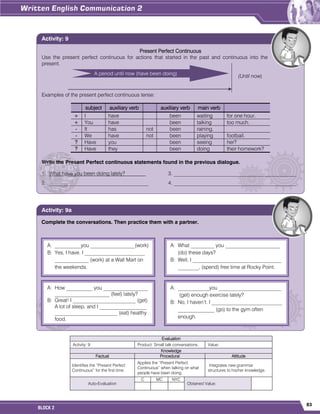
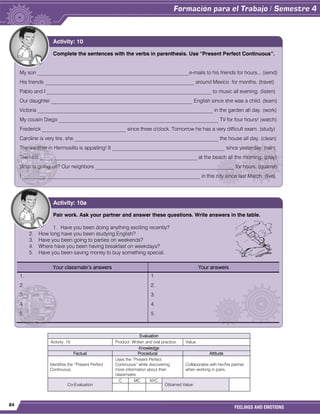
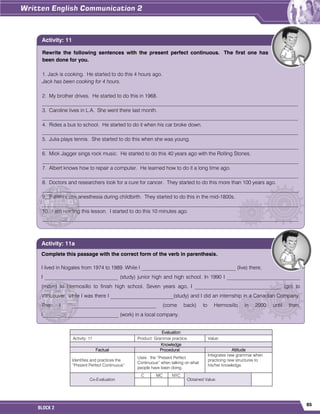
• Present Perfect continuous.........................................................................................................................83
• Biographies.................................................................................................................................................88
Didactic Sequence 2: What do you think? .........................................................................................................89
• Participles as adjectives .............................................................................................................................89
• Adjectives for art vocabulary ......................................................................................................................93
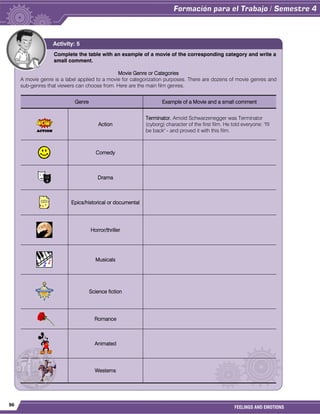
• Movie genre vocabulary..............................................................................................................................95
• Relative clauses ..........................................................................................................................................97
Didactic Sequence 3: A Visit to ........................................................................................................................102
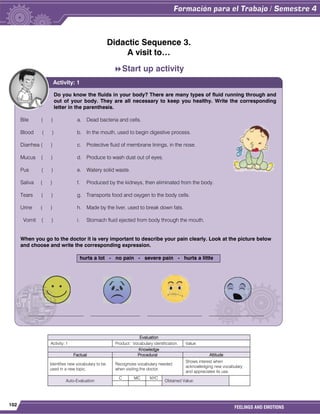
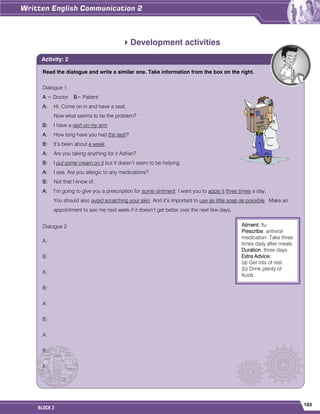
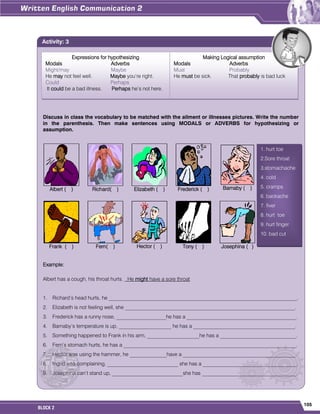
• Ailments and illnesses vocabulary ...........................................................................................................103
• Expressions for hypothesizing..................................................................................................................105
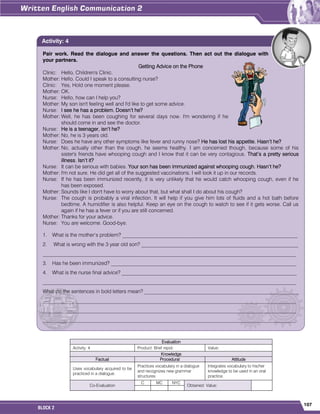
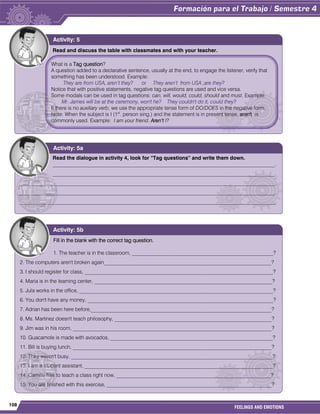
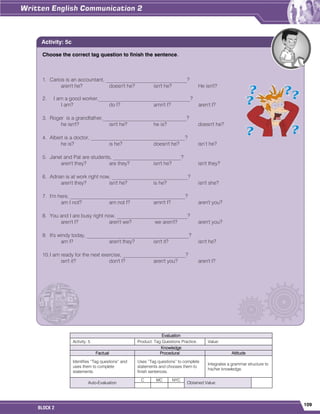
• Tag Questions...........................................................................................................................................108
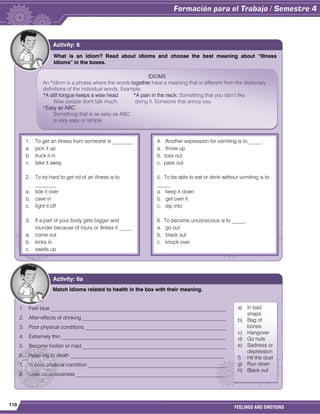
• Idioms........................................................................................................................................................110
• Body language..........................................................................................................................................112
BLOCK 3: KNOW HOW OF TECHNOLOGY.......................................................................................119
Didactic Sequence 1: Speculating about.........................................................................................................120
• Unreal Conditional Sentences ..................................................................................................................122
Didactic Sequence 2: She said that .................................................................................................................130
• Reported Speech......................................................................................................................................131
Didactic Sequence 3: Getting into technology.................................................................................................136
• Comparing time periods...........................................................................................................................138
• Inventions and Inventors...........................................................................................................................139
• Time contrast ............................................................................................................................................141
• Describing Technology.............................................................................................................................143
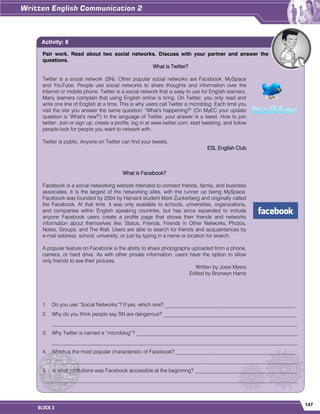
• Social networks.........................................................................................................................................147
• Bibliography ..............................................................................................................................................151
Índice
6
PRELIMINARES
7PRELIMINARES
“Una competencia es la integración de habilidades, conocimientos y actitudes en un contexto específico”.
El enfoque en competencias considera que los conocimientos por sí mismos no son lo más importante, sino el uso
que se hace de ellos en situaciones específicas de la vida personal, social y profesional. De este modo, las
competencias requieren una base sólida de conocimientos y ciertas habilidades, los cuales se integran para un
mismo propósito en un determinado contexto.
El presente Módulo de Aprendizaje de la asignatura Written English Communication 2, es una herramienta de suma
importancia, que propiciará tu desarrollo como persona visionaria, competente e innovadora, características que se
establecen en los objetivos de la Reforma Integral de Educación Media Superior que actualmente se está
implementando a nivel nacional.
El Módulo de aprendizaje es uno de los apoyos didácticos que el Colegio de Bachilleres te ofrece con la intención de
estar acorde a los nuevos tiempos, a las nuevas políticas educativas, además de lo que demandan los escenarios
local, nacional e internacional; el módulo se encuentra organizado a través de bloques de aprendizaje y secuencias
didácticas. Una secuencia didáctica es un conjunto de actividades, organizadas en tres momentos: Inicio, desarrollo y
cierre. En el inicio desarrollarás actividades que te permitirán identificar y recuperar las experiencias, los saberes, las
preconcepciones y los conocimientos que ya has adquirido a través de tu formación, mismos que te ayudarán a
abordar con facilidad el tema que se presenta en el desarrollo, donde realizarás actividades que introducen nuevos
conocimientos dándote la oportunidad de contextualizarlos en situaciones de la vida cotidiana, con la finalidad de que
tu aprendizaje sea significativo.
Posteriormente se encuentra el momento de cierre de la secuencia didáctica, donde integrarás todos los saberes que
realizaste en las actividades de inicio y desarrollo.
En todas las actividades de los tres momentos se consideran los saberes conceptuales, procedimentales y
actitudinales. De acuerdo a las características y del propósito de las actividades, éstas se desarrollan de forma
individual, binas o equipos.
Para el desarrollo del trabajo deberás utilizar diversos recursos, desde material bibliográfico, videos, investigación de
campo, etc.
La retroalimentación de tus conocimientos es de suma importancia, de ahí que se te invita a participar de forma activa
cuando el docente lo indique, de esta forma aclararás dudas o bien fortalecerás lo aprendido; además en este
momento, el docente podrá tener una visión general del logro de los aprendizajes del grupo.
Recuerda que la evaluación en el enfoque en competencias es un proceso continuo, que permite recabar evidencias a
través de tu trabajo, donde se tomarán en cuenta los tres saberes: el conceptual, procedimental y actitudinal con el
propósito de que apoyado por tu maestro mejores el aprendizaje. Es necesario que realices la autoevaluación, este
ejercicio permite que valores tu actuación y reconozcas tus posibilidades, limitaciones y cambios necesarios para
mejorar tu aprendizaje.
Así también, es recomendable la coevaluación, proceso donde de manera conjunta valoran su actuación, con la
finalidad de fomentar la participación, reflexión y crítica ante situaciones de sus aprendizajes, promoviendo las
actitudes de responsabilidad e integración del grupo.
Nuestra sociedad necesita individuos a nivel medio superior con conocimientos, habilidades, actitudes y valores, que
les permitan integrarse y desarrollarse de manera satisfactoria en el mundo laboral o en su preparación profesional.
Para que contribuyas en ello, es indispensable que asumas una nueva visión y actitud en cuanto a tu rol, es decir, de
ser receptor de contenidos, ahora construirás tu propio conocimiento a través de la problematización y
contextualización de los mismos, situación que te permitirá: Aprender a conocer, aprender a hacer, aprender a ser y
aprender a vivir juntos.
Presentación
8
PRELIMINARES
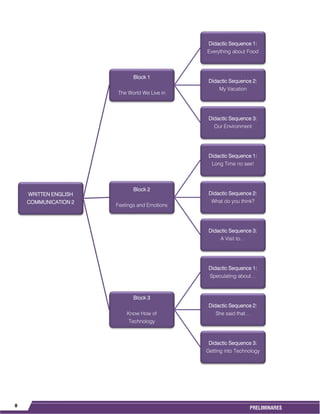
WRITTEN ENGLISH
COMMUNICATION 2
Block 1
The World We Live in
Didactic Sequence 1:
Everything about Food
Didactic Sequence 2:
My Vacation
Didactic Sequence 3:
Our Environment
Block 2
Feelings and Emotions
Didactic Sequence 1:
Long Time no see!
Didactic Sequence 2:
What do you think?
Didactic Sequence 3:
A Visit to…
Block 3
Know How of
Technology
Didactic Sequence 1:
Speculating about…
Didactic Sequence 2:
She said that…
Didactic Sequence 3:
Getting into Technology
The World We Live In
Competencias profesionales:
1. Realiza comprensiones oral y auditiva de diversos tipos de texto en otro idioma.
2. Realiza comprensión escrita y de lectura de diversos tipos de texto en otro idioma.
3. Realiza expresión o producción oral en otro idioma.
4. Realiza interacción oral en otro idioma.
5. Realiza expresión o producción escrita de diversos tipos de texto en otro idioma.
Unidad de competencia:
 Solicita y da información referente a actividades vacacionales, lugares y alimentos;
identifica problemas ecológicos y propone soluciones.
Atributos a desarrollar en el bloque:
4.1 Expresa ideas y conceptos mediante representaciones lingüísticas, matemáticas o gráficas.
4.2 Aplica distintas estrategias comunicativas según quienes sean sus interlocutores, el
contexto en el que se encuentra y los objetivos que persigue.
4.3 Identifica las ideas claves en un texto o discurso oral e infiere conclusiones a partir de ellas.
4.4 Se comunica en una segunda lengua en situaciones cotidianas.
4.5 Maneja las tecnologías de la información y la comunicación para obtener información y
expresar ideas.
6.4 Estructura ideas y argumentos de manera clara, coherente y sintética.
7.1 Define metas y da seguimiento a sus procesos de construcción de conocimiento.
8.2 Aporta puntos de vista con apertura y considera los de otras personas de manera reflexiva.
10.3 Asume que el respeto de las diferencias es el principio de integración y de convivencia en
los contextos local, nacional e internacional.
Time assigned: 20 hours
10
THE WORLD WE LIVE IN
Didactic Sequence 1.
Everything about Food.
Start up activities
Evaluation
Activity: 1 Product: Ice breaker puzzle. Value:
Knowledge
Factual Procedural Attitude
Identifies vocabulary, spelling,
and facts about previous
knowledge.
Practices vocabulary, spelling and
facts about food.
Shows independence and interest
when practicing previous
knowledge.
Auto-Evaluation
C MC NYC
Obtained Value:
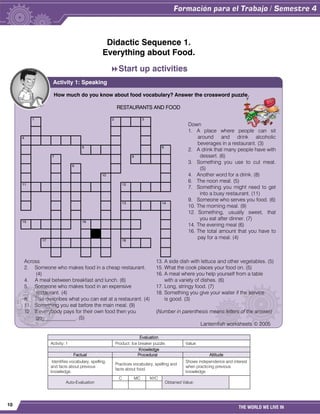
How much do you know about food vocabulary? Answer the crossword puzzle.
RESTAURANTS AND FOOD
1 2 3
4
5 6
7 8
9
10
11 12
13 14
15 16
17 18
Activity 1: Speaking
Down
1. A place where people can sit
around and drink alcoholic
beverages in a restaurant. (3)
2. A drink that many people have with
dessert. (6)
3. Something you use to cut meat.
(5)
4. Another word for a drink. (8)
6. The noon meal. (5)
7. Something you might need to get
into a busy restaurant. (11)
9. Someone who serves you food. (6)
10. The morning meal. (9)
12. Something, usually sweet, that
you eat after dinner. (7)
14. The evening meal (6)
16. The total amount that you have to
pay for a meal. (4)
Across
2. Someone who makes food in a cheap restaurant.
(4)
4. A meal between breakfast and lunch. (6)
5. Someone who makes food in an expensive
restaurant. (4)
8. This describes what you can eat at a restaurant. (4)
11. Something you eat before the main meal. (9)
12. If everybody pays for their own food then you
go_____________. (5)
13. A side dish with lettuce and other vegetables. (5)
15. What the cook places your food on. (5)
16. A meal where you help yourself from a table
with a variety of dishes. (6)
17. Long, stringy food. (7)
18. Something you give your waiter if the service
is good. (3)
(Number in parenthesis means letters of the answer)
Lanternfish worksheets © 2005
11
BLOCK 1
Evaluation
Activity: 2 Product: Vocabulary review. Value:
Knowledge
Factual Procedural Attitude
Identifies vocabulary, spelling,
and facts about previous
knowledge.
Applies vocabulary, spelling, and
previous knowledge about food.
Shows independence when
applying previous knowledge.
Auto-Evaluation
C MC NYC
Obtained Value:
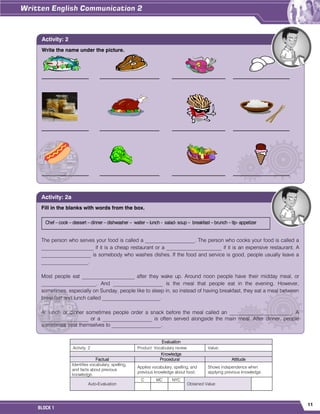
Write the name under the picture.
_______________ ___________________ _________________ __________________
_______________ ___________________ _________________ __________________
_______________ ___________________ _________________ __________________
Activity: 2
Fill in the blanks with words from the box.
Chef – cook – dessert – dinner – dishwasher – waiter – lunch - salad- soup – breakfast – brunch – tip- appetizer
The person who serves your food is called a ___________________. The person who cooks your food is called a
____________________ if it is a cheap restaurant or a _____________________ if it is an expensive restaurant. A
___________________ is somebody who washes dishes. If the food and service is good, people usually leave a
__________________.
Most people eat ____________________ after they wake up. Around noon people have their midday meal, or
_____________________. And ___________________ is the meal that people eat in the evening. However,
sometimes, especially on Sunday, people like to sleep in, so instead of having breakfast, they eat a meal between
breakfast and lunch called ______________________.
At lunch or dinner sometimes people order a snack before the meal called an ________________________. A
__________________ or a ___________________ is often served alongside the main meal. After dinner, people
sometimes treat themselves to ___________________.
Activity: 2a
12
THE WORLD WE LIVE IN
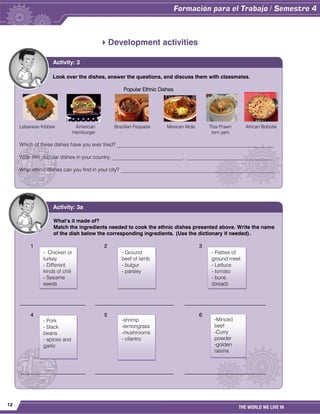
Development activities
Look over the dishes, answer the questions, and discuss them with classmates.
Popular Ethnic Dishes
Lebanese Kibbee American Brazilian Feijoada Mexican Mole Thai Prawn African Bobotie
Hamburger tom yam
Which of these dishes have you ever tried? ____________________________________________________________
Write two popular dishes in your country: ___________________________, _________________________________
What ethnic dishes can you find in your city? ___________________________________________________________
Activity: 3
What’s it made of?
Match the ingredients needed to cook the ethnic dishes presented above. Write the name
of the dish below the corresponding ingredients. (Use the dictionary if needed).
1 2 3
_________________________ ______________________________ _______________________________
4 5 6
_________________________ ______________________________ _______________________________
Activity: 3a
- Chicken or
turkey
- Different
kinds of chili
- Sesame
seeds
- Ground
beef of lamb
- bulgur
- parsley
- Patties of
ground meet
- Lettuce
- tomato
- buns
(bread)
-shrimp
-lemongrass
-mushrooms
- cilantro
-Minced
beef
-Curry
powder
-golden
raisins
- Pork
- black
beans
- spices and
garlic
13
BLOCK 1
Evaluation
Activity: 3 Product: Ingredients vocabulary. Value:
Knowledge
Factual Procedural Attitude
Identifies food – specifically
ethnic dishes.
Recognizes ethnic dishes and
writes about dishes in her/his
community.
Shows initiative and interest when
acknowledging about ethnic
dishes.
Auto-Evaluation
C MC NYC
Obtained Value:
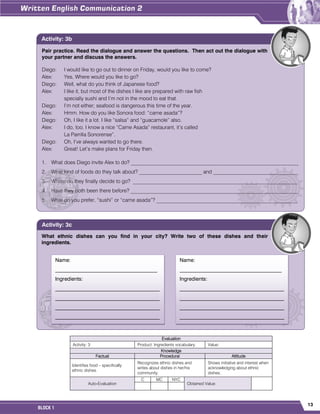
Pair practice. Read the dialogue and answer the questions. Then act out the dialogue with
your partner and discuss the answers.
Diego: I would like to go out to dinner on Friday, would you like to come?
Alex: Yes, Where would you like to go?
Diego: Well, what do you think of Japanese food?
Alex: I like it, but most of the dishes I like are prepared with raw fish
specially sushi and I’m not in the mood to eat that.
Diego: I’m not either; seafood is dangerous this time of the year.
Alex: Hmm. How do you like Sonora food: “carne asada”?
Diego: Oh, I like it a lot. I like “salsa” and “guacamole” also.
Alex: I do, too. I know a nice “Carne Asada” restaurant, it’s called
La Parrilla Sonorense”.
Diego: Oh, I’ve always wanted to go there.
Alex: Great! Let’s make plans for Friday then.
1. What does Diego invite Alex to do? ________________________________________________________________
2. What kind of foods do they talk about? ________________________ and ________________________________
3. Where do they finally decide to go? _______________________________________________________________
4. Have they both been there before? ________________________________________________________________
5. What do you prefer, “sushi” or “carne asada”? ______________________________________________________
Activity: 3b
What ethnic dishes can you find in your city? Write two of these dishes and their
ingredients.
Activity: 3c
Name:
_______________________________________
Ingredients:
________________________________________
________________________________________
________________________________________
________________________________________
________________________________________
___________________________________
Name:
_______________________________________
Ingredients:
________________________________________
________________________________________
________________________________________
________________________________________
________________________________________
__________________________________
14
THE WORLD WE LIVE IN
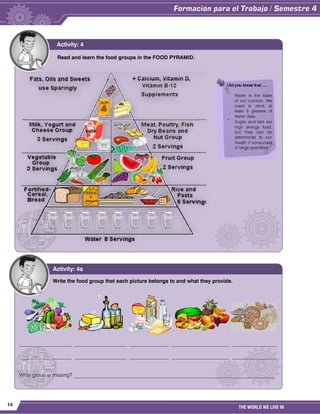
Read and learn the food groups in the FOOD PYRAMID.
Activity: 4
Write the food group that each picture belongs to and what they provide.
____________________ ____________________ _______________ ______________________ _________________
____________________ ____________________ _______________ ______________________ _________________
What group is missing? _____________________________________________________________________________
Activity: 4a
15
BLOCK 1
Evaluation
Activity: 4 Product: Food list. Value:
Knowledge
Factual Procedural Attitude
Verifies knowledge of the food
guide pyramid and the basic
food groups in order to plan
nutritious meals.
Applies information of the food
guide pyramid and its groups to
classify them in categories.
Shows initiative and interest when
acknowledging about food guide
pyramid and the basic food
groups.
Auto-Evaluation
C MC NYC
Obtained Value:
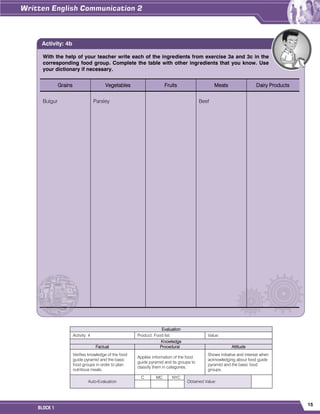
With the help of your teacher write each of the ingredients from exercise 3a and 3c in the
corresponding food group. Complete the table with other ingredients that you know. Use
your dictionary if necessary.
Grains Vegetables Fruits Meats Dairy Products
Bulgur Parsley Beef
Activity: 4b
16
THE WORLD WE LIVE IN
Evaluation
Activity: 5 Product: Reading comprehension. Value:
Knowledge
Factual Procedural Attitude
Classifies and selects
information about the food
guide pyramid and the basic
food groups.
Reads information of the food
guide pyramid and the basic food
groups to answer questions.
Appreciates acquired information
about the food guide pyramid.
Auto-Evaluation
C MC NYC
Obtained Value:
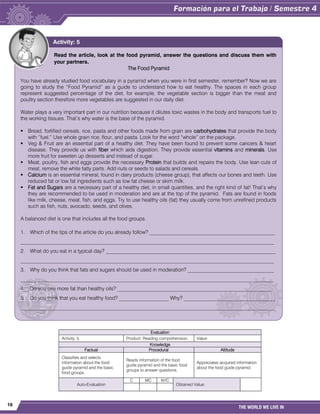
Read the article, look at the food pyramid, answer the questions and discuss them with
your partners.
The Food Pyramid
You have already studied food vocabulary in a pyramid when you were in first semester, remember? Now we are
going to study the “Food Pyramid” as a guide to understand how to eat healthy. The spaces in each group
represent suggested percentage of the diet, for example, the vegetable section is bigger than the meat and
poultry section therefore more vegetables are suggested in our daily diet.
Water plays a very important part in our nutrition because it dilutes toxic wastes in the body and transports fuel to
the working tissues. That’s why water is the base of the pyramid.
 Bread, fortified cereals, rice, pasta and other foods made from grain are carbohydrates that provide the body
with “fuel.” Use whole grain rice, flour, and pasta. Look for the word “whole” on the package.
 Veg & Fruit are an essential part of a healthy diet. They have been found to prevent some cancers & heart
disease. They provide us with fiber which aids digestion. They provide essential vitamins and minerals. Use
more fruit for sweeten up desserts and instead of sugar.
 Meat, poultry, fish and eggs provide the necessary Protein that builds and repairs the body. Use lean cuts of
meat, remove the white fatty parts. Add nuts or seeds to salads and cereals.
 Calcium is an essential mineral, found in dairy products (cheese group), that affects our bones and teeth. Use
reduced fat or low fat ingredients such as low fat cheese or skim milk.
 Fat and Sugars are a necessary part of a healthy diet, in small quantities, and the right kind of fat! That’s why
they are recommended to be used in moderation and are at the top of the pyramid. Fats are found in foods
like milk, cheese, meat, fish, and eggs. Try to use healthy oils (fat) they usually come from unrefined products
such as fish, nuts, avocado, seeds, and olives.
A balanced diet is one that includes all the food groups.
1. Which of the tips of the article do you already follow? ________________________________________________
_________________________________________________________________________________________________
2. What do you eat in a typical day? _________________________________________________________________
_________________________________________________________________________________________________
3. Why do you think that fats and sugars should be used in moderation? _________________________________
_________________________________________________________________________________________________
4. Do you use more fat than healthy oils? ___________________________________________________________
5. Do you think that you eat healthy food? ___________________ Why? ___________________________________
_________________________________________________________________________________________________
Activity: 5
17
BLOCK 1
Evaluation
Activity: 6
Product: Reading comprehension
continuation.
Value:
Knowledge
Factual Procedural Attitude
Selects information and uses
dictionary to look for new words.
Applies information about the food
guide pyramid and searches for
new words meaning in the
dictionary.
Shows interest when
acknowledging new information
and words.
Auto-Evaluation
C MC NYC
Obtained Value:
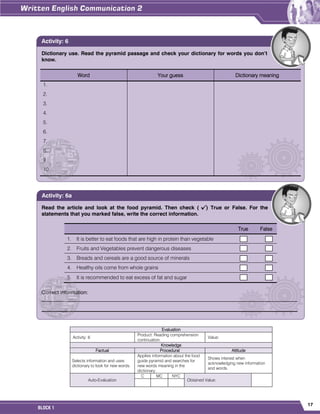
Dictionary use. Read the pyramid passage and check your dictionary for words you don’t
know.
Word Your guess Dictionary meaning
1.
2.
3.
4.
5.
6.
7.
8.
9.
10.
Activity: 6
Read the article and look at the food pyramid. Then check ( ) True or False. For the
statements that you marked false, write the correct information.
True False
1. It is better to eat foods that are high in protein than vegetable
2. Fruits and Vegetables prevent dangerous diseases
3. Breads and cereals are a good source of minerals
4. Healthy oils come from whole grains
5. It is recommended to eat excess of fat and sugar
Correct information:
__________________________________________________________________________________________________
_________________________________________________________________________________________
Activity: 6a
18
THE WORLD WE LIVE IN
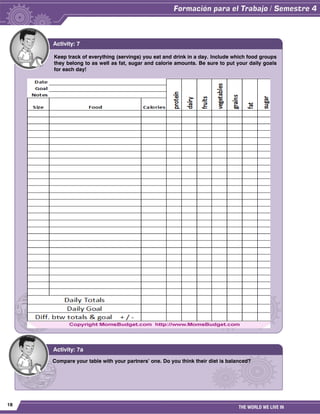
Keep track of everything (servings) you eat and drink in a day. Include which food groups
they belong to as well as fat, sugar and calorie amounts. Be sure to put your daily goals
for each day!
Activity: 7
Compare your table with your partners’ one. Do you think their diet is balanced?
Activity: 7a
19
BLOCK 1
Evaluation
Activity: 7 Product: Report. Value:
Knowledge
Factual Procedural Attitude
Organizes questions and then
integrates the results in the
graph.
Practices making questionnaire’s
questions; discusses results with
other teams, and reports results.
Shows interest when keeping
track of what he/she eats in a day
and share information with
classmates.
Auto-Evaluation
C MC NYC
Obtained Value:
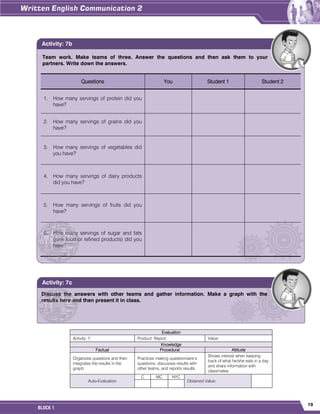
Team work. Make teams of three. Answer the questions and then ask them to your
partners. Write down the answers.
Questions You Student 1 Student 2
1. How many servings of protein did you
have?
2. How many servings of grains did you
have?
3. How many servings of vegetables did
you have?
4. How many servings of dairy products
did you have?
5. How many servings of fruits did you
have?
6. How many servings of sugar and fats
(junk food or refined products) did you
have?
Activity: 7b
Discuss the answers with other teams and gather information. Make a graph with the
results here and then present it in class.
Activity: 7c
20
THE WORLD WE LIVE IN
Evaluation
Activity: 8 Product: Written paragraphs. Value:
Knowledge
Factual Procedural Attitude
Classifies information to
complete charts with his/her own
information.
Reports information from his/her
own experience.
Shows initiative when working in
basic exercises.
Auto-Evaluation
C MC NYC
Obtained Value:
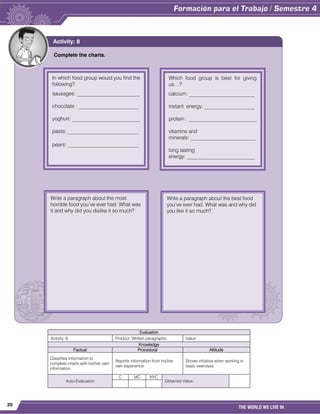
Complete the charts.
Activity: 8
In which food group would you find the
following?
sausages: ________________________
chocolate : _______________________
yoghurt: __________________________
pasta: ___________________________
pears: ___________________________
Which food group is best for giving
us…?
calcium: _________________________
instant energy: ___________________
protein : __________________________
vitamins and
minerals: _________________________
long lasting
energy: __________________________
Write a paragraph about the most
horrible food you’ve ever had. What was
it and why did you dislike it so much?
Write a paragraph about the best food
you’ve ever had. What was and why did
you like it so much?
21
BLOCK 1
Evaluation
Activity: 9 Product: A collage. Value:
Knowledge
Factual Procedural Attitude
Orders a collage clarifying and
visualizing ideas about food
groups.
Creates a collage to visualize and
clarify ideas about food groups by
using authentic material.
Shows initiative when working in
satisfying exercises of collage’s
creativity using authentic material.
Auto-Evaluation
C MC NYC
Obtained Value:
Make a collage with cut outs of packages or boxes of assorted food products.
Activity: 9
Then divide the products’ ingredients into the correct food groups and list them on a
separate sheet of paper. Present it to your teacher.
Activity: 9a
22
THE WORLD WE LIVE IN
Pair work. Answer and ask the questions to your partner. Write down the answers.
Questions You Partner
1. Do you order food at your home?
2. How often do you eat at restaurants? (times
a week)
3. What is your favorite restaurant?
4. What is your favorite fast-food restaurant?
5. Do you prefer to eat in a fast-food restaurant
or in a restaurant?
6. Do you usually leave a tip?
Activity: 10
Write in a paragraph the differences between your partner and you.
Example: I eat at restaurants two times a week but my partner (name) never eats at restaurants. I
order…
__________________________________________________________________________________________________
__________________________________________________________________________________________________
__________________________________________________________________________________________________
__________________________________________________________________________________________________
__________________________________________________________________________________________________
__________________________________________________________________________________________________
__________________________________________________________________________________________________
__________________________________________________________________________________________________
Activity: 10a
Ordering food in a Restaurant
One of the most important tasks in English is ordering
food when you go to a restaurant. There are basic forms
and questions, as well food vocabulary that you can use
in places where people speak English.
23
BLOCK 1
Practice vocabulary on restaurants: http://www.esl-lab.com/vocab/v-restaurant.htm
Evaluation
Activity: 10
Product: Perform written and oral
exercises.
Value:
Knowledge
Factual Procedural Attitude
Identifies the new theme: At a
restaurant, uses information to
make and answer questions.
Applies information to write a
paragraph, forms and answers
questions.
Collaborates with his/her partner
on the activities developed by
pairs.
Co-Evaluation
C MC NYC
Obtained Value:
Read the conversation and answer the questions.
At a Restaurant
Waiter: Welcome to Antico's. Here are your menus.
Today's special is grilled salmon. I'll be back to take
your order in a minute.
. . .
Waiter: Are you ready to order?
Customer 1: I'd like the seafood spaghetti.
Waiter: And you?
Customer 2: I'll have a hamburger and fries.
Waiter: Would you like anything to drink?
Customer 1: I'll have a coke, please.
Waiter: And for you?
Customer 2: Bring water, please.
Waiter: OK. So that's one seafood spaghetti, one hamburger and
fries, one coke, and one water. I'll take your menus.
. . .
Waiter: Here is your food. Enjoy your meal.
. . .
Waiter: How was everything?
Customer 2: Delicious thanks.
Waiter: Would you like anything for dessert?
Customer 1: No, bring the bill (check) please.
1. What is the special of the day? ____________________________________________________________
2. What did customer 1 order? ______________________________________________________________
3. What did customer 2 orders? ______________________________________________________________
4. Did someone order coffee for drink? _______________________________________________________
5. Did they like the dishes? __________________________________________________________________
Did they have dessert? ___________________________________________________________________
Activity: 10b
Modal verbs WOULD and WILL for
requests
What would you like to eat?
I’d like grilled chicken.
I’ll have the special of the day.
What would you like to drink?
I’d like lemonade, please.
I’ll have tea.
Would you like anything else?
Yes, please. I’d like dessert.
No, thank you. That will be all.
Contractions
I will = I’ll
I would = I’d
Role-play activity. Form teams of three and act out the dialogue. Change roles.
Activity: 10c
24
THE WORLD WE LIVE IN
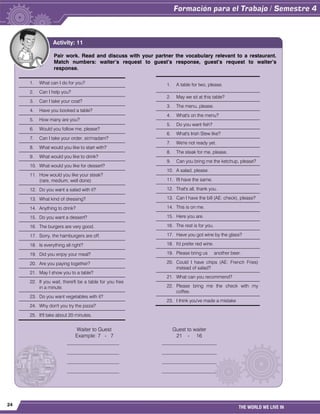
Pair work. Read and discuss with your partner the vocabulary relevant to a restaurant.
Match numbers: waiter’s request to guest’s response, guest’s request to waiter’s
response.
1. What can I do for you?
2. Can I help you?
3. Can I take your coat?
4. Have you booked a table?
5. How many are you?
6. Would you follow me, please?
7. Can I take your order, sir/madam?
8. What would you like to start with?
9. What would you like to drink?
10. What would you like for dessert?
11. How would you like your steak?
(rare, medium, well done)
12. Do you want a salad with it?
13. What kind of dressing?
14. Anything to drink?
15. Do you want a dessert?
16. The burgers are very good.
17. Sorry, the hamburgers are off.
18. Is everything all right?
19. Did you enjoy your meal?
20. Are you paying together?
21. May I show you to a table?
22. If you wait, there'll be a table for you free
in a minute.
23. Do you want vegetables with it?
24. Why don't you try the pizza?
25. It'll take about 20 minutes.
Activity: 11
1. A table for two, please.
2. May we sit at this table?
3. The menu, please.
4. What's on the menu?
5. Do you want fish?
6. What's Irish Stew like?
7. We're not ready yet.
8. The steak for me, please.
9. Can you bring me the ketchup, please?
10. A salad, please.
11. I'll have the same.
12. That's all, thank you.
13. Can I have the bill (AE: check), please?
14. This is on me.
15. Here you are.
16. The rest is for you.
17. Have you got wine by the glass?
18. I'd prefer red wine.
19. Please bring us another beer.
20. Could I have chips (AE: French Fries)
instead of salad?
21. What can you recommend?
22. Please bring me the check with my
coffee.
23. I think you've made a mistake
Waiter to Guest Guest to waiter
Example: 7 - 7 21 - 16
____________________ _____________________
____________________ _____________________
____________________ _____________________
____________________ _____________________
25
BLOCK 1
Evaluation
Activity: 11
Product: Recognition of
imperatives.
Value:
Knowledge
Factual Procedural Attitude
Verifies and identifies
vocabulary meaning and
grammar point with resource
materials.
Applies word analysis skills to
recognize restaurant vocabulary
and use of imperatives.
Collaborates with his/her partner
on the activities developed by
pairs.
Co-Evaluation
C MC NYC
Obtained Value:
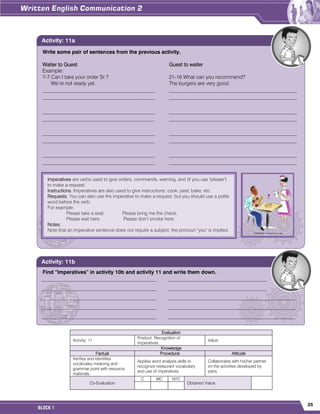
Write some pair of sentences from the previous activity.
Waiter to Guest Guest to waiter
Example:
7-7 Can I take your order Sr.? 21-16 What can you recommend?
We’re not ready yet. The burgers are very good.
___________________________________________ _________________________________________________
___________________________________________ _________________________________________________
___________________________________________ _________________________________________________
___________________________________________ _________________________________________________
___________________________________________ _________________________________________________
___________________________________________ _________________________________________________
___________________________________________ _________________________________________________
___________________________________________ _________________________________________________
Activity: 11a
Find “Imperatives” in activity 10b and activity 11 and write them down.
____________________________________________ ______________________________________
____________________________________________ ______________________________________
____________________________________________ _________________________________________________
____________________________________________ _________________________________________________
____________________________________________ _________________________________________________
Activity: 11b
Imperatives are verbs used to give orders, commands, warning, and (if you use "please")
to make a request.
Instructions. Imperatives are also used to give instructions: cook, peel, bake, etc.
Requests. You can also use the imperative to make a request, but you should use a polite
word before the verb:
For example:
Please take a seat. Please bring me the check.
Please wait here. Please don’t smoke here.
Notes:
Note that an imperative sentence does not require a subject; the pronoun "you" is implied.
26
THE WORLD WE LIVE IN
Evaluation
Activity: 12 Product: Written dialogue. Value:
Knowledge
Factual Procedural Attitude
Integrates vocabulary used in
the block.
Practices a communicative activity
using food and restaurant
vocabulary by writing a dialogue
using his/her own information.
Creates his/her own dialogues
based in vocabulary and
grammar studied.
Auto-Evaluation
C MC NYC
Obtained Value:
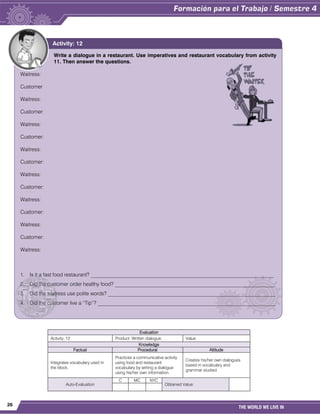
Write a dialogue in a restaurant. Use imperatives and restaurant vocabulary from activity
11. Then answer the questions.
Waitress:
Customer
Waitress:
Customer:
Waitress:
Customer:
Waitress:
Customer:
Waitress:
Customer:
Waitress:
Customer:
Waitress:
Customer:
Waitress:
1. Is it a fast food restaurant? ______________________________________________________________________
2. Did the customer order healthy food? _____________________________________________________________
3. Did the waitress use polite words? ________________________________________________________________
4. Did the customer live a “Tip”? ____________________________________________________________________
11b. Find “Imperatives” in activity 10b and activity 11 and write them down.
____________________________________________ _________________________________________________
____________________________________________ _________________________________________________
Activity: 12
27
BLOCK 1
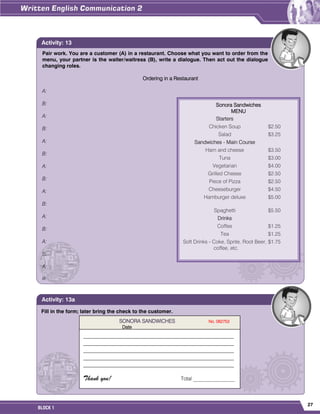
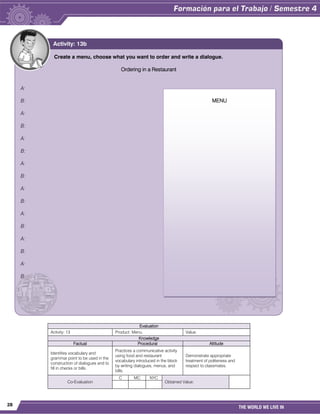
Pair work. You are a customer (A) in a restaurant. Choose what you want to order from the
menu, your partner is the waiter/waitress (B), write a dialogue. Then act out the dialogue
changing roles.
Ordering in a Restaurant
A:
B:
A:
B:
A:
B:
A:
B:
A:
B:
A:
B:
A:
B:
A:
B:
Activity: 13
Fill in the form; later bring the check to the customer.
Activity: 13a
SONORA SANDWICHES No. 062753
Date _________________________________
Sonora Sandwiches
MENU
Starters
Chicken Soup $2.50
Salad $3.25
Sandwiches - Main Course
Ham and cheese $3.50
Tuna $3.00
Vegetarian $4.00
Grilled Cheese $2.50
Piece of Pizza $2.50
Cheeseburger $4.50
Hamburger deluxe $5.00
Spaghetti $5.50
Drinks
Coffee $1.25
Tea $1.25
Soft Drinks - Coke, Sprite, Root Beer,
coffee, etc.
$1.75
________________________________________________
________________________________________________
________________________________________________
________________________________________________
________________________________________________
Thank you! Total ________________
28
THE WORLD WE LIVE IN
Evaluation
Activity: 13 Product: Menu. Value:
Knowledge
Factual Procedural Attitude
Identifies vocabulary and
grammar point to be used in the
construction of dialogues and to
fill in checks or bills.
Practices a communicative activity
using food and restaurant
vocabulary introduced in the block
by writing dialogues, menus, and
bills.
Demonstrate appropriate
treatment of politeness and
respect to classmates.
Co-Evaluation
C MC NYC
Obtained Value:
Create a menu, choose what you want to order and write a dialogue.
Ordering in a Restaurant
A:
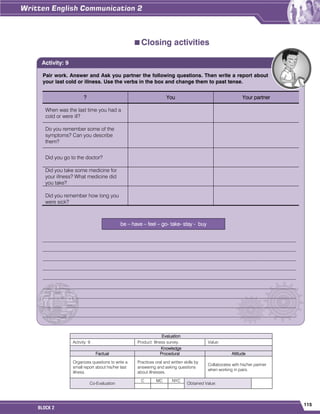
B:
A:
B:
A:
B:
A:
B:
A:
B:
A:
B:
A:
B:
A:
B:
Activity: 13b
MENU
29
BLOCK 1
Evaluation
Activity: 14 Product: Report. Value:
Knowledge
Factual Procedural Attitude
Comprehends unfamiliar words
using context clues and prior
knowledge.
Uses new vocabulary to label
pictures and answers the
questions.
Integrates vocabulary to be used
in real situations.
Auto-Evaluation
C MC NYC
Obtained Value:
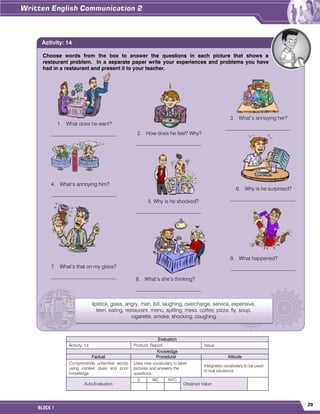
Choose words from the box to answer the questions in each picture that shows a
restaurant problem. In a separate paper write your experiences and problems you have
had in a restaurant and present it to your teacher.
Activity: 14
1. What does he want?
_________________________ 2. How does he feel? Why?
_________________________
3. What’s annoying her?
_________________________
4. What’s annoying him?
_________________________
5. Why is he shocked?
_________________________
6. Why is he surprised?
_________________________
7. What’s that on my glass?
_________________________
8. What’s she’s thinking?
_________________________
9. What happened?
_________________________
lipstick, glass, angry, man, bill, laughing, overcharge, service, expensive,
teen, eating, restaurant, menu, spilling, mess, coffee, pizza, fly, soup,
cigarette, smoke, shocking, coughing
30
THE WORLD WE LIVE IN
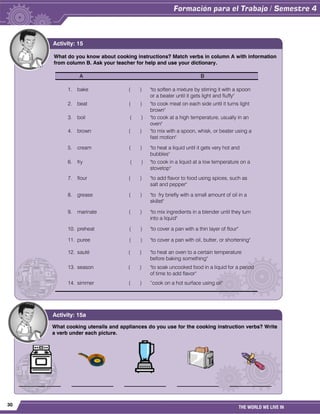
What do you know about cooking instructions? Match verbs in column A with information
from column B. Ask your teacher for help and use your dictionary.
A B
1. bake ( ) "to soften a mixture by stirring it with a spoon
or a beater until it gets light and fluffy"
2. beat ( ) "to cook meat on each side until it turns light
brown"
3. boil ( ) "to cook at a high temperature, usually in an
oven"
4. brown ( ) "to mix with a spoon, whisk, or beater using a
fast motion"
5. cream ( ) "to heat a liquid until it gets very hot and
bubbles"
6. fry ( ) "to cook in a liquid at a low temperature on a
stovetop"
7. flour ( ) "to add flavor to food using spices, such as
salt and pepper"
8. grease ( ) "to fry briefly with a small amount of oil in a
skillet"
9. marinate ( ) "to mix ingredients in a blender until they turn
into a liquid"
10. preheat ( ) "to cover a pan with a thin layer of flour"
11. puree ( ) "to cover a pan with oil, butter, or shortening"
12. sauté ( ) "to heat an oven to a certain temperature
before baking something"
13. season ( ) "to soak uncooked food in a liquid for a period
of time to add flavor"
14. simmer ( ) “cook on a hot surface using oil"
Activity: 15
What cooking utensils and appliances do you use for the cooking instruction verbs? Write
a verb under each picture.
________________ ________________ ________________ ________________ ________________
Activity: 15a
31
BLOCK 1
Evaluation
Activity: 15 Product: Reading comprehension. Value:
Knowledge
Factual Procedural Attitude
Identifies sequence adverbs and
food vocabulary as well as the
directions to follow when writing
a recipe.
Applies sequence adverbs,
ingredients and directions
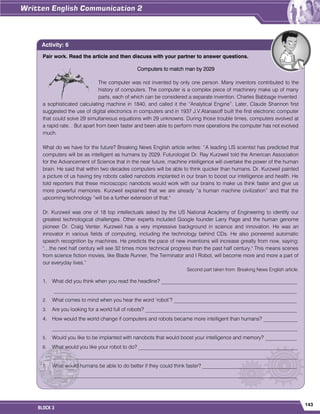
vocabulary when matching and
answering questions.
Demonstrate understanding of
basic cooking instructions.
Auto-Evaluation
C MC NYC
Obtained Value:
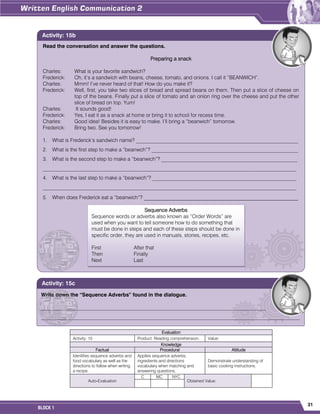
Read the conversation and answer the questions.
Preparing a snack
Charles: What is your favorite sandwich?
Frederick: Oh, it’s a sandwich with beans, cheese, tomato, and onions. I call it “BEANWICH”.
Charles: Mmm! I’ve never heard of that! How do you make it?
Frederick: Well, first, you take two slices of bread and spread beans on them. Then put a slice of cheese on
top of the beans. Finally put a slice of tomato and an onion ring over the cheese and put the other
slice of bread on top. Yum!
Charles: It sounds good!
Frederick: Yes, I eat it as a snack at home or bring it to school for recess time.
Charles: Good idea! Besides it is easy to make. I’ll bring a “beanwich” tomorrow.
Frederick: Bring two. See you tomorrow!
1. What is Frederick’s sandwich name? ______________________________________________________________
2. What is the first step to make a “beanwch”? ________________________________________________________
3. What is the second step to make a “beanwich”? ____________________________________________________
_________________________________________________________________________________________________
4. What is the last step to make a “beanwich”? _______________________________________________________
_________________________________________________________________________________________________
5. When does Frederick eat a “beanwich”? _________________________________________________
Activity: 15b
Write down the “Sequence Adverbs” found in the dialogue.
______________________________________________________________________________________
___________________________________________________________________________________________________
Activity: 15c
Sequence Adverbs
Sequence words or adverbs also known as “Order Words” are
used when you want to tell someone how to do something that
must be done in steps and each of these steps should be done in
specific order, they are used in manuals, stories, recipes, etc.
First After that
Then Finally
Next Last
32
THE WORLD WE LIVE IN
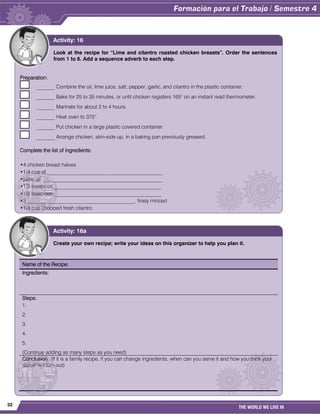
Look at the recipe for “Lime and cilantro roasted chicken breasts”. Order the sentences
from 1 to 6. Add a sequence adverb to each step.
Preparation:
_______ Combine the oil, lime juice, salt, pepper, garlic, and cilantro in the plastic container.
_______ Bake for 25 to 35 minutes, or until chicken registers 165° on an instant read thermometer.
_______ Marinate for about 2 to 4 hours.
_______ Heat oven to 375°.
_______ Put chicken in a large plastic covered container.
_______ Arrange chicken, skin-side up, in a baking pan previously greased.
Complete the list of ingredients:
•4 chicken breast halves
•1/4 cup of ____________________________________________
•juice of ______________________________________________
•1/2 teaspoon _________________________________________
•1/8 teaspoon _________________________________________
•3 _________________________________________, finely minced
•1/4 cup chopped fresh cilantro
Activity: 16
Create your own recipe; write your ideas on this organizer to help you plan it.
Name of the Recipe:
Ingredients:
Steps:
1.
2.
3.
4.
5.
(Continue adding as many steps as you need)
Conclusion: (If it is a family recipe, if you can change ingredients, when can you serve it and how you think your
recipe will turn out)
Activity: 16a
33
BLOCK 1
Activity: 16 Product: A recipe. Value:
Knowledge
Factual Procedural Attitude
Identifies vocabulary as well as
the directions to follow when
writing a recipe.
Writes out a recipe based on the
models he/she learns in class
through vocabulary and language
functions on instructions.
Values the usage of the language
in real life, integrating new
vocabulary and grammar to
his/her knowledge.
Auto-Evaluation
C MC NYC
Obtained Value:
Let’s write down a recipe. Use the information in the previous organizer and write your
recipe. Draw the dish or paste a photograph to make it more interesting.
Activity: 16b
34
THE WORLD WE LIVE IN
Closing activities
Evaluation
Activity: 17 Product: Questionnaire. Value:
Knowledge
Factual Procedural Attitude
Identify vocabulary learnt when
studying the pyramid to answer
questionnaire.
Applies acquired knowledge to
answer questionnaire.
Shows responsibility with
classmate in activities performed
in pairs.
Co-Evaluation
C MC NYC
Obtained Value:
Pair work. Answer the questions, exchange books and with the help of your teacher
evaluate your partner.
The food pyramid suggests that we eat a varied diet. Which type of food should you eat the most of each day?
__________________________________________________________________________________________________
2. How many servings of breads, rice, pasta, and other starchy foods should you eat each day? _______________
3. How many servings of vegetables should you eat each day? ___________________________________________
4. How many servings of fruit should you eat each day? __________________________________________________
5. How many servings of milk, cheese, and yogurt should you eat each day? ________________________________
6. How many servings of meat, fish, beans, and nuts should you eat each day? _____________________________
7. What food group do raisins fit into in this pyramid? ____________________________________________________
8. What food group does peanut butter fit into in this pyramid? ____________________________________________
9. Name two foods that belong to the vegetable food group. _______________________________ and
_______________________________.
10. What foods are the least nutritious and should be the smallest part of your diet?
__________________________________________________________________________________________________
PRODUCT
Evaluation
Max.
Value.
Student
points.
Questions 20
Activity: 17
Recommended web pages
Play in the “Interactive Pyramid” and learn about the variety of
food a person should eat:
http://kidshealth.org/parent/nutrition_fit/nutrition/pyramid.html
www.hooah4health.com/.../pyramidinteractive.htm
35
BLOCK 1
Evaluation
Activity: 18 Product: Food group drawing. Values:
Knowledge
Factual Procedural Attitude
Verifies knowledge of the food
guide pyramid and the basic
food groups.
Applies knowledge of the food
guide pyramid in order to answer
questions.
Shows initiative when working in
basic creative exercises.
Auto-Evaluation
C MC NYC
Obtained Value:
Write the name of the food group beside the “Food Rainbow.
Activity: 18
Pair work. Discuss with your partner and answer the questions.
What food group is mostly used in Mexican Dishes? ____________________________________________
What food group is mostly used in Chinese Dishes? _____________________________________________________
What food group is mostly used in Indian Dishes? _______________________________________________________
What food group is mostly used in Argentinean Dishes? __________________________________________________
What food group is mostly used in Thai dishes? _________________________________________________________
What food group is mostly used in American Dishes? ____________________________________________________
What food group do you use when you cook a meal? ____________________________________________________
Activity: 18a
We’ve already studied the food groups in a food pyramid and a food rainbow, in a separate
paper draw the food groups in a different figure. Present it to your teacher
Activity: 18b
36
THE WORLD WE LIVE IN
Evaluation
Activity: 19 Product: Favorite food drawing. Values:
Knowledge
Factual Procedural Attitude
Organizes information and
vocabulary introduced in the
block to write a report.
Writes a report based on the
models he/she learns in class
through vocabulary and language
functions.
Shows initiative when working in
exercises of creativity.
Auto-Evaluation
C MC NYC
Obtained Value:
Draw a picture of your favorite food and write about it. Describe what it looks like, what it
tastes like, why you like it, when you eat it, who makes it, and other things about it.
Activity: 19
37
BLOCK 1
Evaluation
Activity: 20 Product: Vocabulary task. Value:
Knowledge
Factual Procedural Attitude
Understands how will guests
respond to questions in a
restaurant.
Applies word analysis skills to
recognize restaurant vocabulary.
Shows openness to the feedback
given by the teacher.
Auto-Evaluation
C MC NYC
Obtained Value:
Fill in the blanks, choose words from the box. Check your answers with your teacher.
In a Restauran
Principio del formulario
1. We'll take a of draft with four glasses, please.
2. I think we are all ready to .
3. We read the on our way through.
4. I think we'll get an order of garlic bread to .
5. I like my steak so that there is a little pink in the middle.
6. Do you have any to dip the chicken fingers in?
7. Everything is thank you.
8. I can't eat another .
9. We'll have coffee while we look at the dessert .
10. You can put it all on one , thanks.
Final del formulario
Activity: 20
bill – bite – delicious – medium rare – menu – order – pitcher – sauce – special board - split
38
THE WORLD WE LIVE IN
Evaluation
Activity: 21 Product: Questionnaire. Value:
Knowledge
Factual Procedural Attitude
Recognizes vocabulary, nutrition
information, categories of
vegetables, fruits, and other
foods.
Demonstrates his/her knowledge of
vegetables, fruits, and other foods.
Shows initiative and interest when
answering questionnaires.
Auto-Evaluation
C MC NYC
Obtained Value:
How much do you know about vegetables, fruits, and other food? Read each statement
below. Circle True if you think the statements tells a correct fact about food. Circle False
if you think the statement is incorrect.
1. A plain baked potato is almost 100 percent fat free. True False
2. Blueberries are native to South America. True False
3. The best liquid to drink is water. True False
4. Tomatoes and potatoes are in the same food family. True False
5. One serving of a vegetable or fruit is 1 cup. True False
6. Eating ice cream raises your body temperature. True False
7. Brazil is the world's largest producer of grapefruits and
oranges.
True False
8. Potatoes contain little water. True False
9. Sweet potatoes and yams are the same vegetable. True False
10. Strawberries are part of the rose family. True False
© 2000 by Education World®. Education World grants users permission to reproduce this page for educational
purposes.
Activity: 21
39
BLOCK 1
Evaluation
Extra Activity Product: Questionnaire. Extra Value:
Knowledge
Factual Procedural Attitude
Recognizes the amount of water
when keeping track in a format.
Practices answering
questionnaires, discusses results
with other classmates, and reports
results.
Shows interest when keeping
track of the amount of water
he/she drinks and when sharing
information with classmates.
Auto-Evaluation
C MC NYC
Obtained Value:
Follow instructions. After a month present a report to your teacher.
Extra Activity
40
THE WORLD WE LIVE IN
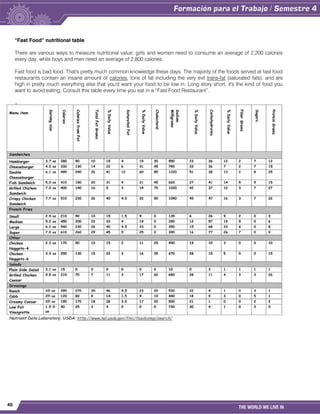
“Fast Food” nutritional table
There are various ways to measure nutritional value; girls and women need to consume an average of 2,200 calories
every day, while boys and men need an average of 2,800 calories.
Fast food is bad food. That's pretty much common knowledge these days. The majority of the foods served at fast food
restaurants contain an insane amount of calories, tons of fat including the very evil trans-fat (saturated fats), and are
high in pretty much everything else that you'd want your food to be low in. Long story short, it's the kind of food you
want to avoid eating. Consult this table every time you eat in a “Fast Food Restaurant”.
41
BLOCK 1
Didactic Sequence 2.
My Vacation.
Start up activity
Evaluation
Activity: 1 Product: Diagram. Value:
Knowledge
Factual Procedural Attitude
Identifies vocabulary, spelling,
and facts about previous
knowledge.
Practices vocabulary, spelling and
facts about daily activities.
Collaborates with classmates
when working in teams.
Auto-Evaluation
C MC NYC
Obtained Value:
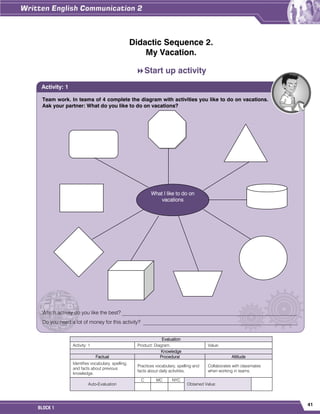
Team work. In teams of 4 complete the diagram with activities you like to do on vacations.
Ask your partner: What do you like to do on vacations?
Which activity do you like the best? ___________________________________________________________________
Do you need a lot of money for this activity? ___________________________________________________________
Activity: 1
What I like to do on
vacations
42
THE WORLD WE LIVE IN
Development activities
Evaluation
Activity: 2 Product: Reading comprehension. Value:
Knowledge
Factual Procedural Attitude
Identifies adverbs of quantity to
talk about problems in a city.
Read a dialogue to determine
answers to the problems in the city.
Shows initiative when working in
basic exercises.
Auto-Evaluation
C MC NYC
Obtained Value:
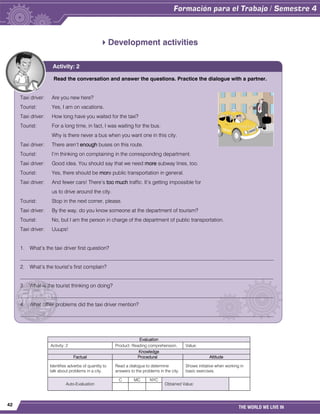
Read the conversation and answer the questions. Practice the dialogue with a partner.
Taxi driver: Are you new here?
Tourist: Yes, I am on vacations.
Taxi driver: How long have you waited for the taxi?
Tourist: For a long time, in fact, I was waiting for the bus.
Why is there never a bus when you want one in this city.
Taxi driver: There aren’t enough buses on this route.
Tourist: I’m thinking on complaining in the corresponding department.
Taxi driver: Good idea. You should say that we need more subway lines, too.
Tourist: Yes, there should be more public transportation in general.
Taxi driver: And fewer cars! There’s too much traffic. It’s getting impossible for
us to drive around the city.
Tourist: Stop in the next corner, please.
Taxi driver: By the way, do you know someone at the department of tourism?
Tourist: No, but I am the person in charge of the department of public transportation.
Taxi driver: Uuups!
1. What’s the taxi driver first question?
_________________________________________________________________________________________________
2. What’s the tourist’s first complain?
_________________________________________________________________________________________________
3. What is the tourist thinking on doing?
_________________________________________________________________________________________________
4. What other problems did the taxi driver mention?
_________________________________________________________________________________________________
Activity: 2
43
BLOCK 1
Evaluation
Activity: 3 Product: Adverbs task. Value:
Knowledge
Factual Procedural Attitude
Identifies transportation and
other public services vocabulary,
as well as adverbs of quantity.
Practices vocabulary and applies
adverbs of quantity in statements
about transport problems in his/her
city or state.
Appreciates the opportunity to
develop grammar structure s in a
meaningful situation.
Auto-Evaluation
C MC NYC
Obtained Value:
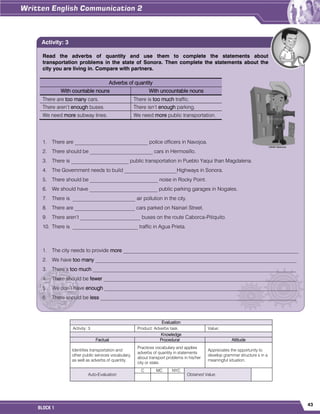
Read the adverbs of quantity and use them to complete the statements about
transportation problems in the state of Sonora. Then complete the statements about the
city you are living in. Compare with partners.
Adverbs of quantity
With countable nouns With uncountable nouns
There are too many cars. There is too much traffic.
There aren’t enough buses. There isn’t enough parking.
We need more subway lines. We need more public transportation.
1. There are ____________________________ police officers in Navojoa.
2. There should be ________________________ cars in Hermosillo.
3. There is ______________________ public transportation in Pueblo Yaqui than Magdalena.
4. The Government needs to build ____________________Highways in Sonora.
5. There should be __________________________ noise in Rocky Point.
6. We should have __________________________ public parking garages in Nogales.
7. There is ________________________ air pollution in the city.
8. There are _______________________ cars parked on Nainari Street.
9. There aren’t _______________________ buses on the route Caborca-Pitiquito.
10. There is _________________________ traffic in Agua Prieta.
1. The city needs to provide more ___________________________________________________________________
2. We have too many _____________________________________________________________________________
3. There’s too much ______________________________________________________________________________
4. There should be fewer __________________________________________________________________________
5. We don’t have enough __________________________________________________________________________
6. There should be less ___________________________________________________________________________
Activity: 3
44
THE WORLD WE LIVE IN
Evaluation
Activity: 4 Product: Report. Value:
Knowledge
Factual Procedural Attitude
Identifies transportation
problems in a city in an authentic
material.
Suggests possible solutions to
his/her city’s transportation
problems.
Values the opportunity given to
suggest solutions to a city’s
transportation problems.
Auto-Evaluation
C MC NYC
Obtained Value:
Bring articles from a newspaper about transportation problems in your city, post it here
and write possible solutions. Then in a separate paper write a report about
“Transportation in my city” and present it to your teacher.
Activity: 4
Helpful phrases
People should…
The city needs to…
There should be more…
We need fewer…
There isn’t/aren’t
enough…
45
BLOCK 1
Evaluation
Activity: 5 Product: Transport vocabulary. Value:
Knowledge
Factual Procedural Attitude
Identifies means of
transportation vocabulary.
Recognizes means of
transportation and applies
vocabulary to his/her real context.
Shows wiliness t when working
with classmates.
Co-Evaluation
C MC NYC
Obtained Value:
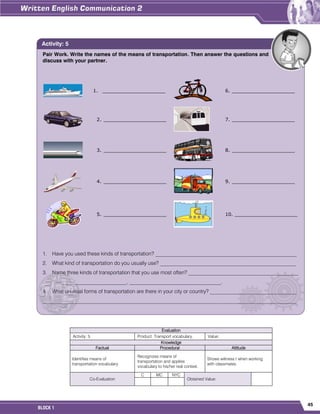
Pair Work. Write the names of the means of transportation. Then answer the questions and
discuss with your partner.
1. _____________________ 6. _____________________
2. _____________________ 7. _____________________
3. _____________________ 8. _____________________
4. _____________________ 9. _____________________
5. _____________________ 10. _____________________
1. Have you used these kinds of transportation? ______________________________________________________
2. What kind of transportation do you usually use? ____________________________________________________
3. Name three kinds of transportation that you use most often? __________________________________________
_________________________, ___________________________________.
4. What unusual forms of transportation are there in your city or country? _________________________________
_________________________________________________________________________________________________
Activity: 5
46
THE WORLD WE LIVE IN
Evaluation
Activity: 6 Product: Chart. Value:
Knowledge
Factual Procedural Attitude
Organizes a graphic
presentation about the
interpretation of the results in the
graph.
Practices means of transportation
vocabulary, discusses results with
other teams, and reports results.
Collaborates with classmates in
the activities when he/she has the
chance to develop fluency.
Co-Evaluation
C MC NYC
Obtained Value:
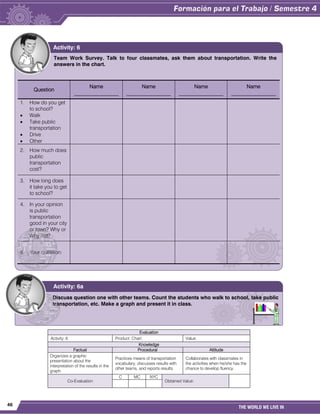
Team Work Survey. Talk to four classmates, ask them about transportation. Write the
answers in the chart.
Question
Name
_________________
Name
_________________
Name
_________________
Name
_________________
1. How do you get
to school?
 Walk
 Take public
transportation
 Drive
 Other
2. How much does
public
transportation
cost?
3. How long does
it take you to get
to school?
4. In your opinion
is public
transportation
good in your city
or town? Why or
Why not?
5. Your question:
Activity: 6
Discuss question one with other teams. Count the students who walk to school, take public
transportation, etc. Make a graph and present it in class.
Activity: 6a
47
BLOCK 1
Evaluation
Activity: 7 Product: Question and answer task. Value:
Knowledge
Factual Procedural Attitude
Identifies indirect questions
when reading a dialogue.
Practices a dialogue, answers the
questions and forms “Indirect
questions”.
Shows initiative and interest when
working in basic exercises.
Auto-Evaluation
C MC NYC
Obtained Value:
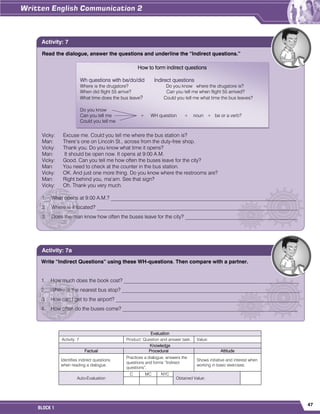
Read the dialogue, answer the questions and underline the “Indirect questions.”
Vicky: Excuse me. Could you tell me where the bus station is?
Man: There’s one on Lincoln St., across from the duty-free shop.
Vicky: Thank you. Do you know what time it opens?
Man: It should be open now. It opens at 9:00 A.M.
Vicky: Good. Can you tell me how often the buses leave for the city?
Man: You need to check at the counter in the bus station.
Vicky: OK. And just one more thing. Do you know where the restrooms are?
Man: Right behind you, ma’am. See that sign?
Vicky: Oh. Thank you very much.
1. What opens at 9:00 A.M.? _______________________________________________________________________
2. Where is it located? _____________________________________________________________________________
3. Does the man know how often the buses leave for the city? ___________________________________________
Activity: 7
How to form indirect questions
Wh questions with be/do/did Indirect questions
Where is the drugstore? Do you know where the drugstore is?
When did flight 55 arrive? Can you tell me when flight 55 arrived?
What time does the bus leave? Could you tell me what time the bus leaves?
Do you know
Can you tell me + WH question + noun + be or a verb?
Could you tell me
Write “Indirect Questions” using these WH-questions. Then compare with a partner.
1. How much does the book cost? ___________________________________________________________________
2. Where is the nearest bus stop? ____________________________________________________________________
3. How can I get to the airport? ______________________________________________________________________
4. How often do the buses come? ___________________________________________________________________
Activity: 7a
48
THE WORLD WE LIVE IN
Practice listening comprehension: www.esl-lab.com/trip1/trip1.htm
Evaluation
Activity: 8 Product: Identification of places. Value:
Knowledge
Factual Procedural Attitude
Identifies places and writes
indirect questions.
Recognizes places to visit and
forms “Indirect questions”.
Collaborates in a respectful
manner with classmates when
working in teams.
Co-Evaluation
C MC NYC
Obtained Value:
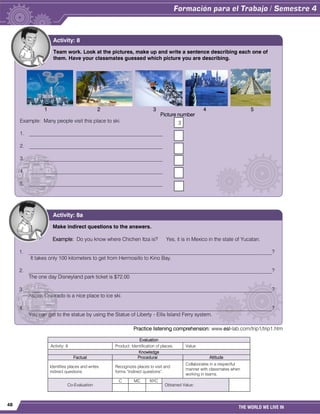
Team work. Look at the pictures, make up and write a sentence describing each one of
them. Have your classmates guessed which picture you are describing.
Picture number
Example: Many people visit this place to ski.
1. ___________________________________________________
2. ___________________________________________________
3. ___________________________________________________
4. ___________________________________________________
5. ___________________________________________________
Activity: 8
1 2 3 4 5
3
Make indirect questions to the answers.
Example: Do you know where Chichen Itza is? Yes, it is in Mexico in the state of Yucatan.
1. _____________________________________________________________________________________________?
It takes only 100 kilometers to get from Hermosillo to Kino Bay.
2. _____________________________________________________________________________________________?
The one day Disneyland park ticket is $72.00
3. _____________________________________________________________________________________________?
Aspen Colorado is a nice place to ice ski.
4. _____________________________________________________________________________________________?
You can get to the statue by using the Statue of Liberty - Ellis Island Ferry system.
Activity: 8a
49
BLOCK 1
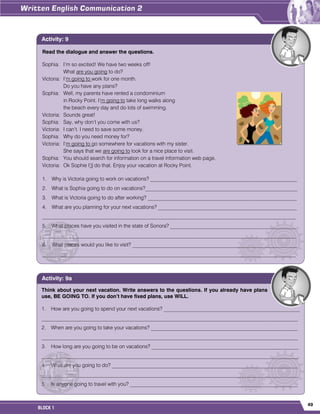
Read the dialogue and answer the questions.
Sophia: I’m so excited! We have two weeks off!
What are you going to do?
Victoria: I’m going to work for one month.
Do you have any plans?
Sophia: Well, my parents have rented a condominium
in Rocky Point. I’m going to take long walks along
the beach every day and do lots of swimming.
Victoria: Sounds great!
Sophia: Say, why don’t you come with us?
Victoria: I can’t. I need to save some money.
Sophia: Why do you need money for?
Victoria: I’m going to go somewhere for vacations with my sister.
She says that we are going to look for a nice place to visit.
Sophia: You should search for information on a travel information web page.
Victoria: Ok Sophie I’ll do that. Enjoy your vacation at Rocky Point.
1. Why is Victoria going to work on vacations? ________________________________________________________
2. What is Sophia going to do on vacations?__________________________________________________________
3. What is Victoria going to do after working? _________________________________________________________
4. What are you planning for your next vacations? _____________________________________________________
_________________________________________________________________________________________________
5. What places have you visited in the state of Sonora? ________________________________________________
_________________________________________________________________________________________________
6. What places would you like to visit? _______________________________________________________________
_________________________________________________________________________________________________
Activity: 9
Think about your next vacation. Write answers to the questions. If you already have plans
use, BE GOING TO. If you don’t have fixed plans, use WILL.
1. How are you going to spend your next vacations? ____________________________________________________
__________________________________________________________________________________________________
2. When are you going to take your vacations? ________________________________________________________
__________________________________________________________________________________________________
3. How long are you going to be on vacations? ________________________________________________________
__________________________________________________________________________________________________
4. What are you going to do? _______________________________________________________________________
__________________________________________________________________________________________________
5. Is anyone going to travel with you? ________________________________________________________________
Activity: 9a
50
THE WORLD WE LIVE IN
Evaluation
Activity: 9 Product: Conversation. Value:
Knowledge
Factual Procedural Attitude
Identifies the use of “will” and
“be going to” for making
vacation plans.
Applies “be going to” and the
modal” will” to express future
vacations and travel plans.
Demonstrate understanding when
expressing future tense.
Auto-Evaluation
C MC NYC
Obtained Value:
Complete the conversation with appropriate forms of BE GOING TO or WILL.
A: Have you made any vacation plans?
B: Well, I’ve decided on one thing –
I ______________________ go camping.
A: That’s great! For how long?
B: I ________________________ be away for a week.
A: So, when are you leaving?
B: I’m not sure. I _______________________ probably
leave around the end of the month.
A: And where ______ you ____________ go?
B: I haven’t thought about that yet. I guess I
______________ go to Aconchi.
A: That sounds like fun!
B: Yeah. Maybe I __________________ go
hiking and do some fishing. But for sure
I _______________________spend most of the
time in the thermal waters.
A: I didn’t know about the thermal waters in Aconchi.
B: Yes, The main attraction is “El Agua Caliente de Aconchi”.
A: What is that about?
B: It consists of spring thermal water with a temperature of 59 °C.
A: How exciting! Maybe I ___________ plan my next vacation there.
What do I need to go camping?
B: You have to bring a tent and a sleeping bag,
these are the two essential thinks you shouldn’t forget.
A: Ok, you tell me when you come back.
Activity: 9b
Remember that we have studied the future tense to make plans
you have decided on using: BE GOING TO
I’m going to the beach.
For making possible plans before making a decision using: WILL
I’m not sure. Maybe I’ll go camping.
Making plans for the Future using WILL and BE GOING TO
51
BLOCK 1
What items should or must I take on my vacation? Choose and write the item in the
corresponding box.
Camping Vacation abroad
Activity: 10
many cloth – lantern – spare batteries – passport – dissolving soap – traveler’s checks –
tent – cash – camping shower – plane ticket - back pack - identification card - arm chair–
Visa - first aid kid - hotel reservations - sleeping bag - coffee maker - lot of luggage -
fishing rod - formal cloth - I pod - cookware - volleyball - sunglasses - camera - map
Write sentences with items (from the box) that you should/must take to your vacation.
Example: I must bring my tent to go camping.
1. ________________________________________________________________________________________________
2. ________________________________________________________________________________________________
3._________________________________________________________________________________________________
4. ________________________________________________________________________________________________
5. ________________________________________________________________________________________________
6. ________________________________________________________________________________________________
Activity: 10a
52
THE WORLD WE LIVE IN
Evaluation
Activity: 10 Product: Modals practice. Value:
Knowledge
Factual Procedural Attitude
Identifies “Modals” for
describing necessity and giving
suggestions.
Applies “Modals” for describing
necessity and giving suggestions
for traveling and taking vacations.
Integrates new vocabulary to
his/her knowledge and shares it
with partner.
Co-Evaluation
C MC NYC
Obtained Value:
Pair work. Read and practice the dialogue with your partner. Underline the “Modal Verbs”.
Victoria: Hi Gus! You just came back from vacations.
Can you tell me a little about Mexico City?
Gus: Sure I can. What would you like to know?
Victoria: Well, what’s a good time to visit?
Gus: I think you can go anytime. The weather is always nice.
Victoria: Oh, good! And what should I see there?
Gus: Well, you should visit the National Museum, go to the
Palace of Fine Arts, Frida Kahlo’s “Casa Azul”, Templo Mayor.
Victoria: What else?
Gus: Oh, you shouldn’t miss the Pyramid of the Sun in
Teotihuacan, it’s one hour from the city. It’s very interesting.
Victoria: It all sounds really exciting. What advice can you give me?
Gus: You should buy a round-trip plane ticket and you
must get a passport.
Victoria: Thank you Gus. Your information will help me and
my sister to plan our trip to Mexico city.
Activity: 10b
Modals for necessity and suggestion
Describing Necessity Giving Suggestions
You have to get a passport. You ought to go to “Casa Azul”.
You must get a visa to go to USA. You should visit the Pyramids.
You need to take a tent. You’d better take spare batteries.
You don’t have to bring cookware. You shouldn’t forget a lantern.
Complete the sentences about things to do in Hermosillo. Use a Modal (change to
negative form if necessary) and a verb from the box.
1. You _______________ _______________ Hermosillo.
2. You _______________ _______________ “El Cerro de la Campana”.
3. You _______________ _______________ “Carne asada”.
4. You _______________ _______________ shopping at “Plaza Galerias”.
5. You _______________ _______________ a walk at UNISON campus.
6. You _______________ _______________ a morning at MUSAS.
Activity: 10c
miss
spend
see
go
visit
try
53
BLOCK 1
Evaluation
Activity: 11 Product: Report. Value:
Knowledge
Factual Procedural Attitude
Identifies “Modals” for
describing necessity and giving
suggestions.
Applies “Modals” for describing
necessity and giving suggestions
for traveling and taking vacations.
Collaborates with classmates
when working on reading and
writing a report.
Co-Evaluation
C MC NYC
Obtained Value:
Team work. Get in teams and read the passage. Answer the questions discuss with your
partner, write a report and present it to your teacher.
Must and mustn’t of transportation
These are the names of some public and private means of transport:
1) Car – taxi – van – lorry - bus – coach
2) Motorbike – bicycle
3) Airplane, helicopters,
Notice that you drive all the vehicles in line number 1, but you ride the ones in line number 2. All drivers
on the road are called motorists, while walking people are pedestrians. You must have a driving license to drive a
car, but you don't have to have one to ride a moped.
Motorists should stop whenever they see people standing at a pedestrian (zebra) crossing. You can say
you drive to school, to the supermarket etc., or that you go by car. On the other hand, you can say you walk there,
or go on foot.
If you use public transport, you must pay the fare (bus/train/taxi fare). If you can take/catch a train or a
bus, you mustn't get on without a ticket. If you take a taxi, you should also give the driver a tip. In big cities you
often have an underground.
Riding in an airplane is a great way to travel because it is fast and easy. Some people fly to their vacation
destination and others fly for business. Plane tickets should be purchased online, by phone, or by using a travel
agency. The prices of tickets vary, so you should check around and research all your options. If you're flying for
vacation, you should plan your trip several months ahead of time so you can get the best deal. You might want to
compare vacation packages that include your plane ticket, hotel room, and rental car.
Information taken from:
http://www.elcivics.com/lifeskills/airline-travel-1.html and
www.nspeak.com/newbasic/lesson5/index.htm
1. What mean of transport do you usually use? _______________________________________________________
2. When you drive a car the first thing that you must do is: ______________________________________________
3. When people are standing at a pedestrian crossing, what should the motorists do? ______________________
______________________________________________________________________________________________
4. Must you get a ticket before taking a bus in your city? _______________________________________________
5. Should you give a taxi driver a tip in your country? ___________________________________________________
6. Must you always buy your plane tickets online? _____________________________________________________
7. What should you do to get the best deal when buying a plane ticket? __________________________________
_________________________________________________________________________________________________
Activity: 11
54
THE WORLD WE LIVE IN
Evaluation
Activity: 12 Product: Question practice. Value:
Knowledge
Factual Procedural Attitude
Identifies questions to be made
when buying tickets to travel.
Reads and discusses questions to
Apply them to the answers given.
Values new structures used in real
situations and integrates them to
her/his knowledge.
Auto-Evaluation
C MC NYC
Obtained Value:
Read the questions and discuss them with your teacher. Then write the correct
QUESTION for the ANSWER given.
1. _____________________________________________________________________________________________?
Yes, it's 10% cheaper if you have you International Student Card.
2. _____________________________________________________________________________________________?
The charge is 60 dollars for a round trip.
3. _____________________________________________________________________________________________?
No, we'll put them in the bus' baggage compartment.
4. _____________________________________________________________________________________________?
No, they leave from North Station.
5. _____________________________________________________________________________________________?
Yes, there are three stops before the station.
6. _____________________________________________________________________________________________?
Yes, if it's not expired you'll get 70% of the ticket price back.
7. _____________________________________________________________________________________________?
If you buy your ticket one week in advance, it'll be 20% cheaper.
_____________________________________________________________________________________________?
No, it's a direct bus.
Activity: 12
Questions for “Buying tickets”
(Train, Airplane, Bus)
How much is the ticket?
Can I get a student / senior discount?
Do I have to bring my bags on the bus?
Does the bus stop anywhere before the central bus station?
Do you have a schedule I could look at?
Can I get a refund (= money back) for an unused ticket?
Can I get a discount if I buy my ticket in advance?
Do I have to change buses?
Do trains to Mexico City leave from this station?
55
BLOCK 1
Pair work. Plan your DREAM VACATION around the world, in your country or in your state.
Discuss these questions and make notes with your partner.
Where are you going to start from? Where are we going to stay?
What time of the year should we travel? What are we planning to do and see there?
How are we going to travel? How much money do we have to take?
What places should we visit? What do we need to take with us?
How long should we spend in each place? What kind of cloth should we take?
Notes
Activity: 13
Recommended web pages:
Information and Video guidebooks: http://www.travelchannel.com/Places_Trips
Interesting places in USA: http://www.travelinformation.com/
Places in Sonora : http://www.gotosonora.com/
Photographs: http://www.esl-
galaxy.com/themeworksheets/generalknowledge/World%20Land%20Marks.pdf
Mount Rushmore: http://www.elcivics.com/mount-rushmore.html
56
THE WORLD WE LIVE IN
Evaluation
Activity: 13 Product: Report. Value:
Knowledge
Factual Procedural Attitude
Integrates and reinforces
grammar and vocabulary by
writing a report.
Applies and reinforces grammar
and vocabulary studied by writing a
report as well as searches for
information on the web.
Values new structures used in real
situations and integrates them to
her/his knowledge.
Auto-Evaluation
C MC NYC
Obtained Value:
Write a report about the vacation you planned with your partner in the previous page.
(Use vocabulary, useful phrases, grammar studied in the sequence, and search the
recommended web pages for information and pictures). Post your report here.
Activity: 13a
Take turns and read your draft aloud to your partner
Activity: 13b
57
BLOCK 1
Closing activities
Evaluation
Activity: 14 Product: Indirect questions. Value:
Knowledge
Factual Procedural Attitude
Relates questions to answers
from a dialogue booking a hotel
room.
Applies previous knowledge to
match questions and answers.
Writes indirect questions.
Collaborates with responsibility
when working in basic exercises.
Auto-Evaluation
C MC NYC
Obtained Value:
Read the questions in the left column and match the best answers to the right column.
Write the dialogue. Then change the questions in the left column to “Indirect questions”.
In a Hotel
1. How can I help you? ( ) No, it is included in the price of your room
2. When will you be visiting? ( ) Yes, we have a safe behind the front desk
3. How long will you be staying? ( ) I need to book a room
4. How will you be paying for this room? ( ) Three days and two nights.
5. Must I pay extra for breakfast? ( ) With a Visa card
6. Is there anywhere to store my valuables? ( ) July 8th
and 9th
Dialogue
Agent:
Customer:
Agent:
Customer:
Agent:
Customer:
Agent:
Customer:
Agent:
Customer:
Agent:
Customer:
Indirect questions.
1.________________________________________________________________________________________________
2.________________________________________________________________________________________________
3.________________________________________________________________________________________________
4.________________________________________________________________________________________________
5.________________________________________________________________________________________________
6.________________________________________________________________________________________________
Activity: 14
58
THE WORLD WE LIVE IN
Evaluation
Activity: 15 Product: Report. Value:
Knowledge
Factual Procedural Attitude
Identifies means of
transportation vocabulary and
searches for information.
Applies vocabulary studied and
searches for information on the
web.
Shows creativity by writing a
report and openness by using
technology to search for
information.
Auto-Evaluation
C MC NYC
Obtained Value:
Write about different means of transportation; when, why, and how they are used. Post
photographs. You’ll find information and pictures in the following web page:
http://www.elcivics.com/esl_transportation_1.html
Activity: 15
59
BLOCK 1
Evaluation
Activity: 16 Product: Advice practice. Value:
Knowledge
Factual Procedural Attitude
Identifies “Modals” for
describing necessity and giving
suggestions.
Applies “Modals” for describing
necessity and giving suggestions
for traveling and taking vacations.
Demonstrate understanding of
basic instructions and ask for
clarification to his/her teacher.
Auto-Evaluation
C MC NYC
Obtained Value:
Complete the advices use modals for necessity or suggestion. Then compare your
answers with your classmates.
1. You ________________________ get a passport to travel to USA.
2. You ________________________ bring formal cloth to go camping.(negative)
3. You ________________________ bring a sleeping pack to go hunting.
4. You ________________________ buy a round-trip plane ticket.
5. You ________________________ hotel reservations.
6. You ________________________ pack too many clothes to go camping. (negative)
7. You ________________________ get a vacation.
8. You ________________________ check the weather.
9. You ________________________ carry lots of cash. (negative).
10. You ________________________ traveler’s checks.
11. You ________________________ forget to bring spare batteries to go camping.
12. You ________________________ take a lot of luggage. (negative)
13. You ________________________ check your visas.
14. You ________________________ carry your wallet in your backpack. (negative)
15. You ________________________ take identification with you.
Activity: 16
Give advice to a person who is planning to visit your city.
Example: You should bring an umbrella when you come to Nogales.
1. ______________________________________________________________________________________________.
2. ______________________________________________________________________________________________.
3. ______________________________________________________________________________________________.
4. ______________________________________________________________________________________________.
5. ______________________________________________________________________________________________.
Activity: 16a
60
THE WORLD WE LIVE IN
Evaluation
Activity: 17 Product: Report. Value:
Knowledge
Factual Procedural Attitude
Integrates and reinforces
grammar and vocabulary by
writing a report.
Applies and reinforces grammar
and studied vocabulary by writing a
report.
Shows creativity by writing a
report and appreciates the use of
structures to be used in a real
context.
Auto-Evaluation
C MC NYC
Obtained Value:
What advice can you give to someone who is planning to visit your country? Include
information about transportation, accommodations, places to visit, dining and pictures.
Write a report and post it here.
Activity: 17
61
BLOCK 1
Didactic Sequence 3.
Our Environment.
Start up activity
Evaluation
Activity: 1 Product: Questionnaire. Value:
Knowledge
Factual Procedural Attitude
Identifies facts about previous
knowledge.
Applies previous knowledge about
“Environmental Problems”.
Shows independence when
applying previous knowledge.
Auto-Evaluation
C MC NYC
Obtained Value:
How much do you know about “Environmental Problems”. Choose the best answer and then
discuss with your partners.
1. What do you call the rain that contains chemical waste and causes damage to plants and animals?
a) Smog b) Acid rain c) Monson rain d) Season Rain
2. What is the term used to describe a substance that can be broken down and eaten up by microorganisms
like bacteria?
a) Compound b) Environment friendly c) Biodegradable d) Recycled
3. We all know that the Kaziranga sanctuary is a place where rhinos can live safely away from hunters. What is
the term used for such careful use and protection of nature?
a) Biofriendly b) Ecofriendly c) Degradation d) Conservation
4. What is the natural environment of a living organism called?
a) Habitat b) Surroundings c) Environment d) Biosphere
5. Most of the oil that we use is imported into our country from other nations. The oil is carried in huge sea going
tankers. Sometimes these tankers get damaged and the oil leaks into the oceans and seas. What is such an
accidental discharge of oil into water bodies called?
a) Water pollution b) Oil spill c) Oil leak d) Tanker leak
6. What is the process of collecting, processing and reusing waste materials called?
a) Recycling b) Reworking c) Reusing d) Reprocessing
7. Name the phenomenon because of which the earth’s atmospheric temperature is increasing causing
widespread environmental changes?
a) Seebeck effect b) Greenhouse effec c) Geothermal effect d) Biothermal efect
8. What is a substance that dirties the air, water or ground – thereby harming the living organisms called?
a) Pesticides b) Non-biodegradable c) G Pollutant d) Environmental friendly
9. What is the term used for the pollution and damage caused by release of heated water into rivers and lakes
that can harm animal and plant life?
a) Thermal pollution b) Geothermal pollution c) G Bothermal Pollution d) Isothermal Pollution
10. Have you heard that the ultraviolet radiations from the sun may cause skin cancer? Can you tell me which
layer of the earth’s atmosphere protects the earth from these dangerous ultraviolet radiations of the sun?
a) Stratosphere b) Ozonosphere c) G Lonosphere d) Troposphere
Activity: 1
62
THE WORLD WE LIVE IN
Development activities
Evaluation
Activity: 2 Product: Recognition. Value:
Knowledge
Factual Procedural Attitude
Recognizes vocabulary related
to ecological problems.
Applies vocabulary and his/her
knowledge about ecological
problems.
Appreciates interesting acquired
information about environmental
problems.
Auto-Evaluation
C MC NYC
Obtained Value:
Team work. Learn “Pollution Pre-reading vocabulary” and discuss it with your partners. Answer
the questions.
Word Meaning
acid rain noun
Acid that contains harmful chemicals that collect in the atmosphere when fossil fuels
are burned
carcinogen noun A substance that has been linked to causing one or more types of cancer
Contaminated adj. Has come in contact with organisms or substances that cause disease
developing country noun A nation that is working towards becoming more economically and socially advanced
domestic waste noun Garbage that is produced by people in a household
dumping verb Placing waste in an area that is not appropriate ( ex. dumping chemicals in oceans)
industrial adj. Related to the advancement of the economy
pesticides noun Chemicals that are sprayed on crops to prevent insects from destroying them
pollutant noun Something that causes damage to the environment
pollution noun The contamination of the environment
sewage noun Waste that humans put down drains
smog noun Air pollution caused by a reaction between chemicals in the atmosphere and sunlight
sustain verb Support
toxic chemicals (toxins)
noun
Poisonous materials that can cause disease
1. Trash thrown away at every home is called _________________________________________________waste.
2. This is a form of precipitation that contains harmful chemicals _________________________________________
3. These are used to protect plant fields from insects: _________________________________________________
4. Waste matter that contaminates the water, air, and soil: ______________________________________________
5. Air pollution by a mixture of smoke and fog: ________________________________________________________
Activity: 2
63
BLOCK 1
Evaluation
Activity: 3 Product: Reading comprehension. Value:
Knowledge
Factual Procedural Attitude
Classifies and selects
information about environmental
problems.
Reads information about
environmental problems to answer
questions.
Appreciates interesting acquired
information about environmental
problems.
Auto-Evaluation
C MC NYC
Obtained Value:
Team work. Take turns and read paragraphs. Discuss the reading, and answer the
questions.
Water, Air and Soil Contamination
Pollution is an environmental concern for people throughout the world. One university study
suggests that pollutants in the water, air, and soil cause up to 40 percent of the premature
deaths in the world's population. The majority of these deaths occur in developing countries.
Water in many third world countries is contaminated with toxic chemicals, also known as toxins. In many regions
the water that is used for drinking, cooking, and washing is the same water that is used for dumping sewage and
hazardous waste. Most developing countries cannot afford water treatment facilities. Approximately 80% of
infectious diseases in the world are caused by contaminated water.
Air pollution is a growing problem throughout the world. Indoor air pollution is one of the leading causes of lung
cancer. Families in developing countries use open stoves for cooking and heating their homes. These homes do
not have proper ventilation. The smoke, which is full of chemicals and carcinogens, gets trapped inside where
families eat and sleep. Outdoor pollution also causes disease and illness, especially in industrial cities such as
Beijing, China, where cancer is the leading cause of death. Acid rain, results mainly from the coal powered
factories, which produce inexpensive goods for North American and European consumers.
Soil pollution is also a major concern, both in industrial and developing countries. Pollutants such as metals and
pesticides seep into the earth's soil and contaminate the food supply. Soil pollution causes major health risks to
entire ecosystems. This type of pollution reduces the amount of land suitable for agricultural production and
contributes to global food shortages. Dumping of industrial and domestic waste products produces much of the
world's soil pollution, though natural disasters can also add to the problem. Farmers in poor nations grow food in
contaminated soil both to earn a living and to avoid starvation.
As more people move to urban centers, premature deaths caused by pollution are expected to increase
worldwide. Today, the developed nations who achieved their wealth at the expense of the environment will be
held accountable for protecting the earth's resources for future generations.
ESL English Club
1. According to the article, what causes 40% of the world's premature deaths? _____________________________
2. What causes the “Global food shortage”? __________________________________________________________
_________________________________________________________________________________________________
3. What is the main reason people die of waterborne illnesses? __________________________________________
4. Which is the main cause of lung cancer in third world countries? ______________________________________
5. Which is NOT mentioned as a source of soil pollution? Choose two and underline them.
a) Dumping of wastes b) Use of pesticides c) smoke from factories d) acid rain
Activity: 3
64
THE WORLD WE LIVE IN
Evaluation
Activity: 4 Product: Brief repot. Value:
Knowledge
Factual Procedural Attitude
Classifies and selects
information about environmental
problems.
Reads information about
environmental problems to match
words and complete statements.
Shows initiative and interest by
writing about ecological problem
in actual time.
Auto-Evaluation
C MC NYC
Obtained Value:
Match the words in column A with words in column B. Use the same words to complete
the statements.
Column A Column B
Oil __________________________ Rain
Exhaust __________________________ Spill
Catalytic __________________________ Fumes
Ecological __________________________ Disaster
Greenhouse __________________________ Layer
Acid __________________________ Effect
Ozone __________________________ Warming
Global __________________________ Converter
1. I think that the smoke from factories is more dangerous to the atmosphere than the
_______________________ from cars. It contributes to ________________________ which can destroy forests.
2. I don’t believe that there is a hole in the _________________________________________ because I can’t see it.
3. I like the fact that the ________________________________________ is making the planet hotter. I like hot
weather so I don’t think that _______________________________________ is a problem.
4. I think the ___________________________ in the Galapagos Islands was a preventable ___________________.
Activity: 4
What ecological disaster do you remember? Why do you remember it in particular?
______________________________________________________________________________________
__________________________________________________________________________________________________
__________________________________________________________________________________________________
__________________________________________________________________________________________________
__________________________________________________________________________________________________
________________________________________________________________________________________________
Activity: 4a
65
BLOCK 1
Evaluation
Activity: 5 Product: Match exercise. Value:
Knowledge
Factual Procedural Attitude
Identifies and selects
information about environmental
problems.
Reads information about
environmental problems to match
words and complete statements.
Appreciates interesting acquired
information about environmental
problems.
Auto-Evaluation
C MC NYC
Obtained Value:
Complete the conditional sentences. Take information from activity 3.
Example: If we continue using toxic chemicals, the water will be contaminated.
1. If we don’t take care of water, air, and soil, there ________________________________ in the world population.
2. Acid rain will continue if __________________________________________________________________________
3. If developing countries continue using open stoves for cooking and heating in their homes,
they__________________________________________________________________________________________.
4. There will be more “Acid Rain” If coal powered factories ______________________________________________.
5. If we continue dumping industrial and domestic waste, _____________________________more food shortage.
Activity: 5
Match the Environmental suggestions to the results. Write the letter on the line.
1. Recycle paper to ______ A) reduce the garbage problem.
2. Recycle aluminum cans and glass to _____ B) Help protect the ozone layer.
3. Use unleaded gas to _____ C) Don’t use so much energy on heating or air
conditioning.
4. Buy products with less packaging to _____ D) Save trees.
5. Don’t buy tropical hardwoods to ______ E) to save water and electricity.
6. Improve insulation_____ F) Save from 40 to 85 percent of the energy
needed in the manufacturing process.
7. Use Public transportation to ______ G) Reduce consumption of gas and air pollution.
8. Don’t buy aerosols to _____ H) prevent “Global Warming”.
9. Turn off taps and lights to ______ I) Help preserve the rainforest.
10. Start an energy reduction plan to ______ J) Reduce air pollution.
Activity: 5a
Conditional sentences can describe situations and consequences that are possible in the present or future.
Possible situation (with present tense form) Consequence (with future modals: will, may, or might)
If we continue using pesticides, we will reduce land for agriculture.
If I quit smoking, I will be healthier.
If we don’t reduce air pollution, we might suffer from different diseases.
The if-clause can be at the beginning (with a comma) or at the end (no comma) of the sentence.
Conditional Sentences
66
THE WORLD WE LIVE IN
Evaluation
Activity: 6 Product: Report and suggestions. Value:
Knowledge
Factual Procedural Attitude
Identifies and reads information
about environmental problems.
Reads information about
environmental problems and learns
ways to give suggestions.
Appreciates interesting acquired
information about environmental
problems.
Auto-Evaluation
C MC NYC
Obtained Value:
Read the scientists’ suggestions and fill in the table. Add your suggestions.
Living a green world
Scientists around the globe suggest that we must do our share to take care of our planet. This means making
changes to our daily lives to reduce global warming and reducing the use of chemicals that deplete the Earth's
protective ozone layer.
Green is a term that many people use to talk about taking care of the planet and not overusing the resources that
we all share. If you want to make a difference, the best way to start is to follow these three principles:
REDUCE, REUSE, AND RECYCLE
REDUCE. Use less of everything: less energy, less paper, less gas, and less water.
It means to ride a bike or drive a hybrid car, and to turn off the water when you are brushing your teeth.
REUSE. Find new uses for your old products. Turn a pair of jeans into a cool purse, or use broken flower pots and
create mosaic for a table or photo frame. Use newspapers to make papier mache art for a friend.
RECYCLE. Take your used products like cans, bottles, plastics, and paper and donate them to groups that turn
them into new products.
Scientists’ Suggestions
1.
2.
3.
4.
5.
6.
7.
8.
Activity: 6
Making Suggestions
There are a lot of formulas used when making suggestions:
 Why don’t we recycling paper?
 We must work hard to get a good grade.
 Let’s go to the travel Agent’s this afternoon.
 I suggest you/that…
Starting with a verb:
 Find new uses for your old products.
67
BLOCK 1
Evaluation
Activity: 7 Product: Suggestions table. Value:
Knowledge
Factual Procedural Attitude
Identifies and reads information
about environmental problems.
Reads information about
environmental problems to give
his/her own suggestions.
Appreciates interesting acquired
information about environmental
problems.
Auto-Evaluation
C MC NYC
Obtained Value:
Write suggestions to the environmental problems from Reading in activity 3.
Environmental Problem Your Suggestion
Water pollution
Air pollution
Soil pollution
Acid rain
Activity: 7
Write “Conditional Sentences” from activity 5a.
Example:
1. If we recycle paper, we will save trees.
2.
3.
4.
5.
6.
7.
8.
9.
10. .
Activity: 7a
68
THE WORLD WE LIVE IN
Evaluation
Activity: 8 Product: Reading comprehension. Value:
Knowledge
Factual Procedural Attitude
Identifies ecological problems to
and recognizes how man has
affected the environment.
Recognizes the ecological
problems caused by man to answer
questions.
Appreciates the importance of
taking good care of our
environment recognizing how the
natural world sustains us.
Auto-Evaluation
C MC NYC
Obtained Value:
Read the article about an ecological problem caused by men. Answer the questions.
Oil affecting wildlife in the Gulf of Mexico
The oil that began leaking with the explosion of the Deepwater Horizon oil rig on
April 20th continues to spill into the gulf. This oil spill is now the worst in U.S.
history.
The spill is taking a heavy toll on wildlife. More than 800 dead animals, including
birds, fish, and dolphins, have been found in areas affected by the spill. The
number of affected animals seems to have been increasing in the last few days.
Oil is hard to clean up. Try rubbing some olive oil and canola oil on your hair to see how hard it is to clean off.
Now imagine trying to clean crude oil off your whole body using your mouth. Oil-coated birds are unable to keep
the oil off their feathers, but while there is oil on their feathers they are unable to fly. Rehabilitators are trying to
clean some of the birds by rubbing them with vegetable oil, which breaks down the heavier oil, and then washing
them with detergents. Because the oil from the spill is toxic, not all cleaned birds will survive.
Scientists are not yet sure how the deaths of so many creatures will affect the Gulf ecosystem.
1. When did the oil spill begin? _____________________________________________________________________
2. Where did it begin? _____________________________________________________________________________
3. What animals have been affected? ________________________________________________________________
4. What have rehabilitators done to clean the birds? ___________________________________________________
_________________________________________________________________________________________________
5. What do you know about this ecological problem known worldwide? ___________________________________
_________________________________________________________________________________________________
_________________________________________________________________________________________________
_________________________________________________________________________________________________
_________________________________________________________________________________________________
Activity: 8
Struggling Pelican
69
BLOCK 1
Closing activity
Evaluation
Activity: 9 Product: Project report. Value:
Knowledge
Factual Procedural Attitude
Identifies ecological problems to
promote a school ecological
project.
Applies knowledge to preserve and
protect his/her school environment.
Appreciates how the natural world
sustains us and promotes the
environment and social well-being
of his/her school community.
Auto-Evaluation
C MC NYC
Obtained Value:
Turn your school into an ECO-SCHOOL.
Here are some ideas for your project:
A School composting that could be used to Implementation of efficient light bulbs
help your school garden flourish. and signs to educate people to switch
light off.
A school garden growing organic vegetables and recycling programs.
Activity: 9
70
THE WORLD WE LIVE IN
Drawings to be used in environmental activities:
Feelings and emotions
Competencias profesionales:
1. Realiza comprensiones oral y auditiva de diversos tipos de texto en otro idioma.
2. Realiza comprensión escrita y de lectura de diversos tipos de texto en otro idioma.
3. Realiza expresión o producción oral en otro idioma.
4. Realiza interacción oral en otro idioma.
5. Realiza expresión o producción escrita de diversos tipos de texto en otro idioma.
Unidad de competencia:
 Solicita e intercambia información referente al pasado de una persona; describe emociones y
da su opinión acerca de hechos, libros y películas de manera escrita en situaciones sencillas
de socialización recreación o laboral.
Atributos a desarrollar en el bloque:
4.1 Expresa ideas y conceptos mediante representaciones lingüísticas, matemáticas o gráficas.
4.2 Aplica distintas estrategias comunicativas según quienes sean sus interlocutores, el contexto
en el que se encuentra y los objetivos que persigue.
4.3 Identifica las ideas claves en un texto o discurso oral e infiere conclusiones a partir de ellas.
4.4 Se comunica en una segunda lengua en situaciones cotidianas.
4.5 Maneja las tecnologías de la información y la comunicación para obtener información y
expresar ideas.
6.4 Estructura ideas y argumentos de manera clara, coherente y sintética.
7.1 Define metas y da seguimiento a sus procesos de construcción de conocimiento.
8.2 Aporta puntos de vista con apertura y considera los de otras personas de manera reflexiva.
10.3 Asume que el respeto de las diferencias es el principio de integración y de convivencia en los
contextos local, nacional e internacional.
Time assigned: 20 hours
72
FEELINGS AND EMOTIONS
Didactic Sequence 1.
Long time no see!
Start up Activity

Evaluation
Activity: 1 Product: Famous characters table. Value:
Knowledge
Factual Procedural Attitude
Writes information about famous
people and identifies the simple
past and past continuous tense.
Applies information about famous
people using simple past and past
continuous.
Shows independence when
applying previous knowledge.
Auto–Evaluation
C MC NYC
Obtained Value:
Warm Up: Write about your famous characters. Important figure or celebrity
? Artist Singer or musician Writer
Name
Nationality
Why is he/she famous?
Latest Achievements
Why is she famous for? What is his name?
_______________________________ ______________________________
What has been her latest event? What was he doing in July 2010?
_______________________________ ______________________________
Was has she done to be famous? What “Novel Price” did he won?
_____________________________ _____________________________
Do you know Elena Poniatowska? What has he done to won the
____________________________ _____________________________
Activity: 1
73
BLOCK 2
Development Activities
Evaluation
Activity: 2 Product: Grammar discussion. Value:
knowledge
Factual Procedural Attitude
Identifies the simple past and
past continuous tense.
Applies the past continuous tense
in his/her personal experience.
Integrates new grammar
structures and vocabulary to
his/her knowledge.
Auto-Evaluation
C MC NYC
Obtained Value:
Read and discuss in class the use of the “Past Continuous” presented on the table. Then
complete the sentences with information about yourself. Use simple past or past
continuous.
We use the “Past Continuous” to say what we were doing at a
particular moment in the past.
subject auxiliary verb main verb
+ I was watching TV.
+ You were working hard.
- He, she, it was not helping Mary.
- We were not joking
? Were you being silly?
? Were they playing soccer?
1. When I was a child I ____________________________________________________________________________.
2. I met my best friend while _______________________________________________________________________.
3. When I was going to secondary school I __________________________________________________________.
4. Three years ago I ______________________________________________________________________________.
5. Last year I ___________________________________ when ___________________________________________.
Activity: 2
Complete these sentences. Then take turns and write them on the board.
1. I ___________________________________________at 10pm last night.
2. They __________not __________________football at 9am this morning.
3. What __________you _______________________ at 10pm last night?
4. What__________ you __________________________when he arrived?
5. She ____________________________________when I telephoned her.
6. We _________________________________dinner when it started to rain.
7. Frederick went home early because it ___________________________________.
Activity: 2a
We often use the past
continuous tense with the
simple past tense.
We can join the two ideas with
when or while.
 I was taking a shower
when you called me.
74
FEELINGS AND EMOTIONS
Match the phrases to complete correct sentences. Write the number in the parenthesis.
1. We were talking about him ( ) when the earthquake happened?
2. Were you sleeping ( ) when he had the accident.
3. While I was watching “Titanic” ( ) I was flying to Guadalajara.
4. When the fire started ( ) we were having lunch.
5. At this time last year ( ) I was thinking of you.
6. Peter wasn't driving ( ) when my bus came in.
Activity: 3
Choose the verb forms from the box to complete the sentences.
1. We ____________ a terror film when the door _______________________.
2. Suddenly the noise ______________________________.
3. The fire __________________ when I ______________________ an omelet.
4. The little boy _________________ because he _________________ an ice cream.
5. He ______________________ to the news while he _________________home.
6. What ________________ you _______________ when the fire started?
7. ____________ your sister _________________ at that time?
8. ___________ you __________________ the movie last night?
Activity: 3a
Make sentences using the verb forms from the box.
1. _______________________________________________________________________________________________
2. _______________________________________________________________________________________________
3. _______________________________________________________________________________________________
4. _______________________________________________________________________________________________
5. _______________________________________________________________________________________________
Activity: 3b
 Were/doing
 Was/sleeping
 Did you see
 Was listening
/was driving
 Was
crying/wanted
 Started/was
cooking
 Stopped
 Were watching/
opened
75
BLOCK 2

Evaluation
Activity: 3 Product: Past activities description. Value:
knowledge
Factual Procedural Attitude
Identifies the simple past and
past continuous tense.
Applies the past continuous tense
in his/her personal experience.
Shows initiative when working in
basic exercises.
Auto-Evaluation
C MC NYC
Obtained Value:
There was a rainstorm last night. Describe what people in my family were doing then. Use
the “Past Continuous”.
My mother was ____________________________________________________________________________________.
My grandfather was ________________________________________________________________________________.
My sister _________________________________________________________________________________________.
My brother ________________________________________________________________________________________.
My father _________________________________________________________________________________________.
The twins _________________________________________________________________________________________.
Activity: 3c
Describe activities you did yesterday. Where were you and what were you doing?
1. At 6:00 a.m., I was having breakfast with my family.
2. At 9:00 in the morning,___________________________________________________________________________
3. At noon, _______________________________________________________________________________________
4. In the afternoon, ________________________________________________________________________________
5. At 10:00 last night, ______________________________________________________________________________
6. At this time yesterday, ___________________________________________________________________________
Activity: 3d
76
FEELINGS AND EMOTIONS



































Evaluation
Activity: 4
Product: Reading
Comprehension.
Value:
Knowledge
Factual Procedural Attitude
Identifies vocabulary, the work
and life of important people.
Recognizes and realizes that
work and other’s life and
personal information is important.
Appreciates the characteristics
and merits of work and life of
important people.
Auto-Evaluation
C MC NYC
Obtained Value:
Read the biography and answer the questions about the reading.
César Chávez
Cesar Chavez was a Mexican-American labor leader and civil rights activist. He was a farm worker
who co-founded the biggest farm workers’ union in the USA and improved the working conditions
of thousands of farm laborers. Many see him as one of America’s greatest civil right leaders. He
claimed that his models were Emiliano Zapata, Gandhi, Rehru and Martin Luther King. More and
more US states are honoring him by making his birthday a holiday.
Chavez was born in Arizona in 1927 to farm worker parents. His childhood was very tough because of the poverty
caused by the Great Depression. Chavez was a natural leader and in 1952 he became an administrator in the
Latino civil rights group the Community Service Organization. He travelled throughout California urging Mexican
Americans to vote and speaking about workers’ rights.
In 1962, Chavez co-founded the National Farm Workers Association (NFWA) with Dolores Huerta. His first
success was to lead a California grape pickers strike for better wages. The strike lasted five years and attracted
the attention of Robert Kennedy. The NFWA won its first major labor victory for American farm workers. Chavez
moved on to campaign for the rights of other farm workers.
The NFWA developed into the United Farm Workers. Chavez led marches and encouraged farm workers across
America to join together. He helped them strike and organize boycotts. In the 1980s he fasted to draw public
attention to the dangerous use of pesticides. He asked his people to, "Make a solemn promise: to enjoy our
rightful part of the riches of this land, to throw off the yoke of being considered as agricultural implements or
slaves. We are free men and we demand justice”. Chavez died in 1993 of natural causes. Ten years later,
America honored him with a postage stamp.
Taken from: Famous People Lessons
Vocabulary
Claimed: Assert or affirm strongly.
Wages: Remunerate, salary.
Strike: Negation to work in protest against bad work conditions.
Fasted: Abstained from eating.
1. What did you learn from this text about Cesar Chavez? ______________________________________________
_________________________________________________________________________________________________
2. What questions would you like to have asked Cesar Chavez? _________________________________________
_________________________________________________________________________________________________
3. What was Cesar Chavez’ famous Advice to his people? ______________________________________________
_________________________________________________________________________________________________
4. Why did he fast in 1980? ________________________________________________________________________
_________________________________________________________________________________________________
Activity: 4
77
BLOCK 2
Recommended web sites: http://www.biography.com/
Fill in the biography framework.
Name: César Chávez
Birth:
Death:
Early Influences:
Childhood:
Major
Accomplishments:
Significance:
Contemporaries:
Activity: 5
Match the words from the biography on the left with their synonyms on the right. Use your
dictionary.
Paragraphs 1 and 2 Paragraphs 3 and 4
1. Activist ( ) a. made better 7. Success ( ) g. urged
2. Improved ( ) b. difficult 8. Major ( ) h. triumph
3. Honoring ( ) c. encouraging 9. Campaign ( ) i. reasons
4. Tough ( ) d. campaigner 10. Encouraged ( ) j. awareness
5. Poverty ( ) e. paying tribute 11. Attention ( ) k. great
6. Urging ( ) f. hardship 12. Causes ( ) l. fight
Activity: 5a
78
FEELINGS AND EMOTIONS
Evaluation
Activity: 5 Product: Biography framework. Value:
Knowledge
Factual Procedural Attitude
Identifies vocabulary, work and
life of important people.
Recognizes and realizes work and
other’s life and practices
chronological order.
Appreciates the characteristics
and merits of work and life of
important figures.
Auto-Evaluation
C MC NYC
Obtained Value:
Pair work. Number these lines in the correct order according to Cesar Chavez’ biography.
( ) In 1962, Chavez co-founded the National Farm Workers Association (NFWA) with Dolores Huerta.
His first success.
( ) on to campaign for the rights of other farm workers.
( ) causes. Ten years later, America honored him with a postage stamp.
( ) rights group the Community Service Organization. He travelled throughout California urging.
( ) was to lead a California grape pickers strike for better wages. The strike lasted five years and
attracted the attention.
( ) The NFWA developed into the United Farm Workers. Chavez led marches and encouraged farm
workers.
( ) public attention to the dangerous use of pesticides. Chavez died in 1993 of natural.
( ) co-founded the biggest farm workers’ union in the USA and improved the working conditions of
thousands of farm.
( 1 ) states are honoring him by making his birthday a holiday.
( ) Cesar Chavez was a Mexican-American labor leader and civil rights activist. He was a farm worker
who.
( ) Mexican Americans to vote and speaking about worker’s rights.
( ) caused by the Great Depression. Chavez was a natural leader and in 1952 he became an
administrator in the Latino civil.
( ) laborers. Many see him as one of America’s greatest civil rights leaders. More and more US.
( ) of Robert Kennedy. The NFWA won its first major labor victory for American farm workers. Chavez
moved.
( ) Chavez was born in Arizona in 1927 to farm worker parents. His childhood was very tough because
of the poverty.
( ) across America to join together. He helped them strike and organize boycotts. In the 1980s he
fasted to draw.
Activity: 5b
79
BLOCK 2
Evaluation
Activity: 6 Product: Report. Value:
Knowledge
Factual Procedural Attitude
Classifies information,
vocabulary and grammar for
writing an imaginary event.
Writes about an imaginary event
using the grammar structure: past
continuous tense.
Appreciates the characteristics
and merits of work and life of
important figures.
Auto-Evaluation
C MC NYC
Obtained Value:
Imagine that Cesar Chaves is still alive. What would he been doing while “Law SB 1070”
was being passed in Arizona. “This law requires that all police officers become
immigration officers by requiring them to verify the residency status of individuals
suspected of being in the country illegally”. Discuss with your partner, write a report and
hand it over to your teacher or paste it here.
Activity: 6
80
FEELINGS AND EMOTIONS
Evaluation
Activity: 7 Product: Report. Value:
Knowledge
Factual Procedural Attitude
Recognizes the past continuous
to write about his/her life.
Writes about his/her life and
outlooks for the future using the
grammar structure: past continuous
tense.
Integrates vocabulary and
grammar structure to write about
the characteristics and merits of
her/his own.
Auto-Evaluation
C MC NYC
Obtained Value:
Write your biography. Writing an autobiography, focus on three things: who you are in
life, what life means to you and what your outlook (point of view) for the future is.
Activity: 7
Your
picture
81
BLOCK 2
Read the biography and answer the questions.
Angelina Jolie
Angelina was born in LA in 1976. She loved movies and started acting classes to follow her
dream of movie stardom. She was rebellious and became a punk with dyed purple hair and
tattoos. Her movie career took off in 1997 and within a few years she had won an Oscar. Her
2001 role as Lara Croft in the blockbuster “Tomb Raider” shot her to international fame.
Angelina hasn’t limited her career to acting. She became involved in humanitarian work while filming in Cambodia.
She is now a UN Goodwill Ambassador, visiting refugee camps in poor countries. She donates large sums of
money to help the plight of underprivileged people. She has effectively used her stardom to highlight world
problems.
Unfortunately, Jolie’s personal life has come to overshadow her other pursuits. The tabloids are obsessed with her
relationships, especially the current one with Brad Pitt. The couple is now referred to not as Brad and Angelina but
as “Brangelina”. The media seem more caught up with what they eat and drink than the important humanitarian
work Angelina continues to do.
Helping other people is what truly motivates Angelina. In 2001, she said: “We cannot close ourselves off…and
ignore the fact that millions of people are out there suffering.” In addition to acting awards, she has received wide
recognition for her humanitarian work. She became the first winner of the UN’s Citizen of the World Award. It
seems likely more accolades will follow.
1. What did you learn from this text about Angelina Jolie? ______________________________________________
__________________________________________________________________________________________________
2. How was her appearance when she was in her 20s? _________________________________________________
__________________________________________________________________________________________________
Activity: 8
Put the words back into the correct order.
1. to her of stardom follow dream movie =
2. hair a with purple became punk dyed =
3. Angelina limited career acting hasn’t her to =
4. camps refugee visiting countries poor in =
5. to world used stardom highlight problems her =
6. The are with relationships tabloids obsessed her =
7. Angelina motivates truly what is people other Helping =
8. accolades follow seems more will It likely =
Activity: 8a
82
FEELINGS AND EMOTIONS
Evaluation
Activity: 8 Product: Dialogue. Value:
Knowledge
Factual Procedural Attitude
Writes questions and answers in
a meeting friend’s dialogue.
Reads a biography and recognizes
the theme of meeting old friend and
catching up on what they have
been doing.
Enjoys learning about interesting
humanitarian work of an important
figure.
Auto-Evaluation
C MC NYC
Obtained Value:
Complete the questions and answers. Pretend that you are long-time friend of Angelina
Jolie. You have not met for many years and suddenly bump into her. You must catch up
with all your latest news. You must talk about the past and ask questions.
You: Hey, Angelina! I haven’t seen you in ages.
What have you been doing lately?
Angelina: Yes, “Long time no see”. Well, I have been ________________________________________________
____________________________________________________________________ in the last 10 years.
You: What have you been doing after you won an Oscar?
Angelina: I’ve been _____________________________________________________________________________
You: What roles have you played in your movies?
Angelina: _____________________________________________________________________________________
You: In what movie?
Angelina _____________________________________________________________________________________
You: I heard you have been traveling to Cambodia a lot. What have you been doing there?
Angelina: I have been ___________________________________________________________________________
You: Very interesting, but how is your love life?
Angelina: Oh great! I am married to a wonderful man his name is ______________________________________
You: Angelina, what motivates you to do humanitarian work?
Angelina: Like I said in 2001: “____________________________________________________________________
_____________________________________________________________________________________”
You: No wonder why you were given the “UN’s Citizen of the World Award”
I feel proud being your friend. I know more awards will follow.
Angelina: Thank you, but I want to know what you have been doing lately. The other time we meet we’ll talk
about you.
Activity: 8b
83
BLOCK 2
Evaluation
Activity: 9 Product: Small talk conversations. Value:
Knowledge
Factual Procedural Attitude
Identifies the “Present Perfect
Continuous” for the first time.
Applies the “Present Perfect
Continuous” when talking on what
people have been doing.
Integrates new grammar
structures to his/her knowledge.
Auto-Evaluation
C MC NYC
Obtained Value:
Present Perfect Continuous
Use the present perfect continuous for actions that started in the past and continuous into the
present.
(Until now)
Examples of the present perfect continuous tense:
subject auxiliary verb auxiliary verb main verb
+ I have been waiting for one hour.
+ You have been talking too much.
- It has not been raining.
- We have not been playing football.
? Have you been seeing her?
? Have they been doing their homework?
Write the Present Perfect continuous statements found in the previous dialogue.
1. What have you been doing lately? 3. _______________________________________________
2. ______________________________________ 4. _______________________________________________
Activity: 9
Complete the conversations. Then practice them with a partner.
Activity: 9a
A period until now (have been doing)
A: What _________ you _____________________
(do) these days?
B: Well, I __________________________________
________, (spend) free time at Rocky Point.
A: __________you _________________(work)
B: Yes, I have. I _______________________
_____________ (work) at a Wall Mart on
the weekends.
A: How __________ you _________________
_____________________ (feel) lately?
B: Great! I ________________________ (get)
A lot of sleep, and I __________________
________________________ (eat) healthy
food.
A: ____________you ________________________
(get) enough exercise lately?
B: No, I haven’t. I ___________________________
______________ (go) to the gym often
enough.
84
FEELINGS AND EMOTIONS
Evaluation
Activity: 10 Product: Written and oral practice. Value:
Knowledge
Factual Procedural Attitude
Identifies the “Present Perfect
Continuous.
Uses the “Present Perfect
Continuous” while discovering
more information about their
classmates.
Collaborates with her/his partner
when working in pairs.
Co-Evaluation
C MC NYC
Obtained Value:
Complete the sentences with the verbs in parenthesis. Use “Present Perfect Continuous”.
My son __________________________________________________________e-mails to his friends for hours... (send)
His friends _________________________________________________________ around Mexico for months. (travel)
Pablo and I _______________________________________________________________ to music all evening. (listen)
Our daughter ______________________________________________________ English since she was a child. (learn)
Victoria ___________________________________________________________________ in the garden all day. (work)
My cousin Diego _____________________________________________________________ TV for four hours! (watch)
Frederick ________________________________ since three o'clock. Tomorrow he has a very difficult exam. (study)
Caroline is very tire, she _______________________________________________________ the house all day. (clean)
The weather in Hermosillo is appalling! It ___________________________________________ since yesterday. (rain)
The kids ____________________________________________________________ at the beach all the morning. (play)
What is going on? Our neighbors _____________________________________________________ for hours. (quarrel)
I ____________________________________________________________________ in this city since last March. (live)
Activity: 10
Pair work. Ask your partner and answer these questions. Write answers in the table.
1. Have you been doing anything exciting recently?
2. How long have you been studying English?
3. Have you been going to parties on weekends?
4. Where have you been having breakfast on weekdays?
5. Have you been saving money to buy something special.
Your classmate’s answers Your answers
1.
2.
3.
4.
5.
1.
2.
3.
4.
5.
Activity: 10a
85
BLOCK 2
Evaluation
Activity: 11 Product: Grammar practice. Value:
Knowledge
Factual Procedural Attitude
Identifies and practices the
“Present Perfect Continuous“.
Uses the “Present Perfect
Continuous” when talking on what
people have been doing.
Integrates new grammar when
practicing new structures to
his/her knowledge.
Co-Evaluation
C MC NYC
Obtained Value:
Rewrite the following sentences with the present perfect continuous. The first one has
been done for you.
1. Jack is cooking. He started to do this 4 hours ago.
Jack has been cooking for 4 hours.
2. My brother drives. He started to do this in 1968.
__________________________________________________________________________________________________
3. Caroline lives in L.A. She went there last month.
__________________________________________________________________________________________________
4. Rides a bus to school. He started to do it when his car broke down.
__________________________________________________________________________________________________
5. Julia plays tennis. She started to do this when she was young.
__________________________________________________________________________________________________
6. Mick Jagger sings rock music. He started to do this 40 years ago with the Rolling Stones.
__________________________________________________________________________________________________
7. Albert knows how to repair a computer. He learned how to do it a long time ago.
__________________________________________________________________________________________________
8. Doctors and researchers look for a cure for cancer. They started to do this more than 100 years ago.
__________________________________________________________________________________________________
9. Patients use anesthesia during childbirth. They started to do this in the mid-1800s.
__________________________________________________________________________________________________
10. I am reading this lesson. I started to do this 10 minutes ago.
__________________________________________________________________________________________________
Activity: 11
Complete this passage with the correct form of the verb in parenthesis.
I lived in Nogales from 1974 to 1989. While I ____________________________________ (live) there,
I ____________________________ (study) junior high and high school. In 1990 I ____________________________
(move) to Hermosillo to finish high school. Seven years ago, I _________________________________ (go) to
Vancouver, while I was there I ________________________(study) and I did an internship in a Canadian Company.
Then I __________________________________ (come back) to Hermosillo in 2000 until then.
I_____________________________ (work) in a local company.
Activity: 11a
86
FEELINGS AND EMOTIONS
Closing activities
Team Work. Form a team of 6, ask each classmate what they were doing last night.
Complete the report with their names and what they were doing. Use past continuous
tense.
Activity: 12
Write the names of the classmates you questioned and their activities according to the
report form from above.
Ghost Story
Last night as ______________ ________________________________, he/she suddenly saw a ghost
student 1 activity
Outside the window! Frightened, he/she called ______________, who ________________________________ at the
student 2 activity
time. Being busy, he/she couldn’t come over. In a panic, _________________ ran over to ____________________”s
student 1 student 3
house shouting. “I’ve just seen a ghost!” _________________, who ________________________________, stopped
student 3 activity
what he/she was doing and tried to calm ________________ down as he/she listened to _____________________’s
student 1 student 1
story. “Let’s investigate,” suggested _______________________.
student 3
As they were walking briskly down the street, they passed by __________________ as he/she _________________.
student 4 activity
They laughed at him/her for wasting time that way. On their way stopped at ______________________’s house.
student 5
They found __________________ there too. ____________________ __________________while ________________
student 6 student 5 activity student 6
_________________________. They stopped what they were doing and joined ___________________________ and
activity student 1
__________________________. Finally, all four of them arrived at ______________________________’s house. They
student 3 student 1
Investigated the area outside the window where ______________________ had seen the ghost. They discovered a
student 1
sheet that had blown off the clothesline and become ledged in a bush outside the window. Because of the wind,
the sheet was moving, and it looked as though it was a ghost waving its arms. Embarrassed, _________________
student 1
joined the laugher of the others.
Activity: 12a
Report Form
Example: What were you doing last night?
Vicky was watching TV.
Student 1: ______________________________________________________________________________________
Student 2: ______________________________________________________________________________________
Student 3: ______________________________________________________________________________________
Student 4: ______________________________________________________________________________________
Student 5: ______________________________________________________________________________________
Student 6: ______________________________________________________________________________________
87
BLOCK 2
Evaluation
Activity: 12 Product: A ghost story. Value:
Knowledge
Factual Procedural Attitude
Identifies what others were doing
at a certain time.
Applies the past continuous in a
written report and writes a “ghost
story”.
Demonstrates appropriate
treatment ,politeness and
Respects when asking questions
to classmates.
Co-Evaluation
C MC NYC
Obtained Value:
Write a statement for each one of the pictures. Use “Present Perfect Continuous”.
1. Sit/ for 2 hours.
__________________________________________________________________________________________________
2. Wait/ since yesterday.
_________________________________________________________________________________________________
3. Rain/all day.
_________________________________________________________________________________________________
4. Watch TV/for 3 hours
__________________________________________________________________________________________________
5. Cook/since 5 o’clock
__________________________________________________________________________________________________
Activity: 13
Look at the answers and write the questions.
A: What have you been doing lately?
B: I’ve been working a lot and trying to stay in shape.
A: Have _________________________________________________________________________________________?
B: No. I haven’t been jogging. I have been playing tennis.
A: Really? ________________________________________________________________________________________?
B: No. I have been losing most of the games.
How about you? ________________________________________________________________________________?
A: No. I haven’t been exercising I have been working long hours.
B: Well, why don’t we play a tennis game on Saturday afternoon? It is a great exercise.
Activity: 13a
88
FEELINGS AND EMOTIONS
Evaluation
Activity: 13 Product: A framework. Value:
Knowledge
Factual Procedural Attitude
Identifies the present perfect
continuous to talk about other
people’s life.
Applies the present perfect
continuous to talk about other
people’s life and what they have
been doing at a certain period of
time.
Enjoys learning about interesting
lives of important figures.
Auto-Evaluation
C MC NYC
Obtained Value:
Write a biography of your favorite important figure or celebrity, in a separate paper and
present it to your teacher. Answer the questions and then fill in the biography framework.
1. What has he or she done to become famous? ______________________________________________________
_________________________________________________________________________________________________
2. What questions would you like to have asked this person? ___________________________________________
_________________________________________________________________________________________________
Name:
Birth:
Death:
Early Influences:
Childhood:
Major
Accomplishments:
Significance:
Contemporaries:
Activity: 13b
89
BLOCK 2
Didactic Sequence 2.
What do you think?
Start up activities
Find the Adjectives in the “Word Search.
Participles as adjectives
C O N F U S E D E K C O H S O
K G V I A I H I E D Z I Z X U
E M B A R R A S S E D N J J U
U Y H R K E H A A S E S G G G
D V D E S I R P R U S U N N N
G Z E W A P E P K M H L I I I
Q H N A T N T O A A H T Z S Y
L D E R I T U I V F S I A U O
X W T D S K H N J E O N M F N
Q H H I F Q A T R H C G A N N
D C G N I G N E L L A H C O A
V R I G E B T D V J C A E C R
E Y R H D N Y V A I F B E M N
H L F R I G H T E N I N G F Z
K A U F R G D H N Y R H S V T
Activity: 1
amazing
amused
annoying
challenging
confused
confusing
disappointed
embarrassed
frightened
frightening
insulting
interesting
rewarding
satisfied
shocked
surprised
tired
Team Work. Make teams of 5. Ask the following questions to your partners:
1. What do you think is more embarrassing?
a) Walking into the wrong restroom. or b) Falling down in front of an audience.
Results: a:_____________ b: __________________
2. What do you think is more interesting?
c) Reading a Harry Potter book. or d) Watching a Harry Potter movie.
Results: c: ____________ d: ___________________
Activity: 1a
90
FEELINGS AND EMOTIONS
Evaluation
Activity: 1 Product: A word search. Value:
Knowledge
Factual Procedural Attitude
Identifies new vocabulary to be
used in a new topic.
Searches for vocabulary in a “word
search” to be used in the topic
concerning movies.
Shows interest when
acknowledging new vocabulary
and appreciates its use.
Co-Evaluation
C MC NYC
Obtained Value:
Count the number of people who choose (a), (b), (c) and (d) and write the results. When
you have completed your survey, share the results with the class.
Activity: 1b
91
BLOCK 2
Development activities
Read and discuss the table with your teacher. Then complete the sentences and compare
with a partner.
Participles as Adjectives
A participle is a verb form that can be used as an adjective to describe a noun.
Present Participle
When you are describing the person or thing that
caused the reaction.
 The new movie sounds interesting.
 The movie on TV was boring.
 The Garcia Marquez’ book was fascinating.
Past Participle
When you are describing a person’s reaction
or feeling.
 I am interested in the new movie.
 I was bored by the movie on TV.
 I was fascinated by Garcia Marquez’
book.
1. I am ___________________________________ with the political speech. (bore)
2. I thought “Harry Potter and the Philosopher's Stone” was an _________________________ book. (excite)
3. I’m not ______________________________________ in Humor movies. (interest)
4. It’s _________________________________they don’t make many western movies these days. (surprise)
5. I find documental films ___________________________________ (fascinate)
6. Denzel Washington is a very _____________________________________ actor. (interest)
7. The horror movie was ____________________________________________. (frighten)
8. People can sometimes be ____________________________________by movies. (shock)
Activity: 2
Choose the correct adjective from the pair to complete the sentence.
1. What are we going to do tonight? I’m so _____________ (bored/boring) just sitting here watching TV.
2. Let's go out and do something ______________________________ (exciting/excited)
3. Did you watch that _____________________ (interesting/interested) documentary on TV last night?
4. If you don't mind my saying. I think his _______________ (baffled/baffling) attitude is due to the fact that he isn’t
_________________________ (interested/interesting) enough in his studies.
5. The _________________________ (astonished/astonishing) fact that almost 20% of Americans are obese is, in
part, due to the fact that they eat too much junk food.
6. His abilities were so ________________________ (amazed/amazing) that people travel led from far away to hear
him play.
7. ________________excited/exciting) particles in the nucleus center caused a chemical transformation.
8. I was ______________________ (humored/humoring) by his reply to my question.
9. Do you find that so ________________________________(surprised/surprising)?
10.One of his favorite colors is _____________________________ (shocked/shocking) pink.
Activity: 2a
92
FEELINGS AND EMOTIONS
Evaluation
Activity: 2 Product: A Survey. Value:
Knowledge
Factual Procedural Attitude
Identifies present and past
participles used as adjectives.
Applies present and past participle
used as adjectives and searches
and practices the grammar
structure on the internet
Demonstrate interest when
practicing the grammar structure
on the internet.
Auto-Evaluation
C MC NYC
Obtained Value:
Fill in with correct participles of the verbs in parentheses.
1. People who constantly complain are very _______________ (annoy) to me.
2. Whenever Adrian gets _______________ (bore), he goes fishing.
3. The students were _______________ (confuse) by the teacher’s lecture.
4. Most of the news on television is _______________ (depress).
5. The Coldplay band were very _____________ (excite) to learn that their concert was sold out.
6. Babysitting young children can be _______________ (exhaust) for many people.
7. Albert was so _______________(fascinate) by the book that he finished it in one evening.
8. Would you be _______________ (frighten) if you saw the movie “Vampire Hunter”?
9. After eating a _______________ (satisfy) meal, the cat washed her face.
10. When Isabella looked in the mirror, she was ________________ (surprise) to see that she had a leaf in her hair.
Activity: 2b
Search for the following web page, do the exercise, print it and paste it here.
http://www2.ohlone.edu/people2/mlieu/grammaronline/participles/adjectives1.htm
Activity: 2c
93
BLOCK 2
Look carefully to “the adjectives for art” from the pictures. Then complete the chart with
synonyms.
absurd amazing awful bizarre boring
disgusting dreadful dumb exciting fabulous
fanciful fantastic fascinating great horrible
interesting marvelous odd outstanding ridiculous
scary silly strange stupid surprising
terrible terrific unusual weird wonderful
Awful Wonderful Stupid Strange
______________________
______________________
______________________
______________________
______________________
______________________
______________________
______________________
______________________
______________________
______________________
______________________
______________________
______________________
______________________
______________________
______________________
______________________
______________________
______________________
______________________
______________________
______________________
______________________
Activity: 3
94
FEELINGS AND EMOTIONS
Evaluation
Activity: 3 Product: Recognition of adjectives. Value:
Knowledge
Factual Procedural Attitude
Identifies the topic of movies and
the use of the present and past
participles used as adjectives
Practices participles used as
adjectives describing movies.
Integrates new grammar
structures and vocabulary to
his/her knowledge.
Auto-Evaluation
C MC NYC
Obtained Value:
Write statements using the adjectives for art from the pictures.
1. Indiana Jones is a/an ______________________________ movie.
2. Jeff Bridges won an Oscar for his performing in the __________________________movie “Crazy Heart”.
3. Titanic was a/an _________________________________movie.
4. Anthony Hopkins did a/an __________________________ job in “Silence of the Lambs”.
5. My younger brother thinks that “Jurassic Park” is a/an ___________________________ movie.
6. Michael Moore did a/an ________________________ job with his documental “Bowling for Columbine”.
7. Mo’nique had an _________________________performance in “Precious”, she won an Oscar in a supporting
role in 2010.
8. “The Hurt Locker” is a/an _____________________________ movie it won an Oscar for best movie.
Activity: 3a
Choose the appropriate adjective for the following statements.
1. Avatar was a ___________________ movie and I’d like to see it again.
a) absurd b) disgusting c) marvelous
2. I think Spielberg's movie The Lost World is as good as Jurassic Park. In fact they both are
______________movies.
a) terrible b) terrific c) boring
3. Sandra Bullock is ______________________ in The Blind Side and I think she is a very good Hollywood actress.
a) horrible b) ridiculous c) wonderful
4. I don’t like horror movies because I think they are ___________________________,
a) great b) fantastic c) dumb
usually the story has characters who are not very _______________________________________.
a) scary b) silly c) stupid
5. Personally, I have always preferred _____________________________________ book to some
a) interesting b) unusual c) bizarre
of those __________________________ movies produced in Hollywood these days.
a) outstanding b) fantastic c) terrible
Activity: 3b
95
BLOCK 2
Evaluation
Activity: 4 Product: Dialogue practice. Value:
Knowledge
Factual Procedural Attitude
Identifies the topic of movies and
the use of the present and past
participles used as adjectives.
Practices discussing topics such as
movies and applies the present and
past participles used as adjectives.
Integrates new grammar
structures and vocabulary to
his/her knowledge.
Auto-Evaluation
C MC NYC
Obtained Value:
Read the conversation, practice the dialogue and answer the questions.
Victoria: Why don’t we go to the movies tonight?
Albert: What’s playing?
Victoria: How about the picture of the year “The Hurt Locker”, it won six Oscar awards.
It must be very exciting.
Albert: Who directed the movie?
Victoria: It was directed by a great director Kathryn Bigelow.
Albert: Who is Kathryn Bigelow?
Victoria: Bigelow became the first woman to win the Academy Award for Best Director.
Albert: What else has she directed?
Victoria: “Weight of Water”, “Point Break” and other outstanding movies, now this interesting war drama.
Albert: It sounds good! I like war movies.
Victoria: Let’s go then. I’ll find out what time the movie starts and I’ll call you.
Albert: Let me know so I can do my homework early in the afternoon.
Victoria: OK, I’ll call you early in the morning.
1. Why does Victoria think the movie is very exciting? ___________________________________________________
__________________________________________________________________________________________________
2. Why is Kathryn Bigelow a great director? ___________________________________________________________
__________________________________________________________________________________________________
3. What category is the movie “The Hurt Locker”? ______________________________________________________
4. Did Victoria convince Albert to go to the movies? ____________________________________________________
5. What argument did Victoria use to convince Albert? __________________________________________________
__________________________________________________________________________________________________
Activity: 4
Match the movie vocabulary. Write the letter in the parenthesis.
1. Western ( )
2. Cartoon ( )
3. Ghost movies ( )
4. Comedy ( )
5. Intelligent ( )
6. Action movies ( )
7. Character ( )
8. Movie theater ( )
9. Adventure movies ( )
a. funny
b. someone in a movie.
c. clever
d. exciting
e. violent
f. cowboys
g. place where we watch movies.
h. animation like Mickey mouse.
i. frightening and full of horror
horror.
Activity: 4a
96
FEELINGS AND EMOTIONS
Complete the table with an example of a movie of the corresponding category and write a
small comment.
Movie Genre or Categories
A movie genre is a label applied to a movie for categorization purposes. There are dozens of movie genres and
sub-genres that viewers can choose from. Here are the main film genres.
Genre Example of a Movie and a small comment
Action
Terminator. Arnold Schwarzenegger was Terminator
(cyborg) character of the first film. He told everyone: "I'll
be back" - and proved it with this film.
Comedy
Drama
Epics/historical or documental
Horror/thriller
Musicals
Science fiction
Romance
Animated
Westerns
Activity: 5
97
BLOCK 2
Evaluation
Activity: 5 Product: Movie genre description. Value:
Knowledge
Factual Procedural Attitude
Identifies relative clauses and
vocabulary to be used in movie
genres.
Practices relative clauses with
relative pronouns to describe
different movie genres.
Integrates new grammar
structures and vocabulary to
his/her knowledge.
Auto-Evaluation
C MC NYC
Obtained Value:
Write definitions for these different kinds of movies. Use relative clauses and the phrases in the box.
1. An action movie is a movie that________________________________________
2. A romance _________________________________________________________
3. A comedy _________________________________________________________
4. A western __________________________________________________________
5. A horror film ________________________________________________________
6. A musical __________________________________________________________
7. A documentary _____________________________________________________
Activity: 5a
Relative Clauses
These clauses give essential information to define or identify the person or thing we are talking
about.
Use who or that for people Use which or that for things
It’s about a guy. He said “I’ll be back” It’s an action movie. It starts Arnold
Schwarzenegger.
It’s about a guy who/that said I’ll be back. It’s an action movie which/that starts Arnold
Schwarzenegger.
What kind of movie genre is your favorite and least favorite? Write about each one and give
reasons for your opinion.
__________________________________________________________________________________________________
__________________________________________________________________________________________________
__________________________________________________________________________________________________
__________________________________________________________________________________________________
__________________________________________________________________________________________________
__________________________________________________________________________________________________
__________________________________________________________________________________________________
__________________________________________________________________________________________________
Activity: 5b
 Has cowboys in it
 Is scary
 Has lots of
excitement
 Has songs
 Makes you laugh
 Tells about a
person or event
 Has a love story
98
FEELINGS AND EMOTIONS
Evaluation
Activity: 6 Product: Questionnaire. Value:
Knowledge
Factual Procedural Attitude
Identifies relative clauses and
vocabulary when talking about
movie genres.
Practices relative clauses with
relative pronouns to describe
different movie genres and to
answer a questionnaire.
Integrates new grammar
structures and vocabulary to
his/her knowledge.
Auto-Evaluation
C MC NYC
Obtained Value:
Complete the sentences with relative clauses. Then answer the questions.
1. Indiana Jones is a movie that all boys like to watch.
2. Walt Disney was the movie director _______________________________________________________________.
3. Sandra Bullock is an actress _____________________________________________________________________.
4. Avatar is a movie ______________________________________________________________________________.
5. Sam Raimi directed Spider-man 4 the movie _______________________________________________________.
6. Gael Garcia is an actor _________________________________________________________________________.
Activity: 6
1. What kind (genre) of movies are you interested in? Why? _____________________________________________
__________________________________________________________________________________________________
2. What kind of movies do you find boring? ____________________________________________________________
3. Who are your favorite actors and actresses? Why? ___________________________________________________
__________________________________________________________________________________________________
__________________________________________________________________________________________________
4. Are there any actors you don’t like? ________________________________________________________________
5. What’s one of the most exciting movies you have ever seen? ___________________________________________
__________________________________________________________________________________________________
6. What did you like about it? ________________________________________________________________________
7. What are your three favorite movies in English? ______________________________________________________,
______________________________________________, ___________________________________________________
8. What is the box office weekend movie playing in the theater of your city? _________________________________
__________________________________________________________________________________________________
Activity: 6a
99
BLOCK 2
Evaluation
Activity: 7 Product: Dialogue. Value:
Knowledge
Factual Procedural Attitude
Classifies information when
reading a dialogue to make up
his/her own.
Reads and applies basic language
used to describe movies when
writing a dialogue.
Creates a dialogue using studied
structures and new vocabulary.
Auto-Evaluation
C MC NYC
Obtained Value:
Practice the dialogue with a partner. Then fill in the next dialogue with information of your
own.
© 2007 Lanternfish ESL
Activity: 7
100
FEELINGS AND EMOTIONS
Closing activities
Pair work. Answer the questionnaire and ask the questions to your partner. Write the
results using participles as adjectives, adjectives for art, and relative clauses. Write a
final report and paste it or hand it over to your teacher.
Question Your answer
Your partner’s
Answer
Who is the best male actor?
Who is the best female actress?
How often do you go to the
movies?
What movie genre is your favorite?
Do you enjoy action films?
Is it OK for young kids to watch
violence on TV?
What was the last movie that you
saw?
What is the worst film you’ve seen
recently?
What is the best film you’ve seen
recently?
Results:
Example: I think the best male actor is the outstanding Antony Hopkins who started in Silence of the lambs. My
partner thinks that the best actor is...
_________________________________________________________________________________________________
_________________________________________________________________________________________________
_________________________________________________________________________________________________
_________________________________________________________________________________________________
_________________________________________________________________________________________________
_________________________________________________________________________________________________
_________________________________________________________________________________________________
_________________________________________________________________________________________________
_________________________________________________________________________________________________
_
Activity: 8
101
BLOCK 2
Evaluation
Activity: 8 Product: Report. Value:
Knowledge
Factual Procedural Attitude
Classifies information and writes
results to be used in a report.
Uses grammar structures and
vocabulary studied in the sequence
to write about a “Survey movie
report”.
Collaborates with partner when
working in pairs.
Co-Evaluation
C MC NYC
Obtained Value:
Paste your “Survey Movie Report” here.
Activity: 8a
102
FEELINGS AND EMOTIONS
Didactic Sequence 3.
A visit to…
Start up activity
Evaluation
Activity: 1 Product: Vocabulary identification. Value:
Knowledge
Factual Procedural Attitude
Identifies new vocabulary to be
used in a new topic.
Recognizes vocabulary needed
when visiting the doctor.
Shows interest when
acknowledging new vocabulary
and appreciates its use.
Auto-Evaluation
C MC NYC
Obtained Value:
Do you know the fluids in your body? There are many types of fluid running through and
out of your body. They are all necessary to keep you healthy. Write the corresponding
letter in the parenthesis.
Bile ( ) a. Dead bacteria and cells.
Blood ( ) b. In the mouth, used to begin digestive process.
Diarrhea ( ) c. Protective fluid of membrane linings, in the nose.
Mucus ( ) d. Produce to wash dust out of eyes.
Pus ( ) e. Watery solid waste.
Saliva ( ) f. Produced by the kidneys, then eliminated from the body.
Tears ( ) g. Transports food and oxygen to the body cells.
Urine ( ) h. Made by the liver, used to break down fats.
Vomit ( ) i. Stomach fluid ejected from body through the mouth.
When you go to the doctor it is very important to describe your pain clearly. Look at the picture below
and choose and write the corresponding expression.
hurts a lot - no pain - severe pain - hurts a little
_____________________ ___________________ _____________________ _____________________
Activity: 1
103
BLOCK 2
Development activities
Read the dialogue and write a similar one. Take information from the box on the right.
Dialogue 1
A = Doctor B= Patient
A: Hi. Come on in and have a seat.
Now what seems to be the problem?
B: I have a rash on my arm.
A: How long have you had the rash?
B: It’s been about a week.
A: Are you taking anything for it Adrian?
B: I put some cream on it but it doesn’t seem to be helping.
A: I see. Are you allergic to any medications?
B: Not that I know of.
A: I’m going to give you a prescription for some ointment. I want you to apply it three times a day.
You should also avoid scratching your skin. And it’s important to use as little soap as possible. Make an
appointment to see me next week if it doesn’t get better over the next few days.
Dialogue 2
A:
B:
A:
B:
A:
B:
A:
B:
A:
Activity: 2
Ailment: flu
Prescribe: antiviral
medication. Take three
times daily after meals.
Duration: three days
Extra Advice:
(a) Get lots of rest.
(b) Drink plenty of
fluids
104
FEELINGS AND EMOTIONS
Evaluation
Activity: 2 Product: Written dialogues. Value:
Knowledge
Factual Procedural Attitude
Identifies expressions he/she
might hear or need when visiting
the doctor.
Practices expressions and
vocabulary needed when visiting
the doctor.
Integrates new vocabulary to
make dialogues.
Auto-Evaluation
C MC NYC
Obtained Value:
Write a dialogue taking information from the box on the right.
Dialogue 3
A:
B:
A:
B:
A:
B:
A:
B:
A:
Activity: 2a
Ailment: diarrhea
Prescribe: some
medicine
Take twice daily.
Duration: 4 days
Extra Advice:
(a) Drink plenty of fluids.
(b) Avoid foods
containing milk.
Fill in the table with information from the three dialogues.
Name
Medical
condition
Duration
Prior
medication
Allergic to
medication? Y/N
Prescription and
advices
Dialogue
Dialogue 2
Dialogue 3
Activity: 2b
105
BLOCK 2
Discuss in class the vocabulary to be matched with the ailment or illnesses pictures. Write the number
in the parenthesis. Then make sentences using MODALS or ADVERBS for hypothesizing or
assumption.
Albert ( ) Richard( ) Elizabeth ( ) Frederick ( ) Barnaby ( )
Frank ( ) Fern( ) Hector ( ) Tony ( ) Josephina ( )
Example:
Albert has a cough, his throat hurts. He might have a sore throat
1. Richard’s head hurts, he ________________________________________________________________________.
2. Elizabeth is not feeling well, she _________________________________________________________________.
3. Frederick has a runny nose, ___________________he has a __________________________________________.
4. Barnaby’s temperature is up, ____________________ he has a _______________________________________.
5. Something happened to Frank in his arm, ____________________he has a _____________________________.
6. Fern’s stomach hurts, he has a __________________________________________________________________.
7. Hector was using the hammer, he ______________have a ___________________________________________.
8. Ingrid was complaining, ___________________________ she has a ____________________________________.
9. Josephina can’t stand up, ___________________________she has ____________________________________.
Activity: 3
Expressions for hypothesizing
Modals Adverbs
Might/may Maybe
He may not feel well. Maybe you’re right.
Could Perhaps
It could be a bad illness. Perhaps he’s not here.
Making Logical assumption
Modals Adverbs
Must Probably
He must be sick. That probably is bad luck
1. hurt toe
2.Sore throat
3.stomachache
4. cold
5. cramps
6. backache
7. fiver
8. hurt toe
9. hurt finger
10. bad cut
106
FEELINGS AND EMOTIONS
Evaluation
Activity: 3
Product: Advice vocabulary
identification.
Value:
Knowledge
Factual Procedural Attitude
Identifies vocabulary and
expressions he/she might hear
or need when visiting the doctor.
Practices expressions for
hypothesizing, making logical
assumptions and vocabulary
needed when visiting the doctor.
Integrates expressions and
vocabulary to his/her knowledge.
Auto-Evaluation
C MC NYC
Obtained Value:
Read and choose one of the following advice statements for each person. Write the
number of the speaker next to the best advice.
Speaker 1: I have a terrible headache. The pain is right at the back of my head. It seems to go from ear to ear.
Speaker 2: I think I have the flue. I threw up twice after breakfast. Maybe I shouldn’t eat anything.
Speaker 3: I was playing soccer and fell over another player. Now I can’t stand up or walk. Probably I broke my
leg.
Speaker 4: I just had a drink with ice, and now my tooth really hurts. I must have a cavity.
Speaker 5: I tripped on the curb when crossing the street and twisted my ankle. I can’t walk. I must have
sprained it.
Speaker 6: I don’t feel too bad, but I have been sneezing and coughing in class today. Perhaps there was a
cold going around, but I didn’t think I would catch it.
Vocabulary:
Bandage: A piece of cloth to protect an injury. Throw up: vomit
Cavity: Dental caries. Tripped: Misstep (paste tense)
To sprain: A painful injury in the ligaments. Sneezing: Expulsion of air from the nose.
Advices
_______ You should take two aspirin for the pain and see a dentist, as soon as possible.
________ You should wrap a tight bandage around your ankle. Don’t walk for a few days.
________ Buy medicine from the drugstore for the sneezing and coughing. Drink plenty of fluids,
maybe you need to rest.
________ You should take two aspirins. See your doctor if your head still hurts tomorrow.
________ You must go to a doctor you may get a cast put on your leg.
________ You shouldn’t eat anything for two or three hours __ until you stop vomiting. Probably
for one day.
Activity: 3a
107
BLOCK 2
Evaluation
Activity: 4 Product: Brief repot. Value:
Knowledge
Factual Procedural Attitude
Uses vocabulary acquired to be
practiced in a dialogue.
Practices vocabulary in a dialogue
and recognizes new grammar
structures.
Integrates vocabulary to his/her
knowledge to be used in an oral
practice.
Co-Evaluation
C MC NYC
Obtained Value:
Pair work. Read the dialogue and answer the questions. Then act out the dialogue with
your partners.
Getting Advice on the Phone
Clinic: Hello, Children's Clinic.
Mother: Hello. Could I speak to a consulting nurse?
Clinic: Yes, Hold one moment please.
Mother: OK.
Nurse: Hello, how can I help you?
Mother: My son isn't feeling well and I'd like to get some advice.
Nurse: I see he has a problem. Doesn’t he?
Mother: Well, he has been coughing for several days now. I'm wondering if he
should come in and see the doctor.
Nurse: He is a teenager, isn’t he?
Mother: No, he is 3 years old.
Nurse: Does he have any other symptoms like fever and runny nose? He has lost his appetite. Hasn’t he?
Mother: No, actually other than the cough, he seems healthy. I am concerned though, because some of his
sister's friends have whooping cough and I know that it can be very contagious. That’s a pretty serious
illness. Isn’t it?
Nurse: It can be serious with babies. Your son has been immunized against whooping cough. Hasn’t he?
Mother: I'm not sure. He did get all of the suggested vaccinations. I will look it up in our records.
Nurse: If he has been immunized recently, it is very unlikely that he would catch whooping cough, even if he
has been exposed.
Mother: Sounds like I don't have to worry about that, but what shall I do about his cough?
Nurse: The cough is probably a viral infection. It will help if you give him lots of fluids and a hot bath before
bedtime. A humidifier is also helpful. Keep an eye on the cough to watch to see if it gets worse. Call us
again if he has a fever or if you are still concerned.
Mother: Thanks for your advice.
Nurse: You are welcome. Good-bye.
1. What is the mother’s problem? ___________________________________________________________________
2. What is wrong with the 3 year old son? ____________________________________________________________
_________________________________________________________________________________________________
3. Has he been immunized? _______________________________________________________________________
4. What is the nurse final advice? ___________________________________________________________________
_________________________________________________________________________________________________
What do the sentences in bold letters mean? ___________________________________________________________
_________________________________________________________________________________________________
_________________________________________________________________________________________________
_________________________________________________________________________________________________
Activity: 4
108
FEELINGS AND EMOTIONS
Read and discuss the table with classmates and with your teacher.
Activity: 5
Read the dialogue in activity 4, look for “Tag questions” and write them down.
_____________________________________________________________________________________.
_____________________________________________________________________________________.
__________________________________________________________________________________________________.
__________________________________________________________________________________________________.
__________________________________________________________________________________________________.
Activity: 5a
What is a Tag question?
A question added to a declarative sentence, usually at the end, to engage the listener, verify that
something has been understood. Example:
They are from USA, aren’t they? or They aren’t from USA ,are they?
Notice that with positive statements, negative tag questions are used and vice versa.
Some modals can be used in tag questions: can, will, would, could, should and must. Example:
Mr. James will be at the ceremony, won't he? They couldn't do it, could they?
If there is no auxiliary verb, we use the appropriate tense form of DO/DOES in the negative form.
Note: When the subject is I (1st
. person sing.) and the statement is in present tense, aren't is
commonly used. Example: I am your friend. Aren’t I?
Fill in the blank with the correct tag question.
1. The teacher is in the classroom, ______________________________________________________?
2. The computers aren't broken again________________________________________________________________?
3. I should register for class, ________________________________________________________________________?
4. Maria is in the learning center, ____________________________________________________________________?
5. Jula works in the office, __________________________________________________________________________?
6. You don't have any money, _______________________________________________________________________?
7. Adrian has been here before,_____________________________________________________________________?
8. Ms. Martinez doesn't teach philosophy, ____________________________________________________________?
9. Jim was in his room, ____________________________________________________________________________?
10. Guacamole is made with avocados, ______________________________________________________________?
11. Bill is buying lunch, ____________________________________________________________________________?
12. They weren't busy, _____________________________________________________________________________?
13. I am a student assistant, ________________________________________________________________________?
14. Camille has to teach a class right now, ___________________________________________________________?
15. You are finished with this exercise, _______________________________________________________________?
Activity: 5b
109
BLOCK 2
Evaluation
Activity: 5 Product: Tag Questions Practice. Value:
Knowledge
Factual Procedural Attitude
Identifies “Tag questions” and
uses them to complete
statements.
Uses “Tag questions” to complete
statements and chooses them to
finish sentences.
Integrates a grammar structure to
his/her knowledge.
Auto-Evaluation
C MC NYC
Obtained Value:
Choose the correct tag question to finish the sentence.
1. Carlos is an accountant, _______________________________?
aren't he? doesn't he? isn't he? He isn't?
2. I am a good worker,___________________________________?
I am? do I? amn't I? aren't I?
3. Roger is a grandfather,________________________________?
he isn't? isn't he? he is? doesn't he?
4. Albert is a doctor, ____________________________________?
he is? is he? doesn't he? isn’t he?
5. Janet and Pat are students, __________________________?
aren't they? are they? isn't he? isn't they?
6. Adrian is at work right now, _____________________________?
aren't they? isn't he? is he? isn't she?
7. I'm here, ____________________________________________?
am I not? am not I? amn't I? aren't you?
8. You and I are busy right now, ___________________________?
aren't I? aren't we? we aren't? aren't you?
9. It's windy today, _______________________________________?
am I? aren't they? isn't it? isn't he?
10.I am ready for the next exercise, ________________________?
isn't it? don't I? aren't you? aren't I?
Activity: 5c
110
FEELINGS AND EMOTIONS
What is an Idiom? Read about idioms and choose the best meaning about “Illness
Idioms” in the boxes.
Activity: 6
IDIOMS
An *idiom is a phrase where the words together have a meaning that is different from the dictionary
definitions of the individual words. Example:
*A still tongue keeps a wise head *A pain in the neck: Something that you don’t like
Wise people don't talk much. doing it. Someone that annoy you.
*Easy as ABC
Something that is as easy as ABC
is very easy or simple.
Match Idioms related to health in the box with their meaning.
1. Feel blue ___________________________________________________________________
2. After-effects of drinking _______________________________________________________
3. Poor physical conditions ______________________________________________________
4. Extremely thin _______________________________________________________________
5. Become foolish or mad _______________________________________________________
6. Referring to death ___________________________________________________________
7. In poor physical condition _____________________________________________________
8. Lose consciousness _________________________________________________________
Activity: 6a
4. Another expression for vomiting is to _____.
a. throw up
b. toss out
c. pass out
5. To be able to eat or drink without vomiting is to
_____.
a. keep it down
b. get over it
c. dip into
6. To become unconscious is to _____.
a. go out
b. black out
c. knock over
1. To get an illness from someone is ________
a. pick it up
b. truck it in
c. take it away
2. To try hard to get rid of an illness is to
________
a. tide it over
b. cave in
c. fight it off
3. If a part of your body gets bigger and
rounder because of injury or illness it _____
a. come out
b. kicks in
c. swells up
a) In bad
shape
b) Bag of
bones
c) Hangover
d) Go nuts
e) Sadness or
depression
f) Hit the dust
g) Run down
h) Black out
111
BLOCK 2
Evaluation
Activity: 6 Product: Idioms recognition. Value:
Knowledge
Factual Procedural Attitude
Interprets the literal counterpart
of idioms.
Practices the natural manner of
speaking by understanding idioms.
Integrates a natural manner of
speaking informal English through
the use of idioms.
Auto-Evaluation
C MC NYC
Obtained Value:
Write statements with idioms related to health from activity 6a. Number one is given as an
example.
1. Winter season makes me feel blue.
2. ______________________________________________________________________________________________
3. ______________________________________________________________________________________________
4. ______________________________________________________________________________________________
5. ______________________________________________________________________________________________
6. ______________________________________________________________________________________________
7. _____________________________________________________________________________________________
8. ______________________________________________________________________________________________
Activity: 6b
Choose an idiom for each of the statements. Write the letter on the right line.
1. (Usually) I get up and go jogging before breakfast every Sunday. 1. _____________
h) all of a sudden i) as a rule j)all in one
2. He is (very forgetful) and is always losing his glasses. 2. _____________
d) absent minded f) all thumbs g) as a rule
3. That car must have cost him (an incredibly large amount of money). 3. _____________
g) The apple of his eye h) all odds i)an arm and a leg
4. He is (not very good) when he tries to repair something in his house. 4. ______________
m) all ears n) all odds o) all thumbs
5. The teacher said the little boy was (her favorite). 5. ______________
j) an arm and a leg k)absent minded m) the apple of her eye
6. He was (all ready) to leave the house when the friends came over. 6. ______________
r) absent minded s) about t) all ears
7. (Without warning) it began to rain. 7. ______________
o) at heart p) as a rule q) all of a sudden
8. She is (always) available when he wants her. 8. ______________
t) at heart u) at his beck and call v) all ears
9. He is always (fighting) with his boss about something. 9. ______________
h) at heart i) at odds j) as always
10.I don’t think he is (to blame) about breaking the computer. 10. _____________
x) at thumbs y) at all z) at fault
11.OK I’m (listening). Please continue with your story. 11. _____________
x) all heart y) all thumbs z) all ears
Activity: 6c
112
FEELINGS AND EMOTIONS
Body language
Pair work. There are different body language gestures that give out different signs of
what a person is feeling. These are a few body language tips that will help you know a bit more on
body language signs. Study them and make six gesture (or mime) to your partner. Let him/her guess
the meaning.
Body Language Gesture Meaning
Brisk and Erect walk This body language means confidence.
Person standing with hands on hips This body language means readiness and aggression.
Person sitting with legs crossed, foot kicking
slightly
This body language means boredom.
Person sitting with legs apart This body language means an open and relaxed person.
Person tapping or drumming with his fingers This body language means that the person is impatient.
Patting/fondling hair
This body language means lack of self confidence and
insecurity.
Person walking with hands in pockets, shoulders
hunched
This body language shows a person in dejection.
Person brings hand to cheek The person is evaluating and thinking
Touching, slightly rubbing nose The person is rejected, in doubt and maybe lying.
Rubbing the eye The person is in doubt or disbelief.
Hands clasped behind back The person is angry, frustrated and apprehensive.
Person Stroking chin
This indicates that the person is trying to make a
decision.
Person looking down, face turned away Just means skepticism.
Someone biting nails This is a proof of insecurity and nervousness.
Pulling or tugging the ear The person is indecisive.
Mark with X or and write the totals.
Gesture Partner You
1
2
3
4
5
6
Total
Activity: 7
113
BLOCK 2
Evaluation
Activity: 7 Product: Body language mime. Value:
Knowledge
Factual Procedural Attitude
Interprets body language,
gestures and signs.
Practices communication through
body language, by acting and
writing.
Creates a way to imitate gestures
and body language.
Auto-Evaluation
C MC NYC
Obtained Value:
Think about postures and what they can show. Match the description of a posture, an
attitude or emotion in the box. Don't forget to use your dictionary to check the meaning of
new words.
1. She sits and folds her arms, hugging her body. __________
2. She stands and pats her hair. __________
3. He stands and adjusts his tie. __________
4. He shrugs his shoulders. __________
5. He sits and puts his head down or down or slightly __________
to one side.
6. He sits and bangs the table. __________
7. He sits and fidgets and then stands and walks about. __________
8. She leans forward. __________
Activity: 7a
Draw emotions for the following faces, ask your teacher for help if necessary.
amazed embarrassed confused disgusted shocked
Activity: 7b
114
FEELINGS AND EMOTIONS
Evaluation
Activity: 8 Product: Reading comprehension. Value:
Knowledge
Factual Procedural Attitude
Identifies and understand main
ideas in a reading.
Practices by identifying and
understands the topic of body
language communication.
Enjoys reading a text to integrate
new vocabulary to his/her
knowledge and to answer
questions.
Auto-Evaluation
C MC NYC
Obtained Value:
Read and answer the questions.
Body language
When we communicate with other people it is not only our words that contain the
meaning. An important part of that meaning comes from what is called “non-verbal
communication”. By this we mean facial expression; gestures with hands, arms, legs;
the way we sit or stand; the way we touch other people; the distance we keep between
ourselves and the people we are talking to, eye contact; our dress and our
appearance. All these say something to other people.
Facial expressions and gestures are used by everyone often spontaneously, even unconsciously. Smiling, for
example, is found in most cultures as a sign of happiness or pleasure. Gestures such as pointing, waving,
shaking, nodding or the gestures mentioned on a table in a previous page are also widely used, although the
gestures themselves do not always mean the same in every culture, so it is important to identify some other
culture's body language.
Body language has become a popular and talking point these days, an American television series related to this
topic has won many awards, the name of this TV program is: LIE TO ME, it is the compelling drama series
inspired by the scientific discoveries of a real-life psychologist who can read clues in the human face, body and
voice to expose the truth and lies in criminal investigations. It is very interesting to see how facial expressions
show happiness, anger, boredom, sadness and guilt.
One of the main differences between verbal and non-verbal communication is that we are often not conscious of
the expressions and gestures we use and so we are in danger of giving more information than we really want to,
or even of giving a conflicting message with our body language to the one expressed in our words.
1. What is body language? ________________________________________________________________________
_________________________________________________________________________________________________
2. What does” non-verb communication” mean? ______________________________________________________
_________________________________________________________________________________________________
3. Name some gestures people generally use. ________________________________________________________
_________________________________________________________________________________________________
4. What is television series “Lie to me” about? ________________________________________________________
_________________________________________________________________________________________________
5. Describe three gestures you use frequently and say what they mean. __________________________________
_________________________________________________________________________________________________
Activity: 8
115
BLOCK 2
Closing activities
Evaluation
Activity: 9 Product: Illness survey. Value:
Knowledge
Factual Procedural Attitude
Organizes questions to write a
small report about his/her last
illness.
Practices oral and written skills by
answering and asking questions
about illnesses.
Collaborates with his/her partner
when working in pairs.
Co-Evaluation
C MC NYC
Obtained Value:
Pair work. Answer and Ask you partner the following questions. Then write a report about
your last cold or illness. Use the verbs in the box and change them to past tense.
? You Your partner
When was the last time you had a
cold or were ill?
Do you remember some of the
symptoms? Can you describe
them?
Did you go to the doctor?
Did you take some medicine for
your illness? What medicine did
you take?
Did you remember how long you
were sick?
be – have – feel – go- take- stay - buy
_________________________________________________________________________________________________
_________________________________________________________________________________________________
_________________________________________________________________________________________________
_________________________________________________________________________________________________
_________________________________________________________________________________________________
_________________________________________________________________________________________________
_________________________________________________________________________________________________
_________________________________________________________________________________________________
_________________________________________________________________________________________________
_________________________________________________________________________________________________
_________________________________________________________________________________________________
Activity: 9
116
FEELINGS AND EMOTIONS
Evaluation
Activity: 10 Product: Tag questions practic. Value:
Knowledge
Factual Procedural Attitude
Identifies “Tag questions” and
uses them to complete
statements.
Practices “Tag questions” to
complete statements and answers
questions about the structure.
Integrates a grammar structure to
his/her knowledge.
Co-Evaluation
C MC NYC
Obtained Value:
Complete the blanks with the appropriate tag endings.
1. You´ve never been to Alamos, _______________________________________________________?
2. She’s not going to have to take another course, ____________________________________________________?
3. She shouldn’t smoke, __________________________________________________________________________?
4. He has had many different kinds of jobs, __________________________________________________________?
5. He’s an engineer for a factory in Hermosillo, _______________________________________________________?
6. Pat and Janet Cleaned the house yesterday, ______________________________________________________?
7. Caroline and Diego have gone, __________________________________________________________________?
8. She’s recently been ill, _________________________________________________________________________?
9. There is something cooking on the stove, _________________________________________________________?
10. You had a good time at the game, ______________________________________________________________?
11. It’ll be cold tomorrow, _________________________________________________________________________?
12. He has always lived by himself, _________________________________________________________________?
13. He is never on time to work, ____________________________________________________________________?
14. There were a lot of people at the concert,__________________________________________________________?
15. I am going to be with you tomorrow night, _________________________________________________________?
Activity: 10
How much did you learn about “Tag Questions”?
1. What is a Tag question? _________________________________________________________________________
_______________________________________________________________________________________________
2. What is used when you write a positive statement? ___________________________________________________
3. What is used when you write a negative statement? __________________________________________________
4. What is used when there is no auxiliary in the statement_______________________________________________
5. What is used when the statement is about the first person singular? ____________________________________
Activity: 10a
117
BLOCK 2
Evaluation
Activity: 11 Product: Idioms Table. Value:
Knowledge
Factual Procedural Attitude
Selects idioms and their
meaning by searching on the
internet.
Practices the use of idioms and
their meaning by searching on the
internet.
Shows interest when looking for
idioms on the internet.
Auto-Evaluation
C MC NYC
Obtained Value:
Search on the internet for the most used IDIOMS and complete the table.
Recommended web pages: http://www.eslcafe.com/idioms/id-mngs.html
http://www.idiomsite.com/
Idiom
Meaning Example
Activity: 11
118
FEELINGS AND EMOTIONS
Evaluation
Activity: 12 Product: Reading comprehension. Value:
Knowledge
Factual Procedural Attitude
Identifies and understand main
ideas in a reading.
Practices vocabulary by reading
and writing the topic of eye contact
and body language.
Enjoys reading a text to integrate
new vocabulary to write answer
questions.
Auto-valuation
C MC NYC
Obtained Value:
Read the paragraph and answer the questions.
Eye contact
Eye contact, also referred to as gaze, is how and how much we look at people with whom
we are communicating. By maintaining our eye contact, we can tell when or whether people
are paying attention to us, when people are involved in what we are saying, and whether
what we are saying is eliciting feelings.
The amount of eye contact differs from person to person and from situation to situation. Studies show that talkers
hold eye contact about 40% of the time and listeners nearly 70% of the time. We generally maintain eye contact
when we are discussing topics with which we are comfortable, when we are genuinely interested in person’s
comments or reactions, or when we are trying to influence the other person. On the other hand, we tend to avoid
eye contact when we are discussing topics that make us uncomfortable, when we luck interest in the topic or
person, or when we are embarrassed, or trying to hide something.
What does the word gaze mean? ____________________________________________________________________.
Can eye- contact tell us something? _________________________________________________________________.
How does the amount of eye -contact change? ________________________________________________________.
When do we generally maintain better eye - contact? ___________________________________________________.
When do we tend to avoid eye-contact? ______________________________________________________________.
Do you avoid eye-contact when you are having a conversation with a person? ______________________________.
Write about “Body Language” in your own words.
_________________________________________________________________________________________________
_________________________________________________________________________________________________
_________________________________________________________________________________________________
_________________________________________________________________________________________________
_________________________________________________________________________________________________
_________________________________________________________________________________________________
_________________________________________________________________________________________________
_________________________________________________________________________________________________
_________________________________________________________________________________________________
_________________________________________________________________________________________________
_________________________________________________________________________________________________
Activity: 12
Know how of technology
Competencias profesionales:
1. Realiza comprensiones oral y auditiva de diversos tipos de texto en otro idioma.
2. Realiza comprensión escrita y de lectura de diversos tipos de texto en otro idioma.
3. Realiza expresión o producción oral en otro idioma.
4. Realiza interacción oral en otro idioma.
5. Realiza expresión o producción escrita de diversos tipos de texto en otro idioma.
Unidad de competencia:
 Razona e investiga sobre el pasado y futuro de acontecimientos sociales y de los avances en
la tecnología.
Atributos a desarrollar en el bloque:
4.1 Expresa ideas y conceptos mediante representaciones lingüísticas, matemáticas o gráficas.
4.2 Aplica distintas estrategias comunicativas según quienes sean sus interlocutores, el contexto
en el que se encuentra y los objetivos que persigue.
4.3 Identifica las ideas claves en un texto o discurso oral e infiere conclusiones a partir de ellas.
4.4 Se comunica en una segunda lengua en situaciones cotidianas.
4.5 Maneja las tecnologías de la información y la comunicación para obtener información y
expresar ideas.
6.4 Estructura ideas y argumentos de manera clara, coherente y sintética.
7.1 Define metas y da seguimiento a sus procesos de construcción de conocimiento.
8.2 Aporta puntos de vista con apertura y considera los de otras personas de manera reflexiva.
10.3 Asume que el respeto de las diferencias es el principio de integración y de convivencia en los
contextos local, nacional e internacional.
Time assigned: 20 hours
120 KNOW HOW OF TECHNOLOGY
Didactic Sequence 1.
Speculating about...
Start up Activities
Team work. Answer and discuss with your partners. What would you do in each of these
situations? Circle a, b or c. If you would do something else, write your suggestions in letter
d.
What would you do?
1 If your doctor just told you that you have a month to live, how would you use the time left?
a) I would travel around the world.
b) I would spend all my money in helping the poor.
c) I would give all away.
d) ___________________________________________________________________________________________
2. If you saw a classmate stealing at school, would you report it?
a) I would immediately report it at the principal‟s office.
b) I would talk with the classmate and persuade him/her to return what was stolen.
c) I would tell him/her to share what was stolen.
d) ____________________________________________________________________________________________
3. If you were invited to a friend‟s house for dinner and they served your least favorite food?
a) I would tell my friend that I don‟t like the food.
b) I would tell my friend‟s mother that the doctor said that is bad for my health.
c) I would call a pet under the table and give the food little by little.
d) ____________________________________________________________________________________________
4. If your cell phone fell into the toilet?
a) I would live it there.
b) I would wear a glove and take it out.
c) I would ask my younger brother to take it out.
d) ____________________________________________________________________________________________
5. If a classmate asked you for an answer to a question during an exam while the teacher was not looking, what
would you do?
a) I would tell him/her the answer.
b) I would tell the teacher.
c) I would do as I didn‟t hear.
d. ____________________________________________________________________________________________
Activity: 1
Find out which choice was most popular for each situation and report it in class.
Activity: 1a
121
BLOCK 3
Development Activities
Evaluation
Activity: 1 Product: Questionnaire. Value:
Knowledge
Factual Procedural Attitude
Selects a possible response for
an imaginary situation.
Uses a possible response for an
imaginary situation.
Shows independence when
applying previous knowledge.
Co–Evaluation
C MC NYC
Obtained Value:
Evaluation
Activity: 2 Product: Grammar discussion. Value:
knowledge
Factual Procedural Attitude
Selects information from a
dialogue to answer questions.
Recognizes information and
imaginary situations from reading a
dialogue.
Appreciates the message that the
reading sends “moral values
must be rewarded”.
Auto-Evaluation
C MC NYC
Obtained Value:
Read the conversation and answer the questions.
Adrian: Did you watch the TV last night?
Charles: No, I went to bed early. Why?
Adrian: There was a commentary on the news section about a
taxi driver which reported a briefcase that a client left in his car.
Charles: What was in the briefcase?
Adrian: There were important documents, two thousand dollars,
ID cards and some checks.
Charles: What did he do?
Adrian: He found the phone number and called the client.
Charles: What would you do if you found a briefcase?
Adrian: Well, I would think it twice.
Charles: What happened next?
Adrian: Since the man was carrying very important documents from a very important company…..
Charles: Get to the point! What happened?
Adrian: The documents were so important that the company rewarded the taxi driver with a new car.
Charles: Wow! Would you do that if you had a big company?
Adrian: Sure I would. I think that there are human values like honesty, responsibility and truthfulness that must be
rewarded.
1. What was the commentary on the night news? ______________________________________________________
______________________________________________________________________________________________
2. What was so remarkable that the taxi driver do? _____________________________________________________
______________________________________________________________________________________________
3. What would Adrian do if he found a briefcase? ______________________________________________________
______________________________________________________________________________________________
4. What would you do if you found a briefcase with money? _____________________________________________
______________________________________________________________________________________________
5. What was the happy ending of the story? __________________________________________________________
______________________________________________________________________________________________
6. Do you think that human values should be rewarded? ________________________________________________
Activity: 2
122 KNOW HOW OF TECHNOLOGY
Read and discuss the table with your teacher.
Activity: 3
Pair work. Match the clauses in column A with information from column B. Write the letter
in the parenthesis. Then compare your answers with a partner.
A B
1. If dogs had wings, ( )
2. I f I found a burglar in my home, ( )
3. If I were you, ( )
4. If I found a briefcase with money, ( )
5. If I locked myself out of my house, ( )
6. If Madonna‟s hair were blond, ( )
7. If someone returned my wallet, ( )
8. If I saw someone shoplifting, ( )
a) I would give him a reward.
b) I would drive more carefully in the rain.
c) I would return it to the owner.
d) They would be able to fly.
e) I might tell the salesclerk.
f) She would look very different.
g) I‟d break a window to get in.
h) I‟d run to my neighbors for help.
Activity: 3a
Add your own information to clauses in column A. Then take turns and write on the board
to compare with classmates.
Example: If I found a burglar in my home, I would probably call the police.
1. If dogs had wings, ______________________________________________________________________________
2. If I were you, ___________________________________________________________________________________
3. If I found a briefcase with money, __________________________________________________________________
4. If I locked myself out of my house, _________________________________________________________________
5. If Madonna‟s hair were blond, ____________________________________________________________________
6. If someone returns my wallet, _____________________________________________________________________
7. If I saw someone shoplifting, ______________________________________________________________________
Activity: 3b
This conditional provides an imaginary result for a given situation. It is called unreal
conditional because it is used for imaginary situations and its consequences.
What would you do if you found a briefcase with a million dollar?
Imaginary situation Imaginary consequence
(with simple past forms) (with modals would, might, or could)
If I found a briefcase with a million dollar. I would return it so fast.
I would look for an ID to call the owner.
I might go to Las Vegas.
Unreal conditional sentences with if clauses
123
BLOCK 3


































Evaluation
Activity: 3 Product: Group discussion. Value:
knowledge
Factual Procedural Attitude
Relates statements when
practicing imaginary situations.
Practices “if clauses” to describe
imaginary situations and
consequences.
Demonstrates respect and
politeness to classmates when
doing a board activity.
Co-Evaluation
C MC NYC
Obtained Value:
Team work. Write the best suggestion for the following predicaments on a separate paper.
Then with your partner summarize the suggestions for the predicaments and write them on
the chart.
1. What would you do if you were on vacation and you lost your wallet or your purse with your ID, money, credit
cards and cell phone?
2. What would you do if you discovered that a friend was on drugs?
3. What would you do If you went with a friend to the mall and you saw him/her shoplifting?
Predicament Best suggestion
1 _______________________________________________________________________________________________
__________________________________________________________________________________________________
__________________________________________________________________________________________________
__________________________________________________________________________________________________
__________________________________________________________________________________________________
2 ________________________________________________________________________________________________
__________________________________________________________________________________________________
__________________________________________________________________________________________________
__________________________________________________________________________________________________
__________________________________________________________________________________________________
3 ________________________________________________________________________________________________
__________________________________________________________________________________________________
__________________________________________________________________________________________________
_________________________________________________________________________________________________
__________________________________________________________________________________________________
Activity: 4
124 KNOW HOW OF TECHNOLOGY
Evaluation
Activity: 4 Product: Verbs table. Value:
Knowledge
Factual Procedural Attitude
Identifies verbs used in
predicaments.
Applies the appropriate verbs for
imaginary situations or
predicaments.
Demonstrates respect and
politeness to classmates when
doing a board activity.
Co-Evaluation
C MC NYC
Obtained Value:
Dictionary activity. Write the verbs used to describe events, in past tense. Then look for
their meaning.
Verb Past tense Meaning
1. be
2. find
3. forget
4. fight
5. lose
6. deny
7. discover
8. invent
9. save
10. reward
11. see
12. borrow
13. agree
14. spend
15. dislike
Activity: 4a
125
BLOCK 3
For Homework: http://web2.uvcs.uvic.ca/elc/studyzone/410/grammar/2cond1.htm
Team Work. Read the passage and discuss it with your classmates. Then answer the
questions.
“Future technology”
In the beginning the inventor of the first commercial mobile phone - the brick-like Motorola probably had an
inkling the device would one day become as light and sleek as the Razr. But did he dream it might end up looking
more like a sheet of stained glass? Or be as bendy as a pack of origami card? So what will tomorrow's mobiles
look like and what fancy features might they have? Find out some of the characteristics that could feature on the
next generation of devices.
Nokia Morph: the idea behind Morph is a phone that can change shape depending on need. The Morph can fold
down from a slender tablet into a traditional candy bar and even a bangle-style wristwatch.
Wearable: Another future mobile comes courtesy of MIT Media Lab that demonstrated a wearable device called
“Sixth Sense” earlier this year. Wearing the device in this way enables it to 'see' what the user has in front of him or
her. The projector can then project data onto the surfaces or objects in front of the user - meaning the device has
no physical screen.
ARM's mobile computer: As with Nokia's Morph, ARM's mobile computer is envisaged having the ability to
change its shape - from a handheld tablet format to more of a traditional laptop-style device. Nanotechnology is
also likely to help a variety of typically opaque materials - and electronics - become transparent.
So what will tomorrow's mobiles look like and what fancy features might they have?
silicon.com/technology/mobile
Brick like Razr Nokia Morph Wearable Arm‟s mobile computer
Vocabulary
Inkling: a slight suggestion or vague understanding.
Envisaged: form a mental image of something that is not present or that is not the case.
Feature: An article or merchandise. A prominent or distinctive aspect, quality, or characteristic.
1. Did the inventor of “brick- like” imagine what would mobile phones be like? _____________________________
2. How did these devices might end up looking? ______________________________________________________
______________________________________________________________________________________________
3. If you had a Nokia Morph, how would you use it? ___________________________________________________
4. What are the characteristics of the “Wearable” or Sixth Sense? ________________________________________
______________________________________________________________________________________________
5. What are the characteristics of the “Arm‟s mobile? __________________________________________________
______________________________________________________________________________________________
6. In your opinion, how will mobiles or cell-phones of the future be like? ___________________________________
_________________________________________________________________________________________________
Activity: 5
126 KNOW HOW OF TECHNOLOGY
Evaluation
Activity: 5 Product: Report. Value:
Knowledge
Factual Procedural Attitude
Identifies vocabulary to answer
questions and to write a report.
Writes a report based on
information read on a passage.
Demonstrate appropriate
treatment, politeness and respect
when working in teams.
Co-Evaluation
C MC NYC
Obtained Value:
If you were an inventor, what would you do to improve a cell phone? Write a report and
draw your imaginary mobile or cell phone.
_________________________________________________________________________________________________
_________________________________________________________________________________________________
_________________________________________________________________________________________________
_________________________________________________________________________________________________
_________________________________________________________________________________________________
_________________________________________________________________________________________________
_____________________________________________________________
_____________________________________________________________
_____________________________________________________________
_____________________________________________________________
_____________________________________________________________
_____________________________________________________________
_____________________________________________________________
_____________________________________________________________
_________________________________________________________________________________________________
_________________________________________________________________________________________________
_________________________________________________________________________________________________
_________________________________________________________________________________________________
_________________________________________________________________________________________________
_________________________________________________________________________________________________
Activity: 5a
127
BLOCK 3
Closing activities
Match these problems with the advice. Then write what your advice would be in the table
below.
What to do?
Problems
1. Your neighbor borrowed your hair drier. When she returned it, it was damaged.
2. A friend gave you an expensive blouse for your birthday, but you really didn‟t
like it.
3. You checked your bank statement and noticed that there was a deposit of
$1,000. You didn‟t make the deposit. You‟re sure it was a bank error.
4. You bought a TV on sale at a store, but it didn‟t work right. The store manager
said that they couldn‟t do anything about it.
5. You were not happy with the grade you got in the semester.
Advice
______ I guess I would take it back to the store and exchange it for something else.
______ I guess I‟d write a letter of complaint to the manufacturer.
______ Maybe I‟d ask her to repair it.
______ I think I‟d talk about it with my teacher.
______ I‟d probably wait until next month to see if they corrected the mistake.
Problem Advice
1. _______________________________________________________________________________________________
2. _______________________________________________________________________________________________
3. _______________________________________________________________________________________________
4. _______________________________________________________________________________________________
5. _______________________________________________________________________________________________
Activity: 6
128 KNOW HOW OF TECHNOLOGY
Evaluation
Activity: 6
Product: Recognition of problems
exercises.
Value:
Knowledge
Factual Procedural Attitude
Identifies vocabulary and
grammar structures about
problematic situations.
Recognizes vocabulary and
grammar structures to give advices
to problems.
Demonstrate interest when
practicing “Second Conditional”.
Auto-Evaluation
C MC NYC
Obtained Value:
What would or might you do in these situations?
Activity: 6a
You found a valuable piece of
jewelry in your school basketball
court.
_____________________________
_____________________________
_____________________________
_____________________________
_____________________________
_____________________________
_____
You saw students fighting in
your school.
___________________________
___________________________
___________________________
___________________________
___________________________
___________________________
You discovered your friend
uses drugs.
__________________________
__________________________
__________________________
__________________________
__________________________
__________________________
A friend borrowed money from
you and didn‟t return it.
___________________________
___________________________
___________________________
___________________________
___________________________
___________________________
129
BLOCK 3
Evaluation
Activity: 7 Product: Web page exercise. Value:
Knowledge
Factual Procedural Attitude
Identifies the second time
conditional to answer an
exercise from the web.
Applies vocabulary and the second
time conditional to answer
exercises. from the web.
Shows creativity by answering the
exercises from the web about the
Second Conditional.
Auto-Evaluation
C MC NYC
Obtained Value:
Answer the questions from the web page given below. Print it and paste it here.
http://web2.uvcs.uvic.ca/elc/studyzone/410/grammar/2cond1.htm
Activity: 7
130 KNOW HOW OF TECHNOLOGY
Didactic Sequence 2.
She said that….
Start up activities
Evaluation
Activity: 1 Product: Ice breaker. Value:
Knowledge
Factual Procedural Attitude
Writes famous sentences used
in a movie or song.
Reports famous sentences used in
a movie or song.
Shows independence when
applying previous knowledge.
Auto-Evaluation
C MC NYC
Obtained Value:
Read the famous sentences from movies or songs that their characters said and report it.
Example: Coldplay in their song What if =Coldplay sings in their song “What if there was no lie”.
Activity: 1
Write 2 famous phrases or sentences of a song or movie you know.
1. __________________________________________________________________________________
_________________________________________________________________________________
2. _______________________________________________________________________________________________
_______________________________________________________________________________________________
Activity: 1a
Darth Vader in the movie Star
Wars: “Luke, I‟m your father”.
_________________________
_________________________
____________________________________
____________________________________
____________________________________
Cindy Lauper in her song Girls just wanna
have fun: “The phone rings in
the middle of the night”
_________________________
_________________________
____________________________________
____________________________________
____________________________________
Terminator in the movie
Terminator: "I‟ll be back”.
_________________________
_________________________
____________________________________
____________________________________
____________________________________
Linking Park in their song The Catalyst:
“We're a broken people
living under loadedgun”.
______________________
______________________
____________________________________
____________________________________
____________________________________
131
BLOCK 3
Development activities
Read the table and discuss it with your teacher. Then change statements into “Reported
Speech”.
Direct statements Reported Statements
I am bored. She said that…
We love Mexican Food. They told me that…
I had an accident last May.
We have been eating out a lot lately.
I can‟t work today.
We will be home all day.
I may stay in bed all day.
I am leaving town for the weekend.
I will do the homework at the library
They have been friends since high school.
Practice Reported speech: http://www.youtube.com/watch?v=5HBEw6cY17g
Activity: 2
We often have to give information about what people say or think. In order to do so we use
reported speech. When reporting someone's speech we usually change any present tense
form into the past tense, for example:
Direct Statements Reported Statements
There is a graduation party. there was a graduation party.
I‟m not feeling well. he wasn‟t feeling well.
I study English every day. She said (that) he studied English every day.
I have planned a trip. he had planned a trip.
I can‟t come. he couldn‟t come.
I will go to Hermosillo. he would go to Hermosillo.
I may go out with a friend. he might go out with a friend.
If it is already in the past tense, then it just remains as the past tense, Example:
Albert said: I made a date with Pat. = Albert said he made a date with Pat.
We can replace the verb said with the verbs: told me, whispered that, yelled that, ordered
that, asked, complained that, promised that, though that.
We also use reported questions to tell what other people have asked. The verb order is
changed when you use an embedded question. Example:
Where is the city of Detroit? Adrian asked where the city of Detroit was.
Reported Speech
132 KNOW HOW OF TECHNOLOGY
Evaluation
Activity: 2 Product: Reading Comprehension. Value:
Knowledge
Factual Procedural Attitude
Identifies reported speech in a
literature passage.
Recognizes direct or reported
speech in a literature passage.
Shows interest when reading a
passage from a well known
English writer.
Auto-Evaluation
C MC NYC
Obtained Value:
Read the passage, analyze the underline statements, decide if they are direct speech or
reported speech and write them on the appropriate box.
Activity: 2a
The Canterville Ghost
The bell rang for dinner, and, as Virginia did not come down, Mrs. Otis sent up one of the servants. After a
little time he returned and said that he could not find Miss Virginia anywhere. So, the whole family started
looking for her.
The hours passed, but they could find no trace of Virginia. So, after dinner, Mr. Otis ordered them all to bed,
saying that nothing more could be done that night, and that he would contact Scotland Yard in the morning.
Just when everybody was about to leave the dining-room, the clock struck midnight, and when the last
stroke sounded, a secret door opened in the wall and in that door stood Virginia with a little box in her hand.
Everybody ran up to her.
“Good heavens! Child, where have you been?” said Mr. Otis, rather angrily, as he thought she had been
playing a trick on them.
“Papa,” said Virginia quietly, “I have been with the ghost. He is dead, and you must come and see him. He
had been very nasty, but he was really sorry for all that he had done, and he gave me this box of beautiful
jewels before he died.”
Then she led the others down a narrow secret corridor to a little low room. There the family found the
skeleton of Sir Simon, who had been starved to death by his wife's brothers. Virginia knelt down beside the
skeleton, and, folding her little hands together, began to pray silently.
Meanwhile, one of the twins was looking out of the window in the little room and suddenly said, “Look! The
old almond-tree has blossoms.”
“Then God has forgiven him,” said Virginia and stood up.
By Oscar Wilde (simplified)
Reported SpeechDirect Speech
133
BLOCK 3
Evaluation
Activity: 3 Product: Reading Comprehension. Value:
Knowledge
Factual Procedural Attitude
Identifies different verbs to write
reported speech statements.
Uses different verbs to change
statements to “Reported Speech.
Demonstrates interest when
practicing “Reported Speech
Statements”.
Auto-Evaluation
C MC NYC
Obtained Value:
Report what people say. Use the underlined verbs as the example given.
He whispered that the answer was two.
“Psst I need an eraser”. ___________________________
________________________________________________
“Psst. I don‟t know the answer to question three”.
________________________________________________
________________________________________________
“Psst I am hungry”. ______________________________
________________________________________________
He yelled that he was going to quit his job.
“I will become the king of the world!” ________________
________________________________________________
“I can fly!” ______________________________________
________________________________________________
“I had it with that!” _______________________________
________________________________________________
She asked the teacher what the capital of Brazil was.
“What time will class finish?” _______________________
________________________________________________
“What do I have to do for homework?”_______________
________________________________________________
“Where is the stressed vowel?”_____________________
________________________________________________
She asked the teacher what the capital of Brazil was.
“What time will class finish?” _______________________
________________________________________________
“What do I have to do for homework?”_______________
________________________________________________
“Where is the stressed owel?”______________________
________________________________________________
Activity: 3
134 KNOW HOW OF TECHNOLOGY
Closing activities
Evaluation
Activity: 4 Product: Dialogue practice. Value:
Knowledge
Factual Procedural Attitude
Analyzes survey statements to
choose the proper response.
Determines the best response
about the use of technology in
modern life.
Demonstrates respect and
politeness to classmates when
doing a board activity.
Co-Evaluation
C MC NYC
Obtained Value:
Change the direct command statements to reported speech statements.
Example: Be careful not to spill soup on the table. = My mother told us to be careful to spill soup
on the table.
1. Can you help me? ______________________________________________________________________________
2. Open the windows. _____________________________________________________________________________
3. Have a seat. ___________________________________________________________________________________
4. Can you pass me a pen? ________________________________________________________________________
5. Make sure you lock the doors. ____________________________________________________________________
6. I think you should talk to your teacher. _____________________________________________________________
______________________________________________________________________________________________
7. Get lost! _______________________________________________________________________________________
8. Would you mind picking up some bread? ___________________________________________________________
Activity: 4
Write a “Reported Speech” statement for each of the pictures.
1 2 3 4 5
1. The wizard ____________________________________________________________________________________
2. Teacher Sammy _______________________________________________________________________________
3. ______________________________________________________________________________________________
4. ______________________________________________________________________________________________
5. ______________________________________________________________________________________________
Activity: 4a
135
BLOCK 3
Evaluation
Activity: 5 Product: News Report. Value:
Knowledge
Factual Procedural Attitude
Presents the local night news
using reported speech.
Applies the use of “Reported
Speech” to write about local night
news.
Shows interest when doing a
homework activity and writing
about local events.
Auto-Evaluation
C MC NYC
Obtained Value:
Watch the night news on TV or listen the radio news and report what you hear and see.
(Use reported Speech).
Activity: 5
136 KNOW HOW OF TECHNOLOGY
Didactic Sequence 3.
Getting into technology.
Start up activities
Evaluation
Activity: 1 Product: Technology survey. Value:
Knowledge
Factual Procedural Attitude
Analyzes survey statements to
choose the proper response.
Determines the best response
about the use of technology in
modern life.
Demonstrates respect and
politeness to classmates when
doing a board activity.
Co-Evaluation
C MC NYC
Obtained Value:
Team work. Read each of the following statements and indicate your responses by
checking “I agree” or “I disagree”. Discuss your results with your team and present them
to your teacher.
I agree I disagree
1. Technological advances make life better for everyone.
2. It is important for adults to find out where their children go on line and who
they are talking to.
3. Computer technology makes finding information faster and easier.
4. If people let machines do too much for them, eventually people will no longer
be able to do things for themselves.
5. Children should be given more freedom in deciding what they do on line.
6. It‟s dangerous to place too much faith in technology.
7. It is impossible to become addicted to the internet.
8. Children who play computer games often believe that the violent games they
play often portray life as it actually is.
9. Most teenagers are on line too much.
10. Those who worry about the negative effect of technology should think about
the modern convenience available today.
11. Adults often use the computer games as a kind of babysitter for their
children.
12. Having the latest technology is important to success.
Taken from: read, write, think. Materials may be reproduced for educational purposes.
Activity: 1
137
BLOCK 3

Evaluation
Activity: 2 Product: Introductory activity. Value:
Knowledge
Factual Procedural Attitude
Identifies events and inventions
in different time periods.
Recognizes events and inventions
in different time periods.
Shows interest when recognizing
inventions and their time period.
Auto-Evaluation
C MC NYC
Obtained Value:
Do you know who invented these popular inventions? With the help of your teacher choose
the correct answer; write the letter in the parenthesis. The year of the invention given can
help you.
Invention Inventor
1. The World Wide Web was developed ( )
2. The telephone was invented ( )
3. The computer mouse was invented ( )
4. The printing Press was invented ( )
5. Photocopier was invented ( )
6. The Light bulb was invented ( )
7. The fax was invented ( )
8. The first cell phone was invented ( )
9. The iPod ( )
10. Compact Discs were launched ( )
a. by Thomas Alva Edison in 1879.
b. by Alexander Brain in 1843.
c. by Chester Floyd Carlson in 1938.
d. by Tim Berners-Lee in 1989.
e. designed and Marketed by Apple in
2001
f. by the Philip Company in 1983.
g. by Johannes Gutenberg in 1450.
h. by Alexander Graham Bell in 1876.
i. by Dr. Martin Cooper in 1973.
j. by Douglas Englehart in 1964.
Activity: 2
When were they invented? Write the year of the invention under each picture.
__________ __________ __________ __________ __________ __________ __________
Activity: 2a
138 KNOW HOW OF TECHNOLOGY
Development activities
Evaluation
Activity: 3 Product: Reading comprehension. Value:
Knowledge
Factual Procedural Attitude
Identifies events and inventions
in different time periods.
Recognizes events and inventions
in different time periods.
Shows interest when reading
about human advancements.
Auto-Evaluation
C MC NYC
Obtained Value:
Read, choose, and write in the time line the most important inventions of history. Write
also the time, era or age.
Inventions
The most important inventions of history are the reason human advancement and civilization of human being was
able to flourish. The most important inventions in ancient time were: fire and the wheel.
Then in the medieval times the wars increased the development of iron and cement. Later other inventions came
during 1800 and 1900, like: the light bulb, the radio, and the telephone. The machine age (the late 19th and early
20th) began with the Industrial Revolution and has continued to date. Machine age has resulted from a series of
inventions, such as the use of fossil fuels including coal as chief source of energy, the augmentation of
metallurgical processes, particularly that of steel and aluminum, the generation of power and invention of
electronic appliances, internal-combustion engine, and the experimentation of metal and cement in construction
work.
Many inventions have rapidly expended, the latest inventions that have changed the modern era are: the
computer, mobile phones, Spacecrafts, and Aircrafts.
The inventions that we will get tomorrow will reflect what we need today, so think of the medical advances, new
energy sources, and other inventions that will help to live our lives better, easier, healthier, and more enjoyable.
The inventions will continue.
______________________ _____________________ _________________________
______________________ _____________________ _________________________
________________________ _______________________
________________________ _______________________
Activity: 3
Time: Ancient_____________ _____________ _____________ ___________________ Future
139
BLOCK 3
Read the table of inventors and inventions. Write the events in chronological order.
The most popular inventors and inventions
The light bulb was invented in 1879 by Thomas Edison (1847-1931).
The first great invention developed by Thomas Edison was the tin foil phonograph. A prolific producer, Edison is
also known for his work with light bulbs, electricity, film and audio devices, and much more.
The telephone was invented in 1876 by Alexander Graham Bell (1847-1922).
In 1876, at the age of 29, Alexander Graham Bell invented his telephone. Among one of his first innovations after
the telephone was the "photophone," a device that enabled sound to be transmitted on a beam of light.
The printing press was invented in 1450 by Johannes Gutenberg (1394-1468).
Johannes Gutenberg was a German goldsmith and inventor best known for the Gutenberg press, an innovative
printing machine that used movable type.
The mechanical television was invented in 1926 by John Logie Baird (1888-1946).
Television was not invented by a single inventor. John Logie Baird is remembered as the inventor of mechanical
television, he patented the idea of using arrays of transparent rods to transmit images for television. Baird also
patented inventions related to radar and fiber optics.
The assembly line for automobile manufacturing was improved in 1913 by Henry Ford (1863-1947).
Henry Ford improved the "assembly line" for automobile manufacturing, received a patent for a transmission
mechanism, and popularized the gas-powered car with the Model-T.
The Radio was invented in 1895 by Nikola Tesla (1856-1943)
The Radio was invented by the mechanical engineer Nikola Tesla in 1895 later promoted by Guglielmo Marconi,
who received the patent in 1904.
Charles Babbage invented a sophisticated calculating machine in 1840, and called it the “Analytical Engine”
For this Charles Babbage was named “The great-father of the computer”, but many people contributed since the
year 1937 to 1985 so that the computer could be faster and could be able to perform more operations.
The Wright brothers invented the first controlled and sustained power-driven flight in 1903.
The Wright brothers showed the world that man could fly. Their invention of the airplane astounded everyone.
Orville flew the flyer for 12 seconds, watched by his brother Wilbur.
1. In 1450 the printing press was invented by Johannes Gutenberg.
2. In ____________________________________________________________________________________________
3. ______________________________________________________________________________________________
4. ______________________________________________________________________________________________
5. ______________________________________________________________________________________________
6. ______________________________________________________________________________________________
7. ______________________________________________________________________________________________
8. ______________________________________________________________________________________________
Activity: 4
140 KNOW HOW OF TECHNOLOGY
Evaluation
Activity: 4 Product: Time line of inventions. Value:
Knowledge
Factual Procedural Attitude
Identifies events and inventions
in different time periods.
Recognizes events and inventions
in different time periods to be
written in a time line.
Shows interest when recognizing
inventions and their time period.
Auto-Evaluation
C MC NYC
Obtained Value:
Draw a time line of the most popular inventors and inventions.
Activity: 4a
Fill in the table with information of the most popular inventors and inventions from the
previous page.
Inventor Invention Time or Period
1. Tomas A. Edison
2.
3.
4.
5.
6.
7.
8.
The light bulb The year 1879
Activity: 4b
141
BLOCK 3
Read the time contrast table carefully. Then fill in the lines with the appropriate verb form
at the reading below. Use present, past, future, and present perfect.
Time contrast
Present
An invention is a new composition,
device, or process.
We live in a modern era.
Past
The wars increased the
development of iron and cement.
The machine age began with the
industrial era.
Future
Future inventions will reflect what
we need today.
Other developments will happen in
my life time.
Servants of our century – robots
In the past, there (1) ________________ (be) thousands of servants in great
empires like ancient Rome, Egypt or Greece.
There were slaves doing all the work for their masters and mistresses
so rich people (2) ________________ (spend) their time for travel, sports, leisure
activities and education.
Today the servants (3) ________________ (not be) human – they are machines which (4) ________________ (call)
„robots‟. The word „robot‟ (5) ________________ (come) from Czechoslovakia. They are machines which can be
(6) ________________ (teach) or programmed to do useful work. They mostly (7) ________________ (work) in
factories, especially on production lines. That‟s where something like a TV or a car is put together piece by piece.
For years, this work (8) ________________ (be) very boring and tiring for human workers. Today‟s robots (9)
________________ (be) more intelligent than ever before. They may even have mini TV cameras which (10)
________________ (make) them able to see. In the future, they (11) ________________ (be able to / work) at
homes, offices, shops almost anywhere. Since they were invented, they (12) ________________ (also / do) other
jobs apart from working on production lines. They can help to defuse bombs, work underground helping to find
metals and minerals, control flying weapons, take photos and collect rocks on planets like the Mars without
risking human life. Robots (13) _______________ (also / work) under the sea as robot divers and submarines to
repair oil-rigs and find wrecks.
Robots are clever but still not clever enough to do some tasks like washing the dishes, making beds, cleaning
floor or cutting grass. But it is a fact that robots will help to create a leisure society for the next generation and
they may increase unemployment. So this (14) ________________ (depend) onus. Only we can decide whether
we control the robots or they (15) __________________ (control) us.
Activity: 5
142 KNOW HOW OF TECHNOLOGY
Evaluation
Activity: 5 Product: Recognition of tenses. Value:
Knowledge
Factual Procedural Attitude
Identifies different time periods
to complete a passage.
Recognizes different time periods:
present, past, and future to
complete a passage.
Shows interest when recognizing
inventions and their time period.
Auto-Evaluation
C MC NYC
Obtained Value:
Write sentences of different time periods from the passage.
Present Past Future
Today servants are not human.
Activity: 5a
143
BLOCK 3
Pair work. Read the article and then discuss with your partner to answer questions.
Computers to match man by 2029
The computer was not invented by only one person. Many inventors contributed to the
history of computers. The computer is a complex piece of machinery make up of many
parts, each of which can be considered a separate invention. Charles Babbage invented
a sophisticated calculating machine in 1840, and called it the “Analytical Engine”. Later, Claude Shannon first
suggested the use of digital electronics in computers and in 1937 J.V.Atanasoff built the first electronic computer
that could solve 29 simultaneous equations with 29 unknowns. During those trouble times, computers evolved at
a rapid rate. . But apart from been faster and been able to perform more operations the computer has not evolved
much.
What do we have for the future? Breaking News English article writes: “A leading US scientist has predicted that
computers will be as intelligent as humans by 2029. Futurologist Dr. Ray Kurzweil told the American Association
for the Advancement of Science that in the near future, machine intelligence will overtake the power of the human
brain. He said that within two decades computers will be able to think quicker than humans. Dr. Kurzweil painted
a picture of us having tiny robots called nanobots implanted in our brain to boost our intelligence and health. He
told reporters that these microscopic nanobots would work with our brains to make us think faster and give us
more powerful memories. Kurzweil explained that we are already “a human machine civilization” and that the
upcoming technology “will be a further extension of that."
Dr. Kurzweil was one of 18 top intellectuals asked by the US National Academy of Engineering to identify our
greatest technological challenges. Other experts included Google founder Larry Page and the human genome
pioneer Dr. Craig Venter. Kurzweil has a very impressive background in science and innovation. He was an
innovator in various fields of computing, including the technology behind CDs. He also pioneered automatic
speech recognition by machines. He predicts the pace of new inventions will increase greatly from now, saying:
"…the next half century will see 32 times more technical progress than the past half century." This means scenes
from science fiction movies, like Blade Runner, The Terminator and I Robot, will become more and more a part of
our everyday lives.”
Second part taken from: Breaking News English article.
1. What did you think when you read the headline? ____________________________________________________
_____________________________________________________________________________________________
2. What comes to mind when you hear the word „robot‟? _______________________________________________
3. Are you looking for a world full of robots? __________________________________________________________
4. How would the world change if computers and robots became more intelligent than humans? _____________
______________________________________________________________________________________________
5. Would you like to be implanted with nanobots that would boost your intelligence and memory? ____________
6. What would you like your robot to do? _____________________________________________________________
______________________________________________________________________________________________
7. What would humans be able to do better if they could think faster? ____________________________________
_____________________________________________________________________________________________
Activity: 6
144 KNOW HOW OF TECHNOLOGY
Evaluation
Activity: 6 Product: Report. Value:
Knowledge
Factual Procedural Attitude
Identifies vocabulary about new
and future technology.
Searches on the internet about new
and future technology.
Integrates knowledge about
futurist and new technology.
Auto-Evaluation
C MC NYC
Obtained Value:
Match the following synonyms from the article. Write the letter in the parenthesis.
1. Leading ( ) a. speed
2 Predicted ( ) b. point out
3. Within ( ) c. future
4. Upcoming ( ) d. developer
5. extension ( ) e. top
6. identify ( ) f. specialists
7. experts ( ) g. forecast
8. pioneer ( ) h. inside
9. pace ( ) i. sci-fi
10. science fiction ( ) j. addition
Activity: 6a
Pair Work. Discuss for which of the things below you would put nanobots into your body.
Rank them in order of most important to you. Change partners and share your ideas.
a. _____ to live to be 125.
b. _____ to play an instrument like a concert performer.
c. _____ to speak a new language fluently.
d. _____ to play computer games like the world‟s best player.
e. _____ to be happy all day, every day.
f. _____ to look very young for all of your life.
Activity: 6b
Search on the Internet and find out more about nanobots. Bring the report to your teacher
and share what you discovered with your partners next class.
Activity: 6c
145
BLOCK 3
Pair work. Read about the Internet, ask your partner and answer the questions.
The Internet
The Internet is a worldwide network of thousands of linked computers compared to "a giant international plumbing
system" (University of California, Berkeley, 1997). Remember that the Internet is not just one gigantic computer
with all of the information; rather there are many computer centers, and we are connected to this "plumbing
system" somewhere along the line. The Internet has changed the way we live, now most of the world conducts its
business, youngsters receive their mail, films, music, and stay in touch via internet.
1) What is the Internet?
2) What would the world be like without the Internet?
3) Could you live without the Internet?
4) Is the Internet dangerous?
5) What kind of technology will replace the Internet?
6) What annoys you about the Internet?
7) Are you addicted to the Internet?
8) What do you think of social networking sites like Facebook, MySpace,
9) Twitter and Metroflog?
10) Can you remember the first time you used the Internet?
11) Do you think fingerprints or retina scans are better than ID cards?
Your answers Your partner‟s answers
1. 1.
2. 2.
3. 3.
4. 4.
5. 5.
6. 6.
7. 7.
8. 8.
9. 9.
10. 10.
Activity: 7
146 KNOW HOW OF TECHNOLOGY
Evaluation
Activity: 7 Product: Internet vocabulary table. Value:
Knowledge
Factual Procedural Attitude
Identifies vocabulary used when
using the internet.
Applies and searches for
vocabulary used when using the
internet.
Integrates vocabulary to his/her
knowledge and values the use of
the internet.
Co-Evaluation
C MC NYC
Obtained Value:
How much do you know about Internet vocabulary? Match the word with its meaning. Use
your dictionary if needed and compare meaning with your partner.
Internet Vocabulary
Word Meaning
1. Bio ( ) a) a secret word that only you know (can be letters and numbers).
2. browse ( ) b) information about you, such as your location.
3. following ( ) c) the person who receives your message.
4. links ( ) d) write back to a person.
5. microblog ( ) e) options a user has to change how something looks and works.
6. password ( ) f) group of users who want to communicate with each other.
7. profile ( ) g) sending messages from a telephone (SMS).
8. recipient ( ) h) to find new people and groups to connect with.
9. reply ( ) i) write an update on Twitter.
10. settings ( ) j) a name people use to access a website or program (may not be your
real name).
11. social network ( ) k) a program that requires users to type letters into a box (to prevent
spam).
12. text messaging ( ) l) a very small blog.
13. to network ( ) m) look through files to find something (e.g.: photo).
14. tweet ( ) n) receiving the updates of this user.
15. username ( ) o) hypertext links that you click on to go to other web pages.
16. word verification ( ) p) short for "biography"; a short introduction about yourself.
Activity: 7a
147
BLOCK 3
Pair work. Read about two social networks. Discuss with your partner and answer the
questions.
What is Twitter?
Twitter is a social network (SN). Other popular social networks are Facebook, MySpace
and YouTube. People use social networks to share thoughts and information over the
Internet or mobile phone. Twitter is a social network that is easy to use for English learners.
Many learners complain that using English online is tiring. On Twitter, you only read and
write one line of English at a time. This is why users call Twitter a microblog. Each time you
visit the site you answer the same question: "What's happening?" (On MyEC your update
question is "What's new?") In the language of Twitter, your answer is a tweet. How to join
twitter: Join or sign up, create a profile, log in at www.twitter.com, start tweeting, and follow
people-look for people you want to network with.
Twitter is public. Anyone on Twitter can find your tweets.
ESL English Club
What is Facebook?
Facebook is a social networking website intended to connect friends, family, and business
associates. It is the largest of the networking sites, with the runner up being MySpace.
Facebook was founded by 2004 by Harvard student Mark Zuckerberg and originally called
the Facebook. At that time, it was only available to schools, universities, organizations,
and companies within English speaking countries, but has since expanded to include
anyone Facebook users create a profile page that shows their friends and networks
information about themselves like: Status, Friends, Friends in Other Networks, Photos,
Notes, Groups, and The Wall. Users are able to search for friends and acquaintances by
e-mail address, school, university, or just by typing in a name or location for search.
A popular feature on Facebook is the ability to share photographs uploaded from a phone,
camera, or hard drive. As with other private information, users have the option to allow
only friends to see their pictures.
Written by Josie Myers
Edited by Bronwyn Harris
1. Do you use “Social Networks”? If yes, which one? __________________________________________________
2. Why do you think people say SN are dangerous? ___________________________________________________
______________________________________________________________________________________________
3. Why Twitter is named a “microblog”? ______________________________________________________________
______________________________________________________________________________________________
4. Which is the most popular characteristic of Facebook? ______________________________________________
______________________________________________________________________________________________
5. In what institutions was Facebook accessible at the beginning? _______________________________________
_________________________________________________________________________________________________
Activity: 8
148 KNOW HOW OF TECHNOLOGY
Evaluation
Activity: 8 Product: Table with opinions. Value:
Knowledge
Factual Procedural Attitude
Recognizes the useful
application of social networks.
Comments and gives opinion of the
pros and cons of the use of “Social
Networks”.
Values the use of new technology
and social networks when used
properly.
Co-Evaluation
C MC NYC
Obtained Value:
Pair work. Discuss with your partner before writing your opinion about the two social
networks: “Facebook” and “Twitter”. Mark with a checkmark ( ) if it’s a positive or with X
if it’s negative opinion.
Example: In my opinion, Twitter can bring so many problems.
Facebook has its pros and cons I guess. If utilized positively, it works marvels and vice versa.
Facebook Twitter
Activity: 8a
149
BLOCK 3
Closing activities
Evaluation
Activity: 9
Product: Approve and disapprove
Report.
Value:
Knowledge
Factual Procedural Attitude
Identifies information to give
approval or disapproval of the
use of computer.
Recognizes the usefulness of
computers to approve or
disapprove their benefits.
Respects his/her partners
opinion when approve or
disapprove the use of computers.
Co-Evaluation
C MC NYC
Obtained Value:
Pair work. Mark with a checkmark ( ) if you approve or disapprove computers. Then
compare with your partner and present the results and differences to your teacher.
Many inventions have good points and bad points. Here are some ways of expressing our approval
or our disapproval.
Activity: 9
Look at the following inventions and decide if you approve or disapprove (Write "A" or "D").Choose
two of the inventions and write your reasons in the right-hand column. Then discuss your ideas with
other class members.
Invention A or D Write your reason here
 Cars
 Cellular (mobile) Phones
 Computer games
 e-mails
 disposable cameras
 Nuclear power
 Plastic bottles
 Air conditioning
 Sodas
Activity: 9a
I approve of computers because.....
1. ____ they help to prevent crime.
2. ____ they are a life-saver for office
workers.
3. ____ they are a time-saver for
designers.
4. ____ they are a better alternative to
using an abacus.
5. ____ they can be a comfort to lonely
people.
6. ____ they are economically beneficial
to the companies that make them.
I disapprove of computers because.....
1. ____ they are a menace to children's
education.
2. ____ they wreck family life.
3. ____ they are detrimental to our
eyesight.
4. ____ they can be a time-waster.
5. ____ producing them is harmful to the
environment.
6. ____ they encourage young people to
be violent.
150 KNOW HOW OF TECHNOLOGY
Evaluation
Activity: 10 Product: Report of an invention. Value:
Knowledge
Factual Procedural Attitude
Identifies vocabulary and
grammar structures to give
his/her opinion about
technology.
Applies vocabulary and grammar
structures studied to give
information about technology used
in an invention.
Appreciates what has been
learned in the block and gives
his/her opinion.
Co-Evaluation
C MC NYC
Obtained Value:
Choose a popular invention, one that you think has changed humanity. Then answer the
questions.
Name of the invention First developed (date) Developed by
1. In what ways did it help to change people‟s lives and society back then?
_________________________________________________________________________________________________
_________________________________________________________________________________________________
_________________________________________________________________________________________________
2. What types of people used the technology or this invention back then?
_________________________________________________________________________________________________
_________________________________________________________________________________________________
_________________________________________________________________________________________________
3. Why is the technology or this invention more available today?
_________________________________________________________________________________________________
_________________________________________________________________________________________________
_________________________________________________________________________________________________
4. Why don‟t all people use the technology or this invention today?
_________________________________________________________________________________________________
_________________________________________________________________________________________________
_________________________________________________________________________________________________
5. Do you think this technology will become more and more important in the future? Why or why not?
_________________________________________________________________________________________________
_________________________________________________________________________________________________
_________________________________________________________________________________________________
Activity: 10
151
BLOCK 3
Bibliography
Allan and Barbara Pease, “The definitive Book of Body Language”, Orion Book Company. UK.
Aaron Jane E. 2006. “The Little Brown Essential Handbook”. Pearson Longman.
Buckley James Jr. and Stremme Roberts. 2006. “Book of Lists”. Scholastic. U.S.A.
Colegio de Bachilleres del Estado de Sonora. 2007. “Taller de Comprension de Textos” Dirección Académica de
Colegio de Bachilleres de Estado de Sonora. Hermosillo, Sonora.
Kirszner Laurie G and Mandel I. 1989. “The Holt Handbook”. Holt Rinehart Winston Incorporated. Orlando FL.
Kursweil Ray. “Singularity is here” (about nanobots). 2005. Viking Press.
Kealey James and Inness Donna. 2002. “Interactive ESL/EFL Activities and games” Pro Lingua-Associates. USA.
North American Council for Humanism (NACH). “Human Values” Copyright © 2000-2009.
Nist Sherrie and Diehl William. 2003. “The Reader‟s Corner” Houghton Mifflin Co. Boston MA.
Page Jack. 2001.”Check Point”. Addison-Wesley Educational Publishers Inc. USA.
Richards Jack C. 1999. “New Interchange Teacher‟s Edition 2” Cambridge University Press. U.S.A.
Richard Jack C. 1999. “New Interchange Teacher‟s Edition 3” Cambridge University Press. U.S.A.
Thoburn Tina. 1982. “Macmillan English”. Macmillan Publishing Co. Inc. New York.
Thrush Emily, Blass Laurie, Baldwin Robert. 2002. “Interactions Access Listening/Speaking”. McGraw-
Hill/Contemporaries. New York, New NY.
Electronic Sources
Detect a lie: http://www.youtube.com/watch?v=tW8KYtvAsrw&NR=1&feature=fvwp
Readings: http://www.ego4u.com/en/read-on/literature/canterville-
ghost?param=part6&mark=directspeech,reportedspeech
In a Restaurant: http://www.ego4u.com/en/read-on/literature/canterville-
ghost?param=part6&mark=directspeech,reportedspeech
Nutrition: Mom budget.com
Places in Sonora : http://www.gotosonora.com/
Reading: Places in Sonora : http://www.gotosonora.com/
Ecology: http://kids.nationalgeographic.com/kids/animals/
Green World: http://www.suite101.com/content/whats-new-in-the-green-world-a19651
Biographies: Famous People Lessons.com
Art and Pictures: om personal multimedia English.com
Mobile Phones: silicon.com/technology/mobile
Surveys: read. write. think. Materials.com
Computers: Breaking News English article

WRITTEN ENGLISH COMMUNICATION 2

  • 2.
    2 PRELIMINARES Esta publicación seterminó de imprimir durante el mes de diciembre de 2010. Diseñada en Dirección Académica del Colegio de Bachilleres del Estado de Sonora Blvd. Agustín de Vildósola; Sector Sur. Hermosillo, Sonora, México La edición consta de 1,012 ejemplares. COLEGIO DE BACHILLERES DEL ESTADO DE SONORA Director General Mtro. Jorge Luis Ibarra Mendívil Director Académico Profr. Julio Alfonso Martínez Romero Director de Administración y Finanzas C.P. Jesús Urbano Limón Tapia Director de Planeación Mtro. Pedro Hernández Peña WRITTEN ENGLISH COMMUNICATION 2 Módulo de Aprendizaje. Copyright ©, 2010 por Colegio de Bachilleres del Estado de Sonora todos los derechos reservados. Primera edición 2010. Impreso en México. DIRECCIÓN ACADÉMICA Departamento de Desarrollo Curricular Blvd. Agustín de Vildósola, Sector Sur Hermosillo, Sonora. México. C.P. 83280 COMISIÓN ELABORADORA: Elaborador: Edna Elinora Soto Gracia Revisión Disciplinaria: Viridiana Vidal Trasviña Corrección de Estilo: Diana Patricia Lugo Peñúñuri Apoyo Metodológico: Jesús Moisés Galaz Duarte Supervisión Académica: Luz María Grijalva Díaz Equipo Técnico RIEMS Diseño: Joaquín Rivas Samaniego María Jesús Jiménez Duarte Grupo Editorial: Cynthia Deyanira Meneses Avalos Coordinación Técnica: Claudia Yolanda Lugo Peñúñuri Diana Irene Valenzuela López Coordinación General: Profr. Julio Alfonso Martínez Romero
  • 3.
    3PRELIMINARES Ubicación Curricular COMPONENTE: FORMACIÓN PARAEL TRABAJO CAPACITACIÓN PARA EL TRABAJO: IDIOMAS (INGLÉS) HORAS SEMANALES: 04 CRÉDITOS: 08 DATOS DEL ALUMNO Nombre: _______________________________________________________________ Plantel: __________________________________________________________________ Grupo: _________________ Turno: _____________ Teléfono:___________________ E-mail: _________________________________________________________________ Domicilio: ______________________________________________________________ _______________________________________________________________________
  • 4.
  • 5.
    5PRELIMINARES Presentación.................................................................................................................................................................................................7 Mapa de asignatura......................................................................................................................................................................................8 BLOCK1: THE WORLD WE LIVE IN ......................................................................................................9 Didactic Sequence 1: Everything about food.....................................................................................................10 • Food vocabulary .........................................................................................................................................11 • Request with would and will .......................................................................................................................23 • Imperatives..................................................................................................................................................25 • Sequence adverbs......................................................................................................................................31 Didactic Sequence 2: My Vacation.....................................................................................................................41 • Adverbs of quantity.....................................................................................................................................43 • Means of transportation vocabulary...........................................................................................................45 • Indirect questions........................................................................................................................................47 • Will – Going to.............................................................................................................................................49 • Modal for necessity and suggestions ........................................................................................................52 Didactic Sequence 3: Our Environment.............................................................................................................61 • Environment Vocabulary.............................................................................................................................62 • First Conditional Sentences........................................................................................................................65 • Vocabulary for making suggestions ...........................................................................................................66 BLOCK 2: FEELINGS AND EMOTIONS ...............................................................................................71 Didactic Sequence 1: Long time no see!...........................................................................................................72 • Past continuous ..........................................................................................................................................73 • Present Perfect continuous.........................................................................................................................83 • Biographies.................................................................................................................................................88 Didactic Sequence 2: What do you think? .........................................................................................................89 • Participles as adjectives .............................................................................................................................89 • Adjectives for art vocabulary ......................................................................................................................93 • Movie genre vocabulary..............................................................................................................................95 • Relative clauses ..........................................................................................................................................97 Didactic Sequence 3: A Visit to ........................................................................................................................102 • Ailments and illnesses vocabulary ...........................................................................................................103 • Expressions for hypothesizing..................................................................................................................105 • Tag Questions...........................................................................................................................................108 • Idioms........................................................................................................................................................110 • Body language..........................................................................................................................................112 BLOCK 3: KNOW HOW OF TECHNOLOGY.......................................................................................119 Didactic Sequence 1: Speculating about.........................................................................................................120 • Unreal Conditional Sentences ..................................................................................................................122 Didactic Sequence 2: She said that .................................................................................................................130 • Reported Speech......................................................................................................................................131 Didactic Sequence 3: Getting into technology.................................................................................................136 • Comparing time periods...........................................................................................................................138 • Inventions and Inventors...........................................................................................................................139 • Time contrast ............................................................................................................................................141 • Describing Technology.............................................................................................................................143 • Social networks.........................................................................................................................................147 • Bibliography ..............................................................................................................................................151 Índice
  • 6.
  • 7.
    7PRELIMINARES “Una competencia esla integración de habilidades, conocimientos y actitudes en un contexto específico”. El enfoque en competencias considera que los conocimientos por sí mismos no son lo más importante, sino el uso que se hace de ellos en situaciones específicas de la vida personal, social y profesional. De este modo, las competencias requieren una base sólida de conocimientos y ciertas habilidades, los cuales se integran para un mismo propósito en un determinado contexto. El presente Módulo de Aprendizaje de la asignatura Written English Communication 2, es una herramienta de suma importancia, que propiciará tu desarrollo como persona visionaria, competente e innovadora, características que se establecen en los objetivos de la Reforma Integral de Educación Media Superior que actualmente se está implementando a nivel nacional. El Módulo de aprendizaje es uno de los apoyos didácticos que el Colegio de Bachilleres te ofrece con la intención de estar acorde a los nuevos tiempos, a las nuevas políticas educativas, además de lo que demandan los escenarios local, nacional e internacional; el módulo se encuentra organizado a través de bloques de aprendizaje y secuencias didácticas. Una secuencia didáctica es un conjunto de actividades, organizadas en tres momentos: Inicio, desarrollo y cierre. En el inicio desarrollarás actividades que te permitirán identificar y recuperar las experiencias, los saberes, las preconcepciones y los conocimientos que ya has adquirido a través de tu formación, mismos que te ayudarán a abordar con facilidad el tema que se presenta en el desarrollo, donde realizarás actividades que introducen nuevos conocimientos dándote la oportunidad de contextualizarlos en situaciones de la vida cotidiana, con la finalidad de que tu aprendizaje sea significativo. Posteriormente se encuentra el momento de cierre de la secuencia didáctica, donde integrarás todos los saberes que realizaste en las actividades de inicio y desarrollo. En todas las actividades de los tres momentos se consideran los saberes conceptuales, procedimentales y actitudinales. De acuerdo a las características y del propósito de las actividades, éstas se desarrollan de forma individual, binas o equipos. Para el desarrollo del trabajo deberás utilizar diversos recursos, desde material bibliográfico, videos, investigación de campo, etc. La retroalimentación de tus conocimientos es de suma importancia, de ahí que se te invita a participar de forma activa cuando el docente lo indique, de esta forma aclararás dudas o bien fortalecerás lo aprendido; además en este momento, el docente podrá tener una visión general del logro de los aprendizajes del grupo. Recuerda que la evaluación en el enfoque en competencias es un proceso continuo, que permite recabar evidencias a través de tu trabajo, donde se tomarán en cuenta los tres saberes: el conceptual, procedimental y actitudinal con el propósito de que apoyado por tu maestro mejores el aprendizaje. Es necesario que realices la autoevaluación, este ejercicio permite que valores tu actuación y reconozcas tus posibilidades, limitaciones y cambios necesarios para mejorar tu aprendizaje. Así también, es recomendable la coevaluación, proceso donde de manera conjunta valoran su actuación, con la finalidad de fomentar la participación, reflexión y crítica ante situaciones de sus aprendizajes, promoviendo las actitudes de responsabilidad e integración del grupo. Nuestra sociedad necesita individuos a nivel medio superior con conocimientos, habilidades, actitudes y valores, que les permitan integrarse y desarrollarse de manera satisfactoria en el mundo laboral o en su preparación profesional. Para que contribuyas en ello, es indispensable que asumas una nueva visión y actitud en cuanto a tu rol, es decir, de ser receptor de contenidos, ahora construirás tu propio conocimiento a través de la problematización y contextualización de los mismos, situación que te permitirá: Aprender a conocer, aprender a hacer, aprender a ser y aprender a vivir juntos. Presentación
  • 8.
    8 PRELIMINARES WRITTEN ENGLISH COMMUNICATION 2 Block1 The World We Live in Didactic Sequence 1: Everything about Food Didactic Sequence 2: My Vacation Didactic Sequence 3: Our Environment Block 2 Feelings and Emotions Didactic Sequence 1: Long Time no see! Didactic Sequence 2: What do you think? Didactic Sequence 3: A Visit to… Block 3 Know How of Technology Didactic Sequence 1: Speculating about… Didactic Sequence 2: She said that… Didactic Sequence 3: Getting into Technology
  • 9.
    The World WeLive In Competencias profesionales: 1. Realiza comprensiones oral y auditiva de diversos tipos de texto en otro idioma. 2. Realiza comprensión escrita y de lectura de diversos tipos de texto en otro idioma. 3. Realiza expresión o producción oral en otro idioma. 4. Realiza interacción oral en otro idioma. 5. Realiza expresión o producción escrita de diversos tipos de texto en otro idioma. Unidad de competencia:  Solicita y da información referente a actividades vacacionales, lugares y alimentos; identifica problemas ecológicos y propone soluciones. Atributos a desarrollar en el bloque: 4.1 Expresa ideas y conceptos mediante representaciones lingüísticas, matemáticas o gráficas. 4.2 Aplica distintas estrategias comunicativas según quienes sean sus interlocutores, el contexto en el que se encuentra y los objetivos que persigue. 4.3 Identifica las ideas claves en un texto o discurso oral e infiere conclusiones a partir de ellas. 4.4 Se comunica en una segunda lengua en situaciones cotidianas. 4.5 Maneja las tecnologías de la información y la comunicación para obtener información y expresar ideas. 6.4 Estructura ideas y argumentos de manera clara, coherente y sintética. 7.1 Define metas y da seguimiento a sus procesos de construcción de conocimiento. 8.2 Aporta puntos de vista con apertura y considera los de otras personas de manera reflexiva. 10.3 Asume que el respeto de las diferencias es el principio de integración y de convivencia en los contextos local, nacional e internacional. Time assigned: 20 hours
  • 10.
    10 THE WORLD WELIVE IN Didactic Sequence 1. Everything about Food. Start up activities Evaluation Activity: 1 Product: Ice breaker puzzle. Value: Knowledge Factual Procedural Attitude Identifies vocabulary, spelling, and facts about previous knowledge. Practices vocabulary, spelling and facts about food. Shows independence and interest when practicing previous knowledge. Auto-Evaluation C MC NYC Obtained Value: How much do you know about food vocabulary? Answer the crossword puzzle. RESTAURANTS AND FOOD 1 2 3 4 5 6 7 8 9 10 11 12 13 14 15 16 17 18 Activity 1: Speaking Down 1. A place where people can sit around and drink alcoholic beverages in a restaurant. (3) 2. A drink that many people have with dessert. (6) 3. Something you use to cut meat. (5) 4. Another word for a drink. (8) 6. The noon meal. (5) 7. Something you might need to get into a busy restaurant. (11) 9. Someone who serves you food. (6) 10. The morning meal. (9) 12. Something, usually sweet, that you eat after dinner. (7) 14. The evening meal (6) 16. The total amount that you have to pay for a meal. (4) Across 2. Someone who makes food in a cheap restaurant. (4) 4. A meal between breakfast and lunch. (6) 5. Someone who makes food in an expensive restaurant. (4) 8. This describes what you can eat at a restaurant. (4) 11. Something you eat before the main meal. (9) 12. If everybody pays for their own food then you go_____________. (5) 13. A side dish with lettuce and other vegetables. (5) 15. What the cook places your food on. (5) 16. A meal where you help yourself from a table with a variety of dishes. (6) 17. Long, stringy food. (7) 18. Something you give your waiter if the service is good. (3) (Number in parenthesis means letters of the answer) Lanternfish worksheets © 2005
  • 11.
    11 BLOCK 1 Evaluation Activity: 2Product: Vocabulary review. Value: Knowledge Factual Procedural Attitude Identifies vocabulary, spelling, and facts about previous knowledge. Applies vocabulary, spelling, and previous knowledge about food. Shows independence when applying previous knowledge. Auto-Evaluation C MC NYC Obtained Value: Write the name under the picture. _______________ ___________________ _________________ __________________ _______________ ___________________ _________________ __________________ _______________ ___________________ _________________ __________________ Activity: 2 Fill in the blanks with words from the box. Chef – cook – dessert – dinner – dishwasher – waiter – lunch - salad- soup – breakfast – brunch – tip- appetizer The person who serves your food is called a ___________________. The person who cooks your food is called a ____________________ if it is a cheap restaurant or a _____________________ if it is an expensive restaurant. A ___________________ is somebody who washes dishes. If the food and service is good, people usually leave a __________________. Most people eat ____________________ after they wake up. Around noon people have their midday meal, or _____________________. And ___________________ is the meal that people eat in the evening. However, sometimes, especially on Sunday, people like to sleep in, so instead of having breakfast, they eat a meal between breakfast and lunch called ______________________. At lunch or dinner sometimes people order a snack before the meal called an ________________________. A __________________ or a ___________________ is often served alongside the main meal. After dinner, people sometimes treat themselves to ___________________. Activity: 2a
  • 12.
    12 THE WORLD WELIVE IN Development activities Look over the dishes, answer the questions, and discuss them with classmates. Popular Ethnic Dishes Lebanese Kibbee American Brazilian Feijoada Mexican Mole Thai Prawn African Bobotie Hamburger tom yam Which of these dishes have you ever tried? ____________________________________________________________ Write two popular dishes in your country: ___________________________, _________________________________ What ethnic dishes can you find in your city? ___________________________________________________________ Activity: 3 What’s it made of? Match the ingredients needed to cook the ethnic dishes presented above. Write the name of the dish below the corresponding ingredients. (Use the dictionary if needed). 1 2 3 _________________________ ______________________________ _______________________________ 4 5 6 _________________________ ______________________________ _______________________________ Activity: 3a - Chicken or turkey - Different kinds of chili - Sesame seeds - Ground beef of lamb - bulgur - parsley - Patties of ground meet - Lettuce - tomato - buns (bread) -shrimp -lemongrass -mushrooms - cilantro -Minced beef -Curry powder -golden raisins - Pork - black beans - spices and garlic
  • 13.
    13 BLOCK 1 Evaluation Activity: 3Product: Ingredients vocabulary. Value: Knowledge Factual Procedural Attitude Identifies food – specifically ethnic dishes. Recognizes ethnic dishes and writes about dishes in her/his community. Shows initiative and interest when acknowledging about ethnic dishes. Auto-Evaluation C MC NYC Obtained Value: Pair practice. Read the dialogue and answer the questions. Then act out the dialogue with your partner and discuss the answers. Diego: I would like to go out to dinner on Friday, would you like to come? Alex: Yes, Where would you like to go? Diego: Well, what do you think of Japanese food? Alex: I like it, but most of the dishes I like are prepared with raw fish specially sushi and I’m not in the mood to eat that. Diego: I’m not either; seafood is dangerous this time of the year. Alex: Hmm. How do you like Sonora food: “carne asada”? Diego: Oh, I like it a lot. I like “salsa” and “guacamole” also. Alex: I do, too. I know a nice “Carne Asada” restaurant, it’s called La Parrilla Sonorense”. Diego: Oh, I’ve always wanted to go there. Alex: Great! Let’s make plans for Friday then. 1. What does Diego invite Alex to do? ________________________________________________________________ 2. What kind of foods do they talk about? ________________________ and ________________________________ 3. Where do they finally decide to go? _______________________________________________________________ 4. Have they both been there before? ________________________________________________________________ 5. What do you prefer, “sushi” or “carne asada”? ______________________________________________________ Activity: 3b What ethnic dishes can you find in your city? Write two of these dishes and their ingredients. Activity: 3c Name: _______________________________________ Ingredients: ________________________________________ ________________________________________ ________________________________________ ________________________________________ ________________________________________ ___________________________________ Name: _______________________________________ Ingredients: ________________________________________ ________________________________________ ________________________________________ ________________________________________ ________________________________________ __________________________________
  • 14.
    14 THE WORLD WELIVE IN Read and learn the food groups in the FOOD PYRAMID. Activity: 4 Write the food group that each picture belongs to and what they provide. ____________________ ____________________ _______________ ______________________ _________________ ____________________ ____________________ _______________ ______________________ _________________ What group is missing? _____________________________________________________________________________ Activity: 4a
  • 15.
    15 BLOCK 1 Evaluation Activity: 4Product: Food list. Value: Knowledge Factual Procedural Attitude Verifies knowledge of the food guide pyramid and the basic food groups in order to plan nutritious meals. Applies information of the food guide pyramid and its groups to classify them in categories. Shows initiative and interest when acknowledging about food guide pyramid and the basic food groups. Auto-Evaluation C MC NYC Obtained Value: With the help of your teacher write each of the ingredients from exercise 3a and 3c in the corresponding food group. Complete the table with other ingredients that you know. Use your dictionary if necessary. Grains Vegetables Fruits Meats Dairy Products Bulgur Parsley Beef Activity: 4b
  • 16.
    16 THE WORLD WELIVE IN Evaluation Activity: 5 Product: Reading comprehension. Value: Knowledge Factual Procedural Attitude Classifies and selects information about the food guide pyramid and the basic food groups. Reads information of the food guide pyramid and the basic food groups to answer questions. Appreciates acquired information about the food guide pyramid. Auto-Evaluation C MC NYC Obtained Value: Read the article, look at the food pyramid, answer the questions and discuss them with your partners. The Food Pyramid You have already studied food vocabulary in a pyramid when you were in first semester, remember? Now we are going to study the “Food Pyramid” as a guide to understand how to eat healthy. The spaces in each group represent suggested percentage of the diet, for example, the vegetable section is bigger than the meat and poultry section therefore more vegetables are suggested in our daily diet. Water plays a very important part in our nutrition because it dilutes toxic wastes in the body and transports fuel to the working tissues. That’s why water is the base of the pyramid.  Bread, fortified cereals, rice, pasta and other foods made from grain are carbohydrates that provide the body with “fuel.” Use whole grain rice, flour, and pasta. Look for the word “whole” on the package.  Veg & Fruit are an essential part of a healthy diet. They have been found to prevent some cancers & heart disease. They provide us with fiber which aids digestion. They provide essential vitamins and minerals. Use more fruit for sweeten up desserts and instead of sugar.  Meat, poultry, fish and eggs provide the necessary Protein that builds and repairs the body. Use lean cuts of meat, remove the white fatty parts. Add nuts or seeds to salads and cereals.  Calcium is an essential mineral, found in dairy products (cheese group), that affects our bones and teeth. Use reduced fat or low fat ingredients such as low fat cheese or skim milk.  Fat and Sugars are a necessary part of a healthy diet, in small quantities, and the right kind of fat! That’s why they are recommended to be used in moderation and are at the top of the pyramid. Fats are found in foods like milk, cheese, meat, fish, and eggs. Try to use healthy oils (fat) they usually come from unrefined products such as fish, nuts, avocado, seeds, and olives. A balanced diet is one that includes all the food groups. 1. Which of the tips of the article do you already follow? ________________________________________________ _________________________________________________________________________________________________ 2. What do you eat in a typical day? _________________________________________________________________ _________________________________________________________________________________________________ 3. Why do you think that fats and sugars should be used in moderation? _________________________________ _________________________________________________________________________________________________ 4. Do you use more fat than healthy oils? ___________________________________________________________ 5. Do you think that you eat healthy food? ___________________ Why? ___________________________________ _________________________________________________________________________________________________ Activity: 5
  • 17.
    17 BLOCK 1 Evaluation Activity: 6 Product:Reading comprehension continuation. Value: Knowledge Factual Procedural Attitude Selects information and uses dictionary to look for new words. Applies information about the food guide pyramid and searches for new words meaning in the dictionary. Shows interest when acknowledging new information and words. Auto-Evaluation C MC NYC Obtained Value: Dictionary use. Read the pyramid passage and check your dictionary for words you don’t know. Word Your guess Dictionary meaning 1. 2. 3. 4. 5. 6. 7. 8. 9. 10. Activity: 6 Read the article and look at the food pyramid. Then check ( ) True or False. For the statements that you marked false, write the correct information. True False 1. It is better to eat foods that are high in protein than vegetable 2. Fruits and Vegetables prevent dangerous diseases 3. Breads and cereals are a good source of minerals 4. Healthy oils come from whole grains 5. It is recommended to eat excess of fat and sugar Correct information: __________________________________________________________________________________________________ _________________________________________________________________________________________ Activity: 6a
  • 18.
    18 THE WORLD WELIVE IN Keep track of everything (servings) you eat and drink in a day. Include which food groups they belong to as well as fat, sugar and calorie amounts. Be sure to put your daily goals for each day! Activity: 7 Compare your table with your partners’ one. Do you think their diet is balanced? Activity: 7a
  • 19.
    19 BLOCK 1 Evaluation Activity: 7Product: Report. Value: Knowledge Factual Procedural Attitude Organizes questions and then integrates the results in the graph. Practices making questionnaire’s questions; discusses results with other teams, and reports results. Shows interest when keeping track of what he/she eats in a day and share information with classmates. Auto-Evaluation C MC NYC Obtained Value: Team work. Make teams of three. Answer the questions and then ask them to your partners. Write down the answers. Questions You Student 1 Student 2 1. How many servings of protein did you have? 2. How many servings of grains did you have? 3. How many servings of vegetables did you have? 4. How many servings of dairy products did you have? 5. How many servings of fruits did you have? 6. How many servings of sugar and fats (junk food or refined products) did you have? Activity: 7b Discuss the answers with other teams and gather information. Make a graph with the results here and then present it in class. Activity: 7c
  • 20.
    20 THE WORLD WELIVE IN Evaluation Activity: 8 Product: Written paragraphs. Value: Knowledge Factual Procedural Attitude Classifies information to complete charts with his/her own information. Reports information from his/her own experience. Shows initiative when working in basic exercises. Auto-Evaluation C MC NYC Obtained Value: Complete the charts. Activity: 8 In which food group would you find the following? sausages: ________________________ chocolate : _______________________ yoghurt: __________________________ pasta: ___________________________ pears: ___________________________ Which food group is best for giving us…? calcium: _________________________ instant energy: ___________________ protein : __________________________ vitamins and minerals: _________________________ long lasting energy: __________________________ Write a paragraph about the most horrible food you’ve ever had. What was it and why did you dislike it so much? Write a paragraph about the best food you’ve ever had. What was and why did you like it so much?
  • 21.
    21 BLOCK 1 Evaluation Activity: 9Product: A collage. Value: Knowledge Factual Procedural Attitude Orders a collage clarifying and visualizing ideas about food groups. Creates a collage to visualize and clarify ideas about food groups by using authentic material. Shows initiative when working in satisfying exercises of collage’s creativity using authentic material. Auto-Evaluation C MC NYC Obtained Value: Make a collage with cut outs of packages or boxes of assorted food products. Activity: 9 Then divide the products’ ingredients into the correct food groups and list them on a separate sheet of paper. Present it to your teacher. Activity: 9a
  • 22.
    22 THE WORLD WELIVE IN Pair work. Answer and ask the questions to your partner. Write down the answers. Questions You Partner 1. Do you order food at your home? 2. How often do you eat at restaurants? (times a week) 3. What is your favorite restaurant? 4. What is your favorite fast-food restaurant? 5. Do you prefer to eat in a fast-food restaurant or in a restaurant? 6. Do you usually leave a tip? Activity: 10 Write in a paragraph the differences between your partner and you. Example: I eat at restaurants two times a week but my partner (name) never eats at restaurants. I order… __________________________________________________________________________________________________ __________________________________________________________________________________________________ __________________________________________________________________________________________________ __________________________________________________________________________________________________ __________________________________________________________________________________________________ __________________________________________________________________________________________________ __________________________________________________________________________________________________ __________________________________________________________________________________________________ Activity: 10a Ordering food in a Restaurant One of the most important tasks in English is ordering food when you go to a restaurant. There are basic forms and questions, as well food vocabulary that you can use in places where people speak English.
  • 23.
    23 BLOCK 1 Practice vocabularyon restaurants: http://www.esl-lab.com/vocab/v-restaurant.htm Evaluation Activity: 10 Product: Perform written and oral exercises. Value: Knowledge Factual Procedural Attitude Identifies the new theme: At a restaurant, uses information to make and answer questions. Applies information to write a paragraph, forms and answers questions. Collaborates with his/her partner on the activities developed by pairs. Co-Evaluation C MC NYC Obtained Value: Read the conversation and answer the questions. At a Restaurant Waiter: Welcome to Antico's. Here are your menus. Today's special is grilled salmon. I'll be back to take your order in a minute. . . . Waiter: Are you ready to order? Customer 1: I'd like the seafood spaghetti. Waiter: And you? Customer 2: I'll have a hamburger and fries. Waiter: Would you like anything to drink? Customer 1: I'll have a coke, please. Waiter: And for you? Customer 2: Bring water, please. Waiter: OK. So that's one seafood spaghetti, one hamburger and fries, one coke, and one water. I'll take your menus. . . . Waiter: Here is your food. Enjoy your meal. . . . Waiter: How was everything? Customer 2: Delicious thanks. Waiter: Would you like anything for dessert? Customer 1: No, bring the bill (check) please. 1. What is the special of the day? ____________________________________________________________ 2. What did customer 1 order? ______________________________________________________________ 3. What did customer 2 orders? ______________________________________________________________ 4. Did someone order coffee for drink? _______________________________________________________ 5. Did they like the dishes? __________________________________________________________________ Did they have dessert? ___________________________________________________________________ Activity: 10b Modal verbs WOULD and WILL for requests What would you like to eat? I’d like grilled chicken. I’ll have the special of the day. What would you like to drink? I’d like lemonade, please. I’ll have tea. Would you like anything else? Yes, please. I’d like dessert. No, thank you. That will be all. Contractions I will = I’ll I would = I’d Role-play activity. Form teams of three and act out the dialogue. Change roles. Activity: 10c
  • 24.
    24 THE WORLD WELIVE IN Pair work. Read and discuss with your partner the vocabulary relevant to a restaurant. Match numbers: waiter’s request to guest’s response, guest’s request to waiter’s response. 1. What can I do for you? 2. Can I help you? 3. Can I take your coat? 4. Have you booked a table? 5. How many are you? 6. Would you follow me, please? 7. Can I take your order, sir/madam? 8. What would you like to start with? 9. What would you like to drink? 10. What would you like for dessert? 11. How would you like your steak? (rare, medium, well done) 12. Do you want a salad with it? 13. What kind of dressing? 14. Anything to drink? 15. Do you want a dessert? 16. The burgers are very good. 17. Sorry, the hamburgers are off. 18. Is everything all right? 19. Did you enjoy your meal? 20. Are you paying together? 21. May I show you to a table? 22. If you wait, there'll be a table for you free in a minute. 23. Do you want vegetables with it? 24. Why don't you try the pizza? 25. It'll take about 20 minutes. Activity: 11 1. A table for two, please. 2. May we sit at this table? 3. The menu, please. 4. What's on the menu? 5. Do you want fish? 6. What's Irish Stew like? 7. We're not ready yet. 8. The steak for me, please. 9. Can you bring me the ketchup, please? 10. A salad, please. 11. I'll have the same. 12. That's all, thank you. 13. Can I have the bill (AE: check), please? 14. This is on me. 15. Here you are. 16. The rest is for you. 17. Have you got wine by the glass? 18. I'd prefer red wine. 19. Please bring us another beer. 20. Could I have chips (AE: French Fries) instead of salad? 21. What can you recommend? 22. Please bring me the check with my coffee. 23. I think you've made a mistake Waiter to Guest Guest to waiter Example: 7 - 7 21 - 16 ____________________ _____________________ ____________________ _____________________ ____________________ _____________________ ____________________ _____________________
  • 25.
    25 BLOCK 1 Evaluation Activity: 11 Product:Recognition of imperatives. Value: Knowledge Factual Procedural Attitude Verifies and identifies vocabulary meaning and grammar point with resource materials. Applies word analysis skills to recognize restaurant vocabulary and use of imperatives. Collaborates with his/her partner on the activities developed by pairs. Co-Evaluation C MC NYC Obtained Value: Write some pair of sentences from the previous activity. Waiter to Guest Guest to waiter Example: 7-7 Can I take your order Sr.? 21-16 What can you recommend? We’re not ready yet. The burgers are very good. ___________________________________________ _________________________________________________ ___________________________________________ _________________________________________________ ___________________________________________ _________________________________________________ ___________________________________________ _________________________________________________ ___________________________________________ _________________________________________________ ___________________________________________ _________________________________________________ ___________________________________________ _________________________________________________ ___________________________________________ _________________________________________________ Activity: 11a Find “Imperatives” in activity 10b and activity 11 and write them down. ____________________________________________ ______________________________________ ____________________________________________ ______________________________________ ____________________________________________ _________________________________________________ ____________________________________________ _________________________________________________ ____________________________________________ _________________________________________________ Activity: 11b Imperatives are verbs used to give orders, commands, warning, and (if you use "please") to make a request. Instructions. Imperatives are also used to give instructions: cook, peel, bake, etc. Requests. You can also use the imperative to make a request, but you should use a polite word before the verb: For example: Please take a seat. Please bring me the check. Please wait here. Please don’t smoke here. Notes: Note that an imperative sentence does not require a subject; the pronoun "you" is implied.
  • 26.
    26 THE WORLD WELIVE IN Evaluation Activity: 12 Product: Written dialogue. Value: Knowledge Factual Procedural Attitude Integrates vocabulary used in the block. Practices a communicative activity using food and restaurant vocabulary by writing a dialogue using his/her own information. Creates his/her own dialogues based in vocabulary and grammar studied. Auto-Evaluation C MC NYC Obtained Value: Write a dialogue in a restaurant. Use imperatives and restaurant vocabulary from activity 11. Then answer the questions. Waitress: Customer Waitress: Customer: Waitress: Customer: Waitress: Customer: Waitress: Customer: Waitress: Customer: Waitress: Customer: Waitress: 1. Is it a fast food restaurant? ______________________________________________________________________ 2. Did the customer order healthy food? _____________________________________________________________ 3. Did the waitress use polite words? ________________________________________________________________ 4. Did the customer live a “Tip”? ____________________________________________________________________ 11b. Find “Imperatives” in activity 10b and activity 11 and write them down. ____________________________________________ _________________________________________________ ____________________________________________ _________________________________________________ Activity: 12
  • 27.
    27 BLOCK 1 Pair work.You are a customer (A) in a restaurant. Choose what you want to order from the menu, your partner is the waiter/waitress (B), write a dialogue. Then act out the dialogue changing roles. Ordering in a Restaurant A: B: A: B: A: B: A: B: A: B: A: B: A: B: A: B: Activity: 13 Fill in the form; later bring the check to the customer. Activity: 13a SONORA SANDWICHES No. 062753 Date _________________________________ Sonora Sandwiches MENU Starters Chicken Soup $2.50 Salad $3.25 Sandwiches - Main Course Ham and cheese $3.50 Tuna $3.00 Vegetarian $4.00 Grilled Cheese $2.50 Piece of Pizza $2.50 Cheeseburger $4.50 Hamburger deluxe $5.00 Spaghetti $5.50 Drinks Coffee $1.25 Tea $1.25 Soft Drinks - Coke, Sprite, Root Beer, coffee, etc. $1.75 ________________________________________________ ________________________________________________ ________________________________________________ ________________________________________________ ________________________________________________ Thank you! Total ________________
  • 28.
    28 THE WORLD WELIVE IN Evaluation Activity: 13 Product: Menu. Value: Knowledge Factual Procedural Attitude Identifies vocabulary and grammar point to be used in the construction of dialogues and to fill in checks or bills. Practices a communicative activity using food and restaurant vocabulary introduced in the block by writing dialogues, menus, and bills. Demonstrate appropriate treatment of politeness and respect to classmates. Co-Evaluation C MC NYC Obtained Value: Create a menu, choose what you want to order and write a dialogue. Ordering in a Restaurant A: B: A: B: A: B: A: B: A: B: A: B: A: B: A: B: Activity: 13b MENU
  • 29.
    29 BLOCK 1 Evaluation Activity: 14Product: Report. Value: Knowledge Factual Procedural Attitude Comprehends unfamiliar words using context clues and prior knowledge. Uses new vocabulary to label pictures and answers the questions. Integrates vocabulary to be used in real situations. Auto-Evaluation C MC NYC Obtained Value: Choose words from the box to answer the questions in each picture that shows a restaurant problem. In a separate paper write your experiences and problems you have had in a restaurant and present it to your teacher. Activity: 14 1. What does he want? _________________________ 2. How does he feel? Why? _________________________ 3. What’s annoying her? _________________________ 4. What’s annoying him? _________________________ 5. Why is he shocked? _________________________ 6. Why is he surprised? _________________________ 7. What’s that on my glass? _________________________ 8. What’s she’s thinking? _________________________ 9. What happened? _________________________ lipstick, glass, angry, man, bill, laughing, overcharge, service, expensive, teen, eating, restaurant, menu, spilling, mess, coffee, pizza, fly, soup, cigarette, smoke, shocking, coughing
  • 30.
    30 THE WORLD WELIVE IN What do you know about cooking instructions? Match verbs in column A with information from column B. Ask your teacher for help and use your dictionary. A B 1. bake ( ) "to soften a mixture by stirring it with a spoon or a beater until it gets light and fluffy" 2. beat ( ) "to cook meat on each side until it turns light brown" 3. boil ( ) "to cook at a high temperature, usually in an oven" 4. brown ( ) "to mix with a spoon, whisk, or beater using a fast motion" 5. cream ( ) "to heat a liquid until it gets very hot and bubbles" 6. fry ( ) "to cook in a liquid at a low temperature on a stovetop" 7. flour ( ) "to add flavor to food using spices, such as salt and pepper" 8. grease ( ) "to fry briefly with a small amount of oil in a skillet" 9. marinate ( ) "to mix ingredients in a blender until they turn into a liquid" 10. preheat ( ) "to cover a pan with a thin layer of flour" 11. puree ( ) "to cover a pan with oil, butter, or shortening" 12. sauté ( ) "to heat an oven to a certain temperature before baking something" 13. season ( ) "to soak uncooked food in a liquid for a period of time to add flavor" 14. simmer ( ) “cook on a hot surface using oil" Activity: 15 What cooking utensils and appliances do you use for the cooking instruction verbs? Write a verb under each picture. ________________ ________________ ________________ ________________ ________________ Activity: 15a
  • 31.
    31 BLOCK 1 Evaluation Activity: 15Product: Reading comprehension. Value: Knowledge Factual Procedural Attitude Identifies sequence adverbs and food vocabulary as well as the directions to follow when writing a recipe. Applies sequence adverbs, ingredients and directions vocabulary when matching and answering questions. Demonstrate understanding of basic cooking instructions. Auto-Evaluation C MC NYC Obtained Value: Read the conversation and answer the questions. Preparing a snack Charles: What is your favorite sandwich? Frederick: Oh, it’s a sandwich with beans, cheese, tomato, and onions. I call it “BEANWICH”. Charles: Mmm! I’ve never heard of that! How do you make it? Frederick: Well, first, you take two slices of bread and spread beans on them. Then put a slice of cheese on top of the beans. Finally put a slice of tomato and an onion ring over the cheese and put the other slice of bread on top. Yum! Charles: It sounds good! Frederick: Yes, I eat it as a snack at home or bring it to school for recess time. Charles: Good idea! Besides it is easy to make. I’ll bring a “beanwich” tomorrow. Frederick: Bring two. See you tomorrow! 1. What is Frederick’s sandwich name? ______________________________________________________________ 2. What is the first step to make a “beanwch”? ________________________________________________________ 3. What is the second step to make a “beanwich”? ____________________________________________________ _________________________________________________________________________________________________ 4. What is the last step to make a “beanwich”? _______________________________________________________ _________________________________________________________________________________________________ 5. When does Frederick eat a “beanwich”? _________________________________________________ Activity: 15b Write down the “Sequence Adverbs” found in the dialogue. ______________________________________________________________________________________ ___________________________________________________________________________________________________ Activity: 15c Sequence Adverbs Sequence words or adverbs also known as “Order Words” are used when you want to tell someone how to do something that must be done in steps and each of these steps should be done in specific order, they are used in manuals, stories, recipes, etc. First After that Then Finally Next Last
  • 32.
    32 THE WORLD WELIVE IN Look at the recipe for “Lime and cilantro roasted chicken breasts”. Order the sentences from 1 to 6. Add a sequence adverb to each step. Preparation: _______ Combine the oil, lime juice, salt, pepper, garlic, and cilantro in the plastic container. _______ Bake for 25 to 35 minutes, or until chicken registers 165° on an instant read thermometer. _______ Marinate for about 2 to 4 hours. _______ Heat oven to 375°. _______ Put chicken in a large plastic covered container. _______ Arrange chicken, skin-side up, in a baking pan previously greased. Complete the list of ingredients: •4 chicken breast halves •1/4 cup of ____________________________________________ •juice of ______________________________________________ •1/2 teaspoon _________________________________________ •1/8 teaspoon _________________________________________ •3 _________________________________________, finely minced •1/4 cup chopped fresh cilantro Activity: 16 Create your own recipe; write your ideas on this organizer to help you plan it. Name of the Recipe: Ingredients: Steps: 1. 2. 3. 4. 5. (Continue adding as many steps as you need) Conclusion: (If it is a family recipe, if you can change ingredients, when can you serve it and how you think your recipe will turn out) Activity: 16a
  • 33.
    33 BLOCK 1 Activity: 16Product: A recipe. Value: Knowledge Factual Procedural Attitude Identifies vocabulary as well as the directions to follow when writing a recipe. Writes out a recipe based on the models he/she learns in class through vocabulary and language functions on instructions. Values the usage of the language in real life, integrating new vocabulary and grammar to his/her knowledge. Auto-Evaluation C MC NYC Obtained Value: Let’s write down a recipe. Use the information in the previous organizer and write your recipe. Draw the dish or paste a photograph to make it more interesting. Activity: 16b
  • 34.
    34 THE WORLD WELIVE IN Closing activities Evaluation Activity: 17 Product: Questionnaire. Value: Knowledge Factual Procedural Attitude Identify vocabulary learnt when studying the pyramid to answer questionnaire. Applies acquired knowledge to answer questionnaire. Shows responsibility with classmate in activities performed in pairs. Co-Evaluation C MC NYC Obtained Value: Pair work. Answer the questions, exchange books and with the help of your teacher evaluate your partner. The food pyramid suggests that we eat a varied diet. Which type of food should you eat the most of each day? __________________________________________________________________________________________________ 2. How many servings of breads, rice, pasta, and other starchy foods should you eat each day? _______________ 3. How many servings of vegetables should you eat each day? ___________________________________________ 4. How many servings of fruit should you eat each day? __________________________________________________ 5. How many servings of milk, cheese, and yogurt should you eat each day? ________________________________ 6. How many servings of meat, fish, beans, and nuts should you eat each day? _____________________________ 7. What food group do raisins fit into in this pyramid? ____________________________________________________ 8. What food group does peanut butter fit into in this pyramid? ____________________________________________ 9. Name two foods that belong to the vegetable food group. _______________________________ and _______________________________. 10. What foods are the least nutritious and should be the smallest part of your diet? __________________________________________________________________________________________________ PRODUCT Evaluation Max. Value. Student points. Questions 20 Activity: 17 Recommended web pages Play in the “Interactive Pyramid” and learn about the variety of food a person should eat: http://kidshealth.org/parent/nutrition_fit/nutrition/pyramid.html www.hooah4health.com/.../pyramidinteractive.htm
  • 35.
    35 BLOCK 1 Evaluation Activity: 18Product: Food group drawing. Values: Knowledge Factual Procedural Attitude Verifies knowledge of the food guide pyramid and the basic food groups. Applies knowledge of the food guide pyramid in order to answer questions. Shows initiative when working in basic creative exercises. Auto-Evaluation C MC NYC Obtained Value: Write the name of the food group beside the “Food Rainbow. Activity: 18 Pair work. Discuss with your partner and answer the questions. What food group is mostly used in Mexican Dishes? ____________________________________________ What food group is mostly used in Chinese Dishes? _____________________________________________________ What food group is mostly used in Indian Dishes? _______________________________________________________ What food group is mostly used in Argentinean Dishes? __________________________________________________ What food group is mostly used in Thai dishes? _________________________________________________________ What food group is mostly used in American Dishes? ____________________________________________________ What food group do you use when you cook a meal? ____________________________________________________ Activity: 18a We’ve already studied the food groups in a food pyramid and a food rainbow, in a separate paper draw the food groups in a different figure. Present it to your teacher Activity: 18b
  • 36.
    36 THE WORLD WELIVE IN Evaluation Activity: 19 Product: Favorite food drawing. Values: Knowledge Factual Procedural Attitude Organizes information and vocabulary introduced in the block to write a report. Writes a report based on the models he/she learns in class through vocabulary and language functions. Shows initiative when working in exercises of creativity. Auto-Evaluation C MC NYC Obtained Value: Draw a picture of your favorite food and write about it. Describe what it looks like, what it tastes like, why you like it, when you eat it, who makes it, and other things about it. Activity: 19
  • 37.
    37 BLOCK 1 Evaluation Activity: 20Product: Vocabulary task. Value: Knowledge Factual Procedural Attitude Understands how will guests respond to questions in a restaurant. Applies word analysis skills to recognize restaurant vocabulary. Shows openness to the feedback given by the teacher. Auto-Evaluation C MC NYC Obtained Value: Fill in the blanks, choose words from the box. Check your answers with your teacher. In a Restauran Principio del formulario 1. We'll take a of draft with four glasses, please. 2. I think we are all ready to . 3. We read the on our way through. 4. I think we'll get an order of garlic bread to . 5. I like my steak so that there is a little pink in the middle. 6. Do you have any to dip the chicken fingers in? 7. Everything is thank you. 8. I can't eat another . 9. We'll have coffee while we look at the dessert . 10. You can put it all on one , thanks. Final del formulario Activity: 20 bill – bite – delicious – medium rare – menu – order – pitcher – sauce – special board - split
  • 38.
    38 THE WORLD WELIVE IN Evaluation Activity: 21 Product: Questionnaire. Value: Knowledge Factual Procedural Attitude Recognizes vocabulary, nutrition information, categories of vegetables, fruits, and other foods. Demonstrates his/her knowledge of vegetables, fruits, and other foods. Shows initiative and interest when answering questionnaires. Auto-Evaluation C MC NYC Obtained Value: How much do you know about vegetables, fruits, and other food? Read each statement below. Circle True if you think the statements tells a correct fact about food. Circle False if you think the statement is incorrect. 1. A plain baked potato is almost 100 percent fat free. True False 2. Blueberries are native to South America. True False 3. The best liquid to drink is water. True False 4. Tomatoes and potatoes are in the same food family. True False 5. One serving of a vegetable or fruit is 1 cup. True False 6. Eating ice cream raises your body temperature. True False 7. Brazil is the world's largest producer of grapefruits and oranges. True False 8. Potatoes contain little water. True False 9. Sweet potatoes and yams are the same vegetable. True False 10. Strawberries are part of the rose family. True False © 2000 by Education World®. Education World grants users permission to reproduce this page for educational purposes. Activity: 21
  • 39.
    39 BLOCK 1 Evaluation Extra ActivityProduct: Questionnaire. Extra Value: Knowledge Factual Procedural Attitude Recognizes the amount of water when keeping track in a format. Practices answering questionnaires, discusses results with other classmates, and reports results. Shows interest when keeping track of the amount of water he/she drinks and when sharing information with classmates. Auto-Evaluation C MC NYC Obtained Value: Follow instructions. After a month present a report to your teacher. Extra Activity
  • 40.
    40 THE WORLD WELIVE IN “Fast Food” nutritional table There are various ways to measure nutritional value; girls and women need to consume an average of 2,200 calories every day, while boys and men need an average of 2,800 calories. Fast food is bad food. That's pretty much common knowledge these days. The majority of the foods served at fast food restaurants contain an insane amount of calories, tons of fat including the very evil trans-fat (saturated fats), and are high in pretty much everything else that you'd want your food to be low in. Long story short, it's the kind of food you want to avoid eating. Consult this table every time you eat in a “Fast Food Restaurant”.
  • 41.
    41 BLOCK 1 Didactic Sequence2. My Vacation. Start up activity Evaluation Activity: 1 Product: Diagram. Value: Knowledge Factual Procedural Attitude Identifies vocabulary, spelling, and facts about previous knowledge. Practices vocabulary, spelling and facts about daily activities. Collaborates with classmates when working in teams. Auto-Evaluation C MC NYC Obtained Value: Team work. In teams of 4 complete the diagram with activities you like to do on vacations. Ask your partner: What do you like to do on vacations? Which activity do you like the best? ___________________________________________________________________ Do you need a lot of money for this activity? ___________________________________________________________ Activity: 1 What I like to do on vacations
  • 42.
    42 THE WORLD WELIVE IN Development activities Evaluation Activity: 2 Product: Reading comprehension. Value: Knowledge Factual Procedural Attitude Identifies adverbs of quantity to talk about problems in a city. Read a dialogue to determine answers to the problems in the city. Shows initiative when working in basic exercises. Auto-Evaluation C MC NYC Obtained Value: Read the conversation and answer the questions. Practice the dialogue with a partner. Taxi driver: Are you new here? Tourist: Yes, I am on vacations. Taxi driver: How long have you waited for the taxi? Tourist: For a long time, in fact, I was waiting for the bus. Why is there never a bus when you want one in this city. Taxi driver: There aren’t enough buses on this route. Tourist: I’m thinking on complaining in the corresponding department. Taxi driver: Good idea. You should say that we need more subway lines, too. Tourist: Yes, there should be more public transportation in general. Taxi driver: And fewer cars! There’s too much traffic. It’s getting impossible for us to drive around the city. Tourist: Stop in the next corner, please. Taxi driver: By the way, do you know someone at the department of tourism? Tourist: No, but I am the person in charge of the department of public transportation. Taxi driver: Uuups! 1. What’s the taxi driver first question? _________________________________________________________________________________________________ 2. What’s the tourist’s first complain? _________________________________________________________________________________________________ 3. What is the tourist thinking on doing? _________________________________________________________________________________________________ 4. What other problems did the taxi driver mention? _________________________________________________________________________________________________ Activity: 2
  • 43.
    43 BLOCK 1 Evaluation Activity: 3Product: Adverbs task. Value: Knowledge Factual Procedural Attitude Identifies transportation and other public services vocabulary, as well as adverbs of quantity. Practices vocabulary and applies adverbs of quantity in statements about transport problems in his/her city or state. Appreciates the opportunity to develop grammar structure s in a meaningful situation. Auto-Evaluation C MC NYC Obtained Value: Read the adverbs of quantity and use them to complete the statements about transportation problems in the state of Sonora. Then complete the statements about the city you are living in. Compare with partners. Adverbs of quantity With countable nouns With uncountable nouns There are too many cars. There is too much traffic. There aren’t enough buses. There isn’t enough parking. We need more subway lines. We need more public transportation. 1. There are ____________________________ police officers in Navojoa. 2. There should be ________________________ cars in Hermosillo. 3. There is ______________________ public transportation in Pueblo Yaqui than Magdalena. 4. The Government needs to build ____________________Highways in Sonora. 5. There should be __________________________ noise in Rocky Point. 6. We should have __________________________ public parking garages in Nogales. 7. There is ________________________ air pollution in the city. 8. There are _______________________ cars parked on Nainari Street. 9. There aren’t _______________________ buses on the route Caborca-Pitiquito. 10. There is _________________________ traffic in Agua Prieta. 1. The city needs to provide more ___________________________________________________________________ 2. We have too many _____________________________________________________________________________ 3. There’s too much ______________________________________________________________________________ 4. There should be fewer __________________________________________________________________________ 5. We don’t have enough __________________________________________________________________________ 6. There should be less ___________________________________________________________________________ Activity: 3
  • 44.
    44 THE WORLD WELIVE IN Evaluation Activity: 4 Product: Report. Value: Knowledge Factual Procedural Attitude Identifies transportation problems in a city in an authentic material. Suggests possible solutions to his/her city’s transportation problems. Values the opportunity given to suggest solutions to a city’s transportation problems. Auto-Evaluation C MC NYC Obtained Value: Bring articles from a newspaper about transportation problems in your city, post it here and write possible solutions. Then in a separate paper write a report about “Transportation in my city” and present it to your teacher. Activity: 4 Helpful phrases People should… The city needs to… There should be more… We need fewer… There isn’t/aren’t enough…
  • 45.
    45 BLOCK 1 Evaluation Activity: 5Product: Transport vocabulary. Value: Knowledge Factual Procedural Attitude Identifies means of transportation vocabulary. Recognizes means of transportation and applies vocabulary to his/her real context. Shows wiliness t when working with classmates. Co-Evaluation C MC NYC Obtained Value: Pair Work. Write the names of the means of transportation. Then answer the questions and discuss with your partner. 1. _____________________ 6. _____________________ 2. _____________________ 7. _____________________ 3. _____________________ 8. _____________________ 4. _____________________ 9. _____________________ 5. _____________________ 10. _____________________ 1. Have you used these kinds of transportation? ______________________________________________________ 2. What kind of transportation do you usually use? ____________________________________________________ 3. Name three kinds of transportation that you use most often? __________________________________________ _________________________, ___________________________________. 4. What unusual forms of transportation are there in your city or country? _________________________________ _________________________________________________________________________________________________ Activity: 5
  • 46.
    46 THE WORLD WELIVE IN Evaluation Activity: 6 Product: Chart. Value: Knowledge Factual Procedural Attitude Organizes a graphic presentation about the interpretation of the results in the graph. Practices means of transportation vocabulary, discusses results with other teams, and reports results. Collaborates with classmates in the activities when he/she has the chance to develop fluency. Co-Evaluation C MC NYC Obtained Value: Team Work Survey. Talk to four classmates, ask them about transportation. Write the answers in the chart. Question Name _________________ Name _________________ Name _________________ Name _________________ 1. How do you get to school?  Walk  Take public transportation  Drive  Other 2. How much does public transportation cost? 3. How long does it take you to get to school? 4. In your opinion is public transportation good in your city or town? Why or Why not? 5. Your question: Activity: 6 Discuss question one with other teams. Count the students who walk to school, take public transportation, etc. Make a graph and present it in class. Activity: 6a
  • 47.
    47 BLOCK 1 Evaluation Activity: 7Product: Question and answer task. Value: Knowledge Factual Procedural Attitude Identifies indirect questions when reading a dialogue. Practices a dialogue, answers the questions and forms “Indirect questions”. Shows initiative and interest when working in basic exercises. Auto-Evaluation C MC NYC Obtained Value: Read the dialogue, answer the questions and underline the “Indirect questions.” Vicky: Excuse me. Could you tell me where the bus station is? Man: There’s one on Lincoln St., across from the duty-free shop. Vicky: Thank you. Do you know what time it opens? Man: It should be open now. It opens at 9:00 A.M. Vicky: Good. Can you tell me how often the buses leave for the city? Man: You need to check at the counter in the bus station. Vicky: OK. And just one more thing. Do you know where the restrooms are? Man: Right behind you, ma’am. See that sign? Vicky: Oh. Thank you very much. 1. What opens at 9:00 A.M.? _______________________________________________________________________ 2. Where is it located? _____________________________________________________________________________ 3. Does the man know how often the buses leave for the city? ___________________________________________ Activity: 7 How to form indirect questions Wh questions with be/do/did Indirect questions Where is the drugstore? Do you know where the drugstore is? When did flight 55 arrive? Can you tell me when flight 55 arrived? What time does the bus leave? Could you tell me what time the bus leaves? Do you know Can you tell me + WH question + noun + be or a verb? Could you tell me Write “Indirect Questions” using these WH-questions. Then compare with a partner. 1. How much does the book cost? ___________________________________________________________________ 2. Where is the nearest bus stop? ____________________________________________________________________ 3. How can I get to the airport? ______________________________________________________________________ 4. How often do the buses come? ___________________________________________________________________ Activity: 7a
  • 48.
    48 THE WORLD WELIVE IN Practice listening comprehension: www.esl-lab.com/trip1/trip1.htm Evaluation Activity: 8 Product: Identification of places. Value: Knowledge Factual Procedural Attitude Identifies places and writes indirect questions. Recognizes places to visit and forms “Indirect questions”. Collaborates in a respectful manner with classmates when working in teams. Co-Evaluation C MC NYC Obtained Value: Team work. Look at the pictures, make up and write a sentence describing each one of them. Have your classmates guessed which picture you are describing. Picture number Example: Many people visit this place to ski. 1. ___________________________________________________ 2. ___________________________________________________ 3. ___________________________________________________ 4. ___________________________________________________ 5. ___________________________________________________ Activity: 8 1 2 3 4 5 3 Make indirect questions to the answers. Example: Do you know where Chichen Itza is? Yes, it is in Mexico in the state of Yucatan. 1. _____________________________________________________________________________________________? It takes only 100 kilometers to get from Hermosillo to Kino Bay. 2. _____________________________________________________________________________________________? The one day Disneyland park ticket is $72.00 3. _____________________________________________________________________________________________? Aspen Colorado is a nice place to ice ski. 4. _____________________________________________________________________________________________? You can get to the statue by using the Statue of Liberty - Ellis Island Ferry system. Activity: 8a
  • 49.
    49 BLOCK 1 Read thedialogue and answer the questions. Sophia: I’m so excited! We have two weeks off! What are you going to do? Victoria: I’m going to work for one month. Do you have any plans? Sophia: Well, my parents have rented a condominium in Rocky Point. I’m going to take long walks along the beach every day and do lots of swimming. Victoria: Sounds great! Sophia: Say, why don’t you come with us? Victoria: I can’t. I need to save some money. Sophia: Why do you need money for? Victoria: I’m going to go somewhere for vacations with my sister. She says that we are going to look for a nice place to visit. Sophia: You should search for information on a travel information web page. Victoria: Ok Sophie I’ll do that. Enjoy your vacation at Rocky Point. 1. Why is Victoria going to work on vacations? ________________________________________________________ 2. What is Sophia going to do on vacations?__________________________________________________________ 3. What is Victoria going to do after working? _________________________________________________________ 4. What are you planning for your next vacations? _____________________________________________________ _________________________________________________________________________________________________ 5. What places have you visited in the state of Sonora? ________________________________________________ _________________________________________________________________________________________________ 6. What places would you like to visit? _______________________________________________________________ _________________________________________________________________________________________________ Activity: 9 Think about your next vacation. Write answers to the questions. If you already have plans use, BE GOING TO. If you don’t have fixed plans, use WILL. 1. How are you going to spend your next vacations? ____________________________________________________ __________________________________________________________________________________________________ 2. When are you going to take your vacations? ________________________________________________________ __________________________________________________________________________________________________ 3. How long are you going to be on vacations? ________________________________________________________ __________________________________________________________________________________________________ 4. What are you going to do? _______________________________________________________________________ __________________________________________________________________________________________________ 5. Is anyone going to travel with you? ________________________________________________________________ Activity: 9a
  • 50.
    50 THE WORLD WELIVE IN Evaluation Activity: 9 Product: Conversation. Value: Knowledge Factual Procedural Attitude Identifies the use of “will” and “be going to” for making vacation plans. Applies “be going to” and the modal” will” to express future vacations and travel plans. Demonstrate understanding when expressing future tense. Auto-Evaluation C MC NYC Obtained Value: Complete the conversation with appropriate forms of BE GOING TO or WILL. A: Have you made any vacation plans? B: Well, I’ve decided on one thing – I ______________________ go camping. A: That’s great! For how long? B: I ________________________ be away for a week. A: So, when are you leaving? B: I’m not sure. I _______________________ probably leave around the end of the month. A: And where ______ you ____________ go? B: I haven’t thought about that yet. I guess I ______________ go to Aconchi. A: That sounds like fun! B: Yeah. Maybe I __________________ go hiking and do some fishing. But for sure I _______________________spend most of the time in the thermal waters. A: I didn’t know about the thermal waters in Aconchi. B: Yes, The main attraction is “El Agua Caliente de Aconchi”. A: What is that about? B: It consists of spring thermal water with a temperature of 59 °C. A: How exciting! Maybe I ___________ plan my next vacation there. What do I need to go camping? B: You have to bring a tent and a sleeping bag, these are the two essential thinks you shouldn’t forget. A: Ok, you tell me when you come back. Activity: 9b Remember that we have studied the future tense to make plans you have decided on using: BE GOING TO I’m going to the beach. For making possible plans before making a decision using: WILL I’m not sure. Maybe I’ll go camping. Making plans for the Future using WILL and BE GOING TO
  • 51.
    51 BLOCK 1 What itemsshould or must I take on my vacation? Choose and write the item in the corresponding box. Camping Vacation abroad Activity: 10 many cloth – lantern – spare batteries – passport – dissolving soap – traveler’s checks – tent – cash – camping shower – plane ticket - back pack - identification card - arm chair– Visa - first aid kid - hotel reservations - sleeping bag - coffee maker - lot of luggage - fishing rod - formal cloth - I pod - cookware - volleyball - sunglasses - camera - map Write sentences with items (from the box) that you should/must take to your vacation. Example: I must bring my tent to go camping. 1. ________________________________________________________________________________________________ 2. ________________________________________________________________________________________________ 3._________________________________________________________________________________________________ 4. ________________________________________________________________________________________________ 5. ________________________________________________________________________________________________ 6. ________________________________________________________________________________________________ Activity: 10a
  • 52.
    52 THE WORLD WELIVE IN Evaluation Activity: 10 Product: Modals practice. Value: Knowledge Factual Procedural Attitude Identifies “Modals” for describing necessity and giving suggestions. Applies “Modals” for describing necessity and giving suggestions for traveling and taking vacations. Integrates new vocabulary to his/her knowledge and shares it with partner. Co-Evaluation C MC NYC Obtained Value: Pair work. Read and practice the dialogue with your partner. Underline the “Modal Verbs”. Victoria: Hi Gus! You just came back from vacations. Can you tell me a little about Mexico City? Gus: Sure I can. What would you like to know? Victoria: Well, what’s a good time to visit? Gus: I think you can go anytime. The weather is always nice. Victoria: Oh, good! And what should I see there? Gus: Well, you should visit the National Museum, go to the Palace of Fine Arts, Frida Kahlo’s “Casa Azul”, Templo Mayor. Victoria: What else? Gus: Oh, you shouldn’t miss the Pyramid of the Sun in Teotihuacan, it’s one hour from the city. It’s very interesting. Victoria: It all sounds really exciting. What advice can you give me? Gus: You should buy a round-trip plane ticket and you must get a passport. Victoria: Thank you Gus. Your information will help me and my sister to plan our trip to Mexico city. Activity: 10b Modals for necessity and suggestion Describing Necessity Giving Suggestions You have to get a passport. You ought to go to “Casa Azul”. You must get a visa to go to USA. You should visit the Pyramids. You need to take a tent. You’d better take spare batteries. You don’t have to bring cookware. You shouldn’t forget a lantern. Complete the sentences about things to do in Hermosillo. Use a Modal (change to negative form if necessary) and a verb from the box. 1. You _______________ _______________ Hermosillo. 2. You _______________ _______________ “El Cerro de la Campana”. 3. You _______________ _______________ “Carne asada”. 4. You _______________ _______________ shopping at “Plaza Galerias”. 5. You _______________ _______________ a walk at UNISON campus. 6. You _______________ _______________ a morning at MUSAS. Activity: 10c miss spend see go visit try
  • 53.
    53 BLOCK 1 Evaluation Activity: 11Product: Report. Value: Knowledge Factual Procedural Attitude Identifies “Modals” for describing necessity and giving suggestions. Applies “Modals” for describing necessity and giving suggestions for traveling and taking vacations. Collaborates with classmates when working on reading and writing a report. Co-Evaluation C MC NYC Obtained Value: Team work. Get in teams and read the passage. Answer the questions discuss with your partner, write a report and present it to your teacher. Must and mustn’t of transportation These are the names of some public and private means of transport: 1) Car – taxi – van – lorry - bus – coach 2) Motorbike – bicycle 3) Airplane, helicopters, Notice that you drive all the vehicles in line number 1, but you ride the ones in line number 2. All drivers on the road are called motorists, while walking people are pedestrians. You must have a driving license to drive a car, but you don't have to have one to ride a moped. Motorists should stop whenever they see people standing at a pedestrian (zebra) crossing. You can say you drive to school, to the supermarket etc., or that you go by car. On the other hand, you can say you walk there, or go on foot. If you use public transport, you must pay the fare (bus/train/taxi fare). If you can take/catch a train or a bus, you mustn't get on without a ticket. If you take a taxi, you should also give the driver a tip. In big cities you often have an underground. Riding in an airplane is a great way to travel because it is fast and easy. Some people fly to their vacation destination and others fly for business. Plane tickets should be purchased online, by phone, or by using a travel agency. The prices of tickets vary, so you should check around and research all your options. If you're flying for vacation, you should plan your trip several months ahead of time so you can get the best deal. You might want to compare vacation packages that include your plane ticket, hotel room, and rental car. Information taken from: http://www.elcivics.com/lifeskills/airline-travel-1.html and www.nspeak.com/newbasic/lesson5/index.htm 1. What mean of transport do you usually use? _______________________________________________________ 2. When you drive a car the first thing that you must do is: ______________________________________________ 3. When people are standing at a pedestrian crossing, what should the motorists do? ______________________ ______________________________________________________________________________________________ 4. Must you get a ticket before taking a bus in your city? _______________________________________________ 5. Should you give a taxi driver a tip in your country? ___________________________________________________ 6. Must you always buy your plane tickets online? _____________________________________________________ 7. What should you do to get the best deal when buying a plane ticket? __________________________________ _________________________________________________________________________________________________ Activity: 11
  • 54.
    54 THE WORLD WELIVE IN Evaluation Activity: 12 Product: Question practice. Value: Knowledge Factual Procedural Attitude Identifies questions to be made when buying tickets to travel. Reads and discusses questions to Apply them to the answers given. Values new structures used in real situations and integrates them to her/his knowledge. Auto-Evaluation C MC NYC Obtained Value: Read the questions and discuss them with your teacher. Then write the correct QUESTION for the ANSWER given. 1. _____________________________________________________________________________________________? Yes, it's 10% cheaper if you have you International Student Card. 2. _____________________________________________________________________________________________? The charge is 60 dollars for a round trip. 3. _____________________________________________________________________________________________? No, we'll put them in the bus' baggage compartment. 4. _____________________________________________________________________________________________? No, they leave from North Station. 5. _____________________________________________________________________________________________? Yes, there are three stops before the station. 6. _____________________________________________________________________________________________? Yes, if it's not expired you'll get 70% of the ticket price back. 7. _____________________________________________________________________________________________? If you buy your ticket one week in advance, it'll be 20% cheaper. _____________________________________________________________________________________________? No, it's a direct bus. Activity: 12 Questions for “Buying tickets” (Train, Airplane, Bus) How much is the ticket? Can I get a student / senior discount? Do I have to bring my bags on the bus? Does the bus stop anywhere before the central bus station? Do you have a schedule I could look at? Can I get a refund (= money back) for an unused ticket? Can I get a discount if I buy my ticket in advance? Do I have to change buses? Do trains to Mexico City leave from this station?
  • 55.
    55 BLOCK 1 Pair work.Plan your DREAM VACATION around the world, in your country or in your state. Discuss these questions and make notes with your partner. Where are you going to start from? Where are we going to stay? What time of the year should we travel? What are we planning to do and see there? How are we going to travel? How much money do we have to take? What places should we visit? What do we need to take with us? How long should we spend in each place? What kind of cloth should we take? Notes Activity: 13 Recommended web pages: Information and Video guidebooks: http://www.travelchannel.com/Places_Trips Interesting places in USA: http://www.travelinformation.com/ Places in Sonora : http://www.gotosonora.com/ Photographs: http://www.esl- galaxy.com/themeworksheets/generalknowledge/World%20Land%20Marks.pdf Mount Rushmore: http://www.elcivics.com/mount-rushmore.html
  • 56.
    56 THE WORLD WELIVE IN Evaluation Activity: 13 Product: Report. Value: Knowledge Factual Procedural Attitude Integrates and reinforces grammar and vocabulary by writing a report. Applies and reinforces grammar and vocabulary studied by writing a report as well as searches for information on the web. Values new structures used in real situations and integrates them to her/his knowledge. Auto-Evaluation C MC NYC Obtained Value: Write a report about the vacation you planned with your partner in the previous page. (Use vocabulary, useful phrases, grammar studied in the sequence, and search the recommended web pages for information and pictures). Post your report here. Activity: 13a Take turns and read your draft aloud to your partner Activity: 13b
  • 57.
    57 BLOCK 1 Closing activities Evaluation Activity:14 Product: Indirect questions. Value: Knowledge Factual Procedural Attitude Relates questions to answers from a dialogue booking a hotel room. Applies previous knowledge to match questions and answers. Writes indirect questions. Collaborates with responsibility when working in basic exercises. Auto-Evaluation C MC NYC Obtained Value: Read the questions in the left column and match the best answers to the right column. Write the dialogue. Then change the questions in the left column to “Indirect questions”. In a Hotel 1. How can I help you? ( ) No, it is included in the price of your room 2. When will you be visiting? ( ) Yes, we have a safe behind the front desk 3. How long will you be staying? ( ) I need to book a room 4. How will you be paying for this room? ( ) Three days and two nights. 5. Must I pay extra for breakfast? ( ) With a Visa card 6. Is there anywhere to store my valuables? ( ) July 8th and 9th Dialogue Agent: Customer: Agent: Customer: Agent: Customer: Agent: Customer: Agent: Customer: Agent: Customer: Indirect questions. 1.________________________________________________________________________________________________ 2.________________________________________________________________________________________________ 3.________________________________________________________________________________________________ 4.________________________________________________________________________________________________ 5.________________________________________________________________________________________________ 6.________________________________________________________________________________________________ Activity: 14
  • 58.
    58 THE WORLD WELIVE IN Evaluation Activity: 15 Product: Report. Value: Knowledge Factual Procedural Attitude Identifies means of transportation vocabulary and searches for information. Applies vocabulary studied and searches for information on the web. Shows creativity by writing a report and openness by using technology to search for information. Auto-Evaluation C MC NYC Obtained Value: Write about different means of transportation; when, why, and how they are used. Post photographs. You’ll find information and pictures in the following web page: http://www.elcivics.com/esl_transportation_1.html Activity: 15
  • 59.
    59 BLOCK 1 Evaluation Activity: 16Product: Advice practice. Value: Knowledge Factual Procedural Attitude Identifies “Modals” for describing necessity and giving suggestions. Applies “Modals” for describing necessity and giving suggestions for traveling and taking vacations. Demonstrate understanding of basic instructions and ask for clarification to his/her teacher. Auto-Evaluation C MC NYC Obtained Value: Complete the advices use modals for necessity or suggestion. Then compare your answers with your classmates. 1. You ________________________ get a passport to travel to USA. 2. You ________________________ bring formal cloth to go camping.(negative) 3. You ________________________ bring a sleeping pack to go hunting. 4. You ________________________ buy a round-trip plane ticket. 5. You ________________________ hotel reservations. 6. You ________________________ pack too many clothes to go camping. (negative) 7. You ________________________ get a vacation. 8. You ________________________ check the weather. 9. You ________________________ carry lots of cash. (negative). 10. You ________________________ traveler’s checks. 11. You ________________________ forget to bring spare batteries to go camping. 12. You ________________________ take a lot of luggage. (negative) 13. You ________________________ check your visas. 14. You ________________________ carry your wallet in your backpack. (negative) 15. You ________________________ take identification with you. Activity: 16 Give advice to a person who is planning to visit your city. Example: You should bring an umbrella when you come to Nogales. 1. ______________________________________________________________________________________________. 2. ______________________________________________________________________________________________. 3. ______________________________________________________________________________________________. 4. ______________________________________________________________________________________________. 5. ______________________________________________________________________________________________. Activity: 16a
  • 60.
    60 THE WORLD WELIVE IN Evaluation Activity: 17 Product: Report. Value: Knowledge Factual Procedural Attitude Integrates and reinforces grammar and vocabulary by writing a report. Applies and reinforces grammar and studied vocabulary by writing a report. Shows creativity by writing a report and appreciates the use of structures to be used in a real context. Auto-Evaluation C MC NYC Obtained Value: What advice can you give to someone who is planning to visit your country? Include information about transportation, accommodations, places to visit, dining and pictures. Write a report and post it here. Activity: 17
  • 61.
    61 BLOCK 1 Didactic Sequence3. Our Environment. Start up activity Evaluation Activity: 1 Product: Questionnaire. Value: Knowledge Factual Procedural Attitude Identifies facts about previous knowledge. Applies previous knowledge about “Environmental Problems”. Shows independence when applying previous knowledge. Auto-Evaluation C MC NYC Obtained Value: How much do you know about “Environmental Problems”. Choose the best answer and then discuss with your partners. 1. What do you call the rain that contains chemical waste and causes damage to plants and animals? a) Smog b) Acid rain c) Monson rain d) Season Rain 2. What is the term used to describe a substance that can be broken down and eaten up by microorganisms like bacteria? a) Compound b) Environment friendly c) Biodegradable d) Recycled 3. We all know that the Kaziranga sanctuary is a place where rhinos can live safely away from hunters. What is the term used for such careful use and protection of nature? a) Biofriendly b) Ecofriendly c) Degradation d) Conservation 4. What is the natural environment of a living organism called? a) Habitat b) Surroundings c) Environment d) Biosphere 5. Most of the oil that we use is imported into our country from other nations. The oil is carried in huge sea going tankers. Sometimes these tankers get damaged and the oil leaks into the oceans and seas. What is such an accidental discharge of oil into water bodies called? a) Water pollution b) Oil spill c) Oil leak d) Tanker leak 6. What is the process of collecting, processing and reusing waste materials called? a) Recycling b) Reworking c) Reusing d) Reprocessing 7. Name the phenomenon because of which the earth’s atmospheric temperature is increasing causing widespread environmental changes? a) Seebeck effect b) Greenhouse effec c) Geothermal effect d) Biothermal efect 8. What is a substance that dirties the air, water or ground – thereby harming the living organisms called? a) Pesticides b) Non-biodegradable c) G Pollutant d) Environmental friendly 9. What is the term used for the pollution and damage caused by release of heated water into rivers and lakes that can harm animal and plant life? a) Thermal pollution b) Geothermal pollution c) G Bothermal Pollution d) Isothermal Pollution 10. Have you heard that the ultraviolet radiations from the sun may cause skin cancer? Can you tell me which layer of the earth’s atmosphere protects the earth from these dangerous ultraviolet radiations of the sun? a) Stratosphere b) Ozonosphere c) G Lonosphere d) Troposphere Activity: 1
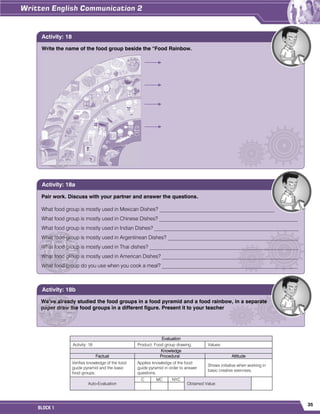
  • 62.
    62 THE WORLD WELIVE IN Development activities Evaluation Activity: 2 Product: Recognition. Value: Knowledge Factual Procedural Attitude Recognizes vocabulary related to ecological problems. Applies vocabulary and his/her knowledge about ecological problems. Appreciates interesting acquired information about environmental problems. Auto-Evaluation C MC NYC Obtained Value: Team work. Learn “Pollution Pre-reading vocabulary” and discuss it with your partners. Answer the questions. Word Meaning acid rain noun Acid that contains harmful chemicals that collect in the atmosphere when fossil fuels are burned carcinogen noun A substance that has been linked to causing one or more types of cancer Contaminated adj. Has come in contact with organisms or substances that cause disease developing country noun A nation that is working towards becoming more economically and socially advanced domestic waste noun Garbage that is produced by people in a household dumping verb Placing waste in an area that is not appropriate ( ex. dumping chemicals in oceans) industrial adj. Related to the advancement of the economy pesticides noun Chemicals that are sprayed on crops to prevent insects from destroying them pollutant noun Something that causes damage to the environment pollution noun The contamination of the environment sewage noun Waste that humans put down drains smog noun Air pollution caused by a reaction between chemicals in the atmosphere and sunlight sustain verb Support toxic chemicals (toxins) noun Poisonous materials that can cause disease 1. Trash thrown away at every home is called _________________________________________________waste. 2. This is a form of precipitation that contains harmful chemicals _________________________________________ 3. These are used to protect plant fields from insects: _________________________________________________ 4. Waste matter that contaminates the water, air, and soil: ______________________________________________ 5. Air pollution by a mixture of smoke and fog: ________________________________________________________ Activity: 2
  • 63.
    63 BLOCK 1 Evaluation Activity: 3Product: Reading comprehension. Value: Knowledge Factual Procedural Attitude Classifies and selects information about environmental problems. Reads information about environmental problems to answer questions. Appreciates interesting acquired information about environmental problems. Auto-Evaluation C MC NYC Obtained Value: Team work. Take turns and read paragraphs. Discuss the reading, and answer the questions. Water, Air and Soil Contamination Pollution is an environmental concern for people throughout the world. One university study suggests that pollutants in the water, air, and soil cause up to 40 percent of the premature deaths in the world's population. The majority of these deaths occur in developing countries. Water in many third world countries is contaminated with toxic chemicals, also known as toxins. In many regions the water that is used for drinking, cooking, and washing is the same water that is used for dumping sewage and hazardous waste. Most developing countries cannot afford water treatment facilities. Approximately 80% of infectious diseases in the world are caused by contaminated water. Air pollution is a growing problem throughout the world. Indoor air pollution is one of the leading causes of lung cancer. Families in developing countries use open stoves for cooking and heating their homes. These homes do not have proper ventilation. The smoke, which is full of chemicals and carcinogens, gets trapped inside where families eat and sleep. Outdoor pollution also causes disease and illness, especially in industrial cities such as Beijing, China, where cancer is the leading cause of death. Acid rain, results mainly from the coal powered factories, which produce inexpensive goods for North American and European consumers. Soil pollution is also a major concern, both in industrial and developing countries. Pollutants such as metals and pesticides seep into the earth's soil and contaminate the food supply. Soil pollution causes major health risks to entire ecosystems. This type of pollution reduces the amount of land suitable for agricultural production and contributes to global food shortages. Dumping of industrial and domestic waste products produces much of the world's soil pollution, though natural disasters can also add to the problem. Farmers in poor nations grow food in contaminated soil both to earn a living and to avoid starvation. As more people move to urban centers, premature deaths caused by pollution are expected to increase worldwide. Today, the developed nations who achieved their wealth at the expense of the environment will be held accountable for protecting the earth's resources for future generations. ESL English Club 1. According to the article, what causes 40% of the world's premature deaths? _____________________________ 2. What causes the “Global food shortage”? __________________________________________________________ _________________________________________________________________________________________________ 3. What is the main reason people die of waterborne illnesses? __________________________________________ 4. Which is the main cause of lung cancer in third world countries? ______________________________________ 5. Which is NOT mentioned as a source of soil pollution? Choose two and underline them. a) Dumping of wastes b) Use of pesticides c) smoke from factories d) acid rain Activity: 3
  • 64.
    64 THE WORLD WELIVE IN Evaluation Activity: 4 Product: Brief repot. Value: Knowledge Factual Procedural Attitude Classifies and selects information about environmental problems. Reads information about environmental problems to match words and complete statements. Shows initiative and interest by writing about ecological problem in actual time. Auto-Evaluation C MC NYC Obtained Value: Match the words in column A with words in column B. Use the same words to complete the statements. Column A Column B Oil __________________________ Rain Exhaust __________________________ Spill Catalytic __________________________ Fumes Ecological __________________________ Disaster Greenhouse __________________________ Layer Acid __________________________ Effect Ozone __________________________ Warming Global __________________________ Converter 1. I think that the smoke from factories is more dangerous to the atmosphere than the _______________________ from cars. It contributes to ________________________ which can destroy forests. 2. I don’t believe that there is a hole in the _________________________________________ because I can’t see it. 3. I like the fact that the ________________________________________ is making the planet hotter. I like hot weather so I don’t think that _______________________________________ is a problem. 4. I think the ___________________________ in the Galapagos Islands was a preventable ___________________. Activity: 4 What ecological disaster do you remember? Why do you remember it in particular? ______________________________________________________________________________________ __________________________________________________________________________________________________ __________________________________________________________________________________________________ __________________________________________________________________________________________________ __________________________________________________________________________________________________ ________________________________________________________________________________________________ Activity: 4a
  • 65.
    65 BLOCK 1 Evaluation Activity: 5Product: Match exercise. Value: Knowledge Factual Procedural Attitude Identifies and selects information about environmental problems. Reads information about environmental problems to match words and complete statements. Appreciates interesting acquired information about environmental problems. Auto-Evaluation C MC NYC Obtained Value: Complete the conditional sentences. Take information from activity 3. Example: If we continue using toxic chemicals, the water will be contaminated. 1. If we don’t take care of water, air, and soil, there ________________________________ in the world population. 2. Acid rain will continue if __________________________________________________________________________ 3. If developing countries continue using open stoves for cooking and heating in their homes, they__________________________________________________________________________________________. 4. There will be more “Acid Rain” If coal powered factories ______________________________________________. 5. If we continue dumping industrial and domestic waste, _____________________________more food shortage. Activity: 5 Match the Environmental suggestions to the results. Write the letter on the line. 1. Recycle paper to ______ A) reduce the garbage problem. 2. Recycle aluminum cans and glass to _____ B) Help protect the ozone layer. 3. Use unleaded gas to _____ C) Don’t use so much energy on heating or air conditioning. 4. Buy products with less packaging to _____ D) Save trees. 5. Don’t buy tropical hardwoods to ______ E) to save water and electricity. 6. Improve insulation_____ F) Save from 40 to 85 percent of the energy needed in the manufacturing process. 7. Use Public transportation to ______ G) Reduce consumption of gas and air pollution. 8. Don’t buy aerosols to _____ H) prevent “Global Warming”. 9. Turn off taps and lights to ______ I) Help preserve the rainforest. 10. Start an energy reduction plan to ______ J) Reduce air pollution. Activity: 5a Conditional sentences can describe situations and consequences that are possible in the present or future. Possible situation (with present tense form) Consequence (with future modals: will, may, or might) If we continue using pesticides, we will reduce land for agriculture. If I quit smoking, I will be healthier. If we don’t reduce air pollution, we might suffer from different diseases. The if-clause can be at the beginning (with a comma) or at the end (no comma) of the sentence. Conditional Sentences
  • 66.
    66 THE WORLD WELIVE IN Evaluation Activity: 6 Product: Report and suggestions. Value: Knowledge Factual Procedural Attitude Identifies and reads information about environmental problems. Reads information about environmental problems and learns ways to give suggestions. Appreciates interesting acquired information about environmental problems. Auto-Evaluation C MC NYC Obtained Value: Read the scientists’ suggestions and fill in the table. Add your suggestions. Living a green world Scientists around the globe suggest that we must do our share to take care of our planet. This means making changes to our daily lives to reduce global warming and reducing the use of chemicals that deplete the Earth's protective ozone layer. Green is a term that many people use to talk about taking care of the planet and not overusing the resources that we all share. If you want to make a difference, the best way to start is to follow these three principles: REDUCE, REUSE, AND RECYCLE REDUCE. Use less of everything: less energy, less paper, less gas, and less water. It means to ride a bike or drive a hybrid car, and to turn off the water when you are brushing your teeth. REUSE. Find new uses for your old products. Turn a pair of jeans into a cool purse, or use broken flower pots and create mosaic for a table or photo frame. Use newspapers to make papier mache art for a friend. RECYCLE. Take your used products like cans, bottles, plastics, and paper and donate them to groups that turn them into new products. Scientists’ Suggestions 1. 2. 3. 4. 5. 6. 7. 8. Activity: 6 Making Suggestions There are a lot of formulas used when making suggestions:  Why don’t we recycling paper?  We must work hard to get a good grade.  Let’s go to the travel Agent’s this afternoon.  I suggest you/that… Starting with a verb:  Find new uses for your old products.
  • 67.
    67 BLOCK 1 Evaluation Activity: 7Product: Suggestions table. Value: Knowledge Factual Procedural Attitude Identifies and reads information about environmental problems. Reads information about environmental problems to give his/her own suggestions. Appreciates interesting acquired information about environmental problems. Auto-Evaluation C MC NYC Obtained Value: Write suggestions to the environmental problems from Reading in activity 3. Environmental Problem Your Suggestion Water pollution Air pollution Soil pollution Acid rain Activity: 7 Write “Conditional Sentences” from activity 5a. Example: 1. If we recycle paper, we will save trees. 2. 3. 4. 5. 6. 7. 8. 9. 10. . Activity: 7a
  • 68.
    68 THE WORLD WELIVE IN Evaluation Activity: 8 Product: Reading comprehension. Value: Knowledge Factual Procedural Attitude Identifies ecological problems to and recognizes how man has affected the environment. Recognizes the ecological problems caused by man to answer questions. Appreciates the importance of taking good care of our environment recognizing how the natural world sustains us. Auto-Evaluation C MC NYC Obtained Value: Read the article about an ecological problem caused by men. Answer the questions. Oil affecting wildlife in the Gulf of Mexico The oil that began leaking with the explosion of the Deepwater Horizon oil rig on April 20th continues to spill into the gulf. This oil spill is now the worst in U.S. history. The spill is taking a heavy toll on wildlife. More than 800 dead animals, including birds, fish, and dolphins, have been found in areas affected by the spill. The number of affected animals seems to have been increasing in the last few days. Oil is hard to clean up. Try rubbing some olive oil and canola oil on your hair to see how hard it is to clean off. Now imagine trying to clean crude oil off your whole body using your mouth. Oil-coated birds are unable to keep the oil off their feathers, but while there is oil on their feathers they are unable to fly. Rehabilitators are trying to clean some of the birds by rubbing them with vegetable oil, which breaks down the heavier oil, and then washing them with detergents. Because the oil from the spill is toxic, not all cleaned birds will survive. Scientists are not yet sure how the deaths of so many creatures will affect the Gulf ecosystem. 1. When did the oil spill begin? _____________________________________________________________________ 2. Where did it begin? _____________________________________________________________________________ 3. What animals have been affected? ________________________________________________________________ 4. What have rehabilitators done to clean the birds? ___________________________________________________ _________________________________________________________________________________________________ 5. What do you know about this ecological problem known worldwide? ___________________________________ _________________________________________________________________________________________________ _________________________________________________________________________________________________ _________________________________________________________________________________________________ _________________________________________________________________________________________________ Activity: 8 Struggling Pelican
  • 69.
    69 BLOCK 1 Closing activity Evaluation Activity:9 Product: Project report. Value: Knowledge Factual Procedural Attitude Identifies ecological problems to promote a school ecological project. Applies knowledge to preserve and protect his/her school environment. Appreciates how the natural world sustains us and promotes the environment and social well-being of his/her school community. Auto-Evaluation C MC NYC Obtained Value: Turn your school into an ECO-SCHOOL. Here are some ideas for your project: A School composting that could be used to Implementation of efficient light bulbs help your school garden flourish. and signs to educate people to switch light off. A school garden growing organic vegetables and recycling programs. Activity: 9
  • 70.
    70 THE WORLD WELIVE IN Drawings to be used in environmental activities:
  • 71.
    Feelings and emotions Competenciasprofesionales: 1. Realiza comprensiones oral y auditiva de diversos tipos de texto en otro idioma. 2. Realiza comprensión escrita y de lectura de diversos tipos de texto en otro idioma. 3. Realiza expresión o producción oral en otro idioma. 4. Realiza interacción oral en otro idioma. 5. Realiza expresión o producción escrita de diversos tipos de texto en otro idioma. Unidad de competencia:  Solicita e intercambia información referente al pasado de una persona; describe emociones y da su opinión acerca de hechos, libros y películas de manera escrita en situaciones sencillas de socialización recreación o laboral. Atributos a desarrollar en el bloque: 4.1 Expresa ideas y conceptos mediante representaciones lingüísticas, matemáticas o gráficas. 4.2 Aplica distintas estrategias comunicativas según quienes sean sus interlocutores, el contexto en el que se encuentra y los objetivos que persigue. 4.3 Identifica las ideas claves en un texto o discurso oral e infiere conclusiones a partir de ellas. 4.4 Se comunica en una segunda lengua en situaciones cotidianas. 4.5 Maneja las tecnologías de la información y la comunicación para obtener información y expresar ideas. 6.4 Estructura ideas y argumentos de manera clara, coherente y sintética. 7.1 Define metas y da seguimiento a sus procesos de construcción de conocimiento. 8.2 Aporta puntos de vista con apertura y considera los de otras personas de manera reflexiva. 10.3 Asume que el respeto de las diferencias es el principio de integración y de convivencia en los contextos local, nacional e internacional. Time assigned: 20 hours
  • 72.
    72 FEELINGS AND EMOTIONS DidacticSequence 1. Long time no see! Start up Activity  Evaluation Activity: 1 Product: Famous characters table. Value: Knowledge Factual Procedural Attitude Writes information about famous people and identifies the simple past and past continuous tense. Applies information about famous people using simple past and past continuous. Shows independence when applying previous knowledge. Auto–Evaluation C MC NYC Obtained Value: Warm Up: Write about your famous characters. Important figure or celebrity ? Artist Singer or musician Writer Name Nationality Why is he/she famous? Latest Achievements Why is she famous for? What is his name? _______________________________ ______________________________ What has been her latest event? What was he doing in July 2010? _______________________________ ______________________________ Was has she done to be famous? What “Novel Price” did he won? _____________________________ _____________________________ Do you know Elena Poniatowska? What has he done to won the ____________________________ _____________________________ Activity: 1
  • 73.
    73 BLOCK 2 Development Activities Evaluation Activity:2 Product: Grammar discussion. Value: knowledge Factual Procedural Attitude Identifies the simple past and past continuous tense. Applies the past continuous tense in his/her personal experience. Integrates new grammar structures and vocabulary to his/her knowledge. Auto-Evaluation C MC NYC Obtained Value: Read and discuss in class the use of the “Past Continuous” presented on the table. Then complete the sentences with information about yourself. Use simple past or past continuous. We use the “Past Continuous” to say what we were doing at a particular moment in the past. subject auxiliary verb main verb + I was watching TV. + You were working hard. - He, she, it was not helping Mary. - We were not joking ? Were you being silly? ? Were they playing soccer? 1. When I was a child I ____________________________________________________________________________. 2. I met my best friend while _______________________________________________________________________. 3. When I was going to secondary school I __________________________________________________________. 4. Three years ago I ______________________________________________________________________________. 5. Last year I ___________________________________ when ___________________________________________. Activity: 2 Complete these sentences. Then take turns and write them on the board. 1. I ___________________________________________at 10pm last night. 2. They __________not __________________football at 9am this morning. 3. What __________you _______________________ at 10pm last night? 4. What__________ you __________________________when he arrived? 5. She ____________________________________when I telephoned her. 6. We _________________________________dinner when it started to rain. 7. Frederick went home early because it ___________________________________. Activity: 2a We often use the past continuous tense with the simple past tense. We can join the two ideas with when or while.  I was taking a shower when you called me.
  • 74.
    74 FEELINGS AND EMOTIONS Matchthe phrases to complete correct sentences. Write the number in the parenthesis. 1. We were talking about him ( ) when the earthquake happened? 2. Were you sleeping ( ) when he had the accident. 3. While I was watching “Titanic” ( ) I was flying to Guadalajara. 4. When the fire started ( ) we were having lunch. 5. At this time last year ( ) I was thinking of you. 6. Peter wasn't driving ( ) when my bus came in. Activity: 3 Choose the verb forms from the box to complete the sentences. 1. We ____________ a terror film when the door _______________________. 2. Suddenly the noise ______________________________. 3. The fire __________________ when I ______________________ an omelet. 4. The little boy _________________ because he _________________ an ice cream. 5. He ______________________ to the news while he _________________home. 6. What ________________ you _______________ when the fire started? 7. ____________ your sister _________________ at that time? 8. ___________ you __________________ the movie last night? Activity: 3a Make sentences using the verb forms from the box. 1. _______________________________________________________________________________________________ 2. _______________________________________________________________________________________________ 3. _______________________________________________________________________________________________ 4. _______________________________________________________________________________________________ 5. _______________________________________________________________________________________________ Activity: 3b  Were/doing  Was/sleeping  Did you see  Was listening /was driving  Was crying/wanted  Started/was cooking  Stopped  Were watching/ opened
  • 75.
    75 BLOCK 2  Evaluation Activity: 3Product: Past activities description. Value: knowledge Factual Procedural Attitude Identifies the simple past and past continuous tense. Applies the past continuous tense in his/her personal experience. Shows initiative when working in basic exercises. Auto-Evaluation C MC NYC Obtained Value: There was a rainstorm last night. Describe what people in my family were doing then. Use the “Past Continuous”. My mother was ____________________________________________________________________________________. My grandfather was ________________________________________________________________________________. My sister _________________________________________________________________________________________. My brother ________________________________________________________________________________________. My father _________________________________________________________________________________________. The twins _________________________________________________________________________________________. Activity: 3c Describe activities you did yesterday. Where were you and what were you doing? 1. At 6:00 a.m., I was having breakfast with my family. 2. At 9:00 in the morning,___________________________________________________________________________ 3. At noon, _______________________________________________________________________________________ 4. In the afternoon, ________________________________________________________________________________ 5. At 10:00 last night, ______________________________________________________________________________ 6. At this time yesterday, ___________________________________________________________________________ Activity: 3d
  • 76.
    76 FEELINGS AND EMOTIONS                                    Evaluation Activity:4 Product: Reading Comprehension. Value: Knowledge Factual Procedural Attitude Identifies vocabulary, the work and life of important people. Recognizes and realizes that work and other’s life and personal information is important. Appreciates the characteristics and merits of work and life of important people. Auto-Evaluation C MC NYC Obtained Value: Read the biography and answer the questions about the reading. César Chávez Cesar Chavez was a Mexican-American labor leader and civil rights activist. He was a farm worker who co-founded the biggest farm workers’ union in the USA and improved the working conditions of thousands of farm laborers. Many see him as one of America’s greatest civil right leaders. He claimed that his models were Emiliano Zapata, Gandhi, Rehru and Martin Luther King. More and more US states are honoring him by making his birthday a holiday. Chavez was born in Arizona in 1927 to farm worker parents. His childhood was very tough because of the poverty caused by the Great Depression. Chavez was a natural leader and in 1952 he became an administrator in the Latino civil rights group the Community Service Organization. He travelled throughout California urging Mexican Americans to vote and speaking about workers’ rights. In 1962, Chavez co-founded the National Farm Workers Association (NFWA) with Dolores Huerta. His first success was to lead a California grape pickers strike for better wages. The strike lasted five years and attracted the attention of Robert Kennedy. The NFWA won its first major labor victory for American farm workers. Chavez moved on to campaign for the rights of other farm workers. The NFWA developed into the United Farm Workers. Chavez led marches and encouraged farm workers across America to join together. He helped them strike and organize boycotts. In the 1980s he fasted to draw public attention to the dangerous use of pesticides. He asked his people to, "Make a solemn promise: to enjoy our rightful part of the riches of this land, to throw off the yoke of being considered as agricultural implements or slaves. We are free men and we demand justice”. Chavez died in 1993 of natural causes. Ten years later, America honored him with a postage stamp. Taken from: Famous People Lessons Vocabulary Claimed: Assert or affirm strongly. Wages: Remunerate, salary. Strike: Negation to work in protest against bad work conditions. Fasted: Abstained from eating. 1. What did you learn from this text about Cesar Chavez? ______________________________________________ _________________________________________________________________________________________________ 2. What questions would you like to have asked Cesar Chavez? _________________________________________ _________________________________________________________________________________________________ 3. What was Cesar Chavez’ famous Advice to his people? ______________________________________________ _________________________________________________________________________________________________ 4. Why did he fast in 1980? ________________________________________________________________________ _________________________________________________________________________________________________ Activity: 4
  • 77.
    77 BLOCK 2 Recommended websites: http://www.biography.com/ Fill in the biography framework. Name: César Chávez Birth: Death: Early Influences: Childhood: Major Accomplishments: Significance: Contemporaries: Activity: 5 Match the words from the biography on the left with their synonyms on the right. Use your dictionary. Paragraphs 1 and 2 Paragraphs 3 and 4 1. Activist ( ) a. made better 7. Success ( ) g. urged 2. Improved ( ) b. difficult 8. Major ( ) h. triumph 3. Honoring ( ) c. encouraging 9. Campaign ( ) i. reasons 4. Tough ( ) d. campaigner 10. Encouraged ( ) j. awareness 5. Poverty ( ) e. paying tribute 11. Attention ( ) k. great 6. Urging ( ) f. hardship 12. Causes ( ) l. fight Activity: 5a
  • 78.
    78 FEELINGS AND EMOTIONS Evaluation Activity:5 Product: Biography framework. Value: Knowledge Factual Procedural Attitude Identifies vocabulary, work and life of important people. Recognizes and realizes work and other’s life and practices chronological order. Appreciates the characteristics and merits of work and life of important figures. Auto-Evaluation C MC NYC Obtained Value: Pair work. Number these lines in the correct order according to Cesar Chavez’ biography. ( ) In 1962, Chavez co-founded the National Farm Workers Association (NFWA) with Dolores Huerta. His first success. ( ) on to campaign for the rights of other farm workers. ( ) causes. Ten years later, America honored him with a postage stamp. ( ) rights group the Community Service Organization. He travelled throughout California urging. ( ) was to lead a California grape pickers strike for better wages. The strike lasted five years and attracted the attention. ( ) The NFWA developed into the United Farm Workers. Chavez led marches and encouraged farm workers. ( ) public attention to the dangerous use of pesticides. Chavez died in 1993 of natural. ( ) co-founded the biggest farm workers’ union in the USA and improved the working conditions of thousands of farm. ( 1 ) states are honoring him by making his birthday a holiday. ( ) Cesar Chavez was a Mexican-American labor leader and civil rights activist. He was a farm worker who. ( ) Mexican Americans to vote and speaking about worker’s rights. ( ) caused by the Great Depression. Chavez was a natural leader and in 1952 he became an administrator in the Latino civil. ( ) laborers. Many see him as one of America’s greatest civil rights leaders. More and more US. ( ) of Robert Kennedy. The NFWA won its first major labor victory for American farm workers. Chavez moved. ( ) Chavez was born in Arizona in 1927 to farm worker parents. His childhood was very tough because of the poverty. ( ) across America to join together. He helped them strike and organize boycotts. In the 1980s he fasted to draw. Activity: 5b
  • 79.
    79 BLOCK 2 Evaluation Activity: 6Product: Report. Value: Knowledge Factual Procedural Attitude Classifies information, vocabulary and grammar for writing an imaginary event. Writes about an imaginary event using the grammar structure: past continuous tense. Appreciates the characteristics and merits of work and life of important figures. Auto-Evaluation C MC NYC Obtained Value: Imagine that Cesar Chaves is still alive. What would he been doing while “Law SB 1070” was being passed in Arizona. “This law requires that all police officers become immigration officers by requiring them to verify the residency status of individuals suspected of being in the country illegally”. Discuss with your partner, write a report and hand it over to your teacher or paste it here. Activity: 6
  • 80.
    80 FEELINGS AND EMOTIONS Evaluation Activity:7 Product: Report. Value: Knowledge Factual Procedural Attitude Recognizes the past continuous to write about his/her life. Writes about his/her life and outlooks for the future using the grammar structure: past continuous tense. Integrates vocabulary and grammar structure to write about the characteristics and merits of her/his own. Auto-Evaluation C MC NYC Obtained Value: Write your biography. Writing an autobiography, focus on three things: who you are in life, what life means to you and what your outlook (point of view) for the future is. Activity: 7 Your picture
  • 81.
    81 BLOCK 2 Read thebiography and answer the questions. Angelina Jolie Angelina was born in LA in 1976. She loved movies and started acting classes to follow her dream of movie stardom. She was rebellious and became a punk with dyed purple hair and tattoos. Her movie career took off in 1997 and within a few years she had won an Oscar. Her 2001 role as Lara Croft in the blockbuster “Tomb Raider” shot her to international fame. Angelina hasn’t limited her career to acting. She became involved in humanitarian work while filming in Cambodia. She is now a UN Goodwill Ambassador, visiting refugee camps in poor countries. She donates large sums of money to help the plight of underprivileged people. She has effectively used her stardom to highlight world problems. Unfortunately, Jolie’s personal life has come to overshadow her other pursuits. The tabloids are obsessed with her relationships, especially the current one with Brad Pitt. The couple is now referred to not as Brad and Angelina but as “Brangelina”. The media seem more caught up with what they eat and drink than the important humanitarian work Angelina continues to do. Helping other people is what truly motivates Angelina. In 2001, she said: “We cannot close ourselves off…and ignore the fact that millions of people are out there suffering.” In addition to acting awards, she has received wide recognition for her humanitarian work. She became the first winner of the UN’s Citizen of the World Award. It seems likely more accolades will follow. 1. What did you learn from this text about Angelina Jolie? ______________________________________________ __________________________________________________________________________________________________ 2. How was her appearance when she was in her 20s? _________________________________________________ __________________________________________________________________________________________________ Activity: 8 Put the words back into the correct order. 1. to her of stardom follow dream movie = 2. hair a with purple became punk dyed = 3. Angelina limited career acting hasn’t her to = 4. camps refugee visiting countries poor in = 5. to world used stardom highlight problems her = 6. The are with relationships tabloids obsessed her = 7. Angelina motivates truly what is people other Helping = 8. accolades follow seems more will It likely = Activity: 8a
  • 82.
    82 FEELINGS AND EMOTIONS Evaluation Activity:8 Product: Dialogue. Value: Knowledge Factual Procedural Attitude Writes questions and answers in a meeting friend’s dialogue. Reads a biography and recognizes the theme of meeting old friend and catching up on what they have been doing. Enjoys learning about interesting humanitarian work of an important figure. Auto-Evaluation C MC NYC Obtained Value: Complete the questions and answers. Pretend that you are long-time friend of Angelina Jolie. You have not met for many years and suddenly bump into her. You must catch up with all your latest news. You must talk about the past and ask questions. You: Hey, Angelina! I haven’t seen you in ages. What have you been doing lately? Angelina: Yes, “Long time no see”. Well, I have been ________________________________________________ ____________________________________________________________________ in the last 10 years. You: What have you been doing after you won an Oscar? Angelina: I’ve been _____________________________________________________________________________ You: What roles have you played in your movies? Angelina: _____________________________________________________________________________________ You: In what movie? Angelina _____________________________________________________________________________________ You: I heard you have been traveling to Cambodia a lot. What have you been doing there? Angelina: I have been ___________________________________________________________________________ You: Very interesting, but how is your love life? Angelina: Oh great! I am married to a wonderful man his name is ______________________________________ You: Angelina, what motivates you to do humanitarian work? Angelina: Like I said in 2001: “____________________________________________________________________ _____________________________________________________________________________________” You: No wonder why you were given the “UN’s Citizen of the World Award” I feel proud being your friend. I know more awards will follow. Angelina: Thank you, but I want to know what you have been doing lately. The other time we meet we’ll talk about you. Activity: 8b
  • 83.
    83 BLOCK 2 Evaluation Activity: 9Product: Small talk conversations. Value: Knowledge Factual Procedural Attitude Identifies the “Present Perfect Continuous” for the first time. Applies the “Present Perfect Continuous” when talking on what people have been doing. Integrates new grammar structures to his/her knowledge. Auto-Evaluation C MC NYC Obtained Value: Present Perfect Continuous Use the present perfect continuous for actions that started in the past and continuous into the present. (Until now) Examples of the present perfect continuous tense: subject auxiliary verb auxiliary verb main verb + I have been waiting for one hour. + You have been talking too much. - It has not been raining. - We have not been playing football. ? Have you been seeing her? ? Have they been doing their homework? Write the Present Perfect continuous statements found in the previous dialogue. 1. What have you been doing lately? 3. _______________________________________________ 2. ______________________________________ 4. _______________________________________________ Activity: 9 Complete the conversations. Then practice them with a partner. Activity: 9a A period until now (have been doing) A: What _________ you _____________________ (do) these days? B: Well, I __________________________________ ________, (spend) free time at Rocky Point. A: __________you _________________(work) B: Yes, I have. I _______________________ _____________ (work) at a Wall Mart on the weekends. A: How __________ you _________________ _____________________ (feel) lately? B: Great! I ________________________ (get) A lot of sleep, and I __________________ ________________________ (eat) healthy food. A: ____________you ________________________ (get) enough exercise lately? B: No, I haven’t. I ___________________________ ______________ (go) to the gym often enough.
  • 84.
    84 FEELINGS AND EMOTIONS Evaluation Activity:10 Product: Written and oral practice. Value: Knowledge Factual Procedural Attitude Identifies the “Present Perfect Continuous. Uses the “Present Perfect Continuous” while discovering more information about their classmates. Collaborates with her/his partner when working in pairs. Co-Evaluation C MC NYC Obtained Value: Complete the sentences with the verbs in parenthesis. Use “Present Perfect Continuous”. My son __________________________________________________________e-mails to his friends for hours... (send) His friends _________________________________________________________ around Mexico for months. (travel) Pablo and I _______________________________________________________________ to music all evening. (listen) Our daughter ______________________________________________________ English since she was a child. (learn) Victoria ___________________________________________________________________ in the garden all day. (work) My cousin Diego _____________________________________________________________ TV for four hours! (watch) Frederick ________________________________ since three o'clock. Tomorrow he has a very difficult exam. (study) Caroline is very tire, she _______________________________________________________ the house all day. (clean) The weather in Hermosillo is appalling! It ___________________________________________ since yesterday. (rain) The kids ____________________________________________________________ at the beach all the morning. (play) What is going on? Our neighbors _____________________________________________________ for hours. (quarrel) I ____________________________________________________________________ in this city since last March. (live) Activity: 10 Pair work. Ask your partner and answer these questions. Write answers in the table. 1. Have you been doing anything exciting recently? 2. How long have you been studying English? 3. Have you been going to parties on weekends? 4. Where have you been having breakfast on weekdays? 5. Have you been saving money to buy something special. Your classmate’s answers Your answers 1. 2. 3. 4. 5. 1. 2. 3. 4. 5. Activity: 10a
  • 85.
    85 BLOCK 2 Evaluation Activity: 11Product: Grammar practice. Value: Knowledge Factual Procedural Attitude Identifies and practices the “Present Perfect Continuous“. Uses the “Present Perfect Continuous” when talking on what people have been doing. Integrates new grammar when practicing new structures to his/her knowledge. Co-Evaluation C MC NYC Obtained Value: Rewrite the following sentences with the present perfect continuous. The first one has been done for you. 1. Jack is cooking. He started to do this 4 hours ago. Jack has been cooking for 4 hours. 2. My brother drives. He started to do this in 1968. __________________________________________________________________________________________________ 3. Caroline lives in L.A. She went there last month. __________________________________________________________________________________________________ 4. Rides a bus to school. He started to do it when his car broke down. __________________________________________________________________________________________________ 5. Julia plays tennis. She started to do this when she was young. __________________________________________________________________________________________________ 6. Mick Jagger sings rock music. He started to do this 40 years ago with the Rolling Stones. __________________________________________________________________________________________________ 7. Albert knows how to repair a computer. He learned how to do it a long time ago. __________________________________________________________________________________________________ 8. Doctors and researchers look for a cure for cancer. They started to do this more than 100 years ago. __________________________________________________________________________________________________ 9. Patients use anesthesia during childbirth. They started to do this in the mid-1800s. __________________________________________________________________________________________________ 10. I am reading this lesson. I started to do this 10 minutes ago. __________________________________________________________________________________________________ Activity: 11 Complete this passage with the correct form of the verb in parenthesis. I lived in Nogales from 1974 to 1989. While I ____________________________________ (live) there, I ____________________________ (study) junior high and high school. In 1990 I ____________________________ (move) to Hermosillo to finish high school. Seven years ago, I _________________________________ (go) to Vancouver, while I was there I ________________________(study) and I did an internship in a Canadian Company. Then I __________________________________ (come back) to Hermosillo in 2000 until then. I_____________________________ (work) in a local company. Activity: 11a
  • 86.
    86 FEELINGS AND EMOTIONS Closingactivities Team Work. Form a team of 6, ask each classmate what they were doing last night. Complete the report with their names and what they were doing. Use past continuous tense. Activity: 12 Write the names of the classmates you questioned and their activities according to the report form from above. Ghost Story Last night as ______________ ________________________________, he/she suddenly saw a ghost student 1 activity Outside the window! Frightened, he/she called ______________, who ________________________________ at the student 2 activity time. Being busy, he/she couldn’t come over. In a panic, _________________ ran over to ____________________”s student 1 student 3 house shouting. “I’ve just seen a ghost!” _________________, who ________________________________, stopped student 3 activity what he/she was doing and tried to calm ________________ down as he/she listened to _____________________’s student 1 student 1 story. “Let’s investigate,” suggested _______________________. student 3 As they were walking briskly down the street, they passed by __________________ as he/she _________________. student 4 activity They laughed at him/her for wasting time that way. On their way stopped at ______________________’s house. student 5 They found __________________ there too. ____________________ __________________while ________________ student 6 student 5 activity student 6 _________________________. They stopped what they were doing and joined ___________________________ and activity student 1 __________________________. Finally, all four of them arrived at ______________________________’s house. They student 3 student 1 Investigated the area outside the window where ______________________ had seen the ghost. They discovered a student 1 sheet that had blown off the clothesline and become ledged in a bush outside the window. Because of the wind, the sheet was moving, and it looked as though it was a ghost waving its arms. Embarrassed, _________________ student 1 joined the laugher of the others. Activity: 12a Report Form Example: What were you doing last night? Vicky was watching TV. Student 1: ______________________________________________________________________________________ Student 2: ______________________________________________________________________________________ Student 3: ______________________________________________________________________________________ Student 4: ______________________________________________________________________________________ Student 5: ______________________________________________________________________________________ Student 6: ______________________________________________________________________________________
  • 87.
    87 BLOCK 2 Evaluation Activity: 12Product: A ghost story. Value: Knowledge Factual Procedural Attitude Identifies what others were doing at a certain time. Applies the past continuous in a written report and writes a “ghost story”. Demonstrates appropriate treatment ,politeness and Respects when asking questions to classmates. Co-Evaluation C MC NYC Obtained Value: Write a statement for each one of the pictures. Use “Present Perfect Continuous”. 1. Sit/ for 2 hours. __________________________________________________________________________________________________ 2. Wait/ since yesterday. _________________________________________________________________________________________________ 3. Rain/all day. _________________________________________________________________________________________________ 4. Watch TV/for 3 hours __________________________________________________________________________________________________ 5. Cook/since 5 o’clock __________________________________________________________________________________________________ Activity: 13 Look at the answers and write the questions. A: What have you been doing lately? B: I’ve been working a lot and trying to stay in shape. A: Have _________________________________________________________________________________________? B: No. I haven’t been jogging. I have been playing tennis. A: Really? ________________________________________________________________________________________? B: No. I have been losing most of the games. How about you? ________________________________________________________________________________? A: No. I haven’t been exercising I have been working long hours. B: Well, why don’t we play a tennis game on Saturday afternoon? It is a great exercise. Activity: 13a
  • 88.
    88 FEELINGS AND EMOTIONS Evaluation Activity:13 Product: A framework. Value: Knowledge Factual Procedural Attitude Identifies the present perfect continuous to talk about other people’s life. Applies the present perfect continuous to talk about other people’s life and what they have been doing at a certain period of time. Enjoys learning about interesting lives of important figures. Auto-Evaluation C MC NYC Obtained Value: Write a biography of your favorite important figure or celebrity, in a separate paper and present it to your teacher. Answer the questions and then fill in the biography framework. 1. What has he or she done to become famous? ______________________________________________________ _________________________________________________________________________________________________ 2. What questions would you like to have asked this person? ___________________________________________ _________________________________________________________________________________________________ Name: Birth: Death: Early Influences: Childhood: Major Accomplishments: Significance: Contemporaries: Activity: 13b
  • 89.
    89 BLOCK 2 Didactic Sequence2. What do you think? Start up activities Find the Adjectives in the “Word Search. Participles as adjectives C O N F U S E D E K C O H S O K G V I A I H I E D Z I Z X U E M B A R R A S S E D N J J U U Y H R K E H A A S E S G G G D V D E S I R P R U S U N N N G Z E W A P E P K M H L I I I Q H N A T N T O A A H T Z S Y L D E R I T U I V F S I A U O X W T D S K H N J E O N M F N Q H H I F Q A T R H C G A N N D C G N I G N E L L A H C O A V R I G E B T D V J C A E C R E Y R H D N Y V A I F B E M N H L F R I G H T E N I N G F Z K A U F R G D H N Y R H S V T Activity: 1 amazing amused annoying challenging confused confusing disappointed embarrassed frightened frightening insulting interesting rewarding satisfied shocked surprised tired Team Work. Make teams of 5. Ask the following questions to your partners: 1. What do you think is more embarrassing? a) Walking into the wrong restroom. or b) Falling down in front of an audience. Results: a:_____________ b: __________________ 2. What do you think is more interesting? c) Reading a Harry Potter book. or d) Watching a Harry Potter movie. Results: c: ____________ d: ___________________ Activity: 1a
  • 90.
    90 FEELINGS AND EMOTIONS Evaluation Activity:1 Product: A word search. Value: Knowledge Factual Procedural Attitude Identifies new vocabulary to be used in a new topic. Searches for vocabulary in a “word search” to be used in the topic concerning movies. Shows interest when acknowledging new vocabulary and appreciates its use. Co-Evaluation C MC NYC Obtained Value: Count the number of people who choose (a), (b), (c) and (d) and write the results. When you have completed your survey, share the results with the class. Activity: 1b
  • 91.
    91 BLOCK 2 Development activities Readand discuss the table with your teacher. Then complete the sentences and compare with a partner. Participles as Adjectives A participle is a verb form that can be used as an adjective to describe a noun. Present Participle When you are describing the person or thing that caused the reaction.  The new movie sounds interesting.  The movie on TV was boring.  The Garcia Marquez’ book was fascinating. Past Participle When you are describing a person’s reaction or feeling.  I am interested in the new movie.  I was bored by the movie on TV.  I was fascinated by Garcia Marquez’ book. 1. I am ___________________________________ with the political speech. (bore) 2. I thought “Harry Potter and the Philosopher's Stone” was an _________________________ book. (excite) 3. I’m not ______________________________________ in Humor movies. (interest) 4. It’s _________________________________they don’t make many western movies these days. (surprise) 5. I find documental films ___________________________________ (fascinate) 6. Denzel Washington is a very _____________________________________ actor. (interest) 7. The horror movie was ____________________________________________. (frighten) 8. People can sometimes be ____________________________________by movies. (shock) Activity: 2 Choose the correct adjective from the pair to complete the sentence. 1. What are we going to do tonight? I’m so _____________ (bored/boring) just sitting here watching TV. 2. Let's go out and do something ______________________________ (exciting/excited) 3. Did you watch that _____________________ (interesting/interested) documentary on TV last night? 4. If you don't mind my saying. I think his _______________ (baffled/baffling) attitude is due to the fact that he isn’t _________________________ (interested/interesting) enough in his studies. 5. The _________________________ (astonished/astonishing) fact that almost 20% of Americans are obese is, in part, due to the fact that they eat too much junk food. 6. His abilities were so ________________________ (amazed/amazing) that people travel led from far away to hear him play. 7. ________________excited/exciting) particles in the nucleus center caused a chemical transformation. 8. I was ______________________ (humored/humoring) by his reply to my question. 9. Do you find that so ________________________________(surprised/surprising)? 10.One of his favorite colors is _____________________________ (shocked/shocking) pink. Activity: 2a
  • 92.
    92 FEELINGS AND EMOTIONS Evaluation Activity:2 Product: A Survey. Value: Knowledge Factual Procedural Attitude Identifies present and past participles used as adjectives. Applies present and past participle used as adjectives and searches and practices the grammar structure on the internet Demonstrate interest when practicing the grammar structure on the internet. Auto-Evaluation C MC NYC Obtained Value: Fill in with correct participles of the verbs in parentheses. 1. People who constantly complain are very _______________ (annoy) to me. 2. Whenever Adrian gets _______________ (bore), he goes fishing. 3. The students were _______________ (confuse) by the teacher’s lecture. 4. Most of the news on television is _______________ (depress). 5. The Coldplay band were very _____________ (excite) to learn that their concert was sold out. 6. Babysitting young children can be _______________ (exhaust) for many people. 7. Albert was so _______________(fascinate) by the book that he finished it in one evening. 8. Would you be _______________ (frighten) if you saw the movie “Vampire Hunter”? 9. After eating a _______________ (satisfy) meal, the cat washed her face. 10. When Isabella looked in the mirror, she was ________________ (surprise) to see that she had a leaf in her hair. Activity: 2b Search for the following web page, do the exercise, print it and paste it here. http://www2.ohlone.edu/people2/mlieu/grammaronline/participles/adjectives1.htm Activity: 2c
  • 93.
    93 BLOCK 2 Look carefullyto “the adjectives for art” from the pictures. Then complete the chart with synonyms. absurd amazing awful bizarre boring disgusting dreadful dumb exciting fabulous fanciful fantastic fascinating great horrible interesting marvelous odd outstanding ridiculous scary silly strange stupid surprising terrible terrific unusual weird wonderful Awful Wonderful Stupid Strange ______________________ ______________________ ______________________ ______________________ ______________________ ______________________ ______________________ ______________________ ______________________ ______________________ ______________________ ______________________ ______________________ ______________________ ______________________ ______________________ ______________________ ______________________ ______________________ ______________________ ______________________ ______________________ ______________________ ______________________ Activity: 3
  • 94.
    94 FEELINGS AND EMOTIONS Evaluation Activity:3 Product: Recognition of adjectives. Value: Knowledge Factual Procedural Attitude Identifies the topic of movies and the use of the present and past participles used as adjectives Practices participles used as adjectives describing movies. Integrates new grammar structures and vocabulary to his/her knowledge. Auto-Evaluation C MC NYC Obtained Value: Write statements using the adjectives for art from the pictures. 1. Indiana Jones is a/an ______________________________ movie. 2. Jeff Bridges won an Oscar for his performing in the __________________________movie “Crazy Heart”. 3. Titanic was a/an _________________________________movie. 4. Anthony Hopkins did a/an __________________________ job in “Silence of the Lambs”. 5. My younger brother thinks that “Jurassic Park” is a/an ___________________________ movie. 6. Michael Moore did a/an ________________________ job with his documental “Bowling for Columbine”. 7. Mo’nique had an _________________________performance in “Precious”, she won an Oscar in a supporting role in 2010. 8. “The Hurt Locker” is a/an _____________________________ movie it won an Oscar for best movie. Activity: 3a Choose the appropriate adjective for the following statements. 1. Avatar was a ___________________ movie and I’d like to see it again. a) absurd b) disgusting c) marvelous 2. I think Spielberg's movie The Lost World is as good as Jurassic Park. In fact they both are ______________movies. a) terrible b) terrific c) boring 3. Sandra Bullock is ______________________ in The Blind Side and I think she is a very good Hollywood actress. a) horrible b) ridiculous c) wonderful 4. I don’t like horror movies because I think they are ___________________________, a) great b) fantastic c) dumb usually the story has characters who are not very _______________________________________. a) scary b) silly c) stupid 5. Personally, I have always preferred _____________________________________ book to some a) interesting b) unusual c) bizarre of those __________________________ movies produced in Hollywood these days. a) outstanding b) fantastic c) terrible Activity: 3b
  • 95.
    95 BLOCK 2 Evaluation Activity: 4Product: Dialogue practice. Value: Knowledge Factual Procedural Attitude Identifies the topic of movies and the use of the present and past participles used as adjectives. Practices discussing topics such as movies and applies the present and past participles used as adjectives. Integrates new grammar structures and vocabulary to his/her knowledge. Auto-Evaluation C MC NYC Obtained Value: Read the conversation, practice the dialogue and answer the questions. Victoria: Why don’t we go to the movies tonight? Albert: What’s playing? Victoria: How about the picture of the year “The Hurt Locker”, it won six Oscar awards. It must be very exciting. Albert: Who directed the movie? Victoria: It was directed by a great director Kathryn Bigelow. Albert: Who is Kathryn Bigelow? Victoria: Bigelow became the first woman to win the Academy Award for Best Director. Albert: What else has she directed? Victoria: “Weight of Water”, “Point Break” and other outstanding movies, now this interesting war drama. Albert: It sounds good! I like war movies. Victoria: Let’s go then. I’ll find out what time the movie starts and I’ll call you. Albert: Let me know so I can do my homework early in the afternoon. Victoria: OK, I’ll call you early in the morning. 1. Why does Victoria think the movie is very exciting? ___________________________________________________ __________________________________________________________________________________________________ 2. Why is Kathryn Bigelow a great director? ___________________________________________________________ __________________________________________________________________________________________________ 3. What category is the movie “The Hurt Locker”? ______________________________________________________ 4. Did Victoria convince Albert to go to the movies? ____________________________________________________ 5. What argument did Victoria use to convince Albert? __________________________________________________ __________________________________________________________________________________________________ Activity: 4 Match the movie vocabulary. Write the letter in the parenthesis. 1. Western ( ) 2. Cartoon ( ) 3. Ghost movies ( ) 4. Comedy ( ) 5. Intelligent ( ) 6. Action movies ( ) 7. Character ( ) 8. Movie theater ( ) 9. Adventure movies ( ) a. funny b. someone in a movie. c. clever d. exciting e. violent f. cowboys g. place where we watch movies. h. animation like Mickey mouse. i. frightening and full of horror horror. Activity: 4a
  • 96.
    96 FEELINGS AND EMOTIONS Completethe table with an example of a movie of the corresponding category and write a small comment. Movie Genre or Categories A movie genre is a label applied to a movie for categorization purposes. There are dozens of movie genres and sub-genres that viewers can choose from. Here are the main film genres. Genre Example of a Movie and a small comment Action Terminator. Arnold Schwarzenegger was Terminator (cyborg) character of the first film. He told everyone: "I'll be back" - and proved it with this film. Comedy Drama Epics/historical or documental Horror/thriller Musicals Science fiction Romance Animated Westerns Activity: 5
  • 97.
    97 BLOCK 2 Evaluation Activity: 5Product: Movie genre description. Value: Knowledge Factual Procedural Attitude Identifies relative clauses and vocabulary to be used in movie genres. Practices relative clauses with relative pronouns to describe different movie genres. Integrates new grammar structures and vocabulary to his/her knowledge. Auto-Evaluation C MC NYC Obtained Value: Write definitions for these different kinds of movies. Use relative clauses and the phrases in the box. 1. An action movie is a movie that________________________________________ 2. A romance _________________________________________________________ 3. A comedy _________________________________________________________ 4. A western __________________________________________________________ 5. A horror film ________________________________________________________ 6. A musical __________________________________________________________ 7. A documentary _____________________________________________________ Activity: 5a Relative Clauses These clauses give essential information to define or identify the person or thing we are talking about. Use who or that for people Use which or that for things It’s about a guy. He said “I’ll be back” It’s an action movie. It starts Arnold Schwarzenegger. It’s about a guy who/that said I’ll be back. It’s an action movie which/that starts Arnold Schwarzenegger. What kind of movie genre is your favorite and least favorite? Write about each one and give reasons for your opinion. __________________________________________________________________________________________________ __________________________________________________________________________________________________ __________________________________________________________________________________________________ __________________________________________________________________________________________________ __________________________________________________________________________________________________ __________________________________________________________________________________________________ __________________________________________________________________________________________________ __________________________________________________________________________________________________ Activity: 5b  Has cowboys in it  Is scary  Has lots of excitement  Has songs  Makes you laugh  Tells about a person or event  Has a love story
  • 98.
    98 FEELINGS AND EMOTIONS Evaluation Activity:6 Product: Questionnaire. Value: Knowledge Factual Procedural Attitude Identifies relative clauses and vocabulary when talking about movie genres. Practices relative clauses with relative pronouns to describe different movie genres and to answer a questionnaire. Integrates new grammar structures and vocabulary to his/her knowledge. Auto-Evaluation C MC NYC Obtained Value: Complete the sentences with relative clauses. Then answer the questions. 1. Indiana Jones is a movie that all boys like to watch. 2. Walt Disney was the movie director _______________________________________________________________. 3. Sandra Bullock is an actress _____________________________________________________________________. 4. Avatar is a movie ______________________________________________________________________________. 5. Sam Raimi directed Spider-man 4 the movie _______________________________________________________. 6. Gael Garcia is an actor _________________________________________________________________________. Activity: 6 1. What kind (genre) of movies are you interested in? Why? _____________________________________________ __________________________________________________________________________________________________ 2. What kind of movies do you find boring? ____________________________________________________________ 3. Who are your favorite actors and actresses? Why? ___________________________________________________ __________________________________________________________________________________________________ __________________________________________________________________________________________________ 4. Are there any actors you don’t like? ________________________________________________________________ 5. What’s one of the most exciting movies you have ever seen? ___________________________________________ __________________________________________________________________________________________________ 6. What did you like about it? ________________________________________________________________________ 7. What are your three favorite movies in English? ______________________________________________________, ______________________________________________, ___________________________________________________ 8. What is the box office weekend movie playing in the theater of your city? _________________________________ __________________________________________________________________________________________________ Activity: 6a
  • 99.
    99 BLOCK 2 Evaluation Activity: 7Product: Dialogue. Value: Knowledge Factual Procedural Attitude Classifies information when reading a dialogue to make up his/her own. Reads and applies basic language used to describe movies when writing a dialogue. Creates a dialogue using studied structures and new vocabulary. Auto-Evaluation C MC NYC Obtained Value: Practice the dialogue with a partner. Then fill in the next dialogue with information of your own. © 2007 Lanternfish ESL Activity: 7
  • 100.
    100 FEELINGS AND EMOTIONS Closingactivities Pair work. Answer the questionnaire and ask the questions to your partner. Write the results using participles as adjectives, adjectives for art, and relative clauses. Write a final report and paste it or hand it over to your teacher. Question Your answer Your partner’s Answer Who is the best male actor? Who is the best female actress? How often do you go to the movies? What movie genre is your favorite? Do you enjoy action films? Is it OK for young kids to watch violence on TV? What was the last movie that you saw? What is the worst film you’ve seen recently? What is the best film you’ve seen recently? Results: Example: I think the best male actor is the outstanding Antony Hopkins who started in Silence of the lambs. My partner thinks that the best actor is... _________________________________________________________________________________________________ _________________________________________________________________________________________________ _________________________________________________________________________________________________ _________________________________________________________________________________________________ _________________________________________________________________________________________________ _________________________________________________________________________________________________ _________________________________________________________________________________________________ _________________________________________________________________________________________________ _________________________________________________________________________________________________ _ Activity: 8
  • 101.
    101 BLOCK 2 Evaluation Activity: 8Product: Report. Value: Knowledge Factual Procedural Attitude Classifies information and writes results to be used in a report. Uses grammar structures and vocabulary studied in the sequence to write about a “Survey movie report”. Collaborates with partner when working in pairs. Co-Evaluation C MC NYC Obtained Value: Paste your “Survey Movie Report” here. Activity: 8a
  • 102.
    102 FEELINGS AND EMOTIONS DidacticSequence 3. A visit to… Start up activity Evaluation Activity: 1 Product: Vocabulary identification. Value: Knowledge Factual Procedural Attitude Identifies new vocabulary to be used in a new topic. Recognizes vocabulary needed when visiting the doctor. Shows interest when acknowledging new vocabulary and appreciates its use. Auto-Evaluation C MC NYC Obtained Value: Do you know the fluids in your body? There are many types of fluid running through and out of your body. They are all necessary to keep you healthy. Write the corresponding letter in the parenthesis. Bile ( ) a. Dead bacteria and cells. Blood ( ) b. In the mouth, used to begin digestive process. Diarrhea ( ) c. Protective fluid of membrane linings, in the nose. Mucus ( ) d. Produce to wash dust out of eyes. Pus ( ) e. Watery solid waste. Saliva ( ) f. Produced by the kidneys, then eliminated from the body. Tears ( ) g. Transports food and oxygen to the body cells. Urine ( ) h. Made by the liver, used to break down fats. Vomit ( ) i. Stomach fluid ejected from body through the mouth. When you go to the doctor it is very important to describe your pain clearly. Look at the picture below and choose and write the corresponding expression. hurts a lot - no pain - severe pain - hurts a little _____________________ ___________________ _____________________ _____________________ Activity: 1
  • 103.
    103 BLOCK 2 Development activities Readthe dialogue and write a similar one. Take information from the box on the right. Dialogue 1 A = Doctor B= Patient A: Hi. Come on in and have a seat. Now what seems to be the problem? B: I have a rash on my arm. A: How long have you had the rash? B: It’s been about a week. A: Are you taking anything for it Adrian? B: I put some cream on it but it doesn’t seem to be helping. A: I see. Are you allergic to any medications? B: Not that I know of. A: I’m going to give you a prescription for some ointment. I want you to apply it three times a day. You should also avoid scratching your skin. And it’s important to use as little soap as possible. Make an appointment to see me next week if it doesn’t get better over the next few days. Dialogue 2 A: B: A: B: A: B: A: B: A: Activity: 2 Ailment: flu Prescribe: antiviral medication. Take three times daily after meals. Duration: three days Extra Advice: (a) Get lots of rest. (b) Drink plenty of fluids
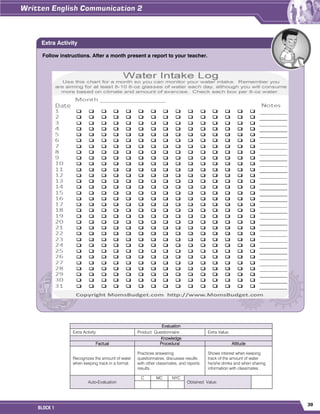
  • 104.
    104 FEELINGS AND EMOTIONS Evaluation Activity:2 Product: Written dialogues. Value: Knowledge Factual Procedural Attitude Identifies expressions he/she might hear or need when visiting the doctor. Practices expressions and vocabulary needed when visiting the doctor. Integrates new vocabulary to make dialogues. Auto-Evaluation C MC NYC Obtained Value: Write a dialogue taking information from the box on the right. Dialogue 3 A: B: A: B: A: B: A: B: A: Activity: 2a Ailment: diarrhea Prescribe: some medicine Take twice daily. Duration: 4 days Extra Advice: (a) Drink plenty of fluids. (b) Avoid foods containing milk. Fill in the table with information from the three dialogues. Name Medical condition Duration Prior medication Allergic to medication? Y/N Prescription and advices Dialogue Dialogue 2 Dialogue 3 Activity: 2b
  • 105.
    105 BLOCK 2 Discuss inclass the vocabulary to be matched with the ailment or illnesses pictures. Write the number in the parenthesis. Then make sentences using MODALS or ADVERBS for hypothesizing or assumption. Albert ( ) Richard( ) Elizabeth ( ) Frederick ( ) Barnaby ( ) Frank ( ) Fern( ) Hector ( ) Tony ( ) Josephina ( ) Example: Albert has a cough, his throat hurts. He might have a sore throat 1. Richard’s head hurts, he ________________________________________________________________________. 2. Elizabeth is not feeling well, she _________________________________________________________________. 3. Frederick has a runny nose, ___________________he has a __________________________________________. 4. Barnaby’s temperature is up, ____________________ he has a _______________________________________. 5. Something happened to Frank in his arm, ____________________he has a _____________________________. 6. Fern’s stomach hurts, he has a __________________________________________________________________. 7. Hector was using the hammer, he ______________have a ___________________________________________. 8. Ingrid was complaining, ___________________________ she has a ____________________________________. 9. Josephina can’t stand up, ___________________________she has ____________________________________. Activity: 3 Expressions for hypothesizing Modals Adverbs Might/may Maybe He may not feel well. Maybe you’re right. Could Perhaps It could be a bad illness. Perhaps he’s not here. Making Logical assumption Modals Adverbs Must Probably He must be sick. That probably is bad luck 1. hurt toe 2.Sore throat 3.stomachache 4. cold 5. cramps 6. backache 7. fiver 8. hurt toe 9. hurt finger 10. bad cut
  • 106.
    106 FEELINGS AND EMOTIONS Evaluation Activity:3 Product: Advice vocabulary identification. Value: Knowledge Factual Procedural Attitude Identifies vocabulary and expressions he/she might hear or need when visiting the doctor. Practices expressions for hypothesizing, making logical assumptions and vocabulary needed when visiting the doctor. Integrates expressions and vocabulary to his/her knowledge. Auto-Evaluation C MC NYC Obtained Value: Read and choose one of the following advice statements for each person. Write the number of the speaker next to the best advice. Speaker 1: I have a terrible headache. The pain is right at the back of my head. It seems to go from ear to ear. Speaker 2: I think I have the flue. I threw up twice after breakfast. Maybe I shouldn’t eat anything. Speaker 3: I was playing soccer and fell over another player. Now I can’t stand up or walk. Probably I broke my leg. Speaker 4: I just had a drink with ice, and now my tooth really hurts. I must have a cavity. Speaker 5: I tripped on the curb when crossing the street and twisted my ankle. I can’t walk. I must have sprained it. Speaker 6: I don’t feel too bad, but I have been sneezing and coughing in class today. Perhaps there was a cold going around, but I didn’t think I would catch it. Vocabulary: Bandage: A piece of cloth to protect an injury. Throw up: vomit Cavity: Dental caries. Tripped: Misstep (paste tense) To sprain: A painful injury in the ligaments. Sneezing: Expulsion of air from the nose. Advices _______ You should take two aspirin for the pain and see a dentist, as soon as possible. ________ You should wrap a tight bandage around your ankle. Don’t walk for a few days. ________ Buy medicine from the drugstore for the sneezing and coughing. Drink plenty of fluids, maybe you need to rest. ________ You should take two aspirins. See your doctor if your head still hurts tomorrow. ________ You must go to a doctor you may get a cast put on your leg. ________ You shouldn’t eat anything for two or three hours __ until you stop vomiting. Probably for one day. Activity: 3a
  • 107.
    107 BLOCK 2 Evaluation Activity: 4Product: Brief repot. Value: Knowledge Factual Procedural Attitude Uses vocabulary acquired to be practiced in a dialogue. Practices vocabulary in a dialogue and recognizes new grammar structures. Integrates vocabulary to his/her knowledge to be used in an oral practice. Co-Evaluation C MC NYC Obtained Value: Pair work. Read the dialogue and answer the questions. Then act out the dialogue with your partners. Getting Advice on the Phone Clinic: Hello, Children's Clinic. Mother: Hello. Could I speak to a consulting nurse? Clinic: Yes, Hold one moment please. Mother: OK. Nurse: Hello, how can I help you? Mother: My son isn't feeling well and I'd like to get some advice. Nurse: I see he has a problem. Doesn’t he? Mother: Well, he has been coughing for several days now. I'm wondering if he should come in and see the doctor. Nurse: He is a teenager, isn’t he? Mother: No, he is 3 years old. Nurse: Does he have any other symptoms like fever and runny nose? He has lost his appetite. Hasn’t he? Mother: No, actually other than the cough, he seems healthy. I am concerned though, because some of his sister's friends have whooping cough and I know that it can be very contagious. That’s a pretty serious illness. Isn’t it? Nurse: It can be serious with babies. Your son has been immunized against whooping cough. Hasn’t he? Mother: I'm not sure. He did get all of the suggested vaccinations. I will look it up in our records. Nurse: If he has been immunized recently, it is very unlikely that he would catch whooping cough, even if he has been exposed. Mother: Sounds like I don't have to worry about that, but what shall I do about his cough? Nurse: The cough is probably a viral infection. It will help if you give him lots of fluids and a hot bath before bedtime. A humidifier is also helpful. Keep an eye on the cough to watch to see if it gets worse. Call us again if he has a fever or if you are still concerned. Mother: Thanks for your advice. Nurse: You are welcome. Good-bye. 1. What is the mother’s problem? ___________________________________________________________________ 2. What is wrong with the 3 year old son? ____________________________________________________________ _________________________________________________________________________________________________ 3. Has he been immunized? _______________________________________________________________________ 4. What is the nurse final advice? ___________________________________________________________________ _________________________________________________________________________________________________ What do the sentences in bold letters mean? ___________________________________________________________ _________________________________________________________________________________________________ _________________________________________________________________________________________________ _________________________________________________________________________________________________ Activity: 4
  • 108.
    108 FEELINGS AND EMOTIONS Readand discuss the table with classmates and with your teacher. Activity: 5 Read the dialogue in activity 4, look for “Tag questions” and write them down. _____________________________________________________________________________________. _____________________________________________________________________________________. __________________________________________________________________________________________________. __________________________________________________________________________________________________. __________________________________________________________________________________________________. Activity: 5a What is a Tag question? A question added to a declarative sentence, usually at the end, to engage the listener, verify that something has been understood. Example: They are from USA, aren’t they? or They aren’t from USA ,are they? Notice that with positive statements, negative tag questions are used and vice versa. Some modals can be used in tag questions: can, will, would, could, should and must. Example: Mr. James will be at the ceremony, won't he? They couldn't do it, could they? If there is no auxiliary verb, we use the appropriate tense form of DO/DOES in the negative form. Note: When the subject is I (1st . person sing.) and the statement is in present tense, aren't is commonly used. Example: I am your friend. Aren’t I? Fill in the blank with the correct tag question. 1. The teacher is in the classroom, ______________________________________________________? 2. The computers aren't broken again________________________________________________________________? 3. I should register for class, ________________________________________________________________________? 4. Maria is in the learning center, ____________________________________________________________________? 5. Jula works in the office, __________________________________________________________________________? 6. You don't have any money, _______________________________________________________________________? 7. Adrian has been here before,_____________________________________________________________________? 8. Ms. Martinez doesn't teach philosophy, ____________________________________________________________? 9. Jim was in his room, ____________________________________________________________________________? 10. Guacamole is made with avocados, ______________________________________________________________? 11. Bill is buying lunch, ____________________________________________________________________________? 12. They weren't busy, _____________________________________________________________________________? 13. I am a student assistant, ________________________________________________________________________? 14. Camille has to teach a class right now, ___________________________________________________________? 15. You are finished with this exercise, _______________________________________________________________? Activity: 5b
  • 109.
    109 BLOCK 2 Evaluation Activity: 5Product: Tag Questions Practice. Value: Knowledge Factual Procedural Attitude Identifies “Tag questions” and uses them to complete statements. Uses “Tag questions” to complete statements and chooses them to finish sentences. Integrates a grammar structure to his/her knowledge. Auto-Evaluation C MC NYC Obtained Value: Choose the correct tag question to finish the sentence. 1. Carlos is an accountant, _______________________________? aren't he? doesn't he? isn't he? He isn't? 2. I am a good worker,___________________________________? I am? do I? amn't I? aren't I? 3. Roger is a grandfather,________________________________? he isn't? isn't he? he is? doesn't he? 4. Albert is a doctor, ____________________________________? he is? is he? doesn't he? isn’t he? 5. Janet and Pat are students, __________________________? aren't they? are they? isn't he? isn't they? 6. Adrian is at work right now, _____________________________? aren't they? isn't he? is he? isn't she? 7. I'm here, ____________________________________________? am I not? am not I? amn't I? aren't you? 8. You and I are busy right now, ___________________________? aren't I? aren't we? we aren't? aren't you? 9. It's windy today, _______________________________________? am I? aren't they? isn't it? isn't he? 10.I am ready for the next exercise, ________________________? isn't it? don't I? aren't you? aren't I? Activity: 5c
  • 110.
    110 FEELINGS AND EMOTIONS Whatis an Idiom? Read about idioms and choose the best meaning about “Illness Idioms” in the boxes. Activity: 6 IDIOMS An *idiom is a phrase where the words together have a meaning that is different from the dictionary definitions of the individual words. Example: *A still tongue keeps a wise head *A pain in the neck: Something that you don’t like Wise people don't talk much. doing it. Someone that annoy you. *Easy as ABC Something that is as easy as ABC is very easy or simple. Match Idioms related to health in the box with their meaning. 1. Feel blue ___________________________________________________________________ 2. After-effects of drinking _______________________________________________________ 3. Poor physical conditions ______________________________________________________ 4. Extremely thin _______________________________________________________________ 5. Become foolish or mad _______________________________________________________ 6. Referring to death ___________________________________________________________ 7. In poor physical condition _____________________________________________________ 8. Lose consciousness _________________________________________________________ Activity: 6a 4. Another expression for vomiting is to _____. a. throw up b. toss out c. pass out 5. To be able to eat or drink without vomiting is to _____. a. keep it down b. get over it c. dip into 6. To become unconscious is to _____. a. go out b. black out c. knock over 1. To get an illness from someone is ________ a. pick it up b. truck it in c. take it away 2. To try hard to get rid of an illness is to ________ a. tide it over b. cave in c. fight it off 3. If a part of your body gets bigger and rounder because of injury or illness it _____ a. come out b. kicks in c. swells up a) In bad shape b) Bag of bones c) Hangover d) Go nuts e) Sadness or depression f) Hit the dust g) Run down h) Black out
  • 111.
    111 BLOCK 2 Evaluation Activity: 6Product: Idioms recognition. Value: Knowledge Factual Procedural Attitude Interprets the literal counterpart of idioms. Practices the natural manner of speaking by understanding idioms. Integrates a natural manner of speaking informal English through the use of idioms. Auto-Evaluation C MC NYC Obtained Value: Write statements with idioms related to health from activity 6a. Number one is given as an example. 1. Winter season makes me feel blue. 2. ______________________________________________________________________________________________ 3. ______________________________________________________________________________________________ 4. ______________________________________________________________________________________________ 5. ______________________________________________________________________________________________ 6. ______________________________________________________________________________________________ 7. _____________________________________________________________________________________________ 8. ______________________________________________________________________________________________ Activity: 6b Choose an idiom for each of the statements. Write the letter on the right line. 1. (Usually) I get up and go jogging before breakfast every Sunday. 1. _____________ h) all of a sudden i) as a rule j)all in one 2. He is (very forgetful) and is always losing his glasses. 2. _____________ d) absent minded f) all thumbs g) as a rule 3. That car must have cost him (an incredibly large amount of money). 3. _____________ g) The apple of his eye h) all odds i)an arm and a leg 4. He is (not very good) when he tries to repair something in his house. 4. ______________ m) all ears n) all odds o) all thumbs 5. The teacher said the little boy was (her favorite). 5. ______________ j) an arm and a leg k)absent minded m) the apple of her eye 6. He was (all ready) to leave the house when the friends came over. 6. ______________ r) absent minded s) about t) all ears 7. (Without warning) it began to rain. 7. ______________ o) at heart p) as a rule q) all of a sudden 8. She is (always) available when he wants her. 8. ______________ t) at heart u) at his beck and call v) all ears 9. He is always (fighting) with his boss about something. 9. ______________ h) at heart i) at odds j) as always 10.I don’t think he is (to blame) about breaking the computer. 10. _____________ x) at thumbs y) at all z) at fault 11.OK I’m (listening). Please continue with your story. 11. _____________ x) all heart y) all thumbs z) all ears Activity: 6c
  • 112.
    112 FEELINGS AND EMOTIONS Bodylanguage Pair work. There are different body language gestures that give out different signs of what a person is feeling. These are a few body language tips that will help you know a bit more on body language signs. Study them and make six gesture (or mime) to your partner. Let him/her guess the meaning. Body Language Gesture Meaning Brisk and Erect walk This body language means confidence. Person standing with hands on hips This body language means readiness and aggression. Person sitting with legs crossed, foot kicking slightly This body language means boredom. Person sitting with legs apart This body language means an open and relaxed person. Person tapping or drumming with his fingers This body language means that the person is impatient. Patting/fondling hair This body language means lack of self confidence and insecurity. Person walking with hands in pockets, shoulders hunched This body language shows a person in dejection. Person brings hand to cheek The person is evaluating and thinking Touching, slightly rubbing nose The person is rejected, in doubt and maybe lying. Rubbing the eye The person is in doubt or disbelief. Hands clasped behind back The person is angry, frustrated and apprehensive. Person Stroking chin This indicates that the person is trying to make a decision. Person looking down, face turned away Just means skepticism. Someone biting nails This is a proof of insecurity and nervousness. Pulling or tugging the ear The person is indecisive. Mark with X or and write the totals. Gesture Partner You 1 2 3 4 5 6 Total Activity: 7
  • 113.
    113 BLOCK 2 Evaluation Activity: 7Product: Body language mime. Value: Knowledge Factual Procedural Attitude Interprets body language, gestures and signs. Practices communication through body language, by acting and writing. Creates a way to imitate gestures and body language. Auto-Evaluation C MC NYC Obtained Value: Think about postures and what they can show. Match the description of a posture, an attitude or emotion in the box. Don't forget to use your dictionary to check the meaning of new words. 1. She sits and folds her arms, hugging her body. __________ 2. She stands and pats her hair. __________ 3. He stands and adjusts his tie. __________ 4. He shrugs his shoulders. __________ 5. He sits and puts his head down or down or slightly __________ to one side. 6. He sits and bangs the table. __________ 7. He sits and fidgets and then stands and walks about. __________ 8. She leans forward. __________ Activity: 7a Draw emotions for the following faces, ask your teacher for help if necessary. amazed embarrassed confused disgusted shocked Activity: 7b
  • 114.
    114 FEELINGS AND EMOTIONS Evaluation Activity:8 Product: Reading comprehension. Value: Knowledge Factual Procedural Attitude Identifies and understand main ideas in a reading. Practices by identifying and understands the topic of body language communication. Enjoys reading a text to integrate new vocabulary to his/her knowledge and to answer questions. Auto-Evaluation C MC NYC Obtained Value: Read and answer the questions. Body language When we communicate with other people it is not only our words that contain the meaning. An important part of that meaning comes from what is called “non-verbal communication”. By this we mean facial expression; gestures with hands, arms, legs; the way we sit or stand; the way we touch other people; the distance we keep between ourselves and the people we are talking to, eye contact; our dress and our appearance. All these say something to other people. Facial expressions and gestures are used by everyone often spontaneously, even unconsciously. Smiling, for example, is found in most cultures as a sign of happiness or pleasure. Gestures such as pointing, waving, shaking, nodding or the gestures mentioned on a table in a previous page are also widely used, although the gestures themselves do not always mean the same in every culture, so it is important to identify some other culture's body language. Body language has become a popular and talking point these days, an American television series related to this topic has won many awards, the name of this TV program is: LIE TO ME, it is the compelling drama series inspired by the scientific discoveries of a real-life psychologist who can read clues in the human face, body and voice to expose the truth and lies in criminal investigations. It is very interesting to see how facial expressions show happiness, anger, boredom, sadness and guilt. One of the main differences between verbal and non-verbal communication is that we are often not conscious of the expressions and gestures we use and so we are in danger of giving more information than we really want to, or even of giving a conflicting message with our body language to the one expressed in our words. 1. What is body language? ________________________________________________________________________ _________________________________________________________________________________________________ 2. What does” non-verb communication” mean? ______________________________________________________ _________________________________________________________________________________________________ 3. Name some gestures people generally use. ________________________________________________________ _________________________________________________________________________________________________ 4. What is television series “Lie to me” about? ________________________________________________________ _________________________________________________________________________________________________ 5. Describe three gestures you use frequently and say what they mean. __________________________________ _________________________________________________________________________________________________ Activity: 8
  • 115.
    115 BLOCK 2 Closing activities Evaluation Activity:9 Product: Illness survey. Value: Knowledge Factual Procedural Attitude Organizes questions to write a small report about his/her last illness. Practices oral and written skills by answering and asking questions about illnesses. Collaborates with his/her partner when working in pairs. Co-Evaluation C MC NYC Obtained Value: Pair work. Answer and Ask you partner the following questions. Then write a report about your last cold or illness. Use the verbs in the box and change them to past tense. ? You Your partner When was the last time you had a cold or were ill? Do you remember some of the symptoms? Can you describe them? Did you go to the doctor? Did you take some medicine for your illness? What medicine did you take? Did you remember how long you were sick? be – have – feel – go- take- stay - buy _________________________________________________________________________________________________ _________________________________________________________________________________________________ _________________________________________________________________________________________________ _________________________________________________________________________________________________ _________________________________________________________________________________________________ _________________________________________________________________________________________________ _________________________________________________________________________________________________ _________________________________________________________________________________________________ _________________________________________________________________________________________________ _________________________________________________________________________________________________ _________________________________________________________________________________________________ Activity: 9
  • 116.
    116 FEELINGS AND EMOTIONS Evaluation Activity:10 Product: Tag questions practic. Value: Knowledge Factual Procedural Attitude Identifies “Tag questions” and uses them to complete statements. Practices “Tag questions” to complete statements and answers questions about the structure. Integrates a grammar structure to his/her knowledge. Co-Evaluation C MC NYC Obtained Value: Complete the blanks with the appropriate tag endings. 1. You´ve never been to Alamos, _______________________________________________________? 2. She’s not going to have to take another course, ____________________________________________________? 3. She shouldn’t smoke, __________________________________________________________________________? 4. He has had many different kinds of jobs, __________________________________________________________? 5. He’s an engineer for a factory in Hermosillo, _______________________________________________________? 6. Pat and Janet Cleaned the house yesterday, ______________________________________________________? 7. Caroline and Diego have gone, __________________________________________________________________? 8. She’s recently been ill, _________________________________________________________________________? 9. There is something cooking on the stove, _________________________________________________________? 10. You had a good time at the game, ______________________________________________________________? 11. It’ll be cold tomorrow, _________________________________________________________________________? 12. He has always lived by himself, _________________________________________________________________? 13. He is never on time to work, ____________________________________________________________________? 14. There were a lot of people at the concert,__________________________________________________________? 15. I am going to be with you tomorrow night, _________________________________________________________? Activity: 10 How much did you learn about “Tag Questions”? 1. What is a Tag question? _________________________________________________________________________ _______________________________________________________________________________________________ 2. What is used when you write a positive statement? ___________________________________________________ 3. What is used when you write a negative statement? __________________________________________________ 4. What is used when there is no auxiliary in the statement_______________________________________________ 5. What is used when the statement is about the first person singular? ____________________________________ Activity: 10a
  • 117.
    117 BLOCK 2 Evaluation Activity: 11Product: Idioms Table. Value: Knowledge Factual Procedural Attitude Selects idioms and their meaning by searching on the internet. Practices the use of idioms and their meaning by searching on the internet. Shows interest when looking for idioms on the internet. Auto-Evaluation C MC NYC Obtained Value: Search on the internet for the most used IDIOMS and complete the table. Recommended web pages: http://www.eslcafe.com/idioms/id-mngs.html http://www.idiomsite.com/ Idiom Meaning Example Activity: 11
  • 118.
    118 FEELINGS AND EMOTIONS Evaluation Activity:12 Product: Reading comprehension. Value: Knowledge Factual Procedural Attitude Identifies and understand main ideas in a reading. Practices vocabulary by reading and writing the topic of eye contact and body language. Enjoys reading a text to integrate new vocabulary to write answer questions. Auto-valuation C MC NYC Obtained Value: Read the paragraph and answer the questions. Eye contact Eye contact, also referred to as gaze, is how and how much we look at people with whom we are communicating. By maintaining our eye contact, we can tell when or whether people are paying attention to us, when people are involved in what we are saying, and whether what we are saying is eliciting feelings. The amount of eye contact differs from person to person and from situation to situation. Studies show that talkers hold eye contact about 40% of the time and listeners nearly 70% of the time. We generally maintain eye contact when we are discussing topics with which we are comfortable, when we are genuinely interested in person’s comments or reactions, or when we are trying to influence the other person. On the other hand, we tend to avoid eye contact when we are discussing topics that make us uncomfortable, when we luck interest in the topic or person, or when we are embarrassed, or trying to hide something. What does the word gaze mean? ____________________________________________________________________. Can eye- contact tell us something? _________________________________________________________________. How does the amount of eye -contact change? ________________________________________________________. When do we generally maintain better eye - contact? ___________________________________________________. When do we tend to avoid eye-contact? ______________________________________________________________. Do you avoid eye-contact when you are having a conversation with a person? ______________________________. Write about “Body Language” in your own words. _________________________________________________________________________________________________ _________________________________________________________________________________________________ _________________________________________________________________________________________________ _________________________________________________________________________________________________ _________________________________________________________________________________________________ _________________________________________________________________________________________________ _________________________________________________________________________________________________ _________________________________________________________________________________________________ _________________________________________________________________________________________________ _________________________________________________________________________________________________ _________________________________________________________________________________________________ Activity: 12
  • 119.
    Know how oftechnology Competencias profesionales: 1. Realiza comprensiones oral y auditiva de diversos tipos de texto en otro idioma. 2. Realiza comprensión escrita y de lectura de diversos tipos de texto en otro idioma. 3. Realiza expresión o producción oral en otro idioma. 4. Realiza interacción oral en otro idioma. 5. Realiza expresión o producción escrita de diversos tipos de texto en otro idioma. Unidad de competencia:  Razona e investiga sobre el pasado y futuro de acontecimientos sociales y de los avances en la tecnología. Atributos a desarrollar en el bloque: 4.1 Expresa ideas y conceptos mediante representaciones lingüísticas, matemáticas o gráficas. 4.2 Aplica distintas estrategias comunicativas según quienes sean sus interlocutores, el contexto en el que se encuentra y los objetivos que persigue. 4.3 Identifica las ideas claves en un texto o discurso oral e infiere conclusiones a partir de ellas. 4.4 Se comunica en una segunda lengua en situaciones cotidianas. 4.5 Maneja las tecnologías de la información y la comunicación para obtener información y expresar ideas. 6.4 Estructura ideas y argumentos de manera clara, coherente y sintética. 7.1 Define metas y da seguimiento a sus procesos de construcción de conocimiento. 8.2 Aporta puntos de vista con apertura y considera los de otras personas de manera reflexiva. 10.3 Asume que el respeto de las diferencias es el principio de integración y de convivencia en los contextos local, nacional e internacional. Time assigned: 20 hours
  • 120.
    120 KNOW HOWOF TECHNOLOGY Didactic Sequence 1. Speculating about... Start up Activities Team work. Answer and discuss with your partners. What would you do in each of these situations? Circle a, b or c. If you would do something else, write your suggestions in letter d. What would you do? 1 If your doctor just told you that you have a month to live, how would you use the time left? a) I would travel around the world. b) I would spend all my money in helping the poor. c) I would give all away. d) ___________________________________________________________________________________________ 2. If you saw a classmate stealing at school, would you report it? a) I would immediately report it at the principal‟s office. b) I would talk with the classmate and persuade him/her to return what was stolen. c) I would tell him/her to share what was stolen. d) ____________________________________________________________________________________________ 3. If you were invited to a friend‟s house for dinner and they served your least favorite food? a) I would tell my friend that I don‟t like the food. b) I would tell my friend‟s mother that the doctor said that is bad for my health. c) I would call a pet under the table and give the food little by little. d) ____________________________________________________________________________________________ 4. If your cell phone fell into the toilet? a) I would live it there. b) I would wear a glove and take it out. c) I would ask my younger brother to take it out. d) ____________________________________________________________________________________________ 5. If a classmate asked you for an answer to a question during an exam while the teacher was not looking, what would you do? a) I would tell him/her the answer. b) I would tell the teacher. c) I would do as I didn‟t hear. d. ____________________________________________________________________________________________ Activity: 1 Find out which choice was most popular for each situation and report it in class. Activity: 1a
  • 121.
    121 BLOCK 3 Development Activities Evaluation Activity:1 Product: Questionnaire. Value: Knowledge Factual Procedural Attitude Selects a possible response for an imaginary situation. Uses a possible response for an imaginary situation. Shows independence when applying previous knowledge. Co–Evaluation C MC NYC Obtained Value: Evaluation Activity: 2 Product: Grammar discussion. Value: knowledge Factual Procedural Attitude Selects information from a dialogue to answer questions. Recognizes information and imaginary situations from reading a dialogue. Appreciates the message that the reading sends “moral values must be rewarded”. Auto-Evaluation C MC NYC Obtained Value: Read the conversation and answer the questions. Adrian: Did you watch the TV last night? Charles: No, I went to bed early. Why? Adrian: There was a commentary on the news section about a taxi driver which reported a briefcase that a client left in his car. Charles: What was in the briefcase? Adrian: There were important documents, two thousand dollars, ID cards and some checks. Charles: What did he do? Adrian: He found the phone number and called the client. Charles: What would you do if you found a briefcase? Adrian: Well, I would think it twice. Charles: What happened next? Adrian: Since the man was carrying very important documents from a very important company….. Charles: Get to the point! What happened? Adrian: The documents were so important that the company rewarded the taxi driver with a new car. Charles: Wow! Would you do that if you had a big company? Adrian: Sure I would. I think that there are human values like honesty, responsibility and truthfulness that must be rewarded. 1. What was the commentary on the night news? ______________________________________________________ ______________________________________________________________________________________________ 2. What was so remarkable that the taxi driver do? _____________________________________________________ ______________________________________________________________________________________________ 3. What would Adrian do if he found a briefcase? ______________________________________________________ ______________________________________________________________________________________________ 4. What would you do if you found a briefcase with money? _____________________________________________ ______________________________________________________________________________________________ 5. What was the happy ending of the story? __________________________________________________________ ______________________________________________________________________________________________ 6. Do you think that human values should be rewarded? ________________________________________________ Activity: 2
  • 122.
    122 KNOW HOWOF TECHNOLOGY Read and discuss the table with your teacher. Activity: 3 Pair work. Match the clauses in column A with information from column B. Write the letter in the parenthesis. Then compare your answers with a partner. A B 1. If dogs had wings, ( ) 2. I f I found a burglar in my home, ( ) 3. If I were you, ( ) 4. If I found a briefcase with money, ( ) 5. If I locked myself out of my house, ( ) 6. If Madonna‟s hair were blond, ( ) 7. If someone returned my wallet, ( ) 8. If I saw someone shoplifting, ( ) a) I would give him a reward. b) I would drive more carefully in the rain. c) I would return it to the owner. d) They would be able to fly. e) I might tell the salesclerk. f) She would look very different. g) I‟d break a window to get in. h) I‟d run to my neighbors for help. Activity: 3a Add your own information to clauses in column A. Then take turns and write on the board to compare with classmates. Example: If I found a burglar in my home, I would probably call the police. 1. If dogs had wings, ______________________________________________________________________________ 2. If I were you, ___________________________________________________________________________________ 3. If I found a briefcase with money, __________________________________________________________________ 4. If I locked myself out of my house, _________________________________________________________________ 5. If Madonna‟s hair were blond, ____________________________________________________________________ 6. If someone returns my wallet, _____________________________________________________________________ 7. If I saw someone shoplifting, ______________________________________________________________________ Activity: 3b This conditional provides an imaginary result for a given situation. It is called unreal conditional because it is used for imaginary situations and its consequences. What would you do if you found a briefcase with a million dollar? Imaginary situation Imaginary consequence (with simple past forms) (with modals would, might, or could) If I found a briefcase with a million dollar. I would return it so fast. I would look for an ID to call the owner. I might go to Las Vegas. Unreal conditional sentences with if clauses
  • 123.
    123 BLOCK 3                                   Evaluation Activity: 3Product: Group discussion. Value: knowledge Factual Procedural Attitude Relates statements when practicing imaginary situations. Practices “if clauses” to describe imaginary situations and consequences. Demonstrates respect and politeness to classmates when doing a board activity. Co-Evaluation C MC NYC Obtained Value: Team work. Write the best suggestion for the following predicaments on a separate paper. Then with your partner summarize the suggestions for the predicaments and write them on the chart. 1. What would you do if you were on vacation and you lost your wallet or your purse with your ID, money, credit cards and cell phone? 2. What would you do if you discovered that a friend was on drugs? 3. What would you do If you went with a friend to the mall and you saw him/her shoplifting? Predicament Best suggestion 1 _______________________________________________________________________________________________ __________________________________________________________________________________________________ __________________________________________________________________________________________________ __________________________________________________________________________________________________ __________________________________________________________________________________________________ 2 ________________________________________________________________________________________________ __________________________________________________________________________________________________ __________________________________________________________________________________________________ __________________________________________________________________________________________________ __________________________________________________________________________________________________ 3 ________________________________________________________________________________________________ __________________________________________________________________________________________________ __________________________________________________________________________________________________ _________________________________________________________________________________________________ __________________________________________________________________________________________________ Activity: 4
  • 124.
    124 KNOW HOWOF TECHNOLOGY Evaluation Activity: 4 Product: Verbs table. Value: Knowledge Factual Procedural Attitude Identifies verbs used in predicaments. Applies the appropriate verbs for imaginary situations or predicaments. Demonstrates respect and politeness to classmates when doing a board activity. Co-Evaluation C MC NYC Obtained Value: Dictionary activity. Write the verbs used to describe events, in past tense. Then look for their meaning. Verb Past tense Meaning 1. be 2. find 3. forget 4. fight 5. lose 6. deny 7. discover 8. invent 9. save 10. reward 11. see 12. borrow 13. agree 14. spend 15. dislike Activity: 4a
  • 125.
    125 BLOCK 3 For Homework:http://web2.uvcs.uvic.ca/elc/studyzone/410/grammar/2cond1.htm Team Work. Read the passage and discuss it with your classmates. Then answer the questions. “Future technology” In the beginning the inventor of the first commercial mobile phone - the brick-like Motorola probably had an inkling the device would one day become as light and sleek as the Razr. But did he dream it might end up looking more like a sheet of stained glass? Or be as bendy as a pack of origami card? So what will tomorrow's mobiles look like and what fancy features might they have? Find out some of the characteristics that could feature on the next generation of devices. Nokia Morph: the idea behind Morph is a phone that can change shape depending on need. The Morph can fold down from a slender tablet into a traditional candy bar and even a bangle-style wristwatch. Wearable: Another future mobile comes courtesy of MIT Media Lab that demonstrated a wearable device called “Sixth Sense” earlier this year. Wearing the device in this way enables it to 'see' what the user has in front of him or her. The projector can then project data onto the surfaces or objects in front of the user - meaning the device has no physical screen. ARM's mobile computer: As with Nokia's Morph, ARM's mobile computer is envisaged having the ability to change its shape - from a handheld tablet format to more of a traditional laptop-style device. Nanotechnology is also likely to help a variety of typically opaque materials - and electronics - become transparent. So what will tomorrow's mobiles look like and what fancy features might they have? silicon.com/technology/mobile Brick like Razr Nokia Morph Wearable Arm‟s mobile computer Vocabulary Inkling: a slight suggestion or vague understanding. Envisaged: form a mental image of something that is not present or that is not the case. Feature: An article or merchandise. A prominent or distinctive aspect, quality, or characteristic. 1. Did the inventor of “brick- like” imagine what would mobile phones be like? _____________________________ 2. How did these devices might end up looking? ______________________________________________________ ______________________________________________________________________________________________ 3. If you had a Nokia Morph, how would you use it? ___________________________________________________ 4. What are the characteristics of the “Wearable” or Sixth Sense? ________________________________________ ______________________________________________________________________________________________ 5. What are the characteristics of the “Arm‟s mobile? __________________________________________________ ______________________________________________________________________________________________ 6. In your opinion, how will mobiles or cell-phones of the future be like? ___________________________________ _________________________________________________________________________________________________ Activity: 5
  • 126.
    126 KNOW HOWOF TECHNOLOGY Evaluation Activity: 5 Product: Report. Value: Knowledge Factual Procedural Attitude Identifies vocabulary to answer questions and to write a report. Writes a report based on information read on a passage. Demonstrate appropriate treatment, politeness and respect when working in teams. Co-Evaluation C MC NYC Obtained Value: If you were an inventor, what would you do to improve a cell phone? Write a report and draw your imaginary mobile or cell phone. _________________________________________________________________________________________________ _________________________________________________________________________________________________ _________________________________________________________________________________________________ _________________________________________________________________________________________________ _________________________________________________________________________________________________ _________________________________________________________________________________________________ _____________________________________________________________ _____________________________________________________________ _____________________________________________________________ _____________________________________________________________ _____________________________________________________________ _____________________________________________________________ _____________________________________________________________ _____________________________________________________________ _________________________________________________________________________________________________ _________________________________________________________________________________________________ _________________________________________________________________________________________________ _________________________________________________________________________________________________ _________________________________________________________________________________________________ _________________________________________________________________________________________________ Activity: 5a
  • 127.
    127 BLOCK 3 Closing activities Matchthese problems with the advice. Then write what your advice would be in the table below. What to do? Problems 1. Your neighbor borrowed your hair drier. When she returned it, it was damaged. 2. A friend gave you an expensive blouse for your birthday, but you really didn‟t like it. 3. You checked your bank statement and noticed that there was a deposit of $1,000. You didn‟t make the deposit. You‟re sure it was a bank error. 4. You bought a TV on sale at a store, but it didn‟t work right. The store manager said that they couldn‟t do anything about it. 5. You were not happy with the grade you got in the semester. Advice ______ I guess I would take it back to the store and exchange it for something else. ______ I guess I‟d write a letter of complaint to the manufacturer. ______ Maybe I‟d ask her to repair it. ______ I think I‟d talk about it with my teacher. ______ I‟d probably wait until next month to see if they corrected the mistake. Problem Advice 1. _______________________________________________________________________________________________ 2. _______________________________________________________________________________________________ 3. _______________________________________________________________________________________________ 4. _______________________________________________________________________________________________ 5. _______________________________________________________________________________________________ Activity: 6
  • 128.
    128 KNOW HOWOF TECHNOLOGY Evaluation Activity: 6 Product: Recognition of problems exercises. Value: Knowledge Factual Procedural Attitude Identifies vocabulary and grammar structures about problematic situations. Recognizes vocabulary and grammar structures to give advices to problems. Demonstrate interest when practicing “Second Conditional”. Auto-Evaluation C MC NYC Obtained Value: What would or might you do in these situations? Activity: 6a You found a valuable piece of jewelry in your school basketball court. _____________________________ _____________________________ _____________________________ _____________________________ _____________________________ _____________________________ _____ You saw students fighting in your school. ___________________________ ___________________________ ___________________________ ___________________________ ___________________________ ___________________________ You discovered your friend uses drugs. __________________________ __________________________ __________________________ __________________________ __________________________ __________________________ A friend borrowed money from you and didn‟t return it. ___________________________ ___________________________ ___________________________ ___________________________ ___________________________ ___________________________
  • 129.
    129 BLOCK 3 Evaluation Activity: 7Product: Web page exercise. Value: Knowledge Factual Procedural Attitude Identifies the second time conditional to answer an exercise from the web. Applies vocabulary and the second time conditional to answer exercises. from the web. Shows creativity by answering the exercises from the web about the Second Conditional. Auto-Evaluation C MC NYC Obtained Value: Answer the questions from the web page given below. Print it and paste it here. http://web2.uvcs.uvic.ca/elc/studyzone/410/grammar/2cond1.htm Activity: 7
  • 130.
    130 KNOW HOWOF TECHNOLOGY Didactic Sequence 2. She said that…. Start up activities Evaluation Activity: 1 Product: Ice breaker. Value: Knowledge Factual Procedural Attitude Writes famous sentences used in a movie or song. Reports famous sentences used in a movie or song. Shows independence when applying previous knowledge. Auto-Evaluation C MC NYC Obtained Value: Read the famous sentences from movies or songs that their characters said and report it. Example: Coldplay in their song What if =Coldplay sings in their song “What if there was no lie”. Activity: 1 Write 2 famous phrases or sentences of a song or movie you know. 1. __________________________________________________________________________________ _________________________________________________________________________________ 2. _______________________________________________________________________________________________ _______________________________________________________________________________________________ Activity: 1a Darth Vader in the movie Star Wars: “Luke, I‟m your father”. _________________________ _________________________ ____________________________________ ____________________________________ ____________________________________ Cindy Lauper in her song Girls just wanna have fun: “The phone rings in the middle of the night” _________________________ _________________________ ____________________________________ ____________________________________ ____________________________________ Terminator in the movie Terminator: "I‟ll be back”. _________________________ _________________________ ____________________________________ ____________________________________ ____________________________________ Linking Park in their song The Catalyst: “We're a broken people living under loadedgun”. ______________________ ______________________ ____________________________________ ____________________________________ ____________________________________
  • 131.
    131 BLOCK 3 Development activities Readthe table and discuss it with your teacher. Then change statements into “Reported Speech”. Direct statements Reported Statements I am bored. She said that… We love Mexican Food. They told me that… I had an accident last May. We have been eating out a lot lately. I can‟t work today. We will be home all day. I may stay in bed all day. I am leaving town for the weekend. I will do the homework at the library They have been friends since high school. Practice Reported speech: http://www.youtube.com/watch?v=5HBEw6cY17g Activity: 2 We often have to give information about what people say or think. In order to do so we use reported speech. When reporting someone's speech we usually change any present tense form into the past tense, for example: Direct Statements Reported Statements There is a graduation party. there was a graduation party. I‟m not feeling well. he wasn‟t feeling well. I study English every day. She said (that) he studied English every day. I have planned a trip. he had planned a trip. I can‟t come. he couldn‟t come. I will go to Hermosillo. he would go to Hermosillo. I may go out with a friend. he might go out with a friend. If it is already in the past tense, then it just remains as the past tense, Example: Albert said: I made a date with Pat. = Albert said he made a date with Pat. We can replace the verb said with the verbs: told me, whispered that, yelled that, ordered that, asked, complained that, promised that, though that. We also use reported questions to tell what other people have asked. The verb order is changed when you use an embedded question. Example: Where is the city of Detroit? Adrian asked where the city of Detroit was. Reported Speech
  • 132.
    132 KNOW HOWOF TECHNOLOGY Evaluation Activity: 2 Product: Reading Comprehension. Value: Knowledge Factual Procedural Attitude Identifies reported speech in a literature passage. Recognizes direct or reported speech in a literature passage. Shows interest when reading a passage from a well known English writer. Auto-Evaluation C MC NYC Obtained Value: Read the passage, analyze the underline statements, decide if they are direct speech or reported speech and write them on the appropriate box. Activity: 2a The Canterville Ghost The bell rang for dinner, and, as Virginia did not come down, Mrs. Otis sent up one of the servants. After a little time he returned and said that he could not find Miss Virginia anywhere. So, the whole family started looking for her. The hours passed, but they could find no trace of Virginia. So, after dinner, Mr. Otis ordered them all to bed, saying that nothing more could be done that night, and that he would contact Scotland Yard in the morning. Just when everybody was about to leave the dining-room, the clock struck midnight, and when the last stroke sounded, a secret door opened in the wall and in that door stood Virginia with a little box in her hand. Everybody ran up to her. “Good heavens! Child, where have you been?” said Mr. Otis, rather angrily, as he thought she had been playing a trick on them. “Papa,” said Virginia quietly, “I have been with the ghost. He is dead, and you must come and see him. He had been very nasty, but he was really sorry for all that he had done, and he gave me this box of beautiful jewels before he died.” Then she led the others down a narrow secret corridor to a little low room. There the family found the skeleton of Sir Simon, who had been starved to death by his wife's brothers. Virginia knelt down beside the skeleton, and, folding her little hands together, began to pray silently. Meanwhile, one of the twins was looking out of the window in the little room and suddenly said, “Look! The old almond-tree has blossoms.” “Then God has forgiven him,” said Virginia and stood up. By Oscar Wilde (simplified) Reported SpeechDirect Speech
  • 133.
    133 BLOCK 3 Evaluation Activity: 3Product: Reading Comprehension. Value: Knowledge Factual Procedural Attitude Identifies different verbs to write reported speech statements. Uses different verbs to change statements to “Reported Speech. Demonstrates interest when practicing “Reported Speech Statements”. Auto-Evaluation C MC NYC Obtained Value: Report what people say. Use the underlined verbs as the example given. He whispered that the answer was two. “Psst I need an eraser”. ___________________________ ________________________________________________ “Psst. I don‟t know the answer to question three”. ________________________________________________ ________________________________________________ “Psst I am hungry”. ______________________________ ________________________________________________ He yelled that he was going to quit his job. “I will become the king of the world!” ________________ ________________________________________________ “I can fly!” ______________________________________ ________________________________________________ “I had it with that!” _______________________________ ________________________________________________ She asked the teacher what the capital of Brazil was. “What time will class finish?” _______________________ ________________________________________________ “What do I have to do for homework?”_______________ ________________________________________________ “Where is the stressed vowel?”_____________________ ________________________________________________ She asked the teacher what the capital of Brazil was. “What time will class finish?” _______________________ ________________________________________________ “What do I have to do for homework?”_______________ ________________________________________________ “Where is the stressed owel?”______________________ ________________________________________________ Activity: 3
  • 134.
    134 KNOW HOWOF TECHNOLOGY Closing activities Evaluation Activity: 4 Product: Dialogue practice. Value: Knowledge Factual Procedural Attitude Analyzes survey statements to choose the proper response. Determines the best response about the use of technology in modern life. Demonstrates respect and politeness to classmates when doing a board activity. Co-Evaluation C MC NYC Obtained Value: Change the direct command statements to reported speech statements. Example: Be careful not to spill soup on the table. = My mother told us to be careful to spill soup on the table. 1. Can you help me? ______________________________________________________________________________ 2. Open the windows. _____________________________________________________________________________ 3. Have a seat. ___________________________________________________________________________________ 4. Can you pass me a pen? ________________________________________________________________________ 5. Make sure you lock the doors. ____________________________________________________________________ 6. I think you should talk to your teacher. _____________________________________________________________ ______________________________________________________________________________________________ 7. Get lost! _______________________________________________________________________________________ 8. Would you mind picking up some bread? ___________________________________________________________ Activity: 4 Write a “Reported Speech” statement for each of the pictures. 1 2 3 4 5 1. The wizard ____________________________________________________________________________________ 2. Teacher Sammy _______________________________________________________________________________ 3. ______________________________________________________________________________________________ 4. ______________________________________________________________________________________________ 5. ______________________________________________________________________________________________ Activity: 4a
  • 135.
    135 BLOCK 3 Evaluation Activity: 5Product: News Report. Value: Knowledge Factual Procedural Attitude Presents the local night news using reported speech. Applies the use of “Reported Speech” to write about local night news. Shows interest when doing a homework activity and writing about local events. Auto-Evaluation C MC NYC Obtained Value: Watch the night news on TV or listen the radio news and report what you hear and see. (Use reported Speech). Activity: 5
  • 136.
    136 KNOW HOWOF TECHNOLOGY Didactic Sequence 3. Getting into technology. Start up activities Evaluation Activity: 1 Product: Technology survey. Value: Knowledge Factual Procedural Attitude Analyzes survey statements to choose the proper response. Determines the best response about the use of technology in modern life. Demonstrates respect and politeness to classmates when doing a board activity. Co-Evaluation C MC NYC Obtained Value: Team work. Read each of the following statements and indicate your responses by checking “I agree” or “I disagree”. Discuss your results with your team and present them to your teacher. I agree I disagree 1. Technological advances make life better for everyone. 2. It is important for adults to find out where their children go on line and who they are talking to. 3. Computer technology makes finding information faster and easier. 4. If people let machines do too much for them, eventually people will no longer be able to do things for themselves. 5. Children should be given more freedom in deciding what they do on line. 6. It‟s dangerous to place too much faith in technology. 7. It is impossible to become addicted to the internet. 8. Children who play computer games often believe that the violent games they play often portray life as it actually is. 9. Most teenagers are on line too much. 10. Those who worry about the negative effect of technology should think about the modern convenience available today. 11. Adults often use the computer games as a kind of babysitter for their children. 12. Having the latest technology is important to success. Taken from: read, write, think. Materials may be reproduced for educational purposes. Activity: 1
  • 137.
    137 BLOCK 3  Evaluation Activity: 2Product: Introductory activity. Value: Knowledge Factual Procedural Attitude Identifies events and inventions in different time periods. Recognizes events and inventions in different time periods. Shows interest when recognizing inventions and their time period. Auto-Evaluation C MC NYC Obtained Value: Do you know who invented these popular inventions? With the help of your teacher choose the correct answer; write the letter in the parenthesis. The year of the invention given can help you. Invention Inventor 1. The World Wide Web was developed ( ) 2. The telephone was invented ( ) 3. The computer mouse was invented ( ) 4. The printing Press was invented ( ) 5. Photocopier was invented ( ) 6. The Light bulb was invented ( ) 7. The fax was invented ( ) 8. The first cell phone was invented ( ) 9. The iPod ( ) 10. Compact Discs were launched ( ) a. by Thomas Alva Edison in 1879. b. by Alexander Brain in 1843. c. by Chester Floyd Carlson in 1938. d. by Tim Berners-Lee in 1989. e. designed and Marketed by Apple in 2001 f. by the Philip Company in 1983. g. by Johannes Gutenberg in 1450. h. by Alexander Graham Bell in 1876. i. by Dr. Martin Cooper in 1973. j. by Douglas Englehart in 1964. Activity: 2 When were they invented? Write the year of the invention under each picture. __________ __________ __________ __________ __________ __________ __________ Activity: 2a
  • 138.
    138 KNOW HOWOF TECHNOLOGY Development activities Evaluation Activity: 3 Product: Reading comprehension. Value: Knowledge Factual Procedural Attitude Identifies events and inventions in different time periods. Recognizes events and inventions in different time periods. Shows interest when reading about human advancements. Auto-Evaluation C MC NYC Obtained Value: Read, choose, and write in the time line the most important inventions of history. Write also the time, era or age. Inventions The most important inventions of history are the reason human advancement and civilization of human being was able to flourish. The most important inventions in ancient time were: fire and the wheel. Then in the medieval times the wars increased the development of iron and cement. Later other inventions came during 1800 and 1900, like: the light bulb, the radio, and the telephone. The machine age (the late 19th and early 20th) began with the Industrial Revolution and has continued to date. Machine age has resulted from a series of inventions, such as the use of fossil fuels including coal as chief source of energy, the augmentation of metallurgical processes, particularly that of steel and aluminum, the generation of power and invention of electronic appliances, internal-combustion engine, and the experimentation of metal and cement in construction work. Many inventions have rapidly expended, the latest inventions that have changed the modern era are: the computer, mobile phones, Spacecrafts, and Aircrafts. The inventions that we will get tomorrow will reflect what we need today, so think of the medical advances, new energy sources, and other inventions that will help to live our lives better, easier, healthier, and more enjoyable. The inventions will continue. ______________________ _____________________ _________________________ ______________________ _____________________ _________________________ ________________________ _______________________ ________________________ _______________________ Activity: 3 Time: Ancient_____________ _____________ _____________ ___________________ Future
  • 139.
    139 BLOCK 3 Read thetable of inventors and inventions. Write the events in chronological order. The most popular inventors and inventions The light bulb was invented in 1879 by Thomas Edison (1847-1931). The first great invention developed by Thomas Edison was the tin foil phonograph. A prolific producer, Edison is also known for his work with light bulbs, electricity, film and audio devices, and much more. The telephone was invented in 1876 by Alexander Graham Bell (1847-1922). In 1876, at the age of 29, Alexander Graham Bell invented his telephone. Among one of his first innovations after the telephone was the "photophone," a device that enabled sound to be transmitted on a beam of light. The printing press was invented in 1450 by Johannes Gutenberg (1394-1468). Johannes Gutenberg was a German goldsmith and inventor best known for the Gutenberg press, an innovative printing machine that used movable type. The mechanical television was invented in 1926 by John Logie Baird (1888-1946). Television was not invented by a single inventor. John Logie Baird is remembered as the inventor of mechanical television, he patented the idea of using arrays of transparent rods to transmit images for television. Baird also patented inventions related to radar and fiber optics. The assembly line for automobile manufacturing was improved in 1913 by Henry Ford (1863-1947). Henry Ford improved the "assembly line" for automobile manufacturing, received a patent for a transmission mechanism, and popularized the gas-powered car with the Model-T. The Radio was invented in 1895 by Nikola Tesla (1856-1943) The Radio was invented by the mechanical engineer Nikola Tesla in 1895 later promoted by Guglielmo Marconi, who received the patent in 1904. Charles Babbage invented a sophisticated calculating machine in 1840, and called it the “Analytical Engine” For this Charles Babbage was named “The great-father of the computer”, but many people contributed since the year 1937 to 1985 so that the computer could be faster and could be able to perform more operations. The Wright brothers invented the first controlled and sustained power-driven flight in 1903. The Wright brothers showed the world that man could fly. Their invention of the airplane astounded everyone. Orville flew the flyer for 12 seconds, watched by his brother Wilbur. 1. In 1450 the printing press was invented by Johannes Gutenberg. 2. In ____________________________________________________________________________________________ 3. ______________________________________________________________________________________________ 4. ______________________________________________________________________________________________ 5. ______________________________________________________________________________________________ 6. ______________________________________________________________________________________________ 7. ______________________________________________________________________________________________ 8. ______________________________________________________________________________________________ Activity: 4
  • 140.
    140 KNOW HOWOF TECHNOLOGY Evaluation Activity: 4 Product: Time line of inventions. Value: Knowledge Factual Procedural Attitude Identifies events and inventions in different time periods. Recognizes events and inventions in different time periods to be written in a time line. Shows interest when recognizing inventions and their time period. Auto-Evaluation C MC NYC Obtained Value: Draw a time line of the most popular inventors and inventions. Activity: 4a Fill in the table with information of the most popular inventors and inventions from the previous page. Inventor Invention Time or Period 1. Tomas A. Edison 2. 3. 4. 5. 6. 7. 8. The light bulb The year 1879 Activity: 4b
  • 141.
    141 BLOCK 3 Read thetime contrast table carefully. Then fill in the lines with the appropriate verb form at the reading below. Use present, past, future, and present perfect. Time contrast Present An invention is a new composition, device, or process. We live in a modern era. Past The wars increased the development of iron and cement. The machine age began with the industrial era. Future Future inventions will reflect what we need today. Other developments will happen in my life time. Servants of our century – robots In the past, there (1) ________________ (be) thousands of servants in great empires like ancient Rome, Egypt or Greece. There were slaves doing all the work for their masters and mistresses so rich people (2) ________________ (spend) their time for travel, sports, leisure activities and education. Today the servants (3) ________________ (not be) human – they are machines which (4) ________________ (call) „robots‟. The word „robot‟ (5) ________________ (come) from Czechoslovakia. They are machines which can be (6) ________________ (teach) or programmed to do useful work. They mostly (7) ________________ (work) in factories, especially on production lines. That‟s where something like a TV or a car is put together piece by piece. For years, this work (8) ________________ (be) very boring and tiring for human workers. Today‟s robots (9) ________________ (be) more intelligent than ever before. They may even have mini TV cameras which (10) ________________ (make) them able to see. In the future, they (11) ________________ (be able to / work) at homes, offices, shops almost anywhere. Since they were invented, they (12) ________________ (also / do) other jobs apart from working on production lines. They can help to defuse bombs, work underground helping to find metals and minerals, control flying weapons, take photos and collect rocks on planets like the Mars without risking human life. Robots (13) _______________ (also / work) under the sea as robot divers and submarines to repair oil-rigs and find wrecks. Robots are clever but still not clever enough to do some tasks like washing the dishes, making beds, cleaning floor or cutting grass. But it is a fact that robots will help to create a leisure society for the next generation and they may increase unemployment. So this (14) ________________ (depend) onus. Only we can decide whether we control the robots or they (15) __________________ (control) us. Activity: 5
  • 142.
    142 KNOW HOWOF TECHNOLOGY Evaluation Activity: 5 Product: Recognition of tenses. Value: Knowledge Factual Procedural Attitude Identifies different time periods to complete a passage. Recognizes different time periods: present, past, and future to complete a passage. Shows interest when recognizing inventions and their time period. Auto-Evaluation C MC NYC Obtained Value: Write sentences of different time periods from the passage. Present Past Future Today servants are not human. Activity: 5a
  • 143.
    143 BLOCK 3 Pair work.Read the article and then discuss with your partner to answer questions. Computers to match man by 2029 The computer was not invented by only one person. Many inventors contributed to the history of computers. The computer is a complex piece of machinery make up of many parts, each of which can be considered a separate invention. Charles Babbage invented a sophisticated calculating machine in 1840, and called it the “Analytical Engine”. Later, Claude Shannon first suggested the use of digital electronics in computers and in 1937 J.V.Atanasoff built the first electronic computer that could solve 29 simultaneous equations with 29 unknowns. During those trouble times, computers evolved at a rapid rate. . But apart from been faster and been able to perform more operations the computer has not evolved much. What do we have for the future? Breaking News English article writes: “A leading US scientist has predicted that computers will be as intelligent as humans by 2029. Futurologist Dr. Ray Kurzweil told the American Association for the Advancement of Science that in the near future, machine intelligence will overtake the power of the human brain. He said that within two decades computers will be able to think quicker than humans. Dr. Kurzweil painted a picture of us having tiny robots called nanobots implanted in our brain to boost our intelligence and health. He told reporters that these microscopic nanobots would work with our brains to make us think faster and give us more powerful memories. Kurzweil explained that we are already “a human machine civilization” and that the upcoming technology “will be a further extension of that." Dr. Kurzweil was one of 18 top intellectuals asked by the US National Academy of Engineering to identify our greatest technological challenges. Other experts included Google founder Larry Page and the human genome pioneer Dr. Craig Venter. Kurzweil has a very impressive background in science and innovation. He was an innovator in various fields of computing, including the technology behind CDs. He also pioneered automatic speech recognition by machines. He predicts the pace of new inventions will increase greatly from now, saying: "…the next half century will see 32 times more technical progress than the past half century." This means scenes from science fiction movies, like Blade Runner, The Terminator and I Robot, will become more and more a part of our everyday lives.” Second part taken from: Breaking News English article. 1. What did you think when you read the headline? ____________________________________________________ _____________________________________________________________________________________________ 2. What comes to mind when you hear the word „robot‟? _______________________________________________ 3. Are you looking for a world full of robots? __________________________________________________________ 4. How would the world change if computers and robots became more intelligent than humans? _____________ ______________________________________________________________________________________________ 5. Would you like to be implanted with nanobots that would boost your intelligence and memory? ____________ 6. What would you like your robot to do? _____________________________________________________________ ______________________________________________________________________________________________ 7. What would humans be able to do better if they could think faster? ____________________________________ _____________________________________________________________________________________________ Activity: 6
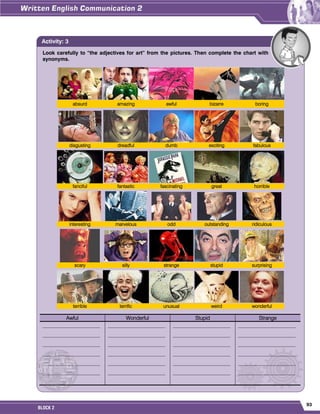
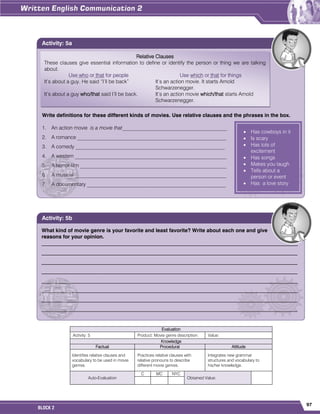
  • 144.
    144 KNOW HOWOF TECHNOLOGY Evaluation Activity: 6 Product: Report. Value: Knowledge Factual Procedural Attitude Identifies vocabulary about new and future technology. Searches on the internet about new and future technology. Integrates knowledge about futurist and new technology. Auto-Evaluation C MC NYC Obtained Value: Match the following synonyms from the article. Write the letter in the parenthesis. 1. Leading ( ) a. speed 2 Predicted ( ) b. point out 3. Within ( ) c. future 4. Upcoming ( ) d. developer 5. extension ( ) e. top 6. identify ( ) f. specialists 7. experts ( ) g. forecast 8. pioneer ( ) h. inside 9. pace ( ) i. sci-fi 10. science fiction ( ) j. addition Activity: 6a Pair Work. Discuss for which of the things below you would put nanobots into your body. Rank them in order of most important to you. Change partners and share your ideas. a. _____ to live to be 125. b. _____ to play an instrument like a concert performer. c. _____ to speak a new language fluently. d. _____ to play computer games like the world‟s best player. e. _____ to be happy all day, every day. f. _____ to look very young for all of your life. Activity: 6b Search on the Internet and find out more about nanobots. Bring the report to your teacher and share what you discovered with your partners next class. Activity: 6c
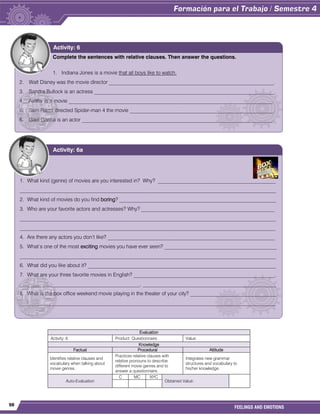
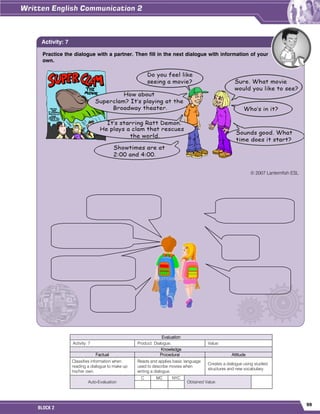
  • 145.
    145 BLOCK 3 Pair work.Read about the Internet, ask your partner and answer the questions. The Internet The Internet is a worldwide network of thousands of linked computers compared to "a giant international plumbing system" (University of California, Berkeley, 1997). Remember that the Internet is not just one gigantic computer with all of the information; rather there are many computer centers, and we are connected to this "plumbing system" somewhere along the line. The Internet has changed the way we live, now most of the world conducts its business, youngsters receive their mail, films, music, and stay in touch via internet. 1) What is the Internet? 2) What would the world be like without the Internet? 3) Could you live without the Internet? 4) Is the Internet dangerous? 5) What kind of technology will replace the Internet? 6) What annoys you about the Internet? 7) Are you addicted to the Internet? 8) What do you think of social networking sites like Facebook, MySpace, 9) Twitter and Metroflog? 10) Can you remember the first time you used the Internet? 11) Do you think fingerprints or retina scans are better than ID cards? Your answers Your partner‟s answers 1. 1. 2. 2. 3. 3. 4. 4. 5. 5. 6. 6. 7. 7. 8. 8. 9. 9. 10. 10. Activity: 7
  • 146.
    146 KNOW HOWOF TECHNOLOGY Evaluation Activity: 7 Product: Internet vocabulary table. Value: Knowledge Factual Procedural Attitude Identifies vocabulary used when using the internet. Applies and searches for vocabulary used when using the internet. Integrates vocabulary to his/her knowledge and values the use of the internet. Co-Evaluation C MC NYC Obtained Value: How much do you know about Internet vocabulary? Match the word with its meaning. Use your dictionary if needed and compare meaning with your partner. Internet Vocabulary Word Meaning 1. Bio ( ) a) a secret word that only you know (can be letters and numbers). 2. browse ( ) b) information about you, such as your location. 3. following ( ) c) the person who receives your message. 4. links ( ) d) write back to a person. 5. microblog ( ) e) options a user has to change how something looks and works. 6. password ( ) f) group of users who want to communicate with each other. 7. profile ( ) g) sending messages from a telephone (SMS). 8. recipient ( ) h) to find new people and groups to connect with. 9. reply ( ) i) write an update on Twitter. 10. settings ( ) j) a name people use to access a website or program (may not be your real name). 11. social network ( ) k) a program that requires users to type letters into a box (to prevent spam). 12. text messaging ( ) l) a very small blog. 13. to network ( ) m) look through files to find something (e.g.: photo). 14. tweet ( ) n) receiving the updates of this user. 15. username ( ) o) hypertext links that you click on to go to other web pages. 16. word verification ( ) p) short for "biography"; a short introduction about yourself. Activity: 7a
  • 147.
    147 BLOCK 3 Pair work.Read about two social networks. Discuss with your partner and answer the questions. What is Twitter? Twitter is a social network (SN). Other popular social networks are Facebook, MySpace and YouTube. People use social networks to share thoughts and information over the Internet or mobile phone. Twitter is a social network that is easy to use for English learners. Many learners complain that using English online is tiring. On Twitter, you only read and write one line of English at a time. This is why users call Twitter a microblog. Each time you visit the site you answer the same question: "What's happening?" (On MyEC your update question is "What's new?") In the language of Twitter, your answer is a tweet. How to join twitter: Join or sign up, create a profile, log in at www.twitter.com, start tweeting, and follow people-look for people you want to network with. Twitter is public. Anyone on Twitter can find your tweets. ESL English Club What is Facebook? Facebook is a social networking website intended to connect friends, family, and business associates. It is the largest of the networking sites, with the runner up being MySpace. Facebook was founded by 2004 by Harvard student Mark Zuckerberg and originally called the Facebook. At that time, it was only available to schools, universities, organizations, and companies within English speaking countries, but has since expanded to include anyone Facebook users create a profile page that shows their friends and networks information about themselves like: Status, Friends, Friends in Other Networks, Photos, Notes, Groups, and The Wall. Users are able to search for friends and acquaintances by e-mail address, school, university, or just by typing in a name or location for search. A popular feature on Facebook is the ability to share photographs uploaded from a phone, camera, or hard drive. As with other private information, users have the option to allow only friends to see their pictures. Written by Josie Myers Edited by Bronwyn Harris 1. Do you use “Social Networks”? If yes, which one? __________________________________________________ 2. Why do you think people say SN are dangerous? ___________________________________________________ ______________________________________________________________________________________________ 3. Why Twitter is named a “microblog”? ______________________________________________________________ ______________________________________________________________________________________________ 4. Which is the most popular characteristic of Facebook? ______________________________________________ ______________________________________________________________________________________________ 5. In what institutions was Facebook accessible at the beginning? _______________________________________ _________________________________________________________________________________________________ Activity: 8
  • 148.
    148 KNOW HOWOF TECHNOLOGY Evaluation Activity: 8 Product: Table with opinions. Value: Knowledge Factual Procedural Attitude Recognizes the useful application of social networks. Comments and gives opinion of the pros and cons of the use of “Social Networks”. Values the use of new technology and social networks when used properly. Co-Evaluation C MC NYC Obtained Value: Pair work. Discuss with your partner before writing your opinion about the two social networks: “Facebook” and “Twitter”. Mark with a checkmark ( ) if it’s a positive or with X if it’s negative opinion. Example: In my opinion, Twitter can bring so many problems. Facebook has its pros and cons I guess. If utilized positively, it works marvels and vice versa. Facebook Twitter Activity: 8a
  • 149.
    149 BLOCK 3 Closing activities Evaluation Activity:9 Product: Approve and disapprove Report. Value: Knowledge Factual Procedural Attitude Identifies information to give approval or disapproval of the use of computer. Recognizes the usefulness of computers to approve or disapprove their benefits. Respects his/her partners opinion when approve or disapprove the use of computers. Co-Evaluation C MC NYC Obtained Value: Pair work. Mark with a checkmark ( ) if you approve or disapprove computers. Then compare with your partner and present the results and differences to your teacher. Many inventions have good points and bad points. Here are some ways of expressing our approval or our disapproval. Activity: 9 Look at the following inventions and decide if you approve or disapprove (Write "A" or "D").Choose two of the inventions and write your reasons in the right-hand column. Then discuss your ideas with other class members. Invention A or D Write your reason here  Cars  Cellular (mobile) Phones  Computer games  e-mails  disposable cameras  Nuclear power  Plastic bottles  Air conditioning  Sodas Activity: 9a I approve of computers because..... 1. ____ they help to prevent crime. 2. ____ they are a life-saver for office workers. 3. ____ they are a time-saver for designers. 4. ____ they are a better alternative to using an abacus. 5. ____ they can be a comfort to lonely people. 6. ____ they are economically beneficial to the companies that make them. I disapprove of computers because..... 1. ____ they are a menace to children's education. 2. ____ they wreck family life. 3. ____ they are detrimental to our eyesight. 4. ____ they can be a time-waster. 5. ____ producing them is harmful to the environment. 6. ____ they encourage young people to be violent.
  • 150.
    150 KNOW HOWOF TECHNOLOGY Evaluation Activity: 10 Product: Report of an invention. Value: Knowledge Factual Procedural Attitude Identifies vocabulary and grammar structures to give his/her opinion about technology. Applies vocabulary and grammar structures studied to give information about technology used in an invention. Appreciates what has been learned in the block and gives his/her opinion. Co-Evaluation C MC NYC Obtained Value: Choose a popular invention, one that you think has changed humanity. Then answer the questions. Name of the invention First developed (date) Developed by 1. In what ways did it help to change people‟s lives and society back then? _________________________________________________________________________________________________ _________________________________________________________________________________________________ _________________________________________________________________________________________________ 2. What types of people used the technology or this invention back then? _________________________________________________________________________________________________ _________________________________________________________________________________________________ _________________________________________________________________________________________________ 3. Why is the technology or this invention more available today? _________________________________________________________________________________________________ _________________________________________________________________________________________________ _________________________________________________________________________________________________ 4. Why don‟t all people use the technology or this invention today? _________________________________________________________________________________________________ _________________________________________________________________________________________________ _________________________________________________________________________________________________ 5. Do you think this technology will become more and more important in the future? Why or why not? _________________________________________________________________________________________________ _________________________________________________________________________________________________ _________________________________________________________________________________________________ Activity: 10
  • 151.
    151 BLOCK 3 Bibliography Allan andBarbara Pease, “The definitive Book of Body Language”, Orion Book Company. UK. Aaron Jane E. 2006. “The Little Brown Essential Handbook”. Pearson Longman. Buckley James Jr. and Stremme Roberts. 2006. “Book of Lists”. Scholastic. U.S.A. Colegio de Bachilleres del Estado de Sonora. 2007. “Taller de Comprension de Textos” Dirección Académica de Colegio de Bachilleres de Estado de Sonora. Hermosillo, Sonora. Kirszner Laurie G and Mandel I. 1989. “The Holt Handbook”. Holt Rinehart Winston Incorporated. Orlando FL. Kursweil Ray. “Singularity is here” (about nanobots). 2005. Viking Press. Kealey James and Inness Donna. 2002. “Interactive ESL/EFL Activities and games” Pro Lingua-Associates. USA. North American Council for Humanism (NACH). “Human Values” Copyright © 2000-2009. Nist Sherrie and Diehl William. 2003. “The Reader‟s Corner” Houghton Mifflin Co. Boston MA. Page Jack. 2001.”Check Point”. Addison-Wesley Educational Publishers Inc. USA. Richards Jack C. 1999. “New Interchange Teacher‟s Edition 2” Cambridge University Press. U.S.A. Richard Jack C. 1999. “New Interchange Teacher‟s Edition 3” Cambridge University Press. U.S.A. Thoburn Tina. 1982. “Macmillan English”. Macmillan Publishing Co. Inc. New York. Thrush Emily, Blass Laurie, Baldwin Robert. 2002. “Interactions Access Listening/Speaking”. McGraw- Hill/Contemporaries. New York, New NY. Electronic Sources Detect a lie: http://www.youtube.com/watch?v=tW8KYtvAsrw&NR=1&feature=fvwp Readings: http://www.ego4u.com/en/read-on/literature/canterville- ghost?param=part6&mark=directspeech,reportedspeech In a Restaurant: http://www.ego4u.com/en/read-on/literature/canterville- ghost?param=part6&mark=directspeech,reportedspeech Nutrition: Mom budget.com Places in Sonora : http://www.gotosonora.com/ Reading: Places in Sonora : http://www.gotosonora.com/ Ecology: http://kids.nationalgeographic.com/kids/animals/ Green World: http://www.suite101.com/content/whats-new-in-the-green-world-a19651 Biographies: Famous People Lessons.com Art and Pictures: om personal multimedia English.com Mobile Phones: silicon.com/technology/mobile Surveys: read. write. think. Materials.com Computers: Breaking News English article