











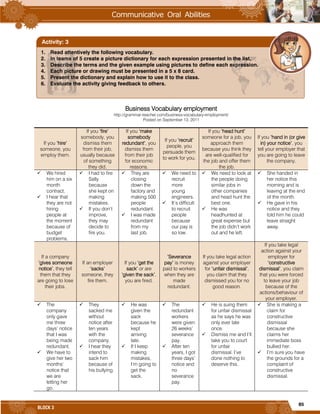
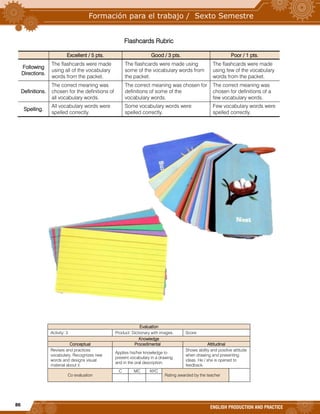
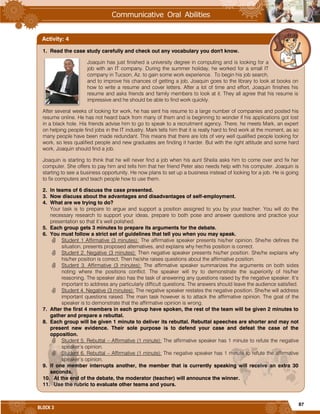
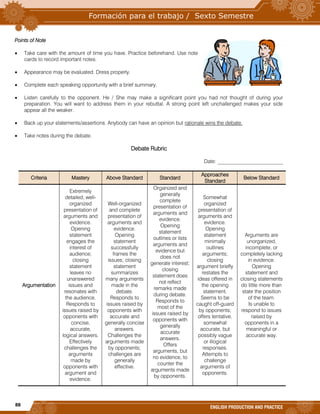

2
PRELIMINARES
Esta publicación se terminó de imprimir durante el mes de diciembre de 2011.
Diseñada en Dirección Académica del Colegio de Bachilleres del Estado de Sonora
Blvd. Agustín de Vildósola; Sector Sur. Hermosillo, Sonora, México
La edición consta de 965 ejemplares.
COLEGIO DE BACHILLERES
DEL ESTADO DE SONORA
Director General
Mtro. Julio Alfonso Martínez Romero
Director Académico
Ing. Arturo Sandoval Mariscal
Director de Administración y Finanzas
C.P. Jesús Urbano Limón Tapia
Director de Planeación
Ing. Raúl Leonel Durazo Amaya
COMMUNICATIVE ORAL ABILITIES
Módulo de Aprendizaje.
Copyright ©, 2011 por Colegio de Bachilleres
del Estado de Sonora
todos los derechos reservados.
Primera edición 2011. Impreso en México.
DIRECCIÓN ACADÉMICA
Departamento de Desarrollo Curricular
Blvd. Agustín de Vildósola, Sector Sur
Hermosillo, Sonora. México. C.P. 83280
COMISIÓN ELABORADORA:
Elaborador:
Jesús Moisés Galaz Duarte
Revisión Disciplinaria:
Edna Elinora Soto Gracia
Corrección de Estilo:
Viridiana Vidal Trasviña
Apoyo Metodológico:
Jesús Moisés Galaz Duarte
Supervisión Académica:
Luz María Grijalva Díaz
Diseño:
Joaquín Rivas Samaniego
Edición:
Cynthia Deyanira Meneses Avalos
Coordinación Técnica:
Claudia Yolanda Lugo Peñúñuri
Diana Irene Valenzuela López
Coordinación General:
Ing. Arturo Sandoval Mariscal
3PRELIMINARES
Ubicación Curricular
HORAS SEMANALES:
03
CRÉDITOS:
06
DATOS DEL ALUMNO
Nombre: _______________________________________________________________
Plantel: __________________________________________________________________
Grupo: _________________ Turno: _____________ Teléfono:___________________
E-mail: _________________________________________________________________
Domicilio: ______________________________________________________________
_______________________________________________________________________
COMPONENTE:
FORMACIÓN PARA EL
TRABAJO
CAPACITACIÓN PARA EL
TRABAJO:
IDIOMAS (INGLES)
4
PRELIMINARES
5PRELIMINARES
Presentación .........................................................................................................................................................7
Mapa de asignatura..............................................................................................................................................8
BLOCK 1: IMPORTANCE OF IMPROVING ORAL COMMUNICATION..................................................9
Didactic Sequence 1: The purpose of speaking and communication ..............................................................10
• Start up activity............................................................................................................................................10
• Development activities................................................................................................................................12
• Closing activity ............................................................................................................................................18
Didactic Sequence 2: Tips for effective communication in English...................................................................20
• Start up activity............................................................................................................................................20
• Development activities................................................................................................................................21
• Closing activity............................................................................................................................................29
Didactic Sequence 2: Intercultural communication ...........................................................................................32
• Start up activity............................................................................................................................................32
• Development activities................................................................................................................................37
• Closing activity ............................................................................................................................................46
BLOCK 2: PURPOSE AND TONE.........................................................................................................53
Didactic Sequence 1: Using correct intonation..................................................................................................54
• Start up activity............................................................................................................................................54
• Development activities................................................................................................................................56
• Closing activity ............................................................................................................................................61
Didactic Sequence 2: Linking, idioms and slang in American English .............................................................63
• Start up activity............................................................................................................................................63
• Development activities................................................................................................................................64
• Closing activity ............................................................................................................................................76
BLOCK 3: ENGLISH PRODUCTION AND PRACTICE .........................................................................79
Didactic Sequence 1: Spoken accomplishments “Job-related” .......................................................................80
• Start up activity............................................................................................................................................80
• Development activities................................................................................................................................82
• Closing activity ............................................................................................................................................91
Didactic Sequence 2: Spoken accomplishments “Social, daily life”.................................................................94
• Start up activity............................................................................................................................................94
• Development activities................................................................................................................................96
• Closing activity ..........................................................................................................................................106
Bibliography ......................................................................................................................................................110
Content
6
PRELIMINARES
7PRELIMINARES
“Una competencia es la integración de habilidades, conocimientos y actitudes en un contexto específico”.
El enfoque en competencias considera que los conocimientos por sí mismos no son lo más importante, sino el uso
que se hace de ellos en situaciones específicas de la vida personal, social y profesional. De este modo, las
competencias requieren una base sólida de conocimientos y ciertas habilidades, los cuales se integran para un
mismo propósito en un determinado contexto.
El presente Módulo de Aprendizaje de la asignatura Communicative Oral Abilities, es una herramienta de suma
importancia, que propiciará tu desarrollo como persona visionaria, competente e innovadora, características que se
establecen en los objetivos de la Reforma Integral de Educación Media Superior que actualmente se está
implementando a nivel nacional.
El Módulo de aprendizaje es uno de los apoyos didácticos que el Colegio de Bachilleres te ofrece con la intención de
estar acorde a los nuevos tiempos, a las nuevas políticas educativas, además de lo que demandan los escenarios
local, nacional e internacional; el módulo se encuentra organizado a través de Blocks de aprendizaje y secuencias
didácticas. Una Didactic Sequence es un conjunto de actividades, organizadas en tres momentos: Inicio, desarrollo y
cierre. En el inicio desarrollarás actividades que te permitirán identificar y recuperar las experiencias, los saberes, las
preconcepciones y los conocimientos que ya has adquirido a través de tu formación, mismos que te ayudarán a
abordar con facilidad el tema que se presenta en el desarrollo, donde realizarás actividades que introducen nuevos
conocimientos dándote la oportunidad de contextualizarlos en situaciones de la vida cotidiana, con la finalidad de que
tu aprendizaje sea significativo.
Posteriormente se encuentra el momento de cierre de la Didactic Sequence , donde integrarás todos los saberes que
realizaste en las actividades de inicio y desarrollo.
En todas las actividades de los tres momentos se consideran los saberes conceptuales, procedimentales y
actitudinales. De acuerdo a las características y del propósito de las actividades, éstas se desarrollan de forma
individual, binas o equipos.
Para el desarrollo del trabajo deberás utilizar diversos recursos, desde material bibliográfico, videos, investigación de
campo, etc.
La retroalimentación de tus conocimientos es de suma importancia, de ahí que se te invita a participar de forma activa,
de esta forma aclararás dudas o bien fortalecerás lo aprendido; además en este momento, el docente podrá tener una
visión general del logro de los aprendizajes del grupo.
Recuerda que la evaluación en el enfoque en competencias es un proceso continuo, que permite recabar evidencias a
través de tu trabajo, donde se tomarán en cuenta los tres saberes: el conceptual, procedimental y actitudinal con el
propósito de que apoyado por tu maestro mejores el aprendizaje. Es necesario que realices la autoevaluación, este
ejercicio permite que valores tu actuación y reconozcas tus posibilidades, limitaciones y cambios necesarios para
mejorar tu aprendizaje.
Así también, es recomendable la coevaluación, proceso donde de manera conjunta valoran su actuación, con la
finalidad de fomentar la participación, reflexión y crítica ante situaciones de sus aprendizajes, promoviendo las
actitudes de responsabilidad e integración del grupo.
Nuestra sociedad necesita individuos a nivel medio superior con conocimientos, habilidades, actitudes y valores, que
les permitan integrarse y desarrollarse de manera satisfactoria en el mundo social, profesional y laboral. Para que
contribuyas en ello, es indispensable que asumas una nueva visión y actitud en cuanto a tu rol, es decir, de ser
receptor de contenidos, ahora construirás tu propio conocimiento a través de la problematización y contextualización
de los mismos, situación que te permitirá: Aprender a conocer, aprender a hacer, aprender a ser y aprender a vivir
juntos.
Presentación
8
PRELIMINARES
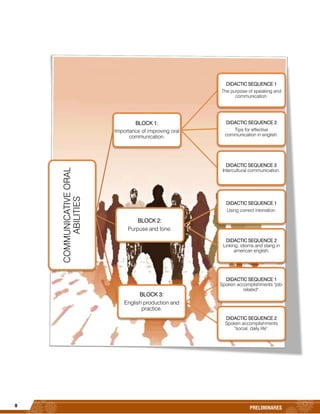
COMMUNICATIVEORAL
ABILITIES
BLOCK 1:
Importance of improving oral
communication.
DIDACTIC SEQUENCE 1
The purpose of speaking and
communication.
DIDACTIC SEQUENCE 2
Tips for effective
communication in english.
DIDACTIC SEQUENCE 3
Intercultural communication.
BLOCK 2:
Purpuse and tone.
DIDACTIC SEQUENCE 1
Using correct intonation.
DIDACTIC SEQUENCE 2
Linking, idioms and slang in
american english.
BLOCK 3:
English production and
practice.
DIDACTIC SEQUENCE 1
Spoken accomplishments "job-
related".
DIDACTIC SEQUENCE 2
Spoken accomplishments
"social, daily life".
Time assigned: 15 hrs.
Importance of Improving Oral
Communication.
Competencias profesionales:
1. Realiza comprensiones oral y auditiva de diversos tipos de texto en otro idioma.
2. Realiza comprensión escrita y de lectura de diversos tipos de texto en otro idioma.
3. Realiza expresión o producción oral en otro idioma.
4. Realiza interacción oral en otro idioma.
5. Realiza expresión o producción escrita de diversos tipos de texto en otro idioma.
Unidad de competencia:
 Observa y muestra el modo de comunicarse de forma oral en Ingles, con mayor eficacia, cubriendo aspectos
como la comunicación efectiva relacionándola a diversas culturas de manera formal e informal.
Atributos a desarrollar en el bloque:
Durante el presente bloque se busca desarrollar los siguientes atributos de las competencias genéricas:
4.1 Expresa ideas y conceptos mediante representaciones lingüísticas, matemáticas o gráficas.
4.2 Aplica distintas estrategias comunicativas según quienes sean sus interlocutores, el contexto en el que se
encuentra y los objetivos que persigue.
4.3 Identifica las ideas claves en un texto o discurso oral e infiere conclusiones a partir de ellas.
4.4 Se comunica en una segunda lengua en situaciones cotidianas.
4.5 Maneja las tecnologías de la información y la comunicación para obtener información y expresar ideas.
6.4 Estructura ideas y argumentos de manera clara, coherente y sintética.
7.1 Define metas y da seguimiento a sus procesos de construcción de conocimiento.
8.2 Aporta puntos de vista con apertura y considera los de otras personas de manera reflexiva.
10.3 Asume que el respeto de las diferencias es el principio de integración y de convivencia de los contextos
locales, nacional e internacional.
10
IMPORTANCE OF IMPROVING ORAL COMMUNICATION
Didactic Sequence 1.
The purpose of speaking and communication.
Startup Activity
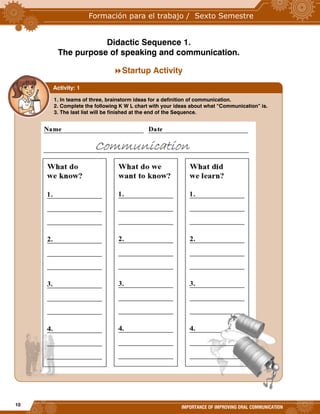
1. In teams of three, brainstorm ideas for a definition of communication.
2. Complete the following K W L chart with your ideas about what “Communication” is.
3. The last list will be finished at the end of the Sequence.
Activity: 1
11
BLOCK 1
Rubric
Categories 1 2 3 4 5
Level of Engagement in
Discussion
The student actively participates in the discussion offering
constructive input.
Behavior and Listening Skills The student listens thoughtfully to what others have to say.
Preparedness
The student answers questions or responds to statements made by
the teacher or the group.
The student asks appropriate and thoughtful questions pertaining
to the discussion.
The student uses appropriate vocabulary during the discussion.
Evaluation
Activity: 1 Product: KWL chart and flipchart. Score:
knowledge
Conceptual Procedimental Attitudinal
Remembers and recognizes by
discussing in class a definition
of communication.
Selects and transfers in the product
the differences and the importance
of communication.
Integrates previous knowledge
while identifying.
Co evaluation
C MC NYC
Rating given by the teacher.
4. Create a group discussion.
5. Present and explain the discussion’s results to the class on a flip chart.
6. Evaluate one team assigned by your teacher.
Activity: 1 (continuation)
12
IMPORTANCE OF IMPROVING ORAL COMMUNICATION
Development Activities
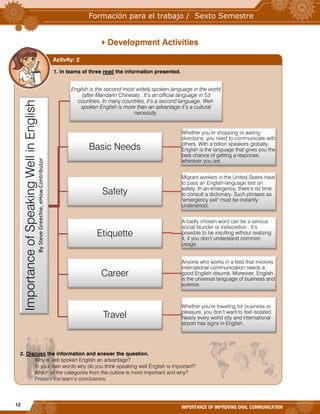
1. In teams of three read the information presented.
2. Discuss the information and answer the question.
Why is well spoken English an advantage?
In your own words why do you think speaking well English is important?
Which of the categories from the outline is more important and why?
Present the team’s conclusions.
Activity: 2
ImportanceofSpeakingWellinEnglish
BySteveGreechie,eHowContributor
English is the second most widely spoken language in the world
(after Mandarin Chinese). It’s an official language in 53
countries. In many countries, it’s a second language. Well-
spoken English is more than an advantage it’s a cultural
necessity.
Basic Needs
Whether you’re shopping or asking
directions, you need to communicate with
others. With a billion speakers globally,
English is the language that gives you the
best chance of getting a response,
wherever you are.
Safety
Migrant workers in the United States have
to pass an English-language test on
safety. In an emergency, there’s no time
to consult a dictionary. Such phrases as
"emergency exit" must be instantly
understood.
Etiquette
A badly chosen word can be a serious
social blunder or indiscretion . It’s
possible to be insulting without realizing
it, if you don’t understand common
usage.
Career
Anyone who works in a field that involves
international communication needs a
good English résumé. Moreover, English
is the universal language of business and
science.
Travel
Whether you’re traveling for business or
pleasure, you don’t want to feel isolated.
Nearly every world city and international
airport has signs in English.
13
BLOCK 1
Evaluation
Activity: 2 Product: Flipchart with conclusions. Score:
knowledge
Conceptual Procedimental Attitudinal
Clarifies, understands and
interprets information based on
the reading and deeds
presented in the activity.
Discusses, classifies and relates
the reading in the group’s product,
creating a conclusion.
Shows openness for group and
teacher’s feedback and
integrates organized group work
to the activity.
Co evaluation
C MC NYC Rating given by the
teacher
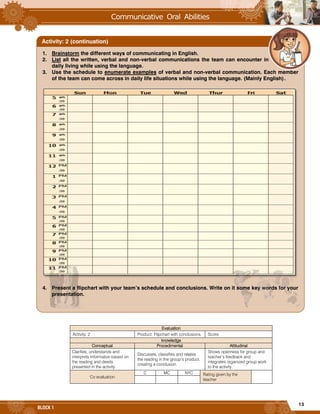
1. Brainstorm the different ways of communicating in English.
2. List all the written, verbal and non-verbal communications the team can encounter in
daily living while using the language.
3. Use the schedule to enumerate examples of verbal and non-verbal communication. Each member
of the team can come across in daily life situations while using the language. (Mainly English).
4. Present a flipchart with your team’s schedule and conclusions. Write on it some key words for your
presentation.
Activity: 2 (continuation)
14
IMPORTANCE OF IMPROVING ORAL COMMUNICATION
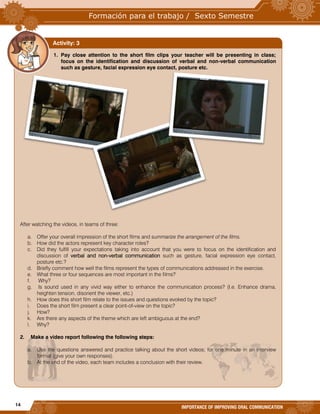
1. Pay close attention to the short film clips your teacher will be presenting in class;
focus on the identification and discussion of verbal and non-verbal communication
such as gesture, facial expression eye contact, posture etc.
After watching the videos, in teams of three:
a. Offer your overall impression of the short films and summarize the arrangement of the films.
b. How did the actors represent key character roles?
c. Did they fulfill your expectations taking into account that you were to focus on the identification and
discussion of verbal and non-verbal communication such as gesture, facial expression eye contact,
posture etc.?
d. Briefly comment how well the films represent the types of communications addressed in the exercise.
e. What three or four sequences are most important in the films?
f. Why?
g. Is sound used in any vivid way either to enhance the communication process? (I.e. Enhance drama,
heighten tension, disorient the viewer, etc.)
h. How does this short film relate to the issues and questions evoked by the topic?
i. Does the short film present a clear point-of-view on the topic?
j. How?
k. Are there any aspects of the theme which are left ambiguous at the end?
l. Why?
2. Make a video report following the following steps:
a. Use the questions answered and practice talking about the short videos; for one minute in an interview
format (give your own responses).
b. At the end of the video, each team includes a conclusion with their review.
Activity: 3
15
BLOCK 1
c. After the reviews have been recorded and checked by the class and the teacher; the videos
can be uploaded to “YouTube” or “Google Video”. They can then be watched by all the
students in another lesson. The videos can also be watched by other students around the
world!
d. If your school or class has a website, perhaps you can upload the best productions there so that other
students can listen to the reviews too.
Activity: 3 (continuation)
16
IMPORTANCE OF IMPROVING ORAL COMMUNICATION
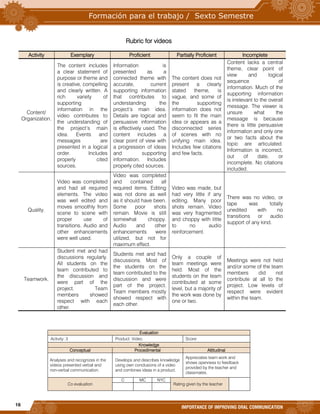
Rubric for videos
Activity Exemplary Proficient Partially Proficient Incomplete
Content/
Organization.
The content includes
a clear statement of
purpose or theme and
is creative, compelling
and clearly written. A
rich variety of
supporting
information in the
video contributes to
the understanding of
the project’s main
idea. Events and
messages are
presented in a logical
order. Includes
properly cited
sources.
Information is
presented as a
connected theme with
accurate, current
supporting information
that contributes to
understanding the
project’s main idea.
Details are logical and
persuasive information
is effectively used. The
content includes a
clear point of view with
a progression of ideas
and supporting
information. Includes
properly cited sources.
The content does not
present a clearly
stated theme, is
vague, and some of
the supporting
information does not
seem to fit the main
idea or appears as a
disconnected series
of scenes with no
unifying main idea.
Includes few citations
and few facts.
Content lacks a central
theme, clear point of
view and logical
sequence of
information. Much of the
supporting information
is irrelevant to the overall
message. The viewer is
unsure what the
message is because
there is little persuasive
information and only one
or two facts about the
topic are articulated.
Information is incorrect,
out of date, or
incomplete. No citations
included.
Quality.
Video was completed
and had all required
elements. The video
was well edited and
moves smoothly from
scene to scene with
proper use of
transitions. Audio and
other enhancements
were well used.
Video was completed
and contained all
required items. Editing
was not done as well
as it should have been.
Some poor shots
remain. Movie is still
somewhat choppy.
Audio and other
enhancements were
utilized, but not for
maximum effect.
Video was made, but
had very little if any
editing. Many poor
shots remain. Video
was very fragmented
and choppy with little
to no audio
reinforcement.
There was no video, or
tape was totally
unedited with no
transitions or audio
support of any kind.
Teamwork.
Student met and had
discussions regularly.
All students on the
team contributed to
the discussion and
were part of the
project. Team
members showed
respect with each
other.
Students met and had
discussions. Most of
the students on the
team contributed to the
discussion and were
part of the project.
Team members mostly
showed respect with
each other.
Only a couple of
team meetings were
held. Most of the
students on the team
contributed at some
level, but a majority of
the work was done by
one or two.
Meetings were not held
and/or some of the team
members did not
contribute at all to the
project. Low levels of
respect were evident
within the team.
Evaluation
Activity: 3 Product: Video. Score:
Knowledge
Conceptual Procedimental Attitudinal
Analyses and recognizes in the
videos presented verbal and
non-verbal communication.
Develops and describes knowledge
using own conclusions of a video
and combines ideas in a product.
Appreciates team work and
shows openness to feedback
provided by the teacher and
classmates.
Co evaluation
C MC NYC
Rating given by the teacher
17
BLOCK 1
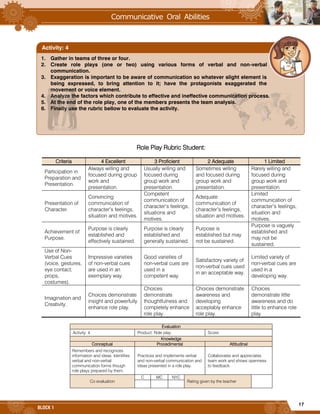
Role Play Rubric Student:
Criteria 4 Excellent 3 Proficient 2 Adequate 1 Limited
Participation in
Preparation and
Presentation.
Always willing and
focused during group
work and
presentation.
Usually willing and
focused during
group work and
presentation.
Sometimes willing
and focused during
group work and
presentation.
Rarely willing and
focused during
group work and
presentation.
Presentation of
Character.
Convincing
communication of
character’s feelings,
situation and motives.
Competent
communication of
character’s feelings,
situations and
motives.
Adequate
communication of
character’s feelings,
situation and motives.
Limited
communication of
character’s feelings,
situation and
motives.
Achievement of
Purpose.
Purpose is clearly
established and
effectively sustained.
Purpose is clearly
established and
generally sustained.
Purpose is
established but may
not be sustained.
Purpose is vaguely
established and
may not be
sustained.
Use of Non-
Verbal Cues
(voice, gestures,
eye contact,
props,
costumes).
Impressive varieties
of non-verbal cues
are used in an
exemplary way.
Good varieties of
non-verbal cues are
used in a
competent way.
Satisfactory variety of
non-verbal cues used
in an acceptable way.
Limited variety of
non-verbal cues are
used in a
developing way.
Imagination and
Creativity.
Choices demonstrate
insight and powerfully
enhance role play.
Choices
demonstrate
thoughtfulness and
completely enhance
role play.
Choices demonstrate
awareness and
developing
acceptably enhance
role play.
Choices
demonstrate little
awareness and do
little to enhance role
play.
Evaluation
Activity: 4 Product: Role play. Score:
Knowledge
Conceptual Procedimental Attitudinal
Remembers and recognizes
information and ideas. Identifies
verbal and non-verbal
communication forms though
role plays prepared by them.
Practices and implements verbal
and non-verbal communication and
ideas presented in a role play.
Collaborates and appreciates
team work and shows openness
to feedback.
Co evaluation
C MC NYC
Rating given by the teacher
1. Gather in teams of three or four.
2. Create role plays (one or two) using various forms of verbal and non-verbal
communication.
3. Exaggeration is important to be aware of communication so whatever slight element is
being expressed, to bring attention to it; have the protagonists exaggerated the
movement or voice element.
4. Analyze the factors which contribute to effective and ineffective communication process.
5. At the end of the role play, one of the members presents the team analysis.
6. Finally use the rubric bellow to evaluate the activity.
Activity: 4
18
IMPORTANCE OF IMPROVING ORAL COMMUNICATION
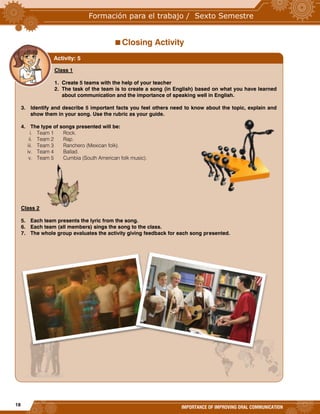
Closing Activity
Class 1
1. Create 5 teams with the help of your teacher
2. The task of the team is to create a song (in English) based on what you have learned
about communication and the importance of speaking well in English.
3. Identify and describe 5 important facts you feel others need to know about the topic, explain and
show them in your song. Use the rubric as your guide.
4. The type of songs presented will be:
i. Team 1 Rock.
ii. Team 2 Rap.
iii. Team 3 Ranchero (Mexican folk).
iv. Team 4 Ballad.
v. Team 5 Cumbia (South American folk music).
Class 2
5. Each team presents the lyric from the song.
6. Each team (all members) sings the song to the class.
7. The whole group evaluates the activity giving feedback for each song presented.
Activity: 5
19
BLOCK 1
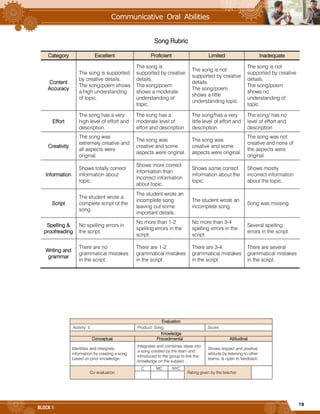
Song Rubric
Category Excellent Proficient Limited Inadequate
Content
Accuracy
The song is supported
by creative details.
The song/poem shows
a high understanding
of topic.
The song is
supported by creative
details.
The song/poem
shows a moderate
understanding of
topic.
The song is not
supported by creative
details.
The song/poem
shows a little
understanding topic.
The song is not
supported by creative
details.
The song/poem
shows no
understanding of
topic.
Effort
The song has a very
high level of effort and
description.
The song has a
moderate level of
effort and description
The song/has a very
little level of effort and
description
The song/ has no
level of effort and
description
Creativity
The song was
extremely creative and
all aspects were
original.
The song was
creative and some
aspects were original.
The song was
creative and some
aspects were original.
The song was not
creative and none of
the aspects were
original.
Information
Shows totally correct
information about
topic.
Shows more correct
information than
incorrect information
about topic.
Shows some correct
information about the
topic.
Shows mostly
incorrect information
about the topic.
Script
The student wrote a
complete script of the
song.
The student wrote an
incomplete song
leaving out some
important details.
The student wrote an
incomplete song.
Song was missing.
Spelling &
proofreading
No spelling errors in
the script.
No more than 1-2
spelling errors in the
script.
No more than 3-4
spelling errors in the
script.
Several spelling
errors in the script.
Writing and
grammar
There are no
grammatical mistakes
in the script.
There are 1-2
grammatical mistakes
in the script.
There are 3-4
grammatical mistakes
in the script.
There are several
grammatical mistakes
in the script.
Evaluation
Activity: 5 Product: Song. Score:
Knowledge
Conceptual Procedimental Attitudinal
Identifies and interprets
information by creating a song
based on prior knowledge.
Integrates and combines ideas into
a song created by the team and
introduced to the group to link the
knowledge on the subject.
Shows respect and positive
attitude by listening to other
teams. Is open to feedback.
Co evaluation
C MC NYC
Rating given by the teacher
20
IMPORTANCE OF IMPROVING ORAL COMMUNICATION
Didactic Sequence 2.
Tips for effective communication in English.
Startup Activity
Evaluation
Activity: 1 Product: Graphic organizer. Score:
Knowledge
Conceptual Procedimental Attitudinal
Recognizes and describes the
information based on the text
and graphics presented.
Designs and combines ideas into a
graphic organizer created by the
pair and introduced to the group to
link the knowledge on the subject.
Collaborates and appreciates
team work and shows openness
to feedback.
Co evaluation
C MC NYC
Rating given by the teacher
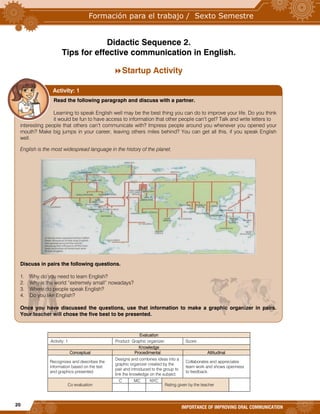
Read the following paragraph and discuss with a partner.
Learning to speak English well may be the best thing you can do to improve your life. Do you think
it would be fun to have access to information that other people can’t get? Talk and write letters to
interesting people that others can’t communicate with? Impress people around you whenever you opened your
mouth? Make big jumps in your career, leaving others miles behind? You can get all this, if you speak English
well.
English is the most widespread language in the history of the planet.
Discuss in pairs the following questions.
1. Why do you need to learn English?
2. Why is the world “extremely small” nowadays?
3. Where do people speak English?
4. Do you like English?
Once you have discussed the questions, use that information to make a graphic organizer in pairs.
Your teacher will chose the five best to be presented.
Activity: 1
21
BLOCK 1
Development Activities
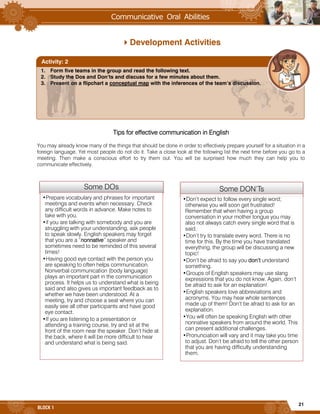
Tips for effective communication in English
You may already know many of the things that should be done in order to effectively prepare yourself for a situation in a
foreign language. Yet most people do not do it. Take a close look at the following list the next time before you go to a
meeting. Then make a conscious effort to try them out. You will be surprised how much they can help you to
communicate effectively.
Some DOs
•Prepare vocabulary and phrases for important
meetings and events when necessary. Check
any difficult words in advance. Make notes to
take with you.
•if you are talking with somebody and you are
struggling with your understanding, ask people
to speak slowly. English speakers may forget
that you are a “nonnative” speaker and
sometimes need to be reminded of this several
times!
•Having good eye contact with the person you
are speaking to often helps communication.
Nonverbal communication (body language)
plays an important part in the communication
process. It helps us to understand what is being
said and also gives us important feedback as to
whether we have been understood. At a
meeting, try and choose a seat where you can
easily see all other participants and have good
eye contact.
•If you are listening to a presentation or
attending a training course, try and sit at the
front of the room near the speaker. Don’t hide at
the back, where it will be more difficult to hear
and understand what is being said.
Some DON’Ts
•Don’t expect to follow every single word;
otherwise you will soon get frustrated!
Remember that when having a group
conversation in your mother tongue you may
also not always catch every single word that is
said.
•Don’t try to translate every word. There is no
time for this. By the time you have translated
everything, the group will be discussing a new
topic!
•Don’t be afraid to say you don’t understand
something.
•Groups of English speakers may use slang
expressions that you do not know. Again, don’t
be afraid to ask for an explanation!
•English speakers love abbreviations and
acronyms. You may hear whole sentences
made up of them! Don’t be afraid to ask for an
explanation.
•You will often be speaking English with other
nonnative speakers from around the world. This
can present additional challenges.
•Pronunciation will vary and it may take you time
to adjust. Don’t be afraid to tell the other person
that you are having difficulty understanding
them.
1. Form five teams in the group and read the following text.
2. Study the Dos and Don’ts and discuss for a few minutes about them.
3. Present on a flipchart a conceptual map with the inferences of the team’s discussion.
Activity: 2
22
IMPORTANCE OF IMPROVING ORAL COMMUNICATION
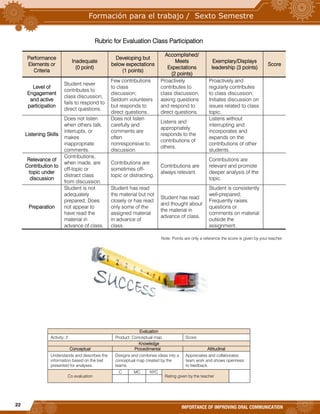
Rubric for Evaluation Class Participation
Performance
Elements or
Criteria
Inadequate
(0 point)
Developing but
below expectations
(1 points)
Accomplished/
Meets
Expectations
(2 points)
Exemplary/Displays
leadership (3 points)
Score
Level of
Engagement
and active
participation
Student never
contributes to
class discussion;
fails to respond to
direct questions.
Few contributions
to class
discussion;
Seldom volunteers
but responds to
direct questions.
Proactively
contributes to
class discussion,
asking questions
and respond to
direct questions.
Proactively and
regularly contributes
to class discussion;
Initiates discussion on
issues related to class
topic.
Listening Skills
Does not listen
when others talk,
interrupts, or
makes
inappropriate
comments.
Does not listen
carefully and
comments are
often
nonresponsive to
discussion.
Listens and
appropriately
responds to the
contributions of
others.
Listens without
interrupting and
incorporates and
expands on the
contributions of other
students.
Relevance of
Contribution to
topic under
discussion
Contributions,
when made, are
off-topic or
distract class
from discussion.
Contributions are
sometimes off-
topic or distracting.
Contributions are
always relevant.
Contributions are
relevant and promote
deeper analysis of the
topic.
Preparation
Student is not
adequately
prepared; Does
not appear to
have read the
material in
advance of class.
Student has read
the material but not
closely or has read
only some of the
assigned material
in advance of
class.
Student has read
and thought about
the material in
advance of class.
Student is consistently
well-prepared;
Frequently raises
questions or
comments on material
outside the
assignment.
Note: Points are only a reference the score is given by your teacher.
Evaluation
Activity: 2 Product: Conceptual map. Score:
Knowledge
Conceptual Procedimental Attitudinal
Understands and describes the
information based on the text
presented for analyses.
Designs and combines ideas into a
conceptual map created by the
teams.
Appreciates and collaborates
team work and shows openness
to feedback.
Co evaluation
C MC NYC
Rating given by the teacher
23
BLOCK 1
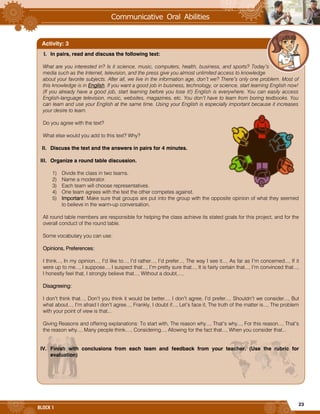
I. In pairs, read and discuss the following text:
What are you interested in? Is it science, music, computers, health, business, and sports? Today’s
media such as the Internet, television, and the press give you almost unlimited access to knowledge
about your favorite subjects. After all, we live in the information age, don’t we? There’s only one problem. Most of
this knowledge is in English. If you want a good job in business, technology, or science, start learning English now!
(If you already have a good job, start learning before you lose it!) English is everywhere. You can easily access
English-language television, music, websites, magazines, etc. You don’t have to learn from boring textbooks. You
can learn and use your English at the same time. Using your English is especially important because it increases
your desire to learn.
Do you agree with the text?
What else would you add to this text? Why?
II. Discuss the text and the answers in pairs for 4 minutes.
III. Organize a round table discussion.
1) Divide the class in two teams.
2) Name a moderator.
3) Each team will choose representatives.
4) One team agrees with the text the other competes against.
5) Important: Make sure that groups are put into the group with the opposite opinion of what they seemed
to believe in the warm-up conversation.
All round table members are responsible for helping the class achieve its stated goals for this project, and for the
overall conduct of the round table.
Some vocabulary you can use:
Opinions, Preferences:
I think..., In my opinion..., I’d like to..., I’d rather..., I’d prefer..., The way I see it..., As far as I’m concerned..., If it
were up to me..., I suppose..., I suspect that..., I’m pretty sure that..., It is fairly certain that..., I’m convinced that...,
I honestly feel that, I strongly believe that..., Without a doubt,...,
Disagreeing:
I don’t think that..., Don’t you think it would be better..., I don’t agree, I’d prefer..., Shouldn’t we consider..., But
what about..., I’m afraid I don’t agree..., Frankly, I doubt if..., Let’s face it, The truth of the matter is..., The problem
with your point of view is that...
Giving Reasons and offering explanations: To start with, The reason why..., That’s why..., For this reason..., That’s
the reason why..., Many people think...., Considering..., Allowing for the fact that..., When you consider that...
IV. Finish with conclusions from each team and feedback from your teacher. (Use the rubric for
evaluation)
Activity: 3
24
IMPORTANCE OF IMPROVING ORAL COMMUNICATION
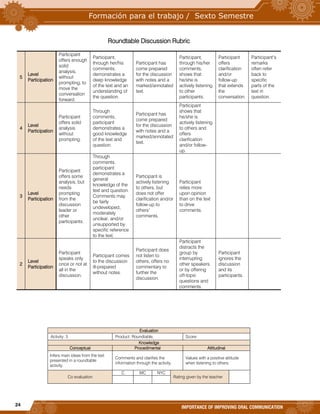
Roundtable Discussion Rubric
5
Level
Participation
Participant
offers enough
solid
analysis,
without
prompting, to
move the
conversation
forward.
Participant,
through her/his
comments,
demonstrates a
deep knowledge
of the text and an
understanding of
the question.
Participant has
come prepared
for the discussion
with notes and a
marked/annotated
text.
Participant,
through his/her
comments,
shows that
he/she is
actively listening
to other
participants.
Participant
offers
clarification
and/or
follow-up
that extends
the
conversation.
Participant’s
remarks
often refer
back to
specific
parts of the
text in
question.
4
Level
Participation
Participant
offers solid
analysis
without
prompting.
Through
comments,
participant
demonstrates a
good knowledge
of the text and
question.
Participant has
come prepared
for the discussion
with notes and a
marked/annotated
text.
Participant
shows that
he/she is
actively listening
to others and
offers
clarification
and/or follow-
up.
3
Level
Participation
Participant
offers some
analysis, but
needs
prompting
from the
discussion
leader or
other
participants.
Through
comments,
participant
demonstrates a
general
knowledge of the
text and question.
Comments may
be fairly
undeveloped,
moderately
unclear, and/or
unsupported by
specific reference
to the text.
Participant is
actively listening
to others, but
does not offer
clarification and/or
follow-up to
others’
comments.
Participant
relies more
upon opinion
than on the text
to drive
comments.
2
Level
Participation
Participant
speaks only
once or not at
all in the
discussion.
Participant comes
to the discussion
ill-prepared
without notes.
Participant does
not listen to
others, offers no
commentary to
further the
discussion.
Participant
distracts the
group by
interrupting
other speakers
or by offering
off-topic
questions and
comments.
Participant
ignores the
discussion
and its
participants.
Evaluation
Activity: 3 Product: Roundtable. Score:
Knowledge
Conceptual Procedimental Attitudinal
Infers main ideas from the text
presented in a roundtable
activity.
Comments and clarifies the
information through the activity.
Values with a positive attitude
when listening to others.
Co evaluation
C MC NYC
Rating given by the teacher
25
BLOCK 1
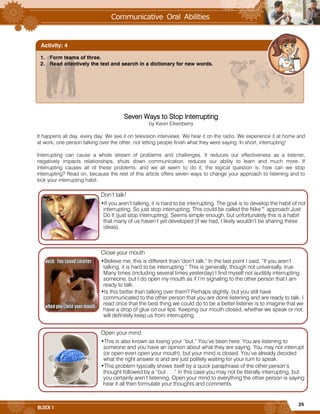
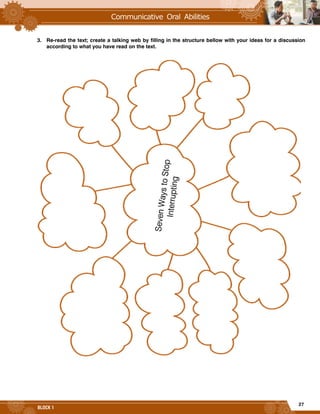
Seven Ways to Stop Interrupting
by Kevin Eikenberry
It happens all day, every day. We see it on television interviews. We hear it on the radio. We experience it at home and
at work; one person talking over the other, not letting people finish what they were saying. In short, interrupting!
Interrupting can cause a whole stream of problems and challenges. It reduces our effectiveness as a listener,
negatively impacts relationships, shuts down communication, reduces our ability to learn and much more. If
interrupting causes all of these problems, and we all seem to do it, the logical question is, how can we stop
interrupting? Read on, because the rest of this article offers seven ways to change your approach to listening and to
kick your interrupting habit.
Don’t talk!
•If you aren’t talking, it is hard to be interrupting. The goal is to develop the habit of not
interrupting. So just stop interrupting. This could be called the Nike™ approach Just
Do It (just stop interrupting). Seems simple enough, but unfortunately this is a habit
that many of us haven’t yet developed (if we had, I likely wouldn’t be sharing these
ideas).
Close your mouth
•Believe me; this is different than "don’t talk." In the last point I said, “If you aren’t
talking, it is hard to be interrupting.” This is generally, though not universally, true.
Many times (including several times yesterday) I find myself not audibly interrupting
someone, but I do open my mouth as if I’m signaling to the other person that I am
ready to talk.
•Is this better than talking over them? Perhaps slightly, but you still have
communicated to the other person that you are done listening and are ready to talk. I
read once that the best thing we could do to be a better listener is to imagine that we
have a drop of glue on our lips. Keeping our mouth closed, whether we speak or not,
will definitely keep us from interrupting.
Open your mind
•This is also known as losing your “but.” You’ve been here. You are listening to
someone and you have an opinion about what they are saying. You may not interrupt
(or open even open your mouth), but your mind is closed. You’ve already decided
what the right answer is and are just politely waiting for your turn to speak.
•This problem typically shows itself by a quick paraphrase of the other person’s
thought followed by a “but . . .” In this case you may not be literally interrupting, but
you certainly aren’t listening. Open your mind to everything the other person is saying
hear it all then formulate your thoughts and comments.
1. Form teams of three.
2. Read attentively the text and search in a dictionary for new words.
Activity: 4
26
IMPORTANCE OF IMPROVING ORAL COMMUNICATION
Remember the irony.
Often we interrupt because we want to be helpful; we want to supply a critical point, emphasize something or persuade
the other person in some way. As it turns out, by interrupting we are hurting our chances to be understood, to
persuade, to influence and to have our ideas accepted. The irony is that as we stop interrupting we will be more
influential. Remembering this irony and our true intentions can help us reduce our tendency to interrupt. Chances are
one of these points speaks to you directly at this moment. Focus on that method starting right now. Don’t go into your
next conversation trying to remember all seven ways to stop interrupting. Just pick one. One, well executed, is all you
need to change your interrupting habit.
Potential Principle to be a better listener, to be more persuasive, and to learn more from others we must stop
interrupting. Stop talking and start listening. Stop talking and start persuading. Stop talking and start learning.
http://www.hodu.com/stop-interrupt.shtml
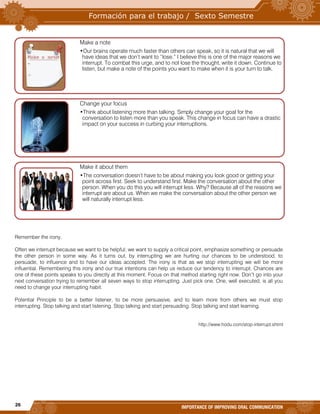
Make a note
•Our brains operate much faster than others can speak, so it is natural that we will
have ideas that we don’t want to “lose.” I believe this is one of the major reasons we
interrupt. To combat this urge, and to not lose the thought, write it down. Continue to
listen, but make a note of the points you want to make when it is your turn to talk.
Change your focus
•Think about listening more than talking. Simply change your goal for the
conversation to listen more than you speak. This change in focus can have a drastic
impact on your success in curbing your interruptions.
Make it about them
•The conversation doesn’t have to be about making you look good or getting your
point across first. Seek to understand first. Make the conversation about the other
person. When you do this you will interrupt less. Why? Because all of the reasons we
interrupt are about us. When we make the conversation about the other person we
will naturally interrupt less.
27
BLOCK 1
3. Re-read the text; create a talking web by filling in the structure bellow with your ideas for a discussion
according to what you have read on the text.
28
IMPORTANCE OF IMPROVING ORAL COMMUNICATION
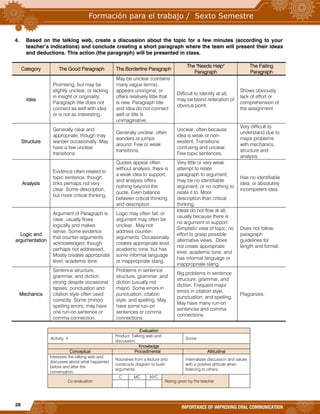
4. Based on the talking web, create a discussion about the topic for a few minutes (according to your
teacher’s indications) and conclude creating a short paragraph where the team will present their ideas
and deductions. This action (the paragraph) will be presented in class.
Category The Good Paragraph The Borderline Paragraph
The "Needs Help"
Paragraph
The Failing
Paragraph
Idea
Promising, but may be
slightly unclear, or lacking
in insight or originality.
Paragraph title does not
connect as well with idea
or is not as interesting.
May be unclear (contains
many vague terms),
appears unoriginal, or
offers relatively little that
is new. Paragraph title
and idea do not connect
well or title is
unimaginative.
Difficult to identify at all,
may be bland reiteration of
obvious point.
Shows obviously
lack of effort or
comprehension of
the assignment.
Structure
Generally clear and
appropriate, though may
wander occasionally. May
have a few unclear
transitions.
Generally unclear, often
wanders or jumps
around. Few or weak
transitions.
Unclear, often because
idea is weak or non-
existent. Transitions
confusing and unclear.
Few topic sentences.
Very difficult to
understand due to
major problems
with mechanics,
structure and
analysis.
Analysis
Evidence often related to
topic sentence, though
links perhaps not very
clear. Some description,
but more critical thinking.
Quotes appear often
without analysis, there is
a weak idea to support,
and analysis offers
nothing beyond the
quote. Even balance
between critical thinking
and description.
Very little or very weak
attempt to relate
paragraph to argument;
may be no identifiable
argument, or no nothing to
relate it to. More
description than critical
thinking.
Has no identifiable
idea, or absolutely
incompetent idea.
Logic and
argumentation
Argument of Paragraph is
clear, usually flows
logically and makes
sense. Some evidence
that counter-arguments
acknowledged, though
perhaps not addressed.
Mostly creates appropriate
level, academic tone.
Logic may often fail, or
argument may often be
unclear. May not
address counter-
arguments. Occasionally
creates appropriate level,
academic tone, but has
some informal language
or inappropriate slang.
Ideas do not flow at all,
usually because there is
no argument to support.
Simplistic view of topic; no
effort to grasp possible
alternative views. Does
not create appropriate
level, academic tone, and
has informal language or
inappropriate slang.
Does not follow
paragraph
guidelines for
length and format.
Mechanics
Sentence structure,
grammar, and diction
strong despite occasional
lapses; punctuation and
citation style often used
correctly. Some (minor)
spelling errors; may have
one run-on sentence or
comma connection.
Problems in sentence
structure, grammar, and
diction (usually not
major). Some errors in
punctuation, citation
style, and spelling. May
have some run-on
sentences or comma
connections.
Big problems in sentence
structure, grammar, and
diction. Frequent major
errors in citation style,
punctuation, and spelling.
May have many run-on
sentences and comma
connections.
Plagiarizes.
Evaluation
Activity: 4
Product: Talking web and
discussion.
Score:
Knowledge
Conceptual Procedimental Attitudinal
Interprets the talking web and
discusses about what happened
before and after the
conversation.
Nourishes from a lecture and
constructs diagram to build
arguments.
Internalizes discussion and values
with a positive attitude when
listening to others.
Co evaluation
C MC NYC
Rating given by the teacher
29
BLOCK 1
Closing Activity
6 English Speaking Tips You Must Know
March 21, 2011 // English Speaking Tips
Visiting a new place can be a scary experience for a lot of people, not only because it could entail speaking in a
language that most people are not comfortable with English. If you are born a native English speaker, then you will
have no problem speaking English naturally. But for those people whose mother tongue is not English, this can be a
problem. So how can you avoid this kind of situation? Learn how to speak English fluently. Most people think that this is
easier said than done, but in reality, it is actually easy to speak fluent English. English is the universal language, and
this universal concept makes it one of the easiest languages to master. Here are 7 English speaking tips you must
know to become a more confident English speaker.
1.Listenfirst
•One of the best English
speaking tips is to listen
carefully to
understandable English
EVERY DAY. Most people
turn to textbooks to study
English grammar rules,
but you cannot learn the
correct English
pronunciation of the
words by just mere
reading them. Instead,
listen to how native
English speakers
enunciate their words
and observe their mouth
movements. Try to
imitate the intonation and
rhythm of their speech.
Also watch English
shows and movies to
build on your English
accent and improve your
vocabulary.
2.Donotbetooconsciousonthegrammar
•Yes, it is important
to learn the basic
grammar rules in
English. Most
people tend to
concentrate more
on not committing
any grammatical
errors while talking,
so oftentimes, their
accents become
stilted. Grammar
rules make you
think about English
when what you
want to do is to
speak better
English naturally
without sounding
too forced.
3.Practicemakesperfect
•The cardinal rule in English
speaking practice, practice,
practice! Studies show that
you’ll probably spend three
months of practice every day
in order to have strong mouth
muscles and get the hang of
in speaking a new language.
Read aloud in English for 15
to 20 minutes a day in front of
the mirror. Try articulation
exercises which help in
accent reduction or
neutralization in order for you
to improve your English
communication skills. (you
can find some of those
exercises on your “Listening
and Speaking” book from
last semester)Also, practice
with your friends and family.
Talking with a good English
speaker can help improvise
your usage of words and
formation of sentences.
1. Form teams of five.
2. Read attentively the text and search in a dictionary for new words.
3. Students analyze each tip.
Activity: 5
30
IMPORTANCE OF IMPROVING ORAL COMMUNICATION
4. Each member must explain each tip. Then identify what they have in common.
5. Now answer "HOW CAN YOU IMPROVE YOUR COMMUNICATIVE ABILITY IN ENGLISH?"
6. Write your answer here and share your opinion with the team.
______________________________________________________________________________________________________
______________________________________________________________________________________________________
______________________________________________________________________________________________________
______________________________________________________________________________________________________
______________________________________________________________________________________________________
______________________________________________________________________________________________________
______________________________________________________________________________________________________
4.ThinkinEnglish
•One of the most
effective English
speaking tips is to
think in English. What
most English learners
do in the early stages
of learning is that they
think of what they
have to say in their
native language,
translate and then tell
it in English. This can
be mentally
exhausting and time
consuming. And
oftentimes, the
English sentences
that are constructed
are inconsistent. If
your goal is to speak
English fluently, you
need to learn
“thinking “in English.
Construct the
sentences in English
as you think about
them before saying
them. With practice,
you will be able to
respond
automatically in
English.
5.Bemoreconfident
•All these English speaking
tips will be in vain if you are
not that confident on your
English speaking skills. It is
quite natural to commit
errors when learning a new
language. Even native
English speakers commit
grammatical errors every
now and then. Do not be too
hesitant when speaking
because this can make you
stammer or make the
conversation sound
unnatural and too forced.
But, do not also speak too
fast because it will be
difficult for people to
understand you. Try to relax
if you’re speaking in English.
When you speak at a normal
speed, you’ll discover that
you will be able to
pronounce the words
correctly and automatically.
And if ever you did make a
mistake, do not stay on it so
much. Most of the time, the
person you are talking to is
not even aware of your
errors.
6.Bepatient
•Just remember to be
patient. Learning
English does not
happen overnight. It
takes a lot of time,
effort and practice.
Don’t get too frustrated
and never give up.
Follow these English
speaking tips and
practice daily. Soon,
you would learn to
speak English fluently
as if it is your own
dialect.
31
BLOCK 1
7. Choose the best idea of the team.
8. One of the members of the team stands up, and walks over to the other teams and shares the idea and
brings theirs to their own team.
9. The team chooses the 3 best ideas, from the ideas of their own. Then, create a 2-3 minutes video
presentation of the ideas.
10. Your team will have 15 minutes to prepare the general idea in class and the rest of the day to prepare for
next class.
11. Next class each group comes to the front of the classroom to deliver their presentation.
12. Continue working in teams and use the rubric to check your partners’ presentation.
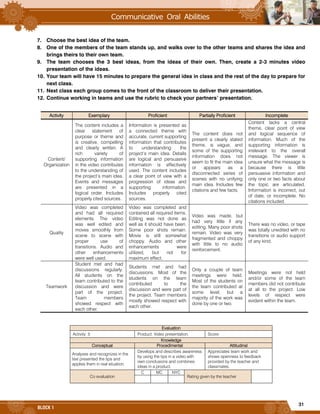
Activity Exemplary Proficient Partially Proficient Incomplete
Content/
Organization
The content includes a
clear statement of
purpose or theme and
is creative, compelling
and clearly written. A
rich variety of
supporting information
in the video contributes
to the understanding of
the project’s main idea.
Events and messages
are presented in a
logical order. Includes
properly cited sources.
Information is presented as
a connected theme with
accurate, current supporting
information that contributes
to understanding the
project’s main idea. Details
are logical and persuasive
information is effectively
used. The content includes
a clear point of view with a
progression of ideas and
supporting information.
Includes properly cited
sources.
The content does not
present a clearly stated
theme, is vague, and
some of the supporting
information does not
seem to fit the main idea
or appears as a
disconnected series of
scenes with no unifying
main idea. Includes few
citations and few facts.
Content lacks a central
theme, clear point of view
and logical sequence of
information. Much of the
supporting information is
irrelevant to the overall
message. The viewer is
unsure what the message is
because there is little
persuasive information and
only one or two facts about
the topic are articulated.
Information is incorrect, out
of date, or incomplete. No
citations included.
Quality
Video was completed
and had all required
elements. The video
was well edited and
moves smoothly from
scene to scene with
proper use of
transitions. Audio and
other enhancements
were well used.
Video was completed and
contained all required items.
Editing was not done as
well as it should have been.
Some poor shots remain.
Movie is still somewhat
choppy. Audio and other
enhancements were
utilized, but not for
maximum effect.
Video was made, but
had very little if any
editing. Many poor shots
remain. Video was very
fragmented and choppy
with little to no audio
reinforcement.
There was no video, or tape
was totally unedited with no
transitions or audio support
of any kind.
Teamwork
Student met and had
discussions regularly.
All students on the
team contributed to the
discussion and were
part of the project.
Team members
showed respect with
each other.
Students met and had
discussions. Most of the
students on the team
contributed to the
discussion and were part of
the project. Team members
mostly showed respect with
each other.
Only a couple of team
meetings were held.
Most of the students on
the team contributed at
some level, but a
majority of the work was
done by one or two.
Meetings were not held
and/or some of the team
members did not contribute
at all to the project. Low
levels of respect were
evident within the team.
Evaluation
Activity: 5 Product: Video presentation. Score:
Knowledge
Conceptual Procedimental Attitudinal
Analyses and recognizes in the
text presented the tips and
applies them in real situation.
Develops and describes awareness
by using the tips in a video with
own conclusions and combines
ideas in a product.
Appreciates team work and
shows openness to feedback
provided by the teacher and
classmates.
Co evaluation
C MC NYC
Rating given by the teacher
32
IMPORTANCE OF IMPROVING ORAL COMMUNICATION
Didactic Sequence 3.
Intercultural communication.
Startup Activity
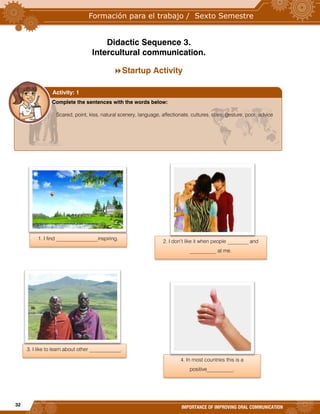
1. I find ________________inspiring.
2. I don’t like it when people ________ and
__________ at me.
3. I like to learn about other ____________.
4. In most countries this is a
positive__________.
I. Complete the sentences with the words below:
Scared, point, kiss, natural scenery, language, affectionate, cultures, stare, gesture, poor, advice
Activity: 1
33
BLOCK 1
Continue next page » » » »
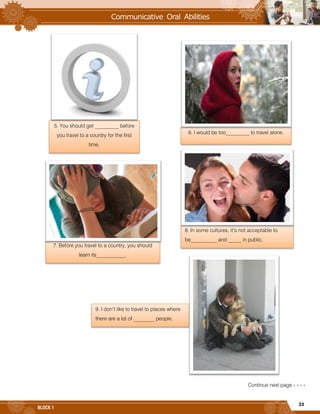
5. You should get _________ before
you travel to a country for the first
time.
6. I would be too_________ to travel alone.
7. Before you travel to a country, you should
learn its___________.
8. In some cultures, it’s not acceptable to
be__________ and _____ in public.
9. I don’t like to travel to places where
there are a lot of ________ people.
34
IMPORTANCE OF IMPROVING ORAL COMMUNICATION
1. Discuss in teams of five whether you agree/disagree with each sentence.
What is your personal opinion? Write it here: _______________________________________________________________
_____________________________________________________________________________________________________
_____________________________________________________________________________________________________
_____________________________________________________________________________________________________
2. Now individually answer the following questions, write two or three quick impressions to complete the
sentence. Write down the first ideas that come into your head.
What do you think? I think that…
1. Korean people are: ___________________________________________________________________________________
______________________________________________________________________________________________________
______________________________________________________________________________________________________
______________________________________________________________________________________________________
2. Spanish people are: __________________________________________________________________________________
______________________________________________________________________________________________________
______________________________________________________________________________________________________
______________________________________________________________________________________________________
3. Arab people are: _____________________________________________________________________________________
______________________________________________________________________________________________________
______________________________________________________________________________________________________
______________________________________________________________________________________________________
4. Irish people are: _____________________________________________________________________________________
______________________________________________________________________________________________________
______________________________________________________________________________________________________
______________________________________________________________________________________________________
5. Japanese people are: _______________________________________________________________________________
_____________________________________________________________________________________________________
_____________________________________________________________________________________________________
_____________________________________________________________________________________________________
6. French people are: ___________________________________________________________________________________
______________________________________________________________________________________________________
______________________________________________________________________________________________________
______________________________________________________________________________________________________
7. Russian people are: __________________________________________________________________________________
______________________________________________________________________________________________________
______________________________________________________________________________________________________
______________________________________________________________________________________________________
35
BLOCK 1
8. American people are: _________________________________________________________________________________
______________________________________________________________________________________________________
______________________________________________________________________________________________________
______________________________________________________________________________________________________
9. Chinese people are: __________________________________________________________________________________
______________________________________________________________________________________________________
______________________________________________________________________________________________________
______________________________________________________________________________________________________
10. Indian people are: ___________________________________________________________________________________
______________________________________________________________________________________________________
______________________________________________________________________________________________________
______________________________________________________________________________________________________
Discussion
Now in the team discuss your answers.
Were there negative or positive comments?
How does the group feel about the words or expressions used to describe each culture?
Did the results surprise the group?
36
IMPORTANCE OF IMPROVING ORAL COMMUNICATION
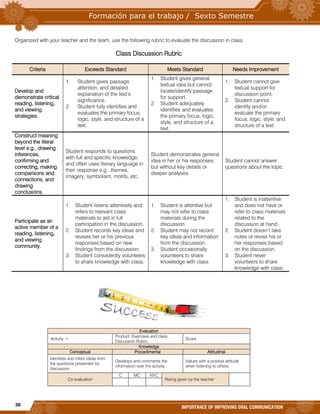
Organized with your teacher and the team, use the following rubric to evaluate the discussion in class.
Class Discussion Rubric
Criteria Exceeds Standard Meets Standard Needs Improvement
Develop and
demonstrate critical
reading, listening,
and viewing
strategies.
1. Student gives passage
attention, and detailed
explanation of the text’s
significance.
2. Student fully identifies and
evaluates the primary focus,
logic, style, and structure of a
text.
1. Student gives general
textual idea but cannot
locate/identify passage
for support.
2. Student adequately
identifies and evaluates
the primary focus, logic,
style, and structure of a
text.
1. Student cannot give
textual support for
discussion point.
2. Student cannot
identify and/or
evaluate the primary
focus, logic, style, and
structure of a text.
Construct meaning
beyond the literal
level e.g., drawing
inferences,
confirming and
correcting, making
comparisons and
connections, and
drawing
conclusions.
Student responds to questions
with full and specific knowledge,
and often uses literary language in
their response e.g., themes,
imagery, symbolism, motifs, etc.
Student demonstrates general
idea in her or his responses,
but without key details or
deeper analyses.
Student cannot answer
questions about the topic.
Participate as an
active member of a
reading, listening,
and viewing
community.
1. Student listens attentively and
refers to relevant class
materials to aid in full
participation in the discussion.
2. Student records key ideas and
revises her or his previous
responses based on new
findings from the discussion.
3. Student consistently volunteers
to share knowledge with class.
1. Student is attentive but
may not refer to class
materials during the
discussion.
2. Student may not record
key ideas and information
from the discussion.
3. Student occasionally
volunteers to share
knowledge with class.
1. Student is inattentive
and does not have or
refer to class materials
related to the
discussion at hand.
2. Student doesn’t take
notes or revise his or
her responses based
on the discussion.
3. Student never
volunteers to share
knowledge with class.
Evaluation
Activity: 1
Product: Exercises and class
Discussion Rubric.
Score:
Knowledge
Conceptual Procedimental Attitudinal
Identifies and infers ideas from
the questions presented for
discussion.
Develops and comments the
information over the activity.
Values with a positive attitude
when listening to others.
Co evaluation
C MC NYC
Rating given by the teacher
37
BLOCK 1
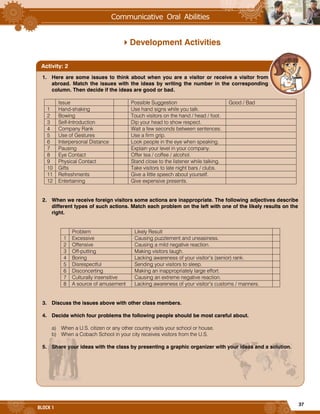
Development Activities
1. Here are some issues to think about when you are a visitor or receive a visitor from
abroad. Match the issues with the ideas by writing the number in the corresponding
column. Then decide if the ideas are good or bad.
Issue Possible Suggestion Good / Bad
1 Hand-shaking Use hand signs while you talk.
2 Bowing Touch visitors on the hand / head / foot.
3 Self-Introduction Dip your head to show respect.
4 Company Rank Wait a few seconds between sentences.
5 Use of Gestures Use a firm grip.
6 Interpersonal Distance Look people in the eye when speaking.
7 Pausing Explain your level in your company.
8 Eye Contact Offer tea / coffee / alcohol.
9 Physical Contact Stand close to the listener while talking.
10 Gifts Take visitors to late night bars / clubs.
11 Refreshments Give a little speech about yourself.
12 Entertaining Give expensive presents.
2. When we receive foreign visitors some actions are inappropriate. The following adjectives describe
different types of such actions. Match each problem on the left with one of the likely results on the
right.
Problem Likely Result
1 Excessive Causing puzzlement and uneasiness.
2 Offensive Causing a mild negative reaction.
3 Off-putting Making visitors laugh.
4 Boring Lacking awareness of your visitor’s (senior) rank.
5 Disrespectful Sending your visitors to sleep.
6 Disconcerting Making an inappropriately large effort.
7 Culturally insensitive Causing an extreme negative reaction.
8 A source of amusement Lacking awareness of your visitor’s customs / manners.
3. Discuss the issues above with other class members.
4. Decide which four problems the following people should be most careful about.
a) When a U.S. citizen or any other country visits your school or house.
b) When a Cobach School in your city receives visitors from the U.S.
5. Share your ideas with the class by presenting a graphic organizer with your ideas and a solution.
Activity: 2
38
IMPORTANCE OF IMPROVING ORAL COMMUNICATION
Evaluation
Activity: 2 Product: Graphic organizer. Score:
Knowledge
Conceptual Procedimental Attitudinal
Describes and understands the
information presented for
analyses.
Plans and combines ideas into a
graphic organizer created in teams.
Collaborates and appreciates
team work and shows openness
to feedback.
Co evaluation
C MC NYC
Rating given by the teacher
39
BLOCK 1
13 Examples of Good and Bad Manners around the World
1. Belching or eructing
In China, Taiwan, and much of the Far East, belching is
considered a compliment to the chef and a sign that you
have eaten well and enjoyed your meal.
2. Watch Your Feet!
In most of the Middle and Far East, it is considered an
insult to point your feet (particularly the soles) at another
person or to display them in any way, for example, by
resting with your feet up.
3. Swapping Business Cards
In most Asian countries, a business card is seen as an
extension of the person it represents; therefore, to
disrespect a card by folding it, writing on it, or just shoving
it into your pocket without looking at it is to disrespect the
person who gave it to you.
4. Crushing Handshake
Nowadays, a bone-crushing handshake is seen as
admirable in the United States and U.K., but in much of
the East, particularly the Philippines, it is seen as a sign of
aggression just as if you gave any other part of a person’s
body a hard squeeze!
5. to Shake or Not to Shake
Orthodox Jews will not shake hands with someone of the
opposite sex, while a strict Muslim woman will not shake
hands with a man. To confuse matters, a Muslim man will
shake hands with a non-Muslim woman. People in these
cultures generally avoid touching people of the opposite
sex who are not family members.
1. Pay close attention to the graphics about “13 Examples of Good and Bad Manners
around the World”.
2. In teams of three read them and discuss all the situations presented.
Activity: 3
40
IMPORTANCE OF IMPROVING ORAL COMMUNICATION
6. The "Peace" Salute
Similarly, in the U.K., when the two-fingered "V for
victory" or "peace" salute is given with the hand turned
so that the palm faces inward, it is considered
extremely rude, having a meaning similar to raising the
middle finger to someone in the United States.
7. Exposing Your Palms
In Greece, any signal that involves showing your open
palm is extremely offensive. Such gestures include
waving, as well as making a "stop" sign. If you do wish
to wave goodbye to someone in Greece, you need to
do so with your palm facing in, like a beauty pageant
contestant or a member of the royal family.
8. Lose the Shoes
In many countries, particularly in Asia and South
America, it is essential to remove your shoes when
entering someone’s home, while in most of Europe it is
polite to ask your host whether they would prefer you
to do so. The reason, as anyone who’s ever owned
white carpet will attest, is simple hygiene and
cleanliness.
9. Chewing Gum
Chewing gum might be good for dental hygiene, but in
many parts of the world, particularly Luxembourg,
Switzerland, and France, public gum-chewing is
considered vulgar, while in Singapore most types of
gum have been illegal since 1992 when residents grew
tired of scraping the sticky stuff off their sidewalks.
10. Left-handed Greetings
In most Arab countries, the left hand is considered
unclean, and it is extremely rude to offer it for a
handshake or to wave a greeting. Similarly, it is
impolite to pass food or eat with the left hand. If you
must know why, let’s just say that, historically, people
living in deserts didn’t have access to toilet paper, so
the left hand was used for "hygienic functions," then
cleaned by rubbing it in the sand.
41
BLOCK 1
3. Compare these manners with the ones in your own environment. Can you find differences?
4. Prepare a two minutes presentation using role plays or videos to represent these “Examples of Good
and Bad Manners around the World.”
Evaluation
Activity: 3
Product: Role play or video
presentation.
Score:
Knowledge
Conceptual Procedimental Attitudinal
Interprets and reads the text.
Analyses all situations presented
and uses imagination to build
product.
Dramatizes in a created role play or
video the appraisal from the
situations analyzed by the team.
Shows respect while working in
teams and positive attitude while
receiving feedback.
Co evaluation
C MC NYC
Rating given by the teacher
11. Clearing Your Plate
When dining in China, never
force yourself to clear your
plate out of politeness -- it
would be very bad manners
for your host not to keep
refilling it. Instead, you
should leave some food on
your plate at each course
as an acknowledgment of
your host’s generosity.
Manners that may be good
in the United States may
not be in other parts of the
world. See the rest of our
list to learn more.
12. No Tipping!
In Japan and Korea, a tip is
considered an insult, rather
than a compliment, and for
them, accepting tips is akin
to begging. However, this
tradition is beginning to
change as more
Westerners bring their
customs with them to these
countries.
13. Mixed Signals
The "okay" sign (thumb and
forefinger touching to make
a circle) is very far from
okay in much of the world.
In Germany and most of
South America, it is an
insult, similar to giving
someone the finger in the
United States, while in
Turkey it is a derogatory
gesture used to imply that
someone is homosexual.
42
IMPORTANCE OF IMPROVING ORAL COMMUNICATION
Table Manners around the World
By Gimundo Staff and Annie Tucker Morgan
Here’s a fascinating look at dinnertime culture around the world. If you grew up in the United States and thought
American table manners were tough to remember—Keep your elbows off the table! Don’t talk with your mouth full!
Always pass the salt and pepper together!—think again, because you don’t know how good you’ve got it. Just try
eating a “casual” group dinner in one of these other countries, where the slightest indiscretion with a pair of chopsticks
or the position of your feet can land you in the doghouse with your host.
Afghanistan
Dinner guests are treated like royalty: they’re seated farthest from the
door, they’re offered food first and expected to eat the most, and they’re
always given the prime portion from each dish. If you drop bread on the
floor while dining at a table, pick it up, kiss it, and touch it to your
forehead before putting it somewhere other than the floor.
Chile
Dishes should be served from the left and removed from the right. Guests
should be served first. Do not answer the phone at the dinner table.
Always chew with your mouth closed, and do not talk until it is empty. Eat
quietly and do not slurp your food. Eat only one helping of food, unless
the host specifically encourages you to take seconds.
China
Never wave chopsticks at another person bang them like drumsticks,
use them to move plates or bowls, or stab them vertically into a bowl of
rice. This last gesture indicates that the food is meant for the dead. To
serve a guest, use the blunt ends of your own chopsticks to transfer
food from a communal dish to the guest’s plate. When chopsticks are
not in use, place them neatly on the table, side by side, with the ends
even. When picking food out of a communal dish, select only food that
is on the top of the pile and the closest distance to your plate. Do not
rummage through the serving dish to select specific food items for
yourself.
I. Pay close attention to the text about “Table Manners around the World”.
II. In teams of three read them and talk over all the situations presented.
Activity: 4
43
BLOCK 1
India
Always wash your hands thoroughly before and after eating. In general,
eat with your right hand and use your left hand to pass communal
dishes. You must finish everything on your plate. Do not leave the table
until all guests have finished eating or your host asks for your help.
Japan
Before you start a meal, wait for your host to tell you three times to begin
eating. The youngest person at the table should pour alcohol for the other
diners, beginning with the most senior person. A senior should then pour
the server’s beverage. Never transfer food from one pair of chopsticks to
another. When women transfer food with chopsticks from a serving dish to
their mouth, they should cup their hand beneath the food; men should not.
Rubbing chopsticks together to remove splinters is a sign of disrespect to
the restaurant or host. When eating hot noodles, you are encouraged to
make a slurping noise; the Japanese believe that this inhalation of air
enhances the noodles’ flavor. Pieces of sushi should be eaten in a single
bite whenever possible; if you must eat a piece in more than one bite,
never place it back down on your plate between bites.
Pakistan
Before each meal, Muslim Pakistanis always recite this phrase:
“Bismillah Ar-Rahman al-Rahim.” (“In the name of Allah, who is most
beneficial and merciful.”) Afterward, they say, “Al-Hamdu-lillah.”
(“Thanks be to God.”) Do not begin eating until the eldest member of
the family is seated at the table. Always chew quietly enough that no
one else can hear you. Always tear bread into pieces before eating it,
and use only your right hand.
Philippines
Before you enter a dining room, select a seat at a table, or serve yourself
food, always wait for an invitation from the host. Never refuse a sample of
food from the host; always clean your plate. When you have finished
eating, place your fork and spoon side by side on your plate, facing up.
Always help your host clear the table.
44
IMPORTANCE OF IMPROVING ORAL COMMUNICATION
Russia
Never stare at another person’s plate or saucer. It is polite to leave a
little bit of food on your plate at the end of a meal, as a tribute to the
host’s abundant hospitality. Always cultivate a vivacious, relaxed dining
atmosphere. Upon leaving the table, always compliment the person who
cooked your food.
Tanzania
Do not expose the soles of your feet if you are eating on a carpet or mat.
Showing up early for dinner, is considered rude; aim to arrive fifteen to thirty
minutes late. It may seem daunting to remember other cultures’ culinary
particularities, but if you master these dining guidelines before you sit down
at the table, you won’t have to be “that guy” you know, the one who gives
other, more polite American diners a bad name. And once you’ve mastered
these etiquette basics, you’ll be on your way to worldliness all you need now
is a good appetite and a plane ticket.
After discussing the text prepare the product for the conclusion class.
Product for follow up class
III. In teams of six, create a power point presentation with similar situations different than the ones around
the world.
IV. Stand out in the presentation the differences the team can identify among those manners and their
own.
V. The whole team should submit the product.
VI. Everybody has to talk while presenting a part of the presentation.
VII. You have no more than 4 minutes to complete your explanation.
Evaluation
Activity: 4 Product: Power Point Presentation. Score:
Knowledge
Conceptual Procedimental Attitudinal
Prepares and presents in teams
a power point presentation.
Applies and uses his / her
knowledge to understand and
distinguish different countries
manners.
Collaborates and appreciates
team work.
Shows positive attitude while
presenting the activity in class.
Co evaluation
C MC NYC
Rating given by the teacher
45
BLOCK 1
Evaluation
Activity: 5 Product: Flipchart and discussion. Score:
Knowledge
Conceptual Procedimental Attitudinal
Analyses an article, prepares
and presents a flipchart which
will be questioned in class.
Applies and uses his/her
understanding and comprehension
on the text to present the team’s
ideas orally in a class presentation.
Collaborates and shows positive
attitude when working in group
and is open to feedback.
Co evaluation
C MC NYC
Rating given by the teacher
1. Read the text bellow, then gather in teams for discussion.
Manners around the World
Manners around the world start with respect for differences. Not all cultures are the same. Generally speaking,
you can be yourself as long as you remain friendly and courteous. Always keep in mind that you are the guest in
someone else’s country. For example:
a) In Europe, do not address people by their first names. Mr. and Mrs. are more commonly used.
b) Shaking hands is an important business ritual throughout Europe and Britain.
c) In most countries a handshake should be gentle. A firm handshake can show aggression.
d) In Asia, instead of a handshake a person will bow from the waist and the person with the lower status
bows more deeply.
e) In Italy and Russia, close friends will often greet each other with a kiss.
f) In Europe, men traditionally walk to the left of the ladies. They generally enter a restaurant ahead of the
lady - to lead the way to the table.
g) In some countries, people feel comfortable standing closer to each other, when they are talking. It would
be rude to back away. In other countries, like China and Japan, they want more distance between
people.
h) In Holland, they always use utensils. Many Dutch even eat bread with a knife and fork!
i) In Sweden, you keep your voice down. Swedes are quiet people.
j) Americans like to whistle, when they are applauding, but in Europe it is known as a type of booing.
k) In Russia, whistling by women is unladylike.
l) In some parts of the Middle East, shaking your head "no" means "yes" and nodding your head "yes"
means "no".
m) In a number of countries, keep eye contact with the speaker is rude. They show respect by not looking
straight at the person talking.
2. In teams of four members, create a flip chart with a mind map focused on the information
presented.
3. Present and explain your flipchart to the class.
Activity: 5
46
IMPORTANCE OF IMPROVING ORAL COMMUNICATION
Closing Activity
1. In pairs discuss about the following sentence and come up with at least 5 possible
endings to the sentence.
If everyone in the world spoke English …
Write your possible endings here:
_________________________________________________________________________________________________
_________________________________________________________________________________________________
_________________________________________________________________________________________________
_________________________________________________________________________________________________
_________________________________________________________________________________________________
2. Again in pairs answer and discuss the following question.
Is global English a good thing?
_________________________________________________________________________________________________
3. Make a list of the advantages and disadvantages of global English.
___________________________________ ___________________________________
___________________________________ ___________________________________
___________________________________ ___________________________________
___________________________________ ___________________________________
___________________________________ ___________________________________
___________________________________ ___________________________________
___________________________________ ___________________________________
___________________________________ ___________________________________
___________________________________ ___________________________________
___________________________________ ___________________________________
___________________________________ ___________________________________
___________________________________ ___________________________________
___________________________________ ___________________________________
___________________________________ ___________________________________
___________________________________ ___________________________________
___________________________________ ___________________________________
___________________________________ ___________________________________
___________________________________ ___________________________________
Activity: 6
47
BLOCK 1
4. Read the short texts. Are any of your points mentioned?
Aadeshwar (India)
One of the consequences of
global English is that some
languages are disappearing.
In my country there are 415
different languages, but
many of these are
endangered. If you want a
good job, you usually have to
learn English.
Wendell (USA)
Global English is definitely a
good thing. Communication
is much easier when
everyone speaks the same
language. I don’t understand
what the fuss is about.
Nowadays you find almost
everything on computers is in
English, it’s used in business,
travel and in medicine.
Alfonso (USA)
Although I live in the USA and
I use English at school my
mother tongue is Spanish.
My parents were immigrants
from Mexico and so at home
we speak Spanish. For me
language is part of my
cultural identity.
Cathair (Eire)
I’m 18 and I live in a small
village in the west of Ireland. I
speak Irish Gaelic, but many
people of my age only speak
English. It’s a pity because
it’s part of our heritage and if
we lose our language then
we’ll lose part of our culture. I
think there are only about
250,000 people who speak
Irish Gaelic!
Bogdana (England)
My grandparents came here
from Russia in 1945 and
when they arrived they spoke
no English. To get jobs they
had to learn and I think this is
part of integrating into a new
country. I think it’s silly when
people insist on keeping their
own language when they
move to a new country.
Franz (Germany)
Languages have been
disappearing for thousands
of years; it’s just a natural
thing. For example, people in
ancient Egypt used
hieroglyphs but nobody uses
these now. I’ve heard there
are almost 7,000 languages
in the world and that about
half of these will disappear in
the next 20 years! Well, you
can’t stop progress, can you?
48
IMPORTANCE OF IMPROVING ORAL COMMUNICATION
5. Comprehension.
1. What do these numbers in the text refer to?
415
18
250,000
7,000
20
2. Complete each sentence with the correct name.
Example:
Aadeshwar comes from India.
1. ___________________ doesn’t think there’s any problem with English as a Global Language.
2. ___________________ speaks one language with his family and another when he is at school.
3. ___________________ and ___________________ think that language is an important part of who they are.
4. ___________________ , ___________________ and ___________________ mention learning English because of work.
5. ___________________ says that about 50% of the languages in the world now will soon disappear.
6. ___________________ lives in a country where there are lots of languages.
6. In teams of four, create a pod cast program and include all the following items.
a. A song about cultural differences or English as a global language.
b. At least one real note from internet talking about the importance of English now a days (any subject is ok).
c. Include at least TWO more notes created by the team based on what you have studied in the sequence
(subject: English as global language).
d. Interview a teacher (translate if necessary) about his or her opinion about the idea of English as a global
Language.
e. The pod cast has to have introduction, delivery, content, interview, song, notes, etc.
7. Use the rubric provided and with your teacher’s help each team will evaluate a team assigned by him or
her.
49
BLOCK 1
Elementary podcast rubric
Category 4 3 2 1
Introduction
Could tell they were talking
to us; they said their name
and what it’s about; we
want to listen!
Can tell what it’s going to be
about.
The person just
started talking and
didn’t tell much
about it.
Didn’t tell us
about it.
Sequence &
Organization
It was super organized; we
wanted to keep listening to
it!
It was pretty organized, but
sometimes it didn’t make sense;
we paid attention and we could
follow what they were saying.
When we listened,
we were mixed up
and could not pay
attention.
The speaker was
really mixed up
and we could
tell!
Vocabulary Use
Pronunciation
They used all of our words
and said them the right
way!
They skipped a few words, but
said the rest right!
Used most of the
words, but had a
few wrong.
Skipped too
many words and
said them wrong.
Rhythm / Speed
Wow! They could be on
the radio!
Pretty smooth talker!
Kind of jumpy and
not smooth.
We need a lot
more practice!
Conclusion
The ending was great
because they reviewed,
reminding us about
important things.
Ending was good; they tried to
review all of the important things.
Tried to review, but
skipped a lot of
stuff.
It just ended!
NOTE:
Check for extra information about podcasts on page 50.
50
IMPORTANCE OF IMPROVING ORAL COMMUNICATION
EXTRA INFORMATION NOTE
What is a podcast?
BY Yaro Starak.
Definition:
The word “podcasting” is a combination conjoining the words
“broadcasting” and “iPod.” In case you have had your head in the
sand recently or don’t keep up with popular technology an iPod is a
portable music player produced by Apple Computers. Apple was
lucky / smart enough that their brand was wrapped into a term for a
new technology much like the Sony Walkman becoming the popular
name for a portable radio/cassette player or inline skates being
called “rollerblades”, which is brand name for a company that
produced inline skates.
The most popular format of a podcast is MP3. An MP3 is -
Some of that definition is quite technical, but all you really need to know is that an MP3 is a popular audio file type for
podcasts. There are other audio file types that are used for podcasting but in general as long as you have a music
player on your computer you should be able to listen to a podcast file.
Podcasting is a form of audio broadcasting on the Internet. The reason it became linked with the iPod in name was
because people download podcasts (audio shows) to listen to on their iPods. However you don’t have to listen to
podcasts only on iPods; you can use your computer with some music software such as Windows built-in Media Player
or my favorite player, Winamp, or other portable music players (iPod competitors) such as Creative Zen or iRiver. It
really doesn’t matter, as long as you have some way to play music on your computer you will be able to listen to
podcasts.
What Makes Podcasting Different?
When I first heard of podcasting I didn’t understand what made it different from simply searching and then
downloading a music file and listening to it much like I had been doing for years with MP3 music tracks. I had a
knowledge gap because I still didn’t understand RSS and content syndication. After playing with RSS feed readers
(which you should know about if you followed my instructions and read my primer article about RSS before reading this
article) I understood the difference between searching and downloading music files and subscribing to podcasts. It’s
all about having the files come to you through syndication instead of you going to the files through search.
You subscribe to podcasts much like you subscribe to blogs. In fact often podcasts are distributed through a blog and
provided your feed reading software handles podcasts you should be able to either instruct your reader to download
new podcasts whenever they become available or manually choose which podcasts you want to download by clicking
a link to the audio file. These files can then be listened to on your computer or you can transfer them to your portable
player to listen to later. Some podcast feed reading software are configured to download and transfer the podcast
directly to your portable player automatically so you can plug it in and walk away a few minutes later with your latest
podcasts downloaded and ready to digest.
Wikipedia: MP3 is a popular digital audio encoding and lossy
compression format. It was designed to greatly reduce the amount of
data (10:1 compression is common) required to represent audio, yet
still sound like a faithful reproduction of the original uncompressed
audio to most listeners. In popular usage, MP3 also refers to files of
sound or music recordings stored in the MP3 format on computers.
51
BLOCK 1
One of the most common podcast subscribing tools is iTunes. If you use iTunes and subscribe to this blog every time I
release a new podcast audio show iTunes will download it for you automatically and if you have it synced to your iPod it
will transfer it for you as well. This is what I would call true podcasting automatic download of an audio file directly to an
iPod.
Still Confused?
If you are still scratching your head in confusion I suggest you try iTunes and subscribe to this blog look in the podcast
business category in iTunes and you should find Entrepreneur’s Journey. ITunes will automatically download the files or
you can click to download some of my past shows. Experiential learning is by far the best way to get a grasp of new
technology so if you are interested in using podcasts get out there and have a go. It’s all free so you have no excuse.
http://www.entrepreneurs-journey.com/230/what-is-a-podcast/
52
IMPORTANCE OF IMPROVING ORAL COMMUNICATION
Time assigned: 15 hours
Purpose and Tone.
Competencias profesionales:
1. Realiza comprensiones oral y auditiva de diversos tipos de texto en otro idioma.
2. Realiza comprensión escrita y de lectura de diversos tipos de texto en otro idioma.
3. Realiza expresión o producción oral en otro idioma.
4. Realiza interacción oral en otro idioma.
5. Realiza expresión o producción escrita de diversos tipos de texto en otro idioma.
Unidad de competencia:
Diferencia la entonación de las palabras en situaciones específicas y las practica en contextos de su vida cotidiana.
Atributos a desarrollar en el bloque:
Durante el presente bloque se busca desarrollar los siguientes atributos de las competencias genéricas:
4.1 Expresa ideas y conceptos mediante representaciones lingüísticas, matemáticas o gráficas.
4.2 Aplica distintas estrategias comunicativas según quienes sean sus interlocutores, el contexto en el que se
encuentra y los objetivos que persigue.
4.3 Identifica las ideas claves en un texto o discurso oral e infiere conclusiones a partir de ellas.
4.4 Se comunica en una segunda lengua en situaciones cotidianas.
4.5 Maneja las tecnologías de la información y la comunicación para obtener información y expresar ideas.
6.4 Estructura ideas y argumentos de manera clara, coherente y sintética.
7.1 Define metas y da seguimiento a sus procesos de construcción de conocimiento.
8.2 Aporta puntos de vista con apertura y considera los de otras personas de manera reflexiva.
10.3 Asume que el respeto de las diferencias es el principio de integración y de convivencia de los contextos locales,
nacional e internacional.
54
PURPOSE AND TONE
Didactic Sequence 1.
Using correct intonation.
Startup activity
1. Working on the supposition that some expressions or words can have as many as 9 or
more different meaning or connotations depending on how they are said, meet in pairs
and practice the following activity:
Say the following expressions in five different ways.
 Goodbye
 Hello
 How are you?
 Do we have to speak
English, teacher?
 I never watch TV.
 The teacher wanted to separate the general
topic into separate categories.
 Would you care to elaborate on his elaborate
explanation?
 Have you heard that your associate is known to
associate with criminals?
 How much do you guess that the estimate will
be?
2. Now, add at least 6 more expressions apt to promote several interpretations (ways to say it) when
delivered with a different tone.
 ____________________________.
 ____________________________.
 ____________________________.
 ____________________________.
 ____________________________.
 ____________________________.
3. Follow the instructions below and practice in pairs.
a) Me: John, say “Hello” to me.
b) John: “Hello” (neutral, polite tone).
a) Me: John, now say “Hello” to a friend.
b) John: “Hello” (much more upbeat tone).
a) Me: John, say “Hello” to a 6-month-old-baby!!!
b) John: “Hello” (contorted face, exaggerated fall-rise tone).
Activity: 1
55
BLOCK 2
Evaluation
Activity: 1 Product: Audio record. Score:
Knowledge
Conceptual Procedimental Attitudinal
Identifies a real situation and
relates it to the subject. Is
conscious of his/her
pronunciation and others.
Determines and contrasts information
obtained from the practice and is
aware of a real language situation.
Shows initiative and interest on
the practice.
Co evaluation
C MC NYC
Rating awarded by the teacher
4. Gather in teams of four and practice English with your classmates by Saying “Hello”
pretending to be…
 A friend you meet regularly.
 A friend you haven’t seen for a long time.
 A neighbor you don’t like.
 A 6 month old baby.
 Someone doing what he/she shouldn’t.
 To know if someone is listening.
 The same but on the phone.
5. Observe your team’s pals closely and notice the different intonation for each statement.
6. Can you identify the rise and fall of the voice when your classmate is talking?
7. How was the expression said? Slow? Fast? With proper speed?
8. The team has a duty to create an audio record with the different forms of the expression “Hello”.
9. Present the record to the class and give your appreciation for the activity.
Activity: 1 (continuation)
56
PURPOSE AND TONE
Development Activities
1. In pairs read the following text, then discuss for 2 minutes about it.
Intonation.
Intonation is considered to be the most important element of spoken
language. Using correct intonation patterns increases the intelligibility
of speech because intonation conveys not only the meaning of
speech, but also the speaker’s attitude. Therefore, understanding and
using correct intonation patterns are crucial in learning a foreign
language. Acquiring intonation of foreign languages seems to be a
very difficult task for learners. Leon and Martin (1972) described
intonation as the most difficult element to learn. According to
Lieberman (1967), it is difficult for adults to change intonation,
because intonation is acquired in early childhood. Therefore, children
can easily acquire native-like intonation of a foreign language. In
addition, adult learners are accustomed to the intonation of their first
language, and tend to apply the intonation patterns of their first
language when they speak a second language (Ramirez Verdugo,
2006).
2. Answer the comprehension questions.
1. What can you use to increase your fluency? ______________________________________________________
2. What element is the most problematic component to learn? _________________________________________
3. Intonation is easily acquired during _________________ because ____________________________________
_____________________________________________________________________________________________
4. Using your own words say why it is important to learn intonation. _____________________________________
_____________________________________________________________________________________________
_____________________________________________________________________________________________
3. Perform a role play to represent the importance of intonation in the English language and how
important it could be for you as a student of this course.
4. Exaggeration is important to be aware of communication so whatever slight element is being
expressed, to bring attention to it; have the protagonists exaggerate the voice element.
5. Analyze the factors which contribute to effective and ineffective communication process.
6. At the end of the role play, one of the members presents the pair analysis.
7. Finally use the rubric bellow to evaluate the activity.
Activity: 2
57
BLOCK 2
Role Play Rubric Student
Criteria 4 Excellent 3 Proficient 2 Adequate 1 Limited
Participation in
Preparation and
Presentation.
Always willing and
focused during
group work and
presentation.
Usually willing and
focused during
group work and
presentation.
Sometimes willing
and focused during
group work and
presentation.
Rarely willing and
focused during
group work and
presentation.
Presentation of
Character.
Convincing
communication of
character’s feelings,
situation and
motives.
Competent
communication of
character’s feelings,
situations and
motives.
Adequate
communication of
character’s feelings,
situation and
motives.
Limited
communication of
character’s feelings,
situation and
motives.
Achievement of
Purpose.
Purpose is clearly
established and
effectively
sustained.
Purpose is clearly
established and
generally sustained.
Purpose is
established but may
not be sustained.
Purpose is vaguely
established and
may not be
sustained.
Use of Non-Verbal
Cues (voice,
gestures, eye
contact, props,
costumes).
Impressive varieties
of non-verbal cues
are used in an
exemplary way.
Good varieties of
non-verbal cues are
used in a competent
way.
Satisfactory variety
of non-verbal cues
used in an
acceptable way.
Limited variety of
non-verbal cues are
used in a
developing way.
Imagination and
Creativity.
Choices
demonstrate insight
and powerfully
enhance role play.
Choices
demonstrate
thoughtfulness and
completely enhance
role play.
Choices
demonstrate
awareness and
developing
acceptably enhance
role play.
Choices
demonstrate little
awareness and do
little to enhance role
play.
Evaluation
Activity: 2 Product: Role play. Score:
Knowledge
Conceptual Procedimental Attitudinal
Analyses text and identifies
intonation. Creates a role play for
the class.
Applies and uses intonation and
his / her knowledge to create a
role play. Evaluates with the
rubric.
Collaborates and appreciates
with a positive attitude when
working in groups and is opened
to feedback.
Co evaluation
C MC NYC
Rating awarded by the teacher
58
PURPOSE AND TONE
Self-assessment for Individual Contributions to Group Conversation
Rate each entry as: 1 - Needs Improving 2 - Satisfactory 3 - Very Good
My group was discussing: _______________________________________________________________________________
Example
I shared my ideas and offered my suggestions. 1 2 3
I spoke clearly and slowly enough. 1 2 3
I answered others’ questions. 1 2 3
I remained on topic and helped the group stay focused. 1 2 3
I encouraged others to participate. 1 2 3
I disagreed without hurting others’ feelings. 1 2 3
I summarized or repeated my ideas when necessary. 1 2 3
I gave reasons for my opinions. 1 2 3
I listened courteously and effectively. 1 2 3
I tried to understand and extend others’ ideas. 1 2 3
My most important contribution to the conversation was:
______________________________________________________________________________________________________
______________________________________________________________________________________________________
My plan for improvement is:
______________________________________________________________________________________________________
______________________________________________________________________________________________________
Evaluation
Activity: 3 Product: Self-assessment rubric. Score:
Knowledge
Conceptual Procedimental Attitudinal
Identifies his/her own mistakes
and pays close attention to others
in order to be aware of problems
with correct intonation and
pronunciation.
Applies his/her knowledge and
deduces the problems with
intonation and pronunciation.
Shows ability and positive
attitude. Is opened to feedback.
Co evaluation
C MC NYC
Rating awarded by the teacher
1. Let’s be aware of our own mistakes and play a game.
1. Gather in teams of four.
2. Decide talking order.
3. The first person chooses a topic.
4. The second person has to start talking about the topic and cannot stop or pause for one minute (use a
chronometer to set the time), then the rest of the team listen for mistakes, if you spot a mistake; the next
person in order has its turn to speak. Only one student speaks at a time, while others listen and remain
non-judgmental.
5. Pay close attention for mistakes in your, pronunciation, fluency (pausing), and vocabulary (repeating
words).
6. When the minute tops, the person talking at the end gets a point.
7. Start again the practice but now someone else chooses the topic.
2. Finally each team designs one person to express their conclusions and how they feel with the
activity.
3. Complete the self-assessment for Individual Contributions to Group Discussion.
Activity: 3
59
BLOCK 2
Intonation Introduction.
 Intonation is the variation of pitch when speaking.
 Intonation and stress are two main elements of English.
 Intonation is a part of suprasegmental phonology. Intonation helps to recognize the language that you hear in the
same way as the melody of a song helps to recognize the song that you hear.
Key components of Intonation.
Intonation is based on several key components:
Pitch:
 Pitch is the degree of height of our voice in speech.
 Normal speaking pitch is at midlevel.
 Intonation is formed by certain pitch changes,
characteristic of a given language.
Sentence stress:
 Sentence stress makes the utterance understandable to the listener by making the important words in the
sentence stressed, clear and higher in pitch and by shortening and obscuring the unstressed words.
 Sentence stress provides rhythm in connected speech.
Functions of intonation:
 Attitudinal functions
• Allow us to express emotions: finality, confidence, interest, surprise, doubt, joy, pain, irony, etc.
 Accentual functions
• Allow us to express emotions: finality, confidence, interest, surprise, doubt, joy, pain, irony, etc.
1. Intonation is the movement in pitch
of the voice.
2. There are three intonation patterns
in spoken English:
fall fall-rise rise
↘ ↘↗ ↗
3. Intonation tells us the speaker’s
attitude to the words they are saying:
↘No (no) ↘↗No (maybe) ↗No
(surprise)
60
PURPOSE AND TONE
 Grammatical functions
• The grammar and syntax structure of what is being said by using the information contained in the
intonation. For example such things as:
A - The placement of boundaries between phrases, clauses and sentences.
B - The difference between questions and statements.
 Discourse functions
• Intonation can signal to the listener what is to be taken as “new” information and what is already “given”.
• It can indicate when the speaker is indicating some sort of contrast or link with material in another tone
unit.
• In conversation it can convey to the listener what kind of response is being expected from him.
We have to learn intonation because awareness aids communication; and also because wrong intonation causes
misunderstanding. When speaking, people generally raise and lower the pitch of their voices and form pitch patterns.
They also give some syllables a greater degree of loudness and change their speech rhythm. These phenomena are
called intonation. Intonation does not happen at random but has definite patterns which can be analyzed according to
their structure and functions. Intonation patterns often differ between languages or even between varieties of the same
language, e.g. between Australian English and American English. In some communities there is a difference in the
intonation patterns of different age groups or sexes. (Richards, 1987, 148) A more technical definition of intonation
would be “the variations which take place in the pitch of the voice in connected speech, i.e. the variations in the pitch of
the musical note produced by vibration of the vocal cords.” (Jones, 1960).
61
BLOCK 2
Closing Activity
1. Gather in teams of 5.
2. Take turns and practice the following exercises for intonation.
a. Say these to mean it:
i. It’s raining! (What a surprise!).
ii. It’s raining! (How annoying!).
iii. It’s raining! (That’s great!).
b. Say “Goodbye”
i. To a member of your family departing at the airport.
ii. To someone who has been annoying you.
iii. To a child starting his very first day at school.
iv. To a boy/girl friend.
v. To a classmate at the end of school.
c. Say “How are you?”
i. To someone you haven’t seen in 8 years.
ii. To someone who has recently lost a member of the family.
iii. To someone who is in a hospital.
iv. To a classmate at the beginning of the day.
v. To the Principal of the school.
d. Say these sentences in different ways.
i. Do we have to speak English?
ii. I never watch TV.
iii. I never go out without my parent’s permission.
iv. What have you done?
v. Hey! What’s the problem?
e. Practice the following “Role play”.
i. Are you busy tonight?
ii. Not really. Why?
iii. I was thinking of going to a movie!
iv. Great! Let’s go!
f. Practice the following “Role play”.
i. I’m looking for an Orange cotton shirt.
ii. (Make a move as if you were giving the shirt).
iii. No, I said an Orange cotton shirt! (Emphasis on the mistake).
g. Make a few more mistakes in different places according to the previous (f) role play; such as the
library, the bus, at the movies, at school, with your boy/girl friend.
h. Add more adjectives as the other role plays go in progress.
Activity: 4
62
PURPOSE AND TONE
Evaluation
Activity: 4 Product: Video and practice. Score:
Knowledge
Conceptual Procedimental Attitudinal
Analyses intonation differences
and creates a video to evaluate
the practice and be aware of
his/her weaknesses in English.
Applies and uses his/her oral skills
and is aware of language
weaknesses by practicing and
video recording the team activity.
Appreciates team work and
shows positive attitude when
working in teams.
Co evaluation
C MC NYC
Rating awarded by the teacher
3. Demonstrate the practice by exaggerating intonation.
4. Try the role play talking as a robot (flat) and then speak normally to highlight the
difference.
5. Imitate all the situations but without words, just humming. Say the following sentence following the
instruction in parenthesis. With the help of your teacher, underline the word or words that give the
intonation and stress to the statement.
a) I thought she might consider a new dress (not someone else).
b) I thought she might consider a new dress (I am not sure).
c) I thought she might consider a new dress (not another person).
d) I thought she might consider a new dress (it’s a possibility).
e) I thought she might consider a new dress (she should think about it. It’s a good
idea).
f) I thought she might consider a new dress (not just a dress).
g) I thought she might consider a new dress (not something else).
6. Your task is to videotape all the situations practiced by the team and present
the activity in class.
7. Analyze the whole activity and report your conclusions to your teacher and the class.
Activity: 4 (continuation)
63
BLOCK 2
Didactic Sequence 2.
Linking, idioms and slang in American English.
Startup activity
Evaluation
Activity: 1
Product: Flipchart and oral
practice.
Score:
Knowledge
Conceptual Procedimental Attitudinal
Practices interviewing others and
discusses strengths and
weaknesses of pronunciation in
teams.
Applies previous knowledge to
identify strengths and weaknesses
of his/her English practice.
Shows openness to feedback
provided by the teacher and
classmates.
Co evaluation
C MC NYC
Rating awarded by the teacher
1. Gather in teams of 6.
2. Interview someone in the team you do not know well.
3. After the interview is over, the interviewer gives a short introduction of the person to the whole
team.
Questions you may want to ask during the interview include:
 name  age
 where are they
from?
 job or major
 hobbies  religion  marital status
 number of people in
their family
 his or her
goal in life
 what their
family
members do
 why they want
to learn English
 Favorite kinds of
music (or food,
movies, etc.)
4. Analyze your partner’s English fluency.
 Does he/she talk without hesitation?
 How can he/she improve his/her English?
5. The team presents a conclusion with everybody’s appreciation represented in visual form in a
flipchart.
Activity: 1
64
PURPOSE AND TONE
Development Activities
Evaluation
Activity: 2
Product: Flipchart and oral
practice.
Score:
Knowledge
Conceptual Procedimental Attitudinal
Practices interviewing others and
discusses strengths and
weaknesses of pronunciation in
teams.
Applies previous knowledge to
identify strengths and weaknesses
of his/her English practice.
Shows openness to feedback
provided by the teacher and
classmates.
Co evaluation
C MC NYC
Rating awarded by the teacher
Linking
One of the reasons non-native speakers have problems understanding and pronouncing English is
because of linking. Linking occurs when a word ends in a consonant and the following word starts
with a vowel. The consonant sound is linked with the vowel when it is pronounced. For example in
the phrase ‘that’s enough’ the ‘s’ in that’s is linked to the ‘e’ in enough and sounds like thats
senough.
Look and listen to the examples below. The linked letters are in bold and underlined. The first sentence
will be with proper enunciation, and the second with linked enunciation.
 That’s enough.
 (That’s senough)
 Sit on an orange crate.
 (Sit ton nan norange crate)
 Bring an apple and a book.
 (Bring gan napple and da book)
 Now is a time for all of us to pack it in.
 (Now wis sa time for rall lof vus to pack kit tin)
 Lemons and oranges are not available in autumn.
 (Lemons sand doranges are not tavailable in nautumn)
 A car is only as good as its’engine.
 (A car ris sonly yas good das sits’ sengine)
Create a flipchart and present it in class, be opened to feed back.
Activity: 2
65
BLOCK 2
Read and discuss.
Introduction to Linking.
Native English speakers have ways of naturally transitioning from word to word, a concept we call linking. One of the
first obstacles a language learner faces in listening comprehension is in understanding individual words when many
whole sentences are said at a natural speed. It is difficult for even students with excellent vocabulary and grammar to
unlink the words that native speakers naturally hook together in their regular pronunciation patterns. Even when this is
overcome, and a listener can confidently understand a native speaker of English, the skill of learning to link words in his
or her own speaking often does not naturally occur. The failure to fluidly link words together is not likely to cause the
same miscommunication as incorrectly producing sounds; however, the payoffs for learning how to link are significant.
Even if two speakers use identical vocabulary and grammar when speaking to a native listener, the speaker with more
fluid linking will be perceived as more fluent as a result of that subtle secondary level of communication.
In dialog, words are continually linked together until there is a reason to pause. These pauses happen where there is
the spoken equivalent of a comma or period in the sentence. We can also add a pause into a sentence to add
emphasis. To begin, we’ll practice linking just a couple words at a time.
While the general concept of linking requires blending one word into the next, this is easier said than done. Linking
words together often requires saying sounds together that do not naturally occur together within words. For a student
who has probably been taught to speak English by carefully studying and learning the pronunciation of individual
words distinctly this is decidedly non-intuitive. The essence of linking is to provide bridge sounds between individual
words, using the last and first sounds of the adjacent words as the foundations.
It is normal to have difficulty with linking and blending. The number of possible combinations of sounds is immense
and it is almost impossible to practice every possible combination.
The Vocal Tract
When air is pushed up from the lungs, the
movements within the vocal tract create each
unique sound. The vocal tract is the area from the
nose and the nasal cavity down to the vocal cords
deep in the throat. Understanding the vocal tract is
an important aspect of learning to accurately
produce sounds. The lips, tongue, and jaw are the
parts of the vocal tract that are initially the easiest to
control voluntarily.
The vocal tract: front to back
Consonant sounds are generally easier sounds to
“feel” than vowel sounds because they are created
with a more constricted vocal tract.
The lips: The p sound, b sound, and m sound are
created by pressing the lips together, while forming
the f sound and v sound requires interaction
between the bottom lip and the top teeth.
66
PURPOSE AND TONE
The tip of the tongue and the front teeth: The unvoiced th and voiced th sounds are created by controlling how the
close the tip of the tongue is to the front teeth.
The front of the tongue (including the tip) and the tooth ridge: The tooth ridge is the bony bump directly behind the top
front teeth (behind the tooth ridge is the hard palate). Accuracy of tongue position in relation to the tooth ridge is
necessary for production of the t sound, d sound, ch sound, j sound, s sound, z sound, sh sound, zh sound, l sound,
and n sound.
The back of the tongue and the soft palate: The soft palate is the fleshy area at the top, back of the mouth. The back of
the tongue interacts with the soft palate to create the k sound, g sound, and ng sound.
The deep back of the tongue and the throat: The h sound is created by constricting the area at the very back of the
mouth.
The nasal cavity
The nasal cavity is the uppermost section of the vocal tract. The m sound, n sound, and ng sound are created when air
is released through the nasal cavity. As an experiment, create an m sound (the lips should be completely closed) and
hold your nose shut with your fingers. When air cannot pass out our nose, we cannot create these sounds!
The vocal cords
The vocal cords are deep in the throat, and their vibration allows sound to be said more loudly or more quietly. While all
vowel sounds are voiced, meaning the vocal cords vibrate during their production, many consonant sounds are
unvoiced, meaning that the vocal cords do not vibrate during their production. The vibration of the vocal cords can be
felt by placing two fingers at the front of the throat and creating a b sound. Then, in contrast, create a p sound and
notice that there is no vibration.
http://www.pronuncian.com
67
BLOCK 2
Evaluation
Activity: 3
Product: Video analysis and
Flipchart.
Score:
Knowledge
Conceptual Procedimental Attitudinal
Analyses the video presented,
answers questions and relates
information with real usage of
English in a daily basis.
Recognizes the concept for linking
the language in a real situation
presented by the teacher in a
video.
Values the language. Appreciates
listening and oral English skills.
Co evaluation
C MC NYC
Rating awarded by the teacher
1. Pay attention to the following video about linking
2. Answer the following statements and write your answers.
a) Can you identify the difference?
____________________________________________________
____________________________________________________
b) What is linking related to?
____________________________________________________
____________________________________________________
c) Which type of words in English may be reduced?
____________________________________________________
d) What are your conclusions about the video?
_________________________________________________________________________________________________
_________________________________________________________________________________________________
_________________________________________________________________________________________________
_________________________________________________________________________________________________
3. Discuss the video in class.
4. Search for a video or podcast and identify at least 15 linked words or phrases.
5. Present the video and flipchart in class categorizing the linked identified phrases.
Activity: 3
68
PURPOSE AND TONE
Evaluation
Activity: 4 Product: PowerPoint presentation. Score:
Knowledge
Conceptual Procedimental Attitudinal
Recalls information from the text in
order to practice, prepare and
present a PowerPoint.
Applies his/her knowledge and
presents his own ideas.
Shows ability and positive attitude
when listening and presents own
ideas. Is opened to feedback.
Co evaluation
C MC NYC
Rating awarded by the teacher
Common Reductions
Reductions occur when sounds are reduced or completely eliminated in words when spoken.
Reductions are very common in speech and some of the most common reductions are described
below.
Reductions of ‘of’:
There are three changes the can occur with the word ‘of’.
A. The ‘o’ in of is often pronounced using the schwa sound- uh.
Some of becomes some uh.
‘He likes some of the books’ becomes He likes some uh the books.
B. If a vowel follows ‘of’ it is often pronounced with a schwa + v (uhv):
Most of becomes most uhv.
‘Most of all, you can’t drink’ becomes Most uhv all, you can’t drink.
C. If the sound of the letter before ‘of’ is a ‘t’ there is a flap in addition to the reduction.
ouf of becomes oud dah.
‘He’s out of money’ becomes He’s oud dah money.
Reductions of ‘and’:
And is often reduced to ‘n’.
Movies and books becomes movies n books ‘I like movies and books’ becomes I like movies n books.
Reductions of ‘or:
Or is often reduced to ‘r’.
Pencil or pen becomes a pencil r pen. ‘Either a pencil or pen’ becomes Either a pencil r a pen will do.
Reductions of ‘for’:
For is often reduced and changed to fer.
For lunch becomes what’s fer lunch. What’s for lunch’ becomes What’s fer lunch.
1. In pairs, practice the reductions given.
2. Create a PowerPoint presentation giving different examples than the ones given here.
Activity: 4
69
BLOCK 2
Read and discuss or an instruction here. What are Idioms?
Idioms are words, phrases, or expressions that are either grammatically unusual, as in, “Long time, no see!”, or their
meaning cannot be taken literally, as in, “It’s raining cats and dogs!” This expression does not mean that cats and
dogs are falling from the sky, but it is a metaphorical expression (word picture) that means that it is raining very heavily.
Some examples of English idioms
• After John had broken the window, he decided to face the music and tell his mother.
Meaning: ‘To accept the unpleasant consequences of one’s actions.’
• Mary had to learn a very long poem by heart.
Meaning: ‘To rote-learn something.’
• When John asked Mary out, she showed him the cold shoulder.
Meaning: ‘To show deliberate coldness or disregard.’
Why should you learn English idioms?
Idioms are an important part of every language. Therefore, as a language learner, knowing idioms is useful in at least
two ways:
1) The more idioms you know, the more native-like your language will sound;
2) By learning idioms, you learn a lot about the culture of the community speaking the language you are learning.
70
PURPOSE AND TONE
Evaluation
Activity: 5 Product: Exercise. Score:
Knowledge
Conceptual Procedimental Attitudinal
Practices idioms and completes
the questionnaire to identify
meaning.
Applies his/her knowledge to
identify idioms meaning and
presents his own ideas.
Shows positive attitude and
presents own ideas. Is opened to
feedback.
Auto evaluation
C MC NYC
Rating awarded by the teacher
Practice with Idioms
With the help of your teacher, identify the following “idioms” then choose the correct
meaning of each expression in the following multiple choice questions.
1. Wow! It’s raining cats and dogs today! I wish I’d brought my umbrella to school!
a. I forgot my umbrella today.
b. It’s raining heavily.
c. Cats and dogs are falling from the sky.
2. When I told my mom I would be home around 2 am, she had a cow!
a. My mom bought a baby cow.
b. My mom is really strange.
c. My mom was really upset.
3. Jean: How did you know it was my birthday today?
Susan: Oh, a little birdie told me!
a. Jean told Susan it was her birthday.
b. An unnamed person told Susan about Jean’s birthday.
c. Susan told Jean it was her birthday.
4. I never learned how to use a computer, so I lost my job. It’s a dog-
eat-dog world.
a. Only the strong or the best survive.
b. Dogs are eating dogs at the office.
c. Dogs like to eat dogs for lunch.
5. The “cream of the crop” means it is ___.
a. The worst.
b. The best.
c. These quiz questions courtesy of http://a4esl.org
Activity: 5
71
BLOCK 2
Evaluation
Activity: 6 Product: Exercise. Score:
Knowledge
Conceptual Procedimental Attitudinal
Practices idioms and gives the
correct meaning.
Applies his/her knowledge to
identify idioms meaning and gives
his own ideas.
Shows positive attitude and
presents own ideas. Is opened to
feedback.
Auto evaluation
C MC NYC
Rating awarded by the teacher
IDIOMS can be the most confusing part of any language. Idioms are sayings that have hidden
meanings. The expressions don’t mean exactly what the words say.
Write the meaning to the following idiom expressions.
1. That’s the way the cookie crumbles.
_________________________________________________________________________________________________
_________________________________________________________________________________________________
2. He spilled the beans.
_________________________________________________________________________________________________
_________________________________________________________________________________________________
3. She’s the apple of his eye.
_________________________________________________________________________________________________
_________________________________________________________________________________________________
4. The students in group 603 are going bananas.
_________________________________________________________________________________________________
_________________________________________________________________________________________________
5. He’s feeling blue today.
_________________________________________________________________________________________________
_________________________________________________________________________________________________
6. You’re walking on thin ice mister!
_________________________________________________________________________________________________
_________________________________________________________________________________________________
7. Uh, oh. We’re in hot water now.
_________________________________________________________________________________________________
_________________________________________________________________________________________________
8. You’d better hold your tongue and button your lip.
_________________________________________________________________________________________________
_________________________________________________________________________________________________
9. Mrs. Mendoza has eyes in the back of her head.
_________________________________________________________________________________________________
_________________________________________________________________________________________________
Activity: 6
72
PURPOSE AND TONE
Slang Definition
Slang is the non-standard use of words in a language and
sometimes the creation of new words or importation of words
from another language.
Slang terms are often particular to a certain
subculture, such as skaters, or musicians.
Slang is used extensively in American TV, movies,
music, literature, and in conversations among
native English speakers.
Slang Example
“hang”
I think that we should “hang” at the beach today.
The meaning of this slang term is to “spend time.”
The word “hang” has a completely different meaning in
standard English usage.
hang - To fasten from above with no support from below.
73
BLOCK 2
Evaluation
Activity: 7
Product: Role play and listening
Exercise.
Score:
Knowledge
Conceptual Procedimental Attitudinal
Practices idioms when listening to
the dialogue and gives the correct
meaning.
Applies his/her knowledge to
identify idioms meaning when
listening the conversation and
gives his own ideas.
Shows positive attitude and
presents own ideas. Is opened to
feedback.
Auto evaluation
C MC NYC
Rating awarded by the teacher
1. In teams of three discuss the following statements:
a) What is “slang?” who uses it in your own culture? (e.g., male, female, young, middle-aged,
old, etc.) and what examples can you think of in your language?
b) What idioms or idiomatic expressions can you think of that are part of everyday language?
2. Listen to the conversation and try to identify each of the short statements and the use of slang.
1. Where did the man go to watch the flick?
a. At a friend’s house
b. Downtown
c. At a local bar
2. What did the man think of the movie?
a. He thought it was outstanding.
b. He thought it was ridiculous.
c. He thought it was weird
3. Why did Dave say his roommate was a real airhead?
a. His roommate thought the Titanic was a Japanese boat.
b. His roommate believed that the Japanese sank a ship called the Titanic.
c. His roommate said that the Japanese won the war using a boat called the Titanic.
4. What did Dave and his roommate do after the movie?
a. They went out for a few drinks.
b. They decided to watch TV.
c. They talked about their hobbies and their parents.
5. Why did Dave decide to hit the sack?
a. He had a basketball game the next morning.
b. He wasn’t feeling well because he drank too much.
c. He needed plenty of rest for his test the following day.
Now create a role play based on the listened dialogue using your
own ideas. You may use a slang dictionary or the internet to find
ideas for the play.
Present the role play in class.
Activity: 7
74
PURPOSE AND TONE
Conversational English or “slang” is used by many or most Americans, especially young people. Here is a small
sample listing of some terms you may hear during your stay in a visit to USA:
ain’t: (verb)
ASAP: (adverbial
phrase)
bucks: (noun) change: (noun)
(He, She, It, We, You, They)
is/are not or isn’t/aren’t; (I)
am not or I’m not; can be
used with either singular or
plural pronouns.
As soon as possible;
used to express a need
for urgency and quick
action.
Another word for
dollars or cash.
1. Amount of money you are owed
when you pay for a service and
give them more money than is
due. For example, if you pay for a
five dollar service with a twenty
dollar bill, you get fifteen dollars in
change.
2. Coin money.
charge it: (verb phrase) chill out: (verb phrase) clueless: (adjective) cool: (adjective)
To use a credit card to pay
for a product or service.
To be calm and relaxed;
to be cool.
Unaware; naive;
lacking knowledge.
1. Calm.
2. Fine, acceptable.
3. Neat; exciting; interesting; very
good.
cops: (noun) couch potato: (noun) damn: (expletive): get outta here: (sentence)
police officers; officers of
the law.
A person who spends
too much time in front
of the television
Used to express
anger, disgust,
frustration or pain; an
expression of surprise
You must be kidding!
I don’t believe you!
drunk: dude: for real?: drinking:
1. (Noun) An inebriated
person.
2. (Noun) A person who
makes a habit of
drinking too much
alcohol.
3. (Adjective) In a state of
inebriation.
1. (Noun) Person,
especially male.
2. (Interjection) A
greeting or
salutation.
3.(interjection) An
indication of
surprise.
1. (Adjective) True.
2. (Interjection) Is it
true?
1. Consuming alcohol.
2. Consuming any fluid.
hang out: Hello!!?: (interjection) Hey: (interjection) hip: (adjective)
1. (Verb) To relax.
2. (Verb) To gather; to be
at or with.
3. (Noun) A place to meet
or get together.
1. Are you there? I’m
trying to get your
attention.
2. Are you awake?
3. Are you stupid?
1. Used to get
someone’s
attention.
2. Used to express
surprise or anger.
1. In style.
2. Knowledgeable.
ID: (noun)
i.e. (transitional phrase
abbreviated):
like: (interjection) don’t stress: (phrase)
Identification or physical
proof of your identity, age,
etc.
in other words.
Completely, totally;
an interjection used
for emphasis.
Don’t worry.
rap: restroom: (noun) ride: surf the Web: (phrase)
1. (Verb) To talk.
1. 2. (Noun) Talk,
statement.
2. (Noun) A kind of music
sometimes called hip-
hop characterized by
lyrical talking.
Lavatory; bathroom.
1. (Noun) Mode of
transportation;
car.
2. (Verb) To go,
usually by car.
To do research or searches on the
World Wide Web to find websites that
may interest or help you.
take it easy: (verb phrase) tired: (adjective) totally: (adverb) way:
Be calm; relax; rest.
Old, repeated,
overused.
Very; very much.
1. (Adverb) Very; too much.
2. (Interjection) Yes; positive
affirmation to the statement “no
way.”
75
BLOCK 2
what’s up: (greeting) White Pages: yeah: (interjection) Yellow Pages:
Hi. What’s new or
happening?
A telephone directory or
listing of mostly residential
and business phone
numbers and addresses.
Assent or agreement; Yes;
positive affirmation.
Telephone directories that
can help you find
businesses, services and
entertainment.
you: you know?: (phrase) Yous, Yins, Y’all: (pronoun)
1. (Interjection) Hey.
2. (Greeting) Hi; what’s
up.
Do you understand or
sympathize with what I am
saying?
You (plural).
76
PURPOSE AND TONE
Closing Activity
1. In pairs search for at least 20 of the most common idioms in English (not the ones in
this sequence) and 20 of the most common American slang expressions. Then create a
booklet.
a) Design a tittle page for your booklet.
b) The booklet and each page have to be of a half letter size that is 8.5” x 11”. Letter Size if you are using
your computer.
c) Write the table of content.
d) Write one idiom per page.
e) Illustrate each idiom the way you decide.
f) Each page has to visually represent both the meaning and the idiom’s words.
g) Keep in mind that “People use idioms to make their language richer and more colorful and to convey
subtle shades of meaning or intention. Idioms are used often to replace a literal word or expression, and
many times the idiom better describes the full nuance of meaning. Idioms and idiomatic expressions can
be more precise than the literal words, often using fewer words but saying more. For example, the
expression it runs in the family is shorter and more succinct than saying that a physical or personality trait
‘is fairly common throughout one’s extended family and over a number of generations.”
(Gail Brenner, Webster’s New World American Idioms Handbook. Webster’s New World, 2003)
h) Present the booklet to your teacher.
i) Give feedback to other booklets.
j) Within a four to five-minute period of time, the student will present an oral presentation of his/her booklet
and related project that addresses five components:
1. Introduction.
2. Strategy summary.
3. Personal review.
4. Activity explanation.
5. Conclusion.
2. Finally use the rubrics presented to evaluate the activity.
Activity: 8
77
BLOCK 2
Book Project: Physical Project Rubric
4 3 2 1
General
Appearance,
Completeness, &
Organization.
Project is beautifully
constructed
w/masterful use of
detail and attention to
spatial relationships.
Project is attractive
and demonstrates
adequate use of
detail and space.
Evidence of some
planning but
inadequate use of
space and less than
expected attention to
detail.
Project appears
constructed w/o
adequate planning and
attention to detail.
Creativity.
Reflects unique or
inventive thinking tying
visual elements of
project to underlying
themes.
Reflects creative use
of detail to
communicate
significant element(s)
of the story.
Reflects shallow or
inadequate
relationship between
project and story.
Does not demonstrate
thoughtful relationship
between project and
story.
Materials &
Workmanship.
Enhance overall
appearance.
Positively contribute
to general
appearance.
Damaged or in need
of quality control.
Not suitable for
acceptable project.
Overall
Impression.
Goes beyond the
book. Very Impressive.
Adequate
representation of the
book.
Falls short. Inadequate effort.
Book Project: Oral Presentation Rubric
4 3 2 1
Poise and
Preparation.
High level of planning
and preparation is
evidenced by
confident and
organized
presentation, which
falls within allotted
time.
Adequate level of
planning and
preparation is
reflected in reasonably
smooth presentation,
which falls within
allotted time.
Poise and composure
indicate need for
additional preparation
and planning. Time
parameters may also
be a concern.
Obvious lack of
preparation contributes
to deficiency in poise,
composure and
observance of time
requirements.
Content.
Rich, and reflective.
Creatively
communicates
thematic relationships
found within story.
Sufficiently addresses
the five required
elements of the
presentation.
Loosely organized
and/or superficially
addresses the
required elements of
the presentation.
Does not reflect a
thorough
understanding or
adequate reading of
the book.
Knowledge.
Presentation &
response to questions
reflects a thorough
understanding of the
book and its related
themes.
Presentation &
response to questions
reflects a basic
understanding of the
book and its related
themes.
Presentation &
response to questions
reflects a superficial
understanding of the
book and its related
themes.
Presentation &
response to questions
reflects an inadequate
reading or
understanding of the
book.
Evaluation
Activity: 8 Product: Booklet. Score:
Knowledge
Conceptual Procedimental Attitudinal
Practices idioms and gives the
correct meaning.
Applies his/her knowledge to
identify idioms meaning and gives
his own ideas.
Shows positive attitude and
presents own ideas. Is opened to
feedback.
Auto evaluation
C MC NYC
Rating awarded by the teacher
78
PURPOSE AND TONE
Time assigned: 15 hours
Competencias profesionales:
1. Realiza comprensiones oral y auditiva de diversos tipos de texto en otro idioma.
2. Realiza comprensión escrita y de lectura de diversos tipos de texto en otro idioma.
3. Realiza expresión o producción oral en otro idioma.
4. Realiza interacción oral en otro idioma.
5. Realiza expresión o producción escrita de diversos tipos de texto en otro idioma.
Unidad de competencia:
Desarrolla su capacidad para comunicarse y expresar sus ideas con claridad y objetividad utilizando el idioma de
forma sencilla.
Atributos a desarrollar en el bloque:
Durante el presente bloque se busca desarrollar los siguientes atributos de las competencias genéricas:
4.1 Expresa ideas y conceptos mediante representaciones lingüísticas, matemáticas o gráficas.
4.2 Aplica distintas estrategias comunicativas según quienes sean sus interlocutores, el contexto en el que se
encuentra y los objetivos que persigue.
4.3 Identifica las ideas claves en un texto o discurso oral e infiere conclusiones a partir de ellas.
4.4 Se comunica en una segunda lengua en situaciones cotidianas.
4.5 Maneja las tecnologías de la información y la comunicación para obtener información y expresar ideas.
6.4 Estructura ideas y argumentos de manera clara, coherente y sintética.
7.1 Define metas y da seguimiento a sus procesos de construcción de conocimiento.
8.2 Aporta puntos de vista con apertura y considera los de otras personas de manera reflexiva.
10.3 Asume que el respeto de las diferencias es el principio de integración y de convivencia de los contextos
locales, nacional e internacional.
English production and practice.
80
ENGLISH PRODUCTION AND PRACTICE
Didactic Sequence 1.
Spoken accomplishments “Job-related”.
Startup Activity
Skill or Ability Your Answer Your Partner’s Answer
Can you… Yes/No Extra Info Yes/No Extra Info
Use Power Point?
Face new challenges?
Speak another language?
Are you…
Neat?
Organized?
Punctual?
Are you good at…
Statistics?
Writing business letters?
Making sales?
Are you able to…
Work alone?
Work under pressure?
Translate
correspondence?
Do you know how to…
Use Microsoft Excel?
Prioritize tasks?
Use a word processor?
Do you have…
Any experience?
A driver’s license?
Any degrees?
In pairs interview each other about your skills and qualifications. Use A for one person and
B for the other.
Sheet A
There are many ways to ask about another person’s abilities: You can say any of the following:
Can you speak another language? Are you hardworking?
Are you good at making sales? Are you able to work on Sundays?
Do you know how to use Excel? Do you have a driver’s license?
Activity: 1
81
BLOCK 3
Skill or Ability Your Answer Your Partner’s Answer
Can you… Yes/No Extra Info Yes/No Extra Info
Use Power Point?
Lead a group?
Speak another language?
Are you…
Hardworking?
Internet savvy?
Outgoing?
Are you good at…
Negotiating?
Solving problems?
Giving presentations?
Are you able to…
Work well in groups?
Meet deadlines?
Cope with stress?
Do you know how to…
Use Microsoft Excel?
Deal with angry clients?
Communicate effectively?
Do you have…
Any experience?
A professional attitude?
Any certificates?
www.bogglesworldesl.com/businessESL.htm
Evaluation
Activity: 1 Product: Interview and rubric. Score:
knowledge
Conceptual Procedimental Attitudinal
Represents interviews in class.
Develops the information.
Involves the whole class in an
introduction.
Recalls, determines and applies
previous knowledge to identify oral
abilities in a conversation.
Shows openness to feedback
provided by teacher and
classmates.
Auto evaluation
C MC NYC
Rating awarded by the teacher.
Sheet B
There are many ways to ask about another person’s abilities: You can say any of the following:
Can you speak another language?
Are you hardworking?
Are you good at making sales?
Are you able to work on Sundays?
Do you know how to use Excel?
Do you have a driver’s license?
Activity: 1 (continuation)
82
ENGLISH PRODUCTION AND PRACTICE
Development activities
Business Client Role Cards
Business clients are very important for your company. During this activity you and your secretary,
have to attend clients with diverse situations.
1. Gather in teams of 10 and decide who is going to be the boss “Maria Jimenez” (Mario / Maria
Jimenez, is a manager at Earthly Company) and the Secretary.
2. Each member of the team chooses a Role-play card which contains the clients name, company,
telephone number, and important business information that the clients want to convey to Maria
Jimenez.
3. For every situation the boss or the secretary, has to think about the proper response to each
situation, that is why a different person from the team is recommended so each one will have the
chance to give a reaction to a different situation.
4. Use the rubric for self-evaluation.
5. While others work you (student) have to observe and grade each pair talking with the rubric
provided.
Activity: 2
83
BLOCK 3
Self-assessment for Individual Contributions to Group Conversation
Rate each entry as: 1 - Needs Improving 2 - Satisfactory 3 - Very Good
My group was discussing: _____________________________________________________________________________
Example
I shared my ideas and offered my suggestions. 1 2 3
I spoke clearly and slowly enough. 1 2 3
I answered others' questions. 1 2 3
I remained on topic and helped the group stay focused. 1 2 3
I encouraged others to participate. 1 2 3
I disagreed without hurting others' feelings. 1 2 3
I summarized or repeated my ideas when necessary. 1 2 3
I gave reasons for my opinions. 1 2 3
I listened courteously and effectively. 1 2 3
I tried to understand and extend others' ideas. 1 2 3
My most important contribution to the conversation was:
______________________________________________________________________________________________________
______________________________________________________________________________________________________
______________________________________________________________________________________________________
My plan for improvement is:
______________________________________________________________________________________________________
______________________________________________________________________________________________________
______________________________________________________________________________________________________
84
ENGLISH PRODUCTION AND PRACTICE
Role play rubric student
Criteria 4 Excellent 3 Proficient 2 Adequate 1 Limited
Participation in
Preparation and
Presentation.
Always willing and
focused during
group work and
presentation.
Usually willing and
focused during
group work and
presentation.
Sometimes willing
and focused during
group work and
presentation.
Rarely willing and
focused during
group work and
presentation.
Presentation of
Character.
Convincing
communication of
character’s feelings,
situation and
motives.
Competent
communication of
character’s feelings,
situations and
motives.
Adequate
communication of
character’s feelings,
situation and
motives.
Limited
communication of
character’s feelings,
situation and
motives.
Achievement of
Purpose.
Purpose is clearly
established and
effectively sustained.
Purpose is clearly
established and
generally sustained.
Purpose is
established but may
not be sustained.
Purpose is vaguely
established and may
not be sustained.
Use of Non-Verbal
Cues (voice,
gestures, eye
contact, props,
costumes).
Impressive varieties
of non-verbal cues
are used in an
exemplary way.
Good varieties of
non-verbal cues are
used in a competent
way.
Satisfactory variety
of non-verbal cues
used in an
acceptable way.
Limited variety of
non-verbal cues are
used in a
developing way.
Imagination and
Creativity.
Choices
demonstrate insight
and powerfully
enhance role play.
Choices
demonstrate
thoughtfulness and
completely enhance
role play.
Choices
demonstrate
awareness and
developing
acceptably enhance
role play.
Choices
demonstrate little
awareness and do
little to enhance role
play.
Evaluation
Activity: 2 Product: Role play and rubrics. Score:
Knowledge
Conceptual Procedimental Attitudinal
Identifies how to deal with a real
situation using business
language in a role play.
Applies his/her knowledge and the
use of English language. Infers the
purpose of this in real situations.
Integrates knowledge by
providing and receiving feedback
from classmates and teacher.
Co evaluation
C MC NYC
Rating awarded by the teacher
85
BLOCK 3
Business Vocabulary employment
http://grammar-teacher.com/business-vocabulary-employment/
Posted on September 13, 2011
If you ‘hire’
someone, you
employ them.
If you ‘fire’
somebody, you
dismiss them
from their job,
usually because
of something
they did.
If you ‘make
somebody
redundant’, you
dismiss them
from their job
for economic
reasons.
If you ‘recruit’
people, you
persuade them
to work for you.
If you ‘head hunt’
someone for a job, you
approach them
because you think they
are well-qualified for
the job and offer them
the job.
If you ‘hand in (or give
in) your notice’, you
tell your employer that
you are going to leave
the company.
 We hired
him on a six
month
contract.
 I hear that
they are not
hiring
people at
the moment
because of
budget
problems.
 I had to fire
Sally
because
she kept on
making
mistakes.
 If you don’t
improve,
they may
decide to
fire you.
 They are
closing
down the
factory and
making 500
people
redundant.
 I was made
redundant
from my
last job.
 We need to
recruit
more
young
engineers.
 It’s difficult
to recruit
people
because
our pay is
so low.
 We need to look at
the people doing
similar jobs in
other companies
and head hunt the
best one.
 He was
headhunted at
great expense but
the job didn’t work
out and he left.
 She handed in
her notice this
morning and is
leaving at the end
of the month.
 He gave in his
notice and they
told him he could
leave straight
away.
If a company
‘gives someone
notice’, they tell
them that they
are going to lose
their jobs.
If an employer
‘sacks’
someone, they
fire them.
If you ‘get the
sack’ or are
‘given the sack’,
you are fired.
‘Severance
pay’ is money
paid to workers
when they are
made
redundant.
If you take legal action
against your employer
for ‘unfair dismissal’,
you claim that they
dismissed you for no
good reason.
If you take legal
action against your
employer for
‘constructive
dismissal’, you claim
that you were forced
to leave your job
because of the
actions/behaviour of
your employer.
 The
company
only gave
me three
days’ notice
that I was
being made
redundant.
 We have to
give her two
months’
notice that
we are
letting her
go.
 They
sacked me
without
notice after
ten years
with the
company.
 I hear they
intend to
sack him
because of
his bullying.
 He was
given the
sack
because he
kept
arriving
late.
 If I keep
making
mistakes,
I’m going to
get the
sack.
 The
redundant
workers
were given
26 weeks’
severance
pay.
 After ten
years, I got
three days’
notice and
no
severance
pay.
 He is suing them
for unfair dismissal
as he says he was
only ever late
once.
 Dismiss me and I’ll
take you to court
for unfair
dismissal. I’ve
done nothing to
deserve this.
 She is making a
claim for
constructive
dismissal
because she
claims her
immediate boss
bullied her.
 I’m sure you have
the grounds for a
complaint of
constructive
dismissal.
1. Read attentively the following vocabulary.
2. In teams of 5 create a picture dictionary for each expression presented in the list.
3. Describe the terms and the given example using pictures to define each expression.
4. Each picture or drawing must be presented in a 5 x 8 card.
5. Present the dictionary and explain how to use it to the class.
6. Evaluate the activity giving feedback to others.
Activity: 3
86
ENGLISH PRODUCTION AND PRACTICE
Flashcards Rubric
Excellent / 5 pts. Good / 3 pts. Poor / 1 pts.
Following
Directions.
The flashcards were made
using all of the vocabulary
words from the packet.
The flashcards were made using
some of the vocabulary words from
the packet.
The flashcards were made
using few of the vocabulary
words from the packet.
Definitions.
The correct meaning was
chosen for the definitions of
all vocabulary words.
The correct meaning was chosen for
definitions of some of the
vocabulary words.
The correct meaning was
chosen for definitions of a
few vocabulary words.
Spelling.
All vocabulary words were
spelled correctly.
Some vocabulary words were
spelled correctly.
Few vocabulary words were
spelled correctly.
Evaluation
Activity: 3 Product: Dictionary with images. Score:
Knowledge
Conceptual Procedimental Attitudinal
Revises and practices
vocabulary. Recognizes new
words and designs visual
material about it.
Applies his/her knowledge to
present vocabulary in a drawing
and in the oral description.
Shows ability and positive attitude
when drawing and presenting
ideas. He / she is opened to
feedback.
Co evaluation
C MC NYC
Rating awarded by the teacher
87
BLOCK 3
1. Read the case study carefully and check out any vocabulary you don't know.
Joaquin has just finished a university degree in computing and is looking for a
job with an IT company. During the summer holiday, he worked for a small IT
company in Tucson, Az. to gain some work experience. To begin his job search,
and to improve his chances of getting a job, Joaquin goes to the library to look at books on
how to write a resume and cover letters. After a lot of time and effort, Joaquin finishes his
resume and asks friends and family members to look at it. They all agree that his resume is
impressive and he should be able to find work quickly.
After several weeks of looking for work, he has sent his resume to a large number of companies and posted his
resume online. He has not heard back from many of them and is beginning to wonder if his applications got lost
in a black hole. His friends advise him to go to speak to a recruitment agency. There, he meets Mark, an expert
on helping people find jobs in the IT industry. Mark tells him that it is really hard to find work at the moment, as so
many people have been made redundant. This means that there are lots of very well qualified people looking for
work, so less qualified people and new graduates are finding it harder. But with the right attitude and some hard
work, Joaquin should find a job.
Joaquin is starting to think that he will never find a job when his aunt Sheila asks him to come over and fix her
computer. She offers to pay him and tells him that her friend Peter also needs help with his computer. Joaquin is
starting to see a business opportunity. He now plans to set up a business instead of looking for a job. He is going
to fix computers and teach people how to use them.
2. In teams of 6 discuss the case presented.
3. Now discuss about the advantages and disadvantages of self-employment.
4. What are we trying to do?
Your task is to prepare to argue and support a position assigned to you by your teacher. You will do the
necessary research to support your ideas, prepare to both pose and answer questions and practice your
presentation so that it’s well polished.
5. Each group gets 3 minutes to prepare its arguments for the debate.
6. You must follow a strict set of guidelines that tell you when you may speak.
 Student 1 Affirmative (3 minutes): The affirmative speaker presents his/her opinion. She/he defines the
situation, presents proposed alternatives, and explains why her/his position is correct.
 Student 2. Negative (3 minutes): Then negative speaker presents his/her position. She/he explains why
his/her position is correct. Then he/she raises questions about the affirmative position.
 Student 3. Affirmative (3 minutes): The affirmative speaker summarizes the arguments on both sides
noting where the positions conflict. The speaker will try to demonstrate the superiority of his/her
reasoning. The speaker also has the task of answering any questions raised by the negative speaker. It’s
important to address any particularly difficult questions. The answers should leave the audience satisfied.
 Student 4. Negative (3 minutes): The negative speaker restates the negative position. She/he will address
important questions raised. The main task however is to attack the affirmative opinion. The goal of the
speaker is to demonstrate that the affirmative opinion is wrong.
7. After the first 4 members in each group have spoken, the rest of the team will be given 2 minutes to
gather and prepare a rebuttal.
8. Each group will be given 1 minute to deliver its rebuttal. Rebuttal speeches are shorter and may not
present new evidence. Their sole purpose is to defend your case and defeat the case of the
opposition.
 Student 5. Rebuttal – Affirmative (1 minute): The affirmative speaker has 1 minute to refute the negative
speaker’s opinion.
 Student 6. Rebuttal – Affirmative (1 minute): The negative speaker has 1 minute to refute the affirmative
speaker’s opinion.
9. If one member interrupts another, the member that is currently speaking will receive an extra 30
seconds.
10. At the end of the debate, the moderator (teacher) will announce the winner.
11. Use the rubric to evaluate other teams and yours.
Activity: 4
88
ENGLISH PRODUCTION AND PRACTICE
Points of Note
 Take care with the amount of time you have. Practice beforehand. Use note
cards to record important notes.
 Appearance may be evaluated. Dress properly.
 Complete each speaking opportunity with a brief summary.
 Listen carefully to the opponent. He / She may make a significant point you had not thought of during your
preparation. You will want to address them in your rebuttal. A strong point left unchallenged makes your side
appear all the weaker.
 Back up your statements/assertions. Anybody can have an opinion but rationale wins the debate.
 Take notes during the debate.
Debate Rubric
Date: _________________________
Criteria Mastery Above Standard Standard
Approaches
Standard
Below Standard
Argumentation
Extremely
detailed, well-
organized
presentation of
arguments and
evidence.
Opening
statement
engages the
interest of
audience;
closing
statement
leaves no
unanswered
issues and
resonates with
the audience.
Responds to
issues raised by
opponents with
concise,
accurate,
logical answers.
Effectively
challenges the
arguments
made by
opponents with
argument and
evidence.
Well-organized
and complete
presentation of
arguments and
evidence.
Opening
statement
successfully
frames the
issues; closing
statement
summarizes
many arguments
made in the
debate.
Responds to
issues raised by
opponents with
accurate and
generally concise
answers.
Challenges the
arguments made
by opponents;
challenges are
generally
effective.
Organized and
generally
complete
presentation of
arguments and
evidence.
Opening
statement
outlines or lists
arguments and
evidence but
does not
generate interest;
closing
statement does
not reflect
remarks made
during debate.
Responds to
most of the
issues raised by
opponents with
generally
accurate
answers.
Offers
arguments, but
no evidence, to
counter the
arguments made
by opponents.
Somewhat
organized
presentation of
arguments and
evidence.
Opening
statement
minimally
outlines
arguments;
closing
argument briefly
restates the
ideas offered in
the opening
statement.
Seems to be
caught off-guard
by opponents;
offers tentative,
somewhat
accurate, but
possibly vague
or illogical
responses.
Attempts to
challenge
arguments of
opponents.
Arguments are
unorganized,
incomplete, or
completely lacking
in evidence.
Opening
statement and
closing statements
do little more than
state the position
of the team.
Is unable to
respond to issues
raised by
opponents in a
meaningful or
accurate way.
89
BLOCK 3
Effective use of
historical
evidence /
content
knowledge
Demonstrates a
sophisticated
understanding
of the issues,
events and
facts relevant to
the topic.
Demonstrates
detailed and
accurate
understanding
of details as
well as the
ability to make
original
connections
and
interpretations.
Demonstrates a
sophisticated
understanding of
the issues,
events and facts
relevant to the
topic.
Demonstrates
detailed and
accurate
understanding of
details as well as
the ability to
make original
connections and
interpretations.
Demonstrates a
basic and
accurate
understanding of
the issues,
events and facts
relevant to the
topic.
Demonstrates
the ability to
make basic
connections
between facts
and concepts.
Demonstrates a
generally
accurate
understanding of
relevant issues,
events and facts,
but may exhibit
minor confusion
or
misunderstandin
gs.
Seem to
understand
general ideas,
but do not
support their
ideas with
relevant facts;
OR, seem to
understand facts
but are unable to
connect them
into coherent
arguments.
Demonstrates an
inadequate
understanding of
the history content
relevant to the
topic.
Supports
statements with
vague or irrelevant
information, or no
information at all.
Use of
persuasive
appeals
Makes
deliberate and
effective use of
logical,
emotional and
ethical appeals
in order to
persuade
justices.
Uses logical,
emotional and
ethical appeals
to enhance
effectiveness of
argument.
Uses some
appeals to make
argument more
persuasive, but
may not include
a mix of logical,
emotional and
ethical appeals.
Makes minimal
use of
persuasive
appeals.
Does not use
persuasive
rhetoric.
Performance
Exhibits
confidence,
energy, and
passion in the
course of the
hearing.
Maintains
respectful tone.
Accesses
preparation
materials with
ease.
Exhibits
confidence and
energy in the
course of the
hearing.
Maintains
respectful tone.
Uses preparation
materials
effectively.
Appears nervous,
yet somewhat
confident, before
the court.
Maintains
respectful tone.
Use of
preparation
materials does
not distract.
Lacks
confidence.
Maintains
respectful tone.
Use of
preparation
materials
distracts from
quality of
performance.
Demonstrates little
or no preparation.
Fails to maintain
respectful tone.
Scale:
30-35 Mastery
25-29 Above Standard
19-24 Standard
13-18 Approaches Standard
7-12 Below Standard
TOTAL= _____________
90
ENGLISH PRODUCTION AND PRACTICE
Evaluation
Activity: 4 Product: Debate and rubric. Score:
Knowledge
Conceptual Procedimental Attitudinal
Recognizes the elements of a
debate and uses it to practice
the Language in a given
situation.
Utilizes the elements of the debate
to practice the Language in a given
situation.
Values the correct use of the
language among classmates.
Is opened to feedback.
Co evaluation
C MC NYC
Rating awarded by the teacher

 
91
BLOCK 3
Closing Activity
My talk
What are we talking about?
Do we need to find anything out? If so, where from?
Book/Magazine Title: Internet:
Other people I need to interview
Question: Who did I ask?
Three things that we want to say
What can we show the group as we talk?
(Pictures, realia, music?)
First point: What?
Where did we get it?
Second point: What?
Where did we get it?
Third point: What?
Where did we get it?
How did we do?
Our best point was: We could have said:
1. In pairs, prepare a subject of your interest for the group.
2. The subject has to be “Job Related”.
3. Present the following organization of your plan to your teacher.
4. Present the subject of your interest to the group.
5. Be opened to give and receive feedback from your classmates.
6. At the end evaluate yourself and others with the rubric provided.
Activity: 5
92
ENGLISH PRODUCTION AND PRACTICE
Evaluation Rubric
Item Superior High Basic Low
Content
Content explains
topic. Information
clearly relates to
the main topic.
Information was
accurate and
extensive. It
includes several
supporting details
and examples.
Shows a full
understanding of
the topic.
Content explains
topic. Information
clearly relates to
the main topic. It
provides just a few
supporting details
and examples.
Shows a fair
understanding of
the topic.
Content provides a
general set of ideas.
There are many
ideas that arise and
were not answered.
Information clearly
relates to the main
topic but few details
or examples are
given. Shows a
basic understanding
of the topic.
Content is
insufficient to
explain the topic.
Information has little
or nothing to do
with the main topic.
Does not seem to
understand the
topic. St. recalls
information by heart
but does not know
the sense of it.
Resources
Successfully
comprehends and
integrates internet
links and text
books sources to
prepare exposition
without constant
support.
Usually able to
comprehend and
integrate internet
links and text
books sources to
prepare
exposition.
Support was
asked
appropriately and
reasonably.
Occasionally able to
integrate internet
links and text books
sources to prepare
oral exposition. St.
shows difficulties to
comprehend
information. St. asks
for a constant adult
intervention.
Unable to work
without constant
support and
supervision. St.
lacks criteria and
skills to manage
information to
prepare oral
exposition.
Use of
resources
Uses successfully
the supporting
material to
enhance oral
exposition. Knows
what item and
where must be
included.
Has a good use of
the supporting
material to Lean
on when is
necessary. Knows
what item is and
where must be
included.
Uses the supporting
material excessively
to read more than to
explain. Does not
relate visual
information with
content
appropriately.
Does not use the
supporting material
to. Shows material
with not additional
comments. Does
not related display
with content
appropriately.
Each element in
the supporting
material had a
function and
clearly served to
illustrate some
aspect of the
exposition.
Each element had
a function and
clearly served to
illustrate some
aspect of the
exposition.
Each element had a
function and clearly
served to illustrate
some aspect of the
exposition.
The display seemed
incomplete or
chaotic with no
clear plan. Many
supporting material
was missing or
incorrect.
93
BLOCK 3
Fluency/tone of
voice/
pronunciation.
Body language
Facial expressions
and body
language generate
a strong interest
and enthusiasm
about the topic in
others. Speaks
clearly, with a
good
pronunciation and
a confident pitch
level. Exhibits a
high level of
confidence.
Facial expressions
and body
language
sometimes
generate a strong
interest and
enthusiasm about
the topic in others.
Speaks clearly
with good
pronunciation but
low pitch. Despites
difficulties. Exhibits
some confidence.
Facial expressions
and body language
are used to try to
generate
enthusiasm, but
seem somewhat
faked. Speaks
somewhat clear, but
with frequently
mispronounces
words and low
pitch. Lacks of
confidence
generates gaps and
misunderstanding
among audience.
Facial expressions
or body language
indicates stress and
tension. Did not
generate much
interest in topic
being presented.
Difficult to be
understood or
heard. Very low
pitch. Feels
frustrated. Could
not manage
exposition because
lacks of confidence.
Board usage.
Was able to use
board to make
explicit and
explain some
topics that
generated
questions among
audience. Made
clear pictures and
wrote clearly.
Was able to use
board to explain
some topics that
generated
questions among
audience but
pictures were very
small, or not
defined. Writing
was somehow
clear.
Found difficult to
use board to explain
some topics that
generated
questions among
audience. Pictures
were very small, or
not defined. Writing
was very small or
unclear.
Was not aware of
board as an
additional resource
to explain some
topics that
generated
questions among
audience.
Evaluation
Activity: 5 Product: Talking rubric. Score:
Knowledge
Conceptual Procedimental Attitudinal
Identifies the elements of oral
practice and uses it to use the
language in a given situation.
Utilizes the elements of the debate
to practice the Language in a given
situation.
Values the correct use of the
language among classmates.
Is opened to feedback.
Auto evaluation
C MC NYC
Rating awarded by the teacher
94
ENGLISH PRODUCTION AND PRACTICE
Didactic Sequence 2.
Spoken accomplishments “Social, daily life”.
Startup Activity
1. In teams of 6 analyze and study the following situation. You will have some time
assigned by your teacher to review some information about the subject.
“How has the quality of life changed in the last 50 years?”
2. Make a list:
1. ____________________________ 16. _____________________________
2. ____________________________ 17. _____________________________
3. ____________________________ 18. _____________________________
4. ____________________________ 19. _____________________________
5. ____________________________ 20. _____________________________
6. ____________________________ 21. _____________________________
7. ____________________________ 22. _____________________________
8. ____________________________ 23. _____________________________
9. ____________________________ 24. _____________________________
10. ____________________________ 25. _____________________________
11. ____________________________ 26. _____________________________
12. ____________________________ 27. _____________________________
13. ____________________________ 28. _____________________________
14. ____________________________ 29. _____________________________
15. ____________________________ 30. _____________________________
3. Discuss in your groups the following questions.
 Are people wealthier now? Why?
 Do people eat better now? Why?
 People eat more instant food now. Is it true? Why?
 More people drive cars now. Is it real? Why?
 People were thinner in the past. Is it accurate? Why?
 People were more honest in the past. Is it real? Why?
4. After discussing with the team, analyze the
questions given and prepare a collage where you
will represent the main points of the discussion.
Activity: 1
95
BLOCK 3
Rubric for a Collage
Name: _______________________________________________________________________ Date: _________________
Evaluated by: Peer ________ Self ________
Criteria Level 1 Level 2 Level 3 Level 4
Variety of pictures:
Used to
develop main
idea.
Limited variety
of pictures used
to develop the
main idea.
Adequate variety
of pictures used
to develop the
main idea.
Good variety of
pictures used to
develop the
main idea.
Excellent variety of
pictures used to
develop the main
idea.
Ideas:
Originality.
Interest.
Few original
ideas in material
or display are
evident to
stimulate
interest.
Some original
ideas in material
or display are
evident to
stimulate some
interest.
Several original
ideas in material
or display are
evident to
stimulate much
interest.
Many original
ideas in material
and display are
evident and
stimulate a great
deal of interest.
Relevance of
material:
Connected to
main idea
Little material
selected is
relevant and
rarely connected
to the main idea.
Some material
selected is
relevant and
somewhat
connected to the
main idea.
Material selected
is mostly
relevant and
connected to the
main idea.
Material selected
is all relevant and
clearly connected
to the main idea.
Visual Impact:
Effectiveness
of overall
presentation
Overall visual
impact is
limited.
Overall visual
impact is
somewhat
effective.
Overall visual
impact is
effective.
Overall visual
impact is very
effective.
Comments and Suggestions for Improvement:
Adapted from: Scarborough Board of Education.
Evaluation
Activity: 1
Product: Discussion, collage and
rubric.
Score:
knowledge
Conceptual Procedimental Attitudinal
Represents in a collage the
assimilation and comprehension
of ideas. Develops the
information containing the
conclusion.
Designs, determines and applies
previous knowledge to identify oral
abilities in a discussion and
representing it in a graphic form.
Appreciates art of collage and
Shows openness to feedback
provided by teacher and
classmates.
Auto evaluation
C MC NYC
Rating awarded by the teacher
96
ENGLISH PRODUCTION AND PRACTICE
Development activities
1. Read the following questions and discuss in teams of four.
 Do you smoke?
 Have you ever smoked? If so, when did you start, and why? If not, why not?
 Whether you smoke or not, why do you think people take up smoking?
 What do you think makes people continue to smoke despite the health risks?
 If you are a smoker, have you ever made a New Year’s Resolution to give up smoking?
 Did you make such a resolution this year? Is it working?
 In some places, such as Italy, and some parts of Mexico smoking has been banned in public places such as
bars and restaurants. Do you think this is a good idea?
 Do such bans discourage people from taking up smoking?
 Some countries have banned the use of hand-held cellular while driving. Do you think smoking while driving
should be banned too? Why or why not?
 If you saw somebody smoking in a designated “no smoking” area what would you do?
 Do you think cigarrete advertising should be associated with sports (such as car racings) or banned from
certain places (such as near schools, on TV etc.)?
 In many countries cigarette packets and advertisements are required by law to carry a “government health
warning” stating the dangers of smoking. How useful do you think this is?
 Do you think it discourages smokers? Why or why not?
 In Mexico, children under 18 may not buy cigarettes or tobacco.
 Do you agree with this age limit? If not, what do you think the legal age limit should be, and why?
 What responsibility do you think tobacco companies have to smokers?
 If a smoker develops a smoking-related disease and sues a tobacco company, do you think the tobacco
company should “cough up”?
Activity: 2
97
BLOCK 3
No Smoke without Fire
2. Read the text; and answer the comprehension questions.
Although Christopher Columbus introduced tobacco to Europe
as early as 1492 on his return from America, it was not until
more than half a century later that it became popular. In the
1550s and '60s tobacco gained popularity in countries such as
England, France and Spain because it was widely believed to
possess healing properties. It was even included in a book by
the Spanish doctor Nicholas Monardes, as a cure for nearly 40
different ailments. However, up to this point tobacco was not
smoked in cigarette form. The dried leaves were simply ground
up to be used in tinctures and ointments, chewed, or sniffed in
powder form as snuff (a powder that gentlemen could inhale
through the nostrils). Tobacco could also be smoked in pipes.
The smoking of tobacco in cigarette form was not even
thought of until 1588 when Thomas Harriet of Virginia, America,
suggested that the "medicine" could be smoked that way.
Even so, cigarette smoking did not become widespread until after the American civil war when a new curing
process was discovered. In the late 1880s sales were further boosted after the invention of machines for rolling
cigarettes. Machine-made cigarettes could be produced more quickly and more cheaply than hand-rolled ones.
Nevertheless, some sections of the tobacco-using society did not switch to cigarettes – chewing tobacco
remained the preferred choice of the typical American cowboy, for example. Apart from being used for medicinal
purposes tobacco became so valuable that it even served as currency from time to time. As early as the 1600s it
was used as money and in 1776 tobacco was used by America to guarantee loans from France. Tobacco
seemed to be the perfect cash crop... It was not until 1826 that the pure form of nicotine was isolated by
scientists. Shortly afterward it was discovered to be poisonous.
In spite of this, in 1901 9.5 billion cigarettes and cigars were bought by the unassuming public. This was a
considerable amount but more was to come... Cigarette smoking really took off during World War 1 (1914-18)
when soldiers who smoked were perceived as being "manly". Then, between the wars, cigarette advertising began
to focus on the female market so more and more women took up smoking. The number of women smokers tripled
between 1925 and 1935. In World War 2 (1939-45) cigarettes were even included in the rations of American
soldiers. In this way cigarettes were "exported" and "advertised" across the globe. Consequently cigarette sales
soared. It wasn't until the 1950s that the public began to become aware of the links between lung cancer and
smoking. In 1952 Reader's Digest magazine published an article exploring the health risks associated with
smoking. The link between cigarettes and cancer became public.
By the 1960s the effects of smoking on health had become more widely known and in 1965 cigarette
advertisements were banned from British television, followed 6 years later by American television. Government
health warnings on cigarette packets became mandatory soon after. Some cigarette companies rose to the
challenge and produced tobacco-free cigarettes. Unfortunately such attempts to win the public over to a "safer
cigarette" failed miserably. Considering that these cigarettes were made from substances such as dried lettuce
leaves this is hardly surprising. In the early 1980s it became apparent that passive smoking could cause cancer
and soon many companies banned smoking in the workplace. Bans on smoking in many public areas, such as
trains and cinemas, soon followed. Nowadays many people have given up smoking and it is less fashionable to
take up smoking than it used to be. Faced with potentially dwindling markets tobacco companies are seeking new
customers, currently setting their sights on developing countries in areas such as Asia.
Activity: 2 (continuation)
98
ENGLISH PRODUCTION AND PRACTICE
3. Answer these comprehension questions:
When tobacco was first introduced to Europe, what was it used for?
In which year were cigarette advertisements banned from British television?
What is the connection between cigarettes and lettuce?
4. The team will now prepare a round table:
1. Develop four questions that will prompt your classmates thinking about the topic in the text. The following are
guidelines to use when writing the questions:
a. The question should relate to important concepts in the text.
b. Students should be able to answer the question using evidence provided in the text.
c. The question should prompt students to think deeply about the content of the text.
It is important to have in mind that the discussion will focus on answering the four questions you have
developed using evidence from the text.
2. With the help of your teacher the group will choose four leaders, lead each question; each one of them will be
the discussion leader and will read the question aloud to the group. The leader should then invite the other
members of the group to share ideas and support them with evidence. As students in the group share ideas,
the leader should write down a few notes on her student sheet. The notes will help students report to the class.
3. Each student will be given a number from 1 to 4; that number will be the number of question you will lead in the
discussion during the roundtable. So number 1 will discuss the first question and so on.
4. Choose a discussion leader for each question to share the evidence their groups discussed. Record students’
ideas on the class chart as they share.
5. Roundtable discussion.
1. Title of the text: _________________________________________________________________________________
2. Write the discussion questions here and circle the number that you were assigned. Your discussion leader for
the question next to that number, will guide the task.
1. ____________________________________________________________________________________________
2. ____________________________________________________________________________________________
3. ____________________________________________________________________________________________
4. ____________________________________________________________________________________________
99
BLOCK 3
3. As your group discusses your question, write down notes below.
_______________________________________________________________________________________________
_______________________________________________________________________________________________
_______________________________________________________________________________________________
_______________________________________________________________________________________________
_______________________________________________________________________________________________
_______________________________________________________________________________________________
_______________________________________________________________________________________________
_______________________________________________________________________________________________
_______________________________________________________________________________________________
_______________________________________________________________________________________________
_______________________________________________________________________________________________
6. Recommended questions to be asked to the group.
1) What do you think?
2) Why do you think that?
3) What is your evidence?
4) What does the evidence tell us?
Evaluation
Activity: 2 Product: Round table. Score:
Knowledge
Conceptual Procedimental Attitudinal
Recognizes the elements of a
round table activity and uses
them to practice the Language
in a given situation.
Utilizes the elements of the round
table activity to practice the
language in a given situation.
Values the correct use of the
language among classmates.
Auto evaluation
C MC NYC
Rating awarded by the teacher
100
ENGLISH PRODUCTION AND PRACTICE
1. In teams of four discuss the following questions.
a) Do you think TV can be educational? Why? Why not?
b) What is your favorite television station?
c) What is your favorite television program?
d) How often do you watch television?
e) In your opinion, is TV too explicit at times?
f) Should there be more programs directed towards children or young people?
g) Which type of shows do you normally watch?
h) Why are talk shows/game shows so popular?
i) Which do you prefer games shows or talk shows?
j) Why do you watch TV?
k) When do you watch the most TV?
l) Do you think that children watch too much television?
m) At what time do you think it is suitable to show programs of a sexual nature?
n) At what time do you think it is suitable to show programs of a violent nature?
o) How many televisions and radios do you have in your home? What about your car?
2. Create a Three-step interview:
The team of four will be divided into two pairs: A and B, C and D.
Step 1, A interviews B while C interviews D.
Step 2, reverse roles: B interviews A while D interviews C.
Step 3, share-around: each person shares information about his/her partners in the group of 4 with other teams.
3. To finish the activity, present a “wrap up” by creating a Jigsaw Graphic Organizer on a flipchart
about the interview, round share and general thinking of the group.
4. Select a team member to present the flipchart in a large group debriefing.
5. Ask your teacher for help if you need guidance.
Activity: 3
101
BLOCK 3
Jigsaw Graphic Organizer example:
102
ENGLISH PRODUCTION AND PRACTICE
Class discussion grading rubric
Pts. Preparation Content Process Frequency
5
Demonstrates
completion of all
assignments and has
made several clear
connections to
work/personal life.
Comments in large and
small group add
significantly to the learning
process; comments
demonstrate higher order
thinking- analysis,
synthesis and evaluation.
Comments build on contributions
of others, enabling group to
integrate experiences and
insights (connecting theory with
real life experiences); supportive
and encouraging to other class
members; comments are
focused and concise.
Contributes
actively in large
and small group
settings.
4
Demonstrates
completion of
assignments and has
made at least one
clear connection to
work/personal life.
Comments in large group
and small group settings
contribute to learning
process shows evidence of
ability to apply concepts to
real life situations.
Comments build on comments
of others in a non-integrative
way; shows support of other
class mates; comments tend to
be unnecessarily long-winded;
dominates unnecessarily.
Contributes
actively in small
group settings
and when asked
in large group
settings.
3
Demonstrates
awareness of all key
concepts/ideas
contained in
assignments; has
completed
assignments.
Comments in large group
and small group who
evidence of awareness and
understanding of basic
course concepts; in small
groups discusses the
questions but no more.
Speaks up in a large group when
asked with comments that add to
group understanding; is not
particularly supportive;
comments tend to be tangential
to purpose of discussion.
Contributes in
large and group
settings to level
requested but no
more.
2
Demonstrates
awareness of at least
one key concept;
assignment not
completed.
Comments show back
ground knowledge (pre-
course) of basic concepts.
Contributes little to group
understanding; is not disruptive
but not encouraging to others.
Contributes in
large and small
group settings to
level less than
requested.
1
Demonstrates little or
no awareness of key
concepts contained in
class assignments.
Comments show no
evidence of awareness of
course concepts.
Does not contribute to the group
process; is a drag on the group
process.
Does not
contribute.
Evaluation
Activity: 3
Product: Three step interview,
flipchart and rubric.
Score:
Knowledge
Conceptual Procedimental Attitudinal
Revises and practices three step
interviews and wraps up the
discussion by designing visual
material about it.
Applies his/her knowledge to use
three step interviews and wrap up
the discussion in a drawing and in
the oral description.
Shows ability and positive attitude
when drawing and presenting
ideas. He / she is opened to
feedback.
Auto Evaluation
C MC NYC
Rating awarded by the teacher
103
BLOCK 3
1. Individually, complete the chart below by answering the following:
“What causes you to have a bad attitude in each of these areas?”
At the classroom At School At home
2. In teams of four choose at least three of these questions and discuss them for five minutes.
1. List someone you know who consistently has a good attitude. Why do they?
2. List someone you know who consistently has a bad attitude. What things in their life do they allow to give
them a bad attitude?
3. How can you have a good attitude, even when things aren’t going your way?
4. Does a good attitude depend on the amount of luck you’ve had recently? Why?
5. If you could, what circumstances would you like to change in your life to help you have a better attitude?
6. People with good attitudes enjoy life more than people with bad attitudes. Why?
7. If a friend has a bad attitude about everything, what are three things you can do to help them change their
attitude?
8. What are three ways to avoid or overcome a bad attitude when you can’t control a negative environment
or bad circumstances?
3. Teams share answers to the selected questions listed above with the rest of the class.
4. Pick at least three folks you know well who are at least 10 years older than you and have a good
attitude. (For this assignment, you will need to ask questions about their life, with the hope that you
will learn the ways they have been able to have a good attitude. Ask at least the following two
questions: (Taking along a tape recorder or video camera for this interview may help.)
1. What is the worst thing that ever happened to you when you were in junior high or high school in these
areas: work, relationships, family, school, sports, or other extracurricular activities? How did you feel
about it and how did you deal with it?
2. What advice would you give to people my age about having a good attitude through the problems that we
will encounter in life?
5. Then, present a video or podcast summary of how you can have a better attitude in your life based
on what you have learned from the person you interviewed. Include the way this person handled the
trials they faced in life, and how you might use their suggestions to change your own attitude about
your own problems.
Activity: 4
104
ENGLISH PRODUCTION AND PRACTICE
Wrap-up: attitude
 A BAD ATTITUDE MAY COME FROM YOUR ENVIRONMENT.
 Social factors like poverty, parents, hard classes, and negative friends
can wear you down and give you a bad attitude.
 Poor health or physical accidents or pain can demoralize you.
 The Media and the News can wear you out with a negative, myopic look
at the world, where all the news is bad and nothing is good.
 A BAD ATTITUDE IS A LOSING ATTITUDE.
 A negative attitude has never won a game with a “come from behind”
victory.
 Nobody likes to be with someone who is always saying how horrible everything is!
 A bad attitude prevents you from seeing opportunities. You miss out on a lot of great things because you are
so focused on what is wrong with life.
 YOU CAN’T ALWAYS CHANGE YOUR ENVIRONMENT, BUT YOU CAN CHANGE YOUR ATTITUDE.
 The day after a heavy rain, you can look down and see puddles and mud, or look up and see a beautiful sky.
It’s a change of perspective.
 How you get through life is 10 percent what happens to you, and 90 percent how you choose to deal with it.
 Even though things around you are rough, refuse to be controlled by them. Decide to have a good attitude and
be in control of your own happiness.
 MAKE A DECISION TO CHANGE YOUR ATTITUDE AND START TACKLING PROBLEMS THAT ARE GETTING YOU
DOWN.
 You may have to add some new and positive friends to your
life. Negative friends will bring you down, and positive,
uplifting friends will encourage you!
 With a new attitude, you can conquer any problem! Take it
one day at a time, but don’t give up. If you look for the good
things in life, you will find them.
© Media International 2002.
105
BLOCK 3
Class discussion grading rubric
Pts. Preparation Content Process Frequency
5
Demonstrates
completion of all
reading/written
assignments and has
made several clear
connections to
work/personal life.
Comments in large and
small group add
significantly to the learning
process; comments
demonstrate higher order
thinking- analysis, synthesis
and evaluation.
Comments build on
contributions of others,
enabling group to integrate
experiences and insights
(connecting theory with real life
experiences); supportive and
encouraging to other class
members; comments are
focused and concise.
Contributes
actively in large
and small group
settings.
4
Demonstrates
completion of
assignments and has
made at least one clear
connection to
work/personal life.
Comments in large group
and small group settings
contribute to learning
process – shows evidence
of ability to apply concepts
to real life situations.
Comments build on comments
of others in a non-integrative
way; shows support of other
class mates; comments tend to
be unnecessarily long-winded;
dominates unnecessarily.
Contributes
actively in small
group settings
and when asked
in large group
settings.
3
Demonstrates
awareness of all key
concepts/ideas
contained in
assignments; has
completed written
assignments.
Comments in large group
and small group who
evidence of awareness and
understanding of basic
course concepts; in small
groups discusses the
questions but no more.
Speaks up in a large group
when asked with comments
that add to group
understanding; is not
particularly supportive;
comments tend to be
tangential to purpose of
discussion.
Contributes in
large and group
settings to level
requested but no
more.
2
Demonstrates
awareness of at least
one key concept;
assignment not
completed.
Comments show back
ground knowledge (pre-
course) of basic concepts.
Contributes little to group
understanding; is not disruptive
but not encouraging to others.
Contributes in
large and small
group settings to
level less than
requested.
1
Demonstrates little or
no awareness of key
concepts contained in
class assignments.
Comments show no
evidence of awareness of
course concepts.
Does not contribute to the
group process; is a drag on the
group process.
Does not
contribute.
Evaluation
Activity: 4
Product: Video and class
discussion rubric.
Score:
Knowledge
Conceptual Procedimental Attitudinal
Identifies a real situation and
relates it to the subject. Is
conscious of his/her
pronunciation and others.
Determines and contrasts
information obtained from the drill
and is aware of a real language
situation.
Shows initiative and interest on
the practice.
Auto evaluation
C MC NYC
Rating awarded by the teacher
106
ENGLISH PRODUCTION AND PRACTICE
Closing Activity
“A friend is someone who knows
all about you… and still likes you”
1. Read the following questions and use them to activate a conversation with a partner.
Then keep switching partners until you have interviewed 6 classmates.
1. Do you think friends are more important than family these day? Why/ not?
2. Do you agree with the following quotation?
“A friend is someone who knows all about you… and still likes you”
3. Do you think that friends should have a lot in common? Is it important to have the same nationality,
background, opinions, taste, financial status, religious beliefs, etc.?
2. Register your classmates on the chart below.
Activity: 4
107
BLOCK 3
Feel the form below by writing some important notes about the Feedback given in class.
Team 1 Team 2 Team 3
Team mate Myself Teacher
3. In teams of five read the questions and use them to create a conversation.
1. Who is your best friend? Why is she/he your best friend?
2. What qualities do you look for in a friend?
Which of these qualities do you think is the most important?
Do you look for the same qualities in a best friend or do you want something extra in your closest friend?
3. Who was your first friend at school?
Why did she/he become your best friend?
How long did the friendship last?
Who were your friends before you went to school?
Did you have a particular toy that was your friend?
Do you still have it? Why/not?
4. Did you have any imaginary friends as a child?
When did you grow out of them?
5. Have you lost contact with any good friends?
What stops you getting back in contact?
6. How difficult is it to maintain a friendship?
Can a friendship last a lifetime?
7. Have you ever fallen out with your friends?
How did you make it up?
8. Do you prefer going on holiday with your family or your friends?
Do you think it is a good idea to go on holiday with friends? Why / not?
9. What are the advantages of having a pen-pal or an e-pal of a different nationality?
Do you have a pen-pal or e-pal?
Would you like one?
4. Present your dialogue to the class.
Activity: 5
108
ENGLISH PRODUCTION AND PRACTICE
Evaluation rubric
Item Superior High Basic Low
Content
Content explains
topic. Information
clearly relates to
the main topic.
Information was
accurate and
extensive. It
includes several
supporting details
and examples.
Shows a full
understanding of
the topic.
Content explains
topic. Information
clearly relates to
the main topic. It
provides just a few
supporting details
and examples.
Shows a fair
understanding of
the topic.
Content provides a
general set of ideas.
There are many
ideas that arise and
were not answered.
Information clearly
relates to the main
topic but few details
or examples are
given. Shows a
basic understanding
of the topic.
Content is
insufficient to
explain the topic.
Information has little
or nothing to do
with the main topic.
Does not seem to
understand the
topic. St. recalls
information by heart
but does not know
the sense of it.
Resources
Successfully
comprehends and
integrates internet
links and text
books sources to
prepare exposition
without constant
support.
Usually able to
comprehend and
integrate internet
links and text
books sources to
prepare
exposition.
Support was
asked
appropriately and
reasonably.
Occasionally able to
integrate internet
links and text books
sources to prepare
oral exposition. St.
shows difficulties to
comprehend
information. St. asks
for a constant adult
intervention.
Unable to work
without constant
support and
supervision. St.
lacks criteria and
skills to manage
information to
prepare oral
exposition.
Use of
resources
Uses successfully
the supporting
material to
enhance oral
exposition. Knows
what item and
where must be
included.
Has a good use of
the supporting
material to Lean
on when is
necessary. Knows
what item is and
where must be
included.
Uses the supporting
material excessively
to read more than to
explain. Does not
relate visual
information with
content
appropriately.
Does not use the
supporting material
to. Shows material
with not additional
comments. Does
not related display
with content
appropriately.
5. The team interviews five people who disagree and five who agree with the quotation: “A
friend is someone who knows all about you… and still likes you” ask them what their
thinking is and record their answers.
The ones who agree: Do they agree with you for the same reasons?
The ones who disagree: Are their reasons persuasive?
Are your reasons persuasive?
Can you persuade anyone to change his/her mind?
6. Use all the actions presented for this activity and prepare a podcast with the interviews you have
made and the team conclusions.
7. Be prepared to provide and receive feedback to/from your teacher and others.
8. Use the rubric for feedback.
Activity: 5 (continuation)
109
BLOCK 3
Each element in
the supporting
material had a
function and
clearly served to
illustrate some
aspect of the
exposition.
Each element had
a function and
clearly served to
illustrate some
aspect of the
exposition.
Each element had a
function and clearly
served to illustrate
some aspect of the
exposition.
The display
seemed incomplete
or chaotic with no
clear plan. Many
supporting material
was missing or
incorrect.
Fluency/tone of
voice/
pronunciation.
Body language
Facial expressions
and body
language
generate a strong
interest and
enthusiasm about
the topic in others.
Speaks clearly,
with a good
pronunciation and
a confident pitch
level. Exhibits a
high level of
confidence.
Facial expressions
and body
language
sometimes
generate a strong
interest and
enthusiasm about
the topic in others.
Speaks clearly
with good
pronunciation but
low pitch.
Despites
difficulties.
Exhibits some
confidence.
Facial expressions
and body language
are used to try to
generate
enthusiasm, but
seem somewhat
faked. Speaks
somewhat clear, but
with frequently
mispronounces
words and low
pitch. Lacks of
confidence
generates gaps and
misunderstanding
among audience.
Facial expressions
or body language
indicates stress and
tension. Did not
generate much
interest in topic
being presented.
Difficult to be
understood or
heard. Very low
pitch. Feels
frustrated. Could
not manage
exposition because
lacks of confidence.
Board usage
Was able to use
board to make
explicit and
explain some
topics that
generated
questions among
audience. Made
clear pictures and
wrote clearly.
Was able to use
board to explain
some topics that
generated
questions among
audience but
pictures were very
small, or not
defined. Writing
was somehow
clear.
Found difficult to
use board to explain
some topics that
generated
questions among
audience. Pictures
were very small, or
not defined. Writing
was very small or
unclear.
Was not aware of
board as an
additional resource
to explain some
topics that
generated
questions among
audience.
Evaluation
Activity: 5
Product: Dialogue, podcast and
rubric.
Score:
Knowledge
Conceptual Procedimental Attitudinal
Analyses differences and
creates a podcast to evaluate
the practice and be aware of
his/her weaknesses in English.
Applies and uses his/her oral skills
and is aware of language
weaknesses by practicing and
preparing a pod cast recording the
team activity.
Appreciates team work and
shows positive attitude when
working in teams.
Auto evaluation
C MC NYC
Rating awarded by the teacher
110
ENGLISH PRODUCTION AND PRACTICE
Bibliography
Colegio de Bachilleres del Estado de Sonora. Reforma Integral de Educación Media Superior.
1. Leo Jones and Victoria Kimbrough. GREAT IDEAS “LISTENING AND SPEAKING ACTIVITIESSS FOR STUDENTS
OF AMERICAN ENGLISH”. Editorial Cambridge University Press / New York, N. Y, 2008.
2. McCarthy Michael / O’Dell Felicity. ENGLISH VOCABULARY IN USE. Cambridge University Press. 2000
3. Judy B. Gilbert. TEACHING PRONUNCIATION. Cambridge University Press. 2008
4. Janet Millar Grant, Kevin Goode, Teresa Kingston and Lorellie Munson. LEARNING TOGETHER: A TEACHER’S
GUIDE TO COMBINED GRADES. ETFO / FEEO 2008.
5. Dr. Mitra Ahmad Soltani. CONTRASTIVE ANALYSIS OF ENGLISH. Azad University Tehran School of Medicine,
2007.
6. Cobley, P. THE ROUTLEDGE COMPANION TO SEMIOTICS AND LINGUISTS. London: Rout ledge Ed. 2001.
7. I.S.P Nation, Jonathan Newton. TEACHING ESL/EFL LISTENING AND SPEAKING. New York, NY. 2009.
8. ChristinaL Isabelli García. DEVELOPMENT OF ORAL COMMUNICATION, SKILLS ABROAD. Illinois Wesleyan
University. 2005.
9. P. David Pearson and Gina Cervetti. USING ROUNDTABLE DISCUSSIONS. The Regents of the University of
California, 2011.
10. Woodward Julie. TIME SAVERS VOCABULARY ACTIVITIES. Scholastic Mary Glassgow Magazines. 2008.
11. Holderness Jackie / Hughes Annie. 100 + IDEAS FOR CHILDREN, TOPIC BASED ACTIVITIES. Macmillan
Heineman. 2005.
12. Gillett Amy. SPEAK ENGLISH LIKE AN AMERICAN. Language success press. 2004.
13. F. Chabot John / Julich Jeannette. SEQUENCES PICTURE STORIES FOR ESL IN CANADA. Full Blast productions.
2006.
14. Vince Michael / Emmerson Paul. FIRST CERTIFICATE LANGUAGE PRACTICE ENGLISH GRAMMAR AND
VOCABULARY. Macmillan. 2004.
15. Peter Dainty. TIME SAVERS “NEWSPAPER ARTICLES TO GET TEENAGERS TALKING.” Scholastic. 2006.
16. United Nations Educational Scientific and Culture Organization. CHANGING TEACHING PRACTICES USING
CURRICULUM DIFFERENTIATION TO RESPOND TO STUDENTS’ DIVERSITY. Unesco. 2004.
17. Schouten, Alexander F. TALKING POINTS LENGUAJE DEVELOPMENT. Prensa Univesitaria Barcelona España
2008.
18. Elizabeth Bingham Cole. LISTENING AND TALKING: A GUIDE TO PROMOTING SPOKEN LANGUAGE IN YOUNG
HEARING-IMPAIRED CHILDREN Alexander Graham Bell Association for the youth. Los Angeles, Ca.; USA, 1992.
19. Argudin, Yolanda. EDUCACION BASADA EN COMPETENCIAS. NOCIONES Y ANTECEDENTES. Editorial Trillas.
México D.F. 2006.
20. Catalano, Ana María. DISEÑO CURRICULAR BASADO EN NORMAS DE COMPETENCIAS LABORAL:
CONCEPTOS Y ORIENTACIONES METODOLÓGICAS. Banco Interamericano de Desarrollo. Buenos Aires,
Argentina. 2004.
21. Miguel Diaz, Mario de. MODALIDADES DE ENSEÑANZA CENTRADAS EN EL DESARROLLO DE COMPETENCIAS
ORIENTACIONES PARA PROMOVER EL CAMBIO METODOLÓGICO EN EL ESPACIO EUROPEO DE
EDUCACIÓN SUPERIOR. Ediciones Universidad de Oviedo. Oviedo, España. 2006.
22. K. Lynn Savage with Gretchen Bitterlin and Donna Price. GRAMMAR MATTERS TEACHING GRAMMAR IN TEENS /
ADULT ESL PROGRAMS. Cambridge University Press, 2010.

COMMUNICATIVA ORAL ABILITIES

  • 2.
    2 PRELIMINARES Esta publicación seterminó de imprimir durante el mes de diciembre de 2011. Diseñada en Dirección Académica del Colegio de Bachilleres del Estado de Sonora Blvd. Agustín de Vildósola; Sector Sur. Hermosillo, Sonora, México La edición consta de 965 ejemplares. COLEGIO DE BACHILLERES DEL ESTADO DE SONORA Director General Mtro. Julio Alfonso Martínez Romero Director Académico Ing. Arturo Sandoval Mariscal Director de Administración y Finanzas C.P. Jesús Urbano Limón Tapia Director de Planeación Ing. Raúl Leonel Durazo Amaya COMMUNICATIVE ORAL ABILITIES Módulo de Aprendizaje. Copyright ©, 2011 por Colegio de Bachilleres del Estado de Sonora todos los derechos reservados. Primera edición 2011. Impreso en México. DIRECCIÓN ACADÉMICA Departamento de Desarrollo Curricular Blvd. Agustín de Vildósola, Sector Sur Hermosillo, Sonora. México. C.P. 83280 COMISIÓN ELABORADORA: Elaborador: Jesús Moisés Galaz Duarte Revisión Disciplinaria: Edna Elinora Soto Gracia Corrección de Estilo: Viridiana Vidal Trasviña Apoyo Metodológico: Jesús Moisés Galaz Duarte Supervisión Académica: Luz María Grijalva Díaz Diseño: Joaquín Rivas Samaniego Edición: Cynthia Deyanira Meneses Avalos Coordinación Técnica: Claudia Yolanda Lugo Peñúñuri Diana Irene Valenzuela López Coordinación General: Ing. Arturo Sandoval Mariscal
  • 3.
    3PRELIMINARES Ubicación Curricular HORAS SEMANALES: 03 CRÉDITOS: 06 DATOSDEL ALUMNO Nombre: _______________________________________________________________ Plantel: __________________________________________________________________ Grupo: _________________ Turno: _____________ Teléfono:___________________ E-mail: _________________________________________________________________ Domicilio: ______________________________________________________________ _______________________________________________________________________ COMPONENTE: FORMACIÓN PARA EL TRABAJO CAPACITACIÓN PARA EL TRABAJO: IDIOMAS (INGLES)
  • 4.
  • 5.
    5PRELIMINARES Presentación .........................................................................................................................................................7 Mapa deasignatura..............................................................................................................................................8 BLOCK 1: IMPORTANCE OF IMPROVING ORAL COMMUNICATION..................................................9 Didactic Sequence 1: The purpose of speaking and communication ..............................................................10 • Start up activity............................................................................................................................................10 • Development activities................................................................................................................................12 • Closing activity ............................................................................................................................................18 Didactic Sequence 2: Tips for effective communication in English...................................................................20 • Start up activity............................................................................................................................................20 • Development activities................................................................................................................................21 • Closing activity............................................................................................................................................29 Didactic Sequence 2: Intercultural communication ...........................................................................................32 • Start up activity............................................................................................................................................32 • Development activities................................................................................................................................37 • Closing activity ............................................................................................................................................46 BLOCK 2: PURPOSE AND TONE.........................................................................................................53 Didactic Sequence 1: Using correct intonation..................................................................................................54 • Start up activity............................................................................................................................................54 • Development activities................................................................................................................................56 • Closing activity ............................................................................................................................................61 Didactic Sequence 2: Linking, idioms and slang in American English .............................................................63 • Start up activity............................................................................................................................................63 • Development activities................................................................................................................................64 • Closing activity ............................................................................................................................................76 BLOCK 3: ENGLISH PRODUCTION AND PRACTICE .........................................................................79 Didactic Sequence 1: Spoken accomplishments “Job-related” .......................................................................80 • Start up activity............................................................................................................................................80 • Development activities................................................................................................................................82 • Closing activity ............................................................................................................................................91 Didactic Sequence 2: Spoken accomplishments “Social, daily life”.................................................................94 • Start up activity............................................................................................................................................94 • Development activities................................................................................................................................96 • Closing activity ..........................................................................................................................................106 Bibliography ......................................................................................................................................................110 Content
  • 6.
  • 7.
    7PRELIMINARES “Una competencia esla integración de habilidades, conocimientos y actitudes en un contexto específico”. El enfoque en competencias considera que los conocimientos por sí mismos no son lo más importante, sino el uso que se hace de ellos en situaciones específicas de la vida personal, social y profesional. De este modo, las competencias requieren una base sólida de conocimientos y ciertas habilidades, los cuales se integran para un mismo propósito en un determinado contexto. El presente Módulo de Aprendizaje de la asignatura Communicative Oral Abilities, es una herramienta de suma importancia, que propiciará tu desarrollo como persona visionaria, competente e innovadora, características que se establecen en los objetivos de la Reforma Integral de Educación Media Superior que actualmente se está implementando a nivel nacional. El Módulo de aprendizaje es uno de los apoyos didácticos que el Colegio de Bachilleres te ofrece con la intención de estar acorde a los nuevos tiempos, a las nuevas políticas educativas, además de lo que demandan los escenarios local, nacional e internacional; el módulo se encuentra organizado a través de Blocks de aprendizaje y secuencias didácticas. Una Didactic Sequence es un conjunto de actividades, organizadas en tres momentos: Inicio, desarrollo y cierre. En el inicio desarrollarás actividades que te permitirán identificar y recuperar las experiencias, los saberes, las preconcepciones y los conocimientos que ya has adquirido a través de tu formación, mismos que te ayudarán a abordar con facilidad el tema que se presenta en el desarrollo, donde realizarás actividades que introducen nuevos conocimientos dándote la oportunidad de contextualizarlos en situaciones de la vida cotidiana, con la finalidad de que tu aprendizaje sea significativo. Posteriormente se encuentra el momento de cierre de la Didactic Sequence , donde integrarás todos los saberes que realizaste en las actividades de inicio y desarrollo. En todas las actividades de los tres momentos se consideran los saberes conceptuales, procedimentales y actitudinales. De acuerdo a las características y del propósito de las actividades, éstas se desarrollan de forma individual, binas o equipos. Para el desarrollo del trabajo deberás utilizar diversos recursos, desde material bibliográfico, videos, investigación de campo, etc. La retroalimentación de tus conocimientos es de suma importancia, de ahí que se te invita a participar de forma activa, de esta forma aclararás dudas o bien fortalecerás lo aprendido; además en este momento, el docente podrá tener una visión general del logro de los aprendizajes del grupo. Recuerda que la evaluación en el enfoque en competencias es un proceso continuo, que permite recabar evidencias a través de tu trabajo, donde se tomarán en cuenta los tres saberes: el conceptual, procedimental y actitudinal con el propósito de que apoyado por tu maestro mejores el aprendizaje. Es necesario que realices la autoevaluación, este ejercicio permite que valores tu actuación y reconozcas tus posibilidades, limitaciones y cambios necesarios para mejorar tu aprendizaje. Así también, es recomendable la coevaluación, proceso donde de manera conjunta valoran su actuación, con la finalidad de fomentar la participación, reflexión y crítica ante situaciones de sus aprendizajes, promoviendo las actitudes de responsabilidad e integración del grupo. Nuestra sociedad necesita individuos a nivel medio superior con conocimientos, habilidades, actitudes y valores, que les permitan integrarse y desarrollarse de manera satisfactoria en el mundo social, profesional y laboral. Para que contribuyas en ello, es indispensable que asumas una nueva visión y actitud en cuanto a tu rol, es decir, de ser receptor de contenidos, ahora construirás tu propio conocimiento a través de la problematización y contextualización de los mismos, situación que te permitirá: Aprender a conocer, aprender a hacer, aprender a ser y aprender a vivir juntos. Presentación
  • 8.
    8 PRELIMINARES COMMUNICATIVEORAL ABILITIES BLOCK 1: Importance ofimproving oral communication. DIDACTIC SEQUENCE 1 The purpose of speaking and communication. DIDACTIC SEQUENCE 2 Tips for effective communication in english. DIDACTIC SEQUENCE 3 Intercultural communication. BLOCK 2: Purpuse and tone. DIDACTIC SEQUENCE 1 Using correct intonation. DIDACTIC SEQUENCE 2 Linking, idioms and slang in american english. BLOCK 3: English production and practice. DIDACTIC SEQUENCE 1 Spoken accomplishments "job- related". DIDACTIC SEQUENCE 2 Spoken accomplishments "social, daily life".
  • 9.
    Time assigned: 15hrs. Importance of Improving Oral Communication. Competencias profesionales: 1. Realiza comprensiones oral y auditiva de diversos tipos de texto en otro idioma. 2. Realiza comprensión escrita y de lectura de diversos tipos de texto en otro idioma. 3. Realiza expresión o producción oral en otro idioma. 4. Realiza interacción oral en otro idioma. 5. Realiza expresión o producción escrita de diversos tipos de texto en otro idioma. Unidad de competencia:  Observa y muestra el modo de comunicarse de forma oral en Ingles, con mayor eficacia, cubriendo aspectos como la comunicación efectiva relacionándola a diversas culturas de manera formal e informal. Atributos a desarrollar en el bloque: Durante el presente bloque se busca desarrollar los siguientes atributos de las competencias genéricas: 4.1 Expresa ideas y conceptos mediante representaciones lingüísticas, matemáticas o gráficas. 4.2 Aplica distintas estrategias comunicativas según quienes sean sus interlocutores, el contexto en el que se encuentra y los objetivos que persigue. 4.3 Identifica las ideas claves en un texto o discurso oral e infiere conclusiones a partir de ellas. 4.4 Se comunica en una segunda lengua en situaciones cotidianas. 4.5 Maneja las tecnologías de la información y la comunicación para obtener información y expresar ideas. 6.4 Estructura ideas y argumentos de manera clara, coherente y sintética. 7.1 Define metas y da seguimiento a sus procesos de construcción de conocimiento. 8.2 Aporta puntos de vista con apertura y considera los de otras personas de manera reflexiva. 10.3 Asume que el respeto de las diferencias es el principio de integración y de convivencia de los contextos locales, nacional e internacional.
  • 10.
    10 IMPORTANCE OF IMPROVINGORAL COMMUNICATION Didactic Sequence 1. The purpose of speaking and communication. Startup Activity 1. In teams of three, brainstorm ideas for a definition of communication. 2. Complete the following K W L chart with your ideas about what “Communication” is. 3. The last list will be finished at the end of the Sequence. Activity: 1
  • 11.
    11 BLOCK 1 Rubric Categories 12 3 4 5 Level of Engagement in Discussion The student actively participates in the discussion offering constructive input. Behavior and Listening Skills The student listens thoughtfully to what others have to say. Preparedness The student answers questions or responds to statements made by the teacher or the group. The student asks appropriate and thoughtful questions pertaining to the discussion. The student uses appropriate vocabulary during the discussion. Evaluation Activity: 1 Product: KWL chart and flipchart. Score: knowledge Conceptual Procedimental Attitudinal Remembers and recognizes by discussing in class a definition of communication. Selects and transfers in the product the differences and the importance of communication. Integrates previous knowledge while identifying. Co evaluation C MC NYC Rating given by the teacher. 4. Create a group discussion. 5. Present and explain the discussion’s results to the class on a flip chart. 6. Evaluate one team assigned by your teacher. Activity: 1 (continuation)
  • 12.
    12 IMPORTANCE OF IMPROVINGORAL COMMUNICATION Development Activities 1. In teams of three read the information presented. 2. Discuss the information and answer the question. Why is well spoken English an advantage? In your own words why do you think speaking well English is important? Which of the categories from the outline is more important and why? Present the team’s conclusions. Activity: 2 ImportanceofSpeakingWellinEnglish BySteveGreechie,eHowContributor English is the second most widely spoken language in the world (after Mandarin Chinese). It’s an official language in 53 countries. In many countries, it’s a second language. Well- spoken English is more than an advantage it’s a cultural necessity. Basic Needs Whether you’re shopping or asking directions, you need to communicate with others. With a billion speakers globally, English is the language that gives you the best chance of getting a response, wherever you are. Safety Migrant workers in the United States have to pass an English-language test on safety. In an emergency, there’s no time to consult a dictionary. Such phrases as "emergency exit" must be instantly understood. Etiquette A badly chosen word can be a serious social blunder or indiscretion . It’s possible to be insulting without realizing it, if you don’t understand common usage. Career Anyone who works in a field that involves international communication needs a good English résumé. Moreover, English is the universal language of business and science. Travel Whether you’re traveling for business or pleasure, you don’t want to feel isolated. Nearly every world city and international airport has signs in English.
  • 13.
    13 BLOCK 1 Evaluation Activity: 2Product: Flipchart with conclusions. Score: knowledge Conceptual Procedimental Attitudinal Clarifies, understands and interprets information based on the reading and deeds presented in the activity. Discusses, classifies and relates the reading in the group’s product, creating a conclusion. Shows openness for group and teacher’s feedback and integrates organized group work to the activity. Co evaluation C MC NYC Rating given by the teacher 1. Brainstorm the different ways of communicating in English. 2. List all the written, verbal and non-verbal communications the team can encounter in daily living while using the language. 3. Use the schedule to enumerate examples of verbal and non-verbal communication. Each member of the team can come across in daily life situations while using the language. (Mainly English). 4. Present a flipchart with your team’s schedule and conclusions. Write on it some key words for your presentation. Activity: 2 (continuation)
  • 14.
    14 IMPORTANCE OF IMPROVINGORAL COMMUNICATION 1. Pay close attention to the short film clips your teacher will be presenting in class; focus on the identification and discussion of verbal and non-verbal communication such as gesture, facial expression eye contact, posture etc. After watching the videos, in teams of three: a. Offer your overall impression of the short films and summarize the arrangement of the films. b. How did the actors represent key character roles? c. Did they fulfill your expectations taking into account that you were to focus on the identification and discussion of verbal and non-verbal communication such as gesture, facial expression eye contact, posture etc.? d. Briefly comment how well the films represent the types of communications addressed in the exercise. e. What three or four sequences are most important in the films? f. Why? g. Is sound used in any vivid way either to enhance the communication process? (I.e. Enhance drama, heighten tension, disorient the viewer, etc.) h. How does this short film relate to the issues and questions evoked by the topic? i. Does the short film present a clear point-of-view on the topic? j. How? k. Are there any aspects of the theme which are left ambiguous at the end? l. Why? 2. Make a video report following the following steps: a. Use the questions answered and practice talking about the short videos; for one minute in an interview format (give your own responses). b. At the end of the video, each team includes a conclusion with their review. Activity: 3
  • 15.
    15 BLOCK 1 c. Afterthe reviews have been recorded and checked by the class and the teacher; the videos can be uploaded to “YouTube” or “Google Video”. They can then be watched by all the students in another lesson. The videos can also be watched by other students around the world! d. If your school or class has a website, perhaps you can upload the best productions there so that other students can listen to the reviews too. Activity: 3 (continuation)
  • 16.
    16 IMPORTANCE OF IMPROVINGORAL COMMUNICATION Rubric for videos Activity Exemplary Proficient Partially Proficient Incomplete Content/ Organization. The content includes a clear statement of purpose or theme and is creative, compelling and clearly written. A rich variety of supporting information in the video contributes to the understanding of the project’s main idea. Events and messages are presented in a logical order. Includes properly cited sources. Information is presented as a connected theme with accurate, current supporting information that contributes to understanding the project’s main idea. Details are logical and persuasive information is effectively used. The content includes a clear point of view with a progression of ideas and supporting information. Includes properly cited sources. The content does not present a clearly stated theme, is vague, and some of the supporting information does not seem to fit the main idea or appears as a disconnected series of scenes with no unifying main idea. Includes few citations and few facts. Content lacks a central theme, clear point of view and logical sequence of information. Much of the supporting information is irrelevant to the overall message. The viewer is unsure what the message is because there is little persuasive information and only one or two facts about the topic are articulated. Information is incorrect, out of date, or incomplete. No citations included. Quality. Video was completed and had all required elements. The video was well edited and moves smoothly from scene to scene with proper use of transitions. Audio and other enhancements were well used. Video was completed and contained all required items. Editing was not done as well as it should have been. Some poor shots remain. Movie is still somewhat choppy. Audio and other enhancements were utilized, but not for maximum effect. Video was made, but had very little if any editing. Many poor shots remain. Video was very fragmented and choppy with little to no audio reinforcement. There was no video, or tape was totally unedited with no transitions or audio support of any kind. Teamwork. Student met and had discussions regularly. All students on the team contributed to the discussion and were part of the project. Team members showed respect with each other. Students met and had discussions. Most of the students on the team contributed to the discussion and were part of the project. Team members mostly showed respect with each other. Only a couple of team meetings were held. Most of the students on the team contributed at some level, but a majority of the work was done by one or two. Meetings were not held and/or some of the team members did not contribute at all to the project. Low levels of respect were evident within the team. Evaluation Activity: 3 Product: Video. Score: Knowledge Conceptual Procedimental Attitudinal Analyses and recognizes in the videos presented verbal and non-verbal communication. Develops and describes knowledge using own conclusions of a video and combines ideas in a product. Appreciates team work and shows openness to feedback provided by the teacher and classmates. Co evaluation C MC NYC Rating given by the teacher
  • 17.
    17 BLOCK 1 Role PlayRubric Student: Criteria 4 Excellent 3 Proficient 2 Adequate 1 Limited Participation in Preparation and Presentation. Always willing and focused during group work and presentation. Usually willing and focused during group work and presentation. Sometimes willing and focused during group work and presentation. Rarely willing and focused during group work and presentation. Presentation of Character. Convincing communication of character’s feelings, situation and motives. Competent communication of character’s feelings, situations and motives. Adequate communication of character’s feelings, situation and motives. Limited communication of character’s feelings, situation and motives. Achievement of Purpose. Purpose is clearly established and effectively sustained. Purpose is clearly established and generally sustained. Purpose is established but may not be sustained. Purpose is vaguely established and may not be sustained. Use of Non- Verbal Cues (voice, gestures, eye contact, props, costumes). Impressive varieties of non-verbal cues are used in an exemplary way. Good varieties of non-verbal cues are used in a competent way. Satisfactory variety of non-verbal cues used in an acceptable way. Limited variety of non-verbal cues are used in a developing way. Imagination and Creativity. Choices demonstrate insight and powerfully enhance role play. Choices demonstrate thoughtfulness and completely enhance role play. Choices demonstrate awareness and developing acceptably enhance role play. Choices demonstrate little awareness and do little to enhance role play. Evaluation Activity: 4 Product: Role play. Score: Knowledge Conceptual Procedimental Attitudinal Remembers and recognizes information and ideas. Identifies verbal and non-verbal communication forms though role plays prepared by them. Practices and implements verbal and non-verbal communication and ideas presented in a role play. Collaborates and appreciates team work and shows openness to feedback. Co evaluation C MC NYC Rating given by the teacher 1. Gather in teams of three or four. 2. Create role plays (one or two) using various forms of verbal and non-verbal communication. 3. Exaggeration is important to be aware of communication so whatever slight element is being expressed, to bring attention to it; have the protagonists exaggerated the movement or voice element. 4. Analyze the factors which contribute to effective and ineffective communication process. 5. At the end of the role play, one of the members presents the team analysis. 6. Finally use the rubric bellow to evaluate the activity. Activity: 4
  • 18.
    18 IMPORTANCE OF IMPROVINGORAL COMMUNICATION Closing Activity Class 1 1. Create 5 teams with the help of your teacher 2. The task of the team is to create a song (in English) based on what you have learned about communication and the importance of speaking well in English. 3. Identify and describe 5 important facts you feel others need to know about the topic, explain and show them in your song. Use the rubric as your guide. 4. The type of songs presented will be: i. Team 1 Rock. ii. Team 2 Rap. iii. Team 3 Ranchero (Mexican folk). iv. Team 4 Ballad. v. Team 5 Cumbia (South American folk music). Class 2 5. Each team presents the lyric from the song. 6. Each team (all members) sings the song to the class. 7. The whole group evaluates the activity giving feedback for each song presented. Activity: 5
  • 19.
    19 BLOCK 1 Song Rubric CategoryExcellent Proficient Limited Inadequate Content Accuracy The song is supported by creative details. The song/poem shows a high understanding of topic. The song is supported by creative details. The song/poem shows a moderate understanding of topic. The song is not supported by creative details. The song/poem shows a little understanding topic. The song is not supported by creative details. The song/poem shows no understanding of topic. Effort The song has a very high level of effort and description. The song has a moderate level of effort and description The song/has a very little level of effort and description The song/ has no level of effort and description Creativity The song was extremely creative and all aspects were original. The song was creative and some aspects were original. The song was creative and some aspects were original. The song was not creative and none of the aspects were original. Information Shows totally correct information about topic. Shows more correct information than incorrect information about topic. Shows some correct information about the topic. Shows mostly incorrect information about the topic. Script The student wrote a complete script of the song. The student wrote an incomplete song leaving out some important details. The student wrote an incomplete song. Song was missing. Spelling & proofreading No spelling errors in the script. No more than 1-2 spelling errors in the script. No more than 3-4 spelling errors in the script. Several spelling errors in the script. Writing and grammar There are no grammatical mistakes in the script. There are 1-2 grammatical mistakes in the script. There are 3-4 grammatical mistakes in the script. There are several grammatical mistakes in the script. Evaluation Activity: 5 Product: Song. Score: Knowledge Conceptual Procedimental Attitudinal Identifies and interprets information by creating a song based on prior knowledge. Integrates and combines ideas into a song created by the team and introduced to the group to link the knowledge on the subject. Shows respect and positive attitude by listening to other teams. Is open to feedback. Co evaluation C MC NYC Rating given by the teacher
  • 20.
    20 IMPORTANCE OF IMPROVINGORAL COMMUNICATION Didactic Sequence 2. Tips for effective communication in English. Startup Activity Evaluation Activity: 1 Product: Graphic organizer. Score: Knowledge Conceptual Procedimental Attitudinal Recognizes and describes the information based on the text and graphics presented. Designs and combines ideas into a graphic organizer created by the pair and introduced to the group to link the knowledge on the subject. Collaborates and appreciates team work and shows openness to feedback. Co evaluation C MC NYC Rating given by the teacher Read the following paragraph and discuss with a partner. Learning to speak English well may be the best thing you can do to improve your life. Do you think it would be fun to have access to information that other people can’t get? Talk and write letters to interesting people that others can’t communicate with? Impress people around you whenever you opened your mouth? Make big jumps in your career, leaving others miles behind? You can get all this, if you speak English well. English is the most widespread language in the history of the planet. Discuss in pairs the following questions. 1. Why do you need to learn English? 2. Why is the world “extremely small” nowadays? 3. Where do people speak English? 4. Do you like English? Once you have discussed the questions, use that information to make a graphic organizer in pairs. Your teacher will chose the five best to be presented. Activity: 1
  • 21.
    21 BLOCK 1 Development Activities Tipsfor effective communication in English You may already know many of the things that should be done in order to effectively prepare yourself for a situation in a foreign language. Yet most people do not do it. Take a close look at the following list the next time before you go to a meeting. Then make a conscious effort to try them out. You will be surprised how much they can help you to communicate effectively. Some DOs •Prepare vocabulary and phrases for important meetings and events when necessary. Check any difficult words in advance. Make notes to take with you. •if you are talking with somebody and you are struggling with your understanding, ask people to speak slowly. English speakers may forget that you are a “nonnative” speaker and sometimes need to be reminded of this several times! •Having good eye contact with the person you are speaking to often helps communication. Nonverbal communication (body language) plays an important part in the communication process. It helps us to understand what is being said and also gives us important feedback as to whether we have been understood. At a meeting, try and choose a seat where you can easily see all other participants and have good eye contact. •If you are listening to a presentation or attending a training course, try and sit at the front of the room near the speaker. Don’t hide at the back, where it will be more difficult to hear and understand what is being said. Some DON’Ts •Don’t expect to follow every single word; otherwise you will soon get frustrated! Remember that when having a group conversation in your mother tongue you may also not always catch every single word that is said. •Don’t try to translate every word. There is no time for this. By the time you have translated everything, the group will be discussing a new topic! •Don’t be afraid to say you don’t understand something. •Groups of English speakers may use slang expressions that you do not know. Again, don’t be afraid to ask for an explanation! •English speakers love abbreviations and acronyms. You may hear whole sentences made up of them! Don’t be afraid to ask for an explanation. •You will often be speaking English with other nonnative speakers from around the world. This can present additional challenges. •Pronunciation will vary and it may take you time to adjust. Don’t be afraid to tell the other person that you are having difficulty understanding them. 1. Form five teams in the group and read the following text. 2. Study the Dos and Don’ts and discuss for a few minutes about them. 3. Present on a flipchart a conceptual map with the inferences of the team’s discussion. Activity: 2
  • 22.
    22 IMPORTANCE OF IMPROVINGORAL COMMUNICATION Rubric for Evaluation Class Participation Performance Elements or Criteria Inadequate (0 point) Developing but below expectations (1 points) Accomplished/ Meets Expectations (2 points) Exemplary/Displays leadership (3 points) Score Level of Engagement and active participation Student never contributes to class discussion; fails to respond to direct questions. Few contributions to class discussion; Seldom volunteers but responds to direct questions. Proactively contributes to class discussion, asking questions and respond to direct questions. Proactively and regularly contributes to class discussion; Initiates discussion on issues related to class topic. Listening Skills Does not listen when others talk, interrupts, or makes inappropriate comments. Does not listen carefully and comments are often nonresponsive to discussion. Listens and appropriately responds to the contributions of others. Listens without interrupting and incorporates and expands on the contributions of other students. Relevance of Contribution to topic under discussion Contributions, when made, are off-topic or distract class from discussion. Contributions are sometimes off- topic or distracting. Contributions are always relevant. Contributions are relevant and promote deeper analysis of the topic. Preparation Student is not adequately prepared; Does not appear to have read the material in advance of class. Student has read the material but not closely or has read only some of the assigned material in advance of class. Student has read and thought about the material in advance of class. Student is consistently well-prepared; Frequently raises questions or comments on material outside the assignment. Note: Points are only a reference the score is given by your teacher. Evaluation Activity: 2 Product: Conceptual map. Score: Knowledge Conceptual Procedimental Attitudinal Understands and describes the information based on the text presented for analyses. Designs and combines ideas into a conceptual map created by the teams. Appreciates and collaborates team work and shows openness to feedback. Co evaluation C MC NYC Rating given by the teacher
  • 23.
    23 BLOCK 1 I. Inpairs, read and discuss the following text: What are you interested in? Is it science, music, computers, health, business, and sports? Today’s media such as the Internet, television, and the press give you almost unlimited access to knowledge about your favorite subjects. After all, we live in the information age, don’t we? There’s only one problem. Most of this knowledge is in English. If you want a good job in business, technology, or science, start learning English now! (If you already have a good job, start learning before you lose it!) English is everywhere. You can easily access English-language television, music, websites, magazines, etc. You don’t have to learn from boring textbooks. You can learn and use your English at the same time. Using your English is especially important because it increases your desire to learn. Do you agree with the text? What else would you add to this text? Why? II. Discuss the text and the answers in pairs for 4 minutes. III. Organize a round table discussion. 1) Divide the class in two teams. 2) Name a moderator. 3) Each team will choose representatives. 4) One team agrees with the text the other competes against. 5) Important: Make sure that groups are put into the group with the opposite opinion of what they seemed to believe in the warm-up conversation. All round table members are responsible for helping the class achieve its stated goals for this project, and for the overall conduct of the round table. Some vocabulary you can use: Opinions, Preferences: I think..., In my opinion..., I’d like to..., I’d rather..., I’d prefer..., The way I see it..., As far as I’m concerned..., If it were up to me..., I suppose..., I suspect that..., I’m pretty sure that..., It is fairly certain that..., I’m convinced that..., I honestly feel that, I strongly believe that..., Without a doubt,..., Disagreeing: I don’t think that..., Don’t you think it would be better..., I don’t agree, I’d prefer..., Shouldn’t we consider..., But what about..., I’m afraid I don’t agree..., Frankly, I doubt if..., Let’s face it, The truth of the matter is..., The problem with your point of view is that... Giving Reasons and offering explanations: To start with, The reason why..., That’s why..., For this reason..., That’s the reason why..., Many people think...., Considering..., Allowing for the fact that..., When you consider that... IV. Finish with conclusions from each team and feedback from your teacher. (Use the rubric for evaluation) Activity: 3
  • 24.
    24 IMPORTANCE OF IMPROVINGORAL COMMUNICATION Roundtable Discussion Rubric 5 Level Participation Participant offers enough solid analysis, without prompting, to move the conversation forward. Participant, through her/his comments, demonstrates a deep knowledge of the text and an understanding of the question. Participant has come prepared for the discussion with notes and a marked/annotated text. Participant, through his/her comments, shows that he/she is actively listening to other participants. Participant offers clarification and/or follow-up that extends the conversation. Participant’s remarks often refer back to specific parts of the text in question. 4 Level Participation Participant offers solid analysis without prompting. Through comments, participant demonstrates a good knowledge of the text and question. Participant has come prepared for the discussion with notes and a marked/annotated text. Participant shows that he/she is actively listening to others and offers clarification and/or follow- up. 3 Level Participation Participant offers some analysis, but needs prompting from the discussion leader or other participants. Through comments, participant demonstrates a general knowledge of the text and question. Comments may be fairly undeveloped, moderately unclear, and/or unsupported by specific reference to the text. Participant is actively listening to others, but does not offer clarification and/or follow-up to others’ comments. Participant relies more upon opinion than on the text to drive comments. 2 Level Participation Participant speaks only once or not at all in the discussion. Participant comes to the discussion ill-prepared without notes. Participant does not listen to others, offers no commentary to further the discussion. Participant distracts the group by interrupting other speakers or by offering off-topic questions and comments. Participant ignores the discussion and its participants. Evaluation Activity: 3 Product: Roundtable. Score: Knowledge Conceptual Procedimental Attitudinal Infers main ideas from the text presented in a roundtable activity. Comments and clarifies the information through the activity. Values with a positive attitude when listening to others. Co evaluation C MC NYC Rating given by the teacher
  • 25.
    25 BLOCK 1 Seven Waysto Stop Interrupting by Kevin Eikenberry It happens all day, every day. We see it on television interviews. We hear it on the radio. We experience it at home and at work; one person talking over the other, not letting people finish what they were saying. In short, interrupting! Interrupting can cause a whole stream of problems and challenges. It reduces our effectiveness as a listener, negatively impacts relationships, shuts down communication, reduces our ability to learn and much more. If interrupting causes all of these problems, and we all seem to do it, the logical question is, how can we stop interrupting? Read on, because the rest of this article offers seven ways to change your approach to listening and to kick your interrupting habit. Don’t talk! •If you aren’t talking, it is hard to be interrupting. The goal is to develop the habit of not interrupting. So just stop interrupting. This could be called the Nike™ approach Just Do It (just stop interrupting). Seems simple enough, but unfortunately this is a habit that many of us haven’t yet developed (if we had, I likely wouldn’t be sharing these ideas). Close your mouth •Believe me; this is different than "don’t talk." In the last point I said, “If you aren’t talking, it is hard to be interrupting.” This is generally, though not universally, true. Many times (including several times yesterday) I find myself not audibly interrupting someone, but I do open my mouth as if I’m signaling to the other person that I am ready to talk. •Is this better than talking over them? Perhaps slightly, but you still have communicated to the other person that you are done listening and are ready to talk. I read once that the best thing we could do to be a better listener is to imagine that we have a drop of glue on our lips. Keeping our mouth closed, whether we speak or not, will definitely keep us from interrupting. Open your mind •This is also known as losing your “but.” You’ve been here. You are listening to someone and you have an opinion about what they are saying. You may not interrupt (or open even open your mouth), but your mind is closed. You’ve already decided what the right answer is and are just politely waiting for your turn to speak. •This problem typically shows itself by a quick paraphrase of the other person’s thought followed by a “but . . .” In this case you may not be literally interrupting, but you certainly aren’t listening. Open your mind to everything the other person is saying hear it all then formulate your thoughts and comments. 1. Form teams of three. 2. Read attentively the text and search in a dictionary for new words. Activity: 4
  • 26.
    26 IMPORTANCE OF IMPROVINGORAL COMMUNICATION Remember the irony. Often we interrupt because we want to be helpful; we want to supply a critical point, emphasize something or persuade the other person in some way. As it turns out, by interrupting we are hurting our chances to be understood, to persuade, to influence and to have our ideas accepted. The irony is that as we stop interrupting we will be more influential. Remembering this irony and our true intentions can help us reduce our tendency to interrupt. Chances are one of these points speaks to you directly at this moment. Focus on that method starting right now. Don’t go into your next conversation trying to remember all seven ways to stop interrupting. Just pick one. One, well executed, is all you need to change your interrupting habit. Potential Principle to be a better listener, to be more persuasive, and to learn more from others we must stop interrupting. Stop talking and start listening. Stop talking and start persuading. Stop talking and start learning. http://www.hodu.com/stop-interrupt.shtml Make a note •Our brains operate much faster than others can speak, so it is natural that we will have ideas that we don’t want to “lose.” I believe this is one of the major reasons we interrupt. To combat this urge, and to not lose the thought, write it down. Continue to listen, but make a note of the points you want to make when it is your turn to talk. Change your focus •Think about listening more than talking. Simply change your goal for the conversation to listen more than you speak. This change in focus can have a drastic impact on your success in curbing your interruptions. Make it about them •The conversation doesn’t have to be about making you look good or getting your point across first. Seek to understand first. Make the conversation about the other person. When you do this you will interrupt less. Why? Because all of the reasons we interrupt are about us. When we make the conversation about the other person we will naturally interrupt less.
  • 27.
    27 BLOCK 1 3. Re-readthe text; create a talking web by filling in the structure bellow with your ideas for a discussion according to what you have read on the text.
  • 28.
    28 IMPORTANCE OF IMPROVINGORAL COMMUNICATION 4. Based on the talking web, create a discussion about the topic for a few minutes (according to your teacher’s indications) and conclude creating a short paragraph where the team will present their ideas and deductions. This action (the paragraph) will be presented in class. Category The Good Paragraph The Borderline Paragraph The "Needs Help" Paragraph The Failing Paragraph Idea Promising, but may be slightly unclear, or lacking in insight or originality. Paragraph title does not connect as well with idea or is not as interesting. May be unclear (contains many vague terms), appears unoriginal, or offers relatively little that is new. Paragraph title and idea do not connect well or title is unimaginative. Difficult to identify at all, may be bland reiteration of obvious point. Shows obviously lack of effort or comprehension of the assignment. Structure Generally clear and appropriate, though may wander occasionally. May have a few unclear transitions. Generally unclear, often wanders or jumps around. Few or weak transitions. Unclear, often because idea is weak or non- existent. Transitions confusing and unclear. Few topic sentences. Very difficult to understand due to major problems with mechanics, structure and analysis. Analysis Evidence often related to topic sentence, though links perhaps not very clear. Some description, but more critical thinking. Quotes appear often without analysis, there is a weak idea to support, and analysis offers nothing beyond the quote. Even balance between critical thinking and description. Very little or very weak attempt to relate paragraph to argument; may be no identifiable argument, or no nothing to relate it to. More description than critical thinking. Has no identifiable idea, or absolutely incompetent idea. Logic and argumentation Argument of Paragraph is clear, usually flows logically and makes sense. Some evidence that counter-arguments acknowledged, though perhaps not addressed. Mostly creates appropriate level, academic tone. Logic may often fail, or argument may often be unclear. May not address counter- arguments. Occasionally creates appropriate level, academic tone, but has some informal language or inappropriate slang. Ideas do not flow at all, usually because there is no argument to support. Simplistic view of topic; no effort to grasp possible alternative views. Does not create appropriate level, academic tone, and has informal language or inappropriate slang. Does not follow paragraph guidelines for length and format. Mechanics Sentence structure, grammar, and diction strong despite occasional lapses; punctuation and citation style often used correctly. Some (minor) spelling errors; may have one run-on sentence or comma connection. Problems in sentence structure, grammar, and diction (usually not major). Some errors in punctuation, citation style, and spelling. May have some run-on sentences or comma connections. Big problems in sentence structure, grammar, and diction. Frequent major errors in citation style, punctuation, and spelling. May have many run-on sentences and comma connections. Plagiarizes. Evaluation Activity: 4 Product: Talking web and discussion. Score: Knowledge Conceptual Procedimental Attitudinal Interprets the talking web and discusses about what happened before and after the conversation. Nourishes from a lecture and constructs diagram to build arguments. Internalizes discussion and values with a positive attitude when listening to others. Co evaluation C MC NYC Rating given by the teacher
  • 29.
    29 BLOCK 1 Closing Activity 6English Speaking Tips You Must Know March 21, 2011 // English Speaking Tips Visiting a new place can be a scary experience for a lot of people, not only because it could entail speaking in a language that most people are not comfortable with English. If you are born a native English speaker, then you will have no problem speaking English naturally. But for those people whose mother tongue is not English, this can be a problem. So how can you avoid this kind of situation? Learn how to speak English fluently. Most people think that this is easier said than done, but in reality, it is actually easy to speak fluent English. English is the universal language, and this universal concept makes it one of the easiest languages to master. Here are 7 English speaking tips you must know to become a more confident English speaker. 1.Listenfirst •One of the best English speaking tips is to listen carefully to understandable English EVERY DAY. Most people turn to textbooks to study English grammar rules, but you cannot learn the correct English pronunciation of the words by just mere reading them. Instead, listen to how native English speakers enunciate their words and observe their mouth movements. Try to imitate the intonation and rhythm of their speech. Also watch English shows and movies to build on your English accent and improve your vocabulary. 2.Donotbetooconsciousonthegrammar •Yes, it is important to learn the basic grammar rules in English. Most people tend to concentrate more on not committing any grammatical errors while talking, so oftentimes, their accents become stilted. Grammar rules make you think about English when what you want to do is to speak better English naturally without sounding too forced. 3.Practicemakesperfect •The cardinal rule in English speaking practice, practice, practice! Studies show that you’ll probably spend three months of practice every day in order to have strong mouth muscles and get the hang of in speaking a new language. Read aloud in English for 15 to 20 minutes a day in front of the mirror. Try articulation exercises which help in accent reduction or neutralization in order for you to improve your English communication skills. (you can find some of those exercises on your “Listening and Speaking” book from last semester)Also, practice with your friends and family. Talking with a good English speaker can help improvise your usage of words and formation of sentences. 1. Form teams of five. 2. Read attentively the text and search in a dictionary for new words. 3. Students analyze each tip. Activity: 5
  • 30.
    30 IMPORTANCE OF IMPROVINGORAL COMMUNICATION 4. Each member must explain each tip. Then identify what they have in common. 5. Now answer "HOW CAN YOU IMPROVE YOUR COMMUNICATIVE ABILITY IN ENGLISH?" 6. Write your answer here and share your opinion with the team. ______________________________________________________________________________________________________ ______________________________________________________________________________________________________ ______________________________________________________________________________________________________ ______________________________________________________________________________________________________ ______________________________________________________________________________________________________ ______________________________________________________________________________________________________ ______________________________________________________________________________________________________ 4.ThinkinEnglish •One of the most effective English speaking tips is to think in English. What most English learners do in the early stages of learning is that they think of what they have to say in their native language, translate and then tell it in English. This can be mentally exhausting and time consuming. And oftentimes, the English sentences that are constructed are inconsistent. If your goal is to speak English fluently, you need to learn “thinking “in English. Construct the sentences in English as you think about them before saying them. With practice, you will be able to respond automatically in English. 5.Bemoreconfident •All these English speaking tips will be in vain if you are not that confident on your English speaking skills. It is quite natural to commit errors when learning a new language. Even native English speakers commit grammatical errors every now and then. Do not be too hesitant when speaking because this can make you stammer or make the conversation sound unnatural and too forced. But, do not also speak too fast because it will be difficult for people to understand you. Try to relax if you’re speaking in English. When you speak at a normal speed, you’ll discover that you will be able to pronounce the words correctly and automatically. And if ever you did make a mistake, do not stay on it so much. Most of the time, the person you are talking to is not even aware of your errors. 6.Bepatient •Just remember to be patient. Learning English does not happen overnight. It takes a lot of time, effort and practice. Don’t get too frustrated and never give up. Follow these English speaking tips and practice daily. Soon, you would learn to speak English fluently as if it is your own dialect.
  • 31.
    31 BLOCK 1 7. Choosethe best idea of the team. 8. One of the members of the team stands up, and walks over to the other teams and shares the idea and brings theirs to their own team. 9. The team chooses the 3 best ideas, from the ideas of their own. Then, create a 2-3 minutes video presentation of the ideas. 10. Your team will have 15 minutes to prepare the general idea in class and the rest of the day to prepare for next class. 11. Next class each group comes to the front of the classroom to deliver their presentation. 12. Continue working in teams and use the rubric to check your partners’ presentation. Activity Exemplary Proficient Partially Proficient Incomplete Content/ Organization The content includes a clear statement of purpose or theme and is creative, compelling and clearly written. A rich variety of supporting information in the video contributes to the understanding of the project’s main idea. Events and messages are presented in a logical order. Includes properly cited sources. Information is presented as a connected theme with accurate, current supporting information that contributes to understanding the project’s main idea. Details are logical and persuasive information is effectively used. The content includes a clear point of view with a progression of ideas and supporting information. Includes properly cited sources. The content does not present a clearly stated theme, is vague, and some of the supporting information does not seem to fit the main idea or appears as a disconnected series of scenes with no unifying main idea. Includes few citations and few facts. Content lacks a central theme, clear point of view and logical sequence of information. Much of the supporting information is irrelevant to the overall message. The viewer is unsure what the message is because there is little persuasive information and only one or two facts about the topic are articulated. Information is incorrect, out of date, or incomplete. No citations included. Quality Video was completed and had all required elements. The video was well edited and moves smoothly from scene to scene with proper use of transitions. Audio and other enhancements were well used. Video was completed and contained all required items. Editing was not done as well as it should have been. Some poor shots remain. Movie is still somewhat choppy. Audio and other enhancements were utilized, but not for maximum effect. Video was made, but had very little if any editing. Many poor shots remain. Video was very fragmented and choppy with little to no audio reinforcement. There was no video, or tape was totally unedited with no transitions or audio support of any kind. Teamwork Student met and had discussions regularly. All students on the team contributed to the discussion and were part of the project. Team members showed respect with each other. Students met and had discussions. Most of the students on the team contributed to the discussion and were part of the project. Team members mostly showed respect with each other. Only a couple of team meetings were held. Most of the students on the team contributed at some level, but a majority of the work was done by one or two. Meetings were not held and/or some of the team members did not contribute at all to the project. Low levels of respect were evident within the team. Evaluation Activity: 5 Product: Video presentation. Score: Knowledge Conceptual Procedimental Attitudinal Analyses and recognizes in the text presented the tips and applies them in real situation. Develops and describes awareness by using the tips in a video with own conclusions and combines ideas in a product. Appreciates team work and shows openness to feedback provided by the teacher and classmates. Co evaluation C MC NYC Rating given by the teacher
  • 32.
    32 IMPORTANCE OF IMPROVINGORAL COMMUNICATION Didactic Sequence 3. Intercultural communication. Startup Activity 1. I find ________________inspiring. 2. I don’t like it when people ________ and __________ at me. 3. I like to learn about other ____________. 4. In most countries this is a positive__________. I. Complete the sentences with the words below: Scared, point, kiss, natural scenery, language, affectionate, cultures, stare, gesture, poor, advice Activity: 1
  • 33.
    33 BLOCK 1 Continue nextpage » » » » 5. You should get _________ before you travel to a country for the first time. 6. I would be too_________ to travel alone. 7. Before you travel to a country, you should learn its___________. 8. In some cultures, it’s not acceptable to be__________ and _____ in public. 9. I don’t like to travel to places where there are a lot of ________ people.
  • 34.
    34 IMPORTANCE OF IMPROVINGORAL COMMUNICATION 1. Discuss in teams of five whether you agree/disagree with each sentence. What is your personal opinion? Write it here: _______________________________________________________________ _____________________________________________________________________________________________________ _____________________________________________________________________________________________________ _____________________________________________________________________________________________________ 2. Now individually answer the following questions, write two or three quick impressions to complete the sentence. Write down the first ideas that come into your head. What do you think? I think that… 1. Korean people are: ___________________________________________________________________________________ ______________________________________________________________________________________________________ ______________________________________________________________________________________________________ ______________________________________________________________________________________________________ 2. Spanish people are: __________________________________________________________________________________ ______________________________________________________________________________________________________ ______________________________________________________________________________________________________ ______________________________________________________________________________________________________ 3. Arab people are: _____________________________________________________________________________________ ______________________________________________________________________________________________________ ______________________________________________________________________________________________________ ______________________________________________________________________________________________________ 4. Irish people are: _____________________________________________________________________________________ ______________________________________________________________________________________________________ ______________________________________________________________________________________________________ ______________________________________________________________________________________________________ 5. Japanese people are: _______________________________________________________________________________ _____________________________________________________________________________________________________ _____________________________________________________________________________________________________ _____________________________________________________________________________________________________ 6. French people are: ___________________________________________________________________________________ ______________________________________________________________________________________________________ ______________________________________________________________________________________________________ ______________________________________________________________________________________________________ 7. Russian people are: __________________________________________________________________________________ ______________________________________________________________________________________________________ ______________________________________________________________________________________________________ ______________________________________________________________________________________________________
  • 35.
    35 BLOCK 1 8. Americanpeople are: _________________________________________________________________________________ ______________________________________________________________________________________________________ ______________________________________________________________________________________________________ ______________________________________________________________________________________________________ 9. Chinese people are: __________________________________________________________________________________ ______________________________________________________________________________________________________ ______________________________________________________________________________________________________ ______________________________________________________________________________________________________ 10. Indian people are: ___________________________________________________________________________________ ______________________________________________________________________________________________________ ______________________________________________________________________________________________________ ______________________________________________________________________________________________________ Discussion Now in the team discuss your answers. Were there negative or positive comments? How does the group feel about the words or expressions used to describe each culture? Did the results surprise the group?
  • 36.
    36 IMPORTANCE OF IMPROVINGORAL COMMUNICATION Organized with your teacher and the team, use the following rubric to evaluate the discussion in class. Class Discussion Rubric Criteria Exceeds Standard Meets Standard Needs Improvement Develop and demonstrate critical reading, listening, and viewing strategies. 1. Student gives passage attention, and detailed explanation of the text’s significance. 2. Student fully identifies and evaluates the primary focus, logic, style, and structure of a text. 1. Student gives general textual idea but cannot locate/identify passage for support. 2. Student adequately identifies and evaluates the primary focus, logic, style, and structure of a text. 1. Student cannot give textual support for discussion point. 2. Student cannot identify and/or evaluate the primary focus, logic, style, and structure of a text. Construct meaning beyond the literal level e.g., drawing inferences, confirming and correcting, making comparisons and connections, and drawing conclusions. Student responds to questions with full and specific knowledge, and often uses literary language in their response e.g., themes, imagery, symbolism, motifs, etc. Student demonstrates general idea in her or his responses, but without key details or deeper analyses. Student cannot answer questions about the topic. Participate as an active member of a reading, listening, and viewing community. 1. Student listens attentively and refers to relevant class materials to aid in full participation in the discussion. 2. Student records key ideas and revises her or his previous responses based on new findings from the discussion. 3. Student consistently volunteers to share knowledge with class. 1. Student is attentive but may not refer to class materials during the discussion. 2. Student may not record key ideas and information from the discussion. 3. Student occasionally volunteers to share knowledge with class. 1. Student is inattentive and does not have or refer to class materials related to the discussion at hand. 2. Student doesn’t take notes or revise his or her responses based on the discussion. 3. Student never volunteers to share knowledge with class. Evaluation Activity: 1 Product: Exercises and class Discussion Rubric. Score: Knowledge Conceptual Procedimental Attitudinal Identifies and infers ideas from the questions presented for discussion. Develops and comments the information over the activity. Values with a positive attitude when listening to others. Co evaluation C MC NYC Rating given by the teacher
  • 37.
    37 BLOCK 1 Development Activities 1.Here are some issues to think about when you are a visitor or receive a visitor from abroad. Match the issues with the ideas by writing the number in the corresponding column. Then decide if the ideas are good or bad. Issue Possible Suggestion Good / Bad 1 Hand-shaking Use hand signs while you talk. 2 Bowing Touch visitors on the hand / head / foot. 3 Self-Introduction Dip your head to show respect. 4 Company Rank Wait a few seconds between sentences. 5 Use of Gestures Use a firm grip. 6 Interpersonal Distance Look people in the eye when speaking. 7 Pausing Explain your level in your company. 8 Eye Contact Offer tea / coffee / alcohol. 9 Physical Contact Stand close to the listener while talking. 10 Gifts Take visitors to late night bars / clubs. 11 Refreshments Give a little speech about yourself. 12 Entertaining Give expensive presents. 2. When we receive foreign visitors some actions are inappropriate. The following adjectives describe different types of such actions. Match each problem on the left with one of the likely results on the right. Problem Likely Result 1 Excessive Causing puzzlement and uneasiness. 2 Offensive Causing a mild negative reaction. 3 Off-putting Making visitors laugh. 4 Boring Lacking awareness of your visitor’s (senior) rank. 5 Disrespectful Sending your visitors to sleep. 6 Disconcerting Making an inappropriately large effort. 7 Culturally insensitive Causing an extreme negative reaction. 8 A source of amusement Lacking awareness of your visitor’s customs / manners. 3. Discuss the issues above with other class members. 4. Decide which four problems the following people should be most careful about. a) When a U.S. citizen or any other country visits your school or house. b) When a Cobach School in your city receives visitors from the U.S. 5. Share your ideas with the class by presenting a graphic organizer with your ideas and a solution. Activity: 2
  • 38.
    38 IMPORTANCE OF IMPROVINGORAL COMMUNICATION Evaluation Activity: 2 Product: Graphic organizer. Score: Knowledge Conceptual Procedimental Attitudinal Describes and understands the information presented for analyses. Plans and combines ideas into a graphic organizer created in teams. Collaborates and appreciates team work and shows openness to feedback. Co evaluation C MC NYC Rating given by the teacher
  • 39.
    39 BLOCK 1 13 Examplesof Good and Bad Manners around the World 1. Belching or eructing In China, Taiwan, and much of the Far East, belching is considered a compliment to the chef and a sign that you have eaten well and enjoyed your meal. 2. Watch Your Feet! In most of the Middle and Far East, it is considered an insult to point your feet (particularly the soles) at another person or to display them in any way, for example, by resting with your feet up. 3. Swapping Business Cards In most Asian countries, a business card is seen as an extension of the person it represents; therefore, to disrespect a card by folding it, writing on it, or just shoving it into your pocket without looking at it is to disrespect the person who gave it to you. 4. Crushing Handshake Nowadays, a bone-crushing handshake is seen as admirable in the United States and U.K., but in much of the East, particularly the Philippines, it is seen as a sign of aggression just as if you gave any other part of a person’s body a hard squeeze! 5. to Shake or Not to Shake Orthodox Jews will not shake hands with someone of the opposite sex, while a strict Muslim woman will not shake hands with a man. To confuse matters, a Muslim man will shake hands with a non-Muslim woman. People in these cultures generally avoid touching people of the opposite sex who are not family members. 1. Pay close attention to the graphics about “13 Examples of Good and Bad Manners around the World”. 2. In teams of three read them and discuss all the situations presented. Activity: 3
  • 40.
    40 IMPORTANCE OF IMPROVINGORAL COMMUNICATION 6. The "Peace" Salute Similarly, in the U.K., when the two-fingered "V for victory" or "peace" salute is given with the hand turned so that the palm faces inward, it is considered extremely rude, having a meaning similar to raising the middle finger to someone in the United States. 7. Exposing Your Palms In Greece, any signal that involves showing your open palm is extremely offensive. Such gestures include waving, as well as making a "stop" sign. If you do wish to wave goodbye to someone in Greece, you need to do so with your palm facing in, like a beauty pageant contestant or a member of the royal family. 8. Lose the Shoes In many countries, particularly in Asia and South America, it is essential to remove your shoes when entering someone’s home, while in most of Europe it is polite to ask your host whether they would prefer you to do so. The reason, as anyone who’s ever owned white carpet will attest, is simple hygiene and cleanliness. 9. Chewing Gum Chewing gum might be good for dental hygiene, but in many parts of the world, particularly Luxembourg, Switzerland, and France, public gum-chewing is considered vulgar, while in Singapore most types of gum have been illegal since 1992 when residents grew tired of scraping the sticky stuff off their sidewalks. 10. Left-handed Greetings In most Arab countries, the left hand is considered unclean, and it is extremely rude to offer it for a handshake or to wave a greeting. Similarly, it is impolite to pass food or eat with the left hand. If you must know why, let’s just say that, historically, people living in deserts didn’t have access to toilet paper, so the left hand was used for "hygienic functions," then cleaned by rubbing it in the sand.
  • 41.
    41 BLOCK 1 3. Comparethese manners with the ones in your own environment. Can you find differences? 4. Prepare a two minutes presentation using role plays or videos to represent these “Examples of Good and Bad Manners around the World.” Evaluation Activity: 3 Product: Role play or video presentation. Score: Knowledge Conceptual Procedimental Attitudinal Interprets and reads the text. Analyses all situations presented and uses imagination to build product. Dramatizes in a created role play or video the appraisal from the situations analyzed by the team. Shows respect while working in teams and positive attitude while receiving feedback. Co evaluation C MC NYC Rating given by the teacher 11. Clearing Your Plate When dining in China, never force yourself to clear your plate out of politeness -- it would be very bad manners for your host not to keep refilling it. Instead, you should leave some food on your plate at each course as an acknowledgment of your host’s generosity. Manners that may be good in the United States may not be in other parts of the world. See the rest of our list to learn more. 12. No Tipping! In Japan and Korea, a tip is considered an insult, rather than a compliment, and for them, accepting tips is akin to begging. However, this tradition is beginning to change as more Westerners bring their customs with them to these countries. 13. Mixed Signals The "okay" sign (thumb and forefinger touching to make a circle) is very far from okay in much of the world. In Germany and most of South America, it is an insult, similar to giving someone the finger in the United States, while in Turkey it is a derogatory gesture used to imply that someone is homosexual.
  • 42.
    42 IMPORTANCE OF IMPROVINGORAL COMMUNICATION Table Manners around the World By Gimundo Staff and Annie Tucker Morgan Here’s a fascinating look at dinnertime culture around the world. If you grew up in the United States and thought American table manners were tough to remember—Keep your elbows off the table! Don’t talk with your mouth full! Always pass the salt and pepper together!—think again, because you don’t know how good you’ve got it. Just try eating a “casual” group dinner in one of these other countries, where the slightest indiscretion with a pair of chopsticks or the position of your feet can land you in the doghouse with your host. Afghanistan Dinner guests are treated like royalty: they’re seated farthest from the door, they’re offered food first and expected to eat the most, and they’re always given the prime portion from each dish. If you drop bread on the floor while dining at a table, pick it up, kiss it, and touch it to your forehead before putting it somewhere other than the floor. Chile Dishes should be served from the left and removed from the right. Guests should be served first. Do not answer the phone at the dinner table. Always chew with your mouth closed, and do not talk until it is empty. Eat quietly and do not slurp your food. Eat only one helping of food, unless the host specifically encourages you to take seconds. China Never wave chopsticks at another person bang them like drumsticks, use them to move plates or bowls, or stab them vertically into a bowl of rice. This last gesture indicates that the food is meant for the dead. To serve a guest, use the blunt ends of your own chopsticks to transfer food from a communal dish to the guest’s plate. When chopsticks are not in use, place them neatly on the table, side by side, with the ends even. When picking food out of a communal dish, select only food that is on the top of the pile and the closest distance to your plate. Do not rummage through the serving dish to select specific food items for yourself. I. Pay close attention to the text about “Table Manners around the World”. II. In teams of three read them and talk over all the situations presented. Activity: 4
  • 43.
    43 BLOCK 1 India Always washyour hands thoroughly before and after eating. In general, eat with your right hand and use your left hand to pass communal dishes. You must finish everything on your plate. Do not leave the table until all guests have finished eating or your host asks for your help. Japan Before you start a meal, wait for your host to tell you three times to begin eating. The youngest person at the table should pour alcohol for the other diners, beginning with the most senior person. A senior should then pour the server’s beverage. Never transfer food from one pair of chopsticks to another. When women transfer food with chopsticks from a serving dish to their mouth, they should cup their hand beneath the food; men should not. Rubbing chopsticks together to remove splinters is a sign of disrespect to the restaurant or host. When eating hot noodles, you are encouraged to make a slurping noise; the Japanese believe that this inhalation of air enhances the noodles’ flavor. Pieces of sushi should be eaten in a single bite whenever possible; if you must eat a piece in more than one bite, never place it back down on your plate between bites. Pakistan Before each meal, Muslim Pakistanis always recite this phrase: “Bismillah Ar-Rahman al-Rahim.” (“In the name of Allah, who is most beneficial and merciful.”) Afterward, they say, “Al-Hamdu-lillah.” (“Thanks be to God.”) Do not begin eating until the eldest member of the family is seated at the table. Always chew quietly enough that no one else can hear you. Always tear bread into pieces before eating it, and use only your right hand. Philippines Before you enter a dining room, select a seat at a table, or serve yourself food, always wait for an invitation from the host. Never refuse a sample of food from the host; always clean your plate. When you have finished eating, place your fork and spoon side by side on your plate, facing up. Always help your host clear the table.
  • 44.
    44 IMPORTANCE OF IMPROVINGORAL COMMUNICATION Russia Never stare at another person’s plate or saucer. It is polite to leave a little bit of food on your plate at the end of a meal, as a tribute to the host’s abundant hospitality. Always cultivate a vivacious, relaxed dining atmosphere. Upon leaving the table, always compliment the person who cooked your food. Tanzania Do not expose the soles of your feet if you are eating on a carpet or mat. Showing up early for dinner, is considered rude; aim to arrive fifteen to thirty minutes late. It may seem daunting to remember other cultures’ culinary particularities, but if you master these dining guidelines before you sit down at the table, you won’t have to be “that guy” you know, the one who gives other, more polite American diners a bad name. And once you’ve mastered these etiquette basics, you’ll be on your way to worldliness all you need now is a good appetite and a plane ticket. After discussing the text prepare the product for the conclusion class. Product for follow up class III. In teams of six, create a power point presentation with similar situations different than the ones around the world. IV. Stand out in the presentation the differences the team can identify among those manners and their own. V. The whole team should submit the product. VI. Everybody has to talk while presenting a part of the presentation. VII. You have no more than 4 minutes to complete your explanation. Evaluation Activity: 4 Product: Power Point Presentation. Score: Knowledge Conceptual Procedimental Attitudinal Prepares and presents in teams a power point presentation. Applies and uses his / her knowledge to understand and distinguish different countries manners. Collaborates and appreciates team work. Shows positive attitude while presenting the activity in class. Co evaluation C MC NYC Rating given by the teacher
  • 45.
    45 BLOCK 1 Evaluation Activity: 5Product: Flipchart and discussion. Score: Knowledge Conceptual Procedimental Attitudinal Analyses an article, prepares and presents a flipchart which will be questioned in class. Applies and uses his/her understanding and comprehension on the text to present the team’s ideas orally in a class presentation. Collaborates and shows positive attitude when working in group and is open to feedback. Co evaluation C MC NYC Rating given by the teacher 1. Read the text bellow, then gather in teams for discussion. Manners around the World Manners around the world start with respect for differences. Not all cultures are the same. Generally speaking, you can be yourself as long as you remain friendly and courteous. Always keep in mind that you are the guest in someone else’s country. For example: a) In Europe, do not address people by their first names. Mr. and Mrs. are more commonly used. b) Shaking hands is an important business ritual throughout Europe and Britain. c) In most countries a handshake should be gentle. A firm handshake can show aggression. d) In Asia, instead of a handshake a person will bow from the waist and the person with the lower status bows more deeply. e) In Italy and Russia, close friends will often greet each other with a kiss. f) In Europe, men traditionally walk to the left of the ladies. They generally enter a restaurant ahead of the lady - to lead the way to the table. g) In some countries, people feel comfortable standing closer to each other, when they are talking. It would be rude to back away. In other countries, like China and Japan, they want more distance between people. h) In Holland, they always use utensils. Many Dutch even eat bread with a knife and fork! i) In Sweden, you keep your voice down. Swedes are quiet people. j) Americans like to whistle, when they are applauding, but in Europe it is known as a type of booing. k) In Russia, whistling by women is unladylike. l) In some parts of the Middle East, shaking your head "no" means "yes" and nodding your head "yes" means "no". m) In a number of countries, keep eye contact with the speaker is rude. They show respect by not looking straight at the person talking. 2. In teams of four members, create a flip chart with a mind map focused on the information presented. 3. Present and explain your flipchart to the class. Activity: 5
  • 46.
    46 IMPORTANCE OF IMPROVINGORAL COMMUNICATION Closing Activity 1. In pairs discuss about the following sentence and come up with at least 5 possible endings to the sentence. If everyone in the world spoke English … Write your possible endings here: _________________________________________________________________________________________________ _________________________________________________________________________________________________ _________________________________________________________________________________________________ _________________________________________________________________________________________________ _________________________________________________________________________________________________ 2. Again in pairs answer and discuss the following question. Is global English a good thing? _________________________________________________________________________________________________ 3. Make a list of the advantages and disadvantages of global English. ___________________________________ ___________________________________ ___________________________________ ___________________________________ ___________________________________ ___________________________________ ___________________________________ ___________________________________ ___________________________________ ___________________________________ ___________________________________ ___________________________________ ___________________________________ ___________________________________ ___________________________________ ___________________________________ ___________________________________ ___________________________________ ___________________________________ ___________________________________ ___________________________________ ___________________________________ ___________________________________ ___________________________________ ___________________________________ ___________________________________ ___________________________________ ___________________________________ ___________________________________ ___________________________________ ___________________________________ ___________________________________ ___________________________________ ___________________________________ ___________________________________ ___________________________________ Activity: 6
  • 47.
    47 BLOCK 1 4. Readthe short texts. Are any of your points mentioned? Aadeshwar (India) One of the consequences of global English is that some languages are disappearing. In my country there are 415 different languages, but many of these are endangered. If you want a good job, you usually have to learn English. Wendell (USA) Global English is definitely a good thing. Communication is much easier when everyone speaks the same language. I don’t understand what the fuss is about. Nowadays you find almost everything on computers is in English, it’s used in business, travel and in medicine. Alfonso (USA) Although I live in the USA and I use English at school my mother tongue is Spanish. My parents were immigrants from Mexico and so at home we speak Spanish. For me language is part of my cultural identity. Cathair (Eire) I’m 18 and I live in a small village in the west of Ireland. I speak Irish Gaelic, but many people of my age only speak English. It’s a pity because it’s part of our heritage and if we lose our language then we’ll lose part of our culture. I think there are only about 250,000 people who speak Irish Gaelic! Bogdana (England) My grandparents came here from Russia in 1945 and when they arrived they spoke no English. To get jobs they had to learn and I think this is part of integrating into a new country. I think it’s silly when people insist on keeping their own language when they move to a new country. Franz (Germany) Languages have been disappearing for thousands of years; it’s just a natural thing. For example, people in ancient Egypt used hieroglyphs but nobody uses these now. I’ve heard there are almost 7,000 languages in the world and that about half of these will disappear in the next 20 years! Well, you can’t stop progress, can you?
  • 48.
    48 IMPORTANCE OF IMPROVINGORAL COMMUNICATION 5. Comprehension. 1. What do these numbers in the text refer to? 415 18 250,000 7,000 20 2. Complete each sentence with the correct name. Example: Aadeshwar comes from India. 1. ___________________ doesn’t think there’s any problem with English as a Global Language. 2. ___________________ speaks one language with his family and another when he is at school. 3. ___________________ and ___________________ think that language is an important part of who they are. 4. ___________________ , ___________________ and ___________________ mention learning English because of work. 5. ___________________ says that about 50% of the languages in the world now will soon disappear. 6. ___________________ lives in a country where there are lots of languages. 6. In teams of four, create a pod cast program and include all the following items. a. A song about cultural differences or English as a global language. b. At least one real note from internet talking about the importance of English now a days (any subject is ok). c. Include at least TWO more notes created by the team based on what you have studied in the sequence (subject: English as global language). d. Interview a teacher (translate if necessary) about his or her opinion about the idea of English as a global Language. e. The pod cast has to have introduction, delivery, content, interview, song, notes, etc. 7. Use the rubric provided and with your teacher’s help each team will evaluate a team assigned by him or her.
  • 49.
    49 BLOCK 1 Elementary podcastrubric Category 4 3 2 1 Introduction Could tell they were talking to us; they said their name and what it’s about; we want to listen! Can tell what it’s going to be about. The person just started talking and didn’t tell much about it. Didn’t tell us about it. Sequence & Organization It was super organized; we wanted to keep listening to it! It was pretty organized, but sometimes it didn’t make sense; we paid attention and we could follow what they were saying. When we listened, we were mixed up and could not pay attention. The speaker was really mixed up and we could tell! Vocabulary Use Pronunciation They used all of our words and said them the right way! They skipped a few words, but said the rest right! Used most of the words, but had a few wrong. Skipped too many words and said them wrong. Rhythm / Speed Wow! They could be on the radio! Pretty smooth talker! Kind of jumpy and not smooth. We need a lot more practice! Conclusion The ending was great because they reviewed, reminding us about important things. Ending was good; they tried to review all of the important things. Tried to review, but skipped a lot of stuff. It just ended! NOTE: Check for extra information about podcasts on page 50.
  • 50.
    50 IMPORTANCE OF IMPROVINGORAL COMMUNICATION EXTRA INFORMATION NOTE What is a podcast? BY Yaro Starak. Definition: The word “podcasting” is a combination conjoining the words “broadcasting” and “iPod.” In case you have had your head in the sand recently or don’t keep up with popular technology an iPod is a portable music player produced by Apple Computers. Apple was lucky / smart enough that their brand was wrapped into a term for a new technology much like the Sony Walkman becoming the popular name for a portable radio/cassette player or inline skates being called “rollerblades”, which is brand name for a company that produced inline skates. The most popular format of a podcast is MP3. An MP3 is - Some of that definition is quite technical, but all you really need to know is that an MP3 is a popular audio file type for podcasts. There are other audio file types that are used for podcasting but in general as long as you have a music player on your computer you should be able to listen to a podcast file. Podcasting is a form of audio broadcasting on the Internet. The reason it became linked with the iPod in name was because people download podcasts (audio shows) to listen to on their iPods. However you don’t have to listen to podcasts only on iPods; you can use your computer with some music software such as Windows built-in Media Player or my favorite player, Winamp, or other portable music players (iPod competitors) such as Creative Zen or iRiver. It really doesn’t matter, as long as you have some way to play music on your computer you will be able to listen to podcasts. What Makes Podcasting Different? When I first heard of podcasting I didn’t understand what made it different from simply searching and then downloading a music file and listening to it much like I had been doing for years with MP3 music tracks. I had a knowledge gap because I still didn’t understand RSS and content syndication. After playing with RSS feed readers (which you should know about if you followed my instructions and read my primer article about RSS before reading this article) I understood the difference between searching and downloading music files and subscribing to podcasts. It’s all about having the files come to you through syndication instead of you going to the files through search. You subscribe to podcasts much like you subscribe to blogs. In fact often podcasts are distributed through a blog and provided your feed reading software handles podcasts you should be able to either instruct your reader to download new podcasts whenever they become available or manually choose which podcasts you want to download by clicking a link to the audio file. These files can then be listened to on your computer or you can transfer them to your portable player to listen to later. Some podcast feed reading software are configured to download and transfer the podcast directly to your portable player automatically so you can plug it in and walk away a few minutes later with your latest podcasts downloaded and ready to digest. Wikipedia: MP3 is a popular digital audio encoding and lossy compression format. It was designed to greatly reduce the amount of data (10:1 compression is common) required to represent audio, yet still sound like a faithful reproduction of the original uncompressed audio to most listeners. In popular usage, MP3 also refers to files of sound or music recordings stored in the MP3 format on computers.
  • 51.
    51 BLOCK 1 One ofthe most common podcast subscribing tools is iTunes. If you use iTunes and subscribe to this blog every time I release a new podcast audio show iTunes will download it for you automatically and if you have it synced to your iPod it will transfer it for you as well. This is what I would call true podcasting automatic download of an audio file directly to an iPod. Still Confused? If you are still scratching your head in confusion I suggest you try iTunes and subscribe to this blog look in the podcast business category in iTunes and you should find Entrepreneur’s Journey. ITunes will automatically download the files or you can click to download some of my past shows. Experiential learning is by far the best way to get a grasp of new technology so if you are interested in using podcasts get out there and have a go. It’s all free so you have no excuse. http://www.entrepreneurs-journey.com/230/what-is-a-podcast/
  • 52.
    52 IMPORTANCE OF IMPROVINGORAL COMMUNICATION
  • 53.
    Time assigned: 15hours Purpose and Tone. Competencias profesionales: 1. Realiza comprensiones oral y auditiva de diversos tipos de texto en otro idioma. 2. Realiza comprensión escrita y de lectura de diversos tipos de texto en otro idioma. 3. Realiza expresión o producción oral en otro idioma. 4. Realiza interacción oral en otro idioma. 5. Realiza expresión o producción escrita de diversos tipos de texto en otro idioma. Unidad de competencia: Diferencia la entonación de las palabras en situaciones específicas y las practica en contextos de su vida cotidiana. Atributos a desarrollar en el bloque: Durante el presente bloque se busca desarrollar los siguientes atributos de las competencias genéricas: 4.1 Expresa ideas y conceptos mediante representaciones lingüísticas, matemáticas o gráficas. 4.2 Aplica distintas estrategias comunicativas según quienes sean sus interlocutores, el contexto en el que se encuentra y los objetivos que persigue. 4.3 Identifica las ideas claves en un texto o discurso oral e infiere conclusiones a partir de ellas. 4.4 Se comunica en una segunda lengua en situaciones cotidianas. 4.5 Maneja las tecnologías de la información y la comunicación para obtener información y expresar ideas. 6.4 Estructura ideas y argumentos de manera clara, coherente y sintética. 7.1 Define metas y da seguimiento a sus procesos de construcción de conocimiento. 8.2 Aporta puntos de vista con apertura y considera los de otras personas de manera reflexiva. 10.3 Asume que el respeto de las diferencias es el principio de integración y de convivencia de los contextos locales, nacional e internacional.
  • 54.
    54 PURPOSE AND TONE DidacticSequence 1. Using correct intonation. Startup activity 1. Working on the supposition that some expressions or words can have as many as 9 or more different meaning or connotations depending on how they are said, meet in pairs and practice the following activity: Say the following expressions in five different ways.  Goodbye  Hello  How are you?  Do we have to speak English, teacher?  I never watch TV.  The teacher wanted to separate the general topic into separate categories.  Would you care to elaborate on his elaborate explanation?  Have you heard that your associate is known to associate with criminals?  How much do you guess that the estimate will be? 2. Now, add at least 6 more expressions apt to promote several interpretations (ways to say it) when delivered with a different tone.  ____________________________.  ____________________________.  ____________________________.  ____________________________.  ____________________________.  ____________________________. 3. Follow the instructions below and practice in pairs. a) Me: John, say “Hello” to me. b) John: “Hello” (neutral, polite tone). a) Me: John, now say “Hello” to a friend. b) John: “Hello” (much more upbeat tone). a) Me: John, say “Hello” to a 6-month-old-baby!!! b) John: “Hello” (contorted face, exaggerated fall-rise tone). Activity: 1
  • 55.
    55 BLOCK 2 Evaluation Activity: 1Product: Audio record. Score: Knowledge Conceptual Procedimental Attitudinal Identifies a real situation and relates it to the subject. Is conscious of his/her pronunciation and others. Determines and contrasts information obtained from the practice and is aware of a real language situation. Shows initiative and interest on the practice. Co evaluation C MC NYC Rating awarded by the teacher 4. Gather in teams of four and practice English with your classmates by Saying “Hello” pretending to be…  A friend you meet regularly.  A friend you haven’t seen for a long time.  A neighbor you don’t like.  A 6 month old baby.  Someone doing what he/she shouldn’t.  To know if someone is listening.  The same but on the phone. 5. Observe your team’s pals closely and notice the different intonation for each statement. 6. Can you identify the rise and fall of the voice when your classmate is talking? 7. How was the expression said? Slow? Fast? With proper speed? 8. The team has a duty to create an audio record with the different forms of the expression “Hello”. 9. Present the record to the class and give your appreciation for the activity. Activity: 1 (continuation)
  • 56.
    56 PURPOSE AND TONE DevelopmentActivities 1. In pairs read the following text, then discuss for 2 minutes about it. Intonation. Intonation is considered to be the most important element of spoken language. Using correct intonation patterns increases the intelligibility of speech because intonation conveys not only the meaning of speech, but also the speaker’s attitude. Therefore, understanding and using correct intonation patterns are crucial in learning a foreign language. Acquiring intonation of foreign languages seems to be a very difficult task for learners. Leon and Martin (1972) described intonation as the most difficult element to learn. According to Lieberman (1967), it is difficult for adults to change intonation, because intonation is acquired in early childhood. Therefore, children can easily acquire native-like intonation of a foreign language. In addition, adult learners are accustomed to the intonation of their first language, and tend to apply the intonation patterns of their first language when they speak a second language (Ramirez Verdugo, 2006). 2. Answer the comprehension questions. 1. What can you use to increase your fluency? ______________________________________________________ 2. What element is the most problematic component to learn? _________________________________________ 3. Intonation is easily acquired during _________________ because ____________________________________ _____________________________________________________________________________________________ 4. Using your own words say why it is important to learn intonation. _____________________________________ _____________________________________________________________________________________________ _____________________________________________________________________________________________ 3. Perform a role play to represent the importance of intonation in the English language and how important it could be for you as a student of this course. 4. Exaggeration is important to be aware of communication so whatever slight element is being expressed, to bring attention to it; have the protagonists exaggerate the voice element. 5. Analyze the factors which contribute to effective and ineffective communication process. 6. At the end of the role play, one of the members presents the pair analysis. 7. Finally use the rubric bellow to evaluate the activity. Activity: 2
  • 57.
    57 BLOCK 2 Role PlayRubric Student Criteria 4 Excellent 3 Proficient 2 Adequate 1 Limited Participation in Preparation and Presentation. Always willing and focused during group work and presentation. Usually willing and focused during group work and presentation. Sometimes willing and focused during group work and presentation. Rarely willing and focused during group work and presentation. Presentation of Character. Convincing communication of character’s feelings, situation and motives. Competent communication of character’s feelings, situations and motives. Adequate communication of character’s feelings, situation and motives. Limited communication of character’s feelings, situation and motives. Achievement of Purpose. Purpose is clearly established and effectively sustained. Purpose is clearly established and generally sustained. Purpose is established but may not be sustained. Purpose is vaguely established and may not be sustained. Use of Non-Verbal Cues (voice, gestures, eye contact, props, costumes). Impressive varieties of non-verbal cues are used in an exemplary way. Good varieties of non-verbal cues are used in a competent way. Satisfactory variety of non-verbal cues used in an acceptable way. Limited variety of non-verbal cues are used in a developing way. Imagination and Creativity. Choices demonstrate insight and powerfully enhance role play. Choices demonstrate thoughtfulness and completely enhance role play. Choices demonstrate awareness and developing acceptably enhance role play. Choices demonstrate little awareness and do little to enhance role play. Evaluation Activity: 2 Product: Role play. Score: Knowledge Conceptual Procedimental Attitudinal Analyses text and identifies intonation. Creates a role play for the class. Applies and uses intonation and his / her knowledge to create a role play. Evaluates with the rubric. Collaborates and appreciates with a positive attitude when working in groups and is opened to feedback. Co evaluation C MC NYC Rating awarded by the teacher
  • 58.
    58 PURPOSE AND TONE Self-assessmentfor Individual Contributions to Group Conversation Rate each entry as: 1 - Needs Improving 2 - Satisfactory 3 - Very Good My group was discussing: _______________________________________________________________________________ Example I shared my ideas and offered my suggestions. 1 2 3 I spoke clearly and slowly enough. 1 2 3 I answered others’ questions. 1 2 3 I remained on topic and helped the group stay focused. 1 2 3 I encouraged others to participate. 1 2 3 I disagreed without hurting others’ feelings. 1 2 3 I summarized or repeated my ideas when necessary. 1 2 3 I gave reasons for my opinions. 1 2 3 I listened courteously and effectively. 1 2 3 I tried to understand and extend others’ ideas. 1 2 3 My most important contribution to the conversation was: ______________________________________________________________________________________________________ ______________________________________________________________________________________________________ My plan for improvement is: ______________________________________________________________________________________________________ ______________________________________________________________________________________________________ Evaluation Activity: 3 Product: Self-assessment rubric. Score: Knowledge Conceptual Procedimental Attitudinal Identifies his/her own mistakes and pays close attention to others in order to be aware of problems with correct intonation and pronunciation. Applies his/her knowledge and deduces the problems with intonation and pronunciation. Shows ability and positive attitude. Is opened to feedback. Co evaluation C MC NYC Rating awarded by the teacher 1. Let’s be aware of our own mistakes and play a game. 1. Gather in teams of four. 2. Decide talking order. 3. The first person chooses a topic. 4. The second person has to start talking about the topic and cannot stop or pause for one minute (use a chronometer to set the time), then the rest of the team listen for mistakes, if you spot a mistake; the next person in order has its turn to speak. Only one student speaks at a time, while others listen and remain non-judgmental. 5. Pay close attention for mistakes in your, pronunciation, fluency (pausing), and vocabulary (repeating words). 6. When the minute tops, the person talking at the end gets a point. 7. Start again the practice but now someone else chooses the topic. 2. Finally each team designs one person to express their conclusions and how they feel with the activity. 3. Complete the self-assessment for Individual Contributions to Group Discussion. Activity: 3
  • 59.
    59 BLOCK 2 Intonation Introduction. Intonation is the variation of pitch when speaking.  Intonation and stress are two main elements of English.  Intonation is a part of suprasegmental phonology. Intonation helps to recognize the language that you hear in the same way as the melody of a song helps to recognize the song that you hear. Key components of Intonation. Intonation is based on several key components: Pitch:  Pitch is the degree of height of our voice in speech.  Normal speaking pitch is at midlevel.  Intonation is formed by certain pitch changes, characteristic of a given language. Sentence stress:  Sentence stress makes the utterance understandable to the listener by making the important words in the sentence stressed, clear and higher in pitch and by shortening and obscuring the unstressed words.  Sentence stress provides rhythm in connected speech. Functions of intonation:  Attitudinal functions • Allow us to express emotions: finality, confidence, interest, surprise, doubt, joy, pain, irony, etc.  Accentual functions • Allow us to express emotions: finality, confidence, interest, surprise, doubt, joy, pain, irony, etc. 1. Intonation is the movement in pitch of the voice. 2. There are three intonation patterns in spoken English: fall fall-rise rise ↘ ↘↗ ↗ 3. Intonation tells us the speaker’s attitude to the words they are saying: ↘No (no) ↘↗No (maybe) ↗No (surprise)
  • 60.
    60 PURPOSE AND TONE Grammatical functions • The grammar and syntax structure of what is being said by using the information contained in the intonation. For example such things as: A - The placement of boundaries between phrases, clauses and sentences. B - The difference between questions and statements.  Discourse functions • Intonation can signal to the listener what is to be taken as “new” information and what is already “given”. • It can indicate when the speaker is indicating some sort of contrast or link with material in another tone unit. • In conversation it can convey to the listener what kind of response is being expected from him. We have to learn intonation because awareness aids communication; and also because wrong intonation causes misunderstanding. When speaking, people generally raise and lower the pitch of their voices and form pitch patterns. They also give some syllables a greater degree of loudness and change their speech rhythm. These phenomena are called intonation. Intonation does not happen at random but has definite patterns which can be analyzed according to their structure and functions. Intonation patterns often differ between languages or even between varieties of the same language, e.g. between Australian English and American English. In some communities there is a difference in the intonation patterns of different age groups or sexes. (Richards, 1987, 148) A more technical definition of intonation would be “the variations which take place in the pitch of the voice in connected speech, i.e. the variations in the pitch of the musical note produced by vibration of the vocal cords.” (Jones, 1960).
  • 61.
    61 BLOCK 2 Closing Activity 1.Gather in teams of 5. 2. Take turns and practice the following exercises for intonation. a. Say these to mean it: i. It’s raining! (What a surprise!). ii. It’s raining! (How annoying!). iii. It’s raining! (That’s great!). b. Say “Goodbye” i. To a member of your family departing at the airport. ii. To someone who has been annoying you. iii. To a child starting his very first day at school. iv. To a boy/girl friend. v. To a classmate at the end of school. c. Say “How are you?” i. To someone you haven’t seen in 8 years. ii. To someone who has recently lost a member of the family. iii. To someone who is in a hospital. iv. To a classmate at the beginning of the day. v. To the Principal of the school. d. Say these sentences in different ways. i. Do we have to speak English? ii. I never watch TV. iii. I never go out without my parent’s permission. iv. What have you done? v. Hey! What’s the problem? e. Practice the following “Role play”. i. Are you busy tonight? ii. Not really. Why? iii. I was thinking of going to a movie! iv. Great! Let’s go! f. Practice the following “Role play”. i. I’m looking for an Orange cotton shirt. ii. (Make a move as if you were giving the shirt). iii. No, I said an Orange cotton shirt! (Emphasis on the mistake). g. Make a few more mistakes in different places according to the previous (f) role play; such as the library, the bus, at the movies, at school, with your boy/girl friend. h. Add more adjectives as the other role plays go in progress. Activity: 4
  • 62.
    62 PURPOSE AND TONE Evaluation Activity:4 Product: Video and practice. Score: Knowledge Conceptual Procedimental Attitudinal Analyses intonation differences and creates a video to evaluate the practice and be aware of his/her weaknesses in English. Applies and uses his/her oral skills and is aware of language weaknesses by practicing and video recording the team activity. Appreciates team work and shows positive attitude when working in teams. Co evaluation C MC NYC Rating awarded by the teacher 3. Demonstrate the practice by exaggerating intonation. 4. Try the role play talking as a robot (flat) and then speak normally to highlight the difference. 5. Imitate all the situations but without words, just humming. Say the following sentence following the instruction in parenthesis. With the help of your teacher, underline the word or words that give the intonation and stress to the statement. a) I thought she might consider a new dress (not someone else). b) I thought she might consider a new dress (I am not sure). c) I thought she might consider a new dress (not another person). d) I thought she might consider a new dress (it’s a possibility). e) I thought she might consider a new dress (she should think about it. It’s a good idea). f) I thought she might consider a new dress (not just a dress). g) I thought she might consider a new dress (not something else). 6. Your task is to videotape all the situations practiced by the team and present the activity in class. 7. Analyze the whole activity and report your conclusions to your teacher and the class. Activity: 4 (continuation)
  • 63.
    63 BLOCK 2 Didactic Sequence2. Linking, idioms and slang in American English. Startup activity Evaluation Activity: 1 Product: Flipchart and oral practice. Score: Knowledge Conceptual Procedimental Attitudinal Practices interviewing others and discusses strengths and weaknesses of pronunciation in teams. Applies previous knowledge to identify strengths and weaknesses of his/her English practice. Shows openness to feedback provided by the teacher and classmates. Co evaluation C MC NYC Rating awarded by the teacher 1. Gather in teams of 6. 2. Interview someone in the team you do not know well. 3. After the interview is over, the interviewer gives a short introduction of the person to the whole team. Questions you may want to ask during the interview include:  name  age  where are they from?  job or major  hobbies  religion  marital status  number of people in their family  his or her goal in life  what their family members do  why they want to learn English  Favorite kinds of music (or food, movies, etc.) 4. Analyze your partner’s English fluency.  Does he/she talk without hesitation?  How can he/she improve his/her English? 5. The team presents a conclusion with everybody’s appreciation represented in visual form in a flipchart. Activity: 1
  • 64.
    64 PURPOSE AND TONE DevelopmentActivities Evaluation Activity: 2 Product: Flipchart and oral practice. Score: Knowledge Conceptual Procedimental Attitudinal Practices interviewing others and discusses strengths and weaknesses of pronunciation in teams. Applies previous knowledge to identify strengths and weaknesses of his/her English practice. Shows openness to feedback provided by the teacher and classmates. Co evaluation C MC NYC Rating awarded by the teacher Linking One of the reasons non-native speakers have problems understanding and pronouncing English is because of linking. Linking occurs when a word ends in a consonant and the following word starts with a vowel. The consonant sound is linked with the vowel when it is pronounced. For example in the phrase ‘that’s enough’ the ‘s’ in that’s is linked to the ‘e’ in enough and sounds like thats senough. Look and listen to the examples below. The linked letters are in bold and underlined. The first sentence will be with proper enunciation, and the second with linked enunciation.  That’s enough.  (That’s senough)  Sit on an orange crate.  (Sit ton nan norange crate)  Bring an apple and a book.  (Bring gan napple and da book)  Now is a time for all of us to pack it in.  (Now wis sa time for rall lof vus to pack kit tin)  Lemons and oranges are not available in autumn.  (Lemons sand doranges are not tavailable in nautumn)  A car is only as good as its’engine.  (A car ris sonly yas good das sits’ sengine) Create a flipchart and present it in class, be opened to feed back. Activity: 2
  • 65.
    65 BLOCK 2 Read anddiscuss. Introduction to Linking. Native English speakers have ways of naturally transitioning from word to word, a concept we call linking. One of the first obstacles a language learner faces in listening comprehension is in understanding individual words when many whole sentences are said at a natural speed. It is difficult for even students with excellent vocabulary and grammar to unlink the words that native speakers naturally hook together in their regular pronunciation patterns. Even when this is overcome, and a listener can confidently understand a native speaker of English, the skill of learning to link words in his or her own speaking often does not naturally occur. The failure to fluidly link words together is not likely to cause the same miscommunication as incorrectly producing sounds; however, the payoffs for learning how to link are significant. Even if two speakers use identical vocabulary and grammar when speaking to a native listener, the speaker with more fluid linking will be perceived as more fluent as a result of that subtle secondary level of communication. In dialog, words are continually linked together until there is a reason to pause. These pauses happen where there is the spoken equivalent of a comma or period in the sentence. We can also add a pause into a sentence to add emphasis. To begin, we’ll practice linking just a couple words at a time. While the general concept of linking requires blending one word into the next, this is easier said than done. Linking words together often requires saying sounds together that do not naturally occur together within words. For a student who has probably been taught to speak English by carefully studying and learning the pronunciation of individual words distinctly this is decidedly non-intuitive. The essence of linking is to provide bridge sounds between individual words, using the last and first sounds of the adjacent words as the foundations. It is normal to have difficulty with linking and blending. The number of possible combinations of sounds is immense and it is almost impossible to practice every possible combination. The Vocal Tract When air is pushed up from the lungs, the movements within the vocal tract create each unique sound. The vocal tract is the area from the nose and the nasal cavity down to the vocal cords deep in the throat. Understanding the vocal tract is an important aspect of learning to accurately produce sounds. The lips, tongue, and jaw are the parts of the vocal tract that are initially the easiest to control voluntarily. The vocal tract: front to back Consonant sounds are generally easier sounds to “feel” than vowel sounds because they are created with a more constricted vocal tract. The lips: The p sound, b sound, and m sound are created by pressing the lips together, while forming the f sound and v sound requires interaction between the bottom lip and the top teeth.
  • 66.
    66 PURPOSE AND TONE Thetip of the tongue and the front teeth: The unvoiced th and voiced th sounds are created by controlling how the close the tip of the tongue is to the front teeth. The front of the tongue (including the tip) and the tooth ridge: The tooth ridge is the bony bump directly behind the top front teeth (behind the tooth ridge is the hard palate). Accuracy of tongue position in relation to the tooth ridge is necessary for production of the t sound, d sound, ch sound, j sound, s sound, z sound, sh sound, zh sound, l sound, and n sound. The back of the tongue and the soft palate: The soft palate is the fleshy area at the top, back of the mouth. The back of the tongue interacts with the soft palate to create the k sound, g sound, and ng sound. The deep back of the tongue and the throat: The h sound is created by constricting the area at the very back of the mouth. The nasal cavity The nasal cavity is the uppermost section of the vocal tract. The m sound, n sound, and ng sound are created when air is released through the nasal cavity. As an experiment, create an m sound (the lips should be completely closed) and hold your nose shut with your fingers. When air cannot pass out our nose, we cannot create these sounds! The vocal cords The vocal cords are deep in the throat, and their vibration allows sound to be said more loudly or more quietly. While all vowel sounds are voiced, meaning the vocal cords vibrate during their production, many consonant sounds are unvoiced, meaning that the vocal cords do not vibrate during their production. The vibration of the vocal cords can be felt by placing two fingers at the front of the throat and creating a b sound. Then, in contrast, create a p sound and notice that there is no vibration. http://www.pronuncian.com
  • 67.
    67 BLOCK 2 Evaluation Activity: 3 Product:Video analysis and Flipchart. Score: Knowledge Conceptual Procedimental Attitudinal Analyses the video presented, answers questions and relates information with real usage of English in a daily basis. Recognizes the concept for linking the language in a real situation presented by the teacher in a video. Values the language. Appreciates listening and oral English skills. Co evaluation C MC NYC Rating awarded by the teacher 1. Pay attention to the following video about linking 2. Answer the following statements and write your answers. a) Can you identify the difference? ____________________________________________________ ____________________________________________________ b) What is linking related to? ____________________________________________________ ____________________________________________________ c) Which type of words in English may be reduced? ____________________________________________________ d) What are your conclusions about the video? _________________________________________________________________________________________________ _________________________________________________________________________________________________ _________________________________________________________________________________________________ _________________________________________________________________________________________________ 3. Discuss the video in class. 4. Search for a video or podcast and identify at least 15 linked words or phrases. 5. Present the video and flipchart in class categorizing the linked identified phrases. Activity: 3
  • 68.
    68 PURPOSE AND TONE Evaluation Activity:4 Product: PowerPoint presentation. Score: Knowledge Conceptual Procedimental Attitudinal Recalls information from the text in order to practice, prepare and present a PowerPoint. Applies his/her knowledge and presents his own ideas. Shows ability and positive attitude when listening and presents own ideas. Is opened to feedback. Co evaluation C MC NYC Rating awarded by the teacher Common Reductions Reductions occur when sounds are reduced or completely eliminated in words when spoken. Reductions are very common in speech and some of the most common reductions are described below. Reductions of ‘of’: There are three changes the can occur with the word ‘of’. A. The ‘o’ in of is often pronounced using the schwa sound- uh. Some of becomes some uh. ‘He likes some of the books’ becomes He likes some uh the books. B. If a vowel follows ‘of’ it is often pronounced with a schwa + v (uhv): Most of becomes most uhv. ‘Most of all, you can’t drink’ becomes Most uhv all, you can’t drink. C. If the sound of the letter before ‘of’ is a ‘t’ there is a flap in addition to the reduction. ouf of becomes oud dah. ‘He’s out of money’ becomes He’s oud dah money. Reductions of ‘and’: And is often reduced to ‘n’. Movies and books becomes movies n books ‘I like movies and books’ becomes I like movies n books. Reductions of ‘or: Or is often reduced to ‘r’. Pencil or pen becomes a pencil r pen. ‘Either a pencil or pen’ becomes Either a pencil r a pen will do. Reductions of ‘for’: For is often reduced and changed to fer. For lunch becomes what’s fer lunch. What’s for lunch’ becomes What’s fer lunch. 1. In pairs, practice the reductions given. 2. Create a PowerPoint presentation giving different examples than the ones given here. Activity: 4
  • 69.
    69 BLOCK 2 Read anddiscuss or an instruction here. What are Idioms? Idioms are words, phrases, or expressions that are either grammatically unusual, as in, “Long time, no see!”, or their meaning cannot be taken literally, as in, “It’s raining cats and dogs!” This expression does not mean that cats and dogs are falling from the sky, but it is a metaphorical expression (word picture) that means that it is raining very heavily. Some examples of English idioms • After John had broken the window, he decided to face the music and tell his mother. Meaning: ‘To accept the unpleasant consequences of one’s actions.’ • Mary had to learn a very long poem by heart. Meaning: ‘To rote-learn something.’ • When John asked Mary out, she showed him the cold shoulder. Meaning: ‘To show deliberate coldness or disregard.’ Why should you learn English idioms? Idioms are an important part of every language. Therefore, as a language learner, knowing idioms is useful in at least two ways: 1) The more idioms you know, the more native-like your language will sound; 2) By learning idioms, you learn a lot about the culture of the community speaking the language you are learning.
  • 70.
    70 PURPOSE AND TONE Evaluation Activity:5 Product: Exercise. Score: Knowledge Conceptual Procedimental Attitudinal Practices idioms and completes the questionnaire to identify meaning. Applies his/her knowledge to identify idioms meaning and presents his own ideas. Shows positive attitude and presents own ideas. Is opened to feedback. Auto evaluation C MC NYC Rating awarded by the teacher Practice with Idioms With the help of your teacher, identify the following “idioms” then choose the correct meaning of each expression in the following multiple choice questions. 1. Wow! It’s raining cats and dogs today! I wish I’d brought my umbrella to school! a. I forgot my umbrella today. b. It’s raining heavily. c. Cats and dogs are falling from the sky. 2. When I told my mom I would be home around 2 am, she had a cow! a. My mom bought a baby cow. b. My mom is really strange. c. My mom was really upset. 3. Jean: How did you know it was my birthday today? Susan: Oh, a little birdie told me! a. Jean told Susan it was her birthday. b. An unnamed person told Susan about Jean’s birthday. c. Susan told Jean it was her birthday. 4. I never learned how to use a computer, so I lost my job. It’s a dog- eat-dog world. a. Only the strong or the best survive. b. Dogs are eating dogs at the office. c. Dogs like to eat dogs for lunch. 5. The “cream of the crop” means it is ___. a. The worst. b. The best. c. These quiz questions courtesy of http://a4esl.org Activity: 5
  • 71.
    71 BLOCK 2 Evaluation Activity: 6Product: Exercise. Score: Knowledge Conceptual Procedimental Attitudinal Practices idioms and gives the correct meaning. Applies his/her knowledge to identify idioms meaning and gives his own ideas. Shows positive attitude and presents own ideas. Is opened to feedback. Auto evaluation C MC NYC Rating awarded by the teacher IDIOMS can be the most confusing part of any language. Idioms are sayings that have hidden meanings. The expressions don’t mean exactly what the words say. Write the meaning to the following idiom expressions. 1. That’s the way the cookie crumbles. _________________________________________________________________________________________________ _________________________________________________________________________________________________ 2. He spilled the beans. _________________________________________________________________________________________________ _________________________________________________________________________________________________ 3. She’s the apple of his eye. _________________________________________________________________________________________________ _________________________________________________________________________________________________ 4. The students in group 603 are going bananas. _________________________________________________________________________________________________ _________________________________________________________________________________________________ 5. He’s feeling blue today. _________________________________________________________________________________________________ _________________________________________________________________________________________________ 6. You’re walking on thin ice mister! _________________________________________________________________________________________________ _________________________________________________________________________________________________ 7. Uh, oh. We’re in hot water now. _________________________________________________________________________________________________ _________________________________________________________________________________________________ 8. You’d better hold your tongue and button your lip. _________________________________________________________________________________________________ _________________________________________________________________________________________________ 9. Mrs. Mendoza has eyes in the back of her head. _________________________________________________________________________________________________ _________________________________________________________________________________________________ Activity: 6
  • 72.
    72 PURPOSE AND TONE SlangDefinition Slang is the non-standard use of words in a language and sometimes the creation of new words or importation of words from another language. Slang terms are often particular to a certain subculture, such as skaters, or musicians. Slang is used extensively in American TV, movies, music, literature, and in conversations among native English speakers. Slang Example “hang” I think that we should “hang” at the beach today. The meaning of this slang term is to “spend time.” The word “hang” has a completely different meaning in standard English usage. hang - To fasten from above with no support from below.
  • 73.
    73 BLOCK 2 Evaluation Activity: 7 Product:Role play and listening Exercise. Score: Knowledge Conceptual Procedimental Attitudinal Practices idioms when listening to the dialogue and gives the correct meaning. Applies his/her knowledge to identify idioms meaning when listening the conversation and gives his own ideas. Shows positive attitude and presents own ideas. Is opened to feedback. Auto evaluation C MC NYC Rating awarded by the teacher 1. In teams of three discuss the following statements: a) What is “slang?” who uses it in your own culture? (e.g., male, female, young, middle-aged, old, etc.) and what examples can you think of in your language? b) What idioms or idiomatic expressions can you think of that are part of everyday language? 2. Listen to the conversation and try to identify each of the short statements and the use of slang. 1. Where did the man go to watch the flick? a. At a friend’s house b. Downtown c. At a local bar 2. What did the man think of the movie? a. He thought it was outstanding. b. He thought it was ridiculous. c. He thought it was weird 3. Why did Dave say his roommate was a real airhead? a. His roommate thought the Titanic was a Japanese boat. b. His roommate believed that the Japanese sank a ship called the Titanic. c. His roommate said that the Japanese won the war using a boat called the Titanic. 4. What did Dave and his roommate do after the movie? a. They went out for a few drinks. b. They decided to watch TV. c. They talked about their hobbies and their parents. 5. Why did Dave decide to hit the sack? a. He had a basketball game the next morning. b. He wasn’t feeling well because he drank too much. c. He needed plenty of rest for his test the following day. Now create a role play based on the listened dialogue using your own ideas. You may use a slang dictionary or the internet to find ideas for the play. Present the role play in class. Activity: 7
  • 74.
    74 PURPOSE AND TONE ConversationalEnglish or “slang” is used by many or most Americans, especially young people. Here is a small sample listing of some terms you may hear during your stay in a visit to USA: ain’t: (verb) ASAP: (adverbial phrase) bucks: (noun) change: (noun) (He, She, It, We, You, They) is/are not or isn’t/aren’t; (I) am not or I’m not; can be used with either singular or plural pronouns. As soon as possible; used to express a need for urgency and quick action. Another word for dollars or cash. 1. Amount of money you are owed when you pay for a service and give them more money than is due. For example, if you pay for a five dollar service with a twenty dollar bill, you get fifteen dollars in change. 2. Coin money. charge it: (verb phrase) chill out: (verb phrase) clueless: (adjective) cool: (adjective) To use a credit card to pay for a product or service. To be calm and relaxed; to be cool. Unaware; naive; lacking knowledge. 1. Calm. 2. Fine, acceptable. 3. Neat; exciting; interesting; very good. cops: (noun) couch potato: (noun) damn: (expletive): get outta here: (sentence) police officers; officers of the law. A person who spends too much time in front of the television Used to express anger, disgust, frustration or pain; an expression of surprise You must be kidding! I don’t believe you! drunk: dude: for real?: drinking: 1. (Noun) An inebriated person. 2. (Noun) A person who makes a habit of drinking too much alcohol. 3. (Adjective) In a state of inebriation. 1. (Noun) Person, especially male. 2. (Interjection) A greeting or salutation. 3.(interjection) An indication of surprise. 1. (Adjective) True. 2. (Interjection) Is it true? 1. Consuming alcohol. 2. Consuming any fluid. hang out: Hello!!?: (interjection) Hey: (interjection) hip: (adjective) 1. (Verb) To relax. 2. (Verb) To gather; to be at or with. 3. (Noun) A place to meet or get together. 1. Are you there? I’m trying to get your attention. 2. Are you awake? 3. Are you stupid? 1. Used to get someone’s attention. 2. Used to express surprise or anger. 1. In style. 2. Knowledgeable. ID: (noun) i.e. (transitional phrase abbreviated): like: (interjection) don’t stress: (phrase) Identification or physical proof of your identity, age, etc. in other words. Completely, totally; an interjection used for emphasis. Don’t worry. rap: restroom: (noun) ride: surf the Web: (phrase) 1. (Verb) To talk. 1. 2. (Noun) Talk, statement. 2. (Noun) A kind of music sometimes called hip- hop characterized by lyrical talking. Lavatory; bathroom. 1. (Noun) Mode of transportation; car. 2. (Verb) To go, usually by car. To do research or searches on the World Wide Web to find websites that may interest or help you. take it easy: (verb phrase) tired: (adjective) totally: (adverb) way: Be calm; relax; rest. Old, repeated, overused. Very; very much. 1. (Adverb) Very; too much. 2. (Interjection) Yes; positive affirmation to the statement “no way.”
  • 75.
    75 BLOCK 2 what’s up:(greeting) White Pages: yeah: (interjection) Yellow Pages: Hi. What’s new or happening? A telephone directory or listing of mostly residential and business phone numbers and addresses. Assent or agreement; Yes; positive affirmation. Telephone directories that can help you find businesses, services and entertainment. you: you know?: (phrase) Yous, Yins, Y’all: (pronoun) 1. (Interjection) Hey. 2. (Greeting) Hi; what’s up. Do you understand or sympathize with what I am saying? You (plural).
  • 76.
    76 PURPOSE AND TONE ClosingActivity 1. In pairs search for at least 20 of the most common idioms in English (not the ones in this sequence) and 20 of the most common American slang expressions. Then create a booklet. a) Design a tittle page for your booklet. b) The booklet and each page have to be of a half letter size that is 8.5” x 11”. Letter Size if you are using your computer. c) Write the table of content. d) Write one idiom per page. e) Illustrate each idiom the way you decide. f) Each page has to visually represent both the meaning and the idiom’s words. g) Keep in mind that “People use idioms to make their language richer and more colorful and to convey subtle shades of meaning or intention. Idioms are used often to replace a literal word or expression, and many times the idiom better describes the full nuance of meaning. Idioms and idiomatic expressions can be more precise than the literal words, often using fewer words but saying more. For example, the expression it runs in the family is shorter and more succinct than saying that a physical or personality trait ‘is fairly common throughout one’s extended family and over a number of generations.” (Gail Brenner, Webster’s New World American Idioms Handbook. Webster’s New World, 2003) h) Present the booklet to your teacher. i) Give feedback to other booklets. j) Within a four to five-minute period of time, the student will present an oral presentation of his/her booklet and related project that addresses five components: 1. Introduction. 2. Strategy summary. 3. Personal review. 4. Activity explanation. 5. Conclusion. 2. Finally use the rubrics presented to evaluate the activity. Activity: 8
  • 77.
    77 BLOCK 2 Book Project:Physical Project Rubric 4 3 2 1 General Appearance, Completeness, & Organization. Project is beautifully constructed w/masterful use of detail and attention to spatial relationships. Project is attractive and demonstrates adequate use of detail and space. Evidence of some planning but inadequate use of space and less than expected attention to detail. Project appears constructed w/o adequate planning and attention to detail. Creativity. Reflects unique or inventive thinking tying visual elements of project to underlying themes. Reflects creative use of detail to communicate significant element(s) of the story. Reflects shallow or inadequate relationship between project and story. Does not demonstrate thoughtful relationship between project and story. Materials & Workmanship. Enhance overall appearance. Positively contribute to general appearance. Damaged or in need of quality control. Not suitable for acceptable project. Overall Impression. Goes beyond the book. Very Impressive. Adequate representation of the book. Falls short. Inadequate effort. Book Project: Oral Presentation Rubric 4 3 2 1 Poise and Preparation. High level of planning and preparation is evidenced by confident and organized presentation, which falls within allotted time. Adequate level of planning and preparation is reflected in reasonably smooth presentation, which falls within allotted time. Poise and composure indicate need for additional preparation and planning. Time parameters may also be a concern. Obvious lack of preparation contributes to deficiency in poise, composure and observance of time requirements. Content. Rich, and reflective. Creatively communicates thematic relationships found within story. Sufficiently addresses the five required elements of the presentation. Loosely organized and/or superficially addresses the required elements of the presentation. Does not reflect a thorough understanding or adequate reading of the book. Knowledge. Presentation & response to questions reflects a thorough understanding of the book and its related themes. Presentation & response to questions reflects a basic understanding of the book and its related themes. Presentation & response to questions reflects a superficial understanding of the book and its related themes. Presentation & response to questions reflects an inadequate reading or understanding of the book. Evaluation Activity: 8 Product: Booklet. Score: Knowledge Conceptual Procedimental Attitudinal Practices idioms and gives the correct meaning. Applies his/her knowledge to identify idioms meaning and gives his own ideas. Shows positive attitude and presents own ideas. Is opened to feedback. Auto evaluation C MC NYC Rating awarded by the teacher
  • 78.
  • 79.
    Time assigned: 15hours Competencias profesionales: 1. Realiza comprensiones oral y auditiva de diversos tipos de texto en otro idioma. 2. Realiza comprensión escrita y de lectura de diversos tipos de texto en otro idioma. 3. Realiza expresión o producción oral en otro idioma. 4. Realiza interacción oral en otro idioma. 5. Realiza expresión o producción escrita de diversos tipos de texto en otro idioma. Unidad de competencia: Desarrolla su capacidad para comunicarse y expresar sus ideas con claridad y objetividad utilizando el idioma de forma sencilla. Atributos a desarrollar en el bloque: Durante el presente bloque se busca desarrollar los siguientes atributos de las competencias genéricas: 4.1 Expresa ideas y conceptos mediante representaciones lingüísticas, matemáticas o gráficas. 4.2 Aplica distintas estrategias comunicativas según quienes sean sus interlocutores, el contexto en el que se encuentra y los objetivos que persigue. 4.3 Identifica las ideas claves en un texto o discurso oral e infiere conclusiones a partir de ellas. 4.4 Se comunica en una segunda lengua en situaciones cotidianas. 4.5 Maneja las tecnologías de la información y la comunicación para obtener información y expresar ideas. 6.4 Estructura ideas y argumentos de manera clara, coherente y sintética. 7.1 Define metas y da seguimiento a sus procesos de construcción de conocimiento. 8.2 Aporta puntos de vista con apertura y considera los de otras personas de manera reflexiva. 10.3 Asume que el respeto de las diferencias es el principio de integración y de convivencia de los contextos locales, nacional e internacional. English production and practice.
  • 80.
    80 ENGLISH PRODUCTION ANDPRACTICE Didactic Sequence 1. Spoken accomplishments “Job-related”. Startup Activity Skill or Ability Your Answer Your Partner’s Answer Can you… Yes/No Extra Info Yes/No Extra Info Use Power Point? Face new challenges? Speak another language? Are you… Neat? Organized? Punctual? Are you good at… Statistics? Writing business letters? Making sales? Are you able to… Work alone? Work under pressure? Translate correspondence? Do you know how to… Use Microsoft Excel? Prioritize tasks? Use a word processor? Do you have… Any experience? A driver’s license? Any degrees? In pairs interview each other about your skills and qualifications. Use A for one person and B for the other. Sheet A There are many ways to ask about another person’s abilities: You can say any of the following: Can you speak another language? Are you hardworking? Are you good at making sales? Are you able to work on Sundays? Do you know how to use Excel? Do you have a driver’s license? Activity: 1
  • 81.
    81 BLOCK 3 Skill orAbility Your Answer Your Partner’s Answer Can you… Yes/No Extra Info Yes/No Extra Info Use Power Point? Lead a group? Speak another language? Are you… Hardworking? Internet savvy? Outgoing? Are you good at… Negotiating? Solving problems? Giving presentations? Are you able to… Work well in groups? Meet deadlines? Cope with stress? Do you know how to… Use Microsoft Excel? Deal with angry clients? Communicate effectively? Do you have… Any experience? A professional attitude? Any certificates? www.bogglesworldesl.com/businessESL.htm Evaluation Activity: 1 Product: Interview and rubric. Score: knowledge Conceptual Procedimental Attitudinal Represents interviews in class. Develops the information. Involves the whole class in an introduction. Recalls, determines and applies previous knowledge to identify oral abilities in a conversation. Shows openness to feedback provided by teacher and classmates. Auto evaluation C MC NYC Rating awarded by the teacher. Sheet B There are many ways to ask about another person’s abilities: You can say any of the following: Can you speak another language? Are you hardworking? Are you good at making sales? Are you able to work on Sundays? Do you know how to use Excel? Do you have a driver’s license? Activity: 1 (continuation)
  • 82.
    82 ENGLISH PRODUCTION ANDPRACTICE Development activities Business Client Role Cards Business clients are very important for your company. During this activity you and your secretary, have to attend clients with diverse situations. 1. Gather in teams of 10 and decide who is going to be the boss “Maria Jimenez” (Mario / Maria Jimenez, is a manager at Earthly Company) and the Secretary. 2. Each member of the team chooses a Role-play card which contains the clients name, company, telephone number, and important business information that the clients want to convey to Maria Jimenez. 3. For every situation the boss or the secretary, has to think about the proper response to each situation, that is why a different person from the team is recommended so each one will have the chance to give a reaction to a different situation. 4. Use the rubric for self-evaluation. 5. While others work you (student) have to observe and grade each pair talking with the rubric provided. Activity: 2
  • 83.
    83 BLOCK 3 Self-assessment forIndividual Contributions to Group Conversation Rate each entry as: 1 - Needs Improving 2 - Satisfactory 3 - Very Good My group was discussing: _____________________________________________________________________________ Example I shared my ideas and offered my suggestions. 1 2 3 I spoke clearly and slowly enough. 1 2 3 I answered others' questions. 1 2 3 I remained on topic and helped the group stay focused. 1 2 3 I encouraged others to participate. 1 2 3 I disagreed without hurting others' feelings. 1 2 3 I summarized or repeated my ideas when necessary. 1 2 3 I gave reasons for my opinions. 1 2 3 I listened courteously and effectively. 1 2 3 I tried to understand and extend others' ideas. 1 2 3 My most important contribution to the conversation was: ______________________________________________________________________________________________________ ______________________________________________________________________________________________________ ______________________________________________________________________________________________________ My plan for improvement is: ______________________________________________________________________________________________________ ______________________________________________________________________________________________________ ______________________________________________________________________________________________________
  • 84.
    84 ENGLISH PRODUCTION ANDPRACTICE Role play rubric student Criteria 4 Excellent 3 Proficient 2 Adequate 1 Limited Participation in Preparation and Presentation. Always willing and focused during group work and presentation. Usually willing and focused during group work and presentation. Sometimes willing and focused during group work and presentation. Rarely willing and focused during group work and presentation. Presentation of Character. Convincing communication of character’s feelings, situation and motives. Competent communication of character’s feelings, situations and motives. Adequate communication of character’s feelings, situation and motives. Limited communication of character’s feelings, situation and motives. Achievement of Purpose. Purpose is clearly established and effectively sustained. Purpose is clearly established and generally sustained. Purpose is established but may not be sustained. Purpose is vaguely established and may not be sustained. Use of Non-Verbal Cues (voice, gestures, eye contact, props, costumes). Impressive varieties of non-verbal cues are used in an exemplary way. Good varieties of non-verbal cues are used in a competent way. Satisfactory variety of non-verbal cues used in an acceptable way. Limited variety of non-verbal cues are used in a developing way. Imagination and Creativity. Choices demonstrate insight and powerfully enhance role play. Choices demonstrate thoughtfulness and completely enhance role play. Choices demonstrate awareness and developing acceptably enhance role play. Choices demonstrate little awareness and do little to enhance role play. Evaluation Activity: 2 Product: Role play and rubrics. Score: Knowledge Conceptual Procedimental Attitudinal Identifies how to deal with a real situation using business language in a role play. Applies his/her knowledge and the use of English language. Infers the purpose of this in real situations. Integrates knowledge by providing and receiving feedback from classmates and teacher. Co evaluation C MC NYC Rating awarded by the teacher
  • 85.
    85 BLOCK 3 Business Vocabularyemployment http://grammar-teacher.com/business-vocabulary-employment/ Posted on September 13, 2011 If you ‘hire’ someone, you employ them. If you ‘fire’ somebody, you dismiss them from their job, usually because of something they did. If you ‘make somebody redundant’, you dismiss them from their job for economic reasons. If you ‘recruit’ people, you persuade them to work for you. If you ‘head hunt’ someone for a job, you approach them because you think they are well-qualified for the job and offer them the job. If you ‘hand in (or give in) your notice’, you tell your employer that you are going to leave the company.  We hired him on a six month contract.  I hear that they are not hiring people at the moment because of budget problems.  I had to fire Sally because she kept on making mistakes.  If you don’t improve, they may decide to fire you.  They are closing down the factory and making 500 people redundant.  I was made redundant from my last job.  We need to recruit more young engineers.  It’s difficult to recruit people because our pay is so low.  We need to look at the people doing similar jobs in other companies and head hunt the best one.  He was headhunted at great expense but the job didn’t work out and he left.  She handed in her notice this morning and is leaving at the end of the month.  He gave in his notice and they told him he could leave straight away. If a company ‘gives someone notice’, they tell them that they are going to lose their jobs. If an employer ‘sacks’ someone, they fire them. If you ‘get the sack’ or are ‘given the sack’, you are fired. ‘Severance pay’ is money paid to workers when they are made redundant. If you take legal action against your employer for ‘unfair dismissal’, you claim that they dismissed you for no good reason. If you take legal action against your employer for ‘constructive dismissal’, you claim that you were forced to leave your job because of the actions/behaviour of your employer.  The company only gave me three days’ notice that I was being made redundant.  We have to give her two months’ notice that we are letting her go.  They sacked me without notice after ten years with the company.  I hear they intend to sack him because of his bullying.  He was given the sack because he kept arriving late.  If I keep making mistakes, I’m going to get the sack.  The redundant workers were given 26 weeks’ severance pay.  After ten years, I got three days’ notice and no severance pay.  He is suing them for unfair dismissal as he says he was only ever late once.  Dismiss me and I’ll take you to court for unfair dismissal. I’ve done nothing to deserve this.  She is making a claim for constructive dismissal because she claims her immediate boss bullied her.  I’m sure you have the grounds for a complaint of constructive dismissal. 1. Read attentively the following vocabulary. 2. In teams of 5 create a picture dictionary for each expression presented in the list. 3. Describe the terms and the given example using pictures to define each expression. 4. Each picture or drawing must be presented in a 5 x 8 card. 5. Present the dictionary and explain how to use it to the class. 6. Evaluate the activity giving feedback to others. Activity: 3
  • 86.
    86 ENGLISH PRODUCTION ANDPRACTICE Flashcards Rubric Excellent / 5 pts. Good / 3 pts. Poor / 1 pts. Following Directions. The flashcards were made using all of the vocabulary words from the packet. The flashcards were made using some of the vocabulary words from the packet. The flashcards were made using few of the vocabulary words from the packet. Definitions. The correct meaning was chosen for the definitions of all vocabulary words. The correct meaning was chosen for definitions of some of the vocabulary words. The correct meaning was chosen for definitions of a few vocabulary words. Spelling. All vocabulary words were spelled correctly. Some vocabulary words were spelled correctly. Few vocabulary words were spelled correctly. Evaluation Activity: 3 Product: Dictionary with images. Score: Knowledge Conceptual Procedimental Attitudinal Revises and practices vocabulary. Recognizes new words and designs visual material about it. Applies his/her knowledge to present vocabulary in a drawing and in the oral description. Shows ability and positive attitude when drawing and presenting ideas. He / she is opened to feedback. Co evaluation C MC NYC Rating awarded by the teacher
  • 87.
    87 BLOCK 3 1. Readthe case study carefully and check out any vocabulary you don't know. Joaquin has just finished a university degree in computing and is looking for a job with an IT company. During the summer holiday, he worked for a small IT company in Tucson, Az. to gain some work experience. To begin his job search, and to improve his chances of getting a job, Joaquin goes to the library to look at books on how to write a resume and cover letters. After a lot of time and effort, Joaquin finishes his resume and asks friends and family members to look at it. They all agree that his resume is impressive and he should be able to find work quickly. After several weeks of looking for work, he has sent his resume to a large number of companies and posted his resume online. He has not heard back from many of them and is beginning to wonder if his applications got lost in a black hole. His friends advise him to go to speak to a recruitment agency. There, he meets Mark, an expert on helping people find jobs in the IT industry. Mark tells him that it is really hard to find work at the moment, as so many people have been made redundant. This means that there are lots of very well qualified people looking for work, so less qualified people and new graduates are finding it harder. But with the right attitude and some hard work, Joaquin should find a job. Joaquin is starting to think that he will never find a job when his aunt Sheila asks him to come over and fix her computer. She offers to pay him and tells him that her friend Peter also needs help with his computer. Joaquin is starting to see a business opportunity. He now plans to set up a business instead of looking for a job. He is going to fix computers and teach people how to use them. 2. In teams of 6 discuss the case presented. 3. Now discuss about the advantages and disadvantages of self-employment. 4. What are we trying to do? Your task is to prepare to argue and support a position assigned to you by your teacher. You will do the necessary research to support your ideas, prepare to both pose and answer questions and practice your presentation so that it’s well polished. 5. Each group gets 3 minutes to prepare its arguments for the debate. 6. You must follow a strict set of guidelines that tell you when you may speak.  Student 1 Affirmative (3 minutes): The affirmative speaker presents his/her opinion. She/he defines the situation, presents proposed alternatives, and explains why her/his position is correct.  Student 2. Negative (3 minutes): Then negative speaker presents his/her position. She/he explains why his/her position is correct. Then he/she raises questions about the affirmative position.  Student 3. Affirmative (3 minutes): The affirmative speaker summarizes the arguments on both sides noting where the positions conflict. The speaker will try to demonstrate the superiority of his/her reasoning. The speaker also has the task of answering any questions raised by the negative speaker. It’s important to address any particularly difficult questions. The answers should leave the audience satisfied.  Student 4. Negative (3 minutes): The negative speaker restates the negative position. She/he will address important questions raised. The main task however is to attack the affirmative opinion. The goal of the speaker is to demonstrate that the affirmative opinion is wrong. 7. After the first 4 members in each group have spoken, the rest of the team will be given 2 minutes to gather and prepare a rebuttal. 8. Each group will be given 1 minute to deliver its rebuttal. Rebuttal speeches are shorter and may not present new evidence. Their sole purpose is to defend your case and defeat the case of the opposition.  Student 5. Rebuttal – Affirmative (1 minute): The affirmative speaker has 1 minute to refute the negative speaker’s opinion.  Student 6. Rebuttal – Affirmative (1 minute): The negative speaker has 1 minute to refute the affirmative speaker’s opinion. 9. If one member interrupts another, the member that is currently speaking will receive an extra 30 seconds. 10. At the end of the debate, the moderator (teacher) will announce the winner. 11. Use the rubric to evaluate other teams and yours. Activity: 4
  • 88.
    88 ENGLISH PRODUCTION ANDPRACTICE Points of Note  Take care with the amount of time you have. Practice beforehand. Use note cards to record important notes.  Appearance may be evaluated. Dress properly.  Complete each speaking opportunity with a brief summary.  Listen carefully to the opponent. He / She may make a significant point you had not thought of during your preparation. You will want to address them in your rebuttal. A strong point left unchallenged makes your side appear all the weaker.  Back up your statements/assertions. Anybody can have an opinion but rationale wins the debate.  Take notes during the debate. Debate Rubric Date: _________________________ Criteria Mastery Above Standard Standard Approaches Standard Below Standard Argumentation Extremely detailed, well- organized presentation of arguments and evidence. Opening statement engages the interest of audience; closing statement leaves no unanswered issues and resonates with the audience. Responds to issues raised by opponents with concise, accurate, logical answers. Effectively challenges the arguments made by opponents with argument and evidence. Well-organized and complete presentation of arguments and evidence. Opening statement successfully frames the issues; closing statement summarizes many arguments made in the debate. Responds to issues raised by opponents with accurate and generally concise answers. Challenges the arguments made by opponents; challenges are generally effective. Organized and generally complete presentation of arguments and evidence. Opening statement outlines or lists arguments and evidence but does not generate interest; closing statement does not reflect remarks made during debate. Responds to most of the issues raised by opponents with generally accurate answers. Offers arguments, but no evidence, to counter the arguments made by opponents. Somewhat organized presentation of arguments and evidence. Opening statement minimally outlines arguments; closing argument briefly restates the ideas offered in the opening statement. Seems to be caught off-guard by opponents; offers tentative, somewhat accurate, but possibly vague or illogical responses. Attempts to challenge arguments of opponents. Arguments are unorganized, incomplete, or completely lacking in evidence. Opening statement and closing statements do little more than state the position of the team. Is unable to respond to issues raised by opponents in a meaningful or accurate way.
  • 89.
    89 BLOCK 3 Effective useof historical evidence / content knowledge Demonstrates a sophisticated understanding of the issues, events and facts relevant to the topic. Demonstrates detailed and accurate understanding of details as well as the ability to make original connections and interpretations. Demonstrates a sophisticated understanding of the issues, events and facts relevant to the topic. Demonstrates detailed and accurate understanding of details as well as the ability to make original connections and interpretations. Demonstrates a basic and accurate understanding of the issues, events and facts relevant to the topic. Demonstrates the ability to make basic connections between facts and concepts. Demonstrates a generally accurate understanding of relevant issues, events and facts, but may exhibit minor confusion or misunderstandin gs. Seem to understand general ideas, but do not support their ideas with relevant facts; OR, seem to understand facts but are unable to connect them into coherent arguments. Demonstrates an inadequate understanding of the history content relevant to the topic. Supports statements with vague or irrelevant information, or no information at all. Use of persuasive appeals Makes deliberate and effective use of logical, emotional and ethical appeals in order to persuade justices. Uses logical, emotional and ethical appeals to enhance effectiveness of argument. Uses some appeals to make argument more persuasive, but may not include a mix of logical, emotional and ethical appeals. Makes minimal use of persuasive appeals. Does not use persuasive rhetoric. Performance Exhibits confidence, energy, and passion in the course of the hearing. Maintains respectful tone. Accesses preparation materials with ease. Exhibits confidence and energy in the course of the hearing. Maintains respectful tone. Uses preparation materials effectively. Appears nervous, yet somewhat confident, before the court. Maintains respectful tone. Use of preparation materials does not distract. Lacks confidence. Maintains respectful tone. Use of preparation materials distracts from quality of performance. Demonstrates little or no preparation. Fails to maintain respectful tone. Scale: 30-35 Mastery 25-29 Above Standard 19-24 Standard 13-18 Approaches Standard 7-12 Below Standard TOTAL= _____________
  • 90.
    90 ENGLISH PRODUCTION ANDPRACTICE Evaluation Activity: 4 Product: Debate and rubric. Score: Knowledge Conceptual Procedimental Attitudinal Recognizes the elements of a debate and uses it to practice the Language in a given situation. Utilizes the elements of the debate to practice the Language in a given situation. Values the correct use of the language among classmates. Is opened to feedback. Co evaluation C MC NYC Rating awarded by the teacher   
  • 91.
    91 BLOCK 3 Closing Activity Mytalk What are we talking about? Do we need to find anything out? If so, where from? Book/Magazine Title: Internet: Other people I need to interview Question: Who did I ask? Three things that we want to say What can we show the group as we talk? (Pictures, realia, music?) First point: What? Where did we get it? Second point: What? Where did we get it? Third point: What? Where did we get it? How did we do? Our best point was: We could have said: 1. In pairs, prepare a subject of your interest for the group. 2. The subject has to be “Job Related”. 3. Present the following organization of your plan to your teacher. 4. Present the subject of your interest to the group. 5. Be opened to give and receive feedback from your classmates. 6. At the end evaluate yourself and others with the rubric provided. Activity: 5
  • 92.
    92 ENGLISH PRODUCTION ANDPRACTICE Evaluation Rubric Item Superior High Basic Low Content Content explains topic. Information clearly relates to the main topic. Information was accurate and extensive. It includes several supporting details and examples. Shows a full understanding of the topic. Content explains topic. Information clearly relates to the main topic. It provides just a few supporting details and examples. Shows a fair understanding of the topic. Content provides a general set of ideas. There are many ideas that arise and were not answered. Information clearly relates to the main topic but few details or examples are given. Shows a basic understanding of the topic. Content is insufficient to explain the topic. Information has little or nothing to do with the main topic. Does not seem to understand the topic. St. recalls information by heart but does not know the sense of it. Resources Successfully comprehends and integrates internet links and text books sources to prepare exposition without constant support. Usually able to comprehend and integrate internet links and text books sources to prepare exposition. Support was asked appropriately and reasonably. Occasionally able to integrate internet links and text books sources to prepare oral exposition. St. shows difficulties to comprehend information. St. asks for a constant adult intervention. Unable to work without constant support and supervision. St. lacks criteria and skills to manage information to prepare oral exposition. Use of resources Uses successfully the supporting material to enhance oral exposition. Knows what item and where must be included. Has a good use of the supporting material to Lean on when is necessary. Knows what item is and where must be included. Uses the supporting material excessively to read more than to explain. Does not relate visual information with content appropriately. Does not use the supporting material to. Shows material with not additional comments. Does not related display with content appropriately. Each element in the supporting material had a function and clearly served to illustrate some aspect of the exposition. Each element had a function and clearly served to illustrate some aspect of the exposition. Each element had a function and clearly served to illustrate some aspect of the exposition. The display seemed incomplete or chaotic with no clear plan. Many supporting material was missing or incorrect.
  • 93.
    93 BLOCK 3 Fluency/tone of voice/ pronunciation. Bodylanguage Facial expressions and body language generate a strong interest and enthusiasm about the topic in others. Speaks clearly, with a good pronunciation and a confident pitch level. Exhibits a high level of confidence. Facial expressions and body language sometimes generate a strong interest and enthusiasm about the topic in others. Speaks clearly with good pronunciation but low pitch. Despites difficulties. Exhibits some confidence. Facial expressions and body language are used to try to generate enthusiasm, but seem somewhat faked. Speaks somewhat clear, but with frequently mispronounces words and low pitch. Lacks of confidence generates gaps and misunderstanding among audience. Facial expressions or body language indicates stress and tension. Did not generate much interest in topic being presented. Difficult to be understood or heard. Very low pitch. Feels frustrated. Could not manage exposition because lacks of confidence. Board usage. Was able to use board to make explicit and explain some topics that generated questions among audience. Made clear pictures and wrote clearly. Was able to use board to explain some topics that generated questions among audience but pictures were very small, or not defined. Writing was somehow clear. Found difficult to use board to explain some topics that generated questions among audience. Pictures were very small, or not defined. Writing was very small or unclear. Was not aware of board as an additional resource to explain some topics that generated questions among audience. Evaluation Activity: 5 Product: Talking rubric. Score: Knowledge Conceptual Procedimental Attitudinal Identifies the elements of oral practice and uses it to use the language in a given situation. Utilizes the elements of the debate to practice the Language in a given situation. Values the correct use of the language among classmates. Is opened to feedback. Auto evaluation C MC NYC Rating awarded by the teacher
  • 94.
    94 ENGLISH PRODUCTION ANDPRACTICE Didactic Sequence 2. Spoken accomplishments “Social, daily life”. Startup Activity 1. In teams of 6 analyze and study the following situation. You will have some time assigned by your teacher to review some information about the subject. “How has the quality of life changed in the last 50 years?” 2. Make a list: 1. ____________________________ 16. _____________________________ 2. ____________________________ 17. _____________________________ 3. ____________________________ 18. _____________________________ 4. ____________________________ 19. _____________________________ 5. ____________________________ 20. _____________________________ 6. ____________________________ 21. _____________________________ 7. ____________________________ 22. _____________________________ 8. ____________________________ 23. _____________________________ 9. ____________________________ 24. _____________________________ 10. ____________________________ 25. _____________________________ 11. ____________________________ 26. _____________________________ 12. ____________________________ 27. _____________________________ 13. ____________________________ 28. _____________________________ 14. ____________________________ 29. _____________________________ 15. ____________________________ 30. _____________________________ 3. Discuss in your groups the following questions.  Are people wealthier now? Why?  Do people eat better now? Why?  People eat more instant food now. Is it true? Why?  More people drive cars now. Is it real? Why?  People were thinner in the past. Is it accurate? Why?  People were more honest in the past. Is it real? Why? 4. After discussing with the team, analyze the questions given and prepare a collage where you will represent the main points of the discussion. Activity: 1
  • 95.
    95 BLOCK 3 Rubric fora Collage Name: _______________________________________________________________________ Date: _________________ Evaluated by: Peer ________ Self ________ Criteria Level 1 Level 2 Level 3 Level 4 Variety of pictures: Used to develop main idea. Limited variety of pictures used to develop the main idea. Adequate variety of pictures used to develop the main idea. Good variety of pictures used to develop the main idea. Excellent variety of pictures used to develop the main idea. Ideas: Originality. Interest. Few original ideas in material or display are evident to stimulate interest. Some original ideas in material or display are evident to stimulate some interest. Several original ideas in material or display are evident to stimulate much interest. Many original ideas in material and display are evident and stimulate a great deal of interest. Relevance of material: Connected to main idea Little material selected is relevant and rarely connected to the main idea. Some material selected is relevant and somewhat connected to the main idea. Material selected is mostly relevant and connected to the main idea. Material selected is all relevant and clearly connected to the main idea. Visual Impact: Effectiveness of overall presentation Overall visual impact is limited. Overall visual impact is somewhat effective. Overall visual impact is effective. Overall visual impact is very effective. Comments and Suggestions for Improvement: Adapted from: Scarborough Board of Education. Evaluation Activity: 1 Product: Discussion, collage and rubric. Score: knowledge Conceptual Procedimental Attitudinal Represents in a collage the assimilation and comprehension of ideas. Develops the information containing the conclusion. Designs, determines and applies previous knowledge to identify oral abilities in a discussion and representing it in a graphic form. Appreciates art of collage and Shows openness to feedback provided by teacher and classmates. Auto evaluation C MC NYC Rating awarded by the teacher
  • 96.
    96 ENGLISH PRODUCTION ANDPRACTICE Development activities 1. Read the following questions and discuss in teams of four.  Do you smoke?  Have you ever smoked? If so, when did you start, and why? If not, why not?  Whether you smoke or not, why do you think people take up smoking?  What do you think makes people continue to smoke despite the health risks?  If you are a smoker, have you ever made a New Year’s Resolution to give up smoking?  Did you make such a resolution this year? Is it working?  In some places, such as Italy, and some parts of Mexico smoking has been banned in public places such as bars and restaurants. Do you think this is a good idea?  Do such bans discourage people from taking up smoking?  Some countries have banned the use of hand-held cellular while driving. Do you think smoking while driving should be banned too? Why or why not?  If you saw somebody smoking in a designated “no smoking” area what would you do?  Do you think cigarrete advertising should be associated with sports (such as car racings) or banned from certain places (such as near schools, on TV etc.)?  In many countries cigarette packets and advertisements are required by law to carry a “government health warning” stating the dangers of smoking. How useful do you think this is?  Do you think it discourages smokers? Why or why not?  In Mexico, children under 18 may not buy cigarettes or tobacco.  Do you agree with this age limit? If not, what do you think the legal age limit should be, and why?  What responsibility do you think tobacco companies have to smokers?  If a smoker develops a smoking-related disease and sues a tobacco company, do you think the tobacco company should “cough up”? Activity: 2
  • 97.
    97 BLOCK 3 No Smokewithout Fire 2. Read the text; and answer the comprehension questions. Although Christopher Columbus introduced tobacco to Europe as early as 1492 on his return from America, it was not until more than half a century later that it became popular. In the 1550s and '60s tobacco gained popularity in countries such as England, France and Spain because it was widely believed to possess healing properties. It was even included in a book by the Spanish doctor Nicholas Monardes, as a cure for nearly 40 different ailments. However, up to this point tobacco was not smoked in cigarette form. The dried leaves were simply ground up to be used in tinctures and ointments, chewed, or sniffed in powder form as snuff (a powder that gentlemen could inhale through the nostrils). Tobacco could also be smoked in pipes. The smoking of tobacco in cigarette form was not even thought of until 1588 when Thomas Harriet of Virginia, America, suggested that the "medicine" could be smoked that way. Even so, cigarette smoking did not become widespread until after the American civil war when a new curing process was discovered. In the late 1880s sales were further boosted after the invention of machines for rolling cigarettes. Machine-made cigarettes could be produced more quickly and more cheaply than hand-rolled ones. Nevertheless, some sections of the tobacco-using society did not switch to cigarettes – chewing tobacco remained the preferred choice of the typical American cowboy, for example. Apart from being used for medicinal purposes tobacco became so valuable that it even served as currency from time to time. As early as the 1600s it was used as money and in 1776 tobacco was used by America to guarantee loans from France. Tobacco seemed to be the perfect cash crop... It was not until 1826 that the pure form of nicotine was isolated by scientists. Shortly afterward it was discovered to be poisonous. In spite of this, in 1901 9.5 billion cigarettes and cigars were bought by the unassuming public. This was a considerable amount but more was to come... Cigarette smoking really took off during World War 1 (1914-18) when soldiers who smoked were perceived as being "manly". Then, between the wars, cigarette advertising began to focus on the female market so more and more women took up smoking. The number of women smokers tripled between 1925 and 1935. In World War 2 (1939-45) cigarettes were even included in the rations of American soldiers. In this way cigarettes were "exported" and "advertised" across the globe. Consequently cigarette sales soared. It wasn't until the 1950s that the public began to become aware of the links between lung cancer and smoking. In 1952 Reader's Digest magazine published an article exploring the health risks associated with smoking. The link between cigarettes and cancer became public. By the 1960s the effects of smoking on health had become more widely known and in 1965 cigarette advertisements were banned from British television, followed 6 years later by American television. Government health warnings on cigarette packets became mandatory soon after. Some cigarette companies rose to the challenge and produced tobacco-free cigarettes. Unfortunately such attempts to win the public over to a "safer cigarette" failed miserably. Considering that these cigarettes were made from substances such as dried lettuce leaves this is hardly surprising. In the early 1980s it became apparent that passive smoking could cause cancer and soon many companies banned smoking in the workplace. Bans on smoking in many public areas, such as trains and cinemas, soon followed. Nowadays many people have given up smoking and it is less fashionable to take up smoking than it used to be. Faced with potentially dwindling markets tobacco companies are seeking new customers, currently setting their sights on developing countries in areas such as Asia. Activity: 2 (continuation)
  • 98.
    98 ENGLISH PRODUCTION ANDPRACTICE 3. Answer these comprehension questions: When tobacco was first introduced to Europe, what was it used for? In which year were cigarette advertisements banned from British television? What is the connection between cigarettes and lettuce? 4. The team will now prepare a round table: 1. Develop four questions that will prompt your classmates thinking about the topic in the text. The following are guidelines to use when writing the questions: a. The question should relate to important concepts in the text. b. Students should be able to answer the question using evidence provided in the text. c. The question should prompt students to think deeply about the content of the text. It is important to have in mind that the discussion will focus on answering the four questions you have developed using evidence from the text. 2. With the help of your teacher the group will choose four leaders, lead each question; each one of them will be the discussion leader and will read the question aloud to the group. The leader should then invite the other members of the group to share ideas and support them with evidence. As students in the group share ideas, the leader should write down a few notes on her student sheet. The notes will help students report to the class. 3. Each student will be given a number from 1 to 4; that number will be the number of question you will lead in the discussion during the roundtable. So number 1 will discuss the first question and so on. 4. Choose a discussion leader for each question to share the evidence their groups discussed. Record students’ ideas on the class chart as they share. 5. Roundtable discussion. 1. Title of the text: _________________________________________________________________________________ 2. Write the discussion questions here and circle the number that you were assigned. Your discussion leader for the question next to that number, will guide the task. 1. ____________________________________________________________________________________________ 2. ____________________________________________________________________________________________ 3. ____________________________________________________________________________________________ 4. ____________________________________________________________________________________________
  • 99.
    99 BLOCK 3 3. Asyour group discusses your question, write down notes below. _______________________________________________________________________________________________ _______________________________________________________________________________________________ _______________________________________________________________________________________________ _______________________________________________________________________________________________ _______________________________________________________________________________________________ _______________________________________________________________________________________________ _______________________________________________________________________________________________ _______________________________________________________________________________________________ _______________________________________________________________________________________________ _______________________________________________________________________________________________ _______________________________________________________________________________________________ 6. Recommended questions to be asked to the group. 1) What do you think? 2) Why do you think that? 3) What is your evidence? 4) What does the evidence tell us? Evaluation Activity: 2 Product: Round table. Score: Knowledge Conceptual Procedimental Attitudinal Recognizes the elements of a round table activity and uses them to practice the Language in a given situation. Utilizes the elements of the round table activity to practice the language in a given situation. Values the correct use of the language among classmates. Auto evaluation C MC NYC Rating awarded by the teacher
  • 100.
    100 ENGLISH PRODUCTION ANDPRACTICE 1. In teams of four discuss the following questions. a) Do you think TV can be educational? Why? Why not? b) What is your favorite television station? c) What is your favorite television program? d) How often do you watch television? e) In your opinion, is TV too explicit at times? f) Should there be more programs directed towards children or young people? g) Which type of shows do you normally watch? h) Why are talk shows/game shows so popular? i) Which do you prefer games shows or talk shows? j) Why do you watch TV? k) When do you watch the most TV? l) Do you think that children watch too much television? m) At what time do you think it is suitable to show programs of a sexual nature? n) At what time do you think it is suitable to show programs of a violent nature? o) How many televisions and radios do you have in your home? What about your car? 2. Create a Three-step interview: The team of four will be divided into two pairs: A and B, C and D. Step 1, A interviews B while C interviews D. Step 2, reverse roles: B interviews A while D interviews C. Step 3, share-around: each person shares information about his/her partners in the group of 4 with other teams. 3. To finish the activity, present a “wrap up” by creating a Jigsaw Graphic Organizer on a flipchart about the interview, round share and general thinking of the group. 4. Select a team member to present the flipchart in a large group debriefing. 5. Ask your teacher for help if you need guidance. Activity: 3
  • 101.
    101 BLOCK 3 Jigsaw GraphicOrganizer example:
  • 102.
    102 ENGLISH PRODUCTION ANDPRACTICE Class discussion grading rubric Pts. Preparation Content Process Frequency 5 Demonstrates completion of all assignments and has made several clear connections to work/personal life. Comments in large and small group add significantly to the learning process; comments demonstrate higher order thinking- analysis, synthesis and evaluation. Comments build on contributions of others, enabling group to integrate experiences and insights (connecting theory with real life experiences); supportive and encouraging to other class members; comments are focused and concise. Contributes actively in large and small group settings. 4 Demonstrates completion of assignments and has made at least one clear connection to work/personal life. Comments in large group and small group settings contribute to learning process shows evidence of ability to apply concepts to real life situations. Comments build on comments of others in a non-integrative way; shows support of other class mates; comments tend to be unnecessarily long-winded; dominates unnecessarily. Contributes actively in small group settings and when asked in large group settings. 3 Demonstrates awareness of all key concepts/ideas contained in assignments; has completed assignments. Comments in large group and small group who evidence of awareness and understanding of basic course concepts; in small groups discusses the questions but no more. Speaks up in a large group when asked with comments that add to group understanding; is not particularly supportive; comments tend to be tangential to purpose of discussion. Contributes in large and group settings to level requested but no more. 2 Demonstrates awareness of at least one key concept; assignment not completed. Comments show back ground knowledge (pre- course) of basic concepts. Contributes little to group understanding; is not disruptive but not encouraging to others. Contributes in large and small group settings to level less than requested. 1 Demonstrates little or no awareness of key concepts contained in class assignments. Comments show no evidence of awareness of course concepts. Does not contribute to the group process; is a drag on the group process. Does not contribute. Evaluation Activity: 3 Product: Three step interview, flipchart and rubric. Score: Knowledge Conceptual Procedimental Attitudinal Revises and practices three step interviews and wraps up the discussion by designing visual material about it. Applies his/her knowledge to use three step interviews and wrap up the discussion in a drawing and in the oral description. Shows ability and positive attitude when drawing and presenting ideas. He / she is opened to feedback. Auto Evaluation C MC NYC Rating awarded by the teacher
  • 103.
    103 BLOCK 3 1. Individually,complete the chart below by answering the following: “What causes you to have a bad attitude in each of these areas?” At the classroom At School At home 2. In teams of four choose at least three of these questions and discuss them for five minutes. 1. List someone you know who consistently has a good attitude. Why do they? 2. List someone you know who consistently has a bad attitude. What things in their life do they allow to give them a bad attitude? 3. How can you have a good attitude, even when things aren’t going your way? 4. Does a good attitude depend on the amount of luck you’ve had recently? Why? 5. If you could, what circumstances would you like to change in your life to help you have a better attitude? 6. People with good attitudes enjoy life more than people with bad attitudes. Why? 7. If a friend has a bad attitude about everything, what are three things you can do to help them change their attitude? 8. What are three ways to avoid or overcome a bad attitude when you can’t control a negative environment or bad circumstances? 3. Teams share answers to the selected questions listed above with the rest of the class. 4. Pick at least three folks you know well who are at least 10 years older than you and have a good attitude. (For this assignment, you will need to ask questions about their life, with the hope that you will learn the ways they have been able to have a good attitude. Ask at least the following two questions: (Taking along a tape recorder or video camera for this interview may help.) 1. What is the worst thing that ever happened to you when you were in junior high or high school in these areas: work, relationships, family, school, sports, or other extracurricular activities? How did you feel about it and how did you deal with it? 2. What advice would you give to people my age about having a good attitude through the problems that we will encounter in life? 5. Then, present a video or podcast summary of how you can have a better attitude in your life based on what you have learned from the person you interviewed. Include the way this person handled the trials they faced in life, and how you might use their suggestions to change your own attitude about your own problems. Activity: 4
  • 104.
    104 ENGLISH PRODUCTION ANDPRACTICE Wrap-up: attitude  A BAD ATTITUDE MAY COME FROM YOUR ENVIRONMENT.  Social factors like poverty, parents, hard classes, and negative friends can wear you down and give you a bad attitude.  Poor health or physical accidents or pain can demoralize you.  The Media and the News can wear you out with a negative, myopic look at the world, where all the news is bad and nothing is good.  A BAD ATTITUDE IS A LOSING ATTITUDE.  A negative attitude has never won a game with a “come from behind” victory.  Nobody likes to be with someone who is always saying how horrible everything is!  A bad attitude prevents you from seeing opportunities. You miss out on a lot of great things because you are so focused on what is wrong with life.  YOU CAN’T ALWAYS CHANGE YOUR ENVIRONMENT, BUT YOU CAN CHANGE YOUR ATTITUDE.  The day after a heavy rain, you can look down and see puddles and mud, or look up and see a beautiful sky. It’s a change of perspective.  How you get through life is 10 percent what happens to you, and 90 percent how you choose to deal with it.  Even though things around you are rough, refuse to be controlled by them. Decide to have a good attitude and be in control of your own happiness.  MAKE A DECISION TO CHANGE YOUR ATTITUDE AND START TACKLING PROBLEMS THAT ARE GETTING YOU DOWN.  You may have to add some new and positive friends to your life. Negative friends will bring you down, and positive, uplifting friends will encourage you!  With a new attitude, you can conquer any problem! Take it one day at a time, but don’t give up. If you look for the good things in life, you will find them. © Media International 2002.
  • 105.
    105 BLOCK 3 Class discussiongrading rubric Pts. Preparation Content Process Frequency 5 Demonstrates completion of all reading/written assignments and has made several clear connections to work/personal life. Comments in large and small group add significantly to the learning process; comments demonstrate higher order thinking- analysis, synthesis and evaluation. Comments build on contributions of others, enabling group to integrate experiences and insights (connecting theory with real life experiences); supportive and encouraging to other class members; comments are focused and concise. Contributes actively in large and small group settings. 4 Demonstrates completion of assignments and has made at least one clear connection to work/personal life. Comments in large group and small group settings contribute to learning process – shows evidence of ability to apply concepts to real life situations. Comments build on comments of others in a non-integrative way; shows support of other class mates; comments tend to be unnecessarily long-winded; dominates unnecessarily. Contributes actively in small group settings and when asked in large group settings. 3 Demonstrates awareness of all key concepts/ideas contained in assignments; has completed written assignments. Comments in large group and small group who evidence of awareness and understanding of basic course concepts; in small groups discusses the questions but no more. Speaks up in a large group when asked with comments that add to group understanding; is not particularly supportive; comments tend to be tangential to purpose of discussion. Contributes in large and group settings to level requested but no more. 2 Demonstrates awareness of at least one key concept; assignment not completed. Comments show back ground knowledge (pre- course) of basic concepts. Contributes little to group understanding; is not disruptive but not encouraging to others. Contributes in large and small group settings to level less than requested. 1 Demonstrates little or no awareness of key concepts contained in class assignments. Comments show no evidence of awareness of course concepts. Does not contribute to the group process; is a drag on the group process. Does not contribute. Evaluation Activity: 4 Product: Video and class discussion rubric. Score: Knowledge Conceptual Procedimental Attitudinal Identifies a real situation and relates it to the subject. Is conscious of his/her pronunciation and others. Determines and contrasts information obtained from the drill and is aware of a real language situation. Shows initiative and interest on the practice. Auto evaluation C MC NYC Rating awarded by the teacher
  • 106.
    106 ENGLISH PRODUCTION ANDPRACTICE Closing Activity “A friend is someone who knows all about you… and still likes you” 1. Read the following questions and use them to activate a conversation with a partner. Then keep switching partners until you have interviewed 6 classmates. 1. Do you think friends are more important than family these day? Why/ not? 2. Do you agree with the following quotation? “A friend is someone who knows all about you… and still likes you” 3. Do you think that friends should have a lot in common? Is it important to have the same nationality, background, opinions, taste, financial status, religious beliefs, etc.? 2. Register your classmates on the chart below. Activity: 4
  • 107.
    107 BLOCK 3 Feel theform below by writing some important notes about the Feedback given in class. Team 1 Team 2 Team 3 Team mate Myself Teacher 3. In teams of five read the questions and use them to create a conversation. 1. Who is your best friend? Why is she/he your best friend? 2. What qualities do you look for in a friend? Which of these qualities do you think is the most important? Do you look for the same qualities in a best friend or do you want something extra in your closest friend? 3. Who was your first friend at school? Why did she/he become your best friend? How long did the friendship last? Who were your friends before you went to school? Did you have a particular toy that was your friend? Do you still have it? Why/not? 4. Did you have any imaginary friends as a child? When did you grow out of them? 5. Have you lost contact with any good friends? What stops you getting back in contact? 6. How difficult is it to maintain a friendship? Can a friendship last a lifetime? 7. Have you ever fallen out with your friends? How did you make it up? 8. Do you prefer going on holiday with your family or your friends? Do you think it is a good idea to go on holiday with friends? Why / not? 9. What are the advantages of having a pen-pal or an e-pal of a different nationality? Do you have a pen-pal or e-pal? Would you like one? 4. Present your dialogue to the class. Activity: 5
  • 108.
    108 ENGLISH PRODUCTION ANDPRACTICE Evaluation rubric Item Superior High Basic Low Content Content explains topic. Information clearly relates to the main topic. Information was accurate and extensive. It includes several supporting details and examples. Shows a full understanding of the topic. Content explains topic. Information clearly relates to the main topic. It provides just a few supporting details and examples. Shows a fair understanding of the topic. Content provides a general set of ideas. There are many ideas that arise and were not answered. Information clearly relates to the main topic but few details or examples are given. Shows a basic understanding of the topic. Content is insufficient to explain the topic. Information has little or nothing to do with the main topic. Does not seem to understand the topic. St. recalls information by heart but does not know the sense of it. Resources Successfully comprehends and integrates internet links and text books sources to prepare exposition without constant support. Usually able to comprehend and integrate internet links and text books sources to prepare exposition. Support was asked appropriately and reasonably. Occasionally able to integrate internet links and text books sources to prepare oral exposition. St. shows difficulties to comprehend information. St. asks for a constant adult intervention. Unable to work without constant support and supervision. St. lacks criteria and skills to manage information to prepare oral exposition. Use of resources Uses successfully the supporting material to enhance oral exposition. Knows what item and where must be included. Has a good use of the supporting material to Lean on when is necessary. Knows what item is and where must be included. Uses the supporting material excessively to read more than to explain. Does not relate visual information with content appropriately. Does not use the supporting material to. Shows material with not additional comments. Does not related display with content appropriately. 5. The team interviews five people who disagree and five who agree with the quotation: “A friend is someone who knows all about you… and still likes you” ask them what their thinking is and record their answers. The ones who agree: Do they agree with you for the same reasons? The ones who disagree: Are their reasons persuasive? Are your reasons persuasive? Can you persuade anyone to change his/her mind? 6. Use all the actions presented for this activity and prepare a podcast with the interviews you have made and the team conclusions. 7. Be prepared to provide and receive feedback to/from your teacher and others. 8. Use the rubric for feedback. Activity: 5 (continuation)
  • 109.
    109 BLOCK 3 Each elementin the supporting material had a function and clearly served to illustrate some aspect of the exposition. Each element had a function and clearly served to illustrate some aspect of the exposition. Each element had a function and clearly served to illustrate some aspect of the exposition. The display seemed incomplete or chaotic with no clear plan. Many supporting material was missing or incorrect. Fluency/tone of voice/ pronunciation. Body language Facial expressions and body language generate a strong interest and enthusiasm about the topic in others. Speaks clearly, with a good pronunciation and a confident pitch level. Exhibits a high level of confidence. Facial expressions and body language sometimes generate a strong interest and enthusiasm about the topic in others. Speaks clearly with good pronunciation but low pitch. Despites difficulties. Exhibits some confidence. Facial expressions and body language are used to try to generate enthusiasm, but seem somewhat faked. Speaks somewhat clear, but with frequently mispronounces words and low pitch. Lacks of confidence generates gaps and misunderstanding among audience. Facial expressions or body language indicates stress and tension. Did not generate much interest in topic being presented. Difficult to be understood or heard. Very low pitch. Feels frustrated. Could not manage exposition because lacks of confidence. Board usage Was able to use board to make explicit and explain some topics that generated questions among audience. Made clear pictures and wrote clearly. Was able to use board to explain some topics that generated questions among audience but pictures were very small, or not defined. Writing was somehow clear. Found difficult to use board to explain some topics that generated questions among audience. Pictures were very small, or not defined. Writing was very small or unclear. Was not aware of board as an additional resource to explain some topics that generated questions among audience. Evaluation Activity: 5 Product: Dialogue, podcast and rubric. Score: Knowledge Conceptual Procedimental Attitudinal Analyses differences and creates a podcast to evaluate the practice and be aware of his/her weaknesses in English. Applies and uses his/her oral skills and is aware of language weaknesses by practicing and preparing a pod cast recording the team activity. Appreciates team work and shows positive attitude when working in teams. Auto evaluation C MC NYC Rating awarded by the teacher
  • 110.
    110 ENGLISH PRODUCTION ANDPRACTICE Bibliography Colegio de Bachilleres del Estado de Sonora. Reforma Integral de Educación Media Superior. 1. Leo Jones and Victoria Kimbrough. GREAT IDEAS “LISTENING AND SPEAKING ACTIVITIESSS FOR STUDENTS OF AMERICAN ENGLISH”. Editorial Cambridge University Press / New York, N. Y, 2008. 2. McCarthy Michael / O’Dell Felicity. ENGLISH VOCABULARY IN USE. Cambridge University Press. 2000 3. Judy B. Gilbert. TEACHING PRONUNCIATION. Cambridge University Press. 2008 4. Janet Millar Grant, Kevin Goode, Teresa Kingston and Lorellie Munson. LEARNING TOGETHER: A TEACHER’S GUIDE TO COMBINED GRADES. ETFO / FEEO 2008. 5. Dr. Mitra Ahmad Soltani. CONTRASTIVE ANALYSIS OF ENGLISH. Azad University Tehran School of Medicine, 2007. 6. Cobley, P. THE ROUTLEDGE COMPANION TO SEMIOTICS AND LINGUISTS. London: Rout ledge Ed. 2001. 7. I.S.P Nation, Jonathan Newton. TEACHING ESL/EFL LISTENING AND SPEAKING. New York, NY. 2009. 8. ChristinaL Isabelli García. DEVELOPMENT OF ORAL COMMUNICATION, SKILLS ABROAD. Illinois Wesleyan University. 2005. 9. P. David Pearson and Gina Cervetti. USING ROUNDTABLE DISCUSSIONS. The Regents of the University of California, 2011. 10. Woodward Julie. TIME SAVERS VOCABULARY ACTIVITIES. Scholastic Mary Glassgow Magazines. 2008. 11. Holderness Jackie / Hughes Annie. 100 + IDEAS FOR CHILDREN, TOPIC BASED ACTIVITIES. Macmillan Heineman. 2005. 12. Gillett Amy. SPEAK ENGLISH LIKE AN AMERICAN. Language success press. 2004. 13. F. Chabot John / Julich Jeannette. SEQUENCES PICTURE STORIES FOR ESL IN CANADA. Full Blast productions. 2006. 14. Vince Michael / Emmerson Paul. FIRST CERTIFICATE LANGUAGE PRACTICE ENGLISH GRAMMAR AND VOCABULARY. Macmillan. 2004. 15. Peter Dainty. TIME SAVERS “NEWSPAPER ARTICLES TO GET TEENAGERS TALKING.” Scholastic. 2006. 16. United Nations Educational Scientific and Culture Organization. CHANGING TEACHING PRACTICES USING CURRICULUM DIFFERENTIATION TO RESPOND TO STUDENTS’ DIVERSITY. Unesco. 2004. 17. Schouten, Alexander F. TALKING POINTS LENGUAJE DEVELOPMENT. Prensa Univesitaria Barcelona España 2008. 18. Elizabeth Bingham Cole. LISTENING AND TALKING: A GUIDE TO PROMOTING SPOKEN LANGUAGE IN YOUNG HEARING-IMPAIRED CHILDREN Alexander Graham Bell Association for the youth. Los Angeles, Ca.; USA, 1992. 19. Argudin, Yolanda. EDUCACION BASADA EN COMPETENCIAS. NOCIONES Y ANTECEDENTES. Editorial Trillas. México D.F. 2006. 20. Catalano, Ana María. DISEÑO CURRICULAR BASADO EN NORMAS DE COMPETENCIAS LABORAL: CONCEPTOS Y ORIENTACIONES METODOLÓGICAS. Banco Interamericano de Desarrollo. Buenos Aires, Argentina. 2004. 21. Miguel Diaz, Mario de. MODALIDADES DE ENSEÑANZA CENTRADAS EN EL DESARROLLO DE COMPETENCIAS ORIENTACIONES PARA PROMOVER EL CAMBIO METODOLÓGICO EN EL ESPACIO EUROPEO DE EDUCACIÓN SUPERIOR. Ediciones Universidad de Oviedo. Oviedo, España. 2006. 22. K. Lynn Savage with Gretchen Bitterlin and Donna Price. GRAMMAR MATTERS TEACHING GRAMMAR IN TEENS / ADULT ESL PROGRAMS. Cambridge University Press, 2010.