A.A. Adekunle, T.A. Shittu, A.O. Abioye, J.A. Adeyanju, F.G.Osanaiye / International Journal
of Engineering Research and Applications (IJERA) ISSN: 2248-9622 www.ijera.com
Vol. 3, Issue 3, May-Jun 2013, pp.925-928
925 | P a g e
Physical and Thermal Properties of Baobab Fruit Pulp Powder
A.A. Adekunle1
, T.A. Shittu2
, A.O. Abioye3
, J.A. Adeyanju3
, F.G.Osanaiye1
1
National Biotechnology Development Agency, Bioresource Development Centre, Ogbomoso, Nigeria
2
Department of Food Science and Technology, Federal University of Agriculture, Abeokuta, Nigeria
3
Department of Food Science and Engineering, Ladoke Akintola University of Technology, Ogbomoso, Nigeria
ABSTRACT
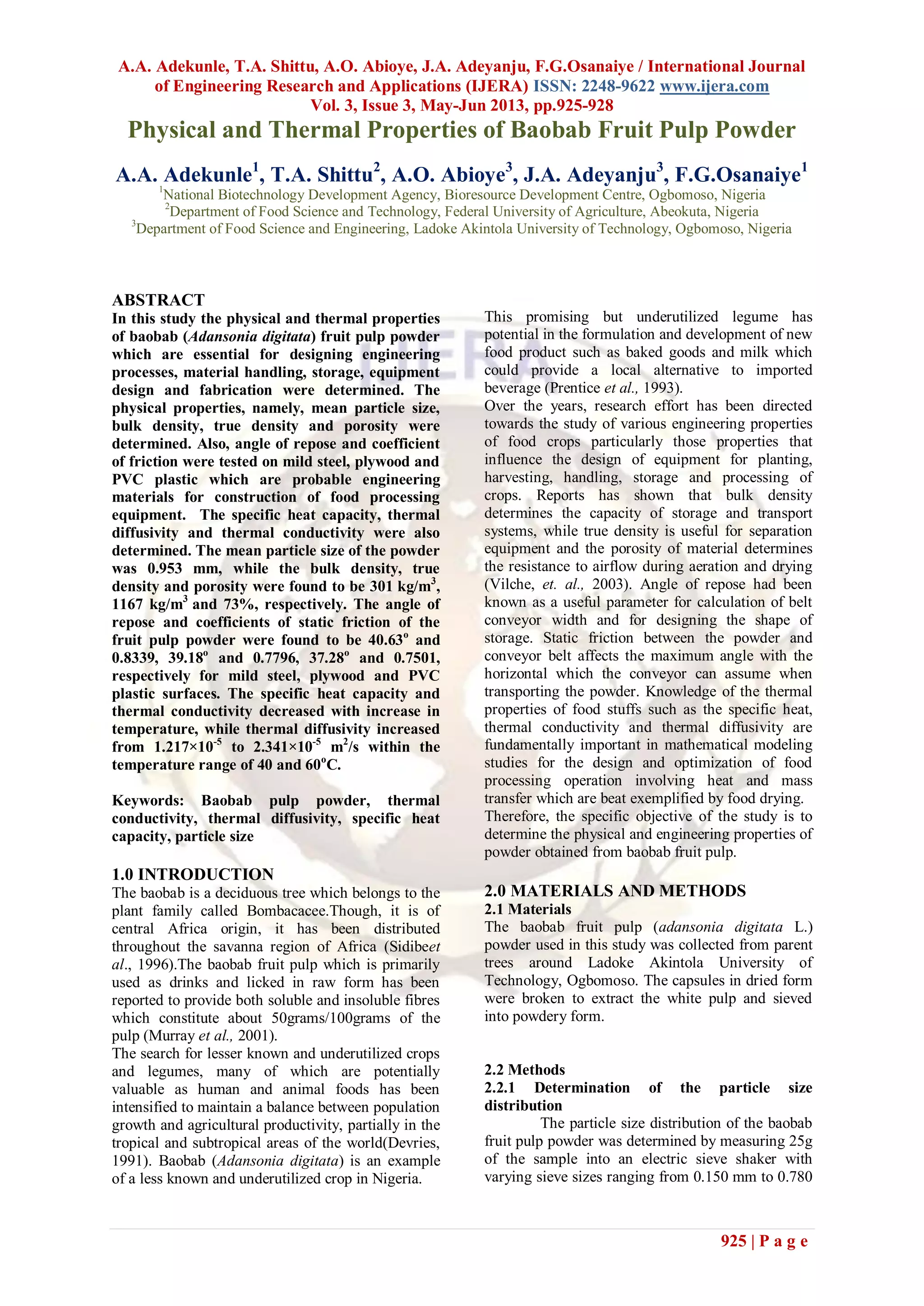
In this study the physical and thermal properties
of baobab (Adansonia digitata) fruit pulp powder
which are essential for designing engineering
processes, material handling, storage, equipment
design and fabrication were determined. The
physical properties, namely, mean particle size,
bulk density, true density and porosity were
determined. Also, angle of repose and coefficient
of friction were tested on mild steel, plywood and
PVC plastic which are probable engineering
materials for construction of food processing
equipment. The specific heat capacity, thermal
diffusivity and thermal conductivity were also
determined. The mean particle size of the powder
was 0.953 mm, while the bulk density, true
density and porosity were found to be 301 kg/m3
,
1167 kg/m3
and 73%, respectively. The angle of
repose and coefficients of static friction of the
fruit pulp powder were found to be 40.63o
and
0.8339, 39.18o
and 0.7796, 37.28o
and 0.7501,
respectively for mild steel, plywood and PVC
plastic surfaces. The specific heat capacity and
thermal conductivity decreased with increase in
temperature, while thermal diffusivity increased
from 1.217×10⁻⁵
to 2.341×10⁻⁵
m2
/s within the
temperature range of 40 and 60o
C.
Keywords: Baobab pulp powder, thermal
conductivity, thermal diffusivity, specific heat
capacity, particle size
1.0 INTRODUCTION
The baobab is a deciduous tree which belongs to the
plant family called Bombacacee.Though, it is of
central Africa origin, it has been distributed
throughout the savanna region of Africa (Sidibeet
al., 1996).The baobab fruit pulp which is primarily
used as drinks and licked in raw form has been
reported to provide both soluble and insoluble fibres
which constitute about 50grams/100grams of the
pulp (Murray et al., 2001).
The search for lesser known and underutilized crops
and legumes, many of which are potentially
valuable as human and animal foods has been
intensified to maintain a balance between population
growth and agricultural productivity, partially in the
tropical and subtropical areas of the world(Devries,
1991). Baobab (Adansonia digitata) is an example
of a less known and underutilized crop in Nigeria.
This promising but underutilized legume has
potential in the formulation and development of new
food product such as baked goods and milk which
could provide a local alternative to imported
beverage (Prentice et al., 1993).
Over the years, research effort has been directed
towards the study of various engineering properties
of food crops particularly those properties that
influence the design of equipment for planting,
harvesting, handling, storage and processing of
crops. Reports has shown that bulk density
determines the capacity of storage and transport
systems, while true density is useful for separation
equipment and the porosity of material determines
the resistance to airflow during aeration and drying
(Vilche, et. al., 2003). Angle of repose had been
known as a useful parameter for calculation of belt
conveyor width and for designing the shape of
storage. Static friction between the powder and
conveyor belt affects the maximum angle with the
horizontal which the conveyor can assume when
transporting the powder. Knowledge of the thermal
properties of food stuffs such as the specific heat,
thermal conductivity and thermal diffusivity are
fundamentally important in mathematical modeling
studies for the design and optimization of food
processing operation involving heat and mass
transfer which are beat exemplified by food drying.
Therefore, the specific objective of the study is to
determine the physical and engineering properties of
powder obtained from baobab fruit pulp.
2.0 MATERIALS AND METHODS
2.1 Materials
The baobab fruit pulp (adansonia digitata L.)
powder used in this study was collected from parent
trees around Ladoke Akintola University of
Technology, Ogbomoso. The capsules in dried form
were broken to extract the white pulp and sieved
into powdery form.
2.2 Methods
2.2.1 Determination of the particle size
distribution
The particle size distribution of the baobab
fruit pulp powder was determined by measuring 25g
of the sample into an electric sieve shaker with
varying sieve sizes ranging from 0.150 mm to 0.780
A.A. Adekunle, T.A. Shittu, A.O. Abioye, J.A. Adeyanju, F.G.Osanaiye / International Journal
of Engineering Research and Applications (IJERA) ISSN: 2248-9622 www.ijera.com
Vol. 3, Issue 3, May-Jun 2013, pp.925-928
926 | P a g e
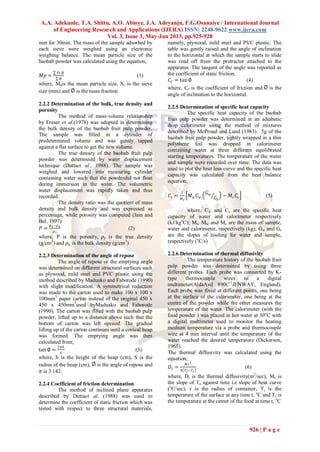
mm for 30min. The mass of the sample adsorbed by
each sieve were weighed using an electronic
weighing balance. The mean particle size of the
baobab powder was calculated using the equation,
𝑀𝑝 =
𝑋𝑖.∅
∅
(1)
where, Mpis the mean particle size, Xi is the sieve
size (mm) and is the mass fraction
2.2.2 Determination of the bulk, true density and
porosity
The method of mass-volume relationship
by Fraser et al.(1978) was adopted in determining
the bulk density of the baobab fruit pulp powder.
The sample was filled in a cylinder of
predetermined volume and was gently tapped
against a flat surface to get the new volume.
The true density of the baobab fruit pulp
powder was determined by water displacement
technique (Duttaet al., 1988). The sample was
weighed and lowered into measuring cylinder
containing water such that the powderdid not float
during immersion in the water. The volumetric
water displacement was rapidly taken and thus
recorded.
The density ratio was the quotient of mass
density and bulk density and was expressed as
percentage, while porosity was computed (Jain and
Bal, 1997)
𝑃 =
𝜌 𝑡−𝜌 𝑏
𝜌 𝑡
(2)
where, P is the porosity, 𝜌𝑡 is the true density
(g/cm3
) and 𝜌 𝑏 is the bulk density (g/cm3
)
2.2.3 Determination of the angle of repose
The angle of repose or the emptying angle
was determined on different structural surfaces such
as plywood, mild steel and PVC plastic using the
method described by Maduako and Faborode (1990)
with slight modification. A symmetrical reduction
was made to the carton used to make 100 x 100 x
100mm3
paper carton instead of the original 450 x
450 x 450mm3
used byMaduako and Faborode
(1990). The carton was filled with the baobab pulp
powder, lifted up to a distance above such that the
bottom of carton was left opened. The gradual
lifting up of the carton continues until a conical heap
was formed. The emptying angle was then
calculated from;
tan ∅ =
2𝜋ℎ
𝑆
(3)
where, h is the height of the heap (cm), S is the
radius of the heap (cm), is the angle of repose and
𝜋 is 3.142.
2.2.4 Coefficient of friction determination
The method of inclined plane apparatus
described by Duttaet al. (1988) was used to
determine the coefficient of static friction which was
tested with respect to three structural materials,
namely; plywood, mild steel and PVC plastic. The
table was gently raised and the angle of inclination
to the horizontal at which the sample starts to slide
was read off from the protractor attached to the
apparatus. The tangent of the angle was reported as
the coefficient of static friction.
𝐶𝑓 = tan ∅ (4)
where, Cf is the coefficient of friction and is the
angle of inclination to the horizontal.
2.2.5 Determination of specific heat capacity
The specific heat capacity of the baobab
fruit pulp powder was determined in an adiabatic
drop calorimeter using the method of mixtures
described by McProud and Lund (1983). 5g of the
baobab fruit pulp powder, tightly wrapped in a thin
polythene foil was dropped in calorimeter
containing water at three different equilibrated
starting temperatures. The temperature of the water
and sample were recorded over time. The data was
used to plot the heat loss curve and the specific heat
capacity was calculated from the heat balance
equation;
𝐶𝑠 =
1
𝑀 𝑠
𝑀 𝑤 𝐶 𝑤
𝐺 𝑤
𝐺𝑠
− 𝑀𝑐 𝐶𝑐 (5)
where, Cw and Cc are the specific heat
capacity of water and calorimeter respectively
(kJ/kgo
C); Ms, Mw and Mc are the mass of sample,
water and calorimeter, respectively (kg); Gw and Gs
are the slopes of cooling for water and sample,
respectively (o
C/s)
2.2.6 Determination of thermal diffusivity
The temperature history of the baobab fruit
pulp powder was determined by using three
different probes. Each probe was connected by K-
type thermocouple wires to a digital
multimeter(AldaAvd 890C-1
JENWAY, England).
Each probe was fixed at different points, one being
at the surface of the calorimeter, one being at the
centre of the powder while the other measures the
temperature of the water. The calorimeter (with the
food powder ) was placed in hot water at 30o
C with
a digital multimeter used to monitor the heating
medium temperature via a probe and thermocouple
wire at 4 min interval until the temperature of the
water reached the desired temperature (Dickerson,
1965).
The thermal diffusivity was calculated using the
equation;
𝐷𝑡 =
𝑀𝑟2
4 𝑇 𝑗 −𝑇𝑠
(6)
where, Dt is the thermal diffusivity(m2
/sec), M, is
the slope of To against time i.e slope of heat curve
(o
C/sec), r is the radius of container, Tj is the
temperature of the surface at any time t, o
C and Ts is
the temperature at the center of the food at time t, o
C
A.A. Adekunle, T.A. Shittu, A.O. Abioye, J.A. Adeyanju, F.G.Osanaiye / International Journal
of Engineering Research and Applications (IJERA) ISSN: 2248-9622 www.ijera.com
Vol. 3, Issue 3, May-Jun 2013, pp.925-928
927 | P a g e
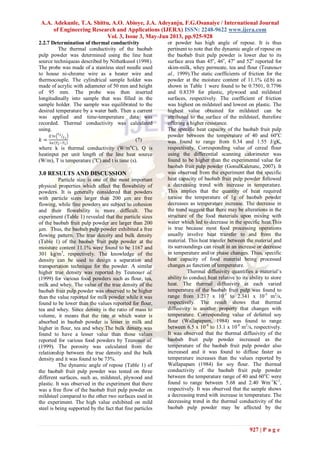
2.2.7 Determination of thermal conductivity
The thermal conductivity of the baobab
pulp powder was determined using the line heat
source techniqueas described by Nithatkusol (1998).
The probe was made of a stainless steel needle used
to house ni-chrome wire as a heater wire and
thermocouple. The cylindrical sample holder was
made of acrylic with adiameter of 50 mm and height
of 95 mm. The probe was then inserted
longitudinally into sample that was filled in the
sample holder. The sample was equilibrated to the
desired temperature by a water bath. Then a current
was applied and time-temperature data was
recorded. Thermal conductivity was calculated
using.
𝑘 =
𝑄 ln
𝑡2
𝑡1
4𝜋 𝑇2−𝑇1
(7)
where k is thermal conductivity (W/mo
C), Q is
heatinput per unit length of the line heat source
(W/m), T is temperature (o
C) and t is time (s).
3.0 RESULTS AND DISCUSSION
Particle size is one of the most important
physical properties which affect the flowability of
powders. It is generally considered that powders
with particle sizes larger than 200 µm are free
flowing, while fine powders are subject to cohesion
and their flowability is more difficult. The
experiment (Table 1) revealed that the particle sizes
of the baobab fruit pulp powder are larger than 200
µm. Thus, the baobab pulp powder exhibited a free
flowing pattern. The true density and bulk density
(Table 1) of the baobab fruit pulp powder at the
moisture content 11.1% were found to be 1167 and
301 kg/m3
, respectively. The knowledge of the
density can be used to design a separation and
transportation technique for the powder. A similar
higher true density was reported by Teunouet al.
(1999) for various food powders such as flour, tea,
milk and whey. The value of the true density of the
baobab fruit pulp powder was observed to be higher
than the value reported for milk powder while it was
found to be lower than the values reported for flour,
tea and whey. Since density is the ratio of mass to
volume, it means that the rate at which water is
absorbed in baobab powder is lesser in milk and
higher in flour, tea and whey.The bulk density was
found to have a lesser value than those values
reported for various food powders by Teunouet al.
(1999). The porosity was calculated from the
relationship between the true density and the bulk
density and it was found to be 73%.
The dynamic angle of repose (Table 1) of
the baobab fruit pulp powder was tested on three
different surfaces, such as, mildsteel, plywood and
plastic. It was observed in the experiment that there
was a free flow of the baobab fruit pulp powder on
mildsteel compared to the other two surfaces used in
the experiment. The high value exhibited on mild
steel is being supported by the fact that fine particles
or powder has high angle of repose. It is thus
pertinent to note that the dynamic angle of repose on
the baobab fruit pulp powder is lower due to its
surface area than 45o
, 46o
, 47o
and 52o
reported for
skim-milk, whey permeate, tea and flour (Teunouet
al., 1999).The static coefficients of friction for the
powder at the moisture content of 11.1% (d.b) as
shown in Table 1 were found to be 0.7501, 0.7796
and 0.8339 for plastic, plywood and mildsteel
surfaces, respectively. The coefficient of friction
was highest on mildsteel and lowest on plastic. The
highest value obtained for mildsteel can be
attributed to the surface of the mildsteel, therefore
offering a higher resistance.
The specific heat capacity of the baobab fruit pulp
powder between the temperature of 40 and 60o
C
was found to range from 0.34 and 1.55 J/gK,
respectively. Corresponding value of cereal flour
using the differential scanning calorimeter was
found to be higher than the experimental value for
baobab fruit pulp powder (GonulKaletunc, 2007). It
was observed from the experiment that the specific
heat capacity of baobab fruit pulp powder followed
a decreasing trend with increase in temperature.
This implies that the quantity of heat required
toraise the temperature of 1g of baobab powder
decreases as temperature increase. The decrease in
the trend suggest that there may be alterations in the
structure of the food materials upon mixing with
water which led to decrease in the specific heat.This
is true because most food processing operations
usually involve heat transfer to and from the
material. This heat transfer between the material and
its surroundings can result in an increase or decrease
in temperature and/or phase changes. Thus, specific
heat capacity of food material being processed
changes as function of temperature.
Thermal diffusivity quantifies a material’s
ability to conduct heat relative to its ability to store
heat. The thermal diffusivity at each varied
temperature of the baobab fruit pulp was found to
range from 1.217 x 10⁻⁵
to 2.341 x 10⁻⁵
m2
/s,
respectively. The result shows that thermal
diffusivity is another property that changes with
temperature. Corresponding value of defatted soy
flour (Wallapapam, 1984) was found to range
between 6.5 x 10⁻⁸
to 13.1 x 10⁻⁸
m2
/s, respectively.
It was observed that the thermal diffusivity of the
baobab fruit pulp powder increased as the
temperature of the baobab fruit pulp powder also
increased and it was found to diffuse faster as
temperature increases than the values reported by
Wallapapam (1984) for soy flour. The thermal
conductivity of the baobab fruit pulp powder
between the temperature range of 40 and 60o
C were
found to range between 5.68 and 2.40 Wm-1
K-1
,
respectively. It was observed that the sample shows
a decreasing trend with increase in temperature. The
decreasing trend in the thermal conductivity of the
baobab pulp powder may be affected by the
A.A. Adekunle, T.A. Shittu, A.O. Abioye, J.A. Adeyanju, F.G.Osanaiye / International Journal
of Engineering Research and Applications (IJERA) ISSN: 2248-9622 www.ijera.com
Vol. 3, Issue 3, May-Jun 2013, pp.925-928
928 | P a g e
chemical composition, physical structure, the stateofthe substance and temperature.
Table 1: Physical Properties of Baobab Fruit Pulp Powder
PARAMETERS UNITS VALUES
Mean particle size mm 0.953±0.261
True density kg/m3
1167±0.144
Bulk density kg/m3
301±0.006
Porosity % 73
Angle of Repose
Mildsteel degree 40.63±0.589
Plywood degree 39.18±0.788
Plastic degree 37.28±0.367
Coefficient of friction
Mildsteel nil 0.8339±0.092
Plywood nil 0.7796±0.102
Plastic nil 0.7501 ±0.099
CONCLUSION
The knowledge of the particle size, angle
of repose and coefficient of friction as studied in
this experiment revealed that baobab pulp powder
exhibited a free flowing pattern more on mild steel
than plywood or PVC plastic. The results of the
thermal properties showed that temperature has
influence on the specific heat capacity, thermal
diffusivity and thermal conductivity and that the
data generated may be useful in the design and
fabrication of processing equipment in the
production of the powder.
REFERENCES
[1]. DeVries, Femke,T. 1991 Chufa,
“(cyperrusesculentus) a weedy cultivar or
a cultivated weed”. Econ. Bot., 45:27-37
[2]. Dickerson, R.W. 1965. An apparatus for
the measurement of thermal diffusivity of
foods. J. Food Tech., 19(5): 198-204.
[3]. Dutta, S.K., Nema, V.K. and Bhardwaj,
R.K. 1988. Physical properties of grape. J.
Agric. Eng. Res., 39:259-268
[4]. Fraser, B.M., Verma, S.S. and Muir, W.E.
1978. Some physical properties of
Fababeans. J. Agric.Eng.Res., 23: 53-57.
[5]. GonulKaletunc.2007. Prediction of
specific heat of cereal flours: A
quantitative empirical correlation. J. Food
Eng., 82: 589–594
[6]. Maduako, J.N. and Faborode M.O.
1990.Some physical properties of cocoa
pods in relation to primary processing. Ife
J. Tech., 2: 1-7
[7]. Mcproud, L.M. and Lund, D.B.1983.
Thermal properties of beef loaf produced
in food services systems. J. Food Sci., 5:
677-680
[8]. Murray S.S., Schoeninger, M.J., Bunn,
H.T., Pickering, T.R. and Marlett, J.A.
2001.Nutritional composition of some
wild plant foods and honey used by Hadza
forager in Tanzania. J. Food Comp. Anal.,
14: 3-13.
[9]. Nithatkusol, A. 1998.The development of
apparatus for determination of thermal
conductivities of nonfrozen food by the
line heat source method.MSc thesis, King
Mongkuts University of Technology,
Thonburi.
[10]. Prentice A., Laskey M.A., Shaw J.,
Hadson. G.J., Day, K.C., Jarjon, L.M.A.,
Dibba, B. and Paul, A.A. 1993. The
calcium and phosphnus in takes of rural
Gambian women during pregnancy and
lactation portish. J. Nutr., 69: 885-896.
[11]. Sidibe, M., Scheuring, J.F., Tembely, D.,
Sidibe, M.M., Human P. and Frigg, M.
1996.Baobab- Homegrown Vitamin C for
Africa. Agroforestry Today, 8(2): 13-15.
[12]. Teunou, E., Fitzpatrick, J.J. and Synnott,
E.C. 1999 .Characterisation of food
powder flowability. J. Food Eng., 39: 31-
37.
[13]. Vilche, C., Gely, M. and Santalla, E.
(2003).Physical properties of quinoa
grains.Biosysyems Engineering, 86:59-65.
[14]. Wallapapan, K., Sweat, V.E., Aree, J.A.
and Dahm, P.F. 1984. Thermal diffusivity
and conductivity of deffated soy flour.
Trans. Amer. Soc. Agri. Eng., 27(6):
1610-1613.

Fb33925928

  • 1.
    A.A. Adekunle, T.A.Shittu, A.O. Abioye, J.A. Adeyanju, F.G.Osanaiye / International Journal of Engineering Research and Applications (IJERA) ISSN: 2248-9622 www.ijera.com Vol. 3, Issue 3, May-Jun 2013, pp.925-928 925 | P a g e Physical and Thermal Properties of Baobab Fruit Pulp Powder A.A. Adekunle1 , T.A. Shittu2 , A.O. Abioye3 , J.A. Adeyanju3 , F.G.Osanaiye1 1 National Biotechnology Development Agency, Bioresource Development Centre, Ogbomoso, Nigeria 2 Department of Food Science and Technology, Federal University of Agriculture, Abeokuta, Nigeria 3 Department of Food Science and Engineering, Ladoke Akintola University of Technology, Ogbomoso, Nigeria ABSTRACT In this study the physical and thermal properties of baobab (Adansonia digitata) fruit pulp powder which are essential for designing engineering processes, material handling, storage, equipment design and fabrication were determined. The physical properties, namely, mean particle size, bulk density, true density and porosity were determined. Also, angle of repose and coefficient of friction were tested on mild steel, plywood and PVC plastic which are probable engineering materials for construction of food processing equipment. The specific heat capacity, thermal diffusivity and thermal conductivity were also determined. The mean particle size of the powder was 0.953 mm, while the bulk density, true density and porosity were found to be 301 kg/m3 , 1167 kg/m3 and 73%, respectively. The angle of repose and coefficients of static friction of the fruit pulp powder were found to be 40.63o and 0.8339, 39.18o and 0.7796, 37.28o and 0.7501, respectively for mild steel, plywood and PVC plastic surfaces. The specific heat capacity and thermal conductivity decreased with increase in temperature, while thermal diffusivity increased from 1.217×10⁻⁵ to 2.341×10⁻⁵ m2 /s within the temperature range of 40 and 60o C. Keywords: Baobab pulp powder, thermal conductivity, thermal diffusivity, specific heat capacity, particle size 1.0 INTRODUCTION The baobab is a deciduous tree which belongs to the plant family called Bombacacee.Though, it is of central Africa origin, it has been distributed throughout the savanna region of Africa (Sidibeet al., 1996).The baobab fruit pulp which is primarily used as drinks and licked in raw form has been reported to provide both soluble and insoluble fibres which constitute about 50grams/100grams of the pulp (Murray et al., 2001). The search for lesser known and underutilized crops and legumes, many of which are potentially valuable as human and animal foods has been intensified to maintain a balance between population growth and agricultural productivity, partially in the tropical and subtropical areas of the world(Devries, 1991). Baobab (Adansonia digitata) is an example of a less known and underutilized crop in Nigeria. This promising but underutilized legume has potential in the formulation and development of new food product such as baked goods and milk which could provide a local alternative to imported beverage (Prentice et al., 1993). Over the years, research effort has been directed towards the study of various engineering properties of food crops particularly those properties that influence the design of equipment for planting, harvesting, handling, storage and processing of crops. Reports has shown that bulk density determines the capacity of storage and transport systems, while true density is useful for separation equipment and the porosity of material determines the resistance to airflow during aeration and drying (Vilche, et. al., 2003). Angle of repose had been known as a useful parameter for calculation of belt conveyor width and for designing the shape of storage. Static friction between the powder and conveyor belt affects the maximum angle with the horizontal which the conveyor can assume when transporting the powder. Knowledge of the thermal properties of food stuffs such as the specific heat, thermal conductivity and thermal diffusivity are fundamentally important in mathematical modeling studies for the design and optimization of food processing operation involving heat and mass transfer which are beat exemplified by food drying. Therefore, the specific objective of the study is to determine the physical and engineering properties of powder obtained from baobab fruit pulp. 2.0 MATERIALS AND METHODS 2.1 Materials The baobab fruit pulp (adansonia digitata L.) powder used in this study was collected from parent trees around Ladoke Akintola University of Technology, Ogbomoso. The capsules in dried form were broken to extract the white pulp and sieved into powdery form. 2.2 Methods 2.2.1 Determination of the particle size distribution The particle size distribution of the baobab fruit pulp powder was determined by measuring 25g of the sample into an electric sieve shaker with varying sieve sizes ranging from 0.150 mm to 0.780
  • 2.
    A.A. Adekunle, T.A.Shittu, A.O. Abioye, J.A. Adeyanju, F.G.Osanaiye / International Journal of Engineering Research and Applications (IJERA) ISSN: 2248-9622 www.ijera.com Vol. 3, Issue 3, May-Jun 2013, pp.925-928 926 | P a g e mm for 30min. The mass of the sample adsorbed by each sieve were weighed using an electronic weighing balance. The mean particle size of the baobab powder was calculated using the equation, 𝑀𝑝 = 𝑋𝑖.∅ ∅ (1) where, Mpis the mean particle size, Xi is the sieve size (mm) and is the mass fraction 2.2.2 Determination of the bulk, true density and porosity The method of mass-volume relationship by Fraser et al.(1978) was adopted in determining the bulk density of the baobab fruit pulp powder. The sample was filled in a cylinder of predetermined volume and was gently tapped against a flat surface to get the new volume. The true density of the baobab fruit pulp powder was determined by water displacement technique (Duttaet al., 1988). The sample was weighed and lowered into measuring cylinder containing water such that the powderdid not float during immersion in the water. The volumetric water displacement was rapidly taken and thus recorded. The density ratio was the quotient of mass density and bulk density and was expressed as percentage, while porosity was computed (Jain and Bal, 1997) 𝑃 = 𝜌 𝑡−𝜌 𝑏 𝜌 𝑡 (2) where, P is the porosity, 𝜌𝑡 is the true density (g/cm3 ) and 𝜌 𝑏 is the bulk density (g/cm3 ) 2.2.3 Determination of the angle of repose The angle of repose or the emptying angle was determined on different structural surfaces such as plywood, mild steel and PVC plastic using the method described by Maduako and Faborode (1990) with slight modification. A symmetrical reduction was made to the carton used to make 100 x 100 x 100mm3 paper carton instead of the original 450 x 450 x 450mm3 used byMaduako and Faborode (1990). The carton was filled with the baobab pulp powder, lifted up to a distance above such that the bottom of carton was left opened. The gradual lifting up of the carton continues until a conical heap was formed. The emptying angle was then calculated from; tan ∅ = 2𝜋ℎ 𝑆 (3) where, h is the height of the heap (cm), S is the radius of the heap (cm), is the angle of repose and 𝜋 is 3.142. 2.2.4 Coefficient of friction determination The method of inclined plane apparatus described by Duttaet al. (1988) was used to determine the coefficient of static friction which was tested with respect to three structural materials, namely; plywood, mild steel and PVC plastic. The table was gently raised and the angle of inclination to the horizontal at which the sample starts to slide was read off from the protractor attached to the apparatus. The tangent of the angle was reported as the coefficient of static friction. 𝐶𝑓 = tan ∅ (4) where, Cf is the coefficient of friction and is the angle of inclination to the horizontal. 2.2.5 Determination of specific heat capacity The specific heat capacity of the baobab fruit pulp powder was determined in an adiabatic drop calorimeter using the method of mixtures described by McProud and Lund (1983). 5g of the baobab fruit pulp powder, tightly wrapped in a thin polythene foil was dropped in calorimeter containing water at three different equilibrated starting temperatures. The temperature of the water and sample were recorded over time. The data was used to plot the heat loss curve and the specific heat capacity was calculated from the heat balance equation; 𝐶𝑠 = 1 𝑀 𝑠 𝑀 𝑤 𝐶 𝑤 𝐺 𝑤 𝐺𝑠 − 𝑀𝑐 𝐶𝑐 (5) where, Cw and Cc are the specific heat capacity of water and calorimeter respectively (kJ/kgo C); Ms, Mw and Mc are the mass of sample, water and calorimeter, respectively (kg); Gw and Gs are the slopes of cooling for water and sample, respectively (o C/s) 2.2.6 Determination of thermal diffusivity The temperature history of the baobab fruit pulp powder was determined by using three different probes. Each probe was connected by K- type thermocouple wires to a digital multimeter(AldaAvd 890C-1 JENWAY, England). Each probe was fixed at different points, one being at the surface of the calorimeter, one being at the centre of the powder while the other measures the temperature of the water. The calorimeter (with the food powder ) was placed in hot water at 30o C with a digital multimeter used to monitor the heating medium temperature via a probe and thermocouple wire at 4 min interval until the temperature of the water reached the desired temperature (Dickerson, 1965). The thermal diffusivity was calculated using the equation; 𝐷𝑡 = 𝑀𝑟2 4 𝑇 𝑗 −𝑇𝑠 (6) where, Dt is the thermal diffusivity(m2 /sec), M, is the slope of To against time i.e slope of heat curve (o C/sec), r is the radius of container, Tj is the temperature of the surface at any time t, o C and Ts is the temperature at the center of the food at time t, o C
  • 3.
    A.A. Adekunle, T.A.Shittu, A.O. Abioye, J.A. Adeyanju, F.G.Osanaiye / International Journal of Engineering Research and Applications (IJERA) ISSN: 2248-9622 www.ijera.com Vol. 3, Issue 3, May-Jun 2013, pp.925-928 927 | P a g e 2.2.7 Determination of thermal conductivity The thermal conductivity of the baobab pulp powder was determined using the line heat source techniqueas described by Nithatkusol (1998). The probe was made of a stainless steel needle used to house ni-chrome wire as a heater wire and thermocouple. The cylindrical sample holder was made of acrylic with adiameter of 50 mm and height of 95 mm. The probe was then inserted longitudinally into sample that was filled in the sample holder. The sample was equilibrated to the desired temperature by a water bath. Then a current was applied and time-temperature data was recorded. Thermal conductivity was calculated using. 𝑘 = 𝑄 ln 𝑡2 𝑡1 4𝜋 𝑇2−𝑇1 (7) where k is thermal conductivity (W/mo C), Q is heatinput per unit length of the line heat source (W/m), T is temperature (o C) and t is time (s). 3.0 RESULTS AND DISCUSSION Particle size is one of the most important physical properties which affect the flowability of powders. It is generally considered that powders with particle sizes larger than 200 µm are free flowing, while fine powders are subject to cohesion and their flowability is more difficult. The experiment (Table 1) revealed that the particle sizes of the baobab fruit pulp powder are larger than 200 µm. Thus, the baobab pulp powder exhibited a free flowing pattern. The true density and bulk density (Table 1) of the baobab fruit pulp powder at the moisture content 11.1% were found to be 1167 and 301 kg/m3 , respectively. The knowledge of the density can be used to design a separation and transportation technique for the powder. A similar higher true density was reported by Teunouet al. (1999) for various food powders such as flour, tea, milk and whey. The value of the true density of the baobab fruit pulp powder was observed to be higher than the value reported for milk powder while it was found to be lower than the values reported for flour, tea and whey. Since density is the ratio of mass to volume, it means that the rate at which water is absorbed in baobab powder is lesser in milk and higher in flour, tea and whey.The bulk density was found to have a lesser value than those values reported for various food powders by Teunouet al. (1999). The porosity was calculated from the relationship between the true density and the bulk density and it was found to be 73%. The dynamic angle of repose (Table 1) of the baobab fruit pulp powder was tested on three different surfaces, such as, mildsteel, plywood and plastic. It was observed in the experiment that there was a free flow of the baobab fruit pulp powder on mildsteel compared to the other two surfaces used in the experiment. The high value exhibited on mild steel is being supported by the fact that fine particles or powder has high angle of repose. It is thus pertinent to note that the dynamic angle of repose on the baobab fruit pulp powder is lower due to its surface area than 45o , 46o , 47o and 52o reported for skim-milk, whey permeate, tea and flour (Teunouet al., 1999).The static coefficients of friction for the powder at the moisture content of 11.1% (d.b) as shown in Table 1 were found to be 0.7501, 0.7796 and 0.8339 for plastic, plywood and mildsteel surfaces, respectively. The coefficient of friction was highest on mildsteel and lowest on plastic. The highest value obtained for mildsteel can be attributed to the surface of the mildsteel, therefore offering a higher resistance. The specific heat capacity of the baobab fruit pulp powder between the temperature of 40 and 60o C was found to range from 0.34 and 1.55 J/gK, respectively. Corresponding value of cereal flour using the differential scanning calorimeter was found to be higher than the experimental value for baobab fruit pulp powder (GonulKaletunc, 2007). It was observed from the experiment that the specific heat capacity of baobab fruit pulp powder followed a decreasing trend with increase in temperature. This implies that the quantity of heat required toraise the temperature of 1g of baobab powder decreases as temperature increase. The decrease in the trend suggest that there may be alterations in the structure of the food materials upon mixing with water which led to decrease in the specific heat.This is true because most food processing operations usually involve heat transfer to and from the material. This heat transfer between the material and its surroundings can result in an increase or decrease in temperature and/or phase changes. Thus, specific heat capacity of food material being processed changes as function of temperature. Thermal diffusivity quantifies a material’s ability to conduct heat relative to its ability to store heat. The thermal diffusivity at each varied temperature of the baobab fruit pulp was found to range from 1.217 x 10⁻⁵ to 2.341 x 10⁻⁵ m2 /s, respectively. The result shows that thermal diffusivity is another property that changes with temperature. Corresponding value of defatted soy flour (Wallapapam, 1984) was found to range between 6.5 x 10⁻⁸ to 13.1 x 10⁻⁸ m2 /s, respectively. It was observed that the thermal diffusivity of the baobab fruit pulp powder increased as the temperature of the baobab fruit pulp powder also increased and it was found to diffuse faster as temperature increases than the values reported by Wallapapam (1984) for soy flour. The thermal conductivity of the baobab fruit pulp powder between the temperature range of 40 and 60o C were found to range between 5.68 and 2.40 Wm-1 K-1 , respectively. It was observed that the sample shows a decreasing trend with increase in temperature. The decreasing trend in the thermal conductivity of the baobab pulp powder may be affected by the
  • 4.
    A.A. Adekunle, T.A.Shittu, A.O. Abioye, J.A. Adeyanju, F.G.Osanaiye / International Journal of Engineering Research and Applications (IJERA) ISSN: 2248-9622 www.ijera.com Vol. 3, Issue 3, May-Jun 2013, pp.925-928 928 | P a g e chemical composition, physical structure, the stateofthe substance and temperature. Table 1: Physical Properties of Baobab Fruit Pulp Powder PARAMETERS UNITS VALUES Mean particle size mm 0.953±0.261 True density kg/m3 1167±0.144 Bulk density kg/m3 301±0.006 Porosity % 73 Angle of Repose Mildsteel degree 40.63±0.589 Plywood degree 39.18±0.788 Plastic degree 37.28±0.367 Coefficient of friction Mildsteel nil 0.8339±0.092 Plywood nil 0.7796±0.102 Plastic nil 0.7501 ±0.099 CONCLUSION The knowledge of the particle size, angle of repose and coefficient of friction as studied in this experiment revealed that baobab pulp powder exhibited a free flowing pattern more on mild steel than plywood or PVC plastic. The results of the thermal properties showed that temperature has influence on the specific heat capacity, thermal diffusivity and thermal conductivity and that the data generated may be useful in the design and fabrication of processing equipment in the production of the powder. REFERENCES [1]. DeVries, Femke,T. 1991 Chufa, “(cyperrusesculentus) a weedy cultivar or a cultivated weed”. Econ. Bot., 45:27-37 [2]. Dickerson, R.W. 1965. An apparatus for the measurement of thermal diffusivity of foods. J. Food Tech., 19(5): 198-204. [3]. Dutta, S.K., Nema, V.K. and Bhardwaj, R.K. 1988. Physical properties of grape. J. Agric. Eng. Res., 39:259-268 [4]. Fraser, B.M., Verma, S.S. and Muir, W.E. 1978. Some physical properties of Fababeans. J. Agric.Eng.Res., 23: 53-57. [5]. GonulKaletunc.2007. Prediction of specific heat of cereal flours: A quantitative empirical correlation. J. Food Eng., 82: 589–594 [6]. Maduako, J.N. and Faborode M.O. 1990.Some physical properties of cocoa pods in relation to primary processing. Ife J. Tech., 2: 1-7 [7]. Mcproud, L.M. and Lund, D.B.1983. Thermal properties of beef loaf produced in food services systems. J. Food Sci., 5: 677-680 [8]. Murray S.S., Schoeninger, M.J., Bunn, H.T., Pickering, T.R. and Marlett, J.A. 2001.Nutritional composition of some wild plant foods and honey used by Hadza forager in Tanzania. J. Food Comp. Anal., 14: 3-13. [9]. Nithatkusol, A. 1998.The development of apparatus for determination of thermal conductivities of nonfrozen food by the line heat source method.MSc thesis, King Mongkuts University of Technology, Thonburi. [10]. Prentice A., Laskey M.A., Shaw J., Hadson. G.J., Day, K.C., Jarjon, L.M.A., Dibba, B. and Paul, A.A. 1993. The calcium and phosphnus in takes of rural Gambian women during pregnancy and lactation portish. J. Nutr., 69: 885-896. [11]. Sidibe, M., Scheuring, J.F., Tembely, D., Sidibe, M.M., Human P. and Frigg, M. 1996.Baobab- Homegrown Vitamin C for Africa. Agroforestry Today, 8(2): 13-15. [12]. Teunou, E., Fitzpatrick, J.J. and Synnott, E.C. 1999 .Characterisation of food powder flowability. J. Food Eng., 39: 31- 37. [13]. Vilche, C., Gely, M. and Santalla, E. (2003).Physical properties of quinoa grains.Biosysyems Engineering, 86:59-65. [14]. Wallapapan, K., Sweat, V.E., Aree, J.A. and Dahm, P.F. 1984. Thermal diffusivity and conductivity of deffated soy flour. Trans. Amer. Soc. Agri. Eng., 27(6): 1610-1613.